JP6992029B2 - Production of oligosaccharides - Google Patents
Production of oligosaccharides Download PDFInfo
- Publication number
- JP6992029B2 JP6992029B2 JP2019152682A JP2019152682A JP6992029B2 JP 6992029 B2 JP6992029 B2 JP 6992029B2 JP 2019152682 A JP2019152682 A JP 2019152682A JP 2019152682 A JP2019152682 A JP 2019152682A JP 6992029 B2 JP6992029 B2 JP 6992029B2
- Authority
- JP
- Japan
- Prior art keywords
- lactose
- host microorganism
- oligosaccharides
- human milk
- galactosidase
- Prior art date
- Legal status (The legal status is an assumption and is not a legal conclusion. Google has not performed a legal analysis and makes no representation as to the accuracy of the status listed.)
- Active
Links
Images







Classifications
-
- C—CHEMISTRY; METALLURGY
- C12—BIOCHEMISTRY; BEER; SPIRITS; WINE; VINEGAR; MICROBIOLOGY; ENZYMOLOGY; MUTATION OR GENETIC ENGINEERING
- C12P—FERMENTATION OR ENZYME-USING PROCESSES TO SYNTHESISE A DESIRED CHEMICAL COMPOUND OR COMPOSITION OR TO SEPARATE OPTICAL ISOMERS FROM A RACEMIC MIXTURE
- C12P19/00—Preparation of compounds containing saccharide radicals
- C12P19/26—Preparation of nitrogen-containing carbohydrates
-
- C—CHEMISTRY; METALLURGY
- C12—BIOCHEMISTRY; BEER; SPIRITS; WINE; VINEGAR; MICROBIOLOGY; ENZYMOLOGY; MUTATION OR GENETIC ENGINEERING
- C12P—FERMENTATION OR ENZYME-USING PROCESSES TO SYNTHESISE A DESIRED CHEMICAL COMPOUND OR COMPOSITION OR TO SEPARATE OPTICAL ISOMERS FROM A RACEMIC MIXTURE
- C12P19/00—Preparation of compounds containing saccharide radicals
- C12P19/14—Preparation of compounds containing saccharide radicals produced by the action of a carbohydrase (EC 3.2.x), e.g. by alpha-amylase, e.g. by cellulase, hemicellulase
-
- C—CHEMISTRY; METALLURGY
- C07—ORGANIC CHEMISTRY
- C07H—SUGARS; DERIVATIVES THEREOF; NUCLEOSIDES; NUCLEOTIDES; NUCLEIC ACIDS
- C07H1/00—Processes for the preparation of sugar derivatives
-
- C—CHEMISTRY; METALLURGY
- C07—ORGANIC CHEMISTRY
- C07H—SUGARS; DERIVATIVES THEREOF; NUCLEOSIDES; NUCLEOTIDES; NUCLEIC ACIDS
- C07H1/00—Processes for the preparation of sugar derivatives
- C07H1/06—Separation; Purification
-
- C—CHEMISTRY; METALLURGY
- C12—BIOCHEMISTRY; BEER; SPIRITS; WINE; VINEGAR; MICROBIOLOGY; ENZYMOLOGY; MUTATION OR GENETIC ENGINEERING
- C12N—MICROORGANISMS OR ENZYMES; COMPOSITIONS THEREOF; PROPAGATING, PRESERVING, OR MAINTAINING MICROORGANISMS; MUTATION OR GENETIC ENGINEERING; CULTURE MEDIA
- C12N1/00—Microorganisms; Compositions thereof; Processes of propagating, maintaining or preserving microorganisms or compositions thereof; Processes of preparing or isolating a composition containing a microorganism; Culture media therefor
- C12N1/20—Bacteria; Culture media therefor
- C12N1/205—Bacterial isolates
-
- C—CHEMISTRY; METALLURGY
- C12—BIOCHEMISTRY; BEER; SPIRITS; WINE; VINEGAR; MICROBIOLOGY; ENZYMOLOGY; MUTATION OR GENETIC ENGINEERING
- C12N—MICROORGANISMS OR ENZYMES; COMPOSITIONS THEREOF; PROPAGATING, PRESERVING, OR MAINTAINING MICROORGANISMS; MUTATION OR GENETIC ENGINEERING; CULTURE MEDIA
- C12N15/00—Mutation or genetic engineering; DNA or RNA concerning genetic engineering, vectors, e.g. plasmids, or their isolation, preparation or purification; Use of hosts therefor
- C12N15/09—Recombinant DNA-technology
- C12N15/63—Introduction of foreign genetic material using vectors; Vectors; Use of hosts therefor; Regulation of expression
-
- C—CHEMISTRY; METALLURGY
- C12—BIOCHEMISTRY; BEER; SPIRITS; WINE; VINEGAR; MICROBIOLOGY; ENZYMOLOGY; MUTATION OR GENETIC ENGINEERING
- C12N—MICROORGANISMS OR ENZYMES; COMPOSITIONS THEREOF; PROPAGATING, PRESERVING, OR MAINTAINING MICROORGANISMS; MUTATION OR GENETIC ENGINEERING; CULTURE MEDIA
- C12N15/00—Mutation or genetic engineering; DNA or RNA concerning genetic engineering, vectors, e.g. plasmids, or their isolation, preparation or purification; Use of hosts therefor
- C12N15/09—Recombinant DNA-technology
- C12N15/63—Introduction of foreign genetic material using vectors; Vectors; Use of hosts therefor; Regulation of expression
- C12N15/70—Vectors or expression systems specially adapted for E. coli
- C12N15/72—Expression systems using regulatory sequences derived from the lac-operon
-
- C—CHEMISTRY; METALLURGY
- C12—BIOCHEMISTRY; BEER; SPIRITS; WINE; VINEGAR; MICROBIOLOGY; ENZYMOLOGY; MUTATION OR GENETIC ENGINEERING
- C12P—FERMENTATION OR ENZYME-USING PROCESSES TO SYNTHESISE A DESIRED CHEMICAL COMPOUND OR COMPOSITION OR TO SEPARATE OPTICAL ISOMERS FROM A RACEMIC MIXTURE
- C12P19/00—Preparation of compounds containing saccharide radicals
-
- C—CHEMISTRY; METALLURGY
- C12—BIOCHEMISTRY; BEER; SPIRITS; WINE; VINEGAR; MICROBIOLOGY; ENZYMOLOGY; MUTATION OR GENETIC ENGINEERING
- C12P—FERMENTATION OR ENZYME-USING PROCESSES TO SYNTHESISE A DESIRED CHEMICAL COMPOUND OR COMPOSITION OR TO SEPARATE OPTICAL ISOMERS FROM A RACEMIC MIXTURE
- C12P19/00—Preparation of compounds containing saccharide radicals
- C12P19/12—Disaccharides
-
- C—CHEMISTRY; METALLURGY
- C12—BIOCHEMISTRY; BEER; SPIRITS; WINE; VINEGAR; MICROBIOLOGY; ENZYMOLOGY; MUTATION OR GENETIC ENGINEERING
- C12P—FERMENTATION OR ENZYME-USING PROCESSES TO SYNTHESISE A DESIRED CHEMICAL COMPOUND OR COMPOSITION OR TO SEPARATE OPTICAL ISOMERS FROM A RACEMIC MIXTURE
- C12P19/00—Preparation of compounds containing saccharide radicals
- C12P19/20—Preparation of compounds containing saccharide radicals produced by the action of an exo-1,4 alpha-glucosidase, e.g. dextrose
-
- C—CHEMISTRY; METALLURGY
- C12—BIOCHEMISTRY; BEER; SPIRITS; WINE; VINEGAR; MICROBIOLOGY; ENZYMOLOGY; MUTATION OR GENETIC ENGINEERING
- C12Y—ENZYMES
- C12Y302/00—Hydrolases acting on glycosyl compounds, i.e. glycosylases (3.2)
- C12Y302/01—Glycosidases, i.e. enzymes hydrolysing O- and S-glycosyl compounds (3.2.1)
-
- C—CHEMISTRY; METALLURGY
- C12—BIOCHEMISTRY; BEER; SPIRITS; WINE; VINEGAR; MICROBIOLOGY; ENZYMOLOGY; MUTATION OR GENETIC ENGINEERING
- C12Y—ENZYMES
- C12Y302/00—Hydrolases acting on glycosyl compounds, i.e. glycosylases (3.2)
- C12Y302/01—Glycosidases, i.e. enzymes hydrolysing O- and S-glycosyl compounds (3.2.1)
- C12Y302/01023—Beta-galactosidase (3.2.1.23), i.e. exo-(1-->4)-beta-D-galactanase
-
- C—CHEMISTRY; METALLURGY
- C12—BIOCHEMISTRY; BEER; SPIRITS; WINE; VINEGAR; MICROBIOLOGY; ENZYMOLOGY; MUTATION OR GENETIC ENGINEERING
- C12N—MICROORGANISMS OR ENZYMES; COMPOSITIONS THEREOF; PROPAGATING, PRESERVING, OR MAINTAINING MICROORGANISMS; MUTATION OR GENETIC ENGINEERING; CULTURE MEDIA
- C12N2800/00—Nucleic acids vectors
- C12N2800/10—Plasmid DNA
- C12N2800/101—Plasmid DNA for bacteria
-
- C—CHEMISTRY; METALLURGY
- C12—BIOCHEMISTRY; BEER; SPIRITS; WINE; VINEGAR; MICROBIOLOGY; ENZYMOLOGY; MUTATION OR GENETIC ENGINEERING
- C12R—INDEXING SCHEME ASSOCIATED WITH SUBCLASSES C12C - C12Q, RELATING TO MICROORGANISMS
- C12R2001/00—Microorganisms ; Processes using microorganisms
- C12R2001/01—Bacteria or Actinomycetales ; using bacteria or Actinomycetales
- C12R2001/185—Escherichia
- C12R2001/19—Escherichia coli
Landscapes
- Chemical & Material Sciences (AREA)
- Organic Chemistry (AREA)
- Life Sciences & Earth Sciences (AREA)
- Engineering & Computer Science (AREA)
- Health & Medical Sciences (AREA)
- Wood Science & Technology (AREA)
- Zoology (AREA)
- Genetics & Genomics (AREA)
- Biochemistry (AREA)
- General Health & Medical Sciences (AREA)
- Biotechnology (AREA)
- Bioinformatics & Cheminformatics (AREA)
- General Engineering & Computer Science (AREA)
- Microbiology (AREA)
- General Chemical & Material Sciences (AREA)
- Chemical Kinetics & Catalysis (AREA)
- Molecular Biology (AREA)
- Biomedical Technology (AREA)
- Physics & Mathematics (AREA)
- Biophysics (AREA)
- Plant Pathology (AREA)
- Medicinal Chemistry (AREA)
- Tropical Medicine & Parasitology (AREA)
- Virology (AREA)
- Preparation Of Compounds By Using Micro-Organisms (AREA)
- Enzymes And Modification Thereof (AREA)
- Micro-Organisms Or Cultivation Processes Thereof (AREA)
Description
本発明は、全体としてオリゴ糖類または多糖類の製造方法に関し、例えば微生物発酵によるオリゴ糖類または多糖類の製造方法に関し、特に該方法における加水分解酵素の使用に関する。 The present invention relates to a method for producing an oligosaccharide or a polysaccharide as a whole, for example, a method for producing an oligosaccharide or a polysaccharide by microbial fermentation, and particularly to the use of a hydrolase in the method.
ここ数年、バイオテクノロジーを利用した新たな製造技術の発展とともに、オリゴ糖類の商用生産に対する関心が高まっている。現在、オリゴ糖類は、例えば、機能性食品の原料、栄養添加物、または栄養補助食品として使用されている。オリゴ糖類は2以上(通常10まで)の単糖類によるポリマーと従来定義されているが、20~25の単糖類によるポリマーも同類と考えられることが多い。特に、プレバイオティクス作用を有するオリゴ糖類は、ヒト胃腸のミクロフローラの成長および改善を促す非齲蝕性かつ非消化性化合物であるため、多くの関心を集めている。 In recent years, with the development of new manufacturing technology using biotechnology, there has been increasing interest in the commercial production of oligosaccharides. Currently, oligosaccharides are used, for example, as raw materials for functional foods, nutritional additives, or dietary supplements. Oligosaccharides have traditionally been defined as polymers of 2 or more (usually up to 10) monosaccharides, but polymers of 20-25 monosaccharides are often considered to be similar. In particular, oligosaccharides having prebiotic activity have attracted much attention because they are non-cariogenic and non-digestible compounds that promote the growth and improvement of human gastrointestinal microflora.
現在、オリゴ糖類は、化学的グリコシル化およびグリコシル移転酵素によるデノボ経路により合成されるとともに、多糖類の化学的、物理的、または生物学的分解によっても得ることができる。 Currently, oligosaccharides are synthesized by the de novo pathway by chemical glycosylation and glycosylation transfer enzymes, and can also be obtained by chemical, physical, or biological degradation of polysaccharides.
現在、植物性多糖類から合成または分離されるフラクトオリゴ糖およびガラクトオリゴ糖が最も多く製造されているオリゴ糖類である。しかしながら、ヒトミルクオリゴ糖(HMO)の健康への効果が優れていることから、栄養補助食品としてヒトミルクオリゴ糖(HMO)に対する関心がここ数年著しく高まっている。ヒトミルクオリゴ糖が、ヒトの病原体に対する人体の防御機構、特定の腸内フローラ(マイクロバイオーム)の形成、および出生後の免疫系の賦活に寄与することが十分に立証されている。乳児の時期に摂取されたヒトミルクオリゴ糖の有益な効果は、生後間もない期間だけでなくその後も継続して見られると考えられている。 Currently, fructooligosaccharides and galactooligosaccharides synthesized or separated from plant polysaccharides are the most produced oligosaccharides. However, due to the excellent health effects of human milk oligosaccharides (HMOs), interest in human milk oligosaccharides (HMOs) as a dietary supplement has increased significantly in recent years. It is well documented that human milk oligosaccharides contribute to the human body's defenses against human pathogens, the formation of specific intestinal flora (microbiome), and the activation of the postnatal immune system. It is believed that the beneficial effects of human milk oligosaccharides ingested during infancy are seen not only during the early postnatal period but also thereafter.
ヒト母乳が、ラクトース以外に、ヒトミルクオリゴ糖(HMO)と呼ばれるオリゴ糖の複合混合物を含むことは古くから知られており、ヒトミルクオリゴ糖(HMO)は、組成および量において無比無類であるオリゴ糖の複合混合物である。今日では、80種類を超えるヒトミルクオリゴ糖化合物の構造的特性が明らかになっており、該化合物はわずかな例外を除いて、還元末端にラクトース部分を有し、多くの場合非還元末端にフコースおよび/またはシアル酸を含有することが特徴である。通常、ヒトミルクオリゴ糖の由来となる単糖類は、D-グルコース、D-ガラクトース、N-アセチルグルコサミン、L-フコース、およびシアル酸である。 It has long been known that human breast milk contains a complex mixture of oligosaccharides called human milk oligosaccharides (HMOs) in addition to lactose, and human milk oligosaccharides (HMOs) are unrivaled in composition and quantity. It is a complex mixture of oligosaccharides. Today, the structural properties of more than 80 human milk oligosaccharide compounds have been revealed, which, with a few exceptions, have a lactose moiety at the reducing end and often fucose at the non-reducing end. It is characterized by containing and / or sialic acid. Usually, the monosaccharides from which human milk oligosaccharides are derived are D-glucose, D-galactose, N-acetylglucosamine, L-fucose, and sialic acid.
最も代表的なオリゴ糖類は、2’-フコシルラクトース、および3’-フコシルラクトースであり、これらがヒトミルクオリゴ糖画分全体の1/3まで占める場合もある。人乳中に存在するさらなる代表的なヒトミルクオリゴ糖は、ラクト-N-テトラオース、ラクト-N-ネオテトラオース、およびラクト-N-フコペンタオースである。これらの中性オリゴ糖類以外に、例えば3’-シアリルラクトース、6’-シアリルラクトース、3-フコシル-3’-シアリルラクトース、ジシアリル-ラクト-N-テトラオースなどの酸性ヒトミルクオリゴ糖もまた人乳中に確認することができる。これらの構造は、上皮細胞表面の複合糖質であるルイスx(LeX)などのルイス式組織-血液型抗原のエピトープと密接な関係があり、ヒトミルクオリゴ糖は、上皮細胞表面のエピトープと構造的な相同性を有することから、病原菌に対して防御性を有する。 The most representative oligosaccharides are 2'-fucosyllactose and 3'-fucosyllactose, which may account for up to 1/3 of the total human milk oligosaccharide fraction. Further representative human milk oligosaccharides present in human milk are lacto-N-tetraose, lacto-N-neotetraose, and lacto-N-fucopentaose. In addition to these neutral oligosaccharides, acidic human milk oligosaccharides such as 3'-sialyl lactose, 6'-sialyl lactose, 3-fucosyl-3'-sialyl lactose, and disialyl-lacto-N-tetraose are also human milk. You can see it inside. These structures are closely related to the epitopes of Lewis-type tissue-blood group antigens such as Lewis x (LeX), which is a complex sugar on the surface of epithelial cells, and human milk oligosaccharides are structures with epitopes on the surface of epithelial cells. Since it has an epitope, it has a protective property against pathogenic bacteria.
ヒトミルクオリゴ糖は、腸管における上述の局所作用以外にも、体循環に入ることにより乳児において全身作用を発揮することも示されている。また、ヒトミルクオリゴ糖は、タンパク質-糖相互作用(例えばセレクチンと白血球との結合)に作用することにより、免疫応答を調節して炎症反応を抑制することができる。 In addition to the above-mentioned local effects in the intestinal tract, human milk oligosaccharides have also been shown to exert systemic effects in infants by entering the systemic circulation. In addition, human milk oligosaccharides can regulate the immune response and suppress the inflammatory response by acting on the protein-sugar interaction (for example, the binding between selectin and leukocyte).
プレバイオティクス作用を有するオリゴ糖類、特にヒトミルクオリゴ糖の有益な特性についてよく研究されているが、該オリゴ糖類は入手しにくいため、効率的な商用生産、すなわち、大規模な生産が切望されている。 Although the beneficial properties of oligosaccharides with prebiotic activity, especially human milk oligosaccharides, have been well studied, the oligosaccharides are difficult to obtain, so efficient commercial production, that is, large-scale production is eagerly desired. ing.
しかしながら、現状においては、効率的にオリゴ糖の製造ができないことが多く、これが主な欠点である。上述のように、オリゴ糖類は、酵素工学または化学工学を用いた合成、物理的方法、化学的方法または酵素的方法を用いた多糖類の解重合のいずれかに基づくオリゴマー生成技術により生成することができる。 However, at present, it is often impossible to efficiently produce oligosaccharides, which is a major drawback. As mentioned above, oligosaccharides are produced by oligomerization techniques based on either enzymatic or chemical engineering synthesis, physical methods, chemical methods or enzymatic depolymerization of polysaccharides. Can be done.
オリゴ糖類の化学合成において、同様の化学反応性を有する複数のヒドロキシル基の存在が障害となることがわかっている。したがって、オリゴ糖類の化学合成において所望のオリゴ糖を得るためには、まず化学的に類似した基の反応性を制御するために糖類のビルディングブロックを選択的に保護し、次に連結し、最終的に脱保護を行わなければならない。所望のオリゴ糖の小規模合成は可能であったとしても、開発された合成経路は一般に、多大な時間を必要とし、技術的に困難であり、多くの場合に非常に費用がかかる。酵素的合成または化学的合成と酵素的合成との組合せは、純粋な化学的合成経路に比べて非常に有利である。2’-フコシルラクトース、ラクト-N-テトラオース、ラクト-N-ネオテトラオース、または3’-シアリルラクトースなどの複数のヒトミルクオリゴ糖は、酵素的合成によって既に得られており、該酵素的合成以外に、オリゴ糖類を得るための発酵法も成功しており、ヒトミルクオリゴ糖を含む複数のオリゴ糖類は、発酵法によって高い収率で得られるようになっている。 It has been found that the presence of multiple hydroxyl groups with similar chemical reactivity is an obstacle in the chemical synthesis of oligosaccharides. Therefore, in order to obtain the desired oligosaccharides in the chemical synthesis of oligosaccharides, first selectively protect the building blocks of the saccharides to control the reactivity of chemically similar groups, then ligate and finally Must be deprotected. Even if small-scale synthesis of the desired oligosaccharide is possible, the synthetic pathways developed are generally time consuming, technically difficult, and often very costly. Enzymatic synthesis or a combination of chemical synthesis and enzymatic synthesis is very advantageous over pure chemical synthetic pathways. Multiple human milk oligosaccharides such as 2'-fucosyl lactose, lacto-N-tetraose, lacto-N-neotetraose, or 3'-sialyl lactose have already been obtained by enzymatic synthesis and are said to be enzymatically synthesized. In addition, a fermentation method for obtaining oligosaccharides has also been successful, and a plurality of oligosaccharides including human milk oligosaccharides can be obtained in high yield by the fermentation method.
オリゴ糖構造物の化学的合成または生化学的合成は、上述した通り、例えば、ペプチドおよび核酸などの他のバイオポリマーの合成よりもはるかに困難であり、所望のオリゴ糖から分離または除去する必要のある望ましくないオリゴ糖を含んだオリゴ糖混合物が生成されることが多い。これは、微生物発酵によって生成されるオリゴ糖類についても言えることであり、発酵過程において大量の副産物や中間生成物あるいは出発基質さえもが、発酵微生物を含む反応混合物/細胞培地において見られる。 Chemical or biochemical synthesis of oligosaccharide structures is much more difficult than the synthesis of other biopolymers, such as, for example, peptides and nucleic acids, as described above and requires separation or removal from the desired oligosaccharide. Often, oligosaccharide mixtures containing some unwanted oligosaccharides are produced. This is also true for oligosaccharides produced by microbial fermentation, where large amounts of by-products, intermediate products or even starting substrates are found in reaction mixtures / cell media containing fermenting microorganisms during the fermentation process.
こうした背景の中、所望のオリゴ糖、特にヒトミルクオリゴ糖を製造するための効率的な方法およびプロセスが強く求められており、医学的な関連性が高く、商業的な影響が大きい効率的な製造方法およびプロセスが強く求められている。 Against this background, there is a strong demand for efficient methods and processes for producing the desired oligosaccharides, especially human milk oligosaccharides, which are highly medically relevant and efficient with great commercial impact. There is a strong demand for manufacturing methods and processes.
前記目的および他の目的は、本発明によって実現され、製造された所望のオリゴ糖を含む混合物、場合によっては該オリゴ糖以外に該オリゴ糖の製造中に生成される望ましくないオリゴ糖類もしくは糖代謝産物、および/または該オリゴ糖の製造後に残存する糖基質を含む混合物から、製造された該オリゴ糖を精製するにあたって、1以上のグリコシダーゼを使用し、望ましくないオリゴ糖類もしくは代謝産物または残った基質を分解することによって実現される。 The above-mentioned object and other purposes are realized by the present invention, and the mixture containing the desired oligosaccharide produced, and in some cases, an undesired oligosaccharide or sugar metabolism produced during the production of the oligosaccharide other than the oligosaccharide. In purifying the oligosaccharide produced from a product and / or a mixture containing a sugar substrate remaining after production of the oligosaccharide, one or more glycosidases are used to use an undesired oligosaccharide or metabolite or residual substrate. It is realized by disassembling.
前記目的はさらに、宿主微生物を使用したオリゴ糖の製造方法によって実現される。前記オリゴ糖は、前記宿主細胞に天然に存在するものではなく、前記方法は、a)所望のオリゴ糖の産生に適した宿主微生物を、該オリゴ糖の産生が許容される条件下および培地中で培養し、それによって該オリゴ糖、場合によっては該オリゴ糖以外に生合成中間体および/または副産物が生成される工程、b)前記宿主微生物を培養している培地中でグリコシダーゼを使用し、糖生合成中間体および/または糖副産物および/または残った糖基質を分解する工程、ならびにc)所望のオリゴ糖を回収する工程を含む。 The above object is further realized by a method for producing oligosaccharides using a host microorganism. The oligosaccharide is not naturally occurring in the host cell, and the method a) uses a host microorganism suitable for producing the desired oligosaccharide under conditions and in a medium in which the oligosaccharide production is permitted. Culturing in, thereby producing biosynthetic intermediates and / or by-products in addition to the oligosaccharides, b) glycosidases in the medium in which the host microorganisms are cultivated. It comprises the steps of degrading glycosylbiosynthetic intermediates and / or sugar by-products and / or remaining sugar substrates, and c) recovering the desired oligosaccharides.
本発明によれば、グリコシダーゼは、オリゴ糖の製造方法において、所望のオリゴ糖が製造される間に生成される、妨げとなるかつ/または所望されない副産物、残った出発基質、および中間生成物を分解するために使用される。このように、本発明によれば、グリコシダーゼは、所望のオリゴ糖および他の不要な炭水化物成分を含んだ混合物から該オリゴ糖を精製するために用いられる。 According to the present invention, glycosidases produce disturbing and / or undesired by-products, residual starting substrates, and intermediate products produced during the production of the desired oligosaccharide in the process of producing the oligosaccharide. Used to disassemble. Thus, according to the present invention, glycosidases are used to purify the oligosaccharides from a mixture containing the desired oligosaccharides and other unwanted carbohydrate components.
本発明によれば、グリコシダーゼは、所望のオリゴ糖を製造する発酵法だけでなく、インビトロオリゴ糖合成反応、化学的合成、もしくはそれらの組合せによって得られるオリゴ糖混合物の精製または分解にも使用することができる。 According to the present invention, glycosidases are used not only for fermentation methods for producing desired oligosaccharides, but also for purification or decomposition of oligosaccharide mixtures obtained by in vitro oligosaccharide synthesis reaction, chemical synthesis, or a combination thereof. be able to.
グリコシダーゼを用いることによって、例えば、所望のオリゴ糖が合成される間に同じ微生物内で生成されて所望のオリゴ糖の精製工程の妨げとなる別のオリゴ糖類を代謝させることができる。 Glycosidases can be used, for example, to metabolize other oligosaccharides that are produced in the same microorganism during the synthesis of the desired oligosaccharide and interfere with the process of purifying the desired oligosaccharide.
所望のオリゴ糖の製造方法におけるグリコシダーゼの使用については、これまで開示されていない。むしろ、現在使用されている方法、すなわち、ヒトミルクオリゴ糖製造のための発酵方法においては、合成のための基質として通常添加されるラクトースの分解を防ぐために、発酵菌株におけるβ-ガラクトシダーゼ反応および他のグリコシダーゼ反応が強力に抑えられている。したがって、発酵にはβ-ガラクトシダーゼ欠損の菌株を使用するか(例えばDumonら,(2004) Biotechnol. Prog. 20, 412-419を参照のこと)、または菌株のβ-ガラクトシダーゼ遺伝子を特異的に不活性化させる方法が用いられてきた(Dumonら, (2006) ChemBioChem. 7, 359-365)を参照のこと)。通常、いかなるグリコシダーゼ活性の存在も、オリゴ糖類製造のための発酵に逆効果を生じると見なされている。 The use of glycosidases in the method for producing the desired oligosaccharide has not been disclosed so far. Rather, in the methods currently used, i.e., in fermentation methods for the production of human milk oligosaccharides, β-galactosidase reactions and others in fermented strains to prevent the degradation of lactose, which is normally added as a substrate for synthesis. Glycosiderase reaction is strongly suppressed. Therefore, either β-galactosidase-deficient strains are used for fermentation (see, eg, Dumon et al., (2004) Biotechnol. Prog. 20, 412-419), or the β-galactosidase gene of the strain is specifically absent. Methods of activation have been used (see Dumon et al., (2006) ChemBioChem. 7, 359-365). The presence of any glycosidase activity is usually considered to have an adverse effect on fermentation for the production of oligosaccharides.
冒頭で既に述べたように、本発明においてオリゴ糖とは、少なくとも2つの糖サブユニットを含む、単糖類の短鎖ポリマーと理解される。オリゴ糖は分岐状であってもよく、サブユニットが連なって直鎖を形成していてもよい。さらに、オリゴ糖の糖サブユニットは複数の化学修飾を有していてもよい。したがって、本発明のオリゴ糖は1以上の非糖部分を含んでいてもよい。 As already mentioned at the beginning, oligosaccharides in the present invention are understood to be short chain polymers of monosaccharides containing at least two sugar subunits. The oligosaccharide may be branched, or the subunits may be connected to form a straight chain. In addition, the sugar subunits of oligosaccharides may have multiple chemical modifications. Therefore, the oligosaccharide of the present invention may contain one or more non-sugar moieties.
本明細書において、また関連分野において通常、「グリコシダーゼ」(「グリコシドヒドロラーゼ」または「グリコシルヒドロラーゼ」とも呼ばれる)は、グリコシド結合の加水分解を触媒してより小さい糖を遊離させる酵素である。「グリコシダーゼ」は、O-グリコシドまたはS-グリコシドの加水分解を触媒する酵素に分類することができ、一般に、作用の対象となる基質から名称が付けられている。したがって、グルコシダーゼは、グルコシドの加水分解を触媒し、キシラナーゼは、キシランの切断を触媒する。したがって、本発明に係るグリコシダーゼは、グリコシド結合の加水分解を触媒し、天然に存在する単純または複雑な構造の糖基質よりも低分子の単糖類およびオリゴ糖類を遊離させる。 As used herein and in the art, usually "glycosidases" (also referred to as "glycosidic hydrolases" or "glycosidic hydrolases") are enzymes that catalyze the hydrolysis of glycosidic bonds to release smaller sugars. "Glycosidases" can be classified as enzymes that catalyze the hydrolysis of O-glycosides or S-glycosides, and are generally named after the substrate on which they act. Thus, glucosidase catalyzes the hydrolysis of glucosides and xylanase catalyzes the cleavage of xylan. Therefore, the glycosidases according to the present invention catalyze the hydrolysis of glycosidic bonds and release monosaccharides and oligosaccharides having a lower molecular weight than naturally occurring sugar substrates having a simple or complex structure.
本発明によれば、本明細書に開示される使用および方法において、グリコシダーゼは、所望のオリゴ糖が製造される間に生成される、妨げとなるかつ/または所望されない副産物、残った出発基質、および中間生成物を分解するために使用される。これらの所望されない副産物、残った出発基質、および中間生成物の分子量は通常、所望されない副産物、残った出発基質、および中間生成物の分解中にグリコシダーゼの作用によって遊離した単糖類、オリゴ糖類、または二糖類の分子量に比べて大きい。 According to the invention, in the uses and methods disclosed herein, glycosidases are an obstructive and / or undesired by-product produced during the production of the desired oligosaccharide, a residual starting substrate. And used to decompose intermediate products. The molecular weights of these unwanted by-products, residual starting substrates, and intermediate products are usually monosaccharides, oligosaccharides, or oligosaccharides released by the action of glycosidases during the degradation of unwanted by-products, residual starting substrates, and intermediate products. Larger than the molecular weight of disaccharides.
したがって、本発明において、「遊離した単糖」は、糖基質のグリコシド結合がグリコシダーゼを介して加水分解される間に生成された単糖類として理解され、該加水分解においては、加水分解される糖基質より分子量の小さい単糖類およびオリゴ糖類が生成される。 Therefore, in the present invention, the "free monosaccharide" is understood as a monosaccharide produced while the glycosidic bond of the sugar substrate is hydrolyzed via glycosidase, and in the hydrolysis, the sugar to be hydrolyzed. Monosaccharides and oligosaccharides with a smaller molecular weight than the substrate are produced.
本発明によれば、少なくとも1つのグリコシダーゼ、または2以上のグリコシダーゼの組合せを、本発明に係る使用および方法に使用してもよい。 According to the invention, at least one glycosidase, or a combination of two or more glycosidases, may be used in the uses and methods according to the invention.
本発明の一態様によれば、本発明のグリコシダーゼは、所望のオリゴ糖を製造するための、宿主微生物を利用した微生物発酵法において使用され、前記オリゴ糖および/またはグリコシダーゼは、前記微生物または前記宿主細胞に天然には存在しないものである。 According to one aspect of the present invention, the glycosidase of the present invention is used in a microbial fermentation method using a host microorganism for producing a desired oligosaccharide, and the oligosaccharide and / or the glycosidase is the microorganism or the above. It is not naturally present in host cells.
本明細書において、また関連分野において通常、「微生物発酵」は、細菌、真菌、およびカビなどの微生物の培養中に起こる、栄養素、特に糖質の酵素分解および酵素利用、ならびに他の化合物への化合物変換といった現象を伴う産業的(一般的には大規模な)代謝過程として理解される。このように、産業的または大規模な微生物発酵は、微生物、すなわち細菌、酵母、およびカビを制御して所望の生成物を製造する方法である。 As used herein and in the art, "microbial fermentation" usually refers to enzymatic degradation and enzymatic utilization of nutrients, especially sugars, as well as to other compounds that occur during the culture of microorganisms such as bacteria, fungi, and molds. It is understood as an industrial (generally large-scale) metabolic process with phenomena such as compound conversion. Thus, industrial or large-scale microbial fermentation is a method of controlling microorganisms, namely bacteria, yeast, and mold to produce the desired product.
本発明の別の一態様によれば、本発明のグリコシダーゼは、インビトロオリゴ糖合成反応、化学的合成、またはそれらの組合せによって得られるオリゴ糖混合物の分解に使用される。 According to another aspect of the invention, the glycosidases of the invention are used for in vitro oligosaccharide synthesis reactions, chemical synthesis, or decomposition of oligosaccharide mixtures obtained by combinations thereof.
本明細書において、また関連分野において通常、「微生物」は、単細胞、細胞塊、または比較的複雑な多細胞生物を含む、顕微鏡レベルの任意の生物を表し、また包含する。このような微生物は本発明による方法に好適に用いられ、特に細菌と酵母を包含する。本発明に用いられる微生物は、液体培地で培養することができる。微生物は、増殖および複製のために、通常培地中に炭素源を必要とする。 As used herein and also in the art, "microorganisms" usually represent and include any organism at the microscopic level, including unicellular, cell mass, or relatively complex multicellular organisms. Such microorganisms are suitably used in the method according to the invention, particularly including bacteria and yeast. The microorganism used in the present invention can be cultured in a liquid medium. Microorganisms usually require a carbon source in the medium for growth and replication.
本明細書において、また本発明全体にわたって、「組換え体」とは、ある生物種由来の遺伝子を異種の宿主微生物の細胞内に移植または挿入することにより作成された、遺伝子改変されたDNAを意味する。このようなDNAは宿主の遺伝子構造の一部となり、複製される。 As used herein and throughout the invention, a "recombinant" is a genetically modified DNA produced by transplanting or inserting a gene from a species into the cells of a heterologous host microorganism. means. Such DNA becomes part of the host's genetic structure and is replicated.
したがって、「宿主微生物」は、該宿主微生物に天然に存在しない外来性の核酸配列または発現タンパク質を含む任意の微生物を意味することが意図され、この外来性の核酸配列は宿主微生物細胞のゲノムに組み込まれている。したがって、「天然に存在しない」とは、核酸配列/タンパク質(例えば酵素など)がその宿主微生物細胞にとって外来性、すなわち核酸配列/タンパク質が微生物宿主細胞に対して異種であることを意味する。異種配列は、例えば形質移入、形質転換、または形質導入により、宿主微生物細胞のゲノム中に安定に導入することができ、配列を導入する宿主細胞に応じた方法を適用することができる。種々の方法が当業者に公知であり、例えばSambrookら, Molecular Cloning: A Laboratory Manual, 2nd Ed., Cold Spring Harbor Laboratory Press, Cold Spring Harbor, N.Y. (1989)に開示されている。異種配列が導入された宿主細胞は、本発明による核酸配列がコードする異種タンパク質を産生することになる。 Accordingly, "host microorganism" is intended to mean any microorganism containing an exogenous nucleic acid sequence or expressed protein that is not naturally present in the host microorganism, and this exogenous nucleic acid sequence is in the genome of the host microbial cell. It has been incorporated. Thus, "non-naturally occurring" means that the nucleic acid sequence / protein (eg, enzyme, etc.) is foreign to the host microbial cell, i.e. the nucleic acid sequence / protein is heterologous to the microbial host cell. The heterologous sequence can be stably introduced into the genome of the host microbial cell, for example by transfection, transformation, or transduction, and a method depending on the host cell into which the sequence is introduced can be applied. Various methods are known to those of skill in the art, such as Sambrook et al., Molecular Cloning: A Laboratory Manual, 2nd Ed. , Cold Spring Harbor Laboratory Press, Cold Spring Harbor, N.C. Y. (1989). The host cell into which the heterologous sequence has been introduced will produce the heterologous protein encoded by the nucleic acid sequence according to the present invention.
組換え体産生のために、宿主細胞を遺伝子改変し、発現系またはその一部と本発明の核酸配列とを組み入れる。核酸配列の宿主微生物細胞への導入は、Davisら, Basic Methods in Molecular Biology, (1986)や上記のSambrookら(1989)など多くの標準実験マニュアルに記載された方法で行うことができる。 For recombinant production, the host cell is genetically modified to incorporate the expression system or a portion thereof and the nucleic acid sequence of the present invention. Nucleic acid sequences can be introduced into host microbial cells by the methods described in many standard experimental manuals such as Davis et al., Basic Methods in Molecular Biology, (1986) and Sambrook et al. (1989) above.
したがって、本発明による核酸配列は、例えば、宿主微生物細胞に形質転換/形質移入、あるいはその他の方法で安定に導入されるベクターに含まれていてもよい。 Therefore, the nucleic acid sequence according to the present invention may be contained in, for example, a vector that is stably introduced into host microbial cells by transformation / transfection or other methods.
本発明のポリペプチドを産生させるために、多種多様な発現系を用いることができる。このようなベクターには特に、染色体由来ベクター、エピソーム由来ベクター、およびウイルス由来ベクターが含まれ、例えば、細菌性プラスミド由来ベクター、バクテリオファージ由来ベクター、トランスポゾン由来ベクター、酵母エピソーム由来ベクター、挿入因子由来ベクター、酵母染色体因子由来ベクター、ウイルス由来ベクター、およびこれらを組み合わせたベクター(例えばコスミドやファージミドなどの、プラスミドとバクテリオファージ双方の遺伝因子に由来するベクター)などが挙げられる。発現系構築物は、発現を調節し引き起こす制御領域を含んでもよい。通常、宿主におけるポリヌクレオチドの維持、増幅、または発現に適し、かつポリペプチドの合成に適した任意の系またはベクターを、ここでの発現に用いることができる。適切なDNA配列の発現系への挿入は、例えば上記のSambrookらの文献に記載されている方法などの、様々な公知の方法および通常の方法のいずれかによって行うことができる。 A wide variety of expression systems can be used to produce the polypeptides of the invention. Such vectors include, in particular, chromosome-derived vectors, episome-derived vectors, and virus-derived vectors, such as, for example, bacterial plasmid-derived vectors, bacteriophage-derived vectors, transposon-derived vectors, yeast episome-derived vectors, insertion factor-derived vectors. , Yeast chromosomal factor-derived vector, virus-derived vector, and a combination thereof (for example, a vector derived from both a plasmid and a bacteriophage genetic factor such as cosmid and phagemid) and the like. Expression system constructs may include regulatory regions that regulate and trigger expression. Usually, any system or vector suitable for the maintenance, amplification, or expression of the polynucleotide in the host and suitable for the synthesis of the polypeptide can be used for expression here. Insertion of the appropriate DNA sequence into the expression system can be performed by any of a variety of known and conventional methods, such as, for example, the methods described in Sambrook et al., Supra.
本明細書において、「所望のオリゴ糖」とは、適用した方法により特異的かつ意図的に製造されるオリゴ糖を表す。したがって、「望ましくないオリゴ糖」とは、所望のオリゴ糖の製造中に産生もしくは生成されるようには意図されていないオリゴ糖、または使用した生物体により生成された、所望のオリゴ糖とは無関係なオリゴ糖を表す。「代謝産物」、「糖代謝産物」、または「糖中間体」とは、所望のオリゴ糖の製造中に生成される、糖すなわち炭水化物生成物であり、「残った糖基質」とは、所望のオリゴ糖を製造するために、製造中に使用される出発分子または出発成分を表す。 As used herein, the term "desired oligosaccharide" refers to an oligosaccharide specifically and intentionally produced by the applied method. Thus, "undesirable oligosaccharides" are oligosaccharides that are not intended to be produced or produced during the production of the desired oligosaccharide, or desired oligosaccharides produced by the organism used. Represents an irrelevant oligosaccharide. A "metabolite", "sugar metabolite", or "sugar intermediate" is a sugar or carbohydrate product produced during the production of a desired oligosaccharide, and a "residual sugar substrate" is desired. Represents a starting molecule or starting component used during production to produce the oligosaccharides of.
冒頭で述べたように、本発明はまた、宿主微生物を使用したオリゴ糖の製造方法に関し、該オリゴ糖は、前記宿主細胞に天然に存在するものではなく、該方法は、a)所望のオリゴ糖の産生に適した宿主微生物を、該オリゴ糖の産生が許容される条件下および培地中で培養し、それによって該オリゴ糖、場合によっては該オリゴ糖以外に糖生合成中間体および/または糖副産物が生成される工程、b)前記宿主微生物を培養している培地中でグリコシダーゼを使用し、生合成中間体および/または副産物および/または残った基質を分解する工程、ならびにc)所望のオリゴ糖を回収する工程を含む。 As mentioned at the beginning, the present invention also relates to a method for producing an oligosaccharide using a host microorganism, the oligosaccharide is not naturally occurring in the host cell, and the method is a) a desired oligo. Host microorganisms suitable for sugar production are cultured under conditions and media that allow the production of the oligosaccharides, thereby culturing the oligosaccharides, and in some cases, glycosyl synthesis intermediates and / or other than the oligosaccharides. Steps to produce sugar by-products, b) use glycosidases in the medium in which the host microorganism is cultured to degrade biosynthetic intermediates and / or by-products and / or residual substrates, and c) desired Includes a step of recovering oligosaccharides.
本発明の方法を用いることによって、望ましくないオリゴ糖または妨げとなる中間生成物もしくは残存基質が本質的に存在しない状態で、所望のオリゴ糖を製造することができる効果的な製造方法が提供される。 By using the method of the present invention, there is provided an effective production method capable of producing a desired oligosaccharide in the absence of an unwanted oligosaccharide or an interfering intermediate product or residual substrate. To.
本明細書において、「培養する」という用語は、所望のオリゴ糖の産生が許容され、かつ該産生に適した培地および条件で、微生物を増殖させることを意味する。適切な宿主微生物ならびにそれを培養するための培地および条件は、当業者が自身の技術的かつ専門的背景に関係のある本発明の開示を読めば容易に得ることが可能である。 As used herein, the term "cultivate" means that the microorganism is grown in a medium and conditions that allow the production of the desired oligosaccharide and are suitable for the production. Appropriate host microorganisms and the media and conditions for culturing them can be readily obtained by those skilled in the art by reading the disclosures of the present invention which are relevant to their technical and professional background.
本明細書において、「回収する」という用語は、本発明の宿主微生物によって産生されたオリゴ糖を、宿主微生物培養物から、単離、採取、精製、収集、または分離することを意味する。 As used herein, the term "recovery" means isolating, harvesting, purifying, collecting, or separating oligosaccharides produced by the host microorganisms of the invention from the host microorganism culture.
本発明の一態様によれば、微生物が培養されている培地にグリコシダーゼを添加する。この「添加する」は、酵素を培地へ直接添加することを意味し、すなわち、本発明の製造に使用する微生物における内因的生成によってグリコシダーゼを供給することとは異なることを意味する。このような酵素は、活性体の状態で市販されており、容易に入手することができ、望ましくないオリゴ糖類、残った基質、または中間体を分解するために必要な量を添加することができる。使用量は、培養する微生物の量、生成される所望のオリゴ糖の量、基質の量、および生成される可能性が高い中間体の量に依存する。 According to one aspect of the present invention, glycosidase is added to the medium in which the microorganism is cultured. This "adding" means adding the enzyme directly to the medium, i.e., different from supplying glycosidases by endogenous production in the microorganism used in the production of the present invention. Such enzymes are commercially available in the active form, are readily available, and can be added in the amount required to degrade unwanted oligosaccharides, residual substrates, or intermediates. .. The amount used depends on the amount of microorganisms to be cultured, the amount of desired oligosaccharides produced, the amount of substrate, and the amount of intermediates likely to be produced.
この実施形態によれば、グリコシダーゼを、本発明の製造方法の最後に、外部から培地/上清に添加するが、これはグリコシダーゼをコードする宿主微生物の内在遺伝子が不活性化されていたり欠失している場合に特に好ましい。これにより、望ましくないオリゴ糖類や単糖類が蓄積されず、所望のオリゴ糖の回収が妨げられずに行われる。 According to this embodiment, glycosidase is added externally to the medium / supernatant at the end of the production method of the present invention, in which the endogenous gene of the host microorganism encoding glycosidase is inactivated or deleted. It is especially preferable when it is used. As a result, undesired oligosaccharides and monosaccharides are not accumulated, and the recovery of desired oligosaccharides is not hindered.
例えば、所望のオリゴ糖と望ましくないオリゴ糖とを含む溶液、例えば発酵液由来のラクト-N-テトラオースとラクトースを含む溶液などに、β-ガラクトシダーゼを添加する。β-ガラクトシダーゼの使用量は、オリゴ糖類の量(実際の量または予想される量)に依存する。例えば、ラクト-N-テトラオースとラクトースの濃度がともに10mMである場合、50units/mL(最終濃度)のβ-ガラクトシダーゼ(例えば、Sigma-Aldrich Chemie GmbH社(Munich、ドイツ)製、カタログ番号G6008)を用いることでラクトースの切断によるグルコースおよびガラクトースへの分解を良好に実現することができ、糖類のクロマトグラフ分離(例えば、サイズ依存性のゲル濾過クロマトグラフィー)を良好に行うことができる。発明者らによって行われた実験において、ラクトースは数秒以内に切断され単糖類であるガラクトースおよびグルコースに分解されたのに対し、ラクト-N-テトラオースはそのまま残っていたことが示された(以下に示す図1および各説明も参照のこと)。これらの実験によって、精製されたE.coli β-ガラクトシダーゼが高い選択性を有する、すなわちGal(β1-4)Glcグリコシド結合のみを選択的に加水分解し、ラクト-N-テトラオースの非還元末端に存在するGal(β1-3)GlcNAcグリコシド結合を加水分解しないことが証明された。本発明の開示により、グリコシダーゼの使用量がどのくらい必要とされるかは明らかであろう。 For example, β-galactosidase is added to a solution containing a desired oligosaccharide and an undesired oligosaccharide, for example, a solution containing lactose-N-tetraose and lactose derived from a fermentation broth. The amount of β-galactosidase used depends on the amount of oligosaccharides (actual or expected amount). For example, if the concentrations of lactose-N-tetraose and lactose are both 10 mM, 50 units / mL (final concentration) of β-galactosidase (eg, Sigma-Aldrich Chemie GmbH (Munich, Germany), Catalog No. G6008). By using it, the decomposition of lactose into glucose and galactose can be satisfactorily realized, and the chromatographic separation of saccharides (for example, size-dependent gel filtration chromatography) can be satisfactorily performed. In experiments conducted by the inventors, it was shown that lactose was cleaved within seconds and decomposed into the monosaccharides galactose and glucose, whereas lactose-N-tetraose remained intact (below). See also FIG. 1 and each description). E. was purified by these experiments. The coli β-galactosidase has high selectivity, that is, it selectively hydrolyzes only the Gal (β1-4) Glc glycoside bond, and the Gal (β1-3) GlcNAc glycoside present at the non-reducing end of the lacto-N-tetraose. It was proven not to hydrolyze the bond. From the disclosure of the present invention, it will be clear how much glycosidase usage is required.
例えば発酵法におけるフコシルオリゴ糖の製造に適切な微生物は、EP 2 479 263 A1、EP 2 439 264、またはWO 2010/142305に記載されており、本明細書にて、これらに記載の内容を明示的に参照することにより、当該内容は本発明の一部となる。
For example, microorganisms suitable for the production of fucosyl oligosaccharides in fermentation methods are described in
本発明の別の一態様によれば、本発明のグリコシダーゼは、前記宿主微生物によって内因的に生成される。内因的に生成される該グリコシダーゼをコードする核酸配列は、前記宿主細胞に天然に存在するものではなく、前記宿主細胞は、該宿主細胞に天然に存在しないグリコシダーゼを発現するよう安定的に形質転換されたものであり、宿主微生物内における該グリコシダーゼの発現は、誘導可能なものである。 According to another aspect of the invention, the glycosidases of the invention are endogenously produced by the host microorganism. The nucleic acid sequence encoding the glycosidase that is endogenously produced is not naturally occurring in the host cell, and the host cell is stably transformed to express a glycosidase that is not naturally present in the host cell. The expression of the glycosidase in the host nucleic acid is inducible.
この実施形態によれば、オリゴ糖を内因的(遺伝子がゲノム上に存在する)に産生する微生物は、例えば温度や基質による発現誘導または発現調節の解除によりβ-ガラクトシダーゼなどのグリコシダーゼを発現する。これは、所望のオリゴ糖の合成中、例えば、発酵過程の最後に温度(変化)またはテトラサイクリンなどの誘導物質の添加によって、グリコシダーゼの調節解除または誘導を行うことを意味する。グリコシダーゼの発現の誘導は、宿主微生物の培養中に十分な量および/または本質的に最大の量のオリゴ糖が産生された後に行われる。その後、発現誘導されたグリコシダーゼは、望ましくない糖中間体や基質などを分解し、所望のオリゴ糖の精製を妨げたり困難にする糖中間体や基質が本質的に存在しない培地が得られる。発現を誘導する適切な手段は先行技術においていくつか知られており(例えば上記のSambrookら, 1989を参照のこと)、当業者は所望のオリゴ糖にそれぞれ適した手段を利用することができるであろう。 According to this embodiment, microorganisms that endogenously produce oligosaccharides (genes are present on the genome) express glycosidases such as β-galactosidase, for example, by inducing expression or deregulating expression by temperature or substrate. This means that glycosidases are deregulated or induced during the synthesis of the desired oligosaccharide, for example by temperature (change) or the addition of an inducer such as tetracycline at the end of the fermentation process. Induction of glycosidase expression occurs after sufficient and / or essentially maximum amounts of oligosaccharides have been produced during the culture of the host microorganism. The expression-induced glycosidase then decomposes unwanted sugar intermediates and substrates, resulting in a medium that is essentially free of sugar intermediates and substrates that hinder or make it difficult to purify the desired oligosaccharides. Several suitable means of inducing expression are known in the prior art (see, eg, Sambrook et al., 1989 above), and one of ordinary skill in the art will be able to utilize the appropriate means for each of the desired oligosaccharides. There will be.
本明細書において、遺伝子に関連した「調節(レギュレート)される」という用語は、遺伝子の発現が制御された方式で調節可能である、例えばアップレギュレートまたはダウンレギュレートされることを意味し、このような調節されている遺伝子によってコードされ、合成されたタンパク質の量は、例えばダウンレギュレートやアップレギュレートが解除された遺伝子などの、調節されていない遺伝子の場合とは異なるものと一般に理解される。 As used herein, the term "regulated" in relation to a gene means that the expression of the gene is regulated in a controlled manner, eg, up-regulated or down-regulated. The amount of protein encoded and synthesized by such a regulated gene is generally different from that of an unregulated gene, such as a down-regulated or deregulated gene. Understood.
本発明の別の一態様によれば、本発明のグリコシダーゼは、該グリコシダーゼを発現する第2の微生物の添加により生成される。 According to another aspect of the present invention, the glycosidase of the present invention is produced by the addition of a second microorganism expressing the glycosidase.
この実施形態において、第2の微生物によって発現されるグリコシダーゼは、該微生物に天然に存在するグリコシダーゼであるか、または該微生物のゲノムに安定的に組み込まれた核酸配列によってコードされるグリコシダーゼである。この実施形態は、オリゴ糖を製造するための連続発酵法において特に適した形態であり、例えば2つの独立した発酵槽または発酵容器が用意され、1つの槽/容器はオリゴ糖の合成反応に使用され、もう一方の槽/容器は基本的に、望ましくない糖類の分解に用いられる。 In this embodiment, the glycosidase expressed by the second microorganism is either a naturally occurring glycosidase in the microorganism or a glycosidase encoded by a nucleic acid sequence stably integrated into the genome of the microorganism. This embodiment is particularly suitable in a continuous fermentation method for producing oligosaccharides, for example, two independent fermentation tanks or fermentation vessels are prepared, and one tank / vessel is used for the oligosaccharide synthesis reaction. The other tank / container is basically used for the decomposition of unwanted sugars.
上記より、本発明のいくつかの特定の態様によれば、本発明に係る方法はバッチ法または連続法である。 From the above, according to some specific aspects of the invention, the method according to the invention is a batch method or a continuous method.
したがって、本発明の一態様である連続法では、宿主微生物の培養工程において、例えば、グリコシダーゼを発現する菌株を供給することによって、グリコシダーゼは培地に継続的に添加されるが、グリコシド反応および異化作用は、空間的に分離することができる。 Therefore, in the continuous method, which is one aspect of the present invention, the glycosidase is continuously added to the medium in the culture step of the host microorganism, for example, by supplying a strain expressing the glycosidase, but the glycoside reaction and the catabolic action. Can be spatially separated.
別の一態様、すなわち、バッチ法またはフェドバッチ法では、加水分解反応は特定の期間に限定される。 In another embodiment, namely the batch method or the fed-batch method, the hydrolysis reaction is limited to a specific period.
本発明の別の一態様によれば、培養宿主微生物の上清からオリゴ糖が回収される。この上清は、培養宿主微生物を遠心して上清と宿主微生物ペレットとに分離することにより得られる。 According to another aspect of the invention, oligosaccharides are recovered from the supernatant of the cultured host microorganism. This supernatant is obtained by centrifuging the cultured host microorganism and separating it into a supernatant and a host microorganism pellet.
この新規な方法によれば、宿主微生物を培養している培地から産生されたオリゴ糖を回収することができる。これは、微生物細胞内で産生されたオリゴ糖が培地中に輸送されることが好ましく、それゆえ、培地から微生物細胞を分離すると、上清からオリゴ糖を容易に回収できるからである。 According to this novel method, oligosaccharides produced from the medium in which the host microorganism is cultured can be recovered. This is because the oligosaccharides produced in the microbial cells are preferably transported into the medium, and therefore, when the microbial cells are separated from the medium, the oligosaccharides can be easily recovered from the supernatant.
また、本発明の別の一態様によれば、グリコシダーゼを添加する前に、宿主微生物を培養している培地、好ましくは液体培地から宿主微生物を分離することにより、産生されたオリゴ糖を含む上清を得てもよい。この上清に、グリコシダーゼを加えてもよい。 Further, according to another aspect of the present invention, the oligosaccharide produced by separating the host microorganism from the medium in which the host microorganism is cultured, preferably a liquid medium, before adding the glycosidase is contained. You may get the Qing. Glycosidase may be added to this supernatant.
別の一態様によれば、所望のオリゴ糖は、2’-フコシルラクトース(2’-FL)、3-フコシルラクトース(3-FL)、ジフコシルラクトース(DF-L)、3’-シアリルラクトース(3’-SL)、6’-シアリルラクトース(6’-SL)、3-フコシル-3’-シアリルラクトース(F-SL)、ラクト-N-テトラオース(LNT)、ラクト-N-ネオテトラオース(LNneoT)、ラクト-N-フコペンタオース(LNFP-I、II、III、V)、ラクト-N-ジフコヘキサオース(LNDH-I、II)、ラクト-N-シアリルペンタオース(LSTa、b、c)、フコシル-ラクト-N-シアリルヘキサオース(F-LSTa、b、c)、およびジシアリル-ラクト-N-ヘキサオース(DS-LNT)から選択され、具体的には表1に示されるオリゴ糖類またはそれらの誘導体から選択される。これらのオリゴ糖類の製造については、EP 2 479 263 A1、EP 2 439 264、またはWO 2010/142305に明示されており、本明細書にて、これらに記載の内容を明示的に参照することにより、当該内容は本発明の一部となる。


本発明の別の一態様によれば、本発明に係る方法または本発明に係る使用において、本発明のグリコシダーゼは、ガラクトシダーゼ、グルコシダーゼ、ガラクトシダーゼ、N-アセチルグルコサミダーゼ、N-アセチルヘキソアミダーゼ、マンノシダーゼ、フコシダーゼ、およびシアリダーゼ(ノイラミニダーゼと呼ばれることもある)からなる群から選択される1以上である。 According to another aspect of the present invention, in the method according to the present invention or the use according to the present invention, the glycosidase of the present invention is galactosidase, glucosidase, galactosidase, N-acetylglucosamidase, N-acetylhexoamidase, One or more selected from the group consisting of mannosidases, fucosidases, and sialidases (sometimes referred to as neurominidases).
これに関して、本発明のグリコシダーゼは、β-ガラクトシダーゼ、β-グルコシダーゼ、β-N-アセチルヘキソアミダーゼ、α-フコシダーゼ、β-フコシダーゼ、α-グルコシダーゼ、α-ガラクトシダーゼ、β-マンノシダーゼ、α-マンノシダーゼ、およびノイラミダーゼからなる群から選択される1以上であることが好ましく、中でも、β-ガラクトシダーゼ、特にE.coli β-ガラクトシダーゼが好ましい。 In this regard, the glycosidases of the present invention are β-galactosidase, β-glucosidase, β-N-acetylhexoamidase, α-fucosidase, β-fucosidase, α-glucosidase, α-galactosidase, β-mannosidase, α-mannosidase, And preferably one or more selected from the group consisting of noiramidase, among which β-galactosidase, especially E.I. coli β-galactosidase is preferred.
本明細書における「β-ガラクトシダーゼ」は、本発明の分野において一般に理解されているように、β-ガラクトシド類から単糖類への加水分解を触媒する加水分解酵素である。 As used herein, "β-galactosidase" is a hydrolase that catalyzes the hydrolysis of β-galactosides to monosaccharides, as is generally understood in the art of the present invention.
β-ガラクトシダーゼは、遺伝学、分子生物学、およびバイオテクノロジーの各分野の手法において頻繁に用いられており、当業者には自体公知である。 β-galactosidases are frequently used in techniques in the fields of genetics, molecular biology, and biotechnology and are well known to those of skill in the art.
好ましい一実施形態によれば、本発明の方法に用いられる請求項に記載の微生物は、細菌または酵母から選択され、より好ましくは宿主微生物はEscherichia coli菌株、Corynebacterium菌株、具体的にはCorynebacterium glutamicum、Lactobacillus種、またはSaccharomyces sp.菌株である。 According to a preferred embodiment, the microorganism according to claim used in the method of the present invention is selected from bacteria or yeast, and more preferably the host microorganism is Escherichia coli strain, Corynebacterium strain, specifically Corynebacterium glutamicum. Lactobacillus species, or Saccharomyces sp. It is a strain.
細菌Escherichia coli、Lactobacillus sp.、およびCorynebacterium glutamicumならびに酵母Saccharomyces sp.は、実験室条件において容易かつ安価に増殖可能な微生物であるという利点を有し、これまで60年以上にわたって非常によく研究されている。 Bacteria Escherichia coli, Lactobacillus sp. , And Corynebacterium glutamicum and yeast Saccharomyces sp. Has the advantage of being a microorganism that can grow easily and inexpensively in laboratory conditions and has been very well studied for over 60 years.
したがって、好ましい一実施形態において、本発明の方法に用いられる請求項に記載の宿主微生物は、細菌および酵母からなる群から選択され、好ましくはEscherichia coli菌株である。 Therefore, in a preferred embodiment, the host microorganism according to claim used in the method of the present invention is selected from the group consisting of bacteria and yeast, preferably Escherichia coli strain.
本発明の別の一態様によれば、本発明に係る方法または使用において、用いられる宿主微生物、好ましくはグリコシダーゼを発現する宿主微生物は、本来それ自体に存在しない糖異化経路タンパク質をさらに発現しており、該タンパク質は、ガラクトシダーゼを使用する場合における、galオペロンなどによってコードされるガラクトース異化経路タンパク質、フコシダーゼを使用する場合におけるフコース異化経路タンパク質、β-N-アセチルヘキソサミニダーゼを使用するN-アセチルグルコサミン異化経路タンパク質の少なくとも1つから選択される。末端にN-アセチルグルコサミンを含むオリゴ糖類の分解にβ-N-アセチルヘキソサミニダーゼを使用する場合、単糖類であるN-アセチルグルコサミンの異化に関係する酵素の過剰発現が有益であることがわかった。同様に、遊離した単糖類がL-フコースである場合、L-フコース異化経路を発現させることが有利である。シアル酸などについても同様である。 According to another aspect of the invention, the host microorganism used in the method or use of the invention, preferably the host microorganism expressing glycosidase, further expresses a glycocatabolic pathway protein that is not originally present in itself. The protein is a galactose catabolic pathway protein encoded by a gal operon or the like when galactosidase is used, a fucose catabolic pathway protein when fucosidase is used, and N- using β-N-acetylhexosaminidase. It is selected from at least one of the acetylglucosamine catabolic pathway proteins. When β-N-acetylhexosaminidase is used to degrade oligosaccharides containing N-acetylglucosamine at the ends, overexpression of enzymes involved in the catabolism of the monosaccharide N-acetylglucosamine may be beneficial. all right. Similarly, if the free monosaccharide is L-fucose, it is advantageous to express the L-fucose catabolic pathway. The same applies to sialic acid and the like.
この実施形態は、糖異化経路の調節を解除することによって、グリコシダーゼの作用により遊離した単糖類を発酵培地から効率的かつ効果的に取り除くことができるという利点を有する。また、この方法により、前駆体として加えられる単糖類も、同様に発酵培地から取り除くことができる。このように、宿主微生物は、グリコシダーゼを発現するだけでなく、分解産物であるガラクトースの蓄積を防ぐための、ガラクトース異化経路タンパク質などの糖異化経路タンパク質を発現する。しかしながら、グリコシダーゼと糖異化経路がともに同じ菌体で発現している必要はなく、それぞれを単独で発現する2種の異なる菌株を共培養してもよい。また、所望の単糖類を異化することができる適切な菌株を使用し、これにグリコシダーゼを加えてもよい。 This embodiment has the advantage that monosaccharides released by the action of glycosidases can be efficiently and effectively removed from the fermentation medium by deregulating the sugar catabolic pathway. Also, by this method, monosaccharides added as precursors can be similarly removed from the fermentation medium. Thus, the host microorganism not only expresses glycosidases, but also expresses glycocatabolic pathway proteins such as galactose catabolic pathway proteins to prevent the accumulation of galactose, which is a degradation product. However, both glycosidases and glycocatabolic pathways do not have to be expressed in the same cell, and two different strains expressing each independently may be co-cultured. Alternatively, an appropriate strain capable of catabolizing the desired monosaccharide may be used and glycosidase may be added thereto.
別の一実施形態によれば、遊離した単糖類に対する糖異化経路を発現させる代わりに、サルベージ経路を発現させることによって、望ましくない副産物、残った出発基質、および中間生成物の分解中に遊離される単糖類を活性型ヌクレオチドに変換し、オリゴ糖合成に再利用することができる。したがって、例えばフコースをGDPフコースに変換することができ、また、シアル酸をCMP-Neu5Acに変換することができる。 According to another embodiment, by expressing the salvage pathway instead of expressing the glycocatabolic pathway for the free monosaccharide, it is released during the degradation of unwanted by-products, residual starting substrates, and intermediate products. Monosaccharides can be converted to active nucleotides and reused for oligosaccharide synthesis. Thus, for example, fucose can be converted to GDP fucose and sialic acid can be converted to CMP-Neu5Ac.
例えば、遊離した単糖類としてフコースが生成される場合、サルベージ経路を利用する(すなわち、フコ-スが生成された宿主微生物において過剰発現させる(高発現するよう調節する))ことにより、フコースをGDP-フコースに変換することができる。 For example, when fucose is produced as a free monosaccharide, the fucose is GDP by utilizing the salvage pathway (ie, overexpressing (regulating to high expression) the fucose in the host microorganism in which it was produced). -Can be converted to fucose.
いわゆる「フコースサルベージ経路」において、フコースは、フコースキナーゼという酵素によってまずリン酸化され、フコース-1-リン酸が生成される。その後、フコース-1-リン酸は、酵素フコース-1-P-グアニリルトランスフェラーゼの作用によって、GDP-フコースに変換される。したがって、一態様によれば、フコースキナーゼおよびグアニリルトランスフェラーゼを発現するよう遺伝子組換えされた微生物を使用することができる。一実施形態によれば、フコースキナーゼおよびL-フコース-1-P-グアニリルトランスフェラーゼの2つの作用を有する細菌酵素として最初に同定されたFkbが使用される。このような遺伝子組換え微生物の作製に関する詳細は、WO 2010/070104 A1に記載されており、この開示を明示的に参照することにより、その内容は本明細書に明示的に組み込まれる。 In the so-called "fucose salvage pathway", fucose is first phosphorylated by an enzyme called fucose kinase to produce fucose-1-phosphate. The fucose-1-phosphate is then converted to GDP-fucose by the action of the enzyme fucose-1-P-guanylyltransferase. Therefore, according to one embodiment, a microorganism genetically modified to express fucose kinase and guanylyltransferase can be used. According to one embodiment, Fkb, which was first identified as a bacterial enzyme having two actions, fucose kinase and L-fucose-1-P-guanylyltransferase, is used. Details regarding the production of such transgenic microorganisms are described in WO 2010/070104 A1, and by express reference to this disclosure, the contents are expressly incorporated herein.
発酵によってより複雑な構造のオリゴ糖類を得るために、例えばβ-ガラクトシダーゼとβ-N-アセチルヘキソサミニダーゼを組み合わせるなどして、複数のグリコシダーゼを使用する、すなわち宿主微生物内で発現させる。β-N-アセチルヘキソサミニダーゼは、特異的にラクト-N-トリオース II(LNT-2)に作用し、N-アセチルグルコサミンとラクトースに分解する。その後、遊離したN-アセチルグルコサミンおよびガラクトサミンはともに、特定の単糖インポーターおよび特定の単糖類異化経路の調節解除または誘導により、発酵培地から効率的に取り除くことができる。 Multiple glycosidases are used, ie expressed in host microorganisms, for example by combining β-galactosidase and β-N-acetylhexosaminidase to obtain oligosaccharides with a more complex structure by fermentation. β-N-acetylhexosaminidase specifically acts on lactose-N-triose II (LNT-2) and decomposes it into N-acetylglucosamine and lactose. Both free N-acetylglucosamine and galactosamine can then be efficiently removed from the fermentation medium by deregulation or induction of a particular monosaccharide importer and a particular monosaccharide catabolic pathway.
本発明の方法および使用の別の一実施形態によれば、用いられる宿主微生物は、糖異化経路タンパク質を発現する野生株であり、該タンパク質は、ガラクトシダーゼを使用する場合におけるガラクトース異化経路タンパク質、フコシダーゼを使用する場合におけるフコース異化経路タンパク質、β-N-アセチルヘキソサミニダーゼやシアル酸を使用するN-アセチルグルコサミン異化経路タンパク質の少なくとも1つから選択され、このようなタンパク質を、本発明の方法または使用の際に前記宿主微生物内に過剰発現させる。 According to another embodiment of the method and use of the invention, the host microorganism used is a wild strain expressing a glycosylated pathway protein, which is a galactose catabolic pathway protein, fucosidase when galactosidase is used. Is selected from at least one of the fucose catabolic pathway proteins, β-N-acetylhexosaminidase and N-acetylglucosamine catabolic pathway proteins using sialic acid, such proteins as the methods of the invention. Alternatively, it is overexpressed in the host microorganism during use.
この実施形態は、所望の糖異化経路タンパク質を既に含むとともに該タンパク質を既に発現している宿主微生物が使用可能であるという利点を有し、該タンパク質の過剰発現は誘導により行われる。例えば、前記タンパク質をコードする核酸配列を誘導可能なプロモーターの制御下に配置することによって、対象の遺伝子/ポリヌクレオチドを特異的に狙って過剰発現させることができる。 This embodiment has the advantage that a host microorganism that already contains the desired glycocatabolic pathway protein and that has already expressed the protein can be used, and overexpression of the protein is carried out by induction. For example, by arranging the nucleic acid sequence encoding the protein under the control of an inducible promoter, the gene / polynucleotide of interest can be specifically targeted and overexpressed.
このように、発現系構築物は、発現を調節し引き起こす制御領域を含む。通常、宿主におけるタンパク質の維持、増幅、もしくは発現に適し、かつ/またはタンパク質の発現に適した任意の系またはベクターを、ここでの発現に用いることができる。適切なDNA配列の発現系への挿入は、例えば上記のSambrookらの文献に記載されている方法などの、様々な公知の方法および通常の方法のいずれかによって行うことができる。 Thus, the expression system construct comprises a regulatory region that regulates and triggers expression. Generally, any system or vector suitable for protein maintenance, amplification, or expression in the host and / or protein expression can be used herein. Insertion of the appropriate DNA sequence into the expression system can be performed by any of a variety of known and conventional methods, such as, for example, the methods described in Sambrook et al., Supra.
本明細書におけるすべての専門用語および科学用語は、別段の定めがない限り、本発明が属する技術分野の当業者によって通常理解される意味と同じ意味を有する。通常、本明細書における用語、ならびに細胞培養、分子遺伝学、有機化学や核酸化学、およびハイブリダイゼーションに関する上述した実験法や以下に記載する実験法は、当技術分野で周知され、一般に使用されるものである。 Unless otherwise specified, all technical and scientific terms herein have the same meanings commonly understood by one of ordinary skill in the art to which the invention belongs. Generally, the terms herein, as well as the above-mentioned experimental methods and the experimental methods described below relating to cell culture, molecular genetics, organic chemistry and nucleic acid chemistry, and hybridization, are well known and commonly used in the art. It is a thing.
さらなる利点は、各実施形態の説明および添付した図面から理解されるものである。 Further advantages are understood from the description of each embodiment and the accompanying drawings.
当然のことながら、上述した特徴および以下に説明する特徴については、個々に明記した組合せだけでなく、本発明の範囲から逸脱しない限りは、他の組合せまたは単独でも利用可能である。 As a matter of course, the above-mentioned features and the features described below may be used not only in the combinations specified individually, but also in other combinations or alone as long as they do not deviate from the scope of the present invention.
本発明のいくつかの実施形態を図示し、以下の記載においてより詳細に説明する。各図は以下の通りである。 Some embodiments of the present invention are illustrated and described in more detail below. Each figure is as follows.
好ましい実施形態の詳細な説明
発酵により生じたラクト-N-テトラオースおよびラクトースをともに10mMの濃度で含む溶液に、β-ガラクトシダーゼを添加した。50units/mL(最終濃度)のβ-ガラクトシダーゼ(Sigma-Aldrich Chemie GmbH社(Munich、ドイツ)、カタログ番号G6008)を加えて、ラクトースをグルコースおよびガラクトースへと分解し、糖類のクロマトグラフ分離(例えば、サイズ依存性のゲル濾過クロマトグラフィーによる分離)を良好に行った。ラクトースは数秒以内に切断され単糖類であるガラクトースおよびグルコースに分解されたのに対し、ラクト-N-テトラオースはそのまま残っていたことが示された(図1も参照のこと)。これらの実験によって、精製されたE.coli β-ガラクトシダーゼが高い選択性を有する、すなわちGal(β1-4)Glcグリコシド結合のみを選択的に加水分解し、ラクト-N-テトラオースの非還元末端に存在するGal(β1-3)GlcNAcグリコシド結合を加水分解しないことが証明された。図1Aは、10mMラクトースおよび10mMラクト-N-テトラオースのHPLCクロマトグラム(標準)を重ね書きしたものを示し、図1Bは、酵素を添加した直後に採取した、10mMラクトースおよび10mMラクト-N-テトラオースを含むβ-ガラクトシダーゼ反応液のHPLCクロマトグラムを示す。図1Cは、酵素の添加から3時間後に採取した、10mMラクトースおよび10mMラクト-N-テトラオースを含むβ-ガラクトシダーゼ反応液のHPLCクロマトグラムを示す。
Detailed Description of Preferred Embodiment β-galactosidase was added to a solution containing both lacto-N-tetraose and lactose produced by fermentation at a concentration of 10 mM. 50 units / mL (final concentration) of β-galactosidase (Sigma-Aldrich Chemie GmbH (Munich, Germany), Catalog No. G6008) was added to decompose lactose into glucose and galactose and chromatograph separation of sugars (eg, eg). Separation by size-dependent gel filtration chromatography) was performed well. It was shown that lactose was cleaved within seconds and decomposed into the monosaccharides galactose and glucose, whereas lactose-N-tetraose remained intact (see also Figure 1). E. was purified by these experiments. The coli β-galactosidase has high selectivity, that is, it selectively hydrolyzes only the Gal (β1-4) Glc glycoside bond, and the Gal (β1-3) GlcNAc glycoside present at the non-reducing end of the lacto-N-tetraose. It was proven not to hydrolyze the bond. FIG. 1A shows an overlay of 10 mM lactose and 10 mM lacto-N-tetraose HPLC chromatograms (standard), and FIG. 1B shows 10 mM lactose and 10 mM lacto-N-tetraose collected immediately after the enzyme was added. The HPLC chromatogram of the β-galactosidase reaction solution containing is shown. FIG. 1C shows an HPLC chromatogram of a β-galactosidase reaction solution containing 10 mM lactose and 10 mM lactose-N-tetraose taken 3 hours after the addition of the enzyme.
図2は、2’-フコシルラクトース、3-フコシルラクトース、2’,3-ジフコシルラクトース、3’-シアリルラクトース、6’-シアリルラクトース、およびそれらの誘導体などのオリゴ糖類の製造に有用な本発明の一実施形態に係る連続発酵装置を示す。 FIG. 2 is a book useful for the production of oligosaccharides such as 2'-fucosyl lactose, 3-fucosyl lactose, 2', 3-difucosyl lactose, 3'-sialyl lactose, 6'-sialyl lactose, and derivatives thereof. The continuous fermentation apparatus which concerns on one Embodiment of the invention is shown.
第1の発酵槽(「発酵槽1」)が所望のオリゴ糖の連続合成に使用されるのに対し、β-ガラクトシダーゼなどの適切なグリコシダーゼを発現する微生物菌株を含む第2の発酵槽(「発酵槽2」)は、後に続く所望のオリゴ糖生成物の精製を妨げる、培地中に存在するラクトースなどの過剰な単糖類およびその他の糖類の分解に使用される。発酵槽1と発酵槽2とは適切な導管で互いに連結されており、ポンプによって発酵スラリーが発酵槽1から発酵槽2へ送られる。別のポンプによって、所望のオリゴ糖生成物を含む流液が発酵槽2から取り出される。
A first fermenter (“
2’-フコシルラクトースの製造におけるグリコシダーゼ処理による糖混合物の分解
2’-フコシルラクトース製造のためのフェドバッチ発酵は、組換え2’-フコシルラクトース合成E.coli菌株(E.coli BL21(DE3)ΔlacZ、ゲノム上の強力な構成型テトラサイクリン系プロモーターの制御下に、wbgL遺伝子(EP 11 1151 571.4)によりコードされる2’-フコシルトランスフェラーゼと、E.coli由来lacY、manB、manC、gmd、およびfclの各コピーとが組み込まれた菌株であり、さらにgalM、galK、galT、およびgalEを有する機能的なgalオペロンを含む;図10を参照のこと;フォワードプライマーP-TTACTCAGCAATAAACTGATATTCCGTCAGGCTGG(配列番号2);リバースプライマーP-TTGATAATCTCGCGCTCTTCAGCAGTCAGACTTTCCATATAGAGCGTAATTTCCGTTAACGTCGGTAGTGCTGACCTTGCCGGAGG(配列番号3))を使用し、該菌株を、所定の塩培地(7g/L NH4H3PO4、7g/L K2HPO4、2g/L KOH、0.37g/Lクエン酸、1mL/L消泡剤(Struktol J673、Schill+Seilacher)、1mM CaCl2、4mM MgSO4、ならびに0.101g/Lニトリロ三酢酸(pH6.5)、0.056g/Lクエン酸第二鉄アンモニウム、0.01g/L MnCl2・4H2O、0.002g/L CoCl2・6H2O、0.001g/L CuCl2・2H2O、0.002g/Lホウ酸、0.009g/L ZnSO4・7H2O、0.001g/L Na2MoO4・2H2O、0.002g/L Na2SeO3、および0.002g/L NiSO4・6H2Oからなる微量元素、ならびに炭素源として2%グリセロール)中で増殖させた。グリセロール供給液の構成は、800g/Lグリセロール、2.64g/L MgSO4、および4mL/L微量元素溶液であった。2’-フコシルラクトースが生成されるように、216g/Lラクトースを供給した。pHはアンモニア溶液(25%、v/v)を用いて制御し、該アンモニア溶液は、窒素源としての役割も果たした。2’-フコシルラクトースを製造するために、ラクトースを前駆体として供給した。フェドバッチ培養を一定の通気と撹拌の下、30℃で90時間行った。発酵開始90時間後には、添加したラクトースの大部分が2’-フコシルラクトースに変換された。
Decomposition of sugar mixture by glycosidase treatment in the production of 2'-fucosyl lactos 2'-Fedbatch fermentation for the production of fucosyl lactos is recombinant 2'-fucosyl lactos synthesis E.I. E. coli strain (E. coli BL21 (DE3) ΔlacZ, 2'-fucosyltransferase encoded by the wbgL gene (
発酵上澄み液中に残存するラクトースの大部分またはすべてを取り除くために、発酵開始90時間後に、第2の菌株を発酵槽に添加した(図2において装置を参照のこと)。添加した第2の細菌株は、最初に使用した細菌株と遺伝学的に同一であったが、ゲノムに組み込まれたβ-ガラクトシダーゼの発現および(D-ガラクトース分解のための)機能的なgalオペロン(図10を参照のこと)の発現においてのみ相違がみられた。添加した第2の細菌株を培養することにより、残存するラクトースは5時間以内に消失した。β-ガラクトシダーゼを発現する第2の菌株を含む出発培養物の添加量は、発酵培養液1Lにつき約25mLとした。 A second strain was added to the fermenter 90 hours after the start of fermentation to remove most or all of the lactose remaining in the fermentation supernatant (see device in FIG. 2). The added second bacterial strain was genetically identical to the originally used bacterial strain, but expressed and functional gal (for D-galactose degradation) of β-galactosidase integrated into the genome. Differences were found only in the expression of the operon (see Figure 10). By culturing the added second bacterial strain, the remaining lactose disappeared within 5 hours. The amount of the starting culture containing the second strain expressing β-galactosidase was about 25 mL per 1 L of the fermented culture solution.
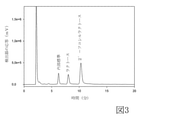
HPLC分析を行うため、ろ過した無細胞かつ無菌状態の培地サンプルを使用し、350μLの該サンプルを脱塩カラム(Strata ABW (55μm、70A)、phenomenex社、Aschaffenburg、ドイツ)に流し、脱塩した。HPLC分析には、5μmのReproSil Carbohydrate、250×4.6mmのカラム(Dr. Maisch GmbH社、Ammerbuch-Entringen、ドイツ)を使用し、流量1.4mL/minのアイソクラティック条件下(カラムオーブンは35℃に設定)、溶離剤としてアセトニトリル/ddH2O(脱イオン蒸留水)(68:32)を使用して分析を行った。定量化の内部標準としてスクロースを使用し、ラクトースおよび2’-フコシルラクトースを同定するために、それぞれの標準を使用した。検出については、屈折率検出器(RID)を使用した。本発明の発酵過程の最後にグリコシダーゼ分解工程が含まれることにより、生じる発酵ろ液の複雑性が著しく緩和された。図3は、グリコシダーゼ処理前に採取した無細胞発酵培地の分析の結果を示したものであり、図4は、グリコシダーゼ処理後に採取したサンプルに関して示したものである。HPLCクロマトグラムの比較から、β-ガラクトシダーゼ処理前のサンプル中に存在していたラクトースが消失したことが明確にわかる。該菌株は、D-ガラクトースの蓄積を防止するためのガラクトース異化経路も発現する菌株である。 Filtered cell-free and sterile medium samples were used for HPLC analysis, and 350 μL of the sample was run on a desalting column (Strata ABW (55 μm, 70 A), Phenomenex, Aschaffenburg, Germany) for desalting. .. For HPLC analysis, a 5 μm ReproSil Carbohydrate, 250 × 4.6 mm column (Dr. Maisch GmbH, Ammerbuch-Etringen, Germany) was used, and isocratic conditions at a flow rate of 1.4 mL / min (column oven). Analysis was performed using acetonitrile / ddH 2 O (deionized distilled water) (68:32) as an eluent (set at 35 ° C.). Sucrose was used as an internal standard for quantification and the respective standards were used to identify lactose and 2'-fucosyl lactose. For detection, a refractive index detector (RID) was used. The inclusion of the glycosidase decomposition step at the end of the fermentation process of the present invention significantly reduced the complexity of the resulting fermentation filtrate. FIG. 3 shows the results of analysis of the cell-free fermentation medium collected before the glycosidase treatment, and FIG. 4 shows the sample collected after the glycosidase treatment. Comparison of HPLC chromatograms clearly shows that the lactose present in the sample prior to β-galactosidase treatment has disappeared. The strain is a strain that also expresses a galactose catabolic pathway for preventing the accumulation of D-galactose.
2’-フコシルラクトースの連続製造におけるグリコシダーゼ処理による糖混合物の分解
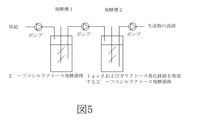
2’-フコシルラクトースの連続合成は2つの発酵槽を用いて達成された。発酵槽1には、ラクトース分解能欠損株である2’-フコシルラクトース発酵菌株(E.coli BL21(DE3)ΔlacZ、ゲノム上の強力な構成型テトラサイクリン系プロモーターの制御下に、wbgL遺伝子(EP 11 1151 571.4)によりコードされる2’-フコシルトランスフェラーゼと、E.coli由来lacY、manB、manC、gmd、およびfclの各コピーとが組み込まれた菌株であり、さらにgalM、galK、galT、およびgalEを有する機能的なgalオペロン(図10を参照のこと)を含む)を収容した。発酵槽2には、β-ガラクトシダーゼをコードする遺伝子E.coli由来lacZが発現していることを除いては、発酵槽1で使用した2’-フコシルラクトース発酵菌株と遺伝学的に同一の出発培養物を収容した(図5に記載の装置を参照のこと)。両発酵槽には、所定の塩培地を使用した。該塩培地は、7g/L NH4H3PO4、7g/L K2HPO4、2g/L KOH、0.37g/Lクエン酸、1ml/L消泡剤(Struktol J673、Schill+Seilacher)、1mM CaCl2、4mM MgSO4、ならびに0.101g/Lニトリロ三酢酸(pH 6.5)、0.056g/Lクエン酸第二鉄アンモニウム、0.01g/L MnCl2・4H2O、0.002g/L CoCl2・6H2O、0.001g/L CuCl2・2H2O、0.002g/Lホウ酸、0.009g/L ZnSO4・7H2O、0.001g/L Na2MoO4・2H2O、0.002g/L Na2SeO3、および0.002g/L NiSO4・6H2Oからなる微量元素、ならびに基質としての10mMラクトースおよび炭素源としての2%グリセロールを含む。
Decomposition of sugar mixture by glycosidase treatment in the continuous production of 2'-fucosyllactos The continuous synthesis of 2'-fucosyllactos was achieved using two fermenters. In
図に示すように、発酵槽1に、40mMラクトースおよび5%グリセロールを含む培地(7g/L NH4H3PO4、7g/L K2HPO4、2g/L KOH、0.37g/Lクエン酸、1mL/L消泡剤、1mM CaCl2、4mM MgSO4、ならびに0.101g/Lニトリロ三酢酸(pH6.5)、0.056g/Lクエン酸第二鉄アンモニウム、0.01g/L MnCl2・4H2O、0.002g/L CoCl2・6H2O、0.001g/L CuCl2・2H2O、0.002g/Lホウ酸、0.009g/L ZnSO4・7H2O、0.001g/L Na2MoO4・2H2O、0.002g/L Na2SeO3、および0.002g/L NiSO4・6H2Oからなる微量元素)を定量供給した。作業容量が1LであるNew Brunswick並行発酵システム(BioFlow/CelliGen 115)を用いて、連続供給する供給液の流量を20mL/hとした。同時に作動する3つのポンプの作用により、連続製造においても、唯一の糖生成物としてほぼ2’-フコシルラクトースのみを含む20mL/hの生成物の流液が得られた。
As shown in the figure, the
図6は、発酵槽1から採取した生成物の流液のHPLC分析の結果を示す。無細胞発酵培養液の分析から、ラクトースおよび2’-フコシルラクトースがともに存在することがわかる。一方、図7は、発酵槽2から得られた生成物の流液のHPLC分析の結果を示した図である。HPLC分析から、基質であるラクトースが消失していることがわかる。該ラクトースは、β-ガラクトシダーゼをコードする、E.coli由来lacZ遺伝子の発現、および遊離したガラクトースを代謝するためのgalオペロンの発現を通して菌株によって代謝されたものと考えられる。
FIG. 6 shows the result of HPLC analysis of the flowing liquid of the product collected from the
ラクト-N-テトラオースの製造におけるグリコシダーゼ処理による糖混合物の分解
ラクトースをラクト-N-テトラオースへと発酵させる際、添加した基質以外に、ラクト-N-トリオース II(LNT-2)も蓄積する可能性がある。ラクト-N-テトラオースを精製するためのより経済的な発酵ろ液を得るために、ラクトースおよびLNT-2を特異的に分解することが望ましいことがわかった。
Degradation of sugar mixture by glycosidase treatment in the production of lactose-N-tetraose When lactose is fermented into lactose-N-tetraose, lactose-N-triose II (LNT-2) may be accumulated in addition to the added substrate. There is. It has been found that it is desirable to specifically degrade lactose and LNT-2 in order to obtain a more economical fermentation filtrate for purifying lactose-N-tetraose.
上記目的のため、β-ガラクトシダーゼ以外に、LNT-2に特異的に作用してN-アセチルグルコサミンとラクトースへと分解するための(Bifidobacterium bididum JCM1254のbbhI遺伝子によってコードされる)β-N-アセチルヘキソサミニダーゼを発現させる菌株を構築した。生じたラクトースはさらに切断され、グルコースおよびガラクトースへと分解された。生じたグルコースは、菌株によって効率的に代謝されたが、使用したE.coli BL21(DE3)株は、galオペロン中にDE3プロファージが組み込まれていることから、ガラクトースを異化することはできなかった。ガラクトースを効率的に分解するために、E.coli K株 JM109由来のgalオペロンを増幅してE.coli BL21(DE3)に導入し、(エピソーマルベクターシステムを用いて)Lamba Red組換えタンパク質を同時に発現させることによって、形質変換体を作製した。ガラクトースを分解することが可能なE.coli BL21形質転換体を、ガラクトースを含む最少培地寒天プレートやガラクトースを含むマッコンキー寒天プレートでスクリーニングすることにより分離した。 For the above purpose, in addition to β-galactosidase, β-N-acetyl (encoded by the bbhI gene of Bifidobacterium bididum JCM1254) for specifically acting on LNT-2 and degrading it into N-acetylglucosamine and lactose. A strain expressing hexosaminidase was constructed. The resulting lactose was further cleaved and decomposed into glucose and galactose. The resulting glucose was efficiently metabolized by the strain, but the E. coli used. The coli BL21 (DE3) strain was unable to catabolize galactose due to the incorporation of DE3 prophage in the gal operon. In order to efficiently decompose galactose, E.I. The gal operon derived from the coli K strain JM109 was amplified to form E. coli. Transfectants were made by introducing into colli BL21 (DE3) and co-expressing the Lamba Red recombinant protein (using the episomal vector system). E. that can decompose galactose. E. coli BL21 transformants were isolated by screening on a minimal medium agar plate containing galactose or a MacConkey agar plate containing galactose.
ラクト-N-テトラオースの発酵終了後(オリゴ糖混合物は、酵素反応または化学合成反応によっても得られる可能性があることに留意されたい)、遺伝子操作を行ったグリコシダーゼ菌株をバッチ発酵に加えた。上述の2’-フコシルラクトース発酵と同様に、望ましくないオリゴ糖類は、分解工程に使用された培養物の量によるが、数分から数時間以内に分解された。 After the fermentation of lacto-N-tetraose was completed (note that the oligosaccharide mixture may also be obtained by enzymatic or chemical synthesis reactions), genetically engineered glycosidase strains were added to the batch fermentation. Similar to the 2'-fucosyl lactose fermentation described above, unwanted oligosaccharides were degraded within minutes to hours, depending on the amount of culture used in the degradation step.
本発明の発酵過程の最後にグリコシダーゼ分解工程が含まれることにより、生じる発酵ろ液の複雑性が著しく緩和された。図8は、グリコシダーゼ処理およびβ-N-アセチルヘキソサミニダーゼ処理の前に採取した無細胞発酵培地の分析の結果を示した図であり、図9は、グリコシダーゼ処理およびβ-N-アセチルヘキソサミニダーゼ処理の後に採取したサンプルに関して示したものである。HPLCクロマトグラムの比較から、β-ガラクトシダーゼ処理およびβ-N-アセチルヘキソサミニダーゼ処理を行う前のサンプル中に存在していたラクトースおよびラクト-N-トリオース IIが消失したことが明確にわかる。 The inclusion of the glycosidase decomposition step at the end of the fermentation process of the present invention significantly reduced the complexity of the resulting fermentation filtrate. FIG. 8 is a diagram showing the results of analysis of cell-free fermentation medium collected before glycosidase treatment and β-N-acetylhexosaminidase treatment, and FIG. 9 is a diagram showing glycosidase treatment and β-N-acetylhexyl. It is shown about the sample taken after the sosaminidase treatment. Comparison of HPLC chromatograms clearly shows that lactose and lacto-N-triose II, which were present in the sample prior to β-galactosidase treatment and β-N-acetylhexosaminidase treatment, disappeared.
上記のように、本発明による使用および方法が、微生物発酵反応液からヒトミルクオリゴ糖(HMO)を精製するのに特に有用であることがわかった。ほぼ全てのヒトミルクオリゴ糖は、還元末端にGal-β-1,4-Glc二糖類サブユニットを含む。ラクトース部分(Gal-β-1,4-Glc)のサブユニットは、完全発酵により得ることができるが、ラクトースを基質として微生物発酵液に加えてもよい。容積収率を最大にするためには、過剰量のラクトースを発酵液に加えることが有利であることが多い。 As mentioned above, the uses and methods according to the invention have been found to be particularly useful for purifying human milk oligosaccharides (HMOs) from microbial fermentation reactions. Almost all human milk oligosaccharides contain the Gal-β-1,4-Glc disaccharide subunit at the reducing end. The subunit of the lactose moiety (Gal-β-1,4-Glc) can be obtained by complete fermentation, but lactose may be added to the microbial fermentation broth as a substrate. To maximize volume yield, it is often advantageous to add an excess of lactose to the fermented liquor.
本発明によれば、ラクトースまたは不要なラクトース副産物を除去するために、β-ガラクトシダーゼなどのグリコシダーゼが特定の時点において発酵液に加えられ、それにより、ラクトースおよび副産物が特異的に分解される。 According to the present invention, glycosidases such as β-galactosidase are added to the fermentation broth at specific time points to remove lactose or unwanted lactose by-products, thereby specifically degrading lactose and by-products.
あるいは、上述のように、転写が制御されている(または活性が制御されている)グリコシダーゼを産生菌株において誘導してもよく、所望の活性を示す別の菌株を特定の時点において発酵液に加えてもよい。 Alternatively, as described above, transcriptionally controlled (or activity controlled) glycosidases may be induced in the producing strain, and another strain exhibiting the desired activity is added to the fermented liquor at a particular time point. You may.
また、上述かつ上記のように、本発明の方法ではさらに、グリコシダーゼの作用によって遊離した単糖類を発酵培地から効率的かつ効果的に取り除くために、糖異化経路の制御を解除する。また、前駆体として加えられた単糖類も、この方法によって同様に発酵培地から取り除くことができる。 Further, as described above and as described above, the method of the present invention further releases the control of the sugar catabolic pathway in order to efficiently and effectively remove the monosaccharides released by the action of glycosidase from the fermentation medium. The monosaccharide added as a precursor can also be removed from the fermentation medium by this method as well.
Claims (11)
a)所望のヒトミルクオリゴ糖の産生に適した宿主微生物を、該ヒトミルクオリゴ糖の産生が許容される条件下および培地中で培養し、それによって(イ)該ヒトミルクオリゴ糖、または(ロ)該ヒトミルクオリゴ糖、ならびに、該ヒトミルクオリゴ糖以外に糖生合成中間体および/もしくは副産物が生成される工程、
b)前記宿主微生物を培養している培地中でグリコシダーゼを使用し、糖生合成中間体および/または糖副産物および/または残った糖基質を分解する工程、ならびに
c)所望のヒトミルクオリゴ糖を回収する工程
を含み、
前記グリコシダーゼが、
前記宿主微生物によって内因的に生成されるものであり、内因的に生成される該グリコシダーゼをコードする核酸配列が、前記宿主微生物に天然に存在するものではなく、前記宿主微生物が、該宿主微生物に天然に存在しないグリコシダーゼを発現するよう安定的に形質転換されたものであり、宿主微生物内における該グリコシダーゼの発現が、温度変化によって誘導可能なものであることを特徴とする、
ヒトミルクオリゴ糖の製造方法。 A method for producing a human milk oligosaccharide using a host microorganism, wherein the human milk oligosaccharide is not naturally present in the host microorganism.
a) Host microorganisms suitable for producing the desired human milk oligosaccharides are cultured under conditions and media that allow the production of the human milk oligosaccharides, thereby (a) the human milk oligosaccharides, or (a). B) A step of producing a sugar biosynthesis intermediate and / or a by-product in addition to the human milk oligosaccharide and the human milk oligosaccharide.
b) Glycosidases are used in the medium in which the host microorganism is cultivated to degrade glycobiosynthetic intermediates and / or sugar by-products and / or residual sugar substrates, and c) desired human milk oligosaccharides. Including the process of collecting
The glycosidase
The nucleic acid sequence that is endogenously produced by the host microorganism and encodes the glycosidase that is endogenously produced is not naturally present in the host microorganism, and the host microorganism causes the host microorganism. It is stably transformed to express a non-naturally occurring glycosidase, and is characterized in that the expression of the glycosidase in a host microorganism is inducible by temperature change.
Method for producing human milk oligosaccharide.
Applications Claiming Priority (2)
| Application Number | Priority Date | Filing Date | Title |
|---|---|---|---|
| EP13183670.2A EP2845905B8 (en) | 2013-09-10 | 2013-09-10 | Production of oligosaccharides |
| EP13183670.2 | 2013-09-10 |
Related Parent Applications (1)
| Application Number | Title | Priority Date | Filing Date |
|---|---|---|---|
| JP2016541849A Division JP6894703B2 (en) | 2013-09-10 | 2014-07-04 | Production of oligosaccharides |
Publications (2)
| Publication Number | Publication Date |
|---|---|
| JP2019213552A JP2019213552A (en) | 2019-12-19 |
| JP6992029B2 true JP6992029B2 (en) | 2022-01-13 |
Family
ID=49117764
Family Applications (3)
| Application Number | Title | Priority Date | Filing Date |
|---|---|---|---|
| JP2016541849A Active JP6894703B2 (en) | 2013-09-10 | 2014-07-04 | Production of oligosaccharides |
| JP2019152682A Active JP6992029B2 (en) | 2013-09-10 | 2019-08-23 | Production of oligosaccharides |
| JP2019152702A Active JP7389584B2 (en) | 2013-09-10 | 2019-08-23 | Production of oligosaccharides |
Family Applications Before (1)
| Application Number | Title | Priority Date | Filing Date |
|---|---|---|---|
| JP2016541849A Active JP6894703B2 (en) | 2013-09-10 | 2014-07-04 | Production of oligosaccharides |
Family Applications After (1)
| Application Number | Title | Priority Date | Filing Date |
|---|---|---|---|
| JP2019152702A Active JP7389584B2 (en) | 2013-09-10 | 2019-08-23 | Production of oligosaccharides |
Country Status (11)
| Country | Link |
|---|---|
| US (3) | US11427845B2 (en) |
| EP (3) | EP3572520A1 (en) |
| JP (3) | JP6894703B2 (en) |
| KR (1) | KR102335067B1 (en) |
| CN (5) | CN110628842A (en) |
| AU (1) | AU2014320757C1 (en) |
| BR (1) | BR112016005228A8 (en) |
| DK (1) | DK2845905T3 (en) |
| ES (1) | ES2875327T3 (en) |
| PL (1) | PL2845905T3 (en) |
| WO (1) | WO2015036138A1 (en) |
Families Citing this family (46)
| Publication number | Priority date | Publication date | Assignee | Title |
|---|---|---|---|---|
| PL2845905T3 (en) * | 2013-09-10 | 2021-09-27 | Chr. Hansen HMO GmbH | Production of oligosaccharides |
| EP2896628B1 (en) | 2014-01-20 | 2018-09-19 | Jennewein Biotechnologie GmbH | Process for efficient purification of neutral human milk oligosaccharides (HMOs) from microbial fermentation |
| WO2016157108A1 (en) * | 2015-03-31 | 2016-10-06 | Glycom A/S | Mixtures of human milk oligosaccharides comprising 3 '-o-sialyllactose |
| ES3011213T3 (en) | 2015-12-18 | 2025-04-07 | Glycom As | Fermentative production of oligosaccharides |
| DK3445770T3 (en) | 2016-04-19 | 2026-02-23 | Glycom As | SEPARATION OF OLIGOSACCHARIDES FROM FERMENTATION BROTH |
| EP3474861A4 (en) | 2016-06-24 | 2020-04-15 | Glycom A/S | COMPOSITIONS WITH HMOS, THEIR PRODUCTION AND USE FOR THE PREVENTION AND / OR TREATMENT OF VIRAL AND / OR BACTERIAL INFECTIONS |
| CN106190938B (en) * | 2016-07-18 | 2019-05-14 | 南开大学 | A kind of method of the recombination bacillus coli and biosynthesis 3 '-saliva lactose of building |
| SG10202100843TA (en) * | 2016-07-28 | 2021-03-30 | Fonterra Cooperative Group Ltd | Dairy product and process |
| BR112019005329A2 (en) * | 2016-09-19 | 2019-06-18 | Prolacta Bioscience, Inc. | purified human milk oligosaccharide compositions |
| ES2856749T3 (en) * | 2016-10-29 | 2021-09-28 | Chr Hansen Hmo Gmbh | Process for the production of fucosylated oligosaccharides |
| EP3821712B1 (en) | 2017-01-13 | 2022-11-09 | Chr. Hansen A/S | Fermented milk product obtained by an improved process |
| JP2018140968A (en) * | 2017-02-28 | 2018-09-13 | 日本食品化工株式会社 | Method for producing 1,6-anhydro-β-D-glucofuranose-containing carbohydrate |
| ES2928859T3 (en) | 2017-03-17 | 2022-11-23 | Chr Hansen Hmo Gmbh | A method for inhibiting the isomerization of a reducing saccharide after heat treatment |
| WO2019003135A1 (en) * | 2017-06-30 | 2019-01-03 | Glycom A/S | Purification of oligosaccharides |
| EP3425052A1 (en) | 2017-07-07 | 2019-01-09 | Jennewein Biotechnologie GmbH | Fucosyltransferases and their use in producing fucosylated oligosaccharides |
| CN110914284B (en) | 2017-07-12 | 2025-01-07 | 格礼卡姆股份公司 | Amorphous mixture containing neutral monosaccharides or oligosaccharides and acidic non-carbohydrate components |
| EP3524067B1 (en) | 2018-02-08 | 2025-04-02 | Chr. Hansen HMO GmbH | Spray-dried mixture of human milk oligosaccharides |
| EP3494805B1 (en) | 2017-12-08 | 2025-08-13 | Chr. Hansen HMO GmbH | Spray-dried tetrasaccharides |
| EP3494806B1 (en) | 2017-12-08 | 2025-08-06 | Chr. Hansen HMO GmbH | Spray-dried lacto-n-fucopentaose |
| EP3494804B1 (en) | 2017-12-08 | 2025-08-13 | Chr. Hansen HMO GmbH | Spray-dried 3-fucosyllactose |
| EP3494807A1 (en) | 2017-12-11 | 2019-06-12 | Jennewein Biotechnologie GmbH | Spray-dried sialyllactose |
| SG11202004659QA (en) | 2017-12-08 | 2020-06-29 | Jennewein Biotechnologie Gmbh | Spray-dried sialyllactose |
| JP7492458B2 (en) * | 2018-05-07 | 2024-05-29 | クリスチャン・ハンセン・ハーエムオー・ゲーエムベーハー | A simple method for purifying lacto-N-neotetraose (LNnT) from carbohydrates obtained by microbial fermentation |
| EP3569713A1 (en) * | 2018-05-16 | 2019-11-20 | Jennewein Biotechnologie GmbH | Use of glycosidases in the production of oligosaccharides |
| CN112154150A (en) * | 2018-05-23 | 2020-12-29 | 帝斯曼知识产权资产管理有限公司 | Production of oligosaccharides |
| US10519475B1 (en) * | 2018-11-21 | 2019-12-31 | Amyris, Inc. | Biosynthesis of compounds in yeast |
| WO2020128945A1 (en) * | 2018-12-19 | 2020-06-25 | Glycom A/S | Separation of oligosaccharides |
| CN109735479B (en) * | 2019-01-30 | 2022-04-01 | 光明乳业股份有限公司 | Recombinant bacillus subtilis for synthesizing 2' -fucosyllactose and construction method and application thereof |
| US12410419B2 (en) | 2019-05-21 | 2025-09-09 | Korea University Research And Business Foundation | Use of enzyme that cleaves both alpha- and beta- 1,4-glycosidic bonds |
| WO2020245313A1 (en) * | 2019-06-04 | 2020-12-10 | N.V. Nutricia | Nutritional composition comprising 2'fucosyllactose and 3'galactosyllactose |
| WO2021045968A1 (en) | 2019-09-04 | 2021-03-11 | Dupont Nutrition Biosciences Aps | Process for removing an antifoam agent from a solution comprising a human milk oligosaccharide and related compositions |
| JP2022548785A (en) | 2019-09-24 | 2022-11-21 | プロラクタ バイオサイエンス,インコーポレイテッド | Compositions and methods for treatment of inflammatory and immune disorders |
| CN115279778B (en) | 2020-03-12 | 2025-06-24 | 格礼卡姆股份公司 | Crystallization of 2’-FL |
| KR20230088680A (en) | 2020-08-14 | 2023-06-20 | 프롤랙타 바이오사이언스, 인코포레이티드 | Human milk oligosaccharide composition for use in bacterial therapy |
| CA3204530A1 (en) | 2021-01-12 | 2022-07-21 | Gregory Mckenzie | Synbiotic treatment regimens |
| DK181562B1 (en) | 2021-11-11 | 2024-05-17 | Dsm Ip Assets Bv | Feed control system for a fermentation system, and related method |
| DK181566B1 (en) | 2021-12-21 | 2024-05-24 | Dsm Ip Assets Bv | Crystallization of LNnT |
| CN114107342B (en) * | 2021-12-27 | 2024-01-26 | 黄山同兮生物科技有限公司 | Method for removing lactose in fermentation liquor |
| KR102616020B1 (en) | 2021-12-31 | 2023-12-22 | 매일유업 주식회사 | Composition for improving intestinal health, intestinal function or intestinal immunity, preventing or improving intestinal inflammation comprising mother's milk oligosaccharide mixture |
| CN116042562B (en) * | 2022-03-11 | 2023-10-20 | 山东恒鲁生物科技有限公司 | Recombinant saccharomycetes and application thereof |
| CN115011535A (en) * | 2022-05-10 | 2022-09-06 | 南通励成生物工程有限公司 | Strain for synthesizing 2' -fucosyllactose by taking glucose as carbon source and construction method and application thereof |
| KR20240002283A (en) * | 2022-06-28 | 2024-01-05 | 주식회사 삼양사 | Method for preparing 2’- Fucosyllactose |
| EP4577061A1 (en) | 2022-08-25 | 2025-07-02 | DSM IP Assets B.V. | Hybrid method for producing complex hmos |
| CN120265786A (en) | 2022-11-25 | 2025-07-04 | 帝斯曼知识产权资产管理有限公司 | Dual-strain system for oligosaccharide production |
| WO2024130119A2 (en) | 2022-12-16 | 2024-06-20 | Prolacta Bioscience, Inc. | Synbiotic compositions for short chain fatty acid production |
| WO2025114343A2 (en) | 2023-11-29 | 2025-06-05 | Frieslandcampina Nederland B.V. | Process for the production of human milk oligosaccharides |
Citations (4)
| Publication number | Priority date | Publication date | Assignee | Title |
|---|---|---|---|---|
| WO2012097950A1 (en) | 2011-01-20 | 2012-07-26 | Jennewein Biotechnologie Gmbh | Novel fucosyltransferases and their applications |
| WO2012112777A2 (en) | 2011-02-16 | 2012-08-23 | Glycosyn LLC | Biosynthesis of human milk oligosaccharides in engineered bacteria |
| JP2012529274A (en) | 2009-06-08 | 2012-11-22 | イェンネワイン バイオテクノロジー ゲーエムベーハー | Synthesis of human milk oligosaccharides |
| JP2013501504A (en) | 2009-08-07 | 2013-01-17 | イナルコ ソシエタ ペル アチオニ | Method for producing ultra high purity galactooligosaccharide |
Family Cites Families (17)
| Publication number | Priority date | Publication date | Assignee | Title |
|---|---|---|---|---|
| JPS5995895A (en) * | 1982-11-22 | 1984-06-02 | Meiji Seika Kaisha Ltd | Purification of fructo-oligosuccharide |
| JPS6391092A (en) | 1986-10-07 | 1988-04-21 | Yakult Honsha Co Ltd | Production of oligosaccharide |
| JPH0695895A (en) | 1990-11-19 | 1994-04-08 | Internatl Business Mach Corp <Ibm> | Device and method for application program |
| JPH05276969A (en) * | 1992-04-03 | 1993-10-26 | Nippon Shinyaku Co Ltd | Production of high-purity maltooligosaccharide |
| JPH07274990A (en) | 1994-04-15 | 1995-10-24 | Mitsubishi Kasei Eng Co | Method for purifying cyclic inulooligosaccharide |
| JP3095643B2 (en) * | 1994-11-17 | 2000-10-10 | 明治製菓株式会社 | Production method of high purity oligosaccharides from high concentration sugar mixture |
| US7098013B2 (en) * | 2000-11-16 | 2006-08-29 | Kabushiki Kaisha Hayashibara Seibutsu Kagaku Kenkyujo | Polypeptide having α-isomaltosyl-transferase activity |
| US20080145899A1 (en) * | 2004-09-17 | 2008-06-19 | Neose Technologies Inc | Production of Oligosaccharides By Microorganisms |
| ES2626080T3 (en) * | 2007-04-16 | 2017-07-21 | Momenta Pharmaceuticals, Inc. | Characterization of N-glycans using exoglycosidases |
| KR100945306B1 (en) | 2007-12-31 | 2010-03-03 | 주식회사 삼양제넥스 | Manufacturing method of high purity galactooligosaccharide |
| EP2252699B1 (en) * | 2008-03-12 | 2015-05-27 | Tata Chemicals Limited | Production of galactooligosaccharides by Bullera singularis and Saccharomyces sp. |
| RU2584599C2 (en) * | 2008-12-19 | 2016-05-20 | Дженневейн Биотехнологие Гмбх | Synthesis of fucosylated compounds |
| CN101870992A (en) * | 2010-06-21 | 2010-10-27 | 天津科技大学 | Method for synthesizing GDP-fucose by coupling fermentation with genetically engineered bacteria |
| EP2944690B1 (en) | 2010-10-11 | 2017-12-20 | Jennewein Biotechnologie GmbH | Novel fucosyltransferases and their applications |
| CN103562401A (en) * | 2011-05-13 | 2014-02-05 | 格力康公司 | Method for generating human milk oligosaccharides (HMOs) or precursors thereof |
| EP2728009B1 (en) * | 2012-10-31 | 2017-07-26 | Jennewein Biotechnologie GmbH | Process for producing monosaccharides |
| PL2845905T3 (en) * | 2013-09-10 | 2021-09-27 | Chr. Hansen HMO GmbH | Production of oligosaccharides |
-
2013
- 2013-09-10 PL PL13183670T patent/PL2845905T3/en unknown
- 2013-09-10 EP EP19184573.4A patent/EP3572520A1/en active Pending
- 2013-09-10 EP EP13183670.2A patent/EP2845905B8/en active Active
- 2013-09-10 ES ES13183670T patent/ES2875327T3/en active Active
- 2013-09-10 DK DK13183670.2T patent/DK2845905T3/en active
- 2013-09-10 EP EP19184576.7A patent/EP3572521A1/en active Pending
-
2014
- 2014-07-04 CN CN201910957609.0A patent/CN110628842A/en active Pending
- 2014-07-04 WO PCT/EP2014/064280 patent/WO2015036138A1/en not_active Ceased
- 2014-07-04 CN CN201480061563.XA patent/CN105722991A/en active Pending
- 2014-07-04 AU AU2014320757A patent/AU2014320757C1/en active Active
- 2014-07-04 BR BR112016005228A patent/BR112016005228A8/en not_active Application Discontinuation
- 2014-07-04 KR KR1020167008748A patent/KR102335067B1/en active Active
- 2014-07-04 CN CN201910957839.7A patent/CN110643658A/en active Pending
- 2014-07-04 CN CN202410094161.5A patent/CN118028397A/en active Pending
- 2014-07-04 CN CN202410094021.8A patent/CN118028396A/en active Pending
- 2014-07-04 JP JP2016541849A patent/JP6894703B2/en active Active
-
2016
- 2016-03-10 US US15/067,037 patent/US11427845B2/en active Active
-
2019
- 2019-08-23 JP JP2019152682A patent/JP6992029B2/en active Active
- 2019-08-23 JP JP2019152702A patent/JP7389584B2/en active Active
-
2022
- 2022-07-22 US US17/814,333 patent/US11981947B2/en active Active
- 2022-07-22 US US17/814,337 patent/US12123040B2/en active Active
Patent Citations (4)
| Publication number | Priority date | Publication date | Assignee | Title |
|---|---|---|---|---|
| JP2012529274A (en) | 2009-06-08 | 2012-11-22 | イェンネワイン バイオテクノロジー ゲーエムベーハー | Synthesis of human milk oligosaccharides |
| JP2013501504A (en) | 2009-08-07 | 2013-01-17 | イナルコ ソシエタ ペル アチオニ | Method for producing ultra high purity galactooligosaccharide |
| WO2012097950A1 (en) | 2011-01-20 | 2012-07-26 | Jennewein Biotechnologie Gmbh | Novel fucosyltransferases and their applications |
| WO2012112777A2 (en) | 2011-02-16 | 2012-08-23 | Glycosyn LLC | Biosynthesis of human milk oligosaccharides in engineered bacteria |
Also Published As
| Publication number | Publication date |
|---|---|
| BR112016005228A8 (en) | 2022-11-08 |
| EP3572521A1 (en) | 2019-11-27 |
| JP6894703B2 (en) | 2021-06-30 |
| US12123040B2 (en) | 2024-10-22 |
| US20220403433A1 (en) | 2022-12-22 |
| BR112016005228A2 (en) | 2017-09-05 |
| CN118028396A (en) | 2024-05-14 |
| EP2845905B1 (en) | 2021-05-19 |
| DK2845905T3 (en) | 2021-06-14 |
| AU2014320757C1 (en) | 2018-07-19 |
| JP2016530888A (en) | 2016-10-06 |
| US20220389468A1 (en) | 2022-12-08 |
| EP2845905A1 (en) | 2015-03-11 |
| JP2019213552A (en) | 2019-12-19 |
| CN118028397A (en) | 2024-05-14 |
| AU2014320757B2 (en) | 2018-04-19 |
| JP2019213553A (en) | 2019-12-19 |
| US11981947B2 (en) | 2024-05-14 |
| ES2875327T3 (en) | 2021-11-10 |
| US20160186223A1 (en) | 2016-06-30 |
| KR20160065111A (en) | 2016-06-08 |
| WO2015036138A1 (en) | 2015-03-19 |
| JP7389584B2 (en) | 2023-11-30 |
| EP3572520A1 (en) | 2019-11-27 |
| EP2845905B8 (en) | 2021-07-14 |
| CN110643658A (en) | 2020-01-03 |
| AU2014320757A1 (en) | 2016-04-28 |
| KR102335067B1 (en) | 2021-12-03 |
| CN105722991A (en) | 2016-06-29 |
| CN110628842A (en) | 2019-12-31 |
| PL2845905T3 (en) | 2021-09-27 |
| US11427845B2 (en) | 2022-08-30 |
Similar Documents
| Publication | Publication Date | Title |
|---|---|---|
| JP6992029B2 (en) | Production of oligosaccharides | |
| CN105683387B (en) | Fermentative production of oligosaccharides | |
| JP2024028710A (en) | Fucosyltransferase and its use in the production of fucosylated oligosaccharides | |
| US20210363557A1 (en) | Use of glycosidases in the production of oligosaccharides | |
| JP6165872B2 (en) | Monosaccharide production method | |
| HK40104022A (en) | Production of oligosaccharides | |
| HK40104021A (en) | Production of oligosaccharides | |
| HK40016913A (en) | Production of oligosaccharides | |
| HK40016916A (en) | Production of oligosaccharides |
Legal Events
| Date | Code | Title | Description |
|---|---|---|---|
| A621 | Written request for application examination |
Free format text: JAPANESE INTERMEDIATE CODE: A621 Effective date: 20190913 |
|
| A131 | Notification of reasons for refusal |
Free format text: JAPANESE INTERMEDIATE CODE: A131 Effective date: 20201020 |
|
| A521 | Request for written amendment filed |
Free format text: JAPANESE INTERMEDIATE CODE: A523 Effective date: 20210119 |
|
| A131 | Notification of reasons for refusal |
Free format text: JAPANESE INTERMEDIATE CODE: A131 Effective date: 20210622 |
|
| A601 | Written request for extension of time |
Free format text: JAPANESE INTERMEDIATE CODE: A601 Effective date: 20210901 |
|
| A521 | Request for written amendment filed |
Free format text: JAPANESE INTERMEDIATE CODE: A523 Effective date: 20211027 |
|
| TRDD | Decision of grant or rejection written | ||
| A01 | Written decision to grant a patent or to grant a registration (utility model) |
Free format text: JAPANESE INTERMEDIATE CODE: A01 Effective date: 20211116 |
|
| A61 | First payment of annual fees (during grant procedure) |
Free format text: JAPANESE INTERMEDIATE CODE: A61 Effective date: 20211208 |
|
| R150 | Certificate of patent or registration of utility model |
Ref document number: 6992029 Country of ref document: JP Free format text: JAPANESE INTERMEDIATE CODE: R150 |
|
| R250 | Receipt of annual fees |
Free format text: JAPANESE INTERMEDIATE CODE: R250 |
|
| R250 | Receipt of annual fees |
Free format text: JAPANESE INTERMEDIATE CODE: R250 |