JP7063623B2 - 治療用抗体およびその使用 - Google Patents
治療用抗体およびその使用 Download PDFInfo
- Publication number
- JP7063623B2 JP7063623B2 JP2017555213A JP2017555213A JP7063623B2 JP 7063623 B2 JP7063623 B2 JP 7063623B2 JP 2017555213 A JP2017555213 A JP 2017555213A JP 2017555213 A JP2017555213 A JP 2017555213A JP 7063623 B2 JP7063623 B2 JP 7063623B2
- Authority
- JP
- Japan
- Prior art keywords
- antibody
- seq
- binding
- amino acid
- mil
- Prior art date
- Legal status (The legal status is an assumption and is not a legal conclusion. Google has not performed a legal analysis and makes no representation as to the accuracy of the status listed.)
- Active
Links
Images


Classifications
-
- C—CHEMISTRY; METALLURGY
- C07—ORGANIC CHEMISTRY
- C07K—PEPTIDES
- C07K16/00—Immunoglobulins [IG], e.g. monoclonal or polyclonal antibodies
- C07K16/18—Immunoglobulins [IG], e.g. monoclonal or polyclonal antibodies against material from animals or humans
- C07K16/28—Immunoglobulins [IG], e.g. monoclonal or polyclonal antibodies against material from animals or humans against receptors, cell surface antigens or cell surface determinants
- C07K16/30—Immunoglobulins [IG], e.g. monoclonal or polyclonal antibodies against material from animals or humans against receptors, cell surface antigens or cell surface determinants from tumour cells
- C07K16/3069—Reproductive system, e.g. ovaria, uterus, testes, prostate
-
- A—HUMAN NECESSITIES
- A61—MEDICAL OR VETERINARY SCIENCE; HYGIENE
- A61K—PREPARATIONS FOR MEDICAL, DENTAL OR TOILETRY PURPOSES
- A61K39/00—Medicinal preparations containing antigens or antibodies
- A61K39/395—Antibodies; Immunoglobulins; Immune serum, e.g. antilymphocytic serum
-
- A—HUMAN NECESSITIES
- A61—MEDICAL OR VETERINARY SCIENCE; HYGIENE
- A61K—PREPARATIONS FOR MEDICAL, DENTAL OR TOILETRY PURPOSES
- A61K38/00—Medicinal preparations containing peptides
- A61K38/04—Peptides having up to 20 amino acids in a fully defined sequence; Derivatives thereof
- A61K38/08—Peptides having 5 to 11 amino acids
-
- A—HUMAN NECESSITIES
- A61—MEDICAL OR VETERINARY SCIENCE; HYGIENE
- A61K—PREPARATIONS FOR MEDICAL, DENTAL OR TOILETRY PURPOSES
- A61K47/00—Medicinal preparations characterised by the non-active ingredients used, e.g. carriers or inert additives; Targeting or modifying agents chemically bound to the active ingredient
- A61K47/50—Medicinal preparations characterised by the non-active ingredients used, e.g. carriers or inert additives; Targeting or modifying agents chemically bound to the active ingredient the non-active ingredient being chemically bound to the active ingredient, e.g. polymer-drug conjugates
- A61K47/51—Medicinal preparations characterised by the non-active ingredients used, e.g. carriers or inert additives; Targeting or modifying agents chemically bound to the active ingredient the non-active ingredient being chemically bound to the active ingredient, e.g. polymer-drug conjugates the non-active ingredient being a modifying agent
- A61K47/68—Medicinal preparations characterised by the non-active ingredients used, e.g. carriers or inert additives; Targeting or modifying agents chemically bound to the active ingredient the non-active ingredient being chemically bound to the active ingredient, e.g. polymer-drug conjugates the non-active ingredient being a modifying agent the modifying agent being an antibody, an immunoglobulin or a fragment thereof, e.g. an Fc-fragment
- A61K47/6801—Drug-antibody or immunoglobulin conjugates defined by the pharmacologically or therapeutically active agent
- A61K47/6803—Drugs conjugated to an antibody or immunoglobulin, e.g. cisplatin-antibody conjugates
- A61K47/6811—Drugs conjugated to an antibody or immunoglobulin, e.g. cisplatin-antibody conjugates the drug being a protein or peptide, e.g. transferrin or bleomycin
- A61K47/6817—Toxins
-
- A—HUMAN NECESSITIES
- A61—MEDICAL OR VETERINARY SCIENCE; HYGIENE
- A61K—PREPARATIONS FOR MEDICAL, DENTAL OR TOILETRY PURPOSES
- A61K47/00—Medicinal preparations characterised by the non-active ingredients used, e.g. carriers or inert additives; Targeting or modifying agents chemically bound to the active ingredient
- A61K47/50—Medicinal preparations characterised by the non-active ingredients used, e.g. carriers or inert additives; Targeting or modifying agents chemically bound to the active ingredient the non-active ingredient being chemically bound to the active ingredient, e.g. polymer-drug conjugates
- A61K47/51—Medicinal preparations characterised by the non-active ingredients used, e.g. carriers or inert additives; Targeting or modifying agents chemically bound to the active ingredient the non-active ingredient being chemically bound to the active ingredient, e.g. polymer-drug conjugates the non-active ingredient being a modifying agent
- A61K47/68—Medicinal preparations characterised by the non-active ingredients used, e.g. carriers or inert additives; Targeting or modifying agents chemically bound to the active ingredient the non-active ingredient being chemically bound to the active ingredient, e.g. polymer-drug conjugates the non-active ingredient being a modifying agent the modifying agent being an antibody, an immunoglobulin or a fragment thereof, e.g. an Fc-fragment
- A61K47/6835—Medicinal preparations characterised by the non-active ingredients used, e.g. carriers or inert additives; Targeting or modifying agents chemically bound to the active ingredient the non-active ingredient being chemically bound to the active ingredient, e.g. polymer-drug conjugates the non-active ingredient being a modifying agent the modifying agent being an antibody, an immunoglobulin or a fragment thereof, e.g. an Fc-fragment the modifying agent being an antibody or an immunoglobulin bearing at least one antigen-binding site
- A61K47/6849—Medicinal preparations characterised by the non-active ingredients used, e.g. carriers or inert additives; Targeting or modifying agents chemically bound to the active ingredient the non-active ingredient being chemically bound to the active ingredient, e.g. polymer-drug conjugates the non-active ingredient being a modifying agent the modifying agent being an antibody, an immunoglobulin or a fragment thereof, e.g. an Fc-fragment the modifying agent being an antibody or an immunoglobulin bearing at least one antigen-binding site the antibody targeting a receptor, a cell surface antigen or a cell surface determinant
-
- A—HUMAN NECESSITIES
- A61—MEDICAL OR VETERINARY SCIENCE; HYGIENE
- A61K—PREPARATIONS FOR MEDICAL, DENTAL OR TOILETRY PURPOSES
- A61K47/00—Medicinal preparations characterised by the non-active ingredients used, e.g. carriers or inert additives; Targeting or modifying agents chemically bound to the active ingredient
- A61K47/50—Medicinal preparations characterised by the non-active ingredients used, e.g. carriers or inert additives; Targeting or modifying agents chemically bound to the active ingredient the non-active ingredient being chemically bound to the active ingredient, e.g. polymer-drug conjugates
- A61K47/51—Medicinal preparations characterised by the non-active ingredients used, e.g. carriers or inert additives; Targeting or modifying agents chemically bound to the active ingredient the non-active ingredient being chemically bound to the active ingredient, e.g. polymer-drug conjugates the non-active ingredient being a modifying agent
- A61K47/68—Medicinal preparations characterised by the non-active ingredients used, e.g. carriers or inert additives; Targeting or modifying agents chemically bound to the active ingredient the non-active ingredient being chemically bound to the active ingredient, e.g. polymer-drug conjugates the non-active ingredient being a modifying agent the modifying agent being an antibody, an immunoglobulin or a fragment thereof, e.g. an Fc-fragment
- A61K47/6835—Medicinal preparations characterised by the non-active ingredients used, e.g. carriers or inert additives; Targeting or modifying agents chemically bound to the active ingredient the non-active ingredient being chemically bound to the active ingredient, e.g. polymer-drug conjugates the non-active ingredient being a modifying agent the modifying agent being an antibody, an immunoglobulin or a fragment thereof, e.g. an Fc-fragment the modifying agent being an antibody or an immunoglobulin bearing at least one antigen-binding site
- A61K47/6851—Medicinal preparations characterised by the non-active ingredients used, e.g. carriers or inert additives; Targeting or modifying agents chemically bound to the active ingredient the non-active ingredient being chemically bound to the active ingredient, e.g. polymer-drug conjugates the non-active ingredient being a modifying agent the modifying agent being an antibody, an immunoglobulin or a fragment thereof, e.g. an Fc-fragment the modifying agent being an antibody or an immunoglobulin bearing at least one antigen-binding site the antibody targeting a determinant of a tumour cell
-
- A—HUMAN NECESSITIES
- A61—MEDICAL OR VETERINARY SCIENCE; HYGIENE
- A61K—PREPARATIONS FOR MEDICAL, DENTAL OR TOILETRY PURPOSES
- A61K47/00—Medicinal preparations characterised by the non-active ingredients used, e.g. carriers or inert additives; Targeting or modifying agents chemically bound to the active ingredient
- A61K47/50—Medicinal preparations characterised by the non-active ingredients used, e.g. carriers or inert additives; Targeting or modifying agents chemically bound to the active ingredient the non-active ingredient being chemically bound to the active ingredient, e.g. polymer-drug conjugates
- A61K47/51—Medicinal preparations characterised by the non-active ingredients used, e.g. carriers or inert additives; Targeting or modifying agents chemically bound to the active ingredient the non-active ingredient being chemically bound to the active ingredient, e.g. polymer-drug conjugates the non-active ingredient being a modifying agent
- A61K47/68—Medicinal preparations characterised by the non-active ingredients used, e.g. carriers or inert additives; Targeting or modifying agents chemically bound to the active ingredient the non-active ingredient being chemically bound to the active ingredient, e.g. polymer-drug conjugates the non-active ingredient being a modifying agent the modifying agent being an antibody, an immunoglobulin or a fragment thereof, e.g. an Fc-fragment
- A61K47/6835—Medicinal preparations characterised by the non-active ingredients used, e.g. carriers or inert additives; Targeting or modifying agents chemically bound to the active ingredient the non-active ingredient being chemically bound to the active ingredient, e.g. polymer-drug conjugates the non-active ingredient being a modifying agent the modifying agent being an antibody, an immunoglobulin or a fragment thereof, e.g. an Fc-fragment the modifying agent being an antibody or an immunoglobulin bearing at least one antigen-binding site
- A61K47/6851—Medicinal preparations characterised by the non-active ingredients used, e.g. carriers or inert additives; Targeting or modifying agents chemically bound to the active ingredient the non-active ingredient being chemically bound to the active ingredient, e.g. polymer-drug conjugates the non-active ingredient being a modifying agent the modifying agent being an antibody, an immunoglobulin or a fragment thereof, e.g. an Fc-fragment the modifying agent being an antibody or an immunoglobulin bearing at least one antigen-binding site the antibody targeting a determinant of a tumour cell
- A61K47/6859—Medicinal preparations characterised by the non-active ingredients used, e.g. carriers or inert additives; Targeting or modifying agents chemically bound to the active ingredient the non-active ingredient being chemically bound to the active ingredient, e.g. polymer-drug conjugates the non-active ingredient being a modifying agent the modifying agent being an antibody, an immunoglobulin or a fragment thereof, e.g. an Fc-fragment the modifying agent being an antibody or an immunoglobulin bearing at least one antigen-binding site the antibody targeting a determinant of a tumour cell the tumour determinant being from liver or pancreas cancer cell
-
- A—HUMAN NECESSITIES
- A61—MEDICAL OR VETERINARY SCIENCE; HYGIENE
- A61K—PREPARATIONS FOR MEDICAL, DENTAL OR TOILETRY PURPOSES
- A61K47/00—Medicinal preparations characterised by the non-active ingredients used, e.g. carriers or inert additives; Targeting or modifying agents chemically bound to the active ingredient
- A61K47/50—Medicinal preparations characterised by the non-active ingredients used, e.g. carriers or inert additives; Targeting or modifying agents chemically bound to the active ingredient the non-active ingredient being chemically bound to the active ingredient, e.g. polymer-drug conjugates
- A61K47/51—Medicinal preparations characterised by the non-active ingredients used, e.g. carriers or inert additives; Targeting or modifying agents chemically bound to the active ingredient the non-active ingredient being chemically bound to the active ingredient, e.g. polymer-drug conjugates the non-active ingredient being a modifying agent
- A61K47/68—Medicinal preparations characterised by the non-active ingredients used, e.g. carriers or inert additives; Targeting or modifying agents chemically bound to the active ingredient the non-active ingredient being chemically bound to the active ingredient, e.g. polymer-drug conjugates the non-active ingredient being a modifying agent the modifying agent being an antibody, an immunoglobulin or a fragment thereof, e.g. an Fc-fragment
- A61K47/6835—Medicinal preparations characterised by the non-active ingredients used, e.g. carriers or inert additives; Targeting or modifying agents chemically bound to the active ingredient the non-active ingredient being chemically bound to the active ingredient, e.g. polymer-drug conjugates the non-active ingredient being a modifying agent the modifying agent being an antibody, an immunoglobulin or a fragment thereof, e.g. an Fc-fragment the modifying agent being an antibody or an immunoglobulin bearing at least one antigen-binding site
- A61K47/6851—Medicinal preparations characterised by the non-active ingredients used, e.g. carriers or inert additives; Targeting or modifying agents chemically bound to the active ingredient the non-active ingredient being chemically bound to the active ingredient, e.g. polymer-drug conjugates the non-active ingredient being a modifying agent the modifying agent being an antibody, an immunoglobulin or a fragment thereof, e.g. an Fc-fragment the modifying agent being an antibody or an immunoglobulin bearing at least one antigen-binding site the antibody targeting a determinant of a tumour cell
- A61K47/6861—Medicinal preparations characterised by the non-active ingredients used, e.g. carriers or inert additives; Targeting or modifying agents chemically bound to the active ingredient the non-active ingredient being chemically bound to the active ingredient, e.g. polymer-drug conjugates the non-active ingredient being a modifying agent the modifying agent being an antibody, an immunoglobulin or a fragment thereof, e.g. an Fc-fragment the modifying agent being an antibody or an immunoglobulin bearing at least one antigen-binding site the antibody targeting a determinant of a tumour cell the tumour determinant being from kidney or bladder cancer cell
-
- A—HUMAN NECESSITIES
- A61—MEDICAL OR VETERINARY SCIENCE; HYGIENE
- A61K—PREPARATIONS FOR MEDICAL, DENTAL OR TOILETRY PURPOSES
- A61K47/00—Medicinal preparations characterised by the non-active ingredients used, e.g. carriers or inert additives; Targeting or modifying agents chemically bound to the active ingredient
- A61K47/50—Medicinal preparations characterised by the non-active ingredients used, e.g. carriers or inert additives; Targeting or modifying agents chemically bound to the active ingredient the non-active ingredient being chemically bound to the active ingredient, e.g. polymer-drug conjugates
- A61K47/51—Medicinal preparations characterised by the non-active ingredients used, e.g. carriers or inert additives; Targeting or modifying agents chemically bound to the active ingredient the non-active ingredient being chemically bound to the active ingredient, e.g. polymer-drug conjugates the non-active ingredient being a modifying agent
- A61K47/68—Medicinal preparations characterised by the non-active ingredients used, e.g. carriers or inert additives; Targeting or modifying agents chemically bound to the active ingredient the non-active ingredient being chemically bound to the active ingredient, e.g. polymer-drug conjugates the non-active ingredient being a modifying agent the modifying agent being an antibody, an immunoglobulin or a fragment thereof, e.g. an Fc-fragment
- A61K47/6835—Medicinal preparations characterised by the non-active ingredients used, e.g. carriers or inert additives; Targeting or modifying agents chemically bound to the active ingredient the non-active ingredient being chemically bound to the active ingredient, e.g. polymer-drug conjugates the non-active ingredient being a modifying agent the modifying agent being an antibody, an immunoglobulin or a fragment thereof, e.g. an Fc-fragment the modifying agent being an antibody or an immunoglobulin bearing at least one antigen-binding site
- A61K47/6851—Medicinal preparations characterised by the non-active ingredients used, e.g. carriers or inert additives; Targeting or modifying agents chemically bound to the active ingredient the non-active ingredient being chemically bound to the active ingredient, e.g. polymer-drug conjugates the non-active ingredient being a modifying agent the modifying agent being an antibody, an immunoglobulin or a fragment thereof, e.g. an Fc-fragment the modifying agent being an antibody or an immunoglobulin bearing at least one antigen-binding site the antibody targeting a determinant of a tumour cell
- A61K47/6869—Medicinal preparations characterised by the non-active ingredients used, e.g. carriers or inert additives; Targeting or modifying agents chemically bound to the active ingredient the non-active ingredient being chemically bound to the active ingredient, e.g. polymer-drug conjugates the non-active ingredient being a modifying agent the modifying agent being an antibody, an immunoglobulin or a fragment thereof, e.g. an Fc-fragment the modifying agent being an antibody or an immunoglobulin bearing at least one antigen-binding site the antibody targeting a determinant of a tumour cell the tumour determinant being from a cell of the reproductive system: ovaria, uterus, testes, prostate
-
- A—HUMAN NECESSITIES
- A61—MEDICAL OR VETERINARY SCIENCE; HYGIENE
- A61K—PREPARATIONS FOR MEDICAL, DENTAL OR TOILETRY PURPOSES
- A61K47/00—Medicinal preparations characterised by the non-active ingredients used, e.g. carriers or inert additives; Targeting or modifying agents chemically bound to the active ingredient
- A61K47/50—Medicinal preparations characterised by the non-active ingredients used, e.g. carriers or inert additives; Targeting or modifying agents chemically bound to the active ingredient the non-active ingredient being chemically bound to the active ingredient, e.g. polymer-drug conjugates
- A61K47/51—Medicinal preparations characterised by the non-active ingredients used, e.g. carriers or inert additives; Targeting or modifying agents chemically bound to the active ingredient the non-active ingredient being chemically bound to the active ingredient, e.g. polymer-drug conjugates the non-active ingredient being a modifying agent
- A61K47/68—Medicinal preparations characterised by the non-active ingredients used, e.g. carriers or inert additives; Targeting or modifying agents chemically bound to the active ingredient the non-active ingredient being chemically bound to the active ingredient, e.g. polymer-drug conjugates the non-active ingredient being a modifying agent the modifying agent being an antibody, an immunoglobulin or a fragment thereof, e.g. an Fc-fragment
- A61K47/6889—Conjugates wherein the antibody being the modifying agent and wherein the linker, binder or spacer confers particular properties to the conjugates, e.g. peptidic enzyme-labile linkers or acid-labile linkers, providing for an acid-labile immuno conjugate wherein the drug may be released from its antibody conjugated part in an acidic, e.g. tumoural or environment
-
- A—HUMAN NECESSITIES
- A61—MEDICAL OR VETERINARY SCIENCE; HYGIENE
- A61K—PREPARATIONS FOR MEDICAL, DENTAL OR TOILETRY PURPOSES
- A61K51/00—Preparations containing radioactive substances for use in therapy or testing in vivo
- A61K51/02—Preparations containing radioactive substances for use in therapy or testing in vivo characterised by the carrier, i.e. characterised by the agent or material covalently linked or complexing the radioactive nucleus
- A61K51/04—Organic compounds
- A61K51/08—Peptides, e.g. proteins, carriers being peptides, polyamino acids, proteins
- A61K51/10—Antibodies or immunoglobulins; Fragments thereof, the carrier being an antibody, an immunoglobulin or a fragment thereof, e.g. a camelised human single domain antibody or the Fc fragment of an antibody
- A61K51/1027—Antibodies or immunoglobulins; Fragments thereof, the carrier being an antibody, an immunoglobulin or a fragment thereof, e.g. a camelised human single domain antibody or the Fc fragment of an antibody against receptors, cell-surface antigens or cell-surface determinants
-
- A—HUMAN NECESSITIES
- A61—MEDICAL OR VETERINARY SCIENCE; HYGIENE
- A61K—PREPARATIONS FOR MEDICAL, DENTAL OR TOILETRY PURPOSES
- A61K51/00—Preparations containing radioactive substances for use in therapy or testing in vivo
- A61K51/02—Preparations containing radioactive substances for use in therapy or testing in vivo characterised by the carrier, i.e. characterised by the agent or material covalently linked or complexing the radioactive nucleus
- A61K51/04—Organic compounds
- A61K51/08—Peptides, e.g. proteins, carriers being peptides, polyamino acids, proteins
- A61K51/10—Antibodies or immunoglobulins; Fragments thereof, the carrier being an antibody, an immunoglobulin or a fragment thereof, e.g. a camelised human single domain antibody or the Fc fragment of an antibody
- A61K51/1045—Antibodies or immunoglobulins; Fragments thereof, the carrier being an antibody, an immunoglobulin or a fragment thereof, e.g. a camelised human single domain antibody or the Fc fragment of an antibody against animal or human tumor cells or tumor cell determinants
-
- A—HUMAN NECESSITIES
- A61—MEDICAL OR VETERINARY SCIENCE; HYGIENE
- A61K—PREPARATIONS FOR MEDICAL, DENTAL OR TOILETRY PURPOSES
- A61K51/00—Preparations containing radioactive substances for use in therapy or testing in vivo
- A61K51/02—Preparations containing radioactive substances for use in therapy or testing in vivo characterised by the carrier, i.e. characterised by the agent or material covalently linked or complexing the radioactive nucleus
- A61K51/04—Organic compounds
- A61K51/08—Peptides, e.g. proteins, carriers being peptides, polyamino acids, proteins
- A61K51/10—Antibodies or immunoglobulins; Fragments thereof, the carrier being an antibody, an immunoglobulin or a fragment thereof, e.g. a camelised human single domain antibody or the Fc fragment of an antibody
- A61K51/1045—Antibodies or immunoglobulins; Fragments thereof, the carrier being an antibody, an immunoglobulin or a fragment thereof, e.g. a camelised human single domain antibody or the Fc fragment of an antibody against animal or human tumor cells or tumor cell determinants
- A61K51/1057—Antibodies or immunoglobulins; Fragments thereof, the carrier being an antibody, an immunoglobulin or a fragment thereof, e.g. a camelised human single domain antibody or the Fc fragment of an antibody against animal or human tumor cells or tumor cell determinants the tumor cell being from liver or pancreas
-
- A—HUMAN NECESSITIES
- A61—MEDICAL OR VETERINARY SCIENCE; HYGIENE
- A61K—PREPARATIONS FOR MEDICAL, DENTAL OR TOILETRY PURPOSES
- A61K51/00—Preparations containing radioactive substances for use in therapy or testing in vivo
- A61K51/02—Preparations containing radioactive substances for use in therapy or testing in vivo characterised by the carrier, i.e. characterised by the agent or material covalently linked or complexing the radioactive nucleus
- A61K51/04—Organic compounds
- A61K51/08—Peptides, e.g. proteins, carriers being peptides, polyamino acids, proteins
- A61K51/10—Antibodies or immunoglobulins; Fragments thereof, the carrier being an antibody, an immunoglobulin or a fragment thereof, e.g. a camelised human single domain antibody or the Fc fragment of an antibody
- A61K51/1045—Antibodies or immunoglobulins; Fragments thereof, the carrier being an antibody, an immunoglobulin or a fragment thereof, e.g. a camelised human single domain antibody or the Fc fragment of an antibody against animal or human tumor cells or tumor cell determinants
- A61K51/106—Antibodies or immunoglobulins; Fragments thereof, the carrier being an antibody, an immunoglobulin or a fragment thereof, e.g. a camelised human single domain antibody or the Fc fragment of an antibody against animal or human tumor cells or tumor cell determinants the tumor cell being from kidney or bladder
-
- A—HUMAN NECESSITIES
- A61—MEDICAL OR VETERINARY SCIENCE; HYGIENE
- A61K—PREPARATIONS FOR MEDICAL, DENTAL OR TOILETRY PURPOSES
- A61K51/00—Preparations containing radioactive substances for use in therapy or testing in vivo
- A61K51/02—Preparations containing radioactive substances for use in therapy or testing in vivo characterised by the carrier, i.e. characterised by the agent or material covalently linked or complexing the radioactive nucleus
- A61K51/04—Organic compounds
- A61K51/08—Peptides, e.g. proteins, carriers being peptides, polyamino acids, proteins
- A61K51/10—Antibodies or immunoglobulins; Fragments thereof, the carrier being an antibody, an immunoglobulin or a fragment thereof, e.g. a camelised human single domain antibody or the Fc fragment of an antibody
- A61K51/1045—Antibodies or immunoglobulins; Fragments thereof, the carrier being an antibody, an immunoglobulin or a fragment thereof, e.g. a camelised human single domain antibody or the Fc fragment of an antibody against animal or human tumor cells or tumor cell determinants
- A61K51/1072—Antibodies or immunoglobulins; Fragments thereof, the carrier being an antibody, an immunoglobulin or a fragment thereof, e.g. a camelised human single domain antibody or the Fc fragment of an antibody against animal or human tumor cells or tumor cell determinants the tumor cell being from the reproductive system, e.g. ovaria, uterus, testes or prostate
-
- A—HUMAN NECESSITIES
- A61—MEDICAL OR VETERINARY SCIENCE; HYGIENE
- A61K—PREPARATIONS FOR MEDICAL, DENTAL OR TOILETRY PURPOSES
- A61K51/00—Preparations containing radioactive substances for use in therapy or testing in vivo
- A61K51/02—Preparations containing radioactive substances for use in therapy or testing in vivo characterised by the carrier, i.e. characterised by the agent or material covalently linked or complexing the radioactive nucleus
- A61K51/04—Organic compounds
- A61K51/08—Peptides, e.g. proteins, carriers being peptides, polyamino acids, proteins
- A61K51/10—Antibodies or immunoglobulins; Fragments thereof, the carrier being an antibody, an immunoglobulin or a fragment thereof, e.g. a camelised human single domain antibody or the Fc fragment of an antibody
- A61K51/1093—Antibodies or immunoglobulins; Fragments thereof, the carrier being an antibody, an immunoglobulin or a fragment thereof, e.g. a camelised human single domain antibody or the Fc fragment of an antibody conjugates with carriers being antibodies
-
- A—HUMAN NECESSITIES
- A61—MEDICAL OR VETERINARY SCIENCE; HYGIENE
- A61K—PREPARATIONS FOR MEDICAL, DENTAL OR TOILETRY PURPOSES
- A61K51/00—Preparations containing radioactive substances for use in therapy or testing in vivo
- A61K51/02—Preparations containing radioactive substances for use in therapy or testing in vivo characterised by the carrier, i.e. characterised by the agent or material covalently linked or complexing the radioactive nucleus
- A61K51/04—Organic compounds
- A61K51/08—Peptides, e.g. proteins, carriers being peptides, polyamino acids, proteins
- A61K51/10—Antibodies or immunoglobulins; Fragments thereof, the carrier being an antibody, an immunoglobulin or a fragment thereof, e.g. a camelised human single domain antibody or the Fc fragment of an antibody
- A61K51/1093—Antibodies or immunoglobulins; Fragments thereof, the carrier being an antibody, an immunoglobulin or a fragment thereof, e.g. a camelised human single domain antibody or the Fc fragment of an antibody conjugates with carriers being antibodies
- A61K51/1096—Antibodies or immunoglobulins; Fragments thereof, the carrier being an antibody, an immunoglobulin or a fragment thereof, e.g. a camelised human single domain antibody or the Fc fragment of an antibody conjugates with carriers being antibodies radioimmunotoxins, i.e. conjugates being structurally as defined in A61K51/1093, and including a radioactive nucleus for use in radiotherapeutic applications
-
- A—HUMAN NECESSITIES
- A61—MEDICAL OR VETERINARY SCIENCE; HYGIENE
- A61P—SPECIFIC THERAPEUTIC ACTIVITY OF CHEMICAL COMPOUNDS OR MEDICINAL PREPARATIONS
- A61P35/00—Antineoplastic agents
-
- C—CHEMISTRY; METALLURGY
- C07—ORGANIC CHEMISTRY
- C07K—PEPTIDES
- C07K16/00—Immunoglobulins [IG], e.g. monoclonal or polyclonal antibodies
- C07K16/18—Immunoglobulins [IG], e.g. monoclonal or polyclonal antibodies against material from animals or humans
- C07K16/28—Immunoglobulins [IG], e.g. monoclonal or polyclonal antibodies against material from animals or humans against receptors, cell surface antigens or cell surface determinants
- C07K16/30—Immunoglobulins [IG], e.g. monoclonal or polyclonal antibodies against material from animals or humans against receptors, cell surface antigens or cell surface determinants from tumour cells
-
- C—CHEMISTRY; METALLURGY
- C07—ORGANIC CHEMISTRY
- C07K—PEPTIDES
- C07K16/00—Immunoglobulins [IG], e.g. monoclonal or polyclonal antibodies
- C07K16/18—Immunoglobulins [IG], e.g. monoclonal or polyclonal antibodies against material from animals or humans
- C07K16/28—Immunoglobulins [IG], e.g. monoclonal or polyclonal antibodies against material from animals or humans against receptors, cell surface antigens or cell surface determinants
- C07K16/30—Immunoglobulins [IG], e.g. monoclonal or polyclonal antibodies against material from animals or humans against receptors, cell surface antigens or cell surface determinants from tumour cells
- C07K16/303—Liver or Pancreas
-
- C—CHEMISTRY; METALLURGY
- C07—ORGANIC CHEMISTRY
- C07K—PEPTIDES
- C07K16/00—Immunoglobulins [IG], e.g. monoclonal or polyclonal antibodies
- C07K16/18—Immunoglobulins [IG], e.g. monoclonal or polyclonal antibodies against material from animals or humans
- C07K16/28—Immunoglobulins [IG], e.g. monoclonal or polyclonal antibodies against material from animals or humans against receptors, cell surface antigens or cell surface determinants
- C07K16/30—Immunoglobulins [IG], e.g. monoclonal or polyclonal antibodies against material from animals or humans against receptors, cell surface antigens or cell surface determinants from tumour cells
- C07K16/3038—Kidney, bladder
-
- A—HUMAN NECESSITIES
- A61—MEDICAL OR VETERINARY SCIENCE; HYGIENE
- A61K—PREPARATIONS FOR MEDICAL, DENTAL OR TOILETRY PURPOSES
- A61K39/00—Medicinal preparations containing antigens or antibodies
- A61K2039/505—Medicinal preparations containing antigens or antibodies comprising antibodies
-
- C—CHEMISTRY; METALLURGY
- C07—ORGANIC CHEMISTRY
- C07K—PEPTIDES
- C07K2317/00—Immunoglobulins specific features
- C07K2317/20—Immunoglobulins specific features characterized by taxonomic origin
- C07K2317/24—Immunoglobulins specific features characterized by taxonomic origin containing regions, domains or residues from different species, e.g. chimeric, humanized or veneered
-
- C—CHEMISTRY; METALLURGY
- C07—ORGANIC CHEMISTRY
- C07K—PEPTIDES
- C07K2317/00—Immunoglobulins specific features
- C07K2317/50—Immunoglobulins specific features characterized by immunoglobulin fragments
- C07K2317/56—Immunoglobulins specific features characterized by immunoglobulin fragments variable (Fv) region, i.e. VH and/or VL
-
- C—CHEMISTRY; METALLURGY
- C07—ORGANIC CHEMISTRY
- C07K—PEPTIDES
- C07K2317/00—Immunoglobulins specific features
- C07K2317/50—Immunoglobulins specific features characterized by immunoglobulin fragments
- C07K2317/56—Immunoglobulins specific features characterized by immunoglobulin fragments variable (Fv) region, i.e. VH and/or VL
- C07K2317/565—Complementarity determining region [CDR]
-
- C—CHEMISTRY; METALLURGY
- C07—ORGANIC CHEMISTRY
- C07K—PEPTIDES
- C07K2317/00—Immunoglobulins specific features
- C07K2317/60—Immunoglobulins specific features characterized by non-natural combinations of immunoglobulin fragments
- C07K2317/62—Immunoglobulins specific features characterized by non-natural combinations of immunoglobulin fragments comprising only variable region components
- C07K2317/622—Single chain antibody (scFv)
-
- C—CHEMISTRY; METALLURGY
- C07—ORGANIC CHEMISTRY
- C07K—PEPTIDES
- C07K2317/00—Immunoglobulins specific features
- C07K2317/70—Immunoglobulins specific features characterized by effect upon binding to a cell or to an antigen
- C07K2317/73—Inducing cell death, e.g. apoptosis, necrosis or inhibition of cell proliferation
-
- C—CHEMISTRY; METALLURGY
- C07—ORGANIC CHEMISTRY
- C07K—PEPTIDES
- C07K2317/00—Immunoglobulins specific features
- C07K2317/70—Immunoglobulins specific features characterized by effect upon binding to a cell or to an antigen
- C07K2317/77—Internalization into the cell
-
- C—CHEMISTRY; METALLURGY
- C07—ORGANIC CHEMISTRY
- C07K—PEPTIDES
- C07K2317/00—Immunoglobulins specific features
- C07K2317/90—Immunoglobulins specific features characterized by (pharmaco)kinetic aspects or by stability of the immunoglobulin
- C07K2317/92—Affinity (KD), association rate (Ka), dissociation rate (Kd) or EC50 value
Landscapes
- Health & Medical Sciences (AREA)
- Life Sciences & Earth Sciences (AREA)
- Chemical & Material Sciences (AREA)
- Proteomics, Peptides & Aminoacids (AREA)
- Immunology (AREA)
- Medicinal Chemistry (AREA)
- General Health & Medical Sciences (AREA)
- Pharmacology & Pharmacy (AREA)
- Veterinary Medicine (AREA)
- Public Health (AREA)
- Animal Behavior & Ethology (AREA)
- Epidemiology (AREA)
- Cell Biology (AREA)
- Oncology (AREA)
- Optics & Photonics (AREA)
- Physics & Mathematics (AREA)
- Bioinformatics & Cheminformatics (AREA)
- Engineering & Computer Science (AREA)
- Organic Chemistry (AREA)
- Molecular Biology (AREA)
- Gastroenterology & Hepatology (AREA)
- Biochemistry (AREA)
- Biophysics (AREA)
- Genetics & Genomics (AREA)
- Urology & Nephrology (AREA)
- Reproductive Health (AREA)
- Nuclear Medicine, Radiotherapy & Molecular Imaging (AREA)
- General Chemical & Material Sciences (AREA)
- Chemical Kinetics & Catalysis (AREA)
- Pregnancy & Childbirth (AREA)
- Gynecology & Obstetrics (AREA)
- Toxicology (AREA)
- Microbiology (AREA)
- Mycology (AREA)
- Medicines Containing Antibodies Or Antigens For Use As Internal Diagnostic Agents (AREA)
- Peptides Or Proteins (AREA)
- Medicines That Contain Protein Lipid Enzymes And Other Medicines (AREA)
- Medicinal Preparation (AREA)
- Pharmaceuticals Containing Other Organic And Inorganic Compounds (AREA)
Description
本願は2015年4月20日に出願されたオーストラリア仮特許出願番号第2015901423号からの優先権を主張し、前記仮特許出願に記載される全記載内容は相互参照によって本願に組み込まれる。
detection of prostate cancer”. Cancer Immunol Immunother 2004: 53(11) 995-1004)では、BLCA-38が、膀胱癌細胞、前立腺がん細胞、および外陰部類表皮細胞に結合できるが、乳がん細胞には結合できない、ヒト膀胱細胞株に対して産生されたマウスモノクローナル抗体であることが教示されている。前記論文には、BLCA-38が、特徴付けまたは同定が困難なおよそ30kDaサイズの抗原に特異的であることが示されてい
る。
as a Targeting Antibody for Tissue-Specific Gene Delivery to Prostate Cancer”.
Austral-Asian J. Cancer 2010: 9(3): 195-203)では、BLCA-38が前立腺がん細胞に特異的なマウスモノクローナル抗体であることが重ねて述べられている。前記著者らは、BLCA-38はその抗原への結合後に内部に取り込まれないが、ウイルスとの結合によって前記抗体の内部移行が促進され、その結果、レポーター遺伝子の発現が増加したことを明らかにしている。
前立腺がん細胞、膀胱がん細胞および膵臓がん細胞にける有効な内部移行が、これらのがん細胞型を標的化し死滅させる手段を提供することを実証した。
少なくとも1つの放射線イメージング剤に結合している抗グリピカン1(抗GPC1)抗体および/またはその抗原結合性断片を含む製剤を対象に投与すること、
放射線イメージング剤によって放射される放射線を検出すること、並びに
検出された放射線を用いて、前立腺、膀胱、および/または膵臓の放射線画像を形成すること
を含む、対象における前立腺、膀胱、および/または膵臓の放射線イメージング法を提供する。
配列番号11の48~58位によって定義されるアミノ酸配列を含むかまたはそれからなる相補性決定領域1(CDR1);
配列番号11の74~80位によって定義されるアミノ酸配列を含むかまたはそれからなる相補性決定領域2(CDR2);
配列番号11の113~121位によって定義されるアミノ酸配列を含むかまたはそれからなる相補性決定領域3(CDR3)
を含む軽鎖可変領域を有する抗体を含まない。
pH7.2未満、pH7.0未満、pH6.5未満、pH6.0未満、pH5.5未満、pH5.0未満、pH4.5未満、またはpH4未満のpHで切断され易い、酸感受性リンカー、
リンカーを切断可能な酵素がエンドソームもしくはリソソーム内に存在する、リンカー切断性酵素、によって抗体および/またはその抗原結合性断片に結合している。
(a)
配列番号3の50~54位によって定義されるアミノ酸配列を含むかまたはそれからなる相補性決定領域1(CDR1);
配列番号3の69~85位によって定義されるアミノ酸配列を含むかまたはそれからなる相補性決定領域2(CDR2);
配列番号3の118~126位によって定義されるアミノ酸配列を含むかまたはそれからなる相補性決定領域3(CDR3)、を含む重鎖可変領域;および
(b)
配列番号4の44~54位によって定義されるアミノ酸配列を含むかまたはそれからなる相補性決定領域1(CDR1);
配列番号4の70~76位によって定義されるアミノ酸配列を含むかまたはそれからなる相補性決定領域2(CDR2);
配列番号4の109~117位によって定義されるアミノ酸配列を含むかまたはそれからなる相補性決定領域3(CDR3)、を含む軽鎖可変領域、
を含む。
(i) ヒト化抗GPC1抗体、
(ii) キメラ抗GPC1抗体、
(i) ヒト抗GPC1抗体、
(ii) モノクローナル抗GPC1抗体、
(iii) 多量体化抗GPC1抗体、または
(iv) 合成抗GPC1抗体
である。
(a) 配列番号7の138~467番残基に定義されるアミノ酸配列を含むかまたはそれからなる重鎖定常領域;および
(b) 配列番号8の128~234番残基に定義されるアミノ酸配列を含むかまたはそれからなる軽鎖定常領域
を含むキメラ抗体である。
169Er、212Bi、213Bi、225Ac、212Pb、66Ga、67Ga、68Ga、86Y、94mTc、および89Zrからなる群から選択される放射性同位元素である。
前立腺がん細胞、膀胱がん細胞、および/または膵臓がん細胞に対して毒性がある少なくとも1つの細胞傷害性薬物に結合しており、
(a)
配列番号3の50~54位によって定義されるアミノ酸配列を含むかまたはそれからなる相補性決定領域1(CDR1);
配列番号3の69~85位によって定義されるアミノ酸配列を含むかまたはそれからなる相補性決定領域2(CDR2);
配列番号3の118~126位によって定義されるアミノ酸配列を含むかまたはそれからなる相補性決定領域3(CDR3)、を含む重鎖可変領域;および
(b)
配列番号4の44~54位によって定義されるアミノ酸配列を含むかまたはそれからなる相補性決定領域1(CDR1);
配列番号4の70~76位によって定義されるアミノ酸配列を含むかまたはそれからなる相補性決定領域2(CDR2);
配列番号4の109~117位によって定義されるアミノ酸配列を含むかまたはそれからなる相補性決定領域3(CDR3)、を含む軽鎖可変領域、
を含む、第一の抗体および/またはその抗原結合性断片を含み;
ただし、
配列番号11の48~58位によって定義されるアミノ酸配列を含むかまたはそれからなる相補性決定領域1(CDR1);
配列番号11の74~80位によって定義されるアミノ酸配列を含むかまたはそれからなる相補性決定領域2(CDR2);
配列番号11の113~121位によって定義されるアミノ酸配列を含むかまたはそれからなる相補性決定領域3(CDR3)、
を含む軽鎖可変領域を含む第二の抗体は含有しない、
単離された抗体集団を提供する。
たは複数である。
(a) 配列番号7の138~467番残基に定義されるアミノ酸配列を含むかまたはそれからなる重鎖定常領域;および
(b) 配列番号8の128~234番残基に定義されるアミノ酸配列を含むかまたはそれからなる軽鎖定常領域、
を含むキメラ抗体である。
クロレタミン、メルファラン、メルカプトプリン、6-メルカプトプリン、メトトレキサート、ミトラマイシン、マイトマイシン、ミトタン、ミトキサントロン、モノメチルアウリスタチンD(MMAD)、モノメチルアウリスタチンE(MMAE)、モノメチルアウリスタチンF(MMAF)、ナベルビン、ネラチニブ、ニロチニブ、ニトロソ尿素(nitrosurea)、オラパリブ、パクリタキセル、PCI-32765、ペントスタチン、プリカマイシン(plicomycin)、2-PDoxプロドラッグ(プロ-2-PDox)、プロカルバジン、PSI-341、2-ピロリノドキソルビシン(2-PDox)、ラロキシフェン、セムスチン、SN-38、ソラフェニブ、ストレプトゾシン、SU11248、スニチニブ、タモキシフェン、テモゾロミド(temazolomide)、テニポシド、サリドマイド、チオグアニン、チオテパ、トポテカン、トランス白金(transplatinum)、ウラシルマスタード、バタラニブ、ビンブラスチン、ビンカアルカロイド、ビンクリスチン、ビノレルビン、およびZD1839からなる群から選択される。
pH7.2未満、pH7.0未満、pH6.5未満、pH6.0未満、pH5.5未満、pH5.0未満、pH4.5未満、もしくはpH4未満のpHで切断され易い、酸感受性リンカー;または
リンカーを切断可能な酵素がエンドソームもしくはリソソーム内に存在する、酵素切断可能なリンカー、
によって前記抗体および/またはその抗原結合性断片に結合している。
本願で使用される場合、単数形の「a」、「an」、および「the」は、文脈によって特に明示されない限り、複数形を包含する。例えば、「抗体(an antibody)」という表現は複数の抗体も包含する。
ローナル抗体であり得る。前記抗体は、二重特異性抗体、アビボディ(avibody)、ダイアボディ(diabody)、トリボディ(tribody)、テトラボディ(tetrabody)、ナノボディ(nanobody)、単一ドメイン抗体、VHHドメイン、ヒト抗体、完全ヒト化抗体、部分ヒト化抗体、アンチカリン(anticalin)、アドネクチン(adnectin)、またはアフィボディ(affibody)であり得る。
薬物」および抗体、抗体誘導体、または抗原結合性断片の文脈における、用語「結合する(conjugate)」、「結合した(conjugated)」および「結合(conjugation)」は、細胞傷害性薬物が抗体、抗体誘導体、または抗原結合性断片に連結していることを意味するものと理解される。連結は、細胞傷害性薬物と抗体との間で直接的に生じる場合もあるし、あるいは、細胞傷害性薬物と抗体との間の連結は一つまたは複数の介在分子(例えばGタンパク質)を介して間接的に生じる場合もある。
り込まれないと教示する先行技術に反することを発見し、本発明者らは、モノクローナル抗体種の前記抗体が、実際には、前立腺がん細胞、膀胱がん細胞、および/または膵臓がん細胞上に存在する関連標的抗原への結合時に内部に取り込まれることを示した。
本発明は、それぞれ少なくとも1つの細胞傷害性薬物に結合した、抗体、そのような抗体の誘導体、およびその抗原結合性断片を提供する。


配列番号3の20~49番残基によって定義されるアミノ酸配列を含むかまたはそれからなっていてよい。重鎖FR2は、配列番号3の55~68番残基によって定義されるアミノ酸配列を含むかまたはそれからなっていてよい。重鎖FR3は、配列番号3の86~117番残基によって定義されるアミノ酸配列を含むかまたはそれからなっていてよい。重鎖FR4は、配列番号3の127~137番残基によって定義されるアミノ酸配列を含むかまたはそれからなっていてよい。
せない(例えば、その抗原/エピトープ結合特異性/結合能の少なくとも70%、80%、90%、95%、99%または100%(またはそれ以上)が保持され得る)保存的アミノ酸置換を含んでよいことも企図される。
れるアミノ酸配列を含むかまたはそれからなる相補性決定領域2(CDR2);および/または配列番号7の118~126位によって定義されるアミノ酸配列を含むかまたはそれからなる相補性決定領域3(CDR3)を含んでいてよい。さらにまたはあるいは、前記軽鎖可変領域は、配列番号8の44~54位によって定義されるアミノ酸配列を含むかまたはそれからなる相補性決定領域1(CDR1);および/または配列番号8の70~76位によって定義されるアミノ酸配列を含むかまたはそれからなる相補性決定領域2(CDR2);および/または配列番号8の109~117位によって定義されるアミノ酸配列を含むかまたはそれからなる相補性決定領域3(CDR3)を含んでいてよい。本発明に係るキメラ抗体はこのキメラ抗体の「バリアント」であってもよい。
Levine et al. (1967) Meth. Enzymol. 11:928-936参照)を用いて、且つ、高次構造依存性モノクローナル抗体を用いた結合性試験(Lewis et al. (1983) Biochem. 22:948-95
4参照)を通じて、達成されてもよい。保存的なアミノ酸変化は、親抗体の一つまたは複数のCDRおよび/またはフレームワーク領域において生じてもよい(例えば、親抗体の一つまたは複数のCDRおよび/またはフレームワーク領域における、1~10個、2~5個、または1、2、3、4、もしくは5個の保存的置換)。
4th ed. 1999); Harlow & Lane, Using Antibodies: A Laboratory Manual (Cold Spring Harbor Laboratory Press, Cold Spring Harbor, N.Y., 1999)参照)。
本発明に係る抗体およびその抗体結合性断片(antibody-binding fragment)は、少なくとも1つの細胞傷害性薬物に結合していてよい。前記細胞傷害性薬物は、細胞機能の阻害、並びに、例えば限定はされないが、直接的および/または間接的な細胞死誘導、等により、細胞(例えば前立腺がん細胞、膀胱がん細胞、および/または膵臓がん細胞)に対して毒性があるいかなる化合物であってもよい。
モノクローナル抗体、その誘導体およびバリアント、並びにその抗原結合性断片の作製法は、当業者が容易に利用でき、困難なく実施可能なものである。
れたタグ(例えば、Hisタグ、c-mycタグ)、アフィニティークロマトグラフィー等を用いて、種々の供給源から単離することができる。
本発明に係る薬剤および医薬製剤は、本明細書に記載のように少なくとも1つの細胞傷害性薬物に結合されていてもよいし、あるいはそのような剤無しで提供されてもよい(すなわちネイキッド抗体)、抗体およびその抗体結合性断片(antibody-binding fragment)を含む。前記薬剤および医薬製剤は当業者に公知の方法を用いて調製することができる。適切な方法の非限定例は、Gennaro et al. (Eds), (1990), “Remington’s Pharmaceutical Sciences”、マック・パブリッシング社(Mack Publishing Co.)、米国ペンシルベニア州イーストン、に記載されている。
パルミチン酸イソプロピル、ミリスチン酸イソプロピルまたはオレイン酸エチル等の脂肪酸エステル;ポリビニルピロリドン(polyvinylpyrridone);寒天;カラゲナン;トラガカントゴムまたはアラビアゴム、並びにワセリンが挙げられる。典型的には、担体(複数可)は組成の10重量%~99.9重量%になる。
口的に許容できる希釈剤または担体を使用することができる。
本発明によれば、ネイキッドであっても少なくとも1つの細胞傷害性薬物に結合していてもよい、抗体およびその抗体結合性断片(antibody-binding fragment)は、前立腺がん、膀胱がん、および/または膵臓がんの治療に適している。前記抗体および/またはその断片は、本明細書に記載されるような医薬製剤または薬剤の成分として投与することができる。

内注射、皮下注射、および静脈内注射が挙げられる。一実施形態では、本発明に係る結合型抗体および/またはその断片は、経粘膜経路により投与される。許容できる経粘膜投与経路の非限定例としては、鼻腔内、眼球、頬側、生殖管、直腸、気管内、皮膚、および胃腸管が挙げられる。
実施例1:MIL-38ハイブリドーマ集団由来の抗体の解析
1.1 材料および方法
MIL-38抗体の作製
(i) BLCA-38ハイブリドーマの院内細胞ストックを使用して、33Aと命名したMIL-38抗体作製物を産生させた。
(ii) オリジナルのBLCA-38ハイブリドーマ(HB11785)寄託物に由来する初期継代(6回未満)細胞の凍結保存物(freezedown)を使用して、単一細胞のクローニングを行い、いくつかのクローンを特徴付けした。MIL-38 1F5クローンを選択し、寄託番号CBA20140026としてCellBank Australiaに寄託した。
(iii) 上記の(i)および(ii)に記載の作製物を作製するための基盤として使用されたハイブリドーマのストックは、その内容全体が相互参照により本明細書に組み込まれる、Walkerらの米国特許第5,622,8361号に記載の通りに作製した。
タンパク質抽出:DU-145(MIL-38抗原陽性)細胞またはC3(MIL-38抗原陰性)細胞を標準的な組織培養法に従って培養した。メルクミリポア社製(Merck
Millipore)ProteoExtract Native Membrane Protein Extraction Kit(MPEK)を製造業者の取扱説明書に従って用いて、細胞膜タンパク質を濃縮した。
Transblot Turboシステム(バイオラド社)を用い、最大2.5Aおよび最大25Vで、10分間かけて、ゲルをニトロセルロース膜上に転写した。
簡潔に説明すると、転写後に膜を、5%スキムミルク/PBS-Tween(0.1%)で室温で2時間ブロッキングした。一次抗体(1μg/ml、5%スキムミルク/PBS-Tween(0.1%)中)を加え、4℃で一晩インキュベートした。洗浄(PBS-Tween(0.1%)で10分を3回)後、二次抗体(HRP標識ヒツジ抗マウスを5%スキムミルク/PBS-Tween(0.1%)中で1:2000)と一緒に膜をインキュベートした。洗浄(PBS-Tween(0.1%)で10分を3回)後、ECL検出キット(バイオラド社)を用いて抗原を検出し、LAS4000mini(GEライフサイエンス社(GE Life Science))でイメージングした。
ゲルを固定液(10%エタノール、7%酢酸)中で2時間固定し、その後、Sypro(登録商標)Ruby Protein Stain中に移し、室温、暗所で一晩インキュベートした。イメージングの前に、ゲルを、脱染液(10%エタノール、7%酢酸)で最低2時間リンスおよび洗浄した。イメージングはPharos X Scannerを用いて行った。
IFA:細胞をカバーガラス上で75%コンフルエントまで増殖させ、6ウェルプレート内に播種した。細胞をPBSで洗浄し、その後アセトンで固定した。細胞をPBSで洗浄し、その後TBSと共にインキュベートし、次いで5%スキムミルクを含有するPBSでブロッキングした。次に、細胞をMIL-38、キメラMIL-38またはセツキシマブと共に暗所でインキュベートし、次いで、FITCまたはAlexa488で標識されたヤギ抗マウス抗体またはヤギ抗ヒト抗体と共にインキュベートした。これらの抗体は共に、1%スキムミルクを含有するPBS中で調製された。一次抗体と二次抗体のインキュベーションの間にPBSでの洗浄を行った。二次抗体とのインキュベーションの後、細胞をDAPIを含有するPBSで洗浄し、緑色蛍光(MIL-38陽性)を可視化した。
SDS-PAGE:試料を非還元SDS含有サンプルバッファーと混合し、4~15%プレキャストポリアクリルアミドゲル(Criterion TGX;バイオラド社)上にロードした。ゲルを80Vで10分間、さらに200Vで50分間、Tris-Glycine泳動バッファー中で泳動した。
以前の結果によって、ATCCアクセッション番号HB11785で寄託されたBLCA-38細胞が2種の細胞集団を含有していたことが示された。サブクローニングにより2種のクローンが特定された:AM3/AlfioII型(GPC-1と結合せず)またはAM4/Alfio1(GPC-1と強く結合)。この2種の集団を、ATCCから得た少継代数ストック(「1-0またはオリジナル」と呼称)と共に、シークエンスした。
)のために、凍結ハイブリドーマ細胞から全RNAを抽出し、そのRNAからcDNAを合成した。次に、PCRを行って抗体の可変領域(重鎖および軽鎖)および定常領域を増幅し、次いでそれらを標準的なクローニングベクターに別々にクローニングし、シークエンスした。TRIzol(登録商標)Plus RNA Purification Systemの取り扱い説明書に従って、これらのハイブリドーマ細胞から全RNAを単離した。全RNAをアガロースゲル電気泳動で分析した。SuperScript(登録商標)III First-Strand Synthesis Systemの取り扱い説明書に従って、アイソタイプ特異的アンチセンスプライマーまたはユニバーサルプライマーを用いて、全RNAを逆転写してcDNAにした。ジェンスクリプト社(GenScript)のRACEの標準的な操作手順に従って、抗体断片VH、VL、CHおよびCLを増幅した。標準的な分子クローニング手順を用いて、増幅した抗体断片を標準的なクローニングベクターに別々にクローニングした。コロニーPCRによるスクリーニングを行い、妥当なサイズのインサートを有するクローンを特定した。妥当なサイズのインサートを有する5個もの単一コロニーを、各抗体断片についてシークエンスした。VHプラスミドおよびVLプラスミドは、抗体の完全長可変領域並びにCH1およびCLの一部をコードしていた。CHプラスミドは、CH1の一部並びに完全長のCH2およびCH3をコードしていた。CLプラスミドはCLの一部をコードしていた。完全長の定常領域または重鎖/軽鎖を得るために、VHプラスミドおよびVLプラスミドにコードされた定常領域の一部、並びにCHプラスミドおよびCLプラスミドにコードされた定常領域の一部をPCRで別々に増幅し、その後、オーバーラップ伸長PCRを用いて完全長DNAを得た。妥当なVH、VL、CHおよびCLのインサートサイズを有する5個の単一コロニーをシークエンシングに送った。試料の単離全RNAを、1.5%アガロース/GelRed(登録商標)ゲル上で、DNAマーカー(Marker III-TIANGEN社、カタログ番号:MD103)と並べて、泳動した。それぞれ4μlのPCR産物試料を、1.5%アガロース/GelRed(登録商標)ゲル上で、DNAマーカー(Marker III)と並べて、泳動した。PCR産物は精製し、次に使用されるまで-20℃で保存した。


2.1 材料および方法
キメラ抗体の作製
クローニングを目的として2つの最適化されたcDNA配列を開発した。これらは上記の実施例1で特定されたAM-4の重鎖および軽鎖のコンセンサス配列に基づかせた。


MIL-38キメラ抗体は、DU-145細胞を用いる免疫蛍光アッセイで使用した。マウスMIL-38作製物33AはGPC-1抗原染色の陽性対照として使用され、一方、セツキシマブ(EGFRを標的とするキメラ抗体)はヒトIgG定常領域の染色の陽性対照として使用された。一次抗体無しのスライドを陰性対照として使用した。二次抗体がAlexafluor488で標識されていたこと、並びにキメラ試料およびセツキシマブ試料の染色に抗ヒト抗体が使用されたことを除いて、基本的にはセクション1.1に記載の通りに、染色を行った。
キメラMIL-38およびマウスMIL-38の、DU-145およびC3のMPEK抽出物に対する反応性、並びに組換えNS0産生GPC-1抗原に対する反応性を、ウエスタンブロットで調べた。ウエスタンブロットはマウスMIL-38またはキメラMIL-38のいずれかによってプローブした。キメラMIL-38は、ヤギ抗ヒト二次抗体と、続くヒツジ抗ヤギHRP抗体によって検出した。対照として、マウスMIL-38は、ヤギ抗マウス二次抗体と、続くヒツジ抗ヤギHRP抗体によって検出した。等価条件の下で検出された場合、キメラMIL-38とマウスMIL-38において同等の反応性が観察された。
キメラ抗体配列の発現
キメラMIL-38マウス/ヒトCH1~CH3鎖の重鎖および軽鎖をコードする組換えプラスミドを、懸濁液中のCHO-3E7細胞培養物に一過性にトランスフェクトした。標的タンパク質を細胞培養上清からProtein A CIP 5mlカラムで捕捉し、その後バッファー交換を行った。精製したタンパク質をSDS-PAGEおよびウエスタンブロットで解析した。
最適化cDNA配列#1(配列番号5)を用いて、以下のアミノ酸配列を有するキメラMIL-38抗体重鎖を作製した。


図1A~図Dは細胞の明視野画像を示している。図1Eは33A陽性対照の染色を示している。図1FはキメラMIL-38抗体の染色を示している。図1Gは市販のキメラ(マウス/ヒト)モノクローナル抗体(セツキシマブ)陽性対照の染色を示しており、図1Hは一次抗体無しの陰性対照の染色を示している。図1E、図1Fおよび図1Gでは強い染色が観察され、図1Hでは染色が観察されなかった。これらの結果は、キメラMIL-38抗体がIFAにおいてDU-145細胞と首尾よく結合することを示しており、これは、親のマウスMIL-38抗体の結合特異性が維持されていることを示している。
図2Aは、マウスMIL-38、次いで抗マウスHRP二次抗体でプローブされたウエスタンブロットを示している。図2Aに示されるウエスタンブロットの露光時間は30秒であった。図2Bは、キメラMIL-38、次いでヤギ抗ヒト二次抗体でプローブされたウエスタンブロットを示している。前記複合体はヒツジ抗ヤギHRP抗体を用いて検出された。図2Bに示されるウエスタンブロットの露光時間は30秒間であった。図2Cは、マウスMIL-38、次いでヤギ抗マウス抗体でプローブされたウエスタンブロットを示している。前記複合体はヒツジ抗ヤギHRP抗体を用いて検出された。図2Cに示されるウエスタンブロットの露光時間は30秒間であった。
キメラMIL-38抗体の、CHO-3E7細胞懸濁液における発現および精製は成功した。SDS-PAGEおよびウエスタンブロット解析に基づいて、約55kDa(理論分子量は約52kDa)および28kDa(理論分子量は約26kDa)の推定分子量を有する、標的抗体のH鎖およびL鎖が検出された。
3.1 材料および方法
scFv抗体の作製
クローニングを目的として最適化されたcDNA配列を開発した。これは上記の実施例1で特定されたAM-4の重鎖および軽鎖のコンセンサス配列に基づかせた。重鎖可変領域をN末端に配置し、可動性のセリン/グリシンリンカーを用いて軽鎖可変領域に連結した。scFvタンパク質には、組換えタンパク質の精製を促すための6個のヒスチジン(ヘキサHis)からなるC末端タグ、および、システインに基づく標識を促すためのC末端システイン残基が組み込まれた。

マウス1F5 MIL-38抗体またはscFv MIL-38構築物を、標準法を用いてCY5蛍光物質で標識した。次いで、これらの抗体を用いてDU-145前立腺がん細胞を染色した。
MIL-38抗体のscFv型への変換は成功した。DU-145細胞への結合性は親MIL-38マウス抗体よりも低かった。
4.1 材料および方法
MDA-MB-231細胞、T-24細胞、PANC-1細胞またはDU-145細胞のフローサイトメトリー
細胞をPBS-EDTAで剥離した後、FACS洗浄バッファー(PBS+5%FCS)中でMIL-38一次抗体と共に氷上で45分間インキュベートした。細胞をFACS洗浄バッファー中で3回洗浄した後、AlexaFluor488二次抗体と共に30分間、氷上、暗所でインキュベートした。FACS洗浄バッファーで3回洗浄した後、細胞をFACS用チューブに移し、フローサイトメトリーを用いてアッセイした。
MDA-MB-231細胞またはDU-145細胞を、10%FCS含有培地中で、8ウェルチャンバースライド(5)に播種し、24時間増殖させた。細胞を無血清培地に移し替え36時間置いた。スライドを氷上に置き、培地を除去し、無血清培地中10μg/mLの冷抗体溶液を1ウェル当たり200μL加えた。細胞を氷上で30分間インキュベートした後、冷無血清培地で1回洗浄し、1ウェル当たり200μLの無血清培地を加え、細胞を37℃、5%CO2で0、5、15および30分間インキュベートした。その後培地を除去し、細胞をPBS中3%PFAを用いて室温で15分間固定した。固定後、細胞をPBSで1回洗浄し、PBS中0.1%冷Triton X-100で5分間透過処理した。細胞をPBSで洗浄して過剰な界面活性剤を除去した後、トリス緩衝生理食塩水(TBS、pH7.5)中5%スキムミルクで30分間ブロッキングした。対応する二次抗体(ヤギ抗マウス-Alexa488およびヤギ抗ヒト-Alexa488)をPBS中で希釈した(それぞれ4μg/mLおよび2μg/mL)。二次抗体溶液200μL/ウェルをウェル毎に加え、室温、暗所で45分間インキュベートした。細胞をPBSで1回洗浄した後、ウェル当たり200μLの1μg/mL Hoechst(核対比染色)と共に5分間インキュベートし、次いでPBSで2回洗浄した。チャンバーを取り除き、70%グリセロール水溶液を封入培地として用いてスライドを封入した。
図4AはMDA-MB-231および対照(一次抗体無しまたはアイソタイプのみ)のフローサイトメトリーヒストグラムを示しており、一方図4Bは、1F5 MIL-38マウス抗体の、MDA-MB-231細胞、T-24細胞またはDU-145細胞に対する相対的な反応性を示している。図4Cは、1F5 MIL-38マウス抗体のPANC-1細胞に対する反応性を示している。
MIL-38抗体はGPC-1ヘパラン硫酸プロテオグリカン抗原に結合する(図1および図2)。GPC-1は、前立腺がん細胞の表面上に発現し(図1)、卵巣および膀胱(Walker et al 1989、Russell et al 2004)並びに乳房(Matsuda et al 2001)を含む種々の他のがん細胞株上でも発現されることが報告されている。またGPC-1は、T-24膀胱がん細胞において、カベオラおよびエンドソーム輸送を介して内部移行および細胞表面へのリサイクルが行われると報告されている(Mani et al 2006)。
内部移行を示さない(図5C)。PANC-1細胞はインキュベーション後15分の時点でMIL-38の細胞膜への結合を示し、その後、インキュベーション後60分の時点で抗体のほぼ完全な内部移行を示す(図5Eおよび図5F)。
5.1 材料および方法
異種移植モデル
ヌードマウスの左側腹部に1×10⁶のDU-145細胞を皮下注射した。細胞をおよそ4週間増殖させた後、PBS中5μMのCy-5標識抗体を100μl、尾静脈に静脈内注射した。注射の24時間後に、ブルカー社製MS-FX Proスキャナーを用いて光学像を撮影した。3匹のマウスにCy-5標識1F5マウスMIL-38を注射し、3匹のマウスにCy-5標識キメラMIL-38を注射した。
1F5 MIL-38(図6A)およびキメラMIL-38(図6B)の両方が、3匹/群の試験マウスのそれぞれにおいてDU-145異種移植片への強い標的化を示し、非特異的な結合は極小であった。いくらかの微量な蓄積が耳穿刺痕にも見られるが、おそらくは穿刺創により引き起こされた炎症によるものである(未穿刺の耳には局在していないことに注目)。
放射性物質結合型のBLCA-38を用いた以前のデータは前立腺がん異種移植片への標的化を示しているが(Carter et al 1994)、BLCA-38抗体の二クローン性が原因で、1F5クローンが同様の標的化を示すかどうか、または、AM3様クローンが観察された腫瘍局在性に関与しているかどうかははっきりとしない。
6.1 材料および方法
細胞増殖阻害アッセイ
このアッセイは、細胞に対し内部移行し毒素を送達することで細胞増殖阻害および/ま
たは細胞死をもたらし得る抗体をスクリーニングするための設計がされている。細胞増殖阻害を誘導する抗体は、特定された毒性搭載物を有する抗体薬物複合体(ADC)型への変換候補である。

a. キメラMIL-38(ヒトIgG1)
b. マウス1F5 MIL-38(マウスIgG1、高いGPC-1結合性を有するBLCA-38のサブクローン)
c. マウスBLCA-38(マウスIgG1、1F5型抗体およびAM3型抗体からなる混合集団)
d. マウスAM3(マウスIgG、低いGPC-1結合性を有するBLCA-38のサブクローン)
e. Erbitux(対照となるヒトIgG1キメラ抗EGFR抗体)
2つの細胞株、DU-145およびMDA-MB-231、をアッセイに含めるものとして選択した。共にGPC-1陽性であるが、異なるレベルのMIL-38反応性および内部移行を示す。選択された抗体は一連の異なる特徴を示す。

いくつかの重要な問題がこれらのアッセイで評価された。
1. 細胞株が(発現レベルにかかわらず)GPC-1抗原を発現している場合、その細胞株は抗GPC-1抗体に対して感受性であるか。
2. 抗体が内部移行する場合、その抗体はGPC-1/抗GPC-1抗体/プロテインG毒素複合体の内部移行を介して増殖阻害を引き起こすことが可能であるか。
3. 同等なレベルの抗体内部移行は同等の増殖阻害をもたらすはずである。
4. 細胞株/抗体/毒素の組み合わせの相対的な感受性。
7.1 材料および方法
細胞株の開発
臨床試験および最終的な商業的供給に十分なキメラ抗体の生産は、高い抗体発現および良好な精製後回収が可能である生産システムを必要とする。実施例1に記載のキメラ抗体の生産は、大規模GMP製造には適さない手法である一過性発現を用いて行われた。従って、以下の特徴を有する、適切な発現/精製システムを開発した。
1.確立された遺伝子導入技術の使用。
2.臨床グレード生産に適した十分な質および系譜の細胞株の使用。
3.最終産物の拡大可能なGMP製造に適した細胞増殖培地、バイオリアクターおよび精製法の使用。
安定なプールが確立され、初期の生産運転に使用された。その安定な細胞プールを用いて、18日間の流加培養法(fed-batch)として、25L生産運転が行われた。生細胞密度(図8A)、細胞生存率(図8B)および抗体産生(図8C)において良好な成績が示され、0.8g/Lの発現レベルがこの開発初期に得られた。

キメラMIL-38を発現する安定なCHO細胞プールが、GPEX技術を用いて確立され、初期の生産運転に使用された。流加培養法による初期生産運転において良好な発現が観察され、GMP製造に好適であることが知られている標準的な精製工程を用いて良好な回収率が達成された。
8.1 材料および方法
177Lu標識のためのDOTAとのMIL-38の結合
DOTAをキメラMIL-38に10:1の比で以下の通りに結合させた。p-SCN-Bn-DOTAを0.1M PBS(pH8.5)緩衝液中で調製し、次いで、キメラMIL-38(cMIL-38)をその混合物に加えた。その混合物を室温、暗所で20時間反応させた。
、HPLCにより活性についてスクリーニングされた画分であった。
10μLの0.05N HCl中の0.472.1mCiの177Luを、0.2mgのDOTA-cMIL-38に加え、次に、pHをpH7.5に調整した。その混合物を50℃暗所で60分間インキュベートし、次に、室温に冷却して20分間放置した。
キメラMIL-38のDU-145細胞への結合性がDOTAとの結合後および放射標識プロセス後も保持されていたことを確認するために、上記の放射標識プロセス中に使用される同一の緩衝液と共にインキュベートされ、同一の温度に暴露される「偽」放射標識プロセスに、MIL-38 DOTAをかけた。PD-10カラム精製段階は省略した。
chMIL-38のp-SCN-Bn-DOTA(DOTA)への結合を、Forrerらの表題「in vitro characterization of 177Lu-radiolabelled chimeric anti-CD20 monoclonal antibody and a preliminary dosimetry study」によって概説される方法に従って行った。3つの条件を使用した:5倍、10倍および20倍過剰のDOTA。簡潔に説明すると、3つのchMIL-38バイアル(9.3mg/ml)を合わせ、緩衝液を0.01M PBSから0.2 Na2CO3(pH9.5)に交換した。次に、chMIL-38溶液を最終体積433μlに濃縮し、64.4mg/mlの有効濃度を得た。この物質を3つの144μl分割量に分け、次いでDOTA(5、10または20当量)と反応させた。各反応混合物を37℃または1時間で維持した。次に、試料を5mlのNa2CO3緩衝液(pH9.5)で洗浄した後、緩衝液を0.25M酢酸アンモニウム(pH7)と交換した。
7.5のDOTA:MAb比を有する20倍反応物過剰から作製された産物を用いて、chMIL-38 DOTAの67Ga標識を行った。以下の反応条件を使用した:0.02M HCl中の67GaCl3を50μl、0.1M NaOAc緩衝液(pH5.0)を100μl、chMIL-38 DOTA:5~25μlの抗体(46~230μg)。この混合物を40℃で1時間または16時間インキュベートした。放射化学的収率および導かれる比活性(derived specific activity)を算出した。
5、10または20倍過剰のDOTAを用いる、DOTAのchMIL-38への結合に使用される反応条件が、chMIL-38 DOTAのGPC-1への結合性を有意に変化させないことを確認するため、2つのアッセイ、フローサイトメトリーおよび直接結合型ELISA、を利用した。フローサイトメトリーは以下の通りに行った。DU-145細胞またはT-24細胞を、2mM EDTA(37℃で10分間)を用いて剥離した。細胞をペレット化した後、チューブ当たり2×10⁵個の細胞が準備された。細胞を一次抗体(1μg/ml、50μl)と一緒に氷上で45分間インキュベートし、次いでFACS洗浄バッファー(1×PBS溶液)中で3回洗浄した。次に、細胞を50μlの二次抗体(1μg/ml AlexaFluor488 ヤギ抗ヒト(H+L))と一緒に45分間インキュベートした。細胞をFACS洗浄バッファー中で3回洗浄した後に、BD FACSDIVA(登録商標)ソフトウェアを用いるBD LSRFortessa(登録商標)セルアナライザーにかけた。
図9AはHPLCの較正に使用されたゲル濾過標準物質のA280吸光度トレースを示している。図9Bは未結合型キメラMIL-38のA280吸光度トレースを示している。図9CはDOTA結合およびPD-10カラム精製後のキメラMIL-38のA280吸光度トレースを示している。図9Dは177LuでのMIL-38 DOTAの標識およびPD-10カラム精製後の177Lu活性のradio-HPLCトレースを示している。図9Eは図9Dに対応するA280吸光度トレースを示している。
は67Ga標識MIL-38 DOTAの安定性試験を示している。67Ga標識MIL-38の放射活性の分子ふるいクロマトグラフィーHPLCクロマトグラムが、対応するUVトレースと共に示されている。67Ga-MIL-38作製物は、遊離67Gaを除去し、2週間室温に置き、その後SEC HPLCクロマトグラフにかけた。chMIL-38 DOTAからの67Gaのいくらかの解離はあるが(約10分の溶出時間における第二のピークによって示される)、抗体および放射活性の大部分はこれらの条件下で損なわれずに良好な安定性を示した。

h1、青色トレース)およびバッチ内再現性からの1試料(Intra1、オレンジ色トレース)の、T-24細胞に対する結合の、フローサイトメトリープロファイルの重ね合わせを示している。本質的に同一の結合曲線が認められたが、これは、chMIL-38
DOTA対照との比較において、偽標識プロセスが細胞への結合に影響を与えなかったことを示している。図12Eは、直接結合型ELISAにおける組換えGPC-1に対する、chMIL-38および5、10または20倍モル過剰のDOTAを用いてDOTAに結合されたchMIL-38の結合性を示している。図12Fは、chMIL-38 DOTA、バッチ間比較用に調製された偽標識chMIL-38 DOTAの3つの異なる作製物、およびバッチ内調製からの3つの異なる反応物の、組換えGPC-1に対する直接的な結合性を示している。
DOTAの結合性に影響を与えなかった。このアッセイは良好なバッチ間再現性およびバッチ内再現性を示した(図12F)。
キメラMIL-38をキレート化分子DOTAと結合する方法の開発に成功した。キメラMIL-38 DOTA抗体は、イメージング用の67Ga、またはイメージングおよび放射免疫療法の処理用の177Lu等の剤で標識することができる。また、ガドリニウムまたは90イットリウム等の他の剤をキレート剤DOTAでキレート化することもできる。
9.1 材料および方法
抗体の標識および内部移行
キメラMIL-38を可視化のためにCy5蛍光物質で標識した。標識後の結合活性の保持を、DU-145細胞を用いるフローサイトメトリーによって確認した。ChMIL-38 Cy5はDU-145細胞内への明瞭な内部移行を示した。
3匹の8週齢雄Balb/cヌードマウスに、100μLの無血清培地(RPMI)中の5×106個のDU-145細胞を、各マウスの右側腹部に、皮下注射した。26日目に、全てのマウスは触知可能な腫瘍(直径およそ4mm)を有した。抗体溶液(およそ150μg/注射)を尾静脈に注射し、0、4時間、24時間、48時間、72時間および144時間の時点でブルカー社In-Vivo Xtreme Optical Scannerを用いてイメージングした。
腫瘍局在性は、4時間の時点では3匹中2匹のマウスで見られ、注入後24時間の時点では処置された3匹全てのマウスにおいて完全明瞭であった(図13A)。腫瘍局在性は48時間および72時間の時点でも維持されたが、一方で非腫瘍シグナル(non-tumour signal)は減少した。最適な腫瘍-バックグラウンドシグナルが144時間の時点で認め
られ、その時点のバックグラウンドシグナルが除去された。chMIL-38 Cy5注入は忍容性良好であった。図13Bは、144時間後の図13Aからの代表的なマウスの多様相動物回転システム(MARS)画像を示している。
10.1 材料および方法
体内分布試験
15匹の雄Wistar系ラットにT0の時点で注入し、重要臓器の放射活性蓄積を解剖および測定のための5つの全採血時点を計画した。計画された時点は6時間、24時間、48時間、7日間および14日間であった。
異なる時点における器官のグラム当たりの注射された活性の%の標準化プロット(図14)は、解析された組織および器官における毒性蓄積の所見もなく、安全な放射免疫療法プロファイルを示している。重要な排出器官(肝臓、腎臓)が毒性の放射性蓄積の証拠を示していないことは注目すべきである(図15)。
177Lu標識キメラMIL-38 DOTAは組織または器官、特に排出器官、における毒性蓄積の所見もなく、良好な忍容性を示した。前記薬剤は有害事象も認められず忍容性良好であった。
chMIL-38 NOTAのPETイメージング研究
11.1 材料および方法
本研究の目的は、PET-CTおよびエキソビボ器官解析を用いて、インビボにおける放射標識chMIL-38のDU-145異種移植片への標的化を調べることであった。67Gaも177LuもPET-CTイメージングに使用することができないため、64Cuを放射標識として使用した。NOTAが64Cuに対する好適なキレート剤であるため、キメラMIL-38をキレート剤NOTAにも結合させ、64Cuをイメージング用同位元素として使用した。イメージングはシーメンス社製(Siemens)Inveon PET-CTスキャナーを用いて行った。64Cu chMIL-38 NOTAおよび64Cu chMIL-38 DOTAの両方をイメージングおよび体内分布の目的に使用した。
目に尾静脈を介して注射し、その後、シーメンス社製Inveon PET-CT装置を用いてイメージングした。2匹のマウスに64Cu chMIL-38-DOTAを注入し、3匹のマウスに64Cu chMIL-38-NOTAを注入した。各マウスは、3.1~3.4MBq(chMIL-38 DOTA)または4~4.8MBq(chMIL-38 NOTA)の活性を有する、およそ100μgのchMIL-38を与えられた。
Cy5標識chMIL-38について観察されたように(図16)、インビボにおけるイメージングは、chMIL38 NOTA抗体の良好な腫瘍内蓄積および長期局在性(2日間超)を示した。DOTA標識抗体と比較して、NOTA標識抗体の腫瘍における結合性および蓄積ははるかに高かった(図17)。これは、インビボにおけるキレート剤の不安定性(DOTAの場合)、キレート剤により誘導される他の器官における非特異的な取り込み、または、結合効率がより低いことによる64CuのDOTAからの喪失のいずれかが原因であり得る。NOTA標識抗体は、他の抗体系において観察されたものとほぼ等しい高い腫瘍内蓄積を示した。
12.1 材料および方法
MIL-38はマウスGPC-1を認識しないため、chMIL-38の腫瘍特異的な局在性および他の試験において見られた良好な忍容性は、chMIL-38が、異種移植片腫瘍上のヒトGPC-1のみを標的とし、内在性のマウスGPC-1またはラットGPC-1は標的にしないことに起因している可能性がある。
(表7参照)。300μgのヤギ抗GPC-1を注入当たりの最高用量として使用した。

標的化
インビボイメージングによって、ヤギ抗GPC抗体の腫瘍内蓄積および長期的局在性(5日間超)が示された。これは、マウス2.2および2.3の画像(図18Aおよび図18B)並びにMARS画像(図18C)において特に明白であった。
試験中、マウスを外見、臨床徴候、非誘発性挙動(unprovoked behavior)および外部刺激への応答に応じて評価した(表8)。体重もモニターした。


ヤギ抗GPC-1は、特に120時間の時点で、図13Bに示されるchMIL-38の結果とほぼ同じ標的化を示した。これは、他の器官への結合が限定されていることを示差しており、このことは、GPC-1が、特定の器官で高発現されることなく、細胞表面に発現していない、または細胞表面上に低レベルで発現していることを意味している。
本発明者らが行った実験により、MIL-38抗体用のハイブリドーマ(ATCCアク
セッション番号HB11785:マウスハイブリドーマBLCA-38)(以後、「BLCA-38ハイブリドーマ」と呼称)のオリジナルの寄託物が、「AM3」および「AM4」と称される2つの異なる抗体集団を産生するハイブリドーマ細胞の混合集団であることが確かめられた。それぞれ異なる抗体集団の産生に関与するハイブリドーマ細胞が分離され、「AM4」ハイブリドーマ細胞が2014年8月22日にCellBank Australia(CBA)にアクセッション番号CBA20140026として寄託された。
材料および方法
重鎖配列および軽鎖配列(DNA)
3つ別々のシークエンシングランを行った。第一のラン(コード224945)は、1
-Oという名称の混合型(AM4およびAM3)調製物由来の二クローン性ハイブリドーマ細胞を利用した。第二のラン(コード449295-1)は、AM4の作製に使用されたハイブリドーマストックAlfio I由来の細胞を利用した。第三のラン(コード449295-5)は、AM3の作製に使用されたハイブリドーマストックAlfio II由来の細胞を利用した。
の増幅を行ったが、標的PCR産物は得られなかった。重鎖FR1縮重プライマーを用いて完全長重鎖(VH-CH)を増幅した場合も、標的PCR産物は得られなかった。
II細胞の第二のバイアルからの重鎖配列の単離を試みた。第二バイアルの細胞について、オリゴ-dTプライマーを最初に逆転写に使用した。VHはIgG1、IgG2b、IgM、IgAに特異的なプライマーおよびIgG縮重プライマーをそれぞれ用いて増幅し、VΚはIgΚ特異的プライマーを用いて増幅した。生産的な軽鎖および非生産的な重鎖が得られ、これは先の結果と同じであった。6塩基長のランダムプライマーを用いた逆転写も試みたが、成功しなかった。
シークエンシング(DNA)
試料の単離全RNAを、1.5%アガロース/GelRed(登録商標)ゲル上で、DNAマーカー(Marker III-TIANGEN社、カタログ番号:MD103)と並べて、泳動した。
AM3様Alfio II細胞からは一貫した重鎖配列は得られなかった。シークエンシングラン449295-5(Alfio II)から得られる軽鎖配列は一貫したものが得られ、他の2つのシークエンシングランの配列と比較して、フレームワーク領域および相補性決定領域の両方において明確な相違を示した。
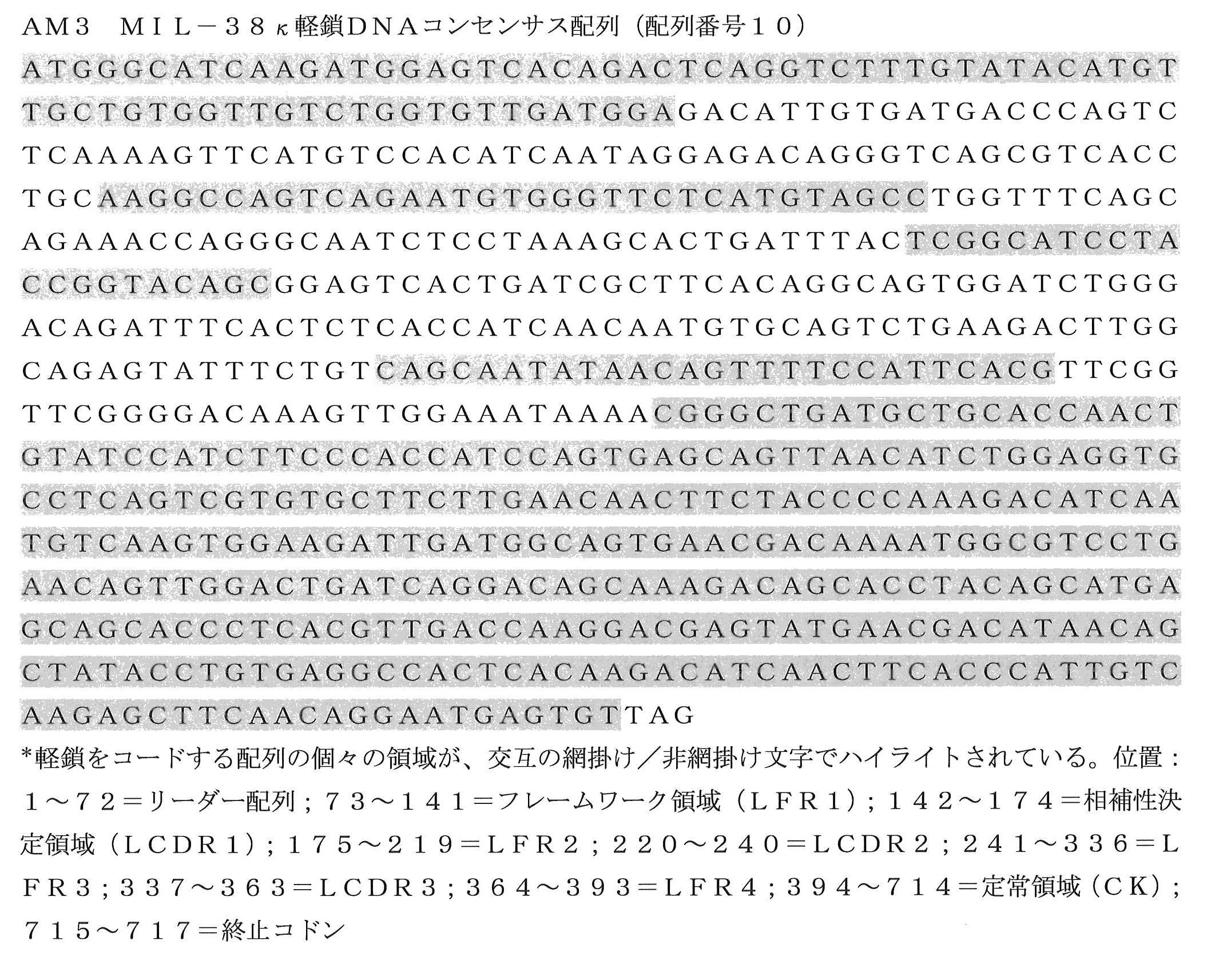

からの逸脱、並びに、本明細書において前述の、および添付の特許請求の範囲内である以下の通りの、本質的な特徴に適用してよいような本開示からの逸脱を包含する、本発明の原理に概して従う本発明のあらゆる変形、使用、または適合を包含することが意図される。
Claims (13)
- 対象における前立腺がん、膀胱がん、および/または膵臓がんを治療するための医薬品であって、抗グリピカン1(抗GPC1)抗体および/またはその抗原結合性断片を含み、前記抗体および/または断片は対象における前立腺がん細胞、膀胱がん細胞、および/または膵臓がん細胞に対して毒性がある少なくとも1つの細胞傷害性薬物に結合しており、
前記抗体は
(a)
配列番号3の50~54位によって定義されるアミノ酸配列を含むかまたはそれからなる相補性決定領域1(CDR1);
配列番号3の69~85位によって定義されるアミノ酸配列を含むかまたはそれからなる相補性決定領域2(CDR2);
配列番号3の118~126位によって定義されるアミノ酸配列を含むかまたはそれからなる相補性決定領域3(CDR3)
を含む重鎖可変領域;および
(b)
配列番号4の44~54位によって定義されるアミノ酸配列を含むかまたはそれからなる相補性決定領域1(CDR1);
配列番号4の70~76位によって定義されるアミノ酸配列を含むかまたはそれからなる相補性決定領域2(CDR2);
配列番号4の109~117位によって定義されるアミノ酸配列を含むかまたはそれからなる相補性決定領域3(CDR3)
を含む軽鎖可変領域
を含み、ならびに
前記医薬品は、
配列番号11の48~58位によって定義されるアミノ酸配列を含むかまたはそれからなる相補性決定領域1(CDR1);
配列番号11の74~80位によって定義されるアミノ酸配列を含むかまたはそれからなる相補性決定領域2(CDR2);
配列番号11の113~121位によって定義されるアミノ酸配列を含むかまたはそれからなる相補性決定領域3(CDR3)、
を含む軽鎖可変領域を有する抗体を含まない、
前記医薬品。 - 前記抗体がアクセッション番号CBA20140026でCellbank Australiaに寄託されたハイブリドーマ細胞またはその子孫によって産生される、請求項1に記載の医薬品。
- 前記抗体が、
(i) ヒト化抗GPC1抗体、
(ii) キメラ抗GPC1抗体、
(iii) ヒト抗GPC1抗体、
(iv) モノクローナル抗GPC1抗体、
(v) 多量体化抗GPC1抗体、
(vi) 合成抗GPC1抗体、または
(vii)配列番号7の138~467番残基に定義されるアミノ酸配列を含むかまたはそれからなる重鎖定常領域;および配列番号8の128~234番残基に定義されるアミノ酸配列を含むかまたはそれからなる軽鎖定常領域を含むキメラ抗体である、
請求項1に記載の医薬品。 - 前記その抗原結合性断片が、エピトープ結合領域を含有する、単鎖可変領域断片(scFv)、配列番号9に定義される配列を含む単鎖可変領域断片(scFv)、可変領域(Fv)断片、抗原結合領域(Fab)断片、F(ab)2断片、ペプチド、またはタンパク質分解断片である、請求項1~3のいずれか一項に記載の医薬品。
- 前記細胞傷害性薬物が、
(a)副腎皮質抑制剤、アルキル化剤、スルホン酸アルキル、アントラサイクリン、血管新生阻害剤、抗生物質、代謝拮抗物質、有糸分裂阻害剤、アウリスタチン、カリチアマイシン(calicheamycin)、カンプトテシン、COX-2阻害剤、酵素阻害剤、エピポドフィロトキシン、エチレンイミン誘導体、葉酸類似体、HDAC阻害剤、熱ショックタンパク質(HSP90)阻害剤、ホルモン拮抗剤、メイタンシノイド、メチルヒドラジン誘導体、mTOR阻害剤、ナイトロジェンマスタード、ニトロソウレア、白金配位錯体、アポトーシス促進剤、プロテオソーム阻害剤、プリン類似体、ピリミジン類似体、放射性同位元素、置換尿素、タキサン、トリアゼン、チューブリン阻害剤、チロシンキナーゼ阻害剤、およびビンカアルカロイドからなる群から選択される、または
(b)アファチニブ、アプリジン、アナストロゾール、アントラサイクリン、AVL-101、AVL-291、アキシチニブ、アザリビン、ベンダムスチン、ブレオマイシン、ボルテゾミブ、ボスチニブ、ブリオスタチン-1、ブスルファン、カンプトテカン(camptothecan)、カルボプラチン、カリチアマイシン(calicheamycin)、カンプトテシン、カルボプラチン、カルムスチン、セレコキシブ、クロラムブシル、シスプラチン、クラドリビン、COX-2阻害剤、クリゾチニブ、シアノモルホリノドキソルビシン、シクロホスファミド、シタラビン、ダカルバジン、ダクチノマイシン、ダサチニブ、ダウノルビシン、ディナシクリブ、3’,5’-0-ジオレオイル-FudR(FUdR-d0)、DM1、DM3、DM4、ドセタキセル、ドキソルビシン、ドキソルビシングルクロニド、デュオカルマイシン、エンドスタチン、エンチノスタット、エピドフィロトキシン(epidophyllotoxin)、エピルビシングルクロニド、エルロチニブ、エストラムスチン、エストロゲン受容体結合剤、エトポシドグルクロニド、リン酸エトポシド、エトポシド(VP16)、エキセメスタン、ファルネシルタンパク質トランスフェラーゼ阻害剤、フィンゴリモド、フラボピリドール、フロクスウリジン(FUdR)、フルダラビン、5-フルオロ
ウラシル、フルタミド、ホスタマチニブ、ガネテスピブ、GDC-0834、ゲフィチニブ、ゲムシタビン、GS-1101、10-ヒドロキシカンプトテシン、ヒドロキシウレア、イブルチニブ、イダルビシン、イデラリシブ、イホスファミド、イマチニブ、イリノテカン(CPT-11)、ラパチニブ、レナリドミド(lenolidamide)、ロイコボリン、LFM-A13、ロムスチン、メクロレタミン、メルファラン、メルカプトプリン、6-メルカプトプリン、メトトレキサート、ミトラマイシン、マイトマイシン、ミトタン、ミトキサントロン、モノメチルアウリスタチンD(MMAD)、モノメチルアウリスタチンE(MMAE)、モノメチルアウリスタチンF(MMAF)、ナベルビン、ネラチニブ、ニロチニブ、ニトロソ尿素(nitrosurea)、オラパリブ、パクリタキセル、PCI-32765、ペントスタチン、プリカマイシン(plicomycin)、2-PDoxプロドラッグ(プロ-2-PDox)、プロカルバジン、PSI-341、2-ピロリノドキソルビシン(2-PDox)、ラロキシフェン、セムスチン、SN-38、ソラフェニブ、ストレプトゾシン、SU11248、スニチニブ、タモキシフェン、テモゾロミド(temazolomide)、テニポシド、サリドマイド、チオグアニン、チオテパ、トポテカン、トランス白金(transplatinum)、ウラシルマスタード、バタラニブ、ビンブラスチン、ビンカアルカロイド、ビンクリスチン、ビノレルビン、およびZD1839からなる群から選択される、請求項1~4のいずれか一項に記載の医薬品。 - 前記細胞傷害性薬物が、
(a)放射性同位元素、または
(b)90Y、188Re、166Ho、165Dy、109Pd、111Ag、186Re、198Au、153Sm、64Cu、177Lu、131I、125I、67Cu、175Yb、166Dy、169Er、212Bi、213Bi、225Ac、212Pb、66Ga、67Ga、68Ga、64Cu、86Y、94mTc、および89Zrからなる群から選択される放射性同位元素である、
請求項1~5のいずれか一項に記載の医薬品。 - 前記対象が哺乳類対象またはヒト対象である、請求項1~6のいずれか一項に記載の医薬品。
- 組成物であって、
前立腺がん細胞、膀胱がん細胞、および/または膵臓がん細胞に対して毒性がある少なくとも1つの細胞傷害性薬物に結合しており、
(a)
配列番号3の50~54位によって定義されるアミノ酸配列を含むかまたはそれからなる相補性決定領域1(CDR1);
配列番号3の69~85位によって定義されるアミノ酸配列を含むかまたはそれからなる相補性決定領域2(CDR2);
配列番号3の118~126位によって定義されるアミノ酸配列を含むかまたはそれからなる相補性決定領域3(CDR3)
を含む重鎖可変領域;および
(b)
配列番号4の44~54位によって定義されるアミノ酸配列を含むかまたはそれからなる相補性決定領域1(CDR1);
配列番号4の70~76位によって定義されるアミノ酸配列を含むかまたはそれからなる相補性決定領域2(CDR2);
配列番号4の109~117位によって定義されるアミノ酸配列を含むかまたはそれからなる相補性決定領域3(CDR3)
を含む軽鎖可変領域
を含む、第一の抗体および/またはその抗原結合性断片を含み、
前記第一の抗体および/またはその抗原結合性断片がグリピカン1(GPC1)に結合するものであり;
ただし、
配列番号11の48~58位によって定義されるアミノ酸配列を含むかまたはそれからなる相補性決定領域1(CDR1);
配列番号11の74~80位によって定義されるアミノ酸配列を含むかまたはそれからなる相補性決定領域2(CDR2);
配列番号11の113~121位によって定義されるアミノ酸配列を含むかまたはそれからなる相補性決定領域3(CDR3)
を含む軽鎖可変領域を含む第二の抗体は含有しない、
組成物。 - 前記第一の抗体および/またはその抗原結合性断片が、モノクローナル抗体、ヒト化抗体、キメラ抗体、多量体化抗体、合成抗体、および/またはキメラ抗体のうちのいずれか一つまたは複数であって、
前記キメラ抗体が、
(a)配列番号7の138~467番残基に定義されるアミノ酸配列を含むかまたはそれからなる重鎖定常領域;および
(b)配列番号8の128~234番残基に定義されるアミノ酸配列を含むかまたはそれからなる軽鎖定常領域、を含むキメラ抗体
である、請求項8に記載の組成物。 - 前記抗原結合性断片が、エピトープ結合領域を含有する、単鎖可変領域断片(scFv)、配列番号9に定義される配列を含む単鎖可変領域断片(scFv)、可変領域(Fv)断片、抗原結合領域(Fab)断片、F(ab)2断片、ペプチド、またはタンパク質分解断片のうちのいずれか一つまたは複数である、請求項8または9に記載の組成物。
- 前記第一の抗体が、配列番号3の20~461位によって定義される重鎖配列および配列番号4の21~234位によって定義される軽鎖配列を含むかまたはそれらからなる、請求項8~10のいずれか一項に記載の組成物。
- 前記細胞傷害性薬物が、
(a)副腎皮質抑制剤、アルキル化剤、スルホン酸アルキル、アントラサイクリン、血管新生阻害剤、抗生物質、代謝拮抗物質、有糸分裂阻害剤、アウリスタチン、カリチアマイシン(calicheamycin)、カンプトテシン、COX-2阻害剤、酵素阻害剤、エピポドフィロトキシン、エチレンイミン誘導体、葉酸類似体、HDAC阻害剤、熱ショックタンパク質(HSP90)阻害剤、ホルモン拮抗剤、メイタンシノイド、メチルヒドラジン誘導体、mTOR阻害剤、ナイトロジェンマスタード、ニトロソウレア、白金配位錯体、アポトーシス促進剤、プロテオソーム阻害剤、プリン類似体、ピリミジン類似体、放射性同位元素、置換尿素、タキサン、トリアゼン、チューブリン阻害剤、チロシンキナーゼ阻害剤、およびビンカアルカロイドからなる群から選択される、または
(b)アファチニブ、アプリジン、アナストロゾール、アントラサイクリン、AVL-101、AVL-291、アキシチニブ、アザリビン、ベンダムスチン、ブレオマイシン、ボルテゾミブ、ボスチニブ、ブリオスタチン-1、ブスルファン、カンプトテカン(camptothecan)、カルボプラチン、カリチアマイシン(calicheamycin)、カンプトテシン、カルボプラチン、カルムスチン、セレコキシブ、クロラムブシル、シスプラチン、クラドリビン、COX-2阻害剤、クリゾチニブ、シアノモルホリノドキソルビシン、シクロホスファミド、シタラビン、ダカルバジン、ダクチノマイシン、ダサチニブ、ダウノルビシン、ディナシクリブ、3’,5’-0-ジオレオイル-FudR(FUdR-d0)、DM1、DM3、DM4、ドセタキセル、ドキソルビシン、ドキソルビシングルクロニド、
デュオカルマイシン、エンドスタチン、エンチノスタット、エピドフィロトキシン(epidophyllotoxin)、エピルビシングルクロニド、エルロチニブ、エストラムスチン、エストロゲン受容体結合剤、エトポシドグルクロニド、リン酸エトポシド、エトポシド(VP16)、エキセメスタン、ファルネシルタンパク質トランスフェラーゼ阻害剤、フィンゴリモド、フラボピリドール、フロクスウリジン(FUdR)、フルダラビン、5-フルオロウラシル、フルタミド、ホスタマチニブ、ガネテスピブ、GDC-0834、ゲフィチニブ、ゲムシタビン、GS-1101、10-ヒドロキシカンプトテシン、ヒドロキシウレア、イブルチニブ、イダルビシン、イデラリシブ、イホスファミド、イマチニブ、イリノテカン(CPT-11)、ラパチニブ、レナリドミド(lenolidamide)、ロイコボリン、LFM-A13、ロムスチン、メクロレタミン、メルファラン、メルカプトプリン、6-メルカプトプリン、メトトレキサート、ミトラマイシン、マイトマイシン、ミトタン、ミトキサントロン、モノメチルアウリスタチンD(MMAD)、モノメチルアウリスタチンE(MMAE)、モノメチルアウリスタチンF(MMAF)、ナベルビン、ネラチニブ、ニロチニブ、ニトロソ尿素(nitrosurea)、オラパリブ、パクリタキセル、PCI-32765、ペントスタチン、プリカマイシン(plicomycin)、2-PDoxプロドラッグ(プロ-2-PDox)、プロカルバジン、PSI-341、2-ピロリノドキソルビシン(2-PDox)、ラロキシフェン、セムスチン、SN-38、ソラフェニブ、ストレプトゾシン、SU11248、スニチニブ、タモキシフェン、テモゾロミド(temazolomide)、テニポシド、サリドマイド、チオグアニン、チオテパ、トポテカン、トランス白金(transplatinum)、ウラシルマスタード、バタラニブ、ビンブラスチン、ビンカアルカロイド、ビンクリスチン、ビノレルビン、およびZD1839からなる群から選択される、請求項8~11のいずれか一項に記載の組成物。 - 前記細胞傷害性薬物が
(a)放射性同位元素、または
(b)90Y、188Re、166Ho、165Dy、109Pd、111Ag、186Re、198Au、153Sm、64Cu、177Lu、131I、125I、67Cu、175Yb、166Dy、169Er、212Bi、213Bi、225Ac、212Pb、66Ga、67Ga、68Ga、64Cu、86Y、94mTc、および89Zrからなる群から選択される放射性同位体である、
請求項8~12のいずれか一項に記載の組成物。
Applications Claiming Priority (3)
| Application Number | Priority Date | Filing Date | Title |
|---|---|---|---|
| AU2015901423A AU2015901423A0 (en) | 2015-04-20 | Therapeutic antibodies and uses thereof | |
| AU2015901423 | 2015-04-20 | ||
| PCT/AU2016/000136 WO2016168885A1 (en) | 2015-04-20 | 2016-04-20 | Therapeutic antibodies and uses thereof |
Publications (3)
| Publication Number | Publication Date |
|---|---|
| JP2018518455A JP2018518455A (ja) | 2018-07-12 |
| JP2018518455A5 JP2018518455A5 (ja) | 2019-05-30 |
| JP7063623B2 true JP7063623B2 (ja) | 2022-05-09 |
Family
ID=57142773
Family Applications (1)
| Application Number | Title | Priority Date | Filing Date |
|---|---|---|---|
| JP2017555213A Active JP7063623B2 (ja) | 2015-04-20 | 2016-04-20 | 治療用抗体およびその使用 |
Country Status (9)
| Country | Link |
|---|---|
| US (1) | US11198738B2 (ja) |
| EP (1) | EP3285805B1 (ja) |
| JP (1) | JP7063623B2 (ja) |
| KR (1) | KR102739664B1 (ja) |
| CN (1) | CN107847593B (ja) |
| AU (1) | AU2016250900B2 (ja) |
| CA (1) | CA2983311A1 (ja) |
| SG (1) | SG11201708624YA (ja) |
| WO (1) | WO2016168885A1 (ja) |
Families Citing this family (13)
| Publication number | Priority date | Publication date | Assignee | Title |
|---|---|---|---|---|
| CA2964179C (en) * | 2014-10-23 | 2023-04-11 | Minomic International Ltd. | Monoclonal anti-gpc-1 antibodies and uses thereof |
| JPWO2018199318A1 (ja) * | 2017-04-28 | 2020-03-12 | 国立大学法人高知大学 | 抗gpc−1抗体 |
| CN111954532A (zh) * | 2018-04-13 | 2020-11-17 | 上海交通大学医学院附属瑞金医院 | 杂芳基酰胺类化合物的抗肿瘤多药耐药性、治疗癌症的用途和蛋白质-药物分子复合物 |
| US12122843B2 (en) | 2019-01-22 | 2024-10-22 | The United States Of America, As Represented By The Secretary, Department Of Health And Human Services | High affinity monoclonal antibodies targeting glypican-1 and methods of use |
| JP7547350B2 (ja) * | 2019-01-22 | 2024-09-09 | クレムソン・ユニバーシティ・リサーチ・ファウンデーション | 抗エラスチン抗体及び使用方法 |
| CN112175090B (zh) * | 2019-07-03 | 2024-04-26 | 深圳市雅臣智能生物工程有限公司 | 一种人溶菌酶结合物及其制备方法和应用 |
| CN110893236A (zh) * | 2019-10-09 | 2020-03-20 | 中山大学 | 溶酶体靶向的抗体药物偶联物及其应用 |
| CN111187350A (zh) * | 2019-12-30 | 2020-05-22 | 西安英创生物技术有限公司 | 一种与磷脂酰肌醇蛋白聚糖-1结合的抗原结合蛋白 |
| US12400326B2 (en) * | 2020-06-09 | 2025-08-26 | Temasek Life Sicences Laboratory Limited | Automated disease detection system |
| IT202200021546A1 (it) * | 2022-10-19 | 2024-04-19 | Centro Di Riferimento Oncologico Di Aviano | Anticorpo monoclonale anti-GPC1, suoi usi terapeutici e diagnostici |
| WO2024119233A1 (en) * | 2022-12-09 | 2024-06-13 | Carina Biotech Pty Ltd | Methods for diagnosing and treating ovarian cancer |
| WO2025202359A1 (en) * | 2024-03-27 | 2025-10-02 | Adcendo Aps | Anti-gpc1 antibodies and uses thereof |
| WO2025202361A1 (en) | 2024-03-27 | 2025-10-02 | Adcendo Aps | Anti-gpc1 antibodies and uses thereof |
Citations (1)
| Publication number | Priority date | Publication date | Assignee | Title |
|---|---|---|---|---|
| JP2017531442A (ja) | 2014-10-23 | 2017-10-26 | ミノミック インターナショナル リミティド | モノクローナル抗gpc−1抗体およびその使用 |
Family Cites Families (11)
| Publication number | Priority date | Publication date | Assignee | Title |
|---|---|---|---|---|
| EP0473651A4 (en) | 1989-05-24 | 1992-10-14 | The University Of Sydney | Monoclonal antibodies which recognise malignant cells from bladder carcinomas |
| US5622836A (en) * | 1989-05-24 | 1997-04-22 | The University Of Sydney | Monoclonal antibodies which recognize malignant cells from bladder carcinomas |
| EP1146903A4 (en) * | 1998-10-16 | 2005-02-16 | Univ California | GLYPICANE FOR THE DETECTION AND TREATMENT OF HUMAN CARCINOMA |
| US7108986B2 (en) * | 1998-10-16 | 2006-09-19 | The Regents Of The University Of California | Glypican-1 in human breast cancer |
| AUPR395801A0 (en) * | 2001-03-26 | 2001-04-26 | Austin Research Institute, The | Antibodies against cancer |
| WO2005016285A2 (en) | 2003-08-13 | 2005-02-24 | New York University | Compositions and methods for inhibiting slit protein and glypican interactions |
| BRPI0717638A2 (pt) * | 2006-10-27 | 2013-11-12 | Genentech Inc | Anticorpors e imunoconjugados e usos para os mesmos |
| SG11201407972RA (en) * | 2012-06-01 | 2015-01-29 | Us Health | High-affinity monoclonal antibodies to glypican-3 and use thereof |
| CN105074469A (zh) * | 2013-04-01 | 2015-11-18 | 免疫医疗公司 | 用于胰腺癌早期检测和治疗的抗粘蛋白抗体 |
| SG11201605784YA (en) * | 2014-01-17 | 2016-08-30 | Minomic Internat Ltd | Cell surface prostate cancer antigen for diagnosis |
| SG11201705808XA (en) | 2015-01-16 | 2017-08-30 | Minomic Int Ltd | Glypican epitopes and uses thereof |
-
2016
- 2016-04-20 CA CA2983311A patent/CA2983311A1/en active Pending
- 2016-04-20 KR KR1020177033428A patent/KR102739664B1/ko active Active
- 2016-04-20 SG SG11201708624YA patent/SG11201708624YA/en unknown
- 2016-04-20 EP EP16782389.7A patent/EP3285805B1/en active Active
- 2016-04-20 WO PCT/AU2016/000136 patent/WO2016168885A1/en not_active Ceased
- 2016-04-20 CN CN201680036010.8A patent/CN107847593B/zh active Active
- 2016-04-20 US US15/567,889 patent/US11198738B2/en active Active - Reinstated
- 2016-04-20 JP JP2017555213A patent/JP7063623B2/ja active Active
- 2016-04-20 AU AU2016250900A patent/AU2016250900B2/en active Active
Patent Citations (1)
| Publication number | Priority date | Publication date | Assignee | Title |
|---|---|---|---|---|
| JP2017531442A (ja) | 2014-10-23 | 2017-10-26 | ミノミック インターナショナル リミティド | モノクローナル抗gpc−1抗体およびその使用 |
Non-Patent Citations (5)
| Title |
|---|
| BJU International., 2014, Vol.113, Suppl.4, p.45(90) |
| Cancer Immunol Immunother, 2004, Vol.53, p.533-542 |
| Cancer Immunol Immunother, 2004, Vol.53, p.995-1004 |
| Int J Rad Oncol Biol Phys., 2004, Vol.60 No.3, p.896-908 |
| 日本外科学会雑誌, 2009, Vol.110 臨時増刊号(2), p.512 (HP-069-6) |
Also Published As
| Publication number | Publication date |
|---|---|
| CN107847593B (zh) | 2021-12-14 |
| CA2983311A1 (en) | 2016-10-27 |
| JP2018518455A (ja) | 2018-07-12 |
| KR20170138530A (ko) | 2017-12-15 |
| EP3285805A1 (en) | 2018-02-28 |
| HK1247091A1 (zh) | 2018-09-21 |
| WO2016168885A1 (en) | 2016-10-27 |
| EP3285805A4 (en) | 2018-12-05 |
| EP3285805B1 (en) | 2021-05-26 |
| SG11201708624YA (en) | 2017-11-29 |
| CN107847593A (zh) | 2018-03-27 |
| KR102739664B1 (ko) | 2024-12-05 |
| AU2016250900B2 (en) | 2022-03-17 |
| US20190010247A1 (en) | 2019-01-10 |
| US11198738B2 (en) | 2021-12-14 |
| AU2016250900A1 (en) | 2017-11-02 |
Similar Documents
| Publication | Publication Date | Title |
|---|---|---|
| JP7063623B2 (ja) | 治療用抗体およびその使用 | |
| US7067131B2 (en) | Methods for using anti-MUC18 antibodies | |
| US7090844B2 (en) | Use of antibodies against the MUC18 antigen | |
| JP2022046662A (ja) | 治療分子 | |
| CN109485726B (zh) | 放射性标记抗纳米抗体在癌症的预后、诊断中的应用 | |
| CN101743255A (zh) | 抗癌细胞毒性单克隆抗体 | |
| KR20230146623A (ko) | 항-cldn18.2 항체 접합체 | |
| CN111194222A (zh) | 与xCT抗体相关的组合物和方法 | |
| CN101687931A (zh) | 抗癌细胞毒性单克隆抗体 | |
| CN101535471B (zh) | 修饰癌症病的抗体180706-02 | |
| WO2022242892A1 (en) | Anti-cd38 single-domain antibodies in disease monitoring and treatment | |
| WO2021229104A1 (en) | Anti-cd38 single-domain antibodies in disease monitoring and treatment | |
| CN101743256A (zh) | 抗癌细胞毒性单克隆抗体 | |
| WO2023222068A1 (en) | Anti-cd200r1 antibodies | |
| EP4491632A1 (en) | Ror1-targeted binding molecule and use thereof | |
| US20230190968A1 (en) | Anti-cd38 single-domain antibodies in disease monitoring and treatment | |
| TW202613181A (zh) | 抗人cdh17抗體 | |
| WO2026074119A1 (en) | Bi-functionalized antibody conjugates against the endothelin receptor b | |
| HK40106087A (zh) | 抗cldn18.2抗体缀合物 | |
| HK1247091B (en) | Therapeutic antibodies and uses thereof | |
| AU2023308462A1 (en) | Anti-mesothelin antibodies | |
| JP2011528010A (ja) | 癌性疾患修飾抗体 | |
| CN101668849A (zh) | 由杂交瘤细胞系ar51a630.3产生的减轻癌性疾病的抗体010207-01 | |
| CN101688183A (zh) | 减轻癌性疾病的抗体 | |
| CN101535470A (zh) | 修饰癌性疾病的抗体180706-01 |
Legal Events
| Date | Code | Title | Description |
|---|---|---|---|
| A521 | Request for written amendment filed |
Free format text: JAPANESE INTERMEDIATE CODE: A523 Effective date: 20190419 |
|
| A621 | Written request for application examination |
Free format text: JAPANESE INTERMEDIATE CODE: A621 Effective date: 20190419 |
|
| A711 | Notification of change in applicant |
Free format text: JAPANESE INTERMEDIATE CODE: A711 Effective date: 20200528 |
|
| A521 | Request for written amendment filed |
Free format text: JAPANESE INTERMEDIATE CODE: A821 Effective date: 20200529 |
|
| A131 | Notification of reasons for refusal |
Free format text: JAPANESE INTERMEDIATE CODE: A131 Effective date: 20200707 |
|
| A601 | Written request for extension of time |
Free format text: JAPANESE INTERMEDIATE CODE: A601 Effective date: 20201006 |
|
| A601 | Written request for extension of time |
Free format text: JAPANESE INTERMEDIATE CODE: A601 Effective date: 20201202 |
|
| A521 | Request for written amendment filed |
Free format text: JAPANESE INTERMEDIATE CODE: A523 Effective date: 20201228 |
|
| A131 | Notification of reasons for refusal |
Free format text: JAPANESE INTERMEDIATE CODE: A131 Effective date: 20210525 |
|
| A601 | Written request for extension of time |
Free format text: JAPANESE INTERMEDIATE CODE: A601 Effective date: 20210823 |
|
| A601 | Written request for extension of time |
Free format text: JAPANESE INTERMEDIATE CODE: A601 Effective date: 20211022 |
|
| A521 | Request for written amendment filed |
Free format text: JAPANESE INTERMEDIATE CODE: A523 Effective date: 20211124 |
|
| TRDD | Decision of grant or rejection written | ||
| A01 | Written decision to grant a patent or to grant a registration (utility model) |
Free format text: JAPANESE INTERMEDIATE CODE: A01 Effective date: 20220329 |
|
| A61 | First payment of annual fees (during grant procedure) |
Free format text: JAPANESE INTERMEDIATE CODE: A61 Effective date: 20220421 |
|
| R150 | Certificate of patent or registration of utility model |
Ref document number: 7063623 Country of ref document: JP Free format text: JAPANESE INTERMEDIATE CODE: R150 |
|
| R250 | Receipt of annual fees |
Free format text: JAPANESE INTERMEDIATE CODE: R250 |