JP7127045B2 - Oxygen scavenging plastic material - Google Patents
Oxygen scavenging plastic material Download PDFInfo
- Publication number
- JP7127045B2 JP7127045B2 JP2019543077A JP2019543077A JP7127045B2 JP 7127045 B2 JP7127045 B2 JP 7127045B2 JP 2019543077 A JP2019543077 A JP 2019543077A JP 2019543077 A JP2019543077 A JP 2019543077A JP 7127045 B2 JP7127045 B2 JP 7127045B2
- Authority
- JP
- Japan
- Prior art keywords
- integer
- polyether
- oxygen
- carbon atoms
- oxygen barrier
- Prior art date
- Legal status (The legal status is an assumption and is not a legal conclusion. Google has not performed a legal analysis and makes no representation as to the accuracy of the status listed.)
- Active
Links
Classifications
-
- C—CHEMISTRY; METALLURGY
- C08—ORGANIC MACROMOLECULAR COMPOUNDS; THEIR PREPARATION OR CHEMICAL WORKING-UP; COMPOSITIONS BASED THEREON
- C08L—COMPOSITIONS OF MACROMOLECULAR COMPOUNDS
- C08L67/00—Compositions of polyesters obtained by reactions forming a carboxylic ester link in the main chain; Compositions of derivatives of such polymers
- C08L67/02—Polyesters derived from dicarboxylic acids and dihydroxy compounds
- C08L67/025—Polyesters derived from dicarboxylic acids and dihydroxy compounds containing polyether sequences
-
- C—CHEMISTRY; METALLURGY
- C08—ORGANIC MACROMOLECULAR COMPOUNDS; THEIR PREPARATION OR CHEMICAL WORKING-UP; COMPOSITIONS BASED THEREON
- C08G—MACROMOLECULAR COMPOUNDS OBTAINED OTHERWISE THAN BY REACTIONS ONLY INVOLVING UNSATURATED CARBON-TO-CARBON BONDS
- C08G63/00—Macromolecular compounds obtained by reactions forming a carboxylic ester link in the main chain of the macromolecule
- C08G63/66—Polyesters containing oxygen in the form of ether groups
- C08G63/668—Polyesters containing oxygen in the form of ether groups derived from polycarboxylic acids and polyhydroxy compounds
- C08G63/672—Dicarboxylic acids and dihydroxy compounds
-
- B—PERFORMING OPERATIONS; TRANSPORTING
- B65—CONVEYING; PACKING; STORING; HANDLING THIN OR FILAMENTARY MATERIAL
- B65D—CONTAINERS FOR STORAGE OR TRANSPORT OF ARTICLES OR MATERIALS, e.g. BAGS, BARRELS, BOTTLES, BOXES, CANS, CARTONS, CRATES, DRUMS, JARS, TANKS, HOPPERS, FORWARDING CONTAINERS; ACCESSORIES, CLOSURES, OR FITTINGS THEREFOR; PACKAGING ELEMENTS; PACKAGES
- B65D81/00—Containers, packaging elements, or packages, for contents presenting particular transport or storage problems, or adapted to be used for non-packaging purposes after removal of contents
- B65D81/24—Adaptations for preventing deterioration or decay of contents; Applications to the container or packaging material of food preservatives, fungicides, pesticides or animal repellants
- B65D81/26—Adaptations for preventing deterioration or decay of contents; Applications to the container or packaging material of food preservatives, fungicides, pesticides or animal repellants with provision for draining away, or absorbing, or removing by ventilation, fluids, e.g. exuded by contents; Applications of corrosion inhibitors or desiccators
- B65D81/266—Adaptations for preventing deterioration or decay of contents; Applications to the container or packaging material of food preservatives, fungicides, pesticides or animal repellants with provision for draining away, or absorbing, or removing by ventilation, fluids, e.g. exuded by contents; Applications of corrosion inhibitors or desiccators for absorbing gases, e.g. oxygen absorbers or desiccants
-
- C—CHEMISTRY; METALLURGY
- C08—ORGANIC MACROMOLECULAR COMPOUNDS; THEIR PREPARATION OR CHEMICAL WORKING-UP; COMPOSITIONS BASED THEREON
- C08G—MACROMOLECULAR COMPOUNDS OBTAINED OTHERWISE THAN BY REACTIONS ONLY INVOLVING UNSATURATED CARBON-TO-CARBON BONDS
- C08G63/00—Macromolecular compounds obtained by reactions forming a carboxylic ester link in the main chain of the macromolecule
- C08G63/02—Polyesters derived from hydroxycarboxylic acids or from polycarboxylic acids and polyhydroxy compounds
- C08G63/12—Polyesters derived from hydroxycarboxylic acids or from polycarboxylic acids and polyhydroxy compounds derived from polycarboxylic acids and polyhydroxy compounds
- C08G63/16—Dicarboxylic acids and dihydroxy compounds
- C08G63/20—Polyesters having been prepared in the presence of compounds having one reactive group or more than two reactive groups
-
- C—CHEMISTRY; METALLURGY
- C08—ORGANIC MACROMOLECULAR COMPOUNDS; THEIR PREPARATION OR CHEMICAL WORKING-UP; COMPOSITIONS BASED THEREON
- C08L—COMPOSITIONS OF MACROMOLECULAR COMPOUNDS
- C08L67/00—Compositions of polyesters obtained by reactions forming a carboxylic ester link in the main chain; Compositions of derivatives of such polymers
- C08L67/02—Polyesters derived from dicarboxylic acids and dihydroxy compounds
-
- C—CHEMISTRY; METALLURGY
- C08—ORGANIC MACROMOLECULAR COMPOUNDS; THEIR PREPARATION OR CHEMICAL WORKING-UP; COMPOSITIONS BASED THEREON
- C08L—COMPOSITIONS OF MACROMOLECULAR COMPOUNDS
- C08L2203/00—Applications
- C08L2203/16—Applications used for films
- C08L2203/162—Applications used for films sealable films
-
- C—CHEMISTRY; METALLURGY
- C08—ORGANIC MACROMOLECULAR COMPOUNDS; THEIR PREPARATION OR CHEMICAL WORKING-UP; COMPOSITIONS BASED THEREON
- C08L—COMPOSITIONS OF MACROMOLECULAR COMPOUNDS
- C08L2310/00—Masterbatches
Landscapes
- Chemical & Material Sciences (AREA)
- Health & Medical Sciences (AREA)
- Chemical Kinetics & Catalysis (AREA)
- Medicinal Chemistry (AREA)
- Polymers & Plastics (AREA)
- Organic Chemistry (AREA)
- Engineering & Computer Science (AREA)
- Food Science & Technology (AREA)
- Mechanical Engineering (AREA)
- Polyesters Or Polycarbonates (AREA)
- Compositions Of Macromolecular Compounds (AREA)
- Wrappers (AREA)
- Processes Of Treating Macromolecular Substances (AREA)
- Manufacture Of Macromolecular Shaped Articles (AREA)
- Polyethers (AREA)
Description
本発明は、酸素を捕捉することが可能なエンドキャップポリエーテル-ポリエステルコポリマー、ならびに酸素を除去することまたは活性酸素バリアとして機能することが可能な組成物および物品におけるその使用に関する。 The present invention relates to end-capped polyether-polyester copolymers capable of scavenging oxygen and their use in compositions and articles capable of scavenging oxygen or acting as an active oxygen barrier.
PET(ポリエチレンテレフタレート)などの熱可塑性樹脂は、いくつかの種類の包装および保存容器を製造するために広く使用されている。PETはガラスと同じくらい透明であるが、ガラスよりもずっと軽く、PETはまた、割れへの耐性があり、完全にリサイクル可能であり、着色しやすく、種々のPETボトルデザインも可能になることから、PETは主に飲料産業で用いられている。PETの最大の不利益はそれが気体透過性であること、この場合特に、それが酸素透過性であることである。 Thermoplastics such as PET (polyethylene terephthalate) are widely used to manufacture several types of packaging and storage containers. PET is as transparent as glass, but much lighter than glass, PET is also resistant to cracking, is completely recyclable, is easy to color, and allows for a variety of PET bottle designs. , PET is mainly used in the beverage industry. The greatest disadvantage of PET is its gas permeability, in this case especially its oxygen permeability.
電子機器、パーソナルケア用品、家庭用品、工業製品、食品製品および飲料製品の包装には、包装内容物の鮮度および品質を保持するために酸素に対する高いバリア特性が必要とされることが周知である。とりわけ、ソースならびにジュース、ビールおよびお茶などの飲料製品には、製品の酸化を回避し商品の保存寿命を延長するために、高いバリア特性を有するか、または酸素の侵入を遮断するおよび/もしくは内部に封入された酸素を除去することができる包装材料が必要とされる。 It is well known that packaging for electronics, personal care, household, industrial, food and beverage products requires high barrier properties against oxygen to preserve the freshness and quality of the package contents. . Among other things, sauces and beverage products such as juices, beer and tea have high barrier properties or contain oxygen ingress and/or internal What is needed is a packaging material that can remove the oxygen trapped in the air.
これらの制限に対処し、酸素感受性製品(ビール、ジュースまたはトマトソース)の保存寿命を改善するために、多数の戦略が使用されている。包装産業では、例えば、混合ポリマー層を含む多層構造が開発されている。これらの積層包装容器により、ガラスおよび鋼のバリア特性には劣るもののそれに近い改善されたバリア特性がもたらされる一方、PET、ポリエチレンナフタレート(PEN)またはポリオレフィンボトルなどの単層容器に関連する多くのリサイクル利益は犠牲になる。さらに、多くの場合、容器の透明度が実質的に減少する。リサイクル性、バリア特性および透明度の適切なバランスを維持することが、ボトリング用途において最も重要である。 A number of strategies have been used to address these limitations and improve the shelf life of oxygen-sensitive products (beer, juice or tomato sauce). In the packaging industry, for example, multilayer structures are being developed that include mixed polymer layers. These laminated packaging containers provide improved barrier properties approaching, but less than, those of glass and steel, while many of the barrier properties associated with single layer containers such as PET, polyethylene naphthalate (PEN) or polyolefin bottles. Recycling profits are sacrificed. Furthermore, in many cases, the transparency of the container is substantially reduced. Maintaining the proper balance of recyclability, barrier properties and clarity is of utmost importance in bottling applications.
ポリマー外層と比較してより高バリアのポリマー材料の内層、ときには挟持層を含む多層ボトルを使用することが一般的である。典型的には、中心層は、容器壁を通した酸素の透過性が遅くする高バリアポリマーである。そのような受動的高バリアポリマーの例としては、エチレン-ビニルアルコール(EVOH)およびポリアミド、好ましくは、ポリ(m-キシリレンアジパミド)、MXD6などのメタ-キシリレン基を含有する部分芳香族ポリアミドが挙げられる。そのような多層構造の一般的な構造は、PETの内および外層とポリアミドの中心層、またはポリオレフィンの内および外層とエチレン-ビニルアルコール(EVOH)ポリマーの中心層を含む。 It is common to use multi-layer bottles that include an inner layer, sometimes a sandwich layer, of higher barrier polymeric material compared to the outer polymeric layer. Typically, the central layer is a high barrier polymer that slows the permeability of oxygen through the container wall. Examples of such passive high barrier polymers include ethylene-vinyl alcohol (EVOH) and polyamides, preferably poly(m-xylylene adipamide), partially aromatic containing meta-xylylene groups such as MXD6. A polyamide is mentioned. Common constructions for such multilayer structures include inner and outer layers of PET and a core layer of polyamide, or inner and outer layers of polyolefin and a core layer of ethylene-vinyl alcohol (EVOH) polymer.
受動的バリアの使用と組み合わせることもできる別の戦略は、包装内部の酸素を減少または除去するための活性酸素捕捉剤を使用することである。物質が酸素を消費または酸素と反応する酸素バリア特性を提供する方法は、(再)活性酸素バリアとして公知であり、受動的手法を介して製品を酸素から密閉しようとする受動的酸素バリアとは異なる。いくつかの酸素捕捉剤系が、当技術分野で公知である。中でも、酸化性置換または非置換エチレン性不飽和炭化水素および遷移金属触媒を含む酸素捕捉組成物が、公知の実行可能な解決法である。 Another strategy that can be combined with the use of passive barriers is the use of reactive oxygen scavengers to reduce or eliminate oxygen within the packaging. Methods of providing oxygen barrier properties in which a substance consumes or reacts with oxygen are known as (re)active oxygen barriers, and passive oxygen barriers seek to seal products from oxygen through a passive approach. different. Several oxygen scavenger systems are known in the art. Oxygen scavenging compositions comprising, among others, oxidizing substituted or unsubstituted ethylenically unsaturated hydrocarbons and transition metal catalysts are known viable solutions.
酸素捕捉組成物を充填したサシェなどの容器が、そのような材料の用途の周知の例である。しかし、これらの用途は、一般に、固体物質および固体食品に限定され、摂取を回避するために特別な注意が必要である。 Containers such as sachets filled with oxygen scavenging compositions are a well-known example of the use of such materials. However, these applications are generally limited to solid substances and solid foods, requiring special care to avoid ingestion.
この問題を解決するために、酸素捕捉剤をまた、容器の少なくとも一層を形成するポリマー樹脂に組み込み、少量の遷移金属塩を添加して、捕捉剤の酸化を触媒し、活発に促進して、包装の酸素バリア特性を強化することができる。この方法により、外部からの酸素だけでなく、包装または充填の間に予期せず導入され得る包装キャビティからの望ましくない酸素も、除去または減少させる機会が得られる。 To solve this problem, an oxygen scavenger is also incorporated into the polymer resin forming at least one layer of the container, and a small amount of transition metal salt is added to catalyze and actively promote the oxidation of the scavenger, The oxygen barrier properties of the packaging can be enhanced. This method provides the opportunity to remove or reduce not only oxygen from the outside, but also unwanted oxygen from the packaging cavity that may be inadvertently introduced during packaging or filling.
改質ポリエステルもまた、酸素捕捉剤として広く使用されている。エステルの様々な改質が酸素捕捉剤として活性であることが見出だされている。US6083585A(特許文献1)、WO98/12127(特許文献2)およびWO98/12244(特許文献3)は、酸素捕捉剤構成成分がポリブタジエンである、酸素捕捉ポリエステル組成物を開示している。 Modified polyesters are also widely used as oxygen scavengers. Various modifications of the ester have been found to be active as oxygen scavengers. US6083585A, WO98/12127 and WO98/12244 disclose oxygen scavenging polyester compositions in which the oxygen scavenger component is polybutadiene.
他の改質は、例えば、ポリ(アルキレンオキシド)を使用することによるエーテル基の導入で構成される。US6455620(特許文献4)は、様々な熱可塑性ポリマーとブレンドされた酸素捕捉剤として作用するポリ(アルキレングリコール)を開示している。WO01/10947(特許文献5)もまた、酸素感受性製品を含有する物品に組み込むのに好適な、酸化触媒と、ポリ(アルキレングリコール)、ポリ(アルキレングリコール)のコポリマーおよびポリ(アルキレングリコール)を含有するブレンドからなる群から選択される少なくとも1種のポリエーテルとを含む酸素捕捉組成物を開示している。 Other modifications consist of the introduction of ether groups, for example by using poly(alkylene oxides). US Pat. No. 6,455,620 discloses poly(alkylene glycol)s acting as oxygen scavengers blended with various thermoplastic polymers. WO 01/10947 also contains oxidation catalysts and poly(alkylene glycols), copolymers of poly(alkylene glycols) and poly(alkylene glycols) suitable for incorporation into articles containing oxygen sensitive products and at least one polyether selected from the group consisting of blends of:
WO2009/032560A1(特許文献6)は、低い曇りレベルを有する、酸化触媒とポリ(テトラメチレン-コ-アルキレンエーテル)を含むポリエーテルセグメントとを含むコポリエステルエーテルを含む酸素捕捉組成物を開示している。 WO2009/032560A1 discloses oxygen scavenging compositions comprising copolyester ethers comprising oxidation catalysts and polyether segments comprising poly(tetramethylene-co-alkylene ether) having low haze levels. there is
WO2005/059019A1(特許文献7)およびWO2005/059020A2(特許文献8)は、既知の組成物と比較して改善された活性酸素バリア特性を有する、ポリプロピレンオキシドセグメントを含むコポリマーとポリマーとを含む組成物を開示している。 WO2005/059019A1 (Patent Document 7) and WO2005/059020A2 (Patent Document 8) disclose compositions comprising copolymers and polymers containing polypropylene oxide segments having improved active oxygen barrier properties compared to known compositions is disclosed.
前述の酸素捕捉系は、包装中の酸素レベルを可能な限り低い程度に低減することを目指している。しかし、これは常に望ましいとは限らない。すべての製品が、保存寿命を延長するために好適な雰囲気に関して同じニーズを有するとは限らない。ワイン、フルーツおよび野菜の場合、好ましい風味を醸成することを可能にするために、制限された酸素レベルを含有する好適な雰囲気を作ることが望ましい。肉および魚の場合、ボツリヌス菌(Clostridium botulinum)などの特定の病原性嫌気菌の増殖を回避するために、雰囲気中のある低酸素レベルが必要である。 The aforementioned oxygen scavenging systems aim to reduce the oxygen level in the package to the lowest possible extent. However, this is not always desirable. Not all products have the same needs for a suitable atmosphere to extend shelf life. For wines, fruits and vegetables, it is desirable to create a suitable atmosphere containing limited oxygen levels to allow the development of favorable flavors. For meat and fish, a certain low oxygen level in the atmosphere is necessary to avoid the growth of certain pathogenic anaerobes such as Clostridium botulinum.
包装中のある低酸素レベルを維持するために、包装への酸素の侵入を、酸素捕捉組成物による酸素の消費速度と一致させることが必要である。これは、包装中の酸素捕捉組成物の含有量を低減することによって、潜在的に達成することができる。しかし、これは、包装の全体的な酸素捕捉能を犠牲にすることになり、それによって、含有される製品物品の保存寿命が減少する。 To maintain a certain low oxygen level in the package, it is necessary to match the oxygen entry into the package with the rate of oxygen consumption by the oxygen scavenging composition. This can potentially be achieved by reducing the content of oxygen scavenging composition in the package. However, this comes at the expense of the overall oxygen scavenging capacity of the package, thereby reducing the shelf life of the contained product article.
したがって、酸素捕捉反応の速度を所望のレベルに減少するように微調整し、製品の意図される保存寿命にわたってこのレベルを維持し、このようにして高い捕捉能を提供することができる酸素捕捉系を提供することが望ましい。 Thus, the oxygen scavenging system can be fine-tuned to reduce the rate of the oxygen scavenging reaction to a desired level and maintain this level over the intended shelf life of the product, thus providing high scavenging capacity. should be provided.
驚くべきことに、以下で記載される特定のポリエーテル-ポリエステルコポリマーを効果的に使用して、熱可塑性材料中で酸素捕捉を行い、制御することができることが見出だされた。 Surprisingly, it has been found that the specific polyether-polyester copolymers described below can be used effectively to effect and control oxygen scavenging in thermoplastic materials.
本発明の主題は、
(i)少なくとも1つのポリエーテルセグメントが少なくとも1つのポリテトラメチレンオキシドセグメントを含有する、ポリエーテルセグメントと、
(ii)ポリエステルセグメントと、
(iii)構造-CO-R2-CO-(式中、R2は、1~100個の炭素原子からなる、任意選択で置換された二価炭化水素残基を表し、置換基は、好ましくは、C1~C5-アルコキシ、ニトロ、シアノもしくはスルホ、またはそれらの組合せである)の架橋要素と、
(iv)1または2つのエンドキャップR1-O-(C2~C4-O-)e-*(式中、R1は、任意選択で置換された炭化水素残基であり、eは、0~1000の整数である)と
を含むポリエーテル-ポリエステルコポリマーである。
The subject of the present invention is
(i) a polyether segment, wherein at least one polyether segment contains at least one polytetramethylene oxide segment;
(ii) a polyester segment;
(iii) structure —CO—R 2 —CO—, wherein R 2 represents an optionally substituted divalent hydrocarbon residue consisting of 1 to 100 carbon atoms, the substituents preferably is C 1 -C 5 -alkoxy, nitro, cyano or sulfo, or combinations thereof);
(iv) one or two endcapped R 1 —O—(C 2 -C 4 —O—) e − * , where R 1 is an optionally substituted hydrocarbon residue and e is , which is an integer from 0 to 1000).
本発明のポリエーテル-エステルコポリマーは、好ましくは、非分枝状コポリマーであるが、これはまた、少量、すなわち最大10mol%の三官能性または四官能性コモノマー、例えば、トリメリット酸無水物、トリメチルプロパン、ピロメリト酸二無水物、ペンタエリスリトールおよび当技術分野で一般に公知の他のポリ酸またはポリオールを含有していてもよい。 The polyether-ester copolymers of the present invention are preferably unbranched copolymers, but they may also contain minor amounts, ie up to 10 mol %, of tri- or tetra-functional comonomers such as trimellitic anhydride, It may contain trimethylpropane, pyromellitic dianhydride, pentaerythritol and other polyacids or polyols commonly known in the art.
ポリテトラメチレンオキシドセグメント以外に、ポリエーテルセグメント(i)は、他のアルキレンオキシドセグメント、例えば、エチレンオキシド、プロピレンオキシドまたはそれらの組合せを含有し得る。 Besides polytetramethylene oxide segments, polyether segment (i) may contain other alkylene oxide segments such as ethylene oxide, propylene oxide or combinations thereof.
ポリエーテルセグメント(i)の好ましい実施形態は、例えば、以下の式(I)、(Ia)、(Ib)および(Ic)、ならびに任意選択で(Id)で表される。 Preferred embodiments of polyether segment (i) are represented, for example, by formulas (I), (Ia), (Ib) and (Ic) below, and optionally (Id).

kは、0~70、好ましくは0~35、特に好ましくは0~30の整数であり、
vは、0~250、好ましくは0~125、特に好ましくは0~50の整数であり、
xは、0~250、好ましくは0~125、特に好ましくは0~12の整数であり、
yは、0~250、好ましくは0~125、特に好ましくは0~50の整数であり、
zは、0~250、好ましくは0~125、特に好ましくは0~12の整数であり、
k+v+x+y+zの合計は、0~1070、好ましくは0~535である。
k is an integer of 0 to 70, preferably 0 to 35, particularly preferably 0 to 30,
v is an integer of 0 to 250, preferably 0 to 125, particularly preferably 0 to 50,
x is an integer of 0 to 250, preferably 0 to 125, particularly preferably 0 to 12,
y is an integer of 0 to 250, preferably 0 to 125, particularly preferably 0 to 50,
z is an integer of 0 to 250, preferably 0 to 125, particularly preferably 0 to 12,
The sum of k+v+x+y+z is 0-1070, preferably 0-535.
v+x>2かつvおよびx≠0、ならびにy+z>2かつyおよびz≠0の場合、得られるポリエチレンオキシド/ポリプロピレンオキシド-コポリマー部分は、ランダムに分布したコポリマーまたは両方のブロック(ポリエチレンオキシドブロックあるいはポリプロピレンオキシドブロック)がポリテトラメチレンオキシドブロックに化学連結していてもよいブロックコポリマーを表し得る。 For v+x>2 and v and x≠0 and y+z>2 and y and z≠0, the resulting polyethylene oxide/polypropylene oxide-copolymer fraction is a randomly distributed copolymer or both blocks (polyethylene oxide block or polypropylene oxide blocks) may be chemically linked to polytetramethylene oxide blocks.
式(Ia): Formula (Ia):

pは、0~35、好ましくは0~20、特に好ましくは0~15の整数であり、
wは、0~35、好ましくは0~20、特に好ましくは0~15の整数であり、
qは、0~250、好ましくは0~125、特に好ましくは0~50の整数であり、
rは、0~250、好ましくは0~125、特に好ましくは0~12の整数であり、
p+w+q+rの合計は、0~570、好ましくは0~290である。
p is an integer of 0 to 35, preferably 0 to 20, particularly preferably 0 to 15,
w is an integer of 0 to 35, preferably 0 to 20, particularly preferably 0 to 15,
q is an integer of 0 to 250, preferably 0 to 125, particularly preferably 0 to 50,
r is an integer of 0 to 250, preferably 0 to 125, particularly preferably 0 to 12,
The sum of p+w+q+r is 0-570, preferably 0-290.
q+r>2かつqおよびr≠0の場合、得られるポリエチレンオキシド/ポリプロピレンオキシド-コポリマー部分は、ランダムに分布したコポリマーまたはブロックコポリマーを表し得る。 If q+r>2 and q and r≠0, the resulting polyethylene oxide/polypropylene oxide-copolymer portion may represent a randomly distributed copolymer or a block copolymer.
式(Ib): Formula (Ib):

Kは、0~250、好ましくは0~125、特に好ましくは0~12の整数であり、
Lは、0~35、好ましくは0~20、特に好ましくは0~15の整数であり、
Mは、0~250、好ましくは0~125、特に好ましくは0~50の整数であり、
Nは、0~35、好ましくは0~20、特に好ましくは0~15の整数であり、
Oは、0~250、好ましくは0~125、特に好ましくは0~12の整数であり、
さらに、L+Nは、0として選択され得ず、
K+L+M+N+Oの合計は、1~820、好ましくは2~415である。
K is an integer of 0 to 250, preferably 0 to 125, particularly preferably 0 to 12,
L is an integer of 0 to 35, preferably 0 to 20, particularly preferably 0 to 15,
M is an integer of 0 to 250, preferably 0 to 125, particularly preferably 0 to 50,
N is an integer of 0 to 35, preferably 0 to 20, particularly preferably 0 to 15,
O is an integer of 0 to 250, preferably 0 to 125, particularly preferably 0 to 12,
Furthermore, L+N cannot be chosen as 0,
The sum of K+L+M+N+O is 1-820, preferably 2-415.
K+L>2かつK、LおよびM≠0の場合、またはN+O>2かつN、OおよびM≠0の場合、得られるポリプロピレンオキシド/ポリテトラメチレンオキシド-コポリマー部分は、ランダムに分布したコポリマーまたは両方のブロック(ポリプロピレンオキシドブロックあるいはポリテトラメチレンオキシドブロック)がポリエチレンオキシドブロックに化学連結していてもよいブロックコポリマーを表し得る。 When K+L>2 and K, L and M≠0, or when N+O>2 and N, O and M≠0, the resulting polypropylene oxide/polytetramethylene oxide-copolymer fraction is a randomly distributed copolymer or both (a polypropylene oxide block or a polytetramethylene oxide block) may represent a block copolymer in which blocks may be chemically linked to polyethylene oxide blocks.
式(Ic): Formula (Ic):

Pは、0~250、好ましくは0~125、特に好ましくは0~50の整数であり、
Qは、0~35、好ましくは0~20、特に好ましくは0~15の整数であり、
Rは、0~250、好ましくは0~125、特に好ましくは0~12の整数であり、
Sは、0~35、好ましくは0~20、特に好ましくは0~15の整数であり、
Tは、0~250、好ましくは0~125、特に好ましくは0~50の整数であり、
さらに、Q+Sは、0として選択され得ず、
P+Q+R+S+Tの合計は、1~820、好ましくは2~415である。
P is an integer of 0 to 250, preferably 0 to 125, particularly preferably 0 to 50,
Q is an integer of 0 to 35, preferably 0 to 20, particularly preferably 0 to 15,
R is an integer of 0 to 250, preferably 0 to 125, particularly preferably 0 to 12,
S is an integer of 0 to 35, preferably 0 to 20, particularly preferably 0 to 15,
T is an integer of 0 to 250, preferably 0 to 125, particularly preferably 0 to 50,
Furthermore, Q+S cannot be chosen as 0,
The sum of P+Q+R+S+T is 1-820, preferably 2-415.
P+Q>2かつP、QおよびR≠0の場合、またはS+T>2かつS、TおよびR≠0の場合、得られるポリプロピレンオキシド/ポリテトラメチレンオキシド-コポリマー部分は、ランダムに分布したコポリマーまたは両方のブロック(ポリエチレンオキシドブロックあるいはポリテトラメチレンオキシドブロック)がポリプロピレンオキシドブロックに化学連結していてもよいブロックコポリマーを表し得る。 When P+Q>2 and P, Q and R≠0, or when S+T>2 and S, T and R≠0, the resulting polypropylene oxide/polytetramethylene oxide-copolymer fraction is a randomly distributed copolymer or both blocks (polyethylene oxide blocks or polytetramethylene oxide blocks) may represent block copolymers in which blocks may be chemically linked to polypropylene oxide blocks.
式(Id): Formula (Id):

Uは、0~250、好ましくは0~125、特に好ましくは0~50の整数であり、
Vは、0~250、好ましくは0~125、特に好ましくは0~12の整数であり、
Wは、0~70、好ましくは0~35、特に好ましくは0~30の整数であり、
U+V+Wの合計は、3~570、好ましくは、5~285である。
U is an integer of 0 to 250, preferably 0 to 125, particularly preferably 0 to 50,
V is an integer of 0 to 250, preferably 0 to 125, particularly preferably 0 to 12,
W is an integer of 0 to 70, preferably 0 to 35, particularly preferably 0 to 30,
The sum of U+V+W is 3-570, preferably 5-285.
この実施形態では、ポリエーテルセグメントは、ホモポリマー、ランダムに分布したコポリマーまたはブロックコポリマーのいずれかであり得る。 In this embodiment, the polyether segments can be either homopolymers, randomly distributed copolymers or block copolymers.
すべての式において、アスタリスク*は、架橋要素(iii)への結合を表す。 In all formulas the asterisk * represents a bond to bridging element (iii).
好ましくは、ポリエステルセグメント(ii)は、式(II) Preferably, the polyester segment (ii) has the formula (II)

*は、架橋要素(iii)への結合を表し、
R2およびR3は、互いに独立して、1~100個の炭素原子からなる、任意選択で置換された炭化水素残基を表し、置換基は、好ましくは、C1~C5-アルコキシ、ニトロ、シアノおよびスルホであり、
uは、1~50、好ましくは1~30、特に1~25の整数である)
で表される。
* represents a bond to bridging element (iii),
R2 and R3 independently of each other represent optionally substituted hydrocarbon residues consisting of 1 to 100 carbon atoms, the substituents preferably being C 1 -C 5 -alkoxy, nitro, cyano and sulfo,
u is an integer from 1 to 50, preferably from 1 to 30, especially from 1 to 25)
is represented by
好ましくは、R2およびR3は、互いに独立して、1~24個の炭素原子の脂肪族炭化水素残基、2~24個の炭素原子のオレフィン系炭化水素残基、または5~14個の炭素原子の芳香族炭化水素残基を表し、前記炭化水素残基は、任意選択で、C1~C5-アルコキシ、ニトロ、シアノまたはそれらの組合せで置換されている。 Preferably, R2 and R3 are, independently of each other, aliphatic hydrocarbon residues of 1 to 24 carbon atoms, olefinic hydrocarbon residues of 2 to 24 carbon atoms, or 5 to 14 carbon atoms. represents an aromatic hydrocarbon residue of an atom, said hydrocarbon residue being optionally substituted with C 1 -C 5 -alkoxy, nitro, cyano or combinations thereof.
好ましい実施形態では、R2およびR3は、2~18個の炭素原子からなる、最も特に好ましくは、2~6個の炭素原子からなる脂肪族炭化水素残基である。脂肪族炭化水素残基は、直鎖状、分枝状または環状であり得る。さらに、脂肪族炭化水素残基は、飽和または不飽和であり得る。好ましくは、それは飽和である。 In preferred embodiments, R2 and R3 are aliphatic hydrocarbon residues of 2 to 18 carbon atoms, most preferably of 2 to 6 carbon atoms. Aliphatic hydrocarbon residues may be linear, branched or cyclic. Furthermore, aliphatic hydrocarbon residues can be saturated or unsaturated. Preferably it is saturated.
好ましい脂肪族残基は、エチレン、1,2-プロピレン、1,3-プロピレン、2,2’-ジメチル-1,3-プロピレン、1,4-ブチレン、2,3-ブチレン、1,5-ペンチレン、1,6-ヘキサメチレン、1,7-ヘプタメチレン、1,8-オクタメチレンおよび1,4-シクロへキシレン、ならびにそれらの混合物である。特に好ましい残基は、エチレン、1,2-プロピレン、1,3-プロピレン、2,2’-ジメチル-1,3-プロピレン、1,4-ブチレン、2,3-ブチレンおよび1,6-ヘキサメチレン、ならびにそれらの混合物である。最も特に好ましい残基は、エチレン、1,2-プロピレンおよび1,4-ブチレン、ならびにそれらの混合物である。 Preferred aliphatic residues are ethylene, 1,2-propylene, 1,3-propylene, 2,2′-dimethyl-1,3-propylene, 1,4-butylene, 2,3-butylene, 1,5- pentylene, 1,6-hexamethylene, 1,7-heptamethylene, 1,8-octamethylene and 1,4-cyclohexylene, and mixtures thereof. Particularly preferred residues are ethylene, 1,2-propylene, 1,3-propylene, 2,2′-dimethyl-1,3-propylene, 1,4-butylene, 2,3-butylene and 1,6-hexa- methylene, and mixtures thereof. Most particularly preferred residues are ethylene, 1,2-propylene and 1,4-butylene, and mixtures thereof.
さらに好ましい実施形態では、R2は芳香族系である。芳香族系は、単環式、または二もしくは三環式などの多環式であり得る。好ましくは、芳香族系は、5~25個の原子、さらにより好ましくは5~10個の原子からなっている。芳香族系は、好ましくは、炭素原子で形成される。さらなる実施形態では、それは、炭素原子に加えて、窒素、酸素および/または硫黄などの1個または複数のヘテロ原子からなる。そのような芳香族系の例は、ベンゼン、ナフタレン、インドール、フェナントレン、ピリジン、フラン、ピロール、チオフェンおよびチアゾールである。 In a further preferred embodiment, R2 is aromatic. Aromatic systems can be monocyclic or polycyclic, such as bi- or tricyclic. Preferably, the aromatic system consists of 5-25 atoms, even more preferably 5-10 atoms. The aromatic system is preferably formed of carbon atoms. In a further embodiment, it consists, in addition to carbon atoms, of one or more heteroatoms such as nitrogen, oxygen and/or sulfur. Examples of such aromatic systems are benzene, naphthalene, indole, phenanthrene, pyridine, furan, pyrrole, thiophene and thiazole.
R2について好ましい芳香族構造要素は、1,2-フェニレン、1,3-フェニレン、1,4-フェニレン、1,8-ナフタレン、1,4-ナフチレン、2,2’-ビフェニレン、4,4’-ビフェニレン、1,3-フェニレン-5-スルホネート、2,5-フラニレンおよびそれらの混合物である。 Preferred aromatic structural elements for R2 are 1,2-phenylene, 1,3-phenylene, 1,4-phenylene, 1,8-naphthalene, 1,4-naphthylene, 2,2'-biphenylene, 4,4' -biphenylene, 1,3-phenylene-5-sulfonate, 2,5-furanylene and mixtures thereof.
R2について特に好ましい構造要素は、エチレン、1,2-プロピレン、1,3-プロピレン、2,2’-ジメチル-1,3-プロピレン、1,4-ブチレン、2,3-ブチレン、1,6-ヘキサメチレン、1,4-シクロへキシレン、1,3-フェニレン、1,4-フェニレン、1,8-ナフチレンおよびそれらの混合物である。R2について最も特に好ましい構造要素は、1,3-フェニレン、1,4-フェニレンおよびそれらの混合物である。 Particularly preferred structural elements for R2 are ethylene, 1,2-propylene, 1,3-propylene, 2,2′-dimethyl-1,3-propylene, 1,4-butylene, 2,3-butylene, 1,6 -hexamethylene, 1,4-cyclohexylene, 1,3-phenylene, 1,4-phenylene, 1,8-naphthylene and mixtures thereof. Most particularly preferred structural elements for R2 are 1,3-phenylene, 1,4-phenylene and mixtures thereof.
別の好ましい実施形態では、R3は、式(IIa): In another preferred embodiment, R3 is of formula (IIa):

で表すことができる。
can be expressed as
架橋要素(iii)は、ポリエーテルセグメント(i)、ポリエステルセグメント(ii)および/またはエンドキャップ(iv)を連結し得る。架橋要素は、式(III): Bridging elements (iii) may link polyether segments (i), polyester segments (ii) and/or endcaps (iv). The bridging element has the formula (III):

で表される。
is represented by
(iv)エンドキャップは、架橋要素(iii)に結合している。結合は、アスタリスク*で示される。 (iv) an endcap is attached to bridging element (iii); Bonds are indicated by an asterisk * .
好ましいエンドキャップは、以下の一般式
R1-O-(C2~C4-O-)e-*
(式中、R1は、1~24個の炭素原子の脂肪族炭化水素残基、2~24個の炭素原子のオレフィン系炭化水素残基、6~14個の炭素原子の芳香族炭化水素残基であり、前記炭化水素残基は、任意選択で、C1~C5-アルコキシ、ニトロ、シアノ、スルホまたはそれらの組合せで置換されており、eは、0~1000の整数、好ましくは0~500の整数、最も好ましくは0~150の整数である)
で表すことができる。
Preferred end caps have the general formula R1-O-( C2 - C4 -O-) e- *
(wherein R1 is an aliphatic hydrocarbon residue of 1 to 24 carbon atoms, an olefinic hydrocarbon residue of 2 to 24 carbon atoms, an aromatic hydrocarbon residue of 6 to 14 carbon atoms, and said hydrocarbon residue is optionally substituted with C 1 -C 5 -alkoxy, nitro, cyano, sulfo or combinations thereof and e is an integer from 0 to 1000, preferably 0 Integer from ~500, most preferably integer from 0 to 150)
can be expressed as
好ましい実施形態では、R1は、1~18個の炭素原子からなる、より好ましくは、1~12個の炭素原子からなる脂肪族炭化水素残基である。脂肪族炭化水素残基は、直鎖状、分枝状または環状であり得る。さらに、炭化水素残基は、飽和または不飽和であり得る。好ましくは、それは飽和である。 In a preferred embodiment, R1 is an aliphatic hydrocarbon residue consisting of 1-18 carbon atoms, more preferably 1-12 carbon atoms. Aliphatic hydrocarbon residues may be linear, branched or cyclic. Furthermore, the hydrocarbon residue can be saturated or unsaturated. Preferably it is saturated.
R1について特に好ましい脂肪族残基は、メチル、エチル、n-プロピル、イソ-プロピル、n-ブチル、イソ-ブチル、sec-ブチル、tert-ブチル、n-ペンチル、イソ-ペンチル、sec-ペンチル、ネオ-ペンチル、1,2-ジメチルプロピル、イソ-アミル、n-ヘキシル、sec-ヘキシル、n-ヘプチル、n-オクチル、2-エチル-ヘキシル、n-ノニル、n-デシル、トリデシル、イソトリデシル、テトラデシル、ヘキサデシル、オクタデシル、メチルフェニル、シクロプロピル、シクロブチル、シクロペンチル、シクロヘキシル、シクロヘプチル、シクロオクチル、シクロノニル、シクロデシルである。最も好ましい残基は、メチル、エチルおよびn-ドデシルである。最も特に好ましい残基はメチルである。 Particularly preferred aliphatic residues for R1 are methyl, ethyl, n-propyl, iso-propyl, n-butyl, iso-butyl, sec-butyl, tert-butyl, n-pentyl, iso-pentyl, sec-pentyl, Neo-pentyl, 1,2-dimethylpropyl, iso-amyl, n-hexyl, sec-hexyl, n-heptyl, n-octyl, 2-ethyl-hexyl, n-nonyl, n-decyl, tridecyl, isotridecyl, tetradecyl , hexadecyl, octadecyl, methylphenyl, cyclopropyl, cyclobutyl, cyclopentyl, cyclohexyl, cycloheptyl, cyclooctyl, cyclononyl, cyclodecyl. Most preferred residues are methyl, ethyl and n-dodecyl. A most particularly preferred residue is methyl.
さらに好ましい実施形態では、R1は、芳香族系で表すことができる。芳香族系は、単環式、または二もしくは三環式などの多環式であり得る。好ましくは、芳香族系は、6~14個の炭素原子、さらにより好ましくは6~10個の原子からなっている。芳香族系は、好ましくは、炭素原子で形成される。さらなる実施形態では、それは、炭素原子に加えて、窒素、酸素および/または硫黄などの1個または複数のヘテロ原子からなる。そのような芳香族系の例は、ベンゼン、ナフタレン、インドール、フェナントレン、ピリジン、フラン、ピロール、チオフェンおよびチアゾールである。さらに、芳香族系は、1、2、3つまたはそれよりも多い同一または異なる官能基に化学連結し得る。好適な官能基は、例えば、アルキル アルケニル、アルコキシ、ポリ(アルコキシ)、シアノおよび/またはニトロ官能基である。これらの官能基は、芳香族系の任意の位置に結合していてよい。 In a further preferred embodiment, R1 can represent an aromatic system. Aromatic systems can be monocyclic or polycyclic, such as bi- or tricyclic. Preferably, the aromatic system consists of 6-14 carbon atoms, even more preferably 6-10 atoms. The aromatic system is preferably formed of carbon atoms. In a further embodiment, it consists, in addition to carbon atoms, of one or more heteroatoms such as nitrogen, oxygen and/or sulfur. Examples of such aromatic systems are benzene, naphthalene, indole, phenanthrene, pyridine, furan, pyrrole, thiophene and thiazole. Additionally, the aromatic system can be chemically linked to 1, 2, 3 or more identical or different functional groups. Suitable functional groups are, for example, alkyl alkenyl, alkoxy, poly(alkoxy), cyano and/or nitro functional groups. These functional groups may be attached to any position on the aromatic system.
特に好ましい基R1-O-(C2~C4-O-)e-*は、以下の式 A particularly preferred group R1-O-(C 2 -C 4 -O-) e - * has the formula

bは、0~250、好ましくは0~125、特に好ましくは0~50の整数として選択され得、
aは、0~250、好ましくは0~125、特に好ましくは0~12の整数として選択され得、
cは、0~70、好ましくは0~35、特に好ましくは0~30の整数として選択され得、a+b+cの合計は、0~570であり、
R1は上で定義した通りである)
に対応する。
b may be selected as an integer from 0 to 250, preferably from 0 to 125, particularly preferably from 0 to 50,
a may be selected as an integer from 0 to 250, preferably from 0 to 125, particularly preferably from 0 to 12,
c can be selected as an integer from 0 to 70, preferably from 0 to 35, particularly preferably from 0 to 30, the sum of a+b+c being from 0 to 570,
R1 is as defined above)
corresponds to
本発明のコポリマーの数平均分子量は、好ましくは2000~1000000g/mol、より好ましくは3500~100000g/mol、最も好ましくは5000~50000g/molである。 The number average molecular weight of the copolymers of the invention is preferably 2000 to 1000000 g/mol, more preferably 3500 to 100000 g/mol and most preferably 5000 to 50000 g/mol.
本発明のコポリマーの、ポリ(テトラメチレンオキシド)含有量と、すべてのジカルボニル構造要素、すなわち(ii)および(iii)中のジカルボニル構造要素の総含有量との質量比として定義される質量比Ωは、好ましくは0.1~10、より好ましくは0.2~5、最も好ましくは0.5~2である。 Mass of the copolymer of the invention defined as the mass ratio of the poly(tetramethylene oxide) content to the total content of all dicarbonyl structural elements, i.e. dicarbonyl structural elements in (ii) and (iii) The ratio Ω is preferably 0.1-10, more preferably 0.2-5, most preferably 0.5-2.
本発明のコポリマーの、エンドキャップ含有量と、すべてのジカルボニル構造要素、すなわち(ii)および(iii)中のジカルボニル構造要素の総含有量との質量比として定義される質量比Θは、好ましくは0.001~100、より好ましくは0.005~50、最も好ましくは0.01~2である。 The mass ratio Θ, defined as the mass ratio of the endcapped content to the total content of all dicarbonyl structural elements, i.e. dicarbonyl structural elements in (ii) and (iii), of the copolymers of the invention is Preferably 0.001-100, more preferably 0.005-50, most preferably 0.01-2.
本発明のコポリマーは、少なくとも1つのポリテトラメチレンオキシドセグメントを含有する少なくとも1つのポリエーテルセグメントと、少なくとも1つのポリエステルセグメントと、少なくとも1つの架橋要素と、少なくとも1つのエンドキャップR1-O-(C2~C4-O-)e-*との重縮合によって製造することができる。 The copolymer of the present invention comprises at least one polyether segment containing at least one polytetramethylene oxide segment, at least one polyester segment, at least one bridging element, and at least one end cap R1-O-(C 2 -C 4 -O-) e − * .
本発明によるポリエーテルセグメント(i)をもたらす出発化合物は、ホモまたはコポリマーであり得、コポリマーは、ブロックであっても、ランダムであってもまたはセグメント化されていてもよい。出発化合物の例は、ポリ(テトラヒドロフラン)-ジオール、ポリ(プロピレングリコール)-ジオール、ポリ(エチレングリコール)-ジオール、ポリ(エチレングリコール)-co-ポリ(プロピレングリコール)-ジオール、ポリ(エチレングリコール)-co-ポリ(テトラヒドロフラン)-ジオール、ポリ(プロピレングリコール)-co-ポリ(テトラヒドロフラン)-ジオールおよびポリ(エチレングリコール)-co-ポリ(プロピレングリコール)-co-ポリ(テトラヒドロフラン)-ジオールである。 The starting compounds leading to the polyether segments (i) according to the invention can be homo- or copolymers, the copolymers being block, random or segmented. Examples of starting compounds are poly(tetrahydrofuran)-diol, poly(propylene glycol)-diol, poly(ethylene glycol)-diol, poly(ethylene glycol)-co-poly(propylene glycol)-diol, poly(ethylene glycol) -co-poly(tetrahydrofuran)-diol, poly(propylene glycol)-co-poly(tetrahydrofuran)-diol and poly(ethylene glycol)-co-poly(propylene glycol)-co-poly(tetrahydrofuran)-diol.
ポリエステルセグメントは、重縮合反応の間にインサイチュで合成することができ、または反応の開始時に前合成基本要素として導入することができる。好ましいポリエステルセグメントは、二塩基酸またはエステルもしくはその無水物とジオールとの縮合反応から得られたものである。 The polyester segments can be synthesized in situ during the polycondensation reaction or can be introduced as a presynthetic building block at the start of the reaction. Preferred polyester segments are those obtained from the condensation reaction of diacids or esters or anhydrides thereof with diols.
本発明によるポリエステルセグメント(ii)をもたらす出発化合物の例は、テレフタル酸ジメチル、テレフタル酸、イソフタル酸ジメチル、イソフタル酸、アジピン酸ジメチル、アジピン酸、アゼライン酸、セバシン酸、ドデカン二酸、1,2シクロヘキサンジカルボン酸、ジメチル-1,4-シクロヘキサンジカルボン酸エステルおよびエチレングリコール、1,2-プロパンジオール、1,3-プロパンジオール、1,4-ブタンジオール、1,4-シクロヘキサンジメタノール、2,2-ジメチル-1,3-プロパンジオール、1,6-ヘキサンジオール、ジエチレングリコール、トリエチレングリコール、ポリ(エチレンテレフタレート)およびポリ(ブチレンテレフタレート)である。 Examples of starting compounds leading to the polyester segment (ii) according to the invention are dimethyl terephthalate, terephthalic acid, dimethyl isophthalate, isophthalic acid, dimethyl adipate, adipic acid, azelaic acid, sebacic acid, dodecanedioic acid, 1,2 Cyclohexanedicarboxylic acid, dimethyl-1,4-cyclohexanedicarboxylic acid ester and ethylene glycol, 1,2-propanediol, 1,3-propanediol, 1,4-butanediol, 1,4-cyclohexanedimethanol, 2,2 -dimethyl-1,3-propanediol, 1,6-hexanediol, diethylene glycol, triethylene glycol, poly(ethylene terephthalate) and poly(butylene terephthalate).
本発明による架橋要素(iii)をもたらす出発化合物の例は、テレフタル酸ジメチル、テレフタル酸、イソフタル酸ジメチル、イソフタル酸、アジピン酸ジメチル、アジピン酸、アゼライン酸、セバシン酸、ドデカン二酸、1,2シクロヘキサンジカルボン酸、ジメチル-1,4-シクロヘキサンジカルボン酸エステルである。 Examples of starting compounds leading to bridging elements (iii) according to the invention are dimethyl terephthalate, terephthalic acid, dimethyl isophthalate, isophthalic acid, dimethyl adipate, adipic acid, azelaic acid, sebacic acid, dodecanedioic acid, 1,2 Cyclohexanedicarboxylic acid, dimethyl-1,4-cyclohexanedicarboxylic acid ester.
エンドキャップをもたらす出発化合物の例は、モノメトキシル化ポリ(エチレングリコール)-モノオール、モノメトキシル化ポリ(エチレングリコール)-コ-ポリ(プロピレングリコール)モノオール、ラウリル-アルコールエトキシレート、オレイル-アルコールエトキシレート、ノニル-フェノールエトキシレート、n-ドデカノール、オレイル-アルコールである。 Examples of starting compounds that provide endcapping are monomethoxylated poly(ethylene glycol)-monool, monomethoxylated poly(ethylene glycol)-co-poly(propylene glycol) monol, lauryl-alcohol ethoxylate, oleyl-alcohol. ethoxylate, nonyl-phenol ethoxylate, n-dodecanol, oleyl-alcohol.
本発明のコポリマーの製造のために、典型的には、二酸およびジオールの直接エステル化またはジエステルおよびジオールのエステル交換のいずれかに続く減圧下での重縮合反応の2段階プロセスが使用される。 For the preparation of the copolymers of the present invention, typically a two-step process of either direct esterification of diacids and diols or transesterification of diesters and diols followed by a polycondensation reaction under reduced pressure is used. .
本発明のコポリマーの製造に好適なプロセスは、セグメント(i)~(iv)について好適な出発化合物を、触媒を添加して、便宜的に、大気圧で開始して160~220℃の温度に加熱し、次いで、減圧下、160~240℃の温度で反応を継続することを含む。 A suitable process for the preparation of the copolymers of the invention comprises the addition of a suitable starting compound for segments (i) to (iv), expediently starting at atmospheric pressure to a temperature of 160-220°C. heating and then continuing the reaction at a temperature of 160-240° C. under reduced pressure.
減圧は、好ましくは、0.1~900mbarの圧力、より好ましくは0.5~500mbarの圧力を意味する。 Reduced pressure preferably means a pressure between 0.1 and 900 mbar, more preferably between 0.5 and 500 mbar.
アンチモン、ゲルマニウムおよびチタン系触媒などの当技術分野で公知の典型的なエステル交換および縮合触媒を、コポリマーの製造のために使用することができる。好ましくは、オルトチタン酸テトライソプロピル(IPT)および酢酸ナトリウム(NaOAc)が、プロセスにおける触媒系として使用される。 Typical transesterification and condensation catalysts known in the art such as antimony, germanium and titanium based catalysts can be used for the preparation of the copolymers. Preferably, tetraisopropyl orthotitanate (IPT) and sodium acetate (NaOAc) are used as the catalyst system in the process.
本発明は、包装物品の可塑性材料中に活性酸素バリアを提供する方法であって、有効量のポリエーテル-ポリエステルコポリマーおよび遷移金属触媒を、好ましくは、ポリエステル、ポリオレフィン、ポリオレフィンコポリマーまたはポリスチレンである熱可塑性ポリマー材料に組み込むことを含む、方法をさらに提供する。 The present invention is a method of providing an active oxygen barrier in a plastic material of a packaging article by combining effective amounts of a polyether-polyester copolymer and a transition metal catalyst, preferably a polyester, polyolefin, polyolefin copolymer or polystyrene. Further provided is a method comprising incorporating into a plastic polymeric material.
したがって、本発明のさらなる主題は、前に記載される通りのポリエーテル-ポリエステルコポリマーと遷移金属触媒とを、酸素バリア組成物の総重量に対して好ましくは、0.001~5重量%、より好ましくは0.01~0.5%の濃度で含む活性酸素バリア組成物である。 A further subject of the present invention is therefore a polyether-polyester copolymer as previously described and a transition metal catalyst, preferably from 0.001 to 5% by weight, relative to the total weight of the oxygen barrier composition, and more It is preferably an active oxygen barrier composition containing at a concentration of 0.01 to 0.5%.
いかなる理論にも縛られることなく、ポリエーテル-ポリエステルコポリマーは、鎖端のエンドキャップが酸素侵入を制御し、制御された活性酸素バリアをもたらすことが可能な酸化性物質であると考えられる。酸素捕捉反応の速度は、エンドキャップの量および化学構造によって変更することができる。 Without being bound by any theory, it is believed that polyether-polyester copolymers are oxidants capable of endcapping the chain ends to control oxygen entry and provide a controlled active oxygen barrier. The rate of the oxygen scavenging reaction can be modified by the amount and chemical structure of the endcap.
遷移金属触媒もまた、酸素消費を開始し、その速度を加速することができる。この遷移金属が機能する機構は確かではない。触媒は、酸素とともに消費されても消費されなくてもよく、または消費される場合、触媒活性状態に変換し戻ることによって一時的にのみ消費され得る。 Transition metal catalysts can also initiate and accelerate oxygen consumption. The mechanism by which this transition metal functions is uncertain. The catalyst may or may not be consumed with oxygen, or if consumed, may be consumed only temporarily by conversion back to the catalytically active state.
より好ましくは、遷移金属触媒は、元素の周期表の第1、第2または第3遷移系列から選択される遷移金属との塩の形態である。好適な金属およびそれらの酸化状態としては、マンガンIIまたはIII、鉄IIまたはIII、コバルトIIまたはIII、ニッケルIIまたはIII、銅IまたはII、ロジウムII、IIIまたはIV、およびルテニウムが挙げられるが、これらに限定されない。導入されるときの金属の酸化状態は、活性形態のものである必要はない。金属は、好ましくは、鉄、ニッケル、マンガン、コバルトまたは銅、より好ましくは、マンガンまたはコバルト、さらにより好ましくはコバルトである。金属の好適な対イオンとしては、塩化物、酢酸、アセチルアセトン酸、プロピオン酸、オレイン酸、ステアリン酸、パルミチン酸、2-エチルヘキサン酸、オクタン酸、ネオデカン酸またはナフテン酸のイオンが挙げられるが、これらに限定されない。 More preferably, the transition metal catalyst is in the form of a salt with a transition metal selected from the 1st, 2nd or 3rd transition series of the Periodic Table of the Elements. Suitable metals and their oxidation states include manganese II or III, iron II or III, cobalt II or III, nickel II or III, copper I or II, rhodium II, III or IV, and ruthenium, It is not limited to these. The oxidation state of the metal when introduced need not be that of the active form. The metal is preferably iron, nickel, manganese, cobalt or copper, more preferably manganese or cobalt, even more preferably cobalt. Suitable counterions for metals include ions of chloride, acetate, acetylacetonate, propionate, oleate, stearate, palmitate, 2-ethylhexanoate, octanoate, neodecanoate or naphthenate, It is not limited to these.
金属塩はまた、イオノマーであってもよく、この場合、高分子対イオンが用いられる。そのようなイオノマーは、当技術分野で公知である。 The metal salts may also be ionomers, in which case polymeric counterions are used. Such ionomers are known in the art.
さらにより好ましくは、塩、遷移金属および対イオンは、食品接触材料に関する国の規制を遵守しているか、または包装物品の一部の場合、酸素バリア組成物から包装内容物への移動を実質的に示さないかのいずれかである。特に好ましい塩としては、オレイン酸コバルト、プロピオン酸コバルト、ステアリン酸コバルトおよびネオデカン酸コバルトが挙げられる。 Even more preferably, the salts, transition metals and counterions comply with national regulations for food contact materials or, if part of a packaged article, substantially migrate from the oxygen barrier composition to the package contents. either not shown in Particularly preferred salts include cobalt oleate, cobalt propionate, cobalt stearate and cobalt neodecanoate.
本発明のさらなる主題は、
好ましくは、ポリエステル、ポリオレフィン、ポリオレフィンコポリマーおよびポリスチレンからなる群から選択される、熱可塑性ポリマーである構成成分a)と、
前述で記載される通りのポリエーテル-ポリエステルコポリマーである構成成分b)と、
前述で記載される通りの遷移金属触媒である構成成分c)と
を含む可塑性材料である。
A further subject of the invention is
component a), which is preferably a thermoplastic polymer selected from the group consisting of polyesters, polyolefins, polyolefin copolymers and polystyrene;
component b), which is a polyether-polyester copolymer as previously described;
A plastic material comprising component c) which is a transition metal catalyst as described above.
可塑性材料は、マスターバッチ、コンパウンドまたは成形物品であり得る。 The plastic material can be a masterbatch, compound or molded article.
その使用に応じて、可塑性材料は、可塑性材料の総重量に対して、0.5~99.995重量%以上、好ましくは1~99.8重量%の量の構成成分b)、および遷移金属元素の濃度で表して0.001~5重量%以上、好ましくは0.002~4重量%の量の構成成分c)を含有し得る。 Depending on its use, the plastic material comprises component b) in an amount of 0.5 to 99.995% by weight or more, preferably 1 to 99.8% by weight, relative to the total weight of the plastic material, and a transition metal It may contain component c) in an amount of 0.001 to 5% by weight or more, preferably 0.002 to 4% by weight, expressed as the concentration of the element.
本発明の意味において好ましい構成成分a)は、ポリエステルである。ポリエステルの固有粘度値は、60/40重量/重量のフェノール/テトラクロロエタン中25℃で測定されたインヘレント粘度から計算して、dL/g単位で示される。ポリエステルの固有粘度は、好ましくは、約0.55~約1.14dL/gの範囲である。 Preferred constituents a) in the sense of the present invention are polyesters. Intrinsic viscosity values for polyesters are reported in dL/g, calculated from inherent viscosities measured at 25° C. in 60/40 weight/weight phenol/tetrachloroethane. The intrinsic viscosity of the polyester preferably ranges from about 0.55 to about 1.14 dL/g.
好ましいポリエステルは、二塩基酸とグリコールとの縮合反応から得られたものである。 Preferred polyesters are those obtained from the condensation reaction of diacids and glycols.
典型的には、二塩基酸は、芳香族二塩基酸またはエステルもしくはその無水物を含み、イソフタル酸、テレフタル酸、ナフタレン-1,4-ジカルボン酸、ナフタレン-2,6,-ジカルボン酸、フタル酸、フタル酸無水物、テトラヒドロフタル酸無水物、トリメリット酸無水物、ジフェノキシエタン-4,4’-ジカルボン酸、ジフェニル-4,4’-ジカルボン酸、2,5-フランジカルボン酸およびそれらの混合物からなる群から選択される。二塩基酸はまた、脂肪族二塩基酸または無水物、例えば、アジピン酸、セバシン酸、デカン-1,10-ジカルボン酸、フマル酸、コハク酸無水物、コハク酸、シクロヘキサン二酢酸、グルタル酸、アゼライン酸およびそれらの混合物であり得る。当業者に公知の他の芳香族および脂肪族二塩基酸もまた使用することができる。より好ましくは、二塩基酸は、任意選択で脂肪族二塩基酸の最大約20重量%の二塩基酸構成成分をさらに含む芳香族二塩基酸を含む。 Typically diacids include aromatic diacids or esters or anhydrides thereof, such as isophthalic acid, terephthalic acid, naphthalene-1,4-dicarboxylic acid, naphthalene-2,6-dicarboxylic acid, phthalene acids, phthalic anhydride, tetrahydrophthalic anhydride, trimellitic anhydride, diphenoxyethane-4,4'-dicarboxylic acid, diphenyl-4,4'-dicarboxylic acid, 2,5-furandicarboxylic acid and the like is selected from the group consisting of mixtures of Diacids are also aliphatic diacids or anhydrides such as adipic acid, sebacic acid, decane-1,10-dicarboxylic acid, fumaric acid, succinic anhydride, succinic acid, cyclohexanediacetic acid, glutaric acid, azelaic acid and mixtures thereof. Other aromatic and aliphatic diacids known to those skilled in the art can also be used. More preferably, the diacid comprises an aromatic diacid, optionally further comprising a diacid component of up to about 20% by weight of the aliphatic diacid.
好ましくは、ポリエステルのグリコールまたはジオール構成成分は、エチレングリコール、プロピレングリコール、ブタン-1,4-ジオール、ジエチレングリコール、ポリエチレングリコール、ポリプロピレングリコール、ネオペンチルグリコール、ポリテトラメチレングリコール、1,6-ヘキシレングリコール、ペンタン-1,5-ジオール、3-メチルペンタンジオール-(2,4)、2-メチルペンタンジオール-(1,4)、2,2,4-トリメチルペンタン-ジオール-(1,3)、2-エチルヘキサンジオール-(1,3),2,2-ジエチルプロパンジオール-(1,3)、ヘキサンジオール-(1,3)、1,4-ジ-(ヒドロキシ-エトキシ)ベンゼン、2,2-ビス-(4-ヒドロキシシクロヘキシル)プロパン、2,4-ジヒドロキシ-1,1,3,3-テトラメチルシクロブタン、2,2-ビス-(3-ヒドロキシエトキシフェニル)プロパン、2,2-ビス-(4-ヒドロキシプロポキシフェニル)プロパン、1,4-ジヒドロキシメチル-シクロヘキサンおよびそれらの混合物からなる群から選択される。当業者に公知のさらなるグリコールもまた、ポリエステルのグリコール構成成分として使用することができる。 Preferably, the glycol or diol component of the polyester is ethylene glycol, propylene glycol, butane-1,4-diol, diethylene glycol, polyethylene glycol, polypropylene glycol, neopentyl glycol, polytetramethylene glycol, 1,6-hexylene glycol. , pentane-1,5-diol, 3-methylpentanediol-(2,4), 2-methylpentanediol-(1,4), 2,2,4-trimethylpentane-diol-(1,3), 2-ethylhexanediol-(1,3), 2,2-diethylpropanediol-(1,3), hexanediol-(1,3), 1,4-di-(hydroxy-ethoxy)benzene, 2, 2-bis-(4-hydroxycyclohexyl)propane, 2,4-dihydroxy-1,1,3,3-tetramethylcyclobutane, 2,2-bis-(3-hydroxyethoxyphenyl)propane, 2,2-bis -(4-hydroxypropoxyphenyl)propane, 1,4-dihydroxymethyl-cyclohexane and mixtures thereof. Additional glycols known to those skilled in the art can also be used as the glycol component of the polyester.
2種の好ましいポリエステルは、ポリエチレンテレフタレート(PET)およびポリエチレンナフタレート(PEN)である。PETおよびPENは、ホモポリマー、または最大10モルパーセントの、テレフタル酸もしくはナフタレンジカルボン酸とは異なる二塩基酸および/または最大10モルパーセントの、エチレングリコールとは異なるグリコールをさらに含有するコポリマーであり得る。 Two preferred polyesters are polyethylene terephthalate (PET) and polyethylene naphthalate (PEN). PET and PEN can be homopolymers or copolymers further containing up to 10 mole percent diacids different from terephthalic acid or naphthalene dicarboxylic acid and/or up to 10 mole percent glycols different from ethylene glycol. .
PENは、好ましくは、ポリエチレンナフタレン2,6-ジカルボキシレート、ポリエチレンナフタレン1,4-ジカルボキシレート、ポリエチレンナフタレン1,6-ジカルボキシレート、ポリエチレンナフタレン1,8-ジカルボキシレートおよびポリエチレンナフタレン2,3-ジカルボキシレートからなる群から選択される。より好ましくは、PENはポリエチレンナフタレン2,3-ジカルボキシレートである。 PEN is preferably polyethylene naphthalene 2,6-dicarboxylate, polyethylene naphthalene 1,4-dicarboxylate, polyethylene naphthalene 1,6-dicarboxylate, polyethylene naphthalene 1,8-dicarboxylate and polyethylene naphthalene 2, is selected from the group consisting of 3-dicarboxylates; More preferably, PEN is polyethylene naphthalene 2,3-dicarboxylate.
より好ましくは、可塑性材料は、PET、例えば、未使用(virgin)ボトルグレードのPETおよび消費後PET(PC-PET)、シクロヘキサンジメタノールPETコポリマー(PETG)、ポリエチレンナフタレート(PEN)、ポリブチレンテレフタレート(PBT)、ならびにこれらの混合物からなる群から選択される。 More preferably, the plastic material is PET, such as virgin bottle grade PET and post-consumer PET (PC-PET), cyclohexanedimethanol PET copolymer (PETG), polyethylene naphthalate (PEN), polybutylene terephthalate. (PBT), and mixtures thereof.
また好ましい可塑性材料は、バイオベースポリマー、好ましくは、ポリエチレンフラノエート(PEF)、およびまた好ましくは、PLA(ポリ酪酸)、ポリカプロラクトン(PCL)およびポリヒドロキシ酪酸(PHB)からなる群から選択される生分解性ポリエステル、ならびにトウモロコシおよびサトウキビ、およびそれらの収穫および加工に関連するが生分解性ではない副生成物などの再生可能資源由来のバイオベースポリエステルである。 Also preferred plastic materials are bio-based polymers, preferably polyethylene furanoate (PEF), and also preferably selected from the group consisting of PLA (polybutyric acid), polycaprolactone (PCL) and polyhydroxybutyric acid (PHB) Biodegradable polyesters and bio-based polyesters derived from renewable resources such as corn and sugar cane and by-products associated with their harvesting and processing but which are not biodegradable.
好ましいポリオレフィンおよびポリオレフィンコポリマー、すなわち本発明の意味における構成成分a)は、当技術分野で公知の熱可塑性ポリオレフィンであり、
- 好ましくは、高密度ポリエチレン(HDPE)、中密度ポリエチレン(MDPE)、低密度ポリエチレン(LDPE)、直鎖状低密度ポリエチレン(LLDPE)、メタロセン低密度ポリエチレン(mLDPE)およびメタロセン直鎖状低密度ポリエチレン(mLLDPE)からなる群から選択されるポリエチレン(PE)、
- 好ましくは、ポリプロピレンホモポリマー(PPH)、ポリプロピレンランダムコポリマー(PP-R)およびポリプロピレンブロックコポリマー(PP-ブロック-COPO)からなる群から選択されるポリプロピレン(PP)、
- 好ましくは、エチレン-酢酸ビニルコポリマー(EVA)、エチレンとアクリル酸メチルとのコポリマー(EMA)、エチレンとアクリル酸ブチルとのコポリマー(EBA)、エチレンとアクリル酸エチルとのコポリマー(EEA)およびシクロオレフィンコポリマー(COC)からなる群から選択されるPEコポリマー、
- 汎用ポリスチレン(GPPS)および高衝撃性ポリスチレン(HIPS);より好ましくは、
- 高密度ポリエチレン(HDPE)および低密度ポリエチレン(LDPE)、
- ポリプロピレンホモポリマー(PPH)、
- 汎用ポリスチレン(GPPS)
からなる群から選択される。
Preferred polyolefins and polyolefin copolymers, i.e. component a) in the sense of the invention, are the thermoplastic polyolefins known in the art,
- preferably high density polyethylene (HDPE), medium density polyethylene (MDPE), low density polyethylene (LDPE), linear low density polyethylene (LLDPE), metallocene low density polyethylene (mLDPE) and metallocene linear low density polyethylene a polyethylene (PE) selected from the group consisting of (mLLDPE);
- Polypropylene (PP), preferably selected from the group consisting of polypropylene homopolymer (PPH), polypropylene random copolymer (PP-R) and polypropylene block copolymer (PP-block-COPO),
- preferably ethylene-vinyl acetate copolymer (EVA), ethylene methyl acrylate copolymer (EMA), ethylene butyl acrylate copolymer (EBA), ethylene ethyl acrylate copolymer (EEA) and cyclo a PE copolymer selected from the group consisting of olefin copolymers (COC);
- general purpose polystyrene (GPPS) and high impact polystyrene (HIPS); more preferably
- high density polyethylene (HDPE) and low density polyethylene (LDPE),
- polypropylene homopolymer (PPH),
- General Purpose Polystyrene (GPPS)
selected from the group consisting of
好ましいポリスチレン、すなわち、本発明の意味における構成成分a)は、スチレンホモポリマー、アルキルスチレンホモポリマー、好ましくは、C1~C4-アルキルスチレンホモポリマー、例えば、α-メチルスチレンホモポリマー、スチレンコポリマー、とりわけ高衝撃性ポリスチレン(HIPS)であり得る。 Preferred polystyrenes, ie component a) in the sense of the invention, are styrene homopolymers, alkylstyrene homopolymers, preferably C 1 -C 4 -alkylstyrene homopolymers, such as α-methylstyrene homopolymers, styrene copolymers , especially high impact polystyrene (HIPS).
高衝撃性ポリスチレン(HIPS)は、一般に、スチレンおよび任意選択で1種または複数の共重合性ビニルモノマーの混合物、好ましくは、スチレン、メチルスチレン、エチルスチレン、ブチルスチレン、ハロスチレン、ビニルアルキルベンゼン、例えば、ビニルトルエン、ビニルキシレン、アクリロニトリル、メタクリロニトリル、メタクリル酸の低級アルキルエステルの混合物を、ポリブタジエン、ポリイソプレン、ゴム状スチレン-ジエンコポリマー、アクリルゴム、ニトリルゴムおよびオレフィン系ゴム、例えばプロピレンジエンモノマーゴム(PDM)およびプロピレンゴム(PR)から選択されるコポリマーを含むゴム状ポリマー幹の存在下で、グラフトすることによって重合することによって製造される。高衝撃性ポリスチレンにおいて、ゴム状ポリマー幹は、通常、グラフトポリマーの総重量の5~80重量%、好ましくは5~50重量%を構成する。 High impact polystyrene (HIPS) is generally a mixture of styrene and optionally one or more copolymerizable vinyl monomers, preferably styrene, methylstyrene, ethylstyrene, butylstyrene, halostyrenes, vinylalkylbenzenes such as Mixtures of vinyl toluene, vinyl xylene, acrylonitrile, methacrylonitrile, lower alkyl esters of methacrylic acid are added to polybutadiene, polyisoprene, rubbery styrene-diene copolymers, acrylic rubbers, nitrile rubbers and olefinic rubbers such as propylene diene monomer rubbers ( PDM) and propylene rubber (PR) by polymerizing by grafting in the presence of a rubbery polymer backbone. In high-impact polystyrene, the rubbery polymer backbone usually constitutes 5-80% by weight, preferably 5-50% by weight of the total weight of the graft polymer.
任意選択で、本発明の活性酸素バリア組成物および可塑性材料は、1種または複数のさらなる物質(構成成分d)を含み、これは、
- 植物または動物由来の天然着色料および合成着色料(好ましい合成着色料は、合成有機または無機染料および顔料であり、
・好ましい合成有機顔料は、アゾもしくはジスアゾ顔料、レーキアゾもしくはジスアゾ顔料、または多環式顔料、特に好ましくは、フタロシアニン、ジケトピロロピロール、キナクリドン、ペリレン、ジオキサジン、アントラキノン、チオインジゴ、ジアリールまたはキノフタロン顔料であり、
・好ましい合成無機顔料は、金属酸化物、混合酸化物、硫酸アルミニウム、クロム酸塩、金属粉末、真珠光沢顔料(雲母)、発光着色料、酸化チタン、カドミウム鉛顔料、酸化鉄、カーボンブラック、ケイ酸塩、チタン酸ニッケル、コバルト顔料または酸化クロムである)、
- 界面活性剤、
- 助剤、好ましくは、酸捕捉剤、加工助剤、カップリング剤、潤滑剤、ステアレート、発泡剤、多価アルコール、造核剤または酸化防止剤、例えば、ステアレートまたは酸化マグネシウムなどの酸化物、
- 酸化防止剤、好ましくは、一次または二次酸化防止剤、
- 帯電防止剤、
- ポリエステル/ポリアミドブレンドの相溶化剤、
- UV吸収剤、スリップ剤、防曇剤、縮合防止剤、懸濁安定剤、粘着防止剤、ワックスおよびこれらの物質の混合物
からなる群から選択される。
Optionally, the active oxygen barrier composition and plastic material of the present invention comprise one or more further substances (component d), which are
- natural and synthetic colorants of plant or animal origin (preferred synthetic colorants are synthetic organic or inorganic dyes and pigments,
Preferred synthetic organic pigments are azo or disazo pigments, lake azo or disazo pigments or polycyclic pigments, particularly preferably phthalocyanines, diketopyrrolopyrroles, quinacridones, perylenes, dioxazines, anthraquinones, thioindigo, diaryl or quinophthalone pigments. ,
- Preferred synthetic inorganic pigments are metal oxides, mixed oxides, aluminum sulfate, chromates, metal powders, pearlescent pigments (mica), luminescent colorants, titanium oxides, cadmium lead pigments, iron oxides, carbon black, silica acid salts, nickel titanates, cobalt pigments or chromium oxides),
- surfactants,
- Auxiliaries, preferably acid scavengers, processing aids, coupling agents, lubricants, stearates, blowing agents, polyhydric alcohols, nucleating agents or antioxidants, such as stearates or oxidation of magnesium oxide. object,
- antioxidants, preferably primary or secondary antioxidants,
- antistatic agents,
- a compatibilizer for polyester/polyamide blends,
- selected from the group consisting of UV absorbers, slip agents, antifogging agents, anticondensing agents, suspension stabilizers, antiblocking agents, waxes and mixtures of these substances.
より好ましくは、構成成分d)は、相溶化剤、UV吸収剤、酸化防止剤および着色料からなる群から選択される。 More preferably component d) is selected from the group consisting of compatibilizers, UV absorbers, antioxidants and colorants.
構成成分d)は、可塑性材料の総重量に対して、0~60重量%、好ましくは0.001~50重量%、より好ましくは0.1~30重量%、最も好ましくは1~25重量%の量で存在し得る。 Component d) is 0-60% by weight, preferably 0.001-50% by weight, more preferably 0.1-30% by weight, most preferably 1-25% by weight, relative to the total weight of the plastic material can be present in an amount of
本発明の可塑性材料は、便宜的に、可塑性物品に成形、例えば、吹込成形される。したがって、本発明の別の主題は、前記可塑性材料を含む成形された可塑性物品である。 The plastic material of the present invention is conveniently formed, eg blow molded, into a plastic article. Another subject of the invention is therefore a shaped plastic article comprising said plastic material.
本発明による成形された可塑性物品は、高酸素バリアが必要とされる包装材料、好ましくは、容器、フィルムまたは、とりわけパーソナルケア用品、化粧料製品、家庭用品、工業製品、食品製品および飲料製品の包装に使用するシートであり得る。 Molded plastic articles according to the present invention are used for packaging materials where high oxygen barrier is required, preferably containers, films or for personal care products, cosmetic products, household products, industrial products, food products and beverage products among others. It can be a sheet used for packaging.
包装材料は、軟質、硬質、半硬質またはそれらの組合せであり得る。硬質包装物品は、典型的には、100~1000マイクロメートルの範囲の壁厚を有する。典型的な軟質包装は、典型的には、5~250マイクロメートルの厚さを有する。 The packaging material can be flexible, rigid, semi-rigid or combinations thereof. Rigid packaging articles typically have wall thicknesses in the range of 100 to 1000 micrometers. Typical flexible packaging typically has a thickness of 5-250 micrometers.
本発明の硬質包装物品または軟質フィルムは、単層からなり得、または多層を含んでもよい。 The rigid packaging article or flexible film of the present invention may consist of a single layer or may contain multiple layers.
包装物品またはフィルムが酸素捕捉層を含む場合、それは、1つまたは複数のさらなる層をさらに含み得、さらなる層のうちの1つまたは複数は、酸素バリア層を含むかまたは酸素透過性である。さらに、接着層などのさらなる層もまた、多層包装物品またはフィルムに使用することができる。 When the packaging article or film includes an oxygen scavenging layer, it may further include one or more additional layers, one or more of which include an oxygen barrier layer or are oxygen permeable. Additionally, additional layers, such as adhesive layers, can also be used in the multilayer packaging article or film.
本発明の別の主題は、上で定義される通りの可塑性物品を製造する方法であって、構成成分a)、b)、c)および任意選択でd)を、互いに物理的に混合し、形状成形プロセスに供することを特徴とする、方法である。 Another subject of the present invention is a method of manufacturing a plastic article as defined above, comprising physically mixing components a), b), c) and optionally d) with each other, A method characterized by subjecting it to a shape forming process.
物理的に混合するために、プラスチック産業において慣例の混合装置を使用することが可能である。好ましくは、混合装置は、液体マスターバッチもしくは固体マスターバッチを作製するために使用されるものであり得、またはそれらの装置の組合せであり得る。 For physical mixing it is possible to use mixing equipment customary in the plastics industry. Preferably, the mixing device may be one used to make a liquid masterbatch or a solid masterbatch, or may be a combination of such devices.
液体マスターバッチの混合装置は、高速分散機(例えば、Cowles(商標)型のもの)、メディアミル、3本ロールミル、サブミルまたは動静翼型分散機であり得る。 Mixing equipment for the liquid masterbatch can be a high speed disperser (eg, of the Cowles™ type), a media mill, a three roll mill, a submill, or a rotor-stator disperser.
固体マスターバッチMBまたはコンパウンドCOを作製するために使用される混合装置は、ミキサー、押出機、混練機、プレス、ミル、カレンダー、ブレンダー、射出成形機、射出および延伸吹込成形機(ISBM)、押出吹込成形機(EBM)、圧縮成形機、圧縮および延伸吹込成形機、より好ましくは、ミキサー、押出機、射出成形機、射出および延伸吹込成形機、圧縮成形機、圧縮および延伸吹込成形機、さらにより好ましくは、ミキサー、押出機、射出および延伸吹込成形機ならびに押出吹込成形機であり得る。 Mixing equipment used to make solid masterbatch MB or compound CO includes mixers, extruders, kneaders, presses, mills, calenders, blenders, injection molding machines, injection and stretch blow molding machines (ISBM), extrusion Blow molding machines (EBM), compression molding machines, compression and stretch blow molding machines, more preferably mixers, extruders, injection molding machines, injection and stretch blow molding machines, compression molding machines, compression and stretch blow molding machines, and also More preferred are mixers, extruders, injection and stretch blow molding machines and extrusion blow molding machines.
物品の形状成形プロセスは、製造される物品の所望の形状に依存する。 The article shape forming process depends on the desired shape of the article to be manufactured.
容器は、好ましくは、吹込成形、射出成形、射出および延伸吹込成形、押出吹込成形、圧縮成形、圧縮および延伸吹込成形プロセスによって作製される。 The container is preferably made by blow molding, injection molding, injection and stretch blow molding, extrusion blow molding, compression molding, compression and stretch blow molding processes.
フィルムおよびシートは、好ましくは、特定の特性を得るために必要とされる厚さおよび必要な層数に応じて、キャスティングまたは吹込フィルム押出もしくは共押出プロセスによって、続いて最終的に、熱成形または延伸のような押出後成形プロセスによって作製される。熱成形プロセスにおいて、可塑性シートは、可撓性成形温度に加熱され、型内で特定の形状に成形され、トリミング加工されて最終物品が作られる。真空が使用される場合、このプロセスは、一般に、真空成形と呼ばれる。押出後延伸プロセスでは、押出フィルムは、例えば、引抜によって二軸配向され得る。上で列挙したすべてのプロセスは、当技術分野で周知である。 Films and sheets are preferably formed by casting or blown film extrusion or coextrusion processes, followed finally by thermoforming or It is made by a post-extrusion molding process such as stretching. In the thermoforming process, the plastic sheet is heated to a flexible forming temperature, formed into a specific shape in a mold, and trimmed to create the final article. When vacuum is used, this process is commonly referred to as vacuum forming. In a post-extrusion stretching process, the extruded film can be biaxially oriented, for example, by drawing. All processes listed above are well known in the art.
構成成分の混合は、1ステップ、2ステップまたは複数のステップで行われ得る。 Mixing of the components can be done in one step, two steps or multiple steps.
例えば射出延伸ブロー成形機中で、構成成分a)、b)、c)および任意選択で構成成分d)が、または構成成分b)、c)および任意選択で構成成分d)のみが、液体もしくは固体濃縮物の形態でまたは純粋構成成分として、直接計量供給されるならびに/またはレットダウンされる場合、混合は1ステップで行われ得る。 Components a), b), c) and optionally component d), or components b), c) and optionally only component d), for example in an injection stretch blow molding machine, are liquid or When directly metered and/or letdown in the form of solid concentrates or as pure constituents, the mixing can take place in one step.
混合はまた、第1のステップにおいて、構成成分b)、c)および任意選択でd)が構成成分a)に事前分散され、1つまたは複数の後続ステップにおいて、構成成分a)に添加される、2または3ステップで行われ得る。 Mixing is also such that in a first step components b), c) and optionally d) are pre-dispersed in component a) and added to component a) in one or more subsequent steps. , can be done in 2 or 3 steps.
混合はまた、例えば射出延伸ブロー成形機中で、第1のステップにおいて、構成成分c)および任意選択でd)が構成成分a)に事前分散され、構成成分b)が、純構成成分として、直接計量供給されるおよび/またはレットダウンされる、2または3ステップで行われ得る。 Mixing can also be carried out, for example in an injection stretch blow molding machine, in a first step in which component c) and optionally d) are pre-dispersed in component a) and component b), as a pure component, It can be done in 2 or 3 steps, directly metered and/or let down.
好ましくは、構成成分b)および構成成分c)は、構成成分a)に事前分散されて、2つの別個のマスターバッチが形成され、次いで、これらのマスターバッチが、構成成分a)および任意選択でd)と合わせられる。 Preferably, component b) and component c) are pre-dispersed in component a) to form two separate masterbatches, which are then combined with component a) and optionally d).
好ましい一実施形態では、第1のステップにおいて、構成成分b)および任意選択で構成成分d)が構成成分a)に分散される一方、構成成分c)は構成成分a)に分散されて、2つの別個のマスターバッチが提供される。例えば単または二軸押出機において、溶融コンパウンドされた後、押出物は、ストランドの形態に引抜かれ、切断などの通常の方法に従ってペレットとして回収される。第2のステップにおいて、例えば射出延伸ブロー成形機中で、得られたマスターバッチが、コンバーター/コンパウンダ-によって、構成成分Aペレットの主流に計量供給及びレットダウンされる。これらの押出物は、コンパウンドプロセスを回避して、射出成形プロセス中に直接に、構成成分a)の主流へ計量供給及びレットダウンすることができる。 In a preferred embodiment, in a first step, component b) and optionally component d) are dispersed in component a), while component c) is dispersed in component a) to form two Two separate masterbatches are provided. After being melt compounded, for example in a single or twin screw extruder, the extrudate is drawn into strands and recovered as pellets according to conventional methods such as cutting. In a second step, for example in an injection stretch blow molding machine, the resulting masterbatch is metered and letdown into the main stream of Component A pellets by means of a converter/compounder. These extrudates can be metered and let down into the main stream of component a) directly during the injection molding process, bypassing the compounding process.
別の実施形態では、第1のステップにおいて、構成成分b)、c)および任意選択で構成成分d)が、構成成分a)に分散されてマスターバッチが提供される。例えば単または二軸押出機において、溶融コンパウンドされた後、押出物は、ストランドの形態に引抜かれ、切断などの通常の方法に従ってペレットとして回収される。第2のステップにおいて、得られた固体マスターバッチが、コンバーター/コンパウンダ-によって、物品における構成成分b)およびc)の最終所望濃度に対応する率で、(例えば射出延伸ブロー成形機の)構成成分a)の主流に計量供給及びレットダウンされる。 In another embodiment, in a first step components b), c) and optionally component d) are dispersed in component a) to provide a masterbatch. After being melt compounded, for example in a single or twin screw extruder, the extrudate is drawn into strands and recovered as pellets according to conventional methods such as cutting. In a second step, the resulting solid masterbatch is converted by a converter/compounder to the components (for example in an injection stretch blow molding machine) at a rate corresponding to the final desired concentration of components b) and c) in the article. a) is metered and let down into the main stream.
混合は、固体マスターバッチMBの場合、好ましくは、押出、混合、粉砕またはカレンダー加工によって、より好ましくは押出によって、液体マスターバッチMBの場合、好ましくは、混合または粉砕によって、コンパウンドCOの場合、好ましくは、押出またはカレンダー加工によって、より好ましくは押出によって、連続してまたはバッチ式で、より好ましくは連続して、好ましくは行われる。 Mixing is preferably by extrusion, mixing, grinding or calendering in case of solid masterbatch MB, more preferably by extrusion, in case of liquid masterbatch MB preferably by mixing or grinding, in case of compound CO is preferably carried out continuously or batchwise, more preferably continuously, by extrusion or calendering, more preferably by extrusion.
混合は、好ましくは、0~330℃の温度で実施される。混合時間は、好ましくは、5秒~36時間、好ましくは、5秒~24時間である。連続混合の場合、混合時間は、好ましくは、5秒~1時間である。バッチワイズ式混合の場合、混合時間は、好ましくは、1秒~36時間である。 Mixing is preferably carried out at temperatures between 0 and 330°C. The mixing time is preferably 5 seconds to 36 hours, preferably 5 seconds to 24 hours. For continuous mixing, the mixing time is preferably 5 seconds to 1 hour. For batchwise mixing, the mixing time is preferably from 1 second to 36 hours.
液体マスターバッチMBの場合、混合は、好ましくは、0.5分~60分間の混合時間、0~150℃の温度で実施される。 In the case of a liquid masterbatch MB, mixing is preferably carried out at a temperature of 0-150° C. for a mixing time of 0.5 minutes to 60 minutes.
固体マスターバッチMBまたはコンパウンドCOの場合、混合は、好ましくは、5秒~1時間の混合時間、80~330℃の温度で実施される。 In the case of solid masterbatch MB or compound CO, mixing is preferably carried out at a temperature of 80-330° C. for a mixing time of 5 seconds to 1 hour.
本発明の特定の物品には、高い酸素バリアが必要とされる食品製品、飲料製品、化粧料製品およびパーソナルケア用品の包装のためのプリフォーム、容器、フィルムおよびシートが含まれる。飲料容器の例は、ジュース、スポーツドリンク、ビールまたは酸素が飲み物の風味、芳香、性能(ビタミン劣化を防ぐ)または色に悪影響を及ぼす任意の他の飲料用のボトルである。本発明の組成物はまた、硬質包装への熱成形用のシートおよび軟質構造用のフィルムとして特に有用である。硬質包装には、食品トレーおよび蓋が含まれる。食品トレー用途の例としては、食品内容物の鮮度が酸素の侵入によって落ちる可能性のある、オーブンにかけることが可能な二重食品トレーまたは冷蔵保存食品トレーのベース容器および蓋(熱成形蓋またはフィルム)の両方が挙げられる。 Particular articles of the invention include preforms, containers, films and sheets for the packaging of food, beverage, cosmetic and personal care products where high oxygen barrier is required. Examples of beverage containers are bottles for juices, sports drinks, beer or any other beverage in which oxygen adversely affects the flavor, aroma, performance (prevents vitamin degradation) or color of the drink. The compositions of the invention are also particularly useful as sheets for thermoforming into rigid packaging and films for flexible structures. Rigid packaging includes food trays and lids. Examples of food tray applications include base containers and lids (thermoformed lids or film).
本発明の好ましい物品は、ボトルおよび熱成形シートなどの硬質包装物品、ならびに軟質フィルムである。 Preferred articles of the invention are rigid packaging articles such as bottles and thermoformed sheets, as well as flexible films.
本発明のさらなる態様は、単層フィルムに関する。単層フィルムまたは単層キャストフィルムまたは単層シートという用語は、通常、層を形成するフィルムの押出によって得られるシート(プリフォーム)からなる半完成品を示す。得られたシートは、任意の優先配向プロセスにかけられておらず、したがって、配向されていない。シートは、その後、配向を誘導しない公知のプロセスによって、通常熱成形によって、容器などの完成物品に変換される。「容器」という用語は、製品、特に食品製品を導入するための開口部を有する任意の物品を指す。 A further aspect of the invention relates to monolayer films. The terms monolayer film or monolayer cast film or monolayer sheet usually denote a semi-finished product consisting of a sheet (preform) obtained by extrusion of a layer-forming film. The resulting sheet has not been subjected to any preferential orientation process and is therefore unoriented. The sheet is then converted into a finished article, such as a container, by known processes that do not induce orientation, usually by thermoforming. The term "container" refers to any article having an opening for introducing a product, especially a food product.
本発明のコポリマーの酸素捕捉能を決定するために、密閉された容器からある量の酸素が物品により減損するまでの経過時間を測定することによって、酸素捕捉速度を計算することができる。 To determine the oxygen scavenging capacity of the copolymers of the present invention, the oxygen scavenging rate can be calculated by measuring the elapsed time until a certain amount of oxygen from the closed container is depleted by the article.
許容される酸素捕捉の別の定義は、実際の包装を試験することに由来する。 Another definition of acceptable oxygen scavenging comes from testing the actual packaging.
本発明を含む物品の酸素捕捉能は、物品が捕捉剤としての効果がなくなるまでに消費された酸素の量を決定することによって測定することができる。 The oxygen scavenging capacity of an article containing the present invention can be measured by determining the amount of oxygen consumed before the article becomes ineffective as a scavenger.
本発明の可塑性材料により、高い酸素捕捉能を有する酸素捕捉系、包装の内部への酸素伝達速度の正確な微調整、および最終可塑性物品の十分な透明性がもたらされる。 The plastic material of the present invention provides an oxygen scavenging system with high oxygen scavenging capacity, precise fine-tuning of the oxygen transfer rate into the interior of the package, and good transparency of the final plastic article.
試験方法
製品特性は、他に示さない限り、以下の方法によって決定する。
密度の値は、ASTM D792(g/cm3)に従って決定する。
メルトフローレート(MFR)の値は、ASTM D1238(特定の温度および重量におけるg/10分)に従って決定する。
Test Methods Product properties are determined by the following methods, unless otherwise indicated.
Density values are determined according to ASTM D792 (g/cm 3 ).
Melt flow rate (MFR) values are determined according to ASTM D1238 (g/10 min at specified temperature and weight).
酸素捕捉活性の測定方法
好適な捕捉組成物を含有するキャストフィルムを、光学センサーおよびゴムキャップを備えたガラスボトルに導入する。
次いで、ボトルの空いたヘッドスペースにおける酸素レベルの測定を、2種の異なる技術を使用して実施する。その1つは、非侵襲的酸素測定センサーおよびFibox(登録商標)トランスミッターである。もう1つは、CheckMate 3 O2(Zr)CO2-100%である。
Method for Measuring Oxygen Scavenging Activity A cast film containing a suitable scavenging composition is introduced into a glass bottle equipped with an optical sensor and a rubber cap.
Measurements of oxygen levels in the empty headspace of the bottles are then performed using two different techniques. One is a non-invasive oximetry sensor and Fibox® transmitter. Another is CheckMate 3 O 2 (Zr)CO 2 -100%.
これらの両方について、同じ組成物の少なくとも2つのサンプルについて、一定の時間間隔で並行してデータを収集する。各サンプルについて、ある時間における酸素消費を、その時間において測定された酸素含有率と、およそ21%であった、時間0において測定された酸素との差異として計算する。次いで、酸素消費を、各組成物について測定したいくつかのサンプルに対して平均を取り、時間に対してプロットする。
例
For both of these, data are collected in parallel at regular time intervals on at least two samples of the same composition. For each sample, the oxygen consumption at a time is calculated as the difference between the oxygen content measured at that time and the oxygen measured at time 0, which was approximately 21%. Oxygen consumption is then averaged over several samples measured for each composition and plotted against time.
example
以下の例において言及する重量%は、混合物、組成物または物品の総重量に対するものであり、部は重量部であり、
「ex」は例を意味し、「cpex」は比較例を意味し、MBはマスターバッチを意味し、COはコンパウンドを意味し、「D」はそれぞれの添加剤における直接計量供給を意味する。
The weight percentages referred to in the following examples are relative to the total weight of the mixture, composition or article, parts are parts by weight,
"ex" means example, "cpex" means comparative example, MB means masterbatch, CO means compound, "D" means direct dosing in the respective additive.
使用した機器
以下に記載されるPETキャストフィルムの製造試験を実施するために使用した機器は、
- 単軸押出機、スクリュー直径25mm、
- 40ミクロンのフィルターメッシュのフィルターチェンジャー1つ、
- 単層フィルムを製造成するための、幅350mmのフラットヘッドダイ1つ、
- 3つのローラーを備える水平カレンダー1つ
Equipment Used The equipment used to conduct the PET cast film manufacturing tests described below was:
- a single screw extruder, screw diameter 25 mm,
- 1 filter changer with 40 micron filter mesh,
- 1 flat head die 350 mm wide for producing monolayer films,
- 1 horizontal calender with 3 rollers
使用した物質
構成成分a:A1:
1.35~1.45g/cm3の密度および0.74~0.78dl/gの固有粘度(ASTM D3236-88)を有するポリエチレンテレフタレート(PET)。
Substances used Component a: A1:
Polyethylene terephthalate (PET) with a density of 1.35-1.45 g/cm 3 and an intrinsic viscosity (ASTM D3236-88) of 0.74-0.78 dl/g.
構成成分a:A2:
1.28~1.32g/cm3の密度および0.90~1.00dl/gの固有粘度(ASTM D3236-88)を有するポリブチレンテレフタレート(PBT)。
Component a: A2:
Polybutylene terephthalate (PBT) having a density of 1.28-1.32 g/cm 3 and an intrinsic viscosity (ASTM D3236-88) of 0.90-1.00 dl/g.
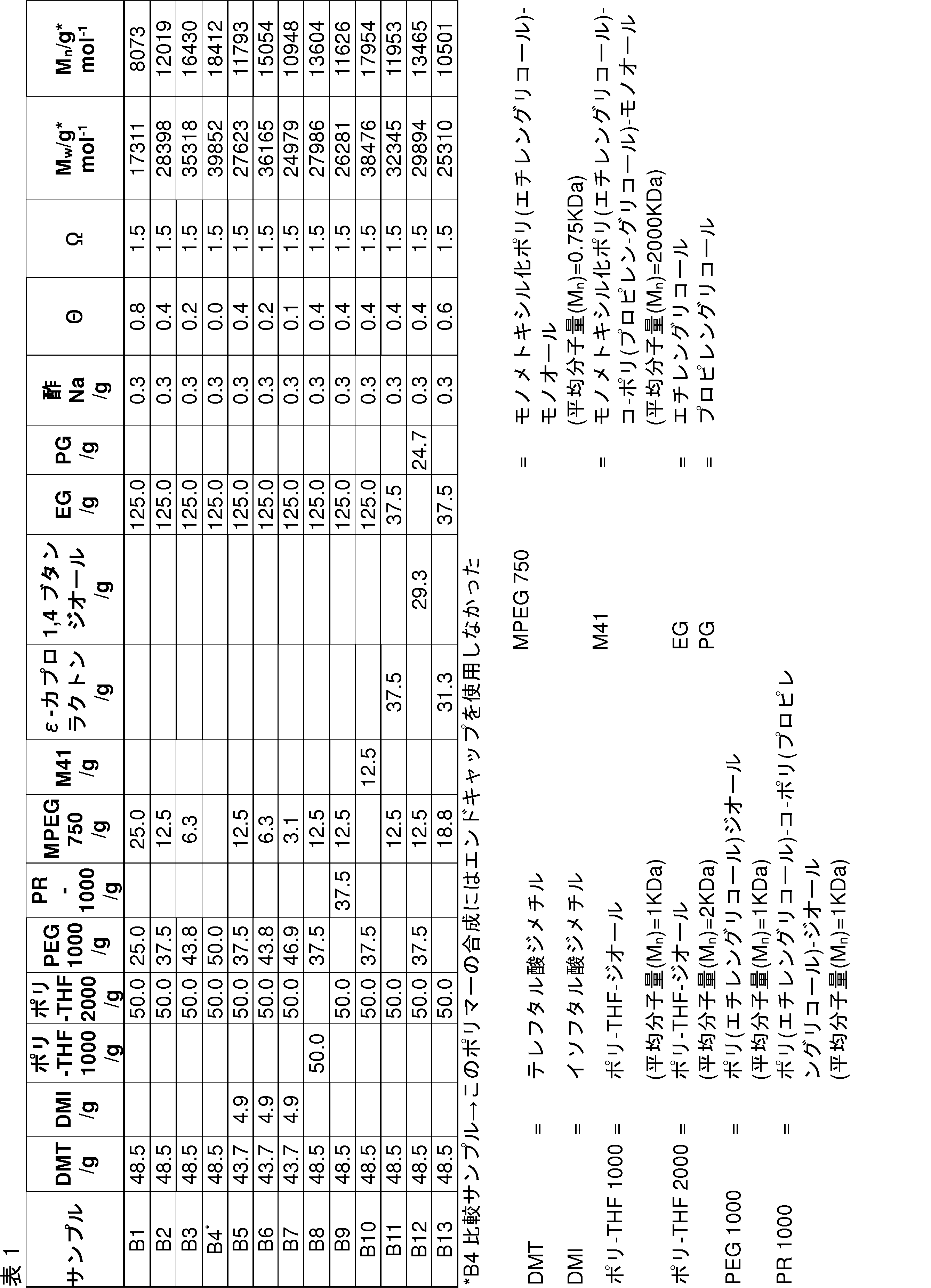
構成成分b:B1~B13:
ポリエステル-エーテルを、以下の一般手順を使用して製造した:
KPG撹拌器、ビグリューカラム、真空供給器および蒸留ブリッジを備えた500ml多頚フラスコにおいて、表1に従う化学物質を、窒素雰囲気下、表1に示す通りの量で反応器に入れる。混合物を60℃の内部温度に加熱し、続いて200μlのオルトチタン酸テトライソプロピルを添加する。
Component b: B1 to B13:
Polyester-ethers were prepared using the following general procedure:
In a 500 ml multi-necked flask equipped with a KPG stirrer, Vigreux column, vacuum feeder and distillation bridge, the chemicals according to Table 1 are placed in the reactor under a nitrogen atmosphere in the amounts as indicated in Table 1. The mixture is heated to an internal temperature of 60° C., followed by the addition of 200 μl of tetraisopropyl orthotitanate.
2時間以内に、弱窒素流(5l/時)下で反応混合物の温度を230℃に連続して上昇させ、この温度で2時間維持する。70℃に達した後、メタノールの蒸留が始まる。190℃に達した後、エチレングリコールの蒸留が連続して始まる。その後、N2流を停止し、反応混合物の圧力を、230℃で165分以内に400mbarに連続して下げ、続いて、さらに連続して、圧力を90分以内に1mbarに下げる。次のステップにおいて、反応混合物を、1mbarの圧力および230℃の内部温度でさらに4時間撹拌する。この期間の終了後、反応フラスコの内部圧力を、N2を使用して1barに戻し、続いてポリマー溶融物を反応器から取り出し、固化させる。 Within 2 hours, the temperature of the reaction mixture is continuously raised to 230° C. under a weak nitrogen flow (5 l/h) and maintained at this temperature for 2 hours. After reaching 70° C., distillation of methanol begins. After reaching 190° C., distillation of ethylene glycol begins continuously. The N2 flow is then stopped and the pressure of the reaction mixture is continuously reduced to 400 mbar within 165 minutes at 230° C., followed by a further continuous pressure reduction to 1 mbar within 90 minutes. In the next step the reaction mixture is stirred at a pressure of 1 mbar and an internal temperature of 230° C. for a further 4 hours. After this period the internal pressure of the reaction flask is returned to 1 bar using N2 and the polymer melt is subsequently removed from the reactor and allowed to solidify.
ポリエステル-エーテルの分子量を決定するために、以下の条件下でGPC測定を行った。
カラム:1×PSS SDV Guard、5μm、50mm×8.0mmID
1×PSS SDV 100Å、5μm、300mm×8.0mmID
1×PSS SDV 1000Å、5μm、300mm×8.0mmID
1×PSS SDV 100000Å、5μm、300mm×8.0mmID
検出器:RI
オーブン温度:40℃
流速:1ml/分
射出体積:50μl
溶離剤:THF
評価:PSS-WinGPCバージョン8.2
較正:682~1,670,000ダルトンの範囲のポリスチレン標準
内部標準:トルエン
射出濃度:THF中4g/l
To determine the molecular weight of the polyester-ether, GPC measurements were performed under the following conditions.
Column: 1×PSS SDV Guard, 5 μm, 50 mm×8.0 mm ID
1×PSS SDV 100Å, 5 μm, 300 mm×8.0 mm ID
1×PSS SDV 1000Å, 5μm, 300mm×8.0mm ID
1×PSS SDV 100000 Å, 5 μm, 300 mm×8.0 mm ID
Detector: RI
Oven temperature: 40°C
Flow rate: 1 ml/min Injection volume: 50 μl
Eluent: THF
Evaluation: PSS-WinGPC version 8.2
Calibration: polystyrene standards ranging from 682 to 1,670,000 daltons Internal standard: toluene Injection concentration: 4 g/l in THF
構成成分c:C1:
ステアリン酸コバルト固体形態(コバルト元素濃度9.5%)
Component c: C1:
Cobalt stearate solid form (elemental cobalt concentration 9.5%)
構成成分d:D1:
界面活性剤
Component d: D1:
surfactant
マスターバッチMB1~MB10
構成成分を、260℃の温度でLeistritz(登録商標)ZSE18HP押出機で一緒に均質化して、固体マスターバッチMBを得た。表2に詳細を示す。
Masterbatch MB1-MB10
The components were homogenized together in a Leistritz® ZSE18HP extruder at a temperature of 260° C. to obtain a solid masterbatch MB. Details are shown in Table 2.

キャストフィルムの製造:
操作モードの一例として、Colling E 25 PKを使用し、120℃で18時間事前乾燥した構成成分A1を装置の主ホッパーに挿入することによって、ならびに他の構成成分(MBおよび/または直接計量供給される純添加剤)を、射出ユニットバレルに入る前の構成成分A1の主流に取り付けられた計量供給ユニットにより添加することにより、押出によって200μmのキャストフィルムを得た。押出機温度は260℃で維持することができ、フラットダイ温度は270℃である。
Production of cast film:
As an example of a mode of operation, using Colling E 25 PK, by inserting component A1 pre-dried at 120° C. for 18 hours into the main hopper of the device, and other components (MB and/or directly metered A 200 μm cast film was obtained by extrusion by adding a dosing unit attached to the main stream of component A1 before entering the injection unit barrel. The extruder temperature can be maintained at 260°C and the flat die temperature is 270°C.
試験の間の操作条件は:T1=60℃/T2=240℃/T3=260℃/T4=260℃/T5=260℃/Tdie=270℃/Tcalender roller=70℃/スクリュー回転数80rpmであった。 The operating conditions during the test are: T1 = 60°C / T2 = 240°C / T3 = 260°C / T4 = 260°C / T5 = 260°C / T die = 270°C / T calender roller = 70°C / screw speed 80 rpm Met.

キャストフィルムに対応する酸素捕捉活性(捕捉組成物1グラムあたりの消費されたO2のml)を上記の方法によって測定した。表4は、異なるコポリマー構造および異なる量のエンドキャップを有する組成物の酸素消費を報告している。 The oxygen scavenging activity (ml of O2 consumed per gram of scavenging composition) corresponding to the cast film was measured by the method described above. Table 4 reports the oxygen consumption of compositions with different copolymer structures and different amounts of endcapping.

ex3~ex5およびcpex6の比較によって、存在するエンドキャップの量に関する酸素消費速度の有意な依存性が観察される。一般に、より多くの量のエンドキャップが導入された場合、消費される酸素の量は減少する。酸素消費速度は、ポリエステル-コポリエーテルに含有されたエンドキャップの量に強く依存し、そのため、エンドキャップの量を増加または減少させることによって、捕捉される酸素の量を微調整および制御することができる。 A significant dependence of the oxygen consumption rate on the amount of endcap present is observed by comparing ex3-ex5 and cpex6. In general, the amount of oxygen consumed decreases when a higher amount of endcap is introduced. The rate of oxygen consumption is strongly dependent on the amount of endcaps contained in the polyester-copolyether, so by increasing or decreasing the amount of endcaps it is possible to fine-tune and control the amount of oxygen trapped. can.
この効果は、ポリエステル-コポリエーテル添加剤が樹脂と一緒に押出機のホッパーに直接計量供給される場合、ならびにMBが製造される場合に観察される。 This effect is observed when the polyester-copolyether additive is metered directly into the hopper of the extruder with the resin as well as when MB is produced.
ex3~ex5およびcpex6のものとは異なるエンドキャップポリエステルを指すex11およびex13は、エンドキャップの量がより多いことが酸素消費の減少に反映されるという、まったく同じ挙動を示している。
本願は特許請求の範囲に記載の発明に係るものであるが、本願の開示は以下も包含する:
1.
(i)少なくとも1つのポリエーテルセグメントが少なくとも1つのポリテトラメチレンオキシドセグメントを含有する、ポリエーテルセグメントと、
(ii)ポリエステルセグメントと、
(iii)構造-CO-R2-CO-(式中、R2は、1~100個の炭素原子からなる、任意選択で置換された二価炭化水素残基を表す)の架橋要素と、
(iv)1または2つのエンドキャップR1-O-(C
2
~C
4
-O-)
e
-
*
(式中、R1は、任意選択で置換された炭化水素残基であり、eは0~1000の整数である)とを含むポリエーテル-ポリエステルコポリマー。
2.
ポリエーテルセグメント(i)が、エチレンオキシドセグメント、プロピレンオキシドセグメントまたはそれらの組合せを含有する、前記1.に記載のポリエーテル-ポリエステルコポリマー。
3.
ポリエステルセグメント(ii)が、式(II)

*
は、架橋要素(iii)への結合を表し、
R2およびR3は、互いに独立して、1~100個の炭素原子からなる、任意選択で置換された炭化水素残基を表し、
uは1~50の整数である)
で表される、前記1.または2.に記載のポリエーテル-ポリエステルコポリマー。
4.
架橋要素が、式(III)

で表される、前記1.~3.のいずれか一つに記載のポリエーテル-ポリエステルコポリマー。
5.
エンドキャップが、以下の一般式
R1-O-(C
2
~C
4
-O-)
e
-
*
(式中、R1は、1~24個の炭素原子の脂肪族炭化水素残基、2~24個の炭素原子のオレフィン系炭化水素残基、6~14個の炭素原子の芳香族炭化水素残基を表し、前記炭化水素残基は、任意選択で、C
1
~C
5
-アルコキシ、ニトロ、シアノ、スルホまたはそれらの組合せで置換されており、eは、0~500の整数である)
で表される、前記1.~4.のいずれか一つに記載のポリエーテル-ポリエステルコポリマー。
6.
R1-O-(C
2
~C
4
-O-)
e
-
*
が、以下の式

bは、0~250の整数であり、
aは、0~250の整数であり、
cは、0~70の整数であり、
a+b+cの合計は、0~570であり、
R1は、前記5.で定義される通りである)
に対応する、前記1.~5.のいずれか一つに記載のポリエーテル-ポリエステルコポリマー。
7.
R1が、メチル、エチル、n-プロピル、イソ-プロピル、n-ブチル、イソ-ブチル、sec-ブチル、tert-ブチル、n-ペンチル、イソ-ペンチル、sec-ペンチル、ネオ-ペンチル、1,2-ジメチルプロピル、イソ-アミル、n-ヘキシル、sec-ヘキシル、n-ヘプチル、n-オクチル、2-エチル-ヘキシル、n-ノニル、n-デシル、トリデシル、イソトリデシル、テトラデシル、ヘキサデシル、オクタデシル、メチルフェニル、シクロプロピル、シクロブチル、シクロペンチル、シクロヘキシル、シクロヘプチル、シクロオクチル、シクロノニル、またはシクロデシルを表す、前記1.~6.のいずれか一つに記載のポリエーテル-ポリエステルコポリマー。
8.
数平均分子量が、2000~1000000g/molである、前記1.~7.のいずれか一つに記載のポリエーテル-ポリエステルコポリマー。
9.
ポリ(テトラメチレンオキシド)含有量とすべてのジカルボニル構造要素(ii)および(iii)の総含有量との質量比として定義される質量比Ωが、0.1~10である、前記1.~8.のいずれか一つに記載のポリエーテル-ポリエステルコポリマー。
10.
エンドキャップ含有量とすべてのジカルボニル構造要素(ii)および(iii)の総含有量との質量比として定義される質量比Θが、0.001~100である、前記1.~9.のいずれか一つに記載のポリエーテル-ポリエステルコポリマー。
11.
少なくとも1つのポリテトラメチレンオキシドセグメントを含有するポリエーテルセグメントと、ポリエステルセグメントと、架橋要素と、エンドキャップとの重縮合を含む、前記1.~10.のいずれか一つに記載のポリエーテル-ポリエステルコポリマーを製造する方法。
12.
前記1.~10.のいずれか一つに記載のポリエーテル-ポリエステルコポリマーと、遷移金属触媒とを含む、活性酸素バリア組成物。
13.
熱可塑性ポリマーである構成成分a)と、
前記1.~10.のいずれか一つに記載のポリエーテル-ポリエステルコポリマーである構成成分b)と、
遷移金属触媒である構成成分c)と
を含む、可塑性材料。
14.
マスターバッチ、コンパウンドまたは成形物品である、前記13.に記載の可塑性材料。
15.
容器もしくはフィルムである、またはそれらの一部である、前記13.または14.に記載の可塑性材料。
Ex11 and ex13, which refer to end-capped polyesters different from those of ex3-ex5 and cpex6, exhibit exactly the same behavior, with higher amounts of end-cap reflected in reduced oxygen consumption.
Although the present application is directed to the claimed invention, the disclosure of the present application also includes:
1.
(i) a polyether segment, wherein at least one polyether segment contains at least one polytetramethylene oxide segment;
(ii) a polyester segment;
(iii) a bridging element of the structure -CO-R2-CO-, where R2 represents an optionally substituted divalent hydrocarbon residue consisting of 1 to 100 carbon atoms;
(iv) one or two endcapped R1-O-(C2-C4- O- ) e- * , where R1 is an optionally substituted hydrocarbon residue and e is from 0 to is an integer of 1000).
2.
1. above, wherein the polyether segment (i) contains an ethylene oxide segment, a propylene oxide segment, or a combination thereof. A polyether-polyester copolymer as described in .
3.
polyester segment (ii) is represented by formula (II)
* represents a bond to bridging element (iii),
R2 and R3 independently of each other represent optionally substituted hydrocarbon residues consisting of 1 to 100 carbon atoms,
u is an integer from 1 to 50)
represented by the above 1. or 2. A polyether-polyester copolymer as described in .
4.
The bridging element is of formula (III)
represented by the above 1. ~3. A polyether-polyester copolymer according to any one of
5.
The end cap has the general formula
R1-O-(C2 - C4 - O- ) e- *
(wherein R1 is an aliphatic hydrocarbon residue of 1 to 24 carbon atoms, an olefinic hydrocarbon residue of 2 to 24 carbon atoms, an aromatic hydrocarbon residue of 6 to 14 carbon atoms, group, said hydrocarbon residue optionally substituted with C 1 -C 5 -alkoxy, nitro, cyano, sulfo or combinations thereof, e is an integer from 0 to 500)
represented by the above 1. ~ 4. A polyether-polyester copolymer according to any one of
6.
R1-O-(C 2 -C 4 -O-) e − * is the following formula
b is an integer from 0 to 250,
a is an integer from 0 to 250,
c is an integer from 0 to 70,
the sum of a+b+c is from 0 to 570;
R1 is the same as in 5. above. (as defined in
corresponding to 1. above. ~ 5. A polyether-polyester copolymer according to any one of
7.
R1 is methyl, ethyl, n-propyl, iso-propyl, n-butyl, iso-butyl, sec-butyl, tert-butyl, n-pentyl, iso-pentyl, sec-pentyl, neo-pentyl, 1,2 -dimethylpropyl, iso-amyl, n-hexyl, sec-hexyl, n-heptyl, n-octyl, 2-ethyl-hexyl, n-nonyl, n-decyl, tridecyl, isotridecyl, tetradecyl, hexadecyl, octadecyl, methylphenyl , cyclopropyl, cyclobutyl, cyclopentyl, cyclohexyl, cycloheptyl, cyclooctyl, cyclononyl, or cyclodecyl. ~6. A polyether-polyester copolymer according to any one of
8.
1. The number average molecular weight is 2000 to 1000000 g/mol. ~7. A polyether-polyester copolymer according to any one of
9.
1., wherein the mass ratio Ω, defined as the mass ratio of the poly(tetramethylene oxide) content to the total content of all dicarbonyl structural elements (ii) and (iii), is 0.1 to 10; ~8. A polyether-polyester copolymer according to any one of
10.
1. The mass ratio Θ defined as the mass ratio of the endcapped content to the total content of all dicarbonyl structural elements (ii) and (iii) is 0.001 to 100. ~ 9. A polyether-polyester copolymer according to any one of
11.
1. above comprising polycondensation of polyether segments containing at least one polytetramethylene oxide segment, polyester segments, bridging elements and end caps. ~ 10. A method of making a polyether-polyester copolymer according to any one of
12.
1 above. ~ 10. and a transition metal catalyst.
13.
Component a), which is a thermoplastic polymer,
1 above. ~ 10. component b) which is a polyether-polyester copolymer according to any one of
component c), which is a transition metal catalyst;
A plastic material, including
14.
The above 13. which is a masterbatch, a compound or a molded article. The plastic material according to .
15.
13. above, which is a container or a film, or a part thereof. or 14. The plastic material according to .
Claims (12)
(i)少なくとも1つのポリエーテルセグメントが少なくとも1つのポリテトラメチレンオキシドセグメントを含有する、ポリエーテルセグメントと、
(ii)ポリエステルセグメントと、
(iii)構造-CO-R2-CO-(式中、R2は、1~100個の炭素原子からなる、任意選択で置換された二価炭化水素残基を表す)の架橋要素と、
(iv)1または2つのエンドキャップR1-O-(C2~C4-O-)e-*(式中、R1は、1~24個の炭素原子の脂肪族炭化水素残基、2~24個の炭素原子のオレフィン系炭化水素残基、6~14個の炭素原子の芳香族炭化水素残基を表し、前記炭化水素残基は、任意選択で、C 1 ~C 5 -アルコキシ、ニトロ、シアノ、スルホまたはそれらの組合せで置換されており、(C 2 ~C 4 -O-)の部分が存在し、eは500までの整数である)とを含み、前記ポリエーテルセグメント(i)が、エチレンオキシドセグメント、プロピレンオキシドセグメントまたはそれらの組合せを含有する、前記活性酸素バリア組成物。 An active oxygen barrier composition comprising a polyether-polyester copolymer and a transition metal catalyst, wherein the polyether-polyester copolymer comprises
(i) a polyether segment, wherein at least one polyether segment contains at least one polytetramethylene oxide segment;
(ii) a polyester segment;
(iii) a bridging element of the structure -CO-R2-CO-, where R2 represents an optionally substituted divalent hydrocarbon residue consisting of 1 to 100 carbon atoms;
(iv) one or two end-capped R1-O-( C2 - C4 -O-) e- * , wherein R1 is an aliphatic hydrocarbon residue of 1-24 carbon atoms, 2- Represents an olefinic hydrocarbon residue of 24 carbon atoms, an aromatic hydrocarbon residue of 6 to 14 carbon atoms, said hydrocarbon residues optionally being C 1 -C 5 -alkoxy, nitro , cyano, sulfo or combinations thereof, wherein the (C 2 -C 4 —O—) moiety is present and e is an integer up to 500 ), wherein the polyether segment (i) contains ethylene oxide segments, propylene oxide segments, or combinations thereof.

*は、架橋要素(iii)への結合を表し、
R2およびR3は、互いに独立して、1~100個の炭素原子からなる、任意選択で置換された炭化水素残基を表し、
uは1~50の整数である)
で表される、請求項1に記載の活性酸素バリア組成物。 polyester segment (ii) is represented by formula (II)
* represents a bond to bridging element (iii),
R2 and R3 independently of each other represent optionally substituted hydrocarbon residues consisting of 1 to 100 carbon atoms,
u is an integer from 1 to 50)
The active oxygen barrier composition according to claim 1, represented by

で表される、請求項1または2に記載の活性酸素バリア組成物。 The bridging element is of formula (III)
The active oxygen barrier composition according to claim 1 or 2, represented by.

bは、0~250の整数であり、
aは、0~250の整数であり、
cは、0~70の整数であり、
a+b+cの合計は、0~570であり、
R1は、請求項1で定義される通りである)
に対応する、請求項1~3のいずれか一つに記載の活性酸素バリア組成物。 R1-O-(C 2 -C 4 -O-) e − * is the following formula
b is an integer from 0 to 250,
a is an integer from 0 to 250,
c is an integer from 0 to 70,
the sum of a+b+c is from 0 to 570;
R1 is as defined in claim 1)
The active oxygen barrier composition according to any one of claims 1 to 3, corresponding to
請求項1~9のいずれか一つに定義されるポリエーテル-ポリエステルコポリマーである構成成分b)と、
遷移金属触媒である構成成分c)と
を含む、可塑性材料。 Component a), which is a thermoplastic polymer,
component b) being a polyether-polyester copolymer as defined in any one of claims 1 to 9;
A plastic material comprising component c) which is a transition metal catalyst.
Applications Claiming Priority (3)
| Application Number | Priority Date | Filing Date | Title |
|---|---|---|---|
| EP17156041.0A EP3360911A1 (en) | 2017-02-14 | 2017-02-14 | Oxygen scavenging plastic material |
| EP17156041.0 | 2017-02-14 | ||
| PCT/EP2018/053399 WO2018149778A1 (en) | 2017-02-14 | 2018-02-12 | Oxygen scavenging plastic material |
Publications (2)
| Publication Number | Publication Date |
|---|---|
| JP2020507654A JP2020507654A (en) | 2020-03-12 |
| JP7127045B2 true JP7127045B2 (en) | 2022-08-29 |
Family
ID=58054013
Family Applications (1)
| Application Number | Title | Priority Date | Filing Date |
|---|---|---|---|
| JP2019543077A Active JP7127045B2 (en) | 2017-02-14 | 2018-02-12 | Oxygen scavenging plastic material |
Country Status (16)
| Country | Link |
|---|---|
| US (1) | US11447627B2 (en) |
| EP (2) | EP3360911A1 (en) |
| JP (1) | JP7127045B2 (en) |
| KR (1) | KR102548545B1 (en) |
| CN (1) | CN110291131B (en) |
| AR (1) | AR111152A1 (en) |
| AU (1) | AU2018222474B2 (en) |
| EA (1) | EA201991903A1 (en) |
| ES (1) | ES2868096T3 (en) |
| MX (1) | MX2019009391A (en) |
| MY (1) | MY192428A (en) |
| SA (1) | SA519402349B1 (en) |
| SG (1) | SG11201906649VA (en) |
| TW (1) | TWI756351B (en) |
| UA (1) | UA124040C2 (en) |
| WO (1) | WO2018149778A1 (en) |
Families Citing this family (25)
| Publication number | Priority date | Publication date | Assignee | Title |
|---|---|---|---|---|
| EP3360911A1 (en) | 2017-02-14 | 2018-08-15 | Clariant Plastics & Coatings Ltd | Oxygen scavenging plastic material |
| BR112020006619A2 (en) * | 2017-10-02 | 2020-10-06 | Basf Se | container made of a thermoplastic molding composition, process for producing a container, use of a container, capsule and thermoplastic molding composition |
| CN111433340B (en) * | 2017-11-17 | 2022-03-04 | 联合利华知识产权控股有限公司 | Soil release polymers and laundry detergent compositions containing the same |
| EP3489340A1 (en) * | 2017-11-28 | 2019-05-29 | Clariant International Ltd | Renewably sourced soil release polyesters |
| US12030984B2 (en) | 2018-05-24 | 2024-07-09 | Clariant International Ltd | Soil release polyesters for use in detergent compositions |
| EP3594260B1 (en) * | 2018-07-13 | 2025-02-19 | Avient Switzerland GmbH | Composition comprising a polyester-polyether polymer, a transition metal catalyst, and an active material |
| CN118270377A (en) | 2019-05-14 | 2024-07-02 | 艾尔诺沃股份有限公司 | Vessel for holding an active substance, corresponding closure and container comprising such a vessel |
| CN113825567B (en) | 2019-05-14 | 2024-07-26 | 艾尔诺沃股份有限公司 | Vessels for storing active substances and corresponding covers and containers |
| TWI712646B (en) * | 2019-06-27 | 2020-12-11 | 遠東新世紀股份有限公司 | Polyester composition |
| CN114929363B (en) | 2020-01-03 | 2024-08-23 | 艾尔诺沃股份有限公司 | Breathable element for a container |
| US12172822B2 (en) | 2020-01-03 | 2024-12-24 | Airnov, Inc. | Assembly defining a chamber for an active material |
| CA3175917A1 (en) | 2020-04-30 | 2021-11-04 | Mark FLOREZ | Marking method and marked receptacle |
| CN116615380B (en) | 2020-12-18 | 2026-03-31 | 艾尔诺沃股份有限公司 | Anti-theft closure |
| US20240017906A1 (en) | 2020-12-29 | 2024-01-18 | Airnov, Inc. | A gas-permeable element and a method of manufacturing the same |
| CN113956451A (en) * | 2021-12-07 | 2022-01-21 | 中国科学院宁波材料技术与工程研究所 | Degradable high-gas-barrier polyester-polycarbonate copolymer, preparation method and application |
| CN114044888B (en) * | 2021-12-07 | 2024-02-13 | 中国科学院宁波材料技术与工程研究所 | Hydrolytically degradable polymers, preparation methods and applications thereof |
| CA3240294A1 (en) * | 2021-12-24 | 2023-06-29 | Bing Wang | Process for the production of polyester (co)polymers |
| HUE068001T2 (en) | 2021-12-30 | 2024-12-28 | Airnov Inc | Blister pack |
| EP4209429B1 (en) | 2021-12-30 | 2025-08-27 | Airnov, Inc. | Dispensing device |
| TW202327952A (en) | 2021-12-31 | 2023-07-16 | 美商艾爾諾沃股份有限公司 | Assembly defining a chamber for an active material and method for manufacturing such an assembly |
| GB202215453D0 (en) | 2022-10-19 | 2022-11-30 | Colormatrix Holdings Inc | Scavenging oxygen |
| PT4393837T (en) | 2022-12-30 | 2025-12-03 | Airnov Inc | Tamper-evident closure |
| CN120584079A (en) | 2023-01-24 | 2025-09-02 | 艾尔诺沃股份有限公司 | Sealing cap and closure including the sealing cap |
| WO2025155973A1 (en) * | 2024-01-18 | 2025-07-24 | Csp Technologies, Inc. | Blown films with oxygen scavenging agent and methods of making the same |
| EP4620857A1 (en) | 2024-03-18 | 2025-09-24 | Airnov, Inc. | Blister pack |
Citations (4)
| Publication number | Priority date | Publication date | Assignee | Title |
|---|---|---|---|---|
| US20110008554A1 (en) | 2007-08-31 | 2011-01-13 | Invista North America S.A.R.I. | Oxygen scavenging plastic compositions |
| US20120114887A1 (en) | 2009-02-20 | 2012-05-10 | INVISTA North America S,ar.l. | Oxygen scavenging resin with short induction period |
| US20160130433A1 (en) | 2014-11-07 | 2016-05-12 | Graham Packaging Company, L.P. | Oxygen scavenging compositions requiring no induction period |
| US20160222205A1 (en) | 2015-01-30 | 2016-08-04 | Graham Packaging Company, L.P. | Durable oxygen scavenging plastic containers |
Family Cites Families (12)
| Publication number | Priority date | Publication date | Assignee | Title |
|---|---|---|---|---|
| JPS5137993A (en) * | 1974-09-27 | 1976-03-30 | Teijin Ltd | SEIDENSEI HORIESUTERUNO SEIZOHO |
| JPS59135222A (en) * | 1983-01-25 | 1984-08-03 | Teijin Ltd | Copolyester |
| JPH03229724A (en) * | 1990-02-02 | 1991-10-11 | Du Pont Toray Co Ltd | Production of polyester elastomer copolymer |
| NZ334569A (en) | 1996-09-23 | 2000-08-25 | Bp Amoco Corp | Multilayered plastic containers that are resistant to oxygen permeation |
| US6083585A (en) | 1996-09-23 | 2000-07-04 | Bp Amoco Corporation | Oxygen scavenging condensation copolymers for bottles and packaging articles |
| US6455620B1 (en) | 1999-08-10 | 2002-09-24 | Eastman Chemical Company | Polyether containing polymers for oxygen scavenging |
| JP4651146B2 (en) * | 2000-02-24 | 2011-03-16 | 三菱エンジニアリングプラスチックス株式会社 | Copolyester ether and film comprising the same |
| ES2321623T3 (en) | 2003-12-17 | 2009-06-09 | Dsm Ip Assets B.V. | DEOXIGENATING COMPOSITION. |
| EP1701998B1 (en) | 2003-12-17 | 2011-02-09 | DSM IP Assets B.V. | Oxygen scavenging composition |
| EP2886601A1 (en) * | 2013-12-20 | 2015-06-24 | Invista Technologies S.A R.L. | Improved polyester-ether resin blends |
| US9447321B2 (en) * | 2014-01-16 | 2016-09-20 | Graham Packaging Company, L.P. | Oxygen scavenging compositions for plastic containers |
| EP3360911A1 (en) | 2017-02-14 | 2018-08-15 | Clariant Plastics & Coatings Ltd | Oxygen scavenging plastic material |
-
2017
- 2017-02-14 EP EP17156041.0A patent/EP3360911A1/en not_active Withdrawn
-
2018
- 2018-01-30 TW TW107103239A patent/TWI756351B/en active
- 2018-02-12 MX MX2019009391A patent/MX2019009391A/en unknown
- 2018-02-12 CN CN201880011550.XA patent/CN110291131B/en active Active
- 2018-02-12 ES ES18708911T patent/ES2868096T3/en active Active
- 2018-02-12 UA UAA201909811A patent/UA124040C2/en unknown
- 2018-02-12 EA EA201991903A patent/EA201991903A1/en unknown
- 2018-02-12 SG SG11201906649VA patent/SG11201906649VA/en unknown
- 2018-02-12 WO PCT/EP2018/053399 patent/WO2018149778A1/en not_active Ceased
- 2018-02-12 EP EP18708911.5A patent/EP3583152B8/en active Active
- 2018-02-12 MY MYPI2019004094A patent/MY192428A/en unknown
- 2018-02-12 KR KR1020197026728A patent/KR102548545B1/en active Active
- 2018-02-12 JP JP2019543077A patent/JP7127045B2/en active Active
- 2018-02-12 US US16/485,565 patent/US11447627B2/en active Active
- 2018-02-12 AU AU2018222474A patent/AU2018222474B2/en active Active
- 2018-02-14 AR ARP180100348A patent/AR111152A1/en active IP Right Grant
-
2019
- 2019-07-30 SA SA519402349A patent/SA519402349B1/en unknown
Patent Citations (5)
| Publication number | Priority date | Publication date | Assignee | Title |
|---|---|---|---|---|
| US20110008554A1 (en) | 2007-08-31 | 2011-01-13 | Invista North America S.A.R.I. | Oxygen scavenging plastic compositions |
| US20120114887A1 (en) | 2009-02-20 | 2012-05-10 | INVISTA North America S,ar.l. | Oxygen scavenging resin with short induction period |
| JP2012518709A (en) | 2009-02-20 | 2012-08-16 | インビスタ テクノロジーズ エス エイ アール エル | Oxygen scavenging resin with a short induction period |
| US20160130433A1 (en) | 2014-11-07 | 2016-05-12 | Graham Packaging Company, L.P. | Oxygen scavenging compositions requiring no induction period |
| US20160222205A1 (en) | 2015-01-30 | 2016-08-04 | Graham Packaging Company, L.P. | Durable oxygen scavenging plastic containers |
Also Published As
| Publication number | Publication date |
|---|---|
| EP3583152B8 (en) | 2021-05-05 |
| WO2018149778A1 (en) | 2018-08-23 |
| KR102548545B1 (en) | 2023-06-29 |
| TWI756351B (en) | 2022-03-01 |
| US11447627B2 (en) | 2022-09-20 |
| TW201841975A (en) | 2018-12-01 |
| EP3583152A1 (en) | 2019-12-25 |
| SG11201906649VA (en) | 2019-08-27 |
| AU2018222474A1 (en) | 2019-08-01 |
| JP2020507654A (en) | 2020-03-12 |
| AR111152A1 (en) | 2019-06-12 |
| SA519402349B1 (en) | 2022-08-01 |
| CA3050058A1 (en) | 2018-08-23 |
| ES2868096T3 (en) | 2021-10-21 |
| AU2018222474B2 (en) | 2022-12-15 |
| EA201991903A1 (en) | 2020-01-20 |
| MX2019009391A (en) | 2019-10-15 |
| CN110291131A (en) | 2019-09-27 |
| EP3360911A1 (en) | 2018-08-15 |
| KR20190112325A (en) | 2019-10-04 |
| NZ757265A (en) | 2024-11-29 |
| CN110291131B (en) | 2022-09-16 |
| MY192428A (en) | 2022-08-19 |
| UA124040C2 (en) | 2021-07-07 |
| US20200017679A1 (en) | 2020-01-16 |
| BR112019015421A2 (en) | 2020-03-31 |
| EP3583152B1 (en) | 2021-03-24 |
Similar Documents
| Publication | Publication Date | Title |
|---|---|---|
| JP7127045B2 (en) | Oxygen scavenging plastic material | |
| KR101829486B1 (en) | Oxygen scavenging plastic material | |
| CN105051098B (en) | Oxygen removes plastic material | |
| TWI825122B (en) | Composition comprising a polyester-polyether polymer, a transition metal catalyst, and an active material | |
| CA2941780A1 (en) | Oxygen scavenging composition for plastic material | |
| CA3050058C (en) | Oxygen scavenging plastic material | |
| EA042846B1 (en) | OXYGEN ABSORPTING PLASTIC MATERIAL | |
| RU2778512C1 (en) | Composition containing composite polyester-polyester polymer, catalyst based on transitional metal and active material | |
| BR112019015421B1 (en) | POLYETHER-POLYESTER COPOLYMER, ITS PREPARATION METHOD, COMPOSITION OF ACTIVE OXYGEN BARRIER AND OXYGEN ABSORBING PLASTIC MATERIAL |
Legal Events
| Date | Code | Title | Description |
|---|---|---|---|
| A621 | Written request for application examination |
Free format text: JAPANESE INTERMEDIATE CODE: A621 Effective date: 20201224 |
|
| A977 | Report on retrieval |
Free format text: JAPANESE INTERMEDIATE CODE: A971007 Effective date: 20211208 |
|
| A131 | Notification of reasons for refusal |
Free format text: JAPANESE INTERMEDIATE CODE: A131 Effective date: 20211222 |
|
| A521 | Request for written amendment filed |
Free format text: JAPANESE INTERMEDIATE CODE: A523 Effective date: 20220311 |
|
| A131 | Notification of reasons for refusal |
Free format text: JAPANESE INTERMEDIATE CODE: A131 Effective date: 20220427 |
|
| A521 | Request for written amendment filed |
Free format text: JAPANESE INTERMEDIATE CODE: A523 Effective date: 20220705 |
|
| TRDD | Decision of grant or rejection written | ||
| A01 | Written decision to grant a patent or to grant a registration (utility model) |
Free format text: JAPANESE INTERMEDIATE CODE: A01 Effective date: 20220803 |
|
| A61 | First payment of annual fees (during grant procedure) |
Free format text: JAPANESE INTERMEDIATE CODE: A61 Effective date: 20220817 |
|
| R150 | Certificate of patent or registration of utility model |
Ref document number: 7127045 Country of ref document: JP Free format text: JAPANESE INTERMEDIATE CODE: R150 |
|
| R250 | Receipt of annual fees |
Free format text: JAPANESE INTERMEDIATE CODE: R250 |