JP7133473B2 - Labeled Nucleotide Compositions and Methods for Determining the Sequence of Nucleic Acids - Google Patents
Labeled Nucleotide Compositions and Methods for Determining the Sequence of Nucleic Acids Download PDFInfo
- Publication number
- JP7133473B2 JP7133473B2 JP2018560905A JP2018560905A JP7133473B2 JP 7133473 B2 JP7133473 B2 JP 7133473B2 JP 2018560905 A JP2018560905 A JP 2018560905A JP 2018560905 A JP2018560905 A JP 2018560905A JP 7133473 B2 JP7133473 B2 JP 7133473B2
- Authority
- JP
- Japan
- Prior art keywords
- luminescent
- nucleic acid
- nucleotides
- nucleotide
- molecule
- Prior art date
- Legal status (The legal status is an assumption and is not a legal conclusion. Google has not performed a legal analysis and makes no representation as to the accuracy of the status listed.)
- Active
Links
Images


Classifications
-
- C—CHEMISTRY; METALLURGY
- C12—BIOCHEMISTRY; BEER; SPIRITS; WINE; VINEGAR; MICROBIOLOGY; ENZYMOLOGY; MUTATION OR GENETIC ENGINEERING
- C12Q—MEASURING OR TESTING PROCESSES INVOLVING ENZYMES, NUCLEIC ACIDS OR MICROORGANISMS; COMPOSITIONS OR TEST PAPERS THEREFOR; PROCESSES OF PREPARING SUCH COMPOSITIONS; CONDITION-RESPONSIVE CONTROL IN MICROBIOLOGICAL OR ENZYMOLOGICAL PROCESSES
- C12Q1/00—Measuring or testing processes involving enzymes, nucleic acids or microorganisms; Compositions therefor; Processes of preparing such compositions
- C12Q1/68—Measuring or testing processes involving enzymes, nucleic acids or microorganisms; Compositions therefor; Processes of preparing such compositions involving nucleic acids
- C12Q1/6869—Methods for sequencing
-
- C—CHEMISTRY; METALLURGY
- C12—BIOCHEMISTRY; BEER; SPIRITS; WINE; VINEGAR; MICROBIOLOGY; ENZYMOLOGY; MUTATION OR GENETIC ENGINEERING
- C12Q—MEASURING OR TESTING PROCESSES INVOLVING ENZYMES, NUCLEIC ACIDS OR MICROORGANISMS; COMPOSITIONS OR TEST PAPERS THEREFOR; PROCESSES OF PREPARING SUCH COMPOSITIONS; CONDITION-RESPONSIVE CONTROL IN MICROBIOLOGICAL OR ENZYMOLOGICAL PROCESSES
- C12Q1/00—Measuring or testing processes involving enzymes, nucleic acids or microorganisms; Compositions therefor; Processes of preparing such compositions
- C12Q1/68—Measuring or testing processes involving enzymes, nucleic acids or microorganisms; Compositions therefor; Processes of preparing such compositions involving nucleic acids
- C12Q1/6813—Hybridisation assays
- C12Q1/6816—Hybridisation assays characterised by the detection means
-
- C—CHEMISTRY; METALLURGY
- C07—ORGANIC CHEMISTRY
- C07H—SUGARS; DERIVATIVES THEREOF; NUCLEOSIDES; NUCLEOTIDES; NUCLEIC ACIDS
- C07H21/00—Compounds containing two or more mononucleotide units having separate phosphate or polyphosphate groups linked by saccharide radicals of nucleoside groups, e.g. nucleic acids
-
- C—CHEMISTRY; METALLURGY
- C12—BIOCHEMISTRY; BEER; SPIRITS; WINE; VINEGAR; MICROBIOLOGY; ENZYMOLOGY; MUTATION OR GENETIC ENGINEERING
- C12Q—MEASURING OR TESTING PROCESSES INVOLVING ENZYMES, NUCLEIC ACIDS OR MICROORGANISMS; COMPOSITIONS OR TEST PAPERS THEREFOR; PROCESSES OF PREPARING SUCH COMPOSITIONS; CONDITION-RESPONSIVE CONTROL IN MICROBIOLOGICAL OR ENZYMOLOGICAL PROCESSES
- C12Q2525/00—Reactions involving modified oligonucleotides, nucleic acids, or nucleotides
- C12Q2525/10—Modifications characterised by
- C12Q2525/101—Modifications characterised by incorporating non-naturally occurring nucleotides, e.g. inosine
-
- C—CHEMISTRY; METALLURGY
- C12—BIOCHEMISTRY; BEER; SPIRITS; WINE; VINEGAR; MICROBIOLOGY; ENZYMOLOGY; MUTATION OR GENETIC ENGINEERING
- C12Q—MEASURING OR TESTING PROCESSES INVOLVING ENZYMES, NUCLEIC ACIDS OR MICROORGANISMS; COMPOSITIONS OR TEST PAPERS THEREFOR; PROCESSES OF PREPARING SUCH COMPOSITIONS; CONDITION-RESPONSIVE CONTROL IN MICROBIOLOGICAL OR ENZYMOLOGICAL PROCESSES
- C12Q2525/00—Reactions involving modified oligonucleotides, nucleic acids, or nucleotides
- C12Q2525/10—Modifications characterised by
- C12Q2525/197—Modifications characterised by incorporating a spacer/coupling moiety
-
- C—CHEMISTRY; METALLURGY
- C12—BIOCHEMISTRY; BEER; SPIRITS; WINE; VINEGAR; MICROBIOLOGY; ENZYMOLOGY; MUTATION OR GENETIC ENGINEERING
- C12Q—MEASURING OR TESTING PROCESSES INVOLVING ENZYMES, NUCLEIC ACIDS OR MICROORGANISMS; COMPOSITIONS OR TEST PAPERS THEREFOR; PROCESSES OF PREPARING SUCH COMPOSITIONS; CONDITION-RESPONSIVE CONTROL IN MICROBIOLOGICAL OR ENZYMOLOGICAL PROCESSES
- C12Q2525/00—Reactions involving modified oligonucleotides, nucleic acids, or nucleotides
- C12Q2525/30—Oligonucleotides characterised by their secondary structure
- C12Q2525/301—Hairpin oligonucleotides
-
- C—CHEMISTRY; METALLURGY
- C12—BIOCHEMISTRY; BEER; SPIRITS; WINE; VINEGAR; MICROBIOLOGY; ENZYMOLOGY; MUTATION OR GENETIC ENGINEERING
- C12Q—MEASURING OR TESTING PROCESSES INVOLVING ENZYMES, NUCLEIC ACIDS OR MICROORGANISMS; COMPOSITIONS OR TEST PAPERS THEREFOR; PROCESSES OF PREPARING SUCH COMPOSITIONS; CONDITION-RESPONSIVE CONTROL IN MICROBIOLOGICAL OR ENZYMOLOGICAL PROCESSES
- C12Q2563/00—Nucleic acid detection characterized by the use of physical, structural and functional properties
- C12Q2563/103—Nucleic acid detection characterized by the use of physical, structural and functional properties luminescence
-
- G—PHYSICS
- G01—MEASURING; TESTING
- G01N—INVESTIGATING OR ANALYSING MATERIALS BY DETERMINING THEIR CHEMICAL OR PHYSICAL PROPERTIES
- G01N21/00—Investigating or analysing materials by the use of optical means, i.e. using sub-millimetre waves, infrared, visible or ultraviolet light
- G01N21/62—Systems in which the material investigated is excited whereby it emits light or causes a change in wavelength of the incident light
- G01N21/63—Systems in which the material investigated is excited whereby it emits light or causes a change in wavelength of the incident light optically excited
- G01N21/64—Fluorescence; Phosphorescence
- G01N21/645—Specially adapted constructive features of fluorimeters
- G01N21/648—Specially adapted constructive features of fluorimeters using evanescent coupling or surface plasmon coupling for the excitation of fluorescence
Landscapes
- Chemical & Material Sciences (AREA)
- Life Sciences & Earth Sciences (AREA)
- Organic Chemistry (AREA)
- Health & Medical Sciences (AREA)
- Proteomics, Peptides & Aminoacids (AREA)
- Engineering & Computer Science (AREA)
- Zoology (AREA)
- Wood Science & Technology (AREA)
- Molecular Biology (AREA)
- Biochemistry (AREA)
- Genetics & Genomics (AREA)
- Biotechnology (AREA)
- General Health & Medical Sciences (AREA)
- General Engineering & Computer Science (AREA)
- Immunology (AREA)
- Physics & Mathematics (AREA)
- Bioinformatics & Cheminformatics (AREA)
- Microbiology (AREA)
- Analytical Chemistry (AREA)
- Biophysics (AREA)
- Measuring Or Testing Involving Enzymes Or Micro-Organisms (AREA)
- Saccharide Compounds (AREA)
- Medicinal Preparation (AREA)
- Investigating, Analyzing Materials By Fluorescence Or Luminescence (AREA)
Description
本出願は、概して、生物学的試料および化学的試料の少なくとも一方の迅速な超並列定量分析を実施するための方法、組成物、およびデバイス、ならびに上記デバイスを製造するための方法に関する。 The present application relates generally to methods, compositions, and devices for performing rapid, massively parallel, quantitative analysis of biological and/or chemical samples, and methods for manufacturing such devices.
生物学的試料の検出および分析は、生物学的アッセイ(「バイオアッセイ」)を使用して実施され得る。従来法では、バイオアッセイには、大型で高価な実験装置が関与し、そのような装置には、装置を操作し、バイオアッセイを実施するように訓練された研究者が必要とされる。さらに、バイオアッセイは、従来法ではバルクで実施されるため、検出および定量化には、大量の特定のタイプの試料が必要である。 Detection and analysis of biological samples can be performed using biological assays (“bioassays”). Conventionally, bioassays involve large and expensive laboratory equipment, and such equipment requires researchers trained to operate the equipment and perform bioassays. Furthermore, bioassays are conventionally performed in bulk, requiring large amounts of specific types of samples for detection and quantification.
いくつかのバイオアッセイは、特定の波長の光を放射する発光マーカーを用いて試料をタグ付けすることにより実施される。マーカーが光源で照射されて発光を引き起こし、その発光光が光検出器で検出されて、マーカーにより放射された発光光の量を定量する。発光マーカーを使用するバイオアッセイには従来、試料を照射するための高価なレーザー光源、および複雑な発光検出光学系、および照射された試料からの発光を収集するための電子機器系が関与する。 Some bioassays are performed by tagging samples with luminescent markers that emit light at specific wavelengths. The marker is illuminated with a light source to cause it to emit light, and the emitted light is detected with a photodetector to quantify the amount of emitted light emitted by the marker. Bioassays using luminescent markers traditionally involve an expensive laser light source to illuminate the sample and complex emission detection optics and electronics to collect the emission from the illuminated sample.
数ある態様の中でもとりわけ、本開示は、核酸を介して1つまたは複数のヌクレオシドポリリン酸に接続されている1つまたは複数の発光標識を含む発光標識ヌクレオチドであって、上記核酸が保護要素を含む発光標識ヌクレオチドを提供する。いくつかの実施形態では、保護要素は、1つまたは複数のヌクレオシドポリリン酸のうちのあるヌクレオシドポリリン酸がポリメラーゼの活性部位内またはその近くにあるときに、1つまたは複数の発光標識による損傷効果からポリメラーゼを保護する、核酸の1つまたは複数の特徴および/または核酸に対する修飾に関する。 Among other aspects, the present disclosure provides luminescent-labeled nucleotides comprising one or more luminescent labels attached via a nucleic acid to one or more nucleoside polyphosphates, wherein the nucleic acids have protective elements. A luminescence-labeled nucleotide comprising: In some embodiments, the protective element protects against the damaging effects of one or more luminescent labels when certain of the one or more nucleoside polyphosphates are within or near the active site of the polymerase. It relates to one or more features of and/or modifications to the nucleic acid that protect the polymerase from
いくつかの実施形態では、核酸は、一本鎖である。いくつかの実施形態では、核酸は、二本鎖である。いくつかの実施形態では、本開示による二本鎖核酸は、第1のオリゴヌクレオチド鎖であって、上記第1のオリゴヌクレオチド鎖に沿ったいずれの側にも1つまたは複数のヌクレオチドを有する内部位置において付着している1つまたは複数の発光標識を含む、第1のオリゴヌクレオチド鎖と、1つまたは複数のヌクレオシドポリリン酸を含む第2のオリゴヌクレオチド鎖であって、第2のオリゴヌクレオチド鎖が第1のオリゴヌクレオチド鎖にアニーリングされている、第2のオリゴヌクレオチド鎖とを含む。 In some embodiments, the nucleic acid is single stranded. In some embodiments, the nucleic acid is double stranded. In some embodiments, a double-stranded nucleic acid according to the present disclosure is a first oligonucleotide strand having one or more nucleotides on either side along said first oligonucleotide strand. a first oligonucleotide strand comprising one or more luminescent labels attached at positions and a second oligonucleotide strand comprising one or more nucleoside polyphosphates, the second oligonucleotide strand comprising: and a second oligonucleotide strand annealed to the first oligonucleotide strand.
いくつかの実施形態では、本開示の発光標識ヌクレオチドは、複数のチミジンヌクレオチドを含むリンカーを介して核酸に付着している2つ以上のヌクレオシドポリリン酸を含む。いくつかの実施形態では、リンカーは、分岐リンカー、例えば、分岐チミジンリンカーを含む。いくつかの実施形態では、分岐リンカーは、分岐チミジンリンカーを含む。例えば、いくつかの実施形態では、各ヌクレオシドポリリン酸は、式Nu-T(T)nT-Rのチミジンリンカーを含み、式中、Nuは、ヌクレオシドポリリン酸を表し、Tは、チミジンヌクレオチドを表し、nは、1から30の間の値をとる整数であり、Rは、1つまたは複数の追加のヌクレオシドポリリン酸を接続する分岐点を表す。いくつかの実施形態では、分岐点はさらに、核酸のオリゴヌクレオチド鎖に直接的に付着している。いくつかの実施形態では、分岐点はさらに、例えば、さらなるチミジンリンカーおよび/またはさらなる分岐点を通じて、オリゴヌクレオチド鎖に間接的に付着している。 In some embodiments, the luminescently labeled nucleotides of the present disclosure comprise two or more nucleoside polyphosphates attached to the nucleic acid via linkers comprising multiple thymidine nucleotides. In some embodiments, the linker comprises a branched linker, eg, a branched thymidine linker. In some embodiments, a branched linker comprises a branched thymidine linker. For example, in some embodiments each nucleoside polyphosphate comprises a thymidine linker of the formula Nu-T(T) n TR, where Nu represents a nucleoside polyphosphate and T represents a thymidine nucleotide. where n is an integer taking a value between 1 and 30 and R represents branch points connecting one or more additional nucleoside polyphosphates. In some embodiments, the branch point is also directly attached to the oligonucleotide strand of the nucleic acid. In some embodiments, the branch point is also indirectly attached to the oligonucleotide chain, eg, through an additional thymidine linker and/or an additional branch point.
いくつかの実施形態では、核酸の保護要素は、少なくとも1つのエネルギー吸収性修飾を含む。いくつかの実施形態では、少なくとも1つのエネルギー吸収性修飾は、三重項状態クエンチャーを含む。いくつかの実施形態では、少なくとも1つのエネルギー吸収性修飾は、デンドロン修飾を含む。いくつかの実施形態では、少なくとも1つのエネルギー吸収性修飾は、単糖-TEG、二糖、N-アセチル単糖、TEMPO-TEG、トロロックス-TEG、またはグリセロールデンドリマーを含む。いくつかの実施形態では、保護要素は、1つまたは複数のステムループを含む。いくつかの実施形態では、1つまたは複数のステムループは非標識であり、例えば、1つまたは複数のステムループは、ステムループのループおよび/またはステムにおいて付着した発光標識を含まない。いくつかの実施形態では、1つまたは複数のステムループは、核酸において1つまたは複数の発光標識と1つまたは複数のヌクレオシドポリリン酸との間の位置にある。そのような実施形態では、1つまたは複数の非標識ステムループは、ポリメラーゼ保護効果をもたらす立体障壁および/または吸収壁を提供することができる。 In some embodiments, the nucleic acid protective element comprises at least one energy absorbing modification. In some embodiments, at least one energy absorbing modification comprises a triplet state quencher. In some embodiments, at least one energy absorbing modification comprises a dendron modification. In some embodiments, the at least one energy absorbing modification comprises monosaccharide-TEG, disaccharide, N-acetyl monosaccharide, TEMPO-TEG, Trolox-TEG, or glycerol dendrimer. In some embodiments, the protective element includes one or more stem loops. In some embodiments, one or more stem-loops are unlabeled, eg, one or more stem-loops do not include a luminescent label attached at the loop and/or stem of the stem-loop. In some embodiments, one or more stem-loops are located in the nucleic acid between one or more luminescent labels and one or more nucleoside polyphosphates. In such embodiments, one or more unlabeled stem-loops can provide a steric and/or absorptive wall that provides polymerase protective effects.
いくつかの実施形態では、1つまたは複数の発光標識が、少なくとも1つまたは複数のステムループのループにおいて付着していてもよい。しかしながら、いくつかの実施形態では、保護要素、例えば1つまたは複数の非標識ステムループが、1つまたは複数の発光標識を1つまたは複数のヌクレオシドポリリン酸から隔てる。 In some embodiments, one or more luminescent labels may be attached in loops of at least one or more stem-loops. However, in some embodiments, protective elements, such as one or more unlabeled stem-loops, separate one or more luminescent labels from one or more nucleoside polyphosphates.
いくつかの実施形態では、発光標識ヌクレオチドの核酸は、第1および第2のオリゴヌクレオチド鎖のうちの少なくとも1つにアニーリングされた第3のオリゴヌクレオチド鎖をさらに含む。いくつかの実施形態では、核酸は、第1、第2、および第3のオリゴヌクレオチド鎖のうちの少なくとも1つにアニーリングされた第4のオリゴヌクレオチド鎖をさらに含む。いくつかの実施形態では、オリゴヌクレオチド鎖はホリデイジャンクションを形成する。 In some embodiments, the nucleic acid of luminescently labeled nucleotides further comprises a third oligonucleotide strand annealed to at least one of the first and second oligonucleotide strands. In some embodiments, the nucleic acid further comprises a fourth oligonucleotide strand annealed to at least one of the first, second, and third oligonucleotide strands. In some embodiments, the oligonucleotide strands form Holliday junctions.
いくつかの態様では、本開示は、鋳型核酸の配列を決定するための方法を提供する。いくつかの実施形態では、上記方法は、標的容積部中の複合体を複数のタイプの発光標識ヌクレオチドに曝露することを含む工程であって、上記複合体が、鋳型核酸、プライマー、および重合酵素を含む工程を含む。いくつかの実施形態では、各タイプの発光標識ヌクレオチドは、核酸を介して1つまたは複数のヌクレオシドポリリン酸に接続されている1つまたは複数の発光標識を含む。いくつかの実施形態では、核酸は、保護要素を含む。したがって、いくつかの態様では、本開示は、本明細書に記載の発光標識ヌクレオシドポリリン酸組成物のうちのいずれかを利用する核酸配列決定の方法を提供する。 In some aspects, the disclosure provides methods for determining the sequence of a template nucleic acid. In some embodiments, the method comprises exposing complexes in the target volume to multiple types of luminescently labeled nucleotides, wherein the complexes comprise a template nucleic acid, a primer, and a polymerizing enzyme. including the step of In some embodiments, each type of luminescent labeled nucleotide comprises one or more luminescent labels attached via a nucleic acid to one or more nucleoside polyphosphates. In some embodiments, nucleic acids include protection elements. Accordingly, in some aspects, the present disclosure provides methods of nucleic acid sequencing that utilize any of the luminescently labeled nucleoside polyphosphate compositions described herein.
いくつかの実施形態では、上記方法は、1つまたは複数の励起エネルギーの一連のパルスを、標的容積部の近傍へと向かわせる工程をさらに備える。いくつかの実施形態では、上記方法は、プライマーを含む核酸内への順次組み込み中に、発光標識ヌクレオチドからの複数の放射光子を検出する工程をさらに備える。いくつかの実施形態では、上記方法は、放射光子のタイミングおよび任意選択で周波数を決定することにより、組み込まれたヌクレオチドの配列を識別する工程をさらに備える。 In some embodiments, the method further comprises directing a series of one or more pulses of excitation energy into proximity with the target volume. In some embodiments, the method further comprises detecting multiple emitted photons from the luminescently labeled nucleotide during sequential incorporation into the nucleic acid comprising the primer. In some embodiments, the method further comprises identifying the sequence of incorporated nucleotides by determining the timing and optionally frequency of emitted photons.
いくつかの実施形態では、反応混合物中の4つの異なるタイプのヌクレオチド(例えば、アデニン、グアニン、シトシン、チミン/ウラシル)は各々が、1つまたは複数の発光分子(例えば、1つまたは複数の発光標識)で標識されていてもよい。いくつかの実施形態では、各タイプのヌクレオチドは、1つを超える同じ発光分子に接続されていてもよい(例えば、2つ以上の同じ蛍光色素がヌクレオチドに接続されている)。いくつかの実施形態では、各発光分子は、1つを超えるヌクレオチド(例えば、2つ以上の同じヌクレオチド)に接続されていてもよい。いくつかの実施形態では、1つを超えるヌクレオチドが、1つを超える発光分子に(例えば、1つまたは複数の保護要素を含む核酸リンカーを介して)接続されていてもよい。いくつかの実施形態では、4つのヌクレオチドは全て、同じスペクトル範囲(例えば、520~570nm)内で吸収および放射する発光分子で標識されている。 In some embodiments, each of the four different types of nucleotides (e.g., adenine, guanine, cytosine, thymine/uracil) in the reaction mixture is associated with one or more luminescent molecules (e.g., one or more luminescent label). In some embodiments, each type of nucleotide may be attached to more than one of the same luminescent molecule (eg, two or more of the same fluorescent dyes are attached to the nucleotide). In some embodiments, each luminescent molecule may be attached to more than one nucleotide (eg, two or more of the same nucleotide). In some embodiments, more than one nucleotide may be connected to more than one luminescent molecule (eg, via a nucleic acid linker containing one or more protection elements). In some embodiments, all four nucleotides are labeled with luminescent molecules that absorb and emit within the same spectral range (eg, 520-570 nm).
いくつかの実施形態では、1組の4つのヌクレオチド中の発光標識は、芳香族化合物またはヘテロ芳香族化合物を含む色素から選択されることが可能であり、ピレン、アントラセン、ナフタレン、アクリジン、スチルベン、インドール、ベンズインドール、オキサゾール、カルバゾール、チアゾール、ベンゾチアゾール、フェナントリジン、フェノキサジン、ポルフィリン、キノリン、エチジウム、ベンズアミド、シアニン、カルボシアニン、サリチラート、アントラニラート、クマリン、フルオロセイン(fluoroscein)、ローダミン、または他の類似化合物であってもよい。例示的な色素としては、フルオレセイン色素またはローダミン色素等のキサンテン色素、ナフタレン色素、クマリン色素、アクリジン色素、シアニン色素、ベンゾオキサゾール色素、スチルベン色素、ピレン色素、フタロシアニン色素、フィコビリタンパク質色素、スクアライン色素、およびBODIPY色素等が挙げられる。 In some embodiments, the luminescent labels in a set of four nucleotides can be selected from dyes comprising aromatic or heteroaromatic compounds, pyrene, anthracene, naphthalene, acridine, stilbene, indole, benzindole, oxazole, carbazole, thiazole, benzothiazole, phenanthridine, phenoxazine, porphyrin, quinoline, ethidium, benzamide, cyanine, carbocyanine, salicylate, anthranilate, coumarin, fluoroscein, rhodamine, or other similar compounds. Exemplary dyes include xanthene dyes such as fluorescein dyes or rhodamine dyes, naphthalene dyes, coumarin dyes, acridine dyes, cyanine dyes, benzoxazole dyes, stilbene dyes, pyrene dyes, phthalocyanine dyes, phycobiliprotein dyes, squaraine dyes. , and BODIPY dyes.
いくつかの実施形態では、1組の4つのヌクレオチド中の発光標識は、アレクサフルオル(Alexa Fluor)(登録商標)546、Cy(登録商標)3B、Alexa Fluor(登録商標)555、およびAlexa Fluor(登録商標)555、ならびにFRET対であるAlexa Fluor(登録商標)555およびCy(登録商標)3.5を含む。いくつかの実施形態では、1組の4つのヌクレオチド中の発光標識は、Alexa Fluor(登録商標)555、Cy(登録商標)3.5、Alexa Fluor(登録商標)546、およびディライト(DyLight)(登録商標)554-R1を含む。いくつかの実施形態では、1組の4つのヌクレオチド中の発光標識は、Alexa Fluor(登録商標)555、Cy(登録商標)3.5、アットロー(ATTO Rho)6G、およびDyLight(登録商標)554-R1を含む。いくつかの実施形態では、1組の4つのヌクレオチド中の発光標識は、Alexa Fluor(登録商標)555、Cy(登録商標)3B、ATTO Rho6G、およびDyLight(登録商標)554-R1を含む。いくつかの実施形態では、1組の4つのヌクレオチド中の発光標識は、Alexa Fluor(登録商標)555、Cy(登録商標)3B、ATTO542、およびDyLight(登録商標)554-R1を含む。いくつかの実施形態では、1組の4つのヌクレオチド中の発光標識は、Alexa Fluor(登録商標)555、Cy(登録商標)3B、ATTO542、およびAlexa Fluor(登録商標)546を含む。いくつかの実施形態では、1組の4つのヌクレオチド中の発光標識は、Cy(登録商標)3.5、Cy(登録商標)3B、ATTO Rho6G、およびDyLight(登録商標)554-R1を含む。 In some embodiments, the luminescent labels in the set of four nucleotides are Alexa Fluor® 546, Cy® 3B, Alexa Fluor® 555, and Alexa Fluor 555, and the FRET pair Alexa Fluor 555 and Cy 3.5. In some embodiments, the luminescent labels in the set of four nucleotides are Alexa Fluor® 555, Cy® 3.5, Alexa Fluor® 546, and DyLight ® 554-R1. In some embodiments, the luminescent labels in the set of four nucleotides are Alexa Fluor® 555, Cy® 3.5, ATTO Rho 6G, and DyLight® 554 - includes R1. In some embodiments, the luminescent label in the set of four nucleotides comprises Alexa Fluor® 555, Cy® 3B, ATTO Rho6G, and DyLight® 554-R1. In some embodiments, the luminescent label in the set of four nucleotides comprises Alexa Fluor® 555, Cy® 3B, ATTO542, and DyLight® 554-R1. In some embodiments, the luminescent labels in the set of four nucleotides include Alexa Fluor® 555, Cy® 3B, ATTO542, and Alexa Fluor® 546. In some embodiments, the luminescent label in the set of four nucleotides comprises Cy®3.5, Cy®3B, ATTO Rho6G, and DyLight®554-R1.
ある実施形態では、発光標識ヌクレオチドのタイプのうちの、少なくとも1つのタイプ、少なくとも2つのタイプ、少なくとも3つのタイプ、または少なくとも4つは、6-TAMRA、5/6-カルボキシローダミン(Carboxyrhodamine)6G、Alexa Fluor(登録商標)546、Alexa Fluor(登録商標)555、Alexa Fluor(登録商標)568、Alexa Fluor(登録商標)610、Alexa Fluor(登録商標)647、アベリオスター(Aberrior Star)635、アット(ATTO)425、ATTO465、ATTO488、ATTO495、ATTO514、ATTO520、ATTO ロー(Rho)6G、ATTO542、ATTO647N、ATTO Rho14、クロミクス(Chromis)630、Chromis654A、クロメオ(Chromeo)(商標)642、CF(商標)514、CF(商標)532、CF(商標)543、CF(商標)546、CF(商標)546、CF(商標)555、CF(商標)568、CF(商標)633、CF(商標)640R、CF(商標)660C、CF(商標)660R、CF(商標)680R、Cy(登録商標)3、Cy(登録商標)3B、Cy(登録商標)3.5、Cy(登録商標)5、Cy(登録商標)5.5、ディオミクス(Dyomics)-530、Dyomics-547P1、Dyomics-549P1、Dyomics-550、Dyomics-554、Dyomics-555、Dyomics-556、Dyomics-560、Dyomics-650、Dyomics-680、DyLight(登録商標)554-R1、DyLight(登録商標)530-R2、DyLight(登録商標)594、DyLight(登録商標)635-B2、DyLight(登録商標)650、DyLight(登録商標)655-B4、DyLight(登録商標)675-B2、DyLight(登録商標)675-B4、DyLight(登録商標)680、ハイライト(HiLyte)(商標)フルオル(Fluor)532、HiLyte(商標)Fluor555、HiLyte(商標)Fluor594、ライトサイクラ(LightCycler)(登録商標)640R、セタ(Seta)(商標)555、Seta(商標)670、Seta(商標)700、Seta(商標)u647、およびSeta(商標)u665からなる群から選択される発光色素を含むか、または本明細書に記載の式(色素101)、(色素102)、(色素103)、(色素104)、(色素105)、もしくは(色素106)である。 In certain embodiments, at least one type, at least two types, at least three types, or at least four of the types of luminescently labeled nucleotides are 6-TAMRA, 5/6-Carboxyrhodamine 6G, Alexa Fluor® 546, Alexa Fluor® 555, Alexa Fluor® 568, Alexa Fluor® 610, Alexa Fluor® 647, Aberrior Star 635, ATTO ) 425, ATTO465, ATTO488, ATTO495, ATTO514, ATTO520, ATTO Rho 6G, ATTO542, ATTO647N, ATTO Rho 14, Chromis 630, Chromis 654A, Chromeo™ 642, CF™ 514 CF(TM) 532, CF(TM) 543, CF(TM) 546, CF(TM) 546, CF(TM) 555, CF(TM) 568, CF(TM) 633, CF(TM) 640R, CF( Trademark) 660C, CF(TM) 660R, CF(TM) 680R, Cy(R) 3, Cy(R) 3B, Cy(R) 3.5, Cy(R) 5, Cy(R) ) 5.5, Dyomics-530, Dyomics-547P1, Dyomics-549P1, Dyomics-550, Dyomics-554, Dyomics-555, Dyomics-556, Dyomics-560, Dyomics-650, Dyomics-680, 554-R1, DyLight ® 530-R2, DyLight ® 594, DyLight ® 635-B2, DyLight ® 650, DyLight ® 655-B4, DyLight ( 675-B2, DyLight® 675-B4, DyLight® 680, HiLyte™ Fluor 532, HiLyte™ Fluor 555, HiLyte™ Fluor 594, Light LightCycler® 640R, Seta™ 555, Seta™ 670, Seta™ 700, Seta™ u647, and Seta™ u665, or a luminescent dye of the formula described herein (dye 101 ), (dye 102), (dye 103), (dye 104), (dye 105), or (dye 106).
いくつかの実施形態では、発光標識ヌクレオチドのタイプのうちの、少なくとも1つのタイプ、少なくとも2つのタイプ、少なくとも3つのタイプ、または少なくとも4つは各々、Alexa Fluor(登録商標)546、Alexa Fluor(登録商標)555、Cy(登録商標)3B、Cy(登録商標)3.5、DyLight(登録商標)554-R1、Alexa Fluor(登録商標)546、ATTO Rho6G、ATTO425、ATTO465、ATTO488、ATTO495、ATTO514、ATTO520、ATTO Rho6G、およびATTO542からなる群から選択される発光色素を含む。 In some embodiments, at least one type, at least two types, at least three types, or at least four of the types of luminescently labeled nucleotides are each Alexa Fluor® 546, Alexa Fluor® 555, Cy® 3B, Cy 3.5, DyLight® 554-R1, Alexa Fluor® 546, ATTO Rho6G, ATTO425, ATTO465, ATTO488, ATTO495, ATTO514, It comprises a luminescent dye selected from the group consisting of ATTO520, ATTO Rho6G, and ATTO542.
いくつかの実施形態では、第1のタイプの発光標識ヌクレオチドは、Alexa Fluor(登録商標)546を含み、第2のタイプの発光標識ヌクレオチドは、Cy(登録商標)3Bを含み、第3のタイプの発光標識ヌクレオチドは、2つのAlexa Fluor(登録商標)555を含み、第4のタイプの発光標識ヌクレオチドは、Alexa Fluor(登録商標)555およびCy(登録商標)3.5を含む。 In some embodiments, the first type of luminescent labeled nucleotide comprises Alexa Fluor® 546, the second type of luminescent labeled nucleotide comprises Cy® 3B, and the third type includes two Alexa Fluor® 555, and a fourth type of luminescent labeled nucleotide includes Alexa Fluor® 555 and Cy® 3.5.
いくつかの実施形態では、第1のタイプの発光標識ヌクレオチドは、Alexa Fluor(登録商標)555を含み、第2のタイプの発光標識ヌクレオチドは、Cy(登録商標)3.5を含み、第3のタイプの発光標識ヌクレオチドは、Alexa Fluor(登録商標)546を含み、第4のタイプの発光標識ヌクレオチドは、DyLight(登録商標)554-R1を含む。 In some embodiments, the first type of luminescence-labeled nucleotide comprises Alexa Fluor® 555, the second type of luminescence-labeled nucleotide comprises Cy® 3.5, the third A type of luminescence-labeled nucleotide includes Alexa Fluor® 546 and a fourth type of luminescence-labeled nucleotide includes DyLight® 554-R1.
いくつかの実施形態では、第1のタイプの発光標識ヌクレオチドは、Alexa Fluor(登録商標)555を含み、第2のタイプの発光標識ヌクレオチドは、Cy(登録商標)3.5を含み、第3のタイプの発光標識ヌクレオチドは、ATTO Rho6Gを含み、第4のタイプの発光標識ヌクレオチドは、DyLight(登録商標)554-R1を含む。 In some embodiments, the first type of luminescence-labeled nucleotide comprises Alexa Fluor® 555, the second type of luminescence-labeled nucleotide comprises Cy® 3.5, the third type of A type of luminescence-labeled nucleotide includes ATTO Rho6G and a fourth type of luminescence-labeled nucleotide includes DyLight® 554-R1.
いくつかの実施形態では、第1のタイプの発光標識ヌクレオチドは、Alexa Fluor(登録商標)555を含み、第2のタイプの発光標識ヌクレオチドは、Cy(登録商標)3Bを含み、第3のタイプの発光標識ヌクレオチドは、ATTO Rho6Gを含み、第4のタイプの発光標識ヌクレオチドは、DyLight(登録商標)554-R1を含む。 In some embodiments, the first type of luminescent-labeled nucleotide comprises Alexa Fluor® 555, the second type of luminescent-labeled nucleotide comprises Cy® 3B, and the third type of includes ATTO Rho6G and a fourth type of luminescent labeled nucleotide includes DyLight® 554-R1.
いくつかの実施形態では、第1のタイプの発光標識ヌクレオチドは、Alexa Fluor(登録商標)555を含み、第2のタイプの発光標識ヌクレオチドは、Cy(登録商標)3Bを含み、第3のタイプの発光標識ヌクレオチドは、ATTO542を含み、第4のタイプの発光標識ヌクレオチドは、DyLight(登録商標)554-R1を含む。 In some embodiments, the first type of luminescent-labeled nucleotide comprises Alexa Fluor® 555, the second type of luminescent-labeled nucleotide comprises Cy® 3B, and the third type of includes ATTO542, and a fourth type of luminescent labeled nucleotide includes DyLight®554-R1.
いくつかの実施形態では、第1のタイプの発光標識ヌクレオチドは、Alexa Fluor(登録商標)555を含み、第2のタイプの発光標識ヌクレオチドは、Cy(登録商標)3Bを含み、第3のタイプの発光標識ヌクレオチドは、ATTO542を含み、第4のタイプの発光標識ヌクレオチドはAlexa Fluor(登録商標)546を含む。 In some embodiments, the first type of luminescent-labeled nucleotide comprises Alexa Fluor® 555, the second type of luminescent-labeled nucleotide comprises Cy® 3B, and the third type of includes ATTO 542 and a fourth type of luminescent labeled nucleotides includes Alexa Fluor® 546.
いくつかの実施形態では、第1のタイプの発光標識ヌクレオチドは、Cy(登録商標)3.5を含み、第2のタイプの発光標識ヌクレオチドは、Cy(登録商標)3Bを含み、第3のタイプの発光標識ヌクレオチドは、ATTO Rho6Gを含み、第4のタイプの発光標識ヌクレオチドは、DyLight(登録商標)554-R1を含む。 In some embodiments, the first type of luminescent-labeled nucleotide comprises Cy®3.5, the second type of luminescent-labeled nucleotide comprises Cy®3B, and the third type of Types of luminescence-labeled nucleotides include ATTO Rho6G and a fourth type of luminescence-labeled nucleotides includes DyLight® 554-R1.
いくつかの実施形態では、発光標識ヌクレオチドのタイプのうちの、少なくとも1つのタイプ、少なくとも2つのタイプ、少なくとも3つのタイプ、または少なくとも4つは、Alexa Fluor(登録商標)532、Alexa Fluor(登録商標)546、Alexa Fluor(登録商標)555、Alexa Fluor(登録商標)594、Alexa Fluor(登録商標)610、CF(商標)532、CF(商標)543、CF(商標)555、CF(商標)594、Cy(登録商標)3、DyLight(登録商標)530-R2、DyLight(登録商標)554-R1、DyLight(登録商標)590-R2、DyLight(登録商標)594、DyLight(登録商標)610-B1からなる群から選択される発光色素を含むか、または式(色素101)、(色素102)、(色素103)、(色素104)、(色素105)、もしくは(色素106)である。
In some embodiments, at least one type, at least two types, at least three types, or at least four of the types of luminescently labeled nucleotides are Alexa Fluor® 532, Alexa Fluor® ) 546, Alexa Fluor® 555, Alexa Fluor® 594, Alexa Fluor® 610, CF™ 532, CF™ 543, CF™ 555, CF™ 594 ,
いくつかの実施形態では、第1および第2のタイプの発光標識ヌクレオチドは、Alexa Fluor(登録商標)532、Alexa Fluor(登録商標)546、Alexa Fluor(登録商標)555、CF(商標)532、CF(商標)543、CF(商標)555、Cy(登録商標)3、DyLight(登録商標)530-R2、DyLight(登録商標)554-R1からなる群から選択される発光色素を含み、第3および第4のタイプの発光標識ヌクレオチドは、Alexa Fluor(登録商標)594、Alexa Fluor(登録商標)610、CF(商標)594、DyLight(登録商標)590-R2、DyLight(登録商標)594、DyLight(登録商標)610-B1からなる群から選択される発光色素を含むか、または式(色素101)、(色素102)、(色素103)、(色素104)、(色素105)、もしくは(色素106)である。 In some embodiments, the first and second types of luminescently labeled nucleotides are Alexa Fluor® 532, Alexa Fluor® 546, Alexa Fluor® 555, CF™ 532, A third and a fourth type of luminescent labeled nucleotides are Alexa Fluor® 594, Alexa Fluor® 610, CF™ 594, DyLight® 590-R2, DyLight® 594, DyLight (Dye 101), (Dye 102), (Dye 103), (Dye 104), (Dye 105), or (Dye 106).
ある実施形態では、発光標識ヌクレオチド分子のタイプのうちの、少なくとも1つのタイプ、少なくとも2つのタイプ、少なくとも3つのタイプ、または少なくとも4つは、TagBFP、mTagBFP2、アズライト(Azurite)、EBFP2、mKalama1、シリウス(Sirius)、サファイア(Sapphire)、T-Sapphire、ECFP、セルリーン(Cerulean)、SCFP3A、mTurquoise、mTurquoise2、単量体Midoriishi-Cyan、TagCFP、mTFP1、EGFP、エメラルド(Emerald)、スーパーフォルダ(Superfolder)GFP、単量体アズミグリーン(Azami Green)、TagGFP2、mUKG、mWasabi、クローバ(Clover)、mNeonGreen、EYFP、シトリン(Citrine)、ヴィーナス(Venus)、SYFP2、TagYFP、単量体クサビラ-オレンジ(Kusabira-Orange)、mKOK、mKO2、mOrange、mOrange2、mRaspberry、mCherry、mStrawberry、mTangerine、tdTomato、TagRFP、TagRFP-T、mApple、mRuby、mRuby2、mPlum、HcRed-Tandem、mKate2、mNeptune、NirFP、TagRFP657、IFP1.4、iRFP、mKeima Red、LSS-mKate1、LSS-mKate2、mBeRFP、PA-GFP、PAmCherry1、PATagRFP、カエデ(Kaede)(緑色)、カエデ(Kaede)(赤色)、KikGR1(緑色)、KikGR1(赤色)、PS-CFP2、mEos2(緑色)、mEos2(赤色)、PSmOrange、またはドロンパ(Dronpa)からなる群から選択される発光タンパク質を含む。 In certain embodiments, at least one type, at least two types, at least three types, or at least four of the types of luminescently labeled nucleotide molecules are TagBFP, mTagBFP2, Azurite, EBFP2, mKalama1, Sirius (Sirius), Sapphire, T-Sapphire, ECFP, Cerulean, SCFP3A, mTurquoise, mTurquoise2, monomeric Midoriishi-Cyan, TagCFP, mTFP1, EGFP, Emerald, Superfolder GFP , monomeric Azami Green, TagGFP2, mUKG, mWasabi, Clover, mNeonGreen, EYFP, Citrine, Venus, SYFP2, TagYFP, monomeric Kusabira-Orange )、mKOK、mKO2、mOrange、mOrange2、mRaspberry、mCherry、mStrawberry、mTangerine、tdTomato、TagRFP、TagRFP-T、mApple、mRuby、mRuby2、mPlum、HcRed-Tandem、mKate2、mNeptune、NirFP、TagRFP657、IFP1.4、 iRFP, mKeima Red, LSS-mKate1, LSS-mKate2, mBeRFP, PA-GFP, PAmCherry1, PATagRFP, Kaede (green), Kaede (red), KikGR1 (green), KikGR1 (red), PS - containing a photoprotein selected from the group consisting of CFP2, mEos2 (green), mEos2 (red), PSmOrange, or Dronpa.
本出願の態様は、識別しようとする分子(例えば、発光標識ヌクレオシドポリリン酸)に励起エネルギーを加え、励起後の放射光子を検出するための方法を提供する。ある実施形態では、検出は、各検出された発光について、発光と事前の励起エネルギーのパルスとの間の経過時間を記録することを含む。ある実施形態では、検出は、複数の検出された発光の各々について、発光と事前の励起エネルギーのパルスとの間の経過時間を記録することを含む。ある実施形態では、励起エネルギーの複数のパルスが加えられる。識別しようとする分子の発光マーカー(例えば、1つまたは複数の発光標識)は、上記パルスの各パルスまたはその部分により励起されることが可能である。ある実施形態では、複数の発光が、1つまたは複数のセンサにより検出される。識別しようとする分子の発光マーカーは、各励起または励起の部分の後で発光を放射してもよい。発光をもたらす励起事象の割合は、マーカーの発光量子収量に基づく。いくつかの実施形態では、発光標識の数を増加させると、量子収量を増加させることができる(例えば、発光放射の数を増加させることができる)。加えて、マーカーにより放射された発光が全て検出されるとは限らないだろう。例えば、いくつかの発光は、センサから遠ざかるように向かうだろう。ある実施形態では、1つまたは複数の励起エネルギーは、吸収スペクトル、および所与のスペクトル範囲での励起後にマーカーが光子を放射する波長を含む、発光マーカーの発光特性に基づいて選択される。 Aspects of the present application provide methods for applying excitation energy to molecules to be identified (eg, luminescently labeled nucleoside polyphosphates) and detecting emitted photons after excitation. In certain embodiments, detecting includes recording, for each detected luminescence, the elapsed time between the luminescence and the previous pulse of excitation energy. In certain embodiments, detecting includes recording, for each of the plurality of detected emissions, the elapsed time between the emission and the prior pulse of excitation energy. In some embodiments, multiple pulses of excitation energy are applied. A luminescent marker (eg, one or more luminescent labels) of the molecule to be identified can be excited by each of the pulses or portions thereof. In some embodiments, multiple emissions are detected by one or more sensors. A luminescent marker of a molecule to be identified may emit luminescence after each excitation or portion of the excitation. The rate of excitation events that result in luminescence is based on the luminescence quantum yield of the marker. In some embodiments, increasing the number of luminescent labels can increase the quantum yield (eg, can increase the number of luminescent emissions). Additionally, not all luminescence emitted by the marker will be detected. For example, some emissions will be directed away from the sensor. In certain embodiments, one or more excitation energies are selected based on emission properties of the luminescent marker, including absorption spectra and wavelengths at which the marker emits photons upon excitation in a given spectral range.
ある実施形態では、パルス励起エネルギーの周波数は、検出しようとする発光標識分子(例えば、発光標識ヌクレオシドポリリン酸)の発光特性(例えば、発光寿命)に基づいて選択される。いくつかの実施形態では、パルス間の間隔は、励起されている1つまたは複数の発光標識分子の発光寿命よりも長い。いくつかの実施形態では、間隔は、励起されている1つまたは複数の発光標識分子の発光寿命よりも、約2倍~約10倍、約10倍~約100倍、または約100倍から約1000倍長い。いくつかの実施形態では、間隔は、励起されている1つまたは複数の発光標識分子の発光寿命よりも約10倍長い。 In certain embodiments, the frequency of pulsed excitation energy is selected based on the emission properties (eg, emission lifetime) of the luminescent-labeled molecule (eg, luminescent-labeled nucleoside polyphosphate) to be detected. In some embodiments, the interval between pulses is longer than the emission lifetime of the one or more luminescent labeled molecules being excited. In some embodiments, the spacing is about 2 to about 10 times, about 10 to about 100 times, or about 100 to about 10 times longer than the emission lifetime of one or more luminescent label molecules being excited. 1000 times longer. In some embodiments, the interval is about 10 times longer than the emission lifetime of the one or more luminescent labeled molecules being excited.
ある実施形態では、パルス励起エネルギーの周波数は、モニターされている化学プロセスに基づいて選択される。配列決定反応の場合、発光標識ヌクレオチドの組み込み中に標的容積部に加えられるパルスの数は、検出される放射光子の数を部分的に決定することになる。いくつかの実施形態では、周波数は、発光標識ヌクレオチドの組み込み中に十分な数の光子が検出されることができるように選択され、十分な数とは、複数のタイプの発光標識ヌクレオチドの中から、その発光標識ヌクレオチドを判別するのに必要な光子の数である。いくつかの実施形態では、発光標識ヌクレオチドは、放射光子の波長に基づいて判別される。いくつかの実施形態では、発光標識ヌクレオチドは、発光放射寿命、例えば、パルス励起と放射検出との間の時間に基づいて判別される。いくつかの実施形態では、発光標識ヌクレオチドは、放射光子の波長および発光放射寿命に基づいて判別される。いくつかの実施形態では、発光標識ヌクレオチドは、放射シグナルの発光強度に基づいて(例えば、放射の周波数またはある期間内の放射事象の総数に基づいて)判別される。いくつかの実施形態では、発光標識ヌクレオチドは、放射シグナルの発光強度および発光寿命に基づいて判別される。いくつかの実施形態では、発光標識ヌクレオチドは、発光強度および波長に基づいて判別される。いくつかの実施形態では、発光標識ヌクレオチドは、発光強度、波長、および発光寿命に基づいて判別される。 In some embodiments, the frequency of pulsed excitation energy is selected based on the chemical process being monitored. For sequencing reactions, the number of pulses applied to the target volume during incorporation of luminescently labeled nucleotides will partially determine the number of emitted photons detected. In some embodiments, the frequency is selected such that a sufficient number of photons can be detected during incorporation of the luminescently labeled nucleotide, a sufficient number being among multiple types of luminescently labeled nucleotides. , is the number of photons required to discriminate that luminescently labeled nucleotide. In some embodiments, luminescently labeled nucleotides are distinguished based on the wavelength of emitted photons. In some embodiments, luminescently labeled nucleotides are distinguished based on their luminescence radiative lifetime, eg, the time between pulsed excitation and radiative detection. In some embodiments, a luminescently labeled nucleotide is distinguished based on the wavelength of the emitted photon and the emission radiative lifetime. In some embodiments, a luminescently labeled nucleotide is distinguished based on the luminescent intensity of the emitted signal (eg, based on the frequency of emission or the total number of emitted events within a period of time). In some embodiments, luminescently labeled nucleotides are distinguished based on the emission intensity and emission lifetime of the emitted signal. In some embodiments, luminescently labeled nucleotides are distinguished based on emission intensity and wavelength. In some embodiments, luminescent-labeled nucleotides are distinguished based on luminescence intensity, wavelength, and luminescence lifetime.
本出願の別の態様によると、標的核酸を配列決定するための方法が提供される。いくつかの実施形態では、標的核酸を配列決定するための方法は、以下の工程を備える:(i)(a)前記標的核酸、(b)前記標的核酸に相補的なプライマー、(c)核酸ポリメラーゼ、および(d)前記標的核酸に相補的な成長中の核酸鎖に組み込むためのヌクレオチドを含む混合物を用意する工程であって、前記ヌクレオチドが、異なるタイプの発光標識ヌクレオチドを含み、前記発光標識ヌクレオチドが、前記成長中の核酸鎖への順次組み込み中に検出可能なシグナルを産出し、前記異なるタイプの発光標識ヌクレオチドからの検出可能なシグナルが、時間領域で互いに区別可能である(例えば、検出可能なシグナルのタイミングおよび/または周波数を決定することにより)、工程、(ii)前記プライマーを伸長させることにより前記成長中の核酸鎖を産出するのに十分な条件下で、(i)の前記混合物を重合反応に供する工程、(iii)前記成長中の核酸鎖への順次組み込み中に、前記発光標識ヌクレオチドからの前記検出可能なシグナルを測定する工程、ならびに(iv)前記成長中の核酸鎖への順次組み込み時に前記発光標識ヌクレオチドからの前記測定された検出可能なシグナルのタイミングおよび/または周波数を決定して、前記成長中の核酸鎖への前記発光標識ヌクレオチドの組み込みの時系列を識別し、それにより前記標的核酸の配列を決定する工程。 According to another aspect of the application, a method is provided for sequencing a target nucleic acid. In some embodiments, a method for sequencing a target nucleic acid comprises the steps of: (i) (a) said target nucleic acid, (b) primers complementary to said target nucleic acid, (c) nucleic acid providing a mixture comprising a polymerase and (d) nucleotides for incorporation into a growing nucleic acid strand complementary to said target nucleic acid, said nucleotides comprising different types of luminescent labeled nucleotides, said luminescent labeled Nucleotides produce a detectable signal during sequential incorporation into the growing nucleic acid strand, and the detectable signals from the different types of luminescently labeled nucleotides are distinguishable from each other in the time domain (e.g., detection by determining the timing and/or frequency of possible signals), step (ii) under conditions sufficient to produce said growing nucleic acid strand by extending said primer, said step of (i); subjecting the mixture to a polymerization reaction, (iii) measuring the detectable signal from the luminescently labeled nucleotides during sequential incorporation into the growing nucleic acid strand, and (iv) the growing nucleic acid strand. determining the timing and/or frequency of the measured detectable signal from the luminescent-labeled nucleotides upon sequential incorporation into the growing nucleic acid strand to identify the timeline of incorporation of the luminescent-labeled nucleotides into the growing nucleic acid strand; , thereby determining the sequence of said target nucleic acid.
いくつかの実施形態では、標的核酸または核酸ポリメラーゼは、支持体に付着している。いくつかの実施形態では、組み込みの時系列は、(i)の混合物を重合反応に供した後で識別される。いくつかの実施形態では、検出可能なシグナルは、光学的シグナルである。いくつかの実施形態では、光学的シグナルは、発光シグナルである。いくつかの実施形態では、測定された検出可能なシグナルのタイミングおよび/または周波数の決定は、(i)前記検出可能なシグナルを1つまたは複数のセンサで受信する工程、および(ii)前記1つまたは複数のセンサで受信した前記検出可能なシグナルに応答して生成される複数の電荷担体の電荷担体を、前記電荷担体が生成された時間に基づいて、少なくとも1つの電荷担体保管領域内へと選択的に向かわせる工程を備える。 In some embodiments, the target nucleic acid or nucleic acid polymerase is attached to a support. In some embodiments, the time series of incorporation is identified after subjecting the mixture of (i) to a polymerization reaction. In some embodiments the detectable signal is an optical signal. In some embodiments, the optical signal is a luminescent signal. In some embodiments, determining the timing and/or frequency of the measured detectable signal comprises the steps of: (i) receiving said detectable signal at one or more sensors; and (ii) said one charge carriers of a plurality of charge carriers generated in response to the detectable signals received at one or more sensors into at least one charge carrier storage area based on the time the charge carriers were generated; and the step of selectively directing.
いくつかの実施形態では、前記測定された検出可能なシグナルのタイミングおよび/または周波数は、減衰寿命の測定値を含む。いくつかの実施形態では、測定された検出可能なシグナルのタイミングおよび/または周波数は、検出可能なシグナルを検出する1つまたは複数のセンサにおける、検出可能なシグナルの到着時間の測定値を含む。いくつかの実施形態では、上記方法は、検出可能なシグナルにより生成された電荷担体を、検出可能なシグナルの到達時間に基づいて、1つまたは複数のセンサと関連付けられているビンに分離する工程をさらに備える。いくつかの実施形態では、測定された検出可能なシグナルのタイミングおよび/または周波数は、非スペクトル測定値である。 In some embodiments, the measured timing and/or frequency of the detectable signal comprises a decay lifetime measurement. In some embodiments, the measured timing and/or frequency of the detectable signal comprises a measurement of the time of arrival of the detectable signal at one or more sensors that detect the detectable signal. In some embodiments, the method comprises separating charge carriers generated by the detectable signal into bins associated with one or more sensors based on time of arrival of the detectable signal. further provide. In some embodiments, the measured timing and/or frequency of detectable signals are non-spectral measurements.
当業者であれば、本明細書に記載されている図面は図示のためにすぎないことを理解するであろう。ある場合には、本発明の理解を容易にするために、本発明の様々な態様を誇張してまたは拡大して表すことがあると理解されたい。図面では、同様の参照符号は、一般に、様々な図を通して、同様の特色、機能的に類似および/または構造的に類似の要素を指す。図面は必ずしも縮尺ではなく、むしろ教示の原理を図示することに重点が置かれている。図面は、決して、本教示の範囲を限定する意図はない。 Those skilled in the art will understand that the drawings described herein are for illustration only. In some cases, it should be understood that various aspects of the invention may be exaggerated or exaggerated in order to facilitate understanding of the invention. In the drawings, like reference numbers generally refer to like features, functionally similar and/or structurally similar elements throughout the various views. The drawings are not necessarily to scale, emphasis rather being placed upon illustrating the principles of teaching. The drawings are in no way intended to limit the scope of the present teachings.
本発明の特色および利点は、図面と併せれば、以下に述べる詳細な説明からさらに明らかになるであろう。
図面を参照して実施形態を説明する場合、方向の参照(「上」、「下」、「頂部」、「底部」、「左」、「右」、「水平」、「垂直」など)を使用してもよい。そのような参照は単に、読者が図面を通常の向きで見ることを助けることを意図するものにすぎない。これらの指向性の参照は、具現化されたデバイスの好ましい向きまたは唯一の向きを記述することを意図するものではない。デバイスは、他の向きで具現化されてもよい。
The features and advantages of the present invention will become more apparent from the detailed description set forth below when taken in conjunction with the drawings.
When describing embodiments with reference to the drawings, directional references (such as "top", "bottom", "top", "bottom", "left", "right", "horizontal", "vertical") are used. may be used. Such references are merely intended to assist the reader in viewing the drawings in their normal orientation. These directional references are not intended to describe preferred or sole orientations of embodied devices. The device may be embodied in other orientations.
詳細な説明から明らかなように、図面(例えば、図1~図9)に示され、本出願を通して図示の目的でさらに説明されている例は、非限定的な実施形態を記載しており、場合によっては、より明確に図示する目的のために、ある一定のプロセスを単純化するか、または特色もしくはステップを省略し得る。 As will become apparent from the detailed description, the examples shown in the drawings (e.g., FIGS. 1-9) and further described for purposes of illustration throughout this application describe non-limiting embodiments, In some cases, certain processes may be simplified or features or steps omitted for the purpose of more clear illustration.
(詳細な説明)
本開示の態様は、ヌクレオシドポリリン酸に対する発光標識の付着のための核酸リンカーに関する。そのような組成物は、有利なことには、反応基質としてのヌクレオシドポリリン酸の使用を含む技術において使用され得る。例えば、あるDNA配列決定技術は、合成による配列決定(sequencing-by-synthesis)反応におけるポリメラーゼ酵素の使用を含む場合があり、これにより、成長中の鎖における特定のタイプの標識ヌクレオチドの組み込みに起因し得る固有のシグナルに基づいて配列情報が得られることが可能である。いくつかの実施形態では、ポリメラーゼ活性は、配列決定結果のロバスト性を決定するものであり得る。したがって、多くの場合、適切な機能性および全体的な活性を保つために、例えば、解読長および正確性等の読み出しパラメータを最適化する目的で、光誘導損傷からポリメラーゼを保護することが望ましい。したがって、本明細書に記載の核酸リンカーは、それがなければ発光標識ヌクレオチドがポリメラーゼ活性部位の極近傍にくることから生じ得る光誘導損傷を排除するかまたは最小限に抑えるポリメラーゼ保護機能性をもたらす。
(detailed explanation)
Aspects of the present disclosure relate to nucleic acid linkers for attachment of luminescent labels to nucleoside polyphosphates. Such compositions can be advantageously used in techniques involving the use of nucleoside polyphosphates as reaction substrates. For example, one DNA sequencing technique may involve the use of a polymerase enzyme in a sequencing-by-synthesis reaction, which results from the incorporation of specific types of labeled nucleotides in the growing strand. Sequence information can be obtained based on the possible unique signals. In some embodiments, polymerase activity can determine the robustness of sequencing results. Therefore, it is often desirable to protect polymerases from light-induced damage, for the purpose of optimizing readout parameters such as read length and accuracy, in order to preserve proper functionality and overall activity. Thus, the nucleic acid linkers described herein provide polymerase protective functionality that eliminates or minimizes light-induced damage that could otherwise result from the close proximity of luminescently labeled nucleotides to the polymerase active site. .
いくつかの態様では、本開示は、核酸リンカーを介してヌクレオシドポリリン酸に付着した発光標識を含む発光標識ヌクレオチドを提供する。いくつかの実施形態では、ヌクレオシドポリリン酸は、合成反応中のポリメラーゼ基質としての役割を果たし、核酸リンカーは、発光標識ヌクレオチドに対してポリメラーゼ保護特性を与える。いくつかの実施形態では、核酸リンカーは、発光標識とヌクレオシドポリリン酸との間に隔離距離を設け、ヌクレオシドポリリン酸が関与する酵素触媒反応中の標識とポリメラーゼまたは他の酵素との間の相互作用の程度を最小限に抑える。しかしながら、本発明者らは、保護効果をもたらすことができる核酸リンカーの追加の特徴をさらに認識し、理解している。いくつかの実施形態では、核酸リンカーは、ヌクレオシドポリリン酸が関与する酵素触媒反応中にポリメラーゼまたは他の酵素をさらに保護するために、発光標識とヌクレオシドポリリン酸との間にある1つまたは複数の保護要素を含む。例えば、いくつかの実施形態では、核酸リンカーは、さらなるポリメラーゼ保護効果をもたらすために、1つまたは複数の構造モチーフ(例えば、ステムループ、ホリデイジャンクション)、複数のハイブリダイゼーションされたオリゴヌクレオチド鎖、ハイブリダイゼーションされた領域内(例えば、発光標識をヌクレオシドポリリン酸に対して接続する2つ以上のオリゴヌクレオチド鎖同士の間)の1つまたは複数の架橋した塩基対、および/または、1つまたは複数のエネルギー吸収性修飾(例えば、三重項状態クエンチャー、分岐した高分子構造、分岐した樹状構造)を含む。いくつかの実施形態では、本明細書に記載の核酸リンカー(および関連付けられた標識ヌクレオチド)は、材料の粒子に付着していない(例えば、金属材料、磁性材料、高分子材料、または他の材料の粒子に付着していない)。いくつかの実施形態では、核酸リンカーは、線状分子である。いくつかの実施形態では、核酸リンカーは、環状分子である。いくつかの実施形態では、核酸リンカーは、一本鎖(例えば、ステムループ構造ありまたはなし)である。いくつかの実施形態では、核酸リンカーは、二本鎖(例えば、ステムループ構造ありまたはなし)である。いくつかの実施形態では、二本鎖核酸リンカーの2つの鎖は(相補的配列に起因して)ハイブリダイゼーションされており、共有結合で付着していない。しかしながら、いくつかの実施形態では、二本鎖リンカーの2つの鎖を共有結合で付着させるために、1つまたは複数の共有結合が(例えば、1つまたは複数の化学的リンカーを使用して)導入されてもよい。いくつかの実施形態では、核酸リンカーは、本明細書に記載されている1つまたは複数の追加の部分を含んでもよい。いくつかの実施形態では、核酸リンカーは、i)糖リン酸骨格内または末端にある1つまたは複数の追加の部分、ii)1つまたは複数の修飾(例えば、1つまたは複数の修飾塩基または糖)、またはi)およびii)の組合せを含む。しかしながら、いくつかの実施形態では、核酸リンカーは、i)、ii)、またはi)もしくはii)のいずれも含まない。 In some aspects, the disclosure provides a luminescent labeled nucleotide comprising a luminescent label attached to a nucleoside polyphosphate via a nucleic acid linker. In some embodiments, the nucleoside polyphosphate serves as a polymerase substrate during the synthesis reaction and the nucleic acid linker confers polymerase protective properties on the luminescently labeled nucleotides. In some embodiments, the nucleic acid linker provides a separation distance between the luminescent label and the nucleoside polyphosphates and interaction between the label and a polymerase or other enzyme during enzyme-catalyzed reactions involving the nucleoside polyphosphates. minimize the extent of However, the inventors further recognize and appreciate additional features of nucleic acid linkers that can provide protective effects. In some embodiments, the nucleic acid linker is one or more nucleoside polyphosphates between the luminescent label and the nucleoside polyphosphates to further protect the polymerase or other enzyme during enzyme-catalyzed reactions involving the nucleoside polyphosphates. Contains protective elements. For example, in some embodiments, the nucleic acid linker comprises one or more structural motifs (e.g., stem loops, Holliday junctions), multiple hybridized oligonucleotide strands, hybrid One or more bridging base pairs and/or one or more Including energy absorbing modifications (eg, triplet state quenchers, branched macromolecular structures, branched dendritic structures). In some embodiments, the nucleic acid linkers (and associated labeled nucleotides) described herein are not attached to particles of material (e.g., metallic, magnetic, polymeric, or other materials). particles are not attached). In some embodiments, nucleic acid linkers are linear molecules. In some embodiments, nucleic acid linkers are circular molecules. In some embodiments, nucleic acid linkers are single-stranded (eg, with or without stem-loop structures). In some embodiments, nucleic acid linkers are double-stranded (eg, with or without stem-loop structures). In some embodiments, the two strands of a double-stranded nucleic acid linker are hybridized (due to complementary sequences) and are not covalently attached. However, in some embodiments, one or more covalent bonds (eg, using one or more chemical linkers) are used to covalently attach the two strands of the double-stranded linker. may be introduced. In some embodiments, nucleic acid linkers may include one or more additional moieties described herein. In some embodiments, the nucleic acid linker comprises i) one or more additional moieties within or at the end of the sugar phosphate backbone, ii) one or more modifications (e.g., one or more modified bases or sugar), or a combination of i) and ii). However, in some embodiments, the nucleic acid linker includes i), ii), or none of i) or ii).
いくつかの実施形態では、核酸リンカーは、発光標識とヌクレオシドポリリン酸との間の立体障壁をもたらすステムループ等の1つまたは複数の構造モチーフを含む。ステムループまたはヘアピンループは、オリゴヌクレオチド鎖がフォールディングして同じ鎖の別のセクションと塩基対を形成するときに形成される、オリゴヌクレオチド鎖上のヌクレオチドの不対ループである。いくつかの実施形態では、ステムループの不対ループは、3個から10個のヌクレオチドを含む。したがって、ステムループは、ハイブリダイゼーションしてステムを形成する逆位の相補的配列を有するオリゴヌクレオチド鎖の2つの領域によって形成される場合があり、この2つの領域は、不対ループを形成する3個から10個のヌクレオチドによって隔てられている。いくつかの実施形態では、ステムは、1つまたは複数のG/Cヌクレオチドを有するように設計されてもよく、これにより、形成される付加水素結合の相互作用において、A/Tヌクレオチドと比較してさらに安定性をもたらすことができる。いくつかの実施形態では、ステムは、不対ループ配列に対してすぐ近隣にあるG/Cヌクレオチドを含む。いくつかの実施形態では、ステムは、不対ループ配列に隣接している初めから2、3、4、または5つのヌクレオチドの中にG/Cヌクレオチドを含む。いくつかの実施形態では、1つまたは複数の発光標識がステムループの不対ループに付着しており、ステム領域は、1つまたは複数の発光標識とヌクレオシドポリリン酸との間に強剛性および距離を提供する。いくつかの実施形態では、1つまたは複数の発光標識は、ステムループのステムに付着している。いくつかの実施形態では、核酸リンカーのステムループは、発光標識を含まない。いくつかの実施形態では、核酸リンカーのステムループは、ステム内に不対領域(例えば、「バルジ」)を含む。いくつかの実施形態では、ステムループ等の1つまたは複数の非標識構造モチーフは、核酸リンカー内に(例えば、核酸リンカーにおいて1つまたは複数の発光標識と、1つまたは複数のヌクレオシドポリリン酸との間にある位置に)含まれている。そのような実施形態では、1つまたは複数の非標識構造モチーフは、ポリメラーゼ保護効果をもたらす立体障壁および/または吸収壁を提供することができる。 In some embodiments, the nucleic acid linker comprises one or more structural motifs such as stem loops that provide a steric barrier between the luminescent label and the nucleoside polyphosphate. A stem loop or hairpin loop is an unpaired loop of nucleotides on an oligonucleotide strand that is formed when the oligonucleotide strand folds to base pair with another section of the same strand. In some embodiments, the unpaired loop of the stem loop comprises 3 to 10 nucleotides. Thus, a stem-loop may be formed by two regions of an oligonucleotide strand having inverted complementary sequences that hybridize to form a stem, the two regions forming an unpaired loop. separated by 1 to 10 nucleotides. In some embodiments, the stem may be designed to have one or more G/C nucleotides, such that additional hydrogen bond interactions formed are compared to A/T nucleotides. can provide additional stability. In some embodiments, the stem comprises G/C nucleotides immediately adjacent to the unpaired loop sequence. In some embodiments, the stem comprises G/C nucleotides within the first 2, 3, 4, or 5 nucleotides flanking the unpaired loop sequence. In some embodiments, one or more luminescent labels are attached to the unpaired loops of the stem loop, and the stem region is rigid and distanced between the one or more luminescent labels and the nucleoside polyphosphate. I will provide a. In some embodiments, one or more luminescent labels are attached to the stem of the stem-loop. In some embodiments, the stem-loop of the nucleic acid linker does not contain a luminescent label. In some embodiments, the stem-loop of the nucleic acid linker includes an unpaired region (eg, a "bulge") within the stem. In some embodiments, one or more unlabeled structural motifs, such as stem loops, are present within the nucleic acid linker (e.g., one or more luminescent labels and one or more nucleoside polyphosphates in the nucleic acid linker). in a position between ). In such embodiments, one or more of the unlabeled structural motifs can provide steric and/or absorbing walls that provide polymerase protective effects.
いくつかの実施形態では、核酸リンカーは、ポリメラーゼに対する光誘導損傷を吸収またはさもなければ軽減するために、クエンチング部分等の1つまたは複数のエネルギー吸収性修飾を含む。いくつかの実施形態では、核酸リンカーは、ポリメラーゼ保護効果をもたらす追加の特徴を含むことができる。例えば、いくつかの実施形態では、核酸リンカーに対する発光標識の付着の位置は、ポリメラーゼ保護効果をもたらすように選択されることが可能である。いくつかの実施形態では、発光標識は、標識が、末端で連結された標識と比べてより大きな程度まで核酸リンカーの近傍に保持されるように、核酸リンカーの内部位置で付着している。そのような実施形態では、発光標識は、空間内でポリメラーゼと相互作用するその利用可能性が比較的制限されている。 In some embodiments, nucleic acid linkers comprise one or more energy absorbing modifications, such as quenching moieties, to absorb or otherwise mitigate light-induced damage to the polymerase. In some embodiments, nucleic acid linkers can include additional features that provide polymerase protective effects. For example, in some embodiments, the position of attachment of the luminescent label to the nucleic acid linker can be selected to provide a polymerase protective effect. In some embodiments, the luminescent label is attached at an internal position of the nucleic acid linker such that the label is retained in the vicinity of the nucleic acid linker to a greater extent than terminally linked labels. In such embodiments, the luminescent label is relatively limited in its availability to interact with the polymerase in space.
いくつかの実施形態では、核酸リンカーは、二本鎖である。いくつかの実施形態では、二本鎖核酸リンカーは、発光標識に付着した第1のオリゴヌクレオチド鎖と、ヌクレオシドポリリン酸に付着した第2のオリゴヌクレオチド鎖とを含む。いくつかの実施形態では、第2のオリゴヌクレオチド鎖は、アニーリングされた第1のオリゴヌクレオチド鎖の発光標識に隣接した1つまたは複数のエネルギー吸収性修飾をさらに含む。例えば、いくつかの実施形態では、核酸リンカーの1つまたは複数のエネルギー吸収性修飾は、ヌクレオシドポリリン酸よりも発光標識の近傍にある。したがって、そのような実施形態では、1つまたは複数のエネルギー吸収性修飾は、発光分子により放射される放射性崩壊および/または非放射性崩壊を妨げる立体障壁および/または吸収壁としての役割を果たす。 In some embodiments, the nucleic acid linker is double stranded. In some embodiments, the double-stranded nucleic acid linker comprises a first oligonucleotide strand attached to a luminescent label and a second oligonucleotide strand attached to a nucleoside polyphosphate. In some embodiments, the second oligonucleotide strand further comprises one or more energy absorbing modifications adjacent to the luminescent label of the annealed first oligonucleotide strand. For example, in some embodiments, one or more energy absorbing modifications of the nucleic acid linker are closer to the luminescent label than to the nucleoside polyphosphate. Thus, in such embodiments, one or more energy-absorbing modifications act as steric barriers and/or absorbing walls that prevent radiative and/or non-radiative decay emitted by the luminescent molecule.
本明細書で使用されるとき、「核酸リンカー」とは、発光標識をヌクレオシドポリリン酸に接続する核酸を指す。いくつかの実施形態では、核酸リンカーは、ポリメラーゼ保護効果をもたらす。したがって、いくつかの実施形態では、核酸リンカーは、「核酸保護分子」、またはより一般には「保護分子」と代替的に呼ばれる。いくつかの実施形態では、核酸およびオリゴヌクレオチドという用語は、文脈によって同義的に使用される場合がある。このように、核酸リンカー、オリゴヌクレオチドリンカー、核酸保護分子、およびオリゴヌクレオチド保護分子は、同じまたは同様の概念を指すことがある。 As used herein, "nucleic acid linker" refers to a nucleic acid that connects a luminescent label to a nucleoside polyphosphate. In some embodiments, nucleic acid linkers provide a polymerase protective effect. Thus, in some embodiments, nucleic acid linkers are alternatively referred to as "nucleic acid protection molecules," or more generally "protection molecules." In some embodiments, the terms nucleic acid and oligonucleotide may be used interchangeably depending on the context. As such, nucleic acid linkers, oligonucleotide linkers, nucleic acid protection molecules, and oligonucleotide protection molecules can refer to the same or similar concepts.
核酸リンカー(例えば、オリゴヌクレオチドダイマー)の文脈において、それに付着した「ヌクレオチド」または「ヌクレオシドポリリン酸」とは、成長中の核酸鎖へと(例えば、配列決定反応中に)組み込まれるように構成されている1つまたは複数のヌクレオチド(例えば、ヌクレオシドリン酸)を指すことを理解されたい。いくつかの実施形態では、1つまたは複数のヌクレオチドは、1つまたは複数のヌクレオシド一リン酸もしくはヌクレオシドポリリン酸(例えば、ヌクレオシド二リン酸もしくは三リン酸、または3つを超える5’リン酸を有するヌクレオシド等)を含む。いくつかの実施形態では、1つまたは複数のヌクレオシドリン酸(例えば、ヌクレオシドポリリン酸)は、本出願に記載のように保護分子の一部を形成するオリゴヌクレオチド(例えば、非標識オリゴヌクレオチド鎖)に対して末端リン酸を通じて付着していてもよい。本出願に記載の組成物または方法のうちのいずれかのいくつかの実施形態では、ヌクレオシドリン酸の(例えば、ヌクレオシドポリリン酸の)リン酸部分(例えば、ポリリン酸部分)は、1つもしくは複数のリン酸またはそれらの改変体を含む。例えば、いくつかの実施形態では、ヌクレオシドリン酸の(例えば、ヌクレオシドポリリン酸の)リン酸部分(例えば、ポリリン酸部分)は、リン酸エステル連結、チオエステル連結、ホスホルアミデート連結、アルキルホスホナート連結、他の適切な連結、または1つを超えるそのような修飾、またはそれらの2つ以上の組合せを含むことができる。いくつかの実施形態では、核酸リンカーの標識鎖および非標識鎖は、互いに対して(例えば、二量体化ドメイン内の鎖が、例えば、少なくとも60%、少なくとも70%、少なくとも75%、少なくとも80%、少なくとも85%、少なくとも90%、少なくとも95%、少なくとも98%、少なくとも99%、または100%の相補性を互いに対して有し得る、二量体化ドメインの長さにわたって)実質的に相補的である。 In the context of a nucleic acid linker (e.g., an oligonucleotide dimer), the "nucleotides" or "nucleoside polyphosphates" attached thereto are configured to be incorporated into a growing nucleic acid strand (e.g., during a sequencing reaction). It should be understood to refer to one or more nucleotides (eg, nucleoside phosphates). In some embodiments, one or more nucleotides comprise one or more nucleoside monophosphates or nucleoside polyphosphates (e.g., nucleoside di- or triphosphates, or more than three 5' phosphates). nucleosides, etc.). In some embodiments, one or more nucleoside phosphates (e.g., nucleoside polyphosphates) are oligonucleotides (e.g., unlabeled oligonucleotide strands) that form part of a protected molecule as described in this application. may be attached through a terminal phosphate to the In some embodiments of any of the compositions or methods described in this application, the phosphate moieties (e.g., polyphosphate moieties) of the nucleoside phosphates (e.g., of the nucleoside polyphosphates) are one or more phosphates or modifications thereof. For example, in some embodiments, the phosphate moiety (e.g., polyphosphate moiety) of a nucleoside phosphate (e.g., of a nucleoside polyphosphate) is a phosphate ester linkage, a thioester linkage, a phosphoramidate linkage, an alkylphosphonate It may include linkages, other suitable linkages, or more than one such modification, or combinations of two or more thereof. In some embodiments, the labeled and unlabeled strands of the nucleic acid linker are oriented relative to each other (e.g., the strands within the dimerization domain are, for example, at least 60%, at least 70%, at least 75%, at least 80% %, at least 85%, at least 90%, at least 95%, at least 98%, at least 99%, or 100% complementarity to each other) substantially complementary over the length of the dimerization domains target.
本明細書に記載されているように、本開示の諸態様は、ポリメラーゼ保護効果を有する組成物に関する。実行者がポリメラーゼ保護効果を評価することを可能にする様々なパラメータがあることが理解されるべきである。概して、保護要素の効果は、保護要素を有する組成物と保護要素を欠いている組成物との間の比較評価を行うことによって評価されることができる。例えば、いくつかの実施形態では、ポリメラーゼ保護要素は、配列解読長を増大させることができる(例えば、1つまたは複数の保護要素を欠いているがそれ以外は同様または同一である核酸リンカーを除いては同じ条件および同じ試薬で行われた配列決定反応と比べて10%~25%、25~50%、50~75%、75~100%、または100%超、例えば約2倍、3倍、4倍、または5倍以上)。いくつかの実施形態では、保護要素は、配列の正確性を増大させることができる(例えば、上述の比較条件下で行われた配列決定反応と比べて約5%、約10%、または約15%以上)。いくつかの実施形態では、ポリメラーゼの保護は、上述の比較条件下で評価されたとき、鎖合成中にポリメラーゼが光誘導損傷によって不活性化される程度の減少(例えば、約10%、20%、30%、40%、または50%以上)によって測定され得る。 As described herein, aspects of the present disclosure relate to compositions having polymerase protective effects. It should be understood that there are a variety of parameters that allow the practitioner to assess polymerase protective efficacy. In general, the effectiveness of a protective factor can be evaluated by conducting a comparative evaluation between a composition with the protective factor and a composition lacking the protective factor. For example, in some embodiments, a polymerase protection element can increase sequencing read length (e.g., except for nucleic acid linkers that lack one or more protection elements but are otherwise similar or identical). 10% to 25%, 25-50%, 50-75%, 75-100%, or more than 100%, such as about 2-fold, 3-fold, compared to sequencing reactions performed under the same conditions and with the same reagents. , 4x, or 5x or more). In some embodiments, the protective element can increase sequence fidelity (e.g., about 5%, about 10%, or about 15% greater than sequencing reactions performed under the comparative conditions described above). %that's all). In some embodiments, polymerase protection is a reduction in the degree to which the polymerase is inactivated by light-induced damage during strand synthesis (e.g., about 10%, 20% , 30%, 40%, or 50% or more).
いくつかの実施形態では、本開示は、単一分子を、その分子の1つまたは複数の発光特性に基づいて識別するための新しい方法および組成物を提供する。いくつかの実施形態では、分子(例えば、発光標識ヌクレオシドポリリン酸)は、その発光寿命、吸収スペクトル、放射スペクトル、発光量子収量、発光強度、またはそれらの2つ以上の組合せに基づいて識別される。識別は、分子の正確な分子同一性を帰属させることを意味してもよく、または1組の考え得る分子から特定の分子を判別または区別することを意味してもよい。いくつかの実施形態では、分子は、異なる発光寿命、吸収スペクトル、放射スペクトル、発光量子収量、発光強度、またはそれらの2つ以上の組合せに基づいて、互いに判別されることが可能である。いくつかの実施形態では、単一分子は、分子を一連の個別の光パルスに曝露し、分子から放射される各光子のタイミングまたは他の特性を評価することにより識別される(例えば、他の分子と判別される)。いくつかの実施形態では、単一分子から順次放射される複数の光子の情報が統合および評価されて分子が識別される。いくつかの実施形態では、分子の発光寿命は、分子から順次放射される複数の光子から決定され、発光寿命は、分子を識別するために使用されることが可能である。いくつかの実施形態では、分子の発光強度は、分子から順次放射される複数の光子から決定され、発光強度は、分子を識別するために使用されることが可能である。いくつかの実施形態では、分子の発光寿命および発光強度は、分子から順次放射される複数の光子から決定され、発光寿命および発光強度は、分子を識別するために使用されることが可能である。 In some embodiments, the present disclosure provides new methods and compositions for identifying a single molecule based on one or more emission properties of that molecule. In some embodiments, a molecule (e.g., a luminescently labeled nucleoside polyphosphate) is identified based on its emission lifetime, absorption spectrum, emission spectrum, emission quantum yield, emission intensity, or a combination of two or more thereof. . Identification may mean ascribed the exact molecular identity of a molecule, or it may mean discriminating or distinguishing a particular molecule from a set of possible molecules. In some embodiments, molecules can be distinguished from each other based on different emission lifetimes, absorption spectra, emission spectra, emission quantum yields, emission intensities, or combinations of two or more thereof. In some embodiments, single molecules are identified by exposing the molecule to a series of discrete light pulses and assessing the timing or other properties of each photon emitted from the molecule (e.g., other molecules). In some embodiments, the information of multiple photons emitted sequentially from a single molecule is integrated and evaluated to identify the molecule. In some embodiments, the luminescence lifetime of a molecule is determined from multiple photons sequentially emitted from the molecule, and the luminescence lifetime can be used to identify the molecule. In some embodiments, the emission intensity of a molecule is determined from multiple photons sequentially emitted from the molecule, and the emission intensity can be used to identify the molecule. In some embodiments, the luminescence lifetime and luminescence intensity of a molecule are determined from a plurality of photons sequentially emitted from the molecule, and the luminescence lifetime and luminescence intensity can be used to identify the molecule. .
本出願の一態様は、1つまたは複数の生物学的または化学的分子を検出および/または識別するのに有用である。いくつかの実施形態では、化学的または生物学的反応は、1つまたは複数の時点にて、1つまたは複数の試薬または産物の存在または非存在を決定することにより評価されることが可能である。 One aspect of the present application is useful for detecting and/or identifying one or more biological or chemical molecules. In some embodiments, a chemical or biological reaction can be assessed by determining the presence or absence of one or more reagents or products at one or more time points. be.
本出願の一態様では、分子を光に曝露し、分子から放射される1つまたは複数の光子の1つまたは複数の特性を決定することにより分子を調査する。本出願のある態様では、分子を光のパルスに曝露し、分子から放射される光子の1つまたは複数の特性を決定することにより、分子が調査される。いくつかの実施形態では、分子を複数の個別の光パルス事象に曝露し、個別の光パルス事象の後で放射される個別の光子の1つまたは複数の特性が決定される。いくつかの実施形態では、分子は、各光パルスに応答して光子を放射しない。しかしながら、複数の放射光子は、分子を一連の個別の光パルスに曝露し、光パルス事象のサブセットの後で放射される個別の光子(例えば、パルス事象の約10%の後で放射される光子、またはパルス事象の約1%の後で放射される光子)を評価することにより評価されることが可能である。 In one aspect of the present application, molecules are probed by exposing them to light and determining one or more properties of one or more photons emitted from the molecule. In certain aspects of the application, molecules are investigated by exposing them to pulses of light and determining one or more properties of the photons emitted from the molecule. In some embodiments, the molecule is exposed to multiple individual light pulse events and one or more properties of the individual photons emitted after the individual light pulse events are determined. In some embodiments, the molecule does not emit photons in response to each light pulse. However, multiple emitted photons expose the molecule to a series of individual light pulses, with individual photons emitted after a subset of the light pulse events (e.g., photons emitted after about 10% of the pulse events). , or photons emitted after about 1% of the pulse event).
本出願の一態様は、1つまたは複数の時点にて、1つまたは複数の試薬、中間体、および/または産物の存在または非存在を決定することにより、化学的または生物学的反応をモニターするのに有用である。いくつかの実施形態では、経時的な反応の進行は、反応試料を一連の個別の光パルスに曝露し、各光パルスの後で検出される任意の放射光子を分析することにより分析されることが可能である。 One aspect of the present application monitors chemical or biological reactions by determining the presence or absence of one or more reagents, intermediates, and/or products at one or more time points. It is useful to In some embodiments, the progress of the reaction over time is analyzed by exposing the reaction sample to a series of discrete light pulses and analyzing any emitted photons detected after each light pulse. is possible.
したがって、本出願のいくつかの態様では、反応試料を複数の個別の光パルスに曝露し、一連の放射光子が検出および分析される。いくつかの実施形態では、一連の放射光子は、反応試料に存在し、実験時間にわたって変化しない単一分子に関する情報を提供する。しかしながら、いくつかの実施形態では、一連の放射光子は、異なる時点にて(例えば、反応またはプロセスが進行すると共に)反応試料中に存在する一連の異なる分子に関する情報を提供する。 Thus, in some aspects of the present application, a reaction sample is exposed to multiple discrete pulses of light and a series of emitted photons are detected and analyzed. In some embodiments, the train of emitted photons provides information about single molecules present in the reaction sample that do not change over the time of the experiment. However, in some embodiments, a series of emitted photons provides information about a series of different molecules present in the reaction sample at different times (eg, as the reaction or process progresses).
いくつかの実施形態では、本出願の一態様は、生物学的試料を分析するために、例えば、試料中の1つまたは複数の核酸またはポリペプチドの配列を決定するために、および/または試料中の1つまたは複数の核酸またはポリペプチド変異体(例えば、目的の遺伝子の1つまたは複数の突然変異)の存在または非存在を決定するために使用されることが可能である。いくつかの実施形態では、診断、予後、および/もしくは治療のために、核酸配列情報を提供するため、または1つまたは複数の目的核酸の存在または非存在を決定するために、患者試料(例えば、ヒト患者試料)に対して検査が実施される。いくつかの例では、診断検査には、例えば、対象の生物学的試料中の無細胞デオキシリボ核酸(DNA)分子および/または発現産物(例えば、リボ核酸(RNA))を配列決定することにより、対象の生物学的試料中の核酸分子を配列決定することを含む。 In some embodiments, one aspect of the present application is to analyze a biological sample, e.g., to determine the sequence of one or more nucleic acids or polypeptides in the sample, and/or It can be used to determine the presence or absence of one or more nucleic acid or polypeptide variants (eg, one or more mutations of a gene of interest) in the medium. In some embodiments, patient samples (e.g., , human patient samples). In some instances, diagnostic tests include, for example, sequencing cell-free deoxyribonucleic acid (DNA) molecules and/or expression products (e.g., ribonucleic acid (RNA)) in a subject's biological sample. Sequencing nucleic acid molecules in the subject's biological sample.
いくつかの実施形態では、発光寿命および/または強度を使用して分析中の(例えば、調査および/または識別中の)1つまたは複数の分子は、標識分子(例えば、1つまたは複数の発光マーカーで標識されている分子)でもよい。いくつかの実施形態では、生体分子の個々のサブユニットが、マーカーを使用して識別されてもよい。いくつかの例では、発光マーカーが、生体分子の個々のサブユニットを識別するために使用されてもよい。いくつかの実施形態では、発光マーカー(本明細書では「マーカー」とも呼ばれる)が使用される。発光マーカーは、外因性マーカーであってもよくまたは内因性マーカーであってもよい。外因性マーカーは、発光標識用のリポーターおよび/またはタグとして使用される外部発光マーカーであってもよい。外因性マーカーの例としては、これらに限定されないが、蛍光分子、フルオロフォア、蛍光色素、蛍光染色剤、有機色素、蛍光タンパク質、蛍光共鳴エネルギー転移(FRET)に寄与する種、酵素、および/または量子ドットを挙げることができる。当技術分野では他の外因性マーカーも公知である。そのような外因性マーカーは、特定の標的または成分と特異的に結合するプローブまたは官能基(例えば、分子、イオン、および/またはリガンド)とコンジュゲートされていてもよい。外因性タグまたはリポーターをプローブと付着させることにより、外因性タグまたはリポーターの存在の検出による標的の識別が可能になる。プローブの例としては、タンパク質、核酸(例えば、DNA、RNA)分子、脂質、および抗体プローブを挙げることができる。外因性マーカーおよび官能基を組み合わせると、分子プローブ、標識プローブ、ハイブリダイゼーションプローブ、抗体プローブ、タンパク質プローブ(例えば、ビオチン結合プローブ)、酵素標識、蛍光プローブ、蛍光タグ、および/または酵素リポーターを含む、検出に使用される任意の好適なプローブ、タグ、プローブ、および/または標識を形成することができる。 In some embodiments, one or more molecules being analyzed (e.g., interrogated and/or identified) using luminescence lifetime and/or intensity are labeled molecules (e.g., one or more luminescence molecules labeled with markers). In some embodiments, individual subunits of biomolecules may be identified using markers. In some examples, luminescent markers may be used to identify individual subunits of biomolecules. In some embodiments, luminescent markers (also referred to herein as "markers") are used. A luminescent marker can be an exogenous marker or an endogenous marker. Exogenous markers may be exogenous luminescent markers used as reporters and/or tags for luminescent labels. Examples of exogenous markers include, but are not limited to, fluorescent molecules, fluorophores, fluorescent dyes, fluorescent dyes, organic dyes, fluorescent proteins, species that contribute to fluorescence resonance energy transfer (FRET), enzymes, and/or Quantum dots can be mentioned. Other exogenous markers are known in the art. Such exogenous markers may be conjugated to probes or functional groups (eg, molecules, ions, and/or ligands) that specifically bind to particular targets or moieties. Attaching an exogenous tag or reporter to the probe allows target identification by detection of the presence of the exogenous tag or reporter. Examples of probes can include protein, nucleic acid (eg, DNA, RNA) molecules, lipids, and antibody probes. Combinations of exogenous markers and functional groups include molecular probes, labeled probes, hybridization probes, antibody probes, protein probes (e.g., biotin-conjugated probes), enzymatic labels, fluorescent probes, fluorescent tags, and/or enzymatic reporters. Any suitable probes, tags, probes and/or labels used for detection can be formed.
本開示では、発光マーカーが参照されているが、本明細書で提供されているデバイス、システム、および方法と共に、他のタイプのマーカーが使用されてもよい。そのようなマーカーは、質量タグ、静電気タグ、電気化学標識、またはそれらの任意の組合せであってもよい。 Although this disclosure refers to luminescent markers, other types of markers may be used with the devices, systems, and methods provided herein. Such markers may be mass tags, electrostatic tags, electrochemical labels, or any combination thereof.
外因性マーカーは、試料に添加されてもよく、内因性マーカーは、既に試料の一部であってもよい。内因性マーカーとしては、励起エネルギーの存在下で発光または「自己蛍光」することができる、存在するあらゆる発光マーカーを挙げることができる。内因性フルオロフォアの自己蛍光は、外因性フルオロフォアの導入を必要とせず、無標識で非侵襲性の標識を提供することができる。そのような内因性フルオロフォアの例としては、ヘモグロビン、オキシヘモグロビン、脂質、コラーゲンおよびエラスチン架橋、還元型ニコチンアミドアデニンジヌクレオチド(NADH)、酸化型フラビン(FADおよびFMN)、リポフスチン、ケラチン、ならびに/またはポルフィリンを挙げることができるが、これらは例として挙げられており、限定ではない。 Exogenous markers may be added to the sample and endogenous markers may already be part of the sample. Endogenous markers can include any luminescent marker present that is capable of luminescence or "autofluorescence" in the presence of excitation energy. Autofluorescence of endogenous fluorophores can provide label-free, non-invasive labeling without the need for introduction of exogenous fluorophores. Examples of such endogenous fluorophores include hemoglobin, oxyhemoglobin, lipids, collagen and elastin crosslinks, reduced nicotinamide adenine dinucleotide (NADH), oxidized flavins (FAD and FMN), lipofuscin, keratin, and/or or porphyrins, which are given by way of example and not limitation.
本発明者らは、単一分子検出および/または核酸配列決定を実施するための単純でより簡単な装置が必要とされていることを認識したうえで、複数の組の発光タグ(例えば、発光マーカー、発光標識)を使用して異なる分子を標識する、単一分子を検出するための技法に想到した。そのような単一分子は、タグを有するヌクレオチドまたはアミノ酸であってもよい。タグは、単一分子と結合されている状態で検出されてもよく、その単一分子から放出される際に検出されてもよく、または単一分子と結合されている状態でおよび単一分子から放出される際に検出されてもよい。いくつかの例では、タグは、発光タグである。選択された組の各発光タグは、それぞれの分子と関連付けられている。例えば、1組の4つのタグは、DNAに存在する核酸塩基を「標識」するために使用されてよい。この組の各タグは、異なる核酸塩基と関連付けられており、例えば、第1のタグはアデニン(A)と関連付けられており、第2のタグは、シトシン(C)と関連付けられており、第3のタグは、グアニン(G)と関連付けられており、第4のタグは、チミン(T)と関連付けられている。さらに、この組のタグの発光タグの各々は、この組の第1のタグをこの組の他のタグと判別するために使用されることができる異なる特性を有する。このようにして、各タグは、こうした判別特徴の1つまたは複数を使用して一意的に識別可能である。例として挙げられているものであり、限定ではないが、1つのタグを別のタグと判別するために使用されることが可能なタグの特徴としては、励起エネルギーに応答してタグにより放射される光の放射エネルギーおよび/または波長、特定のタグにより吸収されて、そのタグを励起状態にする励起光の波長、および/またはそのタグの放射寿命を挙げることができる。 The present inventors recognize that there is a need for simpler and easier devices for performing single-molecule detection and/or nucleic acid sequencing. We have come up with techniques for single molecule detection that use markers, luminescent labels) to label different molecules. Such a single molecule may be a nucleotide or amino acid with a tag. A tag may be detected bound to a single molecule, detected upon release from that single molecule, or bound to and from a single molecule. may be detected as it is emitted from the In some examples, the tag is a luminescent tag. Each luminescent tag in the selected set is associated with a respective molecule. For example, a set of four tags may be used to "label" a nucleobase present in DNA. Each tag in the set is associated with a different nucleobase, e.g., the first tag is associated with adenine (A), the second tag is associated with cytosine (C), the second tag is associated with A third tag is associated with guanine (G) and a fourth tag is associated with thymine (T). Additionally, each of the light emitting tags in the set of tags has different properties that can be used to distinguish the first tag in the set from the other tags in the set. In this manner, each tag is uniquely identifiable using one or more of these distinguishing features. By way of example, and not limitation, tag characteristics that can be used to distinguish one tag from another include the characteristics emitted by the tag in response to excitation energy. the radiant energy and/or wavelength of the light to which the tag is exposed, the wavelength of the excitation light that is absorbed by a particular tag and places that tag in an excited state, and/or the radiative lifetime of that tag.
配列決定
本出願のいくつかの態様は、核酸およびタンパク質等の生物学的ポリマーの配列決定に有用である。いくつかの実施形態では、本出願に記載されている方法、組成物、およびデバイスは、核酸またはタンパク質に組み込まれる一連のヌクレオチドモノマーまたはアミノ酸モノマーを識別するために使用されてよい(例えば、一連の標識ヌクレオチドモノマーまたは標識アミノ酸モノマーの組み込みの時間的経過を検出することにより)。いくつかの実施形態では、本出願に記載されている方法、組成物、およびデバイスは、ポリメラーゼ酵素により合成される鋳型依存性核酸配列決定反応産物に組み込まれている一連のヌクレオチドを識別するために使用されてよい。
Sequencing Some aspects of the present application are useful for sequencing biological polymers such as nucleic acids and proteins. In some embodiments, the methods, compositions, and devices described in this application may be used to identify a series of nucleotide or amino acid monomers that are incorporated into a nucleic acid or protein (e.g., a series of by detecting the time course of incorporation of labeled nucleotide monomers or labeled amino acid monomers). In some embodiments, the methods, compositions, and devices described in this application are used to identify sequences of nucleotides incorporated into template-dependent nucleic acid sequencing reaction products synthesized by polymerase enzymes. may be used.
ある実施形態では、鋳型依存性核酸配列決定産物は、天然核酸ポリメラーゼにより実施される。いくつかの実施形態では、ポリメラーゼは、天然ポリメラーゼの突然変異体または修飾変異体である。いくつかの実施形態では、鋳型依存性核酸配列産物は、鋳型核酸鎖に相補的な1つまたは複数のヌクレオチドセグメントを含むことになる。1つの態様では、本出願は、その相補的な核酸鎖の配列を決定することにより、鋳型(または標的)核酸鎖の配列を決定するための方法を提供する。 In certain embodiments, template-dependent nucleic acid sequencing production is performed by natural nucleic acid polymerases. In some embodiments, the polymerase is a mutant or modified variant of a native polymerase. In some embodiments, the template-dependent nucleic acid sequence product will comprise one or more nucleotide segments complementary to the template nucleic acid strand. In one aspect, the application provides a method for determining the sequence of a template (or target) nucleic acid strand by determining the sequence of its complementary nucleic acid strand.
本明細書で使用される「ポリメラーゼ」という用語は、一般に、重合反応を触媒し得る任意の酵素(または重合酵素)を指す。ポリメラーゼの例としては、限定するものではないが、核酸ポリメラーゼ、転写酵素またはリガーゼが挙げられる。ポリメラーゼは重合酵素であってもよい。 As used herein, the term "polymerase" generally refers to any enzyme (or polymerizing enzyme) capable of catalyzing a polymerization reaction. Examples of polymerases include, but are not limited to, nucleic acid polymerases, transcriptases or ligases. A polymerase may be a polymerizing enzyme.
単一分子核酸伸長(例えば、核酸配列決定のための)に関する実施形態は、標的核酸分子に相補的な核酸を合成することができる任意のポリメラーゼを使用してもよい。いくつかの実施形態では、ポリメラーゼは、DNAポリメラーゼ、RNAポリメラーゼ、逆転写酵素、および/またはそれらの1つ以上の変異体もしくは改変型であってもよい。 Embodiments directed to single-molecule nucleic acid extension (eg, for nucleic acid sequencing) may use any polymerase capable of synthesizing a nucleic acid complementary to a target nucleic acid molecule. In some embodiments, the polymerase may be a DNA polymerase, an RNA polymerase, a reverse transcriptase, and/or one or more mutants or modified forms thereof.
ポリメラーゼの例としては、限定するものではないが、DNAポリメラーゼ、RNAポリメラーゼ、熱安定性ポリメラーゼ、野生型ポリメラーゼ、修飾ポリメラーゼ、E.coli DNAポリメラーゼI、T7 DNAポリメラーゼ、バクテリオファージT4 DNAポリメラーゼψ29(プサイ29)DNAポリメラーゼ、Taqポリメラーゼ、Tthポリメラーゼ、Tliポリメラーゼ、Pfuポリメラーゼ、Pwoポリメラーゼ、VENTポリメラーゼ、DEEP VENTポリメラーゼ、EX-Taqポリメラーゼ、LA-Taqポリメラーゼ、Ssoポリメラーゼ、Pocポリメラーゼ、Pabポリメラーゼ、Mthポリメラーゼ、ES4ポリメラーゼ、Truポリメラーゼ、Tacポリメラーゼ、Tneポリメラーゼ、Tmaポリメラーゼ、Tcaポリメラーゼ、Tihポリメラーゼ、Tfiポリメラーゼ、Platinum Taqポリメラーゼ、Tbrポリメラーゼ、Tflポリメラーゼ、Tthポリメラーゼ、Pfuturbo ポリメラーゼ、Pyrobest ポリメラーゼ、Pwoポリメラーゼ、KODポリメラーゼ、Bstポリメラーゼ、Sacポリメラーゼ、クレノウ断片、3’→5’エキソヌクレアーゼ活性を有するポリメラーゼ、およびそれらの改変体、改変生成物および誘導体が挙げられる。いくつかの実施形態では、ポリメラーゼは、単一サブユニットポリメラーゼである。DNAポリメラーゼの非限定的な例およびそれらの特性は、とりわけ、DNA複製第2版、KornbergおよびBaker、W.H. Freeman、New York、N.Y.(1991)に詳細に記載されている。 Examples of polymerases include, but are not limited to, DNA polymerases, RNA polymerases, thermostable polymerases, wild-type polymerases, modified polymerases, E. coli DNA polymerase I, T7 DNA polymerase, bacteriophage T4 DNA polymerase ψ29 (psi 29) DNA polymerase, Taq polymerase, Tth polymerase, Tli polymerase, Pfu polymerase, Pwo polymerase, VENT polymerase, DEEP VENT polymerase, EX-Taq polymerase, LA - Taq polymerase, Sso polymerase, Poc polymerase, Pab polymerase, Mth polymerase, ES4 polymerase, Tru polymerase, Tac polymerase, Tne polymerase, Tma polymerase, Tca polymerase, Tih polymerase, Tfi polymerase, Platinum Taq polymerase, Tbr polymerase, Tfl polymerase, Tth polymerase, Pfuturbo polymerase, Pyrobest polymerase, Pwo polymerase, KOD polymerase, Bst polymerase, Sac polymerase, Klenow fragment, polymerases with 3' to 5' exonuclease activity, and variants, modification products and derivatives thereof. . In some embodiments, the polymerase is a single subunit polymerase. Non-limiting examples of DNA polymerases and their properties are found, inter alia, in DNA Replication 2nd Edition, Kornberg and Baker, W.; H. Freeman, New York, N.W. Y. (1991).
標的核酸の核酸塩基と相補的なdNTPとの間の塩基対合の際に、ポリメラーゼは、新たに合成された鎖の3’ヒドロキシル末端と、dNTPのαリン酸との間にホスホジエステル結合を形成することにより、dNTPを、新たに合成された核酸鎖に組み込む。dNTPにコンジュゲートされた発光タグがフルオロフォアである例では、その存在は、励起によってシグナル伝達され、組み込みの工程中または工程後に放射のパルスが検出される。dNTPの末端(ガンマ)リン酸にコンジュゲートされる検出標識については、新たに合成された鎖へのdNTPの組み込みにより、βおよびγリン酸塩ならびに試料ウェル中で自由に拡散する検出標識が放出されて、フルオロフォアから検出される放射が減少する。 Upon base pairing between the nucleobases of the target nucleic acid and the complementary dNTP, the polymerase creates a phosphodiester bond between the 3' hydroxyl terminus of the newly synthesized strand and the alpha phosphate of the dNTP. Formation incorporates dNTPs into newly synthesized nucleic acid strands. In instances where the luminescent tag conjugated to the dNTP is a fluorophore, its presence is signaled by excitation and a pulse of emission detected during or after the incorporation step. For detection labels conjugated to terminal (gamma) phosphates of dNTPs, incorporation of dNTPs into newly synthesized strands releases β and γ phosphates as well as detection labels that diffuse freely in the sample well. thus reducing the detected emission from the fluorophore.
いくつかの実施形態では、ポリメラーゼは高い加工性を有するポリメラーゼである。しかし、いくつかの実施形態では、ポリメラーゼは加工性が低下したポリメラーゼである。ポリメラーゼ加工性とは、一般に、核酸鋳型を解放することなくdNTPを核酸鋳型に連続的に組み込むポリメラーゼの能力を指す。いくつかの実施形態では、ポリメラーゼは、低5’-3’エキソヌクレアーゼ活性および/または3’-5’エキソヌクレアーゼを有するポリメラーゼである。いくつかの実施形態では、ポリメラーゼは、対応する野生型ポリメラーゼと比較して5’-3’エキソヌクレアーゼ活性および/または3’-5’活性が低下するように(例えば、アミノ酸置換によって)修飾される。DNAポリメラーゼのさらなる非限定的な例としては、9°Nm(商標)DNAポリメラーゼ(New England Biolabs)およびクレノウエキソポリメラーゼのP680G変異体が挙げられる(Tuskeら(2000)JBC 275(31):23759~23768)。いくつかの実施形態では、減少した加工性を有するポリメラーゼは、1つ以上のヌクレオチドリピートのストレッチ(例えば、同じ種類の2つ以上の連続塩基)を含む配列決定する鋳型の精度を高める。いくつかの実施形態では、ポリメラーゼは、標識されていない核酸よりも標識されたヌクレオチドに対して高い親和性を有するポリメラーゼである。 In some embodiments, the polymerase is a highly processable polymerase. However, in some embodiments, the polymerase is a polymerase with reduced processability. Polymerase processability generally refers to the ability of a polymerase to sequentially incorporate dNTPs into a nucleic acid template without releasing the nucleic acid template. In some embodiments, the polymerase is a polymerase with low 5'-3' exonuclease activity and/or 3'-5' exonuclease. In some embodiments, the polymerase is modified (eg, by amino acid substitutions) to have reduced 5'-3' exonuclease activity and/or 3'-5' activity compared to the corresponding wild-type polymerase. be. Further non-limiting examples of DNA polymerases include 9°Nm™ DNA polymerase (New England Biolabs) and the P680G mutant of Klenow exopolymerase (Tuske et al. (2000) JBC 275(31):23759). ~23768). In some embodiments, polymerases with reduced processability increase the accuracy of sequencing templates that contain one or more stretches of nucleotide repeats (eg, two or more consecutive bases of the same type). In some embodiments, the polymerase is a polymerase that has a higher affinity for labeled nucleotides than for unlabeled nucleic acids.
別の態様では、本出願は、複数の核酸断片を配列決定することにより標的核酸を配列決定するための方法であって、標的核酸が上記断片を含む方法を提供する。ある実施形態では、上記方法は、複数の断片配列を組み合わせて、親標的核酸の配列または部分配列を提供する工程を備える。いくつかの実施形態では、組合せ工程は、コンピュータハードウェアおよびソフトウェアにより実施される。本明細書に記載の方法は、染色体全体またはゲノム等の、1組の関連標的核酸の配列決定を可能にすることができる。 In another aspect, the application provides a method for sequencing a target nucleic acid by sequencing a plurality of nucleic acid fragments, wherein the target nucleic acid comprises said fragments. In some embodiments, the method comprises combining multiple fragment sequences to provide a sequence or subsequence of the parental target nucleic acid. In some embodiments, the combining process is performed by computer hardware and software. The methods described herein can enable sequencing of a set of related target nucleic acids, such as an entire chromosome or genome.
配列決定中、重合酵素は、標的核酸分子のプライミング位置にカップリングしてもよい(例えば、付着してもよい)。プライミング位置は、標的核酸分子の部分に相補的なプライマーであってもよい。その代わりとして、プライミング位置は、標的核酸分子の二本鎖セグメント内に提供されているギャップまたはニックである。ギャップまたはニックは、長さが、0個から少なくとも1、2、3、4、5、6、7、8、9、10、20、30、または40個ヌクレオチドまでであってもよい。ニックは、二本鎖配列の一方の鎖の切れ目を提供することができ、例えば、鎖置換ポリメラーゼ酵素等の重合酵素のプライミング位置を供給することができる。 During sequencing, the polymerase may be coupled (eg, attached) to the priming position of the target nucleic acid molecule. A priming position may be a primer complementary to a portion of a target nucleic acid molecule. Alternatively, the priming position is a gap or nick provided within a double-stranded segment of the target nucleic acid molecule. A gap or nick may be from 0 to at least 1, 2, 3, 4, 5, 6, 7, 8, 9, 10, 20, 30, or 40 nucleotides in length. A nick can provide a break in one strand of a double-stranded sequence, and can provide, for example, a priming site for a polymerizing enzyme, such as a strand-displacing polymerase enzyme.
いくつかの場合、配列決定用プライマーは、固体支持体に固定されていてもよくまたは固定されなくともよい標的核酸分子にアニーリングされることが可能である。固体支持体は、例えば、核酸配列決定に使用されるチップ上の試料ウェル(例えば、ナノ開口部(反応チャンバ))を備えていてもよい。いくつかの実施形態では、配列決定用プライマーは、固体支持体に固定されていてもよく、標的核酸分子がハイブリダイゼーションすると、標的核酸分子も固体支持体に固定される。いくつかの実施形態では、ポリメラーゼは、固体支持体に固定されており、可溶性プライマーおよび標的核酸が、ポリメラーゼと接触する。しかしながら、いくつかの実施形態では、ポリメラーゼ、標的核酸、およびプライマーを含む複合体が、溶液中で形成され、この複合体が、固体支持体に固定されている(例えば、ポリメラーゼ、プライマー、および/または標的核酸を固定することにより)。いくつかの実施形態では、試料ウェル(例えば、ナノ開口部(反応チャンバ))中の成分はいずれも、固体支持体に固定されていない。例えば、いくつかの実施形態では、ポリメラーゼ、標的核酸、およびプライマーを含む複合体が溶液中で形成され、この複合体は、固体支持体に固定されていない。 In some cases, sequencing primers can be annealed to target nucleic acid molecules that may or may not be immobilized to a solid support. Solid supports may, for example, comprise sample wells (eg, nano-apertures (reaction chambers)) on chips used for nucleic acid sequencing. In some embodiments, the sequencing primer may be immobilized to a solid support, and upon hybridization of the target nucleic acid molecule, the target nucleic acid molecule is also immobilized to the solid support. In some embodiments, the polymerase is immobilized on a solid support and the soluble primer and target nucleic acid are contacted with the polymerase. However, in some embodiments, complexes comprising polymerase, target nucleic acid, and primers are formed in solution, and the complexes are immobilized on a solid support (e.g., polymerase, primers, and/or or by immobilizing the target nucleic acid). In some embodiments, none of the components in the sample well (eg, nanoopening (reaction chamber)) are immobilized to a solid support. For example, in some embodiments, complexes comprising polymerase, target nucleic acid, and primers are formed in solution, and the complexes are not immobilized to a solid support.
適切な条件下では、アニーリングされたプライマー/標的核酸と接触したポリメラーゼ酵素は、1つまたは複数のヌクレオチドをプライマーに追加または組み込むことができ、ヌクレオチドは、5’から3’へと鋳型依存的様式でプライマーに追加されることが可能である。プライマーへのヌクレオチドのそのような組み込み(例えば、ポリメラーゼの作用による)は、一般的に、プライマー伸長反応と呼ばれる場合がある。各ヌクレオチドは、核酸伸長反応中に検出および識別されることが可能であり(例えば、その発光寿命および/または他の特徴に基づいて)、伸長されたプライマーおよびしたがって新たに合成された核酸分子の配列に組み込まれた各ヌクレオチドを決定するために使用されることが可能である検出可能なタグと関連付けられることが可能である。また、標的核酸分子の配列は、新たに合成された核酸分子の配列相補性により決定されることが可能である。いくつかの場合、配列決定用プライマーの標的核酸分子とのアニーリングおよびヌクレオチドの配列決定用プライマーへの組み込みは、同様の反応条件(例えば、同じまたは同様の反応温度)で生じる場合もあり、または異なる反応条件(例えば、異なる反応温度)で生じる場合もある。いくつかの実施形態では、合成法による配列決定は、標的核酸分子の集団(例えば、標的核酸のコピー)を存在させる工程、および/または標的核酸を増幅して、標的核酸の集団を達成する工程を備える。しかしながら、いくつかの実施形態では、合成による配列決定が、評価中の各反応中の単一分子の配列を決定するために使用される(配列決定用の標的鋳型の調製には核酸増幅は必要とされない)。いくつかの実施形態では、複数の単一分子配列決定反応が、本出願の一態様に従って並列で実施される(例えば、単一チップ上で)。例えば、いくつかの実施形態では、複数の単一分子配列決定反応は各々、単一チップ上の個別の反応チャンバ(例えば、ナノ開口部、試料ウェル)で実施される。 Under appropriate conditions, a polymerase enzyme in contact with the annealed primer/target nucleic acid can add or incorporate one or more nucleotides into the primer, the nucleotides traversing from 5' to 3' in a template-dependent fashion. can be added to the primer with Such incorporation of nucleotides into primers (eg, by the action of a polymerase) is sometimes commonly referred to as a primer extension reaction. Each nucleotide can be detected and identified (e.g., based on its luminescence lifetime and/or other characteristics) during a nucleic acid extension reaction to determine the length of the extended primer and thus the newly synthesized nucleic acid molecule. It can be associated with a detectable tag that can be used to determine each nucleotide incorporated into a sequence. Alternatively, the sequence of the target nucleic acid molecule can be determined by sequence complementarity of newly synthesized nucleic acid molecules. In some cases, the annealing of the sequencing primer to the target nucleic acid molecule and the incorporation of nucleotides into the sequencing primer may occur under similar reaction conditions (e.g., the same or similar reaction temperature), or may occur at different temperatures. It may also occur under reaction conditions (eg, different reaction temperatures). In some embodiments, sequencing by synthetic methods presents a population of target nucleic acid molecules (e.g., copies of the target nucleic acid) and/or amplifies the target nucleic acid to achieve a population of target nucleic acids. Prepare. However, in some embodiments, sequencing-by-synthesis is used to determine the sequence of a single molecule in each reaction under evaluation (preparation of target template for sequencing requires nucleic acid amplification). and not). In some embodiments, multiple single-molecule sequencing reactions are performed in parallel (eg, on a single chip) according to one aspect of the application. For example, in some embodiments, multiple single-molecule sequencing reactions are each performed in separate reaction chambers (eg, nano-apertures, sample wells) on a single chip.
実施形態では、少なくとも約50%、60%、70%、75%、80%、85%、90%、95%、96%、97%、98%、99%、99.9%、99.99%、99.999%、もしくは99.9999%の正確性および/または約10塩基対(bp)、50bp、100bp、200bp、300bp、400bp、500bp、1000bp、10,000bp、20,000bp、30,000bp、40,000bp、50,000bp、もしくは100,000bp以上の解読長等の、高い正確性および長い解読長で単一核酸分子の配列決定が可能である。いくつかの実施形態では、単一分子配列決定に使用される標的核酸分子は、試料ウェルの底部または側壁等の固体支持体に固定または付着されている配列決定反応の少なくとも1つの追加成分(例えば、DNAポリメラーゼ等ポリメラーゼ、配列決定用プライマー)を含有する試料ウェル(例えば、ナノ開口部)に追加または固定される一本鎖標的核酸(例えば、デオキシリボ核酸(DNA)、DNA誘導体、リボ核酸(RNA)、RNA誘導体)鋳型である。標的核酸分子またはポリメラーゼは、試料ウェルの底部または側壁等の試料壁に直接的にまたはリンカーを介して付着されていてもよい。また、試料ウェル(例えば、ナノ開口部)は、例えば、好適な緩衝剤、コファクター、酵素(例えば、ポリメラーゼ)、および例えば、フルオロフォア等の発光タグを含むデオキシアデノシン三リン酸(dATP)dNTP、デオキシシチジン三リン酸(dCTP)dNTP、デオキシグアノシン三リン酸(dGTP)dNTP、デオキシウリジン三リン酸(dUTP)dNTP、およびデオキシチミジン三リン酸(dTTP)dNTP等のデオキシリボヌクレオシド三リン酸等の、プライマー伸長反応による核酸合成に必要な任意の他の試薬を含有していてもよい。いくつかの実施形態では、タグから放射された光の検出が、新たに合成された核酸に組み込まれたdNTPの同一性を示すように、各クラスのdNTP(例えば、アデニン含有dNTP(例えば、dATP)、シトシン含有dNTP(例えば、dCTP)、グアニン含有dNTP(例えば、dGTP)、ウラシル含有dNTP(例えば、dUTP)、およびチミン含有dNTP(例えば、dTTP))が、異なる発光タグにコンジュゲートされている。発光タグからの放射光は、本明細書の他所に記載されている検出デバイスおよび検出方法を含む、任意の好適なデバイスおよび/または方法により検出されることが可能であり、その適切な発光タグ(およびしたがって関連dNTP)に帰属させることができる。発光タグは、発光タグの存在が、新たに合成された核酸鎖へのdNTPの組み込みまたはポリメラーゼの活性を阻害しないような任意の位置でdNTPにコンジュゲートされることが可能である。いくつかの実施形態では、発光タグは、dNTPの末端リン酸(例えば、ガンマリン酸)にコンジュゲートされる。 In embodiments, at least about 50%, 60%, 70%, 75%, 80%, 85%, 90%, 95%, 96%, 97%, 98%, 99%, 99.9%, 99.99 %, 99.999%, or 99.9999% accuracy and/or about 10 base pairs (bp), 50bp, 100bp, 200bp, 300bp, 400bp, 500bp, 1000bp, 10,000bp, 20,000bp, 30, Single nucleic acid molecules can be sequenced with high accuracy and long read lengths, such as read lengths of 000 bp, 40,000 bp, 50,000 bp, or 100,000 bp or greater. In some embodiments, the target nucleic acid molecule used for single molecule sequencing is immobilized or attached to a solid support such as the bottom or sidewall of a sample well with at least one additional component of the sequencing reaction (e.g. single-stranded target nucleic acid (e.g., deoxyribonucleic acid (DNA), DNA derivatives, ribonucleic acid (RNA ), RNA derivatives) are templates. A target nucleic acid molecule or polymerase may be attached directly or via a linker to a sample wall, such as the bottom or sidewall of a sample well. The sample wells (e.g., nanoapertures) also contain suitable buffers, cofactors, enzymes (e.g., polymerases), and luminescent tags, e.g., fluorophores, such as deoxyadenosine triphosphate (dATP) dNTPs , deoxyribonucleoside triphosphates such as deoxycytidine triphosphate (dCTP) dNTPs, deoxyguanosine triphosphate (dGTP) dNTPs, deoxyuridine triphosphate (dUTP) dNTPs, and deoxythymidine triphosphate (dTTP) dNTPs. , may contain any other reagents required for nucleic acid synthesis by a primer extension reaction. In some embodiments, each class of dNTPs (e.g., adenine-containing dNTPs (e.g., dATP ), cytosine-containing dNTPs (e.g., dCTP), guanine-containing dNTPs (e.g., dGTP), uracil-containing dNTPs (e.g., dUTP), and thymine-containing dNTPs (e.g., dTTP)) are conjugated to different luminescent tags. . Emitted light from a luminescent tag can be detected by any suitable device and/or method, including detection devices and methods described elsewhere herein, and the appropriate luminescent tag (and thus associated dNTPs). Luminescent tags can be conjugated to dNTPs at any position such that the presence of the luminescent tag does not interfere with the incorporation of the dNTP into the newly synthesized nucleic acid strand or the activity of the polymerase. In some embodiments, the luminescent tag is conjugated to the terminal phosphate (eg, gamma phosphate) of the dNTP.
いくつかの実施形態では、一本鎖標的核酸鋳型は、配列決定用プライマー、dNTP、ポリメラーゼ、および核酸合成に必要な他の試薬と接触することができる。いくつかの実施形態では、dNTPの組み込みが連続的に生じ得るように、全ての適切なdNTPが同時に一本鎖標的核酸鋳型と接触してもよい(例えば、全てのdNTPが同時に存在する)。他の実施形態では、dNTPは、一本鎖標的核酸鋳型と順次接触してもよく、その場合、一本鎖標的核酸鋳型は、異なるdNTPを一本鎖標的核酸鋳型と接触させる間に洗浄ステップを設けることにより、各適切なdNTPと別々に接触する。一本鎖標的核酸鋳型を各dNTPと別々に接触させ、その後洗浄を行うそのようなサイクルは、識別しようとする一本鎖標的核酸テンプレートの各連続塩基位置にわたって繰り返されることが可能である。 In some embodiments, the single-stranded target nucleic acid template can be contacted with sequencing primers, dNTPs, polymerase, and other reagents required for nucleic acid synthesis. In some embodiments, all suitable dNTPs may contact the single-stranded target nucleic acid template at the same time (eg, all dNTPs are present at the same time) so that dNTP incorporation can occur sequentially. In other embodiments, the dNTPs may be contacted sequentially with the single-stranded target nucleic acid template, wherein the single-stranded target nucleic acid template is subjected to a washing step between contacting different dNTPs with the single-stranded target nucleic acid template. to contact each appropriate dNTP separately. Such a cycle of separately contacting the single-stranded target nucleic acid template with each dNTP followed by washing can be repeated for each consecutive base position of the single-stranded target nucleic acid template to be discriminated.
いくつかの実施形態では、配列決定用プライマーは、一本鎖標的核酸鋳型にアニーリングし、ポリメラーゼは、一本鎖標的核酸鋳型に基づいて、dNTP(または他のデオキシリボヌクレオシドポリリン酸)を連続してプライマーに組み込む。各組み込まれたdNTPに関連付けられた固有な発光タグは、プライマーへのdNTPの組み込み中にまたは組み込み後に、適切な励起光で励起されることが可能であり、その後、その放射は、本明細書の他所に記載されている検出デバイスおよび方法を含む任意の好適なデバイスおよび/または方法を使用して検出されることが可能である。特定の光の放射(例えば、特定の放射寿命、強度、スペクトル、および/またはそれらの組合せを有する)の検出は、組み込まれた特定のdNTPに帰属させることが可能である。その後、検出された一群の発光タグから得られる配列は、一本鎖標的核酸鋳型の配列を配列相補性により決定するために使用されることが可能である。 In some embodiments, the sequencing primer anneals to the single-stranded target nucleic acid template, and the polymerase sequentially generates dNTPs (or other deoxyribonucleoside polyphosphates) based on the single-stranded target nucleic acid template. Incorporate into the primer. The unique luminescent tag associated with each incorporated dNTP can be excited with suitable excitation light during or after incorporation of the dNTP into the primer, after which its emission is described herein. can be detected using any suitable device and/or method, including the detection devices and methods described elsewhere in . Detection of specific light emissions (eg, having specific radiative lifetimes, intensities, spectra, and/or combinations thereof) can be attributed to specific dNTPs incorporated. Sequences obtained from a panel of detected luminescent tags can then be used to determine the sequence of a single-stranded target nucleic acid template by sequence complementarity.
本開示では、本明細書で提供されているdNTP、デバイス、システム、および方法が参照されているが、リボヌクレオチドおよびデオキシリボヌクレオチド等の種々のタイプのヌクレオチド(例えば、少なくとも4、5、6、7、8、9、または10個のホスフェート基を有するデオキシリボヌクレオシドポリリン酸)と共に使用されることが可能である。そのようなリボヌクレオチドおよびデオキシリボヌクレオチドは、種々のタイプのタグ(またはマーカー)およびリンカーを含んでいてもよい。いくつかの実施形態では、本開示は、各々の内容が参照により本願明細書に援用される同時係属中の米国特許出願第14/543,865号、同第14/543,867号、同第14/543,888号、同第14/821,656号、同第14/821,686号、同第14/821,688号、同第15/161,067号、同第15/161,088号、同第15/161,125号、同第15/255,245号、同第15/255,303号、同第15/255,624号、同第15/261,697号、同第15/261,724号、同第62/289,019号、同第62/296,546号、同第62/310,398号、同第62/339,790号、同第62/343,997号、同第62/344,123号、および同第62/426,144号に記載の技術において有利なことに利用され得る方法および組成物を提供する。 In this disclosure, reference is made to the dNTPs, devices, systems, and methods provided herein, but various types of nucleotides, such as ribonucleotides and deoxyribonucleotides (e.g., at least 4, 5, 6, 7 , deoxyribonucleoside polyphosphates having 8, 9, or 10 phosphate groups). Such ribonucleotides and deoxyribonucleotides may contain various types of tags (or markers) and linkers. In some embodiments, the present disclosure is directed to co-pending US patent application Ser. 14/543,888, 14/821,656, 14/821,686, 14/821,688, 15/161,067, 15/161,088 15/161,125, 15/255,245, 15/255,303, 15/255,624, 15/261,697, 15 /261,724, 62/289,019, 62/296,546, 62/310,398, 62/339,790, 62/343,997 , 62/344,123, and 62/426,144.
核酸配列決定の例
以下の例は、本明細書に記載されている方法、組成物、およびデバイスのいくつかを例示するためのものである。例の全ての態様は非限定的である。図1には、一分子核酸配列決定法のセットアップが模式的に例示されている。1-110は、核酸ポリメラーゼ1-101、配列決定しようとする標的核酸1-102、およびプライマー1-104を含む単一複合体を含有するように構成されている試料ウェル(例えば、ナノ開口部、反応チャンバ)である。この例では、試料ウェル1-110の底部領域は、標的容積部(例えば、励起領域)1-120として図示されている。
Nucleic Acid Sequencing Examples The following examples are intended to illustrate some of the methods, compositions, and devices described herein. All aspects of the examples are non-limiting. Figure 1 schematically illustrates the setup for single-molecule nucleic acid sequencing. 1-110 are sample wells (e.g., nano-aperture , reaction chamber). In this example, the bottom region of sample well 1-110 is illustrated as target volume (eg, excitation region) 1-120.
本明細書の他所に記載されているように、標的容積部は、励起エネルギーが向けられる容積部(volume)である。いくつかの実施形態では、容積部は、試料ウェル容積部および試料ウェルへの励起エネルギーのカップリングの両方の特性である。標的容積部は、標的容積部に限局される分子または複合体の数を制限するように構成されていてもよい。いくつかの実施形態では、標的容積部は、単一分子または単一複合体を限局するように構成されている。いくつかの実施形態では、標的容積部は、単一ポリメラーゼ複合体を限局するように構成されている。図1では、ポリメラーゼ1-101を含む複合体が、標的容積部1-120に限局されている。複合体は、任意選択で、試料ウェルの表面に付着させることにより固定されていてもよい。試料ウェル表面調製および官能化の例示的なプロセスは、本出願の他所でさらに詳細に考察されている。この例では、複合体は、ポリメラーゼ1-101にリンカーを付着させるのに好適な1つまたは複数の生体分子(例えば、ビオチン)を含むリンカー1-103により固定されている。 As described elsewhere herein, the target volume is the volume into which the excitation energy is directed. In some embodiments, the volume is a property of both the sample well volume and the coupling of excitation energy to the sample well. The target volume may be configured to limit the number of molecules or complexes localized to the target volume. In some embodiments, the target volume is configured to localize single molecules or single complexes. In some embodiments, the target volume is configured to confine a single polymerase complex. In FIG. 1, the complex containing polymerase 1-101 is confined to target volume 1-120. The complexes may optionally be immobilized by attaching them to the surface of the sample well. Exemplary processes for sample well surface preparation and functionalization are discussed in greater detail elsewhere in this application. In this example, the conjugate is anchored by linker 1-103, which includes one or more biomolecules (eg, biotin) suitable for attaching the linker to polymerase 1-101.
また、開口部の容積部は、好適な溶媒、緩衝剤、およびポリメラーゼ複合体が核酸鎖を合成するのに必要な他の添加剤を有する反応混合物を含有する。また、反応混合物は、複数のタイプの発光標識ヌクレオチドを含有する。各タイプのヌクレオチドは、*-A、@-T、$-G、#-Cという記号で表されており、A、T、G、およびCは、ヌクレオチド塩基を表し、記号*、@、$、および#は、リンカー「-」を介して各ヌクレオチドに付着している固有の発光標識を表す。図1では、#-Cヌクレオチドが、相補鎖1-102に組み込まれているところである。組み込まれたヌクレオチドは、標的容積部1-120内に存在する。 The open volume also contains a reaction mixture with suitable solvents, buffers, and other additives necessary for the polymerase complex to synthesize nucleic acid strands. Also, the reaction mixture contains multiple types of luminescently labeled nucleotides. Each type of nucleotide is represented by the symbols *-A, @-T, $-G, #-C, where A, T, G, and C represent the nucleotide bases and the symbols *, @, $ , and # represent a unique luminescent label attached to each nucleotide via a linker '-'. In FIG. 1, the #-C nucleotide is being incorporated into complementary strand 1-102. Incorporated nucleotides are present in target volume 1-120.
また、図1には、標的容積部の近傍に加えられている励起エネルギーおよび検出器に向かって放射されている発光が概念的に矢印で示されている。矢印は模式的であり、励起エネルギーを加える特定の向きまたは発光の特定の向きを示す意図はない。いくつかの実施形態では、励起エネルギーは、発光源からの光のパルスである。励起エネルギーは、発光源と標的容積部の近傍との間を、導波路またはフィルター等の1つまたは複数のデバイス部品を通って移動してもよい。また、放射エネルギーは、発光分子と検出器との間を、導波路またはフィルター等の1つまたは複数のデバイス部品を通って移動してもよい。いくつかの発光は、検出器に(例えば、試料ウェルの側壁に)向かわず、検出されることができないベクトルで放射する場合がある。 Also shown conceptually in FIG. 1 are the excitation energy being applied in the vicinity of the target volume and the luminescence being emitted towards the detector by arrows. The arrows are schematic and are not intended to indicate any particular direction of excitation energy application or emission. In some embodiments, the excitation energy is a pulse of light from a light emitting source. Excitation energy may travel between the source and the vicinity of the target volume through one or more device components, such as waveguides or filters. The radiant energy may also travel between the luminescent molecules and the detector through one or more device components, such as waveguides or filters. Some emissions may radiate in vectors that are not directed to the detector (eg, to the sidewalls of the sample well) and cannot be detected.
図2には、単一の試料ウェル(例えば、ナノ開口部)での経時的な配列決定プロセスが模式的に例示されている。段階AからDに、図1のような、ポリメラーゼ複合体を有する試料ウェルが図示されている。段階Aには、任意のヌクレオチドがプライマーに付加される前の初期状態が図示されている。段階Bには、発光標識ヌクレオチド(#-C)の組み込み事象が図示されている。段階Cには、組み込み事象の間の期間が図示されている。この例では、ヌクレオチドCが、プライマーに付加されており、発光標識ヌクレオチド(#-C)にそれまで付着していた標識およびリンカーは切断されている。段階Dには、発光標識ヌクレオチド(*-A)の第2の組み込み事象が図示されている。段階D後の相補鎖は、プライマー、Cヌクレオチド、およびAヌクレオチドからなる。 FIG. 2 schematically illustrates the sequencing process over time in a single sample well (eg, nanoaperture). Steps A through D illustrate sample wells with polymerase complexes, as in FIG. Stage A depicts the initial state before any nucleotides are added to the primer. Step B depicts the incorporation event of a luminescent labeled nucleotide (#-C). Phase C illustrates the period between integration events. In this example, nucleotide C has been added to the primer and the label and linker previously attached to the luminescent labeled nucleotide (#-C) are cleaved. Step D illustrates the second incorporation event of a luminescent labeled nucleotide (*-A). The complementary strand after step D consists of the primer, C nucleotides and A nucleotides.
段階AおよびCの両方には、組み込み事象前または組み込み事象の間の期間が図示されており、この例では約10ミリ秒間継続することが示されている。段階AおよびCでは、ヌクレオチドが組み込み中ではないため、標的容積部に(図2には描かれていない)発光標識ヌクレオチドは存在しないが、バックグラウンド発光および組み込み中ではない発光標識ヌクレオチドからの疑似発光が検出される場合がある。段階BおよびDには、異なるヌクレオチド(それぞれ、#-Cおよび*-A)の組み込み事象が表示されている。また、この例では、これら事象は、約10ミリ秒間継続するように示されている。 Both phases A and C illustrate the period of time before or between the incorporation event, which in this example is shown to last approximately 10 milliseconds. In steps A and C, there are no luminescence-labeled nucleotides (not depicted in FIG. 2) in the target volume because no nucleotides are being incorporated, but background luminescence and spurious signals from luminescence-labeled nucleotides not being incorporated. Luminescence may be detected. Steps B and D represent incorporation events of different nucleotides (#-C and *-A, respectively). Also, in this example, these events are shown to last approximately 10 milliseconds.
「生ビン(raw bin)データ」と表記されている行には、各段階中に生成されたデータが図示されている。実験例の全体にわたって、複数の光のパルスが、標的容積部の近傍に加えられている。検出器は、検出器により受信されるあらゆる放射光子を、各パルス毎に記録するように構成されている。放射光子は、検出器により受信されると、複数の時間ビンの1つに分離される。この例では、そのうち3つが存在している。いくつかの実施形態では、検出器は、2~16個の時間ビンを有するように構成されている。「生ビンデータ」は、それぞれ最短ビン、中間ビン、および最長ビンに対応する、1(最短のバー)、2(中間のバー)、または3(最長のバー)の値を記録する。各バーは、放射光子の検出を示す。 The row labeled "raw bin data" illustrates the data generated during each stage. Throughout the experimental examples, multiple pulses of light are applied near the target volume. The detector is configured to record every emitted photon received by the detector for each pulse. Emission photons are separated into one of a plurality of time bins as they are received by the detector. In this example, there are 3 of them. In some embodiments, the detector is configured with 2-16 time bins. "Raw Bin Data" records a value of 1 (shortest bar), 2 (middle bar), or 3 (longest bar), corresponding to shortest, middle, and longest bins respectively. Each bar represents the detection of emitted photons.
標的容積部には発光標識ヌクレオチドが存在しないため、段階AまたはCでは、光子は検出されない。段階BおよびDの各々では、複数の光子放射事象(発光事象、または本明細書で使用される場合は「発光」)が、組み込み事象中に検出される。発光標識「#」は、発光標識「*」よりも短い発光寿命を有する。したがって、段階Bデータは、ビン値がより高い段階Dよりも、より低い平均ビン値を記録したように図示されている。 No photons are detected in steps A or C since there are no luminescently labeled nucleotides in the target volume. In each of stages B and D, multiple photon emission events (luminescence events, or "luminescence" as used herein) are detected during the integration event. Luminescent label '#' has a shorter luminescence lifetime than luminescent label '*'. Thus, Stage B data is illustrated as recording a lower average bin value than Stage D, which has a higher bin value.
「加工データ」と表記されている行には、各パルスに関する複数時点での放射光子の数(カウント)を示すように加工されている生データが図示されている。各バーは、特定の時間ビンの光子カウントに対応するため、加工データを図示する例示的な曲線は、図に記載されている3つの時間ビンを超える数の時間ビンを含む生ビンデータに対応する。この例では、データは、発光寿命を決定するために加工されるだけではなく、データは、発光強度または吸収光子もしくは放射光子の波長等の、他の発光特性について評価されてもよい。例示的な加工データは、標的容積部中の発光標識の発光寿命の指数関数的な崩壊曲線の特徴に近似する。発光標識「#」は、発光標識「*」よりも短い発光寿命を有するため、段階Bの加工データは、より長い経過時間でより少数のカウントを有するが、段階Dの加工データは、より長い経過時間で比較的より多くのカウントを有する。 The row labeled "processed data" shows raw data that has been processed to show the number of emitted photons (counts) at multiple time points for each pulse. Each bar corresponds to photon counts for a particular time bin, so the exemplary curve illustrating processed data corresponds to raw bin data containing more time bins than the three time bins shown in the figure. do. In this example, the data are not only processed to determine luminescence lifetime, but the data may be evaluated for other luminescence properties such as luminescence intensity or wavelength of absorbed or emitted photons. Exemplary processed data approximates the exponential decay curve characteristics of the luminescent lifetime of the luminescent label in the target volume. Luminescent label '#' has a shorter luminescence lifetime than luminescent label '*', so Stage B processed data has fewer counts at longer elapsed times, while Stage D processed data has a longer Has relatively more counts over time.
図2の実験例では、相補鎖に付加された最初の2つのヌクレオチドがCAとして識別されることになる。したがって、DNAの場合、プライマーにアニーリングした領域の直後の標的鎖の配列がGTであると識別されることになる。この例では、ヌクレオチドCおよびAは、発光寿命のみに基づいて、複数のC、G、T、およびAの中から判別されることが可能である。いくつかの実施形態では、1つまたは複数の特定のヌクレオチドを判別するためには、発光強度または吸収光子または放射光子の波長等の他の特性が必要である場合がある。 In the example experiment of Figure 2, the first two nucleotides added to the complementary strand would be identified as CA. Therefore, in the case of DNA, the sequence of the target strand immediately following the region annealed to the primer would be identified as GT. In this example, nucleotides C and A can be distinguished among multiples of C, G, T, and A based solely on emission lifetimes. In some embodiments, other properties such as emission intensity or wavelength of absorbed or emitted photons may be required to distinguish one or more particular nucleotides.
ヌクレオチドの組み込み時に放射されるシグナルは、標的核酸テンプレートの配列を決定するために、メモリに格納され、後の時点で加工される。これは、シグナルを参照シグナルと比較して、組み込まれたヌクレオチドの同一性を時間の関数として決定することを含む。その代わりにまたはそれに加えて、ヌクレオチドの組み込み時の放射されるシグナルは、標的核酸鋳型の配列をリアルタイムに決定するために収集され、リアルタイムに(例えば、ヌクレオチドの組み込み時に)加工されることが可能である。 Signals emitted upon nucleotide incorporation are stored in memory and processed at a later time to determine the sequence of the target nucleic acid template. This involves comparing the signal to a reference signal to determine the identity of incorporated nucleotides as a function of time. Alternatively or additionally, signals emitted upon nucleotide incorporation can be collected and processed in real time (e.g., upon nucleotide incorporation) to determine the sequence of the target nucleic acid template in real time. is.
用語「核酸」は、本明細書で使用される場合、一般的に、1つまたは複数の核酸サブユニットを含む分子を指す。核酸としては、アデニン(A)、シトシン(C)、グアニン(G)、チミン(T)、およびウラシル(U)、またはそれらの変異体から選択される1つまたは複数のサブユニットを挙げることができる。いくつかの例では、核酸は、デオキシリボ核酸(DNA)、またはリボ核酸(RNA)、またはそれらの誘導体である。核酸は、一本鎖であってもよく、または二本鎖であってもよい。核酸は、環状であってもよい。 The term "nucleic acid" as used herein generally refers to molecules comprising one or more nucleic acid subunits. Nucleic acids can include one or more subunits selected from adenine (A), cytosine (C), guanine (G), thymine (T), and uracil (U), or variants thereof. can. In some examples, the nucleic acid is deoxyribonucleic acid (DNA) or ribonucleic acid (RNA), or derivatives thereof. Nucleic acids may be single-stranded or double-stranded. Nucleic acids may be circular.
用語「ヌクレオチド」は、本明細書で使用される場合、一般的に、A、C、G、T、またはUを含んでいてもよい核酸サブユニット、またはその変異体もしくは類似体を指す。ヌクレオチドは、成長中の核酸鎖に組み込まれることが可能なあらゆるサブユニットを含んでいてもよい。そのようなサブユニットは、A、C、G、T、またはUであってもよく、あるいは1つもしくは複数の相補的なA、C、G、TもしくはUに特異的な、またはプリン(例えば、AもしくはG、またはそれらの変異体もしくは類似体)もしくはピリミジン(例えば、C、T、もしくはU、またはそれらの変異体もしくは類似体)に相補的な任意の他のサブユニットであってもよい。サブユニットは、個々の核酸塩基または塩基のグループ(例えば、AA、TA、AT、GC、CG、CT、TC、GT、TG、AC、CA、またはそれらのウラシル相当物質)を見分けることを可能にすることができる。 The term "nucleotide" as used herein generally refers to a nucleic acid subunit that may contain A, C, G, T, or U, or variants or analogs thereof. A nucleotide may include any subunit that is capable of being incorporated into a growing nucleic acid chain. Such subunits may be A, C, G, T, or U, or one or more complementary A, C, G, T or U specific or purine (e.g. , A or G, or variants or analogs thereof) or any other subunit complementary to a pyrimidine (e.g., C, T, or U, or variants or analogs thereof). . Subunits allow distinguishing between individual nucleobases or groups of bases (e.g., AA, TA, AT, GC, CG, CT, TC, GT, TG, AC, CA, or their uracil equivalents) can do.
ヌクレオチドは、一般的に、ヌクレオシドおよび少なくとも1、2、3、4、5、6、7、8、9、10個以上のリン酸(PO3)基を含む。ヌクレオチドは、核酸塩基、五炭糖(リボースまたはデオキシリボースのいずれか)、および1つまたは複数のホスフェート基を含んでいてもよい。リボヌクレオチドは、糖がリボースであるヌクレオチドである。デオキシリボヌクレオチドは、糖がデオキシリボースであるヌクレオチドである。ヌクレオチドは、ヌクレオシド一リン酸またはヌクレオシドポリリン酸であってもよい。ヌクレオチドは、例えば、発光タグまたはマーカー(例えば、フルオロフォア)等の検出可能なタグを含むデオキシアデノシン三リン酸(dATP)dNTP、デオキシシチジン三リン酸(dCTP)dNTP、デオキシグアノシン三リン酸(dGTP)dNTP、デオキシウリジン三リン酸(dUTP)dNTP、およびデオキシチミジン三リン酸(dTTP)dNTPから選択されることが可能なデオキシリボヌクレオシド三リン酸等の、デオキシリボヌクレオシドポリリン酸であってもよい。 Nucleotides generally include a nucleoside and at least 1, 2, 3 , 4, 5, 6, 7, 8, 9, 10 or more phosphate (PO3) groups. A nucleotide may include a nucleobase, a pentose sugar (either ribose or deoxyribose), and one or more phosphate groups. Ribonucleotides are nucleotides in which the sugar is ribose. Deoxyribonucleotides are nucleotides in which the sugar is deoxyribose. Nucleotides may be nucleoside monophosphates or nucleoside polyphosphates. Nucleotides include, e.g., deoxyadenosine triphosphate (dATP) dNTPs, deoxycytidine triphosphate (dCTP) dNTPs, deoxyguanosine triphosphate (dGTP), including detectable tags such as luminescent tags or markers (e.g., fluorophores) ) deoxyribonucleoside polyphosphates, such as deoxyribonucleoside triphosphates, which can be selected from dNTPs, deoxyuridine triphosphate (dUTP) dNTPs, and deoxythymidine triphosphate (dTTP) dNTPs.
ヌクレオシドポリリン酸は、「n」個のホスフェート基を有していてもよく、「n」は、2、3、4、5、6、7、8、9、または10以上の数である。ヌクレオシドポリリン酸の例としては、ヌクレオシド二リン酸およびヌクレオシド三リン酸が挙げられる。ヌクレオチドは、末端リン酸標識ヌクレオシドポリリン酸等の、末端リン酸標識ヌクレオシドであってもよい。そのような標識は、発光(例えば、蛍光または化学発光)標識、蛍光発生標識、有色標識、発色性標識、質量タグ、静電気標識、または電気化学標識であってもよい。標識(またはマーカー)は、リンカーを介して末端リン酸とカップリングされていてもよい。リンカーは、例えば、少なくとも1つまたは複数のヒドロキシル基、スルフヒドリル基、アミノ基、またはハロアルキル基を含んでいてもよく、これらは、例えば、天然または修飾ヌクレオチドの末端リン酸でのリン酸エステル連結、チオエステル連結、ホスホルアミデート連結、またはアルキルホスホナート連結の形成に好適であってもよい。リンカーは、重合酵素等により、末端リン酸から標識を分離するように切断可能であってもよい。ヌクレオチドおよびリンカーの例は、米国特許第7,041,812号明細書に提供されており、この文献は、その全体が参照により本願明細書に援用される。 Nucleoside polyphosphates may have "n" phosphate groups, where "n" is a number of 2, 3, 4, 5, 6, 7, 8, 9, or 10 or more. Examples of nucleoside polyphosphates include nucleoside diphosphates and nucleoside triphosphates. A nucleotide may be a terminal phosphate-labeled nucleoside, such as a terminal phosphate-labeled nucleoside polyphosphate. Such labels may be luminescent (eg, fluorescent or chemiluminescent) labels, fluorogenic labels, colored labels, chromogenic labels, mass tags, electrostatic labels, or electrochemical labels. A label (or marker) may be coupled to the terminal phosphate via a linker. The linker may comprise, for example, at least one or more hydroxyl, sulfhydryl, amino, or haloalkyl groups, which are used, for example, for phosphate ester linkages at terminal phosphates of natural or modified nucleotides, It may be suitable for forming thioester, phosphoramidate, or alkylphosphonate linkages. The linker may be cleavable, such as by a polymerase, to separate the label from the terminal phosphate. Examples of nucleotides and linkers are provided in US Pat. No. 7,041,812, which is hereby incorporated by reference in its entirety.
ヌクレオチド(例えば、ヌクレオチドポリリン酸)は、メチル化核酸塩基を含んでいてもよい。例えば、メチル化ヌクレオチドは、核酸塩基に付着している(例えば、核酸塩基の環に直接付着している、核酸塩基の環の置換基に付着している)1つまたは複数のメチル基を含むヌクレオチドであってもよい。例示的なメチル化核酸塩基としては、1-メチルチミン、1-メチルウラシル、3-メチルウラシル、3-メチルシトシン、5-メチルシトシン、1-メチルアデニン、2-メチルアデニン、7-メチルアデニン、N6-メチルアデニン、N6,N6-ジメチルアデニン、1-メチルグアニン、7-メチルグアニン、N2-メチルグアニン、およびN2,N2-ジメチルグアニンが挙げられる。 Nucleotides (eg, nucleotide polyphosphates) may contain methylated nucleobases. For example, a methylated nucleotide comprises one or more methyl groups attached to a nucleobase (e.g., attached directly to a nucleobase ring, attached to a substituent of a nucleobase ring). It may be a nucleotide. Exemplary methylated nucleobases include 1-methylthymine, 1-methyluracil, 3-methyluracil, 3-methylcytosine, 5-methylcytosine, 1-methyladenine, 2-methyladenine, 7-methyladenine, N6 -methyladenine, N6,N6-dimethyladenine, 1-methylguanine, 7-methylguanine, N2-methylguanine, and N2,N2-dimethylguanine.
用語「プライマー」は、本明細書で使用される場合、一般的に、A、C、G、T、および/またはU、またはそれらに変異体もしくは類似体を含む配列を含んでいてもよい核酸分子(例えば、オリゴヌクレオチド)を指す。プライマーは、DNA、RNA、PNA、またはそれらの変異体もしくは類似体を含む合成オリゴヌクレオチドであってもよい。プライマーは、そのヌクレオチド配列が標的鎖に相補的であるように設計されていてもよく、またはプライマーは、ランダムヌクレオチド配列を含んでいてもよい。いくつかの実施形態では、プライマーは、尾部(例えば、ポリA尾部、インデックスアダプター、分子バーコード等)を含んでいてもよい。いくつかの実施形態では、プライマーは、5~15個の塩基、10~20個の塩基、15~25個の塩基、20~30個の塩基、25~35個の塩基、30~40個の塩基、35~45個の塩基、40~50個の塩基、45~55個の塩基、50~60個の塩基、55~65個の塩基、60~70個の塩基、65~75個の塩基、70~80個の塩基、75~85個の塩基、80~90個の塩基、85~95個の塩基、90~100個の塩基、95~105個の塩基、100~150個の塩基、125~175個の塩基、150~200個の塩基、または200個を超える塩基を含んでいてもよい。 The term "primer," as used herein, is generally a nucleic acid that may contain a sequence that includes A, C, G, T, and/or U, or variants or analogs thereof. It refers to a molecule (eg, an oligonucleotide). A primer may be a synthetic oligonucleotide comprising DNA, RNA, PNA, or variants or analogs thereof. The primer may be designed such that its nucleotide sequence is complementary to the target strand, or the primer may contain random nucleotide sequences. In some embodiments, primers may include tails (eg, poly-A tails, index adapters, molecular barcodes, etc.). In some embodiments, the primer is 5-15 bases, 10-20 bases, 15-25 bases, 20-30 bases, 25-35 bases, 30-40 bases bases, 35-45 bases, 40-50 bases, 45-55 bases, 50-60 bases, 55-65 bases, 60-70 bases, 65-75 bases , 70-80 bases, 75-85 bases, 80-90 bases, 85-95 bases, 90-100 bases, 95-105 bases, 100-150 bases, It may contain 125-175 bases, 150-200 bases, or more than 200 bases.
発光特性
本明細書に記載されているように、発光分子は、1つまたは複数の光子を吸収し、その後、1つまたは複数の経過時間後に1つまたは複数の光子を放射することができる分子である。分子の発光は、これらに限定されないが、発光寿命、吸収スペクトル、放射スペクトル、発光量子収量、および発光強度を含む、いくつかのパラメータにより記述される。「吸収」および「励起」という用語は、本出願の全体にわたって同義的に使用される。典型的な発光分子は、複数の波長の光を吸収することができるか、または複数の波長の光で励起を起こすことができる。ある波長でのまたはあるスペクトル範囲内での励起は、発光放射事象により緩和し得るが、ある他の波長でのまたはスペクトル範囲での励起は、発光放射事象により緩和しない場合がある。いくつかの実施形態では、発光分子は、単一の波長でまたは単一のスペクトル範囲内でのみ、適切に励起されて発光する。いくつかの実施形態では、発光分子は、2つ以上の波長でまたは2つ以上のスペクトル範囲内で適切に励起されて発光する。いくつかの実施形態では、分子は、励起光子の波長または吸収スペクトルを測定することにより識別される。
Luminescent Properties As described herein, luminescent molecules are molecules that can absorb one or more photons and then emit one or more photons after one or more lapses of time. is. The luminescence of a molecule is described by several parameters including, but not limited to, luminescence lifetime, absorption spectrum, emission spectrum, luminescence quantum yield, and luminescence intensity. The terms "absorption" and "excitation" are used synonymously throughout this application. A typical luminescent molecule can absorb multiple wavelengths of light or undergo excitation with multiple wavelengths of light. Excitation at certain wavelengths or within certain spectral ranges may be mitigated by a luminescence emission event, whereas excitation at certain other wavelengths or within a spectral range may not be abated by a luminescence emission event. In some embodiments, a luminescent molecule is appropriately excited to emit light only at a single wavelength or within a single spectral range. In some embodiments, the luminescent molecule emits light upon proper excitation at two or more wavelengths or within two or more spectral ranges. In some embodiments, molecules are identified by measuring the wavelength of the excitation photon or the absorption spectrum.
発光放射事象からの放射光子は、考え得る波長のスペクトル範囲内の波長で放射することになる。典型的には、放射光子は、励起光子の波長と比較して、より長い波長を有する(例えば、より少ないエネルギーを有するか、または赤色側にシフトする)。ある実施形態では、分子は、放射光子の波長を測定することにより識別される。ある実施形態では、分子は、複数の放射光子の波長を測定することにより識別される。ある実施形態では、分子は、発光スペクトルを測定することにより識別される。 Emission photons from a luminescence emission event will emit at wavelengths within the spectral range of possible wavelengths. Typically, the emission photons have a longer wavelength (eg, have less energy or are red-shifted) compared to the wavelength of the excitation photons. In some embodiments, molecules are identified by measuring the wavelength of emitted photons. In some embodiments, molecules are identified by measuring the wavelengths of multiple emitted photons. In some embodiments, molecules are identified by measuring their emission spectra.
発光寿命は、励起事象と放射事象との間の経過時間を指す。いくつかの実施形態では、発光寿命は、指数関数的崩壊の数式の定数として表現される。いくつかの実施形態では、1つまたは複数のパルス事象により励起エネルギーが加えられ、経過時間は、そのパルスとその後の放射事象との間の時間である。 Luminescence lifetime refers to the elapsed time between an excitation event and an emission event. In some embodiments, the luminescence lifetime is expressed as a constant in the exponential decay equation. In some embodiments, the excitation energy is applied by one or more pulse events, and the elapsed time is the time between the pulse and the subsequent emission event.
分子の「発光寿命の決定」は、任意の好適な方法で実施されることが可能である(例えば、好適な技法を使用して寿命を測定することにより、または放射の時間依存的特徴を決定することにより)。いくつかの実施形態では、分子の発光寿命の決定は、1つまたは複数の分子(例えば、配列決定反応では、異なる発光標識ヌクレオチド)についての寿命を決定することを含む。いくつかの実施形態では、分子の発光寿命の決定は、基準物についての寿命を決定することを含む。いくつかの実施形態では、分子の発光寿命の決定は、寿命(例えば、蛍光寿命)を測定することを含む。いくつかの実施形態では、分子の発光寿命の決定は、寿命を指し示す1つまたは複数の時間的特徴を決定することを含む。いくつかの実施形態では、分子の発光寿命は、励起パルスについての、1つまたは複数の時間ゲート窓にわたって生じる複数の放射事象の分布に基づいて決定されることが可能である(例えば、1、2、3、4、5、6、7、8、9、10、11、12、13、14、15、16、17、18、19、20、30、40、50、60、70、80、90、または100回以上の放射事象)。例えば、単一分子の発光寿命は、励起パルスに関して測定された光子到達時間の分布に基づき、異なる発光寿命を有する複数の分子から判別されることが可能である。 "Determining the luminescence lifetime" of a molecule can be performed in any suitable manner (e.g., by measuring the lifetime using a suitable technique, or determining the time-dependent characteristics of the emission by doing). In some embodiments, determining the luminescent lifetime of a molecule comprises determining lifetimes for one or more molecules (eg, different luminescent labeled nucleotides in a sequencing reaction). In some embodiments, determining the luminescence lifetime of the molecule comprises determining the lifetime for a reference entity. In some embodiments, determining the emission lifetime of a molecule comprises measuring lifetime (eg, fluorescence lifetime). In some embodiments, determining the luminescence lifetime of the molecule comprises determining one or more temporal features indicative of lifetime. In some embodiments, the luminescence lifetime of a molecule can be determined based on the distribution of multiple emission events that occur over one or more time-gated windows for an excitation pulse (e.g., 1, 2, 3, 4, 5, 6, 7, 8, 9, 10, 11, 12, 13, 14, 15, 16, 17, 18, 19, 20, 30, 40, 50, 60, 70, 80, 90, or 100 or more radiation events). For example, the emission lifetime of a single molecule can be distinguished from multiple molecules with different emission lifetimes based on the distribution of photon arrival times measured with respect to the excitation pulse.
単一分子の発光寿命は、単一分子が励起状態に達した後で放射される光子のタイミングを指し示し、単一分子は、光子のタイミングを指し示す情報により判別されることが可能であることが理解されるべきである。いくつかの実施形態は、分子を、その分子により放射される光子と関連付けられる時間を測定することにより、その分子の発光寿命に基づいて複数の分子から判別することを含んでいてもよい。時間の分布は、その分布から決定されることが可能な発光寿命の指標を提供することができる。いくつかの実施形態では、単一分子は、時間の分布を既知分子に対応する基準分布と比較すること等により、時間の分布に基づいて複数の分子から判別可能である。いくつかの実施形態では、発光寿命の値は、時間の分布から決定される。 The emission lifetime of a single molecule indicates the timing of photons emitted after the single molecule reaches an excited state, and the single molecule can be discriminated by information indicating the timing of the photons. should be understood. Some embodiments may include distinguishing a molecule from a plurality of molecules based on the emission lifetime of the molecule by measuring the time associated with the photon emitted by the molecule. The time distribution can provide an indication of luminescence lifetime that can be determined from the distribution. In some embodiments, a single molecule can be distinguished from a plurality of molecules based on the distribution of time, such as by comparing the distribution of time to a reference distribution corresponding to known molecules. In some embodiments, the luminescence lifetime value is determined from the time distribution.
発光量子収量は、放射事象に結び付く、所与の波長でのまたは所与のスペクトル範囲内の励起事象の割合を指し、典型的には、1未満である。いくつかの実施形態では、本明細書に記述されている分子の発光量子収量は、0~約0.001、約0.001~約0.01、約0.01~約0.1、約0.1~約0.5、約0.5~0.9、または約0.9~1である。いくつかの実施形態では、分子は、発光量子収量を決定または推定することにより識別される。 Luminescence quantum yield refers to the fraction of excitation events at a given wavelength or within a given spectral range that lead to emission events, and is typically less than one. In some embodiments, the emission quantum yield of the molecules described herein is 0 to about 0.001, about 0.001 to about 0.01, about 0.01 to about 0.1, about 0.1 to about 0.5, about 0.5 to 0.9, or about 0.9 to 1. In some embodiments, molecules are identified by determining or estimating their emission quantum yield.
本明細書で使用される場合、単一分子の発光強度は、パルス励起エネルギーを加えることにより励起されている分子により放射される単位時間当たりの放射光子の数を指す。いくつかの実施形態では、発光強度は、パルス励起エネルギーを加えることにより励起されている分子により放射され、特定のセンサまたは特定の組のセンサにより検出される単位時間当たりの放射光子の検出数を指す。 As used herein, single-molecule luminescence intensity refers to the number of emitted photons per unit time emitted by a molecule that is being excited by applying a pulsed excitation energy. In some embodiments, luminescence intensity is the detected number of emitted photons per unit time emitted by a molecule that has been excited by applying a pulsed excitation energy and detected by a particular sensor or set of sensors. Point.
発光寿命、発光量子収量、および発光強度は、異なる条件下での所与の分子に応じて様々であり得る。いくつかの実施形態では、単一分子で観察される発光寿命、発光量子収量、または発光強度は、分子の集合体の場合とは異なるだろう。いくつかの実施形態では、試料ウェル(例えば、ナノ開口部)に限局されている分子で観察される発光寿命、発光量子収量、または発光強度は、試料ウェルに限局されていない分子の場合とは異なるだろう。いくつかの実施形態では、別の分子に付着している発光標識または発光分子は、別の分子に付着していない発光標識または発光分子とは異なる発光寿命、発光量子収量、または発光強度を有するだろう。いくつかの実施形態では、巨大分子複合体(例えば、タンパク質複合体(例えば、核酸ポリメラーゼ))と相互作用する分子は、巨大分子複合体と相互作用しない分子とは異なる発光寿命、発光量子収量、または発光強度を有するだろう。 Emission lifetimes, emission quantum yields, and emission intensities can vary for a given molecule under different conditions. In some embodiments, the luminescence lifetime, luminescence quantum yield, or luminescence intensity observed for a single molecule will be different than for an assembly of molecules. In some embodiments, the luminescence lifetime, luminescence quantum yield, or luminescence intensity observed for molecules that are confined to a sample well (e.g., nanoaperture) is different than for molecules that are not confined to a sample well. would be different. In some embodiments, a luminescent label or molecule attached to another molecule has a different emission lifetime, emission quantum yield, or emission intensity than a luminescent label or molecule not attached to another molecule. right. In some embodiments, a molecule that interacts with a macromolecular complex (e.g., a protein complex (e.g., a nucleic acid polymerase)) has a different emission lifetime, emission quantum yield, or emission quantum yield than a molecule that does not interact with the macromolecular complex. or will have an emission intensity.
ある実施形態では、本出願に記載されている発光分子は、1つの光子を吸収し、ある経過時間後に1つの光子を放射する。いくつかの実施形態では、分子の発光寿命は、経過時間を測定することにより決定または推定されることが可能である。いくつかの実施形態では、分子の発光寿命は、複数のパルス事象および放射事象の複数の経過時間を測定することにより決定または推定されることが可能である。いくつかの実施形態では、分子の発光寿命は、経過時間を測定することにより、複数のタイプの分子の発光寿命と区別されることが可能である。いくつかの実施形態では、分子の発光寿命は、複数のパルス事象および放射事象の複数の経過時間を測定することにより、複数のタイプの分子の発光寿命と区別されることが可能である。ある実施形態では、分子は、分子の発光寿命を決定または推定することにより、複数のタイプの分子から識別または区別される。ある実施形態では、分子は、その分子の発光寿命を複数のタイプの分子の複数の発光寿命と区別することにより、複数のタイプの分子から識別または区別される。 In certain embodiments, the luminescent molecules described in this application absorb one photon and emit one photon after some elapsed time. In some embodiments, the luminescent lifetime of a molecule can be determined or estimated by measuring elapsed time. In some embodiments, the luminescence lifetime of a molecule can be determined or estimated by measuring multiple elapsed times of multiple pulse events and radiation events. In some embodiments, the luminescence lifetime of a molecule can be distinguished from the luminescence lifetimes of multiple types of molecules by measuring elapsed time. In some embodiments, the luminescence lifetime of a molecule can be distinguished from the luminescence lifetimes of multiple types of molecules by measuring multiple elapsed times of multiple pulse events and radiation events. In certain embodiments, a molecule is identified or distinguished from multiple types of molecules by determining or estimating the emission lifetime of the molecule. In certain embodiments, a molecule is identified or distinguished from multiple types of molecules by distinguishing the emission lifetime of the molecule from multiple emission lifetimes of multiple types of molecules.
ある実施形態では、発光放射事象は、蛍光である。ある実施形態では、発光放射事象は、リン光である。本明細書で使用される場合、用語「発光」は、蛍光およびリン光の両方を含む全ての発光事象を包含する。 In some embodiments, the luminescence emission event is fluorescence. In some embodiments, the luminescence emission event is phosphorescence. As used herein, the term "luminescence" encompasses all light emitting events, including both fluorescence and phosphorescence.
1つの態様では、本出願は、単一発光分子の発光寿命を決定するための方法であって、標的容積部中に発光分子を準備する工程、標的容積部の近傍に励起エネルギーの複数のパルスを加える工程、および発光分子からの複数の発光を検出する工程を備える方法を提供する。いくつかの実施形態では、上記方法は、各対のパルスおよび発光間の複数の経過時間の分布を評価する工程をさらに備える。いくつかの実施形態では、上記方法は、標的容積部中に単一発光分子を固定する工程をさらに備える。 In one aspect, the present application provides a method for determining the luminescence lifetime of a single luminescent molecule comprising the steps of providing the luminescent molecule in a target volume, multiple pulses of excitation energy in the vicinity of the target volume and detecting a plurality of emissions from the luminescent molecule. In some embodiments, the method further comprises evaluating a distribution of multiple elapsed times between each pair of pulses and emissions. In some embodiments, the method further comprises immobilizing a single luminescent molecule in the target volume.
別の態様では、本出願は、複数の分子の発光寿命を決定するための方法であって、標的容積部中に複数の発光分子を準備する工程、標的容積部の近傍に励起エネルギーの複数のパルスを加える工程、および発光分子からの複数の発光を検出する工程を備える方法を提供する。いくつかの実施形態では、上記方法は、各対のパルスおよび発光間の複数の経過時間の分布を評価する工程をさらに備える。いくつかの実施形態では、上記方法は、標的容積部中に複数の発光分子を固定する工程をさらに備える。いくつかの実施形態では、複数は、2個~約10個の分子、約10個~約100個の分子、または約100個~1000個の分子で構成される。いくつかの実施形態では、複数は、約1000~約106個の分子、約106~約109個の分子、約109~約1012個の分子、約1012~約1015個の分子、または約1015~約1018個の分子で構成される。いくつかの実施形態では、複数の分子は、全て同じタイプの分子である。 図3には、異なる発光寿命(最長から最短、上から下)を有する4つの発光分子の例示的な減衰プロファイル3-1が表示されている。多数の分子を含む試料からの発光の強度は、振幅と呼ばれる場合がある。振幅は、初期励起後、発光寿命に従って指数関数的に経時減少する。あるいは、振幅は、例えば単一分子に対する励起エネルギーの複数のパルス後のある経過時間後に検出される放射の数またはカウントを指す場合がある。異なる発光寿命(最短から最長、上から下)を有する4つの発光分子の場合、正規化された累積分布関数3-2は、3-1に対応する。CDFは、発光振幅が、初期励起後に発光寿命に従って経時的にゼロに到達する正規化確率を表すことができる(例えば、発光した全ての励起分子の累積確率)。あるいは、CDFは、励起エネルギーの単一パルス後または複数のパルスの各々後のある経過時間で発光を放射する単一分子の正規化確率を表すことができる。 In another aspect, the present application provides a method for determining the luminescence lifetime of a plurality of molecules, comprising: providing a plurality of luminescent molecules in a target volume; A method is provided comprising pulsing and detecting a plurality of emissions from a luminescent molecule. In some embodiments, the method further comprises evaluating a distribution of multiple elapsed times between each pair of pulses and emissions. In some embodiments, the method further comprises immobilizing a plurality of luminescent molecules in the target volume. In some embodiments, a plurality consists of 2 to about 10 molecules, about 10 to about 100 molecules, or about 100 to 1000 molecules. In some embodiments, the plurality is from about 1000 to about 10 6 molecules, from about 10 6 to about 10 9 molecules, from about 10 9 to about 10 12 molecules, from about 10 12 to about 10 15 molecules, or from about 10 15 to about 10 18 molecules. In some embodiments, the multiple molecules are all of the same type of molecule. Exemplary decay profiles 3-1 of four luminescent molecules with different emission lifetimes (longest to shortest, top to bottom) are displayed in FIG. The intensity of emission from a sample containing a large number of molecules is sometimes called the amplitude. After the initial excitation, the amplitude decreases exponentially with time according to the emission lifetime. Alternatively, amplitude may refer to the number or count of emissions detected after some elapsed time after multiple pulses of excitation energy for a single molecule, for example. For four luminescent molecules with different emission lifetimes (shortest to longest, top to bottom), the normalized cumulative distribution function 3-2 corresponds to 3-1. The CDF can represent the normalized probability that the emission amplitude reaches zero over time according to the emission lifetime after initial excitation (eg, the cumulative probability of all excited molecules emitting light). Alternatively, the CDF can represent the normalized probability of a single molecule emitting luminescence at some elapsed time after a single pulse of excitation energy or after each of multiple pulses.
1つの態様では、本出願は、単一発光分子の発光強度を決定するための方法であって、標的容積部中に発光分子を準備する工程、標的容積部の近傍に励起エネルギーの複数のパルスを加える工程、および発光分子からの複数の発光を検出する工程を備える方法を提供する。いくつかの実施形態では、上記方法は、単位時間当たりの複数の検出発光の数を決定する工程をさらに備える。いくつかの実施形態では、上記方法は、標的容積部中に単一発光分子を固定する工程をさらに備える。 In one aspect, the present application provides a method for determining the emission intensity of a single luminescent molecule comprising the steps of: providing the luminescent molecule in a target volume; multiple pulses of excitation energy in the vicinity of the target volume; and detecting a plurality of emissions from the luminescent molecule. In some embodiments, the method further comprises determining the number of multiple detected emissions per unit time. In some embodiments, the method further comprises immobilizing a single luminescent molecule in the target volume.
別の態様では、本出願は、複数の分子の発光強度を決定するための方法であって、標的容積部中に複数の発光分子を準備する工程、標的容積部の近傍に励起エネルギーの複数のパルスを加える工程、および発光分子からの複数の発光を検出する工程を備える方法を提供する。いくつかの実施形態では、上記方法は、単位時間当たりの複数の検出発光の数を決定する工程をさらに備える。いくつかの実施形態では、上記方法は、標的容積部中に複数の発光分子を固定する工程をさらに備える。いくつかの実施形態では、複数は、2個~約10個の分子、約10個~約100個の分子、または約100個~1000個の分子で構成される。いくつかの実施形態では、複数は、約1000~約106個の分子、約106~約109個の分子、約109~約1012個の分子、約1012~約1015個の分子、または約1015~約1018個の分子で構成される。いくつかの実施形態では、複数の分子は、全て同じタイプの分子である。 励起エネルギー
本明細書に記載されている方法の1つの態様では、1つまたは複数の励起エネルギーが、(例えば、配列決定反応中に)識別または判別しようとする分子の発光標識を励起させるために使用される。いくつかの実施形態では、励起エネルギーは、可視スペクトル内である。いくつかの実施形態では、励起エネルギーは、紫外スペクトル内である。いくつかの実施形態では、励起エネルギーは、赤外スペクトル内である。いくつかの実施形態では、1つの励起エネルギーが、発光標識分子を励起させるために使用される。いくつかの実施形態では、2つの励起エネルギーが、発光標識分子を励起させるために使用される。いくつかの実施形態では、3つ以上の励起エネルギーが、発光標識分子を励起させるために使用される。いくつかの実施形態では、各発光標識分子は、加えられる励起エネルギーの1つのみにより励起される。いくつかの実施形態では、発光標識分子は、加えられる励起エネルギーの2つ以上により励起される。ある実施形態では、励起エネルギーは、単色であってもよく、またはスペクトル範囲に限局されていてもよい。いくつかの実施形態では、スペクトル範囲は、約0.1nm~約1nm、約1nm~約2nm、または約2nm~約5nmの範囲を有する。いくつかの実施形態では、スペクトル範囲は、約5nm~約10nm、約10nm~約50nm、または約50nm~約100nmの範囲を有する。
In another aspect, the present application provides a method for determining the luminescence intensity of a plurality of molecules, comprising: providing a plurality of luminescent molecules in a target volume; A method is provided comprising pulsing and detecting a plurality of emissions from a luminescent molecule. In some embodiments, the method further comprises determining the number of multiple detected emissions per unit time. In some embodiments, the method further comprises immobilizing a plurality of luminescent molecules in the target volume. In some embodiments, a plurality consists of 2 to about 10 molecules, about 10 to about 100 molecules, or about 100 to 1000 molecules. In some embodiments, the plurality is from about 1000 to about 10 6 molecules, from about 10 6 to about 10 9 molecules, from about 10 9 to about 10 12 molecules, from about 10 12 to about 10 15 molecules, or from about 10 15 to about 10 18 molecules. In some embodiments, the multiple molecules are all of the same type of molecule. Excitation Energy In one aspect of the methods described herein, one or more excitation energies are used to excite a luminescent label of a molecule to be identified or discriminated (e.g., during a sequencing reaction). used. In some embodiments, the excitation energy is within the visible spectrum. In some embodiments the excitation energy is in the ultraviolet spectrum. In some embodiments the excitation energy is in the infrared spectrum. In some embodiments, one excitation energy is used to excite the luminescent labeled molecule. In some embodiments, two excitation energies are used to excite the luminescent labeled molecule. In some embodiments, three or more excitation energies are used to excite the luminescent labeled molecule. In some embodiments, each luminescent labeled molecule is excited by only one of the applied excitation energies. In some embodiments, a luminescently labeled molecule is excited by two or more of the applied excitation energies. In some embodiments, the excitation energy may be monochromatic or confined to a spectral range. In some embodiments, the spectral range ranges from about 0.1 nm to about 1 nm, from about 1 nm to about 2 nm, or from about 2 nm to about 5 nm. In some embodiments, the spectral range ranges from about 5 nm to about 10 nm, from about 10 nm to about 50 nm, or from about 50 nm to about 100 nm.
ある実施形態では、励起エネルギーは、光のパルスとして加えられる。ある実施形態では、励起エネルギーは、光の複数のパルスとして加えられる。ある実施形態では、発光標識分子を励起させるために、2つ以上の励起エネルギーが使用される。いくつかの実施形態では、各励起エネルギーは、同時に加えられる(例えば、各パルスで)。いくつかの実施形態では、各励起エネルギーは異なる時点で加えられる(例えば、各エネルギーの個別のパルスで)。異なる励起エネルギーは、標的分子からの発光の検出を可能にするのに十分な任意のパターンで加えられることが可能である。いくつかの実施形態では、各パルスで2つの励起エネルギーが加えられる。いくつかの実施形態では、第1の励起エネルギーおよび第2の励起エネルギーが、交互のパルスで加えられる。いくつかの実施形態では、第1の励起エネルギーは、一連の順次パルスで加えられ、第2の励起エネルギーは、その後の一連の順次パルスで、またはそのような一連の交互パターンで加えられる。 In some embodiments, the excitation energy is applied as pulses of light. In some embodiments, the excitation energy is applied as multiple pulses of light. In some embodiments, two or more excitation energies are used to excite the luminescent labeled molecule. In some embodiments, each excitation energy is applied simultaneously (eg, in each pulse). In some embodiments, each excitation energy is applied at different times (eg, in separate pulses of each energy). Different excitation energies can be applied in any pattern sufficient to allow detection of luminescence from the target molecule. In some embodiments, two excitation energies are applied in each pulse. In some embodiments, the first excitation energy and the second excitation energy are applied in alternating pulses. In some embodiments, the first excitation energy is applied in a series of sequential pulses and the second excitation energy is applied in a subsequent series of sequential pulses or in a series of such alternating patterns.
ある実施形態では、光のパルスの周波数は、発光標識分子の発光特性に基づいて選択される。ある実施形態では、光のパルスの周波数は、複数の発光標識ヌクレオチドの発光特性に基づいて選択される。ある実施形態では、光のパルスの周波数は、複数の発光標識ヌクレオチドの発光寿命に基づいて選択される。いくつかの実施形態では、周波数は、パルス間の間隔が、1つまたは複数の発光標識ヌクレオチドの発光寿命より長くなるように選択される。いくつかの実施形態では、周波数は、複数の発光標識ヌクレオチドの最長発光寿命に基づいて選択される。例えば、4つの発光標識ヌクレオチドの発光寿命が、0.25、0.5、1.0、および1.5nsである場合、光のパルスの周波数は、パルス間の間隔が1.5nsより大きくなるように選択されてもよい。いくつかの実施形態では、間隔は、励起されている1つまたは複数の発光標識分子の発光寿命よりも、約2倍~約10倍、約10倍~約100倍、または約100倍から約1000倍だけ長い。いくつかの実施形態では、間隔は、励起されている1つまたは複数の発光標識分子の発光寿命よりも約10倍だけ長い。いくつかの実施形態では、間隔は、約0.01ns~約0.1ns、約1ns~約5ns、約5nsから約15ns、約15ns~約25ns、または約25ns~約50nsである。いくつかの実施形態では、間隔は、パルスにより励起された分子が発光減衰することになる確率または励起状態が別の機序で緩和することになる確率が、50%、75%、90%、95%、または99%になるように選択される。 In some embodiments, the frequency of the pulses of light is selected based on the luminescent properties of the luminescent label molecule. In some embodiments, the frequency of the pulses of light is selected based on the luminescence properties of the plurality of luminescently labeled nucleotides. In some embodiments, the frequency of the pulses of light is selected based on the luminescence lifetimes of the plurality of luminescently labeled nucleotides. In some embodiments, the frequency is selected such that the interval between pulses is longer than the luminescent lifetime of one or more luminescently labeled nucleotides. In some embodiments, the frequency is selected based on the longest luminescent lifetime of multiple luminescently labeled nucleotides. For example, if the emission lifetimes of four luminescently labeled nucleotides are 0.25, 0.5, 1.0, and 1.5 ns, the frequency of the pulses of light will be greater than 1.5 ns between pulses. may be selected as In some embodiments, the spacing is about 2 to about 10 times, about 10 to about 100 times, or about 100 to about 10 times longer than the emission lifetime of one or more luminescent label molecules being excited. Only 1000 times longer. In some embodiments, the interval is about 10 times longer than the emission lifetime of the one or more luminescent labeled molecules being excited. In some embodiments, the interval is about 0.01 ns to about 0.1 ns, about 1 ns to about 5 ns, about 5 ns to about 15 ns, about 15 ns to about 25 ns, or about 25 ns to about 50 ns. In some embodiments, the interval is 50%, 75%, 90%, 50%, 75%, 90%, Selected to be 95% or 99%.
ある実施形態では、複数の励起エネルギーが存在する場合、各励起エネルギーのパルスの周波数は同じである。ある実施形態では、複数の励起エネルギーが存在する場合、各励起エネルギーのパルスの周波数は異なっている。例えば、0.2nsおよび0.5nsの寿命を有する発光分子を励起させるために赤色レーザーが使用され、5nsおよび7nsの寿命を有する発光分子を励起させるために緑色レーザーが使用される場合、各赤色レーザーパルス後の間隔は、各緑色レーザーパルス後の間隔(例えば、20ns)よりも短くともよい(例えば、5ns)。
In some embodiments, when multiple excitation energies are present, the frequency of each excitation energy pulse is the same. In some embodiments, when multiple excitation energies are present, the frequency of each excitation energy pulse is different. For example, if a red laser is used to excite luminescent molecules with lifetimes of 0.2 ns and 0.5 ns and a green laser is used to excite luminescent molecules with lifetimes of 5 ns and 7 ns, then each red The interval after a laser pulse may be shorter (
ある実施形態では、パルス励起エネルギーの周波数は、モニター中の化学プロセスに基づいて選択される。配列決定反応の場合、周波数は、いくつかのパルスが加えられて、検出しようとする十分な数の放射光子の検出が可能になるように選択されることが可能である。光子検出の文脈における十分な数とは、発光標識ヌクレオチドを、複数の発光標識ヌクレオチドから識別または判別するのに必要な光子の数を指す。例えば、DNAポリメラーゼは、追加のヌクレオチドを、平均で20ミリ秒毎に組み込むことができる。発光標識ヌクレオチドが複合体と相互作用する時間は、約10ミリ秒であってもよく、発光マーカーが切断されてから、次の発光標識ヌクレオチドが相互作用し始めるまでの時間は、約10ミリ秒であってもよい。その後、パルス励起エネルギーの周波数は、十分な数の放射光子が、発光標識ヌクレオチドの組み込み中の10ミリ秒間で検出されるように、10ミリ秒間にわたって十分なパルスを加えるように選択されることが可能である。例えば、100MHzの周波数では、10ミリ秒間(組み込み事象のおおよその長さ)のパルスは100万回となる。これらパルスの0.1%が、光子検出に結び付く場合、組み込み中の発光標識ヌクレオチドの同一性を決定するために分析されることが可能な発光データポイントは1,000個になるだろう。上記の値はいずれも、非限定的である。いくつかの実施形態では、組み込み事象は、1ms~20ms、20ms~100ms、または100ms~500msの時間を要する場合がある。複数の励起エネルギーが時間的に隔てられているパルスで加えられるいくつかの実施形態では、発光標識ヌクレオチドは、パルスの部分によってのみ励起されてもよい。いくつかの実施形態では、複数の励起エネルギーのパルスの周波数およびパターンは、パルスの数が、複数の発光標識ヌクレオチドのいずれか1つを励起させて、検出しようとする十分な数の放射光子の検出を可能にするのに十分であるように選択される。 In some embodiments, the frequency of pulsed excitation energy is selected based on the chemical process being monitored. For sequencing reactions, the frequency can be selected such that several pulses are applied to allow detection of a sufficient number of emitted photons to be detected. A sufficient number in the context of photon detection refers to the number of photons required to distinguish or discriminate a luminescence-labeled nucleotide from a plurality of luminescence-labeled nucleotides. For example, a DNA polymerase can incorporate an additional nucleotide on average every 20 milliseconds. The time for a luminescent-labeled nucleotide to interact with the complex may be about 10 ms, and the time between cleavage of the luminescent marker and the start of interaction of the next luminescent-labeled nucleotide is about 10 ms. may be The frequency of the pulsed excitation energy can then be selected to apply enough pulses for 10 milliseconds such that a sufficient number of emitted photons are detected in 10 milliseconds during incorporation of the luminescently labeled nucleotide. It is possible. For example, at a frequency of 100 MHz, a pulse of 10 milliseconds (the approximate length of the built-in event) would be 1 million times. If 0.1% of these pulses resulted in photon detection, there would be 1,000 luminescence data points that could be analyzed to determine the identity of the luminescence-labeled nucleotide during incorporation. Any of the above values are non-limiting. In some embodiments, an integration event may take between 1 ms and 20 ms, between 20 ms and 100 ms, or between 100 ms and 500 ms. In some embodiments in which multiple excitation energies are applied in temporally separated pulses, the luminescently labeled nucleotide may be excited only during a portion of the pulse. In some embodiments, the frequency and pattern of the plurality of excitation energy pulses is such that the number of pulses excites any one of the plurality of luminescently labeled nucleotides to produce a sufficient number of emitted photons to be detected. It is chosen to be sufficient to allow detection.
いくつかの実施形態では、パルスの周波数は、約1MHz~約10MHzである。いくつかの実施形態では、パルスの周波数は、約10MHz~約100MHzである。いくつかの実施形態では、パルスの周波数は、約100MHz~約1GHzである。いくつかの実施形態では、パルスの周波数は、約50MHz~約200MHzである。いくつかの実施形態では、パルスの周波数は、約100MHzである。いくつかの実施形態では、周波数は、確率論的である。 In some embodiments, the frequency of pulses is from about 1 MHz to about 10 MHz. In some embodiments, the frequency of pulses is from about 10 MHz to about 100 MHz. In some embodiments, the frequency of pulses is from about 100 MHz to about 1 GHz. In some embodiments, the frequency of pulses is from about 50 MHz to about 200 MHz. In some embodiments, the frequency of pulses is about 100 MHz. In some embodiments, the frequencies are stochastic.
ある実施形態では、励起エネルギーは、約500nm~約700nmである。いくつかの実施形態では、励起エネルギーは、約500nm~約600nm、または約600nm~約700nmである。いくつかの実施形態では、励起エネルギーは、約500nm~約550nm、約550nm~約600nm、約600nm~約650nm、または約650nm~約700nmである。 In some embodiments, the excitation energy is between about 500 nm and about 700 nm. In some embodiments, the excitation energy is from about 500 nm to about 600 nm, or from about 600 nm to about 700 nm. In some embodiments, the excitation energy is from about 500 nm to about 550 nm, from about 550 nm to about 600 nm, from about 600 nm to about 650 nm, or from about 650 nm to about 700 nm.
ある実施形態では、本明細書に記載の方法は、2つの励起エネルギーを加える工程を備える。いくつかの実施形態では、2つの励起エネルギーは、約5nm~約20nm、約20nm~約40nm、約40nm~約60nm、約60nm~約80nm、約80nm~約100nm、約100nm~約150nm、約150nm~約200nm、約200nm~約400nm、または少なくとも約400nmだけ隔てられている。いくつかの実施形態では、2つの励起エネルギーは、約20nm~約80nmまたは約80nm~約160nmだけ隔てられている。 In some embodiments, the methods described herein comprise applying two excitation energies. In some embodiments, the two excitation energies are about 5 nm to about 20 nm, about 20 nm to about 40 nm, about 40 nm to about 60 nm, about 60 nm to about 80 nm, about 80 nm to about 100 nm, about 100 nm to about 150 nm, about separated by 150 nm to about 200 nm, about 200 nm to about 400 nm, or at least about 400 nm. In some embodiments, the two excitation energies are separated by about 20 nm to about 80 nm or about 80 nm to about 160 nm.
励起エネルギーが、特定の範囲にあると参照されている場合、励起エネルギーは、波長が範囲の間にあるかまたは範囲の終点であるような単一波長を含んでいてもよく、または励起エネルギーは、最大強度が範囲の間にあるかまたは範囲の終点であるような最大強度を有する波長のスペクトルを含んでいてもよい。 Where the excitation energy is referred to as being in a particular range, the excitation energy may include a single wavelength such that the wavelength is between or at the endpoints of the range, or the excitation energy may be , may include a spectrum of wavelengths with maxima such that the maxima are between ranges or at the endpoints of ranges.
ある実施形態では、第1の励起エネルギーは、450nm~500nmの範囲であり、第2の励起エネルギーは、500nm~550nm、550nm~600nm、600nm~650nm、または650nm~700nmの範囲である。ある実施形態では、第1の励起エネルギーは、500nm~550nmの範囲であり、第2の励起エネルギーは、450nm~500nm、550nm~600nm、600nm~650nm、または650nm~700nmの範囲である。ある実施形態では、第1の励起エネルギーは、550nm~600nmの範囲であり、第2の励起エネルギーは、450nm~500nm、500nm~550nm、600nm~650nm、または650nm~700nmの範囲である。ある実施形態では、第1の励起エネルギーは、600nm~650nmの範囲であり、第2の励起エネルギーは、450nm~500nm、500nm~550nm、550nm~600nm、または650nm~700nmの範囲である。ある実施形態では、第1の励起エネルギーは、650nm~700nmの範囲であり、第2の励起エネルギーは、450nm~500nm、500nm~550nm、550nm~600nm、または600nm~650nmの範囲である。 In some embodiments, the first excitation energy ranges from 450 nm to 500 nm and the second excitation energy ranges from 500 nm to 550 nm, 550 nm to 600 nm, 600 nm to 650 nm, or 650 nm to 700 nm. In some embodiments, the first excitation energy ranges from 500 nm to 550 nm and the second excitation energy ranges from 450 nm to 500 nm, 550 nm to 600 nm, 600 nm to 650 nm, or 650 nm to 700 nm. In some embodiments, the first excitation energy ranges from 550 nm to 600 nm and the second excitation energy ranges from 450 nm to 500 nm, 500 nm to 550 nm, 600 nm to 650 nm, or 650 nm to 700 nm. In some embodiments, the first excitation energy ranges from 600 nm to 650 nm and the second excitation energy ranges from 450 nm to 500 nm, 500 nm to 550 nm, 550 nm to 600 nm, or 650 nm to 700 nm. In some embodiments, the first excitation energy ranges from 650 nm to 700 nm and the second excitation energy ranges from 450 nm to 500 nm, 500 nm to 550 nm, 550 nm to 600 nm, or 600 nm to 650 nm.
ある実施形態では、第1の励起エネルギーは、450nm~500nmの範囲であり、第2の励起エネルギーは、500nm~550nmの範囲である。ある実施形態では、第1の励起エネルギーは、450nm~500nmの範囲であり、第2の励起エネルギーは、550nm~600nmの範囲である。ある実施形態では、第1の励起エネルギーは、450nm~500nmの範囲であり、第2の励起エネルギーは、600nm~670nmの範囲である。ある実施形態では、第1の励起エネルギーは、500nm~550nmの範囲であり、第2の励起エネルギーは、550nm~600nmの範囲である。ある実施形態では、第1の励起エネルギーは、500nm~550nmの範囲であり、第2の励起エネルギーは、600nm~670nmの範囲である。ある実施形態では、第1の励起エネルギーは、550nm~600nmの範囲であり、第2の励起エネルギーは、600nm~670nmの範囲である。ある実施形態では、第1の励起エネルギーは、470nm~510nmの範囲であり、第2の励起エネルギーは、510nm~550nmの範囲である。ある実施形態では、第1の励起エネルギーは、470nm~510nmの範囲であり、第2の励起エネルギーは、550nm~580nmの範囲である。ある実施形態では、第1の励起エネルギーは、470nm~510nmの範囲であり、第2の励起エネルギーは、580nm~620nmの範囲である。ある実施形態では、第1の励起エネルギーは、470nm~510nmの範囲であり、第2の励起エネルギーは、620nm~670nmの範囲である。ある実施形態では、第1の励起エネルギーは、510nm~550nmの範囲であり、第2の励起エネルギーは、550nm~580nmの範囲である。ある実施形態では、第1の励起エネルギーは、510nm~550nmの範囲であり、第2の励起エネルギーは、580nm~620nmの範囲である。ある実施形態では、第1の励起エネルギーは、510nm~550nmの範囲であり、第2の励起エネルギーは、620nm~670nmの範囲である。ある実施形態では、第1の励起エネルギーは、550nm~580nmの範囲であり、第2の励起エネルギーは、580nm~620nmの範囲である。ある実施形態では、第1の励起エネルギーは、550nm~580nmの範囲であり、第2の励起エネルギーは、620nm~670nmの範囲である。ある実施形態では、第1の励起エネルギーは、580nm~620nmの範囲であり、第2の励起エネルギーは、620nm~670nmの範囲である。 In some embodiments, the first excitation energy ranges from 450 nm to 500 nm and the second excitation energy ranges from 500 nm to 550 nm. In some embodiments, the first excitation energy ranges from 450 nm to 500 nm and the second excitation energy ranges from 550 nm to 600 nm. In some embodiments, the first excitation energy ranges from 450 nm to 500 nm and the second excitation energy ranges from 600 nm to 670 nm. In some embodiments, the first excitation energy ranges from 500 nm to 550 nm and the second excitation energy ranges from 550 nm to 600 nm. In some embodiments, the first excitation energy ranges from 500 nm to 550 nm and the second excitation energy ranges from 600 nm to 670 nm. In some embodiments, the first excitation energy ranges from 550 nm to 600 nm and the second excitation energy ranges from 600 nm to 670 nm. In some embodiments, the first excitation energy ranges from 470 nm to 510 nm and the second excitation energy ranges from 510 nm to 550 nm. In some embodiments, the first excitation energy ranges from 470 nm to 510 nm and the second excitation energy ranges from 550 nm to 580 nm. In one embodiment, the first excitation energy ranges from 470 nm to 510 nm and the second excitation energy ranges from 580 nm to 620 nm. In some embodiments, the first excitation energy ranges from 470 nm to 510 nm and the second excitation energy ranges from 620 nm to 670 nm. In some embodiments, the first excitation energy ranges from 510 nm to 550 nm and the second excitation energy ranges from 550 nm to 580 nm. In some embodiments, the first excitation energy ranges from 510 nm to 550 nm and the second excitation energy ranges from 580 nm to 620 nm. In some embodiments, the first excitation energy ranges from 510 nm to 550 nm and the second excitation energy ranges from 620 nm to 670 nm. In some embodiments, the first excitation energy ranges from 550 nm to 580 nm and the second excitation energy ranges from 580 nm to 620 nm. In some embodiments, the first excitation energy ranges from 550 nm to 580 nm and the second excitation energy ranges from 620 nm to 670 nm. In some embodiments, the first excitation energy ranges from 580 nm to 620 nm and the second excitation energy ranges from 620 nm to 670 nm.
標的容積部へと励起エネルギーパルスを加えるための励起エネルギー源およびデバイスのある実施形態は、本明細書の他所に記載されている。
発光標識ヌクレオチド
1つの態様では、本明細書に記載の方法および組成物は、1つまたは複数の発光標識ヌクレオチド(例えば、1つまたは複数の保護要素を含む核酸リンカーを介して1つまたは複数の標識に接続されている1つまたは複数のヌクレオシドポリリン酸)を含む。ある実施形態では、1つまたは複数のヌクレオチドは、デオキシリボースヌクレオシドを含む。ある実施形態では、ヌクレオチドは全て、デオキシリボースヌクレオシドを含む。ある実施形態では、1つまたは複数のヌクレオチドは、リボースヌクレオシドを含む。ある実施形態では、ヌクレオチドは全て、リボースヌクレオシドを含む。いくつかの実施形態では、1つまたは複数のヌクレオチドは、修飾リボース糖またはリボース類似体(例えば、ロックド核酸)を含む。いくつかの実施形態では、1つまたは複数のヌクレオチドは、天然塩基(例えば、シトシン、グアニン、アデニン、チミン、ウラシル)を含む。いくつかの実施形態では、1つまたは複数のヌクレオチドは、シトシン、グアニン、アデニン、チミン、またはウラシルの誘導体または類似体を含む。
Certain embodiments of excitation energy sources and devices for applying pulses of excitation energy to a target volume are described elsewhere herein.
Luminescently Labeled Nucleotides In one aspect, the methods and compositions described herein include one or more luminescently labeled nucleotides (e.g., one or more nucleotides via a nucleic acid linker comprising one or more protecting elements). one or more nucleoside polyphosphates attached to a label). In certain embodiments, one or more nucleotides comprises a deoxyribose nucleoside. In some embodiments, all nucleotides include deoxyribose nucleosides. In certain embodiments, one or more nucleotides comprises a ribose nucleoside. In some embodiments, all nucleotides include ribose nucleosides. In some embodiments, one or more nucleotides comprise a modified ribose sugar or ribose analogue (eg, locked nucleic acid). In some embodiments, one or more nucleotides include natural bases (eg, cytosine, guanine, adenine, thymine, uracil). In some embodiments, the one or more nucleotides comprises a derivative or analogue of cytosine, guanine, adenine, thymine, or uracil.
ある実施形態では、方法は、ポリメラーゼ複合体を、複数の発光標識ヌクレオチドに曝露する工程を備える。ある実施形態では、組成物またはデバイスは、複数の発光標識ヌクレオチドを含む反応混合物を含む。いくつかの実施形態では、複数のヌクレオチドは、4つのタイプのヌクレオチドを含む。いくつかの実施形態では、4つのタイプのヌクレオチドは各々、シトシン、グアニン、アデニン、およびチミンの1つを含む。いくつかの実施形態では、4つのタイプのヌクレオチドは各々、シトシン、グアニン、アデニン、およびウラシルの1つを含む。 In some embodiments, the method comprises exposing the polymerase complex to a plurality of luminescently labeled nucleotides. In some embodiments, the composition or device comprises a reaction mixture comprising a plurality of luminescently labeled nucleotides. In some embodiments the plurality of nucleotides comprises four types of nucleotides. In some embodiments, each of the four types of nucleotides includes one of cytosine, guanine, adenine, and thymine. In some embodiments, each of the four types of nucleotides includes one of cytosine, guanine, adenine, and uracil.
ある実施形態では、反応混合物中の各タイプの発光標識ヌクレオチドの濃度は、約50nM~約200nM、約200nM~約500nM、約500nM~約1μM、約1μM~約50μM、または約50μM~250μMである。いくつかの実施形態では、反応混合物中の各タイプの発光標識ヌクレオチドの濃度は、約250nM~約2μMである。いくつかの実施形態では、反応混合物中の各タイプの発光標識ヌクレオチドの濃度は、約1μMである。 In certain embodiments, the concentration of each type of luminescently labeled nucleotide in the reaction mixture is about 50 nM to about 200 nM, about 200 nM to about 500 nM, about 500 nM to about 1 μM, about 1 μM to about 50 μM, or about 50 μM to 250 μM. . In some embodiments, the concentration of each type of luminescently labeled nucleotide in the reaction mixture is from about 250 nM to about 2 μM. In some embodiments, the concentration of each type of luminescently labeled nucleotide in the reaction mixture is about 1 μM.
ある実施形態では、反応混合物は、配列決定反応に使用される追加の試薬を含有する。いくつかの実施形態では、反応混合物は、緩衝剤を含む。いくつかの実施形態では、緩衝剤は、3-(N-モルホリノ)プロパンスルホン酸(MOPS)を含む。いくつかの実施形態では、緩衝剤は、約1mM~約100mMの濃度で存在する。いくつかの実施形態では、MOPSの濃度は、約50mMである。いくつかの実施形態では、反応混合物は、1つまたは複数の塩を含む。いくつかの実施形態では、塩は、酢酸カリウムを含む。いくつかの実施形態では、酢酸カリウムの濃度は、約140mMである。いくつかの実施形態では、塩は、約1mM~約200mMの濃度で存在する。いくつかの実施形態では、反応混合物は、マグネシウム塩(例えば、酢酸マグネシウム)を含む。いくつかの実施形態では、酢酸マグネシウムの濃度は、約20mMである。いくつかの実施形態では、マグネシウム塩は、約1mM~約50mMの濃度で存在する。いくつかの実施形態では、反応混合物は、還元剤を含む。いくつかの実施形態では、還元剤は、ジチオトレイトール(DTT)である。いくつかの実施形態では、還元剤は、約1mM~約50mMの濃度で存在する。いくつかの実施形態では、DTTの濃度は、約5mMである。いくつかの実施形態では、反応混合物は、1つまたは複数の光安定剤を含む。いくつかの実施形態では、反応混合物は、抗酸化剤、脱酸素剤、または三重項状態クエンチャーを含む。いくつかの実施形態では、光安定剤は、プロトカテク酸(PCA)を含む。いくつかの実施形態では、光安定剤は、4-ニトロベンジルアルコール(NBA)を含む。いくつかの実施形態では、光安定剤は、約0.1mM~約20mMの濃度で存在する。いくつかの実施形態では、PCAの濃度は、約3mMである。いくつかの実施形態では、NBAの濃度は、約3mMである。また、光安定剤(例えば、PCA)を有する混合物は、光安定剤を再生するための酵素(例えば、プロトカテク酸ジオキシゲナーゼ(PCD))を含んでいてもよい。いくつかの実施形態では、PCDの濃度は、約0.3mMである。 In certain embodiments, the reaction mixture contains additional reagents used in the sequencing reaction. In some embodiments, the reaction mixture includes a buffer. In some embodiments, the buffering agent comprises 3-(N-morpholino)propanesulfonic acid (MOPS). In some embodiments, buffering agents are present at concentrations from about 1 mM to about 100 mM. In some embodiments, the concentration of MOPS is about 50 mM. In some embodiments, the reaction mixture includes one or more salts. In some embodiments the salt comprises potassium acetate. In some embodiments, the concentration of potassium acetate is about 140 mM. In some embodiments, the salt is present at a concentration of about 1 mM to about 200 mM. In some embodiments, the reaction mixture includes a magnesium salt (eg, magnesium acetate). In some embodiments, the concentration of magnesium acetate is about 20 mM. In some embodiments, the magnesium salt is present at a concentration of about 1 mM to about 50 mM. In some embodiments, the reaction mixture includes a reducing agent. In some embodiments, the reducing agent is dithiothreitol (DTT). In some embodiments, the reducing agent is present at a concentration of about 1 mM to about 50 mM. In some embodiments, the concentration of DTT is about 5 mM. In some embodiments, the reaction mixture includes one or more light stabilizers. In some embodiments, the reaction mixture includes an antioxidant, oxygen scavenger, or triplet state quencher. In some embodiments, the light stabilizer comprises protocatechuic acid (PCA). In some embodiments, the light stabilizer comprises 4-nitrobenzyl alcohol (NBA). In some embodiments, the photostabilizer is present at a concentration of about 0.1 mM to about 20 mM. In some embodiments, the concentration of PCA is about 3 mM. In some embodiments, the concentration of NBA is about 3 mM. Mixtures with light stabilizers (eg, PCA) may also include an enzyme (eg, protocatechuate dioxygenase (PCD)) to regenerate the light stabilizer. In some embodiments, the concentration of PCD is about 0.3 mM.
本出願には、ヌクレオチドを複数のヌクレオチドと区別するための様々な方法が企図されている。ある実施形態では、発光標識ヌクレオチドの各々は、異なる発光寿命を有する。ある実施形態では、発光標識ヌクレオチドの2つ以上は、同じ発光寿命または実質的に同じ発光寿命(例えば、上記方法またはデバイスにより判別されることができない寿命)を有する。 The present application contemplates various methods for distinguishing nucleotides from multiple nucleotides. In some embodiments, each of the luminescently labeled nucleotides has a different luminescent lifetime. In certain embodiments, two or more of the luminescently labeled nucleotides have the same or substantially the same luminescent lifetime (eg, lifetimes that cannot be determined by the methods or devices described above).
ある実施形態では、発光標識ヌクレオチドの各々は、異なるスペクトル範囲の励起エネルギーを吸収する。ある実施形態では、発光標識ヌクレオチドの2つは、同じスペクトル範囲の励起エネルギーを吸収する。ある実施形態では、発光標識ヌクレオチドの3つは、同じスペクトル範囲の励起エネルギーを吸収する。ある実施形態では、発光標識ヌクレオチドの4つ以上は、同じスペクトル範囲の励起エネルギーを吸収する。ある実施形態では、発光標識ヌクレオチドの2つは、異なるスペクトル範囲の励起エネルギーを吸収する。ある実施形態では、発光標識ヌクレオチドの3つは、異なるスペクトル範囲の励起エネルギーを吸収する。ある実施形態では、発光標識ヌクレオチドの4つ以上は、異なるスペクトル範囲の励起エネルギーを吸収する。 In certain embodiments, each of the luminescently labeled nucleotides absorbs excitation energies in different spectral ranges. In some embodiments, two of the luminescently labeled nucleotides absorb excitation energies in the same spectral range. In some embodiments, three of the luminescently labeled nucleotides absorb excitation energies in the same spectral range. In some embodiments, four or more of the luminescently labeled nucleotides absorb excitation energies in the same spectral range. In certain embodiments, two of the luminescently labeled nucleotides absorb excitation energies in different spectral ranges. In some embodiments, three of the luminescently labeled nucleotides absorb excitation energies in different spectral ranges. In some embodiments, four or more of the luminescently labeled nucleotides absorb excitation energies in different spectral ranges.
ある実施形態では、発光標識ヌクレオチドの各々は、異なるスペクトル範囲の光子を放射する。ある実施形態では、発光標識ヌクレオチドの2つは、同じスペクトル範囲の光子を放射する。ある実施形態では、発光標識ヌクレオチドの3つは、同じスペクトル範囲の光子を放射する。ある実施形態では、発光標識ヌクレオチドの4つ以上は、同じスペクトル範囲の光子を放射する。ある実施形態では、発光標識ヌクレオチドの2つは、異なるスペクトル範囲の光子を放射する。ある実施形態では、発光標識ヌクレオチドの3つは、異なるスペクトル範囲の光子を放射する。ある実施形態では、発光標識ヌクレオチドの4つ以上は、異なるスペクトル範囲の光子を放射する。 In some embodiments, each of the luminescently labeled nucleotides emits photons in different spectral ranges. In some embodiments, two of the luminescently labeled nucleotides emit photons in the same spectral range. In some embodiments, three of the luminescently labeled nucleotides emit photons in the same spectral range. In some embodiments, four or more of the luminescently labeled nucleotides emit photons in the same spectral range. In some embodiments, two of the luminescently labeled nucleotides emit photons in different spectral ranges. In some embodiments, three of the luminescently labeled nucleotides emit photons in different spectral ranges. In some embodiments, four or more of the luminescently labeled nucleotides emit photons in different spectral ranges.
ある実施形態では、4つの発光標識ヌクレオチドの各々は、異なる発光寿命を有する。ある実施形態では、2つ以上の発光標識ヌクレオチドは、異なる発光寿命を有し、第1のスペクトル範囲の光子を吸収および/または放射し、1つまたは複数の発光標識ヌクレオチドは、第2のスペクトル範囲の光子を吸収および/または放射する。いくつかの実施形態では、3つの発光標識ヌクレオチドの各々は、異なる発光寿命を有し、第1のスペクトル範囲の発光を放射し、第4の発光標識ヌクレオチドは、第2のスペクトル範囲の光子を吸収および/または放射する。いくつかの実施形態では、2つの発光標識ヌクレオチドの各々は、異なる発光寿命を有し、第1のスペクトル範囲の発光を放射し、第3および第4の発光標識ヌクレオチドは各々、異なる発光寿命を有し、第2のスペクトル範囲の発光を放射する。 In some embodiments, each of the four luminescently labeled nucleotides has a different luminescent lifetime. In certain embodiments, two or more luminescently labeled nucleotides have different luminescent lifetimes and absorb and/or emit photons in a first spectral range, and one or more luminescently labeled nucleotides are in a second spectral range. Absorbs and/or emits a range of photons. In some embodiments, each of the three luminescent-labeled nucleotides has a different emission lifetime and emits luminescence in a first spectral range, and the fourth luminescent-labeled nucleotide emits photons in a second spectral range. Absorb and/or emit. In some embodiments, each of the two luminescent-labeled nucleotides has a different emission lifetime and emits in the first spectral range, and the third and fourth luminescent-labeled nucleotides each have a different emission lifetime. and emits emission in the second spectral range.
ある実施形態では、4つの発光標識ヌクレオチドの各々は、異なる発光強度を有する。ある実施形態では、2つ以上の発光標識ヌクレオチドは、異なる発光強度を有し、第1のスペクトル範囲の発光を放射し、1つまたは複数の発光標識ヌクレオチドは、第2のスペクトル範囲の光子を吸収および/または放射する。いくつかの実施形態では、3つの発光標識ヌクレオチドの各々は、異なる発光強度を有し、第1のスペクトル範囲の発光を放射し、第4の発光標識ヌクレオチドは、第2のスペクトル範囲の光子を吸収および/または放射する。いくつかの実施形態では、2つの発光標識ヌクレオチドの各々は、異なる発光強度を有し、第1のスペクトル範囲の発光を放射し、第3および第4の発光標識ヌクレオチドは各々、異なる発光強度を有し、第2のスペクトル範囲の発光を放射する。 In some embodiments, each of the four luminescently labeled nucleotides has a different emission intensity. In certain embodiments, the two or more luminescent-labeled nucleotides have different emission intensities and emit luminescence in a first spectral range, and the one or more luminescent-labeled nucleotides emit photons in a second spectral range. Absorb and/or emit. In some embodiments, each of the three luminescently labeled nucleotides has a different emission intensity and emits luminescence in a first spectral range and the fourth luminescently labeled nucleotide emits photons in a second spectral range. Absorb and/or emit. In some embodiments, each of the two luminescently labeled nucleotides has a different emission intensity and emits in the first spectral range, and the third and fourth luminescently labeled nucleotides each have a different emission intensity. and emits emission in the second spectral range.
ある実施形態では、4つの発光標識ヌクレオチドの各々は、異なる発光寿命または発光強度を有する。ある実施形態では、2つ以上の発光標識ヌクレオチドは、異なる発光寿命または発光強度を有し、第1のスペクトル範囲の発光を放射し、1つまたは複数の発光標識ヌクレオチドは、第2のスペクトル範囲の光子を吸収および/または放射する。いくつかの実施形態では、3つの発光標識ヌクレオチドの各々は、異なる発光寿命または発光強度を有し、第1のスペクトル範囲の発光を放射し、第4の発光標識ヌクレオチドは、第2のスペクトル範囲の光子を吸収および/または放射する。いくつかの実施形態では、2つの発光標識ヌクレオチドの各々は、異なる発光寿命または発光強度を有し、第1のスペクトル範囲の発光を放射し、第3および第4の発光標識ヌクレオチドは各々、異なる発光寿命または発光強度を有し、第2のスペクトル範囲の発光を放射する。 In some embodiments, each of the four luminescently labeled nucleotides has a different luminescent lifetime or intensity. In certain embodiments, two or more luminescent-labeled nucleotides have different emission lifetimes or luminescence intensities and emit light in a first spectral range, and one or more luminescent-labeled nucleotides emit in a second spectral range. photons are absorbed and/or emitted. In some embodiments, each of the three luminescent-labeled nucleotides has a different emission lifetime or emission intensity and emits in a first spectral range, and the fourth luminescent-labeled nucleotide emits in a second spectral range. photons are absorbed and/or emitted. In some embodiments, each of the two luminescent-labeled nucleotides has a different emission lifetime or emission intensity and emits light in the first spectral range, and the third and fourth luminescent-labeled nucleotides each have a different It has an emission lifetime or emission intensity and emits emission in a second spectral range.
ある実施形態では、2つ以上の発光標識ヌクレオチドは、異なる発光寿命を有し、第1のスペクトル範囲の励起エネルギーを吸収し、1つまたは複数の発光標識ヌクレオチドは、第2のスペクトル範囲の励起エネルギーを吸収する。いくつか実施形態では、3つの発光標識ヌクレオチドの各々は、異なる発光寿命を有し、第1のスペクトル範囲の励起エネルギーを吸収し、第4の発光標識ヌクレオチドは、第2のスペクトル範囲の励起エネルギーを吸収する。いくつか実施形態では、2つの発光標識ヌクレオチドの各々は、異なる発光寿命を有し、第1のスペクトル範囲の励起エネルギーを吸収し、第3および第4の発光標識ヌクレオチドは各々、異なる発光寿命を有し、第2のスペクトル範囲の励起エネルギーを吸収する。 In certain embodiments, two or more luminescently labeled nucleotides have different luminescent lifetimes and absorb excitation energy in a first spectral range, and one or more luminescently labeled nucleotides absorb excitation energy in a second spectral range. Absorb energy. In some embodiments, each of the three luminescence-labeled nucleotides has a different luminescence lifetime and absorbs excitation energy in a first spectral range, and the fourth luminescence-labeled nucleotide absorbs excitation energy in a second spectral range. absorb. In some embodiments, each of the two luminescent-labeled nucleotides has a different emission lifetime and absorbs excitation energy in the first spectral range, and the third and fourth luminescent-labeled nucleotides each have a different emission lifetime. and absorbs excitation energy in the second spectral range.
ある実施形態では、2つ以上の発光標識ヌクレオチドは、異なる発光寿命または発光強度を有し、第1のスペクトル範囲の励起エネルギーを吸収し、1つまたは複数の発光標識ヌクレオチドは、第2のスペクトル範囲の励起エネルギーを吸収する。いくつか実施形態では、3つの発光標識ヌクレオチドの各々は、異なる発光寿命または発光強度を有し、第1のスペクトル範囲の励起エネルギーを吸収し、第4の発光標識ヌクレオチドは、第2のスペクトル範囲の励起エネルギーを吸収する。いくつか実施形態では、2つの発光標識ヌクレオチドの各々は、異なる発光寿命または発光強度を有し、第1のスペクトル範囲の励起エネルギーを吸収し、第3および第4の発光標識ヌクレオチドは各々、異なる発光寿命または発光強度を有し、第2のスペクトル範囲の励起エネルギーを吸収する。 In certain embodiments, two or more luminescent-labeled nucleotides have different luminescence lifetimes or luminescence intensities and absorb excitation energy in a first spectral range, and one or more luminescent-labeled nucleotides absorbs excitation energy in a second spectral range. Absorbs a range of excitation energies. In some embodiments, each of the three luminescently labeled nucleotides has a different emission lifetime or emission intensity and absorbs excitation energy in a first spectral range, and the fourth luminescently labeled nucleotide is in a second spectral range. absorbs the excitation energy of In some embodiments, each of the two luminescent-labeled nucleotides has a different emission lifetime or emission intensity and absorbs excitation energy in the first spectral range, and the third and fourth luminescent-labeled nucleotides each have a different It has a luminescence lifetime or luminescence intensity and absorbs excitation energy in a second spectral range.
配列決定中、ヌクレオチドを識別するための方法は、配列の種々の塩基対間で様々であってもよい。ある実施形態では、2つのタイプのヌクレオチドは、第1の励起エネルギーを吸収するように標識されていてもよく、それら2つのタイプのヌクレオチド(例えば、A、G)は、異なる発光強度に基づいて判別され、2つの追加のタイプのヌクレオチド(例えば、C、T)は、第2の励起エネルギーを吸収するように標識されていてもよく、それら2つの追加のタイプのヌクレオチドは、異なる発光寿命に基づいて判別される。そのような実施形態の場合、配列決定中、配列のあるセグメントは、発光強度のみに基づいて決定されてもよく(例えば、AおよびGのみが組み込まれているセグメント)、その配列の他のセグメントは、発光寿命にのみに基づいて決定されてもよい(例えば、CおよびTのみが組み込まれているセグメント)。いくつかの実施形態では、2~4つの発光標識ヌクレオチドは、発光寿命に基づいて区別されることになる。いくつかの実施形態では、2~4つの発光標識ヌクレオチドは、発光強度に基づいて区別される。いくつかの実施形態では、2~4つの発光標識ヌクレオチドは、発光寿命および発光強度に基づいて区別される。 During sequencing, the method for distinguishing nucleotides may vary between different base pairs of a sequence. In some embodiments, two types of nucleotides may be labeled to absorb the first excitation energy, and the two types of nucleotides (e.g., A, G) are labeled based on different emission intensities. Discriminated, two additional types of nucleotides (e.g., C, T) may be labeled to absorb the second excitation energy, and the two additional types of nucleotides have different emission lifetimes. determined based on For such embodiments, during sequencing, certain segments of the sequence may be determined based on luminescence intensity alone (e.g., segments incorporating only A and G) and other segments of the sequence may be determined based solely on the emission lifetime (eg, segments incorporating only C and T). In some embodiments, the 2-4 luminescently labeled nucleotides will be distinguished based on luminescent lifetime. In some embodiments, the 2-4 luminescently labeled nucleotides are distinguished based on luminescence intensity. In some embodiments, the 2-4 luminescently labeled nucleotides are distinguished based on luminescence lifetime and luminescence intensity.
図4には、例示的な発光標識ヌクレオチドの発光寿命4-1および同じ例示的なヌクレオチドの発光強度4-2が表示されている。例えば、第4の行には、フルオロフォアAlexa Fluor(登録商標)555(AF555)に連結されているデオキシチミジン六リン酸(dT6P)ヌクレオチドのデータが表示されている。この発光標識ヌクレオチドは、およそ0.25nsの寿命を有し、およそ20000カウント/秒の発光強度を呈する。任意の発光標識ヌクレオチドの観察される発光寿命および発光強度は、一般的に、4-1および4-2のもの等の他のより典型的な条件と比べて、組み込み条件下のヌクレオチドでは異なる場合がある(例えば、ナノ開口部中の単一分子複合体)。 FIG. 4 displays the luminescence lifetime 4-1 of an exemplary luminescent-labeled nucleotide and the luminescence intensity 4-2 of the same exemplary nucleotide. For example, the fourth row presents data for deoxythymidine hexaphosphate (dT6P) nucleotides linked to the fluorophore Alexa Fluor® 555 (AF555). This luminescent labeled nucleotide has a lifetime of approximately 0.25 ns and exhibits an emission intensity of approximately 20000 counts/second. The observed luminescence lifetime and luminescence intensity of any luminescence-labeled nucleotide is generally different for the nucleotide under incorporation conditions compared to other more typical conditions such as those of 4-1 and 4-2. (eg, single-molecule complexes in nanoapertures).
発光検出
本明細書に記載の方法の1つの態様では、放射光子(発光)または複数の放射光子は、1つまたは複数のセンサにより検出される。複数の発光標識分子またはヌクレオチドは、分子の各々が、単一のスペクトル範囲の光子を放射してもよく、または分子の部分は、第1のスペクトル範囲の光子を放射してもよく、分子の別の部分は、第2のスペクトル範囲の光子を放射してもよい。ある実施形態では、放射光子は、単一のセンサにより検出される。ある実施形態では、放射光子は、複数のセンサにより検出される。いくつかの実施形態では、第1のスペクトル範囲で放射される光子は、第1のセンサにより検出され、第2のスペクトル範囲で放射される光子は、第2のセンサにより検出される。いくつかの実施形態では、複数のスペクトル範囲の各々で放射される光子は、異なるセンサにより検出される。
Luminescence Detection In one aspect of the methods described herein, the emitted photon (luminescence) or plurality of emitted photons are detected by one or more sensors. The plurality of luminescently labeled molecules or nucleotides may each of the molecules emit photons in a single spectral range, or a portion of the molecules may emit photons in a first spectral range; Another portion may emit photons in a second spectral range. In some embodiments, emitted photons are detected by a single sensor. In some embodiments, the emitted photons are detected by multiple sensors. In some embodiments, photons emitted in the first spectral range are detected by a first sensor and photons emitted in the second spectral range are detected by a second sensor. In some embodiments, photons emitted in each of the multiple spectral ranges are detected by different sensors.
ある実施形態では、各センサは、励起エネルギーと放射光子との間の経過時間に基づいて、時間ビンを放射光子に帰属させるように構成されている。いくつかの実施形態では、より短い経過時間後に放射された光子には、より初期の時間ビンに帰属され、長い所要期間後に放射された光子は、後期の時間ビンに帰属されるだろう。 In some embodiments, each sensor is configured to assign a time bin to the emitted photon based on the elapsed time between the excitation energy and the emitted photon. In some embodiments, photons emitted after a shorter elapsed time will be attributed to earlier time bins, and photons emitted after a longer duration will be attributed to later time bins.
いくつかの実施形態では、励起エネルギーの複数のパルスが標的容積部の近傍に加えられ、光子放射事象を含んでいてもよい複数の光子が検出される。いくつかの実施形態では、複数の発光(例えば、光子放射事象)が、核酸産物への発光標識ヌクレオチドの組み込みに対応する。いくつかの実施形態では、発光標識ヌクレオチドの組み込みは、約1ms~約5ms間、約5ms~約20ms間、約20ms~約100ms間、または約100ms~約500ms間継続する。いくつかの実施形態では、約10~約100回、約100~約1000回、約1000~約10000回、または約10000~約100000回の発光が、発光標識ヌクレオチドの組み込み中に検出される。 In some embodiments, multiple pulses of excitation energy are applied in the vicinity of the target volume and multiple photons are detected, which may include photon emission events. In some embodiments, multiple luminescence (eg, photon emission events) correspond to the incorporation of luminescence-labeled nucleotides into the nucleic acid product. In some embodiments, incorporation of the luminescent-labeled nucleotide continues for about 1 ms to about 5 ms, about 5 ms to about 20 ms, about 20 ms to about 100 ms, or about 100 ms to about 500 ms. In some embodiments, about 10 to about 100, about 100 to about 1000, about 1000 to about 10,000, or about 10,000 to about 100,000 luminescences are detected during incorporation of the luminescent-labeled nucleotide.
ある実施形態では、発光標識ヌクレオチドが組み込み中でない場合、発光は検出されない。いくつかの実施形態では、発光バックグラウンドが存在する。いくつかの実施形態では、発光標識ヌクレオチドが組み込み中でない場合、疑似発光が検出される。励起エネルギーのパルス中に、1つまたは複数の発光標識ヌクレオチドが標的容積部中に存在するが(例えば、標的容積部へと拡散するか、またはポリメラーゼと相互作用するが組み込まれない)、配列決定反応により組み込み中ではない場合、そのような疑似発光が生じる場合がある。いくつかの実施形態では、標的容積部中に存在するが組み込み中ではない発光標識ヌクレオチドから検出される複数の発光は、発光標識ヌクレオチドからの複数の発光よりも低い(例えば、10倍、100倍、1000倍、10000倍)。 In some embodiments, no luminescence is detected when the luminescent-labeled nucleotide is not being incorporated. In some embodiments, a luminescent background is present. In some embodiments, pseudoluminescence is detected when the luminescence-labeled nucleotide is not being incorporated. During the pulse of excitation energy, one or more luminescently labeled nucleotides are present in the target volume (e.g., diffuse into the target volume or interact with the polymerase but are not incorporated), but sequencing Such spurious luminescence may occur when the reaction is not incorporating. In some embodiments, the multiple emissions detected from the luminescent-labeled nucleotides present in the target volume but not being incorporated are lower than the multiple emissions from the luminescent-labeled nucleotides (e.g., 10-fold, 100-fold , x1000, x10000).
いくつかの実施形態では、発光標識ヌクレオチドの組み込みに対応する複数の検出された発光は各々、パルスと放射光子との間の経過時間に基づいて時間ビンに帰属させる。このように組み込み事象が複数生じることは、本明細書では「バースト」と称される。いくつかの実施形態では、バーストは、ベースライン(例えば、ノイズ閾値)を超える一連のシグナル(例えば、測定値)を指す。この場合、シグナルは、発光標識ヌクレオチドが励起領域内に存在する場合に生じる複数の放射事象に対応する。いくつかの実施形態では、バーストは、ベースラインを表すシグナルの時間間隔だけ、その前および/またはその後のバーストと隔てられる。いくつかの実施形態では、バーストは、複数の経過時間に基づいて発光寿命を決定することにより分析される。いくつかの実施形態では、バーストは、単位時間当たりに検出された発光の数に基づいて発光強度を決定することにより分析される。いくつかの実施形態では、バーストは、検出された発光のスペクトル範囲を決定することにより分析される。いくつかの実施形態では、バーストデータの分析は、組み込まれた発光標識ヌクレオチドの同一性の帰属を可能にするか、または1つもしくは複数の発光標識ヌクレオチドが複数の発光標識ヌクレオチドと区別されることを可能にするだろう。帰属または区別は、発光寿命、発光強度、放射光子のスペクトル範囲、またはそれらの任意の組合せのいずれか1つに依存してもよい。 In some embodiments, each of the plurality of detected emissions corresponding to incorporation of a luminescent-labeled nucleotide is assigned to a time bin based on the elapsed time between the pulse and the emitted photon. Such multiple occurrences of built-in events are referred to herein as "bursts." In some embodiments, a burst refers to a series of signals (eg, measurements) that exceed a baseline (eg, noise threshold). In this case, the signal corresponds to multiple emission events that occur when luminescently labeled nucleotides are present within the excitation region. In some embodiments, bursts are separated from previous and/or subsequent bursts by the time interval of the signal representing the baseline. In some embodiments, bursts are analyzed by determining luminescence lifetimes based on multiple elapsed times. In some embodiments, bursts are analyzed by determining emission intensity based on the number of emissions detected per unit time. In some embodiments, bursts are analyzed by determining the spectral range of detected emissions. In some embodiments, analysis of burst data allows assignment of the identity of incorporated luminescent-labeled nucleotides, or that one or more luminescent-labeled nucleotides are distinguished from a plurality of luminescent-labeled nucleotides. would allow The assignment or distinction may depend on any one of emission lifetime, emission intensity, spectral range of emitted photons, or any combination thereof.
図5には、例示的な鋳型核酸の配列決定が図示されている。配列決定実験は、4つの発光標識ヌクレオチド:Alexa Fluor(登録商標)647に連結されたデオキシアデノシン(A-AF647)、Alexa Fluor555に連結されたデキソイチミジン(dexoythymidine)(T-AF555)、DyLight(登録商標)554-R1に連結されたデオキシグアニジン(deoxyguanidine)(G-D554R1)、およびDyLight(登録商標)530-R2に連結されたデキソイシチジン(dexoycytidine)(C-D530R2)を用いて行われた。ヌクレオチドA-AF647は、赤色スペクトル範囲の励起エネルギーにより励起され、T、G、およびCヌクレオチドは、緑色スペクトル範囲の励起により励起される。約200秒間の配列決定反応にわたって検出された光子の数は、強度トレース5-1に表示されている。各スパイクは、検出された発光のバーストに対応し、点で標示されている。各バーストは、発光標識ヌクレオチドの組み込みに対応する場合があり、数千の検出された発光を含む。異なる色のトレースは、異なる励起パルスを標記するために利用されることが可能である。例えば、紫色トレースは、緑色励起パルスに使用されてもよく、青色トレースは、赤色励起パルスに使用されてもよい。青色トレースのバーストは、ヌクレオチドA-AF647(この例では、赤色発光分子を有する唯一のヌクレオチド)の組み込みに帰属されることが可能である。 FIG. 5 illustrates sequencing of an exemplary template nucleic acid. Sequencing experiments included four luminescently labeled nucleotides: deoxyadenosine (A-AF647) linked to Alexa Fluor® 647, dexoythymidine (T-AF555) linked to Alexa Fluor 555, DyLight® ) with deoxyguanidine linked to 554-R1 (G-D554R1) and dexoycytidine linked to DyLight® 530-R2 (C-D530R2). Nucleotides A-AF647 are excited by excitation energy in the red spectral range, and T, G, and C nucleotides are excited by excitation in the green spectral range. The number of photons detected over a sequencing reaction of approximately 200 seconds is displayed in intensity trace 5-1. Each spike corresponds to a detected burst of luminescence and is marked by a dot. Each burst may correspond to the incorporation of luminescence-labeled nucleotides and contains thousands of detected emissions. Different colored traces can be used to mark different excitation pulses. For example, a purple trace may be used for green excitation pulses and a blue trace may be used for red excitation pulses. The burst of blue trace can be attributed to the incorporation of nucleotide A-AF647 (the only nucleotide with a red emitting molecule in this example).
図5には、強度対寿命プロット5-2を使用して、同じ色のバーストを区別するために(例えば、T、G、およびC間の紫色トレース)、生データを低減させる1つの方法が表示されている。各円は、紫色トレースのバーストを表す。各バーストは、パルスと各検出光子の放射との間の経過時間に基づいて、発光標識ヌクレオチドの発光寿命を決定するために分析された。加えて、各バーストは、1秒間に検出された光子の数に基づいて発光標識ヌクレオチドの発光強度を決定するために分析された。組み込み事象は、3つの発光標識ヌクレオチドの各々に対応する3つのグループにクラスター化される。プロットの下部分(点線より下のプロット区域)の暗色クラスターは、最長の発光寿命および最小の発光強度を有するC-D530R2に帰属される。プロットの下部分(点線より下のプロット区域)の明色クラスターは、中間の寿命および強度を有するG-D554R1に帰属される。また、プロットの上部分(点線より上のプロット区域)の明色クラスターは、最短の寿命および最大の強度を有するT-AF555に帰属される。図5には、データから決定された配列と鋳型核酸の既知配列とのアラインメント5-3が表示されている。縦線は、実験的に決定された塩基と標的配列とが合致していることを示している。ダッシュは、決定配列ではヌクレオチドが帰属されなかった鋳型配列の位置、または鋳型配列のどの位置にも対応しない決定配列中の余分な位置を示している。 FIG. 5 shows one way to reduce the raw data to distinguish bursts of the same color (e.g., purple traces between T, G, and C) using the intensity vs. lifetime plot 5-2. is displayed. Each circle represents a burst of purple traces. Each burst was analyzed to determine the luminescent lifetime of the luminescently labeled nucleotide based on the elapsed time between the pulse and the emission of each detected photon. Additionally, each burst was analyzed to determine the emission intensity of the luminescently labeled nucleotide based on the number of photons detected per second. Incorporation events are clustered into three groups corresponding to each of the three luminescently labeled nucleotides. Dark clusters in the lower portion of the plot (plotted area below the dotted line) are assigned to CD530R2 with the longest emission lifetime and lowest emission intensity. Light clusters in the lower portion of the plot (plotted area below the dotted line) are assigned to GD554R1 with intermediate longevity and intensity. Also, the bright clusters in the upper part of the plot (plotted area above the dotted line) are assigned to T-AF555 with the shortest lifetime and highest intensity. FIG. 5 shows an alignment 5-3 of the sequence determined from the data and the known sequence of the template nucleic acid. Vertical lines indicate matches between experimentally determined bases and target sequences. Dashes indicate positions in the template sequence to which no nucleotide was assigned in the determinant sequence, or extra positions in the determinant sequence that do not correspond to any position in the template sequence.
図6には、鋳型核酸の配列決定の第2の例が図示されている。配列決定実験は、4つの発光標識ヌクレオチド:Alexa Fluor(登録商標)647に連結されたデオキシアデノシン(A-AF647)、Alexa Fluor555に連結されたデキソイチミジン(T-AF555)、Alexa Fluor(登録商標)647に連結されたデオキシグアニジン(G-AF647)、およびAlexa Fluor(登録商標)546に連結されたデキソイシチジン(C-AF546)を用いて行われた。ヌクレオチドA-AF647およびG-AF647は、赤色スペクトル範囲の励起エネルギーにより励起され、TおよびCヌクレオチドは、緑色スペクトル範囲の励起により励起される。この実験では、AおよびGは、同じ発光マーカーを有しており、分別されない。図6には、約300秒間の配列決定反応にわたって検出された光子の数が強度トレース6-1に表示されている。各スパイクは、検出された発光のバーストに対応し、点で標示されている。各バーストは、発光標識ヌクレオチドの組み込みに対応する場合があり、数千の検出された発光を含む。トレースには、緑色励起パルスで検出された発光が表示されている(塩基TおよびCに対応する)。 Figure 6 illustrates a second example of sequencing the template nucleic acid. Sequencing experiments were performed using four luminescently labeled nucleotides: deoxyadenosine (A-AF647) linked to Alexa Fluor 647, dexoithymidine (T-AF555) linked to Alexa Fluor 555, Alexa Fluor 647 with deoxyguanidine (G-AF647) linked to , and dexoicytidine (C-AF546) linked to Alexa Fluor®546. Nucleotides A-AF647 and G-AF647 are excited by excitation energy in the red spectral range, and T and C nucleotides are excited by excitation in the green spectral range. In this experiment A and G have the same luminescent marker and are not discriminated. In FIG. 6, the number of photons detected over a sequencing reaction of approximately 300 seconds is displayed in intensity trace 6-1. Each spike corresponds to a detected burst of luminescence and is marked by a dot. Each burst may correspond to the incorporation of luminescence-labeled nucleotides and contains thousands of detected emissions. The trace displays the emission detected with the green excitation pulse (corresponding to bases T and C).
図6には、強度対寿命プロット6-2を使用してTおよびCを区別するために生データを低減する1つの方法が表示されている。各円は、強度トレース6-1のバーストを表す。各バーストは、パルスと各検出光子の放射との間の経過時間に基づいて発光標識ヌクレオチドの発光寿命を決定するために分析された。加えて、各バーストは、1秒間に検出された光子の数に基づいて発光標識ヌクレオチドの発光強度を決定するために分析された。組み込み事象は、2つの発光標識ヌクレオチドの各々に対応する2つのグループにクラスター化される。プロットの右部分(点線の右側のプロット区域)の暗色クラスターは、最長の発光寿命および最小の発光強度を有するC-AF546に帰属される。プロットの右部分(点線の右側のプロット区域)の明色クラスターは、最短の寿命および最大の強度を有するT-AF555に帰属される。図6には、データから決定された配列と鋳型核酸の既知配列とのアラインメント6-3が表示されている。縦の線は、実験的に決定された塩基と標的配列とが合致していることを示している。横の線は、決定配列ではヌクレオチドが帰属されなかった鋳型配列の位置、または鋳型配列のどの位置にも対応しない決定配列中の余分な位置を示している。 FIG. 6 displays one method of reducing the raw data to distinguish T and C using an intensity vs. lifetime plot 6-2. Each circle represents a burst of intensity traces 6-1. Each burst was analyzed to determine the emission lifetime of the luminescently labeled nucleotide based on the elapsed time between the pulse and emission of each detected photon. Additionally, each burst was analyzed to determine the emission intensity of the luminescently labeled nucleotide based on the number of photons detected per second. Incorporation events are clustered into two groups corresponding to each of the two luminescently labeled nucleotides. The dark cluster in the right part of the plot (plotted area to the right of the dotted line) is assigned to C-AF546 with the longest emission lifetime and lowest emission intensity. The bright cluster in the right part of the plot (plotted area to the right of the dotted line) is assigned to T-AF555 with the shortest lifetime and highest intensity. FIG. 6 displays an alignment 6-3 of the sequence determined from the data and the known sequence of the template nucleic acid. Vertical lines indicate matches between experimentally determined bases and target sequences. Horizontal lines indicate positions in the template sequence to which no nucleotides were assigned in the determinant sequence, or extra positions in the determinant sequence that do not correspond to any position in the template sequence.
発光標識
「発光タグ」、「発光標識」、および「発光マーカー」という用語は、全体にわたって同義的に使用され、1つまたは複数の発光分子を含む分子に関する。ある実施形態では、組み込まれる分子は、例えば、異なる発光標識が付着されていない発光分子である。典型的なヌクレオチドおよびアミノ酸は、発光性ではないか、または好適な範囲内の励起エネルギーおよび放射エネルギーで発光しない。ある実施形態では、組み込まれる分子は、発光標識を含む。ある実施形態では、組み込まれる分子は、発光標識ヌクレオチドである。ある実施形態では、組み込まれる分子は、発光標識アミノ酸または発光標識tRNAである。いくつかの実施形態では、発光標識ヌクレオチドは、ヌクレオチドおよび発光標識を含む。いくつかの実施形態では、発光標識ヌクレオチドは、ヌクレオチド、発光標識、およびリンカーを含む。いくつかの実施形態では、発光標識は、フルオロフォアである。
Luminescent Labels The terms “luminescent tag,” “luminescent label,” and “luminescent marker” are used interchangeably throughout and relate to molecules that contain one or more luminescent molecules. In some embodiments, the incorporated molecule is, for example, a luminescent molecule that does not have a different luminescent label attached. Typical nucleotides and amino acids are not luminescent or do not emit light within suitable ranges of excitation and emission energies. In some embodiments, the molecule to be incorporated comprises a luminescent label. In certain embodiments, the incorporated molecule is a luminescently labeled nucleotide. In certain embodiments, the molecule to be incorporated is a luminescently labeled amino acid or luminescently labeled tRNA. In some embodiments, a luminescent labeled nucleotide comprises a nucleotide and a luminescent label. In some embodiments, a luminescent labeled nucleotide comprises a nucleotide, a luminescent label, and a linker. In some embodiments, the luminescent label is a fluorophore.
ある実施形態では、発光標識および任意選択でリンカーは、組み込まれた分子に付着したままである。ある実施形態では、発光標識および任意選択でリンカーは、組み込みのプロセス中またはプロセス後に分子から切断される。 In certain embodiments, the luminescent label and optionally the linker remain attached to the incorporated molecule. In certain embodiments, the luminescent label and optionally the linker are cleaved from the molecule during or after the process of incorporation.
ある実施形態では、発光標識は、シアニン色素またはその類似体である。いくつかの実施形態では、シアニン色素は、以下の式: In some embodiments, the luminescent label is a cyanine dye or analogue thereof. In some embodiments, the cyanine dye has the formula:

またはその塩、立体異性体、もしくは互変異性体であり、
式中、A1およびA2は一緒になって、任意選択で置換されている芳香族または非芳香族の単環式または多環式のヘテロ環式環を形成し、
B1およびB2は一緒になって、任意選択で置換されている芳香族または非芳香族の単環式または多環式のヘテロ環式環を形成し、
R1およびR2の各々は、独立して水素、任意選択で置換されているアルキルであり、
L1およびL2の各々は、独立して水素、任意選択で置換されているアルキルであるか、またはL1およびL2は一緒になって、任意選択で置換されている芳香族または非芳香族の単環式または多環式の炭素環式環を形成する。
or a salt, stereoisomer, or tautomer thereof,
wherein A 1 and A 2 together form an optionally substituted aromatic or non-aromatic monocyclic or polycyclic heterocyclic ring;
B 1 and B 2 together form an optionally substituted aromatic or non-aromatic monocyclic or polycyclic heterocyclic ring;
each of R 1 and R 2 is independently hydrogen, optionally substituted alkyl;
Each of L 1 and L 2 is independently hydrogen, optionally substituted alkyl, or L 1 and L 2 together are optionally substituted aromatic or non-aromatic form a monocyclic or polycyclic carbocyclic ring.
ある実施形態では、発光標識は、ローダミン色素またはその類似体である。いくつかの実施形態では、ローダミン色素は、以下の式: In some embodiments, the luminescent label is a rhodamine dye or analogue thereof. In some embodiments, the rhodamine dye has the formula:

またはその塩、立体異性体、もしくは互変異性体であり、
式中、A1およびA2の各々は、独立して、水素、任意選択で置換されているアルキル、任意選択で置換されている芳香族もしくは非芳香族ヘテロシクリル、任意選択で置換されている芳香族もしくは非芳香族カルボシクリル、または任意選択で置換されているカルボニルであるか、あるいはA1およびA2は一緒になって、任意選択で置換されている芳香族または非芳香族の単環式または多環式の炭素環式環を形成する。
or a salt, stereoisomer, or tautomer thereof,
wherein each of A 1 and A 2 is independently hydrogen, optionally substituted alkyl, optionally substituted aromatic or non-aromatic heterocyclyl, optionally substituted aromatic is aromatic or non-aromatic carbocyclyl, or optionally substituted carbonyl, or A 1 and A 2 together are optionally substituted aromatic or non-aromatic monocyclic or It forms polycyclic carbocyclic rings.
B1およびB2の各々は、独立して、水素、任意選択で置換されているアルキル、任意選択で置換されている芳香族もしくは非芳香族ヘテロシクリル、任意選択で置換されている芳香族もしくは非芳香族カルボシクリル、または任意選択で置換されているカルボニルであるか、あるいはB1およびB2は一緒になって、任意選択で置換されている芳香族または非芳香族の単環式または多環式のヘテロ環式環を形成し、
R2およびR3の各々は、独立して、水素、任意選択で置換されているアルキル、任意選択で置換されているアリール、または任意選択で置換されているアシルであり、
R4は、独立して、水素、任意選択で置換されているアルキル、任意選択で置換されている芳香族もしくは非芳香族ヘテロシクリル、任意選択で置換されている芳香族もしくは非芳香族カルボシクリル、または任意選択で置換されているカルボニルである。
Each of B 1 and B 2 is independently hydrogen, optionally substituted alkyl, optionally substituted aromatic or non-aromatic heterocyclyl, optionally substituted aromatic or non- aromatic carbocyclyl, or optionally substituted carbonyl, or B 1 and B 2 taken together are an optionally substituted aromatic or non-aromatic monocyclic or polycyclic forming a heterocyclic ring of
each of R 2 and R 3 is independently hydrogen, optionally substituted alkyl, optionally substituted aryl, or optionally substituted acyl;
R 4 is independently hydrogen, optionally substituted alkyl, optionally substituted aromatic or non-aromatic heterocyclyl, optionally substituted aromatic or non-aromatic carbocyclyl, or is an optionally substituted carbonyl.
いくつかの実施形態では、R4は、任意選択で置換されているフェニルである。いくつかの実施形態では、R4は、任意選択で置換されているフェニルであり、その場合、少なくとも1つの置換基は、任意選択で置換されているカルボニルである。いくつかの実施形態では、R4は、任意選択で置換されているフェニルであり、その場合、少なくとも1つの置換基は、任意選択で置換されているスルホニルである。 In some embodiments, R 4 is optionally substituted phenyl. In some embodiments, R 4 is optionally substituted phenyl, wherein at least one substituent is optionally substituted carbonyl. In some embodiments, R 4 is optionally substituted phenyl, wherein at least one substituent is optionally substituted sulfonyl.
典型的には、発光標識は、芳香族化合物またはヘテロ芳香族化合物であり、ピレン、アントラセン、ナフタレン、アクリジン、スチルベン、インドール、ベンズインドール、オキサゾール、カルバゾール、チアゾール、ベンゾチアゾール、フェナントリジン、フェノキサジン、ポルフィリン、キノリン、エチジウム、ベンズアミド、シアニン、カルボシアニン、サリチラート、アントラニラート、クマリン、フルオロセイン、ローダミン、または他の類似化合物であってもよい。例示的な色素としては、5-カルボキシフルオレセイン(FAM)、2’7’-ジメトキシ-4’5’-ジクロロ-6-カルボキシフルオレセイン(JOE)、テトラクロロフルオレセイン(TET)、6-カルボキシローダミン(R6G)、N,N,N’,N’-テトラメチル-6-カルボキシローダミン(TAMRA)、6-カルボキシ-X-ローダミン(ROX)を含む、フルオレセインまたはローダミン色素等のキサンテン色素が挙げられる。また、例示的な色素としては、アルファ位またはベータ位にアミノ基を有するナフチルアミン色素が挙げられる。例えば、ナフチルアミノ化合物としては、1-ジメチルアミノナフチル-5-スルホナート、1-アニリノ-8-ナフタレンスルホナート、および2-p-トルイジニル-6-ナフタレンスルホナート、5-(2’-アミノエチル)アミノナフタレン-1-スルホン酸(EDANS)が挙げられる。他の例示的な色素としては、以下のものが挙げられる:3-フェニル-7-イソシアナトクマリン等のクマリン;9-イソチオシアナトアクリジンおよびアクリジンオレンジ等のアクリジン;N-(p-(2-ベンゾオキサゾリル)フェニル)マレイミド;インドジカルボシアニン3(Cy(登録商標)3)、(2Z)-2-[(E)-3-[3-(5-カルボキシペンチル)-1,1-ジメチル-6,8-ジスルホベンゾ[e]インドール-3-イウム-2-イル]プロパ-2-エニリデン]-3-エチル-1,1-ジメチル-8-(トリオキシダニルスルファニル)ベンゾ[e]インドール-6-スルホナート(Cy(登録商標)3.5)、2-{2-[(2,5-ジオキソピロリジン-1-イル)オキシ]-2-オキソエチル}-16,16,18,18-テトラメチル-6,7,7a,8a,9,10,16,18-オクタヒドロベンゾ[2’’,3’’]インドリジノ[8’’,7’’:5’,6’]ピラノ[3’,2’:3,4]ピリド[1,2-a]インドール-5-イウム-14-スルホナート(Cy(登録商標)3B)、インドジカルボシアニン5(Cy(登録商標)5)、インドジカルボシアニン5.5(Cy(登録商標)5.5)、3-(-カルボキシ-ペンチル)-3’-エチル-5,5’-ジメチルオキサカルボシアニン(CyA)等のシアニン;1H,5H,11H,15H-キサンテノ[2,3,4-ij:5,6,7-i’j’]ジキノリジン-18-イウム、9-[2(または4)-[[[6-[2,5-ジオキソ-1-ピロリジニル)オキシ]-6-オキソヘキシル]アミノ]スルホニル]-4(または2)-スルホフェニル]-2,3,6,7,12,13,16,17-オクタヒドロ-内塩(TRまたはテキサスレッド(Texas Red)(登録商標));ボディパイ(BODIPY)(登録商標)色素;ベンゾオキサゾール;スチルベン;およびピレン等。 Typically, the luminescent label is an aromatic or heteroaromatic compound, pyrene, anthracene, naphthalene, acridine, stilbene, indole, benzindole, oxazole, carbazole, thiazole, benzothiazole, phenanthridine, phenoxazine. , porphyrins, quinolines, ethidiums, benzamides, cyanines, carbocyanines, salicylates, anthranilates, coumarins, fluoresceins, rhodamines, or other similar compounds. Exemplary dyes include 5-carboxyfluorescein (FAM), 2'7'-dimethoxy-4'5'-dichloro-6-carboxyfluorescein (JOE), tetrachlorofluorescein (TET), 6-carboxyrhodamine (R6G ), N,N,N',N'-tetramethyl-6-carboxyrhodamine (TAMRA), 6-carboxy-X-rhodamine (ROX), xanthene dyes such as fluorescein or rhodamine dyes. Exemplary dyes also include naphthylamine dyes with amino groups in the alpha or beta positions. For example, naphthylamino compounds include 1-dimethylaminonaphthyl-5-sulfonate, 1-anilino-8-naphthalenesulfonate, and 2-p-toluidinyl-6-naphthalenesulfonate, 5-(2′-aminoethyl) and aminonaphthalene-1-sulfonic acid (EDANS). Other exemplary dyes include: coumarins such as 3-phenyl-7-isocyanatocoumarin; acridines such as 9-isothiocyanatoacridine and acridine orange; N-(p-(2- benzoxazolyl)phenyl)maleimide; indodicarbocyanine 3 (Cy® 3), (2Z)-2-[(E)-3-[3-(5-carboxypentyl)-1,1- Dimethyl-6,8-disulfobenzo[e]indol-3-ium-2-yl]prop-2-enylidene]-3-ethyl-1,1-dimethyl-8-(trioxidanylsulfanyl)benzo[e]indole -6-sulfonate (Cy® 3.5), 2-{2-[(2,5-dioxopyrrolidin-1-yl)oxy]-2-oxoethyl}-16,16,18,18- Tetramethyl-6,7,7a,8a,9,10,16,18-octahydrobenzo[2'',3'']indolizino[8'',7'':5',6']pyrano[3 ',2':3,4]pyrido[1,2-a]indol-5-ium-14-sulfonate (Cy® 3B), indodicarbocyanine 5 (Cy® 5), India Cyanine such as dicarbocyanine 5.5 (Cy® 5.5), 3-(-carboxy-pentyl)-3′-ethyl-5,5′-dimethyloxacarbocyanine (CyA); 1H, 5H , 11H,15H-xantheno[2,3,4-ij:5,6,7-i′j′]diquinolidin-18-ium, 9-[2 (or 4)-[[[6-[2,5 -dioxo-1-pyrrolidinyl)oxy]-6-oxohexyl]amino]sulfonyl]-4 (or 2)-sulfophenyl]-2,3,6,7,12,13,16,17-octahydro-inner salt (TR or Texas Red®); BODIPY® dye; benzoxazole; stilbene; and pyrene, and the like.
ヌクレオチド配列決定の場合、発光標識ヌクレオチドのある組合せが、好ましい場合がある。いくつかの実施形態では、発光標識ヌクレオチドの少なくとも1つは、シアニン色素またはその類似体を含む。いくつかの実施形態では、発光標識ヌクレオチドの少なくとも1つは、ローダミン色素またはその類似体を含む。いくつかの実施形態では、発光標識ヌクレオチドの少なくとも2つは各々、シアニン色素またはその類似体を含む。いくつかの実施形態では、発光標識ヌクレオチドの少なくとも2つは各々、ローダミン色素またはその類似体を含む。いくつかの実施形態では、発光標識ヌクレオチドの少なくとも3つは各々、シアニン色素またはその類似体を含む。いくつかの実施形態では、発光標識ヌクレオチドの少なくとも3つは各々、ローダミン色素またはその類似体を含む。いくつかの実施形態では、発光標識ヌクレオチドの少なくとも4つは各々、シアニン色素またはその類似体を含む。いくつかの実施形態では、発光標識ヌクレオチドの少なくとも4つは各々、ローダミン色素またはその類似体を含む。いくつかの実施形態では、3つの発光標識ヌクレオチドは、シアニン色素またはその類似体を含み、第4の発光標識ヌクレオチドは、ローダミン色素またはその類似体を含む。いくつかの実施形態では、2つの発光標識ヌクレオチドは、シアニン色素またはその類似体を含み、第3および任意選択で第4の発光標識ヌクレオチドは、ローダミン色素またはその類似体を含む。いくつかの実施形態では、3つの発光標識ヌクレオチドは、ローダミン色素またはその類似体を含み、第3および任意選択で第4の発光標識ヌクレオチドは、シアニン色素またはその類似体を含む。 For nucleotide sequencing, certain combinations of luminescently labeled nucleotides may be preferred. In some embodiments, at least one of the luminescently labeled nucleotides comprises a cyanine dye or analogue thereof. In some embodiments, at least one of the luminescently labeled nucleotides comprises a rhodamine dye or analogue thereof. In some embodiments, at least two of the luminescently labeled nucleotides each comprise a cyanine dye or analogue thereof. In some embodiments, at least two of the luminescently labeled nucleotides each comprise a rhodamine dye or analogue thereof. In some embodiments, at least three of the luminescently labeled nucleotides each comprise a cyanine dye or analogue thereof. In some embodiments, at least three of the luminescently labeled nucleotides each comprise a rhodamine dye or analogue thereof. In some embodiments, at least four of the luminescently labeled nucleotides each comprise a cyanine dye or analogue thereof. In some embodiments, at least four of the luminescently labeled nucleotides each comprise a rhodamine dye or analogue thereof. In some embodiments, three luminescent-labeled nucleotides comprise a cyanine dye or analogue thereof and a fourth luminescent-labeled nucleotide comprises a rhodamine dye or an analogue thereof. In some embodiments, two luminescently labeled nucleotides comprise cyanine dyes or analogues thereof and the third and optionally fourth luminescently labeled nucleotides comprise rhodamine dyes or analogues thereof. In some embodiments, three luminescently labeled nucleotides comprise rhodamine dyes or analogues thereof and the third and optionally fourth luminescently labeled nucleotides comprise cyanine dyes or analogues thereof.
いくつかの実施形態では、少なくとも1つの標識ヌクレオチドは、2つ以上の色素(例えば、同じ色素の2つ以上のコピーおよび/または2つ以上の異なる色素)に連結されている。 In some embodiments, at least one labeled nucleotide is linked to two or more dyes (eg, two or more copies of the same dye and/or two or more different dyes).
いくつかの実施形態では、少なくとも2つの発光標識ヌクレオチドは、第1の励起エネルギーを吸収し、その場合、発光標識ヌクレオチドの少なくとも1つは、シアニン色素またはその類似体を含み、発光標識ヌクレオチドの少なくとも1つは、ローダミン色素またはその類似体を含む。いくつかの実施形態では、少なくとも2つの発光標識ヌクレオチドは、第2の励起エネルギーを吸収し、その場合、発光標識ヌクレオチドの少なくとも1つは、シアニン色素またはその類似体を含み、発光標識ヌクレオチドの少なくとも1つは、ローダミン色素またはその類似体を含む。いくつかの実施形態では、少なくとも2つの発光標識ヌクレオチドは、第1の励起エネルギーを吸収し、その場合、発光標識ヌクレオチドの少なくとも1つは、シアニン色素またはその類似体を含み、発光標識ヌクレオチドの少なくとも1つは、ローダミン色素またはその類似体を含み、少なくとも2つの追加の発光標識ヌクレオチドは、第2の励起エネルギーを吸収し、その場合、発光標識ヌクレオチドの少なくとも1つは、シアニン色素またはその類似体を含み、発光標識ヌクレオチドの少なくとも1つは、ローダミン色素またはその類似体を含む。 In some embodiments, at least two luminescent-labeled nucleotides absorb the first excitation energy, wherein at least one of the luminescent-labeled nucleotides comprises a cyanine dye or an analogue thereof, and at least one of the luminescent-labeled nucleotides One contains rhodamine dyes or analogues thereof. In some embodiments, at least two luminescent-labeled nucleotides absorb a second excitation energy, wherein at least one of the luminescent-labeled nucleotides comprises a cyanine dye or analogue thereof, and at least one of the luminescent-labeled nucleotides One contains rhodamine dyes or analogues thereof. In some embodiments, at least two luminescent-labeled nucleotides absorb the first excitation energy, wherein at least one of the luminescent-labeled nucleotides comprises a cyanine dye or an analogue thereof, and at least one of the luminescent-labeled nucleotides one comprising a rhodamine dye or analogue thereof, wherein at least two additional luminescently labeled nucleotides absorb the second excitation energy, wherein at least one of the luminescently labeled nucleotides is a cyanine dye or an analogue thereof; and at least one of the luminescently labeled nucleotides comprises a rhodamine dye or analogue thereof.
いくつかの実施形態では、少なくとも2つの発光標識ヌクレオチドは、第1の励起エネルギーを吸収し、その場合、発光標識ヌクレオチドの少なくとも1つは、約1ns未満の発光寿命を有し、発光標識ヌクレオチドの少なくとも1つは、1nsを超える発光寿命を有する。いくつかの実施形態では、少なくとも2つの発光標識ヌクレオチドは、第2の励起エネルギーを吸収し、その場合、発光標識ヌクレオチドの少なくとも1つは、約1ns未満の発光寿命を有し、発光標識ヌクレオチドの少なくとも1つは、1nsを超える発光寿命を有する。いくつかの実施形態では、少なくとも2つの発光標識ヌクレオチドは、第1の励起エネルギーを吸収し、その場合、発光標識ヌクレオチドの少なくとも1つは、約1ns未満の発光寿命を有し、発光標識ヌクレオチドの少なくとも1つは、1nsを超える発光寿命を有し、追加の少なくとも2つの発光標識ヌクレオチドは、第2の励起エネルギーを吸収し、その場合、発光標識ヌクレオチドの少なくとも1つは、約1ns未満の発光寿命を有し、発光標識ヌクレオチドの少なくとも1つは、1nsを超える発光寿命を有する。 In some embodiments, at least two luminescent-labeled nucleotides absorb the first excitation energy, wherein at least one of the luminescent-labeled nucleotides has an emission lifetime of less than about 1 ns, and At least one has an emission lifetime greater than 1 ns. In some embodiments, at least two luminescent-labeled nucleotides absorb a second excitation energy, wherein at least one of the luminescent-labeled nucleotides has an emission lifetime of less than about 1 ns and At least one has an emission lifetime greater than 1 ns. In some embodiments, at least two luminescent-labeled nucleotides absorb the first excitation energy, wherein at least one of the luminescent-labeled nucleotides has an emission lifetime of less than about 1 ns, and at least one has an emission lifetime greater than 1 ns and the additional at least two luminescent-labeled nucleotides absorb the second excitation energy, wherein at least one of the luminescent-labeled nucleotides has an emission lifetime of less than about 1 ns have a lifetime, and at least one of the luminescently labeled nucleotides has a luminescent lifetime greater than 1 ns.
ある実施形態では、発光標識は、表1から選択される色素である。表1に列挙されている色素は、非限定的であり、本出願の発光標識は、表1に列挙されていない色素を含んでいてもよい。ある実施形態では、1つまたは複数の発光標識ヌクレオチドの発光標識は、表1から選択される。ある実施形態では、4つ以上の発光標識ヌクレオチドの発光標識が、表1から選択される。 In some embodiments, the luminescent label is a dye selected from Table 1. The dyes listed in Table 1 are non-limiting, and the luminescent labels of the present application may include dyes not listed in Table 1. In certain embodiments, the luminescent label of the one or more luminescently labeled nucleotides is selected from Table 1. In some embodiments, luminescent labels of 4 or more luminescent labeled nucleotides are selected from Table 1.


また、色素は、最大吸光または放射発光の波長に基づいて分類されることが可能である。表2には、例示的なフルオロフォアが提供されており、最大吸光のおおよその波長に従って列にグループ化されている。表2に列挙されている色素は、非限定的であり、本出願の発光標識は、表2に列挙されていない色素を含んでいてもよい。正確な最大吸光または放射波長は、示されているスペクトル範囲に対応していない場合がある。ある実施形態では、1つまたは複数の発光標識ヌクレオチドの発光標識は、表2に列挙されている「赤色」グループから選択される。ある実施形態では、1つまたは複数の発光標識ヌクレオチドの発光標識は、表2に列挙されている「緑色」グループから選択される。ある実施形態では、1つまたは複数の発光標識ヌクレオチドの発光標識は、表2に列挙されている「黄色/オレンジ色」グループから選択される。ある実施形態では、4つのヌクレオチドの発光標識は、全てが、表2に列挙されている「赤色」、「黄色/オレンジ色」、または「緑色」グループの1つから選択されるように選択される。ある実施形態では、4つのヌクレオチドの発光標識は、3つが、表2に列挙されている「赤色」、「黄色/オレンジ色」、および「緑色」グループの第1のグループから選択され、4つ目が、表2に列挙されている「赤色」、「黄色/オレンジ色」、および「緑色」グループの第2のグループから選択されるように選択される。ある実施形態では、4つのヌクレオチドの発光標識は、2つが、表2に列挙されている「赤色」、「黄色/オレンジ色」、および「緑色」グループの第1のグループから選択され、3つ目および4つ目が、表2に列挙されている「赤色」、「黄色/オレンジ色」、および「緑色」グループの第2のグループから選択されるように選択される。ある実施形態では、4つのヌクレオチドの発光標識は、2つが、表2に列挙されている「赤色」、「黄色/オレンジ色」、および「緑色」グループの第1のグループから選択され、3つ目が、表2に列挙されている「赤色」、「黄色/オレンジ色」、および「緑色」グループの第2のグループから選択され、4つ目が、表2に列挙されている「赤色」、「黄色/オレンジ色」、および「緑色」グループの第3のグループから選択されるように選択される。 Dyes can also be classified based on the wavelength of maximum absorption or radiative emission. Exemplary fluorophores are provided in Table 2, grouped in columns according to the approximate wavelength of maximum absorbance. The dyes listed in Table 2 are non-limiting, and the luminescent labels of the present application may include dyes not listed in Table 2. Exact maximum absorption or emission wavelengths may not correspond to the spectral ranges shown. In certain embodiments, the luminescent label of one or more luminescently labeled nucleotides is selected from the "red" group listed in Table 2. In certain embodiments, the luminescent label of one or more luminescently labeled nucleotides is selected from the "green" group listed in Table 2. In certain embodiments, the luminescent label of one or more luminescently labeled nucleotides is selected from the “yellow/orange” group listed in Table 2. In certain embodiments, the luminescent labels of the four nucleotides are all selected from one of the "red", "yellow/orange", or "green" groups listed in Table 2. be. In certain embodiments, the four nucleotide luminescent labels are three selected from the first group of the "red", "yellow/orange", and "green" groups listed in Table 2; Eyes are selected to be selected from the second group of "red", "yellow/orange" and "green" groups listed in Table 2. In certain embodiments, the four nucleotide luminescent labels are two selected from the first group of the "red," "yellow/orange," and "green" groups listed in Table 2, and three An eye and a fourth are selected to be selected from the second group of "red", "yellow/orange" and "green" groups listed in Table 2. In certain embodiments, the four nucleotide luminescent labels are two selected from the first group of the "red," "yellow/orange," and "green" groups listed in Table 2, and three Eyes are selected from a second group of "red", "yellow/orange", and "green" groups listed in Table 2, and a fourth "red" listed in Table 2. , “Yellow/Orange”, and “Green” groups.
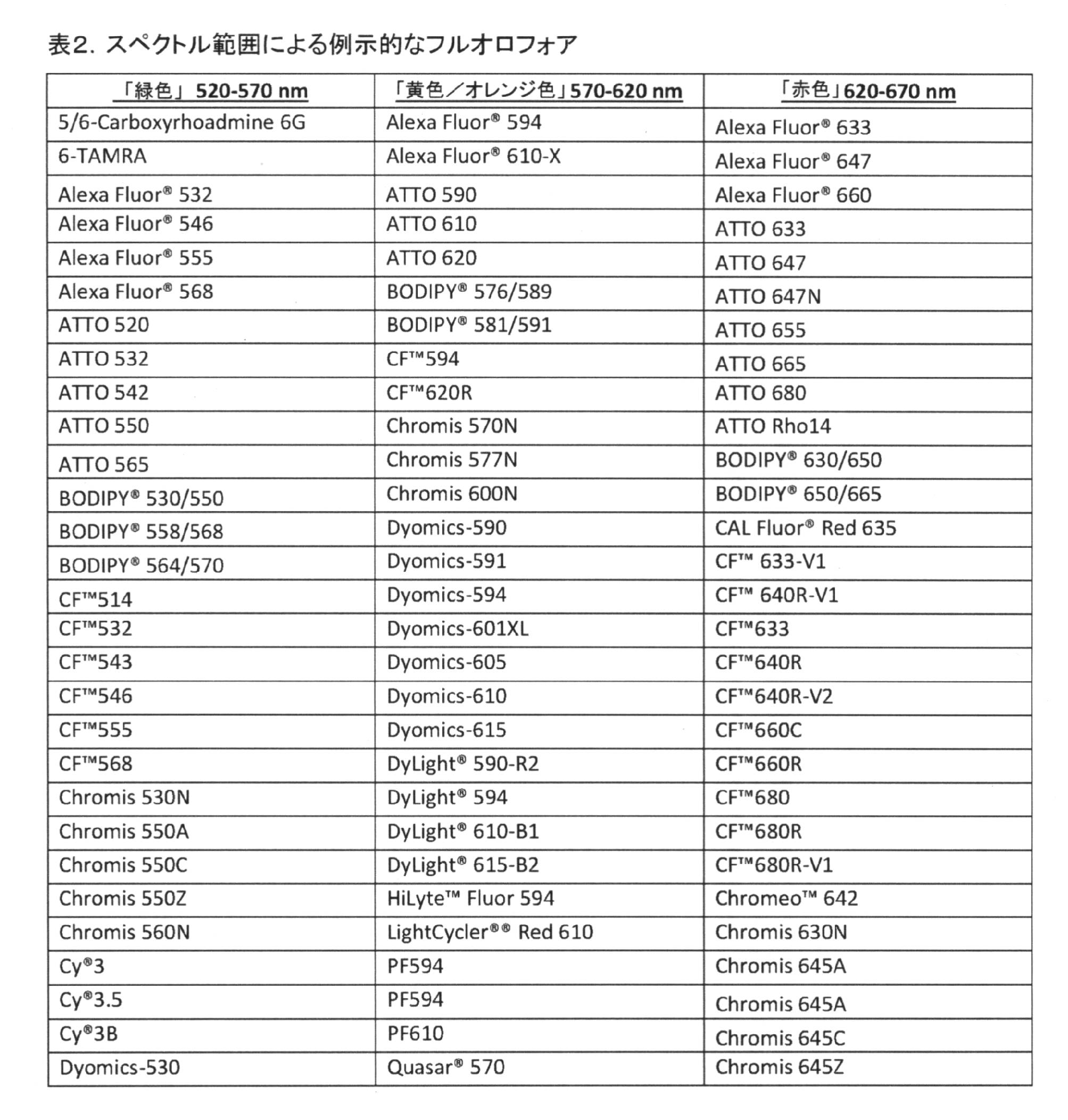


ある実施形態では、発光標識は、以下の式(NHSエステル形態)の(色素101)、(色素102)、(色素103)、(色素104)、(色素105)、もしくは(色素106)、またはそれらの類似体であってもよい。 In certain embodiments, the luminescent label is (dye 101), (dye 102), (dye 103), (dye 104), (dye 105), or (dye 106) of the following formula (NHS ester form), or They may be analogues thereof.
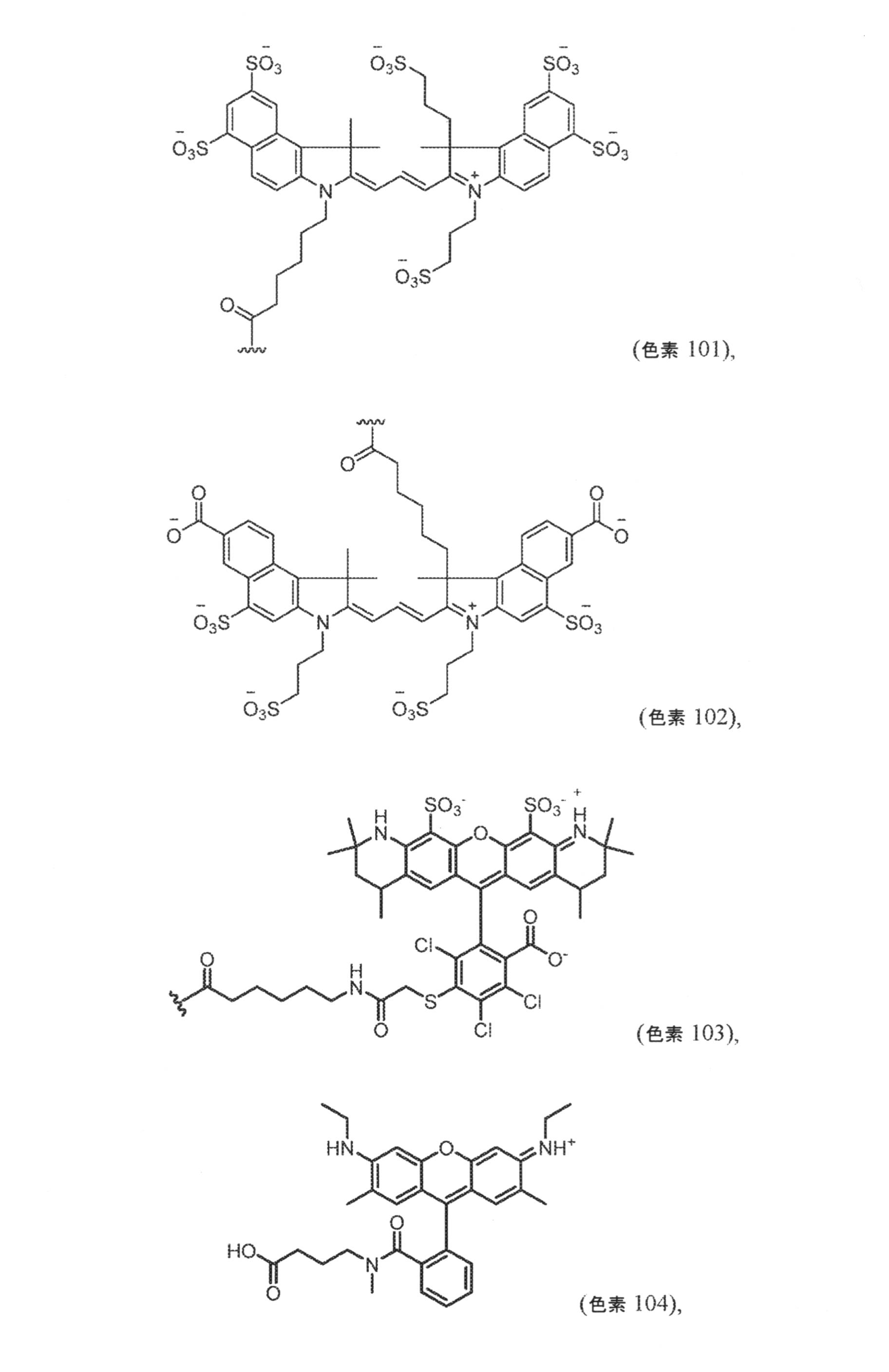

いくつかの実施形態では、各スルホナートまたはカルボキシラートは、独立して、任意選択でプロトン化されている。いくつかの実施形態では、上記の色素は、示されている付着地点でのアミド結合の形成によりリンカーまたはヌクレオチドに付着している。 In some embodiments, each sulfonate or carboxylate is independently optionally protonated. In some embodiments, the dyes described above are attached to a linker or nucleotide by formation of an amide bond at the attachment point indicated.
ある実施形態では、発光標識は、第1および第2の発色団を含んでいてもよい。いくつかの実施形態では、第1の発色団の励起状態は、第2の発色団へのエネルギー移動により緩和させることが可能である。いくつかの実施形態では、エネルギー移動は、フェルスター共鳴エネルギー転移(FRET)である。そのようなFRET対は、複数の発光標識との標識の区別をより容易にする特性を発光標識に提供するのに有用であり得る。ある実施形態では、FRET対は、第1のスペクトル範囲の励起エネルギーを吸収し、第2のスペクトル範囲の発光を放射することができる。 In some embodiments, a luminescent label may comprise first and second chromophores. In some embodiments, the excited state of the first chromophore can be relaxed by energy transfer to the second chromophore. In some embodiments, the energy transfer is Forster Resonance Energy Transfer (FRET). Such FRET pairs can be useful in providing a luminescent label with properties that make it easier to distinguish the label from multiple luminescent labels. In some embodiments, a FRET pair can absorb excitation energy in a first spectral range and emit emission in a second spectral range.
1組の発光標識分子(例えば、発光標識ヌクレオチド)の場合、発光標識FRET対の特性は、複数の判別可能な分子(例えば、ヌクレオチド)の選択を可能にすることができる。いくつかの実施形態では、FRET対の第2の発色団は、複数の他の発光標識分子とは異なる発光寿命を有する。いくつかの実施形態では、FRET対の第2の発色団は、複数の他の発光標識分子とは異なる発光強度を有する。いくつかの実施形態では、FRET対の第2の発色団は、複数の他の発光標識分子とは異なる発光寿命および発光強度を有する。いくつかの実施形態では、FRET対の第2の発色団は、複数の他の発光標識分子とは異なるスペクトル範囲の光子を放射する。いくつかの実施形態では、FRET対の第1の発色団は、複数の他の発光標識分子とは異なる発光寿命を有する。ある実施形態では、FRET対は、複数の他の発光標識分子とは異なるスペクトル範囲の励起エネルギーを吸収することができる。ある実施形態では、FRET対は、複数の他の発光標識分子の1つまたは複数と同じスペクトル範囲の励起エネルギーを吸収することができる。 For a set of luminescent-labeled molecules (eg, luminescent-labeled nucleotides), the properties of the luminescent-labeled FRET pair can allow selection of multiple distinguishable molecules (eg, nucleotides). In some embodiments, the second chromophore of the FRET pair has a different emission lifetime than the plurality of other luminescent label molecules. In some embodiments, the second chromophore of the FRET pair has a different emission intensity than the plurality of other luminescent label molecules. In some embodiments, the second chromophore of the FRET pair has a different emission lifetime and emission intensity than the plurality of other luminescent label molecules. In some embodiments, the second chromophore of the FRET pair emits photons in a different spectral range than the plurality of other luminescent label molecules. In some embodiments, the first chromophore of the FRET pair has a different emission lifetime than the plurality of other luminescent label molecules. In some embodiments, a FRET pair can absorb excitation energy in a different spectral range than the plurality of other luminescent label molecules. In some embodiments, a FRET pair can absorb excitation energy in the same spectral range as one or more of the plurality of other luminescent labeled molecules.
いくつかの実施形態では、2つ以上のヌクレオチドは、発光標識に接続されていてもよく、その場合、ヌクレオチドは、発光標識の異なる位置に接続されている。非限定的な例としては、ヌクレオチド類似体の反応性部分と適合する2つの独立反応性化学部分(例えば、アジド基、アセチレン基、カルボキシル基、アミノ基)を含有する発光分子を挙げることができる。そのような実施形態では、発光標識は、独立したリンカーにより2つのヌクレオチド分子に接続されていてもよい。いくつかの実施形態では、発光標識は、2つ以上のヌクレオチドとの2つ以上の独立した接続を含んでいてもよい。 In some embodiments, two or more nucleotides may be attached to a luminescent label, where the nucleotides are attached to different positions of the luminescent label. Non-limiting examples can include luminescent molecules containing two independently reactive chemical moieties (e.g., azide, acetylene, carboxyl, amino groups) compatible with the reactive moieties of nucleotide analogues. . In such embodiments, the luminescent label may be attached to the two nucleotide molecules by independent linkers. In some embodiments, a luminescent label may comprise two or more independent connections to two or more nucleotides.
いくつかの実施形態では、2つ以上のヌクレオチドは、リンカー(例えば、ヌクレオチドおよび/または色素が付着することが可能である2つ以上の反応部位を有する分岐リンカーまたはリンカー)により発光色素と接続されていてもよい。したがって、いくつかの実施形態では、2つ以上のヌクレオチド(例えば、同じタイプ)が、2つ以上の色素(例えば、同じタイプ)に連結されていてもよい。 In some embodiments, two or more nucleotides are connected to the luminescent dye by a linker (e.g., a branched linker or linker having two or more reactive sites to which nucleotides and/or dyes can be attached). may be Thus, in some embodiments, two or more nucleotides (eg, of the same type) may be linked to two or more dyes (eg, of the same type).
いくつかの実施形態では、発光標識は、発光特性を有するタンパク質を含んでいてもよい。いくつかの実施形態では、1つまたは複数のヌクレオチドは、発光タンパク質に接続されている。いくつかの実施形態では、1つまたは複数のヌクレオチドは、タンパク質の異なる部位との接続により発光タンパク質に接続されている。ある実施形態では、4つのヌクレオチドの発光標識は、1つのヌクレオチドが蛍光タンパク質で標識され、残りの3つのヌクレオチドが蛍光色素(例えば、表1および2の非限定的な例)で標識されるように選択される。ある実施形態では、4つのヌクレオチドの発光標識は、2つのヌクレオチドが蛍光タンパク質で標識され、残りの2つのヌクレオチドが蛍光色素(例えば、表1および2の非限定的な例)で標識されるように選択される。ある実施形態では、4つのヌクレオチドの発光標識は、3つのヌクレオチドが蛍光タンパク質で標識され、残りのヌクレオチドが蛍光色素(例えば、表1および2の非限定的な例)で標識されるように選択される。いくつかの実施形態では、4つのヌクレオチドの発光標識は、4つのヌクレオチドが全て蛍光タンパク質で標識されるように選択される。 In some embodiments, a luminescent label may comprise a protein with luminescent properties. In some embodiments, one or more nucleotides are attached to the photoprotein. In some embodiments, one or more nucleotides are attached to the photoprotein by attachment to different sites on the protein. In certain embodiments, the four nucleotide luminescent labels are such that one nucleotide is labeled with a fluorescent protein and the remaining three nucleotides are labeled with a fluorescent dye (e.g., non-limiting examples in Tables 1 and 2). selected for In certain embodiments, the four nucleotide luminescent labels are such that two nucleotides are labeled with a fluorescent protein and the remaining two nucleotides are labeled with a fluorescent dye (e.g., non-limiting examples in Tables 1 and 2). selected for In certain embodiments, the luminescent labels of the four nucleotides are selected such that three nucleotides are labeled with a fluorescent protein and the remaining nucleotides are labeled with a fluorescent dye (e.g., non-limiting examples in Tables 1 and 2). be done. In some embodiments, the four nucleotide luminescent labels are selected such that all four nucleotides are labeled with a fluorescent protein.
本出願のいくつかの態様によると、発光標識(例えば、色素、例えばフルオロフォア)は、励起光に曝露された配列決定反応のポリメラーゼを損傷する場合がある。いくつかの態様では、この損傷は、発光分子がポリメラーゼ酵素の極近傍に保持されている場合、発光標識ヌクレオチドの組み込み中に生じる。損傷反応の非限定的な例としては、ポリメラーゼと発光分子との共有結合の形成、および発光分子から酵素への放射性崩壊または非放射性崩壊の放射が挙げられる。これは、ポリメラーゼの有効性を短縮し、配列決定が実行される長さを低減する場合がある。 According to some aspects of the present application, luminescent labels (eg, dyes, eg, fluorophores) may damage polymerases of sequencing reactions exposed to excitation light. In some embodiments, this damage occurs during incorporation of luminescent-labeled nucleotides when the luminescent molecule is held in close proximity to the polymerase enzyme. Non-limiting examples of damaging reactions include the formation of covalent bonds between polymerases and luminescent molecules, and the emission of radioactive or non-radioactive decay from luminescent molecules to the enzyme. This may shorten the efficiency of the polymerase and reduce the length over which sequencing is performed.
いくつかの実施形態では、ヌクレオチドおよび発光標識は、標識ヌクレオチドの組み込み中に発光標識をポリメラーゼから離間させておくために、比較的長いリンカーまたはリンカー構成により接続されている。用語「リンカー構成」は、本明細書では、発光分子をヌクレオチドに接続する構造全体を指すために使用され、発光分子またはヌクレオチドを包含しない。 In some embodiments, the nucleotide and luminescent label are connected by a relatively long linker or linker construct to keep the luminescent label away from the polymerase during incorporation of the labeled nucleotide. The term "linker construct" is used herein to refer to the overall structure connecting the luminescent molecule to the nucleotide and does not include the luminescent molecule or the nucleotide.
いくつかの実施形態では、単一のリンカーにより、発光分子がヌクレオチドと接続されている。いくつかの実施形態では、リンカーは、2つ以上(例えば、2、3、4、5、6、7、8、9、または10個以上)のヌクレオチドが、各発光分子に接続されるか、2つ以上(例えば、2、3、4、5、6、7、8、9、または10個以上)の発光分子が、各ヌクレオチドに接続されるか、または2つ以上(例えば、2、3、4、5、6、7、8、9、または10個以上)のヌクレオチドが、2つ以上(例えば、2、3、4、5、6、7、8、9、または10個以上)の発光分子に接続されるように、1つまたは複数の分岐点を含有している。 In some embodiments, a single linker connects the luminescent molecule to the nucleotide. In some embodiments, a linker has two or more (e.g., 2, 3, 4, 5, 6, 7, 8, 9, or 10 or more) nucleotides attached to each light emitting molecule, or Two or more (eg, 2, 3, 4, 5, 6, 7, 8, 9, or 10 or more) luminescent molecules are attached to each nucleotide, or two or more (eg, 2, 3 , 4, 5, 6, 7, 8, 9, or 10 or more) nucleotides are It contains one or more branch points to connect to the light emitting molecule.
いくつかの実施形態では、リンカー構成は、発光標識とヌクレオチドとの距離を決定する。いくつかの実施形態では、距離は、約1nmまたは2nm~約20nmである。例えば、2nm超、5nm超、5~10nm、10nm超、10~15nm、15nm超、15~20nm、20nm超。しかしながら、発光標識は、ヌクレオチドが酵素の活性部位内に保持される際は照射容積内に存在する必要があるため、発光標識とヌクレオチドとの距離は長過ぎてはならない。したがって、いくつかの実施形態では、全体的なリンカー長さは、30nm未満、25nm未満、約20nm、または20nm未満である。 In some embodiments, the linker configuration determines the distance between the luminescent label and the nucleotide. In some embodiments, the distance is from about 1 nm or 2 nm to about 20 nm. For example, greater than 2 nm, greater than 5 nm, 5-10 nm, greater than 10 nm, 10-15 nm, greater than 15 nm, 15-20 nm, greater than 20 nm. However, the distance between the luminescent label and the nucleotide should not be too long, as the luminescent label must be in the illuminated volume when the nucleotide is retained in the active site of the enzyme. Thus, in some embodiments, the overall linker length is less than 30 nm, less than 25 nm, about 20 nm, or less than 20 nm.
いくつかの実施形態では、保護分子が、リンカー構成内に含まれている。保護分子は、酵素と発光標識との間に生じ得る損傷反応からポリメラーゼを保護することができる。保護分子の非限定的な例としては、核酸(例えば、デオキシリボ核酸、リボ核酸)、例えば1つまたは複数の保護要素を含む核酸が挙げられる。いくつかの実施形態では、保護分子は、オリゴヌクレオチド(例えば、DNAオリゴヌクレオチド、RNAオリゴヌクレオチド、またはそれらの変異体)である。 In some embodiments, a protection molecule is included within the linker construct. A protective molecule can protect the polymerase from damaging reactions that can occur between the enzyme and the luminescent label. Non-limiting examples of protective molecules include nucleic acids (eg, deoxyribonucleic acids, ribonucleic acids), eg, nucleic acids containing one or more protective elements. In some embodiments, protective molecules are oligonucleotides (eg, DNA oligonucleotides, RNA oligonucleotides, or variants thereof).
いくつかの実施形態では、保護分子は、1つまたは複数の発光分子に、および1つまたは複数のヌクレオチド分子に接続されている。本明細書で使用されるとき、この文脈におけるヌクレオチドは、例えば配列決定反応の文脈において、成長中の核酸に組み込まれることが可能なヌクレオシドポリリン酸を指す。いくつかの実施形態では、発光分子は、ヌクレオチドと隣接していない。例えば、1つまたは複数の発光分子は、保護分子の第1の側に接続されていてもよく、1つまたは複数のヌクレオチドは、保護分子の第2の側に接続されていてもよく、保護分子の第1および第2の側は、互いに離れている。いくつかの実施形態では、それらは、保護分子のほぼ反対側にある。 In some embodiments, the protective molecule is attached to one or more luminescent molecules and to one or more nucleotide molecules. As used herein, nucleotide in this context refers to a nucleoside polyphosphate that can be incorporated into a growing nucleic acid, eg in the context of a sequencing reaction. In some embodiments, the luminescent molecule is not contiguous with nucleotides. For example, one or more luminescent molecules may be attached to the first side of the protecting molecule, one or more nucleotides may be attached to the second side of the protecting molecule, and the protecting The first and second sides of the molecule are separated from each other. In some embodiments, they are approximately opposite the protective molecule.
保護分子が発光標識と接続されている地点と、保護分子がヌクレオチドに接続されている地点との距離は、空間を通じた直線的な測定値であってもよく、または保護分子の表面に沿った非直線的な測定値であってもよい。保護分子における発光標識およびヌクレオチドの接続地点間の距離は、保護分子の三次元構造をモデル化することにより測定されることが可能である。いくつかの実施形態では、この距離は、2、4、6、8、10、12、14、16、18、または20nm以上であってもよい。あるいは、保護分子における発光標識およびヌクレオチドの相対的位置は、保護分子の構造を二次曲面(例えば、楕円体、楕円柱)として扱うことにより記述されることが可能である。いくつかの実施形態では、発光標識およびヌクレオチドは、保護分子を表す楕円形状の周囲の距離の少なくとも8分の1の距離だけ隔てられている。いくつかの実施形態では、発光標識およびヌクレオチドは、保護分子を表す楕円形状の周囲の距離の少なくとも4分の1の距離だけ隔てられている。いくつかの実施形態では、発光標識およびヌクレオチドは、保護分子を表す楕円形状の周囲の距離の少なくとも3分の1の距離だけ隔てられている。いくつかの実施形態では、発光標識およびヌクレオチドは、保護分子を表す楕円形状の周囲の距離の少なくとも2分の1の距離だけ隔てられている。 The distance between the point at which the protecting molecule is attached to the luminescent label and the point at which the protecting molecule is attached to the nucleotide may be a linear measurement through space or along the surface of the protecting molecule. It may be a non-linear measurement. The distance between the attachment point of the luminescent label and the nucleotide in the protective molecule can be measured by modeling the three-dimensional structure of the protective molecule. In some embodiments, this distance may be 2, 4, 6, 8, 10, 12, 14, 16, 18, or 20 nm or greater. Alternatively, the relative positions of luminescent labels and nucleotides in the protected molecule can be described by treating the structure of the protected molecule as a quadratic surface (eg, ellipsoid, elliptical cylinder). In some embodiments, the luminescent label and the nucleotide are separated by a distance that is at least one-eighth the distance around the oval shape representing the protected molecule. In some embodiments, the luminescent label and the nucleotide are separated by a distance that is at least one quarter of the distance around the oval shape representing the protected molecule. In some embodiments, the luminescent label and the nucleotide are separated by a distance that is at least one-third the distance around the oval shape representing the protected molecule. In some embodiments, the luminescent label and the nucleotide are separated by a distance that is at least one-half the distance around the oval shape representing the protected molecule.
いくつかの実施形態では、保護分子が核酸(例えば、1つまたは複数の保護要素を有する核酸リンカー)を含む場合、核酸における発光標識(例えば、1つまたは複数の発光標識)およびヌクレオチド(例えば、1つまたは複数のヌクレオシドポリリン酸)の結合点間の距離は、核酸内で発光標識とヌクレオチドとの間に生じる塩基の数に基づいて測定されることが可能である。いくつかの実施形態では、標識の結合点をヌクレオシドポリリン酸の結合点から隔てるリンカー内の核酸サブユニットの数(例えば、一本鎖リンカー内のヌクレオチドまたは二本鎖リンカー内の塩基対の数)は、10~100(例えば、10~25、25~50、50~75、75~100)またはそれ以上であってもよい。例えば、いくつかの実施形態では、核酸リンカーは二本鎖である。そのような実施形態では、発光標識およびヌクレオチドの結合点間の距離は、二本鎖核酸内で生じる塩基対(例えば、核酸リンカーの第1および第2のオリゴヌクレオチド鎖の核酸塩基間の塩基対合)の数によって測定されることが可能である。いくつかの実施形態では、核酸リンカー(例えば、線状核酸リンカー)における発光標識およびヌクレオチドの結合点は、少なくとも5塩基対、5~10塩基対、少なくとも10塩基対、10~15塩基対、少なくとも15塩基対、15~20塩基対、少なくとも20塩基対、20~25塩基対、少なくとも25塩基対、25~30塩基対、少なくとも30塩基対、30~35塩基対、少なくとも35塩基対、35~40塩基対、少なくとも40塩基対、40~45塩基対、少なくとも45塩基対、45~50塩基対、少なくとも50塩基対、50~75塩基対、少なくとも75塩基対、75~100塩基対、またはそれ以上の塩基対だけ隔てられている。いくつかの実施形態では、1つまたは複数の構造モチーフ保護要素(例えば、ステムループ)を含めることにより、より多くの塩基および/または塩基対が発光標識とヌクレオチドとの間で生じ得ることが企図される。したがって、いくつかの実施形態では、核酸リンカーにおける発光標識およびヌクレオチドの結合点は、少なくとも50塩基対、50~60塩基対、少なくとも60塩基対、60~70塩基対、少なくとも70塩基対、70~80塩基対、少なくとも80塩基対、80~90塩基対、少なくとも90塩基対、90~100塩基対、少なくとも100塩基対、100~150塩基対、少なくとも150塩基対、150~200塩基対、少なくとも200塩基対、またはそれ以上の塩基対だけ隔てられている。いくつかの実施形態では、二本鎖核酸リンカー内の塩基対(または一本鎖核酸リンカー内のヌクレオチド)の数は、500未満、450未満、400未満、350未満、300未満、または250未満である。 In some embodiments, when the protected molecule comprises a nucleic acid (e.g., a nucleic acid linker having one or more protection elements), luminescent labels (e.g., one or more luminescent labels) and nucleotides (e.g., The distance between the points of attachment of one or more nucleoside polyphosphates) can be measured based on the number of bases that occur between the luminescent label and the nucleotide within the nucleic acid. In some embodiments, the number of nucleic acid subunits in the linker that separate the point of attachment of the label from the point of attachment of the nucleoside polyphosphate (e.g., the number of nucleotides in a single-stranded linker or base pairs in a double-stranded linker) may be 10-100 (eg, 10-25, 25-50, 50-75, 75-100) or more. For example, in some embodiments the nucleic acid linker is double stranded. In such embodiments, the distance between the point of attachment of the luminescent label and the nucleotide is the base pairing that occurs within the double-stranded nucleic acid (e.g., the base pairing between the nucleobases of the first and second oligonucleotide strands of the nucleic acid linker). can be measured by the number of cases). In some embodiments, the point of attachment of the luminescent label and the nucleotide in the nucleic acid linker (eg, linear nucleic acid linker) is at least 5 base pairs, 5-10 base pairs, at least 10 base pairs, 10-15 base pairs, at least 15 base pairs, 15-20 base pairs, at least 20 base pairs, 20-25 base pairs, at least 25 base pairs, 25-30 base pairs, at least 30 base pairs, 30-35 base pairs, at least 35 base pairs, 35- 40 base pairs, at least 40 base pairs, 40-45 base pairs, at least 45 base pairs, 45-50 base pairs, at least 50 base pairs, 50-75 base pairs, at least 75 base pairs, 75-100 base pairs, or more separated by more than one base pair. In some embodiments, it is contemplated that the inclusion of one or more structural motif guarding elements (e.g., stem loops) may allow more bases and/or base pairs to occur between the luminescent label and the nucleotide. be done. Thus, in some embodiments, the point of attachment of the luminescent label and the nucleotide in the nucleic acid linker is at least 50 base pairs, 50-60 base pairs, at least 60 base pairs, 60-70 base pairs, at least 70 base pairs, 70- 80 base pairs, at least 80 base pairs, 80-90 base pairs, at least 90 base pairs, 90-100 base pairs, at least 100 base pairs, 100-150 base pairs, at least 150 base pairs, 150-200 base pairs, at least 200 separated by a base pair or more. In some embodiments, the number of base pairs in the double-stranded nucleic acid linker (or nucleotides in the single-stranded nucleic acid linker) is less than 500, less than 450, less than 400, less than 350, less than 300, or less than 250. be.
1つまたは複数の保護要素を含む核酸リンカー等の保護分子は、発光標識がポリメラーゼに接近することを防止する立体障壁を提供するのに有用であってもよい。保護分子は、発光分子により放射される放射性崩壊および非放射性崩壊を吸収するのに、またはそのような崩壊からポリメラーゼを保護するのに有用であってもよい。保護分子は、発光標識とポリメラーゼとの間の立体障壁および崩壊障壁の両方を提供するのに有用であってもよい。 A protective molecule, such as a nucleic acid linker containing one or more protective elements, may be useful to provide a steric barrier to prevent access of the luminescent label to the polymerase. Protective molecules may be useful to absorb radioactive and non-radioactive decay emitted by the luminescent molecule or to protect the polymerase from such decay. Protective molecules may be useful in providing both a steric and a collapsing barrier between the luminescent label and the polymerase.
保護分子のサイズは、ヌクレオチドが酵素の活性部位内に保持される際に、発光標識がポリメラーゼと直接的に接触することができないかまたは接触しにくいような大きさであるべきである。また、保護分子のサイズは、ヌクレオチドが酵素の活性部位内に保持される際に、付着している発光標識が、励起させようとする照射容積内に存在するような大きさであるべきである。保護分子のサイズは、発光標識を保護分子に接続するために選択されているリンカーおよびヌクレオチドを保護分子に接続するために選択されているリンカーを考慮して選択されるべきである。保護分子ならびに発光標識およびヌクレオチド(例えば、ヌクレオシドポリリン酸)を接続するために使用されるリンカーは、リンカー構成を構成し、リンカー構成のサイズは、ヌクレオチドが酵素の活性部位内に保持される際に、発光標識がポリメラーゼと直接的に接触することができないような大きさであるべきである。 The size of the protective molecule should be such that the luminescent label cannot or is difficult to contact directly with the polymerase when the nucleotide is retained within the active site of the enzyme. Also, the size of the protective molecule should be such that when the nucleotide is retained in the active site of the enzyme, the attached luminescent label is present in the irradiated volume to be excited. . The size of the protecting molecule should be selected taking into account the linker chosen to connect the luminescent label to the protecting molecule and the linker chosen to connect the nucleotide to the protecting molecule. The linker used to connect the protective molecule and the luminescent label and the nucleotide (e.g., nucleoside polyphosphate) constitutes a linker construct, the size of which determines when the nucleotide is retained within the active site of the enzyme. , the size should be such that the luminescent label cannot come into direct contact with the polymerase.
保護分子(および/または保護分子を含むリンカー構成)は、好ましくは水溶性である。いくつかの実施形態では、保護分子(および/または保護分子を含むリンカー構成)は、正味負電荷を有することが好ましい。 The protecting molecule (and/or the linker construct comprising the protecting molecule) is preferably water soluble. In some embodiments, the protecting molecule (and/or the linker construct comprising the protecting molecule) preferably has a net negative charge.
図7には、配列決定実験、および複数の発光標識ヌクレオチドから判別するために固有な発光特性がどのように使用されることが可能であるかの非限定的な例7-1がさらに例示されている。各塩基(チミン、アデニン、シトシン、グアニン)に接続されている発光標識は、各標識ヌクレオチドが複数の標識ヌクレオチドから判別されることを可能にする発光特性(例えば、発光寿命、発光強度、および/または放射波長)を有する。同じタイプの複数のヌクレオチドを介在させることは、配列決定反応の組み込み速度を加速させる機能を果たす。 FIG. 7 further illustrates a non-limiting example 7-1 of sequencing experiments and how unique luminescence properties can be used to discriminate from multiple luminescence-labeled nucleotides. ing. The luminescent label attached to each base (thymine, adenine, cytosine, guanine) has luminescent properties (e.g., luminescence lifetime, luminescence intensity, and/or or emission wavelength). Interleaving multiple nucleotides of the same type serves to accelerate the incorporation rate of the sequencing reaction.
発光標識ヌクレオチドを利用する配列決定実験7-1は、例示的な反応槽7-2で実施されることが可能である。反応は、導波路上方のチャンバで起こり、導波路は、励起エネルギーの導管としての役割を果たし、導波路からのエバネッセント波により、反応チャンバの底部にある試料に励起エネルギーを加える。開口部は、導波路からバルク試料へと放散する光、ならびに周囲光および/またはセンサからの迷光を阻止するだけなく、反応チャンバの製造経路を提供する。反応チャンバは、底部に、および導波路のエバネッセント波からの高励起領域内に試料を配置するエッチング構造である。選択的な表面化学は、反応チャンバの底部および側壁に異なる組成物を提供するために使用されることが可能であり、そのため、試料は、反応チャンバの底部に選択的に限局されることが可能である。 A sequencing experiment 7-1 utilizing luminescent-labeled nucleotides can be performed in an exemplary reaction vessel 7-2. The reaction takes place in a chamber above the waveguide, which acts as a conduit for excitation energy and evanescent waves from the waveguide apply excitation energy to the sample at the bottom of the reaction chamber. The opening not only blocks light diffusing from the waveguide to the bulk sample, and stray light from ambient light and/or the sensor, but also provides a manufacturing pathway for the reaction chamber. The reaction chamber is an etching structure that places the sample at the bottom and within the region of high excitation from the evanescent wave of the waveguide. Selective surface chemistries can be used to provide different compositions to the bottom and sidewalls of the reaction chamber so that the sample can be selectively confined to the bottom of the reaction chamber. is.
いくつかの実施形態では、例えば、例示的な反応槽7-2に概して図示されているような選択的表面化学が、選択的表面官能化および/または表面パッシベーションのための異なる技術を使用して達成され得る。例えば、反応槽7-2は、側壁表面における金属の曝露部分が金属酸化物を含む金属スタックを備え得る。いくつかの実施形態では、金属酸化物表面は、それを官能化剤および/または試料に対して不活性にするまたは反応性を最小限にするために、パッシベーションされてよい。示されているように、「酸化物」層は、いくつかの実施形態では、その曝露表面上のシリカからなる透明な層を指す場合がある。いくつかの実施形態では、酸化物またはシリカ表面は、反応槽7-2の底面またはその近くに試料を限局するように選択的に官能化されていてよい。 In some embodiments, selective surface chemistry, for example, as generally illustrated in exemplary reactor 7-2, is performed using different techniques for selective surface functionalization and/or surface passivation. can be achieved. For example, reaction vessel 7-2 may comprise a metal stack in which the exposed portion of the metal on the sidewall surface comprises metal oxide. In some embodiments, the metal oxide surface may be passivated to render it inert or minimize reactivity to the functionalizing agent and/or sample. As indicated, an "oxide" layer may, in some embodiments, refer to a transparent layer of silica on its exposed surface. In some embodiments, the oxide or silica surface may be selectively functionalized to confine the sample to or near the bottom of reaction vessel 7-2.
特定のヌクレオチドの組み込みは、配列決定反応中に例示的なワークフロー7-3に従って4つの発光標識ヌクレオチドから判別されることが可能である。実験の経過全体にわたって、2つの異なる期間:パルス期間および検出期間がある。20ピコ秒間継続するパルス期間中、発光光は収集されない。パルス期間後、検出期間は10ナノ秒間継続し、4つの時間ビンにより、検出期間にわたって生じる放射事象が捕捉される(i)。パルス期間および検出期間は、1つのサイクルを構成する。放射事象は、100万サイクルの経過にわたって連続的にビンに分類され、蓄積される(ii)。時間ビンにわたる放射事象の全体的分布は、発光寿命を表し、特定の組のデータを既知の寿命分布と一致させるために使用されることが可能である(iii)。いくつかの実施形態では、放射事象の分布(例えば、発光寿命)では、1つの発光標識塩基は、複数の他の標識分子から判別されない。放射事象の分布に加えて、放射事象の量(例えば、発光強度)は、単一分子を複数の他のものから識別するために使用されることが可能である。 Specific nucleotide incorporations can be discriminated from the four luminescence-labeled nucleotides according to exemplary workflow 7-3 during a sequencing reaction. Over the course of the experiment there are two distinct periods: the pulse period and the detection period. No emitted light is collected during the pulse period lasting 20 picoseconds. After the pulse period, the detection period lasts 10 ns and four time bins capture the radiation events occurring over the detection period (i). The pulse period and detection period constitute one cycle. Emission events are continuously binned and accumulated over the course of one million cycles (ii). The overall distribution of emission events over time bins represents the luminescence lifetime and can be used to match a particular set of data with a known lifetime distribution (iii). In some embodiments, the distribution of radiative events (eg, luminescence lifetimes) does not distinguish one luminescent labeled base from multiple other labeled molecules. In addition to the distribution of radiation events, the quantity of radiation events (eg, emission intensity) can be used to distinguish single molecules from others.
図8Aには、非タンパク質(例えば、核酸)保護分子(101)により隔てられている発光分子およびヌクレオチドの非限定的な例である。非タンパク質保護分子の非限定的な例としては、核酸分子、例えば、デオキシリボ核酸、リボ核酸、およびそれらの組合せを挙げることができる。いくつかの実施形態では、核酸保護分子は(例えば、1つまたは複数のヌクレオチドおよび1つまたは複数の標識の結合部位間にある)1つまたは複数の保護要素を含む。表示されているように、発光分子およびヌクレオチドは、非タンパク質保護分子に直接的に付着している(例えば、共有結合で付着している)。いくつかの実施形態では、発光分子およびヌクレオチドは、非タンパク質保護分子の近接部分に直接的に付着している。例えば、いくつかの実施形態では、非タンパク質保護分子は核酸分子であり、発光分子および/またはヌクレオチドは、核酸分子のヌクレオチドに直接的に結合されている。いくつかの実施形態では、発光分子および/またはヌクレオチドは、非タンパク質保護分子の近接部分ではない非タンパク質保護分子にリンカーを介して付着している。例えば、いくつかの実施形態では、非タンパク質保護分子は核酸分子であり、発光分子および/またはヌクレオチドは、リンカーを介して核酸に付着している。 Figure 8A is a non-limiting example of a luminescent molecule and a nucleotide separated by a non-protein (eg, nucleic acid) protective molecule (101). Non-limiting examples of non-protein protective molecules can include nucleic acid molecules such as deoxyribonucleic acids, ribonucleic acids, and combinations thereof. In some embodiments, nucleic acid protective molecules comprise one or more protective elements (eg, between one or more nucleotides and one or more label binding sites). As indicated, the luminescent molecule and the nucleotide are directly attached (eg, covalently attached) to the non-protein protecting molecule. In some embodiments, the luminescent molecule and nucleotide are directly attached to adjacent moieties of the non-protein protecting molecule. For example, in some embodiments, the non-protein protective molecule is a nucleic acid molecule and the luminescent molecule and/or nucleotides are directly attached to the nucleotides of the nucleic acid molecule. In some embodiments, the luminescent molecule and/or nucleotide is attached via a linker to the non-protein protecting molecule that is not a contiguous part of the non-protein protecting molecule. For example, in some embodiments the non-protein protective molecule is a nucleic acid molecule and the luminescent molecule and/or nucleotides are attached to the nucleic acid via a linker.
いくつかの実施形態では、図8Bに図示されているように、発光分子およびヌクレオチドは、反応性部分を介して非タンパク質(例えば、核酸)保護分子に付着していてもよい。この例では、発光分子における反応性部分(550)は、非タンパク質保護分子の対応する反応性部分(500)を介して非タンパク質保護分子に共有結合で付着している。ヌクレオチドにおける反応性部分(551)は、非タンパク質保護分子の対応する反応性部分(501)を介して非タンパク質保護分子(101)に共有結合で付着している。いくつかの実施形態では、反応性部分500および/または反応性部分501は、非タンパク質保護分子の近接部分に直接的に付着している。いくつかの実施形態では、反応性部分500および/または反応性部分501は、非タンパク質保護分子の近接部分ではない非タンパク質保護分子にリンカーを介して付着している。
In some embodiments, luminescent molecules and nucleotides may be attached to non-protein (eg, nucleic acid) protecting molecules via reactive moieties, as illustrated in FIG. 8B. In this example, the reactive moiety (550) in the luminescent molecule is covalently attached to the non-protein protecting molecule via the corresponding reactive moiety (500) in the non-protein protecting molecule. A reactive moiety (551) at the nucleotide is covalently attached to the non-protein protecting molecule (101) via the corresponding reactive moiety (501) of the non-protein protecting molecule. In some embodiments,
いくつかの実施形態では、1つもしくは複数の発光標識および/または1つもしくは複数のヌクレオシドポリリン酸は、当技術分野で公知の化学カップリング技術を使用して核酸リンカー(例えば、非タンパク質保護分子)に付着されてもよい。例えば、いくつかの実施形態では、1つまたは複数の発光標識および1つまたは複数のヌクレオシドポリリン酸を核酸に付着させるために、クリックケミストリー技術(例えば、銅触媒性、歪み促進型、銅不含クリックケミストリー等)が使用され得る。したがって、図8Bに図示されている反応性部分の対501/551および500/550は、いくつかの実施形態では、反応性アミン、アジド、アルキン、ニトロン、アルケン(例えば、シクロアルケン)、テトラジン、テトラゾール、ならびにクリック反応および同様のカップリング技術に適切な他の反応性部分を含み得る。 In some embodiments, one or more luminescent labels and/or one or more nucleoside polyphosphates are attached to nucleic acid linkers (e.g., non-protein protective molecules) using chemical coupling techniques known in the art. ) may be attached to the For example, in some embodiments, click chemistry techniques (e.g., copper-catalyzed, strain-enhanced, copper-free click chemistry, etc.) may be used. Thus, the reactive moiety pairs 501/551 and 500/550 depicted in FIG. 8B are, in some embodiments, reactive amines, azides, alkynes, nitrones, alkenes (e.g., cycloalkenes), tetrazines, Tetrazoles and other reactive moieties suitable for click reactions and similar coupling techniques may be included.
いくつかの実施形態では、非タンパク質保護分子は、オリゴヌクレオチド(例えば、DNAオリゴヌクレオチド、RNAオリゴヌクレオチド、またはそれらの変異体)である。いくつかの実施形態では、オリゴヌクレオチドは、一本鎖である。いくつかの実施形態では、発光標識は、一本鎖オリゴヌクレオチドの一方の末端(例えば5’末端または3’末端)に直接的または間接的に付着しており、1つまたは複数のヌクレオチドは、一本鎖オリゴヌクレオチドの他方の末端(例えば、3’末端または5’末端)に直接的または間接的に付着している。例えば、一本鎖オリゴヌクレオチドは、オリゴヌクレオチドの5’末端に付着した発光標識、およびオリゴヌクレオチドの3’末端に付着した1つまたは複数のヌクレオチド(例えば、同じタイプ)を含んでいてもよい。あるいは、いくつかの実施形態では、一本鎖オリゴヌクレオチドは、オリゴヌクレオチドの3’末端に付着した発光標識、およびオリゴヌクレオチドの5’末端に付着した1つまたは複数のヌクレオチド(例えば、同じタイプ)を含んでいてもよい。 In some embodiments, non-protein protective molecules are oligonucleotides (eg, DNA oligonucleotides, RNA oligonucleotides, or variants thereof). In some embodiments, the oligonucleotide is single stranded. In some embodiments, the luminescent label is directly or indirectly attached to one end (e.g., the 5' or 3' end) of the single-stranded oligonucleotide, and one or more nucleotides are It is directly or indirectly attached to the other end (eg, the 3' or 5' end) of the single-stranded oligonucleotide. For example, a single-stranded oligonucleotide may include a luminescent label attached to the 5' end of the oligonucleotide and one or more nucleotides (eg, of the same type) attached to the 3' end of the oligonucleotide. Alternatively, in some embodiments, the single-stranded oligonucleotide has a luminescent label attached to the 3' end of the oligonucleotide and one or more nucleotides (eg, of the same type) attached to the 5' end of the oligonucleotide. may contain
いくつかの実施形態では、オリゴヌクレオチドは、二本鎖である(例えば、オリゴヌクレオチドは、2つのアニーリングされた相補的なオリゴヌクレオチド鎖を含む)。いくつかの実施形態では、発光標識は、二本鎖オリゴヌクレオチドの一方の末端に直接的または間接的に付着しており、1つまたは複数のヌクレオチドは、二本鎖ヌクレオチドの他方の末端に直接的または間接的に付着している。いくつかの実施形態では、発光標識は、二本鎖オリゴヌクレオチドの一方の鎖に直接的または間接的に付着しており、1つまたは複数のヌクレオチド(例えば、同じタイプ)は、二本鎖ヌクレオチドの他方の鎖に直接的または間接的に付着している。例えば、二本鎖オリゴヌクレオチドは、オリゴヌクレオチドの一方の鎖の5’末端に付着した発光標識、および他方の鎖の5’末端に付着した1つまたは複数のヌクレオチド(例えば、同じタイプ)を含んでいてもよい。あるいは、いくつかの実施形態では、二本鎖オリゴヌクレオチドは、オリゴヌクレオチドの一方の鎖の3’末端に付着した発光標識、および他方の鎖の3’末端に付着した1つまたは複数のヌクレオチド(例えば、同じタイプ)を含んでいてもよい。 In some embodiments, the oligonucleotide is double-stranded (eg, the oligonucleotide comprises two complementary annealed oligonucleotide strands). In some embodiments, the luminescent label is directly or indirectly attached to one end of the double-stranded oligonucleotide and one or more nucleotides are directly or indirectly attached to the other end of the double-stranded nucleotide. Directly or indirectly attached. In some embodiments, the luminescent label is directly or indirectly attached to one strand of a double-stranded oligonucleotide, and one or more nucleotides (e.g., of the same type) are attached to the double-stranded nucleotide directly or indirectly attached to the other strand of For example, a double-stranded oligonucleotide includes a luminescent label attached to the 5' end of one strand of the oligonucleotide and one or more nucleotides (e.g., of the same type) attached to the 5' end of the other strand. You can stay. Alternatively, in some embodiments, the double-stranded oligonucleotide has a luminescent label attached to the 3' end of one strand of the oligonucleotide and one or more nucleotides attached to the 3' end of the other strand ( for example, of the same type).
いくつかの実施形態では、1つもしくは複数の発光標識および/または1つもしくは複数のヌクレオチド(例えば、同じタイプ)は、オリゴヌクレオチドの1つもしくは複数の末端位置および/または内部位置を含め、一本鎖または二本鎖オリゴヌクレオチドにおける1つまたは複数の異なる位置において付着していてもよい。 In some embodiments, one or more luminescent labels and/or one or more nucleotides (e.g., of the same type) are at one or more nucleotide positions, including at one or more terminal and/or internal positions of the oligonucleotide. It may be attached at one or more different positions on the single-stranded or double-stranded oligonucleotide.
発光標識ヌクレオチドがオリゴヌクレオチド保護分子を含む例示的な実施形態が図8Cに図示されている。示されているように、オリゴヌクレオチドは、ヌクレオチドがポリメラーゼに結合されると、発光標識(例えば、1つまたは複数の色素)とポリメラーゼとの間に、ある距離をもたらす。したがって、いくつかの実施形態では、オリゴヌクレオチドは、発光標識とポリメラーゼとの間の相互作用を防止するか、またはその程度を限定する立体障壁として機能するのに有用であり得る。さらに、オリゴヌクレオチドは、発光分子により放射される放射性崩壊および/または非放射性崩壊を吸収することができる。そのような機能性は、有利なことには、劣化または機能損失からポリメラーゼを保護することができる。 An exemplary embodiment in which the luminescently labeled nucleotide comprises an oligonucleotide protecting molecule is illustrated in FIG. 8C. As shown, the oligonucleotide provides a distance between the luminescent label (eg, one or more dyes) and the polymerase when the nucleotide is attached to the polymerase. Thus, in some embodiments, oligonucleotides may be useful to act as a steric barrier to prevent or limit the extent of interaction between the luminescent label and the polymerase. Additionally, oligonucleotides can absorb radioactive and/or non-radioactive decay emitted by a luminescent molecule. Such functionality can advantageously protect the polymerase from degradation or loss of function.
図8Cに示されている非限定的な例は、1つの鎖の1つの末端(例えば、5’末端)に付着した発光標識と、同じ鎖の他方の末端(例えば、3’末端)に付着したヌクレオチドとを含む二本鎖オリゴヌクレオチド保護分子を図示する。いくつかの実施形態では、二本鎖オリゴヌクレオチドは、図8Dに図示されているように、第1の鎖に付着した発光標識と、第2の鎖に付着した1つまたは複数のヌクレオチドとを含む。示されているように、核酸815(例えば、二本鎖オリゴヌクレオチド)は、15塩基対を含む。核酸815は、リンカー815-2を介して核酸の第1のオリゴヌクレオチド鎖に付着した発光標識815-1と、リンカー815-4を介して核酸の第2のオリゴヌクレオチド鎖に付着したヌクレオチド815-3(例えば、ヌクレオシド六リン酸として図示されているヌクレオシドポリリン酸)とを含む。ヌクレオチド815-3を核酸815に付着させるリンカー815-4の化学構造は図9-2に示されているが、本明細書の他のいずれかの箇所に記載されているリンカー分子に従って任意の適切なリンカーが設計され得る。
A non-limiting example shown in Figure 8C is a luminescent label attached to one end (e.g., the 5' end) of one strand and another end (e.g., the 3' end) of the same strand. 1 illustrates a double-stranded oligonucleotide protection molecule comprising nucleotides and . In some embodiments, the double-stranded oligonucleotide has a luminescent label attached to the first strand and one or more nucleotides attached to the second strand, as illustrated in FIG. 8D. include. As shown, nucleic acid 815 (eg, double-stranded oligonucleotide) includes 15 base pairs.
図8Dには、20塩基対を有する二本鎖オリゴヌクレオチドを各々が含む核酸820および822がさらに図示されている。示されているように、核酸820は、外部発光標識820-1を含む。いくつかの実施形態では、「外部」発光標識とは、オリゴヌクレオチド鎖の末端(例えば、5’末端または3’末端)に付着している発光標識を指す。いくつかの実施形態では、外部発光標識は、オリゴヌクレオチド鎖の最も5’側または最も3’側の塩基において付着している。しかしながら、いくつかの実施形態では、オリゴヌクレオチド鎖は、追加の塩基が核酸の反対側の鎖と塩基対合しないオーバーハング領域として、追加の塩基を含んでいてもよい。そのような実施形態では、外部発光標識は、反対側の鎖と最も5’側または最も3’側の塩基対合を形成するオリゴヌクレオチド鎖上の塩基において付着していると言うことができる。核酸822は、内部発光標識822-1を含む。いくつかの実施形態では、「内部」発光標識とは、オリゴヌクレオチド鎖に沿ったいずれの側にも1つまたは複数の塩基対合したヌクレオチドを有するオリゴヌクレオチド鎖内のある位置において付着している発光標識を指す。したがって、鎖に沿って結合部位から上流にある少なくとも1つのヌクレオチドおよび結合部位から下流にある少なくとも1つのヌクレオチドが反対側の鎖と塩基対合した場合、発光標識は内部発光標識であると言うことができる。いくつかの実施形態では、内部発光標識は、脱塩基部位または核酸塩基を介してオリゴヌクレオチド鎖に付着している。いくつかの実施形態では、内部発光標識は、オリゴヌクレオチド骨格内に統合されている。
Figure 8D further illustrates
オリゴヌクレオチド保護分子は、図8Dにおける様々な長さの例示的な構築物(例えば、15塩基対の核酸815、20塩基対の核酸820、30塩基対の核酸830、および45塩基対の核酸845)によって表されるように、任意の長さであってよいことが理解されるべきである。例えば、15塩基対および25塩基対からなる例示的なオリゴヌクレオチドが、配列決定実験の例示的な結果と共に、それぞれ図8Eおよび図8Fに示されている。いくつかの実施形態では、オリゴヌクレオチドは、約10以上、約20以上、約30以上、約40以上、約50以上、約60以上、約70以上、約80以上、約90以上、約100以上、約125以上、約150以上、約175以上、約200以上、約250以上、約300以上、約350以上、約400以上、約450以上、約500以上の長さを有していてもよい。いくつかの実施形態では、オリゴヌクレオチドは、20個未満、30個未満、40個未満、50個未満、60個未満、70個未満、80個未満、90個未満、100個未満、125個未満、150個未満、175個未満、200個未満、250個未満、300個未満、350個未満、400個未満、450個未満、500個未満、または600個未満の塩基の長さを有する。いくつかの実施形態では、オリゴヌクレオチドリンカーは、オリゴヌクレオチドリンカーに付着している標識からの放射からポリメラーゼを保護するために十分に長いと同時に、標識が配列決定反応中に励起され検出されることを可能にするために十分に短い。 Oligonucleotide protection molecules are shown in various lengths of the exemplary constructs in FIG. It should be understood that it can be of any length, as represented by For example, exemplary oligonucleotides consisting of 15 base pairs and 25 base pairs are shown in Figures 8E and 8F, respectively, along with exemplary results of sequencing experiments. In some embodiments, the oligonucleotide is about 10 or more, about 20 or more, about 30 or more, about 40 or more, about 50 or more, about 60 or more, about 70 or more, about 80 or more, about 90 or more, about 100 or more , about 125 or more, about 150 or more, about 175 or more, about 200 or more, about 250 or more, about 300 or more, about 350 or more, about 400 or more, about 450 or more, about 500 or more . In some embodiments, less than 20, less than 30, less than 40, less than 50, less than 60, less than 70, less than 80, less than 90, less than 100, less than 125 oligonucleotides , less than 150, less than 175, less than 200, less than 250, less than 300, less than 350, less than 400, less than 450, less than 500, or less than 600 bases in length. In some embodiments, the oligonucleotide linker is long enough to shield the polymerase from radiation from the label attached to the oligonucleotide linker while allowing the label to be excited and detected during the sequencing reaction. short enough to allow
発光標識および/または1つもしくは複数のヌクレオチドは、オリゴヌクレオチド内の任意の位置において付着していてよいことが理解されるべきである。いくつかの実施形態では、発光標識および/または1つもしくは複数のヌクレオチドは、5’もしくは3’末端またはその近辺において付着している。いくつかの実施形態では、発光標識は、オリゴヌクレオチドのより大きな部分の極近傍に発光標識があるように、オリゴヌクレオチドの内部位置において付着している。例えば、図8Gには、内部色素を含む例示的なオリゴヌクレオチド、および外部色素を含む例示的なオリゴヌクレオチドが、配列決定実験においていずれか1つを利用した例示的な結果と共に図示されている。いくつかの実施形態では、内部発光標識(例えば、内部色素)は、概して、外部発光標識(例えば、外部色素)と比較したとき、近傍にあるオリゴヌクレオチドのより大きな部分に取り囲まれた発光標識を指す。いくつかの実施形態では、発光標識を取り囲むオリゴヌクレオチドのより大きな部分は、発光標識により放射される放射性崩壊および/または非放射性崩壊を吸収するためのより大きな障壁をもたらす。 It should be understood that the luminescent label and/or one or more nucleotides may be attached at any position within the oligonucleotide. In some embodiments, the luminescent label and/or one or more nucleotides are attached at or near the 5' or 3' termini. In some embodiments, the luminescent label is attached at an internal position of the oligonucleotide such that the luminescent label is in close proximity to the larger portion of the oligonucleotide. For example, FIG. 8G illustrates an exemplary oligonucleotide containing an internal dye and an exemplary oligonucleotide containing an external dye, along with exemplary results utilizing either one in a sequencing experiment. In some embodiments, an internal luminescent label (e.g., an internal dye) generally has a luminescent label surrounded by a greater portion of the neighboring oligonucleotides when compared to an external luminescent label (e.g., an external dye). Point. In some embodiments, a larger portion of the oligonucleotide surrounding the luminescent label provides a larger barrier to absorb radioactive and/or non-radioactive decay emitted by the luminescent label.
オリゴヌクレオチド保護分子を含む発光標識ヌクレオチドは、当技術分野で公知の任意の方法を使用して生成されることが可能である。例えば、図8Hには、発光標識およびヌクレオチドが、オリゴヌクレオチドの同じ鎖の反対側にある両末端に付着している、1つの非限定的なアプローチが図示されている。この実施形態では、発光標識およびヌクレオチドが、反応基化学を使用して第1の鎖に付着しており、第2の相補鎖が、その後、第1の鎖にアニーリングされている。上記に示されているように、いくつかの実施形態では、発光標識および1つまたは複数のヌクレオチドは、オリゴヌクレオチド保護分子の異なる鎖に(例えば、3’および/または5’末端において)付着していてもよい。図8Iには、発光標識を含む第1の鎖が、ヌクレオチドを含む第2の相補鎖にアニーリングされている、例示的な方法が図示されている。 Luminescently labeled nucleotides, including oligonucleotide protection molecules, can be generated using any method known in the art. For example, Figure 8H illustrates one non-limiting approach in which a luminescent label and a nucleotide are attached to opposite ends of the same strand of an oligonucleotide. In this embodiment, a luminescent label and nucleotides are attached to a first strand using reactive group chemistry, and a second complementary strand is then annealed to the first strand. As indicated above, in some embodiments, the luminescent label and one or more nucleotides are attached to different strands (e.g., at the 3' and/or 5' ends) of the oligonucleotide protection molecule. may be Figure 8I illustrates an exemplary method in which a first strand containing a luminescent label is annealed to a second complementary strand containing nucleotides.
本明細書に記載されているように、保護分子は、発光標識(例えば、1つまたは複数の色素を有する標識)を含み得る。いくつかの実施形態では、保護分子は、発光標識から放射される放射性崩壊および/または非放射性崩壊を吸収するのに有用な1つまたは複数の部分(例えば、エネルギー吸収部分)を含み得る。例えば、図8Jには、複数の色素を例示的なオリゴヌクレオチド保護分子の鎖に付着させる非限定的な方法が図示されており、ここで反応基化学が、オリゴヌクレオチド上のリンカーに2つの色素を共有結合で付着させるために使用されている。示されているように、リンカーは三重項状態クエンチャーを含み、これは、発光標識が励起されて高度に反応性の状態になることから生じる、潜在的に有害なあらゆる効果を吸収することができる。図8Jに示されている例では、エネルギー吸収部分は、発光標識(例えば、色素分子)と同じ鎖に共有結合で付着したかたちで示されている。いくつかの実施形態では、エネルギー吸収部分は、以下に記載されるように、発光標識に隣接しているが、発光標識を有する鎖にアニーリングされた相補鎖に付着していてもよい。 As described herein, protective molecules can include luminescent labels (eg, labels with one or more dyes). In some embodiments, a protective molecule can include one or more moieties (e.g., energy absorbing moieties) useful for absorbing radioactive and/or non-radioactive decay emitted from a luminescent label. For example, Figure 8J illustrates a non-limiting method of attaching multiple dyes to a strand of an exemplary oligonucleotide protection molecule, where the reactive group chemistry is two dyes attached to a linker on the oligonucleotide. has been used to covalently attach As shown, the linker contains a triplet state quencher, which can absorb any potentially detrimental effects resulting from excitation of the luminescent label into a highly reactive state. can. In the example shown in Figure 8J, the energy absorbing moiety is shown covalently attached to the same strand as the luminescent label (eg, dye molecule). In some embodiments, the energy absorbing moiety is adjacent to the luminescent label, but may be attached to a complementary strand annealed to the strand with the luminescent label, as described below.
ポリメラーゼ保護効果をもたらす化学的部分に加えて、オリゴヌクレオチド構造モチーフが本明細書において企図される。いくつかの実施形態では、1つまたは複数の非標識構造モチーフ(例えば、安定なステムループまたは他の構造を形成することができるオリゴヌクレオチド配列)が、発光標識とヌクレオシドポリリン酸との間の核酸リンカー上にある(例えば、非標識ステム構造が、標識の位置とヌクレオシドポリリン酸の位置との間に存在する)。例えば、図8Kには、3つのステムループ構造を備えるオリゴヌクレオチド保護分子が図示されている。いくつかの実施形態では、オリゴヌクレオチド保護分子は、1つまたは複数のステムループ構造(例えば、2、3、4、5、6、7、8、または9つ以上)を備えていてもよく、一本鎖であってもよい。いくつかの実施形態では、オリゴヌクレオチド保護分子は、1つまたは複数のステムループ構造(例えば、2、3、4、5、6、7、8、または9つ以上)を備えていてもよく、二本鎖であってもよい。例えば、図8Lには、ステムループ構造を備える例示的な二本鎖オリゴヌクレオチド保護分子が図示されている。いくつかの実施形態では、ステムループによりもたらされる、発光標識と1つまたは複数のヌクレオチドとの間の領域における増大された構造は、より大きな面積をもたらし、ここでオリゴヌクレオチドは、発光標識とポリメラーゼとの間の相互作用を立体的に妨害することができる。 Oligonucleotide structural motifs are contemplated herein, as well as chemical moieties that provide a protective polymerase effect. In some embodiments, one or more unlabeled structural motifs (e.g., oligonucleotide sequences capable of forming stable stem-loops or other structures) are present in the nucleic acid between the luminescent label and the nucleoside polyphosphate. On the linker (eg, an unlabeled stem structure exists between the labeled position and the nucleoside polyphosphate position). For example, FIG. 8K illustrates an oligonucleotide protection molecule with three stem-loop structures. In some embodiments, oligonucleotide protection molecules may comprise one or more stem-loop structures (e.g., 2, 3, 4, 5, 6, 7, 8, or 9 or more), It may be single-stranded. In some embodiments, oligonucleotide protection molecules may comprise one or more stem-loop structures (e.g., 2, 3, 4, 5, 6, 7, 8, or 9 or more), It may be double-stranded. For example, Figure 8L illustrates an exemplary double-stranded oligonucleotide protection molecule with a stem-loop structure. In some embodiments, the increased structure in the region between the luminescent label and the one or more nucleotides provided by the stem-loop provides a larger area, where the oligonucleotide is combined with the luminescent label and the polymerase. can sterically hinder the interaction between
いくつかの実施形態では、オリゴヌクレオチド保護分子は、1つのステムループ(例えば、ヘアピン構造)を備える。いくつかの実施形態では、オリゴヌクレオチド保護分子は、2つのステムループを備える。いくつかの実施形態では、オリゴヌクレオチド保護分子は、3つのステムループを備える。いくつかの実施形態では、オリゴヌクレオチド保護分子は、4つのステムループを備える。いくつかの実施形態では、オリゴヌクレオチド保護分子は、5、6、7、8、9、または10個以上のステムループを備える。 In some embodiments, the oligonucleotide protection molecule comprises one stem-loop (eg hairpin structure). In some embodiments, the oligonucleotide protection molecule comprises two stem-loops. In some embodiments, the oligonucleotide protection molecule comprises 3 stem-loops. In some embodiments, the oligonucleotide protection molecule comprises four stem-loops. In some embodiments, the oligonucleotide protection molecule comprises 5, 6, 7, 8, 9, 10 or more stem-loops.
本明細書に記載のオリゴヌクレオチド保護分子には、追加の核酸構造モチーフが企図される。いくつかの実施形態では、オリゴヌクレオチド保護分子は、3つ以上の核酸鎖(例えば、3、4、5、6、7、または8つ以上の核酸鎖)を含む。いくつかの実施形態では、オリゴヌクレオチド保護分子は、4つの核酸鎖を含む。例えば、オリゴヌクレオチド保護分子は、図8Mに図示されているように、ホリデイジャンクションを含んでもよい。1つまたは複数の構造モチーフ(例えば、ステムループ、ホリデイジャンクション)は、いくつかの実施形態では、オリゴヌクレオチド保護分子の強剛性を増大させて、発光標識とポリメラーゼとの間の平均距離を最大にすることができる。いくつかの実施形態では、問題とする平均距離とは、標識に付着したヌクレオシドポリリン酸がポリメラーゼ活性部位内にあるとき(例えば、成長中の鎖への組み込み中)の発光標識とポリメラーゼとの間の距離を指す。 Additional nucleic acid structural motifs are contemplated in the oligonucleotide protection molecules described herein. In some embodiments, an oligonucleotide protection molecule comprises three or more nucleic acid strands (eg, 3, 4, 5, 6, 7, or 8 or more nucleic acid strands). In some embodiments, an oligonucleotide protection molecule comprises four nucleic acid strands. For example, an oligonucleotide protection molecule may comprise a Holliday junction, as illustrated in Figure 8M. One or more structural motifs (e.g., stem loops, Holliday junctions), in some embodiments, increase the rigidity of the oligonucleotide protection molecule to maximize the average distance between the luminescent label and the polymerase. can do. In some embodiments, the average distance of interest is between the luminescent label and the polymerase when the nucleoside polyphosphate attached to the label is within the polymerase active site (e.g., during incorporation into the growing strand). refers to the distance between
いくつかの実施形態では、追加の構造モチーフ(例えば、オリゴヌクレオチド保護分子の配列により与えられる物理的特性に基づくもの、および/またはオリゴヌクレオチド保護分子の1つもしくは複数の部分の1つもしくは複数の化学修飾に基づくもの)が、例えば強剛性を増大させるため、または特定の3次元構成をもたらすために、一本鎖または二本鎖のオリゴヌクレオチド保護分子に含まれることが可能である。いくつかの実施形態では、1つまたは複数のアニーリングされた領域(例えば、ステム構造、または2つのオリゴヌクレオチドのハイブリダイゼーションされた相補性領域)は安定化されていてよい(例えば、共有結合的修飾によって)。 In some embodiments, additional structural motifs (e.g., based on physical properties conferred by the sequence of the oligonucleotide protection molecule and/or one or more moieties of one or more portions of the oligonucleotide protection molecule) based on chemical modifications) can be included in single- or double-stranded oligonucleotide protection molecules, for example to increase rigidity or to confer a particular three-dimensional configuration. In some embodiments, one or more annealed regions (e.g. stem structures, or hybridized complementary regions of two oligonucleotides) may be stabilized (e.g. covalently modified by).
いくつかの実施形態では、オリゴヌクレオチド保護分子上の1つまたは複数の位置が、1つまたは複数のエネルギー吸収部分を含むように修飾されてよい。いくつかの実施形態では、標識が付着しているのと同じ核酸鎖に対して、1つまたは複数のエネルギー吸収部分が付加されてもよい(非限定的な例として図8Jを参照のこと)。いくつかの実施形態では、1つまたは複数のエネルギー吸収部分は、例えば以下により詳細に記載されるように、二本鎖オリゴヌクレオチド保護分子の文脈において、標識されている鎖とは異なる鎖に付加されてもよい(例えば、1つまたは複数のエネルギー吸収部分は、1つまたは複数のヌクレオチドに付着した相補鎖に含まれ得る)。 In some embodiments, one or more positions on the oligonucleotide protection molecule may be modified to contain one or more energy absorbing moieties. In some embodiments, one or more energy absorbing moieties may be attached to the same nucleic acid strand to which the label is attached (see Figure 8J for a non-limiting example). . In some embodiments, one or more energy absorbing moieties are attached to a strand different from the strand being labeled, e.g., in the context of a double-stranded oligonucleotide protecting molecule, as described in more detail below. (eg, one or more energy absorbing moieties may be included in a complementary strand attached to one or more nucleotides).
したがって、いくつかの実施形態では、発光標識ヌクレオチドは、図8Nに図示されている一般的形態8-100として提示することが可能である。示されているように、発光標識ドメイン(星型形状、点線)は、二量体化ドメインを介し、ヌクレオチドドメイン(円形状、点線)に対して非共有結合で連結されている。いくつかの実施形態では、二量体化ドメインとは、発光標識ドメインとヌクレオチドドメインとの間に非共有結合連結をもたらす領域を指す。例えば、いくつかの実施形態では、一般的構造8-100は、発光標識ドメインを備える標識オリゴヌクレオチド鎖8-110と、ヌクレオチドドメインを備える非標識オリゴヌクレオチド鎖8-120とを備える、相補的オリゴヌクレオチドダイマーである。オリゴヌクレオチド保護分子(例えば、オリゴヌクレオチドダイマー)の文脈において、ヌクレオチドドメインとは、成長中の核酸鎖へと(例えば、配列決定反応中に)組み込まれるように構成されている1つまたは複数のヌクレオチド(例えば、ヌクレオシドリン酸)を指すことを理解されたい。いくつかの実施形態では、1つまたは複数のヌクレオチドは、1つまたは複数のヌクレオシド一リン酸もしくはヌクレオシドポリリン酸(例えば、ヌクレオシド二リン酸もしくは三リン酸、または3つを超える5’リン酸を有するヌクレオシド等)を含む。いくつかの実施形態では、1つまたは複数のヌクレオシドリン酸(例えば、ヌクレオシドポリリン酸)は、本出願に記載のように保護分子の一部を形成するオリゴヌクレオチド(例えば、非標識オリゴヌクレオチド鎖)に対して末端リン酸を通じて付着していてもよい。本出願に記載の組成物または方法のうちのいずれかのいくつかの実施形態では、ヌクレオシドリン酸の(例えば、ヌクレオシドポリリン酸の)リン酸部分(例えば、ポリリン酸部分)は、1つもしくは複数のリン酸またはそれらの改変体を含む。例えば、いくつかの実施形態では、ヌクレオシドリン酸の(例えば、ヌクレオシドポリリン酸の)リン酸部分(例えば、ポリリン酸部分)は、リン酸エステル連結、チオエステル連結、ホスホルアミデート連結、アルキルホスホナート連結、他の適切な連結、または1つを超えるそのような修飾、またはそれらの2つ以上の組合せを含むことができる。いくつかの実施形態では、標識鎖および非標識鎖は、互いに対して(例えば、二量体化ドメイン内の鎖が、例えば、少なくとも60%、少なくとも70%、少なくとも75%、少なくとも80%、少なくとも85%、少なくとも90%、少なくとも95%、少なくとも98%、少なくとも99%、または100%の相補性を互いに対して有し得る、二量体化ドメインの長さにわたって)実質的に相補的である。そのような実施形態では、標識鎖および非標識鎖は、二本鎖構築物を形成するようにアニーリングされてもよく、ここでアニーリングされた部分が二量体化ドメインを構成し、2つの鎖のアニーリングが発光標識ヌクレオチド8-100を生成する。いくつかの実施形態では、二量体化ドメインは、5~100塩基対、例えば10~50塩基対、15~45塩基対、または例えば以下の非限定的なサイズのうちのいずれかの組合せに基づく他の範囲の塩基対を含有する。いくつかの実施形態では、二量体化ドメインは、少なくとも5、少なくとも10、少なくとも15、少なくとも20、少なくとも25、少なくとも30、少なくとも35、少なくとも45、少なくとも50、少なくとも55、少なくとも60、少なくとも65、少なくとも70、少なくとも75、少なくとも100、少なくとも250の塩基対を含有する。いくつかの実施形態では、二量体化ドメインは、500以下、300以下、200以下、150以下、100以下、75以下、70以下、65以下、60以下、55以下、50以下、45以下、40以下、35以下、30以下、25以下、20以下、15以下、10以下の塩基対を含有する。いくつかの実施形態では、二量体化ドメインは、15塩基対を含有する。いくつかの実施形態では、二量体化ドメインは、30塩基対を含有する。いくつかの実施形態では、二量体化ドメインは、45塩基対を含有する。 Thus, in some embodiments, luminescently labeled nucleotides can be presented as the general form 8-100 illustrated in FIG. 8N. As shown, the luminescent labeling domain (star shape, dotted line) is non-covalently linked to the nucleotide domain (circle shape, dotted line) via the dimerization domain. In some embodiments, dimerization domain refers to the region that provides non-covalent linkage between the luminescent label domain and the nucleotide domain. For example, in some embodiments, the general structure 8-100 is a complementary oligonucleotide strand comprising a labeled oligonucleotide strand 8-110 comprising a luminescent labeled domain and an unlabeled oligonucleotide strand 8-120 comprising a nucleotide domain. It is a nucleotide dimer. In the context of oligonucleotide protection molecules (eg, oligonucleotide dimers), a nucleotide domain is one or more nucleotides that are configured to be incorporated into a growing nucleic acid strand (eg, during a sequencing reaction). (eg, nucleoside phosphates). In some embodiments, one or more nucleotides comprise one or more nucleoside monophosphates or nucleoside polyphosphates (e.g., nucleoside di- or triphosphates, or more than three 5' phosphates). nucleosides, etc.). In some embodiments, one or more nucleoside phosphates (e.g., nucleoside polyphosphates) are oligonucleotides (e.g., unlabeled oligonucleotide strands) that form part of a protected molecule as described in this application. may be attached through a terminal phosphate to the In some embodiments of any of the compositions or methods described in this application, the phosphate moieties (e.g., polyphosphate moieties) of the nucleoside phosphates (e.g., of the nucleoside polyphosphates) are one or more phosphates or modifications thereof. For example, in some embodiments, the phosphate moiety (e.g., polyphosphate moiety) of a nucleoside phosphate (e.g., of a nucleoside polyphosphate) is a phosphate ester linkage, a thioester linkage, a phosphoramidate linkage, an alkylphosphonate It may include linkages, other suitable linkages, or more than one such modification, or combinations of two or more thereof. In some embodiments, the labeled and unlabeled strands are relative to each other (e.g., the strands within the dimerization domain are, for example, at least 60%, at least 70%, at least 75%, at least 80%, at least substantially complementary) over the length of the dimerization domains, which may have 85%, at least 90%, at least 95%, at least 98%, at least 99%, or 100% complementarity to each other . In such embodiments, the labeled and unlabeled strands may be annealed to form a double-stranded construct, where the annealed portion constitutes the dimerization domain and the Annealing produces luminescent labeled nucleotides 8-100. In some embodiments, the dimerization domains are 5-100 base pairs, such as 10-50 base pairs, 15-45 base pairs, or any combination of the following non-limiting sizes, such as containing other ranges of base pairs based on In some embodiments, the dimerization domain comprises at least 5, at least 10, at least 15, at least 20, at least 25, at least 30, at least 35, at least 45, at least 50, at least 55, at least 60, at least 65, Contains at least 70, at least 75, at least 100, at least 250 base pairs. In some embodiments, the dimerization domain is 500 or less, 300 or less, 200 or less, 150 or less, 100 or less, 75 or less, 70 or less, 65 or less, 60 or less, 55 or less, 50 or less, 45 or less, Contains 40 or less, 35 or less, 30 or less, 25 or less, 20 or less, 15 or less, 10 or less base pairs. In some embodiments, the dimerization domain contains 15 base pairs. In some embodiments, the dimerization domain contains 30 base pairs. In some embodiments, the dimerization domain contains 45 base pairs.
いくつかの実施形態では、発光標識ドメインおよびヌクレオチドドメインは、有利なことには、二量体化ドメインによって隔てられていてよい。例えば、いくつかの実施形態では、一般的形態8-100が二本鎖オリゴヌクレオチド構築物を指す場合、発光標識ドメインおよびヌクレオチドドメインは、アニーリングされたオリゴヌクレオチドダイマーの反対の両末端において図示されている。したがって、いくつかの実施形態では、発光標識ドメインおよびヌクレオチドドメインは各々、それぞれ標識鎖および非標識鎖の3’末端またはその近くに付着している(例えば、最も3’側のヌクレオチドに付着している、オリゴヌクレオチド配列内の最も3’側のヌクレオチドの1%、2%、5%、10%、15%、20%、25%、30%、35%、40%、または45%内にあるヌクレオチドに付着している)。いくつかの実施形態では、発光標識ドメインおよびヌクレオチドドメインは各々、それぞれ標識鎖および非標識鎖の5’末端またはその近くに付着している(例えば、最も5’側のヌクレオチドに付着している、オリゴヌクレオチド配列内の最も5’側のヌクレオチドの1%、2%、5%、10%、15%、20%、25%、30%、35%、40%、または45%内にあるヌクレオチドに付着している)。 In some embodiments, the luminescent label domain and the nucleotide domain may advantageously be separated by a dimerization domain. For example, in some embodiments, when general forms 8-100 refer to double-stranded oligonucleotide constructs, a luminescent label domain and a nucleotide domain are depicted at opposite ends of the annealed oligonucleotide dimer. . Thus, in some embodiments, the luminescently labeled domain and the nucleotide domain are each attached at or near the 3' ends of the labeled and unlabeled strands, respectively (e.g., attached to the 3'-most nucleotide is within 1%, 2%, 5%, 10%, 15%, 20%, 25%, 30%, 35%, 40%, or 45% of the 3'-most nucleotides in the oligonucleotide sequence attached to a nucleotide). In some embodiments, the luminescently labeled domain and the nucleotide domain are each attached at or near the 5' ends of the labeled and unlabeled strands, respectively (e.g., attached to the 5' most nucleotide, to a nucleotide within 1%, 2%, 5%, 10%, 15%, 20%, 25%, 30%, 35%, 40%, or 45% of the 5'-most nucleotides in the oligonucleotide sequence attached).
図8Nに示されているように、標識鎖8-110は、発光標識ドメイン(星型形状、点線)を備える。いくつかの実施形態では、発光標識ドメインとは、1つまたは複数の発光分子を有する標識鎖の領域を指す。例えば、いくつかの実施形態では、標識鎖8-111の発光標識ドメインは、1つの発光分子(星型形状、実線)からなる。いくつかの実施形態では、標識鎖8-112の発光標識ドメインは、2つの発光分子からなる。構造8-112に図示されているように、1つを超える発光分子を有する発光標識ドメインは、分岐構造に似ている場合がある。単一の標識鎖に含まれることになる発光分子の数は、所望の特性(例えば、寿命、強度、量子収量等のような発光特性)に基づいて、実行者に委ねられてよいことが理解されるべきである。発光標識ドメインに付着される発光分子の数の非限定的な例としては、2~10(例えば、2、3、4、5、6、7、8、9、10)、10~15、15~20、または他の適切な数が挙げられる。発光分子は、線状構成、分岐構成、線状および分岐の組合せ、または他の構成で付着していてよい。したがって、一般的標識鎖8-113は、第1の発光分子と、2つの追加の分岐した発光標識部分(点線)とを有する発光標識ドメインと共に示されており、各発光標識部分は、1つまたは複数の発光分子を有する。 As shown in FIG. 8N, labeled strands 8-110 comprise luminescent labeled domains (star shape, dashed line). In some embodiments, a luminescent label domain refers to a region of a labeled strand that has one or more luminescent molecules. For example, in some embodiments, the luminescent label domain of labeled strand 8-111 consists of one luminescent molecule (star shape, solid line). In some embodiments, the luminescent label domain of labeled strand 8-112 consists of two luminescent molecules. Luminescent label domains with more than one luminescent molecule can resemble branched structures, as illustrated in structures 8-112. It is understood that the number of luminescent molecules to be included in a single label strand may be left to the practitioner, based on desired properties (e.g., luminescent properties such as lifetime, intensity, quantum yield, etc.). It should be. Non-limiting examples of the number of luminescent molecules attached to a luminescent label domain include 2-10 (eg, 2, 3, 4, 5, 6, 7, 8, 9, 10), 10-15, 15 ~20, or other suitable numbers. The luminescent molecules may be attached in a linear configuration, a branched configuration, a combination of linear and branched, or other configurations. Thus, generic labeling strands 8-113 are shown with a luminescent labeling domain having a first luminescent molecule and two additional branched luminescent labeling moieties (dotted lines), each luminescent labeling moiety having one or having multiple light-emitting molecules.
いくつかの実施形態では、非標識鎖のヌクレオチドドメインが、同様の様式で設計され得る。例えば、図8Nに示されているように、いくつかの実施形態では、非標識鎖8-120は、ヌクレオチドドメイン(円形状、点線)を備える。いくつかの実施形態では、ヌクレオチドドメインとは、1つまたは複数のヌクレオチド(例えば、1つまたは複数のヌクレオシドポリリン酸)を有する非標識鎖の領域を指す。いくつかの実施形態では、非標識鎖8-121のヌクレオチドドメインは、1つのヌクレオチド(円形状、実線)からなる。いくつかの実施形態では、非標識鎖8-122のヌクレオチドドメインは、2つのヌクレオチドからなる。構造8-122に図示されているように、1つを超えるヌクレオチドを有するヌクレオチドドメインは、分岐構造に似ている場合がある。単一の非標識鎖上のヌクレオチドドメインに含まれることになるヌクレオチドの数は、所望の特性(例えば、反応速度論、解読長、重合酵素に対する近傍性等のような、核酸配列決定反応における特性)に基づいて、実行者に委ねられてよいことが理解されるべきである。ヌクレオチドドメインに付着されるヌクレオチドの数の非限定的な例としては、2~10(例えば、2、3、4、5、6、7、8、9、10)、10~15、15~20、または他の適切な数が挙げられる。ヌクレオチドは、線状構成、分岐構成、線状および分岐の組合せ、または他の構成で付着していてよい。したがって、一般的非標識鎖8-123は、第1のヌクレオチドと、2つの追加の分岐したヌクレオチド部分(点線)とを有するヌクレオチドドメインと共に示されており、各ヌクレオチド部分は、1つまたは複数のヌクレオチドを有する。分岐ヌクレオチドの非限定的な例は図8Oに示されており、この図には、分岐チミジンオリゴヌクレオチドリンカーを介してヌクレオチドドメイン内に1つを超えるヌクレオチド(Nu)を有する様々な非標識鎖構成が図示されている。例としてチミジンがリンカー内に図示されているが、いくつかの実施形態では、代替的なオリゴヌクレオチドリンカーが使用され得る(例えば、シチジン、ウリジン、アデノシン、グアノシン、またはそれらの任意の組合せ)。いくつかの実施形態では、非標識鎖は、例えば核酸配列決定反応において有用であり得る、追加の修飾を含み得る。 In some embodiments, the nucleotide domains of the unlabeled strand can be designed in a similar fashion. For example, as shown in Figure 8N, in some embodiments unlabeled strand 8-120 comprises a nucleotide domain (circular, dotted line). In some embodiments, a nucleotide domain refers to a region of an unlabeled strand having one or more nucleotides (eg, one or more nucleoside polyphosphates). In some embodiments, the nucleotide domain of unlabeled strand 8-121 consists of 1 nucleotide (circular, solid line). In some embodiments, the nucleotide domain of unlabeled strand 8-122 consists of 2 nucleotides. Nucleotide domains with more than one nucleotide can resemble branched structures, as illustrated in structures 8-122. The number of nucleotides that will be included in a nucleotide domain on a single unlabeled strand will provide desired properties (e.g., properties in nucleic acid sequencing reactions, such as kinetics, reading length, proximity to polymerases, etc.). ), it should be understood that it may be left to the practitioner. Non-limiting examples of the number of nucleotides attached to a nucleotide domain are 2-10 (eg, 2, 3, 4, 5, 6, 7, 8, 9, 10), 10-15, 15-20 , or other suitable number. The nucleotides may be attached in a linear configuration, a branched configuration, a combination of linear and branched, or other configurations. Thus, generic unlabeled strand 8-123 is shown with a nucleotide domain having a first nucleotide and two additional branched nucleotide moieties (dotted lines), each nucleotide moiety having one or more have nucleotides. Non-limiting examples of branched nucleotides are shown in Figure 8O, which shows various unlabeled strand configurations with more than one nucleotide (Nu) within the nucleotide domain via a branched thymidine oligonucleotide linker. is shown. Although thymidine is illustrated in the linker as an example, in some embodiments alternative oligonucleotide linkers may be used (eg, cytidine, uridine, adenosine, guanosine, or any combination thereof). In some embodiments, the unlabeled strand may contain additional modifications, which may be useful, for example, in nucleic acid sequencing reactions.
図8Nに図示されているように、ヌクレオチドドメインを備える非標識鎖8-131は、エネルギー吸収性修飾(正方形形状、実線)をさらに含んでいてもよい。いくつかの実施形態では、エネルギー吸収性修飾とは、核酸配列決定反応の完全性を(例えば、標識の励起状態によって生成される反応性種のポリメラーゼに対する損傷効果から)保護する任意の化学的部分を指す。例えば、いくつかの実施形態では、エネルギー吸収性修飾は、次の、反応性種(例えば、反応性酸素種、フリーラジカル、または任意の三重項状態分子)を吸収すること、クエンチングすること、またはさもなければその効果を軽減すること;発光標識ドメインとヌクレオチドドメインとの間に立体障壁を提供すること;配列決定反応における解読長をエネルギー吸収性修飾の非存在下で行われた反応と比較して増大させること;配列決定反応における解読の正確性をエネルギー吸収性修飾の非存在下で行われた反応と比較して増大させること;またはそれらの任意の組合せのうちのいずれかにより、配列決定反応の完全性を保護する。 As illustrated in Figure 8N, the unlabeled strand 8-131 comprising the nucleotide domain may further comprise an energy absorbing modification (square shape, solid line). In some embodiments, an energy-absorbing modification is any chemical moiety that protects the integrity of a nucleic acid sequencing reaction (e.g., from damaging effects on the polymerase of reactive species generated by the excited state of a label). point to For example, in some embodiments, an energy-absorbing modification is: absorbing, quenching, reactive species (e.g., reactive oxygen species, free radicals, or any triplet state molecule), or otherwise mitigate its effect; provide a steric barrier between the luminescent label domain and the nucleotide domain; compare reading lengths in sequencing reactions to reactions performed in the absence of energy-absorbing modifications. increasing the accuracy of decoding in a sequencing reaction compared to a reaction performed in the absence of the energy absorbing modification; or any combination thereof. Protect the integrity of the decision reaction.
示されているように、いくつかの実施形態では、エネルギー吸収性修飾は、ヌクレオチドドメインから反対側にある非標識鎖の末端またはその近くにある。一般的オリゴヌクレオチドダイマー8-100から理解されるべきであるが、非標識鎖8-131におけるエネルギー吸収性修飾は、有利なことには、アニーリングされた構築物において発光標識ドメインに隣接して配置され得る。したがって、いくつかの実施形態では、発光標識ドメインおよびヌクレオチドドメインがそれらのそれぞれの鎖の3’末端またはその近くに付着している場合、エネルギー吸収性修飾は、非標識鎖の5’末端またはその近くに付着している(例えば、最も5’側のヌクレオチドに付着している、オリゴヌクレオチド配列内の最も5’側のヌクレオチドの1%、2%、5%、10%、15%、20%、25%、30%、35%、40%、または45%内にあるヌクレオチドに付着している)。いくつかの実施形態では、発光標識ドメインおよびヌクレオチドドメインが、それらのそれぞれの鎖の5’末端またはその近くに付着している場合、エネルギー吸収性修飾は、非標識鎖の3’末端またはその近くに付着している(例えば、最も3’側のヌクレオチドに付着している、オリゴヌクレオチド配列内の最も3’側のヌクレオチドの1%、2%、5%、10%、15%、20%、25%、30%、35%、40%、または45%内にあるヌクレオチドに付着している)。いくつかの実施形態では、非標識鎖は、1つを超えるエネルギー吸収性修飾を含み得る。いくつかの実施形態では、エネルギー吸収性修飾は、相補的二量体化ドメインの一部ではないオリゴヌクレオチドオーバーハング(例えば、3’または5’オーバーハング)内に含まれていてもよい。オーバーハングは、任意の適切な長さ、例えば1~10(例えば、約5)、または10~20ヌクレオチド長(または他の適切な長さ)であってよい。 As indicated, in some embodiments the energy absorbing modification is at or near the end of the unlabeled strand opposite from the nucleotide domain. As should be understood from the general oligonucleotide dimer 8-100, the energy absorbing modification in the unlabeled strand 8-131 is advantageously positioned adjacent to the luminescent label domain in the annealed construct. obtain. Thus, in some embodiments, when the luminescently labeled domain and the nucleotide domain are attached at or near the 3' end of their respective strands, the energy absorbing modification is at or near the 5' end of the unlabeled strand. 1%, 2%, 5%, 10%, 15%, 20% of the 5'-most nucleotides in the oligonucleotide sequence that are closely attached (e.g., attached to the 5'-most nucleotide) , 25%, 30%, 35%, 40%, or 45% of the nucleotide). In some embodiments, when the luminescent label domain and the nucleotide domain are attached at or near the 5' end of their respective strands, the energy absorbing modification is at or near the 3' end of the unlabeled strand. 1%, 2%, 5%, 10%, 15%, 20% of the 3′-most nucleotides in the oligonucleotide sequence attached to (e.g., attached to the 3′-most nucleotide of within 25%, 30%, 35%, 40%, or 45% of the nucleotide). In some embodiments, the unlabeled strand may contain more than one energy absorbing modification. In some embodiments, energy absorbing modifications may be contained within oligonucleotide overhangs (eg, 3' or 5' overhangs) that are not part of the complementary dimerization domain. Overhangs may be of any suitable length, eg, 1-10 (eg, about 5), or 10-20 nucleotides in length (or other suitable length).
例えば、いくつかの実施形態では、非標識鎖8-132は、2つのエネルギー吸収性修飾を含む。構造8-132に図示されているように、1つを超えるエネルギー吸収性修飾を有する非標識鎖は、分岐構造に似ている場合がある。非標識鎖は、例えば、所与のエネルギー吸収性修飾の特性または発光標識ドメイン内の発光分子の特性および/もしくは数によって異なり得る、任意の数のエネルギー吸収性修飾を含み得ることが理解されるべきである。エネルギー吸収性修飾(例えば、いずれか1つまたは両方の鎖に付着したもの)の数の非限定的な例としては、2~10(例えば、2、3、4、5、6、7、8、9、10)、10~15、15~20、または他の適切な数が挙げられる。エネルギー吸収性修飾は、線状構成、分岐構成、線状および分岐の組合せ、または他の構成で付着していてよい。したがって、一般的非標識鎖8-133は、第1のエネルギー吸収性修飾、および2つの追加の分岐したエネルギー吸収ドメイン(点線)と共に示されており、各エネルギー吸収ドメインは、1つまたは複数のエネルギー吸収性修飾を有する。 For example, in some embodiments, unlabeled strand 8-132 includes two energy absorbing modifications. Unlabeled strands with more than one energy-absorbing modification can resemble branched structures, as illustrated in structures 8-132. It is understood that the unlabeled strand can contain any number of energy absorbing modifications, which can vary, for example, depending on the properties of a given energy absorbing modification or the properties and/or number of luminescent molecules within the luminescent label domain. should. Non-limiting examples of the number of energy absorbing modifications (eg, attached to either one or both strands) include 2 to 10 (eg, 2, 3, 4, 5, 6, 7, 8 , 9, 10), 10-15, 15-20, or other suitable numbers. Energy absorbing modifications may be attached in a linear configuration, a branched configuration, a combination of linear and branched, or other configurations. Thus, generic unlabeled strand 8-133 is shown with a first energy-absorbing modification and two additional branched energy-absorbing domains (dotted lines), each energy-absorbing domain comprising one or more Has energy absorbing modifications.
いくつかの実施形態では、図8P~図8Qに図示されている非限定的な構造に従って、1つまたは複数のエネルギー吸収性修飾が非標識鎖に対して行われてもよい。いくつかの実施形態では、以下に図示されている非限定的な構造に従って、1つまたは複数のエネルギー吸収性修飾が非標識鎖に対して行われてもよい。これらの例において、1つまたは複数のエネルギー吸収性修飾は、オリゴヌクレオチド鎖(例えば、非標識オリゴヌクレオチド鎖)の5’末端に付着したかたちで示されている。 In some embodiments, one or more energy absorbing modifications may be made to the unlabeled strand according to the non-limiting structures illustrated in Figures 8P-8Q. In some embodiments, one or more energy absorbing modifications may be made to the unlabeled strand according to the non-limiting structures illustrated below. In these examples, one or more energy absorbing modifications are shown attached to the 5' end of an oligonucleotide strand (eg, an unlabeled oligonucleotide strand).
いくつかの実施形態では、核酸リンカーは、1つまたは複数のエネルギー吸収性修飾を含む。いくつかの実施形態では、1つまたは複数のエネルギー吸収性修飾は、複数のクエンチング部分(例えば、三重項状態クエンチャー)を含む。クエンチング部分は、本明細書に記載の1つまたは複数の発光標識からの放射を検出可能にクエンチングすることができる任意の色素分子を含み得る。適切なクエンチング部分は、1つまたは複数の発光標識の色素分子の特定のタイプに基づいて選択されてよい。例えば、いくつかの実施形態では、適切なクエンチング部分は、発光標識の放射帯域と少なくともいくらかのスペクトルの重複を呈する吸収帯域を有する。いくつかの実施形態では、この重複は、十分なスペクトルの重複が存在することを条件として、クエンチング部分の最大吸光波長よりも低いかまたはさらには高い最大放射波長でドナーの放射が起こるかたちで生じ得る。いくつかの実施形態では、エネルギー移動は、ドナーの放射の、より高い電子状態のアクセプターへの移動を通じて起こる場合もある。いくつかの実施形態では、適切なクエンチング部分は、ポリメラーゼを損傷し得る1つまたは複数の発光標識からの特定のエネルギーレベルの放射を吸収することができる。そのような実施形態では、クエンチング部分は、放射スペクトルの中でシグナルとして(例えば、配列決定反応中に)検出されている部分を吸収することなく、放射スペクトルの中でポリメラーゼを損傷する可能性のある放射エネルギーレベルを含む部分を優先的に(例えば、選択的に)吸収するように選択されることが可能である。 In some embodiments, nucleic acid linkers comprise one or more energy absorbing modifications. In some embodiments, one or more energy absorbing modifications comprise multiple quenching moieties (eg, triplet state quenchers). A quenching moiety can comprise any dye molecule capable of detectably quenching emission from one or more of the luminescent labels described herein. A suitable quenching moiety may be selected based on the particular type of dye molecule of the one or more luminescent labels. For example, in some embodiments, a suitable quenching moiety has an absorption band that exhibits at least some spectral overlap with the emission band of the luminescent label. In some embodiments, this overlap is such that donor emission occurs at a maximum emission wavelength that is lower or even higher than the maximum absorption wavelength of the quenching moiety, provided there is sufficient spectral overlap. can occur. In some embodiments, energy transfer may occur through the transfer of donor radiation to a higher electronic state of the acceptor. In some embodiments, suitable quenching moieties are capable of absorbing specific energy levels of radiation from one or more luminescent labels that can damage the polymerase. In such embodiments, the quenching moiety can damage the polymerase in the emission spectrum without absorbing the moiety being detected as a signal (e.g., during a sequencing reaction) in the emission spectrum. can be selected to preferentially (eg, selectively) absorb portions containing certain radiant energy levels of .
クエンチング部分として使用するのに適切な多様な化学反応性色素およびフルオロフォアは、当技術分野で公知である(例えば、MOLECULAR PROBES HANDBOOK、第6版、Richard P.Haugland編(1996年)、特に第1~3章;MOLECULAR PROBES HANDBOOK、第7版、Richard P.Haugland編;BIOPROBES 26(1997年10月);BIOPROBES 27(1998年2月);BIOPROBES 28(1998年5月);BIOPROBES 29(1998年11月);BIOPROBES 30(1999年1月);BIOPROBES 31(1999年5月):BIOPROBES 32(1999年12月);およびBIOPROBES 33(2000年2月)を参照のこと;これらは全て参照により本願明細書に援用される)。溶液中またはオリゴヌクレオチドにコンジュゲートされたときの候補色素のスペクトル特性は公知であるか、または分光蛍光光度計を使用して容易に測定される。 A wide variety of chemically reactive dyes and fluorophores suitable for use as quenching moieties are known in the art (see, e.g., MOLECULAR PROBES HANDBOOK, 6th Edition, Ed. Richard P. Haugland (1996), especially Chapters 1-3; MOLECULAR PROBES HANDBOOK, 7th Edition, edited by Richard P. Haugland; BIOPROBES 26 (October 1997); BIOPROBES 27 (February 1998); November 1998); BIOPROBES 30 (January 1999); BIOPROBES 31 (May 1999): BIOPROBES 32 (December 1999); and BIOPROBES 33 (February 2000); incorporated herein by reference). The spectral properties of candidate dyes in solution or when conjugated to oligonucleotides are known or readily measured using a spectrofluorometer.
いくつかの実施形態では、クエンチング部分は、ピレン、アントラセン、ナフタレン、アクリジン、スチルベン、インドールもしくはベンズインドール、オキサゾールもしくはベンゾオキサゾール、チアゾールもしくはベンゾチアゾール、4-アミノ-7-ニトロベンゾ-2-オキサ-1,3-ジアゾール(NBD)、シアニン、カルボシアニン、カルボスチリル、ポルフィリン、サリチラート、アントラニラート、アズレン、ペリレン、ピリジン、キノリン、クマリン(ヒドロキシクマリンおよびアミノクマリンならびにそれらのフッ素化誘導体およびスルホン化誘導体(参照により本願明細書に援用される、ギーら(Gee et al.)に対する米国特許第5,830,912号(1998年)およびワンら(Wang et al.)に対する米国特許第5,696,157号(1997年)に記載されている)を含む、ポリアザインダセン(例えば、全て参照により本願明細書に援用される、ハウグランドら(Haugland,et al.)に対する米国特許第4,774,339号(1988年);カンら(Kang,et al.)に対する米国特許第5,187,288号(1993年);ハウグランドら(Haugland,et al.)に対する米国特許第5,248,782号(1993年);カンら(Kang,et al.)に対する米国特許第5,274,113号(1993年);カンら(Kang,et al.)に対する同第5,433,896号(1995年);ウーら(Wu et al.)に対する米国特許第6,005,113号(1999年))、キサンテン、オキサジンもしくはベンゾオキサジン、カルバジン(参照により援用される、コリー(Corey)に対する米国特許第4,810,636号(1989年))、またはフェナレノンもしくはベンズフェナレノン(参照により援用される、米国特許第4,812,409号、バッブら(Babb et al.)(1989年))である。 In some embodiments, the quenching moiety is pyrene, anthracene, naphthalene, acridine, stilbene, indole or benzindole, oxazole or benzoxazole, thiazole or benzothiazole, 4-amino-7-nitrobenzo-2-oxa-1 ,3-diazoles (NBD), cyanines, carbocyanines, carbostyryls, porphyrins, salicylates, anthranilates, azulenes, perylenes, pyridines, quinolines, coumarins (hydroxycoumarins and aminocoumarins and their fluorinated and sulfonated derivatives ( U.S. Patent No. 5,830,912 to Gee et al. (1998) and U.S. Patent No. 5,696,157 to Wang et al., which are incorporated herein by reference. (1997)), including polyazaindacenes (e.g., U.S. Pat. No. 4,774,339 to Haugland, et al., all of which are incorporated herein by reference). (1988); U.S. Patent No. 5,187,288 to Kang, et al. (1993); U.S. Patent No. 5,248,782 to Haugland, et al. (1993); U.S. Patent No. 5,274,113 to Kang, et al. (1993); U.S. Patent No. 5,433,896 to Kang, et al. (1995). ); U.S. Pat. No. 6,005,113 to Wu et al. (1999)), xanthene, oxazine or benzoxazine, carbazine (incorporated by reference, U.S. Pat. No. 4 to Corey). , 810,636 (1989)), or phenalenone or benzphenalenone (U.S. Pat. No. 4,812,409, Babb et al. (1989), incorporated by reference).
いくつかの実施形態では、クエンチング部分は非蛍光色素である。例えば、いくつかの実施形態では、クエンチング部分は、アゾ色素(例えばDABCYLまたはDABSYL色素およびそれらの構造類似体)、トリアリールメタン色素、例えばマラカイトグリーンまたはフェノールレッド、4’,5z-ジエーテル置換フルオレセイン(米国特許第4,318,846号(1982年))、または非対称シアニン色素クエンチャー(PCT国際出願第WO9937,717号(1999年))から選択されることが可能である。 In some embodiments, the quenching moiety is a non-fluorescent dye. For example, in some embodiments, quenching moieties are azo dyes (eg, DABCYL or DABSYL dyes and their structural analogs), triarylmethane dyes such as malachite green or phenol red, 4′,5z-diether substituted fluoresceins (US Pat. No. 4,318,846 (1982)), or asymmetric cyanine dye quenchers (PCT International Application No. WO9937,717 (1999)).
いくつかの実施形態では、核酸リンカーは、2つ以上の(例えば、3つの)クエンチング部分を有する非標識鎖を含む。例えば、いくつかの実施形態では、非標識鎖は、以下に図示されるトリス-トロロックス修飾鎖を含む。しかしながら、他の同様の構造が使用され、核酸リンカーに(例えば、発光標識とヌクレオシドポリリン酸との間の位置において)組み込まれてもよい。 In some embodiments, the nucleic acid linker comprises unlabeled strands with two or more (eg, three) quenching moieties. For example, in some embodiments the unlabeled strand comprises the Tris-Trollox modified strand illustrated below. However, other similar structures may be used and incorporated into the nucleic acid linker (eg, at a position between the luminescent label and the nucleoside polyphosphate).

いくつかの実施形態では、3つのクエンチング部分を含む非標識鎖は、トリス-TEMPO修飾鎖: In some embodiments, the unlabeled strand comprising three quenching moieties is a Tris-TEMPO modified strand:

である。
いくつかの実施形態では、核酸リンカーは、発色団として機能しない1つまたは複数のエネルギー吸収性修飾を含む。そのような実施形態では、1つまたは複数のエネルギー吸収性修飾は、発光標識がポリメラーゼと相互作用することを防止する立体障壁を、発光標識とヌクレオシドポリリン酸との間に提供することによって機能することができる。いくつかの実施形態では、核酸リンカーは、立体障壁として機能する分岐高分子構造を備える。いくつかの実施形態では、分岐高分子構造は、2つ以上のポリエーテル系構造を備える。例えば、いくつかの実施形態では、分岐高分子構造は、非標識鎖の末端修飾を図示する以下の構造に示されているように、ポリエチレングリコール(PEG)系構造を備える。しかしながら、他の同様の分岐構造が使用され、核酸リンカーに(例えば、発光標識とヌクレオシドポリリン酸との間の位置において)組み込まれてもよいことが理解されるべきである。
is.
In some embodiments, nucleic acid linkers contain one or more energy absorbing modifications that do not function as chromophores. In such embodiments, the one or more energy absorbing modifications function by providing a steric barrier between the luminescent label and the nucleoside polyphosphate that prevents the luminescent label from interacting with the polymerase. be able to. In some embodiments, nucleic acid linkers comprise branched macromolecular structures that function as steric barriers. In some embodiments, the branched polymeric structure comprises two or more polyether-based structures. For example, in some embodiments, the branched macromolecular structure comprises a polyethylene glycol (PEG)-based structure, as shown in the structure below illustrating terminal modification of unlabeled strands. However, it should be understood that other similar branched structures may be used and incorporated into the nucleic acid linker (eg, at a position between the luminescent label and the nucleoside polyphosphate).

いくつかの実施形態では、核酸リンカーは、立体障壁として機能する樹状構造を備える。例えば、いくつかの実施形態では、核酸リンカーは、末端修飾された非標識鎖を図示する以下の構造に示されるように、ポリエステル-16-ヒドロキシルビス-MPAデンドロン修飾を有する非標識鎖を含む。分岐の数は、特定の標識ヌクレオチド構成に従って最適化され得るため、任意の数の分岐が、これらおよび同様の実施形態における使用のために想定されることが理解されるべきである。例えば、いくつかの実施形態では、複数の発光標識を有する核酸リンカーは、単一の発光標識を有する同様のリンカーと比べてより大きな立体障壁を提供するために、より多くの数の分岐を必要とする場合がある。 In some embodiments, the nucleic acid linker comprises a dendritic structure that functions as a steric barrier. For example, in some embodiments, the nucleic acid linker comprises an unlabeled strand with a polyester-16-hydroxylbis-MPA dendron modification, as shown in the structure below, which illustrates a terminally modified unlabeled strand. It should be understood that any number of branches is envisioned for use in these and similar embodiments, as the number of branches may be optimized according to the particular labeled nucleotide configuration. For example, in some embodiments, nucleic acid linkers with multiple luminescent labels require a greater number of branches to provide greater steric barrier than similar linkers with a single luminescent label. There are cases where

いくつかの実施形態では、末端修飾された非標識鎖は、ポリエステル-8-ヒドロキシルビス-MPAデンドロン修飾鎖: In some embodiments, the terminally modified unlabeled strand is a polyester-8-hydroxylbis-MPA dendron modified strand:

である。
上記のように、いくつかの実施形態では、エネルギー吸収性修飾は、配列決定反応の完全性を保護する非標識鎖に対する修飾である。本開示において提供される技術によれば、核酸配列決定反応は、ヌクレオチドの発光特性が、あるタイプのヌクレオチドに固有である、複数のタイプの発光標識ヌクレオチドを使用して行われてもよい。したがって、いくつかの実施形態では、これらの固有の発光特性のうちの1つまたは複数の検出は、特定のタイプのヌクレオチドの識別を可能にする。このように、いくつかの実施形態では、1つまたは複数の発光標識ヌクレオチドに対して行われたいかなるエネルギー吸収性修飾も、それぞれの固有の発光特性に基づいて特定のタイプのヌクレオチドを検出する能力に干渉してはならない。例えば、様々な色素(Chromis530N、Dylight554R1、およびCy3B)が各々、標識鎖に付着され、各標識鎖が、6-グリコース-オーバーハングのエネルギー吸収性修飾または6-グリセロールデンドリマーオーバーハングのエネルギー吸収性修飾のいずれかを有する非標識鎖にアニーリングされ、発光強度および寿命値が、各オリゴヌクレオチドダイマーに関して測定された。表3に提示されている結果に示されているように、エネルギー吸収性修飾に起因する発光特性のあらゆる変化が、色素分子間で近似的な規模であった。したがって、発光標識オリゴヌクレオチドダイマーは、混合物中の各々の識別を可能にする固有の発光特性を保持した。
is.
As noted above, in some embodiments the energy absorbing modification is a modification to the unlabeled strand that protects the integrity of the sequencing reaction. According to the techniques provided in this disclosure, nucleic acid sequencing reactions may be performed using multiple types of luminescently labeled nucleotides, where the luminescent properties of the nucleotides are unique to certain types of nucleotides. Thus, in some embodiments, detection of one or more of these unique luminescent properties allows discrimination of specific types of nucleotides. Thus, in some embodiments, any energy-absorbing modification made to one or more luminescent-labeled nucleotides provides the ability to detect specific types of nucleotides based on their unique luminescent properties. should not interfere with For example, different dyes (Chromis 530N, Dylight 554R1, and Cy3B) are each attached to a labeled strand and each labeled strand is either an energy absorbing modification of a 6-glucose-overhang or an energy absorbing modification of a 6-glycerol dendrimer overhang. and emission intensity and lifetime values were measured for each oligonucleotide dimer. As shown by the results presented in Table 3, any changes in emission properties due to energy absorbing modifications were of similar magnitude between dye molecules. Thus, the luminescence-labeled oligonucleotide dimers retained their unique luminescence properties that allowed them to be distinguished from each other in a mixture.

したがって、発光標識は、分子に直接的に、例えば結合により付着していてもよく、またはリンカーもしくはリンカー構成を介して付着していてもよい。ある実施形態では、リンカーは、1つまたは複数のリン酸を含む。いくつかの実施形態では、ヌクレオチドは、1つまたは複数のリン酸を含むリンカーにより発光標識に接続されている。1つまたは複数のリン酸を有すると記載されているリンカーは、リンカー構造内に存在する(ヌクレオチドの1つまたは複数のリン酸に直接的に付着していない)1つまたは複数のリン酸を含むリンカーを指す。いくつかの実施形態では、ヌクレオチドは、3つ以上のリン酸を含むリンカーにより発光標識に接続されている。いくつかの実施形態では、ヌクレオチドは、4つ以上のリン酸を含むリンカーにより発光標識に接続されている。 Thus, the luminescent label may be attached to the molecule directly, eg, by a bond, or via a linker or linker construct. In some embodiments, a linker comprises one or more phosphates. In some embodiments, the nucleotides are connected to the luminescent label by linkers comprising one or more phosphates. A linker described as having one or more phosphates has one or more phosphates (not directly attached to one or more phosphates of a nucleotide) present in the linker structure. refers to the containing linker. In some embodiments, the nucleotide is connected to the luminescent label by a linker containing 3 or more phosphates. In some embodiments, the nucleotide is connected to the luminescent label by a linker containing 4 or more phosphates.
ある実施形態では、リンカーは、脂肪族鎖を含む。いくつかの実施形態では、リンカーは、-(CH2)n-を含み、式中、nは、1以上20以下の整数である。いくつかの実施形態では、nは、1以上10以下の整数である。ある実施形態では、リンカーは、ヘテロ脂肪族鎖を含む。いくつかの実施形態では、リンカーは、ポリエチレングリコール部分を含む。いくつかの実施形態では、リンカーは、ポリプロピレングリコール部分を含む。いくつかの実施形態では、リンカーは、-(CH2CH2O)n-を含み、式中、nは、1以上20以下の整数である。いくつかの実施形態では、リンカーは、-(CH2CH2O)n-を含み、式中、nは、1以上10以下の整数である。ある実施形態では、リンカーは、-(CH2CH2O)4-を含む。ある実施形態では、リンカーは、1つまたはアリーレンを含む。いくつかの実施形態では、リンカーは、1つまたは複数のフェニレン(例えば、パラ置換フェニレン)を含む。ある実施形態では、リンカーは、キラル中心を含む。いくつかの実施形態では、リンカーは、プロリンまたはその誘導体を含む。いくつかの実施形態では、リンカーは、プロリンヘキサマーまたはその誘導体を含む。いくつかの実施形態では、リンカーは、クマリンまたはその誘導体を含む。いくつかの実施形態では、リンカーは、ナフタレンまたはその誘導体を含む。いくつかの実施形態では、リンカーは、アントラセンまたはその誘導体を含む。いくつかの実施形態では、リンカーは、ポリフェニルアミドまたはその誘導体を含む。いくつかの実施形態では、リンカーは、クロマノンまたはその誘導体を含む。いくつかの実施形態では、リンカーは、4-アミノプロパルギル-L-フェニルアラニンまたはその誘導体を含む。ある実施形態では、リンカーは、ポリペプチドを含む。 In some embodiments, the linker comprises an aliphatic chain. In some embodiments, the linker comprises -(CH 2 ) n -, where n is an integer from 1 to 20 inclusive. In some embodiments, n is an integer greater than or equal to 1 and less than or equal to 10. In some embodiments, the linker comprises a heteroaliphatic chain. In some embodiments, the linker comprises a polyethylene glycol moiety. In some embodiments, the linker comprises a polypropylene glycol moiety. In some embodiments, the linker comprises -(CH 2 CH 2 O) n -, where n is an integer from 1 to 20 inclusive. In some embodiments, the linker comprises -(CH 2 CH 2 O) n -, where n is an integer from 1 to 10 inclusive. In some embodiments, the linker comprises -(CH 2 CH 2 O) 4 -. In some embodiments, the linker comprises one or an arylene. In some embodiments, the linker comprises one or more phenylenes (eg, para-substituted phenylenes). In some embodiments, the linker contains a chiral center. In some embodiments, the linker comprises proline or a derivative thereof. In some embodiments, the linker comprises a proline hexamer or derivative thereof. In some embodiments, the linker comprises coumarin or a derivative thereof. In some embodiments, the linker comprises naphthalene or a derivative thereof. In some embodiments, the linker comprises anthracene or a derivative thereof. In some embodiments, the linker comprises polyphenylamide or a derivative thereof. In some embodiments, the linker comprises a chromanone or derivative thereof. In some embodiments, the linker comprises 4-aminopropargyl-L-phenylalanine or a derivative thereof. In some embodiments, a linker comprises a polypeptide.
いくつかの実施形態では、リンカーは、オリゴヌクレオチドを含む。いくつかの実施形態では、リンカーは、2つのアニーリングされたオリゴヌクレオチドを含む。いくつかの実施形態では、1つまたは複数のオリゴヌクレオチドは、デオキシリボースヌクレオチド、リボースヌクレオチド、またはロックドリボースヌクレオチドを含む。 In some embodiments the linker comprises an oligonucleotide. In some embodiments, the linker comprises two annealed oligonucleotides. In some embodiments, the one or more oligonucleotides comprises deoxyribose, ribose, or locked ribose nucleotides.
ある実施形態では、リンカーは、光安定剤を含む。いくつかの実施形態では、リンカーは、以下の式: In some embodiments, the linker comprises a photostabilizer. In some embodiments, the linker has the formula:

であり、式中、PSは光安定剤であり、dと表記されている位置は、発光標識に付着しており、bと表記されている位置は、ヌクレオチドに付着している。いくつかの実施形態では、dと表記されている位置は、本明細書に記載されているリンカーにより発光標識に付着している。いくつかの実施形態では、bと表記されている位置は、本明細書に記載されているリンカーによりヌクレオチドに付着している。 where P S is a light stabilizer, the position labeled d is attached to the luminescent label and the position labeled b is attached to the nucleotide. In some embodiments, the position designated d is attached to the luminescent label by a linker described herein. In some embodiments, the position designated b is attached to the nucleotide by a linker as described herein.
ある実施形態では、リンカーは1つまたは複数のリン酸、脂肪族鎖、ヘテロ脂肪族鎖、および1つまたは複数のアミド(例えば、-C(=O)NH-)を含む。ある実施形態では、1つまたは複数のリン酸および脂肪族鎖を含むリンカーは、図9に図示されている例示的な反応スキーム9-1を介して合成されることが可能である。ある実施形態では、リンカーは、1つまたは複数の官能化可能な反応性部分(例えば、アセチレン基、アジド基)を含有する。 In some embodiments, the linker comprises one or more phosphates, aliphatic chains, heteroaliphatic chains, and one or more amides (eg, -C(=O)NH-). In certain embodiments, linkers comprising one or more phosphates and an aliphatic chain can be synthesized via exemplary Reaction Scheme 9-1 illustrated in FIG. In certain embodiments, the linker contains one or more functionalizable reactive moieties (eg, acetylene groups, azide groups).
等価物と範囲
本出願の様々な態様は、単独で、組み合わせて、または前述の実施形態で具体的に考察されていない様々な配置で使用されてもよく、したがって、その適用において、前述の詳細な説明に示されるか、または図面に図示される構成要素の詳細および配置に対するその適用には限定されない。例えば、一実施形態に記載される態様は、他の実施形態に記載される態様と任意の方式で組み合わされてもよい。
Equivalents and Scope Various aspects of the present application may be used singly, in combination, or in various arrangements not specifically discussed in the foregoing embodiments, and therefore, in their application, should not be construed as having the foregoing details. It is not limited in its application to the details and arrangements of components shown in the description or illustrated in the drawings. For example, aspects described in one embodiment may be combined in any manner with aspects described in other embodiments.
また、本発明は、少なくとも1つの実施例が提供された方法として具体化されてもよい。方法の一部として実行される行為は、任意の適切な方法で順序付けされてもよい。したがって、図示されている実施形態では連続的な行為として表されているが、いくつかの行為を同時に実行することを含み得る、図示されていない順序で行為が行われる実施形態が構築されてもよい。 Also, the present invention may be embodied as a method, of which at least one embodiment is provided. Acts performed as part of a method may be ordered in any suitable manner. Thus, although depicted as sequential acts in the illustrated embodiment, embodiments may be constructed in which the acts are performed in a sequence not illustrated, which may include performing several acts simultaneously. good.
特許請求の範囲の要素を修飾する、特許請求の範囲における「第1」、「第2」、「第3」などのような序数の用語の使用は、それ自身では、ある方法の行為を行う際、1つのクレーム要素の任意の順序的優先順位、重要性優先順位、または順序が、別の順序または時間的順序を上回っていることを暗示するのではなく、クレーム要素を識別するために同じ名前を有する(ただし、序数の用語の使用について)別の要素から、ある一定の名称を有する1つのクレーム要素を識別するための標識としてのみ使用される。 The use of ordinal terms such as “first,” “second,” “third,” etc. in a claim to modify claim elements does, by itself, act in a certain way. When using the same claim elements to identify the claim elements, rather than implying that any sequential priority, weight priority, or order of one claim element precedes another or chronological order. It is used only as a marker to distinguish one claim element having a given name from another element having a name (with the exception of the use of ordinal terminology).
また、本明細書で使用される専門用語および用語は、説明のためのものであり、限定的であると見なされるべきではない。「含む、包含する、が挙げられる(including)」、「含む、包含する(comprising)」、または「有する(having)」、「含む、備える(containing)」、「含む、包含する、備える(involving)」、およびそれらの変形とは、その後に列挙された項目およびその等価物ならびに追加の項目を包含することを意味する。
(付記)
好ましい実施形態として、上記実施形態から把握できる技術的思想について、以下に記載する。
[項目1]
核酸を介して1つまたは複数のヌクレオシドポリリン酸に接続されている1つまたは複数の発光標識を含む発光標識ヌクレオチドであって、前記核酸が保護要素を含む発光標識ヌクレオチド。
[項目2]
前記核酸が一本鎖である、項目1に記載の発光標識ヌクレオチド。
[項目3]
前記核酸が二本鎖である、項目1に記載の発光標識ヌクレオチド。
[項目4]
前記核酸が、
第1のオリゴヌクレオチド鎖であって、前記第1のオリゴヌクレオチド鎖に沿ったいずれの側にも1つまたは複数のヌクレオチドを有する内部位置において付着している前記1つまたは複数の発光標識を含む、第1のオリゴヌクレオチド鎖と、
前記1つまたは複数のヌクレオシドポリリン酸を含む第2のオリゴヌクレオチド鎖であって、前記第2のオリゴヌクレオチド鎖が前記第1のオリゴヌクレオチド鎖にアニーリングされている、第2のオリゴヌクレオチド鎖とを含む、項目3に記載の発光標識ヌクレオチド。
[項目5]
2つ以上の前記ヌクレオシドポリリン酸が、複数のチミジンヌクレオチドを含むリンカーを介して前記核酸に付着している、項目1乃至4のいずれか1項に記載の発光標識ヌクレオチド。
[項目6]
前記リンカーが分岐リンカーを含む、項目5に記載の発光標識ヌクレオチド。
[項目7]
前記保護要素が、少なくとも1つのエネルギー吸収性修飾を含む、項目1乃至6のいずれか1項に記載の発光標識ヌクレオチド。
[項目8]
前記少なくとも1つのエネルギー吸収性修飾が、三重項状態クエンチャーを含む、項目7に記載の発光標識ヌクレオチド。
[項目9]
前記少なくとも1つのエネルギー吸収性修飾が、デンドロン修飾を含む、項目7に記載の発光標識ヌクレオチド。
[項目10]
前記少なくとも1つのエネルギー吸収性修飾が、単糖-TEG、二糖、N-アセチル単糖、TEMPO-TEG、トロロックス-TEG、またはグリセロールデンドリマーを含む、項目7に記載の発光標識ヌクレオチド。
[項目11]
前記保護要素が、1つまたは複数の非標識ステムループを含む、項目1乃至10のいずれか1項に記載の発光標識ヌクレオチド。
[項目12]
前記1つまたは複数の発光標識のうちの少なくとも1つが、前記1つまたは複数の非標識ステムループによって前記1つまたは複数のヌクレオシドポリリン酸から隔てられているステムループのループにおいて付着している、項目11に記載の発光標識ヌクレオチド。
[項目13]
前記第1および第2のオリゴヌクレオチド鎖のうちの少なくとも1つにアニーリングされた第3のオリゴヌクレオチド鎖をさらに含む、項目4乃至12のいずれか1項に記載の発光標識ヌクレオチド。
[項目14]
前記第1、第2、および第3のオリゴヌクレオチド鎖のうちの少なくとも1つにアニーリングされた第4のオリゴヌクレオチド鎖をさらに含む、項目13に記載の発光標識ヌクレオチド。
[項目15]
前記オリゴヌクレオチド鎖がホリデイジャンクションを形成する、項目13に記載の発光標識ヌクレオチド。
[項目16]
鋳型核酸の配列を決定するための方法であって、
(i)標的容積部中の複合体を複数のタイプの発光標識ヌクレオチドに曝露する工程であって、前記複合体が、鋳型核酸、プライマー、および重合酵素を含み、各タイプの発光標識ヌクレオチドが、項目1に記載の発光標識ヌクレオチドを含む工程、
(ii)1つまたは複数の励起エネルギーの一連のパルスを、前記標的容積部の近傍へと向かわせる工程、
(iii)前記プライマーを含む核酸内への順次組み込み中に、発光標識ヌクレオチドからの複数の放射光子を検出する工程、ならびに
(iv)前記放射光子のタイミングおよび任意選択で周波数を決定することにより、組み込まれたヌクレオチドの配列を識別する工程を備える方法。
Also, the terminology and terminology used herein are for the purpose of description and should not be regarded as limiting. "including", "comprising" or "having", "containing", "including" )”, and variations thereof, are meant to encompass the items listed thereafter and their equivalents and additional items.
(Appendix)
As a preferred embodiment, technical ideas that can be grasped from the above embodiment will be described below.
[Item 1]
A luminescent-labeled nucleotide comprising one or more luminescent labels connected via a nucleic acid to one or more nucleoside polyphosphates, said nucleic acid comprising a protective element.
[Item 2]
The luminescence-labeled nucleotide of
[Item 3]
The luminescence-labeled nucleotide of
[Item 4]
the nucleic acid is
a first oligonucleotide strand comprising said one or more luminescent labels attached at internal positions with one or more nucleotides on either side along said first oligonucleotide strand , a first oligonucleotide strand, and
a second oligonucleotide strand comprising said one or more nucleoside polyphosphates, said second oligonucleotide strand being annealed to said first oligonucleotide strand; The luminescently labeled nucleotide of
[Item 5]
5. The luminescent labeled nucleotide according to any one of
[Item 6]
6. The luminescence-labeled nucleotide of
[Item 7]
7. Luminescently labeled nucleotide according to any one of
[Item 8]
8. The luminescently labeled nucleotide of item 7, wherein said at least one energy absorbing modification comprises a triplet state quencher.
[Item 9]
8. The luminescently labeled nucleotide of item 7, wherein said at least one energy absorbing modification comprises a dendron modification.
[Item 10]
8. The luminescently labeled nucleotide of item 7, wherein said at least one energy absorbing modification comprises monosaccharide-TEG, disaccharide, N-acetyl monosaccharide, TEMPO-TEG, Trolox-TEG, or a glycerol dendrimer.
[Item 11]
11. Luminescently labeled nucleotide according to any one of
[Item 12]
at least one of said one or more luminescent labels is attached at a loop of a stem-loop separated from said one or more nucleoside polyphosphates by said one or more unlabeled stem-loop; 12. A luminescence-labeled nucleotide according to item 11.
[Item 13]
13. Luminescently labeled nucleotide according to any one of
[Item 14]
14. The luminescently labeled nucleotide of item 13, further comprising a fourth oligonucleotide strand annealed to at least one of said first, second and third oligonucleotide strands.
[Item 15]
14. Luminescently labeled nucleotide according to item 13, wherein said oligonucleotide strand forms a Holliday junction.
[Item 16]
A method for determining the sequence of a template nucleic acid, comprising:
(i) exposing the complexes in the target volume to multiple types of luminescently labeled nucleotides, said complexes comprising template nucleic acids, primers, and polymerizing enzymes, each type of luminescently labeled nucleotides comprising: comprising the luminescent-labeled nucleotide of
(ii) directing a series of one or more pulses of excitation energy into the vicinity of said target volume;
(iii) detecting multiple emitted photons from luminescently labeled nucleotides during sequential incorporation into a nucleic acid comprising said primer; and
(iv) identifying the sequence of incorporated nucleotides by determining the timing and optionally frequency of said emitted photons.
Claims (18)
(i)標的容積部中の複合体を複数のタイプの発光標識ヌクレオチドに曝露する工程であって、前記複合体が、配列決定しようとする鋳型核酸、プライマー、および重合酵素を含み、各タイプの発光標識ヌクレオチドが、保護要素を含む核酸リンカーを介して1つまたは複数のヌクレオシドポリリン酸に接続されている1つまたは複数の発光標識を含み、少なくとも1つのタイプの発光標識ヌクレオチドの前記保護要素が、前記1つまたは複数の発光標識と前記1つまたは複数のヌクレオシドポリリン酸との間に位置する1つまたは複数の非標識ステムループを含み、前記1つまたは複数の非標識ステムループが、該ステムループのステムおよびループのいずれにおいても、付着した発光標識を含まない、工程、
(ii)1つまたは複数の励起エネルギーの一連のパルスを、前記標的容積部の近傍へと向かわせる工程、
(iii)前記鋳型核酸に相補的な、前記プライマーを含む成長中の核酸内へのヌクレオチドの順次組み込み中に、前記発光標識ヌクレオチドからの複数の放射光子を検出する工程、ならびに
(iv)各発光標識ヌクレオチドの発光特性としての前記検出された放射光子のタイミングを決定することにより、前記成長中の核酸の配列を識別する工程を備える方法。 A method for determining the sequence of a template nucleic acid, comprising:
(i) exposing the complexes in the target volume to multiple types of luminescently labeled nucleotides, said complexes comprising template nucleic acids to be sequenced, primers, and polymerases, each type of The luminescent-labeled nucleotides comprise one or more luminescent labels connected to one or more nucleoside polyphosphates via a nucleic acid linker comprising a protecting element, wherein said protecting element of at least one type of luminescent-labeled nucleotide is , one or more unlabeled stem-loops located between said one or more luminescent labels and said one or more nucleoside polyphosphates , said one or more unlabeled stem-loops comprising: not including a luminescent label attached to either the stem or the loop of said stem-loop ;
(ii) directing a series of one or more pulses of excitation energy into the vicinity of said target volume;
(iii) detecting a plurality of emitted photons from said luminescently labeled nucleotides during sequential incorporation of nucleotides into a growing nucleic acid comprising said primers complementary to said template nucleic acid; and (iv) each emission. identifying the sequence of said growing nucleic acid by determining the timing of said detected emitted photons as emission properties of labeled nucleotides.
第1のオリゴヌクレオチド鎖であって、前記第1のオリゴヌクレオチド鎖に沿ったいずれの側にも1つまたは複数のヌクレオチドを有する内部位置において付着している前記1つまたは複数の発光標識を含む、第1のオリゴヌクレオチド鎖と、
前記1つまたは複数のヌクレオシドポリリン酸を含む第2のオリゴヌクレオチド鎖であって、前記第2のオリゴヌクレオチド鎖が前記第1のオリゴヌクレオチド鎖にアニーリングされている、第2のオリゴヌクレオチド鎖とを含む、請求項4に記載の方法。 The nucleic acid linker is double-stranded, and the nucleic acid linker is
a first oligonucleotide strand comprising said one or more luminescent labels attached at internal positions with one or more nucleotides on either side along said first oligonucleotide strand , a first oligonucleotide strand, and
a second oligonucleotide strand comprising said one or more nucleoside polyphosphates, said second oligonucleotide strand being annealed to said first oligonucleotide strand; 5. The method of claim 4, comprising:
第1のオリゴヌクレオチド鎖であって、前記第1のオリゴヌクレオチド鎖に沿ったいずれの側にも1つまたは複数のヌクレオチドを有する内部位置において付着している前記1つまたは複数の発光標識を含む、第1のオリゴヌクレオチド鎖と、
前記1つまたは複数のヌクレオシドポリリン酸を含む第2のオリゴヌクレオチド鎖であって、前記第2のオリゴヌクレオチド鎖が前記第1のオリゴヌクレオチド鎖にアニーリングされている、第2のオリゴヌクレオチド鎖とを含む、請求項12に記載の発光標識ヌクレオチド。 the nucleic acid linker is double-stranded,
a first oligonucleotide strand comprising said one or more luminescent labels attached at internal positions with one or more nucleotides on either side along said first oligonucleotide strand , a first oligonucleotide strand, and
a second oligonucleotide strand comprising said one or more nucleoside polyphosphates, said second oligonucleotide strand being annealed to said first oligonucleotide strand; 13. The luminescently labeled nucleotide of claim 12 , comprising:
Priority Applications (1)
| Application Number | Priority Date | Filing Date | Title |
|---|---|---|---|
| JP2022096209A JP7519157B2 (en) | 2016-05-20 | 2022-06-15 | Labeled nucleotide compositions and methods for determining the sequence of a nucleic acid - Patents.com |
Applications Claiming Priority (5)
| Application Number | Priority Date | Filing Date | Title |
|---|---|---|---|
| US201662339790P | 2016-05-20 | 2016-05-20 | |
| US62/339,790 | 2016-05-20 | ||
| US201662426144P | 2016-11-23 | 2016-11-23 | |
| US62/426,144 | 2016-11-23 | ||
| PCT/US2017/033706 WO2017201514A1 (en) | 2016-05-20 | 2017-05-20 | Labeled nucleotide compositions and methods for nucleic acid sequencing |
Related Child Applications (1)
| Application Number | Title | Priority Date | Filing Date |
|---|---|---|---|
| JP2022096209A Division JP7519157B2 (en) | 2016-05-20 | 2022-06-15 | Labeled nucleotide compositions and methods for determining the sequence of a nucleic acid - Patents.com |
Publications (3)
| Publication Number | Publication Date |
|---|---|
| JP2019523756A JP2019523756A (en) | 2019-08-29 |
| JP2019523756A5 JP2019523756A5 (en) | 2020-07-02 |
| JP7133473B2 true JP7133473B2 (en) | 2022-09-08 |
Family
ID=59021574
Family Applications (2)
| Application Number | Title | Priority Date | Filing Date |
|---|---|---|---|
| JP2018560905A Active JP7133473B2 (en) | 2016-05-20 | 2017-05-20 | Labeled Nucleotide Compositions and Methods for Determining the Sequence of Nucleic Acids |
| JP2022096209A Active JP7519157B2 (en) | 2016-05-20 | 2022-06-15 | Labeled nucleotide compositions and methods for determining the sequence of a nucleic acid - Patents.com |
Family Applications After (1)
| Application Number | Title | Priority Date | Filing Date |
|---|---|---|---|
| JP2022096209A Active JP7519157B2 (en) | 2016-05-20 | 2022-06-15 | Labeled nucleotide compositions and methods for determining the sequence of a nucleic acid - Patents.com |
Country Status (11)
| Country | Link |
|---|---|
| US (2) | US20170362651A1 (en) |
| EP (2) | EP3458465B1 (en) |
| JP (2) | JP7133473B2 (en) |
| KR (1) | KR102425463B1 (en) |
| CN (1) | CN109328192A (en) |
| AU (2) | AU2017268466C1 (en) |
| BR (1) | BR112018073378A2 (en) |
| CA (1) | CA3025031A1 (en) |
| MX (1) | MX2018014163A (en) |
| TW (1) | TWI863886B (en) |
| WO (1) | WO2017201514A1 (en) |
Families Citing this family (11)
| Publication number | Priority date | Publication date | Assignee | Title |
|---|---|---|---|---|
| BR112019012414A2 (en) | 2016-12-19 | 2020-02-27 | Quantum-Si Incorporated | LOADING MOLECULES IN SAMPLE WELLS FOR ANALYSIS |
| KR102709865B1 (en) | 2017-05-05 | 2024-09-26 | 퀀텀-에스아이 인코포레이티드 | Substrates having modified surface reactivity and anti-fouling properties in biological reactions |
| WO2019023257A1 (en) * | 2017-07-24 | 2019-01-31 | Quantum-Si Incorporated | High intensity labeled reactant compositions and methods for sequencing |
| CA3105715A1 (en) | 2018-07-13 | 2020-01-16 | Quantum-Si Incorporated | Biconjugatable labels and methods of use |
| WO2020154546A1 (en) | 2019-01-23 | 2020-07-30 | Quantum-Si Incorporated | High intensity labeled reactant compositions and methods for sequencing |
| US11712715B2 (en) | 2019-10-11 | 2023-08-01 | Quantum-Si Incorporated | Surface modification in the vapor phase |
| US20220098658A1 (en) * | 2020-09-21 | 2022-03-31 | Quantum-Si Incorporated | Methods to minimize photodamage during nucleic acid and peptide sequencing |
| GB2599729A (en) * | 2020-10-12 | 2022-04-13 | Sumitomo Chemical Co | Method comprising light emitting marker |
| JP2023554368A (en) | 2020-12-15 | 2023-12-27 | クアンタム-エスアイ インコーポレイテッド | Molecular barcode analysis using single molecule kinetics |
| CN120604124A (en) * | 2022-11-22 | 2025-09-05 | 徕卡显微系统Cms有限公司 | Methods and markers used to analyze samples |
| EP4653542A1 (en) * | 2024-05-21 | 2025-11-26 | Leica Microsystems CMS GmbH | Label, marker and method for analysing a biological sample |
Citations (4)
| Publication number | Priority date | Publication date | Assignee | Title |
|---|---|---|---|---|
| JP2009518009A (en) | 2005-12-02 | 2009-05-07 | パシフィック バイオサイエンシーズ オブ カリフォルニア, インコーポレイテッド | Mitigation of photodamage in analytical reactions. |
| US20090233302A1 (en) | 2008-03-13 | 2009-09-17 | Pacific Biosciences Of California, Inc. | Labeled reactants and their uses |
| US20150050659A1 (en) | 2013-08-05 | 2015-02-19 | Pacific Biosciences Of California, Inc. | Protected fluorescent reagent compounds |
| US20150293022A1 (en) | 2014-04-15 | 2015-10-15 | The Government Of The United States Of America, As Represented By The Secretary Of The Navy | Use of Modular Nucleic Acid Scaffolds to Create Nanoscale Energy Harvesting and Focusing Arrays |
Family Cites Families (37)
| Publication number | Priority date | Publication date | Assignee | Title |
|---|---|---|---|---|
| US4318846A (en) | 1979-09-07 | 1982-03-09 | Syva Company | Novel ether substituted fluorescein polyamino acid compounds as fluorescers and quenchers |
| US4812409A (en) | 1986-01-31 | 1989-03-14 | Eastman Kodak Company | Hydrolyzable fluorescent substrates and analytical determinations using same |
| US4810636A (en) | 1986-12-09 | 1989-03-07 | Miles Inc. | Chromogenic acridinone enzyme substrates |
| US4774339A (en) | 1987-08-10 | 1988-09-27 | Molecular Probes, Inc. | Chemically reactive dipyrrometheneboron difluoride dyes |
| US5433896A (en) | 1994-05-20 | 1995-07-18 | Molecular Probes, Inc. | Dibenzopyrrometheneboron difluoride dyes |
| US5274113A (en) | 1991-11-01 | 1993-12-28 | Molecular Probes, Inc. | Long wavelength chemically reactive dipyrrometheneboron difluoride dyes and conjugates |
| US5248782A (en) | 1990-12-18 | 1993-09-28 | Molecular Probes, Inc. | Long wavelength heteroaryl-substituted dipyrrometheneboron difluoride dyes |
| US5187288A (en) | 1991-05-22 | 1993-02-16 | Molecular Probes, Inc. | Ethenyl-substituted dipyrrometheneboron difluoride dyes and their synthesis |
| US5696150A (en) | 1995-09-21 | 1997-12-09 | Bayer Aktiengesellschaft | Fungicidal active compound combinations |
| US6005113A (en) | 1996-05-15 | 1999-12-21 | Molecular Probes, Inc. | Long wavelength dyes for infrared tracing |
| US5830912A (en) | 1996-11-15 | 1998-11-03 | Molecular Probes, Inc. | Derivatives of 6,8-difluoro-7-hydroxycoumarin |
| US5696157A (en) | 1996-11-15 | 1997-12-09 | Molecular Probes, Inc. | Sulfonated derivatives of 7-aminocoumarin |
| US6080868A (en) | 1998-01-23 | 2000-06-27 | The Perkin-Elmer Corporation | Nitro-substituted non-fluorescent asymmetric cyanine dye compounds |
| US7056661B2 (en) * | 1999-05-19 | 2006-06-06 | Cornell Research Foundation, Inc. | Method for sequencing nucleic acid molecules |
| US6423536B1 (en) * | 1999-08-02 | 2002-07-23 | Molecular Dynamics, Inc. | Low volume chemical and biochemical reaction system |
| US7824859B2 (en) * | 1999-10-29 | 2010-11-02 | Cytyc Corporation | Methods for detection of a target nucleic acid by forming a cleavage structure using an RNA polymerase |
| ATE377093T1 (en) * | 2000-07-07 | 2007-11-15 | Visigen Biotechnologies Inc | REAL-TIME SEQUENCE DETERMINATION |
| WO2003020734A2 (en) | 2001-08-29 | 2003-03-13 | Amersham Biosciences Corp | Labeled nucleoside polyphosphates |
| US9389227B2 (en) * | 2001-09-05 | 2016-07-12 | Posco | Solid substrate comprising array of dendrons and methods for using the same |
| DE10154291B4 (en) * | 2001-11-05 | 2005-05-19 | Hain Lifescience Gmbh | Method for the detection of nucleic acids in the form of a dry rapid test |
| EP1497303A2 (en) * | 2002-04-22 | 2005-01-19 | Joseph F. Lawler Jr. | Reagents for monitoring nuclei acid amplification and methods of using same |
| US7414117B2 (en) * | 2002-12-26 | 2008-08-19 | Ngk Insulators, Ltd. | Nucleotide derivative and DNA microarray |
| GB2398383B (en) * | 2003-02-12 | 2005-03-09 | Global Genomics Ab | Method and means for nucleic acid sequencing |
| EP1725572B1 (en) * | 2003-11-05 | 2017-05-31 | AGCT GmbH | Macromolecular nucleotide compounds and methods for using the same |
| ES2388722T3 (en) * | 2005-12-21 | 2012-10-18 | F. Hoffmann-La Roche Ag | Sequencing and genotyping using 2 'modified nucleotides reversibly |
| JP5989294B2 (en) * | 2006-01-20 | 2016-09-07 | スターファーマ・プロプライエタリー・リミテッドStarpharma Pty Ltd | Modified polymer |
| US7897737B2 (en) * | 2006-12-05 | 2011-03-01 | Lasergen, Inc. | 3′-OH unblocked, nucleotides and nucleosides, base modified with photocleavable, terminating groups and methods for their use in DNA sequencing |
| GB0625678D0 (en) * | 2006-12-21 | 2007-01-31 | Lux Biotechnology Ltd | Composition and method for detection of demineralisation |
| CN101434988B (en) * | 2007-11-16 | 2013-05-01 | 深圳华因康基因科技有限公司 | High throughput oligonucleotide sequencing method |
| GB2461026B (en) * | 2008-06-16 | 2011-03-09 | Plc Diagnostics Inc | System and method for nucleic acids sequencing by phased synthesis |
| US8252910B2 (en) * | 2008-11-19 | 2012-08-28 | Pacific Biosciences Of California, Inc. | Modular nucleotide compositions and uses therefor |
| CA2786713C (en) * | 2010-01-19 | 2018-03-06 | Sirigen Group Limited | Novel reagents for directed biomarker signal amplification |
| US9670243B2 (en) * | 2010-06-02 | 2017-06-06 | Industrial Technology Research Institute | Compositions and methods for sequencing nucleic acids |
| CN102329884B (en) * | 2011-10-20 | 2013-05-08 | 东南大学 | Synchronous synthesis and DNA sequencing method for two nucleotides and application thereof |
| US9399766B2 (en) * | 2012-10-01 | 2016-07-26 | Pacific Biosciences Of California, Inc. | Recombinant polymerases for incorporation of protein shield nucleotide analogs |
| CN103866010B (en) * | 2014-02-28 | 2016-04-20 | 郭诚 | A kind of method of gene sequencing |
| CN105001292A (en) * | 2015-07-14 | 2015-10-28 | 深圳市瀚海基因生物科技有限公司 | Light-fractured fluorescence-labeling reversible terminal compound and use thereof in DNA (Deoxyribonucleic Acid) or RNA (Ribonucleic Acid) sequencing |
-
2017
- 2017-05-20 EP EP17728708.3A patent/EP3458465B1/en active Active
- 2017-05-20 BR BR112018073378-4A patent/BR112018073378A2/en not_active Application Discontinuation
- 2017-05-20 EP EP24174606.4A patent/EP4428528A3/en not_active Withdrawn
- 2017-05-20 CN CN201780032406.XA patent/CN109328192A/en active Pending
- 2017-05-20 AU AU2017268466A patent/AU2017268466C1/en active Active
- 2017-05-20 WO PCT/US2017/033706 patent/WO2017201514A1/en not_active Ceased
- 2017-05-20 JP JP2018560905A patent/JP7133473B2/en active Active
- 2017-05-20 KR KR1020187036561A patent/KR102425463B1/en active Active
- 2017-05-20 MX MX2018014163A patent/MX2018014163A/en unknown
- 2017-05-20 CA CA3025031A patent/CA3025031A1/en active Pending
- 2017-05-22 US US15/600,979 patent/US20170362651A1/en not_active Abandoned
- 2017-05-22 TW TW106116925A patent/TWI863886B/en active
-
2021
- 2021-12-24 AU AU2021290387A patent/AU2021290387B2/en active Active
-
2022
- 2022-06-15 JP JP2022096209A patent/JP7519157B2/en active Active
- 2022-09-23 US US17/935,082 patent/US20240035081A1/en active Pending
Patent Citations (4)
| Publication number | Priority date | Publication date | Assignee | Title |
|---|---|---|---|---|
| JP2009518009A (en) | 2005-12-02 | 2009-05-07 | パシフィック バイオサイエンシーズ オブ カリフォルニア, インコーポレイテッド | Mitigation of photodamage in analytical reactions. |
| US20090233302A1 (en) | 2008-03-13 | 2009-09-17 | Pacific Biosciences Of California, Inc. | Labeled reactants and their uses |
| US20150050659A1 (en) | 2013-08-05 | 2015-02-19 | Pacific Biosciences Of California, Inc. | Protected fluorescent reagent compounds |
| US20150293022A1 (en) | 2014-04-15 | 2015-10-15 | The Government Of The United States Of America, As Represented By The Secretary Of The Navy | Use of Modular Nucleic Acid Scaffolds to Create Nanoscale Energy Harvesting and Focusing Arrays |
Also Published As
| Publication number | Publication date |
|---|---|
| BR112018073378A2 (en) | 2019-03-06 |
| JP2019523756A (en) | 2019-08-29 |
| EP4428528A3 (en) | 2025-04-23 |
| US20170362651A1 (en) | 2017-12-21 |
| TWI863886B (en) | 2024-12-01 |
| MX2018014163A (en) | 2019-04-01 |
| CA3025031A1 (en) | 2017-11-23 |
| EP4428528A2 (en) | 2024-09-11 |
| CN109328192A (en) | 2019-02-12 |
| AU2017268466C1 (en) | 2022-04-07 |
| AU2017268466B2 (en) | 2021-10-07 |
| KR102425463B1 (en) | 2022-07-27 |
| TW201742922A (en) | 2017-12-16 |
| JP2022126734A (en) | 2022-08-30 |
| AU2021290387A1 (en) | 2022-02-03 |
| KR20190007495A (en) | 2019-01-22 |
| AU2021290387B2 (en) | 2024-02-01 |
| EP3458465B1 (en) | 2024-05-08 |
| JP7519157B2 (en) | 2024-07-19 |
| EP3458465A1 (en) | 2019-03-27 |
| WO2017201514A1 (en) | 2017-11-23 |
| AU2017268466A1 (en) | 2018-11-29 |
| US20240035081A1 (en) | 2024-02-01 |
Similar Documents
| Publication | Publication Date | Title |
|---|---|---|
| JP7519157B2 (en) | Labeled nucleotide compositions and methods for determining the sequence of a nucleic acid - Patents.com | |
| JP7339302B2 (en) | Method for sequencing nucleic acids using time-resolved luminescence | |
| US20190024168A1 (en) | High intensity labeled reactant compositions and methods for sequencing | |
| US11613772B2 (en) | High intensity labeled reactant compositions and methods for sequencing | |
| US20220098658A1 (en) | Methods to minimize photodamage during nucleic acid and peptide sequencing | |
| HK40005644B (en) | Labeled nucleotide compositions and methods for nucleic acid sequencing | |
| HK40005644A (en) | Labeled nucleotide compositions and methods for nucleic acid sequencing | |
| US20230272470A1 (en) | Ultrabright dna nanostructures for biosensing | |
| US20260125754A2 (en) | High intensity labeled reactant compositions and methods for sequencing |
Legal Events
| Date | Code | Title | Description |
|---|---|---|---|
| A521 | Request for written amendment filed |
Free format text: JAPANESE INTERMEDIATE CODE: A523 Effective date: 20200520 |
|
| A621 | Written request for application examination |
Free format text: JAPANESE INTERMEDIATE CODE: A621 Effective date: 20200520 |
|
| A131 | Notification of reasons for refusal |
Free format text: JAPANESE INTERMEDIATE CODE: A131 Effective date: 20210615 |
|
| A601 | Written request for extension of time |
Free format text: JAPANESE INTERMEDIATE CODE: A601 Effective date: 20210915 |
|
| A521 | Request for written amendment filed |
Free format text: JAPANESE INTERMEDIATE CODE: A523 Effective date: 20211215 |
|
| A02 | Decision of refusal |
Free format text: JAPANESE INTERMEDIATE CODE: A02 Effective date: 20220215 |
|
| A521 | Request for written amendment filed |
Free format text: JAPANESE INTERMEDIATE CODE: A523 Effective date: 20220615 |
|
| C60 | Trial request (containing other claim documents, opposition documents) |
Free format text: JAPANESE INTERMEDIATE CODE: C60 Effective date: 20220615 |
|
| A911 | Transfer to examiner for re-examination before appeal (zenchi) |
Free format text: JAPANESE INTERMEDIATE CODE: A911 Effective date: 20220622 |
|
| C21 | Notice of transfer of a case for reconsideration by examiners before appeal proceedings |
Free format text: JAPANESE INTERMEDIATE CODE: C21 Effective date: 20220628 |
|
| TRDD | Decision of grant or rejection written | ||
| A01 | Written decision to grant a patent or to grant a registration (utility model) |
Free format text: JAPANESE INTERMEDIATE CODE: A01 Effective date: 20220802 |
|
| A61 | First payment of annual fees (during grant procedure) |
Free format text: JAPANESE INTERMEDIATE CODE: A61 Effective date: 20220829 |
|
| R150 | Certificate of patent or registration of utility model |
Ref document number: 7133473 Country of ref document: JP Free format text: JAPANESE INTERMEDIATE CODE: R150 |
|
| R250 | Receipt of annual fees |
Free format text: JAPANESE INTERMEDIATE CODE: R250 |