JP7204651B2 - Formulation of antibody-drug conjugate and method of lyophilization thereof - Google Patents
Formulation of antibody-drug conjugate and method of lyophilization thereof Download PDFInfo
- Publication number
- JP7204651B2 JP7204651B2 JP2019537642A JP2019537642A JP7204651B2 JP 7204651 B2 JP7204651 B2 JP 7204651B2 JP 2019537642 A JP2019537642 A JP 2019537642A JP 2019537642 A JP2019537642 A JP 2019537642A JP 7204651 B2 JP7204651 B2 JP 7204651B2
- Authority
- JP
- Japan
- Prior art keywords
- antibody
- pharmaceutical composition
- drug conjugate
- polysorbate
- histidine
- Prior art date
- Legal status (The legal status is an assumption and is not a legal conclusion. Google has not performed a legal analysis and makes no representation as to the accuracy of the status listed.)
- Active
Links
Images


Classifications
-
- A—HUMAN NECESSITIES
- A61—MEDICAL OR VETERINARY SCIENCE; HYGIENE
- A61K—PREPARATIONS FOR MEDICAL, DENTAL OR TOILETRY PURPOSES
- A61K9/00—Medicinal preparations characterised by special physical form
- A61K9/08—Solutions
-
- A—HUMAN NECESSITIES
- A61—MEDICAL OR VETERINARY SCIENCE; HYGIENE
- A61K—PREPARATIONS FOR MEDICAL, DENTAL OR TOILETRY PURPOSES
- A61K31/00—Medicinal preparations containing organic active ingredients
- A61K31/33—Heterocyclic compounds
- A61K31/395—Heterocyclic compounds having nitrogen as a ring hetero atom, e.g. guanethidine or rifamycins
- A61K31/435—Heterocyclic compounds having nitrogen as a ring hetero atom, e.g. guanethidine or rifamycins having six-membered rings with one nitrogen as the only ring hetero atom
- A61K31/47—Quinolines; Isoquinolines
- A61K31/4738—Quinolines; Isoquinolines ortho- or peri-condensed with heterocyclic ring systems
- A61K31/4745—Quinolines; Isoquinolines ortho- or peri-condensed with heterocyclic ring systems condensed with ring systems having nitrogen as a ring hetero atom, e.g. phenantrolines
-
- A—HUMAN NECESSITIES
- A61—MEDICAL OR VETERINARY SCIENCE; HYGIENE
- A61K—PREPARATIONS FOR MEDICAL, DENTAL OR TOILETRY PURPOSES
- A61K39/00—Medicinal preparations containing antigens or antibodies
- A61K39/395—Antibodies; Immunoglobulins; Immune serum, e.g. antilymphocytic serum
- A61K39/39591—Stabilisation, fragmentation
-
- A—HUMAN NECESSITIES
- A61—MEDICAL OR VETERINARY SCIENCE; HYGIENE
- A61K—PREPARATIONS FOR MEDICAL, DENTAL OR TOILETRY PURPOSES
- A61K45/00—Medicinal preparations containing active ingredients not provided for in groups A61K31/00 - A61K41/00
- A61K45/06—Mixtures of active ingredients without chemical characterisation, e.g. antiphlogistics and cardiaca
-
- A—HUMAN NECESSITIES
- A61—MEDICAL OR VETERINARY SCIENCE; HYGIENE
- A61K—PREPARATIONS FOR MEDICAL, DENTAL OR TOILETRY PURPOSES
- A61K47/00—Medicinal preparations characterised by the non-active ingredients used, e.g. carriers or inert additives; Targeting or modifying agents chemically bound to the active ingredient
- A61K47/06—Organic compounds, e.g. natural or synthetic hydrocarbons, polyolefins, mineral oil, petrolatum or ozokerite
- A61K47/08—Organic compounds, e.g. natural or synthetic hydrocarbons, polyolefins, mineral oil, petrolatum or ozokerite containing oxygen, e.g. ethers, acetals, ketones, quinones, aldehydes, peroxides
- A61K47/10—Alcohols; Phenols; Salts thereof, e.g. glycerol; Polyethylene glycols [PEG]; Poloxamers; PEG/POE alkyl ethers
-
- A—HUMAN NECESSITIES
- A61—MEDICAL OR VETERINARY SCIENCE; HYGIENE
- A61K—PREPARATIONS FOR MEDICAL, DENTAL OR TOILETRY PURPOSES
- A61K47/00—Medicinal preparations characterised by the non-active ingredients used, e.g. carriers or inert additives; Targeting or modifying agents chemically bound to the active ingredient
- A61K47/06—Organic compounds, e.g. natural or synthetic hydrocarbons, polyolefins, mineral oil, petrolatum or ozokerite
- A61K47/16—Organic compounds, e.g. natural or synthetic hydrocarbons, polyolefins, mineral oil, petrolatum or ozokerite containing nitrogen, e.g. nitro-, nitroso-, azo-compounds, nitriles, cyanates
- A61K47/18—Amines; Amides; Ureas; Quaternary ammonium compounds; Amino acids; Oligopeptides having up to five amino acids
- A61K47/183—Amino acids, e.g. glycine, EDTA or aspartame
-
- A—HUMAN NECESSITIES
- A61—MEDICAL OR VETERINARY SCIENCE; HYGIENE
- A61K—PREPARATIONS FOR MEDICAL, DENTAL OR TOILETRY PURPOSES
- A61K47/00—Medicinal preparations characterised by the non-active ingredients used, e.g. carriers or inert additives; Targeting or modifying agents chemically bound to the active ingredient
- A61K47/06—Organic compounds, e.g. natural or synthetic hydrocarbons, polyolefins, mineral oil, petrolatum or ozokerite
- A61K47/22—Heterocyclic compounds, e.g. ascorbic acid, tocopherol or pyrrolidones
-
- A—HUMAN NECESSITIES
- A61—MEDICAL OR VETERINARY SCIENCE; HYGIENE
- A61K—PREPARATIONS FOR MEDICAL, DENTAL OR TOILETRY PURPOSES
- A61K47/00—Medicinal preparations characterised by the non-active ingredients used, e.g. carriers or inert additives; Targeting or modifying agents chemically bound to the active ingredient
- A61K47/06—Organic compounds, e.g. natural or synthetic hydrocarbons, polyolefins, mineral oil, petrolatum or ozokerite
- A61K47/26—Carbohydrates, e.g. sugar alcohols, amino sugars, nucleic acids, mono-, di- or oligo-saccharides; Derivatives thereof, e.g. polysorbates, sorbitan fatty acid esters or glycyrrhizin
-
- A—HUMAN NECESSITIES
- A61—MEDICAL OR VETERINARY SCIENCE; HYGIENE
- A61K—PREPARATIONS FOR MEDICAL, DENTAL OR TOILETRY PURPOSES
- A61K47/00—Medicinal preparations characterised by the non-active ingredients used, e.g. carriers or inert additives; Targeting or modifying agents chemically bound to the active ingredient
- A61K47/50—Medicinal preparations characterised by the non-active ingredients used, e.g. carriers or inert additives; Targeting or modifying agents chemically bound to the active ingredient the non-active ingredient being chemically bound to the active ingredient, e.g. polymer-drug conjugates
- A61K47/51—Medicinal preparations characterised by the non-active ingredients used, e.g. carriers or inert additives; Targeting or modifying agents chemically bound to the active ingredient the non-active ingredient being chemically bound to the active ingredient, e.g. polymer-drug conjugates the non-active ingredient being a modifying agent
- A61K47/68—Medicinal preparations characterised by the non-active ingredients used, e.g. carriers or inert additives; Targeting or modifying agents chemically bound to the active ingredient the non-active ingredient being chemically bound to the active ingredient, e.g. polymer-drug conjugates the non-active ingredient being a modifying agent the modifying agent being an antibody, an immunoglobulin or a fragment thereof, e.g. an Fc-fragment
- A61K47/6801—Drug-antibody or immunoglobulin conjugates defined by the pharmacologically or therapeutically active agent
-
- A—HUMAN NECESSITIES
- A61—MEDICAL OR VETERINARY SCIENCE; HYGIENE
- A61K—PREPARATIONS FOR MEDICAL, DENTAL OR TOILETRY PURPOSES
- A61K47/00—Medicinal preparations characterised by the non-active ingredients used, e.g. carriers or inert additives; Targeting or modifying agents chemically bound to the active ingredient
- A61K47/50—Medicinal preparations characterised by the non-active ingredients used, e.g. carriers or inert additives; Targeting or modifying agents chemically bound to the active ingredient the non-active ingredient being chemically bound to the active ingredient, e.g. polymer-drug conjugates
- A61K47/51—Medicinal preparations characterised by the non-active ingredients used, e.g. carriers or inert additives; Targeting or modifying agents chemically bound to the active ingredient the non-active ingredient being chemically bound to the active ingredient, e.g. polymer-drug conjugates the non-active ingredient being a modifying agent
- A61K47/68—Medicinal preparations characterised by the non-active ingredients used, e.g. carriers or inert additives; Targeting or modifying agents chemically bound to the active ingredient the non-active ingredient being chemically bound to the active ingredient, e.g. polymer-drug conjugates the non-active ingredient being a modifying agent the modifying agent being an antibody, an immunoglobulin or a fragment thereof, e.g. an Fc-fragment
- A61K47/6801—Drug-antibody or immunoglobulin conjugates defined by the pharmacologically or therapeutically active agent
- A61K47/6803—Drugs conjugated to an antibody or immunoglobulin, e.g. cisplatin-antibody conjugates
- A61K47/68037—Drugs conjugated to an antibody or immunoglobulin, e.g. cisplatin-antibody conjugates the drug being a camptothecin [CPT] or derivatives
-
- A—HUMAN NECESSITIES
- A61—MEDICAL OR VETERINARY SCIENCE; HYGIENE
- A61K—PREPARATIONS FOR MEDICAL, DENTAL OR TOILETRY PURPOSES
- A61K47/00—Medicinal preparations characterised by the non-active ingredients used, e.g. carriers or inert additives; Targeting or modifying agents chemically bound to the active ingredient
- A61K47/50—Medicinal preparations characterised by the non-active ingredients used, e.g. carriers or inert additives; Targeting or modifying agents chemically bound to the active ingredient the non-active ingredient being chemically bound to the active ingredient, e.g. polymer-drug conjugates
- A61K47/51—Medicinal preparations characterised by the non-active ingredients used, e.g. carriers or inert additives; Targeting or modifying agents chemically bound to the active ingredient the non-active ingredient being chemically bound to the active ingredient, e.g. polymer-drug conjugates the non-active ingredient being a modifying agent
- A61K47/68—Medicinal preparations characterised by the non-active ingredients used, e.g. carriers or inert additives; Targeting or modifying agents chemically bound to the active ingredient the non-active ingredient being chemically bound to the active ingredient, e.g. polymer-drug conjugates the non-active ingredient being a modifying agent the modifying agent being an antibody, an immunoglobulin or a fragment thereof, e.g. an Fc-fragment
- A61K47/6835—Medicinal preparations characterised by the non-active ingredients used, e.g. carriers or inert additives; Targeting or modifying agents chemically bound to the active ingredient the non-active ingredient being chemically bound to the active ingredient, e.g. polymer-drug conjugates the non-active ingredient being a modifying agent the modifying agent being an antibody, an immunoglobulin or a fragment thereof, e.g. an Fc-fragment the modifying agent being an antibody or an immunoglobulin bearing at least one antigen-binding site
- A61K47/6849—Medicinal preparations characterised by the non-active ingredients used, e.g. carriers or inert additives; Targeting or modifying agents chemically bound to the active ingredient the non-active ingredient being chemically bound to the active ingredient, e.g. polymer-drug conjugates the non-active ingredient being a modifying agent the modifying agent being an antibody, an immunoglobulin or a fragment thereof, e.g. an Fc-fragment the modifying agent being an antibody or an immunoglobulin bearing at least one antigen-binding site the antibody targeting a receptor, a cell surface antigen or a cell surface determinant
-
- A—HUMAN NECESSITIES
- A61—MEDICAL OR VETERINARY SCIENCE; HYGIENE
- A61K—PREPARATIONS FOR MEDICAL, DENTAL OR TOILETRY PURPOSES
- A61K47/00—Medicinal preparations characterised by the non-active ingredients used, e.g. carriers or inert additives; Targeting or modifying agents chemically bound to the active ingredient
- A61K47/50—Medicinal preparations characterised by the non-active ingredients used, e.g. carriers or inert additives; Targeting or modifying agents chemically bound to the active ingredient the non-active ingredient being chemically bound to the active ingredient, e.g. polymer-drug conjugates
- A61K47/51—Medicinal preparations characterised by the non-active ingredients used, e.g. carriers or inert additives; Targeting or modifying agents chemically bound to the active ingredient the non-active ingredient being chemically bound to the active ingredient, e.g. polymer-drug conjugates the non-active ingredient being a modifying agent
- A61K47/68—Medicinal preparations characterised by the non-active ingredients used, e.g. carriers or inert additives; Targeting or modifying agents chemically bound to the active ingredient the non-active ingredient being chemically bound to the active ingredient, e.g. polymer-drug conjugates the non-active ingredient being a modifying agent the modifying agent being an antibody, an immunoglobulin or a fragment thereof, e.g. an Fc-fragment
- A61K47/6835—Medicinal preparations characterised by the non-active ingredients used, e.g. carriers or inert additives; Targeting or modifying agents chemically bound to the active ingredient the non-active ingredient being chemically bound to the active ingredient, e.g. polymer-drug conjugates the non-active ingredient being a modifying agent the modifying agent being an antibody, an immunoglobulin or a fragment thereof, e.g. an Fc-fragment the modifying agent being an antibody or an immunoglobulin bearing at least one antigen-binding site
- A61K47/6851—Medicinal preparations characterised by the non-active ingredients used, e.g. carriers or inert additives; Targeting or modifying agents chemically bound to the active ingredient the non-active ingredient being chemically bound to the active ingredient, e.g. polymer-drug conjugates the non-active ingredient being a modifying agent the modifying agent being an antibody, an immunoglobulin or a fragment thereof, e.g. an Fc-fragment the modifying agent being an antibody or an immunoglobulin bearing at least one antigen-binding site the antibody targeting a determinant of a tumour cell
-
- A—HUMAN NECESSITIES
- A61—MEDICAL OR VETERINARY SCIENCE; HYGIENE
- A61K—PREPARATIONS FOR MEDICAL, DENTAL OR TOILETRY PURPOSES
- A61K9/00—Medicinal preparations characterised by special physical form
- A61K9/0012—Galenical forms characterised by the site of application
- A61K9/0019—Injectable compositions; Intramuscular, intravenous, arterial, subcutaneous administration; Compositions to be administered through the skin in an invasive manner
-
- A—HUMAN NECESSITIES
- A61—MEDICAL OR VETERINARY SCIENCE; HYGIENE
- A61K—PREPARATIONS FOR MEDICAL, DENTAL OR TOILETRY PURPOSES
- A61K9/00—Medicinal preparations characterised by special physical form
- A61K9/14—Particulate form, e.g. powders, Processes for size reducing of pure drugs or the resulting products, Pure drug nanoparticles
- A61K9/19—Particulate form, e.g. powders, Processes for size reducing of pure drugs or the resulting products, Pure drug nanoparticles lyophilised, i.e. freeze-dried, solutions or dispersions
-
- A—HUMAN NECESSITIES
- A61—MEDICAL OR VETERINARY SCIENCE; HYGIENE
- A61P—SPECIFIC THERAPEUTIC ACTIVITY OF CHEMICAL COMPOUNDS OR MEDICINAL PREPARATIONS
- A61P35/00—Antineoplastic agents
- A61P35/02—Antineoplastic agents specific for leukemia
-
- C—CHEMISTRY; METALLURGY
- C07—ORGANIC CHEMISTRY
- C07K—PEPTIDES
- C07K16/00—Immunoglobulins [IG], e.g. monoclonal or polyclonal antibodies
-
- C—CHEMISTRY; METALLURGY
- C07—ORGANIC CHEMISTRY
- C07K—PEPTIDES
- C07K16/00—Immunoglobulins [IG], e.g. monoclonal or polyclonal antibodies
- C07K16/18—Immunoglobulins [IG], e.g. monoclonal or polyclonal antibodies against material from animals or humans
- C07K16/28—Immunoglobulins [IG], e.g. monoclonal or polyclonal antibodies against material from animals or humans against receptors, cell surface antigens or cell surface determinants
-
- C—CHEMISTRY; METALLURGY
- C07—ORGANIC CHEMISTRY
- C07K—PEPTIDES
- C07K16/00—Immunoglobulins [IG], e.g. monoclonal or polyclonal antibodies
- C07K16/18—Immunoglobulins [IG], e.g. monoclonal or polyclonal antibodies against material from animals or humans
- C07K16/28—Immunoglobulins [IG], e.g. monoclonal or polyclonal antibodies against material from animals or humans against receptors, cell surface antigens or cell surface determinants
- C07K16/2803—Immunoglobulins [IG], e.g. monoclonal or polyclonal antibodies against material from animals or humans against receptors, cell surface antigens or cell surface determinants against the immunoglobulin superfamily
- C07K16/2827—Immunoglobulins [IG], e.g. monoclonal or polyclonal antibodies against material from animals or humans against receptors, cell surface antigens or cell surface determinants against the immunoglobulin superfamily against B7 molecules, e.g. CD80, CD86
-
- C—CHEMISTRY; METALLURGY
- C07—ORGANIC CHEMISTRY
- C07K—PEPTIDES
- C07K16/00—Immunoglobulins [IG], e.g. monoclonal or polyclonal antibodies
- C07K16/18—Immunoglobulins [IG], e.g. monoclonal or polyclonal antibodies against material from animals or humans
- C07K16/28—Immunoglobulins [IG], e.g. monoclonal or polyclonal antibodies against material from animals or humans against receptors, cell surface antigens or cell surface determinants
- C07K16/30—Immunoglobulins [IG], e.g. monoclonal or polyclonal antibodies against material from animals or humans against receptors, cell surface antigens or cell surface determinants from tumour cells
-
- C—CHEMISTRY; METALLURGY
- C07—ORGANIC CHEMISTRY
- C07K—PEPTIDES
- C07K16/00—Immunoglobulins [IG], e.g. monoclonal or polyclonal antibodies
- C07K16/18—Immunoglobulins [IG], e.g. monoclonal or polyclonal antibodies against material from animals or humans
- C07K16/32—Immunoglobulins [IG], e.g. monoclonal or polyclonal antibodies against material from animals or humans against translation products of oncogenes
-
- C—CHEMISTRY; METALLURGY
- C07—ORGANIC CHEMISTRY
- C07K—PEPTIDES
- C07K19/00—Hybrid peptides, i.e. peptides covalently bound to nucleic acids, or non-covalently bound protein-protein complexes
-
- A—HUMAN NECESSITIES
- A61—MEDICAL OR VETERINARY SCIENCE; HYGIENE
- A61K—PREPARATIONS FOR MEDICAL, DENTAL OR TOILETRY PURPOSES
- A61K39/00—Medicinal preparations containing antigens or antibodies
- A61K2039/505—Medicinal preparations containing antigens or antibodies comprising antibodies
-
- A—HUMAN NECESSITIES
- A61—MEDICAL OR VETERINARY SCIENCE; HYGIENE
- A61P—SPECIFIC THERAPEUTIC ACTIVITY OF CHEMICAL COMPOUNDS OR MEDICINAL PREPARATIONS
- A61P35/00—Antineoplastic agents
-
- C—CHEMISTRY; METALLURGY
- C07—ORGANIC CHEMISTRY
- C07K—PEPTIDES
- C07K2317/00—Immunoglobulins specific features
- C07K2317/20—Immunoglobulins specific features characterized by taxonomic origin
- C07K2317/24—Immunoglobulins specific features characterized by taxonomic origin containing regions, domains or residues from different species, e.g. chimeric, humanized or veneered
-
- C—CHEMISTRY; METALLURGY
- C07—ORGANIC CHEMISTRY
- C07K—PEPTIDES
- C07K2317/00—Immunoglobulins specific features
- C07K2317/90—Immunoglobulins specific features characterized by (pharmaco)kinetic aspects or by stability of the immunoglobulin
- C07K2317/94—Stability, e.g. half-life, pH, temperature or enzyme-resistance
Landscapes
- Health & Medical Sciences (AREA)
- Chemical & Material Sciences (AREA)
- Life Sciences & Earth Sciences (AREA)
- Medicinal Chemistry (AREA)
- General Health & Medical Sciences (AREA)
- Animal Behavior & Ethology (AREA)
- Pharmacology & Pharmacy (AREA)
- Public Health (AREA)
- Veterinary Medicine (AREA)
- Engineering & Computer Science (AREA)
- Epidemiology (AREA)
- Bioinformatics & Cheminformatics (AREA)
- Immunology (AREA)
- Organic Chemistry (AREA)
- Biochemistry (AREA)
- General Chemical & Material Sciences (AREA)
- Chemical Kinetics & Catalysis (AREA)
- Molecular Biology (AREA)
- Proteomics, Peptides & Aminoacids (AREA)
- Oil, Petroleum & Natural Gas (AREA)
- Genetics & Genomics (AREA)
- Biophysics (AREA)
- Cell Biology (AREA)
- Oncology (AREA)
- Nuclear Medicine, Radiotherapy & Molecular Imaging (AREA)
- Mycology (AREA)
- Dermatology (AREA)
- Microbiology (AREA)
- Hematology (AREA)
- Medicinal Preparation (AREA)
- Medicines Containing Antibodies Or Antigens For Use As Internal Diagnostic Agents (AREA)
- Medicines That Contain Protein Lipid Enzymes And Other Medicines (AREA)
- Pharmaceuticals Containing Other Organic And Inorganic Compounds (AREA)
- Peptides Or Proteins (AREA)
Description
本発明は、特定の抗体-薬物コンジュゲートの製剤及びその凍結乾燥方法に関する。 The present invention relates to formulations of specific antibody-drug conjugates and methods of lyophilization thereof.
がん細胞表面に発現し、かつ細胞に内在化できる抗原に結合する抗体に、細胞毒性を有する薬物を結合させた抗体-薬物コンジュゲート(Antibody-Drug Conjugate; ADC)は、がん細胞に選択的に薬物を送達できることによって、がん細胞内に薬物を蓄積させ、がん細胞を死滅させることが期待できる(非特許文献1~5)。
Antibody-Drug Conjugate (ADC), in which a cytotoxic drug is conjugated to an antibody that binds to an antigen that is expressed on the surface of cancer cells and can be internalized in the cell, is selected by cancer cells. Since the drug can be delivered in a targeted manner, it can be expected to cause the drug to accumulate in cancer cells and kill the cancer cells (Non-Patent
抗体-薬物コンジュゲートの一つとして、抗体とトポイソメラーゼI阻害剤であるエキサテカンを構成要素とする抗体-薬物コンジュゲートが知られている(特許文献1~8、非特許文献6、7)。これらの抗体-薬物コンジュゲートは、優れた抗腫瘍効果と安全性を有することから、現在、臨床試験が進行中である。
As one of the antibody-drug conjugates, an antibody-drug conjugate composed of an antibody and a topoisomerase I inhibitor, exatecan, is known (
抗体-薬物コンジュゲートの製剤としては、メイタンシノイドを構成要素とする抗体-薬物コンジュゲートの製剤(特許文献9~12)、モノメチルオーリスタチンEを構成要素とする抗体-薬物コンジュゲートの製剤(特許文献13~15)、及びSN-38を構成要素とする抗体-薬物コンジュゲートの製剤(特許文献16)等が知られている。 Antibody-drug conjugate formulations include antibody-drug conjugate formulations containing maytansinoids as a component (Patent Documents 9 to 12), antibody-drug conjugate formulations containing monomethylauristatin E as a component ( Patent Documents 13 to 15), preparations of antibody-drug conjugates containing SN-38 as a component (Patent Document 16), and the like are known.
抗体製剤における凝集体の形成及び分解物の生成は、該製剤の投与を受ける患者に免疫原性や静脈障害を与える要因になる等、医療上、望ましくない影響を及ぼす。従って、抗体の製剤化にあたっては、凝集体の形成及び分解物の生成を抑制することが求められており、種々の医薬組成物(例えば、水性注射剤及び凍結乾燥注射剤等)が検討されている。
しかし、抗体-薬物コンジュゲートの製剤化にあたっては、抗体部分のみならず薬物リンカー部分特有の物性も考慮しなければならず、より複雑な検討が必要とされる。
また、スクロースやトレハロースを含有する水溶液から凍結乾燥注射剤を調製する場合には、(1)1次乾燥するプロセスが長時間となる、(2)凍結乾燥ケーキにシュリンクが生じやすくなる、などの問題点がある。
本発明は、特定の抗体-薬物コンジュゲートにおいて、凝集体の形成及び分解物の生成を抑制した医薬組成物(特に水性注射剤及び凍結乾燥注射剤)、並びに水溶液から凍結乾燥注射剤への効率的な凍結乾燥方法を提供することが主な課題である。The formation of aggregates and degradation products in antibody preparations have undesirable medical effects, such as immunogenicity and venous disorders in patients receiving the preparations. Therefore, when formulating antibodies, it is required to suppress the formation of aggregates and degradation products, and various pharmaceutical compositions (e.g., aqueous injections, freeze-dried injections, etc.) have been investigated. there is
However, when formulating an antibody-drug conjugate, not only the antibody portion but also the physical properties peculiar to the drug linker portion must be considered, and more complicated studies are required.
In addition, when a freeze-dried injection is prepared from an aqueous solution containing sucrose or trehalose, (1) the primary drying process takes a long time, and (2) the freeze-dried cake tends to shrink. There is a problem.
The present invention provides pharmaceutical compositions (especially aqueous injections and freeze-dried injections) that suppress the formation of aggregates and the generation of degradation products in specific antibody-drug conjugates, and the efficiency of converting aqueous solutions to freeze-dried injections. The main challenge is to provide an effective freeze-drying method.
本発明者らは、特定の抗体-薬物コンジュゲートにおいて、凝集体の形成及び分解物の生成を抑制した医薬組成物(特に水性注射剤及び凍結乾燥注射剤)を見出した。また、水溶液から凍結乾燥注射剤への効率的な凍結乾燥方法を見出した。 The present inventors have found pharmaceutical compositions (particularly aqueous injections and freeze-dried injections) that suppress the formation of aggregates and degradation products in specific antibody-drug conjugates. We also found an efficient freeze-drying method from an aqueous solution to a freeze-dried injection.
すなわち、本発明は、
[1]
(i)抗体-薬物コンジュゲート、
(ii)ヒスチジン緩衝剤、
(iii)スクロース又はトレハロース、及び、
(iv)界面活性剤、
を含む、医薬組成物;
(ここで、該抗体-薬物コンジュゲートは、次式That is, the present invention
[1]
(i) an antibody-drug conjugate;
(ii) a histidine buffer,
(iii) sucrose or trehalose, and
(iv) a surfactant;
A pharmaceutical composition comprising;
(wherein the antibody-drug conjugate has the following formula:

(式中、Aは抗体との結合位置を示す)
で示される薬物リンカーと、抗体とがチオエーテル結合によって結合した抗体-薬物コンジュゲートである)。
[2]
界面活性剤がポリソルベート80又はポリソルベート20である、[1]に記載の医薬組成物。
[3]
(i)抗体-薬物コンジュゲート20mg当たりに、
(ii)3~80mmolのヒスチジン緩衝剤、
(iii)24~320mgのスクロース又はトレハロース、及び、
(iv)0.05~1.6mgのポリソルベート80又はポリソルベート20、
を含む、[1]又は[2]に記載の医薬組成物。
[4]
(i)抗体-薬物コンジュゲート20mg当たりに、
(ii)10~40mmolのヒスチジン緩衝剤、
(iii)90mgのスクロース又は100mgのトレハロース水和物、及び、
(iv)0.2~0.4mgのポリソルベート80又はポリソルベート20、
を含む、[1]から[3]のいずれか1項に記載の医薬組成物。
[5]
(i)抗体-薬物コンジュゲート、
(ii)ヒスチジン緩衝剤、
(iii)スクロース、及び、
(iv)ポリソルベート80又はポリソルベート20
を含む、[1]又は[2]に記載の医薬組成物。(Wherein, A indicates the binding position with the antibody)
is an antibody-drug conjugate in which a drug linker represented by is bound to an antibody via a thioether bond).
[2]
The pharmaceutical composition of [1], wherein the surfactant is
[3]
(i) per 20 mg of antibody-drug conjugate,
(ii) 3-80 mmol histidine buffer,
(iii) 24-320 mg of sucrose or trehalose, and
(iv) 0.05-1.6 mg of
The pharmaceutical composition according to [1] or [2], comprising
[4]
(i) per 20 mg of antibody-drug conjugate,
(ii) 10-40 mmol histidine buffer,
(iii) 90 mg sucrose or 100 mg trehalose hydrate, and
(iv) 0.2-0.4 mg of
The pharmaceutical composition according to any one of [1] to [3], comprising
[5]
(i) an antibody-drug conjugate;
(ii) a histidine buffer,
(iii) sucrose, and
(iv)
The pharmaceutical composition according to [1] or [2], comprising
[6]
(i)抗体-薬物コンジュゲート20mg当たりに、
(ii)3~80mmolのヒスチジン緩衝剤、
(iii)24~320mgのスクロース、及び、
(iv)0.05~1.6mgのポリソルベート80又はポリソルベート20、
を含む、[1]、[2]又は[5]に記載の医薬組成物。
[7]
(i)抗体-薬物コンジュゲート20mg当たりに、
(ii)10~40mmolのヒスチジン緩衝剤、
(iii)90mgのスクロース、及び、
(iv)0.2~0.4mgのポリソルベート80又はポリソルベート20、
を含む、[1]、[2]、[5]又は[6]に記載の医薬組成物。
[8]
(i)抗体-薬物コンジュゲート20mg当たりに、
(ii)10又は25mmolのヒスチジン緩衝剤、
(iii)90mgのスクロース、及び、
(iv)0.2又は0.3mgのポリソルベート80又はポリソルベート20、
を含む、[1]から[7]のいずれか1項に記載の医薬組成物。
[9]
抗体-薬物コンジュゲートが水に20mg/mLの濃度で溶解している状態でのpHが4.0~7.0である、[1]から[8]のいずれか1項に記載の医薬組成物。
[10]
抗体-薬物コンジュゲートにおける1抗体あたりの薬物リンカーの平均結合数が2から8個の範囲である、[1]から[9]のいずれか1項に記載の医薬組成物。[6]
(i) per 20 mg of antibody-drug conjugate,
(ii) 3-80 mmol histidine buffer,
(iii) 24-320 mg sucrose, and
(iv) 0.05-1.6 mg of
The pharmaceutical composition of [1], [2] or [5], comprising
[7]
(i) per 20 mg of antibody-drug conjugate,
(ii) 10-40 mmol histidine buffer,
(iii) 90 mg sucrose, and
(iv) 0.2-0.4 mg of
The pharmaceutical composition of [1], [2], [5] or [6], comprising
[8]
(i) per 20 mg of antibody-drug conjugate,
(ii) 10 or 25 mmol histidine buffer,
(iii) 90 mg sucrose, and
(iv) 0.2 or 0.3 mg of
The pharmaceutical composition according to any one of [1] to [7], comprising
[9]
The pharmaceutical composition according to any one of [1] to [8], wherein the antibody-drug conjugate has a pH of 4.0 to 7.0 when dissolved in water at a concentration of 20 mg/mL. thing.
[10]
The pharmaceutical composition of any one of [1] to [9], wherein the average number of drug linker bonds per antibody in the antibody-drug conjugate is in the range of 2 to 8.
[11]
抗体-薬物コンジュゲートにおける抗体が、抗HER2抗体、抗HER3抗体、抗TROP2抗体、抗B7-H3抗体、又は抗GPR20抗体である、[1]から[10]のいずれか1項に記載の医薬組成物。
[12]
抗体-薬物コンジュゲートにおける抗体が、抗HER2抗体である、[11]に記載の医薬組成物。
[13]
抗HER2抗体が、配列番号1においてアミノ酸番号1乃至449に記載のアミノ酸配列からなる重鎖及び配列番号2においてアミノ酸番号1乃至214に記載のアミノ酸配列からなる軽鎖を含んでなる抗体、又は、配列番号1に記載のアミノ酸配列からなる重鎖及び配列番号2に記載のアミノ酸配列からなる軽鎖を含んでなる抗体である、[12]に記載の医薬組成物。
[14]
抗体-薬物コンジュゲートにおける1抗体あたりの薬物リンカーの平均結合数が7から8個の範囲である、[12]又は[13]に記載の医薬組成物。
[15]
(i)抗体-薬物コンジュゲート20mg当たりに、
(ii)25mmolのヒスチジン緩衝剤、
(iii)90mgのスクロース、及び、
(iv)0.3mgのポリソルベート80、
を含み、該抗体-薬物コンジュゲートが水に20mg/mLの濃度で溶解している状態でのpHが5.5である、[12]から[14]のいずれか1項に記載の医薬組成物。[11]
The medicament of any one of [1] to [10], wherein the antibody in the antibody-drug conjugate is an anti-HER2 antibody, anti-HER3 antibody, anti-TROP2 antibody, anti-B7-H3 antibody, or anti-GPR20 antibody. Composition.
[12]
The pharmaceutical composition of [11], wherein the antibody in the antibody-drug conjugate is an anti-HER2 antibody.
[13]
an anti-HER2 antibody comprising a heavy chain consisting of the amino acid sequences of
[14]
The pharmaceutical composition of [12] or [13], wherein the average number of drug linker bonds per antibody in the antibody-drug conjugate is in the range of 7 to 8.
[15]
(i) per 20 mg of antibody-drug conjugate,
(ii) 25 mmol histidine buffer,
(iii) 90 mg sucrose, and
(iv) 0.3
The pharmaceutical composition according to any one of [12] to [14], wherein the antibody-drug conjugate has a pH of 5.5 when dissolved in water at a concentration of 20 mg/mL thing.
[16]
(i)抗体-薬物コンジュゲート20mg当たりに、
(ii)0.89mgのL-ヒスチジン、及び4.04mgのL-ヒスチジン塩酸塩水和物、
(iii)90mgのスクロース、並びに、
(iv)0.3mgのポリソルベート80を含む、[12]から[14]のいずれか1項に記載の医薬組成物。
[17]
(i)100mgの抗体-薬物コンジュゲート、
(ii)4.45mgのL-ヒスチジン、及び20.2mgのL-ヒスチジン塩酸塩水和物、
(iii)450mgのスクロース、並びに、
(iv)1.5mgのポリソルベート80を含む、[12]から[14]のいずれか1項に記載の医薬組成物。
[18]
抗体-薬物コンジュゲートにおける抗体が、抗HER3抗体である、[11]に記載の医薬組成物。
[19]
抗HER3抗体が、配列番号3に記載のアミノ酸配列からなる重鎖及び配列番号4に記載のアミノ酸配列からなる軽鎖を含んでなる抗体、又は、該抗体の重鎖カルボキシル末端のリシン残基が欠失している抗体である、[18]に記載の医薬組成物。
[20]
抗体-薬物コンジュゲートにおける1抗体あたりの薬物リンカーの平均結合数が7から8個の範囲である、[18]又は[19]に記載の医薬組成物。[16]
(i) per 20 mg of antibody-drug conjugate,
(ii) 0.89 mg L-histidine and 4.04 mg L-histidine hydrochloride hydrate;
(iii) 90 mg of sucrose, and
(iv) The pharmaceutical composition according to any one of [12] to [14], containing 0.3 mg of
[17]
(i) 100 mg of antibody-drug conjugate,
(ii) 4.45 mg L-histidine and 20.2 mg L-histidine hydrochloride hydrate;
(iii) 450 mg of sucrose, and
(iv) The pharmaceutical composition according to any one of [12] to [14], containing 1.5 mg of
[18]
The pharmaceutical composition of [11], wherein the antibody in the antibody-drug conjugate is an anti-HER3 antibody.
[19]
The anti-HER3 antibody comprises a heavy chain consisting of the amino acid sequence set forth in SEQ ID NO: 3 and a light chain consisting of the amino acid sequence set forth in SEQ ID NO: 4, or the heavy chain carboxyl-terminal lysine residue of the antibody is The pharmaceutical composition of [18], which is a deleted antibody.
[20]
The pharmaceutical composition of [18] or [19], wherein the average number of drug linker bonds per antibody in the antibody-drug conjugate is in the range of 7 to 8.
[21]
(i)抗体-薬物コンジュゲート20mg当たりに、
(ii)25mmolのヒスチジン緩衝剤、
(iii)90mgのスクロース、及び、
(iv)0.3mgのポリソルベート20、
を含み、該抗体-薬物コンジュゲートが水に20mg/mLの濃度で溶解している状態でのpHが5.4である、[18]から[20]のいずれか1項に記載の医薬組成物。
[22]
(i)抗体-薬物コンジュゲート20mg当たりに、
(ii)0.81mgのL-ヒスチジン、及び4.14mgのL-ヒスチジン塩酸塩水和物、
(iii)90mgのスクロース、並びに、
(iv)0.3mgのポリソルベート20を含む、[18]から[20]のいずれか1項に記載の医薬組成物。
[23]
(i)100mgの抗体-薬物コンジュゲート、
(ii)4.06mgのL-ヒスチジン、及び20.7mgのL-ヒスチジン塩酸塩水和物、
(iii)450mgのスクロース、並びに、
(iv)1.5mgのポリソルベート20を含む、[18]から[20]のいずれか1項に記載の医薬組成物。
[24]
抗体-薬物コンジュゲートにおける抗体が、抗TROP2抗体である、[11]に記載の医薬組成物。
[25]
抗TROP2抗体が、配列番号5においてアミノ酸番号20乃至470に記載のアミノ酸配列からなる重鎖及び配列番号6においてアミノ酸番号21乃至234に記載のアミノ酸配列からなる軽鎖を含んでなる抗体、又は、該抗体の重鎖カルボキシル末端のリシン残基が欠失している抗体である、[24]に記載の医薬組成物。[21]
(i) per 20 mg of antibody-drug conjugate,
(ii) 25 mmol histidine buffer,
(iii) 90 mg sucrose, and
(iv) 0.3
The pharmaceutical composition of any one of [18] to [20], wherein the antibody-drug conjugate has a pH of 5.4 when dissolved in water at a concentration of 20 mg/mL thing.
[22]
(i) per 20 mg of antibody-drug conjugate,
(ii) 0.81 mg L-histidine and 4.14 mg L-histidine hydrochloride hydrate;
(iii) 90 mg of sucrose, and
(iv) The pharmaceutical composition according to any one of [18] to [20], containing 0.3 mg of
[23]
(i) 100 mg of antibody-drug conjugate,
(ii) 4.06 mg L-histidine and 20.7 mg L-histidine hydrochloride hydrate;
(iii) 450 mg of sucrose, and
(iv) The pharmaceutical composition according to any one of [18] to [20], containing 1.5 mg of
[24]
The pharmaceutical composition of [11], wherein the antibody in the antibody-drug conjugate is an anti-TROP2 antibody.
[25]
an anti-TROP2 antibody comprising a heavy chain consisting of the amino acid sequences of
[26]
抗体-薬物コンジュゲートにおける1抗体あたりの薬物リンカーの平均結合数が3から5個の範囲である、[24]又は[25]に記載の医薬組成物。
[27]
(i)抗体-薬物コンジュゲート20mg当たりに、
(ii)10mmolのヒスチジン緩衝剤、
(iii)90mgのスクロース、及び、
(iv)0.2又は0.3mgのポリソルベート80、
を含み、該抗体-薬物コンジュゲートが水に20mg/mLの濃度で溶解している状態でのpHが6.0である、[24]から[26]のいずれか1項に記載の医薬組成物。
[28]
(i)抗体-薬物コンジュゲート20mg当たりに、
(ii)0.78mgのL-ヒスチジン、及び1.05mgのL-ヒスチジン塩酸塩水和物、
(iii)90mgのスクロース、並びに、
(iv)0.2又は0.3mgのポリソルベート80を含む、[24]から[26]のいずれか1項に記載の医薬組成物。
[29]
(i)100mgの抗体-薬物コンジュゲート、
(ii)3.88mgのL-ヒスチジン、及び5.26mgのL-ヒスチジン塩酸塩水和物、
(iii)450mgのスクロース、並びに、
(iv)1.0又は1.5mgのポリソルベート80を含む、[24]から[26]のいずれか1項に記載の医薬組成物。
[30]
抗体-薬物コンジュゲートにおける抗体が、抗B7-H3抗体である、[11]に記載の医薬組成物。[26]
The pharmaceutical composition of [24] or [25], wherein the average number of drug linker bonds per antibody in the antibody-drug conjugate is in the range of 3 to 5.
[27]
(i) per 20 mg of antibody-drug conjugate,
(ii) 10 mmol histidine buffer,
(iii) 90 mg sucrose, and
(iv) 0.2 or 0.3
The pharmaceutical composition of any one of [24] to [26], wherein the antibody-drug conjugate has a pH of 6.0 when dissolved in water at a concentration of 20 mg/mL thing.
[28]
(i) per 20 mg of antibody-drug conjugate,
(ii) 0.78 mg L-histidine and 1.05 mg L-histidine hydrochloride hydrate;
(iii) 90 mg of sucrose, and
(iv) The pharmaceutical composition of any one of [24] to [26], containing 0.2 or 0.3 mg of
[29]
(i) 100 mg of antibody-drug conjugate,
(ii) 3.88 mg L-histidine and 5.26 mg L-histidine hydrochloride hydrate;
(iii) 450 mg of sucrose, and
(iv) The pharmaceutical composition of any one of [24] to [26], containing 1.0 or 1.5 mg of
[30]
The pharmaceutical composition of [11], wherein the antibody in the antibody-drug conjugate is an anti-B7-H3 antibody.
[31]
抗B7-H3抗体が、配列番号7においてアミノ酸番号20乃至471に記載のアミノ酸配列からなる重鎖及び配列番号8においてアミノ酸番号21乃至233に記載のアミノ酸配列からなる軽鎖を含んでなる抗体、又は、該抗体の重鎖カルボキシル末端のリシン残基が欠失している抗体である、[30]に記載の医薬組成物。
[32]
抗体-薬物コンジュゲートにおける1抗体あたりの薬物リンカーの平均結合数が3から5個の範囲である、[30]又は[31]に記載の医薬組成物。
[33]
(i)抗体-薬物コンジュゲート20mg当たりに、
(ii)10mmolのヒスチジン緩衝剤、
(iii)90mgのスクロース、及び、
(iv)0.2又は0.3mgのポリソルベート20、
を含み、該抗体-薬物コンジュゲートが水に20mg/mLの濃度で溶解している状態でのpHが5.9である、[30]から[32]のいずれか1項に記載の医薬組成物。
[34]
(i)抗体-薬物コンジュゲート20mg当たりに、
(ii)0.65mgのL-ヒスチジン、及び1.22mgのL-ヒスチジン塩酸塩水和物、
(iii)90mgのスクロース、並びに、
(iv)0.2又は0.3mgのポリソルベート20を含む、[30]から[32]のいずれか1項に記載の医薬組成物。
[35]
(i)100mgの抗体-薬物コンジュゲート、
(ii)3.23mgのL-ヒスチジン、及び6.12mgのL-ヒスチジン塩酸塩水和物、
(iii)450mgのスクロース、並びに、
(iv)1.0又は1.5mgのポリソルベート20を含む、[30]から[32]のいずれか1項に記載の医薬組成物。[31]
an anti-B7-H3 antibody comprising a heavy chain consisting of the amino acid sequence of
[32]
The pharmaceutical composition of [30] or [31], wherein the average number of drug linker bonds per antibody in the antibody-drug conjugate is in the range of 3 to 5.
[33]
(i) per 20 mg of antibody-drug conjugate,
(ii) 10 mmol histidine buffer,
(iii) 90 mg sucrose, and
(iv) 0.2 or 0.3
The pharmaceutical composition of any one of [30] to [32], wherein the antibody-drug conjugate has a pH of 5.9 when dissolved in water at a concentration of 20 mg/mL thing.
[34]
(i) per 20 mg of antibody-drug conjugate,
(ii) 0.65 mg L-histidine and 1.22 mg L-histidine hydrochloride hydrate;
(iii) 90 mg of sucrose, and
(iv) The pharmaceutical composition according to any one of [30] to [32], containing 0.2 or 0.3 mg of
[35]
(i) 100 mg of antibody-drug conjugate,
(ii) 3.23 mg L-histidine and 6.12 mg L-histidine hydrochloride hydrate;
(iii) 450 mg of sucrose, and
(iv) The pharmaceutical composition according to any one of [30] to [32], containing 1.0 or 1.5 mg of
[36]
抗体-薬物コンジュゲートにおける抗体が、抗GPR20抗体である、[11]に記載の医薬組成物。
[37]
抗GPR20抗体が、配列番号9に記載のアミノ酸番号20乃至472に記載のアミノ酸配列からなる重鎖及び配列番号10においてアミノ酸番号21乃至234に記載のアミノ酸配列からなる軽鎖を含んでなる抗体、又は、該抗体の重鎖カルボキシル末端のリシン残基が欠失している抗体である、[36]に記載の医薬組成物。
[38]
抗体-薬物コンジュゲートにおける1抗体あたりの薬物リンカーの平均結合数が7から8個の範囲である、[36]又は[37]に記載の医薬組成物。
[39]
(i)抗体-薬物コンジュゲート20mg当たりに、
(ii)10mmolのヒスチジン緩衝剤、
(iii)90mgのスクロース、及び、
(iv)0.3mgのポリソルベート80、
を含み、該抗体-薬物コンジュゲートが水に20mg/mLの濃度で溶解している状態でのpHが5.4である、[36]から[38]のいずれか1項に記載の医薬組成物。
[40]
(i)抗体-薬物コンジュゲート20mg当たりに、
(ii)0.32mgのL-ヒスチジン、及び1.66mgのL-ヒスチジン塩酸塩水和物、
(iii)90mgのスクロース、並びに、
(iv)0.3mgのポリソルベート80を含む、[36]から[38]のいずれか1項に記載の医薬組成物。[36]
The pharmaceutical composition of [11], wherein the antibody in the antibody-drug conjugate is an anti-GPR20 antibody.
[37]
an anti-GPR20 antibody comprising a heavy chain consisting of the amino acid sequences of
[38]
The pharmaceutical composition of [36] or [37], wherein the average number of drug linker bonds per antibody in the antibody-drug conjugate is in the range of 7 to 8.
[39]
(i) per 20 mg of antibody-drug conjugate,
(ii) 10 mmol histidine buffer,
(iii) 90 mg sucrose, and
(iv) 0.3
The pharmaceutical composition of any one of [36] to [38], wherein the antibody-drug conjugate has a pH of 5.4 when dissolved in water at a concentration of 20 mg/mL thing.
[40]
(i) per 20 mg of antibody-drug conjugate,
(ii) 0.32 mg L-histidine and 1.66 mg L-histidine hydrochloride hydrate;
(iii) 90 mg of sucrose, and
(iv) The pharmaceutical composition of any one of [36] to [38], comprising 0.3 mg of
[41]
(i)100mgの抗体-薬物コンジュゲート、
(ii)1.62mgのL-ヒスチジン、及び8.29mgのL-ヒスチジン塩酸塩水和物、
(iii)450mgのスクロース、並びに、
(iv)1.5mgのポリソルベート80を含む、[36]から[38]のいずれか1項に記載の医薬組成物。
[42]
(i)抗体-薬物コンジュゲート20mg当たりに、
(ii)0.89mgのL-ヒスチジン、及び4.04mgのL-ヒスチジン塩酸塩水和物、
(iii)90mgのスクロース、並びに、
(iv)0.3mgのポリソルベート80を含む、医薬組成物;
(ここで、該抗体-薬物コンジュゲートは、次式[41]
(i) 100 mg of antibody-drug conjugate,
(ii) 1.62 mg L-histidine and 8.29 mg L-histidine hydrochloride hydrate;
(iii) 450 mg of sucrose, and
(iv) The pharmaceutical composition of any one of [36] to [38], comprising 1.5 mg of
[42]
(i) per 20 mg of antibody-drug conjugate,
(ii) 0.89 mg L-histidine and 4.04 mg L-histidine hydrochloride hydrate;
(iii) 90 mg of sucrose, and
(iv) a pharmaceutical composition comprising 0.3
(wherein the antibody-drug conjugate has the following formula:

(式中、Aは抗体との結合位置を示す)
で示される薬物リンカーと、抗体とがチオエーテル結合によって結合した抗体-薬物コンジュゲートである)。
[43]
(i)100mgの抗体-薬物コンジュゲート、
(ii)4.45mgのL-ヒスチジン、及び20.2mgのL-ヒスチジン塩酸塩水和物、
(iii)450mgのスクロース、並びに、
(iv)1.5mgのポリソルベート80を含む、[42]に記載の医薬組成物。
[44]
抗体-薬物コンジュゲートにおける1抗体あたりの薬物リンカーの平均結合数が7から8個の範囲である、[42]又は[43]に記載の医薬組成物。
[45]
抗体-薬物コンジュゲートにおける抗体が、抗HER2抗体である、[42]から[44]のいずれか1項に記載の医薬組成物。(Wherein, A indicates the binding position with the antibody)
is an antibody-drug conjugate in which a drug linker represented by is bound to an antibody via a thioether bond).
[43]
(i) 100 mg of antibody-drug conjugate,
(ii) 4.45 mg L-histidine and 20.2 mg L-histidine hydrochloride hydrate;
(iii) 450 mg of sucrose, and
(iv) the pharmaceutical composition of [42], comprising 1.5 mg of
[44]
The pharmaceutical composition of [42] or [43], wherein the average number of drug linker bonds per antibody in the antibody-drug conjugate is in the range of 7 to 8.
[45]
The pharmaceutical composition of any one of [42]-[44], wherein the antibody in the antibody-drug conjugate is an anti-HER2 antibody.
[46]
抗HER2抗体が、配列番号1においてアミノ酸番号1乃至449に記載のアミノ酸配列からなる重鎖及び配列番号2においてアミノ酸番号1乃至214に記載のアミノ酸配列からなる軽鎖を含んでなる抗体である、[45]に記載の医薬組成物。
[47]
抗HER2抗体が、配列番号1に記載のアミノ酸配列からなる重鎖及び配列番号2に記載のアミノ酸配列からなる軽鎖を含んでなる抗体である、[45]に記載の医薬組成物。
[48]
(i)抗体-薬物コンジュゲート20mg当たりに、
(ii)0.81mgのL-ヒスチジン、及び4.14mgのL-ヒスチジン塩酸塩水和物、
(iii)90mgのスクロース、並びに、
(iv)0.3mgのポリソルベート20を含む、医薬組成物;
(ここで、該抗体-薬物コンジュゲートは、次式[46]
The anti-HER2 antibody is an antibody comprising a heavy chain consisting of the amino acid sequences of
[47]
The pharmaceutical composition of [45], wherein the anti-HER2 antibody comprises a heavy chain consisting of the amino acid sequence set forth in SEQ ID NO:1 and a light chain consisting of the amino acid sequence set forth in SEQ ID NO:2.
[48]
(i) per 20 mg of antibody-drug conjugate,
(ii) 0.81 mg L-histidine and 4.14 mg L-histidine hydrochloride hydrate;
(iii) 90 mg of sucrose, and
(iv) a pharmaceutical composition comprising 0.3
(wherein the antibody-drug conjugate has the following formula:
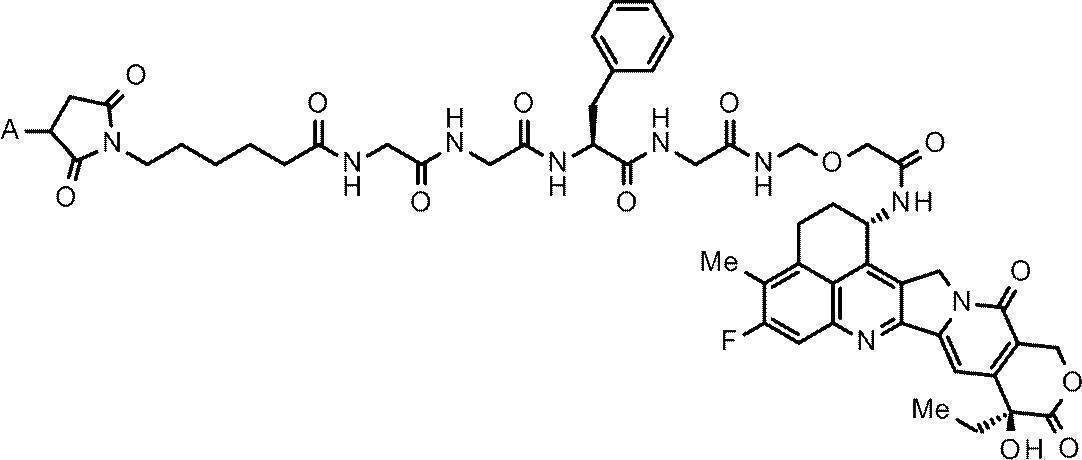
(式中、Aは抗体との結合位置を示す)
で示される薬物リンカーと、抗体とがチオエーテル結合によって結合した抗体-薬物コンジュゲートである)。
[49]
(i)100mgの抗体-薬物コンジュゲート、
(ii)4.06mgのL-ヒスチジン、及び20.7mgのL-ヒスチジン塩酸塩水和物、
(iii)450mgのスクロース、並びに、
(iv)1.5mgのポリソルベート20を含む、[48]に記載の医薬組成物。
[50]
抗体-薬物コンジュゲートにおける1抗体あたりの薬物リンカーの平均結合数が7から8個の範囲である、[48]又は[49]に記載の医薬組成物。(Wherein, A indicates the binding position with the antibody)
is an antibody-drug conjugate in which a drug linker represented by is bound to an antibody via a thioether bond).
[49]
(i) 100 mg of antibody-drug conjugate,
(ii) 4.06 mg L-histidine and 20.7 mg L-histidine hydrochloride hydrate;
(iii) 450 mg of sucrose, and
(iv) the pharmaceutical composition of [48], comprising 1.5 mg of
[50]
The pharmaceutical composition of [48] or [49], wherein the average number of drug linker bonds per antibody in the antibody-drug conjugate is in the range of 7 to 8.
[51]
抗体-薬物コンジュゲートにおける抗体が、抗HER3抗体である、[48]から[50]のいずれか1項に記載の医薬組成物。
[52]
抗HER3抗体が、配列番号3に記載のアミノ酸配列からなる重鎖及び配列番号4に記載のアミノ酸配列からなる軽鎖を含んでなる抗体である、[51]に記載の医薬組成物。
[53]
抗HER3抗体の重鎖カルボキシル末端のリシン残基が欠失している、[52]に記載の医薬組成物。
[54]
(i)抗体-薬物コンジュゲート20mg当たりに、
(ii)0.78mgのL-ヒスチジン、及び1.05mgのL-ヒスチジン塩酸塩水和物、
(iii)90mgのスクロース、並びに、
(iv)0.2又は0.3mgのポリソルベート80を含む、医薬組成物;
(ここで、該抗体-薬物コンジュゲートは、次式[51]
The pharmaceutical composition of any one of [48]-[50], wherein the antibody in the antibody-drug conjugate is an anti-HER3 antibody.
[52]
The pharmaceutical composition of [51], wherein the anti-HER3 antibody comprises a heavy chain consisting of the amino acid sequence set forth in SEQ ID NO:3 and a light chain consisting of the amino acid sequence set forth in SEQ ID NO:4.
[53]
The pharmaceutical composition of [52], wherein the heavy chain carboxyl-terminal lysine residue of the anti-HER3 antibody is deleted.
[54]
(i) per 20 mg of antibody-drug conjugate,
(ii) 0.78 mg L-histidine and 1.05 mg L-histidine hydrochloride hydrate;
(iii) 90 mg of sucrose, and
(iv) a pharmaceutical composition comprising 0.2 or 0.3
(wherein the antibody-drug conjugate has the following formula:
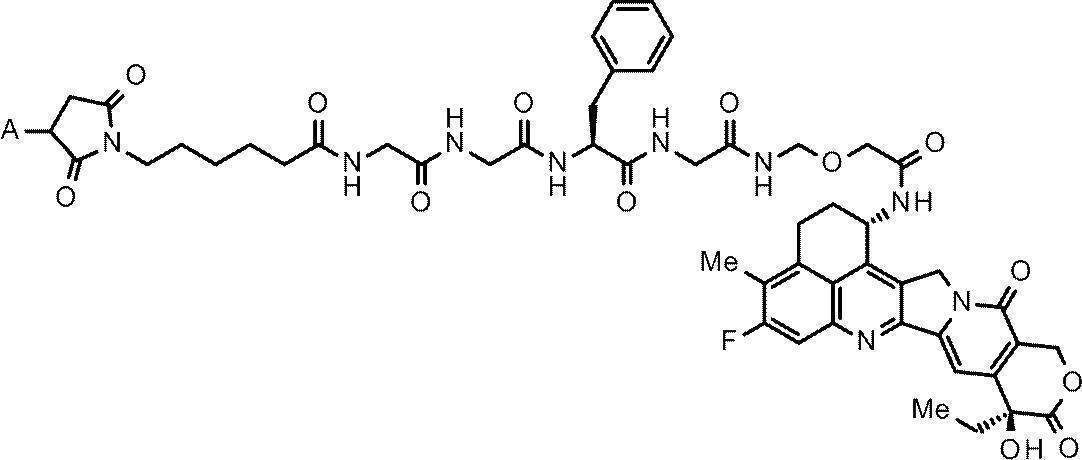
(式中、Aは抗体との結合位置を示す)
で示される薬物リンカーと、抗体とがチオエーテル結合によって結合した抗体-薬物コンジュゲートである)。
[55]
(i)100mgの抗体-薬物コンジュゲート、
(ii)3.88mgのL-ヒスチジン、及び5.26mgのL-ヒスチジン塩酸塩水和物、
(iii)450mgのスクロース、並びに、
(iv)1.0又は1.5mgのポリソルベート80を含む、[54]に記載の医薬組成物。
[56]
抗体-薬物コンジュゲートにおける1抗体あたりの薬物リンカーの平均結合数が3から5個の範囲である、[54]又は[55]に記載の医薬組成物。
[57]
抗体-薬物コンジュゲートにおける抗体が、抗TROP2抗体である、[54]から[56]のいずれか1項に記載の医薬組成物。
[58]
抗TROP2抗体が、配列番号5においてアミノ酸番号20乃至470に記載のアミノ酸配列からなる重鎖及び配列番号6においてアミノ酸番号21乃至234に記載のアミノ酸配列からなる軽鎖を含んでなる抗体である、[57]に記載の医薬組成物。
[59]
抗TROP2抗体の重鎖カルボキシル末端のリシン残基が欠失している、[58]に記載の医薬組成物。
[60]
(i)抗体-薬物コンジュゲート20mg当たりに、
(ii)0.65mgのL-ヒスチジン、及び1.22mgのL-ヒスチジン塩酸塩水和物、
(iii)90mgのスクロース、並びに、
(iv)0.2又は0.3mgのポリソルベート20を含む、医薬組成物;
(ここで、該抗体-薬物コンジュゲートは、次式(Wherein, A indicates the binding position with the antibody)
is an antibody-drug conjugate in which a drug linker represented by is bound to an antibody via a thioether bond).
[55]
(i) 100 mg of antibody-drug conjugate,
(ii) 3.88 mg L-histidine and 5.26 mg L-histidine hydrochloride hydrate;
(iii) 450 mg of sucrose, and
(iv) the pharmaceutical composition of [54], comprising 1.0 or 1.5 mg of
[56]
The pharmaceutical composition of [54] or [55], wherein the average number of drug linker bonds per antibody in the antibody-drug conjugate is in the range of 3 to 5.
[57]
The pharmaceutical composition of any one of [54]-[56], wherein the antibody in the antibody-drug conjugate is an anti-TROP2 antibody.
[58]
The anti-TROP2 antibody is an antibody comprising a heavy chain consisting of the amino acid sequences of
[59]
The pharmaceutical composition of [58], wherein the heavy chain carboxyl-terminal lysine residue of the anti-TROP2 antibody is deleted.
[60]
(i) per 20 mg of antibody-drug conjugate,
(ii) 0.65 mg L-histidine and 1.22 mg L-histidine hydrochloride hydrate;
(iii) 90 mg of sucrose, and
(iv) a pharmaceutical composition comprising 0.2 or 0.3
(wherein the antibody-drug conjugate has the following formula:

(式中、Aは抗体との結合位置を示す)
で示される薬物リンカーと、抗体とがチオエーテル結合によって結合した抗体-薬物コンジュゲートである)。
[61]
(i)100mgの抗体-薬物コンジュゲート、
(ii)3.23mgのL-ヒスチジン、及び6.12mgのL-ヒスチジン塩酸塩水和物、
(iii)450mgのスクロース、並びに、
(iv)1.0又は1.5mgのポリソルベート20を含む、[60]に記載の医薬組成物。
[62]
抗体-薬物コンジュゲートにおける1抗体あたりの薬物リンカーの平均結合数が3から5個の範囲である、[60]又は[61]に記載の医薬組成物。
[63]
抗体-薬物コンジュゲートにおける抗体が、抗B7-H3抗体である、[60]から[62]のいずれか1項に記載の医薬組成物。
[64]
抗B7-H3抗体が、配列番号7においてアミノ酸番号20乃至471に記載のアミノ酸配列からなる重鎖及び配列番号8においてアミノ酸番号21乃至233に記載のアミノ酸配列からなる軽鎖を含んでなる抗体である、[63]に記載の医薬組成物。
[65]
抗B7-H3抗体の重鎖カルボキシル末端のリシン残基が欠失している、[64]に記載の医薬組成物。
[66]
(i)抗体-薬物コンジュゲート20mg当たりに、
(ii)0.32mgのL-ヒスチジン、及び1.66mgのL-ヒスチジン塩酸塩水和物、
(iii)90mgのスクロース、並びに、
(iv)0.3mgのポリソルベート80を含む、医薬組成物;
(ここで、該抗体-薬物コンジュゲートは、次式(Wherein, A indicates the binding position with the antibody)
is an antibody-drug conjugate in which a drug linker represented by is bound to an antibody via a thioether bond).
[61]
(i) 100 mg of antibody-drug conjugate,
(ii) 3.23 mg L-histidine and 6.12 mg L-histidine hydrochloride hydrate;
(iii) 450 mg of sucrose, and
(iv) The pharmaceutical composition of [60], comprising 1.0 or 1.5 mg of
[62]
The pharmaceutical composition of [60] or [61], wherein the average number of drug linker bonds per antibody in the antibody-drug conjugate is in the range of 3 to 5.
[63]
The pharmaceutical composition of any one of [60] to [62], wherein the antibody in the antibody-drug conjugate is an anti-B7-H3 antibody.
[64]
The anti-B7-H3 antibody is an antibody comprising a heavy chain consisting of the amino acid sequences of
[65]
The pharmaceutical composition of [64], wherein the heavy chain carboxyl-terminal lysine residue of the anti-B7-H3 antibody is deleted.
[66]
(i) per 20 mg of antibody-drug conjugate,
(ii) 0.32 mg L-histidine and 1.66 mg L-histidine hydrochloride hydrate;
(iii) 90 mg of sucrose, and
(iv) a pharmaceutical composition comprising 0.3
(wherein the antibody-drug conjugate has the following formula:
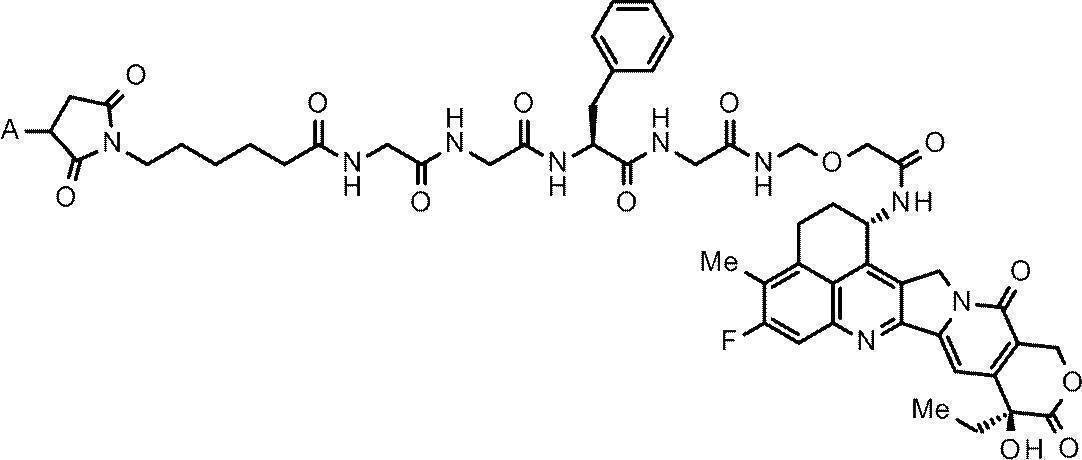
(式中、Aは抗体との結合位置を示す)
で示される薬物リンカーと、抗体とがチオエーテル結合によって結合した抗体-薬物コンジュゲートである)。
[67]
(i)100mgの抗体-薬物コンジュゲート、
(ii)1.62mgのL-ヒスチジン、及び8.29mgのL-ヒスチジン塩酸塩水和物、
(iii)450mgのスクロース、並びに、
(iv)1.5mgのポリソルベート80を含む、[66]に記載の医薬組成物。
[68]
抗体-薬物コンジュゲートにおける1抗体あたりの薬物リンカーの平均結合数が7から8個の範囲である、[66]又は[67]に記載の医薬組成物。
[69]
抗体-薬物コンジュゲートにおける抗体が、抗GPR20抗体である、[66]から[68]のいずれか1項に記載の医薬組成物。
[70]
抗GPR20抗体が、配列番号9に記載のアミノ酸番号20乃至472に記載のアミノ酸配列からなる重鎖及び配列番号10においてアミノ酸番号21乃至234に記載のアミノ酸配列からなる軽鎖を含んでなる抗体である、[69]に記載の医薬組成物。(Wherein, A indicates the binding position with the antibody)
is an antibody-drug conjugate in which a drug linker represented by is bound to an antibody via a thioether bond).
[67]
(i) 100 mg of antibody-drug conjugate,
(ii) 1.62 mg L-histidine and 8.29 mg L-histidine hydrochloride hydrate;
(iii) 450 mg of sucrose, and
(iv) the pharmaceutical composition of [66], comprising 1.5 mg of
[68]
The pharmaceutical composition of [66] or [67], wherein the average number of drug linker bonds per antibody in the antibody-drug conjugate is in the range of 7 to 8.
[69]
The pharmaceutical composition of any one of [66]-[68], wherein the antibody in the antibody-drug conjugate is an anti-GPR20 antibody.
[70]
The anti-GPR20 antibody is an antibody comprising a heavy chain consisting of the amino acid sequence represented by
[71]
抗GPR20抗体の重鎖カルボキシル末端のリシン残基が欠失している、[70]に記載の医薬組成物。
[72]
注射剤である、[1]から[71]のいずれか1項に記載の医薬組成物。
[73]
水性注射剤である、[72]に記載の医薬組成物。
[74]
抗体-薬物コンジュゲートの濃度が20mg/mLである、[73]に記載の医薬組成物。
[75]
凍結された、[73]又は[74]に記載の医薬組成物。[71]
The pharmaceutical composition of [70], wherein the heavy chain carboxyl-terminal lysine residue of the anti-GPR20 antibody is deleted.
[72]
The pharmaceutical composition according to any one of [1] to [71], which is an injection.
[73]
The pharmaceutical composition of [72], which is an aqueous injection.
[74]
The pharmaceutical composition of [73], wherein the antibody-drug conjugate has a concentration of 20 mg/mL.
[75]
The pharmaceutical composition of [73] or [74], which is frozen.
[76]
凍結乾燥注射剤である、[72]に記載の医薬組成物。
[77]
褐色バイアルに格納された、[76]に記載の医薬組成物。
[78]
がんの治療用である、[1]から[77]のいずれか1項に記載の医薬組成物。
[79]
(1)所定量の、
(i)抗体-薬物コンジュゲート、
(ii)ヒスチジン緩衝剤、
(iii)スクロース又はトレハロース、及び、
(iv)界面活性剤、
を含む水溶液を調製する工程、
(2)必要に応じて、水溶液のpHを所定の値に調整する工程、次いで、
(3)水溶液を凍結乾燥する工程、
を含む、[76]に記載の医薬組成物の製造方法。
[80]
水溶液を凍結乾燥する工程が、水溶液の共融点付近の棚温度でアニーリングするプロセスを含む、[79]に記載の製造方法;
(ここで、共融点付近とは、共融点よりも1.5℃低い温度から、共融点よりも1.5℃高い温度の範囲を示す)。[76]
The pharmaceutical composition of [72], which is a freeze-dried injection.
[77]
The pharmaceutical composition of [76], packaged in amber vials.
[78]
The pharmaceutical composition according to any one of [1] to [77], which is used for treating cancer.
[79]
(1) a predetermined amount of
(i) an antibody-drug conjugate;
(ii) a histidine buffer,
(iii) sucrose or trehalose, and
(iv) a surfactant,
preparing an aqueous solution comprising
(2) If necessary, a step of adjusting the pH of the aqueous solution to a predetermined value, then
(3) freeze-drying the aqueous solution;
A method for producing a pharmaceutical composition according to [76], comprising
[80]
The manufacturing method of [79], wherein the step of lyophilizing the aqueous solution comprises annealing at a shelf temperature near the eutectic point of the aqueous solution;
(Here, the vicinity of the eutectic point indicates a range from a temperature lower than the eutectic point by 1.5° C. to a temperature higher than the eutectic point by 1.5° C.).
[81]
水溶液を凍結乾燥する工程が、水溶液の共融点と同じ棚温度でアニーリングするプロセスを含む、[80]に記載の製造方法。
[82]
共融点よりも5℃低い棚温度でアニーリングを行った場合と比較し、1次乾燥するプロセスの時間が短縮されることを特徴とする、[80]又は[81]に記載の製造方法。
[83]
共融点よりも5℃低い棚温度でアニーリングを行った場合と比較し、よりシュリンクが少ない凍結乾燥ケーキが得られることを特徴とする、[80]から[82]のいずれか1項に記載の製造方法。
[84]
水溶液を凍結乾燥する工程が、-4~-1℃の棚温度でアニーリングするプロセスを含む、[79]に記載の製造方法。
[85]
水溶液を凍結乾燥する工程が、-4~-2℃の棚温度でアニーリングするプロセスを含む、[79]に記載の製造方法。[81]
The manufacturing method of [80], wherein the step of lyophilizing the aqueous solution comprises annealing at the same shelf temperature as the eutectic point of the aqueous solution.
[82]
The production method according to [80] or [81], characterized in that the time for the primary drying process is shortened compared to the case where annealing is performed at a
[83]
Any one of [80] to [82], characterized in that it results in a freeze-dried cake with less shrinkage compared to annealing at a shelf temperature of 5°C below the eutectic point. Production method.
[84]
The manufacturing method of [79], wherein the step of lyophilizing the aqueous solution comprises annealing at a shelf temperature of -4 to -1°C.
[85]
The manufacturing method of [79], wherein the step of lyophilizing the aqueous solution comprises annealing at a shelf temperature of -4 to -2°C.
[86]
水溶液を凍結乾燥する工程が、-2.5℃の棚温度でアニーリングするプロセスを含む、[79]に記載の製造方法。
[87]
水溶液を凍結乾燥する工程が、-5~5℃の棚温度かつ5~15Paの真空下で1次乾燥するプロセスをさらに含む、[84]から[86]のいずれか1項に記載の製造方法。
[88]
水溶液を凍結乾燥する工程が、0℃の棚温度かつ10Paの真空下で1次乾燥するプロセスをさらに含む、[84]から[86]のいずれか1項に記載の製造方法。
[89]
水溶液を凍結乾燥する工程が、40~50℃の棚温度かつ5~15Paの真空下で2次乾燥するプロセスをさらに含む、[87]又は[88]に記載の製造方法。
[90]
水溶液を凍結乾燥する工程が、45℃の棚温度かつ10Paの真空下で2次乾燥するプロセスをさらに含む、[87]又は[88]に記載の製造方法。[86]
The manufacturing method of [79], wherein the step of lyophilizing the aqueous solution comprises annealing at a shelf temperature of -2.5°C.
[87]
The production method according to any one of [84] to [86], wherein the step of freeze-drying the aqueous solution further comprises a primary drying process at a shelf temperature of −5 to 5° C. and under a vacuum of 5 to 15 Pa. .
[88]
The production method according to any one of [84] to [86], wherein the step of freeze-drying the aqueous solution further includes a primary drying process at a shelf temperature of 0°C and a vacuum of 10 Pa.
[89]
The production method of [87] or [88], wherein the step of freeze-drying the aqueous solution further comprises a process of secondary drying at a shelf temperature of 40-50° C. and a vacuum of 5-15 Pa.
[90]
The production method of [87] or [88], wherein the step of freeze-drying the aqueous solution further comprises secondary drying at a shelf temperature of 45°C and a vacuum of 10 Pa.
[91]
[42]又は[43]の医薬組成物と、注射用水を含む、キット。
[92]
注射用水がアンプルに格納されている、[91]に記載のキット。
[93]
スクロース又はトレハロースを含有する水溶液の共融点付近の棚温度でアニーリングするプロセスを含む、凍結乾燥注射剤の製造方法;(ここで、共融点付近とは、共融点よりも1.5℃低い温度から、共融点よりも1.5℃高い温度の範囲を示す)。
[94]
スクロース又はトレハロースを含有する水溶液の共融点と同じ棚温度でアニーリングするプロセスを含む、凍結乾燥注射剤の製造方法。
に関する。[91]
A kit comprising the pharmaceutical composition of [42] or [43] and water for injection.
[92]
The kit of [91], wherein the water for injection is contained in an ampoule.
[93]
A process for producing a lyophilized injectable comprising a process of annealing at a shelf temperature near the eutectic point of an aqueous solution containing sucrose or trehalose; , indicating a range of temperatures 1.5° C. above the eutectic point).
[94]
A method for producing a lyophilized injectable, comprising the process of annealing at the same shelf temperature as the eutectic point of an aqueous solution containing sucrose or trehalose.
Regarding.
本発明により、特定の抗体-薬物コンジュゲートにおいて、凝集体の形成及び分解物の生成を抑制した医薬組成物(特に水性注射剤及び凍結乾燥注射剤)、並びに、水溶液から凍結乾燥注射剤への効率的な凍結乾燥方法を提供することができる。 According to the present invention, pharmaceutical compositions (especially aqueous injections and freeze-dried injections) in which the formation of aggregates and the generation of degradation products are suppressed in specific antibody-drug conjugates, and the transformation from an aqueous solution to a freeze-dried injection An efficient freeze-drying method can be provided.
以下、本発明を実施するための好適な形態について図面を参照しながら説明する。なお、以下に説明する実施形態は、本発明の代表的な実施形態の一例を示したものであり、これによって本発明の範囲が狭く解釈されることはない。 Preferred embodiments for carrying out the present invention will be described below with reference to the drawings. It should be noted that the embodiments described below are examples of typical embodiments of the present invention, and the scope of the present invention should not be interpreted narrowly.
[抗体-薬物コンジュゲート]
本発明において使用される抗体-薬物コンジュゲートは、次式[Antibody-drug conjugate]
Antibody-drug conjugates used in the present invention have the formula

(式中、Aは抗体との結合位置を示す)
で示される薬物リンカーと、抗体とがチオエーテル結合によって結合した抗体-薬物コンジュゲートである。(Wherein, A indicates the binding position with the antibody)
is an antibody-drug conjugate in which a drug linker represented by is bound to an antibody via a thioether bond.
本発明においては、抗体-薬物コンジュゲートのうち、リンカー及び薬物からなる部分構造を「薬物リンカー」と称する。この薬物リンカーは抗体の鎖間のジスルフィド結合部位(2箇所の重鎖-重鎖間、及び2箇所の重鎖-軽鎖間)において生じたチオール基(言い換えれば、システイン残基の硫黄原子)に結合している。 In the present invention, a partial structure consisting of a linker and a drug in an antibody-drug conjugate is referred to as a "drug linker." This drug linker is a thiol group (in other words, the sulfur atom of a cysteine residue) generated at the disulfide bond sites between antibody chains (two heavy chain-heavy chain sites and two heavy chain-light chain sites). is bound to
本発明の薬物リンカーは、トポイソメラーゼI阻害剤であるエキサテカン(IUPAC名:(1S,9S)-1-アミノ-9-エチル-5-フルオロ-1,2,3,9,12,15-ヘキサヒドロ-9-ヒドロキシ-4-メチル-10H,13H-ベンゾ[de]ピラノ[3’,4’:6,7]インドリジノ[1,2-b]キノリン-10,13-ジオン、(化学名:(1S,9S)-1-アミノ-9-エチル-5-フルオロ-2,3-ジヒドロ-9-ヒドロキシ-4-メチル-1H,12H-ベンゾ[de]ピラノ[3’,4’:6,7]インドリジノ[1,2-b]キノリン-10,13(9H,15H)-ジオンとして表すこともできる))を構成要素としている。エキサテカンは、次式 The drug-linker of the present invention is the topoisomerase I inhibitor exatecan (IUPAC name: (1S,9S)-1-amino-9-ethyl-5-fluoro-1,2,3,9,12,15-hexahydro- 9-hydroxy-4-methyl-10H,13H-benzo[de]pyrano[3′,4′:6,7]indolizino[1,2-b]quinoline-10,13-dione, (chemical name: (1S ,9S)-1-amino-9-ethyl-5-fluoro-2,3-dihydro-9-hydroxy-4-methyl-1H,12H-benzo[de]pyrano[3′,4′:6,7] It can also be represented as indolizino[1,2-b]quinoline-10,13(9H,15H)-dione)). Exatecan has the formula

で示される、抗腫瘍効果を有するカンプトテシン誘導体である。 is a camptothecin derivative with anti-tumor effects.
本発明において使用される抗体-薬物コンジュゲートは、次式で示すこともできる。 Antibody-drug conjugates used in the present invention can also be represented by the following formula.

ここで、薬物リンカーは抗体とチオエーテル結合によって結合している。また、nはいわゆる平均薬物結合数(DAR; Drug-to-Antibody Ratio)と同義であり、1抗体あたりの薬物リンカーの平均結合数を示す。
本発明で使用される抗体-薬物コンジュゲートは、がん細胞内に移行した後に、次式Here, the drug linker is attached to the antibody by a thioether bond. In addition, n is synonymous with the so-called average number of drug binding (DAR; Drug-to-Antibody Ratio), and indicates the average number of drug linker binding per antibody.
Antibody-drug conjugate used in the present invention, after translocation into cancer cells, the following formula

で表されるトポイソメラーゼI阻害作用を有する化合物(以下、「化合物(1)」と称する。)を放出することにより、抗腫瘍効果を発揮する。
化合物(1)は、本発明で使用される抗体-薬物コンジュゲートのリンカー部分が切断されることにより生じると考えられる、次式By releasing a compound having topoisomerase I inhibitory activity represented by (hereinafter referred to as "compound (1)"), an antitumor effect is exhibited.
Compound (1) is believed to be produced by cleaving the linker portion of the antibody-drug conjugate used in the present invention,

で表される化合物のアミナール構造が分解することにより生じると考えられる。 It is considered that the aminal structure of the compound represented by is decomposed.
本発明で使用される抗体-薬物コンジュゲートは、バイスタンダー効果を有することも知られている(Ogitani Y. et al., Cancer Science (2016) 107, 1039-1046)。
このバイスタンダー効果は、本発明で使用される抗体-薬物コンジュゲートが、標的発現がん細胞に内在化した後、放出された化合物(1)が、標的を発現していない近傍のがん細胞に対しても抗腫瘍効果を及ぼすことにより発揮される。Antibody-drug conjugates used in the present invention are also known to have bystander effects (Ogitani Y. et al., Cancer Science (2016) 107, 1039-1046).
This bystander effect is due to the fact that after the antibody-drug conjugate used in the present invention is internalized into target-expressing cancer cells, the released compound (1) is induced by nearby cancer cells that do not express the target. It is also exerted by exerting an antitumor effect against
[抗体-薬物コンジュゲートにおける抗体]
本発明で使用される抗体-薬物コンジュゲートにおける抗体は、いずれの種に由来してもよいが、好適には、ヒト、ラット、マウス、及びウサギに由来する抗体である。抗体がヒト以外の種に由来する場合は、周知の技術を用いて、キメラ化又はヒト化することが好ましい。本発明の抗体は、ポリクローナル抗体であっても、モノクローナル抗体であってもよいが、モノクローナル抗体が好ましい。Antibodies in Antibody-Drug Conjugates
Antibodies in antibody-drug conjugates used in the present invention may be derived from any species, but are preferably derived from humans, rats, mice, and rabbits. If the antibody is derived from a species other than human, it is preferably chimerized or humanized using well known techniques. Antibodies of the present invention may be polyclonal antibodies or monoclonal antibodies, but monoclonal antibodies are preferred.
本発明で使用される抗体-薬物コンジュゲートにおける抗体は、好適にはがん細胞を標的にできる性質を有するものであり、がん細胞を認識できる特性、がん細胞に結合できる特性、がん細胞内に取り込まれて内在化する特性、及び/又はがん細胞に対する殺細胞活性等を備えているものが好ましい。 The antibody in the antibody-drug conjugate used in the present invention preferably has the property of being able to target cancer cells, the property of being able to recognize cancer cells, the property of being able to bind to cancer cells, the property of being able to bind to cancer cells. Preferably, it has the characteristic of being taken up into cells and internalized, and/or has cell-killing activity against cancer cells.
抗体のがん細胞への結合性は、フローサイトメトリーを用いて確認できる。がん細胞内への抗体の取り込みは、(1)治療抗体に結合する二次抗体(蛍光標識)を用いて細胞内に取り込まれた抗体を蛍光顕微鏡で可視化するアッセイ(Cell Death and Differentiation (2008) 15, 751-761)、(2)治療抗体に結合する二次抗体(蛍光標識)を用いて細胞内に取り込まれた蛍光量を測定するアッセイ(Molecular Biology of the Cell Vol. 15, 5268-5282, December 2004)、又は(3)治療抗体に結合するイムノトキシンを用いて、細胞内に取り込まれると毒素が放出されて細胞増殖が抑制されるというMab-ZAPアッセイ(Bio Techniques 28:162-165, January 2000)を用いて確認できる。イムノトキシンとしては、ジフテテリア毒素の触媒領域とプロテインGとのリコンビナント複合蛋白質も使用可能である。 The binding of the antibody to cancer cells can be confirmed using flow cytometry. Antibody uptake into cancer cells is performed by (1) an assay in which a secondary antibody (fluorescent label) that binds to a therapeutic antibody is used to visualize the antibody uptake into cells with a fluorescence microscope (Cell Death and Differentiation (2008). ) 15, 751-761), (2) an assay that measures the amount of fluorescence taken up into cells using a secondary antibody (fluorescent label) that binds to a therapeutic antibody (Molecular Biology of the Cell Vol. 15, 5268- 5282, December 2004), or (3) a Mab-ZAP assay using an immunotoxin that binds to a therapeutic antibody, which upon intracellular uptake releases the toxin and inhibits cell proliferation (Bio Techniques 28:162-). 165, January 2000). As an immunotoxin, a recombinant conjugated protein of the catalytic domain of diphtheria toxin and protein G can also be used.
抗体の抗腫瘍活性は、in vitroでは、細胞の増殖の抑制活性を測定することで確認できる。例えば、抗体の標的蛋白質を過剰発現しているがん細胞株を培養し、培養系に種々の濃度で抗体を添加し、フォーカス形成、コロニー形成及びスフェロイド増殖に対する抑制活性を測定することができる。in vivoでは、例えば、標的蛋白質を高発現しているがん細胞株を移植したヌードマウスに抗体を投与し、がん細胞の変化を測定することによって、抗腫瘍活性を確認できる。 The anti-tumor activity of an antibody can be confirmed in vitro by measuring the cell growth inhibitory activity. For example, a cancer cell line overexpressing the target protein of the antibody is cultured, the antibody is added to the culture system at various concentrations, and the inhibitory activity against focus formation, colony formation and spheroid proliferation can be measured. In vivo, for example, antitumor activity can be confirmed by administering the antibody to nude mice implanted with cancer cell lines highly expressing the target protein and measuring changes in cancer cells.
抗体自体が抗腫瘍効果を有することは、好ましいが、抗体-薬物コンジュゲートは抗腫瘍効果を発揮する化合物を結合させてあるので、抗体自体の抗腫瘍効果は必須ではない。抗腫瘍性化合物の細胞障害性をがん細胞において特異的・選択的に発揮させる目的からは、抗体が内在化してがん細胞内に移行する性質のあることが重要であり、好ましい。
本発明で使用される抗体-薬物コンジュゲートにおける抗体は、公知の手段によって取得することができる。例えば、この分野で通常実施される方法を用いて、抗原となるポリペプチドを動物に免疫し、生体内に産生される抗体を採取、精製することによって得ることができる。抗原の由来はヒトに限定されず、マウス、ラット等のヒト以外の動物に由来する抗原を動物に免疫することもできる。この場合には、取得された異種抗原に結合する抗体とヒト抗原との交差性を試験することによって、ヒトの疾患に適用可能な抗体を選別できる。Although it is preferable that the antibody itself has an anti-tumor effect, it is not essential that the antibody itself has an anti-tumor effect, since the antibody-drug conjugate is bound with a compound that exerts an anti-tumor effect. For the purpose of specifically and selectively exerting the cytotoxicity of antitumor compounds on cancer cells, it is important and preferable for the antibody to have the property of being internalized and transferred into cancer cells.
Antibodies in antibody-drug conjugates used in the present invention can be obtained by known means. For example, it can be obtained by immunizing an animal with a polypeptide serving as an antigen and collecting and purifying the antibody produced in vivo using a method commonly practiced in this field. The origin of the antigen is not limited to humans, and animals can also be immunized with antigens derived from non-human animals such as mice and rats. In this case, antibodies applicable to human diseases can be screened by testing the cross-reactivity between the obtained antibodies that bind to heterologous antigens and human antigens.
また、公知の方法(例えば、Kohler and Milstein, Nature (1975) 256, p.495-497;Kennet, R. ed., Monoclonal Antibodies, p.365-367, Plenum Press, N.Y.(1980))に従って、抗原に対する抗体を産生する抗体産生細胞とミエローマ細胞とを融合させることによってハイブリドーマを樹立し、モノクローナル抗体を得ることもできる。 In addition, according to known methods (e.g., Kohler and Milstein, Nature (1975) 256, p.495-497; Kennet, R. ed., Monoclonal Antibodies, p.365-367, Plenum Press, N.Y. (1980)), Monoclonal antibodies can also be obtained by establishing hybridomas by fusing antibody-producing cells that produce antibodies against antigens with myeloma cells.
なお、抗原は抗原蛋白質をコードする遺伝子を遺伝子操作によって宿主細胞に産生させることによって得ることができる。具体的には、抗原遺伝子を発現可能なベクターを作製し、これを宿主細胞に導入して該遺伝子を発現させ、発現した抗原を精製すればよい。上記の遺伝子操作による抗原発現細胞、或は抗原を発現している細胞株、を動物に免疫する方法を用いることによっても抗体を取得できる。 An antigen can be obtained by genetically engineering a gene encoding an antigen protein to produce it in a host cell. Specifically, a vector capable of expressing an antigen gene may be prepared, introduced into a host cell to express the gene, and the expressed antigen purified. Antibodies can also be obtained by using the method of immunizing animals with the above-described genetically engineered antigen-expressing cells or antigen-expressing cell lines.
本発明で使用される抗体-薬物コンジュゲートにおける抗体は、ヒトに対する異種抗原性を低下させること等を目的として人為的に改変した遺伝子組換え型抗体、例えば、キメラ(Chimeric)抗体、ヒト化(Humanized)抗体であることが好ましく、又はヒト由来の抗体の遺伝子配列のみを有する抗体、すなわちヒト抗体であることが好ましい。これらの抗体は、既知の方法を用いて製造することができる。 The antibody in the antibody-drug conjugate used in the present invention is an artificially modified genetically modified antibody for the purpose of reducing heteroantigenicity to humans, such as a chimeric antibody, a humanized ( It is preferably a humanized antibody, or an antibody having only the gene sequence of a human-derived antibody, that is, a human antibody. These antibodies can be produced using known methods.
キメラ抗体としては、抗体の可変領域と定常領域が互いに異種である抗体、例えばマウス又はラット由来抗体の可変領域をヒト由来の定常領域に接合したキメラ抗体を挙げることができる(Proc. Natl. Acad. Sci. U.S.A., 81, 6851-6855,(1984))。 Examples of chimeric antibodies include antibodies in which the antibody variable region and constant region are different from each other, such as chimeric antibodies in which a mouse- or rat-derived antibody variable region is conjugated to a human-derived constant region (Proc. Natl. Acad. Sci. U.S.A., 81, 6851-6855, (1984)).
ヒト化抗体としては、異種抗体の相補性決定領域(CDR;complementarity determining region)のみをヒト由来の抗体に組み込んだ抗体(Nature(1986) 321, p.522-525)、CDR移植法によって、異種抗体のCDRの配列に加えて、異種抗体の一部のフレームワークのアミノ酸残基もヒト抗体に移植した抗体(国際公開第90/07861号)、遺伝子変換突然変異誘発(gene conversion mutagenesis)ストラテジーを用いてヒト化した抗体(米国特許第5821337号)を挙げることができる。 Humanized antibodies include antibodies in which only the complementarity determining regions (CDRs) of heteroantibodies are incorporated into human-derived antibodies (Nature (1986) 321, p.522-525). In addition to the sequences of the CDRs of the antibody, some framework amino acid residues of the heteroantibody are also grafted into the human antibody (WO 90/07861), a gene conversion mutagenesis strategy. (US Pat. No. 5,821,337) can be mentioned.
ヒト抗体としては、ヒト抗体の重鎖と軽鎖の遺伝子を含むヒト染色体断片を有するヒト抗体産生マウスを用いて作成した抗体(Tomizuka, K. et al., Nature Genetics(1997) 16, p.133-143;Kuroiwa, Y. et. al., Nucl. Acids Res.(1998) 26, p.3447-3448;Yoshida, H. et. al., Animal Cell Technology:Basic and Applied Aspects vol.10, p.69-73(Kitagawa, Y., Matsuda, T. and Iijima, S. eds.), Kluwer Academic Publishers, 1999;Tomizuka, K. et. al., Proc. Natl. Acad. Sci. USA(2000) 97, p.722-727等を参照。)を挙げることができる。或いは、ヒト抗体ライブラリーより選別したファージディスプレイにより取得した抗体(Wormstone, I. M. et. al, Investigative Ophthalmology & Visual Science. (2002)43 (7), p.2301-2308;Carmen, S. et. al., Briefings in Functional Genomics and Proteomics(2002), 1(2), p.189-203;Siriwardena, D. et. al., Ophthalmology(2002) 109(3), p.427-431等参照。)も挙げることができる。 Examples of human antibodies include antibodies prepared using human antibody-producing mice having human chromosome fragments containing human antibody heavy and light chain genes (Tomizuka, K. et al., Nature Genetics (1997) 16, p. 133-143; Kuroiwa, Y. et. al., Nucl. Acids Res.(1998) 26, p.3447-3448; Yoshida, H. et. p.69-73(Kitagawa, Y., Matsuda, T. and Iijima, S. eds.), Kluwer Academic Publishers, 1999;Tomizuka, K. et. al., Proc. Natl. Acad. Sci. USA(2000 ) 97, p.722-727, etc.). Alternatively, antibodies obtained by phage display selected from a human antibody library (Wormstone, I. M. et. al, Investigative Ophthalmology & Visual Science. (2002) 43 (7), p.2301-2308; Carmen, S. et. al ., Briefings in Functional Genomics and Proteomics (2002), 1(2), p.189-203; Siriwardena, D. et. al., Ophthalmology (2002) 109(3), p.427-431, etc.) can also be mentioned.
本発明で使用される抗体-薬物コンジュゲートにおける抗体には、抗体の修飾体も含まれる。当該修飾体とは、本発明に係る抗体に化学的又は生物学的な修飾が施されてなるものを意味する。化学的な修飾体には、アミノ酸骨格への化学部分の結合、N-結合又はO-結合炭水化物鎖への化学部分の結合を有する化学修飾体等が含まれる。生物学的な修飾体には、翻訳後修飾(例えば、N-結合又はO-結合型糖鎖の付加、N末端又はC末端のプロセッシング、脱アミド化、アスパラギン酸の異性化、メチオニンの酸化等)されたもの、原核生物宿主細胞を用いて発現させることによってN末にメチオニン残基が付加されたもの等が含まれる。また、本発明に係る抗体又は抗原の検出又は単離を可能にするために標識されたもの、例えば、酵素標識体、蛍光標識体、アフィニティ標識体もかかる修飾体の意味に含まれる。この様な本発明に係る抗体の修飾体は、抗体の安定性及び血中滞留性の改善、抗原性の低減、抗体又は抗原の検出又は単離等に有用である。 Antibodies in antibody-drug conjugates used in the present invention also include modified forms of antibodies. The modified form means an antibody obtained by chemically or biologically modifying the antibody according to the present invention. Chemical modifications include chemical modifications having attachment of chemical moieties to an amino acid backbone, attachment of chemical moieties to N-linked or O-linked carbohydrate chains, and the like. Biological modifications include post-translational modifications (e.g., addition of N-linked or O-linked sugar chains, N-terminal or C-terminal processing, deamidation, isomerization of aspartic acid, oxidation of methionine, etc.). ), and those in which a methionine residue is added to the N-terminus by expression using a prokaryotic host cell. In addition, those labeled to enable detection or isolation of the antibody or antigen according to the present invention, such as enzyme labels, fluorescence labels, and affinity labels, are also included in the meaning of such modifications. Such a modified antibody according to the present invention is useful for improving antibody stability and blood retention, reducing antigenicity, and detecting or isolating antibodies or antigens.
また、本発明に係る抗体に結合している糖鎖修飾を調節すること(グリコシル化、脱フコース化等)によって、抗体依存性細胞傷害活性を増強することが可能である。抗体の糖鎖修飾の調節技術としては、国際公開第99/54342号、国際公開第00/61739号、国際公開第02/31140号等が知られているが、これらに限定されるものではない。本発明に係る抗体には当該糖鎖修飾が調節された抗体も含まれる。 In addition, antibody-dependent cytotoxicity can be enhanced by modulating sugar chain modifications (glycosylation, defucosylation, etc.) attached to the antibodies of the present invention. Techniques for regulating glycosylation of antibodies are known in International Publication No. 99/54342, International Publication No. 00/61739, International Publication No. 02/31140, etc., but are not limited thereto. . Antibodies according to the present invention also include antibodies with regulated sugar chain modifications.
なお、哺乳類培養細胞で生産される抗体では、その重鎖のカルボキシル末端のリシン残基が欠失することが知られており(Journal of Chromatography A, 705: 129-134(1995))、また、同じく重鎖カルボキシル末端のグリシン、リシンの2アミノ酸残基が欠失し、新たにカルボキシル末端に位置するプロリン残基がアミド化されることが知られている(Analytical Biochemistry, 360: 75-83(2007))。しかし、これらの重鎖配列の欠失及び修飾は、抗体の抗原結合能及びエフェクター機能(補体の活性化や抗体依存性細胞障害作用等)には影響を及ぼさない。したがって、本発明に係る抗体には、当該修飾を受けた抗体及び当該抗体の機能性断片も含まれ、重鎖カルボキシル末端において1又は2のアミノ酸が欠失した欠失体、及びアミド化された当該欠失体(例えば、カルボキシル末端部位のプロリン残基がアミド化された重鎖)等も包含される。但し、抗原結合能及びエフェクター機能が保たれている限り、本発明に係る抗体の重鎖のカルボキシル末端の欠失体は上記の種類に限定されない。本発明に係る抗体を構成する2本の重鎖は、完全長及び上記の欠失体からなる群から選択される重鎖のいずれか一種であってもよいし、いずれか二種を組み合わせたものであってもよい。各欠失体の量比は本発明に係る抗体を産生する哺乳類培養細胞の種類及び培養条件に影響を受け得るが、本発明に係る抗体は、好ましくは2本の重鎖の双方でカルボキシル末端のひとつのアミノ酸残基が欠失しているものを挙げることができる。 In addition, antibodies produced in cultured mammalian cells are known to lack lysine residues at the carboxyl terminus of their heavy chains (Journal of Chromatography A, 705: 129-134 (1995)). It is also known that two amino acid residues, glycine and lysine, at the carboxyl terminus of the heavy chain are deleted, and the proline residue newly located at the carboxyl terminus is amidated (Analytical Biochemistry, 360: 75-83 ( 2007)). However, these heavy chain sequence deletions and modifications do not affect the antibody's antigen-binding ability or effector functions (such as complement activation and antibody-dependent cytotoxicity). Therefore, the antibody according to the present invention also includes the modified antibody and the functional fragment of the antibody, such as deletions in which one or two amino acids are deleted at the heavy chain carboxyl terminus, and amidated Such deletions (eg, heavy chains in which the proline residue at the carboxyl terminal site is amidated) are also included. However, as long as the antigen-binding ability and effector function are maintained, the carboxyl-terminal deletion form of the heavy chain of the antibody according to the present invention is not limited to the above types. The two heavy chains constituting the antibody according to the present invention may be any one of heavy chains selected from the group consisting of full-length and the above deletions, or a combination of any two can be anything. Although the quantitative ratio of each deletion can be influenced by the type and culture conditions of cultured mammalian cells producing antibodies according to the invention, antibodies according to the invention preferably have carboxyl-terminal One amino acid residue of is deleted.
本発明に係る抗体のアイソタイプとしては、例えばIgG(IgG1、IgG2、IgG3、IgG4)等を挙げることができるが、好ましくはIgG1又はIgG2を挙げることができる。 Examples of the isotype of the antibody according to the present invention include IgG (IgG1, IgG2, IgG3, IgG4) and the like, preferably IgG1 or IgG2.
本発明で使用される抗体-薬物コンジュゲートにおける抗体は、特に制限はないが、例えば、抗HER2抗体、抗HER3抗体、抗TROP2抗体、抗B7-H3抗体、抗CD3抗体、抗CD30抗体、抗CD33抗体、抗CD37抗体、抗CD56抗体、抗CD98抗体、抗DR5抗体、抗EGFR抗体、抗EPHA2抗体、抗FGFR2抗体、抗FGFR4抗体、抗FOLR1抗体、抗VEGF抗体、及び抗GPR20抗体を挙げることができ、好適には、抗HER2抗体、抗HER3抗体、抗TROP2抗体、抗B7-H3、及び抗GPR20抗体を挙げることができる。 The antibody in the antibody-drug conjugate used in the present invention is not particularly limited, but examples include anti-HER2 antibody, anti-HER3 antibody, anti-TROP2 antibody, anti-B7-H3 antibody, anti-CD3 antibody, anti-CD30 antibody, anti- including CD33 antibody, anti-CD37 antibody, anti-CD56 antibody, anti-CD98 antibody, anti-DR5 antibody, anti-EGFR antibody, anti-EPHA2 antibody, anti-FGFR2 antibody, anti-FGFR4 antibody, anti-FOLR1 antibody, anti-VEGF antibody, and anti-GPR20 antibody preferably anti-HER2 antibody, anti-HER3 antibody, anti-TROP2 antibody, anti-B7-H3, and anti-GPR20 antibody.
本発明において、「抗HER2抗体」とは、HER2(Human Epidermal Growth FactorReceptor Type 2; ErbB-2)に特異的に結合し、好ましくは、HER2と結合することによってHER2発現細胞に内在化する活性を有する抗体を示す。
In the present invention, the "anti-HER2 antibody" specifically binds to HER2 (Human Epidermal Growth
抗HER2抗体としては、例えば、トラスツズマブ(Trastuzumab)(米国特許第5821337号)、及び、ペルツズマブ(Pertuzumab)(国際公開第01/00245号)を挙げることができ、好適にはトラスツズマブを挙げることができる。 Examples of anti-HER2 antibodies include Trastuzumab (US Pat. No. 5,821,337) and Pertuzumab (International Publication No. 01/00245), preferably Trastuzumab. .
本発明において、「トラスツズマブ」は、配列番号1(図1)においてアミノ酸番号1乃至449に記載のアミノ酸配列からなる重鎖及び配列番号2(図2)においてアミノ酸番号1乃至214に記載のアミノ酸配列からなる軽鎖を含んでなるヒト化抗HER2モノクローナル抗体である。
In the present invention, "trastuzumab" refers to a heavy chain consisting of the amino acid sequence represented by
本発明において、「抗HER3抗体」とは、HER3(Human Epidermal Growth FactorReceptor Type 3; ErbB-3)に特異的に結合し、好適には、HER3発現細胞表面上のHER3と結合して該HER3発現細胞に内在化する活性を有する抗体を示す。
In the present invention, the "anti-HER3 antibody" specifically binds to HER3 (Human Epidermal Growth
抗HER3抗体としては、例えば、パトリツマブ(Patritumab; U3-1287)、U1-59(国際公開第2007/077028号)、MM-121(seribantumab)、国際公開2008/100624号記載の抗ERBB3抗体、RG-7116(Lumretuzumab)、及びLJM-716(Elgemtumab)を挙げることができ、好適には、パトリツマブ、及びU1-59を挙げることができる。 Anti-HER3 antibodies include, for example, Patritumab (Patritumab; U3-1287), U1-59 (International Publication No. 2007/077028), MM-121 (seribantumab), anti-ERBB3 antibody described in International Publication No. 2008/100624, RG -7116 (Lumretuzumab), and LJM-716 (Elgemtumab), preferably patritumab, and U1-59.
本発明において、「抗TROP2抗体」とは、TROP2(TACSTD2:Tumor-associated calcium signal transducer 2; EGP-1)に特異的に結合し、好ましくは、TROP2と結合することによってTROP2発現細胞に内在化する活性を有する抗体を示す。
In the present invention, the "anti-TROP2 antibody" specifically binds to TROP2 (TACSTD2: Tumor-associated
抗TROP2抗体としては、例えば、hTINA1-H1L1(国際公開第2015/098099号)を挙げることができる。 Examples of anti-TROP2 antibodies include hTINA1-H1L1 (International Publication No. 2015/098099).
本発明において、「抗B7-H3抗体」とは、B7-H3(B cell antigen #7 homolog 3; PD-L3; CD276)に特異的に結合し、好ましくは、B7-H3と結合することによってB7-H3発現細胞に内在化する活性を有する抗体を示す。
In the present invention, the "anti-B7-H3 antibody" specifically binds to B7-H3 (B cell antigen #7
抗B7-H3抗体としては、例えば、M30-H1-L4(国際公開第2014/057687号)を挙げることができる。 Examples of anti-B7-H3 antibodies include M30-H1-L4 (International Publication No. 2014/057687).
本発明において、「抗GPR20抗体」とは、GPR20(G Protein-coupled receptor 20)に特異的に結合し、好ましくは、GPR20と結合することによってGPR20発現細胞に内在化する活性を有する抗体を示す。
抗GPR20抗体としては、例えば、h046-H4e/L7(国際公開第2018/135501号)を挙げることができる。In the present invention, the term "anti-GPR20 antibody" refers to an antibody that specifically binds to GPR20 (G protein-coupled receptor 20) and preferably has the activity of internalizing into GPR20-expressing cells by binding to GPR20. .
Examples of anti-GPR20 antibodies include h046-H4e/L7 (International Publication No. 2018/135501).
[抗体-薬物コンジュゲートの製造に使用される薬物リンカー中間体]
本発明の抗体-薬物コンジュゲートの製造に使用される薬物リンカー中間体は、次式で示される。[Drug Linker Intermediates Used in the Production of Antibody-Drug Conjugates]
The drug linker intermediates used to prepare the antibody-drug conjugates of the present invention are represented by the following formulas.

上記の薬物リンカー中間体は、国際公開第2014/057687号、国際公開第2015/098099号、国際公開第2015/115091号、及び国際公開第2015/155998号等の記載を参考に製造することができる。 The above drug linker intermediate can be produced with reference to the descriptions in WO 2014/057687, WO 2015/098099, WO 2015/115091, and WO 2015/155998. can.
[抗体と薬物リンカー中間体のコンジュゲーション]
本発明で使用される抗体-薬物コンジュゲートは、前述の薬物リンカー中間体と、チオール基(又はスルフヒドリル基とも言う)を有する抗体を反応させることによって製造することができる。[Conjugation of Antibody and Drug Linker Intermediate]
The antibody-drug conjugate used in the present invention can be produced by reacting the aforementioned drug linker intermediate with an antibody having a thiol group (also referred to as a sulfhydryl group).
スルフヒドリル基を有する抗体は、当業者周知の方法で得ることができる(Hermanson, G. T, Bioconjugate Techniques, pp.56-136, pp.456-493, Academic Press(1996))。例えば、トリス(2-カルボキシエチル)ホスフィン塩酸塩(TCEP)等の還元剤を、抗体内鎖間ジスルフィド1個当たりに対して0.3乃至3モル当量用い、エチレンジアミン四酢酸(EDTA)等のキレート剤を含む緩衝液中で、抗体と反応させることで、抗体内鎖間ジスルフィドが部分的若しくは完全に還元されたスルフヒドリル基を有する抗体を得ることができる。 Antibodies having sulfhydryl groups can be obtained by methods well known to those skilled in the art (Hermanson, G. T, Bioconjugate Techniques, pp.56-136, pp.456-493, Academic Press (1996)). For example, a reducing agent such as tris(2-carboxyethyl)phosphine hydrochloride (TCEP) is used in an amount of 0.3 to 3 molar equivalents per intrachain disulfide in the antibody, and a chelate such as ethylenediaminetetraacetic acid (EDTA) is used. An antibody having sulfhydryl groups in which interchain disulfides in the antibody are partially or completely reduced can be obtained by reacting it with the antibody in a buffer solution containing the agent.
さらに、スルフヒドリル基を有する抗体1個あたり、2乃至20モル当量の薬物リンカー中間体を使用して、抗体1個当たり2個乃至8個の薬物が結合した抗体―薬物コンジュゲートを製造することができる。 In addition, 2 to 20 molar equivalents of drug linker intermediates per antibody with sulfhydryl groups can be used to prepare antibody-drug conjugates with 2 to 8 drugs attached per antibody. can.
製造した抗体-薬物コンジュゲートの抗体一分子あたりの平均薬物結合数の算出は、例えば、280nm及び370nmの二波長における抗体-薬物コンジュゲートとそのコンジュゲーション前駆体のUV吸光度を測定することにより算出する方法(UV法)や、抗体-薬物コンジュゲートを還元剤で処理し得られた各フラグメントをHPLC測定により定量し算出する方法(HPLC法)により行うことができる。 The average number of drug binding per antibody molecule of the produced antibody-drug conjugate is calculated by measuring the UV absorbance of the antibody-drug conjugate and its conjugation precursor at two wavelengths of 280 nm and 370 nm, for example. (UV method), or a method of quantifying and calculating each fragment obtained by treating the antibody-drug conjugate with a reducing agent by HPLC measurement (HPLC method).
抗体と薬物リンカー中間体のコンジュゲーション、及び抗体-薬物コンジュゲートの抗体一分子あたりの平均薬物結合数の算出は、国際公開第2014/057687号、国際公開第2015/098099号、国際公開第2015/115091号、国際公開第2015/155998号、及び国際公開第2018/135501号等の記載を参考に実施することができる。 Conjugation of an antibody and a drug linker intermediate, and calculation of the average number of drug binding per antibody molecule of an antibody-drug conjugate are described in WO 2014/057687, WO 2015/098099, WO 2015. /115091, International Publication No. 2015/155998, International Publication No. 2018/135501, etc. can be implemented with reference.
本発明において、「抗HER2抗体-薬物コンジュゲート」とは、抗体-薬物コンジュゲートにおける抗体が抗HER2抗体である抗体-薬物コンジュゲートを示す。 In the present invention, "anti-HER2 antibody-drug conjugate" refers to an antibody-drug conjugate in which the antibody in the antibody-drug conjugate is an anti-HER2 antibody.
抗HER2抗体は、好適には、配列番号1においてアミノ酸番号1乃至449に記載のアミノ酸配列からなる重鎖及び配列番号2においてアミノ酸番号1乃至214に記載のアミノ酸配列からなる軽鎖を含んでなる抗体、又は、配列番号1に記載のアミノ酸配列からなる重鎖及び配列番号2に記載のアミノ酸配列からなる軽鎖を含んでなる抗体である。
The anti-HER2 antibody preferably comprises a heavy chain consisting of the amino acid sequence set forth in
本発明において使用される抗HER2抗体-薬物コンジュゲートの1抗体あたりの薬物リンカーの平均結合数は、好適には2から8であり、より好適には3から8であり、更により好適には7から8であり、更により好適には7.5から8であり、更により好適には約8である。 The average number of bindings of drug linkers per antibody of the anti-HER2 antibody-drug conjugate used in the present invention is preferably 2 to 8, more preferably 3 to 8, and even more preferably 7 to 8, even more preferably 7.5 to 8, even more preferably about 8.
本発明において使用される抗HER2抗体-薬物コンジュゲートは、国際公開第2015/115091号等の記載を参考に製造することができる。 The anti-HER2 antibody-drug conjugate used in the present invention can be produced with reference to the description in WO 2015/115091 and the like.
本発明において、「抗HER3抗体-薬物コンジュゲート」とは、抗体-薬物コンジュゲートにおける抗体が抗HER3抗体である抗体-薬物コンジュゲートを示す。 In the present invention, "anti-HER3 antibody-drug conjugate" refers to an antibody-drug conjugate in which the antibody in the antibody-drug conjugate is an anti-HER3 antibody.
抗HER3抗体は、好適には、配列番号3に記載のアミノ酸配列からなる重鎖及び配列番号4に記載のアミノ酸配列からなる軽鎖を含んでなる抗体、又は、該抗体の重鎖カルボキシル末端のリシン残基が欠失している抗体である。 The anti-HER3 antibody preferably comprises an antibody comprising a heavy chain consisting of the amino acid sequence set forth in SEQ ID NO:3 and a light chain consisting of the amino acid sequence set forth in SEQ ID NO:4, or An antibody lacking lysine residues.
本発明において使用される抗HER3抗体-薬物コンジュゲートの1抗体あたりの薬物リンカーの平均結合数は、好適には2から8であり、より好適には3から8であり、更により好適には7から8であり、更により好適には7.5から8であり、更により好適には約8である。 The average number of bindings of drug linkers per antibody of the anti-HER3 antibody-drug conjugate used in the present invention is preferably 2 to 8, more preferably 3 to 8, even more preferably 7 to 8, even more preferably 7.5 to 8, even more preferably about 8.
本発明において使用される抗HER3抗体-薬物コンジュゲートは、国際公開第2015/155998号等の記載を参考に製造することができる。 The anti-HER3 antibody-drug conjugate used in the present invention can be produced with reference to the description of International Publication No. 2015/155998 and the like.
本発明において、「抗TROP2抗体-薬物コンジュゲート」とは、抗体-薬物コンジュゲートにおける抗体が抗TROP2抗体である抗体-薬物コンジュゲートを示す。 In the present invention, "anti-TROP2 antibody-drug conjugate" refers to an antibody-drug conjugate in which the antibody in the antibody-drug conjugate is an anti-TROP2 antibody.
抗TROP2抗体は、好適には、配列番号5においてアミノ酸番号20乃至470に記載のアミノ酸配列からなる重鎖及び配列番号6においてアミノ酸番号21乃至234に記載のアミノ酸配列からなる軽鎖を含んでなる抗体、又は、該抗体の重鎖カルボキシル末端のリシン残基が欠失している抗体である。
The anti-TROP2 antibody preferably comprises a heavy chain consisting of the amino acid sequence of
本発明において使用される抗TROP2抗体-薬物コンジュゲートの1抗体あたりの薬物リンカーの平均結合数は、好適には2から8であり、より好適には3から5であり、更により好適には3.5から4.5であり、更により好適には約4である。 The average number of bindings of drug linkers per antibody of the anti-TROP2 antibody-drug conjugate used in the present invention is preferably 2 to 8, more preferably 3 to 5, even more preferably 3.5 to 4.5, and even more preferably about 4.
本発明において使用される抗TROP2抗体-薬物コンジュゲートは、国際公開第2015/098099号等の記載を参考に製造することができる。 The anti-TROP2 antibody-drug conjugate used in the present invention can be produced with reference to the description in WO 2015/098099 and the like.
本発明において、「抗B7-H3抗体-薬物コンジュゲート」とは、抗体-薬物コンジュゲートにおける抗体が抗B7-H3抗体である抗体-薬物コンジュゲートを示す。 In the present invention, "anti-B7-H3 antibody-drug conjugate" refers to an antibody-drug conjugate in which the antibody in the antibody-drug conjugate is an anti-B7-H3 antibody.
抗B7-H3抗体は、好適には、配列番号7においてアミノ酸番号20乃至471に記載のアミノ酸配列からなる重鎖及び配列番号8においてアミノ酸番号21乃至233に記載のアミノ酸配列からなる軽鎖を含んでなる抗体、又は、該抗体の重鎖カルボキシル末端のリシン残基が欠失している抗体である。
The anti-B7-H3 antibody preferably comprises a heavy chain consisting of the amino acid sequence set forth in
本発明において使用される抗B7-H3抗体-薬物コンジュゲートの1抗体あたりの薬物リンカーの平均結合数は、好適には2から8であり、より好適には3から5であり、更により好適には3.5から4.5であり、更により好適には約4である。 The average number of bindings of drug linkers per antibody of the anti-B7-H3 antibody-drug conjugate used in the present invention is preferably 2 to 8, more preferably 3 to 5, even more preferably. is between 3.5 and 4.5, and even more preferably about 4.
本発明において使用される抗B7-H3抗体-薬物コンジュゲートは、国際公開第2014/057687号等の記載を参考に製造することができる。 The anti-B7-H3 antibody-drug conjugate used in the present invention can be produced with reference to the description in WO 2014/057687 and the like.
本発明において、「抗GPR20抗体-薬物コンジュゲート」とは、抗体-薬物コンジュゲートにおける抗体が抗GPR20抗体である抗体-薬物コンジュゲートを示す。 In the present invention, "anti-GPR20 antibody-drug conjugate" refers to an antibody-drug conjugate in which the antibody in the antibody-drug conjugate is an anti-GPR20 antibody.
抗GPR20抗体は、好適には、配列番号9においてアミノ酸番号20乃至472に記載のアミノ酸配列からなる重鎖及び配列番号10においてアミノ酸番号21乃至234に記載のアミノ酸配列からなる軽鎖を含んでなる抗体、又は、該抗体の重鎖カルボキシル末端のリシン残基が欠失している抗体である。
The anti-GPR20 antibody preferably comprises a heavy chain consisting of the amino acid sequence set forth in
本発明において使用される抗GPR20抗体-薬物コンジュゲートの1抗体あたりの薬物リンカーの平均結合数は、好適には2から8であり、より好適には3から8であり、更により好適には7から8であり、更により好適には7.5から8であり、更により好適には約8である。 The average number of bindings of drug linkers per antibody of the anti-GPR20 antibody-drug conjugate used in the present invention is preferably 2 to 8, more preferably 3 to 8, even more preferably 7 to 8, even more preferably 7.5 to 8, even more preferably about 8.
本発明において使用される抗GPR20抗体-薬物コンジュゲートは、国際公開第2018/135501号等の記載を参考に製造することができる。 The anti-GPR20 antibody-drug conjugate used in the present invention can be produced with reference to the description of International Publication No. 2018/135501 and the like.
[医薬組成物]
以下、本発明の医薬組成物について説明する。
本発明の医薬組成物は、
(i)抗体-薬物コンジュゲート、
(ii)ヒスチジン緩衝剤、
(iii)スクロース又はトレハロース、及び、
(iv)界面活性剤、
を含む、医薬組成物である。
(ここで、該抗体-薬物コンジュゲートは、次式[Pharmaceutical composition]
The pharmaceutical composition of the present invention is described below.
The pharmaceutical composition of the present invention is
(i) an antibody-drug conjugate;
(ii) a histidine buffer,
(iii) sucrose or trehalose, and
(iv) a surfactant;
A pharmaceutical composition comprising
(wherein the antibody-drug conjugate has the following formula:
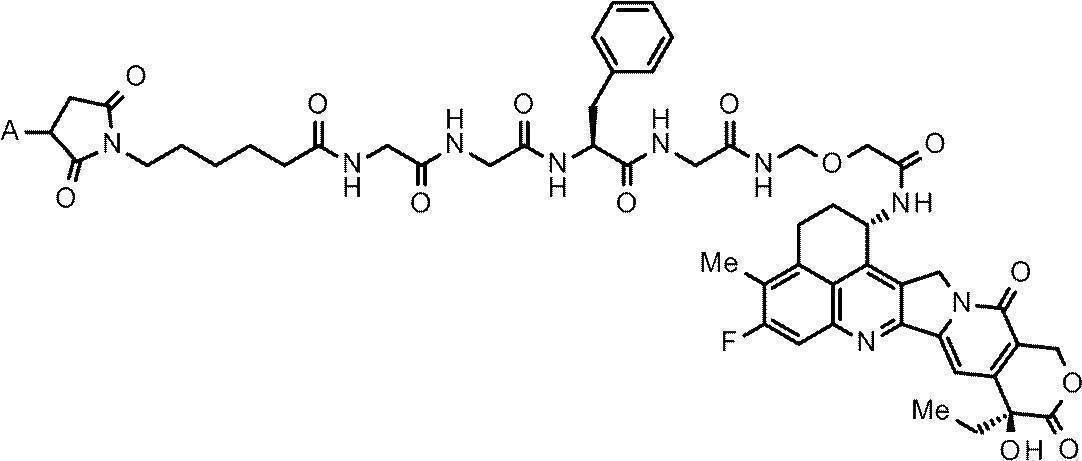
(式中、Aは抗体との結合位置を示す)
で示される薬物リンカーと、抗体とがチオエーテル結合によって結合した抗体-薬物コンジュゲートである。)
本発明において「ヒスチジン緩衝剤」とは、ヒスチジンとヒスチジンの塩(酸付加物)との混合物であり、好適には、L-ヒスチジンとL-ヒスチジン塩酸塩(及び/又はその水和物)との混合物である。本発明におけるヒスチジン緩衝剤が溶解している水は、ヒスチジン緩衝液と同義である。(Wherein, A indicates the binding position with the antibody)
is an antibody-drug conjugate in which a drug linker represented by is bound to an antibody via a thioether bond. )
In the present invention, the "histidine buffer" is a mixture of histidine and histidine salt (acid adduct), preferably L-histidine and L-histidine hydrochloride (and/or its hydrate) and is a mixture of The water in which the histidine buffer is dissolved in the present invention is synonymous with histidine buffer.
ヒスチジン緩衝剤の量は、好適には、抗体-薬物コンジュゲート20mg当たりに3~80mmolであり、より好適には、抗体-薬物コンジュゲート20mg当たりに、10~80mmolであり、更により好適には、抗体-薬物コンジュゲート20mg当たりに、10~40mmolであり、更により好適には、抗体-薬物コンジュゲート20mg当たりに10~25mmolであり、更により好適には、抗体-薬物コンジュゲート20mg当たりに10又は25mmolである。
The amount of histidine buffer is preferably 3-80 mmol per 20 mg antibody-drug conjugate, more preferably 10-80 mmol per 20 mg antibody-drug conjugate, even more preferably , between 10 and 40 mmol per 20 mg of antibody-drug conjugate, even more preferably between 10 and 25 mmol per 20 mg of antibody-drug conjugate, even more preferably between 10 and 25 mmol per 20 mg of antibody-
なお、本発明の医薬組成物が水に溶解している状態でのpHは、ヒスチジン緩衝液におけるヒスチジンとヒスチジンの塩の含有率に依存する。言い換えれば、ヒスチジンとヒスチジンの塩の含有率を調整することにより、水に溶解している状態で所望のpHを示す医薬組成物を提供することができる。 The pH of the pharmaceutical composition of the present invention dissolved in water depends on the content of histidine and histidine salt in the histidine buffer. In other words, by adjusting the content of histidine and histidine salt, it is possible to provide a pharmaceutical composition that exhibits a desired pH when dissolved in water.
本発明の医薬組成物は、抗体-薬物コンジュゲートが水に20mg/mLの濃度で溶解している状態でのpHが、好適には4.0~7.0であり、より好適には、5.0~6.0である。また、抗体-薬物コンジュゲートにおける抗体の種類に応じて、より好適なpHを選定することができる。
スクロース又はトレハロースの量は、好適には、抗体-薬物コンジュゲート20mg当たりに24~320mgである。スクロースの場合、その量は、より好適には、90mgである。トレハロースの場合は、トレハロース水和物として計算すると、その量は、より好適には、100mgである。また、本発明の医薬組成物は、スクロース及びトレハロースのうち、スクロースをより好適に用いることができる。
本発明において「界面活性剤」とは、親水性基と疎水性基を有し、医薬品製剤の構成成分の一つとして使用される物質を示す。本発明における界面活性剤は、好適には、ポリソルベート(ポリソルベート80(Tween80)、ポリソルベート20(Tween20)、及びポリソルベート60(Tween60)を含む)、ポリオキシエチレン(160)ポリオキシプロピレン(30)グリコール、ポリオキシエチレン硬化ヒマシ油60、ポリオキシエチレンヒマシ油、又はラウリル硫酸ナトリウムであり、より好適には、ポリソルベート80、又はポリソルベート20である。The pharmaceutical composition of the present invention preferably has a pH of 4.0 to 7.0 when the antibody-drug conjugate is dissolved in water at a concentration of 20 mg/mL, more preferably 5.0 to 6.0. Moreover, a more suitable pH can be selected according to the type of antibody in the antibody-drug conjugate.
The amount of sucrose or trehalose is preferably 24-320 mg per 20 mg of antibody-drug conjugate. For sucrose, the amount is more preferably 90 mg. In the case of trehalose, the amount is more preferably 100 mg when calculated as trehalose hydrate. Among sucrose and trehalose, sucrose can be used more preferably in the pharmaceutical composition of the present invention.
In the present invention, the term "surfactant" refers to a substance that has a hydrophilic group and a hydrophobic group and is used as one of the components of pharmaceutical formulations. Surfactants in the present invention are preferably polysorbates (including polysorbate 80 (Tween 80), polysorbate 20 (Tween 20), and polysorbate 60 (Tween 60)), polyoxyethylene (160) polyoxypropylene (30) glycols, Polyoxyethylene hydrogenated
ポリソルベート80又はポリソルベート20の量は、好適には、抗体-薬物コンジュゲート20mg当たりに0.05~1.6mgであり、より好適には、0.1~1.6mgであり、更により好適には、0.2~0.4mgであり、更により好適には、0.2~0.3mgであり、更により好適には、0.2又は0.3mgである。
以上を総合的に考慮すると、本発明の医薬組成物は、好適には、
(i)抗体-薬物コンジュゲート20mg当たりに、
(ii)3~80mmolのヒスチジン緩衝剤、
(iii)24~320mgのスクロース又はトレハロース、及び、
(iv)0.05~1.6mgのポリソルベート80又はポリソルベート20、
を含む、医薬組成物であり、
より好適には、
(i)抗体-薬物コンジュゲート20mg当たりに、
(ii)10~40mmolのヒスチジン緩衝剤、
(iii)90mgのスクロース又は100mgのトレハロース水和物、及び、
(iv)0.2~0.4mgのポリソルベート80又はポリソルベート20、
を含む、医薬組成物であり、
更により好適には、
(i)抗体-薬物コンジュゲート20mg当たりに、
(ii)10又は25mmolのヒスチジン緩衝剤、
(iii)90mgのスクロース、及び、
(iv)0.2又は0.3mgのポリソルベート80又はポリソルベート20、
を含む、医薬組成物である。
上記の医薬組成物は、抗体-薬物コンジュゲートの濃度が20mg/mLである水溶液として表すと、以下のように言い換えることもできる。The amount of
Considering the above comprehensively, the pharmaceutical composition of the present invention is preferably
(i) per 20 mg of antibody-drug conjugate,
(ii) 3-80 mmol histidine buffer,
(iii) 24-320 mg of sucrose or trehalose, and
(iv) 0.05-1.6 mg of
A pharmaceutical composition comprising
More preferably
(i) per 20 mg of antibody-drug conjugate,
(ii) 10-40 mmol histidine buffer,
(iii) 90 mg sucrose or 100 mg trehalose hydrate, and
(iv) 0.2-0.4 mg of
A pharmaceutical composition comprising
Even more preferably,
(i) per 20 mg of antibody-drug conjugate,
(ii) 10 or 25 mmol histidine buffer,
(iii) 90 mg sucrose, and
(iv) 0.2 or 0.3 mg of
A pharmaceutical composition comprising
The above pharmaceutical composition can also be restated as follows when expressed as an aqueous solution with a concentration of antibody-drug conjugate of 20 mg/mL.
即ち、本発明の医薬組成物は、好適には、
(i)20mg/mLの抗体-薬物コンジュゲート、
(ii)ヒスチジン緩衝剤、
(iii)スクロース又はトレハロース、
(iv)界面活性剤、及び、
(v)水
を含む、医薬組成物であり、
より好適には、
(i)20mg/mLの抗体-薬物コンジュゲート、
(ii)3~80mMのヒスチジン緩衝剤、
(iii)2.4~32%のスクロース又はトレハロース、
(iv)0.005~0.16%のポリソルベート80又はポリソルベート20、及び、
(v)水
を含む、医薬組成物であり、
更により好適には、
(i)20mg/mLの抗体-薬物コンジュゲート、
(ii)10~40mMのヒスチジン緩衝剤、
(iii)9%のスクロース又は10%のトレハロース水和物、
(iv)0.02~0.04%のポリソルベート80又はポリソルベート20、及び、
(v)水
を含む、医薬組成物であり、
更により好適には、
(i)20mg/mLの抗体-薬物コンジュゲート、
(ii)10又は25mMのヒスチジン緩衝剤、
(iii)9%のスクロース、及び、
(iv)0.02又は0.03%のポリソルベート80又はポリソルベート20、及び、
(v)水
を含む、医薬組成物である。That is, the pharmaceutical composition of the present invention is preferably
(i) 20 mg/mL antibody-drug conjugate;
(ii) a histidine buffer,
(iii) sucrose or trehalose,
(iv) a surfactant, and
(v) a pharmaceutical composition comprising water;
More preferably
(i) 20 mg/mL antibody-drug conjugate;
(ii) 3-80 mM histidine buffer;
(iii) 2.4-32% sucrose or trehalose;
(iv) 0.005-0.16
(v) a pharmaceutical composition comprising water;
Even more preferably,
(i) 20 mg/mL antibody-drug conjugate;
(ii) 10-40 mM histidine buffer;
(iii) 9% sucrose or 10% trehalose hydrate;
(iv) 0.02-0.04
(v) a pharmaceutical composition comprising water;
Even more preferably,
(i) 20 mg/mL antibody-drug conjugate;
(ii) 10 or 25 mM histidine buffer;
(iii) 9% sucrose, and
(iv) 0.02 or 0.03
(v) A pharmaceutical composition comprising water.
なお、本発明において、スクロース及びトレハロースの含量における「%」は、水1mLに対する重量%を示す。従って、例えば、「9%のスクロース」は、水1mLに対して90mgのスクロースが含まれていることを意味し、「10%のトレハロース水和物」は、水1mLに対して100mgのトレハロース水和物が含まれていることを意味する。 In the present invention, "%" in the contents of sucrose and trehalose indicates % by weight with respect to 1 mL of water. Thus, for example, "9% sucrose" means that 1 mL of water contains 90 mg of sucrose, and "10% trehalose hydrate" means that 1 mL of water contains 100 mg of trehalose water. It means that Japanese products are included.
同様に、本発明において、ポリソルベート80及びポリソルベート20の含量における「%」も、水1mLに対する重量%を示す。従って、例えば、「0.03%のポリソルベート80」は、水1mLに対して0.3mgのポリソルベート80が含まれていることを意味し、「0.03%のポリソルベート20」は、水1mLに対して0.3mgのポリソルベート20が含まれていることを意味する。
Similarly, in the present invention, "%" in the content of
本発明の医薬組成物は、抗体-薬物コンジュゲートにおける抗体の種類に応じて、より好適な処方を選定することができる。 For the pharmaceutical composition of the present invention, a more suitable formulation can be selected according to the type of antibody in the antibody-drug conjugate.
例えば、抗体-薬物コンジュゲートにおける抗体が、抗HER2抗体(好適には、配列番号1においてアミノ酸番号1乃至449に記載のアミノ酸配列からなる重鎖及び配列番号2においてアミノ酸番号1乃至214に記載のアミノ酸配列からなる軽鎖を含んでなる抗体、又は、配列番号1に記載のアミノ酸配列からなる重鎖及び配列番号2に記載のアミノ酸配列からなる軽鎖を含んでなる抗体)である場合は、本発明の医薬組成物は、好適には、
(i)抗体-薬物コンジュゲート20mg当たりに、
(ii)25mmolのヒスチジン緩衝剤、
(iii)90mgのスクロース、及び、
(iv)0.3mgのポリソルベート80、
を含む、医薬組成物である。
さらに、該抗体-薬物コンジュゲートが水に20mg/mLの濃度で溶解している状態での上記医薬組成物のpHは、好適には5.3~5.7であり、より好適には5.4~5.6であり、更により好適には5.5である。For example, the antibody in the antibody-drug conjugate is an anti-HER2 antibody (preferably a heavy chain consisting of an amino acid sequence set forth in
(i) per 20 mg of antibody-drug conjugate,
(ii) 25 mmol histidine buffer,
(iii) 90 mg sucrose, and
(iv) 0.3
A pharmaceutical composition comprising
Further, the pH of the pharmaceutical composition when the antibody-drug conjugate is dissolved in water at a concentration of 20 mg/mL is preferably 5.3-5.7, more preferably 5 .4 to 5.6, and even more preferably 5.5.
また、ヒスチジン緩衝剤を、L-ヒスチジンとL-ヒスチジン塩酸塩の含有量として表すと、pHが5.5であるときの上記医薬組成物は、
(i)抗体-薬物コンジュゲート20mg当たりに、
(ii)0.89mgのL-ヒスチジン、及び4.04mgのL-ヒスチジン塩酸塩水和物、
(iii)90mgのスクロース、並びに、
(iv)0.3mgのポリソルベート80を含む、医薬組成物として表すことができる。In addition, when the histidine buffer is expressed as the content of L-histidine and L-histidine hydrochloride, the above pharmaceutical composition when the pH is 5.5 is
(i) per 20 mg of antibody-drug conjugate,
(ii) 0.89 mg L-histidine and 4.04 mg L-histidine hydrochloride hydrate;
(iii) 90 mg of sucrose, and
(iv) can be expressed as a pharmaceutical composition comprising 0.3
さらに、抗体-薬物コンジュゲートを100mg含有する単位製剤として表すと、pHが5.5であるときの上記医薬組成物は、
(i)100mgの抗体-薬物コンジュゲート、
(ii)4.45mgのL-ヒスチジン、及び20.2mgのL-ヒスチジン塩酸塩水和物、
(iii)450mgのスクロース、並びに、
(iv)1.5mgのポリソルベート80を含む、医薬組成物として表すことができる。Further, expressed as a unit dosage containing 100 mg of antibody-drug conjugate, the pharmaceutical composition when pH is 5.5 is:
(i) 100 mg of antibody-drug conjugate,
(ii) 4.45 mg L-histidine and 20.2 mg L-histidine hydrochloride hydrate;
(iii) 450 mg of sucrose, and
(iv) can be expressed as a pharmaceutical composition comprising 1.5
あるいは、抗体-薬物コンジュゲートの濃度が20mg/mLである水溶液として表すと、上記医薬組成物は、
(i)20mg/mLの抗体-薬物コンジュゲート、
(ii)25mMのヒスチジン緩衝剤、
(iii)9%のスクロース、及び、
(iv)0.03%のポリソルベート80、及び、
(v)水
を含み、pHが5.5である、医薬組成物として表すことができる。Alternatively, when expressed as an aqueous solution with an antibody-drug conjugate concentration of 20 mg/mL, the pharmaceutical composition comprises:
(i) 20 mg/mL antibody-drug conjugate;
(ii) 25 mM histidine buffer;
(iii) 9% sucrose, and
(iv) 0.03
(v) can be described as a pharmaceutical composition comprising water and having a pH of 5.5;
抗体-薬物コンジュゲートにおける抗体が、抗HER3抗体(好適には、配列番号3に記載のアミノ酸配列からなる重鎖及び配列番号4に記載のアミノ酸配列からなる軽鎖を含んでなる抗体、又は、該抗体の重鎖カルボキシル末端のリシン残基が欠失している抗体)である場合は、本発明の医薬組成物は、好適には、
(i)抗体-薬物コンジュゲート20mg当たりに、
(ii)25mmolのヒスチジン緩衝剤、
(iii)90mgのスクロース、及び、
(iv)0.3mgのポリソルベート20、
を含む、医薬組成物である。
さらに、該抗体-薬物コンジュゲートが水に20mg/mLの濃度で溶解している状態での上記医薬組成物のpHは、好適には5.2~5.6であり、より好適には5.3~5.5であり、更により好適には5.4である。The antibody in the antibody-drug conjugate is an anti-HER3 antibody (preferably an antibody comprising a heavy chain consisting of the amino acid sequence set forth in SEQ ID NO:3 and a light chain consisting of the amino acid sequence set forth in SEQ ID NO:4, or In the case of an antibody lacking a lysine residue at the heavy chain carboxyl terminus of the antibody), the pharmaceutical composition of the present invention preferably comprises
(i) per 20 mg of antibody-drug conjugate,
(ii) 25 mmol histidine buffer,
(iii) 90 mg sucrose, and
(iv) 0.3
A pharmaceutical composition comprising
Furthermore, the pH of the pharmaceutical composition when the antibody-drug conjugate is dissolved in water at a concentration of 20 mg/mL is preferably 5.2-5.6, more preferably 5 .3 to 5.5, and even more preferably 5.4.
また、ヒスチジン緩衝剤を、L-ヒスチジンとL-ヒスチジン塩酸塩の含有量として表すと、pHが5.4であるときの上記医薬組成物は、好適には、
(i)抗体-薬物コンジュゲート20mg当たりに、
(ii)0.81mgのL-ヒスチジン、及び4.14mgのL-ヒスチジン塩酸塩水和物、
(iii)90mgのスクロース、並びに、
(iv)0.3mgのポリソルベート20を含む、医薬組成物として表すことができる。In addition, when the histidine buffer is expressed as the content of L-histidine and L-histidine hydrochloride, the above pharmaceutical composition at a pH of 5.4 preferably contains:
(i) per 20 mg of antibody-drug conjugate,
(ii) 0.81 mg L-histidine and 4.14 mg L-histidine hydrochloride hydrate;
(iii) 90 mg of sucrose, and
(iv) can be expressed as a pharmaceutical composition containing 0.3
さらに、抗体-薬物コンジュゲートを100mg含有する単位製剤として表すと、pHが5.4であるときの上記医薬組成物は、
(i)100mgの抗体-薬物コンジュゲート、
(ii)4.06mgのL-ヒスチジン、及び20.7mgのL-ヒスチジン塩酸塩水和物、
(iii)450mgのスクロース、並びに、
(iv)1.5mgのポリソルベート20を含む、医薬組成物として表すことができる。Further, expressed as a unit dosage containing 100 mg of antibody-drug conjugate, the pharmaceutical composition when pH is 5.4 is:
(i) 100 mg of antibody-drug conjugate,
(ii) 4.06 mg L-histidine and 20.7 mg L-histidine hydrochloride hydrate;
(iii) 450 mg of sucrose, and
(iv) can be expressed as a pharmaceutical composition comprising 1.5
あるいは、抗体-薬物コンジュゲートの濃度が20mg/mLである水溶液として表すと、上記医薬組成物は、
(i)20mg/mLの抗体-薬物コンジュゲート、
(ii)25mMのヒスチジン緩衝剤、
(iii)9%のスクロース、及び、
(iv)0.03%のポリソルベート20、及び、
(v)水
を含み、pHが5.4である、医薬組成物として表すことができる。Alternatively, when expressed as an aqueous solution with an antibody-drug conjugate concentration of 20 mg/mL, the pharmaceutical composition comprises:
(i) 20 mg/mL antibody-drug conjugate;
(ii) 25 mM histidine buffer;
(iii) 9% sucrose, and
(iv) 0.03
(v) can be described as a pharmaceutical composition comprising water and having a pH of 5.4;
抗体-薬物コンジュゲートにおける抗体が、抗TROP2抗体(好適には、配列番号5においてアミノ酸番号20乃至470に記載のアミノ酸配列からなる重鎖及び配列番号6においてアミノ酸番号21乃至234に記載のアミノ酸配列からなる軽鎖を含んでなる抗体、又は、該抗体の重鎖カルボキシル末端のリシン残基が欠失している抗体)である場合は、本発明の医薬組成物は、好適には、
(i)抗体-薬物コンジュゲート20mg当たりに、
(ii)10mmolのヒスチジン緩衝剤、
(iii)90mgのスクロース、及び、
(iv)0.2又は0.3mgのポリソルベート80、
を含む、医薬組成物である。
さらに、該抗体-薬物コンジュゲートが水に20mg/mLの濃度で溶解している状態での上記医薬組成物のpHは、好適には5.8~6.2であり、より好適には5.9~6.1であり、更により好適には6.0である。The antibody in the antibody-drug conjugate is an anti-TROP2 antibody (preferably a heavy chain consisting of the amino acid sequence set forth in
(i) per 20 mg of antibody-drug conjugate,
(ii) 10 mmol histidine buffer,
(iii) 90 mg sucrose, and
(iv) 0.2 or 0.3
A pharmaceutical composition comprising
Further, the pH of the pharmaceutical composition when the antibody-drug conjugate is dissolved in water at a concentration of 20 mg/mL is preferably 5.8-6.2, more preferably 5 .9 to 6.1, and even more preferably 6.0.
また、ヒスチジン緩衝剤を、L-ヒスチジンとL-ヒスチジン塩酸塩の含有量として表すと、pHが6.0であるときの上記医薬組成物は、好適には、
(i)抗体-薬物コンジュゲート20mg当たりに、
(ii)0.78mgのL-ヒスチジン、及び1.05mgのL-ヒスチジン塩酸塩水和物、
(iii)90mgのスクロース、並びに、
(iv)0.2又は0.3mgのポリソルベート80を含む、医薬組成物として表すことができる。In addition, when the histidine buffer is expressed as the content of L-histidine and L-histidine hydrochloride, the above pharmaceutical composition at a pH of 6.0 preferably contains:
(i) per 20 mg of antibody-drug conjugate,
(ii) 0.78 mg L-histidine and 1.05 mg L-histidine hydrochloride hydrate;
(iii) 90 mg of sucrose, and
(iv) can be presented as a pharmaceutical composition comprising 0.2 or 0.3
抗体-薬物コンジュゲートを100mg含有する単位製剤として表すと、pHが6.0であるときの上記医薬組成物は、
(i)100mgの抗体-薬物コンジュゲート、
(ii)3.88mgのL-ヒスチジン、及び5.26mgのL-ヒスチジン塩酸塩水和物、
(iii)450mgのスクロース、並びに、
(iv)1.0又は1.5mgのポリソルベート80を含む、医薬組成物として表すことができる。Expressed as a unit dosage containing 100 mg of antibody-drug conjugate, the above pharmaceutical composition when pH is 6.0 is:
(i) 100 mg of antibody-drug conjugate,
(ii) 3.88 mg L-histidine and 5.26 mg L-histidine hydrochloride hydrate;
(iii) 450 mg of sucrose, and
(iv) can be expressed as a pharmaceutical composition comprising 1.0 or 1.5
あるいは、抗体-薬物コンジュゲートの濃度が20mg/mLである水溶液として表すと、上記医薬組成物は、
(i)20mg/mLの抗体-薬物コンジュゲート、
(ii)10mMのヒスチジン緩衝剤、
(iii)9%のスクロース、及び、
(iv)0.02又は0.03%のポリソルベート80、及び、
(v)水
を含み、pHが6.0である、医薬組成物として表すことができる。Alternatively, when expressed as an aqueous solution with an antibody-drug conjugate concentration of 20 mg/mL, the pharmaceutical composition comprises:
(i) 20 mg/mL antibody-drug conjugate;
(ii) 10 mM histidine buffer;
(iii) 9% sucrose, and
(iv) 0.02 or 0.03
(v) can be described as a pharmaceutical composition comprising water and having a pH of 6.0;
抗体-薬物コンジュゲートにおける抗体が、抗B7-H3抗体(好適には、配列番号7においてアミノ酸番号20乃至471に記載のアミノ酸配列からなる重鎖及び配列番号8においてアミノ酸番号21乃至233に記載のアミノ酸配列からなる軽鎖を含んでなる抗体、又は、該抗体の重鎖カルボキシル末端のリシン残基が欠失している抗体)である場合は、本発明の医薬組成物は、好適には、
(i)抗体-薬物コンジュゲート20mg当たりに、
(ii)10mmolのヒスチジン緩衝剤、
(iii)90mgのスクロース、及び、
(iv)0.2又は0.3mgのポリソルベート20、
を含む、医薬組成物である。
さらに、該抗体-薬物コンジュゲートが水に20mg/mLの濃度で溶解している状態での上記医薬組成物のpHは、好適には5.7~6.1であり、より好適には5.8~6.0であり、更により好適には5.9である。The antibody in the antibody-drug conjugate is an anti-B7-H3 antibody (preferably a heavy chain consisting of an amino acid sequence set forth in amino acid numbers 20-471 in SEQ ID NO:7 and a heavy chain set forth in amino acid numbers 21-233 in SEQ ID NO:8). In the case of an antibody comprising a light chain consisting of an amino acid sequence, or an antibody lacking a lysine residue at the carboxyl terminus of the heavy chain of the antibody), the pharmaceutical composition of the present invention preferably comprises
(i) per 20 mg of antibody-drug conjugate,
(ii) 10 mmol histidine buffer,
(iii) 90 mg sucrose, and
(iv) 0.2 or 0.3
A pharmaceutical composition comprising
Further, the pH of the pharmaceutical composition when the antibody-drug conjugate is dissolved in water at a concentration of 20 mg/mL is preferably 5.7-6.1, more preferably 5 .8 to 6.0, and even more preferably 5.9.
また、ヒスチジン緩衝剤を、L-ヒスチジンとL-ヒスチジン塩酸塩の含有量として表すと、pHが5.9であるときの上記医薬組成物は、好適には、
(i)抗体-薬物コンジュゲート20mg当たりに、
(ii)0.65mgのL-ヒスチジン、及び1.22mgのL-ヒスチジン塩酸塩水和物、
(iii)90mgのスクロース、並びに、
(iv)0.2又は0.3mgのポリソルベート20を含む、医薬組成物として表すことができる。In addition, when the histidine buffer is expressed as the content of L-histidine and L-histidine hydrochloride, the above pharmaceutical composition at a pH of 5.9 preferably contains:
(i) per 20 mg of antibody-drug conjugate,
(ii) 0.65 mg L-histidine and 1.22 mg L-histidine hydrochloride hydrate;
(iii) 90 mg of sucrose, and
(iv) can be presented as a pharmaceutical composition containing 0.2 or 0.3
さらに、抗体-薬物コンジュゲートを100mg含有する単位製剤として表すと、pHが5.9であるときの上記医薬組成物は、
(i)100mgの抗体-薬物コンジュゲート、
(ii)3.23mgのL-ヒスチジン、及び6.12mgのL-ヒスチジン塩酸塩水和物、
(iii)450mgのスクロース、並びに、
(iv)1.0又は1.5mgのポリソルベート20を含む、医薬組成物として表すことができる。Further, expressed as a unit dosage containing 100 mg of antibody-drug conjugate, the pharmaceutical composition when pH is 5.9 is:
(i) 100 mg of antibody-drug conjugate,
(ii) 3.23 mg L-histidine and 6.12 mg L-histidine hydrochloride hydrate;
(iii) 450 mg of sucrose, and
(iv) can be expressed as a pharmaceutical composition comprising 1.0 or 1.5
あるいは、抗体-薬物コンジュゲートの濃度が20mg/mLである水溶液として表すと、上記医薬組成物は、
(i)20mg/mLの抗体-薬物コンジュゲート、
(ii)10mMのヒスチジン緩衝剤、
(iii)9%のスクロース、及び、
(iv)0.02又は0.03%のポリソルベート20、及び、
(v)水
を含み、pHが5.9である、医薬組成物として表すことができる。Alternatively, when expressed as an aqueous solution with an antibody-drug conjugate concentration of 20 mg/mL, the pharmaceutical composition comprises:
(i) 20 mg/mL antibody-drug conjugate;
(ii) 10 mM histidine buffer;
(iii) 9% sucrose, and
(iv) 0.02 or 0.03
(v) can be described as a pharmaceutical composition comprising water and having a pH of 5.9;
抗体-薬物コンジュゲートにおける抗体が、抗GPR20抗体(好適には、配列番号9に記載のアミノ酸番号20乃至472に記載のアミノ酸配列からなる重鎖及び配列番号10においてアミノ酸番号21乃至234に記載のアミノ酸配列からなる軽鎖を含んでなる抗体、又は、該抗体の重鎖カルボキシル末端のリシン残基が欠失している抗体)である場合は、本発明の医薬組成物は、好適には、
(i)抗体-薬物コンジュゲート20mg当たりに、
(ii)10mmolのヒスチジン緩衝剤、
(iii)90mgのスクロース、及び、
(iv)0.3mgのポリソルベート80、
を含む、医薬組成物である。
さらに、該抗体-薬物コンジュゲートが水に20mg/mLの濃度で溶解している状態での上記医薬組成物のpHは、好適には5.2~5.6であり、より好適には5.3~5.5であり、更により好適には5.4である。The antibody in the antibody-drug conjugate is an anti-GPR20 antibody (preferably a heavy chain consisting of the amino acid sequence set forth in SEQ ID NO:9 and amino acid numbers set forth in amino acid numbers 21 to 234 in SEQ ID NO:10). In the case of an antibody comprising a light chain consisting of an amino acid sequence, or an antibody lacking a lysine residue at the carboxyl terminus of the heavy chain of the antibody), the pharmaceutical composition of the present invention preferably comprises
(i) per 20 mg of antibody-drug conjugate,
(ii) 10 mmol histidine buffer,
(iii) 90 mg sucrose, and
(iv) 0.3
A pharmaceutical composition comprising
Furthermore, the pH of the pharmaceutical composition when the antibody-drug conjugate is dissolved in water at a concentration of 20 mg/mL is preferably 5.2-5.6, more preferably 5 .3 to 5.5, and even more preferably 5.4.
また、ヒスチジン緩衝剤を、L-ヒスチジンとL-ヒスチジン塩酸塩の含有量として表すと、pHが5.4であるときの上記医薬組成物は、好適には、
(i)抗体-薬物コンジュゲート20mg当たりに、
(ii)0.32mgのL-ヒスチジン、及び1.66mgのL-ヒスチジン塩酸塩水和物、
(iii)90mgのスクロース、並びに、
(iv)0.3mgのポリソルベート80を含む、医薬組成物として表すことができる。In addition, when the histidine buffer is expressed as the content of L-histidine and L-histidine hydrochloride, the above pharmaceutical composition at a pH of 5.4 preferably contains:
(i) per 20 mg of antibody-drug conjugate,
(ii) 0.32 mg L-histidine and 1.66 mg L-histidine hydrochloride hydrate;
(iii) 90 mg of sucrose, and
(iv) can be expressed as a pharmaceutical composition comprising 0.3
さらに、抗体-薬物コンジュゲートを100mg含有する単位製剤として表すと、pHが5.4であるときの上記医薬組成物は、
(i)100mgの抗体-薬物コンジュゲート、
(ii)1.62mgのL-ヒスチジン、及び8.29mgのL-ヒスチジン塩酸塩水和物、
(iii)450mgのスクロース、並びに、
(iv)1.5mgのポリソルベート80を含む、医薬組成物として表すことができる。Further, expressed as a unit dosage containing 100 mg of antibody-drug conjugate, the pharmaceutical composition when pH is 5.4 is:
(i) 100 mg of antibody-drug conjugate,
(ii) 1.62 mg L-histidine and 8.29 mg L-histidine hydrochloride hydrate;
(iii) 450 mg of sucrose, and
(iv) can be expressed as a pharmaceutical composition comprising 1.5
あるいは、抗体-薬物コンジュゲートの濃度が20mg/mLである水溶液として表すと、上記医薬組成物は、
(i)20mg/mLの抗体-薬物コンジュゲート、
(ii)10mMのヒスチジン緩衝剤、
(iii)9%のスクロース、及び、
(iv)0.03%のポリソルベート80、及び、
(v)水
を含み、pHが5.4である、医薬組成物として表すことができる。Alternatively, when expressed as an aqueous solution with an antibody-drug conjugate concentration of 20 mg/mL, the pharmaceutical composition comprises:
(i) 20 mg/mL antibody-drug conjugate;
(ii) 10 mM histidine buffer;
(iii) 9% sucrose, and
(iv) 0.03
(v) can be described as a pharmaceutical composition comprising water and having a pH of 5.4;
本発明の医薬組成物は、好適には、注射剤であり、より好適には、水性注射剤、又は凍結乾燥注射剤であり、更により好適には、凍結乾燥注射剤である。 The pharmaceutical composition of the present invention is preferably an injection, more preferably an aqueous injection or a freeze-dried injection, and even more preferably a freeze-dried injection.
本発明において「注射剤」とは、注射針を用いて、生体組織(例えば、静脈内、皮内、皮下、筋肉内、及び腹腔内等)に投与するための医薬組成物を示す。本発明の注射剤には、液状の注射剤だけでなく、用時溶解し液状にして用いるための固形状の注射剤も含まれる。液状の注射剤の場合、溶媒は水であっても良いし、水以外の溶媒であっても良いし、水と水以外の溶媒の混合溶媒であっても良い。 In the present invention, the term "injection" refers to a pharmaceutical composition that is administered into living tissue (eg, intravenously, intradermally, subcutaneously, intramuscularly, intraperitoneally, etc.) using an injection needle. The injectables of the present invention include not only liquid injectables but also solid injectables to be dissolved and used in a liquid form before use. In the case of a liquid injection, the solvent may be water, a solvent other than water, or a mixed solvent of water and a solvent other than water.
本発明において「水性注射剤」とは、液状の注射剤であって、溶媒が水(好適には注射用水)である医薬組成物のことを示す。
本発明において「凍結乾燥注射剤」とは、水(好適には注射用水)で用時溶解して用いることができる固形状の注射剤であって、所定量の医薬成分を含む水溶液を凍結乾燥することにより得られる医薬組成物のことを示す。
本発明の医薬組成物が、水性注射剤である場合、抗体-薬物コンジュゲートの濃度は、好適には、5~60mg/mLであり、より好適には、15~40mg/mLであり、更により好適には、20mg/mLである。
本発明の医薬組成物が、水性注射剤である場合、本発明の医薬組成物は、好適には凍結された状態で保存することができる。In the present invention, the term "aqueous injection" refers to a pharmaceutical composition which is a liquid injection and whose solvent is water (preferably water for injection).
In the present invention, the term "lyophilized injection" refers to a solid injection that can be dissolved in water (preferably water for injection) before use. It shows a pharmaceutical composition obtained by
When the pharmaceutical composition of the present invention is an aqueous injection, the concentration of the antibody-drug conjugate is preferably 5-60 mg/mL, more preferably 15-40 mg/mL, and More preferably 20 mg/mL.
When the pharmaceutical composition of the present invention is an aqueous injection, the pharmaceutical composition of the present invention can be stored preferably in a frozen state.
本発明の医薬組成物が、凍結乾燥注射剤である場合、本発明の医薬組成物は、好適には褐色バイアルに格納された状態で保存することができる。 When the pharmaceutical composition of the present invention is a lyophilized injectable, the pharmaceutical composition of the present invention can be stored preferably in amber vials.
本発明の医薬組成物が、凍結乾燥注射剤である場合、本発明の医薬組成物と注射用水を含むキットを、好適に使用することができる。ここで、該注射用水は、好適には、アンプルに格納された状態で保存することができる。 When the pharmaceutical composition of the present invention is a freeze-dried injection, a kit containing the pharmaceutical composition of the present invention and water for injection can be suitably used. Here, the water for injection can preferably be stored in an ampoule.
本発明で使用される抗体-薬物コンジュゲートの含量が20mgである場合の凍結乾燥注射剤は、注射用水1mLを用いて再溶解することにより、好適に使用することができる。また、本発明で使用される抗体-薬物コンジュゲートの含量が100mgである場合の凍結乾燥注射剤は、注射用水5mLを用いて再溶解することにより、好適に使用することができる。 A freeze-dried injection containing 20 mg of the antibody-drug conjugate used in the present invention can be suitably used by reconstitution with 1 mL of water for injection. In addition, a freeze-dried injection containing 100 mg of the antibody-drug conjugate used in the present invention can be preferably used by reconstitution with 5 mL of water for injection.
本発明の医薬組成物が、凍結乾燥注射剤である場合、本発明の医薬組成物の製造方法は、好適には、
(1)所定量の、
(i)抗体-薬物コンジュゲート、
(ii)ヒスチジン緩衝剤、
(iii)スクロース又はトレハロース、及び、
(iv)界面活性剤、
を含む水溶液を調製する工程、
(2)必要に応じて、水溶液のpHを所定の値に調整する工程、次いで、
(3)水溶液を凍結乾燥する工程、
を含む、製造方法である。
水溶液を凍結乾燥する工程は、好適には、水溶液の共融点付近の棚温度でアニーリングするプロセスを含む。ここで、共融点付近とは、共融点よりも1.5℃低い温度から、共融点よりも1.5℃高い温度の範囲を示す。
本発明において「アニーリング」とは、凍結ガラス転移点(Tg’)以上の製品温度で凍結体中の氷晶を成長させる工程を意味する。氷晶が大きくなることにより、乾燥時に昇華する水(水蒸気)の通り道が大きくなる。これにより、昇華抵抗が減り、凍結乾燥ケーキの形状の改善及び乾燥時間の短縮が期待できる。
本発明において「棚温度」とは、凍結乾燥を行う装置内(系内)の温度を意味する。
本発明において「製品温度」とは、凍結乾燥を行う対象物(製品)の温度を意味する。
本発明において「凍結乾燥ケーキ」とは、一連の凍結乾燥プロセスによって得られた凍結乾燥体(多孔性構造を有する固体)を意味する。
アニーリングは、前述の通り、水溶液の共融点よりも1.5℃低い温度から、共融点よりも1.5℃高い温度の範囲で好適に行うことができ、より好適には、水溶液の共融点と同じ棚温度で行うことができる。
これらの製造方法は、好適には、共融点よりも5℃低い棚温度でアニーリングを行った場合と比較し、1次乾燥するプロセスの時間が短縮されることを特徴とする。また、好適には、共融点よりも5℃低い棚温度でアニーリングを行った場合と比較し、よりシュリンクが少ない凍結乾燥ケーキが得られることを特徴とする。When the pharmaceutical composition of the present invention is a freeze-dried injection, the method for producing the pharmaceutical composition of the present invention is preferably
(1) a predetermined amount of
(i) an antibody-drug conjugate;
(ii) a histidine buffer,
(iii) sucrose or trehalose, and
(iv) a surfactant;
preparing an aqueous solution comprising
(2) If necessary, a step of adjusting the pH of the aqueous solution to a predetermined value, then
(3) freeze-drying the aqueous solution;
A manufacturing method comprising:
Lyophilizing the aqueous solution preferably includes annealing at a shelf temperature near the eutectic point of the aqueous solution. Here, the vicinity of the eutectic point indicates a temperature range from 1.5° C. lower than the eutectic point to 1.5° C. higher than the eutectic point.
In the present invention, "annealing" means a step of growing ice crystals in a frozen body at a product temperature higher than the freezing glass transition point (Tg'). As the ice crystals become larger, the path of water (water vapor) that sublimates during drying becomes larger. As a result, sublimation resistance is reduced, and an improvement in the shape of the freeze-dried cake and a reduction in drying time can be expected.
In the present invention, the "shelf temperature" means the temperature inside the freeze-drying device (system).
In the present invention, "product temperature" means the temperature of the object (product) to be freeze-dried.
In the present invention, "freeze-dried cake" means a freeze-dried product (a solid having a porous structure) obtained by a series of freeze-drying processes.
As described above, annealing can be preferably performed at a temperature in the range of 1.5°C lower than the eutectic point of the aqueous solution to 1.5°C higher than the eutectic point of the aqueous solution. can be performed at the same shelf temperature as
These methods of manufacture are preferably characterized by a reduction in the time of the primary drying process compared to annealing at a shelf temperature of 5° C. below the eutectic point. It is also preferably characterized in that a freeze-dried cake with less shrinkage is obtained compared to annealing at a shelf temperature of 5°C below the eutectic point.
本発明の医薬組成物の場合、共融点は約-3℃~約-1℃の範囲となるため、アニーリングは、好適には、-4.5℃~0.5℃の棚温度で行うことができ、より好適には、-4~-1℃の棚温度で行うことができ、更により好適には、-4~-2℃の棚温度で行うことができ、更により好適には、-3~-2℃の棚温度で行うことができ、更により好適には、-2.5℃の棚温度で行うことができる。 For pharmaceutical compositions of the present invention, the eutectic point ranges from about -3°C to about -1°C, so annealing is preferably performed at a shelf temperature of -4.5°C to 0.5°C. more preferably at a shelf temperature of -4 to -1°C, even more preferably at a shelf temperature of -4 to -2°C, even more preferably It can be carried out at a shelf temperature of -3 to -2°C, even more preferably at a shelf temperature of -2.5°C.
アニーリングを行った後は、本発明の医薬組成物は、1次乾燥プロセス及び2次乾燥プロセスを経て、凍結乾燥注射剤として製造される。 After annealing, the pharmaceutical composition of the present invention is manufactured as a lyophilized injection through a primary drying process and a secondary drying process.
本発明において「1次乾燥プロセス」とは、凍結乾燥注射剤の製造工程の一つであり、凍結体中の自由水を昇華するための工程を意味する。
本発明において「2次乾燥プロセス」とは、凍結乾燥注射剤の製造工程の一つであり、溶質に結合した水(結合水)を昇華するための工程を意味する。In the present invention, the "primary drying process" is one of the steps for producing a freeze-dried injection, and means a step for sublimating free water in the frozen body.
In the present invention, the "secondary drying process" is one of the steps for producing a freeze-dried injection, and means a step for sublimating water bound to a solute (bound water).
1次乾燥プロセスは、好適には、-5~5℃の棚温度かつ5~15Paの真空下で行うことができ、より好適には、-4~4℃の棚温度かつ7~13のPaの真空下で行うことができ、更により好適には、-3~3℃の棚温度かつ8~12のPaの真空下で行うことができ、更により好適には、-2~2℃の棚温度かつ9~11のPaの真空下で行うことができ、更により好適には、-1~1℃の棚温度かつ9~11のPaの真空下で行うことができ、更により好適には、0℃の棚温度かつ約10Paの真空下で行うことができる。 The primary drying process may preferably be carried out at a shelf temperature of -5 to 5°C and under a vacuum of 5 to 15 Pa, more preferably at a shelf temperature of -4 to 4°C and 7 to 13 Pa. more preferably under a shelf temperature of -3 to 3°C and a vacuum of 8 to 12 Pa, even more preferably -2 to 2°C. It can be carried out at a shelf temperature and a vacuum of 9 to 11 Pa, even more preferably at a shelf temperature of -1 to 1 °C and a vacuum of 9 to 11 Pa, even more preferably can be performed at a shelf temperature of 0° C. and under a vacuum of about 10 Pa.
2次乾燥プロセスは、好適には、40~50℃の棚温度かつ5~15Paの真空下又は真空なしで行うことができ、より好適には、42~48℃の棚温度かつ7~13Paの真空下で行うことができ、更により好適には、44~46℃の棚温度かつ9~11Paの真空下で行うことができ、更により好適には、45℃の棚温度かつ10Paの真空下で行うことができる。 The secondary drying process can preferably be carried out at a shelf temperature of 40-50° C. and a vacuum of 5-15 Pa or without vacuum, more preferably at a shelf temperature of 42-48° C. and a vacuum of 7-13 Pa. It can be carried out under vacuum, even more preferably at a shelf temperature of 44-46° C. and under a vacuum of 9-11 Pa, even more preferably at a shelf temperature of 45° C. and a vacuum of 10 Pa. can be done with
本発明の医薬組成物の品質は、例えば、50℃下、40℃/75%RH下、25℃/60%RH下、又は5℃下のような環境下において、1ヵ月間、3ヵ月間、6ヵ月間、12ヵ月間、18ヵ月間、24ヵ月間、又は36ヵ月間での保存安定性を、タンパク質濃度、水分、不溶性微粒子、DAR、単量体・凝集体・断片体の比率、NPI、IoP、電荷異性体、及びpHを指標に評価することにより確認することができる。また、抗体-薬物コンジュゲートにおける抗体の種類に応じて、抗原に対するBinding activityやPotency(Bioassay)等を指標に品質評価を行うこともできる。さらに、Drug distributionやrCE-SDSを指標にした品質評価や、性状(外観)観察による品質評価を行うこともできる。水性注射剤の場合は、浸透圧比を指標とした品質評価を行うこともでき、凍結乾燥注射剤の場合は、再溶解時間を指標とした品質評価を行うこともできる。これらの品質評価により、既存の医薬組成物に対する優位性を確認することもできる。
また、本発明の凍結乾燥方法は、本発明で使用される抗体-薬物コンジュゲートを含む医薬組成物のみならず、スクロース又はトレハロースを含有する水溶液への一般的な適用が期待される。
従って、スクロース又はトレハロースを含有する水溶液の共融点付近の棚温度でアニーリングするプロセスを含む、凍結乾燥注射剤の製造方法(ここで、共融点付近とは、共融点よりも1.5℃低い温度から、共融点よりも1.5℃高い温度の範囲を示す。)も、本発明の範囲に含まれる。
また、アニーリングは、好適には、スクロース又はトレハロースを含有する水溶液の共融点と同じ棚温度で行うことができる。
これらの製造方法は、好適には、共融点よりも5℃低い棚温度でアニーリングを行った場合と比較し、1次乾燥するプロセスの時間が短縮されることを特徴とする。The quality of the pharmaceutical composition of the present invention is evaluated, for example, under an environment such as 50° C., 40° C./75% RH, 25° C./60% RH, or 5° C. for 1 month, 3 months , storage stability for 6 months, 12 months, 18 months, 24 months, or 36 months; It can be confirmed by evaluation using NPI, IoP, charge isomers, and pH as indicators. Also, depending on the type of antibody in the antibody-drug conjugate, the quality can be evaluated using the binding activity to the antigen, potency (Bioassay), etc. as indices. Furthermore, it is also possible to perform quality evaluation using drug distribution or rCE-SDS as an index, or quality evaluation by property (appearance) observation. In the case of aqueous injections, quality evaluation can also be performed using the osmotic pressure ratio as an index, and in the case of freeze-dried injections, quality evaluation can also be performed using the redissolution time as an index. These quality evaluations can also confirm superiority over existing pharmaceutical compositions.
In addition, the freeze-drying method of the present invention is expected to be generally applied not only to pharmaceutical compositions containing antibody-drug conjugates used in the present invention, but also to aqueous solutions containing sucrose or trehalose.
Thus, a method for producing a lyophilized injectable formulation comprising a process of annealing at a shelf temperature near the eutectic point of an aqueous solution containing sucrose or trehalose (where near the eutectic point is a temperature 1.5°C lower than the eutectic point). to 1.5° C. above the eutectic point) are also included within the scope of the present invention.
Annealing can also be suitably performed at the same shelf temperature as the eutectic point of the aqueous solution containing sucrose or trehalose.
These methods of manufacture are preferably characterized by a reduction in the time of the primary drying process compared to annealing at a shelf temperature of 5° C. below the eutectic point.
また、これらの製造方法は、好適には、共融点よりも5℃低い棚温度でアニーリングを行った場合と比較し、よりシュリンクが少ない凍結乾燥ケーキが得られることを特徴とする。 These methods of manufacture are also preferably characterized in that they yield freeze-dried cakes with less shrinkage compared to annealing at a shelf temperature of 5°C below the eutectic point.
[医薬組成物の使用]
本発明の医薬組成物は、患者に対しては全身療法として適用する他、がん組織に局所的に適用して治療効果を期待することができる。[Use of pharmaceutical composition]
The pharmaceutical composition of the present invention can be applied to patients as a systemic therapy, and can also be applied locally to cancer tissues to expect therapeutic effects.
本発明の医薬組成物は、哺乳動物に対して好適に使用することができるが、より好適にはヒトに対して使用することができる。 The pharmaceutical composition of the present invention can be preferably used for mammals, and more preferably for humans.
本発明の医薬組成物を投与するために使用され得る導入経路としては、例えば、静脈内、皮内、皮下、筋肉内、及び腹腔内の経路を挙げることができるが、好適には、静脈内である。 Routes of introduction that can be used to administer the pharmaceutical compositions of the present invention include, for example, intravenous, intradermal, subcutaneous, intramuscular, and intraperitoneal routes, preferably intravenous. is.
本発明の医薬組成物が水性注射剤である場合、好適には、適切な希釈液で希釈した後、静脈内に点滴投与することができる。希釈液としては、例えば、ブドウ糖溶液(好適には5%ブドウ糖溶液)や、生理食塩液を挙げることができる。 When the pharmaceutical composition of the present invention is an aqueous injection, it can be administered intravenously after being diluted with an appropriate diluent. Examples of diluents include glucose solution (preferably 5% glucose solution) and physiological saline.
本発明の医薬組成物が凍結乾燥注射剤である場合、水(好適には、注射用水)により溶解した後、必要量を適切な希釈液で希釈した後、静脈内に点滴投与することができる。希釈液としては、例えば、ブドウ糖溶液(好適には5%ブドウ糖溶液)や、生理食塩液を挙げることができる。 When the pharmaceutical composition of the present invention is a freeze-dried injection, it can be dissolved in water (preferably water for injection), diluted with an appropriate diluent to a required amount, and administered intravenously. . Examples of diluents include glucose solution (preferably 5% glucose solution) and physiological saline.
本発明の医薬組成物は、本発明の抗体-薬物コンジュゲートの抗原に対する親和性、すなわち、抗原に対する解離定数(Kd値)の点において、親和性が高い(Kd値が低い)ほど、少量の投与量であっても薬効を発揮させことができる。したがって、本発明の医薬組成物の投与量は、抗原との親和性の状況に基づいて設定することもできる。本発明の医薬組成物をヒトに対して投与する際には、例えば、抗体-薬物コンジュゲートとして、約0.001~100mg/kg(ここで、「mg/kg」とは、ヒトの体重1kgあたりの抗体-薬物コンジュゲートの投与量を意味する)を1回或は1~180日間に1回の間隔で複数回投与すればよいが、例えば、本発明で使用される抗体-薬物コンジュゲートが抗HER2抗体-薬物コンジュゲートである場合、好適には、0.8mg/kg~8mg/kgを3週に1回投与する方法を挙げることができ、より好適には、0.8mg/kg、1.6mg/kg、3.2mg/kg、5.4mg/kg、6.4mg/kg、7.4mg/kg、又は8mg/kgを3週に1回投与する方法を挙げることができ、更により好適には、5.4mg/kg、6.4mg/kg、7.4mg/kg、又は8mg/kgを3週に1回投与する方法を挙げることができ、更により好適には、5.4mg/kg、又は6.4mg/kgを3週に1回投与する方法を挙げることができる。 In terms of the affinity of the antibody-drug conjugate of the present invention for the antigen, that is, the dissociation constant (Kd value) for the antigen, the higher the affinity (lower the Kd value), the smaller the amount of the drug. Even a small dosage can exert its efficacy. Therefore, the dosage of the pharmaceutical composition of the present invention can also be set based on the state of affinity with the antigen. When administering the pharmaceutical composition of the present invention to humans, for example, about 0.001 to 100 mg/kg of the antibody-drug conjugate (here, "mg/kg" means 1 kg of human body weight). (meaning the dosage of the antibody-drug conjugate per unit) may be administered once or multiple times at intervals of once every 1 to 180 days, for example, the antibody-drug conjugate used in the present invention is an anti-HER2 antibody-drug conjugate, preferably 0.8 mg/kg to 8 mg/kg once every 3 weeks, more preferably 0.8 mg/kg , 1.6 mg/kg, 3.2 mg/kg, 5.4 mg/kg, 6.4 mg/kg, 7.4 mg/kg, or 8 mg/kg once every three weeks; Even more preferably, a method of administering 5.4 mg/kg, 6.4 mg/kg, 7.4 mg/kg, or 8 mg/kg once every three weeks can be mentioned. A method of administering .4 mg/kg or 6.4 mg/kg once every three weeks can be mentioned.
本発明の医薬組成物は、がんの治療のために使用することができ、好適には、乳がん、胃がん(胃腺がんと呼ぶこともある)、大腸がん(結腸直腸がんと呼ぶこともあり、結腸がん及び直腸がんを含む)、肺がん(小細胞肺がん及び非小細胞肺がんを含む)、食道がん、唾液腺がん、胃食道接合部腺がん、胆管がん、ページェット病、膵臓がん、卵巣がん、子宮がん肉腫、尿路上皮がん、前立腺がん、膀胱がん、胃腸間質腫瘍、消化管間質腫瘍、子宮頸がん、扁平上皮がん、腹膜がん、肝臓がん、肝細胞がん、結腸がん、直腸がん、子宮内膜がん、子宮がん、腎臓がん、外陰部がん、甲状腺がん、陰茎がん、白血病、悪性リンパ腫、形質細胞腫、骨髄腫、神経上皮組織性腫瘍、神経鞘性腫瘍、頭頸部がん、皮膚がん、咽頭がん、胆のうがん、胆管がん、中皮腫、及び肉腫からなる群より選択される少なくとも一つのがんの治療のために使用することができる。例えば、本発明で使用される抗体-薬物コンジュゲートが抗HER2抗体-薬物コンジュゲートである場合、より好適には、乳がん、胃がん、大腸がん、非小細胞肺がん、食道がん、唾液腺がん、胃食道接合部腺がん、胆管がん、ページェット病、膵臓がん、卵巣がん、及び子宮がん肉腫からなる群より選択される少なくとも一つのがんの治療のために使用することができ、より好適には、乳がん、胃がん、大腸がん、非小細胞肺がん、食道がん、唾液腺がん、胃食道接合部腺がん、胆管がん、及びページェット病からなる群より選択される少なくとも一つのがんの治療のために使用することができ、さらにより好適には、乳がん、胃がん、大腸がん、又は非小細胞肺がんの治療のために使用することができる。
The pharmaceutical composition of the present invention can be used for the treatment of cancer, preferably breast cancer, gastric cancer (also called gastric adenocarcinoma), colon cancer (also called colorectal cancer). colon cancer and rectal cancer), lung cancer (including small cell lung cancer and non-small cell lung cancer), esophageal cancer, salivary gland cancer, gastroesophageal junction adenocarcinoma, bile duct cancer, Paget disease, pancreatic cancer, ovarian cancer, uterine carcinosarcoma, urothelial cancer, prostate cancer, bladder cancer, gastrointestinal stromal tumor, gastrointestinal stromal tumor, cervical cancer, squamous cell carcinoma, peritoneal cancer, liver cancer, hepatocellular carcinoma, colon cancer, rectal cancer, endometrial cancer, uterine cancer, kidney cancer, vulvar cancer, thyroid cancer, penile cancer, leukemia, Consisting of malignant lymphoma, plasmacytoma, myeloma, neuroepithelial tissue tumor, nerve sheath tumor, head and neck cancer, skin cancer, pharyngeal cancer, gallbladder cancer, bile duct cancer, mesothelioma, and sarcoma It can be used for the treatment of at least one cancer selected from the group. For example, when the antibody-drug conjugate used in the present invention is an anti- HER2 antibody-drug conjugate, breast cancer, stomach cancer, colon cancer, non-small cell lung cancer, esophageal cancer, and salivary gland cancer are more preferred. cancer, gastroesophageal junction adenocarcinoma, bile duct cancer, Paget's disease, pancreatic cancer, ovarian cancer, and uterine carcinosarcoma. more preferably from the group consisting of breast cancer, gastric cancer, colon cancer, non-small cell lung cancer, esophageal cancer, salivary gland cancer, gastroesophageal junction adenocarcinoma, bile duct cancer, and Paget's disease It can be used for the treatment of at least one selected cancer, and more preferably for the treatment of breast cancer, stomach cancer, colorectal cancer, or non-small cell lung cancer.
本発明の医薬組成物は、がん治療の主要な治療法である薬物療法のための薬剤として選択して使用することができ、その結果として、がん細胞の成長を遅らせ、増殖を抑え、さらにはがん細胞を破壊することができる。これらの作用によって、がん患者において、がんによる症状からの解放や、QOLの改善を達成でき、がん患者の生命を保って治療効果が達成される。がん細胞の破壊には至らない場合であっても、がん細胞の増殖の抑制やコントロールによってがん患者においてより高いQOLを達成しつつより長期の生存を達成させることができる。 The pharmaceutical composition of the present invention can be selected and used as a drug for drug therapy, which is a major treatment method for cancer treatment, and as a result, delays the growth of cancer cells, suppresses their proliferation, Furthermore, it can destroy cancer cells. By these actions, cancer patients can be relieved from symptoms caused by cancer, improve QOL, and achieve therapeutic effects while preserving the lives of cancer patients. Even if cancer cells are not destroyed, inhibition or control of proliferation of cancer cells can achieve higher QOL and longer survival in cancer patients.
このような薬物療法においての薬物単独での使用の他、本発明の医薬組成物は、アジュバント療法において他の療法と組み合わせて使用することもでき、外科手術や、放射線療法、ホルモン療法等と組み合わせることができる。さらにはネオアジュバント療法における薬物療法として使用することもできる。 In addition to use of the drug alone in such drug therapy, the pharmaceutical composition of the present invention can also be used in combination with other therapies in adjuvant therapy, combined with surgery, radiotherapy, hormonal therapy, and the like. be able to. Furthermore, it can also be used as drug therapy in neoadjuvant therapy.
以上のような治療的使用の他、本発明の医薬組成物は、微細な転移がん細胞の増殖を押さえ、さらには破壊するといった予防効果も期待することができる。例えば、転移過程で体液中にあるがん細胞を抑制し破壊する効果や、いずれかの組織に着床した直後の微細ながん細胞に対する抑制、破壊等の効果が期待できる。したがって、特に外科的ながんの除去後においてのがん転移の抑制、予防効果が期待できる。 In addition to the therapeutic use as described above, the pharmaceutical composition of the present invention can also be expected to have preventive effects such as suppressing the proliferation and even destroying minute metastatic cancer cells. For example, it can be expected to have the effect of suppressing and destroying cancer cells in bodily fluids during the process of metastasis, and the effect of suppressing and destroying minute cancer cells immediately after being implanted in any tissue. Therefore, it can be expected to have an effect of suppressing and preventing cancer metastasis, especially after surgical removal of cancer.
本発明の医薬組成物は、他のがん治療剤と併用して投与することもでき、これによって抗腫瘍効果を増強させることができる。この様な目的で使用される他のがん治療剤として、5-フルオロウラシル(5-FU)、ペルツズマブ(Pertuzumab)、トラスツズマブ(Trastuzumab)、パクリタキセル(Paclitaxel)、カルボプラチン(Carboplatin)、シスプラチン(Cisplatin)、ゲムシタビン(Gemcitabine)、カペシタビン(Capecitabine)、イリノテカン(Irinotecan)(CPT-11)、ドセタキセル(Docetaxel)、ペメトレキセド(Pemetrexed)、ソラフェニブ(Sorafenib)、ビンブラスチン(Vinblastin)、ビノレルビン(Vinorelbine)、エベロリムス(Everolims)、タネスピマイシン(Tanespimycin)、ベバシズマブ(Bevacizumab)、オキサリプラチン(Oxaliplatin)、ラパチニブ(Lapatinib)、トラスツズマブエムタンシン(Trastuzumab emtansine)(T-DM1)又は国際公開第2003/038043号に記載の薬剤、更にLH-RHアナログ(リュープロレリン(Leuprorelin)、ゴセレリン(Goserelin)等)、エストラムスチン・フォスフェイト(Estramustine Phosphate)、エストロジェン拮抗薬(タモキシフェン(Tamoxifen)、ラロキシフェン(Raloxifene)等)、アロマターゼ阻害剤(アナストロゾール(Anastrozole)、レトロゾール(Letrozole)、エキセメスタン(Exemestane)等)等を挙げることができるが、抗腫瘍活性を有する薬剤であれば限定されることはない。 The pharmaceutical composition of the present invention can also be administered in combination with other cancer therapeutic agents, thereby enhancing antitumor effects. Other cancer therapeutic agents used for such purposes include 5-fluorouracil (5-FU), Pertuzumab, Trastuzumab, Paclitaxel, Carboplatin, Cisplatin, Gemcitabine, Capecitabine, Irinotecan (CPT-11), Docetaxel, Pemetrexed, Sorafenib, Vinblastin, Vinorelbine, Evererbine (Vinorelbine) Tanespimycin, Bevacizumab, Oxaliplatin, Lapatinib, Trastuzumab emtansine (T-DM1) or agents described in WO2003/038043, and LH - RH analogs (Leuprorelin, Goserelin, etc.), Estramustine Phosphate, estrogen antagonists (Tamoxifen, Raloxifene, etc.), aromatase inhibitors (Ana Anastrozole, Letrozole, Exemestane, etc.) can be mentioned, but there is no limitation as long as it is a drug having antitumor activity.
以下に示す例によって本発明を具体的に説明するが、本発明はこれらに限定されるものではない。また、これらはいかなる意味においても限定的に解釈されるものではない。 The present invention will be specifically described by the following examples, but the present invention is not limited to these. Moreover, these are not to be construed as limiting in any way.
[実施例1:抗体-薬物コンジュゲート(1)の製造]
国際公開第2015/115091号に記載の製造方法を参考に、ヒト化抗HER2抗体(トラスツズマブ)を用いて、式[Example 1: Production of antibody-drug conjugate (1)]
With reference to the production method described in WO 2015/115091, using a humanized anti-HER2 antibody (trastuzumab), the formula

(式中、Aは抗体との結合位置を示す)
で示される薬物リンカーと、抗HER2抗体とがチオエーテル結合によって結合した抗体-薬物コンジュゲート(以下、「抗体-薬物コンジュゲート(1)」と称する)を製造した。抗体-薬物コンジュゲート(1)のDARは、7.8であった。(Wherein, A indicates the binding position with the antibody)
An antibody-drug conjugate (hereinafter referred to as “antibody-drug conjugate (1)”) in which a drug linker represented by and an anti-HER2 antibody are bound via a thioether bond was produced. The DAR of antibody-drug conjugate (1) was 7.8.
[実施例2:抗体-薬物コンジュゲート(1)の製剤の調製]
製剤の調製法(1)
抗体-薬物コンジュゲート(1)(20mg/mL)、10mMヒスチジン緩衝剤、11.1%トレハロース水和物、及び0.02%ポリソルベート20を含む水溶液(pH5.8)を透析カセット(透析膜、Slide-A-lyzer, MWCO 20,000)に注入し、透析カセットに注入した試料量の50倍以上の目的処方の賦形剤を含有する緩衝液で透析を行った。透析は5°Cで5時間以上を2回行った。透析後のタンパク質濃度が約20mg/mLになるように濃縮または希釈を適宜実施した。この溶液を0.22μmフィルターを用いてろ過した。ろ過した液を1mLずつガラスバイアルに充填し、ゴム栓を半打栓し、表1の条件で凍結乾燥を行った。凍結乾燥後、ゴム栓が打栓されたバイアルにキャップを巻締めた。ろ過と充填操作はクリーンベンチ内にて実施した。[Example 2: Preparation of formulation of antibody-drug conjugate (1)]
Formulation preparation method (1)
An aqueous solution (pH 5.8) containing antibody-drug conjugate (1) (20 mg/mL), 10 mM histidine buffer, 11.1% trehalose hydrate, and 0.02

製剤の調製法(2)
抗体-薬物コンジュゲート(1)(20mg/mL)、10mMヒスチジン緩衝剤、11.1%トレハロース水和物、及び0.02%ポリソルベート20を含む水溶液(pH5.8)をUF膜キット(AMICON ULTRA-15、30kDa)に分注して3000rpm、5℃設定で遠心を行い約2倍に濃縮した。この濃縮液に含有するポリソルベート20を疎水性吸着剤(アンバーライト XAD7HP)に吸着させ除去した。このポリソルベート20を除去した薬液を透析カセット(透析膜、Slide-A-lyzer, MWCO 20,000)に注入し、透析カセットに注入した試料量の50倍以上の目的処方の賦形剤を含有する緩衝液で透析を行った。透析は5℃で5時間以上を2回行った。透析後のタンパク質濃度が約20mg/mLになるように濃縮または希釈を適宜実施した後、ポリソルベート20またはポリソルベート80を添加して混合した。この溶液を0.22μmフィルターを用いてろ過した。ろ過した液を1mLずつガラスバイアルに充填し、ゴム栓を半打栓し、表2の条件で凍結乾燥を行った。凍結乾燥後、ゴム栓が打栓されたバイアルにキャップを巻締めた。ろ過と充填操作はクリーンベンチ内にて実施した。Formulation preparation method (2)
An aqueous solution (pH 5.8) containing antibody-drug conjugate (1) (20 mg/mL), 10 mM histidine buffer, 11.1% trehalose hydrate, and 0.02

[実施例3:安定性試験]
凍結乾燥注射剤を40℃/75%RHで3ヵ月間保存した。タンパク質濃度(UV法にて測定)、水分(カールフィッシャー法にて測定)、不溶性微粒子(Micro Flow Imagingにて測定)、Drug Antibady Ratio(DAR)(HPLC法にて測定)、単量体・凝集体・断片体の比率(SE-HPLC(SEC)にて測定)、Non Proteinous Impurity (NPI)(HPLC法にて測定)、Impurity of Payload (IoP)(HPLC法にて測定)、電荷異性体(CZEにて測定)、pH、及びHER2 binding activity(ELISA法にて測定)を指標に、安定性を比較評価した。[Example 3: Stability test]
Lyophilized injections were stored at 40°C/75% RH for 3 months. Protein concentration (measured by UV method), moisture (measured by Karl Fischer method), insoluble fine particles (measured by Micro Flow Imaging), Drug Antibody Ratio (DAR) (measured by HPLC method), monomer/aggregate Aggregate/fragment ratio (measured by SE-HPLC (SEC)), Non Proteinous Impurity (NPI) (measured by HPLC method), Impurity of Payload (IoP) (measured by HPLC method), charge isomer ( Stability was comparatively evaluated using CZE), pH, and HER2 binding activity (measured by ELISA) as indicators.
[実施例4:賦形剤スクリーニング]
凍結乾燥注射剤の賦形剤はバイオ医薬品で使用実績があり、浸透圧がほぼ等張となる濃度である10%トレハロース水和物、9%スクロース、5%ソルビトールから選定した。その他の成分は共通で抗体-薬物コンジュゲート(1)(20mg/mL)、40mMヒスチジン緩衝剤、0.02%ポリソルベート20、pH5.8とした。[Example 4: Excipient screening]
The excipients for the freeze-dried injection were selected from 10% trehalose hydrate, 9% sucrose, and 5% sorbitol, which have been used in biopharmaceuticals and have concentrations at which the osmotic pressure is almost isotonic. Antibody-drug conjugate (1) (20 mg/mL), 40 mM histidine buffer, 0.02
結果を表3に示す。5%ソルビトールよりも9%スクロース又は10%トレハロース水和物を使用した場合に凝集体の生成が少ないことが判明した。特に9%スクロースを使用した場合に凝集体の生成が最も少ないことが判明した(図3)。 Table 3 shows the results. It was found that less aggregates were formed using 9% sucrose or 10% trehalose hydrate than 5% sorbitol. In particular, the lowest aggregate formation was found when 9% sucrose was used (Figure 3).

[実施例5:緩衝剤スクリーニング]
凍結乾燥注射剤の緩衝剤はバイオ医薬品で使用実績があり、pH4からpH7付近の緩衝能を持つヒスチジン、クエン酸、リン酸、コハク酸、及びグルタミン酸から選定した。これらの緩衝剤の濃度は一律25mMとした。その他の成分は共通で抗体-薬物コンジュゲート(1)(20mg/mL)、10%トレハロース水和物、0.02%ポリソルベート20、pH5.8とした。[Example 5: Buffer screening]
Buffering agents for freeze-dried injections were selected from histidine, citric acid, phosphoric acid, succinic acid, and glutamic acid, which have been used in biopharmaceuticals and have a buffering capacity of
結果を表4に示す。緩衝剤として、ヒスチジンを使用した場合に、凝集体の生成が最も少ないことが判明した(図4)。 Table 4 shows the results. The lowest aggregate formation was found when histidine was used as a buffer (Fig. 4).
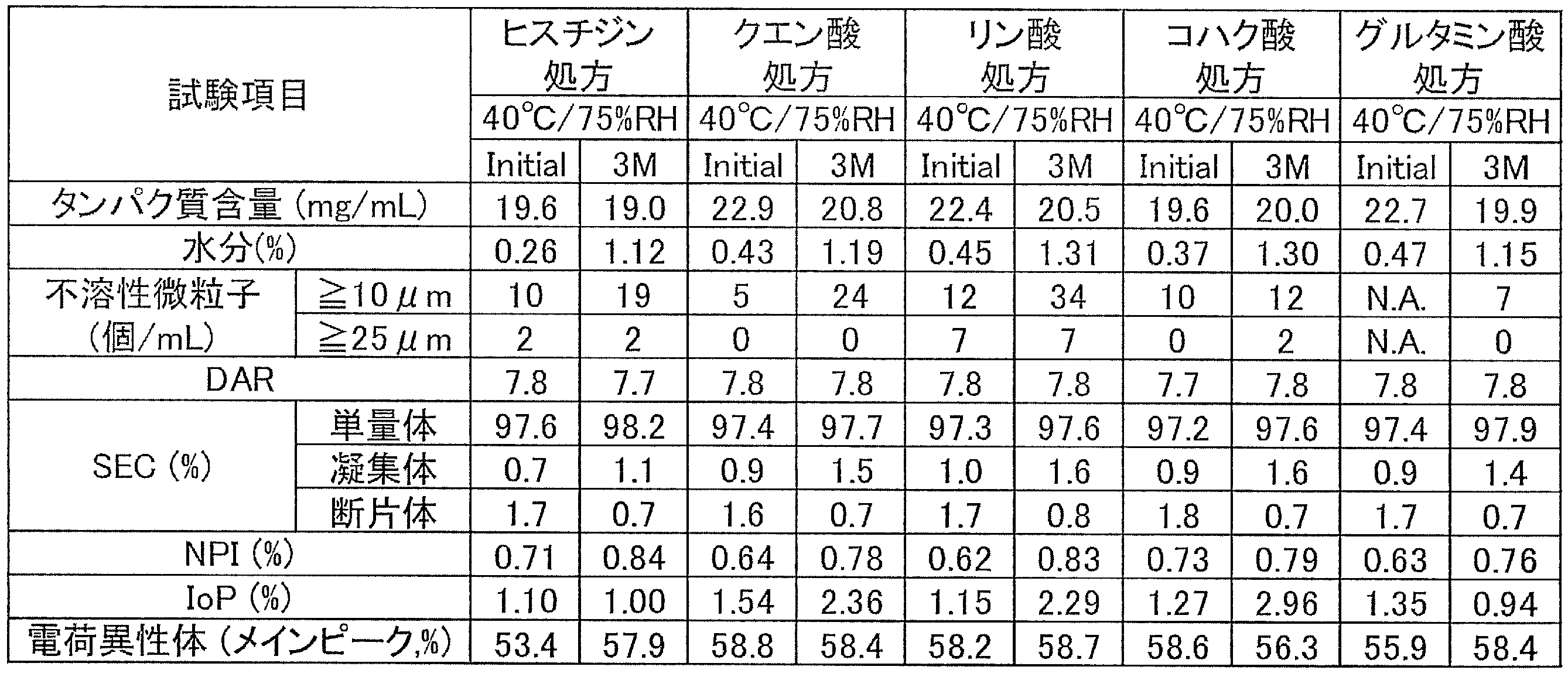
[実施例6:pHスクリーニング]
凍結乾燥注射剤の再溶解後のpHは緩衝剤スクリーニングで選定したヒスチジン緩衝剤を用い、点滴静注した場合に生体適合性や刺激性等の安全性を考慮しpH4からpH7の範囲から選定した。その他の成分は共通で抗体-薬物コンジュゲート(1)(20mg/mL)、9%スクロース、25mMヒスチジン緩衝剤、0.02%ポリソルベート20とした。試料作製は製剤の調製法(1)で実施した。[Example 6: pH screening]
The pH after redissolution of the freeze-dried injection was selected from the range of
結果を表5に示す。pHが高くなることにより凝集体が増加し(図5)、pHが低くなることによりNPIが増加することが判明した(図6)。従って、pH5.5にて凝集体の増加とNPIの増加をバランスよく抑制できることが判明した。 Table 5 shows the results. It was found that higher pH increased aggregates (Figure 5) and lower pH increased NPI (Figure 6). Therefore, it was found that an increase in aggregates and an increase in NPI can be suppressed in a well-balanced manner at pH 5.5.

[実施例7:緩衝剤濃度スクリーニング]
凍結乾燥注射剤の緩衝剤として選定したヒスチジン緩衝剤の濃度は、10mMから40mMの範囲から選定した。その他の成分は共通で抗体-薬物コンジュゲート(1)(20mg/mL)、9%スクロース、0.02%ポリソルベート20、pH5.5とした。試料作製は製剤の調製法(1)で実施した。[Example 7: Buffer concentration screening]
The concentration of the histidine buffer selected as the buffer for the lyophilized injection was selected from the range of 10 mM to 40 mM. Antibody-drug conjugate (1) (20 mg/mL), 9% sucrose, 0.02
結果を表6に示す。ヒスチジン緩衝剤濃度が、10mMから40mMの場合において、いずれも同等の安定性を示した。 Table 6 shows the results. Equivalent stability was observed at histidine buffer concentrations of 10 mM to 40 mM.

[実施例8:界面活性剤スクリーニング]
凍結乾燥注射剤の場合、界面活性剤は凍結時のタンパク質濃縮層の界面保護剤や凍結乾燥体の再溶解時に発生する微細な気泡に対する界面保護剤としての役割が期待されることから、界面活性剤として、0.02%から0.04%のポリソルベート20(Tween20)及び、ポリソルベート80(Tween80)について検討した。その他の成分は共通で抗体-薬物コンジュゲート(1)(20mg/mL)、9%スクロース、25mMヒスチジン緩衝剤、pH5.5とした。試料作製は製剤の調製法(2)で実施した。[Example 8: Surfactant screening]
In the case of lyophilized injections, surfactants are expected to play a role as a surface-protecting agent for the protein-concentrated layer during freezing and as a surface-protecting agent for fine air bubbles generated when the lyophilized product is redissolved. As agents, 0.02% to 0.04% polysorbate 20 (Tween 20) and polysorbate 80 (Tween 80) were investigated. Antibody-drug conjugate (1) (20 mg/mL), 9% sucrose, 25 mM histidine buffer, pH 5.5 were commonly used as other components. Sample preparation was carried out according to formulation preparation method (2).
結果を表7及び表8に示す(ここで、「PS」はポリソルベートを意味し、「PS20」はポリソルベート20を意味し、「PS80」はポリソルベート80を意味する)。0.02%から0.04%のポリソルベート20又は80を使用することで微粒子数の抑制が認められ、特に0.02%から0.04%のポリソルベート80を使用した場合に、微粒子数を抑制できることが判明した(図7)。
The results are shown in Tables 7 and 8 (where "PS" means polysorbate, "PS20" means
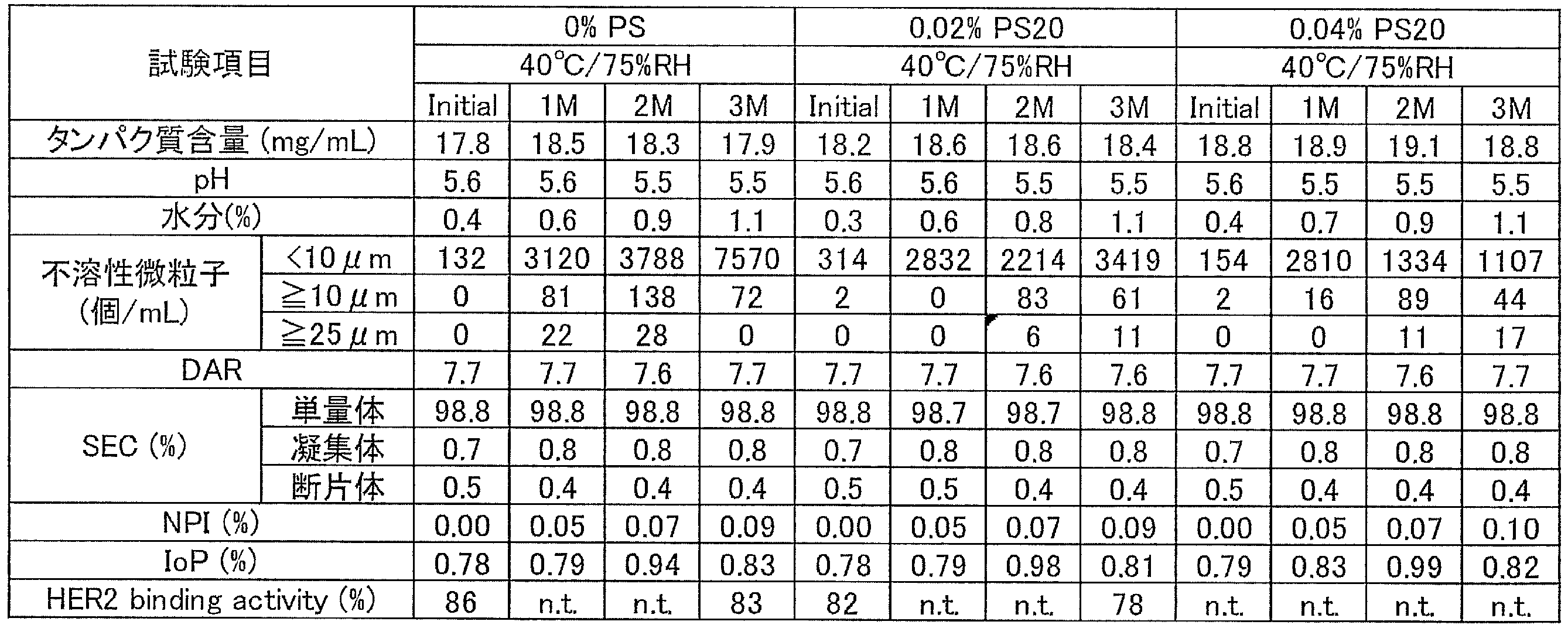

[実施例9:バイアル検討]
褐色ガラスバイアル、及び透明ガラスバイアルのそれぞれに、凍結乾燥注射剤を充填し、1,000lxの白色蛍光灯下に光暴露した時の品質変化を比較検討した。凍結乾燥注射剤の成分は、抗体-薬物コンジュゲート(1)(20mg/mL)、9%スクロース、25mMヒスチジン緩衝剤、0.02%ポリソルベート20(pH5.5)とし、試料作製は製剤の調製法(1)で実施した。
結果を表9に示す。透明ガラスバイアルよりも、褐色ガラスバイアルを使用した場合に、凝集体(図8)及びIoP(図9)の生成を抑制できることが判明した。[Example 9: Vial study]
A brown glass vial and a transparent glass vial were each filled with a freeze-dried injection, and the change in quality when exposed to light under a white fluorescent lamp of 1,000 lx was compared and examined. The components of the lyophilized injection are antibody-drug conjugate (1) (20 mg/mL), 9% sucrose, 25 mM histidine buffer, 0.02% polysorbate 20 (pH 5.5), sample preparation is formulation preparation Method (1) was used.
Table 9 shows the results. It was found that the formation of aggregates (Fig. 8) and IoP (Fig. 9) can be suppressed more when using brown glass vials than when using clear glass vials.

[実施例10:凍結乾燥方法の設定]
注射剤の凍結乾燥方法を設定する上で指標となる重要な物性は、凍結乾燥する薬物含有水溶液の凍結ガラス転移点(Tg’)、凍結乾燥中に生成する多孔性構造を有するケーキの崩壊温度(Tc)であり、このTg’またはTc以下となる製品温度で乾燥することによってケーキ状の多孔性構造を有する凍結乾燥体が得られる。乾燥プロセスは、一般的に凍結体中の自由水を昇華するための1次乾燥プロセスと溶質に結合した水(結合水)を昇華するための2次乾燥プロセスで構成され、1次乾燥プロセス中の自由水はTg’以下の製品温度で昇華することが適当であり、Tc以下の製品温度で昇華することも可能である。
抗体-薬物コンジュゲート(1)(20mg/mL)、9%スクロース、25mMヒスチジン緩衝剤、0.03%ポリソルベート80、を含み、pHが5.5である水溶液(以下、「水溶液(1)」という。)の、Tg’は-31℃、Tcは-27℃である。
水溶液(1)5.2~5.5mLを容量が約10mLのガラスバイアルに充填して凍結乾燥方法の検討を実施した。[Example 10: Setting of freeze-drying method]
Important physical properties that serve as indicators for setting the freeze-drying method for injections are the freezing glass transition point (Tg') of the drug-containing aqueous solution to be freeze-dried, and the collapse temperature of the cake having a porous structure generated during freeze-drying. (Tc), and a freeze-dried product having a cake-like porous structure can be obtained by drying at a product temperature of Tg' or Tc or less. The drying process generally consists of a primary drying process for sublimating free water in the frozen body and a secondary drying process for sublimating water bound to the solute (bound water). The free water of is suitable to be sublimated at a product temperature of Tg' or lower, and can be sublimated at a product temperature of Tc or lower.
An aqueous solution containing antibody-drug conjugate (1) (20 mg/mL), 9% sucrose, 25 mM histidine buffer, 0.03
A solution (1) of 5.2 to 5.5 mL was filled in a glass vial with a volume of about 10 mL, and a freeze-drying method was investigated.
(1)1次乾燥プロセスパラメータ検討
1次乾燥プロセスで最も重要なパラメータは棚温度及び、庫内真空度である。凍結乾燥ケーキの形状(安定性)や再溶解性、乾燥時間は前述のパラメータの影響を大きく受けることから、棚温度を-20℃から0℃の範囲及び、庫内真空度を5Paから15Paの範囲で実験計画法を用いて検討した。凍結乾燥は表9のパラメータで実施した(アニーリングの棚温度は-7℃)。(1) Investigation of primary drying process parameters The most important parameters in the primary drying process are the shelf temperature and the degree of vacuum in the cabinet. Since the shape (stability), re-dissolution, and drying time of the freeze-dried cake are greatly affected by the above-mentioned parameters, the shelf temperature should be in the range of -20 ° C to 0 ° C, and the degree of vacuum in the chamber should be 5 Pa to 15 Pa. A range was investigated using design of experiments. Lyophilization was performed with the parameters in Table 9 (annealing shelf temperature -7°C).

図10は1次乾燥プロセスにおける棚温度と庫内真空度を変動させた時の水溶液(1)の製品温度の等高線図である。棚温度が低く庫内真空度が高い条件で1次乾燥中の製品温度は低くなり、その逆の棚温度が高く庫内真空度が低い条件で製品温度は高くなる、一般的な製品温度挙動を示した。棚温度が-20℃から0℃の範囲及び、庫内真空度が5Paから15Paの範囲の製品温度はTc以下を示したものの、三角で囲んだ部分以外のパラメータでは凍結乾燥ケーキの多孔性構造に部分的な崩壊が生じ、凍結乾燥ケーキが縮んだ状態の外観(シュリンク)となることが明らかとなった。
図11は1次乾燥プロセスにおける棚温度と庫内真空度を変動させた時の水溶液(1)の乾燥時間の等高線図である。棚温度が低く庫内真空度が高い条件で1次乾燥時間は長くなり、その逆の棚温度が高く庫内真空度が低い条件で乾燥時間は短くなる、一般的な乾燥速度挙動を示し、製品温度との相関が認められた。製品温度等高線図の三角で囲んだ部分のパラメータ領域では、良好な形状の凍結乾燥ケーキが得られるが、長時間の1次乾燥プロセスが必要になることが明らかとなった。
凍結乾燥ケーキの形状は外観品質の観点ではシュリンクのない状態が望まれるため、本検討の結果から1次乾燥プロセスは少なくとも58時間必要であることが明らかとなった。そのため、総凍結乾燥時間は、凍結プロセスに11時間、2次乾燥・出庫プロセスに12時間は必要であることから、81時間となる。つまり凍結乾燥のプロセス期間は3日間以上となり、これに凍結乾燥開始日と終了日を加えると製造期間は5日間と見積もられた。
一方、凍結乾燥は生産効率及び、生産コストの観点で短時間(短期間)のプロセスが望ましいため、長時間の凍結乾燥プロセスが必要になることが課題となった。
この課題を解決するため1次乾燥プロセス時間を短縮してもシュリンクが少ない凍結乾燥ケーキを得るために、凍結乾燥ケーキの多孔性構造の改善が期待できるアニーリングステップに着目し、アニーリングパラメータの検討を実施した。FIG. 10 is a contour map of the product temperature of the aqueous solution (1) when the shelf temperature and the degree of vacuum in the chamber are varied in the primary drying process. Under the conditions of low shelf temperature and high internal vacuum, the product temperature during the primary drying is low, and vice versa, under the condition of high shelf temperature and low internal vacuum, the product temperature is high. General product temperature behavior showed that. Although the product temperature in the range of -20 ° C to 0 ° C in the shelf temperature and the range of 5 Pa to 15 Pa in the chamber vacuum showed Tc or less, the parameters other than the part surrounded by the triangle showed the porous structure of the freeze-dried cake. It was found that partial collapse occurred in the freeze-dried cake resulting in a shrunken appearance.
FIG. 11 is a contour map of the drying time of the aqueous solution (1) when the shelf temperature and the degree of vacuum in the chamber are varied in the primary drying process. When the shelf temperature is low and the internal vacuum is high, the primary drying time is long. Conversely, when the shelf temperature is high and the internal vacuum is low, the drying time is short. A correlation with product temperature was observed. It was found that the triangulated parameter region of the product temperature contour plot gave a well-shaped freeze-dried cake, but required a long primary drying process.
Since the shape of the freeze-dried cake is desired to be in a state without shrinkage from the viewpoint of appearance quality, the results of this study revealed that the primary drying process required at least 58 hours. Therefore, the total freeze-drying time is 81 hours, since the freezing process requires 11 hours and the secondary drying/shipping process requires 12 hours. In other words, the freeze-drying process period was 3 days or more, and the production period was estimated to be 5 days when the freeze-drying start date and end date were added to this.
On the other hand, since a short-time (short-term) freeze-drying process is desirable from the viewpoint of production efficiency and production cost, the need for a long-time freeze-drying process has become a problem.
To solve this problem, in order to obtain a freeze-dried cake with less shrinkage even if the primary drying process time is shortened, we focused on the annealing step, which can be expected to improve the porous structure of the freeze-dried cake, and investigated the annealing parameters. Carried out.
(2)アニーリングパラメータ設定
アニーリングプロセスで重要なパラメータは棚温度であり、棚温度を変動することによって凍結体の製品温度を調節することができる。
本検討では凍結乾燥ケーキの多孔性構造は氷晶の氷が昇華することによって作られるため、アニーリングの棚温度の最適化を実施した。アニーリングの棚温度は共融点から安全マージンをとった温度に設定することが一般的であることから、共融点が-2.5℃である水溶液(1)では-7℃で実施していたが、凍結体中の氷晶を成長させて氷の昇華抵抗を減らし、乾燥がスムーズに進むことで凍結乾燥ケーキにシュリンクが生じ難い比表面積の小さな多孔性構造とするため-7℃よりも高い棚温度を試みた。アニーリングの棚温度の範囲は-7℃から0.5℃までとし、比表面積の小さな多孔性構造を作ることで凍結乾燥ケーキの外観品質の改善を検討した。本検討の凍結乾燥は表11のパラメータで実施し、1次乾燥時間は合計約42時間とした。(2) Annealing parameter setting An important parameter in the annealing process is the shelf temperature, and the product temperature of the frozen body can be adjusted by varying the shelf temperature.
In this study, the porous structure of the freeze-dried cake was created by the sublimation of ice crystals, so the annealing shelf temperature was optimized. Since the annealing shelf temperature is generally set to a temperature with a safety margin from the eutectic point, the aqueous solution (1) having a eutectic point of -2.5°C was performed at -7°C. , to grow ice crystals in the frozen body to reduce the sublimation resistance of the ice, and to make the freeze-dried cake a porous structure with a small specific surface area that does not easily shrink due to the smooth drying process. Tried temperature. The annealing shelf temperature range was from -7°C to 0.5°C, and the improvement of the appearance quality of the freeze-dried cake was investigated by creating a porous structure with a small specific surface area. The freeze-drying in this study was performed with the parameters in Table 11, with a total primary drying time of about 42 hours.
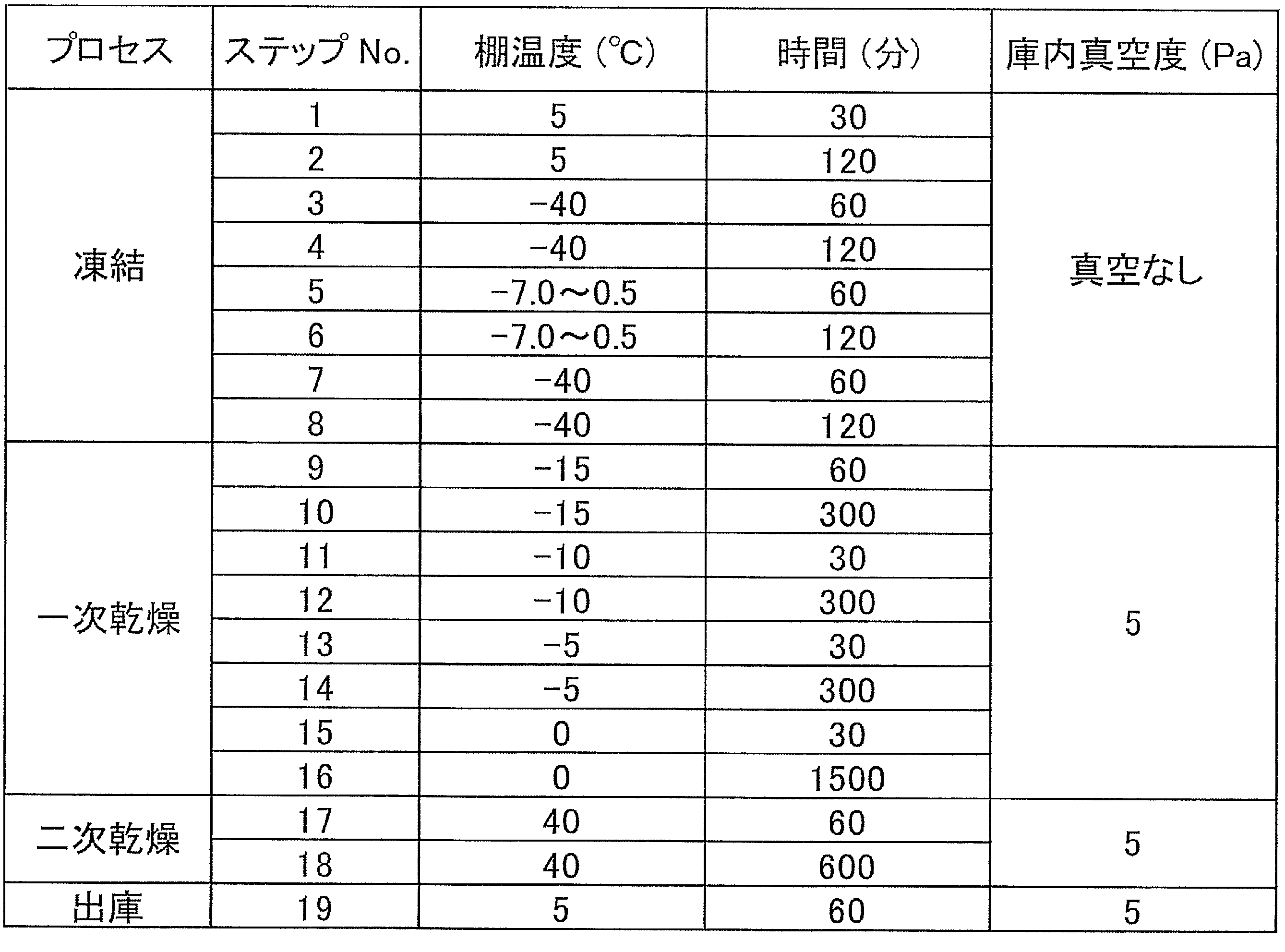
棚温度-7℃から0.5℃の範囲でアニーリングを実施し凍結乾燥した場合の製品温度(アニーリング時)と凍結乾燥ケーキの形状を図12に示す。アニーリング時の製品温度が-7.0℃から-4.6℃の範囲ではバイアル底部から側面下部にかけて凍結乾燥ケーキに顕著なシュリンクが認められ、-4.2℃から-3.4℃の製品温度範囲では僅かなシュリンクが認められたものの、-2.6℃から-1.5℃の製品温度範囲ではシュリンクのない凍結乾燥ケーキが得られた。これらの結果から共融点に近い棚温度でアニーリングするほどシュリンクは減少し、共融点付近ではシュリンクが起きなくなる事が判明した。また、製品温度が共融点以上の-1.5℃まで上昇したとしても固体状態が維持され正常な形状の凍結乾燥ケーキが得られることが明らかとなった。
アニーリングはこれまで共融点よりも5℃程度低い棚温度で実施されることが一般的であったが、本検討によって、共融点付近でアニーリングした方がより優れた外観の凍結乾燥ケーキが得られることが見出された。アニーリングの棚温度は、本検討結果をもとに共融点付近の-4℃から-2℃に設定した。
また、本検討から、共融点付近でアニーリングすることによって、1次乾燥プロセスの時間を40時間程度短縮できることが判明した。図10及び、図11の結果をもとに、棚温度-5℃、庫内真空度7Paに設定することにより製品温度が比較的低い状態で乾燥が可能で且つ乾燥時間を18時間程度短縮が見込まれる条件であると考えられたことから1次乾燥パラメータとして設定した。FIG. 12 shows the product temperature (at the time of annealing) and the shape of the freeze-dried cake when the freeze-drying was performed after annealing at a shelf temperature ranging from -7°C to 0.5°C. When the product temperature during annealing was in the range of -7.0°C to -4.6°C, significant shrinkage was observed in the freeze-dried cake from the bottom of the vial to the bottom of the side, and the product temperature ranged from -4.2°C to -3.4°C. A product temperature range of -2.6°C to -1.5°C produced a shrink-free lyophilized cake, although slight shrinkage was observed in the temperature range. From these results, it was found that the shrinkage decreased with annealing at shelf temperatures closer to the eutectic point, and no shrinkage occurred near the eutectic point. It was also found that even if the product temperature rises to −1.5° C., which is above the eutectic point, the solid state is maintained and a freeze-dried cake with a normal shape can be obtained.
Annealing has traditionally been performed at shelf temperatures about 5°C below the eutectic point, but this study shows that annealing near the eutectic point results in freeze-dried cakes with better appearance. It was found that The annealing shelf temperature was set to -4°C to -2°C near the eutectic point based on the results of this study.
Also, from this study, it was found that the time for the primary drying process can be shortened by about 40 hours by annealing near the eutectic point. Based on the results of FIGS. 10 and 11, by setting the shelf temperature to −5° C. and the internal vacuum of 7 Pa, it is possible to dry the product at a relatively low temperature and shorten the drying time by about 18 hours. It was set as the primary drying parameter because it was considered to be the expected condition.
(3)2次乾燥プロセスパラメータ設定
2次乾燥プロセスは溶質に結合した水(結合水)を乾燥するためのプロセスであり、2次乾燥後の乾燥度が凍結乾燥注射剤の保存安定性に大きく影響を及ぼすことが一般的に知られている。結合水は高い温度で乾燥するほど低くすることができるが、抗体-薬物コンジュゲートの抗体部分は熱に不安定なことが一般的であるため、キャピラリー示差走査熱量計でタンパク質の熱変性Onsetを測定した。図13に示すのとおり抗体-薬物コンジュゲート(1)の熱変性Onsetは52℃から53℃であったことから2次乾燥の棚温度は50℃以下で乾燥度(残存水分)を評価した。
2次乾燥の棚温度は30℃から50℃の範囲とし、乾燥度の評価を実施した。本検討の凍結乾燥は表12のパラメータで実施した。(3) Secondary drying process parameter setting The secondary drying process is a process for drying the water bound to the solute (bound water). commonly known to affect Bound water can be reduced by drying at higher temperatures, but since the antibody portion of the antibody-drug conjugate is generally heat-labile, a capillary differential scanning calorimeter was used to measure the heat-denatured Onset of the protein. It was measured. As shown in FIG. 13, the thermal denaturation Onset of Antibody-Drug Conjugate (1) was 52° C. to 53° C., so the secondary drying shelf temperature was 50° C. or less to evaluate the dryness (residual moisture).
The secondary drying shelf temperature was in the range of 30°C to 50°C, and the dryness was evaluated. Lyophilization for this study was performed with the parameters in Table 12.

各2次乾燥の棚温度と凍結乾燥注射剤中の残存水分の結果を表13に示す。凍結乾燥注射剤中の残存水分は5%まで安定性が維持されることを確認しているが、安定性のより高いレベルを目標とするため、残存水分を1%以下に設定した。残存水分は1次乾燥条件の影響を多少受けるものの、2次乾燥の棚温度が40℃から50℃の範囲で残存水分量が1%以下となることが確認された。熱変性Onsetと本検討結果をもとに40℃から50℃の中間の45℃を2次乾燥の棚温度に設定した。 The results of shelf temperature for each secondary drying and residual moisture in the lyophilized injection are shown in Table 13. Although it was confirmed that the stability was maintained up to 5% residual moisture in the lyophilized injection, the residual moisture was set at 1% or less in order to aim for a higher level of stability. Although the residual moisture content is somewhat affected by the primary drying conditions, it was confirmed that the residual moisture content was 1% or less when the secondary drying shelf temperature ranged from 40°C to 50°C. Based on the thermal denaturation onset and the results of this study, the secondary drying shelf temperature was set at 45°C, which is between 40°C and 50°C.

(4)まとめ
バイオ医薬品(タンパク質医薬品)の凍結乾燥注射剤の賦形剤は、タンパク質の凍結保護作用を持ち、保存中のメイラード反応リスクがないスクロースやトレハロースといった非還元二糖類を製剤処方に選定することが一般的である。これらの糖は他の糖類よりもTg’やTcが低いため棚温度を低くして製品温度がTg’やTcを超えないように乾燥する必要があり、凍結乾燥プロセスが長くなる課題や凍結乾燥ケーキにシュリンクが生じ易いといった課題を持つ。水溶液(1)についても例外ではなかったことから、これらの課題を解決するため1次乾燥、アニーリングプロセス及び2次乾燥プロセスの検討を実施し、その結果をもとに表14のとおり水溶液(1)の凍結乾燥方法を設定した。この凍結乾燥方法の特徴はアニーリングパラメータであり、共融点付近でアニーリングすることによってシュリンクを顕著に低減した凍結乾燥ケーキを短時間で製造できることが見出された。
(4) Summary Non-reducing disaccharides such as sucrose and trehalose are selected as excipients for freeze-dried injections of biopharmaceuticals (protein drugs) that have a cryoprotective effect on proteins and have no risk of Maillard reaction during storage. It is common to These saccharides have lower Tg' and Tc than other saccharides, so it is necessary to dry them at low shelf temperatures so that the product temperature does not exceed Tg' and Tc. There is a problem that the cake tends to shrink. Since the aqueous solution (1) was no exception, in order to solve these problems, the primary drying, annealing process, and secondary drying process were examined, and based on the results, the aqueous solution (1 ) was set up as a freeze-drying method. A feature of this freeze-drying method is the annealing parameter, and it was found that a freeze-dried cake with significantly reduced shrinkage can be produced in a short time by annealing near the eutectic point.

本凍結乾燥方法で製造した凍結乾燥注射剤について、50℃下1ヵ月間、40℃/75%RH下3ヵ月間、25℃/60%RH下3ヵ月間、5℃下3ヵ月間での保存安定性を、タンパク質濃度、水分、不溶性微粒子、DAR、単量体・凝集体・断片体の比率、NPI、IoP、電荷異性体、及びpHを指標に評価した結果、顕著な品質変化は認められないことが判明した。 Regarding the freeze-dried injection manufactured by this freeze-drying method, it was tested at 50°C for 1 month, 40°C/75% RH for 3 months, 25°C/60% RH for 3 months, and 5°C for 3 months. Storage stability was evaluated using protein concentration, water content, insoluble fine particles, DAR, monomer/aggregate/fragment ratio, NPI, IoP, charge isomers, and pH as indicators. turned out not to be.
[実施例11:長期保存安定性の評価]
実施例10で製造した凍結乾燥注射剤について、さらに、40℃/75%RH下6ヵ月間、25℃/60%RH下12ヵ月間、5℃下18ヵ月間での保存安定性を、タンパク質濃度、水分、不溶性微粒子、DAR、単量体・凝集体・断片体の比率、NPI、IoP、電荷異性体、及びpHを指標に評価した。その結果、顕著な品質変化は認められないことが判明した。[Example 11: Evaluation of long-term storage stability]
The freeze-dried injection prepared in Example 10 was further evaluated for storage stability at 40°C/75% RH for 6 months, 25°C/60% RH for 12 months, and 5°C for 18 months. Concentration, water content, insoluble fine particles, DAR, monomer/aggregate/fragment ratio, NPI, IoP, charge isomers, and pH were used as indices for evaluation. As a result, it was found that no significant change in quality was observed.
[実施例12:凍結乾燥方法の更なる検討]
(1)アニーリングパラメータ設定
水溶液(1)の凍結乾燥方法として、凍結体中の氷晶を成長させるため、棚温度-2.5℃を120分間保持してアニーリングを行う方法を採用していたが、120分では凍結体の上層部の温度が-2.5℃まで上昇しておらず氷晶成長が不十分なため僅かながら凍結乾燥ケーキにシュリンクが起きることが判明した。アニーリング時間を240分間まで延長すると凍結体の上層部の温度が-2.5℃に到達することが判明したためアニーリング時間を4時間に変更することとした。4時間に変更することによって氷晶が十分に成長することで水の昇華速度が速くなり一次乾燥時間が短縮することが判明した。[Example 12: Further examination of the freeze-drying method]
(1) Annealing parameter setting As a freeze-drying method for the aqueous solution (1), in order to grow ice crystals in the frozen body, a method of holding the shelf temperature of -2.5 ° C. for 120 minutes and annealing was adopted. At 120 minutes, the temperature of the upper layer of the frozen body did not rise to -2.5°C, and the growth of ice crystals was insufficient. It was found that the temperature of the upper layer of the frozen body reached -2.5°C when the annealing time was extended to 240 minutes, so the annealing time was changed to 4 hours. It was found that by changing the drying time to 4 hours, ice crystals grow sufficiently, thereby increasing the water sublimation rate and shortening the primary drying time.
(2)一次乾燥プロセスパラメータ設定
-2.5℃で4時間アニーリングを行い、一次乾燥プロセスパラメータについて棚温度を-10℃から15℃の範囲及び、庫内真空度を4Paから30Paの範囲で検討した。凍結乾燥は表15のパラメータで実施した。(2) Primary drying process parameter setting Perform annealing at -2.5 ° C for 4 hours, and examine the primary drying process parameters with a shelf temperature in the range of -10 ° C to 15 ° C and an internal vacuum in the range of 4 Pa to 30 Pa bottom. Lyophilization was performed with the parameters in Table 15.
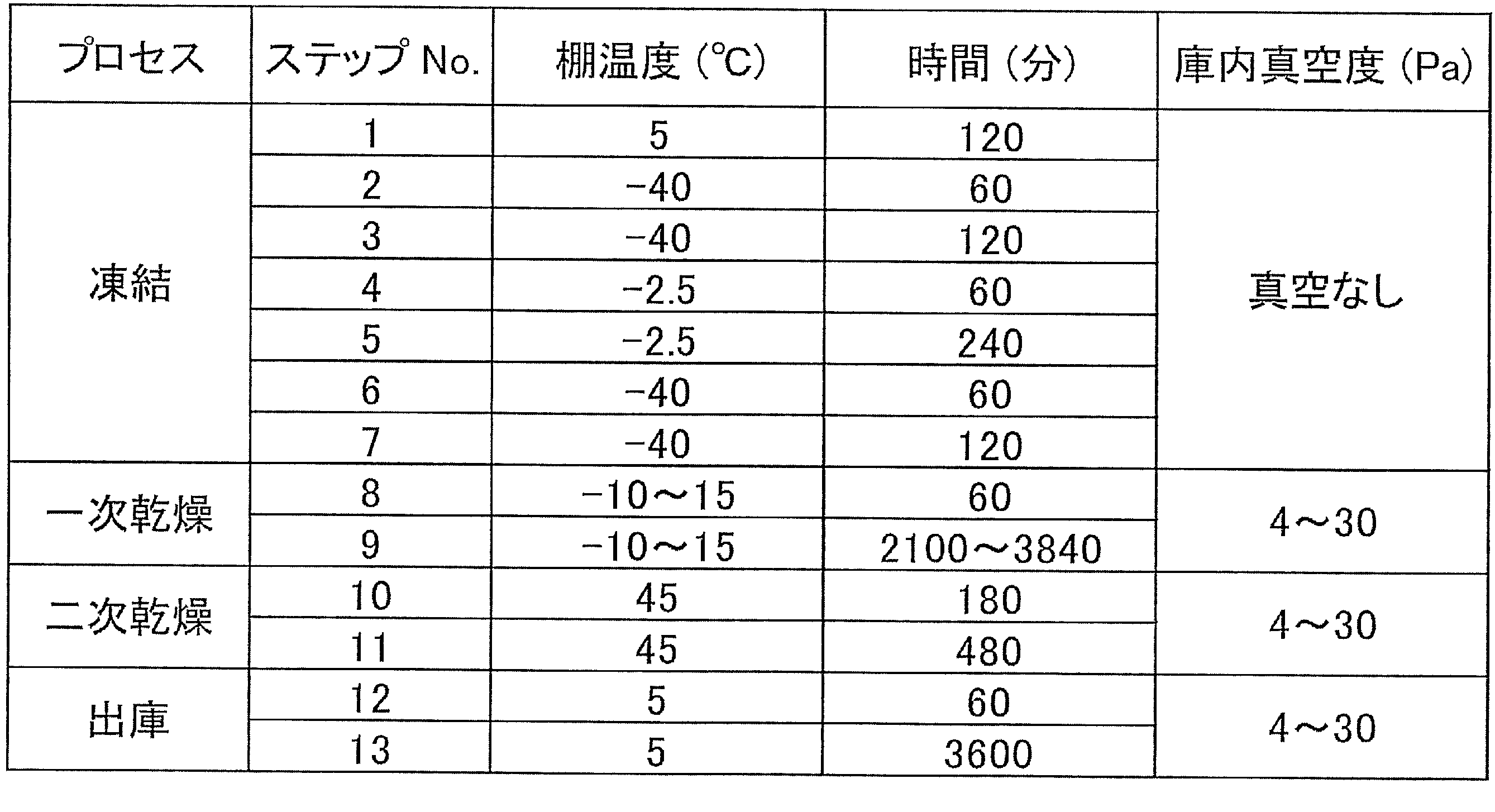
棚温度が-10℃から10℃の範囲及び、庫内真空度が4Paから30Paの範囲の製品温度はTc以下を示し、凍乾ケーキが外観はシュリンクやコラプスのないケーキ形状であった。 When the shelf temperature was in the range of −10° C. to 10° C. and the internal vacuum degree was in the range of 4 Pa to 30 Pa, the product temperature was Tc or lower, and the freeze-dried cake had a cake shape without shrinkage or collapse.
このうち、棚温度が-5℃から5℃であり、且つ、庫内真空度が5Paから15Paである場合が特に安全な範囲と考えられ、さらに乾燥時間を勘案し、この範囲の中心条件である棚温度が0℃であり、且つ、庫内真空度が10Paである場合を好適な条件として設定した。 Of these, the case where the shelf temperature is -5°C to 5°C and the internal vacuum degree is 5 Pa to 15 Pa is considered to be a particularly safe range. A case where a certain shelf temperature is 0° C. and the internal vacuum degree is 10 Pa is set as a suitable condition.
(3)まとめ
上記の結果をもとに表16のとおり水溶液(1)の凍結乾燥方法を設定した。(3) Summary Based on the above results, a freeze-drying method for the aqueous solution (1) was set as shown in Table 16.
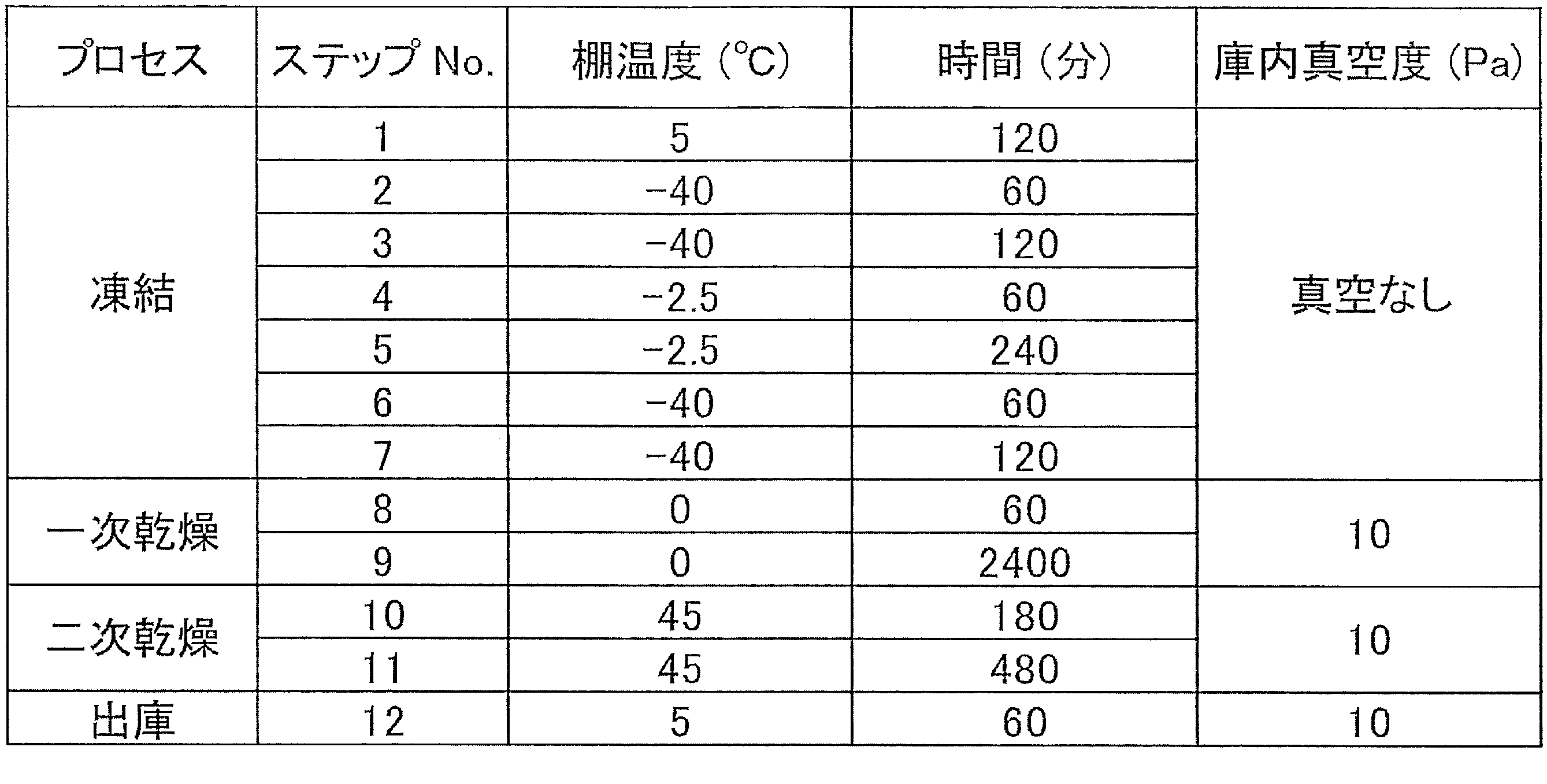
本凍結乾燥方法で製造した凍結乾燥注射剤について、40℃/75%RH下3ヵ月間の保存安定性を、タンパク質濃度、水分、不溶性微粒子、DAR、単量体・凝集体・断片体の比率、NPI、IoP、電荷異性体、及びpHを指標に評価した。開始時点からの顕著な品質変化は認められていない。 Regarding the freeze-dried injection produced by this freeze-drying method, the storage stability for 3 months at 40°C/75% RH was evaluated by measuring the protein concentration, water content, insoluble fine particles, DAR, monomer/aggregate/fragment ratio. , NPI, IoP, charge isomers, and pH were used as indices. No significant quality change from the starting point was observed.
[実施例13:他の処方と凍結乾燥条件の検討]
(1)製剤の調製
原薬(抗体-薬物コンジュゲート(1)(20mg/mL)、25mMヒスチジン、9%スクロース、pH5.5)をUF膜キット(AMICON ULTRA-15、30kDa)に分注して3000rpm、5℃設定で遠心を行い約3倍に濃縮した。この濃縮原薬を透析カセット(透析膜、Slide-A-lyzer, MWCO 20,000)に注入し、透析カセットに注入した試料量の50倍以上の目的処方の緩衝液で透析を行った。透析は5°Cで5時間以上を2回行った。透析後のタンパク質濃度が約5mg/mLまたは約50mg/mLになるように濃縮または希釈を適宜実施した後、ポリソルベート80を添加して混合し、抗体-薬物コンジュゲート(1)(5mg/mL)、8%スクロース、20mMヒスチジン緩衝剤、及び0.04%ポリソルベート80、を含み、pHが4.0である水溶液(以下、「水溶液(2)」という。)、抗体-薬物コンジュゲート(1)(50mg/mL)、6%スクロース、40mMヒスチジン緩衝剤、及び0.04%ポリソルベート80、を含み、pHが7.0である水溶液(以下、「水溶液(3)」という。)、抗体-薬物コンジュゲート(1)(5mg/mL)、8%トレハロース水和物、20mMヒスチジン緩衝剤、及び0.04%ポリソルベート80、を含み、pHが4.0である水溶液(以下、「水溶液(4)」という。)、並びに、抗体-薬物コンジュゲート(1)(50mg/mL)、6%トレハロース水和物、40mMヒスチジン緩衝剤、及び0.04%ポリソルベート80、を含み、pHが7.0である水溶液(以下、「水溶液(5)」という。)を調製した。
なお、抗体-薬物コンジュゲート(1)20mg当たりの量で換算すると、水溶液(2)は、320mgのスクロース、80mMのヒスチジン緩衝剤、及び1.6mgのポリソルベート80を含み、水溶液(3)は、24mgのスクロース、16mMのヒスチジン緩衝剤、及び0.16mgのポリソルベート80を含み、水溶液(4)は、320mgのトレハロース水和物、80mMのヒスチジン緩衝剤、及び1.6mgのポリソルベート80を含み、水溶液(5)は、24mgのトレハロース水和物、16mMのヒスチジン緩衝剤、及び0.16mgのポリソルベート80を含んでいる。
これらの溶液を0.22μmフィルターを用いてろ過した。ろ過した液を5mLずつ褐色ガラスバイアルに充填し、凍結乾燥製剤の場合はゴム栓を半打栓し、表17の条件で凍結乾燥を行った。凍結乾燥後、ゴム栓が打栓されたバイアルにキャップを巻締めた。[Example 13: Examination of other formulations and freeze-drying conditions]
(1) Preparation of formulation The drug substance (antibody-drug conjugate (1) (20 mg/mL), 25 mM histidine, 9% sucrose, pH 5.5) was dispensed into a UF membrane kit (AMICON ULTRA-15, 30 kDa). It was then centrifuged at 3000 rpm and 5° C. to concentrate about 3 times. This concentrated drug substance was injected into a dialysis cassette (dialysis membrane, Slide-A-lyzer, MWCO 20,000), and dialyzed with a target formulation of buffer solution in an amount of 50 times or more the amount of the sample injected into the dialysis cassette. Dialysis was performed twice at 5°C for 5 hours or more. Concentrate or dilute as appropriate so that the post-dialysis protein concentration is about 5 mg/mL or about 50 mg/mL, then add
When converted to the amount per 20 mg of antibody-drug conjugate (1), aqueous solution (2) contains 320 mg of sucrose, 80 mM histidine buffer, and 1.6 mg of
These solutions were filtered using a 0.22 μm filter. Each 5 mL of the filtered liquid was filled in a brown glass vial, and in the case of a freeze-dried preparation, the rubber stopper was partially capped, and freeze-drying was performed under the conditions shown in Table 17. After freeze-drying, the cap was screwed onto the vial capped with a rubber stopper.
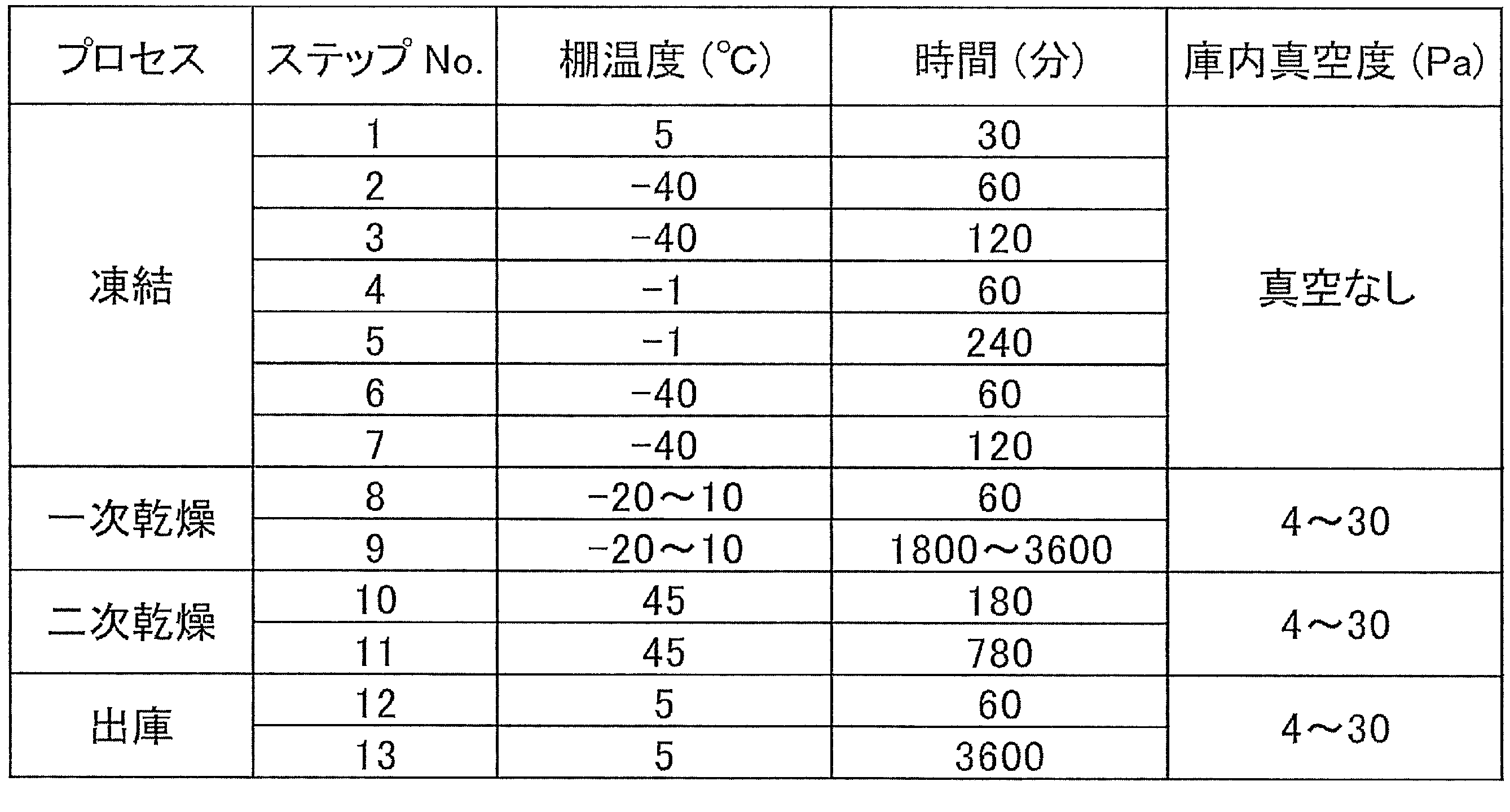
(2)安定性試験
本凍結乾燥方法で製造した凍結乾燥注射剤について、40℃/75%RH下の保存安定性を、タンパク質濃度、水分、不溶性微粒子、DAR、単量体・凝集体・断片体の比率、NPI、IoP、電荷異性体、及びpHを指標に評価した。(2) Stability test Regarding the freeze-dried injection manufactured by this freeze-drying method, the storage stability under 40°C/75% RH was measured by protein concentration, moisture, insoluble fine particles, DAR, monomers/aggregates/fragments. Body ratio, NPI, IoP, charge isomers, and pH were evaluated.
[実施例14:抗体-薬物コンジュゲート(2)の製造と処方の検討]
国際公開第2015/155998号に記載の製造方法を参考に、抗HER3抗体(配列番号3に記載のアミノ酸配列からなる重鎖及び配列番号4に記載のアミノ酸配列からなる軽鎖を含んでなる抗体)を用いて、式[Example 14: Preparation of antibody-drug conjugate (2) and investigation of formulation]
With reference to the production method described in International Publication No. 2015/155998, an anti-HER3 antibody (An antibody comprising a heavy chain consisting of the amino acid sequence set forth in SEQ ID NO: 3 and a light chain consisting of the amino acid sequence set forth in SEQ ID NO: 4 ), the expression
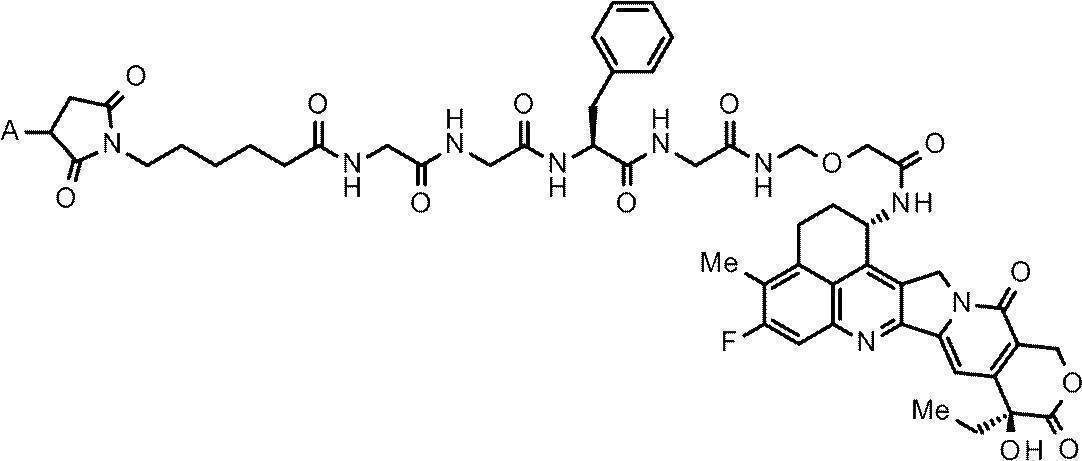
(式中、Aは抗体との結合位置を示す)
で示される薬物リンカーと、抗HER3抗体とがチオエーテル結合によって結合した抗体-薬物コンジュゲート(以下、「抗体-薬物コンジュゲート(2)」と称する)を製造した。抗体-薬物コンジュゲート(2)のDARは、7.7であった。(Wherein, A indicates the binding position with the antibody)
An antibody-drug conjugate (hereinafter referred to as “antibody-drug conjugate (2)”) in which a drug linker represented by and an anti-HER3 antibody are bound via a thioether bond was produced. The DAR of antibody-drug conjugate (2) was 7.7.
抗体-薬物コンジュゲート(2)について、実施例2~8の方法と同様な方法で処方のスクリーニング(抗体-薬物コンジュゲート(2)(20mg/mL)、9%スクロース、25mMヒスチジン緩衝剤、ポリソルベート20(0.01~0.1%)、pH4.9~5.9)を行った。その結果、抗体-薬物コンジュゲート(2)(20mg/mL)、9%スクロース、25mMヒスチジン緩衝剤、及び0.03%ポリソルベート20、を含み、pHが5.4である水溶液(以下、「水溶液(6)」という。)が好適な処方であることが判明した。
For antibody-drug conjugate (2), formulation screening (antibody-drug conjugate (2) (20 mg/mL), 9% sucrose, 25 mM histidine buffer, polysorbate 20 (0.01-0.1%), pH 4.9-5.9). As a result, an aqueous solution containing antibody-drug conjugate (2) (20 mg/mL), 9% sucrose, 25 mM histidine buffer, and 0.03
[実施例15:抗体-薬物コンジュゲート(3)の製造と処方の検討]
国際公開第2015/098099号に記載の製造方法を参考に、抗TROP2抗体(配列番号5においてアミノ酸番号20乃至470に記載のアミノ酸配列からなる重鎖及び配列番号6においてアミノ酸番号21乃至234に記載のアミノ酸配列からなる軽鎖を含んでなる抗体)を用いて、式[Example 15: Manufacture of antibody-drug conjugate (3) and investigation of formulation]
With reference to the production method described in International Publication No. 2015/098099, the anti-TROP2 antibody (heavy chain consisting of the amino acid sequence of

(式中、Aは抗体との結合位置を示す)
で示される薬物リンカーと、抗TROP2抗体とがチオエーテル結合によって結合した抗体-薬物コンジュゲート(以下、「抗体-薬物コンジュゲート(3)」と称する)を製造した。抗体-薬物コンジュゲート(3)のDARは、4.3であった。(Wherein, A indicates the binding position with the antibody)
An antibody-drug conjugate (hereinafter referred to as “antibody-drug conjugate (3)”) in which a drug linker represented by and an anti-TROP2 antibody are bound via a thioether bond was produced. The DAR of antibody-drug conjugate (3) was 4.3.
抗体-薬物コンジュゲート(3)について、実施例2~8の方法と同様な方法で処方のスクリーニング(抗体-薬物コンジュゲート(3)(20mg/mL)、スクロース(3~9%)、ヒスチジン緩衝剤(3~15mM)、ポリソルベート20若しくはポリソルベート80(0.01~0.1%)、pH5~7、あるいは抗体-薬物コンジュゲート(3)(15~40mg/mL)、9%スクロース、10mMヒスチジン緩衝剤、0.02%ポリソルベート80、pH6.0)を行った。その結果、抗体-薬物コンジュゲート(3)(20mg/mL)、9%スクロース、10mMヒスチジン緩衝剤、及び0.02%ポリソルベート80、を含み、pHが6.0である水溶液(以下、「水溶液(7)」という。)、並びに、抗体-薬物コンジュゲート(3)(20mg/mL)、9%スクロース、10mMヒスチジン緩衝剤、及び0.03%ポリソルベート80、を含み、pHが6.0である水溶液(以下、「水溶液(8)」という。)が好適な処方であることが判明した。
For antibody-drug conjugate (3), formulation screening (antibody-drug conjugate (3) (20 mg/mL), sucrose (3-9%), histidine-buffered agent (3-15 mM),
[実施例16:抗体-薬物コンジュゲート(4)の製造と処方の検討]
国際公開第2014/057687号に記載の製造方法を参考に、抗B7-H3抗体(配列番号7においてアミノ酸番号20乃至471に記載のアミノ酸配列からなる重鎖及び配列番号8においてアミノ酸番号21乃至233に記載のアミノ酸配列からなる軽鎖を含んでなる抗体)を用いて、式[Example 16: Manufacture of antibody-drug conjugate (4) and investigation of formulation]
With reference to the production method described in International Publication No. 2014/057687, the anti-B7-H3 antibody (heavy chain consisting of the amino acid sequences set forth in
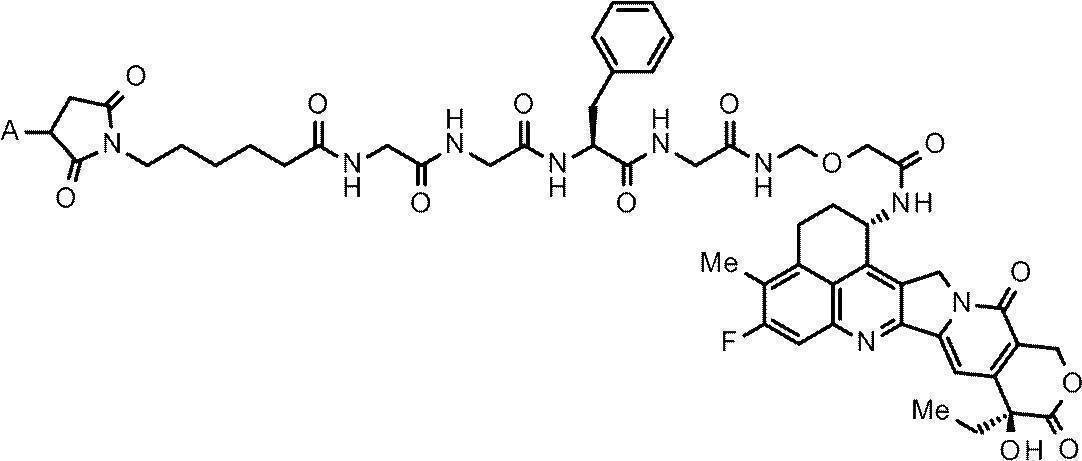
(式中、Aは抗体との結合位置を示す)
で示される薬物リンカーと、抗B7-H3抗体とがチオエーテル結合によって結合した抗体-薬物コンジュゲート(以下、「抗体-薬物コンジュゲート(4)」と称する)を製造した。抗体-薬物コンジュゲート(4)のDARは、4.6であった。(Wherein, A indicates the binding position with the antibody)
An antibody-drug conjugate (hereinafter referred to as “antibody-drug conjugate (4)”) was prepared in which the drug linker represented by and an anti-B7-H3 antibody were bound via a thioether bond. The DAR of antibody-drug conjugate (4) was 4.6.
抗体-薬物コンジュゲート(4)について、実施例2~8の方法と同様な方法で処方のスクリーニング(抗体-薬物コンジュゲート(4)(20mg/mL)、9%スクロース若しくは10%トレハロース水和物、10mMヒスチジン緩衝剤若しくは10mMコハク酸緩衝剤、ポリソルベート20若しくはポリソルベート80(0.005~0.04%)、pH5.2~6.2、あるいは抗体-薬物コンジュゲート(4)(20~60mg/mL)、9%スクロース、10mMヒスチジン緩衝剤、ポリソルベート20(0.005~0.04%)、pH5.2~6.2)を行った。その結果、抗体-薬物コンジュゲート(4)(20mg/mL)、9%スクロース、10mMヒスチジン緩衝剤、及び0.02%ポリソルベート20、を含み、pHが5.9である水溶液(以下、「水溶液(9)」という。)、並びに、抗体-薬物コンジュゲート(4)(20mg/mL)、9%スクロース、10mMヒスチジン緩衝剤、及び0.03%ポリソルベート20、を含み、pHが5.9である水溶液(以下、「水溶液(10)」という。)が好適な処方であることが判明した。
For antibody-drug conjugate (4), formulation screening (antibody-drug conjugate (4) (20 mg/mL), 9% sucrose or 10% trehalose hydrate) was performed in a manner similar to that of Examples 2-8. , 10 mM histidine buffer or 10 mM succinate buffer,
[実施例17:抗体-薬物コンジュゲート(5)の製造と処方の検討]
国際公開第2018/135501号に記載の製造方法を参考に、抗GPR20抗体(配列番号9に記載のアミノ酸番号20乃至472に記載のアミノ酸配列からなる重鎖及び配列番号10においてアミノ酸番号21乃至234に記載のアミノ酸配列からなる軽鎖を含んでなる抗体)を用いて、式[Example 17: Manufacture of antibody-drug conjugate (5) and investigation of formulation]
With reference to the production method described in International Publication No. 2018/135501, anti-GPR20 antibody (heavy chain consisting of the amino acid sequence described in
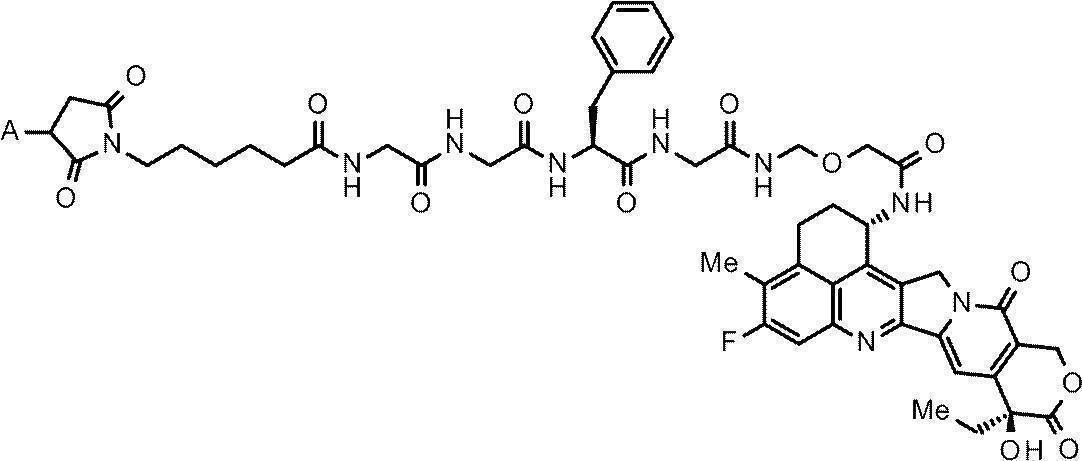
(式中、Aは抗体との結合位置を示す)
で示される薬物リンカーと、抗GPR20抗体とがチオエーテル結合によって結合した抗体-薬物コンジュゲート(以下、「抗体-薬物コンジュゲート(5)」と称する)を製造した。抗体-薬物コンジュゲート(5)のDARは、7.8であった。(Wherein, A indicates the binding position with the antibody)
An antibody-drug conjugate (hereinafter referred to as “antibody-drug conjugate (5)”) in which a drug linker represented by and an anti-GPR20 antibody are bound via a thioether bond was produced. The DAR of antibody-drug conjugate (5) was 7.8.
抗体-薬物コンジュゲート(5)について、実施例2~8の方法と同様な方法で処方のスクリーニング(抗体-薬物コンジュゲート(5)(20~60mg/mL)、9%スクロース、10mMヒスチジン緩衝剤、ポリソルベート80(0.01~0.1%)、pH5.0~6.5)を行った。その結果、抗体-薬物コンジュゲート(5)(20mg/mL)、9%スクロース、10mMヒスチジン緩衝剤、及び0.03%ポリソルベート80、を含み、pHが5.4である水溶液(以下、「水溶液(11)」という。)が好適な処方であることが判明した。
For antibody-drug conjugate (5), formulation screening (antibody-drug conjugate (5) (20-60 mg/mL), 9% sucrose, 10 mM histidine buffer) was performed in a manner similar to that of Examples 2-8. , polysorbate 80 (0.01-0.1%), pH 5.0-6.5). As a result, an aqueous solution containing antibody-drug conjugate (5) (20 mg/mL), 9% sucrose, 10 mM histidine buffer, and 0.03
[実施例18:凍結乾燥注射剤の製造と安定性試験]
実施例14~17にて調整した水溶液(6)~(11)を、実施例10及び12に記載の方法と同様な方法で、それぞれ凍結乾燥し、凍結乾燥注射剤を製造した。
これらの凍結乾燥注射剤について、40℃/75%RHで1ヶ月間及び3ヵ月間の保存安定性を、タンパク質濃度、水分、不溶性微粒子、DAR、単量体・凝集体・断片体の比率、NPI、IoP、電荷異性体、及びpHを指標に評価した。開始時点からの顕著な品質変化は認められていない。[Example 18: Production and stability test of freeze-dried injection]
Aqueous solutions (6) to (11) prepared in Examples 14 to 17 were freeze-dried in the same manner as described in Examples 10 and 12 to produce freeze-dried injections.
For these lyophilized injections, the storage stability at 40° C./75% RH for 1 month and 3 months was measured by protein concentration, water content, insoluble particulates, DAR, monomer/aggregate/fragment ratio, NPI, IoP, charge isomers, and pH were used as indices for evaluation. No significant quality change from the starting point was observed.
配列番号1:抗HER2抗体重鎖のアミノ酸配列
配列番号2:抗HER2抗体軽鎖のアミノ酸配列
配列番号3:抗HER3抗体の重鎖のアミノ酸配列
配列番号4:抗HER3抗体の軽鎖のアミノ酸配列
配列番号5:抗TROP2抗体重鎖のアミノ酸配列
配列番号6:抗TROP2抗体軽鎖のアミノ酸配列
配列番号7:抗B7-H3抗体重鎖のアミノ酸配列
配列番号8:抗B7-H3抗体軽鎖のアミノ酸配列
配列番号9:抗GPR20抗体重鎖のアミノ酸配列
配列番号10:抗GPR20抗体軽鎖のアミノ酸配列SEQ ID NO: 1: amino acid sequence of anti-HER2 antibody heavy chain SEQ ID NO: 2: amino acid sequence of anti-HER2 antibody light chain SEQ ID NO: 3: amino acid sequence of anti-HER3 antibody heavy chain SEQ ID NO: 4: amino acid sequence of anti-HER3 antibody light chain SEQ ID NO: 5: amino acid sequence of anti-TROP2 antibody heavy chain SEQ ID NO: 6: amino acid sequence of anti-TROP2 antibody light chain SEQ ID NO: 7: amino acid sequence of anti-B7-H3 antibody heavy chain SEQ ID NO: 8: anti-B7-H3 antibody light chain Amino acid sequence SEQ ID NO: 9: amino acid sequence of anti-GPR20 antibody heavy chain SEQ ID NO: 10: amino acid sequence of anti-GPR20 antibody light chain
Claims (48)
(ii)ヒスチジン緩衝剤、
(iii)スクロース又はトレハロース、及び、
(iv)ポリソルベート80又はポリソルベート20、
を含み、
ポリソルベート80又はポリソルベート20の量が、抗体-薬物コンジュゲート20mg当たりに、0.2~0.4mgである、
医薬組成物;
(ここで、該抗体-薬物コンジュゲートは、次式

で示される薬物リンカーと、抗体とがチオエーテル結合によって結合した抗体-薬物コンジュゲートである)。 (i) an antibody-drug conjugate;
(ii) a histidine buffer,
(iii) sucrose or trehalose, and
(iv) polysorbate 80 or polysorbate 20 ,
including
the amount of polysorbate 80 or polysorbate 20 is 0.2-0.4 mg per 20 mg of antibody-drug conjugate;
pharmaceutical compositions;
(wherein the antibody-drug conjugate has the following formula:
is an antibody-drug conjugate in which a drug linker represented by is bound to an antibody via a thioether bond).
90mgのスクロース又はトレハロース水和物での計算で100mgのトレハロースを含む、請求項4に記載の医薬組成物。 per 20 mg of antibody -drug conjugate ,
5. A pharmaceutical composition according to claim 4 , comprising 100 mg trehalose calculated on 90 mg sucrose or trehalose hydrate .
(ii)0.89mgのL-ヒスチジン、及び4.04mgのL-ヒスチジン塩酸塩水和物、
(iii)90mgのスクロース、並びに、
(iv)0.3mgのポリソルベート80を含む、請求項10から12のいずれか1項に記載の医薬組成物。 (i) per 20 mg of antibody-drug conjugate,
(ii) 0.89 mg L-histidine and 4.04 mg L-histidine hydrochloride hydrate;
(iii) 90 mg of sucrose, and
13. A pharmaceutical composition according to any one of claims 10-12 , comprising (iv) 0.3 mg polysorbate 80.
(ii)4.45mgのL-ヒスチジン、及び20.2mgのL-ヒスチジン塩酸塩水和物、
(iii)450mgのスクロース、並びに、
(iv)1.5mgのポリソルベート80を含む、請求項10から12のいずれか1項に記載の医薬組成物。 (i) 100 mg of antibody-drug conjugate,
(ii) 4.45 mg L-histidine and 20.2 mg L-histidine hydrochloride hydrate;
(iii) 450 mg of sucrose, and
13. A pharmaceutical composition according to any one of claims 10-12 , comprising (iv) 1.5 mg polysorbate 80.
(ii)0.81mgのL-ヒスチジン、及び4.14mgのL-ヒスチジン塩酸塩水和物、
(iii)90mgのスクロース、並びに、
(iv)0.3mgのポリソルベート20を含む、請求項15から17のいずれか1項に記載の医薬組成物。 (i) per 20 mg of antibody-drug conjugate,
(ii) 0.81 mg L-histidine and 4.14 mg L-histidine hydrochloride hydrate;
(iii) 90 mg of sucrose, and
18. A pharmaceutical composition according to any one of claims 15-17 , comprising ( iv) 0.3 mg polysorbate 20.
(ii)4.06mgのL-ヒスチジン、及び20.7mgのL-ヒスチジン塩酸塩水和物、
(iii)450mgのスクロース、並びに、
(iv)1.5mgのポリソルベート20を含む、請求項15から17のいずれか1項に記載の医薬組成物。 (i) 100 mg of antibody-drug conjugate,
(ii) 4.06 mg L-histidine and 20.7 mg L-histidine hydrochloride hydrate;
(iii) 450 mg of sucrose, and
18. A pharmaceutical composition according to any one of claims 15-17 , comprising ( iv) 1.5 mg polysorbate 20.
(ii)0.78mgのL-ヒスチジン、及び1.05mgのL-ヒスチジン塩酸塩水和物、
(iii)90mgのスクロース、並びに、
(iv)0.2又は0.3mgのポリソルベート80を含む、請求項20から22のいずれか1項に記載の医薬組成物。 (i) per 20 mg of antibody-drug conjugate,
(ii) 0.78 mg L-histidine and 1.05 mg L-histidine hydrochloride hydrate;
(iii) 90 mg of sucrose, and
23. A pharmaceutical composition according to any one of claims 20-22, comprising (iv) 0.2 or 0.3 mg polysorbate 80.
(ii)3.88mgのL-ヒスチジン、及び5.26mgのL-ヒスチジン塩酸塩水和物、
(iii)450mgのスクロース、並びに、
(iv)1.0又は1.5mgのポリソルベート80を含む、請求項20から22のいずれか1項に記載の医薬組成物。 (i) 100 mg of antibody-drug conjugate,
(ii) 3.88 mg L-histidine and 5.26 mg L-histidine hydrochloride hydrate;
(iii) 450 mg of sucrose, and
23. A pharmaceutical composition according to any one of claims 20-22, comprising (iv) 1.0 or 1.5 mg polysorbate 80.
(ii)0.65mgのL-ヒスチジン、及び1.22mgのL-ヒスチジン塩酸塩水和物、
(iii)90mgのスクロース、並びに、
(iv)0.2又は0.3mgのポリソルベート20を含む、請求項25から27のいずれか1項に記載の医薬組成物。 (i) per 20 mg of antibody-drug conjugate,
(ii) 0.65 mg L-histidine and 1.22 mg L-histidine hydrochloride hydrate;
(iii) 90 mg of sucrose, and
28. A pharmaceutical composition according to any one of claims 25 to 27 , comprising (iv) 0.2 or 0.3 mg polysorbate 20.
(ii)3.23mgのL-ヒスチジン、及び6.12mgのL-ヒスチジン塩酸塩水和物、
(iii)450mgのスクロース、並びに、
(iv)1.0又は1.5mgのポリソルベート20を含む、請求項25から27のいずれか1項に記載の医薬組成物。 (i) 100 mg of antibody-drug conjugate,
(ii) 3.23 mg L-histidine and 6.12 mg L-histidine hydrochloride hydrate;
(iii) 450 mg of sucrose, and
28. A pharmaceutical composition according to any one of claims 25-27 , comprising (iv) 1.0 or 1.5 mg polysorbate 20 .
(ii)0.32mgのL-ヒスチジン、及び1.66mgのL-ヒスチジン塩酸塩水和物、
(iii)90mgのスクロース、並びに、
(iv)0.3mgのポリソルベート80を含む、請求項30から32のいずれか1項に記載の医薬組成物。 (i) per 20 mg of antibody-drug conjugate,
(ii) 0.32 mg L-histidine and 1.66 mg L-histidine hydrochloride hydrate;
(iii) 90 mg of sucrose, and
33. A pharmaceutical composition according to any one of claims 30-32 , comprising ( iv) 0.3 mg polysorbate 80.
(ii)1.62mgのL-ヒスチジン、及び8.29mgのL-ヒスチジン塩酸塩水和物、
(iii)450mgのスクロース、並びに、
(iv)1.5mgのポリソルベート80を含む、請求項30から32のいずれか1項に記載の医薬組成物。 (i) 100 mg of antibody-drug conjugate,
(ii) 1.62 mg L-histidine and 8.29 mg L-histidine hydrochloride hydrate;
(iii) 450 mg of sucrose, and
33. A pharmaceutical composition according to any one of claims 30-32 , comprising ( iv) 1.5 mg polysorbate 80.
(i)抗体-薬物コンジュゲート、
(ii)ヒスチジン緩衝剤、
(iii)スクロース又はトレハロース、及び、
(iv)ポリソルベート80又はポリソルベート20、
を含む水溶液を調製する工程、
(2)必要に応じて、水溶液のpHを所定の値に調整する工程、次いで、
(3)水溶液を凍結乾燥する工程、
を含む、請求項39に記載の医薬組成物の製造方法。 (1) a predetermined amount of
(i) an antibody-drug conjugate;
(ii) a histidine buffer,
(iii) sucrose or trehalose, and
(iv) polysorbate 80 or polysorbate 20 ,
preparing an aqueous solution comprising
(2) If necessary, a step of adjusting the pH of the aqueous solution to a predetermined value, then
(3) freeze-drying the aqueous solution;
40. A method of making a pharmaceutical composition according to claim 39 , comprising
(ここで、共融点付近とは、共融点よりも1.5℃低い温度から、共融点よりも1.5℃高い温度の範囲を示す)。 43. The method of manufacture of claim 42 , wherein lyophilizing the aqueous solution comprises annealing at a shelf temperature near the eutectic point of the aqueous solution;
(Here, the vicinity of the eutectic point indicates a range from a temperature lower than the eutectic point by 1.5° C. to a temperature higher than the eutectic point by 1.5° C.).
Priority Applications (2)
| Application Number | Priority Date | Filing Date | Title |
|---|---|---|---|
| JP2022211501A JP7551729B2 (en) | 2017-08-23 | 2022-12-28 | Formulation of antibody-drug conjugate and method for freeze-drying same |
| JP2024151872A JP2024170515A (en) | 2017-08-23 | 2024-09-04 | Formulation of antibody-drug conjugate and method for freeze-drying same |
Applications Claiming Priority (3)
| Application Number | Priority Date | Filing Date | Title |
|---|---|---|---|
| JP2017160071 | 2017-08-23 | ||
| JP2017160071 | 2017-08-23 | ||
| PCT/JP2018/030882 WO2019039483A1 (en) | 2017-08-23 | 2018-08-22 | Antibody-drug conjugate preparation and lyophilization for same |
Related Child Applications (1)
| Application Number | Title | Priority Date | Filing Date |
|---|---|---|---|
| JP2022211501A Division JP7551729B2 (en) | 2017-08-23 | 2022-12-28 | Formulation of antibody-drug conjugate and method for freeze-drying same |
Publications (2)
| Publication Number | Publication Date |
|---|---|
| JPWO2019039483A1 JPWO2019039483A1 (en) | 2020-10-01 |
| JP7204651B2 true JP7204651B2 (en) | 2023-01-16 |
Family
ID=65438975
Family Applications (3)
| Application Number | Title | Priority Date | Filing Date |
|---|---|---|---|
| JP2019537642A Active JP7204651B2 (en) | 2017-08-23 | 2018-08-22 | Formulation of antibody-drug conjugate and method of lyophilization thereof |
| JP2022211501A Active JP7551729B2 (en) | 2017-08-23 | 2022-12-28 | Formulation of antibody-drug conjugate and method for freeze-drying same |
| JP2024151872A Pending JP2024170515A (en) | 2017-08-23 | 2024-09-04 | Formulation of antibody-drug conjugate and method for freeze-drying same |
Family Applications After (2)
| Application Number | Title | Priority Date | Filing Date |
|---|---|---|---|
| JP2022211501A Active JP7551729B2 (en) | 2017-08-23 | 2022-12-28 | Formulation of antibody-drug conjugate and method for freeze-drying same |
| JP2024151872A Pending JP2024170515A (en) | 2017-08-23 | 2024-09-04 | Formulation of antibody-drug conjugate and method for freeze-drying same |
Country Status (13)
| Country | Link |
|---|---|
| US (1) | US20210128741A1 (en) |
| EP (1) | EP3673918A4 (en) |
| JP (3) | JP7204651B2 (en) |
| KR (2) | KR20200044044A (en) |
| CN (3) | CN118743764A (en) |
| AU (2) | AU2018320470B2 (en) |
| BR (1) | BR112020003474A2 (en) |
| CA (1) | CA3073383C (en) |
| IL (1) | IL272721A (en) |
| MA (1) | MA49987A (en) |
| SG (1) | SG11202000996UA (en) |
| TW (2) | TWI880888B (en) |
| WO (1) | WO2019039483A1 (en) |
Cited By (1)
| Publication number | Priority date | Publication date | Assignee | Title |
|---|---|---|---|---|
| JP2023036900A (en) * | 2017-08-23 | 2023-03-14 | 第一三共株式会社 | Formulation of antibody-drug conjugate and method of lyophilization thereof |
Families Citing this family (23)
| Publication number | Priority date | Publication date | Assignee | Title |
|---|---|---|---|---|
| EP3572428A4 (en) * | 2017-01-17 | 2020-12-30 | Daiichi Sankyo Company, Limited | ANTI-GPR20 ANTIBODY AND ANTI-GPR20 ANTIBODY MEDICINAL CONJUGATE |
| EP3923928B1 (en) * | 2019-02-15 | 2025-10-08 | The Regents Of The University Of California | Methods for converting colloidal systems to resuspendable/redispersible powders that preserve the original properties of the colloids |
| SG11202108627SA (en) | 2019-02-18 | 2021-09-29 | Lilly Co Eli | Therapeutic antibody formulation |
| KR102660249B1 (en) * | 2019-03-26 | 2024-04-25 | 레메젠 코, 리미티드 | Anti-HER2 antibody drug conjugate pharmaceutical formulation |
| IL288485B2 (en) * | 2019-05-29 | 2026-04-01 | Daiichi Sankyo Co Ltd | Anti-trop2 antibody-drug conjugates for use in treating cancer |
| WO2021027851A1 (en) * | 2019-08-12 | 2021-02-18 | 凯惠科技发展(上海)有限公司 | Trop2 antibody, preparation method therefor, and conjugate and use thereof |
| WO2021190581A1 (en) * | 2020-03-25 | 2021-09-30 | 江苏恒瑞医药股份有限公司 | Pharmaceutical composition comprising antibody drug conjugate and use thereof |
| US20230293709A1 (en) * | 2020-05-03 | 2023-09-21 | Shanghai Miracogen Inc. | Antibody-drug conjugate and preparation thereof |
| CN112361726B (en) * | 2020-10-27 | 2022-09-02 | 北京诺康达医药科技股份有限公司 | Freeze-dried preparation water control method and application thereof |
| CN116615250A (en) * | 2020-11-12 | 2023-08-18 | 第一三共株式会社 | Mesothelioma treatment by administration of anti-B7-H3 antibody-drug conjugates |
| JP7564958B2 (en) * | 2020-12-18 | 2024-10-09 | シャンハイ フダン-チャンジャン バイオ-ファーマシューティカル カンパニー リミテッド | Antibody-drug conjugates targeting B7-H3, methods of manufacture and uses thereof - Patents.com |
| CN115721732B (en) * | 2021-08-27 | 2025-03-07 | 上海复旦张江生物医药股份有限公司 | Pharmaceutical composition, preparation and preparation method and use of antibody-drug conjugate |
| CN118215503A (en) * | 2021-10-19 | 2024-06-18 | 同宜医药(苏州)有限公司 | Conjugate drug preparation and preparation method and use thereof |
| CA3248952A1 (en) * | 2022-01-26 | 2025-07-10 | Shanghai Mabgen Biotech Ltd. | Pharmaceutical composition comprising anti-cd79b antibody-drug conjugate and use thereof |
| WO2024041587A1 (en) * | 2022-08-25 | 2024-02-29 | 启德医药科技(苏州)有限公司 | Pharmaceutical composition of antibody drug conjugate |
| CN115969986A (en) * | 2022-12-30 | 2023-04-18 | 上海药明生物技术有限公司 | Application of Hydroxypropyl β-cyclodextrin Stabilized MMAE Antibody Drug Conjugate Preparation |
| WO2025002310A1 (en) * | 2023-06-29 | 2025-01-02 | 石药集团巨石生物制药有限公司 | Antibody-drug conjugate and use thereof |
| WO2025067306A1 (en) * | 2023-09-26 | 2025-04-03 | 信达生物制药(苏州)有限公司 | Antibody-drug conjugate targeting her3 |
| TW202535960A (en) * | 2024-01-08 | 2025-09-16 | 大陸商上海橙帆醫藥有限公司 | Antibodies, drug conjugates thereof, and uses thereof |
| WO2025160306A1 (en) * | 2024-01-23 | 2025-07-31 | American Type Culture Collection | Methods of freeze-drying a sample and use thereof |
| TW202545568A (en) * | 2024-01-29 | 2025-12-01 | 日商第一三共股份有限公司 | Combination of anti-her2 antibody-drug conjugate and other agents |
| TW202543682A (en) * | 2024-02-28 | 2025-11-16 | 日商第一三共股份有限公司 | Anti-CDH6 antibody-drug conjugates combined with other agents |
| TW202543683A (en) * | 2024-02-28 | 2025-11-16 | 日商第一三共股份有限公司 | Combination of anti-EGFR antibody-drug conjugates with other agents |
Citations (3)
| Publication number | Priority date | Publication date | Assignee | Title |
|---|---|---|---|---|
| JP2016515511A (en) | 2013-03-15 | 2016-05-30 | アッヴィ・ドイチュラント・ゲー・エム・ベー・ハー・ウント・コー・カー・ゲー | Anti-EGFR antibody drug complex preparation |
| WO2017002776A1 (en) | 2015-06-29 | 2017-01-05 | 第一三共株式会社 | Method for selectively manufacturing antibody-drug conjugate |
| JP2017503784A (en) | 2014-04-10 | 2017-02-02 | 第一三共株式会社 | Anti-HER3 antibody-drug conjugate |
Family Cites Families (34)
| Publication number | Priority date | Publication date | Assignee | Title |
|---|---|---|---|---|
| IL162181A (en) | 1988-12-28 | 2006-04-10 | Pdl Biopharma Inc | A method of producing humanized immunoglubulin, and polynucleotides encoding the same |
| ATE255131T1 (en) | 1991-06-14 | 2003-12-15 | Genentech Inc | HUMANIZED HEREGULIN ANTIBODIES |
| AU3657899A (en) | 1998-04-20 | 1999-11-08 | James E. Bailey | Glycosylation engineering of antibodies for improving antibody-dependent cellular cytotoxicity |
| PT1176195E (en) | 1999-04-09 | 2013-07-18 | Kyowa Hakko Kirin Co Ltd | Method for controlling the activity of immunologically functional molecule |
| AT500848B1 (en) | 1999-06-25 | 2008-01-15 | Genentech Inc | HUMANIZED ANTI-ERBB2 ANTIBODIES |
| DK2314686T4 (en) | 2000-10-06 | 2023-08-21 | Kyowa Kirin Co Ltd | Cells that form antibody complexes |
| IL161686A0 (en) | 2001-11-01 | 2004-09-27 | Uab Research Foundation | Combinations of antibodies selective for a tumor necrosis factor-related apoptosis-inducing ligand receptor and other therapeutic agents |
| NZ537610A (en) | 2002-07-02 | 2006-07-28 | Smithkline Beecham Corp | Stable formulations of the C242 antibody |
| US7374762B2 (en) * | 2003-05-14 | 2008-05-20 | Immunogen, Inc. | Drug conjugate composition |
| WO2007019232A2 (en) * | 2005-08-03 | 2007-02-15 | Immunogen, Inc. | Immunoconjugate formulations |
| AR056857A1 (en) | 2005-12-30 | 2007-10-24 | U3 Pharma Ag | DIRECTED ANTIBODIES TO HER-3 (RECEIVER OF THE HUMAN EPIDERMAL GROWTH FACTOR-3) AND ITS USES |
| SG178789A1 (en) | 2007-02-16 | 2012-03-29 | Merrimack Pharmaceuticals Inc | Antibodies against erbb3 and uses thereof |
| EP2376110B1 (en) | 2009-01-09 | 2019-03-13 | Seattle Genetics, Inc. | Weekly dosing regimens for anti-cd30 vc-pab-mmae antibody drug-conjugates |
| WO2012144579A1 (en) * | 2011-04-21 | 2012-10-26 | 第一三共株式会社 | Antibody preparation having solution form |
| WO2014057687A1 (en) * | 2012-10-11 | 2014-04-17 | 第一三共株式会社 | Antibody-drug conjugate |
| WO2014061277A1 (en) | 2012-10-19 | 2014-04-24 | 第一三共株式会社 | Antibody-drug conjugate produced by binding through linker having hydrophilic structure |
| AU2013360335B2 (en) | 2012-12-13 | 2017-12-07 | Immunomedics, Inc. | Dosages of immunoconjugates of antibodies and SN-38 for improved efficacy and decreased toxicity |
| DK3060256T3 (en) | 2013-10-25 | 2019-07-29 | Bayer Pharma AG | HOW TO UNKNOWN STABLE FORMULATION |
| PT3088419T (en) | 2013-12-25 | 2019-01-11 | Daiichi Sankyo Co Ltd | ANTI-TROP2-PHARMACEUTICAL ANTIBODY CONJUGATE |
| HRP20190431T1 (en) | 2014-01-31 | 2019-04-19 | Daiichi Sankyo Company, Limited | ANTI-HER2 ANTIBODY-LIGHT CONJUGATE |
| JP2017114763A (en) | 2014-03-26 | 2017-06-29 | 第一三共株式会社 | Anti-CD98 antibody-drug conjugate |
| US20170028062A1 (en) | 2014-04-07 | 2017-02-02 | Seattle Genetics, Inc. | Stable formulations for anti-cd19 antibodies and antibody-drug conjugates |
| ES2754348T3 (en) | 2014-04-10 | 2020-04-17 | Daiichi Sankyo Co Ltd | Conjugate of (anti-HER2 antibody) -pharmaceutical |
| HUE053799T2 (en) * | 2015-07-10 | 2021-07-28 | Byondis Bv | Compositions comprising antibody-duocarmycin drug conjugates |
| AU2017341000B2 (en) * | 2016-10-07 | 2024-11-28 | Daiichi Sankyo Company, Limited | Therapy for drug-resistant cancer by administration of anti-HER2 antibody/drug conjugate |
| EP3552626A4 (en) * | 2016-12-12 | 2020-06-10 | Daiichi Sankyo Company, Limited | Combination of antibody-drug conjugate and immune checkpoint inhibitor |
| EP3572428A4 (en) | 2017-01-17 | 2020-12-30 | Daiichi Sankyo Company, Limited | ANTI-GPR20 ANTIBODY AND ANTI-GPR20 ANTIBODY MEDICINAL CONJUGATE |
| KR20200044044A (en) | 2017-08-23 | 2020-04-28 | 다이이찌 산쿄 가부시키가이샤 | Antibody-drug conjugate preparation and freeze-drying method thereof |
| KR20250084239A (en) * | 2017-08-31 | 2025-06-10 | 다이이찌 산쿄 가부시키가이샤 | Improved method for producing antibody-drug conjugate |
| JP7248578B2 (en) * | 2017-08-31 | 2023-03-29 | 第一三共株式会社 | Novel methods for producing antibody-drug conjugates |
| SG11202011243XA (en) * | 2018-05-28 | 2020-12-30 | Daiichi Sankyo Co Ltd | Treatment of her2-mutated cancer by administering anti-her2 antibody-drug conjugate |
| BR112021001194A2 (en) * | 2018-07-25 | 2021-04-27 | Daiichi Sankyo Company, Limited | methods for producing an antibody-drug conjugate and for producing a pharmaceutical composition |
| EP3831412A4 (en) * | 2018-07-31 | 2022-04-27 | Daiichi Sankyo Company, Limited | TREATMENT OF A METASTATIC BRAIN TUMOR BY ADMINISTRATION OF AN ANTIBODY-DRUG CONJUGATE |
| TW202019487A (en) * | 2018-08-06 | 2020-06-01 | 日商第一三共股份有限公司 | Combination of antibody-drug conjugate and tubulin inhibitor |
-
2018
- 2018-08-22 KR KR1020207007993A patent/KR20200044044A/en not_active Ceased
- 2018-08-22 TW TW107129228A patent/TWI880888B/en active
- 2018-08-22 AU AU2018320470A patent/AU2018320470B2/en active Active
- 2018-08-22 CA CA3073383A patent/CA3073383C/en active Active
- 2018-08-22 EP EP18849166.6A patent/EP3673918A4/en active Pending
- 2018-08-22 US US16/640,914 patent/US20210128741A1/en active Pending
- 2018-08-22 KR KR1020247039835A patent/KR20250004902A/en active Pending
- 2018-08-22 CN CN202411092692.7A patent/CN118743764A/en active Pending
- 2018-08-22 TW TW114112282A patent/TW202543673A/en unknown
- 2018-08-22 JP JP2019537642A patent/JP7204651B2/en active Active
- 2018-08-22 WO PCT/JP2018/030882 patent/WO2019039483A1/en not_active Ceased
- 2018-08-22 SG SG11202000996UA patent/SG11202000996UA/en unknown
- 2018-08-22 BR BR112020003474-6A patent/BR112020003474A2/en unknown
- 2018-08-22 MA MA049987A patent/MA49987A/en unknown
- 2018-08-22 CN CN202411092696.5A patent/CN118767159A/en active Pending
- 2018-08-22 CN CN201880054464.7A patent/CN110944667B/en active Active
-
2020
- 2020-02-17 IL IL272721A patent/IL272721A/en unknown
-
2022
- 2022-12-28 JP JP2022211501A patent/JP7551729B2/en active Active
-
2024
- 2024-09-04 JP JP2024151872A patent/JP2024170515A/en active Pending
-
2025
- 2025-07-24 AU AU2025208451A patent/AU2025208451A1/en active Pending
Patent Citations (3)
| Publication number | Priority date | Publication date | Assignee | Title |
|---|---|---|---|---|
| JP2016515511A (en) | 2013-03-15 | 2016-05-30 | アッヴィ・ドイチュラント・ゲー・エム・ベー・ハー・ウント・コー・カー・ゲー | Anti-EGFR antibody drug complex preparation |
| JP2017503784A (en) | 2014-04-10 | 2017-02-02 | 第一三共株式会社 | Anti-HER3 antibody-drug conjugate |
| WO2017002776A1 (en) | 2015-06-29 | 2017-01-05 | 第一三共株式会社 | Method for selectively manufacturing antibody-drug conjugate |
Cited By (2)
| Publication number | Priority date | Publication date | Assignee | Title |
|---|---|---|---|---|
| JP2023036900A (en) * | 2017-08-23 | 2023-03-14 | 第一三共株式会社 | Formulation of antibody-drug conjugate and method of lyophilization thereof |
| JP7551729B2 (en) | 2017-08-23 | 2024-09-17 | 第一三共株式会社 | Formulation of antibody-drug conjugate and method for freeze-drying same |
Also Published As
| Publication number | Publication date |
|---|---|
| RU2020111448A3 (en) | 2021-11-29 |
| AU2018320470B2 (en) | 2025-04-24 |
| IL272721A (en) | 2020-04-30 |
| EP3673918A1 (en) | 2020-07-01 |
| EP3673918A4 (en) | 2021-05-19 |
| JP2023036900A (en) | 2023-03-14 |
| CN118767159A (en) | 2024-10-15 |
| CN118743764A (en) | 2024-10-08 |
| WO2019039483A1 (en) | 2019-02-28 |
| JP2024170515A (en) | 2024-12-10 |
| CN110944667A (en) | 2020-03-31 |
| TWI880888B (en) | 2025-04-21 |
| KR20250004902A (en) | 2025-01-08 |
| TW202543673A (en) | 2025-11-16 |
| MA49987A (en) | 2020-07-01 |
| AU2025208451A1 (en) | 2025-08-14 |
| BR112020003474A2 (en) | 2020-10-20 |
| KR20200044044A (en) | 2020-04-28 |
| TW201919710A (en) | 2019-06-01 |
| SG11202000996UA (en) | 2020-03-30 |
| CN110944667B (en) | 2024-08-27 |
| RU2020111448A (en) | 2021-09-24 |
| CA3073383A1 (en) | 2019-02-28 |
| JPWO2019039483A1 (en) | 2020-10-01 |
| CA3073383C (en) | 2023-10-31 |
| US20210128741A1 (en) | 2021-05-06 |
| AU2018320470A1 (en) | 2020-02-13 |
| JP7551729B2 (en) | 2024-09-17 |
Similar Documents
| Publication | Publication Date | Title |
|---|---|---|
| JP7551729B2 (en) | Formulation of antibody-drug conjugate and method for freeze-drying same | |
| JP7769032B2 (en) | Treatment of metastatic brain tumors by administration of antibody-drug conjugates | |
| KR20210042120A (en) | Combination of antibody-drug conjugate and tubulin inhibitor | |
| RU2789476C2 (en) | Production of antibody-drug conjugate and its lyophilization | |
| WO2024210162A1 (en) | Therapeutic method for low-drug-sensitivity cancers by administration of anti-muc1 antibody-drug conjugate | |
| EA046932B1 (en) | TREATMENT OF METASTATIC BRAIN TUMOR BY ADMINISTRATION OF ANTIBODY-DRUG CONJUGATE | |
| EA053135B1 (en) | Treatment of metastatic brain tumor by administering antibody-drug conjugate | |
| EA053283B1 (en) | Treatment of metastatic brain tumor by administering antibody-drug conjugate | |
| EA053204B1 (en) | Treatment of metastatic brain tumor by administering antibody-drug conjugate | |
| HK40045208A (en) | Treatment of metastatic brain tumor by administration of antibody-drug conjugate | |
| BR122023026672A2 (en) | USE OF AN ANTIBODY-DRUG CONJUGATE | |
| BR122023026675A2 (en) | USE OF AN ANTIBODY-DRUG CONJUGATE |
Legal Events
| Date | Code | Title | Description |
|---|---|---|---|
| A621 | Written request for application examination |
Free format text: JAPANESE INTERMEDIATE CODE: A621 Effective date: 20210820 |
|
| A521 | Request for written amendment filed |
Free format text: JAPANESE INTERMEDIATE CODE: A523 Effective date: 20210917 |
|
| A131 | Notification of reasons for refusal |
Free format text: JAPANESE INTERMEDIATE CODE: A131 Effective date: 20220823 |
|
| A601 | Written request for extension of time |
Free format text: JAPANESE INTERMEDIATE CODE: A601 Effective date: 20221012 |
|
| A521 | Request for written amendment filed |
Free format text: JAPANESE INTERMEDIATE CODE: A523 Effective date: 20221102 |
|
| TRDD | Decision of grant or rejection written | ||
| A01 | Written decision to grant a patent or to grant a registration (utility model) |
Free format text: JAPANESE INTERMEDIATE CODE: A01 Effective date: 20221206 |
|
| A61 | First payment of annual fees (during grant procedure) |
Free format text: JAPANESE INTERMEDIATE CODE: A61 Effective date: 20221228 |
|
| R150 | Certificate of patent or registration of utility model |
Ref document number: 7204651 Country of ref document: JP Free format text: JAPANESE INTERMEDIATE CODE: R150 |
|
| R153 | Grant of patent term extension |
Free format text: JAPANESE INTERMEDIATE CODE: R153 |
|
| R153 | Grant of patent term extension |
Free format text: JAPANESE INTERMEDIATE CODE: R153 |
|
| R250 | Receipt of annual fees |
Free format text: JAPANESE INTERMEDIATE CODE: R250 |
|
| R153 | Grant of patent term extension |
Free format text: JAPANESE INTERMEDIATE CODE: R153 |
|
| R153 | Grant of patent term extension |
Free format text: JAPANESE INTERMEDIATE CODE: R153 |