JP7219082B2 - protective sheets and laminates - Google Patents
protective sheets and laminates Download PDFInfo
- Publication number
- JP7219082B2 JP7219082B2 JP2018241203A JP2018241203A JP7219082B2 JP 7219082 B2 JP7219082 B2 JP 7219082B2 JP 2018241203 A JP2018241203 A JP 2018241203A JP 2018241203 A JP2018241203 A JP 2018241203A JP 7219082 B2 JP7219082 B2 JP 7219082B2
- Authority
- JP
- Japan
- Prior art keywords
- protective sheet
- hard coat
- coat layer
- resin plate
- less
- Prior art date
- Legal status (The legal status is an assumption and is not a legal conclusion. Google has not performed a legal analysis and makes no representation as to the accuracy of the status listed.)
- Active
Links
Classifications
-
- C—CHEMISTRY; METALLURGY
- C08—ORGANIC MACROMOLECULAR COMPOUNDS; THEIR PREPARATION OR CHEMICAL WORKING-UP; COMPOSITIONS BASED THEREON
- C08J—WORKING-UP; GENERAL PROCESSES OF COMPOUNDING; AFTER-TREATMENT NOT COVERED BY SUBCLASSES C08B, C08C, C08F, C08G or C08H
- C08J5/00—Manufacture of articles or shaped materials containing macromolecular substances
- C08J5/18—Manufacture of films or sheets
-
- C—CHEMISTRY; METALLURGY
- C09—DYES; PAINTS; POLISHES; NATURAL RESINS; ADHESIVES; COMPOSITIONS NOT OTHERWISE PROVIDED FOR; APPLICATIONS OF MATERIALS NOT OTHERWISE PROVIDED FOR
- C09J—ADHESIVES; NON-MECHANICAL ASPECTS OF ADHESIVE PROCESSES IN GENERAL; ADHESIVE PROCESSES NOT PROVIDED FOR ELSEWHERE; USE OF MATERIALS AS ADHESIVES
- C09J7/00—Adhesives in the form of films or foils
- C09J7/20—Adhesives in the form of films or foils characterised by their carriers
- C09J7/22—Plastics; Metallised plastics
- C09J7/25—Plastics; Metallised plastics based on macromolecular compounds obtained otherwise than by reactions involving only carbon-to-carbon unsaturated bonds
- C09J7/255—Polyesters
-
- B—PERFORMING OPERATIONS; TRANSPORTING
- B32—LAYERED PRODUCTS
- B32B—LAYERED PRODUCTS, i.e. PRODUCTS BUILT-UP OF STRATA OF FLAT OR NON-FLAT, e.g. CELLULAR OR HONEYCOMB, FORM
- B32B27/00—Layered products comprising a layer of synthetic resin
- B32B27/06—Layered products comprising a layer of synthetic resin as the main or only constituent of a layer, which is next to another layer of the same or of a different material
-
- B—PERFORMING OPERATIONS; TRANSPORTING
- B32—LAYERED PRODUCTS
- B32B—LAYERED PRODUCTS, i.e. PRODUCTS BUILT-UP OF STRATA OF FLAT OR NON-FLAT, e.g. CELLULAR OR HONEYCOMB, FORM
- B32B27/00—Layered products comprising a layer of synthetic resin
- B32B27/06—Layered products comprising a layer of synthetic resin as the main or only constituent of a layer, which is next to another layer of the same or of a different material
- B32B27/08—Layered products comprising a layer of synthetic resin as the main or only constituent of a layer, which is next to another layer of the same or of a different material of synthetic resin
-
- B—PERFORMING OPERATIONS; TRANSPORTING
- B32—LAYERED PRODUCTS
- B32B—LAYERED PRODUCTS, i.e. PRODUCTS BUILT-UP OF STRATA OF FLAT OR NON-FLAT, e.g. CELLULAR OR HONEYCOMB, FORM
- B32B27/00—Layered products comprising a layer of synthetic resin
- B32B27/12—Layered products comprising a layer of synthetic resin next to a fibrous or filamentary layer
-
- B—PERFORMING OPERATIONS; TRANSPORTING
- B32—LAYERED PRODUCTS
- B32B—LAYERED PRODUCTS, i.e. PRODUCTS BUILT-UP OF STRATA OF FLAT OR NON-FLAT, e.g. CELLULAR OR HONEYCOMB, FORM
- B32B7/00—Layered products characterised by the relation between layers; Layered products characterised by the relative orientation of features between layers, or by the relative values of a measurable parameter between layers, i.e. products comprising layers having different physical, chemical or physicochemical properties; Layered products characterised by the interconnection of layers
- B32B7/04—Interconnection of layers
- B32B7/12—Interconnection of layers using interposed adhesives or interposed materials with bonding properties
-
- C—CHEMISTRY; METALLURGY
- C09—DYES; PAINTS; POLISHES; NATURAL RESINS; ADHESIVES; COMPOSITIONS NOT OTHERWISE PROVIDED FOR; APPLICATIONS OF MATERIALS NOT OTHERWISE PROVIDED FOR
- C09J—ADHESIVES; NON-MECHANICAL ASPECTS OF ADHESIVE PROCESSES IN GENERAL; ADHESIVE PROCESSES NOT PROVIDED FOR ELSEWHERE; USE OF MATERIALS AS ADHESIVES
- C09J133/00—Adhesives based on homopolymers or copolymers of compounds having one or more unsaturated aliphatic radicals, each having only one carbon-to-carbon double bond, and at least one being terminated by only one carboxyl radical, or of salts, anhydrides, esters, amides, imides, or nitriles thereof; Adhesives based on derivatives of such polymers
- C09J133/04—Homopolymers or copolymers of esters
- C09J133/06—Homopolymers or copolymers of esters of esters containing only carbon, hydrogen and oxygen, the oxygen atom being present only as part of the carboxyl radical
- C09J133/062—Copolymers with monomers not covered by C09J133/06
- C09J133/064—Copolymers with monomers not covered by C09J133/06 containing anhydride, COOH or COOM groups, with M being metal or onium-cation
-
- C—CHEMISTRY; METALLURGY
- C09—DYES; PAINTS; POLISHES; NATURAL RESINS; ADHESIVES; COMPOSITIONS NOT OTHERWISE PROVIDED FOR; APPLICATIONS OF MATERIALS NOT OTHERWISE PROVIDED FOR
- C09J—ADHESIVES; NON-MECHANICAL ASPECTS OF ADHESIVE PROCESSES IN GENERAL; ADHESIVE PROCESSES NOT PROVIDED FOR ELSEWHERE; USE OF MATERIALS AS ADHESIVES
- C09J133/00—Adhesives based on homopolymers or copolymers of compounds having one or more unsaturated aliphatic radicals, each having only one carbon-to-carbon double bond, and at least one being terminated by only one carboxyl radical, or of salts, anhydrides, esters, amides, imides, or nitriles thereof; Adhesives based on derivatives of such polymers
- C09J133/24—Homopolymers or copolymers of amides or imides
-
- C—CHEMISTRY; METALLURGY
- C09—DYES; PAINTS; POLISHES; NATURAL RESINS; ADHESIVES; COMPOSITIONS NOT OTHERWISE PROVIDED FOR; APPLICATIONS OF MATERIALS NOT OTHERWISE PROVIDED FOR
- C09J—ADHESIVES; NON-MECHANICAL ASPECTS OF ADHESIVE PROCESSES IN GENERAL; ADHESIVE PROCESSES NOT PROVIDED FOR ELSEWHERE; USE OF MATERIALS AS ADHESIVES
- C09J7/00—Adhesives in the form of films or foils
- C09J7/20—Adhesives in the form of films or foils characterised by their carriers
- C09J7/22—Plastics; Metallised plastics
-
- B—PERFORMING OPERATIONS; TRANSPORTING
- B32—LAYERED PRODUCTS
- B32B—LAYERED PRODUCTS, i.e. PRODUCTS BUILT-UP OF STRATA OF FLAT OR NON-FLAT, e.g. CELLULAR OR HONEYCOMB, FORM
- B32B2307/00—Properties of the layers or laminate
- B32B2307/30—Properties of the layers or laminate having particular thermal properties
- B32B2307/306—Resistant to heat
-
- B—PERFORMING OPERATIONS; TRANSPORTING
- B32—LAYERED PRODUCTS
- B32B—LAYERED PRODUCTS, i.e. PRODUCTS BUILT-UP OF STRATA OF FLAT OR NON-FLAT, e.g. CELLULAR OR HONEYCOMB, FORM
- B32B2307/00—Properties of the layers or laminate
- B32B2307/70—Other properties
- B32B2307/73—Hydrophobic
-
- B—PERFORMING OPERATIONS; TRANSPORTING
- B32—LAYERED PRODUCTS
- B32B—LAYERED PRODUCTS, i.e. PRODUCTS BUILT-UP OF STRATA OF FLAT OR NON-FLAT, e.g. CELLULAR OR HONEYCOMB, FORM
- B32B2457/00—Electrical equipment
-
- C—CHEMISTRY; METALLURGY
- C09—DYES; PAINTS; POLISHES; NATURAL RESINS; ADHESIVES; COMPOSITIONS NOT OTHERWISE PROVIDED FOR; APPLICATIONS OF MATERIALS NOT OTHERWISE PROVIDED FOR
- C09J—ADHESIVES; NON-MECHANICAL ASPECTS OF ADHESIVE PROCESSES IN GENERAL; ADHESIVE PROCESSES NOT PROVIDED FOR ELSEWHERE; USE OF MATERIALS AS ADHESIVES
- C09J2467/00—Presence of polyester
- C09J2467/006—Presence of polyester in the substrate
Landscapes
- Chemical & Material Sciences (AREA)
- Organic Chemistry (AREA)
- Engineering & Computer Science (AREA)
- Manufacturing & Machinery (AREA)
- Chemical Kinetics & Catalysis (AREA)
- Materials Engineering (AREA)
- Health & Medical Sciences (AREA)
- Medicinal Chemistry (AREA)
- Polymers & Plastics (AREA)
- Adhesive Tapes (AREA)
- Adhesives Or Adhesive Processes (AREA)
- Laminated Bodies (AREA)
Description
本発明は、光学部材等の表面を保護するために好適に使用できる保護シート、および当該保護シートを備える積層体に関するものである。 TECHNICAL FIELD The present invention relates to a protective sheet that can be suitably used to protect the surfaces of optical members and the like, and a laminate provided with the protective sheet.
従来、光学部材や電子部材等のデバイスにおいては、加工、組立、検査などの工程中、表面の傷付きを防止するために、当該デバイスの表面に、基材および粘着剤層からなる粘着シートが、保護シートとして貼着されることがある。この保護シートは、保護の必要がなくなった時点で、デバイスから剥離される。 Conventionally, in devices such as optical members and electronic members, a pressure-sensitive adhesive sheet consisting of a base material and a pressure-sensitive adhesive layer is placed on the surface of the device in order to prevent the surface from being damaged during processes such as processing, assembly, and inspection. , may be attached as a protective sheet. This protective sheet is peeled off from the device when protection is no longer needed.
上述した工程では、デバイスを高温環境下に曝すこととなる処理を行うことがある。このような処理においては、当該デバイスに貼着された保護シートも加熱されることとなる。そのため、保護シートは、所定の耐熱性を有することが求められる。例えば、保護シートが加熱された場合であっても、デバイスに対する密着性を維持することができ、デバイスからの意図しない剥がれが生じないことが求められる。また、保護シートが加熱された場合であっても、剥離性を良好に維持することができ、保護シートをデバイスから剥離する際には容易に行えることが求められる。 The processes described above may involve processing that exposes the device to high temperature environments. In such treatment, the protective sheet attached to the device is also heated. Therefore, the protective sheet is required to have predetermined heat resistance. For example, even when the protective sheet is heated, it is required that the adhesiveness to the device can be maintained and unintended peeling from the device does not occur. Moreover, even when the protective sheet is heated, it is required that the protective sheet can maintain good releasability and that the protective sheet can be easily removed from the device.
特許文献1には、上述したような耐熱性を実現することを課題とした、表面保護フィルム用粘着剤が開示されている。特に、特許文献1には、a)炭素数8~10のアルキル基を有する(メタ)アクリル酸アルキルエステルを主成分とする(メタ)アクリル酸アルキルエステル100重量部に、b)カルボキシル基含有共重合性化合物1~15重量部と、c)炭素数1~5の脂肪族カルボン酸のビニルエステル3~100重量部とを加えてなる単量体混合物の共重合体に、上記b成分のカルボキシル基に対して当量以上の架橋剤を配合したことを特徴とする表面保護フィルム用粘着剤が開示されている。 Patent Literature 1 discloses a pressure-sensitive adhesive for a surface protective film, which is intended to achieve the heat resistance described above. In particular, in Patent Document 1, a) 100 parts by weight of a (meth)acrylic acid alkyl ester mainly composed of a (meth)acrylic acid alkyl ester having an alkyl group having 8 to 10 carbon atoms, b) a carboxyl group-containing co- 1 to 15 parts by weight of a polymerizable compound and c) 3 to 100 parts by weight of a vinyl ester of an aliphatic carboxylic acid having 1 to 5 carbon atoms are added to a copolymer of a monomer mixture; A pressure-sensitive adhesive for a surface protection film is disclosed, which is characterized by containing a cross-linking agent in an equivalent amount or more to the group.
しかしながら、近年、保護の対象となるデバイスの種類や、工程で行う処理の種類が多様化しており、特許文献1に開示されるような従来の保護シートでは、耐熱性が不十分となってきている。特に、近年、ハードコート層が設けられた面を保護することが増えており、このようなハードコート層の表面に対して従来の保護シートを用いた場合、加熱処理後における密着性と剥離性とを両立することが困難となっている。 However, in recent years, the types of devices to be protected and the types of treatments performed in the process have diversified, and conventional protective sheets such as those disclosed in Patent Document 1 have insufficient heat resistance. there is In particular, in recent years, the surface on which the hard coat layer is provided has been increasingly protected, and when a conventional protective sheet is used for the surface of such a hard coat layer, adhesion and peelability after heat treatment are improved. It is difficult to reconcile the
本発明は、上記の実状に鑑みてなされたものであり、耐熱性に優れた保護シート、および当該保護シートを備える積層体を提供することを目的とする。 An object of the present invention is to provide a protective sheet having excellent heat resistance and a laminate provided with the protective sheet.
上記目的を達成するために、第1に本発明は、基材と、前記基材の一方の面側に積層された粘着剤層とを備えた保護シートであって、前記粘着剤層の引張試験による23℃での伸長率(%)をE1とし、前記粘着剤層を100℃で30分間加熱した後における当該粘着剤層の引張試験による23℃での伸長率(%)をE2とした場合に、前記伸長率E1に対する前記伸長率E2の比率(E2/E1)が、0.9以上、5以下であり、前記粘着剤層を100℃で30分間加熱した後における当該粘着剤層の23℃における損失正接tanδが、0.1以上、1以下であることを特徴とする保護シートを提出する(発明1)。 In order to achieve the above objects, firstly, the present invention provides a protective sheet comprising a substrate and an adhesive layer laminated on one side of the substrate, wherein the adhesive layer is stretched The elongation rate (%) at 23 ° C. in the test is E 1 , and the elongation rate (%) at 23 ° C. in the tensile test of the adhesive layer after heating the adhesive layer at 100 ° C. for 30 minutes is E 2 . When the ratio of the elongation rate E 2 to the elongation rate E 1 (E 2 /E 1 ) is 0.9 or more and 5 or less, and after heating the adhesive layer at 100 ° C. for 30 minutes (Invention 1), wherein the pressure-sensitive adhesive layer has a loss tangent tan δ of 0.1 or more and 1 or less at 23°C.
上記発明(発明1)に係る保護シートは、粘着剤層の伸長率についての比率(E2/E1)が上記範囲であることにより、保護シートが加熱された場合であっても粘着剤層の性状が維持されるものとなり、被着体に対して良好な密着性を示しながらも、剥離する際には被着体から良好に剥離することができる。さらに、加熱後における粘着剤層の損失正接tanδが上記範囲であることで、ハードコート層の表面のような、微細な凹凸が存在する面に対して保護シートを貼合する場合であっても、粘着剤層が当該凹凸に対して適度に追随することができ、加熱後においても良好な密着性と剥離性とを高いレベルで両立することができる。 In the protective sheet according to the above invention (Invention 1), the ratio (E 2 /E 1 ) of the elongation rate of the adhesive layer is within the above range, so that even when the protective sheet is heated, the adhesive layer property is maintained, and while exhibiting good adhesion to the adherend, it can be peeled off from the adherend satisfactorily when peeled off. Furthermore, since the loss tangent tan δ of the pressure-sensitive adhesive layer after heating is within the above range, even when the protective sheet is attached to a surface having fine unevenness such as the surface of the hard coat layer. , the pressure-sensitive adhesive layer can moderately follow the unevenness, and can achieve both good adhesion and peelability at a high level even after heating.
上記発明(発明1)において、樹脂板と前記樹脂板の片面側に積層されたハードコート層とを備えるハードコート層付き樹脂板における前記ハードコート層側の面に対して、前記保護シートにおける粘着剤層側の面を貼合してなる積層体について、前記積層体を23℃、50%RHの環境下に24時間置いた後、前記保護シートを剥離して露出した前記ハードコート層付き樹脂板における前記ハードコート層側の面において測定される水接触角(°)をW1とし、前記積層体を23℃、50%RHの環境下に24時間置き、続いて100℃で30分間加熱し、さらに23℃、50%RHの環境下で30分間置いた後、前記保護シートを剥離して露出した前記ハードコート層付き樹脂板における前記ハードコート層側の面において測定される水接触角(°)をW2とした場合に、前記水接触角W1に対する前記水接触角W2の比率(W2/W1)が、0.8以上、1.2以下であることが好ましい(発明2)。 In the above invention (Invention 1), the adhesive in the protective sheet is applied to the hard coat layer side surface of the resin plate with a hard coat layer, which includes a resin plate and a hard coat layer laminated on one side of the resin plate. Regarding the laminate obtained by laminating the surface on the side of the agent layer, after placing the laminate in an environment of 23 ° C. and 50% RH for 24 hours, the protective sheet is peeled off to expose the resin with the hard coat layer. The water contact angle (°) measured on the hard coat layer side surface of the plate is W1, and the laminate is placed in an environment of 23 ° C. and 50% RH for 24 hours, and then heated at 100 ° C. for 30 minutes. and further placed in an environment of 23° C. and 50% RH for 30 minutes, the water contact angle measured on the hard coat layer side surface of the hard coat layer-attached resin plate exposed by peeling off the protective sheet. When (°) is W 2 , the ratio (W 2 /W 1 ) of the water contact angle W 2 to the water contact angle W 1 is preferably 0.8 or more and 1.2 or less ( Invention 2).
上記発明(発明1,2)において、樹脂板と前記樹脂板の片面側に積層されたハードコート層とを備えるハードコート層付き樹脂板における前記ハードコート層側の面に対する前記保護シートの粘着力が、0.5N/25mm以上、10N/25mm以下であることが好ましい(発明3)。 In the above inventions (inventions 1 and 2), the adhesive strength of the protective sheet to the hard coat layer side surface of the resin plate with a hard coat layer comprising a resin plate and a hard coat layer laminated on one side of the resin plate is preferably 0.5 N/25 mm or more and 10 N/25 mm or less (Invention 3).
上記発明(発明1~3)において、樹脂板と前記樹脂板の片面側に積層されたハードコート層とを備えるハードコート層付き樹脂板における前記ハードコート層側の面に対して、前記保護シートにおける粘着剤層側の面を貼合してなる積層体を100℃で30分間加熱した後における、前記積層体を構成する前記ハードコート層に対する前記保護シートの粘着力が、0.3N/25mm以上、10N/25mm以下であることが好ましい(発明4)。 In the above inventions (inventions 1 to 3), the protective sheet is attached to the hard coat layer side surface of the resin plate with a hard coat layer, which includes a resin plate and a hard coat layer laminated on one side of the resin plate. The adhesive strength of the protective sheet to the hard coat layer constituting the laminate after heating the laminate obtained by laminating the adhesive layer side surface at 100 ° C. for 30 minutes is 0.3 N / 25 mm Above, it is preferable that it is 10 N/25 mm or less (Invention 4).
上記発明(発明1~4)において、樹脂板と前記樹脂板の片面側に積層されたハードコート層とを備えるハードコート層付き樹脂板における前記ハードコート層側の面を保護するために使用されることが好ましい(発明5)。 In the above inventions (inventions 1 to 4), it is used to protect the hard coat layer side surface of a resin plate with a hard coat layer, which includes a resin plate and a hard coat layer laminated on one side of the resin plate. (Invention 5).
第2に本発明は、樹脂板と前記樹脂板の片面側に積層されたハードコート層とを備えるハードコート層付き樹脂板と、前記保護シート(発明1~5)とを備え、前記保護シートにおける粘着剤層側の面が、前記ハードコート層付き樹脂板における前記ハードコート層側の面に積層されていることを特徴とする積層体を提供する(発明6)。 Secondly, the present invention comprises a resin plate with a hard coat layer comprising a resin plate and a hard coat layer laminated on one side of the resin plate, and the protective sheet (inventions 1 to 5), wherein the protective sheet (Invention 6), wherein the pressure-sensitive adhesive layer side surface of (1) is laminated on the hard coat layer side surface of the hard coat layer-attached resin plate (Invention 6).
本発明に係る保護シートは、耐熱性に優れる。また、本発明に係る積層体は、耐熱性に優れた保護シートを備える。 The protective sheet according to the present invention has excellent heat resistance. Moreover, the laminate according to the present invention includes a protective sheet having excellent heat resistance.
以下、本発明の実施形態について説明する。
〔保護シート〕
本実施形態に係る保護シートは、基材と、当該基材の一方の面側に積層された粘着剤層とを備える。なお、本実施形態に係る保護シートにおける粘着剤層側の面には、保護シートの使用時まで粘着剤層を保護するために、剥離シートが積層されていてもよい。
Embodiments of the present invention will be described below.
[Protective sheet]
A protective sheet according to this embodiment includes a substrate and an adhesive layer laminated on one side of the substrate. A release sheet may be laminated on the adhesive layer side of the protective sheet according to the present embodiment in order to protect the adhesive layer until the protective sheet is used.
1.保護シートの物性
(1)伸長率
本実施形態に係る保護シートでは、粘着剤層の引張試験による23℃での伸長率(%)をE1とし、粘着剤層を100℃で30分間加熱した後における当該粘着剤層の引張試験による23℃での伸長率(%)をE2とした場合に、上記伸長率E1に対する上記伸長率E2の比率(E2/E1)が、0.9以上、5以下である。上記比率(E2/E1)がこの範囲にある場合、本実施形態における粘着剤層は、加熱された場合であっても、その性状を良好に維持できるものとなる。それにより、本実施形態に係る保護シートは、工程中および工程完了後において意図せず被着体から剥がれることが抑制される。その一方で、保護シートを被着体から剥離しようとする際には、保護シートが被着体に強く密着し過ぎることがなく、容易に剥離することができる。
1. Physical properties of protective sheet (1) Elongation rate In the protective sheet according to the present embodiment, the elongation rate (%) at 23 ° C. in the tensile test of the adhesive layer was E1, and the adhesive layer was heated at 100 ° C. for 30 minutes. When the elongation rate (%) at 23 ° C. in the tensile test of the adhesive layer later is E 2 , the ratio of the elongation rate E 2 to the elongation rate E 1 (E 2 /E 1 ) is 0 .9 or more and 5 or less. When the ratio (E 2 /E 1 ) is within this range, the pressure-sensitive adhesive layer in the present embodiment can maintain its properties well even when heated. As a result, the protective sheet according to the present embodiment is prevented from being unintentionally peeled off from the adherend during and after the process. On the other hand, when the protective sheet is to be peeled off from the adherend, the protective sheet can be easily peeled off without being in too strong contact with the adherend.
上記比率(E2/E1)が0.9未満であると、保護シートが加熱された際に、粘着剤層を構成する粘着剤の凝集性が大きく失われてしまう。これにより、被着体に対する密着性が低下し、被着体からの保護シートの意図しない剥がれが生じてしまう。この観点から、上記比率(E2/E1)は、0.95以上であることが好ましく、特に1.0以上であることが好ましい。 If the ratio (E 2 /E 1 ) is less than 0.9, the cohesiveness of the adhesive constituting the adhesive layer is greatly lost when the protective sheet is heated. As a result, the adhesion to the adherend is lowered, and the protective sheet is unintentionally peeled off from the adherend. From this point of view, the ratio (E 2 /E 1 ) is preferably 0.95 or more, particularly preferably 1.0 or more.
また、上記比率(E2/E1)が5を超えると、加熱後において粘着剤層の被着体に対する密着性が過度に上昇してしまい、使用後の保護シートを被着体から容易に剥離することが困難となる。この観点から、上記比率(E2/E1)は、3以下であることが好ましく、特に2以下であることが好ましく、さらには1.2以下であることが好ましい。 Further, when the above ratio (E 2 /E 1 ) exceeds 5, the adhesion of the pressure-sensitive adhesive layer to the adherend after heating is excessively increased, and the protective sheet after use is easily removed from the adherend. It becomes difficult to peel off. From this viewpoint, the ratio (E 2 /E 1 ) is preferably 3 or less, particularly preferably 2 or less, and further preferably 1.2 or less.
本実施形態に係る保護シートでは、上記伸長率E1が、100%以上であることが好ましく、120%以上であることがより好ましく、特に150%以上であることが好ましく、さらには200%以上であることが好ましい。また、上記伸長率E1は、1000%以下であることが好ましく、特に600%以下であることが好ましく、さらには300%以下であることが好ましい。上記伸長率E1がこれらの範囲であることで、比率(E2/E1)を上述した範囲に調整し易いものとなる。 In the protective sheet according to the present embodiment, the elongation rate E1 is preferably 100 % or more, more preferably 120% or more, particularly preferably 150% or more, and further preferably 200% or more. is preferably The elongation rate E1 is preferably 1000% or less , particularly preferably 600% or less, and further preferably 300% or less. When the elongation rate E 1 is within these ranges, it becomes easy to adjust the ratio (E 2 /E 1 ) to the range described above.
本実施形態に係る保護シートでは、上記伸長率E2が、90%以上であることが好ましく、100%以上であることがより好ましく、特に120%以上であることが好ましく、さらには150%以上であることが好ましく、200%以上であることが最も好ましい。また、上記伸長率E2は、1000%以下であることが好ましく、特に600%以下であることが好ましく、さらには300%以下であることが好ましい。上記伸長率E2がこれらの範囲であることで、比率(E2/E1)を上述した範囲に調整し易いものとなる。 In the protective sheet according to the present embodiment, the elongation rate E2 is preferably 90% or more , more preferably 100% or more, particularly preferably 120% or more, further preferably 150% or more. and most preferably 200% or more. The elongation rate E2 is preferably 1000% or less, particularly preferably 600% or less, and further preferably 300% or less. When the elongation rate E2 is within these ranges, it becomes easy to adjust the ratio ( E2 / E1) to the range described above.
なお、上述した伸長率E1および伸長率E2の測定方法の詳細は、後述する試験例に記載の通りである。 The details of the method for measuring the elongation rate E1 and the elongation rate E2 described above are as described in the test examples described later.
(2)損失正接tanδ
本実施形態に係る保護シートでは、粘着剤層を100℃で30分間加熱した後における当該粘着剤層の23℃における損失正接tanδが、0.1以上、1以下である。損失正接tanδが上記範囲であることで、加熱後の粘着剤層が、被着体の表面に存在する微細な構造にも良好に追随できるものとなる。例えば、防眩性ハードコート層の表面には、微細な凹凸が存在することがあるが、このような凹凸に対しても、加熱後の粘着剤層が良好に追随することができ、適度な密着性を示すものとなる。その結果、本実施形態に係る保護シートは、微細な凹凸が存在する面に貼合される場合であっても、優れた密着性と剥離性とを高いレベルで両立することができる。
(2) Loss tangent tan δ
In the protective sheet according to the present embodiment, the pressure-sensitive adhesive layer has a loss tangent tan δ at 23° C. of 0.1 or more and 1 or less after the pressure-sensitive adhesive layer is heated at 100° C. for 30 minutes. When the loss tangent tan δ is within the above range, the pressure-sensitive adhesive layer after heating can satisfactorily follow fine structures existing on the surface of the adherend. For example, fine unevenness may exist on the surface of the antiglare hard coat layer. It shows adhesion. As a result, even when the protective sheet according to the present embodiment is attached to a surface having fine unevenness, it is possible to achieve both excellent adhesion and peelability at a high level.
損失正接tanδが0.1未満であると、保護シートが加熱された場合において、被着体表面の微細な構造に対する粘着剤層の追随性が大きく低下するものとなる。それにより、微細な凹凸が存在する面に貼合された保護シートが、意図せず剥がれる問題が発生する。この観点から、損失正接tanδは、0.12以上であることが好ましく、特に0.15以上であることが好ましい。 When the loss tangent tan δ is less than 0.1, when the protective sheet is heated, the followability of the pressure-sensitive adhesive layer to the fine structure of the surface of the adherend is greatly reduced. As a result, there arises a problem that the protective sheet attached to the surface having fine irregularities is unintentionally peeled off. From this point of view, the loss tangent tan δ is preferably 0.12 or more, particularly preferably 0.15 or more.
また、損失正接tanδが1を超える場合、粘着剤層の取扱い性、生産性および加工性が大きく低下することとなる。この観点から、損失正接tanδは、0.5以下であることが好ましく、特に0.3以下であることが好ましい。 On the other hand, if the loss tangent tan δ exceeds 1, the handleability, productivity and workability of the pressure-sensitive adhesive layer will be greatly reduced. From this point of view, the loss tangent tan δ is preferably 0.5 or less, particularly preferably 0.3 or less.
本実施形態に係る保護シートでは、粘着剤層の23℃における損失正接tanδ(すなわち、上述した加熱を行っていない粘着剤層についての23℃における損失正接tanδ)は、0.1以上であることが好ましく、特に0.12以上であることが好ましく、さらには0.15以上であることが好ましい。また、上記損失正接tanδは、1以下であることが好ましく、0.5以下であることが好ましく、さらには0.3以下であることが好ましい。粘着剤層の23℃における損失正接tanδがこれらの範囲であることで、上述した加熱後の粘着剤層の23℃における損失正接tanδを上述した範囲に調整し易くなる。 In the protective sheet according to the present embodiment, the loss tangent tan δ at 23° C. of the adhesive layer (that is, the loss tangent tan δ at 23° C. for the adhesive layer not heated as described above) is 0.1 or more. is preferably 0.12 or more, and more preferably 0.15 or more. The loss tangent tan δ is preferably 1 or less, preferably 0.5 or less, and more preferably 0.3 or less. When the loss tangent tan δ at 23° C. of the pressure-sensitive adhesive layer is within these ranges, it becomes easier to adjust the loss tangent tan δ at 23° C. of the pressure-sensitive adhesive layer after heating to the range described above.
なお、上述した加熱前後における粘着剤層の23℃における損失正接tanδの測定方法の詳細は、後述する試験例に記載の通りである。 The details of the method for measuring the loss tangent tan δ at 23° C. of the pressure-sensitive adhesive layer before and after heating are as described in the test examples described later.
(3)貯蔵弾性率
本実施形態に係る保護シートでは、粘着剤層の23℃における貯蔵弾性率が、0.01MPa以上であることが好ましく、特に0.08MPa以上であることが好ましく、さらには0.12MPa以上であることが好ましい。また、上記貯蔵弾性率は、2MPa以下であることが好ましく、1MPa以下であることがより好ましく、特に0.8MPa以下であることが好ましく、さらには0.4MPa以下であることが好ましい。
(3) Storage Elastic Modulus In the protective sheet according to the present embodiment, the storage elastic modulus of the pressure-sensitive adhesive layer at 23° C. is preferably 0.01 MPa or more, particularly preferably 0.08 MPa or more. It is preferably 0.12 MPa or more. The storage elastic modulus is preferably 2 MPa or less, more preferably 1 MPa or less, particularly preferably 0.8 MPa or less, further preferably 0.4 MPa or less.
また、本実施形態に係る保護シートでは、粘着剤層を100℃で30分間加熱した後における当該粘着剤層の23℃における貯蔵弾性率が、0.01MPa以上であることが好ましく、特に0.08MPa以上であることが好ましく、さらには0.12MPa以上であることが好ましい。また、上記貯蔵弾性率は、2MPa以下であることが好ましく、1MPa以下であることがより好ましく、特に0.8MPa以下であることが好ましく、さらには0.4MPa以下であることが好ましい。 In addition, in the protective sheet according to the present embodiment, the storage elastic modulus of the adhesive layer at 23° C. after heating the adhesive layer at 100° C. for 30 minutes is preferably 0.01 MPa or more, particularly 0.01 MPa. It is preferably 08 MPa or more, more preferably 0.12 MPa or more. The storage elastic modulus is preferably 2 MPa or less, more preferably 1 MPa or less, particularly preferably 0.8 MPa or less, further preferably 0.4 MPa or less.
上述した加熱前後における貯蔵弾性率がそれぞれ上述した範囲であることで、前述した加熱後の粘着剤層の23℃における損失正接tanδを前述した範囲に調整し易くなる。なお、上述した加熱前後における貯蔵弾性率の測定方法の詳細は、それぞれ後述する試験例に記載の通りである。 When the storage elastic moduli before and after heating are within the ranges described above, it becomes easy to adjust the loss tangent tan δ at 23° C. of the pressure-sensitive adhesive layer after heating to the range described above. The details of the method for measuring the storage elastic modulus before and after heating are as described in the test examples described later.
(4)水接触角
本実施形態に係る保護シートでは、所定の被着体に貼合して所定条件下に置いた後、保護シートを剥離して露出した上記被着体の露出面が、以下に説明するような水接触角を示すことが好ましい。
(4) Water contact angle In the protective sheet according to the present embodiment, after being attached to a predetermined adherend and placed under predetermined conditions, the exposed surface of the adherend exposed by peeling off the protective sheet is It preferably exhibits a water contact angle as described below.
まず、樹脂板と前記樹脂板の片面側に積層されたハードコート層とを備えるハードコート層付き樹脂板における上記ハードコート層側の面に対して、保護シートにおける粘着剤層側の面を貼合してなる積層体を第1の積層体とする。 First, the pressure-sensitive adhesive layer side surface of the protective sheet is attached to the hard coat layer side surface of the hard coat layer-attached resin plate comprising a resin plate and a hard coat layer laminated on one side of the resin plate. Let the laminated body formed by combining is a 1st laminated body.
そして、上記第1の積層体を、23℃、50%RHの環境下に24時間置いた後、第1の積層体から保護シートを剥離して露出したハードコート層付き樹脂板におけるハードコート層側の面において測定される水接触角(°)をW1とする。 Then, after placing the first laminate in an environment of 23 ° C. and 50% RH for 24 hours, the hard coat layer in the resin plate with the hard coat layer exposed by peeling the protective sheet from the first laminate Let W1 be the water contact angle (°) measured on the side surface.
また、上記第1の積層体を23℃、50%RHの環境下に24時間置き、続いて100℃で30分間加熱し、さらに23℃、50%RHの環境下で30分間置いた後、第1の積層体から保護シートを剥離して露出したハードコート層付き樹脂板における前記ハードコート層側の面において測定される水接触角(°)をW2とする。 Further, the first laminate was placed in an environment of 23° C. and 50% RH for 24 hours, then heated at 100° C. for 30 minutes, and placed in an environment of 23° C. and 50% RH for 30 minutes. W2 is the water contact angle (°) measured on the hard coat layer side surface of the hard coat layer-attached resin plate exposed by peeling the protective sheet from the first laminate.
この場合、上記水接触角W1に対する上記水接触角W2の比率(W2/W1)は、0.8以上であることが好ましく、特に0.88以上であることが好ましく、さらには0.98以上であることが好ましい。また、上記比率(W2/W1)は、1.2以下であることが好ましく、特に1.1以下であることが好ましく、さらには1.05以下であることが好ましい。上記比率(W2/W1)がこれらの範囲となる場合、本実施形態における粘着剤層では、加熱前後における性状の変化が効果的に抑制されるものとなり、それにより、本実施形態に係る保護シートが加熱された場合であっても、被着体に対して優れた密着性と剥離性とを両立し易いものとなる。 In this case, the ratio (W 2 /W 1 ) of the water contact angle W 2 to the water contact angle W 1 is preferably 0.8 or more, particularly preferably 0.88 or more, and further It is preferably 0.98 or more. Also, the ratio (W 2 /W 1 ) is preferably 1.2 or less, particularly preferably 1.1 or less, further preferably 1.05 or less. When the ratio (W 2 /W 1 ) is within these ranges, the pressure-sensitive adhesive layer of the present embodiment is effectively suppressed from changing in properties before and after heating, whereby the Even when the protective sheet is heated, it is easy to achieve both excellent adhesion and releasability to the adherend.
また、上記水接触角W1は、40°以上であることが好ましく、50°以上であることがより好ましく、特に60°以上であることが好ましく、さらには68°以上であることが好ましい。また、上記水接触角W1は、90°以下であることが好ましく、特に80°以下であることが好ましく、さらには72°以下であることが好ましい。上記水接触角W1がこれらの範囲であることで、比率(W2/W1)を上述した範囲に調整し易いものとなる。 Further, the water contact angle W1 is preferably 40° or more , more preferably 50° or more, particularly preferably 60° or more, further preferably 68° or more. The water contact angle W1 is preferably 90° or less , particularly preferably 80° or less, and further preferably 72° or less. When the water contact angle W1 is within these ranges, it becomes easy to adjust the ratio ( W2 / W1) to the range described above.
さらに、上記水接触角W2は、40°以上であることが好ましく、50°以上であることがより好ましく、特に60°以上であることが好ましく、さらには70°以上であることが好ましい。また、上記水接触角W2は、95°以下であることが好ましく、特に85°以下であることが好ましく、さらには75°以下であることが好ましい。上記水接触角W2がこれらの範囲であることで、比率(W2/W1)を上述した範囲に調整し易いものとなる。 Furthermore, the water contact angle W2 is preferably 40° or more , more preferably 50° or more, particularly preferably 60° or more, further preferably 70° or more. The water contact angle W2 is preferably 95° or less, particularly preferably 85° or less, and further preferably 75° or less. When the water contact angle W 2 is within these ranges, it becomes easy to adjust the ratio (W 2 /W 1 ) within the range described above.
次に、ガラス板の片面に対して、保護シートにおける粘着剤層側の面を貼合してなる積層体を第2の積層体とする。 Next, a second laminate is obtained by laminating the adhesive layer side surface of the protective sheet to one surface of the glass plate.
そして、上記第2の積層体を、23℃、50%RHの環境下に24時間置いた後、第2の積層体から保護シートを剥離して露出したガラス板の露出面において測定される水接触角(°)をW3とする。 Then, after placing the second laminate in an environment of 23 ° C. and 50% RH for 24 hours, the water measured on the exposed surface of the glass plate exposed by peeling the protective sheet from the second laminate Let the contact angle ( °) be W3.
また、上記第2の積層体を23℃、50%RHの環境下に24時間置き、続いて100℃で30分間加熱し、さらに23℃、50%RHの環境下で30分間置いた後、第2の積層体から保護シートを剥離して露出したガラス板の露出面において測定される水接触角(°)をW4とする。 Further, the second laminate was placed in an environment of 23° C. and 50% RH for 24 hours, then heated at 100° C. for 30 minutes, and placed in an environment of 23° C. and 50% RH for 30 minutes. Let W4 be the water contact angle (°) measured on the exposed surface of the glass plate exposed by peeling the protective sheet from the second laminate.
この場合、上記水接触角W3に対する上記水接触角W4の比率(W4/W3)は、1以上であることが好ましく、特に2以上であることが好ましく、さらには3以上であることが好ましい。また、上記比率(W4/W3)は、6以下であることが好ましく、特に5以下であることが好ましく、さらには4以下であることが好ましい。上記比率(W4/W3)がこれらの範囲となる場合、本実施形態における粘着剤層では、加熱前後における性状の変化が効果的に抑制されるものとなり、それにより、本実施形態に係る保護シートが加熱された場合であっても、被着体に対して優れた密着性と剥離性とを両立し易いものとなる。 In this case, the ratio (W 4 /W 3 ) of the water contact angle W 4 to the water contact angle W 3 is preferably 1 or more, particularly preferably 2 or more, further preferably 3 or more. is preferred. Also, the ratio (W 4 /W 3 ) is preferably 6 or less, particularly preferably 5 or less, further preferably 4 or less. When the ratio (W 4 /W 3 ) is within these ranges, the pressure-sensitive adhesive layer in the present embodiment is effectively suppressed in property change before and after heating, thereby Even when the protective sheet is heated, it is easy to achieve both excellent adhesion and releasability to the adherend.
また、上記水接触角W3は、5°以上であることが好ましく、特に10°以上であることが好ましく、さらには15°以上であることが好ましい。また、上記水接触角W3は、60°以下であることが好ましく、50°以下であることがより好ましく、特に40°以下であることが好ましく、さらには30°以下であることが好ましく、20°以下であることが最も好ましい。上記水接触角W3がこれらの範囲であることで、比率(W4/W3)を上述した範囲に調整し易いものとなる。 Further, the water contact angle W3 is preferably 5 ° or more, particularly preferably 10° or more, further preferably 15° or more. Further , the water contact angle W3 is preferably 60° or less, more preferably 50° or less, particularly preferably 40° or less, further preferably 30° or less, Most preferably, it is 20° or less. When the water contact angle W3 is within these ranges , it becomes easy to adjust the ratio ( W4 /W3) to the range described above.
さらに、上記水接触角W4は、30°以上であることが好ましく、特に40°以上であることが好ましく、さらには50°以上であることが好ましい。また、上記水接触角W4は、95°以下であることが好ましく、85°以下であることがより好ましく、特に75°以下であることが好ましく、さらには60°以下であることが好ましい。上記水接触角W4がこれらの範囲であることで、比率(W4/W3)を上述した範囲に調整し易いものとなる。 Furthermore, the water contact angle W4 is preferably 30° or more, particularly preferably 40 ° or more, further preferably 50° or more. The water contact angle W4 is preferably 95° or less, more preferably 85° or less, particularly preferably 75° or less, and further preferably 60° or less. When the water contact angle W4 is within these ranges , it becomes easy to adjust the ratio ( W4 /W3) to the range described above.
なお、以上の水接触角W1、W2、W3およびW4の測定方法の詳細は、後述する試験例に記載の通りである。 The details of the method for measuring the water contact angles W 1 , W 2 , W 3 and W 4 are as described in the later-described test examples.
(5)粘着力
本実施形態に係る保護シートでは、樹脂板と当該樹脂板の片面側に積層されたハードコート層とを備えるハードコート層付き樹脂板における当該ハードコート層側の面に対する粘着力が、0.5N/25mm以上であることが好ましく、特に0.7N/25mm以上であることが好ましく、さらには0.9N/25mm以上であることが好ましい。また、上記粘着力は、10N/25mm以下であることが好ましく、5N/25mm以下であることがより好ましく、特に2N/25mm以下であることが好ましく、さらには1.5N/25mm以下であることが好ましい。上記粘着力が0.5N/25mm以上であることで、保護シートがハードコート層付き樹脂板に対して良好に密着し易いものとなり、工程中等における意図しない剥がれを効果的に抑制できるものとなる。また、上記粘着力が10N/25mm以下であることで、保護シートをハードコート層付き樹脂板からより剥離し易いものとなる。
(5) Adhesive strength In the protective sheet according to the present embodiment, adhesive strength to the surface of the hard coat layer side of the resin plate with a hard coat layer, which includes a resin plate and a hard coat layer laminated on one side of the resin plate. is preferably 0.5 N/25 mm or more, particularly preferably 0.7 N/25 mm or more, further preferably 0.9 N/25 mm or more. The adhesive strength is preferably 10 N/25 mm or less, more preferably 5 N/25 mm or less, particularly preferably 2 N/25 mm or less, and further preferably 1.5 N/25 mm or less. is preferred. When the adhesive strength is 0.5 N/25 mm or more, the protective sheet easily adheres well to the resin plate with the hard coat layer, and unintended peeling during the process can be effectively suppressed. . Further, when the adhesive strength is 10 N/25 mm or less, the protective sheet can be easily peeled off from the hard coat layer-attached resin plate.
また、本実施形態に係る保護シートでは、樹脂板と当該樹脂板の片面側に積層されたハードコート層とを備えるハードコート層付き樹脂板におけるハードコート層側の面に対して、保護シートにおける粘着剤層側の面を貼合してなる積層体を100℃で30分間加熱した後における、当該積層体を構成するハードコート層に対する保護シートの粘着力が、0.3N/25mm以上であることが好ましく、特に0.5N/25mm以上であることが好ましく、さらには0.65N/25mm以上であることが好ましい。また、上記粘着力は、10N/25mm以下であることが好ましく、特に5N/25mm以下であることが好ましく、さらには2N/25mm以下であることが好ましい。上記粘着力が0.3N/25mm以上であることで、加熱後においても、保護シートがハードコート層付き樹脂板に対して良好に密着し易いものとなり、加熱処理後における意図しない剥がれを効果的に抑制できるものとなる。また、上記粘着力が10N/25mm以下であることで、加熱後においても、保護シートをハードコート層付き樹脂板からより剥離し易いものとなる。 Further, in the protective sheet according to the present embodiment, in the hard coat layer-attached resin plate including the resin plate and the hard coat layer laminated on one side of the resin plate, the hard coat layer side surface of the protective sheet is The protective sheet has an adhesive force of 0.3 N/25 mm or more to the hard coat layer constituting the laminate after heating the laminate obtained by laminating the adhesive layer side surface at 100° C. for 30 minutes. is preferably 0.5 N/25 mm or more, and more preferably 0.65 N/25 mm or more. The adhesive strength is preferably 10 N/25 mm or less, particularly preferably 5 N/25 mm or less, and more preferably 2 N/25 mm or less. When the adhesive strength is 0.3 N/25 mm or more, the protective sheet easily adheres well to the resin plate with the hard coat layer even after heating, and unintended peeling after heat treatment is effectively prevented. can be suppressed to Further, when the adhesive strength is 10 N/25 mm or less, the protective sheet can be easily peeled off from the hard coat layer-attached resin plate even after heating.
さらに、本実施形態に係る保護シートでは、ガラス板に対する粘着力が、0.1N/25mm以上であることが好ましく、特に0.2N/25mm以上であることが好ましく、さらには0.3N/25mm以上であることが好ましい。また、上記粘着力は、10N/25mm以下であることが好ましく、5N/25mm以下であることがより好ましく、特に2N/25mm以下であることが好ましく、さらには0.8N/25mm以下であることが好ましい。上記粘着力が0.1N/25mm以上であることで、保護シートがガラス板に対して良好に密着し易いものとなり、工程中等における意図しない剥がれを効果的に抑制できるものとなる。また、上記粘着力が10N/25mm以下であることで、保護シートをガラス板からより剥離し易いものとなる。 Furthermore, in the protective sheet according to the present embodiment, the adhesive strength to the glass plate is preferably 0.1 N/25 mm or more, particularly preferably 0.2 N/25 mm or more, and further preferably 0.3 N/25 mm. It is preferable that it is above. The adhesive strength is preferably 10 N/25 mm or less, more preferably 5 N/25 mm or less, particularly preferably 2 N/25 mm or less, and further preferably 0.8 N/25 mm or less. is preferred. When the adhesive strength is 0.1 N/25 mm or more, the protective sheet easily adheres well to the glass plate, and unintended peeling during the process can be effectively suppressed. Further, when the adhesive strength is 10 N/25 mm or less, the protective sheet can be easily peeled off from the glass plate.
また、本実施形態に係る保護シートでは、ガラス板の片面に対して保護シートにおける粘着剤層側の面を貼合してなる積層体を100℃で30分間加熱した後における、当該積層体を構成するガラス板に対する保護シートの粘着力が、0.1N/25mm以上であることが好ましく、特に0.2N/25mm以上であることが好ましく、さらには0.5N/25mm以上であることが好ましい。また、上記粘着力は、10N/25mm以下であることが好ましく、5N/25mm以下であることがより好ましく、特に2N/25mm以下であることが好ましく、さらには1N/25mm以下であることが好ましい。上記粘着力が0.1N/25mm以上であることで、加熱後においても、保護シートがガラス板に対して良好に密着し易いものとなり、加熱処理後における意図しない剥がれを効果的に抑制できるものとなる。また、上記粘着力が10N/25mm以下であることで、加熱後においても、保護シートをガラス板からより剥離し易いものとなる。 Further, in the protective sheet according to the present embodiment, after heating the laminate obtained by bonding the adhesive layer side surface of the protective sheet to one surface of the glass plate at 100 ° C. for 30 minutes, the laminate is Adhesion of the protective sheet to the constituent glass plate is preferably 0.1 N/25 mm or more, particularly preferably 0.2 N/25 mm or more, further preferably 0.5 N/25 mm or more. . The adhesive strength is preferably 10 N/25 mm or less, more preferably 5 N/25 mm or less, particularly preferably 2 N/25 mm or less, and further preferably 1 N/25 mm or less. . When the adhesive strength is 0.1 N/25 mm or more, the protective sheet easily adheres well to the glass plate even after heating, and unintended peeling after heat treatment can be effectively suppressed. becomes. Further, when the adhesive strength is 10 N/25 mm or less, the protective sheet can be easily peeled off from the glass plate even after heating.
なお、以上の4種の粘着力の測定方法の詳細は、後述する試験例に記載の通りである。 The details of the methods for measuring the four types of adhesive force are as described in the test examples described later.
(6)被着体の全光線透過率の変化率
本実施形態に係る保護シートでは、被着体に対して保護シートを貼合してなる積層体を23℃、50%RHの環境下で24時間放置し、100℃で30分間加熱し、さらに、23℃、50%RHの環境下で30分間静置することで室温まで戻した後、積層体から保護シートを剥離することを想定した場合に、被着体に保護シートを貼合する前の被着体について測定される全光線透過率に対する、上記加熱および剥離を行った後の被着体について測定される全光線透過率の変化率が、5%以下であることが好ましく、3%以下であることがより好ましく、特に1%以下であることが好ましく、さらには0%(すなわち、全光線透過率が変化しない)ことが好ましい。上述した変化率が5%以下であることで、本実施形態に係る保護シートによって保護される被着体が、所望の性能を発揮し易いものとなる。なお、上述した全光線透過率の測定方法の詳細は、後述する試験例に記載の通りである。
(6) Rate of change in total light transmittance of adherend In the protective sheet according to the present embodiment, the laminate obtained by bonding the protective sheet to the adherend is placed under an environment of 23 ° C. and 50% RH. It was envisioned that the laminate would be left for 24 hours, heated at 100° C. for 30 minutes, then allowed to stand in an environment of 23° C. and 50% RH for 30 minutes to return to room temperature, and then the protective sheet would be peeled off from the laminate. In the case, change in total light transmittance measured for the adherend after the above heating and peeling with respect to total light transmittance measured for the adherend before laminating the protective sheet to the adherend is preferably 5% or less, more preferably 3% or less, particularly preferably 1% or less, and further preferably 0% (that is, the total light transmittance does not change). . When the rate of change is 5% or less, the adherend protected by the protective sheet according to the present embodiment can easily exhibit desired performance. In addition, the details of the method for measuring the total light transmittance described above are as described in the test examples described later.
2.保護シートを構成する各部材
(1)基材
本実施形態における基材としては、粘着剤層を積層することができれば特に限定されるものではなく、好ましくは、本実施形態に係る保護シートの用途に応じたものが使用される。例えば、本実施形態に係る保護シートを貼合した状態でデバイスが高温環境下に曝される場合には、基材としては、印加される温度(例えば90~150℃)に対する耐熱性を有するものが好ましい。また、本実施形態に係る保護シートを介してデバイスの発光検査を行う場合には、基材としては、当該検査で使用される波長の光に対して透過性を有するものを使用することが好ましい。
2. Each member constituting the protective sheet (1) Base material The base material in the present embodiment is not particularly limited as long as an adhesive layer can be laminated thereon, and is preferably used for the protective sheet according to the present embodiment. is used according to For example, when the device is exposed to a high-temperature environment while the protective sheet according to the present embodiment is attached, the substrate should have heat resistance to the applied temperature (eg, 90 to 150° C.). is preferred. Further, when the device is subjected to an emission inspection through the protective sheet according to the present embodiment, it is preferable to use a material having transparency to the light of the wavelength used in the inspection as the base material. .
基材の具体的な例としては、ポリエチレンテレフタレート、ポリエチレンナフタレート、ポリブチレンテレフタレート等のポリエステル、ジアセチルセルロース、トリアセチルセルロース、アセチルセルロースブチレート等のセルロース、ポリエチレン、ポリプロピレン等のポリオレフィン、ポリイミド、ポリエーテルイミド、ポリカーボネート、ポリメチルペンテン、ポリフェニレンサルファイド、ポリ塩化ビニル、ポリ塩化ビニリデン、ポリビニルアルコール、エチレン-酢酸ビニル共重合体、ポリスチレン、ポリスルホン、ポリエーテルエーテルケトン、ポリエーテルスルホン、フッ素樹脂、ポリアミド、アクリル樹脂、ノルボルネン系樹脂、シクロオレフィン樹脂、液晶ポリマー等の樹脂からなるプラスチックフィルムが好ましい。また、これらのプラスチックフィルムは、単層からなるフィルムであってもよいし、同種または異種の複数層を積層したフィルムであってもよい。 Specific examples of the base material include polyesters such as polyethylene terephthalate, polyethylene naphthalate and polybutylene terephthalate, celluloses such as diacetyl cellulose, triacetyl cellulose and acetyl cellulose butyrate, polyolefins such as polyethylene and polypropylene, polyimides and polyethers. imide, polycarbonate, polymethylpentene, polyphenylene sulfide, polyvinyl chloride, polyvinylidene chloride, polyvinyl alcohol, ethylene-vinyl acetate copolymer, polystyrene, polysulfone, polyetheretherketone, polyethersulfone, fluororesin, polyamide, acrylic resin , norbornene-based resins, cycloolefin resins, and liquid crystal polymers. In addition, these plastic films may be single-layered films, or laminated films of multiple layers of the same or different types.
基材においては、粘着剤層との密着性を向上させる目的で、粘着剤層が積層される面に、酸化法や凹凸化法などによる表面処理、あるいはプライマー処理が施されていてもよい。上記酸化法としては、例えばコロナ放電処理、プラズマ放電処理、クロム酸化処理(湿式)、火炎処理、熱風処理、オゾン、紫外線照射処理などが挙げられ、また、凹凸化法としては、例えばサンドブラスト法、溶射処理法などが挙げられる。これらの表面処理法は、基材の種類に応じて適宜選ばれる。 In the substrate, the surface on which the adhesive layer is laminated may be subjected to a surface treatment such as an oxidation method or a roughening method, or a primer treatment for the purpose of improving adhesion with the adhesive layer. Examples of the oxidation method include corona discharge treatment, plasma discharge treatment, chromium oxidation treatment (wet), flame treatment, hot air treatment, ozone, and ultraviolet irradiation treatment. A thermal spraying method and the like can be mentioned. These surface treatment methods are appropriately selected according to the type of substrate.
基材の厚さは、特に限定されないものの、保護シートが保護機能を十分に達成できる厚さであることが好ましい。例えば、基材の厚さは、10μm以上であることが好ましく、特に25μm以上であることが好ましく、さらには38μm以上であることが好ましい。また、基材の厚さは、200μm以下であることが好ましく、特に175μm以下であることが好ましく、さらには150μm以下であることが好ましい。 Although the thickness of the substrate is not particularly limited, it is preferably a thickness that allows the protective sheet to sufficiently achieve its protective function. For example, the thickness of the substrate is preferably 10 μm or more, particularly preferably 25 μm or more, and further preferably 38 μm or more. Also, the thickness of the substrate is preferably 200 μm or less, particularly preferably 175 μm or less, further preferably 150 μm or less.
(2)粘着剤層
本実施形態における粘着剤層を構成する粘着剤としては、前述した比率(E2/E1)を満たすとともに、加熱後における損失正接tanδが前述した範囲となり、さらに、保護シートとしての所定の密着性および剥離性を有するものである限り、特に限定されない。特に、粘着剤層を構成する粘着剤としては、アクリル系粘着剤、シリコーン系粘着剤、ゴム系粘着剤およびウレタン系粘着剤等が好ましく、中でも、上述した物性を満たし易いという観点から、アクリル系粘着剤が好ましい。
(2) Adhesive layer The adhesive constituting the adhesive layer in the present embodiment satisfies the above-described ratio (E 2 /E 1 ), and the loss tangent tan δ after heating is within the above-described range. It is not particularly limited as long as it has predetermined adhesion and peelability as a sheet. In particular, as the adhesive constituting the adhesive layer, acrylic adhesives, silicone adhesives, rubber adhesives, urethane adhesives, and the like are preferable. Adhesives are preferred.
アクリル系粘着剤は、(メタ)アクリル酸エステル重合体(A)を含有する粘着性組成物(以下「粘着性組成物P」という場合がある。)から得られるものであることが好ましい。粘着性組成物Pは、(メタ)アクリル酸エステル重合体(A)以外に、架橋剤(B)を含有することが好ましい。なお、本明細書において、(メタ)アクリル酸とは、アクリル酸およびメタクリル酸の両方を意味する。他の類似用語も同様である。また、「重合体」には「共重合体」の概念も含まれるものとする。 The acrylic pressure-sensitive adhesive is preferably obtained from a pressure-sensitive adhesive composition containing the (meth)acrylic acid ester polymer (A) (hereinafter sometimes referred to as "adhesive composition P"). The adhesive composition P preferably contains a cross-linking agent (B) in addition to the (meth)acrylic acid ester polymer (A). In this specification, (meth)acrylic acid means both acrylic acid and methacrylic acid. The same applies to other similar terms. In addition, the concept of "copolymer" is also included in "polymer".
(2-1)(メタ)アクリル酸エステル重合体(A)
(メタ)アクリル酸エステル重合体(A)は、当該重合体を構成するモノマー単位として、(メタ)アクリル酸アルキルエステルを含有することが好ましい。これにより、良好な粘着性を発現し易いものとなる。アルキル基は、直鎖状または分岐鎖状であってもよい。
(2-1) (Meth) acrylic acid ester polymer (A)
The (meth)acrylic acid ester polymer (A) preferably contains a (meth)acrylic acid alkyl ester as a monomer unit constituting the polymer. Thereby, it becomes easy to express favorable adhesiveness. Alkyl groups may be straight or branched.
(メタ)アクリル酸アルキルエステルとしては、粘着性の観点から、直鎖状または分岐鎖状のアルキル基を有するとともに、当該アルキル基の炭素数が1~20の(メタ)アクリル酸アルキルエステルが好ましい。このようなアルキル基の炭素数が1~20の(メタ)アクリル酸アルキルエステルとしては、例えば、(メタ)アクリル酸メチル、(メタ)アクリル酸エチル、(メタ)アクリル酸プロピル、(メタ)アクリル酸n-ブチル、(メタ)アクリル酸n-ペンチル、(メタ)アクリル酸n-ヘキシル、(メタ)アクリル酸2-エチルヘキシル、(メタ)アクリル酸イソオクチル、(メタ)アクリル酸n-デシル、(メタ)アクリル酸n-ドデシル、(メタ)アクリル酸ミリスチル、(メタ)アクリル酸パルミチル、(メタ)アクリル酸ステアリル等が挙げられる。中でも、粘着性をより向上させる観点から、アルキル基の炭素数が3~8のアクリル酸アルキルエステルが好ましく、特にアクリル酸n-ブチルおよびアクリル酸2-エチルヘキシルの少なくとも一方を使用することが好ましい。なお、これらは単独で用いてもよいし、2種以上を組み合わせて用いてもよい。 From the viewpoint of adhesiveness, the (meth)acrylic acid alkyl ester is preferably a (meth)acrylic acid alkyl ester having a linear or branched alkyl group and having 1 to 20 carbon atoms in the alkyl group. . Examples of (meth)acrylic acid alkyl esters having alkyl groups of 1 to 20 carbon atoms include methyl (meth)acrylate, ethyl (meth)acrylate, propyl (meth)acrylate, and (meth)acrylic acid. Acid n-butyl, n-pentyl (meth) acrylate, n-hexyl (meth) acrylate, 2-ethylhexyl (meth) acrylate, isooctyl (meth) acrylate, n-decyl (meth) acrylate, (meth) ) n-dodecyl acrylate, myristyl (meth)acrylate, palmityl (meth)acrylate, stearyl (meth)acrylate and the like. Among them, alkyl acrylates having alkyl groups of 3 to 8 carbon atoms are preferable, and at least one of n-butyl acrylate and 2-ethylhexyl acrylate is particularly preferable from the viewpoint of further improving adhesiveness. In addition, these may be used independently and may be used in combination of 2 or more type.
(メタ)アクリル酸エステル重合体(A)は、当該重合体を構成するモノマー単位として、(メタ)アクリル酸アルキルエステルを40質量%以上含有することが好ましく、60質量%以上含有することが好ましく、特に80質量%以上含有することが好ましい。(メタ)アクリル酸アルキルエステルの含有量の下限値が上記であると、(メタ)アクリル酸エステル重合体(A)は好適な粘着性を発揮することができる。また、(メタ)アクリル酸エステル重合体(A)は、当該重合体を構成するモノマー単位として、(メタ)アクリル酸アルキルエステルを99質量%以下含有することが好ましく、特に95質量%以下含有することが好ましく、さらには92質量%以下含有することが好ましい。(メタ)アクリル酸アルキルエステルの含有量の上限値が上記であると、(メタ)アクリル酸エステル重合体(A)中に反応性官能基含有モノマー等の他のモノマー成分を好適な量導入することが容易となる。 The (meth)acrylic acid ester polymer (A) preferably contains 40% by mass or more, preferably 60% by mass or more, of (meth)acrylic acid alkyl ester as monomer units constituting the polymer. , In particular, it is preferable to contain 80% by mass or more. When the lower limit of the content of the (meth)acrylic acid alkyl ester is the above, the (meth)acrylic acid ester polymer (A) can exhibit suitable adhesiveness. In addition, the (meth)acrylic acid ester polymer (A) preferably contains 99% by mass or less, particularly 95% by mass or less, of (meth)acrylic acid alkyl ester as monomer units constituting the polymer. It is preferable that the content is 92% by mass or less. When the upper limit of the content of the (meth)acrylic acid alkyl ester is the above, a suitable amount of another monomer component such as a reactive functional group-containing monomer is introduced into the (meth)acrylic acid ester polymer (A). becomes easier.
(メタ)アクリル酸エステル重合体(A)は、当該重合体を構成するモノマー単位として、上述した架橋剤(B)と反応可能な反応性基を分子内に有する反応性基含有モノマーを含むことが好ましい。この反応性基含有モノマー由来の反応性基が架橋剤(B)と反応して、架橋構造(三次元網目構造)が形成され、所望の凝集力を有する粘着剤が得られる。 The (meth)acrylic acid ester polymer (A) contains, as a monomer unit constituting the polymer, a reactive group-containing monomer having a reactive group capable of reacting with the above-described cross-linking agent (B) in the molecule. is preferred. A reactive group derived from this reactive group-containing monomer reacts with the cross-linking agent (B) to form a cross-linked structure (three-dimensional network structure), thereby obtaining a pressure-sensitive adhesive having desired cohesion.
上記反応性基含有モノマーとしては、分子内に水酸基を有するモノマー(水酸基含有モノマー)、分子内にカルボキシ基を有するモノマー(カルボキシ基含有モノマー)、分子内にアミノ基を有するモノマー(アミノ基含有モノマー)などが好ましく挙げられる。これらの中でも、架橋剤(B)との反応性に優れ、被着体への悪影響の少ない水酸基含有モノマーおよびカルボキシ基含有モノマーの少なくとも一方が特に好ましい。 Examples of the reactive group-containing monomer include a monomer having a hydroxyl group in the molecule (hydroxyl group-containing monomer), a monomer having a carboxy group in the molecule (carboxy group-containing monomer), a monomer having an amino group in the molecule (amino group-containing monomer ) and the like are preferably mentioned. Among these, at least one of a hydroxyl group-containing monomer and a carboxy group-containing monomer, which is excellent in reactivity with the cross-linking agent (B) and has little adverse effect on the adherend, is particularly preferable.
水酸基含有モノマーとしては、例えば、(メタ)アクリル酸2-ヒドロキシエチル、(メタ)アクリル酸2-ヒドロキシプロピル、(メタ)アクリル酸3-ヒドロキシプロピル、(メタ)アクリル酸2-ヒドロキシブチル、(メタ)アクリル酸3-ヒドロキシブチル、(メタ)アクリル酸4-ヒドロキシブチルなどの(メタ)アクリル酸ヒドロキシアルキルエステル等が挙げられる。中でも、得られる(メタ)アクリル酸エステル重合体(A)における水酸基の架橋剤(B)との反応性および他の単量体との共重合性の点から(メタ)アクリル酸2-ヒドロキシエチルが好ましく、さらに、形成される粘着剤層が前述した伸長率についての比率(E2/E1)および損失正接tanδを満たし易くなる観点から、メタクリル酸2-ヒドロキシエチルが好ましい。これらは単独で用いてもよいし、2種以上を組み合わせて用いてもよい。 Examples of hydroxyl group-containing monomers include 2-hydroxyethyl (meth)acrylate, 2-hydroxypropyl (meth)acrylate, 3-hydroxypropyl (meth)acrylate, 2-hydroxybutyl (meth)acrylate, (meth) ) hydroxyalkyl (meth)acrylates such as 3-hydroxybutyl acrylate and 4-hydroxybutyl (meth)acrylate; Among them, 2-hydroxyethyl (meth)acrylate from the viewpoint of the reactivity of the hydroxyl group in the obtained (meth)acrylic acid ester polymer (A) with the crosslinking agent (B) and the copolymerizability with other monomers is preferred, and 2-hydroxyethyl methacrylate is preferred from the viewpoint that the pressure-sensitive adhesive layer to be formed easily satisfies the aforementioned elongation rate ratio (E 2 /E 1 ) and loss tangent tan δ. These may be used alone or in combination of two or more.
カルボキシ基含有モノマーとしては、例えば、アクリル酸、メタクリル酸、クロトン酸、マレイン酸、イタコン酸、シトラコン酸等のエチレン性不飽和カルボン酸が挙げられる。中でも、得られる(メタ)アクリル酸エステル重合体(A)におけるカルボキシ基の架橋剤(B)との反応性および他の単量体との共重合性の点からアクリル酸が好ましい。これらは単独で用いてもよいし、2種以上を組み合わせて用いてもよい。 Carboxy group-containing monomers include, for example, ethylenically unsaturated carboxylic acids such as acrylic acid, methacrylic acid, crotonic acid, maleic acid, itaconic acid, and citraconic acid. Among them, acrylic acid is preferable from the viewpoint of the reactivity of the carboxy group in the obtained (meth)acrylic acid ester polymer (A) with the cross-linking agent (B) and the copolymerizability with other monomers. These may be used alone or in combination of two or more.
アミノ基含有モノマーとしては、例えば、(メタ)アクリル酸アミノエチル、(メタ)アクリル酸n-ブチルアミノエチル等が挙げられる。これらは単独で用いてもよいし、2種以上を組み合わせて用いてもよい。 Examples of amino group-containing monomers include aminoethyl (meth)acrylate and n-butylaminoethyl (meth)acrylate. These may be used alone or in combination of two or more.
(メタ)アクリル酸エステル重合体(A)は、当該重合体を構成するモノマー単位として、反応性基含有モノマーを、下限値として1質量%以上含有することが好ましく、2質量%以上含有することがより好ましく、特に4質量%以上含有することが好ましい。なお、反応性基含有モノマーがカルボキシ基含有モノマーである場合は、さらに8質量%以上含有することが好ましい。また、(メタ)アクリル酸エステル重合体(A)は、当該重合体を構成するモノマー単位として、反応性基含有モノマーを、上限値として25質量%以下含有することが好ましく、18質量%以下含有することがより好ましく、特に12質量%以下含有することが好ましい。なお、反応性基含有モノマーが水酸基含有モノマーである場合は、さらに8質量%以下含有することが好ましい。(メタ)アクリル酸エステル重合体(A)がモノマー単位として上記の量で反応性基含有モノマーを含有すると、得られる粘着剤において良好な架橋構造が形成され、所望の凝集力を得易くなる。これにより、形成される粘着剤層は、前述した伸長率についての比率(E2/E1)および損失正接tanδを満たし易いものとなる。 The (meth)acrylic acid ester polymer (A) preferably contains 1% by mass or more, and preferably 2% by mass or more, of a reactive group-containing monomer as a lower limit as a monomer unit constituting the polymer. is more preferable, and it is particularly preferable to contain 4% by mass or more. In addition, when the reactive group-containing monomer is a carboxy group-containing monomer, it is preferable to further contain 8% by mass or more. In addition, the (meth)acrylic acid ester polymer (A) preferably contains a reactive group-containing monomer as the upper limit of 25% by mass or less as a monomer unit constituting the polymer, and contains 18% by mass or less. More preferably, the content is particularly preferably 12% by mass or less. When the reactive group-containing monomer is a hydroxyl group-containing monomer, it is preferably contained in an amount of 8% by mass or less. When the (meth)acrylic acid ester polymer (A) contains the reactive group-containing monomer in the above amount as a monomer unit, a good crosslinked structure is formed in the resulting pressure-sensitive adhesive, making it easier to obtain the desired cohesive strength. Thereby, the pressure-sensitive adhesive layer to be formed easily satisfies the ratio (E 2 /E 1 ) and the loss tangent tan δ of the elongation rate described above.
(メタ)アクリル酸エステル重合体(A)は、当該重合体を構成するモノマー単位として、分子内に脂環式構造を有するモノマー(脂環式構造含有モノマー)を含有することも好ましい。脂環式構造含有モノマーは嵩高いため、これを重合体中に存在させることにより、重合体同士の間隔を広げるものと推定され、得られる粘着剤が所定の柔軟性を有するものとなる。これにより、粘着剤層が、前述した伸長率についての比率(E2/E1)および損失正接tanδを満たし易いものとなる。 The (meth)acrylic acid ester polymer (A) preferably contains a monomer having an alicyclic structure in its molecule (alicyclic structure-containing monomer) as a monomer unit constituting the polymer. Since the alicyclic structure-containing monomer is bulky, it is presumed that the presence of this in the polymer widens the distance between the polymers, and the resulting pressure-sensitive adhesive has a predetermined flexibility. This makes it easier for the pressure-sensitive adhesive layer to satisfy the ratio (E 2 /E 1 ) and loss tangent tan δ of the elongation rate described above.
脂環式構造含有モノマーにおける脂環式構造の炭素環は、飽和構造のものであってもよいし、不飽和結合を一部に有するものであってもよい。また、脂環式構造は、単環の脂環式構造であってもよいし、二環、三環等の多環の脂環式構造であってもよい。得られる(メタ)アクリル酸エステル重合体(A)の相互間の距離を適切にし、粘着剤に所定の柔軟性を付与する観点から、上記脂環式構造は、多環の脂環式構造(多環構造)であることが好ましい。さらに、(メタ)アクリル酸エステル重合体(A)と他の成分との相溶性を考慮して、上記多環構造は、二環から四環であることが特に好ましい。また、上記と同様に所定の柔軟性を付与する観点から、脂環式構造の炭素数(環を形成している部分の全ての炭素数をいい、複数の環が独立して存在する場合には、その合計の炭素数をいう)は、通常5以上であることが好ましく、7以上であることが特に好ましい。一方、脂環式構造の炭素数の上限は特に制限されないが、上記と同様に相溶性の観点から、15以下であることが好ましく、10以下であることが特に好ましい。 The carbon ring of the alicyclic structure in the alicyclic structure-containing monomer may have a saturated structure or may partially have an unsaturated bond. The alicyclic structure may be a monocyclic alicyclic structure or a polycyclic alicyclic structure such as bicyclic or tricyclic. From the viewpoint of optimizing the distance between the resulting (meth)acrylic acid ester polymer (A) and imparting a predetermined flexibility to the pressure-sensitive adhesive, the alicyclic structure is a polycyclic alicyclic structure ( polycyclic structure). Furthermore, in consideration of compatibility between the (meth)acrylic acid ester polymer (A) and other components, the polycyclic structure is particularly preferably bicyclic to tetracyclic. In addition, from the viewpoint of imparting a predetermined flexibility in the same manner as above, the number of carbon atoms in the alicyclic structure (the number of all carbon atoms in the portion forming the ring, and when a plurality of rings are independently present means the total number of carbon atoms) is usually preferably 5 or more, particularly preferably 7 or more. On the other hand, although the upper limit of the number of carbon atoms in the alicyclic structure is not particularly limited, it is preferably 15 or less, particularly preferably 10 or less, from the viewpoint of compatibility as described above.
上記脂環式構造含有モノマーとしては、具体的には、(メタ)アクリル酸シクロヘキシル、(メタ)アクリル酸ジシクロペンタニル、(メタ)アクリル酸アダマンチル、(メタ)アクリル酸イソボルニル、(メタ)アクリル酸ジシクロペンテニル、(メタ)アクリル酸ジシクロペンテニルオキシエチル等が挙げられ、中でも、(メタ)アクリル酸イソボルニルが好ましい。これらは、1種を単独で用いてもよいし、2種以上を組み合わせて用いてもよい。 Specific examples of the alicyclic structure-containing monomer include cyclohexyl (meth)acrylate, dicyclopentanyl (meth)acrylate, adamantyl (meth)acrylate, isobornyl (meth)acrylate, (meth)acrylic Dicyclopentenyl acid, dicyclopentenyloxyethyl (meth)acrylate and the like can be mentioned, among which isobornyl (meth)acrylate is preferred. These may be used individually by 1 type, and may be used in combination of 2 or more type.
(メタ)アクリル酸エステル重合体(A)は、当該重合体を構成するモノマー単位として脂環式構造含有モノマーを含有する場合、当該脂環式構造含有モノマーを0.5質量%以上含有することが好ましく、特に1質量%以上含有することが好ましく、さらには2質量%以上含有することが好ましい。また、(メタ)アクリル酸エステル重合体(A)は、当該重合体を構成するモノマー単位として、脂環式構造含有モノマーを10質量%以下含有することが好ましく、特に8質量%以下含有することが好ましく、さらには5質量%以下含有することが好ましい。脂環式構造含有モノマーの含有量が上記の範囲にあることで、得られる粘着剤層が前述した伸長率についての比率(E2/E1)および損失正接tanδをより満たし易いものとなる。 When the (meth)acrylic acid ester polymer (A) contains an alicyclic structure-containing monomer as a monomer unit constituting the polymer, it contains 0.5% by mass or more of the alicyclic structure-containing monomer. is preferred, particularly preferably 1% by mass or more, and more preferably 2% by mass or more. In addition, the (meth)acrylic acid ester polymer (A) preferably contains 10% by mass or less, particularly 8% by mass or less, of an alicyclic structure-containing monomer as a monomer unit constituting the polymer. is preferable, and it is more preferable to contain 5% by mass or less. When the content of the alicyclic structure-containing monomer is within the above range, the pressure-sensitive adhesive layer obtained more easily satisfies the elongation rate ratio (E 2 /E 1 ) and the loss tangent tan δ described above.
(メタ)アクリル酸エステル重合体(A)は、当該重合体を構成するモノマー単位として、上述したモノマー以外のモノマーを含有してもよい。そのようなモノマーとしては、例えば、アクリルアミド、メタクリルアミド等の非架橋性のアクリルアミド、(メタ)アクリル酸メトキシエチル、(メタ)アクリル酸エトキシエチル等の(メタ)アクリル酸アルコキシアルキルエステル、(メタ)アクリル酸N,N-ジメチルアミノエチル、(メタ)アクリル酸N,N-ジメチルアミノプロピル等の非架橋性の3級アミノ基を有する(メタ)アクリル酸エステル、酢酸ビニル、スチレンなどが挙げられる。これらは単独で用いてもよいし、2種以上を組み合わせて用いてもよい。 The (meth)acrylic acid ester polymer (A) may contain monomers other than the above-described monomers as monomer units constituting the polymer. Such monomers include, for example, non-crosslinkable acrylamides such as acrylamide and methacrylamide, (meth)acrylic acid alkoxyalkyl esters such as methoxyethyl (meth)acrylate and ethoxyethyl (meth)acrylate, (meth) Non-crosslinkable tertiary amino group-containing (meth)acrylic acid esters such as N,N-dimethylaminoethyl acrylate and N,N-dimethylaminopropyl (meth)acrylate, vinyl acetate, and styrene. These may be used alone or in combination of two or more.
上述した中でも、(メタ)アクリル酸エステル重合体(A)は、当該重合体を構成するモノマー単位として、アクリルアミドを含有することが好ましく、特にN-(ブトキシメチル)アクリルアミドを含有することが好ましい。(メタ)アクリル酸エステル重合体(A)が当該重合体を構成するモノマー単位としてアクリルアミドを含有することで、得られる粘着剤が所望の架橋構造を形成し易くなることで好適な凝集力を有するものとなる。これにより、得られる粘着剤層が前述した伸長率についての比率(E2/E1)および損失正接tanδを満たし易いものとなる。 Among those described above, the (meth)acrylic acid ester polymer (A) preferably contains acrylamide, particularly N-(butoxymethyl)acrylamide, as a monomer unit constituting the polymer. Since the (meth)acrylic acid ester polymer (A) contains acrylamide as a monomer unit constituting the polymer, the obtained pressure-sensitive adhesive easily forms a desired crosslinked structure and has a suitable cohesive force. become a thing. As a result, the pressure-sensitive adhesive layer to be obtained easily satisfies the ratio (E 2 /E 1 ) and the loss tangent tan δ for the elongation rate described above.
(メタ)アクリル酸エステル重合体(A)は、当該重合体を構成するモノマー単位としてアクリルアミドを含有する場合、当該アクリルアミドを0.5質量%以上含有することが好ましく、特に1質量%以上含有することが好ましく、さらには1.5質量%以上含有することが好ましい。また、(メタ)アクリル酸エステル重合体(A)は、当該重合体を構成するモノマー単位として、アクリルアミドを10質量%以下含有することが好ましく、8質量%以下含有することがより好ましく、特に5質量%以下含有することが好ましく、さらには3質量%以下含有することが好ましい。アクリルアミドの含有量が上記の範囲にあることで、得られる粘着剤が所望の架橋構造をより形成し易くなることで好適な凝集力を有するものとなる。これにより、得られる粘着剤層が前述した伸長率についての比率(E2/E1)および損失正接tanδをより満たし易いものとなる。 When the (meth)acrylic acid ester polymer (A) contains acrylamide as a monomer unit constituting the polymer, it preferably contains 0.5% by mass or more of the acrylamide, particularly 1% by mass or more. is preferable, and more preferably 1.5% by mass or more. In addition, the (meth)acrylic acid ester polymer (A) preferably contains 10% by mass or less, more preferably 8% by mass or less, of acrylamide as a monomer unit constituting the polymer. It is preferably contained in an amount of not more than 3% by mass, more preferably not more than 3% by mass. When the content of acrylamide is within the above range, the pressure-sensitive adhesive to be obtained easily forms a desired crosslinked structure, and thus has a suitable cohesive force. This makes it easier for the pressure-sensitive adhesive layer to be obtained to satisfy the ratio (E 2 /E 1 ) and loss tangent tan δ of the elongation rate described above.
(メタ)アクリル酸エステル重合体(A)は、直鎖状のポリマーであることが好ましい。直鎖状のポリマーであることにより、分子鎖の絡み合いが起こりやすくなり、所望の凝集力を有する粘着剤を形成し易いものとなる。 The (meth)acrylate polymer (A) is preferably a linear polymer. Being a straight-chain polymer facilitates the entanglement of molecular chains and facilitates the formation of a pressure-sensitive adhesive having desired cohesive strength.
また、(メタ)アクリル酸エステル重合体(A)は、溶液重合法によって得られた溶液重合物であることが好ましい。溶液重合物であることにより、高分子量のポリマーが得られやすくなり、所望の凝集力を有する粘着剤を形成し易いものとなる。 Moreover, the (meth)acrylate polymer (A) is preferably a solution polymer obtained by a solution polymerization method. Being a solution polymer, it becomes easier to obtain a high-molecular-weight polymer and to easily form a pressure-sensitive adhesive having a desired cohesive force.
(メタ)アクリル酸エステル重合体(A)の重合態様は、ランダム共重合体であってもよいし、ブロック共重合体であってもよい。 The polymerization mode of the (meth)acrylic acid ester polymer (A) may be a random copolymer or a block copolymer.
(メタ)アクリル酸エステル重合体(A)の重量平均分子量は、下限値として2万以上であることが好ましく、特に6万以上であることが好ましく、さらには12万以上であることが好ましい。また、(メタ)アクリル酸エステル重合体(A)の重量平均分子量は、上限値として100万以下であることが好ましく、75万以下であることがより好ましく、特に50万以下であることが好ましく、さらには25万以下であることが好ましい。(メタ)アクリル酸エステル重合体(A)の重量平均分子量が上記範囲にあることにより、形成される粘着剤層が前述した伸長率についての比率(E2/E1)および損失正接tanδを満たし易いものとなる。なお、本明細書における重量平均分子量は、ゲルパーミエーションクロマトグラフィー(GPC)法により測定した標準ポリスチレン換算の値である。 The weight-average molecular weight of the (meth)acrylate polymer (A) is preferably 20,000 or more, particularly preferably 60,000 or more, further preferably 120,000 or more as a lower limit. The upper limit of the weight average molecular weight of the (meth)acrylic acid ester polymer (A) is preferably 1,000,000 or less, more preferably 750,000 or less, and particularly preferably 500,000 or less. , and more preferably 250,000 or less. When the weight average molecular weight of the (meth)acrylic acid ester polymer (A) is within the above range, the pressure-sensitive adhesive layer formed satisfies the elongation rate ratio (E 2 /E 1 ) and the loss tangent tan δ described above. becomes easier. In addition, the weight average molecular weight in this specification is the value of standard polystyrene conversion measured by the gel permeation chromatography (GPC) method.
なお、上記粘着性組成物Pにおいて、(メタ)アクリル酸エステル重合体(A)は、1種を単独で用いてもよいし、2種以上を組み合わせて用いてもよい。 In addition, in the adhesive composition P, the (meth)acrylic acid ester polymer (A) may be used alone or in combination of two or more.
(2-2)架橋剤(B)
架橋剤(B)は、粘着性組成物Pを加熱した際に(メタ)アクリル酸エステル重合体(A)を架橋し、これによって、得られる粘着剤中に良好な三次元網目構造を形成することを可能とする。これにより、得られる粘着剤の凝集力が向上し、形成される粘着剤層が前述した伸長率についての比率(E2/E1)および損失正接tanδを満たし易いものとなる。
(2-2) Crosslinking agent (B)
The cross-linking agent (B) cross-links the (meth)acrylate polymer (A) when the pressure-sensitive adhesive composition P is heated, thereby forming a good three-dimensional network structure in the resulting pressure-sensitive adhesive. make it possible. As a result, the cohesive strength of the obtained adhesive is improved, and the formed adhesive layer easily satisfies the ratio (E 2 /E 1 ) and the loss tangent tan δ of the elongation rate described above.
上記架橋剤(B)としては、(メタ)アクリル酸エステル重合体(A)が有する反応性基と反応するものであればよく、例えば、イソシアネート系架橋剤、エポキシ系架橋剤、アミン系架橋剤、メラミン系架橋剤、アジリジン系架橋剤、ヒドラジン系架橋剤、アルデヒド系架橋剤、オキサゾリン系架橋剤、金属アルコキシド系架橋剤、金属キレート系架橋剤、金属塩系架橋剤、アンモニウム塩系架橋剤等が挙げられる。上記の中でも、(メタ)アクリル酸エステル重合体(A)が有する反応性基が水酸基の場合、水酸基との反応性に優れたイソシアネート系架橋剤を使用することが好ましく、(メタ)アクリル酸エステル重合体(A)が有する反応性基がカルボキシ基の場合、カルボキシ基との反応性に優れたエポキシ系架橋剤を使用することが好ましい。なお、架橋剤(B)は、1種を単独で、または2種以上を組み合わせて使用することができる。 The cross-linking agent (B) may be one that reacts with the reactive groups of the (meth)acrylic acid ester polymer (A). Examples include isocyanate cross-linking agents, epoxy cross-linking agents, and amine cross-linking agents. , melamine cross-linking agent, aziridine cross-linking agent, hydrazine cross-linking agent, aldehyde cross-linking agent, oxazoline cross-linking agent, metal alkoxide cross-linking agent, metal chelate cross-linking agent, metal salt cross-linking agent, ammonium salt cross-linking agent, etc. is mentioned. Among the above, when the reactive group of the (meth)acrylic acid ester polymer (A) is a hydroxyl group, it is preferable to use an isocyanate-based cross-linking agent having excellent reactivity with the hydroxyl group. When the reactive group possessed by the polymer (A) is a carboxy group, it is preferable to use an epoxy-based cross-linking agent having excellent reactivity with the carboxy group. In addition, a crosslinking agent (B) can be used individually by 1 type or in combination of 2 or more types.
イソシアネート系架橋剤は、少なくともポリイソシアネート化合物を含むものである。ポリイソシアネート化合物としては、例えば、トリレンジイソシアネート、ジフェニルメタンジイソシアネート、キシリレンジイソシアネート等の芳香族ポリイソシアネート、ヘキサメチレンジイソシアネート等の脂肪族ポリイソシアネート、イソホロンジイソシアネート、水素添加ジフェニルメタンジイソシアネート等の脂環式ポリイソシアネートなど、およびそれらのビウレット体、イソシアヌレート体、さらにはエチレングリコール、プロピレングリコール、ネオペンチルグリコール、トリメチロールプロパン、ヒマシ油等の低分子活性水素含有化合物との反応物であるアダクト体などが挙げられる。中でも水酸基との反応性の観点から、トリメチロールプロパン変性の芳香族ポリイソシアネート、特にトリメチロールプロパン変性トリレンジイソシアネートおよびトリメチロールプロパン変性キシリレンジイソシアネートの少なくとも一方を使用することが好ましい。 The isocyanate-based cross-linking agent contains at least a polyisocyanate compound. Examples of polyisocyanate compounds include aromatic polyisocyanates such as tolylene diisocyanate, diphenylmethane diisocyanate and xylylene diisocyanate, aliphatic polyisocyanates such as hexamethylene diisocyanate, and alicyclic polyisocyanates such as isophorone diisocyanate and hydrogenated diphenylmethane diisocyanate. , and their biuret forms, isocyanurate forms, and adducts which are reaction products with low-molecular-weight active hydrogen-containing compounds such as ethylene glycol, propylene glycol, neopentyl glycol, trimethylolpropane, and castor oil. Among them, from the viewpoint of reactivity with hydroxyl groups, it is preferable to use at least one of trimethylolpropane-modified aromatic polyisocyanate, particularly trimethylolpropane-modified tolylene diisocyanate and trimethylolpropane-modified xylylene diisocyanate.
エポキシ系架橋剤としては、例えば、1,3-ビス(N,N-ジグリシジルアミノメチル)シクロヘキサン、N,N,N’,N’-テトラグリシジル-m-キシリレンジアミン、エチレングリコールジグリシジルエーテル、1,6-ヘキサンジオールジグリシジルエーテル、トリメチロールプロパンジグリシジルエーテル、ジグリシジルアニリン、ジグリシジルアミン等が挙げられる。中でもカルボキシ基との反応性の観点から、1,3-ビス(N,N-ジグリシジルアミノメチル)シクロヘキサンが好ましい。 Examples of epoxy-based cross-linking agents include 1,3-bis(N,N-diglycidylaminomethyl)cyclohexane, N,N,N',N'-tetraglycidyl-m-xylylenediamine, ethylene glycol diglycidyl ether. , 1,6-hexanediol diglycidyl ether, trimethylolpropane diglycidyl ether, diglycidylaniline, diglycidylamine and the like. Among them, 1,3-bis(N,N-diglycidylaminomethyl)cyclohexane is preferable from the viewpoint of reactivity with carboxy groups.
粘着性組成物P中における架橋剤(B)の含有量は、(メタ)アクリル酸エステル重合体(A)100質量部に対して、0.1質量部以上であることが好ましく、特に1質量部以上であることが好ましく、さらには2.5質量部以上であることが好ましい。また、当該含有量は、10質量部以下であることが好ましく、特に8質量部以下であることが好ましく、さらには5質量部以下であることが好ましい。架橋剤(B)の含有量が上記範囲にあることで、得られる粘着剤層が前述した伸長率についての比率(E2/E1)および損失正接tanδをより満たし易いものとなる。 The content of the cross-linking agent (B) in the adhesive composition P is preferably 0.1 parts by mass or more, particularly 1 part by mass, with respect to 100 parts by mass of the (meth)acrylic acid ester polymer (A). It is preferably 2.5 parts by mass or more, more preferably 2.5 parts by mass or more. Also, the content is preferably 10 parts by mass or less, particularly preferably 8 parts by mass or less, and further preferably 5 parts by mass or less. When the content of the cross-linking agent (B) is within the above range, the pressure-sensitive adhesive layer obtained more easily satisfies the aforementioned elongation rate ratio (E 2 /E 1 ) and loss tangent tan δ.
(2-3)その他の添加剤
粘着性組成物Pには、所望により、アクリル系粘着剤に通常使用されている各種添加剤、例えばシランカップリング剤、紫外線吸収剤、帯電防止剤、粘着付与剤、酸化防止剤、光安定剤、軟化剤、充填剤、屈折率調整剤、防錆剤などを添加することができる。なお、後述の重合溶媒や希釈溶媒は、粘着性組成物を構成する添加剤に含まれないものとする。
(2-3) Other Additives The adhesive composition P may optionally contain various additives commonly used in acrylic adhesives, such as silane coupling agents, ultraviolet absorbers, antistatic agents, and tackifiers. agents, antioxidants, light stabilizers, softeners, fillers, refractive index modifiers, rust inhibitors and the like can be added. A polymerization solvent and a dilution solvent, which will be described later, are not included in the additives constituting the adhesive composition.
(2-4)粘着性組成物Pの調製
粘着性組成物Pは、(メタ)アクリル酸エステル重合体(A)を製造し、得られた(メタ)アクリル酸エステル重合体(A)と、架橋剤(B)と、所望によりその他の添加剤とを混合することで製造することができる。
(2-4) Preparation of adhesive composition P The adhesive composition P is produced by producing a (meth)acrylic acid ester polymer (A), and the resulting (meth)acrylic acid ester polymer (A), It can be produced by mixing the cross-linking agent (B) and, if desired, other additives.
(メタ)アクリル酸エステル重合体(A)は、重合体を構成するモノマーの混合物を通常のラジカル重合法で重合することにより製造することができる。(メタ)アクリル酸エステル重合体(A)の重合は、所望により重合開始剤を使用して、溶液重合法により行うことが好ましい。重合溶媒としては、例えば、酢酸エチル、酢酸n-ブチル、酢酸イソブチル、トルエン、アセトン、ヘキサン、メチルエチルケトン等が挙げられ、2種類以上を併用してもよい。 The (meth)acrylic acid ester polymer (A) can be produced by polymerizing a mixture of monomers constituting the polymer by a conventional radical polymerization method. Polymerization of the (meth)acrylic acid ester polymer (A) is preferably carried out by a solution polymerization method, optionally using a polymerization initiator. Examples of the polymerization solvent include ethyl acetate, n-butyl acetate, isobutyl acetate, toluene, acetone, hexane, and methyl ethyl ketone, and two or more of them may be used in combination.
重合開始剤としては、アゾ系化合物、有機過酸化物等が挙げられ、2種類以上を併用してもよい。アゾ系化合物としては、例えば、2,2’-アゾビスイソブチロニトリル、2,2’-アゾビス(2-メチルブチロニトリル)、1,1’-アゾビス(シクロヘキサン1-カルボニトリル)、2,2’-アゾビス(2,4-ジメチルバレロニトリル)、2,2’-アゾビス(2,4-ジメチル-4-メトキシバレロニトリル)、ジメチル2,2’-アゾビス(2-メチルプロピオネート)、4,4’-アゾビス(4-シアノバレリック酸)、2,2’-アゾビス(2-ヒドロキシメチルプロピオニトリル)、2,2’-アゾビス[2-(2-イミダゾリン-2-イル)プロパン]等が挙げられる。 Examples of polymerization initiators include azo compounds and organic peroxides, and two or more of them may be used in combination. Examples of azo compounds include 2,2′-azobisisobutyronitrile, 2,2′-azobis(2-methylbutyronitrile), 1,1′-azobis(cyclohexane 1-carbonitrile), 2 ,2'-azobis(2,4-dimethylvaleronitrile), 2,2'-azobis(2,4-dimethyl-4-methoxyvaleronitrile), dimethyl 2,2'-azobis(2-methylpropionate) , 4,4′-azobis(4-cyanovaleric acid), 2,2′-azobis(2-hydroxymethylpropionitrile), 2,2′-azobis[2-(2-imidazolin-2-yl) propane] and the like.
有機過酸化物としては、例えば、過酸化ベンゾイル、t-ブチルパーベンゾエイト、クメンヒドロパーオキシド、ジイソプロピルパーオキシジカーボネート、ジ-n-プロピルパーオキシジカーボネート、ジ(2-エトキシエチル)パーオキシジカーボネート、t-ブチルパーオキシネオデカノエート、t-ブチルパーオキシビバレート、(3,5,5-トリメチルヘキサノイル)パーオキシド、ジプロピオニルパーオキシド、ジアセチルパーオキシド等が挙げられる。 Examples of organic peroxides include benzoyl peroxide, t-butylperbenzoate, cumene hydroperoxide, diisopropylperoxydicarbonate, di-n-propylperoxydicarbonate, di(2-ethoxyethyl)peroxy dicarbonate, t-butylperoxyneodecanoate, t-butylperoxybivalate, (3,5,5-trimethylhexanoyl)peroxide, dipropionylperoxide, diacetylperoxide and the like.
なお、上記重合工程において、2-メルカプトエタノール等の連鎖移動剤を配合することにより、得られる重合体の重量平均分子量を調節することができる。 The weight average molecular weight of the resulting polymer can be adjusted by adding a chain transfer agent such as 2-mercaptoethanol in the polymerization step.
(メタ)アクリル酸エステル重合体(A)が得られたら、(メタ)アクリル酸エステル重合体(A)の溶液に、架橋剤(B)、所望によりその他の添加剤、ならびに所望により希釈溶剤および添加剤を添加し、十分に混合することにより、溶剤で希釈された粘着性組成物P(塗布溶液)を得る。なお、上記各成分のいずれかにおいて、固体状のものを用いる場合、あるいは、希釈されていない状態で他の成分と混合した際に析出を生じる場合には、その成分を単独で予め希釈溶媒に溶解もしくは希釈してから、その他の成分と混合してもよい。 After the (meth)acrylic acid ester polymer (A) is obtained, the solution of the (meth)acrylic acid ester polymer (A) is added with the crosslinking agent (B), optionally other additives, and optionally a diluent solvent and Additives are added and thoroughly mixed to obtain a solvent-diluted adhesive composition P (coating solution). In any of the above components, if a solid one is used, or if precipitation occurs when mixed with other components in an undiluted state, the component is added alone in advance to a dilution solvent. It may be dissolved or diluted prior to mixing with other ingredients.
上記希釈溶剤としては、例えば、ヘキサン、ヘプタン、シクロヘキサン等の脂肪族炭化水素、トルエン、キシレン等の芳香族炭化水素、塩化メチレン、塩化エチレン等のハロゲン化炭化水素、メタノール、エタノール、プロパノール、ブタノール、1-メトキシ-2-プロパノール等のアルコール、アセトン、メチルエチルケトン、2-ペンタノン、イソホロン、シクロヘキサノン等のケトン、酢酸エチル、酢酸ブチル等のエステル、エチルセロソルブ等のセロソルブ系溶剤などが用いられる。 Examples of the diluting solvent include aliphatic hydrocarbons such as hexane, heptane and cyclohexane; aromatic hydrocarbons such as toluene and xylene; halogenated hydrocarbons such as methylene chloride and ethylene chloride; Alcohols such as 1-methoxy-2-propanol, ketones such as acetone, methyl ethyl ketone, 2-pentanone, isophorone and cyclohexanone, esters such as ethyl acetate and butyl acetate, and cellosolve solvents such as ethyl cellosolve are used.
このようにして調製された塗布溶液の濃度・粘度としては、コーティング可能な範囲であればよく、特に制限されず、状況に応じて適宜選定することができる。例えば、粘着性組成物Pの濃度が10~60質量%、好ましくは20~30質量%となるように希釈する。なお、塗布溶液を得るに際して、希釈溶剤等の添加は必要条件ではなく、粘着性組成物Pがコーティング可能な粘度等であれば、希釈溶剤を添加しなくてもよい。この場合、粘着性組成物Pは、(メタ)アクリル酸エステル重合体(A)の重合溶媒をそのまま希釈溶剤とする塗布溶液となる。 The concentration/viscosity of the coating solution thus prepared is not particularly limited as long as it is within a range that allows coating, and can be appropriately selected according to the situation. For example, the concentration of the adhesive composition P is diluted to 10 to 60% by mass, preferably 20 to 30% by mass. When obtaining the coating solution, the addition of a diluent solvent or the like is not a necessary condition, and the diluent solvent may not be added as long as the viscosity of the adhesive composition P allows coating. In this case, the adhesive composition P becomes a coating solution in which the polymerization solvent for the (meth)acrylic acid ester polymer (A) is used as the diluting solvent.
(2-5)粘着剤層の物性等
粘着剤層のゲル分率は、60%以上であることが好ましく、特に70%以上であることが好ましく、さらには80%以上であることが好ましい。また、粘着剤層のゲル分率は、100%以下であることが好ましく、特に98%以下であることが好ましく、さらには95%以下であることが好ましい。粘着剤層のゲル分率が上記範囲であることで、形成される粘着剤層が前述した伸長率についての比率(E2/E1)および損失正接tanδを満たし易いものとなる。
(2-5) Physical Properties of Adhesive Layer The gel fraction of the adhesive layer is preferably 60% or more, particularly preferably 70% or more, and further preferably 80% or more. The gel fraction of the pressure-sensitive adhesive layer is preferably 100% or less, particularly preferably 98% or less, further preferably 95% or less. When the gel fraction of the pressure-sensitive adhesive layer is within the above range, the formed pressure-sensitive adhesive layer easily satisfies the ratio (E 2 /E 1 ) and the loss tangent tan δ of the elongation rate described above.
粘着剤層の厚さは、3μm以上であることが好ましく、特に8μm以上であることが好ましく、さらには16μm以上であることが好ましい。また、粘着剤層の厚さは、50μm以下であることが好ましく、特に40μm以下であることが好ましく、さらには30μm以下であることが好ましい。粘着剤層の厚さが上記範囲であることで、本実施形態に係る保護シートの粘着力を前述した範囲に調整し易いものとなるとともに、被着体に対する密着性と剥離性とを良好に両立し易いものとなる。 The thickness of the pressure-sensitive adhesive layer is preferably 3 μm or more, particularly preferably 8 μm or more, further preferably 16 μm or more. Also, the thickness of the pressure-sensitive adhesive layer is preferably 50 μm or less, particularly preferably 40 μm or less, and further preferably 30 μm or less. When the thickness of the pressure-sensitive adhesive layer is within the above range, it becomes easy to adjust the adhesive strength of the protective sheet according to the present embodiment within the range described above, and the adhesion and peelability to the adherend are improved. It becomes easy to be compatible.
(3)剥離シート
本実施形態に係る保護シートが剥離シートを備える場合、当該剥離シートとしては、粘着剤層に悪影響を与えないものであれば、特に限定されることはなく、例えば、ポリエチレンフィルム、ポリプロピレンフィルム、ポリブテンフィルム、ポリブタジエンフィルム、ポリメチルペンテンフィルム、ポリ塩化ビニルフィルム、塩化ビニル共重合体フィルム、ポリエチレンテレフタレートフィルム、ポリエチレンナフタレートフィルム、ポリブチレンテレフタレートフィルム、ポリウレタンフィルム、エチレン酢酸ビニルフィルム、アイオノマー樹脂フィルム、エチレン・(メタ)アクリル酸共重合体フィルム、エチレン・(メタ)アクリル酸エステル共重合体フィルム、ポリスチレンフィルム、ポリカーボネートフィルム、ポリイミドフィルム、フッ素樹脂フィルム等が用いられる。また、これらの架橋フィルムも用いられる。さらに、これらの積層フィルムであってもよい。上記の中でも、ハンドリング性に優れたポリエチレンテレフタレートフィルムが好ましい。
(3) Release sheet When the protective sheet according to the present embodiment includes a release sheet, the release sheet is not particularly limited as long as it does not adversely affect the adhesive layer. For example, a polyethylene film , polypropylene film, polybutene film, polybutadiene film, polymethylpentene film, polyvinyl chloride film, vinyl chloride copolymer film, polyethylene terephthalate film, polyethylene naphthalate film, polybutylene terephthalate film, polyurethane film, ethylene vinyl acetate film, ionomer A resin film, an ethylene/(meth)acrylic acid copolymer film, an ethylene/(meth)acrylate copolymer film, a polystyrene film, a polycarbonate film, a polyimide film, a fluororesin film, or the like is used. Crosslinked films of these are also used. Furthermore, a laminated film of these may be used. Among the above, polyethylene terephthalate film is preferred because of its excellent handleability.
上記剥離シートの粘着剤層と接する面には、剥離処理が施されていてもよい。剥離処理に使用される剥離剤としては、例えば、フッ素系、アルキッド系、シリコーン系、不飽和ポリエステル系、ポリオレフィン系、ワックス系の剥離剤が挙げられる。 A release treatment may be applied to the surface of the release sheet that comes into contact with the pressure-sensitive adhesive layer. Release agents used in the release treatment include, for example, fluorine-based, alkyd-based, silicone-based, unsaturated polyester-based, polyolefin-based, and wax-based release agents.
剥離シートの厚さについては特に制限はないが、通常15μm以上であることが好ましく、特に25μm以上であることが好ましい。また、当該厚さは、通常100μm以下であることが好ましく、特に75μm以下であることが好ましい。 Although the thickness of the release sheet is not particularly limited, it is usually preferably 15 μm or more, particularly preferably 25 μm or more. Also, the thickness is usually preferably 100 μm or less, particularly preferably 75 μm or less.
3.保護シートの製造方法
本実施形態に係る保護シートの製造方法は、特に限定されず、常法を使用することができる。例えば、まず、粘着性組成物P(または、それを溶剤で希釈してなる塗布溶液)を、基材の片面上に、ダイコーター、カーテンコーター、スプレーコーター、スリットコーター、ナイフコーター等により塗布して塗膜を形成する。その後、当該塗膜を乾燥させることにより、基材上に粘着剤層が設けられてなる保護シートを得ることができる。
3. Method for Manufacturing Protective Sheet The method for manufacturing the protective sheet according to this embodiment is not particularly limited, and a conventional method can be used. For example, first, the adhesive composition P (or a coating solution prepared by diluting it with a solvent) is applied onto one side of the substrate by a die coater, curtain coater, spray coater, slit coater, knife coater, or the like. to form a coating film. After that, by drying the coating film, a protective sheet having an adhesive layer provided on a base material can be obtained.
粘着性組成物Pが架橋剤(B)を含有する場合には、所望の存在密度で架橋構造を形成させるため、上記の乾燥の条件(温度、時間など)を変えてもよく、または加熱処理を別途設けてもよい。架橋反応を十分に進行させるために、上記の方法などによって基材に粘着剤層を積層した後、得られた保護シートを、例えば23℃、相対湿度50%の環境に数日間静置するといった養生を行ってもよい。 When the adhesive composition P contains a cross-linking agent (B), in order to form a cross-linked structure with a desired existence density, the above drying conditions (temperature, time, etc.) may be changed, or heat treatment may be provided separately. In order to allow the cross-linking reaction to proceed sufficiently, after laminating the pressure-sensitive adhesive layer on the base material by the above-described method or the like, the resulting protective sheet is allowed to stand, for example, in an environment of 23° C. and a relative humidity of 50% for several days. You can take care of yourself.
保護シートの別の製造例として、粘着性組成物P(または、それを溶剤で希釈してなる塗布溶液)を、剥離シートにおける剥離面上に塗布して塗膜を形成した後、当該塗膜を乾燥させることで粘着剤層を形成し、さらに、形成された粘着剤層を基材の片面上に転写することにより保護シートを得てもよい。 As another production example of the protective sheet, the adhesive composition P (or a coating solution obtained by diluting it with a solvent) is applied on the release surface of the release sheet to form a coating film, and then the coating film is formed. may be dried to form a pressure-sensitive adhesive layer, and the protective sheet may be obtained by transferring the formed pressure-sensitive adhesive layer onto one side of the substrate.
4.保護シートの用途
本実施形態に係る保護シートは、デバイス等といった対象を保護するために使用することができる。この場合、デバイスの加工、組立、検査などの工程中において、デバイスの所定の面に保護シートを貼合した状態とすることで、当該面の傷付き等を防止することができる。
4. Application of Protective Sheet The protective sheet according to the present embodiment can be used to protect objects such as devices. In this case, by attaching a protective sheet to a predetermined surface of the device during processes such as processing, assembly, and inspection of the device, it is possible to prevent the surface from being damaged.
上記デバイスとしては、特に限定されないものの、例えば光学部材や電子部材が挙げられる。このような光学部材や電子部材の具体的な例としては、樹脂板と当該樹脂板の片面側に積層されたハードコート層とを備えるハードコート層付き樹脂板、ガラス板等が挙げられる。 Examples of the device include, but are not limited to, optical members and electronic members. Specific examples of such optical members and electronic members include a resin plate with a hard coat layer, a glass plate, and the like, which include a resin plate and a hard coat layer laminated on one side of the resin plate.
本実施形態に係る保護シートは、前述した通り、加熱された場合であっても、粘着剤層の性状が維持されるものとなり、被着体に対した良好な密着性を示しながらも、剥離する際には被着体から良好に剥離することができる。そのため、本実施形態に係る保護シートは、保護シートにより保護された状態で加熱処理を受けるデバイスに使用することが好適である。 As described above, the protective sheet according to the present embodiment maintains the properties of the adhesive layer even when heated, and exhibits good adhesion to the adherend. It can be removed satisfactorily from the adherend when it is applied. Therefore, the protective sheet according to the present embodiment is preferably used for a device that undergoes heat treatment while being protected by the protective sheet.
また、本実施形態に係る保護シートは、前述した通り、微細な凹凸が存在する面に貼合される場合、粘着剤層が当該凹凸に対して適度に追随することができ、加熱後においても、良好な密着性と剥離性とを高いレベルで両立することができる。そのため、本実施形態に係る保護シートは、表面に微細な凹凸を有することが一般的に多い、ハードコート層付き樹脂板に使用することが好適である。 In addition, as described above, when the protective sheet according to the present embodiment is attached to a surface having fine unevenness, the pressure-sensitive adhesive layer can appropriately follow the unevenness, and even after heating. , it is possible to achieve both good adhesion and releasability at a high level. Therefore, the protective sheet according to the present embodiment is preferably used for a resin plate with a hard coat layer, which generally has fine irregularities on its surface.
〔積層体〕
本実施形態に係る積層体は、樹脂板と樹脂板の片面側に積層されたハードコート層とを備えるハードコート層付き樹脂板と、前述した保護シートとを備える。そして、当該保護シートにおける粘着剤層側の面は、上記ハードコート層付き樹脂板におけるハードコート層側の面に積層されたものとなっている。
[Laminate]
A laminate according to the present embodiment includes a resin plate with a hard coat layer, which includes a resin plate and a hard coat layer laminated on one side of the resin plate, and the protective sheet described above. The adhesive layer side surface of the protective sheet is laminated on the hard coat layer side surface of the hard coat layer-attached resin plate.
上記保護シートは、前述した通り、加熱された場合であっても、粘着剤層の性状が維持され、被着体に対して良好な密着性を示しながらも、剥離する際には被着体から良好に剥離することができる。さらには、微細な凹凸が存在する面に貼合される場合に、粘着剤層が当該凹凸に対して適度に追随し、加熱後においても、良好な密着性と剥離性とを高いレベルで両立することができる。 As described above, the protective sheet maintains the properties of the adhesive layer even when heated, and exhibits good adhesion to the adherend. It can be peeled off well from. Furthermore, when laminated to a surface with fine unevenness, the adhesive layer appropriately follows the unevenness, and even after heating, both good adhesion and peelability are achieved at a high level. can do.
そのため、本実施形態に係る積層体では、ハードコート層付き樹脂板におけるハードコート層側の面に対して、保護シートが適度に密着するものとなり、当該積層体が加熱された場合であっても、保護シートがハードコート層付き樹脂板から意図せず剥がれることが抑制される。その一方で、保護シートを剥離する際には、ハードコート層付き樹脂板から良好に剥離することができる。 Therefore, in the laminate according to the present embodiment, the protective sheet is appropriately adhered to the hard coat layer side surface of the resin plate with the hard coat layer, and even when the laminate is heated, , the unintentional peeling of the protective sheet from the hard coat layer-attached resin plate is suppressed. On the other hand, when peeling the protective sheet, it can be peeled well from the resin plate with the hard coat layer.
以上説明した実施形態は、本発明の理解を容易にするために記載されたものであって、本発明を限定するために記載されたものではない。したがって、上記実施形態に開示された各要素は、本発明の技術的範囲に属する全ての設計変更や均等物をも含む趣旨である。 The embodiments described above are described to facilitate understanding of the present invention, and are not described to limit the present invention. Therefore, each element disclosed in the above embodiments is meant to include all design changes and equivalents that fall within the technical scope of the present invention.
例えば、保護シートにおける基材と粘着剤層との間には、他の層が介在していてもよいし、基材における粘着剤層側とは反対側の面には、他の層が積層されていてもよい。 For example, another layer may be interposed between the substrate and the adhesive layer in the protective sheet, and another layer may be laminated on the surface of the substrate opposite to the adhesive layer side. may have been
以下、実施例等により本発明をさらに具体的に説明するが、本発明の範囲はこれらの実施例等に限定されるものではない。 EXAMPLES The present invention will be described in more detail with reference to Examples and the like, but the scope of the present invention is not limited to these Examples and the like.
〔実施例1〕
1.(メタ)アクリル酸エステル重合体の調製
アクリル酸n-ブチル70質量部、アクリル酸2-エチルヘキシル20質量部、アクリル酸イソボルニル3質量部、メタクリル酸2-ヒドロキシエチル5質量部およびN-(ブトキシメチル)アクリルアミド2質量部を共重合させて、(メタ)アクリル酸エステル重合体を調製した。この(メタ)アクリル酸エステル重合体の重量平均分子量(Mw)を後述する方法で測定したところ、15万であった。
[Example 1]
1. Preparation of (meth) acrylic acid ester polymer 70 parts by weight of n-butyl acrylate, 20 parts by weight of 2-ethylhexyl acrylate, 3 parts by weight of isobornyl acrylate, 5 parts by weight of 2-hydroxyethyl methacrylate and N-(butoxymethyl) ) 2 parts by mass of acrylamide was copolymerized to prepare a (meth)acrylic acid ester polymer. The weight-average molecular weight (Mw) of this (meth)acrylic acid ester polymer was measured by the method described later and found to be 150,000.
2.粘着性組成物の調製
上記工程1で得られた(メタ)アクリル酸エステル重合体100質量部(固形分換算値;以下同じ)と、イソシアネート系架橋剤としてのヘキサメチレンジイソシアネート3.5質量部とを混合し、十分に撹拌して、メチルエチルケトンで希釈することにより、固形分濃度25質量%の粘着性組成物の塗布溶液を得た。
2. Preparation of adhesive composition 100 parts by mass of the (meth)acrylic acid ester polymer obtained in the above step 1 (solid content conversion value; the same applies hereinafter), and 3.5 parts by mass of hexamethylene diisocyanate as an isocyanate-based cross-linking agent were mixed, sufficiently stirred, and diluted with methyl ethyl ketone to obtain an adhesive composition coating solution having a solid content concentration of 25% by mass.
3.保護シートの製造
上記工程2で得られた粘着性組成物の塗布溶液を、ポリエチレンテレフタレートフィルム(三菱ケミカル社製,製品名「PET38 T-100」,厚さ:38μm)の片面に、ナイフコーターで塗布して塗布層を形成した。その後、当該塗布層を、90℃で1分間加熱処理して、厚さ20μmの粘着剤層を形成した。これにより、基材と粘着剤層とからなる保護シートを得た。
3. Manufacture of protective sheet The coating solution of the adhesive composition obtained in the above step 2 was coated on one side of a polyethylene terephthalate film (manufactured by Mitsubishi Chemical Corporation, product name “PET38 T-100”, thickness: 38 μm) with a knife coater. A coated layer was formed by coating. After that, the coating layer was heat-treated at 90° C. for 1 minute to form a pressure-sensitive adhesive layer having a thickness of 20 μm. As a result, a protective sheet consisting of a substrate and an adhesive layer was obtained.
〔実施例2~4,比較例1〕
(メタ)アクリル酸エステル重合体の組成、ならびに架橋剤の種類およびを表1に示すように変更する以外、実施例1と同様にして粘着シートを製造した。
[Examples 2 to 4, Comparative Example 1]
A pressure-sensitive adhesive sheet was produced in the same manner as in Example 1, except that the composition of the (meth)acrylic acid ester polymer and the type of cross-linking agent were changed as shown in Table 1.
ここで、前述した重量平均分子量(Mw)は、ゲルパーミエーションクロマトグラフィー(GPC)を用いて以下の条件で測定(GPC測定)した標準ポリスチレン換算の重量平均分子量である。
<測定条件>
・GPC測定装置:東ソー社製,HLC-8320
・GPCカラム(以下の順に通過):東ソー社製
TSK gel superH-H
TSK gel superHM-H
TSK gel superH2000
・測定溶媒:テトラヒドロフラン
・測定温度:40℃
Here, the weight average molecular weight (Mw) described above is a weight average molecular weight in terms of standard polystyrene measured under the following conditions using gel permeation chromatography (GPC).
<Measurement conditions>
・ GPC measurement device: HLC-8320 manufactured by Tosoh Corporation
・ GPC column (passed in the following order): TSK gel superH-H manufactured by Tosoh Corporation
TSK gel super HM-H
TSK gel super H2000
・Measurement solvent: tetrahydrofuran ・Measurement temperature: 40°C
〔試験例1〕(ゲル分率の測定)
実施例および比較例で得られた保護シートを80mm×80mmのサイズに裁断して、その粘着剤層をポリエステル製メッシュ(テトロンメッシュ#200)に包み、その質量を精密天秤にて秤量し、上記メッシュ単独の質量を差し引くことにより、粘着剤のみの質量を算出した。このときの質量をM1とする。
[Test Example 1] (Measurement of gel fraction)
The protective sheets obtained in Examples and Comparative Examples were cut into a size of 80 mm x 80 mm, the pressure-sensitive adhesive layer was wrapped in a polyester mesh (Tetron mesh #200), and the mass was weighed with a precision balance. By subtracting the mass of the mesh alone, the mass of the adhesive alone was calculated. Let the mass at this time be M1.
次に、上記ポリエステル製メッシュに包まれた粘着剤を、室温下(23℃)で酢酸エチルに24時間浸漬させた。その後、粘着剤を取り出し、温度23℃、相対湿度50%の環境下で、24時間風乾させ、さらに80℃のオーブン中にて12時間乾燥させた。乾燥後、その質量を精密天秤にて秤量し、上記メッシュ単独の質量を差し引くことにより、粘着剤のみの質量を算出した。このときの質量をM2とする。そして、(M2/M1)×100との計算によりゲル分率(%)を算出した。結果を表1に示す。 Next, the adhesive wrapped in the polyester mesh was immersed in ethyl acetate at room temperature (23° C.) for 24 hours. After that, the pressure-sensitive adhesive was taken out and air-dried for 24 hours in an environment with a temperature of 23° C. and a relative humidity of 50%, and further dried in an oven at 80° C. for 12 hours. After drying, the mass was weighed with a precision balance, and the mass of the adhesive alone was calculated by subtracting the mass of the mesh alone. Let the mass at this time be M2. Then, the gel fraction (%) was calculated by calculating (M2/M1)×100. Table 1 shows the results.
〔試験例2〕(粘着力の測定)
実施例および比較例で作製した保護シートを幅25mm、長さ120mmのサイズに裁断した後、その粘着剤層側の面を、ポリメタクリル酸メチルを材料とするハードコート層を片面に備えたポリカーボネート樹脂板(三菱ガス化学社製,製品名「HMRS52T」,厚さ:2.0mm,以下「ハードコート層付き樹脂板」という場合がある。)におけるハードコート層側の面に貼合し、これを粘着力測定用サンプルとした。
[Test Example 2] (Measurement of adhesive strength)
After cutting the protective sheets prepared in Examples and Comparative Examples into a size of 25 mm in width and 120 mm in length, the surface on the pressure-sensitive adhesive layer side was polycarbonate having a hard coat layer made of polymethyl methacrylate on one side. It is laminated to the hard coat layer side surface of a resin plate (manufactured by Mitsubishi Gas Chemical Company, product name “HMRS52T”, thickness: 2.0 mm, hereinafter sometimes referred to as “resin plate with hard coat layer”), was used as a sample for adhesive strength measurement.
上記粘着力測定用サンプルを、23℃、50%RHの環境下で24時間放置した後、引張試験機を用いて180°の剥離角度、0.3m/分の剥離速度で保護シートを剥離し、粘着力(N/25mm)を測定した。当該測定値を、加熱前における対ハードコート層付き樹脂板の粘着力とした。結果を表2に示す。 After leaving the adhesive force measurement sample for 24 hours in an environment of 23° C. and 50% RH, the protective sheet was peeled off using a tensile tester at a peeling angle of 180° and a peeling speed of 0.3 m/min. , the adhesive strength (N/25 mm) was measured. The measured value was defined as the adhesive strength of the resin plate with the hard coat layer before heating. Table 2 shows the results.
また、上記と同様に得た粘着力測定用サンプルを、23℃、50%RHの環境下で24時間放置した後、100℃で30分間加熱し、さらに23℃、50%RHの環境下で30分間静置した。これにより温度が室温まで戻った粘着力測定用サンプルについて、上記と同様に粘着力を測定した。その結果を、加熱後における対ハードコート層付き樹脂板の粘着力として、表2に示す。 In addition, a sample for adhesion measurement obtained in the same manner as above was allowed to stand in an environment of 23 ° C. and 50% RH for 24 hours, then heated at 100 ° C. for 30 minutes, and further heated in an environment of 23 ° C. and 50% RH. It was allowed to stand for 30 minutes. Adhesion was measured in the same manner as described above for the sample for adhesive force measurement, the temperature of which had returned to room temperature. The results are shown in Table 2 as adhesive strength of the resin plate with the hard coat layer after heating.
さらに、ハードコート層付き樹脂板をソーダライムガラスに変更して得られた粘着力測定用サンプルを用いて、上記と同様に加熱前および加熱後における対ガラス板の粘着力を測定した。これらの結果も表2に示す。 Furthermore, using a sample for adhesive force measurement obtained by changing the resin plate with a hard coat layer to soda lime glass, the adhesive force to the glass plate before and after heating was measured in the same manner as described above. These results are also shown in Table 2.
なお、表2中「※1」と付した粘着力の測定結果は、次の通り測定された結果である。すなわち、当該粘着力の測定の際には、粘着力測定用サンプルから保護シートを剥離するときに、粘着剤層が基材から分離して粘着剤層のみがガラス板上に残ってしまった。しかしながら、当該粘着剤層のみについて、上述した剥離角度および剥離速度にて剥離したところ、適切に剥離し、粘着力を測定することができた。そのため、「※1」と付した粘着力は、このようにして測定された粘着力である。 In addition, the measurement results of adhesive strength attached with "*1" in Table 2 are the results of measurements as follows. That is, when the adhesive force was measured, the adhesive layer was separated from the base material and only the adhesive layer remained on the glass plate when the protective sheet was peeled off from the sample for adhesive force measurement. However, when only the pressure-sensitive adhesive layer was peeled at the above peeling angle and peeling speed, it was properly peeled and the adhesive force could be measured. Therefore, the adhesive strength attached with "*1" is the adhesive strength measured in this way.
〔試験例3〕(水接触角の測定)
実施例および比較例で製造した保護シートの粘着剤層側の面を、ハードコート層付き樹脂板としての、ポリメタクリル酸メチルを材料とするハードコート層を片面に備えたポリカーボネート樹脂板(三菱ガス化学社製,製品名「HMRS52T」,厚さ:2.0mm)におけるハードコート層側の面に貼合し、これを水接触角測定用サンプルとした。
[Test Example 3] (Measurement of water contact angle)
The adhesive layer side surface of the protective sheets produced in Examples and Comparative Examples was a polycarbonate resin plate having a hard coat layer made of polymethyl methacrylate on one side (Mitsubishi Gas (manufactured by Kagaku Co., Ltd., product name: HMRS52T, thickness: 2.0 mm).
上記水接触角測定用サンプルを23℃、50%RHの環境下で24時間放置した後、保護シートを剥がし露出したハードコート層付き樹脂板におけるハードコート層側の面について、全自動式接触角測定計(協和界面科学社製,製品名「DM-701」)を使用して、以下の条件で水接触角(°)を測定した。その結果を、加熱前における対ハードコート層付き樹脂板の水接触角W1として、表2に示す。
・精製水の液滴量:2μl
・測定時間:滴下3秒後
・画像解析法:θ/2法
After leaving the sample for water contact angle measurement in an environment of 23° C. and 50% RH for 24 hours, the protective sheet was peeled off, and the surface of the hard coat layer side of the exposed resin plate with the hard coat layer was measured using a fully automatic contact angle measurement method. A water contact angle (°) was measured under the following conditions using a measuring instrument (manufactured by Kyowa Interface Science Co., Ltd., product name “DM-701”). The results are shown in Table 2 as the water contact angle W1 of the hard coat layer-attached resin plate before heating.
・Drop volume of purified water: 2 μl
・Measurement time: 3 seconds after dropping ・Image analysis method: θ / 2 method
また、上記と同様に得た水接触角測定用サンプルを、23℃、50%RHの環境下で24時間放置した後、100℃で30分間加熱し、さらに23℃、50%RHの環境下で30分間静置した。これにより温度が室温まで戻った水接触角測定用サンプルについて、上記と同様に水接触角を測定した。その結果を、加熱後における対ハードコート層付き樹脂板の水接触角W2として、表2に示す。さらに、上記の通り測定した水接触角W2に対する水接触角W1の比率(W2/W1)を算出した。この結果も表2に示す。 In addition, a sample for water contact angle measurement obtained in the same manner as above was allowed to stand in an environment of 23°C and 50% RH for 24 hours, then heated at 100°C for 30 minutes, and further in an environment of 23°C and 50% RH. for 30 minutes. The water contact angle was measured in the same manner as described above for the sample for water contact angle measurement, the temperature of which had returned to room temperature. The results are shown in Table 2 as the water contact angle W2 of the resin plate with the hard coat layer after heating. Furthermore, the ratio (W 2 /W 1 ) of the water contact angle W 1 to the water contact angle W 2 measured as described above was calculated. This result is also shown in Table 2.
さらに、ハードコート層付き樹脂板をソーダライムガラスに変更して得られた水接触角測定用サンプルを用いて、上記と同様に加熱前における対ガラス板の水接触角W3および加熱後における対ガラス板の水接触角W4を測定するとともに、その比率(W4/W3)を算出した。これらの結果も表2に示す。 Furthermore, using a sample for water contact angle measurement obtained by changing the resin plate with a hard coat layer to soda lime glass, the water contact angle W 3 of the glass plate before heating and the water contact angle W 3 after heating were measured in the same manner as above. The water contact angle W4 of the glass plate was measured , and the ratio ( W4 /W3) was calculated. These results are also shown in Table 2.
なお、表2中「※2」と付した水接触角の測定結果は、次の通り測定された結果である。すなわち、この水接触角を測定する際には、水接触角測定用サンプルから保護シートを剥離するときに、粘着剤層が基材から分離して粘着剤層のみがガラス板上に残ってしまった。そのため、当該粘着剤層のみをガラス板から剥離することで露出したガラス板の露出面について、上述の通り水接触角を測定し、その結果を「※2」と付して表2に示した。 The measurement results of the water contact angles marked with "*2" in Table 2 were obtained as follows. That is, when measuring the water contact angle, when the protective sheet is peeled off from the sample for water contact angle measurement, the adhesive layer separates from the substrate and only the adhesive layer remains on the glass plate. rice field. Therefore, the water contact angle was measured as described above for the exposed surface of the glass plate exposed by peeling off only the pressure-sensitive adhesive layer from the glass plate, and the results are shown in Table 2 with "* 2". .
〔試験例4〕(全光線透過率の測定)
ハードコート層付き樹脂板としての、ポリメタクリル酸メチルを材料とするハードコート層を片面に備えたポリカーボネート樹脂板(三菱ガス化学社製,製品名「HMRS52T」,厚さ:2.0mm)の全光線透過率(%)を、ヘイズメーター(日本電色工業製,製品名「NDH5000」)を使用し、JIS K7361-1:1997に準拠して測定した。その結果を、保護シートを貼付する前(貼付前)におけるハードコート層付き樹脂板の全光線透過率として、表2に示す。
[Test Example 4] (Measurement of total light transmittance)
Whole polycarbonate resin plate (manufactured by Mitsubishi Gas Chemical Co., Ltd., product name “HMRS52T”, thickness: 2.0 mm) provided with a hard coat layer made of polymethyl methacrylate on one side, as a resin plate with a hard coat layer Light transmittance (%) was measured in accordance with JIS K7361-1:1997 using a haze meter (manufactured by Nippon Denshoku Industries, product name "NDH5000"). The results are shown in Table 2 as the total light transmittance of the hard coat layer-attached resin plate before attachment of the protective sheet (before attachment).
続いて、実施例および比較例で製造した保護シートの粘着剤層側の面を、上記ハードコート層付き樹脂板におけるハードコート層側の面に貼合し、これを全光線透過率測定用サンプルとした。当該全光線透過率測定用サンプルを23℃、50%RHの環境下で24時間放置した後、100℃で30分間加熱し、さらに23℃、50%RHの環境下で30分間静置した。これにより温度が室温まで戻った全光線透過率測定用サンプルから保護シートを剥離除去してなるハードコート層付き樹脂板について、上記と同様に全光線透過率(%)を測定した。その結果を、保護シートを貼付した状態で加熱し、さらに当該保護シートを剥離した後(加熱剥離後)におけるハードコート層付き樹脂板の全光線透過率として、表2に示す。 Subsequently, the pressure-sensitive adhesive layer side surface of the protective sheet produced in Examples and Comparative Examples was bonded to the hard coat layer side surface of the hard coat layer-attached resin plate, and this was used as a sample for total light transmittance measurement. and The total light transmittance measurement sample was left in an environment of 23° C. and 50% RH for 24 hours, then heated to 100° C. for 30 minutes, and further left in an environment of 23° C. and 50% RH for 30 minutes. The total light transmittance (%) of the hard coat layer-attached resin plate obtained by peeling and removing the protective sheet from the sample for total light transmittance measurement whose temperature returned to room temperature was measured in the same manner as described above. The results are shown in Table 2 as the total light transmittance of the hard coat layer-attached resin plate after heating with the protective sheet attached and then peeling off the protective sheet (after heat peeling).
さらに、ハードコート層付き樹脂板をソーダライムガラスに変更して、上記と同様に全光線透過率(%)の測定を行い、貼付前におけるガラス板の全光線透過率および加熱剥離後におけるガラス板の全光線透過率を得た。これらの結果も表2に示す。 Furthermore, the resin plate with a hard coat layer was changed to soda lime glass, and the total light transmittance (%) was measured in the same manner as above. of total light transmittance was obtained. These results are also shown in Table 2.
〔試験例5〕(貯蔵弾性率および損失正接tanδの測定)
実施例および比較例にて調製した粘着性組成物の塗布溶液を、ポリエチレンテレフタレートフィルムの片面をシリコーン系剥離剤で剥離処理した剥離シート(リンテック社製,製品名「SP-PET381130」,厚さ:38μm)の剥離処理面上にナイフコーターにて塗布した。得られた塗膜を90℃の環境下に1分間経過させることにより塗膜を加熱して、各粘着性組成物から形成された厚さ40μmの試験用の粘着剤層が剥離シート上に積層されてなる粘着シートを複数枚準備した。
[Test Example 5] (Measurement of storage modulus and loss tangent tan δ)
The coating solution of the adhesive composition prepared in Examples and Comparative Examples was applied to a release sheet (manufactured by Lintec Co., Ltd., product name "SP-PET381130", thickness: 38 μm) was coated on the release-treated surface with a knife coater. The obtained coating film is heated by allowing it to pass in an environment of 90 ° C. for 1 minute, and a 40 μm thick test adhesive layer formed from each adhesive composition is laminated on the release sheet. A plurality of adhesive sheets were prepared.
得られた粘着シートを用いて、試験用の粘着剤層を厚さ800μmとなるまで貼り合せ、粘着剤層の積層体を得た。当該積層体を直径10mmの円形に打ち抜いて、粘着剤層の粘弾性測定用サンプルを得た。当該粘弾性測定用サンプルを23℃、50%RHの環境下で24時間放置した後、粘弾性測定装置(ティー・エイ・インスツルメント社製,製品名「ARES」)を使用して、上記粘弾性測定用サンプルに周波数1Hzのひずみを与え、-50~150℃の貯蔵弾性率および損失弾性率を測定し、それらの値から23℃における貯蔵弾性率(MPa)および損失正接tanδを算出した。これらの結果を、加熱前における貯蔵弾性率および損失正接tanδとして表3に示す。 Using the obtained pressure-sensitive adhesive sheet, a test pressure-sensitive adhesive layer was laminated to a thickness of 800 μm to obtain a laminate of pressure-sensitive adhesive layers. The laminate was punched out into a circle with a diameter of 10 mm to obtain a sample for viscoelasticity measurement of the pressure-sensitive adhesive layer. After leaving the sample for viscoelasticity measurement in an environment of 23° C. and 50% RH for 24 hours, the above A strain with a frequency of 1 Hz was applied to the sample for viscoelasticity measurement, and the storage elastic modulus and loss elastic modulus at -50 to 150 ° C. were measured, and the storage elastic modulus (MPa) and loss tangent tan δ at 23 ° C. were calculated from these values. . These results are shown in Table 3 as storage modulus and loss tangent tan δ before heating.
また、上記と同様に得た粘弾性測定用サンプルを23℃、50%RHの環境下で24時間放置した後、100℃で30分間加熱し、さらに23℃、50%RHの環境下で30分間静置することで当該サンプルの温度を室温まで戻した後に、上記と同様にして貯蔵弾性率(MPa)および損失正接tanδを算出した。これらの結果を、加熱後における貯蔵弾性率および損失正接tanδとして表3に示す。 In addition, a sample for viscoelasticity measurement obtained in the same manner as above was allowed to stand in an environment of 23°C and 50% RH for 24 hours, then heated at 100°C for 30 minutes, and further heated in an environment of 23°C and 50% RH for 30 minutes. After the temperature of the sample was returned to room temperature by allowing it to stand for a minute, the storage modulus (MPa) and the loss tangent tan δ were calculated in the same manner as described above. These results are shown in Table 3 as storage modulus and loss tangent tan δ after heating.
〔試験例6〕(引張試験による伸長率の測定)
実施例および比較例にて調製した粘着性組成物の塗布溶液を、ポリエチレンテレフタレートフィルムの片面をシリコーン系剥離剤で剥離処理した剥離シート(リンテック社製,製品名「SP-PET381130」,厚さ:38μm)の剥離処理面上にナイフコーターにて塗布した。得られた塗膜を90℃の環境下に1分間経過させることにより塗膜を加熱して、各粘着性組成物から形成された厚さ25μmの試験用の粘着剤層が剥離シート上に積層されてなる粘着シートを複数枚準備した。
[Test Example 6] (Measurement of elongation rate by tensile test)
The coating solution of the adhesive composition prepared in Examples and Comparative Examples was applied to a release sheet (manufactured by Lintec Co., Ltd., product name "SP-PET381130", thickness: 38 μm) was coated on the release-treated surface with a knife coater. The obtained coating film is heated by allowing it to pass in an environment of 90 ° C. for 1 minute, and a 25 μm thick test adhesive layer formed from each adhesive composition is laminated on the release sheet. A plurality of adhesive sheets were prepared.
得られた粘着シートを用いて、試験用の粘着剤層を、厚さ500μmとなるまで貼り合せた。なお、この貼り合わせの際には、最表層の剥離シートを残しながら貼り合わせを繰り返し、それにより厚さ500μmの粘着剤層と1枚の剥離シートとからなる積層体を得た。その後、当該積層体を10mm×75mmのサイズに裁断し、伸長率測定用サンプルを得た。 Using the obtained pressure-sensitive adhesive sheet, a test pressure-sensitive adhesive layer was attached to a thickness of 500 μm. In this lamination, lamination was repeated while leaving the outermost layer of the release sheet, thereby obtaining a laminate composed of a 500 μm-thick pressure-sensitive adhesive layer and one release sheet. After that, the laminate was cut into a size of 10 mm×75 mm to obtain a sample for elongation rate measurement.
得られた伸長率測定用サンプルを、23℃、50%RHの環境下で24時間放置した後、測定部位が10mm×20mmのサイズとなるように引張試験機(オリエンテック社製,製品名「テンシロン」)にセットした。そして、23℃、50%RHの環境下で引張速度200mm/分で伸長させ、破断伸長率(%)を測定した。その結果を、加熱前の伸張率E1として表3に示す。 After leaving the obtained elongation rate measurement sample in an environment of 23 ° C. and 50% RH for 24 hours, a tensile tester (manufactured by Orientec, product name " Tensilon”). Then, it was elongated at a tensile speed of 200 mm/min under an environment of 23° C. and 50% RH, and the breaking elongation rate (%) was measured. The results are shown in Table 3 as the elongation rate E1 before heating.
また、上記と同様に得た伸長率測定用サンプルを23℃、50%RHの環境下で24時間放置した後、100℃で30分間加熱し、さらに23℃、50%RHの環境下で30分間静置することで当該サンプルの温度を室温まで戻した後に、上記と同様にして破断伸長率(%)を測定した。その結果を、加熱後における伸張率E2として表3に示す。さらに、上記の通り測定した伸張率E2に対する伸張率E1の比率(E2/E1)を算出した。この結果も表3に示す。 In addition, the elongation rate measurement sample obtained in the same manner as above was allowed to stand in an environment of 23 ° C. and 50% RH for 24 hours, then heated at 100 ° C. for 30 minutes, and further heated in an environment of 23 ° C. and 50% RH for 30 minutes. After the temperature of the sample was returned to room temperature by allowing it to stand for a minute, the elongation at break (%) was measured in the same manner as described above. The results are shown in Table 3 as elongation rate E2 after heating. Furthermore, the ratio ( E2 / E1) of the elongation rate E1 to the elongation rate E2 measured as described above was calculated. This result is also shown in Table 3.
〔試験例7〕(加熱後の密着性の評価)
実施例および比較例で作製した保護シートの粘着剤層側の面を、ハードコート層付き樹脂板としての、ポリメタクリル酸メチルを材料とするハードコート層を片面に備えたポリカーボネート樹脂板(三菱ガス化学社製,製品名「HMRS52T」,厚さ:2.0mm)におけるハードコート層側の面に貼合し、これを密着性評価用サンプルとした。
[Test Example 7] (Evaluation of adhesion after heating)
The adhesive layer side surface of the protective sheets prepared in Examples and Comparative Examples was a polycarbonate resin plate having a hard coat layer made of polymethyl methacrylate on one side (Mitsubishi Gas Chemical Co., Ltd., product name "HMRS52T", thickness: 2.0 mm) was laminated to the surface of the hard coat layer side, and this was used as a sample for adhesion evaluation.
上記密着性評価用サンプルを、23℃、50%RHの環境下で24時間放置した後、100℃で30分間加熱し、さらに23℃、50%RHの環境下で30分間静置することで、粘着力測定用サンプルの温度を室温まで戻した。当該密着性評価用サンプルについて、保護シートとハードコート層付き樹脂板との界面の状況を目視にて確認し、以下の基準に基づいて、保護シートの加熱後の密着性を評価した。結果を表3に示す。
◎:浮きや気泡が発生せず、保護シートがハードコート層付き樹脂板に対して良好に密着していた。
〇:浮きや気泡がわずかに発生したものの、保護シートがハードコート層付き樹脂板に対して十分に密着していた。
×:全面に浮きが発生し、保護シートがハードコート層付き樹脂板から剥がれてしまった。
The sample for adhesion evaluation was left in an environment of 23 ° C. and 50% RH for 24 hours, heated at 100 ° C. for 30 minutes, and further left in an environment of 23 ° C. and 50% RH for 30 minutes. , the temperature of the adhesive force measurement sample was returned to room temperature. With respect to the sample for adhesion evaluation, the state of the interface between the protective sheet and the hard coat layer-attached resin plate was visually observed, and the adhesion of the protective sheet after heating was evaluated based on the following criteria. Table 3 shows the results.
⊚: No floating or air bubbles were generated, and the protective sheet adhered well to the resin plate with the hard coat layer.
Good: The protective sheet adhered sufficiently to the hard coat layer-attached resin plate, although slight floating and air bubbles were generated.
x: Lifting occurred on the entire surface, and the protective sheet was peeled off from the resin plate with the hard coat layer.
さらに、ハードコート層付き樹脂板をソーダライムガラスに変更して得られた密着性評価用サンプルを用いて、上記と同様に保護シートの加熱後の密着性を評価した。その結果も表3に示す。 Furthermore, using a sample for adhesion evaluation obtained by changing the resin plate with a hard coat layer to soda-lime glass, the adhesion of the protective sheet after heating was evaluated in the same manner as described above. The results are also shown in Table 3.
〔試験例8〕(加熱後の剥離性の評価)
上記試験例7において「◎」または「〇」との評価を得た例(実施例1~4)について、上記試験例7の評価後の密着性評価用サンプルから保護シートを剥離し、その際の剥離の状況について、以下に基準に基づいて、保護シートの加熱後の剥離性を評価した。結果を表3に示す。
◎:容易に剥離することができた。
〇:剥離に多少の力を要したものの、剥離することができた。
×:剥離することができなかった。
[Test Example 8] (Evaluation of peelability after heating)
For the examples (Examples 1 to 4) that were evaluated as “◎” or “◯” in Test Example 7 above, the protective sheet was peeled off from the adhesion evaluation sample after the evaluation in Test Example 7 above. With respect to the state of peeling, the peelability of the protective sheet after heating was evaluated based on the following criteria. Table 3 shows the results.
(double-circle): It was able to peel easily.
◯: Although some force was required for peeling, the film could be peeled off.
x: Could not be peeled off.
なお、表3中「※3」と付した評価結果については、密着性評価用サンプルから保護シートを剥離する際に、粘着剤層が基材から分離して粘着剤層のみがガラス板上に残ったものの、その後、当該粘着剤層のみをガラス板から剥離することができたことを意味する。 Regarding the evaluation results marked with "*3" in Table 3, when the protective sheet was peeled off from the sample for adhesion evaluation, the adhesive layer was separated from the substrate and only the adhesive layer remained on the glass plate. Although it remained, it means that only the adhesive layer could be peeled off from the glass plate afterwards.
なお、表1中の略号は以下の通りである。
〔アクリル酸エステル重合体の組成〕
BA:アクリル酸n-ブチル
2EHA:アクリル酸2-エチルヘキシル
IBXA:アクリル酸イソボルニル
HEMA:メタクリル酸2-ヒドロキシエチル
BMAA:N-(ブトキシメチル)アクリルアミド
AA:アクリル酸
HEA:アクリル酸2-ヒドロキシエチル
〔架橋剤〕
イソシアネート系:ヘキサメチレンジイソシアネート
エポキシ系:1,3-ビス(N,N’-ジグリシジルアミノメチル)シクロヘキサン
The abbreviations in Table 1 are as follows.
[Composition of Acrylic Acid Ester Polymer]
BA: n-butyl acrylate 2EHA: 2-ethylhexyl acrylate IBXA: isobornyl acrylate HEMA: 2-hydroxyethyl methacrylate BMAA: N-(butoxymethyl) acrylamide AA: acrylic acid HEA: 2-hydroxyethyl acrylate [crosslinked agent]
Isocyanate type: hexamethylene diisocyanate Epoxy type: 1,3-bis(N,N'-diglycidylaminomethyl)cyclohexane

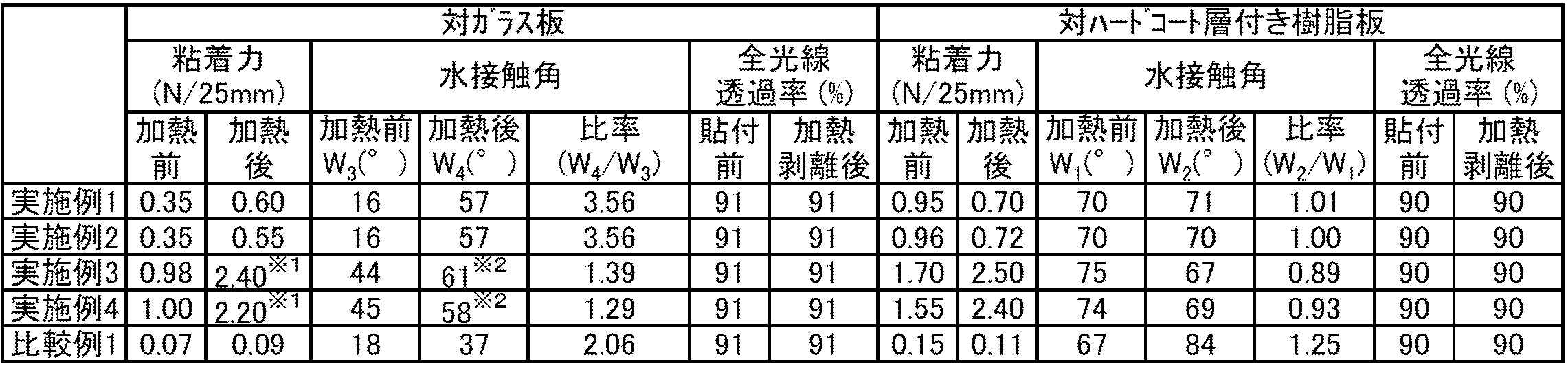
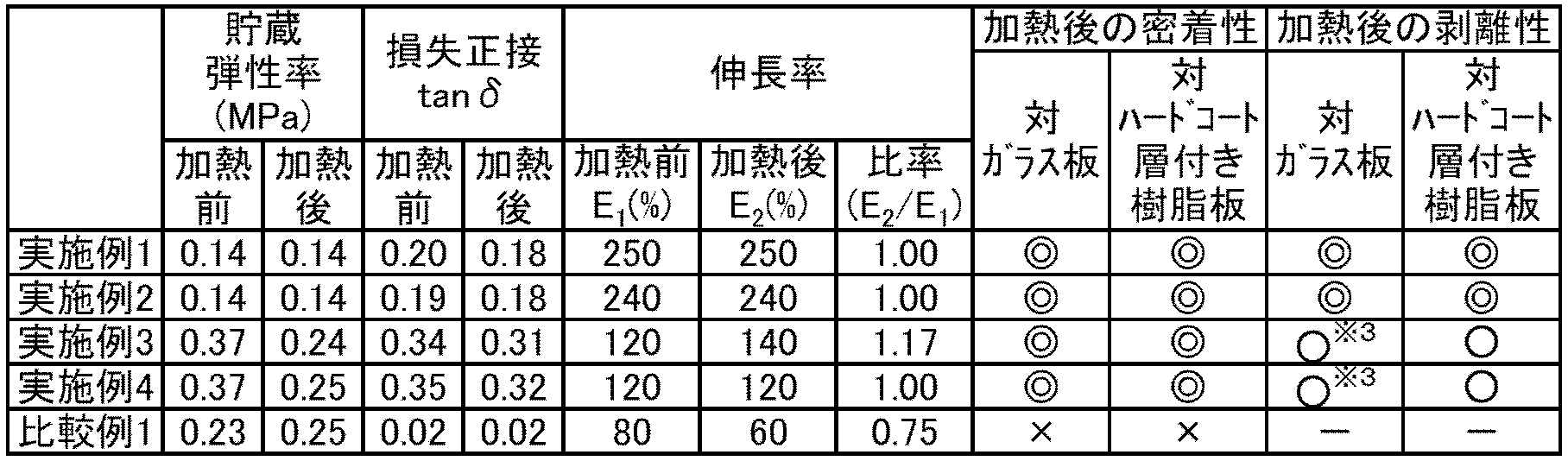
表2および表3から明らかなように、実施例で製造した保護シートは、加熱処理を受けた後においても、被着体に対して良好な密着性を示しながらも、剥離性に優れていた。 As is clear from Tables 2 and 3, the protective sheets produced in Examples exhibited good adhesion to adherends and excellent peelability even after being subjected to heat treatment. .
本発明に係る保護シートは、光学部材等の表面を保護するための保護シートとして好適である。 The protective sheet according to the present invention is suitable as a protective sheet for protecting the surfaces of optical members and the like.
Claims (8)
前記粘着剤層が、アクリル系粘着剤から構成されており、
前記粘着剤層を用いて作製した、厚さ500μm且つ10mm×75mmのサイズの伸長率測定用サンプルの引張試験による23℃での伸長率(%)をE1とし、前記伸長率測定用サンプルを100℃で30分間加熱した後における当該伸長率測定用サンプルの引張試験による23℃での伸長率(%)をE2とした場合に、前記伸長率E1に対する前記伸長率E2の比率(E2/E1)が、0.9以上、5以下であり、
前記粘着剤層を用いて作製した、厚さ800μm且つ直径10mmの円形の粘弾性測定用サンプルを100℃で30分間加熱した後における当該粘弾性測定用サンプルの23℃における損失正接tanδが、0.1以上、1以下であり、
樹脂板と前記樹脂板の片面側に積層されたポリメタクリル酸メチルを材料とするハードコート層とを備えるハードコート層付き樹脂板における前記ハードコート層側の面に対する前記保護シートの粘着力が、0.5N/25mm以上、10N/25mm以下である
ことを特徴とする保護シート。 A protective sheet comprising a substrate and an adhesive layer laminated on one side of the substrate,
The pressure-sensitive adhesive layer is composed of an acrylic pressure-sensitive adhesive,
The elongation rate (%) at 23 ° C. in a tensile test of a sample for elongation rate measurement with a thickness of 500 μm and a size of 10 mm × 75 mm produced using the pressure-sensitive adhesive layer is E 1 , and the elongation rate measurement sample is When the elongation rate (%) at 23 ° C. in the tensile test of the elongation rate measurement sample after heating at 100 ° C. for 30 minutes is E 2 , the ratio of the elongation rate E 2 to the elongation rate E 1 ( E 2 /E 1 ) is 0.9 or more and 5 or less,
A circular sample for viscoelasticity measurement with a thickness of 800 μm and a diameter of 10 mm prepared using the adhesive layer is heated at 100° C. for 30 minutes, and the loss tangent tanδ at 23° C. of the sample is 0. .1 or more and 1 or less ,
In a resin plate with a hard coat layer, which includes a resin plate and a hard coat layer made of polymethyl methacrylate laminated on one side of the resin plate, the adhesive strength of the protective sheet to the surface of the hard coat layer is 0.5N/25mm or more and 10N/25mm or less
A protective sheet characterized by:
前記積層体を23℃、50%RHの環境下に24時間置いた後、前記保護シートを剥離して露出した前記ハードコート層付き樹脂板における前記ハードコート層側の面において測定される水接触角(°)をW1とし、
前記積層体を23℃、50%RHの環境下に24時間置き、続いて100℃で30分間加熱し、さらに23℃、50%RHの環境下で30分間置いた後、前記保護シートを剥離して露出した前記ハードコート層付き樹脂板における前記ハードコート層側の面において測定される水接触角(°)をW2とした場合に、
前記水接触角W1に対する前記水接触角W2の比率(W2/W1)が、0.8以上、1.2以下であることを特徴とする請求項1に記載の保護シート。 Adhesion of the protective sheet to the hard coat layer side surface of a resin plate with a hard coat layer, which includes a resin plate and a hard coat layer made of polymethyl methacrylate laminated on one side of the resin plate. Regarding the laminate obtained by laminating the surface on the side of the agent layer,
After placing the laminate in an environment of 23° C. and 50% RH for 24 hours, water contact measured on the surface of the hard coat layer side of the hard coat layer-attached resin plate exposed by peeling off the protective sheet Let the angle (°) be W 1 ,
The laminate is placed in an environment of 23° C. and 50% RH for 24 hours, then heated to 100° C. for 30 minutes, placed in an environment of 23° C. and 50% RH for 30 minutes, and then the protective sheet is peeled off. When the water contact angle (°) measured on the surface of the hard coat layer side of the resin plate with the hard coat layer exposed by
The protective sheet according to claim 1 , wherein a ratio ( W2/W1) of the water contact angle W2 to the water contact angle W1 is 0.8 or more and 1.2 or less.
請求項1~7のいずれか一項に記載の保護シートと
を備え、
前記保護シートにおける粘着剤層側の面が、前記ハードコート層付き樹脂板における前記ハードコート層側の面に積層されていることを特徴とする積層体。 a resin plate with a hard coat layer comprising a resin plate and a hard coat layer laminated on one side of the resin plate;
A protective sheet according to any one of claims 1 to 7 ,
A laminate, wherein the surface of the protective sheet on the adhesive layer side is laminated on the surface of the resin plate with the hard coat layer on the hard coat layer side.
Priority Applications (4)
| Application Number | Priority Date | Filing Date | Title |
|---|---|---|---|
| JP2018241203A JP7219082B2 (en) | 2018-12-25 | 2018-12-25 | protective sheets and laminates |
| TW108137421A TWI841611B (en) | 2018-12-25 | 2019-10-17 | Protective sheet and laminate |
| KR1020190156864A KR102839614B1 (en) | 2018-12-25 | 2019-11-29 | Protective sheet and laminate |
| CN201911242433.7A CN111378393B (en) | 2018-12-25 | 2019-12-06 | Protective sheet and laminate |
Applications Claiming Priority (1)
| Application Number | Priority Date | Filing Date | Title |
|---|---|---|---|
| JP2018241203A JP7219082B2 (en) | 2018-12-25 | 2018-12-25 | protective sheets and laminates |
Publications (2)
| Publication Number | Publication Date |
|---|---|
| JP2020100103A JP2020100103A (en) | 2020-07-02 |
| JP7219082B2 true JP7219082B2 (en) | 2023-02-07 |
Family
ID=71140671
Family Applications (1)
| Application Number | Title | Priority Date | Filing Date |
|---|---|---|---|
| JP2018241203A Active JP7219082B2 (en) | 2018-12-25 | 2018-12-25 | protective sheets and laminates |
Country Status (4)
| Country | Link |
|---|---|
| JP (1) | JP7219082B2 (en) |
| KR (1) | KR102839614B1 (en) |
| CN (1) | CN111378393B (en) |
| TW (1) | TWI841611B (en) |
Families Citing this family (4)
| Publication number | Priority date | Publication date | Assignee | Title |
|---|---|---|---|---|
| JP7453879B2 (en) * | 2020-08-12 | 2024-03-21 | リンテック株式会社 | Protective film forming sheet roll and protective film forming sheet roll manufacturing method |
| WO2022138459A1 (en) * | 2020-12-25 | 2022-06-30 | 日東電工株式会社 | Resin composition |
| WO2023002600A1 (en) * | 2021-07-21 | 2023-01-26 | 大同至高株式会社 | Sheet-like member and housing for electronic device |
| JP7084536B1 (en) * | 2021-09-17 | 2022-06-14 | 日東電工株式会社 | Adhesive sheet |
Citations (4)
| Publication number | Priority date | Publication date | Assignee | Title |
|---|---|---|---|---|
| JP2002173650A (en) | 2000-12-04 | 2002-06-21 | Hitachi Chem Co Ltd | Pressure-sensitive adhesive film for protecting optical sheet |
| JP2011241387A (en) | 2010-04-20 | 2011-12-01 | Nitto Denko Corp | Water-dispersing acrylic adhesive composition and adhesive sheet |
| JP2016052775A (en) | 2014-09-01 | 2016-04-14 | 日東電工株式会社 | Carrier film and laminate for transparent conductive film |
| JP2018090799A (en) | 2016-12-06 | 2018-06-14 | 日本合成化学工業株式会社 | Adhesive composition, adhesive obtained by crosslinking the same, adhesive for masking film, masking film, adhesive film for transparent electrode layer formation step, tape for semiconductor manufacture step, and method for using masking film |
Family Cites Families (10)
| Publication number | Priority date | Publication date | Assignee | Title |
|---|---|---|---|---|
| JP3923643B2 (en) * | 1998-03-11 | 2007-06-06 | 日東電工株式会社 | Surface protective film adhesive and surface protective film |
| JP2011256111A (en) | 2008-10-03 | 2011-12-22 | Hayashibara Biochem Lab Inc | Prophylactic and therapeutic agent for sepsis |
| JP5917834B2 (en) * | 2010-06-28 | 2016-05-18 | 日東電工株式会社 | Adhesive layer for optical film, adhesive optical film, and image display device |
| JP5820762B2 (en) * | 2012-04-24 | 2015-11-24 | 藤森工業株式会社 | Surface protective film for transparent conductive film and transparent conductive film using the same |
| JP6046500B2 (en) * | 2013-01-17 | 2016-12-14 | 日東電工株式会社 | Protection sheet for chemical treatment |
| JP6664166B2 (en) * | 2014-11-28 | 2020-03-13 | 日東電工株式会社 | Adhesive sheet for portable electronic devices |
| JP6676325B2 (en) * | 2015-10-01 | 2020-04-08 | リンテック株式会社 | Adhesive sheet |
| JP6791647B2 (en) * | 2016-03-29 | 2020-11-25 | リンテック株式会社 | Laminate and protective film |
| JP6712916B2 (en) * | 2016-07-11 | 2020-06-24 | 日東電工株式会社 | Adhesive sheet |
| JP7460315B2 (en) * | 2017-03-31 | 2024-04-02 | リンテック株式会社 | Adhesive compositions, adhesives and adhesive sheets |
-
2018
- 2018-12-25 JP JP2018241203A patent/JP7219082B2/en active Active
-
2019
- 2019-10-17 TW TW108137421A patent/TWI841611B/en active
- 2019-11-29 KR KR1020190156864A patent/KR102839614B1/en active Active
- 2019-12-06 CN CN201911242433.7A patent/CN111378393B/en active Active
Patent Citations (4)
| Publication number | Priority date | Publication date | Assignee | Title |
|---|---|---|---|---|
| JP2002173650A (en) | 2000-12-04 | 2002-06-21 | Hitachi Chem Co Ltd | Pressure-sensitive adhesive film for protecting optical sheet |
| JP2011241387A (en) | 2010-04-20 | 2011-12-01 | Nitto Denko Corp | Water-dispersing acrylic adhesive composition and adhesive sheet |
| JP2016052775A (en) | 2014-09-01 | 2016-04-14 | 日東電工株式会社 | Carrier film and laminate for transparent conductive film |
| JP2018090799A (en) | 2016-12-06 | 2018-06-14 | 日本合成化学工業株式会社 | Adhesive composition, adhesive obtained by crosslinking the same, adhesive for masking film, masking film, adhesive film for transparent electrode layer formation step, tape for semiconductor manufacture step, and method for using masking film |
Also Published As
| Publication number | Publication date |
|---|---|
| TWI841611B (en) | 2024-05-11 |
| KR102839614B1 (en) | 2025-07-29 |
| CN111378393A (en) | 2020-07-07 |
| KR20200079416A (en) | 2020-07-03 |
| TW202033347A (en) | 2020-09-16 |
| CN111378393B (en) | 2024-01-30 |
| JP2020100103A (en) | 2020-07-02 |
Similar Documents
| Publication | Publication Date | Title |
|---|---|---|
| JP6722267B2 (en) | Adhesive composition, adhesive layer, adhesive sheet, optical member, and touch panel | |
| TWI636114B (en) | Polarizing film with adhesive layer for transparent conductive film, laminated body and image display device | |
| JP6722245B2 (en) | Optical pressure-sensitive adhesive layer, pressure-sensitive adhesive sheet, optical member, and touch panel | |
| JP6371931B1 (en) | Adhesive sheet | |
| JP6697359B2 (en) | Adhesives for flexible displays, adhesive sheets, flexible laminated members and flexible displays | |
| CN106978110B (en) | Adhesive composition and adhesive sheet | |
| KR20130000358A (en) | Optical double-sided pressure-sensitive adhesive sheet | |
| JP7219082B2 (en) | protective sheets and laminates | |
| CN103102820A (en) | Pressure-sensitive adhesive sheet | |
| CN101643631A (en) | Double-sided pressure-sensitive adhesive sheet, foam fixing method and laminate | |
| SG10202103241WA (en) | Pressure-sensitive adhesive sheet with release film | |
| JP7369757B2 (en) | Adhesive sheet, structure, and method for manufacturing the structure | |
| CN111978883A (en) | Adhesive sheet | |
| JP6042592B1 (en) | Adhesive composition, adhesive and adhesive sheet | |
| CN115537130A (en) | optical adhesive layer | |
| JP2017119790A (en) | Adhesive sheet for decoration | |
| WO2022163638A1 (en) | Optical adhesive sheet for foldable device | |
| JPWO2016147318A6 (en) | Adhesive composition, adhesive and adhesive sheet | |
| TWI786193B (en) | Adhesive for repetitive bending device, adhesive sheet, repetitive bending laminated member, and repetitive bending device | |
| TW202309563A (en) | Optical film with cover film | |
| JP2022125728A (en) | Adhesive and adhesive sheet | |
| KR102232000B1 (en) | Pressure-sensitive adhesive layer for optical use, pressure-sensitive adhesive sheet, optical component and touch panel | |
| JP2007326899A (en) | Adhesive composition, adhesive sheet and adhesive-attached functional film | |
| JP2020158653A (en) | Adhesive composition and adhesive sheet | |
| TW202311479A (en) | Optical adhesive layer and optical film with optical adhesive layer |
Legal Events
| Date | Code | Title | Description |
|---|---|---|---|
| A621 | Written request for application examination |
Free format text: JAPANESE INTERMEDIATE CODE: A621 Effective date: 20210927 |
|
| A977 | Report on retrieval |
Free format text: JAPANESE INTERMEDIATE CODE: A971007 Effective date: 20220620 |
|
| A131 | Notification of reasons for refusal |
Free format text: JAPANESE INTERMEDIATE CODE: A131 Effective date: 20220719 |
|
| A521 | Request for written amendment filed |
Free format text: JAPANESE INTERMEDIATE CODE: A523 Effective date: 20220920 |
|
| TRDD | Decision of grant or rejection written | ||
| A01 | Written decision to grant a patent or to grant a registration (utility model) |
Free format text: JAPANESE INTERMEDIATE CODE: A01 Effective date: 20230104 |
|
| A61 | First payment of annual fees (during grant procedure) |
Free format text: JAPANESE INTERMEDIATE CODE: A61 Effective date: 20230126 |
|
| R150 | Certificate of patent or registration of utility model |
Ref document number: 7219082 Country of ref document: JP Free format text: JAPANESE INTERMEDIATE CODE: R150 |
|
| R250 | Receipt of annual fees |
Free format text: JAPANESE INTERMEDIATE CODE: R250 |