JP7263473B2 - Solid forms of TTK inhibitors - Google Patents
Solid forms of TTK inhibitors Download PDFInfo
- Publication number
- JP7263473B2 JP7263473B2 JP2021167806A JP2021167806A JP7263473B2 JP 7263473 B2 JP7263473 B2 JP 7263473B2 JP 2021167806 A JP2021167806 A JP 2021167806A JP 2021167806 A JP2021167806 A JP 2021167806A JP 7263473 B2 JP7263473 B2 JP 7263473B2
- Authority
- JP
- Japan
- Prior art keywords
- cancer
- compound
- hydrobromide
- crystal
- crystalline
- Prior art date
- Legal status (The legal status is an assumption and is not a legal conclusion. Google has not performed a legal analysis and makes no representation as to the accuracy of the status listed.)
- Active
Links
Images


Classifications
-
- A—HUMAN NECESSITIES
- A61—MEDICAL OR VETERINARY SCIENCE; HYGIENE
- A61K—PREPARATIONS FOR MEDICAL, DENTAL OR TOILETRY PURPOSES
- A61K31/00—Medicinal preparations containing organic active ingredients
- A61K31/33—Heterocyclic compounds
- A61K31/395—Heterocyclic compounds having nitrogen as a ring hetero atom, e.g. guanethidine or rifamycins
- A61K31/495—Heterocyclic compounds having nitrogen as a ring hetero atom, e.g. guanethidine or rifamycins having six-membered rings with two or more nitrogen atoms as the only ring heteroatoms, e.g. piperazine or tetrazines
- A61K31/505—Pyrimidines; Hydrogenated pyrimidines, e.g. trimethoprim
- A61K31/519—Pyrimidines; Hydrogenated pyrimidines, e.g. trimethoprim ortho- or peri-condensed with heterocyclic rings
-
- A—HUMAN NECESSITIES
- A61—MEDICAL OR VETERINARY SCIENCE; HYGIENE
- A61P—SPECIFIC THERAPEUTIC ACTIVITY OF CHEMICAL COMPOUNDS OR MEDICINAL PREPARATIONS
- A61P35/00—Antineoplastic agents
-
- C—CHEMISTRY; METALLURGY
- C07—ORGANIC CHEMISTRY
- C07D—HETEROCYCLIC COMPOUNDS
- C07D487/00—Heterocyclic compounds containing nitrogen atoms as the only ring hetero atoms in the condensed system, not provided for by groups C07D451/00 - C07D477/00
- C07D487/02—Heterocyclic compounds containing nitrogen atoms as the only ring hetero atoms in the condensed system, not provided for by groups C07D451/00 - C07D477/00 in which the condensed system contains two hetero rings
- C07D487/04—Ortho-condensed systems
-
- C—CHEMISTRY; METALLURGY
- C30—CRYSTAL GROWTH
- C30B—SINGLE-CRYSTAL GROWTH; UNIDIRECTIONAL SOLIDIFICATION OF EUTECTIC MATERIAL OR UNIDIRECTIONAL DEMIXING OF EUTECTOID MATERIAL; REFINING BY ZONE-MELTING OF MATERIAL; PRODUCTION OF A HOMOGENEOUS POLYCRYSTALLINE MATERIAL WITH DEFINED STRUCTURE; SINGLE CRYSTALS OR HOMOGENEOUS POLYCRYSTALLINE MATERIAL WITH DEFINED STRUCTURE; AFTER-TREATMENT OF SINGLE CRYSTALS OR A HOMOGENEOUS POLYCRYSTALLINE MATERIAL WITH DEFINED STRUCTURE; APPARATUS THEREFOR
- C30B29/00—Single crystals or homogeneous polycrystalline material with defined structure characterised by the material or by their shape
- C30B29/54—Organic compounds
- C30B29/58—Macromolecular compounds
-
- C—CHEMISTRY; METALLURGY
- C30—CRYSTAL GROWTH
- C30B—SINGLE-CRYSTAL GROWTH; UNIDIRECTIONAL SOLIDIFICATION OF EUTECTIC MATERIAL OR UNIDIRECTIONAL DEMIXING OF EUTECTOID MATERIAL; REFINING BY ZONE-MELTING OF MATERIAL; PRODUCTION OF A HOMOGENEOUS POLYCRYSTALLINE MATERIAL WITH DEFINED STRUCTURE; SINGLE CRYSTALS OR HOMOGENEOUS POLYCRYSTALLINE MATERIAL WITH DEFINED STRUCTURE; AFTER-TREATMENT OF SINGLE CRYSTALS OR A HOMOGENEOUS POLYCRYSTALLINE MATERIAL WITH DEFINED STRUCTURE; APPARATUS THEREFOR
- C30B7/00—Single-crystal growth from solutions using solvents which are liquid at normal temperature, e.g. aqueous solutions
- C30B7/02—Single-crystal growth from solutions using solvents which are liquid at normal temperature, e.g. aqueous solutions by evaporation of the solvent
-
- C—CHEMISTRY; METALLURGY
- C30—CRYSTAL GROWTH
- C30B—SINGLE-CRYSTAL GROWTH; UNIDIRECTIONAL SOLIDIFICATION OF EUTECTIC MATERIAL OR UNIDIRECTIONAL DEMIXING OF EUTECTOID MATERIAL; REFINING BY ZONE-MELTING OF MATERIAL; PRODUCTION OF A HOMOGENEOUS POLYCRYSTALLINE MATERIAL WITH DEFINED STRUCTURE; SINGLE CRYSTALS OR HOMOGENEOUS POLYCRYSTALLINE MATERIAL WITH DEFINED STRUCTURE; AFTER-TREATMENT OF SINGLE CRYSTALS OR A HOMOGENEOUS POLYCRYSTALLINE MATERIAL WITH DEFINED STRUCTURE; APPARATUS THEREFOR
- C30B7/00—Single-crystal growth from solutions using solvents which are liquid at normal temperature, e.g. aqueous solutions
- C30B7/14—Single-crystal growth from solutions using solvents which are liquid at normal temperature, e.g. aqueous solutions the crystallising materials being formed by chemical reactions in the solution
-
- C—CHEMISTRY; METALLURGY
- C07—ORGANIC CHEMISTRY
- C07B—GENERAL METHODS OF ORGANIC CHEMISTRY; APPARATUS THEREFOR
- C07B2200/00—Indexing scheme relating to specific properties of organic compounds
- C07B2200/13—Crystalline forms, e.g. polymorphs
Landscapes
- Chemical & Material Sciences (AREA)
- Organic Chemistry (AREA)
- Health & Medical Sciences (AREA)
- Public Health (AREA)
- Veterinary Medicine (AREA)
- General Health & Medical Sciences (AREA)
- Animal Behavior & Ethology (AREA)
- Life Sciences & Earth Sciences (AREA)
- Pharmacology & Pharmacy (AREA)
- Medicinal Chemistry (AREA)
- Crystallography & Structural Chemistry (AREA)
- Materials Engineering (AREA)
- Engineering & Computer Science (AREA)
- Metallurgy (AREA)
- General Chemical & Material Sciences (AREA)
- Chemical Kinetics & Catalysis (AREA)
- Nuclear Medicine, Radiotherapy & Molecular Imaging (AREA)
- Epidemiology (AREA)
- Pharmaceuticals Containing Other Organic And Inorganic Compounds (AREA)
- Medicines That Contain Protein Lipid Enzymes And Other Medicines (AREA)
- Medicines Containing Plant Substances (AREA)
- Nitrogen Condensed Heterocyclic Rings (AREA)
Description
関連出願
本出願は、2016年7月18に出願された米国仮特許出願第62/363,424号の恩典を主張する。前記出願の全教示は参照により本明細書に組み込まれる。
RELATED APPLICATIONS This application claims the benefit of US Provisional Patent Application No. 62/363,424, filed July 18, 2016. The entire teachings of said application are incorporated herein by reference.
本発明は、TTK阻害剤の固体形態に関する。 The present invention relates to solid forms of TTK inhibitors.
チロシンスレオニンキナーゼ、二重特異性プロテインキナーゼTTK、モノポーラスピンドル1(Mps1)およびホスホチロシン選別(Phosphotyrosine-Picked)スレオニンキナーゼ(PYT)としても知られているヒトTTKプロテインキナーゼ(TTK)は、大腸菌において発現されると、セリン、スレオニンおよびチロシン残基をリン酸化することができる保存多特異性キナーゼである(非特許文献1)。TTK mRNAはヒトにおける生理的に正常な組織の大半において発現されない(同上)。TTK mRNAはいくつかの急速に増殖している組織、例えば精巣および胸腺、ならびにいくつかの腫瘍において発現される(例えば、TTK mRNAは腎細胞がんにおいて発現されず、乳癌試料の50%において発現され、精巣腫瘍および卵巣癌試料において発現された)(同上)。TTKは正常対応物と比較して、いくつかの癌細胞株および腫瘍において発現される(同上;特許文献1も参照されたい)。 Human TTK protein kinase (TTK), also known as tyrosine threonine kinase, dual specificity protein kinase TTK, monopolar spindle 1 (Mps1) and phosphotyrosine-picked threonine kinase (PYT), is expressed in E. coli. As such, it is a conserved multispecific kinase that can phosphorylate serine, threonine and tyrosine residues (Non-Patent Document 1). TTK mRNA is not expressed in most physiologically normal tissues in humans (Id.). TTK mRNA is expressed in several rapidly proliferating tissues such as testis and thymus, as well as several tumors (e.g. TTK mRNA is not expressed in renal cell carcinoma and is expressed in 50% of breast cancer samples). and expressed in testicular and ovarian cancer samples) (Id.). TTK is expressed in several cancer cell lines and tumors compared to their normal counterparts (Id.; see also US Pat. No. 6,200,000).
TTKを阻害する作用物質は癌を治療する可能性がある。多くの強力なTTK阻害剤が特許文献2および特許文献3において開示される(その全教示は参照により本明細書に組み込まれる)。1つの代表的なTTK阻害剤はN-シクロプロピル-4-(7-((((1s,3s)-3-ヒドロキシ-3-メチルシクロブチル)メチル)アミノ)-5-(ピリジン-3-イルオキシ)ピラゾロ[1,5-a]ピリミジン-3-イル)-2-メチルベンズアミドであり、その構造は以下で化合物(I)として再現される:

結晶性である、そうでなければ、大規模製造に適している物理的性質を有するこの化合物の塩形態が必要である。その中でこの薬物候補が安定であり、効果的に患者に送達される医薬製剤もまた、必要である。 A salt form of this compound is needed that has physical properties that are crystalline or otherwise amenable to large-scale production. There is also a need for pharmaceutical formulations in which the drug candidate is stable and effectively delivered to the patient.
本発明は、化合物(I)および共形成剤分子の新規共結晶に関し、ここで、共形成剤分子はリン酸である。本発明はまた、化合物(I)の臭化水素酸塩に関し、ここで、化合物(I)と臭化水素酸の間のモル比は1:1である。化合物(I)の遊離塩基および他の塩形態と比べて、新規固体形態は、増加した水溶性、融点、および薬物動態曝露を含む、著しく改善された特性を示す。特に、下記実施例5で示されるように、化合物(I)およびリン酸の共結晶ならびに結晶形態の化合物(I)の臭化水素酸塩では、ラットおよびイヌの両方において、経口投与後、遊離塩基化合物(I)に比べて著しく増加した血漿濃度が得られる。これは、大きな利点を有する。というのも、新規固体形態は経口投与することができ、薬物の有効な血漿レベルが得られるからである。 The present invention relates to novel co-crystals of compound (I) and a co-former molecule, wherein the co-former molecule is phosphoric acid. The present invention also relates to the hydrobromide salt of compound (I), wherein the molar ratio between compound (I) and hydrobromic acid is 1:1. Compared to the free base and other salt forms of Compound (I), the novel solid forms exhibit significantly improved properties, including increased water solubility, melting point, and pharmacokinetic exposure. In particular, as shown in Example 5 below, co-crystals of Compound (I) and phosphoric acid and the hydrobromide salt of Compound (I) in crystalline form showed free Significantly increased plasma concentrations are obtained compared to base compound (I). This has great advantages. This is because the novel solid forms can be administered orally and provide effective plasma levels of the drug.
第1の実施形態では、本発明は化合物(I)および共形成剤分子の共結晶、または共結晶の溶媒和物に関し、ここで、共形成剤分子はリン酸である。 In a first embodiment, the present invention relates to a co-crystal, or solvate of the co-crystal, of compound (I) and a co-former molecule, wherein the co-former molecule is phosphoric acid.
第2の実施形態では、発明は第1の実施形態による共結晶を提供し、ここで、共結晶中の化合物(I):リン酸のモル比は1:2である。 In a second embodiment, the invention provides a co-crystal according to the first embodiment, wherein the molar ratio of compound (I):phosphoric acid in the co-crystal is 1:2.
第3の実施形態では、発明は第1または第2の実施形態による共結晶を提供し、ここで、共結晶は水和物である。 In a third embodiment the invention provides a co-crystal according to the first or second embodiment, wherein the co-crystal is a hydrate.
第4の実施形態では、発明は第1、第2または第3の実施形態による共結晶を提供し、ここで、共結晶中の化合物(I):リン酸:H2Oのモル比は1:2:1/2である。 In a fourth embodiment, the invention provides a co-crystal according to the first, second or third embodiment, wherein the molar ratio of compound (I):phosphoric acid:H 2 O in the co-crystal is 1 :2:1/2.
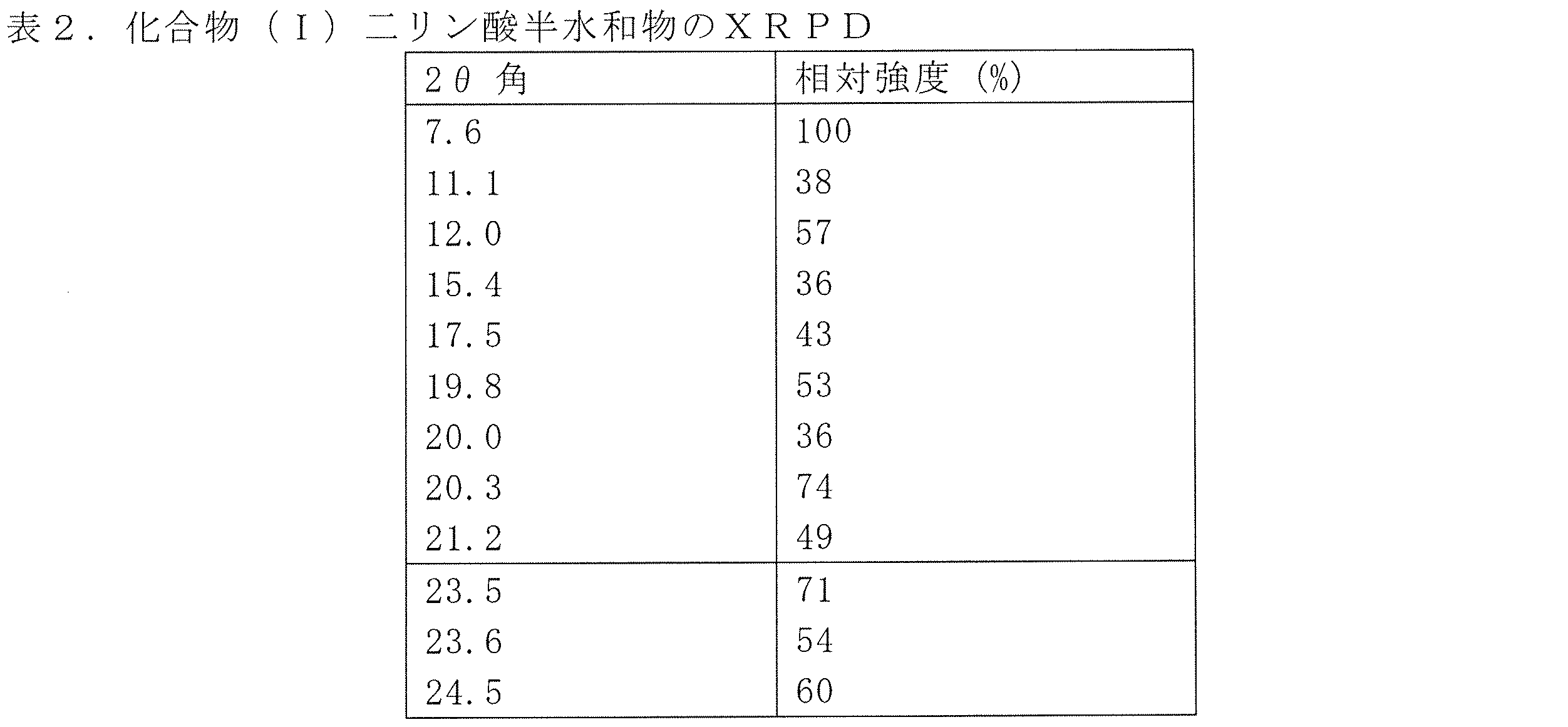
第5の実施形態では、発明は第1、第2、第3、または第4の実施形態による共結晶を提供し、ここで、共結晶は、2θにおける7.6°、12.0°、20.3°、23.5°、および24.5°±0.2のX線粉末回折パターンピークのいずれかの3、4、または5つにより特徴付けられる。 In a fifth embodiment, the invention provides a co-crystal according to the first, second, third, or fourth embodiment, wherein the co-crystal is 7.6°, 12.0° in 2-theta, Characterized by any 3, 4, or 5 of the X-ray powder diffraction pattern peaks at 20.3°, 23.5°, and 24.5° ± 0.2.
第6の実施形態では、発明は第1、第2、第3、または第4の実施形態による共結晶を提供し、ここで、共結晶は、2θにおける7.6°、11.1°、12.0°、15.4°、17.5°、19.8°、20.0°、20.3°、21.2°、23.5°、23.6°、および24.5°±0.2のX線粉末回折パターンピークのいずれかの3、4、5、6、7、8、9、10、または11個により特徴付けられる。 In a sixth embodiment, the invention provides a co-crystal according to the first, second, third, or fourth embodiment, wherein the co-crystal is 7.6°, 11.1° in 2-theta, 12.0°, 15.4°, 17.5°, 19.8°, 20.0°, 20.3°, 21.2°, 23.5°, 23.6° and 24.5° Characterized by any 3, 4, 5, 6, 7, 8, 9, 10, or 11 X-ray powder diffraction pattern peaks of ±0.2.
第7の実施形態では、発明は第1、第2、第3、または第4の実施形態による共結晶を提供し、ここで、共結晶は2θにおける7.6°、11.1°、12.0°、15.4°、17.5°、19.8°、20.0°、20.3°、21.2°、23.5°、23.6°、および24.5°±0.2のX線粉末回折パターンピークにより特徴付けられる。 In a seventh embodiment, the invention provides a co-crystal according to the first, second, third, or fourth embodiment, wherein the co-crystal is 7.6°, 11.1°, 12° in 2-theta. .0°, 15.4°, 17.5°, 19.8°, 20.0°, 20.3°, 21.2°, 23.5°, 23.6°, and 24.5°± Characterized by an X-ray powder diffraction pattern peak of 0.2.
第8の実施形態では、発明は第1、第2、第3、または第4の実施形態による共結晶を提供し、ここで、共結晶は図1において示されるX線粉末回折パターンにより特徴付けられる。 In an eighth embodiment, the invention provides a co-crystal according to the first, second, third, or fourth embodiment, wherein the co-crystal is characterized by the X-ray powder diffraction pattern shown in FIG. be done.
第9の実施形態では、発明は第1、第2、第3、第4、第5、第6、第7、または第8の実施形態による共結晶を提供し、ここで、共結晶は160±4℃の示差走査熱量計(DSC)ピーク相転移温度により特徴付けられる。 In a ninth embodiment, the invention provides a co-crystal according to the first, second, third, fourth, fifth, sixth, seventh, or eighth embodiment, wherein the co-crystal is 160 Characterized by a differential scanning calorimeter (DSC) peak phase transition temperature of ±4°C.
第10の実施形態では、発明は第1、第2、第3、第4、第5、第6、第7、第8、または第9の実施形態による共結晶を提供し、ここで、水素結合はリン酸の水素と化合物(I)のピリジン環の窒素原子の間で形成され、水素結合は2.5-2.9Åの距離を有する。 In a tenth embodiment, the invention provides a co-crystal according to the first, second, third, fourth, fifth, sixth, seventh, eighth, or ninth embodiment, wherein hydrogen A bond is formed between the hydrogen of the phosphate and the nitrogen atom of the pyridine ring of compound (I), the hydrogen bond having a distance of 2.5-2.9 Å.
第11の実施形態では、発明は第1、第2、第3、第4、第5、第6、第7、第8、第9、または第10の実施形態による共結晶を提供し、ここで、共結晶は-122.5±2ppmの15N-固体核磁気共鳴分光法(15N-ssNMR)ピークにより特徴付けられ、-122.5ppmのピークの強度は-302ppmのピークより少なくとも40-70%小さい。1つの実施形態では、-122.5ppmのピークの強度は-302ppmのピークよりも少なくとも40%、50%、60%、または70%小さい。別の実施形態では、共結晶は、図3Bにおいて示される15N-固体核磁気共鳴分光法(15N-ssNMR)ピークにより特徴付けられる。 In an eleventh embodiment, the invention provides a co-crystal according to the first, second, third, fourth, fifth, sixth, seventh, eighth, ninth, or tenth embodiment, wherein , the co-crystal is characterized by a 15 N-solid-state nuclear magnetic resonance spectroscopy ( 15 N-ssNMR) peak at −122.5±2 ppm, the intensity of the −122.5 ppm peak being at least 40− 70% smaller. In one embodiment, the intensity of the -122.5 ppm peak is at least 40%, 50%, 60%, or 70% less than the -302 ppm peak. In another embodiment, the co-crystal is characterized by the 15 N-solid-state nuclear magnetic resonance spectroscopy ( 15 N-ssNMR) peak shown in FIG. 3B.
第12の実施形態では、発明は、第1、第2、第3、第4、第5、第6、第7、第8、第9、第10、または第11の実施形態による共結晶、および薬学的に許容される担体または希釈剤を含む医薬組成物を提供する。 In a twelfth embodiment, the invention provides a cocrystal according to the first, second, third, fourth, fifth, sixth, seventh, eighth, ninth, tenth, or eleventh embodiment, and a pharmaceutically acceptable carrier or diluent.
第13の実施形態では、発明は化合物(I)の臭化水素酸塩またはその溶媒和物を提供し、ここで、化合物(I)と臭化水素酸の間のモル比は1:1である。 In a thirteenth embodiment, the invention provides a hydrobromide salt of compound (I) or a solvate thereof, wherein the molar ratio between compound (I) and hydrobromic acid is 1:1. be.
第14の実施形態では、発明は第13の実施形態による臭化水素酸塩を提供し、ここで、塩は非溶媒和形態である。 In a fourteenth embodiment, the invention provides a hydrobromide salt according to the thirteenth embodiment, wherein the salt is in unsolvated form.
第15の実施形態では、発明は第13または第14の実施形態による臭化水素酸塩を提供し、ここで、本発明の臭化水素酸塩は結晶性である。 In a fifteenth embodiment, the invention provides a hydrobromide according to the thirteenth or fourteenth embodiment, wherein the hydrobromide of the invention is crystalline.
第16の実施形態では、発明は第15の実施形態による臭化水素酸塩を提供し、ここで、結晶性臭化水素酸塩は2θにおける5.9°、11.9°、21.6°、および22.0°±0.2のX線粉末回折パターンピークの3または4つにより特徴付けられる。 In a sixteenth embodiment, the invention provides a hydrobromide according to the fifteenth embodiment, wherein the crystalline hydrobromide is 5.9°, 11.9°, 21.6° in 2θ °, and 22.0° ± 0.2 of the X-ray powder diffraction pattern peaks.
第17の実施形態では、発明は第15の実施形態による臭化水素酸塩を提供し、ここで、結晶性臭化水素酸塩は2θにおける5.9°、10.0°、11.9°、13.8°、17.3°、19.4°、21.3°、21.6°、および22.0°±0.2のX線粉末回折パターンピークのいずれかの3、4、5、6、7、または8つにより特徴付けられる。 In a seventeenth embodiment, the invention provides a hydrobromide according to the fifteenth embodiment, wherein the crystalline hydrobromide is 5.9°, 10.0°, 11.9° in 2θ any 3, 4 of the X-ray powder diffraction pattern peaks at 13.8°, 17.3°, 19.4°, 21.3°, 21.6°, and 22.0° ± 0.2 , 5, 6, 7, or 8.
第18の実施形態では、発明は第15の実施形態による臭化水素酸塩を提供し、ここで、結晶性臭化水素酸塩は2θにおける5.9°、10.0°、11.9°、13.8°、17.3°、19.4°、21.3°、21.6°、および22.0°±0.2のX線粉末回折パターンピークにより特徴付けられる。 In an eighteenth embodiment, the invention provides a hydrobromide according to the fifteenth embodiment, wherein the crystalline hydrobromide is 5.9°, 10.0°, 11.9° in 2θ °, 13.8°, 17.3°, 19.4°, 21.3°, 21.6°, and 22.0° ± 0.2.
第19の実施形態では、発明は第15、第16、第17、または第18の実施形態による臭化水素酸塩を提供し、ここで、臭化水素酸塩は図7において示されるX線粉末回折パターンピークにより特徴付けられる。 In a nineteenth embodiment, the invention provides a hydrobromide according to the fifteenth, sixteenth, seventeenth, or eighteenth embodiment, wherein the hydrobromide is an X-ray shown in FIG. Characterized by powder diffraction pattern peaks.
第20の実施形態では、発明は第13、第14、第15、第16、第17、第18、または第19の実施形態による臭化水素酸塩を提供し、ここで、臭化水素酸塩は221±2℃の示差走査熱量計(DSC)ピーク相転移温度により特徴付けられる。 In a twentieth embodiment, the invention provides a hydrobromide salt according to the thirteenth, fourteenth, fifteenth, sixteenth, seventeenth, eighteenth, or nineteenth embodiment, wherein hydrobromic acid The salt is characterized by a differential scanning calorimeter (DSC) peak phase transition temperature of 221±2°C.
第21の実施形態では、発明は、第13、第14、第15、第16、第17、第18、第19、または第20の実施形態による臭化水素酸塩、および薬学的に許容される担体または希釈剤を含む医薬組成物を提供する。 In a twenty-first embodiment, the invention provides a hydrobromide salt according to the thirteenth, fourteenth, fifteenth, sixteenth, seventeenth, eighteenth, nineteenth, or twentieth embodiment and a pharmaceutically acceptable A pharmaceutical composition comprising a carrier or diluent is provided.
1つの態様では、本発明は、被験体に有効量の第1、第2、第3、第4、第5、第6、第7、第8、第9、第10、または第11の実施形態による共結晶を投与することを含む、癌を有する被験体を治療する方法を提供する。 In one aspect, the invention provides a subject with an effective amount of the first, second, third, fourth, fifth, sixth, seventh, eighth, ninth, tenth, or eleventh practice. A method of treating a subject with cancer is provided comprising administering a co-crystal according to the form.
別の態様では、本発明は、被験体に有効量の第13、第14、第15、第16、第17、第18、第19、または第20の実施形態による臭化水素酸塩を投与することを含む、癌を有する被験体を治療する方法を提供する。 In another aspect, the invention provides for administering to a subject an effective amount of a hydrobromide salt according to the thirteenth, fourteenth, fifteenth, sixteenth, seventeenth, eighteenth, nineteenth, or twentieth embodiments. A method of treating a subject with cancer is provided, comprising:
本発明の別の態様は、癌を有する被験体を治療するための薬剤の製造のための第1、第2、第3、第4、第5、第6、第7、第8、第9、第10、または第11の実施形態による共結晶の使用である。 Another aspect of the invention is a first, second, third, fourth, fifth, sixth, seventh, eighth, ninth method for the manufacture of a medicament for treating a subject with cancer. , tenth or eleventh embodiment of the co-crystal.
本発明の別の態様は、癌を有する被験体を治療するための薬剤の製造のための、第13、第14、第15、第16、第17、第18、第19、または第20の実施形態による臭化水素酸塩の使用である。 Another aspect of the invention is the 13th, 14th, 15th, 16th, 17th, 18th, 19th, or 20th for the manufacture of a medicament for treating a subject with cancer. Use of hydrobromide according to embodiments.
本発明の別の態様は、癌の治療のための、第1、第2、第3、第4、第5、第6、第7、第8、第9、第10、または第11の実施形態による共結晶である。 Another aspect of the invention is the first, second, third, fourth, fifth, sixth, seventh, eighth, ninth, tenth, or eleventh practice for treating cancer. Co-crystal by morphology.
本発明の別の態様は、癌の治療のための、第13、第14、第15、第16、第17、第18、第19、または第20の実施形態による臭化水素酸塩である。 Another aspect of the invention is the hydrobromide salt according to the thirteenth, fourteenth, fifteenth, sixteenth, seventeenth, eighteenth, nineteenth or twentieth embodiment for the treatment of cancer .
即ち、本発明の要旨は、
〔1〕下記構造式により表される化合物(I)の臭化水素酸塩:

またはその溶媒和物であって、化合物(I)と臭化水素酸との間のモル比は1:1である、臭化水素酸塩またはその溶媒和物、
〔2〕前記塩は非溶媒和形態である、〔1〕記載の臭化水素酸塩、
〔3〕前記臭化水素酸塩は結晶性である、〔1〕または〔2〕記載の臭化水素酸塩、
〔4〕前記結晶性臭化水素酸塩は、2θにおける5.9°、11.9°、21.6°、および22.0°±0.2のX線粉末回折パターンピークの3つまたは4つにより特徴付けられる、〔3〕記載の臭化水素酸塩、
〔5〕前記結晶性臭化水素酸塩は、2θにおける5.9°、10.0°、11.9°、13.8°、17.3°、19.4°、21.3°、21.6°、および22.0°±0.2のX線粉末回折パターンピークのうち、任意の3つ、4つ、5つ、6つ、7つ、または8つにより特徴付けられる、〔3〕記載の臭化水素酸塩、
〔6〕前記結晶性臭化水素酸塩は、2θにおける5.9°、10.0°、11.9°、13.8°、17.3°、19.4°、21.3°、21.6°、および22.0°±0.2のX線粉末回折パターンピークにより特徴付けられる、〔3〕記載の臭化水素酸塩、
〔7〕前記臭化水素酸塩は、図7に示されるX線粉末回折パターンピークにより特徴付けられる、〔3〕~〔6〕のいずれか一項記載の臭化水素酸塩、
〔8〕前記臭化水素酸塩は221±2℃の示差走査熱量計(DSC)ピーク相転移温度により特徴付けられる、〔1〕~〔7〕のいずれか一項記載の臭化水素酸塩、
〔9〕〔1〕~〔8〕のいずれか一項記載の臭化水素酸塩、および薬学的に許容される担体または希釈剤を含む、医薬組成物、
〔10〕有効量の〔1〕~〔8〕のいずれか一項記載の臭化水素酸塩を含む、TTKを過剰発現する癌を有する被験体を治療するための医薬組成物、
〔11〕前記癌は膵臓癌、前立腺癌、肺癌、メラノーマ、乳癌、結腸癌、または卵巣癌である、〔10〕記載の医薬組成物、
〔12〕前記癌は肺癌、乳癌および結腸癌である、〔11〕記載の医薬組成物、
〔13〕前記癌は乳癌である、〔12〕記載の医薬組成物
に関する。
That is, the gist of the present invention is
[1] Hydrobromide of compound (I) represented by the following structural formula:
or a solvate thereof, wherein the molar ratio between compound (I) and hydrobromic acid is 1:1, hydrobromide or solvate thereof;
[2] The hydrobromide of [1], wherein the salt is in a non-solvated form;
[3] The hydrobromide according to [1] or [2], wherein the hydrobromide is crystalline;
[4] The crystalline hydrobromide has three X-ray powder diffraction pattern peaks at 5.9°, 11.9°, 21.6°, and 22.0° ± 0.2 in 2θ, or The hydrobromide according to [3], characterized by four
[5] The crystalline hydrobromide has 2θ of 5.9°, 10.0°, 11.9°, 13.8°, 17.3°, 19.4°, 21.3°, [ 3] the hydrobromide according to
[6] The crystalline hydrobromide has 2θ of 5.9°, 10.0°, 11.9°, 13.8°, 17.3°, 19.4°, 21.3°, The hydrobromide of [3], characterized by X-ray powder diffraction pattern peaks at 21.6° and 22.0° ± 0.2;
[7] The hydrobromide according to any one of [3] to [6], characterized by the X-ray powder diffraction pattern peaks shown in FIG.
[8] The hydrobromide according to any one of [1] to [7], wherein the hydrobromide is characterized by a differential scanning calorimeter (DSC) peak phase transition temperature of 221±2°C. ,
[9] A pharmaceutical composition comprising the hydrobromide salt of any one of [1] to [8] and a pharmaceutically acceptable carrier or diluent,
[10] A pharmaceutical composition for treating a subject with cancer that overexpresses TTK, comprising an effective amount of the hydrobromide salt of any one of [1] to [8];
[11] the pharmaceutical composition of [10], wherein the cancer is pancreatic cancer, prostate cancer, lung cancer, melanoma, breast cancer, colon cancer, or ovarian cancer;
[12] the pharmaceutical composition of [11], wherein the cancer is lung cancer, breast cancer or colon cancer;
[13] The pharmaceutical composition of [12], wherein the cancer is breast cancer.
本発明により、TTK阻害剤の固体形態が提供され得る。 The present invention can provide solid forms of TTK inhibitors.
本発明はN-シクロプロピル-4-(7-((((1s,3s)-3-ヒドロキシ-3-メチルシクロブチル)メチル)アミノ)-5-(ピリジン-3-イルオキシ)ピラゾロ[1,5-a]ピリミジン-3-イル)-2-メチルベンズアミドである、化合物(I)の新規固体形態を提供する。特定的には、化合物(I)およびリン酸は、明確に定義された条件下で共結晶を形成し、非吸湿性結晶形態を提供することができることが見出されている。化合物(I)の1:1臭化水素酸塩は明確に定義された条件下で結晶化され、非吸湿性結晶形態を提供することができることも見出されている。どちらの固体形態も、経口投与されると、高いバイオアベイラビリティを提供する。 The present invention provides N-cyclopropyl-4-(7-((((1s,3s)-3-hydroxy-3-methylcyclobutyl)methyl)amino)-5-(pyridin-3-yloxy)pyrazolo [1, A novel solid form of compound (I) is provided which is 5-a]pyrimidin-3-yl)-2-methylbenzamide. Specifically, it has been found that Compound (I) and phosphoric acid can form co-crystals under well-defined conditions to provide a non-hygroscopic crystalline form. It has also been found that the 1:1 hydrobromide salt of compound (I) can be crystallized under well-defined conditions to provide a non-hygroscopic crystalline form. Both solid forms provide high bioavailability when administered orally.
「共結晶」(または「共-結晶」)という用語は、1つもしくは複数のホスト有効活性成分分子(API、例えば、化合物(I))およびゲストまたは1つもしくは複数の共形成剤分子(例えば、リン酸)が存在する多成分系を示す。APIおよび共形成剤分子は、水素結合およびおそらく他の非共有結合性相互作用により相互作用し、イオン性相互作用および著しいまたは完全なプロトン交換は、API分子とゲスト分子の間で起こらない。開示された共結晶の水和物を含む溶媒和物もまた、発明に含まれる。共結晶では、API分子およびゲスト(または共形成剤)分子の両方は、それらの純粋形態で単独である場合、室温で固体として存在する。 The term "co-crystal" (or "co-crystal") refers to one or more host active ingredient molecules (API, e.g. Compound (I)) and guest or one or more co-former molecules (e.g. , phosphoric acid) are present. The API and coformer molecules interact through hydrogen bonding and possibly other non-covalent interactions, ionic interactions and significant or complete proton exchange do not occur between the API molecule and the guest molecule. Solvates, including hydrates, of the disclosed co-crystals are also included in the invention. In a co-crystal, both the API molecule and the guest (or co-former) molecule exist as solids at room temperature when alone in their pure forms.
「溶媒和形態」は、遊離塩基または塩での化合物(I)の固体または結晶形態を示し、この場合、溶媒分子が一定比率(例えば、化合物(I):溶媒のモル比1:1または1:2)で、固体または結晶の一体部分として、遊離塩基化合物(I)または対応する塩と組み合わされている。「非溶媒和形態」は、溶媒和されておらず、すなわち、溶媒分子と化合物(I)の遊離塩基または化合物(I)の対応する塩との間に一定比率がない形態を示し、溶媒分子は固体形態中に実質的に存在しない(例えば、10重量%未満)。よく知られた溶媒分子としては、水、メタノール、エタノール、n-プロパノール、およびイソプロパノールが挙げられる。本発明で開示される新規固体形態は溶媒和形態または非溶媒和形態を含む。 "Solvate form" refers to a solid or crystalline form of Compound (I), either as a free base or as a salt, in which solvent molecules are in a fixed ratio (e.g., a molar ratio of Compound (I):solvent of 1:1 or 1 : 2) combined with the free base compound (I) or the corresponding salt as an integral part of a solid or crystal. "Unsolvated form" refers to a form that is not solvated, i.e., there is no fixed ratio between solvent molecules and the free base of Compound (I) or the corresponding salt of Compound (I); is substantially absent in solid form (eg, less than 10% by weight). Well-known solvent molecules include water, methanol, ethanol, n-propanol, and isopropanol. The novel solid forms disclosed in this invention include solvated and unsolvated forms.
本明細書では、「結晶性」は、結晶構造を有する固体を示し、ここで、個々の分子は高度に均質な規則正しく閉じ込められた化学的配置を有する。化合物(I)およびリン酸の共結晶は1:2化合物(I):リン酸の単結晶形態の結晶、または異なる単結晶形態の結晶の混合物とすることができる。単結晶形態は単結晶または各結晶が同じ結晶形を有する複数の結晶としての1:2化合物(I)リン酸を意味する。 As used herein, "crystalline" refers to a solid having a crystalline structure, in which individual molecules have a highly homogeneous, ordered and confined chemical arrangement. The co-crystal of compound (I) and phosphoric acid can be a crystal of 1:2 compound (I):phosphoric acid in a single crystal form, or a mixture of crystals in different single crystal forms. Single crystal form means 1:2 Compound (I) phosphate as a single crystal or multiple crystals each having the same crystal form.
化合物(I)およびリン酸の共結晶
発明の1つの実施形態では、およそ1:2のモル比を有する化合物(I):リン酸共結晶が提供される(本明細書の実施例を参照されたい)。発明はまた、化合物(I):リン酸の他のモル比の共結晶を包含する。
Co-Crystals of Compound (I) and Phosphoric Acid In one embodiment of the invention, compound (I):phosphoric acid co-crystals are provided having a molar ratio of approximately 1:2 (see Examples herein). sea bream). The invention also includes co-crystals of other molar ratios of compound (I):phosphoric acid.
別の実施形態では、本発明の共結晶は溶媒和形態(例えば、水)である。1つの特定の実施形態では、共結晶のモル比は下記の通りである:化合物(I)×2リン酸×1/2H2O。 In another embodiment, the co-crystals of the invention are in solvated form (eg, water). In one particular embodiment, the co-crystal molar ratio is as follows: Compound (I) x 2 phosphoric acid x 1/2 H2O.
別の実施形態では、化合物(I)およびリン酸の共結晶の少なくとも特定の重量パーセンテージが単結晶形態である。特定の重量パーセンテージは、70%、72%、75%、77%、80%、82%、85%、86%、87%、88%、89%、90%、91%、92%、93%、94%、95%、96%、97%、98%、99%、99.5%、99.9%、または70%-75%、75%-80%、80%-85%、85%-90%、90%-95%、95%-100%、70-80%、80-90%、90-100%の重量パーセンテージを含む。例えば、特定の実施形態では、特定の少なくとも80重量%(例えば、少なくとも90重量%または99重量%)が単結晶形態である。値およびこれらの値の間の範囲および範囲は全て本発明により包含されることが意味されることが理解されるべきである。 In another embodiment, at least a certain weight percentage of the co-crystal of Compound (I) and phosphoric acid is in single crystal form. Specific weight percentages are 70%, 72%, 75%, 77%, 80%, 82%, 85%, 86%, 87%, 88%, 89%, 90%, 91%, 92%, 93% , 94%, 95%, 96%, 97%, 98%, 99%, 99.5%, 99.9%, or 70%-75%, 75%-80%, 80%-85%, 85% -90%, 90%-95%, 95%-100%, 70-80%, 80-90%, 90-100% weight percentages. For example, in certain embodiments, at least 80 weight percent (eg, at least 90 weight percent or 99 weight percent) of a particular is in single crystal form. It should be understood that all values and ranges and ranges between these values are meant to be encompassed by the present invention.
1:2の化合物(I)およびリン酸の共結晶の特定の重量パーセンテージが単結晶形態である場合、共結晶の残りは、アモルファス化合物(I)/リン酸、および/または単結晶形態を除く化合物(I)/リン酸の1つ以上の他の結晶形態のいくつかの組み合わせである。 When a certain weight percentage of the 1:2 Compound (I) and phosphoric acid co-crystal is in single crystal form, the remainder of the co-crystal excludes amorphous Compound (I)/phosphoric acid and/or single crystal form. Some combinations of one or more other crystalline forms of compound (I)/phosphoric acid.
1:2化合物(I)およびリン酸共結晶では、化合物(I)は他の立体異性体に比べて、少なくとも60重量%、70重量%、80重量%、90重量%、99重量%または99.9重量%純粋であり、すなわち、立体異性体全ての重量に対するその立体異性体の重量の比である。 In a 1:2 compound (I) and phosphate co-crystal, compound (I) is at least 60%, 70%, 80%, 90%, 99% or 99% by weight relative to the other stereoisomers. .9% pure by weight, ie the ratio of the weight of that stereoisomer to the weight of all stereoisomers.
1:1化合物(I)臭化水素酸塩の結晶形態
本発明の1つの実施形態では、およそ1:1のモル比を有する化合物(I)臭化水素酸が提供される(本明細書の実施例を参照されたい)。1つの実施形態では、1:1化合物(I)臭化水素酸塩の少なくとも特定の重量パーセンテージは結晶性である。
1:1 Compound (I) Hydrobromide Salt Crystalline Form In one embodiment of the present invention, Compound (I) hydrobromic acid is provided having an approximate 1:1 molar ratio (see See Examples). In one embodiment, at least a certain weight percentage of the 1:1 Compound (I) hydrobromide is crystalline.
別の特定の実施形態では、1:1化合物(I)臭化水素酸塩の少なくとも特定の重量パーセンテージは単結晶形態である。特定の重量パーセンテージは、70%、72%、75%、77%、80%、82%、85%、86%、87%、88%、89%、90%、91%、92%、93%、94%、95%、96%、97%、98%、99%、99.5%、99.9%、または70%-75%、75%-80%、80%-85%、85%-90%、90%-95%、95%-100%、70-80%、80-90%、90-100%の重量パーセンテージを含む。例えば、1つの実施形態では、1:1化合物(I)臭化水素酸塩の少なくとも80重量%(例えば、少なくとも90重量%または99重量%)が単結晶形態である。値およびこれらの値の間の範囲および範囲は全て本発明により包含されることが意味されることが理解されるべきである。 In another specific embodiment, at least a specified weight percentage of the 1:1 Compound (I) hydrobromide salt is in single crystalline form. Specific weight percentages are 70%, 72%, 75%, 77%, 80%, 82%, 85%, 86%, 87%, 88%, 89%, 90%, 91%, 92%, 93% , 94%, 95%, 96%, 97%, 98%, 99%, 99.5%, 99.9%, or 70%-75%, 75%-80%, 80%-85%, 85% -90%, 90%-95%, 95%-100%, 70-80%, 80-90%, 90-100% weight percentages. For example, in one embodiment, at least 80 wt% (eg, at least 90 wt% or 99 wt%) of the 1:1 Compound (I) hydrobromide salt is in single crystalline form. It should be understood that all values and ranges and ranges between these values are meant to be encompassed by the present invention.
結晶性1:1化合物(I)臭化水素酸塩は1:1化合物(I)臭化水素酸塩の単結晶形態の結晶、または異なる単結晶形態の結晶の混合物とすることができる。単結晶形態は、単結晶または各結晶が同じ結晶形を有する複数の結晶としての、1:1化合物(I)臭化水素酸塩を意味する。 The crystalline 1:1 Compound (I) hydrobromide can be a single crystal form of 1:1 Compound (I) hydrobromide, or a mixture of different single crystal forms. Single crystal form means 1:1 Compound (I) hydrobromide as a single crystal or multiple crystals, each crystal having the same crystal form.
1:1化合物(I)臭化水素酸塩の特定の重量パーセンテージが単結晶形態である場合、1:1化合物(I)臭化水素酸塩の残りはアモルファス1:1化合物(I)臭化水素酸塩、および/または単結晶形態を除く1:1化合物(I)臭化水素酸塩の1つ以上の他の結晶形態のいくつかの組み合わせである。 When a certain weight percentage of the 1:1 compound (I) hydrobromide is in single crystalline form, the remainder of the 1:1 compound (I) hydrobromide is amorphous 1:1 compound (I) bromide. Hydrate and/or some combination of one or more other crystalline forms of 1:1 Compound (I) hydrobromide, excluding the single crystal form.
1:1化合物(I)臭化水素酸塩において、化合物(I)は、他の立体異性体に比べて少なくとも60%、70%、80%、90%、99%または99.9重量%純粋であり、すなわち、立体異性体全ての重量に対するその立体異性体の重量の比である。 In the 1:1 Compound (I) hydrobromide salt, Compound (I) is at least 60%, 70%, 80%, 90%, 99% or 99.9% pure by weight relative to other stereoisomers. ie the ratio of the weight of that stereoisomer to the weight of all of the stereoisomers.
1:1化合物(I)臭化水素酸塩の結晶形態ならびに化合物(I)およびリン酸の共結晶の調製
1:1化合物(I)臭化水素酸塩ならびに化合物(I)およびリン酸の共結晶の特定の固体形態は、例えば、遅蒸発、徐冷、およびアンチソルベント沈殿により調製することができる。
Preparation of 1:1 Compound (I) Hydrobromide Salt Crystal Form and Co-Crystal of Compound (I) and Phosphoric Acid Certain solid forms of crystals can be prepared, for example, by slow evaporation, slow cooling, and antisolvent precipitation.
本明細書では、「アンチソルベント」は、1:1化合物(I)臭化水素酸塩または化合物(I)およびリン酸の共結晶が低い溶解度を有し、臭化物塩または共結晶を、溶液から微細粉末または結晶の形態で沈殿させる溶媒を示す。 As used herein, "antisolvent" means that the 1:1 Compound (I) hydrobromide salt or co-crystal of Compound (I) and phosphoric acid has low solubility and removes the bromide salt or co-crystal from solution. Solvents that precipitate in the form of fine powders or crystals are indicated.
あるいは、1:1化合物(I)臭化水素酸塩(または化合物(I)およびリン酸共結晶)は、種晶の添加のありまたはなしで、好適な溶媒から再結晶させることができる。 Alternatively, 1:1 Compound (I) hydrobromide (or Compound (I) and phosphoric acid co-crystal) can be recrystallized from a suitable solvent with or without seeding.
1つの実施形態では、本発明は、化合物(I)およびリン酸の共結晶を調製する方法を提供し、方法は、好適な溶媒中の化合物(I)およびリン酸の懸濁液を混合すること;ならびに溶媒を除去することを含む。好適な溶媒としては、アセトン、ジエチルエーテル、MeOH/THF、酢酸および1,4-ジオキサンが挙げられるが、それらに限定されない。MeOH/THFが調製方法において使用される場合、2つの溶媒間の比は3:2~2:3(V:V)である。 In one embodiment, the present invention provides a method of preparing a co-crystal of compound (I) and phosphoric acid, the method comprising mixing a suspension of compound (I) and phosphoric acid in a suitable solvent and removing the solvent. Suitable solvents include, but are not limited to acetone, diethyl ether, MeOH/THF, acetic acid and 1,4-dioxane. When MeOH/THF is used in the preparation process, the ratio between the two solvents is 3:2-2:3 (V:V).
1つの実施形態では、調製において使用される化合物(I)とリン酸の間のモル比は1:2~1:8である。 In one embodiment, the molar ratio between compound (I) and phosphoric acid used in the preparation is from 1:2 to 1:8.
1つの実施形態では、本発明は1:1化合物(I)臭化水素酸塩を調製する方法を提供する。特定的には、好適な溶媒(例えば、ブタノールおよび/またはMEK)中の化合物(I)の懸濁液に、HBrの溶液(例えば、ブタノールおよび/またはMEK溶液中)を添加し;混合物を60℃で2時間の間、それから5℃で一晩加熱した。それから固体を濾過により回収した。好適な溶媒としては、ブタノールおよび/またはMEK、および/または水が挙げられるが、それらに限定されない。 In one embodiment, the present invention provides a method of preparing 1:1 Compound (I) hydrobromide. Specifically, to a suspension of compound (I) in a suitable solvent (eg, butanol and/or MEK) is added a solution of HBr (eg, in butanol and/or MEK solution); °C for 2 hours, then heated at 5 °C overnight. The solid was then collected by filtration. Suitable solvents include, but are not limited to butanol and/or MEK, and/or water.
各特定の固体形態の調製は下記実験セクションで記載される。 The preparation of each specific solid form is described in the experimental section below.
治療方法
本教示の別の態様は、被験体に、有効量の、本明細書で記載される化合物(I)およびリン酸の共結晶(または化合物(I)の臭化水素酸塩)を投与することを含む、癌を有する被験体を治療する方法に関する。1つの実施形態では、本明細書で記載される共結晶(または化合物(I)の臭化水素酸塩)は腫瘍の増殖を阻害する。例えば、本明細書で記載される共結晶(または化合物(I)の臭化水素酸塩)はTTKを過剰発現する腫瘍の増殖を阻害する。
Methods of Treatment Another aspect of the present teachings is to administer to a subject an effective amount of a co-crystal of Compound (I) and phosphate (or the hydrobromide salt of Compound (I)) described herein. A method of treating a subject with cancer comprising treating. In one embodiment, a co-crystal (or the hydrobromide salt of Compound (I)) described herein inhibits tumor growth. For example, the co-crystals (or the hydrobromide salt of Compound (I)) described herein inhibit the growth of TTK-overexpressing tumors.
本教示の方法により治療することができる(再発の可能性の低減を含む)癌としては、肺癌、乳癌、結腸癌、脳癌、神経芽細胞腫、前立腺癌、メラノーマ、多形神経膠芽腫、卵巣癌、リンパ腫、白血病、メラノーマ、肉腫、腫瘍随伴病変、骨肉腫、胚細胞腫、神経膠腫および中皮腫が挙げられる。1つの実施形態では、癌は、白血病、急性骨髄性白血病、慢性骨髄性白血病、乳癌、脳癌、結腸癌、結腸直腸癌、頭頸部癌、肝細胞がん、肺腺がん、転移性メラノーマ、膵臓癌、前立腺癌、卵巣癌および腎癌から選択される。1つの実施形態では、癌は肺癌、結腸癌、脳癌、神経芽細胞腫、前立腺癌、メラノーマ、多形神経膠芽腫または卵巣癌である。別の実施形態では、癌は、膵臓癌、前立腺癌、肺癌、メラノーマ、乳癌、結腸癌、または卵巣癌である。さらに別の実施形態では、癌は乳癌、結腸癌および卵巣癌である。さらに別の実施形態では、癌は乳癌である。さらに別の実施形態では、癌は基本サブタイプ乳癌またはルミナルBサブタイプ乳癌である。さらに別の実施形態では、癌はTTKを過剰発現する基本サブタイプ乳癌である。さらに別の実施形態では、基本サブタイプ乳癌はER(エストロゲン受容体)、HER2およびPR(プロゲステロン受容体)陰性乳癌である。さらに別の実施形態では、癌は軟部組織癌である。「軟部組織癌」は当該技術分野において承認されている用語であり、身体の任意の軟部組織由来の腫瘍を包含する。そのような軟部組織は、身体の様々な構造および器官を連結し、支持し、または取り囲み、平滑筋、骨格筋、腱、線維組織、脂肪組織、血管およびリンパ管、血管周囲組織、神経、間葉系細胞および滑膜組織が挙げられるが、それらに限定されない。よって、軟部組織癌は、脂肪組織、筋組織、神経組織、関節組織、血管、リンパ管、および線維組織のものとすることができる。軟部組織癌は良性または悪性となり得る。一般に、悪性軟部組織癌は肉腫、または軟部組織肉腫と呼ばれる。多くの型の軟部組織腫瘍が存在し、脂肪腫、脂肪芽細胞腫、褐色脂肪腫、脂肪肉腫、平滑筋腫、平滑筋肉腫、横紋筋腫、横紋筋肉腫、神経線維腫、シュワン腫(神経鞘腫)、神経腫、悪性シュワン腫、神経線維肉腫、神経原性肉腫、結節性腱滑膜炎、滑膜肉腫、血管腫、グロムス腫瘍、血管外皮腫、血管内皮腫、血管肉腫、カポジ肉腫、リンパ管腫、線維腫、弾性線維腫、表在性線維腫症、線維性組織球腫、線維肉腫、線維腫症、隆起性皮膚線維肉腫(DFSP)、悪性線維性組織球腫(MFH)、粘液腫、顆粒細胞腫、悪性間葉腫、胞状軟部肉腫、類上皮肉腫、明細胞肉腫、および線維形成性小細胞腫瘍が挙げられる。特定の実施形態では、軟部組織癌は線維肉腫、胃腸肉腫、平滑筋肉腫、脱分化型脂肪肉腫、多形性脂肪肉腫、悪性線維性組織球腫、円形細胞肉腫、および滑膜肉腫からなる群より選択される肉腫である。 Cancers that can be treated (including reduced likelihood of recurrence) by the methods of the present teachings include lung cancer, breast cancer, colon cancer, brain cancer, neuroblastoma, prostate cancer, melanoma, glioblastoma multiforme. , ovarian cancer, lymphoma, leukemia, melanoma, sarcoma, paraneoplastic lesions, osteosarcoma, germinomas, gliomas and mesothelioma. In one embodiment, the cancer is leukemia, acute myelogenous leukemia, chronic myelogenous leukemia, breast cancer, brain cancer, colon cancer, colorectal cancer, head and neck cancer, hepatocellular carcinoma, lung adenocarcinoma, metastatic melanoma , pancreatic cancer, prostate cancer, ovarian cancer and renal cancer. In one embodiment, the cancer is lung cancer, colon cancer, brain cancer, neuroblastoma, prostate cancer, melanoma, glioblastoma multiforme or ovarian cancer. In another embodiment, the cancer is pancreatic cancer, prostate cancer, lung cancer, melanoma, breast cancer, colon cancer, or ovarian cancer. In yet another embodiment, the cancer is breast cancer, colon cancer and ovarian cancer. In yet another embodiment, the cancer is breast cancer. In yet another embodiment, the cancer is basic subtype breast cancer or luminal B subtype breast cancer. In yet another embodiment, the cancer is TTK-overexpressing basic subtype breast cancer. In yet another embodiment, the basic subtype breast cancer is ER (estrogen receptor), HER2 and PR (progesterone receptor) negative breast cancer. In yet another embodiment, the cancer is soft tissue cancer. "Soft tissue cancer" is an art-recognized term and includes tumors derived from any soft tissue of the body. Such soft tissues connect, support, or surround various structures and organs of the body, including smooth muscle, skeletal muscle, tendons, fibrous tissue, adipose tissue, blood and lymph vessels, perivascular tissue, nerves, interstitial tissue. Includes, but is not limited to, leaf lineage cells and synovial tissue. Thus, soft tissue cancers can be of adipose tissue, muscle tissue, nerve tissue, joint tissue, blood vessels, lymphatics, and fibrous tissue. Soft tissue cancer can be benign or malignant. Malignant soft tissue cancer is commonly referred to as sarcoma, or soft tissue sarcoma. There are many types of soft tissue tumors, including lipoma, lipoblastoma, brownlipoma, liposarcoma, leiomyoma, leiomyosarcoma, rhabdomyoma, rhabdomyosarcoma, neurofibroma, schwannoma (nervous schwannoma), neuroma, malignant schwannoma, neurofibrosarcoma, neurogenic sarcoma, nodular tenosynovitis, synovial sarcoma, hemangioma, glomus tumor, hemangiopericytoma, hemangioendothelioma, angiosarcoma, Kaposi's sarcoma , lymphangioma, fibroma, elastoma, superficial fibromatosis, fibrous histiocytoma, fibrosarcoma, fibromatosis, dermatofibrosarcoma protuberance (DFSP), malignant fibrous histiocytoma (MFH) , myxoma, granulocytoma, malignant mesenchymoma, alveolar soft tissue sarcoma, epithelioid sarcoma, clear cell sarcoma, and desmoplastic small cell tumor. In certain embodiments, the soft tissue cancer is the group consisting of fibrosarcoma, gastrointestinal sarcoma, leiomyosarcoma, dedifferentiated liposarcoma, pleomorphic liposarcoma, malignant fibrous histiocytoma, round cell sarcoma, and synovial sarcoma It is the sarcoma of choice.
本明細書では、「癌を有する被験体を治療する」は、部分的または実質的に、下記の1つ以上を達成することを含む:増殖を抑止する、癌の程度を低減する(例えば、腫瘍のサイズを低減する)、癌の増殖速度を阻害する、癌と関連する臨床症状または指標を寛解するまたは改善する(例えば、組織または血清成分)あるいは被験体の寿命を増加させる;ならびに癌の再発の可能性を低減する。 As used herein, "treating a subject with cancer" includes achieving, in part or substantially, one or more of the following: arresting growth, reducing the extent of cancer (e.g., reduce the size of a tumor), inhibit the rate of cancer growth, ameliorate or ameliorate clinical symptoms or indicators associated with cancer (e.g., tissue or serum constituents), or increase the longevity of a subject; Reduce the chance of recurrence.
本明細書では、「癌の再発の可能性を低減する」という用語は、原発部位でのもしくはその付近での、および/または緩解の期間後二次部位での癌の再発を部分的にまたは全体的に阻害する、遅延させることを意味する。癌は、本明細書で記載される治療を用いると、それなしと比べて、再発する可能性が低くなることもまた意味される。 As used herein, the term "reduce the likelihood of cancer recurrence" refers to the recurrence of cancer at or near the primary site and/or at secondary sites after a period of remission, partially or Means to hinder or delay as a whole. It is also meant that the cancer is less likely to recur with the treatment described herein than without it.
本明細書では、「緩解」という用語は、典型的には、被験体が抗癌療法でうまく治療された後に、癌と関連する臨床症状または指標が消失した、または検出できない癌の状態を示す。 As used herein, the term "remission" typically refers to a state of cancer in which clinical symptoms or indicators associated with cancer have disappeared or become undetectable after the subject has been successfully treated with an anti-cancer therapy. .
一般に、本明細書で教示される化合物の有効量は様々な因子、例えば与えられる薬物または化合物、医薬製剤、投与経路、疾患または障害の型、治療される被験体または宿主のアイデンティティ、などによって変動するが、それにもかかわらず、当業者によりルーチン的に決定され得る。本教示の化合物の有効量は、当技術分野で知られているルーチン方法により当業者により容易に決定され得る。 In general, effective amounts of the compounds taught herein will vary depending on a variety of factors, such as the drug or compound given, pharmaceutical formulation, route of administration, type of disease or disorder, identity of the subject or host being treated, and the like. but can nevertheless be routinely determined by those skilled in the art. Effective amounts of compounds of the present teachings can be readily determined by those skilled in the art by routine methods known in the art.
「有効量」という用語は、被験体に投与されると、対照と比べて、被験体において有益な、または所望の結果(臨床結果を含む)が得られる、例えば、癌が阻害、抑制または低減される量を意味する(例えば、臨床症状または癌細胞の量により決定される)。 The term "effective amount" means an amount that, when administered to a subject, produces a beneficial or desired result (including clinical results) in the subject compared to a control, e.g., inhibition, suppression or reduction of cancer. (eg determined by clinical symptoms or amount of cancer cells).
一実施形態では、1:1化合物(I)臭化水素酸塩(または化合物(I)およびリン酸共結晶)の有効量は、約0.01~約1000mg/kg体重の範囲である。当業者は、ある一定の因子は癌を患う被験体を効果的に治療するのに必要とされる投与量に影響を与え得ることを認識するであろう。これらの因子としては、疾患または障害の重症度、前の治療、被験体の全体的な健康および/または年齢ならびに存在する他の疾患が挙げられるが、それらに限定されない。 In one embodiment, an effective amount of 1:1 Compound (I) hydrobromide (or Compound (I) and phosphate co-crystal) ranges from about 0.01 to about 1000 mg/kg body weight. One of ordinary skill in the art will recognize that certain factors can affect the dosage required to effectively treat a subject with cancer. These factors include, but are not limited to, the severity of the disease or disorder, previous treatments, the subject's general health and/or age and other diseases present.
その上、有効量の本発明の化合物を用いた被験体の「治療」レジームは単回投与から構成されてもよく、あるいはその代わりに一連の適用を含んでもよい。例えば、1:1化合物(I)臭化水素酸塩(または化合物(I)およびリン酸共結晶)は少なくとも週に1回投与され得る。しかしながら、別の実施形態では、化合物は、所定の治療について週に約1回~1日1回被験体に投与され得る。治療期間の長さは、様々な因子、例えば疾患の重症度、患者の年齢、本発明の化合物の濃度および活性、またはそれらの組み合わせに依存する。治療または予防のために使用される化合物の有効な投与量は、特別な治療または予防レジームの過程にわたって増加または減少し得ることもまた認識されるであろう。投与量の変更は当技術分野で知られている標準診断アッセイにより得られ、明らかになり得る。場合によっては、慢性投与が必要とされ得る。 Moreover, a "treatment" regime of a subject with an effective amount of the compounds of the invention may consist of a single administration, or alternatively may involve a series of applications. For example, 1:1 Compound (I) hydrobromide (or Compound (I) and phosphate co-crystal) can be administered at least once weekly. However, in another embodiment, the compound may be administered to a subject about once a week to once a day for a given treatment. The length of treatment will depend on various factors, such as the severity of the disease, the age of the patient, the concentration and activity of the compound of the invention, or a combination thereof. It will also be appreciated that the effective dosage of a compound used for treatment or prophylaxis may increase or decrease over the course of a particular therapeutic or prophylactic regime. Changes in dosage may be obtained and become apparent by standard diagnostic assays known in the art. Chronic administration may be required in some cases.
「被験体」は哺乳類、好ましくはヒトであるが、獣医学的治療を必要とする動物、例えば、コンパニオン・アニマル(例えば、イヌ、ネコ、など)、農場動物(例えば、雌ウシ、ヒツジ、ブタ、ウマ、など)および実験動物(例えば、ラット、マウス、モルモット、など)とすることもできる。 A "subject" is a mammal, preferably a human, but any animal in need of veterinary treatment, such as companion animals (e.g., dogs, cats, etc.), farm animals (e.g., cows, sheep, pigs). , horses, etc.) and experimental animals (eg, rats, mice, guinea pigs, etc.).
発明の化合物は、当業者により理解されるように、選択された投与経路によって様々な形態で、患者に投与することができる。発明の化合物は、例えば、経口、非経口、頬側、舌下、経鼻、直腸、パッチ、ポンプまたは経皮投与により投与され得、医薬組成物はそれにしたがって製剤化され得る。非経口投与としては、静脈内、腹腔内、皮下、筋肉内、経上皮、経鼻、肺内、くも膜下腔内、直腸および局所投与様式が挙げられる。非経口投与は選択した期間にわたる持続注入によるものとすることができる。 The compounds of the invention can be administered to the patient in a variety of forms depending on the route of administration chosen, as will be appreciated by those skilled in the art. The compounds of the invention may be administered, for example, by oral, parenteral, buccal, sublingual, nasal, rectal, patch, pump or transdermal administration, and pharmaceutical compositions may be formulated accordingly. Parenteral administration includes intravenous, intraperitoneal, subcutaneous, intramuscular, transepithelial, nasal, intrapulmonary, intrathecal, rectal and topical modes of administration. Parenteral administration can be by continuous infusion over a selected period of time.
医薬組成物
本明細書で開示される1:1化合物(I)臭化水素酸塩(または化合物(I)およびリン酸共結晶)は、被験体に投与するための医薬組成物に好適に製剤化することができる。
Pharmaceutical Compositions The 1:1 Compound (I) hydrobromide (or Compound (I) and phosphate co-crystal) disclosed herein is suitably formulated into pharmaceutical compositions for administration to a subject. can be
1つの実施形態では、本発明は、以上で記載される1:1化合物(I)臭化水素酸塩(または化合物(I)およびリン酸共結晶)、および薬学的に許容される担体または希釈剤を含む医薬組成物を提供する。 In one embodiment, the present invention provides a 1:1 Compound (I) hydrobromide salt (or Compound (I) and a phosphate co-crystal) as described above and a pharmaceutically acceptable carrier or diluent. A pharmaceutical composition comprising the agent is provided.
本教示の医薬組成物は任意で、そのための、1つ以上の薬学的に許容される担体および/または希釈剤、例えばラクトース、デンプン、セルロースおよびデキストロースを含む。他の賦形剤、例えば香味剤;甘味料;および保存剤、例えばメチル、エチル、プロピルおよびブチルパラベンもまた含めることができる。好適な賦形剤のより完全なリストは、the Handbook of Pharmaceutical Excipients(第5版, Pharmaceutical Press (2005))において見出すことができる。当業者であれば、様々な型の投与経路に好適な製剤をどのように調製するかを知っているであろう。好適な製剤の選択および調製のための従来の手順および材料成分は、例えば、Remington’s Pharmaceutical Sciences(2003-第20版)および1999年に発行された米国薬局方:国民医薬品集(USP 24 NF19)において記載される。担体、希釈剤および/または賦形剤は、医薬組成物の他の材料成分と適合可能であり、そのレシピエントに有害ではないという意味で「許容される」。 Pharmaceutical compositions of the present teachings optionally include one or more pharmaceutically acceptable carriers and/or diluents therefor, such as lactose, starch, cellulose and dextrose. Other excipients such as flavoring agents; sweeteners; and preservatives such as methyl, ethyl, propyl and butylparabens can also be included. A more complete list of suitable excipients can be found in the Handbook of Pharmaceutical Excipients (5th Edition, Pharmaceutical Press (2005)). Those of skill in the art know how to prepare suitable formulations for various types of administration routes. Conventional procedures and ingredients for the selection and preparation of suitable formulations can be found, for example, in Remington's Pharmaceutical Sciences (2003-20th Edition) and the United States Pharmacopoeia: National Formulary, published in 1999 (USP 24 NF19). ). Carriers, diluents and/or excipients are "acceptable" in the sense of being compatible with the other ingredients of the pharmaceutical composition and not deleterious to the recipient thereof.
典型的には、経口治療的投与では、本教示の化合物は賦形剤と共に合体させることができ、摂取可能な錠剤、バッカル錠、トローチ、カプセル、エリキシル剤、懸濁液、シロップ、ウエハ、などの形態で使用することができる。 Typically, for oral therapeutic administration, compounds of the present teachings can be incorporated with excipients to form ingestible tablets, buccal tablets, troches, capsules, elixirs, suspensions, syrups, wafers, and the like. can be used in the form of
典型的には、非経口投与では、本教示の化合物の溶液は、一般に、ヒドロキシプロピルセルロースなどの界面活性剤と好適に混合された水中で調製することができる。分散物もまた、グリセロール、液体ポリエチレングリコール、DMSOおよびそれらの混合物中でアルコールと共にまたはそれなしで、および油中で調製することができる。貯蔵および使用の通常の条件下では、これらの調製物は、微生物の増殖を防止するための保存剤を含む。 Typically for parenteral administration, solutions of compounds of the present teachings can generally be prepared in water suitably mixed with a surfactant such as hydroxypropylcellulose. Dispersions can also be prepared in glycerol, liquid polyethylene glycols, DMSO, and mixtures thereof with or without alcohols and in oils. Under normal conditions of storage and use, these preparations contain a preservative to prevent microbial growth.
典型的には、注射用途では、無菌注射用溶液または分散物の即時調製のための、本明細書で記載される化合物の無菌水溶液または分散物および無菌粉末が適切である。 Typically, for injectable uses, sterile aqueous solutions or dispersions and sterile powders of the compounds described herein for the extemporaneous preparation of sterile injectable solutions or dispersion are suitable.
発明を下記実施例により説明する。それらは、いかなる意味でも制限することを意図しない。 The invention is illustrated by the following examples. They are not intended to be limiting in any way.
実験
略語:
BSA ベンゼンスルホン酸
DSC 示差走査熱量測定
Equiv 当量
NA 入手不可能
NMP N-メチル-2-ピロリドン
pTSA パラ-トルエンスルホン酸
RH 相対湿度
rt 室温
temp 温度
TGA 熱重量分析
THF テトラヒドロフラン
wt% 重量パーセント
XRPD X線粉末回折
Experimental abbreviations:
BSA benzenesulfonic acid DSC differential scanning calorimetry Equiv equivalent NA not available NMP N-methyl-2-pyrrolidone pTSA para-toluenesulfonic acid RH relative humidity rt room temperature temp temperature TGA thermogravimetric analysis THF tetrahydrofuran wt% weight percent XRPD X-ray powder diffraction
分析条件
X線粉末回折(XRPD)
XRPD分析を、DAVINCI構成を有するBruker D8 Discover回折計を用いて、試料を1.5~45°2θ角で走査して実施した。およそ、1-2mgの各スクリーニング試料を使用した。
Analysis conditions X-ray powder diffraction (XRPD)
XRPD analysis was performed using a Bruker D8 Discover diffractometer with DAVINCI configuration, scanning the samples from 1.5-45° 2-theta angles. Approximately 1-2 mg of each screening sample was used.
単結晶X線回折(SC-XRD)
SC-XRD分析を、293KでOxford Diffractions製のX-Calibur回折計で、Mo Kα源およびグラファイトモノクロメータを用いて実施した。構造解析および精密化を、それぞれ、SHELXS-97およびSHELXL-97を使用して実施した。
Single crystal X-ray diffraction (SC-XRD)
SC-XRD analysis was performed on an Oxford Diffractions X-Calibur diffractometer at 293 K using a Mo Kα source and a graphite monochromator. Structural analysis and refinement were performed using SHELXS-97 and SHELXL-97, respectively.
温度-重量測定/示差走査熱量測定分析(TGA/DSC)
3-10mgの材料を空のアルミニウムパンに秤量し、同時Setaram LABSYS EVO温度-重量測定/示差走査熱量計(TGA-DTA/DSC)にロボットを用いてロードし、室温で保持した。試料をそれから、10℃/分の速度で30℃から350℃まで加熱し、その時間の間、試料重量の変化を任意の示差熱イベントと共に記録した。窒素をパージガスとして100cm3/分の流速で使用した。分析前に、機器を秤量し、温度を、それぞれ、100mg参照重量およびインジウム参照標準を用いて較正した。試料分析をCALISTOソフトウェアの助けにより実施し、この場合、熱イベントの対応する質量損失および温度をオンセット温度とし、製造者の仕様書に従い測定した。全ての分析を10℃/分の加熱速度を用いて実施し、バックグラウンドを減算した。
Temperature-Gravimetric/Differential Scanning Calorimetry Analysis (TGA/DSC)
3-10 mg of material was weighed into an empty aluminum pan and robotically loaded into a simultaneous Setaram LABSYS EVO Thermo-Gravimetric/Differential Scanning Calorimeter (TGA-DTA/DSC) and held at room temperature. The sample was then heated from 30° C. to 350° C. at a rate of 10° C./min, during which time the change in sample weight was recorded along with any differential thermal events. Nitrogen was used as purge gas with a flow rate of 100 cm 3 /min. Prior to analysis, instruments were weighed and temperature calibrated using 100 mg reference weights and indium reference standards, respectively. Sample analysis was performed with the aid of CALISTO software, where the corresponding mass loss and temperature of the thermal event was taken as the onset temperature and measured according to the manufacturer's specifications. All analyzes were performed using a heating rate of 10°C/min to subtract background.
示差走査熱量測定(DSC)
1-4mgの材料をアルミニウムDSCパンに秤量し、アルミニウム蓋で密封せずに封印した。試料パンをそれからTA Instruments Q2000(冷却器が取り付けられている)にロードした。安定な熱流応答が35℃で得られるとすぐに、試料および基準を300℃まで10℃/分の速度で加熱し、得られた熱流応答をモニタした。分析前に、インジウム参照標準を使用して機器を温度および熱流較正した。試料分析を TA Universal Analysis2000ソフトウェアの助けにより実施し、この場合、熱イベントの温度をオンセットおよびピーク温度とし、製造者の仕様書に従い測定した。
Differential scanning calorimetry (DSC)
1-4 mg of material was weighed into aluminum DSC pans and sealed without sealing with aluminum lids. The sample pan was then loaded into a TA Instruments Q2000 (equipped with a cooler). Once a stable heat flow response was obtained at 35° C., the sample and reference were heated to 300° C. at a rate of 10° C./min and the resulting heat flow response monitored. Prior to analysis, the instrument was temperature and heat flow calibrated using an indium reference standard. Sample analysis was performed with the aid of TA Universal Analysis 2000 software, where the temperature of the thermal event was the onset and peak temperature, measured according to the manufacturer's specifications.
1H-核磁気共鳴分光法(1H-NMR)
核磁気共鳴測定を、Bruker Avance DRX400機器で400MHzおよび室温で、DMSO-d6またはCD3ODを溶媒として内部標準なしで使用して、記録した。
1 H-nuclear magnetic resonance spectroscopy ( 1 H-NMR)
Nuclear magnetic resonance measurements were recorded on a Bruker Avance DRX400 instrument at 400 MHz and room temperature using DMSO-d 6 or CD 3 OD as solvent without internal standard.
15N-固体核磁気共鳴分光法(15N-ssNMR)
15N固体核磁気共鳴分析を500MHz Bruker Avance III固体分光計で実施した。15NスペクトルをCP-MAS(マジック角回転下における交差分極)によりBruker 4mmプローブヘッド、2つのRFチャネル上で獲得し、試料回転数は7kHzとした。
15 N-solid-state nuclear magnetic resonance spectroscopy ( 15 N-ssNMR)
15 N solid-state nuclear magnetic resonance analysis was performed on a 500 MHz Bruker Avance III solid-state spectrometer. 15 N spectra were acquired by CP-MAS (cross-polarization under magic angle spinning) on a Bruker 4 mm probe head, two RF channels, with a sample rotation rate of 7 kHz.
実施例1:コンビナトリアル塩スクリーン
塩スクリーンを、6つの溶媒(H2O、DMSO、1,4-ジオキサン、酢酸、MeOH/THF(1:1)、1-BuOH/MEK1:1、およびNMP)ならびに12の薬学的に許容される酸(HCl、HBr、H3PO4、H2SO4、pTSA、BSA、ナフタレンスルホン酸、エタンスルホン酸、メタンスルホン酸、エタンジスルホン酸、L-マレイン酸、および2-アミノスルホン酸)を用いて実施した。
Example 1: Combinatorial Salt Screen A salt screen was run in six solvents (H 2 O, DMSO, 1,4-dioxane, acetic acid, MeOH/THF (1:1), 1-BuOH/MEK 1:1, and NMP) and 12 pharmaceutically acceptable acids (HCl, HBr, H3PO4 , H2SO4 , pTSA, BSA, naphthalenesulfonic acid, ethanesulfonic acid, methanesulfonic acid , ethanedisulfonic acid, L-maleic acid, and 2-aminosulfonic acid).
酸を化合物(I)(15mg、所定の溶媒中の溶液またはスラリー)に、固体として、あるいは適切な溶媒中の10%溶液として加えた。NMPを除く全ての溶媒について、1.05:1および2.2:1の酸-塩基比を採用した。NMP実験を用いた実験では、2.2:1モル比のみを使用した。得られた溶液を室温で一晩エージングさせた。固体を回収し、分析した。残りの溶液を冷却するか、アンチソルベントで処理した。冷却/アンチソルベント処理後に沈殿が生じなかった場合、溶液を真空乾燥させた。最後に、回収固体全てを40℃および75%RHの人工気候室に5日間置き、再分析した。好適な溶媒および対イオンの組み合わせをその後、増大させた規模での化合物(I)との塩形成について再評価した。 The acid was added to compound (I) (15 mg, solution or slurry in the solvent of choice) as a solid or as a 10% solution in a suitable solvent. Acid-base ratios of 1.05:1 and 2.2:1 were used for all solvents except NMP. Experiments with NMP experiments used only the 2.2:1 molar ratio. The resulting solution was aged overnight at room temperature. Solids were collected and analyzed. The remaining solution was cooled or treated with antisolvent. If no precipitation occurred after cooling/antisolvent treatment, the solution was vacuum dried. Finally, all recovered solids were placed in a climate chamber at 40°C and 75% RH for 5 days and re-analyzed. Suitable solvent and counterion combinations were then re-evaluated for salt formation with compound (I) on an increasing scale.
結晶性材料が調査した12の対イオンのうちの11で得られた。2-アミノスルホン酸を用いた実験でのみ、遊離塩基材料の回収が得られた。複数の結晶形態がHCl、メタンスルホン酸、エタンジスルホン酸およびp-TSA実験から得られた。ストレス試験により追加の結晶形態への変換が得られ、多形への傾向が示された。マレイン酸実験から得られた塩は、溶媒和され、低結晶度を有し、DSC分析中に分解した。ナフタレンスルホン酸、ベンゼンスルホン酸および硫酸から得られた塩は高吸湿性であった。 Crystalline material was obtained for 11 of the 12 counterions investigated. Only experiments with 2-aminosulfonic acid gave free base material recovery. Multiple crystalline forms were obtained from HCl, methanesulfonic acid, ethanedisulfonic acid and p-TSA experiments. Stress studies resulted in conversion to additional crystalline forms, indicating a tendency toward polymorphism. The salt resulting from the maleic acid experiment was solvated, had low crystallinity, and decomposed during the DSC analysis. Salts obtained from naphthalenesulfonic acid, benzenesulfonic acid and sulfuric acid were highly hygroscopic.
臭化水素酸およびリン酸を用いた実験から得られた結晶性材料は、遊離塩基に比べて増加した溶解度、低い吸湿性を有することが示され、ストレス条件下で(40℃/75%、RH、80℃、周囲光で7日間)安定であった。どちらの固体形態も酸化ストレス(3%aq.H2O2)下で劣化した。各単離結晶形態の特性を表1において要約する。
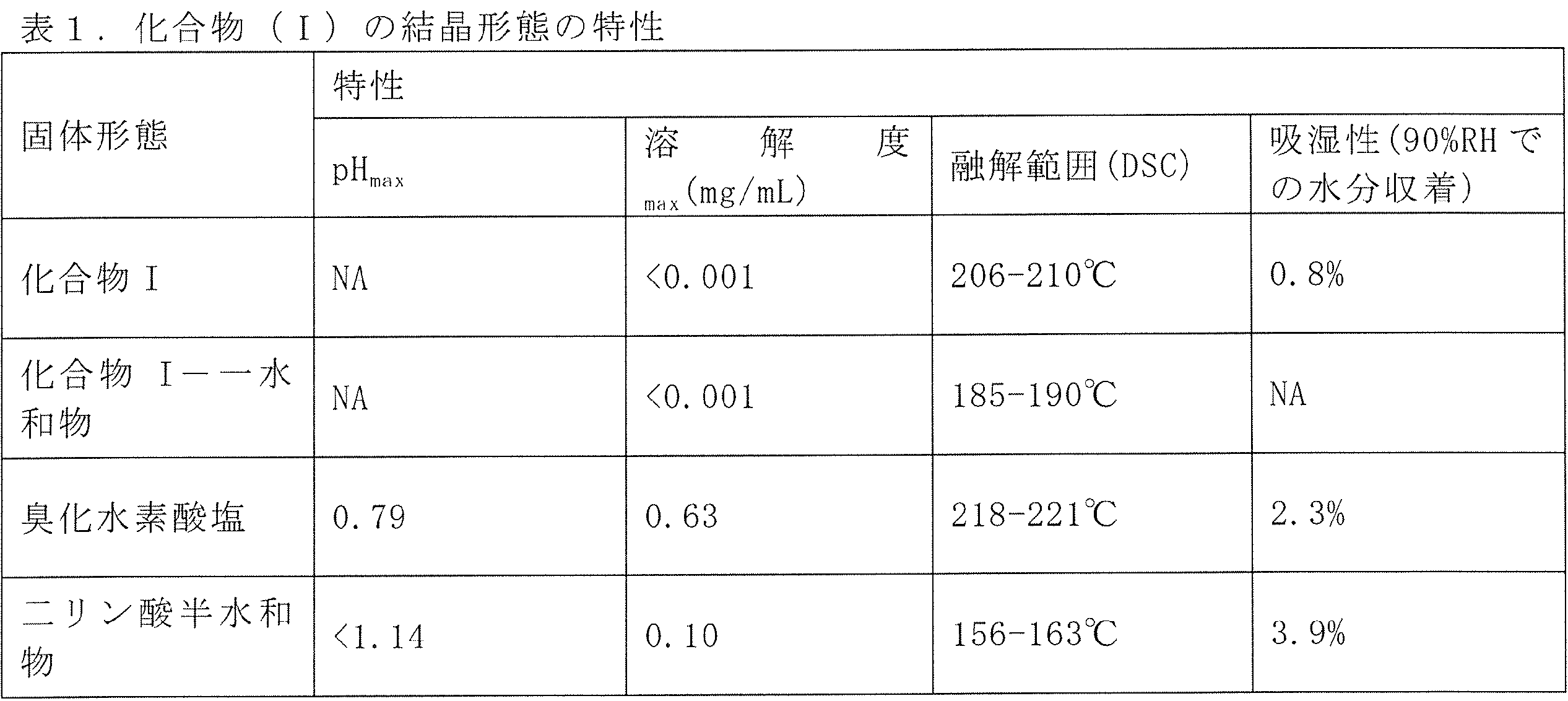
実施例2:1:2化合物(I)/リン酸の共結晶の調製
方法A:化合物(I)(605.5mg、1当量)をアセトン(14mL)中でスラリー化した。スラリーを室温で5分間撹拌し均質化させた。次に、H3PO4(459.46mg、4当量)のアセトン溶液(6mL)を迅速に添加した。黄色ゲルが得られ、混合物を室温で撹拌しながら2日間維持した。沈殿物をその後濾過し、アセトン(20mL)で洗浄し、4℃/10mbarで乾燥させた。得られた固体をさらに、TGA、XRPD、DSC、1H NMR、固体15N NMR、IR、Raman、および単結晶X線結晶解析により二リン酸半水和物として特徴付けた。
Example 2 Preparation of 1:2 Compound (I)/Phosphoric Acid Co-Crystal Method A: Compound (I) (605.5 mg, 1 eq) was slurried in acetone (14 mL). The slurry was stirred and homogenized for 5 minutes at room temperature. An acetone solution (6 mL) of H 3 PO 4 (459.46 mg, 4 eq) was then added rapidly. A yellow gel was obtained and the mixture was kept at room temperature with stirring for 2 days. The precipitate was then filtered, washed with acetone (20 mL) and dried at 4° C./10 mbar. The resulting solid was further characterized as diphosphate hemihydrate by TGA, XRPD, DSC, 1 H NMR, solid state 15 N NMR, IR, Raman, and single crystal X-ray crystallography.
方法B:H3PO4(494.7g、4当量)のMeOH/THF(10.5ml、1:1v/v)溶液を、化合物(I)(506.88mg、1当量)を含むバイアルに添加した。得られた混合物を、黄色溶液が得られるまで室温で撹拌した。溶液を、50℃および大気圧で、ボルテックスの助けにより撹拌しながら蒸発させた。黄色ゲルが得られ、アセトンをそれから添加し(15mL)、室温で1日間ボルテックスさせた。スラリーをさらに3日間撹拌させた。結晶固体をそれから濾過し、さらに、方法Aで得られた材料と結晶形が同一であるとして特徴付けた。 Method B: Add a solution of H3PO4 (494.7 g, 4 eq) in MeOH/THF (10.5 ml, 1:1 v / v) to a vial containing compound (I) (506.88 mg, 1 eq). bottom. The resulting mixture was stirred at room temperature until a yellow solution was obtained. The solution was evaporated at 50° C. and atmospheric pressure while stirring with the aid of a vortex. A yellow gel was obtained and acetone was then added (15 mL) and vortexed at room temperature for 1 day. The slurry was allowed to stir for an additional 3 days. The crystalline solid was then filtered and further characterized as identical in crystalline form to the material obtained in Method A.
1H NMR(400MHz、CD3OD)δ8.53-8.58(m、1H)、8.46-8.50(m、1H)、8.36(s、1H)、7.80-7.86(m、1H)、7.72-7.76(m、1H)、7.55-7.61(m、2H)、7.18(d、J=8.0Hz、1H)、5.92(s、1H)、3.52(d、J=6.8Hz、2H)、2.77-2.86(m、1H)、2.28-2.38(m、1H)、2.25(s、3H)、2.18-2.24(m、2H)、1.88-1.99(m、2H)、1.37(s、3H)、0.75-0.84(m、2H)、0.54-0.64(m、2H)。
化合物(I)のリン酸複合体の単結晶X線結晶解析データは、各単位格子は2つの化合物(I)の分子、4つのリン酸の分子および1つの水の分子を含むことを示す。複合体内の水素結合は全て2.5-2.9Åであり、リン酸プロトンとピリジン環の塩基性窒素の間で観察されるイオン性はないことが示される。この結果は固体15N-NMRからの観察と一致する。まとめると、これらの結果により共結晶複合体としての化合物(I)二リン酸半水和物の形態が確認される。化合物(I)二リン酸半水和物についての結晶学的データは表3に提示される。ORTEP表示は図4に提示される。

固体15N-NMR分析を化合物(I)遊離塩基および化合物(I)二リン酸半水和物に対して実施した。重ね合わせたスペクトルが図3に提示される。遊離塩基と比較した、リン酸化合物におけるピリジン窒素ピークのシフトおよび相対強度は、原子間の相互作用の性質が水素結合であり、イオン性を有さないことを示す。ピリジル窒素へのプロトン移動は認められず、よってリン酸塩が共結晶であることが確認された。 Solid state 15 N-NMR analysis was performed on Compound (I) free base and Compound (I) diphosphate hemihydrate. The overlaid spectra are presented in FIG. The shift and relative intensity of the pyridine nitrogen peak in the phosphate compound compared to the free base indicates that the interaction between atoms is hydrogen bonding in nature and has no ionic character. No proton transfer to the pyridyl nitrogen was observed, thus confirming that the phosphate is a co-crystal.
化合物(I)二リン酸半水和物もまた、表4で示される条件を使用して、化合物(I)およびH3PO4のアモルファスまたは半結晶共結晶の結晶化により生成させることができる。あるいは、ゲルを少量の固体と共により大きなガラス表面上に堆積させ、それをスパチュラでこすることにより、粘性ゲルの結晶化を誘導して化合物(I)二リン酸半水和物を得ることができる。また、ゲルは超音波処理により結晶化させることができる。

実施例3:アモルファス1:2化合物(I)/リン酸の調製
MeOH/THF(9.7mL、1:1V/V)の混合物に、ガラスバイアル中、室温で化合物(I)(500mg、1当量)を添加した。H3PO4(238mg、2当量)をそれから添加し、得られた混合物を室温で2時間の間撹拌した。溶液は変色したが、沈殿は生じなかった。透明溶液をそれから、1日間5℃で、それから1日間-20℃で放置させた。固体は得られなかった。溶媒をその後、30℃/10mbarで除去し、得られた固体をXRPDにより分析し、アモルファス固体であることが示された。1H NMR(400MHz、CD3OD)δ8.53-8.58(m、1H)、8.46-8.50(m、1H)、8.36(s、1H)、7.80-7.86(m、1H)、7.72-7.76(m、1H)、7.55-7.61(m、2H)、7.18(d、J=8.0Hz、1H)、5.92(s、1H)、3.52(d、J=6.8Hz、2H)、2.77-2.86(m、1H)、2.28-2.38(m、1H)、2.25(s、3H)、2.18-2.24(m、2H)、1.88-1.99(m、2H)、1.37(s、3H)、0.75-0.84(m、2H)、0.54-0.64(m、2H)。
Example 3 Preparation of Amorphous 1:2 Compound (I)/Phosphoric Acid To a mixture of MeOH/THF (9.7 mL, 1:1 V/V) was added Compound (I) (500 mg, 1 equivalent) in a glass vial at room temperature. ) was added. H 3 PO 4 (238 mg, 2 eq) was then added and the resulting mixture was stirred at room temperature for 2 hours. The solution changed color, but no precipitation occurred. The clear solution was then allowed to stand at 5°C for 1 day and then at -20°C for 1 day. No solid was obtained. The solvent was then removed at 30° C./10 mbar and the resulting solid was analyzed by XRPD and shown to be an amorphous solid. 1 H NMR (400 MHz, CD 3 OD) δ 8.53-8.58 (m, 1H), 8.46-8.50 (m, 1H), 8.36 (s, 1H), 7.80-7 .86 (m, 1H), 7.72-7.76 (m, 1H), 7.55-7.61 (m, 2H), 7.18 (d, J=8.0Hz, 1H), 5 .92 (s, 1H), 3.52 (d, J=6.8Hz, 2H), 2.77-2.86 (m, 1H), 2.28-2.38 (m, 1H), 2 .25 (s, 3H), 2.18-2.24 (m, 2H), 1.88-1.99 (m, 2H), 1.37 (s, 3H), 0.75-0.84 (m, 2H), 0.54-0.64 (m, 2H).
アモルファス材料は、化合物(I)を1,4-ジオキサンに溶解し、酢酸エチルまたはアセトンをアンチソルベントとして添加することにより、または化合物(I)を1-エトキシエタノールに溶解し、酢酸エチルをアンチソルベントとして添加することにより得ることもできる。 Amorphous materials can be prepared by dissolving compound (I) in 1,4-dioxane and adding ethyl acetate or acetone as antisolvent, or by dissolving compound (I) in 1-ethoxyethanol and adding ethyl acetate as antisolvent. It can also be obtained by adding as
実施例4:1:1化合物(I)/HBr結晶塩の調製
1-ブタノールおよびMEK(60mL、1:1V/V)の混合物に化合物(I)(502mg、1当量)を添加した。スラリーを60℃で加熱し、HBr(1-ブタノールおよびMEK中4.8%溶液(2.5mL、2当量)を添加した。混合物を60℃で2時間の間、それから5℃で一晩撹拌した。それから、固体を濾過により回収し、ジエチルエーテルで洗浄し、XRPD、TGA、IR、RamanおよびDSCにより臭化水素酸塩として特徴付けた。

実施例5:薬物動態分析
方法:
各形態の1回経口、カプセル中粉末用量を、3(n=3)匹の雌スプラーグドーリーラットおよび3匹の雄ビーグル犬(n=3)に5mg有効活性成分/kg体重で投与した。血漿をその後、LC/MSにより化合物血漿レベルについて分析した。
Example 5: Pharmacokinetic analysis method:
A single oral, powder-in-capsule dose of each form was administered to 3 (n=3) female Sprague-Dawley rats and 3 male beagle dogs (n=3) at 5 mg active ingredient/kg body weight. Plasma was then analyzed for compound plasma levels by LC/MS.
ラットおよびイヌにおけるカプセル投与のための被験物質の調製:
化合物を乳鉢と乳棒を用いて粉砕し、注意深く、化学天秤で風袋の重さを量ったゼラチンカプセル中に分注した。所望の化合物質量が達成されるまでロードし続けた。サイズ9カプセルをラット投与に使用し、サイズ3カプセルをイヌに使用した。注:化合物ロードは各形態の生物学的同等性比に対して補正した。
Preparation of test article for capsule administration in rats and dogs:
Compounds were ground using a mortar and pestle and carefully dispensed into gelatin capsules that were tared on an analytical balance. Loading continued until the desired compound mass was achieved. Size 9 capsules were used for rat administration and size 3 capsules were used for dogs. Note: Compound loading was corrected for the bioequivalence ratio of each form.
経口投与後、血液を外側伏在静脈からリチウムヘパリンコートチューブ(ラット)またはK2EDTAコートチューブ(イヌ)中に、指定された時間点で引き出した。血漿を収集し、-80℃で分析まで凍結保存した。 After oral administration, blood was drawn from the lateral saphenous vein into lithium heparin-coated tubes (rats) or K 2 EDTA-coated tubes (dogs) at the indicated time points. Plasma was collected and stored frozen at -80°C until analysis.
ラット血漿分析:
血漿試料(20μL)および添加済み血漿標準試料を、100ng/mLベラパミルを内部標準として含む氷冷アセトニトリルで5倍希釈した。試料および標準を、96ウェルフォーマットで0.22μmメンブランに通して濾過した。濾液をその後、水~30%アセトニトリルで希釈した。
Rat plasma analysis:
Plasma samples (20 μL) and spiked plasma standards were diluted 5-fold with ice-cold acetonitrile containing 100 ng/mL verapamil as an internal standard. Samples and standards were filtered through 0.22 μm membranes in 96-well format. The filtrate was then diluted with water to 30% acetonitrile.
10μLの各試料および標準をWaters Acquity CSH1.7μm 2.1×100mmカラムに0.6mL/分でAcquity UPLCにより注入した。C18カラムを5%アセトニトリルを含む水で平衡化させた。化合物を99%アセトニトリルまでの勾配を用いて溶離させた。移動相は全て0.1%(v/v)ギ酸を含んだ。

カラム溶離液をエレクトロスプレーイオン化タンデム四重極型質量分析システム(ESI-MS/MS、Waters Xevo TQ)により分析した。溶離液組成を内部標準に特異的な3つのイオン対および分析物に特異的な3つのイオン対に対して分析した。実験試料を検量線試料と比較し、化合物濃度を決定した。薬物動態パラメータをExcelプラグイン「PKfit」を用いて決定した。 The column eluate was analyzed by an electrospray ionization tandem quadrupole mass spectrometry system (ESI-MS/MS, Waters Xevo TQ). The eluent composition was analyzed for 3 ion pairs specific to the internal standard and 3 ion pairs specific to the analyte. Experimental samples were compared to standard curve samples to determine compound concentrations. Pharmacokinetic parameters were determined using the Excel plugin 'PKfit'.
イヌ血漿分析:
血漿試料(20μL)および添加済み血漿標準試料を、内部標準として40ng/mLジクロフェナクを含む氷冷アセトニトリルで11倍希釈した。混合物を2分間ボルテックスし、遠心分離した。0.5μL上清をWaters Acquity BEH1.7μm 2.1×50mmカラムに0.6mL/分で、Acquity UPLCにより注入した。カラムを10%メタノールを含む水で平衡化させた。化合物を95%メタノールまでの勾配を用いて溶離させた。移動相は0.025%(v/v)ギ酸および1mM NH4OAcを含んだ。

Plasma samples (20 μL) and spiked plasma standards were diluted 11-fold with ice-cold acetonitrile containing 40 ng/mL diclofenac as an internal standard. The mixture was vortexed for 2 minutes and centrifuged. 0.5 μL supernatant was injected onto a Waters Acquity BEH 1.7 μm 2.1×50 mm column at 0.6 mL/min by Acquity UPLC. The column was equilibrated with water containing 10% methanol. Compounds were eluted using a gradient to 95% methanol. Mobile phase contained 0.025% (v/v) formic acid and 1 mM NH4OAc .
カラム溶離液をエレクトロスプレーイオン化タンデム四重極型質量分析システム(ESI-MS/MS、API-6500)により分析した。溶離液組成を内部標準に特異的な1つのイオン対および分析物に特異的な1つのイオン対に対して分析した。実験試料を検量線試料と比較し、化合物濃度を決定した。薬物動態パラメータをWinNonlin Professional6.2を用いて決定した。 The column eluate was analyzed by an electrospray ionization tandem quadrupole mass spectrometry system (ESI-MS/MS, API-6500). Eluent composition was analyzed for one ion pair specific to the internal standard and one ion pair specific to the analyte. Experimental samples were compared to standard curve samples to determine compound concentrations. Pharmacokinetic parameters were determined using WinNonlin Professional 6.2.
化合物(I)の共結晶二リン酸半水和物および臭化水素酸塩は、遊離塩基に比べて優れた薬物動態を示す。化合物をカプセル中の粉末として、スプラーグドーリーラットおよびビーグル犬に経口投与した。表6に示されるように、化合物(I)の二リン酸半水和物共結晶および結晶性臭化水素酸塩は、遊離塩基化合物(I)に比べて増加した血漿濃度を示す。

本発明の態様として以下のものが挙げられる。
[1]化合物(I)および共形成剤分子の共結晶

または前記共結晶の溶媒和物であって、前記共形成剤分子はリン酸である、共結晶またはその溶媒和物。
[2]前記共結晶中の化合物(I):リン酸のモル比は1:2である、[1]記載の共結晶。
[3]前記共結晶は水和物である、[1]または[2]記載の共結晶。
[4]前記共結晶中の化合物(I):リン酸:H2Oのモル比は1:2:1/2である、[1]~[3]のいずれか一項記載の共結晶。
[5]前記共結晶は、2θにおける7.6°、12.0°、20.3°、23.5°、および24.5°±0.2のX線粉末回折パターンピークのうち、任意の3つ、4つまたは5つにより特徴付けられる、[1]~[4]のいずれか一項記載の共結晶。
[6]前記共結晶は、2θにおける7.6°、11.1°、12.0°、15.4°、17.5°、19.8°、20.0°、20.3°、21.2°、23.5°、23.6°、および24.5°±0.2のX線粉末回折パターンピークのうち、任意の3つ、4つ、5つ、6つ、7つ、8つ、9つ、10、または11により特徴付けられる、[1]~[4]のいずれか一項記載の共結晶。
[7]前記共結晶は、2θにおける7.6°、11.1°、12.0°、15.4°、17.5°、19.8°、20.0°、20.3°、21.2°、23.5°、23.6°、および24.5°±0.2のX線粉末回折パターンピークにより特徴付けられる、[1]~[4]のいずれか一項記載の共結晶。
[8]前記共結晶は、図1にて示されるX線粉末回折パターンにより特徴付けられる、[1]~[4]のいずれか一項記載の共結晶。
[9]前記共結晶は、160±4℃の示差走査熱量計(DSC)ピーク相転移温度により特徴付けられる、[1]~[8]のいずれか一項記載の共結晶。
[10]水素結合がリン酸の水素と化合物(I)のピリジン環の窒素原子との間で形成され、前記水素結合は2.5~2.9Åの距離を有する、[1]~[9]のいずれか一項記載の共結晶。
[11]前記共結晶は-122.5±2ppmの15N-固体核磁気共鳴分光法(15N-ssNMR)ピークにより特徴付けられ、-122.5ppmのピークの強度は、-302ppmのピークよりも少なくとも40-70%小さい、[1]~[10]のいずれか一項記載の共結晶。
[12][1]~[11]のいずれか一項記載の共結晶、および薬学的に許容される担体または希釈剤を含む、医薬組成物。
[13]下記構造式により表される化合物(I)の臭化水素酸塩:

またはその溶媒和物であって、化合物(I)と臭化水素酸との間のモル比は1:1である、臭化水素酸塩またはその溶媒和物。
[14]前記塩は非溶媒和形態である、[13]記載の臭化水素酸塩。
[15]前記臭化水素酸塩は結晶性である、[13]または[14]記載の臭化水素酸塩。
[16]前記結晶性臭化水素酸塩は、2θにおける5.9°、11.9°、21.6°、および22.0°±0.2のX線粉末回折パターンピークの3つまたは4つにより特徴付けられる、[15]記載の臭化水素酸塩。
[17]前記結晶性臭化水素酸塩は、2θにおける5.9°、10.0°、11.9°、13.8°、17.3°、19.4°、21.3°、21.6°、および22.0°±0.2のX線粉末回折パターンピークのうち、任意の3つ、4つ、5つ、6つ、7つ、または8つにより特徴付けられる、[15]記載の臭化水素酸塩。
[18]前記結晶性臭化水素酸塩は、2θにおける5.9°、10.0°、11.9°、13.8°、17.3°、19.4°、21.3°、21.6°、および22.0°±0.2のX線粉末回折パターンピークにより特徴付けられる、[15]記載の臭化水素酸塩。
[19]前記臭化水素酸塩は、図7に示されるX線粉末回折パターンピークにより特徴付けられる、[15]~[18]のいずれか一項記載の臭化水素酸塩。
[20]前記臭化水素酸塩は221±2℃の示差走査熱量計(DSC)ピーク相転移温度により特徴付けられる、[13]~[19]のいずれか一項記載の臭化水素酸塩。
[21][13]~[20]のいずれか一項記載の臭化水素酸塩、および薬学的に許容される担体または希釈剤を含む、医薬組成物。
[22][1]記載の化合物(I)およびリン酸の共結晶を調製する方法であって、好適な溶媒中のリン酸および化合物(I)の懸濁液を混合すること、ならびに前記溶媒を除去することを含む、方法。
[23]化合物(I)とリン酸との間のモル比が1:2~1:8である、[22]記載の方法。
[24]前記溶媒はアセトン、ジエチルエーテル、MeOH/THF、酢酸および1,4-ジオキサンである、[22]または[23]記載の方法。
[25]前記溶媒はTHF/MeOHであり、前記2つの溶媒間の比は3:2~2:3(V:V)である、[22]記載の方法。
[26]被験体に、有効量の、[1]~[11]のいずれか一項記載の共結晶、または有効量の、[13]~[20]のいずれか一項記載の臭化水素酸塩を投与することを含む、癌を有する被験体を治療する方法。
[27]前記癌は膵臓癌、前立腺癌、肺癌、メラノーマ、乳癌、結腸癌、または卵巣癌である、[26]記載の方法。
[28]前記癌は肺癌、乳癌および結腸癌である、[27]記載の方法。
[29]前記癌は乳癌である、[28]記載の方法。
Embodiments of the present invention include the following.
[1] Co-crystal of compound (I) and co-former molecule
or a solvate of said co-crystal, wherein said co-former molecule is phosphoric acid.
[2] The co-crystal according to [1], wherein the molar ratio of compound (I):phosphoric acid in the co-crystal is 1:2.
[3] The co-crystal according to [1] or [2], wherein the co-crystal is a hydrate.
[4] The co-crystal according to any one of [1] to [3], wherein the molar ratio of compound (I):phosphoric acid:H 2 O in the co-crystal is 1:2:1/2.
[5] The co-crystal is any of X-ray powder diffraction pattern peaks of 7.6°, 12.0°, 20.3°, 23.5°, and 24.5° ± 0.2 in 2θ The co-crystal according to any one of [1] to [4], characterized by three, four or five of
[6] The co-crystal is 7.6°, 11.1°, 12.0°, 15.4°, 17.5°, 19.8°, 20.0°, 20.3°, Any 3, 4, 5, 6, 7 of the X-ray powder diffraction pattern peaks at 21.2°, 23.5°, 23.6°, and 24.5° ± 0.2 , 8, 9, 10, or 11. The co-crystal of any one of [1]-[4].
[7] The co-crystal is 7.6°, 11.1°, 12.0°, 15.4°, 17.5°, 19.8°, 20.0°, 20.3°, Characterized by X-ray powder diffraction pattern peaks at 21.2°, 23.5°, 23.6°, and 24.5° ± 0.2, according to any one of [1] to [4] Co-crystal.
[8] The co-crystal according to any one of [1] to [4], characterized by the X-ray powder diffraction pattern shown in FIG.
[9] The co-crystal of any one of [1]-[8], wherein the co-crystal is characterized by a differential scanning calorimeter (DSC) peak phase transition temperature of 160±4°C.
[10] A hydrogen bond is formed between the hydrogen of the phosphate and the nitrogen atom of the pyridine ring of compound (I), said hydrogen bond having a distance of 2.5-2.9 Å, [1]-[9 ] The co-crystal according to any one of the above.
[11] The co-crystal is characterized by a 15 N-solid-state nuclear magnetic resonance spectroscopy ( 15 N-ssNMR) peak at −122.5±2 ppm, the intensity of the −122.5 ppm peak being less than the −302 ppm peak. is at least 40-70% smaller.
[12] A pharmaceutical composition comprising the co-crystal of any one of [1] to [11] and a pharmaceutically acceptable carrier or diluent.
[13] Hydrobromide of compound (I) represented by the following structural formula:
or a solvate thereof, wherein the molar ratio between compound (I) and hydrobromic acid is 1:1.
[14] The hydrobromide of [13], wherein the salt is in unsolvated form.
[15] The hydrobromide according to [13] or [14], wherein the hydrobromide is crystalline.
[16] The crystalline hydrobromide has three X-ray powder diffraction pattern peaks at 5.9°, 11.9°, 21.6°, and 22.0° ± 0.2 in 2-theta, or The hydrobromide according to [15] characterized by four.
[17] The crystalline hydrobromide is 5.9°, 10.0°, 11.9°, 13.8°, 17.3°, 19.4°, 21.3°, [ 15] hydrobromide according to.
[18] The crystalline hydrobromide is 5.9°, 10.0°, 11.9°, 13.8°, 17.3°, 19.4°, 21.3°, The hydrobromide salt of [15], characterized by X-ray powder diffraction pattern peaks at 21.6° and 22.0°±0.2.
[19] The hydrobromide according to any one of [15] to [18], characterized by the X-ray powder diffraction pattern peaks shown in FIG.
[20] The hydrobromide of any one of [13] to [19], wherein the hydrobromide is characterized by a differential scanning calorimeter (DSC) peak phase transition temperature of 221±2°C. .
[21] A pharmaceutical composition comprising the hydrobromide salt of any one of [13] to [20] and a pharmaceutically acceptable carrier or diluent.
[22] A method of preparing a co-crystal of compound (I) and phosphoric acid of [1], comprising mixing a suspension of phosphoric acid and compound (I) in a suitable solvent, and A method comprising removing a
[23] The method of [22], wherein the molar ratio between compound (I) and phosphoric acid is from 1:2 to 1:8.
[24] The method of [22] or [23], wherein the solvent is acetone, diethyl ether, MeOH/THF, acetic acid and 1,4-dioxane.
[25] The method of [22], wherein the solvent is THF/MeOH and the ratio between the two solvents is 3:2 to 2:3 (V:V).
[26] An effective amount of the co-crystal of any one of [1] to [11] or an effective amount of hydrogen bromide of any one of [13] to [20] is applied to the subject A method of treating a subject with cancer comprising administering an acid salt.
[27] The method of [26], wherein the cancer is pancreatic cancer, prostate cancer, lung cancer, melanoma, breast cancer, colon cancer, or ovarian cancer.
[28] The method of [27], wherein the cancer is lung cancer, breast cancer and colon cancer.
[29] The method of [28], wherein the cancer is breast cancer.
Claims (11)

またはその溶媒和物であって、化合物(I)と臭化水素酸との間のモル比は1:1である、臭化水素酸塩またはその溶媒和物。 Hydrobromide of compound (I) represented by the following structural formula:
or a solvate thereof, wherein the molar ratio between compound (I) and hydrobromic acid is 1:1.
Applications Claiming Priority (3)
| Application Number | Priority Date | Filing Date | Title |
|---|---|---|---|
| US201662363424P | 2016-07-18 | 2016-07-18 | |
| US62/363,424 | 2016-07-18 | ||
| JP2019501928A JP6961675B2 (en) | 2016-07-18 | 2017-07-13 | Solid form of TTK inhibitor |
Related Parent Applications (1)
| Application Number | Title | Priority Date | Filing Date |
|---|---|---|---|
| JP2019501928A Division JP6961675B2 (en) | 2016-07-18 | 2017-07-13 | Solid form of TTK inhibitor |
Publications (2)
| Publication Number | Publication Date |
|---|---|
| JP2022001598A JP2022001598A (en) | 2022-01-06 |
| JP7263473B2 true JP7263473B2 (en) | 2023-04-24 |
Family
ID=60991755
Family Applications (2)
| Application Number | Title | Priority Date | Filing Date |
|---|---|---|---|
| JP2019501928A Active JP6961675B2 (en) | 2016-07-18 | 2017-07-13 | Solid form of TTK inhibitor |
| JP2021167806A Active JP7263473B2 (en) | 2016-07-18 | 2021-10-13 | Solid forms of TTK inhibitors |
Family Applications Before (1)
| Application Number | Title | Priority Date | Filing Date |
|---|---|---|---|
| JP2019501928A Active JP6961675B2 (en) | 2016-07-18 | 2017-07-13 | Solid form of TTK inhibitor |
Country Status (25)
| Country | Link |
|---|---|
| US (3) | US10584130B2 (en) |
| EP (1) | EP3484888B1 (en) |
| JP (2) | JP6961675B2 (en) |
| KR (2) | KR102537088B1 (en) |
| CN (2) | CN115093416B (en) |
| AU (2) | AU2017299850B2 (en) |
| BR (1) | BR112019000813A2 (en) |
| DK (1) | DK3484888T3 (en) |
| ES (1) | ES2945108T3 (en) |
| FI (1) | FI3484888T5 (en) |
| HR (1) | HRP20230481T1 (en) |
| HU (1) | HUE061872T2 (en) |
| IL (1) | IL264173B2 (en) |
| LT (1) | LT3484888T (en) |
| MA (1) | MA45691A (en) |
| MX (2) | MX385289B (en) |
| PL (1) | PL3484888T3 (en) |
| PT (1) | PT3484888T (en) |
| RS (1) | RS64210B1 (en) |
| RU (2) | RU2753905C2 (en) |
| SG (2) | SG10202103332UA (en) |
| SI (1) | SI3484888T1 (en) |
| SM (1) | SMT202300156T1 (en) |
| TW (2) | TWI824313B (en) |
| WO (1) | WO2018014116A1 (en) |
Families Citing this family (2)
| Publication number | Priority date | Publication date | Assignee | Title |
|---|---|---|---|---|
| PL3484888T3 (en) | 2016-07-18 | 2023-06-26 | University Health Network | Solid forms of TTK inhibitor |
| KR20240175121A (en) | 2023-06-12 | 2024-12-19 | 한국재료연구원 | Method for manufacturing grain boundary diffusion material using rare earth oxides and method for manufacturing R-Fe-B permanent magnet using the same |
Citations (1)
| Publication number | Priority date | Publication date | Assignee | Title |
|---|---|---|---|---|
| WO2015070349A1 (en) | 2012-11-16 | 2015-05-21 | University Health Network | Pyrazolopyrimidine compounds |
Family Cites Families (7)
| Publication number | Priority date | Publication date | Assignee | Title |
|---|---|---|---|---|
| KR100876327B1 (en) | 2001-02-21 | 2008-12-31 | 노바티스 백신즈 앤드 다이아그노스틱스 인코포레이티드 | TV as a therapeutic target in diagnosis and in cancer |
| PT1812440E (en) * | 2004-11-04 | 2011-01-25 | Vertex Pharma | Pyrazolo[1,5-a]pyrimidines useful as inhibitors of protein kinases |
| TW201107329A (en) * | 2009-07-30 | 2011-03-01 | Oncotherapy Science Inc | Fused imidazole derivative having ttk inhibitory action |
| TWI541243B (en) * | 2010-09-10 | 2016-07-11 | 拜耳知識產權公司 | Substituted imidazopyridazines |
| JP2014503521A (en) * | 2010-12-17 | 2014-02-13 | バイエル・インテレクチュアル・プロパティ・ゲゼルシャフト・ミット・ベシュレンクテル・ハフツング | Imidazopyrazines for use as MPS-1 and TKK inhibitors in the treatment of hyperproliferative disorders |
| EA029372B1 (en) * | 2013-11-15 | 2018-03-30 | Юниверсити Хелс Нетуорк | Pyrazolopyrimidine compounds |
| PL3484888T3 (en) | 2016-07-18 | 2023-06-26 | University Health Network | Solid forms of TTK inhibitor |
-
2017
- 2017-07-13 PL PL17830139.6T patent/PL3484888T3/en unknown
- 2017-07-13 SI SI201731352T patent/SI3484888T1/en unknown
- 2017-07-13 CN CN202210644487.1A patent/CN115093416B/en active Active
- 2017-07-13 DK DK17830139.6T patent/DK3484888T3/en active
- 2017-07-13 RS RS20230383A patent/RS64210B1/en unknown
- 2017-07-13 SG SG10202103332UA patent/SG10202103332UA/en unknown
- 2017-07-13 LT LTEPPCT/CA2017/050848T patent/LT3484888T/en unknown
- 2017-07-13 KR KR1020197001829A patent/KR102537088B1/en active Active
- 2017-07-13 FI FIEP17830139.6T patent/FI3484888T5/en active
- 2017-07-13 MA MA045691A patent/MA45691A/en unknown
- 2017-07-13 PT PT178301396T patent/PT3484888T/en unknown
- 2017-07-13 KR KR1020237017039A patent/KR102700233B1/en active Active
- 2017-07-13 RU RU2019101109A patent/RU2753905C2/en active
- 2017-07-13 HR HRP20230481TT patent/HRP20230481T1/en unknown
- 2017-07-13 HU HUE17830139A patent/HUE061872T2/en unknown
- 2017-07-13 JP JP2019501928A patent/JP6961675B2/en active Active
- 2017-07-13 RU RU2021124795A patent/RU2021124795A/en unknown
- 2017-07-13 BR BR112019000813-6A patent/BR112019000813A2/en active Search and Examination
- 2017-07-13 SG SG11201900113UA patent/SG11201900113UA/en unknown
- 2017-07-13 MX MX2019000744A patent/MX385289B/en unknown
- 2017-07-13 ES ES17830139T patent/ES2945108T3/en active Active
- 2017-07-13 AU AU2017299850A patent/AU2017299850B2/en active Active
- 2017-07-13 IL IL264173A patent/IL264173B2/en unknown
- 2017-07-13 SM SM20230156T patent/SMT202300156T1/en unknown
- 2017-07-13 WO PCT/CA2017/050848 patent/WO2018014116A1/en not_active Ceased
- 2017-07-13 EP EP17830139.6A patent/EP3484888B1/en active Active
- 2017-07-13 CN CN201780043473.1A patent/CN109476667B/en active Active
- 2017-07-13 US US16/318,426 patent/US10584130B2/en active Active
- 2017-07-18 TW TW110137560A patent/TWI824313B/en active
- 2017-07-18 TW TW106123975A patent/TWI745400B/en active
-
2019
- 2019-01-17 MX MX2021008658A patent/MX2021008658A/en unknown
-
2020
- 2020-03-02 US US16/806,392 patent/US11104681B2/en active Active
-
2021
- 2021-08-24 AU AU2021221447A patent/AU2021221447B2/en active Active
- 2021-08-27 US US17/459,725 patent/US11878980B2/en active Active
- 2021-10-13 JP JP2021167806A patent/JP7263473B2/en active Active
Patent Citations (1)
| Publication number | Priority date | Publication date | Assignee | Title |
|---|---|---|---|---|
| WO2015070349A1 (en) | 2012-11-16 | 2015-05-21 | University Health Network | Pyrazolopyrimidine compounds |
Non-Patent Citations (3)
| Title |
|---|
| 平山令明,有機化合物結晶作製ハンドブック,2008年,pp. 17-23,37-40,45-51,57-65 |
| 長瀬博監訳,最新 創薬化学 下巻,株式会社テクノミック,1999年09月25日,pp. 347-365 |
| 高田則幸,創薬段階における原薬Formスクリーニングと選択,PHARM STAGE,Vol.6, No.10,2007年01月15日,p.20-25 |
Also Published As
Similar Documents
| Publication | Publication Date | Title |
|---|---|---|
| CN108349891B (en) | Crystalline L-Arginine Salts of Compounds for S1P1 Receptor Related Disorders | |
| AU2014336929B2 (en) | Salt and crystal forms of PLK-4 inhibitor | |
| JP7263473B2 (en) | Solid forms of TTK inhibitors | |
| AU2014336929A1 (en) | Salt and crystal forms of PLK-4 inhibitor | |
| CA3030230C (en) | Solid forms of ttk inhibitor | |
| TWI862582B (en) | Crystal form of plk4 inhibitor | |
| HK40007702B (en) | Solid forms of ttk inhibitor | |
| HK40007702A (en) | Solid forms of ttk inhibitor | |
| KR20230061431A (en) | Co-crystals of adenosine A2B receptor antagonists | |
| NZ790209A (en) | Solid forms of ttk inhibitor | |
| TW202327593A (en) | Polymorph of kras inhibitor and preparation method for polymorph and use thereof | |
| AU2016315396A1 (en) | 1-(4-(2-((1-(3,4-difluorophenyl)-1 H-pyrazol-3-yl)methoxy)ethyl)piperazin-1-yl)ethanone salts | |
| WO2025137366A2 (en) | Solid-state forms of stat3 inhibitors and methods of use thereof |
Legal Events
| Date | Code | Title | Description |
|---|---|---|---|
| A621 | Written request for application examination |
Free format text: JAPANESE INTERMEDIATE CODE: A621 Effective date: 20211015 |
|
| A131 | Notification of reasons for refusal |
Free format text: JAPANESE INTERMEDIATE CODE: A131 Effective date: 20221003 |
|
| A521 | Request for written amendment filed |
Free format text: JAPANESE INTERMEDIATE CODE: A523 Effective date: 20221229 |
|
| TRDD | Decision of grant or rejection written | ||
| A01 | Written decision to grant a patent or to grant a registration (utility model) |
Free format text: JAPANESE INTERMEDIATE CODE: A01 Effective date: 20230404 |
|
| A61 | First payment of annual fees (during grant procedure) |
Free format text: JAPANESE INTERMEDIATE CODE: A61 Effective date: 20230412 |
|
| R150 | Certificate of patent or registration of utility model |
Ref document number: 7263473 Country of ref document: JP Free format text: JAPANESE INTERMEDIATE CODE: R150 |