JP7369741B2 - Novel PAENIBACILLUS strains, antifungal compounds, and methods for their use - Google Patents
Novel PAENIBACILLUS strains, antifungal compounds, and methods for their use Download PDFInfo
- Publication number
- JP7369741B2 JP7369741B2 JP2021117799A JP2021117799A JP7369741B2 JP 7369741 B2 JP7369741 B2 JP 7369741B2 JP 2021117799 A JP2021117799 A JP 2021117799A JP 2021117799 A JP2021117799 A JP 2021117799A JP 7369741 B2 JP7369741 B2 JP 7369741B2
- Authority
- JP
- Japan
- Prior art keywords
- paenibacillus
- fusaricidin
- plant
- nrrl
- strain
- Prior art date
- Legal status (The legal status is an assumption and is not a legal conclusion. Google has not performed a legal analysis and makes no representation as to the accuracy of the status listed.)
- Active
Links
Images







Classifications
-
- C—CHEMISTRY; METALLURGY
- C12—BIOCHEMISTRY; BEER; SPIRITS; WINE; VINEGAR; MICROBIOLOGY; ENZYMOLOGY; MUTATION OR GENETIC ENGINEERING
- C12N—MICROORGANISMS OR ENZYMES; COMPOSITIONS THEREOF; PROPAGATING, PRESERVING, OR MAINTAINING MICROORGANISMS; MUTATION OR GENETIC ENGINEERING; CULTURE MEDIA
- C12N1/00—Microorganisms; Compositions thereof; Processes of propagating, maintaining or preserving microorganisms or compositions thereof; Processes of preparing or isolating a composition containing a microorganism; Culture media therefor
- C12N1/20—Bacteria; Culture media therefor
-
- A—HUMAN NECESSITIES
- A01—AGRICULTURE; FORESTRY; ANIMAL HUSBANDRY; HUNTING; TRAPPING; FISHING
- A01N—PRESERVATION OF BODIES OF HUMANS OR ANIMALS OR PLANTS OR PARTS THEREOF; BIOCIDES, e.g. AS DISINFECTANTS, AS PESTICIDES OR AS HERBICIDES; PEST REPELLANTS OR ATTRACTANTS; PLANT GROWTH REGULATORS
- A01N63/00—Biocides, pest repellants or attractants, or plant growth regulators containing microorganisms, viruses, microbial fungi, animals or substances produced by, or obtained from, microorganisms, viruses, microbial fungi or animals, e.g. enzymes or fermentates
- A01N63/20—Bacteria; Substances produced thereby or obtained therefrom
- A01N63/25—Paenibacillus
-
- C—CHEMISTRY; METALLURGY
- C07—ORGANIC CHEMISTRY
- C07K—PEPTIDES
- C07K11/00—Depsipeptides having up to 20 amino acids in a fully defined sequence; Derivatives thereof
- C07K11/02—Depsipeptides having up to 20 amino acids in a fully defined sequence; Derivatives thereof cyclic, e.g. valinomycins ; Derivatives thereof
-
- A—HUMAN NECESSITIES
- A01—AGRICULTURE; FORESTRY; ANIMAL HUSBANDRY; HUNTING; TRAPPING; FISHING
- A01N—PRESERVATION OF BODIES OF HUMANS OR ANIMALS OR PLANTS OR PARTS THEREOF; BIOCIDES, e.g. AS DISINFECTANTS, AS PESTICIDES OR AS HERBICIDES; PEST REPELLANTS OR ATTRACTANTS; PLANT GROWTH REGULATORS
- A01N37/00—Biocides, pest repellants or attractants, or plant growth regulators containing organic compounds containing a carbon atom having three bonds to hetero atoms with at the most two bonds to halogen, e.g. carboxylic acids
- A01N37/44—Biocides, pest repellants or attractants, or plant growth regulators containing organic compounds containing a carbon atom having three bonds to hetero atoms with at the most two bonds to halogen, e.g. carboxylic acids containing at least one carboxylic group or a thio analogue, or a derivative thereof, and a nitrogen atom attached to the same carbon skeleton by a single or double bond, this nitrogen atom not being a member of a derivative or of a thio analogue of a carboxylic group, e.g. amino-carboxylic acids
- A01N37/46—N-acyl derivatives
-
- A—HUMAN NECESSITIES
- A01—AGRICULTURE; FORESTRY; ANIMAL HUSBANDRY; HUNTING; TRAPPING; FISHING
- A01N—PRESERVATION OF BODIES OF HUMANS OR ANIMALS OR PLANTS OR PARTS THEREOF; BIOCIDES, e.g. AS DISINFECTANTS, AS PESTICIDES OR AS HERBICIDES; PEST REPELLANTS OR ATTRACTANTS; PLANT GROWTH REGULATORS
- A01N47/00—Biocides, pest repellants or attractants, or plant growth regulators containing organic compounds containing a carbon atom not being member of a ring and having no bond to a carbon or hydrogen atom, e.g. derivatives of carbonic acid
- A01N47/40—Biocides, pest repellants or attractants, or plant growth regulators containing organic compounds containing a carbon atom not being member of a ring and having no bond to a carbon or hydrogen atom, e.g. derivatives of carbonic acid the carbon atom having a double or triple bond to nitrogen, e.g. cyanates, cyanamides
- A01N47/42—Biocides, pest repellants or attractants, or plant growth regulators containing organic compounds containing a carbon atom not being member of a ring and having no bond to a carbon or hydrogen atom, e.g. derivatives of carbonic acid the carbon atom having a double or triple bond to nitrogen, e.g. cyanates, cyanamides containing —N=CX2 groups, e.g. isothiourea
- A01N47/44—Guanidine; Derivatives thereof
-
- A—HUMAN NECESSITIES
- A01—AGRICULTURE; FORESTRY; ANIMAL HUSBANDRY; HUNTING; TRAPPING; FISHING
- A01P—BIOCIDAL, PEST REPELLANT, PEST ATTRACTANT OR PLANT GROWTH REGULATORY ACTIVITY OF CHEMICAL COMPOUNDS OR PREPARATIONS
- A01P1/00—Disinfectants; Antimicrobial compounds or mixtures thereof
-
- A—HUMAN NECESSITIES
- A01—AGRICULTURE; FORESTRY; ANIMAL HUSBANDRY; HUNTING; TRAPPING; FISHING
- A01P—BIOCIDAL, PEST REPELLANT, PEST ATTRACTANT OR PLANT GROWTH REGULATORY ACTIVITY OF CHEMICAL COMPOUNDS OR PREPARATIONS
- A01P3/00—Fungicides
-
- C—CHEMISTRY; METALLURGY
- C07—ORGANIC CHEMISTRY
- C07K—PEPTIDES
- C07K11/00—Depsipeptides having up to 20 amino acids in a fully defined sequence; Derivatives thereof
-
- C—CHEMISTRY; METALLURGY
- C07—ORGANIC CHEMISTRY
- C07K—PEPTIDES
- C07K14/00—Peptides having more than 20 amino acids; Gastrins; Somatostatins; Melanotropins; Derivatives thereof
- C07K14/195—Peptides having more than 20 amino acids; Gastrins; Somatostatins; Melanotropins; Derivatives thereof from bacteria
-
- C—CHEMISTRY; METALLURGY
- C07—ORGANIC CHEMISTRY
- C07K—PEPTIDES
- C07K7/00—Peptides having 5 to 20 amino acids in a fully defined sequence; Derivatives thereof
- C07K7/04—Linear peptides containing only normal peptide links
- C07K7/06—Linear peptides containing only normal peptide links having 5 to 11 amino acids
-
- C—CHEMISTRY; METALLURGY
- C07—ORGANIC CHEMISTRY
- C07K—PEPTIDES
- C07K7/00—Peptides having 5 to 20 amino acids in a fully defined sequence; Derivatives thereof
- C07K7/50—Cyclic peptides containing at least one abnormal peptide link
-
- C—CHEMISTRY; METALLURGY
- C12—BIOCHEMISTRY; BEER; SPIRITS; WINE; VINEGAR; MICROBIOLOGY; ENZYMOLOGY; MUTATION OR GENETIC ENGINEERING
- C12N—MICROORGANISMS OR ENZYMES; COMPOSITIONS THEREOF; PROPAGATING, PRESERVING, OR MAINTAINING MICROORGANISMS; MUTATION OR GENETIC ENGINEERING; CULTURE MEDIA
- C12N1/00—Microorganisms; Compositions thereof; Processes of propagating, maintaining or preserving microorganisms or compositions thereof; Processes of preparing or isolating a composition containing a microorganism; Culture media therefor
- C12N1/20—Bacteria; Culture media therefor
- C12N1/205—Bacterial isolates
-
- C—CHEMISTRY; METALLURGY
- C12—BIOCHEMISTRY; BEER; SPIRITS; WINE; VINEGAR; MICROBIOLOGY; ENZYMOLOGY; MUTATION OR GENETIC ENGINEERING
- C12N—MICROORGANISMS OR ENZYMES; COMPOSITIONS THEREOF; PROPAGATING, PRESERVING, OR MAINTAINING MICROORGANISMS; MUTATION OR GENETIC ENGINEERING; CULTURE MEDIA
- C12N9/00—Enzymes; Proenzymes; Compositions thereof; Processes for preparing, activating, inhibiting, separating or purifying enzymes
- C12N9/90—Isomerases (5.)
-
- C—CHEMISTRY; METALLURGY
- C12—BIOCHEMISTRY; BEER; SPIRITS; WINE; VINEGAR; MICROBIOLOGY; ENZYMOLOGY; MUTATION OR GENETIC ENGINEERING
- C12N—MICROORGANISMS OR ENZYMES; COMPOSITIONS THEREOF; PROPAGATING, PRESERVING, OR MAINTAINING MICROORGANISMS; MUTATION OR GENETIC ENGINEERING; CULTURE MEDIA
- C12N9/00—Enzymes; Proenzymes; Compositions thereof; Processes for preparing, activating, inhibiting, separating or purifying enzymes
- C12N9/93—Ligases (6)
-
- C—CHEMISTRY; METALLURGY
- C12—BIOCHEMISTRY; BEER; SPIRITS; WINE; VINEGAR; MICROBIOLOGY; ENZYMOLOGY; MUTATION OR GENETIC ENGINEERING
- C12Q—MEASURING OR TESTING PROCESSES INVOLVING ENZYMES, NUCLEIC ACIDS OR MICROORGANISMS; COMPOSITIONS OR TEST PAPERS THEREFOR; PROCESSES OF PREPARING SUCH COMPOSITIONS; CONDITION-RESPONSIVE CONTROL IN MICROBIOLOGICAL OR ENZYMOLOGICAL PROCESSES
- C12Q1/00—Measuring or testing processes involving enzymes, nucleic acids or microorganisms; Compositions therefor; Processes of preparing such compositions
- C12Q1/02—Measuring or testing processes involving enzymes, nucleic acids or microorganisms; Compositions therefor; Processes of preparing such compositions involving viable microorganisms
- C12Q1/04—Determining presence or kind of microorganism; Use of selective media for testing antibiotics or bacteriocides; Compositions containing a chemical indicator therefor
- C12Q1/10—Enterobacteria
-
- C—CHEMISTRY; METALLURGY
- C12—BIOCHEMISTRY; BEER; SPIRITS; WINE; VINEGAR; MICROBIOLOGY; ENZYMOLOGY; MUTATION OR GENETIC ENGINEERING
- C12R—INDEXING SCHEME ASSOCIATED WITH SUBCLASSES C12C - C12Q, RELATING TO MICROORGANISMS
- C12R2001/00—Microorganisms ; Processes using microorganisms
- C12R2001/01—Bacteria or Actinomycetales ; using bacteria or Actinomycetales
-
- G—PHYSICS
- G01—MEASURING; TESTING
- G01N—INVESTIGATING OR ANALYSING MATERIALS BY DETERMINING THEIR CHEMICAL OR PHYSICAL PROPERTIES
- G01N2333/00—Assays involving biological materials from specific organisms or of a specific nature
- G01N2333/195—Assays involving biological materials from specific organisms or of a specific nature from bacteria
- G01N2333/24—Assays involving biological materials from specific organisms or of a specific nature from bacteria from Enterobacteriaceae (F), e.g. Citrobacter, Serratia, Proteus, Providencia, Morganella, Yersinia
Landscapes
- Life Sciences & Earth Sciences (AREA)
- Chemical & Material Sciences (AREA)
- Health & Medical Sciences (AREA)
- Organic Chemistry (AREA)
- Engineering & Computer Science (AREA)
- Zoology (AREA)
- General Health & Medical Sciences (AREA)
- Wood Science & Technology (AREA)
- Genetics & Genomics (AREA)
- Biochemistry (AREA)
- Medicinal Chemistry (AREA)
- Biotechnology (AREA)
- Bioinformatics & Cheminformatics (AREA)
- Molecular Biology (AREA)
- Microbiology (AREA)
- Proteomics, Peptides & Aminoacids (AREA)
- Biophysics (AREA)
- Environmental Sciences (AREA)
- Pest Control & Pesticides (AREA)
- Plant Pathology (AREA)
- Virology (AREA)
- General Engineering & Computer Science (AREA)
- Biomedical Technology (AREA)
- Agronomy & Crop Science (AREA)
- Dentistry (AREA)
- Tropical Medicine & Parasitology (AREA)
- Chemical Kinetics & Catalysis (AREA)
- General Chemical & Material Sciences (AREA)
- Gastroenterology & Hepatology (AREA)
- Physics & Mathematics (AREA)
- Immunology (AREA)
- Mycology (AREA)
- Analytical Chemistry (AREA)
- Toxicology (AREA)
- Agricultural Chemicals And Associated Chemicals (AREA)
- Micro-Organisms Or Cultivation Processes Thereof (AREA)
- Peptides Or Proteins (AREA)
- Preparation Of Compounds By Using Micro-Organisms (AREA)
- Organic Low-Molecular-Weight Compounds And Preparation Thereof (AREA)
- Measuring Or Testing Involving Enzymes Or Micro-Organisms (AREA)
Description
関連出願の相互参照
本出願は、2015年3月26日に出願された米国仮特許出願第62/138,765
号および2015年9月24日に出願された米国仮特許出願第62/232,205号に
対する優先権を主張するものであり、当該特許出願の内容は両方とも、それらの全体が参
照により本明細書に組み込まれる。
CROSS REFERENCES TO RELATED APPLICATIONS This application is filed under U.S. Provisional Patent Application No. 62/138,765 filed on March 26, 2015.
and U.S. Provisional Patent Application No. 62/232,205, filed September 24, 2015, the contents of both of which are hereby incorporated by reference in their entirety. incorporated into the book.
電子的に提出された配列リストの参照
配列リストの公式コピーは、2016年3月21日に作成された、68キロバイトのサ
イズを有するファイル「BCS159002WO_ST25.txt」をASCIIフォ
ーマットの配列リストとしてEFS-Webを介して電子的に提出され、本明細書と同時
に出願される。このASCIIフォーマットの文書に含まれる配列リストは、本明細書の
一部であり、その全体が参照により本明細書に組み込まれる。
Reference to electronically submitted sequence listings The official copy of the sequence listing is the file “BCS159002WO_ST25.txt” with a size of 68 kilobytes, created on March 21, 2016, as a sequence listing in ASCII format on EFS-Web. and filed concurrently with this specification. The sequence listing contained in this ASCII format document is part of this specification and is incorporated by reference in its entirety.
本発明は、細菌株および植物病害を防除するそれらの能力に関する。特に、本発明は、
比較的高レベルの広域スペクトル抗真菌活性を有するパエニバチルス種(Paeniba
cillus sp.)株を対象とする。
The present invention relates to bacterial strains and their ability to control plant diseases. In particular, the present invention
Paenibacillus sp. has relatively high levels of broad-spectrum antifungal activity.
cillus sp. ) stocks.
殺真菌剤は、作物保護;食品、飼料、および化粧品防腐剤として;ヒトおよび獣医学の
両方のための治療剤としての使用を含む無数の用途を有する。先進国と発展途上国の両方
において、作物収量の減少、ヒトおよび動物両方の食物媒介性疾患および真菌感染症が問
題となっている。
Fungicides have myriad uses, including use in crop protection; as food, feed, and cosmetic preservatives; and as therapeutic agents for both human and veterinary medicine. Reduced crop yields, both human and animal food-borne diseases and fungal infections are problems in both developed and developing countries.
合成殺虫剤または殺真菌剤は、しばしば非特異的であり、したがって、他の天然に存在
する有益な生物を含む、標的以外の生物に作用し得る。それらの化学的性質のために、合
成殺虫剤または殺真菌剤は毒性で非生分解性でもあり得る。世界中の消費者は、特に食品
中の残留化学物質に関連する潜在的な環境および健康問題をますます意識している。この
ため、化学的(すなわち、合成)農薬の使用または少なくとも量を減らすための消費者の
圧力が高まっている。したがって、効果的な有害生物防除を可能にしながら、食物連鎖の
要件を管理する必要がある。
Synthetic pesticides or fungicides are often non-specific and therefore may act on organisms other than the target, including other naturally occurring beneficial organisms. Due to their chemical nature, synthetic pesticides or fungicides can also be toxic and non-biodegradable. Consumers around the world are becoming increasingly aware of potential environmental and health issues, particularly related to chemical residues in food. Therefore, there is increasing consumer pressure to reduce the use or at least the amount of chemical (ie, synthetic) pesticides. Therefore, there is a need to manage food chain requirements while allowing effective pest control.
合成殺虫剤または殺真菌剤の使用に伴って生じるさらなる問題は、殺虫剤または殺真菌
剤の繰り返しおよび排他的な施用がばしば耐性病原性微生物の選択につながることである
。通常、このような菌株は、同じ作用様式を有する他の活性成分に対しても交差耐性であ
る。前記活性化合物による病原体の効果的な防除は、この場合もはや不可能である。しか
し、新しい作用機序を有する活性成分は開発が困難で高価である。
A further problem that arises with the use of synthetic insecticides or fungicides is that repeated and exclusive applications of insecticides or fungicides often lead to the selection of resistant pathogenic microorganisms. Usually such strains are also cross-resistant to other active ingredients with the same mode of action. Effective control of pathogens by the active compounds is then no longer possible. However, active ingredients with new mechanisms of action are difficult and expensive to develop.
病原体集団における耐性発生のリスクと環境およびヒトの健康上の懸念から、植物病害
を管理するための合成殺虫剤および殺真菌剤の代替品の特定に関心が高まっている。生物
学的防除剤の使用も1つの選択肢である。
The risk of resistance development in pathogen populations and environmental and human health concerns have led to increased interest in identifying alternatives to synthetic insecticides and fungicides for managing plant diseases. The use of biological control agents is also an option.
フサリシジンなどの非リボソームペプチドは、それらの抗菌特性に関して十分に認識さ
れており、作物保護の分野で使用されている。それらの作用様式のために、非リボソーム
ペプチドはまた、バイオ医薬品および他のバイオテクノロジー用途において潜在的用途を
有する。フサリシジンは、パエニバチルス種から単離することができ、15-グアニジノ
-3-ヒドロキシペンタデカン酸に加えて6個のアミノ酸残基を含む環構造を有する。パ
エニバチルス・ポリミキサ(Paenibacillus polymyxa)から単離
されたフサリシジンは、LI-F03、LI-F04、LI-F05、LI-F07およ
びLI-F08を含み(Kurusu K,Ohba K,Arai T and Fu
kushima K.,J.Antibiotics,40:1506-1514,19
87)、さらなるフサリシジンA、B、CおよびDが報告されている(Kajimura
Y and Kaneda M.,J.Antibiotics,49:129-13
5,1996;Kajimura Y and Kaneda M.,J.Antibi
otics,50:220-228,1997)。
Non-ribosomal peptides such as fusaricidin are well recognized for their antimicrobial properties and are used in the field of crop protection. Because of their mode of action, non-ribosomal peptides also have potential use in biopharmaceutical and other biotechnological applications. Fusaricidin can be isolated from Paenibacillus species and has a ring structure containing six amino acid residues in addition to 15-guanidino-3-hydroxypentadecanoic acid. Fusaricidins isolated from Paenibacillus polymyxa include LI-F03, LI-F04, LI-F05, LI-F07 and LI-F08 (Kurusu K, Ohba K, Arai T and Fu
kushima K. , J. Antibiotics, 40:1506-1514, 19
87), additional fusaricidins A, B, C and D have been reported (Kajimura et al.
Y and Kaneda M. , J. Antibiotics, 49:129-13
5, 1996; Kajimura Y and Kaneda M. , J. Antibi
otics, 50:220-228, 1997).
特定のフサリシジンは、フサリウム・オキシスポルム(Fusarium oxysp
orum)、アスペルギルス・ニガー(Aspergillus niger)、アスペ
ルギルス・オリゼ(Aspergillus oryzae)およびペニシリウム・トミ
イ(Penicillium thomii)などの植物病原性真菌に対して殺菌活性を
有することが知られている。いくつかのフサリシジンはまた、スタフィロコッカス・オウ
レウス(Staphylococcus aureus)を含むグラム陽性細菌に対して
殺菌活性を有する(Kajimura Y and Kaneda M.,J.Anti
biotics,49:129-135,1996;Kajimura Y and K
aneda M.,J.Antibiotics,50:220-228,1997)。
さらに、特定のフサリシジンは、キャノーラの黒色根腐れ病を引き起こすレプトスファエ
リア・マクランス(Leptosphaeria maculans)に対する抗真菌活
性を有することが見出された(Beatty PH and Jensen SE.,C
an.J.Microbiol.,48:159-169,2002)。フサリシジン化
合物をさらに特徴付け、比較的低い施用量で広域スペクトルの抗真菌活性を提供するこれ
らのフサリシジンを産生するパエニバチルス種の菌株を同定する必要が存在する。
Certain fusaricidins are derived from Fusarium oxysporum (Fusarium oxysporum).
orum), Aspergillus niger, Aspergillus oryzae, and Penicillium thomii. Some fusaricidins also have bactericidal activity against Gram-positive bacteria, including Staphylococcus aureus (Kajimura Y and Kaneda M., J. Antibiotics).
biotics, 49:129-135, 1996; Kajimura Y and K
aneda M. , J. Antibiotics, 50:220-228, 1997).
Additionally, certain fusaricidins were found to have antifungal activity against Leptosphaeria maculans, which causes black root rot of canola (Beatty PH and Jensen SE., C.
an. J. Microbiol. , 48:159-169, 2002). There is a need to further characterize fusaricidin compounds and identify strains of Paenibacillus species that produce these fusaricidins that provide broad-spectrum antifungal activity at relatively low application rates.
フサリシジンおよび他の抗真菌代謝産物は、パエニバチルス種の発酵によって得ること
ができる。しかし、多くのパエニバチルス種株は、ポリミキシンとして知られる抗生物質
もまた産生する。ポリミキシンは、グラム陰性細菌に対して選択的に毒性であり、ヒト患
者に投与された場合、神経毒性または腎毒性効果を有し得る。抗菌剤耐性の促進およびポ
リミキシンの相対毒性というグローバルな問題は、これらの抗生物質の慎重な使用と投与
を要求する。この理由のために、 農業で使用するために開発されたパエニバチルス種株
は、比較的高レベルのフサリシジンを発現し、検出可能なポリミキシンは発現しないこと
が非常に望ましい。このような菌株は、研究者および消費者にリスクをほとんど、または
全く与えないと思われる。さらに、広域スペクトルの活性を示すパエニバチルス種株を同
定する必要がある。既存の殺真菌剤、特に真菌耐性の発生を受けにくい殺真菌剤の効力の
改善が非常に望ましい。
Fusaricidin and other antifungal metabolites can be obtained by fermentation of Paenibacillus sp. However, many Paenibacillus species strains also produce antibiotics known as polymyxins. Polymyxins are selectively toxic to Gram-negative bacteria and can have neurotoxic or nephrotoxic effects when administered to human patients. The global problem of promoting antimicrobial resistance and the relative toxicity of polymyxins demands judicious use and administration of these antibiotics. For this reason, it is highly desirable that Paenibacillus species strains developed for use in agriculture express relatively high levels of fusaricidin and no detectable polymyxin. Such strains appear to pose little or no risk to researchers and consumers. Furthermore, there is a need to identify Paenibacillus species strains that exhibit a broad spectrum of activity. Improving the efficacy of existing fungicides, especially those that are less susceptible to the development of fungal resistance, is highly desirable.
本発明は、第3モジュール(FusA-A3)において機能的アデニル化ドメインを欠
く変異型フサリシジンシンテターゼを含む殺真菌性パエニバチルス種株の生物学的に純粋
な培養物を含む組成物に関し、機能的FusA-A3の欠損は、野生型フサリシジンシン
テターゼを含むパエニバチルス種株によるフサリシジンの合成と比較して、アミノ酸残基
(3)においてチロシンまたはフェニルアラニンを含むフサリシジンの合成を阻害する。
特定の態様において、変異型フサリシジンシンテターゼは、FusA-A3において基質
特異性を決定するアミノ酸残基の少なくとも1つ、少なくとも2つ、少なくとも3つ、少
なくとも4つ、少なくとも5つ、少なくとも6つ、少なくとも7つ、少なくとも8つ、少
なくとも9つ、または10個の欠失を含む。他の態様において、このアミノ酸残基は、A
sp235、Ala236、Ser239、Thr278、Leu299、Ala301
、Ala/Gly322、Val330、Cys331、Lys517、およびこれらの
組み合わせからなる群から選択される。
The present invention relates to a composition comprising a biologically pure culture of a fungicidal Paenibacillus sp. strain comprising a mutant fusaricidin synthetase lacking a functional adenylation domain in the third module (FusA-A3); Deficiency of FusA-A3 inhibits the synthesis of fusaricidins containing tyrosine or phenylalanine at amino acid residue (3) compared to the synthesis of fusaricidins by Paenibacillus species strains containing wild-type fusaricidin synthetase.
In certain embodiments, the mutant fusaricidin synthetase comprises at least one, at least two, at least three, at least four, at least five, at least six of the amino acid residues that determine substrate specificity in FusA-A3. , at least 7, at least 8, at least 9, or 10 deletions. In other embodiments, the amino acid residue is A
sp235, Ala236, Ser239, Thr278, Leu299, Ala301
, Ala/Gly322, Val330, Cys331, Lys517, and combinations thereof.
一実施形態において、このアミノ酸残基は、配列番号11の3203、3204、32
07、3246、3267、3269、3290、3298、3299および/または3
486位に位置する。別の実施形態において、変異型フサリシジンシンテターゼは、Fu
sA-A3においてAsp235、Ala236、Ser239、Thr278、Leu
299、Ala301、Ala/Gly322、Val330、およびCys331の欠
失を含む。いくつかの実施形態において、変異型フサリシジンシンテターゼは、配列番号
10を含む。
In one embodiment, the amino acid residues are 3203, 3204, 32 of SEQ ID NO: 11.
07, 3246, 3267, 3269, 3290, 3298, 3299 and/or 3
It is located at 486th place. In another embodiment, the mutant fusaricidin synthetase is Fu
Asp235, Ala236, Ser239, Thr278, Leu in sA-A3
299, Ala301, Ala/Gly322, Val330, and Cys331 deletions. In some embodiments, the mutant fusaricidin synthetase comprises SEQ ID NO:10.
本発明はまた、殺真菌性パエニバチルス種株の生物学的に純粋な培養物または少なくと
も1種のパエニセリン(Paeniserine)および少なくとも1種のパエニプロリ
キシン(Paeniprolixin)を含むこれらの無細胞抽出物を含む組成物を提供
する。
The present invention also provides biologically pure cultures of fungicidal Paenibacillus sp. strains or cell-free extracts thereof containing at least one Paeniserine and at least one Paeniprolixin. A composition comprising:
特定の態様において、少なくとも1つのパエニセリン は、パエニセリン A1、パエ
ニセリン A2、パエニセリン A3、パエニセリン A4、パエニセリン B1、パエ
ニセリン B2、パエニセリン B3、パエニセリン B4、パエニセリン C1、パエ
ニセリン C2およびパエニセリン C3からなる群から選択される。
In a specific embodiment, at least one paenicerin is Paenicerin A1, Paenicerin A2, Paenicerin A3, Paenicerin B1, Paenicerin B2, Paenicerin B2, Paenicerin B3, Paenicerin B4, Paenicerin C1, Paenicerin C2, Paenicerin C3. Selected from the group consisting .
他の態様において、少なくとも1種のパエニプロリキシンは、パエニプロリキシン A
1、パエニプロリキシン A2、パエニプロリキシン B1、パエニプロリキシン B2
、パエニプロリキシン C1、パエニプロリキシン D1、パエニプロリキシン E1、
パエニプロリキシン E2、パエニプロリキシン F1、パエニプロリキシン F2、パ
エニプロリキシン G1およびパエニプロリキシン G2からなる群から選択される。
In other embodiments, the at least one paeniprolixin is paeniprolixin A
1, paeniprolixin A2, paeniprolixin B1, paeniprolixin B2
, paeniprolixin C1, paeniprolixin D1, paeniprolixin E1,
selected from the group consisting of paeniprolixin E2, paeniprolixin F1, paeniprolixin F2, paeniprolixin G1 and paeniprolixin G2.
特定の実施形態において、組成物は、フサリシジンA、LiF08a、パエニセリン
A1、パエニセリン B1、パエニプロリキシン A2およびパエニプロリキシン B2
を含む。
In certain embodiments, the composition comprises fusaricidin A, LiF08a, paenicerin
A1, paenicerin B1, paeniprolixin A2 and paeniprolixin B2
including.
いくつかの実施形態において、組成物は、LiF03a、LiF03b、LiF03c
、LiF03d、LiF07a、LiF07b、LiF07cおよび/またはLiF07
dを含まない。他の実施形態において、組成物は、相乗的有効量で、パエニセリン A1
、パエニセリン B1、パエニプロリキシン A2およびパエニプロリキシン B2を含
む。
In some embodiments, the composition comprises LiF03a, LiF03b, LiF03c
, LiF03d, LiF07a, LiF07b, LiF07c and/or LiF07
Does not include d. In other embodiments, the composition comprises paenicerin A1 in a synergistically effective amount.
, paeniserin B1, paeniprolixin A2 and paeniprolixin B2.
ある態様において、本発明は、パエニバチルス種株が、パエニバチルス種NRRL B
-50972株、パエニバチルス種NRRL B-67129株、またはこれらの殺真菌
性突然変異株である組成物に関する。組成物は、パエニバチルス種NRRL B-509
72株、パエニバチルス種NRRL B-67129株、またはこれらの殺真菌性突然変
異株の発酵産物を含むことができる。
In certain embodiments, the invention provides that the Paenibacillus sp. strain is Paenibacillus sp. NRRL B
-50972 strain, Paenibacillus sp. NRRL strain B-67129, or a fungicidal mutant thereof. The composition is Paenibacillus sp. NRRL B-509
72 strain, Paenibacillus sp. NRRL strain B-67129, or the fermentation products of these fungicidal mutants.
いくつかの実施形態において、殺真菌性突然変異株は、パエニバチルス種NRRL B
-50972に対して約90%を超える配列同一性を有するゲノム配列を有する。他の実
施形態において、殺真菌性突然変異株は、パエニバチルス種NRRL B-50972と
同等またはそれ以上の殺真菌活性ならびに/またはフサリシジン、パエニセリンおよび/
もしくはパエニプロリキシンのレベルを有する。さらに他の実施形態において、発酵産物
はポリミキシンを含まない。
In some embodiments, the fungicidal mutant strain is Paenibacillus sp. NRRL B
-50972 has a genomic sequence with greater than about 90% sequence identity. In other embodiments, the fungicidal mutant strain has fungicidal activity equal to or greater than Paenibacillus sp. NRRL B-50972 and/or fusaricidin, paenicerin, and/or
or have levels of paeniprolixin. In yet other embodiments, the fermentation product is free of polymyxins.
いくつかの態様において、発酵産物は液体製剤である。液体製剤は、懸濁濃縮液または
油分散液であってもよい。一実施形態において、組成物は、少なくとも約1×10⁴ C
FUの菌株/mL液体製剤を含む。別の実施形態において、組成物は約1%~約25%の
発酵固形物を含む。
In some embodiments, the fermentation product is a liquid formulation. Liquid formulations may be suspension concentrates or oil dispersions. In one embodiment, the composition has at least about 1×10 4 C
Contains strains of FU/mL liquid formulation. In another embodiment, the composition comprises about 1% to about 25% fermented solids.
他の態様において、本発明は、a)少なくとも1種のフサリシジン;b)少なくとも1
種のパエニセリンまたは少なくとも1種のパエニプロリキシンを、相乗的有効量で含む。
一実施形態において、パエニセリンは、パエニセリン A1、パエニセリン A2、パエ
ニセリン A3、パエニセリン A4、パエニセリン B1、パエニセリン B2、パエ
ニセリン B3、パエニセリン B4、パエニセリン C1、パエニセリン C2および
パエニセリン C3の少なくとも1つである。別の実施形態において、パエニプロリキシ
ンは、パエニプロリキシン A1、パエニプロリキシン A2、パエニプロリキシン B
1、パエニプロリキシン B2、パエニプロリキシン C1、パエニプロリキシン D1
、パエニプロリキシン E1、パエニプロリキシン E2、パエニプロリキシン F1、
パエニプロリキシン F2、パエニプロリキシン G1およびパエニプロリキシン G2
の少なくとも1つである。
In other embodiments, the invention provides a) at least one fusaricidin; b) at least one
species of paenicerin or at least one species of paeniprolixin in a synergistically effective amount.
In one embodiment, the paenyserin is at least one of paenyserin A1, paenyserin A2, paenyserin A3, paenyserin A4, paenyserin B1, paenyserin B2, paenyserin B3, paenyserin B4, paenyserin C1, paenyserin C2 and paenyserin C3. In another embodiment, the paeniprolixin is paeniprolixin A1, paeniprolixin A2, paeniprolixin B
1, paeniprolixin B2, paeniprolixin C1, paeniprolixin D1
, paeniprolixin E1, paeniprolixin E2, paeniprolixin F1,
paeniprolixin F2, paeniprolixin G1 and paeniprolixin G2
At least one of the following.
特に、一実施形態において、少なくとも1種のフサリシジンと少なくとも1種のパエニ
セリンまたは少なくとも1種のパエニプロリキシンとの相乗比は、1:1000~100
0:1の範囲、好ましくは1:500~500:1、より好ましくは1:250~250
:1の範囲である。別の実施形態において、少なくとも1種のフサリシジンと少なくとも
1種のパエニセリンまたは少なくとも1種のパエニプロリキシンとの相乗重量比は、1:
100~100:1の範囲、好ましくは1:100~10:1の範囲またはさらに1:5
0~25:1の範囲である。一態様において、フサリシジンはフサリシジンAである。別
の態様において、パエニセリンはパエニセリン A1である。さらに別の態様において、
パエニプロリキシンは、パエニプロリキシン C1である。
In particular, in one embodiment, the synergistic ratio of at least one fusaricidin and at least one paenicerin or at least one paeniprolixin is between 1:1000 and 100.
in the range of 0:1, preferably 1:500 to 500:1, more preferably 1:250 to 250
: The range is 1. In another embodiment, the synergistic weight ratio of at least one fusaricidin and at least one paenicerin or at least one paeniprolixin is 1:
In the
It ranges from 0 to 25:1. In one embodiment, the fusaricidin is fusaricidin A. In another embodiment, the paeniselin is paeniselin A1. In yet another aspect,
Paeniprolixin is Paeniprolixin C1.
他の態様において、本発明は、構造(I):

(式中、
R1およびR2はそれぞれ独立して-CH(CH3)2または-CH(CH3)CH2
CH3であり、
R3は-CH2C(O)NH2または-(CH2)2C(O)NH2であり、
nは13~20の整数である)
を有する単離化合物、ならびにこれらの塩、水和物、溶媒和物、多形体、光学異性体、
幾何異性体、鏡像異性体、ジアステレオマー、非環式類似体、および混合物に関する。
(In the formula,
R 1 and R 2 are each independently -CH(CH 3 ) 2 or -CH(CH 3 )CH 2
CH 3 ,
R 3 is -CH 2 C(O)NH 2 or -(CH 2 ) 2 C(O)NH 2 ,
n is an integer from 13 to 20)
and their salts, hydrates, solvates, polymorphs, optical isomers,
Concerning geometric isomers, enantiomers, diastereomers, acyclic analogs, and mixtures.
いくつかの実施形態において、R3は-CH2C(O)NH2である。他の実施形態に
おいて、R3は-(CH2)2C(O)NH2である。一態様において、R1は-CH(
CH3)2である。別の態様において、R1は-CH(CH3)CH2CH3である。一
態様において、R2は-CH(CH3)2である。さらに別の態様において、R2は-C
H(CH3)CH2CH3である。
In some embodiments, R 3 is -CH 2 C(O)NH 2 . In other embodiments, R 3 is -(CH 2 ) 2 C(O)NH 2 . In one embodiment, R 1 is -CH(
CH 3 ) 2 . In another embodiment, R 1 is -CH(CH 3 )CH 2 CH 3 . In one embodiment, R 2 is -CH(CH 3 ) 2 . In yet another embodiment, R 2 is -C
H( CH3 ) CH2CH3 .
さらに他の態様において、本発明は、構造(II):

(式中、
R1は、-CH2OHまたは-CH(OH)CH3であり、
R2は、-CH2C(O)NH2または-(CH2)2C(O)NH2であり、ならび
に
R3は、HまたはCH3であり、
ただし、R1が-CH2OHであり、R2が-CH2C(O)NH2である場合、R3
はHである)
を有する単離化合物ならびにこれらの塩、水和物、溶媒和物、多形体、光学異性体、幾
何異性体、鏡像異性体、ジアステレオマー、非環式類似体、および混合物に関する。
(In the formula,
R 1 is -CH 2 OH or -CH(OH)CH 3 ;
R2 is -CH2C (O) NH2 or -( CH2 ) 2C (O) NH2 , and R3 is H or CH3 ,
However, when R 1 is -CH 2 OH and R 2 is -CH 2 C(O)NH 2 , R 3
is H)
and their salts, hydrates, solvates, polymorphs, optical isomers, geometric isomers, enantiomers, diastereomers, acyclic analogs, and mixtures thereof.
いくつかの実施形態において、R3はCH3である。他の実施形態において、R3はH
である。一態様において、R1は-CH2OHである。別の態様において、R1は-CH
(OH)CH3である。一態様において、R2は-CH2C(O)NH2である。さらに
別の態様において、R2は-(CH2)2C(O)NH2である。
In some embodiments, R3 is CH3 . In other embodiments, R 3 is H
It is. In one embodiment, R 1 is -CH 2 OH. In another embodiment, R 1 is -CH
(OH) CH3 . In one embodiment, R 2 is -CH 2 C(O)NH 2 . In yet another embodiment, R 2 is -(CH 2 ) 2 C(O)NH 2 .
一実施形態において、本発明は、本明細書に開示される単離化合物および農業上許容さ
れる担体を含む組成物に関する。
In one embodiment, the invention relates to a composition comprising an isolated compound disclosed herein and an agriculturally acceptable carrier.
特定の実施形態において、本発明は、構造(I)の化合物を、少なくとも0.001m
g/mL、少なくとも0.01mg/mL、または少なくとも0.1mg/mLの濃度で
含む溶液を対象とする。別の実施形態において、本発明は、構造(II)の化合物を、少
なくとも0.001mg/mL、少なくとも0.01mg/mL、または少なくとも0.
1mg/mLの濃度で含む溶液を対象とする。特定の態様において、開示の溶液は、農業
上許容される担体をさらに含む。
In certain embodiments, the invention provides compounds of structure (I) with at least 0.001 m
g/mL, at least 0.01 mg/mL, or at least 0.1 mg/mL. In another embodiment, the invention provides a compound of structure (II) that contains a compound of structure (II) at least 0.001 mg/mL, at least 0.01 mg/mL, or at least 0.01 mg/mL.
The target is a solution containing a concentration of 1 mg/mL. In certain embodiments, the disclosed solutions further include an agriculturally acceptable carrier.
さらに別の実施形態において、本発明は、病害を防除するための植物の処理方法であっ
て、有効量の本明細書に開示の組成物を、植物、植物の一部および/または植物の場所に
施用することを含む方法に関する。特定の態様において、本組成物は、パエニバチルス種
NRRL B-50972株、パエニバチルス種NRRL B-67129株、またはこ
れらの殺真菌性突然変異株の発酵産物である。他の態様において、本方法は、組成物を葉
の植物部分に施用することを含む。さらに他の態様において、組成物は、約1×10¹⁰
~約1×10¹²コロニー形成単位(CFU)/ヘクタールのパエニバチルス種NRRL
B-50972株、パエニバチルス種NRRL B-67129株、またはこれらの殺
真菌性突然変異株で施用される。一実施形態において、組成物は、約0.5kg~約5k
gの発酵固形物/ヘクタールで施用される。
In yet another embodiment, the present invention provides a method of treating a plant to control a disease, wherein an effective amount of a composition disclosed herein is applied to a plant, a part of a plant, and/or a location on a plant. 2. A method comprising applying the method to a. In certain embodiments, the composition is a fermentation product of Paenibacillus sp. NRRL B-50972, Paenibacillus sp. NRRL B-67129, or a fungicidal mutant thereof. In other embodiments, the method includes applying the composition to a foliar plant part. In yet other embodiments, the composition comprises about 1×10 10
~1×10 12 colony forming units (CFU)/ha of Paenibacillus spp. NRRL
B-50972 strain, Paenibacillus sp. NRRL strain B-67129, or fungicidal mutants thereof. In one embodiment, the composition contains about 0.5 kg to about 5 kg
g of fermented solids/ha is applied.
いくつかの態様において、植物病害は真菌によって引き起こされる。他の態様において
、植物病害は、かびまたはさび病である。一実施形態において、かび病は、うどんこ病ま
たはべと病である。別の実施形態において、さび病は、コムギ葉さび病、オオムギの葉さ
び病、ライムギの葉さび病、赤さび病、冠さび病および黒さび病からなる群から選択され
る。
In some embodiments, the plant disease is caused by a fungus. In other embodiments, the plant disease is a mold or rust. In one embodiment, the mold is powdery mildew or downy mildew. In another embodiment, the rust is selected from the group consisting of wheat leaf rust, barley leaf rust, rye leaf rust, leaf rust, crown rust, and black rust.
いくつかの実施形態において、真菌は、アルテルナリア・アルテルナータ(Alter
naria alternata)、アルテルナリア・ソラニ(Alternaria
solani)、ボトリティス・シネリア(Botrytis cinerea)、コレ
トトリカム・ラゲナリウム(Colletotrichum lagenarium)、
フサリウム・クルモルム(Fusarium culmorum)、ファエオスフェリア
・ノドラム(Phaeosphaeria nodorum)、ジモセプトリア・トリシ
チ(Zymoseptoria tritici)、フィトフトラ・クリプトゲア(Ph
ytophthora cryptogea)、フィトフトラ・インフェスタンス(Ph
ytophthora infestans)、ピシウム・ウルティムム(Pythiu
m ultimum)、マグネポルテ・オリゼ(Magnaporthe oryzae
)、タナテフォルス・ククメリス(Thanatephorus cucumeris)
、ウスチラゴ・セゲツム変種アベナエ(Ustilago segetum var.a
venae)、ウロミセス・アペンジクラツス(Uromyces appendicu
latus)およびプッキニア・トリシチナ(Puccinia triticina)
からなる群から選択される。
In some embodiments, the fungus is Alternaria alternata (Alter
naria alternata), Alternaria solani (Alternaria
solani), Botrytis cinerea, Colletotrichum lagenarium,
Fusarium culmorum, Phaeosphaeria nodorum, Zymoseptoria tritici, Phytophthora cryptogea (Ph
ytophthora cryptogea), Phytophthora infestans (Ph
ytophthora infestans), Pythium ultimum (Pythium
multimum), Magnaporthe oryzae
), Thanatephorus cucumeris
, Ustilago segetum var. avenae
venae), Uromyces appendicu
latus) and Puccinia triticina
selected from the group consisting of.
他の実施形態において、植物病害は細菌によって引き起こされる。一態様において、細
菌は、キサントモナス・カンペストリス(Xanthomonas campestri
s)、シュードモナス・シリンゲ(Pseudomonas syringae)および
エルウィニア・カロトボーラ(Erwinia carotovora)からなる群から
選択される。
In other embodiments, the plant disease is caused by bacteria. In one embodiment, the bacterium is Xanthomonas campestris.
s), Pseudomonas syringae and Erwinia carotovora.
本発明はまた、有用植物において植物病原性生物を防除するための開示組成物の使用に
関する。特定の態様において、植物病原性生物は、アルテルナリア・アルテルナータ(A
lternaria alternata)、アルテルナリア・ソラニ(Alterna
ria solani)、ボトリティス・シネリア(Botrytis cinerea
)、コレトトリカム・ラゲナリウム(Colletotrichum lagenari
um)、フサリウム・クルモルム(Fusarium culmorum)、ファエオス
フェリア・ノドラム(Phaeosphaeria nodorum)、ジモセプトリア
・トリシチ(Zymoseptoria tritici)、フィトフトラ・クリプトゲ
ア(Phytophthora cryptogea)、フィトフトラ・インフェスタン
ス(Phytophthora infestans)、ピシウム・ウルティムム(Py
thium ultimum)、マグネポルテ・オリゼ(Magnaporthe or
yzae)、タナテフォルス・ククメリス(Thanatephorus cucume
ris)、ウスチラゴ・セゲツム変種アベナエ(Ustilago segetum v
ar.avenae)、ウロミセス・アペンジクラツス(Uromyces appen
diculatus)およびプッキニア・トリシチナ(Puccinia tritic
ina)からなる群から選択される。他の態様において、植物病原性生物は、キサントモ
ナス・カンペストリス(Xanthomonas campestris)、シュードモ
ナス・シリンゲ(Pseudomonas syringae)およびエルウィニア・カ
ロトボーラ(Erwinia carotovora)からなる群から選択される。
The invention also relates to the use of the disclosed compositions for controlling phytopathogenic organisms in useful plants. In certain embodiments, the plant pathogenic organism is Alternaria alternata (A
Alternaria alternata), Alternaria solani (Alternaria
ria solani), Botrytis cinerea
), Colletotrichum lagenari
um), Fusarium culmorum, Phaeosphaeria nodorum, Zymoseptoria tritici, Phytophthora c ryptogea), Phytophthora infestans, Pythium ultimum ( Py
thium ultimum), Magnaporthe oryzae (Magnaporthe oryzae)
yzae), Thanatephorus cucumeris
ris), Ustilago segetum var. avenae (Ustilago segetum v.
ar. avenae), Uromyces appen
diculatus) and Puccinia tritic
ina). In other embodiments, the plant pathogenic organism is selected from the group consisting of Xanthomonas campestris, Pseudomonas syringae, and Erwinia carotovora.
さらに他の態様において、有用植物は、リンゴ、バナナ、柑橘類、キーウィー、メロン
、桃、洋なし、パイナップル、仁果類、ザクロ、キャベツ、カリフラワー、キュウリ、ウ
リ科植物、トマト、ジャガイモ、コムギ、米および大豆からなる群から選択される。
In yet other embodiments, useful plants include apples, bananas, citrus fruits, kiwi fruits, melons, peaches, pears, pineapples, pome fruits, pomegranates, cabbage, cauliflower, cucumbers, cucurbits, tomatoes, potatoes, wheat, rice. and soybean.
本発明は、パエニバチルス種NRRL B-50972株またはこれから誘導される殺
真菌性突然変異体(菌株)を提供する。パエニバチルス種NRRL B-50972株は
、植物病原体に対して広域スペクトルの活性を有することが見出された。
The present invention provides Paenibacillus sp. NRRL B-50972 strain or a fungicidal mutant (strain) derived therefrom. Paenibacillus sp. NRRL strain B-50972 was found to have broad spectrum activity against plant pathogens.
本明細書に記載される微生物および特定の株は、特に断らない限り、すべて自然から分
離され、振盪フラスコ培養において、または例えば生物活性代謝産物の生産を最大化する
ためにバイオリアクターなどのスケールアップされた製造プロセスなどによって人工的条
件下で増殖される。このような条件下での増殖は、菌株の「順化」をもたらす。一般に、
このような「順化」株は、天然環境で見出される選択圧に曝されず、むしろ人為的選択圧
に曝される均質な集団として培養されるという点で、自然界に見られるその対応物とは異
なる。
All microorganisms and specific strains described herein, unless otherwise noted, have all been isolated from nature, in shake flask culture, or scaled up, e.g., in bioreactors to maximize the production of bioactive metabolites. Propagated under artificial conditions, such as through a manufactured manufacturing process. Growth under such conditions results in "acclimation" of the strain. in general,
Such "acclimated" strains differ from their counterparts found in nature in that they are not exposed to the selective pressures found in their natural environment, but rather are cultivated as homogeneous populations that are exposed to artificial selective pressures. is different.
本明細書中で使用される場合、用語「単離された」は、全ブロスまたは発酵産物に富ん
だまたは濃縮されているか、または全ブロスまたは発酵産物から部分的にまたは実質的に
精製された化合物を指す。
As used herein, the term "isolated" means enriched or concentrated in whole broth or fermentation products, or partially or substantially purified from whole broth or fermentation products. Refers to a compound.
一実施形態において、パエニバチルス種NRRL B-50972株の突然変異株が提
供される。用語「突然変異体」は、パエニバチルス種NRRL B-50972株から誘
導された遺伝子変異体を指す。一実施形態において、突然変異体は、パエニバチルス種N
RRL B-50972株の1または複数またはすべての識別(機能的)特徴を有する。
特定の例では、突然変異体またはこの発酵産物は、(識別機能的特徴として)真菌、卵菌
類および/または細菌を少なくともパエニバチルス種NRRL B-50972株と同様
に防除する。このような突然変異体は、パエニバチルス種NRRL B-50972株と
約85%超、約90%超、約95%超、約98%超または約99%超の配列同一性を有す
るゲノム配列を有する遺伝子変異体であり得る。突然変異体は、パエニバチルス種NRR
L B-50972株の細胞を、化学物質または放射線照射で処理することによって、ま
たはパエニバチルス種NRRL B-50972株の細胞集団から自発的突然変異体(フ
ァージ耐性または抗生物質耐性突然変異体など)を選択することによって、または当業者
に周知の他の手段によって得ることができる。
In one embodiment, a mutant strain of Paenibacillus sp. NRRL B-50972 is provided. The term "mutant" refers to a genetic variant derived from Paenibacillus sp. NRRL strain B-50972. In one embodiment, the mutant is Paenibacillus sp.
has one or more or all the distinguishing (functional) characteristics of strain RRL B-50972.
In a particular example, the mutant or its fermentation product (as a distinguishing functional characteristic) controls fungi, oomycetes and/or bacteria at least as well as Paenibacillus sp. NRRL strain B-50972. Such mutants have genomic sequences that have greater than about 85%, greater than about 90%, greater than about 95%, greater than about 98%, or greater than about 99% sequence identity with Paenibacillus sp. NRRL B-50972. It can be a genetic variant. The mutant is Paenibacillus sp.NRR
Spontaneous mutants (such as phage-resistant or antibiotic-resistant mutants) are generated by treating cells of the LB-50972 strain with chemicals or radiation, or from cell populations of the Paenibacillus sp. or by other means well known to those skilled in the art.
パエニバチルス種NRRL B-50972株およびこの突然変異体は、広範囲の植物
病原体に対して活性を有する。一態様において、この菌株は、キュウリ炭疽病、キュウリ
うどんこ病、コムギ葉さび病、オオムギうどんこ病およびボトリティス病などの真菌;ト
マト疫病、キュウリべと病およびアブラナ属べと病などの卵菌類;および/またはシュー
ドモナス(Pseudomonas)、キサントモナス(Xanthomonas)およ
びエルウィニア(Erwinia)などの細菌に対する活性を有する。
Paenibacillus sp. NRRL strain B-50972 and its mutants have activity against a wide range of plant pathogens. In one embodiment, the strain is suitable for fungi such as cucumber anthracnose, cucumber powdery mildew, wheat leaf rust, barley powdery mildew and botrytis; oomycetes such as tomato late blight, cucumber downy mildew and brassica downy mildew. and/or have activity against bacteria such as Pseudomonas, Xanthomonas and Erwinia.
特定の態様において、パエニバチルス種株は、配列番号10と少なくとも75%の配列
同一性、少なくとも80%の配列同一性、少なくとも90%の配列同一性、少なくとも9
5%の配列同一性、少なくとも96%の配列同一性、少なくとも97%の配列同一性、少
なくとも98%の配列同一性、または少なくとも99%の配列同一性を示すDNA配列を
含む。
In certain embodiments, the Paenibacillus sp. strain has at least 75% sequence identity, at least 80% sequence identity, at least 90% sequence identity, at least 9
Includes DNA sequences that exhibit 5% sequence identity, at least 96% sequence identity, at least 97% sequence identity, at least 98% sequence identity, or at least 99% sequence identity.
特定の態様において、本発明は、フサリシジン、パエニセリン、および/またはパエニ
プロリキシンを産生するパエニバチルス種株を含む発酵産物を対象とする。フサリシジン
は、15-グアニジノ-3-ヒドロキシペンタデカン酸(GHPD)尾部およびこれらの
線形対応物を有するデプシペプチドのファミリーである。フサリシジンの特異的保存特性
は、このGHPD尾部、ならびに配列中の6つのアミノ酸のうちの3つ、すなわち(1)
スレオニン、(4)スレオニンおよび(6)アラニンである。
In certain embodiments, the invention is directed to a fermentation product comprising a Paenibacillus sp. strain that produces fusaricidin, paeniserin, and/or paeniprolixin. Fusaricidins are a family of depsipeptides with 15-guanidino-3-hydroxypentadecanoic acid (GHPD) tails and their linear counterparts. Specific conserved properties of fusaricidins include this GHPD tail, as well as three of the six amino acids in the sequence, namely (1)
(4) threonine and (6) alanine.
元々は1970年代半ばにNakajimaら(J.Antibiot.1972,2
5,243-247)によって最初に発見されたが特徴付けられておらず、フサリシジン
は1980年代後半にKurusuら(J.Antibiot.,1987,40,15
06-1514)によって記載された。フサリシジンは1990年代半ばから2000年
代初頭にかけて、Kajimuraら(J.Antibiot.,1996,49,12
9-135;J.Antibiot.,1997 50,220-228)、Kurod
aら(Heterocycles,2000,53,1533-1549;J.Mass
Spectrom.,2001,36,30-37)およびBeattyら(Can.
J.Microbiol.,2002,48,159-169)によってさらに研究され
た。この重厚な調査期間中、これらの化合物は著者に応じて数回改名された(フサリシジ
ンAはLiF04a、Gatavalin、またはKT-6291Aとしても知られてい
る)。この話題には多くの刊行物が存在するが、24の公知のフサリシジンの同じ群から
の選択化合物が毎回記述されている。
Originally published in the mid-1970s by Nakajima et al. (J. Antibiot. 1972, 2).
First discovered by Kurusu et al. (J. Antibiot., 1987, 40, 15) in the late 1980s, fusaricidin was not characterized.
06-1514). Fusaricidin was developed by Kajimura et al. (J. Antibiot., 1996, 49, 12) from the mid-1990s to the early 2000s.
9-135; J. Antibiot. , 1997 50, 220-228), Kurod
a et al. (Heterocycles, 2000, 53, 1533-1549; J. Mass
Spectrom. , 2001, 36, 30-37) and Beatty et al. (Can.
J. Microbiol. , 2002, 48, 159-169). During this period of intense research, these compounds were renamed several times depending on the author (fusaricidin A is also known as LiF04a, Gatavalin, or KT-6291A). Although there are many publications on this topic, selected compounds from the same group of 24 known fusaricidins are described each time.
この話題に関してしばらくの沈黙期間があった後、Vaterら(J.Am.Soc.
Mass Spectrom.,2015,26,1130-1141)は、質量分析に
よるフサリシジンの構造解明について記載し、そのファミリーのいくつかの類似体を記載
した。Vaterらは、7アミノ酸(すなわち、ペプチド配列中の(4)スレオニン残基
に連結された余分なアラニン)を有する新規なクラスのフサリシジン様化合物を同定した
。本明細書で使用する用語「非環式類似体」は、フサリシジンまたはフサリシジン様化合
物(例えば、パエニセリンまたはパエニプロリキシン)に対応するが、エステル結合を欠
き、線形構造を生じる化合物を指す。
After some period of silence on this topic, Vater et al. (J. Am. Soc.
Mass Spectrum. , 2015, 26, 1130-1141) described the structural elucidation of fusaricidin by mass spectrometry and described several analogs of its family. Vater et al. identified a novel class of fusaricidin-like compounds with seven amino acids (ie, an extra alanine linked to the (4) threonine residue in the peptide sequence). As used herein, the term "acyclic analog" refers to a compound that corresponds to fusaricidin or a fusaricidin-like compound (eg, paenicerin or paeniprolixin), but lacks an ester linkage, resulting in a linear structure.
フサリシジンのアミノ酸鎖は、非リボソームペプチドシンテターゼ(NRPS)によっ
て1つに連結または改変される。マルチドメインNRPSは、最大15,000個のアミ
ノ酸からなり、したがって、事実上最も長いタンパク質の1つであると考えられている(
Schwarzer et al.,(2003)Nonribosomal Pept
ides:From Genes to Products.Nat.Prod.Rep
.20,275-287)。NRPS取り込みは、リボソームによって翻訳される21個
の標準アミノ酸に限定されず、この乱雑さは、非リボソームペプチドの大きな構造的多様
性および生物活性に寄与する(Li and Jensen,(2008))。パエニバ
チルス・ポリミキサPKB1によるフサリシジンの非リボソーム生合成は、d-アミノ酸
の直接活性化を伴う(Chem.Biol.15,118-127)。
The amino acid chains of fusaricidin are joined or modified together by a non-ribosomal peptide synthetase (NRPS). Multidomain NRPSs consist of up to 15,000 amino acids and are therefore considered to be among the longest proteins in nature (
Schwarzer et al. , (2003) Nonribosomal Pept.
ides: From Genes to Products. Nat. Prod. Rep
.. 20, 275-287). NRPS uptake is not limited to the 21 standard amino acids translated by the ribosome, and this promiscuity contributes to the large structural diversity and biological activity of nonribosomal peptides (Li and Jensen, (2008)). Non-ribosomal biosynthesis of fusaricidin by Paenibacillus polymyxa PKB1 involves direct activation of d-amino acids (Chem. Biol. 15, 118-127).
P.ポリミキサE68では、フサリシジン生合成遺伝子クラスター(fusGFEDC
BA)が特徴付けられ、クラスター中の最大のコードDNA配列(CDS)であるNRP
Sコード配列が6モジュールペプチドをコードすることが観察された(Choi et
al.,Identification and Functional Analys
is of the Fusaricidin Biosynthetic Gene
of Paenibacillus polymyxa E681.Biochem.B
iophys.Res.Commun.365,89-95;Li and Jense
n,Identification and Functional Analysis
of the Fusaricidin Biosynthetic Gene of
Paenibacillus polymyxa E681.Biochem.Bio
phys.Res.Commun.365,89-95;Li et al.,(201
3).Promoter Analysis and Transcription R
egulation of fus Gene Cluster Responsibl
e for Fusaricidin Synthesis of Paenibaci
llus polymyxa SQR-21.Appl.Microbiol.Biot
echnol.97,9479-9489)。生合成クラスターは、脂質部分の生合成を
担う他のCDSを含むが、トランスポーター遺伝子を含まない(Li and Jens
en,(2008).Nonribosomal Biosynthesis of F
usaricidins by Paenibacillus polymyxa PK
B1 Involves Direct Activation of a d-ami
no acid.Chem.Biol.15,118-127)。P.ポリミキサでは、
fusオペロンのプロモーターが同定され、これまでの研究により胞子形成の調節因子と
して関与する転写リプレッサー(AbrB)によって結合されることが示されており、こ
のことは、フサリシジンが胞子形成中に合成され、微生物の二次代謝をそのライフサイク
ルで調整することが観察されたので興味深い(Li et al.,(2013).Pr
omoter Analysis and Transcription Regula
tion of fus Gene Cluster Responsible for
Fusaricidin Synthesis of Paenibacillus
polymyxa SQR-21.Appl.Microbiol.Biotechno
l.97,9479-9489)。
P. In polymyxa E68, the fusaricidin biosynthetic gene cluster (fusGFEDC
BA) was characterized and the largest coding DNA sequence (CDS) in the cluster, NRP
It was observed that the S coding sequence encodes a 6-module peptide (Choi et al.
al. ,Identification and Functional Analysis
is of the Fusaricidin Biosynthetic Gene
of Paenibacillus polymyxa E681. Biochem. B
iophys. Res. Commun. 365, 89-95; Li and Jense
n, Identification and Functional Analysis
of the Fusaricidin Biosynthetic Gene of
Paenibacillus polymyxa E681. Biochem. Bio
phys. Res. Commun. 365, 89-95; Li et al. ,(201
3). Promoter Analysis and Transcription R
egulation of fus Gene Cluster Responsible
e for Fusaricidin Synthesis of Paenibac
llus polymyxa SQR-21. Appl. Microbiol. Biot
echnol. 97, 9479-9489). The biosynthetic cluster contains other CDSs responsible for the biosynthesis of lipid moieties, but does not contain transporter genes (Li and Jens
en, (2008). Nonribosomal Biosynthesis of F
usaricidins by Paenibacillus polymyxa PK
B1 Involves Direct Activation of a d-ami
no acid. Chem. Biol. 15, 118-127). P. In polymixer,
The promoter of the fus operon has been identified and previous studies have shown that it is bound by a transcriptional repressor (AbrB) that is involved as a regulator of sporulation, indicating that fusaricidin is synthesized during sporulation. , which was observed to regulate the secondary metabolism of microorganisms during their life cycle (Li et al., (2013). Pr
Omoter Analysis and Transcription Regulation
tion of fus Gene Cluster Responsible for
Fusaricidin Synthesis of Paenibacillus
polymyxa SQR-21. Appl. Microbiol. Biotechno
l. 97, 9479-9489).
対立遺伝子多様性は、典型的には化学的多様性の発生に関与していると考えられている
。しかし、fusクラスターの興味深い特徴は、組み込まれたアミノ酸(Tyr、Val
、Ile、allo-Ile、Phe)が異なる多様なフサリシジンがfusAの単一の
対立遺伝子によって産生され得ることであり、根底にある機序は、アミノ酸の認識に関与
するNRPS Aドメインが基質特異性を緩和したことである(Han et al.,
(2012).Site-Directed Modification of the
Adenylation Domain of the Fusaricidin N
onribosomal Peptide Synthetase for Enhan
ced Production of Fusaricidin Analogs.Bi
otechnol.Lett.34,1327-1334;Mousa et al.,
(2015)Biodiversity of Genes Encoding Ant
i-Microbial Traits within Plant Associat
ed Microbes,Front Plant Sci.2015;6:231)。
Allelic diversity is typically thought to be involved in the generation of chemical diversity. However, an interesting feature of the fus cluster is that the incorporated amino acids (Tyr, Val
, Ile, allo-Ile, Phe) can be produced by a single allele of fusA, and the underlying mechanism is that the NRPS A domain involved in amino acid recognition provides substrate specificity. (Han et al.,
(2012). Site-Directed Modification of the
Adenylation Domain of the Fusaricidin N
Onribosomal Peptide Synthetase for Enhan
ced Production of Fusaricidin Analogs. Bi
otechnol. Lett. 34, 1327-1334; Mousa et al. ,
(2015) Biodiversity of Genes Encoding Ant
i-Microbial Traits with Plant Associate
ed Microbes, Front Plant Sci. 2015; 6:231).
fusA遺伝子における基質認識および活性化を担うAドメインの構造は、X線結晶学
を用いてGrsAから決定され、基質特異性を決定する10個のアミノ酸残基(Asp2
35,Ala236,Trp239,Thr278,Ile299,Ala301,Al
a322,Ile330,Cys331およびLys517)が同定されている(Cha
llis et al.,(2000)Predictive,Structure-B
ased Model of Amino Acid Recognition by
Nonribosomal Peptide Synthetase Adenylat
ion Domains.Chem Biol 7:211-224;Stachelh
aus et al.,(1999)The Specificity Conferr
ing Code of Adenylation Domains in Nonri
bosomal Peptide Synthetases.Chem Biol 6:
493-505)。これらの10個のシグネチャー残基は、基質結合部位内のそれらの機
能に基づいて3つのサブグループに分類することができる。Asp235およびLys5
17はそれぞれ基質のカルボキシル末端およびアミノ末端と相互作用し、配列分析により
NRPSのAドメインにおけるそれらの位置が不変であることが明らかにされた。Ala
236、Ala301およびIle330は、脂肪族側鎖を有するアミノ酸基質に特異的
なAドメイン内で中程度に可変である。Trp239、Thr278、Ile299、A
la322およびCys331は非常に位置可変であり、異なる基質の識別および選択に
おいて重要であると考えられている(Challis et al.,(2000)Pr
edictive,Structure-Based Model of Amino
Acid Recognition by Nonribosomal Peptide
Synthetase Adenylation Domains.Chem Bio
l 7:211-224;Stachelhaus et al.,(1999)The
Specificity Conferring Code of Adenylat
ion Domains in Nonribosomal Peptide Synt
hetases.Chem Biol 6:493-505)。Ile299は、基質特
異性を付与する配列内のすべてのうちで最も位置可変性であった(Stachelhau
s et al.,(1999)The Specificity Conferrin
g Code of Adenylation Domains in Nonribo
somal Peptide Synthetases.Chem Biol 6:49
3-505)。
The structure of the A domain, which is responsible for substrate recognition and activation in the fusA gene, was determined from GrsA using X-ray crystallography and consists of 10 amino acid residues (Asp2) that determine substrate specificity.
35, Ala236, Trp239, Thr278, Ile299, Ala301, Al
a322, Ile330, Cys331 and Lys517) have been identified (Cha
llis et al. , (2000) Predictive, Structure-B
ased Model of Amino Acid Recognition by
Nonribosomal Peptide Synthetase Adenylat
ion Domains. Chem Biol 7:211-224;
Aus et al. , (1999) The Specificity Conference
ing Code of Adenylation Domains in Nonri
Bosomal Peptide Synthetases. Chem Biol 6:
493-505). These ten signature residues can be divided into three subgroups based on their function within the substrate binding site. Asp235 and Lys5
17 interact with the carboxyl and amino termini of the substrate, respectively, and sequence analysis revealed that their position in the A domain of NRPS is unchanged. Ala
236, Ala301 and Ile330 are moderately variable within the A domain specific for amino acid substrates with aliphatic side chains. Trp239, Thr278, Ile299, A
la322 and Cys331 are highly positionally variable and are thought to be important in the discrimination and selection of different substrates (Challis et al., (2000) Pr.
editive, Structure-Based Model of Amino
Acid Recognition by Nonribosomal Peptide
Synthetase Adenylation Domains. Chem Bio
l 7:211-224; Stachelhaus et al. , (1999) The
Specificity Conferring Code of Adenylat
ion Domains in Nonribosomal Peptide Synt
hetases. Chem Biol 6:493-505). Ile299 was the most positionally variable of all within the sequence conferring substrate specificity (Stachelhau
s et al. , (1999) The Specificity Conference
g Code of Adenylation Domains in Nonribo
somal Peptide Synthetases. Chem Biol 6:49
3-505).
フサリシジンシンテターゼにおける基質特異性を決定する10個のアミノ酸残基を表1
に示す。シンテターゼの6つのモジュールの各々のアデニル化ドメイン(Aドメイン)は
、第1のモジュールのFusA-A1、第2のモジュールのFusA-A2、第3のモジ
ュールのFusA-A3として知られている。これらの10個のアミノ酸残基は、図13
に示す種々のパエニバチルス種株由来のFusAの多重配列アラインメントにおいても同
定されている。

Shown below. The adenylation domains (A domains) of each of the six modules of the synthetase are known as FusA-A1 in the first module, FusA-A2 in the second module, and FusA-A3 in the third module. These 10 amino acid residues are shown in Figure 13.
It has also been identified in the multiple sequence alignment of FusA from various Paenibacillus species strains shown in .
特定の態様において、殺真菌性パエニバチルス種株は、FusA-A3において基質特
異性を決定するアミノ酸残基の少なくとも1つ、少なくとも2つ、少なくとも3つ、少な
くとも4つ、少なくとも5つ、少なくとも6つ、少なくとも7つ、少なくとも8つ、少な
くとも9つ、または10個すべての欠失を含む変異型フサリシジンシンテターゼを発現す
る。他の態様において、殺真菌性パエニバチルス種株は、FusA-A3においてAsp
235、Ala236、Ser239、Thr278、Leu299、Ala301、A
la/Gly322、Val330、Cys331、Lys517およびこれらの組み合
わせからなる群から選択される少なくとも1つのアミノ酸残基の欠失を有するフサリシジ
ンシンテターゼを発現する。
In certain embodiments, the fungicidal Paenibacillus sp. strain has at least one, at least two, at least three, at least four, at least five, at least six of the amino acid residues that determine substrate specificity in FusA-A3. , expresses a mutant fusaricidin synthetase comprising at least 7, at least 8, at least 9, or all 10 deletions. In other embodiments, the fungicidal Paenibacillus sp. strain is Asp in FusA-A3.
235, Ala236, Ser239, Thr278, Leu299, Ala301, A
A fusaricidin synthetase is expressed having a deletion of at least one amino acid residue selected from the group consisting of la/Gly322, Val330, Cys331, Lys517 and combinations thereof.
本明細書に開示されたFusA-A3における欠失は、フサリジジンまたはフサリシジ
ン様化合物中のペプチド環のアミノ酸位置(3)に特異的アミノ酸を組み込むためのフサ
リジジンシンテターゼの能力に影響を及ぼす。例えば、パエニバチルス種NRRL B-
50972株は、FusA-A3に欠失を含み、アミノ酸位置(3)にチロシンアミノ酸
またはフェニルアラニンアミノ酸を有するフサリシジン化合物を産生することができない
。いかなる理論にも拘束されることを望まないが、FusA-A3における欠失は、代謝
を古典的なフサリシジンの生合成から離して、パエニセリンsおよびパエニプロリキシン
などのフサリシジン様化合物の生合成にシフトさせることができる。
The deletions in FusA-A3 disclosed herein affect the ability of fusarizidine synthetase to incorporate specific amino acids at amino acid position (3) of the peptide ring in fusarizidine or fusaricidin-like compounds. For example, Paenibacillus sp. NRRL B-
特定の実施形態において、本発明は、第3モジュールの機能的アデニル化ドメイン(F
usA-A3)を欠く変異型フサリシジンシンテターゼを含み、少なくとも1種のパエニ
セリンおよび少なくとも1種のパエニプロリキシンをさらに含む殺真菌性パエニバチルス
種株の生物学的に純粋な培養物を含む組成物を対象とする。特定の態様において、少なく
とも1種のパエニセリンおよび少なくとも1種のパエニプロリキシンは、組成物中で単離
または濃縮される。
In certain embodiments, the invention provides a functional adenylation domain (F
A composition comprising a biologically pure culture of a fungicidal Paenibacillus sp. strain comprising a mutant fusaricidin synthetase lacking (usA-A3) and further comprising at least one paenicerin and at least one paeniprolixin. Target objects. In certain embodiments, at least one paenicerin and at least one paeniprolixin are isolated or concentrated in the composition.
いくつかの実施形態において、単離された化合物またはパエニプロリキシンは以下もの
である


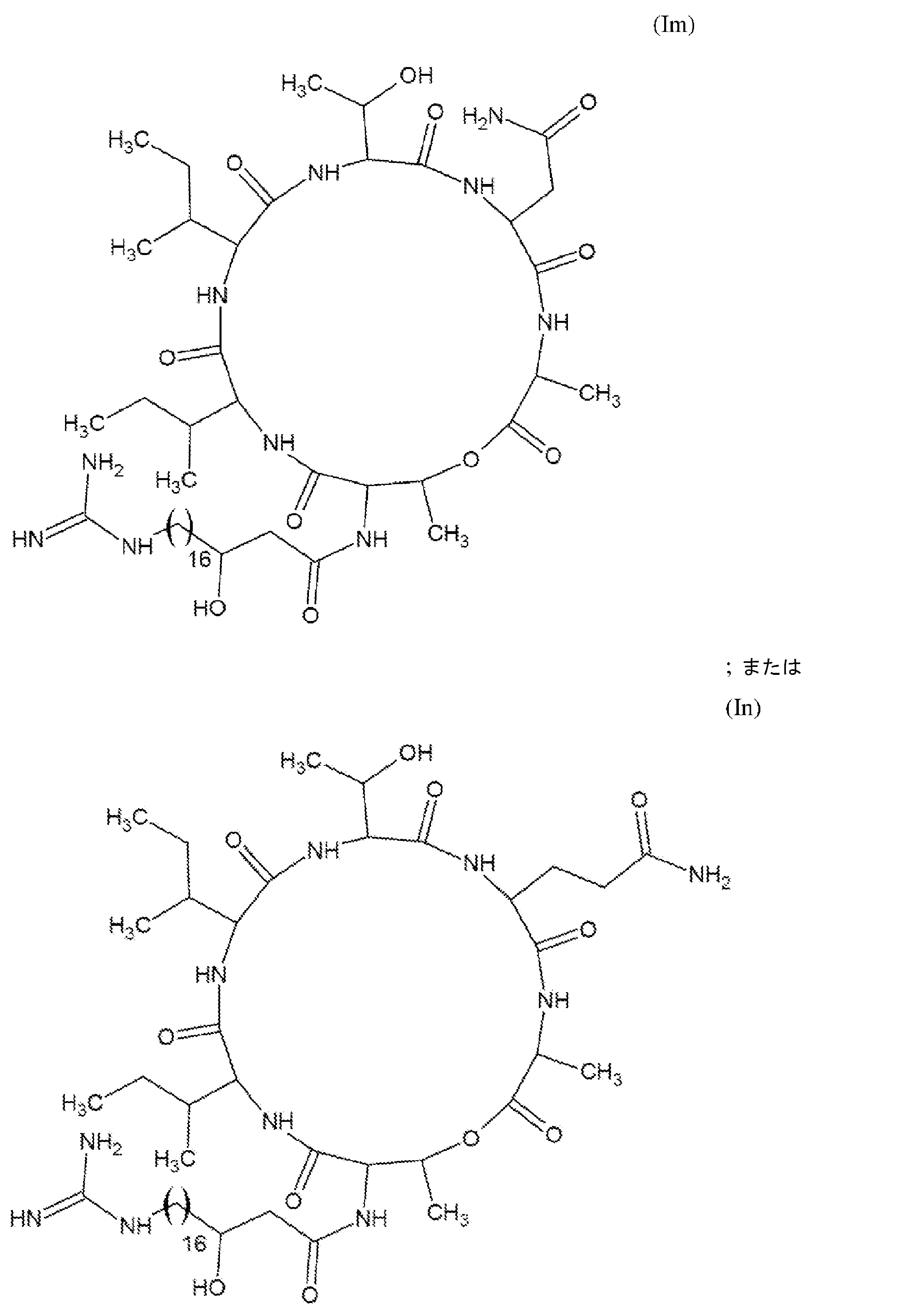
いくつかの実施形態において、単離された化合物またはパエニセリンは以下のものであ
る、


他の態様において、本発明は、殺真菌性パエニバチルス種株を同定する、および/また
は対応する発酵産物を産生する方法に関する。この方法は、変異型フサリシジンシンテタ
ーゼを特徴付け、パエニバチルス種株の殺真菌活性をアッセイするための、パエニバチル
ス種株におけるFusA-A3の配列決定を含む。特定の態様において、FusA-A3
は、図13に示される1または複数の配列に基づくプライマー(すなわち、配列番号1~
11)を用いて配列決定される。いくつかの実施形態において、スクリーニングの前に、
細胞を増殖させ、以下の特徴の1または複数を有する細胞を選択する:野生型フサリシジ
ンシンテターゼを含む参照パエニバチルス種株(すなわち、機能的FusA-A3を発現
する)において定量されたフサリシジンと比較した、アミノ酸残基(3)にチロシンまた
はフェニルアラニンを有するフサリシジン(例えば、LiF03a、LiF03b、Li
F03c、LiF03d、LiF07a、LiF07b、LiF07c、および/または
LiF07d)のレベルの低減または検出不能;および/または野生型フサリシジンシン
テターゼを含む参照パエニバチルス種株(すなわち、機能的FusA-A3を発現する)
において定量されたものと比較した、パエニセリン(例えば、パエニセリン A1および
/またはパエニセリン B1)および/またはパエニプロリキシンのレベルの増大。
In other aspects, the invention relates to methods of identifying fungicidal Paenibacillus sp. strains and/or producing corresponding fermentation products. The method involves sequencing FusA-A3 in a Paenibacillus sp. strain to characterize mutant fusaricidin synthetases and assay fungicidal activity of the Paenibacillus sp. strain. In certain embodiments, FusA-A3
are primers based on one or more sequences shown in FIG.
11). In some embodiments, prior to screening,
Cells are grown and cells are selected that have one or more of the following characteristics: compared to fusaricidin quantified in a reference Paenibacillus sp. strain containing wild-type fusaricidin synthetase (i.e., expressing functional FusA-A3). fusaricidins having tyrosine or phenylalanine in the amino acid residue (3) (e.g., LiF03a, LiF03b, Li
reduced or undetectable levels of F03c, LiF03d, LiF07a, LiF07b, LiF07c, and/or LiF07d); and/or a reference Paenibacillus species strain containing wild-type fusaricidin synthetase (i.e., expressing functional FusA-A3)
An increase in the levels of paeniserin (e.g. paeniserin A1 and/or paeniserin B1) and/or paeniprolixin compared to that quantified in .
一態様において、本発明は、広域スペクトル抗真菌活性を有する発酵産物を産生するた
めの方法であって、変異型フサリシジンシンテターゼを有するパエニバチルス種株を培養
して、胞子形成させることを含む方法を包含する。
In one aspect, the invention provides a method for producing a fermentation product having broad-spectrum antifungal activity, the method comprising culturing a Paenibacillus sp. strain having a mutant fusaricidin synthetase to sporulate. includes.
別の実施形態において、本発明は、広域スペクトルの抗真菌活性を有する殺真菌性パエ
ニバチルス種株を同定する方法であって、a)パエニバチルス種株におけるFusA-A
3を配列決定して、変異型フサリシジンシンテターゼを特徴付けること;b)変異型フサ
リシジンシンテターゼを有するパエニバチルス種株の殺真菌活性をアッセイすること;な
らびにc)パエニバチルス種株が、変異型フサテリシジンシンテターゼを含み、野生型フ
サリシジンシンテターゼを含む参照パエニバチルス種株と比較して殺真菌活性の増加を示
す場合、広域スペクトルの抗真菌活性を有する殺真菌性パエニバチルス種株を選択するこ
と、を含む方法に関する。この方法は、パエニバチルス種株によって産生されたパエニセ
リンおよび/またはパエニプロリキシンを定量すること、ならびにパエニバチルス種株が
、野生型フサリシジンシンテターゼを含む参照パエニバチルス種株と比較して増加レベル
のパエニセリンおよび/またはパエニプロリキシンを産生する場合、広域スペクトルの抗
真菌活性を有するパエニバチルス種株を選択すること、をさらに含む。別の態様において
、この方法は、殺真菌性パエニバチルス種株を培養して、殺真菌性発酵産物を産生するこ
とをさらに含む。
In another embodiment, the invention provides a method for identifying a fungicidal Paenibacillus sp. strain with broad-spectrum antifungal activity, comprising: a) FusA-A in a Paenibacillus sp. strain;
b) assaying the fungicidal activity of a Paenibacillus sp. strain having a mutant fusaricidin synthetase; and c) determining whether the Paenibacillus sp. Selecting a fungicidal Paenibacillus sp. strain with broad-spectrum antifungal activity if it comprises thericidin synthetase and exhibits increased fungicidal activity compared to a reference Paenibacillus sp. strain comprising wild-type fusaricidin synthetase; Relating to a method including. This method involves quantifying paeniserin and/or paeniprolixin produced by a Paenibacillus sp. strain and determining whether the Paenibacillus sp. and/or when producing paeniprolixin, selecting a Paenibacillus sp. strain with broad-spectrum antifungal activity. In another embodiment, the method further comprises culturing a fungicidal Paenibacillus sp. strain to produce a fungicidal fermentation product.
一実施形態において、本発明は、広域スペクトルの抗真菌活性を有する殺真菌性パエニ
バチルス種株を含む抗真菌発酵(fermentation)を産生する方法であって、
a)パエニバチルス種株におけるFusA-A3を配列決定して、変異型フサリシジンシ
ンテターゼを特徴付けること;b)変異型フサリシジンシンテターゼを有するパエニバチ
ルス種株の殺真菌活性をアッセイすること;c)パエニバチルス種株が、変異型フサリシ
ジンシンテターゼを含み、野生型フサリシジンシンテターゼを含む参照パエニバチルス種
株と比較して殺真菌活性の増加を示す場合、広域スペクトルの抗真菌活性を有する殺真菌
性パエニバチルス種株を選択すること、ならびにd)殺真菌性パエニバチルス種株を培養
して、殺真菌性発酵産物を産生すること、を含む方法に関する。
In one embodiment, the invention provides a method of producing an antifungal fermentation comprising a fungicidal Paenibacillus sp. strain having broad-spectrum antifungal activity, comprising:
a) Sequencing FusA-A3 in Paenibacillus sp. strains to characterize mutant fusaricidin synthetases; b) Assaying the fungicidal activity of Paenibacillus sp. strains having mutant fusaricidin synthetases; c) Paenibacillus sp. A fungicidal Paenibacillus with broad-spectrum antifungal activity if the seed strain contains a mutant fusaricidin synthetase and exhibits increased fungicidal activity compared to a reference Paenibacillus species strain containing a wild-type fusaricidin synthetase. d) cultivating a fungicidal Paenibacillus seed strain to produce a fungicidal fermentation product.
いくつかの実施形態において、変異型フサリシジンシンテターゼは、FusA-A3に
おいて基質特異性を決定するアミノ酸残基の少なくとも1つ、少なくとも2つ、少なくと
も3つ、少なくとも4つ、少なくとも5つ、少なくとも6つ、少なくとも7つ、少なくと
も8つ、少なくとも9つ、または10個すべての欠失を含む。他の態様において、変異型
フサリシジンシンテターゼは、FusA-A3において、Asp235、Ala236、
Ser239、Thr278、Leu299、Ala301、Ala/Gly322、V
al330、Cys331、Lys517およびこれらの組み合わせからなる群から選択
される少なくとも1つのアミノ酸残基の欠失を含む。
In some embodiments, the mutant fusaricidin synthetase has at least one, at least two, at least three, at least four, at least five, at least one of the amino acid residues that determine substrate specificity in FusA-A3. Contains 6, at least 7, at least 8, at least 9, or all 10 deletions. In other embodiments, the mutant fusaricidin synthetase comprises Asp235, Ala236,
Ser239, Thr278, Leu299, Ala301, Ala/Gly322, V
comprising a deletion of at least one amino acid residue selected from the group consisting of al330, Cys331, Lys517 and combinations thereof.
本発明はまた、パエニバチルス種NRRL B-50972株またはこの突然変異体も
しくはこの無細胞調製物もしくは代謝産物を、葉、茎、花、果実、根、または種子などの
植物もしくは植物部分に投与することによって、または植物または植物部分が生育する場
所、例えば土壌に施用することによって、植物を処理して、植物病病害防除する方法も包
含する。
The present invention also provides for the administration of Paenibacillus sp. NRRL B-50972 strain or mutants thereof or cell-free preparations or metabolites thereof to plants or plant parts such as leaves, stems, flowers, fruits, roots, or seeds. Also included are methods of treating plants to control plant diseases by or by application to the site where the plants or plant parts grow, such as soil.
本発明による方法において、パエニバチルス種NRRL B-50972株またはこの
殺真菌性突然変異体を含む組成物は、植物を成長させるために使用される任意のタイプの
培地(例えば、土壌、バーミキュライト、細断された厚紙および水)において成長した任
意の植物もしくは任意の植物の任意の部分に施用するか、または蘭やビカクシダなどの空
気中で増殖する植物もしくは植物の部分に施用することができる。組成物は、例えば、噴
霧(spraying)、霧化(atomizing)、気化(vaporizing)
、散布(scattering)、散粉(dusting)、散水(watering)
、吹きかけ(squirting)、振りかけ(sprinkling)、注ぎ(pou
ring)または燻蒸(fumigating)によって施用することができる。既に上
述したように、農業、園芸、森林、プランテーション、果樹園、苗床、有機的に栽培され
た作物、芝草および都市環境など、目的の植物が位置する任意の所望の場所で施用を行う
ことができる。
In the method according to the invention, the composition comprising Paenibacillus sp. It can be applied to any plant, or any part of any plant, grown in water (paperboard and water) or to plants or parts of plants that grow in the air, such as orchids and ferns. The composition can be processed, for example, by spraying, atomizing, vaporizing, etc.
, scattering, dusting, watering
, squirting, sprinkleling, pou
It can be applied by ring or fumigating. As already mentioned above, the application can be carried out in any desired place where the desired plants are located, such as in agriculture, horticulture, forests, plantations, orchards, nurseries, organically grown crops, turfgrass and urban environments. can.
本発明の組成物は、パエニバチルス種NRRL B-50972株またはこれから誘導
される殺真菌性突然変異体(株)を、以下の実施例に記載されている培地および他の方法
を使用することを含む当分野において周知の方法により培養することによって得ることが
できる。従来の大規模な微生物培養プロセスには、液中発酵、固相発酵または液体表面培
養が含まれる。発酵の終わりに向かって、栄養素が枯渇すると、細胞は増殖期から胞子形
成期への移行を開始し、発酵の最終産物は主に胞子、代謝産物および残留発酵培地である
。胞子形成は、パエニバチルスの自然ライフサイクルの一部であり、一般に、栄養制限に
応答して細胞によって開始される。発酵は、高レベルのコロニー形成単位を獲得し、胞子
形成を促進するように構成される。発酵から生じる培養培地中の細菌細胞、胞子および代
謝産物は、直接使用するか、または遠心分離、接線流濾過、深層濾過、および蒸発などの
従来の工業的方法によって濃縮することができる。
Compositions of the invention include culturing Paenibacillus sp. NRRL strain B-50972, or a fungicidal mutant strain derived therefrom, using the media and other methods described in the Examples below. It can be obtained by culturing by methods well known in the art. Conventional large-scale microbial culture processes include submerged fermentation, solid phase fermentation or liquid surface culture. Towards the end of fermentation, when nutrients are depleted, the cells begin to transition from the growth phase to the sporulation phase, and the end products of fermentation are mainly spores, metabolites and residual fermentation medium. Sporulation is part of the natural life cycle of Paenibacillus and is generally initiated by the cell in response to nutrient limitation. Fermentation is configured to obtain high levels of colony forming units and promote sporulation. Bacterial cells, spores and metabolites in the culture medium resulting from fermentation can be used directly or concentrated by conventional industrial methods such as centrifugation, tangential flow filtration, depth filtration, and evaporation.
本発明の組成物は、発酵産物を含む。いくつかの実施形態において、濃縮発酵ブロスを
、例えば、透析濾過プロセスを介して洗浄して、残留発酵ブロスおよび代謝産物を除去す
る。本明細書で使用される用語「ブロス濃縮液」は、上記のような従来の工業的方法によ
って濃縮されたが、液体形態のままである全ブロス(発酵ブロス)を指す。本明細書で使
用される用語「発酵固形物」は、発酵ブロスが乾燥した後に残る固体物質を指す。本明細
書で使用される用語「発酵産物」は、全ブロス、ブロス濃縮物および/または発酵固形物
を指す。本発明の組成物は、発酵産物を含む。
Compositions of the invention include fermentation products. In some embodiments, the concentrated fermentation broth is washed to remove residual fermentation broth and metabolites, such as via a diafiltration process. The term "broth concentrate" as used herein refers to whole broth (fermentation broth) that has been concentrated by conventional industrial methods such as those described above, but remains in liquid form. The term "fermentation solids" as used herein refers to the solid material that remains after the fermentation broth is dried. The term "fermentation product" as used herein refers to whole broth, broth concentrate and/or fermentation solids. Compositions of the invention include fermentation products.
発酵ブロスまたはブロス濃縮物は、噴霧乾燥、凍結乾燥、トレイ乾燥、流動床乾燥、ド
ラム乾燥、または蒸発などの従来の乾燥プロセスまたは方法を使用して、担体の添加の有
無にかかわらず乾燥させることができる。
Fermentation broths or broth concentrates may be dried using conventional drying processes or methods such as spray drying, freeze drying, tray drying, fluidized bed drying, drum drying, or evaporation, with or without the addition of carriers. Can be done.
得られた乾燥生成物は、粉砕または顆粒化などによりさらに加工して、特定の粒径また
は物理的フォーマットを達成することができる。以下に記載する担体は、乾燥後に添加す
ることもできる。
The resulting dry product can be further processed, such as by milling or granulation, to achieve a particular particle size or physical format. The carriers described below can also be added after drying.
本発明の菌株の発酵ブロスの無細胞調製物は、発酵ブロスの抽出、遠心分離および/ま
たは濾過のような当技術分野で公知の任意の手段によって得ることができる。当業者であ
れば、いわゆる無細胞調製物は、細胞を欠いていなくてもよく、むしろ、細胞を除去する
ために使用される技術(例えば、遠心分離の速度)に応じて、ほとんど無細胞または本質
的に無細胞であることを認識するであろう。得られた無細胞調製物は、乾燥および/また
は植物または植物成長培地への施用を助ける成分と配合することができる。発酵ブロスの
ための上記の濃縮方法および乾燥技術は、無細胞調製物にも適用可能である。
Cell-free preparations of fermentation broths of the strains of the invention can be obtained by any means known in the art, such as extraction, centrifugation and/or filtration of fermentation broths. Those skilled in the art will appreciate that a so-called cell-free preparation may not be devoid of cells, but rather may be mostly cell-free or cell-free, depending on the technique used to remove the cells (e.g. speed of centrifugation). One will recognize that it is essentially acellular. The resulting cell-free preparation can be formulated with ingredients that aid in drying and/or application to plants or plant growth media. The concentration methods and drying techniques described above for fermentation broths are also applicable to cell-free preparations.
一実施形態において、発酵産物は、少なくとも約1×10⁴コロニー形成単位(CFU
)の微生物(例えば、パエニバチルス種NRRL B-50972株またはこの殺真菌性
突然変異株)/mLブロスを含む。別の実施形態において、発酵産物は、少なくとも約1
×105コロニー形成単位(CFU)の微生物(例えば、パエニバチルス種NRRL B
-50972株またはこの殺真菌性突然変異株)/mLブロスを含む。別の実施形態にお
いて、発酵産物は、少なくとも約1×10⁶ CFUの微生物(例えば、パエニバチルス
種NRRL B-50972株またはこの殺真菌性突然変異株)/mLブロスを含む。さ
らに別の実施形態において、発酵産物は、少なくとも約1×10⁷ CFUの微生物(例
えば、パエニバチルス種NRRL B-50972株またはこの殺真菌性突然変異株)/
mLブロスを含む。別の実施形態において、発酵産物は、少なくとも約1×10⁸ CF
Uの微生物(例えば、パエニバチルス種NRRL B-50972株またはこの殺真菌性
突然変異株)/mLブロスを含む。別の実施形態において、発酵産物は、少なくとも約1
×109 CFUの微生物(例えば、パエニバチルス種NRRL B-50972株また
はこの殺真菌性突然変異株)/mLブロスを含む。別の実施形態において、発酵産物は、
少なくとも約1×10¹⁰ CFUの微生物(例えば、パエニバチルス種NRRL B-
50972株またはこの殺真菌性突然変異株)/mLブロスを含む。別の実施形態におい
て、発酵産物は、少なくとも約1×10¹¹ CFUの微生物(例えば、パエニバチルス
種NRRL B-50972株またはこの殺真菌性突然変異株)/mLブロスを含む。
In one embodiment, the fermentation product is at least about 1 x 10 colony forming units (CFU
) (eg, Paenibacillus sp. NRRL strain B-50972 or a fungicidal mutant strain thereof)/mL broth. In another embodiment, the fermentation product comprises at least about 1
x 10 5 colony forming units (CFU) of microorganisms (e.g. Paenibacillus sp. NRRL B
-50972 strain or its fungicidal mutant strain)/mL broth. In another embodiment, the fermentation product comprises at least about 1×10 6 CFU of a microorganism (eg, Paenibacillus sp. NRRL strain B-50972 or a fungicidal mutant thereof)/mL broth. In yet another embodiment, the fermentation product comprises at least about 1×10 7 CFU of a microorganism (e.g., Paenibacillus sp. NRRL strain B-50972 or a fungicidal mutant strain thereof)/
Contains mL broth. In another embodiment, the fermentation product contains at least about 1×10 8 CF
U microorganism (eg, Paenibacillus sp. NRRL strain B-50972 or a fungicidal mutant strain thereof)/mL broth. In another embodiment, the fermentation product comprises at least about 1
x 10 9 CFU of microorganism (eg, Paenibacillus sp. NRRL strain B-50972 or a fungicidal mutant thereof)/mL broth. In another embodiment, the fermentation product is
At least about 1×10 10 CFU of microorganisms (e.g., Paenibacillus sp. NRRL B-
strain 50972 or its fungicidal mutant strain)/mL broth. In another embodiment, the fermentation product comprises at least about 1×10 11 CFU of a microorganism (eg, Paenibacillus sp. NRRL strain B-50972 or a fungicidal mutant strain thereof)/mL broth.
本発明の組成物は、その特定の物理的および/または化学的性質に応じて、それらの配
合物の形態またはこれらから調製される使用形態、例えば、エアロゾル、カプセル懸濁液
、冷煙霧濃厚剤(cold-fogging concentrate)、温煙霧濃厚剤
(warm-fogging concentrate)、カプセル化顆粒、細粒、種子
処理のための流動性濃縮物、即時使用可能な溶液、散粉剤、乳剤、水中油型乳剤、油中水
型乳剤、顆粒剤、微粒剤、油分散性散剤、油混和性流動性濃縮物、油混和性液剤、ガス剤
(加圧下)、ガス発生剤、フォーム、ペースト、殺虫剤被覆種子、懸濁濃縮物、油性分散
物、サスポエマルジョン濃縮物、可溶性濃縮物、懸濁液、湿潤散剤、可溶性散剤、粉剤お
よび顆粒剤、水溶性および水分散性の顆粒または錠剤、種子処理用の水溶性および水分散
性の散剤、湿潤散剤、活性成分に含浸させた天然生成物および合成物質、ならびに種子の
ためのポリマー物質およびコーティング材料中のマイクロカプセル化、ならびにULV冷
煙霧および温煙霧製剤で使用することができる。
Depending on their particular physical and/or chemical properties, the compositions of the invention can be used in the form of their formulations or use forms prepared from them, for example aerosols, capsule suspensions, cold smoke concentrates. (cold-fogging concentrate), warm-fogging concentrate, encapsulated granules, granules, flowable concentrates for seed treatment, ready-to-use solutions, dusts, emulsions, oil-in-water emulsions , water-in-oil emulsions, granules, microgranules, oil-dispersible powders, oil-miscible flowable concentrates, oil-miscible liquids, gas agents (under pressure), gas generants, foams, pastes, insecticide-coated seeds. , suspension concentrates, oily dispersions, suspoemulsion concentrates, soluble concentrates, suspensions, wetting powders, soluble powders, powders and granules, water-soluble and water-dispersible granules or tablets, for seed treatment. In water-soluble and water-dispersible powders, wetting powders, natural products and synthetic substances impregnated with active ingredients, and microencapsulation in polymeric substances and coating materials for seeds, as well as in ULV cold and warm fog formulations. can be used.
いくつかの実施形態において、本発明の組成物は液体製剤である。液体製剤の非限定的
な例としては、懸濁濃縮液および油分散液が挙げられる。他の実施形態において、本発明
の組成物は固形製剤である。液体製剤の非限定的な例としては、凍結乾燥粉末および噴霧
乾燥粉末が挙げられる。
In some embodiments, compositions of the invention are liquid formulations. Non-limiting examples of liquid formulations include suspension concentrates and oil dispersions. In other embodiments, the compositions of the invention are solid dosage forms. Non-limiting examples of liquid formulations include lyophilized powders and spray-dried powders.
本発明の組成物は、効力、安定性および有用性を改善するために、および/または加工
、包装および最終用途への適用を容易にするために、細胞、無細胞調製物または代謝産物
を含む組成物に添加された製剤用不活性成分(formulation inert)を
含み得る。このような製剤用不活性成分および成分は、個々にまたは組み合わせて添加可
能な担体、安定剤、栄養素、または物理的特性改変剤を含み得る。いくつかの実施形態に
おいて、担体としては、水、油、および他の有機または無機溶媒などの液体材料、ならび
に生物学的または化学合成によって誘導された無機物、ポリマーまたはポリマー複合体な
どの固体材料を挙げることができる。いくつかの実施形態において、担体は、種子または
根などの植物部分への組成物の付着を促進する結合剤または接着剤である。例えば、Ta
ylor,A.G.,et al.,“Concepts and Technolog
ies of Selected Seed Treatments”,Annu.Re
v.Phytopathol.28:321-339(1990)を参照されたい。安定
剤は、固結防止剤、抗酸化剤、乾燥剤、保護剤または防腐剤を含み得る。栄養素としては
、糖、多糖、油、タンパク質、アミノ酸、脂肪酸およびリン酸などの炭素、窒素、および
リン源を挙げることができる。物理的特性改変剤としては、増量剤、湿潤剤、増粘剤、p
H調整剤、レオロジー調節剤、分散剤、アジュバント、界面活性剤、不凍剤または着色剤
を挙げることができる。いくつかの実施形態において、発酵により生成された細胞、無細
胞調製物または代謝産物を含む組成物は、希釈剤として水と共に、または水なしで、任意
の他の製剤調製をせずに直接使用することができる。いくつかの実施形態において、製剤
用不活性成分は、発酵ブロスを濃縮した後、および乾燥中および/または乾燥後に添加さ
れる。
Compositions of the invention include cells, cell-free preparations or metabolites to improve efficacy, stability and utility and/or to facilitate processing, packaging and end-use application. It may include formulation inerts added to the composition. Such formulation inactive ingredients and components may include carriers, stabilizers, nutrients, or physical property modifying agents that may be added individually or in combination. In some embodiments, carriers include liquid materials such as water, oils, and other organic or inorganic solvents, as well as solid materials such as minerals, polymers or polymer composites derived from biological or chemical synthesis. can be mentioned. In some embodiments, the carrier is a binder or adhesive that facilitates attachment of the composition to plant parts such as seeds or roots. For example, Ta
Ylor, A. G. , et al. , “Concepts and Technology
ies of Selected Seed Treatments”, Annu.Re
v. Phytopathol. 28:321-339 (1990). Stabilizers may include anticaking agents, antioxidants, desiccants, protectants or preservatives. Nutrients can include carbon, nitrogen, and phosphorous sources such as sugars, polysaccharides, oils, proteins, amino acids, fatty acids, and phosphoric acid. Physical property modifiers include fillers, wetting agents, thickeners, p
Mention may be made of H regulators, rheology regulators, dispersants, adjuvants, surfactants, antifreezes or colorants. In some embodiments, compositions comprising cells, cell-free preparations, or metabolites produced by fermentation are used directly without any other formulation preparation, with or without water as a diluent. can do. In some embodiments, the formulation inert ingredients are added after concentrating the fermentation broth and during and/or after drying.
すべての植物および植物部分は、本発明に従って処理することができる。本文脈では、
植物は、所望および望ましくない野生植物または作物植物(天然に存在する作物植物を含
む)などの、すべての植物および植物集団を意味すると理解される。作物植物は、伝統的
な育種および最適化法によって、またはバイオテクノロジーおよび組換え法、またはこれ
らの方法の組み合わせによって得られ得る植物であり、トランスジェニック植物および植
物品種改良者の権利によって保護され得るまたはされない植物種を含む。植物部分は、苗
条、葉、花および根などの植物の空中および地下の部分および器官のすべてを意味するも
のとして理解され、例としては、葉、針葉、花軸、茎、花、子実体、果実および種子なら
びに根、塊茎および根茎を挙げることができる。植物部分はまた、作物材料および栄養繁
殖材料および生殖繁殖材料、例えば、切穂、塊茎、根茎、接ぎ穂および種子を含む。
All plants and plant parts can be treated according to the invention. In this context,
Plants are understood to mean all plants and plant populations, such as desired and undesirable wild plants or crop plants (including naturally occurring crop plants). Crop plants are plants that can be obtained by traditional breeding and optimization methods or by biotechnology and recombinant methods, or a combination of these methods, and can be protected by the rights of transgenic plants and plant breeders Contains plant species that are or are not. Plant parts are understood to mean all the aerial and underground parts and organs of a plant, such as shoots, leaves, flowers and roots, for example leaves, needles, rachis, stems, flowers, fruiting bodies , fruits and seeds as well as roots, tubers and rhizomes. Plant parts also include crop material and vegetative and reproductive propagation material, such as cuttings, tubers, rhizomes, scions and seeds.
既に上述したように、すべての植物およびこれらの部分は、本発明に従って処理するこ
とができる。好ましい実施形態において、野生株またはハイブリッド形成もしくはプロト
プラスト融合などの伝統的な生物学的育種法によって得られる植物種および植物品種、お
よびそれらの部分が処理される。さらに好ましい実施形態において、適切であれば伝統的
な方法(遺伝子組換え生物)と組み合わせて、組換え法によって得られたトランスジェニ
ック植物および植物品種ならびにそれらの部分が処理される。「部分」または「植物の部
分」または「植物部分」という用語は、本明細書に上述してある。いずれの場合も市販さ
れているか、または使用中である植物品種の植物は、本発明に従って特に好ましく処理さ
れる。植物品種は、伝統的な育種、突然変異誘発または組換えDNA技術のいずれかによ
って育種された新規な形質を有する植物を意味すると理解される。これらは品種、種属、
生物型、遺伝子型の形をとっている。
As already mentioned above, all plants and their parts can be treated according to the invention. In a preferred embodiment, plant species and plant varieties and parts thereof obtained from wild stocks or by traditional biological breeding methods such as hybridization or protoplast fusion are treated. In a further preferred embodiment, transgenic plants and plant varieties and parts thereof obtained by recombinant methods are processed, if appropriate in combination with traditional methods (genetically modified organisms). The term "part" or "part of a plant" or "plant part" has been described herein above. Plants of plant varieties which are in each case commercially available or in use are particularly preferably treated according to the invention. Plant varieties are understood to mean plants with novel traits that have been bred either by traditional breeding, mutagenesis or recombinant DNA technology. These are varieties, species,
It takes the form of biological types and genotypes.
本発明による組成物による植物および植物部分の処理は、直接または慣用の処理方法、
例えば浸漬、噴霧、霧化、ミスト化、気化、散粉、煙霧、散布、発泡、塗布、拡散、注入
、潅注、液滴灌漑、などによって環境、生息場所または貯蔵空間に作用することによって
行われ、繁殖材料の場合、特に種子の場合にはさらに、乾燥種子処理方法、湿式種子処理
方法、スラリー処理方法、皮殻形成によって、1つまたは複数のコーティングなどでコー
ティングすることによって行われる。さらに、超低容量法によって活性物質を施用するこ
と、または活性物質調製物または活性物質自体を土壌に注入することが可能である。
Treatment of plants and plant parts with the compositions according to the invention can be carried out directly or by conventional treatment methods,
by acting on the environment, habitat or storage space, for example by dipping, spraying, atomizing, misting, vaporizing, dusting, atomizing, dispersing, foaming, applying, spreading, pouring, irrigating, droplet irrigation, etc.; In the case of propagation material, in particular seeds, this is further carried out by coating with one or more coatings, etc., by dry seed processing methods, wet seed processing methods, slurry processing methods, shelling. Furthermore, it is possible to apply the active substance by ultra-low volume methods or to inject the active substance preparation or the active substance itself into the soil.
植物の好ましい直接処理は、葉塗布処理であり、すなわち、本発明による組成物を葉に
施用し、処理頻度および施用量を問題の病原体の感染圧に合わせることが可能である。
A preferred direct treatment of plants is a foliar application treatment, ie the composition according to the invention is applied to the leaves and it is possible to adapt the treatment frequency and application rate to the infection pressure of the pathogen in question.
全身的に活性な化合物の場合、本発明による組成物は、根系を介して植物に到達する。
この場合、植物の処理は、本発明による組成物を植物の環境に作用させることによって行
うことができる。これは、例えば土壌または栄養溶液に組み込む潅注、すなわち植物の位
置(例えば土壌または水耕栽培システム)に本発明による組成物の液体形態を含浸させる
ことによって、または土壌施用、すなわち、本発明による組成物を、固体形態(例えば、
顆粒の形態)で植物の位置に組み込むことによって行うことができる。水稲栽培の場合、
これは、本発明による組成物を固体使用形態(例えば、顆粒の形態)で浸水した水田に計
量することによって行うこともできる。
In the case of systemically active compounds, the compositions according to the invention reach the plant via the root system.
In this case, the treatment of the plants can be carried out by applying the composition according to the invention to the environment of the plants. This can be done, for example, by irrigation incorporating into the soil or nutrient solution, i.e. by impregnating the plant location (e.g. in the soil or in a hydroponic system) with the liquid form of the composition according to the invention, or by soil application, i.e. the composition according to the invention. things in solid form (e.g.
This can be done by incorporating it into the plant in the form of granules). In the case of paddy rice cultivation,
This can also be carried out by metering the composition according to the invention in solid use form (for example in the form of granules) into a flooded rice field.
好ましい植物は、有用植物、観賞植物、芝、公共および家庭内で観賞植物として用いら
れる一般に使用される樹木、および森林樹木の群からの植物である。森林樹木は、木材、
セルロース、紙および木の一部から作られた製品の生産のための木を含む。
Preferred plants are plants from the group of useful plants, ornamental plants, turf, commonly used trees used as ornamentals in public and domestic settings, and forest trees. Forest trees are wood,
Including wood for the production of cellulose, paper and products made from parts of wood.
本文脈において使用される用語「有用植物」は、食料、飼料、燃料を得るための、また
は工業目的のための植物として使用される作物植物を指す。
The term "useful plants" as used in this context refers to crop plants that are used for obtaining food, feed, fuel or as plants for industrial purposes.
本発明の組成物および方法で処理および/または改良することができる有用植物として
は、例えば、以下のタイプの植物を挙げることができる:芝、ブドウ、穀物、例えばコム
ギ、オオムギ、ライムギ、オートムギ、米、トウモロコシおよびキビ/ソルガム;ビート
、例えばテンサイおよび飼料ビート;果実、例えば、仁果類、核果および軟質果実、例え
ば、リンゴ、ナシ、プラム、桃、アーモンド、サクランボおよびベリー類、例えば、イチ
ゴ、ラズベリー、ブラックベリーなど;豆科植物、例えば、豆類、レンズ豆、エンドウ豆
および大豆;油糧種子、例えば、ナタネ、マスタード、ケシ、オリーブ、ヒマワリ、ココ
ナッツ、ヒマシ油植物、カカオおよびピーナッツ;ウリ科植物、例えば、カボチャ/スカ
ッシュ、キュウリおよびメロン;繊維植物、例えば綿、亜麻、麻およびジュート;柑橘類
、例えば、オレンジ、レモン、グレープフルーツおよびタンジェリン;野菜類、例えば、
ホウレンソウ、レタス、アスパラガス、キャベツ種、ニンジン、タマネギ、トマト、ジャ
ガイモおよびピーマン;クスノキ科、例えば、アボカド、シナモン、樟脳、またはタバコ
、ナッツ、コーヒー、ナス、サトウキビ、茶、コショウ、ブドウ、ホップ、バナナ、ラテ
ックス植物および観賞植物、例えば花、低木、落葉樹および針葉樹などの他の植物。この
列挙は限定的ではない。
Useful plants that can be treated and/or improved with the compositions and methods of the invention include, for example, the following types of plants: grass, grapes, cereals such as wheat, barley, rye, oats, rice, corn and millet/sorghum; beets, such as sugar beets and forage beets; fruits, such as pome fruits, stone fruits and soft fruits, such as apples, pears, plums, peaches, almonds, cherries and berries, such as strawberries, raspberries, blackberries, etc.; legumes, such as beans, lentils, peas and soybeans; oilseeds, such as rapeseed, mustard, poppies, olives, sunflowers, coconuts, castor oil plants, cocoa and peanuts; Cucurbitaceae Plants such as pumpkins/squash, cucumbers and melons; Fiber plants such as cotton, flax, hemp and jute; Citrus fruits such as oranges, lemons, grapefruit and tangerines; Vegetables such as:
spinach, lettuce, asparagus, cabbage seeds, carrots, onions, tomatoes, potatoes and peppers; Lauraceae, such as avocado, cinnamon, camphor, or tobacco, nuts, coffee, eggplant, sugar cane, tea, pepper, grapes, hops; Other plants such as bananas, latex plants and ornamental plants such as flowers, shrubs, deciduous trees and conifers. This enumeration is not exclusive.
以下の植物は、本発明の組成物および方法を適用するための特に適切な標的作物である
と考えられる:綿、ナス、芝、仁果類、核果、軟質果実、トウモロコシ、コムギ、オオム
ギ、キュウリ、タバコ、ブドウ、米、穀類、ナシ、豆類、大豆、アブラナ、トマト、ピー
マン、メロン、キャベツ、ジャガイモおよびリンゴ。
The following plants are considered to be particularly suitable target crops for applying the compositions and methods of the invention: cotton, eggplant, sod, pome fruits, stone fruits, soft fruits, corn, wheat, barley, cucumbers. , tobacco, grapes, rice, grains, pears, legumes, soybeans, rapeseed, tomatoes, peppers, melons, cabbage, potatoes and apples.
本発明の方法に従って改良することができる樹木の例は、モミ属種(Abies sp
.)、ユーカリ属種(Eucalyptus sp.)、トウヒ属種(Picea sp
.)、マツ属種(Pinus sp.)、トチノキ属種(Aesculus sp.)、
スズカケノキ属種(Platanus sp.)、シナノキ属種(Tilia sp.)
、カエデ属種(Acer sp.)、ツガ属種(Tsuga sp.)、トリネコ属種(
Fraxinus sp.)、ナナカマド属種(Sorbus sp.)、カバノキ属種
(Betula sp.)、サンザシ属種(Crataegus sp.)、ニレ属種(
Ulmus sp.)、コナラ属種(Quercus sp.)、ブナ属種(Fagus
sp.)、ヤナギ属種(Salix sp.)ハコヤナギ属種(Populus sp
.)である。
Examples of trees that can be improved according to the method of the invention are Abies sp.
.. ), Eucalyptus sp., Picea sp.
.. ), Pinus sp., Aesculus sp.
Platanus sp., Tilia sp.
, Acer sp., Tsuga sp., Acer sp.
Fraxinus sp. ), Sorbus sp., Betula sp., Crataegus sp., Elm sp.
Ulmus sp. ), Quercus sp., Fagus sp.
sp. ), Salix sp.), Populus sp.
.. ).
本発明の方法に従って改良することができる好ましい樹木は、樹木種トチノキ属(Ae
sculus)由来:A.ヒッポカスタヌム(A.hippocastanum)、A.
パリフロラ(A.pariflora)、A.カルネア(A.carnea);樹木種ス
ズカケノキ属(Platanus)由来:P.アセリフロラ(P.aceriflora
)、P.オクシデンタリス(P.occidentalis)、P.ラセモア(P.ra
cemosa);樹木種トウヒ属(Picea)由来:P.アビエス(P.abies)
;樹種マツ属(Pinus)由来:P.ラジアータ(P.radiata)、P.ポンデ
ローサ(P.ponderosa)、P.コントルタ(P.contorta)、P.シ
ルヴェストル(P.sylvestre)、P.エリオッティ(P.elliottii
)、P.モンチコラ(P.montecola)、P.アルビカウリス(P.albic
aulis)、P.レジノーサ(P.resinosa)、P.パルストリス(P.pa
lustris)、P.テーダ(P.taeda)、P.フレキシリス(P.flexi
lis)、P.ジェフレギ(P.jeffregi)、P.バクシアナ(P.baksi
ana)、P.ストロブス(P.strobus);樹木種ユーカリ属(Eucalyp
tus)由来:E.グランディス(E.grandis)、E.グロブルス(E.glo
bulus)、E.カマデンチス(E.camadentis)、E.ニテンス(E.n
itens)、E.オブリクア(E.obliqua)、E.レグナンス(E.regn
ans)、E.ピルラルス(E.pilularus)から得ることができる。
Preferred trees that can be improved according to the method of the invention include the tree species Horse chestnut (Ae
sculus) Origin: A. A. hippocastanum, A. hippocastanum.
A. pariflora, A. pariflora. Carnea (A. carnea); derived from the tree species Platanus: P. Aceriflora (P. aceriflora)
), P. P. occidentalis, P. occidentalis. Racemore (P.ra
cemosa); derived from the tree species Picea: P. cemosa); Abies (P.abies)
; Origin of tree species Pinus: P. radiata (P. radiata), P. radiata. Ponderosa (P. ponderosa), P. P. contorta, P. contorta. P. sylvestre, P. Elliottii (P.elliottii)
), P. Monticola (P. montecola), P. Albicauris (P. albic)
aulis), P. P. resinosa, P. resinosa. Palustris (P. pa
lustris), P. P. taeda, P. P. flexi
lis), P. P. jeffregi, P. Baxiana (P. baksi)
ana), P. Strobus (P. strobus); tree species of the genus Eucalyp
tus) Origin: E. E. grandis, E. Globulus (E. globulus)
blus), E. E. camadentis, E. camadentis. Nitens (E.n.
itens), E. Obliqua (E. obliqua), E. Regnance (E. regn)
ans), E. It can be obtained from E. pilularus.
本発明の方法に従って改良することができる特に好ましい樹木は、樹木種マツ属(Pi
nus)由来:P.ラジオタ、P.ポンデローサ、P.コントルタ、P.シベレス、P.
ストロバス;樹木種ユーカリ属(Eucalyptus)由来:E.グランディス、E.
グロブルス、E.カマデンチスである。
A particularly preferred tree that can be improved according to the method of the invention is the tree species Pinus (Pi
nus) Origin: P. Radiota, P. Ponderosa, P. Contorta, P. Cibeles, P.
Strobus; Origin of tree species Eucalyptus: E. Grandis, E.
Grobulus, E. It is Camadentis.
本発明の方法に従って改善することができる非常に特に好ましい樹木は、セイヨウトチ
ノキ、スズカケノキ科(Platanaceae)、菩提樹、楓である。
Very particularly preferred trees that can be improved according to the method of the invention are horse chestnut, Platanaceae, linden, maple.
本発明は、寒地型芝草および暖地型芝草を含む任意の芝草に施用することもできる。寒
地型芝草の例としては、ケンタッキーブルーグラス(ポア・プラテンシスL.(Poa
pratensis L.))、オオスズメノカタビラ(ポア・トリビアリスL.(Po
a trivialis L.))、カナダブルーグラス(ポア・コンプレッサL.(P
oa compressa L.))、スズメノカタビラ(ポア・アンヌアL.(Poa
annua L.))、アップランドブルーグラス(ポア・グラウカンタ ガウジン(
Poa glaucantha Gaudin))、ウッドブルーグラス(ポア・ネモラ
リスL.(Poa nemoralis L.))およびバルバスブルーグラス(ポア・
ブルボサL.(Poa bulbosa L.))などのブルーグラス類(ポア属種(P
oa spp.));クリーピングベントグラス(アグロスティス・パルストリスHud
s.(Agrostis palustris Huds.))、コロニアルベントグラ
ス(アグロスティス・テヌイスSibth.(Agrostis tenuis Sib
th.))、ベルベットベントグラス(アグロスティス・カニナL.(Agrostis
canina L.))、サウスジャーマンミックスドベントグラス(アグロスティス
・テニウスSibth.(Agrostis tenius Sibth.)、アグロス
ティス・カニナL.(Agrostis canina L.)およびアグロスティス・
パルストリスHuds.(Agrostis palustris Huds.))を含
むアグロスティス属種(Agrostis spp.)、およびコヌカグサ(アグロステ
ィス・アルバL.(Agrostis alba L.))などのベントグラス類(アグ
ロスティス属種(Agrostis spp.));
レッドフェスク(フェストゥカ・ルブラL.属種ルブラ(Festuca rubra
L.spp.rubra))、クリーピングフェスク(フェストゥカ・ルブラL.(F
estuca rubra L.))、チューイングスフェスク(フェストゥカ・ルブラ
・コミュタタGaud.(Festuca rubra commutata Gaud
.))、シープフェスク(フェストゥカ・オビナL.(Festuca ovina L
.))、ハードフェスク(フェストゥカ・ロンギホリアThuill.(Festuca
longifolia Thuill.))、ヘアフェスク(フェストゥカ・カピラタ
Lam.(Festuca capillata Lam.))、トールフェスク(フェ
ストゥカ・アルンジナセアSchreb.(Festuca arundinacea
Schreb.))およびメドウフェスク(フェストゥカ・エラノルL.(Festuc
a elanor L.))などのウシノケグサ類(フェストゥカ属種(Festuca
spp.));
ネズミムギ(ロリウム・ムルチフロルムLam.(Lolium multiflor
um Lam.))、ホソムギ(ロリウム・ペレンL.(Lolium perenne
L.))およびイタリアンライグラス(ロリウム・ムルチフロルムLam.(Loli
um multiflorum Lam.))などのドクムギ類(ロリウム属種(Lol
ium spp.));
ならびにフェアウェイウィートグラス(アグロピュロン・クリスタツム(L.)Gae
rtn.(Agropyron cristatum(L.)Gaertn.))、クレ
ステッドウィートグラス(アグロピュロン・デセルトルム(Fisch.)Schult
.(Agropyron desertorum(Fisch.)Schult.)およ
びウェスタンウィートグラス(アグロピュロン・スミチイRydb.(Agropyro
n smithii Rydb.))などのカモジグサ類(アグロピュロン属種(Agr
opyron spp.))である。
The present invention can also be applied to any turfgrass, including cold-season turfgrass and warm-season turfgrass. An example of a cold-season turfgrass is Kentucky bluegrass (Poa platensis L.).
pratensis L. )), Poa trivialis L. (Poa trivialis L.
a trivialis L. )), Canadian Bluegrass (Pore Compressor L. (P
oa compressa L. )), Poa annua L.
anna L. )), upland bluegrass (Poa glaucantha gougin (
Poa glaucantha Gaudin), wood bluegrass (Poa nemoralis L.) and bulbous bluegrass (Poa nemoralis L.).
Vulvosa L. (Poa bulbosa L.) and other bluegrass species (Poa spp. (P.
oa spp. )); Creeping bentgrass (Agrostis palustris Hud)
s. (Agrostis palustris Huds.), colonial bentgrass (Agrostis tenuis Sibth.)
th. )), velvet bentgrass (Agrostis canina L.)), velvet bentgrass (Agrostis canina L.
canina L. )), South German mixed bentgrass (Agrostis tenius Sibth.), Agrostis canina L. and Agrostis canina L.
Pulstris Huds. (Agrostis palustris huds.), and bentgrasses (Agrostis spp.), such as silver grass (Agrostis alba L.). ;
Red fescue (Festuca rubra L. genus species rubra)
L. spp. rubra)), creeping fescue (Festuca rubra L. (F.
estuca rubra L. )), chewing fescue (Festuca rubra commutata Gaud.
.. )), sheep fescue (Festuca ovina L.
.. )), hard fescue (Festuca longifolia Thuill.
longifolia Thuill. )), hair fescue (Festuca capillata Lam.), tall fescue (Festuca arundinacea Schreb.)
Schreb. )) and meadow fescue (Festuca elanor L.)) and meadow fescue (Festuca elanor L.
a elanor L. )) and other bollworms (Festuca spp.
spp. ));
Lam. (Lolium multiflorum)
um Lam. )), star wheat (Lolium perenne L.
L. )) and Italian ryegrass (Lolium multiflorum Lam.
um multiflorum Lam. )), etc. (Lolium species (Lol)
ium spp. ));
and fairway wheatgrass (Agropylon cristatum (L.) Gae
rtn. (Agropyron cristatum (L.) Gaertn.)), crested wheatgrass (Agropyron decertatum (Fisch.) Schult)
.. (Agropyron desertorum (Fisch.) Schult.) and Western wheatgrass (Agropyron smithi Rydb.)
nsmithii Rydb. )), etc. (Agropylon species (Agr)
opyron spp. )).
さらなる寒地型芝草の例は、ビーチグラス(アンモフィラ・ブレビリグラタFern.
(Ammophila breviligulata Fern.))、スムーズブロム
グラス(ブロムス・イネルミスLeyss.(Bromus inermis Leys
s.))、オオアワガエリ(プレウム・プラテンスL.(Phleum pratens
e L.))、サンドカットテイル(プレウム・スブラツムL.(Phleum sub
ulatum L.))、カモガヤ(ダクチルイス・グロメラタL.(Dactylis
glomerata L.))、アレチタチドジョウツナギ(プッシネリア・ジスタン
ス(L.)Parl.(Puccinellia distans(L.)Parl.)
)およびクシガヤ(シノスルス・クリスタツスL.(Cynosurus crista
tus L.))などのガマである。
A further example of a cool-season turfgrass is beach grass (Ammophila breviligrata Fern.
(Ammophila breviligulata Fern.), smooth bromegrass (Bromus inermis Leyss.)
s. )), Phleum pratens L.
eL. )), Sandcut Tail (Phleum sub L.
ulatum L. )), Dactylis glomerata L.
glomerata L. )), Puccinellia distans (L.) Parl.
) and Cynosurus cristatus L.
tus L. )) etc.
暖地型芝草の例は、ギョウギシバ(キュノドン属種L.C.Rich(Cynodon
spp.L.C.Rich))、ノシバ(ゾイシア属種Willd.(Zoysia
spp.Willd.))、イヌシバ(ステノタフルム・セクンダツム・ワルト・クント
ズ(Stenotaphrum secundatum Walt Kuntze))、
センチピードグラス(エレモクロア・オフィウロイデス・ムンロHack.(Eremo
chloa ophiuroides Munro Hack.))、カーペットグラス
(アキソノプス・アフィニス・カーゼ(Axonopus affinis Chase
))、バヒアグラス(パスパルム・ノタツム・フルッグ(Paspalum notat
um Flugge))、キクユグラス(ペンニセツム・クランデスチヌムHochst
.ex Chiov.(Pennisetum clandestinum Hochs
t.ex Chiov.))、バッファローグラス(ブクロ・ダクチルオイドス(Nut
t.)Engelm.(Buchloe dactyloids(Nutt.)Enge
lm.))、メダカスゲ(ボウテロウア・グラシリス(H.B.K.)Lag.ex グ
リフィトス(Bouteloua gracilis(H.B.K.)Lag.ex G
riffiths))、シーショアパスパラム(パスパルム・バギナツム・スワルトズ(
Paspalum vaginatum Swartz))およびアゼガヤモドキ(ボウ
テロウア・クルチペンズラ(Michx.Torr.)(Bouteloua curt
ipendula(Michx.Torr.)))である。寒地型芝草は概して、本発明
による使用に好ましい。特に好ましいのは、ブルーグラス、ベントグラスおよびコヌカグ
サ、ウシノケグサ類およびドクムギ類である。ベントグラスが特に好ましい。
An example of a warm-season turfgrass is L.C. Rich (Cynodon sp.
spp. L. C. Rich)), Noshiba (Zoysia sp. Will.
spp. Will. )), dogweed (Stenotaphrum secundatum Walt Kuntze),
Centipede Grass (Eremochlora ophiuroides Munro Hack.
chloa ophiuroides Munro Hack. )), carpet grass (Axonopus affinis Chase)
)), bahiagrass (Paspalum notatum flug)
um Flugge)), Kikuyu Grass (Pennisetum Clandestinum Hochst)
.. ex Chiov. (Pennisetum clandestinum Hochs
t. ex Chiov. )), buffalo grass (Nut
t. ) Engelm. (Buchloe dactyloids (Nutt.)
lm. )), Medakasuge (Bouteloua gracilis (H.B.K.) Lag.ex G.
riffiths)), Seashore Paspalum (Paspalum vaginatum swartos)
Paspalum vaginatum Swartz) and Michx. Torr.
ipendula (Michx. Torr.)). Cool-season turfgrasses are generally preferred for use in accordance with the present invention. Particularly preferred are bluegrass, bentgrass and cottonweed, fescue and hemlockweed. Particularly preferred is bentgrass.
本発明の組成物は、強力な殺菌活性を有し、作物保護および材料の保護における望まし
くない微生物、例えば、真菌および細菌の防除に使用することができる。
The compositions of the invention have a strong fungicidal activity and can be used for the control of undesirable microorganisms, such as fungi and bacteria, in crop protection and material protection.
本発明はまた、本発明の組成物が、植物病原性真菌、植物病原性細菌および/またはこ
れらの生息地に施用されることを特徴とする、望ましくない微生物を防除する方法に関す
る。
The invention also relates to a method for controlling undesirable microorganisms, characterized in that the composition of the invention is applied to phytopathogenic fungi, phytopathogenic bacteria and/or their habitats.
殺真菌剤は、植物病原性真菌の防除のための作物保護に使用することができる。それら
は、特に、ネコブカビ類(Plasmodiophoromycetes)、ペロノスポ
ラミセテス(Peronosporomycetes)(異名卵菌類)、ツボカビ類(C
hytridiomycetes)、接合菌類(Zygomycetes)、子嚢菌類(
Ascomycetes)、担子菌類(Basidiomycetes)および不完全菌
類(Deuteromycetes)(異名Fungi imperfecti)のメン
バーである土壌媒介性病原体を含む、広域スペクトルの植物病性真菌に対する傑出した効
力により特徴付けられる。いくつかの殺真菌剤は、全身的に活性であり、葉面、種子粉衣
または土壌殺真菌剤として植物保護に使用することができる。さらに、それらはとりわけ
木材または植物の根に蔓延する真菌との戦いに適している。
Fungicides can be used in crop protection for the control of phytopathogenic fungi. They are in particular Plasmodiophoromycetes, Peronosporomycetes (synonymous oomycetes), Chytridiomycetes (C
hytridiomycetes), Zygomycetes, Ascomycetes (
It is characterized by outstanding efficacy against a broad spectrum of plant-pathogenic fungi, including soil-borne pathogens that are members of the Ascomycetes, Basidiomycetes, and Deuteromycetes (also known as Fungi imperfecti). Some fungicides are systemically active and can be used in plant protection as foliar, seed dressing or soil fungicides. In addition, they are especially suitable for combating fungi that infest wood or plant roots.
殺菌剤は、シュードモナス科(Pseudomonadaceae)、ツツジ科(Rh
izobiaceae)、腸内細菌科(Enterobacteriaceae)、コリ
ネバクテリア科(Corynebacteriaceae)およびストレプトミセス科(
Streptomycetaceae)の防除のための作物保護に使用することができる
。
The fungicides include Pseudomonadaceae, Ericaceae (Rh)
Izobiaceae), Enterobacteriaceae, Corynebacteriaceae and Streptomycetes (
It can be used in crop protection for the control of Streptomycetaceae).
本発明に従って処理することができる真菌病害の病原体の非限定的な例には以下のもの
が含まれる:
うどんこ病病原体により引き起こされる病害、例えば、ブルメリア属種(Blumer
ia species)、例えばブルメリア・グラミニス(Blumeria gram
inis);ポドスパエラ属種(Podosphaera species)、例えばポ
ドスパエラ・レウコトリカ(Podosphaera leucotricha);スパ
エロテカ属種(Sphaerotheca species)、例えばスパエロテカ・フ
リギネア(Sphaerotheca fuliginea);ウンキヌラ属種(Unc
inula species)、例えばウンキヌラ・ネカトル(Uncinula ne
cator);
さび病病原体により引き起こされる病害、例えば、ギュムノスポランギウム属種(Gy
mnosporangium species)、例えばギュムノスポランギウム・サビ
ナエ(Gymnosporangium sabinae);ヘミレイア属種(Hemi
leia species)、例えばヘミレイア・ワスタトリクス(Hemileia
vastatrix);パコプソラ属種(Phakopsora species)、例
えばパコプソラ・パキュリジ(Phakopsora pachyrhizi)およびパ
コプソラ・メイボミアエ(Phakopsora meibomiae);プッキニア属
種(Puccinia species)、例えばプッキニア・レコンジタ(Pucci
nia recondite)、P.トリチシナ(P.triticina)、P.グラ
ミニス(P.graminis)またはP.ストリフォルミス(P.striiform
is);ウロミセス属種(Uromyces species)、例えばウロミセス・ア
ペンジクラツス(Uromyces appendiculatus);
卵菌類の群由来の病原体により引き起こされる病害、例えば、アルブゴ属種(Albu
go species)、例えばアルブゴ・カンディダ(Algubo candida
);ブレミア属種(Bremia species)、例えばブレミア・ラクトゥカエ(
Bremia lactucae);ペロノスポラ属種(Peronospora sp
ecies)、例えばペロノスポラ・ピシ(Peronospora pisi)または
P.ブラシカエ(P.brassicae);フィトフトラ属種(Phytophtho
ra species)、例えばフィトフトラ・インフェスタンス(Phytophth
ora infestans);プラスモパラ属各種(Plasmopara spec
ies)、例えばプラスモパラ・ビチコラ(Plasmopara viticola)
;シュードペロノスポラ属種(Pseudoperonospora species)
、例えばシュードペロノスポラ・フムリ(Pseudoperonospora hum
uli)またはシュードペロノスポラ・クベンシス(Pseudoperonospor
a cubensis);ピシウム属種(Pythium species)、例えばピ
シウム・ウルティムム(Pythium ultimum);
例えば以下のものより引き起こされる斑点病および葉萎凋病、アルテルナリア属種(A
lternaria species)、例えばアルテルナリア・ソラニ(Altern
aria solani);セルコスポラ属種(Cercospora species
)、例えばセルコスポラ・ベティコラ(Cercospora beticola);ク
ラジオスポリウム属各種(Cladiosporiumspecies)、例えばクラジ
オスポリウム・ククメリヌム(Cladiosporium cucumerinum)
;コクリオボラス属種(Cochliobolus species)、例えばコクリオ
ボラス・サティバス(Cochliobolus sativus)(分生子形態:ドレ
クスレラ(Drechslera)、異名:ヘルミントスポリウム(Helmintho
sporium))、コクリオボラス・ミヤベアヌス(Cochliobolus mi
yabeanus);コレトトリカム属種(Colletotrichum speci
es)、例えばコレトトリカム・リンデムタニウム(Colletotrichum l
indemuthanium);シクロコニウム属種(Cycloconium spe
cies)、例えばシクロコニウム・オレアギヌム(Cycloconium olea
ginum);ディアポルテ属種(Diaporthe species)、例えばディ
アポルテ・シトリ(Diaporthe citri);エルシノエ属種(Elsino
e species)、例えばエルシノエ・ファウセッチイ(Elsinoe fawc
ettii);グロエオスポリウム属種(Gloeosporium species)
、例えばグロエオスポリウム・ラエチコロル(Gloeosporium laetic
olor);グロメレラ属種(Glomerella species)、例えばグロメ
レラ・シングラータ(Glomerella cingulata);グイグナルディア
属種(Guignardia species)、例えばグイグナルディア・ビドウェリ
(Guignardia bidwelli);レプトスファエリア属種(Leptos
phaeria species)、例えばレプトスファエリア・マクランス(Lept
osphaeria maculans)、レプトスファエリア・ノドラム(Lepto
sphaeria nodorum);マグナポルテ属種(Magnaporthe s
pecies)、例えばマグナポルテ・グリセア(Magnaporthe grise
a);マルソニア属種(Marssonia species)、例えばマルソニア・コ
ロナリア(Marssonia coronaria);ミクロドキウム属種(Micr
odochium species)、例えばミクロドキウム・ニバレ(Microdo
chium nivale);ミコスフェレラ属種(Mycosphaerella s
pecies)、例えばミコスフェレラ・グラミニコラ(Mycosphaerella
graminicola)、M.アラキジコラ(M.arachidicola)およ
びM.フィジエンシス(M.fijiensis);ファエオスフェリア属種(Phae
osphaeria species)、例えばファエオスフェリア・ノドラム(Pha
eosphaeria nodorum);ピレノフォラ属種(Pyrenophora
species)、例えばピレノフォラ・テレス(Pyrenophora tere
s)、ピレノフォラ・トリチシ・リペンティス(Pyrenophora tritic
i repentis);ラムラリア属種(Ramularia species)、例
えばラムラリア・コロ-シグニ(Ramularia collo-cygni)、ラム
ラリア・アレオラ(Ramularia areola);リンコスポリウム属種(Rh
ynchosporium species)、例えばリンコスポリウム・セカリス(R
hynchosporium secalis);セプトリア属種(Septoria
species)、例えばセプトリア・アピイ(Septoria apii)、セプト
リア・リコペルシイ(Septoria lycopersii);チフラ属種(Typ
hula species)、例えばチフラ・インカルナタ(Typhula inca
rnata);ベンツリア属種(Venturia species)、例えばベンツリ
ア・イナエカリス(Venturia inaequalis);
例えば以下のものにより引き起こされる根および茎の病害、コルシキウム属種(Cor
ticium species)、例えばコルシキウム・グラミネアルム(Cortic
ium graminearum);フサリウム属種(Fusarium specie
s)、例えばフサリウム・オキシスポルム(Fusarium oxysporum);
ゲウマノミセス属種(Gaeumannomyces species)、例えばゲウマ
ノミセス・グラミニス(Gaeumannomyces graminis);リゾクト
ニア属種(Rhizoctonia species)、例えばリゾクトニア・ソラニ(
Rhizoctonia solani);例えばサロクラジウム・オリゼ(Saroc
ladium oryzae)により引き起こされるサロクラジウム病;例えばスクレロ
チウム・オリゼ(Sclerotium oryzae)により引き起こされるスクレロ
チウム病;タペシア属種(Tapesia species)、例えばタペシア・アクフ
ォルミス(Tapesia acuformis);チエラビオプシス属種(Thiel
aviopsis species)、例えばチエラビオプシス・バシコラ(Thiel
aviopsis basicola);
例えば以下のものに引き起こされる穂および円錐花序の病害(トウモロコシ穂軸を含め
る。)、アルテルナリア属種(Alternaria species)例えば、アルテ
ルナリア種(Alternaria spp.);アスペルギルス属種(Aspergi
llus species)、例えばアスペルギルス・フラブス(Aspergillu
s flavus);クラドスポリウム属種(Cladosporium specie
s)、例えばクラドスポリウム・クラドスポリオイデス(Cladosporium c
ladosporioides);クラビセプス属種(Claviceps speci
es)、例えばクラビセプス・プルプレア(Claviceps purpurea);
フサリウム属種(Fusarium species)、例えばフサリウム・クルモルム
(Fusarium culmorum);ジベレラ属種(Gibberella sp
ecies)、例えばジベレラ・ゼアエ(Gibberella zeae);モノグラ
フェラ属種(Monographella species)、例えばモノグラフェラ・
ニバリス(Monographella nivalis);セプトリア属種(Sept
oria species)、例えばセプトリア・ノドルム(Septoria nod
orum);
例えば以下のものなどの黒穂菌類により引き起こされる病害、スファセロテカ属種(S
phacelotheca species)、例えばスファセロテカ・レイリアナ(S
phacelotheca reiliana);チレチア属種(Tilletia s
pecies)、例えばチレチア・カリエス(Tilletia caries)、T.
コントロベルサ(T.controversa);ウロシスティス属種(Urocyst
is species)、例えばウロシスティス・オックルタ(Urocystis o
cculta);ウスティラゴ属種(Ustilago species)、例えばウス
ティラゴ・ヌダ(Ustilago nuda)、U.ヌダ トリチシ(U.nuda
tritici);
例えば以下のものにより引き起こされる果実腐敗、アスペルギルス属種(Asperg
illus species)、例えばアスペルギルス・フラブス(Aspergill
us flavus);ボトリティス属種(Botrytis species)、例え
ばボトリティス・シネリア(Botrytis cinerea);ペニシリウム属種(
Penicillium species)、例えばペニシリウム・エクスパンスム(P
enicillium expansum)およびP.プルプロゲヌム(P.purpu
rogenum);スクレロチニア属種(Sclerotinia species)、
例えばスクレロチニア・スクレロチオラム(Sclerotinia scleroti
orum);バーティシリウム属種(Verticilium species)、例え
ばバーティシリウム・アルボアトルム(Verticilium alboatrum)
;
例えば以下のものにより引き起こされる種子および土壌媒介性の腐敗、カビ、萎凋、腐
敗および苗立ち枯れ病、アルテルナリア属種(Alternaria species)
、例えばアルテルナリア・ブラシキコラ(Alternaria brassicico
la);アファノミセス属種(Aphanomyces species)、例えばアフ
ァノミセス・エウテイケス(Aphanomyces euteiches)により引き
起こされる;アスコキタ属種(Ascochyta species)、例えばアスコキ
タ・レンティス(Ascochyta lentis)により引き起こされる;アスペル
ギルス属種(Aspergillus species)、例えばアスペルギルス・フラ
ブス(Aspergillus flavus)により引き起こされる;クラドスポリウ
ム属種(Cladosporium species)、例えばクラドスポリウム・ヘル
バルム(Cladosporium herbarum)により引き起こされる;コクリ
オボルス属種(Cochliobolus species)、例えばコクリオボルス・
サチブス(Cochliobolus sativus)、(分生子形態:ドレクスレラ
(Drechslera)、ビポラリス(Bipolaris)異名:ヘルミントスポリ
ウム(Helminthosporium))により引き起こされる;コレトトリカム属
種(Colletotrichum species)、例えばコレトトリカム・コッコ
デス(Colletotrichum coccodes)により引き起こされる;フサ
リウム属種(Fusarium species)、例えばフサリウム・クルモルム(F
usarium culmorum)により引き起こされる;ジベレラ属種(Gibbe
rella species)、例えばジベレラ・ゼアエ(Gibberella ze
ae)により引き起こされる;マクロフォミナ属種(Macrophomina spe
cies)、例えばマクロフォミナ・ファゼオリナ(Macrophomina pha
seolina)により引き起こされる;モノグラフェラ属種(Monographel
la species)、例えばモノグラフェラ・ニバリス(Monographell
a nivalis)により引き起こされる;ペニシリウム属種(Penicilliu
m species)、例えばペニシリウム・エクスパンスム(Penicillium
expansum)により引き起こされる;フォーマ属種(Phoma specie
s)、例えばフォーマ・リンガム(Phoma lingam)により引き起こされる;
フォモプシス属種(Phomopsis species)、例えばフォモプシス・ソイ
ヤエ(Phomopsis sojae)により引き起こされる;フィトフトラ属種(P
hytophthora species)、例えばフィトフトラ・カクトルム(Phy
tophthora cactorum)により引き起こされる;ピュレノフォラ属種(
Pyrenophora species)、例えばピュレノフォラ・グラミネア(Py
renophora graminea)により引き起こされる;ピリクラリア属種(P
yricularia species)、例えばピリクラリア・オリゼ(Pyricu
laria oryzae)により引き起こされる;ピシウム属種(Pythium s
pecies)、例えばピシウム・ウルティムム(Pythium ultimum)に
より引き起こされる;リゾクトニア属種(Rhizoctonia species)、
例えばリゾクトニア・ソラニ(Rhizoctonia solani)により引き起こ
される;リゾプス属種(Rhizopus species)、例えばリゾプス・オリゼ
(Rhizopus oryzae)により引き起こされる;スクレロチウム属種(Sc
lerotium species)、例えばスクレロチウム・ロルフシイ(Scler
otium rolfsii)により引き起こされる;セプトリア属種(Septori
a species)、例えばセプトリア・ノドルム(Septoria nodoru
m)により引き起こされる;テュプラ属各種(Typhula species)、例え
ばテュプラ・インカルナタ(Typhula incarnata)により引き起こされ
る;ウェルティキッリウム属各種(Verticillium species)、例え
ばウェルティキッリウム・ダリアエ(Verticillium dahliae)によ
り引き起こされる;
例えばネクトリア属種(Nectria species)、例えばネクトリア・ガリ
ゲナ(Nectria galligena)により引き起こされるがん腫病、虫こぶお
よびてんぐ巣病、;
例えばモニリニア属種(Monilinia species)、例えばモニリニア・
ラクサ(Monilinia laxa)により引き起こされる萎凋、;
例えば、エクソバシディウム属種(Exobasidium species)、例え
ばエクソバシディウム・ベクサンス(Exobasidium vexans)により引
き起こされる葉のブリスターまたはリーフカール病害、;
タフリナ属種(Taphrina species)、例えばタフリナ・デフォルマン
ス(Taphrina deformans);
例えば以下のものにより引き起こされる木本植物の衰退性病害、例えばパエモニエラ・
クラミドスポラ(Phaemoniella clamydospora)、パエオアク
レモニウム・アレオピルム(Phaeoacremonium aleophilum)
およびフォミチポリア・メジテラネア(Fomitiporia mediterran
ea)により引き起こされるエスカ病;ユーティパ・ラタ(Eutypa lata)に
よって引き起こされるユーティパダイバック(Eutypa dyeback);ガノデ
ルマ・ボニネンス(Ganoderma boninense)によって引き起こされる
霊芝病;例えばリジドポルス・リグノサス(Rigidoporus lignosus
)によって引き起こされるリジドポラス病;
例えばボトリティス属種(Botrytis species)、例えばボトリティス
・シネリア(Botrytis cinerea)により引き起こされる花および種子の
病害、;
例えば以下のものにより引き起こされる塊茎の病害、リゾクトニア属種(Rhizoc
tonia species)、例えばリゾクトニア・ソラニ(Rhizoctonia
solani);ヘルミントスポリウム属種(Helminthosporium s
pecies)、例えばヘルミントスポリウム・ソラニ(Helminthospori
um solani);
例えば、プラスモディオフォラ属種(Plasmodiophora species
)、例えば、プラスモディオフォラ・ブラシカエ(Plamodiophora bra
ssicae)により引き起こされる根こぶ、;
例えば以下のものなどの細菌性病原体により引き起こされる病害、キサントモナス属種
(Xanthomonas species)、例えばキサントモナス・カンペストリス
・パソバー・オリゼ(Xanthomonas campestris pv.oryz
ae);シュードドモナス属種(Pseudomonas species)、例えばシ
ュードモナス・シリンゲ・パソバー・ラクリマンス(Pseudomonas syri
ngae pv.lachrymans);エルウィニア属種(Erwinia spe
cies)、例えばエルウィニア・アミロボーラ(Erwinia amylovora
)。
Non-limiting examples of fungal disease pathogens that can be treated according to the present invention include:
Diseases caused by powdery mildew pathogens, such as Blumeria spp.
ia species), such as Blumeria graminis
Podosphaera species, such as Podosphaera leucotricha; Sphaerotheca species, such as Sphaerotheca ca fuliginea); Unchinula species (Unc
inula species), such as Uncinula necatl
cator);
Diseases caused by rust pathogens, such as Gymunosporangium sp.
mnosporangium species), such as Gymnosporangium sabinae;
leia species), such as Hemileia wastatrix
Phakopsora species, such as Phakopsora pachyrhizi and Phakopsora meibomiae; ia species), such as Puccinia recongitata (Pucci
nia recondite), P. P. triticina, P. triticina. P. graminis or P. graminis. Striformis (P. striiform)
is); Uromyces species, such as Uromyces appendiculatus;
Diseases caused by pathogens from the group of oomycetes, such as Albugo spp.
go species), such as Algubo candida
); Bremia species, such as Bremia lactucae (
Bremia lactucae); Peronospora sp.
ecies), such as Peronospora pisi or P. ecies. P. brassicae; Phytophthora sp.
ra species), such as Phytophthora infestans
ora infestans); various species of the genus Plasmopara (Plasmopara spec.
ies), for example Plasmopara viticola
; Pseudoperonospora species
, for example Pseudoperonospora humli
uli) or Pseudoperonospora cubensis (Pseudoperonospor
a cubensis); Pythium species, such as Pythium ultimum;
For example, leaf spot and leaf wilt caused by: Alternaria sp.
alternaria species), such as Alternaria solani (Alternaria
aria solani); Cercospora species
), e.g. Cercospora beticola; Cladiosporium species, e.g. Cladiosporium cucumerinum
Cochliobolus species, such as Cochliobolus sativus (conidial form: Drechslera, synonym: Helmintho);
sporium), Cochliobolus mi
yabeanus); Colletotrichum speci
es), for example Colletotrichum lindemtanium (Colletotrichum l.
indemuthanium; Cycloconium spe.
cies), such as Cycloconium olea
ginum); Diaporthe species, such as Diaporthe citri; Elsinoe spp.
e species), such as Elsinoe fawc
Gloeosporium species
, for example Gloeosporium laeticol
Glomerella species, such as Glomerella cingulata; Guignardia species, such as Guignardia bidweli Leptosphaeria sp.
phaeria species), such as Leptosphaeria maculans (Lept.
osphaeria maculans), Leptosphaeria nodrum (Leptosphaeria maculans)
sphaeria nodorum); Magnaporthe spp.
pecies), such as Magnaporthe grisea
a); Marsonia species, such as Marssonia coronaria; Microdochium species (Micr
odochium species), such as Microdochium nivale (Microdo
chium nivale); Mycosphaerella spp.
pecies), for example Mycosphaerella graminicola (Mycosphaerella graminicola)
graminicola), M. M. arachidicola and M. arachidicola. M. fijiensis; Phaeosphaeria sp.
osphaeria species), such as Phaeosperia nodrum (Pha
eosphaeria nodorum); Pyrenophora spp.
species), such as Pyrenophora tere
s), Pyrenophora tritic
i repentis; Ramularia species, such as Ramularia collo-cygni, Ramularia areola;
lynchosporium species), such as Lynchosporium secaris (R.
Hynchosporium secalis); Septoria sp.
species), such as Septoria apii, Septoria lycopersii;
hula species), such as Typhula incarnata (Typhula inca
rnata); Venturia species, such as Venturia inaequalis;
For example, root and stem diseases caused by Corsicium sp.
ticium species), such as Corticium graminearum
Fusarium specie
s), such as Fusarium oxysporum;
Gaeumannomyces species, such as Gaeumannomyces graminis; Rhizoctonia species, such as Rhizoctonia solani (
Rhizoctonia solani); for example, Sarocladium oryzae
sclerotial diseases caused by Sclerotium oryzae; Tapesia species, such as Tapesia acuformis; Thielabiopsis Genus and species (Thiel
aviopsis species), such as Thielaviopsis basicolla (Thiel
aviopsis basicola);
Diseases of ears and panicles (including corn cob) caused by, for example, Alternaria species such as Alternaria spp.; Aspergillus spp.
llus species), such as Aspergillus flavus (Aspergillus
s flavus); Cladosporium specie
s), for example Cladosporium c
Claviceps speci
es), such as Claviceps purpurea;
Fusarium species, such as Fusarium culmorum; Gibberella sp.
monographella species, such as Gibberella zeae; Monographella species, such as Gibberella zeae;
Monographella nivalis; Septoria sp.
oria species), such as Septoria nodrum
orum);
Diseases caused by smut fungi, such as Sphaceloteca sp.
phacelotheca species), such as Sphacelotheca leiliana (S
phacelotheca reiliana); Tilletia spp.
pecies), such as Tilletia caries, T.
T. controversa; Urocystis sp.
is species), such as Urocystis occulta (Urocystis occulta).
Ustilago species, such as Ustilago nuda, U. cculta); U.nuda tritici (U.nuda)
tritici);
For example, fruit rot caused by Aspergillus spp.
illus species), such as Aspergillus flavus (Aspergill
us flavus); Botrytis species, such as Botrytis cinerea; Penicillium sp.
Penicillium species), such as Penicillium expansum (P
enicillium expansum) and P. enicillium expansum). Purprogenum (P. purpu)
rogenum); Sclerotinia species,
For example, Sclerotinia sclerothiorum
orum); Verticillium species, such as Verticillium alboatrum
;
Seed and soil-borne rot, mold, wilt, rot and seedling blight caused by, for example, Alternaria species.
, for example Alternaria brassicico
la); caused by Aphanomyces species, e.g. Aphanomyces euteiches; Ascochyta species, e.g. Ascochyta lentis ); caused by Aspergillus species , e.g. caused by Aspergillus flavus; caused by Cladosporium species, e.g. Cladosporium herbarum; Cochliobolus sp. ecies), such as Cochliobolus
Caused by Cochliobolus sativus, (conidial form: Drechslera, Bipolaris synonym: Helminthosporium); Colletotrichum sp. es), for example Colletotrichum coccodes caused by Fusarium species, such as Fusarium curmorum (F
caused by Gibberella spp.
Gibberella zeae), such as Gibberella zeae
Macrophomina spe.
cies), for example Macrophomina pha
caused by Monographella sp.
la species), such as Monographella nivalis (Monographella nivalis).
a nivalis; caused by Penicillium spp.
m species), such as Penicillium expansum
caused by Phoma spp.
s), e.g. caused by Phoma lingam;
Caused by Phomopsis species, such as Phomopsis sojae; Phytophthora sp.
hytophthora species), such as Phytophthora cactrum (Phytophthora
tophthora cactorum); Purenophora sp.
Pyrenophora species), such as Pyrenophora graminea (Py
caused by Pyricularia sp.
yricularia species), such as Pyricularia oryzae (Pyricu
caused by Pythium spp.
pecies), such as caused by Pythium ultimum; Rhizoctonia species,
Caused by, for example, Rhizoctonia solani; Rhizopus species, such as Rhizopus oryzae; Sclerotium sp.
lerotium species), such as Sclerotium rolfsii (Scler
otium rolfsii); Septori spp.
a species), such as Septoria nodoru
m); caused by Typhula species, such as Typhula incarnata; caused by Verticillium species, such as Verticillium dahliae caused by be;
For example, carcinoma disease, gall and acupuncture disease caused by Nectria species, such as Nectria galligena;
For example, Monilinia species, e.g.
Wilt caused by Monilinia laxa;
For example, leaf blister or leaf curl disease caused by Exobasidium species, such as Exobasidium vexans;
Taphrina species, such as Taphrina deformans;
For example, debilitating diseases of woody plants caused by
Chlamydospora (Phaemoniella chlamydospora), Phaeoacremonium areophilum
and Fomitiporia mediterranea
Eutypa dyeback caused by Eutypa lata; Reishi disease caused by Ganoderma boninense; e.g. Rigidoporus lignosu s
) Lysidoporous disease caused by;
Flower and seed diseases caused, for example, by Botrytis species, such as Botrytis cinerea;
For example, tuber diseases caused by Rhizoctonia sp.
tonia species), such as Rhizoctonia solani
solani); Helminthosporium spp.
pecies), such as Helminthosporium solani (Helminthospori)
um solani);
For example, Plasmodiophora species
), for example, Plamodiophora brassicae (Plamodiophora bras
root galls caused by ssicae);
Diseases caused by bacterial pathogens such as, for example, Xanthomonas species, such as Xanthomonas campestris pv. oryz
ae); Pseudomonas species, such as Pseudomonas syringae Pasovar lacrimans
ngae pv. Erwinia spe.
cies), for example Erwinia amylovora
).
以下の大豆の病害を優先的に防除することができる:
例えば、以下のものにより引き起こされる、葉、茎、さやおよび種子における真菌性病
害、アルテルナリア斑点病(アルテルナリア属種アトランス・テヌイシッマ(Alter
naria spec.atrans tenuissima))、炭疽病(コレトトリ
カム・グロエオスポロイデス・デマチウム変種トルンカツム(Colletotrich
um gloeosporoides dematium var.truncatum
))、褐斑病(セプトリア・グリシネス(Septoria glycines))、紫
斑病(セルコスポラ・キクチイ(Cercospora kikuchii))、コアネ
フォラ葉枯病(コアネフォラ・インフンディブリフェラ・トリスポラ(Choaneph
ora infundibulifera trispora)(異名))、ダクツリオ
フォラ斑点病(ダクツリオフォラ・グリシネス(Dactuliophora glyc
ines))、べと病(ペロノスポラ・マンスリカ(Peronospora mans
hurica))、ドレクスレラ胴枯病(ドレクスレラ・グリシニ(Drechsler
a glycini))、斑点病(セルコスポラ・ソイナ(Cercospora so
jina))、そばかす病(レプトスファエルリナ・トリフォリイ(Leptospha
erulina trifolii))、灰星病(フィロスチクタ・ソジャエコラ(Ph
yllosticta sojaecola))、黒点病(フォモプシス・ソジャエ(P
homopsis sojae))、うどんこ病(ミクロスファエラ・ディフサ(Mic
rosphaera diffusa))、ピレノカエタ斑点病(ピレノカエタ・グリシ
ネス(Pyrenochaeta glycines))、葉腐病(リゾクトニア・ソラ
ニ(Rhizoctonia solani))、さび病(ファコプソラ・パキリジ(P
hakopsora pachyrhizi)、ファコプソラ・メイボミアエ(Phak
opsora meibomiae))、黒星病(スファセロマ・グリシネス(Spha
celoma glycines))、ステムフィリウム葉枯病(ステムフィリウム・ボ
トリオスム(Stemphylium botryosum))、褐色輪紋病(コリネス
ポラ・カッシコラ(Corynespora cassiicola))。
The following soybean diseases can be preferentially controlled:
For example, a fungal disease on leaves, stems, pods and seeds, Alternaria spot disease (Alternaria sp.
naria spec. attrans tenuissima), anthrax (Colletotrichum gloeosporoides dematium var. truncatum)
um gloeosporoides dematium var. truncatum
)), brown spot (Septoria glycines), purpura (Cercospora kikuchii), Choanephora leaf blight (Choaneph
ora infundibulifera trispora (synonyms)), Dactuliophora spot disease (Dactuliophora glycines)
ines), downy mildew (Peronospora mans)
hurica), Drechslera blight (Drechslera grissini)
a glycini), spot disease (Cercospora soyna)
freckle disease (Leptosphaerulina trifolii), freckle disease (Leptosphaerulina trifolii)
erulina trifolii), Phyllosticta sojaecola (Ph.
yllosticta sojaecola), black spot disease (Phomopsis sojaecola)
homopsis sojae), powdery mildew (Microsphaera diffusa)
rosphaera diffusa), Pyrenochaeta spot (Pyrenochaeta glycines), leaf rot (Rhizoctonia solani), and leaf rust (Pyrenochaeta solani).
hakopsora pachyrhizi), Phakopsora meibomiae (Phak
opsora meibomiae), scabosis (Spha
celoma glycines), Stemphyllium leaf blight (Stemphylium botryosum), brown ring spot disease (Corynespora cassiicola).
例えば以下のものに引き起こされる根および茎基部における真菌性病害、黒根腐病(カ
ロネクトリア・クロタラリアエ(Calonectria crotalariae))
、炭腐病(マクロフォミナ・ファゼオリナ(Macrophomina phaseol
ina))、赤かび病(フサリウム・オキシスポルム(Fusarium oxyspo
rum)、フサリウム・オルトセラス(Fusarium orthoceras)、フ
サリウム・セミテクタム(Fusarium semitectum)、フサリウム・エ
クイセチ(Fusarium equiseti))、ミコレプトジスクス根腐病(ミュ
コレプトジスカス・テレストリス(Mycoleptodiscus terrestr
is))、根腐病(ネオコスモスポラ・バシンフェクタ(Neocosmospora
vasinfecta))、黒点病(ディアポルテ・パセオロルム(Diaporthe
phaseolorum))、茎腐爛病(ディアポルテ・ファセオロルム・変種カウリ
ボラ(Diaporthe phaseolorum var.caulivora))
、茎疫病(フィトフトラ・メガスペルマ(Phytophthora megasper
ma))、落葉病(ピアロファオラ・グレガタ(Phialophora gregat
a))、根茎腐敗病(ピシウム・アファニデルマトム(Pythium aphanid
ermatum)、ピシウム・イッレグラレ(Pythium irregulare)
、ピシウム・デバリアヌム(Pythium debaryanum)、ピシウム・ミリ
オチルム(Pythium myriotylum)、ピシウム・ウルティムム(Pyt
hium ultimum))、リゾクトニア根腐病(リゾクトニア・ソラニ(Rhiz
octonia solani))、菌核病(スクレロチニア・スクレロチオルム(Sc
lerotinia sclerotiorum))、スクレロチニアサウザンブライト
病(スクレロチニア・ロルフシイ(Sclerotinia rolfsii))、チエ
ラビオプシス根腐病(ティエラウィオプシス・バシコラ(Thielaviopsis
basicola))。
Fungal diseases in roots and stem bases, black root rot (Calonectria crotalariae) caused by e.g.
, charcoal rot (Macrophomina phaseolina)
ina)), Fusarium oxysporum (Fusarium oxysporum)
rum), Fusarium orthoceras, Fusarium semitectum, Fusarium equiseti), Mycoleptodyscus root rot (Myc. oleptodiscus terrestr
is)), root rot disease (Neocosmospora basinfecta)
vasinfecta), black spot (Diaporthe paseolorum)
phaseolorum)), stem rot (Diaporthe phaseolorum var. caulivora)
, stem blight (Phytophthora megasperma)
ma)), defoliation disease (Phialophora gregata
a)) Rhizome rot disease (Pythium aphanid
ermatum), Pythium irregulare
, Pythium debaryanum, Pythium myriotylum, Pythium ultimum (Pyt
hium ultimum)), Rhizoctonia root rot (Rhizoctonia solani)
octonia solani), Sclerotinia (Sclerotinia solani)
lerotinia sclerotiorum), Sclerotinia southern blight disease (Sclerotinia rolfsii), and Thielaviopsis root rot disease (Thielaviopsis basicola).
basicola)).
本発明の殺真菌性組成物は、植物病原性真菌の治癒的または防御的/予防的防除に使用
することができる。したがって、本発明はまた、種子、植物もしくは植物部分、果実また
は植物が成長する土壌に施用される本発明の組成物の使用によって植物病原性真菌を防除
するための治癒的および防御的方法に関する。
The fungicidal compositions of the present invention can be used for curative or defensive/prophylactic control of phytopathogenic fungi. The invention therefore also relates to curative and protective methods for controlling phytopathogenic fungi by the use of the compositions of the invention applied to seeds, plants or plant parts, fruits or the soil in which the plants grow.
組成物が、植物病害を防除するために必要な濃度で植物に十分耐容されているという事
実は、植物の地上部分、繁殖ストックおよび種子および土壌の処理を可能にする。
The fact that the compositions are well tolerated by plants at the concentrations required to control plant diseases allows the treatment of above-ground parts of plants, propagation stocks and seeds and soil.
本発明によれば、栽培品種および植物品種(植物品種または植物育種者の権利によって
保護可能であるか否かにかかわらず)を含む、すべての植物および植物部分を処理するこ
とができる。栽培品種および植物品種は、倍加半数体、プロトプラスト融合体、ランダム
および指向性突然変異誘発、分子または遺伝子マーカーの使用による、または生物工学お
よび遺伝子工学による、1または複数のバイオテクノロジー方法によって支援または補完
できる従来の増殖および育種法によって得られる植物であり得る。
According to the invention, all plants and plant parts can be treated, including cultivars and plant varieties (whether or not protectable by plant variety or plant breeder rights). Cultivars and plant varieties are supported or complemented by one or more biotechnological methods, such as by doubling haploids, protoplast fusions, random and directed mutagenesis, by the use of molecular or genetic markers, or by biotechnology and genetic engineering. The plants may be obtained by conventional propagation and breeding methods.
特定の態様において、本発明の組成物は、約1×10⁸~約1×10¹⁴コロニー形成
単位(CFU)の殺真菌性パエニバチルス種NRRL B-50972株またはこの殺真
菌性突然変異株/ヘクタールで施用される。他の態様において、本発明の組成物は、約1
×109~約1×10¹³コロニー形成単位(CFU)の殺真菌性パエニバチルス種NR
RL B-50972株またはこの殺真菌性突然変異株/ヘクタールで施用される。さら
に他の態様において、本発明の組成物は、約1×10¹⁰~約1×10¹²コロニー形成
単位(CFU)の殺真菌性パエニバチルス種NRRL B-50972株またはこの殺真
菌性突然変異株/ヘクタールで施用される。
In certain embodiments, the compositions of the invention contain from about 1 x 10 8 to about 1 x 10 14 colony forming units (CFU) of the fungicidal Paenibacillus sp. NRRL B-50972 strain or fungicidal mutant strain thereof/ha. It is applied in In other embodiments, the compositions of the invention contain about 1
×10 9 to about 1 × 10 13 colony forming units (CFU) of fungicidal Paenibacillus sp. NR
It is applied with strain RL B-50972 or its fungicidal mutant per hectare. In yet other embodiments, the compositions of the invention contain from about 1 x 10 to about 1 x 10 colony forming units (CFU) of the fungicidal Paenibacillus sp. NRRL B-50972 strain or a fungicidal mutant strain thereof/ applied in hectares.
いくつかの実施形態において、本発明の組成物は、約0.1kg~約10kgの発酵固
形分/ヘクタールで施用される。他の実施形態において、本発明の組成物は、約0.25
kg~約7.5kgの発酵固形分/ヘクタールで施用される。さらに他の実施形態におい
て、本発明の組成物は、約0.5kg~約5kgの発酵固形分/ヘクタールで施用される
。本発明の組成物は、約1kgまたは約2kgの発酵固形分/ヘクタールで施用すること
もできる。
In some embodiments, the compositions of the invention are applied at about 0.1 kg to about 10 kg fermented solids/ha. In other embodiments, the compositions of the invention have about 0.25
kg to about 7.5 kg fermented solids/ha. In yet other embodiments, the compositions of the invention are applied at about 0.5 kg to about 5 kg fermented solids/ha. The compositions of the invention can also be applied at about 1 kg or about 2 kg fermented solids/ha.
本発明の組成物は、植物が良好な耐容性を示す場合、好都合な恒温毒性を有し、環境に
十分認容性であり、植物および植物器官を保護し、収穫高を向上させ、収穫した材料の品
質を改善するのに適している。本発明の組成物は、好ましくは、作物保護組成物として使
用することができる。それらは、通常の感受性の高い種および耐性の種に対して、ならび
に発達の全段階またはいくつかの段階に対して活性である。
The compositions of the invention have favorable homeothermic toxicity, are well tolerated by the environment, protect plants and plant organs, improve yields and improve harvested materials, if they are well tolerated by plants. suitable for improving the quality of The compositions of the invention can preferably be used as crop protection compositions. They are active against normal susceptible and resistant species and against all or several stages of development.
本発明に従って処理可能な植物としては、下記の主要な作物が挙げられる:トウモロコ
シ、大豆、アルファルファ、綿、ヒマワリ、ブラシカ・ナプス(Brassica na
pus)(例えばキャノーラ、ナタネ)、ブラシカ・ラパ(Brassica rapa
)、B.ジャンクア(B.juncea)例えば、(菜の花、カラシナ)およびブラシカ
・カリナタ(Brassica carinata)などのアブラナ属(Brassic
a)油種子、ヤシ科種(Arecaceae sp.)(アブラヤシ、ココナッツ)、米
、コムギ、テンサイ、サトウキビ、オートムギ、ライムギ、オオムギ、キビおよびモロコ
シ、ライコムギ、亜麻、ナッツ、ブドウおよびブドウの木および種々の植物分類群、例え
ば、ロサケアエ属種(Rosaceae sp.)からのさまざまな果実および野菜(例
えば、リンゴおよびナシのような仁果類だけでなく、アンズ、サクランボ、アーモンド、
プラムおよび桃などの核果類、ならびにイチゴ、ラズベリー、レッドカーラントラントお
よびブラックカーラントならびにグーズベリーなどのベリー果実)、リベシオイダエ属種
(Ribesioidae sp.)、ユグランダセアエ属種(Juglandacea
e sp.)、ベトゥラセアエ属種(Betulaceae sp.)、アナカルディア
セアエ属種(Anacardiaceae sp.)、ファガセアエ属種(Fagace
ae sp.)、モラセアエ属種(Moraceae sp.)、オレアセアエ属種(O
leaceae sp.)(例えばオリーブの木)、アクティニダケアエ属種(Acti
nidaceae sp.)、ラウラセアエ属種(Lauraceae sp.)(例え
ばアボカド、シナモン、ショウノウ)、ムサセアエ属種(Musaceae sp.)(
例えば、バナナの木およびバナナプランテーション)、ルビアセアエ属種(Rubiac
eae sp.)(例えば、コーヒー)、テアセアエ属種(Theaceae sp.)
(例えば茶)、ステルクリセアエ属種(Sterculiceae sp.)、ルタセア
エ属種(Rutaceae sp.)(例えば、レモン、オレンジ、マンダリンおよびグ
レープフルーツ);ソラナセアエ属種(Solanaceae sp.)(例えば、トマ
ト、ジャガイモ、ペッパー、トウガラシ、ナス、タバコ)、リリアセアエ属種(Lili
aceae sp.)、コンポジタエ属種(Compositae sp.)(例えば、
レタス、アーティチョークおびチコリ、例えばルートチコリ、エンダイブおよび一般的チ
コリ)、ウムベリフェラエ属種(Umbelliferae sp.)(例えば、ニンジ
ン、パセリ、セロリおよび根用セロリ)、ククルビタケアエ属種(Cucurbitac
eae sp.)(例えば、キュウリ、例えば、ガーキン、カボチャ、スイカ、ヒョウタ
ンおよびメロン)、アッリアケアエ属種(Alliaceae sp.)(例えば、ニラ
ネギおよびタマネギ)、クルキフェラエ属種(Cruciferae sp.)(白キャ
ベツ、赤キャベツ、ブロッコリ、カリフラワー、芽キャベツ、チンゲンサイ、コールラビ
、ダイコン、ホースラディッシュ、クレスおよびハクサイ)、レグミノサエ属種(Leg
uminosae sp.)(例えば、ピーナッツ、エンドウ豆、レンズ豆および豆類、
例えばインゲン豆およびソラ豆)、ケノポディアケアエ属種(Chenopodiace
ae sp.)(例えば、スイス・チャード、飼料用ビート、ホウレンソウ、ビートルー
ト)、亜麻科(Linaceae sp.)(例えば麻)、アサ科(Cannabeac
ea sp.)(例えば大麻)、アオイ科(Malvaceae sp.)(例えばオク
ラ、ココア)、パパビリセワエ(Papaveraceae)(例えばケシ)、アスパラ
ガセアエ(Asparagaceae)(例えば、アスパラガス);および芝草、芝生、
草を含む庭および森林の有用植物および観賞植物およびステビア・レバウディアナ(St
evia rebaudiana);ならびにいずれの場合もこれらの植物の遺伝子改変
型。
Plants that can be treated according to the invention include the following major crops: corn, soybeans, alfalfa, cotton, sunflowers, Brassica napus.
pus) (e.g. canola, rapeseed), Brassica rapa
), B. B. juncea, such as Brassica (rape, mustard) and Brassica carinata.
a) Oilseeds, Arecaceae sp. (oil palm, coconut), rice, wheat, sugar beet, sugar cane, oats, rye, barley, millet and sorghum, triticale, flax, nuts, grapes and vines and miscellaneous various fruits and vegetables from the plant taxa of the genus Rosaceae sp., such as pome fruits such as apples and pears, but also apricots, cherries, almonds,
Stone fruits such as plums and peaches, and berry fruits such as strawberries, raspberries, red and black currants and gooseberries), Ribesioidae sp., Juglandacea sp.
e sp. ), Betulaceae sp., Anacardiaceae sp., Fagaceae sp.
ae sp. ), Moraceae sp., Oleaceae sp.
leaceae sp. ) (e.g. olive trees), Actinidaeae species (Acti
nidaceae sp. ), Lauraceae sp. (e.g. avocado, cinnamon, camphor), Musaceae sp. (
For example, banana trees and banana plantations), Rubiaceae species (Rubiac
eae sp. ) (e.g. coffee), Theaceae sp.
(e.g. tea), Sterculiceae sp., Rutaceae sp. (e.g. lemons, oranges, mandarins and grapefruit); Solanaceae sp. (e.g. tomatoes, potatoes, peppers). , capsicum, eggplant, tobacco), Liliaceae species (Lili
aceae sp. ), Compositae sp. (e.g.
Lettuce, artichokes and chicory, such as root chicory, endive and common chicory), Umbelliferae sp. (such as carrots, parsley, celery and root celery), Cucurbitac sp.
eae sp. ) (e.g. cucumbers, e.g. gherkins, pumpkins, watermelons, gourds and melons), Alliaceae sp. (e.g. leeks and onions), Cruciferae sp. (white cabbage, red cabbage, Broccoli, cauliflower, Brussels sprouts, bok choy, kohlrabi, radish, horseradish, cress and Chinese cabbage), Leguminosae species (Leg.
uminosae sp. ) (e.g. peanuts, peas, lentils and legumes,
(e.g. French beans and fava beans), Chenopodiaceae spp.
ae sp. ) (e.g. Swiss chard, forage beets, spinach, beetroot), Linaceae sp. (e.g. hemp), Cannabeac
ea sp. ) (e.g. cannabis), Malvaceae sp. (e.g. okra, cocoa), Papaveraceae (e.g. poppies), Asparagaceae (e.g. asparagus); and turfgrasses, lawns,
Garden and forest useful and ornamental plants including grasses and Stevia rebaudiana (St.
evia rebaudiana); and in each case genetically modified forms of these plants.
特定の態様において、発酵産物は、さらに、製剤成分を含む。製剤成分は、湿潤剤、増
量剤、溶媒、自発性促進剤、乳化剤、分散剤、霜防止剤、増粘剤、および/またはアジュ
バントであってよい。一実施形態において、製剤成分は湿潤剤である。他の態様において
、発酵産物は、凍結乾燥粉末または噴霧乾燥粉末である。
In certain embodiments, the fermentation product further comprises formulation components. Formulation components may be wetting agents, fillers, solvents, spontaneity promoters, emulsifiers, dispersants, anti-frost agents, thickeners, and/or adjuvants. In one embodiment, the formulation component is a wetting agent. In other embodiments, the fermentation product is a lyophilized or spray-dried powder.
本発明の組成物は、回復、効力または物理的特性を改善するために、および/または加
工、包装および投与を助けるために、本発明の組成物に添加される製剤成分を含み得る。
このような製剤成分は、個別にまたは組み合わせて添加することができる。
Compositions of the invention may include formulation ingredients added to the compositions of the invention to improve recovery, potency or physical properties, and/or to aid in processing, packaging and administration.
Such formulation components can be added individually or in combination.
製剤成分は、効力、安定性および物理的特性、有用性を改善するために、および/また
は加工、包装および最終用途への適用を容易にするために、細胞、無細胞調製物、単離化
合物および/または代謝産物を含む組成物に添加することができる。このような製剤成分
は、農業的に許容される担体、不活性成分、安定剤、防腐剤、栄養素または物理的特性改
変剤を含み得、個別にまたは組み合わせて添加することができる。いくつかの実施形態に
おいて、担体としては、水、油、および他の有機または無機溶媒などの液体材料、ならび
に生物学的または化学合成によって誘導された無機物、ポリマーまたはポリマー複合体な
どの固体材料を挙げることができる。いくつかの実施形態において、製剤成分は、葉、種
子、または根などの植物部分への組成物の付着を促進する結合剤、アジュバント、または
接着剤である。例えば、Taylor,A.G.,et al.,“Concepts
and Technologies of Selected Seed Treatm
ents,”Annu.Rev.Phytopathol.,28:321-339(1
990)を参照されたい。安定剤は、固結防止剤、抗酸化剤、沈降防止剤、消泡剤、乾燥
剤、保護剤または防腐剤を含み得る。栄養素は、糖、多糖、油、タンパク質、アミノ酸、
脂肪酸およびリン酸などの炭素、窒素、およびリン源を含むことができる。物理的特性改
変剤としては、増量剤、湿潤剤、増粘剤、pH調整剤、レオロジー調整剤、分散剤、アジ
ュバント、界面活性剤、フィルム形成剤、ヒドロトロープ、ビルダー、不凍剤または着色
剤を挙げることができる。いくつかの実施形態において、発酵により製造された細胞、無
細胞調製物および/または代謝産物を含む組成物は、他の製剤調製なしに希釈剤として水
と共にまたは水なしで直接使用することができる。特定の実施形態において、凍結乾燥粉
末または噴霧乾燥粉末などの発酵固形物に、湿潤剤または分散剤が添加される。湿潤剤は
、拡散特性および浸透特性を増加させ、または分散剤は、それが表面に適用されたときに
活性成分(一度希釈された)の分散性および溶解性を増加させる。例示的な湿潤剤は、当
業者に公知であり、MULTIWET(商標)MO-70R(Croda Inc.、E
dison、NJ)などのスルホコハク酸塩および誘導体;BREAK-THRU(登録
商標)(Evonik、Germany)などのシロキサン;ATLOX(商標)489
4(Croda Inc.、Edison、NJ)などの非イオン性化合物;TERWE
T(登録商標)3001(Huntsman International LLC、T
he Woodlands、Texas)などのアルキルポリグルコシド;TERGIT
OL(登録商標)15-S-15(The Dow Chemical Company
、Midland、Michigan)などのC12-C14アルコールエトキシレート
;RHODAFAC(登録商標)BG-510(Rhodia、Inc.)などのリン酸
エステル;ならびにEMULSOGEN(商標)LS(Clariant Corpor
ation、North Carolina)などのアルキルエーテルカルボキシレート
が挙げられる。
Formulation components include cells, cell-free preparations, isolated compounds to improve potency, stability and physical properties, utility, and/or to facilitate processing, packaging and end-use application. and/or can be added to compositions containing metabolites. Such formulation components may include agriculturally acceptable carriers, inert ingredients, stabilizers, preservatives, nutrients or physical property modifiers, and may be added individually or in combination. In some embodiments, carriers include liquid materials such as water, oils, and other organic or inorganic solvents, as well as solid materials such as inorganics, polymers or polymer composites derived from biological or chemical synthesis. can be mentioned. In some embodiments, the formulation component is a binder, adjuvant, or adhesive that facilitates attachment of the composition to plant parts such as leaves, seeds, or roots. For example, Taylor, A. G. , et al. , “Concepts
and Technologies of Selected Seed Treatment
ents,” Annu. Rev. Phytopathol., 28:321-339 (1
990). Stabilizers may include anticaking agents, antioxidants, antisettling agents, antifoaming agents, desiccants, protectants or preservatives. Nutrients include sugars, polysaccharides, oils, proteins, amino acids,
Carbon, nitrogen, and phosphorus sources such as fatty acids and phosphoric acid may be included. Physical property modifiers include fillers, wetting agents, thickeners, pH regulators, rheology regulators, dispersants, adjuvants, surfactants, film formers, hydrotropes, builders, antifreeze agents or colorants. can be mentioned. In some embodiments, compositions comprising cells, cell-free preparations and/or metabolites produced by fermentation can be used directly with or without water as a diluent without any other formulation preparation. . In certain embodiments, wetting or dispersing agents are added to fermented solids, such as freeze-dried or spray-dried powders. Wetting agents increase the spreading and penetrating properties, or dispersing agents increase the dispersibility and solubility of the active ingredient (once diluted) when it is applied to a surface. Exemplary wetting agents are known to those skilled in the art and include MULTIWET™ MO-70R (Croda Inc., E
sulfosuccinates and derivatives such as BREAK-THRU® (Evonik, Germany); ATLOX® 489
4 (Croda Inc., Edison, NJ); TERWE
T (registered trademark) 3001 (Huntsman International LLC, T
alkyl polyglucosides such as he Woodlands, Texas;
OL (registered trademark) 15-S-15 (The Dow Chemical Company
C12-C14 alcohol ethoxylates such as RHODAFAC® BG-510 (Rhodia, Inc.);
cation, North Carolina).
寄託情報
本発明のパエニバチルス種株の試料は、米国農業研究センター(National C
enter for Agricultural Utilization Resea
rch、Agricultural Research Service、U.S.De
partment of Agriculture(NRRL)、1815 North
University Street、Peoria、IL 61604、USA)に
ある農業研究サービスカルチャーコレクションに寄託され、2014年8月28日にブダ
ペスト条約の下、以下の受託番号:NRRL B-50972を割り当てられている。
Deposit Information Samples of the Paenibacillus species of the present invention were deposited with the National Agricultural Research Center (National C.
enter for Agricultural Utilization Resea
rch, Agricultural Research Service, U. S. De
part of Agriculture (NRRL), 1815 North
University Street, Peoria, IL 61604, USA) and has been assigned the following accession number: NRRL B-50972 under the Budapest Treaty on August 28, 2014.
安定したコロニー形態を示すパエニバチルス種NRRL B-50972株由来のパエ
ニバチルス種の試料は、米国農業研究センター(National Center fo
r Agricultural Utilization Research、Agri
cultural Research Service、U.S.Department
of Agriculture(NRRL)、1815 North Univers
ity Street、Peoria、IL 61604、USA)にある農業研究サー
ビスカルチャーコレクションに寄託され、2015年9月1日にブダペスト条約の下で寄
託され、以下の受託番号:NRRL B-67129が割り当てられている。
Paenibacillus species samples derived from Paenibacillus species NRRL B-50972 strain showing stable colony morphology were collected from the National Agricultural Research Center.
r Agricultural Utilization Research, Agri
Cultural Research Service, U.S. S. Department
of Agriculture (NRRL), 1815 North Universe
ity Street, Peoria, IL 61604, USA), deposited under the Budapest Treaty on September 1, 2015, and assigned the following accession number: NRRL B-67129. .
パエニバチルス種株は、本特許出願の係属中に、特許商標庁の長官が37C.F.R.
§1.14および35U.S.C.§122に基づき権利を有すると決定したものへのア
クセスが確保されることを保証する条件下で寄託されている。しかし、寄託物の入手可能
性は、政府の行為によって付与された特許権を逸脱して本発明を実施するためのライセン
スを構成するものではないことを理解されたい。
During the pendency of this patent application, Paenibacillus sp. F. R.
§1.14 and 35U. S. C. It has been deposited under conditions that ensure that access to what it determines to which it is entitled under § 122 is ensured. It is to be understood, however, that the availability of a deposit does not constitute a license to practice the invention outside of the patent rights granted by governmental action.
以下の実施例は、単に本発明の例示的かつ非限定的な目的のために提供される。 The following examples are provided merely for illustrative and non-limiting purposes of the invention.
[実施例]
実施例1.パエニバチルス種NRRL B-50972の選択
いくつかのパエニバチルス種株のゲノムを配列決定した。ゲノムデータを分析して、フ
サリシジン生合成遺伝子クラスターを有するが、ポリミキシンシンテターゼ遺伝子クラス
ターを欠く菌株を同定した。フサリシジン生合成に関与する遺伝子クラスター(fusA
)は、以前にポリミキシンシンテターゼ遺伝子クラスターを有することが同定され、特徴
付けられていた。例えば、Li et al.,“Nonribosomal Bios
ynthesis of Fusaricidins by Paenibacillu
s polymyxa PKB1 Involves Direct Activati
on of a D-Amino Acid,”Chemistry&Biology,
15:118-127(2008);Li et al.,“Promoter Ana
lysis and Transcription Regulation of fu
s Gene Cluster Responsible for Fusaricid
in Synthesis of Paenibacillus polymyxa S
QR-21,”Applied Microbiol Biotechnol,97:9
479-9489(2013);and Choi et al.,“Identifi
cation of a Polymyxin Synthetase Gene Cl
uster of Paenibacillus polymyxa and Hete
rologous Expression of the Gene in Bacil
lus subtilis,”Journal of Bacteriology,19
1(10):3350-3358(2009)を参照されたい。
[Example]
Example 1. Selection of Paenibacillus sp. NRRL B-50972 The genomes of several Paenibacillus sp. strains were sequenced. Genomic data was analyzed to identify a strain that possesses the fusaricidin biosynthetic gene cluster but lacks the polymyxin synthetase gene cluster. Gene cluster involved in fusaricidin biosynthesis (fusA
) had previously been identified and characterized as having a polymyxin synthetase gene cluster. For example, Li et al. , “Nonribosomal Bios
Synthesis of Fusaricidins by Paenibacillus
s polymyxa PKB1 Involves Direct Activati
on of a D-Amino Acid,”Chemistry&Biology,
15:118-127 (2008); Li et al. , “Promoter Ana
lysis and transcription regulation of fu
s Gene Cluster Responsible for Fusaricid
in Synthesis of Paenibacillus polymyxa S
QR-21, “Applied Microbiol Biotechnol, 97:9
479-9489 (2013); and Choi et al. , “Identifi
cation of a Polymyxin Synthetase Gene Cl
uster of Paenibacillus polymyxa and Hete
rologous Expression of the Gene in Bacil
lus subtilis,”Journal of Bacteriology, 19
1(10):3350-3358 (2009).
この分析で同定された菌株をさらに評価して、フサリシジン産生を確認した。簡潔に述
べると、各菌株を大豆ベースの培地で培養し、ブロス全体の親油性画分を抽出した。全ブ
ロス抽出物を高速液体クロマトグラフィー(HPLC)で分析し、フサリシジンAの存在
を、フサリシジンAを含有する標準試料で生成されたHPLCプロファイルに基づいて同
定した。
Strains identified in this analysis were further evaluated to confirm fusaricidin production. Briefly, each strain was cultured in soy-based medium and the lipophilic fraction of the whole broth was extracted. Whole broth extracts were analyzed by high performance liquid chromatography (HPLC) and the presence of fusaricidin A was identified based on the HPLC profile generated with a standard sample containing fusaricidin A.
実施例2.植物体におけるパエニバチルス種株の全ブロスの抗真菌活性
パエニバチルス種NRRL B-50972株を含む選択されたパエニバチルス種株を
、大豆ベースの培地中で増殖させて、全ブロス培養物を生成した。蒸留水を全ブロスの各
々に添加して10%最終希釈液を作製した。
Example 2. Antifungal activity of whole broth of Paenibacillus sp. strains in plants Selected Paenibacillus sp. strains, including Paenibacillus sp. strain NRRL B-50972, were grown in soy-based media to produce whole broth cultures. Distilled water was added to each of the total broths to make a 10% final dilution.
希釈された全ブロスを若い植物の葉に施用し、次いでトマト疫病(PHYTIN)、灰
色かび病(BOTRCI)、またはコムギ葉さび病(PUCCRT)の真菌接種物に曝露
した。各アッセイにおいて比較の目的で、未処理対照を含めた。真菌接種物に曝露して数
日後、各植物を、未処理の対照植物と比較して病原体の防除パーセントについてスコア化
した。各処理を3回反復して、図1に示される各パエニバチルス種株の全ブロスを用いて
平均防除パーセントを評価した。
The diluted whole broth was applied to the leaves of young plants, which were then exposed to a fungal inoculum of late tomato blight (PHYTIN), gray mold (BOTRCI), or wheat leaf rust (PUCCRT). Untreated controls were included for comparison purposes in each assay. Several days after exposure to the fungal inoculum, each plant was scored for percent control of the pathogen compared to untreated control plants. Each treatment was replicated three times and the average percent control was evaluated using the whole broth of each Paenibacillus species strain shown in Figure 1.
PHYTIN、BOTRCIおよびPUCCRTに対する抗真菌活性について試験した
23株のうち、パエニバチルス種NRRL B-50972株は、3種すべての真菌病原
体に対して比較的高いレベルの活性を有する数少ない菌株の1つであった。
Of the 23 strains tested for antifungal activity against PHYTIN, BOTRCI, and PUCCRT, Paenibacillus sp. NRRL B-50972 was one of the few strains with relatively high levels of activity against all three fungal pathogens. Ta.
実施例3.パエニバチルスNRRL B-50972株のフサリシジン抽出物のインビ
トロにおける生物学的効力
パエニバチルス種NRRL B-50972を含むいくつかのパエニバチルス種株の全
ブロス培養物を、大豆ベースの培地を用いて調製した。フサリシジンを含む親油性画分を
全ブロスから抽出した。さまざまなフサリシジンおよび抗真菌代謝産物を含有する3つの
別々の画分(すなわち、画分1、画分2および画分3)を、最初のパエニバチルス種株由
来の全ブロスから抽出した。パエニバチルス種NRRL B-50972株由来の抽出物
はさらには分離しなかった。
Example 3. In Vitro Biological Efficacy of Fusaricidin Extract of Paenibacillus NRRL B-50972 Whole broth cultures of several Paenibacillus sp. strains, including Paenibacillus sp. NRRL B-50972, were prepared using a soy-based medium. The lipophilic fraction containing fusaricidin was extracted from the whole broth. Three separate fractions containing various fusaricidins and antifungal metabolites (ie,
各菌株由来のフサリシジン含有画分を以下の12種の真菌病原体に対して試験した:ア
ルテルナリア・アルテルナータ(ALTEAL)、ボトリティス・シネリア(BOTRC
I)、フサリウム・クルモルム(FUSACU)、ファエオスフェリア・ノドラム(LE
PTNO)、ジモセプトリア・トリシチ(SEPPTR)、フィトフトラ・クリプトゲア
(PHYTCR)、フィトフトラ・インフェスタンス(PHYTIN)、ピシウム・ウル
ティムム(PYTHUL)マグネポルテ・オリゼ(PYRIOR)、タナテフォルス・ク
クメリス(RHIZSO)、ウスチラゴ・セゲツム変種アベナエ(Ustilago s
egetum var.avenae)(USTIAV)、およびウロミセス・アペンジ
クラツス(UROMAP)。さまざまな画分による真菌細胞増殖の阻害を、大豆ベースの
培地で評価し、未処理対照の増殖と比較した。各画分の8回の投与量を0.005ppm
~100ppmの範囲で試験した。50%阻害(ED50)および80%阻害(ED80
)を生じる有効用量を図2の表に報告する。
Fusaricidin-containing fractions from each strain were tested against 12 fungal pathogens: Alternaria alternata (ALTEAL), Botrytis cineria (BOTRC).
I), Fusarium curmorum (FUSACU), Phaeosperia nodrum (LE
PTNO), Dimoseptria trisiti (SEPPTR), Phytophthora cryptogea (PHYTCR), Phytophthora infestans (PHYTIN), Pythium ultimum (PYTHUL) Magneporte oryzae (PYRIOR), Thanatephorus cucumeris (RHIZSO), Ustilago segetum var. Avenae (Ustilagos
egetum var. avenae) (USTIAV), and Uromyces apendiculatus (UROMAP). Inhibition of fungal cell growth by the various fractions was evaluated in soy-based media and compared to the growth of untreated controls. 8 doses of each fraction at 0.005 ppm
-100 ppm was tested. 50% inhibition ( ED50 ) and 80% inhibition ( ED80)
) are reported in the table of Figure 2.
パエニバチルス種NRRL B-50972株のフサリシジン含有画分は、他のパエニ
バチルス種株由来の画分では観察されなかった、12のアッセイにわたる広域スペクトル
の抗真菌活性を示した。パエニバチルス種NRRL B-50972株の画分もまた、他
のパエニバチルス種株由来の画分で観察されたものよりも、このアッセイにおいてはるか
に大きな活性を示した(図2参照)。
The fusaricidin-containing fraction of Paenibacillus sp. NRRL B-50972 exhibited broad-spectrum antifungal activity across 12 assays, which was not observed with fractions from other Paenibacillus sp. strains. Fractions from Paenibacillus sp. NRRL B-50972 also showed much greater activity in this assay than that observed with fractions from other Paenibacillus sp. strains (see Figure 2).
実施例4.フィトフトラに感染したトマトのインビトロ予防試験
この植物病原体温室アッセイでは、パエニバチルス種NRRL B-50972株の発
酵産物を試験し、先のスクリーニングアッセイにおいて比較的高い抗真菌活性を示した他
の3種のパエニバチルス種と比較した。この化合物の適切な調製物を製造するために、大
豆培地中で培養した各菌株由来の全ブロスの噴霧乾燥粉末1重量部を、水および0.1重
量部の乳化剤(アルキルアリールポリグリコールエーテル)と混合し、続いて水で希釈し
て所望の濃度にした。
Example 4. In vitro prevention test on tomatoes infected with Phytophthora In this phytopathogen greenhouse assay, the fermentation products of Paenibacillus sp. compared to the species. To prepare a suitable preparation of this compound, 1 part by weight of a spray-dried powder of whole broth from each strain cultured in soybean medium was mixed with water and 0.1 part by weight of an emulsifier (alkylaryl polyglycol ether). and then diluted with water to the desired concentration.
予防活性を試験するために、若い植物に化合物調製物を記載された施用率で噴霧した。
噴霧コーティングを乾燥させた後、植物にフィトフトラ・インフェスタンス(Phyto
phthora infestans)の水性胞子懸濁液を接種した。次いで、植物を約
20℃および相対大気湿度100%のインキュベーションキャビネットに置いた。
To test the preventive activity, young plants were sprayed with the compound preparations at the stated application rates.
After the spray coating has dried, the plants are treated with Phytophthora infestans (Phytophthora infestans).
phthora infestans). The plants were then placed in an incubation cabinet at approximately 20°C and 100% relative atmospheric humidity.
接種の3日後に試験を評価した。0%は、未処置対照の効力に相当する効力を意味し、
100%の効力は、病害が観察されないことを意味する。

100% efficacy means that no disease is observed.
実施例5.プラスモパラ(Plasmopara)に感染したブドウの木のインビボ予
防試験
この植物病原体温室アッセイでは、パエニバチルス種NRRL B-50972株の発
酵産物を試験し、先のスクリーニングアッセイにおいて比較的高い抗真菌活性を示した他
の3種のパエニバチルス種と比較した。この化合物の適切な製剤を製造するために、実施
例5に記載のように調製した噴霧乾燥粉末1重量部を、水および0.1重量部の乳化剤(
アルキルアリールポリグリコールエーテル)と混合し、続いて水で希釈して所望の濃度に
した。
Example 5. In Vivo Prevention Test on Grapevines Infected with Plasmopara In this phytopathogen greenhouse assay, the fermentation products of Paenibacillus sp. and three Paenibacillus species. To prepare a suitable formulation of this compound, 1 part by weight of the spray-dried powder prepared as described in Example 5 is mixed with water and 0.1 part by weight of an emulsifier (
alkylaryl polyglycol ether) and subsequently diluted with water to the desired concentration.
予防活性を試験するために、若い植物に化合物調製物を記載された施用率で噴霧した。
噴霧コーティングを乾燥させた後、プラスモパラ・ビチコラ(Plasmopara v
iticola)の水性胞子懸濁液を植物に接種し、次いで約20℃および相対大気湿度
100%のインキュベーションキャビネット内に1日間放置した。続いて、植物を約21
℃および相対大気湿度約90%の温室内に4日間置いた。次いで、植物に霧を吹きかけ、
インキュベーションキャビネット中に1日間置いた。
To test the preventive activity, young plants were sprayed with the compound preparations at the stated application rates.
After drying the spray coating, Plasmopara v.
Plants were inoculated with an aqueous spore suspension of S. iticola and then left in an incubation cabinet at approximately 20° C. and 100% relative atmospheric humidity for 1 day. Next, add about 21 plants.
℃ and relative atmospheric humidity of about 90% for 4 days. Then spray the plants with mist,
Placed in incubation cabinet for 1 day.
接種6日後に試験を評価した。0%は、未処置対照の効力に相当する効力を意味し、1
00%の効力は、病害が観察されないことを意味する。

00% efficacy means that no disease is observed.
実施例6.ウロミセスに感染した豆に対するインビボ予防試験
この植物病原体温室アッセイでは、パエニバチルス種NRRL B-50972株の発
酵産物を試験し、先のスクリーニングアッセイにおいて比較的高い抗真菌活性を示した他
の3種のパエニバチルス種と比較した。この化合物の適切な製剤を製造するために、実施
例5に記載のように調製した噴霧乾燥粉末1重量部を、水および0.1重量部の乳化剤(
アルキルアリールポリグリコールエーテル)と混合し、続いて水で希釈して所望の濃度に
した。
Example 6. In Vivo Prevention Test against Uromyces Infected Beans In this phytopathogen greenhouse assay, we tested the fermentation products of Paenibacillus sp. compared to the species. To prepare a suitable formulation of this compound, 1 part by weight of the spray-dried powder prepared as described in Example 5 is mixed with water and 0.1 part by weight of an emulsifier (
alkylaryl polyglycol ether) and subsequently diluted with water to the desired concentration.
予防活性を試験するために、若い植物に化合物調製物を記載された施用率で噴霧した。
噴霧コーティングを乾燥させた後、植物にマメさび病の原因物質(ウロミセス・アペンジ
クラツス(Uromyces appendiculatus))の水性胞子懸濁液を接
種し、約20℃および相対大気湿度100%のインキュベーションキャビネット内に1日
間放置した。
To test the preventive activity, young plants were sprayed with the compound preparations at the stated application rates.
After the spray coating has dried, the plants are inoculated with an aqueous spore suspension of the causative agent of bean rust (Uromyces appendiculatus) and incubated for 1 hour in an incubation cabinet at approximately 20°C and 100% relative atmospheric humidity. I left it for days.
次いで、植物を約21℃および相対大気湿度約90%の温室内に置いた。 The plants were then placed in a greenhouse at about 21° C. and about 90% relative atmospheric humidity.
接種の10日後に試験を評価した。0%は、未処置対照の効力に相当する効力を意味し
、100%の効力は、病害が観察されないことを意味する。

実施例7.うどんこ病菌(スパエロテカ・フリギネア(Sphaerotheca f
uliginea))に感染したズッキーニ野外試験におけるパエニバチルス属株の比較
スパエロテカ・フリギネアを人工的に接種したズッキーニの2回の野外試験を実施した
。5回の処理は、大豆ベースの培地で培養した各パエニバチルス種株由来の全ブロスの噴
霧乾燥粉末を水に再懸濁し、1000L/haの施用量で、表6に概略を示したように、
BBCH59~BBCH72の成長段階で4~8日間隔で7月15日~8月8日の間植物
に施用した。表5に示されている病害防除パーセントは、最終施用の10日後に行われた
、病害症状を肉眼で観察した最後の評価の結果である。0%は、未処置対照の効力に相当
する効力を意味し、100%の効力は、病害が観察されないことを意味した。


Comparison of Paenibacillus strains in field trials of zucchini infected with S. uliginea) Two field trials of zucchini artificially inoculated with S. uliginea were conducted. The five treatments consisted of spray-dried powders of whole broth from each Paenibacillus species strain cultured on soybean-based media, resuspended in water, at an application rate of 1000 L/ha, as outlined in Table 6.
Plants were applied between July 15th and August 8th at growth stages of BBCH59 to BBCH72 at 4 to 8 day intervals. The percentage control shown in Table 5 is the result of the last visual evaluation of disease symptoms, which was performed 10 days after the final application. 0% meant efficacy comparable to that of the untreated control, and 100% efficacy meant that no disease was observed.
表4の結果は、パエニバチルス種NRRL B-50972株の観察された活性が、以
前のスクリーニングアッセイにおいて比較的高い抗真菌活性を示した、この野外試験で試
験した他の菌株と比較して優れていることを明らかに示している。
The results in Table 4 demonstrate that the observed activity of Paenibacillus sp. It clearly shows that there is.
実施例8.うどんこ病(ウンシヌラ・ネクトル(Uncinula Necator)
)に感染したブドウの木の野外試験におけるパエニバチルス株の比較
ウンシヌラ・ネクトルに自然感染したブドウの木による2回の野外試験が実施された。
6回の処理は、実施例8に記載の噴霧乾燥粉末を水に再懸濁し、1000L/haの施用
量で、6月3日~7月1日の間にBBCH57~BBCH75の成長段階で5~7日間隔
で表8に示したように植物に施用した。表7に示されている病害防除パーセントは、最終
施用の15日後に行われた、病害症状を肉眼で観察した最後の評価の結果である。0%は
、未処置対照の効力に相当する効力を意味し、100%の効力は、病害が観察されないこ
とを意味した。


) Comparison of Paenibacillus strains in field trials of vines infected with Uncinula nectar Two field trials with vines naturally infected with Uncinula nectar were carried out.
Six treatments were carried out by resuspending the spray-dried powder described in Example 8 in water at an application rate of 1000 L/ha between June 3rd and July 1st at growth stages of BBCH57 to BBCH75. Plants were applied as indicated in Table 8 at ~7 day intervals. The percentage control shown in Table 7 is the result of the last visual evaluation of disease symptoms, which was performed 15 days after the final application. 0% meant efficacy comparable to that of the untreated control, and 100% efficacy meant that no disease was observed.
表7の結果は、パエニバチルス種NRRL B-50972株の観察された活性が、以
前のスクリーニングアッセイにおいて比較的高い抗真菌活性を示した、この野外試験で試
験した他の菌株と比較して優れていることを明らかに示している。
The results in Table 7 demonstrate that the observed activity of Paenibacillus sp. NRRL B-50972 compares favorably with other strains tested in this field trial that showed relatively high antifungal activity in previous screening assays It clearly shows that there is.
実施例9.夏疫病(アルテルナリア・ソラニ(Alternaria solani)
)に感染したトマトの野外試験におけるパエニバチルス株の比較
アルテルナリア・ソラニを人工的に接種したトマト植物を用いた2回の野外試験を行っ
た。3回の処理は、実施例8に記載の噴霧乾燥粉末を水に再懸濁し、1000L/haの
施用量で、6月26日~7月10日の間にBBCH51~BBCH59の成長段階で6~
8日間隔で表10に示したように植物に施用した。表9に示されている病害防除パーセン
トは、最終施用の8日後に行われた、病害症状を肉眼で観察した最後の評価の結果である
。0%は、未処置対照の効力に相当する効力を意味し、100%の効力は、病害が観察さ
れないことを意味した。


Comparison of Paenibacillus strains in field trials of tomato plants infected with Alternaria solani Two field trials were conducted using tomato plants artificially inoculated with Alternaria solani. Three treatments were carried out by resuspending the spray-dried powder described in Example 8 in water at an application rate of 1000 L/ha at growth stages of BBCH51 to BBCH59 between June 26th and July 10th. ~
Plants were applied as shown in Table 10 at 8 day intervals. The percentage control shown in Table 9 is the result of the last visual evaluation of disease symptoms, which was performed 8 days after the final application. 0% meant efficacy comparable to that of the untreated control, and 100% efficacy meant that no disease was observed.
表9の結果は、パエニバチルス種NRRL B-50972株の観察された活性が、以
前のスクリーニングアッセイにおいて比較的高い抗真菌活性を示した、この野外試験で試
験した他の菌株と比較して優れていることを明らかに示している。
The results in Table 9 demonstrate that the observed activity of Paenibacillus sp. NRRL B-50972 compares favorably with other strains tested in this field trial that showed relatively high antifungal activity in previous screening assays It clearly shows that there is.
実施例10.夏疫病(アルテルナリア・ソラニ(Alternaria solani
))に感染したジャガイモの野外試験におけるパエニバチルス株の比較
アルテルナリア・ソラニを人工的に接種したジャガイモ植物を用いた1回の野外試験を
行った。5回の処理は、実施例8に記載の噴霧乾燥粉末を水に再懸濁し、500L/ha
の施用量で、6月26日~7月19日の間にBBCH37~BBCH55の成長段階で4
~8日間隔で表12に示したように植物に施用した。表11に示されている病害防除パー
セントは、最終施用の6日後に行われた、病害症状を肉眼で観察した最後の評価の結果で
ある。0%は、未処置対照の効力に相当する効力を意味し、100%の効力は、病害が観
察されないことを意味した。


)) Comparison of Paenibacillus strains in a field trial of potatoes infected with Alternaria solani A single field trial was carried out using potato plants artificially inoculated with Alternaria solani. Five treatments were carried out by resuspending the spray-dried powder described in Example 8 in water at 500 L/ha.
4 at growth stages of BBCH37 to BBCH55 between June 26th and July 19th.
Plants were applied as indicated in Table 12 at ~8 day intervals. The percentage control shown in Table 11 is the result of the last visual evaluation of disease symptoms, which was performed 6 days after the final application. 0% meant efficacy comparable to that of the untreated control, and 100% efficacy meant that no disease was observed.
表11の結果は、パエニバチルス種NRRL B-50972株の観察された活性が、
以前のスクリーニングアッセイにおいて比較的高い抗真菌活性を示した、この野外試験で
試験した他の菌株と比較して優れていることを明らかに示している。
The results in Table 11 show that the observed activity of Paenibacillus sp. NRRL B-50972 strain
This clearly shows superiority compared to other strains tested in this field trial, which showed relatively high antifungal activity in previous screening assays.
実施例11.夏疫病(アルテルナリア・ソラニ(Alternaria solani
))に感染したジャガイモの野外試験におけるパエニバチルス株の比較
アルテルナリア・ソラニを人工的に接種したジャガイモ植物を用いた1回の野外試験を
行った。3回の処理は、実施例8に記載の噴霧乾燥粉末を水に再懸濁し、500L/ha
の施用量で7月24日~8月5日の間にBBCH37~BBCH51の成長段階において
6日間隔で表14に示したように植物に施用した。表13に示されている病害防除パーセ
ントは、最終施用の6日後に行われた、病害症状を肉眼で観察した最後の評価の結果であ
る。0%は、未処置対照の効力に相当する効力を意味し、100%の効力は、病害が観察
されないことを意味した。


)) Comparison of Paenibacillus strains in a field trial of potatoes infected with Alternaria solani A single field trial was carried out using potato plants artificially inoculated with Alternaria solani. Three treatments were carried out by resuspending the spray-dried powder described in Example 8 in water at 500 L/ha.
was applied to plants at 6-day intervals between July 24 and August 5 at growth stages of BBCH37 to BBCH51 as shown in Table 14. The percentage control shown in Table 13 is the result of the last visual evaluation of disease symptoms, which was performed 6 days after the final application. 0% meant efficacy comparable to that of the untreated control, and 100% efficacy meant that no disease was observed.
表13の結果は、パエニバチルス種NRRL B-50972株の観察された活性が、
以前のスクリーニングアッセイにおいて比較的高い抗真菌活性を示した、この野外試験で
試験した他の菌株と比較して優れていることを明らかに示している。
The results in Table 13 show that the observed activity of Paenibacillus sp. NRRL B-50972 strain
This clearly shows superiority compared to other strains tested in this field trial, which showed relatively high antifungal activity in previous screening assays.
実施例12.パエニバチルス種NRRL B-50972株におけるfusA変異の同
定
パエニバチルス種NRRL B-50972株をさらに特徴付けるために、FusAフ
サリシジンシンテターゼをコードするfusA遺伝子のゲノム配列を標準的な配列決定法
で決定し、関連するアミノ酸配列を同定した。パエニバチルス種NRRL B-5097
2株によって発現されるFusA由来のアミノ酸配列を、以下の刊行物に記載されている
ものを含むいくつかの他のパエニバチルス株のそれと比較した:Li S.,et al
.,(2014).“Complete Genome Sequence of Pa
enibacillus polymyxa SQR-21,a Plant Grow
th-Promoting Rhizobacterium with Antifun
gal Activity and Rhizosphere Colonizatio
n Ability,”Genome Announc,2(2):HASH(0x74
3db288);Niu B.,et al.,(2011).“The Genome
of the Plant Growth-Promoting Rhizobact
erium Paenibacillus polymyxa M-1 Contain
s Nine Sites Dedicated to Nonribosomal S
ynthesis of Lipopeptides and Polyketides
,”J.Bacteriol.193(20):5862-3;Ma M.,et al
.,(2011)“Complete Genome Sequence of Pae
nibacillus polymyxa SC2,A Strain of Plan
t Growth-Promoting Rhizobacterium with B
road-Spectrum Antimicrobial Activity,”J.
Bacteriol.193(1):311-2;and Li and Jensen
,(2008).Nonribosomal Biosynthesis of Fus
aricidins by Paenibacillus polymyxa PKB1
Involves Direct Activation of a d-amino
Acid.Chem.Biol.15,118-127。
Example 12. Identification of fusA mutations in Paenibacillus sp. NRRL B-50972 To further characterize Paenibacillus sp. The amino acid sequence was identified. Paenibacillus species NRRL B-5097
The amino acid sequence from FusA expressed by the two strains was compared with that of several other Paenibacillus strains, including those described in the following publications: Li S. , et al.
.. , (2014). “Complete Genome Sequence of Pa
enibacillus polymyxa SQR-21, a Plant Grow
th-Promoting Rhizobacterium with Antifun
Gal Activity and Rhizosphere Colonization
nAbility,”Genome Announce,2(2):HASH(0x74
3db288); Niu B. , et al. , (2011). “The Genome
of the Plant Growth-Promoting Rhizobact
erium Paenibacillus polymyxa M-1 Contain
s Nine Sites Dedicated to Nonribosomal S
Synthesis of Lipopeptides and Polyketides
,” J. Bacteriol. 193(20):5862-3; Ma M., et al.
.. , (2011) “Complete Genome Sequence of Pae
nibacillus polymyxa SC2, A Strain of Plan
t Growth-Promoting Rhizobacterium with B
road-Spectrum Antimicrobial Activity, “J.
Bacteriol. 193(1):311-2; and Li and Jensen
, (2008). Nonribosomal Biosynthesis of Fus
aricidins by Paenibacillus polymyxa PKB1
Involves Direct Activation of a d-amino
Acid. Chem. Biol. 15, 118-127.
図13に示すアラインメントは、パエニバチルス種NRRL B-50972によって
発現される変異型FusAフサリシジンシンテターゼにおける有意な欠失を明らかにした
。第1の欠失は、パエニバチルス種A株の対応する配列(配列番号11)の3009位か
ら3037位に及ぶ。第2の欠失は、パエニバチルス種A株の対応する配列(配列番号1
1)の3047位から3317位に及ぶ。両方の欠失は、FusAフサリシジンシンテタ
ーゼの第3モジュールのAドメイン(すなわち、FusA-A3)内に入る。
The alignment shown in Figure 13 revealed a significant deletion in the mutant FusA fusaricidin synthetase expressed by Paenibacillus sp. NRRL B-50972. The first deletion spans positions 3009 to 3037 of the corresponding sequence of Paenibacillus sp. A strain (SEQ ID NO: 11). The second deletion corresponds to the corresponding sequence of Paenibacillus sp. A strain (SEQ ID NO: 1
1) ranges from 3047th to 3317th. Both deletions fall within the A domain of the third module of FusA fusaricidin synthetase (ie, FusA-A3).
上に説明したように、Aドメインの各々は、基質認識および活性化に関与する10個の
保存されたアミノ酸残基を含む(表1参照)。これらの保存されたアミノ酸残基を、図1
3に示されたアラインメントに概説する。パエニバチルス種NRRL B-50972株
によって発現される変異型FusAフサリシジンシンテターゼにおいて同定された欠失は
、最後の保存されたアミノ酸残基(すなわち、配列番号11の3486位のLys517
)以外のすべてを除去する。
As explained above, each of the A domains contains 10 conserved amino acid residues involved in substrate recognition and activation (see Table 1). These conserved amino acid residues are shown in Figure 1.
The alignment shown in 3. The deletion identified in the mutant FusA fusaricidin synthetase expressed by Paenibacillus sp.
).
変異型FusAフサリシジンシンテターゼにおけるこれら2つの欠失は、本明細書にお
いてパエニバチルス種NRRL B-67129株と命名された安定なコロニー形態を有
する変異株を含むパエニバチルス種NRRL B-50972株由来の菌株に存在する。
野生型FusA-A3への復帰は広範囲に及ぶ欠失の性質のためにまず起こり得ないので
、パエニバチルス種NRRL B-50972株に由来するランダム突然変異株は変異型
FusA-A3においてこの欠失を一般に維持すると思われる。
These two deletions in the mutant FusA fusaricidin synthetase result in strains derived from Paenibacillus sp. NRRL B-50972, including a mutant strain with stable colony morphology, designated herein as Paenibacillus sp. NRRL B-67129 strain. exists in
Since reversion to wild-type FusA-A3 is unlikely due to the extensive nature of the deletion, a random mutant strain derived from Paenibacillus sp. NRRL B-50972 carries this deletion in mutant FusA-A3. generally expected to be maintained.
実施例13.パエニバチルス種NRRL B-50972株およびパエニバチルス種A
株におけるフサリシジン産生の比較
変異型FusA-A3の効果を決定するために、フサリシジンおよびパエニセリンのパ
ネルを、実施例14に記載の方法を用いてパエニバチルス種NRRL B-50972株
(変異型FusA-A3を発現する)およびパエニバチルス種A株(野生型FusA-A
3を発現する)で定量した。各化合物の同一性は、その固有の保持時間および質量によっ
て決定した。スペクトルにおける各ピークの相対シグナル強度を表15に示す。精製され
た標準物質がない場合、絶対定量は不可能であった。しかし、同様の量の各細胞抽出物を
注入し、化合物の相対量を得られたシグナル強度から推定することができる。

Comparison of fusaricidin production in strains To determine the effect of mutant FusA-A3, a panel of fusaricidin and paeniselin was prepared using the method described in Example 14 in Paenibacillus sp. NRRL strain B-50972 (mutant FusA-A3). ) and Paenibacillus sp. A strain (wild-type FusA-A
3) was quantified. The identity of each compound was determined by its unique retention time and mass. Table 15 shows the relative signal intensity of each peak in the spectrum. In the absence of purified standards, absolute quantification was not possible. However, similar amounts of each cell extract can be injected and the relative amounts of compounds can be estimated from the resulting signal intensities.
野生型FusAフサリシジンシンテターゼにおいて、FusA-A3はアミノ酸位置(
3)のフサリシジン化合物にL-Tyr、L-Phe、L-Val、L-IleまたはL
-allo-Ileを組み込む役割を果たす(表1参照)。パエニバチルス種NRRL
B-50972株における変異型FusA-A3は、検出可能なフサリシジンC、フサリ
シジンD、LiF07a、またはLiF07bを含まない抽出物をもたらした。フサリシ
ジンCおよびフサリシジンDは両方ともアミノ酸位置(3)にチロシンを有し、LiF0
7aおよびLiF07bは両方ともアミノ酸位置(3)にフェニルアラニンを有する。こ
れらの実験データは、パエニバチルス種NRRL B-50972株によって発現される
FusA-A3の遺伝子変異が、アミノ酸位置(3)にチロシンまたはフェニルアラニン
を有するフサリシジンの生合成を阻害することを示す(図14参照)。
In the wild-type FusA fusaricidin synthetase, FusA-A3 is located at the amino acid position (
3) L-Tyr, L-Phe, L-Val, L-Ile or L
-allo-Ile (see Table 1). Paenibacillus species NRRL
Mutant FusA-A3 in strain B-50972 resulted in extracts with no detectable fusaricidin C, fusaricidin D, LiF07a, or LiF07b. Fusaricidin C and Fusaricidin D both have a tyrosine at amino acid position (3) and LiF0
7a and LiF07b both have phenylalanine at amino acid position (3). These experimental data indicate that the genetic mutation of FusA-A3 expressed by Paenibacillus sp. NRRL B-50972 inhibits the biosynthesis of fusaricidins with tyrosine or phenylalanine at amino acid position (3) (see Figure 14). ).
したがって、パエニバチルス種NRRL B-50972株およびパエニバチルス種N
RRL B-50972株由来の変異株は、アミノ酸位置(3)にチロシンまたはフェニ
ルアラニンを有する検出可能な量のフサリシジンまたはフサリシジン様化合物(例えば、
フサリシジンCおよびDまたはLiF07aおよびLiF07b)を生成することができ
ない。パエニバチルス種NRRL B-50972株における変異型FusA-A3の分
析は、この菌株およびその変異体が、アミノ酸位置(3)にチロシンアミノ酸またはフェ
ニルアラニンアミノ酸を含むペプチド環を有するフサリシジンまたはフサリシジン類似体
を遺伝的に産生することができないことを示す。
Therefore, Paenibacillus sp. NRRL strain B-50972 and Paenibacillus sp.
Mutant strains derived from RRL strain B-50972 contain detectable amounts of fusaricidin or fusaricidin-like compounds with tyrosine or phenylalanine at amino acid position (3), e.g.
fusaricidins C and D or LiF07a and LiF07b). Analysis of mutant FusA-A3 in Paenibacillus sp. Indicates that it cannot be produced.
分析した2種のパエニセリンのうち、パエニバチルス種A株に検出可能なものは1種だ
けであり、そのシグナル強度は、パエニバチルス種NRRL B-50972株抽出物で
観察された対応するシグナル強度の半分未満であった。いかなる理論にも拘束されること
を望まないが、FusA-A3における最初の9個の保存されたアミノ酸(すなわち、A
sp235、Ala236、Ser239、Thr278、Leu299、Ala301
、Ala/Gly322、Val330、およびCys331)の1または複数は、フサ
リシジン化合物の位置(3)のチロシンおよびフェニルアラニンの認識および活性化を担
う。さらに、パエニバチルス種NRRL B-50972株によって発現される変異型F
usA-A3は、代謝中間体を特定のフサリシジンの産生から、より広い範囲のフサリシ
ジン様化合物(例えば、パエニセリン)の生合成にシフトさせることができる。
Of the two paenicerins analyzed, only one was detectable in Paenibacillus sp. A strain, and its signal intensity was less than half of the corresponding signal intensity observed in Paenibacillus sp. NRRL strain B-50972 extract. Met. Without wishing to be bound by any theory, the first nine conserved amino acids in FusA-A3 (i.e., A
sp235, Ala236, Ser239, Thr278, Leu299, Ala301
, Ala/Gly322, Val330, and Cys331) are responsible for the recognition and activation of tyrosine and phenylalanine at position (3) of the fusaricidin compound. Furthermore, the mutant F expressed by Paenibacillus sp. NRRL B-50972 strain
usA-A3 can shift metabolic intermediates from the production of specific fusaricidins to the biosynthesis of a broader range of fusaricidin-like compounds (eg, paenicelin).
実施例14.パエニバチルス種NRRL B-50972株およびパエニバチルス種A
株の生物活性の比較
パエニバチルス種NRRL B-50972株(変異型FusA-A3を発現する)お
よびパエニバチルス種A株(野生型FusA-A3を発現する)を大豆ベースの培地で培
養して、全ブロスを生成した。全ブロスを、水と有機溶媒の混合物で10%、5%、2.
5%、および1.25%の濃度に希釈した。希釈した全ブロスを、若い植物に施用し、続
いてプッキニア・トリシチナ(PUCCRT)、ボトリティス・シネリア(BOTRCI
)、またはフィトフトラ・インフェスタンス(PHYTIN)の接種物に曝露した。植物
病原菌の接種物に曝露して数日後、各植物を、未処理の対照植物と比較して病原体の防除
パーセントについてスコア化した。各処置を3回反復して評価し、平均防除パーセントを
記録した(表16~18参照)。
Example 14. Paenibacillus sp. NRRL strain B-50972 and Paenibacillus sp. A
Comparison of Biological Activities of Strains Paenibacillus sp. NRRL strain B-50972 (expressing mutant FusA-A3) and Paenibacillus sp. was generated. The total broth was diluted with a mixture of water and organic solvent at 10%, 5%, 2.
It was diluted to concentrations of 5% and 1.25%. The diluted whole broth was applied to young plants, followed by Pucchinia trisichina (PUCCRT), Botrytis cinerea (BOTRCI).
), or an inoculum of Phytophthora infestans (PHYTIN). Several days after exposure to the plant pathogen inoculum, each plant was scored for percent control of the pathogen compared to untreated control plants. Each treatment was evaluated in triplicate and the average percent control was recorded (see Tables 16-18).
各アッセイにおいて、パエニバチルス種NRRL B-50972株はパエニバチルス
種A株を上回る優れた防除を示した。これらの実験データは、変異型フサリシジンシンテ
ターゼならびにその結果生じるフサリシジンおよびフサリシジン様化合物の生合成におけ
る変化が、パエニバチルス種NRRL B-50972による植物病原体の防除の強化を
もたらすことを示唆している。


実施例15.パエニバチルス種の細胞抽出物におけるフサリシジンの同定
パエニバチルス種NRRL B-50972株および/またはそれに由来する株を大豆
ベースの培地中で定常期に達するまで増殖させ、その時点で全ブロス培養物を収穫し、有
機溶媒で抽出して細胞抽出物を生成した。
Example 15. Identification of fusaricidin in cell extracts of Paenibacillus sp. Paenibacillus sp. NRRL B-50972 and/or strains derived therefrom are grown in a soy-based medium until stationary phase is reached, at which point the whole broth culture is harvested; Cell extracts were generated by extraction with organic solvents.
高速液体クロマトグラフィー/質量分析法飛行時間型(HPLC/MS TOF)を用
いたクロマトグラフィー法を開発し、多くのフサリシジン様分子を細胞抽出物から分離し
た:カラム:YMC(商標)Basic 4.6×250mm、5μm;水(0.1%F
A)およびアセトニトリル(0.1%ギ酸(FA));勾配(%B):0~9分28~3
0%;9~14分30~33%;14~34分33~50%;洗浄
公知のフサリシジンが同定されている細胞抽出物からのクロマトグラムを図4Bに示す
。フサリシジンの一般構造を図4Aに示す。各環式フサリシジンは、対応する非環式類似
体を有する。
A chromatographic method using high performance liquid chromatography/mass spectrometry time of flight (HPLC/MS TOF) was developed to separate many fusaricidin-like molecules from cell extracts: Column: YMC(TM) Basic 4.6 ×250mm, 5μm; water (0.1%F
A) and acetonitrile (0.1% formic acid (FA)); gradient (%B): 0-9 min 28-3
0%; 9-14 minutes 30-33%; 14-34 minutes 33-50%; wash A chromatogram from a cell extract in which known fusaricidins have been identified is shown in Figure 4B. The general structure of fusaricidin is shown in Figure 4A. Each cyclic fusaricidin has a corresponding acyclic analog.
細胞抽出物中の検出可能なすべてのフサリシジンは、それらの保持時間およびm/z値
に基づき同定された(図4C参照)。興味深いことに、位置(3)のアミノ酸がチロシン
またはフェニルアラニンであるフサリシジンCおよびDならびに他のフサリシジンは、細
胞抽出物中で検出されなかった。
All detectable fusaricidins in the cell extracts were identified based on their retention times and m/z values (see Figure 4C). Interestingly, fusaricidins C and D and other fusaricidins in which the amino acid at position (3) is tyrosine or phenylalanine were not detected in the cell extracts.
実施例16.パエニバチルス種細胞抽出物中のパエニセリンsの特徴付け
パエニバチルス種NRRL B-50972株および/またはこれに由来する菌株の細
胞抽出物中の他の化合物を同定するために、超高速液体クロマトグラフィー/質量分析ト
リプル飛行時間型(UPLC/MS Triple TOF)を用いたクロマトグラフィ
ー法を開発して、多数のフサリシジン様分子を断片化した:カラム:ZORBAX(商標
)Eclipse Plus、2.1×100mm、1.8μm;水(0.1%FA)お
よびアセトニトリル(0.1%FA)。勾配(%B):0~5分10~95%;洗浄。
Example 16. Characterization of paeniselin s in Paenibacillus sp. cell extracts Ultra-high performance liquid chromatography/mass spectrometry analysis to identify other compounds in cell extracts of Paenibacillus sp. NRRL strain B-50972 and/or strains derived therefrom. A chromatographic method using triple time-of-flight (UPLC/MS Triple TOF) was developed to fragment a large number of fusaricidin-like molecules: Column: ZORBAX™ Eclipse Plus, 2.1 x 100 mm, 1.8 μm ; water (0.1% FA) and acetonitrile (0.1% FA). Gradient (%B): 0-5 minutes 10-95%; wash.
この方法を用いて、本出願人は、AB SCIEX TRIPLE TOF(登録商標
)質量分析計から得られた質量断片化パターンを調べることによって、ならびに公開され
た文献とスペクトルを比較することによって、フサリシジンの新規なパエニセリンファミ
リーを特徴付けた。出願人はこの新しいファミリーをパエニセリン(Paeniseri
ne)と名付けた。パエニセリン A1およびパエニセリン B1の代表的なUPLC/
MS Triple TOF断片化パターンおよび対応する化学構造をそれぞれ図5およ
び6に示す。同様の分析を、細胞抽出物中に検出された各パエニセリンについて行った。
Using this method, Applicants have determined that fusaricidin's A novel paenicelin family was characterized. Applicant has identified this new family as Paeniseri.
It was named ne). Representative UPLC of paeniselin A1 and paeniselin B1/
The MS Triple TOF fragmentation patterns and corresponding chemical structures are shown in Figures 5 and 6, respectively. A similar analysis was performed for each paenicelin detected in cell extracts.
パエニセリンは、1または複数のセリン置換を有するフサリシジン骨格からの重要な出
発のためにこのように命名した(図5A参照)。歴史的には、フサリシジンは、(1)ス
レオニン、(4)スレオニン、および(6)アラニンの3つの保存されたアミノ酸を含む
ペプチド配列であると考えられる。しかし、パエニセリンは、(1)および(4)のスレ
オニン残基の一方または両方がセリンで置き換えられた、新しい置換を示す。出願人が特
徴付けしたパエニセリンにおいて、位置(2)および(3)のアミノ酸はいずれもバリン
である。パエニセリンに対応するピークが同定されたクロマトグラムを図5Bに示す。
Paeniserin is so named because of its significant departure from a fusaricidin backbone with one or more serine substitutions (see Figure 5A). Historically, fusaricidins are thought to be peptide sequences containing three conserved amino acids: (1) threonine, (4) threonine, and (6) alanine. However, paeniselin exhibits a new substitution in which one or both of the threonine residues in (1) and (4) are replaced with serine. In the paenicelin characterized by the applicant, the amino acids at positions (2) and (3) are both valine. A chromatogram in which the peak corresponding to paeniselin was identified is shown in FIG. 5B.
出願人はまた、細胞抽出物中のセリン置換されたフサリシジン様化合物のファミリーを
、それらの保持時間およびm/z値に基づいて特徴付けた(図5C参照)。パエニセリン
C4は検出できなかったが、以前に特徴付けられたフサリシジンの構造に基づいて産生
されると予想することが合理的である。フサリシジンと同様に、各環式パエニセリンは、
対応する非環式類似体を有する。
Applicants also characterized a family of serine-substituted fusaricidin-like compounds in cell extracts based on their retention times and m/z values (see Figure 5C). Paenicelin C4 could not be detected, but it is reasonable to expect it to be produced based on the previously characterized structure of fusaricidin. Similar to fusaricidin, each cyclic paenicelin is
with corresponding acyclic analogs.
出願人が特徴付けたパエニセリンは、(2)および(3)残基にバリンアミノ酸を有す
るが、それらの位置に変異を有する化合物が存在する可能性があることに留意することが
重要である。これらの潜在的な変異は、(2)および(3)残基としてイソロイシン、フ
ェニルアラニンおよびチロシンなどのアミノ酸を有するフサリシジン/LiF類似体と同
様であると思われる。さらに、GHPDの尾部を上に記載しているが、尾部の長さにパエ
ニプロリキシンファミリーと同様の変化を有する化合物が存在する可能性が高い(実施例
17参照)。
It is important to note that while the paenicelin characterized by Applicants has valine amino acids at residues (2) and (3), compounds with mutations at those positions may exist. These potential mutations appear to be similar to fusaricidin/LiF analogs with amino acids such as isoleucine, phenylalanine and tyrosine as the (2) and (3) residues. Furthermore, although the tail of GHPD is described above, it is likely that there are compounds with similar variations in tail length to the paeniprolixin family (see Example 17).
実施例17.パエニバチルス種細胞抽出物中のパエニプロリキシンの特徴付け
パエニバチルス種のNRRL B-50972株および/またはこれに由来する株細胞
抽出物を、実施例14に記載のクロマトグラフィー法でさらに分析した。フサリシジンの
新しいファミリーを、AB SCIEX TRIPLE TOF(登録商標)質量分析計
から得られた質量断片化パターンを調べることによって、ならびに公開された文献とスペ
クトルを比較することによって特徴付けた。出願人はこの新しいファミリーパエニプロリ
キシン(Paeniprolixin)と名付けた。パエニプロリキシン C1およびパ
エニプロリキシン D1の代表的なUPLC/MS Triple TOF断片化パター
ンおよび対応する化学構造をそれぞれ図8および9に示す。同様の分析を、細胞抽出物中
に検出された各パエニプロリキシンについて行った。
Example 17. Characterization of Paeniprolixin in Paenibacillus sp. Cell Extracts Paenibacillus sp. NRRL B-50972 strain and/or strain cell extracts derived therefrom were further analyzed by the chromatographic method described in Example 14. A new family of fusaricidins was characterized by examining the mass fragmentation patterns obtained from an AB SCIEX TRIPLE TOF® mass spectrometer and by comparing spectra with published literature. Applicants have named this new family Paeniprolixin. Representative UPLC/MS Triple TOF fragmentation patterns and corresponding chemical structures of paeniprolixin C1 and paeniprolixin D1 are shown in Figures 8 and 9, respectively. Similar analyzes were performed for each paeniprolixin detected in cell extracts.
パエニプロリキシンは、脂肪族尾部におけるフサリシジン骨格からの別の重要な出発点
に起因するラテン語のprolix(長いを意味する)から命名された。すなわち、パエ
ニプロリキシンは、フサリシジンより長い尾部を有する。歴史的に、フサリシジンは、特
有のGHPD尾部を有することが観察されているに過ぎない。これは、本件に関する最新
の出版物(例えば、Vater et al.,J.Am.Soc.Mass Spec
trom.,2015,26,1130-1141)においても一貫していることが示さ
れており、この著者らは、「「GHPDの尾部は厳密に保存されている」というこの発見
は、文献に報告されている他の多くのリポペプチドとは対照的であり、脂肪酸部分はサー
ファクチン、イタリン、フェンギシンなどの構造変化の主な標的である」と主張している
。出願人は、パエニバチルス種NRRL B-50972の細胞抽出物中のより長い尾部
(すなわち、17-グアニジノ-3-ヒドロキシヘプタデカン酸またはGHPD+2CH
2および19-グアニジノ-3-ヒドロキシノナデカン酸またはGHPD+4CH2)フ
サリシジン様化合物のファミリーを同定した(図8A参照)。パエニセリンとは異なり、
パエニプロリキシンは、位置(1)にL-スレオニン、位置(4)にD-allo-スレ
オニンの保存されたアミノ酸残基を維持する。
Paeniprolixin was named from the Latin prolix (meaning long) due to another important departure from the fusaricidin backbone in the aliphatic tail. That is, paeniprolixin has a longer tail than fusaricidin. Historically, fusaricidin has only been observed to have a unique GHPD tail. This is consistent with recent publications on the subject (e.g. Vater et al., J. Am. Soc. Mass Spec
trom. , 2015, 26, 1130-1141), and the authors state that ``this finding that the tail of the GHPD is strictly conserved'' is consistent with the findings reported in the literature. In contrast to many other lipopeptides in which the fatty acid moiety is the main target of structural changes, such as surfactin, italin, and fengycin. Applicants have discovered that the longer tail (i.e., 17-guanidino-3-hydroxyheptadecanoic acid or GHPD+2CH) in cell extracts of Paenibacillus sp. NRRL B-50972
A family of fusaricidin-like compounds ( 2 and 19-guanidino-3-hydroxynonadecanoic acid or GHPD+4CH 2 ) was identified (see Figure 8A). Unlike paenicerin,
Paeniprolixin maintains the conserved amino acid residues L-threonine at position (1) and D-allo-threonine at position (4).
出願人が特徴付けたパエニプロリキシンは、(2)および(3)残基にバリンまたはイ
ソロイシンのいずれかのアミノ酸を有するが、それらの位置に変異を有する化合物が存在
する可能性があることに留意することが重要である。これらの潜在的な変異は、(2)お
よび(3)残基としてバリン、イソロイシン、またはフェニルアラニンおよびチロシンな
どの他のアミノ酸の他の組み合わせなどのフサリシジン/LiF類似体と同様であると思
われる。さらに、より長い長さの尾部を有する上記のパエニセリンとのハイブリッドの組
み合わせが存在する可能性がある。
The paeniprolixin characterized by the applicant has either valine or isoleucine amino acids at residues (2) and (3), but there is a possibility that compounds with mutations at these positions may exist. It is important to keep in mind that These potential mutations would be similar to fusaricidin/LiF analogs such as valine, isoleucine, or other combinations of other amino acids such as phenylalanine and tyrosine for the (2) and (3) residues. Additionally, hybrid combinations with the above paenicelins with longer length tails may exist.
パエニプロリキシンに対応するピークが同定されたクロマトグラムを図8Bに示す。よ
り長いGHPD尾部を有するフサリシジン様化合物のこのファミリーも、これらの保持時
間およびm/z値に基づいて特徴付けた(図8C参照)。パエニプロリキシン C2およ
びD2は検出できなかったが、以前に特徴付けられたフサリシジンの構造に基づいて産生
されると予想することが合理的である。フサリシジンの場合と同様に、各環式パエニプロ
リキシンは、対応する非環式類似体を有する。
A chromatogram in which the peak corresponding to paeniprolixin was identified is shown in FIG. 8B. This family of fusaricidin-like compounds with longer GHPD tails was also characterized based on their retention times and m/z values (see Figure 8C). Paeniprolixin C2 and D2 could not be detected, but it is reasonable to expect them to be produced based on the previously characterized structure of fusaricidin. As with fusaricidin, each cyclic paeniprolixin has a corresponding acyclic analogue.
実施例18.パエニセリン、パエニプロリキシン、およびその他のフサリシジンの抗真
菌性生物活性プロファイル
表19に示す試料は、パエニバチルス種細胞から単離した。発酵全ブロスを遠心分離し
て上清を除去した。次いで、得られたペレットをメタノールで抽出した。得られた抽出物
を逆相中圧液体クロマトグラフィーを用いて分画した。次いで、分画を、逆相分取高圧液
体クロマトグラフィーを用いてさらに精製した。

インビトロ抗真菌96ウェルプレートアッセイは、真菌増殖の指標としてレサズリンベ
ースの細胞生存性試薬PRESTOBLUE(登録商標)を利用する。真菌胞子から出発
して、このアッセイは、真菌胞子の発芽および/または真菌細胞の増殖を阻害するための
試料の効力を測定する。このアッセイは、3種の農業関連真菌性病害、すなわちアルテル
ナリア・ソラニ(ALTESO)、コレトトリカム・ラゲナリウム(COLLLA)およ
びボトリティス・シネリア(BOTRCI)を用いて調製した。
The in vitro antifungal 96-well plate assay utilizes the resazurin-based cell viability reagent PRESTOBLUE® as an indicator of fungal growth. Starting from fungal spores, this assay measures the efficacy of a sample to inhibit fungal spore germination and/or fungal cell growth. This assay was prepared using three agriculturally associated fungal diseases: Alternaria solani (ALTESO), Colletotrichum lagenarium (COLLLA), and Botrytis cineria (BOTRCI).
表19に概説されているすべての試料は、農業関連の真菌性病害に対して活性であるこ
とが証明されている(表20の各試料に関する100万分の1(ppm)単位の80%最
小発育阻害濃度(MIC80)値を参照)。興味深いことに、ある種の化合物は特定の病
害に対してさまざまな活性を有すると思われる。例えば、試料3のアスパラギン類似体は
ALTESOを防除する上で重要であると思われるが、試料4の同種の化合物のグルタミ
ン対応物はCOLLLAの防除により多く関与していた。試料6のより長い尾部の類似体
は、COLLLAの最も強力な阻害剤であった。このことは、すべてが自ら活性である一
方、これらの化学物質の組み合わせは、最終製品の病害防除の最終効力およびスペクトル
にとって重要であることを示唆している。

実施例19.パエニセリン、パエニプロリキシン、および他のフサリシジンの抗菌生理
活性プロファイル
インビトロ抗菌96ウェルプレートアッセイは、細菌増殖の指標として吸光度を使用す
る。このアッセイは、未処理のウェルの吸光度を試料ウェルと比較することによって、細
菌増殖を阻害する試料の効力を測定する。細菌の増殖を阻害する最終希釈/濃度をMIC
(最小発育阻害濃度(minimum inhibitory concentrati
on))と呼び、この値を用いて異なる試料の効力を比較することができる。アッセイは
、キサントモナス・カンペストリス(XANTAV)、シュードモナス・シリンゲ(PS
DMTM)、およびエルウィニア・カロトボーラ(ERWICA)の3種の農業関連細菌
性病害を用いて評価した。
Example 19. Antimicrobial bioactivity profile of paeniserin, paeniprolixin, and other fusaricidins An in vitro antimicrobial 96-well plate assay uses absorbance as an indicator of bacterial growth. This assay measures the efficacy of a sample to inhibit bacterial growth by comparing the absorbance of untreated wells to sample wells. MIC is the final dilution/concentration that inhibits bacterial growth.
(minimum inhibitory concentration
on)) and this value can be used to compare the efficacy of different samples. The assay was performed on Xanthomonas campestris (XANTAV), Pseudomonas syringae (PS
DMTM) and Erwinia carotovora (ERWICA).
表19に概要を示した試料を抗菌アッセイに適用して、各細菌病原体によるMIC80
値を測定した。アッセイの結果を表21に示す。試料1~5は、農業関連の細菌性病害に
対して活性であることが判明した。興味深いことに、ある種の化合物は特定の病害に対し
てさまざまな活性を有すると思われる。例えば、パエニセリンは、フサリシジンAの弱点
であるPSDMTMを防除することができるという点で、フサリシジンAを補完する。一
方、フサリシジンAは、パエニセリンで観察されるERWICAの防除における弱点を補
う。真菌アッセイと同様に、このことは、すべてがそれ自体で有効である一方、これらの
化学物質の組み合わせは、最終製品の最終的な効力および病害防除のスペクトルにとって
重要であることを示唆している。

The value was measured. The results of the assay are shown in Table 21. Samples 1-5 were found to be active against agriculturally related bacterial diseases. Interestingly, certain compounds appear to have different activities against specific diseases. For example, paenicerin is complementary to fusaricidin A in that it can control PSDMTM, which is a weak point of fusaricidin A. On the other hand, fusaricidin A compensates for the weaknesses observed with paenicelin in controlling ERWICA. Similar to fungal assays, this suggests that while all are effective on their own, the combination of these chemicals is important to the final efficacy and spectrum of disease control of the final product. .
実施例20.Kirby-Bauer抗生物質のディスク拡散アッセイによる相乗効果
の示唆
フサリシジン様化合物のさまざまなクラス間の相乗作用の初期評価を得るために、植物
病原体COLLLAを用いてバイオアッセイを実施した。バイオアッセイは、寒天上の古
典的なKirby-Bauer抗生物質ディスク拡散アッセイであった(Bauer,A
.W.,et al.,1966 Am.J.Clin.Pathol.36:493-
496)。簡潔には、COLLLA胞子の芝生を接種したペトリ皿上に、同様の量の種々
の試料を負荷したブランク無菌ディスクを置いた。このペトリ皿をインキュベートし、各
ディスクの周りに示された阻害ゾーンの直径の大きさとして活性を記録した。結果を図1
1に示す。
Example 20. Kirby-Bauer antibiotic disk diffusion assay suggests synergy. To obtain an initial assessment of synergy between different classes of fusaricidin-like compounds, a bioassay was performed using the plant pathogen COLLLA. The bioassay was a classic Kirby-Bauer antibiotic disk diffusion assay on agar (Bauer, A.
.. W. , et al. , 1966 Am. J. Clin. Pathol. 36:493-
496). Briefly, blank sterile disks loaded with similar amounts of various samples were placed on Petri dishes inoculated with a lawn of COLLLA spores. The Petri dishes were incubated and activity was recorded as the diameter of the zone of inhibition shown around each disc. The results are shown in Figure 1.
Shown in 1.
この予備アッセイの結果は、特定のパエニセリンおよびパエニプロリキシンを一緒に施
用すると、相乗効果が生じることを示唆している。別々に施用されたパエニセリン A1
およびB1(「868」)またはパエニプロリキシン A2およびB2(「938」)は
、このアッセイにおいて比較的小さな阻害ゾーンを示す。しかし、それらの組み合わせ(
「868/938」)は、868、938またはフサリシジンAおよびB(「AB」)の
適用で得られた結果を超える阻害の最大かつ最も明確なゾーンを示す。AB、868、お
よび938の試料について、約0.1mgの全材料を各無菌ディスクに適用した。868
および938の両方の試料を含むディスクは、868/938ディスク上の材料の総量が
約0.1mgであるように、各試料を約0.05mg含有した。
The results of this preliminary assay suggest that a synergistic effect occurs when certain paenicerin and paeniprolixin are applied together. Paenicerin A1 applied separately
and B1 ("868") or paeniprolixin A2 and B2 ("938") exhibit relatively small zones of inhibition in this assay. However, their combination (
"868/938") indicates the largest and most distinct zone of inhibition over the results obtained with the application of 868, 938 or fusaricidins A and B ("AB"). For AB, 868, and 938 samples, approximately 0.1 mg of total material was applied to each sterile disc. 868
The disk containing both the 868/938 and 938 samples contained approximately 0.05 mg of each sample such that the total amount of material on the 868/938 disk was approximately 0.1 mg.
このアッセイの限界は、フサリシジン化合物を真菌の増殖を阻害するために寒天に拡散
しなければならないという要件である。相乗効果のこの初期の指標を、液体培地中のイン
ビトロ抗真菌アッセイを利用してさらに評価した。
A limitation of this assay is the requirement that the fusaricidin compound must be diffused into the agar to inhibit fungal growth. This early indication of synergy was further evaluated using an in vitro antifungal assay in liquid culture.
実施例21.フサリシジンの組み合わせの相乗作用を実証するためのインビトロ抗真菌
アッセイ
実施例17に概説したフサリシジンの組合せに加えて、液体培地中のインビトロ抗真菌
アッセイを実施して、図12に示すフサリシジンおよび/またはフサリシジン様化合物の
組み合わせの適用から生じる提案された相乗効果を実証する。図12に示すグループの各
々を、最初に構造特性を評価するために個別に評価し、次に相乗効果に対処するために組
み合わせて評価する。二成分混合物と三元混合物の両方を評価する。
Example 21. In vitro antifungal assay to demonstrate synergism of fusaricidin combinations In addition to the fusaricidin combinations outlined in Example 17, in vitro antifungal assays in liquid media were performed to demonstrate the fusaricidins and/or fusaricidins shown in Figure 12. The proposed synergistic effect resulting from the application of a combination of similar compounds is demonstrated. Each of the groups shown in Figure 12 is evaluated individually first to assess structural properties and then in combination to address synergistic effects. Evaluate both binary and ternary mixtures.
個々の化合物は殺真菌活性に関して弱点を示すかもしれないが、組み合わせは活性の単
純な添加を上回る活性を有するであろう。
Although individual compounds may exhibit weaknesses with respect to fungicidal activity, the combination will have activity that exceeds the simple addition of activity.
殺真菌剤の相乗効果は、活性化合物の組み合わせの殺真菌活性が、個別に適用された場
合の活性化合物の活性の合計を超える場合、常に存在する。
A synergistic effect of fungicides exists whenever the fungicidal activity of the combination of active compounds exceeds the sum of the activities of the active compounds when applied individually.
2つまたは3つの活性化合物の所与の組合せについての予想される活性は、以下のよう
に計算することができる(Colby,S.R.,“Calculating Syne
rgistic and Antagonistic Responses of He
rbicide Combinations,Weeds 1967,15,20-22
)。
The expected activity for a given combination of two or three active compounds can be calculated as follows (Colby, S.R., “Calculating Syne
rgistic and antagonistic responses of He
rbicide Combinations,
).
Xは、活性化合物Aをm ppm(またはg/ha)の施用量で施用した場合の効力で
あり、
Yは、活性化合物Bを施用量n ppm(またはg/ha)で施用した場合の効力であ
り、
Zは、活性化合物Bを施用量r ppm(またはg/ha)で施用した場合の効力であ
り、
E1は、活性化合物AおよびBを施用量mおよびn ppm(またはg/ha)で施用
した場合の抗力であり、
E2は、活性化合物A、BおよびCをそれぞれ施用量m、nおよびr ppm(または
g/ha)で施用した場合の効力であり、
この場合、二成分混合物に関しては:

Y is the efficacy when active compound B is applied at an application rate n ppm (or g/ha);
Z is the efficacy when active compound B is applied at an application rate r ppm (or g/ha);
E 1 is the drag force when active compounds A and B are applied at application rates m and n ppm (or g/ha);
E 2 is the efficacy of active compounds A, B and C applied at application rates m, n and r ppm (or g/ha), respectively;
In this case, for binary mixtures:
であり、および三成分混合物に関しては:

である。 It is.
効力の程度は%で表される。0%は対照の効力に相当する効力を意味し、100%の効
力は病害が観察されないことを意味する。
The degree of efficacy is expressed in %. 0% means an efficacy comparable to that of the control, and 100% efficacy means that no disease is observed.
実際の殺真菌活性が計算値を超える場合、組み合わせの活性は超相加的であり、すなわ
ち相乗効果が存在する。この場合、実際に観察された効力は、上記の式から計算された予
想効力(E)の値よりも大きくなければならない。
If the actual fungicidal activity exceeds the calculated value, the activity of the combination is superadditive, ie, a synergistic effect exists. In this case, the actual observed efficacy must be greater than the value of expected efficacy (E) calculated from the above formula.
相乗効果を実証するためのさらなる方法は、Tammesの方法である(“Isobo
les,A Graphic Representation of Synergis
m in Pesticides”in Neth.J.Plant Path.,19
64,70,73-80参照)。
A further method for demonstrating synergy is that of Tammes (“Isobo
les, A Graphic Representation of Synergis
Pesticides”in Neth.J.Plant Path., 19
64, 70, 73-80).
実施例22.パエニバチルス種NRRL B-50972株の変異株の選択
標準的な実験室条件下では、パエニバチルス種NRRL B-50972株は、固体寒
天培地上で複数のコロニー形態を産生する。いくつかの形態学的に異なるコロニーを同定
し、-80℃でグリセロールストックとして保存した。液体培地培養物は、異なるコロニ
ー表現型に由来するストックを用いて接種し、液体培地中で数ラウンド増殖させた後、固
体寒天培地上に再接種した。ここから、試験された条件下で安定なコロニー表現型を有し
、耐熱胞子およびフサリシジン化学物質を依然として産生することができる、1つの単離
株を同定した。安定なコロニー形態を有する単離株は、さらなる株の改良のために望まし
い(実施例23参照)。この単離株は、2015年9月1日にNRRLに寄託され、受託
番号NRRL B-67129が割り当てられている。
Example 22. Selection of Mutants of Paenibacillus sp. NRRL B-50972 Under standard laboratory conditions, Paenibacillus sp. NRRL B-50972 produces multiple colony morphologies on solid agar media. Several morphologically distinct colonies were identified and stored as glycerol stocks at -80°C. Liquid media cultures were inoculated with stocks from different colony phenotypes, grown for several rounds in liquid media, and then re-inoculated onto solid agar. From this, one isolate was identified that had a stable colony phenotype under the conditions tested and was still able to produce thermostable spores and fusaricidin chemicals. Isolates with stable colony morphology are desirable for further strain improvement (see Example 23). This isolate was deposited at NRRL on September 1, 2015 and has been assigned accession number NRRL B-67129.
実施例23.改善されたパエニバチルス種突然変異体を生成するランダム突然変異誘発
化学的突然変異誘発
パエニバチルス種NRRL B-67129株の遺伝的に多様な単離株のプールを作製
するために、菌株の液体培養培養物を遠心分離によりペレット化し、1-メチル-3-ニ
トロ-1-ニトログアニジン(NTG)を含有する緩衝液中に最終濃度400μg/mL
で再懸濁した。参照として、NTGを含まない第2の試料を調製した。試料を30℃およ
び220rpmにおいて1時間インキュベートした。1時間後、試料を遠心分離によって
ペレット化し、NTGを含有しない緩衝液で洗浄し、最後に同じ容量の新鮮な緩衝液に再
懸濁した。希釈されていない培養物のアリコートをグリセロールストックとして-80℃
で凍結させた。試料を希釈して、寒天プレート上にプレーティングしてコロニー形成単位
を決定し、ゲノムあたりの突然変異度の基準として死滅率を決定した。第1ラウンドのス
クリーニングから選択された改良された単離株を、上記のように1または複数回のNTG
処理に付し、フサリシジン産生のさらなる改善についてスクリーニングした。フサリシジ
ン産生は、フサリシジンA(LiF04aまたは「FusA」としても知られている);
LiF08a;パエニセリン A1およびB1(「M868」または「868」としても
知られている);パエニプロリキシン A2およびB2(「M938」または「938」
としても知られている)を含むいくつかの化合物の相対量によって決定した。
Example 23. Random mutagenesis to generate improved Paenibacillus sp. mutants Chemical mutagenesis Liquid culture cultures of the strains to generate a pool of genetically diverse isolates of Paenibacillus sp. NRRL strain B-67129 pelleted by centrifugation to a final concentration of 400 μg/mL in buffer containing 1-methyl-3-nitro-1-nitroguanidine (NTG).
and resuspended. As a reference, a second sample without NTG was prepared. Samples were incubated for 1 hour at 30°C and 220 rpm. After 1 hour, samples were pelleted by centrifugation, washed with NTG-free buffer, and finally resuspended in the same volume of fresh buffer. Aliquots of undiluted cultures were stored as glycerol stocks at -80°C.
It was frozen in Samples were diluted and plated on agar plates to determine colony forming units, and mortality was determined as a measure of degree of mutation per genome. Improved isolates selected from the first round of screening were subjected to one or more rounds of NTG as described above.
were subjected to treatment and screened for further improvement in fusaricidin production. Fusaricidin production involves fusaricidin A (also known as LiF04a or “FusA”);
LiF08a; Paenicerin A1 and B1 (also known as “M868” or “868”); Paeniprolixin A2 and B2 (“M938” or “938”)
It was determined by the relative amounts of several compounds, including (also known as)
高スループットスクリーニングと分離特性
NTG処理した試料を希釈し、寒天プレート上にプレーティングして単一のコロニーを
得た。単一コロニーを、種培地を含む96ウェルディープウェルブロックに接種し、30
℃において2日間振盪しながらインキュベートした。ここから、大豆ベースの生産培地を
含む新しい96ウェルディープウェルブロックに接種し、30℃において5日間振盪しな
がらインキュベートした。5日後、個々のウェル中の各試料からグリセロールストックを
調製し、-80℃で保存し、試料を上記で特定した4種のフサリシジンバイオマーカーの
化学分析に供した。この一次スクリーニングにおいて、個々の単離株は、それらの「総フ
サリシジン値」(すなわち、野生型の値の平均に対する4つの分析されたフサリジジンバ
イオマーカーの合計)が野生型値の平均よりも野生型値の標準偏差の3倍高かった場合に
ヒットとみなした。この基準に基づいて選択された各単離株の8つの複製物を上記のよう
に増殖させて分析した。確認されたフサリシジン過剰産生体を次に250mLの振盪フラ
スコ中で50mL容量にスケールアップし、胞子形成、フサリシジン産生および生物活性
について特徴付けた。優先単離株をバイオリアクターにさらにスケールアップし、胞子形
成、粘性、フサリシジン産生、および生物活性について特徴付けた。NTG処理およびス
クリーニングの第2ラウンドからいくつかの突然変異株が得られ、優れたフサリシジンバ
イオマーカー産生および生物活性を有することが判明した。
High-throughput screening and separation properties NTG-treated samples were diluted and plated on agar plates to obtain single colonies. A single colony was inoculated into a 96-well deep well block containing seed medium and incubated for 30
It was incubated with shaking for 2 days at °C. From this, a new 96-well deep well block containing soybean-based production medium was inoculated and incubated with shaking at 30°C for 5 days. After 5 days, glycerol stocks were prepared from each sample in individual wells, stored at -80°C, and the samples were subjected to chemical analysis for the four fusaricidin biomarkers identified above. In this primary screen, individual isolates were identified with their "total fusaricidin values" (i.e., the sum of the four analyzed fusaricidin biomarkers relative to the mean of wild-type values) below the mean of wild-type values. A hit was considered to be three times the standard deviation above the wild type value. Eight replicates of each isolate selected on this basis were grown and analyzed as described above. The identified fusaricidin overproducers were then scaled up to a 50 mL volume in 250 mL shake flasks and characterized for sporulation, fusaricidin production, and biological activity. Preferred isolates were further scaled up in bioreactors and characterized for sporulation, viscosity, fusaricidin production, and biological activity. Several mutant strains were obtained from the second round of NTG treatment and screening and were found to have excellent fusaricidin biomarker production and biological activity.
実施例24.パエニバチルス種NRRL B-50972株の抗生物質感受性の特徴付
け
パエニバチルス種NRRL B-50972株を、典型的な濃度の抗生物質を補充した
固形sLB寒天培地およびsLB寒天培地に接種した。寒天プレートを30℃においてイ
ンキュベートし、増殖を24時間後、48時間後および72時間後に評価した。それぞれ
の被験抗生物質に対するパエニバチルス種NRRL B-50972株の感受性を表22
に示す。

Shown below.
実施例25.パエニバチルス種NRRL B-50972株およびパエニバチルス種N
RRL B-67129株におけるspo0Aの特徴付け
パエニバチルス種NRRL B-50972株およびパエニバチルス種NRRL B-
67129株のゲノムを配列決定した。2つのゲノム配列の比較により、2つの菌株にお
けるspo0A遺伝子の特徴的な相違を同定した。図15の配列アラインメントに示され
るように、パエニバチルス種NRRL B-50972株およびパエニバチルス種NRR
L B-67129株は、spo0A遺伝子の3’末端に向かって1ヌクレオチド異なる
。単一ヌクレオチドの相違を同定して、図15の配列の下に赤い矢印で示した。spo0
A遺伝子の第1のヌクレオチドに対するヌクレオチド番号は、配列の上に示される。
Example 25. Paenibacillus sp. NRRL strain B-50972 and Paenibacillus sp. N
Characterization of spo0A in RRL strain B-67129 Paenibacillus sp. NRRL strain B-50972 and Paenibacillus sp. NRRL B-
The genome of
Strain LB-67129 differs by one nucleotide toward the 3' end of the spo0A gene. Single nucleotide differences were identified and indicated with red arrows below the sequence in Figure 15. spo0
The nucleotide number for the first nucleotide of the A gene is indicated above the sequence.
内生胞形成細菌由来のSpo0Aオルソログのアライメントは、パエニバチルス種NR
RL B-67129株コード配列におけるヌクレオチド変化が、保存領域において単一
のアミノ酸置換をもたらすことを示した。(図16参照)。パエニバチルス・テラエ由来
のSpo0Aアミノ酸配列(NCBI参照配列:WP_044647644.1)、パエ
ニバチルス・ポリミキサSQR-21(GenBank:AHM66630.1)、バチ
ルス・ズブチリス亜種ズブチリス株168(NCBI Reference Seque
nce:NP_390302.1)、バチルス・セレウスE33L(GenBank:A
JI26924.1)、およびクロストリジウム・パステリアヌムDSM 525(Ge
nBank:AAA18883.1)を、パエニバチルス種NRRL B-50972株
およびパエニバチルス種NRRL B-67129株由来のSpo0Aアミノ酸配列とア
ライメントさせた。図16中の矢印は、パエニバチルス種NRRL株B-67129株由
来のSpo0Aにおける単一のアミノ酸置換を示す。
Alignment of Spo0A orthologs from endospore-forming bacteria shows that Paenibacillus sp.
Nucleotide changes in the RL B-67129 strain coding sequence were shown to result in a single amino acid substitution in a conserved region. (See Figure 16). Spo0A amino acid sequence derived from Paenibacillus terae (NCBI Reference Sequence: WP_044647644.1), Paenibacillus polymyxa SQR-21 (GenBank: AHM66630.1), Bacillus subtilis subsp. subtilis strain 168 (NCBI Reference Sequence
nce:NP_390302.1), Bacillus cereus E33L (GenBank:A
JI26924.1), and Clostridium pasterianum DSM 525 (Ge
nBank: AAA18883.1) was aligned with the Spo0A amino acid sequences derived from Paenibacillus sp. NRRL B-50972 strain and Paenibacillus sp. NRRL B-67129 strain. The arrow in FIG. 16 indicates a single amino acid substitution in Spo0A from Paenibacillus sp. NRRL strain B-67129.
実施例26.フサリシジン、パエニセリン、パエニプロリキシンとの構造活性関係研究
実施例16に記載のインビトロアッセイを用いて、いくつかの精製されたフサリシジン
、パエニセリンおよびパエニプロリキシンの構造活性関係を調べた。第1の実験において
、最も一般的なフサリシジンの対を比較した。これらのフサリシジンの変異は、アスパラ
ギンまたはグルタミンのいずれかを有する環/鎖のアミノ酸位置(5)で生じる。この研
究において、植物病原体アルテルナリア・ソラニ(ALTESO)に対してフサリシジン
AをフサリシジンBと比較し、LiF08aをLiF08bと比較した。どちらの場合に
おいても、アスパラギン類似体は、その対応物のグルタミンより2倍以上強力であった(
図17参照)。
Example 26. Structure-Activity Relationship Studies with Fusaricidin, Paenyserin, and Paeniprolixin Using the in vitro assay described in Example 16, the structure-activity relationship of several purified fusaricidins, paenyserin, and paeniprolixin was investigated. In the first experiment, the most common pairs of fusaricidins were compared. These fusaricidin mutations occur at the ring/chain amino acid position (5) with either asparagine or glutamine. In this study, fusaricidin A was compared to fusaricidin B and LiF08a was compared to LiF08b against the plant pathogen Alternaria solani (ALTESO). In both cases, the asparagine analog was more than twice as potent as its glutamine counterpart (
(See Figure 17).
別の実験において、環式対非環式形態のフサリシジンを比較した。フサリシジンの非環
式形態が最終化合物の前駆体または分解生成物であるかどうかは不明であるが、それらは
パエニバチルス種NRRL B-50972株の発酵ブロス中に偏在しており、この発酵
ブロス由来の精製フサリシジンに共通の混入物質である。フサリシジンAの抗真菌活性を
、植物病原体ALTESOを用いたインビトロアッセイにおいて、LiF04cおよびL
iF04d(フサリシジンAおよびBの非環式類似体)の混合物と比較した。エステル結
合におけるペプチド開環の重要な影響がある。非環式類似体は、試験した最高濃度で不活
性であった(図17参照)。これは構造的情報に関して重要であり、そうでなければ精製
されたフサリシジン中で典型的に混入物質を構成するこれらの化合物が、抗真菌活性に寄
与しない可能性が高いことを実証する。
In another experiment, cyclic versus acyclic forms of fusaricidin were compared. Although it is unknown whether the acyclic forms of fusaricidin are precursors or degradation products of the final compound, they are ubiquitous in the fermentation broth of Paenibacillus sp. NRRL strain B-50972, and It is a common contaminant in purified fusaricidin. The antifungal activity of fusaricidin A was demonstrated in an in vitro assay using the plant pathogen ALTESO with LiF04c and L
A mixture of iF04d (an acyclic analogue of fusaricidins A and B) was compared. There is an important influence of peptide ring opening on the ester bond. The acyclic analog was inactive at the highest concentration tested (see Figure 17). This is important regarding the structural information and demonstrates that these compounds, which would otherwise typically constitute contaminants in purified fusaricidin, are unlikely to contribute to antifungal activity.
環/鎖のアミノ酸位置(2)および(3)におけるアミノ酸置換もまた調査した。類似
体フサリシジンA、LiF05a、LiF06a、およびLiF08aは、それらの位置
にバリンまたはイソロイシンのいずれかの組み合わせを有することで異なる。これらを、
植物病原体ALTESOを用いたインビトロアッセイで試験した。2つの最も強力な類似
体は、フサリシジンA(バリン/バリン)およびLiF08a(イソロイシン/イソロイ
シン)であった。バリン/イソロイシンの混合物を含む他の2つの類似体は、1/3未満
の効力を有していた(図17参照)。
Amino acid substitutions at ring/chain amino acid positions (2) and (3) were also investigated. The analogs Fusaricidin A, LiF05a, LiF06a, and LiF08a differ by having a combination of either valine or isoleucine at their positions. these,
It was tested in an in vitro assay using the plant pathogen ALTESO. The two most potent analogs were fusaricidin A (valine/valine) and LiF08a (isoleucine/isoleucine). Two other analogues containing a mixture of valine/isoleucine had less than one-third the potency (see Figure 17).
新規パエニセリンとの抗真菌活性の違いも調査した。この場合もまたALTESOに対
して試験し、環/鎖のアミノ酸位置(1)および(4)の違いを評価した。古典的なフサ
リシジンは、これらの位置がスレオニンに限定され、一方、パエニセリンはスレオニンと
セリンの間で交替することができる。パエニセリンは、このアッセイにおいてフサリシジ
ンAと同様の抗真菌活性を示した(図17参照)。
Differences in antifungal activity with the novel paenicelin were also investigated. This was also tested against ALTESO to evaluate the differences in ring/chain amino acid positions (1) and (4). Classical fusaricidins are restricted to threonine at these positions, whereas paenicerin can alternate between threonine and serine. Paenicelin showed similar antifungal activity as fusaricidin A in this assay (see Figure 17).
真菌病原体ALTESOおよびコレトトリカム・ラゲナリウム(COLLLA)に対す
るインビトロアッセイを用いて、パエニプロリキシン(すなわち、異なる側鎖長を有する
類似体)の抗真菌活性も調査した。古典的なフサリシジンは、15-グアニジノ-3-ヒ
ドロキシペンタデカン酸側鎖を含む。パエニプロリキシンは、鎖中に4つの追加のメチレ
ン基のうちの2つを有することが示されている。側鎖長は生物活性に顕著な効果を示し、
異なる真菌病原体には差異を示した。ALTESOに対して、長さの変化がないGHPD
が最も強力であり、メチレン基が追加されるたびに低下していった。COLLLAに対し
て、最も強力な長さはGHPD+2CH2であった(図17参照)。
The antifungal activity of paeniprolixin (i.e., analogs with different side chain lengths) was also investigated using in vitro assays against the fungal pathogens ALTESO and Colletotrichum lagenarium (COLLLA). Classic fusaricidin contains a 15-guanidino-3-hydroxypentadecanoic acid side chain. Paeniprolixin has been shown to have two of the four additional methylene groups in the chain. Side chain length has a significant effect on biological activity;
Different fungal pathogens showed differences. GHPD with no change in length compared to ALTESO
was the strongest and decreased with each additional methylene group. For COLLLA, the most potent length was GHPD+2CH 2 (see Figure 17).
実施例27.フサリシジンAとパエニセリン A1またはパエニプロリキシン C1と
の混合物による相乗的抗真菌活性
レザズリンベースの細胞生存性試薬PRESTOBLUE(登録商標)(実施例18参
照)を用いたインビトロ抗真菌96ウェルプレートアッセイを用いて、フサリシジン、パ
エニセリン、およびパエニプロリキシンの単独または双方向の組み合わせにおける抗真菌
活性を評価した。抗真菌活性は、以下の式を用いて未処理対照値との関連で計算した:
効力=(100-未処理対照に対する相対的増殖)
100%効力は、未処理対照と比較して真菌増殖がないことを示し、0%効力は、未処
理対照と比較して真菌増殖の阻害がないことを示す。
Example 27. Synergistic antifungal activity of mixtures of fusaricidin A and paeniserin A1 or paeniprolixin C1 using an in vitro antifungal 96-well plate assay using the resazurin-based cell viability reagent PRESTOBLUUE® (see Example 18). The antifungal activity of , fusaricidin, paeniserin, and paeniprolixin alone or in bidirectional combination was evaluated. Antifungal activity was calculated in relation to untreated control values using the following formula:
Potency = (100 - relative proliferation to untreated control)
100% efficacy indicates no fungal growth compared to the untreated control, and 0% efficacy indicates no inhibition of fungal growth compared to the untreated control.
表23および24は、本発明による活性化合物の組合せの観察された活性が、計算され
た活性よりも大きい、すなわち相乗効果が存在したことを明確に示している。


他に定義されない限り、本明細書におけるすべての技術的および科学的用語は、本発明
が属する技術分野の当業者によって一般的に理解されるのと同じ意味を有する。引用され
たすべての刊行物、特許および特許公報は、あらゆる目的のためにその全体が参照により
本明細書に組み込まれる。
Unless defined otherwise, all technical and scientific terms herein have the same meaning as commonly understood by one of ordinary skill in the art to which this invention belongs. All publications, patents and patent publications cited are herein incorporated by reference in their entirety for all purposes.
開示された発明は、記載された特定の方法論、プロトコルおよび材料に限定されず、変
更可能であると理解される。また、本明細書で使用する用語は、特定の実施形態を説明す
る目的のみのものであり、本発明の範囲を限定するものではなく、本発明の範囲は添付の
特許請求の範囲によってのみ限定されることも理解される。
It is understood that the disclosed invention is not limited to the particular methodologies, protocols and materials described, as such may vary. Further, the terminology used herein is for the purpose of describing particular embodiments only and is not intended to limit the scope of the invention, which is limited only by the scope of the appended claims. It is also understood that
当業者は、本明細書に記載された本発明の特定の実施形態に対する多くの等価物を、日
常的な実験のみを用いて認識または確認することができると思われる。このような等価物
は、添付の特許請求の範囲によって包含されることが意図される。
Those skilled in the art will recognize, or be able to ascertain using no more than routine experimentation, many equivalents to the specific embodiments of the invention described herein. Such equivalents are intended to be covered by the appended claims.
Claims (29)

R1およびR2はそれぞれ独立して-CH(CH3)2または-CH(CH3)CH2CH3であり、
R3は-CH2C(O)NH2または-(CH2)2C(O)NH2であり、
nは14または16の整数である)
を有する化合物であって、その塩、水和物、溶媒和物、多形体、光学異性体、幾何異性体、鏡像異性体、ジアステレオマー、非環式類似体、およびこれらの混合物を包含する化合物を含む組成物。 Structure (I):
R 1 and R 2 are each independently -CH(CH 3 ) 2 or -CH(CH 3 )CH 2 CH 3 ;
R 3 is -CH 2 C(O)NH 2 or -(CH 2 ) 2 C(O)NH 2 ,
n is an integer of 14 or 16 )
including its salts, hydrates, solvates, polymorphs, optical isomers, geometric isomers, enantiomers, diastereomers, acyclic analogs, and mixtures thereof. A composition comprising a compound.
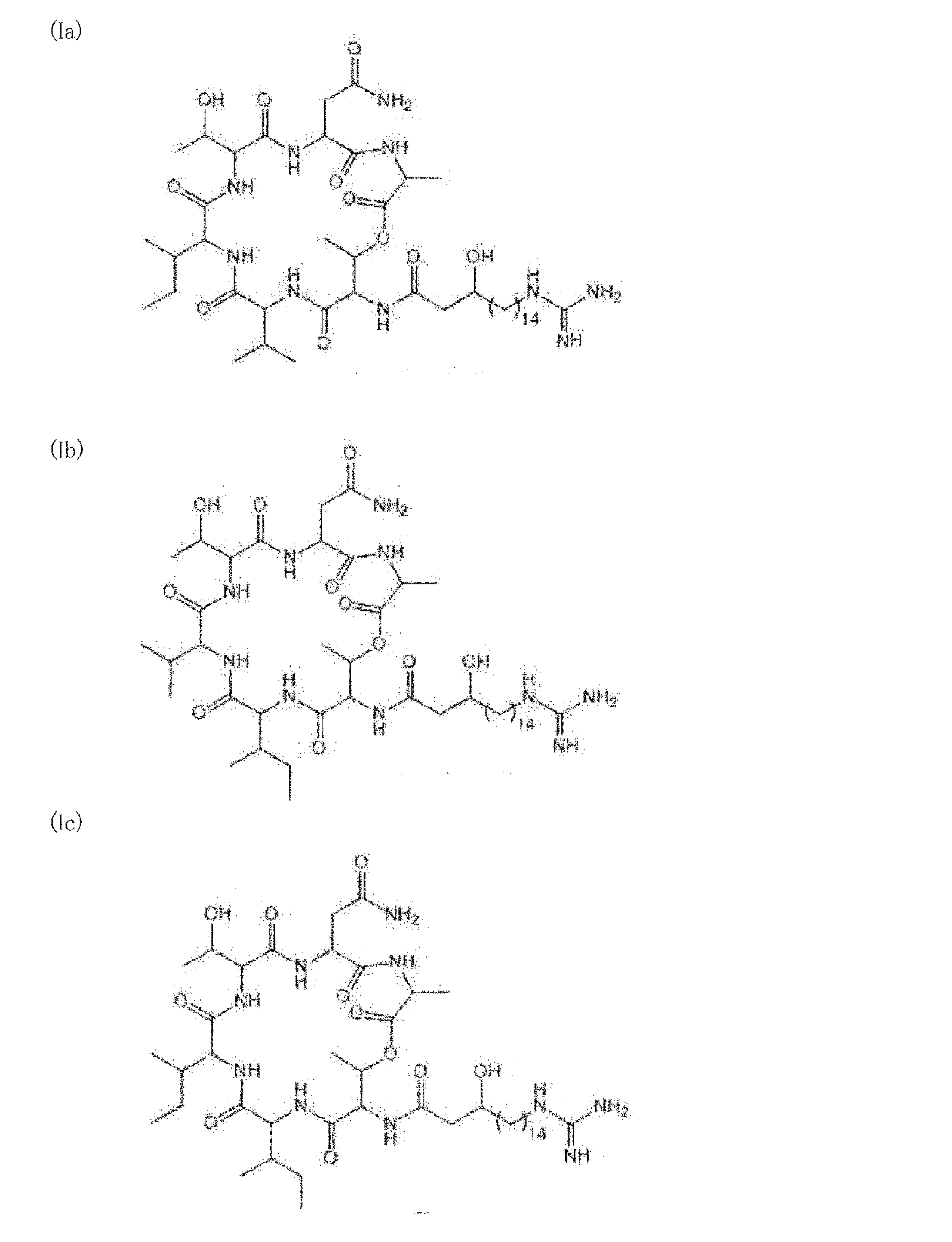


R1は、-CH2OHまたは-CH(OH)CH3であり、
R2は、-CH2C(O)NH2または-(CH2)2C(O)NH2であり、ならびに
R3は、HまたはCH3であり、
ただし、R1が-CH2OHであり、R2が-CH2C(O)NH2である場合、R3はHである)
を有する化合物であって、その塩、水和物、溶媒和物、多形体、光学異性体、幾何異性体、鏡像異性体、ジアステレオマー、非環式類似体、およびこれらの混合物を包含する化合物をさらに含む、請求項1に記載の組成物。 Structure (II)
R 1 is -CH 2 OH or -CH(OH)CH 3 ;
R2 is -CH2C (O) NH2 or -( CH2 ) 2C (O) NH2 , and R3 is H or CH3 ,
However, if R 1 is -CH 2 OH and R 2 is -CH 2 C(O)NH 2 , R 3 is H)
including its salts, hydrates, solvates, polymorphs, optical isomers, geometric isomers, enantiomers, diastereomers, acyclic analogs, and mixtures thereof. 2. The composition of claim 1, further comprising a compound.


Priority Applications (1)
| Application Number | Priority Date | Filing Date | Title |
|---|---|---|---|
| JP2023127225A JP7802733B2 (en) | 2015-03-26 | 2023-08-03 | Novel Paenibacillus strains, antifungal compounds, and methods for their use |
Applications Claiming Priority (5)
| Application Number | Priority Date | Filing Date | Title |
|---|---|---|---|
| US201562138765P | 2015-03-26 | 2015-03-26 | |
| US62/138,765 | 2015-03-26 | ||
| US201562232205P | 2015-09-24 | 2015-09-24 | |
| US62/232,205 | 2015-09-24 | ||
| JP2017549787A JP6916737B2 (en) | 2015-03-26 | 2016-03-23 | New PAENIBACILLUS strains, antifungal compounds, and methods for their use |
Related Parent Applications (1)
| Application Number | Title | Priority Date | Filing Date |
|---|---|---|---|
| JP2017549787A Division JP6916737B2 (en) | 2015-03-26 | 2016-03-23 | New PAENIBACILLUS strains, antifungal compounds, and methods for their use |
Related Child Applications (1)
| Application Number | Title | Priority Date | Filing Date |
|---|---|---|---|
| JP2023127225A Division JP7802733B2 (en) | 2015-03-26 | 2023-08-03 | Novel Paenibacillus strains, antifungal compounds, and methods for their use |
Publications (2)
| Publication Number | Publication Date |
|---|---|
| JP2021169507A JP2021169507A (en) | 2021-10-28 |
| JP7369741B2 true JP7369741B2 (en) | 2023-10-26 |
Family
ID=55646922
Family Applications (3)
| Application Number | Title | Priority Date | Filing Date |
|---|---|---|---|
| JP2017549787A Active JP6916737B2 (en) | 2015-03-26 | 2016-03-23 | New PAENIBACILLUS strains, antifungal compounds, and methods for their use |
| JP2021117799A Active JP7369741B2 (en) | 2015-03-26 | 2021-07-16 | Novel PAENIBACILLUS strains, antifungal compounds, and methods for their use |
| JP2023127225A Active JP7802733B2 (en) | 2015-03-26 | 2023-08-03 | Novel Paenibacillus strains, antifungal compounds, and methods for their use |
Family Applications Before (1)
| Application Number | Title | Priority Date | Filing Date |
|---|---|---|---|
| JP2017549787A Active JP6916737B2 (en) | 2015-03-26 | 2016-03-23 | New PAENIBACILLUS strains, antifungal compounds, and methods for their use |
Family Applications After (1)
| Application Number | Title | Priority Date | Filing Date |
|---|---|---|---|
| JP2023127225A Active JP7802733B2 (en) | 2015-03-26 | 2023-08-03 | Novel Paenibacillus strains, antifungal compounds, and methods for their use |
Country Status (20)
| Country | Link |
|---|---|
| US (5) | US9883676B2 (en) |
| EP (3) | EP3274443B1 (en) |
| JP (3) | JP6916737B2 (en) |
| KR (2) | KR102629565B1 (en) |
| CN (2) | CN114292799A (en) |
| AU (2) | AU2016235208B2 (en) |
| BR (4) | BR122021017017B1 (en) |
| CA (2) | CA2980723C (en) |
| CL (3) | CL2017002425A1 (en) |
| CO (1) | CO2017009663A2 (en) |
| ES (2) | ES2804732T3 (en) |
| HU (2) | HUE056482T2 (en) |
| MX (2) | MX387529B (en) |
| PE (2) | PE20221728A1 (en) |
| PH (1) | PH12017501757A1 (en) |
| PL (2) | PL3594225T3 (en) |
| PT (2) | PT3594225T (en) |
| RU (2) | RU2763542C2 (en) |
| UA (1) | UA120642C2 (en) |
| WO (1) | WO2016154297A1 (en) |
Cited By (1)
| Publication number | Priority date | Publication date | Assignee | Title |
|---|---|---|---|---|
| JP2023153947A (en) * | 2015-03-26 | 2023-10-18 | バイエル クロップサイエンス エルピー | Novel PAENIBACILLUS strains, antifungal compounds, and methods for their use |
Families Citing this family (187)
| Publication number | Priority date | Publication date | Assignee | Title |
|---|---|---|---|---|
| GB201622086D0 (en) | 2016-12-23 | 2017-02-08 | Scientia Terrae Vzw And Katholieke Univ Leuven And Proefstation Groenteteelt And Proefcentrum Hoogst | Biocontrol organism |
| CN107012106B (en) * | 2017-02-21 | 2019-07-26 | 北京农学院 | Phthalate-degrading bacteria with antagonistic effect on Fusarium lily and its application |
| US12274732B2 (en) | 2017-03-27 | 2025-04-15 | Tenfold Technologies, LLC | Anti-pathogen composition and methods of use thereof |
| BR112019020151A2 (en) | 2017-03-27 | 2020-05-05 | Tenfold Technologies, LLC | methods to control plant disease and to improve a plant's resistance to disease, agricultural composition, and plant seed. |
| TWI782983B (en) | 2017-04-27 | 2022-11-11 | 德商拜耳廠股份有限公司 | Heteroarylphenylaminoquinolines and analogues |
| CN110650628A (en) | 2017-05-03 | 2020-01-03 | 拜耳公司 | Trisubstituted silylheteroaryloxyquinolines and analogs thereof |
| WO2018202712A1 (en) | 2017-05-03 | 2018-11-08 | Bayer Aktiengesellschaft | Trisubstitutedsilylmethylphenoxyquinolines and analogues |
| BR112019023037A2 (en) | 2017-05-03 | 2020-06-02 | Bayer Aktiengesellschaft | TRISUBSTITUED SISILBENZILBENZIMIDAZOLIS AND ANALOGS |
| WO2019035881A1 (en) | 2017-08-17 | 2019-02-21 | Bayer Cropscience Lp | Liquid fertilizer-dispersible compositions and methods thereof |
| BR112020009446A2 (en) | 2017-11-13 | 2020-11-03 | Bayer Aktiengesellschaft | derivatives of tetrazolium propyl and its use as a fungicide |
| KR20200083590A (en) | 2017-11-16 | 2020-07-08 | 바이엘 크롭사이언스 엘피 | Paenibacillus based endogenous spore display platform, products and methods |
| TW201927768A (en) | 2017-12-21 | 2019-07-16 | 德商拜耳廠股份有限公司 | Trisubstitutedsilylmethylheteroaryloxyquinolines and analogues |
| WO2019142963A1 (en) * | 2018-01-22 | 2019-07-25 | 안동대학교 산학협력단 | Novel paenibacillus elgii am-67 strain and environmentally friendly biopesticide composition containing same for controlling chinese cabbage soft rot disease, erwinia.sp. |
| KR102012583B1 (en) | 2018-01-22 | 2019-08-21 | 안동대학교 산학협력단 | Novel Paenibacillus elgii AM-67 and echo-freindly agro-chemicals for controlling soft-root disease of chinese cabage comprising of the same |
| CN108192846B (en) * | 2018-02-06 | 2019-10-01 | 沈阳农业大学 | A kind of Paenibacillus polymyxa and its application for preventing and treating wheat leaf rust germ |
| WO2019155066A1 (en) | 2018-02-12 | 2019-08-15 | Bayer Aktiengesellschaft | Fungicidal oxadiazoles |
| WO2019162228A1 (en) | 2018-02-21 | 2019-08-29 | Bayer Aktiengesellschaft | 1-(5-substituted imidazol-1-yl)but-3-en derivatives and their use as fungicides |
| US20210147371A1 (en) | 2018-04-10 | 2021-05-20 | Bayer Aktiengesellschaft | Oxadiazoline derivatives |
| AU2019269315A1 (en) * | 2018-05-14 | 2020-12-10 | Bayer Cropscience Lp | Mutants of paenibacillus and methods for their use |
| EP3793364A1 (en) * | 2018-05-17 | 2021-03-24 | Bayer CropScience LP | Stabilized fungicidal composition |
| AU2019297402B2 (en) | 2018-07-05 | 2024-05-02 | Bayer Aktiengesellschaft | Substituted thiophenecarboxamides and analogues as antibacterials agents |
| CN112423592A (en) | 2018-07-17 | 2021-02-26 | 拜耳简易股份有限公司 | Biological method for controlling phytopathogenic fungi |
| CN117604062A (en) * | 2018-07-25 | 2024-02-27 | 明尼苏达大学董事会 | Platform for developing soil-borne plant pathogen-inhibiting microbial flora |
| WO2020020813A1 (en) | 2018-07-25 | 2020-01-30 | Bayer Aktiengesellschaft | Fungicidal active compound combinations |
| WO2020020816A1 (en) | 2018-07-26 | 2020-01-30 | Bayer Aktiengesellschaft | Novel triazole derivatives |
| CN109136132B (en) * | 2018-08-27 | 2021-05-14 | 田璨熙 | Pseudomonas sp.KXJ-B7 and culture method and application thereof |
| EP3852532A1 (en) | 2018-09-17 | 2021-07-28 | Bayer Aktiengesellschaft | Use of the fungicide isoflucypram for controlling claviceps purpurea and reducing sclerotia in cereals |
| US20220030876A1 (en) * | 2018-09-20 | 2022-02-03 | Bayer Cropscience Lp | Methods of controlling animal pests with paenibacillus terrae |
| WO2020070050A1 (en) | 2018-10-01 | 2020-04-09 | Bayer Aktiengesellschaft | Fungicidal 5-substituted imidazol-1-yl carbinol derivatives |
| KR20210081370A (en) | 2018-10-18 | 2021-07-01 | 바이엘 악티엔게젤샤프트 | Pyridylphenylaminoquinoline and analogs |
| JP2022512712A (en) | 2018-10-18 | 2022-02-07 | バイエル・アクチエンゲゼルシヤフト | Heteroarylaminoquinolines and analogs |
| TW202028193A (en) | 2018-10-20 | 2020-08-01 | 德商拜耳廠股份有限公司 | Oxetanylphenoxyquinolines and analogues |
| AR117169A1 (en) | 2018-11-28 | 2021-07-14 | Bayer Ag | (TIO) PYRIDAZINE AMIDES AS FUNGICIDE COMPOUNDS |
| CN109456921B (en) * | 2018-11-30 | 2021-06-08 | 郝志敏 | Paenibacillus polymyxa, application thereof, microbial agent, powder and granules |
| EP3620052A1 (en) | 2018-12-12 | 2020-03-11 | Bayer Aktiengesellschaft | Use of phenoxypyridinyl-substituted (1h-1,2,4-triazol-1-yl)alcohols for controlling fungicidal diseases in maize |
| PY19106036A (en) | 2018-12-20 | 2021-07-06 | Bayer Ag | HETEROCYCLYL PYRIDAZINE COMPOUNDS AS FUNGICIDES |
| EP3669652A1 (en) | 2018-12-21 | 2020-06-24 | Bayer AG | Active compound combination |
| PY19106549A (en) | 2018-12-21 | 2021-07-13 | Bayer Ag | 1,3,4-OXADIAZOLES AND THEIR DERIVATIVES AS NEW FUNGICIDAL AGENTS |
| EP3679789A1 (en) | 2019-01-08 | 2020-07-15 | Bayer AG | Active compound combinations |
| EP3679790A1 (en) | 2019-01-08 | 2020-07-15 | Bayer AG | Active compound combinations |
| EP3679793A1 (en) | 2019-01-08 | 2020-07-15 | Bayer AG | Active compound combinations |
| EP3679791A1 (en) | 2019-01-08 | 2020-07-15 | Bayer AG | Active compound combinations |
| EP3679792A1 (en) | 2019-01-08 | 2020-07-15 | Bayer AG | Active compound combinations |
| WO2020154813A1 (en) * | 2019-02-01 | 2020-08-06 | Kontzamanis Graumann Smith Macmillan Inc. | Bacterial strain having anti-fungal properties and uses thereof |
| AR118247A1 (en) | 2019-03-05 | 2021-09-22 | Bayer Ag | COMBINATION OF ACTIVE COMPOUNDS |
| BR112021017340A2 (en) * | 2019-03-07 | 2022-03-03 | Bayer Cropscience Lp | Paenibacillus strains and methods for using them |
| WO2020182929A1 (en) | 2019-03-13 | 2020-09-17 | Bayer Aktiengesellschaft | Substituted ureas and derivatives as new antifungal agents |
| CN109917048B (en) * | 2019-04-18 | 2022-03-08 | 江阴天江药业有限公司 | Construction method and application of UPLC characteristic spectrum of cortex fraxini medicinal material |
| MX2021013613A (en) | 2019-05-08 | 2021-12-10 | Bayer Ag | Active compound combination. |
| WO2020231751A1 (en) | 2019-05-10 | 2020-11-19 | Bayer Cropscience Lp | Active compound combinations |
| CN110229856B (en) * | 2019-06-19 | 2022-09-23 | 光明乳业股份有限公司 | Preparation method of cyclic lipopeptide antibiotic Fusaricidin B |
| EP3986892A1 (en) | 2019-06-21 | 2022-04-27 | Bayer Aktiengesellschaft | Hydroxyisoxazolines and use thereof as fungicides |
| EP3986891A1 (en) | 2019-06-21 | 2022-04-27 | Bayer Aktiengesellschaft | Hydroxyisoxazolines and derivatives thereof |
| EP3986877A1 (en) | 2019-06-21 | 2022-04-27 | Bayer Aktiengesellschaft | Hydroxyisoxazolines and derivatives thereof |
| WO2020254492A1 (en) | 2019-06-21 | 2020-12-24 | Bayer Aktiengesellschaft | Hydroxyisoxazolines and derivatives thereof |
| BR112021025300A2 (en) | 2019-06-21 | 2022-02-01 | Bayer Ag | fungicidal oxadiazoles |
| BR112021025317A2 (en) | 2019-06-21 | 2022-03-15 | Bayer Ag | Thienylhydroxyisoxazolines and derivatives thereof |
| WO2020254489A1 (en) | 2019-06-21 | 2020-12-24 | Bayer Aktiengesellschaft | Benzylphenyl hydroxyisoxazolines and analogues as new antifungal agents |
| BR112021025264A2 (en) | 2019-06-21 | 2022-01-25 | Bayer Ag | Phenoxyphenyl hydroxyisoxazolines and analogues as new antifungal agents |
| WO2020263812A1 (en) | 2019-06-24 | 2020-12-30 | Auburn University | A bacillus strain and methods of its use for plant growth promotion |
| CA3145592A1 (en) | 2019-07-03 | 2021-01-07 | Bayer Aktiengesellschaft | Substituted thiophene carboxamides and derivatives thereof as microbicides |
| EP3701796A1 (en) | 2019-08-08 | 2020-09-02 | Bayer AG | Active compound combinations |
| CA3156302A1 (en) | 2019-10-02 | 2021-04-08 | Bayer Aktiengesellschaft | Active compound combinations comprising fatty acids |
| WO2021097162A1 (en) | 2019-11-13 | 2021-05-20 | Bayer Cropscience Lp | Beneficial combinations with paenibacillus |
| CN118496197A (en) | 2019-12-20 | 2024-08-16 | 拜耳公司 | Substituted thiophenecarboxamides, thiophenecarboxylic acids and derivatives thereof |
| MA58019B1 (en) | 2019-12-20 | 2024-10-31 | Bayer Aktiengesellschaft | THIENYLOXAZOLONES AND ANALOGS |
| EP3708565A1 (en) | 2020-03-04 | 2020-09-16 | Bayer AG | Pyrimidinyloxyphenylamidines and the use thereof as fungicides |
| KR102339765B1 (en) * | 2020-03-13 | 2021-12-15 | 동아대학교 산학협력단 | Composition for controlling plant disease comprising Flavobacterium sp. TCH3-2 as effective component and uses thereof |
| CN111454860B (en) * | 2020-04-09 | 2022-01-18 | 广西乐土生物科技有限公司 | Bacillus polymyxa microbial inoculum and preparation method thereof |
| CN111378780B (en) * | 2020-04-09 | 2022-05-10 | 中国科学院微生物研究所 | A method for screening polygenic lineages of Pucciniaceae |
| AR121829A1 (en) | 2020-04-16 | 2022-07-13 | Bayer Ag | COMBINATIONS OF ACTIVE COMPOUNDS AND FUNGICIDE COMPOSITIONS THAT COMPRISE THEM |
| WO2021209366A1 (en) | 2020-04-16 | 2021-10-21 | Bayer Aktiengesellschaft | Active compound combinations and fungicide compositions comprising those |
| CN115551352B (en) | 2020-04-16 | 2024-11-08 | 拜耳公司 | Active compound combinations and fungicide compositions comprising them |
| WO2021209490A1 (en) | 2020-04-16 | 2021-10-21 | Bayer Aktiengesellschaft | Cyclaminephenylaminoquinolines as fungicides |
| WO2021209363A1 (en) | 2020-04-16 | 2021-10-21 | Bayer Aktiengesellschaft | Active compound combinations and fungicide compositions comprising those |
| HUE069397T2 (en) | 2020-04-16 | 2025-03-28 | Bayer Ag | Active compound combinations and fungicide compositions comprising those |
| EP4146628A1 (en) | 2020-05-06 | 2023-03-15 | Bayer Aktiengesellschaft | Pyridine (thio)amides as fungicidal compounds |
| WO2021228734A1 (en) | 2020-05-12 | 2021-11-18 | Bayer Aktiengesellschaft | Triazine and pyrimidine (thio)amides as fungicidal compounds |
| EP4153566A1 (en) | 2020-05-19 | 2023-03-29 | Bayer CropScience Aktiengesellschaft | Azabicyclic(thio)amides as fungicidal compounds |
| US20230165252A1 (en) | 2020-05-27 | 2023-06-01 | Bayer Aktiengesellschaft | Active compound combinations |
| US12565489B2 (en) | 2020-06-04 | 2026-03-03 | Bayer Aktiengesellschaft | Heterocyclyl pyrimidines and triazines as novel fungicides |
| CA3186659A1 (en) | 2020-06-10 | 2021-12-16 | Bayer Aktiengesellschaft | Azabicyclyl-substituted heterocycles as fungicides |
| WO2021255070A1 (en) | 2020-06-18 | 2021-12-23 | Bayer Aktiengesellschaft | Active compound combinations |
| CN116157017A (en) | 2020-06-18 | 2023-05-23 | 拜耳公司 | 3-(Pyridazin-4-yl)-5,6-dihydro-4H-1,2,4-oxadiazine derivatives as fungicides for crop protection |
| WO2021255091A1 (en) | 2020-06-19 | 2021-12-23 | Bayer Aktiengesellschaft | 1,3,4-oxadiazoles and their derivatives as fungicides |
| UY39275A (en) | 2020-06-19 | 2022-01-31 | Bayer Ag | 1,3,4-OXADIAZOLE PYRIMIDINES AS FUNGICIDES, PROCESSES AND INTERMEDIARIES FOR THEIR PREPARATION, METHODS OF USE AND USES OF THE SAME |
| WO2021255093A1 (en) | 2020-06-19 | 2021-12-23 | Bayer Aktiengesellschaft | Active compound combination |
| UY39276A (en) | 2020-06-19 | 2022-01-31 | Bayer Ag | USE OF 1,3,4-OXADIAZOL-2-ILPYRIMIDINE COMPOUNDS TO CONTROL PHYTOPATHOGENIC MICROORGANISMS, METHODS OF USE AND COMPOSITIONS. |
| WO2021255089A1 (en) | 2020-06-19 | 2021-12-23 | Bayer Aktiengesellschaft | 1,3,4-oxadiazole pyrimidines and 1,3,4-oxadiazole pyridines as fungicides |
| BR112023001312A2 (en) | 2020-07-31 | 2023-02-14 | Basf Se | SPRAY LIQUID, KIT, METHOD FOR CONTROLLING PHYTOPATHOGENIC FUNGI, SOLID OR LIQUID FORMULATION, PRODUCTION PROCESSES FOR SOLID FORMULATIONS AND CONCENTRATE FORMULATIONS IN SUSPENSION |
| WO2022058327A1 (en) | 2020-09-15 | 2022-03-24 | Bayer Aktiengesellschaft | Substituted ureas and derivatives as new antifungal agents |
| EP3915371A1 (en) | 2020-11-04 | 2021-12-01 | Bayer AG | Active compound combinations and fungicide compositions comprising those |
| USD1077859S1 (en) | 2020-11-17 | 2025-06-03 | Milwaukee Electric Tool Corporation | Blower |
| EP3915971A1 (en) | 2020-12-16 | 2021-12-01 | Bayer Aktiengesellschaft | Phenyl-s(o)n-phenylamidines and the use thereof as fungicides |
| WO2022128812A1 (en) | 2020-12-17 | 2022-06-23 | Basf Se | Spore compositions, production and uses thereof |
| WO2022129190A1 (en) | 2020-12-18 | 2022-06-23 | Bayer Aktiengesellschaft | (hetero)aryl substituted 1,2,4-oxadiazoles as fungicides |
| WO2022129196A1 (en) | 2020-12-18 | 2022-06-23 | Bayer Aktiengesellschaft | Heterobicycle substituted 1,2,4-oxadiazoles as fungicides |
| WO2022129188A1 (en) | 2020-12-18 | 2022-06-23 | Bayer Aktiengesellschaft | 1,2,4-oxadiazol-3-yl pyrimidines as fungicides |
| CN116634876A (en) * | 2020-12-23 | 2023-08-22 | 巴斯夫欧洲公司 | Mixtures and compositions comprising fusicidin A, fusaricidin B and fungicides |
| US11889794B2 (en) | 2020-12-30 | 2024-02-06 | Milwaukee Electric Tool Corporation | Handheld blower |
| CN112795507A (en) * | 2021-01-07 | 2021-05-14 | 河南省农业科学院植物保护研究所 | Paenibacillus polymyxa capable of preventing and treating root rot of salvia miltiorrhiza and application thereof |
| PY2203251A (en) | 2021-01-21 | 2023-01-18 | Syngenta Crop Protection Ag | HETEROCYCLIC DERIVATIVES ACTIVE AS PESTICIDES WITH SUBSTITUENTS CONTAINING SULFUR |
| CN112760258B (en) * | 2021-01-27 | 2022-02-01 | 中国农业科学院蔬菜花卉研究所 | Paenibacillus piricola and application thereof in preventing and treating cucumber bacterial soft rot |
| WO2022207496A1 (en) | 2021-03-30 | 2022-10-06 | Bayer Aktiengesellschaft | 3-(hetero)aryl-5-chlorodifluoromethyl-1,2,4-oxadiazole as fungicide |
| BR112023019400A2 (en) | 2021-03-30 | 2023-12-05 | Bayer Ag | 3-(HETERO)ARYL-5-CHLORODIFLOROMETHYL-1,2,4-OXADIAZOLE AS A FUNGICIDE |
| AR125342A1 (en) | 2021-04-16 | 2023-07-05 | Syngenta Crop Protection Ag | CYCLIC AMINE COMPOUNDS ACTIVE AS PESTICIDES |
| CN113278601B (en) * | 2021-05-17 | 2022-07-08 | 浙江工业大学 | Adenylylation protein A6 mutant and coding gene and application thereof |
| US20240287047A1 (en) | 2021-06-09 | 2024-08-29 | Syngenta Crop Protection Ag | Pesticidally active diazine-amide compounds |
| CN113354718B (en) * | 2021-06-21 | 2023-06-02 | 重庆市畜牧科学院 | A kind of penithin precursor, expression cassette and preparation method thereof |
| KR20240024926A (en) | 2021-06-24 | 2024-02-26 | 신젠타 크롭 프로텍션 아게 | 2-[3-[1[(quinazolin-4-yl)amino]ethyl]pyrazin-2-yl]thiazol-5-carbonitrile derivatives and similar compounds as pesticides |
| WO2023006634A1 (en) | 2021-07-27 | 2023-02-02 | Syngenta Crop Protection Ag | Method for controlling diamide resistant pests & compounds therefor |
| EP4380363A1 (en) | 2021-08-05 | 2024-06-12 | Syngenta Crop Protection AG | Method for controlling diamide resistant pests & compounds therefor |
| AR126729A1 (en) | 2021-08-10 | 2023-11-08 | Syngenta Crop Protection Ag | FUNGICIDE MIXTURE |
| US20250145640A1 (en) | 2021-08-10 | 2025-05-08 | Syngenta Crop Protection Ag | 2,2-difluoro-5h-[1,3]dioxolo[4,5-f]isoindol-7-one derivatives as pesticides |
| JP2024529148A (en) | 2021-08-13 | 2024-08-01 | バイエル、アクチエンゲゼルシャフト | Active compound combinations and antifungal compositions containing them - Patents.com |
| JP2024531331A (en) | 2021-08-20 | 2024-08-29 | ビーエーエスエフ ソシエタス・ヨーロピア | Paenibacillus strains that produce small amounts of exopolysaccharide |
| WO2023036938A1 (en) | 2021-09-10 | 2023-03-16 | Basf Se | Exopolysaccharide production microorganisms and uses thereof |
| DE112022003963T5 (en) | 2021-10-11 | 2024-07-04 | Milwaukee Electric Tool Corporation | BLOWER FOR A HANDHELD BLOWER |
| KR20240089416A (en) | 2021-10-14 | 2024-06-20 | 신젠타 크롭 프로텍션 아게 | Imidazo[1,2-a]pyridine derivative |
| UY39992A (en) | 2021-10-25 | 2023-05-15 | Syngenta Crop Protection Ag | Heterocyclic derivatives active as pesticides with sulfur-containing substituents |
| US20250042875A1 (en) | 2021-10-27 | 2025-02-06 | Syngenta Crop Protection Ag | Pesticidally active pyridazinone compounds |
| CN118541353A (en) | 2021-11-03 | 2024-08-23 | 拜耳公司 | Bis (hetero) aryl thioether (thio) amides as fungicidal compounds |
| US20250008961A1 (en) * | 2021-11-22 | 2025-01-09 | Basf Se | Paenibacillus strains producing low amounts of dab comprising compounds |
| WO2023099445A1 (en) | 2021-11-30 | 2023-06-08 | Bayer Aktiengesellschaft | Bis(hetero)aryl thioether oxadiazines as fungicidal compounds |
| US20250049033A1 (en) | 2021-12-10 | 2025-02-13 | Syngenta Crop Protection Ag | Pesticidally active pyridazinone compounds |
| WO2023110710A1 (en) | 2021-12-13 | 2023-06-22 | Syngenta Crop Protection Ag | Method for controlling diamide resistant pests & compounds therefor |
| EP4197333A1 (en) | 2021-12-15 | 2023-06-21 | Syngenta Crop Protection AG | Method for controlling diamide resistant pests & compounds therefor |
| WO2023148368A1 (en) | 2022-02-07 | 2023-08-10 | Syngenta Crop Protection Ag | Pesticidally active heterocyclic derivatives with sulfur containing substituents |
| UY40139A (en) | 2022-02-07 | 2023-08-31 | Syngenta Crop Protection Ag | IMIDAZO[1,2-A]PYRIDIN-2-YL]-1-PYRAZOLO[3,4-C]PYRIDINE DERIVATIVES ACTIVE AS PESTICIDES WITH SUBSTITUTES |
| US12352274B2 (en) | 2022-03-21 | 2025-07-08 | Milwaukee Electric Tool Corporation | Axial blower |
| UY40202A (en) | 2022-04-01 | 2023-10-31 | Syngenta Crop Protection Ag | Pyrazolopyridine derivatives active as pesticides with sulfur-containing substituents |
| JP2025516324A (en) | 2022-05-03 | 2025-05-27 | バイエル、アクチエンゲゼルシャフト | Use of (5S)-3-[3-(3-chloro-2-fluorophenoxy)-6-methylpyridazin-4-yl]-5-(2-chloro-4-methylbenzyl)-5,6-dihydro-4H-1,2,4-oxadiazine for controlling undesirable microorganisms |
| CN119522219A (en) | 2022-05-03 | 2025-02-25 | 拜耳公司 | Crystalline form of (5S)-3-[3-(3-chloro-2-fluorophenoxy)-6-methylpyridazin-4-yl]-5-(2-chloro-4-methylbenzyl)-5,6-dihydro-4H-1,2,4-oxadiazine |
| JP2025520650A (en) | 2022-06-21 | 2025-07-03 | シンジェンタ クロップ プロテクション アクチェンゲゼルシャフト | Pesticidal Active Fused Bicyclic Aromatic Heterocyclic Compounds |
| CN119546581A (en) | 2022-07-22 | 2025-02-28 | 先正达农作物保护股份公司 | Solid forms of heterocyclic amide derivatives |
| WO2024022910A1 (en) | 2022-07-26 | 2024-02-01 | Syngenta Crop Protection Ag | 1-[1-[2-(pyrimidin-4-yl)-1,2,4-triazol-3-yl]ethyl]-3-[2,4-dichloro-5-phenyl]urea derivatives and similar compounds as pesticides |
| WO2024033374A1 (en) | 2022-08-11 | 2024-02-15 | Syngenta Crop Protection Ag | Novel arylcarboxamide or arylthioamide compounds |
| JP2025532590A (en) | 2022-09-16 | 2025-10-01 | シンジェンタ クロップ プロテクション アクチェンゲゼルシャフト | Pesticidally active cyclic amine compounds |
| GB202214203D0 (en) | 2022-09-28 | 2022-11-09 | Syngenta Crop Protection Ag | Fungicidal compositions |
| WO2024068518A1 (en) | 2022-09-28 | 2024-04-04 | Bayer Aktiengesellschaft | 3-heteroaryl-5-chlorodifluoromethyl-1,2,4-oxadiazole as fungicide |
| EP4295688A1 (en) | 2022-09-28 | 2023-12-27 | Bayer Aktiengesellschaft | Active compound combination |
| WO2024068520A1 (en) | 2022-09-28 | 2024-04-04 | Bayer Aktiengesellschaft | 3-(hetero)aryl-5-chlorodifluoromethyl-1,2,4-oxadiazole as fungicide |
| WO2024068519A1 (en) | 2022-09-28 | 2024-04-04 | Bayer Aktiengesellschaft | 3-(hetero)aryl-5-chlorodifluoromethyl-1,2,4-oxadiazole as fungicide |
| WO2024068517A1 (en) | 2022-09-28 | 2024-04-04 | Bayer Aktiengesellschaft | 3-(hetero)aryl-5-chlorodifluoromethyl-1,2,4-oxadiazole as fungicide |
| GB202214202D0 (en) | 2022-09-28 | 2022-11-09 | Syngenta Crop Protection Ag | Agricultural methods |
| JP2026512642A (en) | 2022-10-25 | 2026-04-20 | シンジェンタ クロップ プロテクション アクチェンゲゼルシャフト | Heterocyclic derivatives containing sulfur substituents that are biologically active in harm control. |
| CN120112528A (en) | 2022-10-31 | 2025-06-06 | 先正达农作物保护股份公司 | Pesticide-inactivating heterocyclic derivatives having sulfur-containing substituents |
| EP4618745A1 (en) | 2022-11-17 | 2025-09-24 | Bayer Aktiengesellschaft | Use of isotianil for controlling plasmodiophora brassica |
| CN120225508A (en) | 2022-11-24 | 2025-06-27 | 先正达农作物保护股份公司 | Pesticidally active cyclic amine compounds |
| CN117051144B (en) * | 2022-12-06 | 2025-03-28 | 中南林业科技大学 | A molecular marker, primer, kit and application for identifying non-ribosomal polypeptide synthetase dtxS1 of fruit anthracnose fungus |
| WO2024126388A1 (en) | 2022-12-12 | 2024-06-20 | Syngenta Crop Protection Ag | Pesticidally active heterocyclic derivatives with sulfur containing substituents |
| JP2025541335A (en) | 2022-12-14 | 2025-12-18 | シンジェンタ クロップ プロテクション アクチェンゲゼルシャフト | Imidazo[1,2-a]pyridine derivatives |
| AU2023393591A1 (en) | 2022-12-16 | 2025-06-05 | Syngenta Crop Protection Ag | Benzimidazole derivatives |
| WO2024133551A1 (en) | 2022-12-21 | 2024-06-27 | Syngenta Crop Protection Ag | Pesticidally active pyridazine compounds |
| WO2024133426A1 (en) | 2022-12-21 | 2024-06-27 | Syngenta Crop Protection Ag | Method for controlling diamide resistant pests and compounds therefor |
| AR131541A1 (en) | 2023-01-07 | 2025-04-09 | Syngenta Crop Protection Ag | NOVEL CARBOXAMIDE COMPOUNDS |
| JP2026506646A (en) | 2023-02-13 | 2026-02-25 | シンジェンタ クロップ プロテクション アクチェンゲゼルシャフト | Pesticidal active bicyclic compounds |
| WO2025201636A1 (en) | 2023-03-31 | 2025-10-02 | Syngenta Crop Protection Ag | Pesticidally-active 2,2-dihalocyclopropyl compounds |
| AR132352A1 (en) | 2023-04-13 | 2025-06-18 | Syngenta Crop Protection Ag | IMIDAZO[1,2-A]PYRAZINE DERIVATIVES |
| PY2426847A (en) | 2023-04-13 | 2025-03-20 | Syngenta Crop Protection Ag | BICYCLIC IMIDAZO DERIVATIVES |
| AR132351A1 (en) | 2023-04-13 | 2025-06-18 | Syngenta Crop Protection Ag | IMIDAZO[1,2-A]PYRAZINE DERIVATIVES |
| AR132353A1 (en) | 2023-04-13 | 2025-06-18 | Syngenta Crop Protection Ag | PYRAZOLO[1,5-A]PYRIDINE DERIVATIVES |
| WO2025261608A1 (en) | 2023-06-29 | 2025-12-26 | Syngenta Crop Protection Ag | Pesticidally-active 2,2-dihalocyclopropyl compounds |
| CN116925967B (en) * | 2023-07-18 | 2024-12-24 | 青岛大学 | Marine streptomycete and application of oligomycin products thereof in resisting agricultural pathogenic bacteria |
| WO2025022007A1 (en) | 2023-07-27 | 2025-01-30 | Syngenta Crop Protection Ag | Pesticidally active quinazoline compounds |
| CN116694652B (en) * | 2023-08-01 | 2023-10-27 | 中国农业科学院生物技术研究所 | Verticillium dahliae VdNRPS4 gene antipathogenic target gene fragment, interference vector and application |
| EP4501112A1 (en) | 2023-08-01 | 2025-02-05 | Globachem NV | Plant defense elicitors |
| WO2025032129A1 (en) | 2023-08-08 | 2025-02-13 | Syngenta Crop Protection Ag | Novel aminoindane and aminotetraline compounds |
| WO2025031668A1 (en) | 2023-08-09 | 2025-02-13 | Bayer Aktiengesellschaft | Azaheterobiaryl-substituted 4,5-dihydro-1h-2,4,5-oxadiazines as novel fungicides |
| CN121693501A (en) | 2023-08-09 | 2026-03-17 | 拜耳公司 | Pyridazin-4-yl oxadiazines as novel bactericides |
| CN121843932A (en) | 2023-08-31 | 2026-04-10 | 先正达农作物保护股份公司 | Indazole compounds that kill harmful organisms |
| CN116926088B (en) * | 2023-09-14 | 2023-12-12 | 中国农业科学院生物技术研究所 | Verticillium dahliae VdNRPS6 gene antipathogenic target gene fragment, interference vector and application thereof |
| WO2025078128A1 (en) | 2023-10-11 | 2025-04-17 | Bayer Aktiengesellschaft | Pyridazin-3-one-4-yloxadiazines as novel fungicides |
| PY2501648A (en) | 2024-01-12 | 2025-10-31 | Syngenta Crop Protection Ag | NEW CARBOXAMIDE COMPOUNDS |
| WO2025168620A1 (en) | 2024-02-07 | 2025-08-14 | Bayer Aktiengesellschaft | Heteroaryl-substituted 4,5-dihydro-1h-2,4,5-oxadiazines as novel fungicides |
| WO2025202482A1 (en) | 2024-03-28 | 2025-10-02 | Syngenta Crop Protection Ag | Fungicidal compositions |
| WO2025202499A1 (en) | 2024-03-28 | 2025-10-02 | Syngenta Crop Protection Ag | Fungicidal compositions |
| WO2025210150A1 (en) | 2024-04-04 | 2025-10-09 | Syngenta Crop Protection Ag | Fungicidal composition |
| WO2025219337A1 (en) | 2024-04-15 | 2025-10-23 | Syngenta Crop Protection Ag | Use of strigolactone derivatives and analogues as nitrification inhibitors |
| WO2025248032A1 (en) | 2024-05-31 | 2025-12-04 | Syngenta Crop Protection Ag | Pesticidally active indazole compounds |
| WO2025252556A1 (en) | 2024-06-05 | 2025-12-11 | Syngenta Crop Protection Ag | Pesticidally-active 2,2-dihalocyclopropyl compounds |
| WO2025257024A1 (en) | 2024-06-12 | 2025-12-18 | Syngenta Crop Protection Ag | Fungicidal compositions |
| WO2025257023A1 (en) | 2024-06-12 | 2025-12-18 | Syngenta Crop Protection Ag | Fungicidal compositions |
| WO2025257413A1 (en) | 2024-06-13 | 2025-12-18 | Syngenta Crop Protection Ag | Pecticidally active dihydroazole derivatives |
| WO2026024726A1 (en) | 2024-07-24 | 2026-01-29 | Corteva Agriscience Llc | Pesticidal compositions comprising a thiazolidine and a biological agent |
| EP4692056A1 (en) | 2024-08-06 | 2026-02-11 | Syngenta Crop Protection AG | Pesticidally-active 2,2-dihalocyclopropyl compounds |
| WO2026078083A1 (en) | 2024-10-11 | 2026-04-16 | Syngenta Crop Protection Ag | Fungicidal compositions |
Citations (2)
| Publication number | Priority date | Publication date | Assignee | Title |
|---|---|---|---|---|
| WO2006016558A1 (en) | 2004-08-09 | 2006-02-16 | Kaken Pharmaceutical Co., Ltd. | Novel strains belonging to the genus paenibacillus and method of controlling plant disease by using these strains or culture thereof |
| WO2007086645A1 (en) | 2006-01-24 | 2007-08-02 | Korea Research Institute Of Bioscience And Biotechnology | Fusaricidin synthetase and gene thereof |
Family Cites Families (18)
| Publication number | Priority date | Publication date | Assignee | Title |
|---|---|---|---|---|
| US6593293B1 (en) * | 1999-09-15 | 2003-07-15 | Monsanto Technology, Llc | Lepidopteran-active Bacillus thuringiensis δ-endotoxin compositions and methods of use |
| JP2005536198A (en) * | 2002-06-28 | 2005-12-02 | ダウ アグロサイエンス リミテッド ライアビリティー カンパニー | Insecticidal proteins and polynucleotides derived from Penibacillus sp. |
| JP2010531640A (en) * | 2007-06-29 | 2010-09-30 | コモンウェルス サイエンティフィック アンド インダストリアル リサーチ オーガニゼイション | Method for decomposing toxic compounds |
| US9809865B2 (en) | 2009-12-09 | 2017-11-07 | Best Environmental Technologies, Inc. | Anti-microbial agent from Paenibacillus sp. and methods and uses thereof |
| KR101313900B1 (en) * | 2010-04-28 | 2013-09-30 | 대한민국(농촌진흥청장) | Methods for plant protection by fusaricidin |
| KR101250604B1 (en) | 2010-08-20 | 2013-04-03 | 고려대학교 산학협력단 | Penibacillus polymyxa DBB1709 mutant strain for the increased production of fusaricidin derivative LI-F07 and preparation method thereof |
| CN101962401B (en) * | 2010-09-01 | 2012-06-13 | 浙江大学 | Polypeptin and preparation and application thereof |
| CN102168053B (en) * | 2011-02-13 | 2013-09-25 | 南京农业大学 | Paenibacilluspolymyxa strain for coproduction of LI-F type antibiotic and dibutyl phthalate and application thereof |
| US20140113817A1 (en) * | 2011-04-12 | 2014-04-24 | Unaio Brasiliense De Educaco E Cultura-Ubec | Peptides with antimicrobial activity, drug compositions for the treatment and prophylaxis of animals, compositions for the treatment and prophylaxis of plants, uses of said peptides, and uses of paenibacillus elgil ourofinensis extract |
| KR101541446B1 (en) | 2012-12-11 | 2015-08-06 | 한국생명공학연구원 | A strain producing high level of fusaricidin and the method for mass production of fusaricidin using the strain |
| RU2539738C1 (en) * | 2013-08-20 | 2015-01-27 | Закрытое акционерное общество научно-производственное предприятие "Биомедхим" (ЗАО НПП "Биомедхим") | STRAIN OF BACTERIA Paenibacillus sp. FOR OBTAINING BIOLOGICAL PRODUCT AGAINST DISEASES OF WHEAT CAUSED BY PHYTOPATHOGENIC FUNGI |
| RU2529958C1 (en) * | 2013-08-20 | 2014-10-10 | Закрытое акционерное общество научно-производственное предприятие "Биомедхим" (ЗАО НПП "Биомедхим") | Strain of nitrogen-fixing bacteria pseudomonas sp for obtaining biological product against diseases of wheat caused by phytopathogenic fungi, and increase in productivity |
| US9745597B2 (en) * | 2014-05-28 | 2017-08-29 | Bayer Cropscience Lp | Compositions and methods for controlling fungal and bacterial diseases in plants |
| PT3194566T (en) * | 2014-08-04 | 2019-07-08 | Basf Se | Antifungal paenibacillus strains, fusaricidin-type compounds, and their use |
| CL2014002101A1 (en) | 2014-08-08 | 2015-01-30 | Univ Santiago Chile | Bacterial strain paenibacilus polymyxa schc33, biological control agent for phytopathogenic fungi such as botrytis cinerea and use to combat such fungi in fruits, vegetables or ornamental plants, under pre-harvest conditions. |
| AR101957A1 (en) * | 2014-09-17 | 2017-01-25 | Bayer Cropscience Lp | COMPOSITIONS THAT INCLUDE BACILLUS RECOMBINATING CELLS AND AN INSECTICIDE |
| PL3594225T3 (en) * | 2015-03-26 | 2022-01-31 | Bayer Cropscience Lp | Paenibacillus strain, antifungal compounds, and methods for their use |
| AU2019269315A1 (en) * | 2018-05-14 | 2020-12-10 | Bayer Cropscience Lp | Mutants of paenibacillus and methods for their use |
-
2016
- 2016-03-23 PL PL19164025T patent/PL3594225T3/en unknown
- 2016-03-23 CN CN202111566242.3A patent/CN114292799A/en active Pending
- 2016-03-23 EP EP16713716.5A patent/EP3274443B1/en active Active
- 2016-03-23 KR KR1020177030448A patent/KR102629565B1/en active Active
- 2016-03-23 RU RU2017135499A patent/RU2763542C2/en active
- 2016-03-23 EP EP20212853.4A patent/EP3838914A1/en active Pending
- 2016-03-23 BR BR122021017017-7A patent/BR122021017017B1/en active IP Right Grant
- 2016-03-23 PE PE2022001981A patent/PE20221728A1/en unknown
- 2016-03-23 RU RU2021135364A patent/RU2021135364A/en unknown
- 2016-03-23 KR KR1020247002482A patent/KR102859105B1/en active Active
- 2016-03-23 CA CA2980723A patent/CA2980723C/en active Active
- 2016-03-23 CA CA3288581A patent/CA3288581A1/en active Pending
- 2016-03-23 PE PE2017001603A patent/PE20181360A1/en unknown
- 2016-03-23 US US15/078,670 patent/US9883676B2/en active Active
- 2016-03-23 HU HUE19164025A patent/HUE056482T2/en unknown
- 2016-03-23 HU HUE16713716A patent/HUE049475T2/en unknown
- 2016-03-23 JP JP2017549787A patent/JP6916737B2/en active Active
- 2016-03-23 PT PT191640259T patent/PT3594225T/en unknown
- 2016-03-23 BR BR112017020604-8A patent/BR112017020604B1/en active IP Right Grant
- 2016-03-23 EP EP19164025.9A patent/EP3594225B1/en active Active
- 2016-03-23 BR BR122021017006-1A patent/BR122021017006B1/en active IP Right Grant
- 2016-03-23 PT PT167137165T patent/PT3274443T/en unknown
- 2016-03-23 CN CN201680030395.7A patent/CN107995925B/en active Active
- 2016-03-23 ES ES16713716T patent/ES2804732T3/en active Active
- 2016-03-23 ES ES19164025T patent/ES2900458T3/en active Active
- 2016-03-23 PL PL16713716T patent/PL3274443T3/en unknown
- 2016-03-23 UA UAA201710266A patent/UA120642C2/en unknown
- 2016-03-23 BR BR122021017060-6A patent/BR122021017060B1/en active IP Right Grant
- 2016-03-23 WO PCT/US2016/023760 patent/WO2016154297A1/en not_active Ceased
- 2016-03-23 AU AU2016235208A patent/AU2016235208B2/en active Active
- 2016-03-23 MX MX2017012305A patent/MX387529B/en unknown
-
2017
- 2017-09-25 CO CONC2017/0009663A patent/CO2017009663A2/en unknown
- 2017-09-25 PH PH12017501757A patent/PH12017501757A1/en unknown
- 2017-09-26 CL CL2017002425A patent/CL2017002425A1/en unknown
- 2017-09-26 MX MX2021011119A patent/MX2021011119A/en unknown
-
2018
- 2018-01-18 US US15/874,577 patent/US10159257B2/en active Active
- 2018-10-11 CL CL2018002899A patent/CL2018002899A1/en unknown
- 2018-11-14 US US16/190,556 patent/US10499656B2/en active Active
-
2019
- 2019-06-28 CL CL2019001810A patent/CL2019001810A1/en unknown
- 2019-10-31 US US16/669,783 patent/US11623944B2/en active Active
-
2021
- 2021-07-16 JP JP2021117799A patent/JP7369741B2/en active Active
-
2022
- 2022-05-17 AU AU2022203326A patent/AU2022203326B2/en active Active
-
2023
- 2023-02-27 US US18/175,114 patent/US20230234988A1/en active Pending
- 2023-08-03 JP JP2023127225A patent/JP7802733B2/en active Active
Patent Citations (2)
| Publication number | Priority date | Publication date | Assignee | Title |
|---|---|---|---|---|
| WO2006016558A1 (en) | 2004-08-09 | 2006-02-16 | Kaken Pharmaceutical Co., Ltd. | Novel strains belonging to the genus paenibacillus and method of controlling plant disease by using these strains or culture thereof |
| WO2007086645A1 (en) | 2006-01-24 | 2007-08-02 | Korea Research Institute Of Bioscience And Biotechnology | Fusaricidin synthetase and gene thereof |
Non-Patent Citations (2)
| Title |
|---|
| Phytoparasitica,2013年,Vol.41,pp.49-58 |
| Tetrahedron,2001年,Vol.57,pp.1189-1195 |
Cited By (1)
| Publication number | Priority date | Publication date | Assignee | Title |
|---|---|---|---|---|
| JP2023153947A (en) * | 2015-03-26 | 2023-10-18 | バイエル クロップサイエンス エルピー | Novel PAENIBACILLUS strains, antifungal compounds, and methods for their use |
Also Published As
Similar Documents
| Publication | Publication Date | Title |
|---|---|---|
| JP7369741B2 (en) | Novel PAENIBACILLUS strains, antifungal compounds, and methods for their use | |
| JP7541529B2 (en) | Paenibacillus strains and uses thereof | |
| JP2021522833A (en) | Paenibacillus mutants and how to use them | |
| NZ735632B2 (en) | A novel paenibacillus strain, antifungal compounds, and methods for their use |
Legal Events
| Date | Code | Title | Description |
|---|---|---|---|
| A521 | Request for written amendment filed |
Free format text: JAPANESE INTERMEDIATE CODE: A523 Effective date: 20210716 |
|
| A621 | Written request for application examination |
Free format text: JAPANESE INTERMEDIATE CODE: A621 Effective date: 20210716 |
|
| RD02 | Notification of acceptance of power of attorney |
Free format text: JAPANESE INTERMEDIATE CODE: A7422 Effective date: 20220509 |
|
| A131 | Notification of reasons for refusal |
Free format text: JAPANESE INTERMEDIATE CODE: A131 Effective date: 20220628 |
|
| A601 | Written request for extension of time |
Free format text: JAPANESE INTERMEDIATE CODE: A601 Effective date: 20220922 |
|
| A521 | Request for written amendment filed |
Free format text: JAPANESE INTERMEDIATE CODE: A523 Effective date: 20221223 |
|
| A02 | Decision of refusal |
Free format text: JAPANESE INTERMEDIATE CODE: A02 Effective date: 20230404 |
|
| A521 | Request for written amendment filed |
Free format text: JAPANESE INTERMEDIATE CODE: A523 Effective date: 20230803 |
|
| A911 | Transfer to examiner for re-examination before appeal (zenchi) |
Free format text: JAPANESE INTERMEDIATE CODE: A911 Effective date: 20230824 |
|
| TRDD | Decision of grant or rejection written | ||
| A01 | Written decision to grant a patent or to grant a registration (utility model) |
Free format text: JAPANESE INTERMEDIATE CODE: A01 Effective date: 20231010 |
|
| A61 | First payment of annual fees (during grant procedure) |
Free format text: JAPANESE INTERMEDIATE CODE: A61 Effective date: 20231016 |
|
| R150 | Certificate of patent or registration of utility model |
Ref document number: 7369741 Country of ref document: JP Free format text: JAPANESE INTERMEDIATE CODE: R150 |