JP7535532B2 - Fused bicyclic heterocyclic derivatives as pest control agents. - Google Patents
Fused bicyclic heterocyclic derivatives as pest control agents. Download PDFInfo
- Publication number
- JP7535532B2 JP7535532B2 JP2021549662A JP2021549662A JP7535532B2 JP 7535532 B2 JP7535532 B2 JP 7535532B2 JP 2021549662 A JP2021549662 A JP 2021549662A JP 2021549662 A JP2021549662 A JP 2021549662A JP 7535532 B2 JP7535532 B2 JP 7535532B2
- Authority
- JP
- Japan
- Prior art keywords
- spp
- formula
- alkyl
- compounds
- methyl
- Prior art date
- Legal status (The legal status is an assumption and is not a legal conclusion. Google has not performed a legal analysis and makes no representation as to the accuracy of the status listed.)
- Active
Links
Classifications
-
- C—CHEMISTRY; METALLURGY
- C07—ORGANIC CHEMISTRY
- C07D—HETEROCYCLIC COMPOUNDS
- C07D471/00—Heterocyclic compounds containing nitrogen atoms as the only ring hetero atoms in the condensed system, at least one ring being a six-membered ring with one nitrogen atom, not provided for by groups C07D451/00 - C07D463/00
- C07D471/02—Heterocyclic compounds containing nitrogen atoms as the only ring hetero atoms in the condensed system, at least one ring being a six-membered ring with one nitrogen atom, not provided for by groups C07D451/00 - C07D463/00 in which the condensed system contains two hetero rings
- C07D471/04—Ortho-condensed systems
-
- A—HUMAN NECESSITIES
- A01—AGRICULTURE; FORESTRY; ANIMAL HUSBANDRY; HUNTING; TRAPPING; FISHING
- A01N—PRESERVATION OF BODIES OF HUMANS OR ANIMALS OR PLANTS OR PARTS THEREOF; BIOCIDES, e.g. AS DISINFECTANTS, AS PESTICIDES OR AS HERBICIDES; PEST REPELLANTS OR ATTRACTANTS; PLANT GROWTH REGULATORS
- A01N43/00—Biocides, pest repellants or attractants, or plant growth regulators containing heterocyclic compounds
- A01N43/90—Biocides, pest repellants or attractants, or plant growth regulators containing heterocyclic compounds having two or more relevant hetero rings, condensed among themselves or with a common carbocyclic ring system
-
- A—HUMAN NECESSITIES
- A61—MEDICAL OR VETERINARY SCIENCE; HYGIENE
- A61P—SPECIFIC THERAPEUTIC ACTIVITY OF CHEMICAL COMPOUNDS OR MEDICINAL PREPARATIONS
- A61P17/00—Drugs for dermatological disorders
-
- C—CHEMISTRY; METALLURGY
- C07—ORGANIC CHEMISTRY
- C07C—ACYCLIC OR CARBOCYCLIC COMPOUNDS
- C07C317/00—Sulfones; Sulfoxides
- C07C317/26—Sulfones; Sulfoxides having sulfone or sulfoxide groups and nitrogen atoms, not being part of nitro or nitroso groups, bound to the same carbon skeleton
- C07C317/32—Sulfones; Sulfoxides having sulfone or sulfoxide groups and nitrogen atoms, not being part of nitro or nitroso groups, bound to the same carbon skeleton with sulfone or sulfoxide groups bound to carbon atoms of six-membered aromatic rings of the carbon skeleton
- C07C317/34—Sulfones; Sulfoxides having sulfone or sulfoxide groups and nitrogen atoms, not being part of nitro or nitroso groups, bound to the same carbon skeleton with sulfone or sulfoxide groups bound to carbon atoms of six-membered aromatic rings of the carbon skeleton having sulfone or sulfoxide groups and amino groups bound to carbon atoms of six-membered aromatic rings being part of the same non-condensed ring or of a condensed ring system containing that ring
-
- C—CHEMISTRY; METALLURGY
- C07—ORGANIC CHEMISTRY
- C07D—HETEROCYCLIC COMPOUNDS
- C07D217/00—Heterocyclic compounds containing isoquinoline or hydrogenated isoquinoline ring systems
- C07D217/22—Heterocyclic compounds containing isoquinoline or hydrogenated isoquinoline ring systems with hetero atoms or with carbon atoms having three bonds to hetero atoms with at the most one bond to halogen, e.g. ester or nitrile radicals, directly attached to carbon atoms of the nitrogen-containing ring
- C07D217/26—Carbon atoms having three bonds to hetero atoms with at the most one bond to halogen
-
- C—CHEMISTRY; METALLURGY
- C07—ORGANIC CHEMISTRY
- C07D—HETEROCYCLIC COMPOUNDS
- C07D401/00—Heterocyclic compounds containing two or more hetero rings, having nitrogen atoms as the only ring hetero atoms, at least one ring being a six-membered ring with only one nitrogen atom
- C07D401/02—Heterocyclic compounds containing two or more hetero rings, having nitrogen atoms as the only ring hetero atoms, at least one ring being a six-membered ring with only one nitrogen atom containing two hetero rings
- C07D401/04—Heterocyclic compounds containing two or more hetero rings, having nitrogen atoms as the only ring hetero atoms, at least one ring being a six-membered ring with only one nitrogen atom containing two hetero rings directly linked by a ring-member-to-ring-member bond
-
- C—CHEMISTRY; METALLURGY
- C07—ORGANIC CHEMISTRY
- C07D—HETEROCYCLIC COMPOUNDS
- C07D413/00—Heterocyclic compounds containing two or more hetero rings, at least one ring having nitrogen and oxygen atoms as the only ring hetero atoms
- C07D413/02—Heterocyclic compounds containing two or more hetero rings, at least one ring having nitrogen and oxygen atoms as the only ring hetero atoms containing two hetero rings
- C07D413/04—Heterocyclic compounds containing two or more hetero rings, at least one ring having nitrogen and oxygen atoms as the only ring hetero atoms containing two hetero rings directly linked by a ring-member-to-ring-member bond
-
- C—CHEMISTRY; METALLURGY
- C07—ORGANIC CHEMISTRY
- C07D—HETEROCYCLIC COMPOUNDS
- C07D487/00—Heterocyclic compounds containing nitrogen atoms as the only ring hetero atoms in the condensed system, not provided for by groups C07D451/00 - C07D477/00
- C07D487/02—Heterocyclic compounds containing nitrogen atoms as the only ring hetero atoms in the condensed system, not provided for by groups C07D451/00 - C07D477/00 in which the condensed system contains two hetero rings
- C07D487/04—Ortho-condensed systems
Landscapes
- Organic Chemistry (AREA)
- Chemical & Material Sciences (AREA)
- Life Sciences & Earth Sciences (AREA)
- Health & Medical Sciences (AREA)
- General Health & Medical Sciences (AREA)
- Engineering & Computer Science (AREA)
- Plant Pathology (AREA)
- Pest Control & Pesticides (AREA)
- Dentistry (AREA)
- Agronomy & Crop Science (AREA)
- Wood Science & Technology (AREA)
- Zoology (AREA)
- Environmental Sciences (AREA)
- Dermatology (AREA)
- Animal Behavior & Ethology (AREA)
- Chemical Kinetics & Catalysis (AREA)
- General Chemical & Material Sciences (AREA)
- Medicinal Chemistry (AREA)
- Nuclear Medicine, Radiotherapy & Molecular Imaging (AREA)
- Pharmacology & Pharmacy (AREA)
- Bioinformatics & Cheminformatics (AREA)
- Public Health (AREA)
- Veterinary Medicine (AREA)
- Nitrogen Condensed Heterocyclic Rings (AREA)
- Pharmaceuticals Containing Other Organic And Inorganic Compounds (AREA)
- Agricultural Chemicals And Associated Chemicals (AREA)
- Nitrogen And Oxygen Or Sulfur-Condensed Heterocyclic Ring Systems (AREA)
- Plural Heterocyclic Compounds (AREA)
Description
本発明は、式(I)の新規な縮合二環式複素環誘導体、害虫(animal pests)、特に節足動物、特に昆虫およびクモ類を防除するための殺ダニ剤および/または殺虫剤としてのそれらの使用、ならびにそれらの調製のための方法および中間体に関する。 The present invention relates to novel fused bicyclic heterocyclic derivatives of formula (I), their use as acaricides and/or insecticides for controlling animal pests, in particular arthropods, especially insects and arachnids, and to processes and intermediates for their preparation.
殺虫特性を有する縮合二環式複素環誘導体は、文献、例えば、WO2010/125985、WO2012/074135、WO2012/086848、WO2013/018928、WO2013/191113、WO2014/142292、WO2014/148451、WO2015/000715、WO2015/121136、WO2015/198859、WO2015/133603、WO2015/198859、WO2015/002211、WO2015/071180、WO2015/091945、WO2016/005263、WO2015/198817、WO2016/124563、WO2016/124557、WO2016/091731、WO2016/039444、WO2016/041819、WO2016/039441、WO2016/026848、WO2016/023954、WO2016/020286、WO2016/046071、WO2016/091731、WO2016/107742、WO2016/129684、WO2016/142326、2017/072039、WO2017/026384、WO2017/061497、WO2017/146220、WO2017/155103、WO2018/084142、WO2018/105632に既に記載されている。 Fused bicyclic heterocyclic derivatives having insecticidal properties are described in the literature, e.g., WO2010/125985, WO2012/074135, WO2012/086848, WO2013/018928, WO2013/191113, WO2014/142292, WO2014/148451, WO2015/000715, WO 2015/121136, WO2015/198859, WO2015/133603, WO2015/198859, WO2015/002211, WO2015/071180, WO2015/091945, WO2016/005263, WO2015/1988 17, WO2016/124563, WO20 16/124557, WO2016/091731, WO2016/039444, WO2016/041819, WO2016/039441, WO2016/026848, WO2016/023954, WO2016/020286, WO2016/046071 , WO2016/091731, WO2016 /107742, WO2016/129684, WO2016/142326, 2017/072039, WO2017/026384, WO2017/061497, WO2017/146220, WO2017/155103, WO2018/084142, and WO2018/105632.
現代の作物保護組成物は、例えば、その作用の程度、持続性および範囲、ならびに可能な使用に関して多くの要求を満たさなければならない。毒性の問題、有益な種および受粉者の節約、環境特性、施用率、他の活性化合物または製剤補助剤との組み合わせ可能性は、活性化合物の合成に関与する複雑性の問題と同様に役割を果たし、ほんの少数のパラメータを挙げると耐性もまた起こり得る。これらの全ての理由だけで、新規な作物保護組成物の探索は完全であるとは考えられず、少なくとも個々の態様に関して既知の化合物と比較して改善された特性を有する新規な化合物が絶えず必要とされている。 Modern crop protection compositions must meet many requirements, for example with regard to their degree, duration and scope of action, as well as possible uses. Toxicity issues, sparing of beneficial species and pollinators, environmental properties, application rates, combinability with other active compounds or formulation auxiliaries play a role, as do issues of complexity involved in the synthesis of active compounds, where resistance may also occur, to name just a few parameters. For all these reasons alone, the search for new crop protection compositions cannot be considered complete, and there is a constant need for new compounds with improved properties compared to known compounds, at least with regard to individual aspects.
本発明の目的は、種々の局面において殺有害生物剤のスペクトルを広げ、および/またはそれらの活性を改善する化合物を提供することであった。 The object of the present invention was to provide compounds that broaden the spectrum of pesticides and/or improve their activity in various respects.
新規の縮合二環式複素環誘導体が現在見出されており、これらは既に知られている化合物を上回る利点を有し、その例としては、より良好な生物学的または環境的特性、より広範囲の適用方法、より良好な殺虫または殺ダニ作用、および有用な植物との良好な適合性が挙げられる。複素環誘導体は、特に防除が困難な昆虫に対する効力を改善するために、さらなる組成物と組み合わせて使用することができる。 New fused bicyclic heterocyclic derivatives have now been found which have advantages over already known compounds, such as better biological or environmental properties, a broader range of application methods, better insecticidal or acaricidal action, and better compatibility with useful plants. The heterocyclic derivatives can be used in combination with further compositions to improve efficacy, especially against difficult to control insects.
したがって、本発明の主題は、式(I) Thus, the subject of the present invention is a compound of formula (I)

Aaは、窒素または=C(R7)-を表し、
Abは、窒素または=C(R8)-を表し、
Acは、窒素または=C(R9)-を表し、
Adは、窒素または=C(R10)-を表し、
Aeは、窒素または=C(R11)-を表し、
ここで、Ab、Ac、AdおよびAeは、同時に窒素を表すことはできず、
R1は、(C1-C6)-アルキル、(C1-C6)-ハロアルキル、(C2-C6)-アルケニル、(C2-C6)-ハロアルケニル、(C2-C6)-アルキニル、(C2-C6)-ハロアルキニル、(C3-C8)-シクロアルキル、ハロ-(C3-C8)-シクロアルキル、(C3-C6)-シクロアルキル-(C1-C6)-アルキル、(C3-C6)-シクロアルキル-(C1-C6)-ハロアルキル、(C1-C6)-アルキル-(C3-C8)-シクロアルキル、(C1-C6)-ハロアルキル-(C3-C8)-シクロアルキル、(C3-C8)-シクロアルキル-(C3-C8)-シクロアルキル、スピロ-(C3-C8)-シクロアルキル-(C3-C8)-シクロアルキル、(C4-C12)-ビシクロアルキル、(C1-C6)-シアノアルキル、(C1-C6)-ヒドロキシアルキル、(C1-C6)-アルコキシ-(C1-C6)-アルキル、(C2-C6)-シアノアルケニル、(C3-C6)-シクロアルキル-(C2-C6)-アルケニル、(C2-C6)-シアノアルキニル、(C3-C6)-シクロアルキル-(C2-C6)-アルキニル、(C1-C6)-ハロアルコキシ-(C1-C6)-アルキル、(C2-C6)-アルケニルオキシ-(C1-C6)-アルキル、(C2-C6)-ハロアルケニルオキシ-(C1-C6)-アルキル、(C2-C6)-アルキニルオキシ-(C1-C4)-アルキル、(C2-C6)-ハロアルキニルオキシ-(C1-C6)-アルキル、(C1-C6)-アルキルチオ-(C1-C6)-アルキル、(C1-C6)-アルキルスルフィニル-(C1-C6)-アルキル、(C1-C6)-アルキルスルホニル-(C1-C6)-アルキル、(C1-C6)-ハロアルキルチオ-(C1-C6)-アルキル、(C1-C6)-ハロアルキルスルフィニル-(C1-C6)-アルキル、(C1-C6)-ハロアルキルスルホニル-(C1-C6)-アルキルまたはトリ-(C1-C6)-アルキルシリルを表し、
R7は、水素、シアノ、ハロゲン、アセチル、ヒドロキシル、アミノ、(C3-C8)-シクロアルキル、ハロ(C3-C8)-シクロアルキル、(C1-C6)-アルキル、(C1-C6)-ハロアルキル、(C1-C6)-シアノアルキル、(C2-C6)-アルケニル、(C2-C6)-ハロアルケニル、(C2-C6)-アルキニル、(C2-C6)-ハロアルキニル、(C1-C6)-アルコキシ、(C1-C6)-ハロアルコキシ、(C1-C6)-アルキルチオ、(C1-C6)-ハロアルキルチオ、(C1-C6)-アルキルスルフィニル、(C1-C6)-ハロアルキルスルフィニル、(C1-C6)-アルキルスルホニルまたは(C1-C6)-ハロアルキルスルホニルを表し、
R8、R9、R10、R11は、それぞれ独立に、水素、ハロゲン、(C1-C6)-アルキル、(C1-C6)-ハロアルキル、(C1-C6)-アルコキシ、(C1-C6)-ハロアルコキシ、(C1-C6)-ハロアルキルチオ、(C1-C6)-ハロアルキルスルフィニル、(C1-C6)-ハロアルキルスルホニルを表すか、または
Aa represents nitrogen or ═C(R 7 )—;
Ab represents nitrogen or ═C(R 8 )—;
Ac represents nitrogen or ═C(R 9 )—;
Ad represents nitrogen or ═C(R 10 )—;
Ae represents nitrogen or ═C(R 11 )—;
wherein Ab, Ac, Ad and Ae cannot simultaneously represent nitrogen;
R 1 is (C 1 -C 6 )-alkyl, (C 1 -C 6 )-haloalkyl, (C 2 -C 6 )-alkenyl, (C 2 -C 6 )-haloalkenyl, (C 2 -C 6 )-alkynyl, (C 2 -C 6 )-haloalkynyl, (C 3 -C 8 )-cycloalkyl, halo-(C 3 -C 8 )-cycloalkyl, (C 3 -C 6 )-cycloalkyl -(C 1 -C 6 )-alkyl, (C 3 -C 6 )-cycloalkyl-(C 1 -C 6 )-haloalkyl, (C 1 -C 6 )-alkyl-(C 3 -C 8 )- Cycloalkyl, (C 1 -C 6 )-haloalkyl-(C 3 -C8 )-cycloalkyl, ( C3 - C8 )-cycloalkyl-( C3 - C8 )-cycloalkyl, spiro-(C3 - C8 )-cycloalkyl-( C3 - C8 ) -cycloalkyl, (C 4 -C 12 )-bicycloalkyl, (C 1 -C 6 )-cyanoalkyl, (C 1 -C 6 )-hydroxyalkyl, (C 1 -C 6 )-alkoxy-(C 1 -C6 )-alkyl, ( C2 - C6 )-cyanoalkenyl, ( C3 - C6 )-cycloalkyl-( C2 - C6 )-alkenyl, ( C2 - C6 )-cyanoalkynyl, (C 3 -C 6 )-cycloalkyl-(C 2 -C 6 )-alkynyl, (C 1 -C 6 )-haloalkoxy-(C 1 -C 6 )-alkyl, (C 2 -C 6 )-alkenyloxy-(C 1 -C 6 )-alkyl, (C 2 - (C 6 )-haloalkenyloxy-(C 1 -C 6 )-alkyl, (C 2 -C 6 )-alkynyloxy-(C 1 -C 4 )-alkyl, (C 2 -C 6 )-haloalkynyloxy -(C 1 -C 6 )-alkyl, (C 1 -C 6 )-alkylthio-(C 1 -C 6 )-alkyl, (C 1 -C 6 )-alkylsulfinyl-(C 1 -C 6 )- Alkyl, (C 1 -C 6 )-alkylsulfonyl-(C 1 -C 6 )-alkyl, (C 1 -C 6 )-haloalkylthio-(C 1 -C 6 )-alkyl, (C 1 -C 6 )-haloalkylsulfinyl-(C 1 -C 6 )-alkyl, ( C 1 -C 6 )-haloalkylsulfonyl-(C 1 -C 6 )-alkyl or tri-(C 1 -C 6 )-alkylsilyl;
R 7 is hydrogen, cyano, halogen, acetyl, hydroxyl, amino, (C 3 -C 8 )-cycloalkyl, halo(C 3 -C 8 )-cycloalkyl, (C 1 -C 6 )-alkyl, ( (C 1 -C 6 )-haloalkyl, (C 1 -C 6 )-cyanoalkyl, (C 2 -C 6 )-alkenyl, (C 2 -C 6 )-haloalkenyl, (C 2 -C 6 )-alkynyl , (C 2 -C 6 )-haloalkynyl, (C 1 -C 6 )-alkoxy, (C 1 -C 6 )-haloalkoxy, (C 1 -C 6 )-alkylthio, (C 1 -C 6 ) -haloalkylthio, (C 1 -C 6 )-alkylsulfinyl, (C 1 -C 6 )-haloalkylsulfinyl, (C 1 -C 6 )-alkylsulfonyl or (C 1 -C 6 )-haloalkylsulfonyl;
R 8 , R 9 , R 10 and R 11 each independently represent hydrogen, halogen, (C 1 -C 6 )-alkyl, (C 1 -C 6 )-haloalkyl, (C 1 -C 6 )-alkoxy. , (C 1 -C 6 )-haloalkoxy, (C 1 -C 6 )-haloalkylthio, (C 1 -C 6 )-haloalkylsulfinyl, (C 1 -C 6 )-haloalkylsulfonyl, or
(C1-C6)-ハロアルキル-(C3-C8)-シクロアルキル、モノ-またはポリ-ハロゲン-置換されていてもよい(C1-C6)-シアノアルキル、(C1-C6)-シアノアルキル-(C3-C8)-シクロアルキル、(C1-C6)-ハロアルキル-(C3-C8)-シアノシクロアルキル、(C1-C6)-ハロアルキル-(C3-C8)-ハロシクロアルキル、モノ-またはポリ-(C1-C6)アルキル-またはハロゲン-置換されていてもよいシアノ-(C3-C6)-シクロアルキル、いずれの場合もモノ-またはポリ-シアノ-または-ハロゲン-置換されていてもよいスピロ(C3-C8)-シクロアルキル-(C3-C8)-シクロアルキルまたは(C4-C12)-ビシクロアルキルを表し、
ここで、基R8、R9、R10、R11の1つは、(C1-C6)-ハロアルキル-(C3-C8)-シクロアルキル、(C1-C6)-シアノアルキル-(C3-C8)-シクロアルキル、(C1-C6)-ハロアルキル-(C3-C8)-シアノシクロアルキル、(C1-C6)-ハロアルキル-(C3-C8)-ハロシクロアルキル、モノ-またはポリ-(C1-C6)-アルキル-または-ハロゲン-置換されていてもよいシアノ(C3-C6)-シクロアルキル、いずれの場合もモノ-またはポリ-シアノ-または-ハロゲン-置換されていてもよいスピロ-(C3-C8)-シクロアルキル-(C3-C8)-シクロアルキルまたは(C4-C12)-ビシクロアルキルから選択されなければならず、
ここで、基R8、R9、R10またはR11のうちの1個または2個のみが、水素以外の置換基を表し、
Qは、部分的に飽和したまたは飽和した複素環式またはヘテロ芳香族の8、9、10、11または12員の縮合二環式または三環式環系であり、ここで、少なくとも1つのカルボニル基が存在していてもよく、および/または前記環系が同一または異なるようにモノ-またはポリ置換されていてもよく、そしてここで、前記置換基は、水素、シアノ、ハロゲン、ニトロ、アセチル、ヒドロキシル、アミノ、SCN、トリ-(C1-C6)-アルキルシリル、(C3-C8)-シクロアルキル、(C3-C8)-シクロアルキル-(C3-C8)-シクロアルキル、(C1-C6)-アルキル-(C3-C8)-シクロアルキル、ハロ-(C3-C8)-シクロアルキル、(C1-C6)-アルキル、(C1-C6)-ハロアルキル、(C1-C6)-シアノアルキル、(C1-C6)-ヒドロキシアルキル、ヒドロキシカルボニル-(C1-C6)-アルコキシ、(C1-C6)-アルコキシカルボニル-(C1-C6)-アルキル、(C1-C6)-アルコキシ-(C1-C6)-アルキル、(C2-C6)-アルケニル、(C2-C6)-ハロアルケニル、(C2-C6)-シアノアルケニル、(C2-C6)-アルキニル、(C2-C6)-アルキニルオキシ-(C1-C4)-アルキル、(C2-C6)-ハロアルキニル、(C2-C6)-シアノアルキニル、(C1-C6)-アルコキシ、(C1-C6)-ハロアルコキシ、(C1-C6)-ハロアルコキシ-(C1-C6)-アルキル、(C2-C6)-アルケニルオキシ-(C1-C6)-アルキル、(C2-C6)-ハロアルケニルオキシ-(C1-C6)-アルキル、(C1-C6)-シアノアルコキシ、(C1-C6)-アルコキシカルボニル-(C1-C6)-アルコキシ、(C1-C6)-アルコキシ-(C1-C6)-アルコキシ、(C1-C6)-アルキルヒドロキシイミノ、(C1-C6)-アルコキシイミノ、(C1-C6)-アルキル-(C1-C6)-アルコキシイミノ、(C1-C6)-ハロアルキル-(C1-C6)-アルコキシイミノ、(C1-C6)-アルキルチオ、(C1-C6)-ハロアルキルチオ、(C1-C6)-アルコキシ-(C1-C6)-アルキルチオ、(C1-C6)-アルキルチオ-(C1-C6)-アルキル、(C1-C6)-アルキルスルフィニル、(C1-C6)-ハロアルキルスルフィニル、(C1-C6)-アルコキシ-(C1-C6)-アルキルスルフィニル、(C1-C6)-アルキルスルフィニル-(C1-C6)-アルキル、(C1-C6)-アルキルスルホニル、(C1-C6)-ハロアルキルスルホニル、(C1-C6)-アルコキシ-(C1-C6)-アルキルスルホニル、(C1-C6)-アルキルスルホニル-(C1-C6)-アルキル、(C1-C6)-アルキルスルホニルオキシ、(C1-C6)-アルキルカルボニル、(C1-C6)-アルキルカルボニル-(C1-C6)-アルキル、(C1-C6)-アルキルチオカルボニル、(C1-C6)-ハロアルキルカルボニル、(C1-C6)-アルキルカルボニルオキシ、(C1-C6)-アルコキシカルボニル、(C1-C6)-ハロアルコキシカルボニル、アミノカルボニル、(C1-C6)-アルキルアミノカルボニル、(C1-C6)-アルキルアミノチオカルボニル、ジ-(C1-C6)-アルキルアミノカルボニル、ジ-(C1-C6)-アルキルアミノチオカルボニル、(C2-C6)-アルケニルアミノカルボニル、ジ-(C2-C6)-アルケニルアミノカルボニル、(C3-C8)-シクロアルキルアミノカルボニル、(C1-C6)-アルキルスルホニルアミノ、(C1-C6)-アルキルアミノ、ジ-(C1-C6)-アルキルアミノ、アミノスルホニル、(C1-C6)-アルキルアミノスルホニル、ジ-(C1-C6)-アルキルアミノスルホニル、(C1-C6)-アルキルスルホキシイミノ、アミノチオカルボニル、(C1-C6)-アルキルアミノチオカルボニル、ジ-(C1-C6)-アルキルアミノチオカルボニル、(C3-C8)-シクロアルキルアミノ、NHCO-(C1-C6)-アルキル ((C1-C6)-アルキルカルボニルアミノ)から独立して選択することができるか、
または、前記置換基は、フェニルまたは5員もしくは6員のヘテロ芳香族環から独立して選択することができ、ここで、フェニルまたは前記環は、C1-C6-アルキル、C2-C6-アルケニル、C2-C6-アルキニル、C3-C6-シクロアルキル、C1-C6-ハロアルキル、C2-C6-ハロアルケニル、C2-C6-ハロアルキニル、C3-C6-ハロシクロアルキル、ハロゲン、CN、NO2、C1-C4-アルコキシ、C1-C4-ハロアルコキシによって同一または異なってモノ-またはポリ置換されていてもよく、
nは、0、1または2を表す〕
の新規化合物である。
(C 1 -C 6 )-haloalkyl-(C 3 -C 8 )-cycloalkyl, optionally mono- or poly-halogen-substituted (C 1 -C 6 )-cyanoalkyl, (C 1 -C 6 )-cyanoalkyl-(C 3 -C 8 )-cycloalkyl, (C 1 -C 6 )-haloalkyl-(C 3 -C 8 )-cyanocycloalkyl, (C 1 -C 6 )-haloalkyl-(C 3 -C 8 )-halocycloalkyl, mono- or poly-(C 1 -C 6 )-alkyl- or optionally halogen-substituted cyano-(C 3 -C 6 )-cycloalkyl, in each case optionally mono- or poly-cyano- or -halogen-substituted spiro(C 3 -C 8 )-cycloalkyl-(C 3 -C 8 )-cycloalkyl or (C 4 -C 12 )-bicycloalkyl,
in which one of the radicals R 8 , R 9 , R 10 , R 11 is (C 1 -C 6 )-haloalkyl-(C 3 -C 8 )-cycloalkyl, (C 1 -C 6 )-cyanoalkyl-(C 3 -C 8 )-cycloalkyl, (C 1 -C 6 )-haloalkyl-(C 3 -C 8 )-cyanocycloalkyl, (C 1 -C 6 )-haloalkyl-(C 3 -C 8 )-halocycloalkyl, mono- or poly-(C 1 -C 6 )-alkyl- or -halogen-substituted cyano(C 3 -C 6 )-cycloalkyl, in each case mono- or poly-cyano- or -halogen-substituted spiro-(C 3 -C 8 )-cycloalkyl-(C 3 -C 8 )-cycloalkyl or (C 4 -C 12 )-bicycloalkyl;
in which one or only two of the radicals R 8 , R 9 , R 10 or R 11 represent a substituent other than hydrogen,
Q is a partially saturated or saturated heterocyclic or heteroaromatic 8, 9, 10, 11 or 12 membered fused bicyclic or tricyclic ring system, in which at least one carbonyl group may be present and/or said ring systems may be identically or differently mono- or polysubstituted, and in which said substituents are hydrogen, cyano, halogen, nitro, acetyl, hydroxyl, amino, SCN, tri-(C 1 -C 6 )-alkylsilyl, (C 3 -C 8 )-cycloalkyl, (C 3 -C 8 )-cycloalkyl-(C 3 -C 8 )-cycloalkyl, (C 1 -C 6 )-alkyl-(C 3 -C 8 ) -cycloalkyl , halo-(C 3 -C 8 )-cycloalkyl, (C 1 -C 6 )-alkyl, (C 1 -C 6 )-haloalkyl, (C [0023] The following are preferred: 1 -C 6 )-cyanoalkyl, (C 1 -C 6 )-hydroxyalkyl, hydroxycarbonyl-(C 1 -C 6 )-alkoxy, (C 1 -C 6 )-alkoxycarbonyl-(C 1 -C 6 )-alkyl, (C 1 -C 6 )-alkoxy-(C 1 -C 6 )-alkyl, (C 2 -C 6 )-alkenyl, (C 2 -C 6 )-haloalkenyl, (C 2 -C 6 )-cyanoalkenyl, (C 2 -C 6 )-alkynyl, (C 2 -C 6 )-alkynyloxy-(C 1 -C 4 )-alkyl, (C 2 -C 6 )-haloalkynyl, (C 2 -C 6 )-cyanoalkynyl, (C 1 -C 6 )-alkoxy, (C 1 -C 6 )-haloalkoxy, (C 1 -C 6 )-haloalkoxy-(C 1 -C 6 )-alkyl, (C 2 -C 6 )-alkenyloxy-(C 1 -C 6 )-alkyl, (C 2 -C 6 )-haloalkenyloxy-(C 1 -C 6 )-alkyl, (C 1 -C 6 )-cyanoalkoxy, (C 1 -C 6 )-alkoxycarbonyl-(C 1 -C 6 )-alkoxy, (C 1 -C 6 )-alkoxy-(C 1 -C 6 ) -alkoxy , (C 1 -C 6 )-alkylhydroxyimino, (C 1 -C 6 ) -alkoxyimino, (C 1 -C 6 )-alkyl-(C 1 -C 6 )-alkoxyimino, (C 1 -C 6 )-haloalkyl-(C 1 -C 6 )-alkoxyimino, (C 1 -C 6 )-alkylthio, (C 1 -C 6 )-haloalkylthio, (C 1 - C 6 )-alkoxy-(C 1 -C 6 )-alkylthio, (C 1 -C 6 )-alkylthio-(C 1 -C 6 )-alkyl, (C 1 -C 6 )-alkylsulfinyl, (C 1 -C 6 )-haloalkylsulfinyl, (C 1 -C 6 )-alkoxy-(C 1 -C 6 )-alkylsulfinyl, (C 1 - C 6 )-alkylsulfinyl-(C 1 -C 6 )-alkyl, (C 1 -C 6 )-alkylsulfonyl, (C 1 -C 6 )-haloalkylsulfonyl, (C 1 -C 6 )-alkoxy-(C 1 -C 6 )-alkylsulfonyl, (C 1 -C 6 )-alkylsulfonyl-(C 1 -C 6 )-alkyl, (C 1 -C 6 )-alkylsulfonyloxy, (C 1 -C 6 )-alkylcarbonyl, (C 1 -C 6 )-alkylcarbonyl-(C 1 -C 6 )-alkyl, (C 1 -C 6 )-alkylthiocarbonyl, (C 1 -C 6 )-haloalkylcarbonyl, (C 1 -C 6 )-alkylcarbonyloxy, (C 1 -C 6 )-alkoxycarbonyl , (C 1 -C 6 )-haloalkoxycarbonyl, aminocarbonyl, (C 1 -C 6 )-alkylaminocarbonyl, (C 1 -C 6 )-alkylaminothiocarbonyl, di-(C 1 -C 6 )-alkylaminocarbonyl, di-(C 1 -C 6 )-alkylaminothiocarbonyl, (C 2 -C 6 )-alkenylaminocarbonyl, di-(C 2 -C 6 )-alkenylaminocarbonyl, (C 3 -C 8 )-cycloalkylaminocarbonyl, (C 1 -C 6 )-alkylsulfonylamino, (C 1 -C 6 )-alkylamino, di-(C 1 -C 6 )-alkylamino, aminosulfonyl , (C 1 -C 6 )-alkylaminosulfonyl, di-(C 1 -C 6 ) -alkylaminosulfonyl , ( C 1 -C 6 )-alkylsulfoximino, aminothiocarbonyl, (C 1 -C 6 )-alkylaminothiocarbonyl, di-(C 1 -C 6 )-alkylaminothiocarbonyl, (C 3 -C 8 )-cycloalkylamino, NHCO-(C 1 -C 6 )-alkyl ((C 1 -C 6 )-alkylcarbonylamino),
or said substituents can be independently selected from phenyl or a 5- or 6-membered heteroaromatic ring, in which phenyl or said ring can be mono- or polysubstituted, identically or differently, by C1 - C6 -alkyl, C2 - C6 -alkenyl, C2 - C6 -alkynyl, C3 - C6 -cycloalkyl, C1 - C6 -haloalkyl, C2 - C6 -haloalkenyl, C2 - C6 -haloalkynyl, C3 - C6 -halocycloalkyl, halogen, CN, NO2 , C1 - C4 -alkoxy, C1 - C4 -haloalkoxy,
n represents 0, 1 or 2.
It is a new compound.
さらに、式(I)の化合物は、殺有害生物剤として、好ましくは殺虫剤および/または殺ダニ剤として非常に良好な効力を有し、さらに、特に作物植物に関して一般に非常に良好な植物適合性を有することが見出された。 Furthermore, it has been found that the compounds of formula (I) have very good efficacy as pesticides, preferably as insecticides and/or acaricides, and moreover have very good plant compatibility in general, especially with respect to crop plants.
本発明による化合物は、式(I)によって一般用語で定義される。上記および下記の式で与えられる基の好ましい置換基または範囲を以下に例示する:
構成2-1
Aaは、好ましくは、窒素または=C(R7)-を表し、
Abは、好ましくは、窒素または=C(R8)-を表し、
Acは、好ましくは、窒素または=C(R9)-を表し、
Adは、好ましくは、窒素または=C(R10)-を表し、
Aeは、好ましくは、窒素または=C(R11)-を表し、
ここで、Ab、Ac、AdおよびAeは同時に窒素を表すことはできず、
好ましくは、以下の構造単位を生じ:A1、A2、A3、A4、A5、A6、A7、A8、A9、A10、A11、A12、A13、A14、A15、A16、A17、
R1は、好ましくは(C1-C6)-アルキル、(C1-C6)-ハロアルキル、(C2-C6)-アルケニル、(C2-C6)-ハロアルケニル、(C2-C6)-アルキニル、(C2-C6)-ハロアルキニル、(C3-C8)-シクロアルキル、ハロ-(C3-C8)-シクロアルキル、(C3-C6)-シクロアルキル-(C1-C6)-アルキル、(C3-C6)-シクロアルキル-(C1-C6)-ハロアルキル、(C1-C6)-アルキル-(C3-C8)-シクロアルキル、(C1-C6)-ハロアルキル-(C3-C8)-シクロアルキル、(C1-C6)-シアノアルキル、(C1-C6)-ヒドロキシアルキル、(C1-C6)-アルコキシ-(C1-C6)-アルキル、(C1-C6)-ハロアルコキシ-(C1-C6)-アルキル、(C1-C6)-アルキルチオ-(C1-C6)-アルキル、(C1-C6)-アルキルスルフィニル-(C1-C6)-アルキルまたは(C1-C6)-アルキルスルホニル-(C1-C6)-アルキルを表し、
R7は、好ましくは、水素、シアノ、ハロゲン、アセチル、ヒドロキシル、アミノ、(C3-C6)-シクロアルキル、ハロ(C3-C6)-シクロアルキル、(C1-C4)-アルキル、(C1-C4)-ハロアルキル、(C1-C4)-シアノアルキル、(C2-C4)-アルケニル、(C2-C4)-ハロアルケニル、(C2-C4)-アルキニル、(C2-C4)-ハロアルキニル、(C1-C4)-アルコキシ、(C1-C4)-ハロアルコキシ、(C1-C4)-アルキルチオ、(C1-C4)-ハロアルキルチオ、(C1-C4)-アルキルスルフィニル、(C1-C4)-ハロアルキルスルフィニル、(C1-C4)-アルキルスルホニルまたは(C1-C4)-ハロアルキルスルホニルを表し、
R8、R9、R10、R11は互いに独立に、好ましくは、水素、ハロゲン、(C1-C6)-アルキル、(C1-C6)-ハロアルキル、(C1-C6)-アルコキシ、(C1-C6)-ハロアルコキシ、(C1-C6)-ハロアルキルチオ、(C1-C6)-ハロアルキルスルフィニル、(C1-C6)-ハロアルキルスルホニルを表すか、または
The compounds according to the invention are defined in general terms by formula (I). Preferred substituents or ranges of the groups given above and in the formulae below are exemplified below:
Configuration 2-1
Aa preferably represents nitrogen or ═C(R 7 )—,
Ab preferably represents nitrogen or ═C(R 8 )—;
Ac preferably represents nitrogen or ═C(R 9 )—,
Ad preferably represents nitrogen or ═C(R 10 )—,
Ae preferably represents nitrogen or ═C(R 11 )—,
wherein Ab, Ac, Ad and Ae cannot simultaneously represent nitrogen;
Preferably, the following structural units are produced: A1, A2, A3, A4, A5, A6, A7, A8, A9, A10, A11, A12, A13, A14, A15, A16, A17,
R 1 is preferably (C 1 -C 6 )-alkyl, (C 1 -C 6 )-haloalkyl, (C 2 -C 6 )-alkenyl, (C 2 -C 6 )-haloalkenyl, (C 2 -C 6 )-alkynyl, (C 2 -C 6 )-haloalkynyl, (C 3 -C 8 )-cycloalkyl, halo-(C 3 -C 8 )-cycloalkyl, (C 3 -C 6 )-cycloalkyl-(C 1 -C 6 )-alkyl, (C 3 -C 6 )-cycloalkyl-(C 1 -C 6 )-haloalkyl, (C 1 -C 6 )-alkyl-(C 3 -C 8 )-cycloalkyl, (C 1 -C 6 )-haloalkyl-(C (C 1 -C 8 )-cycloalkyl, (C 1 -C 6 )-cyanoalkyl, (C 1 -C 6 )-hydroxyalkyl, (C 1 -C 6 )-alkoxy-(C 1 -C 6 )-alkyl, (C 1 -C 6 )-haloalkoxy-(C 1 -C 6 )-alkyl, (C 1 -C 6 )-alkylthio-(C 1 -C 6 )-alkyl, (C 1 -C 6 )-alkylsulfinyl-(C 1 -C 6 )-alkyl or (C 1 -C 6 )-alkylsulfonyl-(C 1 -C 6 )-alkyl,
R 7 is preferably hydrogen, cyano, halogen, acetyl, hydroxyl, amino, (C 3 -C 6 )-cycloalkyl, halo(C 3 -C 6 )-cycloalkyl, (C 1 -C 4 )-alkyl, (C 1 -C 4 )-haloalkyl, (C 1 -C 4 )-cyanoalkyl, (C 2 -C 4 )-alkenyl, (C 2 -C 4 )-haloalkenyl, (C 2 -C 4 )-alkynyl, (C 2 -C 4 )-haloalkynyl, (C 1 -C 4 )-alkoxy , (C 1 -C 4 )-haloalkoxy, (C 1 -C 4 )-alkylthio, (C 1 -C 4 )-haloalkylthio, (C 1 -C 4 )-alkylsulfinyl, (C 1 -C 4 )-haloalkylsulfinyl, (C 1 -C 4 )-alkylsulfonyl or (C 1 -C 4 )-haloalkylsulfonyl;
R 8 , R 9 , R 10 , R 11 independently of one another preferably represent hydrogen, halogen, (C 1 -C 6 )-alkyl, (C 1 -C 6 )-haloalkyl, (C 1 -C 6 )-alkoxy, (C 1 -C 6 )-haloalkoxy, (C 1 -C 6 )-haloalkylthio, (C 1 -C 6 )-haloalkylsulfinyl, (C 1 -C 6 )-haloalkylsulfonyl, or
(C1-C6)-ハロアルキル-(C3-C8)-シクロアルキルを表し、モノ-またはポリ-ハロゲン-置換されていてもよい(C1-C6)-シアノアルキル、(C1-C6)-シアノアルキル-(C3-C8)-シクロアルキル、(C1-C6)-ハロアルキル-(C3-C8)-シアノシクロアルキル、(C1-C6)-ハロアルキル-(C3-C8)-ハロシクロアルキル、モノ-またはポリ-(C1-C4)-アルキル-または-ハロゲン-置換されていてもよいシアノ(C3-C6)-シクロアルキル、いずれの場合もモノ-またはポリ-シアノ-または-ハロゲン-置換されていてもよいスピロ-(C3-C8)-シクロアルキル-(C3-C8)-シクロアルキルまたは(C4-C12)-ビシクロアルキルを表し、
ここで、基R8、R9、R10またはR11の一つは、(C1-C6)-ハロアルキル-(C3-C8)-シクロアルキル、(C1-C6)-シアノアルキル-(C3-C8)-シクロアルキル、(C1-C6)-ハロアルキル-(C3-C8)-シアノシクロアルキル、(C1-C6)-ハロアルキル-(C3-C8)-ハロシクロアルキル、モノ-またはポリ-(C1-C4)-アルキル-または-ハロゲン-置換されていてもよいシアノ(C3-C6)-シクロアルキル、いずれの場合もモノ-またはポリ-シアノ-または-ハロゲン-置換されていてもよいスピロ-(C3-C8)-シクロアルキル-(C3-C8)-シクロアルキルまたは(C4-C12)-ビシクロアルキルから選択されなければならず、
ここで、基R8、R9、R10基またはR11のうちの1個または2個のみが、水素以外の置換基を表し、
Qは、好ましくはヘテロ芳香族の8、9、10、11または12員の縮合二環式または三環式環系であり、ここで、前記環系は、同一または異なるようにモノ-またはポリ置換されていてもよく、そしてここで、少なくとも1つのカルボニル基が存在していてもよく、および/または、前記置換基は、水素、シアノ、ハロゲン、ニトロ、アセチル、ヒドロキシル、アミノ、SCN、トリ-(C1-C6)-アルキルシリル、(C3-C8)-シクロアルキル、(C3-C8)-シクロアルキル-(C3-C8)-シクロアルキル、(C1-C6)-アルキル-(C3-C8)-シクロアルキル、ハロ-(C3-C8)-シクロアルキル、(C1-C6)-アルキル、(C1-C6)-ハロアルキル、(C1-C6)-シアノアルキル、(C1-C6)-ヒドロキシアルキル、(C1-C6)-アルコキシ-(C1-C6)-アルキル、(C2-C6)-アルケニル、(C2-C6)-ハロアルケニル、(C2-C6)-シアノアルケニル、(C2-C6)-アルキニル、(C2-C6)-アルキニルオキシ-(C1-C4)-アルキル、(C2-C6)-ハロアルキニル、(C1-C6)-アルコキシ、(C1-C6)-ハロアルコキシ、(C1-C6)-ハロアルコキシ-(C1-C6)-アルキル、(C2-C6)-アルケニルオキシ-(C1-C6)-アルキル、(C2-C6)-ハロアルケニルオキシ-(C1-C6)-アルキル、(C1-C6)-シアノアルコキシ、(C1-C6)-アルコキシ-(C1-C6)-アルコキシ、(C1-C6)-アルキルヒドロキシイミノ、(C1-C6)-アルコキシイミノ、(C1-C6)-アルキル-(C1-C6)-アルコキシイミノ、(C1-C6)-アルキルチオ、(C1-C6)-ハロアルキルチオ、(C1-C6)-アルコキシ-(C1-C6)-アルキルチオ、(C1-C6)-アルキルチオ-(C1-C6)-アルキル、(C1-C6)-アルキルスルフィニル、(C1-C6)-ハロアルキルスルフィニル、(C1-C6)-アルコキシ-(C1-C6)-アルキルスルフィニル、(C1-C6)-アルキルスルフィニル-(C1-C6)-アルキル、(C1-C6)-アルキルスルホニル、(C1-C6)-ハロアルキルスルホニル、(C1-C6)-アルコキシ-(C1-C6)-アルキルスルホニル、(C1-C6)-アルキルスルホニル-(C1-C6)-アルキル、(C1-C6)-アルキルスルホニルオキシ、(C1-C6)-アルキルカルボニル、(C1-C6)-アルキルカルボニル-(C1-C6)-アルキル、(C1-C6)-アルキルチオカルボニル、(C1-C6)-ハロアルキルカルボニル、(C1-C6)-アルキルカルボニルオキシ、(C1-C6)-アルコキシカルボニル、(C1-C6)-ハロアルコキシカルボニル、アミノカルボニル、(C1-C6)-アルキルアミノカルボニル、(C1-C6)-アルキルアミノチオカルボニル、ジ-(C1-C6)-アルキルアミノカルボニル、ジ-(C1-C6)-アルキルアミノチオカルボニル、(C3-C8)-シクロアルキルアミノカルボニル、(C1-C6)-アルキルスルホニルアミノ、(C1-C6)-アルキルアミノ、ジ-(C1-C6)-アルキルアミノ、アミノスルホニル、(C1-C6)-アルキルアミノスルホニル、ジ-(C1-C6)-アルキルアミノスルホニル、(C1-C6)-アルキルスルホキシイミノ、アミノチオカルボニル、(C1-C6)-アルキルアミノチオカルボニル、ジ-(C1-C6)-アルキルアミノチオカルボニル、(C3-C8)-シクロアルキルアミノ、NHCO-(C1-C6)-アルキル ((C1-C6)-アルキルカルボニルアミノ)から独立して選択することができるか、
または、前記置換基は、フェニルまたは5員もしくは6員のヘテロ芳香族環から独立して選択することができ、ここで、フェニルまたは前記環は、C1-C6-アルキル、C2-C6-アルケニル、C2-C6-アルキニル、C3-C6-シクロアルキル、C1-C6-ハロアルキル、C2-C6-ハロアルケニル、C2-C6-ハロアルキニル、C3-C6-ハロシクロアルキル、ハロゲン、CN、C1-C4-アルコキシ、C1-C4-ハロアルコキシによって同一または異なってモノ-またはポリ置換されていてもよく、
nは、好ましくは0、1または2を表す。
represents (C 1 -C 6 )-haloalkyl-(C 3 -C 8 )-cycloalkyl, optionally mono- or poly-halogen-substituted (C 1 -C 6 )-cyanoalkyl, (C 1 -C 6 )-cyanoalkyl-(C 3 -C 8 )-cycloalkyl, (C 1 -C 6 )-haloalkyl-(C 3 -C 8 )-cyanocycloalkyl, (C 1 -C 6 )-haloalkyl-(C 3 -C 8 )-halocycloalkyl, optionally mono- or poly-(C 1 -C 4 )-alkyl- or -halogen-substituted cyano(C 3 -C 6 )-cycloalkyl, in each case optionally mono- or poly-cyano- or -halogen-substituted spiro-(C 3 -C 8 )-cycloalkyl-(C 3 -C 8 )-cycloalkyl or (C 4 -C 12 )-bicycloalkyl,
in which one of the radicals R 8 , R 9 , R 10 or R 11 is (C 1 -C 6 )-haloalkyl-(C 3 -C 8 )-cycloalkyl, (C 1 -C 6 )-cyanoalkyl-(C 3 -C 8 )-cycloalkyl, (C 1 -C 6 )-haloalkyl-(C 3 -C 8 )-cyanocycloalkyl, (C 1 -C 6 )-haloalkyl-(C 3 -C 8 )-halocycloalkyl, mono- or poly-(C 1 -C 4 )-alkyl- or -optionally halogen-substituted cyano(C 3 -C 6 )-cycloalkyl, in each case mono- or poly-cyano- or -optionally halogen-substituted spiro-(C 3 -C 8 )-cycloalkyl-(C 3 -C 8 )-cycloalkyl or (C 4 -C 12 )-bicycloalkyl;
in which one or only two of the radicals R 8 , R 9 , R 10 or R 11 represent a substituent other than hydrogen,
Q is preferably a heteroaromatic 8, 9, 10, 11 or 12 membered fused bicyclic or tricyclic ring system, wherein said ring systems may be identically or differently mono- or polysubstituted and wherein at least one carbonyl group may be present and/or said substituents are hydrogen, cyano, halogen, nitro, acetyl, hydroxyl, amino, SCN, tri-(C 1 -C 6 )-alkylsilyl, (C 3 -C 8 )-cycloalkyl, (C 3 -C 8 )-cycloalkyl-(C 3 -C 8 )-cycloalkyl, (C 1 -C 6 )-alkyl-(C 3 -C 8 )-cycloalkyl, halo-(C 3 -C 8 )-cycloalkyl, (C 1 -C 6 )-alkyl, (C 1 -C 6 ) -haloalkyl, (C 1 -C 6 )-cyanoalkyl, (C 1 -C 6 )-hydroxyalkyl, (C 1 -C 6 )-alkoxy-(C 1 -C 6 )-alkyl, (C 2 -C 6 )-alkenyl, (C 2 -C 6 )-haloalkenyl, (C 2 -C 6 )-cyanoalkenyl, (C 2 -C 6 )-alkynyl, (C 2 -C 6 )-alkynyloxy-(C 1 -C 4 )-alkyl, (C 2 -C 6 )-haloalkynyl, (C 1 -C 6 )-alkoxy, (C 1 -C 6 ) -haloalkoxy , (C 1 -C 6 )-haloalkoxy-(C 1 -C 6 )-alkyl, (C 2 -C 6 )-alkenyloxy-(C 1 - C6 )-alkyl, ( C2 - C6 )-haloalkenyloxy-( C1 - C6 )-alkyl, ( C1 - C6 )-cyanoalkoxy, (C1- C6 )-alkoxy-( C1 - C6 )-alkoxy, ( C1 - C6 )-alkylhydroxyimino, (C1-C6)-alkoxyimino, ( C1 - C6 )-alkyl-( C1 - C6 )-alkoxyimino, ( C1 - C6 )-alkylthio, ( C1 - C6 ) -haloalkylthio , ( C1 - C6 )-alkoxy-( C1 - C6 )-alkylthio, ( C1 - C6 )-alkylthio-( C1 - C6 ) )-alkyl, (C 1 -C 6 )-alkylsulfinyl, (C 1 -C 6 )-haloalkylsulfinyl, (C 1 -C 6 )-alkoxy-(C 1 -C 6 )-alkylsulfinyl, (C 1 -C 6 )-alkylsulfinyl-(C 1 -C 6 )-alkyl, (C 1 -C 6 )-alkylsulfonyl, (C 1 -C 6 )-haloalkylsulfonyl, (C 1 -C 6 )-alkoxy-(C 1 -C 6 )-alkylsulfonyl, (C 1 -C 6 )-alkylsulfonyl-(C 1 -C 6 )-alkyl, (C 1 -C 6 )-alkylsulfonyloxy, (C 1 -C 6 )-alkylcarbonyl , (C 1 -C 6 )-alkylcarbonyl-(C 1 -C 6 )-alkyl, (C 1 -C 6 )-alkylthiocarbonyl, (C 1 -C 6 )-haloalkylcarbonyl, (C 1 -C 6 )-alkylcarbonyloxy, (C 1 -C 6 )-alkoxycarbonyl, (C 1 -C 6 )-haloalkoxycarbonyl, aminocarbonyl, (C 1 -C 6 )-alkylaminocarbonyl, (C 1 -C 6 )-alkylaminothiocarbonyl, di-(C 1 -C 6 ) -alkylaminocarbonyl , di-(C 1 -C 6 )-alkylaminothiocarbonyl, (C 3 -C 8 )-cycloalkylaminocarbonyl, (C 1 -C 6 )-alkylsulfonylamino, (C 1 -C 6 )-alkylamino, di-(C 1 -C 6 )-alkylamino, aminosulfonyl, (C 1 -C 6 )-alkylaminosulfonyl, di-(C 1 -C 6 )-alkylaminosulfonyl, (C 1 -C 6 )-alkylsulfoximino, aminothiocarbonyl, (C 1 -C 6 )-alkylaminothiocarbonyl, di-(C 1 -C 6 )-alkylaminothiocarbonyl , (C 3 -C 8 )-cycloalkylamino, NHCO-(C 1 -C 6 )-alkyl ((C 1 -C 6 )-alkylcarbonylamino),
or said substituents can be independently selected from phenyl or a 5- or 6-membered heteroaromatic ring, in which phenyl or said ring can be mono- or polysubstituted, identically or differently, by C 1 -C 6 -alkyl, C 2 -C 6 -alkenyl, C 2 -C 6 -alkynyl, C 3 -C 6 -cycloalkyl, C 1 -C 6 -haloalkyl, C 2 -C 6 -haloalkenyl, C 2 -C 6 -haloalkynyl, C 3 -C 6 -halocycloalkyl, halogen, CN, C 1 -C 4 -alkoxy, C 1 -C 4 -haloalkoxy,
n preferably represents 0, 1 or 2.
構成3-1
Aaは、特に好ましくは、窒素または=C(R7)-を表し、
Abは、特に好ましくは、窒素または=C(R8)-を表し、
Acは、特に好ましくは、窒素または=C(R9)-を表し、
Adは、特に好ましくは、窒素または=C(R10)-を表し、
Aeは、特に好ましくは、窒素または=C(R11)-を表し、
ここで、Ab、Ac、AdおよびAeは、同時に窒素を表すことはできず、
特に好ましくは、以下の構造単位を生じ:A1、A2、A6、A7、A9、A11、A13、A16、
R1は、特に好ましくは、(C1-C6)-アルキル、(C1-C6)-ハロアルキルまたは(C3-C8)-シクロアルキルを表し、
R7は、特に好ましくは、水素、ハロゲン、シアノ、(C1-C4)-アルキルまたは(C1C4)-ハロアルキルを表し、
R8、R10、R11は、互いに独立して、特に好ましくは、水素、ハロゲン、(C1-C4)-アルキル、(C1-C4)-ハロアルキル、(C1-C4)-アルコキシ、(C1-C4)-ハロアルコキシ、(C1-C4)-ハロアルキルチオ、(C1-C4)-ハロアルキルスルフィニルまたは(C1-C4)-ハロアルキルスルホニルを表し、
R9は、特に好ましくは、(C1-C4)-ハロアルキル-(C3-C8)-シクロアルキル、スピロ-(C3-C8)-シクロアルキル-(C3-C8)-シクロアルキル、(C4-C12)-ビシクロアルキル、または、モノ-またはジ-(C1-C4)-アルキル-または-ハロゲン-置換されていてもよいシアノ-(C3-C6)-シクロアルキルを表し、
Qは、特に好ましくはQ1~Q21の群からのヘテロ芳香族の9員環または12員の縮合二環式または三環式環系であり、
Configuration 3-1
Aa particularly preferably represents nitrogen or ═C(R 7 )—,
Ab particularly preferably represents nitrogen or ═C(R 8 )—,
Ac particularly preferably represents nitrogen or ═C(R 9 )—,
Ad particularly preferably represents nitrogen or ═C(R 10 )—,
Ae particularly preferably represents nitrogen or ═C(R 11 )—,
wherein Ab, Ac, Ad and Ae cannot simultaneously represent nitrogen;
Particularly preferably, the following structural units are produced: A1, A2, A6, A7, A9, A11, A13, A16,
R 1 particularly preferably represents (C 1 -C 6 )-alkyl, (C 1 -C 6 )-haloalkyl or (C 3 -C 8 )-cycloalkyl,
R 7 particularly preferably represents hydrogen, halogen, cyano, (C 1 -C 4 )-alkyl or (C 1 C 4 )-haloalkyl,
R 8 , R 10 , R 11 independently of one another particularly preferably represent hydrogen, halogen, (C 1 -C 4 )-alkyl, (C 1 -C 4 )-haloalkyl, (C 1 -C 4 )-alkoxy, (C 1 -C 4 )-haloalkoxy, (C 1 -C 4 )-haloalkylthio, (C 1 -C 4 )-haloalkylsulfinyl or (C 1 -C 4 )-haloalkylsulfonyl,
R 9 particularly preferably represents (C 1 -C 4 )-haloalkyl-(C 3 -C 8 )-cycloalkyl, spiro-(C 3 -C 8 )-cycloalkyl-(C 3 -C 8 )-cycloalkyl, (C 4 -C 12 )-bicycloalkyl or optionally mono- or di-(C 1 -C 4 )-alkyl- or -halogen-substituted cyano-(C 3 -C 6 )-cycloalkyl,
Q is particularly preferably a heteroaromatic 9- or 12-membered fused bicyclic or tricyclic ring system from the group Q1 to Q21,
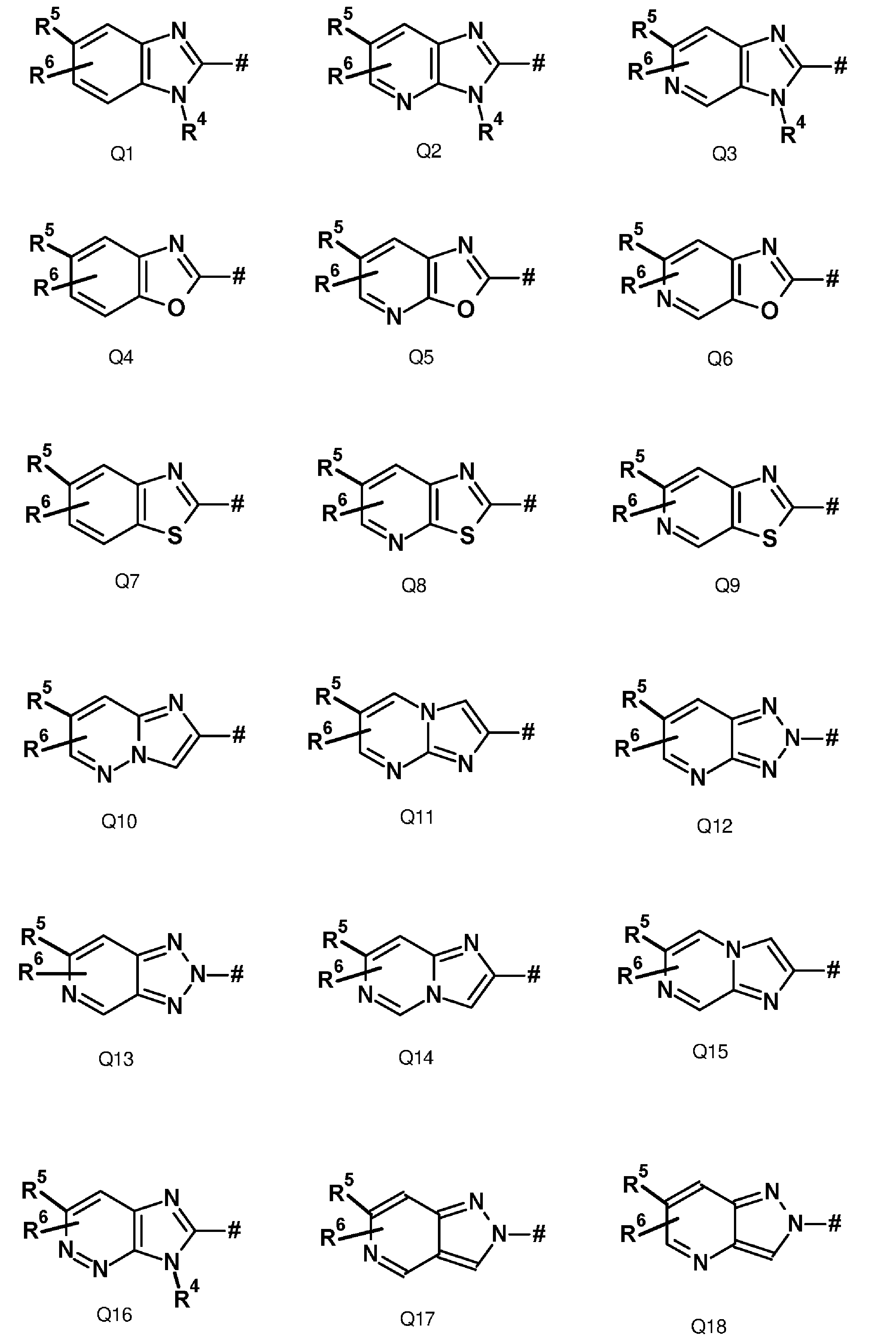

R5、R6は、特に好ましくは、互いに独立して、水素、シアノ、ハロゲン、(C1-C4)-アルキル、(C1-C4)-ハロアルキル、(C2-C4)-アルケニル、(C2-C4)-ハロアルケニル、(C2-C4)-アルキニル、(C2-C4)-ハロアルキニル、(C3-C6)-シクロアルキル、(C3-C6)-シクロアルキル-(C3-C6)-シクロアルキル、(C1-C4)-アルキル-(C3-C6)-シクロアルキル、(C1-C4)-アルコキシ、(C1-C4)-ハロアルコキシ、(C1-C4)-アルコキシイミノ、(C1-C4)-アルキルチオ、(C1-C4)-ハロアルキルチオ、(C1-C4)-アルキルスルフィニル、(C1-C4)-ハロアルキルスルフィニル、(C1-C4)-アルキルスルホニル、(C1-C4)-ハロアルキルスルホニル、(C1-C4)-アルキルスルホニルオキシ、(C1-C4)-アルキルカルボニル、(C1-C4)-ハロアルキルカルボニル、アミノカルボニル、(C1-C4)-アルキルアミノカルボニル、ジ-(C1-C4)-アルキルアミノカルボニル、(C1-C4)-アルキルスルホニルアミノ、(C1-C4)-アルキルアミノ、ジ-(C1-C4)-アルキルアミノ、アミノスルホニル、(C1-C4)-アルキルアミノスルホニルまたはジ-(C1-C4)-アルキルアミノスルホニルを表し、
R6aは、特に好ましくは、(C1-C4)-アルキル、(C1-C4)-ハロアルキル、(C1-C4)-シアノアルキル、(C1-C4)-ヒドロキシアルキル、(C1-C4)-アルコキシ-(C1-C4)-アルキル、(C1-C4)-ハロアルコキシ-(C1-C4)-アルキル、(C2-C4)-アルケニル、(C2-C4)-ハロアルケニル、(C2-C4)-アルキニル、(C2-C4)-ハロアルキニル、(C3-C6)-シクロアルキル、(C1-C4)-アルキル-(C3-C6)-シクロアルキルまたはハロ-(C3-C6)-シクロアルキルを表し、
nは、特に好ましくは0、1または2を表す。
R 5 , R 6 particularly preferably independently of one another are hydrogen, cyano, halogen, (C 1 -C 4 )-alkyl, (C 1 -C 4 )-haloalkyl, (C 2 -C 4 )-alkenyl, (C 2 -C 4 ) -haloalkenyl , (C 2 -C 4 )-alkynyl, (C 2 -C 4 )-haloalkynyl, (C 3 -C 6 )-cycloalkyl, (C 3 -C 6 )-cycloalkyl-(C 3 -C 6 )-cycloalkyl, (C 1 -C 4 )-alkyl-(C 3 -C 6 )-cycloalkyl, (C 1 -C 4 )-alkoxy, (C 1 -C 4 )-haloalkoxy, (C 1 -C 4 )-alkoxyimino, (C 1 - C4 )-alkylthio, ( C1 - C4 )-haloalkylthio, (C1-C4)-alkylsulfinyl, ( C1 - C4 )-haloalkylsulfinyl, (C1- C4 ) -alkylsulfonyl, ( C1 - C4 )-haloalkylsulfonyl, ( C1 - C4 )-alkylsulfonyloxy, ( C1 - C4 )-alkylcarbonyl, ( C1 - C4 )-haloalkylcarbonyl, aminocarbonyl, ( C1 - C4 )-alkylaminocarbonyl, di-(C1-C4)-alkylaminocarbonyl, (C1-C4)-alkylsulfonylamino, (C1-C4 ) -alkylamino , di- ( C1 - C4 ) )-alkylamino, aminosulfonyl, (C 1 -C 4 )-alkylaminosulfonyl or di-(C 1 -C 4 )-alkylaminosulfonyl,
R 6a particularly preferably represents (C 1 -C 4 )-alkyl, (C 1 -C 4 )-haloalkyl, (C 1 -C 4 )-cyanoalkyl, (C 1 -C 4 )-hydroxyalkyl, (C 1 -C 4 )-alkoxy-(C 1 -C 4 )-alkyl, (C 1 -C 4 )-haloalkoxy-(C 1 -C 4 ) -alkyl , (C 2 -C 4 )-alkenyl, (C 2 -C 4 )-haloalkenyl, (C 2 -C 4 )-alkynyl, (C 2 -C 4 )-haloalkynyl, (C 3 -C 6 )-cycloalkyl, (C 1 -C 4 )-alkyl-(C 3 -C 6 )-cycloalkyl or halo-(C 3 -C 6 )-cycloalkyl;
n particularly preferably represents 0, 1 or 2.
構成4-1
Aaは、非常に特に好ましくは、窒素または=C(R7)-を表し、
Abは、非常に特に好ましくは、窒素または=C(R8)-を表し、
Acは、非常に特に好ましくは、窒素または=C(R9)-を表し、
Adは、非常に特に好ましくは、窒素または=C(R10)-を表し、
Aeは、非常に特に好ましくは、窒素または=C(R11)-を表し、
ここで、Ab、Ac、AdおよびAeは同時に窒素を表すことはできず、
非常に特に好ましくは、以下の構造単位を生じ:A1、A2、A6、A11、A16、
R1は、非常に特に好ましくは、(C1-C4)-アルキル、(C1-C4)-ハロアルキルまたは(C3-C6)-シクロアルキルを表し、
R7は、非常に特に好ましくは、水素、ハロゲン、シアノ、(C1-C4)-アルキルまたは(C1-C4)-ハロアルキルを表し、
R8、R10、R11は、互いに独立して、非常に特に好ましくは、水素、(C1-C4)-アルキルまたはハロゲンを表し、
R9は、非常に特に好ましくは、シアノ-(C3-C6)-シクロアルキルを表し、
Qは、非常に特に好ましくは、Q1、Q2、Q3、Q4、Q10、Q11、Q14、Q15、Q16、Q19、Q20またはQ21の群からのヘテロ芳香族の9員環または12員環の縮合二環式または三環式環系を表し、
Configuration 4-1
Aa very particularly preferably represents nitrogen or ═C(R 7 )—,
Ab very particularly preferably represents nitrogen or ═C(R 8 )—,
Ac very particularly preferably represents nitrogen or ═C(R 9 )—,
Ad very particularly preferably represents nitrogen or ═C(R 10 )—,
Ae very particularly preferably represents nitrogen or ═C(R 11 )—,
wherein Ab, Ac, Ad and Ae cannot simultaneously represent nitrogen;
Very particular preference is given to the following structural units: A1, A2, A6, A11, A16,
R 1 very particularly preferably represents (C 1 -C 4 )-alkyl, (C 1 -C 4 )-haloalkyl or (C 3 -C 6 )-cycloalkyl,
R 7 very particularly preferably represents hydrogen, halogen, cyano, (C 1 -C 4 )-alkyl or (C 1 -C 4 )-haloalkyl,
R 8 , R 10 , R 11 independently of one another very particularly preferably represent hydrogen, (C 1 -C 4 )-alkyl or halogen,
R 9 very particularly preferably represents cyano-(C 3 -C 6 )-cycloalkyl,
Q very particularly preferably represents a heteroaromatic 9- or 12-membered fused bicyclic or tricyclic ring system from the group Q1, Q2, Q3, Q4, Q10, Q11, Q14, Q15, Q16, Q19, Q20 or Q21,

R5は、非常に特に好ましくは、水素、シアノ、ハロゲン、(C1-C4)-アルキル、(C1-C4)-ハロアルキル、(C3-C6)-シクロアルキル、(C1-C4)-アルコキシ、(C1-C4)-ハロアルコキシ、(C1-C4)-アルコキシイミノ、(C1-C4)-アルキルチオ、(C1-C4)-ハロアルキルチオ、(C1-C4)-アルキルスルフィニル、(C1-C4)-ハロアルキルスルフィニル、(C1-C4)-アルキルスルホニル、(C1-C4)-ハロアルキルスルホニル、(C1-C4)-アルキルカルボニルまたは(C1-C4)-ハロアルキルカルボニルを表し、
R6は、非常に特に好ましくは、水素を表し、
R6aは、非常に特に好ましくは、(C1-C4)-アルキル、(C1-C4)-ハロアルキル、(C2-C4)-アルケニル、(C2-C4)-ハロアルケニル、(C1-C4)-アルコキシ-(C1-C4)-アルキル、(C2-C4)-アルキニル、(C2-C4)-ハロアルキニルまたは(C3-C6)-シクロアルキルを表し、
nは、非常に特に好ましくは0、1または2を表す。
R 5 is very particularly preferably hydrogen, cyano, halogen, (C 1 -C 4 )-alkyl, (C 1 -C 4 )-haloalkyl, (C 3 -C 6 )-cycloalkyl, (C 1 -C 4 )-alkoxy, (C 1 -C 4 )-haloalkoxy, (C 1 -C 4 )-alkoxyimino, (C 1 -C 4 )-alkylthio, (C 1 -C 4 )-haloalkylthio, (C 1 -C 4 )-alkylsulfinyl, (C 1 -C 4 )-haloalkylsulfinyl, (C 1 -C 4 ) -alkylsulfonyl , (C 1 -C 4 )-haloalkylsulfonyl, (C 1 -C 4 )-alkylcarbonyl or (C 1 -C 4 )-haloalkylcarbonyl;
R 6 very particularly preferably represents hydrogen,
R 6a very particularly preferably represents (C 1 -C 4 )-alkyl, (C 1 -C 4 )-haloalkyl, (C 2 -C 4 )-alkenyl, (C 2 -C 4 )-haloalkenyl, (C 1 -C 4 )-alkoxy-(C 1 -C 4 )-alkyl, (C 2 -C 4 )-alkynyl, (C 2 -C 4 )-haloalkynyl or (C 3 -C 6 )-cycloalkyl,
n very particularly preferably represents 0, 1 or 2.
構成5-1
Aaは、特に=C(R7)-を表し、
Abは、特に=C(R8)-を表し、
Acは、特に=C(R9)-を表し、
Adは、特に=C(R10)-を表し、
Aeは、特に=C(R11)-を表し、
R1は、特に、メチル、エチル、n-プロピル、i-プロピル、n-ブチル、i-ブチルまたはtert-ブチルを表し、
R7は、特に水素を表し、
R8は、特に水素を表し、
R9は、特に、シアノシクロプロピルまたはシアノシクロブチルを表し、
R10は、特に水素を表し、
R11は、特に水素を表し、
Qは、特に、Q1、Q2、Q3、Q4、Q10、Q14またはQ16の群からのヘテロ芳香族の9員の縮合二環式環系を表し、
Configuration 5-1
Aa especially represents =C(R 7 )-;
Ab especially represents =C(R 8 )-;
Ac especially represents =C(R 9 )-;
Ad especially represents =C(R 10 )-,
Ae especially represents =C(R 11 )-,
R 1 represents in particular methyl, ethyl, n-propyl, i-propyl, n-butyl, i-butyl or tert-butyl,
R 7 especially represents hydrogen,
R 8 especially represents hydrogen,
R 9 represents in particular cyanocyclopropyl or cyanocyclobutyl,
R 10 especially represents hydrogen,
R 11 especially represents hydrogen,
Q represents in particular a heteroaromatic 9-membered fused bicyclic ring system from the group Q1, Q2, Q3, Q4, Q10, Q14 or Q16,

R5は、特に、フッ素、塩素、臭素、フルオロメチル、ジフルオロメチル、トリフルオロメチル、フルオロエチル (CH2CFH2、CHFCH3)、ジフルオロエチル (CF2CH3、CH2CHF2、CHFCFH2)、トリフルオロエチル (CH2CF3、CHFCHF2、CF2CFH2)、テトラフルオロエチル (CHFCF3、CF2CHF2)、ペンタフルオロエチル、トリフルオロメトキシ、ペンタフルオロエトキシ、ジフルオロクロロメトキシ、ジクロロフルオロメトキシ、トリフルオロメチルチオ、トリフルオロメチルスルフィニルまたはトリフルオロメチルスルホニルを表し、
R6は、特に水素を表し、
nは、特に、0、1または2を表す。
R5 represents in particular fluorine, chlorine, bromine, fluoromethyl, difluoromethyl, trifluoromethyl, fluoroethyl ( CH2CFH2 , CHFCH3) , difluoroethyl ( CF2CH3 , CH2CHF2 , CHFCFH2 ) , trifluoroethyl ( CH2CF3 , CHFCHF2 , CF2CFH2 ), tetrafluoroethyl ( CHFCF3 , CF2CHF2 ), pentafluoroethyl , trifluoromethoxy, pentafluoroethoxy , difluorochloromethoxy, dichlorofluoromethoxy, trifluoromethylthio, trifluoromethylsulfinyl or trifluoromethylsulfonyl ,
R6 especially represents hydrogen,
n especially represents 0, 1 or 2.
構成5-2
Aaは、特に=C(R7)-を表し、
Abは、特に=C(R8)-を表し、
Acは、特に=C(R9)-を表し、
Adは、特に=C(R10)-を表し、
Aeは、特に=C(R11)-を表し、
R1は、特に、メチル、エチル、n-プロピル、i-プロピル、n-ブチル、i-ブチルまたはtert-ブチルを表し、
R7は、特に水素を表し、
R8は、特に水素を表し、
R9は、特に、シアノシクロプロピルまたはシアノシクロブチルを表し、
R10は、特に水素を表し、
R11は、特に水素を表し、
Qは、特に、Q1、Q2、Q3、Q4、Q16またはQ21の群からのヘテロ芳香族の9員の縮合二環式環系を表し、
R4は、特にメチル、エチル、イソプロピル、メトキシメチルまたはメトキシエチルを表し、
R5は、特に、フッ素、塩素、臭素、フルオロメチル、ジフルオロメチル、トリフルオロメチル、フルオロエチル(CH2CFH2,CHFCH3),ジフルオロエチル(CF2CH3,CH2CHF2、CHFCFH2)、トリフルオロエチル(CH2CF3、CHFCHF2、CF2CFH2)、テトラフルオロエチル(CHFCF3、CF2CHF2)、ペンタフルオロエチル、トリフルオロメトキシ、ペンタフルオロエトキシ、ジフルオロクロロメトキシ、ジクロロフルオロメトキシ、トリフルオロメチルチオ、トリフルオロメチルスルフィニルまたはトリフルオロメチルスルホニルを表し、
R6は、特に水素を表し、
R6aは、特にメチルを表し、
nは、特に0、1または2を表す。
Configuration 5-2
Aa especially represents =C(R 7 )-;
Ab especially represents =C(R 8 )-;
Ac especially represents =C(R 9 )-;
Ad especially represents =C(R 10 )-,
Ae especially represents =C(R 11 )-;
R 1 represents in particular methyl, ethyl, n-propyl, i-propyl, n-butyl, i-butyl or tert-butyl,
R 7 especially represents hydrogen,
R 8 especially represents hydrogen,
R 9 represents in particular cyanocyclopropyl or cyanocyclobutyl,
R 10 especially represents hydrogen,
R 11 especially represents hydrogen,
Q represents in particular a heteroaromatic 9-membered fused bicyclic ring system from the group Q1, Q2, Q3, Q4, Q16 or Q21,
R4 especially represents methyl, ethyl, isopropyl, methoxymethyl or methoxyethyl,
R5 especially represents fluorine, chlorine, bromine, fluoromethyl, difluoromethyl, trifluoromethyl, fluoroethyl ( CH2CFH2 , CHFCH3) , difluoroethyl (CF2CH3, CH2CHF2 , CHFCFH2 ), trifluoroethyl ( CH2CF3 , CHFCHF2 , CF2CFH2 ) , tetrafluoroethyl ( CHFCF3 , CF2CHF2 ), pentafluoroethyl , trifluoromethoxy, pentafluoroethoxy , difluorochloromethoxy , dichlorofluoromethoxy, trifluoromethylthio , trifluoromethylsulfinyl or trifluoromethylsulfonyl ,
R6 especially represents hydrogen,
R 6a especially represents methyl,
n especially represents 0, 1 or 2.
構成6-1
Aaは、特に=C(R7)-を表し、
Abは、特に=C(R8)-を表し、
Acは、特に=C(R9)-を表し、
Adは、特に=C(R10)-を表し、
Aeは、特に=C(R11)-を表し、
R1は、特にエチルを表し、
R7は、特に水素を表し、
R8は、特に水素を表し、
R9は、特に1-シアノシクロプロピルを表し、
R10は、特に水素を表し、
R11は、特に水素を表し、
Qは、特に、Q2の群からのヘテロ芳香族の9員の縮合二環式環系であり、
Configuration 6-1
Aa especially represents =C(R 7 )-;
Ab especially represents =C(R 8 )-;
Ac especially represents =C(R 9 )-;
Ad especially represents =C(R 10 )-,
Ae especially represents =C(R 11 )-;
R 1 especially represents ethyl,
R 7 especially represents hydrogen,
R 8 especially represents hydrogen,
R 9 especially represents 1-cyanocyclopropyl,
R 10 especially represents hydrogen,
R 11 especially represents hydrogen,
Q is in particular a heteroaromatic 9-membered fused bicyclic ring system from the group Q2,

R5は、特にトリフルオロメチルを表し、
R6は、特に水素を表し、
nは、特に2を表す。
R5 especially represents trifluoromethyl,
R6 especially represents hydrogen,
In particular, n represents 2.
構成6-2
Aaは、特に=C(R7)-を表し、
Abは、特に=C(R8)-を表し、
Acは、特に=C(R9)-を表し、
Adは、特に=C(R10)-を表し、
Aeは、特に=C(R11)-を表し、
R1は、特にエチルを表し、
R7は、特に水素を表し、
R8は、特に水素を表し、
R9は、特に1-シアノシクロプロピルを表し、
R10は、特に水素を表し、
R11は、特に水素を表し、
Qは、特に、Q1、Q2、Q3、Q4、Q16、Q21からなる群からのヘテロ芳香族の9員の縮合二環式環系を表し、
R4は、特にメチルを表し、
R5は、特に、トリフルオロメチル、ペンタフルオロエチル、トリフルオロメトキシ、ペンタフルオロエトキシまたはトリフルオロメチルスルホニルを表し、
R6は、特に水素を表し、
R6aは、特にメチルを表し、
nは、特に2を表す。
Configuration 6-2
Aa especially represents =C(R 7 )-;
Ab especially represents =C(R 8 )-;
Ac especially represents =C(R 9 )-;
Ad especially represents =C(R 10 )-,
Ae especially represents =C(R 11 )-;
R 1 especially represents ethyl,
R 7 especially represents hydrogen,
R 8 especially represents hydrogen,
R 9 especially represents 1-cyanocyclopropyl,
R 10 especially represents hydrogen,
R 11 especially represents hydrogen,
Q represents in particular a heteroaromatic 9-membered fused bicyclic ring system from the group consisting of Q1, Q2, Q3, Q4, Q16, Q21,
R4 especially represents methyl,
R 5 represents in particular trifluoromethyl, pentafluoroethyl, trifluoromethoxy, pentafluoroethoxy or trifluoromethylsulfonyl,
R6 especially represents hydrogen,
R 6a especially represents methyl,
In particular, n represents 2.
構造単位A1~A17を含めると、これは、以下の式(I)の主な構造をもたらす: When structural units A1-A17 are included, this results in the main structure of formula (I) below:

好ましい実施形態では、本発明は、R1、R4、R5、R6、R6a、R7、R8、R9、R10、R11、Q、Aa、Ab、Ac、Ad、Aeおよびnが、構成(3-1)または構成(4-1)または構成(5-1)または構成(5-2)または構成(6-1)または構成(6-2)で与えられる定義を有する式(I)の化合物に関する。 In a preferred embodiment, the present invention relates to compounds of formula (I) in which R 1 , R 4 , R 5 , R 6 , R 6a , R 7 , R 8 , R 9 , R 10 , R 11 , Q, Aa, Ab, Ac, Ad, Ae and n have the definitions given in configuration (3-1) or configuration (4-1) or configuration (5-1) or configuration (5-2) or configuration (6-1) or configuration (6-2).
好ましい実施形態において、本発明は、R1、R4、R5、R6、R6a、R7、R8、R10、R11、R11、Q、Aa、Ab、Ac、Ad、Aeおよびnが、構成(1-1)または構成(2-1)または構成(3-1)または構成(4-1)または構成(5-1)または構成(5-2)または構成(6-1)または構成(6-2)で与えられる定義を有し、そして
R9が、1-シアノシクロプロピルを表す、式(I)の化合物に関する。
In a preferred embodiment, the invention relates to compounds of formula (I) in which R 1 , R 4 , R 5 , R 6 , R 6a , R 7 , R 8 , R 10 , R 11 , R11, Q, Aa, Ab, Ac, Ad, Ae and n have the definitions given in configuration (1-1) or configuration (2-1) or configuration (3-1) or configuration (4-1) or configuration (5-1) or configuration (5-2) or configuration (6-1) or configuration (6-2) and R 9 represents 1-cyanocyclopropyl.
好ましい実施形態において、本発明は、R1、R4、R5、R6、R6a、R7、R8、R9、R10、R11、Q、Aa、Ab、Ac、AdおよびAeが、構成(1-1)または構成(2-1)または構成(3-1)または構成(4-1)または構成(5-1)または構成(5-2)または構成(6-1)または構成(6-2)で与えられる定義を有し、そして
nが、2を表す、式(I)の化合物に関する。
In a preferred embodiment, the present invention relates to compounds of formula (I) in which R 1 , R 4 , R 5 , R 6 , R 6a , R 7 , R 8 , R 9 , R 10 , R 11 , Q, Aa, Ab, Ac, Ad and Ae have the definitions given in configuration (1-1) or configuration (2-1) or configuration (3-1) or configuration (4-1) or configuration (5-1) or configuration (5-2) or configuration (6-1) or configuration (6-2) and n represents 2.
好ましい実施形態において、本発明は、QがQ1を表し、そして、R1、R4、R5、R6、R7、R8、R9、R10、R11、Aa、Ab、Ac、Ad、Aeおよびnが、構成(3-1)または構成(4-1)または構成(5-1)または構成(5-2)または構成(6-1)または構成(6-2)で与えられる定義を有する式(I)の化合物に関する。 In a preferred embodiment, the present invention relates to compounds of formula (I) in which Q represents Q1 and R 1 , R 4 , R 5 , R 6 , R 7 , R 8 , R 9 , R 10 , R 11 , Aa, Ab, Ac, Ad, Ae and n have the definitions given in configuration (3-1) or configuration (4-1) or configuration (5-1) or configuration (5-2) or configuration (6-1) or configuration (6-2).
好ましい実施形態において、本発明は、QがQ2を表し、そして、R1、R4、R5、R6、R7、R8、R9、R10、R11、Aa、Ab、Ac、Ad、Aeおよびnが、構成(3-1)または構成(4-1)または構成(5-1)または構成(5-2)または構成(6-1)または構成(6-2)で与えられる定義を有する式(I)の化合物に関する。 In a preferred embodiment, the invention relates to compounds of formula (I) in which Q represents Q2 and R 1 , R 4 , R 5 , R 6 , R 7 , R 8 , R 9 , R 10 , R 11 , Aa, Ab, Ac, Ad, Ae and n have the definitions given in configuration (3-1) or configuration (4-1) or configuration (5-1) or configuration (5-2) or configuration (6-1) or configuration (6-2).
好ましい実施形態において、本発明は、QがQ3を表し、そして、R1、R4、R5、R6、R7、R8、R9、R10、R11、Aa、Ab、Ac、Ad、Aeおよびnが、構成(3-1)または構成(4-1)または構成(5-1)または構成(5-2)または構成(6-1)または構成(6-2)で与えられる定義を有する式(I)の化合物に関する。 In a preferred embodiment, the invention relates to compounds of formula (I) in which Q represents Q3 and R 1 , R 4 , R 5 , R 6 , R 7 , R 8 , R 9 , R 10 , R 11 , Aa, Ab, Ac, Ad, Ae and n have the definitions given in configuration (3-1) or configuration (4-1) or configuration (5-1) or configuration (5-2) or configuration (6-1) or configuration (6-2).
好ましい実施形態において、本発明は、QがQ4を表し、そして、R1、R5、R6、R7、R8、R9、R10、R11、Aa、Ab、Ac、Ad、Aeおよびnが、構成(3-1)または構成(4-1)または構成(5-1)または構成(5-2)または構成(6-1)または構成(6-2)で与えられる定義を有する式(I)の化合物に関する。 In a preferred embodiment, the present invention relates to compounds of formula (I) in which Q represents Q4 and R 1 , R 5 , R 6 , R 7 , R 8 , R 9 , R 10 , R 11 , Aa, Ab, Ac, Ad, Ae and n have the definitions given in configuration (3-1) or configuration (4-1) or configuration (5-1) or configuration (5-2) or configuration (6-1) or configuration (6-2).
好ましい実施形態において、本発明は、QがQ5を表し、そして、R1、R5、R6、R7、R8、R9、R10、R11、Aa、Ab、Ac、Ad、Aeおよびnが、構成(3-1)または構成(4-1)または構成(5-1)または構成(5-2)または構成(6-1)または構成(6-2)で与えられる定義を有する式(I)の化合物に関する。 In a preferred embodiment, the present invention relates to compounds of formula (I) in which Q represents Q5 and R 1 , R 5 , R 6 , R 7 , R 8 , R 9 , R 10 , R 11 , Aa, Ab, Ac, Ad, Ae and n have the definitions given in configuration (3-1) or configuration (4-1) or configuration (5-1) or configuration (5-2) or configuration (6-1) or configuration (6-2).
好ましい実施形態において、本発明は、QがQ6を表し、そして、R1、R5、R6、R7、R8、R9、R10、R11、Aa、Ab、Ac、Ad、Aeおよびnが、構成(3-1)または構成(4-1)または構成(5-1)または構成(5-2)または構成(6-1)または構成(6-2)で与えられる定義を有する式(I)の化合物に関する。 In a preferred embodiment, the present invention relates to compounds of formula (I) in which Q represents Q6 and R 1 , R 5 , R 6 , R 7 , R 8 , R 9 , R 10 , R 11 , Aa, Ab, Ac, Ad, Ae and n have the definitions given in configuration (3-1) or configuration (4-1) or configuration (5-1) or configuration (5-2) or configuration (6-1) or configuration (6-2).
好ましい実施形態において、本発明は、QがQ7を表し、そして、R1、R5、R6、R7、R8、R9、R10、R11、Aa、Ab、Ac、Ad、Aeおよびnが、構成(3-1)または構成(4-1)または構成(5-1)または構成(5-2)または構成(6-1)または構成(6-2)で与えられる定義を有する式(I)の化合物に関する。 In a preferred embodiment, the present invention relates to compounds of formula (I) in which Q represents Q7 and R 1 , R 5 , R 6 , R 7 , R 8 , R 9 , R 10 , R 11 , Aa, Ab, Ac, Ad, Ae and n have the definitions given in configuration (3-1) or configuration (4-1) or configuration (5-1) or configuration (5-2) or configuration (6-1) or configuration (6-2).
好ましい実施形態において、本発明は、QがQ8を表し、そして、R1、R5、R6、R7、R8、R9、R10、R11、Aa、Ab、Ac、Ad、Aeおよびnが、構成(3-1)または構成(4-1)または構成(5-1)または構成(5-2)または構成(6-1)または構成(6-2)で与えられる定義を有する式(I)の化合物に関する。 In a preferred embodiment, the present invention relates to compounds of formula (I) in which Q represents Q8 and R 1 , R 5 , R 6 , R 7 , R 8 , R 9 , R 10 , R 11 , Aa, Ab, Ac, Ad, Ae and n have the definitions given in configuration (3-1) or configuration (4-1) or configuration (5-1) or configuration (5-2) or configuration (6-1) or configuration (6-2).
好ましい実施形態において、本発明は、QがQ9を表し、そして、R1、R5、R6、R7、R8、R9、R10、R11、Aa、Ab、Ac、Ad、Aeおよびnが、構成(3-1)または構成(4-1)または構成(5-1)または構成(5-2)または構成(6-1)または構成(6-2)で与えられる定義を有する式(I)の化合物に関する。 In a preferred embodiment, the present invention relates to compounds of formula (I) in which Q represents Q9 and R 1 , R 5 , R 6 , R 7 , R 8 , R 9 , R 10 , R 11 , Aa, Ab, Ac, Ad, Ae and n have the definitions given in configuration (3-1) or configuration (4-1) or configuration (5-1) or configuration (5-2) or configuration (6-1) or configuration (6-2).
好ましい実施形態において、本発明は、QがQ10を表し、そして、R1、R5、R6、R7、R8、R9、R10、R11、Aa、Ab、Ac、Ad、Aeおよびnが、構成(3-1)または構成(4-1)または構成(5-1)または構成(5-2)または構成(6-1)または構成(6-2)で与えられる定義を有する式(I)の化合物に関する。 In a preferred embodiment, the present invention relates to compounds of formula (I) in which Q represents Q10 and R 1 , R 5 , R 6 , R 7 , R 8 , R 9 , R 10 , R 11 , Aa, Ab, Ac, Ad, Ae and n have the definitions given in configuration (3-1) or configuration (4-1) or configuration (5-1) or configuration (5-2) or configuration (6-1) or configuration (6-2).
好ましい実施形態において、本発明は、QがQ11を表し、そして、R1、R5、R6、R7、R8、R9、R10、R11、Aa、Ab、Ac、Ad、Aeおよびnが、構成(3-1)または構成(4-1)または構成(5-1)または構成(5-2)または構成(6-1)または構成(6-2)で与えられる定義を有する式(I)の化合物に関する。 In a preferred embodiment, the present invention relates to compounds of formula (I) in which Q represents Q11 and R 1 , R 5 , R 6 , R 7 , R 8 , R 9 , R 10 , R 11 , Aa, Ab, Ac, Ad, Ae and n have the definitions given in configuration (3-1) or configuration (4-1) or configuration (5-1) or configuration (5-2) or configuration (6-1) or configuration (6-2).
好ましい実施形態において、本発明は、QがQ12を表し、そして、R1、R5、R6、R7、R8、R9、R10、R11、Aa、Ab、Ac、Ad、Aeおよびnが、構成(3-1)または構成(4-1)または構成(5-1)または構成(5-2)または構成(6-1)または構成(6-2)で与えられる定義を有する式(I)の化合物に関する。 In a preferred embodiment, the present invention relates to compounds of formula (I) in which Q represents Q12 and R 1 , R 5 , R 6 , R 7 , R 8 , R 9 , R 10 , R 11 , Aa, Ab, Ac, Ad, Ae and n have the definitions given in configuration (3-1) or configuration (4-1) or configuration (5-1) or configuration (5-2) or configuration (6-1) or configuration (6-2).
好ましい実施形態において、本発明は、QがQ13を表し、そして、R1、R5、R6、R7、R8、R9、R10、R11、Aa、Ab、Ac、Ad、Aeおよびnが、構成(3-1)または構成(4-1)または構成(5-1)または構成(5-2)または構成(6-1)または構成(6-2)で与えられる定義を有する式(I)の化合物に関する。 In a preferred embodiment, the present invention relates to compounds of formula (I) in which Q represents Q13 and R 1 , R 5 , R 6 , R 7 , R 8 , R 9 , R 10 , R 11 , Aa, Ab, Ac, Ad, Ae and n have the definitions given in configuration (3-1) or configuration (4-1) or configuration (5-1) or configuration (5-2) or configuration (6-1) or configuration (6-2).
好ましい実施形態において、本発明は、QがQ14を表し、そして、R1、R5、R6、R7、R8、R9、R10、R11、Aa、Ab、Ac、Ad、Aeおよびnが、構成(3-1)または構成(4-1)または構成(5-1)または構成(5-2)または構成(6-1)または構成(6-2)で与えられる定義を有する式(I)の化合物に関する。 In a preferred embodiment, the invention relates to compounds of formula (I) in which Q represents Q14 and R 1 , R 5 , R 6 , R 7 , R 8 , R 9 , R 10 , R 11 , Aa, Ab, Ac, Ad, Ae and n have the definitions given in configuration (3-1) or configuration (4-1) or configuration (5-1) or configuration (5-2) or configuration (6-1) or configuration (6-2).
好ましい実施形態において、本発明は、QがQ15を表し、そして、R1、R5、R6、R7、R8、R9、R10、R11、Aa、Ab、Ac、Ad、Aeおよびnが、構成(3-1)または構成(4-1)または構成(5-1)または構成(5-2)または構成(6-1)または構成(6-2)に与えられる定義を有する式(I)の化合物に関する。 In a preferred embodiment, the present invention relates to compounds of formula (I) in which Q represents Q15 and R 1 , R 5 , R 6 , R 7 , R 8 , R 9 , R 10 , R 11 , Aa, Ab, Ac, Ad, Ae and n have the definitions given in configuration (3-1) or configuration (4-1) or configuration (5-1) or configuration (5-2) or configuration (6-1) or configuration (6-2).
好ましい実施形態において、本発明は、QがQ16を表し、そして、R1、R4、R5、R6、R7、R8、R9、R10、R11、Aa、Ab、Ac、Ad、Aeおよびnが、構成(3-1)または構成(4-1)または構成(5-1)または構成(5-2)または構成(6-1)または構成(6-2)で与えられる定義を有する式(I)の化合物に関する。 In a preferred embodiment, the present invention relates to compounds of formula (I) in which Q represents Q16 and R 1 , R 4 , R 5 , R 6 , R 7 , R 8 , R 9 , R 10 , R 11 , Aa, Ab, Ac, Ad, Ae and n have the definitions given in configuration (3-1) or configuration (4-1) or configuration (5-1) or configuration (5-2) or configuration (6-1) or configuration (6-2).
好ましい実施形態において、本発明は、QがQ17を表し、そして、R1、R5、R6、R7、R8、R9、R10、R11、Aa、Ab、Ac、Ad、Aeおよびnが、構成(3-1)または構成(4-1)または構成(5-1)または構成(5-2)または構成(6-1)または構成(6-2)で与えられる定義を有する式(I)の化合物に関する。 In a preferred embodiment, the present invention relates to compounds of formula (I) in which Q represents Q17 and R 1 , R 5 , R 6 , R 7 , R 8 , R 9 , R 10 , R 11 , Aa, Ab, Ac, Ad, Ae and n have the definitions given in configuration (3-1) or configuration (4-1) or configuration (5-1) or configuration (5-2) or configuration (6-1) or configuration (6-2).
好ましい実施形態において、本発明は、QがQ18を表し、そして、R1、R5、R6、R7、R8、R9、R10、R11、Aa、Ab、Ac、Ad、Aeおよびnが、構成(3-1)または構成(4-1)または構成(5-1)または構成(5-2)または構成(6-1)または構成(6-2)で与えられる定義を有する式(I)の化合物に関する。 In a preferred embodiment, the present invention relates to compounds of formula (I) in which Q represents Q18 and R 1 , R 5 , R 6 , R 7 , R 8 , R 9 , R 10 , R 11 , Aa, Ab, Ac, Ad, Ae and n have the definitions given in configuration (3-1) or configuration (4-1) or configuration (5-1) or configuration (5-2) or configuration (6-1) or configuration (6-2).
好ましい実施形態において、本発明は、QがQ19を表し、そして、R1、R4、R5、R6、R7、R8、R9、R10、R11、Aa、Ab、Ac、Ad、Aeおよびnが、構成(3-1)または構成(4-1)または構成(5-1)または構成(5-2)または構成(6-1)または構成(6-2)に与えられる定義を有する式(I)の化合物に関する。 In a preferred embodiment, the present invention relates to compounds of formula (I) in which Q represents Q19 and R 1 , R 4 , R 5 , R 6 , R 7 , R 8 , R 9 , R 10 , R 11 , Aa, Ab, Ac, Ad, Ae and n have the definitions given in configuration (3-1) or configuration (4-1) or configuration (5-1) or configuration (5-2) or configuration (6-1) or configuration (6-2).
好ましい実施形態において、本発明は、QがQ20を表し、そして、R1、R5、R6、R7、R8、R9、R10、R11、Aa、Ab、Ac、Ad、Aeおよびnが、構成(3-1)または構成(4-1)または構成(5-1)または構成(5-2)または構成(6-1)または構成(6-2)で与えられる定義を有する式(I)の化合物に関する。 In a preferred embodiment, the present invention relates to compounds of formula (I) in which Q represents Q20 and R 1 , R 5 , R 6 , R 7 , R 8 , R 9 , R 10 , R 11 , Aa, Ab, Ac, Ad, Ae and n have the definitions given in configuration (3-1) or configuration (4-1) or configuration (5-1) or configuration (5-2) or configuration (6-1) or configuration (6-2).
好ましい実施形態において、本発明は、QがQ21を表し、そして、R1、R4、R5、R6、R6a、R7、R8、R9、R10、R11、Aa、Ab、Ac、Ad、Aeおよびnが、構成(3-1)または構成(4-1)または構成(5-1)または構成(5-2)または構成(6-1)または構成(6-2)で与えられる定義を有する式(I)の化合物に関する。 In a preferred embodiment, the invention relates to compounds of formula (I) in which Q represents Q21 and R 1 , R 4 , R 5 , R 6 , R 6a , R 7 , R 8 , R 9 , R 10 , R 11 , Aa, Ab, Ac, Ad, Ae and n have the definitions given in configuration (3-1) or configuration (4-1) or configuration (5-1) or configuration (5-2) or configuration (6-1) or configuration (6-2).
一般的または好ましい定義において、特に明記しない限り、ハロゲンは、フッ素、塩素、臭素およびヨウ素からなる群から選択され、好ましくはフッ素、塩素および臭素からなる群から選択される。 In the general or preferred definitions, unless otherwise stated, halogen is selected from the group consisting of fluorine, chlorine, bromine and iodine, preferably selected from the group consisting of fluorine, chlorine and bromine.
アリール(より大きな単位、例えばアリールアルキルの一部として、を含む)は、別に定義されない限り、フェニル、ナフチル、アントリル、フェナントレニルの系列から選択され、好ましくはフェニルである。 Aryl (including as part of a larger unit, e.g., arylalkyl), unless otherwise defined, is selected from the series phenyl, naphthyl, anthryl, phenanthrenyl, preferably phenyl.
本発明の文脈において、他の場所で異なるように定義されない限り、用語「アルキル」は、それ自体でまたは他の用語との組み合わせ、例えばハロアルキルで、1~12個の炭素原子を有し、分岐していても分岐していなくてもよい飽和脂肪族炭化水素基の基を意味すると理解される。C1-C12-アルキル基の例は、メチル、エチル、n-プロピル、イソプロピル、n-ブチル、イソブチル、sec-ブチル、tert-ブチル、n-ペンチル、イソペンチル、ネオペンチル、tert-ペンチル、1-メチルブチル、2-メチルブチル、1-エチルプロピル、1,2-ジメチルプロピル、ヘキシル、n-ヘプチル、n-オクチル、n-ノニル、n-デシル、n-ウンデシルおよびn-ドデシルである。これらのアルキル基の中で、C1-C6-アルキル基が特に好ましい。特に好ましくは、C1-C4-アルキル基である。 In the context of the present invention, unless defined differently elsewhere, the term "alkyl", by itself or in combination with other terms, for example haloalkyl, is understood to mean a radical of a saturated aliphatic hydrocarbon radical having 1 to 12 carbon atoms, which may be branched or unbranched. Examples of C 1 -C 12 -alkyl radicals are methyl, ethyl, n-propyl, isopropyl, n-butyl, isobutyl, sec-butyl, tert-butyl, n-pentyl, isopentyl, neopentyl, tert-pentyl, 1-methylbutyl, 2-methylbutyl, 1-ethylpropyl, 1,2-dimethylpropyl, hexyl, n-heptyl, n-octyl, n-nonyl, n-decyl, n-undecyl and n-dodecyl. Among these alkyl radicals, C 1 -C 6 -alkyl radicals are particularly preferred. Particular preference is given to C 1 -C 4 -alkyl radicals.
本発明によれば、別に定義されない限り、用語「アルケニル」は、それ自体でまたはさらなる用語との組合せで、少なくとも1つの二重結合を有する直鎖または分岐C2-C12-アルケニル基を意味すると理解され、例えば、ビニル、アリル、1-プロペニル、イソプロペニル、1-ブテニル、2-ブテニル、3-ブテニル、1,3-ブタジエニル、1-ペンテニル、2-ペンテニル、3-ペンテニル、4-ペンテニル、1,3-ペンタジエニル、1-ヘキセニル、2-ヘキセニル、3-ヘキセニル、4-ヘキセニル、5-ヘキセニルおよび1,4-ヘキサジエニルである。これらの中で、C2-C6-アルケニル基が好ましく、C2-C4-アルケニル基が特に好ましい。 According to the present invention, unless otherwise defined, the term "alkenyl", by itself or in combination with further terms, is understood to mean a straight-chain or branched C 2 -C 12 -alkenyl radical having at least one double bond, such as, for example, vinyl, allyl, 1-propenyl, isopropenyl, 1-butenyl, 2-butenyl, 3-butenyl, 1,3-butadienyl, 1-pentenyl, 2-pentenyl, 3-pentenyl, 4-pentenyl, 1,3-pentadienyl, 1-hexenyl, 2-hexenyl, 3-hexenyl, 4-hexenyl, 5-hexenyl and 1,4-hexadienyl. Of these, C 2 -C 6 -alkenyl radicals are preferred, and C 2 -C 4 -alkenyl radicals are particularly preferred.
本発明によれば、別に定義されない限り、用語「アルキニル」は、それ自体でまたは他の用語との組合せで、少なくとも1つの三重結合を有する直鎖または分岐C2-C12-アルキニル基を意味すると理解され、例えば、エチニル、1-プロピニルおよびプロパルギルである。これらの中で、C3-C6-アルキニル基が好ましく、C3-C4-アルキニル基が特に好ましい。アルキニル基はまた、少なくとも1つの二重結合を含有する可能性がある。 According to the present invention, unless otherwise defined, the term "alkynyl", by itself or in combination with other terms, is understood to mean a straight-chain or branched C 2 -C 12 -alkynyl radical having at least one triple bond, such as ethynyl, 1-propynyl and propargyl. Of these, C 3 -C 6 -alkynyl radicals are preferred, C 3 -C 4 -alkynyl radicals being particularly preferred. The alkynyl radicals may also contain at least one double bond.
本発明によれば、別に定義されない限り、用語「シクロアルキル」は、それ自体でまたはさらなる用語との組合せで、C3-C8-シクロアルキル基を意味すると理解され、例えば、シクロプロピル、シクロブチル、シクロペンチル、シクロヘキシル、シクロヘプチルおよびシクロオクチルである。これらの中で、C3-C6-シクロアルキル基が好ましい。 According to the present invention, unless otherwise defined, the term "cycloalkyl", by itself or in combination with further terms, is understood to mean a C 3 -C 8 -cycloalkyl group, such as, for example, cyclopropyl, cyclobutyl, cyclopentyl, cyclohexyl, cycloheptyl and cyclooctyl. Among these, C 3 -C 6 -cycloalkyl groups are preferred.
用語「アルコキシ」は、それ自体でまたはさらなる用語、例えばハロアルコキシとの組み合わせで、本発明の場合、O-アルキル基を意味すると理解され、ここで、用語「アルキル」は上記で定義したとおりである。 The term "alkoxy", by itself or in combination with further terms, such as haloalkoxy, is understood in the present invention to mean an O-alkyl group, where the term "alkyl" is as defined above.
ハロゲン-置換された基、例えばハロアルキルは、モノ-ハロゲン化または可能な置換の最大数までポリハロゲン化されている。ポリハロゲン化の場合、ハロゲン原子は同一であっても異なっていてもよい。この場合、ハロゲンは、フッ素、塩素、臭素またはヨウ素、特にフッ素、塩素または臭素を表す。 Halogen-substituted groups, for example haloalkyl, are mono-halogenated or polyhalogenated up to the maximum number of possible substitutions. In the case of polyhalogenation, the halogen atoms may be identical or different. In this case, halogen stands for fluorine, chlorine, bromine or iodine, in particular fluorine, chlorine or bromine.
特に明記しない限り、置換されていてもよい基は、モノ-またはポリ置換されていてもよく、ここで、ポリ置換の場合の置換基は、同じであっても異なっていてもよい。 Unless otherwise specified, optionally substituted groups may be mono- or polysubstituted, where the substituents in the case of polysubstitution may be the same or different.
一般的な用語で上に与えられたまたは好ましい範囲内で列挙された基の定義または例示は、最終生成物、ならびに、出発物質および中間体に対応して適用される。これらの基の定義は、所望に応じて、すなわち、それぞれの好ましい範囲の間の組み合わせを含めて互いに組み合わせることができる。 The definitions or examples of radicals given above in general terms or listed within the preferred ranges apply correspondingly to the final products, as well as to the starting materials and intermediates. These radical definitions can be combined with one another as desired, i.e. including combinations between the respective preferred ranges.
本発明による好ましいのは、好ましいものとして上に列挙した意味の組み合わせを含む式(I)の化合物を使用することである。 Preference is given according to the invention to the use of compounds of formula (I) which contain a combination of the meanings listed above as preferred.
本発明による特に好ましいのは、特に好ましいものとして上に列挙した意味の組合せを含む式(I)の化合物を使用することである。 Particularly preferred according to the invention is the use of compounds of formula (I) which contain a combination of the meanings listed above as particularly preferred.
本発明による非常に特に好ましいのは、非常に特に好ましいものとして上に列挙した定義の組み合わせを含む式(I)の化合物を使用することである。 Very particular preference according to the invention is given to using compounds of formula (I) which contain a combination of the definitions listed above as very particular preference.
本発明による強調されるものは、強調されるものとして上に列挙された意味の組み合わせを含む式(I)の化合物を使用することである。 The emphasis according to the present invention is on the use of compounds of formula (I) which contain a combination of the meanings listed above as being emphasized.
本発明による特に使用されるのは、特に強調されるものとして上に列挙した意味の組み合わせを含む式(I)の化合物である。 Of particular use according to the invention are compounds of formula (I) which contain combinations of the meanings listed above as being of particular emphasis.
置換基の性質に依存して、式(I)の化合物は、幾何学的および/または光学的に活性な異性体、または異なる組成の対応する異性体混合物の形態であり得る。これらの立体異性体は、例えば、鏡像異性体、ジアステレオマー、アトロプ異性体または幾何異性体である。したがって、本発明は、純粋な立体異性体およびこれらの異性体の任意の所望の混合物の両方を包含する。 Depending on the nature of the substituents, the compounds of formula (I) may be in the form of geometrically and/or optically active isomers or corresponding isomeric mixtures of different composition. These stereoisomers are, for example, enantiomers, diastereomers, atropisomers or geometric isomers. The invention therefore encompasses both the pure stereoisomers and any desired mixtures of these isomers.
本発明による式(I)の化合物は、以下のスキームに示す方法によって得ることができる: The compound of formula (I) according to the present invention can be obtained by the method shown in the following scheme:
プロセスA
QがQ1~Q9、Q16、Q19、またはQ21を表す式(I)の化合物は公知の方法、例えば、WO2009/131237、WO2010/125985、WO2011/043404、WO2011/040629、WO2012/086848、WO2013/018928、WO2015/000715、WO2015/198859、WO2016/039444、WO2016/039441, WO2016/116338およびWO2015/121136に記載されている方法と同様に調製することができる。
Process A
Compounds of formula (I) in which Q represents Q1 to Q9, Q16, Q19 or Q21 can be prepared in analogy to known methods, for example those described in WO2009/131237, WO2010/125985, WO2011/043404, WO2011/040629, WO2012/086848, WO2013/018928, WO2015/000715, WO2015/198859, WO2016/039444, WO2016/039441, WO2016/116338 and WO2015/121136.

QがQ21を表す式(I)の化合物については、A2はカルボニルを表し、そして、A3はN-R6aを表す。 For compounds of formula (I) in which Q represents Q21, A2 represents carbonyl and A3 represents N-- R6a .
ステップa)
式(IV)の化合物は、縮合剤または塩基の存在下、式(II)の化合物と式(III)のカルボン酸との反応によって、US5576335に記載された方法と類似して調製することができる。
Step a)
Compounds of formula (IV) can be prepared analogously to the methods described in US Pat. No. 5,576,335 by reaction of compounds of formula (II) with carboxylic acids of formula (III) in the presence of a condensing agent or base.
式(II)の化合物は、商業的に入手可能であるか、または公知の方法、例えば、US2003/69257、WO2006/65703、WO2009/131237、WO2010/125985、WO2011/043404、WO2011/040629、WO2012/086848、WO2013/018928またはWO2015/000715に記載される方法と類似の方法によって調製され得る。 Compounds of formula (II) are commercially available or may be prepared by known methods, for example, methods analogous to those described in US 2003/69257, WO 2006/65703, WO 2009/131237, WO 2010/125985, WO 2011/043404, WO 2011/040629, WO 2012/086848, WO 2013/018928 or WO 2015/000715.
式(III)のカルボン酸は、商業的に入手可能であるかまたは公知の方法によって調製することができる。可能な調製経路は、プロセスH、IおよびJに記載されている。 Carboxylic acids of formula (III) are commercially available or can be prepared by known methods. Possible preparation routes are described in Processes H, I and J.
式(II)の化合物と式(III)のカルボン酸との反応は、ニートでまたは溶媒中で行うことができ、一般的な反応条件下で不活性の慣用の溶媒から選択される溶媒中で反応を行うことが好ましい。エーテル、例えばジイソプロピルエーテル、ジオキサン、テトラヒドロフラン、1,2-ジメトキシエタン;ハロゲン化炭化水素、例えばジクロロメタン、クロロホルム、四塩化炭素、1,2-ジクロロエタンまたはクロロベンゼン;ニトリル、例えばアセトニトリルまたはプロピオニトリル;芳香族炭化水素、例えばトルエンまたはキシレン;非プロトン性極性溶媒、例えばN,N-ジメチルホルムアミドまたはN-メチルピロリドン、または窒素化合物、例えばピリジンが好ましい。 The reaction of the compound of formula (II) with the carboxylic acid of formula (III) can be carried out neat or in a solvent, preferably in a solvent selected from conventional solvents inert under typical reaction conditions. Ethers such as diisopropyl ether, dioxane, tetrahydrofuran, 1,2-dimethoxyethane; halogenated hydrocarbons such as dichloromethane, chloroform, carbon tetrachloride, 1,2-dichloroethane or chlorobenzene; nitriles such as acetonitrile or propionitrile; aromatic hydrocarbons such as toluene or xylene; aprotic polar solvents such as N,N-dimethylformamide or N-methylpyrrolidone, or nitrogen compounds such as pyridine are preferred.
適切な縮合剤は、例えば、1-(3-ジメチルアミノプロピル)-3-エチルカルボジイミド塩酸塩(EDCI)または1,3-ジシクロヘキシルカルボジイミドのようなカルボジイミドである。 Suitable condensing agents are, for example, carbodiimides such as 1-(3-dimethylaminopropyl)-3-ethylcarbodiimide hydrochloride (EDCI) or 1,3-dicyclohexylcarbodiimide.
適切な塩基は、このような反応に典型的に使用される無機塩基である。アルカリ金属またはアルカリ土類金属の酢酸塩、リン酸塩、炭酸塩および重炭酸塩からなる群から例として選択される塩基を使用することが好ましい。ここで特に好ましいのは、酢酸ナトリウム、リン酸ナトリウム、リン酸カリウム、炭酸セシウム、炭酸ナトリウム、炭酸カリウム、重炭酸ナトリウム、重炭酸カリウムである。 Suitable bases are inorganic bases typically used for such reactions. It is preferable to use bases selected by way of example from the group consisting of acetates, phosphates, carbonates and bicarbonates of alkali metals or alkaline earth metals. Particular preference is given here to sodium acetate, sodium phosphate, potassium phosphate, cesium carbonate, sodium carbonate, potassium carbonate, sodium bicarbonate, potassium bicarbonate.
反応は、減圧下、標準圧力下または高圧下、および0℃~180℃の温度で実施することができ、好ましくは、反応が大気圧および20~140℃の温度で実施される。 The reaction can be carried out under reduced pressure, under normal pressure or under elevated pressure, and at a temperature between 0°C and 180°C, preferably the reaction is carried out at atmospheric pressure and at a temperature between 20°C and 140°C.
ステップb)
式(V)の化合物は、例えばWO2009/131237、WO2010/125985、WO2011/043404、WO2011/040629、WO2012/086848、WO2013/018928、WO2015/000715およびWO2015/121136に記載されている方法と同様に、式(IV)の化合物を縮合することによって調製することができる。
Step b)
Compounds of formula (V) can be prepared by condensing compounds of formula (IV) similarly to the methods described, for example, in WO 2009/131237, WO 2010/125985, WO 2011/043404, WO 2011/040629, WO 2012/086848, WO 2013/018928, WO 2015/000715 and WO 2015/121136.
式(V)の化合物への変換は、ニートでまたは溶媒中で行うことができ、一般的な反応条件下で不活性な慣用の溶媒から選択される溶媒中で反応を行うことが好ましい。エーテル、例えば、ジイソプロピルエーテル、ジオキサン、テトラヒドロフラン、1,2-ジメトキシエタン、tert-ブチルメチルエーテル;ハロゲン化炭化水素、例えば、ジクロロメタン、クロロホルム、四塩化炭素、1,2-ジクロロエタンまたはクロロベンゼン;ニトリル、例えば、アセトニトリルまたはプロピオニトリル;芳香族炭化水素、例えば、トルエンまたはキシレン;非プロトン性極性溶媒、例えば、N,N-ジメチルホルムアミドまたはN-メチルピロリドン、または窒素化合物、例えば、ピリジンが好ましい。 The conversion to the compound of formula (V) can be carried out neat or in a solvent, preferably in a solvent selected from conventional solvents inert under the general reaction conditions. Ethers such as diisopropyl ether, dioxane, tetrahydrofuran, 1,2-dimethoxyethane, tert-butyl methyl ether; halogenated hydrocarbons such as dichloromethane, chloroform, carbon tetrachloride, 1,2-dichloroethane or chlorobenzene; nitriles such as acetonitrile or propionitrile; aromatic hydrocarbons such as toluene or xylene; aprotic polar solvents such as N,N-dimethylformamide or N-methylpyrrolidone, or nitrogen compounds such as pyridine are preferred.
反応は、縮合剤、酸、塩基または塩素化剤の存在下で行うことができる。 The reaction can be carried out in the presence of a condensing agent, an acid, a base or a chlorinating agent.
適切な縮合剤の例は、1-(3-ジメチルアミノプロピル)-3-エチルカルボジイミド塩酸塩(EDCI)または1,3-ジシクロヘキシルカルボジイミドのようなカルボジイミド;無水酢酸、トリフルオロ酢酸無水物のような無水物;トリフェニルホスフィン、塩基および四塩化炭素の混合物、またはトリフェニルホスフィンとアゾジエステル、例えばジエチルアゾジカルボン酸の混合物である。 Examples of suitable condensing agents are carbodiimides such as 1-(3-dimethylaminopropyl)-3-ethylcarbodiimide hydrochloride (EDCI) or 1,3-dicyclohexylcarbodiimide; anhydrides such as acetic anhydride, trifluoroacetic anhydride; mixtures of triphenylphosphine, a base and carbon tetrachloride, or mixtures of triphenylphosphine and an azodiester, for example diethylazodicarboxylate.
記載された反応において使用され得る適切な酸の例は、パラトルエンスルホン酸のようなスルホン酸;酢酸のようなカルボン酸、またはポリリン酸である。 Examples of suitable acids that may be used in the described reactions are sulfonic acids, such as paratoluenesulfonic acid; carboxylic acids, such as acetic acid, or polyphosphoric acid.
適切な塩基の例は、ピリジン、ピコリン、2,6-ルチジン、1,8-ジアザビシクロ[5.4.0]-7-ウンデセン(DBU)のような窒素複素環;トリエチルアミンおよびN,N-ジイソプロピルエチルアミンのような第3級アミン;リン酸カリウム、炭酸カリウムおよび水素化ナトリウムのような無機塩基である。 Examples of suitable bases are nitrogen heterocycles such as pyridine, picoline, 2,6-lutidine, 1,8-diazabicyclo[5.4.0]-7-undecene (DBU); tertiary amines such as triethylamine and N,N-diisopropylethylamine; inorganic bases such as potassium phosphate, potassium carbonate and sodium hydride.
適切な塩素化剤の例は、オキシ塩化リンである。 An example of a suitable chlorinating agent is phosphorus oxychloride.
反応は、減圧下、大気圧下または高圧下、および0℃~200℃の温度で実施することができる。 The reaction can be carried out under reduced pressure, atmospheric pressure or elevated pressure, and at temperatures between 0°C and 200°C.
ステップc)
nが0を表す式(I)の化合物は、式(V)の化合物を塩基の存在下で式(VIa)の化合物と反応させることによって、または式(VIb)の化合物と反応させることによって調製することができる。
Step c)
Compounds of formula (I) in which n represents 0 can be prepared by reacting a compound of formula (V) with a compound of formula (VIa) in the presence of a base or with a compound of formula (VIb).
式(VIa)のメチルメルカプタン誘導体、例えばメチルメルカプタン、エチルメルカプタンまたはイソプロピルメルカプタンは、商業的に入手可能であるか、または公知の方法で、例えばUS2006/25633、US2006/111591、US2820062、Chemical Communications,13(2000),1163-1164またはJournal of the American Chemical Society,44(1922),p.1329に記載されている方法と同様に調製することができる。 Methyl mercaptan derivatives of formula (VIa), such as methyl mercaptan, ethyl mercaptan or isopropyl mercaptan, are commercially available or can be prepared in known manner, for example analogously to the methods described in US 2006/25633, US 2006/111591, US 2820062, Chemical Communications, 13 (2000), 1163-1164 or Journal of the American Chemical Society, 44 (1922), p. 1329.
nが0を表す式(I)の化合物への変換は、ニートでまたは溶媒中で行うことができ、好ましくは、一般的な反応条件下で不活性の慣用の溶媒から選択される溶媒中で反応を行う。エーテル、例えばジイソプロピルエーテル、ジオキサン、テトラヒドロフラン、1,2-ジメトキシエタン、tert-ブチルメチルエーテル;ニトリル、例えばアセトニトリルまたはプロピオニトリル;芳香族炭化水素、例えばトルエンまたはキシレン;非プロトン性極性溶媒、例えばN,N-ジメチルホルムアミド、N-メチルピロリドンまたはジメチルスルホキシドが好ましい。 The conversion to the compound of formula (I) in which n represents 0 can be carried out neat or in a solvent, preferably in a solvent selected from conventional solvents which are inert under the general reaction conditions. Ethers such as diisopropyl ether, dioxane, tetrahydrofuran, 1,2-dimethoxyethane, tert-butyl methyl ether; nitriles such as acetonitrile or propionitrile; aromatic hydrocarbons such as toluene or xylene; aprotic polar solvents such as N,N-dimethylformamide, N-methylpyrrolidone or dimethylsulfoxide are preferred.
適切な塩基の例は、アルカリ金属またはアルカリ土類金属の酢酸塩、リン酸塩および炭酸塩からなる群からの無機塩基である。ここでは、炭酸セシウム、炭酸ナトリウムおよび炭酸カリウムが好ましい。さらに好適な塩基は、アルカリ金属水素化物、例えば水素化ナトリウムである。 Examples of suitable bases are inorganic bases from the group consisting of acetates, phosphates and carbonates of alkali metals or alkaline earth metals. Preference is given here to cesium carbonate, sodium carbonate and potassium carbonate. Further suitable bases are alkali metal hydrides, for example sodium hydride.
あるいは、メルカプタン誘導体の塩(式(VIb)の化合物)、例えば、ナトリウムエタンチオレート、ナトリウムメタンチオレートまたはナトリウムイソプロパンチオレートを、さらなる塩基の添加なしに直接使用することが可能である。反応は、減圧下、大気圧下または高圧下、および0℃~200℃の温度で実施することができる。式(VIb)の化合物は市販されている。 Alternatively, it is possible to use salts of mercaptan derivatives (compounds of formula (VIb)), such as sodium ethanethiolate, sodium methanethiolate or sodium isopropanethiolate, directly without the addition of further base. The reaction can be carried out under reduced pressure, atmospheric or elevated pressure, and at temperatures between 0°C and 200°C. Compounds of formula (VIb) are commercially available.
記載の反応において、X1は、好ましくはフッ素原子または塩素原子を表す。 In the reactions described, X 1 preferably represents a fluorine or chlorine atom.
ステップd)
nが1を表す式(I)の化合物は、nが0を表す式(I)の化合物を酸化することによって調製することができる。酸化は、一般に一般的な反応条件下で不活性の通常の溶媒から選択される溶媒中で実施される。ハロゲン化炭化水素、例えばジクロロメタン、クロロホルム、四塩化炭素、1,2-ジクロロエタンまたはクロロベンゼン;アルコール、例えばメタノールまたはエタノール;ギ酸、酢酸、プロピオン酸または水が好ましい。
Step d)
Compounds of formula (I) in which n represents 1 can be prepared by oxidation of compounds of formula (I) in which n represents 0. The oxidation is generally carried out in a solvent selected from the usual solvents which are inert under the prevailing reaction conditions. Preference is given to halogenated hydrocarbons, such as dichloromethane, chloroform, carbon tetrachloride, 1,2-dichloroethane or chlorobenzene; alcohols, such as methanol or ethanol; formic acid, acetic acid, propionic acid or water.
適切な酸化剤の例は、過酸化水素、メタ-クロロ過安息香酸または過ヨウ素酸ナトリウムである。 Examples of suitable oxidizing agents are hydrogen peroxide, meta-chloroperbenzoic acid or sodium periodate.
反応は、減圧下、標準圧力下または高圧下、および-20℃~120℃の温度で行うことができる。 The reaction can be carried out under reduced pressure, normal pressure or elevated pressure, and at temperatures between -20°C and 120°C.
ステップe)
nが2を表す式(I)の化合物は、nが1を表す式(I)の化合物を酸化することによって調製することができる。酸化は、一般に溶媒中で行われる。ハロゲン化炭化水素、例えばジクロロメタン、クロロホルム、四塩化炭素、1,2-ジクロロエタンまたはクロロベンゼン;アルコール、例えばメタノールまたはエタノール;ギ酸、酢酸、プロピオン酸または水が好ましい。
Step e)
Compounds of formula (I) in which n represents 2 can be prepared by oxidation of compounds of formula (I) in which n represents 1. The oxidation is generally carried out in a solvent. Preference is given to halogenated hydrocarbons, such as dichloromethane, chloroform, carbon tetrachloride, 1,2-dichloroethane or chlorobenzene; alcohols, such as methanol or ethanol; formic acid, acetic acid, propionic acid or water.
適切な酸化剤の例は、過酸化水素およびメタ-クロロ過安息香酸である。 Examples of suitable oxidizing agents are hydrogen peroxide and meta-chloroperbenzoic acid.
反応は、減圧下、標準圧力下または高圧下、および-20℃~120℃の温度で行うことができる。 The reaction can be carried out under reduced pressure, normal pressure or elevated pressure, and at temperatures between -20°C and 120°C.
ステップf)
nが2を表す式(I)の化合物はまた、nが0を表す式(I)の化合物を酸化することによって1工程プロセス(one-step process)で調製することもできる。酸化は、一般に溶媒中で行われる。ハロゲン化炭化水素、例えばジクロロメタン、クロロホルム、四塩化炭素、1,2-ジクロロエタンまたはクロロベンゼン;アルコール、例えばメタノールまたはエタノール;ギ酸、酢酸、プロピオン酸または水が好ましい。
Step f)
Compounds of formula (I) in which n represents 2 can also be prepared in a one-step process by oxidation of compounds of formula (I) in which n represents 0. The oxidation is generally carried out in a solvent. Preference is given to halogenated hydrocarbons, such as dichloromethane, chloroform, carbon tetrachloride, 1,2-dichloroethane or chlorobenzene; alcohols, such as methanol or ethanol; formic acid, acetic acid, propionic acid or water.
適切な酸化剤の例は、過酸化水素およびメタ-クロロ過安息香酸である。 Examples of suitable oxidizing agents are hydrogen peroxide and meta-chloroperbenzoic acid.
反応は、減圧下、標準圧力下または高圧下、および-20℃~120℃の温度で行うことができる。 The reaction can be carried out under reduced pressure, normal pressure or elevated pressure, and at temperatures between -20°C and 120°C.
プロセスB

ステップa)
式(VIII)の化合物は、ハロゲン化を介して、式(VII)の化合物から公知の方法によって調製することができる。これは、例えば、指向性オルトリチオ化、続いて、適切な求電子性ハロゲン化試薬によるカルバニオンの捕捉を介して行うことができるか、またはBioorganic & Medicinal Chemistry Letters、24(2014)、4236-4238;Tetrahedron、58(2002)、6723-6728およびWO2003/010146に記載されているプロセスに類似した求電子性芳香族ハロゲン化を介して行うことができる。式(VII)の化合物は、商業的に入手可能であるかまたは式(XXV)の化合物からエステル化を介して合成することができる。
Step a)
Compounds of formula (VIII) can be prepared by known methods from compounds of formula (VII) via halogenation. This can be done, for example, via directed ortholithioation followed by trapping of the carbanion with a suitable electrophilic halogenating reagent, or via electrophilic aromatic halogenation similar to the processes described in Bioorganic & Medicinal Chemistry Letters, 24 (2014), 4236-4238; Tetrahedron, 58 (2002), 6723-6728 and WO 2003/010146. Compounds of formula (VII) are commercially available or can be synthesized from compounds of formula (XXV) via esterification.
ステップb)
式(III)の化合物は、Synthesis 1987,6,586-587、Tetrahedron Letters 2006,47,565-567またはChemMedChem 2010,5,65-78に記載されている方法に類似して、式(VIII)の化合物からの加水分解を介して合成することができる。
Step b)
Compounds of formula (III) can be synthesized via hydrolysis from compounds of formula (VIII) analogously to the methods described in Synthesis 1987, 6, 586-587, Tetrahedron Letters 2006, 47, 565-567 or ChemMedChem 2010, 5, 65-78.
適切な塩基の例は例えば、水酸化リチウムまたは水酸化ナトリウムである。使用される溶媒は、極性非プロトン性およびプロトン性溶媒およびこれらの混合物、例えばエタノール、テトラヒドロフランまたは水であってもよい。 Examples of suitable bases are, for example, lithium hydroxide or sodium hydroxide. The solvent used may be polar aprotic and protic solvents and mixtures thereof, for example ethanol, tetrahydrofuran or water.
反応は、減圧下、標準圧力下または高圧下、および-20℃~120℃の温度で行うことができる。 The reaction can be carried out under reduced pressure, normal pressure or elevated pressure, and at temperatures between -20°C and 120°C.
ステップc)
nが0を表す式(IX)の化合物は、式(VIII)の化合物を、塩基の存在下で式(VIa)の化合物と反応させることによって、または、式(VIb)の化合物と反応させることによって調製することができる。
Step c)
Compounds of formula (IX), in which n represents 0, can be prepared by reacting a compound of formula (VIII) with a compound of formula (VIa) in the presence of a base or with a compound of formula (VIb).
式(VIa)のメルカプタン誘導体、例えばメチルメルカプタン、エチルメルカプタンまたはイソプロピルメルカプタンは、商業的に入手可能であるか、または公知の方法、例えばUS2006/25633、US2006/111591、US2820062、Chemical Communications,13(2000),1163-1164またはJournal of the American Chemical Society,44(1922),p.1329に記載されている方法に類似して調製することができる。 Mercaptan derivatives of formula (VIa), such as methyl mercaptan, ethyl mercaptan or isopropyl mercaptan, are commercially available or can be prepared in analogy to known methods, such as those described in US 2006/25633, US 2006/111591, US 2820062, Chemical Communications, 13 (2000), 1163-1164 or Journal of the American Chemical Society, 44 (1922), p. 1329.
nが0を表す式(IX)の化合物への変換は、ニートでまたは溶媒中で行うことができ、一般的な反応条件下で不活性の慣用の溶媒から選択される溶媒中で反応を行うことが好ましい。エーテル、例えばジイソプロピルエーテル、ジオキサン、テトラヒドロフラン、1,2-ジメトキシエタン、tert-ブチルメチルエーテル;ニトリル、例えばアセトニトリルまたはプロピオニトリル;芳香族炭化水素、例えばトルエンまたはキシレン;非プロトン性極性溶媒、例えばN,N-ジメチルホルムアミド、N-メチルピロリドンまたはジメチルスルホキシドが好ましい。 The conversion to a compound of formula (IX) in which n represents 0 can be carried out neat or in a solvent, preferably the reaction is carried out in a solvent selected from conventional solvents which are inert under the general reaction conditions. Ethers such as diisopropyl ether, dioxane, tetrahydrofuran, 1,2-dimethoxyethane, tert-butyl methyl ether; nitriles such as acetonitrile or propionitrile; aromatic hydrocarbons such as toluene or xylene; aprotic polar solvents such as N,N-dimethylformamide, N-methylpyrrolidone or dimethylsulfoxide are preferred.
適切な塩基の例は、アルカリ金属またはアルカリ土類金属の酢酸塩、リン酸塩および炭酸塩からなる群からの無機塩基である。ここでは、炭酸セシウム、炭酸ナトリウムおよび炭酸カリウムが好ましい。さらに好適な塩基は、アルカリ金属水素化物、例えば水素化ナトリウムである。 Examples of suitable bases are inorganic bases from the group consisting of acetates, phosphates and carbonates of alkali metals or alkaline earth metals. Preference is given here to cesium carbonate, sodium carbonate and potassium carbonate. Further suitable bases are alkali metal hydrides, for example sodium hydride.
あるいは、メルカプタン誘導体の塩(VIb)、例えば、ナトリウムエタンチオレート、ナトリウムメタンチオレートまたはナトリウムイソプロパンチオレートを、さらなる塩基の添加なしに直接使用することが可能である。反応は、減圧下、大気圧下または高圧下、および0℃~200℃の温度で実施することができる。 Alternatively, it is possible to use salts of mercaptan derivatives (VIb), such as sodium ethanethiolate, sodium methanethiolate or sodium isopropanethiolate, directly without the addition of further base. The reaction can be carried out under reduced pressure, atmospheric pressure or elevated pressure, and at temperatures between 0°C and 200°C.
記載された反応において、X1は、好ましくはフッ素原子または塩素原子を表す。 In the reactions described, X 1 preferably represents a fluorine or chlorine atom.
プロセスC
QがQ1~Q9、Q16、Q19またはQ21を表す式(I)の化合物は公知の方法、例えばWO2009/131237、WO2010/125985、WO2011/043404、WO2011/040629、WO2012/086848、WO2013/018928、WO2015/000715、WO2015/198859、WO2016/039444、WO2016/039441、WO2016/116338およびWO2015/121136に記載されている方法に類似して調製することができる。
Process C
Compounds of formula (I) in which Q represents Q1 to Q9, Q16, Q19 or Q21 can be prepared analogously to known methods, for example those described in WO2009/131237, WO2010/125985, WO2011/043404, WO2011/040629, WO2012/086848, WO2013/018928, WO2015/000715, WO2015/198859, WO2016/039444, WO2016/039441, WO2016/116338 and WO2015/121136.

QがQ21を表す式(I)の化合物については、A2はカルボニルを表し、A3はN-R6aを表す。 For compounds of formula (I) in which Q represents Q21, A2 represents carbonyl and A3 represents N-- R6a .
ステップa)、b)
nが2を表す式(IXa)の化合物は、nが0を表す式(IX)の化合物を酸化することによって調製することができる。酸化は、一般に溶媒中で行われる。ハロゲン化炭化水素、例えばジクロロメタン、クロロホルム、四塩化炭素、1,2-ジクロロエタンまたはクロロベンゼン;アルコール、例えばメタノールまたはエタノール;ギ酸、酢酸、プロピオン酸または水が好ましい。
Steps a) and b)
Compounds of formula (IXa) in which n represents 2 can be prepared by oxidation of compounds of formula (IX) in which n represents 0. The oxidation is generally carried out in a solvent. Preference is given to halogenated hydrocarbons, such as dichloromethane, chloroform, carbon tetrachloride, 1,2-dichloroethane or chlorobenzene; alcohols, such as methanol or ethanol; formic acid, acetic acid, propionic acid or water.
適切な酸化剤の例は、過酸化水素およびメタ-クロロ過安息香酸である。 Examples of suitable oxidizing agents are hydrogen peroxide and meta-chloroperbenzoic acid.
反応は、減圧下、標準圧力下または高圧下、および-20℃~120℃の温度で行うことができる。 The reaction can be carried out under reduced pressure, normal pressure or elevated pressure, and at temperatures between -20°C and 120°C.
nが1を表す式(IXb)の化合物は、nが0を表す式(IX)の化合物を酸化することによって類似して調製することができる。 Compounds of formula (IXb) in which n is 1 can be prepared analogously by oxidizing compounds of formula (IX) in which n is 0.
nが2を表す式(IXa)の化合物は、nが1を表す式(IXb)の化合物を酸化することによって類似して調製することができる。 Compounds of formula (IXa) in which n is 2 can be prepared analogously by oxidizing compounds of formula (IXb) in which n is 1.
ステップc)
nが0、1または2を表す式(X)の化合物は、塩基の存在下、式(IX、n=0) (IXa、n=2)または(IXb、n=1)の化合物の加水分解によって調製することができる。加水分解は一般に溶媒中で行われる。アルコール、例えばメタノールまたはエタノール;水;エーテル、例えばジイソプロピルエーテル、ジオキサン、テトラヒドロフラン、1,2-ジメトキシエタン、tert-ブチルメチルエーテル;ニトリル、例えばアセトニトリルまたはプロピオニトリル;芳香族炭化水素、例えばトルエンまたはキシレン;非プロトン性極性溶媒、例えばN,N-ジメチルホルムアミド、N-メチルピロリドンまたはジメチルスルホキシド;または上記溶媒の混合物が好ましい。
Step c)
Compounds of formula (X), where n represents 0, 1 or 2, can be prepared by hydrolysis of compounds of formula (IX, n=0), (IXa, n=2) or (IXb, n=1) in the presence of a base. The hydrolysis is generally carried out in a solvent. Preference is given to alcohols, such as methanol or ethanol; water; ethers, such as diisopropyl ether, dioxane, tetrahydrofuran, 1,2-dimethoxyethane, tert-butyl methyl ether; nitriles, such as acetonitrile or propionitrile; aromatic hydrocarbons, such as toluene or xylene; aprotic polar solvents, such as N,N-dimethylformamide, N-methylpyrrolidone or dimethylsulfoxide; or mixtures of the abovementioned solvents.
適切な塩基の例は、アルカリ金属またはアルカリ土類金属の酢酸塩、リン酸塩および炭酸塩からなる群からの無機塩基である。ここでは、炭酸セシウム、炭酸ナトリウムおよび炭酸カリウムが好ましい。 Examples of suitable bases are inorganic bases from the group consisting of acetates, phosphates and carbonates of alkali metals or alkaline earth metals. Preference is given here to cesium carbonate, sodium carbonate and potassium carbonate.
反応は、減圧下、標準圧力下または高圧下、および-20℃~200℃の温度で行うことができる。 The reaction can be carried out under reduced pressure, normal pressure or elevated pressure, and at temperatures between -20°C and 200°C.
ステップd)
式(XI)の化合物は、縮合剤または塩基の存在下、式(II)の化合物と式(X)のカルボン酸との反応によって調製することができる。
Step d)
A compound of formula (XI) can be prepared by reaction of a compound of formula (II) with a carboxylic acid of formula (X) in the presence of a condensing agent or a base.
式(II)の化合物は、商業的に入手可能であるか、または公知の方法、例えば、US2003/069257、US2012/0319050、WO2011/107998またはWO2010/91310に記載される方法に類似して調製され得る。 Compounds of formula (II) are commercially available or may be prepared by known methods, for example analogous to those described in US 2003/069257, US 2012/0319050, WO 2011/107998 or WO 2010/91310.
式(II)の化合物と式(X)(式中、nは0、1または2を表す)のカルボン酸との反応は、ニートでまたは溶媒中で行うことができ、好ましくは、一般的な反応条件下で不活性の慣用の溶媒から選択される溶媒中で反応を行う。エーテル、例えばジイソプロピルエーテル、ジオキサン、テトラヒドロフラン、1,2-ジメトキシエタン;ハロゲン化炭化水素、例えばジクロロメタン、クロロホルム、四塩化炭素、1,2-ジクロロエタンまたはクロロベンゼン;ニトリル、例えばアセトニトリルまたはプロピオニトリル;芳香族炭化水素、例えばトルエンまたはキシレン;非プロトン性極性溶媒、例えばN,N-ジメチルホルムアミドまたはN-メチルピロリドン、または窒素化合物、例えばピリジンが好ましい。 The reaction of the compound of formula (II) with the carboxylic acid of formula (X) (wherein n is 0, 1 or 2) can be carried out neat or in a solvent, preferably in a solvent selected from conventional solvents which are inert under typical reaction conditions. Ethers such as diisopropyl ether, dioxane, tetrahydrofuran, 1,2-dimethoxyethane; halogenated hydrocarbons such as dichloromethane, chloroform, carbon tetrachloride, 1,2-dichloroethane or chlorobenzene; nitriles such as acetonitrile or propionitrile; aromatic hydrocarbons such as toluene or xylene; aprotic polar solvents such as N,N-dimethylformamide or N-methylpyrrolidone, or nitrogen compounds such as pyridine are preferred.
適切な縮合剤は、例えば1-(3-ジメチルアミノプロピル)-3-エチルカルボジイミド塩酸塩(EDCI)、1,3-ジシクロヘキシルカルボジイミドのようなカルボジイミド、塩化チオニルまたは塩化オキサリルである。 Suitable condensing agents are, for example, carbodiimides such as 1-(3-dimethylaminopropyl)-3-ethylcarbodiimide hydrochloride (EDCI), 1,3-dicyclohexylcarbodiimide, thionyl chloride or oxalyl chloride.
適切な塩基は、このような反応に典型的に使用される無機塩基である。アルカリ金属またはアルカリ土類金属の酢酸塩、リン酸塩、炭酸塩および重炭酸塩からなる群から例として選択される塩基を使用することが好ましい。ここで特に好ましいのは、酢酸ナトリウム、リン酸ナトリウム、リン酸カリウム、炭酸セシウム、炭酸ナトリウム、炭酸カリウム、重炭酸ナトリウム、重炭酸カリウムである。さらに好適な塩基は、アルカリ金属水素化物、例えば水素化ナトリウムである。 Suitable bases are inorganic bases typically used for such reactions. It is preferable to use bases selected by way of example from the group consisting of acetates, phosphates, carbonates and bicarbonates of alkali metals or alkaline earth metals. Particularly preferred here are sodium acetate, sodium phosphate, potassium phosphate, cesium carbonate, sodium carbonate, potassium carbonate, sodium bicarbonate, potassium bicarbonate. Further suitable bases are alkali metal hydrides, for example sodium hydride.
反応は、減圧下、標準圧力下または高圧下、および0℃~180℃の温度で実施することができ、好ましくは、反応は、大気圧および20~140℃の温度で実施される。 The reaction can be carried out under reduced pressure, normal pressure or elevated pressure and at a temperature between 0°C and 180°C, preferably the reaction is carried out at atmospheric pressure and at a temperature between 20°C and 140°C.
ステップe)
nが0、1または2を表す式(I)の化合物は、塩基の存在下、式(XI)の化合物を縮合することによって調製することができる。
Step e)
Compounds of formula (I), in which n represents 0, 1 or 2, can be prepared by condensing a compound of formula (XI) in the presence of a base.
nが0、1または2である式(I)の化合物への変換は、ニートでまたは溶媒中で行うことができ、好ましくは、一般的な反応条件下で不活性の慣用の溶媒から選択される溶媒中で反応を行う。エーテル、例えば、ジイソプロピルエーテル、ジオキサン、テトラヒドロフラン、1,2-ジメトキシエタン、tert-ブチルメチルエーテル;ハロゲン化炭化水素、例えば、ジクロロメタン、クロロホルム、四塩化炭素、1,2-ジクロロエタンまたはクロロベンゼン;ニトリル、例えば、アセトニトリルまたはプロピオニトリル;芳香族炭化水素、例えば、トルエンまたはキシレン;非プロトン性極性溶媒、例えば、N,N-ジメチルホルムアミドまたはN-メチルピロリドン、または窒素化合物、例えば、ピリジンが好ましい。 The conversion to compounds of formula (I) where n is 0, 1 or 2 can be carried out neat or in a solvent, preferably in a solvent selected from conventional solvents inert under the general reaction conditions. Ethers such as diisopropyl ether, dioxane, tetrahydrofuran, 1,2-dimethoxyethane, tert-butyl methyl ether; halogenated hydrocarbons such as dichloromethane, chloroform, carbon tetrachloride, 1,2-dichloroethane or chlorobenzene; nitriles such as acetonitrile or propionitrile; aromatic hydrocarbons such as toluene or xylene; aprotic polar solvents such as N,N-dimethylformamide or N-methylpyrrolidone, or nitrogen compounds such as pyridine are preferred.
適切な塩基は、このような反応に典型的に使用される無機塩基である。アルカリ金属またはアルカリ土類金属の酢酸塩、リン酸塩、炭酸塩および重炭酸塩からなる群から例として選択される塩基を使用することが好ましい。ここで特に好ましいのは、酢酸ナトリウム、リン酸ナトリウム、リン酸カリウム、炭酸セシウム、炭酸ナトリウム、炭酸カリウム、重炭酸ナトリウム、重炭酸カリウムである。 Suitable bases are inorganic bases typically used for such reactions. It is preferable to use bases selected by way of example from the group consisting of acetates, phosphates, carbonates and bicarbonates of alkali metals or alkaline earth metals. Particular preference is given here to sodium acetate, sodium phosphate, potassium phosphate, cesium carbonate, sodium carbonate, potassium carbonate, sodium bicarbonate, potassium bicarbonate.
反応は、減圧下、大気圧下または高圧下、および0℃~200℃の温度で実施することができる。 The reaction can be carried out under reduced pressure, atmospheric pressure or elevated pressure, and at temperatures between 0°C and 200°C.
プロセスD
QがQ10、Q11、Q14およびQ15を表す式(I)の化合物は、公知の方法によって、例えば、US2009/203705、US2012/258951、WO2013/3298、WO2016/071214またはJ.Med Chem.31,(1988)1590-1595に記載されている方法に類似して調製することができる。
Process D
The compounds of formula (I) in which Q represents Q10, Q11, Q14 and Q15 can be prepared by known methods, for example analogously to the methods described in US 2009/203705, US 2012/258951, WO 2013/3298, WO 2016/071214 or J. Med Chem. 31, (1988) 1590-1595.

ステップa)
式(III)のカルボン酸は、O,N-ジメチルヒドロキシルアミン塩酸塩の存在下、WO2011/75643またはEP2671582に記載されている方法に類似して、式(XII)のワインレブアミド(Weinreb amides)に変換される。
Step a)
Carboxylic acids of formula (III) are converted to Weinreb amides of formula (XII) in the presence of O,N-dimethylhydroxylamine hydrochloride in analogy to the methods described in WO 2011/75643 or EP 2671582.
式(III)のカルボン酸は、商業的に入手可能であるかまたは公知の方法によって調製することができる。可能な調製経路は、プロセスH、IおよびJに記載されている。 Carboxylic acids of formula (III) are commercially available or can be prepared by known methods. Possible preparation routes are described in Processes H, I and J.
ステップb、c)
次いで、式(XII)の化合物を、公知の方法、例えばWO2011/75643に記載されている方法に類似して、グリニャール試薬、例えばメチルマグネシウムブロミドによって、式(XIII)のケトンに変換することができる。式(XIV)の化合物は、例えばUS2012/302573に記載されている公知の方法に類似して、その後のハロゲン化によって得ることができる。
Steps b and c)
Compounds of formula (XII) can then be converted to ketones of formula (XIII) with Grignard reagents, for example methylmagnesium bromide, in analogy to known methods, for example those described in WO 2011/75643. Compounds of formula (XIV) can be obtained by subsequent halogenation in analogy to known methods, for example those described in US 2012/302573.
ステップd)
式(XVI)の化合物は、式(XIV)の化合物を式(XV)のアミンで環化することによって調製することができる。環化は、例えば、エタノール、アセトニトリルまたはN,N-ジメチルホルムアミド中、例えばWO2005/66177、WO2012/88411、WO2013/3298、US2009/203705、US2012/258951、WO2012/168733、WO2014/187762またはJ.Med.Chem.31(1988)1590-1595に記載されている方法に類似して公知の方法によって行われる。
Step d)
Compounds of formula (XVI) can be prepared by cyclization of compounds of formula (XIV) with amines of formula (XV). The cyclization is carried out by known methods, for example in ethanol, acetonitrile or N,N-dimethylformamide, analogous to the methods described in, for example, WO 2005/66177, WO 2012/88411, WO 2013/3298, US 2009/203705, US 2012/258951, WO 2012/168733, WO 2014/187762 or J. Med. Chem. 31 (1988) 1590-1595.
式(XV)の化合物は、商業的に入手可能である。 Compounds of formula (XV) are commercially available.
ステップe)
nが0を表す式(I)の化合物は、式(XVI)の化合物を、塩基の存在下で式(VIa)の化合物と反応させることによって調製することができる。式(VIa)のメルカプタン誘導体、例えばメチルメルカプタン、エチルメルカプタンまたはイソプロピルメルカプタンは、商業的に入手可能であるか、または公知の方法、例えばUS2006/25633、US2006/111591、US2820062、Chemical Communications,13(2000),1163-1164またはJournal of the American Chemical Society,44(1922),p.1329に記載されている方法に類似して調製することができる。
Step e)
Compounds of formula (I) in which n represents 0 can be prepared by reacting a compound of formula (XVI) with a compound of formula (VIa) in the presence of a base. Mercaptan derivatives of formula (VIa), such as methyl mercaptan, ethyl mercaptan or isopropyl mercaptan, are commercially available or can be prepared analogously to known methods, for example those described in US 2006/25633, US 2006/111591, US 2820062, Chemical Communications, 13 (2000), 1163-1164 or Journal of the American Chemical Society, 44 (1922), p. 1329.
あるいは、メルカプタン誘導体の塩(VIb)、例えばエタンチオレートナトリウム、メタンチオレートナトリウムまたはイソプロパンチオレートナトリウムを、さらなる塩基を添加することなく直接使用することが可能である。 Alternatively, it is possible to use salts of mercaptan derivatives (VIb), such as sodium ethanethiolate, sodium methanethiolate or sodium isopropanethiolate, directly without the addition of further base.
ステップf、g)
nが1を表す式(I)の化合物は、nが0を表す式(I)の化合物を酸化することによって調製することができる。酸化は、適当な酸化剤、例えば過酸化水素、メタ-クロロ過安息香酸または過ヨウ素酸ナトリウムを使用する公知の方法によって実施される。
Steps f, g)
Compounds of formula (I) in which n represents 1 can be prepared by oxidizing compounds of formula (I) in which n represents 0. The oxidation is carried out by known methods using a suitable oxidizing agent, for example hydrogen peroxide, meta-chloroperbenzoic acid or sodium periodate.
nが2を表す式(I)の化合物は、nが1を表す式(I)の化合物を酸化することによって調製することができる。 A compound of formula (I) in which n is 2 can be prepared by oxidizing a compound of formula (I) in which n is 1.
酸化は、一般に溶媒中で行われる。ハロゲン化炭化水素、例えばジクロロメタン、クロロホルム、四塩化炭素、1,2-ジクロロエタンまたはクロロベンゼン;アルコール、例えばメタノールまたはエタノール;ギ酸、酢酸、プロピオン酸または水が好ましい。適切な酸化剤の例は、過酸化水素およびメタ-クロロ過安息香酸である。 The oxidation is generally carried out in a solvent. Preferred are halogenated hydrocarbons, such as dichloromethane, chloroform, carbon tetrachloride, 1,2-dichloroethane or chlorobenzene; alcohols, such as methanol or ethanol; formic acid, acetic acid, propionic acid or water. Examples of suitable oxidizing agents are hydrogen peroxide and meta-chloroperbenzoic acid.
ステップh)
nが2を表す式(I)の化合物はまた、nが0を表す式(I)の化合物を酸化することによって、1工程プロセスで調製することもできる。酸化は、一般に溶媒中で行われる。ハロゲン化炭化水素、例えばジクロロメタン、クロロホルム、四塩化炭素、1,2-ジクロロエタンまたはクロロベンゼン;アルコール、例えばメタノールまたはエタノール;ギ酸、酢酸、プロピオン酸または水が好ましい。適切な酸化剤の例は、過酸化水素およびメタ-クロロ過安息香酸である。
Step h)
Compounds of formula (I) in which n represents 2 can also be prepared in a one-step process by oxidizing compounds of formula (I) in which n represents 0. The oxidation is generally carried out in a solvent. Preference is given to halogenated hydrocarbons, such as dichloromethane, chloroform, carbon tetrachloride, 1,2-dichloroethane or chlorobenzene; alcohols, such as methanol or ethanol; formic acid, acetic acid, propionic acid or water. Examples of suitable oxidizing agents are hydrogen peroxide and meta-chloroperbenzoic acid.
プロセスE
QがQ16を表す式(I)の化合物は、公知の方法、例えば、WO2014/142292に記載されている方法に類似して調製することができる。
Process E
Compounds of formula (I) in which Q represents Q16 can be prepared analogously to known methods, for example those described in WO 2014/142292.

ステップa)
式(XVII)の化合物は、縮合剤の存在下、式(III)の化合物をアンモニア源と反応させることによって、US5374646またはBioorganic and Medicinal Chemistry Letters 2003,13,1093-1096に記載されている方法に類似して調製することができる。
Step a)
Compounds of formula (XVII) can be prepared analogously to the methods described in US 5,374,646 or Bioorganic and Medicinal Chemistry Letters 2003, 13, 1093-1096 by reacting compounds of formula (III) with an ammonia source in the presence of a condensing agent.
式(III)のカルボン酸は、商業的に入手可能であるかまたは公知の方法によって調製することができる。可能な調製経路は、プロセスH、IおよびJに記載されている。 Carboxylic acids of formula (III) are commercially available or can be prepared by known methods. Possible preparation routes are described in Processes H, I and J.
式(III)の化合物とアンモニア源との反応は、一般的な反応条件下で不活性の通常の溶媒から選択される溶媒中で行うことが好ましい。エーテル、例えばジオキサンまたはテトラヒドロフランが好ましい。 The reaction of the compound of formula (III) with the ammonia source is preferably carried out in a solvent selected from the usual solvents which are inert under the general reaction conditions. An ether, such as dioxane or tetrahydrofuran, is preferred.
適切な縮合剤は、例えばカルボニルジイミダゾールである。 A suitable condensing agent is, for example, carbonyldiimidazole.
反応は、減圧下、大気圧下または高圧下で行うことができる。好ましくは、反応は、大気圧および20~70℃の温度で実施される。 The reaction can be carried out under reduced pressure, atmospheric pressure or elevated pressure. Preferably, the reaction is carried out at atmospheric pressure and at a temperature between 20 and 70°C.
ステップb)
式(V)の化合物は、塩基性媒体中、パラジウム触媒の存在下、式(XVII)の化合物を式(XIX)の化合物と反応させることにより、WO2014/142292に記載されている方法に類似して製造することができる。
Step b)
Compounds of formula (V) can be prepared analogously to the method described in WO 2014/142292 by reacting compounds of formula (XVII) with compounds of formula (XIX) in a basic medium in the presence of a palladium catalyst.
式(XIX)の化合物は、例えばWO2014/142292に記載されている方法に類似して調製することができる。使用されるパラジウム触媒は、例えば、[1,1’-ビス-(ジフェニルホスフィノ)フェロセン]ジクロロパラジウム(II)であってもよい。しばしば、使用される塩基は、カリウムtert-ブトキシドのような無機塩基である。 Compounds of formula (XIX) can be prepared, for example, analogously to the methods described in WO 2014/142292. The palladium catalyst used may be, for example, [1,1'-bis-(diphenylphosphino)ferrocene]dichloropalladium(II). Often the base used is an inorganic base such as potassium tert-butoxide.
反応は、溶媒中で行われる。しばしば、トルエンが使用される。 The reaction is carried out in a solvent. Often toluene is used.
反応は、減圧下、大気圧下または高圧下で行うことができる。好ましくは、反応は、大気圧および20~110℃の温度で実施される。 The reaction can be carried out under reduced pressure, atmospheric pressure or elevated pressure. Preferably, the reaction is carried out at atmospheric pressure and at a temperature between 20 and 110°C.
式(V)の化合物の式(I)の化合物へのさらなる変換は、プロセスAに類似して行われる。 Further conversion of the compound of formula (V) to a compound of formula (I) is carried out analogously to process A.
プロセスF
nが2を表し、QがQ1~Q9、Q16、Q19またはQ21を表す式(I)の化合物は、公知の方法、例えばWO2009/131237、WO2010/125985、WO2011/043404、WO2011/040629、WO2012/086848、WO2013/018928、WO2015/000715およびWO2015/121136に記載されている方法に類似して調製することができる。
Process F
Compounds of formula (I) in which n represents 2 and Q represents Q1 to Q9, Q16, Q19 or Q21 can be prepared analogously to known methods, for example those described in WO 2009/131237, WO 2010/125985, WO 2011/043404, WO 2011/040629, WO 2012/086848, WO 2013/018928, WO 2015/000715 and WO 2015/121136.

ステップa)
あるいは、nが2を表す式(I)の化合物はまた、例えば、Journal of Organic Chemistry 2005,70,2696-2700に記載されている方法に類似して、式(V)の化合物から進行する式(VIc)の化合物とのハロゲン-スルホン交換によって、1工程プロセスで調製することもできる。前記交換は一般に溶媒中で行われる。極性非プロトン性溶媒、例えばジメチルスルホキシドおよびN,N-ジメチルホルムアミドを使用することが好ましい。
Step a)
Alternatively, compounds of formula (I) in which n represents 2 can also be prepared in a one-step process by halogen-sulfone exchange proceeding from compounds of formula (V) with compounds of formula (VIc), analogous to the method described, for example, in Journal of Organic Chemistry 2005, 70, 2696-2700. Said exchange is generally carried out in a solvent. It is preferred to use polar aprotic solvents, such as dimethylsulfoxide and N,N-dimethylformamide.
式(VIc)の化合物は、商業的に入手可能であるか、または公知の方法、例えばOrganic Synthesis 1977,57,88-92;Tetrahedron Letters 1979,9,821-824およびBulletin de la Societe Chimique de France 1958,4,447-450に記載されている方法に類似して調製することができる。 Compounds of formula (VIc) are commercially available or can be prepared by known methods, for example analogous to those described in Organic Synthesis 1977, 57, 88-92; Tetrahedron Letters 1979, 9, 821-824 and Bulletin de la Société Chimique de France 1958, 4, 447-450.
適切な硫黄試薬の例は、スルフィン酸のリチウム、ナトリウムまたはカリウム塩である。 Examples of suitable sulfur reagents are the lithium, sodium or potassium salts of sulfinic acids.
反応は、減圧下、標準圧力下または高圧下、および-20℃~120℃の温度で行うことができる。 The reaction can be carried out under reduced pressure, normal pressure or elevated pressure, and at temperatures between -20°C and 120°C.
プロセスG
QがQ12、Q13、Q17、Q18およびQ20を表す式(I)の化合物は、公知の方法、例えば、WO2010/091310、WO2012/66061またはWO2013/099041に記載されている方法に類似して調製することができる。
Process G
Compounds of formula (I) in which Q represents Q12, Q13, Q17, Q18 and Q20 can be prepared analogously to known methods, for example those described in WO 2010/091310, WO 2012/66061 or WO 2013/099041.

ステップa)
式(XXII)の化合物は、例えばWO2010/091310、WO 2012/66061、WO2013/099041またはTetrahedron 1993,49,10997-11008に記載されている方法に類似して、塩基性条件下、式(XX)の化合物を式(XXI)の化合物と反応させることによって調製することができる。
Step a)
Compounds of formula (XXII) can be prepared by reacting compounds of formula (XX) with compounds of formula (XXI) under basic conditions, analogous to the methods described, for example, in WO 2010/091310, WO 2012/66061, WO 2013/099041 or Tetrahedron 1993, 49, 10997-11008.
式(XX)の化合物は、商業的に入手可能であるか、または公知の方法、例えばWO2005/100353、WO2012/66061、またはEuropean Journal of Medicinal Chemistry 2010,45,2214-2222に記載されている方法に類似して調製することができる。 Compounds of formula (XX) are commercially available or can be prepared by known methods, for example analogous to those described in WO2005/100353, WO2012/66061, or European Journal of Medicinal Chemistry 2010, 45, 2214-2222.
式(XXI)の化合物は、商業的に入手可能であるか、または公知の方法、例えばWO2013/43518、EP2168965またはJournal of Medicinal Chemistry 2003,46,1449-1455に記載されている方法に類似して調製することができる。 Compounds of formula (XXI) are commercially available or can be prepared analogously to known methods, for example those described in WO 2013/43518, EP 2168965 or Journal of Medicinal Chemistry 2003, 46, 1449-1455.
使用される塩基は、通常、水素化ナトリウム、炭酸カリウムまたは炭酸セシウムのような無機塩基である。 The base used is usually an inorganic base such as sodium hydride, potassium carbonate or cesium carbonate.
式(XXII)の化合物への変換は、通常、溶媒中で行われ、好ましくは、ニトリル、例えばアセトニトリルまたはプロピオニトリル中、または、非プロトン性極性溶媒、例えばN,N-ジメチルホルムアミドまたはN-メチルピロリドン中で行われる。 The conversion to the compound of formula (XXII) is usually carried out in a solvent, preferably in a nitrile such as acetonitrile or propionitrile, or in an aprotic polar solvent such as N,N-dimethylformamide or N-methylpyrrolidone.
反応は、減圧下、大気圧下または高圧下、および0℃~200℃の温度で実施することができる。 The reaction can be carried out under reduced pressure, atmospheric pressure or elevated pressure, and at temperatures between 0°C and 200°C.
あるいは、式(XXII)の化合物を与える式(XX)の化合物と式(XXI)の化合物との反応は、例えばAngewandte Chemie Int.Ed.2011,50,8944-8947に記載されている方法に類似して、パラジウム触媒N-アリール化によって実施することもできる。 Alternatively, the reaction of a compound of formula (XX) with a compound of formula (XXI) to give a compound of formula (XXII) can also be carried out by palladium-catalyzed N-arylation, for example analogously to the method described in Angewandte Chemie Int. Ed. 2011, 50, 8944-8947.
式(XXII)の化合物の式(I)の化合物へのさらなる変換は、プロセスAに類似して行われる。 Further conversion of the compound of formula (XXII) to a compound of formula (I) is carried out analogously to process A.
プロセスH


ステップa)
式(XXIV)の化合物は、Tetrahedron,40(1984),311-314またはMonatshefte fuer Chemie,139(2008),673-684に記載されている方法に類似して、酸性または塩基性条件下、式(XXIII)のベンジルアミンまたはヘタアリールメタンアミンと対応するカルボニル化合物との縮合によって合成することができる。
Step a)
Compounds of formula (XXIV) can be synthesized by condensation of benzylamines or hetaarylmethanamines of formula (XXIII) with the corresponding carbonyl compounds under acidic or basic conditions, similar to the methods described in Tetrahedron, 40 (1984), 311-314 or Monatshefte für Chemie, 139 (2008), 673-684.
式(XXIII)の化合物は、商業的に入手可能であるか、または既知の方法、例えば、WO1997/41846;US2011/0105753;Journal of Medicinal Chemistry,46(2003),461-473;WO2010/024430;WO2005/111003;Journal of Heterocyclic Chemistry,23(1986),989-990に記載の方法と類似の方法で調製することができる。 Compounds of formula (XXIII) are commercially available or can be prepared by known methods, for example, analogous to those described in WO1997/41846; US2011/0105753; Journal of Medicinal Chemistry, 46 (2003), 461-473; WO2010/024430; WO2005/111003; Journal of Heterocyclic Chemistry, 23 (1986), 989-990.
ステップb)
式(XXV)の化合物は、公知の方法によって、例えば、酸性、塩基性または熱条件下での式(XXIV)(Y2=C(O)OR8またはシアノの場合)の化合物の加水分解によって調製することができる。
Step b)
Compounds of formula (XXV) may be prepared by known methods, for example by hydrolysis of compounds of formula (XXIV) (where Y 2 =C(O)OR 8 or cyano) under acidic, basic or thermal conditions.
式(XXV)の化合物は、Synlett,3(2006),379-382;Indian Journal of Chemistry,Section B:Organic Chemistry Including Medicinal Chemistry,22B(1983),178-179;Journal of Organic Chemistry,55(1990),2838-2842;Heterocycles,60(2003),953-957;Chemical Communications,2(2002),180-181およびWO2015/071178に記載の方法に類似して、式(XXIV)(Y2=メチルであれば)の化合物からのベンジル酸化を介して調製することができる。 The compound of formula (XXV) can be prepared by the methods described in Synlett, 3 (2006), 379-382; Indian Journal of Chemistry, Section B: Organic Chemistry Including Medicinal Chemistry, 22B (1983), 178-179; Journal of Organic Chemistry, 55 (1990), 2838-2842; Heterocycles, 60 (2003), 953-957; Chemical Communications, 2 (2002), 180-181 and WO2015/071178, via benzylic oxidation from compounds of formula (XXIV) (where Y 2 =methyl).
ステップc)
式(III-A)の化合物は、ハロゲン化を介して式(XXV)の化合物から公知の方法によって調製することができる。これは、例えば、指向性オルト-リチオ化、次いで、適切な求電子性ハロゲン化試薬によるカルバニオンの捕捉を介して行うか、またはBioorganic & Medicinal Chemistry Letters,24(2014),4236-4238;Tetrahedron,58(2002),6723-6728およびWO2003/010146に記載されている方法に類似して、カルボン酸誘導体指向性ハロゲン化を介して行うことができる。
Step c)
Compounds of formula (III-A) can be prepared by known methods from compounds of formula (XXV) via halogenation, for example via directed ortho-lithiation followed by trapping of the carbanion with a suitable electrophilic halogenating reagent, or via carboxylic acid derivative directed halogenation, similar to the methods described in Bioorganic & Medicinal Chemistry Letters, 24 (2014), 4236-4238; Tetrahedron, 58 (2002), 6723-6728 and WO 2003/010146.
プロセスI

プロセスJ
Aaが炭素を表し、Ab、Ac、Ad、AeおよびR1が上記の定義を有し、R9がC1-C4アルキルを表し、そして、Tsがトシル(CH3C6H4SO2-)を表し、そして、置換基R8、R9、R10またはR11の1つがハロゲン(好ましくは臭素またはヨウ素)を表すカルボン酸(III-C)は、例えば、以下に記載するプロセスの1つを介して調製することができる。
Process J
Carboxylic acids (III-C) in which Aa represents carbon, Ab, Ac, Ad, Ae and R 1 have the above definitions, R 9 represents C 1 -C 4 alkyl, and Ts represents tosyl (CH 3 C 6 H 4 SO 2 —), and one of the substituents R 8 , R 9 , R 10 or R 11 represents halogen (preferably bromine or iodine), can be prepared, for example, via one of the processes described below.

ステップa)
式(XXXVI)の化合物は、商業的に入手可能であるか、またはBioorganic & Medicinal Chemistry Letters 2016,26,2526-2530またはTetrahedron Letters 2012,53,3654-3657に記載の方法に類似して、式(XXXV)の化合物からフリーラジカル臭素化を介して調製することができる。
Step a)
Compounds of formula (XXXVI) are commercially available or can be prepared from compounds of formula (XXXV) via free radical bromination analogous to the methods described in Bioorganic & Medicinal Chemistry Letters 2016, 26, 2526-2530 or Tetrahedron Letters 2012, 53, 3654-3657.
使用される臭素化試薬は、例えばN-ブロモスクシンイミドであり得る。アゾイソブチロニトリル(AIBN)のようなアゾ化合物または例えば過酸化ジベンゾイルのような過酸化物をラジカル開始剤として使用することができる。 The brominating reagent used can be, for example, N-bromosuccinimide. Azo compounds such as azoisobutyronitrile (AIBN) or peroxides such as dibenzoyl peroxide can be used as radical initiators.
使用される溶媒は、好ましくは非プロトン性溶媒、例えば四塩化炭素である。 The solvent used is preferably an aprotic solvent, such as carbon tetrachloride.
反応は、減圧下、標準圧力下または高圧下、および-20℃~120℃の温度で行うことができる。 The reaction can be carried out under reduced pressure, normal pressure or elevated pressure, and at temperatures between -20°C and 120°C.
式(XXXV)の化合物は、商業的に入手可能である。 Compounds of formula (XXXV) are commercially available.
ステップb)
式(XXXVII)の化合物は、WO2007/090068に記載された方法に類似して、塩基の存在下、式(XXXVI)の化合物および式(XXXVIII)の化合物を使用するアミノ化を介して調製することができる。
Step b)
Compounds of formula (XXXVII) can be prepared via amination using compounds of formula (XXXVI) and compounds of formula (XXXVIII) in the presence of a base, similar to the method described in WO 2007/090068.
式(XXXVIII)の化合物は、商業的に入手可能である。 Compounds of formula (XXXVIII) are commercially available.
適切な塩基は、例えば無機塩基、例えば、炭酸塩基である。使用される溶媒は極性非プロトン性溶媒、例えば、N,N-ジメチルホルムアミドまたはテトラヒドロフランであり得る。 A suitable base is, for example, an inorganic base, such as a carbonate base. The solvent used may be a polar aprotic solvent, such as N,N-dimethylformamide or tetrahydrofuran.
反応は、減圧下、標準圧力下または高圧下、および-20℃~120℃の温度で行うことができる。 The reaction can be carried out under reduced pressure, normal pressure or elevated pressure, and at temperatures between -20°C and 120°C.
ステップc)
式(XXXIX)の化合物は、WO2007/090068に記載されている方法に類似して、式(XXXVII)の化合物の環化を介して調製することができる。反応は塩基の存在下で行うことができ、例えば、ナトリウムメトキシドまたはカリウムメトキシドまたはナトリウムエトキシドまたはカリウムエトキシドのようなアルコキシド塩基を使用することができる。
Step c)
Compounds of formula (XXXIX) can be prepared via cyclization of compounds of formula (XXXVII) in analogy to the method described in WO 2007/090068. The reaction can be carried out in the presence of a base, for example an alkoxide base such as sodium or potassium methoxide or sodium or potassium ethoxide can be used.
適切な溶媒は、プロトン性溶媒、例えばメタノールまたはエタノールのような短鎖アルコールである。 Suitable solvents are protic solvents, e.g. short chain alcohols such as methanol or ethanol.
反応は、減圧下、標準圧力下または高圧下、および-20℃~120℃の温度で行うことができる。 The reaction can be carried out under reduced pressure, normal pressure or elevated pressure, and at temperatures between -20°C and 120°C.
ステップd)
式(XL)の化合物は、Tetrahedron,2007,63,4120-4125またはJournal of the American Chemical Society 2015,137,15684-15687に記載されている方法に類似して、式(XXXIX)の化合物から進行する塩基の存在下で、試薬としてジメチルチオカルバモイルクロライドを用いて調製することができる。
Step d)
Compounds of formula (XL) can be prepared using dimethylthiocarbamoyl chloride as a reagent in the presence of a base proceeding from compounds of formula (XXXIX) analogous to the methods described in Tetrahedron, 2007, 63, 4120-4125 or Journal of the American Chemical Society 2015, 137, 15684-15687.
適切な塩基は、例えば水素化ナトリウムまたは1,4-ジアザビシクロ[2.2.2]オクタン(DABCO)である。使用される溶媒は極性非プロトン性溶媒、例えば、N,N-ジメチルホルムアミドまたはテトラヒドロフランであり得る。 Suitable bases are, for example, sodium hydride or 1,4-diazabicyclo[2.2.2]octane (DABCO). The solvent used may be a polar aprotic solvent, for example, N,N-dimethylformamide or tetrahydrofuran.
反応は、減圧下、標準圧力下または高圧下、および-20℃~120℃の温度で行うことができる。 The reaction can be carried out under reduced pressure, normal pressure or elevated pressure, and at temperatures between -20°C and 120°C.
ステップe)
式(XLI)の化合物は、Tetrahedron,2007,63,4120-4125、WO2001/000206またはWO2008/018427に記載されている方法に類似して、式(XL)の化合物から進行して、いわゆるニューマン・クワート転位(Newman-Kwart rearrangement)によって調製することができる。
Step e)
Compounds of formula (XLI) can be prepared by proceeding from compounds of formula (XL) by the so-called Newman-Kwart rearrangement, analogous to the methods described in Tetrahedron, 2007, 63, 4120-4125, WO 2001/000206 or WO 2008/018427.
使用される溶媒は、例えば、ジフェニルエーテル、N,N-ジメチルホルムアミドまたはN-メチル-2-ピロリドンであってもよい。 The solvent used may be, for example, diphenyl ether, N,N-dimethylformamide or N-methyl-2-pyrrolidone.
反応は、減圧下、標準圧力下または高圧下、および100℃~250℃の温度で行うことができる。 The reaction can be carried out under reduced pressure, normal pressure or elevated pressure, and at temperatures between 100°C and 250°C.
ステップf)
式(XLII)の化合物は、WO2001/000206、Bioorganic & Medicinal Chemistry Letters,2014,24,72-76またはWO2008/061741に記載されている方法に類似して、塩基の存在下、式(XLI)の化合物から進行するように調製することができる:例えば、ナトリウムメトキシド、カリウムメトキシド、ナトリウムエトキシドまたはカリウムエトキシドのようなアルコキシド塩基を使用することが可能である。
Step f)
Compounds of formula (XLII) can be prepared analogously to the methods described in WO 2001/000206, Bioorganic & Medicinal Chemistry Letters, 2014, 24, 72-76 or WO 2008/061741 proceeding from compounds of formula (XLI) in the presence of a base: for example, it is possible to use alkoxide bases such as sodium methoxide, potassium methoxide, sodium ethoxide or potassium ethoxide.
適切な溶媒は、プロトン性溶媒、例えばメタノールまたはエタノールのような短鎖アルコールである。 Suitable solvents are protic solvents, e.g. short chain alcohols such as methanol or ethanol.
反応は、減圧下、標準圧力下または高圧下、および-20℃~120℃の温度で行うことができる。 The reaction can be carried out under reduced pressure, normal pressure or elevated pressure, and at temperatures between -20°C and 120°C.
ステップg)
式(XLIII)の化合物は、Organic Letters,2016,18,2966-2969、Journal of the American Chemical Society,2017,139,9605-9614またはSynthesis,2017,49,917-924に記載されている方法に類似して、塩基の存在下、式(XLII)の化合物から進行するように調製することができる:例えば、ナトリウムメトキシド、カリウムメトキシド、ナトリウムエトキシドまたはカリウムエトキシドのようなアルコキシド塩基を使用することが可能である。
Step g)
Compounds of formula (XLIII) can be prepared analogously to the methods described in Organic Letters, 2016, 18, 2966-2969, Journal of the American Chemical Society, 2017, 139, 9605-9614 or Synthesis, 2017, 49, 917-924, proceeding from compounds of formula (XLII) in the presence of a base: for example, it is possible to use alkoxide bases such as sodium methoxide, potassium methoxide, sodium ethoxide or potassium ethoxide.
使用されるアルキル化剤は、例えばハロゲン化アルキル、例えば塩化アルキル、臭化アルキルまたはヨウ化アルキルである。 The alkylating agent used is, for example, an alkyl halide, such as an alkyl chloride, alkyl bromide or alkyl iodide.
反応は、減圧下、標準圧力下または高圧下、および-20℃~120℃の温度で行うことができる。 The reaction can be carried out under reduced pressure, normal pressure or elevated pressure, and at temperatures between -20°C and 120°C.
ステップh)
式(III-C)の化合物は、Synthesis 1987,6,586-587、Tetrahedron Letters 2006,47,565-567またはChemMedChem 2010,5,65-78に記載されている方法に類似して、式(XLIII)の化合物からの加水分解を介して合成することができる。
Step h)
Compounds of formula (III-C) can be synthesized via hydrolysis from compounds of formula (XLIII) similarly to the methods described in Synthesis 1987, 6, 586-587, Tetrahedron Letters 2006, 47, 565-567 or ChemMedChem 2010, 5, 65-78.
適切な塩基の例は、例えば水酸化リチウムまたは水酸化ナトリウムである。使用される溶媒は、極性非プロトン性およびプロトン性溶媒およびこれらの混合物、例えばエタノール、テトラヒドロフランまたは水であってもよい。 Examples of suitable bases are for example lithium hydroxide or sodium hydroxide. The solvent used may be polar aprotic and protic solvents and mixtures thereof, for example ethanol, tetrahydrofuran or water.
反応は、減圧下、標準圧力下または高圧下、および-20℃~120℃の温度で行うことができる。 The reaction can be carried out under reduced pressure, normal pressure or elevated pressure, and at temperatures between -20°C and 120°C.
プロセスL

ステップa)
式(XLV)の化合物は、例えば、J.Am.Chem.Soc.(2002),124,9330、J.Am.Chem.Soc.(2005),127,15824またはWO2016/041819に記載されている方法によって、触媒、リガンドおよび塩基の存在下、式(M)の化合物とともに式(XLIV)の化合物をシアノメチル化することによって調製することができる。
Step a)
The compound of formula (XLV) can be prepared by cyanomethylation of the compound of formula (XLIV) with the compound of formula (M) in the presence of a catalyst, a ligand and a base, for example by the methods described in J. Am. Chem. Soc. (2002), 124, 9330, J. Am. Chem. Soc. (2005), 127, 15824 or WO2016/041819.
式(M)の化合物は、商業的に入手可能である。 Compounds of formula (M) are commercially available.
式(XLV)の化合物への変換、一般に溶媒中で行われる。N,N-ジメチルホルムアミド、N-メチルピロリドンまたはジメチルスルホキシドのような非プロトン性極性溶媒が好ましい。 The conversion to a compound of formula (XLV) is generally carried out in a solvent. Aprotic polar solvents such as N,N-dimethylformamide, N-methylpyrrolidone or dimethylsulfoxide are preferred.
触媒としての使用に適しているのは、パラジウム錯体、例えば、トリス(ジベンジリデンアセトン)ジパラジウム(0)または[1,1’-ビス(ジフェニルホスフィノ)フェロセン]ジクロロパラジウム(II)であり、使用される配位子は、一般に有機ホスファン化合物、例えば、ビス(ジフェニルホスフィン)-9,9-ジメチルキサンテン(キサントホス)である。 Suitable for use as catalysts are palladium complexes, such as tris(dibenzylideneacetone)dipalladium(0) or [1,1'-bis(diphenylphosphino)ferrocene]dichloropalladium(II), and the ligands used are generally organic phosphane compounds, such as bis(diphenylphosphine)-9,9-dimethylxanthene (Xantphos).
適切な塩基は、例えばフッ化亜鉛である。 A suitable base is, for example, zinc fluoride.
反応は、減圧下、大気圧下または高圧下、および0℃~200℃の温度で実施することができる。 The reaction can be carried out under reduced pressure, atmospheric pressure or elevated pressure, and at temperatures between 0°C and 200°C.
あるいは、シアノメチル化はまた、スズキカップリングによって、例えばJ.Am.Chem.Soc.(2011),133,6948-6951に記載されている方法によって実施され得る。 Alternatively, the cyanomethylation can also be carried out by Suzuki coupling, for example by the method described in J. Am. Chem. Soc. (2011), 133, 6948-6951.
ステップb)
nが2を表す式(I)の化合物は、例えば式(XLV)の化合物を、塩基の存在下、式(O)の化合物と反応させることによって、例えば、WO2016/041819に記載の方法によって調製することができる。
Step b)
Compounds of formula (I) in which n represents 2 can be prepared, for example, by reacting a compound of formula (XLV) with a compound of formula (O) in the presence of a base, for example by the methods described in WO 2016/041819.
式(O)の化合物は、商業的に入手可能である。 Compounds of formula (O) are commercially available.
nが2を表す式(I)の化合物への変換は、一般に溶媒中で行われる。ハロゲン化炭化水素、例えばジクロロメタン、クロロホルム、四塩化炭素、1,2-ジクロロエタンまたはクロロベンゼン、非プロトン性極性溶媒、例えばアセトン、N,N-ジメチルホルムアミド、N-メチルピロリドン、ジメチルスルホキシド、ニトリル、例えばアセトニトリル、またはエステル、例えば酢酸エチルが好ましい。 The conversion to a compound of formula (I) in which n is 2 is generally carried out in a solvent. Preference is given to halogenated hydrocarbons such as dichloromethane, chloroform, carbon tetrachloride, 1,2-dichloroethane or chlorobenzene, aprotic polar solvents such as acetone, N,N-dimethylformamide, N-methylpyrrolidone, dimethylsulfoxide, nitriles such as acetonitrile, or esters such as ethyl acetate.
適切な塩基の例は、窒素複素環、例えばピリジン、1,8-ジアザビシクロ[5.4.0]-7-ウンデセン(DBU);第3級アミン、例えばトリエチルアミンおよびN,N-ジイソプロピルエチルアミン;無機塩基、例えばリン酸カリウム、炭酸セシウム、炭酸カリウムおよび水素化ナトリウムである。 Examples of suitable bases are nitrogen heterocycles such as pyridine, 1,8-diazabicyclo[5.4.0]-7-undecene (DBU); tertiary amines such as triethylamine and N,N-diisopropylethylamine; inorganic bases such as potassium phosphate, cesium carbonate, potassium carbonate and sodium hydride.
反応は、減圧下、大気圧下または高圧下、および0℃~200℃の温度で実施することができる。 The reaction can be carried out under reduced pressure, atmospheric pressure or elevated pressure, and at temperatures between 0°C and 200°C.
n=0またはn=1である対応する化合物は、類似して調製することができる。 The corresponding compounds where n=0 or n=1 can be prepared analogously.
プロセスM

ステップa)
式(XLV)の化合物は、例えばJ.Am.Chem.Soc.(2011),133,6948に記載されている方法により、触媒、配位子および塩基の存在下、1工程プロセスで式(P)の化合物を用いて式(XLIV)の化合物をシアノメチル化することにより製造することができる。
Step a)
The compound of formula (XLV) can be prepared by cyanomethylation of the compound of formula (XLIV) with the compound of formula (P) in the presence of a catalyst, a ligand and a base in a one-step process, for example by the method described in J. Am. Chem. Soc. (2011), 133, 6948.
変換は、スズキカップリングとイソオキサゾールのその後の塩基誘導断片化を介して行われる。 The conversion is accomplished via Suzuki coupling and subsequent base-induced fragmentation of the isoxazole.
変換に使用できる触媒は、パラジウム-ホスフィン錯体、例えば1,1-ビス(ジフェニルホスフィノ)フェロセンジクロロパラジウム(II)である。好ましい塩基は、例えばフッ化カリウムまたはフッ化セシウムである。 Catalysts that can be used for the transformation are palladium-phosphine complexes, such as 1,1-bis(diphenylphosphino)ferrocenedichloropalladium(II). Preferred bases are, for example, potassium fluoride or cesium fluoride.
式(XLV)の化合物への変換は、一般に溶媒中で行われる。非プロトン性極性溶媒、例えばN,N-ジメチルホルムアミドまたはジメチルスルホキシドと水との混合物が好ましい。 The conversion to a compound of formula (XLV) is generally carried out in a solvent. Aprotic polar solvents such as N,N-dimethylformamide or a mixture of dimethylsulfoxide and water are preferred.
反応は、減圧下、大気圧下または高圧下、および20℃~200℃の温度で実施することができる。好ましい温度は130~140℃である。 The reaction can be carried out under reduced pressure, atmospheric pressure or elevated pressure, and at temperatures between 20°C and 200°C. The preferred temperature is 130-140°C.
式(P)の化合物(4-イソオキサゾールボロン酸ピナコールエステル)は、商業的に入手可能である。 The compound of formula (P) (4-isoxazoleboronic acid pinacol ester) is commercially available.
式(I)の化合物を得るためのさらなる変換は、方法Lに類似して実施される。 Further transformation to obtain compounds of formula (I) is carried out analogously to method L.
方法および使用
本発明はまた、式(I)の化合物が害虫および/またはそれらの生息地に作用することを可能にする、害虫を防除するための方法に関する。害虫は、好ましくは農業および林業、ならびに材料保護において防除される。これは、好ましくはヒトまたは動物の身体の外科的または治療的処置のための方法、およびヒトまたは動物の身体で実施される診断方法を除外する。
Method and Use The present invention also relates to a method for controlling pests, which allows the compounds of formula (I) to act on pests and/or their habitats.Pests are preferably controlled in agriculture and forestry, as well as in material protection.This preferably excludes methods for surgical or therapeutic treatment of the human or animal body, and diagnostic methods carried out on the human or animal body.
本発明はさらに、有害生物防除剤(pesticides)、特に作物保護剤としての式(I)の化合物の使用に関する。 The present invention further relates to the use of compounds of formula (I) as pesticides, in particular as crop protection agents.
本出願の文脈において、用語「有害生物防除剤」は、それぞれの場合において、用語「作物保護組成物」も常に包含する。 In the context of this application, the term "pesticide" always also encompasses in each case the term "crop protection composition".
良好な植物耐性、好ましい温血毒性および良好な環境適合性を与えられた式(I)の化合物は、生物学的および非生物学的ストレス因子から植物および植物器官を保護するために、収穫量を増加させるために、収穫された材料の品質を改善するために、ならびに農業、園芸、畜産、水産養殖、森林、庭園およびレジャー施設、貯蔵製品および材料の保護、ならびに衛生部門において遭遇する害虫、特に昆虫、クモ類、蠕虫、特に線虫および軟体動物を防除するために適している。 Given their good plant tolerance, favourable warm-blood toxicity and good environmental compatibility, the compounds of formula (I) are suitable for protecting plants and plant organs against biotic and abiotic stress factors, for increasing yields, for improving the quality of harvested material and for controlling pests, in particular insects, arachnids, helminths, especially nematodes and mollusks, encountered in agriculture, horticulture, animal husbandry, aquaculture, forests, gardens and leisure facilities, in the protection of stored products and materials and in the sanitary sector.
本特許出願の文脈において、用語「衛生」は疾病、特に感染症を予防することを目的とし、ヒトおよび動物の健康を保護し、および/または環境を保護し、および/または清潔さを維持するのに役立つ、あらゆる手段、規定および手順を意味すると理解されるべきである。本発明によれば、これは、特に、例えば、織物または硬質表面、特にガラス、木材、セメント、磁器、セラミック、プラスチック、または他の金属(複数可)で作られた表面が衛生有害生物および/またはそれらの分泌物を含まないことを確実にするための、洗浄、消毒および滅菌のための手段を含む。この点に関する本発明の保護範囲は、好ましくは人体または動物の身体に適用される外科的または治療的処置手順、ならびに人体または動物の身体に対して行われる診断手順を除外する。 In the context of this patent application, the term "hygiene" should be understood to mean any measures, regulations and procedures aimed at preventing diseases, especially infectious diseases, protecting human and animal health and/or protecting the environment and/or maintaining cleanliness. According to the invention, this includes in particular measures for cleaning, disinfecting and sterilizing, for example, to ensure that textile or hard surfaces, in particular surfaces made of glass, wood, cement, porcelain, ceramic, plastic or other metal(s), are free of hygiene pests and/or their secretions. The scope of protection of the invention in this respect preferably excludes surgical or therapeutic treatment procedures applied to the human or animal body, as well as diagnostic procedures carried out on the human or animal body.
用語「衛生部門」は、例えば台所、パン屋、空港、浴室、スイミングプール、百貨店、ホテル、病院、厩舎、動物飼育等における衛生に関して、これらの衛生対策、規定および手順が重要である全ての分野、技術分野および産業用途を包含する。 The term "hygiene sector" encompasses all sectors, technical and industrial applications where these hygiene measures, regulations and procedures are important, for example with regard to hygiene in kitchens, bakeries, airports, bathrooms, swimming pools, department stores, hotels, hospitals, stables, animal keeping, etc.
したがって、用語「衛生有害生物」は、衛生部門での存在が特に健康の理由で問題となる1つ以上の害虫を意味すると理解されるべきである。したがって、主な目的は、衛生部門における衛生有害生物の存在および/またはこれらへの曝露を回避するか、または最小限に制限することである。これは、特に、寄生の予防および既存の寄生の予防の両方のために使用され得る有害生物防除剤の使用によって達成され得る。有害生物への暴露を防止または低減する製剤を使用することも可能である。衛生有害生物には、例えば、以下に述べる生物が含まれる。 The term "sanitary pest" should therefore be understood to mean one or more pests whose presence in the sanitary sector is problematic, in particular for health reasons. The main objective is therefore to avoid or limit to a minimum the presence of and/or exposure to sanitary pests in the sanitary sector. This can in particular be achieved by the use of pest control agents, which can be used both for the prevention of infestations and for the prevention of existing infestations. It is also possible to use formulations which prevent or reduce exposure to pests. Sanitary pests include, for example, the organisms mentioned below.
従って、用語「衛生保護」は、これらの衛生措置、規定および手続が維持されおよび/または改善されるすべての行為を包含する。 The term "sanitary protection" therefore encompasses all actions by which these sanitary measures, regulations and procedures are maintained and/or improved.
式(I)の化合物は、好ましくは有害生物防除剤として使用することができる。それらは、通常感受性および耐性の種に対して、ならびに発達のすべてのまたは特定の段階に対しても活性である。上記有害生物には以下のものが含まれる:
節足動物門からの有害生物、特にクモ綱(Arachnida)、例えば、アカルス属種(Acarus spp.)、例えば、アカルス・シロ(Acarus siro)、アケリア・クコ(Aceria kuko)、アケリア・シェルドニ(Aceria sheldoni)、アクロプス属種(Aculops spp.)、アクルス属種(Aculus spp.)、例えば、アクルス・フォクケウイ(Aculus fockeui)、アクルス・シュレクテンダリ(Aculus schlechtendali)、アンブリオンマ属種(Amblyomma spp.)、アムフィテトラニクス・ビエネンシス(Amphitetranychus viennensis)、アルガス属種(Argas spp.)、ボオフィルス属種(Boophilus spp.)、ブレビパルプス属種(Brevipalpus spp.)、例えば、ブレビパルプス・ホエニシス(Brevipalpus phoenicis)、ブリオビア・グラミヌム(Bryobia graminum)、ブリオビア・プラエチオサ(Bryobia praetiosa)、セントルロイデス属種(Centruroides spp.)、コリオプテス属種(Chorioptes spp.)、デルマニスス・ガリナエ(Dermanyssus gallinae)、デルマトファゴイデス・プテロニシヌス(Dermatophagoides pteronyssinus)、デルマトファゴイデス・ファリナエ(Dermatophagoides farinae)、デルマセントル属種(Dermacentor spp.)、エオテトラニクス属種(Eotetranychus spp.)、例えば、エオテトラニクス・ヒコリアエ(Eotetranychus hicoriae)、エピトリメルス・ピリ(Epitrimerus pyri)、エウテトラニクス属種(Eutetranychus spp.)、例えば、エウテトラニクス・バンクシ(Eutetranychus banksi)、エリオフィエス属種(Eriophyes spp.)、例えば、エリオフィエス・ピリ(Eriophyes pyri)、グリシファグス・ドメスチクス(Glycyphagus domesticus)、ハロチデウス・デストルクトル(Halotydeus destructor)、ヘミタロソネムス属種(Hemitarsonemus spp.)、例えば、ヘミタロソネムス・ラツス(Hemitarsonemus latus)(=ポリファゴタルソネムス・ラツス(Polyphagotarsonemus latus))、ヒアロンマ属種(Hyalomma spp.)、イキソデス属種(Ixodes spp.)、ラトロデクツス属種(Latrodectus spp.)、ロキソスケレス属種(Loxosceles spp.)、ネウトロムビクラ・アウツムナリス(Neutrombicula autumnalis)、ヌフェルサ属種(Nuphersa spp.)、オリゴニクス属種(Oligonychus spp.)、例えば、オリゴニクス・コフェアエ(Oligonychus coffeae)、オリゴニクス・コニフェラルム(Oligonychus coniferarum)、オリゴニクス・イリシス(Oligonychus ilicis)、オリゴニクス・インジクス(Oligonychus indicus)、オリゴニクス・マンギフェルス(Oligonychus mangiferus)、オリゴニクス・プラテンシス(Oligonychus pratensis)、オリゴニクス・プニカエ(Oligonychus punicae)、オリゴニクス・イオテルシ(Oligonychus yothersi)、オルニトドルス属種(Ornithodorus spp.)、オルニトニスス属種(Ornithonyssus spp.)、パノニクス属種(Panonychus spp.)、例えば、パノニクス・シトリ(Panonychus citri)(=メタテトラニクス・シトリ(Metatetranychus citri))、パノニクス・ウルミ(Panonychus ulmi)(=メタテトラニクス・ウルミ(Metatetranychus ulmi))、フィロコプトルタ・オレイボラ(Phyllocoptruta oleivora)、プラチテトラニクス・ムルチジギツリ(Platytetranychus multidigituli)、ポリファゴタルソネムス・ラツス(Polyphagotarsonemus latus)、プソロプテス属種(Psoroptes spp.)、リピセファルス属種(Rhipicephalus spp.)、リゾグリフス属種(Rhizoglyphus spp.)、サルコプテス属種(Sarcoptes spp.)、スコルピオ・マウルス(Scorpio maurus)、ステネオタルソネムス属種(Steneotarsonemus spp.)、ステネオタルソネムス・スピンキ(Steneotarsonemus spinki)、タルソネムス属種(Tarsonemus spp.)、例えば、タルソネムス・コンフスス(Tarsonemus confusus)、タルソネムス・パリズス(Tarsonemus pallidus)、テトラニクス属種(Tetranychus spp.)、例えば、テトラニクス・カナデンシス(Tetranychus canadensis)、テトラニクス・シンナバリヌス(Tetranychus cinnabarinus)、テトラニクス・ツルケスタニ(Tetranychus turkestani)、テトラニクス・ウルチカエ(Tetranychus urticae)、トロムビクラ・アルフレズゲシ(Trombicula alfreddugesi)、バエジョビス属種(Vaejovis spp.)、バサテス・リコペルシシ(Vasates lycopersici);
ムカデ綱(Chilopoda)の、例えば、ゲオフィルス属種(Geophilus spp.)、スクチゲラ属種(Scutigera spp.);
The compounds of formula (I) can be preferably used as pesticides. They are active against normally sensitive and resistant species, as well as against all or specific stages of development. Such pests include:
Pests from the phylum Arthropoda, in particular the class Arachnida, for example Acarus spp., for example Acarus siro, Aceria kuko, Aceria sheldoni, Aculops spp., Aculus spp., for example Aculus fockeui, Aculus schlechtendali, Amblyomma spp., Amphitetranychus bienensis, viennensis, Argas spp., Boophilus spp., Brevipalpus spp., e.g. Brevipalpus phoenisis, Bryobia graminoum, Bryobia praetiosa, Centruroides spp., Chorioptes spp., Dermanyssus gallinae, Dermatophagoides pteronyssinus, pteronyssinus, Dermatophagoides farinae, Dermacentor spp., Eotetranychus spp., for example Eotetranychus hicoriae, Epitrimerus pyri, Eutetranychus spp., for example Eutetranychus banksi, Eriophyes spp., for example Eriophyes pyri pyri), Glycyphagus domesticus, Halotydeus destructor, Hemitarsonemus spp. , for example Hemitarsonemus latus (= Polyphagotarsonemus latus), Hyalomma spp., Ixodes spp., Latrodectus spp., Loxosceles spp., Neutrombicula autumnalis, Nuphersa spp., Oligonychus spp. spp., for example Oligonychus coffeae, Oligonychus coniferarum, Oligonychus ilicis, Oligonychus indicus, Oligonychus mangiferus, Oligonychus pratensis, Oligonychus punicae, Oligonychus yothersi, Ornithodorus spp. spp.), Ornithonyssus spp., Panonychus spp., e.g. Panonychus citri (=Metatetranychus citri), Panonychus ulmi (=Metatetranychus ulmi), Phyllocoptruta oleivora, Platytetranychus multidigitiris, multidigituli, Polyphagotarsonemus latus, Psoroptes spp., Rhipicephalus spp., Rhizoglyphus spp., Sarcoptes spp. , Scorpio maurus, Steneotarsonemus spp., Steneotarsonemus spinki, Tarsonemus spp., such as Tarsonemus confusus, Tarsonemus pallidus, Tetranychus spp., such as Tetranychus canadensis, Tetranychus cinnabarinus, cinnabarinus, Tetranychus turkestani, Tetranychus urticae, Trombicula alfreddugesi, Vaejovis spp., Vasates lycopersici;
From the class of the Chilopoda, for example, Geophilus spp., Scutigera spp.;
トビムシ目(Collembola)またはトビムシ綱の、例えば、オニキウルス・アルマツス(Onychiurus armatus)、スミンツルス・ビリジス(Sminthurus viridis);
ヤスデ綱(Diplopoda)の、例えば、ブラニウルス・グツラツス(Blaniulus guttulatus);
昆虫綱(Insecta)の、例えば、ゴキブリ目(Blattodea)の、例えば、ブラッタ・オリエンタリス(Blatta orientalis)、ブラッテラ・アサヒナイ(Blattella asahinai)、ブラッテラ・ゲルマニカ(Blattella germanica)、レウコファエア・マデラエ(Leucophaea maderae)、ロボプテラ・デシピエンス(Loboptera decipiens)、ネオスチロピガ・ロムビフォリア(Neostylopyga rhombifolia)、パンクロラ属種(Panchlora spp.)、パルコブラッタ属種(Parcoblatta spp.)、ペリプラネタ属種(Periplaneta spp.)、例えば、ペリプラネタ・アメリカナ(Periplaneta americana)、ペリプラネタ・アウストララシアエ(Periplaneta australasiae)、ピクノセルス・スリナメンシス(Pycnoscelus surinamensis)、スペラ・ロンギパルパ(Supella longipalpa);
甲虫目(Coleoptera)の、例えば、アカリンマ・ビタツム(Acalymma vittatum)、アカントセリデス・オブテクツス(Acanthoscelides obtectus)、アドレツス属種(Adoretus spp.)、アエチナ・ツミダ(Aethina tumida)、アゲラスチカ・アルニ(Agelastica alni)、アグリルス属種(Agrilus spp.)、例えば、アグリルス・プラニペンニス(Agrilus planipennis)、アグリルス・コキサリス(Agrilus coxalis)、アグリルス・ビリネアツス(Agrilus bilineatus)、アグリルス・アンキシウス(Agrilus anxius)、アグリオテス属種(Agriotes spp.)、例えば、アグリオテス・リンネアツス(Agriotes linneatus)、アグリオテス・マンクス(Agriotes mancus)、アルフィトビウス・ジアペリヌス(Alphitobius diaperinus)、アムフィマロン・ソルスチチアリス(Amphimallon solstitialis)、アノビウム・プンクタツム(Anobium punctatum)、アノプロホラ属種(Anoplophora spp.)、例えば、アノプロホラ・グラブリペンニス(Anoplophora glabripennis)、アントノムス属種(Anthonomus spp.)、例えば、アントノムス・グルンジス(Anthonomus grundis)、アントレヌス属種(Anthrenus spp.)、アピオン属種(Apion spp.)、アポゴニア属種(Apogonia spp.)、アトマリア属種(Atomaria spp.)、例えば、アトマリア・リネアル(Atomaria linearis)、アタゲヌス属種(Attagenus spp.)、バリス・カエルレセンス(Baris caerulescens)、ブルキジウス・オブテクツス(Bruchidius obtectus)、ブルクス属種(Bruchus spp.)、例えば、ブルクス・ピソルム(Bruchus pisorum)、ブルクス・ルフィマヌス(Bruchus rufimanus)、カッシダ属種(Cassida spp.)、セロトマ・トリフルカタ(Cerotoma trifurcata)、セウトリンクス属種(Ceutorrhynchus spp.)、例えば、セウトリンクス・アシミリス(Ceutorrhynchus assimilis)、セウトリンクス・クアドリデンス(Ceutorrhynchus quadridens)、セウトリンクス・ラパエ(Ceutorrhynchus rapae)、カエトクネマ属種(Chaetocnema spp.)、例えば、カエトクネマ・コンフィニス(Chaetocnema confinis)、カエトクネマ・デンチクラタ(Chaetocnema denticulata)、カエトクネマ・エクチパ(Chaetocnema ectypa)、クレオヌス・メンジクス(Cleonus mendicus)、コノデルス属種(Conoderus spp.)、コスモポリテス属種(Cosmopolites spp.)、例えば、コスモポリテス・ソルジズス(Cosmopolites sordidus)、コステリトラ・ゼアルンジカ(Costelytra zealundica)、クテニセラ属種(Ctenicera spp.)、クルクリオ属種(Curculio spp.)、例えば、クルクリオ・カリアエ(Curculio caryae)、クルクリオ・カリアトリペス(Curculio caryatrypes)、クルクリオ・オブツスス(Curculio obtusus)、クルクリオ・サイイ(Curculio sayi)、クリプトレステス・フェルギネウス(Cryptolestes ferrugineus)、クリプトレステス・プシルス(Cryptolestes pusillus)、クリプトリンクス・ラパチ(Cryptorhynchus lapathi)、クリプトリンクス・マンギフェラエ(Cryptorhynchus mangiferae)、シリンドロコプツルス属種(Cylindrocopturus spp.)、シリンドロコプツルス・アドスペルスス(Cylindrocopturus adspersus)、シリンドロコプツルス・フルニシ(Cylindrocopturus furnissi)、デンドロクトヌス属種(Dendroctonus spp.)、例えば、デンドロクトヌス・ポンデロサエ(Dendroctonus ponderosae)、デルメステス属種(Dermestes spp.)、ジアブロチカ属種(Diabrotica spp.)、例えば、ジアブロチカ・バルテアタ(Diabrotica balteata)、ジアブロチカ・バルベリ(Diabrotica barberi)、ジアブロチカ・ウンデシムプンクタタ・ホワルジ(Diabrotica undecimpunctata howardi)、ジアブロチカ・ウンデシムプンクタタ・ウンデシムプンクタタ(Diabrotica undecimpunctata undecimpunctata)、ジアブロチカ・ビルギフェラ・ビルギフェラ(Diabrotica virgifera virgifera)、ジアブロチカ・ビルギフェラ・ゼアエ(Diabrotica virgifera zeae)、ジコクロシス属種(Dichocrocis spp.)、ジクラジスパ・アルミゲラ(Dicladispa armigera)、ジロボデルス属種(Diloboderus spp.)、エピカエルス属種(Epicaerus spp.)、エピラクナ属種(Epilachna spp.)、例えば、エピラクナ・ボレアリス(Epilachna borealis)、エピラクナ・バリベスチス(Epilachna varivestis)、エピトリキス属種(Epitrix spp.)、例えば、エピトリキス・ククメリス(Epitrix cucumeris)、エピトリキス・フスクラ(Epitrix fuscula)、エピトリキス・ヒルチペンニス(Epitrix hirtipennis)、エピトリキス・スブクリニタ(Epitrix subcrinita)、エピトリキス・ツベリス(Epitrix tuberis)、ファウスチヌス属種(Faustinus spp.)、ギビウム・プシロイデス(Gibbium psylloides)、グナトセルス・コルヌツス(Gnathocerus cornutus)、ヘルラ・ウンダリス(Hellula undalis)、ヘテロニクス・アラトル(Heteronychus arator)、ヘテロニキス属種(Heteronyx spp.)、ヒラモルファ・エレガンス(Hylamorpha elegans)、ヒロトルペス・バジュルス(Hylotrupes bajulus)、ヒペラ・ポスチカ(Hypera postica)、ヒポメセス・スクアモスス(Hypomeces squamosus)、ヒポテネムス属種(Hypothenemus spp.)、例えば、ヒポテネムス・ハムペイ(Hypothenemus hampei)、ヒポテネムス・オブスクルス(Hypothenemus obscurus)、ヒポテネムス・プベセンス(Hypothenemus pubescens)、ラクノステルナ・コンサングイネア(Lachnosterna consanguinea)、ラシドデルマ・セリコルネ(Lasioderma serricorne)、ラテチクス・オリザエ(Latheticus oryzae)、ラトリジウス属種(Lathridius spp.)、レマ属種(Lema spp.)、レプチノタルサ・デセムリネアタ(Leptinotarsa decemlineata)、レウコプテラ属種(Leucoptera spp.)、例えば、レウコプテラ・コフェエラ(Leucoptera coffeella)、リモニウス・エクチプス(Limonius ectypus)、リッソロプトルス・オリゾフィルス(Lissorhoptrus oryzophilus)、リストロノツス属種(Listronotus spp.)(=ヒペロデス属種(Hyperodes spp.)、リキスス属種(Lixus spp.)、ルペロデス属種(Luperodes spp.)、ルペロモルファ・キサントデラ(Luperomorpha xanthodera)、リクツス属種(Lyctus spp.)、メガシレネ属種(Megacyllene spp.)、例えば、メガシレネ・ロビニアエ(Megacyllene robiniae)、メガセリス属種(Megascelis spp.)、メラノツス属種(Melanotus spp.)、例えば、メラノツス・ロングルス・オレゴネンシス(Melanotus longulus oregonensis)、メリゲテス・アエネウス(Meligethes aeneus)、メロロンタ属種(Melolontha spp.)、例えば、メロロンタ・メロロンタ(Melolontha melolontha)、ミグドルス属種(Migdolus spp.)、モノカムス属種(Monochamus spp.)、ナウパクツス・キサントグラフス(Naupactus xanthographus)、ネクロビア属種(Necrobia spp.)、ネオガレルセラ属種(Neogalerucella spp.)、ニプツス・ホロレウクス(Niptus hololeucus)、オリクテス・リノセロス(Oryctes rhinoceros)、オリザエフィルス・スリナメンシス(Oryzaephilus surinamensis)、オリザファグス・オリザエ(Oryzaphagus oryzae)、オチオリンクス属種(Otiorhynchus spp.)、例えば、オチオリンクス・クリブリコリス(Otiorhynchus cribricollis)、オチオリンクス・リグスチシ(Otiorhynchus ligustici)、オチオリンクス・オバツス(Otiorhynchus ovatus)、オチオリンクス・ルゴソストリアルス(Otiorhynchus rugosostriarus)、オチオリンクス・スルカツス(Otiorhynchus sulcatus)、オウレマ属種(Oulema spp.)、例えば、オウレマ・メラノプス(Oulema melanopus)、オウレマ・オリザエ(Oulema oryzae)、オキシセトニア・ジュクンダ(Oxycetonia jucunda)、ファエドン・コクレアリアエ(Phaedon cochleariae)、フィロファガ属種(Phyllophaga spp.)、フィロファガ・ヘレリ(Phyllophaga helleri)、フィロトレタ属種(Phyllotreta spp.)、例えば、フィロトレタ・アルモラシアエ(Phyllotreta armoraciae)、フィロトレタ・プシラ(Phyllotreta pusilla)、フィロトレタ・ラモサ(Phyllotreta ramosa)、フィロトレタ・ストリオラタ(Phyllotreta striolata)、ポピリア・ジャポニカ(Popillia japonica)、プレムノトリペス属種(Premnotrypes spp.)、プロステファヌス・トルンカツス(Prostephanus truncatus)、プシリオデス属種(Psylliodes spp.)、例えば、プシリオデス・アフィニス(Psylliodes affinis)、プシリオデス・クリソセファラ(Psylliodes chrysocephala)、プシリオデス・プンクツラタ(Psylliodes punctulata)、プチヌス属種(Ptinus spp.)、リゾビウス・ベントラリス(Rhizobius vent
ralis)、リゾペルタ・ドミニカ(Rhizopertha dominica)、リンコホルス属種(Rhynchophorus spp.)、リンコホルス・フェルギネウス(Rhynchophorus ferrugineus)、リンコホルス・パルマルム(Rhynchophorus palmarum)、スコリツス属種(Scolytus spp.)、例えば、スコリツス・ムルチストリアツス(Scolytus multistriatus)、シノキシロン・ペルホランス(Sinoxylon perforans)、シトフィルス属種(Sitophilus spp.)、例えば、シトフィルス・グラナリウス(Sitophilus granarius)、シトフィルス・リネアリス(Sitophilus linearis)、シトフィルス・オリザエ(Sitophilus oryzae)、シトフィルス・ゼアマイス(Sitophilus zeamais)、スフェノホルス属種(Sphenophorus spp.)、ステゴビウム・パニセウム(Stegobium paniceum)、ステルネクス属種(Sternechus spp.)、例えば、ステルネクス・パルダツス(Sternechus paludatus)、シムフィレテス属種(Symphyletes spp.)、タニメクス属種(Tanymecus spp.)、例えば、タニメクス・ジラチコリス(Tanymecus dilaticollis)、タニメクス・インジクス(Tanymecus indicus)、タニメクス・パリアツス(Tanymecus palliatus)、テネブリオ・モリトル(Tenebrio molitor)、テネブリオイデス・マウレタニクス(Tenebrioides mauretanicus)、トリボリウム属種(Tribolium spp.)、例えば、トリボリウム・アウダキス(Tribolium audax)、トリボリウム・カスタネウム(Tribolium castaneum)、トリボリウム・コンフスム(Tribolium confusum)、トロゴデルマ属種(Trogoderma spp.)、チキウス属種(Tychius spp.)、キシロトレクス属種(Xylotrechus spp.)、ザブルス属種(Zabrus spp.)、例えば、ザブルス・テネブリオイデス(Zabrus tenebrioides);
From the order of the Collembola or class of the Collembola, for example, Onychiurus armatus, Sminthurus viridis;
From the class of the Diplopoda, for example, Blaniulus guttulatus;
From the class of Insecta, for example, from the order Blattodea, for example, Blatta orientalis, Blattella asahinai, Blattella germanica, Leucophaea maderae, Loboptera decipiens, Neostylopyga rhombifolia, Panchlora spp., Parcoblatta spp. spp., Periplaneta spp., e.g. Periplaneta americana, Periplaneta australasiae, Pycnoscelus surinamensis, Supella longipalpa;
from the order of the Coleoptera, for example, Acalymma vittatum, Acanthoscelides obtectus, Adoretus spp., Aethina tumida, Agelastica alni, Agrilus spp., for example Agrilus planipennis, Agrilus coxalis, Agrilus vilineatus; bilineatus, Agrilus anxius, Agriotes spp., for example Agriotes linneatus, Agriotes mancus, Alphitobius diaperinus, Amphimallon solstitialis, Anobium punctatum, Anoplophora spp., for example Anoplophora glabripennis, glabripennis, Anthonomus spp., e.g. Anthonomus grundis, Anthrenos spp., Apion spp., Apogonia spp., Atmaria spp., e.g. Atmaria linearis, Attagenus spp., Baris caerulescens, Brucidius obtectus, obtectus, Bruchus spp. such as Bruchus pisorum, Bruchus rufimanus, Cassida spp., Cerotoma trifurcata, Ceutorrhynchus spp. , for example Ceutorrhynchus assimilis, Ceutorrhynchus quadridens, Ceutorrhynchus rapae, Chaetocnema spp., for example Chaetocnema confinis, Chaetocnema denticulata, Chaetocnema ectypa, Cleonus menzicus, mendicus, Conoderus spp., Cosmopolites spp., e.g. Cosmopolites sordidus, Costelytra zealundica, Ctenicera spp., Curculio spp., e.g. Curculio caryae, Curculio caryatrypes, Curculio obtusus, Curculio saii, sayi), Cryptolestes ferrugineus, Cryptolestes pusillus, Cryptorhynchus lapathi, Cryptorhynchus mangiferae, Cylindrocopturus spp., Cylindrocopturus adspersus, Cylindrocopturus furnissi, Dendroctonus spp. spp., e.g. Dendroctonus ponderosae, Dermestes spp., Diabrotica spp. , for example, Diabrotica balteata, Diabrotica barberi, Diabrotica undecimpunctata howardi, Diabrotica undecimpunctata undecimpunctata, Diabrotica virgifera virgifera, Diabrotica virgifera zeae zeae), Dichocrocis spp., Dicladista armigera, Diloboderus spp., Epicaerus spp., Epilachna spp., for example Epilachna borealis, Epilachna varivestis, Epitrix spp., for example Epitrix cucumeris, Epitrix fuscula, fuscula, Epitrix hirtipennis, Epitrix subcrinit, Epitrix tuberis, Faustinus spp., Gibbium psylloides, Gnathocerus cornutus, Hellula undalis, Heteronychus arator, Heteronyx spp., Hylamorpha elegans, elegans, Hylotrupes bajulus, Hypera postica, Hypomeces squamosus, Hypothenemus spp. , for example Hypothenemus hampei, Hypothenemus obscurus, Hypothenemus pubescens, Lachnosterna consanguinea, Lasioderma serricorne, Latheticus oryzae, Lathridius spp., Lema spp., Leptinotarsa decemlineata, decemlineata, Leucoptera spp., e.g. Leucoptera coffeella, Limonius ectypus, Lissorhoptrus oryzophilus, Listronotus spp. (= Hyperodes spp., Lixus spp., Luperodes spp.), Luperomorpha xanthodera xanthodera, Lyctus spp., Megacyllenes spp., for example Megacyllenes robiniae, Megascelis spp., Melanotus spp., for example Melanotus longulus oregonensis, Meligethes aeneus, Melolontha spp., for example Melolontha meloronta, melolontha, Migdolus spp., Monochamus spp., Naupactus xanthographus, Necrobia spp., Neogalerucella spp. , Niptus hololeucus, Oryctes rhinoceros, Oryzaephilus surinamensis, Oryzaphagus oryzae, Otiorhynchus spp., such as Otiorhynchus cribricollis, Otiorhynchus ligustici, Otiorhynchus ovatus, ovatus, Othiorhynchus rugosostoriarus, Othiorhynchus sulcatus, Oulema spp., e.g. Oulema melanopus, Oulema oryzae, Oxycetonia jucunda, Phaedon cochleariae, Phyllophaga spp., Phyllophaga helleri, helleri, Phyllotreta spp., e.g. Phyllotreta armorasiae, Phyllotreta pusilla, Phyllotreta ramosa, Phyllotreta striolata, Popillia japonica, Premnotrypes spp., Prostephanus truncatus, Psylliodes spp. spp., for example Psylliodes affinis, Psylliodes chrysocephala, Psylliodes punctulata, Ptinus spp., Rhizobius ventralis,
ralis, Rhizopertha dominica, Rhynchophorus spp., Rhynchophorus ferrugineus, Rhynchophorus palmarum, Scolytus spp., e.g. Scolytus multistriatus, Sinoxylon perforans, Sitophilus spp., e.g. Sitophilus granarius granarius, Sitophilus linearis, Sitophilus oryzae, Sitophilus zeamais, Sphenophorus spp., Stegobium paniceum, Sternecus spp., e.g. Sternecus paludatus, Symphyletes spp., Tanymecus spp. spp., such as Tanymecus dilaticollis, Tanymecus indicus, Tanymecus palliatus, Tenebrio molitor, Tenebrioides mauretanicus, Tribolium spp., such as Tribolium audax, Tribolium castaneum, Tribolium confusum, confusum, Trogoderma spp., Tychius spp., Xylotrechus spp., Zabrus spp., e.g. Zabrus tenebrioides;
ハサミムシ目(Dermaptera)の、例えば、アニソラビス・マリチメ(Anisolabis maritime)、ホルフィクラ・アウリクラリア(Forficula auricularia)、ラビズラ・リパリア(Labidura riparia);
ハエ目(Diptera)の、例えば、アエデス属種(Aedes spp.)、例えば、アエデス・アエギプチ(Aedes aegypti)、アエデス・アルボピクツス(Aedes albopictus)、アエデス・スチクチクス(Aedes sticticus)、アエデス・ベキサンス(Aedes vexans)、アグロミザ属種(Agromyza spp.)、例えば、アグロミザ・フロンテラ(Agromyza frontella)、アグロミザ・パルビコルニス(Agromyza parvicornis)、アナストレファ属種(Anastrepha spp.)、アノフェレス属種(Anopheles spp.)、例えば、アノフェレス・クアドリマクラツス(Anopheles quadrimaculatus)、アノフェレス・ガムビアエ(Anopheles gambiae)、アスホンジリア属種(Asphondylia spp.)、バクトロセラ属種(Bactrocera spp.)、例えば、バクトロセラ・ククルビタエ(Bactrocera cucurbitae)、バクトロセラ・ドルサリス(Bactrocera dorsalis)、バクトロセラ・オレアエ(Bactrocera oleae)、ビビオ・ホルツラヌス(Bibio hortulanus)、カリホラ・エリトロセファラ(Calliphora erythrocephala)、カリホラ・ビシナ(Calliphora vicina)、セラチチス・カピタタ(Ceratitis capitata)、キロノムス属種(Chironomus spp.)、クリソミア属種(Chrysomya spp.)、クリソプス属種(Chrysops spp.)、クリソゾナ・プルビアリス(Chrysozona pluvialis)、コクリオミア属種(Cochliomya spp.)、コンタリニア属種(Contarinia spp.)、例えば、コンタリニア・ジョンソニ(Contarinia johnsoni)、コンタリニア・ナスツルチイ(Contarinia nasturtii)、コンタリニア・ピリボラ(Contarinia pyrivora)、コンタリニア・スクルジ(Contarinia schulzi)、コンタリニア・ソルギコラ(Contarinia sorghicola)、コンタリニア・トリチシ(Contarinia tritici)、コルジロビア・アントロポファガ(Cordylobia anthropophaga)、クリコトプス・シルベストリス(Cricotopus sylvestris)、クレキス属種(Culex spp.)、例えば、クレキス・ピピエンス(Culex pipiens)、クレキス・クインクエファシアツス(Culex quinquefasciatus)、クリコイデス属種(Culicoides spp.)、クリセタ属種(Culiseta spp.)、クテレブラ属種(Cuterebra spp.)、ダクス・オレアエ(Dacus oleae)、ダシネウラ属種(Dasineura spp.)、例えば、ダシネウラ・ブラシカエ(Dasineura brassicae)、デリア属種(Delia spp.)、例えば、デリア・アントクア(Delia antiqua)、デリア・コアルクタタ(Delia coarctata)、デリア・フロリレガ(Delia florilega)、デリア・プラツラ(Delia platura)、デリア・ラジクム(Delia radicum)、デルマトビア・ホミニス(Dermatobia hominis)、ドロソフィラ属種(Drosophila spp.)、例えば、ドロソフィラ・メラノガステル(Drosphila melanogaster)、ドロソフィラ・スズキイ(Drosophila suzukii)、エキノクネムス属種(Echinocnemus spp.)、エウレイア・ヘラクレイ(Euleia heraclei)、ファンニア属種(Fannia spp.)、ガステロフィルス属種(Gasterophilus spp.)、グロッシナ属種(Glossina spp.)、ハエマトポタ属種(Haematopota spp.)、ヒドレリア属種(Hydrellia spp.)、ヒドレリア・グリセオラ(Hydrellia griseola)、ヒレミア属種(Hylemya spp.)、ヒッポドスカ属種(Hippobosca spp.)、ヒポデルマ属種(Hypoderma spp.)、リリオミザ属種(Liriomyza spp.)、例えば、リリオミザ・ブラシカエ(Liriomyza brassicae)、リリオミザ・フイドブレンシス(Liriomyza huidobrensis)、リリオミザ・サチバエ(Liriomyza sativae)、ルシリア属種(Lucilia spp.)、例えば、ルシリア・クプリナ(Lucilia cuprina)、ルトゾミイア属種(Lutzomyia spp.)、マンソニア属種(Mansonia spp.)、ムスカ属種(Musca spp.)、例えば、ムスカ・ドメスチカ(Musca domestica)、ムスカ・ドメスチカ・ビシナ(Musca domestica vicina)、オエストルス属種(Oestrus spp.)、オシネラ・フリト(Oscinella frit)、パラタニタルスス属種(Paratanytarsus spp.)、パララウテルボルニエラ・スブシンクタ(Paralauterborniella subcincta)、ペゴミアまたはペゴミイア属種(Pegomya or Pegomyia spp.)、例えば、ペゴミア・ベタエ(Pegomya betae)、ペゴミア・ヒオシアミ(Pegomya hyoscyami)、ペゴミア・ルビボラ(Pegomya rubivora)、フレボトムス属種(Phlebotomus spp.)、ホルビア属種(Phorbia spp.)、ホルミア属種(Phormia spp.)、ピオフィラ・カセイ(Piophila casei)、プラチパレア・ポエシロプテラ(Platyparea poeciloptera)、プロジプロシス属種(Prodiplosis spp.)、プシラ・ロサエ(Psila rosae)、ラゴレチス属種(Rhagoletis spp.)、例えば、ラゴレチス・シングラタ(Rhagoletis cingulata)、ラゴレチス・コムプレタ(Rhagoletis completa)、ラゴレチス・ファウスタ(Rhagoletis fausta)、ラゴレチス・インジフェレンス(Rhagoletis indifferens)、ラゴレチス・メンダキス(Rhagoletis mendax)、ラゴレチス・ポモネラ(Rhagoletis pomonella)、サルコファガ属種(Sarcophaga spp.)、シムリウム属種(Simulium spp.)、例えば、シムリウム・メリジオナレ(Simulium meridionale)、ストモキス属種(Stomoxys spp.)、タバヌス属種(Tabanus spp.)、テタノポプス属種(Tetanops spp.)、チプラ属種(Tipula spp.)、例えば、チプラ・パルドサ(Tipula paludosa)、チプラ・シムプレキス(Tipula simplex)、トキソトリパナ・クルビカウダ(Toxotrypana curvicauda);
From the order of the Dermaptera, for example, Anisolabis maritime, Forficula auricularia, Labidura riparia;
From the order Diptera, for example, Aedes spp., for example Aedes aegypti, Aedes albopictus, Aedes sticticus, Aedes vexans, Agromyza spp., for example Agromyza frontella, Agromyza parvicornis, Anastrepha spp., Anopheles spp. spp., such as Anopheles quadrimaculatus, Anopheles gambiae, Asphondylia spp., Bactrocera spp., such as Bactrocera cucurbitae, Bactrocera dorsalis, Bactrocera oleae, Bibio hortulanus, Calliphora erythrocephala, erythrocephala, Calliphora vicina, Ceratitis capitata, Chironomus spp., Chrysomya spp., Chrysops spp., Chrysozona pluvialis, Cochliomya spp., Contarinia spp., e.g. Contarinia johnsoni, Contarinia nasturtii, nasturtii, Contarinia pyrivora, Contarinia schulzi, Contarinia sorghicola, Contarinia tritici, Cordylobia anthopophaga, Cricotopus sylvestris, Culex spp. , for example Culex pipiens, Culex quinquefasciatus, Culicoides spp., Culista spp., Cuterebra spp., Dacus oleae, Dasineura spp., for example Dasineura brassicae, Delia spp., for example Delia antiqua, Delia coarctata coarctata, Delia florilega, Delia platura, Delia radicum, Dermatobia hominis, Drosophila spp., e.g. Drosophila melanogaster, Drosophila suzukii, Echinocnemus spp., Euleia heraclei, Fannia spp. spp., Gasterophilus spp., Glossina spp., Haematopota spp., Hydrellia spp., Hydrellia griseola, Hylemya spp., Hippobosca spp., Hypoderma spp., Liriomyza spp., e.g. Liriomyza brassicae brassicae, Liriomyza huidobrensis, Liriomyza sativae, Lucilia spp., e.g. Lucilia cuprina, Lutzomyia spp. , Mansonia spp., Musca spp., e.g. Musca domestica, Musca domestica vicina, Oestrus spp., Oscinella frit, Paratanytarsus spp., Paralauterborniella subcincta, Pegomya or Pegomyia spp., e.g. Pegomya bethae, betae, Pegomya hyoscyami, Pegomya rubivora, Phlebotomus spp., Phorbia spp., Phormia spp., Piophila casei, Platyparea poeciloptera, Prodiplosis spp., Psila rosae, Rhagoletis spp. spp., such as Rhagoletis cingulata, Rhagoletis complete, Rhagoletis fausta, Rhagoletis indifferens, Rhagoletis mendax, Rhagoletis pomonella, Sarcophaga spp., Simulium spp., such as Simulium meridionale. meridionale, Stomoxys spp., Tabanus spp., Tetanops spp., Tipula spp., e.g. Tipula paludosa, Tipula simplex, Toxotrypana curvicauda;
カメムシ目(Hemiptera)の、例えば、アシジア・アカシアエバイレイアナエ(Acizzia acaciaebaileyanae)、アシジア・ドドナエアエ(Acizzia dodonaeae)、アシジア・ウンカトイデス(Acizzia uncatoides)、アクリダ・ツリタ(Acrida turrita)、アシルトシポン属種(Acyrthosipon spp.)、例えば、アシルトシホン・ピスム(Acyrthosiphon pisum)、アクロゴニア属種(Acrogonia spp.)、アエネオラミア属種(Aeneolamia spp.)、アゴノセナ属種(Agonoscena spp.)、アレウロカンツス属種(Aleurocanthus spp.)、アレイロデス・プロレテラ(Aleyrodes proletella)、アレウロロブス・バロデンシス(Aleurolobus barodensis)、アレウロトリクス・フロコスス(Aleurothrixus floccosus)、アロカリダラ・マライエンシス(Allocaridara malayensis)、アムラスカ属種(Amrasca spp.)、例えば、アムラスカ・ビグツラ(Amrasca bigutulla)、アムラスカ・デバスタンス(Amrasca devastans)、アヌラフィス・カルズイ(Anuraphis cardui)、アオニジエラ属種(Aonidiella spp.)、例えば、アオニジエラ・アウランチイ(Aonidiella aurantii)、アオニジエラ・シトリナ(Aonidiella citrina)、アオニジエラ・イノルナタ(Aonidiella inornata)、アファノスチグマ・ピリ(Aphanostigma piri)、アフィス属種(Aphis spp.)、例えば、アフィス・シトリコラ(Aphis citricola)、アフィス・クラシボラ(Aphis craccivora)、アフィス・ファバエ(Aphis fabae)、アフィス・ホルベシ(Aphis forbesi)、アフィス・グリシネス(Aphis glycines)、アフィス・ゴシピイ(Aphis gossypii)、アフィス・ヘデラエ(Aphis hederae)、アフィス・イリノイセンシス(Aphis illinoisensis)、アフィス・ミドレトニ(Aphis middletoni)、アフィス・ナスツルチイ(Aphis nasturtii)、アフィス・ネリイ(Aphis nerii)、アフィス・ポミ(Aphis pomi)、アフィス・スピラエコラ(Aphis spiraecola)、アフィス・ビブルニフィラ(Aphis viburniphila)、アルボリジア・アピカリス(Arboridia apicalis)、アリタイニラ属種(Arytainilla spp.)、アスピジエラ属種(Aspidiella spp.)、アスピジオツス属種(Aspidiotus spp.)、例えば、アスピジオツス・ネリイ(Aspidiotus nerii)、アタヌス属種(Atanus spp.)、アウラコルツム・ソラニ(Aulacorthum solani)、ベミシア・タバシ(Bemisia tabaci)、ブラストプシラ・オッシデンタリス(Blastopsylla occidentalis)、ボレイオグリカスピス・メラレウカエ(Boreioglycaspis melaleucae)、ブラキカウズス・ヘリクリシ(Brachycaudus helichrysi)、ブラキコルス属種(Brachycolus spp.)、ブレビコリネ・ブラシカエ(Brevicoryne brassicae)、カコプシラ属種(Cacopsylla spp.)、例えば、カコプシラ・ピリコラ(Cacopsylla pyricola)、カリギポナ・マルギナタ(Calligypona marginata)、カプリニア属種(Capulinia spp.)、カルネオセファラ・フルギダ(Carneocephala fulgida)、セラトバクナ・ラニゲラ(Ceratovacuna lanigera)、セルコピダエ(Cercopidae)、セロプラステス属種(Ceroplastes spp.)、カエトシホン・フラガエホリイ(Chaetosiphon fragaefolii)、キオナスピス・テガレンシス(Chionaspis tegalensis)、クロリタ・オヌキイ(Chlorita onukii)、コンドラクリス・ロセア(Chondracris rosea)、クロマフィス・ジュグランジコラ(Chromaphis juglandicola)、クリソムファルス・アオニズム(Chrysomphalus aonidum)、クリソムファルス・フィクス(Chrysomphalus ficus)、シカズリナ・ムビラ(Cicadulina mbila)、コッコミチルス・ハリイ(Coccomytilus halli)、コックス属種(Coccus spp.)、例えば、コックス・ヘスペリズム(Coccus hesperidum)、コックス・ロングルス(Coccus longulus)、コックス・プセウドマグノリアルム(Coccus pseudomagnoliarum)、コックス・ビリジス(Coccus viridis)、クリプトミズス・リビス(Cryptomyzus ribis)、クリプトネオサ属種(Cryptoneossa spp.)、クテナリタイナ属種(Ctenarytaina spp.)、ダルブルス属種(Dalbulus spp.)、ジアレウロデス・キテンデニ(Dialeurodes chittendeni)、ジアレウロデス・シトリ(Dialeurodes citri)、ジアホリナ・シトリ(Diaphorina citri)、ジアスピス属種(Diaspis spp.)、ジウラフィス属種(Diuraphis spp.)、ドラリス属種(Doralis spp.)、ドロシカ属種(Drosicha spp.)、ジサフィス属種(Dysaphis spp.)、例えば、ジサフィス・アピイホリア(Dysaphis apiifolia)、ジサフィス・プランタギネア(Dysaphis plantaginea)、ジサフィス・ツリパエ(Dysaphis tulipae)、ジスミコックス属種(Dysmicoccus spp.)、エムポアスカ属種(Empoasca spp.)、例えば、エムポアスカ・アブルプタ(Empoasca abrupta)、エムポアスカ・ファバエ(Empoasca fabae)、エムポアスカ・マリグナ(Empoasca maligna)、エムポアスカ・ソラナ(Empoasca solana)、エムポアスカ・ステベンシ(Empoasca stevensi)、エリオソマ属種(Eriosoma spp.)、例えば、エリオソマ・アメリカヌム(Eriosoma americanum)、エリオソマ・ラニゲルム(Eriosoma lanigerum)、エリオソマ・ピリコラ(Eriosoma pyricola)、エリトロネウラ属種(Erythroneura spp.)、エウカリプトリマ属種(Eucalyptolyma spp.)、エウフィルラ属種(Euphyllura spp.)、エウセリス・ビロバツス(Euscelis bilobatus)、フェリシア属種(Ferrisia spp.)、フィオリニア属種(Fiorinia spp.)、フルカスピス・オセアニカ(Furcaspis oceanica)、ゲオコックス・コフェアエ(Geococcus coffeae)、グリカスピス属種(Glycaspis spp.)、ヘテロプシラ・クバナ(Heteropsylla cubana)、ヘテロプシラ・スピヌロサ(Heteropsylla spinulosa)、ホマロジスカ・コアグラタ(Homalodisca coagulata)、ヒアロプテルス・アルンジニス(Hyalopterus arundinis)、ヒアロプテルス・プルニ(Hyalopterus pruni)、イセリア属種(Icerya spp.)、例えば、イセリア・プルカシ(Icerya purchasi)、イジオセルス属種(Idiocerus spp.)、イジオスコプス属種(Idioscopus spp.)、ラオデルファキス・ストリアテルス(Laodelphax striatellus)、レカニウム属種(Lecanium spp.)、例えば、レカニウム・コルニ(Lecanium corni)(=パルテノレカニウム・コルニ(Parthenolecanium corni))、レピドサフェス属種(Lepidosaphes spp.)、例えば、レピドサフェス・ウルミ(Lepidosaphes ulmi)、リパフィス・エリシミ(Lipaphis erysimi)、ロホレウカスピス・ジャポニカ(Lopholeucaspis japonica)、リコルマ・デリカツラ(Lycorma delicatula)、マクロシフム属種(Macrosiphum spp.)、例えば、マクロシフム・エウホルビアエ(Macrosiphum euphorbiae)、マクロシフム・リリイ(Macrosiphum lilii)、マクロシフム・ロサエ(Macrosiphum rosae)、マクロステレス・ファシフロンス(Macrosteles facifrons)、マハナルバ属種(Mahanarva spp.)、メラナフィス・サッカリ(Melanaphis sacchari)、メトカルフィエラ属種(Metcalfiella spp.)、メトカルファ・プルイノサ(Metcalfa pruinosa)、メトポロフィウム・ジロズム(Metopolophium dirhodum)、モネリア・コスタリス(Monellia costalis)、モネリオプシス・ペカニス(Monelliopsis pecanis)、ミズス属種(Myzus spp.)、例えば、ミズス・アスカロニクス(Myzus ascalonicus)、ミズス・セラシ(Myzus cerasi)、ミズス・リグストリ(Myzus ligustri)、ミズス・オルナツス(Myzus ornatus)、ミズス・ペルシカエ(Myzus persicae)、ミズス・ニコチアナエ(Myzus nicotianae)、ナソノビア・リビスニグリ(Nasonovia ribisnigri)、ネオマスケリア属種(Neomaskellia spp.)、ネホテッチキス属種(Nephotettix spp.)、例えば、ネホテッチキス・シンクチセプス(Nephotettix cincticeps)、ネホテッチキス・ニグロピクツス(Nephotettix nigropictus)、ネチゴニセラ・スペクトラ(Nettigoniclla spectra)、ニラパルバタ・ルゲンス(Nilaparvata lugens)、オンコメトピア属種(Oncometopia spp.)、オルテジア・プラエロンガ(Orthezia praelonga)、オキシヤ・キネンシス(Oxya chinensis)、パキプシラ属種(Pachypsylla spp.)、パラベミシア・ミリカエ(Parabemisia myricae)、パラトリオザ属種(Paratrioza spp.)、例えば、パラトリオザ・コクケレリ(Paratrioza cockerelli)、パルラトリア属種(Parlatoria spp.)、ペムフィグス属種(Pemphigus spp.)、例えば、ペムフィグス・ブルサリウス(Pemphigus bursarius)、ペムフィグス・ポプリベナエ(Pemphigus populivenae)、ペレグリヌス・マイジス(Peregrinus maidis)、ペルキンシエラ属種(Perkinsiella spp.)、フェナコックス属種(Phenacoccus spp.)、例えば、フェ
ナコックス・マデイレンシス(Phenacoccus madeirensis)、プロエオミズス・パッセリニイ(Phloeomyzus passerinii)、ホロドン・フムリ(Phorodon humuli)、フィロキセラ属種(Phylloxera spp.)、例えば、フィロキセラ・デバストラトリキス(Phylloxera devastatrix)、フィロキセラ・ノタビリス(Phylloxera notabilis)、ピンナスピス・アスピジストラエ(Pinnaspis aspidistrae)、プラノコックス属種(Planococcus spp.)、例えば、プラノコックス・シトリ(Planococcus citri)、プロソピドプシラ・フラバ(Prosopidopsylla flava)、プロトプルビナリア・ピリホルミス(Protopulvinaria pyriformis)、プセウダウラカスピス・ペンタゴナ(Pseudaulacaspis pentagona)、プセウドコックス属種(Pseudococcus spp.)、例えば、プセウドコックス・カルセオラリアエ(Pseudococcus calceolariae)、プセウドコックス・コムストッキ(Pseudococcus comstocki)、プセウドコックス・ロンギスピヌス(Pseudococcus longispinus)、プセウドコックス・マリチムス(Pseudococcus maritimus)、プセウドコックス・ビブルニ(Pseudococcus viburni)、プシロプシス属種(Psyllopsis spp.)、プシラ属種(Psylla spp.)、例えば、プシラ・ブキシ(Psylla buxi)、プシラ・マリ(Psylla mali)、プシラ・ピリ(Psylla pyri)、プテロマルス属種(Pteromalus spp.)、プルビナリア属種(Pulvinaria spp.)、ピリラ属種(Pyrilla spp.)、クアドラスピジオツス属種(Quadraspidiotus spp.)、例えば、クアドラスピジオツス・ジュグランスレギアエ(Quadraspidiotus juglansregiae)、クアドラスピジオツス・オストレアエホルミス(Quadraspidiotus ostreaeformis)、クアドラスピジオツス・ペルニシオスス(Quadraspidiotus perniciosus)、クエサダ・ギガス(Quesada gigas)、ラストロコックス属種(Rastrococcus spp.)、ロパロシフム属種(Rhopalosiphum spp.)、例えば、ロパロシフム・マイジス(Rhopalosiphum maidis)、ロパロシフム・オキシアカンタエ(Rhopalosiphum oxyacanthae)、ロパロシフム・パジ(Rhopalosiphum padi)、ロパロシフム・ルフィアブドミナレ(Rhopalosiphum rufiabdominale)、サイセチア属種(Saissetia spp.)、例えば、サイセチア・コフェアエ(Saissetia coffeae)、サイセチア・ミランダ(Saissetia miranda)、サイセチア・ネグレクタ(Saissetia neglecta)、サイセチア・オレアエ(Saissetia oleae)、スカホイデウス・チタヌス(Scaphoideus titanus)、スキザフィス・グラミヌム(Schizaphis graminum)、セレナスピズス・アルチクラツス(Selenaspidus articulatus)、シファ・フラバ(Sipha flava)、シトビオン・アベナエ(Sitobion avenae)、ソガタ属種(Sogata spp.)、ソガテラ・フルシフェラ(Sogatella furcifera)、ソガトデス属種(Sogatodes spp.)、スチクトセファラ・フェスチナ(Stictocephala festina)、シホニヌス・フィリレアエ(Siphoninus phillyreae)、テナラファラ・マライエンシス(Tenalaphara malayensis)、テトラゴノセフェラ属種(Tetragonocephela spp.)、チノカリス・カリアエホリアエ(Tinocallis caryaefoliae)、トマスピス属種(Tomaspis spp.)、トキソプテラ属種(Toxoptera spp.)、例えば、トキソプテラ・アウランチイ(Toxoptera aurantii)、トキソプテラ・シトリシズス(Toxoptera citricidus)、トリアレウロデス・バポラリオルム(Trialeurodes vaporariorum)、トリオザ属種(Trioza spp.)、例えば、トリオザ・ジオスピリ(Trioza diospyri)、チフロシバ属種(Typhlocyba spp.)、ウナスピス属種(Unaspis spp.)、ビテウス・ビチホリイ(Viteus vitifolii)、ジギナ属種(Zygina spp.);
カメムシ亜目(Heteroptera)の、例えば、アエリア属種(Aelia spp.)、アナサ・トリスチス(Anasa tristis)、アンテスチオプシス属種(Antestiopsis spp.)、ボイセア属種(Boisea spp.)、ブリスス属種(Blissus spp.)、カロコリス属種(Calocoris spp.)、カムピロンマ・リビダ(Campylomma livida)、カベレリウス属種(Cavelerius spp.)、シメキス属種(Cimex spp.)、例えば、シメキス・アドジュンクツス(Cimex adjunctus)、シメキス・ヘミプテルス(Cimex hemipterus)、シメキス・レクツラリウス(Cimex lectularius)、シメキス・ピロセルス(Cimex pilosellus)、コラリア属種(Collaria spp.)、クレオンチアデス・ジルツス(Creontiades dilutus)、ダシヌス・ピペリス(Dasynus piperis)、ジケロプス・フルカツス(Dichelops furcatus)、ジコノコリス・ヘウェッチ(Diconocoris hewetti)、ジスデルクス属種(Dysdercus spp.)、エウスキスツス属種(Euschistus spp.)、例えば、エウスキスツス・ヘロス(Euschistus heros)、エウスキスツス・セルブス(Euschistus servus)、エウスキスツス・トリスチグムス(Euschistus tristigmus)、エウスキスツス・バリオラリウス(Euschistus variolarius)、エウリデマ属種(Eurydema spp.)、エウリガステル属種(Eurygaster spp.)、ハリオモルファ・ハリス(Halyomorpha halys)、ヘリオパルチス属種(Heliopeltis spp.)、ホルシアス・ノビレルス(Horcias nobilellus)、レプトコリサ属種(Leptocorisa spp.)、レプトコリサ・バリコルニス(Leptocorisa varicornis)、レプトグロスス・オッシデンタリス(Leptoglossus occidentalis)、レプトグロスス・フィロプス(Leptoglossus phyllopus)、リゴコリス属種(Lygocoris spp.)、例えば、リゴコリス・パブリヌス(Lygocoris pabulinus)、リグス属種(Lygus spp.)、例えば、リグス・エリスス(Lygus elisus)、リグス・ヘスペルス(Lygus hesperus)、リグス・リネオラリス(Lygus lineolaris)、マクロペス・エキスカバツス(Macropes excavatus)、メガコプタ・クリブラリア(Megacopta cribraria)、ミリダエ(Miridae)、モナロニオン・アトラツム(Monalonion atratum)、ネザラ属種(Nezara spp.)、例えば、ネザラ・ビリズラ(Nezara viridula)、ニシウス属種(Nysius spp.)、オエバルス属種(Oebalus spp.)、ペントミダエ(Pentomidae)、ピエスマ・クアドラタ(Piesma quadrata)、ピエゾドルス属種(Piezodorus spp.)、例えば、ピエゾドルス・グイルジニイ(Piezodorus guildinii)、プサルス属種(Psallus spp.)、プセウダシスタ・ペルセア(Pseudacysta persea)、ロドニウス属種(Rhodnius spp.)、サールベルゲラ・シングラリス(Sahlbergella singularis)、スカプトコリス・カスタネア(Scaptocoris castanea)、スコチノホラ属種(Scotinophora spp.)、ステファニチス・ナシ(Stephanitis nashi)、チブラカ属種(Tibraca spp.)、トリアトマ属種(Triatoma spp.);
ハチ目(Hymenoptera)の、例えば、アクロミルメキス属種(Acromyrmex spp.)、アタリア属種(Athalia spp.)、例えば、アタリア・ロサエ(Athalia rosae)、アッタ属種(Atta spp.)、カムポノツス属種(Camponotus spp.)、ドリコベスプラ属種(Dolichovespula spp.)、ジプリオン属種(Diprion spp.)、例えば、ジプリオン・シミリス(Diprion similis)、ホプロカムパ属種(Hoplocampa spp.)、例えば、ホプロカムパ・コオケイ(Hoplocampa cookei)、ホプロカムパ・テスツジネア(Hoplocampa testudinea)、ラシウス属種(Lasius spp.)、リネピテマ(イリジオミルメキス)・フミレ(Linepithema (Iridiomyrmex) humile)、モノモリウム・ファラオニス(Monomorium pharaonis)、パラトレキナ属種(Paratrechina spp.)、パラベスプラ属種(Paravespula spp.)、プラギオレピス属種(Plagiolepis spp.)、シレキス属種(Sirex spp.)、例えば、シレキス・ノクチリオ(Sirex noctilio)、ソレノプシス・インビクタ(Solenopsis invicta)、タピノマ属種(Tapinoma spp.)、テクノミルメキス・アルビペス(Technomyrmex albipes)、ウロセルス属種(Urocerus spp.)、ベスパ属種(Vespa spp.)、例えば、ベスパ・クラブロ(Vespa crabro)、ワスマンニア・アウロプンクタタ(Wasmannia auropunctata)、キセリス属種(Xeris spp.);
ワラジムシ目(Isopoda)の、例えば、アルマジリジウム・ブルガレ(Armadillidium vulgare)、オニスクス・アセルス(Oniscus asellus)、ポルセリオ・スカベル(Porcellio scaber);
From the order of the Hemiptera, for example, Acizzia acaciaebaileyanae, Acizzia dodonaeae, Acizzia uncatoides, Acrida turrita, Acyrthosipon spp., for example Acyrthosiphon pisum, Acrogonia spp., Aeneolamia spp., Agonoscena spp. spp., Aleurocanthus spp., Aleyrodes proletella, Aleurolobus barodensis, Aleurothrixus floccosus, Allocaridara malayensis, Amrasca spp., e.g. Amrasca bigutulla, Amrasca devastans, Anuraphis karzui, cardui, Aonidiella spp., e.g. Aonidiella aurantii, Aonidiella citrina, Aonidiella inornata, Aphanostigma piri, Aphis spp., e.g. Aphis citricola, Aphis cracivora, Aphis fabae, Aphis holvesi, Aphis spp., e.g. Aphis spp. forbesi, Aphis glycines, Aphis gossypii, Aphis hederae, Aphis illinoisensis, Aphis middletoni, Aphis nasturtii, Aphis nerii, Aphis pomi, Aphis spiraecola, Aphis biburnifila, Aphis viburniphila, Arboridia apicalis, Arytainilla spp. , Aspidiella spp., Aspidiotus spp., e.g. Aspidiotus nerii, Atanus spp., Aulacorthum solani, Bemisia tabaci, Blastopsylla occidentalis, Boreioglycaspis melaleucae, Brachycaudus heliclysi, helicrysi, Brachycolus spp., Brevicoryne brassicae, Cacopsylla spp., e.g. Cacopsylla pyricola, Calligypona marginata, Capulinia spp., Carneocephala fulgida, Ceratovacuna lanigera, lanigera), Cercopidae, Ceroplastes spp., Chaetosiphon fragaefolii, Chionaspis tegalensis, Chlorita onukii, Chondracris rosea, Chromaphis juglandicola, Chrysomphalus aonidum, Chrysomphalus ficus, ficus, Cicadulina mbila, Coccomytilus halli, Coccus spp. such as Coccus hesperidum, Coccus longulus, Coccus pseudomagnoliarum, Coccus viridis, Cryptomyzus ribis, Cryptoneossa spp. , Ctenarytaina spp., Dalbulus spp., Dialeurodes chittendeni, Dialeurodes citri, Diaphorina citri, Diaspis spp., Diuraphis spp., Doralis spp., Drosicha spp., Dysaphis spp., e.g. Dysaphis apiifolia apiifolia, Dysaphis plantaginea, Dysaphis tulipae, Dysmicoccus spp., Empoasca spp., e.g. Empoasca abrupta, Empoasca fabae, Empoasca maligna, Empoasca solana, Empoasca stevensi, Empoasca stevensi, Eriosoma spp., e.g. Eriosoma americanum, Eriosoma lanigerum, Eriosoma pyricola, Erythroneura spp., Eucalyptolyma spp., Euphyllura spp., Euscelis bilobatus, Ferrisia spp., Fiorinia spp. spp., Furcasspis oceanica, Geococcus coffeae, Glycasspis spp., Heteropsylla cubana, Heteropsylla spinulosa, Homalodisca coagulata, Hyalopterus arundinis, Hyalopterus puruni, Icerya spp. , for example Icerya purchasi, Idiocerus spp., Idioscopus spp., Laodelphax striatellus, Lecanium spp., for example Lecanium corni (=Parthenolecanium corni), Lepidosaphes spp., for example Lepidosaphes ulmi, Lipaphis elisimi erysimi, Lopholeucasspis japonica, Lycorma delica, Macrosiphum spp., e.g. Macrosiphum euphorbiae, Macrosiphum lilii, Macrosiphum rosae, Macrosteles facifrons, Mahanarva spp., Melanaphis saccharii ... sacchari, Metcalfiella spp., Metcalfa pruinosa, Metopolophium dirhodum, Monellia costalis, Monelliopsis pecanis, Myzus spp., e.g. Myzus ascalonicus, Myzus cerasi, Myzus ligustri, Myzus ornatus, Myzus spp., e.g. Myzus spp. ornatus, Myzus persicae, Myzus nicotianae, Nasonovia ribisnigri, Neomaskellia spp. , Nephotettix spp., e.g. Nephotettix cincticeps, Nephotettix nigropictus, Nettigonicella spectra, Nilaparvata lugens, Oncometopia spp., Orthezia praelonga, Oxya chinensis, Pachypsylla spp. spp., Parabemisia myricae, Paratrioza spp., for example Paratrioza cockerelli, Parlatoria spp., Pemphigus spp., for example Pemphigus bursarius, Pemphigus populivenae, Peregrinus maidis, Perkinsiella spp. spp., Phenacoccus spp., for example Phenacoccus madeirensis, Proeomyzus passerinii, Phorodon humuli, Phylloxera spp., for example Phylloxera devastratrix, Phylloxera notabilis, Pinnaspis aspidistrae, aspidistrae, Planococcus spp., e.g. Planococcus citri, Prosopidopsylla flava, Protopulvinaria pyriformis, Pseudaulacaspis pentagona, Pseudococcus spp. , for example Pseudococcus calceolariae, Pseudococcus comstocki, Pseudococcus longispinus, Pseudococcus maritimus, Pseudococcus viburni, Psyllopsis spp., Psylla spp., for example Psylla bukisi buxi, Psylla mali, Psylla pyri, Pteromalus spp., Pulvinaria spp., Pyrilla spp., Quadraspidiotus spp., e.g. Quadraspidiotus juglansregiae, Quadraspidiotus ostreaeformis, ostreaeformis, Quadraspidiotus perniciosus, Quesada gigas, Rastrococcus spp., Rhopalosiphum spp., e.g. Rhopalosiphum maidis, Rhopalosiphum oxyacanthae, Rhopalosiphum padi, Rhopalosiphum rufiabdominale, Rhopalosiphum spp., e.g. Rhopalosiphum spp. rufiabdominale, Saissetia spp., e.g. Saissetia coffeae, Saissetia miranda, Saissetia neglecta, Saissetia oleae, Scaphoideus titanus, Schizaphis graminoum, Selenaspidus articulatus, Sipha flava, flava), Sitobion avenae, Sogata spp. , Sogatella furcifera, Sogatodes spp., Stictocephala festina, Siphoninus phillyreae, Tenalaphara malayensis, Tetragonocephala spp., Tinocallis caryaefoliae, Tomaspis spp., Toxoptera spp. spp., such as Toxoptera aurantii, Toxoptera citricidus, Trialeurodes vaporariorum, Trioza spp., such as Trioza diospyri, Typhlocyba spp., Unaspis spp., Viteus vitifolii, Zygina spp.;
From the order of the Heteroptera, for example, Aeria spp., Anasa tristis, Antestiopsis spp., Boisea spp., Blissus spp., Calocoris spp., Campylomma livida, Cavelerius spp., Cimex spp., for example Cimex adjunctus, Cimex hemipterus, hemipterus, Cimex lectularius, Cimex pilosellus, Collaria spp., Creontiades dilutus, Dasynus piperis, Dichelops furcatus, Diconocoris hewetti, Dysdercus spp., Euschistus spp., e.g. Euschistus heros, heros, Euschistus servus, Euschistus tristigmus, Euschistus variolarius, Eurydema spp., Eurygaster spp., Halyomorpha halys, Heliopeltis spp., Horcias nobilellus, Leptocorisa spp. spp.), Leptocorisa varicornis, Leptoglossus occidentalis, Leptoglossus phyllopus, Lygocoris spp. , for example Lygocoris pabulinus, Lygus spp., for example Lygus elisus, Lygus hesperus, Lygus linearis, Macropes excavatus, Megacopta cribraria, Miridae, Monalonion atratum, Nezara spp., for example Nezara virizura, viridula, Nysius spp., Oebalus spp., Pentomidae, Piesma quadrata, Piezodorus spp., e.g. Piezodorus guildinii, Psallus spp., Pseudacysta persea, Rhodnius spp., Sahlbergella singularis, singularis, Scaptocoris castanea, Scotinophora spp., Stephanitis nashi, Tibraca spp., Triatoma spp.;
from the order of Hymenoptera, for example, Acromyrmex spp., Athalia spp., for example Athalia rosae, Atta spp., Camponotus spp., Dolichovespula spp., Diprion spp., for example Diprion similis, Hoplocampa spp., for example Hoplocampa kookei cookiei, Hoplocampa testudinea, Lasius spp., Linepithema (Iridiomyrmex) humile, Monomorium pharaonis, Paratrechina spp., Paravespula spp., Plagiolepis spp., Sirex spp., e.g. Sirex noctilio noctilio, Solenopsis invicta, Tapinoma spp., Technomyrmex albipes, Urocerus spp., Vespa spp., e.g. Vespa crabro, Wasmannia auropunctata, Xeris spp.;
From the order of the Isopoda, for example, Armadillidium vulgare, Oniscus asellus, Porcellio scaber;
シロアリ目(Isoptera)の、例えば、コプトテルメス属種(Coptotermes spp.)、例えば、コプトテルメス・ホルモサヌス(Coptotermes formosanus)、コルニテルメス・クムランス(Cornitermes cumulans)、クリプトテルメス属種(Cryptotermes spp.)、インシシテルメス属種(Incisitermes spp.)、カロテルメス属種(Kalotermes spp.)、ミクロテルメス・オベシ(Microtermes obesi)、ナスチテルメス属種(Nasutitermes spp.)、オドントテルメス属種(Odontotermes spp.)、ポロテルメス属種(Porotermes spp.)、レチクリテルメス属種(Reticulitermes spp.)、例えば、レチクリテルメス・フラビペス(Reticulitermes flavipes)、レチクリテルメス・ヘスペルス(Reticulitermes hesperus);
チョウ目(Lepidoptera)の、例えば、アクロイア・グリセラ(Achroia grisella)、アクロニクタ・マジョル(Acronicta major)、アドキソフィエス属種(Adoxophyes spp.)、例えば、アドキソフィエス・オラナ(Adoxophyes orana)、アエジア・レウコメラス(Aedia leucomelas)、アグロチス属種(Agrotis spp.)、例えば、アグロチス・セゲツム(Agrotis segetum)、アグロチス・イプシロン(Agrotis ipsilon)、アラバマ属種(Alabama spp.)、例えば、アラバマ・アルギラセア(Alabama argillacea)、アミエロイス・トランシテラ(Amyelois transitella)、アナルシア属種(Anarsia spp.)、アンチカルシア属種(Anticarsia spp.)、例えば、アンチカルシア・ゲンマタリス(Anticarsia gemmatalis)、アルギロプロセ属種(Argyroploce spp.)、アウトグラファ属種(Autographa spp.)、バラトラ・ブラシカエ(Barathra brassicae)、ブラストデクナ・アトラ(Blastodacna atra)、ボルボ・シンナラ(Borbo cinnara)、ブックラトリキス・ツルベリエラ(Bucculatrix thurberiella)、ブパルス・ピニアリウス(Bupalus piniarius)、ブッセオラ属種(Busseola spp.)、カコエシア属種(Cacoecia spp.)、カロプチリア・テイボラ(Caloptilia theivora)、カプア・レチクラナ(Capua reticulana)、カルポカプサ・ポモネラ(Carpocapsa pomonella)、カルポシナ・ニポネンシス(Carposina niponensis)、ケイマトビア・ブルマタ(Cheimatobia brumata)、キロ属種(Chilo spp.)、例えば、キロ・プレジャデルス(Chilo plejadellus)、キロ・スプレッサリス(Chilo suppressalis)、コレウチス・パリアナ(Choreutis pariana)、コリストネウラ属種(Choristoneura spp.)、クリソデイキス・カルシテス(Chrysodeixis chalcites)、クリシア・アムビグエラ(Clysia ambiguella)、クナファロセルス属種(Cnaphalocerus spp.)、クナファロクロシス・メジナリス(Cnaphalocrocis medinalis)、クネファシア属種(Cnephasia spp.)、コノポモルファ属種(Conopomorpha spp.)、コノトラケルス属種(Conotrachelus spp.)、コピタルシア属種(Copitarsia spp.)、シジア属種(Cydia spp.)、例えば、シジア・ニグリカナ(Cydia nigricana)、シジア・ポモネラ(Cydia pomonella)、ダラカ・ノクツイデス(Dalaca noctuides)、ジアファニア属種(Diaphania spp.)、ジパロプシス属種(Diparopsis spp.)、ジアトラエア・サッカラリス(Diatraea saccharalis)、ジオリクトリア属種(Dioryctria spp.)、例えば、ジオリクトリア・ジメルマニ(Dioryctria zimmermani)、エアリアス属種(Earias spp.)、エクジトロファ・アウランチウム(Ecdytolopha aurantium)、エラスモパルプス・リグノセルス(Elasmopalpus lignosellus)、エルダナ・サッカリナ(Eldana saccharina)、エフェスチア属種(Ephestia spp.)、例えば、エフェスチア・エルテラ(Ephestia elutella)、エフェスチア・クエーニエラ(Ephestia kuehniella)、エピノチア属種(Epinotia spp.)、エピフィアス・ポストビッタナ(Epiphyas postvittana)、エランニス属種(Erannis spp.)、エルスコビエラ・ムスクラナ(Erschoviella musculana)、エチエラ属種(Etiella spp.)、エウドシマ属種(Eudocima spp.)、エウリア属種(Eulia spp.)、エウポエシリア・アムビグエラ(Eupoecilia ambiguella)、エウプロクチス属種(Euproctis spp.)、例えば、エウプロクチス・クリソロエア(Euproctis chrysorrhoea)、エウキソア属種(Euxoa spp.)、フェルチア属種(Feltia spp.)、ガレリア・メロネラ(Galleria mellonella)、グラシラリア属種(Gracillaria spp.)、グラホリタ属種(Grapholitha spp.)、例えば、グラホリタ・モレスタ(Grapholita molesta)、グラホリタ・プルニボラ(Grapholita prunivora)、ヘジレプタ属種(Hedylepta spp.)、ヘリコベルパ属種(Helicoverpa spp.)、例えば、ヘリコベルパ・アルミゲラ(Helicoverpa armigera)、ヘリコベルパ・ゼア(Helicoverpa zea)、ヘリオチス属種(Heliothis spp.)、例えば、ヘリオチス・ビレセンス(Heliothis virescens)、ホフマンノフィラ・プセウドスプレテラ(Hofmannophila pseudospretella)、ホモエオソマ属種(Homoeosoma spp.)、ホモナ属種(Homona spp.)、ヒポノメウタ・パデラ(Hyponomeuta padella)、カキボリア・フラボファシアタ(Kakivoria flavofasciata)、ランピデス属種(Lampides spp.)、ラフィグマ属種(Laphygma spp.)、ラスペイレシア・モレスタ(Laspeyresia molesta)、レウシノデス・オルボナリス(Leucinodes orbonalis)、レウコプテラ属種(Leucoptera spp.)、例えば、レウコプテラ・コフェエラ(Leucoptera coffeella)、リトコレチス属種(Lithocolletis spp.)、例えば、リトコレチス・ブランカルデラ(Lithocolletis blancardella)、リトファネ・アンテンナタ(Lithophane antennata)、ロベシア属種(Lobesia spp.)、例えば、ロベシア・ボトラナ(Lobesia botrana)、ロキサグロチス・アルビコスタ(Loxagrotis albicosta)、リマントリア属種(Lymantria spp.)、例えば、リマントリア・ジスパル(Lymantria dispar)、リオネチア属種(Lyonetia spp.)、例えば、リオネチア・クレルケラ(Lyonetia clerkella)、マラコソマ・ネウストリア(Malacosoma neustria)、マルカ・テスツラリス(Maruca testulalis)、マメストラ・ブラシカエ(Mamestra brassicae)、メラニチス・レダ(Melanitis leda)、モシス属種(Mocis spp.)、モノピス・オブビエラ(Monopis obviella)、ミチムナ・セパラタ(Mythimna separata)、ネマポゴン・クロアセルス(Nemapogon cloacellus)、ニムフラ属種(Nymphula spp.)、オイケチクス属種(Oiketicus spp.)、オンフィサ属種(Omphisa spp.)、オペロフテラ属種(Operophtera spp.)、オリア属種(Oria spp.)、オルタガ属種(Orthaga spp.)、オストリニア属種(Ostrinia spp.)、例えば、オストリニア・ヌビラリス(Ostrinia nubilalis)、パノリス・フランメア(Panolis flammea)、パルナラ属種(Parnara spp.)、ペクチノホラ属種(Pectinophora spp.)、例えば、ペクチノホラ・ゴッシピエラ(Pectinophora gossypiella)、ペリレウコプテラ属種(Perileucoptera spp.)、フトリマエア属種(Phthorimaea spp.)、例えば、フトリマエア・オペルクレラ(Phthorimaea operculella)、フィロクニスチス・シトレラ(Phyllocnistis citrella)、フィロノリクテル属種(Phyllonorycter spp.)、例えば、フィロノリクテル・ブランカルデラ(Phyllonorycter blancardella)、フィロノリクテル・クラタエゲラ(Phyllonorycter crataegella)、ピエリス属種(Pieris spp.)、例えば、ピエリス・ラパエ(Pieris rapae)、プラチノタ・スツルタナ(Platynota stultana)、プロジア・インテルプンクテラ(Plodia interpunctella)、プルシア属種(Plusia spp.)、プルテラ・キシロステラ(Plutella xylostella)(=プルテラ・マクリペンニス(Plutella maculipennis))、ポデシア属種(Podesia spp.)、例えば、ポデシア・シリンガエ(Podesia syringae)、プライス属種(Prays spp.)、プロデニア属種(Prodenia spp.)、プロトパルセ属種(Protoparce spp.)、プセウダレチア属種(Pseudaletia spp.)、例えば、プセウダレチア・ウニプンクタ(Pseudaletia unipuncta)、プセウドプルシア・インクルデンス(Pseudoplusia includens)、ピラウスタ・ヌビラリス(Pyrausta nubilalis)、ラキプルシア・ヌ(Rachiplusia nu)、スコエノビウス属種(Schoenobius spp.)、例えば、スコエノビウス・ビプンクチフェル(Schoenobius bipunctifer)、シルポファガ属種(Scirpophaga spp.)、例えば、シルポファガ・インノタタ(Scirpophaga innotata)、スコチア・セゲツム(Scotia segetum)、セサミア属種(Sesamia spp.)、例えば、セサミア・インフェレンス(Sesamia inferens)、スパルガノチス属種(Sparganothis spp.)、スポドプテラ属種(Spodoptera spp.)、例えば、スポドプテラ・エラジアナ(Spodoptera eradiana)、スポドプテラ・エキシグア(Spodoptera exigua)、スポドプテラ・フルギペルダ(Spodoptera frugiperda)、スポドプテラ・プラエフィカ(Spodoptera praefica)、スタトモポダ属種(Stathmopoda spp.)、ステノマ属種(Stenoma spp.)、ストモプテリキス・スブセシベラ(Stomopteryx subsecivella)、シナンテドン属種(Synanthedon spp.)、テシア・ソラニボラ(Tecia solanivora)、タウメトポエア属種(Thaumetopoea spp.)、テルメシア・ゲンマタリス(Thermesia gemmatalis)、チネア・クロアセラ(Tinea cloacella)、チネア・ペリオネラ(Tinea pellionella)、チネオラ・ビッセリエラ(Tineola bisselliella)、トルトリキス属種(Tortrix sp
p.)、トリコファガ・タペトゼラ(Trichophaga tapetzella)、トリコプルシア属種(Trichoplusia spp.)、例えば、トリコプルシア・ニ(Trichoplusia ni)、トリポリザ・インセルツラス(Tryporyza incertulas)、ツタ・アブソルタ(Tuta absoluta)、ビラコラ属種(Virachola spp.);
バッタ目(Orthoptera)またはサルタトリア目(Saltatoria)の、例えば、アケタ・ドメスチクス(Acheta domesticus)、ジクロプルス属種(Dichroplus spp.)、グリロタルパ属種(Gryllotalpa spp.)、例えば、グリロタルパ・グリロタルパ(Gryllotalpa gryllotalpa)、ヒエログリフス属種(Hieroglyphus spp.)、ロクスタ属種(Locusta spp.)、例えば、ロクスタ・ミグラトリア(Locusta migratoria)、メラノプルス属種(Melanoplus spp.)、例えば、メラノプルス・デバスタトル(Melanoplus devastator)、パラトランチクス・ウスリエンシス(Paratlanticus ussuriensis)、スキストセルカ・グレガリア(Schistocerca gregaria);
シラミ目(Phthiraptera)の、例えば、ダマリニア属種(Damalinia spp.)、ハエマトピヌス属種(Haematopinus spp.)、リノグナツス属種(Linognathus spp.)、ペジクルス属種(Pediculus spp.)、フィロキセラ・バスタトリキス(Phylloxera vastatrix)、フチルス・プビス(Phthirus pubis)、トリコデクテス属種(Trichodectes spp.);
チャタテムシ目(Psocoptera)の、例えば、レピノツス属種(Lepinotus spp.)、リポセリス属種(Liposcelis spp.);
ノミ目(Siphonaptera)の、例えば、セラトフィルス属種(Ceratophyllus spp.)、クテノセファリデス属種(Ctenocephalides spp.)、例えば、クテノセファリデス・カニス(Ctenocephalides canis)、クテノセファリデス・フェリス(Ctenocephalides felis)、プレキス・イリタンス(Pulex irritans)、ツンガ・ペネトランス(Tunga penetrans)、キセノプシラ・ケオピス(Xenopsylla cheopis);
アザミウマ目(Thysanoptera)の、例えば、アナホトリプス・オブスクルス(Anaphothrips obscurus)、バリオトリプス・ビホルミス(Baliothrips biformis)、カエタナホトリプス・レエウウェニ(Chaetanaphothrips leeuweni)、ドレパノトリプス・レウテリ(Drepanothrips reuteri)、エンネオトリプス・フラベンス(Enneothrips flavens)、フランクリニエラ属種(Frankliniella spp.)、例えば、フランクリニエラ・フスカ(Frankliniella fusca)、フランクリニエラ・オッシデンタリス(Frankliniella occidentalis)、フランクリニエラ・スクルトゼイ(Frankliniella schultzei)、フランクリニエラ・トリチシ(Frankliniella tritici)、フランクリニエラ・バシニイ(Frankliniella vaccinii)、フランクリニエラ・ウィリアムシ(Frankliniella williamsi)、ハプロトリプス属種(Haplothrips spp.)、ヘリオトリプス属種(Heliothrips spp.)、ヘルシノトリプス・フェモラリス(Hercinothrips femoralis)、カコトリプス属種(Kakothrips spp.)、リピホロトリプス・クルエンタツス(Rhipiphorothrips cruentatus)、シルトトリプス属種(Scirtothrips spp.)、タエニノトリプス・カルダモミ(Taeniothrips cardamomi)、スリプス属種(Thrips spp.)、例えば、スリプス・パルミ(Thrips palmi)、スリプス・タバシ(Thrips tabaci);
シミ目(Zygentoma(=Thysanura))の、例えば、クテノレピスマ属種(Ctenolepisma spp.)、レピスマ・サッカリナ(Lepisma saccharina)、レスピモデス・インクイリヌス(Lepismodes inquilinus)、テルモビア・ドメスチカ(Thermobia domestica);
コムカデ綱(Symphyla)の、例えば、スクチゲレラ属種(Scutigerella spp.)、例えば、スクチゲレラ・インマクラタ(Scutigerella immaculata);
軟体動物門(Mollusca)の有害生物、例えば、ニマイガイ綱(Bivalvia)の、例えば、ドレイセナ属種(Dreissena spp.);
From the order of the Isoptera, for example, Coptotermes spp., e.g. Coptotermes formosanus, Cornitermes cumulans, Cryptotermes spp., Incisitermes spp., Kalotermes spp., Microtermes obesi, Nasutitermes spp., Odontotermes spp., Porotermes spp. spp., Reticulitermes spp., e.g. Reticulitermes flavipes, Reticulitermes hesperus;
from the order of the Lepidoptera, for example, Achroia grisela, Acronicta major, Adoxophyes spp., for example Adoxophyes orana, Aedia leucomelas, Agrotis spp., for example Agrotis segetum, Agrotis ipsilon, Alabama spp., for example Alabama argiracea; argillacea, Amyelois transitella, Anarsia spp., Anticarsia spp., e.g. Anticarsia gemmatalis, Argyroploce spp., Autographa spp., Barathra brassicae, Blastodacna atra, Borbo cinnara, Bucculatrix tulberiiella, thurberiella, Bupalus pinialius, Busseola spp., Cacoecia spp., Caloptilia theivora, Capua reticulana, Carpocapsa pomonella, Carposina niponensis, Cheimatobia brumata, Chilo spp., e.g. Chilo prejadelus, plejadellus, Chilo suppressalis, Choreutis pariana, Choristoneura spp. , Chrysodeixis chalcites, Clysia ambiguella, Cnaphalocerus spp., Cnaphalocrocis medinalis, Cnephasia spp., Conopomorpha spp., Conotrachelus spp., Copitarsia spp., Cydia spp., e.g. Cydia nigricana, nigricana, Cydia pomonella, Dalaca noctuides, Diaphania spp., Diparopsis spp., Diatraea saccharalis, Dioryctria spp., e.g. Dioryctria zimmermani, Earias spp., Ecdytolopha aurantium, Elasmopalpus lignocellus, lignosellus, Eldana saccharina, Ephestia spp., e.g. Ephestia elutella, Ephestia kuehniella, Epinotia spp., Epiphyas postvittana, Erannis spp., Erschoviella musculana, Etiella spp., Eudocima spp. spp., Eulia spp., Eupoecilia ambiguella, Eupproctis spp., e.g. Eupproctis chrysorrhoea, Euxoa spp. , Feltia spp., Galleria mellonella, Gracilaria spp., Grapholitha spp., e.g. Grapholita molesta, Grapholita prunivora, Hedylepta spp., Helicoverpa spp., e.g. Helicoverpa armigera, Helicoverpa zea, zea), Heliothis spp., e.g. Heliothis virescens, Hofmannophila pseudospretella, Homoeosoma spp., Homona spp., Hyponomeuta padella, Kakivoria flavofasciata, Lampides spp., Laphygma spp. spp., Laspeyresia molesta, Leucinodes orbonalis, Leucoptera spp., for example Leucoptera coffeella, Lithocolletis spp., for example Lithocolletis blancardella, Lithophane antennata, Lobesia spp., for example Lobesia botlana botrana, Loxagrotis albicosta, Lymantria spp., e.g. Lymantria dispar, Lyonetia spp., e.g. Lyonetia clerkella, Malacosoma neustria, Maruca testularis, Mamestra brassicae, Melanitis leda, Mocis spp. , Monopis obviella, Mythimna separata, Nemapogon cloacellus, Nymphula spp., Oiketicus spp., Omphis spp., Operophtera spp., Oria spp., Orthaga spp., Ostrinia spp., e.g. Ostrinia nubilalis, nubilalis, Panolis flammea, Parnara spp., Pectinophora spp., for example Pectinophora gossypiella, Perileucoptera spp., Phthorimaea spp., for example Phthorimaea operculella, Phillocnistis citrella, Phillonorycter spp. spp., for example, Phyllonorycter blancardella, Phyllonorycter crataegella, Pieris spp., for example, Pieris rapae, Platynota sultana, Plodia interpunctella, Plusia spp., Plutella xylostella (= Plutella macripennis), maculipennis), Podesia spp. e. Podesia syringae, Prays spp., Prodenia spp., Protoparce spp. , Pseudaletia spp., for example Pseudaletia unipuncta, Pseudoplusia includens, Pyrausta nubilalis, Rachiplusia nu, Schoenobius spp., for example Schoenobius bipunctifer, Scirpophaga spp., for example Scirpophaga innotata, innotata, Scotia segementum, Sesamia spp., e.g. Sesamia inferens, Sparganthis spp., Spodoptera spp., e.g. Spodoptera eradiana, Spodoptera exigua, Spodoptera frugiperda, Spodoptera praefica, praefica, Stathmopoda spp., Stenoma spp., Stomopteryx subsecivella, Synanthedon spp., Tecia solanivora, Thaumetopoeia spp., Thermesia gemmatalis, Tinea cloacella, Tinea pellionella, Tineola bisseriella, bisselliella, Tortrix sp.
p.), Trichophaga tapetzella, Trichoplusia spp., e.g. Trichoplusia ni, Tryporyza incertulas, Tuta absoluta, Viracola spp.;
From the order Orthoptera or Saltatoria, for example Acheta domesticus, Dichroplus spp., Gryllotalpa spp., for example Gryllotalpa gryllotalpa, Hieroglyphus spp., Locusta spp., for example Locusta migratoria, Melanoplus spp., for example Melanoplus devastator, devatator, Paratlanticus ussuriensis, Schistocerca gregaria;
From the order of the Phthiraptera, for example, Damalinia spp., Haematopinus spp., Linognathus spp., Pediculus spp., Phylloxera vastatrix, Phthirus pubis, Trichodectes spp.;
From the order of the Psocoptera, for example, Lepinotus spp., Liposcelis spp.;
From the order of the Siphonaptera, for example, Ceratophyllus spp., Ctenocephalides spp., for example Ctenocephalides canis, Ctenocephalides felis, Pulex irritans, Tunga penetrans, Xenopsylla cheopis;
from the order of the Thysanoptera, for example, Anaphothrips obscurus, Baliothrips biformis, Chaetanaphothrips leeuweni, Drepanothrips reuteri, Enneothrips flavens, Frankliniella spp., for example Frankliniella fusca; fusca, Frankliniella occidentalis, Frankliniella schultzei, Frankliniella tritici, Frankliniella vaccinii, Frankliniella williamsii, Haplothrips spp., Heliothrips spp., Hercinotrips femoralis femoralis, Kakothrips spp., Rhipiphorothrips cruentatus, Scirtothrips spp., Taeniothrips cardamomi, Thrips spp., e.g. Thrips palmi, Thrips tabaci;
From the order of the Zygentoma (=Thysanura), for example, Ctenolepisma spp., Lepisma saccharina, Lepismodes inquilinus, Thermobia domestica;
From the class of the Symphyla, for example, Scutigerella spp., for example Scutigerella immaculata;
Pests from the phylum Mollusca, for example, from the class Bivalvia, for example, Dreissena spp.;
および腹足綱(Gastropoda)の、例えば、アリオン属種(Arion spp.)、例えば、アリオン・アテル・ルフス(Arion ater rufus)、ビオムファラリア属種(Biomphalaria spp.)、ブリヌス属種(Bulinus spp.)、デロセラス属種(Deroceras spp.)、例えば、デロセラス・ラエベ(Deroceras laeve)、ガルバ属種(Galba spp.)、リムナエア属種(Lymnaea spp.)、オンコメラニア属種(Oncomelania spp.)、ポマセア属種(Pomacea spp.)、スクシネア属種(Succinea spp.);
線形動物門(Nematoda)の植物有害生物、即ち、植物寄生性線虫、特に、アグレンクス属種(Aglenchus spp.)、例えば、アグレンクス・アグリコラ(Aglenchus agricola)、アングイナ属種(Anguina spp.)、例えば、アングイナ・トリチシ(Anguina tritici)、アフェレンコイデス属種(Aphelenchoides spp.)、例えば、アフェレンコイデス・アラキジス(Aphelenchoides arachidis)、アフェレンコイデス・フラガリアエ(Aphelenchoides fragariae)、ベロノライムス属種(Belonolaimus spp.)、例えば、ベロノライムス・グラシリス(Belonolaimus gracilis)、ベロノライムス・ロンギカウダツス(Belonolaimus longicaudatus)、ベロノライムス・ノルトニ(Belonolaimus nortoni)、ブルサフェレンクス属種(Bursaphelenchus spp.)、例えば、ブルサフェレンクス・ココフィルス(Bursaphelenchus cocophilus)、ブルサフェレンクス・エレムス(Bursaphelenchus eremus)、ブルサフェレンクス・キシロフィルス(Bursaphelenchus xylophilus)、カコパウルス属種(Cacopaurus spp.)、例えば、カコパウルス・ペスチス(Cacopaurus pestis)、クリコネメラ属種(Criconemella spp.)、例えば、クリコネメラ・クルバタ(Criconemella curvata)、クリコネメラ・オノエンシス(Criconemella onoensis)、クリコネメラ・オルナタ(Criconemella ornata)、クリコネメラ・ルシウム(Criconemella rusium)、クリコネメラ・キセノプラキス(Criconemella xenoplax)(=メソクリコネマ・キセノプラキス(Mesocriconema xenoplax))、クリコネモイデス属種(Criconemoides spp.)、例えば、クリコネモイデス・フェルニアエ(Criconemoides ferniae)、クリコネモイデス・オノエンセ(Criconemoides onoense)、クリコネモイデス・オルナツム(Criconemoides ornatum)、ジチレンクス属種(Ditylenchus spp.)、例えば、ジチレンクス・ジプサシ(Ditylenchus dipsaci)、ドリコドルス属種(Dolichodorus spp.)、グロボデラ属種(Globodera spp.)、例えば、グロボデラ・パリダ(Globodera pallida)、グロボデラ・ロストキエンシス(Globodera rostochiensis)、ヘリコチレンクス属種(Helicotylenchus spp.)、例えば、ヘリコチレンクス・ジヒステラ(Helicotylenchus dihystera)、ヘミクリコネモイデス属種(Hemicriconemoides spp.)、ヘミシクリオホラ属種(Hemicycliophora spp.)、ヘテロデラ属種(Heterodera spp.)、例えば、ヘテロデラ・アベナエ(Heterodera avenae)、ヘテロデラ・グルシネス(Heterodera glycines)、ヘテロデラ・スカクチイ(Heterodera schachtii)、ヒルスクマニエラ属種(Hirschmaniella spp.)、ホプロライムス属種(Hoplolaimus spp.)、ロンギドルス属種(Longidorus spp.)、例えば、ロンギドルス・アフリカヌス(Longidorus africanus)、メロイドギネ属種(Meloidogyne spp.)、例えば、メロイドギネ・キトウォオジ(Meloidogyne chitwoodi)、メロイドギネ・ファラキス(Meloidogyne fallax)、メロイドギネ・ハプラ(Meloidogyne hapla)、メロイドギネ・インコグニタ(Meloidogyne incognita)、メロイネマ属種(Meloinema spp.)、ナコッブス属種(Nacobbus spp.)、ネオチレンクス属種(Neotylenchus spp.)、パラロンギドルス属種(Paralongidorus spp.)、パラフェレンクス属種(Paraphelenchus spp.)、パラトリコドルス属種(Paratrichodorus spp.)、例えば、パラトリコドルス・ミノル(Paratrichodorus minor)、パラチレンクス属種(Paratylenchus spp.)、プラチレンクス属種(Pratylenchus spp.)、例えば、プラチレンクス・ペネトランス(Pratylenchus penetrans)、プセウドハレンクス属種(Pseudohalenchus spp.)、プシレンクス属種(Psilenchus spp.)、プンクトデラ属種(Punctodera spp.)、クイニスルシウス属種(Quinisulcius spp.)、ラドホルス属種(Radopholus spp.)、例えば、ラドホルス・シトロフィルス(Radopholus citrophilus)、ラドホルス・シミリス(Radopholus similis)、ロチレンクルス属種(Rotylenchulus spp.)、ロチレンクス属種(Rotylenchus spp.)、スクテロネマ属種(Scutellonema spp.)、スバングイナ属種(Subanguina spp.)、トリコドルス属種(Trichodorus spp.)、例えば、トリコドルス・オブツスス(Trichodorus obtusus)、トリコドルス・プリミチブス(Trichodorus primitivus)、チレンコリンクス属種(Tylenchorhynchus spp.)、例えば、チレンコリンクス・アンヌラツス(Tylenchorhynchus annulatus)、チレンクルス属種(Tylenchulus spp.)、例えば、チレンクルス・セミペネトランス(Tylenchulus semipenetrans)、キシフィネマ属種(Xiphinema spp.)、例えば、キシフィネマ・インデキス(Xiphinema index)。
and from the class of the Gastropoda, for example, Arion spp., e.g. Arion ater rufus, Biomphalaria spp., Bulinus spp., Deroceras spp., e.g. Deroceras laeve, Galba spp., Lymnaea spp., Oncomelania spp., Pomacea spp., Succinea spp.;
Plant pests from the phylum Nematoda, i.e. plant parasitic nematodes, in particular Aglenchus spp., for example Aglenchus agricola, Anguina spp., for example Anguina tritici, Aphelenchoides spp., for example Aphelenchoides arachidis, Aphelenchoides fragariae, Belonolaimus spp. spp., for example Belonolaimus gracilis, Belonolaimus longicaudatus, Belonolaimus nortoni, Bursaphelenchus spp., for example Bursaphelenchus cocophilus, Bursaphelenchus eremus, Bursaphelenchus xylophilus, Cacopaurus spp. spp., for example Cacopaurus pestis, Criconemella spp., for example Criconemella curvata, Criconemella onoensis, Criconemella ornata, Criconemella rusium, Criconemella xenoplax (=Mesocriconema xenoplax), Criconemoides spp. spp., for example Criconemoides ferniae, Criconemoides onoense, Criconemoides ornatum, Ditylenchus spp. , for example, Ditylenchus dipsaci, Dolichodorus spp., Globodera spp., for example, Globodera pallida, Globodera rostochiensis, Helicotylenchus spp., for example, Helicotylenchus dihystera, Hemicriconemoides spp., Hemicliophora spp. Heterodera spp., for example Heterodera avenae, Heterodera glycines, Heterodera schachtii, Hirschmaniella spp., Hoplolaimus spp., Longidorus spp., for example Longidorus africanus, Meloidogyne spp., for example Meloidogyne kitwooji chitwoodi, Meloidogyne fallax, Meloidogyne hapla, Meloidogyne incognita, Meloinema spp., Nacobbus spp., Neotylenchus spp., Paralongidorus spp., Paraphelenchus spp., Paratrichodorus spp. spp., for example, Paratrichodorus minor, Paratylenchus spp., Pratylenchus spp. , for example Pratylenchus penetrans, Pseudohalenchus spp., Psilenchus spp., Punctodera spp., Quinisulcius spp., Radopholus spp., for example Radopholus citrophilus, Radopholus similis, Rotylenchus spp. spp., Rotylenchus spp., Scutellonema spp., Subanguina spp., Trichodorus spp., for example, Trichodorus obtusus, Trichodorus primitiveus, Tylenchorhynchus spp., for example, Tylenchorhynchus annulatus, Tylenchulus spp. spp., such as Tylenchulus semipenetrans, Xiphiinema spp., such as Xiphiinema index.
式(I)の化合物は場合によっては特定の濃度または施用量で、除草剤、セーフナー、生長調節剤または植物特性を改善する薬剤として、殺微生物剤(microbicides)または殺生殖体剤(gametocides)として、例えば、殺真菌剤(fungicides)、抗真菌剤(antimycotics)、殺細菌剤(bactericides)、殺ウイルス剤(ウイロイドに対する薬剤を含む)として、またはMLO(マイコプラズマ様生物)およびRLO(リケッチア様生物)に対する薬剤として使用することもできる。それらは、場合によっては他の活性成分の合成のための中間体または前駆体として使用することもできる。 The compounds of formula (I) can also be used, optionally at certain concentrations or application rates, as herbicides, safeners, growth regulators or agents for improving plant properties, as microbicides or gametocides, for example as fungicides, antimycotics, bactericides, viricides (including agents against viroids) or as agents against MLOs (mycoplasma-like organisms) and RLOs (rickettsia-like organisms). They can also be used, optionally, as intermediates or precursors for the synthesis of other active ingredients.
製剤
本発明は、さらに、式(I)で表される少なくとも1種類の化合物を含んでいる、殺有害生物剤としての製剤およびその製剤から調製される使用形態〔例えば、潅注液、滴下液および散布液〕にも関する。前記使用形態は、任意に、さらなる殺有害生物剤、および/または、作用を向上させるアジュバント、例えば、浸透剤、例えば、植物油(例えば、ナタネ油、ヒマワリ油)、鉱油(例えば、パラフィン油)、植物性脂肪酸アルキルエステル(例えば、ナタネ油メチルエステルまたはダイズ油メチルエステル)、または、アルカノールアルコキシレート類、および/または、展着剤、例えば、アルキルシロキサン類および/または塩、例えば、有機または無機のアンモニウム塩またはホスホニウム塩(例えば、硫酸アンモニウムまたはリン酸水素二アンモニウム)、および/または、保持促進剤(retention promoter)(例えば、スルホコハク酸ジオクチルまたはヒドロキシプロピルグアーポリマー)、および/または、湿潤剤(例えば、グリセロール)、および/または、肥料(例えば、アンモニウム含有肥料、カリウム含有肥料またはリン含有肥料)を含有する。
Formulations The present invention further relates to pesticidal formulations containing at least one compound of formula (I) and to use forms prepared from the formulations, such as drench solutions, drip solutions and spray solutions. The use forms optionally contain further pesticides and/or action-enhancing adjuvants, for example penetrating agents, for example vegetable oils (e.g. rapeseed oil, sunflower oil), mineral oils (e.g. paraffin oil), vegetable fatty acid alkyl esters (e.g. rapeseed oil methyl ester or soybean oil methyl ester) or alkanol alkoxylates, and/or spreading agents, for example alkylsiloxanes and/or salts, for example organic or inorganic ammonium or phosphonium salts (e.g. ammonium sulfate or diammonium hydrogen phosphate), and/or retention promoters (e.g. dioctyl sulfosuccinate or hydroxypropyl guar polymers), and/or wetting agents (e.g. glycerol), and/or fertilizers (e.g. ammonium-, potassium- or phosphorus-containing fertilizers).
慣習的な製剤は、例えば、水溶性液剤(SL)、乳剤(EC)、水中油型エマルション剤(emulsions in water)(EW)、懸濁濃縮剤(SC、SE、FS、OD)、顆粒水和剤(WG)、粒剤(GR)、および、カプセル濃縮剤(capsule concentrates)(CS)であり;これらの製剤および別の可能な製剤型は、例えば、以下のものに記載されている:Crop Life International and in Pesticide Specifications, Manual on development and use of FAO and WHO specifications for pesticides,FAO Plant Production and Protection Papers-173(作製元:the FAO/WHO Joint Meeting on Pesticide Specifications,2004,ISBN:9251048576)。該製剤は、式(I)で表される1種類以上の化合物に加えて、任意に、さらなる農薬活性成分を含有する。 Conventional formulations are, for example, water-soluble liquids (SL), emulsifiable concentrates (EC), oil-in-water emulsions (EW), suspension concentrates (SC, SE, FS, OD), water dispersible granules (WG), granules (GR) and capsule concentrates (CS); these formulations and other possible formulation types are described, for example, in: Crop Life International and in Pesticide Specifications, Manual on development and use of FAO and WHO specifications for pesticides, FAO Plant Production and Protection Papers-173 (prepared by the FAO/WHO Joint Meeting on Pesticide Specifications, 2004, ISBN: 9251048576). The formulation optionally contains, in addition to one or more compounds represented by formula (I), further pesticide active ingredients.
補助剤、例えば、増量剤、溶媒、自発性促進剤(spontaneity promoter)、担体、乳化剤、分散剤、凍結防止剤(frost protection agent)、殺生物剤、増粘剤および/または他の補助剤、例えば、アジュバントを含有している製剤または使用形態が好ましい。これに関連して、アジュバントは、当該製剤の生物学的効果を高める成分であって、その成分自体は生物学的効果を有するものではない。アジュバントの例は、葉の表面への保持、拡展(spreading)、付着を促進する作用物質または浸透を促進する作用物質である。 Preferred are formulations or use forms that contain auxiliary agents, such as bulking agents, solvents, spontaneity promoters, carriers, emulsifiers, dispersing agents, frost protection agents, biocides, thickeners and/or other auxiliary agents, such as adjuvants. In this context, an adjuvant is a component that enhances the biological effect of the formulation, but does not itself have a biological effect. Examples of adjuvants are agents that promote retention, spreading, adhesion to the leaf surface or agents that promote penetration.
これらの製剤は、既知方法で、例えば、式(I)で表される化合物を補助剤、例えば、増量剤、溶媒および/若しくは固体担体、並びに/または、別の補助剤、例えば、界面活性剤と混合させることにより製造する。そのような製剤は、適切な設備で製造するか、または、施用前若しくは施用中に製造する。 These formulations are prepared in known manner, for example by mixing the compound of formula (I) with auxiliaries, such as extenders, solvents and/or solid carriers, and/or further auxiliaries, such as surfactants. Such formulations are prepared in suitable equipment or before or during application.
使用する補助剤は、式(I)で表される化合物の製剤またはそのよう製剤から調製された使用形態、例えば、即時使用可能な(ready-to-use)殺有害生物剤、例えば、散布液または種子粉衣製品に、特別な特性、例えば、特定の物理的特性、技術的特性および/又生物学的特性などを付与するのに適している物質であり得る。 The adjuvants used may be substances suitable for imparting special properties, such as particular physical, technical and/or biological properties, to the formulation of the compound of formula (I) or to the use forms prepared from such formulations, such as ready-to-use pesticides, such as spray solutions or seed dressing products.
適切な増量剤は、例えば、水、極性および非極性の有機化学的液体、例えば、芳香族および非芳香族の炭化水素類(例えば、パラフィン類、アルキルベンゼン類、アルキルナフタレン類、クロロベンゼン類)、アルコール類およびポリオール類(これらは、適切な場合には、置換されていてもよく、エーテル化されていてもよく、および/または、エステル化されていてもよい)、ケトン類(例えば、アセトン、シクロヘキサノン)、エステル類(これは、脂肪類および油類を包含する)および(ポリ)エーテル類、単純アミン類および置換されているアミン類、アミド類、ラクタム類(例えば、N-アルキルピロリドン類)、および、ラクトン類、スルホン類およびスルホキシド類(例えば、ジメチルスルホキシド)、カルボネート類およびニトリル類である。 Suitable extenders are, for example, water, polar and non-polar organochemical liquids, such as aromatic and non-aromatic hydrocarbons (e.g. paraffins, alkylbenzenes, alkylnaphthalenes, chlorobenzenes), alcohols and polyols (which may, where appropriate, be substituted, etherified and/or esterified), ketones (e.g. acetone, cyclohexanone), esters (which include fats and oils) and (poly)ethers, simple and substituted amines, amides, lactams (e.g. N-alkylpyrrolidones), and also lactones, sulfones and sulfoxides (e.g. dimethyl sulfoxide), carbonates and nitriles.
使用する増量剤が水である場合、例えば有機溶媒を補助溶媒として使用することもできる。有用な液体溶媒は、本質的に以下のものである:芳香族化合物、例えば、キシレン、トルエン若しくはアルキルナフタレン類、塩素化芳香族化合物または塩素化脂肪族炭化水素、例えば、クロロベンゼン類、クロロエチレン類若しくは塩化メチレン、脂肪族炭化水素、例えば、シクロヘキサン若しくはパラフィン類、例えば、石油留分、鉱油および植物油、アルコール類、例えば、ブタノール若しくはグリコールとそれらのエーテルおよびエステル、ケトン類、例えば、アセトン、メチルエチルケトン、メチルイソブチルケトン若しくはシクロヘキサノン、強極性溶媒、例えば、ジメチルホルムアミド若しくはジメチルスルホキシド、カルボネート類、例えば、炭酸プロピレン、炭酸ブチレン、炭酸ジエチル若しくは炭酸ジブチル、または、ニトリル類、例えば、アセトニトリル若しくはプロパンニトリル。 If the extender used is water, organic solvents can also be used as auxiliary solvents, for example. Useful liquid solvents are essentially the following: aromatics, such as xylene, toluene or alkylnaphthalenes, chlorinated aromatics or chlorinated aliphatic hydrocarbons, such as chlorobenzenes, chloroethylenes or methylene chloride, aliphatic hydrocarbons, such as cyclohexane or paraffins, such as petroleum fractions, mineral oils and vegetable oils, alcohols, such as butanol or glycols and their ethers and esters, ketones, such as acetone, methyl ethyl ketone, methyl isobutyl ketone or cyclohexanone, strongly polar solvents, such as dimethylformamide or dimethyl sulfoxide, carbonates, such as propylene carbonate, butylene carbonate, diethyl carbonate or dibutyl carbonate, or nitriles, such as acetonitrile or propanenitrile.
原則として、適切な全ての溶媒を使用することが可能である。適切な溶媒の例は、芳香族炭化水素、例えば、キシレン、トルエンまたはアルキルナフタレン類、塩素化芳香族炭化水素または塩素化脂肪族炭化水素、例えば、クロロベンゼン、クロロエチレンまたは塩化メチレン、脂肪族炭化水素、例えば、シクロヘキサン、パラフィン類、石油留分、鉱油および植物油、アルコール類、例えば、メタノール、エタノール、イソプロパノール、ブタノールまたはグリコールとそれらのエーテルおよびエステル、ケトン類、例えば、アセトン、メチルエチルケトン、メチルイソブチルケトンまたはシクロヘキサノン、強極性溶媒、例えば、ジメチルスルホキシド、カルボネート類、例えば、炭酸プロピレン、炭酸ブチレン、炭酸ジエチル若しくは炭酸ジブチル、ニトリル類、例えば、アセトニトリル若しくはプロパンニトリル、および、水である。 In principle, all suitable solvents can be used. Examples of suitable solvents are aromatic hydrocarbons, such as xylene, toluene or alkylnaphthalenes, chlorinated aromatic or aliphatic hydrocarbons, such as chlorobenzene, chloroethylene or methylene chloride, aliphatic hydrocarbons, such as cyclohexane, paraffins, petroleum fractions, mineral oils and vegetable oils, alcohols, such as methanol, ethanol, isopropanol, butanol or glycols and their ethers and esters, ketones, such as acetone, methyl ethyl ketone, methyl isobutyl ketone or cyclohexanone, strongly polar solvents, such as dimethyl sulfoxide, carbonates, such as propylene carbonate, butylene carbonate, diethyl carbonate or dibutyl carbonate, nitriles, such as acetonitrile or propanenitrile, and water.
原則として、適切な全ての担体を使用することが可能である。適切な担体としては、特に、以下のものを挙げることができる:例えば、アンモニウム塩、および、微粉砕された天然岩石、例えば、カオリン、アルミナ、タルク、チョーク、石英、アタパルジャイト、モンモリロナイトまたはケイ藻土、および、微粉砕された合成岩石、例えば、高分散シリカ、酸化アルミニウム、および、天然シリケートまたは合成シリケート、樹脂、蝋、および/または、固形肥料。そのような担体の混合物も同様に使用することができる。粒剤に関して有用な担体としては、以下のものを挙げることができる:例えば、粉砕して分別した天然岩石、例えば、方解石、大理石、軽石、海泡石、苦灰岩、並びに、無機および有機の粉末からなる合成顆粒、並びに、さらに、有機材料(例えば、おがくず、紙、ココナッツ殻、トウモロコシの穂軸およびタバコの葉柄など)からなる顆粒。 In principle, all suitable carriers can be used. Suitable carriers include, in particular, ammonium salts and finely divided natural rocks, such as kaolin, alumina, talc, chalk, quartz, attapulgite, montmorillonite or diatomaceous earth, and finely divided synthetic rocks, such as highly dispersed silica, aluminum oxide and natural or synthetic silicates, resins, waxes and/or solid fertilizers. Mixtures of such carriers can likewise be used. Useful carriers for granules include, for example, crushed and fractionated natural rocks, such as calcite, marble, pumice, sepiolite, dolomite, and synthetic granules made of inorganic and organic powders, and also granules made of organic material, such as sawdust, paper, coconut shells, corn cobs and tobacco stems.
液化ガスの増量剤または溶媒を使用することも可能である。特に適している増量剤または担体は、標準温度および大気圧下では気体である増量剤または担体、例えば、エーロゾル噴射剤、例えば、ハロゲン化炭化水素類、および、さらに、ブタン、プロパン、窒素および二酸化炭素などである。 It is also possible to use liquefied gaseous extenders or solvents. Particularly suitable extenders or carriers are those which are gaseous at standard temperature and atmospheric pressure, such as aerosol propellants, such as halogenated hydrocarbons, and also butane, propane, nitrogen and carbon dioxide.
イオン特性若しくは非イオン特性を有する、乳化剤および/若しくは泡形成剤、分散剤または湿潤剤の例、または、これらの界面活性物質の混合物の例は、ポリアクリル酸の塩、リグノスルホン酸の塩、フェノールスルホン酸若しくはナフタレンスルホン酸の塩、エチレンオキシドと脂肪アルコールの重縮合物若しくはエチレンオキシドと脂肪酸の重縮合物若しくはエチレンオキシドと脂肪アミンの重縮合物、エチレンオキシドと置換されているフェノール(好ましくは、アルキルフェノールまたはアリールフェノール)の重縮合物、スルホコハク酸エステルの塩、タウリン誘導体(好ましくは、アルキルタウレート)、イセチオネート誘導体、ポリエトキシ化アルコールのリン酸エステル若しくはポリエトキシ化フェノールのリン酸エステル、ポリオールの脂肪酸エステル、並びに、硫酸塩、スルホン酸塩およびリン酸塩を含んでいる該化合物の誘導体、例えば、アルキルアリールポリグリコールエーテル類、アルキルスルホネート類、アルキルスルフェート類、アリールスルホネート類、タンパク質加水分解物、リグノスルファイト廃液、および、メチルセルロースである。式(I)で表される化合物のうちの1種類および/または該不活性担体のうちの1種類が水不溶性であり且つ施用が水で行われる場合は、界面活性剤を存在させることが有利である。 Examples of emulsifiers and/or foam formers, dispersants or wetting agents with ionic or non-ionic properties or mixtures of these surface-active substances are salts of polyacrylic acid, salts of lignosulfonic acid, salts of phenolsulfonic acid or naphthalenesulfonic acid, polycondensates of ethylene oxide and fatty alcohols or fatty acids or fatty amines, polycondensates of phenols (preferably alkylphenols or arylphenols) substituted with ethylene oxide, salts of sulfosuccinic acid esters, taurine derivatives (preferably alkyl taurates), isethionate derivatives, phosphoric acid esters of polyethoxylated alcohols or phenols, fatty acid esters of polyols, and derivatives of said compounds, including sulfates, sulfonates and phosphates, such as alkylaryl polyglycol ethers, alkylsulfonates, alkyl sulfates, arylsulfonates, protein hydrolysates, lignosulfite waste liquors and methylcellulose. If one of the compounds of formula (I) and/or one of the inert carriers is water-insoluble and application is carried out in water, it is advantageous to have a surfactant present.
該製剤およびその製剤から誘導される使用形態の中に存在させ得るさらなる補助剤としては、着色剤、例えば、無機顔料、例えば、酸化鉄、酸化チタンおよびプルシアンブルー(Prussian Blue)、並びに、有機染料、例えば、アリザリン染料、アゾ染料および金属フタロシアニン染料、並びに、栄養素および微量栄養素、例えば、鉄塩、マンガン塩、ホウ素塩、銅塩、コバルト塩、モリブデン塩および亜鉛塩などがある。 Further auxiliaries which may be present in the preparations and in the use forms derived therefrom are colorants, such as inorganic pigments, for example iron oxide, titanium oxide and Prussian Blue, and organic dyes, for example alizarin dyes, azo dyes and metal phthalocyanine dyes, as well as nutrients and micronutrients, such as iron, manganese, boron, copper, cobalt, molybdenum and zinc salts.
存在させ得るさらなる成分は、安定剤(例えば、低温安定剤)、防腐剤、酸化防止剤、光安定剤、または、化学的および/若しくは物理的安定性を向上させる別の作用剤である。さらに、泡生成剤または消泡剤も存在させることができる。 Further ingredients that may be present are stabilizers (e.g., low temperature stabilizers), preservatives, antioxidants, light stabilizers, or other agents that improve chemical and/or physical stability. Additionally, foam-generating or defoaming agents may also be present.
さらにまた、該製剤およびその製剤から誘導される使用形態には、付加的な補助剤として、粘着剤、例えば、カルボキシメチルセルロース、並びに、粉末若しくは顆粒若しくはラテックスの形態にある天然ポリマーおよび合成ポリマー、例えば、アラビアゴム、ポリビニルアルコールおよびポリ酢酸ビニル、または、天然リン脂質、例えば、セファリンおよびレシチン、および、合成リン脂質なども含有させることができる。さらなる補助剤は、鉱油および植物油であり得る。 Furthermore, the preparations and the use forms derived therefrom may contain, as additional auxiliaries, adhesives, for example carboxymethylcellulose, and natural and synthetic polymers in the form of powders or granules or latex, such as gum arabic, polyvinyl alcohol and polyvinyl acetate, or natural phospholipids, for example cephalin and lecithin, and synthetic phospholipids. Further auxiliaries may be mineral and vegetable oils.
適切な場合には、該製剤およびその製剤から誘導される使用形態の中に、さらなる補助剤も存在させることができる。そのような添加剤の例は、芳香物質、保護コロイド、結合剤、接着剤、増粘剤、揺変剤、浸透剤、保持促進剤、安定化剤、金属イオン封鎖剤、錯化剤、湿潤剤、展着剤である。一般的に、式(I)で表される化合物は、製剤を目的として通常使用される固体または液体の任意の添加剤と組み合わせることができる。 Where appropriate, further auxiliaries can also be present in the formulation and in the use forms derived therefrom. Examples of such additives are fragrance substances, protective colloids, binders, adhesives, thickeners, thixotropes, penetrating agents, retention promoters, stabilizers, sequestering agents, complexing agents, wetting agents, spreading agents. In general, the compounds of formula (I) can be combined with any solid or liquid additives usually used for formulation purposes.
有用な保持促進剤には、動的表面張力を低減させる全ての物質、例えば、スルホコハク酸ジオクチルまたは粘弾性を増大させる全ての物質、例えば、ヒドロキシプロピルグアーポリマーが包含される。 Useful retention enhancers include any material that reduces dynamic surface tension, such as dioctyl sulfosuccinate, or any material that increases viscoelasticity, such as hydroxypropyl guar polymers.
本発明に関連して有用な浸透剤は、植物体内への農薬活性化合物の浸透を向上させるために典型的に使用される全ての物質である。これに関連して、浸透剤は、それらが、(一般には、水性の)施用液から、および/または、散布による被膜から、植物のクチクラの中に浸透し、それによって、活性成分のクチクラ内での移動性を増強することができる能力によって定義される。文献(Baur等、1997,Pesticide Science 51,131-152)に記載されている方法が、この特性を確認するために用いることができる。その例としては、アルコールアルコキシレート、例えば、ココナッツ脂肪エトキシレート(coconut fatty ethoxylate)(10)若しくはイソトリデシルエトキシレート(12)、脂肪酸エステル、例えば、ナタネ油メチルエステル若しくはダイズ油メチルエステル、脂肪アミンアルコキシレート、例えば、獣脂アミンエトキシレート(15)、または、アンモニウム塩および/若しくはホスホニウム塩、例えば、硫酸アンモニウム若しくはリン酸水素二アンモニウムなどを挙げることができる。 Penetrants useful in the context of the present invention are all substances typically used to improve the penetration of pesticide active compounds into plants. In this context, penetrants are defined by their ability to penetrate into the plant cuticle from the (usually aqueous) application solution and/or from the spray coating, thereby enhancing the mobility of the active ingredient within the cuticle. Methods described in the literature (Baur et al., 1997, Pesticide Science 51, 131-152) can be used to confirm this property. Examples include alcohol alkoxylates, such as coconut fatty ethoxylate (10) or isotridecyl ethoxylate (12), fatty acid esters, such as rapeseed oil methyl ester or soybean oil methyl ester, fatty amine alkoxylates, such as tallow amine ethoxylate (15), or ammonium and/or phosphonium salts, such as ammonium sulfate or diammonium hydrogen phosphate.
該製剤は、その製剤の重量に基づいて、好ましくは、0.00000001重量%~98重量%の式(I)で表される化合物を含んでおり、さらに好ましくは、0.01重量%~95重量%の式(I)で表される化合物を含んでおり、最も好ましくは、0.5重量%~90重量%の式(I)で表される化合物を含んでいる。 The formulation preferably contains 0.00000001% to 98% by weight of the compound represented by formula (I), more preferably 0.01% to 95% by weight of the compound represented by formula (I), and most preferably 0.5% to 90% by weight of the compound represented by formula (I), based on the weight of the formulation.
該製剤(特に、殺有害生物剤)から調製された使用形態の中の式(I)で表される化合物の含有量は、広い範囲内でさまざまであり得る。該使用形態の中の式(I)で表される化合物の濃度は、その使用形態の重量に基づいて、一般に、0.00000001重量%~95重量%の式(I)で表される化合物、好ましくは、0.00001重量%~1重量%の式(I)で表される化合物である。施用は、その使用形態に適した慣習的な方法で行われる。 The content of the compound of formula (I) in the use forms prepared from the formulations (especially pesticides) can vary within a wide range. The concentration of the compound of formula (I) in the use forms is generally 0.00000001% to 95% by weight of the compound of formula (I), preferably 0.00001% to 1% by weight of the compound of formula (I), based on the weight of the use form. Application is carried out in a conventional manner suitable for the use form.
混合物
式(I)で表される化合物は、例えば、作用スペクトルを拡大するために、作用の期間を長くするために、作用速度を増大させるために、忌避性を防止するために、または、抵抗性の発達を防止するために、1種類以上の適切な殺真菌剤、殺細菌剤、殺ダニ剤、軟体動物駆除剤、殺線虫剤、殺虫剤、微生物剤(microbiological agent)、有益生物、除草剤、肥料、鳥忌避剤、植物強化剤(phytotonic)、不妊剤、薬害軽減剤、情報化学物質および/または植物成長調節剤との混合物において使用することもできる。さらに、この種の活性化合物組合せは、植物の成長を向上させることが可能であり、および/または、非生物的要因、例えば、高温または低温に対する耐性、渇水に対する耐性または含水量若しくは土壌塩分濃度の上昇に対する耐性を向上させることが可能である。さらにまた、開花性能および結果性能を改善することも可能であり、発芽能力および根の発達を最適化することも可能であり、収穫を容易にすることも可能であり、収穫量を向上させることも可能であり、成熟に影響を及ぼすことも可能であり、収穫された生産物の品質および/若しくは栄養価を向上させることも可能であり、収穫された生産物の貯蔵寿命を長くすることも可能であり、並びに/または、収穫された生産物の加工性を改善することも可能である。
The mixtures of the compounds of formula (I) can also be used in mixtures with one or more suitable fungicides, bactericides, acaricides, molluscicides, nematicides, insecticides, microbiological agents, beneficial organisms, herbicides, fertilizers, bird repellents, phytotonic agents, sterilants, safeners, semiochemicals and/or plant growth regulators, for example, to broaden the spectrum of action, to extend the duration of action, to increase the rate of action, to prevent repellency or to prevent the development of resistance.Furthermore, this type of active compound combination can improve plant growth and/or improve resistance to abiotic factors, such as resistance to high or low temperatures, resistance to drought or resistance to increased water content or soil salinity. Furthermore, it may be possible to improve flowering and fruiting performance, optimize germination ability and root development, facilitate harvesting, increase yield, affect maturation, improve the quality and/or nutritional value of the harvested produce, increase the shelf life of the harvested produce, and/or improve the processability of the harvested produce.
さらに、式(I)で表される化合物は、別の活性化合物または情報化学物質、例えば、誘引剤、および/または、鳥忌避剤、および/または、植物活性化剤、および/または、成長調節剤、および/または、肥料との混合物の中に存在することもできる。同様に、式(I)で表される化合物は、植物の特性、例えば、生長、収穫量および収穫物の品質を向上させるために使用することも可能である。 Furthermore, the compounds of formula (I) can be present in a mixture with other active compounds or semiochemicals, such as attractants, and/or bird repellents, and/or plant activators, and/or growth regulators, and/or fertilizers. Similarly, the compounds of formula (I) can be used to improve plant properties, such as growth, yield and quality of the harvest.
本発明による特定の実施形態では、式(I)で表される化合物は、製剤の中に、または、そのような製剤から調製された使用形態の中に、さらなる化合物、好ましくは、以下に記載されている化合物と混合された状態で存在している。 In a particular embodiment according to the invention, the compound of formula (I) is present in the formulation or in the use form prepared from such a formulation in admixture with further compounds, preferably the compounds described below.
以下に記載されている化合物のうちの1種類が種々の互変異性体形態で存在し得る場合、それらの形態も、いずれの場合にも、たとえ明確に言及されていなくても、同様に包含される。記載されている全ての混合成分は、それらの官能基に基づいて可能であれば、場合により、適切な塩基または酸と塩を形成することもできる。 If one of the compounds described below can exist in various tautomeric forms, these are likewise included in each case, even if not explicitly mentioned. All compound components described can also optionally form salts with suitable bases or acids, if possible based on their functional groups.
殺虫剤/殺ダニ剤/殺線虫剤
本明細書中において「一般名」によって特定されている活性成分は、既知であり、そして、例えば、「The Pesticide Manual」,16th ed.,British Crop Protection Council 2012に記載されているか、または、インターネット上で検索することができる(例えば、「http://www.alanwood.net/pesticides」)。その分類は、本特許出願の出願時点において適用できるIRAC Mode of Action Classification Schemeに基づいている。
Insecticides/Acaricides/Nematocides The active ingredients identified herein by "common name" are known and are described, for example, in "The Pesticide Manual", 16th ed., British Crop Protection Council 2012, or can be found on the internet (e.g., http://www.alanwood.net/pesticides). The classification is based on the IRAC Mode of Action Classification Scheme applicable at the time of filing this patent application.
(1) アセチルコリンエステラーゼ(AChE)阻害薬、好ましくは、カーバメート系、これは、アラニカルブ、アルジカルブ、ベンジオカルブ、ベンフラカルブ、ブトカルボキシム、ブトキシカルボキシム、カルバリル、カルボフラン、カルボスルファン、エチオフェンカルブ、フェノブカルブ、ホルメタネート、フラチオカルブ、イソプロカルブ、メチオカルブ、メソミル、メトルカルブ、オキサミル、ピリミカーブ、プロポクスル、チオジカルブ、チオファノックス、トリアザメート、トリメタカルブ、XMCおよびキシリルカルブから選択される;または、有機リン酸エステル系、これは、アセフェート、アザメチホス、アジンホス-エチル、アジンホス-メチル、カズサホス、クロルエトキシホス、クロルフェンビンホス、クロルメホス、クロルピリホス-メチル、クマホス、シアノホス、ジメトン-S-メチル、ダイアジノン、ジクロルボス/DDVP、ジクロトホス、ジメトエート、ジメチルビンホス、ダイスルホトン、EPN、エチオン、エトプロホス、ファムフール、フェナミホス、フェニトロチオン、フェンチオン、ホスチアゼート、ヘプテノホス、イミシアホス、イソフェンホス、O-(メトキシアミノチオホスホリル)サリチル酸イソプロピル、イソキサチオン、マラチオン、メカルバム、メタミドホス、メチダチオン、メビンホス、モノクロトホス、ナレド、オメトエート、オキシジメトン-メチル、パラチオン-メチル、フェントエート、ホレート、ホサロン、ホスメット、ホスファミドン、ホキシム、ピリミホス-メチル、プロフェノホス、プロペタムホス、プロチオホス、ピラクロホス、ピリダフェンチオン、キナルホス、スルホテップ、テブピリムホス、テメホス、テルブホス、テトラクロルビンホス、チオメトン、トリアゾホス、トリクロルホンおよびバミドチオンから選択される。 (1) Acetylcholinesterase (AChE) inhibitors, preferably carbamates, selected from alanycarb, aldicarb, bendiocarb, benfuracarb, butocarboxim, butoxycarboxim, carbaryl, carbofuran, carbosulfan, ethiofencarb, fenobucarb, formetanate, furathiocarb, isoprocarb, methiocarb, methomyl, metolcarb, oxamyl, pirimicarb, propoxur, thiodicarb, thiofanox, triazamate, trimethacarb, XMC and xylylcarb; or organophosphates, selected from acephate, azamethiphos, azinphos-ethyl, azinphos-methyl, cadusafos, chlorethoxyphos, chlorfenvinphos, chlormephos, chlorpyrifos-methyl, coumaphos, cyanophos, demeton-S-methyl, diazinon, dichlorvos/DDVP , dicrotophos, dimethoate, dimethylvinphos, disulfoton, EPN, ethion, ethoprophos, famfur, fenamiphos, fenitrothion, fenthion, fosthiazate, heptenophos, imidaphos, isofenphos, O-(methoxyaminothiophosphoryl)isopropyl salicylate, isoxathion, malathion, mecarbam, methamidophos, methidathion, mevinphos, monocrotophos, naled, ometophos ate, oxydemeton-methyl, parathion-methyl, phenthoate, phorate, phosalone, phosmet, phosphamidon, phoxim, pirimiphos-methyl, profenofos, propetamphos, prothiofos, pyraclofos, pyridaphenthion, quinalphos, sulfotep, tebupirimphos, temephos, terbufos, tetrachlorvinphos, thiometon, triazophos, trichlorfon and vamidothion.
(2) GABA制御塩化物チャンネル遮断薬、好ましくは、シクロジエン-有機塩素系、これは、クロルダンおよびエンドスルファンから選択される;または、フェニルピラゾール系(フィプロール系)、これは、エチプロールおよびフィプロニルから選択される。 (2) GABA-controlled chloride channel blockers, preferably cyclodiene-organochlorines, selected from chlordane and endosulfan; or phenylpyrazoles (fiproles), selected from ethiprole and fipronil.
(3) ナトリウムチャンネルモジュレーター、好ましくは、ピレスロイド系、これは、アクリナトリン、アレスリン、d-シス-トランスアレスリン、d-トランスアレスリン、ビフェントリン、ビオアレスリン、ビオアレスリン S-シクロペンテニル異性体、ビオレスメトリン、シクロプロトリン、シフルトリン、ベータ-シフルトリン、シハロトリン、ラムダ-シハロトリン、ガンマ-シハロトリン、シペルメトリン、アルファ-シペルメトリン、ベータ-シペルメトリン、シータ-シペルメトリン、ゼータ-シペルメトリン、シフェノトリン[(1R)-トランス異性体]、デルタメトリン、エムペントリン[(EZ)-(1R)異性体]、エスフェンバレレート、エトフェンプロックス、フェンプロパトリン、フェンバレレート、フルシトリネート、フルメトリン、タウ-フルバリネート、ハルフェンプロックス、イミプロトリン、カデトリン、モンフルオロトリン、ペルメトリン、フェノトリン[(1R)-トランス異性体]、プラレトリン、ピレトリン類(除虫菊(pyrethrum))、レスメトリン、シラフルオフェン、テフルトリン、テトラメトリン、テトラメトリン[(1R)異性体]、トラロメトリンおよびトランスフルトリンから選択される;または、DDT;または、メトキシクロル。 (3) Sodium channel modulators, preferably pyrethroids, such as acrinathrin, allethrin, d-cis-trans allethrin, d-trans allethrin, bifenthrin, bioallethrin, bioallethrin S-cyclopentenyl isomer, bioresmethrin, cycloprothrin, cyfluthrin, beta-cyfluthrin, cyhalothrin, lambda-cyhalothrin, gamma-cyhalothrin, cypermethrin, alpha-cypermethrin, beta-cypermethrin, theta-cypermethrin, zeta-cypermethrin, cyphenothrin [(1R)-trans isomer], deltamethrin, empenthrin [(EZ)-(1R) isomer], esfenvalerate, etofenprox, fenpropathrin, fenothrin, cypermeth ... selected from amvalerate, flucythrinate, flumethrin, tau-fluvalinate, halfenprox, imiprothrin, kadethrin, momfluorothrin, permethrin, fenothrin [(1R)-trans isomer], prallethrin, pyrethrins (pyrethrum), resmethrin, silafluofen, tefluthrin, tetramethrin, tetramethrin [(1R) isomer], tralomethrin and transfluthrin; or DDT; or methoxychlor.
(4) ニコチン性アセチルコリン受容体(nAChR)競合的モジュレーター、好ましくは、ネオニコチノイド系、これは、アセタミプリド、クロチアニジン、ジノテフラン、イミダクロプリド、ニテンピラム、チアクロプリドおよびチアメトキサムから選択され;または、ニコチン;または、スルホキサフロルから選択されるスルホキシイミン系、または、フルピラジフロンから選択されるブテノリド系、またはトリフルメゾピリムから選択されるメソイオン化合物。 (4) Nicotinic acetylcholine receptor (nAChR) competitive modulators, preferably neonicotinoids selected from acetamiprid, clothianidin, dinotefuran, imidacloprid, nitenpyram, thiacloprid and thiamethoxam; or nicotine; or sulfoximines selected from sulfoxaflor, or butenolides selected from flupyradifurone, or mesoionic compounds selected from triflumezopyrim.
(5) ニコチン性アセチルコリン受容体(nAChR)アロステリックモジュレーター、好ましくは、スピネトラムおよびスピノサドから選択されるスピノシン系。 (5) A nicotinic acetylcholine receptor (nAChR) allosteric modulator, preferably a spinosyn selected from spinetoram and spinosad.
(6) グルタミン酸制御塩化物チャンネル(GluCl)アロステリックモジュレーター、好ましくは、アバメクチン、エマメクチン安息香酸塩、レピメクチンおよびミルベメクチンから選択されるアベルメクチン系/ミルベマイシン系。 (6) A glutamate-regulated chloride channel (GluCl) allosteric modulator, preferably an avermectin/milbemycin selected from abamectin, emamectin benzoate, lepimectin and milbemectin.
(7) 幼若ホルモン模倣物質、好ましくは、ハイドロプレン、キノプレンおよびメトプレンから選択される幼若ホルモン類似体、または、フェノキシカルブ、または、ピリプロキシフェン。 (7) A juvenile hormone mimetic, preferably a juvenile hormone analogue selected from hydroprene, kinoprene and methoprene, or fenoxycarb, or pyriproxyfen.
(8) 種々の特定されていない(多部位)阻害薬、好ましくは、臭化メチルおよび別のハロゲン化アルキルから選択されるハロゲン化アルキル系、または、クロロピクリン;または、フッ化スルフリル;または、ホウ砂;または、吐酒石;または、ダゾメット(diazomet)およびメタムから選択されるイソシアン酸メチル生成物質。 (8) Various unspecified (multi-site) inhibitors, preferably alkyl halides selected from methyl bromide and another alkyl halide, or chloropicrin; or sulfuryl fluoride; or borax; or tartar emetic; or a methyl isocyanate generator selected from dazomet and metam.
(9) 弦音器官のTRPVチャンネルモジュレーター、これは、ピメトロジンおよびピリフルキナゾンから選択される。 (9) A chordotonal organ TRPV channel modulator selected from pymetrozine and pyrifluquinazone.
(10) ダニ成長阻害薬、これは、クロフェンテジン、ヘキシチアゾクス、ジフロビダジンおよびエトキサゾールから選択される。 (10) Mite growth inhibitors selected from clofentezine, hexythiazox, diflovidazine and etoxazole.
(11) 昆虫の腸膜の微生物ディスラプター、これは、バシルス・ツリンギエンシス・亜種・イスラエレンシス(Bacillus thuringiensis subspecies israelensis)、バシルス・スファエリクス(Bacillus sphaericus)、バシルス・ツリンギエンシス・亜種・アイザワイ(Bacillus thuringiensis subspecies aizawai)、バシルス・ツリンギエンシス・亜種・クルスタキ(Bacillus thuringiensis subspecies kurstaki)、バシルス・ツリンギエンシス・亜種・テネブリオニス(Bacillus thuringiensis subspecies tenebrionis)、およびBt植物タンパク質(これは、Cry1Ab、Cry1Ac、Cry1Fa、Cry1A.105、Cry2Ab、VIP3A、mCry3A、Cry3Ab、Cry3BbおよびCry34Ab1/35Ab1から選択される)から選択される。 (11) Microbial disruptors of the insect gut membrane, which include Bacillus thuringiensis subspecies israelensis, Bacillus sphaericus, Bacillus thuringiensis subspecies aizawai, Bacillus thuringiensis subspecies kurstaki, Bacillus thuringiensis subspecies tenebrionis, thuringiensis subspecies tenebrionis), and Bt plant proteins (which are selected from Cry1Ab, Cry1Ac, Cry1Fa, Cry1A.105, Cry2Ab, VIP3A, mCry3A, Cry3Ab, Cry3Bb and Cry34Ab1/35Ab1).
(12) ミトコンドリアATPシンターゼの阻害薬、好ましくは、ジアフェンチウロンから選択されるATPディスラプター、または、アゾシクロチン、シヘキサチンおよび酸化フェンブタスズから選択される有機スズ化合物、または、プロパルギット;または、テトラジホン。 (12) An inhibitor of mitochondrial ATP synthase, preferably an ATP disruptor selected from diafenthiuron, or an organotin compound selected from azocyclotin, cyhexatin and fenbutatin oxide, or propargite; or tetradifon.
(13) プロトン勾配を破壊することによる酸化的リン酸化の脱共役剤、これは、クロルフェナピル、DNOCおよびスルフルラミドから選択される。 (13) An uncoupler of oxidative phosphorylation by disrupting the proton gradient, selected from chlorfenapyr, DNOC and sulfluramide.
(14) ニコチン性アセチルコリン受容体チャンネル遮断薬、これは、ベンスルタップ、カルタップ塩酸塩、チオシクラムおよびチオスルタップ-ナトリウムから選択される。 (14) Nicotinic acetylcholine receptor channel blockers, selected from bensultap, cartap hydrochloride, thiocyclam and thiosultap sodium.
(15) キチン生合成の阻害薬(タイプ0)、これは、ビストリフルロン、クロルフルアズロン、ジフルベンズロン、フルシクロクスロン、フルフェノクスロン、ヘキサフルムロン、ルフェヌロン、ノバルロン、ノビフルムロン、テフルベンズロンおよびトリフルムロンから選択される。 (15) Chitin biosynthesis inhibitors (type 0), selected from bistrifluron, chlorfluazuron, diflubenzuron, flucycloxuron, flufenoxuron, hexaflumuron, lufenuron, novaluron, noviflumuron, teflubenzuron and triflumuron.
(16) キチン生合成の阻害薬(タイプ1)、これは、ブプロフェジンから選択される。 (16) Chitin biosynthesis inhibitors (type 1), selected from buprofezin.
(17) 脱皮ディスラプター(特に、双翅目の場合)、これは、シロマジンから選択される。 (17) Molting disruptor (especially in Diptera), which is selected from Cyromaginaceae.
(18) エクジソン受容体作動薬、これは、クロマフェノジド、ハロフェノジド、メトキシフェノジドおよびテブフェノジドから選択される。 (18) Ecdysone receptor agonists, selected from chromafenozide, halofenozide, methoxyfenozide and tebufenozide.
(19) オクトパミン受容体作動薬、これは、アミトラズから選択される。 (19) Octopamine receptor agonists, selected from amitraz.
(20) ミトコンドリア複合体III電子伝達阻害薬、これは、ヒドラメチルノン、アセキノシルおよびフルアクリピリムから選択される。 (20) A mitochondrial complex III electron transport inhibitor selected from hydramethylnon, acequinocyl and fluacrypyrim.
(21) ミトコンドリア複合体I電子伝達阻害薬、好ましくは、METI殺ダニ剤、これは、フェナザキン、フェンピロキシメート、ピリミジフェン、ピリダベン、テブフェンピラドおよびトルフェンピラドから選択される;または、ロテノン(Derris)。 (21) Mitochondrial complex I electron transport inhibitors, preferably METI acaricides, selected from fenazaquin, fenpyroximate, pyrimidifen, pyridaben, tebufenpyrad and tolfenpyrad; or rotenone (Derris).
(22) 電位依存性ナトリウムチャンネル遮断薬、これは、インドキサカルブおよびメタフルミゾンから選択される。 (22) A voltage-dependent sodium channel blocker selected from indoxacarb and metaflumizone.
(23) アセチルCoAカルボキシラーゼの阻害薬、好ましくは、テトロン酸誘導体およびテトラミン酸誘導体、これは、スピロジクロフェン、スピロメシフェンおよびスピロテトラマトから選択される。 (23) Inhibitors of acetyl CoA carboxylase, preferably tetronic acid derivatives and tetramic acid derivatives, which are selected from spirodiclofen, spiromesifen and spirotetramat.
(24) ミトコンドリア複合体IV電子伝達阻害薬、好ましくは、ホスフィン系、これは、リン化アルミニウム、リン化カルシウム、ホスフィンおよびリン化亜鉛から選択される;または、シアン化物、これは、シアン化カルシウム、シアン化カリウムおよびシアン化ナトリウムから選択される。 (24) Mitochondrial complex IV electron transport inhibitors, preferably phosphines selected from aluminum phosphide, calcium phosphide, phosphine and zinc phosphide; or cyanides selected from calcium cyanide, potassium cyanide and sodium cyanide.
(25) ミトコンドリア複合体II電子伝達阻害薬、好ましくは、β-ケトニトリル誘導体、これは、シエノピラフェンおよびシフルメトフェンから選択される;または、カルボキシアニリド系、これは、ピフルブミドから選択される。 (25) Mitochondrial complex II electron transport inhibitors, preferably β-ketonitrile derivatives selected from cyenopyrafen and cyflumetofen; or carboxanilides selected from piflubumid.
(28) リアノジン受容体モジュレーター、好ましくは、ジアミド系、これは、クロラントラニリプロール、シアントラニルプロールおよびフルベンジアミドから選択される。 (28) Ryanodine receptor modulators, preferably diamides, selected from chlorantraniliprole, cyantranilprole and flubendiamide.
(29) 弦音器官のモジュレーター(標的構造が定義されていない)、これは、フロニカミドから選択される。 (29) Chordotonal organ modulators (target structure not defined), selected from flonicamids.
(30) 以下のものから選択されるさらなる活性化合物:アシノナピル、アフィドピロペン、アフォキソレイナー、アザジラクチン、ベンクロチアズ、ベンゾキシメート、ベンズピリモキサン、ビフェナゼート、ブロフラニリド、ブロモプロピレート、キノメチオナート、クロロプラレトリン、氷晶石(cryolite)、シクラニリプロール、シクロキサプリド(cycloxaprid)、シハロジアミド(cyhalodiamide)、ジクロロメゾチアズ、ジコホル、ε-メトフルトリン、ε-モムフルオロトリン(epsilon momfluthrin)、フロメトキン、フルアザインドリジン、フルエンスルホン、フルフェネリム、フルフェノキシストロビン、フルフィプロール、フルヘキサホン、フルオピラム、フルピリミン、フルララネル、フルキサメタミド、フフェノジド(fufenozide)、グアジピル、ヘプタフルトリン、イミダクロチズ、イプロジオン、κ-ビフェントリン、イソシクロセラム(isocycloseram)、κ-テフルトリン、ロチラネル(lotilaner)、メペルフルトリン、オキサゾスルフィル、パイコングジング、ピリダリル、ピリフルキナゾン、ピリミノストロビン、スピロブジクロフェン(spirobudiclofen)、スピロピジオン、テトラメチルフルトリン、テトラニリプロール、テトラクロラントラニリプロール(tetrachlorantraniliprole)、チゴラネル(tigolaner)、チオキサザフェン、チオフルオキシメート(thiofluoximate)およびヨードメタン;さらに、バシルス・フィルムス(Bacillus firmus)に基づく調製物(I-1582,BioNeem,Votivo)、および、以下の化合物:1-{2-フルオロ-4-メチル-5-[(2,2,2-トリフルオロエチル)スルフィニル]フェニル}-3-(トリフルオロメチル)-1H-1,2,4-トリアゾール-5-アミン(WO2006/043635から既知)(CAS 885026-50-6)、{1’-[(2E)-3-(4-クロロフェニル)プロパ-2-エン-1-イル]-5-フルオロスピロ[インドール-3,4’-ピペリジン]-1(2H)-イル}(2-クロロピリジン-4-イル)メタノン(WO2003/106457から既知)(CAS 637360-23-7)、2-クロロ-N-[2-{1-[(2E)-3-(4-クロロフェニル)プロパ-2-エン-1-イル]ピペリジン-4-イル}-4-(トリフルオロメチル)フェニル]イソニコチンアミド(WO2006/003494から既知)(CAS 872999-66-1)、3-(4-クロロ-2,6-ジメチルフェニル)-4-ヒドロキシ-8-メトキシ-1,8-ジアザスピロ[4.5]デカ-3-エン-2-オン(WO2010052161から既知)(CAS 1225292-17-0)、3-(4-クロロ-2,6-ジメチルフェニル)-8-メトキシ-2-オキソ-1,8-ジアザスピロ[4.5]デカ-3-エン-4-イル エチルカルボネート(EP2647626から既知)(CAS-1440516-42-6)、4-(ブタ-2-イン-1-イルオキシ)-6-(3,5-ジメチルピペリジン-1-イル)-5-フルオロピリミジン(WO2004/099160から既知)(CAS 792914-58-0)、PF1364(JP2010/018586から既知)(CASReg.No.1204776-60-2)、(3E)-3-[1-[(6-クロロ-3-ピリジル)メチル]-2-ピリジリデン]-1,1,1-トリフルオロプロパン-2-オン(WO2013/144213から既知)(CAS 1461743-15-6)、N-[3-(ベンジルカルバモイル)-4-クロロフェニル]-1-メチル-3-(ペンタフルオロエチル)-4-(トリフルオロメチル)-1H-ピラゾール-5-カルボキサミド(WO2010/051926から既知)(CAS 1226889-14-0)、5-ブロモ-4-クロロ-N-[4-クロロ-2-メチル-6-(メチルカルバモイル)フェニル]-2-(3-クロロ-2-ピリジル)ピラゾール-3-カルボキサミド(CN103232431から既知)(CAS 1449220-44-3)、4-[5-(3,5-ジクロロフェニル)-4,5-ジヒドロ-5-(トリフルオロメチル)-3-イソオキサゾリル]-2-メチル-N-(シス-1-オキシド-3-チエタニル)ベンズアミド、4-[5-(3,5-ジクロロフェニル)-4,5-ジヒドロ-5-(トリフルオロメチル)-3-イソオキサゾリル]-2-メチル-N-(トランス-1-オキシド-3-チエタニル)ベンズアミドおよび4-[(5S)-5-(3,5-ジクロロフェニル)-4,5-ジヒドロ-5-(トリフルオロメチル)-3-イソオキサゾリル]-2-メチル-N-(シス-1-オキシド-3-チエタニル)ベンズアミド(WO2013/050317A1から既知)(CAS 1332628-83-7)、N-[3-クロロ-1-(3-ピリジニル)-1H-ピラゾール-4-イル]-N-エチル-3-[(3,3,3-トリフルオロプロピル)スルフィニル]プロパンアミド、(+)-N-[3-クロロ-1-(3-ピリジニル)-1H-ピラゾール-4-イル]-N-エチル-3-[(3,3,3-トリフルオロプロピル)スルフィニル]プロパンアミドおよび(-)-N-[3-クロロ-1-(3-ピリジニル)-1H-ピラゾール-4-イル]-N-エチル-3-[(3,3,3-トリフルオロプロピル)スルフィニル]プロパンアミド(WO2013/162715A2、WO2013/162716A2、US2014/0213448A1から既知)(CAS 1477923-37-7)、5-[[(2E)-3-クロロ-2-プロペン-1-イル]アミノ]-1-[2,6-ジクロロ-4-(トリフルオロメチル)フェニル]-4-[(トリフルオロメチル)スルフィニル]-1H-ピラゾール-3-カルボニトリル(CN101337937Aから既知)(CAS 1105672-77-2)、3-ブロモ-N-[4-クロロ-2-メチル-6-[(メチルアミノ)チオキソメチル]フェニル]-1-(3-クロロ-2-ピリジニル)-1H-ピラゾール-5-カルボキサミド、(Liudaibenjiaxuanan、CN103109816Aから既知)(CAS 1232543-85-9);N-[4-クロロ-2-[[(1,1-ジメチルエチル)アミノ]カルボニル]-6-メチルフェニル]-1-(3-クロロ-2-ピリジニル)-3-(フルオロメトキシ)-1H-ピラゾール-5-カルボキサミド(WO2012/034403A1から既知)(CAS 1268277-22-0)、N-[2-(5-アミノ-1,3,4-チアジアゾール-2-イル)-4-クロロ-6-メチルフェニル]-3-ブロモ-1-(3-クロロ-2-ピリジニル)-1H-ピラゾール-5-カルボキサミド(WO2011/085575A1から既知)(CAS 1233882-22-8)、4-[3-[2,6-ジクロロ-4-[(3,3-ジクロロ-2-プロペン-1-イル)オキシ]フェノキシ]プロポキシ]-2-メトキシ-6-(トリフルオロメチル)ピリミジン(CN101337940A)(CAS 1108184-52-6);(2E)-および2(Z)-2-[2-(4-シアノフェニル)-1-[3-(トリフルオロメチル)フェニル]エチリデン]-N-[4-(ジフルオロメトキシ)フェニル]ヒドラジンカルボキサミド(CN101715774Aから既知)(CAS 1232543-85-9);シクロプロパンカルボン酸3-(2,2-ジクロロエテニル)-2,2-ジメチル-4-(1H-ベンズイミダゾール-2-イル)フェニルエステル(CN103524422Aから既知)(CAS 1542271-46-4);(4aS)-7-クロロ-2,5-ジヒドロ-2-[[(メトキシカルボニル)[4-[(トリフルオロメチル)チオ]フェニル]アミノ]カルボニル]インデノ[1,2-e][1,3,4]オキサジアジン-4a(3H)-カルボン酸メチルエステル(CN102391261Aから既知)(CAS 1370358-69-2);6-デオキシ-3-O-エチル-2,4-ジ-O-メチル-1-[N-[4-[1-[4-(1,1,2,2,2-ペンタフルオロエトキシ)フェニル]-1H-1,2,4-トリアゾール-3-イル]フェニル]カルバメート]-α-L-マンノピラノース(US2014/0275503A1から既知)(CAS 1181213-14-8);8-(2-シクロプロピルメトキシ-4-トリフルオロメチルフェノキシ)-3-(6-トリフルオロメチルピリダジン-3-イル)-3-アザビシクロ[3.2.1]オクタン(CAS1253850-56-4)、(8-アンチ)-8-(2-シクロプロピルメトキシ-4-トリフルオロメチルフェノキシ)-3-(6-トリフルオロメチルピリダジン-3-イル)-3-アザビシクロ[3.2.1]オクタン(CAS 933798-27-7)、(8-シン)-8-(2-シクロプロピルメトキシ-4-トリフルオロメチルフェノキシ)-3-(6-トリフルオロメチルピリダジン-3-イル)-3-アザビシクロ[3.2.1]オクタン(WO2007040280A1、WO2007040282A1から既知)(CAS 934001-66-8)、N-[3-クロロ-1-(3-ピリジニル)-1H-ピラゾール-4-イル]-N-エチル-3-[(3,3,3-トリフルオロプロピル)チオ]プロパンアミド(WO2015/058021A1、WO2015/058028A1から既知)(CAS 1477919-27-9)およびN-[4-(アミノチオキソメチル)-2-メチル-6-[(メチルアミノ)カルボニル]フェニル]-3-ブロモ-1-(3-クロロ-2-ピリジニル)-1H-ピラゾール-5-カルボキサミド(CN103265527Aから既知)(CAS 1452877-50-7)、5-(1,3-ジオキサン-2-イル)-4-[[4-(トリフルオロメチル)フェニル]メトキシ]ピリミジン(WO2013/115391A1から既知)(CAS 1449021-97-9)、3-(4-クロロ-2,6-ジメチルフェニル)-8-メトキシ-1-メチル-1,8-ジアザスピロ[4.5]デカン-2,4-ジオン(WO2014/187846A1から既知)(CAS 1638765-58-8)、3-(4-クロロ-2,6-ジメチルフェニル)-8-メトキシ-1-メチル-2-オキソ-1,8-ジアザスピロ[4.5]デカ-3-エン-4-イル-カルボン酸エチル(WO2010/066780A1、WO2011151146A1から既知)(CAS 1229023-00-0)、4-[(5S)-5-(3,5-ジクロロ-4-フルオロフェニル)-4,5-ジヒドロ-5-(トリフルオロメチル)-3-イソキサゾリル]-N-[(4R)-2-エチル-3-オキソ-4-イソオキサゾリジニル]-2-メチルベンズアミド(WO2011/067272、WO2013/050302から既知)(CAS 1309959-62-3)。 (30) Further active compounds selected from the following: acinonapyr, afidopiropen, afoxolaner, azadirachtin, benclothiaz, benzoximate, benzpyrimoxane, bifenazate, broflanilide, bromopropylate, quinomethionate, chlorprallethrin, cryolite, cyclaniliprole, cycloxaprid, cyhalodiamide, dichloromezothiaz, dicofol, ε-metofluthrin, ε-momfluorothrin momfluthrin), flometoquin, fluazaindolizine, fluensulfone, flufenerim, flufenoxystrobin, flufiprole, fluhexafon, fluopyram, flupirimine, fluralaner, fluxamethamide, fufenozide, guadipyr, heptafluthrin, imidaclothide, iprodione, κ-bifenthrin, isocycloseram, κ-tefluthrin, lotilaner, meperfluthrin, orthoquinone, Xazosulfil, paichongding, pyridalyl, pyrifluquinazone, pyriminostrobin, spirobudiclofen, spiropydione, tetramethylfluthrin, tetraniliprole, tetrachlorantraniliprole, tigolaner, thioxazaphen, thiofluoximate and iodomethane; and Bacillus firmus. firmus) (I-1582, BioNeem, Votivo), and the following compounds: 1-{2-fluoro-4-methyl-5-[(2,2,2-trifluoroethyl)sulfinyl]phenyl}-3-(trifluoromethyl)-1H-1,2,4-triazol-5-amine (known from WO 2006/043635) (CAS 885026-50-6), {1'-[(2E)-3-(4-chlorophenyl)prop-2-en-1-yl]-5-fluorospiro[indole-3,4'-piperidine]-1(2H)-yl}(2-chloropyridin-4-yl)methanone (known from WO 2003/106457) (CAS 637360-23-7), 2-chloro-N-[2-{1-[(2E)-3-(4-chlorophenyl)prop-2-en-1-yl]piperidin-4-yl}-4-(trifluoromethyl)phenyl]isonicotinamide (known from WO2006/003494) (CAS 872999-66-1), 3-(4-chloro-2,6-dimethylphenyl)-4-hydroxy-8-methoxy-1,8-diazaspiro[4.5]dec-3-en-2-one (known from WO2010052161) (CAS 1225292-17-0), 3-(4-chloro-2,6-dimethylphenyl)-8-methoxy-2-oxo-1,8-diazaspiro[4.5]dec-3-en-4-yl Ethyl carbonate (known from EP 2647626) (CAS-1440516-42-6), 4-(but-2-yn-1-yloxy)-6-(3,5-dimethylpiperidin-1-yl)-5-fluoropyrimidine (known from WO 2004/099160) (CAS 792914-58-0), PF1364 (known from JP 2010/018586) (CAS Reg. No. 1204776-60-2), (3E)-3-[1-[(6-chloro-3-pyridyl)methyl]-2-pyridylidene]-1,1,1-trifluoropropan-2-one (known from WO2013/144213) (CAS 1461743-15-6), N-[3-(benzylcarbamoyl)-4-chlorophenyl]-1-methyl-3-(pentafluoroethyl)-4-(trifluoromethyl)-1H-pyrazole-5-carboxamide (known from WO2010/051926) (CAS 1226889-14-0), 5-bromo-4-chloro-N-[4-chloro-2-methyl-6-(methylcarbamoyl)phenyl]-2-(3-chloro-2-pyridyl)pyrazole-3-carboxamide (known from CN 103232431) (CAS 1449220-44-3), 4-[5-(3,5-dichlorophenyl)-4,5-dihydro-5-(trifluoromethyl)-3-isoxazolyl]-2-methyl-N-(cis-1-oxido-3-thietanyl)benzamide, 4-[5-(3,5-dichlorophenyl)-4,5-dihydro-5-(trifluoromethyl)-3-isoxazolyl]-2-methyl-N-(trans-1-oxido-3-thietanyl)benzamide and 4-[(5S)-5-(3,5-dichlorophenyl)-4,5-dihydro-5-(trifluoromethyl)-3-isoxazolyl]-2-methyl-N-(cis-1-oxido-3-thietanyl)benzamide (known from WO2013/050317A1) (CAS 1332628-83-7), N-[3-chloro-1-(3-pyridinyl)-1H-pyrazol-4-yl]-N-ethyl-3-[(3,3,3-trifluoropropyl)sulfinyl]propanamide, (+)-N-[3-chloro-1-(3-pyridinyl)-1H-pyrazol-4-yl]-N-ethyl-3-[(3,3,3-trifluoropropyl)sulfinyl]propanamide and (-)-N-[3-chloro-1-(3-pyridinyl)-1H-pyrazol-4-yl]-N-ethyl-3-[(3,3,3-trifluoropropyl)sulfinyl]propanamide (known from WO2013/162715A2, WO2013/162716A2, US2014/0213448A1) (CAS 1477923-37-7), 5-[[(2E)-3-chloro-2-propen-1-yl]amino]-1-[2,6-dichloro-4-(trifluoromethyl)phenyl]-4-[(trifluoromethyl)sulfinyl]-1H-pyrazole-3-carbonitrile (known from CN 101337937A) (CAS 1105672-77-2), 3-bromo-N-[4-chloro-2-methyl-6-[(methylamino)thioxomethyl]phenyl]-1-(3-chloro-2-pyridinyl)-1H-pyrazole-5-carboxamide, (Liudaibenjiaxuanan, known from CN 103109816A) (CAS 1232543-85-9); N-[4-chloro-2-[[(1,1-dimethylethyl)amino]carbonyl]-6-methylphenyl]-1-(3-chloro-2-pyridinyl)-3-(fluoromethoxy)-1H-pyrazole-5-carboxamide (known from WO2012/034403A1) (CAS 1268277-22-0), N-[2-(5-amino-1,3,4-thiadiazol-2-yl)-4-chloro-6-methylphenyl]-3-bromo-1-(3-chloro-2-pyridinyl)-1H-pyrazole-5-carboxamide (known from WO2011/085575A1) (CAS 1233882-22-8), 4-[3-[2,6-dichloro-4-[(3,3-dichloro-2-propen-1-yl)oxy]phenoxy]propoxy]-2-methoxy-6-(trifluoromethyl)pyrimidine (CN 101337940A) (CAS 1108184-52-6); (2E)- and 2(Z)-2-[2-(4-cyanophenyl)-1-[3-(trifluoromethyl)phenyl]ethylidene]-N-[4-(difluoromethoxy)phenyl]hydrazinecarboxamide (known from CN 101715774A) (CAS 1232543-85-9); cyclopropanecarboxylic acid 3-(2,2-dichloroethenyl)-2,2-dimethyl-4-(1H-benzimidazol-2-yl)phenyl ester (known from CN 103524422A) (CAS 1542271-46-4); (4aS)-7-chloro-2,5-dihydro-2-[[(methoxycarbonyl)[4-[(trifluoromethyl)thio]phenyl]amino]carbonyl]indeno[1,2-e][1,3,4]oxadiazine-4a(3H)-carboxylic acid methyl ester (known from CN 102391261A) (CAS 1370358-69-2); 6-deoxy-3-O-ethyl-2,4-di-O-methyl-1-[N-[4-[1-[4-(1,1,2,2,2-pentafluoroethoxy)phenyl]-1H-1,2,4-triazol-3-yl]phenyl]carbamate]-α-L-mannopyranose (known from US 2014/0275503 A1) (CAS 1181213-14-8); 8-(2-cyclopropylmethoxy-4-trifluoromethylphenoxy)-3-(6-trifluoromethylpyridazin-3-yl)-3-azabicyclo[3.2.1]octane (CAS 1253850-56-4), (8-anti)-8-(2-cyclopropylmethoxy-4-trifluoromethylphenoxy)-3-(6-trifluoromethylpyridazin-3-yl)-3-azabicyclo[3.2.1]octane (CAS 933798-27-7), (8-syn)-8-(2-cyclopropylmethoxy-4-trifluoromethylphenoxy)-3-(6-trifluoromethylpyridazin-3-yl)-3-azabicyclo[3.2.1]octane (known from WO2007040280A1 and WO2007040282A1) (CAS 934001-66-8), N-[3-chloro-1-(3-pyridinyl)-1H-pyrazol-4-yl]-N-ethyl-3-[(3,3,3-trifluoropropyl)thio]propanamide (known from WO2015/058021A1 and WO2015/058028A1) (CAS 1477919-27-9) and N-[4-(aminothioxomethyl)-2-methyl-6-[(methylamino)carbonyl]phenyl]-3-bromo-1-(3-chloro-2-pyridinyl)-1H-pyrazole-5-carboxamide (known from CN103265527A) (CAS 1452877-50-7), 5-(1,3-dioxan-2-yl)-4-[[4-(trifluoromethyl)phenyl]methoxy]pyrimidine (known from WO2013/115391A1) (CAS 1449021-97-9), 3-(4-chloro-2,6-dimethylphenyl)-8-methoxy-1-methyl-1,8-diazaspiro[4.5]decane-2,4-dione (known from WO2014/187846A1) (CAS 1638765-58-8), 3-(4-chloro-2,6-dimethylphenyl)-8-methoxy-1-methyl-2-oxo-1,8-diazaspiro[4.5]dec-3-en-4-yl-carboxylate ethyl (known from WO2010/066780A1, WO2011151146A1) (CAS 1229023-00-0), 4-[(5S)-5-(3,5-dichloro-4-fluorophenyl)-4,5-dihydro-5-(trifluoromethyl)-3-isoxazolyl]-N-[(4R)-2-ethyl-3-oxo-4-isoxazolidinyl]-2-methylbenzamide (known from WO2011/067272, WO2013/050302) (CAS 1309959-62-3).
殺菌剤
本明細書中において「一般名」によって特定されている活性化合物は、既知であり、そして、例えば、「Pesticide Manual」(16th Ed.,British Crop Protection Council)に記載されているか、または、インターネット上で検索することができる(例えば:「http://www.alanwood.net/pesticides」)。
Pesticides The active compounds identified herein by "common name" are known and are described, for example, in the "Pesticide Manual" (16th Ed., British Crop Protection Council) or can be found on the Internet (e.g., " http://www.alanwood.net/pesticides ").
クラス(1)~(15)に記載されている全ての混合成分は、それらの官能基に基づいて可能であれば、場合により、適切な塩基または酸と塩を形成することができる。クラス(1)~(15)に記載されている全ての殺菌剤混合成分は、場合により、互変異性体形態を包含し得る。 All mixture components described in classes (1) to (15) can optionally form salts with suitable bases or acids, if possible based on their functional groups. All fungicide mixture components described in classes (1) to (15) can optionally include tautomeric forms.
1) エルゴステロール生合成阻害薬、例えば、(1.001)シプロコナゾール、(1.002)ジフェノコナゾール、(1.003)エポキシコナゾール、(1.004)フェンヘキサミド、(1.005)フェンプロピジン、(1.006)フェンプロピモルフ、(1.007)フェンピラザミン、(1.008)フルキンコナゾール、(1.009)フルトリアホール、(1.010)イマザリル、(1.011)硫酸イマザリル、(1.012)イプコナゾール、(1.013)メトコナゾール、(1.014)ミクロブタニル、(1.015)パクロブトラゾール、(1.016)プロクロラズ、(1.017)プロピコナゾール、(1.018)プロチオコナゾール、(1.019)ピリソキサゾール、(1.020)スピロキサミン、(1.021)テブコナゾール、(1.022)テトラコナゾール、(1.023)トリアジメノール、(1.024)トリデモルフ、(1.025)トリチコナゾール、(1.026)(1R,2S,5S)-5-(4-クロロベンジル)-2-(クロロメチル)-2-メチル-1-(1H-1,2,4-トリアゾール-1-イルメチル)シクロペンタノール、(1.027)(1S,2R,5R)-5-(4-クロロベンジル)-2-(クロロメチル)-2-メチル-1-(1H-1,2,4-トリアゾール-1-イルメチル)シクロペンタノール、(1.028)(2R)-2-(1-クロロシクロプロピル)-4-[(1R)-2,2-ジクロロシクロプロピル]-1-(1H-1,2,4-トリアゾール-1-イル)ブタン-2-オール (1.029)(2R)-2-(1-クロロシクロプロピル)-4-[(1S)-2,2-ジクロロシクロプロピル]-1-(1H-1,2,4-トリアゾール-1-イル)ブタン-2-オール、(1.030)(2R)-2-[4-(4-クロロフェノキシ)-2-(トリフルオロメチル)フェニル]-1-(1H-1,2,4-トリアゾール-1-イル)プロパン-2-オール、(1.031)(2S)-2-(1-クロロシクロプロピル)-4-[(1R)-2,2-ジクロロシクロプロピル]-1-(1H-1,2,4-トリアゾール-1-イル)ブタン-2-オール、(1.032)(2S)-2-(1-クロロシクロプロピル)-4-[(1S)-2,2-ジクロロシクロプロピル]-1-(1H-1,2,4-トリアゾール-1-イル)ブタン-2-オール、(1.033)(2S)-2-[4-(4-クロロフェノキシ)-2-(トリフルオロメチル)フェニル]-1-(1H-1,2,4-トリアゾール-1-イル)プロパン-2-オール、(1.034)(R)-[3-(4-クロロ-2-フルオロフェニル)-5-(2,4-ジフルオロフェニル)-1,2-オキサゾール-4-イル](ピリジン-3-イル)メタノール、(1.035)(S)-[3-(4-クロロ-2-フルオロフェニル)-5-(2,4-ジフルオロフェニル)-1,2-オキサゾール-4-イル](ピリジン-3-イル)メタノール、(1.036)[3-(4-クロロ-2-フルオロフェニル)-5-(2,4-ジフルオロフェニル)-1,2-オキサゾール-4-イル](ピリジン-3-イル)メタノール、(1.037)1-({(2R,4S)-2-[2-クロロ-4-(4-クロロフェノキシ)フェニル]-4-メチル-1,3-ジオキソラン-2-イル}メチル)-1H-1,2,4-トリアゾール、(1.038)1-({(2S,4S)-2-[2-クロロ-4-(4-クロロフェノキシ)フェニル]-4-メチル-1,3-ジオキソラン-2-イル}メチル)-1H-1,2,4-トリアゾール、(1.039)1-{[3-(2-クロロフェニル)-2-(2,4-ジフルオロフェニル)オキシラン-2-イル]メチル}-1H-1,2,4-トリアゾール-5-イルチオシアネート、(1.040)1-{[rel(2R,3R)-3-(2-クロロフェニル)-2-(2,4-ジフルオロフェニル)オキシラン-2-イル]メチル}-1H-1,2,4-トリアゾール-5-イルチオシアネート、(1.041)1-{[rel(2R,3S)-3-(2-クロロフェニル)-2-(2,4-ジフルオロフェニル)オキシラン-2-イル]メチル}-1H-1,2,4-トリアゾール-5-イルチオシアネート、(1.042)2-[(2R,4R,5R)-1-(2,4-ジクロロフェニル)-5-ヒドロキシ-2,6,6-トリメチルヘプタン-4-イル]-2,4-ジヒドロ-3H-1,2,4-トリアゾール-3-チオン、(1.043)2-[(2R,4R,5S)-1-(2,4-ジクロロフェニル)-5-ヒドロキシ-2,6,6-トリメチルヘプタン-4-イル]-2,4-ジヒドロ-3H-1,2,4-トリアゾール-3-チオン、(1.044)2-[(2R,4S,5R)-1-(2,4-ジクロロフェニル)-5-ヒドロキシ-2,6,6-トリメチルヘプタン-4-イル]-2,4-ジヒドロ-3H-1,2,4-トリアゾール-3-チオン、(1.045)2-[(2R,4S,5S)-1-(2,4-ジクロロフェニル)-5-ヒドロキシ-2,6,6-トリメチルヘプタン-4-イル]-2,4-ジヒドロ-3H-1,2,4-トリアゾール-3-チオン、(1.046)2-[(2S,4R,5R)-1-(2,4-ジクロロフェニル)-5-ヒドロキシ-2,6,6-トリメチルヘプタン-4-イル]-2,4-ジヒドロ-3H-1,2,4-トリアゾール-3-チオン、(1.047)2-[(2S,4R,5S)-1-(2,4-ジクロロフェニル)-5-ヒドロキシ-2,6,6-トリメチルヘプタン-4-イル]-2,4-ジヒドロ-3H-1,2,4-トリアゾール-3-チオン、(1.048)2-[(2S,4S,5R)-1-(2,4-ジクロロフェニル)-5-ヒドロキシ-2,6,6-トリメチルヘプタン-4-イル]-2,4-ジヒドロ-3H-1,2,4-トリアゾール-3-チオン、(1.049)2-[(2S,4S,5S)-1-(2,4-ジクロロフェニル)-5-ヒドロキシ-2,6,6-トリメチルヘプタン-4-イル]-2,4-ジヒドロ-3H-1,2,4-トリアゾール-3-チオン、(1.050)2-[1-(2,4-ジクロロフェニル)-5-ヒドロキシ-2,6,6-トリメチルヘプタン-4-イル]-2,4-ジヒドロ-3H-1,2,4-トリアゾール-3-チオン、(1.051)2-[2-クロロ-4-(2,4-ジクロロフェノキシ)フェニル]-1-(1H-1,2,4-トリアゾール-1-イル)プロパン-2-オール、(1.052)2-[2-クロロ-4-(4-クロロフェノキシ)フェニル]-1-(1H-1,2,4-トリアゾール-1-イル)ブタン-2-オール、(1.053)2-[4-(4-クロロフェノキシ)-2-(トリフルオロメチル)フェニル]-1-(1H-1,2,4-トリアゾール-1-イル)ブタン-2-オール、(1.054)2-[4-(4-クロロフェノキシ)-2-(トリフルオロメチル)フェニル]-1-(1H-1,2,4-トリアゾール-1-イル)ペンタン-2-オール、(1.055)2-[4-(4-クロロフェノキシ)-2-(トリフルオロメチル)フェニル]-1-(1H-1,2,4-トリアゾール-1-イル)プロパン-2-オール、(1.056)2-{[3-(2-クロロフェニル)-2-(2,4-ジフルオロフェニル)オキシラン-2-イル]メチル}-2,4-ジヒドロ-3H-1,2,4-トリアゾール-3-チオン、(1.057)2-{[rel(2R,3R)-3-(2-クロロフェニル)-2-(2,4-ジフルオロフェニル)オキシラン-2-イル]メチル}-2,4-ジヒドロ-3H-1,2,4-トリアゾール-3-チオン、(1.058)2-{[rel(2R,3S)-3-(2-クロロフェニル)-2-(2,4-ジフルオロフェニル)オキシラン-2-イル]メチル}-2,4-ジヒドロ-3H-1,2,4-トリアゾール-3-チオン、(1.059)5-(4-クロロベンジル)-2-(クロロメチル)-2-メチル-1-(1H-1,2,4-トリアゾール-1-イルメチル)シクロペンタノール、(1.060)5-(アリルスルファニル)-1-{[3-(2-クロロフェニル)-2-(2,4-ジフルオロフェニル)オキシラン-2-イル]メチル}-1H-1,2,4-トリアゾール、(1.061)5-(アリルスルファニル)-1-{[rel(2R,3R)-3-(2-クロロフェニル)-2-(2,4-ジフルオロフェニル)オキシラン-2-イル]メチル}-1H-1,2,4-トリアゾール、(1.062)5-(アリルスルファニル)-1-{[rel(2R,3S)-3-(2-クロロフェニル)-2-(2,4-ジフルオロフェニル)オキシラン-2-イル]メチル}-1H-1,2,4-トリアゾール、(1.063)N’-(2,5-ジメチル-4-{[3-(1,1,2,2-テトラフルオロエトキシ)フェニル]スルファニル}フェニル)-N-エチル-N-メチルイミドホルムアミド、(1.064)N’-(2,5-ジメチル-4-{[3-(2,2,2-トリフルオロエトキシ)フェニル]スルファニル}フェニル)-N-エチル-N-メチルイミドホルムアミド、(1.065)N’-(2,5-ジメチル-4-{[3-(2,2,3,3-テトラフルオロプロポキシ)フェニル]スルファニル}フェニル)-N-エチル-N-メチルイミドホルムアミド、(1.066)N’-(2,5-ジメチル-4-{[3-(ペンタフルオロエトキシ)フェニル]スルファニル}フェニル)-N-エチル-N-メチルイミドホルムアミド、(1.067)N’-(2,5-ジメチル-4-{3-[(1,1,2,2-テトラフルオロエチル)スルファニル]フェノキシ}フェニル)-N-エチル-N-メチルイミドホルムアミド、(1.068)N’-(2,5-ジメチル-4-{3-[(2,2,2-トリフルオロエチル)スルファニル]フェノキシ}フェニル)-N-エチル-N-メチルイミドホルムアミド、(1.069)N’-(2,5-ジメチル-4-{3-[(2,2,3,3-テトラフルオロプロピル)スルファニル]フェノキシ}フェニル)-N-エチル-N-メチルイミドホルムアミド、(1.070)N’-(2,5-ジメチル-4-{3-[(ペンタフルオロエチル)スルファニル]フェノキシ}フェニル)-N-エチル-N-メチルイミドホルムアミド、(1.071)N’-(2,5-ジメチル-4-フェノキシフェニル)-N-エチル-N-メチルイミドホルムアミド、(1.072)N’-(4-{[3-(ジフルオロメトキシ)フェニル]スルファニル}-2,5-ジメチルフェニル)-N-エチル-N-メチルイミドホルムアミド、(1.073)N’-(4-{3-[(ジフルオロメチル)スルファニル]フェノキシ}-2,5-ジメチルフェニル)-N-エチル-N-メチルイミドホルムアミド、(1.074)N’-[5-ブロモ-6-(2,3-ジヒドロ-1H-インデン-2-イルオキシ)-2-メチルピリジン-3-イル]-N-エチル-N-メチルイミドホルムアミド、(1.075)N’-{4-[(4,5-ジクロロ-1,3-チアゾール-2-イル)オキシ]-2,5-ジメチルフェニル}-N-エチル-N-メチルイミドホルムアミド、(1.076)N’-{5-ブロモ-6-[(1R)-1-(3,5-ジフルオロフェニル)エトキシ]-2-メチルピリジン-3-イル}-N-エチル-N-メチルイミドホルムアミド、(1.077)N’-{5-ブロモ-6-[(1S)-1-(3,5-ジフルオロフェニル)エトキシ]-2-メチルピリジン-3-イル}-N-エチル-N-メチルイミドホルムアミド、(1.078)N’-{5-ブロモ-6-[(シス-4-イソプロピルシクロヘキシル)オキシ]-2-メチルピリジン-3-イル}-N-エチル-N-メチルイミドホルムアミド、(1.079)N’-{5-ブロモ-6-[(トランス-4-イソプロピルシクロヘキシル)オキシ]-2-メチルピリジン-3-イル}-N-エチル-N-メチルイミドホルムアミド、(1.080)N’-{5-ブロモ-6-[1
-(3,5-ジフルオロフェニル)エトキシ]-2-メチルピリジン-3-イル}-N-エチル-N-メチルイミドホルムアミド、(1.081)イプフェントリフルコナゾール。
1) Ergosterol biosynthesis inhibitors, for example: (1.001) cyproconazole, (1.002) difenoconazole, (1.003) epoxiconazole, (1.004) fenhexamid, (1.005) fenpropidin, (1.006) fenpropimorph, (1.007) fenpyrazamine, (1.008) fluquinconazole, (1.009) flutriafol, (1.010) imazalil, (1.011) imazalil sulfate, (1.012) ipconazole, (1.013) metconazole, (1.014) myclobutanil, (1.015) paclobutrazol, (1.016) prochloraz, (1.017) propiconazole, (1.018) prothioconazole, (1.019) pyrisoxazole, (1.020) spiroxamine, (1.021) tebuconazole, (1.022) tetraconazole, (1.023) triadimenol, (1.024) tridemorph, (1.025) triticonazole, (1.026) (1R,2S,5S)-5-(4-chlorobenzyl)-2-(chloromethyl)-2-methyl-1-(1H-1,2,4-triazol-1-ylmethyl)cyclopentanol, (1.02 7) (1S,2R,5R)-5-(4-chlorobenzyl)-2-(chloromethyl)-2-methyl-1-(1H-1,2,4-triazol-1-ylmethyl)cyclopentanol, (1.028) (2R)-2-(1-chlorocyclopropyl)-4-[(1R)-2,2-dichlorocyclopropyl]-1-(1H-1,2,4-triazol-1-yl)butan-2-ol (1.029) (2R)-2-(1-chlorocyclopropyl)-4-[(1S)-2,2-dichlorocyclopropyl]-1-(1H-1,2,4-triazol-1-yl)butan-2-ol, (1.030) (2R)-2-[4-(4-chlorophenoxy)-2-(trifluoromethyl)phenyl]-1-(1H-1,2,4-triazol-1-yl)propan-2-ol, (1.031) (2S)-2-(1-chlorocyclopropyl)-4-[(1R)-2,2-dichlorocyclopropyl]-1-(1H-1,2,4-triazol-1-yl)butan-2-ol, (1.032) (2S)-2-(1- chlorocyclopropyl)-4-[(1S)-2,2-dichlorocyclopropyl]-1-(1H-1,2,4-triazol-1-yl)butan-2-ol, (1.033) (2S)-2-[4-(4-chlorophenoxy)-2-(trifluoromethyl)phenyl]-1-(1H-1,2,4-triazol-1-yl)propan-2-ol, (1.034) (R)-[3-(4-chloro-2-fluorophenyl)-5-(2,4-difluorophenyl)-1,2-oxazol-4-yl](pyridin-3-yl)methanol, (1.035) (S)-[3-(4-chloro-2-fluorophenyl)-5-(2,4 1,036) [3-(4-chloro-2-fluorophenyl)-5-(2,4-difluorophenyl)-1,2-oxazol-4-yl](pyridin-3-yl)methanol, (1.037) 1-({(2R,4S)-2-[2-chloro-4-(4-chlorophenoxy)phenyl]-4-methyl-1,3-dioxolan-2-yl}methyl)-1H-1,2,4-triazole, (1.038) 1-({(2S,4S)-2-[2-chloro-4-(4-chlorophenoxy)phenyl]-4-methyl-1,3-dioxolan-2-yl}methyl)-1H-1,2,4-triazole, 1-{[rel(2R,3R)-3-(2-chlorophenyl)-2-(2,4-difluorophenyl)oxiran-2-yl]methyl}-1H-1,2,4-triazole, (1.039) 1-{[3-(2-chlorophenyl)-2-(2,4-difluorophenyl)oxiran-2-yl]methyl}-1H-1,2,4-triazol-5-yl thiocyanate, (1.040) 1-{[rel(2R,3S)-3-(2-chlorophenyl)-2-(2,4-difluorophenyl)oxiran-2-yl]methyl}-1H-1,2,4-triazol-5-yl thiocyanate, (1.041) 1-{[rel(2R,3S)-3-(2-chlorophenyl)-2-(2,4-difluorophenyl)oxiran-2-yl]methyl}-1H-1,2,4-triazol-5-yl thiocyanate 1.042) 2-[(2R,4R,5R)-1-(2,4-dichlorophenyl)-5-hydroxy-2,6,6-trimethylheptan-4-yl]-2,4-dihydro-3H-1,2,4-triazole-3-thione, (1.043) 2-[(2R,4R,5S)-1-(2,4-dichlorophenyl)-5-hydroxy-2,6,6-trimethylheptan-4-yl]-2,4-dihydro-3H-1,2,4-triazole-3-thione, (1.044) 2-[(2R,4S,5R)-1-(2,4-dichlorophenyl)-5-hydroxy-2, 6,6-trimethylheptan-4-yl]-2,4-dihydro-3H-1,2,4-triazole-3-thione, (1.045) 2-[(2R,4S,5S)-1-(2,4-dichlorophenyl)-5-hydroxy-2,6,6-trimethylheptan-4-yl]-2,4-dihydro-3H-1,2,4-triazole-3-thione, (1.046) 2-[(2S,4R,5R)-1-(2,4-dichlorophenyl)-5-hydroxy-2,6,6-trimethylheptan-4-yl]-2,4-dihydro-3H-1,2,4-triazole-3-thione, (1.047) 2-[(2S,4R,5S)-1-(2,4-di chlorophenyl)-5-hydroxy-2,6,6-trimethylheptan-4-yl]-2,4-dihydro-3H-1,2,4-triazole-3-thione, (1.048) 2-[(2S,4S,5R)-1-(2,4-dichlorophenyl)-5-hydroxy-2,6,6-trimethylheptan-4-yl]-2,4-dihydro-3H-1,2,4-triazole-3-thione, (1.049) 2-[(2S,4S,5S)-1-(2,4-dichlorophenyl)-5-hydroxy-2,6,6-trimethylheptan-4-yl]-2,4-dihydro-3H-1,2,4-triazole-3-thione, (1.050) 2-[ 1-(2,4-dichlorophenyl)-5-hydroxy-2,6,6-trimethylheptan-4-yl]-2,4-dihydro-3H-1,2,4-triazole-3-thione, (1.051) 2-[2-chloro-4-(2,4-dichlorophenoxy)phenyl]-1-(1H-1,2,4-triazol-1-yl)propan-2-ol, (1.052) 2-[2-chloro-4-(4-chlorophenoxy)phenyl]-1-(1H-1,2,4-triazol-1-yl)butan-2-ol, (1.053) 2-[4-(4-chlorophenoxy)-2-(trifluoromethyl)phenyl]-1-(1H-1,2,4- triazol-1-yl)butan-2-ol, (1.054) 2-[4-(4-chlorophenoxy)-2-(trifluoromethyl)phenyl]-1-(1H-1,2,4-triazol-1-yl)pentan-2-ol, (1.055) 2-[4-(4-chlorophenoxy)-2-(trifluoromethyl)phenyl]-1-(1H-1,2,4-triazol-1-yl)propan-2-ol, (1.056) 2-{[3-(2-chlorophenyl)-2-(2,4-difluorophenyl)oxiran-2-yl]methyl}-2,4-dihydro-3H-1,2,4-triazole-3-thione, (1.057) 2 -{[rel(2R,3R)-3-(2-chlorophenyl)-2-(2,4-difluorophenyl)oxiran-2-yl]methyl}-2,4-dihydro-3H-1,2,4-triazole-3-thione, (1.058) 2-{[rel(2R,3S)-3-(2-chlorophenyl)-2-(2,4-difluorophenyl)oxiran-2-yl]methyl}-2,4-dihydro-3H-1,2,4-triazole-3-thione, (1.059) 5-(4-chlorobenzyl)-2-(chloromethyl)-2-methyl-1-(1H-1,2,4-triazol-1-ylmethyl)cyclopentanol, (1.060) 5-(a (1.061) 5-(arylsulfanyl)-1-{[rel(2R,3R)-3-(2-chlorophenyl)-2-(2,4-difluorophenyl)oxiran-2-yl]methyl}-1H-1,2,4-triazole, (1.062) 5-(arylsulfanyl)-1-{[rel(2R,3S)-3-(2-chlorophenyl)-2-(2,4-difluorophenyl)oxiran-2-yl]methyl}-1H-1,2,4-triazole, (1.063) 5-(arylsulfanyl)-1-{[rel(2R,3S)-3-(2-chlorophenyl)-2-(2,4-difluorophenyl)oxiran-2-yl]methyl}-1H-1,2,4-triazole, (1.064) 5-(arylsulfanyl)-1-{[rel(2R,3S)-3-(2-chlorophenyl)-2-(2,4-difluorophenyl)oxiran-2-yl]methyl}-1H-1,2,4-triazole, 063) N'-(2,5-dimethyl-4-{[3-(1,1,2,2-tetrafluoroethoxy)phenyl]sulfanyl}phenyl)-N-ethyl-N-methylimidoformamide, (1.064) N'-(2,5-dimethyl-4-{[3-(2,2,2-trifluoroethoxy)phenyl]sulfanyl}phenyl)-N-ethyl-N-methylimidoformamide, (1.065) N'-(2,5-dimethyl-4-{[3-(2,2,3,3-tetrafluoropropoxy)phenyl]sulfanyl}phenyl)-N-ethyl-N-methylimidoformamide, (1.066) N'-(2,5-dimethyl-4-{[3 -(pentafluoroethoxy)phenyl]sulfanyl}phenyl)-N-ethyl-N-methylimidoformamide, (1.067) N'-(2,5-dimethyl-4-{3-[(1,1,2,2-tetrafluoroethyl)sulfanyl]phenoxy}phenyl)-N-ethyl-N-methylimidoformamide, (1.068) N'-(2,5-dimethyl-4-{3-[(2,2,2-trifluoroethyl)sulfanyl]phenoxy}phenyl)-N-ethyl-N-methylimidoformamide, (1.069) N'-(2,5-dimethyl-4-{3-[(2,2,3,3-tetrafluoropropyl)sulfanyl]phenoxy}phenyl)-N-ethyl-N-methylimidoformamide N-ethyl-N-methylimidoformamide, (1.070) N'-(2,5-dimethyl-4-{3-[(pentafluoroethyl)sulfanyl]phenoxy}phenyl)-N-ethyl-N-methylimidoformamide, (1.071) N'-(2,5-dimethyl-4-phenoxyphenyl)-N-ethyl-N-methylimidoformamide, (1.072) N'-(4-{[3-(difluoromethoxy)phenyl]sulfanyl}-2,5-dimethylphenyl)-N-ethyl-N-methylimidoformamide, (1.073) N'-(4-{3-[(difluoromethyl)sulfanyl]phenoxy}phenyl)-N-ethyl-N-methylimidoformamide }-2,5-dimethylphenyl)-N-ethyl-N-methylimidoformamide, (1.074) N'-[5-bromo-6-(2,3-dihydro-1H-inden-2-yloxy)-2-methylpyridin-3-yl]-N-ethyl-N-methylimidoformamide, (1.075) N'-{4-[(4,5-dichloro-1,3-thiazol-2-yl)oxy]-2,5-dimethylphenyl}-N-ethyl-N-methylimidoformamide, (1.076) N'-{5-bromo-6-[(1R)-1-(3,5-difluorophenyl)ethoxy]-2-methylpyridin-3-yl}-N-ethyl-N-methylimidoformamide (1.077) N'-{5-bromo-6-[(1S)-1-(3,5-difluorophenyl)ethoxy]-2-methylpyridin-3-yl}-N-ethyl-N-methylimidoformamide, (1.078) N'-{5-bromo-6-[(cis-4-isopropylcyclohexyl)oxy]-2-methylpyridin-3-yl}-N-ethyl-N-methylimidoformamide, (1.079) N'-{5-bromo-6-[(trans-4-isopropylcyclohexyl)oxy]-2-methylpyridin-3-yl}-N-ethyl-N-methylimidoformamide, (1.080) N'-{5-bromo-6-[1
-(3,5-difluorophenyl)ethoxy]-2-methylpyridin-3-yl}-N-ethyl-N-methylimidoformamide, (1.081) ipfentrifluconazole.
2) 複合体Iまたは複合体IIにおける呼吸鎖の阻害薬、例えば、(2.001)ベンゾビンジフルピル、(2.002)ビキサフェン、(2.003)ボスカリド、(2.004)カルボキシン、(2.005)フルオピラム、(2.006)フルトラニル、(2.007)フルキサピロキサド、(2.008)フラメトピル、(2.009)イソフェタミド、(2.010)イソピラザム(アンチ-エピマー性エナンチオマー1R,4S,9S)、(2.011)イソピラザム(アンチ-エピマー性エナンチオマー1S,4R,9R)、(2.012)イソピラザム(アンチ-エピマー性ラセミ化合物1RS,4SR,9SR)、(2.013)イソピラザム(シン-エピマー性ラセミ化合物(1RS,4SR,9RS)とアンチ-エピマー性ラセミ化合物(1RS,4SR,9SR)の混合物)、(2.014)イソピラザム(シン-エピマー性エナンチオマー1R,4S,9R)、(2.015)イソピラザム(シン-エピマー性エナンチオマー1S,4R,9S)、(2.016)イソピラザム(シン-エピマー性ラセミ化合物1RS,4SR,9RS)、(2.017)ペンフルフェン、(2.018)ペンチオピラド、(2.019)ピジフルメトフェン、(2.020)ピラジフルミド、(2.021)セダキサン、(2.022)1,3-ジメチル-N-(1,1,3-トリメチル-2,3-ジヒドロ-1H-インデン-4-イル)-1H-ピラゾール-4-カルボキサミド、(2.023)1,3-ジメチル-N-[(3R)-1,1,3-トリメチル-2,3-ジヒドロ-1H-インデン-4-イル]-1H-ピラゾール-4-カルボキサミド、(2.024)1,3-ジメチル-N-[(3S)-1,1,3-トリメチル-2,3-ジヒドロ-1H-インデン-4-イル]-1H-ピラゾール-4-カルボキサミド、(2.025)1-メチル-3-(トリフルオロメチル)-N-[2’-(トリフルオロメチル)ビフェニル-2-イル]-1H-ピラゾール-4-カルボキサミド、(2.026)2-フルオロ-6-(トリフルオロメチル)-N-(1,1,3-トリメチル-2,3-ジヒドロ-1H-インデン-4-イル)ベンズアミド、(2.027)3-(ジフルオロメチル)-1-メチル-N-(1,1,3-トリメチル-2,3-ジヒドロ-1H-インデン-4-イル)-1H-ピラゾール-4-カルボキサミド、(2.028)3-(ジフルオロメチル)-1-メチル-N-[(3R)-1,1,3-トリメチル-2,3-ジヒドロ-1H-インデン-4-イル]-1H-ピラゾール-4-カルボキサミド、(2.029)3-(ジフルオロメチル)-1-メチル-N-[(3S)-1,1,3-トリメチル-2,3-ジヒドロ-1H-インデン-4-イル]-1H-ピラゾール-4-カルボキサミド、(2.030)3-(ジフルオロメチル)-N-(7-フルオロ-1,1,3-トリメチル-2,3-ジヒドロ-1H-インデン-4-イル)-1-メチル-1H-ピラゾール-4-カルボキサミド、(2.031)3-(ジフルオロメチル)-N-[(3R)-7-フルオロ-1,1,3-トリメチル-2,3-ジヒドロ-1H-インデン-4-イル]-1-メチル-1H-ピラゾール-4-カルボキサミド、(2.032)3-(ジフルオロメチル)-N-[(3S)-7-フルオロ-1,1,3-トリメチル-2,3-ジヒドロ-1H-インデン-4-イル]-1-メチル-1H-ピラゾール-4-カルボキサミド、(2.033)5,8-ジフルオロ-N-[2-(2-フルオロ-4-{[4-(トリフルオロメチル)ピリジン-2-イル]オキシ}フェニル)エチル]キナゾリン-4-アミン、(2.034)N-(2-シクロペンチル-5-フルオロベンジル)-N-シクロプロピル-3-(ジフルオロメチル)-5-フルオロ-1-メチル-1H-ピラゾール-4-カルボキサミド、(2.035)N-(2-tert-ブチル-5-メチルベンジル)-N-シクロプロピル-3-(ジフルオロメチル)-5-フルオロ-1-メチル-1H-ピラゾール-4-カルボキサミド、(2.036)N-(2-tert-ブチルベンジル)-N-シクロプロピル-3-(ジフルオロメチル)-5-フルオロ-1-メチル-1H-ピラゾール-4-カルボキサミド、(2.037)N-(5-クロロ-2-エチルベンジル)-N-シクロプロピル-3-(ジフルオロメチル)-5-フルオロ-1-メチル-1H-ピラゾール-4-カルボキサミド、(2.038)イソフルシプラム、(2.039)N-[(1R,4S)-9-(ジクロロメチレン)-1,2,3,4-テトラヒドロ-1,4-メタノナフタレン-5-イル]-3-(ジフルオロメチル)-1-メチル-1H-ピラゾール-4-カルボキサミド、(2.040)N-[(1S,4R)-9-(ジクロロメチレン)-1,2,3,4-テトラヒドロ-1,4-メタノナフタレン-5-イル]-3-(ジフルオロメチル)-1-メチル-1H-ピラゾール-4-カルボキサミド、(2.041)N-[1-(2,4-ジクロロフェニル)-1-メトキシプロパン-2-イル]-3-(ジフルオロメチル)-1-メチル-1H-ピラゾール-4-カルボキサミド、(2.042)N-[2-クロロ-6-(トリフルオロメチル)ベンジル]-N-シクロプロピル-3-(ジフルオロメチル)-5-フルオロ-1-メチル-1H-ピラゾール-4-カルボキサミド、(2.043)N-[3-クロロ-2-フルオロ-6-(トリフルオロメチル)ベンジル]-N-シクロプロピル-3-(ジフルオロメチル)-5-フルオロ-1-メチル-1H-ピラゾール-4-カルボキサミド、(2.044)N-[5-クロロ-2-(トリフルオロメチル)ベンジル]-N-シクロプロピル-3-(ジフルオロメチル)-5-フルオロ-1-メチル-1H-ピラゾール-4-カルボキサミド、(2.045)N-シクロプロピル-3-(ジフルオロメチル)-5-フルオロ-1-メチル-N-[5-メチル-2-(トリフルオロメチル)ベンジル]-1H-ピラゾール-4-カルボキサミド、(2.046)N-シクロプロピル-3-(ジフルオロメチル)-5-フルオロ-N-(2-フルオロ-6-イソプロピルベンジル)-1-メチル-1H-ピラゾール-4-カルボキサミド、(2.047)N-シクロプロピル-3-(ジフルオロメチル)-5-フルオロ-N-(2-イソプロピル-5-メチルベンジル)-1-メチル-1H-ピラゾール-4-カルボキサミド、(2.048)N-シクロプロピル-3-(ジフルオロメチル)-5-フルオロ-N-(2-イソプロピルベンジル)-1-メチル-1H-ピラゾール-4-カルボチオアミド、(2.049)N-シクロプロピル-3-(ジフルオロメチル)-5-フルオロ-N-(2-イソプロピルベンジル)-1-メチル-1H-ピラゾール-4-カルボキサミド、(2.050)N-シクロプロピル-3-(ジフルオロメチル)-5-フルオロ-N-(5-フルオロ-2-イソプロピルベンジル)-1-メチル-1H-ピラゾール-4-カルボキサミド、(2.051)N-シクロプロピル-3-(ジフルオロメチル)-N-(2-エチル-4,5-ジメチルベンジル)-5-フルオロ-1-メチル-1H-ピラゾール-4-カルボキサミド、(2.052)N-シクロプロピル-3-(ジフルオロメチル)-N-(2-エチル-5-フルオロベンジル)-5-フルオロ-1-メチル-1H-ピラゾール-4-カルボキサミド、(2.053)N-シクロプロピル-3-(ジフルオロメチル)-N-(2-エチル-5-メチルベンジル)-5-フルオロ-1-メチル-1H-ピラゾール-4-カルボキサミド、(2.054)N-シクロプロピル-N-(2-シクロプロピル-5-フルオロベンジル)-3-(ジフルオロメチル)-5-フルオロ-1-メチル-1H-ピラゾール-4-カルボキサミド、(2.055)N-シクロプロピル-N-(2-シクロプロピル-5-メチルベンジル)-3-(ジフルオロメチル)-5-フルオロ-1-メチル-1H-ピラゾール-4-カルボキサミド、(2.056)N-シクロプロピル-N-(2-シクロプロピルベンジル)-3-(ジフルオロメチル)-5-フルオロ-1-メチル-1H-ピラゾール-4-カルボキサミド、(2.057)ピラプロポイン(pyrapropoyn)。 2) Inhibitors of the respiratory chain at complex I or complex II, for example: (2.001) benzovindiflupyr, (2.002) bixafen, (2.003) boscalid, (2.004) carboxin, (2.005) fluopyram, (2.006) flutolanil, (2.007) fluxapyroxad, (2.008) furametpyr, (2.009) isofetamide, (2.010) isopyrazam (anti-epimeric enantiomer 1R,4S,9S), (2.011) isopyrazam (anti- Epimeric enantiomer 1S,4R,9R), (2.012) Isopyrazam (anti-epimeric racemate 1RS,4SR,9SR), (2.013) Isopyrazam (mixture of syn-epimeric racemate (1RS,4SR,9RS) and anti-epimeric racemate (1RS,4SR,9SR)), (2.014) Isopyrazam (syn-epimeric enantiomer 1R,4S,9R), (2.015) Isopyrazam (syn-epimeric enantiomer 1S,4R,9S), ( 2.016) Isopyrazam (syn-epimeric racemic compound 1RS,4SR,9RS), (2.017) Penflufen, (2.018) Penthiopyrad, (2.019) Pydiflumetofen, (2.020) Pyraziflumide, (2.021) Sedaxane, (2.022) 1,3-Dimethyl-N-(1,1,3-trimethyl-2,3-dihydro-1H-inden-4-yl)-1H-pyrazole-4-carboxamide, (2.023) 1,3-Dimethyl-N-[(3R)-1,1,3-trimethyl-2,3-dihydro-1H-inden-4-yl]-1H-pyrazole-4-carboxamide, trimethyl-2,3-dihydro-1H-inden-4-yl]-1H-pyrazole-4-carboxamide, (2.024) 1,3-dimethyl-N-[(3S)-1,1,3-trimethyl-2,3-dihydro-1H-inden-4-yl]-1H-pyrazole-4-carboxamide, (2.025) 1-methyl-3-(trifluoromethyl)-N-[2'-(trifluoromethyl)biphenyl-2-yl]-1H-pyrazole-4-carboxamide, (2.026) 2-fluoro-6-(trifluoromethyl)- fluoromethyl)-N-(1,1,3-trimethyl-2,3-dihydro-1H-inden-4-yl)benzamide, (2.027) 3-(difluoromethyl)-1-methyl-N-(1,1,3-trimethyl-2,3-dihydro-1H-inden-4-yl)-1H-pyrazole-4-carboxamide, (2.028) 3-(difluoromethyl)-1-methyl-N-[(3R)-1,1,3-trimethyl-2,3-dihydro-1H-inden-4-yl]-1H-pyrazole-4-carbo (2.029) 3-(difluoromethyl)-1-methyl-N-[(3S)-1,1,3-trimethyl-2,3-dihydro-1H-inden-4-yl]-1H-pyrazole-4-carboxamide, (2.030) 3-(difluoromethyl)-N-(7-fluoro-1,1,3-trimethyl-2,3-dihydro-1H-inden-4-yl)-1-methyl-1H-pyrazole-4-carboxamide, (2.031) 3-(difluoromethyl)-N-[(3R)-7-fluoro-1 ,1,3-trimethyl-2,3-dihydro-1H-inden-4-yl]-1-methyl-1H-pyrazole-4-carboxamide, (2.032) 3-(difluoromethyl)-N-[(3S)-7-fluoro-1,1,3-trimethyl-2,3-dihydro-1H-inden-4-yl]-1-methyl-1H-pyrazole-4-carboxamide, (2.033) 5,8-difluoro-N-[2-(2-fluoro-4-{[4-(trifluoromethyl)pyridin-2-yl]oxy}phenyl )ethyl]quinazolin-4-amine, (2.034) N-(2-cyclopentyl-5-fluorobenzyl)-N-cyclopropyl-3-(difluoromethyl)-5-fluoro-1-methyl-1H-pyrazole-4-carboxamide, (2.035) N-(2-tert-butyl-5-methylbenzyl)-N-cyclopropyl-3-(difluoromethyl)-5-fluoro-1-methyl-1H-pyrazole-4-carboxamide, (2.036) N-(2-tert-butylbenzyl)-N-cyclopropyl-3-(difluoromethyl)-5-fluoro-1-methyl-1H-pyrazole-4-carboxamide cyclopropyl-3-(difluoromethyl)-5-fluoro-1-methyl-1H-pyrazole-4-carboxamide, (2.037) N-(5-chloro-2-ethylbenzyl)-N-cyclopropyl-3-(difluoromethyl)-5-fluoro-1-methyl-1H-pyrazole-4-carboxamide, (2.038) isoflucipram, (2.039) N-[(1R,4S)-9-(dichloromethylene)-1,2,3,4-tetrahydro-1,4-methanonaphthalen-5-yl]-3-(di (2.040) N-[(1S,4R)-9-(dichloromethylene)-1,2,3,4-tetrahydro-1,4-methanonaphthalen-5-yl]-3-(difluoromethyl)-1-methyl-1H-pyrazole-4-carboxamide, (2.041) N-[1-(2,4-dichlorophenyl)-1-methoxypropan-2-yl]-3-(difluoromethyl)-1-methyl-1H-pyrazole-4-carboxamide, (2.042) N-[2-chloro-6-(trifluoromethyl)benzyl]-N-cyclopropyl-3-(difluoromethyl)-5-fluoro-1-methyl-1H-pyrazole-4-carboxamide, (2.043) N-[3-chloro-2-fluoro-6-(trifluoromethyl)benzyl]-N-cyclopropyl-3-(difluoromethyl)-5-fluoro-1-methyl-1H-pyrazole-4-carboxamide, (2.044) N-[5-chloro-2-(trifluoromethyl)benzyl (2.045) N-cyclopropyl-3-(difluoromethyl)-5-fluoro-1-methyl-N-[5-methyl-2-(trifluoromethyl)benzyl]-1H-pyrazole-4-carboxamide, (2.046) N-cyclopropyl-3-(difluoromethyl)-5-fluoro-N-(2-fluoro-6-isopropylbenzyl)-1-methyl-1H-pyrazole pyrazole-4-carboxamide, (2.047) N-cyclopropyl-3-(difluoromethyl)-5-fluoro-N-(2-isopropyl-5-methylbenzyl)-1-methyl-1H-pyrazole-4-carboxamide, (2.048) N-cyclopropyl-3-(difluoromethyl)-5-fluoro-N-(2-isopropylbenzyl)-1-methyl-1H-pyrazole-4-carbothioamide, (2.049) N-cyclopropyl-3-(difluoromethyl)-5-fluoro-N- (2-isopropylbenzyl)-1-methyl-1H-pyrazole-4-carboxamide, (2.050) N-cyclopropyl-3-(difluoromethyl)-5-fluoro-N-(5-fluoro-2-isopropylbenzyl)-1-methyl-1H-pyrazole-4-carboxamide, (2.051) N-cyclopropyl-3-(difluoromethyl)-N-(2-ethyl-4,5-dimethylbenzyl)-5-fluoro-1-methyl-1H-pyrazole-4-carboxamide, (2.052) N -cyclopropyl-3-(difluoromethyl)-N-(2-ethyl-5-fluorobenzyl)-5-fluoro-1-methyl-1H-pyrazole-4-carboxamide, (2.053) N-cyclopropyl-3-(difluoromethyl)-N-(2-ethyl-5-methylbenzyl)-5-fluoro-1-methyl-1H-pyrazole-4-carboxamide, (2.054) N-cyclopropyl-N-(2-cyclopropyl-5-fluorobenzyl)-3-(difluoromethyl)-5-fluoro- 1-Methyl-1H-pyrazole-4-carboxamide, (2.055) N-cyclopropyl-N-(2-cyclopropyl-5-methylbenzyl)-3-(difluoromethyl)-5-fluoro-1-methyl-1H-pyrazole-4-carboxamide, (2.056) N-cyclopropyl-N-(2-cyclopropylbenzyl)-3-(difluoromethyl)-5-fluoro-1-methyl-1H-pyrazole-4-carboxamide, (2.057) pyrapropoyn.
3) 複合体IIIにおける呼吸鎖の阻害薬、例えば、(3.001)アメトクトラジン、(3.002)アミスルブロム、(3.003)アゾキシストロビン、(3.004)クメトキシストロビン(coumethoxystrobin)、(3.005)クモキシストロビン、(3.006)シアゾファミド、(3.007)ジモキシストロビン、(3.008)エノキサストロビン、(3.009)ファモキサドン、(3.010)フェンアミドン、(3.011)フルフェノキシストロビン(flufenoxystrobin)、(3.012)フルオキサストロビン、(3.013)クレソキシム-メチル、(3.014)メトミノストロビン、(3.015)オリサストロビン、(3.016)ピコキシストロビン、(3.017)ピラクロストロビン、(3.018)ピラメトストロビン、(3.019)ピラオキシストロビン、(3.020)トリフロキシストロビン、(3.021)(2E)-2-{2-[({[(1E)-1-(3-{[(E)-1-フルオロ-2-フェニルビニル]オキシ}フェニル)エチリデン]アミノ}オキシ)メチル]フェニル}-2-(メトキシイミノ)-N-メチルアセトアミド、(3.022)(2E,3Z)-5-{[1-(4-クロロフェニル)-1H-ピラゾール-3-イル]オキシ}-2-(メトキシイミノ)-N,3-ジメチルペンタ-3-エンアミド、(3.023)(2R)-2-{2-[(2,5-ジメチルフェノキシ)メチル]フェニル}-2-メトキシ-N-メチルアセトアミド、(3.024)(2S)-2-{2-[(2,5-ジメチルフェノキシ)メチル]フェニル}-2-メトキシ-N-メチルアセトアミド、(3.025)(3S,6S,7R,8R)-8-ベンジル-3-[({3-[(イソブチリルオキシ)メトキシ]-4-メトキシピリジン-2-イル}カルボニル)アミノ]-6-メチル-4,9-ジオキソ-1,5-ジオキソナン-7-イル 2-メチルプロパノエート、(3.026)マンデストロビン、(3.027)N-(3-エチル-3,5,5-トリメチルシクロヘキシル)-3-ホルムアミド-2-ヒドロキシベンズアミド、(3.028)(2E,3Z)-5-{[1-(4-クロロ-2-フルオロフェニル)-1H-ピラゾール-3-イル]オキシ}-2-(メトキシイミノ)-N,3-ジメチルペンタ-3-エンアミド、(3.029){5-[3-(2,4-ジメチルフェニル)-1H-ピラゾール-1-イル]-2-メチルベンジル}カルバミン酸メチル、(3.030)メチルテトラプロール、(3.031)フロリルピコキサミド。 3) Inhibitors of the respiratory chain in complex III, for example, (3.001) amethoctrazine, (3.002) amisulbrom, (3.003) azoxystrobin, (3.004) coumethoxystrobin, (3.005) coumoxystrobin, (3.006) cyazofamid, (3.007) dimoxystrobin, (3.008) enoxastrobin, (3.009) famoxadone, (3.010) fenamidone, (3. 011) flufenoxystrobin, (3.012) fluoxastrobin, (3.013) kresoxim-methyl, (3.014) metominostrobin, (3.015) orysastrobin, (3.016) picoxystrobin, (3.017) pyraclostrobin, (3.018) pyrametostrobin, (3.019) pyraoxystrobin, (3.020) trifloxystrobin, (3.021) (2E)-2-{ 2-[({[(1E)-1-(3-{[(E)-1-fluoro-2-phenylvinyl]oxy}phenyl)ethylidene]amino}oxy)methyl]phenyl}-2-(methoxyimino)-N-methylacetamide, (3.022) (2E,3Z)-5-{[1-(4-chlorophenyl)-1H-pyrazol-3-yl]oxy}-2-(methoxyimino)-N,3-dimethylpent-3-enamide, (3.023) (2R)-2-{2-[(2,5-dimethyl (3.024) (2S)-2-{2-[(2,5-dimethylphenoxy)methyl]phenyl}-2-methoxy-N-methylacetamide, (3.025) (3S,6S,7R,8R)-8-benzyl-3-[({3-[(isobutyryloxy)methoxy]-4-methoxypyridin-2-yl}carbonyl)amino]-6-methyl-4,9-dioxo-1,5-dioxonan-7-yl 2-Methylpropanoate, (3.026) Mandestrobin, (3.027) N-(3-ethyl-3,5,5-trimethylcyclohexyl)-3-formamido-2-hydroxybenzamide, (3.028) (2E,3Z)-5-{[1-(4-chloro-2-fluorophenyl)-1H-pyrazol-3-yl]oxy}-2-(methoxyimino)-N,3-dimethylpent-3-enamide, (3.029) {5-[3-(2,4-dimethylphenyl)-1H-pyrazol-1-yl]-2-methylbenzyl}carbamate methyl, (3.030) Methyltetraprole, (3.031) Florylpicoxamide.
4) 有糸分裂および細胞分裂の阻害薬、例えば、(4.001)カルベンダジム、(4.002)ジエトフェンカルブ、(4.003)エタボキサム、(4.004)フルオピコリド、(4.005)ペンシクロン、(4.006)チアベンダゾール、(4.007)チオファネート-メチル、(4.008)ゾキサミド、(4.009)3-クロロ-4-(2,6-ジフルオロフェニル)-6-メチル-5-フェニルピリダジン、(4.010)3-クロロ-5-(4-クロロフェニル)-4-(2,6-ジフルオロフェニル)-6-メチルピリダジン、(4.011)3-クロロ-5-(6-クロロピリジン-3-イル)-6-メチル-4-(2,4,6-トリフルオロフェニル)ピリダジン、(4.012)4-(2-ブロモ-4-フルオロフェニル)-N-(2,6-ジフルオロフェニル)-1,3-ジメチル-1H-ピラゾール-5-アミン、(4.013)4-(2-ブロモ-4-フルオロフェニル)-N-(2-ブロモ-6-フルオロフェニル)-1,3-ジメチル-1H-ピラゾール-5-アミン、(4.014)4-(2-ブロモ-4-フルオロフェニル)-N-(2-ブロモフェニル)-1,3-ジメチル-1H-ピラゾール-5-アミン、(4.015)4-(2-ブロモ-4-フルオロフェニル)-N-(2-クロロ-6-フルオロフェニル)-1,3-ジメチル-1H-ピラゾール-5-アミン、(4.016)4-(2-ブロモ-4-フルオロフェニル)-N-(2-クロロフェニル)-1,3-ジメチル-1H-ピラゾール-5-アミン、(4.017)4-(2-ブロモ-4-フルオロフェニル)-N-(2-フルオロフェニル)-1,3-ジメチル-1H-ピラゾール-5-アミン、(4.018)4-(2-クロロ-4-フルオロフェニル)-N-(2,6-ジフルオロフェニル)-1,3-ジメチル-1H-ピラゾール-5-アミン、(4.019)4-(2-クロロ-4-フルオロフェニル)-N-(2-クロロ-6-フルオロフェニル)-1,3-ジメチル-1H-ピラゾール-5-アミン、(4.020)4-(2-クロロ-4-フルオロフェニル)-N-(2-クロロフェニル)-1,3-ジメチル-1H-ピラゾール-5-アミン、(4.021)4-(2-クロロ-4-フルオロフェニル)-N-(2-フルオロフェニル)-1,3-ジメチル-1H-ピラゾール-5-アミン、(4.022)4-(4-クロロフェニル)-5-(2,6-ジフルオロフェニル)-3,6-ジメチルピリダジン、(4.023)N-(2-ブロモ-6-フルオロフェニル)-4-(2-クロロ-4-フルオロフェニル)-1,3-ジメチル-1H-ピラゾール-5-アミン、(4.024)N-(2-ブロモフェニル)-4-(2-クロロ-4-フルオロフェニル)-1,3-ジメチル-1H-ピラゾール-5-アミン、(4.025)N-(4-クロロ-2,6-ジフルオロフェニル)-4-(2-クロロ-4-フルオロフェニル)-1,3-ジメチル-1H-ピラゾール-5-アミン。 4) Mitosis and cell division inhibitors, for example: (4.001) carbendazim, (4.002) diethofencarb, (4.003) ethaboxam, (4.004) fluopicolide, (4.005) pencycuron, (4.006) thiabendazole, (4.007) thiophanate-methyl, (4.008) zoxamide, (4.009) 3-chloro-4-(2,6-difluorophenyl)-6-methyl-5-phenylpyridazine, (4.010) 3-chloro-5-(4-chlorophenyl)-4-(2,6-difluorophenyl)-6-methylpyridazine, (4.011) 3-chloro-5-(6-chloropyridin-3-yl)-6-methyl-4-(2,4,6-trifluorophenyl)pyridazine, (4.012 ) 4-(2-bromo-4-fluorophenyl)-N-(2,6-difluorophenyl)-1,3-dimethyl-1H-pyrazol-5-amine, (4.013) 4-(2-bromo-4-fluorophenyl)-N-(2-bromo-6-fluorophenyl)-1,3-dimethyl-1H-pyrazol-5-amine, (4.014) 4-(2-bromo-4-fluorophenyl)-N-(2-bromophenyl)-1,3-dimethyl-1H-pyrazol-5-amine, (4.015) 4-(2-bromo-4-fluorophenyl)-N-(2-chloro-6-fluorophenyl)-1,3-dimethyl-1H-pyrazol-5-amine, (4.016) 4-(2-bromo-4-fluorophenyl)-N-(2-chlorophenyl)- 1,3-dimethyl-1H-pyrazol-5-amine, (4.017) 4-(2-bromo-4-fluorophenyl)-N-(2-fluorophenyl)-1,3-dimethyl-1H-pyrazol-5-amine, (4.018) 4-(2-chloro-4-fluorophenyl)-N-(2,6-difluorophenyl)-1,3-dimethyl-1H-pyrazol-5-amine, (4.019) 4-(2-chloro-4-fluorophenyl)-N-(2-chloro-6-fluorophenyl)-1,3-dimethyl-1H-pyrazol-5-amine, (4.020) 4-(2-chloro-4-fluorophenyl)-N-(2-chlorophenyl)-1,3-dimethyl-1H-pyrazol-5-amine, (4.021) 4-(2-chloro-4- Fluorophenyl)-N-(2-fluorophenyl)-1,3-dimethyl-1H-pyrazol-5-amine, (4.022) 4-(4-chlorophenyl)-5-(2,6-difluorophenyl)-3,6-dimethylpyridazine, (4.023) N-(2-bromo-6-fluorophenyl)-4-(2-chloro-4-fluorophenyl)-1,3-dimethyl-1H-pyrazol-5-amine, (4.024) N-(2-bromophenyl)-4-(2-chloro-4-fluorophenyl)-1,3-dimethyl-1H-pyrazol-5-amine, (4.025) N-(4-chloro-2,6-difluorophenyl)-4-(2-chloro-4-fluorophenyl)-1,3-dimethyl-1H-pyrazol-5-amine.
5) 多部位に活性を示し得る化合物、例えば、(5.001)ボルドー液、(5.002)カプタホール、(5.003)キャプタン、(5.004)クロロタロニル(chlorthalonil)、(5.005)水酸化銅、(5.006)ナフテン酸銅、(5.007)酸化銅、(5.008)オキシ塩化銅、(5.009)硫酸銅(2+)、(5.010)ジチアノン、(5.011)ドジン、(5.012)ホルペット、(5.013)マンゼブ、(5.014)マンネブ、(5.015)メチラム、(5.016)メチラム亜鉛(zinc metiram)、(5.017)オキシン銅(copper oxine)、(5.018)プロピネブ、(5.019)硫黄および硫黄剤、例えば、多硫化カルシウム、(5.020)チウラム、(5.021)ジネブ、(5.022)ジラム、(5.023)6-エチル-5,7-ジオキソ-6,7-ジヒドロ-5H-ピロロ[3’,4’:5,6][1,4]ジチイノ[2,3-c][1,2]チアゾール-3-カルボニトリル。 5) Compounds capable of exhibiting activity at multiple sites, for example, (5.001) Bordeaux mixture, (5.002) captafol, (5.003) captan, (5.004) chlorothalonil, (5.005) copper hydroxide, (5.006) copper naphthenate, (5.007) copper oxide, (5.008) copper oxychloride, (5.009) copper(2+) sulfate, (5.010) dithianone, (5.011) dodine, (5.012) folpet, (5.013) mancozeb, (5.014) maneb, (5.015) metiram, (5.016) zinc metiram, (5.017) copper oxine oxine), (5.018) propineb, (5.019) sulfur and sulfur agents, such as calcium polysulfide, (5.020) thiuram, (5.021) zineb, (5.022) ziram, (5.023) 6-ethyl-5,7-dioxo-6,7-dihydro-5H-pyrrolo[3',4':5,6][1,4]dithiino[2,3-c][1,2]thiazole-3-carbonitrile.
6) 宿主の防御を誘発し得る化合物、例えば、(6.001)アシベンゾラル-S-メチル、(6.002)イソチアニル、(6.003)プロベナゾール、(6.004)チアジニル。 6) Compounds capable of inducing host defenses, such as (6.001) acibenzolar-S-methyl, (6.002) isotianil, (6.003) probenazole, (6.004) thiadinil.
7) アミノ酸および/またはタンパク質の生合成の阻害薬、例えば、(7.001)シプロジニル、(7.002)カスガマイシン、(7.003)カスガマイシン塩酸塩水和物、(7.004)オキシテトラサイクリン、(7.005)ピリメタニル、(7.006)3-(5-フルオロ-3,3,4,4-テトラメチル-3,4-ジヒドロイソキノリン-1-イル)キノリン。 7) Inhibitors of amino acid and/or protein biosynthesis, for example: (7.001) cyprodinil, (7.002) kasugamycin, (7.003) kasugamycin hydrochloride hydrate, (7.004) oxytetracycline, (7.005) pyrimethanil, (7.006) 3-(5-fluoro-3,3,4,4-tetramethyl-3,4-dihydroisoquinolin-1-yl)quinoline.
8) ATP産生阻害薬、例えば、(8.001)シルチオファム。 8) ATP production inhibitors, for example, (8.001) silthiofam.
9) 細胞壁合成阻害薬、例えば、(9.001)ベンチアバリカルブ、(9.002)ベンチアバリカルブ-イソプロピル、(9.003)ジメトモルフ、(9.004)フルモルフ、(9.005)イプロバリカルブ、(9.006)マンジプロパミド、(9.007)ピリモルフ、(9.008)バリフェナレート、(9.009)(2E)-3-(4-tert-ブチルフェニル)-3-(2-クロロピリジン-4-イル)-1-(モルホリン-4-イル)プロパ-2-エン-1-オン、(9.010)(2Z)-3-(4-tert-ブチルフェニル)-3-(2-クロロピリジン-4-イル)-1-(モルホリン-4-イル)プロパ-2-エン-1-オン。 9) Cell wall synthesis inhibitors, for example: (9.001) benthiavalicarb, (9.002) benthiavalicarb-isopropyl, (9.003) dimethomorph, (9.004) flumorph, (9.005) iprovalicarb, (9.006) mandipropamide, (9.007) pyrimorph, (9.008) valifenalate, (9.009) (2E)-3-(4-tert-butylphenyl)-3-(2-chloropyridin-4-yl)-1-(morpholin-4-yl)prop-2-en-1-one, (9.010) (2Z)-3-(4-tert-butylphenyl)-3-(2-chloropyridin-4-yl)-1-(morpholin-4-yl)prop-2-en-1-one.
10) 脂質および膜の合成の阻害薬、例えば、(10.001)プロパモカルブ、(10.002)プロパモカルブ塩酸塩、(10.003)トルクロホス-メチル。 10) Inhibitors of lipid and membrane synthesis, for example, (10.001) propamocarb, (10.002) propamocarb hydrochloride, (10.003) tolclofos-methyl.
11) メラニン生合成阻害薬、例えば、(11.001)トリシクラゾール、(11.002)2,2,2-トリフルオロエチル{3-メチル-1-[(4-メチルベンゾイル)アミノ]ブタン-2-イル}カルバメート。 11) Melanin biosynthesis inhibitors, for example, (11.001) tricyclazole, (11.002) 2,2,2-trifluoroethyl {3-methyl-1-[(4-methylbenzoyl)amino]butan-2-yl}carbamate.
12) 核酸合成阻害薬、例えば、(12.001)ベナラキシル、(12.002)ベナラキシル-M(キララキシル)、(12.003)メタラキシル、(12.004)メタラキシル-M(メフェノキサム)。 12) Nucleic acid synthesis inhibitors, for example, (12.001) benalaxyl, (12.002) benalaxyl-M (chiralaxyl), (12.003) metalaxyl, (12.004) metalaxyl-M (mefenoxam).
13) シグナル伝達阻害薬、例えば、(13.001)フルジオキソニル、(13.002)イプロジオン、(13.003)プロシミドン、(13.004)プロキナジド、(13.005)キノキシフェン、(13.006)ビンクロゾリン。 13) Signal transduction inhibitors, for example: (13.001) fludioxonil, (13.002) iprodione, (13.003) procymidone, (13.004) proquinazid, (13.005) quinoxyfen, (13.006) vinclozolin.
14) 脱共役剤として作用し得る化合物、例えば、(14.001)フルアジナム、(14.002)メプチルジノカップ。 14) Compounds which may act as uncouplers, for example (14.001) fluazinam, (14.002) meptyldinocap.
15) さらなる化合物、例えば、(15.001)アブシジン酸、(15.002)ベンチアゾール、(15.003)ベトキサジン、(15.004)カプシマイシン(capsimycin)、(15.005)カルボン、(15.006)キノメチオネート、(15.007)クフラネブ、(15.008)シフルフェナミド、(15.009)シモキサニル、(15.010)シプロスルファミド、(15.011)フルチアニル、(15.012)ホセチル-アルミニウム、(15.013)ホセチル-カルシウム、(15.014)ホセチル-ナトリウム、(15.015)イソチオシアン酸メチル、(15.016)メトラフェノン、(15.017)ミルディオマイシン、(15.018)ナタマイシン、(15.019)ジメチルジチオカルバミン酸ニッケル、(15.020)ニトロタル-イソプロピル、(15.021)オキサモカルブ(oxamocarb)、(15.022)オキサチアピプロリン、(15.023)オキシフェンチイン(oxyfenthiin)、(15.024)ペンタクロロフェノールおよび塩、(15.025)ホスホン酸およびその塩、(15.026)プロパモカルブ-ホセチレート(propamocarb-fosetylate)、(15.027)ピリオフェノン(クラザフェノン(chlazafenone))、(15.028)テブフロキン、(15.029)テクロフタラム、(15.030)トルニファニド、(15.031)1-(4-{4-[(5R)-5-(2,6-ジフルオロフェニル)-4,5-ジヒドロ-1,2-オキサゾール-3-イル]-1,3-チアゾール-2-イル}ピペリジン-1-イル)-2-[5-メチル-3-(トリフルオロメチル)-1H-ピラゾール-1-イル]エタノン、(15.032)1-(4-{4-[(5S)-5-(2,6-ジフルオロフェニル)-4,5-ジヒドロ-1,2-オキサゾール-3-イル]-1,3-チアゾール-2-イル}ピペリジン-1-イル)-2-[5-メチル-3-(トリフルオロメチル)-1H-ピラゾール-1-イル]エタノン、(15.033)2-(6-ベンジルピリジン-2-イル)キナゾリン、(15.034)ジピメチトロン(dipymetitrone)、(15.035)2-[3,5-ビス(ジフルオロメチル)-1H-ピラゾール-1-イル]-1-[4-(4-{5-[2-(プロパ-2-イン-1-イルオキシ)フェニル]-4,5-ジヒドロ-1,2-オキサゾール-3-イル}-1,3-チアゾール-2-イル)ピペリジン-1-イル]エタノン、(15.036)2-[3,5-ビス(ジフルオロメチル)-1H-ピラゾール-1-イル]-1-[4-(4-{5-[2-クロロ-6-(プロパ-2-イン-1-イルオキシ)フェニル]-4,5-ジヒドロ-1,2-オキサゾール-3-イル}-1,3-チアゾール-2-イル)ピペリジン-1-イル]エタノン、(15.037)2-[3,5-ビス(ジフルオロメチル)-1H-ピラゾール-1-イル]-1-[4-(4-{5-[2-フルオロ-6-(プロパ-2-イン-1-イルオキシ)フェニル]-4,5-ジヒドロ-1,2-オキサゾール-3-イル}-1,3-チアゾール-2-イル)ピペリジン-1-イル]エタノン、(15.038)2-[6-(3-フルオロ-4-メトキシフェニル)-5-メチルピリジン-2-イル]キナゾリン、(15.039)2-{(5R)-3-[2-(1-{[3,5-ビス(ジフルオロメチル)-1H-ピラゾール-1-イル]アセチル}ピペリジン-4-イル)-1,3-チアゾール-4-イル]-4,5-ジヒドロ-1,2-オキサゾール-5-イル}-3-クロロフェニル メタンスルホネート、(15.040)2-{(5S)-3-[2-(1-{[3,5-ビス(ジフルオロメチル)-1H-ピラゾール-1-イル]アセチル}ピペリジン-4-イル)-1,3-チアゾール-4-イル]-4,5-ジヒドロ-1,2-オキサゾール-5-イル}-3-クロロフェニル メタンスルホネート、(15.041)イプフルフェノキン、(15.042)2-{2-フルオロ-6-[(8-フルオロ-2-メチルキノリン-3-イル)オキシ]フェニル}プロパン-2-オール、(15.043)2-{3-[2-(1-{[3,5-ビス(ジフルオロメチル)-1H-ピラゾール-1-イル]アセチル}ピペリジン-4-イル)-1,3-チアゾール-4-イル]-4,5-ジヒドロ-1,2-オキサゾール-5-イル}-3-クロロフェニル メタンスルホネート、(15.044)2-{3-[2-(1-{[3,5-ビス(ジフルオロメチル)-1H-ピラゾール-1-イル]アセチル}ピペリジン-4-イル)-1,3-チアゾール-4-イル]-4,5-ジヒドロ-1,2-オキサゾール-5-イル}フェニル メタンスルホネート、(15.045)2-フェニルフェノールおよびその塩、(15.046)3-(4,4,5-トリフルオロ-3,3-ジメチル-3,4-ジヒドロイソキノリン-1-イル)キノリン、(15.047)キノフメリン、(15.048)4-アミノ-5-フルオロピリミジン-2-オール(互変異性形態:4-アミノ-5-フルオロピリミジン-2(1H)-オン)、(15.049)4-オキソ-4-[(2-フェニルエチル)アミノ]酪酸、(15.050)5-アミノ-1,3,4-チアジアゾール-2-チオール、(15.051)5-クロロ-N’-フェニル-N’-(プロパ-2-イン-1-イル)チオフェン 2-スルホノヒドラジド、(15.052)5-フルオロ-2-[(4-フルオロベンジル)オキシ]ピリミジン-4-アミン、(15.053)5-フルオロ-2-[(4-メチルベンジル)オキシ]ピリミジン-4-アミン、(15.054)9-フルオロ-2,2-ジメチル-5-(キノリン-3-イル)-2,3-ジヒドロ-1,4-ベンゾオキサゼピン、(15.055)ブタ-3-イン-1-イル{6-[({[(Z)-(1-メチル-1H-テトラゾール-5-イル)(フェニル)メチレン]アミノ}オキシ)メチル]ピリジン-2-イル}カルバメート、(15.056)(2Z)-3-アミノ-2-シアノ-3-フェニルアクリル酸エチル、(15.057)フェナジン-1-カルボン酸、(15.058)3,4,5-トリヒドロキシ安息香酸プロピル、(15.059)キノリン-8-オール、(15.060)キノリン-8-オール スルフェート(2:1)、(15.061){6-[({[(1-メチル-1H-テトラゾール-5-イル)(フェニル)メチレン]アミノ}オキシ)メチル]ピリジン-2-イル}カルバミン酸tert-ブチル、(15.062)5-フルオロ-4-イミノ-3-メチル-1-[(4-メチルフェニル)スルホニル]-3,4-ジヒドロピリミジン-2(1H)-オン、(15.063)アミノピリフェン(aminopyrifen)。 15) Further compounds, for example: (15.001) abscisic acid, (15.002) benthazole, (15.003) bethoxazin, (15.004) capsimycin, (15.005) carvone, (15.006) quinomethionate, (15.007) khuraneb, (15.008) cyflufenamid, (15.009) cymoxanil, (15.010) cyprosulfamide, (15.011) flutianil, (15.012) fosetyl aluminium, (15.013) fosetyl calcium, (15.014) fosetyl sodium, (15.015) methyl isothiocyanate, (15.016) metrafenone, (15.017) mildiomycin, (15.018) natamycin, (15.019) nickel dimethyldithiocarbamate, (15.020) nitrothal isopropyl, (15.021) oxamocarb carb), (15.022) oxathiapiproline, (15.023) oxyfenthiin, (15.024) pentachlorophenol and salts, (15.025) phosphonic acid and its salts, (15.026) propamocarb-fosetylate, (15.027) pyriophenone (chlazafenone), (15.028) tetrachlorophenol and its salts, Bufloquine, (15.029) tecloftalam, (15.030) tolnifanide, (15.031) 1-(4-{4-[(5R)-5-(2,6-difluorophenyl)-4,5-dihydro-1,2-oxazol-3-yl]-1,3-thiazol-2-yl}piperidin-1-yl)-2-[5-methyl-3-(trifluoromethyl)-1H-pyrazol-1-yl]ethanone, (15.032) 1-(4-{4-[(5S)-5 -(2,6-difluorophenyl)-4,5-dihydro-1,2-oxazol-3-yl]-1,3-thiazol-2-yl}piperidin-1-yl)-2-[5-methyl-3-(trifluoromethyl)-1H-pyrazol-1-yl]ethanone, (15.033) 2-(6-benzylpyridin-2-yl)quinazoline, (15.034) dipymetitrone, (15.035) 2-[3,5-bis(di fluoromethyl)-1H-pyrazol-1-yl]-1-[4-(4-{5-[2-(prop-2-yn-1-yloxy)phenyl]-4,5-dihydro-1,2-oxazol-3-yl}-1,3-thiazol-2-yl)piperidin-1-yl]ethanone, (15.036) 2-[3,5-bis(difluoromethyl)-1H-pyrazol-1-yl]-1-[4-(4-{5-[2-chloro-6-(prop-2-yn-1-yl 2-[3,5-bis(difluoromethyl)-1H-pyrazol-1-yl]-1-[4-(4-{5-[2-fluoro-6-(prop-2-yn-1-yloxy)phenyl]-4,5-dihydro-1,2-oxazol-3-yl}-1,3-thiazol-2-yl)piperidin-1-yl]ethanone, (15.037) 2-[3,5-bis(difluoromethyl)-1H-pyrazol-1-yl]-1-[4-(4-{5-[2-fluoro-6-(prop-2-yn-1-yloxy)phenyl]-4,5-dihydro-1,2-oxazol-3-yl}-1,3-thiazol-2-yl ) piperidin-1-yl]ethanone, (15.038) 2-[6-(3-fluoro-4-methoxyphenyl)-5-methylpyridin-2-yl]quinazoline, (15.039) 2-{(5R)-3-[2-(1-{[3,5-bis(difluoromethyl)-1H-pyrazol-1-yl]acetyl}piperidin-4-yl)-1,3-thiazol-4-yl]-4,5-dihydro-1,2-oxazol-5-yl}-3-chlorophenyl methanesulfonate, (15.040) 2-{(5S)-3-[2-(1-{[3,5-bis(difluoromethyl)-1H-pyrazol-1-yl]acetyl}piperidin-4-yl)-1,3-thiazol-4-yl]-4,5-dihydro-1,2-oxazol-5-yl}-3-chlorophenyl Methanesulfonate, (15.041) Ipflufenoquine, (15.042) 2-{2-fluoro-6-[(8-fluoro-2-methylquinolin-3-yl)oxy]phenyl}propan-2-ol, (15.043) 2-{3-[2-(1-{[3,5-bis(difluoromethyl)-1H-pyrazol-1-yl]acetyl}piperidin-4-yl)-1,3-thiazol-4-yl]-4,5-dihydro-1,2-oxazol-5-yl}-3-chlorophenyl Methanesulfonate, (15.044) 2-{3-[2-(1-{[3,5-bis(difluoromethyl)-1H-pyrazol-1-yl]acetyl}piperidin-4-yl)-1,3-thiazol-4-yl]-4,5-dihydro-1,2-oxazol-5-yl}phenyl methanesulfonate, (15.045) 2-phenylphenol and its salts, (15.046) 3-(4,4,5-trifluoro-3,3-dimethyl-3,4-dihydroisoquinolin-1-yl)quinoline, (15.047) quinofumeline, (15.048) 4-amino-5-fluoropyrimidin-2-ol (tautomeric form: 4-amino-5-fluoropyrimidin-2(1H)-one), (15.049) 4-oxo-4-[(2-phenylethyl)amino]butyric acid, (15.050) 5-amino-1,3,4-thiadiazole-2-thiol, (15.051) 5-chloro-N'-phenyl-N'-(prop-2-yn-1-yl)thiophene 2-Sulfonohydrazide, (15.052) 5-Fluoro-2-[(4-fluorobenzyl)oxy]pyrimidin-4-amine, (15.053) 5-Fluoro-2-[(4-methylbenzyl)oxy]pyrimidin-4-amine, (15.054) 9-Fluoro-2,2-dimethyl-5-(quinolin-3-yl)-2,3-dihydro-1,4-benzoxazepine, (15.055) but-3-yn-1-yl{6-[({[(Z )-(1-methyl-1H-tetrazol-5-yl)(phenyl)methylene]amino}oxy)methyl]pyridin-2-yl}carbamate, (15.056) (2Z)-3-amino-2-cyano-3-phenylacrylic acid ethyl, (15.057) phenazine-1-carboxylic acid, (15.058) 3,4,5-trihydroxybenzoic acid propyl, (15.059) quinolin-8-ol, (15.060) quinolin-8-ol Sulfate (2:1), (15.061) tert-butyl {6-[({[(1-methyl-1H-tetrazol-5-yl)(phenyl)methylene]amino}oxy)methyl]pyridin-2-yl}carbamate, (15.062) 5-fluoro-4-imino-3-methyl-1-[(4-methylphenyl)sulfonyl]-3,4-dihydropyrimidin-2(1H)-one, (15.063) aminopyrifen.
混合成分としての生物学的殺有害生物剤
式(I)で表される化合物は、生物学的殺有害生物剤と組み合わせることができる。
Biological Pesticides as Mixture Components The compounds of formula (I) may be combined with biological pesticides.
生物学的殺有害生物剤としては、特に、細菌類、菌類、酵母類、植物抽出物および微生物によって形成される生成物(例えば、タンパク質および二次代謝産物)などがある。 Biological pesticides include, inter alia, bacteria, fungi, yeasts, plant extracts and products formed by microorganisms (e.g. proteins and secondary metabolites).
生物学的殺有害生物剤としては、細菌類、例えば、芽胞形成性細菌、根にコロニーを形成する細菌、および生物学的殺虫剤、殺菌剤または殺線虫剤として作用する細菌などがある。 Biological pesticides include bacteria, such as spore-forming bacteria, root-colonizing bacteria, and bacteria that act as biological insecticides, fungicides, or nematicides.
生物学的殺有害生物剤として使用されているかまたは使用することが可能な上記細菌類の例は、以下のものである:
バシルス・アミロリクエファシエンス(Bacillus amyloliquefaciens)株FZB42(DSM 231179)、または、バシルス・セレウス(Bacillus cereus)、特に、バシルス・セレウス(B.cereus)株CNCM I-1562、または、バシルス・フィルムス(Bacillus firmus)株I-1582(受託番号 CNCM I-1582)、または、バシルス・プミルス(Bacillus pumilus)、特に、株GB34(受託番号 ATCC 700814)および株QST2808(受託番号 NRRL B-30087)、または、バシルス・スブチリス(Bacillus subtilis)、特に、株GB03(受託番号 ATCC SD-1397)、または、バシルス・スブチリス(Bacillus subtilis)株QST713(受託番号 NRRL B-21661)、または、バシルス・スブチリス(Bacillus subtilis)株OST 30002(受託番号 NRRL B-50421)、バシルス・ツリンギエンシス(Bacillus thuringiensis)、特に、バシルス・ツリンギエンシス 亜種 イスラエレンシス(B.thuringiensis subspecies israelensis)(抗原型 H-14)株AM65-52(受託番号 ATCC 1276)、または、バシルス・ツリンギエンシス 亜種 アイザワイ(B.thuringiensis subsp.aizawai)、特に、株ABTS-1857(SD-1372)、または、バシルス・ツリンギエンシス 亜種 クルスタキ(B.thuringiensis subsp.kurstaki)株HD-1、または、バシルス・ツリンギエンシス 亜種 テネブリオニス(B.thuringiensis subsp.tenebrionis)株NB 176(SD-5428)、パステウリア・ペネトランス(Pasteuria penetrans)、パステウリア属種(Pasteuria spp.)(ロチレンクルス・レニホルミス(Rotylenchulus reniformis)線虫)-PR3(受託番号 ATCC SD-5834)、ストレプトミセス・ミクロフラブス(Streptomyces microflavus)株AQ6121(= QRD 31.013、NRRL B-50550)、ストレプトミセス・ガルブス(Streptomyces galbus)株AQ 6047(受託番号 NRRL 30232)。
Examples of such bacteria that have been or can be used as biological pesticides are:
Bacillus amyloliquefaciens strain FZB42 (DSM 231179), or Bacillus cereus, in particular B. cereus strain CNCM I-1562, or Bacillus firmus strain I-1582 (accession number CNCM I-1582), or Bacillus pumilus, in particular strain GB34 (accession number ATCC 700814) and strain QST2808 (accession number NRRL B-30087), or Bacillus subtilis, in particular the strain GB03 (accession number ATCC SD-1397), or Bacillus subtilis strain QST713 (accession number NRRL B-21661), or Bacillus subtilis strain OST 30002 (accession number NRRL B-50421), Bacillus thuringiensis, in particular B. thuringiensis subspecies israelensis (B. thuringiensis subspecies israelensis (antigen type H-14) strain AM65-52 (accession number ATCC 1276), or B. thuringiensis subsp. aizawai, in particular strain ABTS-1857 (SD-1372), or B. thuringiensis subsp. kurstaki strain HD-1, or B. thuringiensis subsp. tenebrionis strain NB 176 (SD-5428), Pasteuria penetrans penetrans), Pasteuria spp. (Rotylenchulus reniformis nematodes)-PR3 (Accession number ATCC SD-5834), Streptomyces microflavus strain AQ6121 (=QRD 31.013, NRRL B-50550), Streptomyces galbus strain AQ 6047 (Accession number NRRL 30232).
生物学的殺有害生物剤として使用されているかまたは使用することが可能な菌類および酵母類の例は、以下のものである:
ベアウベリア・バシアナ(Beauveria bassiana)、特に、株ATCC 74040、コニオチリウム・ミニタンス(Coniothyrium minitans)、特に、株CON/M/91-8(受託番号 DSM-9660)、レカニシリウム属種(Lecanicillium spp.)、特に、株HRO LEC 12、レカニシリウム・レカニイ(Lecanicillium lecanii)(以前は、ベルチシリウム・レカニイ(Verticillium lecanii)として知られていた)、特に、株KV01、メタリジウム・アニソプリアエ(Metarhizium anisopliae)、特に、株F52(DSM3884/ ATCC 90448)、メトスクニコウィア・フルクチコラ(Metschnikowia fructicola)、特に、株NRRL Y-30752、パエシロミセス・フモソロセウス(Paecilomyces fumosoroseus)(新規:イサリア・フモソロセア(Isaria fumosorosea))、特に、株IFPC 200613または株Apopka 97(受託番号 ATCC 20874)、パエシロミセス・リラシヌス(Paecilomyces lilacinus)、特に、パエシロミセス・リラシヌス(P.lilacinus)株251(AGAL 89/030550)、タラロミセス・フラブス(Talaromyces flavus)、特に、株V117b、トリコデルマ・アトロビリデ(Trichoderma atroviride)、特に、株SC1(受託番号 CBS 122089)、トリコデルマ・ハルジアヌム(Trichoderma harzianum)、特に、トリコデルマ・ハルジアヌム・リファイ(T.harzianum rifai)T39(受託番号 CNCM I-952)。
Examples of fungi and yeasts that have been or can be used as biological pesticides are:
Beauveria bassiana, in particular strain ATCC 74040, Coniothyrium minitans, in particular strain CON/M/91-8 (accession number DSM-9660), Lecanicillium spp., in particular strain HRO LEC 12, Lecanicillium lecanii (formerly known as Verticillium lecanii), in particular strain KV01, Metarhizium anisopliae anisopliae, in particular the strain F52 (DSM 3884/ATCC 90448), Metschnikowia fructicola, in particular the strain NRRL Y-30752, Paecilomyces fumosoroseus (new: Isaria fumosorosea), in particular the strain IFPC 200613 or the strain Apopka 97 (accession number ATCC 20874), Paecilomyces lilacinus lilacinus, in particular P. lilacinus strain 251 (AGAL 89/030550), Talaromyces flavus, in particular strain V117b, Trichoderma atroviride, in particular strain SC1 (Accession No. CBS 122089), Trichoderma harzianum, in particular T. harzianum rifai T39 (Accession No. CNCM I-952).
生物学的殺有害生物剤として使用されているかまたは使用することが可能なウイルス類の例は、以下のものである:
リンゴコカクモンハマキ(Adoxophyes orana)顆粒病ウイルス(GV)、コドリンガ(Cydia pomonella)顆粒病ウイルス(GV)、オオタバコガ(Helicoverpa armigera)核多角体病ウイルス(NPV)、シロイチモジヨトウ(Spodoptera exigua(beet armyworm))mNPV、ツマジロクサヨトウ(Spodoptera frugiperda(fall armyworm))mNPV、エジプトヨトウ(Spodoptera littoralis(African cotton leafworm))NPV。
Examples of viruses that have been or can be used as biological pesticides are:
Adoxophyes orana granulosis virus (GV), Cydia pomonella granulosis virus (GV), Helicoverpa armigera nuclear polyhedrosis virus (NPV), Spodoptera exigua (beet armyworm) mNPV, Spodoptera frugiperda (fall armyworm) mNPV, Spodoptera littoralis (African cotton leafworm) NPV.
植物または植物の部分または植物の器官に対して「接種源」として加えられて、それらの特定の特性によって植物の成長および植物の健康を増進する細菌類および菌類も、同様に包含される。例としては、以下のものを挙げることができる:
アグロバクテリウム属種(Agrobacterium spp.)、アゾリゾビウム・カウリノダンス(Azorhizobium caulinodans)、アゾスピリルム属種(Azospirillum spp.)、アゾトバクテル属種(Azotobacter spp.)、ブラジリゾビウム属種(Bradyrhizobiumspp.)、ブルクホルデリア属種(Burkholderia spp.)、特に、ブルクホルデリア・セパシア(Burkholderia cepacia)(以前は、プセウドモナス・セパシア(Pseudomonas cepacia)として知られていた)、ギガスポラ属種(Gigaspora spp.)またはギガスポラ・モノスポルム(Gigaspora monosporum)、グロムス属種(Glomus spp.)、ラッカリア属種(Laccaria spp.)、ラクトバシルス・ブクネリ(Lactobacillus buchneri)、パラグロムス属種(Paraglomus spp.)、ピソリツス・チンクトルス(Pisolithus tinctorus)、プセウドモナス属種(Pseudomonas spp.)、リゾビウム属種(Rhizobium spp.)、特に、リゾビウム・トリホリイ(Rhizobium trifolii)、リゾポゴン属種(Rhizopogon spp.)、スクレロデルマ属種(Scleroderma spp.)、スイルス属種(Suillus spp.)、ストレプトミセス属種(Streptomyces spp.)。
Also included are bacteria and fungi that are added as "inoculants" to plants or plant parts or plant organs and that promote plant growth and plant health through their specific properties. Examples include:
Agrobacterium spp., Azorhizobium caulinodans, Azospirillum spp., Azotobacter spp., Bradyrhizobium spp., Burkholderia spp., in particular Burkholderia cepacia (formerly known as Pseudomonas cepacia), Gigaspora spp. spp. or Gigaspora monosporum, Glomus spp., Laccaria spp., Lactobacillus buchneri, Paraglomus spp., Pisolithus tinctorus, Pseudomonas spp., Rhizobium spp., in particular Rhizobium trifolii, Rhizopogon spp. spp.), Scleroderma spp., Suillus spp., Streptomyces spp.
生物学的殺有害生物剤として使用されているかまたは使用することが可能な、植物抽出物および微生物によって形成される生成物(これは、タンパク質および二次代謝産物を包含する)の例は、以下のものである:
ニンニク(Allium sativum)、ニガヨモギ(Artemisia absinthium)、アザジラクチン(azadirachtin)、Biokeeper WP、カッシア・ニグリカンス(Cassia nigricans)、セラストルス・アングラツス(Celastrus angulatus)、アメリカアリタソウ(Chenopodium anthelminticum)、キチン、Armour-Zen、セイヨウオシダ(Dryopteris filix-mas)、スギナ(Equisetum arvense)、Fortune Aza、Fungastop、Heads Up(キノア(Chenopodium quinoa)サポニン抽出物)、除虫菊(pyrethrum/pyrethrins)、スリナムニガキ(Quassia amara)、コナラ属(Quercus)、キラヤ属(Quillaja)、Regalia、(「RequiemTM Insecticide」)、ロテノン、リアニア/リアノジン、ヒレハリソウ(Symphytum officinale)、ヨモギギク(Tanacetum vulgare)、チモール、Triact 70、TriCon、キンレンカ(Tropaeulum majus)、セイヨウイラクサ(Urtica dioica)、Veratrin、セイヨウヤドリギ(Viscum album)、アブラナ科(Brassicaceae)抽出物、特に、ナタネ粉末またはカラシナ粉末。
Examples of plant extracts and products formed by microorganisms, including proteins and secondary metabolites, that have been or can be used as biological pesticides are the following:
Garlic (Allium sativum), Artemisia absinthium, Azadirachtin, Biokeeper WP, Cassia nigricans, Celastrus angulatus, Chenopodium anthelminticum, Chitin, Armour-Zen, Dryopteris filix-mas, Equisetum arvense, Fortune Aza, Fungastop, Heads Up (Quinoa (Chenopodium quinoa) Saponin Extract), Pyrethrum/Pyrethrins, Quassia amara, Quercus, Quillaja, Regalia, ("Requiem ™ Insecticide"), Rotenone, Ryania/Ryanodine, Symphytum officinale, Tanacetum vulgare, Thymol, Triact 70, TriCon, Tropaeulum majus, Urtica dioica dioica), Veratrin, Viscum album, Brassicaceae extracts, especially rapeseed flour or mustard flour.
混合成分としての薬害軽減剤
式(I)で表される化合物は、薬害軽減剤、例えば、ベノキサコール、クロキントセット(-メキシル)、シオメトリニル、シプロスルファミド、ジクロルミド、フェンクロラゾール(-エチル)、フェンクロリム、フルラゾール、フルキソフェニム、フリラゾール、イソキサジフェン(-エチル)、メフェンピル(-ジエチル)、ナフタル酸無水物、オキサベトリニル、2-メトキシ-N-({4-[(メチルカルバモイル)アミノ]フェニル}スルホニル)ベンズアミド(CAS 129531-12-0)、4-(ジクロロアセチル)-1-オキサ-4-アザスピロ[4.5]デカン(CAS 71526-07-3)、2,2,5-トリメチル-3-(ジクロロアセチル)-1,3-オキサゾリジン(CAS 52836-31-4)などと組み合わせることができる。
Safeners as Mixture Components The compounds of formula (I) can be combined with safeners such as benoxacor, cloquintocet (-mexyl), cyometrinil, cyprosulfamide, dichlormid, fenchlorazole (-ethyl), fenclorim, flurazole, fluxofenim, furilazole, isoxadifen (-ethyl), mefenpyr (-diethyl), naphthalic anhydride, oxabetrinil, 2-methoxy-N-({4-[(methylcarbamoyl)amino]phenyl}sulfonyl)benzamide (CAS 129531-12-0), 4-(dichloroacetyl)-1-oxa-4-azaspiro[4.5]decane (CAS 71526-07-3), 2,2,5-trimethyl-3-(dichloroacetyl)-1,3-oxazolidine (CAS 52836-31-4), and the like.
植物および植物の部分
本発明に従って、全ての植物および植物の部分を処理することができる。ここで、植物は、望ましいおよび望ましくない野生植物または作物植物(天然に発生している作物植物を包含する)のような全ての植物および植物個体群、例えば、穀類(コムギ、イネ、ライコムギ、オオムギ、ライムギ、エンバク)、トウモロコシ、ダイズ、ジャガイモ、テンサイ、サトウキビ、トマト、ピーマン、キュウリ、メロン、ニンジン、スイカ、タマネギ、レタス、ホウレンソウ、リーキ、インゲンマメ、アブラナ科アブラナ属の植物(Brassica oleracea)(例えば、キャベツ)および他の野菜種、ワタ、タバコ、ナタネ、並びに、さらに、果実植物(ここで、果実は、リンゴ、ナシ、柑橘類果実およびブドウである)などを意味するものと理解される。作物植物は、慣習的な育種法と最適化法によって得ることができる植物であり得るか、または、生物工学的方法と遺伝子工学的方法によって得ることができる植物であり得るか、または、前記方法の組合せによって得ることができる植物であることができ、そのような作物植物には、トランスジェニック植物も包含され、また、植物育種家の権利によって保護され得る植物品種または保護され得ない植物品種も包含される。植物は、全ての成育段階、例えば、種子、実生、および、幼植物(未成熟植物)から成熟した植物までを、意味するものと理解されるべきである。植物の部分は、苗条、葉、花および根などの、植物の地上部および地下部の全ての部分および器官を意味するものと理解されるべきであり、挙げられる例は、葉、針状葉、茎、幹、花、子実体、果実および種子、並びに、さらに、根、塊茎および根茎などである。収穫された植物または収穫された植物の部分、並びに、栄養繁殖器官(vegetative propagation material)および生殖繁殖器官(generative propagation material)、例えば、挿穂(cutting)、塊茎、根茎、かき苗(slip)および種子なども、植物の部分に包含される。
Plants and plant parts All plants and plant parts can be treated according to the invention. Here, plants are understood to mean all plants and plant populations, such as desirable and undesirable wild plants or crop plants (including naturally occurring crop plants), such as cereals (wheat, rice, triticale, barley, rye, oats), corn, soybean, potato, sugar beet, sugar cane, tomato, pepper, cucumber, melon, carrot, watermelon, onion, lettuce, spinach, leek, bean, Brassica oleracea (e.g. cabbage) and other vegetable species, cotton, tobacco, rapeseed, and also fruit plants (wherein the fruits are apple, pear, citrus fruits and grapes). Crop plants can be plants that can be obtained by conventional breeding and optimization methods, or by biotechnological and genetic engineering methods, or by a combination of said methods, including transgenic plants, and also including plant varieties that may or may not be protected by plant breeder's rights. Plants should be understood to mean all developmental stages, such as seeds, seedlings, and young plants (immature plants) to mature plants. Plant parts should be understood to mean all parts and organs of the above-ground and below-ground parts of the plant, such as shoots, leaves, flowers and roots, examples of which are leaves, needles, stems, trunks, flowers, fruiting bodies, fruits and seeds, as well as roots, tubers and rhizomes. Also included within plant parts are harvested plants or harvested plant parts, as well as vegetative and generative propagation material, such as cuttings, tubers, rhizomes, slips and seeds.
式(I)で表される化合物を用いた植物および植物の部分の本発明による処理は、慣習的な処理方法によって、例えば、浸漬、散布、気化、煙霧(fogging)、ばらまき、塗布、注入などによって、直接的に行うか、または、該化合物を植物および植物の部分の周囲、生息環境若しくは貯蔵空間に作用させることにより行い、また、繁殖器官の場合、特に種子の場合は、さらに、1以上のコーティングを施すことによっても行う。 The treatment of plants and plant parts with the compounds of formula (I) according to the invention is carried out by customary treatment methods, for example by immersion, spraying, vaporization, fogging, scattering, painting, injection, etc., either directly or by applying the compounds to the surroundings, habitat or storage space of the plants and plant parts, and also, in the case of the reproductive organs, in particular the seeds, by applying one or more coatings.
上記で既に述べたように、本発明に従って、全ての植物およびそれらの部分を処理することができる。好ましい実施形態では、野生の植物種および植物品種、または、交雑若しくはプロトプラスト融合のような慣習的な生物学的育種法により得られた植物種および植物品種、並びに、それらの部分を処理する。好ましいさらに別の実施形態では、適切な場合には慣習的な方法と組み合わせた遺伝子工学的方法により得られたトランスジェニック植物および植物品種(遺伝子組換え生物)およびそれらの部分を処理する。用語「部分(parts)」または「植物の部分(parts of plants)」または「植物の部分(plant parts)」については、既に上記で説明した。本発明に従って、特に好ましくは、それぞれ市販されている慣習的な植物品種または使用されている慣習的な植物品種の植物を処理する。植物品種は、慣習的な育種または突然変異誘発または組換えDNA技術によって得られた、新しい特性(「形質」)を有する植物を意味するものと理解される。それらは、品種、変種、生物型および遺伝子型であることができる。 As already mentioned above, all plants and their parts can be treated according to the invention. In a preferred embodiment, wild plant species and plant cultivars or plant species and cultivars obtained by conventional biological breeding methods such as crossing or protoplast fusion, as well as their parts, are treated. In a further preferred embodiment, transgenic plants and plant cultivars obtained by genetic engineering methods, where appropriate in combination with conventional methods (genetically modified organisms) and their parts are treated. The terms "parts" or "parts of plants" or "plant parts" have already been explained above. Particularly preferably, plants of conventional plant cultivars that are commercially available or of conventional plant cultivars in use, respectively, are treated according to the invention. Plant cultivars are understood to mean plants with new properties ("traits") obtained by conventional breeding or by mutagenesis or by recombinant DNA techniques. They can be cultivars, varieties, biotypes and genotypes.
トランスジェニック植物、種子処理、および、統合イベント(integration events)
特に有利で有益な特性(「形質」)を植物に付与する遺伝物質を遺伝子修飾を介して受け取った全ての植物は、本発明に従って処理される好ましいトランスジェニック植物または植物品種(遺伝子工学により得られたもの)に包含される。そのような特性の例は、植物の向上した生育、高温または低温に対する向上した耐性、渇水または水中若しくは土壌中に含まれる塩分のレベルに対する向上した耐性、高められた開花能力、向上した収穫の容易性、促進された成熟、増加した収穫量、収穫された生産物の向上した品質および/または向上した栄養価、収穫された生産物の改善された貯蔵性能および/または改善された加工性などである。そのような特性のさらに別の特に重要な例は、害虫および有害微生物(例えば、昆虫類、クモ形類動物、線虫類、ダニ類、ナメクジ類およびカタツムリ類)に対する植物の向上した抵抗性、例えば、植物体内で形成された毒素による、特に、バシルス・ツリンギエンシス(Bacillus thuringiensis)に由来する遺伝物質〔例えば、遺伝子CryIA(a)、CryIA(b)、CryIA(c)、CryIIA、CryIIIA、CryIIIB2、Cry9c、Cry2Ab、Cry3BbおよびCryIF並びにそれらの組合せ〕によって植物体内で形成された毒素による、害虫および有害微生物(例えば、昆虫類、クモ形類動物、線虫類、ダニ類、ナメクジ類およびカタツムリ類)に対する植物の向上した抵抗性、さらに、植物病原性の菌類、細菌類および/またはウイルス類に対する植物の向上した抵抗性、例えば、全身獲得抵抗性(SAR)、システミン(systemin)、フィトアレキシン、誘導因子並びに抵抗性遺伝子とそれにより発現されるタンパク質および毒素による、植物病原性の菌類、細菌類および/またはウイルス類に対する植物の向上した抵抗性、および、さらに、特定の除草活性化合物(例えば、イミダゾリノン系、スルホニル尿素系、グリホセートまたはホスフィノトリシン)に対する植物の向上した耐性である(例えば、「PAT」遺伝子)。望まれる当該特性(「形質」)を付与する遺伝子は、トランスジェニック植物体内で、互いに組み合わせて存在させることも可能である。上記トランスジェニック植物の例としては、重要な作物植物、例えば、穀類(コムギ、イネ、ライコムギ、オオムギ、ライムギ、エンバク)、トウモロコシ、ダイズ、ジャガイモ、テンサイ、サトウキビ、トマト、エンドウマメおよび他の種類の野菜、ワタ、タバコ、ナタネ、並びに、さらに、果実植物(ここで、該果実は、リンゴ、ナシ、柑橘類果実およびブドウである)などを挙げることができ、トウモロコシ、ダイズ、コムギ、イネ、ジャガイモ、ワタ、サトウキビ、タバコおよびナタネは特に重要である。特に重要な特性(「形質」)は、昆虫類、クモ形類動物、線虫類並びにナメクジ類およびカタツムリ類に対する植物の向上した抵抗性である。
Transgenic plants, seed treatments and integration events
All plants that have received genetic material via genetic modification that confers on them particularly advantageous and beneficial properties ("traits") are included among the preferred transgenic plants or plant cultivars (obtained by genetic engineering) to be treated according to the present invention. Examples of such properties are improved plant growth, improved resistance to high or low temperatures, improved resistance to drought or to salinity levels contained in the water or soil, increased flowering ability, improved ease of harvesting, accelerated maturation, increased yield, improved quality and/or improved nutritional value of the harvested product, improved storage performance and/or improved processability of the harvested product, etc. Yet another particularly important example of such properties is the improved resistance of the plant to pests and harmful microorganisms (e.g. insects, arachnids, nematodes, mites, slugs and snails), for example by toxins formed within the plant, in particular by Bacillus thuringiensis. Improved resistance of plants to pests and harmful microorganisms (e.g. insects, arachnids, nematodes, mites, slugs and snails) by toxins formed in plants by genetic material derived from Bacillus subtilis (e.g. genes CryIA(a), CryIA(b), CryIA(c), CryIIA, CryIIIA, CryIIIB2, Cry9c, Cry2Ab, Cry3Bb and CryIF and combinations thereof) derived from Bacillus subtilis (e.g. Bacillus subtilis) and improved resistance of plants to pests and harmful microorganisms (e.g. insects, arachnids, nematodes, mites, slugs and snails) by toxins formed in plants by genetic material derived from Bacillus subtilis (e.g. genes CryIA(a), CryIA(b), CryIA(c), CryIIA, CryIIIA, CryIIIB2, Cry9c, Cry2Ab, Cry3Bb and CryIF and combinations thereof), ... plants, arachnids, nematodes, mites, slugs and snails) by toxins formed in plants by genetic material derived from Bacillus subtilis (e.g. Bacillus subtilis) and improved resistance of plants to pests and harmful microorganisms (e improved plant resistance to viruses, for example systemic acquired resistance (SAR), systemin, phytoalexins, inducers and resistance genes and the proteins and toxins expressed thereby, and also improved plant resistance to certain herbicidally active compounds (e.g. imidazolinones, sulfonylureas, glyphosate or phosphinothricin) (e.g. "PAT" genes). Genes conferring the desired properties ("traits") can also be present in combination with one another in the transgenic plant. Examples of such transgenic plants include important crop plants such as cereals (wheat, rice, triticale, barley, rye, oats), maize, soybean, potato, sugar beet, sugarcane, tomato, pea and other types of vegetables, cotton, tobacco, rapeseed, and also fruit plants (wherein the fruits are apples, pears, citrus fruits and grapes), with maize, soybean, wheat, rice, potato, cotton, sugarcane, tobacco and rapeseed being of particular importance. A particularly important characteristic ("trait") is the improved resistance of the plant to insects, arachnids, nematodes and slugs and snails.
作物保護-処理の種類
植物および植物の部分は、式(I)で表される化合物で、慣習的な処理方法を用いて、例えば、浸漬、散布、噴霧、潅漑、気化、散粉、煙霧、ばらまき、泡状化、塗布、拡散(spreading-on)、注入、潅水(潅注(drenching))、点滴潅漑などによって、直接的に処理するか、または、該化合物を植物および植物の部分の周囲、生息環境若しくは貯蔵空間に作用させることによって処理し、また、繁殖器官の場合、特に種子の場合は、さらに、乾式種子処理、液体種子処理、スラリー処理によって、被覆によって、1以上の被膜によるコーティングなどによっても処理する。さらに、式(I)で表される化合物を微量散布法(ultra-low volume method)によって施用することも可能であり、または、該施用形態または式(I)で表される化合物自体を土壌中に注入することも可能である。
Crop protection - types of treatment Plants and plant parts are treated with the compounds of formula (I) using customary treatment methods, for example by immersion, spraying, atomization, irrigation, vaporization, dusting, fume, broadcasting, foaming, painting, spreading-on, injection, watering (drenching), drip irrigation, etc., directly or by applying the compounds to the surroundings, habitat or storage spaces of the plants and plant parts, and also, in the case of the propagation organs, in particular the seeds, by dry seed treatment, liquid seed treatment, slurry treatment, by covering, coating with one or more films, etc. Furthermore, the compounds of formula (I) can also be applied by ultra-low volume methods or the application forms or the compounds of formula (I) themselves can be injected into the soil.
植物の好ましい直接的な処理は、茎葉施用であり、このことは、式(I)で表される化合物を茎葉部に施用することを意味し、その場合、その処理頻度および施用量は、当該有害生物の発生のレベルに従って適合させるべきである。 A preferred direct treatment of plants is foliar application, which means that the compounds of formula (I) are applied to the foliage, in which case the frequency of treatment and the application rate should be adapted according to the level of infestation of the pest in question.
浸透移行性活性化合物の場合、式(I)で表される化合物は、さらにまた、根系を介しても植物に達する。その場合、該植物は、その植物の生息環境に対して式(I)で表される化合物を作用させることによって処理する。これは、例えば、潅注(drenching)によって、または、土壌若しくは栄養溶液に混合させること〔即ち、植物の生育場所(例えば、土壌、または、水耕系)に式(I)で表される化合物の液体形態を含浸させること〕によって、または、土壌施用〔即ち、本発明による式(I)で表される化合物を固体形態で(例えば、顆粒形態で)植物の生育場所に導入すること〕によって、または、滴下施用(多くの場合、「化学溶液潅水(chemigation)」とも称される)〔即ち、植物の生育場所内の定められた位置に変動する量の水と一緒に一定期間にわたって地表面または地下の滴下ラインを介して式(I)で表される本発明の化合物を導入すること〕によって、達成することができる。水稲作物の場合には、これは、固体施用形態にある式(I)で表される化合物(例えば、粒剤として)を計量して湛水された水田に供給することによっても、達成することができる。 In the case of systemically active compounds, the compound of formula (I) also reaches the plant via the root system. In that case, the plant is treated by subjecting the plant's habitat to the compound of formula (I). This can be achieved, for example, by drenching or by mixing into the soil or nutrient solution (i.e. impregnating the plant locus (e.g. soil or hydroponic system) with a liquid form of the compound of formula (I)), by soil application (i.e. introducing the compound of formula (I) according to the invention in solid form (e.g. in granular form) to the plant locus), or by drip application (often also referred to as "chemigation") (i.e. introducing the compound of formula (I) of the invention via a surface or underground drip line together with a variable amount of water to a defined location in the plant locus over a period of time). In the case of rice crops, this can also be achieved by metering a compound of formula (I) in a solid application form (e.g. as granules) into flooded rice fields.
種子処理
植物の種子を処理することによる害虫の防除は、長い間知られており、継続的に改良が加えられている。それにもかかわらず、種子の処理には、必ずしも満足のいくように解決することができるわけではない一連の問題が伴っている。かくして、植物の貯蔵中、播種後または出芽後に殺有害生物剤を追加で施用することを不要とするかまたは少なくとも著しく低減させるような、種子および発芽中の植物を保護する方法を開発することは望ましい。さらに、使用する活性化合物によって植物自体に損傷を引き起こすことなく、害虫による攻撃から種子および発芽中の植物が最適に保護されるように、使用する活性化合物の量を最適化することも望ましい。特に、種子を処理する方法では、最少量の殺有害生物剤を使用して種子の最適な保護を達成し、および、さらに、発芽中の植物の最適な保護も達成するために、害虫抵抗性トランスジェニック植物または害虫耐性トランスジェニック植物の内因性の殺虫特性または殺線虫特性も考慮に入れるべきである。
Seed treatment: The control of pests by treating the seeds of plants has been known for a long time and is being continuously improved. Nevertheless, seed treatment is accompanied by a series of problems that cannot always be solved satisfactorily. Thus, it is desirable to develop a method for protecting seeds and germinating plants, which makes it unnecessary or at least significantly reduces the need for additional application of pesticides during storage, after sowing or after emergence of the plants. Furthermore, it is also desirable to optimize the amount of active compound used, so that the seeds and germinating plants are optimally protected from attack by pests, without causing damage to the plants themselves by the active compound used. In particular, the method for treating seeds should also take into account the intrinsic insecticidal or nematicidal properties of pest-resistant transgenic plants or pest-resistant transgenic plants, in order to achieve optimal protection of seeds using the minimum amount of pesticide, and also to achieve optimal protection of germinating plants.
従って、本発明は、特に、害虫による攻撃から種子および発芽中の植物を保護する方法にも関し、ここで、該方法は、当該種子を式(I)で表される化合物のうちの1種類で処理することによる。種子および発芽中の植物を害虫による攻撃から保護するための本発明の方法は、さらに、該種子を、式(I)で表される化合物と混合成分によって、1回の操作で同時にまたは順次に処理するような方法も包含する。それは、さらにまた、該種子を、式(I)で表される化合物と混合成分によって、異なった時点で処理するような方法も包含する。 The invention therefore also relates in particular to a method for protecting seeds and germinating plants from attack by pests, which method involves treating the seeds with one of the compounds of formula (I). The method of the invention for protecting seeds and germinating plants from attack by pests furthermore encompasses such a method in which the seeds are treated with the compound of formula (I) and the mixed component simultaneously or sequentially in one operation. It also encompasses such a method in which the seeds are treated with the compound of formula (I) and the mixed component at different times.
本発明は、さらに、種子およびその種子から生じた植物を害虫に対して保護するために種子を処理するための、式(I)で表される化合物の使用にも関する。 The present invention further relates to the use of a compound of formula (I) for treating seeds to protect the seeds and the plants resulting from the seeds against pests.
本発明は、さらに、害虫に対して保護されるように、本発明による式(I)で表される化合物で処理された種子にも関する。本発明は、さらに、式(I)で表される化合物と混合成分によって同時に処理された種子にも関する。本発明は、さらに、式(I)で表される化合物と混合成分によって異なった時点で処理された種子にも関する。式(I)で表される化合物と混合成分によって異なった時点で処理された種子の場合、個々の物質は、その種子の表面上の異なった層の中に存在し得る。この場合、式(I)で表される化合物と混合成分を含んでいる層は、場合により、中間層によって分離させることができる。本発明は、さらにまた、式(I)で表される化合物と混合成分が被膜の一部分としてまたは被膜に加えられたさらなる1つの層若しくは複数の層として施用されている種子にも関する。 The present invention further relates to seeds treated with a compound of formula (I) according to the invention to be protected against pests. The present invention further relates to seeds treated simultaneously with a compound of formula (I) and the mixture. The present invention further relates to seeds treated at different times with a compound of formula (I) and the mixture. In the case of seeds treated at different times with a compound of formula (I) and the mixture, the individual substances may be present in different layers on the surface of the seed. In this case, the layers containing the compound of formula (I) and the mixture may optionally be separated by an intermediate layer. The present invention further relates to seeds to which the compound of formula (I) and the mixture are applied as part of a coating or as an additional layer or layers in addition to the coating.
本発明は、さらに、式(I)で表される化合物で処理された後で、埃による種子の摩耗を防止するために、フィルムコーティングプロセスに付される種子にも関する。 The present invention further relates to seeds which, after being treated with a compound of formula (I), are subjected to a film coating process in order to prevent abrasion of the seeds by dust.
式(I)で表される化合物が浸透移行的に作用する場合に生じる有利な点の1つは、種子を処理することによって、害虫に対して、その種子自体が保護されるのみではなく、その種子から生じる植物も出芽後に保護されるということである。このようにして、播種時または播種後間もなくに作物を直接処理する手間を省くことができる。 One advantage that arises when the compounds of formula (I) act systemically is that by treating the seed not only the seed itself is protected against pests but also the plant which results from the seed after emergence. In this way, it is possible to avoid the need to treat the crop directly at the time of sowing or shortly thereafter.
さらなる有利な点は、式(I)で表される化合物で種子を処理することによって、処理された種子の発芽および出芽が増進され得るということである。 A further advantage is that by treating seeds with a compound of formula (I), germination and emergence of the treated seeds can be enhanced.
式(I)で表される化合物を、特に、トランスジェニック種子に対しても使用することが可能であるということも、有利であると考えられる。 It is also considered advantageous that the compounds of formula (I) can be used, in particular, on transgenic seeds.
さらに、式(I)で表される化合物は、シグナル伝達技術の組成物と組合せて使用することも可能であり、それによって、共生生物(例えば、根粒菌、菌根菌および/または内部寄生性の細菌若しくは菌類)によるコロニー形成が良好になり、および/または、窒素固定が最適化される。 Furthermore, compounds of formula (I) can be used in combination with signaling technology compositions to improve colonization by symbionts (e.g., rhizobia, mycorrhizal fungi and/or endophytic bacteria or fungi) and/or optimize nitrogen fixation.
式(I)で表される化合物は、農業において、温室内で、森林でまたは園芸において使用される全ての植物品種の種子を保護するのに適している。特に、これは、穀類(例えば、コムギ、オオムギ、ライムギ、アワおよびエンバク)、トウモロコシ、ワタ、ダイズ、イネ、ジャガイモ、ヒマワリ、コーヒー、タバコ、カノラ、ナタネ、ビート(例えば、テンサイおよび飼料用ビート)、ラッカセイ、野菜(例えば、トマト、キュウリ、インゲンマメ、アブラナ科野菜、タマネギおよびレタス)、果実植物、芝生および観賞植物の種子である。穀類(例えば、コムギ、オオムギ、ライムギおよびエンバク)、トウモロコシ、ダイズ、ワタ、カノラ、ナタネ、野菜類およびイネの種子を処理することは、特に重要である。 The compounds of formula (I) are suitable for protecting the seeds of all plant varieties used in agriculture, in greenhouses, in forests or in horticulture. In particular, these are the seeds of cereals (e.g. wheat, barley, rye, millet and oats), maize, cotton, soybean, rice, potato, sunflower, coffee, tobacco, canola, rapeseed, beet (e.g. sugar beet and fodder beet), groundnut, vegetables (e.g. tomato, cucumber, bean, cruciferous vegetables, onion and lettuce), fruit plants, turf and ornamental plants. It is particularly important to treat the seeds of cereals (e.g. wheat, barley, rye and oats), maize, soybean, cotton, canola, rapeseed, vegetables and rice.
既に上記で記載したように、式(I)で表される化合物によるトランスジェニック種子の処理も、特に重要である。これは、特に、殺虫特性および/または殺線虫特性を有するポリペプチドの発現を制御する少なくとも1種類の異種遺伝子を概して含んでいる植物の種子を包含する。トランスジェニック種子内のこれらの異種遺伝子は、バシルス(Bacillus)種、リゾビウム(Rhizobium)種、プセウドモナス(Pseudomonas)種、セラチア(Serratia)種、トリコデルマ(Trichoderma)種、クラビバクテル(Clavibacter)種、グロムス(Glomus)種またはグリオクラジウム(Gliocladium)種などの微生物に由来し得る。本発明は、バシルス属種(Bacillus sp.)に由来する少なくとも1種類の異種遺伝子を含んでいるトランスジェニック種子を処理するのに特に適している。該異種遺伝子は、さらに好ましくは、バシルス・ツリンギエンシス(Bacillusthuringiensis)に由来する。 As already mentioned above, the treatment of transgenic seeds with compounds of formula (I) is also of particular importance. This includes in particular the seeds of plants which generally contain at least one heterologous gene controlling the expression of a polypeptide with insecticidal and/or nematicidal properties. These heterologous genes in the transgenic seeds can be derived from microorganisms such as Bacillus species, Rhizobium species, Pseudomonas species, Serratia species, Trichoderma species, Clavibacter species, Glomus species or Gliocladium species. The invention is particularly suitable for treating transgenic seeds containing at least one heterologous gene derived from Bacillus sp., more preferably from Bacillus thuringiensis.
本発明に関連して、式(I)で表される化合物は、種子に対して施用する。該種子は、好ましくは、処理の過程で損傷が起こらないように充分に安定な状態で処理する。一般に、該種子は、収穫と播種の間の任意の時点で処理することができる。慣習的には、植物から分離されていて、穂軸、殻、葉柄、外皮、被毛または果肉が除かれている種子を使用する。例えば、収穫され、不純物が取り除かれ、および、貯蔵を可能とする含水量となるまで乾燥された種子を使用することができる。あるいは、乾燥後に例えば水で処理され、その後再度乾燥された種子(例えば、プライミング)を使用することもできる。イネの種子の場合、イネ胚の特定の段階(鳩胸段階)に達するまで、例えば水中に、浸漬させた種子を使用することも可能であり、それによって、発芽が刺激され、および、出芽がより均一になる。 In the context of the present invention, the compounds of formula (I) are applied to seeds. The seeds are preferably treated in a sufficiently stable state so that no damage occurs during the treatment. In general, the seeds can be treated at any time between harvesting and sowing. Conventionally, seeds are used that have been separated from the plant and that have been freed of the cob, husk, petiole, husk, hair or flesh. For example, seeds can be used that have been harvested, cleaned and dried to a moisture content that allows storage. Alternatively, seeds can be used that have been treated after drying, for example with water and then dried again (for example primed). In the case of rice seeds, it is also possible to use seeds that have been soaked, for example in water, until a certain stage of the rice embryo (pigeon breast stage) is reached, which stimulates germination and makes it more uniform.
種子を処理する場合、種子の発芽が悪影響を受けないように、または、生じた植物が損傷を受けないように、種子に施用する式(I)で表される化合物の量および/またはさらなる添加剤の量を選択することに対して、一般的に注意しなくてはならない。このことは、とりわけ、特定の施用量で薬害作用を示し得る活性化合物の場合に、確実に実施しなければならない。 When treating seeds, care must generally be taken to select the amount of compound of formula (I) and/or the amount of further additives applied to the seeds so that seed germination is not adversely affected or the resulting plants are not damaged. This must be ensured in particular in the case of active compounds which may have phytotoxic effects at certain application rates.
一般に、式(I)で表される化合物は、適切な製剤の形態で種子に施用する。種子を処理するための適切な製剤および方法は、当業者には知られている。 Generally, the compounds of formula (I) are applied to the seeds in the form of a suitable formulation. Suitable formulations and methods for treating seeds are known to those skilled in the art.
式(I)で表される化合物は、慣習的な種子粉衣製剤、例えば、溶液剤、エマルション剤、懸濁液剤、粉末剤、泡剤、スラリー剤または種子用の別のコーティング組成物などに変換させることが可能であり、および、さらに、ULV製剤に変換させることも可能である。 The compounds of formula (I) can be converted into conventional seed dressing formulations, such as solutions, emulsions, suspensions, powders, foams, slurries or other coating compositions for seeds, and can also be converted into ULV formulations.
これらの製剤は、既知方法で、式(I)で表される化合物を、慣習的な添加剤、例えば、慣習的な増量剤、および、溶媒または希釈剤、着色剤、湿潤剤、分散剤、乳化剤、消泡剤、防腐剤、第2の増粘剤、粘着剤、ジベレリン類などと混合させ、および、さらに、水と混合させることによって、調製する。 These formulations are prepared in known manner by mixing the compound of formula (I) with customary additives, such as customary extenders and solvents or diluents, colorants, wetting agents, dispersants, emulsifiers, antifoaming agents, preservatives, secondary thickeners, adhesives, gibberellins, and the like, and further mixing with water.
本発明に従って使用することが可能な種子粉衣製剤の中に存在させることができる着色剤は、そのような目的に関して慣習的な全ての着色剤である。水中であまり溶解しない顔料または水中で溶解する染料を使用することができる。その例としては、「Rhodamin B」、「C.I.Pigment Red 112」および「C.I.Solvent Red 1」の名称で知られている着色剤などを挙げることができる。 Colorants that may be present in the seed dressing formulations that can be used according to the invention are all colorants customary for such purposes. Pigments that are sparingly soluble in water or dyes that are soluble in water can be used. Examples include the colorants known under the names "Rhodamine B", "C.I. Pigment Red 112" and "C.I. Solvent Red 1".
本発明に従って使用することが可能な種子粉衣製剤の中に存在させることができる有用な湿潤剤は、農薬活性成分の製剤に関して慣習的な、湿潤を促進する全ての物質である。好ましくは、アルキルナフタレンスルホネート類、例えば、ジイソプロピルナフタレンスルホネートまたはジイソブチルナフタレンスルホネートなどを使用することができる。 Useful wetting agents which may be present in the seed dressing formulations which can be used according to the invention are all substances which promote wetting which are customary for the formulation of pesticidal active ingredients. Preferably, alkylnaphthalenesulfonates such as diisopropylnaphthalenesulfonate or diisobutylnaphthalenesulfonate can be used.
本発明に従って使用することが可能な種子粉衣製剤の中に存在させることができる適切な分散剤および/または乳化剤は、農薬活性化合物の製剤に関して慣習的な非イオン性、アニオン性およびカチオン性の全ての分散剤である。好ましくは、非イオン性若しくはアニオン性の分散剤または非イオン性若しくはアニオン性の分散剤の混合物を使用することができる。適している非イオン性分散剤としては、特に、エチレンオキシド/プロピレンオキシドブロックポリマー類、アルキルフェノールポリグリコールエーテル類およびトリスチリルフェノールポリグリコールエーテル類、並びに、それらのリン酸化誘導体または硫酸化誘導体などがある。適しているアニオン性分散剤は、特に、リグノスルホネート類、ポリアクリル酸塩類およびアリールスルホネート-ホルムアルデヒド縮合物である。 Suitable dispersants and/or emulsifiers which may be present in the seed dressing formulations which can be used according to the invention are all non-ionic, anionic and cationic dispersants customary for the formulation of agrochemically active compounds. Preferably, non-ionic or anionic dispersants or mixtures of non-ionic or anionic dispersants can be used. Suitable non-ionic dispersants include, in particular, ethylene oxide/propylene oxide block polymers, alkylphenol polyglycol ethers and tristyrylphenol polyglycol ethers, as well as their phosphorylated or sulfated derivatives. Suitable anionic dispersants are, in particular, lignosulfonates, polyacrylates and arylsulfonate-formaldehyde condensates.
本発明に従って使用することが可能な種子粉衣製剤の中に存在させることができる消泡剤は、農薬活性化合物の製剤に関して慣習的な全ての泡抑制物質である。好ましくは、シリコーン消泡剤およびステアリン酸マグネシウムを使用することができる。 Antifoaming agents which may be present in the seed dressing formulations which can be used according to the invention are all foam-inhibiting substances which are customary for the formulation of agrochemically active compounds. Preferably, silicone antifoaming agents and magnesium stearate can be used.
本発明に従って使用することが可能な種子粉衣製剤の中に存在させることができる防腐剤は、農薬組成物中で当該目的のために使用することが可能な全ての物質である。例として、ジクロロフェンおよびベンジルアルコールヘミホルマールなどを挙げることができる。 Preservatives which may be present in the seed dressing formulations which may be used according to the invention are all substances which may be used for that purpose in agrochemical compositions. Examples include dichlorophene and benzyl alcohol hemiformal.
本発明に従って使用することが可能な種子粉衣製剤の中に存在させることができる第2の増粘剤は、農薬組成物中で当該目的のために使用することが可能な全ての物質である。好ましい例としては、セルロース誘導体、アクリル酸誘導体、キサンタン、変性クレーおよび微粉化シリカなどを挙げることができる。 Second thickeners that may be present in the seed dressing formulations that can be used according to the invention are all substances that can be used for that purpose in agrochemical compositions. Preferred examples include cellulose derivatives, acrylic acid derivatives, xanthan, modified clays and micronized silica.
本発明に従って使用することが可能な種子粉衣製剤の中に存在させることができる有用な粘着剤は、種子粉衣製品中で使用可能な全ての慣習的な結合剤である。好ましい例としては、ポリビニルピロリドン、ポリ酢酸ビニル、ポリビニルアルコールおよびチロースなどを挙げることができる。 Useful adhesives that can be present in the seed dressing formulations that can be used according to the invention are all customary binders that can be used in seed dressing products. Preferred examples include polyvinylpyrrolidone, polyvinyl acetate, polyvinyl alcohol and tylose.
本発明に従って使用することが可能な種子粉衣製剤の中に存在させることができるジベレリン類は、好ましくは、ジベレリンA1、ジベレリンA3(=ジベレリン酸)、ジベレリンA4およびジベレリンA7であり;特に好ましくは、ジベレリン酸を使用する。ジベレリン類は知られている(cf.R.Wegler “Chemie der Pflanzenschutz-und Schadlingsbekampfungsmittel”,vol.2,Springer Verlag,1970,pp.401-412)。 Gibberellins which may be present in the seed dressing formulations which can be used according to the invention are preferably gibberellin A1, gibberellin A3 (=gibberellic acid), gibberellin A4 and gibberellin A7; particularly preferably, gibberellic acid is used. Gibberellins are known (cf. R. Wegler "Chemie der Pflanzenschutz-und Schadlingsbekampfungsmittel", vol. 2, Springer Verlag, 1970, pp. 401-412).
本発明に従って使用することが可能な種子粉衣製剤は、広い範囲のさまざまな種類の種子を処理するために、直接的に使用することができるか、または、予め水で希釈したあとで使用することができる。例えば、濃厚製剤(concentrate)または水で希釈することによって濃厚製剤から得ることができる調製物は、穀類、例えば、コムギ、オオムギ、ライムギ、エンバクおよびライコムギなどの種子を粉衣するのに使用することが可能であり、並びに、さらに、トウモロコシ、イネ、ナタネ、エンドウマメ、インゲンマメ、ワタ、ヒマワリ、ダイズおよびビートの種子を粉衣するのに使用することも可能であり、または、広い範囲のさまざまな野菜の種子を粉衣するのに使用することが可能である。本発明に従って使用することが可能な種子粉衣製剤またはそれらの希釈された使用形態は、トランスジェニック植物の種子を粉衣するのにも使用することが可能である。 The seed dressing formulations which can be used according to the invention can be used directly or after prior dilution with water to treat a wide variety of seeds. For example, concentrates or preparations which can be obtained from concentrates by dilution with water can be used to dress the seeds of cereals, such as wheat, barley, rye, oats and triticale, and also to dress the seeds of corn, rice, rapeseed, pea, bean, cotton, sunflower, soybean and beet, or to dress the seeds of a wide variety of vegetables. The seed dressing formulations which can be used according to the invention or their diluted application forms can also be used to dress the seeds of transgenic plants.
本発明に従って使用することが可能な種子粉衣製剤またはその種子粉衣製剤から水を添加することによって調製された使用形態を用いて種子を処理する場合、種子粉衣のために慣習的に使用可能な全ての混合装置が有用である。具体的には、種子粉衣における手順は、種子を混合機(これは、バッチ式または連続的に作動される)の中に入れること、所望される特定量の種子粉衣製剤を、そのままで添加するかまたは予め水で希釈したあとで添加すること、および、該製剤が当該種子の表面に均質に分配されるまで混合させることである。適切な場合には、続いて乾燥工程を行う。 When treating seeds with a seed dressing formulation that can be used according to the invention or with a use form prepared from the seed dressing formulation by adding water, all mixing devices that are customarily usable for seed dressing are useful. In particular, the procedure for seed dressing is to place the seeds in a mixer (which can be operated batchwise or continuously), to add the desired specific amount of seed dressing formulation, either as is or after previously diluting it with water, and to mix until the formulation is homogeneously distributed on the surface of the seed. If appropriate, a drying step follows.
本発明に従って使用することが可能な種子粉衣製剤の施用量は、比較的広い範囲内で変えることができる。それは、当該製剤中の式(I)で表される化合物の特定の含有量および当該種子に左右される。式(I)で表される化合物の施用量は、一般に、種子1kg当たり0.001~50gであり、好ましくは、種子1kg当たり0.01~15gである。 The application rates of the seed dressing formulations which can be used according to the invention can vary within relatively wide limits. It depends on the specific content of the compound of formula (I) in the formulation and on the seed. The application rates of the compound of formula (I) are generally between 0.001 and 50 g per kg of seeds, preferably between 0.01 and 15 g per kg of seeds.
動物衛生
動物衛生の分野、即ち、獣医学の分野においては、式(I)で表される化合物は、動物寄生生物に対して、特に、外部寄生生物または内部寄生生物に対して、活性を示す。用語「内部寄生生物」は、特に、蠕虫類および原生動物(例えば、コクシジウム)を包含する。外部寄生生物は、典型的には、および、好ましくは、節足動物、特に、昆虫類またはダニ類である。
In the field of animal health , i.e. veterinary medicine, the compounds of formula (I) are active against animal parasites, in particular against ecto- or endoparasites. The term "endoparasites" includes in particular helminths and protozoans (e.g. coccidia). Ectoparasites are typically and preferably arthropods, in particular insects or mites.
獣医学の分野において、内温動物に対する毒性が好ましい程度である式(I)で表される化合物は、動物育種および畜産業において、家畜動物、育種用動物、動物園の動物、研究室の動物、実験動物および家庭内動物(domestic animal)において発生する寄生生物を防除するのに適している。それらは、該寄生生物の全ての発育段階または特定の発育段階に対して活性を示す。 In the field of veterinary medicine, the compounds of formula (I) which have a favorable degree of toxicity towards endothermic animals are suitable in animal breeding and animal husbandry for controlling parasites occurring in livestock, breeding animals, zoo animals, laboratory animals, experimental animals and domestic animals. They are active against all or specific developmental stages of the parasites.
農業用家畜としては、例えば、以下のものを挙げることができる:哺乳動物、例えば、ヒツジ、ヤギ、ウマ、ロバ、ラクダ、スイギュウ、ウサギ、トナカイ、ダマジカ、並びに、特に、ウシおよびブタ;または、家禽類、例えば、シチメンチョウ、アヒル、ガチョウ、および、特に、ニワトリ;または、魚類若しくは甲殻類の動物、例えば、水産養殖における魚類若しくは甲殻類の動物;または、場合により、昆虫類、例えば、ミツバチ類。 Agricultural livestock may, for example, be: mammals, such as sheep, goats, horses, donkeys, camels, water buffaloes, rabbits, reindeer, fallow deer and, in particular, cattle and pigs; or poultry, such as turkeys, ducks, geese and, in particular, chickens; or fish or crustaceans, for example in aquaculture; or possibly insects, such as bees.
家庭内動物としては、例えば、以下のものを挙げることができる:哺乳動物、例えば、ハムスター、テンジクネズミ、ラット、マウス、チンチラ、フェレット、および、特に、イヌ、ネコ、籠の鳥、爬虫類、両生類、または、水槽の魚。 Domestic animals may, for example, be: mammals, such as hamsters, guinea pigs, rats, mice, chinchillas, ferrets, and, in particular, dogs, cats, caged birds, reptiles, amphibians or aquarium fish.
特定の実施形態では、式(I)で表される化合物は、哺乳動物に対して投与される。 In certain embodiments, a compound of formula (I) is administered to a mammal.
特定の別の実施形態では、式(I)で表される化合物は、鳥類に対して、即ち、籠の鳥、または、特に、家禽類に対して、投与される。 In another particular embodiment, the compound of formula (I) is administered to birds, i.e., to caged birds, or, in particular, to poultry.
動物寄生生物を防除するために式(I)で表される化合物を使用することは、上記動物の病気、死亡事例を低減または予防すること、および、生産性(performance)(肉、ミルク、羊毛、皮革、卵、蜂蜜などの場合)の低下を低減または予防することが意図され、その結果、より経済で且つより容易な畜産業が可能となり、および、より良好な動物の健康状態が達成され得る。 The use of the compounds of formula (I) for controlling animal parasites is intended to reduce or prevent illness, mortality in said animals, and to reduce or prevent loss of performance (in the case of meat, milk, wool, leather, eggs, honey, etc.), so that more economical and easier animal husbandry is possible and better animal health can be achieved.
動物衛生の分野に関連して、用語「防除する(control)」または「防除する(controlling)」は、本発明に関連しては、式(I)で表される化合物が、寄生生物に感染している動物におけるその個々の寄生生物の発生を害がない程度にまで低減させることにおいて有効であることを意味する。さらに具体的には、「防除する」は、本発明に関連して、式(I)で表される化合物が、個々の寄生生物を殺すこと、その成長を阻害すること、または、その増殖を阻害することを意味する。 In the context of the animal health field, the term "control" or "controlling" means in the context of the present invention that the compounds of formula (I) are effective in reducing the occurrence of the respective parasite in an animal infected with the parasite to a harmless level. More specifically, "control" means in the context of the present invention that the compounds of formula (I) kill, inhibit the growth or inhibit the proliferation of the respective parasite.
節足動物としては、限定するものではないが、例えば、以下のものを挙げることができる:
アノプルリダ目(Anoplurida)の、例えば、ハエマトピヌス属種(Haematopinus spp.)、リノグナツス属種(Linognathus spp.)、ペジクルス属種(Pediculus spp.)、プチルス属種(Phtirus spp.)、および、ソレノポテス属種(Solenopotes spp.);
マロファギダ目(Mallophagida)並びにアムブリセリナ亜目(Amblycerina)およびイスクノセリナ亜目(Ischnocerina)の、例えば、ボビコラ属種(Bovicola spp.)、ダマリナ属種(Damalina spp.)、フェリコラ属種(Felicola spp.);レピケントロン属種(Lepikentron spp.)、メノポン属種(Menopon spp.)、トリコデクテス属種(Trichodectes spp.)、トリメノポン属種(Trimenopon spp.)、トリノトン属種(Trinoton spp.)、ウェルネキエラ属種(Werneckiella spp.);
双翅目(Diptera)並びにネマトセリナ亜目(Nematocerina)およびブラキセリナ亜目(Brachycerina)の、例えば、アエデス属種(Aedes spp.)、アノフェレス属種(Anopheles spp.)、アチロツス属種(Atylotus spp.)、ブラウラ属種(Braula spp.)、カリホラ属種(Calliphora spp.)、クリソミイア属種(Chrysomyia spp.)、クリソプス属種(Chrysops spp.)、クレキス属種(Culex spp.)、クリコイデス属種(Culicoides spp.)、エウシムリウム属種(Eusimulium spp.)、ファンニア属種(Fannia spp.)、ガステロフィルス属種(Gasterophilus spp.)、グロシナ属種(Glossina spp.)、ハエマトビア属種(Haematobia spp.)、ハエマトポタ属種(Haematopota spp.)、ヒポボスカ属種(Hippobosca spp.)、ヒボミトラ属種(Hybomitra spp.)、ヒドロタエア属種(Hydrotaea spp.)、ヒポデルマ属種(Hypoderma spp.)、リポプテナ属種(Lipoptena spp.)、ルシリア属種(Lucilia spp.)、ルトゾミイヤ属種(Lutzomyia spp.)、メロファグス属種(Melophagus spp.)、モレリア属種(Morellia spp.)、ムスカ属種(Musca spp.)、オダグミア属種(Odagmia spp.)、オエストルス属種(Oestrus spp.)、フィリポミイア属種(Philipomyia spp.)、フレボトムス属種(Phlebotomus spp.)、リノエストルス属種(Rhinoestrus spp.)、サルコファガ属種(Sarcophaga spp.)、シムリウム属種(Simulium spp.)、ストモキス属種(Stomoxys spp.)、タバヌス属種(Tabanus spp.)、チプラ属種(Tipula spp.)、ウィルヘルミア属種(Wilhelmia spp.)、ウォールファールチア属種(Wohlfahrtia spp.);
ノミ目(Siphonapterida)の、例えば、セラトフィルス属種(Ceratophyllus spp.)、クテノセファリデス属種(Ctenocephalides spp.)、プレキス属種(Pulex spp.)、ツンガ属種(Tunga spp.)、キセノプシラ属種(Xenopsylla spp.);
ヘテロプテリダ目(Heteropterida)の、例えば、シメキス属種(Cimex spp.)、パンストロンギルス属種(Panstrongylus spp.)、ロドニウス属種(Rhodnius spp.)、トリアトマ属種(Triatoma spp.);および、さらに、ゴキブリ目(Blattarida)の害虫および衛生害虫。
Arthropods include, but are not limited to, the following:
From the order of the Anoplurida, for example, Haematopinus spp., Linognathus spp., Pediculus spp., Phtirus spp. and Solenopotes spp.;
From the order of the Mallophagida and the suborders Amblycerina and Ischnocerina, for example, Bovicola spp., Damalina spp., Felicola spp.; Lepikentron spp., Menopon spp., Trichodectes spp., Trimenopon spp., Trinoton spp., Werneckiella spp.;
From the order Diptera and the suborders Nematocerina and Brachycerina, for example, Aedes spp., Anopheles spp., Atylotus spp., Braula spp., Calliphora spp., Chrysomyia spp., Chrysops spp., Culex spp., Culicoides spp. spp., Eusimulium spp., Fannia spp., Gasterophilus spp., Glossina spp., Haematobia spp., Haematopota spp., Hippobosca spp., Hybomitra spp., Hydrotaea spp., Hypoderma spp., Lipoptena spp., spp., Lucilia spp., Lutzomyia spp., Melophagus spp., Morellia spp., Musca spp., Odagmia spp., Oestrus spp., Philipomyia spp., Phlebotomus spp., Rhinoestrus spp., Sarcophaga spp., spp.), Simulium spp., Stomoxys spp., Tabanus spp., Tipula spp., Wilhelmia spp., Wohlfahrtia spp.;
From the order of the Siphonapterida, for example, Ceratophyllus spp., Ctenocephalides spp., Pulex spp., Tunga spp., Xenopsylla spp.;
From the order Heteropterida, for example, Cimex spp., Panstrongylus spp., Rhodnius spp., Triatoma spp.; and, furthermore, from the order Blattaridae, pests and hygiene pests.
さらに、節足動物の場合、限定するものではないが、例として以下のダニ類も挙げるべきである:
ダニ亜綱(Acari(Acarina))およびメタスチグマタ目(Metastigmata)の、例えば、ヒメダニ科(Argasidae)の、例えば、アルガス属種(Argas spp.)、オルニトドルス属種(Ornithodorus spp.)、オトビウス属種(Otobius spp.)、マダニ科(Ixodidae)の、例えば、デルマセントル属種(Dermacentor spp.)、ハエマフィサリス属種(Haemaphysalis spp.)、ヒアロンマ属種(Hyalomma spp.)、イキソデス属種(Ixodes spp.)、リピセファルス(ボオフィルス)属種(Rhipicephalus(Boophilus) spp.)、リピセファルス属種(Rhipicephalus spp.(多宿主ダニの原属);メソスチグマタ目(Mesostigmata)の、例えば、オルニトニスス属種(Ornithonyssus spp.)、プネウモニスス属種(Pneumonyssus spp.)、ライリエチア属種(Raillietia spp.)、ステルノストマ属種(Sternostoma spp.)、トロピラエラプス属種(Tropilaelaps spp.)、バロア属種(Varroa spp.);アクチネジダ目(Actinedida(Prostigmata))の、例えば、アカラピス属種(Acarapis spp.)、ケイレチエラ属種(Cheyletiella spp.)、デモデキス属種(Demodex spp.)、リストロホルス属種(Listrophorus spp.)、ミオビア属種(Myobia spp.)、ネオトロムビクラ属種(Neotrombicula spp.)、オルニトケイレチア属種(Ornithocheyletia spp.)、プソレルガテス属種(Psorergates spp.)、トロムビクラ属種(Trombicula spp.);および、アカリジダ目(Acaridida(Astigmata))の、例えば、カログリフス属種(Caloglyphus spp.)、コリオプテス属種(Chorioptes spp.)、シトジテス属種(Cytodites spp.)、ヒポデクテス属種(Hypodectes spp.)、クネミドコプテス属種(Knemidocoptes spp.)、ラミノシオプテス属種(Laminosioptes spp.)、ノトエドレス属種(Notoedres spp.)、オトデクテス属種(Otodectes spp.)、プソロプテス属種(Psoroptes spp.)、プテロリクス属種(Pterolichus spp.)、サルコプテス属種(Sarcoptes spp.)、トリキサカルス属種(Trixacarus spp.)、チロファグス属種(Tyrophagus spp.)。
Additionally, in the case of arthropods, examples that should be mentioned include, but are not limited to, the following mites:
From the subclass Acari (Acarina) and the order Metastigmata, for example from the family Argasidae, for example Argas spp., Ornithodorus spp., Otobius spp., from the family Ixodidae, for example Dermacentor spp., Haemaphysalis spp., Hyalomma spp., Ixodes spp. from the order Mesostigmata, for example, Ornithonyssus spp., Pneumonyssus spp., Raillietia spp., Sternostoma spp., Tropilaelaps spp., Varroa spp., from the order Actinedida (Prostigmata), for example, Acarapis spp., Cheyletiella spp., Demodex spp., Listrophorus spp., Myobia spp., Neotrombicula spp., Ornithocheyletia spp., Psorergates spp., Trombicula spp. spp.); and from the order Acaridida (Astigmata), for example, Caloglyphus spp., Chorioptes spp., Cytodites spp., Hypodectes spp., Knemidocoptes spp., Laminosioptes spp. ), Notoedres spp., Otodectes spp., Psoroptes spp., Pterolichus spp., Sarcoptes spp., Trixacarus spp., Tyrophagus spp.
寄生性原生動物の例としては、限定するものではないが、以下のものを挙げることができる:
鞭毛虫亜門(Mastigophora)(鞭毛虫類(Flagellata))、例えば:
メタモナーダ(Metamonada):ヒゲハラムシ目(Diplomonadida)の、例えば、ギアルジア属種(Giardia spp.)、スピロヌクレウス属種(Spironucleus spp.);
パラバサラ(Parabasala):トリコモナス目(Trichomonadida)の、例えば、ヒストモナス属種(Histomonas spp.)、ペンタトリコモナス属種(Pentatrichomonas spp.)、テトラトリコモナス属種(Tetratrichomonas spp.)、トリコモナス属種(Trichomonas spp.)、トリトリコモナス属種(Tritrichomonas spp);
ユーグレノゾア(Euglenozoa):トリパノソーマ目(Trypanosomatida)の、例えば、レイスマニア属種(Leishmania spp.)、トリパノソーマ属種(Trypanosoma spp.);
有毛根足虫亜門(Sarcomastigophora)(根足虫類(Rhizopoda))、例えば、エントアメーバ科(Entamoebidae)、例えば、エンタモエバ属種(Entamoeba spp.)、セントロアアメーバ科(Centramoebidae)、例えば、アカンタモエバ属種(Acanthamoeba sp.)、ユーアメーバ科(Euamoebidae)、例えば、ハルトマネラ属種(Hartmanella sp.);
アルベオラータ(Alveolata)、例えば、アピコンプレックス門(Apicomplexa)(胞子虫類(Sporozoa))、例えば、クリプトスポリジウム属種(Cryptosporidium spp.);エイメリア目(Eimeriida)の、例えば、ベスノイチア属種(Besnoitia spp.)、シストイソスポラ属種(Cystoisospora spp.)、エイメリア属種(Eimeria spp.)、ハモンジア属種(Hammondia spp.)、イソスポラ属種(Isospora spp.)、ネオスポラ属種(Neospora spp.)、サルコシスチス属種(Sarcocystis spp.)、トキソプラズマ属種(Toxoplasma spp.);アデレイダ目(Adeleida)の、例えば、ヘパトゾオン属種(Hepatozoon spp.)、クロシエラ属不(Klossiella spp.);ハエモスポリダ目(Haemosporida)の、例えば、レウコシトゾオン属種(Leucocytozoon spp.)、プラスモジウム属種(Plasmodium spp.);ピロプラスミダ目(Piroplasmida)の、例えば、バベシア属種(Babesia spp.)、シリオホラ属種(Ciliophora spp.)、エキノゾオン属種(Echinozoon spp.)、テイレリア属種(Theileria spp.);ベシブリフェリダ目(Vesibuliferida)の、例えば、バランチジウム属種(Balantidium spp.)、ブキストネラ属種(Buxtonella spp.);
微胞子虫亜門(Microspora)、例えば、エンセファリトゾオン属種(Encephalitozoon spp.)、エンテロシトゾオン属種(Enterocytozoon spp.)、グロビジウム属種(Globidium spp.)、ノセマ属種(Nosema spp.)、および、さらに、例えば、ミキソゾア属種(Myxozoa spp.)。
Examples of parasitic protozoans include, but are not limited to, the following:
Mastigophora (Flagellata), for example:
Metamonada: from the order Diplomonadida, for example, Giardia spp., Spironucleus spp.;
Parabasala: from the order of the Trichomonadida, for example, Histomonas spp., Pentatrichomonas spp., Tetratrichomonas spp., Trichomonas spp., Tritrichomonas spp.;
Euglenozoa: from the order Trypanosomatida, for example, Leishmania spp., Trypanosoma spp.;
Sarcomastigophora (Rhizopoda) for example, Entamoebidae for example, Entamoeba spp., Centramoebidae for example, Acanthamoeba sp., Euamoebidae for example, Hartmanella sp.;
Alveolata, for example, Apicomplexa (Sporozoa), for example, Cryptosporidium spp.; from the order Eimeriida, for example, Besnoitia spp., Cystoisospora spp., Eimeria spp., Hammondia spp., Isospora spp., Neospora spp., Sarcocystis spp. from the order Adeleida, for example, Hepatozoon spp., Klossiella spp.; from the order Haemosporida, for example, Leucocytozoon spp., Plasmodium spp.; from the order Piroplasmida, for example, Babesia spp., Ciliophora spp., Echinozoon spp. from the order of the Vesibuliferida, for example, Balantidium spp., Buxtonella spp.;
The subphylum Microspora, for example Encephalitozoon spp., Enterocytozoon spp., Globidium spp., Nosema spp., and also, for example, Myxozoa spp.
ヒトまたは動物に対して病原性を示す蠕虫類としては、例えば、鉤頭動物門(Acanthocephala)、線形動物、舌形動物門(Pentastoma)および扁形動物門(Platyhelminths)〔例えば、単生類(Monogenea)、条虫類(cestodes)および吸虫類(trematodes)〕などがある。 Helminths that are pathogenic to humans or animals include, for example, Acanthocephala, Nematoda, Pentastoma, and Platyhelminths (e.g., Monogenea, Cestodes, and Trematodes).
例示的な蠕虫類としては、限定するものではないが、以下のものを挙げることができる:
単生綱(Monogenea):例えば:ダクチロギルス属種(Dactylogyrus spp.)、ギロダクチルス属種(Gyrodactylus spp.)、ミクロボトリウム属種(Microbothrium spp.)、ポリストマ属種(Polystoma spp.)、トログレセファルス属種(Troglecephalus spp.);
条虫類(Cestodes):ギョウジョウチュウ目(Pseudophyllidea)の、例えば:ボトリジウム属種(Bothridium spp.)、ジフィロボトリウム属種(Diphyllobothrium spp.)、ジフロゴノポルス属種(Diplogonoporus spp.)、イクチオボトリウム属種(Ichthyobothrium spp.)、リグラ属種(Ligula spp.)、シストセファルス属種(Schistocephalus spp.)、スピロメトラ属種(Spirometra spp.);
エンヨウジョウチュウ目(Cyclophyllida)の、例えば:アンジラ属種(Andyra spp.)、アノプロセファラ属種(Anoplocephala spp.)、アビテリナ属種(Avitellina spp.)、ベルチエラ属種(Bertiella spp.)、シトタエニア属種(Cittotaenia spp.)、ダバイネア属種(Davainea spp.)、ジオルキス属種(Diorchis spp.)、ジプロピリジウム属種(Diplopylidium spp.)、ジピリジウム属種(Dipylidium spp.)、エキノコックス属種(Echinococcus spp.)、エキノコチレ属種(Echinocotyle spp.)、エキノレピス属種(Echinolepis spp.)、ヒダチゲラ属種(Hydatigera spp.)、ヒメノレピス属種(Hymenolepis spp.)、ジョイエウキシエラ属種(Joyeuxiella spp.)、メソセストイデス属種(Mesocestoides spp.)、モニエジア属種(Moniezia spp.)、パラノプロセファラ属種(Paranoplocephala spp.)、ライリエチナ属種(Raillietina spp.)、スチレシア属種(Stilesia spp.)、タエニア属種(Taenia spp.)、チサニエジア属種(Thysaniezia spp.)、チサノソマ属種(Thysanosoma spp.);
吸虫類(Trematodes):二生亜綱(Digenea)の、例えば:アウストロビルハルジア属種(Austrobilharzia spp.)、ブラキライマ属種(Brachylaima spp.)、カリコホロン属種(Calicophoron spp.)、カタトロピス属種(Catatropis spp.)、クロノルキス属種(Clonorchis spp.)、コリリクルム属種(Collyriclum spp.)、コチロホロン属種(Cotylophoron spp.)、シクロコエルム属種(Cyclocoelum spp.)、ジクロコエリウム属種(Dicrocoelium spp.)、ジプロストムム属種(Diplostomum spp.)、エキノカスムス属種(Echinochasmus spp.)、エキノパリフィウム属種(Echinoparyphium spp.)、エキノストマ属種(Echinostoma spp.)、エウリトレマ属種(Eurytrema spp.)、ファシオラ属種(Fasciola spp.)、ファシオロイデス属種(Fasciolides spp.)、ファシオロプシス属種(Fasciolopsis spp.)、フィスコエデリウス属種(Fischoederius spp.)、ガストロチラクス属種(Gastrothylacus spp.)、ギガントビルハルジア属種(Gigantobilharzia spp.)、ギガントコチレ属種(Gigantocotyle spp.)、ヘテロフィエス属種(Heterophyes spp.)、ヒポデラエウム属種(Hypoderaeum spp.)、レウコクロリジウム属種(Leucochloridium spp.)、メタゴニムス属種(Metagonimus spp.)、メトルキス属種(Metorchis spp.)、ナノフィエツス属種(Nanophyetus spp.)、ノトコチルス属種(Notocotylus spp.)、オピストルキス属種(Opisthorchis spp.)、オルニトビルハルジア属種(Ornithobilharzia spp.)、パラゴニムス属種(Paragonimus spp.)、パラムフィストムム属種(Paramphistomum spp.)、プラギオルキス属種(Plagiorchis spp.)、ポストジプロストムム属種(Posthodiplostomum spp.)、プロストゴニムス属種(Prosthogonimus spp.)、シストソマ属種(Schistosoma spp.)、トリコビルハルジア属種(Trichobilharzia spp.)、トログロトレマ属種(Troglotrema spp.)、チフロコエルム属種(Typhlocoelum spp.);
線虫類(Nematodes):ベンチュウ目(Trichinellida)の、例えば:カピラリア属種(Capillaria spp.)、トリキネラ属種(Trichinella spp.)、トリコモソイデス属種(Trichomosoides spp.)、トリクリス属種(Trichuris spp.);
クキセンチュウ目(Tylenchida)の、例えば:ミクロネマ属種(Micronema spp.)、パラストランギロイデス属種(Parastrangyloides spp.)、ストロンギロイデス属種(Strongyloides spp.);
カンセンチュウ目(Rhabditina)の、例えば:アエルロストロンギルス属種(Aelurostrongylus spp.)、アミドストムム属種(Amidostomum spp.)、アンシロストマ属種(Ancylostoma spp.)、アンギオストロンギルス属種(Angiostrongylus spp.)、ブロンコネマ属種(Bronchonema spp.)、ブノストムム属種(Bunostomum spp.)、カベルチア属種(Chabertia spp.)、コオペリア属種(Cooperia spp.)、コオペリオイデス属種(Cooperioides spp.)、クレノソマ属種(Crenosoma spp.)、シアトストムム属種(Cyathostomum spp.)、シクロコセルクス属種(Cyclococercus spp.)、シクロドントストムム属種(Cyclodontostomum spp.)、シクロコセルクス属種(Cylicocyclus spp.)、シリコステファヌス属種(Cylicostephanus spp.)、シリンドロファリンキス属種(Cylindropharynx spp.)、シストカウルス属種(Cystocaulus spp.)、ジクチオカウルス属種(Dictyocaulus spp.)、エラホストロンギルス属種(Elaphostrongylus spp.)、フィラロイデス属種(Filaroides spp.)、グロボセファルス属種(Globocephalus spp.)、グラフィジウム属種(Graphidium spp.)、ギアロセファルス属種(Gyalocephalus spp.)、ハエモンクス属種(Haemonchus spp.)、ヘリグモソモイデス属種(Heligmosomoides spp.)、ヒオストロンギルス属種(Hyostrongylus spp.)、マルシャラギア属種(Marshallagia spp.)、メタストロンギルス属種(Metastrongylus spp.)、ムエレリウス属種(Muellerius spp.)、ネカトル属種(Necator spp.)、ネマトジルス属種(Nematodirus spp.)、ネオストロンギルス属種(Neostrongylus spp.)、ニッポストロンギルス属種(Nippostrongylus spp.)、オベリスコイデス属種(Obeliscoides spp.)、オエソファゴドンツス属種(Oesophagodontus spp.)、オエソファゴストムム属種(Oesophagostomum spp.)、オルラヌス属種(Ollulanus spp.);オルニトストロンギルス属種(Ornithostrongylus spp.)、オスレルス属種(Oslerus spp.)、オステルタギア属種(Ostertagia spp.)、パラコオペリア属種(Paracooperia spp.)、パラクレノソマ属種(Paracrenosoma spp.)、パラフィラロイデス属種(Parafilaroides spp.)、パレラホストロンギルス属種(Parelaphostrongylus spp.)、プネウモカウルス属種(Pneumocaulus spp.)、プネウモストロンギルス属種(Pneumostrongylus spp.)、ポテリオストムム属種(Poteriostomum spp.)、プロトストロンギルス属種(Protostrongylus spp.)、スピコカウルス属種(Spicocaulus spp.)、ステファヌルス属種(Stephanurus spp.)、ストロンギルス属種(Strongylus spp.)、シンガムス属種(Syngamus spp.)、テラドルサギア属種(Teladorsagia spp.)、トリコネマ属種(Trichonema spp.)、トリコストロンギルス属種(Trichostrongylus spp.)、トリオドントホルス属種(Triodontophorus spp.)、トログロストロンギルス属種(Troglostrongylus spp.)、ウンシナリア属種(Uncinaria spp.);
センビセンチュウ目(Spirurida)の、例えば:アカントケイロネマ属種(Acanthocheilonema spp.)、アニサキス属種(Anisakis spp.)、アスカリジア属種(Ascaridia spp.);アスカリス属種(Ascaris spp.)、アスカロプス属種(Ascarops spp.)、アスピクルリス属種(Aspiculuris spp.)、バイリサスカリス属種(Baylisascaris spp.)、ブルギア属種(Brugia spp.)、セルコピチフィラリア属種(Cercopithifilaria spp.)、クラシカウダ属種(Crassicauda spp.)、ジペタロネマ属種(Dipetalonema spp.)、ジロフィラリア属種(Dirofilaria spp.)、ドラクンクルス属種(Dracunculus spp.);ドラスキア属種(Draschia spp.)、エンテロビウス属種(Enterobius spp.)、フィラリア属種(Filaria spp.)、グナトストマ属種(Gnathostoma spp.)、ゴンギロネマ属種(Gongylonema spp.)、ハブロネマ属種(Habronema spp.)、ヘテラキス属種(Heterakis spp.);リトモソイデス属種(Litomosoides spp.)、ロア属種(Loa spp.)、オンコセルカ属種(Onchocerca spp.)、オキシウリス属種(Oxyuris spp.)、パラブロネマ属種(Parabronema spp.)、パラフィラリア属種(Parafilaria spp.)、パラスカリス属種(Parascaris spp.)、パサルルス属種(Passalurus spp.)、フィサロプテラ属種(Physaloptera spp.)、プロブストマイリア属種(Probstmayria spp.)、プセウドフィラリア属種(Pseudofilaria spp.)、セタリア属種(Setaria spp.)、スクジュラビネマ属種(Skjrabinema spp.)、スピロセルカ属種(Spirocerca spp.)、ステファノフィラリア属種(Stephanofilaria spp.)、ストロンギルリス(Strongyluris spp.)、シファシア属種(Syphacia spp.)、テラジア属種(Thelazia spp.)、トキサスカリス属種(Toxascaris spp.)、トキソカラ属種(Toxocara spp.)、ウケレリア属種(Wuchereria spp.);
鉤頭動物門(Acanthocephala):ダイコウトウチュウ目(Oligacanthorhynchida)の、例えば:マクラカントリンクス属種(Macracanthorhynchus spp.)、プロステノルキス属種(Prosthenorchis spp.);サジョウコウトウチュウ目(Moniliformida)の、例えば:モニリホルミス属種(Moniliformis spp.);
ポリモルフス目(Polymorphida)の、例えば:フィリコリス属種(Filicollis spp.);コウトウチュウ目(Echinorhynchida)の、例えば、アカントセファルス属種(Acanthocephalus spp.)、エキノリンクス属種(Echinorhynchus spp.)、レプトリンコイデス属種(Leptorhynchoides spp.);
舌形動物門(Pentastoma):ポロケファルス目(Porocephalida)の、例えば、リングアツラ属種(Linguatula spp.)。
Exemplary helminths include, but are not limited to, the following:
Class Monogenea: for example: Dactylogyrus spp., Gyrodactylus spp., Microbothrium spp., Polystoma spp., Troglecephalus spp.;
Cestodes: from the order Pseudophyllidea, for example: Bothridium spp., Diphyllobothrium spp., Diphlogonoporus spp., Ichthyobothrium spp., Ligula spp., Schistocephalus spp., Spirometra spp.;
From the order of the Cyclophyllida, for example: Andyra spp., Anoplocephala spp., Avitellina spp., Bertiella spp., Cittotaenia spp., Davainea spp., Diorchis spp., Diplopylidium spp., Dipylidium spp., Echinococcus spp. spp., Echinocotele spp., Echinolepis spp., Hydatigera spp., Hymenolepis spp., Joyeuxiella spp., Mesocestoides spp., Moniezia spp., Paranoplocephala spp., Raillietina spp., Stilesia spp., spp.), Taenia spp., Thysaniezia spp., Thysanosoma spp.;
Trematodes: from the subclass Digenea, for example: Austrobilharzia spp., Brachylaima spp., Calicophoron spp., Catatropis spp., Clonorchis spp., Collyriclum spp., Cotylophoron spp., Cyclocoelum spp., Dicrocoelium spp. spp., Diplostomum spp., Echinochasmus spp., Echinoparyphium spp., Echinostoma spp., Eurytrema spp., Fasciola spp., Fascioloides spp., Fasciolopsis spp., Fischoederius spp., Gastrothylacus spp. spp., Gigantobilharzia spp., Gigantocotyl spp., Heterophyes spp., Hypoderaeum spp., Leucochloridium spp., Metagonimus spp., Metorchis spp., Nanophyetus spp., Notocotylus spp., Opisthorchis spp., spp., Ornithobilharzia spp., Paragonimus spp., Paramphistomum spp., Plagiorchis spp., Posthodiplostomum spp. ), Prosthogonimus spp., Schistosoma spp., Trichobilharzia spp., Troglotrema spp., Typhlocoelum spp.;
Nematodes: from the order Trichinellida, for example: Capillaria spp., Trichinella spp., Trichomosoides spp., Trichuris spp.;
From the order of the Tylenchida, for example: Micronema spp., Parastrangyloides spp., Strongyloides spp.;
From the order of the Rhabditina, for example: Aelurostrongylus spp., Amidostomum spp., Ancylostoma spp., Angiostrongylus spp., Bronchonema spp., Bunostomum spp., Chabertia spp., Cooperia spp., Cooperioides spp., Crenosoma spp. spp., Cyathostomum spp., Cyclococercus spp., Cyclodontostomum spp., Cyclococcus spp., Cylicocyclus spp., Cylicostephanus spp., Cylindropharynx spp., Cystocaulus spp., Dictyocaulus spp., Elaphostrongylus spp. spp., Filaroides spp., Globocephalus spp., Graphidium spp., Gyalocephalus spp., Haemonchus spp., Heligmosomoides spp., Hyostrongylus spp., Marshallagia spp., Metastrongylus spp., Muellerius spp. spp., Necator spp., Nematodirus spp., Neostrongylus spp., Nippostrongylus spp. ), Obeliscoides spp., Oesophagodontus spp., Oesophagostomum spp., Ollulanus spp.; Ornithostrongylus spp., Oslerus spp., Ostertagia spp., Paracooperia spp., Paracrenosoma spp., Parafilaroides spp. spp., Parelaphostrongylus spp., Pneumocaulus spp., Pneumostrongylus spp., Poteriostomum spp., Protostrongylus spp., Spicocaulus spp., Stephanurus spp., Strongylus spp., Syngamus spp. spp., Teladorsagia spp., Trichonema spp., Trichostrongylus spp., Triodontophorus spp., Troglostrongylus spp., Uncinaria spp.;
From the order of the Spirurida, for example: Acanthocheilonema spp., Anisakis spp., Ascaridia spp.; Ascaris spp., Ascarops spp., Aspiculuris spp., Baylisascaris spp., Brugia spp., Cercopithifilaria spp., Crassicauda spp. spp., Dipetalonema spp., Dirofilaria spp., Dracunculus spp.; Draschia spp., Enterobius spp., Filaria spp., Gnathostoma spp., Gongylonema spp., Habronema spp., Heterakis spp.; Litomosoides spp. spp., Loa spp., Onchocerca spp., Oxyuris spp., Parabronema spp., Parafilaria spp., Parascaris spp., Passalurus spp., Physaloptera spp., Probstmayria spp., Pseudofilaria spp., Setaria spp., spp., Skjrabinema spp., Spirocerca spp., Stephanofilaria spp., Strongyluris spp., Syphacia spp., Thelazia spp., Toxascaris spp., Toxocara spp., Wuchereria spp.;
From the phylum Acanthocephala: from the order Oligacanthorhynchida, for example: Macracanthorhynchus spp., Prosthenorchis spp.; from the order Moniliformida, for example: Moniliformis spp.;
from the order of the Polymorphida, for example: Filicollis spp.; from the order of the Echinorhynchida, for example: Acanthocephalus spp., Echinorhynchus spp., Leptorhynchoides spp.;
Phylum Pentastoma: Order Porocephalida, for example, Linguatula spp.
獣医学の分野においておよび畜産業において、式(I)で表される化合物は、当技術分野において一般的に知られている方法によって、例えば、適切な調製物の形態で、経腸経路、非経口的経路、経皮的経路または経鼻的経路を介して投与する。投与は、予防的、感染後防御的(metaphylactic)または治療的であり得る。 In the veterinary field and in animal husbandry, the compounds of formula (I) are administered by methods generally known in the art, for example in the form of suitable preparations, via the enteral, parenteral, transdermal or nasal route. Administration can be prophylactic, metaphylactic or therapeutic.
それ故に、本発明の1実施形態は、薬物として使用するための式(I)で表される化合物に関する。 Therefore, one embodiment of the present invention relates to a compound of formula (I) for use as a medicament.
さらなる態様は、抗内部寄生生物剤として使用するための式(I)で表される化合物に関する。 A further aspect relates to a compound of formula (I) for use as an anti-endoparasitic agent.
本発明のさらなる特定の態様は、抗蠕虫剤(antihelminthic agent)として使用するための、特に、殺線虫剤、殺扁形動物剤(platyhelminthicide)、殺鉤頭動物剤(acanthocephalicide)または殺舌形動物剤(pentastomicide)として使用するための、式(I)で表される化合物に関する。 A further particular aspect of the invention relates to compounds of formula (I) for use as antihelminthic agents, in particular for use as nematicides, platyhelminthicides, acanthocephalicides or pentastomicides.
本発明のさらなる特定の態様は、抗原生動物剤(antiprotozoicagent)として使用するための式(I)で表される化合物に関する。 A further particular aspect of the present invention relates to a compound of formula (I) for use as an antiprotozoal agent.
さらなる態様は、抗外部寄生生物剤として使用するための、特に、殺節足動物剤(arthropodicide)として使用するための、極めて特定的には、殺虫剤または殺ダニ剤として使用するための、式(I)で表される化合物に関する。 A further aspect relates to compounds of formula (I) for use as anti-ectoparasiticides, in particular for use as arthropodicides, very particularly for use as insecticides or acaricides.
本発明のさらなる態様は、有効量の式(I)で表される少なくとも1種類の化合物および以下のもののうちの少なくとも1種類を含んでいる獣医薬製剤である:薬学的に許容され得る賦形剤(例えば、固体希釈剤または液体希釈剤)、薬学的に許容され得る補助剤(例えば、界面活性剤)、特に、獣医薬製剤において慣習的に使用される薬学的に許容され得る賦形剤、および/または、獣医薬製剤において慣習的に使用される薬学的に許容され得る補助剤。 A further aspect of the invention is a veterinary pharmaceutical formulation comprising an effective amount of at least one compound of formula (I) and at least one of the following: a pharmaceutically acceptable excipient (e.g. a solid or liquid diluent), a pharmaceutically acceptable auxiliary (e.g. a surfactant), in particular a pharmaceutically acceptable excipient customarily used in veterinary pharmaceutical formulations, and/or a pharmaceutically acceptable auxiliary customarily used in veterinary pharmaceutical formulations.
本発明の関連する態様は、本明細書中に記載されている獣医薬製剤を製造する方法であって、ここで、該方法は、式(I)で表される少なくとも1種類の化合物を、薬学的に許容され得る賦形剤および/または補助剤(特に、獣医薬製剤において慣習的に使用される薬学的に許容され得る賦形剤、および/または、獣医薬製剤において慣習的に使用される薬学的に許容され得る補助剤)と混合させる段階を含んでいる。 A related aspect of the invention is a method for producing a veterinary pharmaceutical formulation as described herein, the method comprising the step of mixing at least one compound of formula (I) with a pharma- ceutically acceptable excipient and/or adjuvant (in particular a pharma-ceutically acceptable excipient customarily used in veterinary pharmaceutical formulations and/or a pharma-ceutically acceptable adjuvant customarily used in veterinary pharmaceutical formulations).
本発明の別の特定の態様は、上記態様による殺外部寄生生物薬製剤(ectoparasiticidal formulations)および殺内部寄生生物薬製剤(endoparasiticidal formulations)の群から選択される獣医薬製剤、特に、駆虫薬製剤、抗原生動物薬製剤(antiprotozoic formulations)および殺節足動物薬製剤(arthropodicidal formulations)の群から選択される獣医薬製剤、極めて特に、殺線虫薬製剤、殺扁形動物薬製剤(platyhelminthicidal formulations)、殺鉤頭動物薬製剤(acanthocephalicidal formulations)、殺舌形動物薬製剤(pentastomicidal formulations)、殺虫薬製剤および殺ダニ薬製剤の群から選択される獣医薬製剤、並びに、それらを製造する方法である。 Another particular aspect of the present invention is a veterinary pharmaceutical formulation selected from the group of ectoparasiticidal formulations and endoparasiticidal formulations according to the above aspects, in particular a veterinary pharmaceutical formulation selected from the group of anthelmintic formulations, antiprotozoic formulations and arthropodicidal formulations, very particularly a nematicidal formulation, a platyhelminticidal formulation, an acanthocephalicidal formulation, veterinary formulations selected from the group consisting of veterinary formulations, pentastomicidal formulations, insecticide formulations and acaricide formulations, and methods for producing the same.
別の態様は、寄生生物感染症、特に、上記で記載した外部寄生生物および内部寄生生物の群から選択される寄生生物に起因する感染症を治療する方法に関し、ここで、該方法は、そのような治療を必要とする動物(特に、非ヒト動物)において有効量の式(I)で表される化合物を使用することによる。 Another aspect relates to a method for treating a parasitic infection, particularly an infection caused by a parasite selected from the group of ectoparasites and endoparasites described above, by using an effective amount of a compound of formula (I) in an animal (particularly a non-human animal) in need of such treatment.
別の態様は、寄生生物感染症、特に、上記で記載した外部寄生生物および内部寄生生物の群から選択される寄生生物に起因する感染症を治療する方法に関し、ここで、該方法は、そのような治療を必要とする動物(特に、非ヒト動物)において本明細書中で定義されている獣医薬製剤を使用することによる。 Another aspect relates to a method for treating a parasitic infection, in particular an infection caused by a parasite selected from the group of ectoparasites and endoparasites described above, by using a veterinary pharmaceutical formulation as defined herein in an animal (in particular a non-human animal) in need of such treatment.
別の態様は、動物(特に、非ヒト動物)における寄生生物感染症、特に、上記で記載した外部寄生生物および内部寄生生物の群から選択される寄生生物に起因する感染症の治療における、式(I)で表される化合物の使用に関する。 Another aspect relates to the use of a compound of formula (I) in the treatment of a parasitic infection in an animal, particularly a non-human animal, particularly an infection caused by a parasite selected from the group of ectoparasites and endoparasites described above.
動物衛生または獣医学に関連して、用語「処置(treatment)」は、予防的処置、感染後防御的処置または治療的処置を包含する。 In the context of animal health or veterinary medicine, the term "treatment" includes prophylactic, post-infection preventative or therapeutic treatment.
特定の実施形態においては、このようにして、獣医学の分野に対して、式(I)で表される少なくとも1種類の化合物と別の活性化合物(特に、殺内部寄生生物薬および殺外部寄生生物薬)の混合物が提供される。 In certain embodiments, the veterinary field is thus provided with a mixture of at least one compound of formula (I) with another active compound, in particular an endoparasiticide and an ectoparasiticide.
動物衛生の分野においては、「混合物」は、2種類の(または、それより多い)異なる活性化合物が共有の製剤に製剤され、それによって一緒に使用されることを意味するのみではなく、それぞれの活性化合物に対して独立した製剤を含んでいる製品にも関する。従って、3種類以上の活性化合物を使用する場合、全ての活性化合物を共有の製剤に製剤することができるか、または、全ての活性化合物を別々の製剤に製剤することが可能である;同様に、活性化合物のうちの一部を一緒に製剤し且つ活性化合物のうちの一部を別々に製剤するという混合形態も考えることができる。別々の製剤では、当該複数の活性化合物を別々に施用することが可能であるか、または、連続して施用することが可能である。 In the field of animal health, "mixtures" does not only mean that two (or more) different active compounds are formulated in a common formulation and are therefore used together, but also relates to products which contain separate formulations for each active compound. Thus, when three or more active compounds are used, all active compounds can be formulated in a common formulation or all active compounds can be formulated in separate formulations; likewise, mixed forms in which some of the active compounds are formulated together and some of the active compounds are formulated separately are conceivable. In separate formulations, the active compounds can be applied separately or can be applied successively.
本明細書中において「一般名」によって特定されている活性成分は、既知であり、そして、例えば、「Pesticide Manual」(上記を参照されたい)に記載されているか、または、インターネット上で検索することができる(例えば、http://www.alanwood.net/pesticides)。 The active ingredients identified herein by "common name" are known and are described, for example, in the "Pesticide Manual" (see above) or can be found on the internet (e.g., http://www.alanwood.net/pesticides ).
混合成分として該殺外部寄生生物薬の群から選択される例示的な活性化合物としては、決して限定することを意図するものではないが、上記において詳細に記載されている殺虫剤および殺ダニ剤などを挙げることができる。使用することが可能なさらなる活性化合物について、現在の「IRAC Mode of Action Classification Scheme」に基づいた上記分類に従って、以下に記載する:(1)アセチルコリンエステラーゼ(AChE)阻害薬;(2)GABA制御塩化物チャンネル遮断薬;(3)ナトリウムチャンネルモジュレーター;(4)ニコチン作動性アセチルコリン受容体(nAChR)競合的モジュレーター;(5)ニコチン作動性アセチルコリン受容体(nAChR)アロステリックモジュレーター;(6)グルタミン酸制御塩化物チャンネル(GluCl)アロステリックモジュレーター;(7)幼若ホルモン模倣物質;(8)種々の特定されていない(多部位)阻害薬;(9)弦音器官モジュレーター;(10)ダニ成長阻害薬;(12)ミトコンドリアATPシンターゼの阻害薬、例えば、ATPディスラプター;(13)プロトン勾配を破壊することによる酸化的リン酸化の脱共役剤;(14)ニコチン作動性アセチルコリン受容体チャンネル遮断薬;(15)キチン生合成の阻害薬(タイプ0);(16)キチン生合成の阻害薬(タイプ1);(17)脱皮ディスラプター(特に、双翅目において);(18)エクジソン受容体作動薬;(19)オクトパミン受容体作動薬;(21)ミトコンドリア複合体I電子伝達阻害薬;(25)ミトコンドリア複合体II電子伝達阻害薬;(20)ミトコンドリア複合体III電子伝達阻害薬;(22)電位依存性ナトリウムチャンネル遮断薬;(23)アセチルCoAカルボキシラーゼの阻害薬;(28)リアノジン受容体モジュレーター;
作用機序が知られていないかまたは特定されていない活性化合物、例えば、フェントリファニル、フェノキサクリム、シクロプレン、クロロベンジレート、クロルジメホルム、フルベンジミン、ジシクラニル、アミドフルメト、キノメチオネート、トリアラテン、クロチアゾベン、テトラスル、オレイン酸カリウム、石油、メトキサジアゾン、ゴシプルレ、フルテンジン、ブロモプロピレート、氷晶石;
別のクラスの化合物、例えば、ブタカルブ、ジメチラン、クロエトカルブ、ホスホカルブ、ピリミホス(-エチル)、パラチオン(-エチル)、メタクリホス、o-サリチル酸イソプロピル、トリクロルホン、チゴラネル、スルプロホス、プロパホス、セブホス、ピリダチオン、プロトエート、ジクロフェンチオン、ジメトン-S-メチルスルホン、イサゾホス、シアノフェンホス、ジアリホス、カルボフェノチオン、アウタチオホス、アロムフェンビンホス(-メチル)、アジンホス(-エチル)、クロルピリホス(-エチル)、ホスメチラン、ヨードフェンホス、ジオキサベンゾホス、ホルモチオン、ホノホス、フルピラゾホス、フェンスルホチオン、エトリムホス;
有機塩素化合物、例えば、カンフェクロル、リンダン、ヘプタクロル;または、フェニルピラゾール系、例えば、アセトプロール、ピラフルプロール、ピリプロール、バニリプロール、シサプロニル;または、イソオキサゾリン系、例えば、サロラネル、アフォキソラネル、ロチラネル、フルララネル;
ピレスロイド系、例えば、(シス-、トランス-)メトフルトリン、プロフルトリン、フルフェンプロックス、フルブロシトリネート、フブフェンプロックス、フェンフルトリン、プロトリフェンブト、ピレスメトリン、RU15525、テラレトリン、シス-レスメトリン、ヘプタフルトリン、ビオエタノメトリン、ビオペルメトリン、フェンピリトリン、シス-シペルメトリン、シス-ペルメトリン、クロシトリン、シハロトリン(ラムダ-)、クロバポルトリン、または、ハロゲン化炭化水素化合物(HCHs);
ネオニコチノイド系、例えば、ニチアジン;
ジクロロメゾチアズ(dicloromezotiaz)、トリフルメゾピリム;
大環状ラクトン系、例えば、ネマデクチン、イベルメクチン、ラチデクチン、モキシデクチン、セラメクチン、エプリノメクチン、ドラメクチン、エマメクチン安息香酸塩;ミルベマイシンオキシム;
トリプレン、エポフェノナン、ジオフェノラン;
生物学的薬剤、ホルモン類、または、フェロモン類、例えば、天然産物類、例えば、ツリンギエンシン(thuringiensin)、コドレモン、または、ニーム成分;
ジニトロフェノール系、例えば、ジノカップ、ジノブトン、ビナパクリル;
ベンゾイル尿素系、例えば、フルアズロン、ペンフルロン;
アミジン誘導体、例えば、クロロメブホルム(chlormebuform)、シミアゾール、デミジトラズ;
蜜蜂巣箱ミツバチヘギイタダニ殺ダニ剤(beehive varroa acaricides)、例えば、有機酸、例えば、ギ酸、シュウ酸。
Exemplary active compounds selected from the group of ectoparasiticides as mixture components include, but are not intended to be limiting in any way, the insecticides and acaricides described in detail above. For further active compounds that may be used, see the current "IRAC Mode of Action Classification" According to the above classification based on the "Scheme", the following are listed: (1) acetylcholinesterase (AChE) inhibitors; (2) GABA-controlled chloride channel blockers; (3) sodium channel modulators; (4) nicotinic acetylcholine receptor (nAChR) competitive modulators; (5) nicotinic acetylcholine receptor (nAChR) allosteric modulators; (6) glutamate-controlled chloride channel (GluCl) allosteric modulators; (7) juvenile hormone mimetics; (8) miscellaneous unspecified (multi-site) inhibitors; (9) chordotonal organ modulators; (10) mite growth inhibitors; (12) inhibitors of mitochondrial ATP synthase, e.g., AT P disruptors; (13) uncouplers of oxidative phosphorylation by disrupting the proton gradient; (14) nicotinic acetylcholine receptor channel blockers; (15) inhibitors of chitin biosynthesis (type 0); (16) inhibitors of chitin biosynthesis (type 1); (17) molting disruptors (especially in Diptera); (18) ecdysone receptor agonists; (19) octopamine receptor agonists; (21) mitochondrial complex I electron transport inhibitors; (25) mitochondrial complex II electron transport inhibitors; (20) mitochondrial complex III electron transport inhibitors; (22) voltage-dependent sodium channel blockers; (23) inhibitors of acetyl-CoA carboxylase; (28) ryanodine receptor modulators;
Active compounds with unknown or unspecified mechanism of action, for example, fentrifanil, fenoxacrim, cycloprene, chlorobenzilate, chlordimeform, flubenzimine, dicyclanil, amidoflumet, quinomethionate, triatene, clothiazobene, tetrasul, potassium oleate, petroleum, methoxadiazone, gossypurle, flutenzin, bromopropylate, cryolite;
Another class of compounds, for example butacarb, dimethylan, cloethocarb, phosphocarb, pirimiphos (-ethyl), parathion (-ethyl), methacrifos, isopropyl o-salicylate, trichlorfon, tigolaner, sulprofos, propafos, cebufos, pyridathion, protoate, diclofenthion, demeton-S-methylsulfone, isazofos, cyanofenphos, dialifos, carbophenothion, autathiophos, allomfenvinphos (-methyl), azinphos (-ethyl), chlorpyrifos (-ethyl), phosmetilan, iodofenphos, dioxabenzophos, formothion, fonofos, flupyrazophos, fensulfothion, etrimphos;
Organochlorines, such as camphechlor, lindane, heptachlor; or phenylpyrazoles, such as acetoprole, pyrafluprole, pyriprole, vaniliprole, cisapronil; or isoxazolines, such as sarolaner, afoxolaner, lotilaner, fluralaner;
Pyrethroids, such as (cis-, trans-)metofluthrin, profluthrin, flufenprox, flubrocythrinate, fubufenprox, fenfluthrin, protrifenbut, pyresmethrin, RU15525, terallethrin, cis-resmethrin, heptafluthrin, bioethanomethrin, biopermethrin, fenpyrithrin, cis-cypermethrin, cis-permethrin, clocithrin, cyhalothrin (lambda-), clovaporthrin, or halogenated hydrocarbons (HCHs);
Neonicotinoids, for example, nithiazine;
Dichloromezotiaz, triflumezopyrim;
Macrocyclic lactones, such as nemadectin, ivermectin, latidectin, moxidectin, selamectin, eprinomectin, doramectin, emamectin benzoate; milbemycin oxime;
Triplen, epofenonane, diofenolan;
Biological agents, hormones, or pheromones, including natural products such as thuringiensin, codlemone, or neem components;
Dinitrophenols, such as dinocap, dinobuton, and binapacryl;
Benzoylureas, for example, Fluazuron, Penfluron;
Amidine derivatives such as chlormebuform, cymiazole, demiditraz;
10. Beehive varroa acaricides, for example, organic acids, e.g., formic acid, oxalic acid.
混合成分として該殺内部寄生生物薬の群から選択される例示的な活性化合物としては、限定するものではないが、駆虫活性成分および抗原生動物活性成分などを挙げることができる。 Exemplary active compounds selected from the group of endoparasiticides as mixture components include, but are not limited to, anthelmintic active components and antiprotozoan active components.
該活性駆虫成分としては、限定するものではないが、以下の活性殺線虫成分、活性殺吸虫成分および/または活性殺条虫成分などを挙げることができる:
大環状ラクトン類のクラスの、例えば:エプリノメクチン、アバメクチン、ネマデクチン、モキシデクチン、ドラメクチン、セラメクチン、レピメクチン、ラチデクチン、ミルベメクチン、イベルメクチン、エマメクチン、ミルベマイシン;
ベンゾイミダゾール類およびプロベンゾイミダゾール類のクラスの、例えば:オキシベンダゾール(oxibendazole)、メベンダゾール、トリクラベンダゾール(triclabendazole)、チオファネート(thiophanate)、パルベンダゾール(parbendazole)、オキシフェンダゾール(oxfendazole)、ネトビミン(netobimin)、フェンベンダゾール、フェバンテル、チアベンダゾール(thiabendazole)、シクロベンダゾール、カムベンダゾール、アルベンダゾールスルホキシド、アルベンダゾール、フルベンダゾール;
デプシペプチド類のクラスの、好ましくは、環状デプシペプチド類のクラスの、特に、24員の環状デプシペプチド類のクラスの、例えば:エモデプシド(emodepside)、PF1022A;
テトラヒドロピリミジン類のクラスの、例えば:モランテル、ピランテル、オキサンテル;
イミダゾチアゾール類のクラスの、例えば:ブタミソール、レバミソール、テトラミソール;
アミノフェニルアミジン類のクラスの、例えば:アミダンテル、デアシル化アミダンテル(dAMD)、トリベンジミジン;
アミノアセトニトリル類のクラスの、例えば:モネパンテル(monepantel);
パラヘルクアミド類のクラスの、例えば:パラヘルクアミド、デルクアンテル;
サリチルアニリド類のクラスの、例えば:トリブロムサラン、ブロモキサニド、ブロチアニド、クリオキサニド、クロサンテル、ニクロサミド、オキシクロザニド、ラフォキサニド;
置換フェノール類のクラスの、例えば:ニトロキシニル、ビチオノール、ジソフェノール、ヘキサクロロフェン、ニクロホラン、メニクロホラン(meniclopholan);
有機リン酸エステル類のクラスの、例えば:トリクロルホン、ナフタロホス(naphthalofos)、ジクロルボス/DDVP、クルホメート、クマホス、ハロキソン;
ピペラジノン類/キノリン類のクラスの、例えば:プラジクアンテル(praziquantel)、エプシプランテル;
ピペラジン類のクラスの、例えば:ピペラジン、ヒドロキシジン;
テトラサイクリン類のクラスの、例えば:テトラサイクリン、クロロテトラサイクリン、ドキシサイクリン、オキシテトラサイクリン、ロリテトラサイクリン;
さまざまな別のクラスの、例えば:ブナミジン、ニリダゾール、レソランテル、オムファロチン、オルチプラズ、ニトロスカネート、ニトロキシニル、オキサムニキン、ミラサン(mirasan)、ミラシル(miracil)、ルカントン、ヒカントン、へトリン(hetolin)、エメチン、ジエチルカルバマジン、ジクロロフェン、ジアンフェネチド、クロナゼパム、ベフェニウム、アモスカネート(amoscanate)、クロルスロン。
The active anthelmintic components may include, but are not limited to, the following active nematicidal, flukecidal and/or cestocidal components:
From the class of the macrocyclic lactones, for example: eprinomectin, abamectin, nemadectin, moxidectin, doramectin, selamectin, lepimectin, latidectin, milbemectin, ivermectin, emamectin, milbemycin;
From the class of the benzimidazoles and probenzimidazoles, for example: oxibendazole, mebendazole, triclabendazole, thiophanate, parbendazole, oxfendazole, netobimin, fenbendazole, febantel, thiabendazole, cyclobendazole, cambendazole, albendazole sulfoxide, albendazole, flubendazole;
From the class of the depsipeptides, preferably from the class of the cyclic depsipeptides, in particular from the class of the 24-membered cyclic depsipeptides, for example: emodepside, PF1022A;
From the class of the tetrahydropyrimidines, for example: morantel, pyrantel, oxantel;
From the class of the imidazothiazoles, for example: butamisole, levamisole, tetramisole;
From the class of the aminophenylamidines, for example: amidantel, deacylated amidantel (dAMD), tribendimidine;
From the class of the aminoacetonitriles, for example: monepantel;
From the class of the paraherquamides, for example: paraherquamide, delquantel;
From the class of the salicylanilides, for example: tribromosalan, bromoxanide, brotianid, clioxanide, closantel, niclosamide, oxyclozanide, lafoxanide;
From the class of substituted phenols, for example: nitroxynil, bithionol, disophenol, hexachlorophene, niclofolan, meniclopholan;
From the class of the organophosphates, for example: trichlorfon, naphthalofos, dichlorvos/DDVP, crufomate, coumaphos, haloxon;
From the piperazinones/quinolines class, for example: praziquantel, epsiprantel;
From the class of the piperazines, for example: piperazine, hydroxyzine;
From the class of the tetracyclines, for example: tetracycline, chlortetracycline, doxycycline, oxytetracycline, rolitetracycline;
From various other classes, for example: bunamidine, niridazole, resorantel, omfalotin, oltipraz, nitrosucanate, nitroxynil, oxamniquine, mirasan, miracil, lucanthone, hycanthone, hetolin, emetine, diethylcarbamazine, dichlorophene, diamphenetide, clonazepam, bephenium, amoscanate, clorsulon.
活性抗原生動物化合物としては、限定するものではないが、以下の活性化合物を挙げることができる:
トリアジン類のクラスの、例えば:ジクラズリル、ポナズリル、レトラズリル、トルトラズリル;
ポリエーテルイオノホア類のクラスの、例えば:モネンシン、サリノマイシン、マデュラマイシン、ナラシン;
大環状ラクトン類のクラスの、例えば:ミルベマイシン、エリスロマイシン;
キノロン類のクラスの、例えば:エンロフロキサシン、プラドフロキサシン;
キニーネ類のクラスの、例えば:クロロキン;
ピリミジン類のクラスの、例えば:ピリメタミン;
スルホンアミド類のクラスの、例えば:スルファキノキサリン、トリメトプリム、スルファクロジン;
チアミン類のクラスの、例えば:アンプロリウム;
リンコサミド類のクラスの、例えば:クリンダマイシン;
カルバニリド類のクラスの、例えば:イミドカルブ;
ニトロフラン類のクラスの、例えば:ニフルチモクス;
キナゾリノンアルカロイド類のクラスの、例えば:ハロフギノン;
さまざまな別のクラスの、例えば:オキサムニキン、パロモマイシン;
ワクチンまたは微生物の抗原のクラスの、例えば:バベシア・カニス・ロッシ(Babesia canis rossi)、エイメリア・テネラ(Eimeria tenella)、エイメリア・プラエコキス(Eimeria praecox)、エイメリア・ネカトリキス(Eimeria necatrix)、エイメリア・ミチス(Eimeria mitis)、エイメリア・マキシマ(Eimeria maxima)、エイメリア・ブルネッチ(Eimeria brunetti)、エイメリア・アセルブリナ(Eimeria acervulina)、バベシア・カニス・ボゲリ(Babesia canis vogeli)、レイシュマニア・インファンツム(Leishmania infantum)、バベシア・カニス・カニス(Babesia canis canis)、ジクチオカウルス・ビビパルス(Dictyocaulus viviparus)。
Active antiprotozoan compounds may include, but are not limited to, the following active compounds:
From the class of the triazines, for example: diclazuril, ponazuril, letrazuril, toltrazuril;
From the class of polyether ionophores, for example: monensin, salinomycin, maduramycin, narasin;
From the class of macrocyclic lactones, for example: milbemycin, erythromycin;
From the class of the quinolones, for example: enrofloxacin, pradofloxacin;
From the quinine class, for example: chloroquine;
From the class of the pyrimidines, for example: pyrimethamine;
From the class of the sulfonamides, for example: sulfaquinoxaline, trimethoprim, sulfaclozine;
From the class of the thiamines, for example: amprolium;
From the class of the lincosamides, for example: clindamycin;
From the class of the carbanilides, for example: imidocarb;
From the class of the nitrofurans, for example: nifurtimox;
From the class of the quinazolinone alkaloids, for example: Halofuginone;
From various other classes, for example: oxamniquine, paromomycin;
From the class of vaccines or microbial antigens, for example: Babesia canis rossi, Eimeria tenella, Eimeria praecox, Eimeria necatrix, Eimeria mitis, Eimeria maxima, Eimeria brunetti, Eimeria acervulina, Babesia canis vogeli, Leishmania infantum, infantum), Babesia canis canis, and Dictyocaulus viviparus.
記載されている全ての混合成分は、それらの官能基に基づいて可能であれば、場合により、適切な塩基または酸と塩を形成することもできる。 All of the mixture components described may also optionally form salts with suitable bases or acids, if possible based on their functional groups.
媒介動物の防除
式(I)で表される化合物は、媒介動物(vector)の防除において使用することも可能である。本発明に関連して、媒介動物は、病原体(例えば、ウイルス類、蠕虫類(worms)、単細胞生物および細菌類)を病原体保有宿主(植物、動物、ヒトなど)から宿主まで運ぶことが可能な節足動物(特に、昆虫またはクモ形類動物)である。該病原体は、宿主に機械的に運ばれ得る(例えば、非刺咬性ハエによるトラコーマ)、または、宿主体内への注入後に運ばれ得る(例えば、蚊によるマラリア原虫)。
Control of vectors The compounds of formula (I) can also be used in the control of vectors. In the context of the present invention, vectors are arthropods (especially insects or arachnids) capable of transmitting pathogens (e.g. viruses, worms, single-celled organisms and bacteria) from a reservoir (plant, animal, human, etc.) to the host. The pathogens can be transmitted to the host mechanically (e.g. trachoma by non-biting flies) or after injection into the host (e.g. malaria parasites by mosquitoes).
媒介動物の例および媒介動物によって運ばれる疾患または病原体は、以下のとおりである:
1)蚊類
・ ハマダラカ(Anopheles):マラリア、フィラリア症;
・ アカイエカ(Culex):日本脳炎、フィラリア症、別のウイルス性疾患、別の蠕虫類の運搬;
・ ヤブカ(Aedes):黄熱病、デング熱、さらなるウイルス性疾患、フィラリア症;
・ ブユ(Simuliidae):蠕虫類(特に、回旋糸状虫(Onchocerca volvulus))の運搬;
・ チョウバエ(Psychodidae):リーシュマニア症の伝染;
2)シラミ類:皮膚感染、流行性発疹チフス;
3)ノミ類:伝染病、発疹熱、条虫;
4)ハエ類:睡眠病(トリパノソーマ病);コレラ、別の細菌性疾患;
5)ダニ類:ダニ症(acariosis)、流行性発疹チフス、リケッチア痘瘡、野兎病、セントルイス脳炎、ダニ媒介脳炎(TBE)、クリミア・コンゴ出血熱、ボレリア症(borreliosis);
6)マダニ類:ボレリア症(borrelioses)、例えば、ライム病ボレリア(Borrelia bungdorferi sensu lato.)、ダットン回帰熱ボレリア(Borrelia duttoni)、ダニ媒介脳炎、Q熱(Coxiella burnetii)、バベシア症(babesioses)(Babesia canis canis)、エーリキア症(ehrlichiosis)。
Examples of vectors and the diseases or pathogens they carry are:
1) Mosquitoes Anopheles: malaria, filariasis;
Culex: Carries Japanese encephalitis, filariasis, other viral diseases, and other helminths;
Aedes: Yellow fever, dengue, further viral diseases, filariasis;
Black flies (Simuliidae): carrying helminths (especially Onchocerca volvulus);
- Moth flies (Psychodidae): transmission of leishmaniasis;
2) Lice: skin infections, epidemic typhus;
3) Fleas: contagious disease, typhus, tapeworms;
4) Flies: sleeping sickness (trypanosomiasis); cholera, another bacterial disease;
5) Mites: acarosis, epidemic typhus, rickettsial pox, tularemia, St. Louis encephalitis, tick-borne encephalitis (TBE), Crimean-Congo hemorrhagic fever, borreliosis;
6) Ticks: borrelioses, e.g. Borrelia bungdorferi sensu lato., Borrelia duttoni, tick-borne encephalitis, Q fever (Coxiella burnetii), babesioses (Babesia canis canis), ehrlichiosis.
本発明に関連して、媒介動物の例は、植物ウイルスを植物に運ぶことが可能な昆虫類、例えば、アブラムシ類、ハエ類、ヨコバイ類またはアザミウマ類などである。植物ウイルスを運ぶことが可能な別の媒介動物は、ハダニ類、シラミ類、甲虫類および線虫類である。 In the context of the present invention, examples of vectors are insects capable of transmitting plant viruses to plants, such as aphids, flies, leafhoppers or thrips. Further vectors capable of transmitting plant viruses are spider mites, lice, beetles and nematodes.
本発明に関連して、媒介動物のさらなる例は、病原体を動物および/またはヒトに運ぶことが可能な昆虫類およびクモ形類動物、例えば、蚊類〔特に、ヤブカ属(Aedes)の蚊、ハマダラカ属(Anopheles)の蚊、例えば、ガンビエハマダラカ(A.gambiae)、アノフェレス・アラビエンシス(A.arabiensis)、アノフェレス・フネスツス(A.funestus)、アノフェレス・ジルス(A.dirus)(マラリア)、および、アカイエカ属(Culex)の蚊〕、チョウバエ(Psychodidae)、例えば、サシチョウバエ(Phlebotomus)、ルツォミヤ(Lutzomyia)、シラミ類、ノミ類、ハエ類、ダニ類およびマダニ類である。 In the context of the present invention, further examples of vectors are insects and arachnids capable of transmitting pathogens to animals and/or humans, such as mosquitoes (in particular Aedes mosquitoes, Anopheles mosquitoes, such as A. gambiae, A. arabiensis, A. funestus, A. dirus (malaria), and Culex mosquitoes), Psychodidae, such as Phlebotomus, Lutzomyia, lice, fleas, flies, mites and ticks.
式(I)で表される化合物が抵抗性を打破する(resistance-breaking)場合、媒介動物の防除は、同様に可能である。 If the compounds of formula (I) are resistance-breaking, vector control is possible as well.
式(I)で表される化合物は、疾患の予防および/または媒介動物によって運ばれる病原体の予防において使用するのに適している。かくして、本発明のさらなる態様は、例えば、農業において、園芸において、森林内において、庭園やレジャー施設において、および、さらに、材料物質や貯蔵生産物の保護において、媒介動物を防除するための式(I)で表される化合物の使用である。 The compounds of formula (I) are suitable for use in the prevention of diseases and/or vector-borne pathogens. Thus, a further aspect of the invention is the use of compounds of formula (I) for controlling vectors, for example in agriculture, in horticulture, in forestry, in gardens and leisure facilities, and also in the protection of materials and stored products.
工業材料の保護
式(I)で表される化合物は、昆虫類〔例えば、コウチュウ目(Coleoptera)、ハチ目(Hymenoptera)、シロアリ目(Isoptera)、チョウ目(Lepidoptera)、チャタテムシ目(Psocoptera)およびシミ目(Zygentoma)の昆虫類〕による攻撃または破壊に対して工業材料を保護するのに適している。
Protection of Industrial Materials The compounds of formula (I) are suitable for protecting industrial materials against attack or destruction by insects (e.g. insects of the orders Coleoptera, Hymenoptera, Isoptera, Lepidoptera, Psocoptera and Zygentoma).
本発明に関連して、工業材料は、非生物材料、例えば、好ましくは、プラスチック、接着剤、サイズ、紙および厚紙、皮革、木材、加工木材製品および塗料などを意味するものと理解される。本発明は、木材を保護するために使用するのが特に好ましい。 In the context of the present invention, industrial materials are understood to mean non-living materials, such as, preferably, plastics, adhesives, sizes, paper and cardboard, leather, wood, processed wood products and paints. The present invention is particularly preferably used for protecting wood.
さらなる実施形態では、式(I)で表される化合物は、少なくとも1種類のさらなる殺虫剤および/または少なくとも1種類の殺菌剤と一緒に使用する。 In a further embodiment, the compound of formula (I) is used together with at least one further insecticide and/or at least one fungicide.
さらなる実施形態では、式(I)で表される化合物は、即時使用可能な(ready-to-use)殺有害生物剤の形態にある。このことは、それらが、さらなる変更を加えることなく、当該材料物質に施用することが可能であるということを意味する。有用なさらなる殺虫剤または殺菌剤としては、特に、上記で挙げたものなどがある。 In a further embodiment, the compounds of formula (I) are in the form of ready-to-use pesticides. This means that they can be applied to the material without further modification. Useful further insecticides or fungicides include, in particular, those listed above.
驚くべきことに、式(I)で表される化合物は、海水または淡海水と接触するもの、特に、船体、スクリーン、網、建造物、係船設備および信号システムなどを、付着物から保護するために使用することができるということも分かった。同様に、式(I)で表される化合物は、単独で、または、別の活性化合物と組合せて、防汚剤として使用することができる。 Surprisingly, it has also been found that the compounds of formula (I) can be used to protect objects in contact with seawater or brackish water, in particular ship hulls, screens, nets, buildings, moorings and signalling systems, against fouling. Likewise, the compounds of formula (I) can be used as antifouling agents, either alone or in combination with other active compounds.
衛生分野における害虫の防除
式(I)で表される化合物は、衛生分野において害虫を防除するのに適している。より特定的には、本発明は、家庭内保護分野において、衛生保護分野において、および、貯蔵生産物の保護において、特に、密閉空間(例えば、住居、工場の通路、オフィス、車両の客室、動物育種施設)において遭遇する昆虫類、クモ形類動物、マダニ類およびダニ類を防除する為に、使用することができる。害虫を防除するために、式(I)で表される化合物は、単独で使用するか、または、別の活性化合物および/または補助剤と組み合わせて使用する。それらは、好ましくは、家庭用殺虫剤製品に含ませて使用する。式(I)で表される化合物は、感受性種および抵抗性種に対して有効であり、さらに、全ての成育段階に対して有効である。
Control of pests in the hygiene sector The compounds of formula (I) are suitable for controlling pests in the hygiene sector. More particularly, the present invention can be used in the home protection sector, in the hygiene protection sector and in the protection of stored products, in particular to control insects, arachnids, ticks and mites encountered in enclosed spaces (e.g. dwellings, factory corridors, offices, vehicle cabins, animal breeding facilities). To control pests, the compounds of formula (I) are used alone or in combination with other active compounds and/or adjuvants. They are preferably used in household insecticide products. The compounds of formula (I) are effective against sensitive and resistant species and are also effective against all developmental stages.
これらの害虫としては、例えば、クモ綱(Arachnida)のサソリ目(Scorpiones)、クモ目(Araneae)およびザトウムシ目(Opiliones)の害虫、ムカデ綱(Chilopoda)およびヤスデ綱(Diplopoda)の害虫、昆虫綱(Insecta)のゴキブリ目(Blattodea)、コウチュウ目(Coleoptera)、ハサミムシ目(Dermaptera)、ハエ目(Diptera)、カメムシ亜目(Heteroptera)、ハチ目(Hymenoptera)、シロアリ目(Isoptera)、チョウ目(Lepidoptera)、シラミ目(Phthiraptera)、チャタテムシ目(Psocoptera)、バッタ目(SaltatoriaまたはOrthoptera)、ノミ目(Siphonaptera)およびシミ目(Zygentoma)の害虫、並びに、軟甲綱(Malacostraca)のワラジムシ目(Isopoda)の害虫などをあげることができる。 These pests include, for example, pests of the orders Scorpiones, Araneae and Opiliones of the class Arachnida, pests of the orders Chilopoda and Diplopoda of the class Insecta, pests of the orders Blattodea, Coleoptera, Dermaptera, Diptera, Heteroptera, and the suborder Heteroptera. era), Hymenoptera, Isoptera, Lepidoptera, Phthiraptera, Psocoptera, Saltatoria or Orthoptera, Siphonaptera, and Zygentoma, as well as Isopoda pests of the Malacostraca class.
施用は、例えば、エーロゾル、非加圧スプレー製品、例えば、ポンプスプレーおよび噴霧スプレー、自動霧化システム(automatic fogging system)、噴霧器(fogger)、泡、ゲル、セルロース製またはプラスチック製のエバポレーター錠剤を有するエバポレーター製品、液体エバポレーター、ゲルおよび膜エバポレーター、プロペラ駆動エバポレーター、エネルギーフリー型蒸発システムまたは受動型蒸発システム、防虫紙(moth papers)、防虫バッグ(moth bags)および防虫ゲル(moth gels)において実施するか、または、粒剤若しくは粉剤として、ばらまき用の餌に入れて実施するか、または、ベイトステーションで実施する。 Application is, for example, in aerosols, non-pressurized spray products, such as pump sprays and atomizing sprays, automatic fogging systems, foggers, foams, gels, evaporator products with cellulose or plastic evaporator tablets, liquid evaporators, gel and membrane evaporators, propeller-driven evaporators, energy-free or passive evaporation systems, moth papers, moth bags and moth gels, or as granules or dusts, in broadcast bait or at bait stations.
分析的測定
以下に記載されている分析的測定の手順は、明細書の個々の部分において特定の分析的測定に関する手順の個別的な記載がなされていない場合、本明細書全体における全ての情報に関する。
Analytical Measurements The analytical measurement procedures described below refer to all information throughout this specification unless a specific description of the procedure for a particular analytical measurement is given in a particular part of the specification.
質量分析法
酸性クロマトグラフィー条件下でのLC-MSを用いた[M+H]+またはM-の測定は、溶離液として、1リットルのアセトニトリル当たり1mLのギ酸および1リットルのミリポア水当たり0.9mLのギ酸を用いて実施した。「Zorbax Eclipse Plus C18 50mm×2.1mm、1.8μm カラム」を、カラムオーブン温度55℃で使用した。
Mass Spectrometry Measurement of [M+H] + or M- using LC-MS under acidic chromatographic conditions was performed using 1 mL formic acid per liter acetonitrile and 0.9 mL formic acid per liter Millipore water as eluents. A Zorbax Eclipse Plus C18 50 mm x 2.1 mm, 1.8 μm column was used with a column oven temperature of 55 °C.
機器:
LC-MS3:SQD2質量分析計とSampleManagerサンプルチェンジャーが付いているWaters UPLC。直線勾配:0.0→1.70分 10%アセトニトリル→95%アセトニトリル、1.70→2.40分 一定95%アセトニトリル、流量:0.85mL/分。
device:
LC-MS3 : Waters UPLC with SQD2 mass spectrometer and SampleManager sample changer. Linear gradient: 0.0→1.70 min 10% acetonitrile→95% acetonitrile, 1.70→2.40 min constant 95% acetonitrile, flow rate: 0.85 mL/min.
LC-MS6およびLC-MS7:Agilent 1290LC、Agilent MSD質量分析計、HTS PALサンプルチェンジャー。直線勾配:0.0→1.80分 10%アセトニトリル→95%アセトニトリル、1.80→2.50分、一定95%アセトニトリル、流量:1.0mL/分。 LC-MS6 and LC-MS7 : Agilent 1290LC, Agilent MSD mass spectrometer, HTS PAL sample changer. Linear gradient: 0.0 → 1.80 min 10% acetonitrile → 95% acetonitrile, 1.80 → 2.50 min, constant 95% acetonitrile, flow rate: 1.0 mL/min.
中性クロマトグラフィー条件下でのLC-MSを用いた[M+H]+の測定は、溶離液として、アセトニトリルおよびミリポア水(79mg/Lの炭酸アンモニウム含有)を使用して実施した。 Measurement of [M+H] + by LC-MS under neutral chromatographic conditions was performed using acetonitrile and Millipore water (containing 79 mg/L ammonium carbonate) as eluents.
機器:
LC-MS4:QDA質量分析計とFTNサンプルチェンジャーが付いているWaters IClass Acquity(カラム Waters Acquity 1.7μm 50mm×2.1mm、カラムオーブン温度:45℃)。直線勾配:0.0→2.10分 10%アセトニトリル→95%アセトニトリル、2.10→3.00分 一定95%アセトニトリル、流量:0.7mL/分。
device:
LC-MS4 : Waters IClass Acquity with QDA mass spectrometer and FTN sample changer (column Waters Acquity 1.7 μm 50 mm×2.1 mm, column oven temperature: 45° C.). Linear gradient: 0.0→2.10 min 10% acetonitrile→95% acetonitrile, 2.10→3.00 min constant 95% acetonitrile, flow rate: 0.7 mL/min.
LC-MS5:MSD質量分析計とHTS PALサンプルチェンジャーが付いているAgilent 1100 LC System(カラム:Zorbax XDB C18 1.8μm 50mm×4.6mm、カラムオーブン温度:55℃)。直線勾配:0.0→4.25分 10%アセトニトリル→95%アセトニトリル、4.25→5.80分 一定95%アセトニトリル、流量:2.0mL/分。 LC-MS5 : Agilent 1100 LC System with MSD mass spectrometer and HTS PAL sample changer (column: Zorbax XDB C18 1.8 μm 50 mm×4.6 mm, column oven temperature: 55° C.). Linear gradient: 0.0→4.25 min 10% acetonitrile→95% acetonitrile, 4.25→5.80 min constant 95% acetonitrile, flow rate: 2.0 mL/min.
全ての場合において、保持時間インデックスは、3個~16個の炭素を有する同族の一連の直鎖アルカン-2-オンの較正測定から決定し、ここで、最初のアルカノンに対するインデックスを300に設定し、最後のアルカノンに対するインデックスを1600に設定し、そして、連続するアルカノンの値の間で線形補間を実施した。 In all cases, retention time indices were determined from a calibration measurement of a series of homologous linear alkan-2-ones having 3 to 16 carbons, where the index for the first alkanone was set to 300 and the index for the last alkanone was set to 1600, and linear interpolation was performed between the values of successive alkanones.
1H NMRスペクトルの測定は、1.7mm TCIサンプルヘッドを備えた「Bruker Avance III 400MHz 分光計」で、標準(0.00ppm)としてテトラメチルシランを使用して、溶媒CD3CN、CDCl3またはd6-DMSOの中の溶液で実施した。あるいは、5mm CPNMPサンプルヘッドを備えた「Bruker Avance III 600MHz 分光計」または5mm TCIサンプルヘッドを備えた「Bruker Avance NEO 600MHz 分光計」を当該測定に使用した。一般に、当該測定は、サンプルヘッド温度298Kで実施した。異なる測定温度を使用した場合、そのことは個別に注記されている。 Measurements of 1 H NMR spectra were carried out on a Bruker Avance III 400 MHz spectrometer equipped with a 1.7 mm TCI sample head, using tetramethylsilane as standard (0.00 ppm) in solutions in the solvents CD 3 CN, CDCl 3 or d 6 -DMSO. Alternatively, a Bruker Avance III 600 MHz spectrometer equipped with a 5 mm CPNMP sample head or a Bruker Avance NEO 600 MHz spectrometer equipped with a 5 mm TCI sample head were used for the measurements. In general, the measurements were carried out at a sample head temperature of 298 K. If a different measurement temperature was used, this is noted separately.
NMRピークリスト法
選択された実施例の1H NMRデータは、1H NMRピークリストの形態で示されている。各シグナルピークに対して、最初にδ値(ppm)が記載され、次に、丸括弧内に、シグナル強度が記載されている。種々のシグナルピークに関するδ値-シグナル強度数の対が、セミコロンで互いに区切られて記載されている。
NMR Peak List Method The 1 H NMR data of selected examples are presented in the form of a 1 H NMR peak list. For each signal peak, the δ value (ppm) is given first, followed by the signal intensity in parentheses. The δ value-signal intensity number pairs for the various signal peaks are given, separated from each other by semicolons.
従って、1つの例に対するピークリストは、以下の形態をとる:
δ1(強度1);δ2(強度2);...;δi(強度i);...;δn(強度n)。
Thus, the peak list for one example takes the following form:
δ 1 (intensity 1 ); δ 2 (intensity 2 );...; δ i (intensity i );...; δ n (intensity n ).
先鋭なシグナルの強度は、NMRスペクトルの印刷された例におけるシグナルの高さ(cm)と相関し、シグナル強度の真の比率を示している。幅が広いシグナルの場合、数種類のピークまたは該シグナルの中央およびそれらの相対的強度が、当該スペクトルの中の最も強いシグナルとの比較で示され得る。 The intensity of the sharp signal correlates with the signal height (cm) in the printed example of the NMR spectrum, giving a true ratio of signal intensities. For broad signals, several peaks or the center of the signal and their relative intensities can be shown in comparison to the most intense signal in the spectrum.
1H NMRスペクトルの化学シフトを較正するために、テトラメチルシランを使用するか、サンプルがテトラメチルシランを含まない場合、その溶媒の化学シフトを使用する。従って、ある場合には、NMRピークリストは、テトラメチルシランのピークを含み得る。 To calibrate the chemical shifts of the 1 H NMR spectra, tetramethylsilane is used, or if the sample does not contain tetramethylsilane, the chemical shifts of the solvent are used, so in some cases the NMR peak list may include the peaks of tetramethylsilane.
1H NMRピークのリストは、従来の1H NMRの表現と類似しており、従って、通常、NMRの慣習的な解釈で記載される全てのピークを含んでいる。 The 1 H NMR peak listing resembles a conventional 1 H NMR representation and therefore includes all peaks that would normally be described in conventional NMR interpretations.
さらに、それらは、従来の1H NMRの表現のように、溶媒のシグナル、本発明ん係る化合物の立体異性体(これは、本発明により提供されてもよい)のシグナルおよび/または不純物のピークのシグナルも示し得る。 Furthermore, they may also show, as in conventional 1 H NMR representations, signals of the solvent, signals of stereoisomers of the compounds according to the invention (which may be provided by the invention) and/or signals of impurity peaks.
NMR溶媒シグナル、問題の溶媒中のテトラメチルシランピークおよび水シグナルは、それらの記載された強度値が非常に高くなり得るので、相対強度の較正から除外される。 NMR solvent signals, tetramethylsilane peaks in the solvent in question and water signals are excluded from the relative intensity calibration since their stated intensity values can be very high.
本発明の化合物の(立体)異性体のピークおよび/または不純物のピークは通常、本発明の化合物(例えば、>90%の純度で)のピークよりも平均して低い強度を有する。 Peaks of (stereo)isomers and/or impurity peaks of the compounds of the invention typically have lower intensities on average than peaks of the compounds of the invention (e.g., with a purity of >90%).
そのような立体異性体および/または不純物は、特定の調製方法に対して特有であり得る。従って、それらのピークは、「副産物の指紋(by-product fingerprints)」に関して、本発明者らの調製方法の再現性を確認するのに役立ち得る。 Such stereoisomers and/or impurities may be unique to a particular preparation method. Thus, their peaks may help to verify the reproducibility of our preparation method in terms of "by-product fingerprints."
目標化合物のピークを既知方法(MestreC、ACDシミュレーション、さらに、経験的に評価された期待値の使用)で計算する専門家は、必用に応じて、場合により付加的な強度フィルターを使用して、目標化合物のピークを分離することができる。この分離は、1H NMRの慣習的な解釈における関連するピークのピッキングに類似しているであろう。 The expert, calculating the peaks of the target compounds by known methods (MestreC, ACD simulations, and also using empirically evaluated expectations), can separate the peaks of the target compounds, possibly using additional intensity filters, if necessary. This separation would be similar to picking relevant peaks in the conventional interpretation of 1H NMR.
JCAMPファイルでは使用される溶媒、分光計の測定周波数、および分光計モデルはそれぞれパラメータ「溶媒」、「周波数観察」、および「分光計/データシステム」を使用して見つけることができる。 In the JCAMP file the solvent used, the measurement frequency of the spectrometer, and the spectrometer model can be found using the parameters "solvent", "frequency observed", and "spectrometer/data system", respectively.
13C NMRデータは、広帯域分離13C NMRスペクトルを用いたピークリストとしての1H NMRデータと同様に記述される。ここでも、NMR溶媒シグナルおよびテトラメチルシランは、これらのシグナルが非常に高い強度値を有し得るので、相対強度の較正から除外される。 The 13 C NMR data are described similarly to the 1 H NMR data as a peak list using broadband isolated 13 C NMR spectra. Again, the NMR solvent signals and tetramethylsilane are excluded from the relative intensity calibration since these signals can have very high intensity values.
1H NMRピークリストのさらなる詳細は、Research Disclosure Database Number 564025の中の「Citation of NMR Peaklist Dat within Patent Applications」に見出すことができる。 Further details of the 1 H NMR peak list can be found in Research Disclosure Database Number 564025 under “Citation of NMR Peaklist Data within Patent Applications”.
logP値
logP値は、「EEC Directive 79/83 AnnexV.A8」に従い、以下の方法を使用して、逆相カラム(C18)でのHPLC(高性能液体クロマトグラフィー)によって測定した:
Log P values The log P values were determined by HPLC (High Performance Liquid Chromatography) on a reversed phase column (C18) according to "EEC Directive 79/83 Annex V. A8" using the following method:
[a]logP値は、水中の0.9ml/Lギ酸とアセトニトリル中の1.0ml/Lギ酸を移動相として使用した酸性範囲内におけるLC-UV測定により決定した(アセトニトリル10%からアセトニトリル95%までの直線勾配)。 [a] Log P values were determined by LC-UV measurements in the acidic range using 0.9 ml/L formic acid in water and 1.0 ml/L formic acid in acetonitrile as mobile phases (linear gradient from 10% acetonitrile to 95% acetonitrile).
[b]logP値は、水とアセトニトリル中の炭酸アンモニウム79mg/Lを移動相として中性域でLC-UVにより測定する(10%アセトニトリルから95%アセトニトリルまでの直線勾配)。 [b] log P values are determined by LC-UV in the neutral range using 79 mg/L ammonium carbonate in water and acetonitrile as the mobile phase (linear gradient from 10% acetonitrile to 95% acetonitrile).
較正は、既知のlogP値を有する直鎖アルカン-2-オン(3~16個の炭素原子を有する)の同族シリーズを用いて行った。連続するアルカノン間の値は、線形回帰によって決定される。 Calibration was performed using a homologous series of linear alkan-2-ones (having 3 to 16 carbon atoms) with known logP values. Values between successive alkanones are determined by linear regression.
NMRスペクトル(実施例III-C-1、XLIII-1、XLII-1、XLI-1、XL.1、XXXIX-1、XXXVIII-1)の測定は、Bruker AVANCE DRX 500MHzおよびBruker AVANCE III 400MHz機器で行った。 NMR spectra (Examples III-C-1, XLIII-1, XLII-1, XLI-1, XL.1, XXXIX-1, XXXVIII-1) were measured on a Bruker AVANCE DRX 500 MHz and a Bruker AVANCE III 400 MHz instrument.
調製実施例:
1-[4-エチルスルホニル-3-[3-メチル-6-(トリフルオロメチル)イミダゾ[4,5-b]ピリジン-2-イル]-7-イソキノリル]シクロプロパンカルボニトリル(I-1)

(logP (中性): 3.02; MH+: 486; 1H-NMR (400 MHz, D6-DMSO) δ ppm: 1.27 (t, 3H), 1.79-1.82 (m, 2H), 1.99-2.02 (m, 2H), 3.78-3.83 (m, 2H), 8.02 (d, 1H), 8.52 (s, 1H), 8.62 (s, 1H), 8.88 (s, 1H), 8.95 (d, 1H), 9.83 (s, 1H).
Preparation Examples:
1-[4-Ethylsulfonyl-3-[3-methyl-6-(trifluoromethyl)imidazo[4,5-b]pyridin-2-yl]-7-isoquinolyl]cyclopropanecarbonitrile (I-1)
(logP (neutral): 3.02; MH + : 486; 1 H-NMR (400 MHz, D 6 -DMSO) δ ppm: 1.27 (t, 3H), 1.79-1.82 (m, 2H), 1.99-2.02 (m, 2H), 3.78-3.83 (m, 2H), 8.02 (d, 1H), 8.52 (s, 1H), 8.62 (s, 1H), 8.88 (s, 1H), 8.95 (d, 1H), 9.83 (s, 1H).
1-[4-エチルスルファニル-3-[3-メチル-6-(トリフルオロメチル)イミダゾ[4,5-b]ピリジン-2-イル]-7-イソキノリル]シクロプロパンカルボニトリル

(logP (中性): 3.67; MH+: 454; 1H-NMR (400 MHz, D6-DMSO) δ ppm: 0.97 (t, 3H), 1.77-1.80 (m, 2H), 1.95-1.99 (m, 2H), 2.83 (q, 2H), 3.76 (s, 3H), 7.96 (d, 1H), 8.38 (s, 1H), 8.62-8.65 (m, 2H), 8.87 (s, 1H), 9.54 (s, 1H).
1-[4-ethylsulfanyl-3-[3-methyl-6-(trifluoromethyl)imidazo[4,5-b]pyridin-2-yl]-7-isoquinolyl]cyclopropanecarbonitrile
(logP (neutral): 3.67; MH + : 454; 1 H-NMR (400 MHz, D 6 -DMSO) δ ppm: 0.97 (t, 3H), 1.77-1.80 (m, 2H), 1.95-1.99 (m, 2H), 2.83 (q, 2H), 3.76 (s, 3H), 7.96 (d, 1H), 8.38 (s, 1H), 8.62-8.65 (m, 2H), 8.87 (s, 1H), 9.54 (s, 1H).
2-[4-エチルスルファニル-3-[3-メチル-6-(トリフルオロメチル)イミダゾ[4,5-b]ピリジン-2-イル]-7-イソキノリル]アセトニトリル

中間体を、37mgのフッ化カリウムの存在下、8mlの水および2mlのメタノールの混合物中で、90℃で1時間撹拌した。溶媒を留去した後、残渣をそれぞれ10mlの水とジクロロメタンの混合物に加えた。有機相を分離し、水相をジクロロメタンで2回抽出し、合わせた有機相を硫酸ナトリウムで乾燥し、次いで溶媒を減圧下で留去した。
(logP (中性): 3.22; MH+: 428; 1H-NMR (400 MHz, D6-DMSO) δ ppm: 0.98 (t, 3H), 2.84 (q, 2H), 3.77 (s, 3H), 4.42 (s, 2H), 8.02 (d, 1H), 8.35 (s, 1H), 8.65-8.67 (m, 2H), 8.87 (s, 1H), 9.57 (s, 1H).
The intermediate was stirred in a mixture of 8 ml water and 2 ml methanol in the presence of 37 mg potassium fluoride at 90° C. for 1 h. After evaporation of the solvent, the residue was added to a mixture of 10 ml water and dichloromethane, respectively. The organic phase was separated, the aqueous phase was extracted twice with dichloromethane, the combined organic phases were dried over sodium sulfate, and the solvent was then evaporated under reduced pressure.
(logP (neutral): 3.22; MH + : 428; 1 H-NMR (400 MHz, D 6 -DMSO) δ ppm: 0.98 (t, 3H), 2.84 (q, 2H), 3.77 (s, 3H), 4.42 (s, 2H), 8.02 (d, 1H), 8.35 (s, 1 H), 8.65-8.67 (m, 2H), 8.87 (s, 1H), 9.57 (s, 1H).
7-ブロモ-4-エチルスルファニル-3-[3-メチル-6-(トリフルオロメチル)イミダゾ[4,5-b]ピリジン-2-イル]イソキノリン

(logP (中性): 4.36; MH+: 467; 1H-NMR (400 MHz, D6-DMSO) δ ppm: 0.98 (t, 3H), 2.84 (q, 2H), 3.77 (s, 3H), 4.42 (s, 2H), 8.19 (d, 1H), 8.56 (d, 1H), 8.35 (s, 1H), 8.6 (s, 1H), 8.69 (s, 1H), 8.87 (s, 1H), 9.51 (s, 1H).
7-Bromo-4-ethylsulfanyl-3-[3-methyl-6-(trifluoromethyl)imidazo[4,5-b]pyridin-2-yl]isoquinoline
(logP (neutral): 4.36; MH + : 467; 1 H-NMR (400 MHz, D 6 -DMSO) δ ppm: 0.98 (t, 3H), 2.84 (q, 2H), 3.77 (s, 3H), 4.42 (s, 2H), 8.19 (d, 1H), 8.56 (d, 1 H), 8.35 (s, 1H), 8.6 (s, 1H), 8.69 (s, 1H), 8.87 (s, 1H), 9.51 (s, 1H).
7-ブロモ-4-エチルスルファニルイソキノリン-3-カルボン酸(実施例:III-C-1)

1H-NMR (400 MHz, D6-DMSO) δ ppm: 1.08 (t, 3H), 2.89 (q, 2H), 8.10 (d, 1H), 8.44 (d, 1H), 8.56 (s, 1H), 9.32 (s, 1H), 13.57 (s, 1H).
7-Bromo-4-ethylsulfanylisoquinoline-3-carboxylic acid (Example: III-C-1)
1 H-NMR (400 MHz, D 6 -DMSO) δ ppm: 1.08 (t, 3H), 2.89 (q, 2H), 8.10 (d, 1H), 8.44 (d, 1H), 8.56 (s, 1H), 9.32 (s, 1H), 13.57 (s, 1H).
7-ブロモ-4-エチルスルファニルイソキノリン-3-カルボン酸メチル(実施例:XLIII-1)

1H-NMR (400 MHz, クロロホルム-d) δ ppm: 1.17 (t, 3H), 2.88 (q, 2H), 4.02 (s, 3H), 7.90 (d, 1H), 8.18 (s, 1H) 8.49 (d, 1H), 9.11 (s, 1H).
7-Bromo-4-ethylsulfanylisoquinoline-3-carboxylate methyl (Example: XLIII-1)
1H -NMR (400 MHz, chloroform-d) δ ppm: 1.17 (t, 3H), 2.88 (q, 2H), 4.02 (s, 3H), 7.90 (d, 1H), 8.18 (s, 1H) 8.49 (d, 1H), 9.11 (s, 1H).
7-ブロモ-4-スルファニルイソキノリン-3-カルボン酸メチル(実施例:XLII-1)

7-ブロモ-4-(ジメチルカルバモイルスルファニル)イソキノリン-3-カルボン酸メチル(実施例:XLI-1)

1H-NMR (400 MHz, クロロホルム-d) δ ppm: 2.99 (s, 3H), 3.22 (s, 3H), 4.00 (s, 3H), 7.86 (d, 1H), 8.18 (s, 1H), 8.26 (d, 1H), 9.20 (s, 1H).
7-Bromo-4-(dimethylcarbamoylsulfanyl)isoquinoline-3-carboxylate methyl (Example: XLI-1)
1H -NMR (400 MHz, chloroform-d) δ ppm: 2.99 (s, 3H), 3.22 (s, 3H), 4.00 (s, 3H), 7.86 (d, 1H), 8.18 (s, 1H), 8.26 (d, 1H), 9.20 (s, 1H).
7-ブロモ-4-(ジメチルカルバモチオイルオキシ)イソキノリン-3-カルボン酸メチル(実施例:XL-1)

1H-NMR (500 MHz, クロロホルム-d) δ ppm: 3.54 (s, 3H), 3.56 (s, 3H), 4.00 (s, 3H), 7.87 (d, 1H), 7.94 (d, 1H), 8.25 (s, 1H), 9.14 (s, 1H).
7-Bromo-4-(dimethylcarbamothioyloxy)isoquinoline-3-carboxylate methyl (Example: XL-1)
1H -NMR (500 MHz, chloroform-d) δ ppm: 3.54 (s, 3H), 3.56 (s, 3H), 4.00 (s, 3H), 7.87 (d, 1H), 7.94 (d, 1H), 8.25 (s, 1H), 9.14 (s, 1H).
7-ブロモ-4-ヒドロキシイソキノリン-3-カルボン酸メチル(実施例:XXXIX-1)

1H-NMR (500 MHz, クロロホルム-d) δ ppm: 4.10 (s, 3H), 7.86 (dd, 1H), 8.14 (d, 1H), 8.28 (d, 1H), 8.74 (s, 1H), 11.76 (s, 1H).
7-Bromo-4-hydroxyisoquinoline-3-carboxylate methyl (Example: XXXIX-1)
1H -NMR (500 MHz, chloroform-d) δ ppm: 4.10 (s, 3H), 7.86 (dd, 1H), 8.14 (d, 1H), 8.28 (d, 1H), 8.74 (s, 1H), 11.76 (s, 1H).
4-ブロモ-2-[[(2-メトキシ-2-オキソ-エチル)(p-トリルスルホニル)アミノ]メチル]安息香酸メチル(実施例:XXXVII-1)

1H-NMR (400 MHz, クロロホルム-d) δ ppm: 2.41 (s, 3H), 3.55 (s, 3H), 3.81 (s, 3H), 3.97 (s, 2H), 4.83 (s, 2H), 7.28 (m, 2H), 7.44 (d, 1H), 7.71 (m, 4H).
Methyl 4-bromo-2-[[(2-methoxy-2-oxo-ethyl)(p-tolylsulfonyl)amino]methyl]benzoate (Example: XXXVII-1)
1 H-NMR (400 MHz, chloroform-d) δ ppm: 2.41 (s, 3H), 3.55 (s, 3H), 3.81 (s, 3H), 3.97 (s, 2H), 4.83 (s, 2H), 7.28 (m, 2H), 7.44 (d, 1H), 7.71 (m, 4H).
実施例と同様におよび上記の調製方法に準じて、以下の式(I)の化合物を得ることができる: Similarly to the examples and according to the above preparation methods, the following compounds of formula (I) can be obtained:


使用実施例
ジアブロチカ・バルテアタ(Diabrotica balteata)-噴霧試験
溶媒: 78 重量部のアセトン
1.5重量部のジメチルホルムアミド
乳化剤: アルキルアリールポリグリコールエーテル
適切な活性化合物製剤を製造するために、1重量部の活性化合物を、記載された重量部の溶媒を用いて溶解し、そして所望の濃度に達するまで1000ppmの乳化剤濃度を含有する水で作る。さらなる試験濃度を得るために、製剤を乳化剤含有水で希釈する。
Usage example
Diabrotica balteata - Spray test solvent: 78 parts by weight acetone
1.5 parts by weight of dimethylformamide Emulsifier: Alkylaryl polyglycol ether To prepare the appropriate active compound formulation, 1 part by weight of the active compound is dissolved using the stated parts by weight of the solvent and made up with water containing an emulsifier concentration of 1000 ppm until the desired concentration is reached. To obtain further test concentrations, the formulation is diluted with emulsifier-containing water.
予め膨潤させた小麦粒(Triticum aestivum)を、寒天および少量の水を満たしたマルチウェルプレート中で1日間インキュベートする(キャビティあたり5種子粒)。発芽したコムギ穀粒に、所望の濃度の活性化合物製剤を噴霧する。その後、各キャビティにジアブロチカ・バルテアタの甲虫幼虫10~20匹を感染させる。 Pre-swollen wheat grains (Triticum aestivum) are incubated for one day in multi-well plates filled with agar and a small amount of water (5 seeds per cavity). The germinated wheat kernels are sprayed with the active compound preparation at the desired concentration. Each cavity is then infested with 10-20 Diabrotica balteata beetle larvae.
7日後、効力(%)を測定する。100%は、全てのコムギ植物が未処理の非感染対照におけるように成長したことを意味し;0%は成長したコムギ植物が無かったことを意味する。 After 7 days, the efficacy (%) is measured. 100% means that all wheat plants grew as in the untreated uninfected control; 0% means that no wheat plants grew.
この試験において、例えば、調製例からの以下の化合物は、100g/ha(=32μg/キャビティ)の施用率で100%の効力を示す:実施例I-2、I-3、I-4、I-6、I-7、I-8、I-9、I-10、I-11、I-12、I-13、I-14。 In this test, for example, the following compounds from the preparation examples show 100% efficacy at an application rate of 100 g/ha (= 32 μg/cavity): Examples I-2, I-3, I-4, I-6, I-7, I-8, I-9, I-10, I-11, I-12, I-13, I-14.
モモアカアブラムシ(Myzus persicae)-噴霧試験
溶媒: 78 重量部のアセトン
1.5重量部のジメチルホルムアミド
乳化剤: アルキルアリールポリグリコールエーテル
適切な活性化合物製剤を製造するために、1重量部の活性化合物を、記載された重量部の溶媒を用いて溶解し、そして所望の濃度に達するまで1000ppmの乳化剤濃度を含有する水で作る。さらなる試験濃度を得るために、製剤を乳化剤含有水で希釈する。
Green peach aphid (Myzus persicae) - spray test solvent: 78 parts by weight acetone
1.5 parts by weight of dimethylformamide Emulsifier: alkylaryl polyglycol ether To prepare the appropriate active compound formulation, 1 part by weight of the active compound is dissolved using the stated parts by weight of the solvent and made up with water containing an emulsifier concentration of 1000 ppm until the desired concentration is reached. To obtain further test concentrations, the formulation is diluted with emulsifier-containing water.
全ての生育段階のモモアカアブラムシ(Myzus persicae)が生息しているハクサイ葉(Brassica pekinensis)のディスクに、所望の濃度の活性化合物製剤を噴霧する。 Discs of Chinese cabbage leaves (Brassica pekinensis) infested with all stages of the green peach aphid (Myzus persicae) are sprayed with the active compound formulation at the desired concentration.
5日後、効力(%)を測定する。100%はすべてのアブラムシが死んだことを意味し、0%は死んだアブラムシが無かったことを意味する。 After 5 days, the efficacy (%) is measured. 100% means that all aphids have been killed, 0% means that no aphids have been killed.
この試験において、例えば、調製例からの以下の化合物は、100g/haの施用率で100%の効力を示す:I-4、I-10、I-11、I-12、I-13、I-14。 In this test, for example, the following compounds from the preparation examples show 100% efficacy at an application rate of 100 g/ha: I-4, I-10, I-11, I-12, I-13, I-14.
この試験において、例えば、調製例からの以下の化合物は、100g/haの施用率で90%の効力を示す:I-1、I-2、I-5、I-6、I-9。 In this test, for example, the following compounds from the preparation examples show an efficacy of 90% at an application rate of 100 g/ha: I-1, I-2, I-5, I-6, I-9.
モモアカアブラムシ(Myzus persicae)-経口試験
溶媒: 100重量部のアセトン
適切な活性化合物製剤を製造するために、1重量部の活性化合物を、指定された重量部の溶媒を用いて溶解し、所望の濃度が達成されるまで水で作る。
Green peach aphid (Myzus persicae) - Oral Test Solvent: 100 parts by weight acetone To prepare a suitable active compound formulation, 1 part by weight of active compound is dissolved using the specified parts by weight of solvent and made up with water until the desired concentration is achieved.
50μlの活性化合物調製物をマイクロタイタープレートに移し、150μlのIPL41昆虫培地(33%+15%糖)で200μlの最終容量にする。続いて、プレートをパラフィルムで密封し、第2のマイクロタイタープレート内のモモアカアブラムシ(Myzus persicae)の混合集団がパラフィルムを通して溶液を穿孔し、吸収することができる。 50 μl of the active compound preparation is transferred to a microtiter plate and made up to a final volume of 200 μl with 150 μl IPL41 insect medium (33% + 15% sugar). The plate is then sealed with parafilm and a mixed population of green peach aphids (Myzus persicae) in a second microtiter plate is allowed to pierce and absorb the solution through the parafilm.
5日後、効力(%)を測定する。100%はすべてのアブラムシが死んだことを意味し、0%は死んだアブラムシが無かったことを意味する。 After 5 days, the efficacy (%) is measured. 100% means that all aphids have been killed, 0% means that no aphids have been killed.
この試験において、例えば、調製例からの以下の化合物は、4ppmの施用率で100%の効力を示す:実施例I-1、I-2、I-4、I-5、I-6、I-11、I-12、I-13、I-14。 In this test, for example, the following compounds from the preparation examples show 100% efficacy at an application rate of 4 ppm: Examples I-1, I-2, I-4, I-5, I-6, I-11, I-12, I-13, I-14.
この試験において、例えば、調製例からの以下の化合物は、0.8ppmの施用率で100%の効力を示す。I-4、I-11、I-13、I-14。 In this test, for example, the following compounds from the preparation examples show 100% efficacy at an application rate of 0.8 ppm: I-4, I-11, I-13, I-14.
この試験において、例えば、調製例からの以下の化合物は、0.8ppmの施用率で90%の効力を示す。I-1、I-2、I-9、I-10、I-12。 In this test, for example, the following compounds from the preparation examples show an efficacy of 90% at an application rate of 0.8 ppm: I-1, I-2, I-9, I-10, I-12.
マスタードビートル(Phaedon cochleariae)-噴霧試験
溶媒: 78.0重量部のアセトン
1.5重量部のジメチルホルムアミド
乳化剤: アルキルアリールポリグリコールエーテル
適切な活性化合物製剤を製造するために、1重量部の活性化合物を、記載された重量部の溶媒を用いて溶解し、そして所望の濃度に達するまで1000ppmの乳化剤濃度を含有する水で作る。さらなる試験濃度を得るために、製剤を乳化剤含有水で希釈する。
Mustard Beetle (Phaedon cochleariae) - Spray Test Solvent: 78.0 parts by weight acetone
1.5 parts by weight of dimethylformamide Emulsifier: alkylaryl polyglycol ether To prepare the appropriate active compound formulation, 1 part by weight of the active compound is dissolved using the stated parts by weight of the solvent and made up with water containing an emulsifier concentration of 1000 ppm until the desired concentration is reached. To obtain further test concentrations, the formulation is diluted with emulsifier-containing water.
ハクサイ(Brassica pekinensis)の葉のディスクに、所望の濃度の活性化合物製剤を噴霧し、乾燥後、マスタードビートル(Phaedon cochleariae)の幼虫を生息させる。 Leaf disks of Chinese cabbage (Brassica pekinensis) are sprayed with the active compound preparation at the desired concentration and, after drying, are inhabited by larvae of the mustard beetle (Phaedon cochleariae).
7日後、効力(%)を測定する。100%は、すべてのマスタードビートルの幼虫が死んだことを意味し;0%は、死んだマスタードビートルの幼虫が無かったことを意味する。 After 7 days, the efficacy (%) is measured. 100% means that all mustard beetle larvae have been killed; 0% means that no mustard beetle larvae have been killed.
この試験において、例えば、調製例からの以下の化合物は、100g/haの施用率で100%の効力を示す:実施例I-1。 In this test, for example, the following compound from the preparation example shows 100% efficacy at an application rate of 100 g/ha: Example I-1.
ツマジロクサヨトウ(Spodoptera frugiperda)-噴霧試験
溶媒: 78.0重量部のアセトン
1.5重量部のジメチルホルムアミド
乳化剤: アルキルアリールポリグリコールエーテル
適切な活性化合物製剤を製造するために、1重量部の活性化合物を、記載された重量部の溶媒を用いて溶解し、そして所望の濃度に達するまで1000ppmの乳化剤濃度を含有する水で作る。さらなる試験濃度を得るために、製剤を乳化剤含有水で希釈する。
Spodoptera frugiperda - Spray Test Solvent: 78.0 parts by weight acetone
1.5 parts by weight of dimethylformamide Emulsifier: Alkylaryl polyglycol ether To prepare the appropriate active compound formulation, 1 part by weight of the active compound is dissolved using the stated parts by weight of the solvent and made up with water containing an emulsifier concentration of 1000 ppm until the desired concentration is reached. To obtain further test concentrations, the formulation is diluted with emulsifier-containing water.
トウモロコシ(Zea mays)の葉ディスクに、所望の濃度の活性化合物製剤を噴霧し、乾燥後、ツマジロクサヨトウ(Spodoptera frugiperda)の幼虫(caterpillars)を生息させる。 Leaf disks of corn (Zea mays) are sprayed with the active compound formulation at the desired concentration and, after drying, are inhabited by caterpillars of the fall armyworm (Spodoptera frugiperda).
7日後、効力(%)を測定する。100%はすべての幼虫が死んだことを意味し、0%は、死んだ幼虫が無かったことを意味する。 After 7 days, the efficacy (%) is measured. 100% means that all larvae have been killed, 0% means that no larvae have been killed.
この試験において、例えば、調製例からの以下の化合物は、100g/haの施用率で100%の効力を示す。I-1、I-2、I-3、I-4、I-5、I-6、I-7、I-8、I-9、I-10、I-11、I-12、I-13、I-14。 In this test, for example, the following compounds from the preparation examples show 100% efficacy at an application rate of 100 g/ha: I-1, I-2, I-3, I-4, I-5, I-6, I-7, I-8, I-9, I-10, I-11, I-12, I-13, I-14.
ナミハダニ(Tetranychus urticae)-噴霧試験、OP耐性
溶媒: 78.0重量部のアセトン
1.5重量部のジメチルホルムアミド
乳化剤: アルキルアリールポリグリコールエーテル
適切な活性化合物製剤を製造するために、1重量部の活性化合物を、記載された重量部の溶媒を用いて溶解し、そして所望の濃度に達するまで1000ppmの乳化剤濃度を含有する水で作る。さらなる試験濃度を得るために、製剤を乳化剤含有水で希釈する。
Tetranychus urticae - Spray test, OP resistant Solvent: 78.0 parts by weight acetone
1.5 parts by weight of dimethylformamide Emulsifier: alkylaryl polyglycol ether To prepare the appropriate active compound formulation, 1 part by weight of the active compound is dissolved using the stated parts by weight of the solvent and made up with water containing an emulsifier concentration of 1000 ppm until the desired concentration is reached. To obtain further test concentrations, the formulation is diluted with emulsifier-containing water.
全ての成育段階のナミハダニ(greenhouse red spider mite)(Tetranychus urticae)が生息しているインゲンマメ(Phaseolus vulgaris)の葉のディスクに、所望濃度の活性成分配合物を噴霧する。 Leaf disks of common bean (Phaseolus vulgaris) plants infested with all stages of the greenhouse red spider mite (Tetranychus urticae) are sprayed with the desired concentration of the active ingredient combination.
6日後、効力(%)を測定する。100%はすべてのナミハダニが死んだことを意味し、0%は、死んだナミハダニが無かったことを意味する。 After 6 days, the efficacy (%) is measured. 100% means that all the twospotted spider mites have been killed, 0% means that none of the twospotted spider mites have been killed.
この試験において、例えば、調製例からの以下の化合物は、100g/haの施用率で90%の効力を示す:実施例I-9。 In this test, for example, the following compound from the preparation example shows an efficacy of 90% at an application rate of 100 g/ha: Example I-9.
比較実験
モモアカアブラムシ(Myzus persicae)-噴霧試験(MYZUPE)
溶媒: 78.0重量部のアセトン
1.5重量部のジメチルホルムアミド
乳化剤: アルキルアリールポリグリコールエーテル
適切な活性化合物製剤を製造するために、1重量部の活性化合物を、記載された重量部の溶媒を用いて溶解し、そして所望の濃度に達するまで1000ppmの乳化剤濃度を含有する水で作る。さらなる試験濃度を得るために、製剤を乳化剤含有水で希釈する。
Comparative experiment
Peach aphid (Myzus persicae) - spray test (MYZUPE)
Solvent: 78.0 parts by weight of acetone
1.5 parts by weight of dimethylformamide Emulsifier: alkylaryl polyglycol ether To prepare the appropriate active compound formulation, 1 part by weight of the active compound is dissolved using the stated parts by weight of the solvent and made up with water containing an emulsifier concentration of 1000 ppm until the desired concentration is reached. To obtain further test concentrations, the formulation is diluted with emulsifier-containing water.
全ての生育段階のモモアカアブラムシ(Myzus persicae)が生息しているハクサイ葉(Brassica pekinensis)のディスクに、所望の濃度の活性化合物製剤を噴霧する。 Discs of Chinese cabbage leaves (Brassica pekinensis) infested with all stages of the green peach aphid (Myzus persicae) are sprayed with the active compound formulation at the desired concentration.
所望の期間後、効力(%)を測定する。100%はすべてのアブラムシが死んだことを意味し、0%は死んだアブラムシが無かったことを意味する。 After the desired period, the efficacy (%) is measured. 100% means that all aphids have been killed, 0% means that no aphids have been killed.
この試験において、例えば、調製例からの以下の化合物は、先行技術よりも優れた効力を示す:表を参照のこと。 In this test, for example, the following compounds from the preparation examples show superior efficacy over the prior art: see table:
マスタードビートル(Phaedon cochleariae)-噴霧試験(PHAECO)
溶媒: 78.0重量部のアセトン
1.5重量部のジメチルホルムアミド
乳化剤: アルキルアリールポリグリコールエーテル
適切な活性化合物製剤を製造するために、1重量部の活性化合物を、記載された重量部の溶媒を用いて溶解し、そして所望の濃度に達するまで1000ppmの乳化剤濃度を含有する水で作る。さらなる試験濃度を得るために、製剤を乳化剤含有水で希釈する。
Mustard Beetle (Phaedon cochleariae) - Spray Test (PHAECO)
Solvent: 78.0 parts by weight of acetone
1.5 parts by weight of dimethylformamide Emulsifier: Alkylaryl polyglycol ether To prepare the appropriate active compound formulation, 1 part by weight of the active compound is dissolved using the stated parts by weight of the solvent and made up with water containing an emulsifier concentration of 1000 ppm until the desired concentration is reached. To obtain further test concentrations, the formulation is diluted with emulsifier-containing water.
ハクサイ(Brassica pekinensis)の葉のディスクに、所望の濃度の活性化合物製剤を噴霧し、乾燥後、マスタードビートル(Phaedon cochleariae)の幼虫を生息させる。 Leaf disks of Chinese cabbage (Brassica pekinensis) are sprayed with the active compound preparation at the desired concentration and, after drying, are inhabited by larvae of the mustard beetle (Phaedon cochleariae).
所望の期間後、効力(%)を測定する。100%は、すべてのマスタードビートルの幼虫が死んだことを意味し;0%は、死んだマスタードビートルの幼虫が無かったことを意味する。 After the desired period, the efficacy (%) is measured. 100% means that all mustard beetle larvae have been killed; 0% means that no mustard beetle larvae have been killed.
この試験において、例えば、調製例からの以下の化合物は、先行技術よりも優れた効力を示す:表を参照のこと。 In this test, for example, the following compounds from the preparation examples show superior efficacy over the prior art: see table:
ツマジロクサヨトウ(Spodoptera frugiperda)-噴霧試験(SPODFR)
溶媒: 78.0重量部のアセトン
1.5重量部のジメチルホルムアミド
乳化剤: アルキルアリールポリグリコールエーテル
適切な活性化合物製剤を製造するために、1重量部の活性化合物を、記載された重量部の溶媒を用いて溶解し、そして所望の濃度に達するまで1000ppmの乳化剤濃度を含有する水で作る。さらなる試験濃度を得るために、製剤を乳化剤含有水で希釈する。
Fall armyworm (Spodoptera frugiperda) - spray test (SPODFR)
Solvent: 78.0 parts by weight of acetone
1.5 parts by weight of dimethylformamide Emulsifier: Alkylaryl polyglycol ether To prepare the appropriate active compound formulation, 1 part by weight of the active compound is dissolved using the stated parts by weight of the solvent and made up with water containing an emulsifier concentration of 1000 ppm until the desired concentration is reached. To obtain further test concentrations, the formulation is diluted with emulsifier-containing water.
トウモロコシ(Zea mays)の葉ディスクに、所望の濃度の活性化合物製剤を噴霧し、乾燥後、ツマジロクサヨトウ(Spodoptera frugiperda)の幼虫(caterpillars)を生息させる。 Leaf disks of corn (Zea mays) are sprayed with the active compound formulation at the desired concentration and, after drying, are inhabited by caterpillars of the fall armyworm (Spodoptera frugiperda).
所望の期間後、効力(%)を測定する。100%はすべての幼虫が死んだことを意味し、0%は、死んだ幼虫が無かったことを意味する。 After the desired period, the efficacy (%) is measured. 100% means that all larvae have been killed, 0% means that no larvae have been killed.
この試験において、例えば、調製例からの以下の化合物は、先行技術よりも優れた効力を示す:表を参照のこと。 In this test, for example, the following compounds from the preparation examples show superior efficacy over the prior art: see table:

Claims (8)
Aaは、=C(H)-を表し、
Abは、=C(H)-を表し、
Acは、=C(1-シアノシクロプロピル)-を表し、
Adは、=C(H)-を表し、
Aeは、=C(H)-を表し、
R1は、(C 1 -C 6 )-アルキルを表し、
Qは、Q1~Q4、Q16およびQ21からなる群からのヘテロ芳香族の9員環の縮合二環式系を表し、
R 5 、R 6 は、互いに独立して、水素、シアノ、ハロゲン、(C 1 -C 4 )-アルキル、(C 1 -C 4 )-ハロアルキル、(C 2 -C 4 )-アルケニル、(C 2 -C 4 )-ハロアルケニル、(C 2 -C 4 )-アルキニル、(C 2 -C 4 )-ハロアルキニル、(C 3 -C 6 )-シクロアルキル、(C 3 -C 6 )-シクロアルキル-(C 3 -C 6 )-シクロアルキル、(C 1 -C 4 )-アルキル-(C 3 -C 6 )-シクロアルキル、(C 1 -C 4 )-アルコキシ、(C 1 -C 4 )-ハロアルコキシ、(C 1 -C 4 )-アルコキシイミノ、(C 1 -C 4 )-アルキルチオ、(C 1 -C 4 )-ハロアルキルチオ、(C 1 -C 4 )-アルキルスルフィニル、(C 1 -C 4 )-ハロアルキルスルフィニル、(C 1 -C 4 )-アルキルスルホニル、(C 1 -C 4 )-ハロアルキルスルホニル、(C 1 -C 4 )-アルキルスルホニルオキシ、(C 1 -C 4 )-アルキルカルボニル、(C 1 -C 4 )-ハロアルキルカルボニル、アミノカルボニル、(C 1 -C 4 )-アルキルアミノカルボニル、ジ-(C 1 -C 4 )-アルキルアミノカルボニル、(C 1 -C 4 )-アルキルスルホニルアミノ、(C 1 -C 4 )-アルキルアミノ、ジ-(C 1 -C 4 )-アルキルアミノ、アミノスルホニル、(C 1 -C 4 )-アルキルアミノスルホニルまたはジ-(C 1 -C 4 )-アルキルアミノスルホニルであり、
R 6a は、互いに独立して、(C 1 -C 4 )-アルキル、(C 1 -C 4 )-ハロアルキル、(C 1 -C 4 )-シアノアルキル、(C 1 -C 4 )-ヒドロキシアルキル、(C 1 -C 4 )-アルコキシ-(C 1 -C 4 )-アルキル、(C 1 -C 4 )-ハロアルコキシ-(C 1 -C 4 )-アルキル、(C 2 -C 4 )-アルケニル、(C 2 -C 4 )-ハロアルケニル、(C 2 -C 4 )-アルキニル、(C 2 -C 4 )-ハロアルキニル、(C 3 -C 6 )-シクロアルキル、(C 1 -C 4 )-アルキル-(C 3 -C 6 )-シクロアルキルまたはハロ-(C 3 -C 6 )-シクロアルキルを表し、
nが、0、1または2を表す〕、
の化合物。 Formula (I)
Aa represents =C(H) -;
Ab represents =C(H) -;
Ac represents =C(1-cyanocyclopropyl) -;
Ad represents =C(H) -;
Ae represents =C(H) -;
R 1 represents (C 1 -C 6 )-alkyl ;
Q represents a heteroaromatic 9-membered fused bicyclic ring system selected from the group consisting of Q1 to Q4, Q16 and Q21 ;
R 5 , R 6 independently of one another are hydrogen, cyano, halogen, (C 1 -C 4 )-alkyl, ( C 1 -C 4 )-haloalkyl, (C 2 -C 4 )-alkenyl, (C 2 -C 4 ) -haloalkenyl, (C 2 -C 4 )-alkynyl, (C 2 -C 4 ) -haloalkynyl, ( C 3 -C 6 )-cycloalkyl, ( C 3 -C 6 ) -cycloalkyl- (C 3 -C 6 )-cycloalkyl, (C 1 -C 4 )-alkyl-(C 3 -C 6 )-cycloalkyl, (C 1 -C 4 )-alkoxy, (C 1 -C 4 ) -haloalkoxy, (C 1 -C 4 )-alkoxyimino, (C 1 -C 4 )-alkylthio, (C 1 -C 4 )-haloalkylthio, (C 1 -C 4 )-alkylsulfinyl, (C 1 -C 4 )-haloalkylsulfinyl , (C 1 -C 4 )-alkylsulfonyl, (C 1 -C 4 )-haloalkylsulfonyl, (C 1 -C 4 ) -alkylsulfonyloxy , ( C 1 -C 4 )-alkylcarbonyl, (C 1 -C 4 )-haloalkylcarbonyl, aminocarbonyl, (C 1 -C 4 )-alkylaminocarbonyl, di-(C 1 -C 4 ) -alkylaminocarbonyl, (C 1 -C 4 ) -alkylsulfonylamino, (C 1 -C 4 )-alkylamino, di-( C 1 -C 4 )-alkylamino, aminosulfonyl, (C 1 -C 4 )-alkylaminosulfonyl or di-(C 1 -C 4 )-alkylaminosulfonyl ;
R 6a are, independently of one another, (C 1 -C 4 )-alkyl, (C 1 -C 4 )-haloalkyl, (C 1 -C 4 )-cyanoalkyl, (C 1 -C 4 )-hydroxyalkyl, (C 1 -C 4 )-alkoxy-(C 1 -C 4 ) -alkyl , (C 1 -C 4 )-haloalkoxy-(C 1 -C 4 )-alkyl, (C 2 -C 4 )-alkenyl, (C 2 -C 4 )-haloalkenyl, (C 2 -C 4 ) -alkynyl, (C 2 -C 4 )-haloalkynyl, ( C 3 -C 6 )-cycloalkyl, (C 1 -C 4 )-alkyl-(C 3 -C 6 )-cycloalkyl or halo-(C 3 -C 6 )-cycloalkyl ;
n represents 0, 1 or 2;
Compound.
R 4 が、(C1-C4)-アルキルまたは(C1-C4)-アルコキシ-(C1-C4)-アルキルを表し、
R5が、水素、シアノ、ハロゲン、(C1-C4)-アルキル、(C1-C4)-ハロアルキル、(C3-C6)-シクロアルキル、(C1-C4)-アルコキシ、(C1-C4)-ハロアルコキシ、(C1-C4)-アルコキシイミノ、(C1-C4)-アルキルチオ、(C1-C4)-ハロアルキルチオ、(C1-C4)-アルキルスルフィニル、(C1-C4)-ハロアルキルスルフィニル、(C1-C4)-アルキルスルホニル、(C1-C4)-ハロアルキルスルホニル、(C1-C4)-アルキルカルボニルまたは(C1-C4)-ハロアルキルカルボニルを表し、
R6が、水素を表し、
R6aが、(C1-C4)-アルキル、(C1-C4)-ハロアルキル、(C2-C4)-アルケニル、(C2-C4)-ハロアルケニル、(C1-C4)-アルコキシ-(C1-C4)-アルキル、(C2-C4)-アルキニル、(C2-C4)-ハロアルキニルまたは(C3-C6)-シクロアルキルを表し、
nが、0、1または2を表す、
請求項1に記載の式(I)の化合物。 R 1 represents (C 1 -C 4 )-alkyl,
R 4 represents (C 1 -C 4 )-alkyl or (C 1 -C 4 )-alkoxy-(C 1 -C 4 )-alkyl,
R 5 represents hydrogen, cyano, halogen, (C 1 -C 4 )-alkyl, (C 1 -C 4 )-haloalkyl, (C 3 -C 6 )-cycloalkyl, (C 1 -C 4 )-alkoxy, (C 1 -C 4 )-haloalkoxy, (C 1 -C 4 )-alkoxyimino, (C 1 -C 4 )-alkylthio, (C 1 -C 4 )-haloalkylthio, (C 1 -C 4 )-alkylsulfinyl, (C 1 -C 4 )-haloalkylsulfinyl, (C 1 -C 4 )-alkylsulfonyl , (C 1 -C 4 )-haloalkylsulfonyl, (C 1 -C 4 )-alkylcarbonyl or (C 1 -C 4 )-haloalkylcarbonyl,
R6 represents hydrogen;
R 6a represents (C 1 -C 4 )-alkyl, (C 1 -C 4 )-haloalkyl, (C 2 -C 4 )-alkenyl, (C 2 -C 4 )-haloalkenyl, (C 1 -C 4 )-alkoxy-(C 1 -C 4 )-alkyl, (C 2 -C 4 )-alkynyl, (C 2 -C 4 )-haloalkynyl or (C 3 -C 6 )-cycloalkyl,
n represents 0, 1 or 2;
A compound of formula (I) according to claim 1.
R 4 が、メチル、エチル、イソプロピル、メトキシメチルまたはメトキシエチルを表し、
R5が、フッ素、塩素、臭素、フルオロメチル、ジフルオロメチル、トリフルオロメチル、フルオロエチル(CH2CFH2、CHFCH3)、ジフルオロエチル(CF2CH3、CH2CHF2、CHFCFH2)、トリフルオロエチル(CH2CF3、CHFCHF2、CF2CFH2)、テトラフルオロエチル(CHFCF3、CF2CHF2)、ペンタフルオロエチル、トリフルオロメトキシ、ペンタフルオロエトキシ、ジフルオロクロロメトキシ、ジクロロフルオロメトキシ、トリフルオロメチルチオ、トリフルオロメチルスルフィニルまたはトリフルオロメチルスルホニルを表し、
R6が、水素を表し、
R6aが、メチルを表し、
nが、0、1または2を表す、
請求項1に記載の式(I)の化合物。 R 1 represents methyl, ethyl, n-propyl, isopropyl, n-butyl, isobutyl or tert-butyl ;
R4 represents methyl , ethyl, isopropyl, methoxymethyl or methoxyethyl;
R5 represents fluorine, chlorine, bromine, fluoromethyl, difluoromethyl, trifluoromethyl, fluoroethyl ( CH2CFH2 , CHFCH3 ) , difluoroethyl (CF2CH3, CH2CHF2 , CHFCFH2 ) , trifluoroethyl ( CH2CF3 , CHFCHF2 , CF2CFH2 ) , tetrafluoroethyl ( CHFCF3 , CF2CHF2 ), pentafluoroethyl , trifluoromethoxy, pentafluoroethoxy , difluorochloromethoxy, dichlorofluoromethoxy, trifluoromethylthio, trifluoromethylsulfinyl or trifluoromethylsulfonyl;
R6 represents hydrogen;
R 6a represents methyl;
n represents 0, 1 or 2;
A compound of formula (I) according to claim 1.
R 4 が、メチルを表し、
R5が、トリフルオロメチル、ペンタフルオロエチル、トリフルオロメトキシ、ペンタフルオロエトキシまたはトリフルオロメチルスルホニルを表し、
R6が、水素を表し、
R6aが、メチルを表し、
nが、2を表す、
請求項1に記載の式(I)の化合物。 R 1 represents ethyl ;
R4 represents methyl ;
R5 represents trifluoromethyl, pentafluoroethyl, trifluoromethoxy, pentafluoroethoxy or trifluoromethylsulfonyl;
R6 represents hydrogen;
R 6a represents methyl;
n represents 2;
A compound of formula (I) according to claim 1.
ここで、ヒトの身体の外科的または治療的処置のための方法、およびヒトの身体で実施される診断方法が除外される、方法。 A method for controlling pests, characterized in that a compound of formula (I) according to claim 1 or an agrochemical formulation according to claim 5 or 6 is applied to pests and/or their habitat,
Here, methods for surgical or therapeutic treatment of the human body and diagnostic methods performed on the human body are excluded .
Applications Claiming Priority (3)
| Application Number | Priority Date | Filing Date | Title |
|---|---|---|---|
| EP19159323.5 | 2019-02-26 | ||
| EP19159323 | 2019-02-26 | ||
| PCT/EP2020/054747 WO2020173861A1 (en) | 2019-02-26 | 2020-02-24 | Condensed bicyclic heterocyclic derivatives as pest control agents |
Publications (2)
| Publication Number | Publication Date |
|---|---|
| JP2022521439A JP2022521439A (en) | 2022-04-07 |
| JP7535532B2 true JP7535532B2 (en) | 2024-08-16 |
Family
ID=65598486
Family Applications (1)
| Application Number | Title | Priority Date | Filing Date |
|---|---|---|---|
| JP2021549662A Active JP7535532B2 (en) | 2019-02-26 | 2020-02-24 | Fused bicyclic heterocyclic derivatives as pest control agents. |
Country Status (15)
| Country | Link |
|---|---|
| US (2) | US12297196B2 (en) |
| EP (1) | EP3931192B1 (en) |
| JP (1) | JP7535532B2 (en) |
| KR (1) | KR20210133984A (en) |
| CN (1) | CN113727983A (en) |
| AR (1) | AR118194A1 (en) |
| AU (1) | AU2020228119A1 (en) |
| BR (1) | BR112021010400A2 (en) |
| CL (1) | CL2021002251A1 (en) |
| CO (1) | CO2021011038A2 (en) |
| ES (1) | ES2980245T3 (en) |
| MX (1) | MX2021010217A (en) |
| PH (1) | PH12021552065A1 (en) |
| PY (1) | PY2011993A (en) |
| WO (1) | WO2020173861A1 (en) |
Families Citing this family (6)
| Publication number | Priority date | Publication date | Assignee | Title |
|---|---|---|---|---|
| CN113710669A (en) * | 2019-02-26 | 2021-11-26 | 拜耳公司 | Fused bicyclic heterocyclic derivatives as pesticides |
| US10894812B1 (en) | 2020-09-30 | 2021-01-19 | Alpine Roads, Inc. | Recombinant milk proteins |
| IL301396A (en) | 2020-09-30 | 2023-05-01 | Nobell Foods Inc | Recombinant milk proteins and food compositions containing them |
| US10947552B1 (en) | 2020-09-30 | 2021-03-16 | Alpine Roads, Inc. | Recombinant fusion proteins for producing milk proteins in plants |
| CN115181116B (en) * | 2022-07-29 | 2024-11-26 | 江苏中旗科技股份有限公司 | Condensed ring compound with sulfur-containing substituent, preparation method, insecticide composition and use |
| EP4680028A1 (en) | 2023-03-14 | 2026-01-21 | Syngenta Crop Protection AG | Control of pests resistant to insecticides |
Citations (10)
| Publication number | Priority date | Publication date | Assignee | Title |
|---|---|---|---|---|
| WO2016121997A1 (en) | 2015-01-29 | 2016-08-04 | 日本農薬株式会社 | Fused heterocyclic compound having cycloalkylpyridyl group or salt thereof, and agricultural or horticultural insecticide containing said compound and use method therefor |
| WO2017146220A1 (en) | 2016-02-26 | 2017-08-31 | 日本農薬株式会社 | Quinoline compound having fused heterocycle linked thereto, n-oxide or salts thereof, and agricultural and horticultural insecticide containing compound, and method of using same |
| JP2017178820A (en) | 2016-03-29 | 2017-10-05 | 日本農薬株式会社 | Condensed heterocyclic compound having cycloalkylpyridyl group or salts thereof, insecticide for agriculture and horticulture containing the compound, and method for using the insecticide |
| JP2017531616A (en) | 2014-08-21 | 2017-10-26 | シンジェンタ パーティシペーションズ アーゲー | Pesticide active heterocyclic derivatives with sulfur-containing substituents |
| JP2018501226A (en) | 2014-12-11 | 2018-01-18 | シンジェンタ パーティシペーションズ アーゲー | Pesticide active tetracyclic derivatives with sulfur-containing substituents |
| WO2018084142A1 (en) | 2016-11-01 | 2018-05-11 | 日本農薬株式会社 | Quinoline compound having oxime group, n-oxide or salt thereof, agricultural and horticultural insecticide comprising same and method for use thereof |
| WO2018138050A1 (en) | 2017-01-26 | 2018-08-02 | Bayer Aktiengesellschaft | Condensed bicyclic heterocyclene derivatives as pest control agents |
| JP2018536639A (en) | 2015-10-26 | 2018-12-13 | バイエル・クロップサイエンス・アクチェンゲゼルシャフト | Fused bicyclic heterocyclic derivatives as pest control agents |
| WO2019038195A1 (en) | 2017-08-22 | 2019-02-28 | Bayer Aktiengesellschaft | HETEROCYCLEN DERIVATIVES AS PESTICIDES |
| WO2020173860A1 (en) | 2019-02-26 | 2020-09-03 | Bayer Aktiengesellschaft | Fused bicyclic heterocycle derivatives as pesticides |
Family Cites Families (107)
| Publication number | Priority date | Publication date | Assignee | Title |
|---|---|---|---|---|
| US2820062A (en) | 1954-08-11 | 1958-01-14 | Pure Oil Co | Preparation of organic thiols |
| US5374646A (en) | 1989-12-01 | 1994-12-20 | Glaxo Group Limited | Benzofuran derivatives |
| US5576335A (en) | 1994-02-01 | 1996-11-19 | Nisshin Flour Milling Co., Ltd. | Urea derivatives and their use as ACAT inhibitors |
| CA2253502A1 (en) | 1996-05-06 | 1997-11-13 | Stephen Warren Kaldor | Anti-viral compounds |
| JP2003503350A (en) | 1999-06-30 | 2003-01-28 | 第一製薬株式会社 | VLA-4 inhibitor compounds |
| PA8535601A1 (en) | 2000-12-21 | 2002-11-28 | Pfizer | BENZIMIDAZOL AND PIRIDILIMIDAZOL DERIVATIVES AS LIGANDOS FOR GABAA |
| FR2827599A1 (en) | 2001-07-20 | 2003-01-24 | Neuro3D | Treating central nervous system disorders, e.g. anxiety, depression, schizophrenia or pain, using new or known 2-substituted quinoline or quinoxaline derivatives having xanthenuric acid modulating action |
| GB0213715D0 (en) | 2002-06-14 | 2002-07-24 | Syngenta Ltd | Chemical compounds |
| FR2844794B1 (en) | 2002-09-25 | 2004-12-03 | Atofina | CATALYTIC PROCESS FOR THE MANUFACTURE OF ALKYLMERCAPTANS BY ADDITION OF HYDROGEN |
| FR2844726B1 (en) | 2002-09-25 | 2004-12-03 | Atofina | CATALYTIC PROCESS FOR THE MANUFACTURE OF MERCAPTANS FROM THIOETHERS |
| TWI312272B (en) | 2003-05-12 | 2009-07-21 | Sumitomo Chemical Co | Pyrimidine compound and pests controlling composition containing the same |
| PL380764A1 (en) | 2003-12-31 | 2007-03-19 | Schering-Plough Ltd. | Animal parasite control with the help of Imidazo [1,2-b] pyridine derivatives |
| ES2241496B1 (en) | 2004-04-15 | 2006-12-01 | Almirall Prodesfarma, S.A. | NEW DERIVATIVES OF PIRIDINA. |
| WO2005111003A1 (en) | 2004-04-29 | 2005-11-24 | Abbott Laboratories | Amino-tetrazoles analogues and methods of use |
| GB0414438D0 (en) | 2004-06-28 | 2004-07-28 | Syngenta Participations Ag | Chemical compounds |
| CA2581725C (en) | 2004-10-20 | 2013-01-08 | Kumiai Chemical Industry Co., Ltd. | 3-triazolylphenyl sulfide derivative, and insecticide, miticide and nematicide containing it as an active ingredient |
| EP1828186A1 (en) | 2004-12-13 | 2007-09-05 | Sunesis Pharmaceuticals, Inc. | Pyrido pyrimidinones, dihydro pyrimido pyrimidinones and pteridinones useful as raf kinase inhibitors |
| NZ567127A (en) | 2005-10-06 | 2010-04-30 | Nippon Soda Co | Bridged cyclic amine compound and pest control agent |
| WO2007090068A2 (en) | 2006-01-27 | 2007-08-09 | Fibrogen, Inc. | Cyanoisoquinoline compounds that stabilize hypoxia inducible factor (hif) |
| US8232319B2 (en) | 2006-08-08 | 2012-07-31 | Kyorin Pharmaceutical Co., Ltd. | Amino phosphate derivative and S1P receptor modulator having same as an active ingredient |
| RU2009123525A (en) | 2006-11-23 | 2010-12-27 | Новартис АГ (CH) | 5-SULFANILMETHyl [1,2,4} TRIAZOL [1,5-a] PYRIMIDIN-7-OLA DERIVATIVES AS CXCR2 ANTAGONISTS |
| TW200944520A (en) | 2008-01-29 | 2009-11-01 | Glaxo Group Ltd | Spiro compounds as NPY Y5 receptor antagonists |
| JP5369854B2 (en) | 2008-04-21 | 2013-12-18 | 住友化学株式会社 | Harmful arthropod control composition and condensed heterocyclic compound |
| JP5268461B2 (en) | 2008-07-14 | 2013-08-21 | Meiji Seikaファルマ株式会社 | PF1364 substance, its production method, production strain, and agricultural and horticultural insecticide containing the same as an active ingredient |
| CN101337937B (en) | 2008-08-12 | 2010-12-22 | 国家农药创制工程技术研究中心 | N-benz-3-substituted amino pyrazoles compounds with insecticidal activity |
| CN101337940B (en) | 2008-08-12 | 2012-05-02 | 国家农药创制工程技术研究中心 | Nitrogen heterocyclic ring dichloro allyl ether compound with insecticidal activity |
| WO2010024430A1 (en) | 2008-09-01 | 2010-03-04 | アステラス製薬株式会社 | 2,4-diaminopyrimidine compound |
| EP2168965A1 (en) | 2008-09-25 | 2010-03-31 | Santhera Pharmaceuticals (Schweiz) AG | Substituted imidazopyridine, imidazopyrazine, imidazopyridazine and imidazopyrimidine derivatives as melanocortin-4 receptor antagonists |
| CN101715774A (en) | 2008-10-09 | 2010-06-02 | 浙江化工科技集团有限公司 | Preparation and use of compound having insecticidal activity |
| EP2184273A1 (en) | 2008-11-05 | 2010-05-12 | Bayer CropScience AG | Halogen substituted compounds as pesticides |
| GB0820344D0 (en) | 2008-11-06 | 2008-12-17 | Syngenta Ltd | Herbicidal compositions |
| TWI466634B (en) | 2008-12-12 | 2015-01-01 | Syngenta Participations Ag | Chemical compounds |
| US8450363B2 (en) | 2009-02-06 | 2013-05-28 | Elan Pharmaceuticals, Inc. | Inhibitors of Jun N-terminal kinase |
| BRPI1015315B1 (en) | 2009-04-28 | 2020-02-04 | Sumitomo Chemical Co | fused heterocyclic compound, its use, composition and method of controlling a harmful arthropod |
| WO2011040629A1 (en) | 2009-09-30 | 2011-04-07 | Sumitomo Chemical Company, Limited | Composition and method for controlling arthropod pests |
| JP5540640B2 (en) | 2009-10-07 | 2014-07-02 | 住友化学株式会社 | Heterocyclic compounds and their use for controlling harmful arthropods |
| AU2010315338A1 (en) | 2009-11-03 | 2012-05-24 | Diakron Pharmaceuticals, Inc. | Process for the preparation of pyrazinone thrombin inhibitor and its intermediates |
| TWI487486B (en) | 2009-12-01 | 2015-06-11 | Syngenta Participations Ag | Insecticidal compound based on isoxazoline derivatives |
| ES2574253T3 (en) | 2009-12-18 | 2016-06-16 | Mitsubishi Tanabe Pharma Corporation | New antiplatelet agent |
| US8759359B2 (en) | 2009-12-18 | 2014-06-24 | Incyte Corporation | Substituted heteroaryl fused derivatives as PI3K inhibitors |
| WO2011085575A1 (en) | 2010-01-15 | 2011-07-21 | 江苏省农药研究所股份有限公司 | Ortho-heterocyclyl formanilide compounds, their synthesis methods and use |
| AU2010100462A4 (en) | 2010-03-03 | 2010-06-17 | Keki Hormusji Gharda | A process for the synthesis of Fipronil |
| EP2575468A1 (en) | 2010-05-31 | 2013-04-10 | Syngenta Participations AG | Method of crop enhancement |
| CN101967139B (en) | 2010-09-14 | 2013-06-05 | 中化蓝天集团有限公司 | Fluoro methoxylpyrazole-containing o-formylaminobenzamide compound, synthesis method and application thereof |
| EP2640722B1 (en) | 2010-11-19 | 2015-11-04 | F.Hoffmann-La Roche Ag | Pyrazolopyridines and their use as tyk2 inhibitors |
| JP5790440B2 (en) | 2010-12-01 | 2015-10-07 | 住友化学株式会社 | Pyrimidine compounds and their use for pest control |
| TWI617559B (en) | 2010-12-22 | 2018-03-11 | 江蘇恆瑞醫藥股份有限公司 | 2-arylimidazo[1,2-b]pyridazine, 2-phenylimidazo[1,2-a]pyridine, and 2-phenylimidazo[1,2-a]pyrazine derivatives |
| BR112013016022B1 (en) | 2010-12-24 | 2019-05-07 | Sumitomo Chemical Company, Limited | Fused heterocyclic compound and use for same control. |
| WO2012105594A1 (en) | 2011-02-01 | 2012-08-09 | 協和発酵キリン株式会社 | Ring-fused heterocyclic derivative |
| WO2012162468A1 (en) | 2011-05-25 | 2012-11-29 | Janssen Pharmaceutica Nv | Thiazol derivatives as pro -matrix metalloproteinase inhibitors |
| GB201109763D0 (en) | 2011-06-10 | 2011-07-27 | Ucl Business Plc | Compounds |
| US9315724B2 (en) | 2011-06-14 | 2016-04-19 | Basf Se | Metal complexes comprising azabenzimidazole carbene ligands and the use thereof in OLEDs |
| US8975276B2 (en) | 2011-06-29 | 2015-03-10 | Bristol-Myers Squibb Company | Inhibitors of PDE10 |
| TWI545119B (en) | 2011-08-04 | 2016-08-11 | 住友化學股份有限公司 | Fused heterocyclic compounds and their use in pest control |
| US20140235667A1 (en) | 2011-09-22 | 2014-08-21 | Merck Sharp & Dohme Corp. | Imidazopyridyl compounds as aldosterone synthase inhibitors |
| WO2013050317A1 (en) | 2011-10-03 | 2013-04-11 | Syngenta Limited | Polymorphs of an isoxazoline derivative |
| US20140243375A1 (en) | 2011-10-03 | 2014-08-28 | Syngenta Participations Ag | Isoxazoline derivatives as insecticidal compounds |
| CN102391261A (en) | 2011-10-14 | 2012-03-28 | 上海交通大学 | N-substituted dioxazine compound as well as preparation method and application thereof |
| CA2861202C (en) | 2011-12-28 | 2018-03-13 | Fujifilm Corporation | Nicotinamide derivatives or salt thereof having syk-inhibitory activity |
| TWI566701B (en) | 2012-02-01 | 2017-01-21 | 日本農藥股份有限公司 | Arylalkyloxypyrimidine derivatives and agrohorticultural insecticides comprising said derivatives as active ingredients, and method of use thereof |
| ES2626360T3 (en) | 2012-03-30 | 2017-07-24 | Basf Se | N-substituted thiocarbonyl pyridinylidene compounds and their use to combat animal pests |
| EP2647626A1 (en) | 2012-04-03 | 2013-10-09 | Syngenta Participations AG. | 1-Aza-spiro[4.5]dec-3-ene and 1,8-diaza-spiro[4.5]dec-3-ene derivatives as pesticides |
| US9282739B2 (en) | 2012-04-27 | 2016-03-15 | Dow Agrosciences Llc | Pesticidal compositions and processes related thereto |
| RU2627654C2 (en) | 2012-04-27 | 2017-08-09 | ДАУ АГРОСАЙЕНСИЗ ЭлЭлСи | Pesticidal compositions and methods related thereto |
| JP6168055B2 (en) | 2012-06-18 | 2017-07-26 | 住友化学株式会社 | Fused heterocyclic compounds |
| CN103232431B (en) | 2013-01-25 | 2014-11-05 | 青岛科技大学 | Dihalogenated pyrazole amide compound and its use |
| CN103109816B (en) | 2013-01-25 | 2014-09-10 | 青岛科技大学 | Thiobenzamide compounds and application thereof |
| WO2014158644A1 (en) | 2013-03-13 | 2014-10-02 | Dow Agrosciences Llc | Process for the preparation of triaryl rhamnose carbamates |
| UY35421A (en) | 2013-03-15 | 2014-10-31 | Nihon Nohyaku Co Ltd | CONDENSED HETEROCYCLIC COMPOUND OR ITS SALT, AGRICULTURAL OR HERITAGE INSECTICIDE THAT INCLUDES THE COMPOSITE AND METHOD OF USE OF THE INSECTICIDE |
| WO2014148451A1 (en) | 2013-03-19 | 2014-09-25 | 日本農薬株式会社 | Fused heterocyclic compound or salt thereof, pesticide for agricultural and horticultural use containing said compound, and usage method therefor |
| SG11201509503QA (en) | 2013-05-23 | 2015-12-30 | Hoffmann La Roche | 2-phenylimidazo[1,2-a]pyrimidines as imaging agents |
| US20160081342A1 (en) | 2013-05-23 | 2016-03-24 | Syngenta Participations Ag | Tank-mix formulations |
| CN103265527B (en) | 2013-06-07 | 2014-08-13 | 江苏省农用激素工程技术研究中心有限公司 | Anthranilamide compound as well as preparation method and application thereof |
| JP6350528B2 (en) | 2013-07-01 | 2018-07-04 | 住友化学株式会社 | Fused heterocyclic compounds and their use for pest control |
| US10939682B2 (en) | 2013-07-02 | 2021-03-09 | Syngenta Participations Ag | Pesticidally active bi- or tricyclic heterocycles with sulfur containing substituents |
| CN103524422B (en) | 2013-10-11 | 2015-05-27 | 中国农业科学院植物保护研究所 | Benzimidazole derivative, and preparation method and purpose thereof |
| CN105636440A (en) | 2013-10-17 | 2016-06-01 | 美国陶氏益农公司 | Processes for the preparation of pesticidal compounds |
| EP3057430A4 (en) | 2013-10-17 | 2017-09-13 | Dow AgroSciences LLC | Processes for the preparation of pesticidal compounds |
| EA028940B1 (en) | 2013-11-12 | 2018-01-31 | Ф. Хоффманн-Ля Рош Аг | PYRIDO[4,3-b]PYRAZINE-2-CARBOXAMIDES AS NEUROGENIC AGENTS FOR THE TREATMENT OF NEURODEGENERATIVE DISORDERS |
| EP2873668A1 (en) | 2013-11-13 | 2015-05-20 | Syngenta Participations AG. | Pesticidally active bicyclic heterocycles with sulphur containing substituents |
| US9706776B2 (en) | 2013-12-20 | 2017-07-18 | Syngenta Participations Ag | Pesticidally active substituted 5,5-bicyclic heterocycles with sulphur containing substituents |
| ES2987367T3 (en) | 2014-02-17 | 2024-11-14 | Bayer Cropscience Ag | 2-(het)aryl substituted fused bicyclic heterocycle derivatives as antiparasitic agents |
| AR099677A1 (en) | 2014-03-07 | 2016-08-10 | Sumitomo Chemical Co | FUSION HETEROCYCLIC COMPOUND AND ITS USE FOR PEST CONTROL |
| CN106458901B (en) | 2014-06-26 | 2019-01-18 | 住友化学株式会社 | Process for the preparation of fused heterocyclic compounds |
| WO2015198859A1 (en) | 2014-06-26 | 2015-12-30 | 住友化学株式会社 | Condensed heterocyclic compound |
| CN106661021B (en) | 2014-07-08 | 2019-06-14 | 先正达参股股份有限公司 | Pesticide Active Heterocyclic Derivatives with Sulfur-Containing Substituents |
| WO2016020286A1 (en) | 2014-08-07 | 2016-02-11 | Syngenta Participations Ag | Pesticidally active heterocyclic derivatives with sulphur containing substituents |
| JP6689821B2 (en) | 2014-08-12 | 2020-04-28 | シンジェンタ パーティシペーションズ アーゲー | Pesticidally Active Heterocyclic Derivatives Bearing Sulfur-Containing Substituents |
| TW201625522A (en) | 2014-09-12 | 2016-07-16 | Nihon Nohyaku Co Ltd | Imidazopyridazine compound or salts thereof and agricultural and horticultural insecticide containing said compound and method of using same |
| WO2016039444A1 (en) | 2014-09-12 | 2016-03-17 | 日本農薬株式会社 | Imidazopyridazine compound or salts thereof, agricultural and horticultural insecticide containing said compound, and use of same |
| JP6695865B2 (en) | 2014-09-16 | 2020-05-20 | シンジェンタ パーティシペーションズ アーゲー | Tetracyclic derivatives having sulfur-containing substituents and active in controlling pests |
| WO2016046071A1 (en) | 2014-09-25 | 2016-03-31 | Syngenta Participations Ag | Pesticidally active heterocyclic derivatives with sulphur containing substituents |
| US10645928B2 (en) | 2014-11-07 | 2020-05-12 | Syngenta Participations Ag | Pesticidally active polycyclic derivatives with sulfur containing substituents |
| UA122781C2 (en) | 2014-12-17 | 2021-01-06 | Сінгента Партісіпейшнс Аг | PESTICIDELY ACTIVE HETEROCYCLIC DERIVATIVES WITH SULFUR-CONTAINING SUBSTITUENTS |
| CN107108612B (en) | 2014-12-29 | 2020-05-15 | 先正达参股股份有限公司 | Pesticidally active tetracyclic derivatives with sulfur-containing substituents |
| BR112017015514B1 (en) | 2015-01-19 | 2022-08-30 | Syngenta Participations Ag | POLYCYCLIC ACTIVE DERIVATIVES WITH SUBSTITUENTS CONTAINING ACTIVE SULFUR IN TERMS PESTICIDES, PESTICIDE COMPOSITION AND METHODS FOR PEST CONTROL AND SEED PROTECTION FROM PEST ATTACK |
| UY36548A (en) | 2015-02-05 | 2016-06-01 | Bayer Cropscience Ag | BICYCLIC CONDENSED HETEROCYCLIC DERIVATIVES REPLACED BY 2- (HET) ARILO AS PESTICIDES |
| UY36547A (en) | 2015-02-05 | 2016-06-01 | Bayer Cropscience Ag | BICYCLIC CONDENSED HETEROCYCLIC DERIVATIVES REPLACED BY 2- (HET) ARILO AS PESTICIDES |
| MX2017010420A (en) | 2015-02-12 | 2017-11-28 | Nissan Chemical Ind Ltd | Condensed heterocyclic compound and noxious organism control agent. |
| JP6774955B2 (en) | 2015-03-12 | 2020-10-28 | シンジェンタ パーティシペーションズ アーゲー | Pesticide-active tetracyclic derivative with sulfur-containing substituents |
| EP3578541B1 (en) | 2015-04-17 | 2025-05-28 | Corteva Agriscience LLC | Compositions comprising molecules having pesticidal utility, and processes related thereto |
| WO2017026384A1 (en) | 2015-08-07 | 2017-02-16 | 日本農薬株式会社 | Imidazole compound or salts thereof, and agricultural and horticultural insecticide containing said compound and method for using same |
| WO2017061497A1 (en) | 2015-10-06 | 2017-04-13 | 日本農薬株式会社 | Condensed heterocyclic compound or salts thereof, agricultural and horticultural insecticide containing said compound, and method for using same |
| AU2017206538A1 (en) * | 2016-01-11 | 2018-07-12 | Bayer Cropscience Aktiengesellschaft | Heterocyclene derivatives as pest control agents |
| EA036621B1 (en) | 2016-03-10 | 2020-12-01 | Ниссан Кемикал Корпорейшн | Condensed heterocyclic compounds and pesticides |
| BR112019006354B1 (en) * | 2016-10-13 | 2023-12-26 | Nihon Nohyaku Co., Ltd | CONDENSED HETEROCYCLIC COMPOUND 1H-PYRROLE AND ITS USE, METHOD FOR USE OF AN AGRICULTURAL AND HORTICULTURAL INSECTICIDE, METHOD FOR CONTROL OF AGRICULTURAL AND HORTICULTURAL PESTS, COMPOSITION FOR CONTROL OF ECTOPARASITES AND ITS USE |
| WO2018105632A1 (en) | 2016-12-07 | 2018-06-14 | 日本農薬株式会社 | Quinoline compound having carbamate group, salt of same, insecticide for agricultural and horticultural use containing said compound, and use of said insecticide |
-
2020
- 2020-02-24 JP JP2021549662A patent/JP7535532B2/en active Active
- 2020-02-24 AU AU2020228119A patent/AU2020228119A1/en not_active Abandoned
- 2020-02-24 MX MX2021010217A patent/MX2021010217A/en unknown
- 2020-02-24 US US17/433,536 patent/US12297196B2/en active Active
- 2020-02-24 ES ES20707065T patent/ES2980245T3/en active Active
- 2020-02-24 PH PH1/2021/552065A patent/PH12021552065A1/en unknown
- 2020-02-24 BR BR112021010400-3A patent/BR112021010400A2/en not_active Application Discontinuation
- 2020-02-24 WO PCT/EP2020/054747 patent/WO2020173861A1/en not_active Ceased
- 2020-02-24 EP EP20707065.7A patent/EP3931192B1/en active Active
- 2020-02-24 PY PY202002011993A patent/PY2011993A/en unknown
- 2020-02-24 KR KR1020217030153A patent/KR20210133984A/en active Pending
- 2020-02-24 CN CN202080029921.4A patent/CN113727983A/en active Pending
- 2020-02-26 AR ARP200100522A patent/AR118194A1/en not_active Application Discontinuation
-
2021
- 2021-08-23 CO CONC2021/0011038A patent/CO2021011038A2/en unknown
- 2021-08-25 CL CL2021002251A patent/CL2021002251A1/en unknown
-
2025
- 2025-04-01 US US19/097,352 patent/US20250230158A1/en active Pending
Patent Citations (11)
| Publication number | Priority date | Publication date | Assignee | Title |
|---|---|---|---|---|
| JP2017531616A (en) | 2014-08-21 | 2017-10-26 | シンジェンタ パーティシペーションズ アーゲー | Pesticide active heterocyclic derivatives with sulfur-containing substituents |
| JP2018501226A (en) | 2014-12-11 | 2018-01-18 | シンジェンタ パーティシペーションズ アーゲー | Pesticide active tetracyclic derivatives with sulfur-containing substituents |
| WO2016121997A1 (en) | 2015-01-29 | 2016-08-04 | 日本農薬株式会社 | Fused heterocyclic compound having cycloalkylpyridyl group or salt thereof, and agricultural or horticultural insecticide containing said compound and use method therefor |
| JP2018536639A (en) | 2015-10-26 | 2018-12-13 | バイエル・クロップサイエンス・アクチェンゲゼルシャフト | Fused bicyclic heterocyclic derivatives as pest control agents |
| WO2017146220A1 (en) | 2016-02-26 | 2017-08-31 | 日本農薬株式会社 | Quinoline compound having fused heterocycle linked thereto, n-oxide or salts thereof, and agricultural and horticultural insecticide containing compound, and method of using same |
| JP2017178820A (en) | 2016-03-29 | 2017-10-05 | 日本農薬株式会社 | Condensed heterocyclic compound having cycloalkylpyridyl group or salts thereof, insecticide for agriculture and horticulture containing the compound, and method for using the insecticide |
| WO2018084142A1 (en) | 2016-11-01 | 2018-05-11 | 日本農薬株式会社 | Quinoline compound having oxime group, n-oxide or salt thereof, agricultural and horticultural insecticide comprising same and method for use thereof |
| WO2018138050A1 (en) | 2017-01-26 | 2018-08-02 | Bayer Aktiengesellschaft | Condensed bicyclic heterocyclene derivatives as pest control agents |
| WO2019038195A1 (en) | 2017-08-22 | 2019-02-28 | Bayer Aktiengesellschaft | HETEROCYCLEN DERIVATIVES AS PESTICIDES |
| WO2020173860A1 (en) | 2019-02-26 | 2020-09-03 | Bayer Aktiengesellschaft | Fused bicyclic heterocycle derivatives as pesticides |
| JP2022521438A (en) | 2019-02-26 | 2022-04-07 | バイエル・アクチエンゲゼルシヤフト | Condensation bicyclic heterocyclic derivative as a pest control agent |
Non-Patent Citations (1)
| Title |
|---|
| KOYANAGI,T. et al,Bioisosterism in agrochemicals,ACS Symposium Series,1995年,Vol. 584,Chapter 2, pp. 15-24,Synthesis and Chemistry of Agrochemicals IV |
Also Published As
| Publication number | Publication date |
|---|---|
| PY2011993A (en) | 2021-07-05 |
| BR112021010400A2 (en) | 2021-08-24 |
| EP3931192B1 (en) | 2024-03-20 |
| US20220204499A1 (en) | 2022-06-30 |
| KR20210133984A (en) | 2021-11-08 |
| PH12021552065A1 (en) | 2022-05-23 |
| CO2021011038A2 (en) | 2021-09-09 |
| AU2020228119A1 (en) | 2021-09-16 |
| AR118194A1 (en) | 2021-09-22 |
| ES2980245T3 (en) | 2024-09-30 |
| JP2022521439A (en) | 2022-04-07 |
| WO2020173861A1 (en) | 2020-09-03 |
| US20250230158A1 (en) | 2025-07-17 |
| US12297196B2 (en) | 2025-05-13 |
| CL2021002251A1 (en) | 2022-03-04 |
| CN113727983A (en) | 2021-11-30 |
| MX2021010217A (en) | 2021-09-21 |
| EP3931192A1 (en) | 2022-01-05 |
Similar Documents
| Publication | Publication Date | Title |
|---|---|---|
| US10611779B2 (en) | Fused bicyclic heterocycle derivatives as pesticides | |
| USRE50663E1 (en) | Heterocycle derivatives as pesticides | |
| US11019821B2 (en) | Fused bicyclic heterocycle derivatives as pesticides | |
| US11058115B2 (en) | Heterocycle derivatives as pesticides | |
| US11655258B2 (en) | Heterocycle derivatives as pesticides | |
| JP7664166B2 (en) | Fused bicyclic heterocyclic derivatives as pest control agents. | |
| US20240190867A1 (en) | Heterocycle derivatives as pesticides | |
| US12297196B2 (en) | Condensed bicyclic heterocyclic derivatives as pest control agents | |
| US10561145B2 (en) | Fused bicyclic heterocycle derivatives as pesticides | |
| US11414432B2 (en) | Condensed bicyclic heterocyclic derivatives as pest control agents | |
| US20220033418A1 (en) | Heterocyclene derivatives as pest control agents | |
| CN109996799A (en) | Fused bicyclic heterocycle derivative as pest control agent | |
| US11089783B2 (en) | 2-(het)aryl-substituted fused heterocycle derivatives as pesticides | |
| US11505553B2 (en) | 2-(Het)aryl-substituted fused heterocycle derivatives as pesticides | |
| CN111989328B (en) | Heterocyclic derivatives as pest control agents | |
| US20200128830A1 (en) | Fused bicyclic heterocycle derivatives as pesticides | |
| US11339155B2 (en) | 2-(het)aryl-substituted fused bicyclic heterocycle derivatives as pesticides |
Legal Events
| Date | Code | Title | Description |
|---|---|---|---|
| A621 | Written request for application examination |
Free format text: JAPANESE INTERMEDIATE CODE: A621 Effective date: 20230220 |
|
| A977 | Report on retrieval |
Free format text: JAPANESE INTERMEDIATE CODE: A971007 Effective date: 20240122 |
|
| A131 | Notification of reasons for refusal |
Free format text: JAPANESE INTERMEDIATE CODE: A131 Effective date: 20240130 |
|
| A521 | Request for written amendment filed |
Free format text: JAPANESE INTERMEDIATE CODE: A523 Effective date: 20240423 |
|
| TRDD | Decision of grant or rejection written | ||
| A01 | Written decision to grant a patent or to grant a registration (utility model) |
Free format text: JAPANESE INTERMEDIATE CODE: A01 Effective date: 20240730 |
|
| A61 | First payment of annual fees (during grant procedure) |
Free format text: JAPANESE INTERMEDIATE CODE: A61 Effective date: 20240805 |
|
| R150 | Certificate of patent or registration of utility model |
Ref document number: 7535532 Country of ref document: JP Free format text: JAPANESE INTERMEDIATE CODE: R150 |