JP7552012B2 - Adhesive composition for clothing and its uses - Google Patents
Adhesive composition for clothing and its uses Download PDFInfo
- Publication number
- JP7552012B2 JP7552012B2 JP2019200903A JP2019200903A JP7552012B2 JP 7552012 B2 JP7552012 B2 JP 7552012B2 JP 2019200903 A JP2019200903 A JP 2019200903A JP 2019200903 A JP2019200903 A JP 2019200903A JP 7552012 B2 JP7552012 B2 JP 7552012B2
- Authority
- JP
- Japan
- Prior art keywords
- polymer
- meth
- mass
- adhesive composition
- mol
- Prior art date
- Legal status (The legal status is an assumption and is not a legal conclusion. Google has not performed a legal analysis and makes no representation as to the accuracy of the status listed.)
- Active
Links
Landscapes
- Laminated Bodies (AREA)
- Adhesive Tapes (AREA)
- Adhesives Or Adhesive Processes (AREA)
Description
本発明は、衣料用粘着剤組成物及びその用途に関し、詳しくは、衣料用の繊維生地どうしを接合するために用いる溶剤型又は固体状の粘着剤組成物及びその用途に関する。 The present invention relates to a pressure-sensitive adhesive composition for clothing and its uses, and more particularly to a solvent-based or solid pressure-sensitive adhesive composition used to bond textile fabrics for clothing together and its uses.
衣服の着心地や風合いを良好にするために、繊維生地どうしをミシン等による縫製ではなく接着剤によって貼り合わせる接着方法、いわゆる無縫製により衣服を製造することが行われている。この場合に使用される接着剤は、ウレタン系のホットメルト型接着剤が中心となっている。また、ホットメルト型接着剤を用いた生地の接着方法が種々提案されている(例えば、特許文献1や特許文献2参照)。 To improve the comfort and feel of clothing, clothes are manufactured using a so-called seamless method in which fiber fabrics are bonded together with adhesive rather than sewn with a sewing machine or the like. The adhesives used in this case are mainly urethane-based hot melt adhesives. Various methods of bonding fabrics using hot melt adhesives have also been proposed (see, for example, Patent Document 1 and Patent Document 2).
特許文献3には、アクリル系粘着性ポリマーと、ガラス転移温度が30℃以上200℃以下であり、かつ数平均分子量が500以上10,000以下であるビニル重合体とを含有し、粘着剤組成物全体のガラス転移温度が-80℃以上10℃以下である粘着剤組成物が提案されている。この特許文献3には、当該粘着剤組成物を用いることにより、生地どうしを高強度で接着し、かつ生地同士の接着箇所が柔軟であって風合いに優れたものとなることが開示されている。 Patent Document 3 proposes an adhesive composition that contains an acrylic adhesive polymer and a vinyl polymer with a glass transition temperature of 30°C to 200°C and a number average molecular weight of 500 to 10,000, and that has a glass transition temperature of -80°C to 10°C for the entire adhesive composition. Patent Document 3 discloses that the use of this adhesive composition makes it possible to bond fabrics together with high strength, and that the bonded portions between the fabrics are flexible and have an excellent texture.
従来のホットメルト型接着剤を用いて無縫製の衣服を製造した場合、加熱溶融した樹脂が布の網目に浸透し、室温では樹脂が柔軟性を失って固体状態となる。このため、接着箇所が部分的に硬く、風合いや着心地が良好でないという不都合がある。 When seamless clothing is manufactured using conventional hot melt adhesives, the resin melts when heated and penetrates the mesh of the fabric, causing the resin to lose its flexibility and become solid at room temperature. This causes the adhesive to become hard in some places, resulting in poor texture and comfort.
衣服の製造工程において、粘着テープや粘着シートにより繊維生地どうしを貼り合わせる際に粘着テープ等を一時的に被着体に接着させる仮止めを行うことがある。しかしながら、特許文献3の粘着剤組成物は、接着箇所の風合いや柔軟性は改善されているものの、常温での粘着力が十分に高くなく、一方の繊維生地に対して他方の繊維生地を仮止めする際には粘着剤層を加熱する必要がある。このため、衣服の製造時において作業性が低下することが懸念される。 In the manufacturing process of clothing, when bonding two fiber fabrics together with an adhesive tape or sheet, a temporary fixation is sometimes performed by temporarily adhering the adhesive tape or sheet to the adherend. However, although the adhesive composition of Patent Document 3 improves the texture and flexibility of the bonded area, the adhesive strength at room temperature is not sufficiently high, and the adhesive layer must be heated when temporarily attaching one fiber fabric to another. This raises concerns that workability may decrease during the manufacturing of clothing.
さらに、粘着剤を衣料用に適用する場合、繊維生地どうしの接着強度が十分でないと、洗濯時の水洗いや脱水の際に引張応力が掛かることにより接着部分の強度が弱まり、貼り合わせ箇所で生地の剥がれが生じるおそれがある。このため、衣料用の粘着剤組成物には、洗濯により衣服に負荷がかかった後にも、生地の貼り合わせ箇所における剥離強度が高い(耐洗濯性が高い)ことが求められる。 Furthermore, when applying an adhesive to clothing, if the adhesive strength between fiber fabrics is insufficient, the strength of the adhesive part may weaken due to the tensile stress applied during washing and spin-drying, and the fabric may peel off at the bonded part. For this reason, adhesive compositions for clothing are required to have high peel strength (high washability) at the bonded parts of the fabric, even after the clothes are subjected to stress by washing.
本発明は上記課題に鑑みなされたものであり、接着箇所の柔軟性及び風合いが良好であり、熱を付与しなくても繊維生地に仮接着可能であり、かつ耐洗濯性に優れた粘着剤を得るための粘着剤組成物を提供することを主たる目的とする。 The present invention has been made in consideration of the above problems, and has as its main object to provide an adhesive composition for obtaining an adhesive that has good flexibility and texture at the adhesion site, can be temporarily adhered to a fiber fabric without the application of heat, and has excellent washability.
本発明者らは、上記課題を解決するため鋭意検討し、特定の粘着剤組成物を用いて繊維生地どうしを接合する技術によれば上記課題を解決できることを見出した。本発明は、こうした知見に基づいて完成したものである。本発明によれば以下の手段が提供される。 The present inventors have conducted extensive research to solve the above problems, and have found that the above problems can be solved by a technique for bonding fiber fabrics together using a specific adhesive composition. The present invention was completed based on this knowledge. The present invention provides the following means:
〔1〕重合体成分が有機溶剤に溶解された溶液型であるか又は固形状若しくは半固形状であり、衣料用の繊維生地を接合するための粘着剤組成物であって、数平均分子量が30,000以上である(メタ)アクリル系重合体(A)を含有し、かつ前記粘着剤組成物を用いて形成された粘着剤層の23℃での貯蔵弾性率が1.0MPa以下であり、数平均分子量が10,000以下であるビニル系重合体(B)の含有量が、前記(メタ)アクリル系重合体(A)の100質量部に対して5質量部以下である、衣料用粘着剤組成物。 [1] An adhesive composition for clothing, in which the polymer component is in the form of a solution dissolved in an organic solvent or in the form of a solid or semi-solid, for bonding fiber fabrics for clothing, the adhesive composition contains a (meth)acrylic polymer (A) having a number average molecular weight of 30,000 or more, the adhesive layer formed using the adhesive composition has a storage modulus of 1.0 MPa or less at 23°C, and the content of a vinyl polymer (B) having a number average molecular weight of 10,000 or less is 5 parts by mass or less per 100 parts by mass of the (meth)acrylic polymer (A).
〔2〕前記(メタ)アクリル系重合体は、(メタ)アクリル酸アルキル化合物及び(メタ)アクリル酸アルコキシアルキル化合物よりなる群から選択される少なくとも一種に由来する構造単位を有する、〔1〕の衣料用粘着剤組成物。
〔3〕前記(メタ)アクリル系重合体は、(メタ)アクリル酸アルキル化合物に由来する構造単位を、前記(メタ)アクリル系重合体が有する全構成単量体単位に対して50モル%以上有する、〔1〕又は〔2〕の衣料用粘着剤組成物。
〔4〕前記(メタ)アクリル系重合体は、(メタ)アクリル酸ヒドロキシアルキル化合物に由来する構造単位を有する、〔1〕~〔3〕のいずれかの衣料用粘着剤組成物。
[2] The pressure-sensitive adhesive composition for clothing according to [1], wherein the (meth)acrylic polymer has a structural unit derived from at least one selected from the group consisting of an alkyl (meth)acrylate compound and an alkoxyalkyl (meth)acrylate compound.
[3] The pressure-sensitive adhesive composition for clothing according to [1] or [2], wherein the (meth)acrylic polymer has structural units derived from an alkyl (meth)acrylate compound in an amount of 50 mol % or more based on all constituent monomer units contained in the (meth)acrylic polymer.
[4] The pressure-sensitive adhesive composition for clothing according to any one of [1] to [3], wherein the (meth)acrylic polymer has a structural unit derived from a hydroxyalkyl (meth)acrylate compound.
〔5〕重合体成分が有機溶剤に溶解された溶液型であるか又は固形状若しくは半固形状であり、衣料用の繊維生地を接合するための粘着剤組成物であって、ポリエステル系重合体、ポリウレタン系重合体、スチレン系重合体、オレフィン系重合体、シリコーン系重合体、ポリアミド系重合体、及びポリビニルエーテル系重合体よりなる群から選択される少なくとも一種であって、数平均分子量が30,000以上である重合体を含有し、かつ前記粘着剤組成物を用いて形成された粘着剤層の23℃での貯蔵弾性率が1.0MPa以下である、衣料用粘着剤組成物。 [5] An adhesive composition for clothing, in which the polymer component is in a solution form dissolved in an organic solvent or in a solid or semi-solid form, for bonding fiber fabrics for clothing, the adhesive composition containing at least one polymer selected from the group consisting of polyester polymers, polyurethane polymers, styrene polymers, olefin polymers, silicone polymers, polyamide polymers, and polyvinyl ether polymers, the number average molecular weight of which is 30,000 or more, and the storage modulus at 23°C of the adhesive layer formed using the adhesive composition is 1.0 MPa or less.
〔6〕支持体と、〔1〕~〔5〕のいずれかの衣料用粘着剤組成物を用いて前記支持体上に形成された粘着剤層と、を備える、粘着性製品。
〔7〕上記〔1〕~〔5〕のいずれかの衣料用粘着剤組成物を用いて繊維生地と繊維生地とが接合された衣料用繊維製品。
[6] A pressure-sensitive adhesive product comprising a support and a pressure-sensitive adhesive layer formed on the support using the pressure-sensitive adhesive composition for clothing according to any one of [1] to [5].
[7] A textile product for clothing in which textile fabrics are bonded together using the pressure-sensitive adhesive composition for clothing according to any one of [1] to [5] above.
本発明の衣料用粘着剤組成物によれば、繊維生地どうしを接着した場合に、接着箇所の柔軟性及び風合いが良好な粘着剤を得ることができる。また、本発明の衣料用粘着剤組成物により形成された粘着剤層は、熱を付与しなくても繊維生地に仮接着可能である。このため、衣料用繊維製品の製造時には、粘着剤層を介して一方の繊維生地を他方の繊維生地に対して仮止めすることが可能であり、製品製造時の作業性を向上させることができる。さらに、本発明の衣料用粘着剤組成物により形成された粘着剤層は剥離強度が高く、当該粘着剤層を介して繊維生地どうしが接合された衣料用繊維製品を洗濯した場合に、接着箇所において繊維生地が剥がれにくく、耐洗濯性に優れている。 According to the adhesive composition for clothing of the present invention, when fiber fabrics are bonded together, an adhesive having good flexibility and texture at the bonded portion can be obtained. In addition, the adhesive layer formed by the adhesive composition for clothing of the present invention can be temporarily bonded to the fiber fabric without applying heat. Therefore, when manufacturing a fiber product for clothing, it is possible to temporarily attach one fiber fabric to another fiber fabric via the adhesive layer, which improves workability during product manufacturing. Furthermore, the adhesive layer formed by the adhesive composition for clothing of the present invention has high peel strength, and when a fiber product for clothing in which fiber fabrics are bonded together via the adhesive layer is washed, the fiber fabrics are unlikely to peel off at the bonded portion, and the product has excellent washability.
以下、本開示について詳しく説明する。なお、本明細書において、「(メタ)アクリル」とは、アクリル及び/又はメタクリルを意味し、「(メタ)アクリレート」とは、アクリレート及び/又はメタクリレートを意味する。また、「(メタ)アクリロイル基」とは、アクリロイル基及び/又はメタクリロイル基を意味する。 The present disclosure will be described in detail below. In this specification, "(meth)acrylic" means acrylic and/or methacrylic, and "(meth)acrylate" means acrylate and/or methacrylate. Furthermore, "(meth)acryloyl group" means acryloyl group and/or methacryloyl group.
《衣料用粘着剤組成物》
本発明の粘着剤組成物は、衣料用の繊維生地を接合するための衣料用粘着剤組成物(以下、単に「粘着剤組成物」ともいう)であり、重合体成分が有機溶剤に溶解された溶液型、又は室温で固形状若しくは半固形状の粘着剤組成物である。本粘着剤組成物は、ビニル系重合体、ポリエステル系重合体、ポリウレタン系重合体、シリコーン系重合体、及びポリアミド系重合体よりなる群から選択される少なくとも一種であって、数平均分子量が30,000以上である重合体(以下、「重合体(A)」ともいう)を含有する。以下に、本粘着剤組成物に配合される重合体(A)、及び必要に応じて配合される成分について詳しく説明する。
<<Adhesive composition for clothing>>
The adhesive composition of the present invention is an adhesive composition for clothing (hereinafter also simply referred to as "adhesive composition") for bonding fiber fabrics for clothing, and is a solution type adhesive composition in which a polymer component is dissolved in an organic solvent, or a solid or semi-solid adhesive composition at room temperature. The adhesive composition contains at least one polymer selected from the group consisting of vinyl polymers, polyester polymers, polyurethane polymers, silicone polymers, and polyamide polymers, and having a number average molecular weight of 30,000 or more (hereinafter also referred to as "polymer (A)"). The polymer (A) to be blended in the adhesive composition and the components to be blended as necessary will be described in detail below.
<重合体(A)>
ビニル系重合体(以下、「ビニル系重合体(A)」ともいう)は、炭素-炭素二重結合を重合性基として有する単量体を用いて得られる重合体である。ビニル系重合体(A)を構成する単量体としては、ラジカル重合性を有する種々のビニル系不飽和化合物を使用することができる。当該ビニル系不飽和化合物としては、例えば、(メタ)アクリル酸の鎖状エステル化合物、(メタ)アクリル酸の脂肪族環式エステル化合物、(メタ)アクリル酸の芳香族エステル化合物、脂肪族ビニル化合物、脂肪族環式ビニル化合物、芳香族ビニル化合物、不飽和カルボン酸、不飽和酸無水物、ヒドロキシ基含有ビニル化合物、アミノ基含有ビニル化合物、アミド基含有ビニル化合物、シアノ基含有不飽和化合物、ニトリル基含有不飽和化合物、イミド基含有ビニル化合物、不飽和ジカルボン酸のジアルキルエステル化合物等が挙げられる。ビニル系重合体(A)の製造に際し、単量体は1種のみ用いられてもよく、2種以上用いられてもよい。
<Polymer (A)>
A vinyl polymer (hereinafter also referred to as "vinyl polymer (A)") is a polymer obtained by using a monomer having a carbon-carbon double bond as a polymerizable group. As a monomer constituting the vinyl polymer (A), various vinyl unsaturated compounds having radical polymerizability can be used. Examples of the vinyl unsaturated compound include a chain ester compound of (meth)acrylic acid, an aliphatic cyclic ester compound of (meth)acrylic acid, an aromatic ester compound of (meth)acrylic acid, an aliphatic vinyl compound, an aliphatic cyclic vinyl compound, an aromatic vinyl compound, an unsaturated carboxylic acid, an unsaturated acid anhydride, a hydroxy group-containing vinyl compound, an amino group-containing vinyl compound, an amide group-containing vinyl compound, a cyano group-containing unsaturated compound, a nitrile group-containing unsaturated compound, an imide group-containing vinyl compound, and a dialkyl ester compound of an unsaturated dicarboxylic acid. In producing the vinyl polymer (A), only one type of monomer may be used, or two or more types may be used.
ビニル系重合体(A)は、粘着性能の観点から、(メタ)アクリル系重合体、スチレン系重合体、オレフィン系重合体、及びポリビニルエーテル系重合体よりなる群から選択される少なくとも一種が好ましい。これらの具体例としては、(メタ)アクリル系重合体として、ポリ(メタ)アクリレート、ポリ(メタ)アクリルアミド等を;スチレン系重合体して、スチレン-イソプレン共重合体(SIS)、スチレン-エチレン-ブチレン共重合体(SEBS)、スチレン-エチレン-プロピレン共重合体(SEPS)、スチレン-ブタジエン-スチレン共重合体(SBS)等を;オレフィン系重合体として、エチレン、プロピレン、1-ブテン、3-メチル-1-ブテン、1-ヘキセン、4-メチル-1-ペンテン、1-オクテン等の炭素数2~8のオレフィン単位を有する単独重合体(例えば、高密度ポリエチレン、低密度ポリエチレン、ポリプロピレン等)又は共重合体(例えば、エチレン-プロピレン共重合体、エチレン-酢酸ビニル共重合体等)等を;ポリビニルエーテル系重合体として、ポリビニルメチルエーテル、ポリビニルエチルエーテル、ポリビニルイソブチルエーテル等を、それぞれ挙げることができる。 From the viewpoint of adhesive performance, the vinyl polymer (A) is preferably at least one selected from the group consisting of (meth)acrylic polymers, styrene polymers, olefin polymers, and polyvinyl ether polymers. Specific examples of these include (meth)acrylic polymers such as poly(meth)acrylate and poly(meth)acrylamide; styrene polymers such as styrene-isoprene copolymer (SIS), styrene-ethylene-butylene copolymer (SEBS), styrene-ethylene-propylene copolymer (SEPS), and styrene-butadiene-styrene copolymer (SBS); olefin polymers such as ethylene, propylene, 1-butene, 3-methyl-1-butene, 1-hexene, 4-methyl-1-pentene, and 1-octene, which have olefin units with 2 to 8 carbon atoms (e.g., high-density polyethylene, low-density polyethylene, polypropylene, etc.) or copolymers (e.g., ethylene-propylene copolymer, ethylene-vinyl acetate copolymer, etc.); and polyvinyl ether polymers such as polyvinyl methyl ether, polyvinyl ethyl ether, and polyvinyl isobutyl ether.
ポリエステル系重合体は、多価カルボン酸とポリオールとを含む単量体を共重合することにより得られる重合体である。多価カルボン酸としては、脂肪族ジカルボン酸、脂肪族環式ジカルボン酸、芳香族ジカルボン酸、三価以上のカルボン酸等が挙げられる。これらの具体例としては、脂肪族ジカルボン酸として、マロン酸、コハク酸、グルタル酸、フマル酸、イタコン酸及びこれらの誘導体等を;脂肪族環式ジカルボン酸として、シクロペンタンジカルボン酸、シクロヘキサンジカルボン酸、ノルボルナンジカルボン酸、マレイン酸及びこれらの誘導体等を;芳香族ジカルボン酸として、フタル酸、テレフタル酸、ナフタレンジカルボン酸及びこれらの誘導体等を;三価以上のカルボン酸として、トリメリット酸、ピロメリット酸及びこれらの誘導体等を、それぞれ挙げることができる。 The polyester polymer is a polymer obtained by copolymerizing a monomer containing a polyvalent carboxylic acid and a polyol. Examples of polyvalent carboxylic acids include aliphatic dicarboxylic acids, aliphatic cyclic dicarboxylic acids, aromatic dicarboxylic acids, and trivalent or higher carboxylic acids. Specific examples of these include aliphatic dicarboxylic acids such as malonic acid, succinic acid, glutaric acid, fumaric acid, itaconic acid, and derivatives thereof; aliphatic cyclic dicarboxylic acids such as cyclopentane dicarboxylic acid, cyclohexane dicarboxylic acid, norbornane dicarboxylic acid, maleic acid, and derivatives thereof; aromatic dicarboxylic acids such as phthalic acid, terephthalic acid, naphthalenedicarboxylic acid, and derivatives thereof; and trivalent or higher carboxylic acids such as trimellitic acid, pyromellitic acid, and derivatives thereof.
また、ポリオールとしては、脂肪族ジオール、脂肪族環式ジオール、芳香族ジオール、三価以上のアルコール等が挙げられる。これらの具体例としては、脂肪族ジオールとして、例えばエチレングリコール、ジエチレングリコール、1,3-プロパンジオール、1,4-ブタンジオール、1,5-ペンタンジオール、1,6-ヘキサンジオール、プロピレングリコール、2-メチル-1,3-プロパンジオール、2-エチル-2-イソブチル-1,3-プロパンジオール等を;脂肪族環式ジオールとして、1,4-シクロヘキサンジメタノール、2,2,4,4-テトラメチル-1,3-シクロブタンジオール等を;芳香族ジオールとして、ビスフェノールA、ビスフェノールS、p-ジヒドロキシベンゼン、p-キシレンジオール、4,4’-ジヒドロキシビフェニル等を;三価以上のアルコールとして、ペンタエリスリトール、ジペンタエリスリトール、トリメチルプロパン等を、それぞれ挙げることができる。 Examples of polyols include aliphatic diols, aliphatic cyclic diols, aromatic diols, and trihydric or higher alcohols. Specific examples of these include aliphatic diols such as ethylene glycol, diethylene glycol, 1,3-propanediol, 1,4-butanediol, 1,5-pentanediol, 1,6-hexanediol, propylene glycol, 2-methyl-1,3-propanediol, and 2-ethyl-2-isobutyl-1,3-propanediol; aliphatic cyclic diols such as 1,4-cyclohexanedimethanol and 2,2,4,4-tetramethyl-1,3-cyclobutanediol; aromatic diols such as bisphenol A, bisphenol S, p-dihydroxybenzene, p-xylenediol, and 4,4'-dihydroxybiphenyl; and trihydric or higher alcohols such as pentaerythritol, dipentaerythritol, and trimethylpropane.
ポリウレタン系重合体は、ポリオールと多価イソシアネートとを反応させて得られる重合体である。ポリウレタンを構成単量体であるポリオールとしては、ポリエステル系重合体の説明が適用される。多価イソシアネートとしては、脂肪族ジイソシアネート、脂肪族環式ジイソシアネート、芳香族ジイソシアネート等が挙げられる。これらの具体例としては、脂肪族ジイソシアネートとして、プロパン-1,3-ジイソシアネート、ブタン-1,4-ジイソシアネート、ヘキサメチレンジイソシアネート、2,2,4-トリメチルヘキサメチレンジイソシアネート等を;脂肪族環式ジイソシアネートとして、シクロヘキサン-1,4-ジイソシアネート、ジシクロヘキシルメタン-4,4’-ジイソシアネート、メチルシクロヘキサンジイソシアネート等を;芳香族ジイソシアネートとして、1,4-フェニレンジイソシアネート、2,4-トリレンジイソシアネート、4,4’-ビフェニレンイソシアネート、4,4’-ジフェニルエーテルジイソシアネート、1,5-ナフタレンジイソシアネート、2,6-トリレンジイソシアネート、キシリレンジイソシアネート等を、それぞれ挙げることができる。 Polyurethane polymers are polymers obtained by reacting polyols with polyisocyanates. The explanation for polyester polymers applies to polyols, which are the constituent monomers of polyurethane. Examples of polyisocyanates include aliphatic diisocyanates, aliphatic cyclic diisocyanates, and aromatic diisocyanates. Specific examples of these include aliphatic diisocyanates such as propane-1,3-diisocyanate, butane-1,4-diisocyanate, hexamethylene diisocyanate, and 2,2,4-trimethylhexamethylene diisocyanate; aliphatic cyclic diisocyanates such as cyclohexane-1,4-diisocyanate, dicyclohexylmethane-4,4'-diisocyanate, and methylcyclohexane diisocyanate; and aromatic diisocyanates such as 1,4-phenylene diisocyanate, 2,4-tolylene diisocyanate, 4,4'-biphenylene isocyanate, 4,4'-diphenyl ether diisocyanate, 1,5-naphthalene diisocyanate, 2,6-tolylene diisocyanate, and xylylene diisocyanate.
シリコーン系重合体は、例えばアルコキシシラン化合物等の有機ケイ素化合物の加水分解縮合物である。シリコーン系重合体の具体例としては、付加反応硬化型ポリシロキサン、過酸化物硬化型ポリシロキサン等が挙げられる。
ポリアミド系重合体は、多価カルボン酸とジアミンとを反応させて得られる重合体である。ポリアミド系重合体を構成する多価カルボン酸としては特に限定されず、脂肪族ジカルボン酸、脂肪族環式ジカルボン酸、芳香族ジカルボン酸等が挙げられる。また、ジアミンについても特に限定されず、脂肪族ジアミン、脂肪族環式ジアミン、芳香族ジアミン等の公知のジアミンを適宜用いることができる。
The silicone polymer is, for example, a hydrolysis condensation product of an organosilicon compound such as an alkoxysilane compound. Specific examples of the silicone polymer include addition reaction curing type polysiloxane and peroxide curing type polysiloxane.
The polyamide polymer is a polymer obtained by reacting a polyvalent carboxylic acid with a diamine. The polyvalent carboxylic acid constituting the polyamide polymer is not particularly limited, and examples thereof include aliphatic dicarboxylic acids, aliphatic cyclic dicarboxylic acids, and aromatic dicarboxylic acids. The diamine is also not particularly limited, and known diamines such as aliphatic diamines, aliphatic cyclic diamines, and aromatic diamines can be used appropriately.
重合体(A)は、剥離強度が高く耐洗濯性により優れることから、上記のうち、ビニル系重合体(A)、ポリエステル系重合体、及びポリウレタン系重合体よりなる群から選択される少なくとも一種が好ましく、(メタ)アクリル系重合体、スチレン系重合体、ポリエステル系重合体、及びポリウレタン系重合体よりなる群から選択される少なくとも一種がより好ましい。これらの中でも、(メタ)アクリル系重合体及びスチレン系重合体よりなる群から選択される少なくとも一種がより好ましく、透明性、耐候性及び粘着性に優れ、かつ設計の自由度が高い点で、(メタ)アクリル系重合体(以下、「(メタ)アクリル系重合体(A)」ともいう)が特に好ましい。 The polymer (A) is preferably at least one selected from the group consisting of vinyl polymers (A), polyester polymers, and polyurethane polymers, because it has high peel strength and excellent washability, and more preferably at least one selected from the group consisting of (meth)acrylic polymers, styrene polymers, polyester polymers, and polyurethane polymers. Among these, at least one selected from the group consisting of (meth)acrylic polymers and styrene polymers is more preferable, and (meth)acrylic polymers (hereinafter also referred to as "(meth)acrylic polymers (A)") are particularly preferable because of their excellent transparency, weather resistance, and adhesion, and because of their high degree of freedom in design.
・(メタ)アクリル系重合体(A)
(メタ)アクリル系重合体(A)は、(メタ)アクリル系単量体に由来する構造単位を主体とする重合体であり、粘着性を有する。なお、本明細書において、(メタ)アクリル系重合体(A)が(メタ)アクリル系単量体に由来する構造単位を「主体」とするとは、(メタ)アクリル系重合体(A)が有する全構成単量体単位に対し、(メタ)アクリル系単量体に由来する構造単位の割合が、50モル%よりも多く、好ましくは65モル%以上であり、より好ましくは75モル%以上であり、更に好ましくは80モル%以上であり、特に好ましくは90モル%以上である。
(Meth)acrylic polymer (A)
The (meth)acrylic polymer (A) is a polymer mainly composed of structural units derived from (meth)acrylic monomers, and has adhesiveness.In this specification, the fact that the (meth)acrylic polymer (A) is "mainly composed" of structural units derived from (meth)acrylic monomers means that the ratio of structural units derived from (meth)acrylic monomers to the total constituent monomer units of the (meth)acrylic polymer (A) is more than 50 mol%, preferably 65 mol% or more, more preferably 75 mol% or more, even more preferably 80 mol% or more, and particularly preferably 90 mol% or more.
(メタ)アクリル系単量体としては、ガラス転移点が比較的低く良好な粘着性を有する重合体を得ることができる点で、(メタ)アクリル酸アルキル化合物及び(メタ)アクリル酸アルコキシアルキル化合物よりなる群から選択される少なくとも一種の単量体(以下、「単量体MA」ともいう)を好ましく使用することができる。 As the (meth)acrylic monomer, at least one monomer selected from the group consisting of alkyl (meth)acrylate compounds and alkoxyalkyl (meth)acrylate compounds (hereinafter also referred to as "monomer MA") can be preferably used, since it is possible to obtain a polymer having a relatively low glass transition point and good adhesion.
(メタ)アクリル酸アルキル化合物は、(メタ)アクリル酸の鎖状アルキルエステルであり、その具体例としては、(メタ)アクリル酸メチル、(メタ)アクリル酸エチル、(メタ)アクリル酸イソプロピル、(メタ)アクリル酸n-プロピル、(メタ)アクリル酸n-ブチル、(メタ)アクリル酸イソブチル、(メタ)アクリル酸tert-ブチル、(メタ)アクリル酸ヘキシル、(メタ)アクリル酸2-エチルヘキシル、(メタ)アクリル酸n-オクチル、(メタ)アクリル酸イソオクチル、(メタ)アクリル酸n-ノニル、(メタ)アクリル酸イソノニル、(メタ)アクリル酸デシル及び(メタ)アクリル酸ドデシル等が挙げられる。 The alkyl (meth)acrylate compound is a chain alkyl ester of (meth)acrylic acid, and specific examples thereof include methyl (meth)acrylate, ethyl (meth)acrylate, isopropyl (meth)acrylate, n-propyl (meth)acrylate, n-butyl (meth)acrylate, isobutyl (meth)acrylate, tert-butyl (meth)acrylate, hexyl (meth)acrylate, 2-ethylhexyl (meth)acrylate, n-octyl (meth)acrylate, isooctyl (meth)acrylate, n-nonyl (meth)acrylate, isononyl (meth)acrylate, decyl (meth)acrylate, and dodecyl (meth)acrylate.
(メタ)アクリル酸アルコキシアルキル化合物としては、(メタ)アクリル酸メトキシメチル、(メタ)アクリル酸エトキシメチル、(メタ)アクリル酸メトキシエチル、(メタ)アクリル酸エトキシエチル、(メタ)アクリル酸n-プロポキシエチル、(メタ)アクリル酸n-ブトキシエチル、(メタ)アクリル酸メトキシプロピル、(メタ)アクリル酸エトキシプロピル、(メタ)アクリル酸n-プロポキシプロピル、(メタ)アクリル酸n-ブトキシプロピル、(メタ)アクリル酸メトキシブチル、(メタ)アクリル酸エトキシブチル、(メタ)アクリル酸n-プロポキシブチル、(メタ)アクリル酸n-ブトキシブチル等が挙げられる。 Examples of alkoxyalkyl (meth)acrylate compounds include methoxymethyl (meth)acrylate, ethoxymethyl (meth)acrylate, methoxyethyl (meth)acrylate, ethoxyethyl (meth)acrylate, n-propoxyethyl (meth)acrylate, n-butoxyethyl (meth)acrylate, methoxypropyl (meth)acrylate, ethoxypropyl (meth)acrylate, n-propoxypropyl (meth)acrylate, n-butoxypropyl (meth)acrylate, methoxybutyl (meth)acrylate, ethoxybutyl (meth)acrylate, n-propoxybutyl (meth)acrylate, and n-butoxybutyl (meth)acrylate.
単量体MAとしては、(メタ)アクリル系重合体(A)の粘着性及び柔軟性をより優れたものとすることができる点で、上記のうち、炭素数4~12のアルキル基を有する(メタ)アクリル酸アルキル化合物及び炭素数2~12のアルコキシアルキル基を有する(メタ)アクリル酸アルコキシアルキル化合物よりなる群から選択される少なくとも1種が好ましく、炭素数4~8のアルキル基を有する(メタ)アクリル酸アルキル化合物及び炭素数2~3のアルコキシアルキル基を有する(メタ)アクリル酸アルコキシアルキル化合物よりなる群から選択される少なくとも1種を含むものであることがより好ましい。 As the monomer MA, from among the above, at least one selected from the group consisting of alkyl (meth)acrylate compounds having an alkyl group with 4 to 12 carbon atoms and alkoxyalkyl (meth)acrylate compounds having an alkoxyalkyl group with 2 to 12 carbon atoms is preferred, and at least one selected from the group consisting of alkyl (meth)acrylate compounds having an alkyl group with 4 to 8 carbon atoms and alkoxyalkyl (meth)acrylate compounds having an alkoxyalkyl group with 2 to 3 carbon atoms is more preferred, in that it can provide the (meth)acrylic polymer (A) with better adhesion and flexibility.
(メタ)アクリル系重合体(A)において、単量体MAに由来する構造単位(以下、「構造単位UA」ともいう)の含有量は、粘着物性を十分に高くする観点から、(メタ)アクリル系重合体(A)の全構成単量体単位に対して、50モル%以上であることが好ましく、70モル%以上であることがより好ましく、80モル%以上であることが更に好ましく、90モル%以上であることが特に好ましい。また、構造単位UAの含有量の上限については、(メタ)アクリル系重合体(A)の全構成単量体単位に対し、100モル%以下の範囲で適宜設定することできる。構造単位UAとは異なる単量体単位を(メタ)アクリル系重合体(A)に導入する場合、(メタ)アクリル系重合体(A)における構造単位UAの含有量は、好ましくは99モル%以下である。 In the (meth)acrylic polymer (A), the content of the structural unit derived from the monomer MA (hereinafter also referred to as the "structural unit UA") is preferably 50 mol% or more, more preferably 70 mol% or more, even more preferably 80 mol% or more, and particularly preferably 90 mol% or more, based on the total constituent monomer units of the (meth)acrylic polymer (A), from the viewpoint of sufficiently increasing the adhesive properties. The upper limit of the content of the structural unit UA can be appropriately set within a range of 100 mol% or less based on the total constituent monomer units of the (meth)acrylic polymer (A). When a monomer unit different from the structural unit UA is introduced into the (meth)acrylic polymer (A), the content of the structural unit UA in the (meth)acrylic polymer (A) is preferably 99 mol% or less.
(メタ)アクリル酸アルキル化合物に由来する構造単位の含有量は、熱圧着を行わなくても室温で生地どうしを仮接着可能にすることができる点で、(メタ)アクリル系重合体(A)の全構成単量体単位に対して、10モル%以上であることがより好ましく、30モル%以上であることがより好ましく、50モル%以上であることが更に好ましく、70モル%以上であることがより更に好ましく、90モル%以上であることが特に好ましい。また、(メタ)アクリル酸アルキル化合物に由来する構造単位の含有量は、(メタ)アクリル系重合体(A)の全構成単量体単位に対して、99モル%以下であることが好ましく、95モル%以下であることがより好ましい。 The content of structural units derived from alkyl (meth)acrylate compounds is preferably 10 mol% or more, more preferably 30 mol% or more, even more preferably 50 mol% or more, even more preferably 70 mol% or more, and particularly preferably 90 mol% or more, based on the total constituent monomer units of the (meth)acrylic polymer (A), in that fabrics can be temporarily bonded to each other at room temperature without heat compression bonding. The content of structural units derived from alkyl (meth)acrylate compounds is preferably 99 mol% or less, more preferably 95 mol% or less, based on the total constituent monomer units of the (meth)acrylic polymer (A).
(メタ)アクリル酸アルコキシアルキル化合物に由来する構造単位の含有量は、十分な量の(メタ)アクリル酸アルキル化合物を導入することによって室温で生地どうしを仮接着可能にすることができる点で、(メタ)アクリル系重合体(A)の全構成単量体単位に対して、95モル%以下であることが好ましく、90モル%以下であることがより好ましく、80モル%以下であることが更に好ましく、60モル%以下であることがより更に好ましく、45モル%以下であることが特に好ましい。 The content of structural units derived from alkoxyalkyl (meth)acrylate compounds is preferably 95 mol% or less, more preferably 90 mol% or less, even more preferably 80 mol% or less, even more preferably 60 mol% or less, and particularly preferably 45 mol% or less, based on the total constituent monomer units of the (meth)acrylic polymer (A), in that the introduction of a sufficient amount of alkyl (meth)acrylate compounds allows fabrics to be temporarily bonded together at room temperature.
(メタ)アクリル系重合体(A)は、上記の中でも、室温での貯蔵弾性率をより低くでき、熱圧着に依らずに繊維生地に対して仮接着可能な粘着剤を得ることができる点で、炭素数4~12のアクリル酸アルキル化合物に由来する構造単位を有することが特に好ましい。炭素数4~12のアクリル酸アルキル化合物に由来する構造単位の含有量は、(メタ)アクリル系重合体(A)の全構成単量体単位に対して、10モル%以上であることが好ましく、30モル%以上であることがより好ましく、50モル%以上であることが更に好ましく、70モル%以上であることが特に好ましい。 Among the above, it is particularly preferable that the (meth)acrylic polymer (A) has structural units derived from an alkyl acrylate compound having 4 to 12 carbon atoms, since this can lower the storage modulus at room temperature and can provide an adhesive that can be temporarily bonded to fiber fabrics without relying on heat and pressure bonding. The content of structural units derived from an alkyl acrylate compound having 4 to 12 carbon atoms is preferably 10 mol% or more, more preferably 30 mol% or more, even more preferably 50 mol% or more, and particularly preferably 70 mol% or more, based on the total constituent monomer units of the (meth)acrylic polymer (A).
(メタ)アクリル系重合体(A)は、(メタ)アクリル系単量体として単量体MAのみを用いて製造されてもよいが、単量体MAとは異なる(メタ)アクリル系単量体であって、かつ単量体MAと共重合可能な化合物(以下、「単量体MB」ともいう)を更に用いて製造されてもよい。 The (meth)acrylic polymer (A) may be produced using only the monomer MA as the (meth)acrylic monomer, but may also be produced using a compound (hereinafter also referred to as "monomer MB") that is a (meth)acrylic monomer different from the monomer MA and is copolymerizable with the monomer MA.
(メタ)アクリル系重合体(A)の製造に際し、単量体MBとして架橋性官能基を有する(メタ)アクリル系単量体を使用することにより、架橋性構造単位を有する構造の(メタ)アクリル系重合体(A)とすることができる。(メタ)アクリル系重合体(A)が架橋性構造単位を有することにより、粘着剤組成物を用いて得られる粘着剤層の耐熱性及び耐久性をより向上できる点で好ましい。 In producing the (meth)acrylic polymer (A), a (meth)acrylic monomer having a crosslinkable functional group is used as the monomer MB, thereby making it possible to obtain the (meth)acrylic polymer (A) having a structure having a crosslinkable structural unit. It is preferable that the (meth)acrylic polymer (A) has a crosslinkable structural unit in that the heat resistance and durability of the adhesive layer obtained using the adhesive composition can be further improved.
架橋性官能基を有する(メタ)アクリル系単量体は、特に限定されないが、(メタ)アクリル酸、(メタ)アクリル酸ヒドロキシアルキル化合物、エポキシ基含有(メタ)アクリル酸エステル化合物、及びシリル基含有(メタ)アクリル酸エステル化合物よりなる群から選択される少なくとも1種の単量体であることが好ましい。これらの中でも、(メタ)アクリル系重合体(A)の粘着力が高くなる傾向があることから、(メタ)アクリル酸ヒドロキシアルキル化合物であることが特に好ましい。(メタ)アクリル酸ヒドロキシアルキル化合物としては、粘着性能の観点から、炭素数2~8のヒドロキシアルキル基を有する化合物が好ましく、炭素数2又は3のヒドロキシアルキル基を有する化合物が特に好ましい。 The (meth)acrylic monomer having a crosslinkable functional group is not particularly limited, but is preferably at least one monomer selected from the group consisting of (meth)acrylic acid, a (meth)acrylic acid hydroxyalkyl compound, an epoxy group-containing (meth)acrylic acid ester compound, and a silyl group-containing (meth)acrylic acid ester compound. Among these, a (meth)acrylic acid hydroxyalkyl compound is particularly preferred, since the adhesive strength of the (meth)acrylic polymer (A) tends to be high. As the (meth)acrylic acid hydroxyalkyl compound, from the viewpoint of adhesive performance, a compound having a hydroxyalkyl group with 2 to 8 carbon atoms is preferred, and a compound having a hydroxyalkyl group with 2 or 3 carbon atoms is particularly preferred.
(メタ)アクリル系重合体(A)が架橋性官能基を有する(メタ)アクリル系単量体に由来する構造単位(以下、「架橋性構造単位」ともいう)を有する場合、当該架橋性構造単位の含有量は、(メタ)アクリル系重合体(A)の全構成単量体単位に対して、好ましくは0.1モル%以上であり、より好ましくは0.5モル%以上であり、更に好ましくは1モル%以上である。また、架橋性構造単位の含有量の上限は特に制限されるものではないが、得られる粘着剤層の柔軟性を十分に確保する観点から、(メタ)アクリル系重合体(A)の全構成単量体単位に対して、好ましくは20モル%以下であり、より好ましくは15モル%以下であり、更に好ましくは10モル%以下である。 When the (meth)acrylic polymer (A) has a structural unit derived from a (meth)acrylic monomer having a crosslinkable functional group (hereinafter also referred to as a "crosslinkable structural unit"), the content of the crosslinkable structural unit is preferably 0.1 mol% or more, more preferably 0.5 mol% or more, and even more preferably 1 mol% or more, based on the total constituent monomer units of the (meth)acrylic polymer (A). In addition, the upper limit of the content of the crosslinkable structural unit is not particularly limited, but from the viewpoint of sufficiently ensuring the flexibility of the obtained pressure-sensitive adhesive layer, it is preferably 20 mol% or less, more preferably 15 mol% or less, and even more preferably 10 mol% or less, based on the total constituent monomer units of the (meth)acrylic polymer (A).
(メタ)アクリル系重合体(A)が(メタ)アクリル酸ヒドロキシアルキル化合物に由来する構造単位(以下、「構造単位UB」ともいう)を有する場合、構造単位UBの含有量は、良好な架橋構造を形成させる観点から、(メタ)アクリル系重合体(A)の全構成単量体単位に対して、好ましくは0.1モル%以上であり、より好ましくは0.5モル%以上であり、更に好ましくは1モル%以上である。また、粘着剤層の柔軟性を十分に確保する観点から、構造単位UBの含有量は、(メタ)アクリル系重合体(A)の全構成単量体単位に対して、好ましくは20モル%以下であり、より好ましくは15モル%以下であり、更に好ましくは10モル%以下であり、特に好ましくは7モル%以下である。 When the (meth)acrylic polymer (A) has a structural unit derived from a hydroxyalkyl (meth)acrylate compound (hereinafter also referred to as "structural unit UB"), the content of the structural unit UB is preferably 0.1 mol% or more, more preferably 0.5 mol% or more, and even more preferably 1 mol% or more, based on the total constituent monomer units of the (meth)acrylic polymer (A), from the viewpoint of forming a good crosslinked structure. In addition, from the viewpoint of ensuring sufficient flexibility of the adhesive layer, the content of the structural unit UB is preferably 20 mol% or less, more preferably 15 mol% or less, even more preferably 10 mol% or less, and particularly preferably 7 mol% or less, based on the total constituent monomer units of the (meth)acrylic polymer (A).
単量体MBとしては、上記のほか、例えば、(メタ)アクリル酸の脂肪族環式エステル化合物、(メタ)アクリル酸のアルケニルエステル化合物、(メタ)アクリル酸の芳香族エステル化合物、(メタ)アクリルアミド化合物、多官能(メタ)アクリレート化合物等が挙げられる。(メタ)アクリル系重合体(A)の製造に際し、単量体MBとしては1種又は2種以上を使用することができる。 In addition to the above, examples of the monomer MB include an aliphatic cyclic ester compound of (meth)acrylic acid, an alkenyl ester compound of (meth)acrylic acid, an aromatic ester compound of (meth)acrylic acid, a (meth)acrylamide compound, and a polyfunctional (meth)acrylate compound. When producing the (meth)acrylic polymer (A), one or more types of monomer MB can be used.
(メタ)アクリル系重合体(A)は、(メタ)アクリル系単量体以外の単量体(他の単量体)を更に有していてもよい。他の単量体としては、脂肪族ビニル化合物、芳香族ビニル化合物、多官能アルケニル化合物、ニトリル基含有不飽和化合物、不飽和ジカルボン酸のジアルキルエステル化合物等が挙げられる。他の単量体に由来する構造単位の含有量は、(メタ)アクリル系重合体(A)の全構成単量体単位に対して、0モル%以上50モル%未満であることが好ましく、0モル%以上30モル%以下であることがより好ましく、0モル%以上10モル%以下であることが更に好ましい。他の単量体としては、1種又は2種以上を使用することができる。 The (meth)acrylic polymer (A) may further have a monomer (other monomer) other than the (meth)acrylic monomer. Examples of the other monomer include an aliphatic vinyl compound, an aromatic vinyl compound, a polyfunctional alkenyl compound, a nitrile group-containing unsaturated compound, and a dialkyl ester compound of an unsaturated dicarboxylic acid. The content of the structural unit derived from the other monomer is preferably 0 mol% or more and less than 50 mol%, more preferably 0 mol% or more and 30 mol% or less, and even more preferably 0 mol% or more and 10 mol% or less, based on the total constituent monomer units of the (meth)acrylic polymer (A). One or more types of the other monomer may be used.
(メタ)アクリル系重合体(A)のガラス転移点は、(メタ)アクリル系重合体(A)が粘着性を示す限り特に限定されない。(メタ)アクリル系重合体(A)が優れた粘着性を示し、繊維生地に仮圧着可能な粘着剤層を形成しやすい点で、(メタ)アクリル系単量体に由来する構造単位を主体とするポリマー鎖のガラス転移点(以下、「ガラス転移点Tg1」ともいう)が、-80℃以上10℃以下の範囲であることが好ましい。ガラス転移点Tg1が-80℃以上であると、得られる粘着剤層の凝集力が十分に高く、せん断接着性を十分に確保できる傾向がある。また、ガラス転移点Tg1が10℃以下であると、粘着剤層の柔軟性を高くでき、繊維生地どうしを接合した際に接合部分の柔軟性を十分に確保することができる。(メタ)アクリル系重合体(A)の粘着性と柔軟性とをより良好にする観点から、ガラス転移点Tg1は、好ましくは0℃以下であり、より好ましくは-5℃以下であり、更に好ましくは-10℃以下であり、より更に好ましくは-15℃以下であり、特に好ましくは-25℃以下である。また、ガラス転移点Tg1は、好ましくは-70℃以上であり、より好ましくは-60℃以上である。 The glass transition point of the (meth)acrylic polymer (A) is not particularly limited as long as the (meth)acrylic polymer (A) exhibits adhesiveness. In order that the (meth)acrylic polymer (A) exhibits excellent adhesiveness and is easy to form an adhesive layer that can be temporarily pressed onto a fiber fabric, it is preferable that the glass transition point of the polymer chain mainly composed of structural units derived from a (meth)acrylic monomer (hereinafter also referred to as the "glass transition point Tg1") is in the range of -80°C or higher and 10°C or lower. When the glass transition point Tg1 is -80°C or higher, the cohesive force of the obtained adhesive layer tends to be sufficiently high and the shear adhesion can be sufficiently ensured. In addition, when the glass transition point Tg1 is 10°C or lower, the flexibility of the adhesive layer can be increased, and the flexibility of the joint portion can be sufficiently ensured when the fiber fabrics are joined together. From the viewpoint of improving the adhesion and flexibility of the (meth)acrylic polymer (A), the glass transition point Tg1 is preferably 0°C or lower, more preferably -5°C or lower, even more preferably -10°C or lower, even more preferably -15°C or lower, and particularly preferably -25°C or lower. In addition, the glass transition point Tg1 is preferably -70°C or higher, more preferably -60°C or higher.
なお、本明細書において、重合体のガラス転移温度は、示差走査熱量測定(DSC)によって測定した値である。測定方法の詳細は、後述する実施例に記載の操作に従うことができる。重合体のガラス転移温度は、構成単量体の種類や組成等を変えることにより任意に選択することができる。 In this specification, the glass transition temperature of a polymer is a value measured by differential scanning calorimetry (DSC). Details of the measurement method can be in accordance with the procedures described in the Examples below. The glass transition temperature of a polymer can be selected arbitrarily by changing the type and composition of the constituent monomers.
(メタ)アクリル系重合体(A)は、(メタ)アクリル系単量体に由来する構造単位を主体とするポリマー鎖によって主鎖の一部又は全部が構成されている限り、特に限定されない。(メタ)アクリル系重合体(A)の具体例としては、[1](メタ)アクリル系単量体に由来する構造単位を主体とするポリマー鎖のみによって主鎖が構成された重合体(以下、「重合体(A1)」ともいう)、[2]ハードセグメントである重合体ブロックAとソフトセグメントである重合体ブロックBとを有し、かつ重合体ブロックBが、(メタ)アクリル系単量体に由来する構造単位を主体とするポリマー鎖からなるブロック共重合体(以下、「ブロック共重合体(A2)」ともいう)、が挙げられる。 The (meth)acrylic polymer (A) is not particularly limited as long as a part or the whole of the main chain is constituted by a polymer chain mainly composed of structural units derived from a (meth)acrylic monomer. Specific examples of the (meth)acrylic polymer (A) include [1] a polymer whose main chain is constituted only by a polymer chain mainly composed of structural units derived from a (meth)acrylic monomer (hereinafter also referred to as "polymer (A1)"), and [2] a block copolymer having a polymer block A as a hard segment and a polymer block B as a soft segment, and the polymer block B is composed of a polymer chain mainly composed of structural units derived from a (meth)acrylic monomer (hereinafter also referred to as "block copolymer (A2)").
[1]重合体(A1)について
重合体(A1)は、例えば溶液重合法等の公知のラジカル重合方法を採用して、上記単量体を重合することにより得ることができる。溶液重合法による場合、有機溶剤及び単量体を反応器に仕込み、重合開始剤を添加して、50~300℃に加熱して共重合することにより、目的とする重合体(A1)を得ることができる。単量体を含む各原料の仕込み方法は、全ての原料を一括して仕込むバッチ式の初期一括仕込みでもよく、少なくとも一部の原料を連続的に反応器中に供給するセミ連続仕込みでもよく、全原料を連続供給し、同時に反応器から連続的に生成樹脂を抜き出す連続重合方式でもよい。また、粘着剤組成物の調製の際には、有機溶剤に溶解された重合体溶液として重合体(A1)を用いてもよいし、加熱減圧処理等により有機溶剤を留去して用いてもよい。
[1] Polymer (A1) The polymer (A1) can be obtained by polymerizing the above-mentioned monomers by adopting a known radical polymerization method such as a solution polymerization method. In the case of the solution polymerization method, an organic solvent and a monomer are charged into a reactor, a polymerization initiator is added, and the mixture is heated to 50 to 300°C to copolymerize, thereby obtaining the target polymer (A1). The method of charging each raw material including the monomer may be a batch-type initial lump-sum charge in which all raw materials are charged at once, a semi-continuous charge in which at least a part of the raw materials are continuously fed into the reactor, or a continuous polymerization method in which all raw materials are continuously fed and the resulting resin is continuously extracted from the reactor at the same time. In addition, when preparing the pressure-sensitive adhesive composition, the polymer (A1) may be used as a polymer solution dissolved in an organic solvent, or may be used after distilling off the organic solvent by heating and reducing pressure treatment or the like.
溶液重合法に使用する有機溶剤としては、有機炭化水素系化合物が適当である。有機炭化水素系化合物としては、テトラヒドロフラン及びジオキサン等の環状エーテル類、ベンゼン、トルエン及びキシレン等の芳香族炭化水素化合物、酢酸エチル及び酢酸ブチル等のエステル類、アセトン、メチルエチルケトン及びシクロヘキサノン等のケトン類等、オルトギ酸メチル、オルト酢酸メチル、メタノール、エタノール、イソプロパノール等のアルコール類を例示することができる。有機溶剤としては、これらの1種又は2種以上を用いることができる。有機溶剤の使用量は、重合に使用する単量体の合計量が、有機溶剤と単量体との合計量に対して、例えば1~50質量%となる量である。 As the organic solvent used in the solution polymerization method, an organic hydrocarbon compound is suitable. Examples of the organic hydrocarbon compound include cyclic ethers such as tetrahydrofuran and dioxane, aromatic hydrocarbon compounds such as benzene, toluene and xylene, esters such as ethyl acetate and butyl acetate, ketones such as acetone, methyl ethyl ketone and cyclohexanone, and alcohols such as methyl orthoformate, methyl orthoacetate, methanol, ethanol and isopropanol. As the organic solvent, one or more of these can be used. The amount of the organic solvent used is, for example, an amount such that the total amount of the monomers used in the polymerization is 1 to 50% by mass relative to the total amount of the organic solvent and the monomers.
重合開始剤としては、アゾ系化合物、有機過酸化物、無機過酸化物等の公知のラジカル重合開始剤を用いることができ、特に限定されるものではない。また、重合開始剤としては、公知の酸化剤及び還元剤からなるレドックス型重合開始剤を用いてもよい。また更に、重合開始剤と共に、公知の連鎖移動剤を併用することもできる。 As the polymerization initiator, known radical polymerization initiators such as azo compounds, organic peroxides, and inorganic peroxides can be used, and are not particularly limited. In addition, as the polymerization initiator, a redox type polymerization initiator consisting of a known oxidizing agent and a known reducing agent may be used. Furthermore, a known chain transfer agent can be used in combination with the polymerization initiator.
重合開始剤の具体例としては、アゾ系化合物として、例えば、2,2’-アゾビス(イソブチロニトリル)、2,2’-アゾビス(2-メチルブチロニトリル)、2,2’-アゾビス(2,4-ジメチルバレロニトリル)、4,4’-アゾビス(4-シアノ吉草酸)、2-(tert-ブチルアゾ)-2-シアノプロパン、2,2’-アゾビス(2,4,4-トリメチルペンタン)、2,2’-アゾビス(2-メチルプロパン)、ジメチル2,2’-アゾビス(2-メチルプロピオネート)等を;
有機過酸化物として、例えば、シクロヘキサノンパーオキサイド、3,3,5-トリメチルシクロヘキサノンパーオキサイド、1,1-ビス(tert-ブチルパーオキシ)-3,3,5-トリメチルシクロヘキサン、2,5-ジメチル-2,5-ジ(tert-ブチルパーオキシ)ヘキサン、ジイソプロピルベンゼンパーオキサイド、2,5-ジメチル-2,5-ジ(ベンゾイルパーオキシ)ヘキサン等を;
無機過酸化物として、例えば、過硫酸カリウム、過硫酸ナトリウム等を;
レドックス型重合開始剤として、例えば、亜硫酸ナトリウム、チオ硫酸ナトリウム、ナトリウムホルムアルデヒドスルホキシレート、アスコルビン酸、硫酸第一鉄等を還元剤とし、ペルオキソ二硫酸カリウム、過酸化水素、tert-ブチルハイドロパーオキサイド等を酸化剤としたもの等を、それぞれ挙げることができる。重合体(A1)の製造に際し、重合開始剤の使用量は、重合に使用する全単量体100質量部に対して、例えば0.01~20質量部である。
Specific examples of the polymerization initiator include azo compounds such as 2,2'-azobis(isobutyronitrile), 2,2'-azobis(2-methylbutyronitrile), 2,2'-azobis(2,4-dimethylvaleronitrile), 4,4'-azobis(4-cyanovaleric acid), 2-(tert-butylazo)-2-cyanopropane, 2,2'-azobis(2,4,4-trimethylpentane), 2,2'-azobis(2-methylpropane), and dimethyl 2,2'-azobis(2-methylpropionate);
Examples of organic peroxides include cyclohexanone peroxide, 3,3,5-trimethylcyclohexanone peroxide, 1,1-bis(tert-butylperoxy)-3,3,5-trimethylcyclohexane, 2,5-dimethyl-2,5-di(tert-butylperoxy)hexane, diisopropylbenzene peroxide, and 2,5-dimethyl-2,5-di(benzoylperoxy)hexane;
Inorganic peroxides include, for example, potassium persulfate, sodium persulfate, and the like;
Examples of the redox type polymerization initiator include those using sodium sulfite, sodium thiosulfate, sodium formaldehyde sulfoxylate, ascorbic acid, ferrous sulfate, etc. as a reducing agent and potassium peroxodisulfate, hydrogen peroxide, tert-butyl hydroperoxide, etc. as an oxidizing agent. In producing the polymer (A1), the amount of the polymerization initiator used is, for example, 0.01 to 20 parts by mass based on 100 parts by mass of the total monomers used in the polymerization.
[2]ブロック共重合体(A2)について
ブロック共重合体(A2)が有する重合体ブロックAは、重合体ブロックBよりもガラス転移点が高いセグメントであることが好ましく、具体的には、ガラス転移点が50℃以上のセグメントであることが好ましい。重合体ブロックAのガラス転移点が50℃以上であると、ブロック共重合体(A2)に良好な耐熱性を付与できる点で好ましい。また、ブロック共重合体(A2)がミクロ相分離構造を形成する等により疑似架橋を形成し得るため好ましい。粘着剤層を構成する重合体が疑似架橋構造を形成すると凝集力が向上する傾向があり、接着強度が高まる傾向がある。
[2] Regarding block copolymer (A2) The polymer block A in the block copolymer (A2) is preferably a segment having a higher glass transition point than the polymer block B, specifically, a segment having a glass transition point of 50° C. or higher. If the polymer block A has a glass transition point of 50° C. or higher, it is preferable that the block copolymer (A2) has good heat resistance. In addition, it is preferable that the block copolymer (A2) can form a pseudo-crosslink by forming a microphase separation structure, etc. When the polymer constituting the pressure-sensitive adhesive layer forms a pseudo-crosslinked structure, the cohesive force tends to be improved, and the adhesive strength tends to be increased.
重合体ブロックAのガラス転移点は、ブロック共重合体(A2)に良好な耐熱性を付与できる点で、より好ましくは60℃以上であり、更に好ましくは80℃以上であり、特に好ましくは90℃以上である。また、重合体ブロックAのガラス転移点は、熱圧着時の加熱温度を低くできる点で、350℃以下であることが好ましく、280℃以下であることがより好ましく、260℃以下であることが更に好ましい。なお、本明細書において、重合体ブロックA及び重合体ブロックBのガラス転移点は、各重合体ブロックの単独重合体を製造してDSC測定を行うことにより求めた値である。測定方法の詳細は、後述する実施例に記載の操作に従うことができる。 The glass transition point of the polymer block A is more preferably 60°C or higher, even more preferably 80°C or higher, and particularly preferably 90°C or higher, in order to provide the block copolymer (A2) with good heat resistance. The glass transition point of the polymer block A is preferably 350°C or lower, more preferably 280°C or lower, and even more preferably 260°C or lower, in order to reduce the heating temperature during thermocompression bonding. In this specification, the glass transition points of the polymer block A and the polymer block B are values determined by producing homopolymers of each polymer block and performing DSC measurements. Details of the measurement method can be determined according to the operations described in the Examples below.
重合体ブロックAは、イミド基含有ビニル化合物、スチレン系化合物、(メタ)アクリル酸アルキル化合物、及びアミド基含有ビニル化合物よりなる群から選択される少なくとも1種の化合物に由来する構造単位(以下「構造単位U1」ともいう。)を有していることが好ましい。重合体ブロックAが構造単位U1を有することにより、耐熱性及び接着性により優れたブロック共重合体を得ることができる点で好適である。重合体ブロックAは、これらの中でも、イミド基含有ビニル化合物及びスチレン系化合物よりなる群から選択される少なくとも1種の化合物に由来する構造単位を少なくとも有していることが特に好ましい。 It is preferable that the polymer block A has a structural unit (hereinafter also referred to as "structural unit U1") derived from at least one compound selected from the group consisting of imide group-containing vinyl compounds, styrene-based compounds, alkyl (meth)acrylate compounds, and amide group-containing vinyl compounds. The polymer block A having the structural unit U1 is preferable in that a block copolymer having superior heat resistance and adhesiveness can be obtained. It is particularly preferable that the polymer block A has at least a structural unit derived from at least one compound selected from the group consisting of imide group-containing vinyl compounds and styrene-based compounds.
イミド基含有ビニル化合物としては、マレイミド、N-置換マレイミド化合物等のマレイミド化合物;N-メチルイタコンイミド、N-エチルイタコンイミド、N-ブチルイタコンイミド、N-オクチルイタコンイミド、N-2-エチルヘキシルイタコンイミド、N-シクロヘキシルイタコンイミド、N-ラウリルイタコンイミド等のイタコンイミド化合物;N-メチルシトラコンイミド、N-エチルシトラコンイミド、N-ブチルシトラコンイミド、N-オクチルシトラコンイミド、N-2-エチルヘキシルシトラコンイミド、N-シクロヘキシルシトラコンイミド、N-ラウリルシトラコンイミド等のシトラコンイミド化合物;N-(2-(メタ)アクリロイルオキシエチル)コハク酸イミド、N-(2-(メタ)アクリロイルオキシエチル)マレイミド、N-(2-(メタ)アクリロイルオキシエチル)フタル酸イミド、N-(4-(メタ)アクリロイルオキシブチル)コハク酸イミド、N-(4-(メタ)アクリロイルオキシブチル)マレイミド、N-(4-(メタ)アクリロイルオキシブチル)フタル酸イミド等の(メタ)アクリルイミド化合物等が挙げられる。イミド基含有ビニル化合物としては、マレイミド化合物を好適に用いることができる。 Examples of imide group-containing vinyl compounds include maleimide compounds such as maleimide and N-substituted maleimide compounds; itaconimide compounds such as N-methylitaconimide, N-ethylitaconimide, N-butylitaconimide, N-octylitaconimide, N-2-ethylhexylitaconimide, N-cyclohexylitaconimide, and N-laurylitaconimide; N-methylcitraconimide, N-ethylcitraconimide, N-butylcitraconimide, N-octylcitraconimide, N-2-ethylhexylcitraconimide, N-cyclohexylitaconimide, and N-laurylitaconimide; Examples of the imide group-containing vinyl compound include citraconimide compounds such as cyclohexylcitraconimide and N-laurylcitraconimide; and (meth)acrylimide compounds such as N-(2-(meth)acryloyloxyethyl)succinimide, N-(2-(meth)acryloyloxyethyl)maleimide, N-(2-(meth)acryloyloxyethyl)phthalimide, N-(4-(meth)acryloyloxybutyl)succinimide, N-(4-(meth)acryloyloxybutyl)maleimide, and N-(4-(meth)acryloyloxybutyl)phthalimide. As the imide group-containing vinyl compound, a maleimide compound can be preferably used.
マレイミド化合物には、マレイミド及びN-置換マレイミド化合物が含まれる。N-置換マレイミド化合物としては、N-メチルマレイミド、N-エチルマレイミド、N-n-プロピルマレイミド、N-イソプロピルマレイミド、N-n-ブチルマレイミド、N-イソブチルマレイミド、N-tert-ブチルマレイミド、N-ペンチルマレイミド、N-ヘキシルマレイミド、N-ヘプチルマレイミド、N-オクチルマレイミド、N-ラウリルマレイミド、N-ステアリルマレイミド等のN-アルキル置換マレイミド化合物;N-シクロペンチルマレイミド、N-シクロヘキシルマレイミド等のN-シクロアルキル置換マレイミド化合物;N-ベンジルマレイミド等のN-アラルキル置換マレイミド化合物;N-フェニルマレイミド、N-(4-ヒドロキシフェニル)マレイミド、N-(4-アセチルフェニル)マレイミド、N-(4-メトキシフェニル)マレイミド、N-(4-エトキシフェニル)マレイミド、N-(4-クロロフェニル)マレイミド、N-(4-ブロモフェニル)マレイミド等のN-アリール置換マレイミド化合物等が挙げられる。重合体ブロックAの製造に使用するマレイミド化合物は、上記のうち、ブロック共重合体(A2)の耐熱性及び接着性をより優れたものとすることができる点で、下記式(1)で表される化合物が好ましい。

重合体ブロックAの製造に際し、イミド基含有ビニル化合物を使用する場合の使用量は、重合体ブロックAの全構成単量体単位に対して、100モル%以下の範囲で適宜設定することができる。重合体ブロックAの全構成単量体単位に対するイミド基含有ビニル化合物の含有量は、好ましくは5~90モル%、より好ましくは10~70モル%、更に好ましくは20~65モル%である。イミド基含有ビニル化合物に由来する構造単位を含むブロック共重合体は、耐熱性、接着性に優れるため好ましい。イミド基含有ビニル化合物の含有量が、重合体ブロックAの全構成単量体単位に対し70モル%以下であると、ブロック共重合体(A2)の接着性を十分に確保することができるため好ましい。 When an imide group-containing vinyl compound is used in the production of polymer block A, the amount used can be appropriately set within a range of 100 mol% or less based on all constituent monomer units of polymer block A. The content of the imide group-containing vinyl compound based on all constituent monomer units of polymer block A is preferably 5 to 90 mol%, more preferably 10 to 70 mol%, and even more preferably 20 to 65 mol%. Block copolymers containing structural units derived from imide group-containing vinyl compounds are preferred because they have excellent heat resistance and adhesiveness. If the content of the imide group-containing vinyl compound is 70 mol% or less based on all constituent monomer units of polymer block A, the adhesiveness of block copolymer (A2) can be sufficiently ensured, which is preferred.
スチレン系化合物としては、スチレン、α-メチルスチレン、β-メチルスチレン、ビニルトルエン、ビニルキシレン、o-メチルスチレン、m-メチルスチレン、p-メチルスチレン、o-エチルスチレン、m-エチルスチレン、p-エチルスチレン、p-n-ブチルスチレン、p-イソブチルスチレン、p-t-ブチルスチレン、o-メトキシスチレン、m-メトキシスチレン、p-メトキシスチレン、p-クロロメチルスチレン、p-クロロスチレン及びジビニルベンゼン等が挙げられる。 Examples of styrene-based compounds include styrene, α-methylstyrene, β-methylstyrene, vinyltoluene, vinylxylene, o-methylstyrene, m-methylstyrene, p-methylstyrene, o-ethylstyrene, m-ethylstyrene, p-ethylstyrene, p-n-butylstyrene, p-isobutylstyrene, p-t-butylstyrene, o-methoxystyrene, m-methoxystyrene, p-methoxystyrene, p-chloromethylstyrene, p-chlorostyrene, and divinylbenzene.
重合体ブロックAの製造に際し、スチレン系化合物を使用する場合の使用量は特に限定されない。重合体ブロックAの全構成単量体単位に対する、スチレン系化合物に由来する構造単位の含有量は、好ましくは5モル%以上であり、より好ましくは10モル%以上であり、更に好ましくは20モル%以上である。重合体ブロックAにおいて、スチレン系化合物に由来する構造単位の含有量の上限は特に限定されず、100モル%以下で適宜設定することができる。スチレン系化合物に由来する構造単位の含有量の上限は、重合体ブロックAの全構成単量体単位に対して、好ましくは95モル%以下であり、より好ましくは90モル%以下であり、更に好ましくは80モル%以下である。 When a styrene-based compound is used in the production of polymer block A, the amount of the compound is not particularly limited. The content of the structural units derived from the styrene-based compound relative to the total constituent monomer units of polymer block A is preferably 5 mol% or more, more preferably 10 mol% or more, and even more preferably 20 mol% or more. In polymer block A, the upper limit of the content of the structural units derived from the styrene-based compound is not particularly limited and can be appropriately set to 100 mol% or less. The upper limit of the content of the structural units derived from the styrene-based compound is preferably 95 mol% or less, more preferably 90 mol% or less, and even more preferably 80 mol% or less, relative to the total constituent monomer units of polymer block A.
スチレン系化合物は、イミド基含有ビニル化合物の重合性を向上させるという性質を有する場合がある。したがって、重合体ブロックAの構成単量体単位としてイミド基含有ビニル化合物(好ましくはマレイミド化合物)を用いた場合、スチレン系化合物を併用することによって、イミド基含有ビニル化合物の重合性を向上させることが好ましい。重合体ブロックAの製造に際し、イミド基含有ビニル化合物とスチレン系化合物とを併用する場合、重合体ブロックAにおいて、イミド基含有ビニル化合物に由来する構造単位1モルに対する、スチレン系化合物に由来する構造単位の含有量は、好ましくは0.01~100モルであり、より好ましくは0.1~10モルであり、更に好ましくは0.2~5モル、特に好ましくは0.5~1.5モルである。 Styrene-based compounds may have the property of improving the polymerizability of imide group-containing vinyl compounds. Therefore, when an imide group-containing vinyl compound (preferably a maleimide compound) is used as a constituent monomer unit of polymer block A, it is preferable to improve the polymerizability of the imide group-containing vinyl compound by using a styrene-based compound in combination. When an imide group-containing vinyl compound and a styrene-based compound are used in combination in the production of polymer block A, the content of structural units derived from the styrene-based compound in polymer block A relative to 1 mole of structural units derived from the imide group-containing vinyl compound is preferably 0.01 to 100 moles, more preferably 0.1 to 10 moles, even more preferably 0.2 to 5 moles, and particularly preferably 0.5 to 1.5 moles.
重合体ブロックAにおける構造単位U1の割合は、重合体ブロックAが有する全構成単量体単位に対して、30モル%以上であることが好ましく、50モル%以上であることがより好ましく、80モル%以上であることが更に好ましく、90モル%以上であることが特に好ましい。なお、重合体ブロックAが有する構造単位U1としては、1種又は2種以上とすることができる。 The proportion of the structural unit U1 in the polymer block A is preferably 30 mol% or more, more preferably 50 mol% or more, even more preferably 80 mol% or more, and particularly preferably 90 mol% or more, based on the total constituent monomer units contained in the polymer block A. The structural unit U1 contained in the polymer block A may be one type or two or more types.
重合体ブロックAは、ブロック共重合体(A2)の作用を損なわない範囲で、構造単位U1を構成する単量体と共重合可能であって上記以外の単量体に由来する構造単位を有していてもよい。当該単量体としては、例えば、(メタ)アクリル酸アルコキシアルキル化合物、N,N-ジメチルアミノエチル(メタ)アクリレート、N,N-ジエチルアミノエチル(メタ)アクリレート、N,N-ジメチルアミノプロピル(メタ)アクリレート等が挙げられる。これらの化合物は単独で又は2種以上を組み合わせて用いることができる。 The polymer block A may have a structural unit derived from a monomer other than the above-mentioned monomer that is copolymerizable with the monomer constituting the structural unit U1, to the extent that the action of the block copolymer (A2) is not impaired. Examples of such monomers include alkoxyalkyl (meth)acrylate compounds, N,N-dimethylaminoethyl (meth)acrylate, N,N-diethylaminoethyl (meth)acrylate, and N,N-dimethylaminopropyl (meth)acrylate. These compounds may be used alone or in combination of two or more.
重合体ブロックAの数平均分子量は、500~30,000の範囲にあることが好ましい。数平均分子量が500以上であると、ブロック共重合体の凝集力を十分に確保することができ、30,000以下であれば、被着体に対する剥離強度を十分に高くすることができる点で好ましい。重合体ブロックAの数平均分子量は、より好ましくは1,000~25,000の範囲であり、更に好ましくは2,000~20,000の範囲である。重合体ブロックAの分子量は、ゲルパーミエーションクロマトグラフィー(GPC)により測定したポリスチレン換算値である。なお、ブロック共重合体(A2)の1分子中に重合体ブロックAが複数個存在する場合、「重合体ブロックAの数平均分子量」とは、共重合体1分子が有する複数個の重合体ブロックAの合計の数平均分子量を意味する。 The number average molecular weight of the polymer block A is preferably in the range of 500 to 30,000. A number average molecular weight of 500 or more is preferable in that the cohesive force of the block copolymer can be sufficiently ensured, and a number average molecular weight of 30,000 or less is preferable in that the peel strength against the adherend can be sufficiently increased. The number average molecular weight of the polymer block A is more preferably in the range of 1,000 to 25,000, and even more preferably in the range of 2,000 to 20,000. The molecular weight of the polymer block A is a polystyrene-equivalent value measured by gel permeation chromatography (GPC). When multiple polymer blocks A exist in one molecule of the block copolymer (A2), the "number average molecular weight of the polymer block A" means the total number average molecular weight of the multiple polymer blocks A contained in one molecule of the copolymer.
重合体ブロックAは、重合体ブロックBと相分離する性質を有しているとよい。かかる性質を有することで、ブロック共重合体(A2)がミクロ相分離構造を形成しやすくなる点で好適である。本願出願時の技術常識に基づいて当業者であれば容易に、重合体ブロックBと相分離する重合体ブロックAを設計することができる。例えば、公知の溶解性パラメータであるSP値の算出方法(例えばFedors法)により計算した重合体ブロックAのSP値を重合体ブロックBのSP値と比較したときの差分ΔSP(絶対値)を0.01以上とする。差分ΔSPは、例えば0.1以上、また例えば0.2以上、また例えば0.5以上であってもよい。Fedors法による場合、SP値は、R.F.Fedorsにより著された「PolymerEngineering andScience」14(2),147(1974)に記載の計算方法によって算出することができる。 The polymer block A may have a property of phase separation from the polymer block B. Such a property is advantageous in that the block copolymer (A2) is likely to form a microphase-separated structure. Based on the common technical knowledge at the time of filing this application, a person skilled in the art can easily design a polymer block A that phase separates from the polymer block B. For example, the difference ΔSP (absolute value) between the SP value of the polymer block A calculated by a known method for calculating the SP value, which is a solubility parameter (e.g., the Fedors method), and the SP value of the polymer block B is 0.01 or more. The difference ΔSP may be, for example, 0.1 or more, for example, 0.2 or more, or for example, 0.5 or more. In the case of the Fedors method, the SP value can be calculated by the calculation method described in "Polymer Engineering and Science" 14(2), 147 (1974) written by R. F. Fedors.
ブロック共重合体(A2)の構造の具体例としては、重合体ブロックAと重合体ブロックBとからなる(AB)ジブロック体、重合体ブロックA/重合体ブロックB/重合体ブロックAからなる(ABA)トリブロック体、又は重合体ブロックB/重合体ブロックA/重合体ブロックBからなる(BAB)トリブロック体等が挙げられる。また、ブロック共重合体(A2)は、重合体ブロックA及び重合体ブロックB以外の重合体ブロックを更に有するものであってもよい。これらのうち、ブロック共重合体(A2)は、ABA型構造であることが好ましい。かかる構造であると、重合体ブロックA及び重合体ブロックBが疑似架橋構造を形成しやすく、粘着物性が向上する。 Specific examples of the structure of the block copolymer (A2) include an (AB) diblock consisting of polymer block A and polymer block B, an (ABA) triblock consisting of polymer block A/polymer block B/polymer block A, or a (BAB) triblock consisting of polymer block B/polymer block A/polymer block B. The block copolymer (A2) may further have a polymer block other than the polymer block A and the polymer block B. Of these, the block copolymer (A2) preferably has an ABA structure. With such a structure, the polymer block A and the polymer block B are likely to form a pseudo-crosslinked structure, improving the adhesive properties.
ブロック共重合体(A2)における重合体ブロックAと重合体ブロックBとの比率は、モル比(重合体ブロックA/重合体ブロックB)で1/99~25/75であることが好ましい。モル比が上記範囲内であると、相分離構造を形成し疑似架橋点となり得る重合体ブロックAと、ソフトセグメントとなる重合体ブロックBとを有する重合体により優れた接着性を示す粘着剤が得られやすく、また、生地と生地との接合箇所の柔軟性を十分に保持できるため好ましい。重合体ブロックAと重合体ブロックBとのモル比は、より好ましくは1/99~20/80であり、更に好ましくは1/99~15/85であり、特に好ましくは1/99~10/90である。 The molar ratio of polymer block A to polymer block B in block copolymer (A2) is preferably 1/99 to 25/75 (polymer block A/polymer block B). When the molar ratio is within the above range, a pressure-sensitive adhesive exhibiting excellent adhesive properties can be easily obtained from a polymer having polymer block A that can form a phase separation structure and become a pseudo-crosslinking point, and polymer block B that becomes a soft segment, and flexibility of the joint between the fabrics can be sufficiently maintained, which is preferable. The molar ratio of polymer block A to polymer block B is more preferably 1/99 to 20/80, even more preferably 1/99 to 15/85, and particularly preferably 1/99 to 10/90.
<ブロック共重合体(A2)の製造方法>
ブロック共重合体(A2)は、重合体ブロックA及び重合体ブロックBを有するブロック共重合体を得ることができる限り、製造方法に特段の制限を受けるものではなく、公知の製造方法により得ることができる。ブロック共重合体(A2)の製造方法としては、例えば、リビングラジカル重合及びリビングアニオン重合等の各種制御重合法を利用する方法や、官能基を有する重合体同士をカップリングする方法等を挙げることができる。これらの中でも、操作が簡便であり、広い範囲の単量体に対して適用することができる観点から、リビングラジカル重合法が好ましい。
<Method for producing block copolymer (A2)>
The block copolymer (A2) is not particularly limited in the production method, and can be obtained by a known production method, so long as it is possible to obtain a block copolymer having a polymer block A and a polymer block B. Examples of the production method of the block copolymer (A2) include a method using various controlled polymerization methods such as living radical polymerization and living anionic polymerization, and a method of coupling polymers having functional groups together. Among these, the living radical polymerization method is preferred from the viewpoints of simple operation and applicability to a wide range of monomers.
リビングラジカル重合は、バッチプロセス、セミバッチプロセス、乾式連続重合プロセス、連続攪拌槽型プロセス(CSTR)等のいずれのプロセスを採用してもよい。また、重合形式は、溶剤を用いないバルク重合、溶剤系の溶液重合、水系の乳化重合、ミニエマルション重合又は懸濁重合等の各種態様に適用することができる。 Living radical polymerization may be performed using any process, such as a batch process, a semi-batch process, a dry continuous polymerization process, or a continuous stirred tank process (CSTR). The polymerization method may be applied to various modes, such as bulk polymerization without using a solvent, solution polymerization in a solvent system, emulsion polymerization in an aqueous system, mini-emulsion polymerization, or suspension polymerization.
リビングラジカル重合法の種類についても特段の制限はなく、可逆的付加-開裂連鎖移動重合法(RAFT法)、ニトロキシラジカル法(NMP法)、原子移動ラジカル重合法(ATRP法)、有機テルル化合物を用いる重合法(TERP法)、有機アンチモン化合物を用いる重合法(SBRP法)、有機ビスマス化合物を用いる重合法(BIRP法)及びヨウ素移動重合法等の各種重合方法を採用することができる。これらのなかでも、重合の制御性と実施の簡便さの観点から、RAFT法、NMP法及びATRP法が好ましい。 There are no particular limitations on the type of living radical polymerization method, and various polymerization methods can be used, such as reversible addition-fragmentation chain transfer polymerization (RAFT), nitroxy radical (NMP), atom transfer radical polymerization (ATRP), polymerization using an organotellurium compound (TERP), polymerization using an organoantimony compound (SBRP), polymerization using an organobismuth compound (BIRP), and iodine transfer polymerization. Among these, the RAFT, NMP, and ATRP methods are preferred from the viewpoints of polymerization controllability and ease of implementation.
RAFT法では、重合制御剤(RAFT剤)及び一般的なフリーラジカル重合開始剤の存在下、可逆的な連鎖移動反応を介して制御された重合が進行する。RAFT剤としては、ジチオエステル化合物、ザンテート化合物、トリチオカーボネート化合物及びジチオカーバメート化合物等、公知の各種RAFT剤を使用することができる。RAFT剤として二官能型の化合物を用いることにより、ブロック共重合体(A2)を効率的に得やすい点で好ましい。RAFT剤の使用量は、用いる単量体及びRAFT剤の種類等により適宜調整される。 In the RAFT method, controlled polymerization proceeds through a reversible chain transfer reaction in the presence of a polymerization control agent (RAFT agent) and a general free radical polymerization initiator. As the RAFT agent, various known RAFT agents such as dithioester compounds, xanthate compounds, trithiocarbonate compounds, and dithiocarbamate compounds can be used. By using a bifunctional compound as the RAFT agent, it is preferable in that the block copolymer (A2) can be obtained efficiently. The amount of the RAFT agent used is appropriately adjusted depending on the type of monomer and RAFT agent used, etc.
RAFT法による重合の際に用いる重合開始剤としては、アゾ化合物、有機過酸化物及び過硫酸塩等の公知のラジカル重合開始剤を使用することができる。これらのうち、安全上取り扱い易く、重合時の副反応が起こりにくい点からアゾ化合物が好ましい。アゾ化合物の具体例としては、2,2’-アゾビス(イソブチロニトリル)、2,2’-アゾビス(2,4-ジメチルバレロニトリル)、2,2’-アゾビス(4-メトキシ-2,4-ジメチルバレロニトリル)、ジメチル-2,2’-アゾビス(2-メチルプロピオネート)、2,2’-アゾビス(2-メチルブチロニトリル)等が挙げられる。ラジカル重合開始剤は、1種類のみ使用してもよく、2種以上を併用してもよい。ラジカル重合開始剤の使用割合は特に制限されないが、重合反応を安定的に行うとともに分子量分布がより小さい重合体を得る点から、RAFT剤1モルに対し、ラジカル重合開始剤の使用量を0.01モル以上0.5モル以下とすることが好ましい。重合の際の反応温度は、好ましくは40℃以上100℃以下であり、より好ましくは45℃以上90℃以下である。 As the polymerization initiator used in the polymerization by the RAFT method, known radical polymerization initiators such as azo compounds, organic peroxides, and persulfates can be used. Among these, azo compounds are preferred because they are safe and easy to handle and are less likely to cause side reactions during polymerization. Specific examples of azo compounds include 2,2'-azobis(isobutyronitrile), 2,2'-azobis(2,4-dimethylvaleronitrile), 2,2'-azobis(4-methoxy-2,4-dimethylvaleronitrile), dimethyl-2,2'-azobis(2-methylpropionate), and 2,2'-azobis(2-methylbutyronitrile). Only one type of radical polymerization initiator may be used, or two or more types may be used in combination. The proportion of the radical polymerization initiator used is not particularly limited, but it is preferable to use 0.01 mol or more and 0.5 mol or less of the radical polymerization initiator per 1 mol of the RAFT agent in order to stably carry out the polymerization reaction and obtain a polymer with a smaller molecular weight distribution. The reaction temperature during polymerization is preferably 40°C or higher and 100°C or lower, and more preferably 45°C or higher and 90°C or lower.
NMP法では、ニトロキシドを有する特定のアルコキシアミン化合物等をリビングラジカル重合開始剤として用い、リビングラジカル重合開始剤に由来するニトロキシドラジカルを介して重合を進行させる。ブロック共重合体(A2)の製造において、ニトロキシドラジカルの種類に特に制限はなく、商業的に入手可能のニトロキシド系重合開始剤を用いることができる。ブロック共重合体(A2)を効率的に得やすい観点から、分子内に活性点を2つ有する二官能型の重合前駆体を用いることが好ましい。ニトロキシド化合物の使用量は、用いる単量体及びニトロキシド化合物の種類等により適宜調整される。また、ブロック共重合体(A2)をNMP法により製造する場合、ニトロキシド化合物1モルに対し、ニトロキシドラジカルを添加して重合を行ってもよい。NMP法における反応温度は、好ましくは50℃以上140℃以下であり、より好ましくは60℃以上130℃以下である。 In the NMP method, a specific alkoxyamine compound having a nitroxide is used as a living radical polymerization initiator, and polymerization proceeds via a nitroxide radical derived from the living radical polymerization initiator. In the production of the block copolymer (A2), there is no particular limitation on the type of nitroxide radical, and commercially available nitroxide-based polymerization initiators can be used. From the viewpoint of efficiently obtaining the block copolymer (A2), it is preferable to use a bifunctional polymerization precursor having two active sites in the molecule. The amount of the nitroxide compound used is appropriately adjusted depending on the type of monomer and nitroxide compound used. In addition, when the block copolymer (A2) is produced by the NMP method, the polymerization may be performed by adding a nitroxide radical to 1 mole of the nitroxide compound. The reaction temperature in the NMP method is preferably 50°C or more and 140°C or less, more preferably 60°C or more and 130°C or less.
ATRP法では、一般に有機ハロゲン化物を開始剤とし、触媒に遷移金属錯体を用いて重合反応が行われる。開始剤である有機ハロゲン化物は、一官能性のものを用いてもよいし、二官能以上のものを用いてもよい。ブロック共重合体(A2)を効率的に得やすい点では、二官能性の化合物を用いることが好ましい。ハロゲンの種類としては、臭化物及び塩化物が好ましい。ATRP法における反応温度は、好ましくは20℃以上200℃以下であり、より好ましくは50℃以上150℃以下である。反応温度を20℃以上とすると、重合反応を円滑に進めることができる点で好ましい。 In the ATRP method, a polymerization reaction is generally carried out using an organic halide as an initiator and a transition metal complex as a catalyst. The organic halide initiator may be monofunctional or bifunctional or higher. In terms of the ease of efficiently obtaining the block copolymer (A2), it is preferable to use a bifunctional compound. As the type of halogen, bromides and chlorides are preferable. The reaction temperature in the ATRP method is preferably 20°C or higher and 200°C or lower, more preferably 50°C or higher and 150°C or lower. A reaction temperature of 20°C or higher is preferable in that the polymerization reaction can proceed smoothly.
重合反応に際しては、リビングラジカル重合において公知の重合溶媒を用いることができる。具体的には、ベンゼン、トルエン、キシレン及びアニソール等の芳香族化合物;酢酸メチル、酢酸エチル、酢酸プロピル及び酢酸ブチル等のエステル化合物;アセトン及びメチルエチルケトン等のケトン化合物;ジメチルホルムアミド、アセトニトリル、ジメチルスルホキシド、アルコール、水等が挙げられる。また、重合溶媒を使用せず、塊状重合等の態様で行ってもよい。また、ブロック共重合体(A2)の重合は、必要に応じて公知の連鎖移動剤の存在下で実施してもよい。 In the polymerization reaction, a polymerization solvent known in living radical polymerization can be used. Specific examples include aromatic compounds such as benzene, toluene, xylene, and anisole; ester compounds such as methyl acetate, ethyl acetate, propyl acetate, and butyl acetate; ketone compounds such as acetone and methyl ethyl ketone; dimethylformamide, acetonitrile, dimethyl sulfoxide, alcohol, and water. Alternatively, the polymerization may be performed in a form such as bulk polymerization without using a polymerization solvent. Furthermore, the polymerization of the block copolymer (A2) may be performed in the presence of a known chain transfer agent, if necessary.
重合体(A)の数平均分子量(Mn)は、良好な接着性を発揮する観点から、30,000以上であり、40,000以上が好ましく、50,000以上がより好ましい。また、重合体(A)のMnは、製造しやすさの観点から、800,000以下が好ましく、500,000以下がより好ましく、300,000以下が更に好ましい。重合体(A)のMnの範囲は、好ましくは30,000以上800,000以下であり、より好ましくは40,000以上800,000以下であり、更に好ましくは50,000以上500,000以下である。なお、重合体(A)の分子量は、GPCにより測定したポリスチレン換算値である。 From the viewpoint of exhibiting good adhesiveness, the number average molecular weight (Mn) of the polymer (A) is 30,000 or more, preferably 40,000 or more, and more preferably 50,000 or more. From the viewpoint of ease of production, the Mn of the polymer (A) is preferably 800,000 or less, more preferably 500,000 or less, and even more preferably 300,000 or less. The range of Mn of the polymer (A) is preferably 30,000 or more and 800,000 or less, more preferably 40,000 or more and 800,000 or less, and even more preferably 50,000 or more and 500,000 or less. The molecular weight of the polymer (A) is a polystyrene equivalent value measured by GPC.
重合体(A)につき、重量平均分子量(Mw)とMnとの比(Mw/Mn)で表される分子量分布は、重合体(A)の主鎖に応じて適宜設定することができる。例えば、重合体(A1)の分子量分布は、良好な剥離強度が得られやすい点から、8.0以下が好ましく、7.5以下がより好ましく、7.0以下が更に好ましい。また、ブロック共重合体(A2)の分子量分布は、疑似架橋構造の形成により粘着物性(接着性、凝集性等)を確保する観点から、3.5以下が好ましく、3.0以下がより好ましく、2.5以下が更に好ましい。重合体(A)のMw/Mnの下限は特に限定されず、1.0以上とすることができる。 The molecular weight distribution of the polymer (A), expressed as the ratio of the weight average molecular weight (Mw) to Mn (Mw/Mn), can be set appropriately according to the main chain of the polymer (A). For example, the molecular weight distribution of the polymer (A1) is preferably 8.0 or less, more preferably 7.5 or less, and even more preferably 7.0 or less, from the viewpoint of easily obtaining good peel strength. The molecular weight distribution of the block copolymer (A2) is preferably 3.5 or less, more preferably 3.0 or less, and even more preferably 2.5 or less, from the viewpoint of ensuring adhesive properties (adhesiveness, cohesiveness, etc.) by forming a pseudo-crosslinked structure. The lower limit of Mw/Mn of the polymer (A) is not particularly limited, and can be 1.0 or more.
<その他の成分>
重合体(A)は、単独で粘着剤材料として使用できるが、必要に応じて、重合体(A)以外の成分(以下、「その他の成分」ともいう)を粘着剤組成物に配合して使用してもよい。以下に、本粘着剤組成物に配合されてもよいその他の成分について説明する。
<Other ingredients>
The polymer (A) can be used alone as a pressure-sensitive adhesive material, but if necessary, components other than the polymer (A) (hereinafter also referred to as "other components") may be blended into the pressure-sensitive adhesive composition for use. The other components that may be blended into the pressure-sensitive adhesive composition are described below.
(粘着付与樹脂)
本粘着剤組成物は、粘着付与樹脂を含有していてもよい。粘着付与樹脂としては、例えば、数平均分子量が10,000以下のビニル系重合体(以下、「ビニル系重合体(B)」ともいう);ロジンエステル、ガムロジン、トール油ロジン、水添ロジンエステル、マレイン化ロジン、不均化ロジンエステル等のロジン誘導体;テルペンフェノール樹脂、α-ピネン、β-ピネン、リモネン等を主体とするテルペン系樹脂;クマロン-インデン系樹脂;フェノール系樹脂;キシレン系樹脂等が挙げられる。
(Tackifier resin)
The pressure-sensitive adhesive composition may contain a tackifier resin. Examples of the tackifier resin include vinyl polymers having a number average molecular weight of 10,000 or less (hereinafter also referred to as "vinyl polymer (B)"); rosin derivatives such as rosin ester, gum rosin, tall oil rosin, hydrogenated rosin ester, maleic rosin, and disproportionated rosin ester; terpene-phenol resins, terpene-based resins mainly composed of α-pinene, β-pinene, limonene, and the like; coumarone-indene-based resins; phenol-based resins; and xylene-based resins.
本粘着剤組成物において、粘着付与樹脂の含有量は、重合体(A)の全量100質量部に対して、60質量部以下とすることが好ましい。粘着付与樹脂の含有量を60質量部以下とすることにより、接着箇所の柔軟性及び風合いを十分に保つことができ、また室温における仮接着性を十分に発揮することが可能である。粘着付与樹脂の含有量の上限は、好ましくは30質量部以下、より好ましくは20質量部以下、更に好ましくは10質量部以下、特に好ましくは10質量部以下である。本粘着剤組成物に粘着付与樹脂を配合する場合、粘着付与樹脂の含有量の下限については、例えば0.1質量部以上である。 In the present adhesive composition, the content of the tackifier resin is preferably 60 parts by mass or less per 100 parts by mass of the total amount of polymer (A). By setting the content of the tackifier resin to 60 parts by mass or less, it is possible to sufficiently maintain the flexibility and texture of the adhesion portion, and also to fully exhibit temporary adhesion at room temperature. The upper limit of the content of the tackifier resin is preferably 30 parts by mass or less, more preferably 20 parts by mass or less, even more preferably 10 parts by mass or less, and particularly preferably 10 parts by mass or less. When a tackifier resin is blended in the present adhesive composition, the lower limit of the content of the tackifier resin is, for example, 0.1 parts by mass or more.
本粘着剤組成物に含有される重合体(A)が(メタ)アクリル系重合体(A)である場合には、粘着付与樹脂の含有量を、重合体(A)の全量100質量部に対して、0質量部以上5質量部以下とすることが好ましく、0質量部以上2質量部以下とすることがより好ましく、0質量部以上1質量部以下とすることが更に好ましく、0質量部以上0.5質量部以下とすることがより更に好ましい。粘着付与樹脂の含有量を上記範囲内とすると、繊維生地に対する粘着剤層の仮接着性をより優れたものとすることができる。こうした観点から、本粘着剤組成物に含有される重合体(A)が(メタ)アクリル系重合体(A)である場合、本粘着剤組成物は粘着付与樹脂を含有しないことが特に好ましい。 When the polymer (A) contained in the adhesive composition is a (meth)acrylic polymer (A), the content of the tackifier resin is preferably 0 parts by mass or more and 5 parts by mass or less, more preferably 0 parts by mass or more and 2 parts by mass or less, even more preferably 0 parts by mass or more and 1 part by mass or less, and even more preferably 0 parts by mass or more and 0.5 parts by mass or less, relative to 100 parts by mass of the total amount of the polymer (A). When the content of the tackifier resin is within the above range, the temporary adhesion of the adhesive layer to the fiber fabric can be made more excellent. From this viewpoint, when the polymer (A) contained in the adhesive composition is a (meth)acrylic polymer (A), it is particularly preferable that the adhesive composition does not contain a tackifier resin.
粘着剤組成物中に重合体(A)として(メタ)アクリル系重合体、スチレン系重合体、オレフィン系重合体、ポリビニルエーテル系重合体といったビニル系重合体(A)が配合される場合に粘着付与樹脂が使用される際には、相溶性の観点からビニル系重合体(B)が好ましく用いられる。ビニル系重合体(B)を構成する単量体としては、ビニル系重合体(A)の製造に使用されるビニル系不飽和化合物が挙げられる。ビニル系重合体(B)の製造に際し、単量体は1種単独で又は2種以上が組み合わされて用いられる。なお、ビニル系重合体(B)の製造方法は特段の制約はないが、例えば、溶液重合法等の公知のラジカル重合方法を採用することができる。ビニル系重合体(B)は、室温で良好な粘着性を示す点で、ガラス転移点が40℃以上であることが好ましく、40~150℃であることがより好ましく、40~120℃であることが更に好ましい。 When a vinyl polymer (A) such as a (meth)acrylic polymer, a styrene polymer, an olefin polymer, or a polyvinyl ether polymer is blended as the polymer (A) in the adhesive composition, a vinyl polymer (B) is preferably used from the viewpoint of compatibility when a tackifier resin is used. Examples of monomers constituting the vinyl polymer (B) include vinyl unsaturated compounds used in the production of the vinyl polymer (A). When producing the vinyl polymer (B), one type of monomer is used alone or two or more types are used in combination. There are no particular restrictions on the method of producing the vinyl polymer (B), but for example, a known radical polymerization method such as a solution polymerization method can be adopted. The vinyl polymer (B) preferably has a glass transition point of 40°C or higher, more preferably 40 to 150°C, and even more preferably 40 to 120°C, in terms of exhibiting good adhesion at room temperature.
ビニル系重合体(B)の数平均分子量(Mn)は、500以上10,000以下であることが好ましい。ビニル系重合体(B)のMnは、より好ましくは500以上8,000以下であり、更に好ましくは700以上6,000以下であり、特に好ましくは1,000以上5,000以下である。ビニル系重合体(B)につき、重量平均分子量(Mw)と数平均分子量(Mn)との比(Mw/Mn)で表される分子量分布は、3.0以下が好ましく、2.5以下であることがより好ましい。なお、ビニル系重合体(B)の分子量は、GPCを用いて得られた標準ポリスチレン換算値である。 The number average molecular weight (Mn) of the vinyl polymer (B) is preferably 500 or more and 10,000 or less. The Mn of the vinyl polymer (B) is more preferably 500 or more and 8,000 or less, even more preferably 700 or more and 6,000 or less, and particularly preferably 1,000 or more and 5,000 or less. The molecular weight distribution of the vinyl polymer (B), expressed as the ratio (Mw/Mn) of the weight average molecular weight (Mw) to the number average molecular weight (Mn), is preferably 3.0 or less, more preferably 2.5 or less. The molecular weight of the vinyl polymer (B) is a standard polystyrene equivalent value obtained using GPC.
本粘着剤組成物に含有される重合体(A)が(メタ)アクリル系重合体(A)である場合、本粘着剤組成物におけるビニル系重合体(B)の含有量は、(メタ)アクリル系重合体(A)の全量100質量部に対して、0質量部以上5質量部以下の範囲とすることが好ましい。ビニル系重合体(B)の含有量を上記範囲とすると、本粘着剤組成物を用いて形成された粘着剤層の表層部分の粘着力を十分に高くでき、熱を付与しなくても粘着剤層を繊維生地に接着(仮接着)させることができる点で好ましい。本粘着剤組成物に含有される重合体(A)が(メタ)アクリル系重合体(A)である場合、ビニル系重合体(B)の含有量は、仮接着性をより高くできる点で、(メタ)アクリル系重合体(A)の全量100質量部に対し、より好ましくは4質量部以下であり、更に好ましくは1質量部以下であり、より更に好ましくは0.5質量部以下であり、粘着付与樹脂を含有しないことが特に好ましい。 When the polymer (A) contained in the adhesive composition is a (meth)acrylic polymer (A), the content of the vinyl polymer (B) in the adhesive composition is preferably in the range of 0 to 5 parts by mass relative to 100 parts by mass of the total amount of the (meth)acrylic polymer (A). When the content of the vinyl polymer (B) is in the above range, the adhesive strength of the surface layer of the adhesive layer formed using the adhesive composition can be sufficiently increased, and the adhesive layer can be bonded (temporarily bonded) to the fiber fabric without applying heat, which is preferable. When the polymer (A) contained in the adhesive composition is a (meth)acrylic polymer (A), the content of the vinyl polymer (B) is more preferably 4 parts by mass or less, even more preferably 1 part by mass or less, and even more preferably 0.5 parts by mass or less relative to 100 parts by mass of the total amount of the (meth)acrylic polymer (A), in terms of increasing the temporary adhesion, and it is particularly preferable that the adhesive composition does not contain a tackifier resin.
(架橋剤)
重合体(A)が架橋性官能基を有する場合、当該架橋性官能基と反応可能な架橋剤を粘着剤組成物に配合してもよい。また、必要に応じて更に加熱処理等を施すことにより、用途に応じた粘着剤を得ることができる。
(Crosslinking Agent)
When the polymer (A) has a crosslinkable functional group, a crosslinking agent capable of reacting with the crosslinkable functional group may be blended in the pressure-sensitive adhesive composition. If necessary, a heat treatment or the like may be further performed to obtain a pressure-sensitive adhesive suitable for the intended use.
架橋剤(硬化剤)としては、グリシジル基を2つ以上有するグリシジル化合物、イソシアネート基を2つ以上有するイソシアネート化合物、アジリジニル基を2つ以上有するアジリジン化合物、オキサゾリン基を有するオキサゾリン化合物、金属キレート化合物、ブチル化メラミン化合物等が挙げられる。これらの中でも、高温条件下における粘着物性に優れる点でイソシアネート化合物が好ましい。 Examples of crosslinking agents (curing agents) include glycidyl compounds having two or more glycidyl groups, isocyanate compounds having two or more isocyanate groups, aziridine compounds having two or more aziridinyl groups, oxazoline compounds having oxazoline groups, metal chelate compounds, butylated melamine compounds, etc. Among these, isocyanate compounds are preferred because of their excellent adhesive properties under high temperature conditions.
架橋剤の具体例としては、グリシジル化合物として、エチレングリコールジグリシジルエーテル、ポリエチレングリコールジグリシジルエーテル、プロピレングリコールジグリシジルエーテル、ポリプロピレングリコールジグリシジルエーテル、1,6-ヘキサンジオールジグリシジルエーテル、テトラグリシジルキシレンジアミン、1,3-ビス(N,N-ジグリシジルアミノメチル)シクロヘキサン、トリメチロールプロパンポリグリシジルエーテル等の多官能グリシジル化合物を;
イソシアネート化合物として、ジフェニルメタンジイソシアネート(MDI)、トリレンジイソシアネート、ナフタレンジイソシアネート(NDI)、p-フェニレンジイソシアネート(PPDI)、キシレンジイソシアネート(XDI)、テトラメチルキシリレンジイソシアネート(TMXDI)、トリジンジイソシアネート(TODI)等の芳香族イソシアネート化合物;ヘキサメチレンジイソシアネート(HDI)、リシンジイソシアネート(LDI)等の脂肪族イソシアネート化合物;イソホロンジイソシアネート(IPDI)、シクロヘキシルジイソシアネート(CHDI)、水添化XDI(H6XDI)、水添化MDI(H12MDI)等の脂環族イソシアネート化合物;ウレタン変性体、2量体、3量体、カルボジイミド変性体、ウレア変性体、イソシアヌレート変性体、オキサゾリドン変性体、イソシアネート基末端プレポリマー等の変性イソシアネート化合物等を;
アジリジン化合物として、1,6-ビス(1-アジリジニルカルボニルアミノ)ヘキサン、1,1’-(メチレン-ジ-p-フェニレン)ビス-3,3-アジリジル尿素、エチレンビス-(2-アジリジニルプロピオネート)、2,4,6-トリアジリジニル-1,3,5-トリアジン、トリメチロールプロパン-トリス-(2-アジリジニルプロピオネート)等を、それぞれ挙げることができる。
Specific examples of the crosslinking agent include glycidyl compounds such as polyfunctional glycidyl compounds, such as ethylene glycol diglycidyl ether, polyethylene glycol diglycidyl ether, propylene glycol diglycidyl ether, polypropylene glycol diglycidyl ether, 1,6-hexanediol diglycidyl ether, tetraglycidylxylenediamine, 1,3-bis(N,N-diglycidylaminomethyl)cyclohexane, and trimethylolpropane polyglycidyl ether;
Examples of isocyanate compounds include aromatic isocyanate compounds such as diphenylmethane diisocyanate (MDI), tolylene diisocyanate, naphthalene diisocyanate (NDI), p-phenylene diisocyanate (PPDI), xylene diisocyanate (XDI), tetramethylxylylene diisocyanate (TMXDI), and tolidine diisocyanate (TODI); aliphatic isocyanate compounds such as isophorone diisocyanate (IPDI), cyclohexyl diisocyanate (CHDI), hydrogenated XDI (H6XDI), hydrogenated MDI (H12MDI), etc.; modified isocyanate compounds such as urethane modified products, dimers, trimers, carbodiimide modified products, urea modified products, isocyanurate modified products, oxazolidone modified products, and isocyanate group-terminated prepolymers;
Examples of the aziridine compound include 1,6-bis(1-aziridinylcarbonylamino)hexane, 1,1'-(methylene-di-p-phenylene)bis-3,3-aziridyl urea, ethylene bis-(2-aziridinyl propionate), 2,4,6-triaziridinyl-1,3,5-triazine, and trimethylolpropane-tris-(2-aziridinyl propionate).
粘着剤組成物が架橋剤を含有する場合、その含有量は特に限定されないが、重合体(A)の含有量に対して、通常、0.01~10質量%であり、好ましくは0.03~5質量%、より好ましくは0.05~2質量%である。 When the pressure-sensitive adhesive composition contains a crosslinking agent, its content is not particularly limited, but is usually 0.01 to 10 mass % relative to the content of polymer (A), preferably 0.03 to 5 mass %, and more preferably 0.05 to 2 mass %.
(可塑剤)
粘着剤組成物は、可塑剤が配合されていてもよい。可塑剤としては、ジn-ブチルフタレート、ジn-オクチルフタレート、ビス(2-エチルヘキシル)フタレート、ジn-デシルフタレート等のフタル酸エステル類;ビス(2-エチルヘキシル)アジペート、ジn-オクチルアジペート等のアジピン酸エステル類;セバシン酸エステル類;アゼライン酸エステル類;塩素化パラフィン等のパラフィン類;ポリプロピレングリコール等のグリコール類;エポキシ化大豆油、エポキシ化アマニ油等のエポキシ変性植物油類;トリオクチルホスフェート、トリフェニルホスフェート等のリン酸エステル類;トリフェニルホスファイト等の亜リン酸エステル類;アジピン酸と1,3-ブチレングリコールとのエステル化物等のエステルオリゴマー類;低分子量ポリブテン、低分子量ポリイソブチレン、低分子量ポリイソプレン等の低分子量重合体;プロセスオイル、ナフテン系オイル等のオイル類等が挙げられる。可塑剤の含有量は、重合体(A)の全量に対して、好ましくは0~20質量%であり、より好ましくは0~10質量%であり、更に好ましくは0~5質量%である。
(Plasticizer)
The pressure-sensitive adhesive composition may contain a plasticizer. Examples of the plasticizer include phthalates such as di-n-butyl phthalate, di-n-octyl phthalate, bis(2-ethylhexyl) phthalate, and di-n-decyl phthalate; adipates such as bis(2-ethylhexyl) adipate and di-n-octyl adipate; sebacic acid esters; azelaic acid esters; paraffins such as chlorinated paraffin; glycols such as polypropylene glycol; epoxy-modified vegetable oils such as epoxidized soybean oil and epoxidized linseed oil; phosphates such as trioctyl phosphate and triphenyl phosphate; phosphites such as triphenyl phosphite; ester oligomers such as esters of adipic acid and 1,3-butylene glycol; low molecular weight polymers such as low molecular weight polybutene, low molecular weight polyisobutylene, and low molecular weight polyisoprene; and oils such as process oil and naphthenic oil. The content of the plasticizer is preferably from 0 to 20% by mass, more preferably from 0 to 10% by mass, and further preferably from 0 to 5% by mass, based on the total amount of the polymer (A).
その他、粘着剤組成物に配合される添加剤としては、例えば、酸化防止剤、紫外線吸収剤、老化防止剤、難燃剤、防かび剤、シランカップリング剤、充填剤、着色剤等が挙げられる。添加剤の含有量は、本発明の効果を損なわない範囲において、各種化合物に応じて適宜設定することができる。 Other additives that may be added to the adhesive composition include, for example, antioxidants, UV absorbers, anti-aging agents, flame retardants, antifungal agents, silane coupling agents, fillers, colorants, etc. The content of the additives can be appropriately set according to the various compounds within a range that does not impair the effects of the present invention.
本粘着剤組成物は、重合体(A)、及び必要に応じて配合されるその他の成分が溶剤に溶解された溶液型の重合体組成物であってもよいし、固形状又は半固形状(すなわち室温で非流動性)であるホットメルト型の重合体組成物であってもよい。重合体(A)が(メタ)アクリル系重合体(A)である場合、本粘着剤組成物は、好ましくは溶液型(溶剤型ともいう)である。 The adhesive composition may be a solution-type polymer composition in which the polymer (A) and other components, which are blended as necessary, are dissolved in a solvent, or may be a hot-melt-type polymer composition that is solid or semi-solid (i.e., non-fluid at room temperature). When the polymer (A) is a (meth)acrylic polymer (A), the adhesive composition is preferably a solution-type (also called a solvent-type).
粘着剤組成物の調製に使用する溶剤としては、重合体(A)を溶解可能な有機溶媒であれば特に限定されない。当該有機溶媒の具体例としては、例えば非プロトン性極性溶媒、フェノール系溶媒、アルコール系溶媒、エステル系溶媒、ケトン系溶媒、エーテル系溶媒、炭化水素系溶媒等が挙げられる。有機溶媒は、これらの1種でもよく、2種以上の混合溶媒であってもよい。 The solvent used in the preparation of the adhesive composition is not particularly limited as long as it is an organic solvent capable of dissolving the polymer (A). Specific examples of the organic solvent include aprotic polar solvents, phenolic solvents, alcoholic solvents, ester solvents, ketone solvents, ether solvents, and hydrocarbon solvents. The organic solvent may be one of these, or a mixture of two or more of them.
溶液型の粘着剤組成物における固形分濃度(すなわち、粘着剤組成物の全体質量に対する、粘着剤組成物中の溶剤以外の成分の質量の割合)は、特に限定されないが、好ましくは1~70質量%である。固形分濃度が1質量%以上であると、十分な厚みを有する粘着剤層を形成することができる点で好ましい。また、固形分濃度が70質量%以下であると、良好な塗工性を確保でき、均一な厚みの粘着剤層を形成しやすい点で好適である。粘着剤組成物における固形分濃度は、より好ましくは5~50質量%であり、更に好ましくは10~45質量%である。 The solid content concentration in the solution-type adhesive composition (i.e., the ratio of the mass of components other than the solvent in the adhesive composition to the total mass of the adhesive composition) is not particularly limited, but is preferably 1 to 70 mass%. A solid content concentration of 1 mass% or more is preferable in that an adhesive layer with sufficient thickness can be formed. Furthermore, a solid content concentration of 70 mass% or less is preferable in that good coating properties can be ensured and an adhesive layer with uniform thickness can be easily formed. The solid content concentration in the adhesive composition is more preferably 5 to 50 mass%, and even more preferably 10 to 45 mass%.
本粘着剤組成物をセパレーター等の支持体上に塗布して粘着剤層を形成することにより、例えば粘着シートや粘着テープ等の粘着性製品を得ることができる。この粘着性製品は、繊維生地どうしを貼り合わせるための粘着剤として用いた場合に、繊維生地どうしを高強度で接合することができる。また、繊維生地どうしを高強度で接合しながら、接合箇所において、繊維生地が有する柔軟性及び伸縮性を保持することができる。 By applying the adhesive composition onto a support such as a separator to form an adhesive layer, an adhesive product such as an adhesive sheet or tape can be obtained. When this adhesive product is used as an adhesive for bonding fiber fabrics together, it can bond the fiber fabrics together with high strength. In addition, while bonding the fiber fabrics together with high strength, it is possible to maintain the flexibility and stretchability of the fiber fabrics at the bonded points.
支持体としては、各種樹脂材料からなる樹脂フィルムが用いられる。当該樹脂材料としては、ポリエチレンテレフタレート等のポリエステル系樹脂、ポリエーテルスルホン系樹脂、アセテート系樹脂、ポリカーボネート系樹脂、ポリオレフィン系樹脂等が挙げられる。粘着剤層の形成は、溶液型の粘着剤組成物の場合、粘着剤組成物を公知の塗工方法により支持体に塗布し、好ましくは加熱等の乾燥処理によって溶媒を除去することにより行う。なお、粘着剤層を形成するための加熱温度及び加熱時間は、溶媒を除去可能であればよく、粘着剤組成物の溶媒や固形分濃度等に応じて適宜設定され得る。 As the support, a resin film made of various resin materials is used. Examples of the resin materials include polyester resins such as polyethylene terephthalate, polyethersulfone resins, acetate resins, polycarbonate resins, polyolefin resins, and the like. In the case of a solution-type adhesive composition, the adhesive layer is formed by applying the adhesive composition to the support by a known coating method, and preferably removing the solvent by a drying treatment such as heating. The heating temperature and heating time for forming the adhesive layer may be set appropriately depending on the solvent and solids concentration of the adhesive composition as long as the solvent can be removed.
粘着性製品は、剥離強度の異なる2種のセパレーターにより粘着剤層が挟持された、いわゆる基材レスの態様であってもよいし、接合対象の一方を基材(繊維生地)とするものあってもよい。また、粘着性製品の形状についても特段の制限はなく、使用状況に応じて適宜設定される。例えば粘着シートは、枚葉状であってもよく、ロール状であってもよく、短冊状に裁断されていてもよく、あるいは接合箇所に応じた任意の形状を有していてもよい。粘着性製品における粘着剤層の厚さは、接合対象や、接合箇所の面積及び形状等により適宜設定すればよい。粘着剤層の厚さは、通常、1~200μmである。また、粘着性製品の粘着剤層を所望の厚さとするために、複数の粘着剤層を積層することによって粘着性製品の粘着剤層を形成してもよい。 The adhesive product may be in a so-called substrate-less form in which the adhesive layer is sandwiched between two separators with different peel strengths, or one of the objects to be joined may be a substrate (fiber fabric). There are no particular limitations on the shape of the adhesive product, and it may be set appropriately depending on the usage situation. For example, the adhesive sheet may be in a sheet form, a roll form, cut into strips, or may have any shape depending on the joining location. The thickness of the adhesive layer in the adhesive product may be set appropriately depending on the objects to be joined, the area and shape of the joining location, etc. The thickness of the adhesive layer is usually 1 to 200 μm. In order to make the adhesive layer of the adhesive product have a desired thickness, the adhesive layer of the adhesive product may be formed by laminating multiple adhesive layers.
本粘着剤組成物は、当該粘着剤組成物を用いて形成された粘着剤層の23℃における貯蔵弾性率(以下「貯蔵弾性率G’」ともいう。)が1.0MPa以下である。貯蔵弾性率G’が1.0MPa以下であることにより、当該粘着剤層によって繊維生地どうしを貼り合わせた場合に、高い剥離強度を有しつつ、接合箇所において生地の柔軟性及び風合いを保持することができる。接合箇所の柔軟性及び風合いをより良好にできる点で、貯蔵弾性率G’は、0.70MPa以下であることが好ましく、0.55MPa以下であることがより好ましく、0.45MPa以下であることが更に好ましく、0.40MPa以下であることがまた更に好ましく、0.30MPa以下であることが特に好ましい。また、貯蔵弾性率G’の下限は特に制限されないが、例えば0.1MPa以上である。 The adhesive composition has a storage modulus at 23°C (hereinafter also referred to as "storage modulus G'") of 1.0 MPa or less in the adhesive layer formed using the adhesive composition. By having a storage modulus G' of 1.0 MPa or less, when fiber fabrics are bonded together using the adhesive layer, the flexibility and texture of the fabric can be maintained at the joint while having high peel strength. In order to improve the flexibility and texture of the joint, the storage modulus G' is preferably 0.70 MPa or less, more preferably 0.55 MPa or less, even more preferably 0.45 MPa or less, even more preferably 0.40 MPa or less, and particularly preferably 0.30 MPa or less. The lower limit of the storage modulus G' is not particularly limited, but is, for example, 0.1 MPa or more.
本明細書において貯蔵弾性率G’は、測定温度23℃において、昇温速度2℃/分、ひずみ0.1%、測定周波数1Hzの条件で、厚さ0.8mmの粘着剤層のずり粘弾性を測定することにより得られた値である。なお、貯蔵弾性率G’は、重合体(A)の組成及び架橋の程度や、可塑剤の添加量、ブロック共重合体(A2)中のハードセグメントの比率を調整することにより任意に調整することができる。例えば(メタ)アクリル系重合体(A)の場合、(メタ)アクリル系重合体(A)の構成単量体として(メタ)アクリル酸アルキル化合物及び(メタ)アクリル酸アルコキシアルキル化合物の少なくとも一方を1種又は2種以上使用し、当該化合物の種類及び使用量を調整することによって貯蔵弾性率G’を調整することが好ましい。また、ブロック共重合体(A2)中のハードセグメントの比率により貯蔵弾性率G’を調整する場合、ハードセグメントの比率が高くなると貯蔵弾性率G’は高くなる傾向がある。 In this specification, the storage modulus G' is a value obtained by measuring the shear viscoelasticity of a 0.8 mm thick adhesive layer under the conditions of a measurement temperature of 23°C, a heating rate of 2°C/min, a strain of 0.1%, and a measurement frequency of 1 Hz. The storage modulus G' can be adjusted arbitrarily by adjusting the composition and degree of crosslinking of the polymer (A), the amount of plasticizer added, and the ratio of the hard segment in the block copolymer (A2). For example, in the case of a (meth)acrylic polymer (A), it is preferable to use one or more of at least one of an alkyl (meth)acrylate compound and an alkoxyalkyl (meth)acrylate compound as a constituent monomer of the (meth)acrylic polymer (A), and adjust the type and amount of the compound to adjust the storage modulus G'. In addition, when adjusting the storage modulus G' by the ratio of the hard segment in the block copolymer (A2), the storage modulus G' tends to increase as the ratio of the hard segment increases.
《衣料用繊維製品》
本粘着剤組成物を用いて形成された粘着剤層を介して、被着体としての繊維生地どうしを貼り合わせることにより、繊維生地と繊維生地との間に粘着剤層が配置された衣料用繊維製品を得ることができる。当該衣料用繊維製品は、本粘着剤組成物を用いて繊維生地どうしが接着されていることから、接合部において繊維生地の柔軟性及び風合いがそのまま保持されており、しかも接合部の剥離強度が高い。
<Textile products for clothing>
By bonding two pieces of fiber fabric as adherends together via a pressure-sensitive adhesive layer formed using the pressure-sensitive adhesive composition, a textile product for clothing can be obtained in which a pressure-sensitive adhesive layer is disposed between two pieces of fiber fabric. Since the textile products for clothing are bonded together using the pressure-sensitive adhesive composition, the flexibility and texture of the textile fabrics are maintained at the joints, and the peel strength of the joints is high.
本発明の衣料用繊維製品を得るには、まず、粘着剤層を介して繊維生地と繊維生地とが接するように貼り合わせ、必要に応じて仮圧着することにより繊維生地/粘着剤層/繊維生地の積層体とし、その積層体を加熱(好ましくは加熱圧着)することにより行うことができる。加熱圧着により繊維生地どうしを接合する場合、接合時の圧力は、所望の接合強度が得られるように適宜設定すればよい。また、加熱温度は、用いる被着体(繊維生地)の耐熱温度以下とすることが好ましい。本粘着剤組成物によれば、熱圧着時に樹脂が繊維生地の網目に含浸しても接合箇所が柔軟であり、かつ繊維生地どうしを高強度で接着することができる点で好適である。さらに、本粘着剤組成物を用いて得られた粘着シート等の粘着性製品は、粘着剤層の表層部分の粘着力が高いため、一方の繊維生地に対して他方の繊維生地を仮止めするために用いることが可能である。 To obtain the textile product for clothing of the present invention, first, two textile fabrics are bonded together via the adhesive layer, and if necessary, temporarily bonded to form a laminate of textile fabric/adhesive layer/textile fabric, and then the laminate is heated (preferably heat-pressed). When bonding textile fabrics together by heat-pressing, the pressure during bonding may be appropriately set so as to obtain the desired bonding strength. In addition, it is preferable that the heating temperature is equal to or lower than the heat resistance temperature of the adherend (textile fabric) used. This adhesive composition is advantageous in that the bonding portion is flexible even if the resin is impregnated into the mesh of the textile fabric during heat-pressing, and the textile fabrics can be bonded together with high strength. Furthermore, adhesive products such as adhesive sheets obtained using this adhesive composition can be used to temporarily attach one textile fabric to another textile fabric because the surface layer of the adhesive layer has high adhesive strength.
本発明の粘着剤組成物及び粘着性製品は、繊維類に対しても生地の柔軟性及び風合いを保持することができ、しかも接着性が高い粘着剤層を形成可能であることから、服飾雑貨を含む衣料用の繊維生地(例えば、織物、編物、不織布、レース、皮革(天然皮革、合成皮革、人工皮革等)、毛皮等)に対して好適に使用することができる。 The adhesive composition and adhesive product of the present invention can maintain the flexibility and texture of fabrics even when applied to fibers, and can form an adhesive layer with high adhesive properties, making them suitable for use on fiber fabrics for clothing, including fashion accessories (e.g., woven fabrics, knitted fabrics, nonwoven fabrics, lace, leather (natural leather, synthetic leather, artificial leather, etc.), fur, etc.).
接合する繊維生地は特に制限されず、衣料用に使用される繊維生地、例えばポリエステル、ポリアミド及びアクリル繊維等の合成繊維;レーヨン、キュプラ等の再生繊維;アセテート等の半合成繊維;木綿、麻、羊毛等の天然繊維等を適宜用いることができる。また、接合する繊維生地の表面には撥水処理等が施されていてもよい。本粘着剤組成物を用いて製造される衣料用繊維製品についても特に限定されず、例えば、日常着用している洋服や和服、民族服、下着(例えば、無縫製でのランジェリー製品やインナー製品等)、上着、トップス、ボトムス、アウトドア用品、作業着、制服、礼服、水着、スポーツウェア、靴下、帽子、靴等といった幅広い用途の衣料品の製造時や手芸用途等に、粘着剤として利用することができる。 The fiber fabric to be bonded is not particularly limited, and fiber fabrics used for clothing, such as synthetic fibers such as polyester, polyamide, and acrylic fibers; regenerated fibers such as rayon and cupra; semi-synthetic fibers such as acetate; and natural fibers such as cotton, hemp, and wool, can be used as appropriate. The surface of the fiber fabric to be bonded may be treated with a water repellent treatment. The textile products for clothing manufactured using the adhesive composition are also not particularly limited, and can be used as an adhesive for manufacturing a wide range of clothing such as everyday Western and Japanese clothing, ethnic clothing, underwear (e.g., seamless lingerie products and innerwear products), jackets, tops, bottoms, outdoor goods, work clothes, uniforms, formal wear, swimsuits, sportswear, socks, hats, shoes, etc., and for handicrafts, etc.
以下、実施例により本発明を具体的に説明するが、本発明はこれらの実施例に限定されるものではない。なお、以下において「部」及び「%」は、特に断らない場合、質量部及び質量%を意味する。実施例及び比較例で使用した重合体の分析方法及び製造方法は以下のとおりである。 The present invention will be specifically explained below with reference to examples, but the present invention is not limited to these examples. In the following, "parts" and "%" mean parts by mass and % by mass unless otherwise specified. The analytical methods and production methods of the polymers used in the examples and comparative examples are as follows.
<分子量測定>
ゲル浸透クロマトグラフ装置(型式名「HLC-8320」、東ソー社製)を用いて、下記の条件よりポリスチレン換算による数平均分子量(Mn)及び重量平均分子量(Mw)を得た。また、得られた値から分子量分布(Mw/Mn)を算出した。
○測定条件
カラム:東ソー社製TSKgel SuperMultiporeHZ-M×4本
カラム温度:40℃
溶離液:テトラヒドロフラン
検出器:RI
流速:600μL/min
<Molecular Weight Measurement>
Using a gel permeation chromatograph (model name "HLC-8320", manufactured by Tosoh Corporation), the number average molecular weight (Mn) and weight average molecular weight (Mw) were measured in terms of polystyrene under the following conditions. The molecular weight distribution (Mw/Mn) was calculated from the obtained values.
Measurement conditions Column: Tosoh TSKgel SuperMultiporeHZ-M x 4 Column temperature: 40°C
Eluent: Tetrahydrofuran Detector: RI
Flow rate: 600μL/min
<重合体のモノマー組成比>
重合体のモノマー組成比(モル%)は、仕込み量とガスクロマトグラフ(GC)測定によるモノマー消費量とから計算した。GC測定は以下の条件にて実施した。
GC:Agilent Technolosies製(7820A GC System)、検出器:FID、カラム:100%ジメチルシロキサン(CP-Sil 5CB) カラム長さ30m、カラム内径0.32mm、算出方法:内部標準法
<Monomer Composition Ratio of Polymer>
The monomer composition ratio (mol %) of the polymer was calculated from the charged amount and the consumed amount of monomer measured by gas chromatography (GC). The GC measurement was carried out under the following conditions.
GC: Agilent Technologies (7820A GC System), detector: FID, column: 100% dimethylsiloxane (CP-Sil 5CB), column length: 30 m, column inner diameter: 0.32 mm, calculation method: internal standard method
<ガラス転移点(Tg)の測定>
重合体のガラス転移点(Tg)は、示差走査熱量計を用いて得られた熱流束曲線のベースラインと、変曲点での接線との交点から決定した。熱流束曲線は、試料約10mgを-50℃まで冷却し、5分間保持した後、10℃/minで300℃まで昇温し、引き続き-50℃まで冷却し、5分間保持した後、10℃/minで350℃まで昇温する条件で得た。
測定機器:エスアイアイ・ナノテクノロジー社製DSC6220
測定雰囲気:窒素雰囲気下
なお、重合体ブロックA及び重合体ブロックBのガラス転移点は、各重合体ブロックの単独重合体を製造し、得られた単独重合体につき、上記の測定方法に従い示差走査熱量(DSC)測定を行うことにより求めた。
<Measurement of glass transition temperature (Tg)>
The glass transition point (Tg) of the polymer was determined from the intersection of the baseline of the heat flux curve obtained using a differential scanning calorimeter and the tangent at the inflection point. The heat flux curve was obtained under the following conditions: about 10 mg of the sample was cooled to -50°C, held for 5 minutes, heated to 300°C at 10°C/min, cooled to -50°C, held for 5 minutes, and heated to 350°C at 10°C/min.
Measuring equipment: SII NanoTechnology DSC6220
Measurement atmosphere: nitrogen atmosphere. The glass transition points of polymer block A and polymer block B were determined by producing a homopolymer of each polymer block and subjecting the resulting homopolymer to differential scanning calorimetry (DSC) according to the above-mentioned measurement method.
1.(メタ)アクリル系重合体の合成
[合成例1]実施例1~3及び比較例1に用いた重合体A-1
内容積3リットルの4つ口フラスコに、アクリル酸2-メトキシエチル(以下、「MEA」ともいう)(421質量部)、アクリル酸2-ヒドロキシエチル(以下、「HEA」ともいう)(21質量部)、アクリル酸n-ブチル(以下、「BA」ともいう)(78質量部)、及び酢酸エチル(770質量部)を仕込み、この混合液を窒素ガスのバブリングにより十分に脱気し、混合液の内温を75℃に上昇し、2,2’-アゾビス(2,4-ジメチルバレロニトリル)(和光純薬社製、V-65)(0.35質量部)を仕込み、重合を開始した。5時間後、固形分が30質量%になるように酢酸エチルを追加して、重合体A-1の酢酸エチル溶液である粘着剤溶液を得た。得られた重合体A-1は、Mn92,000、Mw/Mn8.72、Tg=-35℃であった。
1. Synthesis of (meth)acrylic polymer [Synthesis Example 1] Polymer A-1 used in Examples 1 to 3 and Comparative Example 1
In a 3-liter four-neck flask, 2-methoxyethyl acrylate (hereinafter also referred to as "MEA") (421 parts by mass), 2-hydroxyethyl acrylate (hereinafter also referred to as "HEA") (21 parts by mass), n-butyl acrylate (hereinafter also referred to as "BA") (78 parts by mass), and ethyl acetate (770 parts by mass) were charged, and the mixture was thoroughly degassed by bubbling nitrogen gas, the internal temperature of the mixture was raised to 75°C, and 2,2'-azobis(2,4-dimethylvaleronitrile) (Wako Pure Chemical Industries, Ltd., V-65) (0.35 parts by mass) was charged to initiate polymerization. After 5 hours, ethyl acetate was added so that the solid content was 30% by mass, and an adhesive solution that was an ethyl acetate solution of polymer A-1 was obtained. The obtained polymer A-1 had Mn 92,000, Mw/Mn 8.72, and Tg = -35°C.
[合成例2]実施例4に用いた重合体A-2
内容積3リットルの4つ口フラスコに、HEA(24質量部)、BA(506質量部)、及び酢酸エチル(974質量部)を仕込み、この混合液を窒素ガスのバブリングにより十分に脱気し、混合液の内温を75℃に上昇し、2,2’-アゾビス(2,4-ジメチルバレロニトリル)(和光純薬社製、V-65)(0.25質量部)を仕込み、重合を開始した。5時間後、固形分が30質量%になるように酢酸エチルを追加して、重合体A-2の酢酸エチル溶液である粘着剤溶液を得た。得られた重合体A-2は、Mn87,000、Mw/Mn5.38、Tg=-41℃であった。
[Synthesis Example 2] Polymer A-2 used in Example 4
HEA (24 parts by mass), BA (506 parts by mass), and ethyl acetate (974 parts by mass) were charged into a 3-liter four-neck flask, and the mixture was thoroughly degassed by bubbling nitrogen gas. The internal temperature of the mixture was raised to 75° C., and 2,2′-azobis(2,4-dimethylvaleronitrile) (Wako Pure Chemical Industries, Ltd., V-65) (0.25 parts by mass) was charged to initiate polymerization. After 5 hours, ethyl acetate was added so that the solid content became 30% by mass, and an adhesive solution, which was an ethyl acetate solution of polymer A-2, was obtained. The obtained polymer A-2 had Mn 87,000, Mw/Mn 5.38, and Tg = −41° C.
[合成例3]実施例5に用いた重合体A-3
攪拌機、温度計を装着した1Lフラスコに、RAFT剤としてジベンジルトリチオカーボネート(以下、「DBTTC」ともいう)(3.18質量部)、重合開始剤として2,2’-アゾビス(2-メチルブチロニトリル)(以下、「ABN-E」ともいう)(0.51質量部)、単量体としてスチレン(以下、「St」ともいう)(75質量部)、及びN-フェニルマレイミド(以下、「PhMI」ともいう)(125質量部)、溶媒としてアセトニトリル(466質量部)を仕込み、窒素バブリングで十分脱気し、70℃の恒温槽で重合を開始した。3時間後、室温まで冷却して反応を停止した。上記重合溶液をメタノールから再沈殿精製、真空乾燥することで重合体ブロックAを得た。得られた重合体ブロックAは、Mn10,900、Tg=206℃であった。次に、攪拌機、温度計を装着した1Lフラスコに、得られた重合体ブロックA(21.1質量部)、重合開始剤としてABN-E(0.08質量部)、単量体としてMEA(234質量部)、BA(51質量部)、及びHEA(15質量部)、溶媒としてアセトニトリル(107質量部)を仕込み、窒素バブリングで十分脱気し、70℃の恒温槽で重合を開始した。6時間後、室温まで冷却し、アセトニトリルを追加することで固形分濃度が30質量%になるように調整し、重合体ブロックAと重合体ブロックBとを有するA-B-Aトリブロック共重合体である重合体A-3を含む粘着剤溶液を得た。得られた重合体A-3は、Mn160,000、Mw/Mn1.77であった。重合体ブロックBのガラス転移点は-35℃であった。
[Synthesis Example 3] Polymer A-3 used in Example 5
In a 1 L flask equipped with a stirrer and a thermometer, dibenzyl trithiocarbonate (hereinafter also referred to as "DBTTC") (3.18 parts by mass) as a RAFT agent, 2,2'-azobis(2-methylbutyronitrile) (hereinafter also referred to as "ABN-E") (0.51 parts by mass) as a polymerization initiator, styrene (hereinafter also referred to as "St") (75 parts by mass) as a monomer, and N-phenylmaleimide (hereinafter also referred to as "PhMI") (125 parts by mass), and acetonitrile (466 parts by mass) as a solvent were charged, and the mixture was thoroughly degassed by nitrogen bubbling, and polymerization was initiated in a thermostatic bath at 70°C. After 3 hours, the mixture was cooled to room temperature to stop the reaction. The above polymerization solution was purified by reprecipitation from methanol and vacuum dried to obtain a polymer block A. The obtained polymer block A had Mn of 10,900 and Tg of 206°C. Next, the obtained polymer block A (21.1 parts by mass), ABN-E (0.08 parts by mass) as a polymerization initiator, MEA (234 parts by mass), BA (51 parts by mass), and HEA (15 parts by mass) as monomers, and acetonitrile (107 parts by mass) as a solvent were charged into a 1 L flask equipped with a stirrer and a thermometer, and the mixture was thoroughly degassed by nitrogen bubbling, and polymerization was initiated in a thermostatic bath at 70 ° C. After 6 hours, the mixture was cooled to room temperature, and acetonitrile was added to adjust the solid content concentration to 30% by mass, to obtain a pressure-sensitive adhesive solution containing polymer A-3, which is an A-B-A triblock copolymer having polymer block A and polymer block B. The obtained polymer A-3 had Mn 160,000 and Mw / Mn 1.77. The glass transition point of polymer block B was -35 ° C.
[合成例4]比較例2に用いた重合体A-5
攪拌機、温度計を装着した2Lフラスコに、RAFT剤としてDBTTC(1.9質量部)、重合開始剤としてABN-E(0.25質量部)、単量体としてSt(56質量部)、及びPhMI(94質量部)、溶媒としてアセトニトリル(337質量部)を仕込み、窒素バブリングで十分脱気し、70℃の恒温槽で重合を開始した。3時間後、室温まで冷却して反応を停止した。得られた重合体ブロックAは、Mn15,100、Tg=212℃であった。次に、重合体ブロックAが入った2Lフラスコに、単量体としてMEA(303質量部)、BA(66質量部)、及びHEA(19質量部)、溶媒としてアセトニトリル(188質量部)を仕込み、窒素バブリングで十分脱気し、70℃の恒温槽で重合を開始した。6時間後、室温まで冷却し、アセトニトリルを追加することで固形分濃度が30質量%になるように調整し、重合体ブロックAと重合体ブロックBとを有するA-B-Aトリブロック共重合体である重合体A-5を含む粘着剤溶液を得た。得られた重合体A-5は、Mn48,000、Mw/Mn1.35であった。重合体ブロックBのガラス転移点は-35℃であった。
[Synthesis Example 4] Polymer A-5 used in Comparative Example 2
In a 2L flask equipped with a stirrer and a thermometer, DBTTC (1.9 parts by mass) as a RAFT agent, ABN-E (0.25 parts by mass) as a polymerization initiator, St (56 parts by mass) and PhMI (94 parts by mass) as a monomer, and acetonitrile (337 parts by mass) as a solvent were charged, and the mixture was thoroughly degassed by nitrogen bubbling, and polymerization was started in a thermostatic bath at 70 ° C. After 3 hours, the mixture was cooled to room temperature to stop the reaction. The obtained polymer block A had Mn 15,100 and Tg = 212 ° C. Next, in the 2L flask containing the polymer block A, MEA (303 parts by mass), BA (66 parts by mass), and HEA (19 parts by mass) as monomers, and acetonitrile (188 parts by mass) as a solvent were charged, and the mixture was thoroughly degassed by nitrogen bubbling, and polymerization was started in a thermostatic bath at 70 ° C. After 6 hours, the mixture was cooled to room temperature, and acetonitrile was added to adjust the solid content to 30% by mass, thereby obtaining a pressure-sensitive adhesive solution containing Polymer A-5, which is an A-B-A triblock copolymer having Polymer block A and Polymer block B. The obtained Polymer A-5 had Mn 48,000 and Mw/Mn 1.35. The glass transition point of Polymer block B was -35°C.
上記で製造した重合体A-1~A-3及びA-5につき、仕込み量とGC測定によるモノマー消費量とから計算した組成(モル%)、分子量特性及びガラス転移点を表1に示した。表1中、「-」は、該当する欄の化合物を使用しなかったことを意味する。 For the polymers A-1 to A-3 and A-5 produced above, the compositions (mol%) calculated from the amounts charged and the monomer consumption amounts measured by GC, as well as the molecular weight characteristics and glass transition temperatures are shown in Table 1. In Table 1, "-" means that the compound in the corresponding column was not used.

2.粘着付与樹脂(タッキファイヤ)の合成
[合成例5]実施例2及び比較例1に用いた重合体B-1
内容積1リットルの4つ口フラスコに、メタクリル酸メチル(以下、「MMA」ともいう)(19質量部)、St(11質量部)、酢酸ブチル(224質量部)、及びV?601(8.7質量部)からなる混合液を仕込み、この混合液を窒素ガスのバブリングにより十分に脱気し、混合液の内温を90℃に昇温した。別途、MMA(108質量部)、St(93質量部)、V?601(78質量部)、及び酢酸ブチル(90質量部)からなる混合液を滴下ロートからフラスコ内に5時間かけて滴下することにより重合を行った。滴下終了後、重合溶液をメタノール(4200質量部)及び蒸留水(1800質量部)からなる混合溶液に滴下することにより、重合溶液中のビニル重合体を単離して、重合体B-1を得た。得られた重合体B-1は、Mn1,910、Mw/Mn1.47、Tg=44℃であった。
2. Synthesis of tackifier resin [Synthesis Example 5] Polymer B-1 used in Example 2 and Comparative Example 1
A 1-liter four-neck flask was charged with a mixture of methyl methacrylate (hereinafter also referred to as "MMA") (19 parts by mass), St (11 parts by mass), butyl acetate (224 parts by mass), and V-601 (8.7 parts by mass), and the mixture was thoroughly degassed by bubbling nitrogen gas, and the internal temperature of the mixture was raised to 90°C. Separately, a mixture of MMA (108 parts by mass), St (93 parts by mass), V-601 (78 parts by mass), and butyl acetate (90 parts by mass) was dropped into the flask from a dropping funnel over a period of 5 hours to carry out polymerization. After completion of the dropping, the polymerization solution was dropped into a mixed solution of methanol (4200 parts by mass) and distilled water (1800 parts by mass), and the vinyl polymer in the polymerization solution was isolated to obtain polymer B-1. The obtained polymer B-1 had Mn 1,910, Mw/Mn 1.47, and Tg = 44°C.
3.粘着剤組成物の評価
[実施例1]
上記合成例1で得られた重合体A-1の酢酸エチル溶液(固形分濃度30質量%)を厚さ50μmのポリエチレンテレフタレート(PET)製セパレーター上に、乾燥後の粘着剤層の厚みが100μmとなるように塗布した。粘着剤組成物を100℃で6分間乾燥することにより酢酸エチルを除去した。乾燥後、上記セパレーターとは剥離力の異なる厚さ38μmのPET製セパレーターを貼り合わせて、両面セパレーター付き粘着フィルム試料を得た。得られた粘着フィルム試料を用いて、以下に示す方法により各種評価を行った。評価結果を表2に示した。
3. Evaluation of adhesive composition [Example 1]
The ethyl acetate solution (solid content concentration 30% by mass) of polymer A-1 obtained in Synthesis Example 1 above was applied onto a 50 μm thick polyethylene terephthalate (PET) separator so that the thickness of the adhesive layer after drying would be 100 μm. The adhesive composition was dried at 100° C. for 6 minutes to remove ethyl acetate. After drying, a 38 μm thick PET separator with a different peel strength from the separator was attached to obtain an adhesive film sample with double-sided separators. The obtained adhesive film sample was used to perform various evaluations by the methods shown below. The evaluation results are shown in Table 2.
<仮圧着性>
1.0cm幅にカットした粘着フィルム試料の片側のセパレーターを剥がし、粘着剤層の表面をポリエステル生地と接触させた。ポリエステル生地と粘着剤層とが接触された状態でその表面に2kgローラーを3往復させた。その後、もう一方のセパレーターを剥がそうとした際に、粘着剤層がセパレーターと剥がれてポリエステル生地側に残れば「○」とし、部分的に生地に残れば「△」とし、粘着剤層が生地から完全に剥がれてセパレーター側に付いてきた場合を「×」として、仮圧着性を評価した。
<剥離強度測定>
1.0cm幅にカットした粘着フィルム試料により、ポリエステル生地どうしを貼り合わせ、ポリエステル生地/粘着フィルム/ポリエステル生地の構成の積層体を得た。得られた積層体を熱プレス処理(条件:130℃、3kg/cm2、10秒間)により圧着した。圧着後の積層体を試験片とし、引張り試験機INSTRON 5566A(インストロンジャパン社製)を用いて、測定温度23℃、試験片幅10mm、剥離速度300mm/分の条件でT型剥離強度を測定し、接着強度とした。
<Temporary pressure bonding>
The separator on one side of the adhesive film sample cut to a width of 1.0 cm was peeled off, and the surface of the adhesive layer was brought into contact with the polyester fabric. A 2 kg roller was rolled three times on the surface while the polyester fabric and the adhesive layer were in contact with each other. After that, when trying to peel off the other separator, if the adhesive layer peeled off from the separator and remained on the polyester fabric side, it was marked as "○", if it partially remained on the fabric, it was marked as "△", and if the adhesive layer was completely peeled off from the fabric and attached to the separator side, it was marked as "×", and the temporary pressure-sensitive adhesive property was evaluated.
<Peel strength measurement>
The polyester fabrics were bonded together using a 1.0 cm wide adhesive film sample to obtain a laminate consisting of polyester fabric/adhesive film/polyester fabric. The obtained laminate was pressed by a heat press treatment (conditions: 130°C, 3 kg/ cm2 , 10 seconds). The laminate after pressing was used as a test piece, and the T-peel strength was measured using a tensile tester INSTRON 5566A (manufactured by Instron Japan) under conditions of a measurement temperature of 23°C, a test piece width of 10 mm, and a peel speed of 300 mm/min, and was taken as the adhesive strength.
<室温(23℃)における貯蔵弾性率G’>
粘着フィルム試料の粘着剤層を積層して、粘着剤層が800μm厚の試験片を作製した。この試験片を直径1cmの円状に打ち抜き、粘弾性測定装置Physica MCR301(AntonPaar社製)を用いて、-50℃から150℃まで2℃/minで昇温しながら、ひずみ0.1%、周波数1Hzで動的粘弾性を測定し、23℃における貯蔵弾性率G’を読み取った。なお、測定には直径8mmのパラレルプレートを用いた。
<接着部の風合い>
熱プレス処理により貼り合わせた試験片の接着箇所の曲げ硬さ及び伸縮性を手触りで確認し、以下の基準により評価した。
○:柔らかく伸縮性あり。
△:少し硬さを感じ、伸縮時にやや抵抗を感じる。
×:硬さを感じ、あまり伸縮性がない。
<Storage modulus G' at room temperature (23°C)>
The adhesive layer of the adhesive film sample was laminated to prepare a test piece with an adhesive layer of 800 μm thickness. This test piece was punched out into a circle with a diameter of 1 cm, and the dynamic viscoelasticity was measured at a strain of 0.1% and a frequency of 1 Hz while increasing the temperature from -50 ° C. to 150 ° C. at 2 ° C./min using a viscoelasticity measuring device Physica MCR301 (manufactured by Anton Paar), and the storage modulus G' at 23 ° C. was read. A parallel plate with a diameter of 8 mm was used for the measurement.
<Texture of adhesive joint>
The bending stiffness and stretchability of the bonded portion of the test piece bonded by hot pressing were confirmed by touch and evaluated according to the following criteria.
○: Soft and stretchy.
△: Feels a little stiff and some resistance is felt when stretching.
×: Feels hard and not very stretchy.
<耐洗濯性>
剥離強度測定と同様の手順で作製した試験片を卓上洗濯機(ALUMiSALUMiS製、AHB-02)で水洗いを6分間行い、次いで浸水状態で1時間静置し、その後脱水を1分間行った。脱水後、温度23℃、湿度50%の環境下で24時間静置して乾燥させた後に上記の剥離強度測定と同様にして剥離強度を測定した。洗濯処理後に測定した剥離強度が洗濯処理前の剥離強度に比べて50%以上の強度を保持していた場合は「○」、50%未満であった場合は「△」、洗濯処理工程で剥がれた場合は「×」として評価した。
<Washing resistance>
A test piece prepared in the same manner as in the peel strength measurement was washed in a tabletop washing machine (ALUMISALUMIS, AHB-02) for 6 minutes, then left submerged in water for 1 hour, and then dehydrated for 1 minute. After dehydration, the test piece was left to stand for 24 hours in an environment of 23°C temperature and 50% humidity to dry, and the peel strength was measured in the same manner as in the above peel strength measurement. If the peel strength measured after the washing treatment was 50% or more of the peel strength before the washing treatment, it was evaluated as "○", if it was less than 50%, it was evaluated as "△", and if it peeled off during the washing treatment process, it was evaluated as "×".
[実施例2]
上記合成例1で得られた重合体A-1の酢酸エチル溶液(固形分濃度30質量%)100質量部に、架橋剤としてタケネートD-110N(固形分濃度75質量%、三井化学社製)を0.08質量部(固形分換算で、重合体A-1の100質量部に対し、架橋剤0.2質量部)混合し、粘着剤組成物を得た。この粘着剤組成物を用いて、実施例1と同様にして両面セパレーター付き粘着フィルム試料を得た。その後、40℃で5日間養生することで架橋反応を促進した。得られた粘着フィルム試料を用いて実施例1と同様に各種評価を行った。評価結果を表2に示した。
[実施例3]
上記合成例1で得られた重合体A-1の酢酸エチル溶液を、重合体A-1が固形分で100質量部となる量、及び上記合成例5で得られた重合体B-1を4質量部取り、酢酸エチルを追加して固形分濃度が30質量%の粘着剤組成物を調製した。この粘着剤組成物を用いて、実施例1と同様にして両面セパレーター付き粘着フィルム試料を得た。また、得られた粘着フィルム試料を用いて実施例1と同様に各種評価を行った。評価結果を表2に示した。
[Example 2]
100 parts by mass of the ethyl acetate solution (solid content concentration 30% by mass) of polymer A-1 obtained in Synthesis Example 1 above was mixed with 0.08 parts by mass (0.2 parts by mass of crosslinking agent per 100 parts by mass of polymer A-1 in terms of solid content) of Takenate D-110N (solid content concentration 75% by mass, manufactured by Mitsui Chemicals) as a crosslinking agent to obtain a pressure-sensitive adhesive composition. This pressure-sensitive adhesive composition was used to obtain a pressure-sensitive adhesive film sample with double-sided separator in the same manner as in Example 1. Thereafter, the crosslinking reaction was promoted by aging at 40°C for 5 days. The obtained pressure-sensitive adhesive film sample was subjected to various evaluations in the same manner as in Example 1. The evaluation results are shown in Table 2.
[Example 3]
An ethyl acetate solution of polymer A-1 obtained in Synthesis Example 1 above was taken in an amount such that polymer A-1 was 100 parts by mass in terms of solid content, and 4 parts by mass of polymer B-1 obtained in Synthesis Example 5 above was taken, and ethyl acetate was added to prepare a pressure-sensitive adhesive composition having a solid content concentration of 30% by mass. Using this pressure-sensitive adhesive composition, a pressure-sensitive adhesive film sample with a double-sided separator was obtained in the same manner as in Example 1. Furthermore, various evaluations were performed using the obtained pressure-sensitive adhesive film sample in the same manner as in Example 1. The evaluation results are shown in Table 2.
[実施例4、5]
実施例4では合成例2で得られた重合体A-2の粘着剤溶液を用い、実施例5では合成例3で得られた重合体A-3の粘着剤溶液を用いた以外は実施例1と同様にして両面セパレーター付き粘着フィルム試料を得た。また、得られた粘着フィルム試料を用いて実施例1と同様に各種評価を行った。評価結果を表2に示した。
[実施例6]
ポリエステル系接着剤(東亞合成社製 「PES310S30」、固形分濃度30質量%であるトルエンとメチルエチルケトン(MEK)との混合溶液)を用いて、実施例1と同様にして両面セパレーター付き粘着フィルム試料を得た。また、得られた粘着フィルム試料を用いて実施例1と同様に各種評価を行った。評価結果を表2に示した。
[Examples 4 and 5]
A pressure-sensitive adhesive film sample with a double-sided separator was obtained in the same manner as in Example 1, except that in Example 4, a pressure-sensitive adhesive solution of polymer A-2 obtained in Synthesis Example 2 was used, and in Example 5, a pressure-sensitive adhesive solution of polymer A-3 obtained in Synthesis Example 3 was used. In addition, various evaluations were performed in the same manner as in Example 1 using the obtained pressure-sensitive adhesive film sample. The evaluation results are shown in Table 2.
[Example 6]
A polyester adhesive ("PES310S30" manufactured by Toagosei Co., Ltd., a mixed solution of toluene and methyl ethyl ketone (MEK) with a solid content concentration of 30% by mass) was used to obtain a pressure-sensitive adhesive film sample with a double-sided separator in the same manner as in Example 1. In addition, various evaluations were performed in the same manner as in Example 1 using the obtained pressure-sensitive adhesive film sample. The evaluation results are shown in Table 2.
[比較例1]
重合体B-1の配合量を10質量部に変更した点以外は実施例3と同様にして固形分濃度が30質量%の粘着剤組成物を調製した。また、調製した粘着剤組成物を用いて、実施例1と同様にして両面セパレーター付き粘着フィルム試料を製造し、実施例1と同様に各種評価を行った。評価結果を表2に示した。
[比較例2]
合成例4で得られた重合体A-5の粘着剤溶液を用いて実施例1と同様にして両面セパレーター付き粘着フィルム試料を得た。また、得られた粘着フィルム試料を用いて実施例1と同様に各種評価を行った。評価結果を表2に示した。
[比較例3]
エマルジョン粘着剤(東亞合成社製 アロンタック「HV-C5166」、固形分濃度55質量%)を用いて実施例1と同様にして両面セパレーター付き粘着フィルム試料を得た。また、得られた粘着フィルム試料を用いて実施例1と同様に各種評価を行った。評価結果を表2に示した。
[比較例4]
市販のウレタン系ホットメルト接着剤のフィルム(膜厚50μm)を2枚重ねて熱プレス処理(条件:130℃、0.5kg/cm2、10秒間)することで、粘着剤層が100μmの両面セパレーター付き粘着フィルム試料を得た。また、得られた粘着フィルム試料を用いて実施例1と同様に各種評価を行った。評価結果を表2に示した。
[Comparative Example 1]
A pressure-sensitive adhesive composition having a solid content concentration of 30% by mass was prepared in the same manner as in Example 3, except that the blending amount of polymer B-1 was changed to 10 parts by mass. In addition, a pressure-sensitive adhesive composition thus prepared was used to produce a pressure-sensitive adhesive film sample with a double-sided separator in the same manner as in Example 1, and various evaluations were performed in the same manner as in Example 1. The evaluation results are shown in Table 2.
[Comparative Example 2]
Using the adhesive solution of polymer A-5 obtained in Synthesis Example 4, an adhesive film sample with a double-sided separator was obtained in the same manner as in Example 1. In addition, using the obtained adhesive film sample, various evaluations were performed in the same manner as in Example 1. The evaluation results are shown in Table 2.
[Comparative Example 3]
An emulsion pressure-sensitive adhesive (Arontack "HV-C5166" manufactured by Toagosei Co., Ltd., solid content concentration 55% by mass) was used to obtain a pressure-sensitive adhesive film sample with a double-sided separator in the same manner as in Example 1. In addition, the obtained pressure-sensitive adhesive film sample was used to perform various evaluations in the same manner as in Example 1. The evaluation results are shown in Table 2.
[Comparative Example 4]
Two commercially available urethane-based hot melt adhesive films (film thickness 50 μm) were stacked and subjected to a heat press treatment (conditions: 130° C., 0.5 kg/cm 2 , 10 seconds) to obtain an adhesive film sample with a double-sided separator and an adhesive layer thickness of 100 μm. In addition, various evaluations were performed using the obtained adhesive film sample in the same manner as in Example 1. The evaluation results are shown in Table 2.
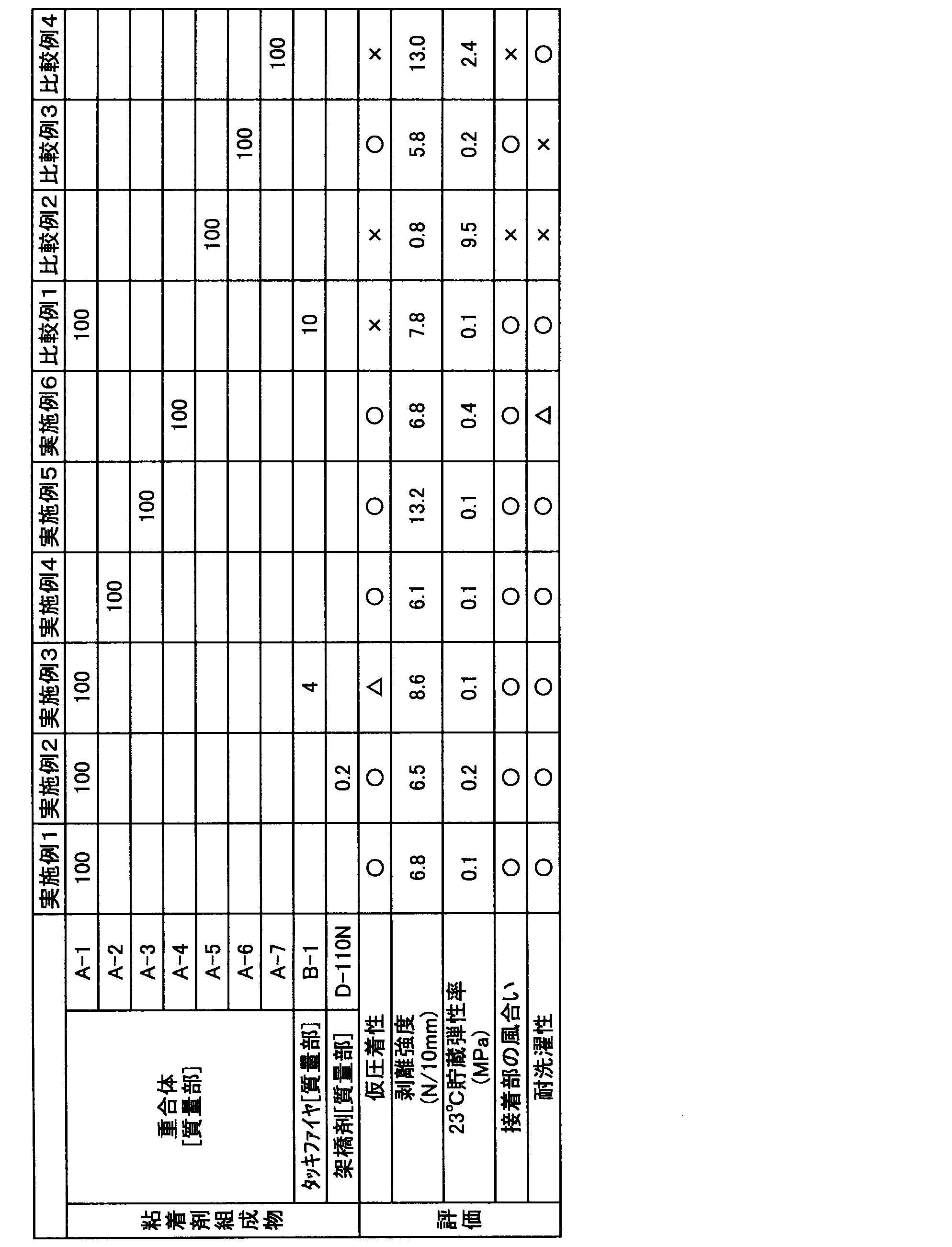
表2の略称は以下のとおりである。
A-4:ポリエステル系接着剤「PES310S30」(東亞合成社製)
A-6:エマルジョン粘着剤「アロンタックHV-C5166」(東亞合成社製)
A-7:市販ウレタン系ホットメルト接着剤
D-110N:タケネートD-110N(三井化学社製)
なお、表2中、重合体及び架橋剤は、固形分換算での配合量(質量部)を表す。
The abbreviations in Table 2 are as follows:
A-4: Polyester adhesive "PES310S30" (manufactured by Toagosei Co., Ltd.)
A-6: Emulsion adhesive "Arontack HV-C5166" (manufactured by Toagosei Co., Ltd.)
A-7: Commercially available urethane-based hot melt adhesive D-110N: Takenate D-110N (manufactured by Mitsui Chemicals, Inc.)
In Table 2, the amounts of the polymer and the crosslinking agent are shown in terms of solid content (parts by mass).
表2に示すように、重合体A-1~A-4を含有し、粘着剤層の23℃での貯蔵弾性率G’が1.0MPa以下である粘着剤組成物を用いた実施例1~6ではいずれも、剥離強度が6.0N/10mmよりも高く、接着箇所において剥がれが生じにくかった。また、実施例1~6は仮圧着性についても良好であった。これらの中でも、タッキファイヤを含まない粘着剤組成物(実施例1、2、4~6)は仮圧着性が「○」の評価であり、特に優れていた。 As shown in Table 2, in Examples 1 to 6, which used adhesive compositions containing polymers A-1 to A-4 and in which the adhesive layer had a storage modulus G' of 1.0 MPa or less at 23°C, the peel strength was higher than 6.0 N/10 mm and peeling was unlikely to occur at the adhesion points. Examples 1 to 6 also had good temporary pressure-sensitive adhesive properties. Among these, the adhesive compositions not containing a tackifier (Examples 1, 2, 4 to 6) were rated as "○" for temporary pressure-sensitive adhesive properties and were particularly excellent.
さらに、実施例1~6では、繊維生地どうしの接着箇所が柔軟であり、かつ伸縮性が良好であった。特に、重合体(A)としてトリブロック共重合体を用いた実施例5では、剥離強度が13.2N/10mmと非常に高く、接着部の柔軟性及び伸縮性を維持しながら優れた接着性を示した。また、(メタ)アクリル系重合体(A)を用いた実施例1~5は耐洗濯性にも優れていた。 Furthermore, in Examples 1 to 6, the bonded portions of the fiber fabrics were flexible and had good stretchability. In particular, Example 5, which used a triblock copolymer as polymer (A), had a very high peel strength of 13.2 N/10 mm, and showed excellent adhesion while maintaining the flexibility and stretchability of the bonded portions. Moreover, Examples 1 to 5, which used a (meth)acrylic polymer (A), also had excellent washability.
一方、重合体B-1の含有量を10質量部とした比較例1は、剥離強度、接着部の風合い及び耐洗濯性は良好であったものの、粘着力が弱く、仮圧着性が劣っていた。また、粘着剤層の23℃での貯蔵弾性率G’が1.0MPaよりも大きい比較例2の粘着剤組成物は、接着部の柔軟性及び伸縮性が十分でなく、剥離強度も低く、仮圧着性及び耐洗濯性も実施例1~6より劣っていた。エマルジョン接着剤を用いた比較例3では、接着部の風合いは良好であったものの、耐洗濯性に劣っていた。また、ウレタン系ホットメルト接着剤により繊維生地どうしを貼り合わせた比較例4では、剥離強度は13.0N/10mmと高い値を示したものの、接着箇所が硬く、伸縮性が十分でなかった。 On the other hand, in Comparative Example 1, in which the content of polymer B-1 was 10 parts by mass, the peel strength, the texture of the adhesive part, and the wash resistance were good, but the adhesive strength was weak and the temporary pressure-sensitive adhesive property was poor. In addition, the adhesive composition of Comparative Example 2, in which the storage modulus G' of the adhesive layer at 23°C was greater than 1.0 MPa, had insufficient flexibility and elasticity of the adhesive part, low peel strength, and inferior temporary pressure-sensitive adhesive property and wash resistance to Examples 1 to 6. In Comparative Example 3, in which an emulsion adhesive was used, the texture of the adhesive part was good, but the wash resistance was poor. In Comparative Example 4, in which fiber fabrics were bonded together with a urethane-based hot melt adhesive, the peel strength was high at 13.0 N/10 mm, but the adhesive part was hard and the elasticity was insufficient.
Claims (3)
数平均分子量が30,000以上である(メタ)アクリル系重合体(A)を含有し、かつ前記粘着剤組成物を用いて形成された粘着剤層の23℃での貯蔵弾性率が1.0MPa以下であり、
数平均分子量が10,000以下であるビニル系重合体(B)の含有量が、前記(メタ)アクリル系重合体(A)の100質量部に対して5質量部以下であり、
前記(メタ)アクリル系重合体(A)は、(メタ)アクリル酸ヒドロキシアルキル化合物に由来する構造単位を、前記(メタ)アクリル系重合体(A)が有する全構成単量体単位に対して1モル%以上20モル%以下有し、かつ(メタ)アクリル酸アルキル化合物に由来する構造単位を、前記(メタ)アクリル系重合体(A)が有する全構成単量体単位に対して50モル%以上有する、衣料用粘着剤組成物。 A pressure-sensitive adhesive composition for bonding textile fabrics for clothing, the pressure-sensitive adhesive composition comprising a polymer component in a solution form dissolved in an organic solvent or in a solid or semi-solid form,
a pressure-sensitive adhesive layer formed using the pressure-sensitive adhesive composition has a storage modulus at 23° C. of 1.0 MPa or less;
the content of the vinyl polymer (B) having a number average molecular weight of 10,000 or less is 5 parts by mass or less per 100 parts by mass of the (meth)acrylic polymer (A);
the (meth)acrylic polymer (A) contains structural units derived from a hydroxyalkyl (meth)acrylate compound in an amount of 1 mol % or more and 20 mol % or less, based on all constituent monomer units contained in the (meth)acrylic polymer (A), and contains structural units derived from an alkyl (meth)acrylate compound in an amount of 50 mol % or more, based on all constituent monomer units contained in the (meth)acrylic polymer (A).
Priority Applications (1)
| Application Number | Priority Date | Filing Date | Title |
|---|---|---|---|
| JP2019200903A JP7552012B2 (en) | 2019-11-05 | 2019-11-05 | Adhesive composition for clothing and its uses |
Applications Claiming Priority (1)
| Application Number | Priority Date | Filing Date | Title |
|---|---|---|---|
| JP2019200903A JP7552012B2 (en) | 2019-11-05 | 2019-11-05 | Adhesive composition for clothing and its uses |
Publications (2)
| Publication Number | Publication Date |
|---|---|
| JP2021075585A JP2021075585A (en) | 2021-05-20 |
| JP7552012B2 true JP7552012B2 (en) | 2024-09-18 |
Family
ID=75897972
Family Applications (1)
| Application Number | Title | Priority Date | Filing Date |
|---|---|---|---|
| JP2019200903A Active JP7552012B2 (en) | 2019-11-05 | 2019-11-05 | Adhesive composition for clothing and its uses |
Country Status (1)
| Country | Link |
|---|---|
| JP (1) | JP7552012B2 (en) |
Citations (7)
| Publication number | Priority date | Publication date | Assignee | Title |
|---|---|---|---|---|
| JP2005525441A (en) | 2002-03-29 | 2005-08-25 | ザ プロクター アンド ギャンブル カンパニー | Hydrogel adhesives for use on hair or fiber dense surfaces |
| WO2017154660A1 (en) | 2016-03-09 | 2017-09-14 | 株式会社カネカ | Radically curable composition and cured product thereof |
| JP2017193608A (en) | 2016-04-19 | 2017-10-26 | 東洋インキScホールディングス株式会社 | Adhesive and adhesive sheet |
| JP2017206677A (en) | 2017-04-11 | 2017-11-24 | 株式会社クラレ | Laminated body having adhesive layer and fiber layer containing acrylic block copolymer |
| JP2018024858A (en) | 2016-07-28 | 2018-02-15 | 日東電工株式会社 | Adhesive tape or sheet for attaching clothes |
| JP2019011382A (en) | 2017-06-29 | 2019-01-24 | 東亞合成株式会社 | Adhesive composition and application thereof |
| JP2019108498A (en) | 2017-12-19 | 2019-07-04 | リンテック株式会社 | Adhesive for repeatedly bending device, adhesive sheet, repeatedly bending laminate member, and repeatedly bending device |
Family Cites Families (4)
| Publication number | Priority date | Publication date | Assignee | Title |
|---|---|---|---|---|
| IN161966B (en) * | 1983-06-27 | 1988-03-05 | Johnson & Johnson Prod Inc | |
| DE3415920A1 (en) * | 1984-04-28 | 1985-11-07 | Bayer Ag, 5090 Leverkusen | DISPERSION COMPOSITIONS, METHOD FOR THEIR PRODUCTION AND THEIR USE |
| JP5670099B2 (en) * | 2009-05-25 | 2015-02-18 | 三洋化成工業株式会社 | Leather-like sheet manufacturing method |
| JP5251990B2 (en) * | 2011-01-13 | 2013-07-31 | ソニー株式会社 | Optical information recording medium |
-
2019
- 2019-11-05 JP JP2019200903A patent/JP7552012B2/en active Active
Patent Citations (7)
| Publication number | Priority date | Publication date | Assignee | Title |
|---|---|---|---|---|
| JP2005525441A (en) | 2002-03-29 | 2005-08-25 | ザ プロクター アンド ギャンブル カンパニー | Hydrogel adhesives for use on hair or fiber dense surfaces |
| WO2017154660A1 (en) | 2016-03-09 | 2017-09-14 | 株式会社カネカ | Radically curable composition and cured product thereof |
| JP2017193608A (en) | 2016-04-19 | 2017-10-26 | 東洋インキScホールディングス株式会社 | Adhesive and adhesive sheet |
| JP2018024858A (en) | 2016-07-28 | 2018-02-15 | 日東電工株式会社 | Adhesive tape or sheet for attaching clothes |
| JP2017206677A (en) | 2017-04-11 | 2017-11-24 | 株式会社クラレ | Laminated body having adhesive layer and fiber layer containing acrylic block copolymer |
| JP2019011382A (en) | 2017-06-29 | 2019-01-24 | 東亞合成株式会社 | Adhesive composition and application thereof |
| JP2019108498A (en) | 2017-12-19 | 2019-07-04 | リンテック株式会社 | Adhesive for repeatedly bending device, adhesive sheet, repeatedly bending laminate member, and repeatedly bending device |
Also Published As
| Publication number | Publication date |
|---|---|
| JP2021075585A (en) | 2021-05-20 |
Similar Documents
| Publication | Publication Date | Title |
|---|---|---|
| JP7107373B2 (en) | Adhesive composition and its use | |
| TWI902833B (en) | Decorative film | |
| CN108368405A (en) | adhesive sheet | |
| CN103635556A (en) | Aqueous-dispersion type adhesive composition, adhesive and adhesive sheet | |
| TWI848114B (en) | Adhesive sheet | |
| CN120435529A (en) | Adhesive sheet | |
| CN108929639A (en) | Adhesive composition used in bonding sheet and the bonding sheet | |
| JP6471574B2 (en) | Polishing pad fixing adhesive and polishing pad fixing adhesive sheet | |
| JP2017206677A (en) | Laminated body having adhesive layer and fiber layer containing acrylic block copolymer | |
| JP7287270B2 (en) | Adhesive for fixing polishing member and adhesive sheet | |
| JP7230417B2 (en) | Adhesive composition and its use | |
| JP7375466B2 (en) | Adhesive composition and laminate for fiber/elastomer bonding | |
| TW202330859A (en) | Adhesive composition and adhesive sheet using same | |
| WO2024262471A1 (en) | Adhesive composition, adhesive sheet, and article | |
| WO2024262470A1 (en) | Transfer sheet adhesive composition, transfer sheet, and article | |
| JP7375474B2 (en) | Adhesive composition for conductive sheets and its uses | |
| WO2024262590A1 (en) | Adhesive sheet, adhesive composition, and decorative molded body | |
| JP2021075585A (en) | Adhesive composition for clothing, and its use | |
| JP7321329B1 (en) | Adhesive sheet | |
| JP7276092B2 (en) | Adhesive composition and adhesive product | |
| JP7451938B2 (en) | Adhesive compositions and adhesive products | |
| JP7746671B2 (en) | Pressure-sensitive adhesive sheet and method for manufacturing the same, and method for manufacturing laminate | |
| JP7708474B1 (en) | Removable adhesive composition and adhesive sheet | |
| JP2007138013A (en) | Double-sided pressure-sensitive adhesive sheet and method for producing member using the same | |
| JP2004217740A (en) | Pressure-sensitive adhesive composition and pressure-sensitive adhesive sheet using the same |
Legal Events
| Date | Code | Title | Description |
|---|---|---|---|
| A621 | Written request for application examination |
Free format text: JAPANESE INTERMEDIATE CODE: A621 Effective date: 20220706 |
|
| A977 | Report on retrieval |
Free format text: JAPANESE INTERMEDIATE CODE: A971007 Effective date: 20230322 |
|
| A131 | Notification of reasons for refusal |
Free format text: JAPANESE INTERMEDIATE CODE: A131 Effective date: 20230328 |
|
| A521 | Request for written amendment filed |
Free format text: JAPANESE INTERMEDIATE CODE: A523 Effective date: 20230522 |
|
| A131 | Notification of reasons for refusal |
Free format text: JAPANESE INTERMEDIATE CODE: A131 Effective date: 20230822 |
|
| A521 | Request for written amendment filed |
Free format text: JAPANESE INTERMEDIATE CODE: A523 Effective date: 20231019 |
|
| A02 | Decision of refusal |
Free format text: JAPANESE INTERMEDIATE CODE: A02 Effective date: 20240116 |
|
| A521 | Request for written amendment filed |
Free format text: JAPANESE INTERMEDIATE CODE: A523 Effective date: 20240411 |
|
| A911 | Transfer to examiner for re-examination before appeal (zenchi) |
Free format text: JAPANESE INTERMEDIATE CODE: A911 Effective date: 20240418 |
|
| TRDD | Decision of grant or rejection written | ||
| A01 | Written decision to grant a patent or to grant a registration (utility model) |
Free format text: JAPANESE INTERMEDIATE CODE: A01 Effective date: 20240806 |
|
| A61 | First payment of annual fees (during grant procedure) |
Free format text: JAPANESE INTERMEDIATE CODE: A61 Effective date: 20240819 |
|
| R150 | Certificate of patent or registration of utility model |
Ref document number: 7552012 Country of ref document: JP Free format text: JAPANESE INTERMEDIATE CODE: R150 |