JP7555552B2 - Culture medium, culture medium additive, and nutritional enrichment method for edible mushrooms of the family Lamiaceae or the family Salicaceae - Google Patents
Culture medium, culture medium additive, and nutritional enrichment method for edible mushrooms of the family Lamiaceae or the family Salicaceae Download PDFInfo
- Publication number
- JP7555552B2 JP7555552B2 JP2023570275A JP2023570275A JP7555552B2 JP 7555552 B2 JP7555552 B2 JP 7555552B2 JP 2023570275 A JP2023570275 A JP 2023570275A JP 2023570275 A JP2023570275 A JP 2023570275A JP 7555552 B2 JP7555552 B2 JP 7555552B2
- Authority
- JP
- Japan
- Prior art keywords
- alanine
- medium
- family
- edible mushrooms
- edible
- Prior art date
- Legal status (The legal status is an assumption and is not a legal conclusion. Google has not performed a legal analysis and makes no representation as to the accuracy of the status listed.)
- Active
Links
Classifications
-
- A—HUMAN NECESSITIES
- A01—AGRICULTURE; FORESTRY; ANIMAL HUSBANDRY; HUNTING; TRAPPING; FISHING
- A01G—HORTICULTURE; CULTIVATION OF VEGETABLES, FLOWERS, RICE, FRUIT, VINES, HOPS OR SEAWEED; FORESTRY; WATERING
- A01G18/00—Cultivation of mushrooms
- A01G18/20—Culture media, e.g. compost
-
- C—CHEMISTRY; METALLURGY
- C12—BIOCHEMISTRY; BEER; SPIRITS; WINE; VINEGAR; MICROBIOLOGY; ENZYMOLOGY; MUTATION OR GENETIC ENGINEERING
- C12N—MICROORGANISMS OR ENZYMES; COMPOSITIONS THEREOF; PROPAGATING, PRESERVING, OR MAINTAINING MICROORGANISMS; MUTATION OR GENETIC ENGINEERING; CULTURE MEDIA
- C12N1/00—Microorganisms; Compositions thereof; Processes of propagating, maintaining or preserving microorganisms or compositions thereof; Processes of preparing or isolating a composition containing a microorganism; Culture media therefor
- C12N1/14—Fungi; Culture media therefor
Landscapes
- Life Sciences & Earth Sciences (AREA)
- Health & Medical Sciences (AREA)
- Engineering & Computer Science (AREA)
- Chemical & Material Sciences (AREA)
- Wood Science & Technology (AREA)
- Bioinformatics & Cheminformatics (AREA)
- Organic Chemistry (AREA)
- Biotechnology (AREA)
- Zoology (AREA)
- Mycology (AREA)
- Genetics & Genomics (AREA)
- Tropical Medicine & Parasitology (AREA)
- Biomedical Technology (AREA)
- Virology (AREA)
- Microbiology (AREA)
- Botany (AREA)
- Medicinal Chemistry (AREA)
- Biochemistry (AREA)
- General Engineering & Computer Science (AREA)
- General Health & Medical Sciences (AREA)
- Environmental Sciences (AREA)
- Mushroom Cultivation (AREA)
- Micro-Organisms Or Cultivation Processes Thereof (AREA)
Description
本発明は、シメジ科又はタマバリタケ科食用キノコの栽培用培地、培地添加剤及び栄養強化方法に関する。また、本発明は、機能性のあるアミノ酸の含有量が増加された栄養強化食用キノコに関する。The present invention relates to a culture medium, a culture medium additive, and a method for nutritional enrichment for edible mushrooms of the Lamiaceae or Bucconaceae family. The present invention also relates to nutritional enriched edible mushrooms with an increased content of functional amino acids.
ブナシメジ、ホンシメジ等のシメジ科食用キノコ、エノキタケ等のタマバリタケ科食用キノコは、和、洋、中を問わず、様々な幅広い料理に使用できることから、使い勝手がよく、人気の食材である。また、近年の研究から、抗菌、抗ウイルス、コレステロール低下、血糖降下、血圧降下、抗血栓、リンパ球幼若化抑制、抗腫瘍等の様々な生理活性機能があることが報告されており、健康的な食材としての人気も高まっている。Edible mushrooms from the Shimeji family, such as Bunashimeji and Honshimeji, and edible mushrooms from the Bacillus family, such as Enokitake, are versatile and popular ingredients because they can be used in a wide variety of dishes, whether Japanese, Western, or Chinese. In addition, recent research has reported that they have various physiologically active functions, such as antibacterial, antiviral, cholesterol-lowering, blood sugar-lowering, blood pressure-lowering, antithrombotic, lymphocyte blastogenesis-inhibiting, and antitumor properties, and they are becoming increasingly popular as healthy ingredients.
前記食用キノコは、水分、タンパク質、繊維質、無機質、ビタミン類等の主要成分、並びにアミノ酸、核酸、有機酸、糖、β-グルカン等の微量成分を含み、これらの成分がキノコの効能、味等に大きな影響を与えている。The edible mushrooms contain major components such as moisture, protein, fiber, minerals, and vitamins, as well as trace components such as amino acids, nucleic acids, organic acids, sugars, and β-glucans, and these components have a significant impact on the efficacy, taste, etc. of the mushrooms.
中でも、アミノ酸は有用な機能性を有することが明らかになっており、多数のアミノ酸を含有する食用キノコは、優れた機能性を有する食材とされている。 In particular, it has been revealed that amino acids have useful functionality, and edible mushrooms, which contain many amino acids, are considered to be food ingredients with excellent functionality.
さらに、機能性成分であるアミノ酸の含有量を増大させた食用キノコを栽培する方法についても報告されている。例えば、酵母細胞(特許文献1)、乾燥麦焼酎粕(特許文献2)を培地に用いることにより食用キノコ中のオルニチン等のアミノ酸成分の含有量を増加させる方法が知られている。Furthermore, methods for cultivating edible mushrooms with increased amino acid content, which is a functional component, have also been reported. For example, a method is known in which the content of amino acid components such as ornithine in edible mushrooms is increased by using yeast cells (Patent Document 1) or dried barley shochu lees (Patent Document 2) as a medium.
ここで、アミノ酸の呈味については、グリシン、L-アラニン、L-トレオニン、L-プロリン、L-セリンは甘味、L-フェニルアラニン、L-チロシン、L-アルギニン、L-イソロイシン、L-ロイシン、L-バリン、L-メチオニン、L-リジンは苦味、L-グルタミンは旨味、L-グルタミン酸とL-アスパラギン酸は旨味と酸味を主に呈することが知られている。
そのため、キノコ中のL-アルギニンやL-オルニチン等の苦味を有するアミノ酸の含有量が増大した場合、そのキノコの呈味に影響が出る可能性があった。
Regarding the taste of amino acids, it is known that glycine, L-alanine, L-threonine, L-proline, and L-serine mainly exhibit a sweet taste, L-phenylalanine, L-tyrosine, L-arginine, L-isoleucine, L-leucine, L-valine, L-methionine, and L-lysine mainly exhibit a bitter taste, L-glutamine mainly exhibits a umami taste, and L-glutamic acid and L-aspartic acid mainly exhibit a umami taste and a sour taste.
Therefore, if the content of bitter amino acids such as L-arginine and L-ornithine in mushrooms increases, the taste of the mushrooms may be affected.
本発明は、機能性があるアミノ酸の含有量が大きいシメジ科食用キノコ又はタマバリタケ科食用キノコを効率よく栽培するための培地及び前記培地添加剤を提供することを目的とする。
また、本発明の他の目的は、シメジ科食用キノコ又はタマバリタケ科食用キノコにおいて、機能性があるアミノ酸の含有量を増大させる、食用キノコの栄養強化方法を提供することを目的とする。
また、本発明の他の目的は、機能性があるアミノ酸の含有量が増加されたシメジ科食用キノコ又はタマバリタケ科食用キノコを提供することを目的とする。
An object of the present invention is to provide a culture medium and a culture medium additive for efficiently cultivating edible mushrooms of the family Lymegrassaceae or the family Gallicaceae that have a high content of functional amino acids.
Another object of the present invention is to provide a method for nutritionally enhancing edible mushrooms, which increases the content of functional amino acids in edible mushrooms of the Shimejiaceae family or edible mushrooms of the Valliaceae family.
Another object of the present invention is to provide an edible mushroom of the family Lymeaceae or the family Gallicaceae, which has an increased content of functional amino acids.
本発明者らは、機能性と呈味とを共に向上させた有用な食用キノコを開発すべく鋭意検討した結果、D-アラニンを培地に添加することにより、前記培地で栽培したシメジ科食用キノコ中のL-アルギニン、L-オルニチン等の機能性がありかつ苦味を有するアミノ酸の含有量が有意に増大すると共に、甘味を呈するL-グルタミンの含有量が増大することで、食用キノコの呈味が向上すること、また、前記培地で栽培したタマバリタケ科食用キノコ中のL-オルニチン、L-リシン等の機能性があるアミノ酸の含有量が有意に増大することを見出して、本発明を完成させた。As a result of extensive research conducted by the inventors to develop a useful edible mushroom with improved functionality and taste, they discovered that adding D-alanine to a culture medium significantly increases the content of functional, bitter amino acids such as L-arginine and L-ornithine in edible mushrooms of the Shimejiaceae family grown in the medium, and also increases the content of sweet L-glutamine, thereby improving the taste of the edible mushrooms, and that the content of functional amino acids such as L-ornithine and L-lysine in edible mushrooms of the Bacillus family grown in the medium is significantly increased, thereby completing the present invention.
本発明の要旨は、
[1]栄養源としてD-アラニンを含有する、シメジ科又はタマバリタケ科食用キノコ栽培用の培地、
[2]さらにL-アラニンを含有する、前記[1]に記載の培地、
[3]D-アラニンを含有する、シメジ科又はタマバリタケ科食用キノコ栽培用の培地添加剤、
[4]さらにL-アラニンを含有する、前記[3]に記載の培地添加剤、
[5]前記[1]又は[2]に記載の培地に、シメジ科又はタマバリタケ科食用キノコの種菌を接種する工程を有する、食用キノコの栽培方法、
[6]前記[3]又は[4]に記載の培地添加剤を、シメジ科又はタマバリタケ科食用キノコの菌体又は該菌体が生育している培地に接触させることを特徴とする、シメジ科又はタマバリタケ科食用キノコの栽培方法、
[7]D-アラニンを含有しない培地で栽培された食用キノコに比べてL-アルギニン、L-オルニチン又はL-グルタミンの含有量が1.2倍以上に強化された食用キノコであって、
食用キノコの種類がシメジ科食用キノコである、栄養強化食用キノコ、
[8]D-アラニンを含有しない培地で栽培された食用キノコに比べてL-オルニチン又はL-リシンの含有量が1.2倍以上に強化された食用キノコであって、
食用キノコの種類がタマバリタケ科食用キノコである、栄養強化食用キノコ
に関する。
The gist of the present invention is
[1] A medium for cultivating edible mushrooms of the family Lymegrassaceae or the family Brassicae, containing D-alanine as a nutrient source;
[2] The medium according to [1], further comprising L-alanine.
[3] A medium additive for cultivating edible mushrooms of the family Lamiaceae or the family Brachypodium containing D-alanine;
[4] The medium additive according to [3], further comprising L-alanine.
[5] A method for cultivating edible mushrooms, comprising a step of inoculating a seed fungus of an edible mushroom of the family Lamiaceae or the family Brachypodium into the medium according to [1] or [2] above;
[6] A method for cultivating edible mushrooms of the family Lymebacteraceae or the family Salicaceae, comprising contacting the medium additive according to [3] or [4] with a fungus of the family Lymebacteraceae or the family Salicaceae or a medium in which the fungus is growing.
[7] An edible mushroom having an L-arginine, L-ornithine or L-glutamine content of 1.2 times or more compared to an edible mushroom cultivated in a medium not containing D-alanine,
A nutritionally enhanced edible mushroom, the type of which is a mushroom of the Shimeji family;
[8] An edible mushroom having an L-ornithine or L-lysine content of 1.2 times or more compared to an edible mushroom cultivated in a medium not containing D-alanine,
The present invention relates to a nutritionally enhanced edible mushroom, which is an edible mushroom of the family Botrytisaceae.
本発明の培地、培地添加剤又は栽培方法を用いて栽培されるシメジ科又はタマバリタケ科食用キノコは、L-アルギニン、L-オルニチン等の機能性を有するアミノ酸の含有量が有意に増大することで、従来品に比べて、機能性に優れる点で、新規な食用キノコとして有用な食材となる。
さらに、シメジ科食用キノコは、L-グルタミンの含有量も増大することで、呈味が向上したものであるため、従来品に比べて、機能性に優れることに加えて、美味しく食べやすい点で、新規な食用キノコとして有用な食材となる。
Edible mushrooms of the Lamiaceae or Bucconaceae families cultivated using the culture medium, culture medium additive, or cultivation method of the present invention have a significantly increased content of functional amino acids such as L-arginine and L-ornithine, and are therefore useful as novel edible mushrooms as food ingredients that are superior in functionality compared to conventional products.
Furthermore, edible mushrooms of the Shimejiaceae family have an increased L-glutamine content, which improves their taste. Therefore, in addition to being more functional than conventional products, they are also delicious and easy to eat, making them a useful food ingredient as a novel edible mushroom.
[食用キノコ栽培用培地]
本発明に係る食用キノコ栽培用培地(以下、本発明の培地ともいう)は、栄養源としてD-アラニンを含有する、シメジ科又はタマバリタケ科食用キノコ栽培用の培地である。
[Ground medium for growing edible mushrooms]
The medium for cultivating edible mushrooms according to the present invention (hereinafter also referred to as the medium of the present invention) is a medium for cultivating edible mushrooms of the family Lymegrassaceae or the family Gallicaceae, which contains D-alanine as a nutrient source.
本発明において、シメジ科食用キノコとしては、ホンシメジ、ブナシメジ、ハタケシメジ等が挙げられる。
本発明において、タマバリタケ科食用キノコとしては、エノキタケ等が挙げられる。
In the present invention, examples of edible mushrooms of the Lamiaceae family include Hon-shimeji, Bunashimeji, and Hatakeshimeji.
In the present invention, examples of edible mushrooms of the family Botrytisaceae include Enokitake mushrooms and the like.
本発明の培地としては、菌床栽培等に用いられる人工培地が挙げられ、木質基材、栄養源及び水を含有する。The medium of the present invention includes an artificial medium used for mushroom bed cultivation, etc., and contains a wood substrate, a nutrient source and water.
前記木質基材としては、例えば、チップ、チップダスト、オガクズ、コーンコブ、コットンハル、ビート、バーク堆肥等が挙げられる。これらの木質基材は、単独で使用してもよいし、2種以上を組み合わせて使用してもよい。Examples of the wood substrate include chips, chip dust, sawdust, corn cobs, cotton hulls, beets, bark compost, etc. These wood substrates may be used alone or in combination of two or more.
前記栄養源とは、食用キノコを生育させるのに必要とされる成分であり、このような栄養源としては、例えば、米糠、フスマ、トウモロコシ糠、オカラ、小麦粉、大豆粕、豆皮、牛糞堆肥、コーヒー滓等の不溶性栄養源、これらの不溶性栄養源の水抽出物、馬鈴薯煎汁・ブドウ糖寒天培地(PDA)、麦芽エキス・ブドウ糖寒天培地(MA)、無機塩類、ミネラル等の可溶性栄養源等が挙げられる。これらの栄養源は、単独で使用してもよいし、2種以上を組み合わせて使用してもよい。
また、本発明の培地中における前記木質基材及び前記栄養源等の含有量については、シメジ科又はタマバリタケ科食用キノコの栽培が可能であればよく、特に限定はない。
The nutrient sources are components necessary for growing edible mushrooms, and examples of such nutrient sources include insoluble nutrient sources such as rice bran, wheat bran, corn bran, okara, wheat flour, soybean meal, soybean husks, cow manure compost, and coffee grounds, water extracts of these insoluble nutrient sources, soluble nutrient sources such as potato decoction-glucose agar medium (PDA), malt extract-glucose agar medium (MA), inorganic salts, and minerals, etc. These nutrient sources may be used alone or in combination of two or more.
Furthermore, the contents of the wood substrate and the nutrient sources in the culture medium of the present invention are not particularly limited as long as they allow cultivation of edible mushrooms of the family Lentinulataceae or the family Gallicaceae.
本発明の培地は、栄養源としてD-アラニンを含有することを特徴とする。
D-アラニンとは、L-アラニンの鏡像異性体として知られるアミノ酸の一種である。シメジ科又はタマバリタケ科食用キノコの菌体を成分分析すると、遊離アミノ酸としてL-アラニンは検出されるのに対して、D-アラニンは検出されない。このことから、D-アラニンは、シメジ科又はタマバリタケ科食用キノコにおける構成成分ではないと考えられる。
これに対して、本発明者らは、前記のように、食用キノコの構成成分ではないD-アラニンを栄養源としてシメジ科又はタマバリタケ科食用キノコの培地に添加して食用キノコを栽培すると、食用キノコ中において機能性があるアミノ酸(例えば、シメジ科食用キノコであればL-アルギニン、L-オルニチン又はL-グルタミン、タマバリタケ科食用キノコであればL-オルニチン又はL-リシン。以下、機能性アミノ酸ともいう。)等の含有量が増大するという現象を初めて見出した。
The medium of the present invention is characterized in that it contains D-alanine as a nutrient source.
D-alanine is a type of amino acid known as an enantiomer of L-alanine. When the fungus cells of edible mushrooms belonging to the family Lyophyllum or Bucconaceae are subjected to component analysis, L-alanine is detected as a free amino acid, whereas D-alanine is not detected. From this, it is considered that D-alanine is not a constituent of edible mushrooms belonging to the family Lyophyllum or Bucconaceae.
In response to this, the present inventors have discovered for the first time the phenomenon that, as described above, when D-alanine, which is not a constituent of edible mushrooms, is added as a nutrient source to the culture medium of edible mushrooms of the Shimejiaceae or Bucconaceae family and the edible mushrooms are cultivated, the content of functional amino acids in the edible mushrooms (for example, L-arginine, L-ornithine or L-glutamine in edible mushrooms of the Shimejiaceae family, and L-ornithine or L-lysine in edible mushrooms of the Bucconaceae family; hereinafter also referred to as functional amino acids) increases.
上記のような現象が生じる理由について、詳細は不明ではあるが、生育中のシメジ科食用キノコがD-アラニンを吸収した場合、前記キノコ内のアミノ酸の合成機構に作用し、D-アラニンを添加しない場合に比べて、L-アルギニン、L-オルニチン又はL-グルタミンの含有量を増大・蓄積させる効果があると考えられる。
例えば、後述の実施例1に記載のように、培地にL-アラニンを単独で添加した場合とD-アラニンとL-アラニンとを同時に添加した場合を比較すると、L-グルタミン、L-アルギニン、L-オルニチン、L-アラニン、L-リシン、L-メチオニンのいずれのアミノ酸についても子実体中の含有量の対象試験区(D-アラニン、L-アラニンを含有せず)に対する増加の比率は、培地にD-アラニンとL-アラニンを同時に添加した場合の方が高く、D-アラニンはL-アラニンにはない添加効果を示し、特に、子実体中のL-オルニチンとL-メチオニンの含有量の増加の割合は、L-アラニンを単独で添加した場合と比較してD-アラニンとL-アラニンを同時に添加した場合は、それぞれ有意に高くなる。
また、後述の実施例3の結果より、タマバリタケ科食用キノコがD-アラニンを吸収した場合、前記キノコ内のアミノ酸の合成機構に作用し、D-アラニンを添加しない場合に比べて、L-オルニチン又はL-リシンの含有量を増大・蓄積させる効果があると考えられる。
Although the details of why the above-mentioned phenomenon occurs are unknown, it is considered that when edible mushrooms of the Shimeji family absorb D-alanine during growth, it acts on the amino acid synthesis mechanism within the mushroom, and has the effect of increasing and accumulating the L-arginine, L-ornithine or L-glutamine content compared to when D-alanine is not added.
For example, as described in Example 1 below, when comparing the case where L-alanine was added alone to the medium with the case where D-alanine and L-alanine were added simultaneously, the ratio of increase in the content of each of the amino acids L-glutamine, L-arginine, L-ornithine, L-alanine, L-lysine, and L-methionine in the fruiting body relative to the control test area (containing neither D-alanine nor L-alanine) was higher when D-alanine and L-alanine were added simultaneously to the medium, and D-alanine exhibited an additive effect not seen in L-alanine. In particular, the ratio of increase in the content of L-ornithine and L-methionine in the fruiting body was significantly higher when D-alanine and L-alanine were added simultaneously compared to the case where L-alanine was added alone.
Furthermore, the results of Example 3 described below suggest that when edible mushrooms of the Bacillus family absorb D-alanine, it acts on the amino acid synthesis mechanism within the mushroom, and has the effect of increasing and accumulating the L-ornithine or L-lysine content compared to when D-alanine is not added.
本発明の培地中におけるD-アラニンの含有量としては、食用キノコ中の機能性アミノ酸の含有量を増大させる効果(以下、本発明の効果ともいう)を奏する観点から、10~50mMが好ましく、12~45mMがより好ましい。The content of D-alanine in the culture medium of the present invention is preferably 10 to 50 mM, and more preferably 12 to 45 mM, from the viewpoint of achieving the effect of increasing the content of functional amino acids in edible mushrooms (hereinafter also referred to as the effect of the present invention).
前記D-アラニンとしては、化学品、精製品等を用いてもよいし、D-アラニンを含有している天然素材等を用いてもよい。The D-alanine may be a chemical product, a refined product, or a natural material containing D-alanine.
また、本発明の培地では、D-アラニン及びL-アラニンも含有していてもよい。
L-アラニンとしては、化学品、精製品等を用いてもよいし、L-アラニンを含有している天然素材等を用いてもよい。
The medium of the present invention may also contain D-alanine and L-alanine.
As the L-alanine, a chemical product, a refined product, etc. may be used, or a natural material containing L-alanine, etc. may be used.
本発明の培地中におけるL-アラニンの含有量としては、本発明の効果を奏する観点から、10~50mMが好ましく、12~45mMがより好ましい。From the viewpoint of achieving the effects of the present invention, the content of L-alanine in the culture medium of the present invention is preferably 10 to 50 mM, and more preferably 12 to 45 mM.
また、DL-アラニンは、D-アラニンとL-アラニンとを等量含有する化学品であり、食品添加物のアミノ酸の一種として使用されており、安全性及び経済性に優れる観点から、好ましい。
本発明に係る培地中におけるDL-アラニンの含有量としては、本発明の効果を奏する観点から、20~100mMが好ましく、24~90mMがより好ましい。
DL-alanine is a chemical product containing equal amounts of D-alanine and L-alanine, and is used as one type of amino acid as a food additive. DL-alanine is preferable from the viewpoints of safety and economy.
The content of DL-alanine in the medium according to the present invention is preferably 20 to 100 mM, more preferably 24 to 90 mM, from the viewpoint of achieving the effects of the present invention.
本発明の培地は、例えば、前記木質基材、前記栄養源、水、D-アラニン、必要であればL-アラニンをミキサーに投入撹拌して均一な状態にした後、その適当量をビン、袋、箱等の菌床栽培に使用される容器に充填し、殺菌処理した後、放冷させることで調製することができる。
前記木質基材、前記栄養源、水、D-アラニン、L-アラニン等の混合の順番については、特に限定はない。
また、前記可溶性栄養源、D-アラニン、L-アラニンについては、予め水に溶解させたものを用いてもよい。
The medium of the present invention can be prepared, for example, by putting the wood substrate, the nutrient sources, water, D-alanine, and, if necessary, L-alanine into a mixer and stirring to make a homogeneous mixture, then filling an appropriate amount of the mixture into a container used for fungal bed cultivation, such as a bottle, bag, or box, sterilizing it, and allowing it to cool.
There is no particular limitation on the order in which the wood base material, the nutrient sources, water, D-alanine, L-alanine, etc. are mixed.
The soluble nutrient sources, D-alanine and L-alanine, may be dissolved in water before use.
本発明の培地中の水分量については、シメジ科又はタマバリタケ科食用キノコの従来の菌床と同様になるように調整すればよく、特に限定はない。The moisture content in the culture medium of the present invention is not particularly limited and may be adjusted to be similar to that of conventional mushroom beds of edible mushrooms of the Lamiaceae or Bultramaceae families.
本発明の培地は、雑菌の繁殖を抑えるために殺菌処理される。この殺菌処理方法としては、従来の菌床栽培方法で行う蒸気殺菌方法であればよい。The medium of the present invention is sterilized to suppress the growth of unwanted bacteria. The sterilization method may be the steam sterilization method used in conventional culture bed cultivation methods.
殺菌処理後の本発明の培地は、従来の菌床と同じ方法で、接種まで保管しておけばよい。After sterilization, the culture medium of the present invention can be stored until inoculation in the same manner as conventional culture beds.
[食用キノコ栽培用の培地添加剤]
本発明に係る食用キノコ栽培用の培地添加剤(以下、本発明の培地添加剤)はD-アラニンを含有することを特徴とする。
[Growth medium additive for edible mushroom cultivation]
The medium additive for cultivating edible mushrooms according to the present invention (hereinafter referred to as the medium additive of the present invention) is characterized by containing D-alanine.
本発明の培地添加剤は、添加目的の培地が原木である場合は、例えば液状の添加剤に原木を浸漬させる、原木に添加剤を掛ける又は噴霧することにより、添加することができる。また、添加目的の培地が人工培地である場合は、例えば、培地成分を混合する際に添加剤を加える、調製後の培地に添加剤を掛ける又は噴霧することにより、添加することができる。When the medium to which the additive is to be added is a log, the medium additive of the present invention can be added, for example, by immersing the log in a liquid additive, or by pouring or spraying the additive onto the log. When the medium to which the additive is to be added is an artificial medium, the additive can be added, for example, by adding the additive when mixing the medium components, or by pouring or spraying the additive onto the medium after preparation.
本発明の培地添加剤は、そのまま使用してもよいし、水又は他の培地添加剤と共に、肥料として希釈して用いることもできる。The medium additive of the present invention may be used as is, or it may be diluted with water or other medium additives and used as a fertilizer.
本発明の培地添加剤中の、D-アラニンの含有量は、培地に添加した場合に、D-アラニンの含有量を調整できるものであればよく、特に限定はない。例えば、前記含有量は、100重量%であってもよいし、100重量%未満でもよい。The content of D-alanine in the medium additive of the present invention is not particularly limited as long as it can adjust the content of D-alanine when added to a medium. For example, the content may be 100% by weight or less than 100% by weight.
前記D-アラニンとしては、化学品、精製品等を用いてもよいし、D-アラニンを含有している天然素材等を用いてもよい。The D-alanine may be a chemical product, a refined product, or a natural material containing D-alanine.
本発明の培地添加剤では、D-アラニンに加えて、L-アラニンを含有してもよい。
L-アラニンとしては、化学品、精製品等を用いてもよいし、L-アラニンを含有している天然素材等を用いてもよい。
The medium additive of the present invention may contain L-alanine in addition to D-alanine.
As the L-alanine, a chemical product, a refined product, etc. may be used, or a natural material containing L-alanine, etc. may be used.
本発明の培地添加剤中におけるL-アラニンの含有量(固形分)としては、特に限定はないが、本発明の効果を奏する観点から、例えば、DL-アラニンのように、D-アラニンと等量になるように調整されていてもよい。The content (solids) of L-alanine in the medium additive of the present invention is not particularly limited, but from the viewpoint of achieving the effects of the present invention, it may be adjusted so that the amount is equivalent to that of D-alanine, for example, like DL-alanine.
また、本発明の培地添加剤は、他の栄養源及び水を含有してもよい。
前記栄養源の種類及び含有量については、特に限定はない。
水については、D-アラニン、L-アラニン及び栄養成分の残部であればよく、特に限定はない。
The medium additive of the present invention may also contain other nutrient sources and water.
The type and content of the nutrient source are not particularly limited.
There are no particular limitations on the water, so long as it is the balance of D-alanine, L-alanine and the nutritional components.
[食用キノコの栽培方法]
(1)本発明に係る食用キノコの栽培方法(本発明の第1の栽培方法)としては、前記の本発明の培地にシメジ科又はタマバリタケ科食用キノコの種菌を接種する工程を有する人工栽培方法が挙げられる。
[How to grow edible mushrooms]
(1) An example of a cultivation method for edible mushrooms according to the present invention (the first cultivation method of the present invention) is an artificial cultivation method comprising a step of inoculating a seed culture of an edible mushroom of the family Lamiaceae or the family Brachypodium into the culture medium of the present invention.
本発明の培地に種菌を接種する方法としては、従来公知の接種方法であればよく、例えば、無菌室で培地表面又は接種孔に対して行う方法、種菌を培地に混ぜ込み塗りつける方法等が挙げられる。The method for inoculating the medium of the present invention with the seed bacteria may be any conventionally known inoculation method, such as a method in which the inoculation is performed on the surface of the medium or on an inoculation hole in a sterile room, or a method in which the seed bacteria is mixed into the medium and then spread on the medium.
前記人工栽培方法としては、本発明の培地の形態に応じて、ビン栽培、袋栽培、箱栽培等の菌床栽培方法が挙げられる。前記菌床栽培方法の条件は、従来の菌床栽培と同様であればよい。例えば、培養温度としては、18~27℃の範囲になるように調整すればよい。 The artificial cultivation method includes a fungal bed cultivation method such as bottle cultivation, bag cultivation, box cultivation, etc., depending on the form of the medium of the present invention. The conditions of the fungal bed cultivation method may be the same as those of conventional fungal bed cultivation. For example, the culture temperature may be adjusted to be in the range of 18 to 27°C.
前記種菌の接種後は、菌床に菌糸体が蔓延する環境を整える育成を行う。
前記育成では、菌糸体の成長に光は不要であるが、呼吸により発生する二酸化炭素の濃度が高くなると生育不良を起こすので換気を行う。時間の経過と共に菌床中の水分量が減少する場合には、注水、散水、加湿等をしてもよい。
培養日数については、食用キノコの状態を見て決定すればよいが、菌種により30~120日程度で調整すればよい。
After inoculation of the seed fungus, the fungus is grown in an environment that allows the mycelium to spread over the fungal bed.
In the above cultivation, light is not necessary for the growth of the mycelium, but ventilation is required since poor growth occurs when the concentration of carbon dioxide generated by respiration becomes high. If the moisture content in the fungal bed decreases over time, watering, sprinkling, humidification, etc. may be performed.
The number of days for cultivation can be determined based on the condition of the edible mushrooms, and can be adjusted to about 30 to 120 days depending on the species.
前記育成後には、子実体の発生条件に適合するように温湿度と光量を変え子実体の発生を促す子実体発生(芽出しともいう)を行う。前記子実体発生では、必要に応じて、菌かき、袋カット、側転、上下反転、注水、覆土等の作業を行えばよい。After the cultivation, the temperature, humidity and light intensity are adjusted to suit the conditions for fruit body development, and fruit body development (also called budding) is carried out to promote fruit body development. For fruit body development, tasks such as scraping, bag cutting, rolling, turning upside down, watering, and covering with soil can be carried out as necessary.
前記子実体発生後に、収穫を行う。
人工栽培の場合は、一度に全ての子実体を収穫するが、袋や平箱を用いる場合、出荷に適した大きさになった物から順次収穫をすればよい。収穫期間は子実体の発生開始から15~100日程度に行えばよい。
After the fruiting bodies have emerged, harvesting is carried out.
In the case of artificial cultivation, all the fruit bodies are harvested at once, but when bags or flat boxes are used, they can be harvested one by one as they reach a size suitable for shipping. The harvesting period should be about 15 to 100 days after the start of fruit body generation.
(2)本発明の第2の栽培方法としては、本発明に係る培地添加剤を、シメジ科又はタマバリタケ科食用キノコの菌体又は該菌体が生育している培地に接触させることを特徴とする。 (2) The second cultivation method of the present invention is characterized in that the culture medium additive of the present invention is brought into contact with the mycelium of an edible mushroom of the family Lamiaceae or the family Brachypaceae, or with the culture medium in which the mycelium is growing.
前記接触方法について、培地が原木である場合は、例えば液状の本発明の培地添加剤に原木を浸漬させる、原木に本発明の培地添加剤を掛ける又は噴霧することにより、接触させることができる。培地が人工培地である場合は、例えば培地成分を混合する際に本発明の培地添加剤を加える、調製後の培地に本発明の培地添加剤を掛ける又は噴霧することにより、接触させることができる。Regarding the above-mentioned contact method, when the medium is a log, the log can be contacted by, for example, immersing the log in a liquid medium additive of the present invention, or by pouring or spraying the medium additive of the present invention onto the log. When the medium is an artificial medium, the medium can be contacted by, for example, adding the medium additive of the present invention when mixing the medium components, or by pouring or spraying the medium additive of the present invention onto the prepared medium.
培地に本発明の培地添加剤を接触させる回数は、1回でもよいが、本発明の効果を奏し易い観点から、2回以上が好ましい。
例えば、原木栽培の場合、原木に液状の本発明の培地添加剤を浸漬させた後、食用キノコの種菌を植菌し、その収穫までの間に、前記原木又は生育中の食用キノコに本発明の培地添加剤を1回以上、掛けたり、噴霧したりしてもよい。
また、人工培地の場合、培地に本発明の培地添加剤を含有させた後、食用キノコの種菌を植菌し、その収穫までの間に、前記培地又は生育中の食用キノコに本発明の培地添加剤を1回以上、掛けたり、噴霧したりしてもよい。
The medium additive of the present invention may be contacted with the medium once, but is preferably contacted two or more times in order to easily exert the effects of the present invention.
For example, in the case of cultivation on logs, the logs may be soaked in a liquid medium additive of the present invention, and then edible mushroom seed cultures may be inoculated into the logs. During the time until harvest, the logs or the growing edible mushrooms may be doused or sprayed with the medium additive of the present invention one or more times.
In the case of an artificial culture medium, the culture medium additive of the present invention may be added to the culture medium, and then edible mushroom seed cultures may be inoculated, and the culture medium or the growing edible mushrooms may be sprayed or coated with the culture medium additive of the present invention one or more times before being harvested.
前記原木栽培又は前記人工培地栽培の方法については、本発明の培地添加剤を用いる以外は、食用キノコの種類に応じた従来公知の方法であればよい。
例えば、原木栽培であれば、食用キノコに適した原木に穴をあけ、種菌を接種し、森林等の自然環境で食用キノコを発生させる工程が挙げられる。
人工培地栽培として、ブナシメジの菌床培養であれば、培地の製造、培養器への充填、殺菌、種菌の接種、培養、熟成、菌掻き、芽出し、生育、収穫等の工程が挙げられる。
Regarding the method of the log cultivation or the artificial medium cultivation, any conventionally known method suitable for the type of edible mushroom may be used, except that the medium additive of the present invention is used.
For example, in the case of log cultivation, a process includes drilling holes in logs suitable for edible mushrooms, inoculating them with seed fungi, and allowing edible mushrooms to grow in a natural environment such as a forest.
In the case of artificial medium cultivation, in the case of cultivating a fungal bed of Bunashimeji, the steps include producing the medium, filling the culture vessel, sterilizing, inoculating the seed culture, cultivating, maturing, scratching, sprouting, growing, harvesting, etc.
[栄養強化食用キノコ]
前記の本発明の第1又は第2の培養方法で得られるシメジ科の食用キノコは、D-アラニンを含有しない培地で栽培された食用キノコに比べて、機能性アミノ酸であるL-アルギニン、L-オルニチン又はL-グルタミンの含有量が1.2倍以上に栄養強化されたシメジ科の食用キノコとなる(以下、本発明の食用キノコ1)。
[Nutritional enhancement of edible mushrooms]
The edible mushroom of the Shimeji family obtained by the first or second culture method of the present invention is an edible mushroom of the Shimeji family that has been nutritionally enriched with functional amino acids L-arginine, L-ornithine or L-glutamine such that the content is 1.2 times or more higher than that of edible mushrooms cultivated in a medium not containing D-alanine (hereinafter referred to as edible mushroom 1 of the present invention).
L-アルギニンは、強い苦味を呈するアミノ酸であり、成長ホルモン分泌促進作用、筋肉増強作用、血流改善作用、免疫力向上作用等を有する機能性成分であることが知られている。
L-オルニチンは、弱い苦味を呈するアミノ酸であり、成長ホルモン分泌促進作用、筋肉増強作用、傷ついた腸管の回復促進作用、肝臓でのアンモニア代謝促進作用、免疫力向上作用等を有する機能性成分であることが知られている。
L-グルタミンは、旨味を呈するアミノ酸であり、トレーニング後の筋肉疲労の回復作用、免疫力向上作用、胃腸粘膜の保護作用等を有する機能性成分であることが知られている。
L-arginine is an amino acid that has a strong bitter taste and is known to be a functional ingredient that has growth hormone secretion promoting effects, muscle building effects, blood flow improving effects, immune system enhancing effects, and the like.
L-ornithine is an amino acid that has a slight bitter taste and is known to be a functional ingredient that has the effects of promoting growth hormone secretion, strengthening muscles, promoting the recovery of damaged intestinal tracts, promoting ammonia metabolism in the liver, and improving immunity.
L-glutamine is an amino acid that has a delicious taste and is known to be a functional ingredient that has effects such as recovery from muscle fatigue after training, improving immunity, and protecting the gastrointestinal mucosa.
また、本発明の食用キノコ1では、L-アラニン、L-リシン、L-メチオニン等のアミノ酸の含有量は、D-アラニンを含有しない培地で栽培された食用キノコに比べて1.2倍以上に増大する。Furthermore, in the edible mushroom 1 of the present invention, the content of amino acids such as L-alanine, L-lysine, and L-methionine is increased by 1.2 times or more compared to edible mushrooms cultivated in a medium not containing D-alanine.
前記L-アラニンは、甘味と旨味を呈するアミノ酸であり、肝機能の保護作用、アルコール分解作用等を有する機能性成分であることが知られている。
前記L-リシン(リジン)は、苦味を呈するアミノ酸であり、疲労回復作用、集中力を高める作用等を有する機能性成分であることが知られている。
前記L-メチオニンは、苦味を呈するアミノ酸であり、コレステロールを減らす作用、肝機能改善作用、免疫増強作用等を有する機能性成分であることが知られている。
The L-alanine is an amino acid that has a sweet and delicious taste, and is known to be a functional component that has a liver protecting effect, an alcohol decomposition effect, and the like.
The L-lysine (lysine) is an amino acid that has a bitter taste and is known to be a functional ingredient that has effects such as fatigue relief and concentration enhancement.
The L-methionine is an amino acid that has a bitter taste and is known to be a functional component that has cholesterol-reducing effects, liver function improving effects, immune-enhancing effects, and the like.
また、本発明の食用キノコ1は、D-アラニンを含有しない培地で栽培されている食用キノコに比べて旨味の好ましさ、ブナシメジ特有の苦みが少ない点で優れた呈味を奏していることから、本発明の食用キノコは、例えば、焼く、煮る、炊く等、種々の調理をした場合に美味しく食べやすいものである。 Furthermore, the edible mushroom 1 of the present invention exhibits an excellent taste in that it has a more pleasant flavor and has less of the bitterness characteristic of Bunashimeji mushrooms compared to edible mushrooms cultivated in a medium that does not contain D-alanine, and therefore the edible mushroom of the present invention is delicious and easy to eat when cooked in various ways, for example, by grilling, boiling, or cooking.
また、前記の本発明の第1又は第2の培養方法で得られるタマバリタケ科食用キノコは、D-アラニンを含有しない培地で栽培された食用キノコに比べて、機能性アミノ酸であるL-オルニチン又はL-リシンの含有量が1.2倍以上に栄養強化されたタマバリタケ科食用キノコとなる(以下、本発明の食用キノコ2)。Furthermore, the edible mushroom of the family Botryllaceae obtained by the first or second cultivation method of the present invention is an edible mushroom of the family Botryllaceae that has been nutritionally enriched with at least 1.2 times the content of the functional amino acids L-ornithine or L-lysine compared to edible mushrooms cultivated in a medium not containing D-alanine (hereinafter referred to as edible mushroom 2 of the present invention).
また、本発明の食用キノコ2では、L-オルニチン又はL-リシン等のアミノ酸の含有量は、D-アラニンを含有しない培地で栽培された食用キノコに比べて1.2倍以上に増大する。Furthermore, in edible mushroom 2 of the present invention, the content of amino acids such as L-ornithine or L-lysine is increased by 1.2 times or more compared to edible mushrooms cultivated in a medium not containing D-alanine.
また、本発明の食用キノコ2は、通常のエノキタケと同様に、焼く、煮る、炊く等、種々の調理をすることで美味しく食べることができる。 Furthermore, the edible mushroom 2 of the present invention can be deliciously eaten by cooking it in various ways, such as by grilling, boiling, or cooking, just like regular enoki mushrooms.
本発明の食用キノコ1又は2中のアミノ酸の含有量は、子実体を採取して、すり潰した抽出液をサンプルとして用い、高速液体クロマトグラフィーによって測定することができる。The amino acid content in edible mushroom 1 or 2 of the present invention can be measured by collecting the fruiting body, crushing it, and using the extract as a sample by high performance liquid chromatography.
(実施例1:ブナシメジの栽培)
食用キノコとして、ブナシメジを使用した。
培地は、以下のように作成した人工培地を使用した。
栽培ビン(PPビン)約850cc当たり、生重でオガクズ約230g、米糠約50g、フスマ約20g、豆皮約20g、DL-アラニンをミキサーに投入し、20分間、次いで水を添加して20分間混錬した後、ビンに詰め込んだ。培地の水分は65%で、ビンに詰め込んだ培地重量は580~600gであった。
DL-アラニンの含有量は、0mM、50mM(約0.29重量%)、75mM(0.43重量%)となるように調整した。
(Example 1: Cultivation of Bunashimeji)
Bunashimeji mushroom was used as an edible mushroom.
The culture medium used was an artificial medium prepared as follows.
About 230g of sawdust, about 50g of rice bran, about 20g of wheat bran, about 20g of bean husks, and DL-alanine were put into a mixer for about 850cc of cultivation bin (PP bin), and mixed for 20 minutes, then water was added and mixed for another 20 minutes, and the mixture was packed into the bin. The moisture content of the medium was 65%, and the weight of the medium packed into the bin was 580-600g.
The DL-alanine content was adjusted to 0 mM, 50 mM (about 0.29% by weight), and 75 mM (0.43% by weight).
培地を詰めたビンは、殺菌窯に入れて、98℃で7時間以上、蒸気殺菌処理した後、15℃付近まで冷却してから種菌を接種し(ビン1本あたり、種菌40本)、恒温室内で20~21℃、湿度60~70%で80~90日間培養した。なお、炭酸ガス濃度1,500~2,000ppm付近となるように換気した。
次いで、菌掻きを行い、14~15℃で芽出し育成をし、次いで、11~13日程度光照射下でキノコ形状の仕上げを行った。
The bottles filled with the medium were placed in a sterilization oven and steam sterilized at 98°C for more than 7 hours, then cooled to around 15°C before inoculation with the seed bacteria (40 seed bacteria per bottle) and cultivation for 80 to 90 days in a thermostatic room at 20-21°C and humidity of 60-70%. The room was ventilated to keep the carbon dioxide concentration at around 1,500-2,000 ppm.
Next, the seeds were scratched, germinated and grown at 14 to 15° C., and then grown under light irradiation for about 11 to 13 days to form a mushroom shape.
収穫した子実体を高速液体クロマトグラフィーに供して、100g中のアミノ酸含有量を調べた。結果を表1に示す。The harvested fruiting bodies were subjected to high performance liquid chromatography to examine the amino acid content per 100 g. The results are shown in Table 1.

表1に示す結果より、ブナシメジ中において比較的多量に含有されているL-グルタミン、L-アルギニン、L-オルニチンは、DL-アラニンの含有量が50mM、75mMの培地で栽培することで、DL-アラニンの含有量が0mMの培地で栽培した場合に比べて、L-グルタミン、L-アルギニン、L-オルニチンの含有量がいずれも1.2倍以上になった。
また、ブナシメジ中のL-アラニン、L-リシン、L-メチオニンの含有量についても、DL-アラニンの含有量が50mM、75mMの培地で栽培することで、DL-アラニンの含有量が0mMの培地で栽培した場合に比べて、1.2倍以上になった。
As can be seen from the results shown in Table 1, L-glutamine, L-arginine, and L-ornithine, which are contained in relatively large amounts in Bunashimeji, were cultivated in media containing 50 mM or 75 mM DL-alanine, and the contents of L-glutamine, L-arginine, and L-ornithine were all 1.2 times or more higher than when the medium contained 0 mM DL-alanine.
Furthermore, the contents of L-alanine, L-lysine, and L-methionine in Bunashimeji mushrooms were 1.2 times or more higher when cultivated in media with a DL-alanine content of 50 mM or 75 mM compared to when cultivated in a medium with a DL-alanine content of 0 mM.
例えば、市販の食用キノコ類100gあたりのL-オルニチンの含有量については、エリンギ30mg、マイタケ17mg、ブナシメジ「ブナビー」100mg、「霜降りひらたけ」50mg、シイタケ「生どんこ」106mg(参考例 シジミ20mg)となっている(ホクト株式会社 きのこ総合研究所)。これに対して、50mM、75mMの培地で栽培されたブナシメジ中の100gあたりのL-オルニチンの含有量は、それぞれ151.2mg、158.3mgであることから、本実施例1でD-アラニンを含有する培地で栽培されたブナシメジは、市販の食用キノコ類に比べて、L-オルニチンの含有量が顕著に増大されたものである。
したがって、本実施例1でD-アラニンを含有する培地で栽培されたブナシメジは、L-アルギニン、L-オルニチン等の機能性を有するアミノ酸の含有量が大きくなっていることから栄養が強化された食用キノコであることがわかる。
For example, the L-ornithine content per 100 g of commercially available edible mushrooms is 30 mg for Eringi, 17 mg for Maitake, 100 mg for Bunashimeji "Bunabi", 50 mg for "Shimofuri Hiratake", and 106 mg for Shiitake "Nama Donko" (reference example: Shijimi 20 mg) (Hokuto Corporation, Mushroom Research Institute). In contrast, the L-ornithine content per 100 g in Bunashimeji cultivated in 50 mM and 75 mM media is 151.2 mg and 158.3 mg, respectively, so the Bunashimeji cultivated in the medium containing D-alanine in this Example 1 has a significantly increased L-ornithine content compared to commercially available edible mushrooms.
Therefore, the Bunashimeji mushrooms cultivated in a medium containing D-alanine in this Example 1 have a high content of functional amino acids such as L-arginine and L-ornithine, and are therefore edible mushrooms with enhanced nutrition.
(実施例2:呈味試験)
実施例1で栽培された3種類のブナシメジを、電子レンジで一分間加熱等の調理をして食べたところ、DL-アラニンの含有量が50mM、75mMの培地で栽培して得られたブナシメジは、旨味の好ましさ、ブナシメジ特有の苦みが少ない点で優れた呈味を奏していることがわかった。
なお、呈味は、ブナシメジに親しみが少ない20~21歳の男女21人のパネラーの総合評価により確認した。
したがって、実施例1でDL-アラニンを含有する培地で栽培されたブナシメジは、D-アラニンを含有しない培地で栽培されたブナシメジと比べて優れた呈味を有する食用キノコであることがわかる。
(Example 2: Taste test)
The three types of Bunashimeji cultivated in Example 1 were cooked, for example by heating in a microwave oven for one minute, and then eaten. It was found that the Bunashimeji cultivated in media containing 50 mM and 75 mM DL-alanine exhibited an excellent taste, with a pleasant umami flavor and little of the bitterness characteristic of Bunashimeji.
The taste was confirmed by a comprehensive evaluation by 21 panelists, both male and female, aged 20 to 21, who were not familiar with Bunashimeji mushrooms.
Therefore, it can be seen that the Bunashimeji mushroom cultivated in the medium containing DL-alanine in Example 1 is an edible mushroom having a superior taste compared to the Bunashimeji mushroom cultivated in the medium not containing D-alanine.
(比較例1:L-アラニンの添加効果)
DL-アラニンのかわりにL-アラニンを用いた以外は実施例1と同様にしてブナシメジを栽培した後、そのブナシメジ中のアミノ酸含有量を測定した。
得られた結果を、実施例1の0mM、50mMのDL-アラニンでの結果とともに、表2に示す。
(Comparative Example 1: Effect of Addition of L-alanine)
Bunashimeji mushrooms were cultivated in the same manner as in Example 1, except that L-alanine was used instead of DL-alanine, and then the amino acid contents in the Bunashimeji mushrooms were measured.
The results obtained are shown in Table 2 together with the results in Example 1 for 0 mM and 50 mM DL-alanine.

表2の結果より、培地に25mMのL-アラニンを単独で添加した場合と25mMのD-アラニンと25mMのL-アラニンを同時に添加した場合を比較すると、L-グルタミン、L-アルギニン、L-オルニチン、L-アラニン、L-リシン、L-メチオニンのいずれのアミノ酸についても子実体中の含有量の対象試験区(0mM)に対する増加の比率は、培地にD-アラニンとL-アラニンを同時に添加した場合の方が高く、D-アラニンはL-アラニンにはない添加効果を示すことがわかる。特に、子実体中のL-オルニチンとL-メチオニンの含有量の増加の割合は、25mMのL-アラニンを単独で添加した場合と比較して25mMのD-アラニンと25mMのL-アラニンを同時に添加した場合は、それぞれ67%、63%高くなる。 From the results in Table 2, when comparing the addition of 25 mM L-alanine alone to the addition of 25 mM D-alanine and 25 mM L-alanine simultaneously to the medium, it can be seen that for all of the amino acids L-glutamine, L-arginine, L-ornithine, L-alanine, L-lysine, and L-methionine, the rate of increase in the content in the fruiting bodies relative to the control test group (0 mM) was higher when D-alanine and L-alanine were added simultaneously to the medium, indicating that D-alanine exhibits an additive effect not seen in L-alanine. In particular, the rate of increase in the content of L-ornithine and L-methionine in the fruiting bodies was 67% and 63%, respectively, higher when 25 mM D-alanine and 25 mM L-alanine were added simultaneously compared to the addition of 25 mM L-alanine alone.
(実施例3:エノキタケの栽培)
食用キノコとして、エノキタケを使用した。
培地は、コーンコブを主体とする培地(水分:約68%、pH5.8~6.3)を使用した。
前記培地としては、DL-アラニンを添加したものと添加しないものを用意し、添加した培地はDL-アラニンの含有量を85mM(約0.49重量%)となるように調整した。
(Example 3: Cultivation of Enokitake mushrooms)
Enoki mushroom was used as the edible mushroom.
The medium used was a corncob-based medium (moisture content: about 68%, pH 5.8 to 6.3).
The medium was prepared with and without the addition of DL-alanine, and the medium containing DL-alanine was adjusted to have a DL-alanine content of 85 mM (approximately 0.49% by weight).
前記培地を詰めたビンは、殺菌窯に入れて、98℃で6時間以上、蒸気殺菌処理した後、15℃付近まで冷却してから種菌を接種し、恒温室内でビン間18℃、湿度70~75%で培養した。なお、炭酸ガス濃度3,000ppm以下となるように換気した。
次いで、菌掻きを行い、15℃前後で芽出し育成をし、次いで、5~9℃、湿度80~90℃の範囲で生育を行い、傘、丈揃いを良くしてエノキタケを栽培した。
The bottles filled with the medium were placed in a sterilization oven and steam sterilized at 98°C for 6 hours or more, then cooled to about 15°C, inoculated with the seed bacteria, and cultured in a thermostatic chamber at 18°C between bottles and a humidity of 70 to 75%. The room was ventilated to keep the carbon dioxide concentration at 3,000 ppm or less.
Next, the fungus was scratched and sprouted at about 15° C., after which it was grown at 5 to 9° C. and at a humidity of 80 to 90° C. to cultivate Enoki mushrooms with uniform caps and height.
収穫した子実体を高速液体クロマトグラフィーに供して、100g中のアミノ酸含有量を調べた。結果を表3に示す。The harvested fruit bodies were subjected to high performance liquid chromatography to examine the amino acid content per 100 g. The results are shown in Table 3.
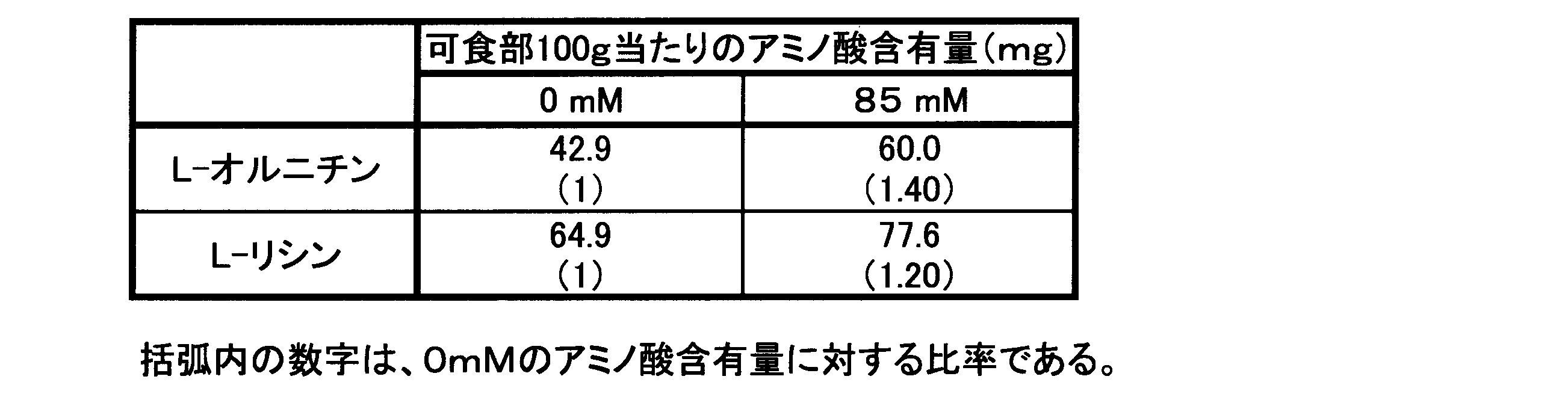
表3に示す結果より、エノキタケをDL-アラニンの含有量が85mMの培地で栽培することで、0mMの培地で栽培した場合に比べて、エノキタケ中のL-オルニチン、L-リシンの含有量がいずれも1.2倍以上になった。
また、DL-アラニンの含有量が85mMの培地で栽培したエノキタケ中には、0mMの培地で栽培したエノキタケと同様に、L-アルギニン、L-グルタミン酸、L-アラニン、L-メチオニン等の機能性アミノ酸も含まれていた。
したがって、本実施例3でD-アラニンを含有する培地で栽培されたエノキタケは、L-オルニチン、L-リシン等の機能性を有するアミノ酸の含有量が大きくなっていることから栄養が強化された食用キノコであることがわかる。
As shown in Table 3, by cultivating enoki mushrooms in a medium with a DL-alanine content of 85 mM, the L-ornithine and L-lysine contents in the enoki mushrooms were both 1.2 times or more higher than when they were cultivated in a medium with a DL-alanine content of 0 mM.
In addition, the enoki mushrooms grown in a medium with a DL-alanine content of 85 mM also contained functional amino acids such as L-arginine, L-glutamic acid, L-alanine, and L-methionine, similar to the enoki mushrooms grown in a medium with a DL-alanine content of 0 mM.
Therefore, the Enokitake mushrooms cultivated in a medium containing D-alanine in this Example 3 are edible mushrooms with enhanced nutrition, since they have a higher content of functional amino acids such as L-ornithine and L-lysine.
Claims (6)
前記食用キノコは、シメジ科又はタマバリタケ科であり、
前記機能性アミノ酸は、L-グルタミン、L-アルギニン、L-オルニチン、L-アラニン、L-リシン及びL-メチオニンからなる群から選択される少なくとも1種である、
食用キノコの機能性アミノ酸含有量増加用及び食用キノコの栽培用培地。 A medium for increasing the functional amino acid content of edible mushrooms and for cultivating edible mushrooms , comprising D -alanine as an active ingredient ,
The edible mushroom is a member of the family Lamiaceae or the family Brachypodium;
The functional amino acid is at least one selected from the group consisting of L-glutamine, L-arginine, L-ornithine, L-alanine, L-lysine, and L-methionine.
A medium for increasing the functional amino acid content of edible mushrooms and for cultivating edible mushrooms.
前記食用キノコは、シメジ科又はタマバリタケ科であり、
前記機能性アミノ酸は、L-グルタミン、L-アルギニン、L-オルニチン、L-アラニン、L-リシン及びL-メチオニンからなる群から選択される少なくとも1種である、
食用キノコの機能性アミノ酸含有量増加用及び食用キノコの栽培用培地添加剤。 A medium additive for increasing the functional amino acid content of edible mushrooms and for cultivating edible mushrooms , comprising D-alanine as an active ingredient ,
The edible mushroom is a member of the family Lamiaceae or the family Brachypodium;
The functional amino acid is at least one selected from the group consisting of L-glutamine, L-arginine, L-ornithine, L-alanine, L-lysine, and L-methionine.
An additive for increasing the functional amino acid content of edible mushrooms and for use as a culture medium additive for edible mushroom cultivation.
Priority Applications (1)
| Application Number | Priority Date | Filing Date | Title |
|---|---|---|---|
| JP2024151140A JP7756377B2 (en) | 2022-08-08 | 2024-09-03 | Cultivation medium, medium additive, and nutritional enrichment method for edible mushrooms of the family Amphicaceae or Amphicaceae |
Applications Claiming Priority (3)
| Application Number | Priority Date | Filing Date | Title |
|---|---|---|---|
| JP2022126254 | 2022-08-08 | ||
| JP2022126254 | 2022-08-08 | ||
| PCT/JP2023/026877 WO2024034365A1 (en) | 2022-08-08 | 2023-07-21 | Medium, medium additive, and nutrient enriching method for cultivating edible mushrooms of family lyophyllaceae or physalacriaceae |
Related Child Applications (1)
| Application Number | Title | Priority Date | Filing Date |
|---|---|---|---|
| JP2024151140A Division JP7756377B2 (en) | 2022-08-08 | 2024-09-03 | Cultivation medium, medium additive, and nutritional enrichment method for edible mushrooms of the family Amphicaceae or Amphicaceae |
Publications (2)
| Publication Number | Publication Date |
|---|---|
| JPWO2024034365A1 JPWO2024034365A1 (en) | 2024-02-15 |
| JP7555552B2 true JP7555552B2 (en) | 2024-09-25 |
Family
ID=89851464
Family Applications (2)
| Application Number | Title | Priority Date | Filing Date |
|---|---|---|---|
| JP2023570275A Active JP7555552B2 (en) | 2022-08-08 | 2023-07-21 | Culture medium, culture medium additive, and nutritional enrichment method for edible mushrooms of the family Lamiaceae or the family Salicaceae |
| JP2024151140A Active JP7756377B2 (en) | 2022-08-08 | 2024-09-03 | Cultivation medium, medium additive, and nutritional enrichment method for edible mushrooms of the family Amphicaceae or Amphicaceae |
Family Applications After (1)
| Application Number | Title | Priority Date | Filing Date |
|---|---|---|---|
| JP2024151140A Active JP7756377B2 (en) | 2022-08-08 | 2024-09-03 | Cultivation medium, medium additive, and nutritional enrichment method for edible mushrooms of the family Amphicaceae or Amphicaceae |
Country Status (2)
| Country | Link |
|---|---|
| JP (2) | JP7555552B2 (en) |
| WO (1) | WO2024034365A1 (en) |
Citations (3)
| Publication number | Priority date | Publication date | Assignee | Title |
|---|---|---|---|---|
| JP2009240241A (en) | 2008-03-31 | 2009-10-22 | Unitika Ltd | New strain of pleurotus ostreatus and method for artificially cultivating the same |
| JP2014039478A (en) | 2010-11-15 | 2014-03-06 | Musashino Chemical Laboratory Ltd | Food products including alanine |
| JP2015216859A (en) | 2014-05-15 | 2015-12-07 | 地方独立行政法人北海道立総合研究機構 | Mushroom-cultivation culture medium and method for producing mushrooms |
Family Cites Families (3)
| Publication number | Priority date | Publication date | Assignee | Title |
|---|---|---|---|---|
| US6946277B2 (en) * | 2001-01-31 | 2005-09-20 | Council Of Scientific And Industrial Research | Method for enhancing cellobiase activity of termitomyces clypeatus using a glycosylation inhibitor |
| JP2012005425A (en) * | 2010-06-25 | 2012-01-12 | Kansai Univ | Method for producing sake |
| JP7705287B2 (en) * | 2020-06-25 | 2025-07-09 | テーブルマーク株式会社 | Additives for mushroom cultivation |
-
2023
- 2023-07-21 WO PCT/JP2023/026877 patent/WO2024034365A1/en not_active Ceased
- 2023-07-21 JP JP2023570275A patent/JP7555552B2/en active Active
-
2024
- 2024-09-03 JP JP2024151140A patent/JP7756377B2/en active Active
Patent Citations (3)
| Publication number | Priority date | Publication date | Assignee | Title |
|---|---|---|---|---|
| JP2009240241A (en) | 2008-03-31 | 2009-10-22 | Unitika Ltd | New strain of pleurotus ostreatus and method for artificially cultivating the same |
| JP2014039478A (en) | 2010-11-15 | 2014-03-06 | Musashino Chemical Laboratory Ltd | Food products including alanine |
| JP2015216859A (en) | 2014-05-15 | 2015-12-07 | 地方独立行政法人北海道立総合研究機構 | Mushroom-cultivation culture medium and method for producing mushrooms |
Non-Patent Citations (1)
| Title |
|---|
| きのこGAP策定・普及マニュアル,「食品安全のためのGAP」策定・普及マニュアル(初版),農林水産省 消費・安全局,2005年04月,p.1-20 |
Also Published As
| Publication number | Publication date |
|---|---|
| JP2024161625A (en) | 2024-11-19 |
| WO2024034365A1 (en) | 2024-02-15 |
| JP7756377B2 (en) | 2025-10-20 |
| JPWO2024034365A1 (en) | 2024-02-15 |
Similar Documents
| Publication | Publication Date | Title |
|---|---|---|
| Lorenz et al. | Cereal sprouts: composition, nutritive value, food applications | |
| CN1032567C (en) | Substrate and method for culture of fungi, including shiitake (lentinus edodes) | |
| Singhal et al. | Mushroom cultivation, processing and value-added products: a patent based review | |
| KR101943219B1 (en) | Production method of ganoderma lucidum culture medium | |
| CN102701820A (en) | Termitomyces albuminosus compost and cultivation method thereof | |
| JP7705287B2 (en) | Additives for mushroom cultivation | |
| CN104488545A (en) | Method for cultivating pleurotus nebrodensis, fresh edible fungi and coprinus comatus by virtue of cyclic utilization of straws | |
| JPWO2018061870A1 (en) | Plant, plant production method, resistance imparting method, tomato, and tomato production method | |
| CN102487727A (en) | Method for producing pleurotus eryngii quel strains | |
| CN105900686A (en) | Tremella substitute cultivation method | |
| KR101400021B1 (en) | The method for cultivation various mushrooms using natural substances | |
| JP2008212092A (en) | Mushroom cultivation method and mushroom cultivation medium | |
| CN109463200A (en) | A kind of oil tea mushroom cultivation method | |
| KR101629207B1 (en) | Method for making the termitomyces culture medium | |
| CN107125017A (en) | A kind of breeding method of mushroom | |
| CN105110985B (en) | A kind of crab flavour mushroom compost and preparation method | |
| KR101634587B1 (en) | Cultivation method of termitomyces | |
| JP7756377B2 (en) | Cultivation medium, medium additive, and nutritional enrichment method for edible mushrooms of the family Amphicaceae or Amphicaceae | |
| Mohammed et al. | Breadnut (Artocarpus camansi Blanco): A review of postharvest physiology, quality management, processing and utilization | |
| KR100752335B1 (en) | Method for culturing sangwhangletari mushroom using phellinus linteus mycelium and letari mushroom, and the mushroom culture mat for sangwhangletari mushroom | |
| JPH03297325A (en) | Culture medium food proliferation and aging of edible mushroom mycelia | |
| KR20210066159A (en) | The method for cultivation various mushrooms using natural substances | |
| US20250325008A1 (en) | Method for preparation of tempeh, tempeh prepared thereby, sauce containing prepared tempeh, and preparation method therefor | |
| Vidhyalakshmi et al. | Influence of substrate in the nutritive value of oyster mushroom | |
| US20250295148A1 (en) | Method for preparing grain tempeh, grain tempeh prepared by said method, sauce comprising prepared grain tempeh, and method for preparing same |
Legal Events
| Date | Code | Title | Description |
|---|---|---|---|
| A621 | Written request for application examination |
Free format text: JAPANESE INTERMEDIATE CODE: A621 Effective date: 20231113 |
|
| A871 | Explanation of circumstances concerning accelerated examination |
Free format text: JAPANESE INTERMEDIATE CODE: A871 Effective date: 20231130 |
|
| A521 | Request for written amendment filed |
Free format text: JAPANESE INTERMEDIATE CODE: A523 Effective date: 20231129 |
|
| A131 | Notification of reasons for refusal |
Free format text: JAPANESE INTERMEDIATE CODE: A131 Effective date: 20240220 |
|
| A601 | Written request for extension of time |
Free format text: JAPANESE INTERMEDIATE CODE: A601 Effective date: 20240419 |
|
| A521 | Request for written amendment filed |
Free format text: JAPANESE INTERMEDIATE CODE: A523 Effective date: 20240612 |
|
| A521 | Request for written amendment filed |
Free format text: JAPANESE INTERMEDIATE CODE: A821 Effective date: 20240613 |
|
| TRDD | Decision of grant or rejection written | ||
| A01 | Written decision to grant a patent or to grant a registration (utility model) |
Free format text: JAPANESE INTERMEDIATE CODE: A01 Effective date: 20240806 |
|
| A61 | First payment of annual fees (during grant procedure) |
Free format text: JAPANESE INTERMEDIATE CODE: A61 Effective date: 20240903 |
|
| R150 | Certificate of patent or registration of utility model |
Ref document number: 7555552 Country of ref document: JP Free format text: JAPANESE INTERMEDIATE CODE: R150 |