JP7555820B2 - Lubricating Oil Composition - Google Patents
Lubricating Oil Composition Download PDFInfo
- Publication number
- JP7555820B2 JP7555820B2 JP2020555567A JP2020555567A JP7555820B2 JP 7555820 B2 JP7555820 B2 JP 7555820B2 JP 2020555567 A JP2020555567 A JP 2020555567A JP 2020555567 A JP2020555567 A JP 2020555567A JP 7555820 B2 JP7555820 B2 JP 7555820B2
- Authority
- JP
- Japan
- Prior art keywords
- lubricating oil
- mass
- group
- composition
- carbon atoms
- Prior art date
- Legal status (The legal status is an assumption and is not a legal conclusion. Google has not performed a legal analysis and makes no representation as to the accuracy of the status listed.)
- Active
Links
Classifications
-
- C—CHEMISTRY; METALLURGY
- C10—PETROLEUM, GAS OR COKE INDUSTRIES; TECHNICAL GASES CONTAINING CARBON MONOXIDE; FUELS; LUBRICANTS; PEAT
- C10M—LUBRICATING COMPOSITIONS; USE OF CHEMICAL SUBSTANCES EITHER ALONE OR AS LUBRICATING INGREDIENTS IN A LUBRICATING COMPOSITION
- C10M141/00—Lubricating compositions characterised by the additive being a mixture of two or more compounds covered by more than one of the main groups C10M125/00 - C10M139/00, each of these compounds being essential
- C10M141/10—Lubricating compositions characterised by the additive being a mixture of two or more compounds covered by more than one of the main groups C10M125/00 - C10M139/00, each of these compounds being essential at least one of them being an organic phosphorus-containing compound
-
- C—CHEMISTRY; METALLURGY
- C10—PETROLEUM, GAS OR COKE INDUSTRIES; TECHNICAL GASES CONTAINING CARBON MONOXIDE; FUELS; LUBRICANTS; PEAT
- C10M—LUBRICATING COMPOSITIONS; USE OF CHEMICAL SUBSTANCES EITHER ALONE OR AS LUBRICATING INGREDIENTS IN A LUBRICATING COMPOSITION
- C10M129/00—Lubricating compositions characterised by the additive being an organic non-macromolecular compound containing oxygen
- C10M129/02—Lubricating compositions characterised by the additive being an organic non-macromolecular compound containing oxygen having a carbon chain of less than 30 atoms
- C10M129/26—Carboxylic acids; Salts thereof
- C10M129/48—Carboxylic acids; Salts thereof having carboxyl groups bound to a carbon atom of a six-membered aromatic ring
- C10M129/54—Carboxylic acids; Salts thereof having carboxyl groups bound to a carbon atom of a six-membered aromatic ring containing hydroxy groups
-
- C—CHEMISTRY; METALLURGY
- C10—PETROLEUM, GAS OR COKE INDUSTRIES; TECHNICAL GASES CONTAINING CARBON MONOXIDE; FUELS; LUBRICANTS; PEAT
- C10M—LUBRICATING COMPOSITIONS; USE OF CHEMICAL SUBSTANCES EITHER ALONE OR AS LUBRICATING INGREDIENTS IN A LUBRICATING COMPOSITION
- C10M133/00—Lubricating compositions characterised by the additive being an organic non-macromolecular compound containing nitrogen
- C10M133/02—Lubricating compositions characterised by the additive being an organic non-macromolecular compound containing nitrogen having a carbon chain of less than 30 atoms
- C10M133/04—Amines, e.g. polyalkylene polyamines; Quaternary amines
- C10M133/12—Amines, e.g. polyalkylene polyamines; Quaternary amines having amino groups bound to a carbon atom of a six-membered aromatic ring
-
- C—CHEMISTRY; METALLURGY
- C10—PETROLEUM, GAS OR COKE INDUSTRIES; TECHNICAL GASES CONTAINING CARBON MONOXIDE; FUELS; LUBRICANTS; PEAT
- C10M—LUBRICATING COMPOSITIONS; USE OF CHEMICAL SUBSTANCES EITHER ALONE OR AS LUBRICATING INGREDIENTS IN A LUBRICATING COMPOSITION
- C10M133/00—Lubricating compositions characterised by the additive being an organic non-macromolecular compound containing nitrogen
- C10M133/02—Lubricating compositions characterised by the additive being an organic non-macromolecular compound containing nitrogen having a carbon chain of less than 30 atoms
- C10M133/38—Heterocyclic nitrogen compounds
- C10M133/44—Five-membered ring containing nitrogen and carbon only
-
- C—CHEMISTRY; METALLURGY
- C10—PETROLEUM, GAS OR COKE INDUSTRIES; TECHNICAL GASES CONTAINING CARBON MONOXIDE; FUELS; LUBRICANTS; PEAT
- C10M—LUBRICATING COMPOSITIONS; USE OF CHEMICAL SUBSTANCES EITHER ALONE OR AS LUBRICATING INGREDIENTS IN A LUBRICATING COMPOSITION
- C10M135/00—Lubricating compositions characterised by the additive being an organic non-macromolecular compound containing sulfur, selenium or tellurium
- C10M135/08—Lubricating compositions characterised by the additive being an organic non-macromolecular compound containing sulfur, selenium or tellurium containing a sulfur-to-oxygen bond
- C10M135/10—Sulfonic acids or derivatives thereof
-
- C—CHEMISTRY; METALLURGY
- C10—PETROLEUM, GAS OR COKE INDUSTRIES; TECHNICAL GASES CONTAINING CARBON MONOXIDE; FUELS; LUBRICANTS; PEAT
- C10M—LUBRICATING COMPOSITIONS; USE OF CHEMICAL SUBSTANCES EITHER ALONE OR AS LUBRICATING INGREDIENTS IN A LUBRICATING COMPOSITION
- C10M137/00—Lubricating compositions characterised by the additive being an organic non-macromolecular compound containing phosphorus
- C10M137/02—Lubricating compositions characterised by the additive being an organic non-macromolecular compound containing phosphorus having no phosphorus-to-carbon bond
-
- C—CHEMISTRY; METALLURGY
- C10—PETROLEUM, GAS OR COKE INDUSTRIES; TECHNICAL GASES CONTAINING CARBON MONOXIDE; FUELS; LUBRICANTS; PEAT
- C10M—LUBRICATING COMPOSITIONS; USE OF CHEMICAL SUBSTANCES EITHER ALONE OR AS LUBRICATING INGREDIENTS IN A LUBRICATING COMPOSITION
- C10M139/00—Lubricating compositions characterised by the additive being an organic non-macromolecular compound containing atoms of elements not provided for in groups C10M127/00 - C10M137/00
-
- C—CHEMISTRY; METALLURGY
- C10—PETROLEUM, GAS OR COKE INDUSTRIES; TECHNICAL GASES CONTAINING CARBON MONOXIDE; FUELS; LUBRICANTS; PEAT
- C10M—LUBRICATING COMPOSITIONS; USE OF CHEMICAL SUBSTANCES EITHER ALONE OR AS LUBRICATING INGREDIENTS IN A LUBRICATING COMPOSITION
- C10M169/00—Lubricating compositions characterised by containing as components a mixture of at least two types of ingredient selected from base-materials, thickeners or additives, covered by the preceding groups, each of these compounds being essential
- C10M169/04—Mixtures of base-materials and additives
-
- C—CHEMISTRY; METALLURGY
- C10—PETROLEUM, GAS OR COKE INDUSTRIES; TECHNICAL GASES CONTAINING CARBON MONOXIDE; FUELS; LUBRICANTS; PEAT
- C10M—LUBRICATING COMPOSITIONS; USE OF CHEMICAL SUBSTANCES EITHER ALONE OR AS LUBRICATING INGREDIENTS IN A LUBRICATING COMPOSITION
- C10M177/00—Special methods of preparation of lubricating compositions; Chemical modification by after-treatment of components or of the whole of a lubricating composition, not covered by other classes
-
- C—CHEMISTRY; METALLURGY
- C10—PETROLEUM, GAS OR COKE INDUSTRIES; TECHNICAL GASES CONTAINING CARBON MONOXIDE; FUELS; LUBRICANTS; PEAT
- C10M—LUBRICATING COMPOSITIONS; USE OF CHEMICAL SUBSTANCES EITHER ALONE OR AS LUBRICATING INGREDIENTS IN A LUBRICATING COMPOSITION
- C10M2203/00—Organic non-macromolecular hydrocarbon compounds and hydrocarbon fractions as ingredients in lubricant compositions
- C10M2203/003—Organic non-macromolecular hydrocarbon compounds and hydrocarbon fractions as ingredients in lubricant compositions used as base material
-
- C—CHEMISTRY; METALLURGY
- C10—PETROLEUM, GAS OR COKE INDUSTRIES; TECHNICAL GASES CONTAINING CARBON MONOXIDE; FUELS; LUBRICANTS; PEAT
- C10M—LUBRICATING COMPOSITIONS; USE OF CHEMICAL SUBSTANCES EITHER ALONE OR AS LUBRICATING INGREDIENTS IN A LUBRICATING COMPOSITION
- C10M2203/00—Organic non-macromolecular hydrocarbon compounds and hydrocarbon fractions as ingredients in lubricant compositions
- C10M2203/10—Petroleum or coal fractions, e.g. tars, solvents, bitumen
- C10M2203/102—Aliphatic fractions
- C10M2203/1025—Aliphatic fractions used as base material
-
- C—CHEMISTRY; METALLURGY
- C10—PETROLEUM, GAS OR COKE INDUSTRIES; TECHNICAL GASES CONTAINING CARBON MONOXIDE; FUELS; LUBRICANTS; PEAT
- C10M—LUBRICATING COMPOSITIONS; USE OF CHEMICAL SUBSTANCES EITHER ALONE OR AS LUBRICATING INGREDIENTS IN A LUBRICATING COMPOSITION
- C10M2205/00—Organic macromolecular hydrocarbon compounds or fractions, whether or not modified by oxidation as ingredients in lubricant compositions
- C10M2205/02—Organic macromolecular hydrocarbon compounds or fractions, whether or not modified by oxidation as ingredients in lubricant compositions containing acyclic monomers
- C10M2205/028—Organic macromolecular hydrocarbon compounds or fractions, whether or not modified by oxidation as ingredients in lubricant compositions containing acyclic monomers containing aliphatic monomers having more than four carbon atoms
- C10M2205/0285—Organic macromolecular hydrocarbon compounds or fractions, whether or not modified by oxidation as ingredients in lubricant compositions containing acyclic monomers containing aliphatic monomers having more than four carbon atoms used as base material
-
- C—CHEMISTRY; METALLURGY
- C10—PETROLEUM, GAS OR COKE INDUSTRIES; TECHNICAL GASES CONTAINING CARBON MONOXIDE; FUELS; LUBRICANTS; PEAT
- C10M—LUBRICATING COMPOSITIONS; USE OF CHEMICAL SUBSTANCES EITHER ALONE OR AS LUBRICATING INGREDIENTS IN A LUBRICATING COMPOSITION
- C10M2207/00—Organic non-macromolecular hydrocarbon compounds containing hydrogen, carbon and oxygen as ingredients in lubricant compositions
- C10M2207/02—Hydroxy compounds
- C10M2207/023—Hydroxy compounds having hydroxy groups bound to carbon atoms of six-membered aromatic rings
- C10M2207/026—Hydroxy compounds having hydroxy groups bound to carbon atoms of six-membered aromatic rings with tertiary alkyl groups
-
- C—CHEMISTRY; METALLURGY
- C10—PETROLEUM, GAS OR COKE INDUSTRIES; TECHNICAL GASES CONTAINING CARBON MONOXIDE; FUELS; LUBRICANTS; PEAT
- C10M—LUBRICATING COMPOSITIONS; USE OF CHEMICAL SUBSTANCES EITHER ALONE OR AS LUBRICATING INGREDIENTS IN A LUBRICATING COMPOSITION
- C10M2207/00—Organic non-macromolecular hydrocarbon compounds containing hydrogen, carbon and oxygen as ingredients in lubricant compositions
- C10M2207/10—Carboxylix acids; Neutral salts thereof
- C10M2207/14—Carboxylix acids; Neutral salts thereof having carboxyl groups bound to carbon atoms of six-membered aromatic rings
- C10M2207/144—Carboxylix acids; Neutral salts thereof having carboxyl groups bound to carbon atoms of six-membered aromatic rings containing hydroxy groups
-
- C—CHEMISTRY; METALLURGY
- C10—PETROLEUM, GAS OR COKE INDUSTRIES; TECHNICAL GASES CONTAINING CARBON MONOXIDE; FUELS; LUBRICANTS; PEAT
- C10M—LUBRICATING COMPOSITIONS; USE OF CHEMICAL SUBSTANCES EITHER ALONE OR AS LUBRICATING INGREDIENTS IN A LUBRICATING COMPOSITION
- C10M2207/00—Organic non-macromolecular hydrocarbon compounds containing hydrogen, carbon and oxygen as ingredients in lubricant compositions
- C10M2207/26—Overbased carboxylic acid salts
- C10M2207/262—Overbased carboxylic acid salts derived from hydroxy substituted aromatic acids, e.g. salicylates
-
- C—CHEMISTRY; METALLURGY
- C10—PETROLEUM, GAS OR COKE INDUSTRIES; TECHNICAL GASES CONTAINING CARBON MONOXIDE; FUELS; LUBRICANTS; PEAT
- C10M—LUBRICATING COMPOSITIONS; USE OF CHEMICAL SUBSTANCES EITHER ALONE OR AS LUBRICATING INGREDIENTS IN A LUBRICATING COMPOSITION
- C10M2207/00—Organic non-macromolecular hydrocarbon compounds containing hydrogen, carbon and oxygen as ingredients in lubricant compositions
- C10M2207/28—Esters
- C10M2207/2805—Esters used as base material
-
- C—CHEMISTRY; METALLURGY
- C10—PETROLEUM, GAS OR COKE INDUSTRIES; TECHNICAL GASES CONTAINING CARBON MONOXIDE; FUELS; LUBRICANTS; PEAT
- C10M—LUBRICATING COMPOSITIONS; USE OF CHEMICAL SUBSTANCES EITHER ALONE OR AS LUBRICATING INGREDIENTS IN A LUBRICATING COMPOSITION
- C10M2215/00—Organic non-macromolecular compounds containing nitrogen as ingredients in lubricant Compositions
- C10M2215/02—Amines, e.g. polyalkylene polyamines; Quaternary amines
- C10M2215/06—Amines, e.g. polyalkylene polyamines; Quaternary amines having amino groups bound to carbon atoms of six-membered aromatic rings
- C10M2215/064—Di- and triaryl amines
-
- C—CHEMISTRY; METALLURGY
- C10—PETROLEUM, GAS OR COKE INDUSTRIES; TECHNICAL GASES CONTAINING CARBON MONOXIDE; FUELS; LUBRICANTS; PEAT
- C10M—LUBRICATING COMPOSITIONS; USE OF CHEMICAL SUBSTANCES EITHER ALONE OR AS LUBRICATING INGREDIENTS IN A LUBRICATING COMPOSITION
- C10M2215/00—Organic non-macromolecular compounds containing nitrogen as ingredients in lubricant Compositions
- C10M2215/086—Imides [having hydrocarbon substituents containing less than thirty carbon atoms]
-
- C—CHEMISTRY; METALLURGY
- C10—PETROLEUM, GAS OR COKE INDUSTRIES; TECHNICAL GASES CONTAINING CARBON MONOXIDE; FUELS; LUBRICANTS; PEAT
- C10M—LUBRICATING COMPOSITIONS; USE OF CHEMICAL SUBSTANCES EITHER ALONE OR AS LUBRICATING INGREDIENTS IN A LUBRICATING COMPOSITION
- C10M2215/00—Organic non-macromolecular compounds containing nitrogen as ingredients in lubricant Compositions
- C10M2215/22—Heterocyclic nitrogen compounds
- C10M2215/223—Five-membered rings containing nitrogen and carbon only
-
- C—CHEMISTRY; METALLURGY
- C10—PETROLEUM, GAS OR COKE INDUSTRIES; TECHNICAL GASES CONTAINING CARBON MONOXIDE; FUELS; LUBRICANTS; PEAT
- C10M—LUBRICATING COMPOSITIONS; USE OF CHEMICAL SUBSTANCES EITHER ALONE OR AS LUBRICATING INGREDIENTS IN A LUBRICATING COMPOSITION
- C10M2215/00—Organic non-macromolecular compounds containing nitrogen as ingredients in lubricant Compositions
- C10M2215/24—Organic non-macromolecular compounds containing nitrogen as ingredients in lubricant Compositions having hydrocarbon substituents containing thirty or more carbon atoms, e.g. nitrogen derivatives of substituted succinic acid
- C10M2215/26—Amines
-
- C—CHEMISTRY; METALLURGY
- C10—PETROLEUM, GAS OR COKE INDUSTRIES; TECHNICAL GASES CONTAINING CARBON MONOXIDE; FUELS; LUBRICANTS; PEAT
- C10M—LUBRICATING COMPOSITIONS; USE OF CHEMICAL SUBSTANCES EITHER ALONE OR AS LUBRICATING INGREDIENTS IN A LUBRICATING COMPOSITION
- C10M2215/00—Organic non-macromolecular compounds containing nitrogen as ingredients in lubricant Compositions
- C10M2215/24—Organic non-macromolecular compounds containing nitrogen as ingredients in lubricant Compositions having hydrocarbon substituents containing thirty or more carbon atoms, e.g. nitrogen derivatives of substituted succinic acid
- C10M2215/28—Amides; Imides
-
- C—CHEMISTRY; METALLURGY
- C10—PETROLEUM, GAS OR COKE INDUSTRIES; TECHNICAL GASES CONTAINING CARBON MONOXIDE; FUELS; LUBRICANTS; PEAT
- C10M—LUBRICATING COMPOSITIONS; USE OF CHEMICAL SUBSTANCES EITHER ALONE OR AS LUBRICATING INGREDIENTS IN A LUBRICATING COMPOSITION
- C10M2215/00—Organic non-macromolecular compounds containing nitrogen as ingredients in lubricant Compositions
- C10M2215/24—Organic non-macromolecular compounds containing nitrogen as ingredients in lubricant Compositions having hydrocarbon substituents containing thirty or more carbon atoms, e.g. nitrogen derivatives of substituted succinic acid
- C10M2215/30—Heterocyclic compounds
-
- C—CHEMISTRY; METALLURGY
- C10—PETROLEUM, GAS OR COKE INDUSTRIES; TECHNICAL GASES CONTAINING CARBON MONOXIDE; FUELS; LUBRICANTS; PEAT
- C10M—LUBRICATING COMPOSITIONS; USE OF CHEMICAL SUBSTANCES EITHER ALONE OR AS LUBRICATING INGREDIENTS IN A LUBRICATING COMPOSITION
- C10M2219/00—Organic non-macromolecular compounds containing sulfur, selenium or tellurium as ingredients in lubricant compositions
- C10M2219/04—Organic non-macromolecular compounds containing sulfur, selenium or tellurium as ingredients in lubricant compositions containing sulfur-to-oxygen bonds, i.e. sulfones, sulfoxides
- C10M2219/044—Sulfonic acids, Derivatives thereof, e.g. neutral salts
-
- C—CHEMISTRY; METALLURGY
- C10—PETROLEUM, GAS OR COKE INDUSTRIES; TECHNICAL GASES CONTAINING CARBON MONOXIDE; FUELS; LUBRICANTS; PEAT
- C10M—LUBRICATING COMPOSITIONS; USE OF CHEMICAL SUBSTANCES EITHER ALONE OR AS LUBRICATING INGREDIENTS IN A LUBRICATING COMPOSITION
- C10M2223/00—Organic non-macromolecular compounds containing phosphorus as ingredients in lubricant compositions
- C10M2223/02—Organic non-macromolecular compounds containing phosphorus as ingredients in lubricant compositions having no phosphorus-to-carbon bonds
- C10M2223/04—Phosphate esters
- C10M2223/047—Thioderivatives not containing metallic elements
-
- C—CHEMISTRY; METALLURGY
- C10—PETROLEUM, GAS OR COKE INDUSTRIES; TECHNICAL GASES CONTAINING CARBON MONOXIDE; FUELS; LUBRICANTS; PEAT
- C10M—LUBRICATING COMPOSITIONS; USE OF CHEMICAL SUBSTANCES EITHER ALONE OR AS LUBRICATING INGREDIENTS IN A LUBRICATING COMPOSITION
- C10M2223/00—Organic non-macromolecular compounds containing phosphorus as ingredients in lubricant compositions
- C10M2223/02—Organic non-macromolecular compounds containing phosphorus as ingredients in lubricant compositions having no phosphorus-to-carbon bonds
- C10M2223/049—Phosphite
-
- C—CHEMISTRY; METALLURGY
- C10—PETROLEUM, GAS OR COKE INDUSTRIES; TECHNICAL GASES CONTAINING CARBON MONOXIDE; FUELS; LUBRICANTS; PEAT
- C10M—LUBRICATING COMPOSITIONS; USE OF CHEMICAL SUBSTANCES EITHER ALONE OR AS LUBRICATING INGREDIENTS IN A LUBRICATING COMPOSITION
- C10M2227/00—Organic non-macromolecular compounds containing atoms of elements not provided for in groups C10M2203/00, C10M2207/00, C10M2211/00, C10M2215/00, C10M2219/00 or C10M2223/00 as ingredients in lubricant compositions
- C10M2227/06—Organic compounds derived from inorganic acids or metal salts
- C10M2227/061—Esters derived from boron
-
- C—CHEMISTRY; METALLURGY
- C10—PETROLEUM, GAS OR COKE INDUSTRIES; TECHNICAL GASES CONTAINING CARBON MONOXIDE; FUELS; LUBRICANTS; PEAT
- C10N—INDEXING SCHEME ASSOCIATED WITH SUBCLASS C10M RELATING TO LUBRICATING COMPOSITIONS
- C10N2030/00—Specified physical or chemical properties which is improved by the additive characterising the lubricating composition, e.g. multifunctional additives
- C10N2030/02—Pour-point; Viscosity index
-
- C—CHEMISTRY; METALLURGY
- C10—PETROLEUM, GAS OR COKE INDUSTRIES; TECHNICAL GASES CONTAINING CARBON MONOXIDE; FUELS; LUBRICANTS; PEAT
- C10N—INDEXING SCHEME ASSOCIATED WITH SUBCLASS C10M RELATING TO LUBRICATING COMPOSITIONS
- C10N2030/00—Specified physical or chemical properties which is improved by the additive characterising the lubricating composition, e.g. multifunctional additives
- C10N2030/04—Detergent property or dispersant property
-
- C—CHEMISTRY; METALLURGY
- C10—PETROLEUM, GAS OR COKE INDUSTRIES; TECHNICAL GASES CONTAINING CARBON MONOXIDE; FUELS; LUBRICANTS; PEAT
- C10N—INDEXING SCHEME ASSOCIATED WITH SUBCLASS C10M RELATING TO LUBRICATING COMPOSITIONS
- C10N2030/00—Specified physical or chemical properties which is improved by the additive characterising the lubricating composition, e.g. multifunctional additives
- C10N2030/04—Detergent property or dispersant property
- C10N2030/041—Soot induced viscosity control
-
- C—CHEMISTRY; METALLURGY
- C10—PETROLEUM, GAS OR COKE INDUSTRIES; TECHNICAL GASES CONTAINING CARBON MONOXIDE; FUELS; LUBRICANTS; PEAT
- C10N—INDEXING SCHEME ASSOCIATED WITH SUBCLASS C10M RELATING TO LUBRICATING COMPOSITIONS
- C10N2030/00—Specified physical or chemical properties which is improved by the additive characterising the lubricating composition, e.g. multifunctional additives
- C10N2030/10—Inhibition of oxidation, e.g. anti-oxidants
-
- C—CHEMISTRY; METALLURGY
- C10—PETROLEUM, GAS OR COKE INDUSTRIES; TECHNICAL GASES CONTAINING CARBON MONOXIDE; FUELS; LUBRICANTS; PEAT
- C10N—INDEXING SCHEME ASSOCIATED WITH SUBCLASS C10M RELATING TO LUBRICATING COMPOSITIONS
- C10N2030/00—Specified physical or chemical properties which is improved by the additive characterising the lubricating composition, e.g. multifunctional additives
- C10N2030/12—Inhibition of corrosion, e.g. anti-rust agents or anti-corrosives
-
- C—CHEMISTRY; METALLURGY
- C10—PETROLEUM, GAS OR COKE INDUSTRIES; TECHNICAL GASES CONTAINING CARBON MONOXIDE; FUELS; LUBRICANTS; PEAT
- C10N—INDEXING SCHEME ASSOCIATED WITH SUBCLASS C10M RELATING TO LUBRICATING COMPOSITIONS
- C10N2030/00—Specified physical or chemical properties which is improved by the additive characterising the lubricating composition, e.g. multifunctional additives
- C10N2030/14—Metal deactivation
-
- C—CHEMISTRY; METALLURGY
- C10—PETROLEUM, GAS OR COKE INDUSTRIES; TECHNICAL GASES CONTAINING CARBON MONOXIDE; FUELS; LUBRICANTS; PEAT
- C10N—INDEXING SCHEME ASSOCIATED WITH SUBCLASS C10M RELATING TO LUBRICATING COMPOSITIONS
- C10N2030/00—Specified physical or chemical properties which is improved by the additive characterising the lubricating composition, e.g. multifunctional additives
- C10N2030/40—Low content or no content compositions
- C10N2030/42—Phosphor free or low phosphor content compositions
-
- C—CHEMISTRY; METALLURGY
- C10—PETROLEUM, GAS OR COKE INDUSTRIES; TECHNICAL GASES CONTAINING CARBON MONOXIDE; FUELS; LUBRICANTS; PEAT
- C10N—INDEXING SCHEME ASSOCIATED WITH SUBCLASS C10M RELATING TO LUBRICATING COMPOSITIONS
- C10N2040/00—Specified use or application for which the lubricating composition is intended
- C10N2040/04—Oil-bath; Gear-boxes; Automatic transmissions; Traction drives
-
- C—CHEMISTRY; METALLURGY
- C10—PETROLEUM, GAS OR COKE INDUSTRIES; TECHNICAL GASES CONTAINING CARBON MONOXIDE; FUELS; LUBRICANTS; PEAT
- C10N—INDEXING SCHEME ASSOCIATED WITH SUBCLASS C10M RELATING TO LUBRICATING COMPOSITIONS
- C10N2040/00—Specified use or application for which the lubricating composition is intended
- C10N2040/14—Electric or magnetic purposes
- C10N2040/16—Dielectric; Insulating oil or insulators
-
- C—CHEMISTRY; METALLURGY
- C10—PETROLEUM, GAS OR COKE INDUSTRIES; TECHNICAL GASES CONTAINING CARBON MONOXIDE; FUELS; LUBRICANTS; PEAT
- C10N—INDEXING SCHEME ASSOCIATED WITH SUBCLASS C10M RELATING TO LUBRICATING COMPOSITIONS
- C10N2040/00—Specified use or application for which the lubricating composition is intended
- C10N2040/25—Internal-combustion engines
-
- C—CHEMISTRY; METALLURGY
- C10—PETROLEUM, GAS OR COKE INDUSTRIES; TECHNICAL GASES CONTAINING CARBON MONOXIDE; FUELS; LUBRICANTS; PEAT
- C10N—INDEXING SCHEME ASSOCIATED WITH SUBCLASS C10M RELATING TO LUBRICATING COMPOSITIONS
- C10N2040/00—Specified use or application for which the lubricating composition is intended
- C10N2040/40—Generators or electric motors in oil or gas winning field
-
- C—CHEMISTRY; METALLURGY
- C10—PETROLEUM, GAS OR COKE INDUSTRIES; TECHNICAL GASES CONTAINING CARBON MONOXIDE; FUELS; LUBRICANTS; PEAT
- C10N—INDEXING SCHEME ASSOCIATED WITH SUBCLASS C10M RELATING TO LUBRICATING COMPOSITIONS
- C10N2060/00—Chemical after-treatment of the constituents of the lubricating composition
- C10N2060/14—Chemical after-treatment of the constituents of the lubricating composition by boron or a compound containing boron
-
- C—CHEMISTRY; METALLURGY
- C10—PETROLEUM, GAS OR COKE INDUSTRIES; TECHNICAL GASES CONTAINING CARBON MONOXIDE; FUELS; LUBRICANTS; PEAT
- C10N—INDEXING SCHEME ASSOCIATED WITH SUBCLASS C10M RELATING TO LUBRICATING COMPOSITIONS
- C10N2070/00—Specific manufacturing methods for lubricant compositions
Landscapes
- Chemical & Material Sciences (AREA)
- Chemical Kinetics & Catalysis (AREA)
- General Chemical & Material Sciences (AREA)
- Oil, Petroleum & Natural Gas (AREA)
- Organic Chemistry (AREA)
- Lubricants (AREA)
Description
本発明は潤滑油組成物に関し、詳しくは電動モーターの潤滑に適した潤滑油組成物に関する。The present invention relates to a lubricating oil composition, and more particularly to a lubricating oil composition suitable for lubricating electric motors.
近年、エネルギー効率および環境適合性の観点から、電動モーターを走行の動力源とする電気自動車、及び、走行の動力源として電動モーターと内燃機関とを併用するハイブリッド自動車が注目されている。電動モーターは運転に伴い発熱するところ、電動モーターにはコイルや磁石等の熱に弱い部品が含まれる。そこで走行の動力源として電動モーターを用いるこれらの自動車には、電動モーターを冷却する手段が設けられる。電動モーターを冷却する手段としては、空冷、水冷、及び油冷が知られている。これらの中でも油冷方式は、電動モーター内部に油を流通させることにより、電動モーター内の発熱部位(例えばコイル、コア、磁石等。)と冷却媒体(油)とを直接接触させ、高い冷却効果を得ることができる。油冷方式の電動モーターにおいては、電動モーター内部に油(潤滑油)を流通させることにより、電動モーターの潤滑および冷却が同時に行われる。電動モーターの潤滑油(電動モーター油)には、電気絶縁性と、電動モーター材料として使用される銅に対する腐食防止性が求められる。In recent years, from the viewpoint of energy efficiency and environmental compatibility, electric vehicles that use electric motors as a power source for driving, and hybrid vehicles that use both electric motors and internal combustion engines as a power source for driving, have been attracting attention. Electric motors generate heat while driving, and electric motors contain parts that are sensitive to heat, such as coils and magnets. Therefore, these vehicles that use electric motors as a power source for driving are provided with a means for cooling the electric motor. Known means for cooling electric motors include air cooling, water cooling, and oil cooling. Among these, the oil cooling method can achieve a high cooling effect by circulating oil inside the electric motor, bringing the heat-generating parts in the electric motor (e.g., coils, cores, magnets, etc.) into direct contact with the cooling medium (oil). In an oil-cooled electric motor, the electric motor is lubricated and cooled at the same time by circulating oil (lubricating oil) inside the electric motor. The lubricating oil (electric motor oil) for electric motors is required to have electrical insulation properties and corrosion prevention properties against copper, which is used as an electric motor material.
走行の動力源として電動モーターを用いる自動車は、通常、歯車機構を有する変速機を備えている。歯車機構を潤滑する潤滑油には、耐摩耗性および耐疲労性が求められるため、各種の添加剤が配合される。Automobiles that use electric motors as a power source for running are usually equipped with a transmission that has a gear mechanism. The lubricating oil that lubricates the gear mechanism must be resistant to wear and fatigue, so various additives are blended into the oil.
電動モーター及び変速機は、通常、異なる潤滑油を用いて潤滑される。電動モーター及び変速機(歯車機構)を同一の潤滑油によって潤滑することができれば、潤滑油循環機構を簡略化することが可能になる。また最近、電動モーターと変速機(歯車機構)とを一体の装置(パッケージ)として統合した電動ドライブモジュールも提案されている。このような電動ドライブモジュールの潤滑においては、小型軽量化の観点から、電動モーターと変速機(歯車機構)とを同一の潤滑油によって潤滑することが望ましい。 Electric motors and transmissions are usually lubricated with different lubricants. If the electric motor and transmission (gear mechanism) could be lubricated with the same lubricant, it would be possible to simplify the lubricant circulation mechanism. Recently, electric drive modules have been proposed that integrate an electric motor and a transmission (gear mechanism) into a single device (package). In lubricating such electric drive modules, it is desirable to lubricate the electric motor and the transmission (gear mechanism) with the same lubricant from the standpoint of reducing size and weight.
しかしながら、従来の変速機油は、電動モーターの潤滑に用いるため新油の電気絶縁性や銅腐食防止性を向上させたとしても、使用により酸化劣化した後の組成物の電気絶縁性および銅腐食防止の長期安定性が不十分であった。However, even if conventional transmission oils had improved electrical insulation and copper corrosion prevention properties for new oils used to lubricate electric motors, the long-term stability of the electrical insulation and copper corrosion prevention properties of the compositions after oxidative degradation through use was insufficient.
本発明は、酸化劣化後の組成物の電気絶縁性および銅腐食防止の長期安定性を高めた潤滑油組成物を提供することを課題とする。The objective of the present invention is to provide a lubricating oil composition that has improved electrical insulation properties and long-term stability of copper corrosion prevention after oxidative degradation.
本発明は、下記[1]~[17]の実施形態を包含する。
[1]潤滑油基油と、(A)トリアゾール系金属不活性化剤を、組成物全量基準で窒素量として0.005~0.03質量%と、(B1)下記一般式(1)で表されるコハク酸イミド化合物を、組成物全量基準で窒素量として0.0005~0.02質量%とを含有することを特徴とする、潤滑油組成物。
The present invention includes the following embodiments [1] to [17].
[1] A lubricating oil composition comprising a lubricating base oil, (A) a triazole metal deactivator in an amount of 0.005 to 0.03 mass % in terms of nitrogen based on the total amount of the composition, and (B1) a succinimide compound represented by the following general formula (1) in an amount of 0.0005 to 0.02 mass % in terms of nitrogen based on the total amount of the composition:

[2] (C)カルシウムサリシレート清浄剤を、組成物全量基準でカルシウム量として0.005~0.03質量%含有する、[1]に記載の潤滑油組成物。 [2] (C) A lubricating oil composition described in [1] containing a calcium salicylate detergent in an amount of 0.005 to 0.03 mass % in terms of calcium, based on the total amount of the composition.
[3] 金属系清浄剤の総含有量が、組成物全量基準で金属量として0.005~0.03質量%である、[1]又は[2]に記載の潤滑油組成物。 [3] A lubricating oil composition described in [1] or [2], in which the total content of metal-based detergents is 0.005 to 0.03 mass% in terms of metal amount based on the total amount of the composition.
[4] 金属系清浄剤の全石けん基にサリシレートが占める割合が65質量%以上である、[1]~[3]のいずれかに記載の潤滑油組成物。 [4] A lubricating oil composition described in any one of [1] to [3], in which the proportion of salicylates in the total soap bases of the metal detergent is 65 mass% or more.
[5] (D)下記一般式(3)で表される亜リン酸エステル化合物を、組成物全量基準でリン量として0.01~0.06質量%含有する、[1]~[4]のいずれかに記載の潤滑油組成物。 [5] (D) A lubricating oil composition described in any of [1] to [4], containing a phosphite compound represented by the following general formula (3) in an amount of 0.01 to 0.06 mass % as phosphorus based on the total amount of the composition.


[6] (E)コハク酸イミド系無灰分散剤を、組成物全量基準で10質量%以下含有するか、又は含有せず、
前記(E)成分は、炭素数40~400のアルキル若しくはアルケニル基を有するアルキル若しくはアルケニルコハク酸若しくはその無水物と、ポリアミンとの縮合反応生成物、若しくはその誘導体、又はそれらの組み合わせである、[1]~[5]のいずれかに記載の潤滑油組成物。
[6] (E) Contains no or less than 10 mass% of a succinimide-based ashless dispersant based on the total amount of the composition;
The lubricating oil composition according to any one of [1] to [5], wherein the component (E) is a condensation reaction product of an alkyl or alkenyl succinic acid or anhydride thereof having an alkyl or alkenyl group having 40 to 400 carbon atoms and a polyamine, or a derivative thereof, or a combination thereof.
[7] 前記(B)成分が、炭素数8~30のアルキル若しくはアルケニル基を有するアルキル若しくはアルケニルコハク酸又はその無水物と、ポリアミンとの縮合反応生成物である、[1]~[6]のいずれかに記載の潤滑油組成物。 [7] A lubricating oil composition described in any of [1] to [6], wherein the (B) component is a condensation reaction product of an alkyl or alkenyl succinic acid or anhydride thereof having an alkyl or alkenyl group having 8 to 30 carbon atoms and a polyamine.
[8] 前記組成物の40℃における動粘度が4~20mm2/sであり、前記組成物の100℃における動粘度が1.8~4.0mm2/sである、[1]~[7]のいずれかに記載の潤滑油組成物。 [8] The lubricating oil composition according to any one of [1] to [7], wherein the composition has a kinetic viscosity at 40° C. of 4 to 20 mm 2 /s and a kinetic viscosity at 100° C. of 1.8 to 4.0 mm 2 /s.
[9] (F)酸化防止剤として、アミン系酸化防止剤を組成物全量基準で窒素量として0.15質量%以下含有するか又は含有しない、[1]~[8]のいずれかに記載の潤滑油組成物。 [9] (F) A lubricating oil composition described in any of [1] to [8], which contains an amine-based antioxidant in an amount of 0.15 mass% or less in terms of nitrogen, based on the total amount of the composition, as an antioxidant.
[10] (B)窒素を含有する油性剤系摩擦調整剤の総含有量が、組成物全量基準で窒素量として0.03質量%以下であり、前記(B)成分の含有量は、炭素数8~36の脂肪族ヒドロカルビル基を有する脂肪族アミン化合物であってコハク酸イミド系無灰分散剤およびアミン系酸化防止剤以外の化合物、並びに、炭素数8~36の脂肪族ヒドロカルビル又は脂肪族ヒドロカルビルカルボニル基とアミド結合とを有する化合物であってコハク酸イミド系無灰分散剤およびアミン系酸化防止剤以外の化合物の合計の含有量である、[1]~[9]のいずれかに記載の潤滑油組成物。 [10] A lubricating oil composition according to any of [1] to [9], wherein the total content of (B) nitrogen-containing oiliness-based friction modifiers is 0.03 mass% or less in terms of nitrogen content based on the total amount of the composition, and the content of the (B) component is the total content of aliphatic amine compounds having an aliphatic hydrocarbyl group with 8 to 36 carbon atoms, other than succinimide-based ashless dispersants and amine-based antioxidants, and compounds having an aliphatic hydrocarbyl or aliphatic hydrocarbyl carbonyl group with 8 to 36 carbon atoms and an amide bond, other than succinimide-based ashless dispersants and amine-based antioxidants.
[11] 潤滑油組成物中の全リン含有量が、組成物全量基準でリン元素として0.06質量%以下である、[1]~[10]のいずれかに記載の潤滑油組成物。 [11] A lubricating oil composition described in any of [1] to [10], wherein the total phosphorus content in the lubricating oil composition is 0.06 mass% or less in terms of phosphorus element based on the total amount of the composition.
[12] 潤滑油組成物中の金属元素の総含有量が、組成物全量基準で金属量として0.03質量%以下である、[1]~[11]のいずれかに記載の潤滑油組成物。 [12] A lubricating oil composition described in any of [1] to [11], wherein the total content of metal elements in the lubricating oil composition is 0.03 mass% or less in terms of metal amount based on the total amount of the composition.
[13] O/N系活性水素含有基を有する化合物であって、金属系清浄剤、コハク酸イミド系無灰分散剤、アミン系酸化防止剤、前記(B1)成分、アルコール残基にO/N系活性水素含有基を有しない亜リン酸ジエステル化合物、及びトリアゾール系金属不活性化剤のいずれの含有量にも寄与しない化合物の総含有量が、潤滑油組成物全量基準で、酸素量および窒素量の合計量として0~500質量ppmであり、前記O/N系活性水素含有基は、他の官能基の一部であってもよい非フェノール性OH基もしくはその塩、>NH基、又は-NH2基を表す、[1]~[12]のいずれかに記載の潤滑油組成物。 [13] The lubricating oil composition according to any one of [1] to [12], wherein the total content of compounds having an O/N active hydrogen-containing group, which do not contribute to the content of any of the following: a metal-based detergent, a succinimide-based ashless dispersant, an amine-based antioxidant, the component (B1), a phosphite diester compound not having an O/N active hydrogen-containing group in its alcohol residue, and a triazole-based metal deactivator, is 0 to 500 ppm by mass as the sum of the oxygen and nitrogen amounts, based on the total amount of the lubricating oil composition, and the O/N active hydrogen-containing group represents a non-phenolic OH group or a salt thereof which may be a part of another functional group, a > NH group, or a -NH2 group.
[14] 前記組成物をJIS K2514-1に規定のISOT法により150時間酸化処理することにより得られる酸化劣化油の80℃における体積抵抗率が1.0×10⁹Ω・cm以上である、[1]~[13]のいずれかに記載の潤滑油組成物。 [14] The lubricating oil composition according to any one of [1] to [13], wherein the volume resistivity at 80°C of an oxidized oil obtained by subjecting the composition to an oxidation treatment for 150 hours according to the ISOT method specified in JIS K2514-1 is 1.0 x 10 9 Ω·cm or more.
[15] 電動モーターを備える自動車において、前記電動モーターの潤滑、又は、前記電動モーター及び変速機の潤滑に用いられる、[1]~[14]のいずれかに記載の潤滑油組成物。 [15] A lubricating oil composition according to any one of [1] to [14], which is used in an automobile equipped with an electric motor to lubricate the electric motor or to lubricate the electric motor and the transmission.
[16] [1]~[15]のいずれかに記載の潤滑油組成物を用いて、電動モーターを備える自動車の前記電動モーターを潤滑することを特徴とする、電動モーターの潤滑方法。 [16] A method for lubricating an electric motor, comprising lubricating the electric motor of a vehicle equipped with an electric motor using a lubricating oil composition described in any one of [1] to [15].
[17] [1]~[15]のいずれかに記載の潤滑油組成物を用いて、電動モーターを備える自動車の前記電動モーター及び変速機を潤滑することを特徴とする、電動モーター及び変速機の潤滑方法。 [17] A method for lubricating an electric motor and a transmission in a vehicle equipped with an electric motor, comprising lubricating the electric motor and the transmission with a lubricating oil composition described in any one of [1] to [15].
本発明の第1の様態によれば、酸化劣化後の組成物の電気絶縁性および銅腐食防止の長期安定性を高めた潤滑油組成物を提供することができる。According to a first aspect of the present invention, a lubricating oil composition can be provided which has improved electrical insulation properties and long-term stability of copper corrosion prevention after oxidative degradation of the composition.
本発明の第1の態様に係る潤滑油組成物は、本発明の第2の態様に係る潤滑方法において好ましく用いることができる。The lubricating oil composition according to the first aspect of the present invention can be preferably used in the lubrication method according to the second aspect of the present invention.
以下、本発明について詳述する。本明細書においては、特に断らない限り、数値A及びBについて「A~B」という表記は「A以上B以下」を意味するものとする。かかる表記において数値Bのみに単位を付した場合には、当該単位が数値Aにも適用されるものとする。また「又は」及び「若しくは」の語は、特に断りのない限り論理和を意味するものとする。本明細書において、要素E1及びE2について「E1及び/又はE2」という表記は「E1若しくはE2、又はそれらの組み合わせ」を意味するものとし、要素E1、…、EN(Nは3以上の整数)について「E1、…、EN-1、及び/又はEN」という表記は「E1、…、EN-1、若しくはEN、又はそれらの組み合わせ」を意味するものとする。 The present invention will be described in detail below. In this specification, the expression "A to B" for numerical values A and B means "A or more and B or less" unless otherwise specified. In such a description, when a unit is added only to numerical value B, the unit is also applied to numerical value A. Furthermore, the words "or" and "or" mean a logical sum unless otherwise specified. In this specification, the expression "E 1 and/or E 2 " for elements E 1 and E 2 means "E 1 or E 2 , or a combination thereof," and the expression "E 1 , ..., E N-1 , and/or E N " for elements E 1 , ..., E N-1 , or E N , or a combination thereof , where N is an integer of 3 or more.
<潤滑油基油>
本発明の潤滑油組成物(以下において「潤滑油組成物」又は単に「組成物」ということがある。)における潤滑油基油としては、1種以上の鉱油系基油、もしくは1種以上の合成系基油、またはそれらの混合基油を用いることができる。一の実施形態において、API基油分類のグループII基油、グループIII基油、グループIV基油、若しくはグループV基油、又はそれらの混合基油を好ましく用いることができる。APIグループII基油は、硫黄分が0.03質量%以下、飽和分が90質量%以上、且つ粘度指数が80以上120未満の鉱油系基油である。APIグループIII基油は、硫黄分が0.03質量%以下、飽和分が90質量%以上、且つ粘度指数が120以上の鉱油系基油である。APIグループIV基油はポリα-オレフィン基油である。APIグループV基油は上記グループI~IV以外の基油であって、その好ましい例としてはエステル系基油を挙げることができる。
<Lubricant base oil>
The lubricating oil base oil in the lubricating oil composition of the present invention (hereinafter sometimes referred to as the "lubricating oil composition" or simply the "composition") may be one or more mineral base oils, one or more synthetic base oils, or a mixture of these. In one embodiment, a Group II base oil, a Group III base oil, a Group IV base oil, or a Group V base oil, or a mixture of these, according to the API base oil classification, may be preferably used. The API Group II base oil is a mineral base oil having a sulfur content of 0.03 mass% or less, a saturate content of 90 mass% or more, and a viscosity index of 80 or more and less than 120. The API Group III base oil is a mineral base oil having a sulfur content of 0.03 mass% or less, a saturate content of 90 mass% or more, and a viscosity index of 120 or more. The API Group IV base oil is a poly-α-olefin base oil. The API Group V base oil is a base oil other than the above Groups I to IV, and a preferred example thereof may be an ester base oil.
鉱油系基油としては、原油を常圧蒸留および減圧蒸留して得られた潤滑油留分に対して、溶剤脱れき、溶剤抽出、水素化分解、溶剤脱ろう、接触脱ろう、水素化精製、硫酸洗浄、白土処理などの1種もしくは2種以上の精製手段を適宜組み合わせて適用して得られる、パラフィン系またはナフテン系などの鉱油系基油を挙げることができる。APIグループII基油及びグループIII基油は通常、水素化分解プロセスを経て製造される。また、ワックス異性化基油や、GTL WAX(ガストゥリキッド ワックス)を異性化する手法で製造される基油等も使用可能である。 Examples of mineral oil base oils include paraffinic or naphthenic mineral oil base oils obtained by applying one or more refining methods, such as solvent deasphalting, solvent extraction, hydrocracking, solvent dewaxing, catalytic dewaxing, hydrorefining, sulfuric acid washing, and clay treatment, to the lubricating oil fraction obtained by atmospheric and vacuum distillation of crude oil. API Group II base oils and Group III base oils are usually produced through a hydrocracking process. Wax isomerized base oils and base oils produced by isomerizing GTL wax (gas-to-liquid wax) can also be used.
APIグループIV基油としては、例えばエチレン-プロピレン共重合体、ポリブテン、1-オクテンオリゴマー、1-デセンオリゴマー、およびこれらの水素化物等を挙げることができる。 Examples of API Group IV base oils include ethylene-propylene copolymers, polybutene, 1-octene oligomers, 1-decene oligomers, and hydrogenated versions of these.
APIグループV基油としては、例えばモノエステル(例えばブチルステアレート、オクチルラウレート、2-エチルヘキシルオレート等);ジエステル(例えばジトリデシルグルタレート、ビス(2-エチルヘキシル)アジペート、ジイソデシルアジペート、ジトリデシルアジペート、ビス(2-エチルヘキシル)セバケート等);ポリエステル(例えばトリメリット酸エステル等);ポリオールエステル(例えばトリメチロールプロパンカプリレート、トリメチロールプロパンペラルゴネート、ペンタエリスリトール-2-エチルヘキサノエート、ペンタエリスリトールペラルゴネート等)等を挙げることができる。Examples of API Group V base oils include monoesters (e.g., butyl stearate, octyl laurate, 2-ethylhexyl oleate, etc.); diesters (e.g., ditridecyl glutarate, bis(2-ethylhexyl) adipate, diisodecyl adipate, ditridecyl adipate, bis(2-ethylhexyl) sebacate, etc.); polyesters (e.g., trimellitic acid esters, etc.); polyol esters (e.g., trimethylolpropane caprylate, trimethylolpropane pelargonate, pentaerythritol 2-ethylhexanoate, pentaerythritol pelargonate, etc.).
潤滑油基油(全基油)は、1種の基油からなってもよく、2種以上の基油を含む混合基油であってもよい。2種以上の基油を含む混合基油においては、それらの基油のAPI分類は同一であってもよく、相互に異なっていてもよい。ただしAPIグループV基油の含有量は、潤滑油基油全量基準で好ましくは0~20質量%、より好ましくは0~15質量%であり、一の実施形態において0~10質量%であり得る。エステル系基油の含有量が上記上限値以下であることにより、潤滑油組成物の酸化安定性を高めることが可能になる。The lubricating base oil (total base oil) may consist of one type of base oil, or may be a mixed base oil containing two or more types of base oils. In a mixed base oil containing two or more types of base oils, the API classifications of the base oils may be the same or different from each other. However, the content of API Group V base oil is preferably 0 to 20 mass%, more preferably 0 to 15 mass%, and in one embodiment may be 0 to 10 mass% based on the total amount of the lubricating base oil. By having the content of the ester-based base oil be equal to or less than the above upper limit, it is possible to increase the oxidation stability of the lubricating oil composition.
潤滑油基油(全基油)の100℃における動粘度は、好ましくは1.7~4.0mm2/s、より好ましくは2.2~3.0mm2/sである。当該100℃における動粘度は一の実施形態において1.7~3.5mm2/sであり得る。潤滑油基油の100℃における動粘度が上記上限値以下であることにより、省燃費性を高めることが可能になる。潤滑油基油の100℃における動粘度が上記下限値以上であることにより、耐摩耗性および耐疲労性を向上させることが可能になるほか、新油の電気絶縁性を高めることが可能になる。なお本明細書において、「100℃における動粘度」とは、ASTM D-445に規定される100℃での動粘度を意味する。 The kinetic viscosity of the lubricating base oil (total base oil) at 100°C is preferably 1.7 to 4.0 mm 2 /s, more preferably 2.2 to 3.0 mm 2 /s. In one embodiment, the kinetic viscosity at 100°C may be 1.7 to 3.5 mm 2 /s. When the kinetic viscosity of the lubricating base oil at 100°C is equal to or less than the upper limit, it is possible to improve fuel economy. When the kinetic viscosity of the lubricating base oil at 100°C is equal to or more than the lower limit, it is possible to improve the wear resistance and fatigue resistance, and also to improve the electrical insulation of the new oil. In this specification, the "kinetic viscosity at 100°C" means the kinetic viscosity at 100°C specified in ASTM D-445.
潤滑油基油(全基油)の40℃における動粘度は、好ましくは5.0~20.0mm2/s、より好ましくは7.0~12.0mm2/sである。当該40℃における動粘度は一の実施形態において5.0~14.7mm2/sであり得る。潤滑油基油の40℃における動粘度が上記上限値以下であることにより、省燃費性を高めることが可能になる。潤滑油基油の40℃における動粘度が上記下限値以上であることにより、耐摩耗性および耐疲労性を向上させることが可能になるほか、新油の電気絶縁性の電気絶縁性を高めることが可能になる。なお本明細書において「40℃における動粘度」とは、ASTM D-445に規定される40℃での動粘度を意味する。 The kinetic viscosity of the lubricating base oil (total base oil) at 40°C is preferably 5.0 to 20.0 mm 2 /s, more preferably 7.0 to 12.0 mm 2 /s. In one embodiment, the kinetic viscosity at 40°C may be 5.0 to 14.7 mm 2 /s. When the kinetic viscosity of the lubricating base oil at 40°C is equal to or less than the upper limit, it is possible to improve fuel economy. When the kinetic viscosity of the lubricating base oil at 40°C is equal to or more than the lower limit, it is possible to improve the wear resistance and fatigue resistance, and also to improve the electrical insulation of the new oil. In this specification, the term "kinetic viscosity at 40°C" refers to the kinetic viscosity at 40°C specified in ASTM D-445.
潤滑油基油(全基油)の粘度指数は、好ましくは100以上、より好ましくは105以上であり、一の実施形態において110以上であってもよく、120以上であってもよく、125以上であってもよい。潤滑油基油の粘度指数が上記下限値以上であることにより、潤滑油組成物の粘度-温度特性および熱・酸化安定性を向上させ、摩擦係数を低減し、また、耐摩耗性を向上させることが可能になる。なお、本明細書において粘度指数とは、JIS K 2283-1993に準拠して測定された粘度指数を意味する。The viscosity index of the lubricating base oil (total base oil) is preferably 100 or more, more preferably 105 or more, and in one embodiment may be 110 or more, 120 or more, or 125 or more. When the viscosity index of the lubricating base oil is equal to or greater than the lower limit, it is possible to improve the viscosity-temperature characteristics and thermal and oxidation stability of the lubricating oil composition, reduce the coefficient of friction, and improve the wear resistance. In this specification, the viscosity index means a viscosity index measured in accordance with JIS K 2283-1993.
潤滑油基油(全基油)中の硫黄分の含有量は、酸化安定性の観点から好ましくは0.03質量%(300質量ppm)以下、より好ましくは50質量ppm以下、特に好ましくは10質量ppm以下であり、1質量ppm以下であってもよい。From the viewpoint of oxidation stability, the sulfur content in the lubricating base oil (total base oil) is preferably 0.03 mass% (300 mass ppm) or less, more preferably 50 mass ppm or less, particularly preferably 10 mass ppm or less, and may be 1 mass ppm or less.
潤滑油基油(全基油)は、潤滑油組成物の主要部を占める。潤滑油組成物中の潤滑油基油(全基油)の含有量は、組成物全量基準で好ましくは80~98質量%、より好ましくは83~90質量%であり、一の実施形態において83~93質量%であり得る。The lubricating base oil (total base oil) constitutes the major part of the lubricating oil composition. The content of the lubricating base oil (total base oil) in the lubricating oil composition is preferably 80 to 98 mass %, more preferably 83 to 90 mass %, based on the total amount of the composition, and in one embodiment may be 83 to 93 mass %.
<(A)トリアゾール系金属不活性化剤>
本発明の潤滑油組成物は、(A)トリアゾール系金属不活性化剤(以下において「(A)成分」ということがある。)を含有する。(A)成分としては、潤滑油において用いられるトリルトリアゾール系金属不活性化剤および/またはベンゾトリアゾール系金属不活性化剤を特に制限なく用いることができる。(A)成分としては1種の化合物を単独で用いてもよく、2種以上の化合物を組み合わせて用いてもよい。
<(A) Triazole-Based Metal Deactivator>
The lubricating oil composition of the present invention contains (A) a triazole-based metal deactivator (hereinafter sometimes referred to as "component (A)"). As component (A), tolyltriazole-based metal deactivators and/or benzotriazole-based metal deactivators used in lubricating oils can be used without particular limitation. As component (A), one type of compound may be used alone, or two or more types of compounds may be used in combination.
潤滑油組成物中の(A)成分の含有量は、組成物全量基準で窒素量として0.005~0.03質量%である。(A)成分の含有量が上記下限値以上であることにより、銅腐食防止の長期安定性を高めることが可能になる。また(A)成分の含有量が上記上限値以下であることにより、新油の電気絶縁性、および酸化劣化後の組成物の電気絶縁性を高めることが可能になる。The content of component (A) in the lubricating oil composition is 0.005 to 0.03 mass% in terms of nitrogen based on the total amount of the composition. By having the content of component (A) equal to or greater than the above lower limit, it is possible to improve the long-term stability of copper corrosion prevention. Furthermore, by having the content of component (A) equal to or less than the above upper limit, it is possible to improve the electrical insulation of new oil and the electrical insulation of the composition after oxidative degradation.
<(B)窒素を含有する油性剤系摩擦調整剤>
一の実施形態において、潤滑油組成物は、窒素を含有する油性剤系摩擦調整剤(以下において単に「(B)成分」ということがある。)を含み得る。窒素を含有する油性剤系摩擦調整剤の例としては、後述する(B1)コハク酸イミド系摩擦調整剤のほか、アミン系摩擦調整剤、アミド系摩擦調整剤等の油性剤系摩擦調整剤を挙げることができる。(B)成分は、炭素数8~36の脂肪族ヒドロカルビル基を有する脂肪族アミン化合物であってコハク酸イミド系無灰分散剤((E)成分)およびアミン系酸化防止剤((F)成分)以外の化合物、並びに、炭素数8~36の脂肪族ヒドロカルビル又は脂肪族ヒドロカルビルカルボニル基とアミド結合とを有する化合物であってコハク酸イミド系無灰分散剤((E)成分)およびアミン系酸化防止剤((F)成分)以外の化合物を包含する。
<(B) Nitrogen-containing oil-based friction modifier>
In one embodiment, the lubricating oil composition may contain a nitrogen-containing oil-based friction modifier (hereinafter sometimes simply referred to as "component (B)"). Examples of the nitrogen-containing oil-based friction modifier include the succinimide friction modifier (B1) described below, as well as oil-based friction modifiers such as amine friction modifiers and amide friction modifiers. The component (B) includes aliphatic amine compounds having an aliphatic hydrocarbyl group having 8 to 36 carbon atoms other than succinimide ashless dispersants (component (E)) and amine antioxidants (component (F)), as well as compounds having an aliphatic hydrocarbyl or aliphatic hydrocarbyl carbonyl group having 8 to 36 carbon atoms and an amide bond other than succinimide ashless dispersants (component (E)) and amine antioxidants (component (F)).
アミン系摩擦調整剤の例としては、炭素数10~30、好ましくは12~24、より好ましくは12~20の、アルキル又はアルケニル基、好ましくは直鎖アルキル又は直鎖アルケニル基を有する、脂肪族アミン化合物を挙げることができる。Examples of amine-based friction modifiers include aliphatic amine compounds having an alkyl or alkenyl group, preferably a straight-chain alkyl or straight-chain alkenyl group, having 10 to 30 carbon atoms, preferably 12 to 24 carbon atoms, and more preferably 12 to 20 carbon atoms.
アミド系摩擦調整剤の例としては、直鎖又は分岐鎖の脂肪酸、好ましくは直鎖脂肪酸と、アンモニア、脂肪族モノアミン、又は脂肪族ポリアミンとの縮合生成物を挙げることができる。Examples of amide-based friction modifiers include condensation products of linear or branched fatty acids, preferably linear fatty acids, with ammonia, aliphatic monoamines, or aliphatic polyamines.
アミド系摩擦調整剤の一例としては、炭素数10~30、好ましくは12~24のアルキルカルボニル又はアルケニルカルボニル基を有する脂肪酸アミド化合物を挙げることができる。該アミド化合物は、例えば、炭素数10~30、好ましくは12~24の脂肪酸またはその酸塩化物と、脂肪族第1級もしくは第2級アミン化合物、脂肪族第1級もしくは第2級アルカノールアミン化合物、又はアンモニアとの縮合反応により得ることができる。上記アミン化合物およびアルカノールアミン化合物は、好ましくは炭素数1~30の脂肪族基、より好ましくは炭素数1~10の脂肪族基、さらに好ましくは炭素数1~4の脂肪族基を有し、一の実施形態において炭素数1又は2の脂肪族基を有する。
脂肪酸アミド摩擦調整剤の例としては、ラウリン酸アミド、ミリスチン酸アミド、パルミチン酸アミド、ステアリン酸アミド、オレイン酸アミド、ヤシ油脂肪酸アミド、炭素数12~13の合成混合脂肪酸アミド、等を挙げることができる。
An example of an amide-based friction modifier is a fatty acid amide compound having an alkylcarbonyl or alkenylcarbonyl group having 10 to 30 carbon atoms, preferably 12 to 24 carbon atoms. The amide compound can be obtained, for example, by a condensation reaction between a fatty acid having 10 to 30 carbon atoms, preferably 12 to 24 carbon atoms, or an acid chloride thereof, and an aliphatic primary or secondary amine compound, an aliphatic primary or secondary alkanolamine compound, or ammonia. The amine compound and alkanolamine compound preferably have an aliphatic group having 1 to 30 carbon atoms, more preferably an aliphatic group having 1 to 10 carbon atoms, and even more preferably an aliphatic group having 1 to 4 carbon atoms, and in one embodiment, an aliphatic group having 1 or 2 carbon atoms.
Examples of fatty acid amide friction modifiers include lauric acid amide, myristic acid amide, palmitic acid amide, stearic acid amide, oleic acid amide, coconut oil fatty acid amide, and synthetic mixed fatty acid amides having 12 to 13 carbon atoms.
アミド系摩擦調整剤の他の例としては、炭素数10~30のアルキル若しくはアルケニル基または炭素数10~30のアルキルカルボニル若しくはアルケニルカルボニル基を有する、脂肪酸ヒドラジド、脂肪族セミカルバジド、脂肪族ウレア、脂肪酸ウレイド、脂肪族アロファン酸アミド、及びそれらの誘導体(変性化合物)、等を挙げることができる。アミド系摩擦調整剤の誘導体(変性化合物)の例としては、上記のアミド化合物とホウ酸またはホウ酸塩とを反応させることにより得られるホウ酸変性化合物を挙げることができる。Other examples of amide-based friction modifiers include fatty acid hydrazides, aliphatic semicarbazides, aliphatic ureas, fatty acid ureides, aliphatic allophanic acid amides, and derivatives (modified compounds) thereof, each having an alkyl or alkenyl group having 10 to 30 carbon atoms or an alkylcarbonyl or alkenylcarbonyl group having 10 to 30 carbon atoms. An example of a derivative (modified compound) of an amide-based friction modifier is a boric acid modified compound obtained by reacting the above amide compound with boric acid or a borate salt.
脂肪族ウレア摩擦調整剤の例としては、ドデシルウレア、トリデシルウレア、テトラデシルウレア、ペンタデシルウレア、ヘキサデシルウレア、ヘプタデシルウレア、オクタデシルウレア、オレイルウレア等の、炭素数12~24、好ましくは12~20のアルキル又はアルケニル基を有する脂肪族ウレア化合物、及びそれらの酸変性誘導体(酸変性化合物、例えばホウ酸変性化合物等。)を挙げることができる。Examples of aliphatic urea friction modifiers include aliphatic urea compounds having an alkyl or alkenyl group having 12 to 24 carbon atoms, preferably 12 to 20 carbon atoms, such as dodecyl urea, tridecyl urea, tetradecyl urea, pentadecyl urea, hexadecyl urea, heptadecyl urea, octadecyl urea, and oleyl urea, and their acid-modified derivatives (acid-modified compounds, such as boric acid-modified compounds).
脂肪酸ヒドラジド摩擦調整剤の例としては、ドデカン酸ヒドラジド、トリデカン酸ヒドラジド、テトラデカン酸ヒドラジド、ペンタデカン酸ヒドラジド、ヘキサデカン酸ヒドラジド、ヘプタデカン酸ヒドラジド、オクタデカン酸ヒドラジド、オレイン酸ヒドラジド、エルカ酸ヒドラジド等の、炭素数12~24のアルキルカルボニル又はアルケニルカルボニル基を有する脂肪酸ヒドラジド化合物、及びそれらの酸変性誘導体(酸変性化合物、例えばホウ酸変性化合物等。)を挙げることができる。Examples of fatty acid hydrazide friction modifiers include fatty acid hydrazide compounds having alkylcarbonyl or alkenylcarbonyl groups having 12 to 24 carbon atoms, such as dodecanoic acid hydrazide, tridecanoic acid hydrazide, tetradecanoic acid hydrazide, pentadecanoic acid hydrazide, hexadecanoic acid hydrazide, heptadecanoic acid hydrazide, octadecanoic acid hydrazide, oleic acid hydrazide, and erucic acid hydrazide, as well as acid-modified derivatives thereof (acid-modified compounds, such as boric acid-modified compounds).
アミド系摩擦調整剤の他の例としては、炭素数1~30のヒドロキシ置換アルキル又はアルケニル基を有する脂肪族ヒドロキシ酸のアミド化合物を挙げることができる。該アミド化合物は、例えば、上記脂肪族ヒドロキシ酸と、脂肪族第1級もしくは第2級アミン化合物、又は脂肪族第1級もしくは第2級アルカノールアミン化合物との縮合反応により得ることができる。上記脂肪族ヒドロキシ酸が有するヒドロキシ置換アルキル又はアルケニル基の炭素数は好ましくは1~10、より好ましくは1~4であり、一の実施形態において1又は2である。上記脂肪族ヒドロキシ酸は好ましくは直鎖脂肪族α-ヒドロキシ酸であり、一の実施形態においてグリコール酸である。上記アミン化合物およびアルカノールアミン化合物は、好ましくは炭素数1~30の脂肪族基、より好ましくは炭素数10~30の脂肪族基、さらに好ましくは炭素数12~24の脂肪族基、特に好ましくは炭素数12~20の脂肪族基を有する。Other examples of amide-based friction modifiers include amide compounds of aliphatic hydroxy acids having a hydroxy-substituted alkyl or alkenyl group having 1 to 30 carbon atoms. The amide compounds can be obtained, for example, by a condensation reaction between the above-mentioned aliphatic hydroxy acids and aliphatic primary or secondary amine compounds, or aliphatic primary or secondary alkanolamine compounds. The number of carbon atoms in the hydroxy-substituted alkyl or alkenyl group of the above-mentioned aliphatic hydroxy acids is preferably 1 to 10, more preferably 1 to 4, and in one embodiment, 1 or 2. The above-mentioned aliphatic hydroxy acids are preferably linear aliphatic α-hydroxy acids, and in one embodiment, glycolic acid. The above-mentioned amine compounds and alkanolamine compounds preferably have an aliphatic group having 1 to 30 carbon atoms, more preferably an aliphatic group having 10 to 30 carbon atoms, even more preferably an aliphatic group having 12 to 24 carbon atoms, and particularly preferably an aliphatic group having 12 to 20 carbon atoms.
アミド系摩擦調整剤の他の例としては、炭素数10~30、好ましくは炭素数12~24の脂肪酸と、アミノ酸とのアミド化合物(N-アシル化アミノ酸)を挙げることができる。N-アシル化アミノ酸摩擦調整剤の例としては、N-アシル化N-メチルグリシン(例えばN-オレオイル-N-メチルグリシン等。)を挙げることができる。Other examples of amide-based friction modifiers include amide compounds (N-acylated amino acids) of amino acids and fatty acids having 10 to 30 carbon atoms, preferably 12 to 24 carbon atoms. An example of an N-acylated amino acid friction modifier is N-acylated N-methylglycine (e.g., N-oleoyl-N-methylglycine, etc.).
((B1)コハク酸イミド系摩擦調整剤)
本発明の潤滑油組成物は、(B1)一般式(1)で表されるコハク酸イミド化合物(以下において「コハク酸イミド系摩擦調整剤」又は単に「(B1)成分」ということがある。)を含有する。(B1)成分としては1種の化合物を単独で用いてもよく、2種以上の化合物を組み合わせて用いてもよい。
((B1) Succinimide-Based Friction Modifier)
The lubricating oil composition of the present invention contains (B1) a succinimide compound represented by general formula (1) (hereinafter sometimes referred to as a "succinimide-based friction modifier" or simply as "component (B1)"). As component (B1), one type of compound may be used alone, or two or more types of compounds may be used in combination.

(B1)成分として用いることが可能なコハク酸イミド化合物の製法は特に制限されるものではない。例えば、炭素数8~36、好ましくは炭素数8~30、より好ましくは炭素数12~22のアルキル若しくはアルケニル基を有するアルキル若しくはアルケニルコハク酸又はその無水物と、ポリアミンとの反応により、(B1)成分を縮合反応生成物(ビスイミド)として得ることができる。ここで、ポリアミンの例としては、ジエチレントリアミン、トリエチレンテトラミン、テトラエチレンペンタミン、ペンタエチレンヘキサミン、及びそれらの混合物を挙げることができ、これらの中から選ばれる1種以上を含むポリアミン原料を好ましく用いることができる。ポリアミン原料はエチレンジアミンをさらに含有してもよく、含有しなくてもよいが、縮合生成物またはその誘導体の摩擦調整剤としての性能を高める観点からは、ポリアミン原料中のエチレンジアミンの含有量は、ポリアミン原料全量基準で好ましくは0~10質量%、より好ましくは0~5質量%である。The method for producing the succinimide compound that can be used as component (B1) is not particularly limited. For example, the component (B1) can be obtained as a condensation reaction product (bisimide) by reacting an alkyl or alkenyl succinic acid or anhydride thereof having an alkyl or alkenyl group having 8 to 36 carbon atoms, preferably 8 to 30 carbon atoms, more preferably 12 to 22 carbon atoms, with a polyamine. Examples of polyamines include diethylenetriamine, triethylenetetramine, tetraethylenepentamine, pentaethylenehexamine, and mixtures thereof, and a polyamine raw material containing one or more selected from these can be preferably used. The polyamine raw material may or may not further contain ethylenediamine, but from the viewpoint of improving the performance of the condensation product or its derivative as a friction modifier, the content of ethylenediamine in the polyamine raw material is preferably 0 to 10 mass%, more preferably 0 to 5 mass%, based on the total amount of the polyamine raw material.
潤滑油組成物中の(B1)成分の含有量は、組成物全量基準で窒素量として0.0005~0.02質量%であり、一の実施形態において0.001~0.02質量%である。(B1)成分の含有量が上記上限値以下であることにより、新油の電気絶縁性、および酸化劣化後の組成物の電気絶縁性を高めることが可能になる。また(B1)成分の含有量が上記下限値以上であることにより、銅腐食防止の長期安定性を高めることが可能になるほか、長期間にわたって摩擦係数を低減することが可能になる。なお本明細書において、(B1)成分の含有量は、上記(B)成分の含有量に寄与するものとする。The content of the (B1) component in the lubricating oil composition is 0.0005 to 0.02 mass% as the nitrogen amount based on the total amount of the composition, and in one embodiment, 0.001 to 0.02 mass%. By having the content of the (B1) component be equal to or less than the above upper limit, it is possible to improve the electrical insulation of the new oil and the electrical insulation of the composition after oxidative deterioration. In addition, by having the content of the (B1) component be equal to or more than the above lower limit, it is possible to improve the long-term stability of copper corrosion prevention and to reduce the friction coefficient over a long period of time. In this specification, the content of the (B1) component is considered to contribute to the content of the (B) component.
潤滑油組成物は、(B1)成分以外の(B)成分を含んでもよく、含まなくてもよい。潤滑油組成物中の(B)成分の総含有量は、組成物全量基準で窒素量として好ましくは0.03質量%以下であり、一の実施形態において0.02質量%以下であり得る。(B)成分の総含有量が上記上限値以下であることにより、新油の電気絶縁性、および酸化劣化後の組成物の電気絶縁性をさらに高めることが可能になる。The lubricating oil composition may or may not contain a component (B) other than the component (B1). The total content of the components (B) in the lubricating oil composition is preferably 0.03 mass% or less, and in one embodiment, 0.02 mass% or less, in terms of the amount of nitrogen based on the total amount of the composition. By having the total content of the components (B) be equal to or less than the above upper limit, it is possible to further improve the electrical insulation of the new oil and the electrical insulation of the composition after oxidative deterioration.
<(C)カルシウムサリシレート清浄剤>
一の好ましい実施形態において、潤滑油組成物は、(C)カルシウムサリシレート清浄剤(以下において単に「(C)成分」ということがある。)をさらに含み得る。(C)成分としては、カルシウムサリシレートまたはその塩基性塩もしくは過塩基性塩を用いることができる。(C)成分としては1種のカルシウムサリシレート清浄剤を単独で用いてもよく、2種以上のカルシウムサリシレート清浄剤を組み合わせて用いてもよい。カルシウムサリシレートの例としては、以下の一般式(2)で表される化合物を挙げることができる。
<(C) Calcium Salicylate Detergent>
In one preferred embodiment, the lubricating oil composition may further comprise (C) a calcium salicylate detergent (hereinafter sometimes simply referred to as "component (C)"). As component (C), calcium salicylate or its basic salt or overbased salt can be used. As component (C), one type of calcium salicylate detergent may be used alone, or two or more types of calcium salicylate detergents may be used in combination. An example of calcium salicylate is a compound represented by the following general formula (2).

一般式(2)中、R3はそれぞれ独立に炭素数14~30のアルキル基またはアルケニル基を表す。aは1又は2を表し、好ましくは1であるが、一般式(2)の化合物はa=1の化合物とa=2の化合物との混合物であってもよい。なおa=2である場合、R3は異なる基の組み合わせであってもよい。 In general formula (2), R 3 each independently represents an alkyl group or alkenyl group having 14 to 30 carbon atoms. a represents 1 or 2, preferably 1, but the compound of general formula (2) may be a mixture of a compound where a=1 and a compound where a=2. When a=2, R 3 may be a combination of different groups.
カルシウムサリシレート清浄剤の好ましい一形態としては、上記一般式(2)においてa=1であるカルシウムサリシレートまたはその塩基性塩もしくは過塩基性塩を挙げることができる。A preferred form of calcium salicylate detergent is calcium salicylate, or a basic salt or an overbased salt thereof, in which a=1 in the above general formula (2).
カルシウムサリシレートの製造方法は特に制限されるものではなく、公知のモノアルキルサリシレートの製造方法等を用いることができる。例えば、フェノールを出発原料として、オレフィンを用いてアルキレーションし、次いで炭酸ガス等でカルボキシレーションして得たモノアルキルサリチル酸、あるいは、サリチル酸を出発原料として、当量の上記オレフィンを用いてアルキレーションして得られたモノアルキルサリチル酸等に、カルシウムの酸化物や水酸化物等のカルシウム塩基を反応させること、又は、これらのモノアルキルサリチル酸等を一旦ナトリウム塩やカリウム塩等のアルカリ金属塩としてからカルシウム塩と金属交換させること等により、カルシウムサリシレートを得ることができる。The method for producing calcium salicylate is not particularly limited, and known methods for producing monoalkyl salicylates can be used. For example, calcium salicylate can be obtained by reacting a calcium base such as calcium oxide or hydroxide with a monoalkyl salicylic acid obtained by alkylating phenol as a starting material with an olefin and then carboxylating with carbon dioxide or the like, or by alkylating salicylic acid as a starting material with an equivalent amount of the above-mentioned olefin, or by converting these monoalkyl salicylates into alkali metal salts such as sodium salts or potassium salts and then metal exchanging them with calcium salts.
過塩基化されたカルシウムサリシレートを得る方法は特に限定されるものではないが、例えば、炭酸ガスの存在下でカルシウムサリシレートを水酸化カルシウム等のカルシウム塩基と反応させることにより、過塩基化カルシウムサリシレートを得ることができる。 There is no particular limitation on the method for obtaining overbased calcium salicylate. For example, overbased calcium salicylate can be obtained by reacting calcium salicylate with a calcium base such as calcium hydroxide in the presence of carbon dioxide gas.
(C)成分の塩基価は特に制限されるものではないが、好ましくは50~350mgKOH/gであり、より好ましくは100~350mgKOH/g、特に好ましくは150~350mgKOH/gである。(C)成分の塩基価が上記下限値以上であることにより、酸化劣化後の組成物の電気絶縁性をさらに高めることが可能になる。The base number of component (C) is not particularly limited, but is preferably 50 to 350 mgKOH/g, more preferably 100 to 350 mgKOH/g, and particularly preferably 150 to 350 mgKOH/g. When the base number of component (C) is equal to or greater than the above lower limit, it becomes possible to further improve the electrical insulation of the composition after oxidative degradation.
潤滑油組成物が(C)成分を含有する場合、その含有量は、潤滑油組成物全量基準でカルシウム量として好ましくは0.005~0.03質量%であり、好ましくは0.005~0.02質量%である。(C)成分の含有量が上記上限値以下であることにより、新油の電気絶縁性、および酸化劣化後の組成物の電気絶縁性をさらに高めることが可能になる。また(C)成分の含有量が上記下限値以上であることにより、耐疲労性を高めることが可能になる。When the lubricating oil composition contains component (C), the content is preferably 0.005 to 0.03 mass %, and more preferably 0.005 to 0.02 mass %, of calcium based on the total amount of the lubricating oil composition. By having the content of component (C) equal to or less than the above upper limit, it becomes possible to further improve the electrical insulating properties of the new oil and the electrical insulating properties of the composition after oxidative degradation. Furthermore, by having the content of component (C) equal to or more than the above lower limit, it becomes possible to improve fatigue resistance.
潤滑油組成物は、金属系清浄剤として(C)成分のみを含んでもよく、(C)成分に加えてカルシウムサリシレート清浄剤以外の1種以上の金属系清浄剤(例えばカルシウムスルホネート清浄剤、カルシウムフェネート清浄剤等。)をさらに含んでもよい。ただし、潤滑油組成物中の金属系清浄剤の総含有量は、組成物全量基準で金属量として0.005~0.03質量%であることが好ましい。潤滑油組成物中の金属系清浄剤の総含有量が上記上限値以下であることにより、新油の電気絶縁性、および酸化劣化後の組成物の電気絶縁性をさらに高めることが可能になる。また、金属系清浄剤の全石けん基にサリシレートが占める割合、すなわち、金属系清浄剤の全石けん基の有機酸換算での質量に対する、サリシレート清浄剤の全石けん基の有機酸換算での質量の割合が、65~100質量%であることが好ましく、90~100質量%であることがより好ましい。金属系清浄剤の全石けん基に対するサリシレートの寄与が上記下限値以上であることにより、耐疲労性を高めることが可能になる。なお本明細書において、金属系清浄剤の石けん基とは、金属系清浄剤の石けん分を構成する有機酸の共役塩基(サリシレート清浄剤にあっては例えばアルキルサリシレートアニオン、スルホネート清浄剤にあっては例えばアルキルベンゼンスルホネートアニオン、フェネート清浄剤にあっては例えばアルキルフェネートアニオン。)を意味する。The lubricating oil composition may contain only component (C) as the metal-based detergent, or may further contain one or more metal-based detergents other than calcium salicylate detergents (e.g., calcium sulfonate detergents, calcium phenate detergents, etc.) in addition to component (C). However, the total content of metal-based detergents in the lubricating oil composition is preferably 0.005 to 0.03 mass% in terms of metal amount based on the total amount of the composition. By having the total content of metal-based detergents in the lubricating oil composition be equal to or less than the above upper limit, it is possible to further improve the electrical insulation of new oil and the electrical insulation of the composition after oxidative deterioration. In addition, the proportion of salicylates in the total soap groups of the metal-based detergent, that is, the proportion of the mass of the total soap groups of the salicylate detergent in terms of organic acid to the mass of the total soap groups of the metal-based detergent in terms of organic acid, is preferably 65 to 100 mass%, more preferably 90 to 100 mass%. When the contribution of salicylates to the total soap groups of the metallic detergent is equal to or greater than the above lower limit, it becomes possible to improve fatigue resistance. In this specification, the soap group of the metallic detergent means the conjugate base of the organic acid constituting the soap portion of the metallic detergent (e.g., alkyl salicylate anion in the case of a salicylate detergent, alkyl benzene sulfonate anion in the case of a sulfonate detergent, and alkyl phenate anion in the case of a phenate detergent).
<(D)亜リン酸エステル化合物>
一の好ましい実施形態において、潤滑油組成物は、下記一般式(3)で表される亜リン酸エステル化合物(以下において「(D)成分」ということがある。)をさらに含み得る。(D)成分としては1種の亜リン酸エステル化合物を単独で用いてもよく、2種以上の亜リン酸エステル化合物を組み合わせて用いてもよい。
<(D) Phosphite Compound>
In one preferred embodiment, the lubricating oil composition may further contain a phosphite compound represented by the following general formula (3) (hereinafter, sometimes referred to as "component (D)"). As component (D), one type of phosphite compound may be used alone, or two or more types of phosphite compounds may be used in combination.


(D)成分として上記構造を有する亜リン酸エステル化合物を用いることにより、耐摩耗性および耐疲労性をさらに高めることが可能になる。By using a phosphite ester compound having the above structure as component (D), it is possible to further improve wear resistance and fatigue resistance.
一の実施形態において、R4及びR5の好ましい例としては、炭素数4~18の直鎖アルキル基を挙げることができる。直鎖アルキル基の例としては、ブチル基、ペンチル基、ヘキシル基、ヘプチル基、オクチル基、ノニル基、デシル基、ウンデシル基、ドデシル基、トリデシル基、テトラデシル基、ペンタデシル基、ヘキサデシル基、ヘプタデシル基、オクタデシル基を挙げることができる。 In one embodiment, preferred examples of R4 and R5 include linear alkyl groups having 4 to 18 carbon atoms. Examples of the linear alkyl group include a butyl group, a pentyl group, a hexyl group, a heptyl group, an octyl group, a nonyl group, a decyl group, an undecyl group, a dodecyl group, a tridecyl group, a tetradecyl group, a pentadecyl group, a hexadecyl group, a heptadecyl group, and an octadecyl group.
一の実施形態において、R4及びR5の好ましい例としては、3-チアペンチル基、3-チアヘキシル基、3-チアヘプチル基、3-チアオクチル基、3-チアノニル基、3-チアデシル基、3-チアウンデシル基、4-チアヘキシル基、3-オキサペンチル基、3-オキサヘキシル基、3-オキサヘプチル基、3-オキサオクチル基、3-オキサノニル基、3-オキサデシル基、3-オキサウンデシル基、3-オキサドデシル基、3-オキサトリデシル基、3-オキサテトラデシル基、3-オキサペンタデシル基、3-オキサヘキサデシル基、3-オキサヘプタデシル基、3-オキサヘプタデシル基、3-オキサノナデシル基、4-オキサヘキシル基、4-オキサヘプチル基、及び4-オキサオクチル基、を挙げることができる。 In one embodiment, preferred examples of R 4 and R 5 include a 3-thiapentyl group, a 3-thiahexyl group, a 3-thiaheptyl group, a 3-thiaoctyl group, a 3-thianonyl group, a 3-thiadecyl group, a 3-thiaundecyl group, a 4-thiahexyl group, a 3-oxapentyl group, a 3-oxaheptyl group, a 3-oxaoctyl group, a 3-oxanonyl group, a 3-oxadecyl group, a 3-oxaundecyl group, a 3-oxadodecyl group, a 3-oxatridecyl group, a 3-oxatetradecyl group, a 3-oxapentadecyl group, a 3-oxahexadecyl group, a 3-oxaheptadecyl group, a 3-oxaheptadecyl group, a 3-oxanonadecyl group, a 4-oxahexyl group, a 4-oxaheptyl group, and a 4-oxaoctyl group.
潤滑油組成物は(D)成分を含有しなくてもよいが、潤滑油組成物が(D)成分を含有する場合、その含有量は、潤滑油組成物全量基準でリン量として好ましくは0.01~0.06質量%、より好ましくは0.02~0.06質量%、さらに好ましくは0.02~0.05質量%であり、特に好ましくは0.02~0.04質量%である。(D)成分の含有量が上記上限値以下であることにより、新油の電気絶縁性、および酸化劣化後の組成物の電気絶縁性をさらに高めることが可能になる。また(D)成分の含有量が上記下限値以上であることにより、耐摩耗性を高めることが可能になる。The lubricating oil composition does not have to contain component (D), but if the lubricating oil composition contains component (D), the content is preferably 0.01 to 0.06 mass%, more preferably 0.02 to 0.06 mass%, even more preferably 0.02 to 0.05 mass%, and particularly preferably 0.02 to 0.04 mass%, in terms of phosphorus, based on the total amount of the lubricating oil composition. By having the content of component (D) equal to or less than the above upper limit, it is possible to further improve the electrical insulation of the new oil and the electrical insulation of the composition after oxidative degradation. In addition, by having the content of component (D) equal to or more than the above lower limit, it is possible to improve wear resistance.
<(E)コハク酸イミド系無灰分散剤>
一の好ましい実施形態において、潤滑油組成物は、(E)コハク酸イミド系無灰分散剤(以下において「(E)成分」ということがある。)を更に含み得る。(E)成分としては、ホウ素化コハク酸イミド系無灰分散剤を用いてもよく、非ホウ素化コハク酸イミド系無灰分散剤を用いてもよく、両者を組み合わせて用いてもよい。ただし酸化劣化油の電気絶縁性をさらに高める観点からは、(E)成分はホウ素化コハク酸イミド系無灰分散剤を含むことが好ましい。
<(E) Succinimide-Based Ashless Dispersant>
In one preferred embodiment, the lubricating oil composition may further contain (E) a succinimide-based ashless dispersant (hereinafter sometimes referred to as "component (E)"). As component (E), a boronated succinimide-based ashless dispersant may be used, a non-boronated succinimide-based ashless dispersant may be used, or both may be used in combination. However, from the viewpoint of further improving the electrical insulation properties of oxidized deteriorated oil, it is preferable that component (E) contains a boronated succinimide-based ashless dispersant.
(E)成分としては、例えば、アルキル基もしくはアルケニル基を分子中に少なくとも1個有するコハク酸イミドまたはその誘導体(変性化合物)を用いることができる。アルキル基もしくはアルケニル基を分子中に少なくとも1個有するコハク酸イミドの例としては、下記一般式(5)又は(6)で表される化合物を挙げることができる。 As component (E), for example, succinimide having at least one alkyl or alkenyl group in the molecule or a derivative (modified compound) thereof can be used. Examples of succinimide having at least one alkyl or alkenyl group in the molecule include compounds represented by the following general formula (5) or (6).

一般式(5)中、R8は炭素数40~400のアルキル基またはアルケニル基を表し、bは1~5、好ましくは2~4の整数を表す。R8の炭素数は好ましくは60以上であり、また好ましくは350以下である。 In formula (5), R8 represents an alkyl group or alkenyl group having 40 to 400 carbon atoms, and b represents an integer of 1 to 5, preferably 2 to 4. The number of carbon atoms in R8 is preferably 60 or more and preferably 350 or less.
一般式(6)中、R9及びR10は、それぞれ独立に炭素数40~400のアルキル基又はアルケニル基を表し、異なる基の組み合わせであってもよい。また、cは0~4、好ましくは1~4、より好ましくは1~3の整数を表す。R9及びR10の炭素数は好ましくは60以上であり、また好ましくは350以下である。 In general formula (6), R 9 and R 10 each independently represent an alkyl group or alkenyl group having 40 to 400 carbon atoms, and may be a combination of different groups. Furthermore, c represents an integer of 0 to 4, preferably 1 to 4, and more preferably 1 to 3. The number of carbon atoms in R 9 and R 10 is preferably 60 or more, and preferably 350 or less.
一般式(5)及び(6)におけるR8~R10の炭素数が上記下限値以上であることにより、潤滑油基油に対する良好な溶解性を得ることができる。一方、R8~R10の炭素数が上記上限値以下であることにより、潤滑油組成物の低温流動性を高めることができる。 In general formulas (5) and (6), when the carbon numbers of R 8 to R 10 are equal to or greater than the lower limit, good solubility in the lubricating base oil can be obtained, whereas when the carbon numbers of R 8 to R 10 are equal to or less than the upper limit, the low temperature fluidity of the lubricating oil composition can be improved.
一般式(5)及び(6)におけるアルキル基またはアルケニル基(R8~R10)は直鎖状でも分枝状でもよく、好ましくは、例えば、プロピレン、1-ブテン、イソブテン等のオレフィンのオリゴマーや、エチレンとプロピレンとのコオリゴマーから誘導される分枝状アルキル基や分枝状アルケニル基を挙げることができる。なかでも慣用的にポリイソブチレンと呼ばれるイソブテンのオリゴマーから誘導される分枝状アルキル基またはアルケニル基や、ポリブテニル基が最も好ましい。
一般式(5)及び(6)におけるアルキル基またはアルケニル基(R8~R10)の好適な数平均分子量は1000~3500、より好ましくは800~3500である。
The alkyl or alkenyl groups (R 8 to R 10 ) in the general formulae (5) and (6) may be linear or branched, and preferably include branched alkyl or alkenyl groups derived from an olefin oligomer such as propylene, 1-butene, isobutene, or a cooligomer of ethylene and propylene. Among these, branched alkyl or alkenyl groups derived from an oligomer of isobutene commonly called polyisobutylene, and polybutenyl groups are most preferred.
The alkyl or alkenyl groups (R 8 to R 10 ) in the general formulae (5) and (6) preferably have a number average molecular weight of 1,000 to 3,500, more preferably 800 to 3,500.
アルキル基またはアルケニル基を分子中に少なくとも1個有するコハク酸イミドには、ポリアミン鎖の一方の末端アミノ基のみがイミド化された、一般式(5)で表される、いわゆるモノタイプのコハク酸イミドと、ポリアミン鎖の両末端アミノ基がイミド化された、一般式(6)で表される、いわゆるビスタイプのコハク酸イミドとが包含される。(E)成分は、モノタイプのコハク酸イミド及びビスタイプのコハク酸イミドのいずれを含んでいてもよく、それらの両方を混合物として含んでいてもよい。(E)成分中のビスタイプのコハク酸イミド又はその誘導体(変性化合物)の含有量は、(E)成分の全量を基準(100質量%)として好ましくは50質量%以上、より好ましくは70質量%以上である。Succinimides having at least one alkyl or alkenyl group in the molecule include so-called mono-type succinimides represented by general formula (5) in which only one terminal amino group of the polyamine chain is imidized, and so-called bis-type succinimides represented by general formula (6) in which both terminal amino groups of the polyamine chain are imidized. Component (E) may contain either mono-type succinimides or bis-type succinimides, or may contain both as a mixture. The content of bis-type succinimides or their derivatives (modified compounds) in component (E) is preferably 50% by mass or more, more preferably 70% by mass or more, based on the total amount of component (E) (100% by mass).
アルキル基またはアルケニル基を分子中に少なくとも1個有するコハク酸イミドの製法は、特に制限されるものではない。例えば、炭素数40~400のアルキル基又はアルケニル基を有するアルキル若しくはアルケニルコハク酸又はその無水物と、ポリアミンとの反応により上記コハク酸イミドを縮合反応生成物として得ることができる。(E)成分としては、該縮合生成物をそのまま用いてもよく、該縮合生成物を後述する誘導体(変性化合物)に変換して用いてもよい。アルキル若しくはアルケニルコハク酸又はその無水物とポリアミンとの縮合生成物は、ポリアミン鎖の両末端がイミド化された、ビスタイプのコハク酸イミド(一般式(6)参照。)であってもよく、ポリアミン鎖の一方の末端のみがイミド化された、モノタイプのコハク酸イミド(一般式(5)参照。)であってもよく、それらの混合物であってもよい。ここで、炭素数40~400のアルケニル基を有するアルケニルコハク酸無水物は、炭素数40~400のアルケンとマレイン酸無水物との反応により得ることができ、該アルケニルコハク酸無水物の接触水素化反応により炭素数40~400のアルキル基を有するアルキルコハク酸無水物を得ることができる。マレイン酸無水物と反応させるアルケンは、例えば上記オレフィンのオリゴマーや、エチレンとプロピレンとのコオリゴマーであってもよく、例えばイソブテンオリゴマーであってもよい。ポリアミンの例としては、ジエチレントリアミン、トリエチレンテトラミン、テトラエチレンペンタミン、及びペンタエチレンヘキサミン、並びにそれらの混合物を挙げることができ、これらの中から選ばれる1種以上を含むポリアミン原料を好ましく用いることができる。ポリアミン原料はエチレンジアミンをさらに含有してもよく、含有しなくてもよいが、縮合生成物またはその誘導体(変性化合物)の分散剤としての性能を高める観点からは、ポリアミン原料中のエチレンジアミンの含有量は、ポリアミン原料全量基準で好ましくは0~10質量%、より好ましくは0~5質量%である。炭素数40~400のアルキル若しくはアルケニル基を有するアルキル若しくはアルケニルコハク酸又はそれらの無水物と、2種以上のポリアミンの混合物との縮合反応生成物として得られるコハク酸イミドは、一般式(5)又は(6)において異なるb又はcを有する化合物の混合物である。The method for producing succinimide having at least one alkyl or alkenyl group in the molecule is not particularly limited. For example, the above succinimide can be obtained as a condensation reaction product by reacting an alkyl or alkenyl succinic acid having an alkyl or alkenyl group having 40 to 400 carbon atoms or an anhydride thereof with a polyamine. As component (E), the condensation product may be used as is, or the condensation product may be converted into a derivative (modified compound) described below and used. The condensation product of an alkyl or alkenyl succinic acid or anhydride thereof with a polyamine may be a bis-type succinimide (see general formula (6)) in which both ends of the polyamine chain are imidized, or a mono-type succinimide (see general formula (5)) in which only one end of the polyamine chain is imidized, or a mixture thereof. Here, an alkenylsuccinic anhydride having an alkenyl group having 40 to 400 carbon atoms can be obtained by reacting an alkene having 40 to 400 carbon atoms with maleic anhydride, and an alkylsuccinic anhydride having an alkyl group having 40 to 400 carbon atoms can be obtained by catalytic hydrogenation of the alkenylsuccinic anhydride. The alkene to be reacted with maleic anhydride may be, for example, an oligomer of the above-mentioned olefin or a cooligomer of ethylene and propylene, for example, an isobutene oligomer. Examples of polyamines include diethylenetriamine, triethylenetetramine, tetraethylenepentamine, and pentaethylenehexamine, as well as mixtures thereof, and a polyamine raw material containing one or more selected from these can be preferably used. The polyamine raw material may or may not further contain ethylenediamine, but from the viewpoint of improving the performance of the condensation product or its derivative (modified compound) as a dispersant, the content of ethylenediamine in the polyamine raw material is preferably 0 to 10 mass%, more preferably 0 to 5 mass%, based on the total amount of the polyamine raw material. The succinimide obtained as the condensation reaction product of an alkyl or alkenyl succinic acid having an alkyl or alkenyl group having 40 to 400 carbon atoms or an anhydride thereof and a mixture of two or more polyamines is a mixture of compounds having different b or c in general formula (5) or (6).
コハク酸イミドの誘導体(変性化合物)としては、例えば、(i)上述のコハク酸イミドに、脂肪酸等の炭素数1~30のモノカルボン酸、炭素数2~30のポリカルボン酸(例えばシュウ酸、フタル酸、トリメリット酸、ピロメリット酸等。)、これらの無水物もしくはエステル化合物、炭素数2~6のアルキレンオキサイド、又はヒドロキシ(ポリ)オキシアルキレンカーボネートを作用させたことにより、残存するアミノ基および/またはイミノ基の一部又は全部が中和またはアミド化されている、含酸素有機化合物による変性化合物;(ii)上述のコハク酸イミドにホウ酸を作用させることにより、残存するアミノ基および/またはイミノ基の一部又は全部が中和またはアミド化されている、ホウ素変性化合物(ホウ素化コハク酸イミド);(iii)上述のコハク酸イミドにリン酸を作用させることにより、残存するアミノ基および/またはイミノ基の一部又は全部が中和またはアミド化されている、リン酸変性化合物;(iv)上述のコハク酸イミドに硫黄化合物を作用させることにより得られる、硫黄変性化合物;及び、(v)上述のコハク酸イミドに含酸素有機化合物による変性、ホウ素変性、リン酸変性、硫黄変性から選ばれた2種以上の変性を組み合わせて施すことにより得られる変性化合物が挙げられる。これら(i)~(v)の誘導体(変性化合物)の中でも、ホウ素変性化合物(ホウ素化コハク酸イミド)を好ましく用いることができる。Examples of derivatives (modified compounds) of succinimide include: (i) modified compounds with an oxygen-containing organic compound, in which the above-mentioned succinimide is reacted with a monocarboxylic acid having 1 to 30 carbon atoms, such as a fatty acid, a polycarboxylic acid having 2 to 30 carbon atoms (e.g., oxalic acid, phthalic acid, trimellitic acid, pyromellitic acid, etc.), an anhydride or ester compound thereof, an alkylene oxide having 2 to 6 carbon atoms, or a hydroxy(poly)oxyalkylene carbonate, in which the remaining amino groups and/or imino groups are partially or entirely neutralized or amidated; (ii) modified compounds with an oxygen-containing organic compound, in which the above-mentioned succinimide is reacted with boric acid, in which the remaining amino groups and/or imino groups are partially or entirely neutralized or amidated; (iii) a phosphoric acid-modified compound obtained by reacting the above-mentioned succinimide with phosphoric acid to neutralize or amidate some or all of the remaining amino and/or imino groups; (iv) a sulfur-modified compound obtained by reacting the above-mentioned succinimide with a sulfur compound; and (v) a modified compound obtained by combining two or more modifications selected from modification with an oxygen-containing organic compound, boron modification, phosphoric acid modification, and sulfur modification on the above-mentioned succinimide. Among these derivatives (modified compounds) (i) to (v), the boron-modified compound (boron-modified succinimide) can be preferably used.
(E)コハク酸イミド系無灰分散剤の重量平均分子量は好ましくは2000~20000であり、より好ましくは3000~15000であり、一の実施形態において4000~9000である。(E)成分の重量平均分子量が上記下限値以上であることにより、新油の電気絶縁性、および酸化劣化後の組成物の電気絶縁性をさらに高めることが可能になる。また(E)成分の重量平均分子量が上記上限値以下であることにより、酸化劣化後の組成物の電気絶縁性をさらに高めることが可能になる。The weight average molecular weight of the succinimide-based ashless dispersant (E) is preferably 2000 to 20000, more preferably 3000 to 15000, and in one embodiment 4000 to 9000. When the weight average molecular weight of component (E) is equal to or greater than the above lower limit, it becomes possible to further improve the electrical insulation of the new oil and the electrical insulation of the composition after oxidative degradation. In addition, when the weight average molecular weight of component (E) is equal to or less than the above upper limit, it becomes possible to further improve the electrical insulation of the composition after oxidative degradation.
潤滑油組成物は(E)成分を含有しなくてもよいが、潤滑油組成物が(E)成分を含有する場合、その含有量は、潤滑油組成物全量基準で、好ましくは1~10質量%、一の実施形態において1~7質量%である。(E)成分の含有量が上記上限値以下であることにより、新油の電気絶縁性、および酸化劣化後の組成物の電気絶縁性をさらに高めることが可能になる。また(E)成分の含有量が上記下限値以上であることにより、新油の電気絶縁性を高めることが可能になる。酸化劣化後の組成物の電気絶縁性をさらに高める観点からは、潤滑油組成物中の(E)成分の含有量は、組成物全量基準で窒素量として0.25質量%以下であることが好ましい。The lubricating oil composition may not contain component (E), but when the lubricating oil composition contains component (E), the content is preferably 1 to 10 mass%, and in one embodiment, 1 to 7 mass%, based on the total amount of the lubricating oil composition. By having the content of component (E) equal to or less than the above upper limit, it is possible to further improve the electrical insulation of the new oil and the electrical insulation of the composition after oxidative degradation. In addition, by having the content of component (E) equal to or more than the above lower limit, it is possible to improve the electrical insulation of the new oil. From the viewpoint of further improving the electrical insulation of the composition after oxidative degradation, the content of component (E) in the lubricating oil composition is preferably 0.25 mass% or less in terms of nitrogen content based on the total amount of the composition.
<(F)酸化防止剤>
一の好ましい実施形態において、潤滑油組成物は、(F)酸化防止剤(以下において「(F)成分」ということがある。)を更に含み得る。(F)成分としては1種の化合物を単独で用いてもよく、2種以上の化合物を組み合わせて用いても良い。(F)成分としては、アミン系酸化防止剤、フェノール系酸化防止剤等の公知の酸化防止剤を特に制限なく用いることができる。(F)成分としては、1種以上のアミン系酸化防止剤を用いてもよく、1種以上のフェノール系酸化防止剤を用いてもよく、それらを組み合わせて用いてもよい。
<(F) Antioxidant>
In a preferred embodiment, the lubricating oil composition may further contain an (F) antioxidant (hereinafter sometimes referred to as "component (F)"). As component (F), one type of compound may be used alone, or two or more types of compounds may be used in combination. As component (F), known antioxidants such as amine-based antioxidants and phenol-based antioxidants may be used without particular limitation. As component (F), one or more types of amine-based antioxidants may be used, one or more types of phenol-based antioxidants may be used, or they may be used in combination.
アミン系酸化防止剤の例としては、芳香族アミン系酸化防止剤、及びヒンダードアミン系酸化防止剤が挙げられる。アミン系酸化防止剤としては、1種以上の芳香族アミン系酸化防止剤を用いてもよく、1種以上のヒンダードアミン系酸化防止剤を用いてもよく、それらを組み合わせて用いてもよい。芳香族アミン系酸化防止剤の例としては、アルキル化α-ナフチルアミン等の第1級芳香族アミン化合物;及び、アルキル化ジフェニルアミン、フェニル-α-ナフチルアミン、アルキル化フェニル-α-ナフチルアミン、フェニル-β-ナフチルアミン等の第2級芳香族アミン化合物;を挙げることができる。芳香族アミン系酸化防止剤としては、アルキル化ジフェニルアミン、若しくはアルキル化フェニル-α-ナフチルアミン、又はそれらの組み合わせを好ましく用いることができる。Examples of amine-based antioxidants include aromatic amine-based antioxidants and hindered amine-based antioxidants. As the amine-based antioxidant, one or more aromatic amine-based antioxidants may be used, one or more hindered amine-based antioxidants may be used, or a combination of these may be used. Examples of aromatic amine-based antioxidants include primary aromatic amine compounds such as alkylated α-naphthylamine; and secondary aromatic amine compounds such as alkylated diphenylamine, phenyl-α-naphthylamine, alkylated phenyl-α-naphthylamine, and phenyl-β-naphthylamine. As the aromatic amine-based antioxidant, alkylated diphenylamine, alkylated phenyl-α-naphthylamine, or a combination thereof may be preferably used.
ヒンダードアミン系酸化防止剤の例としては、2,2,6,6-テトラアルキルピペリジン誘導体を挙げることができる。2,2,6,6-テトラアルキルピペリジン誘導体としては、4-位に置換基を有する2,2,6,6-テトラアルキルピペリジン誘導体が好ましい。また、2個の2,2,6,6-テトラアルキルピペリジン骨格が、それぞれの4-位の置換基を介して結合していてもよい。また2,2,6,6-テトラアルキルピペリジン骨格のN-位は無置換であってもよく、該N-位に炭素数1~4のアルキル基が置換していてもよい。2,2,6,6-テトラアルキルピペリジン骨格は好ましくは2,2,6,6-テトラメチルピペリジン骨格である。An example of a hindered amine antioxidant is a 2,2,6,6-tetraalkylpiperidine derivative. As the 2,2,6,6-tetraalkylpiperidine derivative, a 2,2,6,6-tetraalkylpiperidine derivative having a substituent at the 4-position is preferred. In addition, two 2,2,6,6-tetraalkylpiperidine skeletons may be bonded via the respective substituents at the 4-position. In addition, the N-position of the 2,2,6,6-tetraalkylpiperidine skeleton may be unsubstituted, or the N-position may be substituted with an alkyl group having 1 to 4 carbon atoms. The 2,2,6,6-tetraalkylpiperidine skeleton is preferably a 2,2,6,6-tetramethylpiperidine skeleton.
2,2,6,6-テトラアルキルピペリジン骨格の4-位の置換基としては、アシロキシ基(R11COO-)、アルコキシ基(R11O-)、アルキルアミノ基(R11NH-)、アシルアミノ基(R11CONH-)、等を挙げることができる。R11は好ましくは炭素数1~30、より好ましくは炭素数1~24、さらに好ましくは炭素数1~20の炭化水素基である。炭化水素基の例としてはアルキル基、アルケニル基、シクロアルキル基、アルキルシクロアルキル基、アリール基、アルキルアリール基、アリールアルキル基等を挙げることができる。 Examples of the substituent at the 4-position of the 2,2,6,6-tetraalkylpiperidine skeleton include an acyloxy group (R 11 COO-), an alkoxy group (R 11 O-), an alkylamino group (R 11 NH-), an acylamino group (R 11 CONH-), etc. R 11 is preferably a hydrocarbon group having 1 to 30 carbon atoms, more preferably 1 to 24 carbon atoms, and even more preferably 1 to 20 carbon atoms. Examples of the hydrocarbon group include an alkyl group, an alkenyl group, a cycloalkyl group, an alkylcycloalkyl group, an aryl group, an alkylaryl group, an arylalkyl group, etc.
2個の2,2,6,6-テトラアルキルピペリジン骨格が、それぞれの4-位の置換基を介して結合する場合の置換基としては、ヒドロカルビレンビス(カルボニルオキシ)基(-OOC-R12-COO-)、ヒドロカルビレンジアミノ基(-HN-R12-NH-)、ヒドロカルビレンビス(カルボニルアミノ)基(-HNCO-R12-CONH-)、等を挙げることができる。R12は好ましくは炭素数1~30のヒドロカルビレン基であり、より好ましくはアルキレン基である。 When two 2,2,6,6-tetraalkylpiperidine skeletons are bonded via a substituent at each 4-position, examples of the substituent include a hydrocarbylene bis(carbonyloxy) group (-OOC-R 12 -COO-), a hydrocarbylene diamino group (-HN-R 12 -NH-), a hydrocarbylene bis(carbonylamino) group (-HNCO-R 12 -CONH-), etc. R 12 is preferably a hydrocarbylene group having 1 to 30 carbon atoms, more preferably an alkylene group.
2,2,6,6-テトラアルキルピペリジン骨格の4-位の置換基としては、アシロキシ基が好ましい。2,2,6,6-テトラアルキルピペリジン骨格の4-位にアシロキシ基を有する化合物の一例としては、2,2,6,6-テトラメチル-4-ピペリジノールとカルボン酸とのエステルを挙げることができる。該カルボン酸の例としては、炭素数8~20の直鎖又は分岐鎖脂肪族カルボン酸を挙げることができる。As the substituent at the 4-position of the 2,2,6,6-tetraalkylpiperidine skeleton, an acyloxy group is preferred. An example of a compound having an acyloxy group at the 4-position of the 2,2,6,6-tetraalkylpiperidine skeleton is an ester of 2,2,6,6-tetramethyl-4-piperidinol and a carboxylic acid. An example of the carboxylic acid is a linear or branched aliphatic carboxylic acid having 8 to 20 carbon atoms.
フェノール系酸化防止剤の例としては、4,4’-メチレンビス(2,6-ジ-tert-ブチルフェノール);4,4’-ビス(2,6-ジ-tert-ブチルフェノール);4,4’-ビス(2-メチル-6-tert-ブチルフェノール);2,2’-メチレンビス(4-エチル-6-tert-ブチルフェノール);2,2’-メチレンビス(4-メチル-6-tert-ブチルフェノール);4,4’-ブチリデンビス(3-メチル-6-tert-ブチルフェノール);4,4’-イソプロピリデンビス(2,6-ジ-tert-ブチルフェノール);2,2’-メチレンビス(4-メチル-6-ノニルフェノール);2,2’-イソブチリデンビス(4,6-ジメチルフェノール);2,2’-メチレンビス(4-メチル-6-シクロヘキシルフェノール);2,6-ジ-tert-ブチル-4-メチルフェノール;2,6-ジ-tert-ブチル-4-エチルフェノール;2,4-ジメチル-6-tert-ブチルフェノール;2,6-ジ-tert-ブチル-4-(N,N’-ジメチルアミノメチル)フェノール;4,4’-チオビス(2-メチル-6-tert-ブチルフェノール);4,4’-チオビス(3-メチル-6-tert-ブチルフェノール);2,2’-チオビス(4-メチル-6-tert-ブチルフェノール);ビス(3-メチル-4-ヒドロキシ-5-tert-ブチルベンジル)スルフィド;ビス(3,5-ジ-tert-ブチル-4-ヒドロキシベンジル)スルフィド;2,2’-チオ-ジエチレンビス[3-(3,5-ジ-tert-ブチル-4-ヒドロキシフェニル)プロピオネート];トリデシル-3-(3,5-ジ-tert-ブチル-4-ヒドロキシフェニル)プロピオネート;ペンタエリスリトール-テトラキス[3-(3,5-ジ-tert-ブチル-4-ヒドロキシフェニル)プロピオネート];オクチル-3-(3,5-ジ-tert-ブチル-4-ヒドロキシフェニル)プロピオネート;オクタデシル-3-(3,5-ジ-tert-ブチル-4-ヒドロキシフェニル)プロピオネート;3-メチル-5-tert-ブチル-4-ヒドロキシフェノール脂肪酸エステル類等を挙げることができる。Examples of phenolic antioxidants include 4,4'-methylenebis(2,6-di-tert-butylphenol); 4,4'-bis(2,6-di-tert-butylphenol); 4,4'-bis(2-methyl-6-tert-butylphenol); 2,2'-methylenebis(4-ethyl-6-tert-butylphenol); 2,2'-methylenebis(4-methyl-6-tert-butylphenol); 4,4'-butylidenebis(3-methyl-6-tert-butylphenol); 4,4'-isopropylidenebis (2,6-di-tert-butylphenol); 2,2'-methylenebis(4-methyl-6-nonylphenol); 2,2'-isobutylidenebis(4,6-dimethylphenol); 2,2'-methylenebis(4-methyl-6-cyclohexylphenol); 2,6-di-tert-butyl-4-methylphenol; 2,6-di-tert-butyl-4-ethylphenol; 2,4-dimethyl-6-tert-butylphenol; 2,6-di-tert-butyl-4-(N,N'-dimethylaminomethyl)phenol; 4,4'-thiobis(2-methyl-6-tert-butylphenol); 4,4'-thiobis(3-methyl-6-tert-butylphenol); 2,2'-thiobis(4-methyl-6-tert-butylphenol); Bis(3-methyl-4-hydroxy-5-tert-butylbenzyl)sulfide; Bis(3,5-di-tert-butyl-4-hydroxybenzyl)sulfide; 2,2'-thio-diethylenebis[3-(3,5-di-tert-butyl-4-hydroxyphenyl)propionate]; Tridecyl pentaerythritol-tetrakis[3-(3,5-di-tert-butyl-4-hydroxyphenyl)propionate]; octyl-3-(3,5-di-tert-butyl-4-hydroxyphenyl)propionate; octadecyl-3-(3,5-di-tert-butyl-4-hydroxyphenyl)propionate; 3-methyl-5-tert-butyl-4-hydroxyphenol fatty acid esters, and the like can be mentioned.
潤滑油組成物は(F)成分を含有しなくてもよいが、潤滑油組成物が(F)成分としてアミン系酸化防止剤を含有する場合、その含有量は、潤滑油組成物全量基準で、窒素量として好ましくは0質量%超0.15質量%以下であり、一の実施形態において0質量%超0.12質量%以下であり得る。アミン系酸化防止剤の含有量が上記上限値以下であることにより、新油の電気絶縁性、および酸化劣化後の組成物の電気絶縁性をさらに高めることが可能になる。アミン系酸化防止剤の含有量の下限値は特に制限されるものではないが、一の実施形態において窒素量として0.005質量%以上であり得る。
潤滑油組成物が(F)成分としてフェノール系酸化防止剤を含有する場合、その含有量は、潤滑油組成物全量基準で、好ましくは0質量%超1.5質量%以下であり、一の実施形態において0質量%超1.0質量%以下であり得る。フェノール系酸化防止剤の含有量が上記上限値以下であることにより、新油の電気絶縁性、および酸化劣化後の組成物の電気絶縁性をさらに高めることが可能になる。フェノール系酸化防止剤の含有量の下限値は特に制限されるものではないが、一の実施形態において0.1質量%以上であり得る。
The lubricating oil composition may not contain component (F), but when the lubricating oil composition contains an amine-based antioxidant as component (F), the content of the amine-based antioxidant is preferably more than 0 mass% and not more than 0.15 mass% in terms of nitrogen content based on the total amount of the lubricating oil composition, and in one embodiment, it may be more than 0 mass% and not more than 0.12 mass%. By having the content of the amine-based antioxidant be equal to or less than the above upper limit, it is possible to further improve the electrical insulation of the new oil and the electrical insulation of the composition after oxidative deterioration. The lower limit of the content of the amine-based antioxidant is not particularly limited, but in one embodiment, it may be 0.005 mass% or more in terms of nitrogen content.
When the lubricating oil composition contains a phenolic antioxidant as component (F), the content thereof is preferably more than 0 mass% and not more than 1.5 mass% based on the total amount of the lubricating oil composition, and in one embodiment, it may be more than 0 mass% and not more than 1.0 mass%. By making the content of the phenolic antioxidant not more than the above upper limit, it is possible to further improve the electrical insulation of the new oil and the electrical insulation of the composition after oxidative deterioration. The lower limit of the content of the phenolic antioxidant is not particularly limited, but in one embodiment, it may be 0.1 mass% or more.
<その他の添加剤>
一の実施形態において、潤滑油組成物は、粘度指数向上剤、流動点降下剤、(D)成分以外の摩耗防止剤または極圧剤、(B)成分以外の摩擦調整剤、(A)成分以外の腐食防止剤、(A)成分以外の金属不活性化剤、防錆剤、抗乳化剤、消泡剤、及び着色剤から選ばれる1種以上の添加剤をさらに含み得る。
<Other additives>
In one embodiment, the lubricating oil composition may further contain one or more additives selected from a viscosity index improver, a pour point depressant, an antiwear or extreme pressure agent other than component (D), a friction modifier other than component (B), a corrosion inhibitor other than component (A), a metal deactivator other than component (A), a rust inhibitor, a demulsifier, an antifoaming agent, and a colorant.
粘度指数向上剤としては、潤滑油において用いられる公知の粘度指数向上剤を特に制限なく用いることができる。粘度指数向上剤の例としては、ポリメタクリレート、エチレン-α-オレフィン共重合体及びその水素化物、α-オレフィンと重合性不飽和結合を有するエステル単量体との共重合体、ポリイソブチレン及びその水素化物、スチレン-ジエン共重合体の水素化物、スチレン-無水マレイン酸エステル共重合体、並びに、ポリアルキルスチレン等を挙げることができる。これらの中でもポリメタクリレート、若しくは、エチレン-α-オレフィン共重合体若しくはその水素化物、又はそれらの組み合わせを好ましく用いることができる。粘度指数向上剤は分散型であってもよく、非分散型であってもよい。一の実施形態において、粘度指数向上剤の重量平均分子量は例えば2000~30000であり得る。潤滑油組成物は粘度指数向上剤を含有しなくてもよいが、潤滑油組成物が粘度指数向上剤を含有する場合、その含有量は、組成物全量基準で、好ましくは12質量%以下、より好ましくは8質量%以下である。当該含有量が上記上限値以下であることにより、新油の電気絶縁性、および酸化劣化後の組成物の電気絶縁性をさらに高めることが可能になる。含有量の下限は特に制限されるものではないが、一の実施形態において1質量%以上であり得る。As the viscosity index improver, known viscosity index improvers used in lubricating oils can be used without any particular restrictions. Examples of viscosity index improvers include polymethacrylate, ethylene-α-olefin copolymers and their hydrogenated products, copolymers of α-olefins and ester monomers having polymerizable unsaturated bonds, polyisobutylene and its hydrogenated products, hydrogenated styrene-diene copolymers, styrene-maleic anhydride ester copolymers, and polyalkylstyrenes. Among these, polymethacrylate, ethylene-α-olefin copolymers or their hydrogenated products, or combinations thereof can be preferably used. The viscosity index improver may be of the dispersant type or of the non-dispersant type. In one embodiment, the weight average molecular weight of the viscosity index improver may be, for example, 2000 to 30,000. The lubricating oil composition may not contain a viscosity index improver, but when the lubricating oil composition contains a viscosity index improver, the content thereof is preferably 12 mass% or less, more preferably 8 mass% or less, based on the total amount of the composition. By making the content equal to or less than the upper limit, it is possible to further improve the electrical insulation of the new oil and the electrical insulation of the composition after oxidative degradation. The lower limit of the content is not particularly limited, but in one embodiment, it may be 1 mass% or more.
流動点降下剤としては、例えばポリメタクリレート系ポリマー等の公知の流動点降下剤を特に制限なく用いることができる。潤滑油組成物は流動点降下剤を含有しなくてもよいが、潤滑油組成物が流動点降下剤を含有する場合、その含有量は、組成物全量基準で、好ましくは1質量%以下、より好ましくは0.5質量%以下である。当該含有量が上記上限値以下であることにより、新油の電気絶縁性、および酸化劣化後の組成物の電気絶縁性をさらに高めることが可能になる。含有量の下限は特に制限されるものではないが、一の実施形態において0.1質量%以上であり得る。As the pour point depressant, known pour point depressants such as polymethacrylate-based polymers can be used without any particular restrictions. The lubricating oil composition does not need to contain a pour point depressant, but when the lubricating oil composition contains a pour point depressant, the content is preferably 1 mass% or less, more preferably 0.5 mass% or less, based on the total amount of the composition. By making the content equal to or less than the above upper limit, it is possible to further improve the electrical insulation of the new oil and the electrical insulation of the composition after oxidative deterioration. The lower limit of the content is not particularly limited, but in one embodiment, it may be 0.1 mass% or more.
(D)成分以外の摩耗防止剤または極圧剤の例としては、ジスルフィド類、硫化オレフィン類、硫化油脂類、ジチオカーバメート類等の硫黄含有化合物、及び(D)成分以外のリン含有摩耗防止剤が挙げられる。(D)成分以外のリン含有摩耗防止剤の例としては、リン酸、チオリン酸、ジチオリン酸、トリチオリン酸、それらの完全エステル又は部分エステル;亜リン酸、チオ亜リン酸、ジチオ亜リン酸、トリチオ亜リン酸、それらのモノエステル、それらのジエステル(一般式(3)で表されるものを除く)、及びそれらのトリエステルを挙げることができる。潤滑油組成物は(D)成分以外の摩耗防止剤を含有しなくてもよいが、潤滑油組成物が(D)成分以外の摩耗防止剤を含有する場合、その含有量は、組成物全量基準で、好ましくは10質量%以下、より好ましくは5質量%以下である。当該含有量が上記上限値以下であることにより、新油の電気絶縁性、および酸化劣化後の組成物の電気絶縁性をさらに高めることが可能になる。
また潤滑油組成物は(D)成分以外のリン含有添加剤を含有してもよく、含有しなくてもよいが、潤滑油組成物中の全リン含有量が組成物全量基準で0.06質量%以下であることが好ましい。潤滑油組成物中の全リン含有量が上記上限値以下であることにより、新油の電気絶縁性および酸化劣化後の組成物の電気絶縁性をさらに高めることが可能になる。一の実施形態において、潤滑油組成物中の(D)成分以外のリン含有添加剤の総含有量は、組成物全量基準でリン分として好ましくは0~0.05質量%、より好ましくは0~0.03質量%である。(D)成分以外のリン含有添加剤の総含有量が上記上限値以下であることにより、新油の電気絶縁性、および酸化劣化後の組成物の電気絶縁性をさらに高めることが可能になる。
Examples of antiwear agents or extreme pressure agents other than the (D) component include sulfur-containing compounds such as disulfides, sulfurized olefins, sulfurized oils and fats, and dithiocarbamates, and phosphorus-containing antiwear agents other than the (D) component. Examples of phosphorus-containing antiwear agents other than the (D) component include phosphoric acid, thiophosphoric acid, dithiophosphoric acid, trithiophosphoric acid, complete esters or partial esters thereof; phosphorous acid, thiophosphoric acid, dithiophosphoric acid, trithiophosphoric acid, monoesters thereof, diesters thereof (excluding those represented by the general formula (3)), and triesters thereof. The lubricating oil composition may not contain antiwear agents other than the (D) component, but when the lubricating oil composition contains antiwear agents other than the (D) component, the content is preferably 10 mass% or less, more preferably 5 mass% or less, based on the total amount of the composition. By making the content less than the upper limit, it is possible to further improve the electrical insulation of the new oil and the electrical insulation of the composition after oxidative deterioration.
The lubricating oil composition may or may not contain phosphorus-containing additives other than component (D), but the total phosphorus content in the lubricating oil composition is preferably 0.06 mass% or less based on the total amount of the composition. By having the total phosphorus content in the lubricating oil composition be equal to or less than the above upper limit, it is possible to further improve the electrical insulating properties of the fresh oil and the composition after oxidative degradation. In one embodiment, the total content of phosphorus-containing additives other than component (D) in the lubricating oil composition is preferably 0 to 0.05 mass%, more preferably 0 to 0.03 mass%, in terms of phosphorus content, based on the total amount of the composition. By having the total content of phosphorus-containing additives other than component (D) be equal to or less than the above upper limit, it is possible to further improve the electrical insulating properties of the fresh oil and the composition after oxidative degradation.
(B)成分以外の摩擦調整剤としては、例えば、有機モリブデン化合物および(B)成分以外の油性剤系摩擦調整剤から選ばれる1種以上の摩擦調整剤を用いることができる。潤滑油組成物は(B)成分以外の摩擦調整剤を含有しなくてもよいが、潤滑油組成物が(B)成分以外の摩擦調整剤を含有する場合、その含有量は、組成物全量基準で、好ましくは1.0質量%以下、より好ましくは0.5質量%以下である。当該含有量が上記上限値以下であることにより、新油の電気絶縁性、および酸化劣化後の組成物の電気絶縁性をさらに高めることが可能になる。As the friction modifier other than the component (B), for example, one or more friction modifiers selected from organic molybdenum compounds and oil-based friction modifiers other than the component (B) can be used. The lubricating oil composition does not need to contain a friction modifier other than the component (B), but when the lubricating oil composition contains a friction modifier other than the component (B), the content is preferably 1.0 mass% or less, more preferably 0.5 mass% or less, based on the total amount of the composition. By having the content be equal to or less than the above upper limit, it is possible to further improve the electrical insulation of the new oil and the electrical insulation of the composition after oxidative deterioration.
有機モリブデン化合物の例としては、硫黄を含有する有機モリブデン化合物、及び、構成元素として硫黄を含まない有機モリブデン化合物を挙げることができる。硫黄を含有する有機モリブデン化合物の例としては、ジチオカルバミン酸モリブデン化合物;ジチオリン酸モリブデン化合物;モリブデン化合物(例えば、二酸化モリブデン、三酸化モリブデン等の酸化モリブデン、オルトモリブデン酸、パラモリブデン酸、(ポリ)硫化モリブデン酸等のモリブデン酸、これらモリブデン酸の金属塩、アンモニウム塩等のモリブデン酸塩、二硫化モリブデン、三硫化モリブデン、五硫化モリブデン、ポリ硫化モリブデン等の硫化モリブデン、硫化モリブデン酸、硫化モリブデン酸の金属塩またはアミン塩、塩化モリブデン等のハロゲン化モリブデン等。)と、硫黄含有有機化合物(例えば、アルキル(チオ)キサンテート、チアジアゾール、メルカプトチアジアゾール、チオカーボネート、テトラハイドロカルビルチウラムジスルフィド、ビス(ジ(チオ)ハイドロカルビルジチオホスホネート)ジスルフィド、有機(ポリ)サルファイド、硫化エステル等。)又はその他の有機化合物との錯体等;および、上記硫化モリブデン、硫化モリブデン酸等の硫黄含有モリブデン化合物とアルケニルコハク酸イミドとの錯体等の、硫黄を含有する有機モリブデン化合物を挙げることができる。なお有機モリブデン化合物は、単核モリブデン化合物であってもよく、二核モリブデン化合物や三核モリブデン化合物等の多核モリブデン化合物であってもよい。構成元素として硫黄を含まない有機モリブデン化合物の例としては、モリブデン-アミン錯体、モリブデン-コハク酸イミド錯体、有機酸のモリブデン塩、アルコールのモリブデン塩などが挙げられる。
潤滑油組成物は、金属系清浄剤以外の金属含有添加剤(例えば有機モリブデン化合物やジアルキルジチオリン酸亜鉛等。)を含有してもよく、含有しなくてもよいが、潤滑油組成物中の金属元素の総含有量は、組成物全量基準で金属量として0.03質量%以下であることが好ましい。潤滑油組成物中の金属元素の総含有量が上記上限値以下であることにより、新油の電気絶縁性、および酸化劣化後の組成物の電気絶縁性をさらに高めることが可能になる。一の実施形態において、潤滑油組成物中の金属系清浄剤以外の金属含有添加剤の総含有量は、組成物全量基準で金属量として好ましくは0.010質量%以下、より好ましくは0.0075質量%以下、さらに好ましくは0.0050質量%以下である。金属系清浄剤以外の金属含有添加剤の総含有量が上記上限値以下であることにより、新油の電気絶縁性、および酸化劣化後の組成物の電気絶縁性をさらに高めることが可能になる。
Examples of the organic molybdenum compound include organic molybdenum compounds containing sulfur and organic molybdenum compounds not containing sulfur as a constituent element. Examples of the organic molybdenum compound containing sulfur include molybdenum dithiocarbamate compounds; molybdenum dithiophosphate compounds; molybdenum compounds (e.g., molybdenum oxides such as molybdenum dioxide and molybdenum trioxide, molybdic acids such as orthomolybdic acid, paramolybdic acid, and (poly)molybdic sulfide, metal salts of these molybdic acids, molybdates such as ammonium salts, molybdenum sulfides such as molybdenum disulfide, molybdenum trisulfide, molybdenum pentasulfide, and polymolybdenum sulfide, molybdic acid, metal salts or amine salts of molybdic sulfide, and molybdenum chloride, etc. and the like.) and a sulfur-containing organic compound (e.g., alkyl(thio)xanthate, thiadiazole, mercaptothiadiazole, thiocarbonate, tetrahydrocarbyl thiuram disulfide, bis(di(thio)hydrocarbyl dithiophosphonate) disulfide, organic (poly)sulfide, sulfurized ester, etc.) or other organic compound; and sulfur-containing organic molybdenum compounds such as the above-mentioned molybdenum sulfide, molybdic sulfide acid, and other sulfur-containing molybdenum compounds and alkenyl succinimide complexes. The organic molybdenum compound may be a mononuclear molybdenum compound or a polynuclear molybdenum compound such as a dinuclear molybdenum compound or a trinuclear molybdenum compound. Examples of organic molybdenum compounds that do not contain sulfur as a constituent element include molybdenum-amine complexes, molybdenum-succinimide complexes, molybdenum salts of organic acids, and molybdenum salts of alcohols.
The lubricating oil composition may or may not contain metal-containing additives other than the metallic detergent (e.g., organic molybdenum compounds and zinc dialkyldithiophosphates, etc.), but the total content of metal elements in the lubricating oil composition is preferably 0.03 mass% or less in terms of metal amount based on the total amount of the composition. By having the total content of metal elements in the lubricating oil composition be equal to or less than the above upper limit, it is possible to further improve the electrical insulation of the new oil and the electrical insulation of the composition after oxidative deterioration. In one embodiment, the total content of metal-containing additives other than the metallic detergent in the lubricating oil composition is preferably 0.010 mass% or less, more preferably 0.0075 mass% or less, and even more preferably 0.0050 mass% or less in terms of metal amount based on the total amount of the composition. By having the total content of metal-containing additives other than the metallic detergent be equal to or less than the above upper limit, it is possible to further improve the electrical insulation of the new oil and the electrical insulation of the composition after oxidative deterioration.
(B)成分以外の油性剤系摩擦調整剤の例としては、脂肪酸エステル、脂肪酸、脂肪酸金属塩、脂肪族アルコール、脂肪族エーテル等の化合物を挙げることができる。これらの化合物は、好ましくは炭素数10~30の脂肪族ヒドロカルビル又は脂肪族ヒドロカルビルカルボニル基、より好ましくは炭素数10~30のアルキル若しくはアルケニル基または炭素数10~30のアルキルカルボニル若しくはアルケニルカルボニル基、さらに好ましくは炭素数10~30の直鎖アルキル若しくは直鎖アルケニル基または炭素数10~30直鎖アルキルカルボニル若しくは直鎖アルケニルカルボニル基を有する。Examples of oil-based friction modifiers other than component (B) include compounds such as fatty acid esters, fatty acids, fatty acid metal salts, fatty alcohols, and fatty ethers. These compounds preferably have an aliphatic hydrocarbyl or aliphatic hydrocarbylcarbonyl group having 10 to 30 carbon atoms, more preferably an alkyl or alkenyl group having 10 to 30 carbon atoms, or an alkylcarbonyl or alkenylcarbonyl group having 10 to 30 carbon atoms, and even more preferably a linear alkyl or alkenyl group having 10 to 30 carbon atoms, or a linear alkylcarbonyl or alkenylcarbonyl group having 10 to 30 carbon atoms.
(A)成分以外の腐食防止剤としては、例えば、チアジアゾール系化合物、及びイミダゾール系化合物等の公知の腐食防止剤を特に制限なく用いることができる。潤滑油組成物は(A)成分以外の腐食防止剤を含有しなくてもよいが、潤滑油組成物が(A)成分以外の腐食防止剤を含有する場合、その含有量は、組成物全量基準で好ましくは1質量%以下、より好ましくは0.5質量%以下である。当該含有量が上記上限値以下であることにより、新油の電気絶縁性、および酸化劣化後の組成物の電気絶縁性をさらに高めることが可能になる。当該含有量の下限は特に制限されるものではないが、一の実施形態において0.01質量%以上であり得る。As the corrosion inhibitor other than the (A) component, for example, a known corrosion inhibitor such as a thiadiazole-based compound and an imidazole-based compound can be used without any particular restriction. The lubricating oil composition may not contain a corrosion inhibitor other than the (A) component, but when the lubricating oil composition contains a corrosion inhibitor other than the (A) component, the content is preferably 1 mass% or less, more preferably 0.5 mass% or less, based on the total amount of the composition. By making the content less than the above upper limit, it is possible to further improve the electrical insulation of the new oil and the electrical insulation of the composition after oxidative deterioration. The lower limit of the content is not particularly limited, but in one embodiment, it may be 0.01 mass% or more.
(A)成分以外の金属不活性化剤としては、例えば、イミダゾリン、ピリミジン誘導体、アルキルチアジアゾール、メルカプトベンゾチアゾール、1,3,4-チアジアゾールポリスルフィド、1,3,4-チアジアゾリル-2,5-ビスジアルキルジチオカーバメート、2-(アルキルジチオ)ベンゾイミダゾール、並びにβ-(o-カルボキシベンジルチオ)プロピオンニトリル等の公知の金属不活性化剤を特に制限なく用いることができる。潤滑油組成物は(A)成分以外の金属不活性化剤を含有しなくてもよいが、潤滑油組成物が(A)成分以外の金属不活性化剤を含有する場合、その含有量は、組成物全量基準で好ましくは1質量%以下、より好ましくは0.5質量%以下である。当該含有量が上記上限値以下であることにより、新油の電気絶縁性、および酸化劣化後の組成物の電気絶縁性をさらに高めることが可能になる。当該含有量の下限は特に制限されるものではないが、一の実施形態において0.01質量%以上であり得る。 As the metal deactivator other than component (A), for example, known metal deactivators such as imidazoline, pyrimidine derivatives, alkyl thiadiazole, mercaptobenzothiazole, 1,3,4-thiadiazole polysulfide, 1,3,4-thiadiazolyl-2,5-bisdialkyldithiocarbamate, 2-(alkyldithio)benzimidazole, and β-(o-carboxybenzylthio)propioninitrile can be used without any particular restrictions. The lubricating oil composition does not need to contain a metal deactivator other than component (A), but when the lubricating oil composition contains a metal deactivator other than component (A), the content is preferably 1 mass% or less, more preferably 0.5 mass% or less, based on the total amount of the composition. By having the content be equal to or less than the above upper limit, it is possible to further improve the electrical insulation of the new oil and the electrical insulation of the composition after oxidative deterioration. The lower limit of the content is not particularly limited, but in one embodiment, it may be 0.01 mass% or more.
防錆剤としては、例えば、石油スルホネート、アルキルベンゼンスルホネート、ジノニルナフタレンスルホネート、アルケニルコハク酸エステル、及び多価アルコールエステル等の公知の防錆剤を特に制限なく用いることができる。潤滑油組成物は防錆剤を含有しなくてもよいが、潤滑油組成物が防錆剤を含有する場合、その含有量は、組成物全量基準で好ましくは1質量%以下、より好ましくは0.5質量%以下である。当該含有量が上記上限値以下であることにより、新油の電気絶縁性、および酸化劣化後の組成物の電気絶縁性をさらに高めることが可能になる。当該含有量の下限は特に制限されるものではないが、一の実施形態において0.01質量%以上であり得る。なお本明細書において、金属スルホネートは防錆剤として用いられる場合であっても金属系清浄剤の含有量に寄与するものとする。As the rust inhibitor, for example, a known rust inhibitor such as petroleum sulfonate, alkylbenzene sulfonate, dinonylnaphthalene sulfonate, alkenyl succinic acid ester, and polyhydric alcohol ester can be used without any particular restriction. The lubricating oil composition may not contain a rust inhibitor, but when the lubricating oil composition contains a rust inhibitor, the content is preferably 1 mass% or less, more preferably 0.5 mass% or less, based on the total amount of the composition. By making the content less than the above upper limit, it is possible to further improve the electrical insulation of the new oil and the electrical insulation of the composition after oxidative deterioration. The lower limit of the content is not particularly limited, but in one embodiment, it may be 0.01 mass% or more. In this specification, even when a metal sulfonate is used as a rust inhibitor, it is considered to contribute to the content of the metal-based detergent.
抗乳化剤としては、例えば、ポリオキシエチレンアルキルエーテル、ポリオキシエチレンアルキルフェニルエーテル、及びポリオキシエチレンアルキルナフチルエーテル等のポリアルキレングリコール系非イオン系界面活性剤等の公知の抗乳化剤を特に制限なく用いることができる。潤滑油組成物は抗乳化剤を含有しなくてもよいが、潤滑油組成物が抗乳化剤を含有する場合、その含有量は、組成物全量基準で好ましくは5質量%以下、より好ましくは3質量%以下である。当該含有量が上記上限値以下であることにより、新油の電気絶縁性、および酸化劣化後の組成物の電気絶縁性をさらに高めることが可能になる。当該含有量の下限は特に制限されるものではないが、一の実施形態において1質量%以上であり得る。As the demulsifier, for example, known demulsifiers such as polyalkylene glycol-based nonionic surfactants such as polyoxyethylene alkyl ether, polyoxyethylene alkyl phenyl ether, and polyoxyethylene alkyl naphthyl ether can be used without any particular restrictions. The lubricating oil composition does not need to contain a demulsifier, but when the lubricating oil composition contains a demulsifier, the content is preferably 5 mass% or less, more preferably 3 mass% or less, based on the total amount of the composition. By making the content less than the above upper limit, it is possible to further improve the electrical insulation of the new oil and the electrical insulation of the composition after oxidative deterioration. The lower limit of the content is not particularly limited, but in one embodiment, it may be 1 mass% or more.
消泡剤としては、例えば、シリコーン、フルオロシリコーン、及びフルオロアルキルエーテル等の公知の消泡剤を用いることができる。潤滑油組成物は消泡剤を含有しなくてもよいが、潤滑油組成物が消泡剤を含有する場合、その含有量は、組成物全量基準で好ましくは0.5質量%以下、より好ましくは0.1質量%以下である。当該含有量が上記上限値以下であることにより、新油の電気絶縁性、および酸化劣化後の組成物の電気絶縁性をさらに高めることが可能になる。当該含有量の下限は特に制限されるものではないが、一の実施形態において0.0001質量%以上であり得る。As the defoaming agent, for example, known defoaming agents such as silicone, fluorosilicone, and fluoroalkyl ether can be used. The lubricating oil composition may not contain an antifoaming agent, but when the lubricating oil composition contains an antifoaming agent, the content is preferably 0.5 mass% or less, more preferably 0.1 mass% or less, based on the total amount of the composition. By making the content equal to or less than the above upper limit, it is possible to further improve the electrical insulation of the new oil and the electrical insulation of the composition after oxidative deterioration. The lower limit of the content is not particularly limited, but in one embodiment, it may be 0.0001 mass% or more.
着色剤としては、例えばアゾ化合物等の公知の着色剤を用いることができる。 As colorants, known colorants such as azo compounds can be used.
<潤滑油組成物>
潤滑油組成物の100℃における動粘度は、好ましくは1.8~4.0mm2/sである。組成物の100℃における動粘度が上記上限値以下であることにより、省燃費性を高めることが可能になる。また組成物の100℃における動粘度が上記下限値以上であることにより、耐焼付き性、耐摩耗性、耐疲労性、新油の電気絶縁性、および酸化劣化後の組成物の電気絶縁性をさらに高めることが可能になる。
<Lubricating Oil Composition>
The lubricating oil composition preferably has a kinetic viscosity at 100° C. of 1.8 to 4.0 mm 2 /s. By having the composition have a kinetic viscosity at 100° C. of not more than the above upper limit, it becomes possible to improve fuel economy. Furthermore, by having the composition have a kinetic viscosity at 100° C. of not less than the above lower limit, it becomes possible to further improve the seizure resistance, wear resistance, fatigue resistance, electrical insulation of fresh oil, and electrical insulation of the composition after oxidative degradation.
潤滑油組成物の40℃における動粘度は、好ましくは4~20mm2/sである。組成物の40℃における動粘度が上記上限値以下であることにより、省燃費性を高めることが可能になる。また組成物の40℃における動粘度が上記下限値以上であることにより、耐焼付き性、耐摩耗性、耐疲労性、新油の電気絶縁性、および酸化劣化後の組成物の電気絶縁性をさらに高めることが可能になる。 The lubricating oil composition preferably has a kinetic viscosity at 40° C. of 4 to 20 mm 2 /s. By having the kinetic viscosity at 40° C. of the composition be equal to or less than the upper limit, it becomes possible to improve fuel economy. Also, by having the kinetic viscosity at 40° C. of the composition be equal to or more than the lower limit, it becomes possible to further improve the seizure resistance, wear resistance, fatigue resistance, electrical insulation of fresh oil, and electrical insulation of the composition after oxidative degradation.
一の実施形態において、潤滑油組成物の酸化劣化油の80℃における体積抵抗率が1.0×10⁹Ω・cm以上であることが好ましい。本明細書において、酸化劣化油の体積抵抗率は、新油をJIS K2514-1に規定のISOT法(Indiana Stirring Oxidation Test)により165℃で150時間酸化処理することにより得られる酸化劣化油について、JIS C2101に規定の体積抵抗率試験に準拠して油温80℃で測定される体積抵抗率である。 In one embodiment, the volume resistivity of the oxidatively degraded oil of the lubricating oil composition at 80° C. is preferably 1.0×10 9 Ω·cm or more. In this specification, the volume resistivity of the oxidatively degraded oil is the volume resistivity measured at an oil temperature of 80° C. in accordance with the volume resistivity test specified in JIS C2101 for an oxidatively degraded oil obtained by oxidizing a new oil at 165° C. for 150 hours by the ISOT method (Indiana Stirring Oxidation Test) specified in JIS K2514-1.
一の実施形態において、非フェノール性OH基(該OH基は他の官能基(例えばカルボキシ基、リン酸基等。)の一部であってもよい。)もしくはその塩、>NH基、又は-NH2基(以下において「O/N系活性水素含有基」ということがある。)を有する化合物(以下において「O/N系活性水素化合物」ということがある。)であって、金属系清浄剤、コハク酸イミド系無灰分散剤、アミン系酸化防止剤、上記(B1)成分、アルコール残基にO/N系活性水素含有基を有しない亜リン酸ジエステル化合物(例えば(D)成分等。)、及びトリアゾール系金属不活性化剤のいずれの含有量にも寄与しない化合物の総含有量は、潤滑油組成物全量基準で、酸素元素および窒素元素の合計量として、好ましくは0~500質量ppm、一の実施形態において0~300質量ppm、他の一の実施形態において0~150質量ppmである。そのようなO/N系活性水素化合物の例としては、リン酸(塩を形成していてもよい。)およびその部分エステル;亜リン酸(塩を形成していてもよい。)およびその部分エステル(ただしアルコール残基に上記O/N系活性水素含有基を有しない亜リン酸ジエステルはO/N系活性水素化合物に該当しないものとする。);N-H結合を有する窒素含有油性剤系摩擦調整剤(例えば第1級脂肪族アミン、第2級脂肪族アミン、脂肪酸第1級アミド、脂肪酸第2級アミド、N-H結合を有する脂肪族ウレア、脂肪酸ヒドラジド等。);ヒドロキシ基を有する窒素含有油性剤系摩擦調整剤(例えば脂肪酸と第1級または第2級アルカノールアミンとのアミド、第1級または第2級脂肪族アミンと脂肪族ヒドロキシ酸とのアミド等。);カルボキシ基(塩を形成していてもよい。)を有する窒素含有油性剤系摩擦調整剤(例えばN-アシル化アミノ酸等。);ヒドロキシ基を有する油性剤系摩擦調整剤(例えばグリセロールモノオレエート等。)、カルボキシ基(塩を形成していてもよい。)を有する油性剤系摩擦調整剤(例えば脂肪酸および脂肪酸金属塩等。)、等を挙げることができる。一のO/N系活性水素化合物が酸素元素および窒素元素の両方を含む場合には、該化合物の各酸素原子が水素原子と結合しているか否か、及び、該化合物の各窒素原子が水素原子と結合しているか否かに関わらず、該化合物に由来する酸素元素量および窒素元素量の両方が上記O/N系活性水素化合物の総含有量(酸素元素および窒素元素の合計量)に寄与するものとする。上記O/N系活性水素化合物の総含有量が上記上限値以下であることにより、新油の電気絶縁性、および、酸化劣化油の電気絶縁性をさらに高めることが可能になる。 In one embodiment, the total content of compounds having a non-phenolic OH group (the OH group may be a part of another functional group (e.g., a carboxy group, a phosphate group, etc.) or a salt thereof, a >NH group, or a -NH2 group (hereinafter sometimes referred to as an "O/N active hydrogen-containing group") (hereinafter sometimes referred to as an "O/N active hydrogen compound") that do not contribute to the content of any of the metal-based detergents, the succinimide-based ashless dispersants, the amine-based antioxidants, the above-mentioned component (B1), the phosphite diester compounds not having an O/N active hydrogen-containing group in the alcohol residue (e.g., component (D) etc.), and the triazole-based metal deactivators, is preferably 0 to 500 ppm by mass, in one embodiment 0 to 300 ppm by mass, and in another embodiment 0 to 150 ppm by mass, as the total amount of oxygen element and nitrogen element, based on the total amount of the lubricating oil composition. Examples of such O/N type active hydrogen compounds include phosphoric acid (which may form a salt) and partial esters thereof; phosphorous acid (which may form a salt) and partial esters thereof (however, phosphite diesters that do not have the above-mentioned O/N type active hydrogen-containing group in the alcohol residue are not considered to be O/N type active hydrogen compounds); nitrogen-containing oily agent-based friction modifiers having an N-H bond (for example, primary aliphatic amines, secondary aliphatic amines, fatty acid primary amides, fatty acid secondary amides, aliphatic ureas having an N-H bond, fatty acid hydrazides, etc.); hydroxyl groups, Examples of such friction modifiers include nitrogen-containing oil-based friction modifiers having a silyl group (e.g., amides of fatty acids and primary or secondary alkanolamines, amides of primary or secondary aliphatic amines and aliphatic hydroxy acids, etc.); nitrogen-containing oil-based friction modifiers having a carboxyl group (which may form a salt) (e.g., N-acylated amino acids, etc.); oil-based friction modifiers having a hydroxyl group (e.g., glycerol monooleate, etc.), oil-based friction modifiers having a carboxyl group (which may form a salt) (e.g., fatty acids and fatty acid metal salts, etc.). When an O/N active hydrogen compound contains both an oxygen element and a nitrogen element, both the amount of oxygen element and the amount of nitrogen element derived from the compound contribute to the total content (total amount of oxygen element and nitrogen element) of the O/N active hydrogen compound, regardless of whether each oxygen atom of the compound is bonded to a hydrogen atom or not, and regardless of whether each nitrogen atom of the compound is bonded to a hydrogen atom or not. By keeping the total content of the O/N type active hydrogen compounds at or below the upper limit, it becomes possible to further improve the electrical insulating properties of new oil and the electrical insulating properties of oxidatively deteriorated oil.
(用途)
本発明の潤滑油組成物は、酸化劣化後の電気絶縁性および銅腐食防止の長期安定性が高められているので、電動モーター油、変速機油、電動モーターと変速機(歯車機構)との共通潤滑油、または電動モーターと変速機(歯車機構)とを備える電動ドライブモジュールの潤滑油として好ましく用いることができる。一の実施形態において、本発明の潤滑油組成物は、電動モーターを備える自動車において、電動モーターの潤滑に好ましく用いることができる。他の一の実施形態において、本発明の潤滑油組成物は、電動モーター及び変速機(歯車機構)を備える自動車において、電動モーター及び変速機(歯車機構)の潤滑に好ましく用いることができる。
(Application)
The lubricating oil composition of the present invention has improved long-term stability of electrical insulation and copper corrosion prevention after oxidative degradation, and can be preferably used as an electric motor oil, a transmission oil, a common lubricating oil for an electric motor and a transmission (gear mechanism), or a lubricating oil for an electric drive module equipped with an electric motor and a transmission (gear mechanism). In one embodiment, the lubricating oil composition of the present invention can be preferably used for lubricating an electric motor in an automobile equipped with an electric motor. In another embodiment, the lubricating oil composition of the present invention can be preferably used for lubricating an electric motor and a transmission (gear mechanism) in an automobile equipped with an electric motor and a transmission (gear mechanism).
以下、実施例及び比較例に基づき、本発明についてさらに具体的に説明する。ただし、本発明はこれらの実施例に限定されるものではない。The present invention will be described in more detail below with reference to examples and comparative examples. However, the present invention is not limited to these examples.
<実施例1~18及び比較例1~3>
表1~4に示されるように、本発明の潤滑油組成物(実施例1~18)、及び比較用の潤滑油組成物(比較例1~3)をそれぞれ調製した。表中、基油について「mass%」は基油全量基準での(基油の全量を100質量%とする)質量%を意味し、他の成分について「mass%」は組成物全量基準での(組成物の全量を100質量%とする)質量%を意味し、「mass ppm」は組成物全量基準での質量ppmを意味する。成分の詳細は次の通りである。
<Examples 1 to 18 and Comparative Examples 1 to 3>
As shown in Tables 1 to 4, lubricating oil compositions of the present invention (Examples 1 to 18) and comparative lubricating oil compositions (Comparative Examples 1 to 3) were prepared. In the tables, "mass%" for the base oil means mass% based on the total amount of the base oil (total amount of the base oil is 100 mass%), and "mass%" for the other components means mass% based on the total amount of the composition (total amount of the composition is 100 mass%), and "mass ppm" means mass ppm based on the total amount of the composition. Details of the components are as follows.
(潤滑油基油)
O-1:水素化精製鉱油(Group II、動粘度(40℃):7.7mm2/s、動粘度(100℃):2.3mm2/s、粘度指数:118、硫黄分:1質量ppm未満)
O-2:水素化精製鉱油(Group III、動粘度(40℃):19.5mm2/s、動粘度(100℃):4.2mm2/s、粘度指数:125、硫黄分:1質量ppm未満)
O-3:ワックス異性化基油(Group III、動粘度(40℃):9.3mm2/s、動粘度(100℃):2.7mm2/s、粘度指数:125、硫黄分:1質量ppm未満)
O-4:ワックス異性化基油(Group III、動粘度(40℃):15.7mm2/s、動粘度(100℃):3.8mm2/s、粘度指数:143、硫黄分:1質量ppm未満)
O-5:ポリα-オレフィン(Group IV、動粘度(40℃):5.0mm2/s、動粘度(100℃):1.7mm2/s)
O-6:ポリα-オレフィン(Group IV、動粘度(40℃):18.4mm2/s、動粘度(100℃):4.1mm2/s、粘度指数:124)
O-7:モノエステル基油(Group V、動粘度(40℃):8.5mm2/s、動粘度(100℃):2.7mm2/s、粘度指数:177)
(Lubricant base oil)
O-1: Hydrorefined mineral oil (Group II, kinematic viscosity (40°C): 7.7 mm 2 /s, kinematic viscosity (100°C): 2.3 mm 2 /s, viscosity index: 118, sulfur content: less than 1 ppm by mass)
O-2: Hydrorefined mineral oil (Group III, kinematic viscosity (40°C): 19.5 mm 2 /s, kinematic viscosity (100°C): 4.2 mm 2 /s, viscosity index: 125, sulfur content: less than 1 ppm by mass)
O-3: Wax isomerized base oil (Group III, kinematic viscosity (40°C): 9.3 mm 2 /s, kinematic viscosity (100°C): 2.7 mm 2 /s, viscosity index: 125, sulfur content: less than 1 mass ppm)
O-4: Wax isomerized base oil (Group III, kinematic viscosity (40°C): 15.7 mm 2 /s, kinematic viscosity (100°C): 3.8 mm 2 /s, viscosity index: 143, sulfur content: less than 1 mass ppm)
O-5: Poly-α-olefin (Group IV, kinetic viscosity (40° C.): 5.0 mm 2 /s, kinetic viscosity (100° C.): 1.7 mm 2 /s)
O-6: Poly-α-olefin (Group IV, kinematic viscosity (40° C.): 18.4 mm 2 /s, kinematic viscosity (100° C.): 4.1 mm 2 /s, viscosity index: 124)
O-7: Monoester base oil (Group V, kinematic viscosity (40°C): 8.5 mm 2 /s, kinematic viscosity (100°C): 2.7 mm 2 /s, viscosity index: 177)
((A)トリアゾール系金属不活性化剤)
A-1:トリルトリアゾール系金属不活性化剤
A-2:ベンゾトリアゾール系金属不活性化剤
(A) Triazole-Based Metal Deactivators
A-1: Tolyltriazole-based metal deactivator A-2: Benzotriazole-based metal deactivator
((B)コハク酸イミド系摩擦調整剤)
B-1:一般式(1)で表されるコハク酸イミド化合物(一般式(1)においてR1及びR2がオクタデセニル基)
B-2*:ポリイソブテニルコハク酸イミド化合物(一般式(1)においてR1及びR2がポリイソブテニル基、ポリイソブテニル基の平均炭素数:192.8)
((B) Succinimide-Based Friction Modifier)
B-1: Succinimide compound represented by general formula (1) (in general formula (1), R 1 and R 2 are octadecenyl groups)
B-2 * : Polyisobutenyl succinimide compound (general formula (1) in which R 1 and R 2 are polyisobutenyl groups, average carbon number of the polyisobutenyl group: 192.8)
((C)カルシウム系清浄剤)
C-1:カルシウムサリシレート清浄剤、塩基価325mgKOH/g
((C) Calcium-Based Detergents)
C-1: Calcium salicylate detergent, base number 325 mg KOH/g
((D)亜リン酸エステル)
D-1:ビス(3-チアウンデシル)ハイドロジェンホスファイト
(D) Phosphite esters)
D-1: Bis(3-thiaundecyl)hydrogen phosphite
((E)コハク酸イミド系無灰分散剤)
E-1:ホウ素化コハク酸イミド無灰分散剤(重量平均分子量:9000)
((E) Succinimide-Based Ashless Dispersant)
E-1: Boronized succinimide ashless dispersant (weight average molecular weight: 9000)
((F)酸化防止剤)
F-1:芳香族アミン系酸化防止剤
F-2:フェノール系酸化防止剤
((F) Antioxidants)
F-1: Aromatic amine antioxidant F-2: Phenol antioxidant
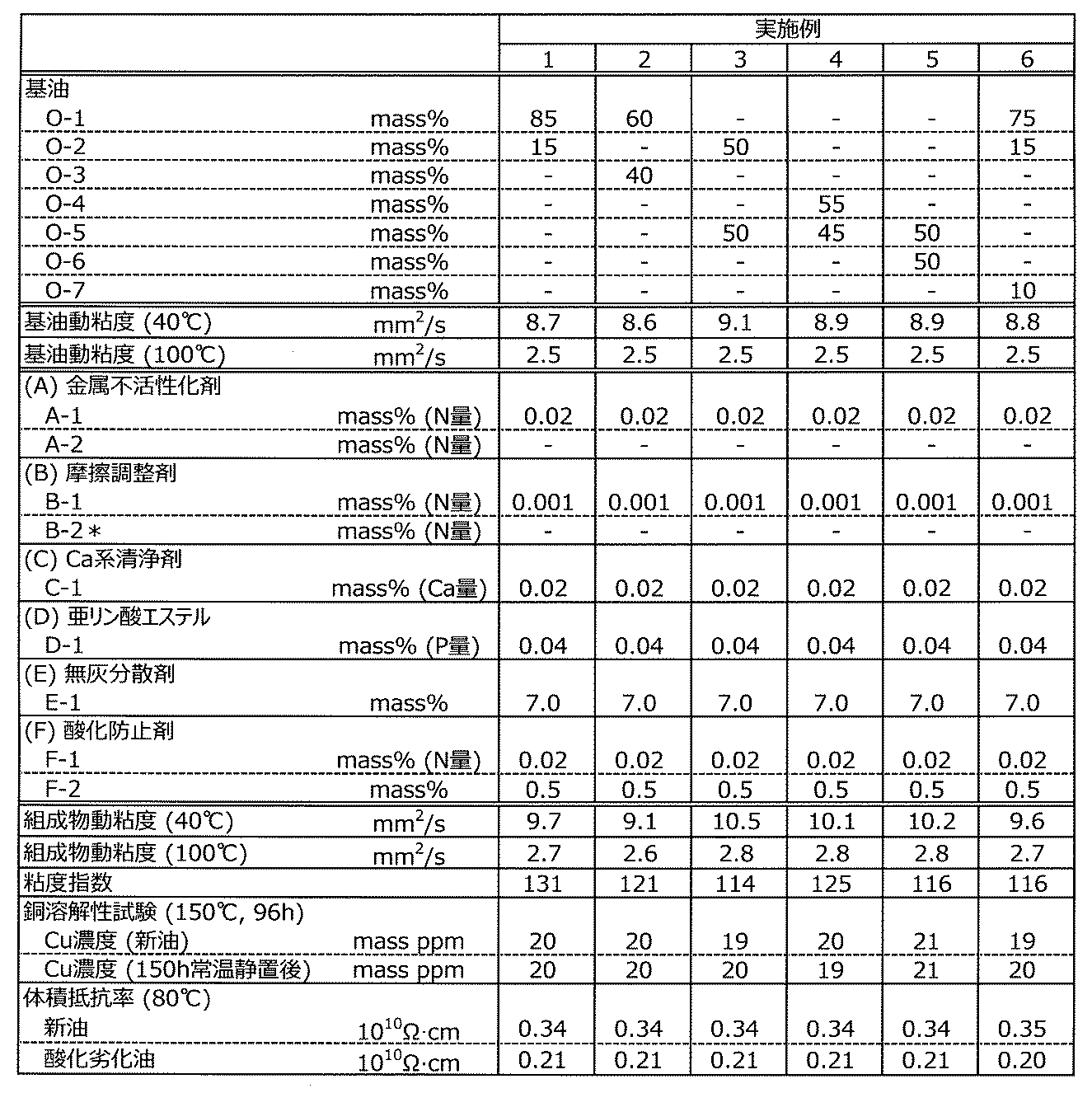


(銅溶解性試験)
潤滑油組成物のそれぞれについて、新油の銅腐食防止性、及び、空気中で常温にて150時間静置した後の組成物の銅腐食防止性を評価した。新油、または、新油を空気中で常温にて150時間静置した後の潤滑油組成物を試料油として用いた。試料油に銅板を入れ、150℃の恒温槽内で96時間静置した後、試料油中の銅濃度を測定した。試料油中の銅濃度は、JPI-5S-44-2011に準拠して、誘導結合プラズマ(ICP)発光分光分析法により測定した。結果を表1~4に示している。本試験において、新油について測定される銅濃度が低いほど、新油の銅腐食防止性が良好であることを意味し、150時間常温静置後の潤滑油組成物について測定される銅濃度が低いほど、銅腐食防止性が長期にわたって良好であることを意味する。
(Copper solubility test)
For each of the lubricating oil compositions, the copper corrosion inhibitory properties of the new oil and the copper corrosion inhibitory properties of the composition after standing in air at room temperature for 150 hours were evaluated. New oil or the lubricating oil composition after standing in air at room temperature for 150 hours was used as the sample oil. A copper plate was placed in the sample oil, and the sample oil was left standing in a thermostatic bath at 150 ° C. for 96 hours, after which the copper concentration in the sample oil was measured. The copper concentration in the sample oil was measured by inductively coupled plasma (ICP) emission spectrometry in accordance with JPI-5S-44-2011. The results are shown in Tables 1 to 4. In this test, the lower the copper concentration measured for the new oil, the better the copper corrosion inhibitory properties of the new oil, and the lower the copper concentration measured for the lubricating oil composition after standing at room temperature for 150 hours, the better the copper corrosion inhibitory properties over a long period of time.
(体積抵抗率)
潤滑油組成物のそれぞれについて、新油の体積抵抗率、及び、酸化劣化油の体積抵抗率を測定した。酸化劣化油は、JIS K2514-1に準拠してISOT(Indiana Stirring Oxidation Test)法により油温165℃で150時間、新油を酸化処理することにより得た。新油および酸化劣化油のそれぞれについて、体積抵抗率の測定は、JIS C2101に規定の体積抵抗率試験に準拠し、油温80℃で行った。結果を表1~4に示している。本試験において80℃における体積抵抗率が高いほど、電気絶縁性が良好であることを意味する。本試験における酸化劣化油の80℃における体積抵抗率は1.0×10⁹Ω・cm以上であることが好ましい。
(Volume Resistivity)
For each of the lubricating oil compositions, the volume resistivity of the new oil and the volume resistivity of the oxidatively deteriorated oil were measured. The oxidatively deteriorated oil was obtained by oxidizing the new oil for 150 hours at an oil temperature of 165°C by the ISOT (Indiana Stirring Oxidation Test) method in accordance with JIS K2514-1. The volume resistivity of each of the new oil and the oxidatively deteriorated oil was measured at an oil temperature of 80°C in accordance with the volume resistivity test specified in JIS C2101. The results are shown in Tables 1 to 4. In this test, the higher the volume resistivity at 80°C, the better the electrical insulation. In this test, the volume resistivity of the oxidatively deteriorated oil at 80°C is preferably 1.0 x 10 9 Ω·cm or more.
(評価結果)
実施例1~17の潤滑油組成物は、銅腐食防止の長期安定性、及び酸化劣化油の電気絶縁性において良好な結果を示した。
(B)成分(コハク酸イミド系摩擦調整剤B-1)に代えて、(B)成分に該当しないコハク酸イミド化合物(B-2*)を用いた比較例1の潤滑油組成物は、銅腐食防止の長期安定性において劣った結果を示した。
(B)成分を含有しない比較例2の潤滑油組成物は、銅腐食防止の長期安定性において劣った結果を示した。
(B)成分の含有量が過大である比較例3の潤滑油組成物は、酸化劣化油の電気絶縁性において劣った結果を示した。
(Evaluation Results)
The lubricating oil compositions of Examples 1 to 17 showed good results in terms of long-term stability in preventing copper corrosion and electrical insulation properties of oxidized deteriorated oil.
The lubricating oil composition of Comparative Example 1, in which a succinimide compound (B-2 * ) not corresponding to component (B) was used instead of component (B) (succinimide-based friction modifier B-1), showed inferior results in terms of long-term stability in preventing copper corrosion.
The lubricating oil composition of Comparative Example 2, which did not contain component (B), showed poor results in terms of long-term stability in inhibiting copper corrosion.
The lubricating oil composition of Comparative Example 3, which contained an excessively large amount of component (B), exhibited poor electrical insulating properties against oxidatively deteriorated oil.
Claims (10)
(A)トリアゾール系金属不活性化剤を、組成物全量基準で窒素量として0.005~0.03質量%と、
(B1)下記一般式(1)で表されるコハク酸イミド化合物を、組成物全量基準で窒素量として0.0005~0.02質量%と、
(C)カルシウムサリシレート清浄剤を、組成物全量基準でカルシウム量として0.005~0.03質量%と
(D)下記一般式(3)で表される亜リン酸エステル化合物を、組成物全量基準でリン量として0.01~0.06質量%と、
を含有し、
前記組成物をJIS K2514-1に規定のISOT法により150時間酸化処理することにより得られる酸化劣化油の80℃における体積抵抗率が1.0×10⁹Ω・cm以上であることを特徴とする、潤滑油組成物。
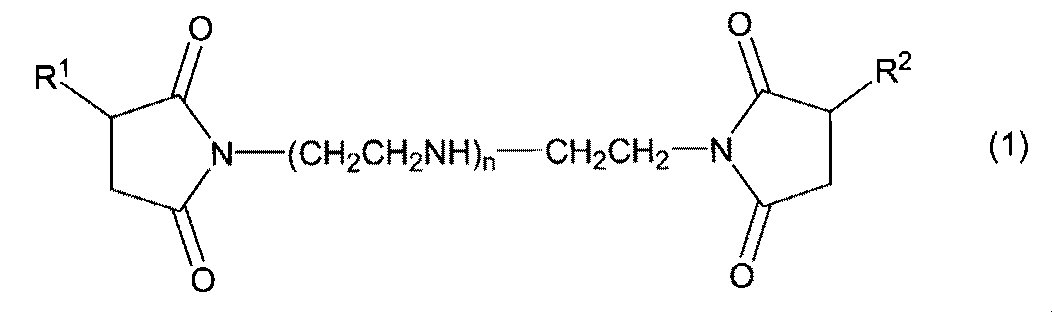
(一般式(1)において、R1及びR2はそれぞれ独立に、水素原子、又は、炭素数1~36の直鎖または分岐鎖のアルキル又はアルケニル基を表し、R1及びR2の少なくとも一方は炭素数8~36の直鎖または分岐鎖のアルキル又はアルケニル基であり、nは1~10の整数を表す。)

(一般式(3)において、R 4 及びR 5 はそれぞれ独立に、炭素数1~18の直鎖炭化水素基、又は下記一般式(4)で表される炭素数4~20の基である。)

(A) a triazole-based metal deactivator in an amount of 0.005 to 0.03 mass% in terms of nitrogen content based on the total amount of the composition;
(B1) a succinimide compound represented by the following general formula (1) in an amount of 0.0005 to 0.02 mass% in terms of nitrogen content based on the total amount of the composition ,
(C) A calcium salicylate detergent is added in an amount of 0.005 to 0.03 mass % in terms of calcium based on the total amount of the composition.
(D) a phosphorus content of a phosphorous ester compound represented by the following general formula (3) of 0.01 to 0.06 mass% based on the total mass of the composition,
Contains
The lubricating oil composition is characterized in that the volume resistivity at 80° C. of an oxidized oil obtained by subjecting the composition to an oxidation treatment for 150 hours according to the ISOT method specified in JIS K2514-1 is 1.0×10 9 Ω·cm or more.
(In general formula (1), R 1 and R 2 each independently represent a hydrogen atom, or a linear or branched alkyl or alkenyl group having 1 to 36 carbon atoms, at least one of R 1 and R 2 is a linear or branched alkyl or alkenyl group having 8 to 36 carbon atoms, and n represents an integer of 1 to 10.)
(In general formula (3), R 4 and R 5 are each independently a linear hydrocarbon group having 1 to 18 carbon atoms, or a group having 4 to 20 carbon atoms represented by the following general formula (4).)
前記(E)成分は、炭素数40~400のアルキル若しくはアルケニル基を有するアルキル若しくはアルケニルコハク酸若しくはその無水物と、ポリアミンとの縮合反応生成物、若しくはその誘導体、又はそれらの組み合わせである、請求項1~3のいずれかに記載の潤滑油組成物。 (E) containing no or less than 10 mass% of a succinimide-based ashless dispersant based on the total amount of the composition,
The lubricating oil composition according to any one of claims 1 to 3, wherein the component (E) is a condensation reaction product of an alkyl or alkenyl succinic acid or anhydride thereof having an alkyl or alkenyl group having 40 to 400 carbon atoms and a polyamine, or a derivative thereof, or a combination thereof.
前記組成物の100℃における動粘度が1.8~4.0mm2/sである、請求項1~5のいずれかに記載の潤滑油組成物。 The composition has a kinematic viscosity at 40° C. of 4 to 20 mm 2 /s;
The lubricating oil composition according to any one of claims 1 to 5 , wherein the composition has a kinematic viscosity at 100°C of 1.8 to 4.0 mm 2 /s.
Applications Claiming Priority (7)
| Application Number | Priority Date | Filing Date | Title |
|---|---|---|---|
| JP2018209266 | 2018-11-06 | ||
| JP2018209267 | 2018-11-06 | ||
| JP2018209267 | 2018-11-06 | ||
| JP2018209266 | 2018-11-06 | ||
| JP2018209255 | 2018-11-06 | ||
| JP2018209255 | 2018-11-06 | ||
| PCT/JP2019/043568 WO2020095969A1 (en) | 2018-11-06 | 2019-11-06 | Lubricant composition |
Publications (2)
| Publication Number | Publication Date |
|---|---|
| JPWO2020095969A1 JPWO2020095969A1 (en) | 2021-10-07 |
| JP7555820B2 true JP7555820B2 (en) | 2024-09-25 |
Family
ID=70611517
Family Applications (3)
| Application Number | Title | Priority Date | Filing Date |
|---|---|---|---|
| JP2020555567A Active JP7555820B2 (en) | 2018-11-06 | 2019-11-06 | Lubricating Oil Composition |
| JP2020555566A Active JP7054742B2 (en) | 2018-11-06 | 2019-11-06 | Lubricating oil composition |
| JP2020555568A Pending JPWO2020095970A1 (en) | 2018-11-06 | 2019-11-06 | Lubricating oil composition |
Family Applications After (2)
| Application Number | Title | Priority Date | Filing Date |
|---|---|---|---|
| JP2020555566A Active JP7054742B2 (en) | 2018-11-06 | 2019-11-06 | Lubricating oil composition |
| JP2020555568A Pending JPWO2020095970A1 (en) | 2018-11-06 | 2019-11-06 | Lubricating oil composition |
Country Status (5)
| Country | Link |
|---|---|
| US (3) | US11555159B2 (en) |
| EP (3) | EP3878929B1 (en) |
| JP (3) | JP7555820B2 (en) |
| CN (3) | CN112912477B (en) |
| WO (3) | WO2020095970A1 (en) |
Families Citing this family (13)
| Publication number | Priority date | Publication date | Assignee | Title |
|---|---|---|---|---|
| DK2755614T3 (en) | 2011-09-13 | 2017-12-04 | Nxthera Inc | PROSTATE TREATMENT SYSTEMS |
| WO2020095970A1 (en) | 2018-11-06 | 2020-05-14 | Jxtgエネルギー株式会社 | Lubricant oil composition |
| JP7563935B2 (en) * | 2020-10-09 | 2024-10-08 | Eneos株式会社 | Lubricating Oil Composition |
| US11905488B2 (en) * | 2020-10-16 | 2024-02-20 | Infineum International Limited | Transmission fluid compositions for hybrid and electric vehicle applications |
| CN117043306A (en) * | 2021-04-01 | 2023-11-10 | 路博润公司 | Zinc-free lubricating compositions and methods of use |
| CN115960665B (en) * | 2021-10-11 | 2024-11-12 | 中国石油化工股份有限公司 | Method for preparing lubricating oil composition and regulating or determining its electrical insulation properties |
| WO2023079475A1 (en) * | 2021-11-03 | 2023-05-11 | Chevron Oronite Company Llc | Lubricating oil compositions |
| CA3251983A1 (en) * | 2022-02-21 | 2023-08-24 | Chevron Japan Ltd. | Lubricating oil composition |
| JP7767184B2 (en) * | 2022-02-28 | 2025-11-11 | 出光興産株式会社 | lubricating oil composition |
| CN118946652A (en) * | 2022-03-31 | 2024-11-12 | 出光兴产株式会社 | Lubricating oil composition |
| JP2023168696A (en) * | 2022-05-16 | 2023-11-29 | 出光興産株式会社 | Lubricant composition |
| CN119546734A (en) | 2022-07-20 | 2025-02-28 | 引能仕株式会社 | Lubricating oil composition |
| CN120584168A (en) | 2023-03-01 | 2025-09-02 | 引能仕株式会社 | Lubricating oil composition |
Citations (7)
| Publication number | Priority date | Publication date | Assignee | Title |
|---|---|---|---|---|
| JP2003113391A (en) | 2001-10-02 | 2003-04-18 | Nippon Oil Corp | Lubricating oil composition |
| JP2005325355A (en) | 2004-05-04 | 2005-11-24 | Infineum Internatl Ltd | Continuously variable transmission fluid |
| JP2010530470A (en) | 2007-06-19 | 2010-09-09 | アフトン・ケミカル・コーポレーション | Pyrrolidine-2,5-dione derivatives for use in friction adjustment |
| JP2011046938A (en) | 2009-07-31 | 2011-03-10 | Chevron Japan Ltd | Friction modifier and lubricating oil composition for transmission |
| JP2012207083A (en) | 2011-03-29 | 2012-10-25 | Jx Nippon Oil & Energy Corp | Lubricating oil composition |
| JP2016108406A (en) | 2014-12-04 | 2016-06-20 | 東燃ゼネラル石油株式会社 | Lubricating oil composition |
| JP2016190953A (en) | 2015-03-31 | 2016-11-10 | Jxエネルギー株式会社 | Lubricating oil composition |
Family Cites Families (37)
| Publication number | Priority date | Publication date | Assignee | Title |
|---|---|---|---|---|
| JPS6078993A (en) * | 1983-10-05 | 1985-05-04 | Toho Chem Ind Co Ltd | Organic phosphorus compound |
| JPH09202890A (en) | 1995-11-21 | 1997-08-05 | Tonen Corp | Lubricating oil composition for automatic transmission |
| JPH09328698A (en) | 1996-04-10 | 1997-12-22 | Nippon Oil Co Ltd | Lubricating oil composition for sliding guide surface |
| US5840663A (en) | 1996-12-18 | 1998-11-24 | Exxon Chemical Patents Inc. | Power transmitting fluids improved anti-shudder durability |
| CA2294851A1 (en) * | 1997-10-06 | 1999-04-15 | Hitoshi Hata | Sulfur-containing organophosphorus compounds |
| JP4166872B2 (en) * | 1997-10-06 | 2008-10-15 | 出光興産株式会社 | Novel phosphite derivative |
| US6103673A (en) | 1998-09-14 | 2000-08-15 | The Lubrizol Corporation | Compositions containing friction modifiers for continuously variable transmissions |
| JP4123601B2 (en) * | 1998-10-22 | 2008-07-23 | 新日本石油株式会社 | Lubricating oil composition |
| US7307048B2 (en) | 2001-05-28 | 2007-12-11 | Nissan Motor Co., Ltd. | Transmission oil composition for automobile |
| JP4663288B2 (en) * | 2004-10-19 | 2011-04-06 | Jx日鉱日石エネルギー株式会社 | Lubricating oil composition in contact with lead-containing metal material |
| JP2007126542A (en) | 2005-11-02 | 2007-05-24 | Nippon Oil Corp | Lubricating oil composition |
| JP5137314B2 (en) * | 2006-03-31 | 2013-02-06 | Jx日鉱日石エネルギー株式会社 | Lubricating base oil |
| US8026199B2 (en) * | 2006-11-10 | 2011-09-27 | Nippon Oil Corporation | Lubricating oil composition |
| US20100130390A1 (en) * | 2007-03-13 | 2010-05-27 | The Lubrizol Corporation | Multifunctional Driveline Fluid |
| KR101435701B1 (en) | 2007-03-28 | 2014-09-01 | 이데미쓰 고산 가부시키가이샤 | Lubricant composition |
| WO2009085800A1 (en) * | 2007-12-27 | 2009-07-09 | The Lubrizol Corporation | Lubricating composition containing detergent |
| JP2009202890A (en) | 2008-02-27 | 2009-09-10 | Hitachi Maxell Ltd | Storing case for memory cards |
| JP5642360B2 (en) | 2009-06-16 | 2014-12-17 | シェブロンジャパン株式会社 | Lubricating oil composition |
| JP5477035B2 (en) | 2010-02-17 | 2014-04-23 | 富士通株式会社 | Imaging device |
| JP5558384B2 (en) * | 2011-02-02 | 2014-07-23 | シェブロンジャパン株式会社 | Lubricating oil composition and method of operating automatic transmission |
| US9790450B2 (en) * | 2012-03-21 | 2017-10-17 | Idemitsu Kosan Co., Ltd. | Lubricating oil composition for engine made of aluminum alloy and lubrication method |
| EP2997119B1 (en) * | 2013-05-14 | 2021-08-04 | The Lubrizol Corporation | Lubricating composition and method of lubricating a transmission |
| US20160201002A1 (en) * | 2013-09-25 | 2016-07-14 | Idemitsu Kosan Co., Ltd. | Lubricating oil composition for traction drive transmission |
| CN110229710A (en) | 2014-02-18 | 2019-09-13 | Jxtg能源株式会社 | Speed changer lubricant oil composite |
| JP6493829B2 (en) | 2014-05-30 | 2019-04-03 | Khネオケム株式会社 | Esters of pentaerythritol and isotridecanoic acid used therefor |
| JP6247600B2 (en) * | 2014-06-16 | 2017-12-13 | Jxtgエネルギー株式会社 | Lubricating oil composition for transmission |
| JP6551727B2 (en) * | 2015-03-31 | 2019-07-31 | 出光興産株式会社 | Lubricating oil composition |
| JP6453142B2 (en) * | 2015-03-31 | 2019-01-16 | 三洋化成工業株式会社 | Abrasive and manufacturing method thereof |
| WO2016199567A1 (en) * | 2015-06-11 | 2016-12-15 | 株式会社オートネットワーク技術研究所 | Metal surface coating composition and terminal-equipped covered electric wire |
| JP6156521B2 (en) * | 2016-01-07 | 2017-07-05 | コニカミノルタ株式会社 | Organic electronics element, display device and lighting device |
| JP6702611B2 (en) * | 2016-03-04 | 2020-06-03 | 出光興産株式会社 | Lubricating oil composition, lubricating method, and transmission |
| JP6718349B2 (en) | 2016-09-27 | 2020-07-08 | Jxtgエネルギー株式会社 | Lubricating oil composition for continuously variable transmission |
| US20180100117A1 (en) * | 2016-10-07 | 2018-04-12 | Exxonmobil Research And Engineering Company | Lubricating oil compositions for electric vehicle powertrains |
| US20180100118A1 (en) | 2016-10-07 | 2018-04-12 | Exxonmobil Research And Engineering Company | Method for controlling electrical conductivity of lubricating oils in electric vehicle powertrains |
| JP7274277B2 (en) * | 2018-10-24 | 2023-05-16 | 出光興産株式会社 | lubricating oil composition |
| WO2020095970A1 (en) | 2018-11-06 | 2020-05-14 | Jxtgエネルギー株式会社 | Lubricant oil composition |
| US11066622B2 (en) * | 2019-10-24 | 2021-07-20 | Afton Chemical Corporation | Synergistic lubricants with reduced electrical conductivity |
-
2019
- 2019-11-06 WO PCT/JP2019/043569 patent/WO2020095970A1/en not_active Ceased
- 2019-11-06 WO PCT/JP2019/043568 patent/WO2020095969A1/en not_active Ceased
- 2019-11-06 EP EP19882330.4A patent/EP3878929B1/en active Active
- 2019-11-06 WO PCT/JP2019/043567 patent/WO2020095968A1/en not_active Ceased
- 2019-11-06 CN CN201980069591.9A patent/CN112912477B/en active Active
- 2019-11-06 JP JP2020555567A patent/JP7555820B2/en active Active
- 2019-11-06 US US17/290,496 patent/US11555159B2/en active Active
- 2019-11-06 CN CN201980069516.2A patent/CN112930389B/en active Active
- 2019-11-06 EP EP19881621.7A patent/EP3878930B1/en active Active
- 2019-11-06 JP JP2020555566A patent/JP7054742B2/en active Active
- 2019-11-06 CN CN201980069526.6A patent/CN112912478B/en active Active
- 2019-11-06 US US17/289,961 patent/US12338408B2/en active Active
- 2019-11-06 US US17/289,993 patent/US20210395635A1/en not_active Abandoned
- 2019-11-06 EP EP19881412.1A patent/EP3878928B1/en active Active
- 2019-11-06 JP JP2020555568A patent/JPWO2020095970A1/en active Pending
Patent Citations (7)
| Publication number | Priority date | Publication date | Assignee | Title |
|---|---|---|---|---|
| JP2003113391A (en) | 2001-10-02 | 2003-04-18 | Nippon Oil Corp | Lubricating oil composition |
| JP2005325355A (en) | 2004-05-04 | 2005-11-24 | Infineum Internatl Ltd | Continuously variable transmission fluid |
| JP2010530470A (en) | 2007-06-19 | 2010-09-09 | アフトン・ケミカル・コーポレーション | Pyrrolidine-2,5-dione derivatives for use in friction adjustment |
| JP2011046938A (en) | 2009-07-31 | 2011-03-10 | Chevron Japan Ltd | Friction modifier and lubricating oil composition for transmission |
| JP2012207083A (en) | 2011-03-29 | 2012-10-25 | Jx Nippon Oil & Energy Corp | Lubricating oil composition |
| JP2016108406A (en) | 2014-12-04 | 2016-06-20 | 東燃ゼネラル石油株式会社 | Lubricating oil composition |
| JP2016190953A (en) | 2015-03-31 | 2016-11-10 | Jxエネルギー株式会社 | Lubricating oil composition |
Also Published As
| Publication number | Publication date |
|---|---|
| CN112912477B (en) | 2022-11-11 |
| US20210395634A1 (en) | 2021-12-23 |
| EP3878928B1 (en) | 2024-05-22 |
| WO2020095968A1 (en) | 2020-05-14 |
| CN112930389B (en) | 2022-11-25 |
| CN112912478A (en) | 2021-06-04 |
| EP3878930B1 (en) | 2024-07-31 |
| EP3878928A4 (en) | 2022-08-17 |
| JPWO2020095968A1 (en) | 2021-09-02 |
| CN112930389A (en) | 2021-06-08 |
| WO2020095970A1 (en) | 2020-05-14 |
| EP3878929A1 (en) | 2021-09-15 |
| EP3878928A1 (en) | 2021-09-15 |
| US12338408B2 (en) | 2025-06-24 |
| WO2020095969A1 (en) | 2020-05-14 |
| EP3878929A4 (en) | 2022-09-07 |
| JP7054742B2 (en) | 2022-04-14 |
| US20220002631A1 (en) | 2022-01-06 |
| US11555159B2 (en) | 2023-01-17 |
| JPWO2020095970A1 (en) | 2021-10-07 |
| US20210395635A1 (en) | 2021-12-23 |
| EP3878929B1 (en) | 2025-01-01 |
| EP3878930A4 (en) | 2022-08-10 |
| CN112912478B (en) | 2022-11-08 |
| EP3878930A1 (en) | 2021-09-15 |
| JPWO2020095969A1 (en) | 2021-10-07 |
| CN112912477A (en) | 2021-06-04 |
Similar Documents
| Publication | Publication Date | Title |
|---|---|---|
| JP7555820B2 (en) | Lubricating Oil Composition | |
| CN111808658B (en) | lubricating oil composition | |
| JP5756342B2 (en) | Lubricating oil composition | |
| JP5504137B2 (en) | Engine oil composition | |
| JP7475256B2 (en) | Lubricating Oil Composition | |
| JP7563935B2 (en) | Lubricating Oil Composition | |
| JP4486338B2 (en) | Lubricating oil composition | |
| JP5756353B2 (en) | Lubricating oil composition | |
| JP2015092007A (en) | Lubricating oil composition | |
| JP2013001885A (en) | Lubricating oil composition |
Legal Events
| Date | Code | Title | Description |
|---|---|---|---|
| A621 | Written request for application examination |
Free format text: JAPANESE INTERMEDIATE CODE: A621 Effective date: 20221102 |
|
| A131 | Notification of reasons for refusal |
Free format text: JAPANESE INTERMEDIATE CODE: A131 Effective date: 20231017 |
|
| A601 | Written request for extension of time |
Free format text: JAPANESE INTERMEDIATE CODE: A601 Effective date: 20231212 |
|
| A521 | Request for written amendment filed |
Free format text: JAPANESE INTERMEDIATE CODE: A523 Effective date: 20240216 |
|
| A131 | Notification of reasons for refusal |
Free format text: JAPANESE INTERMEDIATE CODE: A131 Effective date: 20240507 |
|
| A521 | Request for written amendment filed |
Free format text: JAPANESE INTERMEDIATE CODE: A523 Effective date: 20240625 |
|
| TRDD | Decision of grant or rejection written | ||
| A01 | Written decision to grant a patent or to grant a registration (utility model) |
Free format text: JAPANESE INTERMEDIATE CODE: A01 Effective date: 20240827 |
|
| A61 | First payment of annual fees (during grant procedure) |
Free format text: JAPANESE INTERMEDIATE CODE: A61 Effective date: 20240911 |
|
| R150 | Certificate of patent or registration of utility model |
Ref document number: 7555820 Country of ref document: JP Free format text: JAPANESE INTERMEDIATE CODE: R150 |