JP7562995B2 - Polymerizable liquid crystal composition, polymer, retardation film and method for producing the same, transfer laminate, optical member and method for producing the same, and display device - Google Patents
Polymerizable liquid crystal composition, polymer, retardation film and method for producing the same, transfer laminate, optical member and method for producing the same, and display device Download PDFInfo
- Publication number
- JP7562995B2 JP7562995B2 JP2020101109A JP2020101109A JP7562995B2 JP 7562995 B2 JP7562995 B2 JP 7562995B2 JP 2020101109 A JP2020101109 A JP 2020101109A JP 2020101109 A JP2020101109 A JP 2020101109A JP 7562995 B2 JP7562995 B2 JP 7562995B2
- Authority
- JP
- Japan
- Prior art keywords
- group
- liquid crystal
- polymerizable liquid
- crystal composition
- compound
- Prior art date
- Legal status (The legal status is an assumption and is not a legal conclusion. Google has not performed a legal analysis and makes no representation as to the accuracy of the status listed.)
- Active
Links
Images


Landscapes
- Addition Polymer Or Copolymer, Post-Treatments, Or Chemical Modifications (AREA)
- Polarising Elements (AREA)
- Liquid Crystal (AREA)
- Laminated Bodies (AREA)
- Compositions Of Macromolecular Compounds (AREA)
Description
本開示は、重合性液晶組成物、重合体、位相差フィルム及びその製造方法、転写用積層体、光学部材及びその製造方法、並びに表示装置に関する。 The present disclosure relates to a polymerizable liquid crystal composition, a polymer, a retardation film and a method for producing the same, a transfer laminate, an optical member and a method for producing the same, and a display device.
重合性基を有する液晶化合物(重合性液晶化合物)は種々の光学材料に使用される。例えば、重合性液晶化合物を含む重合性液晶組成物を液晶状態で配列させた後、重合させることにより、均一な配向を有する重合体を作製することが可能である。このような重合体は、ディスプレイに必要な位相差フィルム、偏光板等の光学部材に使用することができる。
このような光学部材に重合性液晶化合物を用いた場合に、高温下の条件に長時間曝した場合に、位相差が変動してしまい、所望の光学特性が得られない場合があった。
Liquid crystal compounds having a polymerizable group (polymerizable liquid crystal compounds) are used in various optical materials. For example, a polymerizable liquid crystal composition containing a polymerizable liquid crystal compound can be aligned in a liquid crystal state and then polymerized to produce a polymer having uniform orientation. Such a polymer can be used in optical components such as retardation films and polarizing plates required for displays.
When a polymerizable liquid crystal compound is used in such an optical member, the retardation may vary when the optical member is exposed to high temperature conditions for a long period of time, and desired optical characteristics may not be obtained.
耐久性に優れた光学異方性膜の形成に用いられる重合性液晶組成物として、特許文献1には、特定の重合性液晶化合物と、特定のpKa値を満たす特定酸性化合物とを含有する重合性液晶組成物が開示されている。当該文献には、耐久性が劣る原因は、重合性液晶化合物のエステル結合が高温又は高湿環境下で加水分解することで重合性基によって固定化された液晶化合物の一部が遊離して可動性を持ち、複屈折率が変化してしまうことに起因していると推測し、特定酸性化合物を配合することにより、組成物の系内に混在している塩基性成分を中和し、塩基性成分の存在により促進される加水分解の進行が抑制された結果、耐久性が向上したと考えられる旨が記載されている。
また、特許文献2には、熱耐久性に優れた位相差フィルムを作製できる重合性液晶組成物として、逆波長分散性の重合性液晶化合物と、水酸基とアルコキシ基とを有する特定の芳香族炭化水素化合物とを含有する、重合性液晶組成物が開示されている。当該文献には、逆波長分散性の重合性液晶化合物は求核種(塩基性物質と推定)の攻撃を受けやすく、分解生成物が触媒となって未反応の重合性液晶化合物の分解を促進させると推定されるところ、水酸基とアルコキシ基とを有する特定の芳香族炭化水素化合物は、塩基性物質を中和させるための水酸基を有し、液晶化合物近傍に位置できることから、上記現象を抑制していると推定している旨が記載されている。
In addition,
しかしながら、従来技術では、耐熱性の向上が未だ不十分であったり、耐熱性が向上するような含有量で特定の添加剤を添加すると、重合性液晶組成物の重合体(硬化物)の配向性が低下するという問題があり、改善が求められていた。 However, in conventional technology, there is a problem that the improvement in heat resistance is still insufficient, and when a specific additive is added in an amount that improves heat resistance, the orientation of the polymer (cured product) of the polymerizable liquid crystal composition decreases, and improvements are required.
本開示の実施形態は、前述のような実情を鑑み、配向性の低下が抑制されながら耐熱性が向上した重合性液晶組成物、当該重合性液晶組成物を重合して得られる重合体、当該重合性液晶組成物の硬化物を含む位相差層を有する位相差フィルム及びその製造方法、前記位相差層を転写可能な転写用積層体、前記位相差フィルムを有する光学部材及びその製造方法、並びに、表示装置を提供することを目的とする。 In view of the above-mentioned circumstances, the embodiments of the present disclosure aim to provide a polymerizable liquid crystal composition that has improved heat resistance while suppressing deterioration in alignment, a polymer obtained by polymerizing the polymerizable liquid crystal composition, a retardation film having a retardation layer including a cured product of the polymerizable liquid crystal composition and a method for producing the retardation film, a transfer laminate to which the retardation layer can be transferred, an optical member having the retardation film and a method for producing the retardation film, and a display device.
本開示の1実施形態は、重合性液晶化合物と、エステル結合、チオエステル結合、炭酸エステル結合、リン酸エステル結合、及びアミド結合からなる群から選択される少なくとも1種の結合を含むモルホリン化合物とを含有する、重合性液晶組成物を提供する。 One embodiment of the present disclosure provides a polymerizable liquid crystal composition containing a polymerizable liquid crystal compound and a morpholine compound containing at least one bond selected from the group consisting of an ester bond, a thioester bond, a carbonate bond, a phosphate bond, and an amide bond.
本開示の1実施形態は、前記モルホリン化合物を、前記重合性液晶化合物と前記モルホリン化合物の総量100質量部に対して、1質量部以上25質量部以下含有する、前記本開示の重合性液晶組成物を提供する。 One embodiment of the present disclosure provides a polymerizable liquid crystal composition of the present disclosure, which contains the morpholine compound in an amount of 1 part by mass or more and 25 parts by mass or less relative to 100 parts by mass of the total amount of the polymerizable liquid crystal compound and the morpholine compound.
本開示の1実施形態は、前記本開示の1実施形態の重合性液晶組成物を重合して得られる重合体を提供する。 One embodiment of the present disclosure provides a polymer obtained by polymerizing the polymerizable liquid crystal composition of one embodiment of the present disclosure.
本開示の1実施形態は、位相差層を有する位相差フィルムであって、前記位相差層が、前記本開示の1実施形態の重合性液晶組成物の硬化物を含有する、位相差フィルムを提供する。 One embodiment of the present disclosure provides a retardation film having a retardation layer, the retardation layer containing a cured product of the polymerizable liquid crystal composition of one embodiment of the present disclosure.
本開示の1実施形態は、前記本開示の1実施形態の重合性液晶組成物を成膜する工程と、
前記成膜された前記重合性液晶組成物中の前記重合性液晶化合物を少なくとも配向させる工程と、
前記配向工程の後に、前記重合性液晶化合物を少なくとも重合する工程とを有することにより、位相差層を形成する工程を有する、位相差フィルムの製造方法を提供する。
One embodiment of the present disclosure relates to a method for producing a polymerizable liquid crystal composition according to the present disclosure, comprising:
a step of at least aligning the polymerizable liquid crystal compound in the formed film of the polymerizable liquid crystal composition;
The present invention provides a method for producing a retardation film, comprising a step of forming a retardation layer by at least polymerizing the polymerizable liquid crystal compound after the alignment step.
本開示の1実施形態は、位相差層と、前記位相差層を剥離可能に支持した支持体とを備え、
前記位相差層が、前記本開示の1実施形態の重合性液晶組成物の硬化物を含有する、
位相差層の転写に供する転写用積層体を提供する。
One embodiment of the present disclosure includes a retardation layer and a support that supports the retardation layer in a peelable manner,
The retardation layer contains a cured product of the polymerizable liquid crystal composition according to one embodiment of the present disclosure.
A transfer laminate for use in transferring a retardation layer is provided.
本開示の1実施形態は、前記本開示の1実施形態の位相差フィルム上に、偏光板を備える光学部材を提供する。 One embodiment of the present disclosure provides an optical member having a polarizing plate on the retardation film of one embodiment of the present disclosure.
本開示の1実施形態は、位相差層と、前記位相差層を剥離可能に支持した支持体とを備え、前記位相差層が、前記本開示の1実施形態の重合性液晶組成物の硬化物を含有する、位相差層の転写に供する転写用積層体を準備する工程と、
少なくとも偏光板を含む被転写体と、前記転写用積層体の前記位相差層とを対向させ、前記被転写体上に前記転写用積層体を転写する転写工程と、
前記被転写体上に転写された前記転写用積層体から、前記支持体を剥離する剥離工程と、
を有する、光学部材の製造方法を提供する。
One embodiment of the present disclosure relates to a method for producing a transfer laminate for transferring a retardation layer, the transfer laminate comprising: a retardation layer; and a support supporting the retardation layer in a peelable manner, the retardation layer containing a cured product of the polymerizable liquid crystal composition according to one embodiment of the present disclosure;
a transfer step of placing a transferee including at least a polarizing plate and the retardation layer of the transfer laminate opposite each other and transferring the transfer laminate onto the transferee;
a peeling step of peeling the support from the transfer laminate transferred onto the transfer recipient;
The present invention provides a method for producing an optical member having the above structure.
また、本開示の1実施形態は、前記本開示の1実施形態の位相差フィルム又は、前記本開示の1実施形態の光学部材を備える表示装置を提供する。 An embodiment of the present disclosure also provides a display device including the retardation film of the embodiment of the present disclosure or the optical member of the embodiment of the present disclosure.
本開示の実施形態によれば、配向性の低下が抑制されながら耐熱性が向上した重合性液晶組成物、当該重合性液晶化合物又は当該重合性液晶組成物を重合して得られる重合体、当該重合性液晶組成物の硬化物を含む位相差層を有する位相差フィルム及びその製造方法、前記位相差層を転写可能な転写用積層体、前記位相差フィルムを有する光学部材及びその製造方法、並びに、表示装置を提供することができる。 According to the embodiments of the present disclosure, it is possible to provide a polymerizable liquid crystal composition having improved heat resistance while suppressing deterioration of alignment, a polymer obtained by polymerizing the polymerizable liquid crystal compound or the polymerizable liquid crystal composition, a retardation film having a retardation layer including a cured product of the polymerizable liquid crystal composition and a method for producing the same, a transfer laminate to which the retardation layer can be transferred, an optical member having the retardation film and a method for producing the same, and a display device.
以下、本開示の実施の形態や実施例などを、図面等を参照しながら説明する。但し、本開示は多くの異なる態様で実施することが可能であり、以下に例示する実施の形態や実施例等の記載内容に限定して解釈されるものではない。また、図面は説明をより明確にするため、実際の態様に比べ、各部の幅、厚さ、形状等について模式的に表される場合があるが、あくまで一例であって、本開示の解釈を限定するものではない。また、本明細書と各図において、既出の図に関して前述したものと同様の要素には、同一の符号を付して、詳細な説明を適宜省略することがある。また、説明の便宜上、上方又は下方という語句を用いて説明する場合があるが、上下方向が逆転してもよい。
「本明細書において、ある部材又はある領域等のある構成が、他の部材又は他の領域等の他の構成の「上に(又は下に)」あるとする場合、特段の限定がない限り、これは他の構成の直上(又は直下)にある場合のみでなく、他の構成の上方(又は下方)にある場合を含み、すなわち、他の構成の上方(又は下方)において間に別の構成要素が含まれている場合も含む。
Hereinafter, the embodiments and examples of the present disclosure will be described with reference to the drawings. However, the present disclosure can be implemented in many different forms, and is not to be interpreted as being limited to the description of the embodiments and examples exemplified below. In addition, in order to make the explanation clearer, the drawings may be schematic in terms of the width, thickness, shape, etc. of each part compared to the actual form, but these are merely examples and do not limit the interpretation of the present disclosure. In addition, in this specification and each figure, elements similar to those described above with respect to the previous figures may be given the same reference numerals, and detailed explanations may be omitted as appropriate. In addition, for convenience of explanation, the terms "upper" and "lower" may be used in the explanation, but the up-down direction may be reversed.
"In this specification, when a certain component, region, or other structure is described as being "on (or under)" another component, region, or other structure, unless otherwise specified, this includes not only the case where the component is directly on (or directly under) the other structure, but also the case where the component is above (or below) the other structure, i.e., the case where another component is included between the component and the component, above (or below) the other structure.
本開示において配向規制力とは、位相差層中の液晶化合物を特定方向に配列させる作用をいう。
本開示において、(メタ)アクリルとは、アクリル又はメタアクリルの各々を表し、(メタ)アクリレートとは、アクリレート又はメタクリレートの各々を表す。
また、本明細書において「板」、「シート」、「フィルム」の用語は、呼称の違いのみに基づいて、互いから区別されるものではなく、「フィルム面(板面、シート面)」とは、対象となるフィルム状(板状、シート状)の部材を全体的かつ大局的に見た場合において対象となるフィルム状部材(板状部材、シート状部材)の平面方向と一致する面のことを指す。
また、本開示において、数値範囲を示す「~」とは、その前後に記載された数値を下限値及び上限値として含む意味で使用される。
In the present disclosure, the alignment regulation force refers to the action of aligning liquid crystal compounds in the retardation layer in a specific direction.
In the present disclosure, (meth)acrylic refers to either acrylic or methacrylic, and (meth)acrylate refers to either acrylate or methacrylate.
In addition, in this specification, the terms "plate,""sheet," and "film" are not distinguished from one another solely based on the difference in name, and a "film surface (plate surface, sheet surface)" refers to a surface that coincides with the planar direction of the target film-like (plate-like, sheet-like) member when viewed overall and globally.
In addition, in the present disclosure, the use of "to" indicating a range of numerical values is used to mean that the numerical values before and after it are included as the lower limit and upper limit.
A.重合性液晶組成物
本開示の重合性液晶組成物は、重合性液晶化合物と、エステル結合、チオエステル結合、炭酸エステル結合、リン酸エステル結合、及びアミド結合からなる群から選択される少なくとも1種の結合を含むモルホリン化合物とを含有する組成物である。
A. Polymerizable Liquid Crystal Composition The polymerizable liquid crystal composition of the present disclosure is a composition containing a polymerizable liquid crystal compound and a morpholine compound including at least one bond selected from the group consisting of an ester bond, a thioester bond, a carbonate bond, a phosphate bond, and an amide bond.
本開示の重合性液晶組成物は、重合性液晶化合物に、前記特定の結合を含むモルホリン化合物を組み合わせたことから、配向性の低下が抑制されながら耐熱性が向上した重合性液晶組成物とすることができ、耐熱性試験前後で位相差値の低下を抑制できる。
耐熱性が向上する作用については未だ不明であるが、重合性液晶化合物同士の重合反応に加えて、モルホリン特有の水素引き抜き反応による重合反応が同時に起こることにより、架橋反応等の反応率が向上することに起因していると推定される。本発明に用いられるモルホリン化合物は前記特定の結合を含むことから、重合性液晶化合物の反応性基と親和性が高く、配向性の低下を抑制しやすく且つ反応性が向上していると推定される。
The polymerizable liquid crystal composition of the present disclosure combines a polymerizable liquid crystal compound with a morpholine compound containing the specific bond, and therefore can provide a polymerizable liquid crystal composition in which the decrease in alignment is suppressed while the heat resistance is improved, and the decrease in retardation value before and after a heat resistance test can be suppressed.
Although the mechanism by which the heat resistance is improved is still unclear, it is presumed that this is due to the fact that, in addition to the polymerization reaction between polymerizable liquid crystal compounds, a polymerization reaction due to a hydrogen abstraction reaction specific to morpholine occurs simultaneously, thereby improving the reaction rate of crosslinking reactions, etc. Since the morpholine compound used in the present invention contains the specific bond, it is presumed that the compound has a high affinity with the reactive group of the polymerizable liquid crystal compound, making it easy to suppress the decrease in alignment and improving the reactivity.
本開示の重合性液晶組成物は、少なくとも重合性液晶化合物と、エステル結合、チオエステル結合、炭酸エステル結合、リン酸エステル結合、及びアミド結合からなる群から選択される少なくとも1種の結合を含むモルホリン化合物とを含有するものであるが、更に、光重合開始剤を含有することが好ましい。また、重合性官能基を有しない液晶化合物を更に含有してもよい。また、効果を損なわない範囲で更に他の成分を含有してもよい。以下、本開示の重合性液晶組成物を構成する各成分について、本開示に特徴的なモルホリン化合物から順に説明する。 The polymerizable liquid crystal composition of the present disclosure contains at least a polymerizable liquid crystal compound and a morpholine compound containing at least one bond selected from the group consisting of an ester bond, a thioester bond, a carbonate ester bond, a phosphate ester bond, and an amide bond, and preferably further contains a photopolymerization initiator. It may further contain a liquid crystal compound that does not have a polymerizable functional group. It may further contain other components within a range that does not impair the effect. Below, each component constituting the polymerizable liquid crystal composition of the present disclosure will be described in order, starting with the morpholine compound that is characteristic of the present disclosure.
1.モルホリン化合物
本開示の重合性液晶組成物に用いられるモルホリン化合物は、エステル結合、チオエステル結合、炭酸エステル結合、リン酸エステル結合、及びアミド結合からなる群から選択される少なくとも1種の結合と、モルホリン環とを有する化合物である。
モルホリン化合物としては、例えば、下記一般式(B)又は一般式(B’)で表される化合物が挙げられる。
1. Morpholine Compound The morpholine compound used in the polymerizable liquid crystal composition of the present disclosure is a compound having a morpholine ring and at least one bond selected from the group consisting of an ester bond, a thioester bond, a carbonate bond, a phosphate bond, and an amide bond.
Examples of the morpholine compound include compounds represented by the following general formula (B) or (B').

(一般式(B)及び(B’)において、Raは、置換基を有していてもよく、炭素鎖中にヘテロ原子が含まれていてもよい炭化水素基であって、少なくともエステル結合、チオエステル結合、炭酸エステル結合、リン酸エステル結合、及びアミド結合からなる群から選択される少なくとも1種の結合を含む1価の基を表し、Qは、置換基を有していてもよく、炭素鎖中にヘテロ原子が含まれていてもよい炭化水素基であって、少なくともエステル結合、チオエステル結合、炭酸エステル結合、リン酸エステル結合、及びアミド結合からなる群から選択される少なくとも1種の結合を含むn価の基を表し、括弧内のモルホリン環をn個連結している。nは2以上の整数である。)
(In general formulas (B) and (B'), R a is a monovalent group which may have a substituent and which may contain a heteroatom in the carbon chain and which contains at least one bond selected from the group consisting of an ester bond, a thioester bond, a carbonate ester bond, a phosphate ester bond, and an amide bond; Q is a monovalent group which may have a substituent and which may contain a heteroatom in the carbon chain and which contains at least one bond selected from the group consisting of an ester bond, a thioester bond, a carbonate ester bond, a phosphate ester bond, and an amide bond, and which connects n morpholine rings in parentheses; n is an integer of 2 or more.)
一般式(B)及び(B’)における、前記炭化水素基としては、直鎖、分岐又は環状の飽和もしくは不飽和脂肪族炭化水素基、又は、芳香族炭化水素基、或いはこれらの組み合わせが挙げられ、炭化水素基には、炭素鎖中にO(酸素原子)、S(硫黄原子)、N(窒素原子)、P(リン原子)等のヘテロ原子が含まれていてもよく、複素環であってもよい。 In general formulas (B) and (B'), the hydrocarbon group may be a linear, branched or cyclic saturated or unsaturated aliphatic hydrocarbon group, an aromatic hydrocarbon group, or a combination thereof. The hydrocarbon group may contain a heteroatom such as O (oxygen atom), S (sulfur atom), N (nitrogen atom) or P (phosphorus atom) in the carbon chain, or may be a heterocycle.
環状の脂肪族炭化水素基としては、シクロヘキサン、シクロペンタン、ノルボルナン、ビシクロ[2.2.2]オクタン、トリシクロ[5.2.1.02,6]デカン、アダマンタンを含む基等が挙げられる。また、芳香族基としては、例えば、ベンゼン環、ナフタレン環、フルオレン環、オキサゾール環、チアゾール環、チオフェン環、ピリジン環、ピロール環、フラン環、ベンゾチアゾール環等を含む基等が挙げられる。 Examples of the cyclic aliphatic hydrocarbon group include groups containing cyclohexane, cyclopentane, norbornane, bicyclo[2.2.2]octane, tricyclo[ 5.2.1.02,6 ]decane, and adamantane, etc. Examples of the aromatic group include groups containing a benzene ring, a naphthalene ring, a fluorene ring, an oxazole ring, a thiazole ring, a thiophene ring, a pyridine ring, a pyrrole ring, a furan ring, and a benzothiazole ring, etc.
一般式(B)及び(B’)における置換基としては、例えば、フッ素原子、塩素原子、臭素原子等のハロゲン原子、アミノ基、メチルアミノ基、ジメチルアミノ基、ジエチルアミノ基、ジイソプロピルアミノ基等のアルキル基で置換されていてもよいアミノ基、ニトロ基、シアノ基、イソシアノ基、ヒドロキシ基、メルカプト基、及び重合性官能基が挙げられる。重合性官能基としては、下記式(Z-1)から式(Z-8)から選ばれる基であることが好ましい。なお、下記式(Z-1)から式(Z-8)において、*(アスタリスク)は炭化水素基との結合位置を示す。 Examples of the substituents in general formulae (B) and (B') include halogen atoms such as fluorine atoms, chlorine atoms, and bromine atoms; amino groups, amino groups which may be substituted with alkyl groups such as methylamino groups, dimethylamino groups, diethylamino groups, and diisopropylamino groups; nitro groups, cyano groups, isocyano groups, hydroxy groups, mercapto groups, and polymerizable functional groups. The polymerizable functional group is preferably a group selected from the following formulae (Z-1) to (Z-8). In the following formulae (Z-1) to (Z-8), * (asterisk) indicates the bonding position with the hydrocarbon group.
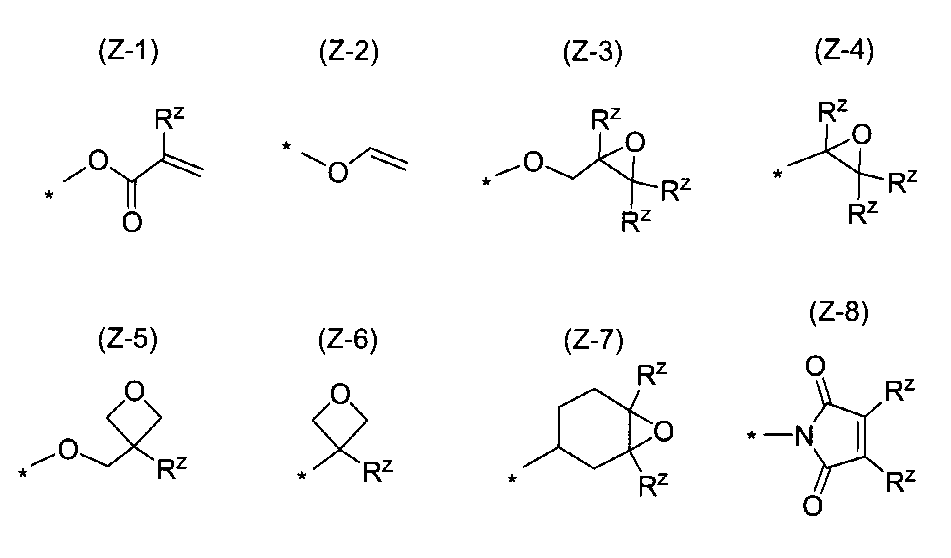
(式(Z-1)~(Z-8)中、Rzはそれぞれ独立して、水素原子、フッ素原子、塩素原子、臭素原子、ヨウ素原子、メチル基、エチル基、又はトリフルオロメチル基である。)
In formulae (Z-1) to (Z-8), R z is each independently a hydrogen atom, a fluorine atom, a chlorine atom, a bromine atom, an iodine atom, a methyl group, an ethyl group, or a trifluoromethyl group.
一般式(B)及び(B’)における前記炭化水素基は、炭素鎖中に、少なくとも、エステル結合(-COO-、-OCO-)、チオエステル結合(-CO-S-、-S-CO-)、炭酸エステル結合(-O-CO-O-)、リン酸エステル結合(O=P(O-)3)、及びアミド結合(-CO-NH-、-NH-CO-)からなる群から選択される少なくとも1種の結合を含む。当該炭化水素基は環状であっても良く、ラクトンやラクタムとして含まれていてもよい。
一般式(B)及び(B’)における前記炭化水素基は、中でも、重合性液晶化合物との親和性、合成の容易さの点から、エステル結合(-COO-、-OCO-)及びアミド結合(-CO-NH-、-NH-CO-)からなる群から選択される少なくとも1種の結合を含むことが好ましく、エステル結合(-COO-、-OCO-)を含むことがより好ましい。
当該炭化水素基の炭素数は、特に限定されないが、1~12が挙げられ、2~10であることが好ましく、2~6であることがより好ましい。
The hydrocarbon group in general formulae (B) and (B') contains at least one bond in the carbon chain selected from the group consisting of an ester bond (-COO-, -OCO-), a thioester bond (-CO-S-, -S-CO-), a carbonate bond (-O-CO-O-), a phosphate bond (O=P(O-) 3 ), and an amide bond (-CO-NH-, -NH-CO-). The hydrocarbon group may be cyclic and may be contained as a lactone or lactam.
The hydrocarbon group in general formulae (B) and (B') preferably contains at least one bond selected from the group consisting of an ester bond (-COO-, -OCO-) and an amide bond (-CO-NH-, -NH-CO-), and more preferably contains an ester bond (-COO-, -OCO-), from the viewpoints of affinity with a polymerizable liquid crystal compound and ease of synthesis.
The number of carbon atoms in the hydrocarbon group is not particularly limited, but may be 1 to 12, preferably 2 to 10, and more preferably 2 to 6.
また、前記Ra及びQとしては、炭化水素基の置換基又は炭素鎖中に含まれる連結基として、水素結合性基を有することが反応効率の点から好ましい。
ここで水素結合性基とは、ヘテロ原子に直接結合した水素を少なくとも1個有する基をいうが、酸性基とは異なる基であることがインキ安定性の点から好ましく、具体的には、アルコール性ヒドロキシ基、メルカプト基、アミノ基、アミド基等が挙げられる。なお、アルコール性ヒドロキシ基は、脂肪族炭化水素基に結合したヒドロキシ基をいう。
From the viewpoint of reaction efficiency, it is preferable that R a and Q each have a hydrogen-bonding group as a substituent of a hydrocarbon group or a linking group contained in a carbon chain.
Here, the hydrogen-bonding group refers to a group having at least one hydrogen bonded directly to a heteroatom, and is preferably a group different from an acidic group from the viewpoint of ink stability, and specific examples include an alcoholic hydroxy group, a mercapto group, an amino group, an amide group, etc. The alcoholic hydroxy group refers to a hydroxy group bonded to an aliphatic hydrocarbon group.
また、前記Ra及びQとしては、置換基として、重合性官能基を有することが重合性液晶化合物との反応率を向上させる点から好ましい。さらに、当該重合性官能基としては、後述する重合性液晶化合物の重合性官能基と反応可能な重合性官能基であることがより好ましい。 In addition, it is preferable that R a and Q have a polymerizable functional group as a substituent from the viewpoint of improving the reaction rate with the polymerizable liquid crystal compound. Furthermore, the polymerizable functional group is more preferably a polymerizable functional group capable of reacting with the polymerizable functional group of the polymerizable liquid crystal compound described later.
また、前記Ra及びQとしては、中でもメソゲン部位のように機能して、重合性液晶化合物との反応率を向上させる点から、芳香族炭化水素基を2つ以上含むことが好ましい。当該2つ以上の芳香族炭化水素基は、-O-、-S-、-OCH2-、-CH2O-、-CH2CH2-、-CO-、-COO-、-OCO-、-CO-S-、-S-CO-、-O-CO-O-、-CO-NH-、-NH-CO-、-OCO-NH-、-NH-COO-、-NH-CO-NH-、-NH-O-、-O-NH-、-SCH2-、-CH2S-、-CF2O-、-OCF2-、-CF2S-、-SCF2-、-CH=CH-COO-、-CH=CH-OCO-、-COO-CH=CH-、-OCO-CH=CH-、-COO-CH2CH2-、-OCO-CH2CH2-、-CH2CH2-COO-、-CH2CH2-OCO-、-COO-CH2-、-OCO-CH2-、-CH2-COO-、-CH2-OCO-、-CH=CH-、-N=N-、-CH=N-、-N=CH-、-CH=N-N=CH-、-CF=CF-、-C≡C-又は単結合で結合していることが、メソゲン部位のように機能し、上記効果を奏する点から好ましい。 In addition, it is preferable that R a and Q each contain two or more aromatic hydrocarbon groups, since they function as a mesogenic moiety and improve the reaction rate with the polymerizable liquid crystal compound. The two or more aromatic hydrocarbon groups are -O-, -S-, -OCH 2 -, -CH 2 O-, -CH 2 CH 2 -, -CO-, -COO-, -OCO-, -CO-S-, -S-CO-, -O-CO-O-, -CO-NH-, -NH-CO-, -OCO-NH-, -NH-COO-, -NH-CO-NH-, -NH-O-, -O-NH-, -SCH 2 -, -CH 2 S-, -CF 2 O-, -OCF 2 -, -CF 2 S-, -SCF 2 -, -CH=CH-COO-, -CH=CH-OCO-, -COO-CH=CH-, -OCO-CH=CH-, -COO-CH 2 CH 2 -, -OCO -CH 2 CH 2 It is preferred that the bonds be -, -CH 2 CH 2 -COO-, -CH 2 CH 2 -OCO-, -COO-CH 2 -, -OCO-CH 2 -, -CH 2 -COO-, -CH 2 -OCO-, -CH=CH-, -N=N-, -CH=N-, -N=CH-, -CH=N-N=CH-, -CF=CF-, -C≡C- or a single bond, as they function like a mesogenic moiety and exert the above-mentioned effects.
一般式(B’)において、nは2以上の整数である。一般式(B’)で表される化合物は重合体であってもよく、例えば、末端に(Z-1)で表される重合性官能基を有する前記一般式(B)で表される化合物の重合性官能基が重合した重合体であってもよい。従って、nは限定されるものではないが、重合性液晶化合物の配向性を阻害しにくく配向性を良好にしやすい点から、10以下であることが好ましく、8以下であることがより好ましい。 In general formula (B'), n is an integer of 2 or more. The compound represented by general formula (B') may be a polymer, for example, a polymer formed by polymerizing the polymerizable functional group of the compound represented by general formula (B) having a polymerizable functional group represented by (Z-1) at its terminal. Therefore, n is not limited, but is preferably 10 or less, and more preferably 8 or less, from the viewpoint of being less likely to impede the alignment of the polymerizable liquid crystal compound and making it easier to improve the alignment.
また、モルホリン化合物中に含まれるモルホリン環の1分子中の個数は、特に限定されないが、個数が増えると反応効率が向上し、耐熱性も向上するが、一方で多すぎると液晶化合物の配向性に影響を与える恐れがある点から、1個以上10個以下であることが好ましく、1個以上8個以下であることがより好ましく、1個以上6個以下であることがより更に好ましい。
反応効率と耐熱性の点からは、モルホリン化合物中に含まれるモルホリン環の1分子中の個数は3個以上であってよい。
In addition, the number of morpholine rings contained in one molecule of the morpholine compound is not particularly limited. As the number increases, the reaction efficiency and heat resistance are improved. On the other hand, if the number is too large, the alignment of the liquid crystal compound may be affected. Therefore, the number is preferably 1 to 10, more preferably 1 to 8, and even more preferably 1 to 6.
From the standpoint of reaction efficiency and heat resistance, the number of morpholine rings contained in one molecule of the morpholine compound may be three or more.
すなわち、モルホリン化合物は、下記(i)~(iv)からなる群から選択される少なくとも1種を有することが、重合性液晶化合物との反応率を向上させる点から好ましい。
(i)水素結合性基
(ii)重合性官能基
(iii)2つ以上の芳香族炭化水素基
(iv)1分子中に3個以上のモルホリン環
That is, it is preferable that the morpholine compound contains at least one selected from the group consisting of the following (i) to (iv) from the viewpoint of improving the reaction rate with the polymerizable liquid crystal compound.
(i) a hydrogen-bonding group; (ii) a polymerizable functional group; (iii) two or more aromatic hydrocarbon groups; and (iv) three or more morpholine rings in one molecule.
また、モルホリン化合物の分子量は、耐熱性の点から下限が190以上であることが好ましく、更に199以上であることがより好ましい。一方で、モルホリン化合物の分子量は、重合性液晶化合物の配向性を阻害しにくく配向性を良好にしやすい点から上限が2500以下であることが好ましく、2000以下であることがより好ましく、1500以下であることがより更に好ましい。 The molecular weight of the morpholine compound is preferably at least 190 in terms of heat resistance, and more preferably at least 199. On the other hand, the molecular weight of the morpholine compound is preferably at most 2500 in terms of not interfering with the alignment of the polymerizable liquid crystal compound and making it easier to improve the alignment, and more preferably at most 2000, and even more preferably at most 1500.
本発明に用いられるモルホリン化合物の具体例としては、例えば以下が挙げられるが、これらに限定されるものではない。 Specific examples of morpholine compounds that can be used in the present invention include, but are not limited to, the following:
本実施形態において、十分な耐熱性を有する重合性液晶組成物が得られる点から、前記モルホリン化合物の含有割合は、前記重合性液晶化合物と前記モルホリン化合物の総量100質量部に対して、1質量部以上であることが好ましく、2質量部以上であることがより好ましく、10質量部以上であることがより更に好ましい。一方で、過剰に含有すると重合性液晶化合物の配向性や位相差に影響を与える恐れがある点から、前記モルホリン化合物の含有割合は、前記重合性液晶化合物と前記モルホリン化合物の総量100質量部に対して、25質量部以下であることが好ましく、20質量部以下であることがより好ましい。
また、本実施形態において、十分な耐熱性を有する重合性液晶組成物が得られる点から、前記モルホリン化合物の含有割合は、重合性液晶組成物の固形分100質量部に対して0.9質量部以上であることが好ましく、1.8質量部以上であることがより好ましく、9質量部以上であることがより更に好ましい。一方で、過剰に含有すると重合性液晶化合物の配向性や位相差に影響を与える恐れがある点から、前記モルホリン化合物の含有割合は、重合性液晶組成物の固形分100質量部に対して24質量部以下であることが好ましく、20質量部以下であることがより好ましい。
なお、本開示において固形分とは溶剤を除く全ての成分をいい、例えば、当該モルホリン化合物や、後述する重合性液晶化合物が液状であっても固形分に含まれるものとする。
In the present embodiment, in order to obtain a polymerizable liquid crystal composition having sufficient heat resistance, the content ratio of the morpholine compound is preferably 1 part by mass or more, more preferably 2 parts by mass or more, and even more preferably 10 parts by mass or more, relative to 100 parts by mass of the total amount of the polymerizable liquid crystal compound and the morpholine compound. On the other hand, in order to prevent an influence on the alignment property or retardation of the polymerizable liquid crystal compound when the morpholine compound is excessively contained, the content ratio of the morpholine compound is preferably 25 parts by mass or less, and more preferably 20 parts by mass or less, relative to 100 parts by mass of the total amount of the polymerizable liquid crystal compound and the morpholine compound.
In addition, in the present embodiment, from the viewpoint of obtaining a polymerizable liquid crystal composition having sufficient heat resistance, the content ratio of the morpholine compound is preferably 0.9 parts by mass or more, more preferably 1.8 parts by mass or more, and even more preferably 9 parts by mass or more, relative to 100 parts by mass of the solid content of the polymerizable liquid crystal composition. On the other hand, from the viewpoint of the possibility that an excessive content of the morpholine compound may affect the alignment property or retardation of the polymerizable liquid crystal compound, the content ratio of the morpholine compound is preferably 24 parts by mass or less, and more preferably 20 parts by mass or less, relative to 100 parts by mass of the solid content of the polymerizable liquid crystal composition.
In the present disclosure, the solid content refers to all components excluding the solvent. For example, the morpholine compound and a polymerizable liquid crystal compound described below are included in the solid content even if they are in a liquid state.
2.重合性液晶化合物
本開示の重合性液晶組成物において、重合性液晶化合物は、従来公知のものの中から適宜選択して用いることができる。位相差フィルムに対する入射光の波長λを横軸に取り、その複屈折率を縦軸にプロットして得たグラフの傾きが負(右肩下がり)である一般的な正常分散(正分散)の重合性液晶化合物であってもよいし、逆波長分散性の重合性液晶化合物であっても良いし、波長分散性を実質的に示さない(フラット分散又は低波長分散)重合性液晶化合物であっても良い。
中でも熱による劣化を受けやすい点から、逆波長分散性の重合性液晶化合物、及び波長分散性を実質的に示さない(フラット分散又は低波長分散)重合性液晶化合物が好適に用いられ、逆波長分散性の重合性液晶化合物が好適に用いられる。
例えば、逆波長分散性を示す化合物の例としては特許第5463666号、特許第4186981号、特許第5962760号、及び特許第5826759号、特許第6568103号、特許第6427340号、特開2016-166344に記載の重合性液晶化合物が挙げられる。フラット分散性を示す化合物の例としてはRecueil des Travaux Chimiques des Pays-Bas(1996),115(6),321-328に記載の化合物などがあげられる。
2. Polymerizable Liquid Crystal Compound In the polymerizable liquid crystal composition of the present disclosure, the polymerizable liquid crystal compound may be appropriately selected from those known in the art. The polymerizable liquid crystal compound may be a general normal dispersion (positive dispersion) polymerizable liquid crystal compound in which the slope of a graph obtained by plotting the wavelength λ of incident light on a retardation film on the horizontal axis and the birefringence on the vertical axis is negative (sagging to the right), a reverse wavelength dispersion polymerizable liquid crystal compound, or a polymerizable liquid crystal compound that does not substantially show wavelength dispersion (flat dispersion or low wavelength dispersion).
Among these, polymerizable liquid crystal compounds having reverse wavelength dispersion and polymerizable liquid crystal compounds having substantially no wavelength dispersion (flat dispersion or low wavelength dispersion) are preferably used because they are susceptible to deterioration due to heat, and polymerizable liquid crystal compounds having reverse wavelength dispersion are preferably used.
For example, examples of compounds exhibiting reverse wavelength dispersion include the polymerizable liquid crystal compounds described in Japanese Patent Nos. 5463666, 4186981, 5962760, 5826759, 6568103, 6427340, and JP-A-2016-166344. Examples of compounds exhibiting flat dispersion include the compounds described in Recueil des Travaux Chimiques des Pays-Bas (1996), 115(6), 321-328.
本実施形態においては、メソゲン部位の少なくとも一方の末端に重合性官能基を有する重合性液晶化合物であることが好ましく、メソゲン部位の両末端に重合性官能基を有する重合性液晶化合物であることがより好ましい。1分子中に重合性官能基を2つ以上有する重合性液晶化合物は、塗膜の硬度や耐久性を向上させることができる。
本開示に用いられる重合性液晶化合物としては、例えば、下記一般式(I)で表される重合性液晶化合物が挙げられる。
In the present embodiment, the polymerizable liquid crystal compound is preferably a polymerizable liquid crystal compound having a polymerizable functional group at at least one end of the mesogenic portion, and more preferably a polymerizable liquid crystal compound having a polymerizable functional group at both ends of the mesogenic portion. A polymerizable liquid crystal compound having two or more polymerizable functional groups in one molecule can improve the hardness and durability of the coating film.
Examples of the polymerizable liquid crystal compound used in the present disclosure include a polymerizable liquid crystal compound represented by the following general formula (I).

[一般式(I)において、LCcoreは、無置換であるか又は置換基ELC及び置換基Xからなる群から選ばれる1つ以上の置換基によって置換されていても良い単環、縮合環又は環集合芳香族基を含む二価の基を表し、R1及びR2はそれぞれ独立して、下記一般式(II-1)及び(II-2)から選ばれる基を表すが、R1及びR2の少なくとも1つは下記一般式(II-1)から選ばれる基を表す。
[In general formula (I), LC core represents a divalent group containing a monocyclic, condensed ring, or ring assembly aromatic group which is unsubstituted or optionally substituted with one or more substituents selected from the group consisting of substituents E LC and substituents X, R 1 and R 2 each independently represent a group selected from the following general formulae (II-1) and (II-2), and at least one of R 1 and R 2 represents a group selected from the following general formula (II-1).
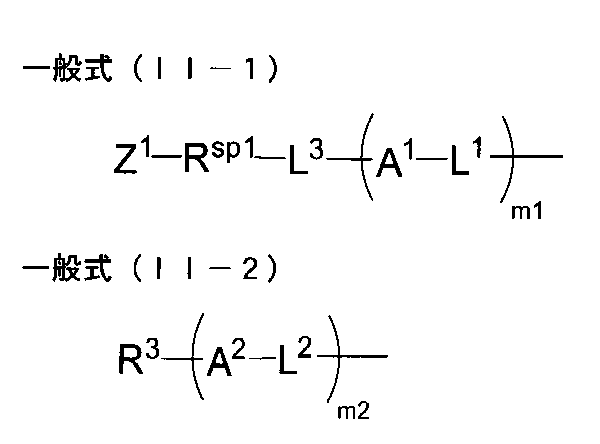
{L1、L2、及びL3はそれぞれ独立して、-O-、-S-、-OCH2-、-CH2O-、-CH2CH2-、-CO-、-COO-、-OCO-、-CO-S-、-S-CO-、-O-CO-O-、-CO-NH-、-NH-CO-、-OCO-NH-、-NH-COO-、-NH-CO-NH-、-NH-O-、-O-NH-、-SCH2-、-CH2S-、-CF2O-、-OCF2-、-CF2S-、-SCF2-、-CH=CH-COO-、-CH=CH-OCO-、-COO-CH=CH-、-OCO-CH=CH-、-COO-CH2CH2-、-OCO-CH2CH2-、-CH2CH2-COO-、-CH2CH2-OCO-、-COO-CH2-、-OCO-CH2-、-CH2-COO-、-CH2-OCO-、-CH=CH-、-N=N-、-CH=N-、-N=CH-、-CH=N-N=CH-、-CF=CF-、-C≡C-又は単結合を表し、
A1及びA2はそれぞれ独立して、無置換であるか又は1つ以上の置換基Eによって置換されていても良い二価の炭素原子数3~20の脂環式炭化水素基又は芳香族炭化水素基を表すが、当該脂環式炭化水素基及び芳香族炭化水素基の任意の炭素原子はヘテロ原子に置換されていても良く、
Rsp1は、1個の-CH2-又は隣接していない2個以上の-CH2-が各々独立して-O-、-COO-、-OCO-、-OCO-O-、-CO-NH-、-NH-CO-、-CH=CH-又は-C≡C-に置き換えられても良い炭素原子数1~20の直鎖もしくは分岐のアルキレン基又は単結合を表し、Z1は重合性官能基を表し、
R3は、水素原子、フッ素原子、塩素原子、臭素原子、ヨウ素原子、ペンタフルオロスルフラニル基、ニトロ基、シアノ基、イソシアノ基、チオイソシアノ基、又は、1個の-CH2-又は隣接していない2個以上の-CH2-が各々独立して-O-、-S-、-CO-、-COO-、-OCO-、-CO-S-、-S-CO-、-O-CO-O-、-CO-NH-、-NH-CO-、-CH=CH-、-CF=CF-又は-C≡C-に置き換えられても良い炭素原子数1~20の直鎖状又は分岐状アルキル基を表すが、当該アルキル基中の任意の水素原子はフッ素原子に置換されても良い。
m1及びm2はそれぞれ独立して0~3の整数を表すが、化合物内のm1及びm2の少なくとも1つは1以上の整数を表す。}
前記置換基ELCは、フッ素原子、塩素原子、臭素原子、ヨウ素原子、ペンタフルオロスルフラニル基、ニトロ基、シアノ基、イソシアノ基、アミノ基、ヒドロキシル基、メルカプト基、メチルアミノ基、ジメチルアミノ基、ジエチルアミノ基、ジイソプロピルアミノ基、トリメチルシリル基、ジメチルシリル基、チオイソシアノ基、これらの置換基によって置換されていても良い炭素原子数1~20の直鎖状又は分岐状アルキル基、又は、1個の-CH2-又は隣接していない2個以上の-CH2-が各々独立して-O-、-S-、-CO-、-COO-、-OCO-、-CO-S-、-S-CO-、-O-CO-O-、-CO-NH-、-NH-CO-、-CH=CH-COO-、-CH=CH-OCO-、-COO-CH=CH-、-OCO-CH=CH-、-CH=CH-、-CF=CF-又は-C≡C-に置き換えられても良い炭素原子数1~20の直鎖状又は分岐状アルキル基を表すが、当該アルキル基中の任意の水素原子はフッ素原子に置換されても良く、或いは、前記置換基ELCは-LE-RspE-ZEで表される基を表し、ここで、前記LE、RspE、及びZEは、それぞれ、前記一般式(II-1)で定義されるL3、Rsp1、及びZ1と同じ意味を表し、前記置換基Xは、前記置換基ELCとは異なる任意の置換基を表す。]
{L 1 , L 2 and L 3 are each independently -O-, -S-, -OCH 2 -, -CH 2 O-, -CH 2 CH 2 -, -CO-, -COO-, -OCO-, -CO-S-, -S-CO-, -O-CO-O-, -CO-NH-, -NH-CO-, -OCO-NH-, -NH-COO-, -NH -CO-NH-, -NH-O-, -O-NH-, -SCH 2 -, -CH 2 S-, -CF 2 O-, -OCF 2 -, -CF 2 S-, -SCF 2 - , -CH=CH-COO-, -CH=CH-OCO-, -COO-CH=CH-, -OCO-CH=CH-, -COO-CH 2 CH 2 -, -OCO- CH2CH2- , -CH2CH2 - COO- , -CH2CH2- OCO- , -COO- CH2- , -OCO- CH2- , -CH2 - COO-, —CH 2 —OCO—, —CH═CH—, —N═N—, —CH═N—, —N═CH—, —CH═N-N═CH—, —CF═CF—, —C≡ represents C- or a single bond,
A 1 and A 2 each independently represent a divalent alicyclic hydrocarbon group having 3 to 20 carbon atoms which may be unsubstituted or substituted with one or more substituents E, or an aromatic represents a hydrocarbon group, and any carbon atom in the alicyclic hydrocarbon group or aromatic hydrocarbon group may be substituted with a heteroatom;
R sp1 represents one -CH 2 - or two or more non-adjacent -CH 2 - groups each independently representing -O-, -COO-, -OCO-, -OCO-O-, -CO- represents a straight-chain or branched alkylene group having 1 to 20 carbon atoms which may be replaced by NH-, -NH-CO-, -CH=CH- or -C≡C-, or a single bond; Z 1 represents a polymerizable represents a functional group,
R 3 is a hydrogen atom, a fluorine atom, a chlorine atom, a bromine atom, an iodine atom, a pentafluorosulfuranyl group, a nitro group, a cyano group, an isocyano group, a thioisocyano group, or one -CH 2 - or adjacent Two or more -CH 2 - groups not containing each other are independently -O-, -S-, -CO-, -COO-, -OCO-, -CO-S-, -S-CO-, -O- A straight chain having 1 to 20 carbon atoms which may be replaced by CO-O-, -CO-NH-, -NH-CO-, -CH=CH-, -CF=CF- or -C≡C-. or a branched alkyl group, any hydrogen atom in the alkyl group may be substituted with a fluorine atom.
m1 and m2 each independently represent an integer of 0 to 3, provided that at least one of m1 and m2 in the compound represents an integer of 1 or more.
The substituent E LC is a fluorine atom, a chlorine atom, a bromine atom, an iodine atom, a pentafluorosulfuranyl group, a nitro group, a cyano group, an isocyano group, an amino group, a hydroxyl group, a mercapto group, a methylamino group, a dimethylamino group, a diethylamino group, a diisopropylamino group, a trimethylsilyl group, a dimethylsilyl group, a thioisocyano group, a linear or branched alkyl group having 1 to 20 carbon atoms which may be substituted by these substituents, or or two or more non-adjacent -CH 2 - is independently -O-, -S-, -CO-, -COO-, -OCO-, -CO-S-, -S-CO-, -O-CO-O-, or -CO-NH -, -NH-CO-, -CH=CH-COO-, -CH=CH-OCO-, -COO-CH=CH-, -OCO-CH=CH-, -CH=CH-, -CF=CF represents a linear or branched alkyl group having 1 to 20 carbon atoms which may be replaced by - or -C≡C-, and any hydrogen atom in the alkyl group may be replaced by a fluorine atom. Alternatively, the substituent E LC represents a group represented by -L E -R spE -Z E , where L E , R spE , and Z E are each represented by the general formula (II-1 L 3 , R sp1 and Z are defined as 1 , and the substituent X represents an arbitrary substituent different from the substituent E LC .
前記LCcoreにおいて、単環芳香族基を構成する単環の芳香族炭化水素環としては、ベンゼン環が挙げられ、単環芳香族基を構成する単環の芳香族複素環としては、フラン環、ピリジン環、ピリミジン環、ピラジン環等が挙げられる。縮合環芳香族基を構成する縮合環の芳香族炭化水素環としては、ナフタレン環、アントラセン環、フェナントレン環等が挙げられ、縮合環芳香族基を構成する縮合環の芳香族複素環としては、キノリン環、アクリジン環、フェナントリジン環、ベンゾチアゾール環、ベンゾオキサゾール環、ベンゾイミダゾール環、特開2010-31223号公報に記載される一般式(1)中のArで表される基が有し得る縮合環の芳香族複素環、及び特開2016-081035号公報に記載される一般式1のArで表される基が有し得る縮合環の芳香族複素環等が挙げられる。環集合とは、2環が共有原子を持たず、結合を介して連結している構造をいい、環集合芳香族基を構成する構造としては、前記単環及び縮合環の芳香族炭化水素環並びに前記単環及び縮合環の芳香族複素環からなる群から選択される少なくとも2種の環が直接連結している構造が挙げられる。炭素原子数4~16の環集合芳香族基を構成する構造としては、例えば、ビフェニル、2-フェニルナフタレン、1-フェニルナフタレン等が挙げられる。
前記LCcoreの単環、縮合環又は環集合芳香族基を含む二価の基において、R1及びR2は、単環、縮合環又は環集合芳香族基に結合している。
単環、縮合環又は環集合芳香族基を含む二価の基は、無置換であっても良いが、置換基ELC及び置換基Xからなる群から選ばれる1つ以上の置換基によって置換されていても良い。なお、単環、縮合環を含む二価の基中に含まれる芳香環のπ電子の合計数は、12以上22以下であることが好ましく、14以上22以下であることがより好ましい。また、環集合芳香族基を含む二価の基中に含まれる芳香環のπ電子の合計数は、16以上64以下であることが好ましく、22以上40以下であることがより好ましい。
In the LC core , examples of the monocyclic aromatic hydrocarbon ring constituting the monocyclic aromatic group include a benzene ring, and examples of the monocyclic aromatic heterocycle constituting the monocyclic aromatic group include a furan ring, a pyridine ring, a pyrimidine ring, a pyrazine ring, etc. Examples of the fused aromatic hydrocarbon ring constituting the fused aromatic group include a naphthalene ring, an anthracene ring, a phenanthrene ring, etc. Examples of the fused aromatic heterocycle constituting the fused aromatic group include a quinoline ring, an acridine ring, a phenanthridine ring, a benzothiazole ring, a benzoxazole ring, a benzimidazole ring, an aromatic heterocycle of a fused ring that may be possessed by a group represented by Ar in general formula (1) described in JP-A-2010-31223, and an aromatic heterocycle of a fused ring that may be possessed by a group represented by Ar in
In the divalent group containing a monocyclic, fused ring, or ring assembly aromatic group of the LC core , R 1 and R 2 are bonded to the monocyclic, fused ring, or ring assembly aromatic group.
The divalent group containing a monocyclic ring, a fused ring, or a ring assembly aromatic group may be unsubstituted or may be substituted with one or more substituents selected from the group consisting of the substituents E LC and the substituents X. The total number of π electrons of the aromatic rings contained in the divalent group containing a monocyclic ring or a fused ring is preferably 12 to 22, more preferably 14 to 22. The total number of π electrons of the aromatic rings contained in the divalent group containing a ring assembly aromatic group is preferably 16 to 64, more preferably 22 to 40.
前記LCcoreとして、例えば、下記一般式(i)、一般式(ii)及び一般式(iii)で表される構造が挙げられる。 Examples of the LC core include structures represented by the following general formulae (i), (ii) and (iii).

(式中、T1は、NまたはCHを表し、T2は、-S-、-O-、または、-N(RTa)-を表し、RTaは、水素原子または炭素数1~6のアルキル基を表し、Y1は、置換基を有してもよい、炭素数6~12の芳香族炭化水素基、または、炭素数3~12の芳香族複素環基を表す。
T3及びT4は、それぞれ独立に、-O-、-N(RTb)-、-S-、および、-CO-からなる群から選択される基を表し、RTbは、水素原子または置換基を表す。X1は、水素原子または置換基が結合していてもよい第14~16族の非金属原子を表す。
E1、E2、E3、及びE4は、それぞれ独立に、水素原子、置換基ELC、炭素数3~20の脂環式炭化水素基、又は1価の炭素数6~20の芳香族炭化水素基を表し、E1及びE2、並びに、E3及びE4は、それぞれ独立に、互いに結合して芳香環または芳香族複素環を形成してもよい。
J2は、N、又はCHを表し、
W1は、芳香環を有する炭素原子数2~30の有機基を表すが、当該芳香環は無置換であるか又は1つ以上の置換基ELCによって置換されていても良く、
W2は炭素原子数3~20のアルキル基、炭素原子数3~12のシクロアルキル基、炭素原子数3~12のシクロアルケニル基、又は芳香環を有する炭素原子数2~30の有機基を表し、当該アルキル基、シクロアルキル基、シクロアルケニル基、及び芳香環はそれぞれ、無置換であるか又は1つ以上の置換基ELCによって置換されていても良く、当該アルキル基は当該シクロアルキル基又はシクロアルケニル基によって置換されていても良く、当該アルキル基は、1個の-CH2-又は隣接していない2個以上の-CH2-が各々独立して-O-、-S-、-CO-、-COO-、-OCO-、-CO-S-、-S-CO-、-SO2-、-O-CO-O-、-CO-NH-、-NH-CO-、-CH=CH-COO-、-CH=CH-OCO-、-COO-CH=CH-、-OCO-CH=CH-、-CH=CH-、-CF=CF-又は-C≡C-に置き換えられていても良く、当該シクロアルキル基又はシクロアルケニル基中の1個の-CH2-又は隣接していない2個以上の-CH2-は各々独立して-O-、-CO-、-COO-、-OCO-、又は-O-CO-O-に置き換えられていても良い。
置換基ELCは前記と同じ意味を表し、n1は0~2の整数を表す。
*(アスタリスク)は、前記一般式(I)におけるR11又はR12との結合位置を示す。)
(In the formula, T 1 represents N or CH, T 2 represents -S-, -O-, or -N(R Ta )-, R Ta represents a hydrogen atom or an alkyl group having 1 to 6 carbon atoms, and Y 1 represents an aromatic hydrocarbon group having 6 to 12 carbon atoms or an aromatic heterocyclic group having 3 to 12 carbon atoms, which may have a substituent.
T3 and T4 each independently represent a group selected from the group consisting of -O-, -N(R Tb )-, -S-, and -CO-, where R Tb represents a hydrogen atom or a substituent. X1 represents a hydrogen atom or a nonmetallic atom of Groups 14 to 16 which may be bonded to a substituent.
E 1 , E 2 , E 3 , and E 4 each independently represent a hydrogen atom, a substituent E LC , an alicyclic hydrocarbon group having 3 to 20 carbon atoms, or a monovalent aromatic hydrocarbon group having 6 to 20 carbon atoms, and E 1 and E 2 , and E 3 and E 4 each independently may bond to each other to form an aromatic ring or an aromatic heterocycle.
J2 represents N or CH;
W 1 represents an organic group having 2 to 30 carbon atoms and having an aromatic ring, and the aromatic ring may be unsubstituted or substituted with one or more substituents E LC ;
W2 represents an alkyl group having 3 to 20 carbon atoms, a cycloalkyl group having 3 to 12 carbon atoms, a cycloalkenyl group having 3 to 12 carbon atoms, or an organic group having 2 to 30 carbon atoms and an aromatic ring, the alkyl group, the cycloalkyl group, the cycloalkenyl group, and the aromatic ring may each be unsubstituted or substituted with one or more substituents ELC , the alkyl group may be substituted with the cycloalkyl group or the cycloalkenyl group, and the alkyl group is one -CH2- or two or more non-adjacent -CH2- each independently represent -O-, -S-, -CO-, -COO-, -OCO-, -CO-S-, -S-CO-, -SO2 may be replaced by -, -O-CO-O-, -CO-NH-, -NH-CO-, -CH=CH-COO-, -CH=CH-OCO-, -COO-CH=CH-, -OCO-CH=CH-, -CH=CH-, -CF=CF- or -C≡C-, and one -CH 2 - or two or more non-adjacent -CH 2 - in the cycloalkyl group or cycloalkenyl group may each independently be replaced by -O-, -CO-, -COO-, -OCO- or -O-CO-O-.
The substituent E LC has the same meaning as defined above, and n1 represents an integer of 0 to 2.
* (asterisk) indicates the bonding position with R11 or R12 in the general formula (I).
前記一般式(i)及び一般式(ii)で表される構造において、Y1が示す炭素数6~12の芳香族炭化水素基としては、例えば、フェニル基、2,6-ジエチルフェニル基、ナフチル基などのアリール基が挙げられる。Y1が示す炭素数3~12の芳香族複素環基としては、例えば、チエニル基、チアゾリル基、フリル基、ベンゾフリル基、ピリジル基などのヘテロアリール基が挙げられる。また、Y1が有していてもよい置換基としては、例えば、アルキル基、アルコキシ基、ハロゲン原子などが挙げられる。
また、X1が示す第14~16族の非金属原子としては、例えば、酸素原子、硫黄原子、置換基を有する窒素原子、置換基を有する炭素原子が挙げられ、置換基としては、具体的には、例えば、アルキル基、アルコキシ基、アルキル置換アルコキシ基、環状アルキル基、アリール基(例えば、フェニル基、ナフチル基など)、シアノ基、アミノ基、ニトロ基、アルキルカルボニル基、スルホ基、水酸基等が挙げられる。
In the structures represented by the general formulae (i) and (ii), examples of the aromatic hydrocarbon group having 6 to 12 carbon atoms represented by Y 1 include aryl groups such as a phenyl group, a 2,6-diethylphenyl group, and a naphthyl group. Examples of the aromatic heterocyclic group having 3 to 12 carbon atoms represented by Y 1 include heteroaryl groups such as a thienyl group, a thiazolyl group, a furyl group, a benzofuryl group, and a pyridyl group. Examples of the substituent that Y 1 may have include an alkyl group, an alkoxy group, and a halogen atom.
Examples of the non-metallic atom of Groups 14 to 16 represented by X1 include an oxygen atom, a sulfur atom, a nitrogen atom having a substituent, and a carbon atom having a substituent. Specific examples of the substituent include an alkyl group, an alkoxy group, an alkyl-substituted alkoxy group, a cyclic alkyl group, an aryl group (e.g., a phenyl group, a naphthyl group, etc.), a cyano group, an amino group, a nitro group, an alkylcarbonyl group, a sulfo group, a hydroxyl group, etc.
前記一般式(i)で表される構造の具体例としては、特開2010-31223号公報に記載の構造を挙げることができ、前記一般式(ii)で表される構造の具体例としては、特開2016-081035号公報に記載の構造を挙げることができ、前記一般式(iii)で表される構造の具体例としては、特開2020-019848号公報に記載の構造を挙げることができる。 A specific example of the structure represented by the general formula (i) is the structure described in JP-A-2010-31223, a specific example of the structure represented by the general formula (ii) is the structure described in JP-A-2016-081035, and a specific example of the structure represented by the general formula (iii) is the structure described in JP-A-2020-019848.
LCcoreにおける置換基ELCとしては、中でも、合成が容易な点から、フッ素原子、塩素原子、ヒドロキシ基、メルカプト基、メチルアミノ基、ジメチルアミノ基、又は、1個の-CH2-又は隣接していない2個以上の-CH2-が各々独立して-O-、-S-、-CO-、-COO-、-OCO-、-CO-S-、-S-CO-、-O-CO-O-、-CO-NH-、-NH-CO-、によって置換されても良い炭素原子数1~6の直鎖状又は分岐状アルキル基であることが好ましい。
なお、前記LCcoreが有する置換基ELCの個数は特に限定はされない。
Among these, from the viewpoint of ease of synthesis, the substituent E LC in LC core is preferably a fluorine atom, a chlorine atom, a hydroxy group, a mercapto group, a methylamino group, a dimethylamino group, or a linear or branched alkyl group having 1 to 6 carbon atoms in which one -CH 2 - or two or more non-adjacent -CH 2 - groups may each be independently replaced by -O-, -S-, -CO-, -COO-, -OCO-, -CO-S-, -S-CO-, -O-CO-O-, -CO-NH- or -NH-CO-.
The number of the substituents E LC contained in the LC core is not particularly limited.
LCcoreにおける置換基Xは、前記置換基ELCとは異なる任意の置換基であり、特に限定はされない。LCcoreにおける置換基Xとしては、芳香族環を含む基を挙げることができ、例えば、特許第6473537号に記載される一般式(D-1)で表される基、及び特開2019-120945号に記載される-M-Dで表される基(ここで、Mは-CH=CH-、-N=CH-、-CH=N-、又は-N=N-を表し、Dは、インドレニン環構造を含む一価の基を表す。)等を挙げることができる。
前記Dは、下記一般式(d)の構造を含めばよく、更に置換基を有していても良く、下記一般式(d)のベンゼン環を含む縮合環が形成されていても良く、下記一般式(d)のいずれかの水素原子がMに置換した構造が挙げられる。
The substituent X in the LC core is an arbitrary substituent different from the substituent E LC and is not particularly limited. Examples of the substituent X in the LC core include a group containing an aromatic ring, such as a group represented by the general formula (D-1) described in Japanese Patent No. 6473537 and a group represented by -M-D described in JP-A-2019-120945 (wherein M represents -CH=CH-, -N=CH-, -CH=N-, or -N=N-, and D represents a monovalent group containing an indolenine ring structure.) and the like can be mentioned.
The D may include a structure of the following general formula (d), and may further have a substituent, may have a condensed ring including a benzene ring of the following general formula (d), and may include a structure in which any hydrogen atom of the following general formula (d) is substituted with M.

(一般式(D-1)中、G1は水素原子又は炭素原子数1~6のアルキル基を表すが、当該アルキル基は無置換であるか又は1つ以上の前記置換基ELCによって置換されていても良く、
Q1は、芳香族炭化水素基を有する炭素原子数2~30の有機基を表すが、当該芳香族炭化水素基の任意の炭素原子はヘテロ原子に置換されていても良く、芳香族炭化水素基は無置換であるか又は1つ以上の前記置換基ELCによって置換されていても良く、
J1は、-O-、-S-、-COO-、-OCO-、-OCO-O-、-NQ2-、-N=CQ2-、-CO-NQ2-、-OCO-NQ2-又は-O-NQ2-を表し、Q2は水素原子、炭素原子数1~20のアルキル基、炭素原子数3~12のシクロアルキル基、炭素原子数3~12のシクロアルケニル基、芳香族炭化水素基(当該芳香族炭化水素基の任意の炭素原子はヘテロ原子に置換されていても良い)を有する炭素原子数2~30の有機基、又は-(L6-A5)q-L7-Rsp2-Z2を表し、当該アルキル基、シクロアルキル基、シクロアルケニル基、及び芳香族炭化水素基はそれぞれ、無置換であるか又は1つ以上の前記置換基ELCによって置換されていても良く、当該アルキル基は当該シクロアルキル基又はシクロアルケニル基によって置換されていても良く、当該アルキル基中の1個の-CH2-又は隣接していない2個以上の-CH2-は各々独立して-O-、-S-、-CO-、-COO-、-OCO-、-CO-S-、-S-CO-、-SO2-、-O-CO-O-、-CO-NH-、-NH-CO-、-CH=CH-COO-、-CH=CH-OCO-、-COO-CH=CH-、-OCO-CH=CH-、-CH=CH-、-CF=CF-又は-C≡C-に置き換えられても良く、当該シクロアルキル基又はシクロアルケニル基中の1個の-CH2-又は隣接していない2個以上の-CH2-は各々独立して-O-、-CO-、-COO-、-OCO-、又は-O-CO-O-に置き換えられても良く、L6、A5、L7、Rsp2、及びZ2は、それぞれ、前記L1、A1、L3、Rsp1、及びZ1で定義されるものと同一のものを表すが、それぞれ前記L1、A1、L3、Rsp1、及びZ1と同一であっても異なっていても良く、qは0~4の整数を表し、L6、及びA5がそれぞれ複数存在する場合は、各々同一であっても異なっていても良い。)
In the general formula (D-1), G 1 represents a hydrogen atom or an alkyl group having 1 to 6 carbon atoms, and the alkyl group may be unsubstituted or substituted with one or more of the substituents E LC .
Q1 represents an organic group having 2 to 30 carbon atoms and having an aromatic hydrocarbon group, any carbon atom of the aromatic hydrocarbon group may be substituted with a heteroatom, and the aromatic hydrocarbon group may be unsubstituted or substituted with one or more of the substituents ELC ;
J 1 represents -O-, -S-, -COO-, -OCO-, -OCO-O-, -NQ 2 -, -N═CQ 2 -, -CO-NQ 2 -, -OCO-NQ 2 - or -O-NQ 2 -; Q 2 represents a hydrogen atom, an alkyl group having 1 to 20 carbon atoms, a cycloalkyl group having 3 to 12 carbon atoms, a cycloalkenyl group having 3 to 12 carbon atoms, an organic group having 2 to 30 carbon atoms and an aromatic hydrocarbon group (any carbon atom of the aromatic hydrocarbon group may be substituted with a heteroatom), or -(L 6 -A 5 ) q -L 7 -R sp2 -Z 2 ; the alkyl group, cycloalkyl group, cycloalkenyl group and aromatic hydrocarbon group are each unsubstituted or have one or more of the substituents E L 6 may be substituted by LC , the alkyl group may be substituted by the cycloalkyl group or cycloalkenyl group, one -CH 2 - or two or more non-adjacent -CH 2 - in the alkyl group may be independently replaced by -O-, -S-, -CO-, -COO-, -OCO-, -CO-S-, -S-CO-, -SO 2 -, -O-CO-O-, -CO-NH-, -NH-CO-, -CH=CH-COO-, -CH=CH-OCO-, -COO-CH=CH-, -OCO-CH=CH-, -CH=CH-, -CF=CF- or -C≡C-, one -CH 2 - or two or more non-adjacent -CH 2 - in the cycloalkyl group or cycloalkenyl group may be independently replaced by -O-, -CO-, -COO-, -OCO- or -O-CO-O-, , A 5 , L 7 , R sp2 and Z 2 are the same as those defined for L 1 , A 1 , L 3 , R sp1 and Z 1 , respectively, but may be the same as or different from L 1 , A 1 , L 3 , R sp1 and Z 1 , respectively, q represents an integer of 0 to 4, and when a plurality of L 6 and A 5 are present, they may be the same as or different from each other.

(一般式(d)中、Rd1及びRd2はそれぞれ独立して、炭素原子数1~20のアルキル基を表し、当該アルキル基は無置換であるか又は1つ以上の前記置換基ELCによって置換されていても良く、当該アルキル基中の1個の-CH2-又は隣接していない2個以上の-CH2-は各々独立して-O-、-S-、-CO-、-COO-、-OCO-、-CO-S-、-S-CO-、-SO2-、-O-CO-O-、-CO-NH-、-NH-CO-、-CH=CH-COO-、-CH=CH-OCO-、-COO-CH=CH-、-OCO-CH=CH-、-CH=CH-、-CF=CF-又は-C≡C-によって置き換えられていても良く、或いは、Rd1及びRd2は互いに結合して3~7員環の非芳香族炭化水素環を形成していても良く、当該非芳香族炭化水素環は無置換であるか又は1つ以上の前記置換基ELCによって置換されていても良く、当該非芳香族炭化水素環の任意の炭素原子はヘテロ原子に置換されていても良いものである。) (In general formula (d), R d1 and R d2 each independently represent an alkyl group having 1 to 20 carbon atoms, which alkyl group may be unsubstituted or substituted by one or more of the substituents E LC , and one -CH 2 - or two or more non-adjacent -CH 2 - in the alkyl group may each independently be replaced by -O-, -S-, -CO-, -COO-, -OCO-, -CO-S-, -S-CO-, -SO 2 -, -O-CO-O-, -CO-NH-, -NH-CO-, -CH=CH-COO-, -CH=CH-OCO-, -COO-CH=CH-, -OCO-CH=CH-, -CH=CH-, -CF=CF- or -C≡C-, or R d1 and R d2 may be bonded to each other to form a 3- to 7-membered non-aromatic hydrocarbon ring, which may be unsubstituted or substituted with one or more of the substituents ELC , and any carbon atom of the non-aromatic hydrocarbon ring may be substituted with a heteroatom.
一般式(D-1)で表される基の具体例としては、特許第6473537号公報に記載の構造を挙げることができ、前記-M-Dで表される基の具体例としては、特開2019-120945号公報に記載の構造を挙げることができる。
なお、前記LCcoreが有する置換基Xの個数は、特に限定はされないが、特許第6473537号に記載される一般式(D-1)で表される基、及び特開2019-120945号に記載される前記-M-Dで表される基の個数は、重合性液晶化合物が所望のフラット波長分散性又は逆波長分散性になりやすい点から、1個又は2個であることが好ましい。また、LCcoreが有する置換基Xが互いに結合して環を構成している場合、LCcoreが有する当該環の個数は、1個又は2個であることが好ましく、1個であることがより好ましい。
Specific examples of the group represented by the general formula (D-1) include the structure described in Japanese Patent No. 6473537, and specific examples of the group represented by -MD include the structure described in JP-A-2019-120945.
The number of the substituents X in the LC core is not particularly limited, but the number of the group represented by the general formula (D-1) described in Japanese Patent No. 6473537 and the group represented by the -M-D described in JP-A-2019-120945 is preferably 1 or 2, since the polymerizable liquid crystal compound is likely to have the desired flat wavelength dispersion or reverse wavelength dispersion. In addition, when the substituents X in the LC core are bonded to each other to form a ring, the number of the rings in the LC core is preferably 1 or 2, and more preferably 1.
LCcoreにおいて、特許第6473537号に記載される一般式(D-1)で表される基、及び特開2019-120945号に記載される前記-M-Dで表される基が置換されている単環、縮合環又は環集合芳香族基の環構造としては、中でも原料調達の容易さの点から、ベンゼン、ナフタレン、ビフェニルであることが好ましく、波長分散性の点からはベンゼンであることが好ましく、分子同士の配向性、複屈折率を向上する点からは、ビフェニルであることが好ましい。複屈折率(△n)が大きい重合性液晶化合物を用いることにより、薄膜で位相差を実現することが可能である。 In the LC core , the ring structure of the single ring, condensed ring, or ring assembly aromatic group substituted with the group represented by the general formula (D-1) described in Japanese Patent No. 6473537 and the group represented by -M-D described in JP-A-2019-120945 is preferably benzene, naphthalene, or biphenyl from the viewpoint of ease of raw material procurement, preferably benzene from the viewpoint of wavelength dispersion, and preferably biphenyl from the viewpoint of improving the alignment and birefringence between molecules. By using a polymerizable liquid crystal compound with a large birefringence (Δn), it is possible to realize a retardation in a thin film.
一般式(II-1)及び(II-2)において、L1、L2、及びL3はそれぞれ独立して、-O-、-S-、-OCH2-、-CH2O-、-CH2CH2-、-CO-、-COO-、-OCO-、-CO-S-、-S-CO-、-O-CO-O-、-CO-NH-、-NH-CO-、-OCO-NH-、-NH-COO-、-NH-CO-NH-、-NH-O-、-O-NH-、-SCH2-、-CH2S-、-CF2O-、-OCF2-、-CF2S-、-SCF2-、-CH=CH-COO-、-CH=CH-OCO-、-COO-CH=CH-、-OCO-CH=CH-、-COO-CH2CH2-、-OCO-CH2CH2-、-CH2CH2-COO-、-CH2CH2-OCO-、-COO-CH2-、-OCO-CH2-、-CH2-COO-、-CH2-OCO-、-CH=CH-、-N=N-、-CH=N-、-N=CH-、-CH=N-N=CH-、-CF=CF-、-C≡C-又は単結合を表す。なお、L1及びL2がそれぞれ独立して、複数現れる場合は、各々同一であっても異なっていても良い。 In general formulae (II-1) and (II-2), L 1 , L 2 and L 3 each independently represent -O-, -S-, -OCH 2 -, -CH 2 O-, -CH 2 CH 2 -, -CO-, -COO-, -OCO-, -CO-S-, -S-CO-, -O-CO-O-, -CO-NH-, -NH-CO-, -OCO-NH-, -NH-COO-, -NH-CO-NH-, -NH-O-, -O-NH-, -SCH 2 -, -CH 2 S-, -CF 2 O-, -OCF 2 -, -CF 2 S-, -SCF 2 -, -CH=CH-COO-, -CH=CH-OCO-, -COO-CH=CH-, -OCO-CH=CH-, -COO-CH 2 CH 2 -, -OCO- CH 2 CH 2 -, -CH 2 CH 2 -COO-, -CH 2 CH 2 -OCO-, -COO-CH 2 -, -OCO-CH 2 -, -CH 2 -COO- , -CH 2 -OCO- , -CH = CH- , -N=N-, -CH=N-, -N=CH-, -CH=N-N=CH-, -CF=CF-, -C≡C- or a single bond. When L 1 and L 2 each independently appear multiple times, they may be the same or different.
L1及びL2としてより具体的には、配向性、原料の入手容易さ及び合成の容易さの観点から、各々独立して-O-、-S-、-COO-、-OCO-、-OCH2-、-CH2O-、-CF2O-、-OCF2-、-CH2CH2-、-CF2CF2-、-CH=CH-COO-、-CH=CH-OCO-、-COO-CH=CH-、-OCO-CH=CH-、-COO-CH2CH2-、-OCO-CH2CH2-、-CH2CH2-COO-、-CH2CH2-OCO-、-CH=CH-、-CF=CF-、-C≡C-又は単結合を表すことが好ましく、-O-、-S-、-COO-、-OCO-、-OCH2-、-CH2O-、-CF2O-、-OCF2-、-CH2CH2-、-COO-CH2CH2-、-OCO-CH2CH2-、-CH2CH2-COO-、-CH2CH2-OCO-、-CH=CH-、-C≡C-又は単結合を表すことがより好ましく、-O-、-S-、-COO-、-OCO-、-OCH2-、又は-CH2O-を表すことがさらに好ましい。中でも、後述するQが前記一般式(3-1)~(3-4)から選ばれる基を表す場合は、L1及びL2の少なくとも1つにおいて、LCcoreに結合する原子が酸素原子であることが特に好ましい。 More specifically, from the viewpoints of orientation, availability of raw materials, and ease of synthesis, L1 and L2 are each independently -O-, -S-, -COO-, -OCO-, -OCH 2 -, -CH 2 O-, -CF 2 O-, -OCF 2 -, -CH 2 CH 2 -, -CF 2 CF 2 -, -CH=CH-COO-, -CH=CH-OCO-, -COO-CH=CH-, -OCO-CH=CH-, -COO-CH 2 CH 2 -, -OCO-CH 2 CH 2 -, -CH 2 CH 2 -COO-, -CH 2 CH 2 It is preferable that it represents -OCO-, -CH=CH-, -CF=CF-, -C≡C- or a single bond, more preferably -O-, -S-, -COO-, -OCO-, -OCH 2 -, -CH 2 O-, -CF 2 O-, -OCF 2 -, -CH 2 CH 2 -, -COO-CH 2 CH 2 -, -OCO-CH 2 CH 2 - , -CH 2 CH 2 -COO- , -CH 2 CH 2 -OCO-, -CH=CH-, -C≡C- or a single bond, and further preferably -O-, -S-, -COO-, -OCO-, -OCH 2 - or -CH 2 O-. Among them, when Q described later represents a group selected from the general formulae (3-1) to (3-4), it is particularly preferable that the atom bonded to the LC core in at least one of L 1 and L 2 is an oxygen atom.
L3としてより具体的には、原料の入手容易さ及び合成の容易さの観点から、各々独立して-O-、-S-、-COO-、-OCO-、-CO-S-、-S-CO-、-O-CO-O-、-CO-NH-、-NH-CO-、-CH2CH2-COO-、-CH2CH2-OCO-又は単結合を表すことが好ましく、各々独立して-O-、-COO-、-OCO-、-O-CO-O-、又は単結合を表すことがより好ましく、複数存在する場合は各々同一であっても異なっていても良い。 More specifically, from the viewpoint of availability of raw materials and ease of synthesis, it is preferable that L3 each independently represent -O-, -S-, -COO-, -OCO-, -CO-S-, -S-CO-, -O-CO-O-, -CO-NH-, -NH-CO-, -CH 2 CH 2 -COO-, -CH 2 CH 2 -OCO- or a single bond, and it is more preferable that L3 each independently represent -O-, -COO-, -OCO-, -O-CO-O- or a single bond, and when a plurality of L3s are present, they may be the same or different.
一般式(II-1)及び(II-2)において、A1及びA2はそれぞれ独立して、無置換であるか又は1つ以上の置換基Eによって置換されていても良い二価の炭素原子数3~20の脂環式炭化水素基又は芳香族炭化水素基を表すが、当該脂環式炭化水素基及び芳香族炭化水素基の任意の炭素原子はヘテロ原子に置換されていても良く、より具体的には、当該脂環式炭化水素基及び芳香族炭化水素基の任意の炭素原子は酸素原子、硫黄原子又は窒素原子に置換されていても良い。上記芳香族炭化水素基は芳香族複素環基であっても良く、縮合環構造を有していても良く、脂環式炭化水素基と芳香族炭化水素基とが縮合した構造であっても良い。なお、A1及びA2がそれぞれ独立して複数現れる場合は、各々同一であっても異なっていても良い。 In the general formulas (II-1) and (II-2), A 1 and A 2 each independently represent a divalent alicyclic hydrocarbon group or aromatic hydrocarbon group having 3 to 20 carbon atoms, which may be unsubstituted or substituted with one or more substituents E, and any carbon atom in the alicyclic hydrocarbon group or aromatic hydrocarbon group may be substituted with a heteroatom, more specifically, any carbon atom in the alicyclic hydrocarbon group or aromatic hydrocarbon group may be substituted with an oxygen atom, a sulfur atom or a nitrogen atom. The aromatic hydrocarbon group may be an aromatic heterocyclic group, may have a condensed ring structure, or may have a structure in which an alicyclic hydrocarbon group and an aromatic hydrocarbon group are condensed. When A 1 and A 2 each independently appear in a plurality of instances, they may be the same or different.
二価の炭素原子数3~20の脂環式炭化水素基としては、二価の炭素原子数3~20のシクロアルカンジイル基、二価の炭素原子数10から20の脂環式縮合環基等が挙げられる。 Examples of divalent alicyclic hydrocarbon groups having 3 to 20 carbon atoms include divalent cycloalkanediyl groups having 3 to 20 carbon atoms and divalent alicyclic fused ring groups having 10 to 20 carbon atoms.
二価の炭素原子数3~20のシクロアルカンジイル基としては、シクロプロパンジイル基;シクロブタン-1,2-ジイル基、シクロブタン-1,3-ジイル基等のシクロブタンジイル基;シクロペンタン-1,2-ジイル基、シクロペンタン-1,3-ジイル基等のシクロペンタンジイル基;シクロヘキサン-1,2-ジイル基、シクロヘキサン-1,3-ジイル基、シクロヘキサン-1,4-ジイル基等のシクロへキサンジイル基;シクロヘプタン-1,2-ジイル基、シクロヘプタン-1,3-ジイル基、シクロヘプタン-1,4-ジイル基等のシクロへプタンジイル基;シクロオクタン-1,2-ジイル基、シクロオクタン-1,3-ジイル基、シクロオクタン-1,4-ジイル基、シクロオクタン-1,5-ジイル基等のシクロオクタンジイル基;シクロデカン-1,2-ジイル基、シクロデカン-1,3-ジイル基、シクロデカン-1,4-ジイル基、シクロデカン-1,5-ジイル基等のシクロデカンジイル基;シクロドデカン-1,2-ジイル基、シクロドデカン-1,3-ジイル基、シクロドデカン-1,4-ジイル基、シクロドデカン-1,5-ジイル基等のシクロドデカンジイル基;シクロテトラデカン-1,2-ジイル基、シクロテトラデカン-1,3-ジイル基、シクロテトラデカン-1,4-ジイル基、シクロテトラデカン-1,5-ジイル基、シクロテトラデカン-1,7-ジイル基等のシクロテトラデカンジイル基;シクロエイコサン-1,2-ジイル基、シクロエイコサン-1,10-ジイル基等のシクロエイコサンジイル基;等が挙げられ、前記シクロアルカンジイル基は無置換であるか又は1つ以上の置換基Eによって置換されていても良い。
前記シクロアルカンジイル基は、任意の炭素原子が酸素原子、硫黄原子又は窒素原子に置換されていても良く、例えば、テトラヒドロピラン-2,5-ジイル基、1,3-ジオキサン-2,5-ジイル基、テトラヒドロチオピラン-2,5-ジイル基等が挙げられる。
Examples of the divalent cycloalkanediyl group having 3 to 20 carbon atoms include a cyclopropanediyl group; cyclobutanediyl groups such as a cyclobutane-1,2-diyl group and a cyclobutane-1,3-diyl group; cyclopentanediyl groups such as a cyclopentane-1,2-diyl group and a cyclopentane-1,3-diyl group; cyclohexane-1,2-diyl group, cyclohexane-1,3-diyl group, cyclohexane-1,4-diyl group, cyclohexanediyl groups such as cyclohexanediyl group; cycloheptanediyl groups such as cycloheptane-1,2-diyl group, cycloheptane-1,3-diyl group, and cycloheptane-1,4-diyl group; cyclooctanediyl groups such as cyclooctane-1,2-diyl group, cyclooctane-1,3-diyl group, cyclooctane-1,4-diyl group, and cyclooctane-1,5-diyl group; cyclodecane-1,2-diyl group cyclodecanediyl groups such as cyclodecane-1,3-diyl group, cyclodecane-1,4-diyl group, and cyclodecane-1,5-diyl group; cyclododecanediyl groups such as cyclododecane-1,2-diyl group, cyclododecane-1,3-diyl group, cyclododecane-1,4-diyl group, and cyclododecane-1,5-diyl group; cyclotetradecanediyl groups such as cyclotetradecane-1,2-diyl group, cyclotetradecane-1,3-diyl group, cyclotetradecane-1,4-diyl group, cyclotetradecane-1,5-diyl group, and cyclotetradecane-1,7-diyl group; cycloeicosanediyl groups such as cycloeicosane-1,2-diyl group and cycloeicosane-1,10-diyl group; and the like, and the cycloalkanediyl group may be unsubstituted or substituted with one or more substituents E.
In the cycloalkanediyl group, any carbon atom may be substituted with an oxygen atom, a sulfur atom or a nitrogen atom, and examples thereof include a tetrahydropyran-2,5-diyl group, a 1,3-dioxane-2,5-diyl group, and a tetrahydrothiopyran-2,5-diyl group.
二価の炭素原子数10から20の脂環式縮合環基としては、デカヒドロナフタレン-2,5-ジイル基、デカヒドロナフタレン-2,6-ジイル基、デカヒドロナフタレン-2,7-ジイル基等のデカリンジイル基;アダマンタン-1,2-ジイル基、アダマンタン-1,3-ジイル基等のアダマンタンジイル基;ビシクロ[2.2.1]へプタン-2,3-ジイル基、ビシクロ[2.2.1]へプタン-2,5-ジイル基、ビシクロ[2.2.1]へプタン-2,6-ジイル基等のビシクロ[2.2.1]へプタンジイル基;等が挙げられ、前記脂環式縮合環基は無置換であるか又は1つ以上の置換基Eによって置換されていても良い。また、前記脂環式縮合環基は、任意の炭素原子が酸素原子、硫黄原子又は窒素原子に置換されていても良い。 Examples of divalent alicyclic fused ring groups having 10 to 20 carbon atoms include decalindiyl groups such as decahydronaphthalene-2,5-diyl, decahydronaphthalene-2,6-diyl, and decahydronaphthalene-2,7-diyl; adamantanediyl groups such as adamantane-1,2-diyl and adamantane-1,3-diyl; and bicyclo[2.2.1]heptane-2,3-diyl, bicyclo[2.2.1]heptane-2,5-diyl, and bicyclo[2.2.1]heptane-2,6-diyl; and the like. The alicyclic fused ring groups may be unsubstituted or substituted with one or more substituents E. In addition, any carbon atom in the alicyclic fused ring group may be substituted with an oxygen atom, a sulfur atom, or a nitrogen atom.
中でも液晶性を向上させ、その重合体の配向性を向上させることが容易になる点から、無置換であるか又は1つ以上の置換基Eによって置換されていても良い、炭素原子数3~12の脂環式炭化水素基であることが好ましく、炭素原子数3~12のシクロアルカンジイル基であることが好ましく、無置換であるか又は1つ以上の置換基Eによって置換されていても良い、シクロペンタン-1,3-ジイル基、シクロヘキサン-1,4-ジイル基、シクロヘプタン-1,4-ジイル基、又はシクロドデカン-1,5-ジイル基であることが更に好ましく、無置換であるか又は1つ以上の置換基Eによって置換されていても良い、シクロヘキサン-1,4-ジイル基であることが特に好ましい。 Among these, from the viewpoint of improving the liquid crystallinity and facilitating the improvement of the alignment of the polymer, an alicyclic hydrocarbon group having 3 to 12 carbon atoms, which may be unsubstituted or substituted with one or more substituents E, is preferred, a cycloalkanediyl group having 3 to 12 carbon atoms is preferred, a cyclopentane-1,3-diyl group, a cyclohexane-1,4-diyl group, a cycloheptane-1,4-diyl group, or a cyclododecane-1,5-diyl group, which may be unsubstituted or substituted with one or more substituents E, is more preferred, and a cyclohexane-1,4-diyl group, which may be unsubstituted or substituted with one or more substituents E, is particularly preferred.
前記二価の炭素原子数3~20の脂環式炭化水素基は、L1、L3(又はL2)と結合する炭素原子の立体配置の相違に基づく、シス型、トランス型の立体異性体が存在し得る。前記二価の炭素原子数3~20の脂環式炭化水素基は、シス型であってもトランス型であっても、あるいはシス型とトランス型の異性体混合物であってもよいが、配向性が良好であることから、トランス型あるいはシス型であるのが好ましく、トランス型がより好ましい。 The divalent alicyclic hydrocarbon group having 3 to 20 carbon atoms may exist as cis- or trans-stereoisomers based on the difference in the stereochemical configuration of the carbon atom bonded to L 1 or L 3 (or L 2 ). The divalent alicyclic hydrocarbon group having 3 to 20 carbon atoms may be either cis- or trans-type, or may be an isomer mixture of cis- and trans-type, but is preferably either trans- or cis-type, with the trans-type being more preferred, since this provides good orientation.
また、ヘテロ原子に置換されていても良い二価の芳香族炭化水素基としては、ヘテロ原子に置換されていても良い二価の炭素原子数6から20の芳香族炭化水素基が挙げられる。当該ヘテロ原子に置換されていても良い芳香族炭化水素基を構成する芳香族炭化水素環としては、例えば、ベンゼン環、ナフタレン環、アントラセン環、フェナントレン環等が挙げられ、芳香族複素環としては、フラン環、ピリジン環、ピリミジン環、ピラジン環等が挙げられる。 In addition, examples of divalent aromatic hydrocarbon groups that may be substituted with heteroatoms include divalent aromatic hydrocarbon groups having 6 to 20 carbon atoms that may be substituted with heteroatoms. Examples of aromatic hydrocarbon rings that constitute the aromatic hydrocarbon groups that may be substituted with heteroatoms include a benzene ring, a naphthalene ring, an anthracene ring, and a phenanthrene ring, and examples of aromatic heterocycles include a furan ring, a pyridine ring, a pyrimidine ring, and a pyrazine ring.
A1及びA2において、前記ヘテロ原子に置換されていても良い二価の炭素原子数6から20の芳香族炭化水素基としては、例えば、ベンゼン-1,4-ジイル基(1,4-フェニレン基)、ピリジン-2,5-ジイル基、ピリミジン-2,5-ジイル基、ピラジン-2,5-ジイル基、ナフタレン-2,6-ジイル基、ナフタレン-1,4-ジイル基、フェナントレン-2,7-ジイル基、9,10-ジヒドロフェナントレン-2,7-ジイル基、又はフルオレン2,7-ジイル基などが挙げられ、前記芳香族炭化水素基は無置換であるか又は1つ以上の置換基Eによって置換されていても良い。 In A1 and A2 , examples of the divalent aromatic hydrocarbon group having 6 to 20 carbon atoms which may be substituted with a heteroatom include a benzene-1,4-diyl group (1,4-phenylene group), a pyridine-2,5-diyl group, a pyrimidine-2,5-diyl group, a pyrazine-2,5-diyl group, a naphthalene-2,6-diyl group, a naphthalene-1,4-diyl group, a phenanthrene-2,7-diyl group, a 9,10-dihydrophenanthrene-2,7-diyl group, and a fluorene-2,7-diyl group, and the aromatic hydrocarbon group may be unsubstituted or substituted with one or more substituents E.
A1及びA2としてはそれぞれ独立して、中でも配向性を向上させ、液晶化合物の配向性の低下を抑制しやすくなる点から、無置換であるか又は1つ以上の置換基Eによって置換されていても良い、ベンゼン-1,4-ジイル基、シクロペンタン-1,3-ジイル基、シクロヘキサン-1,4-ジイル基、シクロヘプタン-1,4-ジイル基、又はシクロドデカン-1,5-ジイル基、ピリジン-2,5-ジイル基、ピリミジン-2,5-ジイル基、ナフタレン-2,6-ジイル基、ナフタレン-1,4-ジイル基、1,2,3,4-テトラヒドロナフタレン-2,6-ジイル基、デカヒドロナフタレン-2,6-ジイル基、又は1,3-ジオキサン-2,5-ジイル基であることが好ましい。 A1 and A2 are each independently preferably a benzene-1,4-diyl group, a cyclopentane-1,3-diyl group, a cyclohexane-1,4-diyl group, a cycloheptane-1,4-diyl group, a cyclododecane-1,5-diyl group, a pyridine-2,5-diyl group, a pyrimidine-2,5-diyl group, a naphthalene-2,6-diyl group, a naphthalene-1,4-diyl group, a 1,2,3,4-tetrahydronaphthalene-2,6-diyl group, a decahydronaphthalene-2,6-diyl group, or a 1,3-dioxane-2,5-diyl group, which may be unsubstituted or substituted with one or more substituents E, in terms of improving the alignment and making it easier to suppress a decrease in the alignment of the liquid crystal compound.
A1及びA2はそれぞれ独立して、無置換であるか又は1つ以上の置換基Eによって置換されていても良いベンゼン-1,4-ジイル基、ナフタレン-2,6-ジイル基又はシクロヘキサン-1,4-ジイル基であることが好ましく、ベンゼン-1,4-ジイル基又はシクロヘキサン-1,4-ジイル基であることがより好ましく、ベンゼン-1,4-ジイル基であることが特に好ましい。これらの基であると、本実施形態の重合性液晶化合物の配向性を向上させることが容易になる。 A1 and A2 are each independently preferably a benzene-1,4-diyl group, a naphthalene-2,6-diyl group, or a cyclohexane-1,4-diyl group, which may be unsubstituted or substituted by one or more substituents E, more preferably a benzene-1,4-diyl group or a cyclohexane-1,4-diyl group, and particularly preferably a benzene-1,4-diyl group. When these groups are used, it becomes easy to improve the alignment property of the polymerizable liquid crystal compound of this embodiment.
m1及びm2はそれぞれ独立して0~3の整数を表すが、化合物内のm1及びm2の少なくとも1つは1以上の整数を表す。したがって、LCcoreに加えて、A1及びA2の少なくとも1つがL1及びL2の少なくとも1つを介して主鎖に含まれ、本実施形態の重合性液晶化合物はメソゲン部位を有することになる。
本実施形態の重合性液晶化合物の配向性を重視する場合には、m1及びm2の一方又は両方が1~3の整数であることが好ましく、m1及びm2の両方が1~3の整数であることがより好ましく、m1及びm2の一方又は両方が1又は2であってよい。
また、本実施形態の重合性液晶化合物の配向性を重視する場合には、m1及びm2の和は2以上であることが好ましく、溶剤溶解性の点からは5以下であって良く、4以下であって良い。
m1 and m2 each independently represent an integer of 0 to 3, and at least one of m1 and m2 in the compound represents an integer of 1 or more. Therefore, in addition to the LC core , at least one of A1 and A2 is included in the main chain via at least one of L1 and L2 , and the polymerizable liquid crystal compound of the present embodiment has a mesogen moiety.
When importance is placed on the alignment property of the polymerizable liquid crystal compound of the present embodiment, it is preferable that one or both of m1 and m2 are integers of 1 to 3, more preferably that both of m1 and m2 are integers of 1 to 3, and one or both of m1 and m2 may be 1 or 2.
When importance is attached to the alignment property of the polymerizable liquid crystal compound of the present embodiment, the sum of m1 and m2 is preferably 2 or more, and may be 5 or less, or may be 4 or less, from the viewpoint of solvent solubility.
一般式(II-1)中、Rsp1は、1個の-CH2-又は隣接していない2個以上の-CH2-が各々独立して-O-、-COO-、-OCO-、-OCO-O-、-CO-NH-、-NH-CO-、-CH=CH-又は-C≡C-に置き換えられても良い炭素原子数1~20の直鎖もしくは分岐のアルキレン基又は単結合を表す。 In general formula (II-1), R sp1 represents a linear or branched alkylene group having 1 to 20 carbon atoms in which one -CH 2 - or two or more non-adjacent -CH 2 - groups may each independently be replaced by -O-, -COO-, -OCO-, -OCO-O-, -CO-NH-, -NH-CO-, -CH═CH- or -C≡C-, or a single bond.
一般式(II-1)中、Rsp1として具体的には、原料の入手容易さ及び合成の容易さの観点から、各々独立して、1個の-CH2-又は隣接していない2個以上の-CH2-が各々独立して-O-、-COO-、-OCO-に置き換えられても良い炭素原子数1~12の直鎖もしくは分岐のアルキレン基又は単結合を表すことがより好ましく、各々独立して、炭素原子数1~12の直鎖もしくは分岐のアルキレン基又は単結合を表すことが更に好ましく、各々独立して、炭素原子数2~10の直鎖もしくは分岐のアルキレン基を表すことがより更に好ましく、炭素原子数2~10の直鎖のアルキレン基を表すことが特に好ましく、複数存在する場合は各々同一であっても異なっていても良い。 Specifically, in general formula (II-1), from the viewpoint of availability of raw materials and ease of synthesis, it is more preferable that R sp1 each independently represent a linear or branched alkylene group having 1 to 12 carbon atoms which may be replaced by -O-, -COO-, or -OCO-, or a single bond, further preferably that R sp1 each independently represent a linear or branched alkylene group having 1 to 12 carbon atoms or a single bond, even more preferably that R sp1 each independently represent a linear or branched alkylene group having 2 to 10 carbon atoms, and particularly preferably that R sp1 each independently represent a linear alkylene group having 2 to 10 carbon atoms, and when there are a plurality of R sp1, they may be the same or different.
一般式(II-1)中、Z1は重合性官能基を表す。当該重合性官能基は、従来の重合性液晶化合物に使用される基が制限なく適用可能である。
当該重合性官能基は、それぞれ独立して下記式(Z-1)から式(Z-8)から選ばれる基を表すことが好ましい。なお、下記式(Z-1)から式(Z-8)において、*(アスタリスク)はRsp1との結合位置を示す。
In formula (II-1), Z1 represents a polymerizable functional group. As the polymerizable functional group, any group used in a conventional polymerizable liquid crystal compound can be used without any restrictions.
The polymerizable functional groups preferably each independently represent a group selected from the following formulae (Z-1) to (Z-8), in which * (asterisk) indicates the bonding position with R sp1 .

(式(Z-1)~(Z-8)中、Rzはそれぞれ独立して、水素原子、フッ素原子、塩素原子、臭素原子、ヨウ素原子、メチル基、エチル基、又はトリフルオロメチル基である。)
(In formulas (Z-1) to (Z-8), R z is each independently a hydrogen atom, a fluorine atom, a chlorine atom, a bromine atom, an iodine atom, a methyl group, an ethyl group, or a trifluoromethyl group.)
重合方法として紫外線重合を行う場合には、Z1は、式(Z-1)、式(Z-2)、式(Z-3)、式(Z-5)、式(Z-7)が好ましく、式(Z-1)、式(Z-3)、式(Z-7)がより好ましく、式(Z-1)がさらに好ましく、式(Z-1)において、Rzが水素原子、メチル基又はトリフルオロメチル基である場合が特に好ましい。 In the case where ultraviolet polymerization is performed as the polymerization method, Z 1 is preferably formula (Z-1), formula (Z-2), formula (Z-3), formula (Z-5) or formula (Z-7), more preferably formula (Z-1), formula (Z-3) or formula (Z-7), still more preferably formula (Z-1), and particularly preferably the case where in formula (Z-1), R z is a hydrogen atom, a methyl group or a trifluoromethyl group.
一般式(II-2)中、R3は、水素原子、フッ素原子、塩素原子、臭素原子、ヨウ素原子、ペンタフルオロスルフラニル基、ニトロ基、シアノ基、イソシアノ基、チオイソシアノ基、又は、1個の-CH2-又は隣接していない2個以上の-CH2-が各々独立して-O-、-S-、-CO-、-COO-、-OCO-、-CO-S-、-S-CO-、-O-CO-O-、-CO-NH-、-NH-CO-、-CH=CH-、-CF=CF-又は-C≡C-に置き換えられても良い炭素原子数1~20の直鎖状又は分岐状アルキル基を表すが、当該アルキル基中の任意の水素原子はフッ素原子に置換されても良い。 In general formula (II-2), R 3 represents a hydrogen atom, a fluorine atom, a chlorine atom, a bromine atom, an iodine atom, a pentafluorosulfuranyl group, a nitro group, a cyano group, an isocyano group, a thioisocyano group, or a linear or branched alkyl group having 1 to 20 carbon atoms in which one -CH 2 - or two or more non-adjacent -CH 2 - may each be independently replaced by -O-, -S-, -CO-, -COO-, -OCO-, -CO-S-, -S-CO-, -O-CO-O-, -CO-NH-, -NH-CO-, -CH═CH-, -CF═CF- or -C≡C-, and any hydrogen atom in the alkyl group may be replaced by a fluorine atom.
一般式(II-2)中、R3としては、中でも配向性及び合成の容易さの点から水素原子、フッ素原子、塩素原子、シアノ基、若しくは、1個の-CH2-又は隣接していない2個以上の-CH2-が各々独立して-O-、-COO-、-OCO-、-O-CO-O-によって置換されても良い炭素原子数1から12の直鎖又は分岐アルキル基を表すことが好ましく、水素原子、フッ素原子、塩素原子、シアノ基、若しくは、炭素原子数1から12の直鎖アルキル基又は直鎖アルコキシ基を表すことがより好ましく、水素原子、炭素原子数1から12の直鎖アルキル基又は直鎖アルコキシ基を表すことがよりさらに好ましく、炭素原子数1から12の直鎖アルキル基又は直鎖アルコキシ基を表すことが特に好ましい。 In general formula (II-2), in terms of orientation and ease of synthesis, R 3 preferably represents a hydrogen atom, a fluorine atom, a chlorine atom, a cyano group, or a linear or branched alkyl group having 1 to 12 carbon atoms in which one -CH 2 - or two or more non-adjacent -CH 2 - are each independently substituted by -O-, -COO-, -OCO-, -O-CO-O-, more preferably a hydrogen atom, a fluorine atom, a chlorine atom, a cyano group, or a linear alkyl group or linear alkoxy group having 1 to 12 carbon atoms, even more preferably a hydrogen atom, a linear alkyl group or linear alkoxy group having 1 to 12 carbon atoms, and particularly preferably a linear alkyl group or linear alkoxy group having 1 to 12 carbon atoms.
置換基Eはそれぞれ独立して、フッ素原子、塩素原子、臭素原子、ヨウ素原子、ペンタフルオロスルフラニル基、ニトロ基、シアノ基、イソシアノ基、アミノ基、ヒドロキシ基、メルカプト基、メチルアミノ基、ジメチルアミノ基、ジエチルアミノ基、ジイソプロピルアミノ基、トリメチルシリル基、ジメチルシリル基、チオイソシアノ基、又は、1個の-CH2-又は隣接していない2個以上の-CH2-が各々独立して-O-、-S-、-CO-、-COO-、-OCO-、-CO-S-、-S-CO-、-O-CO-O-、-CO-NH-、-NH-CO-、-CH=CH-COO-、-CH=CH-OCO-、-COO-CH=CH-、-OCO-CH=CH-、-CH=CH-、-CF=CF-又は-C≡C-に置き換えられても良い炭素原子数1~20の直鎖状又は分岐状アルキル基を表すが、当該アルキル基中の任意の水素原子はフッ素原子に置換されても良く、或いは、置換基Eはそれぞれ独立して、-LE-RspE-ZEで表される基を表しても良く、ここでLE、RspE、及びZEは、それぞれ、前記L3、Rsp1、及びZ1で定義されるものと同一のものを表すが、それぞれ前記L3、Rsp1、及びZ1と同一であっても異なっていても良く、化合物内に前記置換基Eがそれぞれ複数存在する場合は、各々同一であっても異なっていても良い。 Each of the substituents E independently represents a fluorine atom, a chlorine atom, a bromine atom, an iodine atom, a pentafluorosulfuranyl group, a nitro group, a cyano group, an isocyano group, an amino group, a hydroxy group, a mercapto group, a methylamino group, a dimethylamino group, a diethylamino group, a diisopropylamino group, a trimethylsilyl group, a dimethylsilyl group, a thioisocyano group, or one -CH 2 - or two or more non-adjacent -CH 2 - groups. each independently represents a linear or branched alkyl group having 1 to 20 carbon atoms which may be replaced by -O-, -S-, -CO-, -COO-, -OCO-, -CO-S-, -S-CO-, -O-CO-O-, -CO-NH-, -NH-CO-, -CH=CH-COO-, -CH=CH-OCO-, -COO-CH=CH-, -OCO-CH=CH-, -CH=CH-, -CF=CF- or -C≡C-, and any hydrogen atom in the alkyl group may be replaced by a fluorine atom; or each substituent E may independently represent a group represented by -L E -R spE -Z E , where L E , R spE and Z E are the same as those defined for L 3 , R sp1 and Z 1 , respectively, and each of L 3 and R sp1 and Z1 may be the same or different, and when a plurality of the above-mentioned substituents E are present in the compound, they may be the same or different.
1個の-CH2-又は隣接していない2個以上の-CH2-が各々独立して-O-、-S-、-CO-、-COO-、-OCO-、-CO-S-、-S-CO-、-O-CO-O-、-CO-NH-、-NH-CO-、-CH=CH-COO-、-CH=CH-OCO-、-COO-CH=CH-、-OCO-CH=CH-、-CH=CH-、-CF=CF-又は-C≡C-に置き換えられても良い炭素原子数1~20の直鎖状又は分岐状アルキル基において、結合する側の末端の1個の-CH2-が-O-、-S-、-CO-、-COO-、-OCO-、-CO-S-、-S-CO-、-O-CO-O-、-CO-NH-、-NH-CO-、-CH=CH-COO-、-CH=CH-OCO-、-COO-CH=CH-、-OCO-CH=CH-、-CH=CH-、-CF=CF-又は-C≡C-に置き換えられても良い。すなわち、置換基Eは、-O-R、-S-R、-CO-R、-COO-R、-OCO-R、-CO-S-R、-S-CO-R、-O-CO-O-R、-CO-NH-R、-NH-CO-R、-CH=CH-COO-R、-CH=CH-OCO-R、-COO-CH=CH-R、-OCO-CH=CH-R、-CH=CH-R、-CF=CF-R又は-C≡C-R(ここで、Rは、任意の水素原子はフッ素原子に置換されても良い炭素原子数1~19の前記直鎖状又は分岐状アルキル基)であってもよい。 In a linear or branched alkyl group having 1 to 20 carbon atoms in which one -CH 2 - or two or more non-adjacent -CH 2 - groups may each be independently replaced by -O-, -S-, -CO-, -COO-, -OCO-, -CO-S-, -S-CO-, -O-CO-O-, -CO-NH-, -NH-CO-, -CH=CH-COO-, -CH=CH-OCO-, -COO-CH=CH-, -OCO-CH=CH-, -CH=CH-, -CF=CF- or -C≡C-, one -CH 2 at the terminal to which it is bonded - may be replaced by -O-, -S-, -CO-, -COO-, -OCO-, -CO-S-, -S-CO-, -O-CO-O-, -CO-NH-, -NH-CO-, -CH=CH-COO-, -CH=CH-OCO-, -COO-CH=CH-, -OCO-CH=CH-, -CH=CH-, -CF=CF- or -C≡C-. That is, the substituent E may be -O-R, -S-R, -CO-R, -COO-R, -OCO-R, -CO-S-R, -S-CO-R, -O-CO-O-R, -CO-NH-R, -NH-CO-R, -CH=CH-COO-R, -CH=CH-OCO-R, -COO-CH=CH-R, -OCO-CH=CH-R, -CH=CH-R, -CF=CF-R or -C≡C-R (wherein R is the linear or branched alkyl group having 1 to 19 carbon atoms in which any hydrogen atom may be substituted with a fluorine atom).
液晶性、合成の容易さの観点から、置換基Eは、フッ素原子、塩素原子、ペンタフルオロスルフラニル基、ニトロ基、メチルアミノ基、ジメチルアミノ基、ジエチルアミノ基、ジイソプロピルアミノ基、又は、任意の水素原子はフッ素原子に置換されても良く、1個の-CH2-又は隣接していない2個以上の-CH2-は各々独立して-O-、-S-、-CO-、-COO-、-OCO-、-O-CO-O-、-CH=CH-、-CF=CF-又は-C≡C-から選択される基に置き換えられても良い炭素原子数1~20の直鎖状又は分岐状アルキル基を表すことが好ましく、フッ素原子、塩素原子、又は、任意の水素原子はフッ素原子に置換されても良く、1個の-CH2-又は隣接していない2個以上の-CH2-は各々独立して-O-、-COO-又は-OCO-から選択される基に置き換えられても良い炭素原子数1~12の直鎖状又は分岐状アルキル基を表すことがより好ましく、フッ素原子、塩素原子、又は、任意の水素原子はフッ素原子に置換されても良い炭素原子数1~12の直鎖状又は分岐状アルキル基若しくはアルコキシ基を表すことがさらに好ましく、フッ素原子、塩素原子、又は、炭素原子数1~8の直鎖アルキル基若しくは直鎖アルコキシ基を表すことが特に好ましい。
また、A1及びA2に置換されていても良い置換基E、中でも、L3及びR3がそれぞれ結合しているA1及びA2に置換されていても良い置換基Eとしては、-LE-RspE-ZEで表される基も好ましい。
From the viewpoint of liquid crystallinity and ease of synthesis, the substituent E preferably represents a fluorine atom, a chlorine atom, a pentafluorosulfuranyl group, a nitro group, a methylamino group, a dimethylamino group, a diethylamino group, a diisopropylamino group, or a linear or branched alkyl group having 1 to 20 carbon atoms in which any hydrogen atom may be substituted with a fluorine atom and one -CH 2 - or two or more non-adjacent -CH 2 - groups may each be independently replaced with a group selected from -O-, -S-, -CO-, -COO- , -OCO-, -O-CO-O-, -CH═CH-, -CF═CF- or -C≡C- ; Each - more preferably represents a linear or branched alkyl group having 1 to 12 carbon atoms which may be replaced by a group selected from -O-, -COO-, or -OCO-, and each - is independently a fluorine atom, a chlorine atom, or any hydrogen atom is further preferably a linear or branched alkyl group or alkoxy group having 1 to 12 carbon atoms which may be replaced by a fluorine atom, and particularly preferably a fluorine atom, a chlorine atom, or a linear alkyl group or alkoxy group having 1 to 8 carbon atoms.
In addition, as the substituent E which may substitute A1 and A2 , particularly as the substituent E which may substitute A1 and A2 to which L3 and R3 are bonded, respectively, a group represented by -L E -R spE -Z E is also preferred.
一般式(II-1)において、-(L1-A1)m1-L3-Rsp1-Z1の具体例としては、これらに限定されるものではないが、下記(L1-1)~(L1-184)で表される基が挙げられる。 In general formula (II-1), specific examples of -(L 1 -A 1 ) m1 -L 3 -R sp1 -Z 1 include, but are not limited to, groups represented by the following (L1-1) to (L1-184).
前記(L1-1)~(L1-184)で表される基において、Rsp1におけるnは1~20を表すが、中でもRsp1におけるnは、2以上であることが好ましく、更に4以上であることが好ましく、一方で、12以下であることが好ましく、更に10以下であることが好ましい。また、Z1において、式(Z-1)中のRzとしては、それぞれ独立して、中でも水素原子、又はメチル基であることが好ましく、更に水素原子であることが好ましい。 In the groups represented by (L1-1) to (L1-184), n in R sp1 represents 1 to 20, and among these, n in R sp1 is preferably 2 or more, more preferably 4 or more, and on the other hand, is preferably 12 or less, more preferably 10 or less. Furthermore, in Z 1 , R z in formula (Z-1) is each independently preferably a hydrogen atom or a methyl group, more preferably a hydrogen atom.
一般式(II-2)において、-(L2-A2)m2-R3の具体例としては、これらに限定されるものではないが、下記(L2-1)~(L2-52)で表される基が挙げられる。なお、下記(L2-1)~(L2-52)で表される基のR3において、Rは、任意の水素原子がフッ素原子に置換されても良い炭素原子数1~20の直鎖状又は分岐状アルキル基を表し、-ORは、アルコキシ基を表し、-OCORは、アシルオキシ基を表し、-OCOORは、アルコキシカルボニルオキシ基を表す。 In general formula (II-2), specific examples of -(L 2 -A 2 ) m2 -R 3 include, but are not limited to, the groups represented by the following (L2-1) to (L2-52). In R 3 of the groups represented by the following (L2-1) to (L2-52), R represents a linear or branched alkyl group having 1 to 20 carbon atoms in which any hydrogen atom may be substituted with a fluorine atom, -OR represents an alkoxy group, -OCOR represents an acyloxy group, and -OCOOR represents an alkoxycarbonyloxy group.
また、本実施形態において用いられる重合性液晶化合物は、メチルエチルケトン、メチルイソブチルケトン、シクロペンタノン、及びシクロヘキサノンからなる群から選択される少なくとも1種の溶剤に20質量%以上溶解することが、重合性液晶組成物の溶剤溶解性が向上する点から好ましい。重合性液晶組成物の溶剤溶解性が向上すると、当該重合性液晶組成物を用いて塗膜を形成する際に、均一な塗膜を形成しやすく、溶剤を乾燥させるための製造工程や製造装置の負荷が軽減される点、使用可能な基材の選択肢が広がる点、及び組成物としての液晶相転移温度が広がって、配向時のプロセスマージンが広がり、配向性がより均一に良好になる点から好ましい。 The polymerizable liquid crystal compound used in this embodiment is preferably soluble in at least one solvent selected from the group consisting of methyl ethyl ketone, methyl isobutyl ketone, cyclopentanone, and cyclohexanone at a concentration of 20% by mass or more, since this improves the solvent solubility of the polymerizable liquid crystal composition. When the solvent solubility of the polymerizable liquid crystal composition is improved, it is easier to form a uniform coating film when forming a coating film using the polymerizable liquid crystal composition, and the load on the manufacturing process and manufacturing equipment for drying the solvent is reduced, the options for usable substrates are expanded, and the liquid crystal phase transition temperature of the composition is expanded, the process margin during alignment is expanded, and the alignment is more uniform and better.
本実施形態において用いられる重合性液晶化合物は、1種単独で、又は2種以上を組み合わせて用いることができる。
本実施形態において用いられる重合性液晶化合物の含有割合は、所望の位相差等を調整するために適宜調整されれば良く、限定されるものではないが、重合性液晶組成物の固形分100質量部に対して、70質量部以上99質量部以下であることが好ましく、70質量部以上95質量部以下であることがより好ましく、72質量部以上90質量部以下であることがより更に好ましい。
The polymerizable liquid crystal compound used in the present embodiment may be used alone or in combination of two or more kinds.
The content ratio of the polymerizable liquid crystal compound used in this embodiment may be appropriately adjusted in order to adjust the desired retardation, etc., and is not limited thereto. However, it is preferably 70 parts by mass or more and 99 parts by mass or less, more preferably 70 parts by mass or more and 95 parts by mass or less, and even more preferably 72 parts by mass or more and 90 parts by mass or less, relative to 100 parts by mass of the solid content of the polymerizable liquid crystal composition.
3.光重合開始剤
本実施形態において光重合開始剤は、従来公知の物の中から適宜選択して用いることができる。このような光重合開始剤の具体例としては、例えば、チオキサントン等を含む芳香族ケトン類、α-アミノアルキルフェノン類、α-ヒドロキシケトン類、アシルフォスフィンオキサイド類、オキシムエステル類、芳香族オニウム塩類、有機過酸化物、チオ化合物、ヘキサアリールビイミダゾール化合物、ケトオキシムエステル化合物、ボレート化合物、アジニウム化合物、メタロセン化合物、活性エステル化合物、炭素ハロゲン結合を有する化合物、及びアルキルアミン化合物等が好適に挙げられ、中でも、塗膜の内部まで硬化し耐久性が向上するため、アシルフォスフィンオキサイド系重合開始剤、α-アミノアルキルフェノン系重合開始剤、α-ヒドロキシケトン系重合開始剤、及びオキシムエステル系重合開始剤よりなる群から選択される少なくとも1種が好ましい。
3. Photopolymerization initiator In this embodiment, the photopolymerization initiator can be appropriately selected from conventionally known ones and used. Specific examples of such photopolymerization initiators include aromatic ketones including thioxanthone, α-aminoalkylphenones, α-hydroxyketones, acylphosphine oxides, oxime esters, aromatic onium salts, organic peroxides, thio compounds, hexaarylbiimidazole compounds, ketoxime ester compounds, borate compounds, azinium compounds, metallocene compounds, active ester compounds, compounds having a carbon-halogen bond, and alkylamine compounds. Among them, at least one selected from the group consisting of acylphosphine oxide-based polymerization initiators, α-aminoalkylphenone-based polymerization initiators, α-hydroxyketone-based polymerization initiators, and oxime ester-based polymerization initiators is preferred because it hardens to the inside of the coating film and improves durability.
アシルフォスフィンオキサイド系重合開始剤としては、例えばビス(2,4,6-トリメチルベンゾイル)-フェニル-フォスフィンオキサイド(例えば、商品名:イルガキュア819、BASF社製)、ビス(2,6-ジメトキシベンゾイル)-2,4,4-トリメチル-ペンチルフェニルフォスフィンオキサイド、2,4,6-トリメチルベンゾイル-ジフェニル-フォスフィンオキサイド(商品名:Lucirin TPO:BASF社製等)等が挙げられる。 Examples of acylphosphine oxide polymerization initiators include bis(2,4,6-trimethylbenzoyl)-phenyl-phosphine oxide (e.g., trade name: Irgacure 819, manufactured by BASF), bis(2,6-dimethoxybenzoyl)-2,4,4-trimethyl-pentylphenylphosphine oxide, and 2,4,6-trimethylbenzoyl-diphenyl-phosphine oxide (trade name: Lucirin TPO, manufactured by BASF, etc.).
また、α-アミノアルキルフェノン系重合開始剤としては、例えば、2-メチル-1-(4-メチルチオフェニル)-2-モルフォリノプロパン-1-オン(例えばイルガキュア907、BASF社製)、2-ベンジル-2-(ジメチルアミノ)-1-(4-モルフォリノフェニル)-1-ブタノン(例えばイルガキュア369、BASF社製)、2-(ジメチルアミノ)-2-[(4-メチルフェニル)メチル]-1-[4-(4-モルホリニル)フェニル]-1-ブタノン(イルガキュア379EG、BASF社製)等が挙げられる。 Examples of α-aminoalkylphenone polymerization initiators include 2-methyl-1-(4-methylthiophenyl)-2-morpholinopropan-1-one (e.g., Irgacure 907, manufactured by BASF), 2-benzyl-2-(dimethylamino)-1-(4-morpholinophenyl)-1-butanone (e.g., Irgacure 369, manufactured by BASF), and 2-(dimethylamino)-2-[(4-methylphenyl)methyl]-1-[4-(4-morpholinyl)phenyl]-1-butanone (Irgacure 379EG, manufactured by BASF).
また、α-ヒドロキシケトン系重合開始剤としては、例えば、2-ヒドロキシ-1-{4-〔4-(2-ヒドロキシ-2-メチル-プロピオニル)-ベンジル〕-フェニル}-2-メチル-プロパン-1-オン(例えば、商品名:イルガキュア127、BASF社製等)、2-ヒドロキシ-4’-ヒドロキシエトキシ-2-メチルプロピオフェノン(例えば、商品名:イルガキュア2959、BASF社製等)、1-ヒドロキシ-シクロヘキシル-フェニル-ケトン(例えば、商品名:イルガキュア184、BASF社製等)、オリゴ{2-ヒドロキシ-2-メチル-1-[4-(1-メチルビニル)フェニル]プロパノン}(例えば、商品名:ESACURE ONE、Lamberti社製等)等が挙げられる。 Examples of α-hydroxyketone polymerization initiators include 2-hydroxy-1-{4-[4-(2-hydroxy-2-methyl-propionyl)-benzyl]-phenyl}-2-methyl-propan-1-one (e.g., trade name: Irgacure 127, manufactured by BASF, etc.), 2-hydroxy-4'-hydroxyethoxy-2-methylpropiophenone (e.g., trade name: Irgacure 2959, manufactured by BASF, etc.), 1-hydroxy-cyclohexyl-phenyl-ketone (e.g., trade name: Irgacure 184, manufactured by BASF, etc.), and oligo{2-hydroxy-2-methyl-1-[4-(1-methylvinyl)phenyl]propanone} (e.g., trade name: ESACURE ONE, manufactured by Lamberti, etc.).
オキシムエステル系重合開始剤としては、1.2-オクタンジオン,1-[4-(フェニルチオ)-,2-(O-ベンゾイルオキシム)](商品名:イルガキュアOXE-01、BASF製)、エタノン,1-[9-エチル-6-(2-メチルベンゾイル)-9H-カルバゾール-3-イル]-,1-(o-アセチルオキシム)(商品名:イルガキュアOXE-02、BASF製)、メタノン,エタノン,1-[9-エチル-6-(1,3-ジオキソラン,4-(2-メトキシフェノキシ)-9H-カルバゾール-3-イル]-,1-(o-アセチルオキシム)(商品名ADEKA OPT-N-1919、ADEKA社製)等が挙げられる。 Examples of oxime ester polymerization initiators include 1,2-octanedione, 1-[4-(phenylthio)-, 2-(O-benzoyloxime)] (product name: Irgacure OXE-01, manufactured by BASF), ethanone, 1-[9-ethyl-6-(2-methylbenzoyl)-9H-carbazol-3-yl]-, 1-(o-acetyloxime) (product name: Irgacure OXE-02, manufactured by BASF), methanone, ethanone, 1-[9-ethyl-6-(1,3-dioxolane, 4-(2-methoxyphenoxy)-9H-carbazol-3-yl]-, 1-(o-acetyloxime) (product name: ADEKA OPT-N-1919, manufactured by ADEKA Corporation).
本実施形態において光重合開始剤は、1種単独で、又は2種以上を組み合わせて用いることができる。
本実施形態において光重合開始剤の含有割合は、重合性化合物の硬化を促進する点から、重合性液晶組成物の固形分100質量部に対して、0.1質量部以上10質量部以下であることが好ましく、1質量部以上8質量部以下であることがより好ましい。
In the present embodiment, the photopolymerization initiator may be used alone or in combination of two or more.
In this embodiment, the content ratio of the photopolymerization initiator is preferably 0.1 parts by mass or more and 10 parts by mass or less, and more preferably 1 part by mass or more and 8 parts by mass or less, relative to 100 parts by mass of the solid content of the polymerizable liquid crystal composition, in order to promote the curing of the polymerizable compound.
4.重合性官能基を有しない液晶化合物
本実施形態の重合性液晶組成物は、効果を損なわない範囲で重合性官能基を有しない液晶化合物を含有してもよい。
重合性官能基を有しない液晶化合物としては、従来公知の液晶化合物を用いることができる。
相溶性の点から、側鎖型液晶ポリマーを含有してもよい。
側鎖型液晶ポリマーは、ポリマーの側鎖に液晶性を発現するメソゲン部分を含む。側鎖型液晶ポリマーとしては、例えば、国際公開2018/003498号公報、特開2020-034622等に記載されている側鎖型液晶ポリマーを適宜選択して用いることができる。
4. Liquid Crystal Compound Having No Polymerizable Functional Group The polymerizable liquid crystal composition of the present embodiment may contain a liquid crystal compound having no polymerizable functional group within a range that does not impair the effect.
As the liquid crystal compound having no polymerizable functional group, a conventionally known liquid crystal compound can be used.
From the viewpoint of compatibility, a side-chain type liquid crystal polymer may be contained.
The side chain liquid crystal polymer contains a mesogen moiety that exhibits liquid crystallinity in the side chain of the polymer. As the side chain liquid crystal polymer, for example, a side chain liquid crystal polymer described in International Publication No. 2018/003498, JP-A 2020-034622, etc. can be appropriately selected and used.
本実施形態において重合性官能基を有しない液晶化合物は、1種単独で、又は2種以上を組み合わせて用いることができる。
本実施形態において重合性官能基を有しない液晶化合物を重合性液晶組成物に含有する場合の含有割合は、重合性液晶化合物と重合性官能基を有しない液晶化合物との総量100質量部に対して、1質量部以上60質量部以下であることが好ましく、5質量部以上50質量部以下であることがより好ましい。
本実施形態において重合性官能基を有しない液晶化合物を重合性液晶組成物に含有する場合、その含有割合は、重合性液晶組成物の固形分100質量部に対して50質量部以下とすることが好ましく、45質量部以下とすることがより好ましい。
In the present embodiment, the liquid crystal compound having no polymerizable functional group may be used alone or in combination of two or more.
In this embodiment, when a liquid crystal compound not having a polymerizable functional group is contained in the polymerizable liquid crystal composition, the content ratio is preferably 1 part by mass or more and 60 parts by mass or less, and more preferably 5 parts by mass or more and 50 parts by mass or less, relative to 100 parts by mass of the total amount of the polymerizable liquid crystal compound and the liquid crystal compound not having a polymerizable functional group.
In this embodiment, when a liquid crystal compound having no polymerizable functional group is contained in the polymerizable liquid crystal composition, the content ratio thereof is preferably 50 parts by mass or less, and more preferably 45 parts by mass or less, per 100 parts by mass of the solid content of the polymerizable liquid crystal composition.
5.その他の成分
本実施形態の重合性液晶組成物は、効果を損なわない範囲で更に他の成分を含有してもよい。具体的には、他の成分としてレベリング剤、酸化防止剤、重合禁止剤、増感剤、帯電防止剤や、塗工性の観点から溶剤等を含有してもよい。また、単独では液晶性を示さないが重合性液晶化合物と共に用いることで位相差や逆波長分散性、相転移温度、硬度、耐久性を調整可能な重合性化合物を含有してもよい。これらは従来公知の材料を適宜選択して用いればよい。
5. Other Components The polymerizable liquid crystal composition of the present embodiment may further contain other components within a range that does not impair the effect. Specifically, the polymerizable liquid crystal composition may contain a leveling agent, an antioxidant, a polymerization inhibitor, a sensitizer, an antistatic agent, or a solvent from the viewpoint of coatability. In addition, the polymerizable liquid crystal composition may contain a polymerizable compound that does not show liquid crystallinity alone but can adjust retardation, reverse wavelength dispersion, phase transition temperature, hardness, and durability by using it together with a polymerizable liquid crystal compound. These may be appropriately selected from conventionally known materials.
塗膜の硬度や耐久性を向上させるためには、1分子中に重合性官能基を2つ以上有する重合性化合物を、更に含有することが好ましい。1分子中に重合性官能基を2つ以上有する重合性化合物としては前述のような重合性液晶化合物の他、液晶性を有しない重合性化合物を用いることができる。
1分子中に重合性官能基を2つ以上有する重合性化合物としては、所謂多官能モノマーを用いることもでき、例えば、トリメチロールプロパントリ(メタ)アクリレート、トリプロピレングリコールジ(メタ)アクリレート、ジエチレングリコールジ(メタ)アクリレート、ジプロピレングリコールジ(メタ)アクリレート、ペンタエリスリトールトリ(メタ)アクリレート、ペンタエリスリトールテトラ(メタ)アクリレート、ジペンタエリスリトールヘキサ(メタ)アクリレート、1,6-ヘキサンジオールジ(メタ)アクリレート、ネオペンチルグリコールジ(メタ)アクリレート、トリメチロールプロパントリ(メタ)アクリレート、ジトリメチロールプロパンテトラ(メタ)アクリレート、ジペンタエリスリトールペンタ(メタ)アクリレート、トリペンタエリスリトールオクタ(メタ)アクリレート、テトラペンタエリスリトールデカ(メタ)アクリレート、イソシアヌル酸トリ(メタ)アクリレート、イソシアヌル酸ジ(メタ)アクリレート、ポリエステルトリ(メタ)アクリレート、ポリエステルジ(メタ)アクリレート、ビスフェノールジ(メタ)アクリレート、ジグリセリンテトラ(メタ)アクリレート、アダマンチルジ(メタ)アクリレート、イソボロニルジ(メタ)アクリレート、ジシクロペンタンジ(メタ)アクリレート、トリシクロデカンジ(メタ)アクリレート、ジトリメチロールプロパンテトラ(メタ)アクリレートや、これらをPO、EO等で変性したものが挙げられる。架橋反応が進行し、塗膜の耐久性が向上するため、ペンタエリスリトールトリアクリレート(PETA)、ジペンタエリスリトールヘキサアクリレート(DPHA)、ペンタエリスリトールテトラアクリレート(PETTA)、ジペンタエリスリトールペンタアクリレート(DPPA)、トリメチロールプロパントリアクリレート(TMPTA)等の1分子中に重合性官能基を3つ以上有する重合性化合物が好ましい。
本実施形態において液晶性を有しない重合性化合物を用いる場合、その含有割合は、重合性液晶組成物の固形分100質量部に対して40質量部以下とすることが好ましく、30質量部以下とすることがより好ましく、20質量部以下とすることがより更に好ましい。
本実施形態において、本開示の重合性液晶化合物とは異なる重合性化合物としては、メチルエチルケトン、メチルイソブチルケトン、シクロペンタノン、及びシクロヘキサノンからなる群から選択される少なくとも1種の溶剤に20質量%以上溶解することが、重合性液晶組成物の溶剤溶解性が向上し、当該重合性液晶組成物を用いて塗膜を形成する際に、均一な塗膜を形成しやすく、溶剤を乾燥させるための製造工程や製造装置の負荷が軽減される点、使用可能な基材の選択肢が広がる点から好ましい。
In order to improve the hardness and durability of the coating film, it is preferable to further contain a polymerizable compound having two or more polymerizable functional groups in one molecule. As the polymerizable compound having two or more polymerizable functional groups in one molecule, in addition to the above-mentioned polymerizable liquid crystal compounds, a polymerizable compound having no liquid crystallinity can be used.
As the polymerizable compound having two or more polymerizable functional groups in one molecule, so-called polyfunctional monomers can be used. For example, trimethylolpropane tri(meth)acrylate, tripropylene glycol di(meth)acrylate, diethylene glycol di(meth)acrylate, dipropylene glycol di(meth)acrylate, pentaerythritol tri(meth)acrylate, pentaerythritol tetra(meth)acrylate, dipentaerythritol hexa(meth)acrylate, 1,6-hexanediol di(meth)acrylate, neopentyl glycol di(meth)acrylate, trimethylolpropane tri(meth)acrylate, ditrimethylolpropane ... Examples of the acrylates include pentaerythritol penta(meth)acrylate, tripentaerythritol octa(meth)acrylate, tetrapentaerythritol deca(meth)acrylate, isocyanuric acid tri(meth)acrylate, isocyanuric acid di(meth)acrylate, polyester tri(meth)acrylate, polyester di(meth)acrylate, bisphenol di(meth)acrylate, diglycerin tetra(meth)acrylate, adamantyl di(meth)acrylate, isobornyl di(meth)acrylate, dicyclopentane di(meth)acrylate, tricyclodecane di(meth)acrylate, ditrimethylolpropane tetra(meth)acrylate, and those modified with PO, EO, or the like. Since the crosslinking reaction proceeds and the durability of the coating film is improved, polymerizable compounds having three or more polymerizable functional groups in one molecule, such as pentaerythritol triacrylate (PETA), dipentaerythritol hexaacrylate (DPHA), pentaerythritol tetraacrylate (PETTA), dipentaerythritol pentaacrylate (DPPA), and trimethylolpropane triacrylate (TMPTA), are preferred.
In the case where a polymerizable compound that does not have liquid crystal properties is used in this embodiment, the content ratio thereof is preferably 40 parts by mass or less, more preferably 30 parts by mass or less, and even more preferably 20 parts by mass or less, relative to 100 parts by mass of the solid content of the polymerizable liquid crystal composition.
In the present embodiment, as the polymerizable compound different from the polymerizable liquid crystal compound of the present disclosure, it is preferable that the polymerizable compound is soluble in at least one solvent selected from the group consisting of methyl ethyl ketone, methyl isobutyl ketone, cyclopentanone, and cyclohexanone at a concentration of 20 mass % or more, because the solvent solubility of the polymerizable liquid crystal composition is improved, and when a coating film is formed using the polymerizable liquid crystal composition, a uniform coating film is easily formed, the load on the production process and production equipment for drying the solvent is reduced, and the options for usable substrates are expanded.
レベリング剤としては、フッ素系又はシリコーン系のレベリング剤を用いることが好ましい。レベリング剤の 具体例としては、例えば、特開2010-122325号公報に記載のDIC(株)製の メガファックシリーズ、モメンティブ・パフォーマンス・マテリアルズ・ジャパン社製の TSFシリーズ及び(株)ネオス製のフタージェントシリーズ等が挙げられる。本実施形態においてレベリング剤を用いる場合、その含有割合は、重合性液晶組成物の固形分100質量部に対して0.001質量部以上5質量部以下とすることが好ましい。 As the leveling agent, it is preferable to use a fluorine-based or silicone-based leveling agent. Specific examples of the leveling agent include the Megafac series manufactured by DIC Corporation, the TSF series manufactured by Momentive Performance Materials Japan, and the Futergent series manufactured by Neos Corporation, which are described in JP-A-2010-122325. When a leveling agent is used in this embodiment, the content ratio thereof is preferably 0.001 parts by mass or more and 5 parts by mass or less per 100 parts by mass of the solid content of the polymerizable liquid crystal composition.
本実施形態の重合性液晶組成物は、塗工性の点から、必要に応じて溶剤を含んでいてもよい。溶剤としては、重合性液晶組成物に含まれる各成分を溶解乃至分散し得る従来公知の溶剤の中から適宜選択すればよい。具体的には、例えば、ヘキサン、シクロヘキサン、トルエン等の炭化水素系溶剤、メチルエチルケトン、メチルイソブチルケトン、シクロペンタノン、シクロヘキサノン等のケトン系溶剤、テトラヒドロフラン、1,3-ジオキソラン、プロピレングリコールモノエチルエーテル(PGME)等のエーテル系溶剤、クロロホルム、ジクロロメタン等のハロゲン化アルキル系溶剤、酢酸エチル、プロピレングリコールモノメチルエーテルアセテート等のエステル系溶剤、N,N-ジメチルホルムアミド、N-メチルピロリドン等のアミド系溶剤、およびジメチルスルホキシド等のスルホキシド系溶剤、メタノール、エタノール、およびプロパノール等のアルコール系溶剤等が挙げられる。本実施形態において溶剤は1種単独で、又は2種以上を組み合わせて混合溶剤として用いることができる。 The polymerizable liquid crystal composition of this embodiment may contain a solvent as necessary from the viewpoint of coatability. The solvent may be appropriately selected from among conventionally known solvents capable of dissolving or dispersing each component contained in the polymerizable liquid crystal composition. Specific examples include hydrocarbon solvents such as hexane, cyclohexane, and toluene; ketone solvents such as methyl ethyl ketone, methyl isobutyl ketone, cyclopentanone, and cyclohexanone; ether solvents such as tetrahydrofuran, 1,3-dioxolane, and propylene glycol monoethyl ether (PGME); halogenated alkyl solvents such as chloroform and dichloromethane; ester solvents such as ethyl acetate and propylene glycol monomethyl ether acetate; amide solvents such as N,N-dimethylformamide and N-methylpyrrolidone; sulfoxide solvents such as dimethyl sulfoxide; and alcohol solvents such as methanol, ethanol, and propanol. In this embodiment, the solvent can be used alone or in combination as a mixed solvent of two or more types.
本実施形態の重合性液晶組成物は、耐熱性及び配向性が良好であることから種々の用途に好適に用いられる。本実施形態の重合性液晶組成物は、液晶組成物として、例えば、後述する位相差フィルムや各種光学部材用途に好適に用いられる。 The polymerizable liquid crystal composition of this embodiment has good heat resistance and alignment properties, and is therefore suitable for use in a variety of applications. The polymerizable liquid crystal composition of this embodiment is suitable for use as a liquid crystal composition, for example, in retardation films and various optical components, as described below.
B.重合体
本開示の重合体は、前記本開示の重合性液晶組成物を重合して得られるものである。重合方法は、本開示の重合性液晶化合物に含まれる重合性官能基に合わせて適宜選択することができる。
前記本開示の重合性液晶組成物を配向させずに重合することにより得られる重合体は、例えば、光散乱板、偏光解消板、モアレ縞防止板として利用可能である。
また、前記本開示の重合性液晶組成物を配向させた後に重合することにより得られる重合体は、光学異方性を有し、後述する位相差フィルムや各種光学部材用途に好適に用いられる。
B. Polymer The polymer of the present disclosure is obtained by polymerizing the polymerizable liquid crystal composition of the present disclosure. The polymerization method can be appropriately selected according to the polymerizable functional group contained in the polymerizable liquid crystal compound of the present disclosure.
A polymer obtained by polymerizing the polymerizable liquid crystal composition of the present disclosure without alignment can be used as, for example, a light scattering plate, a depolarizing plate, or a moire fringe prevention plate.
Furthermore, a polymer obtained by aligning the polymerizable liquid crystal composition of the present disclosure and then polymerizing it has optical anisotropy and is suitably used for retardation films and various optical members described below.
C.位相差フィルム
本開示の位相差フィルムは、位相差層を有する位相差フィルムであって、前記位相差層が、前記本開示の重合性液晶組成物の硬化物からなるものである。
上記本実施形態の位相差フィルムは、位相差層が前記重合性液晶組成物の硬化物からなるものであるため、前述したように、配向性の低下が抑制されながら耐熱性が向上したものである。
C. Retardation Film The retardation film of the present disclosure is a retardation film having a retardation layer, and the retardation layer is made of a cured product of the polymerizable liquid crystal composition of the present disclosure.
In the retardation film of the present embodiment, the retardation layer is made of a cured product of the polymerizable liquid crystal composition, and therefore, as described above, the deterioration of the alignment is suppressed while the heat resistance is improved.
位相差フィルムの層構成について図を参照して説明する。図1~図3は、各々本開示の位相差フィルムの1実施形態を示す。図1の例に示される位相差フィルム10の1実施形態は、基材2上に配向膜3と位相差層1がこの順に積層されている位相差フィルムである。図2の例に示される位相差フィルム10の1実施形態は、位相差層1のみからなる位相差フィルムである。また図3の例に示される位相差フィルム10の1実施形態は、基材2’上に直接位相差層1が形成されている。図3の例に示される位相差フィルムには基材2’の位相差層1側表面に配向規制力を発現する手段が付されていてもよい。ここで、本開示において配向規制力とは、位相差層中の配向性成分を特定方向に配列させる作用をいう。
The layer structure of the retardation film will be described with reference to the drawings. Each of FIGS. 1 to 3 shows an embodiment of the retardation film of the present disclosure. In the example of FIG. 1, an embodiment of the
1.位相差層
本開示の実施形態の位相差層1は、前記本開示の重合性液晶組成物の硬化物からなる。
ここで、前記本開示の重合性液晶組成物は、前記本開示の実施形態の重合性液晶組成物において説明したものと同様であって良いので、ここでの説明は省略する。
1. Retardation Layer The
Here, the polymerizable liquid crystal composition of the present disclosure may be similar to that described in the polymerizable liquid crystal composition of the embodiment of the present disclosure, and therefore a description thereof will be omitted here.
位相差層は、前記本開示の重合性液晶組成物に含まれる重合性液晶化合物の配向性を有する主鎖部分が、フィルム面に対して実質的に水平配向した状態で、硬化しているものであることが好ましい。本開示の実施形態の重合性液晶組成物の硬化物には、前記重合性液晶化合物の重合性官能基の少なくとも一部が重合した構造が含まれる。このような前記重合性液晶化合物の重合性官能基の少なくとも一部が重合した構造が含まれることから、本実施形態の位相差層は、耐久性が向上している位相差層である。 The retardation layer is preferably a retardation layer in which the main chain portion having an orientation property of the polymerizable liquid crystal compound contained in the polymerizable liquid crystal composition of the present disclosure is cured in a state in which it is substantially horizontally aligned with respect to the film surface. The cured product of the polymerizable liquid crystal composition of the embodiment of the present disclosure contains a structure in which at least a portion of the polymerizable functional group of the polymerizable liquid crystal compound is polymerized. Since the cured product contains a structure in which at least a portion of the polymerizable functional group of the polymerizable liquid crystal compound is polymerized, the retardation layer of the present embodiment is a retardation layer with improved durability.
位相差は、自動複屈折測定装置(例えば、王子計測機器株式会社製、商品名:KOBRA-WR)により測定することができる。測定光を位相差層表面に対して垂直あるいは斜めから入射して、その光学位相差と測定光の入射角度のチャートから位相差層の位相差を増減させる異方性や、液晶の垂直(厚さ)方向の配向性の程度を確認することができる。 The phase difference can be measured using an automatic birefringence measuring device (for example, Oji Scientific Instruments, product name: KOBRA-WR). By irradiating the measurement light perpendicularly or obliquely to the surface of the phase difference layer, the anisotropy that increases or decreases the phase difference of the phase difference layer and the degree of orientation of the liquid crystal in the perpendicular (thickness) direction can be confirmed from a chart of the optical phase difference and the incidence angle of the measurement light.
また、位相差層が、前記本開示の重合性液晶組成物に含まれる重合性液晶化合物の重合性官能基の少なくとも一部が重合した構造が含まれることは、位相差層から材料を採取し分析することで確認することができる。分析方法としては、NMR、IR、GC-MS、XPS、TOF-SIMSおよびこれらの組み合わせた方法を適用することができる。 The fact that the retardation layer contains a structure in which at least a portion of the polymerizable functional group of the polymerizable liquid crystal compound contained in the polymerizable liquid crystal composition of the present disclosure is polymerized can be confirmed by collecting and analyzing material from the retardation layer. NMR, IR, GC-MS, XPS, TOF-SIMS, and combinations of these methods can be used as analytical methods.
当該位相差層は、光重合開始剤、レベリング剤、酸化防止剤、重合禁止剤、増感剤、帯電防止剤等のその他の成分を含んでいても良い。光重合開始剤など、前記重合性液晶化合物が有する重合性官能基を反応させるために光照射した際に、全てが分解する可能性がある成分については、位相差層には含まれていない場合もある。 The retardation layer may contain other components such as a photopolymerization initiator, a leveling agent, an antioxidant, a polymerization inhibitor, a sensitizer, and an antistatic agent. Components such as a photopolymerization initiator that may be completely decomposed when irradiated with light to cause a reaction of the polymerizable functional group of the polymerizable liquid crystal compound may not be contained in the retardation layer.
位相差層の厚みは、用途に応じて適宜設定すればよい。
本開示の位相差フィルムを、例えば、広帯域1/4波長板とする場合には、得られる位相差フィルムのRe(550)を113nm以上163nm以下、好ましくは135nm以上140nm以下、特に好ましくは約137.5nm程度に膜厚を調整すればよく、1/2波長板とする場合には、得られる光学フィルムのRe(550)を250nm以上300nm以下、好ましくは273nm以上277nm以下、特に好ましくは約275nm程度となるように、膜厚を調整すればよい。
The thickness of the retardation layer may be appropriately set depending on the application.
When the retardation film of the present disclosure is used as, for example, a broadband ¼ wavelength plate, the film thickness may be adjusted so that the Re(550) of the obtained retardation film is 113 nm or more and 163 nm or less, preferably 135 nm or more and 140 nm or less, and particularly preferably about 137.5 nm. When the retardation film of the present disclosure is used as a ½ wavelength plate, the film thickness may be adjusted so that the Re(550) of the obtained optical film is 250 nm or more and 300 nm or less, preferably 273 nm or more and 277 nm or less, and particularly preferably about 275 nm.
2.配向膜
本明細書において配向膜とは、位相差層に含まれる液晶性成分を一定方向に配列させるための層をいう。
本開示の実施形態に用いられる配向膜としては、前記本開示の実施形態の重合性液晶組成物に含まれる重合性液晶化合物の配向性に合わせて適宜選択されればよい。
例えば、前記本開示の実施形態の重合性液晶組成物を水平配向させる場合には、水平配向膜を用いることが好ましい。
水平配向膜は、塗膜として設けることで、位相差層に含まれる液晶性成分のメソゲンの長軸を該水平配向膜面(フィルム面)に対して実質的に水平に配向させる膜であればよい。
水平配向膜としては、従来公知のもの適宜選択して用いることができ、例えば、ラビング法、光配向法、賦形法等により配向規制力を付与した配向膜等を挙げることができ、中でも、ラビング法、光配向法又は賦形法により配向規制力を付与した水平配向膜が好ましい。
2. Alignment Film In this specification, the alignment film refers to a layer for aligning the liquid crystal component contained in the retardation layer in a certain direction.
The alignment film used in the embodiment of the present disclosure may be appropriately selected in accordance with the alignment property of the polymerizable liquid crystal compound contained in the polymerizable liquid crystal composition of the embodiment of the present disclosure.
For example, when the polymerizable liquid crystal composition of the embodiment of the present disclosure is to be horizontally aligned, it is preferable to use a horizontal alignment film.
The horizontal alignment film may be any film that, when provided as a coating film, aligns the major axis of the mesogen of the liquid crystal component contained in the retardation layer substantially horizontally with respect to the horizontal alignment film surface (film surface).
As the horizontal alignment film, any of those known in the art can be appropriately selected and used, and examples thereof include alignment films to which an alignment control force has been imparted by a rubbing method, a photo-alignment method, a molding method, etc., and among these, horizontal alignment films to which an alignment control force has been imparted by a rubbing method, a photo-alignment method, or a molding method are preferred.
ラビング法により配向規制力を付与する場合、水平配向膜には、ラビングにより配向規制力を発現するポリマーが用いられる。当該ポリマーとしては、ポリビニルアルコール、ポリイミド、ポリアミド及びこれらの誘導体が挙げられ、中でも、ポリビニルアルコールが好ましい。 When the alignment control force is imparted by the rubbing method, a polymer that exerts an alignment control force by rubbing is used for the horizontal alignment film. Examples of such polymers include polyvinyl alcohol, polyimide, polyamide, and derivatives of these, and among these, polyvinyl alcohol is preferred.
ラビング法による水平配向膜の形成方法は、従来公知の方法から適宜選択すればよい。例えば、前記透明基材上に、上記ポリマーを含む塗膜を形成した後、公知のラビングローラ等を用いてラビングすることにより、水平配向膜を得ることができる。 The method for forming the horizontal alignment film by the rubbing method may be appropriately selected from conventionally known methods. For example, a coating film containing the above polymer is formed on the transparent substrate, and then the coating film is rubbed with a known rubbing roller or the like to obtain a horizontal alignment film.
水平配向膜を光配向法により形成する場合、配向膜用組成物として、偏光を照射することにより配向規制力を発現する光配向性材料を含有する光配向性組成物が用いられる。当該光配向性材料としては、光二量化型材料であっても、光異性化型材料であってもよい。具体的には、例えば、シンナメート、クマリン、ベンジリデンフタルイミジン、ベンジリデンアセトフェノン、ジフェニルアセチレン、スチルバゾール、ウラシル、キノリノン、マレインイミド、または、シンナミリデン酢酸誘導体を有するポリマー等が挙げられ、中でも、シンナメート及びクマリンのうち少なくとも一方を有するポリマー、並びにこれらの誘導体が好ましく用いられる。このような光二量化型材料の具体例として、例えば、特開平9-118717号公報、特表平10-506420号公報、特表2003-505561号公報、WO2010/150748号公報、及び特開2015-151548号公報に記載された化合物を挙げることができる。 When forming a horizontal alignment film by a photo-alignment method, a photo-alignment composition containing a photo-alignment material that exerts an alignment control force by irradiating polarized light is used as the alignment film composition. The photo-alignment material may be a photodimerization type material or a photoisomerization type material. Specifically, for example, cinnamate, coumarin, benzylidenephthalimidine, benzylideneacetophenone, diphenylacetylene, stilbazole, uracil, quinolinone, maleimide, or a polymer having a cinnamylidene acetic acid derivative can be mentioned, and among them, a polymer having at least one of cinnamate and coumarin, and their derivatives are preferably used. Specific examples of such photodimerization materials include the compounds described in JP-A-9-118717, JP-T-10-506420, JP-T-2003-505561, WO2010/150748, and JP-A-2015-151548.
光配向法による光配向膜の形成方法は、従来公知の方法から適宜選択すればよい。例えば、前記透明基材上に、前記光配向性組成物を均一に塗布し、偏光を照射し、次いで、塗膜全面に光照射することにより、光配向膜を得ることができる。 The method for forming a photo-alignment film by the photo-alignment method may be appropriately selected from conventionally known methods. For example, the photo-alignment composition is uniformly applied to the transparent substrate, and the substrate is irradiated with polarized light, and then the entire surface of the coating is irradiated with light to obtain a photo-alignment film.
また、水平配向膜を賦型法により形成する場合、配向膜用組成物は、所望の微細凹凸形状を賦型可能なものの中から適宜選択して用いればよく、例えば、紫外線硬化性樹脂、熱硬化性樹脂、電子線硬化性樹脂等を含有する賦型用組成物を用いることができる。中でも、配向膜の形成が容易である点から紫外線硬化性樹脂が用いられることが好ましい。紫外線硬化性樹脂の具体例としては、例えば、上記重合性モノマー、重合性オリゴマーの他、ウレタンアクリレート、エポキシアクリレート、ポリエステルアクリレート、ポリエーテルアクリレート、メラミンアクリレート等が挙げられ、1種単独で、又は2種以上を組み合わせて用いることができる。 When the horizontal alignment film is formed by a molding method, the composition for the alignment film may be appropriately selected from those capable of forming the desired fine uneven shape. For example, a molding composition containing an ultraviolet-curable resin, a thermosetting resin, an electron beam curable resin, or the like may be used. Among them, it is preferable to use an ultraviolet-curable resin because it is easy to form the alignment film. Specific examples of ultraviolet-curable resins include the above-mentioned polymerizable monomers and polymerizable oligomers, as well as urethane acrylate, epoxy acrylate, polyester acrylate, polyether acrylate, melamine acrylate, and the like. One type may be used alone, or two or more types may be used in combination.
賦型法による水平配向膜の形成方法は、従来公知の方法から適宜選択すればよい。例えば、前記透明基材上に、前記賦型用組成物を均一に塗布し、所望の微細凹凸形状が形成された金型上に、塗膜を接触させた後、加圧し、紫外線を照射することにより、所望の微細凹凸形状が付与された配向膜を得ることができる。 The method for forming a horizontal alignment film by the mold transfer method may be appropriately selected from conventionally known methods. For example, the mold transfer composition is uniformly applied to the transparent substrate, and the coating film is brought into contact with a mold on which a desired fine unevenness is formed, followed by applying pressure and irradiating with ultraviolet light, thereby obtaining an alignment film imparted with a desired fine unevenness.
また、前記水平配向膜としては、パターニング処理がされ、配向性能を有する部位がパターン状に配置されたものであっても良い。パターニング処理がされた水平配向膜としては、公知のものを用いることができ、特に限定はされないが、例えば、マスクラビングによりパターニング処理がされたラビング配向膜、マスク露光によりパターニング処理がされた光配向膜、配向膜を印刷等でパターニング処理した配向膜等が挙げられる。 The horizontal alignment film may be patterned, and the parts having alignment properties may be arranged in a pattern. As the horizontal alignment film that has been patterned, any known film may be used, and is not particularly limited. Examples of such films include a rubbing alignment film that has been patterned by mask rubbing, a photoalignment film that has been patterned by exposure to light using a mask, and an alignment film that has been patterned by printing or the like.
水平配向膜の厚さは、前記重合性棒状液晶化合物を水平方向に配向できればよく、適宜設定することができ、特に限定はされないが、通常、1nm以上であり、60nm以上であることが好ましく、薄膜化の観点から、15μm以下が挙げられ、10μm以下であることが好ましく、1μm以下であることがより好ましく、0.3μm以下であることがより更に好ましい。 The thickness of the horizontal alignment film may be appropriately set as long as it can align the polymerizable rod-like liquid crystal compound in the horizontal direction, and is not particularly limited. However, it is usually 1 nm or more, preferably 60 nm or more, and from the viewpoint of thinning, it is 15 μm or less, preferably 10 μm or less, more preferably 1 μm or less, and even more preferably 0.3 μm or less.
3.基材
本実施形態において基材は、ガラス基材、金属箔、樹脂基材等が挙げられる。中でも、基材は透明性を有することが好ましく、従来公知の透明基材の中から適宜選択することができる。透明基材としては、ガラス基材の他、トリアセチルセルロース等のアセチルセルロース系樹脂、ポリエチレンテレフタレート、ポリエチレンナフタレート、ポリブチレンテレフタレート、ポリ乳酸等のポリエステル系樹脂、ポリプロピレン、ポリエチレン、ポリメチルペンテン等のオレフィン系樹脂、アクリル系樹脂、ポリウレタン系樹脂、ポリエーテルサルホンやポリカーボネート、ポリスルホン、ポリエーテル、ポリエーテルケトン、アクロニトリル、メタクリロニトリル、シクロオレフィンポリマー、シクロオレフィンコポリマー等の樹脂を用いて形成された透明樹脂基材が挙げられる。
3. Substrate In this embodiment, the substrate may be a glass substrate, a metal foil, a resin substrate, or the like. Among them, the substrate is preferably transparent, and may be appropriately selected from conventionally known transparent substrates. Examples of the transparent substrate include glass substrates, acetylcellulose-based resins such as triacetylcellulose, polyester-based resins such as polyethylene terephthalate, polyethylene naphthalate, polybutylene terephthalate, and polylactic acid, olefin-based resins such as polypropylene, polyethylene, and polymethylpentene, acrylic resins, polyurethane-based resins, polyethersulfone, polycarbonate, polysulfone, polyether, polyether ketone, acrylonitrile, methacrylonitrile, cycloolefin polymer, and cycloolefin copolymer.
上記透明基材は、可視光領域における透過率が80%以上であることが好ましく、90%以上であることがより好ましい。ここで、透明基材の透過率は、JIS K7361-1(プラスチック-透明材料の全光透過率の試験方法)により測定することができる。 The transparent substrate preferably has a transmittance of 80% or more in the visible light region, and more preferably 90% or more. Here, the transmittance of the transparent substrate can be measured according to JIS K7361-1 (Test method for total light transmittance of plastic transparent materials).
また、ロールトゥロール方式で位相差層を形成する場合には、透明基材は、ロール状に巻き取ることができる可撓性を有するフレキシブル材であることが好ましい。
このようなフレキシブル材としては、セルロース誘導体、ノルボルネン系ポリマー、シクロオレフィン系ポリマー、ポリメチルメタクリレート、ポリビニルアルコール、ポリイミド、ポリアリレート、ポリエチレンテレフタレート、ポリスルホン、ポリエーテルスルホン、アモルファスポリオレフィン、変性アクリル系ポリマー、ポリスチレン、エポキシ樹脂、ポリカーボネート、ポリエステル類などを例示することができる。なかでも本実施形態においてはセルロース誘導体やポリエチレンテレフタレートを用いることが好ましい。セルロース誘導体は特に光学的等方性に優れるため、光学的特性に優れたものとすることができるからである。また、ポリエチレンテレフタレートは、透明性が高く、機械的特性に優れる点から好ましい。
In addition, when the retardation layer is formed by a roll-to-roll method, the transparent base material is preferably a flexible material having flexibility that allows it to be wound into a roll.
Examples of such flexible materials include cellulose derivatives, norbornene-based polymers, cycloolefin-based polymers, polymethyl methacrylate, polyvinyl alcohol, polyimide, polyarylate, polyethylene terephthalate, polysulfone, polyethersulfone, amorphous polyolefin, modified acrylic polymers, polystyrene, epoxy resins, polycarbonate, and polyesters. Among them, in this embodiment, it is preferable to use cellulose derivatives and polyethylene terephthalate. This is because cellulose derivatives are particularly excellent in optical isotropy and can be made to have excellent optical properties. In addition, polyethylene terephthalate is preferable because it has high transparency and excellent mechanical properties.
本実施形態に用いられる基材の厚みは、位相差フィルムの用途等に応じて、必要な自己支持性を付与できる範囲内であれば特に限定されないが、通常、10μm以上1000μm以下程度の範囲内である。
中でも、基材の厚みは、25μm以上125μm以下の範囲内が好ましく、中でも30μm以上100μm以下の範囲内が好ましい。厚みが上記の範囲よりも厚いと、例えば、長尺状の位相差フィルムを形成した後、裁断加工し、枚葉の位相差フィルムとする際に、加工屑が増加したり、裁断刃の磨耗が早くなってしまう場合があるからである。
The thickness of the substrate used in this embodiment is not particularly limited as long as it is within a range that can impart the necessary self-supporting property depending on the application of the retardation film, but is usually within a range of about 10 μm or more and 1000 μm or less.
In particular, the thickness of the substrate is preferably in the range of 25 μm to 125 μm, and more preferably in the range of 30 μm to 100 μm. If the thickness is greater than the above range, for example, when a long retardation film is formed and then cut into a sheet of retardation film, processing waste may increase or the cutting blade may wear quickly.
本実施形態に用いられる基材の構成は、単一の層からなる構成に限られるものではなく、複数の層が積層された構成を有してもよい。複数の層が積層された構成を有する場合は、同一組成の層が積層されてもよく、また、異なった組成を有する複数の層が積層されてもよい。
例えば、本実施形態に用いられる配向膜が紫外性硬化性樹脂を含有するものである場合、透明基材と当該紫外線硬化性樹脂の接着性を向上させるためのプライマー層を基材上に形成してもよい。このプライマー層は、基材および紫外線硬化性樹脂との双方に接着性を有し、可視光学的に透明であり、紫外線を通過させるものであればよく、例えば、塩化ビニル/酢酸ビニル共重合体系、ウレタン系のもの等を適宜選択して使用することができる。
The configuration of the base material used in this embodiment is not limited to a single layer, and may have a laminated configuration of multiple layers. When multiple layers are laminated, layers of the same composition may be laminated, or multiple layers of different compositions may be laminated.
For example, when the alignment film used in this embodiment contains an ultraviolet curable resin, a primer layer for improving the adhesion between the transparent substrate and the ultraviolet curable resin may be formed on the substrate. This primer layer may be any layer that has adhesion to both the substrate and the ultraviolet curable resin, is optically transparent in the visible light, and transmits ultraviolet light. For example, a vinyl chloride/vinyl acetate copolymer, a urethane-based layer, or the like may be appropriately selected and used.
また、基材上にアンカーコート層を積層しても良い。当該アンカーコート層によって基板の強度を向上させることができる。アンカーコート材料としては、金属アルコキシド、特に金属シリコンアルコキシドゾルを用いることができる。金属アルコキシドは、通常アルコール系の溶液として用いられる。アンカーコート層は、均一で、かつ柔軟性のある膜が必要なため、アンカーコート層の厚みは0.04μm以上2μm以下程度が好ましく、0.05μm以上0.2μm以下程度がより好ましい。
前記基材がアンカーコート層を有する場合には、基材とアンカーコート層の間に更にバインダー層を積層したり、アンカーコート層に基板との密着性を強化する材料を含有させることにより、基材とアンカーコート層の密着性を向上させてもよい。前記バインダー層の形成に用いるバインダー材料は、基材とアンカーコート層との密着性を向上できるものを特に制限なく使用することができる。バインダー材料としては、たとえば、シランカップリング剤、チタンカップリング剤、ジルコニウムカップリング剤等を例示できる。
An anchor coat layer may also be laminated on the substrate. The strength of the substrate can be improved by the anchor coat layer. Metal alkoxides, particularly metal silicon alkoxide sols, can be used as the anchor coat material. Metal alkoxides are usually used as alcohol-based solutions. The anchor coat layer needs to be a uniform and flexible film, so the thickness of the anchor coat layer is preferably about 0.04 μm or more and 2 μm or less, more preferably about 0.05 μm or more and 0.2 μm or less.
When the substrate has an anchor coat layer, the adhesion between the substrate and the anchor coat layer may be improved by further laminating a binder layer between the substrate and the anchor coat layer, or by making the anchor coat layer contain a material that strengthens the adhesion with the substrate. The binder material used to form the binder layer can be any material that can improve the adhesion between the substrate and the anchor coat layer without any particular limitation. Examples of the binder material include a silane coupling agent, a titanium coupling agent, and a zirconium coupling agent.
4.位相差フィルムの製造方法
本開示の実施形態の位相差フィルムの製造方法は、
前記本開示の実施形態の重合性液晶組成物を成膜する工程(成膜工程)と、
前記成膜された前記重合性液晶組成物中の前記重合性液晶化合物を少なくとも配向させる工程(配向工程)と、
前記配向工程の後に、前記重合性液晶化合物を少なくとも重合する工程(重合工程)とを有することにより、位相差層を形成する工程を有する。
当該重合性液晶組成物としては、前記「A.重合性液晶組成物」と同様のものを用いることができるので、ここでの説明を省略する。
4. Method for Producing Retardation Film The method for producing a retardation film according to an embodiment of the present disclosure includes the steps of:
A step of forming a film from the polymerizable liquid crystal composition according to the embodiment of the present disclosure (film formation step);
a step of at least aligning the polymerizable liquid crystal compound in the polymerizable liquid crystal composition formed into a film (alignment step);
After the alignment step, a step of at least polymerizing the polymerizable liquid crystal compound (polymerization step) is performed to form a retardation layer.
As the polymerizable liquid crystal composition, the same one as in the above "A. Polymerizable liquid crystal composition" can be used, and therefore the description thereof will be omitted here.
(1)重合性液晶組成物の成膜工程
支持体上に、重合性液晶組成物を均一に塗布して成膜を形成する。
前述のように、重合性液晶組成物の塗布量や重合性液晶化合物の濃度を適宜調整することにより、所望の位相差を与えるように膜厚を調整する
ここでの支持体上としては、前記基材上であっても良いし、前記配向膜を備えた基材の配向膜上であってもよい。
(1) Film Forming Step of Polymerizable Liquid Crystal Composition The polymerizable liquid crystal composition is uniformly applied onto a support to form a film.
As described above, the coating amount of the polymerizable liquid crystal composition and the concentration of the polymerizable liquid crystal compound are appropriately adjusted to adjust the film thickness so as to give a desired retardation. The support here may be the substrate or the alignment film of the substrate provided with the alignment film.
塗布方法は、所望の厚みで精度良く成膜できる方法であればよく、適宜選択すればよい。例えば、グラビアコート法、リバースコート法、ナイフコート法、ディップコート法、スプレーコート法、エアーナイフコート法、スピンコート法、ロールコート法、プリント法、浸漬引き上げ法、カーテンコート法、ダイコート法、キャスティング法、バーコート法、エクストルージョンコート法、E型塗布方法などが挙げられる。 The coating method may be selected as appropriate as long as it can form a film with the desired thickness with high accuracy. Examples include gravure coating, reverse coating, knife coating, dip coating, spray coating, air knife coating, spin coating, roll coating, printing, immersion and pulling, curtain coating, die coating, casting, bar coating, extrusion coating, and E-type coating.
(2)配向工程
次いで、前記成膜された前記重合性液晶組成物中の前記重合性液晶化合物を少なくとも配向させる。成膜された重合性液晶組成物中の前記重合性液晶化合物が、配向可能な温度に調整し、加熱する。当該加熱処理により、重合性液晶化合物の配向性を有する主鎖部分を配向させて乾燥することができ、前記配向状態を維持した状態で固定化することができる。
配向可能な温度は、重合性液晶組成物中の各物質に応じて異なるため、適宜調整する必要がある。例えば、60℃以上200℃以下の範囲内で行うことが好ましく、更に60℃以上100℃以下の範囲内で行うことが好ましい。
加熱手段としては、公知の加熱、乾燥手段を適宜選択して用いることができる。
また、加熱時間は、適宜選択されれば良いが、例えば、10秒以上2時間以内、好ましくは20秒以上30分以内の範囲内で選択される。
(2) Orientation Step Next, the polymerizable liquid crystal compound in the polymerizable liquid crystal composition formed into a film is at least aligned. The film is heated at a temperature at which the polymerizable liquid crystal compound in the polymerizable liquid crystal composition can be aligned. This heat treatment allows the main chain portion of the polymerizable liquid crystal compound having an alignment property to be aligned and dried, and the polymerizable liquid crystal compound can be fixed while maintaining the aligned state.
The temperature at which alignment can be achieved varies depending on the substances in the polymerizable liquid crystal composition, and therefore needs to be appropriately adjusted. For example, the alignment is preferably performed within a range of 60° C. to 200° C., more preferably 60° C. to 100° C.
As the heating means, known heating and drying means can be appropriately selected and used.
The heating time may be appropriately selected, for example, within the range of 10 seconds to 2 hours, and preferably 20 seconds to 30 minutes.
(3)重合工程
前記配向工程の後に、前記重合性液晶化合物を少なくとも重合する。前記配向工程において、少なくとも重合性液晶化合物の配向状態を維持した状態で固定化された塗膜に、例えば光照射することにより、重合性液晶化合物を重合することができ、前記重合性液晶組成物の硬化物からなる位相差層を得ることができる。前記モルホリン化合物に重合性官能基が含まれる場合には、配向状態を維持した状態で固定化された塗膜において、反応することができる。
光照射としては、紫外線照射が好適に用いられる。紫外線照射は、超高圧水銀灯、高圧水銀灯、低圧水銀灯、カーボンアーク、キセノンアーク、メタルハライドランプ等の光線から発する紫外線を使用することができる。エネルギー線源の照射量は、適宜選択されれば良く、紫外線波長365nmでの積算露光量として、例えば10mJ/cm2以上10000mJ/cm2以下の範囲内であることが好ましい。
(3) Polymerization step After the alignment step, the polymerizable liquid crystal compound is at least polymerized. In the alignment step, the coating film fixed while maintaining at least the alignment state of the polymerizable liquid crystal compound is irradiated with light, for example, to polymerize the polymerizable liquid crystal compound, and a retardation layer made of a cured product of the polymerizable liquid crystal composition can be obtained. When the morpholine compound contains a polymerizable functional group, it can react in the coating film fixed while maintaining the alignment state.
As the light irradiation, ultraviolet irradiation is preferably used. For the ultraviolet irradiation, ultraviolet rays emitted from light rays of an ultra-high pressure mercury lamp, a high pressure mercury lamp, a low pressure mercury lamp, a carbon arc, a xenon arc, a metal halide lamp, etc. can be used. The irradiation amount of the energy ray source may be appropriately selected, and it is preferable that the cumulative exposure amount at an ultraviolet wavelength of 365 nm is, for example, within the range of 10 mJ/ cm2 to 10,000 mJ/ cm2 .
5.用途
本開示の位相差フィルムは、例えば反射防止用1/4波長板として好適に用いられ、後述するような各種表示装置用の光学部材に好適に用いられる。
5. Uses The retardation film of the present disclosure is suitably used, for example, as an anti-reflection quarter-wave plate, and is suitably used as an optical member for various display devices as described below.
D.転写用積層体
本開示の転写用積層体は、位相差層と、前記位相差層を剥離可能に支持した支持体とを備え、
前記位相差層が、前記本開示の重合性液晶組成物の硬化物からなる、
位相差層の転写に供する転写用積層体である。
D. Transfer Laminate The transfer laminate of the present disclosure includes a retardation layer and a support that supports the retardation layer in a peelable manner,
The retardation layer is made of a cured product of the polymerizable liquid crystal composition of the present disclosure.
This is a transfer laminate to be used for transferring a retardation layer.
上記本実施形態の転写用積層体は、位相差層が前記重合性液晶組成物の硬化物からなるものであるため、配向性及び耐熱性が良好で、光学特性に優れているものである。上記本実施形態の転写用積層体によれば、他の任意の光学部材等に、例えば、基材を含まない薄膜の、本開示の位相差層を転写することができる。
本実施形態の転写用積層体によれば、例えば、図2の例に示される位相差層1のみからなる位相差フィルム10や、図5の例に示されるような、基材は含まず配向膜23と位相差層21とが積層された積層体26からなる位相差フィルムを、提供することができる。すなわち、前記位相差層を少なくとも剥離可能であれば、転写用積層体の転写に供する位相差層には、配向膜等が積層されていても良い。
以下、このような転写用積層体の構成について説明するが、前記本開示の実施形態の重合性液晶組成物については前述のとおりであるため、ここでの説明は省略する。
The transfer laminate of the present embodiment has a retardation layer made of the cured product of the polymerizable liquid crystal composition, and therefore has good alignment and heat resistance and excellent optical properties. According to the transfer laminate of the present embodiment, the retardation layer of the present disclosure, which is a thin film that does not include a substrate, can be transferred to any other optical member or the like.
According to the transfer laminate of the present embodiment, for example, a
The configuration of such a transfer laminate will be described below, but since the polymerizable liquid crystal composition according to the embodiment of the present disclosure is as described above, a description thereof will be omitted here.
転写用積層体の層構成について図を参照して説明する。図4及び図5は、各々本開示の転写用積層体の1実施形態を示す。
図4の例に示される転写用積層体20の1実施形態は、転写に供する位相差層16と、前記位相差層を剥離可能に支持した支持体15として、第二の基材12上に配向膜13と位相差層11とがこの順に積層されている転写用積層体である。図4の例に示される転写用積層体においては、第二の基材12と配向膜13との剥離強度が、配向膜13と位相差層11との剥離強度よりも大きくなっていることにより、配向膜と位相差層との界面17で剥離され、位相差層11(16)を転写することができる転写用積層体の例である。
図5の例に示される転写用積層体30の1実施形態は、転写に供する位相差層26と、前記位相差層を剥離可能に支持した支持体25として、第二の基材22上に配向膜23と位相差層21がこの順に積層されている転写用積層体である。図5の例に示される転写用積層体においては、第二の基材22と配向膜23との剥離強度が、配向膜23と位相差層21との剥離強度よりも小さくなっていることにより、第二の基材22と配向膜23との界面27で剥離され、転写に供する位相差層26としては、位相差層21及び配向膜23を転写することができる転写用積層体の例である。
The layer structure of the transfer laminate will be described with reference to the drawings. Figures 4 and 5 each show an embodiment of the transfer laminate of the present disclosure.
One embodiment of the
One embodiment of the
例えば、第二の基材と配向膜との剥離強度が配向膜と位相差層との剥離強度よりも大きいか小さいかは、位相差層の剥離を行って、いずれの界面で剥離しているかで確認することができる。いずれの界面で剥離しているかは、例えば、IR等により分析可能である。 For example, whether the peel strength between the second substrate and the alignment film is greater or smaller than the peel strength between the alignment film and the retardation layer can be confirmed by peeling the retardation layer and checking at which interface peeling occurs. At which interface peeling occurs can be analyzed, for example, by IR or the like.
また、図6の例に示される転写用積層体40の1実施形態は、転写に供する位相差層36と、前記位相差層を剥離可能に支持した支持体35として、第二の基材32上に位相差層31がこの順に積層されている転写用積層体である。
In addition, one embodiment of the
以下、本実施形態について説明するが、位相差層については前記「C.位相差フィルム」で述べた位相層と同様のものとすることができるのでここでの説明を省略する。
また、配向膜及び基材も前記「C.位相差フィルム」で述べた配向膜及び基材と同様のものを用いることができるが、剥離強度を調整する方法としては、例えば下記の方法を挙げることができる。
Hereinafter, this embodiment will be described, but the retardation layer may be the same as the retardation layer described in "C. Retardation film" above, so the description thereof will be omitted here.
The alignment film and the substrate may be the same as those described in "C. Retardation film". The peel strength may be adjusted by the following method.
図4の例に示される転写用積層体20を得るために、第二の基材12と配向膜13との剥離強度が、配向膜13と位相差層11との剥離強度よりも大きくするには、例えば、配向膜形成用組成物に含まれる溶剤を、第二の基材を溶解可能なものとする方法を用いることができる。当該第二の基材としては樹脂基材を用いることが好ましく、また、基材表面に接着性が向上するための表面処理を行っても良い。このような場合、樹脂基材および配向膜の密着性を向上させることができる。
また、基材と配向膜との剥離強度が配向膜と位相差層との剥離強度よりも大きくなるよう、配向膜と位相差層との剥離強度を小さくするために、配向膜の耐溶剤性を比較的高くすることも好ましい。配向膜の耐溶剤性が比較的高い場合には、配向膜上に重合性液晶組成物を塗布して位相差層を形成する際に、重合性液晶組成物中の溶剤に配向膜が溶解しにくくなるため、配向膜および位相差層の密着性を低くすることができる。
In order to obtain the
In addition, it is also preferable to make the solvent resistance of the alignment film relatively high in order to reduce the peel strength between the alignment film and the retardation layer so that the peel strength between the substrate and the alignment film is greater than the peel strength between the alignment film and the retardation layer. When the solvent resistance of the alignment film is relatively high, the alignment film is less likely to dissolve in the solvent in the polymerizable liquid crystal composition when the retardation layer is formed by applying the polymerizable liquid crystal composition onto the alignment film, so that the adhesion between the alignment film and the retardation layer can be reduced.
一方、図5の例に示される転写用積層体30を得るために、第二の基材22と配向膜23との剥離強度が、配向膜23と位相差層21との剥離強度よりも小さくするためには、例えば、基材の表面に離型処理が施されていてもよく、あるいは離型層が形成されていてもよい。これにより、基材の剥離性を高めることができ、基材および配向層の剥離強度を配向層および位相差層の剥離強度よりも小さくすることができる。
離型処理としては、例えばフッ素処理、シリコーン処理等の表面処理が挙げられる。
離型層の材料としては、例えばフッ素系離型剤、シリコーン系離型剤、ワックス系離型剤等が挙げられる。離型層の形成方法としては、例えば離型剤をディップコート、スプレーコート、ロールコート等の塗布法により塗布する方法が挙げられる。
また、図6の例に示される転写用積層体40を得るためにも、必要に応じて、基材の表面に離型処理が施されていてもよく、あるいは離型層が形成されていてもよい。
On the other hand, in order to obtain the
The release treatment may be, for example, a surface treatment such as a fluorine treatment or a silicone treatment.
Examples of materials for the release layer include fluorine-based release agents, silicone-based release agents, wax-based release agents, etc. Examples of methods for forming the release layer include a method of applying a release agent by a coating method such as dip coating, spray coating, or roll coating.
Furthermore, in order to obtain the
転写用積層体に用いられる基材は、可撓性を有していてもよく有さなくてもよいが、基材を剥離しやすいことから、可撓性を有することが好ましい。
転写用積層体に用いられる基材の厚みは、充分な自己支持強度と、本実施形態の転写用積層体の製造および転写工程に適応出来るだけの可撓性との兼合いから、通常、上記材料のシートの場合、20μm以上200μm以下の範囲内であることが好ましい。
The substrate used in the transfer laminate may or may not have flexibility, but it is preferable for the substrate to have flexibility since this makes it easier to peel off.
The thickness of the substrate used in the transfer laminate is preferably within the range of 20 μm or more and 200 μm or less for sheets of the above materials, in order to balance sufficient self-supporting strength with flexibility that is adaptable to the manufacturing and transfer processes of the transfer laminate of this embodiment.
本開示の転写用積層体から提供できる位相差層は、前記位相差フィルムと同様の用途に好適に用いられ、例えば反射防止用1/4波長板として好適に用いられ、各種表示装置用の光学部材に転写することができ、薄膜の光学部材を提供するために好適に用いられる。 The retardation layer that can be provided from the transfer laminate of the present disclosure is suitable for use in the same applications as the retardation film, for example, as an anti-reflection quarter-wave plate, can be transferred to optical components for various display devices, and is suitable for use in providing thin-film optical components.
E.光学部材
本開示の光学部材は、前記本開示の位相差フィルム上に、偏光板を備えるものである。
E. Optical Member The optical member of the present disclosure includes a polarizing plate on the retardation film of the present disclosure.
本実施形態の光学部材を、図を参照して説明する。図7は、光学部材の1実施形態を示す模式断面図である。
図7の光学部材60の例では、前記本開示の位相差フィルム10上に、偏光板50が配置されている。位相差フィルム10と偏光板50との間には、必要に応じて粘着層(接着層)を有していてもよい(図示せず)。
The optical member of this embodiment will be described with reference to the drawings. Fig. 7 is a schematic cross-sectional view showing one embodiment of the optical member.
In the example of the
本実施形態において偏光板は、特定方向に振動する光のみを通過させる板状ものであり、従来公知の偏光板の中から適宜選択して用いることができる。例えば、沃素又は染料により染色し、延伸してなるポリビニルアルコールフィルム、ポリビニルホルマールフィルム、ポリビニルアセタールフィルム、エチレン-酢酸ビニル共重合体系ケン化フィルム等を用いることができる。
また、本実施形態において粘着層(接着層)用の粘着剤又は接着剤としては、従来公知のものの中から適宜選択すればよく、感圧接着剤(粘着剤)、2液硬化型接着剤、紫外線硬化型接着剤、熱硬化型接着剤、熱溶融型接着剤等、いずれの接着形態のもの好適に用いることができる。
In the present embodiment, the polarizing plate is a plate-like plate that transmits only light that vibrates in a specific direction, and can be appropriately selected from conventionally known polarizing plates. For example, a polyvinyl alcohol film, a polyvinyl formal film, a polyvinyl acetal film, an ethylene-vinyl acetate copolymer saponified film, or the like that is dyed with iodine or a dye and stretched can be used.
In addition, in this embodiment, the pressure-sensitive adhesive or adhesive for the adhesive layer (bonding layer) may be appropriately selected from conventionally known adhesives, and any adhesive form such as a pressure-sensitive adhesive (pressure-sensitive adhesive), a two-component curing adhesive, an ultraviolet-curing adhesive, a heat-curing adhesive, or a hot-melt adhesive may be suitably used.
本実施形態の光学部材には、偏光板の他にも、公知の光学部材が備える他の層を更に有していても良い。当該他の層としては、例えば、前記本実施形態の位相差層とは異なる他の位相差層の他、反射防止層、拡散層、防眩層、帯電防止層、保護フィルム等が挙げられるが、これらに限定されるものではない。 The optical member of this embodiment may further include, in addition to the polarizing plate, other layers that are included in known optical members. Examples of such other layers include, but are not limited to, a retardation layer different from the retardation layer of this embodiment, an anti-reflection layer, a diffusion layer, an anti-glare layer, an antistatic layer, a protective film, and the like.
本実施形態の光学部材は、例えば、外光反射を抑制する光学部材や、各種表示装置用の広視野角偏光板として好適に用いることができる。 The optical member of this embodiment can be suitably used, for example, as an optical member that suppresses external light reflection, or as a wide-viewing angle polarizing plate for various display devices.
本開示の光学部材の製造方法は、特に限定されることなく、前記本開示の位相差フィルム上に、偏光板を積層する方法を適宜選択して用いることができる。例えば、前記本開示の位相差フィルム上に、偏光板を、粘着層乃至接着層を介して積層する製造方法等が挙げられる。 The manufacturing method of the optical member of the present disclosure is not particularly limited, and any method of laminating a polarizing plate on the retardation film of the present disclosure can be appropriately selected and used. For example, a manufacturing method of laminating a polarizing plate on the retardation film of the present disclosure via an adhesive layer or a bonding layer can be mentioned.
また、本開示の1実施形態の光学部材の製造方法としては、
前記本開示の転写用積層体を準備する転写用積層体準備工程と、
少なくとも偏光板を含む被転写体と、前記転写用積層体の前記位相差層とを対向させ、前記被転写体上に前記転写用積層体を転写する転写工程と、
前記被転写体上に転写された前記転写用積層体から、前記支持体を剥離する剥離工程とを有する、光学部材の製造方法が挙げられる。
In addition, a method for producing an optical member according to an embodiment of the present disclosure includes the steps of:
A transfer laminate preparation step of preparing the transfer laminate of the present disclosure;
a transfer step of placing a transferee including at least a polarizing plate and the retardation layer of the transfer laminate opposite each other and transferring the transfer laminate onto the transferee;
and peeling the support from the transfer laminate transferred onto the transfer recipient.
前記転写用積層体を用いた本開示の1実施形態の光学部材の製造方法によれば、偏光板と、前記本開示の位相差フィルムのうち前記位相差層のみを備えた光学部材を得ることができる。
本開示の1実施形態の光学部材の製造方法に用いる転写用積層体は、前記「D.転写用積層体」で説明したものと同様のものとすることができるので、ここでの説明を省略する。
また、本開示の1実施形態の光学部材の製造方法に用いる被転写体は、典型的には、接着層と偏光板とを有する被転写体が挙げられるが、これらに限定されるものではなく、前述した本開示の1実施形態における光学部材が有していても良い他の層と同様の層を、更に有していても良い。
According to the method for producing an optical member of one embodiment of the present disclosure using the transfer laminate, an optical member including a polarizing plate and only the retardation layer of the retardation film of the present disclosure can be obtained.
The transfer laminate used in the manufacturing method of the optical member of one embodiment of the present disclosure can be similar to that described above in "D. Transfer laminate," and therefore will not be described here.
Furthermore, the transferred object used in the manufacturing method of the optical member of one embodiment of the present disclosure typically includes, but is not limited to, an object having an adhesive layer and a polarizing plate, and may further have layers similar to other layers that may be included in the optical member of one embodiment of the present disclosure described above.
F.表示装置
本開示に係る表示装置は、前記本実施形態の位相差フィルム、又は前記本実施形態の光学部材を備えることを特徴とする。
表示装置としては、例えば、発光表示装置、液晶表示装置等が挙げられるがこれらに限定されるものではない。
F. Display Device A display device according to the present disclosure is characterized by including the retardation film of the present embodiment or the optical member of the present embodiment.
Examples of the display device include, but are not limited to, a light-emitting display device and a liquid crystal display device.
中でも、前記本実施形態の位相差フィルム又は前記本実施形態の光学部材を備えるため、特に、透明電極層と、発光層と、電極層とをこの順に有する有機発光表示装置等の発光表示装置において外光反射を抑制しながら、視野角が向上するという効果を有する。 In particular, since the retardation film or the optical member of the present embodiment is provided, the viewing angle is improved while suppressing external light reflection, particularly in a light-emitting display device such as an organic light-emitting display device having a transparent electrode layer, a light-emitting layer, and an electrode layer in this order.
1実施形態である発光表示装置の例を、図を参照して説明する。図8は、光学部材の1実施形態を示す模式断面図である。
図8の有機発光表示装置100の例では、前記位相差フィルム10の出光面側に、偏光板50が配置され、反対側の面には、透明電極層71と、発光層72と、電極層73とをこの順に有している。
発光層72としては、例えば、透明電極層71側から順に正孔注入層、正孔輸送層、発光層、電子注入層の順に積層する構成等が挙げられる。本実施形態において、透明電極層、正孔注入層、正孔輸送層、発光層、電子注入層、電極層、及びその他の構成は、公知のものを適宜用いることができる。このようにして作製された発光表示装置は、例えば、パッシブ駆動方式の有機ELディスプレイにもアクティブ駆動方式の有機ELディスプレイにも適用可能である。
なお、本実施形態の表示装置は、上記構成に限定されるものではなく、適宜選択した公知の構成とすることができる。
An example of a light emitting display device according to an embodiment will be described with reference to the drawings. Fig. 8 is a schematic cross-sectional view showing an embodiment of an optical member.
In the example of the organic light-emitting
The light-emitting
The display device of this embodiment is not limited to the above configuration, but may have any appropriately selected known configuration.
製造した各化合物は、日本電子(株)製JEOL JNM-LA400WBを用いて、1H NMR測定により、化学構造を確認した。
また、製造した液晶化合物の相転移温度は、温度調節ステージを備えた偏光顕微鏡(オリンパス製、BX51)によるテクスチャー観察によって昇温時において確認した。Cは結晶、Nはネマチック相、Smはスメクチック相、Iは等方性液体を表す。例えば「C 130 N 180 I」は、130℃で結晶からネマチック相に転移し、180℃でネマチック相から等方性液体へ転移したことを示す。
The chemical structure of each of the produced compounds was confirmed by 1 H NMR measurement using a JEOL JNM-LA400WB manufactured by JEOL Ltd.
The phase transition temperatures of the produced liquid crystal compounds were confirmed by observing the texture with a polarizing microscope (Olympus, BX51) equipped with a temperature control stage during heating. C stands for crystal, N for nematic phase, Sm for smectic phase, and I for isotropic liquid. For example, "C 130 N 180 I" indicates that the phase transitioned from crystal to nematic phase at 130°C, and from nematic phase to isotropic liquid at 180°C.
[合成例1:重合性液晶化合物(A-1)の合成]
特許第6473537号の式(1-1)で表される化合物1と同様にして、下記に示す重合性液晶化合物(A-1)を合成した。
相転移温度(昇温時):C 130 N 180 I
[Synthesis Example 1: Synthesis of polymerizable liquid crystal compound (A-1)]
The polymerizable liquid crystal compound (A-1) shown below was synthesized in the same manner as in the
Phase transition temperature (when heating): C 130 N 180 I
[合成例2:重合性液晶化合物(A-2)の合成]
特許第6473537号の式(1-3)で表される化合物3と同様にして、下記に示す重合性液晶化合物(A-2)を合成した。
相転移温度(昇温時):C 147 N 241 I
[Synthesis Example 2: Synthesis of polymerizable liquid crystal compound (A-2)]
The polymerizable liquid crystal compound (A-2) shown below was synthesized in the same manner as in
Phase transition temperature (when heating): C 147 N 241 I
[合成例3:重合性液晶化合物(A-3)の合成]
特許第5962760号の実施例4の化合物4の合成を参考にして、下記に示す重合性液晶化合物(A-3)を合成した。
相転移温度(昇温時):C 96 N >250 I
[Synthesis Example 3: Synthesis of polymerizable liquid crystal compound (A-3)]
With reference to the synthesis of compound 4 in Example 4 of Japanese Patent No. 5,962,760, the polymerizable liquid crystal compound (A-3) shown below was synthesized.
Phase transition temperature (when heating): C 96 N >250 I
[合成例4:重合性液晶化合物(A-4)の合成]
特許第5899607号の実施例5の化合物(A11-1)と同様にして、下記に示す重合性液晶化合物(A-4)を合成した。
相転移温度(昇温時):C 105 N >180 I
[Synthesis Example 4: Synthesis of polymerizable liquid crystal compound (A-4)]
The polymerizable liquid crystal compound (A-4) shown below was synthesized in the same manner as in the compound (A11-1) of Example 5 of Japanese Patent No. 5,899,607.
Phase transition temperature (when heating): C 105 N >180 I
[合成例5:重合性液晶化合物(A-5)の合成]
特許第6363566号の実施例4の化合物(1-4)と同様にして、下記に示す重合性液晶化合物(A-5)を合成した。なお、重合性液晶化合物(A-5)は、メチル基の位置が異なる位置異性体の混合物を表す。
相転移温度(昇温時):C 109 Sm133 N 154 I
[Synthesis Example 5: Synthesis of polymerizable liquid crystal compound (A-5)]
The polymerizable liquid crystal compound (A-5) shown below was synthesized in the same manner as the compound (1-4) in Example 4 of Japanese Patent No. 6,363,566. The polymerizable liquid crystal compound (A-5) represents a mixture of positional isomers having different positions of the methyl group.
Phase transition temperature (when heated): C 109 Sm133 N 154 I
[重合性液晶化合物(A-6)の準備]
下記に示す重合性液晶化合物(A-6)(BASF社製、LC-242)を用意した。
相転移温度(昇温時):C 65 N 118 I
[Preparation of polymerizable liquid crystal compound (A-6)]
The following polymerizable liquid crystal compound (A-6) (LC-242, manufactured by BASF) was prepared.
Phase transition temperature (when heated): C65N118I
[合成例6:側鎖型液晶ポリマー(A-7)の合成]
下記に示す液晶モノマーと、非液晶モノマー(a)及び非液晶モノマー(b)(非液晶モノマー(a):非液晶モノマー(b)=20:80(モル比))とを用いて、国際公開2018/003498号の実施例1と同様にして、側鎖型液晶ポリマー(A-7)を合成した。
[Synthesis Example 6: Synthesis of Side Chain Liquid Crystal Polymer (A-7)]
A side chain liquid crystal polymer (A-7) was synthesized in the same manner as in Example 1 of WO 2018/003498 using the liquid crystal monomer shown below, non-liquid crystal monomer (a) and non-liquid crystal monomer (b) (non-liquid crystal monomer (a):non-liquid crystal monomer (b)=20:80 (molar ratio)).
[合成例7:モルホリン化合物(B-1)の合成]
トリメチロールプロパントリアクリレート(1.50g,5.06mmol)とモルホリン(1.32g,15.2mmol)をテトラヒドロフラン(7.60ml)に溶解し、室温で9時間撹拌した。反応終了後、溶媒を留去して得た残渣をシリカゲルクロマトグラフィーにて精製することにより、式(B-1)で表されるモルホリン化合物(B-1)を1.89g(3.39mmol、収率67%)で得た。
[Synthesis Example 7: Synthesis of morpholine compound (B-1)]
Trimethylolpropane triacrylate (1.50 g, 5.06 mmol) and morpholine (1.32 g, 15.2 mmol) were dissolved in tetrahydrofuran (7.60 ml) and stirred at room temperature for 9 hours. After the reaction was completed, the solvent was distilled off and the residue was purified by silica gel chromatography to obtain 1.89 g (3.39 mmol, yield 67%) of morpholine compound (B-1) represented by formula (B-1).
1H NMR(CDCl3;δppm):4.06(s,6H),3.69-3.66(m,12H),2.66(t,6H),2.51(t,6H),2.47-2.43(m,12H),1.50(q,2H),0.90(t,3H). 1 H NMR (CDCl 3 ; δppm): 4.06 (s, 6H), 3.69-3.66 (m, 12H), 2.66 (t, 6H), 2.51 (t, 6H), 2.47-2.43 (m, 12H), 1.50 (q, 2H), 0.90 (t, 3H).
[モルホリン化合物(B-2)の準備]
下記式(B-2)で表されるモルホリン化合物(B-2)(東京化成工業株式会社製、メタクリル酸2-モルホリノエチル)を用意した。
[Preparation of morpholine compound (B-2)]
A morpholine compound (B-2) represented by the following formula (B-2) (2-morpholinoethyl methacrylate, manufactured by Tokyo Chemical Industry Co., Ltd.) was prepared.
[合成例8:モルホリン化合物(B-3)の合成]
ペンタエリトリトールテトラアクリレート(12.1g,34.4mmol)をメタノール(10.0ml)に溶解し、氷水浴中で撹拌させたところに、メタノール(5.00ml)に溶解させたアミルアミン(1.00g,11.5mmol)をゆっくり加えた。15時間撹拌後、反応液を室温まで昇温させ、メタノール(40.0ml)に溶解させたモルホリン(18.0g,0.207mol)を滴下して加え、室温で15時間撹拌した。反応終了後、溶媒を留去して得た残渣をシリカゲルクロマトグラフィーにて精製することにより、式(B-3)で表されるモルホリン化合物(B-3)を6.03g(4.59mmol、収率40%)で得た。
[Synthesis Example 8: Synthesis of morpholine compound (B-3)]
Pentaerythritol tetraacrylate (12.1 g, 34.4 mmol) was dissolved in methanol (10.0 ml) and stirred in an ice-water bath, and amylamine (1.00 g, 11.5 mmol) dissolved in methanol (5.00 ml) was slowly added. After stirring for 15 hours, the reaction solution was warmed to room temperature, and morpholine (18.0 g, 0.207 mol) dissolved in methanol (40.0 ml) was added dropwise, and the mixture was stirred at room temperature for 15 hours. After the reaction was completed, the solvent was distilled off and the residue was purified by silica gel chromatography to obtain 6.03 g (4.59 mmol, yield 40%) of morpholine compound (B-3) represented by formula (B-3).
1H NMR(CDCl3;δppm):4.07-4.05(m,16H),3.76(t,4H),3.69-3.66(m,24H),3.01(t,2H),2.66(t,12H),2.52-2.42(m,40H),1.37-1.27(m,6H),0.90(t,3H). 1H NMR (CDCl 3 ; δppm): 4.07-4.05 (m, 16H), 3.76 (t, 4H), 3.69-3.66 (m, 24H), 3.01 (t , 2H), 2.66 (t, 12H), 2.52-2.42 (m, 40H), 1.37-1.27 (m, 6H), 0.90 (t, 3H).
[合成例9:モルホリン化合物(B-4)の合成]
トリメチロールプロパントリアクリレート(12.2g,41.3mmol)をメタノール(7.0ml)に溶解し、氷水浴中で撹拌させたところに、メタノール(3.00ml)に溶解させた1,6-ジアミノヘキサン(0.800g,6.89mmol)をゆっくり加えた。15時間撹拌後、反応液を室温まで昇温させ、メタノール(25.0ml)に溶解させたモルホリン(14.4g,0.165mol)を滴下して加え、室温で15時間撹拌した。反応終了後、溶媒を留去して得た残渣をシリカゲルクロマトグラフィーにて精製することにより、式(B-4)で表されるモルホリン化合物(B-4)を4.95g(2.48mmol、収率36%)で得た。
[Synthesis Example 9: Synthesis of morpholine compound (B-4)]
Trimethylolpropane triacrylate (12.2 g, 41.3 mmol) was dissolved in methanol (7.0 ml) and stirred in an ice-water bath, and 1,6-diaminohexane (0.800 g, 6.89 mmol) dissolved in methanol (3.00 ml) was slowly added. After stirring for 15 hours, the reaction solution was warmed to room temperature, and morpholine (14.4 g, 0.165 mol) dissolved in methanol (25.0 ml) was added dropwise and stirred at room temperature for 15 hours. After the reaction was completed, the solvent was distilled off and the residue was purified by silica gel chromatography to obtain 4.95 g (2.48 mmol, yield 36%) of morpholine compound (B-4) represented by formula (B-4).
1H NMR(CDCl3;δppm):4.08-4.04(m,24H),3.76-3.68(m,40H),3.01(t,4H),2.66(t,16H),2.52-2.43(m,56H),1.50(q,8H),1.38-1.27(m,8H),0.90(t,12H). 1 H NMR (CDCl 3 ; δppm): 4.08-4.04 (m, 24H), 3.76-3.68 (m, 40H), 3.01 (t, 4H), 2.66 (t , 16H), 2.52-2.43 (m, 56H), 1.50 (q, 8H), 1.38-1.27 (m, 8H), 0.90 (t, 12H).
[合成例10:モルホリン化合物(B-5)の合成]
9,9-ビス(4-ヒドロキシフェニル)フルオレン(5.0g,14.3mmol)、及びジメチルアニリン(1.73g,14.3mmol)をクロロホルム(25.0mL)に溶解させ、30分撹拌したのち、氷水浴下でアクリロイルクロリド(6.46g,71.3mmol)を滴下したのち、室温で4時間撹拌した。反応終了後、反応液を水100mlで希釈し、クロロホルム100mlで抽出し、溶媒を留去した。得られた粗体に対して、クロロホルムとメタノールの混合溶媒を用いた再結晶法により精製を行った。得られた結晶を乾燥させることにより、式(b5)で表される中間体化合物b5を1.64g(3.57mmol、収率25%)得た。
中間体b5(1.50g,3.27mmol)をメタノール(1.5ml)に溶解させ、メタノール(12.0ml)に溶解させたモルホリン(2.85g,32.7mmol)を滴下して加え、室温で15時間撹拌した。反応終了後、溶媒を留去して得た残渣をシリカゲルクロマトグラフィーにて精製することにより、式(B-5)で表されるモルホリン化合物(B-5)を0.414g(0.654mmol、収率20%)で得た。
[Synthesis Example 10: Synthesis of morpholine compound (B-5)]
9,9-Bis(4-hydroxyphenyl)fluorene (5.0 g, 14.3 mmol) and dimethylaniline (1.73 g, 14.3 mmol) were dissolved in chloroform (25.0 mL) and stirred for 30 minutes. After that, acryloyl chloride (6.46 g, 71.3 mmol) was added dropwise in an ice-water bath, and the mixture was stirred at room temperature for 4 hours. After the reaction was completed, the reaction solution was diluted with 100 ml of water, extracted with 100 ml of chloroform, and the solvent was distilled off. The obtained crude product was purified by a recrystallization method using a mixed solvent of chloroform and methanol. The obtained crystals were dried to obtain 1.64 g (3.57 mmol, 25% yield) of intermediate compound b5 represented by formula (b5).
Intermediate b5 (1.50 g, 3.27 mmol) was dissolved in methanol (1.5 ml), and morpholine (2.85 g, 32.7 mmol) dissolved in methanol (12.0 ml) was added dropwise and stirred at room temperature for 15 hours. After completion of the reaction, the solvent was distilled off and the residue was purified by silica gel chromatography to obtain 0.414 g (0.654 mmol, 20% yield) of morpholine compound (B-5) represented by formula (B-5).
1H NMR(CDCl3;δppm):7.92-7.88(m,2H),7.57-7.53(m,2H),7.40-7.36(m,2H),7.30-7.26(m,2H),7.19-7.16(m,8H),3.69(t,8H),2.66(t,4H),2.51(t,4H),2.45(t,8H). 1 H NMR (CDCl 3 ; δppm): 7.92-7.88 (m, 2H), 7.57-7.53 (m, 2H), 7.40-7.36 (m, 2H), 7 .30-7.26 (m, 2H), 7.19-7.16 (m, 8H), 3.69 (t, 8H), 2.66 (t, 4H), 2.51 (t, 4H) ), 2.45 (t, 8H).
[合成例11:モルホリン化合物(B-6)の合成]
メタクリル酸2-イソシアナトエチル(5.0g,32.2mmol)をテトラヒドロフラン(10.0ml)に溶解させ、40度に昇温させた。そこに、4-(2ーヒドロキシエチル)モルホリンをゆっくりと加えた後、6時間撹拌した。反応終了後、溶媒を留去して得た残渣をシリカゲルクロマトグラフィーにて精製することにより、式(B-6)で表されるモルホリン化合物(B-6)を1.11g(3.87mmol、収率12%)で得た。
[Synthesis Example 11: Synthesis of morpholine compound (B-6)]
2-Isocyanatoethyl methacrylate (5.0 g, 32.2 mmol) was dissolved in tetrahydrofuran (10.0 ml) and the temperature was raised to 40°C. 4-(2-hydroxyethyl)morpholine was slowly added thereto, and the mixture was stirred for 6 hours. After completion of the reaction, the solvent was distilled off and the resulting residue was purified by silica gel chromatography to obtain 1.11 g (3.87 mmol, 12% yield) of morpholine compound (B-6) represented by formula (B-6).
1H NMR(CDCl3;δppm): 6.76(s,1H),6.49(s,1H),6.41(s,1H),4.58(t,2H),3.69(t,4H),3.15(t,2H),2.66(t,2H),2.51(t,2H),2.45(t,4H),2.01(t,3H). 1 H NMR (CDCl 3 ; δppm): 6.76 (s, 1H), 6.49 (s, 1H), 6.41 (s, 1H), 4.58 (t, 2H), 3.69 ( t, 4H), 3.15 (t, 2H), 2.66 (t, 2H), 2.51 (t, 2H), 2.45 (t, 4H), 2.01 (t, 3H).
[実施例1]
(1)重合性液晶組成物の製造
重合性液晶化合物(化合物(A-1))99質量部、モルホリン化合物(化合物(B-1))5質量部、及び光開始剤(チバスペシャルティケミカルズ製、イルガキュア369)4質量部をシクロペンタノン900質量部に溶解させ重合性液晶組成物1を製造した。
[Example 1]
(1) Production of Polymerizable Liquid Crystal Composition Polymerizable
(2)位相差フィルム乃至転写用積層体の製造
(2-1)光配向膜用組成物の調製
特許5626493の製造例1の記載に従って、ヒドロキシエチルメタクリレート 1.30g、下記化学式で表される光配向性モノマー 3.95g、重合触媒としてα、α’-アゾビスイソブチロニトリル(AIBN)50mgをジオキサン25mlに溶解し、90℃にて6時間反応させた。反応終了後、再沈殿法により精製することで、下記化学式で表される光配向性モノマーとヒドロキシエチルメタクリレートを共重合した共重合体1を得た。
下記に示す組成の光配向膜用組成物を調製した。
・共重合体1:0.1質量部
・ヘキサメトキシメチルメラミン(HMM):0.01質量部
・p-トルエンスルホン酸1水和物(PTSA):0.0015質量部
・プロピレングリコールモノメチルエーテル(PGME):2.1質量部
(2) Manufacture of retardation film or transfer laminate (2-1) Preparation of composition for photo-alignment film According to the description of Manufacture Example 1 of Japanese Patent No. 5626493, 1.30 g of hydroxyethyl methacrylate, 3.95 g of a photo-alignment monomer represented by the following chemical formula, and 50 mg of α,α'-azobisisobutyronitrile (AIBN) as a polymerization catalyst were dissolved in 25 ml of dioxane and reacted for 6 hours at 90° C. After completion of the reaction, the product was purified by a reprecipitation method to obtain a
A composition for a photo-alignment film having the composition shown below was prepared.
Copolymer 1: 0.1 parts by weight Hexamethoxymethylmelamine (HMM): 0.01 parts by weight p-Toluenesulfonic acid monohydrate (PTSA): 0.0015 parts by weight Propylene glycol monomethyl ether (PGME): 2.1 parts by weight
(2-2)水平配向膜の形成
PET基板(東洋紡(株)製、E5100、厚さ38μm)の片面上に、前記光配向膜用組成物を、硬化後の膜厚が0.2μmとなるようにバーコートにより塗布し、120℃のオーブンで1分間加熱して乾燥及び熱硬化を行い、硬化塗膜を形成した。その後、この硬化塗膜表面にHg-Xeランプおよびグランテーラープリズムを用いて313nmの輝線を含む偏光紫外線を基板法線から垂直方向に露光量100mJ/cm2で照射することで、水平配向膜を形成した。
(2-2) Formation of horizontal alignment film The composition for photoalignment film was applied by bar coating onto one side of a PET substrate (Toyobo Co., Ltd., E5100, thickness 38 μm) so that the film thickness after curing would be 0.2 μm, and the composition was dried and thermally cured by heating in an oven at 120° C. for 1 minute to form a cured coating film. Thereafter, the surface of the cured coating film was irradiated with polarized ultraviolet light containing a 313 nm emission line using a Hg-Xe lamp and a Glan-Taylor prism in a direction perpendicular to the substrate normal at an exposure dose of 100 mJ/cm 2 to form a horizontal alignment film.
(2-3)位相差フィルム乃至転写用積層体の作製
形成した配向膜上に、前記重合性液晶組成物1を、硬化後の膜厚が1μmになるように塗布し、重合性液晶組成物を成膜した。その後、当該膜を、含まれる重合性液晶化合物の固体-液晶相転移温度に10℃加えた温度にて120秒間オーブン中で乾燥させた後に、Fusion社製のHバルブを用いて紫外線(UV)を照射量400mJ/cm2で照射して位相差層を形成して位相差フィルム乃至転写用積層体を得た。
(2-3) Preparation of Retardation Film or Laminate for Transfer The polymerizable
[実施例2~14、比較例1~4]
(1)重合性液晶組成物の製造
実施例1において、各成分の組成を下記表6に従って変更した以外は、実施例1と同様にして、重合性液晶組成物2~14、及び比較重合性液晶組成物1~4を得た。
(2)位相差フィルム乃至転写用積層体の製造
実施例1において、重合性液晶組成物1の代わりに、重合性液晶組成物2~14及び比較重合性液晶組成物1~4を用いた以外は、実施例1と同様にして、位相差フィルム乃至転写用積層体2~14及び比較位相差フィルム乃至転写用積層体1~4を得た。
なお、比較例の添加剤としては、以下の化合物(C-1)及び化合物(C-2)を用いた。
[Examples 2 to 14, Comparative Examples 1 to 4]
(1) Preparation of polymerizable liquid crystal composition Polymerizable
(2) Production of Retardation Films and Laminates for Transfer [0133] Except for using polymerizable
As comparative additives, the following compounds (C-1) and (C-2) were used.

[評価]
<サンプル作成>
各実施例及び各比較例で得られた位相差フィルムのPET基板を剥離して、位相差層及び水平配向膜を粘着付きガラスに転写したサンプルを用いた。
[evaluation]
<Sample Creation>
The PET substrate of the retardation film obtained in each of the Examples and Comparative Examples was peeled off, and the retardation layer and the horizontal alignment film were transferred onto adhesive glass to prepare samples.
<配向性>
位相差層の配向性は、偏光顕微鏡観察することにより、4段階で評価した。
(配向性の評価基準)
A:目視で均一な配向が得られており、偏光顕微鏡観察で95%以上が配向
B:目視で均一な配向が得られており、偏光顕微鏡観察での配向面積は90%以上95%未満
C:目視ではA,B程の配向は得られておらず、偏光顕微鏡観察での配向面積は50%以上90%未満
D:目視では無配向で、偏光顕微鏡観察での配向面積も50%未満
<Orientation>
The alignment of the retardation layer was evaluated on a four-level scale by observation with a polarizing microscope.
(Criteria for evaluating orientation)
A: Uniform orientation is observed visually, and 95% or more is oriented when observed under a polarizing microscope.
B: Uniform orientation is observed with the naked eye, and the oriented area under polarizing microscope observation is 90% or more and less than 95%. C: The orientation is not as good as that under A and B with the naked eye, and the oriented area under polarizing microscope observation is 50% or more and less than 90%. D: No orientation is observed with the naked eye, and the oriented area under polarizing microscope observation is also less than 50%.
<耐熱性試験>
位相差層及び水平配向膜を粘着付きガラスに転写したサンプルを、オーブンを用いて、100℃で1時間加熱した。
(位相差変動測定)
位相差測定装置(王子計測機器(株)製、KOBRA-WR)により、波長550nmにおける面内位相差Reについて、耐熱性試験前後の変動値を評価した。
(位相差変動の評価基準)
A:変動値4.5nm未満
B:変動値4.5nm以上6nm未満
C:変動値6nm以上
<Heat resistance test>
The sample in which the retardation layer and the horizontal alignment film were transferred to the adhesive glass was heated in an oven at 100° C. for 1 hour.
(Phase difference fluctuation measurement)
The in-plane retardation Re at a wavelength of 550 nm was evaluated for its variation before and after the heat resistance test using a retardation measuring device (KOBRA-WR, manufactured by Oji Scientific Instruments Co., Ltd.).
(Evaluation Criteria for Phase Difference Fluctuation)
A: Fluctuation value less than 4.5 nm B: Fluctuation value 4.5 nm or more and less than 6 nm C: Fluctuation value 6 nm or more

[実施例15]
(1)重合性液晶組成物の製造
下記式(A-8)で表される重合性液晶化合物50質量部、前記合成例6で合成された側鎖型液晶ポリマー(A-7)50質量部、モルホリン化合物(化合物(B-1))11.6質量部、及び光開始剤(チバスペシャルティケミカルズ製、イルガキュア907)4質量部をシクロペンタノン400質量部に溶解させ重合性液晶組成物15を製造した。
[Example 15]
(1) Preparation of Polymerizable Liquid Crystal Composition Polymerizable
(2)位相差フィルム乃至転写用積層体の製造
厚み38μmのPET基板を用い、その片面に垂直配向膜用組成物(三洋化成工業(株)製のファインキュアーPXV-18)を膜厚3μmになるようにコーティングし、20mJ/cm2の偏光紫外線を照射して配向膜を作製した。
続いて、前記重合性液晶組成物をダイヘッドコーティング方式で配向膜上に塗布し、乾燥温度85℃で60秒乾燥させた後に紫外線(UV)を照射して位相差層を形成し、位相差フィルム乃至転写用積層体を得た。
(2) Production of Retardation Film or Transfer Laminate A PET substrate having a thickness of 38 μm was used, and one side of the substrate was coated with a composition for a vertical alignment film (Finecure PXV-18 manufactured by Sanyo Chemical Industries, Ltd.) to a thickness of 3 μm, and the substrate was irradiated with polarized ultraviolet light of 20 mJ/cm to produce an alignment film.
Next, the polymerizable liquid crystal composition was applied onto the alignment film by a die head coating method, and then dried at a drying temperature of 85° C. for 60 seconds. After that, the composition was irradiated with ultraviolet (UV) rays to form a retardation layer, thereby obtaining a retardation film or a transfer laminate.
[比較例5]
(1)重合性液晶組成物の製造
実施例15において、モルホリン化合物(化合物(B-1))を用いなかった以外は、実施例15と同様にして、比較重合性液晶組成物5を得た。
(2)位相差フィルム乃至転写用積層体の製造
実施例15において、重合性液晶組成物15の代わりに、比較重合性液晶組成物5を用いた以外は、実施例15と同様にして、比較位相差フィルム乃至転写用積層体5を得た。
[Comparative Example 5]
(1) Production of Polymerizable Liquid Crystal Composition Comparative polymerizable liquid crystal composition 5 was obtained in the same manner as in Example 15, except that the morpholine compound (compound (B-1)) in Example 15 was not used.
(2) Production of Retardation Film and Transfer Laminate A comparative retardation film and transfer laminate 5 were obtained in the same manner as in Example 15, except that the comparative polymerizable liquid crystal composition 5 was used instead of the polymerizable
[評価]
<サンプル作成>
実施例15及び比較例5で得られた位相差フィルムのPET基板を剥離して、位相差層及び配向膜を粘着付きガラスに転写したサンプルを用いた。
[evaluation]
<Sample Creation>
The PET substrate was peeled off from the retardation films obtained in Example 15 and Comparative Example 5, and the retardation layer and the alignment film were transferred onto adhesive glass to prepare samples.
<配向性>
位相差層の配向性は、下記の面内均一性を偏光顕微鏡観察することにより、3段階で評価した。
(面内均一性)
上記で得られたサンプルについて、王子計測機器(株)社製 KOBRA-WRを用い、波長550nmの光の位相差値Rthを測定した。光学フィルム表面に10cm角の範囲を設定し、当該範囲内で10点ずつ測定を行い、得られた位相差値の最大値と最小値との差(ΔRth)により、面内均一性を評価した。
(面内均一性の評価基準)
A:ΔRthが2nm以下であった。
B:ΔRthが2nm超過3nm以下であった。
C:ΔRthが3nm超過であった。
<Orientation>
The alignment of the retardation layer was evaluated on a three-level scale by observing the in-plane uniformity described below with a polarizing microscope.
(In-plane uniformity)
The retardation value Rth of the sample obtained above was measured for light with a wavelength of 550 nm using KOBRA-WR manufactured by Oji Scientific Instruments Co., Ltd. A 10 cm square area was set on the surface of the optical film, and measurements were taken at 10 points within the area. The in-plane uniformity was evaluated based on the difference (ΔRth) between the maximum and minimum retardation values obtained.
(Evaluation criteria for in-plane uniformity)
A: ΔRth was 2 nm or less.
B: ΔRth was more than 2 nm and 3 nm or less.
C: ΔRth exceeded 3 nm.
<耐熱性試験>
位相差層及び水平配向膜を粘着付きガラスに転写したサンプルを、オーブンを用いて、100℃で1時間加熱した。
(位相差変動測定)
位相差測定装置(王子計測機器(株)製、KOBRA-WR)により、波長550nmにおける面内位相差Rthについて、耐熱性試験前後の変動値を評価した。
(位相差変動の評価基準)
A:変動値10nm未満
B:変動値10m以上15nm未満
C:変動値15nm以上
<Heat resistance test>
The sample in which the retardation layer and the horizontal alignment film were transferred to the adhesive glass was heated in an oven at 100° C. for 1 hour.
(Phase difference fluctuation measurement)
The in-plane retardation Rth at a wavelength of 550 nm was evaluated for its variation before and after the heat resistance test using a retardation measuring device (KOBRA-WR, manufactured by Oji Scientific Instruments Co., Ltd.).
(Evaluation Criteria for Phase Difference Fluctuation)
A: Fluctuation value less than 10 nm B:

[結果のまとめ]
比較例1及び5に示されるように、モルホリン化合物を添加しないと、耐熱性試験前後の位相差変動が生じてしまい、耐熱性が不十分であることが示された。
比較例2のように、従来技術の添加剤(化合物(C-1))を比較的少量添加しても、耐熱性試験前後の位相差変動が生じてしまい、耐熱性が不十分であることが示された。
一方で、比較例3のように、従来技術の添加剤(化合物(C-1))の含有量を耐熱性を向上するために増加すると、重合性液晶組成物の重合体(硬化物)の配向性が低下してしまい、位相差変動については評価できなかった。
また、本発明で特定した結合を含まないモルホリン化合物(化合物(C-2))を添加しても耐熱性試験前後の位相差変動が生じてしまい、耐熱性が不十分であることが示された。
それに対して、実施例1~15において、本開示のモルホリン化合物を重合性液晶化合物に添加すると、配向性の低下が抑制されながら耐熱性が向上した重合性液晶組成物とすることができ、耐熱性試験前後で位相差値の低下を抑制できることが示された。
[Summary of results]
As shown in Comparative Examples 1 and 5, when the morpholine compound was not added, the retardation before and after the heat resistance test varied, indicating that the heat resistance was insufficient.
As in Comparative Example 2, even when a relatively small amount of the additive (compound (C-1)) of the prior art was added, the retardation before and after the heat resistance test changed, indicating that the heat resistance was insufficient.
On the other hand, when the content of the additive (compound (C-1)) of the conventional technology was increased to improve the heat resistance as in Comparative Example 3, the alignment property of the polymer (cured product) of the polymerizable liquid crystal composition was decreased, and the retardation fluctuation could not be evaluated.
Furthermore, even when a morpholine compound not containing the bond specified in the present invention (compound (C-2)) was added, the phase difference changed before and after the heat resistance test, indicating that the heat resistance was insufficient.
In contrast, in Examples 1 to 15, it was shown that when the morpholine compound of the present disclosure was added to a polymerizable liquid crystal compound, a polymerizable liquid crystal composition having improved heat resistance while suppressing the decrease in alignment property could be obtained, and the decrease in retardation value before and after the heat resistance test could be suppressed.
1 位相差層
2、2’ 基材
3 配向膜
10 位相差フィルム
11、21、31 位相差層
12、22、32 第二の基材
13、23、33 配向膜
15、25、35 剥離可能な支持体
16、26、36 転写に供する位相層
17 配向膜と位相差層との界面
27 第二の基材と配向膜との界面
20、30、40 転写用積層体
50 偏光板
60 光学部材
71 透明電極層
72 発光層
73 電極層
100 発光表示装置
1
Claims (12)
前記モルホリン化合物は、下記一般式(B)及び下記一般式(B’)で表される化合物からなる群から選択される少なくとも1種である、重合性液晶組成物。

The polymerizable liquid crystal composition , wherein the morpholine compound is at least one selected from the group consisting of compounds represented by the following general formula (B) and the following general formula (B') :

(i)水素結合性基(i) Hydrogen-bonding group
(iv)1分子中に3個以上のモルホリン環(iv) Three or more morpholine rings in one molecule


前記成膜された前記重合性液晶組成物中の前記重合性液晶化合物を少なくとも配向させる工程と、
前記配向工程の後に、前記重合性液晶化合物を少なくとも重合する工程とを有することにより、位相差層を形成する工程を有する、位相差フィルムの製造方法。 A step of forming a film from the polymerizable liquid crystal composition according to any one of claims 1 to 5 ;
a step of at least aligning the polymerizable liquid crystal compound in the formed film of the polymerizable liquid crystal composition;
A method for producing a retardation film, comprising a step of forming a retardation layer by at least polymerizing the polymerizable liquid crystal compound after the alignment step.
前記位相差層が、請求項1~5のいずれか1項に記載の重合性液晶組成物の硬化物を含有する、
位相差層の転写に供する転写用積層体。 A retardation layer and a support supporting the retardation layer in a peelable manner,
The retardation layer contains a cured product of the polymerizable liquid crystal composition according to any one of claims 1 to 5 .
A transfer laminate used for transferring a retardation layer.
少なくとも偏光板を含む被転写体と、前記転写用積層体の前記位相差層とを対向させ、前記被転写体上に前記転写用積層体を転写する転写工程と、
前記被転写体上に転写された前記転写用積層体から、前記支持体を剥離する剥離工程と、
を有する、光学部材の製造方法。 A step of preparing a transfer laminate to be used for transferring a retardation layer, the transfer laminate comprising a retardation layer and a support supporting the retardation layer in a peelable manner, the retardation layer containing a cured product of the polymerizable liquid crystal composition according to any one of claims 1 to 5 ;
a transfer step of placing a transferee including at least a polarizing plate and the retardation layer of the transfer laminate opposite each other and transferring the transfer laminate onto the transferee;
a peeling step of peeling the support from the transfer laminate transferred onto the transfer recipient;
The method for producing an optical member comprising the steps of:
Priority Applications (1)
| Application Number | Priority Date | Filing Date | Title |
|---|---|---|---|
| JP2020101109A JP7562995B2 (en) | 2020-06-10 | 2020-06-10 | Polymerizable liquid crystal composition, polymer, retardation film and method for producing the same, transfer laminate, optical member and method for producing the same, and display device |
Applications Claiming Priority (1)
| Application Number | Priority Date | Filing Date | Title |
|---|---|---|---|
| JP2020101109A JP7562995B2 (en) | 2020-06-10 | 2020-06-10 | Polymerizable liquid crystal composition, polymer, retardation film and method for producing the same, transfer laminate, optical member and method for producing the same, and display device |
Publications (2)
| Publication Number | Publication Date |
|---|---|
| JP2021195408A JP2021195408A (en) | 2021-12-27 |
| JP7562995B2 true JP7562995B2 (en) | 2024-10-08 |
Family
ID=79197231
Family Applications (1)
| Application Number | Title | Priority Date | Filing Date |
|---|---|---|---|
| JP2020101109A Active JP7562995B2 (en) | 2020-06-10 | 2020-06-10 | Polymerizable liquid crystal composition, polymer, retardation film and method for producing the same, transfer laminate, optical member and method for producing the same, and display device |
Country Status (1)
| Country | Link |
|---|---|
| JP (1) | JP7562995B2 (en) |
Families Citing this family (2)
| Publication number | Priority date | Publication date | Assignee | Title |
|---|---|---|---|---|
| WO2023086514A1 (en) * | 2021-11-11 | 2023-05-19 | Arcturus Therapeutics, Inc. | Ionizable cationic lipids for rna delivery |
| WO2025090490A1 (en) * | 2023-10-24 | 2025-05-01 | Promega Corporation | Polymers, compositions, and methods for isolation of nucleic acids |
Citations (4)
| Publication number | Priority date | Publication date | Assignee | Title |
|---|---|---|---|---|
| JP2004198480A (en) | 2002-12-16 | 2004-07-15 | Nitto Denko Corp | Method for manufacturing optical anisotropic body, optical anisotropic body, optical film, and image display device |
| JP2007262289A (en) | 2006-03-29 | 2007-10-11 | Dainippon Ink & Chem Inc | Photoinitiator and polymerizable composition |
| WO2020004601A1 (en) | 2018-06-29 | 2020-01-02 | 株式会社Adeka | Oxime ester compound and photopolymerization initiator containing same |
| JP2020019848A (en) | 2018-07-30 | 2020-02-06 | 大日本印刷株式会社 | Polymerizable liquid crystal compound, polymerizable composition, polymer, phase difference film and method for producing the same, transfer laminate, optical member, method for producing optical member, and display device |
-
2020
- 2020-06-10 JP JP2020101109A patent/JP7562995B2/en active Active
Patent Citations (4)
| Publication number | Priority date | Publication date | Assignee | Title |
|---|---|---|---|---|
| JP2004198480A (en) | 2002-12-16 | 2004-07-15 | Nitto Denko Corp | Method for manufacturing optical anisotropic body, optical anisotropic body, optical film, and image display device |
| JP2007262289A (en) | 2006-03-29 | 2007-10-11 | Dainippon Ink & Chem Inc | Photoinitiator and polymerizable composition |
| WO2020004601A1 (en) | 2018-06-29 | 2020-01-02 | 株式会社Adeka | Oxime ester compound and photopolymerization initiator containing same |
| JP2020019848A (en) | 2018-07-30 | 2020-02-06 | 大日本印刷株式会社 | Polymerizable liquid crystal compound, polymerizable composition, polymer, phase difference film and method for producing the same, transfer laminate, optical member, method for producing optical member, and display device |
Also Published As
| Publication number | Publication date |
|---|---|
| JP2021195408A (en) | 2021-12-27 |
Similar Documents
| Publication | Publication Date | Title |
|---|---|---|
| CN111201220B (en) | Polymerizable liquid crystal compound, polymerizable composition, retardation film, transfer laminate, optical member | |
| JP7468071B2 (en) | Polymerizable compound, polymerizable liquid crystal composition, polymer, retardation film and method for producing the same, transfer laminate, optical member and method for producing the same, and display device | |
| CN105960392B (en) | Polymerizable compound, polymerizable composition, polymerizable composition, macromolecule and optically anisotropic body | |
| JP2009149754A (en) | Polymerizable compound and optical film obtained by polymerizing the polymerizable compound | |
| JP2009029795A (en) | Polymerizable compound and optical film | |
| TWI712635B (en) | Optically Anisotropic Film | |
| TW201539059A (en) | Optically anisotropic film | |
| JP2010001284A (en) | Compound and optical film | |
| TW202020120A (en) | Aligned liquid crystal film and production method thereof, optical film with adhesive and production method thereof, and image display device having a ratio of the horizontal load at a depth of 30 nm from the surface to the maximum horizontal load at a depth of 15 nm from the surface within a predetermined range | |
| JP7562995B2 (en) | Polymerizable liquid crystal composition, polymer, retardation film and method for producing the same, transfer laminate, optical member and method for producing the same, and display device | |
| JP7200558B2 (en) | Polymerizable composition, retardation film and method for producing same, laminate for transfer, optical member and method for producing same, and display device | |
| JP7293651B2 (en) | POLYMERIZABLE LIQUID CRYSTAL COMPOUND, POLYMERIC COMPOSITION, POLYMER, RETARDATION FILM AND MANUFACTURING METHOD THEREOF, LAMINATED TRANSFER, OPTICAL MEMBER AND MANUFACTURING METHOD THEREOF, AND DISPLAY DEVICE | |
| JP7207318B2 (en) | Liquid crystal composition, retardation film and method for producing same, laminate for transfer, optical member and method for producing same, and display device | |
| JP7172053B2 (en) | Liquid crystal composition, retardation film, method for producing retardation film, laminate for transfer, optical member, method for producing optical member, and display device | |
| JP4924865B2 (en) | Polymerizable liquid crystal compound, polymerizable liquid crystal composition and polymer thereof | |
| JP7155957B2 (en) | Retardation film and its manufacturing method, transfer laminate, optical member and its manufacturing method, and display device | |
| JP2018095736A (en) | Side-chain type liquid crystal polymer, liquid crystal composition, phase difference film and method for producing the same, transfer laminate, optical member, and display device | |
| JP2021103225A (en) | Azo powder composition | |
| JP2020019848A (en) | Polymerizable liquid crystal compound, polymerizable composition, polymer, phase difference film and method for producing the same, transfer laminate, optical member, method for producing optical member, and display device | |
| JP7251197B2 (en) | POLYMERIZABLE LIQUID CRYSTAL COMPOUND, POLYMERIC COMPOSITION, POLYMER, RETARDATION FILM AND MANUFACTURING METHOD THEREOF, LAMINATED TRANSFER, OPTICAL MEMBER AND MANUFACTURING METHOD THEREOF, AND DISPLAY DEVICE | |
| JP7172504B2 (en) | Polymerizable composition, polymer, retardation film, method for producing retardation film, laminate for transfer, optical member, method for producing optical member, and display device | |
| JP7255111B2 (en) | Polymerizable composition, polymer, retardation film and method for producing same, laminate for transfer, optical member and method for producing same, and display device | |
| JP7192514B2 (en) | Polymerizable composition, retardation film and method for producing same, laminate for transfer, optical member and method for producing same, and display device | |
| WO2026070814A1 (en) | Polymerizable liquid crystal compound, method for producing same, polymerizable composition, polymer, retardation film, method for producing same, transfer laminate, optical member, method for producing same, and display device | |
| JP2009249586A (en) | Polymerizable compound and optical film |
Legal Events
| Date | Code | Title | Description |
|---|---|---|---|
| A621 | Written request for application examination |
Free format text: JAPANESE INTERMEDIATE CODE: A621 Effective date: 20230427 |
|
| A977 | Report on retrieval |
Free format text: JAPANESE INTERMEDIATE CODE: A971007 Effective date: 20240220 |
|
| A131 | Notification of reasons for refusal |
Free format text: JAPANESE INTERMEDIATE CODE: A131 Effective date: 20240312 |
|
| A521 | Request for written amendment filed |
Free format text: JAPANESE INTERMEDIATE CODE: A523 Effective date: 20240508 |
|
| TRDD | Decision of grant or rejection written | ||
| A01 | Written decision to grant a patent or to grant a registration (utility model) |
Free format text: JAPANESE INTERMEDIATE CODE: A01 Effective date: 20240827 |
|
| A61 | First payment of annual fees (during grant procedure) |
Free format text: JAPANESE INTERMEDIATE CODE: A61 Effective date: 20240909 |
|
| R150 | Certificate of patent or registration of utility model |
Ref document number: 7562995 Country of ref document: JP Free format text: JAPANESE INTERMEDIATE CODE: R150 |