JP7615112B2 - Material constructs for gastroretentive systems. - Google Patents
Material constructs for gastroretentive systems. Download PDFInfo
- Publication number
- JP7615112B2 JP7615112B2 JP2022193244A JP2022193244A JP7615112B2 JP 7615112 B2 JP7615112 B2 JP 7615112B2 JP 2022193244 A JP2022193244 A JP 2022193244A JP 2022193244 A JP2022193244 A JP 2022193244A JP 7615112 B2 JP7615112 B2 JP 7615112B2
- Authority
- JP
- Japan
- Prior art keywords
- drug
- linker
- segment
- polymer
- carrier polymer
- Prior art date
- Legal status (The legal status is an assumption and is not a legal conclusion. Google has not performed a legal analysis and makes no representation as to the accuracy of the status listed.)
- Active
Links
Images




Classifications
-
- A—HUMAN NECESSITIES
- A61—MEDICAL OR VETERINARY SCIENCE; HYGIENE
- A61F—FILTERS IMPLANTABLE INTO BLOOD VESSELS; PROSTHESES; DEVICES PROVIDING PATENCY TO, OR PREVENTING COLLAPSING OF, TUBULAR STRUCTURES OF THE BODY, e.g. STENTS; ORTHOPAEDIC, NURSING OR CONTRACEPTIVE DEVICES; FOMENTATION; TREATMENT OR PROTECTION OF EYES OR EARS; BANDAGES, DRESSINGS OR ABSORBENT PADS; FIRST-AID KITS
- A61F5/00—Orthopaedic methods or devices for non-surgical treatment of bones or joints; Nursing devices ; Anti-rape devices
- A61F5/0003—Apparatus for the treatment of obesity; Anti-eating devices
- A61F5/0013—Implantable devices or invasive measures
- A61F5/0036—Intragastrical devices
-
- A—HUMAN NECESSITIES
- A61—MEDICAL OR VETERINARY SCIENCE; HYGIENE
- A61K—PREPARATIONS FOR MEDICAL, DENTAL OR TOILETRY PURPOSES
- A61K47/00—Medicinal preparations characterised by the non-active ingredients used, e.g. carriers or inert additives; Targeting or modifying agents chemically bound to the active ingredient
- A61K47/30—Macromolecular organic or inorganic compounds, e.g. inorganic polyphosphates
- A61K47/34—Macromolecular compounds obtained otherwise than by reactions only involving carbon-to-carbon unsaturated bonds, e.g. polyesters, polyamino acids, polysiloxanes, polyphosphazines, copolymers of polyalkylene glycol or poloxamers
-
- A—HUMAN NECESSITIES
- A61—MEDICAL OR VETERINARY SCIENCE; HYGIENE
- A61K—PREPARATIONS FOR MEDICAL, DENTAL OR TOILETRY PURPOSES
- A61K9/00—Medicinal preparations characterised by special physical form
- A61K9/0012—Galenical forms characterised by the site of application
- A61K9/0053—Mouth and digestive tract, i.e. intraoral and peroral administration
- A61K9/0065—Forms with gastric retention, e.g. floating on gastric juice, adhering to gastric mucosa, expanding to prevent passage through the pylorus
-
- A—HUMAN NECESSITIES
- A61—MEDICAL OR VETERINARY SCIENCE; HYGIENE
- A61L—METHODS OR APPARATUS FOR STERILISING MATERIALS OR OBJECTS IN GENERAL; DISINFECTION, STERILISATION OR DEODORISATION OF AIR; CHEMICAL ASPECTS OF BANDAGES, DRESSINGS, ABSORBENT PADS OR SURGICAL ARTICLES; MATERIALS FOR BANDAGES, DRESSINGS, ABSORBENT PADS OR SURGICAL ARTICLES
- A61L31/00—Materials for other surgical articles, e.g. stents, stent-grafts, shunts, surgical drapes, guide wires, materials for adhesion prevention, occluding devices, surgical gloves, tissue fixation devices
- A61L31/04—Macromolecular materials
- A61L31/06—Macromolecular materials obtained otherwise than by reactions only involving carbon-to-carbon unsaturated bonds
-
- A—HUMAN NECESSITIES
- A61—MEDICAL OR VETERINARY SCIENCE; HYGIENE
- A61L—METHODS OR APPARATUS FOR STERILISING MATERIALS OR OBJECTS IN GENERAL; DISINFECTION, STERILISATION OR DEODORISATION OF AIR; CHEMICAL ASPECTS OF BANDAGES, DRESSINGS, ABSORBENT PADS OR SURGICAL ARTICLES; MATERIALS FOR BANDAGES, DRESSINGS, ABSORBENT PADS OR SURGICAL ARTICLES
- A61L31/00—Materials for other surgical articles, e.g. stents, stent-grafts, shunts, surgical drapes, guide wires, materials for adhesion prevention, occluding devices, surgical gloves, tissue fixation devices
- A61L31/14—Materials characterised by their function or physical properties, e.g. injectable or lubricating compositions, shape-memory materials, surface modified materials
- A61L31/16—Biologically active materials, e.g. therapeutic substances
-
- A—HUMAN NECESSITIES
- A61—MEDICAL OR VETERINARY SCIENCE; HYGIENE
- A61P—SPECIFIC THERAPEUTIC ACTIVITY OF CHEMICAL COMPOUNDS OR MEDICINAL PREPARATIONS
- A61P1/00—Drugs for disorders of the alimentary tract or the digestive system
-
- A—HUMAN NECESSITIES
- A61—MEDICAL OR VETERINARY SCIENCE; HYGIENE
- A61P—SPECIFIC THERAPEUTIC ACTIVITY OF CHEMICAL COMPOUNDS OR MEDICINAL PREPARATIONS
- A61P11/00—Drugs for disorders of the respiratory system
- A61P11/06—Antiasthmatics
-
- A—HUMAN NECESSITIES
- A61—MEDICAL OR VETERINARY SCIENCE; HYGIENE
- A61P—SPECIFIC THERAPEUTIC ACTIVITY OF CHEMICAL COMPOUNDS OR MEDICINAL PREPARATIONS
- A61P11/00—Drugs for disorders of the respiratory system
- A61P11/08—Bronchodilators
-
- A—HUMAN NECESSITIES
- A61—MEDICAL OR VETERINARY SCIENCE; HYGIENE
- A61P—SPECIFIC THERAPEUTIC ACTIVITY OF CHEMICAL COMPOUNDS OR MEDICINAL PREPARATIONS
- A61P25/00—Drugs for disorders of the nervous system
- A61P25/04—Centrally acting analgesics, e.g. opioids
-
- A—HUMAN NECESSITIES
- A61—MEDICAL OR VETERINARY SCIENCE; HYGIENE
- A61P—SPECIFIC THERAPEUTIC ACTIVITY OF CHEMICAL COMPOUNDS OR MEDICINAL PREPARATIONS
- A61P25/00—Drugs for disorders of the nervous system
- A61P25/06—Antimigraine agents
-
- A—HUMAN NECESSITIES
- A61—MEDICAL OR VETERINARY SCIENCE; HYGIENE
- A61P—SPECIFIC THERAPEUTIC ACTIVITY OF CHEMICAL COMPOUNDS OR MEDICINAL PREPARATIONS
- A61P25/00—Drugs for disorders of the nervous system
- A61P25/08—Antiepileptics; Anticonvulsants
-
- A—HUMAN NECESSITIES
- A61—MEDICAL OR VETERINARY SCIENCE; HYGIENE
- A61P—SPECIFIC THERAPEUTIC ACTIVITY OF CHEMICAL COMPOUNDS OR MEDICINAL PREPARATIONS
- A61P25/00—Drugs for disorders of the nervous system
- A61P25/18—Antipsychotics, i.e. neuroleptics; Drugs for mania or schizophrenia
-
- A—HUMAN NECESSITIES
- A61—MEDICAL OR VETERINARY SCIENCE; HYGIENE
- A61P—SPECIFIC THERAPEUTIC ACTIVITY OF CHEMICAL COMPOUNDS OR MEDICINAL PREPARATIONS
- A61P25/00—Drugs for disorders of the nervous system
- A61P25/22—Anxiolytics
-
- A—HUMAN NECESSITIES
- A61—MEDICAL OR VETERINARY SCIENCE; HYGIENE
- A61P—SPECIFIC THERAPEUTIC ACTIVITY OF CHEMICAL COMPOUNDS OR MEDICINAL PREPARATIONS
- A61P25/00—Drugs for disorders of the nervous system
- A61P25/24—Antidepressants
-
- A—HUMAN NECESSITIES
- A61—MEDICAL OR VETERINARY SCIENCE; HYGIENE
- A61P—SPECIFIC THERAPEUTIC ACTIVITY OF CHEMICAL COMPOUNDS OR MEDICINAL PREPARATIONS
- A61P29/00—Non-central analgesic, antipyretic or antiinflammatory agents, e.g. antirheumatic agents; Non-steroidal antiinflammatory drugs [NSAID]
-
- A—HUMAN NECESSITIES
- A61—MEDICAL OR VETERINARY SCIENCE; HYGIENE
- A61P—SPECIFIC THERAPEUTIC ACTIVITY OF CHEMICAL COMPOUNDS OR MEDICINAL PREPARATIONS
- A61P3/00—Drugs for disorders of the metabolism
- A61P3/02—Nutrients, e.g. vitamins, minerals
-
- A—HUMAN NECESSITIES
- A61—MEDICAL OR VETERINARY SCIENCE; HYGIENE
- A61P—SPECIFIC THERAPEUTIC ACTIVITY OF CHEMICAL COMPOUNDS OR MEDICINAL PREPARATIONS
- A61P3/00—Drugs for disorders of the metabolism
- A61P3/04—Anorexiants; Antiobesity agents
-
- A—HUMAN NECESSITIES
- A61—MEDICAL OR VETERINARY SCIENCE; HYGIENE
- A61P—SPECIFIC THERAPEUTIC ACTIVITY OF CHEMICAL COMPOUNDS OR MEDICINAL PREPARATIONS
- A61P31/00—Antiinfectives, i.e. antibiotics, antiseptics, chemotherapeutics
- A61P31/04—Antibacterial agents
-
- A—HUMAN NECESSITIES
- A61—MEDICAL OR VETERINARY SCIENCE; HYGIENE
- A61P—SPECIFIC THERAPEUTIC ACTIVITY OF CHEMICAL COMPOUNDS OR MEDICINAL PREPARATIONS
- A61P31/00—Antiinfectives, i.e. antibiotics, antiseptics, chemotherapeutics
- A61P31/10—Antimycotics
-
- A—HUMAN NECESSITIES
- A61—MEDICAL OR VETERINARY SCIENCE; HYGIENE
- A61P—SPECIFIC THERAPEUTIC ACTIVITY OF CHEMICAL COMPOUNDS OR MEDICINAL PREPARATIONS
- A61P31/00—Antiinfectives, i.e. antibiotics, antiseptics, chemotherapeutics
- A61P31/12—Antivirals
-
- A—HUMAN NECESSITIES
- A61—MEDICAL OR VETERINARY SCIENCE; HYGIENE
- A61P—SPECIFIC THERAPEUTIC ACTIVITY OF CHEMICAL COMPOUNDS OR MEDICINAL PREPARATIONS
- A61P33/00—Antiparasitic agents
-
- A—HUMAN NECESSITIES
- A61—MEDICAL OR VETERINARY SCIENCE; HYGIENE
- A61P—SPECIFIC THERAPEUTIC ACTIVITY OF CHEMICAL COMPOUNDS OR MEDICINAL PREPARATIONS
- A61P33/00—Antiparasitic agents
- A61P33/02—Antiprotozoals, e.g. for leishmaniasis, trichomoniasis, toxoplasmosis
- A61P33/06—Antimalarials
-
- A—HUMAN NECESSITIES
- A61—MEDICAL OR VETERINARY SCIENCE; HYGIENE
- A61P—SPECIFIC THERAPEUTIC ACTIVITY OF CHEMICAL COMPOUNDS OR MEDICINAL PREPARATIONS
- A61P35/00—Antineoplastic agents
-
- A—HUMAN NECESSITIES
- A61—MEDICAL OR VETERINARY SCIENCE; HYGIENE
- A61P—SPECIFIC THERAPEUTIC ACTIVITY OF CHEMICAL COMPOUNDS OR MEDICINAL PREPARATIONS
- A61P43/00—Drugs for specific purposes, not provided for in groups A61P1/00-A61P41/00
-
- A—HUMAN NECESSITIES
- A61—MEDICAL OR VETERINARY SCIENCE; HYGIENE
- A61P—SPECIFIC THERAPEUTIC ACTIVITY OF CHEMICAL COMPOUNDS OR MEDICINAL PREPARATIONS
- A61P5/00—Drugs for disorders of the endocrine system
- A61P5/38—Drugs for disorders of the endocrine system of the suprarenal hormones
- A61P5/44—Glucocorticosteroids; Drugs increasing or potentiating the activity of glucocorticosteroids
-
- A—HUMAN NECESSITIES
- A61—MEDICAL OR VETERINARY SCIENCE; HYGIENE
- A61L—METHODS OR APPARATUS FOR STERILISING MATERIALS OR OBJECTS IN GENERAL; DISINFECTION, STERILISATION OR DEODORISATION OF AIR; CHEMICAL ASPECTS OF BANDAGES, DRESSINGS, ABSORBENT PADS OR SURGICAL ARTICLES; MATERIALS FOR BANDAGES, DRESSINGS, ABSORBENT PADS OR SURGICAL ARTICLES
- A61L2300/00—Biologically active materials used in bandages, wound dressings, absorbent pads or medical devices
- A61L2300/60—Biologically active materials used in bandages, wound dressings, absorbent pads or medical devices characterised by a special physical form
- A61L2300/602—Type of release, e.g. controlled, sustained, slow
-
- A—HUMAN NECESSITIES
- A61—MEDICAL OR VETERINARY SCIENCE; HYGIENE
- A61L—METHODS OR APPARATUS FOR STERILISING MATERIALS OR OBJECTS IN GENERAL; DISINFECTION, STERILISATION OR DEODORISATION OF AIR; CHEMICAL ASPECTS OF BANDAGES, DRESSINGS, ABSORBENT PADS OR SURGICAL ARTICLES; MATERIALS FOR BANDAGES, DRESSINGS, ABSORBENT PADS OR SURGICAL ARTICLES
- A61L2300/00—Biologically active materials used in bandages, wound dressings, absorbent pads or medical devices
- A61L2300/60—Biologically active materials used in bandages, wound dressings, absorbent pads or medical devices characterised by a special physical form
- A61L2300/602—Type of release, e.g. controlled, sustained, slow
- A61L2300/604—Biodegradation
-
- A—HUMAN NECESSITIES
- A61—MEDICAL OR VETERINARY SCIENCE; HYGIENE
- A61L—METHODS OR APPARATUS FOR STERILISING MATERIALS OR OBJECTS IN GENERAL; DISINFECTION, STERILISATION OR DEODORISATION OF AIR; CHEMICAL ASPECTS OF BANDAGES, DRESSINGS, ABSORBENT PADS OR SURGICAL ARTICLES; MATERIALS FOR BANDAGES, DRESSINGS, ABSORBENT PADS OR SURGICAL ARTICLES
- A61L31/00—Materials for other surgical articles, e.g. stents, stent-grafts, shunts, surgical drapes, guide wires, materials for adhesion prevention, occluding devices, surgical gloves, tissue fixation devices
- A61L31/04—Macromolecular materials
- A61L31/048—Macromolecular materials obtained by reactions only involving carbon-to-carbon unsaturated bonds
Landscapes
- Health & Medical Sciences (AREA)
- Life Sciences & Earth Sciences (AREA)
- Veterinary Medicine (AREA)
- Chemical & Material Sciences (AREA)
- Animal Behavior & Ethology (AREA)
- Public Health (AREA)
- General Health & Medical Sciences (AREA)
- Medicinal Chemistry (AREA)
- Pharmacology & Pharmacy (AREA)
- Chemical Kinetics & Catalysis (AREA)
- Organic Chemistry (AREA)
- General Chemical & Material Sciences (AREA)
- Nuclear Medicine, Radiotherapy & Molecular Imaging (AREA)
- Engineering & Computer Science (AREA)
- Bioinformatics & Cheminformatics (AREA)
- Epidemiology (AREA)
- Biomedical Technology (AREA)
- Heart & Thoracic Surgery (AREA)
- Vascular Medicine (AREA)
- Neurology (AREA)
- Neurosurgery (AREA)
- Surgery (AREA)
- Pain & Pain Management (AREA)
- Obesity (AREA)
- Nutrition Science (AREA)
- Diabetes (AREA)
- Pulmonology (AREA)
- Tropical Medicine & Parasitology (AREA)
- Communicable Diseases (AREA)
- Oncology (AREA)
- Physiology (AREA)
- Child & Adolescent Psychology (AREA)
- Inorganic Chemistry (AREA)
- Proteomics, Peptides & Aminoacids (AREA)
- Molecular Biology (AREA)
- Hematology (AREA)
- Psychiatry (AREA)
- Orthopedic Medicine & Surgery (AREA)
- Nursing (AREA)
- Rheumatology (AREA)
Description
関連出願の相互参照
本願は、2016年5月27日に出願された米国特許仮出願第62/342,798号の優先権を主張する。この出願の全内容は参照により本明細書に援用される。
CROSS-REFERENCE TO RELATED APPLICATIONS This application claims priority to U.S. Provisional Patent Application No. 62/342,798, filed May 27, 2016, the entire contents of which are incorporated herein by reference.
技術分野
本発明は、医薬品の徐放のために長時間胃内に残留するシステムに関する。
TECHNICAL FIELD The present invention relates to a prolonged gastric retention system for sustained release of pharmaceutical agents.
胃内滞留システムは、数日から数週間、又はさらに長期間にわたって胃内に残留し、この間に薬物又は他の薬物が胃腸管内における吸収のために該システムから溶出することができる治療薬のための送達システムである。かかるシステムの例は、国際公開第2015/191920号パンフレット及び国際公開第2015/191925号パンフレットに記載されている。 A gastroretentive system is a delivery system for a therapeutic agent that remains in the stomach for a period of days to weeks or even longer during which time a drug or other substance can elute from the system for absorption in the gastrointestinal tract. Examples of such systems are described in WO 2015/191920 and WO 2015/191925.
胃内滞留システムを、通常、飲み込むカプセルで、患者の胃内に投与、又は投与の代替方法(例えば、栄養管又は胃管)により胃内に導入するように設計する。胃内のカプセルが溶解すると、システムは胃内に滞留し、所望の滞留期間(3日間、7日間、2週間、その他など)にわたって幽門括約筋による排泄に抵抗する大きさに拡張又は広がる。これは、所望の滞留期間にわたって機械的安定を必要とする。滞留期間にわたって、システムは、1つ以上の薬剤、好ましくは最小限のバースト放出を含む薬剤などの薬物(単数)又は薬物(複数)を放出し、これは、所望の放出プロファイルを提供するために薬物のための担体物質の慎重な選択を必要とする。胃内に滞留しながら、システムは食物又は他の胃内容物の正常な排泄を妨げるべきでない。システムは、所望の滞留時間の最後に胃から排出され、患者から容易に排除されるべきである。システムが胃から小腸に時期を早めて通過する場合、腸閉塞を引き起こすべきでなく、患者から容易に排除されるべきである。これらの特性は、システムが構築される物質、ならびにシステムの寸法及び配置の注意深い選択を必要とする。 A gastric retention system is designed to be administered into the patient's stomach, usually in a capsule that is swallowed, or introduced into the stomach by an alternative method of administration (e.g., feeding tube or stomach tube). Upon dissolution of the capsule in the stomach, the system resides in the stomach and expands or widens to a size that resists elimination by the pyloric sphincter for the desired residence period (such as 3 days, 7 days, 2 weeks, etc.). This requires mechanical stability over the desired residence period. Over the residence period, the system releases a drug or drugs, such as one or more agents, preferably agents with minimal burst release, which requires careful selection of carrier materials for the agents to provide the desired release profile. While retained in the stomach, the system should not interfere with normal elimination of food or other stomach contents. The system should be emptied from the stomach at the end of the desired residence time and be easily eliminated from the patient. If the system passes prematurely from the stomach to the small intestine, it should not cause ileus and should be easily eliminated from the patient. These properties require careful selection of the materials from which the system is constructed, as well as the dimensions and configuration of the system.
本発明は、システムにおいて使用される物質の精巧な仕立てを可能とする胃内滞留システムの設計と製造、及びシステム構造の進歩について記載している。 This invention describes advances in the design and manufacture of gastroretentive systems, and in system construction, that allow for precise tailoring of the substances used in the system.
本発明は、正確に目的に合わせた物質構造を有する胃内滞留システムを提供する。胃内滞留システムを、薬物又は薬剤の徐放のために、患者の胃に投与することができる。システムで使用される物質のカスタマイズした構造は、胃内における薬剤又は薬物放出、システム安定性、システム安全性、及び胃腸管内の滞留時間を含むシステム性能の優れた制御を可能とする。かかる胃内滞留システムの製造方法及び使用方法も提供する。 The present invention provides a gastric retention system having a precisely tailored material structure that can be administered to a patient's stomach for sustained release of a drug or agent. The customized structure of the material used in the system allows for greater control of system performance, including drug or agent release in the stomach, system stability, system safety, and residence time in the gastrointestinal tract. Methods of making and using such a gastric retention system are also provided.
いくつかの実施形態では、本発明は、エラストマー成分、ならびに該エラストマー成分に結合した担体ポリマー及び治療薬又はその塩を含む複数の少なくとも3つの担体ポリマー-薬物成分を含む、患者の胃に投与するための胃内滞留システムであって、複数の担体ポリマー-薬物成分の各々は近接端部、遠位端部、及びその間の外面を備える細長部材であり;各細長部材の該近接端部は該エラストマー成分と結合し、該エラストマー成分から放射状に突出し、各細長部材は該エラストマー成分と結合していないその遠位端部を有し、かつ、該近接端部より該エラストマー成分から大きいラジアル距離に位置し;各細長部材は少なくとも2つのセグメントからなり、各セグメントは近接端部、遠位端部、及びその間の外面を備え:該セグメントは外面を有するリンカー領域により連結しており;少なくとも1つのリンカー領域は第一リンカー物質及び第二リンカー物質を含み、i)第二リンカー物質は、少なくとも1つのリンカー領域の外面から少なくとも1つのリンカー領域の本体中に延びているか;又はii)第二リンカー物質は、少なくとも1つのリンカー領域の外面から少なくとも1つのリンカー領域の本体を通過して延びて、外面上に再出現するか;又はiii)第二リンカー物質の部分は、少なくとも1つのリンカー領域の外面から少なくとも1つのリンカー領域の本体中に延びており、かつ、第二リンカー物質の部分は、少なくとも1つのリンカー領域の外面から少なくとも1つのリンカー領域の本体を通過して延びて、外面上に再出現する、胃内滞留システムを包含する。 In some embodiments, the present invention provides a gastric retention system for administration to a patient's stomach, comprising an elastomeric component and a plurality of at least three carrier polymer-drug components comprising a carrier polymer and a therapeutic agent or salt thereof bound to the elastomeric component, each of the plurality of carrier polymer-drug components being an elongate member having a proximal end, a distal end, and an exterior surface therebetween; the proximal end of each elongate member is bound to the elastomeric component and projects radially from the elastomeric component, each elongate member having its distal end not bound to the elastomeric component and located at a greater radial distance from the elastomeric component than the proximal end; each elongate member comprises at least two segments, each segment having a proximal end, a distal end, and an exterior surface therebetween; the segments are and linked by a linker region having an outer surface; at least one linker region includes a first linker substance and a second linker substance, and i) the second linker substance extends from the outer surface of the at least one linker region into the body of the at least one linker region; or ii) the second linker substance extends from the outer surface of the at least one linker region through the body of the at least one linker region to reappear on the outer surface; or iii) a portion of the second linker substance extends from the outer surface of the at least one linker region into the body of the at least one linker region, and a portion of the second linker substance extends from the outer surface of the at least one linker region through the body of the at least one linker region to reappear on the outer surface.
いくつかの実施形態では、本発明は、エラストマー成分、ならびに該エラストマー成分に結合した担体ポリマー及び治療薬又はその塩を含む複数の少なくとも3つの担体ポリマー-薬物成分を含む、患者の胃に投与するための胃内滞留システムであって、複数の担体ポリマー-薬物成分の各々は近接端部、遠位端部、及びその間の外面を備える細長部材であり;各細長部材の該近接端部は該エラストマー成分と結合し、該エラストマー成分から放射状に突出し、各細長部材は該エラストマー成分と結合していないその遠位端部を有し、かつ、該近接端部より該エラストマー成分から大きいラジアル距離に位置し;各細長部材は少なくとも2つのセグメントからなり、各セグメントは近接端部、遠位端部、及びその間の外面を備え:該セグメントはリンカー領域により連結しており;少なくとも1つのセグメントはセグメント島物質をさらに含み、i)セグメント島物質は、少なくとも1つの担体ポリマー-薬物セグメントの外面から少なくとも1つの担体ポリマー-薬物セグメントの本体中に延びているか;又はii)セグメント島物質は、少なくとも1つの担体ポリマー-薬物セグメントの外面から少なくとも1つの担体ポリマー-薬物セグメントの本体を通過して延びて、外面上に再出現するか;又はiii)セグメント島物質の部分は、少なくとも1つの担体ポリマー-薬物セグメントの外面から少なくとも1つの担体ポリマー-薬物セグメントの本体中に延びており、かつ、セグメント島物質の部分は、少なくとも1つの担体ポリマー-薬物セグメントの外面から少なくとも1つの担体ポリマー-薬物セグメントの本体を通過して延びて、外面上に再出現する、胃内滞留システムを包含する。 In some embodiments, the present invention provides a gastric retention system for administration to a patient's stomach, comprising an elastomeric component and a plurality of at least three carrier polymer-drug components comprising a carrier polymer and a therapeutic agent or salt thereof bound to the elastomeric component, each of the plurality of carrier polymer-drug components being an elongate member having a proximal end, a distal end, and an exterior surface therebetween; the proximal end of each elongate member is bound to the elastomeric component and projects radially from the elastomeric component, each elongate member having its distal end not bound to the elastomeric component and located at a greater radial distance from the elastomeric component than the proximal end; each elongate member comprises at least two segments, each segment having a proximal end, a distal end, and an exterior surface therebetween; the segments are connected by a linker region; and at least one segment is formed from at least one of the plurality of segments. The segment further comprises a segment island material, i) the segment island material extends from the outer surface of at least one carrier polymer-drug segment into the body of at least one carrier polymer-drug segment; or ii) the segment island material extends from the outer surface of at least one carrier polymer-drug segment through the body of at least one carrier polymer-drug segment to reappear on the outer surface; or iii) a portion of the segment island material extends from the outer surface of at least one carrier polymer-drug segment into the body of at least one carrier polymer-drug segment, and a portion of the segment island material extends from the outer surface of at least one carrier polymer-drug segment through the body of at least one carrier polymer-drug segment to reappear on the outer surface, including a gastric retention system.
いくつかの実施形態では、本発明は、エラストマー成分、ならびに該エラストマー成分と結合した担体ポリマー及び治療薬もしくはその塩を含む複数の少なくとも3つの担体ポリマー-薬物成分を含む患者の胃に投与するための胃内滞留システムであって、複数の担体ポリマー-薬物成分の各々は近接端部、遠位端部、及びその間の外面を備える細長部材であり;各細長部材の該近接端部は該エラストマー成分と結合し、該エラストマー成分から放射状に突出し、各細長部材は該エラストマー成分と結合しておらず、該近接端部より該エラストマー成分から大きいラジアル距離に位置し;各細長部材は少なくとも2つのセグメントからなり、各セグメントは近接端部、遠位端部、及びその間の外面を備え:少なくとも1つのセグメントは強化材をさらに含み、該強化材は該少なくとも1つのセグメントの内部に沿って軸方向に延び;該セグメントはリンカー領域により連結している、胃内滞留システムを包含する。いくつかの実施形態では、強化材は、セグメントの長さの少なくとも約90%、少なくとも1つの内部に沿って軸方向に延びる。いくつかの実施形態では、強化材は、円柱状、三角柱、直方柱、又は正四角柱構造を有する。いくつかの実施形態では、強化材は、パイ状構造(一辺を円の弧により置き換えた三角形の構造)を有する。いくつかの実施形態では、強化材は、I形構造又はH形構造を有する。いくつかの実施形態では、強化材はトラス構造を有する。 In some embodiments, the invention includes a gastric retention system for administration to a patient's stomach comprising an elastomeric component and a plurality of at least three carrier polymer-drug components comprising a carrier polymer and a therapeutic agent or salt thereof associated with the elastomeric component, each of the plurality of carrier polymer-drug components being an elongate member having a proximal end, a distal end, and an exterior surface therebetween; the proximal end of each elongate member is associated with the elastomeric component and projects radially from the elastomeric component, each elongate member being unassociated with the elastomeric component and located at a greater radial distance from the elastomeric component than the proximal end; each elongate member comprises at least two segments, each segment having a proximal end, a distal end, and an exterior surface therebetween; at least one segment further comprises a reinforcing material, the reinforcing material extending axially along an interior of the at least one segment; and the segments are connected by a linker region. In some embodiments, the reinforcing material extends axially along at least one interior for at least about 90% of the length of the segment. In some embodiments, the reinforcement has a cylindrical, triangular prism, rectangular prism, or regular square prism structure. In some embodiments, the reinforcement has a pie-shaped structure (a triangular structure with one side replaced by an arc of a circle). In some embodiments, the reinforcement has an I-shaped structure or an H-shaped structure. In some embodiments, the reinforcement has a truss structure.
いくつかの実施形態では、本発明は、エラストマー成分、ならびに該エラストマー成分と結合した担体ポリマー及び治療薬もしくはその塩を含む複数の少なくとも3つの担体ポリマー-薬物成分を含む患者の胃に投与するための胃内滞留システムであって、複数の担体ポリマー-薬物成分の各々は近接端部、遠位端部、及びその間の外面を備える細長部材であり;各細長部材の該近接端部は該エラストマー成分と結合し、該エラストマー成分から放射状に突出し、各細長部材は該エラストマー成分と結合しておらず、該近接端部より該エラストマー成分から大きいラジアル距離に位置し;各細長部材は少なくとも2つのセグメントからなり、各セグメントは近接端部、遠位端部、及びその間の外面を備え:前記細長部材の1つ以上は、前記外面上に有窓のコーティングを備え;及びセグメントはリンカー領域により連結している、胃内滞留システムを包含する。 In some embodiments, the invention encompasses a gastric retention system for administration to a patient's stomach comprising an elastomeric component and a plurality of at least three carrier polymer-drug components comprising a carrier polymer and a therapeutic agent or salt thereof associated with the elastomeric component, each of the plurality of carrier polymer-drug components being an elongate member having a proximal end, a distal end, and an exterior surface therebetween; the proximal end of each elongate member is associated with the elastomeric component and projects radially from the elastomeric component, each elongate member is not associated with the elastomeric component and is located at a greater radial distance from the elastomeric component than the proximal end; each elongate member comprises at least two segments, each segment having a proximal end, a distal end, and an exterior surface therebetween; one or more of the elongate members comprises a fenestrated coating on the exterior surface; and the segments are connected by a linker region.
いくつかの実施形態では、本発明は、エラストマー成分、ならびに該エラストマー成分と結合した担体ポリマー及び治療薬もしくはその塩を含む複数の少なくとも3つの担体ポリマー-薬物成分を含む患者の胃に投与するための胃内滞留システムであって、複数の担体ポリマー-薬物成分の各々は近接端部、遠位端部、及びその間の外面を備える細長部材であり;各細長部材の該近接端部は該エラストマー成分と結合し、該エラストマー成分から放射状に突出し、各細長部材は該エラストマー成分と結合しておらず、該近接端部より該エラストマー成分から大きいラジアル距離に位置し;各細長部材は少なくとも2つのセグメントからなり、各セグメントは近接端部、遠位端部、及びその間の外面を備え:セグメントは、外面を有するリンカー領域により連結しており;細長部材のセグメントは、少なくとも2つの層を含む層状構造を有する、胃内滞留システムを包含する。 In some embodiments, the present invention includes a gastric retention system for administration to a patient's stomach comprising an elastomeric component and a plurality of at least three carrier polymer-drug components comprising a carrier polymer and a therapeutic agent or salt thereof associated with the elastomeric component, each of the plurality of carrier polymer-drug components being an elongate member having a proximal end, a distal end, and an exterior surface therebetween; the proximal end of each elongate member is associated with the elastomeric component and projects radially from the elastomeric component, each elongate member is not associated with the elastomeric component and is located at a greater radial distance from the elastomeric component than the proximal end; each elongate member comprises at least two segments, each segment having a proximal end, a distal end, and an exterior surface therebetween; the segments are connected by a linker region having an exterior surface; and the segments of the elongate members have a layered structure comprising at least two layers.
いくつかの実施形態では、本発明は、エラストマー成分、ならびに該エラストマー成分と結合した担体ポリマー及び治療薬もしくはその塩を含む複数の少なくとも3つの担体ポリマー-薬物成分を含む患者の胃に投与するための胃内滞留システムであって、複数の担体ポリマー-薬物成分の各々は近接端部、遠位端部、及びその間の外面を備える細長部材であり;各細長部材の該近接端部は該エラストマー成分と結合し、該エラストマー成分から放射状に突出し、各細長部材は該エラストマー成分と結合しておらず、該近接端部より該エラストマー成分から大きいラジアル距離に位置し;各細長部材は少なくとも2つのセグメントからなり、各セグメントは近接端部、遠位端部、及びその間の外面を備え:セグメントは、外面を有するリンカー領域により連結しており;リンカー領域の部分がセグメント中に延びているか、又はセグメントの部分がリンカー領域中に延びているか、又はリンカー領域の部分両方がセグメント中に延び、かつ、セグメントの部分がリンカー領域中に延びている、胃内滞留システムを包含する。 In some embodiments, the invention encompasses a gastric retention system for administration to a patient's stomach comprising an elastomeric component and a plurality of at least three carrier polymer-drug components comprising a carrier polymer and a therapeutic agent or salt thereof associated with the elastomeric component, each of the plurality of carrier polymer-drug components being an elongate member having a proximal end, a distal end, and an exterior surface therebetween; the proximal end of each elongate member is associated with the elastomeric component and projects radially from the elastomeric component, each elongate member is not associated with the elastomeric component and is located at a greater radial distance from the elastomeric component than the proximal end; each elongate member comprises at least two segments, each segment having a proximal end, a distal end, and an exterior surface therebetween; the segments are connected by a linker region having an exterior surface; a portion of the linker region extends into the segment, or a portion of the segment extends into the linker region, or both portions of the linker region extend into the segment and a portion of the segment extends into the linker region.
いくつかの実施形態では、本発明は、細長部材の共押出を含む胃内滞留システムの使用のための細長部材の製造方法を包含する。細長部材の共押出は、担体ポリマー-薬物配合物の各領域をリンカー領域により担体ポリマー-薬物配合物の隣接する領域から分離する、担体ポリマー-薬物配合物を含む少なくとも2つの領域の共押出を含むことができる。リンカー領域が、腸溶性リンカー及び時間依存リンカーからなる群から選択される物質を含むことができる。いくつかの実施形態では、担体ポリマー-薬物領域及びリンカー領域の間の少なくとも1つの接合部を、インターロック構造で共押出する。いくつかの実施形態では、少なくとも1つの担体ポリマー-薬物領域を、海島構造で共押出する。いくつかの実施形態では、少なくとも1つのリンカー領域を、海島構造で共押出する。いくつかの実施形態では、海島構造の島成分が、腸溶性ポリマー及び時間依存ポリマーからなる群から選択される少なくとも1つの物質を含むことができる。 In some embodiments, the invention encompasses a method of manufacturing an elongate member for use in a gastric retention system comprising co-extrusion of the elongate member. Co-extrusion of the elongate member can include co-extrusion of at least two regions comprising a carrier polymer-drug formulation, with each region of the carrier polymer-drug formulation being separated from an adjacent region of the carrier polymer-drug formulation by a linker region. The linker region can comprise a material selected from the group consisting of an enteric linker and a time-dependent linker. In some embodiments, at least one junction between the carrier polymer-drug region and the linker region is co-extruded in an interlocking configuration. In some embodiments, at least one carrier polymer-drug region is co-extruded in an islands-in-the-sea configuration. In some embodiments, at least one linker region is co-extruded in an islands-in-the-sea configuration. In some embodiments, the island component of the islands-in-the-sea configuration can comprise at least one material selected from the group consisting of an enteric polymer and a time-dependent polymer.
いくつかの実施形態では、本発明は、付加的製造(例えば、三次元印刷)により細長部材を印刷することを含む、胃内滞留システムの使用のための細長部材の製造方法を包含する。三次元印刷による細長部材の印刷は、担体ポリマー-薬物配合物の各領域をリンカー領域により担体ポリマー-薬物配合物の隣接する領域から分離する、担体ポリマー-薬物配合物を含む少なくとも2つの領域の印刷を含むことができる。リンカー領域が、腸溶性リンカー及び時間依存リンカーからなる群から選択される物質を含むことができる。いくつかの実施形態では、担体ポリマー-薬物領域及びリンカー領域の間の少なくとも1つの接合部を、インターロック構造で印刷することができる。いくつかの実施形態では、少なくとも1つの担体ポリマー-薬物領域を、海島構造で印刷することができる。いくつかの実施形態では、少なくとも1つのリンカー領域を、海島構造で印刷することができる。海島構造の島成分が、腸溶性ポリマー及び時間依存ポリマーからなる群から選択される少なくとも1つの物質を含むことができる。 In some embodiments, the invention encompasses a method of manufacturing an elongate member for use in a gastric retention system, comprising printing the elongate member by additive manufacturing (e.g., three-dimensional printing). Printing the elongate member by three-dimensional printing can include printing at least two regions comprising a carrier polymer-drug formulation, with each region of the carrier polymer-drug formulation being separated from an adjacent region of the carrier polymer-drug formulation by a linker region. The linker region can comprise a material selected from the group consisting of an enteric linker and a time-dependent linker. In some embodiments, at least one junction between the carrier polymer-drug region and the linker region can be printed with an interlocking structure. In some embodiments, at least one carrier polymer-drug region can be printed with an islands-in-a-sea structure. In some embodiments, at least one linker region can be printed with an islands-in-a-sea structure. The island component of the islands-in-a-sea structure can comprise at least one material selected from the group consisting of an enteric polymer and a time-dependent polymer.
本明細書で開示された共押出方法又は三次元印刷方法のいずれかにおいて、担体ポリマー-薬物配合物の担体ポリマーを、ポリカプロラクトン及びポリジオキサノンからなる群から選択することができる。 In any of the coextrusion or three-dimensional printing methods disclosed herein, the carrier polymer of the carrier polymer-drug formulation can be selected from the group consisting of polycaprolactone and polydioxanone.
本明細書に開示された共押出又は三次元印刷方法のいずれかにおいて、担体ポリマー-薬物配合物の薬物を、鎮痛薬;抗鎮痛薬;抗炎症薬;解熱薬;抗うつ薬;抗てんかん薬;統合失調症治療薬;神経保護薬;抗増殖剤;抗がん剤;抗ヒスタミン薬;抗片頭痛薬;ホルモン;プロスタグランジン;抗菌薬;抗生物質;抗真菌剤;抗ウイルス剤;抗寄生虫薬;抗ムスカリン薬;抗不安薬;静菌剤;免疫抑制薬;鎮静薬;睡眠薬;抗精神病薬;気管支拡張薬;抗ぜんそく薬;心血管治療薬;麻酔薬;抗凝固薬;酵素阻害薬;ステロイド系薬物;ステロイド系又は非ステロイド系抗炎症薬;副腎皮質ステロイド薬;ドーパミン作動薬;電解質;胃腸薬;筋弛緩薬;栄養剤;ビタミン類;副交感神経刺激薬;刺激物質;食欲低下薬;過眠症治療薬(anti-narcoleptics);抗マラリア薬;キニーネ;ルメファントリン;クロロキン;アモジアキン;ピリメタミン;プログアニル;クロルプログアニル-ダプソン;スルホンアミド;スルファドキシン;スルファメトキシピリダジン;メフロキン;アトバコン;プリマキン;ハロファントリン;ドキシサイクリン;クリンダマイシン;アルテミシニン;アルテミシニン誘導体;アルテメテル;ジヒドロアルテミシニン;アルテエーテル;及びアーテスネートからなる群から選択することができる。 In any of the coextrusion or three dimensional printing methods disclosed herein, the drug of the carrier polymer-drug formulation may be an analgesic; an anti-analgesic; an anti-inflammatory; an antipyretic; an antidepressant; an anti-epileptic; an antipsychotic; a neuroprotective agent; an anti-proliferative; an anti-cancer agent; an antihistamine; an anti-migraine agent; a hormone; a prostaglandin; an antibacterial agent; an antibiotic; an antifungal agent; an antiviral agent; an antiparasitic agent; an antimuscarinic agent; an anxiolytic; a bacteriostatic agent; an immunosuppressant; a sedative; a hypnotic; an antipsychotic; a bronchodilator; an antiasthmatic; a cardiovascular medication; an anesthetic; an anticoagulant; an enzyme inhibitor; a steroidal drug; a steroidal or non-steroidal anti-inflammatory drug; a corticosteroid; a dopamine agonist; The agent may be selected from the group consisting of electrolytes; gastrointestinal agents; muscle relaxants; nutrients; vitamins; parasympathomimetics; stimulants; appetite suppressants; anti-narcoleptics; antimalarials; quinine; lumefantrine; chloroquine; amodiaquine; pyrimethamine; proguanil; chlorproguanil-dapsone; sulfonamides; sulfadoxine; sulfamethoxypyridazine; mefloquine; atovaquone; primaquine; halofantrine; doxycycline; clindamycin; artemisinin; artemisinin derivatives; artemether; dihydroartemisinin; arteether; and artesunate.
定義
「担体ポリマー」は、本発明の使用のための薬物などの薬剤を配合するのに適したポリマーである。
Definitions A "carrier polymer" is a polymer suitable for loading an agent such as a drug for use in the present invention.
「薬剤」は、患者、個体、又は対象の治療、診断、又は栄養目的を意図した物質である。薬剤は、薬物、栄養、ビタミン類、及びミネラル類が挙げられるが、これに限定されない。 A "pharmaceutical agent" is a substance intended for therapeutic, diagnostic, or nutritional purposes in a patient, individual, or subject. Pharmaceutical agents include, but are not limited to, drugs, nutrients, vitamins, and minerals.
「分散剤」は、担体ポリマーマトリックス中の薬剤粒子径の最小化及び薬剤粒子の分散に役立つ物質と定義される。すなわち、分散剤は、システムの製造中の粒子のアグリゲーション又はフロキュレーションを最小化又は防止する助けとなる。したがって、分散剤は、アグリゲーション防止作用及びフロキュレーション防止作用を有し、担体ポリマーマトリックス中の薬剤粒子の均一な分布を維持する助けとなる。 A "dispersant" is defined as a substance that aids in minimizing drug particle size and dispersing drug particles in the carrier polymer matrix. That is, the dispersant helps to minimize or prevent particle aggregation or flocculation during the manufacture of the system. Thus, the dispersant has anti-aggregation and anti-flocculation properties and helps to maintain a uniform distribution of drug particles in the carrier polymer matrix.
「賦形剤」は、それ自体薬剤でない薬剤の処方物に添加される物質である。賦形剤としては、結合剤、コーティング、希釈剤、崩壊剤、乳化剤、香料、流動促進剤、潤滑剤、及び防腐剤が挙げられるが、これに限定されない。分散剤の特定の分類は、賦形剤のより一般的分類内に入る。 An "excipient" is a substance added to a drug formulation that is not itself a drug. Excipients include, but are not limited to, binders, coatings, diluents, disintegrants, emulsifiers, flavors, glidants, lubricants, and preservatives. The specific class of dispersing agents falls within the more general classification of excipients.
「弾性ポリマー」又は「エラストマー」(「高張力ポリマー」とも呼ぶ)は、印加された力によりある時間元の形状から歪み、それから、力が取り除かれるとすぐにその元形状に実質的に戻ることができるポリマーである。 An "elastic polymer" or "elastomer" (also called a "high strength polymer") is a polymer that can be distorted from its original shape by an applied force for a period of time, and then substantially return to its original shape as soon as the force is removed.
「結合ポリマー」は、第一担体ポリマー-薬物成分を第二担体ポリマー-薬物成分に結合するなど、他のポリマーに結合するのに適したポリマーである。結合ポリマーは、通常、他の成分間のリンカー領域を形成する。 A "linking polymer" is a polymer suitable for linking to other polymers, such as linking a first carrier polymer-drug component to a second carrier polymer-drug component. The linking polymer typically forms a linker region between the other components.
「時間依存ポリマー」又は「時間依存結合ポリマー」は、胃内滞留システムを胃内に配置する場合、時間に依存して分解するポリマーである。時間依存ポリマーは、通常、胃内の正常なpH変動に影響を受けない。 A "time-dependent polymer" or "time-dependent binding polymer" is a polymer that degrades in a time-dependent manner when the gastroretentive system is placed in the stomach. Time-dependent polymers are generally not affected by normal pH fluctuations in the stomach.
「実質的に一定な血漿濃度」は、胃内滞留システムが胃内に滞留する期間にわたって測定された平均血漿濃度±25%以内を維持する血漿濃度を表す。 "Substantially constant plasma concentration" refers to a plasma concentration that remains within ±25% of the average plasma concentration measured over the period that the gastroretentive system is retained in the stomach.
「親水性治療薬」、「親水性薬剤」又は「親水性薬物」は、水に容易に溶解する薬剤である。親水性薬剤は、1mg/ml以上の水溶解性を有する薬剤と定義される。あるいは、親水性薬剤は、0.5未満の1-オクタノール/水系におけるlogPoct(log分配係数Poct、0.5Poct=(1-オクタノール中の濃度)/(H2O中の濃度))を有する薬剤と定義することができる。胃内環境に近づけて、溶解度又はlogPoctが測定されるpHは1.6である。 A "hydrophilic therapeutic agent", "hydrophilic drug" or "hydrophilic drug" is a drug that is readily soluble in water. A hydrophilic drug is defined as a drug that has a water solubility of 1 mg/ml or greater. Alternatively, a hydrophilic drug can be defined as a drug that has a logP oct in a 1-octanol/water system of less than 0.5 (log partition coefficient P oct , 0.5P oct = (concentration in 1-octanol)/(concentration in H 2 O)). The pH at which solubility or logP oct is measured, approximating the gastric environment, is 1.6.
「疎水性治療薬」、「疎水性薬剤」、又は「疎水性薬物」は、水に容易に溶解しない薬剤である。疎水性薬剤は、1mg/ml未満の水溶解性を有する薬剤と定義される。あるいは、疎水性薬剤は、1より大きい1-オクタノール/水系におけるlogPoct(log分配係数)を有する薬剤と定義することができる。あるいは、疎水性治療薬は、水よりエタノールに高い溶解度を有する薬剤と定義することができる。あるいは、疎水性治療薬は、100%擬似胃液より、40%エタノール/60%擬似胃液に高い溶解度を有する薬剤と定義することができる。 A "hydrophobic therapeutic agent", "hydrophobic drug", or "hydrophobic drug" is a drug that does not dissolve readily in water. A hydrophobic drug is defined as a drug that has a water solubility of less than 1 mg/ml. Alternatively, a hydrophobic drug can be defined as a drug that has a logP oct (log partition coefficient) in the 1-octanol/water system greater than 1. Alternatively, a hydrophobic therapeutic agent can be defined as a drug that has a higher solubility in ethanol than in water. Alternatively, a hydrophobic therapeutic agent can be defined as a drug that has a higher solubility in 40% ethanol/60% simulated gastric fluid than in 100% simulated gastric fluid.
物質又はシステムを説明するために使用される場合、「生体適合性」は、ヒトなどの生物と接触する場合、該物質又はシステムが有害反応を誘発しないか、又は極小な容認できる有害反応しか引き起こさないことを示す。胃内滞留システムとの関連で、生体適合性は、胃腸管の環境において評価される。 When used to describe a substance or system, "biocompatibility" indicates that the substance or system will not induce any adverse reaction or will cause only minimal and acceptable adverse reactions when in contact with a living organism, such as a human. In the context of gastroretentive systems, biocompatibility is evaluated in the environment of the gastrointestinal tract.
「患者」、「個体」、又は「対象」は、哺乳類、好ましくはヒト又はイヌもしくはネコなどの家畜を表す。好ましい実施形態では、患者、個体、又は対象はヒトである。 "Patient", "individual", or "subject" refers to a mammal, preferably a human or a domestic animal such as a dog or cat. In a preferred embodiment, the patient, individual, or subject is a human.
本明細書で使用されるとき、粒子の「径」は、粒子の最長寸法を表す。 As used herein, the "diameter" of a particle refers to the longest dimension of the particle.
本明細書に開示されたシステム及び方法による疾病もしくは障害の「治療」は、疾病もしくは障害、もしくは疾病もしくは障害の1つ以上の症状のいずれかを減らすもしくは取り除く,又は疾病もしくは障害の進行もしくは疾病もしくは障害の1つ以上の症状の進行を遅らせる、又は疾病もしくは障害の重症度もしくは疾病もしくは障害の1つ以上の症状の重症度を減らすために、追加の薬剤があってもなくても、それを必要とする患者に、本明細書で開示された1つ以上のシステムを投与することと定義される。本明細書に開示されたシステム及び方法による疾病もしくは障害の「抑制」は、疾病もしくは障害の臨床症状を阻止、又は疾病もしくは障害の有害徴候の症状を阻止するために、追加の薬剤があってもなくても、それを必要とする患者に、本明細書で開示された1つ以上のシステムを投与することと定義される。治療と抑制の区別は、疾病もしくは障害の有害徴候が患者に現れた後に治療を行うが、疾病もしくは障害の有害徴候が患者に現れる前に抑制を行うことである。抑制は部分的であってもよく、実質的に全てであってもよく、全てであってもよい。いくつかの疾病又は障害は遺伝性であるので、該疾病又は障害の危険のある患者を特定するために遺伝子スクリーニングを使用することができる。それから、本発明のシステム及び方法を使用して、有害徴候の発現を抑制するために、疾病又は障害の臨床症状の発症の危険性のある無症状の患者を治療することができる。 "Treatment" of a disease or disorder with the systems and methods disclosed herein is defined as administering one or more systems disclosed herein to a patient in need thereof, with or without additional agents, to either reduce or eliminate the disease or disorder, or one or more symptoms of the disease or disorder, or to slow the progression of the disease or disorder, or one or more symptoms of the disease or disorder, or to reduce the severity of the disease or disorder, or one or more symptoms of the disease or disorder. "Suppression" of a disease or disorder with the systems and methods disclosed herein is defined as administering one or more systems disclosed herein to a patient in need thereof, with or without additional agents, to prevent a clinical symptom of the disease or disorder, or to prevent a symptom of an adverse symptom of the disease or disorder. The distinction between treatment and suppression is that treatment is performed after adverse symptoms of the disease or disorder appear in the patient, but suppression is performed before adverse symptoms of the disease or disorder appear in the patient. Suppression may be partial, substantially complete, or complete. Because some diseases or disorders are hereditary, genetic screening can be used to identify patients at risk for the disease or disorder. The systems and methods of the present invention can then be used to treat asymptomatic patients at risk for developing clinical symptoms of the disease or disorder to inhibit the onset of adverse symptoms.
本明細書に開示されたシステムの「治療用途」は、上記定義の通り、疾病又は障害を治療するために本明細書に開示された1つ以上のシステムを使用することと定義される。薬物などの治療薬の「治療有効量」は、患者に投与される場合、疾病もしくは障害、もしくは疾病もしくは障害の1つ以上の症状のいずれかを減らすもしくは取り除く,又は疾病もしくは障害の進行もしくは疾病もしくは障害の1つ以上の症状の進行を遅らせる、又は疾病もしくは障害の重症度もしくは疾病もしくは障害の1つ以上の症状の重症度を減らすのに充分である薬剤の量である。治療有効量を、単回用量で患者に投与してもよく、分割して反復用量で投与してもよい。 A "therapeutic use" of the systems disclosed herein is defined as the use of one or more systems disclosed herein to treat a disease or disorder, as defined above. A "therapeutically effective amount" of a therapeutic agent, such as a drug, is an amount of the agent that, when administered to a patient, is sufficient to reduce or eliminate either a disease or disorder or one or more symptoms of a disease or disorder, or to slow the progression of a disease or disorder or one or more symptoms of a disease or disorder, or to reduce the severity of a disease or disorder or one or more symptoms of a disease or disorder. A therapeutically effective amount may be administered to a patient in a single dose or divided and administered in repeated doses.
本明細書に開示されたシステムの「予防用途」は、上記定義の通り、疾病又は障害を抑制するために本明細書に開示された1つ以上のシステムを使用することと定義される。治療薬の「予防有効量」は、患者に投与される場合、疾病もしくは障害の臨床症状を抑制、又は疾病もしくは障害の有害徴候の症状を抑制するのに充分である薬剤の量である。予防有効量を、単回用量で患者に投与してもよく、分割して反復用量で投与してもよい。 A "prophylactic use" of the systems disclosed herein is defined as the use of one or more systems disclosed herein to inhibit a disease or disorder, as defined above. A "prophylactically effective amount" of a therapeutic agent is an amount of agent that, when administered to a patient, is sufficient to inhibit a clinical symptom of a disease or disorder, or inhibit a symptom of an adverse manifestation of a disease or disorder. A prophylactically effective amount may be administered to a patient in a single dose or in divided, repeated doses.
本明細書で使用されるとき、単数形「a」、「an」、及び「the」は、別段の指示がない限り、又は文脈上明らかに他の意味を示していると判断されない限り、複数を含む。 As used herein, the singular forms "a," "an," and "the" include plurals unless otherwise indicated or the context clearly indicates otherwise.
本明細書において「約(about)」という語又は「約(approximately)」という語を用いて数値を表す場合、指定した値、ならびに指定した値に合理的に近い値の両方が含まれると理解される。例えば、「約(about)50℃」又は「約(approximately)50℃」は、50℃それ自体、ならびに50℃に近い値の開示の両方を含む。したがって、言い回し、「約(about)X」又は「約(approximately)X」は、値Xそれ自体の記載を含む。「約(approximately)50℃~60℃」又は「約(approximately)50℃~60℃」などの範囲が指定される場合、両端により指定された値の両方が含まれ、各端又は両端に近い値が各端又は両端に対して含まれると理解される;すなわち、「約(approximately)50℃~60℃」(又は「約(approximately)50℃~60℃」)は、「50℃~60℃」及び「約(approximately)50℃~約(approximately)60℃(又は「約(approximately)50℃~60℃」)の両方を記載することと均等である。 When the word "about" or "approximately" is used herein to express a numerical value, it is understood to include both the specified value as well as values reasonably close to the specified value. For example, "about 50°C" or "approximately 50°C" includes both 50°C itself as well as a disclosure of values close to 50°C. Thus, the phrase "about X" or "approximately X" includes a description of the value X itself. When a range is specified, such as "approximately 50°C to 60°C" or "approximately 50°C to 60°C," it is understood that both of the values specified by the endpoints are included, and values near each endpoint or endpoint are included toward each endpoint or endpoint; that is, "approximately 50°C to 60°C" (or "approximately 50°C to 60°C") is equivalent to describing both "50°C to 60°C" and "approximately 50°C to approximately 60°C" (or "approximately 50°C to 60°C").
本明細書に開示された数値範囲に関して、成分のいずれの開示された上限も、範囲を提供するその成分の開示されたいずれもの下限と組み合わせてもよい(但し、上限は組み合わせられる下限よりも大きい)。開示された上限及び下限のこれらの組合せのそれぞれは、本明細書中に明示的に考えられる。例えば、特定の成分の量の範囲が10%~30%、10%~12%、及び15%~20%と与えられる場合、範囲10%~20%及び15%~30%も認考えられるが、下限15%及び上限12%の組合せはあり得ず、したがって、考えられない。 With respect to the numerical ranges disclosed herein, any disclosed upper limit of an ingredient may be combined with any disclosed lower limit of that ingredient to provide a range (provided that the upper limit is greater than the combined lower limit). Each of these combinations of disclosed upper and lower limits is expressly contemplated herein. For example, if ranges of the amount of a particular ingredient are given as 10%-30%, 10%-12%, and 15%-20%, then the ranges 10%-20% and 15%-30% are also contemplated, but the combination of a lower limit of 15% and an upper limit of 12% is not possible and therefore not contemplated.
別段の指定がない限り、組成物中の成分%は重量%、又は重量/重量%で表される。組成物中の相対重量%と言うことは、組成物中の全成分の総重量%は合わせると総計100となると想定することと理解される。1つ以上の成分の相対重量%を、組成物中の成分の重量%が合わせて総計100であり、但し、どの特定の成分の重量%もその成分で指定された範囲の限界外にならないように上下に調節してもよいとさらに理解される。
Unless otherwise specified, the percentages of components in a composition are expressed as weight percent or weight/weight percent. References to relative weight percents in a composition are understood to assume that the total weight percents of all components in the composition combined
本明細書に記載されたいくつかの実施形態は、その様々な要素に関して「含む(comprising)」又は「含む(comprises)」と記載される。代替の実施形態では、これらの要素は、これらの要素に適用されるとき、移行句「から本質的になる(consisting essentially of)」又は「から本質的になる(consists essentially of)」と一緒に記載することができる。さらなる代替の実施形態では、これらの要素は、これらの要素に適用されるとき、移行句「からなる(consisting of)」又は「からなる(consists of)」と一緒に記載することができる。したがって、例えば、組成物又は方法がA及びBを含むとして本明細書に開示される場合、「A及びBから本質的になる(consisting essentially of)」のこの組成物又は方法の代替の実施形態ならびに「A及びBからなる(consisting of)」のこの組成物又は方法の代替の実施形態も本明細書に開示されたと見なされる。同様に、これらの様々な要素に関して「から本質的になる(consisting essentially of)」又は「からなる(consisting of)」と記載された実施形態は、これらの要素に適用されるとき、「含む(comprising)」と記載することもできる。そして、これらの様々な要素に関して「から本質的になる(consisting essentially of)」と記載された実施形態は、これらの要素に適用されるとき、「からなる(consisting of)」と記載することもでき、「からなる(consisting of)」と記載された実施形態は、これらの要素に適用されるとき、「から本質的になる(consisting essentially of)」と記載することもできる。 Some embodiments described herein are described as "comprising" or "comprises" with respect to various elements thereof. In alternative embodiments, these elements can be described with the transitional phrase "consisting essentially of" or "consists essentially of" when applied to these elements. In further alternative embodiments, these elements can be described with the transitional phrase "consisting of" or "consists of" when applied to these elements. Thus, for example, if a composition or method is disclosed herein as comprising A and B, alternative embodiments of the composition or method that "consist essentially of" and alternative embodiments of the composition or method that "consist of" are also considered to be disclosed herein. Similarly, embodiments described as "consisting essentially of" or "consisting of" with respect to these various elements can also be described as "comprising" when applied to these elements. And, embodiments described as "consisting essentially of" with respect to these various elements can also be described as "consisting of" when applied to these elements, and embodiments described as "consisting of" can also be described as "consisting essentially of" when applied to these elements.
組成物又はシステムを列挙された要素「から本質的になる(consisting essentially of)」と記載される場合、該組成物又はシステムは、明示的に列挙された要素を含有し、かつ、(処理条件のための組成物に対して)処理される条件、又は(システムを含む組成物に対して)記載されたシステムの特性に実質的に影響を及ぼさない他の要素を含有してもよい。しかしながら、該組成物もしくはシステムは、(システムを処理するための組成物に対して)明示的に列挙されたこれらの要素以外の処理される条件に実質的に影響を及ぼす他の要素を含有しないか、又は(システムを含む組成物に対して)システムの特性に実質的に影響を及ぼす他の要素を含有しないかのいずれかであり;又は、該組成物もしくはシステムが、処理される条件もしくはシステムの特性に実質的に影響を及ぼし得る列挙されたもの以外の追加の要素を含有しない場合、該組成物もしくはシステムは、処理される条件もしくはシステムの特性に実質的に影響を及ぼすのに充分な追加要素の濃度もしくは量を含有しない。方法が列挙されたステップ「から本質的になる(consisting essentially of)」と記載される場合、該方法は列挙されたステップを含み、かつ、該方法により処理される条件又は該方法により製造されるシステムの特性に実質的に影響を及ぼさないが、該方法は明示的に列挙されたこれらのステップ以外の処理された条件又は製造されたシステムに実質的に影響を及ぼす他のステップを含まない。 When a composition or system is described as "consisting essentially of" recited elements, the composition or system may contain the elements explicitly recited and may contain other elements that do not substantially affect the conditions to be treated (for compositions for treatment conditions) or the properties of the system described (for compositions containing a system). However, the composition or system either does not contain other elements that substantially affect the conditions to be treated other than those explicitly recited elements (for compositions for treating a system) or does not contain other elements that substantially affect the properties of the system (for compositions containing a system); or, if the composition or system does not contain additional elements other than those recited that may substantially affect the conditions to be treated or the properties of the system, the composition or system does not contain a concentration or amount of the additional elements sufficient to substantially affect the conditions to be treated or the properties of the system. When a method is described as "consisting essentially of" recited steps, the method includes the recited steps and does not substantially affect the conditions treated by the method or the properties of the system produced by the method, but the method does not include other steps that substantially affect the conditions treated or the system produced other than those steps explicitly recited.
この開示は、いくつかの実施形態を提供する。いずれもの実施形態からのいずれもの特徴を、可能である場合、他の実施形態からのいずれもの特徴と組み合わせることができる。この様に、開示された特徴の混成構成は、本発明の範囲内である。 This disclosure provides several embodiments. Any feature from any embodiment may be combined, where possible, with any feature from any other embodiment. As such, hybrid configurations of the disclosed features are within the scope of the invention.
本明細書で開示された実施形態及び方法に加えて、胃内滞留システムの追加の実施形態、ならびにかかるシステムの製造方法及び使用方法は、国際公開第2015/191920号パンフレット、国際公開第2015/191925号パンフレット、国際公開2017/070612号パンフレット、及びPCT米国特許出願公開第2016/065453号明細書に開示されており、これらは全内容を参照により本明細書に援用される。 In addition to the embodiments and methods disclosed herein, additional embodiments of gastric retention systems, as well as methods of making and using such systems, are disclosed in WO 2015/191920, WO 2015/191925, WO 2017/070612, and PCT U.S. Patent Application Publication No. 2016/065453, the entire contents of which are incorporated herein by reference.
全体システム構造
本発明は、とりわけ、胃内に滞留している間の特定の機械特性及びカスタマイズした薬物放出速度を提供するように設計された胃内滞留システムの成分を提供する。本明細書に記載された成分は、星形胃内滞留システム及び環状胃内滞留システムを含むが、これに限定されない様々な胃内滞留システムの使用のために適している。
Overall System Structure The present invention provides components of a gastroretention system that are designed, inter alia, to provide specific mechanical properties and customized drug release rates during gastric retention. The components described herein are suitable for use in a variety of gastroretention systems, including, but not limited to, star-shaped gastroretention systems and annular gastroretention systems.
胃内滞留システムの「星形(stellate)」構造は、「星(star)」(又は「星印(asterisk)」構造としても知られている。星形システム100の例を、図1Aに模式的に示している。複数の細長部材または、又は「アーム」(分かりやすくするために、かかるアーム108を1つのみに標識している)をディスク形状中央部エラストマー106に取り付けている。図1Aに図示された細長部材または又はアームは、リンカー領域の役割を果たす結合ポリマー又はリンカー領域104(再び、分かりやすくするために、1つのアームにおいてのみ成分に標識している)により結合されたセグメント102及び103からなる。この構造は、システムが中央部エラストマーにおいて折り畳まれるか又はぎっしり詰められることを可能とする。図1Bは、図1Aの胃内滞留システムの折り畳まれた構造190を示す(分かりやすくするために、図1Bでは2つのアームのみ図示している)。図1Bのセグメント192及び193、リンカー領域194、エラストマー196、及びアーム198は、それぞれ、図1Aのセグメント102及び103、リンカー領域104、エラストマー106、及びアーム108に対応する。折り畳まれた場合、システムの全体の長さはおおよそ2の倍数で減り、システムを、経口投与に適したカプセル又は他の容器などの容器内に便利に入れることができる。カプセルが胃に達した場合、カプセルは溶解し、胃内滞留システムを遊離する。それから、胃内滞留システムは、そのぎっしり詰まっていない状態に広がり、所望の滞留期間、胃内に滞留する。
The "stellate" structure of a gastroretentive system is also known as a "star" (or "asterisk") structure. An example of a star-shaped
いくつかの実施形態では、星形システムは、リンカー両期により中央部エラストマーに結合した1つのセグメントのみからなる細長部材又はアームを有してもよい。これは、セグメント103を除いた図1Aに対応する。
In some embodiments, the star system may have an elongate member or arm consisting of only one segment attached to the central elastomer by a linker group. This corresponds to FIG. 1A without
図1Cは、環状構造である胃内滞留システムの別のあり得る全体的構造120を示す。セグメント122は、結合ポリマー又はリンカー領域124により結合している(分かりやすくするために、1つのセグメントと1つの結合リンケージのみ標識している)。この設計における結合ポリマー/リンカー領域は、エラストマーとしても機能して、カプセルなどの容器内に入れられるようにぎっしり詰められた状態に環をねじられることが可能にならなければならない。
Figure 1C shows another possible
星形構造の1つの実施形態では、セグメント102及び103は、薬物又は薬剤を配合された担体ポリマーを含む。環状構造の1つの実施形態では、セグメント122は、薬物又は薬剤を配合された担体ポリマーを含む。
In one embodiment of the star structure,
リンカー領域としての役割を果たす胃内滞留システムの結合ポリマーを、胃内においてシステムの滞留期間中制御された方法で徐々に崩壊するように設計する。胃内滞留システムが完全な形態で小腸内に時期を早めて通過する場合、腸閉塞を避けるためにずっとより迅速に崩壊するようにシステムを設計する。結合ポリマーとして腸溶性ポリマーを使用することにより、これを容易に達成する。腸溶性ポリマーは、胃内で直面する酸性pHレベルに対して比較的耐性を有するが、十二指腸で見られるより高いpHレベルにおいては迅速に溶解する。安全要素として腸溶性結合ポリマーの使用は、完全なままの胃内滞留システムが小腸内を通過する望ましくない状態から保護する。腸溶性結合ポリマーの使用は、その設計された滞留時間前に胃内滞留システムを取り除く方法も提供し;システムを取り除かなければならない場合、患者が、重炭酸ナトリウム溶液などの弱アルカリ溶液を飲むか、又は水和水酸化マグネシウム(マグネシア乳)もしくは炭酸カルシウムなどの制酸剤を摂取することができ、これにより胃内のpHレベルを上昇させて腸溶性結合ポリマーの迅速な分解を引き起こす。それから、胃内滞留システムはばらばらに壊れ、患者から取り除かれる。図1Aで示したシステムでは、少なくとも、結合のために使用された結合ポリマー104は、かかる腸溶性ポリマーから製造される。
The binding polymer of the gastroretentive system, which serves as the linker region, is designed to disintegrate gradually in a controlled manner during the system's residence time in the stomach. If the gastroretentive system passes prematurely intact into the small intestine, the system is designed to disintegrate much more quickly to avoid ileus. This is easily accomplished by using an enteric polymer as the binding polymer. Enteric polymers are relatively resistant to the acidic pH levels encountered in the stomach, but dissolve quickly at the higher pH levels found in the duodenum. The use of an enteric binding polymer as a safety element protects against the undesirable condition of the gastroretentive system passing intact into the small intestine. The use of an enteric binding polymer also provides a way to remove the gastroretentive system before its designed residence time; if the system must be removed, the patient can drink a mild alkaline solution, such as sodium bicarbonate solution, or ingest an antacid, such as hydrated magnesium hydroxide (milk of magnesia) or calcium carbonate, which will raise the pH level in the stomach and cause rapid degradation of the enteric binding polymer. The gastroretentive system is then broken apart and removed from the patient. In the system shown in FIG. 1A, at least the
追加の実施形態では、時間依存結合ポリマー又はリンカーを使用することができる。かかる時間依存結合ポリマー又はリンカーは、予測可能な時間依存方法で分解する。いくつかの実施形態では、時間依存結合ポリマー又はリンカーの分解は、胃腸系の様々なpHにより影響を受けない。 In additional embodiments, a time-dependent conjugated polymer or linker can be used. Such a time-dependent conjugated polymer or linker degrades in a predictable, time-dependent manner. In some embodiments, the degradation of the time-dependent conjugated polymer or linker is not affected by the varying pH of the gastrointestinal system.
追加の実施形態では、異なるタイプのリンカーを胃内滞留システムで使用することができる。すなわち、腸溶性リンカー(又は腸溶性結合ポリマー)及び時間依存リンカー(又は時間依存結合ポリマー)を使用することができる。いくつかの実施形態では、星形システムの1つの細長部材(アーム)は、セグメント間のいくつかのリンカー領域において腸溶性リンカーと、セグメント間の他のリンカー領域において時間依存リンカーの両方を使用することができる。かかる細長部材の例は図2Cに示されており、第一セグメントと第二セグメント間で時間依存リンカー領域を使用し、かつ、第二セグメントと第三セグメント間で腸溶性リンカーを使用している。かかる細長部材の別の例は図2Dに示されており、第一セグメントと第二セグメント間で時間依存リンカー領域を使用し、かつ、第二セグメントと第三セグメント間で腸溶性リンカーを使用し、第三セグメントと第四セグメント間で別の腸溶性リンカーを使用している。かかる細長部材のさらに別の例は図2Eに示されており、第一セグメントと第二セグメント間で時間依存リンカー領域を使用し、かつ、第二セグメントと第三セグメント間で腸溶性リンカーを使用し、第三セグメントと第四セグメント間で別の腸溶性リンカーを使用し、第四セグメントと第五セグメント間で別の腸溶性リンカーを使用している。いくつかの実施形態では、星形システムの1つの細長部材(アーム)は、セグメント間の同じ接合部において1つ以上の腸溶性リンカー及び1つ以上の時間依存リンカーの両方を使用することができる;すなわち、2つ以上のリンカー領域によりセグメントを結合し、少なくとも1つのリンカー領域は腸溶性結合ポリマー又はリンカーであり、少なくとも1つのリンカー領域は時間依存結合ポリマー又はリンカーである。いくつかの実施形態では、星形システムの1つの細長部材(アーム)は、1つのタイプのリンカーのみ-すなわち、セグメント間の異なる結合領域において-腸溶性リンカーのみか又は時間依存リンカーのみを使用することができるが、星形システムは腸溶性リンカーのみを有する少なくとも1つのアーム及び時間依存リンカーのみを含む少なくとも1つのアームを使用することができる。 In additional embodiments, different types of linkers can be used in the gastroretentive system; that is, enteric linkers (or enteric binding polymers) and time-dependent linkers (or time-dependent binding polymers). In some embodiments, one elongate member (arm) of the star system can use both an enteric linker in some linker regions between the segments and a time-dependent linker in other linker regions between the segments. An example of such an elongate member is shown in FIG. 2C, which uses a time-dependent linker region between the first and second segments and an enteric linker between the second and third segments. Another example of such an elongate member is shown in FIG. 2D, which uses a time-dependent linker region between the first and second segments, an enteric linker between the second and third segments, and another enteric linker between the third and fourth segments. Yet another example of such an elongate member is shown in FIG. 2E, which uses a time-dependent linker region between the first and second segments, an enteric linker between the second and third segments, another enteric linker between the third and fourth segments, and another enteric linker between the fourth and fifth segments. In some embodiments, one elongate member (arm) of the star system can use both one or more enteric linkers and one or more time-dependent linkers at the same junction between the segments; i.e., two or more linker regions connect the segments, at least one linker region is an enteric binding polymer or linker, and at least one linker region is a time-dependent binding polymer or linker. In some embodiments, one elongate member (arm) of the star system can use only one type of linker - i.e., only enteric linkers or only time-dependent linkers - at different junction regions between the segments, but the star system can use at least one arm with only enteric linkers and at least one arm with only time-dependent linkers.
複数のリンカー領域の使用は、胃内滞留システムが、胃腸管をより容易に通過するために所望の滞留時間後に比較的小さいかけらに崩壊することを可能にする。共押出及び三次元印刷を含む、本明細書に記載された製造方法は、胃内滞留システムの製造を複雑にしないで追加のリンカー領域を比較的簡単な追加方法を提供する。対照的に、早期の方法は、各担体ポリマー-薬物セグメント及び各リンカー領域を別々に製造した後に該領域を端と端とを接続して組み立てる製造を必要とした;かかる方法では、各追加のリンカー領域の追加は、リンカー領域により結合したセグメントの端部にリンカー領域を結合する追加の2ステップを必要とする。 The use of multiple linker regions allows the gastroretentive system to disintegrate into relatively small pieces after a desired residence time for easier passage through the gastrointestinal tract. The manufacturing methods described herein, including coextrusion and three-dimensional printing, provide a relatively simple method of adding additional linker regions without complicating the manufacture of the gastroretentive system. In contrast, earlier methods required separate manufacture of each carrier polymer-drug segment and each linker region followed by end-to-end assembly of the regions; in such methods, the addition of each additional linker region requires an additional two-step process of attaching the linker region to the ends of the segments joined by the linker regions.
リンカー領域は、通常、約200μm~約2000μm、約300μm~約2000μm、約400μm~約2000μm、約500μm~約2000μm、約600μm~約2000μm、約700μm~約2000μm、約800μm~約2000μm、約900μm~約2000μm、約1000μm~約2000μm、約1100μm~約2000μm、約1200μm~約2000μm、約1300μm~約2000μm、約1400μm~約2000μm、約1500μm~約2000μm、約1600μm~約2000μm、約1700μm~約2000μm、約1800μm~約2000μm、約1900μm~約2000μm、約200μm~約1000μm、約300μm~約1000μm、約400μm~約1000μm、約500μm~約1000μm、約600μm~約1000μm、約700μm~約1000μm、約800μm~約1000μm、又は約900μm~約1000μm;又は約100μm~約900μm約100μm~約800μm、約100μm~約700μm、約100μm~約600μm、約100μm~約500μm、約100μm~約400μm、約100μm~約300μm、又は約100μm~約200μmなどの、約100ミクロン~約2ミリメートルの幅である。リンカー領域は、約100μm、約200μm、約300μm、約400μm、約500μm、約600μm、約700μm、約800μm、約900μm、約1000μmの幅、約1100μmの幅、約1200μmの幅、約1300μmの幅、約1400μmの幅、約1500μmの幅、約1600μmの幅、約1700μmの幅、約1800μmの幅、約1900μmの幅、又は約2000μmの幅であり得るが、各値はプラス又はマイナス50μm(±50μm)であり得る。 The linker region is usually about 200 μm to about 2000 μm, about 300 μm to about 2000 μm, about 400 μm to about 2000 μm, about 500 μm to about 2000 μm, about 600 μm to about 2000 μm, about 700 μm to about 2000 μm, about 800 μm to about 2000 μm, about 900 μm to about 2000 μm, about 1000 μm ~about 2000μm, about 1100μm to about 2000μm, about 1200μm to about 2000μm, about 1300μm to about 2000μm, about 1400μm to about 200μm 0 μm, about 1500 μm to about 2000 μm, about 1600 μm to about 2000 μm, about 1700 μm to about 2000 μm, about 1800 μm to about 2000 μm, about 1 900 μm to about 2000 μm, about 200 μm to about 1000 μm, about 300 μm to about 1000 μm, about 400 μm to about 1000 μm, about 500 μm to about 1000 μm, about 600 μm to about 1000 μm, about 700 μm to about 1000 μm, about 800 μm to about 1000 μm, or about 900 μm to about 1000 μm; or A width of about 100 microns to about 2 millimeters, such as about 100 μm to about 900 μm, about 100 μm to about 800 μm, about 100 μm to about 700 μm, about 100 μm to about 600 μm, about 100 μm to about 500 μm, about 100 μm to about 400 μm, about 100 μm to about 300 μm, or about 100 μm to about 200 μm. The linker region may be about 100 μm, about 200 μm, about 300 μm, about 400 μm, about 500 μm, about 600 μm, about 700 μm, about 800 μm, about 900 μm, about 1000 μm wide, about 1100 μm wide, about 1200 μm wide, about 1300 μm wide, about 1400 μm wide, about 1500 μm wide, about 1600 μm wide, about 1700 μm wide, about 1800 μm wide, about 1900 μm wide, or about 2000 μm wide, although each value may be plus or minus 50 μm (±50 μm).
図1Aのポリマー106などの星形システムの中央部弾性ポリマーは、通常、腸溶性ポリマーではないが、しかしながら、中央部弾性ポリマーは、望ましく実用的であるこのような腸溶性ポリマーからも製造され得る。図1Cで示されるような環状システムでは、少なくとも1つ、好ましくは全ての結合124はこのような腸溶性ポリマーから製造される。
The central elastic polymer of a star system, such as
中央部エラストマーは、特定のデュロメータ及び圧縮永久ひずみを有すべきである。剤形の折り畳み力及び胃内に滞留するかどうかを決定するので、デュロメータは重量であり;好ましい範囲は約60~約90Aである。圧縮永久ひずみは、そのぎっしり詰めた構造におけるカプセル中に貯蔵される場合、胃内滞留システムの永久歪を有することを避けるように可能な限り低くあるべきである。好ましい範囲は、約10%~約20%である。これらの要件に適合する物質は、Dow Corning社の液状シリコーンゴムのQPIの種類である。1つの実施形態では、QPI-270(70Aデュロメータ)を使用することができる。 The central elastomer should have a particular durometer and compression set. Durometer is weight since it determines the folding force of the dosage form and whether it will remain in the stomach; the preferred range is about 60 to about 90A. The compression set should be as low as possible to avoid having a permanent set of the gastroretentive system when stored in the capsule in its compacted configuration. The preferred range is about 10% to about 20%. A material that meets these requirements is the QPI line of liquid silicone rubbers from Dow Corning. In one embodiment, QPI-270 (70A durometer) can be used.
システムアーム及びセグメントデザイン
セグメント形状
星形送達システムで使用される細長部材、又はアームは、様々な形状を有することができる。星形構造に適した細長部材は、通常、環状構造にも使用可能である。いくつかの実施形態では、胃内滞留システムのアームを形成するセグメントは、円柱状である(すなわち、これらは円形断面を有する)。いくつかの実施形態では、胃内滞留システムのアームを形成するセグメントは、正四角柱(正方形の断面を有する)などの直方柱である(すなわち、これらは、長方形断面を有する)。いくつかの実施形態では、胃内滞留システムのアームを形成するセグメントは、三角柱である(すなわち、これらは、三角形断面を有する)。図6A、図6B、図7A、図7B、図8A、図8B、図9A、図9B、及び図9Cは、三角柱であるセグメントの例を示している。異なった形状のアームを、望ましく実用的である同じ胃内滞留システムで組み合わせることができる。異なった形状のセグメントを、望ましく実用的である同じ胃内滞留システムの同じアームで組み合わせることができる。1つの実施形態では、1つの胃内滞留システムにおけるアームの全て及びアームセグメントの全ては、同じ形状を有する(例えば、全ては円柱状である;全ては三角柱である;全ては直方柱である)。三角形断面を、図10A中左図に示す。6つの細長部材を備える胃内滞留システム1030の細長部材の三角形断面の配置を、図10Aの右図に示す;1つの細長部材のみ標識している(1010)。胃内滞留システムを、容器又はカプセル1020中に封入する。このように形成された六角形の頂点は、システムがそのぎっしり詰められた形態である場合、保持カプセルに対して応力を及ぼす。
System Arm and Segment Design Segment Shape The elongated members, or arms, used in the star-shaped delivery system can have a variety of shapes. Elongated members suitable for star-shaped structures can generally also be used in annular structures. In some embodiments, the segments forming the arms of the gastric retention system are cylindrical (i.e., they have a circular cross section). In some embodiments, the segments forming the arms of the gastric retention system are rectangular prisms (i.e., they have a rectangular cross section), such as a right rectangular prism (having a square cross section). In some embodiments, the segments forming the arms of the gastric retention system are triangular prisms (i.e., they have a triangular cross section). Figures 6A, 6B, 7A, 7B, 8A, 8B, 9A, 9B, and 9C show examples of segments that are triangular prisms. Different shaped arms can be combined in the same gastric retention system as is desirable and practical. Different shaped segments can be combined in the same arms of the same gastric retention system as is desirable and practical. In one embodiment, all of the arms and all of the arm segments in one gastric retention system have the same shape (e.g., all are cylindrical; all are triangular prisms; all are rectangular prisms). A triangular cross section is shown in the left diagram of FIG. 10A. The arrangement of triangular cross sections of the elongate members of a
多角形の形状をした断面を有するアーム(三角形断面、長方形断面、又は正方形断面を有するアームなど)、又は鋭角を有するアーム(パイ状断面を有するアームなど)は、インビボでの安全性を向上させるために丸い角及び輪郭を有することができる。すなわち、交差する縁間又は面間の鋭い移行を有する代わりに、弧を使用して1つの縁又は面から別の縁又は面に移行する。したがって、「三角形断面」は、丸い角を有する三角形などのおおよそ三角形状を有する断面を含む。三角形断面を有するアームは、縁が丸く、該アームの端部における角が丸いアームを含む。丸い角を有するアーム断面の例を、図2Aに示す;丸い角にR1、R2、及びR3と標識した矢印により標識している。丸い角及び縁は、フィレット角、フィレット状にした角、フィレット縁、又はフォレット状にした縁とも呼ぶ。長方形断面を有するアームは、縁が丸く、該アームの端部における角は丸いアームを備え;丸い角を有する長方形の形状はレクテリプス(rectellipse)と呼ばれることもある。正方形の断面を有するアームは、縁が丸く、該アームの端部の角が丸いアームを備え;丸い角を有する正方形の形状をスカークル(squircle)と呼ばれることもある。したがって、本明細書に記載されたシステムのいずれかの好ましい実施形態では、アーム、アームセグメント、又は細長部材の全ての鋭い縁又は角を丸く又はフィレット状にする。 Arms with polygonal shaped cross-sections (such as arms with triangular, rectangular or square cross-sections) or arms with sharp angles (such as arms with pie-shaped cross-sections) can have rounded corners and contours to improve in vivo safety. That is, instead of having a sharp transition between intersecting edges or faces, an arc is used to transition from one edge or face to another. Thus, a "triangular cross-section" includes a cross-section that has an approximate triangular shape, such as a triangle with rounded corners. Arms with triangular cross-sections include arms with rounded edges and rounded corners at the ends of the arm. An example of an arm cross-section with rounded corners is shown in FIG. 2A; the rounded corners are labeled by arrows labeled R 1 , R 2 and R 3. Rounded corners and edges are also referred to as filleted corners, filleted corners, filleted edges or filleted edges. An arm having a rectangular cross section has rounded edges and rounded corners at the end of the arm; a rectangular shape with rounded corners is sometimes called a rectellipse. An arm having a square cross section has rounded edges and rounded corners at the end of the arm; a square shape with rounded corners is sometimes called a squircle. Thus, in preferred embodiments of any of the systems described herein, all sharp edges or corners of the arms, arm segments, or elongate members are rounded or filleted.
好ましい実施形態では、星形胃内送達システムで使用される細長部材、又はアームの断面は、円形断面が同じ面内、かつ、半径が交差する弧にある円筒柱の2つの半径により形成される円形断面である。2つの半径間の角度(弧の中央角度)は、好ましくは、4、6、又は8により割った約360°であるが、2と12の間のいずれもの整数(両端の値を含む)により割った約360°であり得る。すなわち、円形断面と記載された断面は、図10Bの左図に示された断面などのパイのスライスに類似している。楔状断面を有する6つの細長部材(1つの細長部材1010を標識している)を有する胃内滞留システム1030について図10Bの右図に示されているように、星形システムにおける細長部材のこのような断面は、胃内滞留システムがぎっしり詰められた場合におおよその円柱形状を有することを可能にする。図10A中の配置と比較して、システムがそのぎっしり詰められた形態である場合に、図10B中の配置は含有するカプセル1020に対する応力を軽減し、カプセル中に利用していない空間が少ないとき、細長部材においてより多い量が使用されることを可能とする。このような断面を有する細長部材を、かかる断面を有するダイによる押出により製造することができる。押出されたスラブ又はリボンなどのバルク構造中の複数の領域の共押出のため、圧縮成形又は熱成形を使用して、押出されたバルク構造の部分からかかる断面を有する細長部材を形成することができる。
In a preferred embodiment, the cross-section of the elongate members, or arms, used in the star-shaped intragastric delivery system is a circular cross-section formed by two radii of a cylindrical cylinder in the same plane and at an arc where the radii intersect. The angle between the two radii (the central angle of the arc) is preferably about 360° divided by 4, 6, or 8, but can be about 360° divided by any integer between 2 and 12, inclusive. That is, a cross-section described as a circular cross-section resembles a slice of a pie, such as the cross-section shown in the left diagram of FIG. 10B. Such a cross-section of the elongate members in the star-shaped system allows the intragastric retention system to have an approximately cylindrical shape when packed together, as shown in the right diagram of FIG. 10B for an
別の好ましい実施形態では、先端において平面を有する代わりに、図10Cに示されたように、細長部材の端部の先端を弯曲にする。このような構造は、システムがカプセル内によりぴったり合わせることを可能とし、これは製造及び貯蔵に役立ち、カプセル内の全空間を効率よく使用して細長部材の先端において追加の担体ポリマー-薬物組成物のための余裕もできる。図10Cは、エラストマー1002、第一セグメント1004、第一リンカー領域1006、第二(又は中央)セグメント1008、第二リンカー領域1010、及び第三(又は最終)セグメント1012を示す。最終セグメント1012の端部又は先端を、説明したように弯曲にしてカプセル内にぴったり合わせる。
In another preferred embodiment, instead of having a flat surface at the tip, the tip of the end of the elongate member is curved as shown in FIG. 10C. Such a configuration allows the system to fit more snugly within the capsule, which aids in manufacturing and storage, and also allows room for additional carrier polymer-drug composition at the tip of the elongate member, efficiently using the total space within the capsule. FIG. 10C shows an
セグメント組成物:代替担体ポリマー-薬物領域及びリンカー領域
図2Aは、立体三角柱の形状であるアームの1つの実施形態の断面を示す。三角形断面は、幅W1、W2、及びW3の辺、対応する部材側と反対の対応する角θ1、θ2、及びθ3、ならびにR1、R2及びR3のフィレット半径を特徴とする。アームは、高さH1を有する。図2Bは、アームのこの実施形態の側面を示す。Aと記された領域は、担体ポリマー-薬物からなり、Bと記された領域はリンカー物質からなる。各領域の長さは、標識L1、L2、L3、L4、及びL5と示された各他の領域の長さから独立しており;アームの全体的長さは、(L1+L2+L3+L4+L5)である。
Segment Composition: Alternative Carrier Polymer-Drug Regions and Linker Regions Figure 2A shows a cross section of one embodiment of an arm in the shape of a solid triangular prism. The triangular cross section is characterized by sides of widths W1 , W2 , and W3 , corresponding angles θ1 , θ2 , and θ3 opposite corresponding member sides, and fillet radii R1 , R2 , and R3 . The arm has a height H1 . Figure 2B shows a side view of this embodiment of an arm. The region marked A consists of carrier polymer-drug and the region marked B consists of linker material. The length of each region is independent of the length of each other region, labeled L1 , L2 , L3 , L4 , and L5 ; the overall length of the arm is ( L1 + L2 + L3 + L4 + L5 ).
押出装置から軸方向に物質を押出すことにより、このアーム実施形態を製造することができる;すなわち、押出されたアーム物質が現れる押出装置の端部を見れば、図2Aの断面を見るだろう。押出は、適切な長さ(例えば、L1、L3、及びL5)の担体ポリマー-薬物領域(A領域)を押出し、次いで、適切な長さ(例えば、長さL2、L4)のリンカー領域(B領域)を押出すことが必要である。最終アーム実施形態を、L1、L2、L3、L4、L5の順でセグメントを接着又は結合することにより組み立てることができる。 This arm embodiment can be manufactured by extruding material axially from an extrusion device; that is, if one looks at the end of the extrusion device where the extruded arm material emerges, one would see the cross section of Figure 2A. Extrusion requires extruding the carrier polymer-drug region (A region) of appropriate length (e.g., L1 , L3 , and L5 ), and then extruding the linker region (B region) of appropriate length (e.g., lengths L2 , L4 ). The final arm embodiment can be assembled by gluing or bonding the segments in the following order: L1 , L2 , L3 , L4 , L5 .
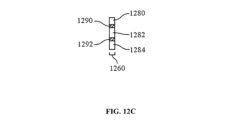
あるいは、図2A及び図2Bのアーム実施形態を、アーム又は細長部材の長軸方向の寸法(最長寸法)に対して垂直な方向に押出装置から物質を押出すことにより製造することができる。すなわち、押出されたアーム物質が現れる押出装置の面を見れば、図2Bの断面を見るだろう。角形ブロック又は角形平行六面体-すなわち、H1、(L1+L2+L3+L4+L5)の寸法、及び不特定長さの第三寸法を有するスラブとして物質を押出し;ブロックの押出はこの第三寸法の方向であり、したがって、第三寸法は要望通り長くすることができるが、但し、充分な原材料を押出装置に供給して所望の寸法を製造する。それから、角形ブロック又はスラブを傾斜角で断裁して立体三角柱を製造することができる。(すなわち、角形ブロックを、(L1+L2+L3+L4+L5)側面及びブロックが押出される第三寸法により形成される面に対して傾斜した角度で断裁する。)アームのための立体直方柱形状が望ましい場合(示さず)、角形ブロックを、傾斜角の代わりに90°の角度で断裁することができる。パイ状裁断が望ましい場合、傾斜角で物質を断裁した後、この断片を第二裁断して弯曲した弧を形成する。あるいは、パイ状裁断望ましい場合、三角柱、直方柱、又は適切な大きさの他形状に物質を断裁してから、所望の形状に圧縮成形するか、又は打ち抜く。この共押出方法は、実施例2、図12A、図12B、図12C、図12D、及び図13を参照して下記にさらに説明する。 Alternatively, the arm embodiment of Figures 2A and 2B can be produced by extruding material from an extrusion device in a direction perpendicular to the longitudinal dimension (longest dimension) of the arm or elongate member. That is, if you look at the face of the extrusion device where the extruded arm material emerges, you will see the cross section of Figure 2B. Extrude the material as a rectangular block or rectangular parallelepiped - i.e., a slab having dimensions H1 , ( L1 + L2 + L3 + L4 + L5 ), and a third dimension of indefinite length; extrusion of the block is in the direction of this third dimension, so the third dimension can be as long as desired, provided sufficient raw material is fed to the extrusion device to produce the desired dimension. The rectangular block or slab can then be cut at an oblique angle to produce a solid triangular prism. (i.e., the rectangular block is cut at an oblique angle relative to the plane formed by the ( L1 + L2 + L3 + L4 + L5 ) sides and the third dimension through which the block is extruded.) If a solid rectangular prism shape for the arms is desired (not shown), the rectangular block can be cut at a 90° angle instead of the oblique angle. If a pie cut is desired, the material is cut at an oblique angle and then the piece is second cut to form a curved arc. Alternatively, if a pie cut is desired, the material is cut into triangular prisms, rectangular prisms, or other shapes of appropriate size and then compression molded or die cut into the desired shape. This coextrusion method is further described below with reference to Example 2, Figures 12A, 12B, 12C, 12D, and 13.
セグメント組成物:「海島」リンカー領域
いくつかのアーム実施形態を、「海島」リンカー領域により結合された担体ポリマー-薬物セグメントとして製造することができる。図3A、図3B、及び図3Cは、かかるリンカー領域の例を示している。図3Aでは、セグメント304及び308を、「海島」リンカー領域306により連結し、一方、セグメント302及び304を、別の「海島」リンカー領域(上記挙げるのはラインセグメントL2であるが、別の方法で標識していない)により連結する。リンカー領域の海島構造では、第一リンカー物質は、図3Cの324により示された「海」を含む。第二リンカー物質の多くの部分は、第一リンカー物質の「海」中に存在する「島」(図3C柱にこのような1つの島322を標識している)を含む。リンカー領域は、概して、アームの全体的構造に適合する;すなわち、アームが三角柱の形状である場合、リンカー領域は同様に三角柱の形状になる。
Segment Composition: "Islands in the Sea" Linker Regions Some arm embodiments can be fabricated as carrier polymer-drug segments joined by "islands in the sea" linker regions. Figures 3A, 3B, and 3C show examples of such linker regions. In Figure 3A, segments 304 and 308 are connected by "islands in the sea" linker region 306, while segments 302 and 304 are connected by another "islands in the sea" linker region (listed above is line segment L2 , not otherwise labeled). In an islands in the sea configuration of linker regions, the first linker material comprises an "island", indicated by 324 in Figure 3C. A large portion of the second linker material comprises "islands" that reside in the "sea" of the first linker material (one such island 322 is labeled in the column of Figure 3C). The linker region generally conforms to the overall structure of the arm; i.e., if the arm is in the shape of a triangular prism, the linker region will be in the shape of a triangular prism as well.
第一リンカー物質の海島を形成する第二リンカー物質、又はリンカー物質を、様々な構造の海中に配置することができる。図3A及び図3Bでは、島は、アームの全体的長軸(軸)方向に対して横断する方向に海を貫通する円柱の形態である。図3Aの挿入図は、径D1を有する島(「C」と標識)を示す。島領域は、リンカー領域の面の1つの位置からリンカー領域に入り、「リンカーの海」を貫通してリンカー領域の面の別の位置から現れることができる。この構造を、共押出又は三次元印刷により製造することができる。島は、リンカー領域の面の1つの位置からリンカー領域に入り、リンカー領域の内側部分で止まる;この構造を、三次元印刷により製造することができる。 The second linker material, or linker material, which forms an island in the sea of the first linker material, can be arranged in the sea in various configurations. In Figures 3A and 3B, the islands are in the form of cylinders penetrating the sea in a direction transverse to the general longitudinal (axial) direction of the arms. The inset in Figure 3A shows an island (labeled "C") with a diameter D1 . The island region can enter the linker region at one location on the face of the linker region and emerge at another location on the face of the linker region, penetrating the "sea of linker". This configuration can be manufactured by co-extrusion or three-dimensional printing. The island enters the linker region at one location on the face of the linker region and stops at the inner part of the linker region; this configuration can be manufactured by three-dimensional printing.
「島」の径は、全島について均一であり得るか、又は図3Eで示された配置など、島間で異なり得る。リンカー領域中の島の径は、リンカー領域の幅を超えない。1つの実施形態では、島は、独立して、約1μm~約90μm、約1μm~約80μm、約1μm~約70μm、約1μm~約60μm、約1μm~約50μm、約1μm~約40μm、約1μm~約30μm、約1μm~約20μm、又は約1μm~約10μm;又は約10μm~約100μm約20μm~約100μm、約30μm~約100μm、約40μm~約100μm、約50μm~約100μm、約60μm~約100μm、約70μm~約100μm、約80μm~約100μm、又は約90μm~約100μmなどの約1μm~約100μmの径を有する。島は、独立して、約10μm、約20μm、約30μm、約40μm、約50μm、約60μm、約70μm、約80μm、約90μm、又は約100μm(各値はプラスもしくはマイナス約5μm(±5μm)である)の径を有する。島は、独立して、約1μm、約2μm、約3μm、約4μm、約5μm、約6μm、約7μm、約8μm、約9μm、又は約10μmの径を有する。 The diameter of the "islands" may be uniform for all islets or may vary between islands, such as the arrangement shown in Figure 3E. The diameter of the islands in the linker region does not exceed the width of the linker region. In one embodiment, the islets independently have a diameter of about 1 μm to about 90 μm, about 1 μm to about 80 μm, about 1 μm to about 70 μm, about 1 μm to about 60 μm, about 1 μm to about 50 μm, about 1 μm to about 40 μm, about 1 μm to about 30 μm, about 1 μm to about 20 μm, or about 1 μm to about 10 μm; or about 10 μm to about 100 μm, such as about 20 μm to about 100 μm, about 30 μm to about 100 μm, about 40 μm to about 100 μm, about 50 μm to about 100 μm, about 60 μm to about 100 μm, about 70 μm to about 100 μm, about 80 μm to about 100 μm, or about 90 μm to about 100 μm. The islets independently have a diameter of about 10 μm, about 20 μm, about 30 μm, about 40 μm, about 50 μm, about 60 μm, about 70 μm, about 80 μm, about 90 μm, or about 100 μm (each value is plus or minus about 5 μm (±5 μm)). The islets independently have a diameter of about 1 μm, about 2 μm, about 3 μm, about 4 μm, about 5 μm, about 6 μm, about 7 μm, about 8 μm, about 9 μm, or about 10 μm.
図中、断面に円として島を図示しているが、これらは、共押出又は三次元印刷により製造することができるいずれもの形状であり得る。円形でない断面に関し、上記で与えられた径の大きさの範囲は、円形でない領域の最長断面径の大きさの範囲である(例えば、島が楕円の形状である場合長軸)。 In the figures, the islands are illustrated as circles in cross section, but they can be any shape that can be produced by co-extrusion or 3D printing. For non-circular cross sections, the diameter size ranges given above are the longest cross-sectional diameter size ranges of the non-circular region (e.g., the major axis if the island is elliptical in shape).
様々な物質を、第一リンカー物質のために使用することができる(「海」)。1つの実施形態では、リンカー領域により連結されたセグメントを形成する同じ担体ポリマー-薬物配合物を、第一リンカー物質として使用することもできる。かかる配置を図3Dに示す。島をセグメントの共押出中に添加しなければならないだけなので、この実施形態は共押出製造の簡素化の利点がある。この実施形態を、三次元印刷を用いて製造する場合、第一リンカー物質として担体ポリマー-薬物配合物物質を用いることは、三次元印刷のために必要な異なるポリマーインプット数を最小限にする。これは、胃内の滞留期間中、比較的強力なリンカー領域も提供することができる。 A variety of materials can be used for the first linker material (the "sea"). In one embodiment, the same carrier polymer-drug formulation that forms the segments connected by the linker region can also be used as the first linker material. Such an arrangement is shown in FIG. 3D. This embodiment has the advantage of simplifying coextrusion manufacturing, since the islands only have to be added during the coextrusion of the segments. If this embodiment is manufactured using three-dimensional printing, using a carrier polymer-drug formulation material as the first linker material minimizes the number of different polymer inputs required for three-dimensional printing. This can also provide a relatively strong linker region during the residence period in the stomach.
1つの実施形態では、薬剤なしで担体ポリマーを、担体ポリマー配合物セグメント及びリンカー領域間の結合を促進することができる第一リンカー物質として使用することができる。 In one embodiment, a carrier polymer without a drug can be used as a first linker material that can facilitate bonding between the carrier polymer formulation segment and the linker region.
ポリカプロラクトン(PCL)は、「海」物質としての用途に好ましい物質です。別の実施形態では、ポリジオキサノンを、「海」物質として使用する。追加の実施形態では、「海」物質は、親水性セルロース誘導体(ヒドロキシプロピルメチルセルロース、ヒドロキシプロピルセルロース、ヒドロキシメチルセルロース、ヒドロキシエチルセルロース、カルボキシメチルセルロース、カルボキシメチルセルロースナトリウムなど)、酢酸フタル酸セルロース、ポリビニルピロリドン、エチレン/ビニルアルコール共重合体、ポリビニルアルコール、カルボキシビニル重合体(カルボマー)、カーボポール(Carbopol)(登録商標)酸性カルボキシポリマー、ポリカルボフィル、ポリ酸化エチレン(ポリオックス(Polyox)WSR)、多糖類及びその誘導体、ポリ酸化アルキレン類、ポリエチレングリコール、キトサン、アルギン酸塩、ペクチン類、アカシア、トラガント、グアーガム、ローカストビーンガム、ビニルピロリドン酢酸ビニル共重合体、デキストラン類、天然ゴム、寒天、アガロース、アルギン酸ナトリウム、カラゲナン、フコイダン、ファーセレラン、ラミナラン、イバラノリ、キリンサイ、アラビアゴム、ガムガッチ、カラヤゴム、アラビノガラクタン、アミロペクチン、ゼラチン、ジェラン、ヒアルロン酸、プルラン、スクレログルカン、キサンタン、キシログルカン、無水マレイン酸共重合体、エチレン無水マレイン酸共重合体、ポリメタクリル酸ヒドロキシエチル、アンモニオメタクリレート共重合体(オイドラギット(Eudragit)RL、オイドラギットRSなど)、ポリアクリル酸エチルメタクリル酸(オイドラギットNE)、オイドラギットE(メタクリル酸(ジメチルアミノ)エチル及び中性メタクリル酸エステルベースのカチオン性共重合体)、ポリメタクリル酸、メタクリル酸メチル、及びアクリル酸エチルなどのポリアクリル酸、ポリメタクリレート/ポリエタクリレート類、ポリカプロラクトンなどのポリラクトン類、ポリ[ビス(p-カルボキシフェノキシ)]プロパン無水物、ポリ無水テレフタル酸などのポリ酸無水物類、ポリリジン、ポリグルタミン酸などのポリペプチド類、DETOSUとヘキサンジオール、デカンジオール、シクロヘキサンジメタノール、エチレングリコール、ポリエチレングリコールなどのジオールとの共重合体などのポリオルトエステル類ならびに米国特許第4,304,767号明細書に記載及び開示されているポリオルトエステル類が参照により本明細書に援用され、デンプン、特にアルファ化デンプン及びデンプン系ポリマー類、カルボマー類、マルトデキストリン類、アミロマルトデキストリン類、デキストラン類、ポリ(2-エチル-2-オキサゾリン)、ポリエチレンイミン、ポリウレタン、ポリ乳酸、ポリグリコール酸、乳酸グリコール酸共重合体(PLGA)、ポリヒドロキシアルカン酸類、ポリヒドロキシ酪酸、ならびにこれらの共重合体、混合物、配合物及び組合せを含むことができる。 Polycaprolactone (PCL) is a preferred material for use as the "sea" material. In another embodiment, polydioxanone is used as the "sea" material. In additional embodiments, the "sea" material is selected from the group consisting of hydrophilic cellulose derivatives (such as hydroxypropyl methylcellulose, hydroxypropyl cellulose, hydroxymethyl cellulose, hydroxyethyl cellulose, carboxymethyl cellulose, sodium carboxymethyl cellulose, etc.), cellulose acetate phthalate, polyvinylpyrrolidone, ethylene/vinyl alcohol copolymers, polyvinyl alcohol, carboxyvinyl polymers (carbomers), Carbopol® acidic carboxy polymers, polycarbophil, polyethylene oxide (Polyox WSR), polysaccharides and derivatives thereof, polyalkylene oxides, polyethylene glycols, and the like. , chitosan, alginates, pectins, acacia, tragacanth, guar gum, locust bean gum, vinylpyrrolidone vinyl acetate copolymer, dextrans, natural gum, agar, agarose, sodium alginate, carrageenan, fucoidan, furcellaneous, laminaran, thorny laver, euterpe rhizome, gum arabic, gum ghatti, karaya gum, arabinogalactan, amylopectin, gelatin, gellan, hyaluronic acid, pullulan, scleroglucan, xanthan, xyloglucan, maleic anhydride copolymer, ethylene maleic anhydride copolymer, polyhydroxyethyl methacrylate, ammonio methacrylate copolymer (Eudragit) RL, Eudragit RS, etc.), polyethyl methacrylate (Eudragit NE), Eudragit E (cationic copolymers based on (dimethylamino)ethyl methacrylate and neutral methacrylic acid esters), polyacrylic acids such as polymethacrylic acid, methyl methacrylate, and ethyl acrylate, polymethacrylate/polyethacrylates, polylactones such as polycaprolactone, polyanhydrides such as poly[bis(p-carboxyphenoxy)]propane anhydride and polyterephthalic anhydride, polypeptides such as polylysine and polyglutamic acid, DETOSU and hexanediol, decanediol, cyclohexanedimethanol, ethylene glycol, etc. Polyorthoesters such as copolymers with diols such as cholesteryl, polyethylene glycol, and the like, as well as the polyorthoesters described and disclosed in U.S. Pat. No. 4,304,767, which are incorporated herein by reference, may include starch, particularly pregelatinized starch and starch-based polymers, carbomers, maltodextrins, amylomaltodextrins, dextrans, poly(2-ethyl-2-oxazoline), polyethyleneimine, polyurethane, polylactic acid, polyglycolic acid, polylactic-co-glycolic acid (PLGA), polyhydroxyalkanoates, polyhydroxybutyric acid, and copolymers, mixtures, blends, and combinations thereof.
担体ポリマー(薬剤があってもなくても)の使用が所望の滞留時間後にシステムがばらばらに壊れることを可能にしないリンカー領域をもたらす場合では、第一リンカー物質として別のポリマーを使用することができる。1つの実施形態では、第一リンカー物質として腸溶性ポリマーを使用することができる。1つの実施形態では、第一リンカー物質として時間依存ポリマーを使用することができる。1つの実施形態では、低分子量ポリカプロラクトンを使用する。1つの実施形態では、担体ポリマーと共に減弱剤(weakening agent)を混合して、第一リンカー物質を形成する;例えば、カルナウバロウ、パラフィンワックス、又はRH40を担体ポリマー(ポリカプロラクトンなど)と共に混合してリンカー領域の使用のための減弱ポリマーを製造することができる。 In cases where the use of a carrier polymer (with or without drug) results in a linker region that does not allow the system to break apart after the desired residence time, another polymer can be used as the first linker material. In one embodiment, an enteric polymer can be used as the first linker material. In one embodiment, a time-dependent polymer can be used as the first linker material. In one embodiment, low molecular weight polycaprolactone is used. In one embodiment, a weakening agent is mixed with the carrier polymer to form the first linker material; for example, carnauba wax, paraffin wax, or RH40 can be mixed with the carrier polymer (such as polycaprolactone) to produce a weakening polymer for use in the linker region.
第二リンカー物質(「島」)として使用するために様々な物質を利用可能である。1つの実施形態では、第二リンカー物質として腸溶性ポリマーを使用することができる。1つの実施形態では、第二リンカー物質として時間依存ポリマーを使用することができる。「島」物質は、ヒドロキシプロピルメチルセルロースアセテートサクシネート(HPMC-AS)、ヒドロキシプロピルメチルセルロースフタレート、酢酸フタル酸セルロース、セルロースアセテートサクシネート、メチルセルロースフタレート、エチルヒドロキシセルロースフタレート、ポリビニルアセテートフタレート、ポリビニルブチレートアセテート、酢酸ビニル-無水マレイン酸共重合物、スチレン-マレイン酸モノエステル共重合体、メタクリル酸メタクリル酸メチル共重合体、アクリル酸メチル-メタクリル酸共重合体、メタクリル酸-アクリル酸エチル共重合体、メタクリレート-メタクリル酸-アクリル酸オクチル共重合体、セラック、ポリ(メチルビニルエーテル/マレイン酸)モノエチルエステル、ポリ(メチルビニルエーテル/マレイン酸)n-ブチルエステル、ならびにこれらの共重合体、混合物、配合物及び組合せのうち1つ以上を含むことができる。 A variety of materials are available for use as the second linker material ("island"). In one embodiment, an enteric polymer can be used as the second linker material. In one embodiment, a time-dependent polymer can be used as the second linker material. The "island" material can include one or more of hydroxypropyl methylcellulose acetate succinate (HPMC-AS), hydroxypropyl methylcellulose phthalate, cellulose acetate phthalate, cellulose acetate succinate, methylcellulose phthalate, ethylhydroxycellulose phthalate, polyvinyl acetate phthalate, polyvinyl butyrate acetate, vinyl acetate-maleic anhydride copolymer, styrene-maleic acid monoester copolymer, methacrylic acid methyl methacrylate copolymer, methyl acrylate-methacrylic acid copolymer, methacrylic acid-ethyl acrylate copolymer, methacrylate-methacrylic acid-octyl acrylate copolymer, shellac, poly(methyl vinyl ether/maleic acid) monoethyl ester, poly(methyl vinyl ether/maleic acid) n-butyl ester, and copolymers, mixtures, blends, and combinations thereof.
疎水性構造ポリマーの海中の島又はチャネルとして配置される腸溶性又は時間依存ポリマーに関し、時間依存又は腸溶性リンカー物質の分解又は溶解に要する時間は、ポリマーマトリックス中への透水速度に依存する。ポリマー島への水の拡散時間は、t~L2/2D(式中、Lは透水距離であり、Dはポリマー中の水の拡散率である)として近似することができる。所与の形状のため、水の拡散時間を、物質の拡散率を変更することにより調整することができる。ポリマーの拡散率を、結合剤又は他のポリマーとの配合により調整することができる。例えば、ポリメタクリル酸メチル毛細管(PMMA中の水に関して、Lの距離=1.5mm及びDは約3.35e-8cm2/秒である)による製剤の中央部への透水は、約3.9日を要することになる。8日間かけてマトリックス中1.5mmの透水を達成するため、ポリマー中の水の拡散率は、1.6e-8cm2/秒が目標となる。 For enteric or time-dependent polymers arranged as islands or channels in a sea of hydrophobic structural polymers, the time required for degradation or dissolution of the time-dependent or enteric linker material depends on the rate of water penetration into the polymer matrix. The diffusion time of water into the polymer islands can be approximated as t~L 2 /2D, where L is the water penetration distance and D is the diffusivity of water in the polymer. For a given geometry, the diffusion time of water can be tailored by modifying the diffusivity of the material. The diffusivity of the polymer can be tailored by blending with binders or other polymers. For example, water penetration into the center of the formulation through a polymethylmethacrylate capillary (for water in PMMA, distance L=1.5 mm and D is approximately 3.35e-8 cm 2 /sec) will take approximately 3.9 days. To achieve 1.5 mm of water penetration into the matrix over 8 days, the diffusivity of water in the polymer is targeted to be 1.6e-8 cm 2 /sec.
セグメント組成物:担体ポリマー-薬物及びリンカー領域間のインターロック結合(「鍵-鍵穴」接合)
アームに使用されるリンカー領域は、図2B中のアーム図の領域Bに示された実施形態などのその長さに沿った一定の寸法であり得る。あるいは、リンカー領域は、図4A、図4B、図4C、及び図4Dに図示されたように、その長さに沿った一定の寸法であり得る。図4A、図4B、図4C、及び図4D中のリンカー領域は、インターロック、又は「鍵-鍵穴」構造において、リンカー領域の本体から、担体ポリマー-薬物物質からなるセグメント中に延びる部分を有する。いくつかの実施形態では、担体ポリマー-薬物物質からなる1つ以上のセグメントの部分は、再び、インターロック、又は「鍵-鍵穴」構造において、担体ポリマー-薬物セグメントの本体から、リンカー領域中に延びる。いくつかの実施形態では、1つ以上のリンカー領域の部分は、リンカー領域の本体から、担体ポリマー-薬物セグメント中に延び、担体ポリマー-薬物物質からなる1つ以上のセグメントの部分は、担体ポリマー-薬物セグメントの本体から、リンカー領域中に延びる。
Segment Composition: Interlocking Bonds ("Lock-and-Key" Bonds) Between Carrier Polymer-Drug and Linker Regions
The linker region used for the arm may be of constant dimension along its length such as the embodiment shown in region B of the arm diagram in FIG. 2B. Alternatively, the linker region may be of constant dimension along its length as illustrated in FIG. 4A, FIG. 4B, FIG. 4C, and FIG. 4D. The linker regions in FIG. 4A, FIG. 4B, FIG. 4C, and FIG. 4D have portions that extend from the body of the linker region into the carrier polymer-drug substance segment in an interlocking, or "lock-and-lock" configuration. In some embodiments, portions of one or more segments of carrier polymer-drug substance extend from the body of the carrier polymer-drug segment into the linker region, again in an interlocking, or "lock-and-lock" configuration. In some embodiments, portions of one or more linker regions extend from the body of the linker region into the carrier polymer-drug segment and portions of one or more segments of carrier polymer-drug substance extend from the body of the carrier polymer-drug segment into the linker region.
担体ポリマー-薬物物質及びリンカー領域は、リンカー領域中の突起部を担体ポリマー-薬物物質中の凹部(図4A、図4B、図4C、及び図4Dに示されたものなど)と組み合わせることにより、又は担体ポリマー-薬物物質中の突起部をリンカー容易記中の凹部と組み合わせることにより、又はリンカー領域中の突起部を担体ポリマー-薬物物質中の凹部と組み合わせること、かつ、担体ポリマー-薬物物質中の突起部をリンカー容易記中の凹部と組み合わせることの両方により、インターロック結合を形成する。これらのインターロック結合は、リンカー領域及び担体ポリマー-薬物物質を含むセグメント間の増強された結合を提供する。 The carrier polymer-drug substance and linker region form interlocking bonds by combining protrusions in the linker region with recesses in the carrier polymer-drug substance (such as those shown in Figures 4A, 4B, 4C, and 4D), or by combining protrusions in the carrier polymer-drug substance with recesses in the linker region, or by both combining protrusions in the linker region with recesses in the carrier polymer-drug substance and combining protrusions in the carrier polymer-drug substance with recesses in the linker region. These interlocking bonds provide enhanced bonding between segments that include the linker region and the carrier polymer-drug substance.
インターロック結合構造中のリンカー領域は、図4A又は図4Bの海島ポリマーをさらに含む。図4C及び図4Dは、海島ポリマーを含まないインターロックリンカーを示す。図4C及び図4Dでは、1つのインターロックリンカー領域は時間依存リンカーであるが、他のインターロックリンカー領域は腸溶性リンカーである。 The linker region in the interlocked bond structure further comprises a sea-island polymer of FIG. 4A or FIG. 4B. FIG. 4C and FIG. 4D show an interlocked linker without a sea-island polymer. In FIG. 4C and FIG. 4D, one interlocked linker region is a time-dependent linker, while the other interlocked linker region is an enteric linker.
1つの実施形態では、上記のインターロックセグメントを、三次元印刷により製造する。1つの実施形態では、上記のインターロックセグメントを、共押出により製造する。 In one embodiment, the interlocking segments are manufactured by three-dimensional printing. In one embodiment, the interlocking segments are manufactured by coextrusion.
セグメント組成物:「島海」担体ポリマー-薬物領域
いくつかのアーム実施形態を、「海島」構造中に存在する担体ポリマー-薬物セグメントを含んで製造することができる。この実施形態では、1つ以上のセグメント島物質を使用して、担体ポリマー-薬物配合物がセグメント海物質を含む「島海」構造を製造することができる。図5Aはこのような構造を示し、担体ポリマー-薬物セグメント及びリンカー領域の両方は、海島構造を有する。しかしながら、海島構造を、海島構造を有するリンカー領域を用いないで担体ポリマー-薬物セグメントのために使用することができる。すなわち、海島構造を、均一なリンカー領域、又は1つのリンカー物質のみを有するリンカー領域を用いながら、担体ポリマー-薬物セグメントのために使用することができる。これは、胃内滞留システムの特性のさらなる調節を可能とする。例えば、比較的透過性物質のチャネルをセグメント島物質として使用することができ、液体、特に水又は胃液が該セグメント外面のみより大きな量の担体ポリマー-薬物セグメント海物質の表面積と接触することを可能とする。あるいは、追加の薬物(単数)又は薬物(複数)を、併用投与のために、セグメント島物質として使用することができる。追加の薬物の急速投与が胃内滞留システムを胃内に入れる時に望ましい、又は薬物(単数)もしくは薬物(複数)がセグメント海物質における担体ポリマー-薬物配合物中に含有される薬物と一緒に追加の薬物を徐々に共送達するためセグメント島物質からゆっくりと溶出することができる場合、追加の薬物(単数)もしくは薬物(複数)を含むセグメント島物質を比較的迅速溶出もしくは迅速溶解することができる。
Segment Composition: "Islands-in-the-Sea" Carrier Polymer-Drug Regions Some arm embodiments can be produced with carrier polymer-drug segments present in an "islands-in-the-sea" structure. In this embodiment, one or more segment island materials can be used to produce an "islands-in-the-sea" structure in which the carrier polymer-drug formulation includes segment sea material. FIG. 5A shows such a structure, where both the carrier polymer-drug segment and the linker region have an islands-in-the-sea structure. However, an islands-in-the-sea structure can be used for the carrier polymer-drug segment without a linker region with an islands-in-the-sea structure. That is, an islands-in-the-sea structure can be used for the carrier polymer-drug segment while using a uniform linker region, or a linker region with only one linker material. This allows further tuning of the properties of the gastroretentive system. For example, a channel of a relatively permeable material can be used as the segment island material, allowing liquids, particularly water or gastric fluids, to contact a larger amount of the surface area of the carrier polymer-drug segment sea material than just the segment exterior. Alternatively, an additional drug or drugs can be used as the segment island material for co-administration. The segmented islet material containing the additional drug(s) may be relatively quickly eluted or quickly dissolved if rapid administration of the additional drug is desired when the gastroretentive system is placed in the stomach, or the drug(s) may be slowly eluted from the segmented islet material to gradually co-deliver the additional drug along with the drug contained in the carrier polymer-drug formulation in the segmented islet material.
図5Bは、リンカー領域間のセグメントにおいて、海島構造を含む細長部材の別の実施形態を示す。この実施形態では、担体ポリマー-薬物配合物を、該担体ポリマー-薬物の機械的完全性及び安定性のための要件を有意に緩和する構造ポリマーの海中の島として使用する。軟質ポリマー及びワックスを、コリフォール(Kolliphor)RH40、カルナウバロウ、P407などの担体物質として使用することができる。ポリ酸無水物、ポリホスファゼン類、及びポリシアノアクリレート類などの分解性ポリマーも、担体ポリマーとして使用することができる。この構造で使用される構造ポリマーは、高いヤング率、引張強さ、圧縮強さを有すべきであり、担体ポリマー-薬物配合物とうまく相互作用する必要もある(すなわち、構造ポリマー及び担体ポリマーは化学的相溶性があり、同様な融解温度を有すべきである)。この構造において使用することができる構造ポリマーの例は、ポリ乳酸、ポリカーボネート、ポリエーテルエーテルケトン、ポリエチレン、及びポリプロピレンである。 Figure 5B shows another embodiment of an elongate member that includes an islands-in-a-sea structure in the segments between linker regions. In this embodiment, the carrier polymer-drug formulation is used as an island in a sea of structural polymers that significantly relaxes the requirements for mechanical integrity and stability of the carrier polymer-drug. Soft polymers and waxes can be used as carrier materials such as Kolliphor RH40, carnauba wax, P407, etc. Degradable polymers such as polyanhydrides, polyphosphazenes, and polycyanoacrylates can also be used as carrier polymers. The structural polymer used in this structure should have high Young's modulus, tensile strength, compressive strength, and should also interact well with the carrier polymer-drug formulation (i.e., the structural polymer and carrier polymer should be chemically compatible and have similar melting temperatures). Examples of structural polymers that can be used in this structure are polylactide, polycarbonate, polyetheretherketone, polyethylene, and polypropylene.
セグメント組成物:多層状セグメント
1つの実施形態では、胃内滞留システムは、多層状セグメントを利用する。多層状セグメントの1つの実装例を、図6Aに示す。セグメントは、2層以上の担体ポリマー-薬物配合物を備える。この層形成は、異なる濃度の薬物又は薬剤を可能とする。セグメント及び/又は全体的システムから薬物又は薬剤の所望の放出速度を提供するように層を横切って薬物又は薬剤の濃度勾配を生成することができる。
Segment Composition: Multi-Layered Segments In one embodiment, the gastroretentive system utilizes a multi-layered segment. One implementation of a multi-layered segment is shown in FIG. 6A. The segment comprises two or more layers of carrier polymer-drug formulation. This layering allows for different concentrations of drug or agent. A concentration gradient of the drug or agent can be created across the layers to provide a desired release rate of the drug or agent from the segment and/or the overall system.
1つの実施形態では、多層状セグメントは、各層における薬物又は薬剤の濃度が該セグメントの1つ以上の隣接する層の濃度と異なる、担体ポリマー-薬物配合物を含む2層以上の層を備える。1つの実施形態では、多層状セグメントは、各層における薬物又は薬剤の濃度が該セグメントの中央部からの径(又は距離)の増加と共に減少する、担体ポリマー-薬物配合物を含む2層以上の層を備える。1つの実施形態では、多層状セグメントは、各層における薬物又は薬剤の濃度が該セグメントの中央部からの径(又は距離)の増加と共に増加する、担体ポリマー-薬物配合物を含む2層以上の層を備える。 In one embodiment, the multi-layered segment comprises two or more layers comprising a carrier polymer-drug formulation, in which the drug or agent concentration in each layer differs from that in one or more adjacent layers of the segment. In one embodiment, the multi-layered segment comprises two or more layers comprising a carrier polymer-drug formulation, in which the drug or agent concentration in each layer decreases with increasing diameter (or distance) from the center of the segment. In one embodiment, the multi-layered segment comprises two or more layers comprising a carrier polymer-drug formulation, in which the drug or agent concentration in each layer increases with increasing diameter (or distance) from the center of the segment.
例えば、3層を有し、第一層が1mmの径のコアシリンダーを備える、担体ポリマー-薬物配合物の円柱状セグメントを製造する。環状断面を有する本質的に円柱形チューブである第二層は、1mmの内径及び2mmの外径を有し、したがって、1mmの層厚を有する。環状断面を有する円柱形チューブである第三(外側)層は、2mmの内径及び3mmの外径を有し、1mmの層厚も有する。10mmの長さであるセグメントのため、第一(コア)層の全体積は約31.42立方ミリメートルになり、第二層の体積は約94.3mm3となり、第二層の体積は約157mm3となる。第二及び第三層の体積は、その外径を有する円柱の体積を算出し、その内径を有する円柱の体積を差し引くことにより得られ、例えば、第三層については、V=[π×(3mm)2×10mm]-[π×(2mm)2×10mm]となる。したがって、第二層は、第一層の3倍の体積を有し、第三層は第一層の5倍の体積を有する。セグメント層の薬物又は薬剤の濃度を、各層がおよそ同量の薬物又は薬剤を含有するように調節することができる。第三、最も体積の大きい層の濃度がCである場合、第二層に使用される薬物又は薬剤の濃度は1.67倍のCとなり、第一層に使用される薬物又は薬剤の濃度は5倍のCとなり得る。使用される薬物又は薬剤の多層状濃度を、薬物又は薬剤の所望の溶出速度を提供するように調節することができ;前の例では、時間とともに溶出の増加を提供するために、第三(外側)層では濃度1C、第二層では3C、及び第一層では15Cを使用することが望ましい場合がある。あるいは、薬物又は薬剤の溶出を、例えば、第三層において濃度1C、第二層において濃度2分の1C、及び第三層において4分の1Cを用いて時間とともに漸減することができる。 For example, a cylindrical segment of carrier polymer-drug formulation is prepared having three layers, the first layer comprising a core cylinder of 1 mm diameter. The second layer, which is essentially a cylindrical tube with a circular cross section, has an inner diameter of 1 mm and an outer diameter of 2 mm, and therefore a layer thickness of 1 mm. The third (outer) layer, which is a cylindrical tube with a circular cross section, has an inner diameter of 2 mm and an outer diameter of 3 mm, and also has a layer thickness of 1 mm. For a segment that is 10 mm long, the total volume of the first (core) layer will be about 31.42 cubic millimeters, the volume of the second layer will be about 94.3 mm3 , and the volume of the second layer will be about 157 mm3 . The volumes of the second and third layers are obtained by calculating the volume of a cylinder with that outer diameter and subtracting the volume of a cylinder with that inner diameter, e.g., for the third layer, V = [π x (3 mm) 2 x 10 mm] - [π x (2 mm) 2 x 10 mm]. Thus, the second layer has three times the volume of the first layer, and the third layer has five times the volume of the first layer. The drug or agent concentration of the segment layers can be adjusted so that each layer contains approximately the same amount of drug or agent. If the third, most voluminous layer has a concentration of C, the drug or agent concentration used in the second layer can be 1.67 times C, and the drug or agent concentration used in the first layer can be 5 times C. The multi-layer concentration of drug or agent used can be adjusted to provide the desired elution rate of the drug or agent; in the previous example, it may be desirable to use a concentration of 1C in the third (outer) layer, 3C in the second layer, and 15C in the first layer to provide an increase in elution over time. Alternatively, the elution of the drug or agent can be tapered over time, for example, using a concentration of 1C in the third layer, 1/2C in the second layer, and 1/4C in the third layer.
さらなる実施形態では、1つより多い薬物又は薬剤を、複数の多層状セグメントの異なる担体ポリマー-薬物配合物層において使用することができる。1つの実施形態では、第一薬物又は薬剤はセグメント中の2つ以上の層のうち少なくとも1つの層に存在し、第二薬物又は薬剤はセグメント中の2つ以上の層のうち少なくとも1つの層に存在する。1つの実施形態では、第一薬物又は薬剤はセグメント中の2つ以上の層のうち少なくとも1つの層に存在し、1つ以上の追加薬物又は薬剤(すなわち、第二薬物又は薬剤、第三薬物又は薬剤、その他)も2つ以上の層のうち少なくとも1つの層に存在する。1つの実施形態では、1つの薬物のみ各層に存在する(すなわち、各層は1つの薬物のみ含有する)。1つの実施形態では、2つ以上の薬物が少なくとも1つの層に存在する(すなわち、1つ以上の層は2つ以上の薬物を含有することができる)。 In further embodiments, more than one drug or agent can be used in different carrier polymer-drug formulation layers of the multiple multi-layered segments. In one embodiment, a first drug or agent is present in at least one of the two or more layers in the segment, and a second drug or agent is present in at least one of the two or more layers in the segment. In one embodiment, a first drug or agent is present in at least one of the two or more layers in the segment, and one or more additional drugs or agents (i.e., a second drug or agent, a third drug or agent, etc.) are also present in at least one of the two or more layers. In one embodiment, only one drug is present in each layer (i.e., each layer contains only one drug). In one embodiment, two or more drugs are present in at least one layer (i.e., one or more layers can contain two or more drugs).
図6Bは、複数の担体ポリマー-薬物層を有する細長部材の実施形態を示す(図中、薬剤-ポリマー製剤と標識)。薬剤が剤形表面から放出されるので物質移動範囲の減少を補償するため、異なる保守津速度を有する製剤を、図6Bに図示された多層状構造を形成して層にすることができる。担体ポリマー-薬物(薬剤ポリマー)製剤1は製剤を比較的ゆっくりと放出するが、製剤4は製剤を迅速に放出し;製剤の放出速度の順序は、製剤1<製剤2<製剤3<製剤4である。各層からの放出速度及び層厚さを調節して、剤形から線形全体的放出速度を得ることができる。製剤1~4は、薬物もしく薬剤濃度(例えば、製剤4>製剤3>製剤2>製剤1における薬物又は薬剤負荷)又は賦形剤濃度で異なり得る。
Figure 6B shows an embodiment of an elongate member having multiple carrier polymer-drug layers (labeled drug-polymer formulation in the figure). To compensate for the reduced mass transport area as the drug is released from the dosage form surface, formulations with different release rates can be layered to form a multi-layered structure as illustrated in Figure 6B. Carrier polymer-drug (drug polymer)
セグメント組成物:内部強化セグメント
セグメントの強度を、通常、該セグメントの中央部領域において該セグメントの内部部分に強化材を堆積させることにより向上させることができる。セグメントのための主要機械的支持体を提供するとき、強化材は、担体ポリマー-薬物物質の機械的要件を有意に緩和する。強化材は、セグメントに沿って軸方向に延びる。様々な形状及び構造を、強化材のために使用することができる。図7A及び図7Bに示されたものなど、I形デザインは、優れた捩り強さ及び曲げ強さを提供し、担体ポリマー-薬物配合物及び強化材間の相互作用を改良する。図8A及び図8Bに示されたものなど、強化材のトラス構造は、優れた強度も提供しながら、必要な強化材量を最小に抑える。強化材は、I形構造を有することができる。強化材は、H形構造を有することができる(H形はI形に類似しているがより広いフランジを有する)。強化材は、トラス構造を有することができる。強化材は、円柱状構造を有することができる。強化材は、三角柱構造(すなわち、三角形断面を有する桿体の構造)を有することができる。強化材は、「パイ状」構造(すなわち、「パイ状」断面を有する桿体の構造、「パイ形状」は三角形の一辺が円の弧により置き換えられた三角形により表され;図10Bに示されたアームの断面がパイ状断面の例である)を有することができる。強化材は、直方柱構造又は正四角柱構造(すなわち、長方形又は正方形断面を有する桿体の構造)を有することができる。内部強化材が多角形(三角形又は正方形など)の形状である場合、いずれか又は全ての鋭い角又は縁を丸く又はフィレット状にすることができる。強化材は、ポリカプロラクトン又はポリジオキサノンなどの純粋な担体ポリマーを含むことができる。強化材は、ポリカプロラクトン又はポリジオキサノンなどの純粋な担体ポリマーから本質的になるか、又はからなることができる。強化材は、他の成分を添加した担体ポリマーを含むことができる。強化材は、低濃度の薬物又は薬剤を含む担体ポリマーを含むことができる(すなわち、内部担体ポリマー強化材は、周囲の担体ポリマー-薬物物質より低い薬剤濃度の担体ポリマー-薬物配合物である。強化材は、薬物も薬剤も含まない担体ポリマーを含むことができる。強化材は、ポリ乳酸、ポリカーボネート、ポリエーテルエーテルケトン、ポリエチレン、又はポリプロピレンなどの別のポリマー(すなわち、担体ポリマーと異なるポリマー)を含むことができる。強化材は、非ポリマー物質であり得る。
Segment Composition: Internal Reinforcement Segments The strength of a segment can be improved by depositing a reinforcement material in the interior portion of the segment, usually in the central region of the segment. In providing the primary mechanical support for the segment, the reinforcement material significantly relieves the mechanical requirements of the carrier polymer-drug substance. The reinforcement material extends axially along the segment. A variety of shapes and structures can be used for the reinforcement material. An I-shaped design, such as that shown in Figures 7A and 7B, provides excellent torsional and bending strength and improves the interaction between the carrier polymer-drug formulation and the reinforcement material. A truss structure of the reinforcement material, such as that shown in Figures 8A and 8B, minimizes the amount of reinforcement material required while also providing excellent strength. The reinforcement material can have an I-shaped structure. The reinforcement material can have an H-shaped structure (the H-shape is similar to the I-shape but with wider flanges). The reinforcement material can have a truss structure. The reinforcement material can have a cylindrical structure. The reinforcement may have a triangular prism structure (i.e., a structure of rods with a triangular cross section). The reinforcement may have a "pie-like" structure (i.e., a structure of rods with a "pie-like" cross section, a "pie shape" being represented by a triangle with one side of the triangle replaced by an arc of a circle; the cross section of the arm shown in FIG. 10B is an example of a pie-like cross section). The reinforcement may have a rectangular prism structure or a regular square prism structure (i.e., a structure of rods with a rectangular or square cross section). If the internal reinforcement is polygonal (such as triangular or square) in shape, any or all sharp corners or edges may be rounded or filleted. The reinforcement may comprise a pure carrier polymer, such as polycaprolactone or polydioxanone. The reinforcement may consist essentially of or consist of a pure carrier polymer, such as polycaprolactone or polydioxanone. The reinforcement may comprise a carrier polymer with other components added. The reinforcing material can comprise a carrier polymer that contains a low concentration of a drug or agent (i.e., the inner carrier polymer reinforcement is a carrier polymer-drug formulation with a lower drug concentration than the surrounding carrier polymer-drug material. The reinforcing material can comprise a carrier polymer that does not contain a drug or agent. The reinforcing material can comprise another polymer (i.e., a different polymer than the carrier polymer), such as polylactic acid, polycarbonate, polyetheretherketone, polyethylene, or polypropylene. The reinforcing material can be a non-polymeric material.
強化材は、セグメントの実質的全長に沿って軸方向に延びることができる。あるいは、強化材は、セグメントの全長の約50%に沿って、少なくとも約50%に沿って、約60%に沿って、少なくとも約60%に沿って、約70%に沿って、少なくとも約70%に沿って、約80%に沿って、少なくとも約80%に沿って、約90%に沿って、少なくとも約90%に沿って、約95%に沿って、又は少なくとも約95%に沿って軸方向に延びることができる。 The reinforcement can extend axially along substantially the entire length of the segment. Alternatively, the reinforcement can extend axially along about 50%, at least about 50%, at least about 60%, at least about 60%, at least about 70%, at least about 70%, at least about 80%, at least about 80%, at least about 90%, at least about 90%, at least about 95%, or at least about 95% of the entire length of the segment.
強化材は、セグメントの内部に沿った通常1つの連続した小片である。しかしながら、2つ、3つ、又はそれ以上の小片の強化材を使用することができ、角小片は、セグメントの内部の部分に沿って軸方向に延びる。 The reinforcement is usually one continuous strip along the interior of the segment. However, two, three, or more strips of reinforcement can be used, with the corner strips extending axially along the interior portion of the segment.
内部強化材は、疎水性治療薬又はその塩を送達する胃内滞留システムにとって有用である。疎水性治療薬又は塩の低溶解度が理由で、高い割合の薬物又は塩を担体ポリマー及び他の賦形剤を使用して一緒に配合しなければならない。しかしながら、この高い割合の薬物又は塩は、セグメントの機械的強度を有意に低下させ得る。内部強化材を用いることで、セグメントの機械的強度を増大することができる。加えて、セグメントの最内側領域は、水又は胃液が透過する最も困難な領域であるので、担体ポリマー-治療薬の内部部分を強化材により置き換えることは、薬剤送達特性に対して比較的小さい効果を有する。実施例4及び図14の結果は、ポリカプロラクトンアームをタクロリムス及びポリエチレン酢酸ビニルを含有する溶液中に浸漬した、疎水性薬剤タクロリムスを含む内部強化セグメントの使用を示す。 Internal reinforcement materials are useful for gastroretentive systems that deliver hydrophobic therapeutic agents or their salts. Due to the low solubility of hydrophobic therapeutic agents or salts, a high percentage of the drug or salt must be formulated together using the carrier polymer and other excipients. However, this high percentage of drug or salt can significantly reduce the mechanical strength of the segment. Using an internal reinforcement material can increase the mechanical strength of the segment. In addition, since the innermost region of the segment is the most difficult region for water or gastric fluids to penetrate, replacing the inner portion of the carrier polymer-therapeutic agent with a reinforcement material has a relatively small effect on the drug delivery properties. The results in Example 4 and Figure 14 show the use of an internally reinforced segment containing the hydrophobic drug tacrolimus, where the polycaprolactone arms are immersed in a solution containing tacrolimus and polyethylene vinyl acetate.
1つの実施形態では、本発明は、エラストマー成分、ならびに該エラストマー成分と結合した担体ポリマー及び治療薬もしくはその塩を含む複数の少なくとも3つの担体ポリマー-薬物成分を含む患者の胃に投与するための胃内滞留システムであって、複数の担体ポリマー-薬物成分の各々は近接端部、遠位端部、及びその間の外面を備える細長部材であり;各細長部材の該近接端部は該エラストマー成分と結合し、該エラストマー成分から放射状に突出し、各細長部材は該エラストマー成分と結合しておらず、該近接端部より該エラストマー成分から大きいラジアル距離に位置し;少なくとも1つのセグメントは強化材をさらに含み、該強化材は該少なくとも1つのセグメントの内部に沿って軸方向に延び;該担体ポリマー-薬物成分は疎水性治療薬を含む、胃内滞留システムを提供する。さらなる実施形態では、細長部材をリンカー領域によりエラストマー成分と結合し;又は細長部材は2つ以上のセグメントを備え、セグメントはリンカー領域により連結し;又は細長部材はリンカー領域によりエラストマー成分と結合し、かつ、細長部材はセグメントがリンカー領域により連結する2つ以上のセグメントを備える。各セグメントは、近接端部、遠位端部、及びその間の外面を備える。1つの実施形態では、疎水性治療薬は、水中約1mg/ml未満の溶解度を有する。1つの実施形態では、疎水性治療薬は、水中約500マイクログラム/ml未満の溶解度を有する。1つの実施形態では、疎水性治療薬は、水中約250マイクログラム/ml未満の溶解度を有する。1つの実施形態では、疎水性治療薬は、水中約100マイクログラム/ml未満の溶解度を有する。1つの実施形態では、疎水性治療薬は、水中約50マイクログラム/ml未満の溶解度を有する。1つの実施形態では、疎水性治療薬は、水中約25マイクログラム/ml未満の溶解度を有する。1つの実施形態では、疎水性治療薬は、水中約10マイクログラム/ml未満の溶解度を有する。1つの実施形態では、疎水性治療薬は、水中約5マイクログラム/ml未満の溶解度を有する。1つの実施形態では、疎水性治療薬は、水中約1マイクログラム/ml未満の溶解度を有する。1つの実施形態では、疎水性治療薬は、水中約1マイクログラム/ml~約1mg/ml、約1マイクログラム/ml~約500マイクログラム/ml、約1マイクログラム/ml~約250マイクログラム/ml、約1マイクログラム/ml~約100マイクログラム/ml、約1マイクログラム/ml~約50マイクログラム/ml、約1マイクログラム/ml~約25マイクログラム/ml、約1マイクログラム/ml~約10マイクログラム/ml、又は約1マイクログラム/ml~約5マイクログラム/mlの溶解度を有する。 In one embodiment, the present invention provides a gastric retention system for administration to a patient's stomach comprising an elastomeric component and a plurality of at least three carrier polymer-drug components comprising a carrier polymer and a therapeutic agent or salt thereof associated with the elastomeric component, each of the plurality of carrier polymer-drug components being an elongate member having a proximal end, a distal end, and an exterior surface therebetween; the proximal end of each elongate member is associated with the elastomeric component and projects radially from the elastomeric component, each elongate member is not associated with the elastomeric component and is located a greater radial distance from the elastomeric component than the proximal end; at least one segment further comprises a reinforcing material, the reinforcing material extending axially along an interior of the at least one segment; and the carrier polymer-drug components comprise a hydrophobic therapeutic agent. In further embodiments, the elongate member is attached to the elastomeric component by a linker region; or the elongate member comprises two or more segments, the segments connected by a linker region; or the elongate member is attached to the elastomeric component by a linker region and the elongate member comprises two or more segments, the segments connected by a linker region. Each segment comprises a proximal end, a distal end, and an exterior surface therebetween. In one embodiment, the hydrophobic therapeutic agent has a solubility of less than about 1 mg/ml in water. In one embodiment, the hydrophobic therapeutic agent has a solubility of less than about 500 micrograms/ml in water. In one embodiment, the hydrophobic therapeutic agent has a solubility of less than about 250 micrograms/ml in water. In one embodiment, the hydrophobic therapeutic agent has a solubility of less than about 100 micrograms/ml in water. In one embodiment, the hydrophobic therapeutic agent has a solubility of less than about 50 micrograms/ml in water. In one embodiment, the hydrophobic therapeutic agent has a solubility of less than about 25 micrograms/ml in water. In one embodiment, the hydrophobic therapeutic agent has a solubility of less than about 10 micrograms/ml in water. In one embodiment, the hydrophobic therapeutic agent has a solubility of less than about 5 micrograms/ml in water. In one embodiment, the hydrophobic therapeutic agent has a solubility of less than about 1 microgram/ml in water. In one embodiment, the hydrophobic therapeutic agent has a solubility of about 1 microgram/ml to about 1 mg/ml, about 1 microgram/ml to about 500 micrograms/ml, about 1 microgram/ml to about 250 micrograms/ml, about 1 microgram/ml to about 100 micrograms/ml, about 1 microgram/ml to about 50 micrograms/ml, about 1 microgram/ml to about 25 micrograms/ml, about 1 microgram/ml to about 10 micrograms/ml, or about 1 microgram/ml to about 5 micrograms/ml in water.
強化材を含むセグメントを、浸漬塗布(実施例4で使用)、共押出、又は三次元印刷などのいずれもの適切な方法により製造することができる。 The segments containing the reinforcement can be manufactured by any suitable method, such as dip coating (as used in Example 4), coextrusion, or three-dimensional printing.
細長部材又はセグメントの機械的強度は主に強化材によってもたらされ、担体ポリマーではないので、強化材なしで使用できるより、細長部材の適切な機械的強度を維持しながら、担体ポリマー-薬物混合物で有意に多い薬物を使用することができる。したがって、担体ポリマー-薬物混合物における薬物の量は、約60重量%以下、約50重量%以下、又は約40重量%以下の範囲であり得るが、一方では、強化材なしではこのような高パーセントは達成できない。したがって、1つの実施形態では、薬物の量は、担体ポリマー-薬物混合物の約1重量%~約60重量%、約10重量%~約60重量%、約20重量%~約60重量%、約30重量%~約60重量%、約40重量%~約60重量%、約50重量%~約60重量%、約1重量%~約50重量%、約1重量%~約40重量%、約1重量%~約30重量%、約1重量%~約20重量%、又は約1重量%~約10重量%の範囲であり得る。 Because the mechanical strength of the elongated member or segment is provided primarily by the reinforcing material and not the carrier polymer, significantly more drug can be used in the carrier polymer-drug mixture while maintaining adequate mechanical strength of the elongated member than could be used without the reinforcing material. Thus, the amount of drug in the carrier polymer-drug mixture can range from about 60% by weight or less, about 50% by weight or less, or about 40% by weight or less, whereas such high percentages would not be achievable without the reinforcing material. Thus, in one embodiment, the amount of drug may range from about 1% to about 60% by weight, about 10% to about 60% by weight, about 20% to about 60% by weight, about 30% to about 60% by weight, about 40% to about 60% by weight, about 50% to about 60% by weight, about 1% to about 50% by weight, about 1% to about 40% by weight, about 1% to about 30% by weight, about 1% to about 20% by weight, or about 1% to about 10% by weight of the carrier polymer-drug mixture.
また、強化材は細長部材又はセグメントの機械的強度を提供するので、強化材なしでの使用では適切でない可能性がある追加のポリマーを担体ポリマーとして使用することができる。ポリエチレン酢酸ビニルを、強化材を使用する場合に担体ポリマーとして使用することができる。ポロキサマー(Poloxamer)407、プルロニック(Pluronic)P407、ヒプロメロース、コリフォールRH40、ポリビニルカプロラクタム、ポリ酢酸ビニル(PVAc)、ポリビニルピロリドン(PVP)、ポリビニルアルコール(PVA)、ポリエチレングリコール(PEG)、ソルプラス(BASFから入手可能;ポリビニルカプロラクタム、ポリ酢酸ビニル、及びポリエチレングリコールの共重合体)、コポビドン、オイドラギット(E、EPO、RS、RL)、メタクリル酸メチル、カルナウバロウ、ポリ(メチルビニルエーテル-alt-マレイン酸無水物)、ポリオキシエチレンアルキルエーテル類、ポリソルベート類、ポリオキシエチレンステアレート類、ポリビニルアセテートフタレート、アルギン酸塩、ポリデキストロース、ポリジオキサノン、ポリメタクリル酸ブチル、ポリ乳酸、ポリグリコール酸、乳酸グリコール酸共重合体(PLGA)、及びその混合物も、強化材に合わせて担体ポリマーとして使用することができる。あるいは、強化材なしで担体ポリマーとして使用することができる担体ポリマーとして列挙されたポリマーを、強化材と一緒に担体ポリマーとして使用することもでき;ポリカプロラクトン及びポリジオキサノンを含むこれらのポリマーを、「担体ポリマー-薬物成分のための担体ポリマー」の節において本明細書中に示す。 Additionally, since the reinforcing material provides mechanical strength to the elongate member or segment, additional polymers that may not be suitable for use without the reinforcing material can be used as carrier polymers. Polyethylene vinyl acetate can be used as a carrier polymer when a reinforcing material is used. Poloxamer 407, Pluronic P407, Hypromellose, Corifol RH40, polyvinylcaprolactam, polyvinyl acetate (PVAc), polyvinylpyrrolidone (PVP), polyvinyl alcohol (PVA), polyethylene glycol (PEG), Soluplus (available from BASF; a copolymer of polyvinylcaprolactam, polyvinyl acetate, and polyethylene glycol), copovidone, Eudragit (E, EPO, RS, RL), methyl methacrylate, carnauba wax, poly(methyl vinyl ether-alt-maleic anhydride), polyoxyethylene alkyl ethers, polysorbates, polyoxyethylene stearates, polyvinyl acetate phthalate, alginate, polydextrose, polydioxanone, polybutyl methacrylate, polylactic acid, polyglycolic acid, polylactic-co-glycolic acid (PLGA), and mixtures thereof can also be used as carrier polymers in conjunction with the reinforcing material. Alternatively, the polymers listed as carrier polymers that can be used as carrier polymers without the reinforcing material can also be used as carrier polymers together with the reinforcing material; these polymers include polycaprolactone and polydioxanone, which are shown herein in the section "Carrier Polymers - Carrier Polymers for Drug Components."
セグメント組成物:外部支持体としての有窓性又は多孔性コーティング
図9Aに例示されたものなど、外部支持体として機能する有窓性(穿孔)コーティング又は層を用いて、セグメントの強度を改良することができる。セグメントのための主要機械的支持体を提供するとき、コーティング、又は外部支持体は、担体ポリマー-薬物物質の機械的要件を有意に緩和する。線形薬剤放出を達成するのに充分迅速に分解するポリマーは、不良な構造ポリマーである傾向にある(ポリ酸無水物)。したがって、このような比較的不良な構造担体ポリマーを強化する構造ポリマーシェルの使用は、このような担体ポリマーの使用における問題を取り除く。
Segment Composition: Fenestrated or Porous Coatings as External Supports Fenestrated (perforated) coatings or layers that function as external supports, such as those illustrated in Figure 9A, can be used to improve the strength of the segments. In providing the primary mechanical support for the segments, the coating, or external support, significantly relaxes the mechanical requirements of the carrier polymer-drug substance. Polymers that degrade quickly enough to achieve linear drug release tend to be poorly structured polymers (polyanhydrides). Thus, the use of a structural polymer shell to reinforce such relatively poorly structured carrier polymers obviates the problems in using such carrier polymers.
胃液の所望の移入、及び胃液による担体ポリマー-薬物配合物から溶出された薬物又は薬剤の所望の放出を提供するように大きさ、数、及び位置において開窓を調節することができる。 The fenestrations can be adjusted in size, number, and location to provide the desired ingress of gastric fluid and the desired release of the drug or agent eluted from the carrier polymer-drug formulation by the gastric fluid.
図9Bは、有窓性コーティング又は層を有する細長部材の実施形態の横断面図及び縦断面図を示す。内部は完全に又は主に担体ポリマー-薬物配合物であり得るが、外部構造ポリマーは支持体を提供する。時間依存リンカー又は腸溶性リンカーを、細長部材において使用することができる。 Figure 9B shows cross-sectional and longitudinal cross-sectional views of an embodiment of an elongate member having a fenestrated coating or layer. The exterior structural polymer provides support while the interior can be entirely or primarily carrier polymer-drug formulation. Time-dependent or enteric linkers can be used in the elongate member.
図9Cは、有窓性コーティング又は層を有する細長部材の別の実施形態を示す。この実施形態は、図9Bに示された実施形態より、その内部において少ない担体ポリマー-薬剤薬物を有する。細孔の断面積は構造の中央部に向かって増大する。物質が細孔から出て溶解するので、薬剤溶解のための表面積は、時間とともに増大する。 Figure 9C shows another embodiment of an elongate member having a fenestrated coating or layer. This embodiment has less carrier polymer-drug drug in its interior than the embodiment shown in Figure 9B. The cross-sectional area of the pores increases towards the center of the structure. As material dissolves out of the pores, the surface area for drug dissolution increases over time.
多孔性シェルを、三次元印刷により作製することができる。海島アプローチを使用して、分解の遅い構造ポリマーシェル(例えば、PCL、PLA)内の高度に分化性のポリマー(例えば、オイドラギットE、プルロニックP407)を印刷することができる。胃液は、担体ポリマー-薬物配合物が入ることができる多孔性構造から離れて、島を迅速に分解及び/又は溶解するだろう。これらの島(及び島が溶解後得られた細孔)の大きさは、約10μm~約100μmであり得る。 The porous shell can be created by three-dimensional printing. Using an islands-in-a-sea approach, a highly differentiated polymer (e.g., Eudragit E, Pluronic P407) can be printed within a slowly degrading structural polymer shell (e.g., PCL, PLA). Gastric fluids will quickly degrade and/or dissolve the islets, leaving a porous structure that allows the carrier polymer-drug formulation to enter. The size of these islets (and the resulting pores after the islets dissolve) can be from about 10 μm to about 100 μm.
有窓の層は、治療薬を欠く担体ポリマーの厚い層などの構造支持体を提供するのに充分強い物質を含むことができる。有窓の層は、ポリカプロラクトン又はポリジオキサノンなどの純粋な担体ポリマーを含むことができる。有窓の層は、ポリカプロラクトン又はポリジオキサノンなどの純粋な担体ポリマーから本質的になるか、又はからなることができる。有窓の層は、他の成分を添加した担体ポリマーを含むことができる。有窓の層は、低濃度の薬物又は薬剤を含む担体ポリマーを含むことができる(すなわち、内部担体ポリマー有窓の層は、周囲の担体ポリマー-薬物物質より低い薬剤濃度の担体ポリマー-薬物配合物である。有窓の層は、薬物も薬剤も含まない担体ポリマーを含むことができる。有窓の層は、ポリ乳酸、ポリカーボネート、ポリエーテルエーテルケトン、ポリエチレン、又はポリプロピレンなどの別のポリマー(すなわち、担体ポリマーと異なるポリマー)を含むことができる。有窓の層は、非ポリマー物質であり得る。 The fenestrated layer may comprise a material that is strong enough to provide structural support, such as a thick layer of carrier polymer lacking a therapeutic agent. The fenestrated layer may comprise a pure carrier polymer, such as polycaprolactone or polydioxanone. The fenestrated layer may consist essentially of or consist of a pure carrier polymer, such as polycaprolactone or polydioxanone. The fenestrated layer may comprise a carrier polymer with other components added. The fenestrated layer may comprise a carrier polymer with a low concentration of drug or agent (i.e., the inner carrier polymer fenestrated layer is a carrier polymer-drug formulation with a lower drug concentration than the surrounding carrier polymer-drug material. The fenestrated layer may comprise a carrier polymer that does not contain a drug or agent. The fenestrated layer may comprise another polymer (i.e., a different polymer than the carrier polymer), such as polylactic acid, polycarbonate, polyetheretherketone, polyethylene, or polypropylene. The fenestrated layer may be a non-polymeric material.
いくつかの実施形態では、有窓の層は、約200マイクロメートル~約900マイクロメートル、約300マイクロメートル~約800マイクロメートル、約400マイクロメートル~約700マイクロメートル、約400マイクロメートル~約600マイクロメートル、又は約500マイクロメートルの厚さなどの、約100マイクロメートル~約1,000マイクロメートルの厚さを有することができる。いくつかの実施形態では、有窓の層は、約100マイクロメートル~約900マイクロメートル、約100マイクロメートル~約800マイクロメートル、約100マイクロメートル~約700マイクロメートル、約100マイクロメートル~約600マイクロメートル、約100マイクロメートル~約500マイクロメートル、約100マイクロメートル~約400マイクロメートル、約100マイクロメートル~約300マイクロメートル、約100マイクロメートル~約250マイクロメートル、約100マイクロメートル~約200マイクロメートル、約100マイクロメートル~約150マイクロメートル;又は約200マイクロメートル~約1,000マイクロメートル、約300マイクロメートル~約1,000マイクロメートル、約400マイクロメートル~約1,000マイクロメートル、約500マイクロメートル~約1,000マイクロメートル、約600マイクロメートル~約1,000マイクロメートル、約700マイクロメートル~約1,000マイクロメートル、約800マイクロメートル~約1,000マイクロメートル、又は約900マイクロメートル~約1,000マイクロメートルの厚さを有することができる。いくつかの実施形態では、有窓の層は、約200、約300、約400マ、約500、約600、約700、約800、又は約900マイクロメートルの厚さを有することができる。 In some embodiments, the fenestrated layer can have a thickness of about 100 micrometers to about 1,000 micrometers, such as a thickness of about 200 micrometers to about 900 micrometers, about 300 micrometers to about 800 micrometers, about 400 micrometers to about 700 micrometers, about 400 micrometers to about 600 micrometers, or about 500 micrometers. In some embodiments, the fenestrated layer can have a thickness of about 100 micrometers to about 900 micrometers, about 100 micrometers to about 800 micrometers, about 100 micrometers to about 700 micrometers, about 100 micrometers to about 600 micrometers, about 100 micrometers to about 500 micrometers, about 100 micrometers to about 400 micrometers, about 100 micrometers to about 300 micrometers, about 100 micrometers to about 250 micrometers, about 100 micrometers to about 200 micrometers, about 100 micrometers to about 300 micrometers, about 100 micrometers to about 35 ...50 micrometers, about 100 micrometers to about 350 micrometers, about 100 micrometers to about 350 or from about 200 micrometers to about 1,000 micrometers, from about 300 micrometers to about 1,000 micrometers, from about 400 micrometers to about 1,000 micrometers, from about 500 micrometers to about 1,000 micrometers, from about 600 micrometers to about 1,000 micrometers, from about 700 micrometers to about 1,000 micrometers, from about 800 micrometers to about 1,000 micrometers, or from about 900 micrometers to about 1,000 micrometers. In some embodiments, the fenestrated layer can have a thickness of about 200, about 300, about 400, about 500, about 600, about 700, about 800, or about 900 micrometers.
セグメント組成物:外部支持体としての外部強化層又は外骨格
外部支持体として機能する「外骨格」又は外部強化層の使用により、セグメントの強度を向上させることもできる。この外部強化層は有窓のコーティングと類似するが、セグメント外面を完全には囲まない。外部強化層がセグメント外面を完全には囲まないので、有窓である必要はないにもかかわらず、外部強化層は望まれるなら必要に応じて有窓であってよい。したがって、1つの実施形態では、外部強化層は有窓でなく;別の実施形態では、外部強化層は有窓である。有窓のコーティングを有するとき、外部強化層は、セグメントのための主要機械的支持体の提供により、担体ポリマー-薬物物質の機械的要件を有意に緩和する。外部強化層を備えるセグメントは、実施例1、図11A、図11B、図11C、及び図11Dに記載されている。
Segment Composition: External Strengthening Layer or Exoskeleton as External Support The strength of the segment can also be improved by the use of an "exoskeleton" or external strengthening layer that functions as an external support. This external strengthening layer is similar to a fenestrated coating, but does not completely surround the segment outer surface. Although the external strengthening layer does not need to be fenestrated because it does not completely surround the segment outer surface, the external strengthening layer can optionally be fenestrated if desired. Thus, in one embodiment, the external strengthening layer is not fenestrated; in another embodiment, the external strengthening layer is fenestrated. When having a fenestrated coating, the external strengthening layer significantly eases the mechanical requirements of the carrier polymer-drug substance by providing the primary mechanical support for the segment. A segment with an external strengthening layer is described in Example 1, Figures 11A, 11B, 11C, and 11D.
外部強化層を、セグメントの約10%、約20%、約25%、約30%、約33%、約40%、約50%、約60%、約67%、約70%、約75%、約80%、又は約90%を覆うように、該セグメントの表面の部分に適用することができる。なお、外部強化層がセグメントの100%を覆う場合、治療薬の溶出を可能とするために有窓である必要があり、したがって、上記の有窓のシェルとなる。外部強化層は、充分な強化を提供するためにセグメントの長さの有意な量に沿って延びるべきであり;例えば、セグメントの長さの少なくとも約75%、少なくとも約80%、少なくとも約90%、又は好ましくは少なくとも約95%延びるべきである。 The external reinforcement layer can be applied to a portion of the surface of the segment such that it covers about 10%, about 20%, about 25%, about 30%, about 33%, about 40%, about 50%, about 60%, about 67%, about 70%, about 75%, about 80%, or about 90% of the segment. However, if the external reinforcement layer covers 100% of the segment, it will need to be fenestrated to allow elution of the therapeutic agent, thus resulting in a fenestrated shell as described above. The external reinforcement layer should extend along a significant amount of the length of the segment to provide sufficient reinforcement; for example, it should extend at least about 75%, at least about 80%, at least about 90%, or preferably at least about 95% of the length of the segment.
外部強化層を、強化するセグメント又は細長部材の形状を目的に合わせることができる。例えば、図2Aの左図に示された断面などの三角形の断面を有する細長部材又は「アーム」(すなわち、細長部材は三角柱である)のため、外部強化層を、細長部材の1つの側面に適用することができ、これは、細長部材の表面の約3分の1又は約33%を覆う。三角柱の1つの側面を覆う外部強化層は、細長部材の長さと同じ幅及び適用される三角形の側面の幅と同じ高さを有し;かかる外部強化層は、長方形の形状であり、該長方形は細長部材の1つの側面を成す平行四辺形である。例えば、図2Bに例示されたアームに関する図2Aに例示されたアーム断面の最も左側に適用した強化層は、(L1+L2+L3+L4+L5)と同じ長さ、及びW2と同じ高さを有する。強化層を、細長部材の表面の約3分の2又は67%を覆う細長部材の2つの側面に適用することができる。正方形又は長方形の断面を有する細長部材に関して、長方形強化層を、細長部材の1つ、2つ、又は3つの側面に付加することができる。概して、柱体の形状における細長部材に関して、細長部材の側面を含む平行四辺形の形状の強化層を細長部材に適用することができる。異なる形状を異なる面構造を有する細長部材のために使用することができ;例えば、弯曲した強化層を使用して図10Bの左図に示された断面の面の弯曲した部分を覆うことができる。 The external reinforcing layer can be tailored to the shape of the segment or elongated member to be reinforced. For example, for an elongated member or "arm" with a triangular cross section, such as the cross section shown in the left image of FIG. 2A (i.e., the elongated member is a triangular prism), the external reinforcing layer can be applied to one side of the elongated member, covering about one third or about 33% of the surface of the elongated member. An external reinforcing layer covering one side of a triangular prism has a width equal to the length of the elongated member and a height equal to the width of the triangular side to which it is applied; such an external reinforcing layer is rectangular in shape, the rectangle being a parallelogram forming one side of the elongated member. For example, the reinforcing layer applied to the leftmost side of the arm cross section illustrated in FIG. 2A for the arm illustrated in FIG. 2B has a length equal to (L 1 +L 2 +L 3 +L 4 +L 5 ) and a height equal to W 2. The reinforcing layer can be applied to two sides of the elongated member, covering about two thirds or 67% of the surface of the elongated member. For strips having a square or rectangular cross section, a rectangular reinforcing layer can be applied to one, two, or three sides of the strip. Generally, for strips in the shape of a cylinder, a parallelogram-shaped reinforcing layer can be applied to the strip that includes the sides of the strip. Different shapes can be used for strips having different surface configurations; for example, a curved reinforcing layer can be used to cover the curved portion of the surface of the cross section shown in the left diagram of FIG. 10B.
強化材は、治療薬を欠く担体ポリマーの厚い層などの構造支持体を提供するのに充分強い物質を含むことができる。強化材は、ポリカプロラクトン又はポリジオキサノンなどの純粋な担体ポリマーを含むことができる。強化材は、ポリカプロラクトン又はポリジオキサノンなどの純粋な担体ポリマーから本質的になるか、又はからなることができる。強化材は、他の成分を添加した担体ポリマーを含むことができる。強化材は、低濃度の薬物又は薬剤を含む担体ポリマーを含むことができる(すなわち、内部担体ポリマー強化材は、周囲の担体ポリマー-薬物物質より低い薬剤濃度の担体ポリマー-薬物配合物である。強化材は、薬物も薬剤も含まない担体ポリマーを含むことができる。強化材は、ポリ乳酸、ポリカーボネート、ポリエーテルエーテルケトン、ポリエチレン、又はポリプロピレンなどの別のポリマー(すなわち、担体ポリマーと異なるポリマー)を含むことができる。強化材は、非ポリマー物質であり得る。 The reinforcement material may comprise a material that is strong enough to provide structural support, such as a thick layer of carrier polymer that is devoid of therapeutic agent. The reinforcement material may comprise a pure carrier polymer, such as polycaprolactone or polydioxanone. The reinforcement material may consist essentially of or consist of a pure carrier polymer, such as polycaprolactone or polydioxanone. The reinforcement material may comprise a carrier polymer with other components added. The reinforcement material may comprise a carrier polymer that contains a low concentration of drug or agent (i.e., the inner carrier polymer reinforcement is a carrier polymer-drug formulation with a lower drug concentration than the surrounding carrier polymer-drug material. The reinforcement material may comprise a carrier polymer that does not contain a drug or agent. The reinforcement material may comprise another polymer (i.e., a different polymer than the carrier polymer), such as polylactic acid, polycarbonate, polyetheretherketone, polyethylene, or polypropylene. The reinforcement material may be a non-polymeric material.
いくつかの実施形態では、強化材は、約200マイクロメートル~約900マイクロメートル、約300マイクロメートル~約800マイクロメートル、約400マイクロメートル~約700マイクロメートル、約400マイクロメートル~約600マイクロメートル、又は約500マイクロメートルの厚さなどの、約100マイクロメートル~約1,000マイクロメートルの厚さを有することができる。いくつかの実施形態では、強化材は、約100マイクロメートル~約900マイクロメートル、約100マイクロメートル~約800マイクロメートル、約100マイクロメートル~約700マイクロメートル、約100マイクロメートル~約600マイクロメートル、約100マイクロメートル~約500マイクロメートル、約100マイクロメートル~約400マイクロメートル、約100マイクロメートル~約300マイクロメートル、約100マイクロメートル~約250マイクロメートル、約100マイクロメートル~約200マイクロメートル、約100マイクロメートル~約150マイクロメートル;又は約200マイクロメートル~約1,000マイクロメートル、約300マイクロメートル~約1,000マイクロメートル、約400マイクロメートル~約1,000マイクロメートル、約500マイクロメートル~約1,000マイクロメートル、約600マイクロメートル~約1,000マイクロメートル、約700マイクロメートル~約1,000マイクロメートル、約800マイクロメートル~約1,000マイクロメートル、又は約900マイクロメートル~約1,000マイクロメートルの厚さを有することができる。いくつかの実施形態では、強化材は、約200、約300、約400マ、約500、約600、約700、約800、又は約900マイクロメートルの厚さを有することができる。 In some embodiments, the reinforcement can have a thickness of about 100 micrometers to about 1,000 micrometers, such as a thickness of about 200 micrometers to about 900 micrometers, about 300 micrometers to about 800 micrometers, about 400 micrometers to about 700 micrometers, about 400 micrometers to about 600 micrometers, or about 500 micrometers. In some embodiments, the reinforcement can have a thickness of about 100 micrometers to about 900 micrometers, about 100 micrometers to about 800 micrometers, about 100 micrometers to about 700 micrometers, about 100 micrometers to about 600 micrometers, about 100 micrometers to about 500 micrometers, about 100 micrometers to about 400 micrometers, about 100 micrometers to about 300 micrometers, about 100 micrometers to about 250 micrometers, about 100 micrometers to about 200 micrometers, about 100 micrometers to about 300 micrometers, about 100 micrometers to about 350 micrometers, about 100 micrometers to about 400 micrometers, about 100 micrometers to about 500 micrometers, about 100 micrometers to about 500 micrometers, about 100 micrometers to about 600 micrometers, about 100 micrometers to about 700 micrometers, about 100 micrometers to about 800 micrometers, about 100 micrometers to about 900 micrometers, about 100 micrometers to about 800 micrometers, about 100 micrometers to about 700 micrometers, about 100 micrometers to about 600 micrometers, about or from about 200 micrometers to about 1,000 micrometers, from about 300 micrometers to about 1,000 micrometers, from about 400 micrometers to about 1,000 micrometers, from about 500 micrometers to about 1,000 micrometers, from about 600 micrometers to about 1,000 micrometers, from about 700 micrometers to about 1,000 micrometers, from about 800 micrometers to about 1,000 micrometers, or from about 900 micrometers to about 1,000 micrometers. In some embodiments, the reinforcement can have a thickness of about 200, about 300, about 400, about 500, about 600, about 700, about 800, or about 900 micrometers.
システム寸法
システムは、患者が該システムを飲み込むことができる寸法を有するぎっしり詰め込んだ状態に(又は、システムが栄養管もしくは胃管などの代替の方法により胃内に導入されるように)構成できなければならない。典型的には、システムは、カプセルなどの容器によりぎっしり詰め込んだ状態を保持する。胃内に入った時、システムは容器から放出され、広がった状態になる、すなわち、幽門括約筋をシステムが通過することを防ぎ、したがって、胃内にシステムの滞留を可能とする寸法を有する広がった構造になる。
System Dimensions The system must be configurable into a compacted state having dimensions that allow the patient to swallow it (or for the system to be introduced into the stomach by alternative methods such as a feeding tube or stomach tube). Typically, the system is held in a compacted state by a container such as a capsule. Upon entering the stomach, the system is released from the container and expands, i.e., into an expanded configuration having dimensions that prevent the system from passing through the pyloric sphincter and thus allow retention of the system in the stomach.
したがって、システムは、薬局で共通に使用される種類の標準サイズのカプセル内に入れることが可能であるべきである。米国で使用されている標準カプセルサイズを下表1に示す(”Draft Guidance for Industry on Size, Shape, and Other Physical Attributes of Generic Tablets and Capsules” at URL www.regulations.gov/#!documentDetail;D=FDA-2013-N-1434-0002参照)。これらはカプセルの外寸法であり、カプセル製造者間で僅かに寸法が異なるので、システムは、表1に示された外寸法より約0.5~1mm小さく、表1に示された長さより約1~2mm短い構造になることができるべきである。 The system should therefore be capable of being placed into a standard size capsule of the type commonly used in pharmacies. Standard capsule sizes used in the United States are shown in Table 1 below (see "Draft Guidance for Industry on Size, Shape, and Other Physical Attributes of Generic Tablets and Capsules" at URL www.regulations.gov/#!documentDetail;D=FDA-2013-N-1434-0002). Since these are the outer dimensions of the capsule and there are slight dimensional variations between capsule manufacturers, the system should be capable of being constructed to be approximately 0.5-1 mm smaller than the outer dimensions shown in Table 1 and approximately 1-2 mm shorter in length than the lengths shown in Table 1.

ゼラチン又はヒドロキシプロピルメチルセルロースなどの当技術分野で周知の物質からカプセルを製造することができる。1つの実施形態では、胃内環境において溶解するが、口腔環境又は食道環境では溶解しない物質からカプセルを製造するが、これは胃に達する前にシステムの早過ぎる放出を防ぐ。 The capsules can be made from materials known in the art, such as gelatin or hydroxypropyl methylcellulose. In one embodiment, the capsules are made from a material that dissolves in the gastric environment but not in the oral or esophageal environment, which prevents premature release of the system before it reaches the stomach.
1つの実施形態では、システムは、カプセル内にはめ込むためにぎっしり詰まった状態に折り畳まれるか又は圧縮される。一旦、カプセルが胃内で溶解したならば、システムは胃内滞留に適した構造になる。好ましいカプセルサイズは00及び00el(00elサイズのカプセルは000カプセルと近似した長さ及び00カプセルと近似した幅を有する)であり、結果、これは折り畳まれたシステムの長さ及び径に対する制約となる。 In one embodiment, the system is folded or compressed into a tightly packed configuration to fit into a capsule. Once the capsule dissolves in the stomach, the system assumes a structure suitable for gastric retention. The preferred capsule sizes are 00 and 00el (00el size capsules have an approximate length and an approximate width of a 000 capsule), which results in constraints on the length and diameter of the folded system.
一旦、容器から放出されたならば、システムは、胃内滞留システムが幽門括約筋を通過するのを防ぐのに適した寸法の広がった状態になる。1つの実施形態では、システムは少なくとも2つの寸法、各々が少なくとも2cmの長さを有する;すなわち、胃内滞留システムは、少なくとも2つの垂直な方向において少なくとも約2cmを超える。1つの実施形態では、その広がった状態のシステムの周囲長は、平面に投影された場合、2つの垂直な寸法、各々が少なくとも2cmの長さを有する。この2つの垂直な寸法は、約2cm~約7cm、約2cm~約6cm、約2cm~約5cm、約2cm~約4cm、約2cm~約3cm、約3cm~約7cm、約3cm~約6cm、約3cm~約5cm、約3cm~約4cm、約4cm~約7cm、約4cm~約6cm、約4cm~約5cm、又は約4cm~約4cmの長さを独立して有することができる。これらの寸法は、胃内滞留システムが幽門括約筋を通過するのを防ぐ。 Once released from the container, the system is in an expanded state of dimensions suitable for preventing the gastroretention system from passing through the pyloric sphincter. In one embodiment, the system has at least two dimensions, each of which is at least 2 cm long; i.e., the gastroretention system is greater than at least about 2 cm in at least two perpendicular directions. In one embodiment, the perimeter of the system in its expanded state, when projected onto a plane, has two perpendicular dimensions, each of which is at least 2 cm long. The two perpendicular dimensions can independently have lengths of about 2 cm to about 7 cm, about 2 cm to about 6 cm, about 2 cm to about 5 cm, about 2 cm to about 4 cm, about 2 cm to about 3 cm, about 3 cm to about 7 cm, about 3 cm to about 6 cm, about 3 cm to about 5 cm, about 3 cm to about 4 cm, about 4 cm to about 7 cm, about 4 cm to about 6 cm, about 4 cm to about 5 cm, or about 4 cm to about 4 cm. These dimensions prevent the gastroretentive system from passing through the pyloric sphincter.
N個のアームを有する星形ポリマーシステム(Nは3以上である)に関して、アームは、システムが少なくとも2つの垂直な寸法、各々が上記長さを有するような寸法を有することができる。これらの2つの垂直な寸法は、胃内滞留システムの滞留を促進するために上記のように選択される。星形(star-shaped)(星形(stellate))胃内滞留システムにおけるアーム数は、少なくとも3であるべきである。アーム数は、3つ、4つ、5つ、6つ、7つ、8つ、9つ、又は10であり得る。アーム数は、4つ、5つ、6つ、7つ、又は8つであり得る。星形胃内滞留システムの好ましいアーム(細長部材)数は6である。 For star-shaped polymer systems having N arms (N is 3 or more), the arms can have dimensions such that the system has at least two perpendicular dimensions, each having a length as described above. These two perpendicular dimensions are selected as described above to promote retention of the gastroretention system. The number of arms in a star-shaped (stellate) gastroretention system should be at least 3. The number of arms can be 3, 4, 5, 6, 7, 8, 9, or 10. The number of arms can be 4, 5, 6, 7, or 8. The preferred number of arms (elongated members) for a star-shaped gastroretention system is 6.
所望の滞留時間の終わりに胃内において最終的にばらばらに壊れるようにシステムを設計する。一旦、結合ポリマーが壊れれば、システムの残った成分は、幽門括約筋、小腸、及び大腸をシステムが通過することを可能する寸法である。最終的に、システムは、排泄、又は小腸及び大腸においてシステムが最終的に完全溶解することにより体内から排出される。 The system is designed to eventually break apart in the stomach at the end of the desired residence time. Once the binding polymer breaks down, the remaining components of the system are of a size that allows the system to pass through the pyloric sphincter, small intestine, and large intestine. Ultimately, the system is eliminated from the body by excretion or by eventual complete dissolution of the system in the small intestine and large intestine.
システムポリマー組成物
担体ポリマー、結合ポリマー、及びエラストマーのための個別のポリマーの選択は、治療薬溶出速度(担体ポリマー、ならびに他の因子に依存する)、システムの滞留時間(ポリマー、主に結合ポリマーのいずれかの分解に依存する)、小腸に入った場合のシステムの脱共役時間(本明細書に記載されたように、結合ポリマーの腸溶分解速度に主に依存する)、及びそのぎっしり詰まった形態におけるシステムの有効寿命(エラストマーの特性に主に依存する)に影響を及ぼす。システムは胃腸管に投与されるので、システム成分の全ては胃腸内環境と生体適合性であるべきである。
System Polymer Composition The selection of individual polymers for the carrier polymer, binding polymer, and elastomer will affect the therapeutic agent elution rate (which depends on the carrier polymer, as well as other factors), the residence time of the system (which depends on the degradation of either of the polymers, primarily the binding polymer), the uncoupling time of the system when it enters the small intestine (which depends primarily on the enteric degradation rate of the binding polymer, as described herein), and the useful life of the system in its compacted form (which depends primarily on the properties of the elastomer). Since the system is administered to the gastrointestinal tract, all of the system components should be biocompatible with the gastrointestinal environment.
担体ポリマー-薬物成分から治療薬が溶出する速度は、それ自体いくつかのポリマー及び非ポリマー成分の混合物であり得る担体ポリマーの組成及び特性;親水性/疎水性、電荷状態、pKa、及び水素結合能などの治療薬の特性;ならびに胃内環境の特性を含む多くの因子により影響を受ける。胃の水性環境では、治療薬、特に親水性薬物のバースト放出(バースト放出は胃内のシステムの初期展開に対する活性医薬成分の高初期送達を言う)の回避、及び数日~数週の期間にわたる薬物の徐放の維持は困難だが挑戦しがいがある。 The rate at which a therapeutic agent dissolves from a carrier polymer-drug component is influenced by many factors, including the composition and properties of the carrier polymer, which itself may be a mixture of several polymeric and non-polymeric components; properties of the therapeutic agent, such as hydrophilicity/hydrophobicity, charge state, pKa, and hydrogen bonding ability; and properties of the gastric environment. In the aqueous environment of the stomach, it is difficult but challenging to avoid burst release of therapeutic agents, especially hydrophilic drugs (burst release refers to a high initial delivery of active pharmaceutical ingredient relative to the initial deployment of the system in the stomach), and to maintain sustained release of the drug over a period of days to weeks.
胃内におけるシステムの滞留時間を、リンカー領域で使用される結合ポリマーにより調節する。胃内の機械的作用及び変動するpHが腸溶性結合ポリマーを結局は弱めるので、システムは、最終的に、腸溶性ポリマーの使用にもかかわらず、胃内で崩壊する。胃内において時間依存して分解する結合ポリマーを使用して、システムがばらばらに壊れるまでの時間を調節し、したがって、滞留時間を調節することもできる。一旦、システムがばらばらに壊れたならば、腸内に入り、それから排出される。 The residence time of the system in the stomach is controlled by the binding polymer used in the linker region. The mechanical action and fluctuating pH in the stomach eventually weaken the enteric binding polymer, so the system will eventually disintegrate in the stomach despite the use of an enteric polymer. A binding polymer that degrades in a time-dependent manner in the stomach can also be used to control the time it takes for the system to break apart, and therefore the residence time. Once the system has broken down, it enters the intestine and is then excreted.
システムで使用されるエラストマーは、システムの有効期間に重要である。システムがぎっしり詰められる場合、エラストマーは機械的応力に付される。次に、応力はポリマークリープを引き起こすことができ、これは充分に過剰な場合にシステムがカプセル又は他の容器から放出された場合にその広がった構造に戻ることを防止することができ;次に、これは胃内からシステムが早期に排出される。ポリマークリープは温度依存性でもあり得るが、したがって、システムの期待される貯蔵条件は、エラストマー及び他のポリマー成分を選択する場合に考慮される必要がある。 The elastomer used in the system is important to the shelf life of the system. When the system is compacted, the elastomer is subjected to mechanical stress. The stress can then cause polymer creep, which if excessive enough can prevent the system from returning to its expanded structure when released from the capsule or other container; this in turn can result in premature emptying of the system from the stomach. Polymer creep can also be temperature dependent, therefore the expected storage conditions of the system need to be considered when selecting the elastomer and other polymeric components.
システム成分及びポリマーは、胃内環境において、膨潤すべきでなく、又は微小な膨潤であるべきである。該成分は、滞留の期間にわたって胃内環境にある場合、約20%以下、約10%以下、又は好ましくは約5%以下の膨潤であるべきである。 The system components and polymers should not swell or should swell very little in the gastric environment. The components should swell no more than about 20%, no more than about 10%, or preferably no more than about 5% when in the gastric environment over the period of residence.
担体ポリマー-薬物成分のための担体ポリマー
担体ポリマー-薬物成分は、胃内環境の胃内滞留システムから溶出される治療薬(又は治療薬の塩)を含有する。治療薬を担体ポリマーに配合して、担体ポリマー-薬物混合物を生成する。この混合物を、システム柱の担体ポリマー-薬物成分として使用するために所望の形状(単数)又は形状(複数)に形成することができる。
Carrier Polymers for Carrier Polymer-Drug Component The carrier polymer-drug component contains a therapeutic agent (or a salt of a therapeutic agent) that is eluted from the gastroretentive system in the gastric environment. The therapeutic agent is compounded into the carrier polymer to produce a carrier polymer-drug mixture. This mixture can be formed into the desired shape or shapes for use as the carrier polymer-drug component of the system column.
好ましくは、担体ポリマーは、以下の特性を有する。担体ポリマーは、加熱溶融押出法又は3D印刷技術を用いた押出を可能とするように熱可塑性であるべきである。担体ポリマーは、必要な形状に押し出し可能であるのに充分に高い溶融強度及び粘度を有する。担体ポリマーは、製造中に薬物又は薬剤が高温に暴露されることを避けるように低融解温度(例えば、約120℃未満)を有する。担体ポリマーは、所望の滞留期間中に胃内において崩壊するのを避けるのに充分な機械強度(ヤング率、圧縮強さ、引張強さ)を有すべきである。担体ポリマーは、薬物、治療薬、薬剤、賦形剤、分散剤、及び他の添加剤と安定に配合物を生成することができるべきである。 Preferably, the carrier polymer has the following properties: The carrier polymer should be thermoplastic to allow extrusion using hot melt extrusion or 3D printing techniques. The carrier polymer has high enough melt strength and viscosity to be extrudable into the required shape. The carrier polymer has a low melt temperature (e.g., less than about 120°C) to avoid exposing the drug or agent to high temperatures during manufacture. The carrier polymer should have sufficient mechanical strength (Young's modulus, compressive strength, tensile strength) to avoid disintegration in the stomach during the desired residence period. The carrier polymer should be capable of forming a stable formulation with the drug, therapeutic agent, pharmaceutical agent, excipients, dispersants, and other additives.
本発明で使用するのに適した好適な担体ポリマーとしては、親水性セルロース誘導体(ヒドロキシプロピルメチルセルロース、ヒドロキシプロピルセルロース、ヒドロキシメチルセルロース、ヒドロキシエチルセルロース、カルボキシメチルセルロース、カルボキシメチルセルロースナトリウムなど)、酢酸フタル酸セルロース、ポリビニルピロリドン、エチレン/ビニルアルコール共重合体、ポリビニルアルコール、カルボキシビニル重合体(カルボマー)、カーボポール(登録商標)酸性カルボキシポリマー、ポリカルボフィル、ポリ酸化エチレン(ポリオックスWSR)、多糖類及びその誘導体、ポリ酸化アルキレン類、ポリエチレングリコール、キトサン、アルギン酸塩、ペクチン類、アカシア、トラガント、グアーガム、ローカストビーンガム、ビニルピロリドン酢酸ビニル共重合体、デキストラン類、天然ゴム、寒天、アガロース、アルギン酸ナトリウム、カラゲナン、フコイダン、ファーセレラン、ラミナラン、イバラノリ、キリンサイ、アラビアゴム、ガムガッチ、カラヤゴム、アラビノガラクタン、アミロペクチン、ゼラチン、ジェラン、ヒアルロン酸、プルラン、スクレログルカン、キサンタン、キシログルカン、無水マレイン酸共重合体、エチレン無水マレイン酸共重合体、ポリメタクリル酸ヒドロキシエチル、アンモニオメタクリレート共重合体(オイドラギットRL、オイドラギットRSなど)、ポリアクリル酸エチルメタクリル酸(オイドラギットNE)、オイドラギットE(メタクリル酸(ジメチルアミノ)エチル及び中性メタクリル酸エステルベースのカチオン性共重合体)、ポリメタクリル酸、メタクリル酸メチル、及びアクリル酸エチルなどのポリアクリル酸、ポリメタクリレート/ポリエタクリレート類、ポリカプロラクトンなどのポリラクトン類、ポリ[ビス(p-カルボキシフェノキシ)]プロパン無水物、ポリ無水テレフタル酸などのポリ酸無水物類、ポリリジン、ポリグルタミン酸などのポリペプチド類、DETOSUとヘキサンジオール、デカンジオール、シクロヘキサンジメタノール、エチレングリコール、ポリエチレングリコールなどのジオールとの共重合体などのポリオルトエステル類ならびに米国特許第4,304,767号明細書に記載及び開示されているポリオルトエステル類が参照により本明細書に援用され、デンプン、特にアルファ化デンプン及びデンプン系ポリマー類、カルボマー類、マルトデキストリン類、アミロマルトデキストリン類、デキストラン類、ポリ(2-エチル-2-オキサゾリン)、ポリエチレンイミン、ポリウレタン、ポリ乳酸、ポリグリコール酸、乳酸グリコール酸共重合体(PLGA)、ポリヒドロキシアルカン酸類、ポリヒドロキシ酪酸、ならびにこれらの共重合体、混合物、配合物及び組合せを挙げられるが、これに限定されない。ポリカプロラクトン(PCL)は、好ましい担体ポリマーである。別の実施形態では、ポリジオキサノンを担体ポリマーとして使用する。 Suitable carrier polymers for use in the present invention include hydrophilic cellulose derivatives (such as hydroxypropyl methylcellulose, hydroxypropyl cellulose, hydroxymethyl cellulose, hydroxyethyl cellulose, carboxymethyl cellulose, sodium carboxymethyl cellulose, etc.), cellulose acetate phthalate, polyvinylpyrrolidone, ethylene/vinyl alcohol copolymers, polyvinyl alcohol, carboxyvinyl polymers (Carbomer), Carbopol® acidic carboxy polymers, polycarbophil, polyethylene oxide (Polyox WSR), polysaccharides and their derivatives, polyalkylene oxides, polyethylene glycol, chitosan, etc. San, alginates, pectins, acacia, tragacanth, guar gum, locust bean gum, vinylpyrrolidone vinyl acetate copolymer, dextrans, natural gum, agar, agarose, sodium alginate, carrageenan, fucoidan, furcellarum, laminarum, thorny laver, euonymus rhizome, gum arabic, gum ghatti, karaya gum, arabinogalactan, amylopectin, gelatin, gellan, hyaluronic acid, pullulan, scleroglucan, xanthan, xyloglucan, maleic anhydride copolymer, ethylene maleic anhydride copolymer, polyhydroxyethyl methacrylate, ammonio methacrylate copolymer (Eudragit RL, Eudragit RS etc.), polyethyl methacrylate (Eudragit NE), Eudragit E (cationic copolymer based on (dimethylamino)ethyl methacrylate and neutral methacrylic acid ester), polyacrylic acids such as polymethacrylic acid, methyl methacrylate, and ethyl acrylate, polymethacrylate/polyethacrylates, polylactones such as polycaprolactone, polyanhydrides such as poly[bis(p-carboxyphenoxy)]propane anhydride and polyterephthalic anhydride, polypeptides such as polylysine and polyglutamic acid, DETOSU and hexanediol, decanediol, cyclohexanedimethanol, ethylene glycol, polyethylene glycol, Polyorthoesters such as copolymers with diols such as glycol, as well as the polyorthoesters described and disclosed in U.S. Pat. No. 4,304,767, herein incorporated by reference, include, but are not limited to, starch, particularly pregelatinized starch and starch-based polymers, carbomers, maltodextrins, amylomaltodextrins, dextrans, poly(2-ethyl-2-oxazoline), polyethyleneimine, polyurethane, polylactic acid, polyglycolic acid, polylactic-co-glycolic acid (PLGA), polyhydroxyalkanoates, polyhydroxybutyric acid, and copolymers, mixtures, blends, and combinations thereof. Polycaprolactone (PCL) is a preferred carrier polymer. In another embodiment, polydioxanone is used as the carrier polymer.
他の賦形剤を担体ポリマーに添加して、治療薬の放出を調節することができる。かかる賦形剤を、約1%~15%、好ましくは約5%~10%、より好ましくは約5%又は約10%の量で添加することができる。かかる賦形剤の例としては、ポロキサマー407(コリフォールP407として入手可能、Sigma カタログ#62035);プルロニックP407;オイドラギットE、オイドラギットEPO(Evonikから入手可能);ヒプロメロース(Sigmaから入手可能、カタログ#H3785)、コリフォールRH40(Sigmaから入手可能、カタログ#07076)、ポリビニルカプロラクタム、ポリ酢酸ビニル(PVAc)、ポリビニルピロリドン(PVP)、ポリビニルアルコール(PVA)、ポリエチレングリコール(PEG)、及びソルプラス(Soluplus)(BASFから入手可能;ポリビニルカプロラクタム、ポリ酢酸ビニル、及びポリエチレングリコールの共重合体)が挙げられる。好ましい可溶性賦形剤としては、オイドラギットE、ポリエチレングリコール(PEG)、ポリビニルピロリドン(PVP)、ポリ酢酸ビニル(PVAc)、及びポリビニルアルコール(PVA)が挙げられる。好ましい難溶性賦形剤としては、オイドラギットRS及びオイドラギットRLが挙げられる。好ましい難溶性、膨潤性賦形剤としては、クロスポビドン、クロスカルメロース、ヒプロメロース酢酸エステルコハク酸エステル(HPMCAS)、及びカーボポールが挙げられる。 Other excipients can be added to the carrier polymer to modify the release of the therapeutic agent. Such excipients can be added in amounts of about 1% to 15%, preferably about 5% to 10%, and more preferably about 5% or about 10%. Examples of such excipients include Poloxamer 407 (available as Corifol P407, Sigma Cat #62035); Pluronic P407; Eudragit E, Eudragit EPO (available from Evonik); Hypromellose (available from Sigma, Cat #H3785), Corifol RH40 (available from Sigma, Cat #07076), polyvinylcaprolactam, polyvinyl acetate (PVAc), polyvinylpyrrolidone (PVP), polyvinyl alcohol (PVA), polyethylene glycol (PEG), and Soluplus (available from BASF; a copolymer of polyvinylcaprolactam, polyvinyl acetate, and polyethylene glycol). Preferred soluble excipients include Eudragit E, polyethylene glycol (PEG), polyvinylpyrrolidone (PVP), polyvinyl acetate (PVAc), and polyvinyl alcohol (PVA). Preferred poorly soluble excipients include Eudragit RS and Eudragit RL. Preferred poorly soluble, swellable excipients include crospovidone, croscarmellose, hypromellose acetate succinate (HPMCAS), and carbopol.
担体ポリマー-薬物成分の製造方法
その範囲外の温度において最善に配合されるポリマーに対してより高温又はより低温が使用され得るが、治療薬をポリマーマトリックスに組み込むための配合温度は、通常、約80℃~約120℃の範囲である。特定のサイズの薬物粒子を使用し、配合中及び配合後に粒子サイズを維持することが望ましい場合、薬物の所望サイズを維持するように薬物の融点未満の温度で配合をすることができる。別のやり方では、ポリマー及び薬物の両方を融解させる温度を使用することができる。配合温度は、薬物の分解温度未満であるべきである。1つの実施形態では、薬物の約0.05%未満が製造中に分解される。1つの実施形態では、薬物の約0.04%未満が製造中に分解される。1つの実施形態では、薬物の約0.03%未満が製造中に分解される。1つの実施形態では、薬物の約0.02%未満が製造中に分解される。1つの実施形態では、薬物の約0.01%未満が製造中に分解される。
Methods of Manufacturing Carrier Polymer-Drug Component Compounding temperatures for incorporating therapeutic agents into a polymer matrix typically range from about 80° C. to about 120° C., although higher or lower temperatures may be used for polymers that compound best at temperatures outside that range. If it is desired to use drug particles of a particular size and maintain the particle size during and after compounding, compounding can be done at a temperature below the melting point of the drug to maintain the desired size of the drug. Alternatively, a temperature that melts both the polymer and drug can be used. The compounding temperature should be below the decomposition temperature of the drug. In one embodiment, less than about 0.05% of the drug is degraded during manufacturing. In one embodiment, less than about 0.04% of the drug is degraded during manufacturing. In one embodiment, less than about 0.03% of the drug is degraded during manufacturing. In one embodiment, less than about 0.02% of the drug is degraded during manufacturing. In one embodiment, less than about 0.01% of the drug is degraded during manufacturing.
加熱溶融押出法を使用して担体ポリマー-薬物成分を製造することができる。一軸スクリュー又は、好ましくは二軸スクリュー方式を使用することができる。上記のように、粒子サイズを配合中及び配合後に維持することが望ましい場合、薬物を分解しない温度で融解することができる担体ポリマーを使用するべきである。別のやり方では、ポリマー及び薬物の両方を融解させる温度を使用することができる。 Hot melt extrusion techniques can be used to manufacture the carrier polymer-drug component. Single screw or, preferably, twin screw techniques can be used. As noted above, if it is desired to maintain particle size during and after compounding, a carrier polymer should be used that can melt at a temperature that does not degrade the drug. Alternatively, a temperature that melts both the polymer and the drug can be used.
溶解及び鋳造法も使用して担体ポリマー-薬物成分を製造することができる。担体ポリマー及び治療薬物、ならびに他の所望の成分を一緒に混合する。担体ポリマーを融解し、薬物粒子を融解物中に均一に分布するように融解物を混合し、型に注ぎ入れ、放冷する。 Melting and casting methods can also be used to prepare carrier polymer-drug components. The carrier polymer and therapeutic drug, as well as other desired components, are mixed together. The carrier polymer is melted, the melt is mixed so that the drug particles are evenly distributed in the melt, and the mixture is poured into a mold and allowed to cool.
溶液流延法も使用して担体ポリマー-薬物成分を製造することができる。ポリマーを溶媒に溶解し、治療薬の粒子を添加する。薬物粒子のサイズが維持されるべき場合、粒子のサイズ特性の変動を避けるように薬物粒子を溶解しない溶媒を使用するべきであり;さもなければ、ポリマーと薬物粒子の両方を溶解する溶媒を使用することができる。それから、溶媒-担体ポリマー-薬物粒子混合物(又は溶媒-担体ポリマー-薬物溶液)を混合して、粒子を均一に分布させ(又は溶液を徹底的に混合する)、型に注ぎ入れ、溶媒を蒸発させる。 Solution casting methods can also be used to prepare carrier polymer-drug components. The polymer is dissolved in a solvent and particles of therapeutic agent are added. If the size of the drug particles is to be maintained, a solvent that does not dissolve the drug particles should be used to avoid variations in the particle size characteristics; otherwise, a solvent that dissolves both the polymer and drug particles can be used. The solvent-carrier polymer-drug particle mixture (or solvent-carrier polymer-drug solution) is then mixed to distribute the particles evenly (or the solution is thoroughly mixed), poured into a mold, and the solvent is allowed to evaporate.
三次元印刷のためのフィードポリマーの製造
三次元印刷は、プリントヘッドに固体物質の桿状体又は繊維の供給により行われることが多く、熱溶解積層法(押出積層法と呼ばれることもある)として公知の技術で、溶解し、積層して、次いで固化する;米国特許第5,121,329号明細書及び同第5,340,433号明細書参照。本明細書に記載された担体ポリマー-薬物成分の製造方法を使用して、胃内滞留システムの成分の三次元印刷による製造に使用することができるフィード物質を製造することもできる。
Preparation of Feed Polymers for Three-Dimensional Printing Three-dimensional printing is often performed by feeding rods or fibers of solid material to a print head, which are melted, deposited, and then solidified in a technique known as fused deposition modeling (sometimes called extrusion deposition modeling); see U.S. Patent Nos. 5,121,329 and 5,340,433. The carrier polymer-drug component manufacturing methods described herein can also be used to produce feed materials that can be used in the three-dimensional printing manufacture of components of gastroretentive systems.
治療薬粒子サイズ及び製粉
胃内滞留システムで使用される粒子サイズの制御は、システムの最適な治療薬放出及び機械的安定性の両方にとって重要である。治療薬の粒子サイズは、胃液がシステムの担体ポリマー-薬物成分を透過する場合に溶解に利用できる薬物の表面積に影響を及ぼす。また、システムの「アーム」(細長部材)が比較的薄い径(例えば、1ミリメートル~5ミリメートル)であるとき、アーム径の数%を超えるサイズの薬物粒子の存在は、薬物がデバイスから溶出する前、及び薬物粒子により以前に占有された空間に空隙が残された場合の溶出後の両方においてより弱いアームをもたらす。所望の滞留期間終了前にシステムが早期の崩壊及び排出をもたらし得るので、このようなアームの弱化は不都合である。
Therapeutic Agent Particle Size and Milling Control of the particle size used in a gastroretentive system is important for both optimal therapeutic agent release and mechanical stability of the system. The therapeutic agent particle size affects the surface area of drug available for dissolution when gastric fluids permeate the carrier polymer-drug component of the system. Also, when the "arms" (elongated members) of the system are relatively thin in diameter (e.g., 1-5 millimeters), the presence of drug particles with a size greater than a few percent of the arm diameter results in weaker arms both before the drug elutes from the device, and after elution if voids are left in the spaces previously occupied by the drug particles. Such weakening of the arms is disadvantageous, as it can result in premature disintegration and expulsion of the system before the desired retention period is complete.
1つの実施形態では、担体ポリマー-薬物成分への配合に使用される治療薬粒子は、約100ミクロン径より小さい。いくつかの実施形態では、治療薬粒子は、約75ミクロン径より小さい。いくつかの実施形態では、治療薬粒子は、約50ミクロン径より小さい。いくつかの実施形態では、治療薬粒子は、約40ミクロン径より小さい。いくつかの実施形態では、治療薬粒子は、約30ミクロン径より小さい。いくつかの実施形態では、治療薬粒子は、約25ミクロン径より小さい。いくつかの実施形態では、治療薬粒子は、約20ミクロン径より小さい。いくつかの実施形態では、治療薬粒子は、約10ミクロン径より小さい。いくつかの実施形態では、治療薬粒子は、約5ミクロン径より小さい。 In one embodiment, the therapeutic agent particles used for loading into the carrier polymer-drug component are smaller than about 100 microns in diameter. In some embodiments, the therapeutic agent particles are smaller than about 75 microns in diameter. In some embodiments, the therapeutic agent particles are smaller than about 50 microns in diameter. In some embodiments, the therapeutic agent particles are smaller than about 40 microns in diameter. In some embodiments, the therapeutic agent particles are smaller than about 30 microns in diameter. In some embodiments, the therapeutic agent particles are smaller than about 25 microns in diameter. In some embodiments, the therapeutic agent particles are smaller than about 20 microns in diameter. In some embodiments, the therapeutic agent particles are smaller than about 10 microns in diameter. In some embodiments, the therapeutic agent particles are smaller than about 5 microns in diameter.
1つの実施形態では、担体ポリマー-薬物成分への配合に使用される治療薬粒子の少なくとも約80%は、約100ミクロン径より小さい。いくつかの実施形態では、治療薬粒子の少なくとも約80%は、約75ミクロン径より小さい。いくつかの実施形態では、治療薬粒子の少なくとも約80%は、約50ミクロン径より小さい。いくつかの実施形態では、治療薬粒子の少なくとも約80%は、約40ミクロン径より小さい。いくつかの実施形態では、治療薬粒子の少なくとも約80%は、約30ミクロン径より小さい。いくつかの実施形態では、治療薬粒子の少なくとも約80%は、約25ミクロン径より小さい。いくつかの実施形態では、治療薬粒子の少なくとも約80%は、約20ミクロン径より小さい。いくつかの実施形態では、治療薬粒子の少なくとも約80%は、約10ミクロン径より小さい。いくつかの実施形態では、治療薬粒子の少なくとも約80%は、約5ミクロン径より小さい。 In one embodiment, at least about 80% of the therapeutic agent particles used for loading into the carrier polymer-drug component are smaller than about 100 microns in diameter. In some embodiments, at least about 80% of the therapeutic agent particles are smaller than about 75 microns in diameter. In some embodiments, at least about 80% of the therapeutic agent particles are smaller than about 50 microns in diameter. In some embodiments, at least about 80% of the therapeutic agent particles are smaller than about 40 microns in diameter. In some embodiments, at least about 80% of the therapeutic agent particles are smaller than about 30 microns in diameter. In some embodiments, at least about 80% of the therapeutic agent particles are smaller than about 25 microns in diameter. In some embodiments, at least about 80% of the therapeutic agent particles are smaller than about 20 microns in diameter. In some embodiments, at least about 80% of the therapeutic agent particles are smaller than about 10 microns in diameter. In some embodiments, at least about 80% of the therapeutic agent particles are smaller than about 5 microns in diameter.
1つの実施形態では、担体ポリマー-薬物成分への配合に使用される治療薬粒子の質量の少なくとも約80%は、約1ミクロン径~約100ミクロン径の大きさを有する。いくつかの実施形態では、治療薬粒子の質量の少なくとも約80%は、約1ミクロン径~約75ミクロン径の大きさを有する。いくつかの実施形態では、治療薬粒子の質量の少なくとも約80%は、約1ミクロン径~約50ミクロン径の大きさを有する。いくつかの実施形態では、治療薬粒子の質量の少なくとも約80%は、約1ミクロン径~約40ミクロン径の大きさを有する。いくつかの実施形態では、治療薬粒子の質量の少なくとも約80%は、約1ミクロン径~約30ミクロン径の大きさを有する。いくつかの実施形態では、治療薬粒子の質量の少なくとも約80%は、約1ミクロン径~約25ミクロン径の大きさを有する。いくつかの実施形態では、治療薬粒子の質量の少なくとも約80%は、約1ミクロン径~約20ミクロン径の大きさを有する。いくつかの実施形態では、治療薬粒子の質量の少なくとも約80%は、約1ミクロン径~約10ミクロン径の大きさを有する。いくつかの実施形態では、治療薬粒子の質量の少なくとも約80%は、約1ミクロン径~約5ミクロン径の大きさを有する。 In one embodiment, at least about 80% of the mass of the therapeutic agent particles used for loading into the carrier polymer-drug component have a size of about 1 micron diameter to about 100 microns diameter. In some embodiments, at least about 80% of the mass of the therapeutic agent particles have a size of about 1 micron diameter to about 75 microns diameter. In some embodiments, at least about 80% of the mass of the therapeutic agent particles have a size of about 1 micron diameter to about 50 microns diameter. In some embodiments, at least about 80% of the mass of the therapeutic agent particles have a size of about 1 micron diameter to about 40 microns diameter. In some embodiments, at least about 80% of the mass of the therapeutic agent particles have a size of about 1 micron diameter to about 30 microns diameter. In some embodiments, at least about 80% of the mass of the therapeutic agent particles have a size of about 1 micron diameter to about 25 microns diameter. In some embodiments, at least about 80% of the mass of the therapeutic agent particles have a size of about 1 micron diameter to about 20 microns diameter. In some embodiments, at least about 80% of the mass of the therapeutic agent particles have a size of about 1 micron diameter to about 10 microns diameter. In some embodiments, at least about 80% of the mass of the therapeutic agent particles has a size between about 1 micron and about 5 microns in diameter.
1つの実施形態では、担体ポリマー-薬物成分への配合に使用される治療薬粒子の質量の少なくとも約80%は、約2ミクロン径~約100ミクロン径の大きさを有する。いくつかの実施形態では、治療薬粒子の質量の少なくとも約80%は、約2ミクロン径~約75ミクロン径の大きさを有する。いくつかの実施形態では、治療薬粒子の質量の少なくとも約80%は、約2ミクロン径~約50ミクロン径の大きさを有する。いくつかの実施形態では、治療薬粒子の質量の少なくとも約80%は、約2ミクロン径~約40ミクロン径の大きさを有する。いくつかの実施形態では、治療薬粒子の質量の少なくとも約80%は、約2ミクロン径~約30ミクロン径の大きさを有する。いくつかの実施形態では、治療薬粒子の質量の少なくとも約80%は、約2ミクロン径~約25ミクロン径の大きさを有する。いくつかの実施形態では、治療薬粒子の質量の少なくとも約80%は、約2ミクロン径~約20ミクロン径の大きさを有する。いくつかの実施形態では、治療薬粒子の質量の少なくとも約80%は、約2ミクロン径~約10ミクロン径の大きさを有する。いくつかの実施形態では、治療薬粒子の質量の少なくとも約80%は、約2ミクロン径~約5ミクロン径の大きさを有する。 In one embodiment, at least about 80% of the mass of the therapeutic agent particles used for loading into the carrier polymer-drug component have a size of about 2 microns to about 100 microns in diameter. In some embodiments, at least about 80% of the mass of the therapeutic agent particles have a size of about 2 microns to about 75 microns in diameter. In some embodiments, at least about 80% of the mass of the therapeutic agent particles have a size of about 2 microns to about 50 microns in diameter. In some embodiments, at least about 80% of the mass of the therapeutic agent particles have a size of about 2 microns to about 40 microns in diameter. In some embodiments, at least about 80% of the mass of the therapeutic agent particles have a size of about 2 microns to about 30 microns in diameter. In some embodiments, at least about 80% of the mass of the therapeutic agent particles have a size of about 2 microns to about 25 microns in diameter. In some embodiments, at least about 80% of the mass of the therapeutic agent particles have a size of about 2 microns to about 20 microns in diameter. In some embodiments, at least about 80% of the mass of the therapeutic agent particles have a size of about 2 microns to about 10 microns in diameter. In some embodiments, at least about 80% of the mass of the therapeutic agent particles has a size between about 2 microns and about 5 microns in diameter.
1つの実施形態では、担体ポリマー-薬物成分への配合に使用される治療薬粒子の質量の少なくとも約80%は、約5ミクロン径~約100ミクロン径の大きさを有する。いくつかの実施形態では、治療薬粒子の質量の少なくとも約80%は、約5ミクロン径~約75ミクロン径の大きさを有する。いくつかの実施形態では、治療薬粒子の質量の少なくとも約80%は、約5ミクロン径~約50ミクロン径の大きさを有する。いくつかの実施形態では、治療薬粒子の質量の少なくとも約80%は、約5ミクロン径~約40ミクロン径の大きさを有する。いくつかの実施形態では、治療薬粒子の質量の少なくとも約80%は、約5ミクロン径~約30ミクロン径の大きさを有する。いくつかの実施形態では、治療薬粒子の質量の少なくとも約80%は、約5ミクロン径~約25ミクロン径の大きさを有する。いくつかの実施形態では、治療薬粒子の質量の少なくとも約80%は、約5ミクロン径~約20ミクロン径の大きさを有する。いくつかの実施形態では、治療薬粒子の質量の少なくとも約80%は、約5ミクロン径~約10ミクロン径の大きさを有する。 In one embodiment, at least about 80% of the mass of the therapeutic agent particles used for loading into the carrier polymer-drug component have a size of about 5 microns to about 100 microns in diameter. In some embodiments, at least about 80% of the mass of the therapeutic agent particles have a size of about 5 microns to about 75 microns in diameter. In some embodiments, at least about 80% of the mass of the therapeutic agent particles have a size of about 5 microns to about 50 microns in diameter. In some embodiments, at least about 80% of the mass of the therapeutic agent particles have a size of about 5 microns to about 40 microns in diameter. In some embodiments, at least about 80% of the mass of the therapeutic agent particles have a size of about 5 microns to about 30 microns in diameter. In some embodiments, at least about 80% of the mass of the therapeutic agent particles have a size of about 5 microns to about 25 microns in diameter. In some embodiments, at least about 80% of the mass of the therapeutic agent particles have a size of about 5 microns to about 20 microns in diameter. In some embodiments, at least about 80% of the mass of the therapeutic agent particles have a size of about 5 microns to about 10 microns in diameter.
治療薬の粒子サイズは、製粉により容易に調節することができる。いくつかの製粉技術を、より大きい粒子をより小さい粒子の所望のサイズに低減することに利用可能である。流体エネルギーミルは、粒子間衝突を使用して粒子サイズを低減する乾式製粉技術である。エアジェットミルと呼ばれる流体エネルギーミルのタイプは、治療薬粒子間の衝突を最大限にするような方法で円筒形チャンバー中にエアーを発射する。ボールミル粉砕は、その主軸の周りを回る円筒形チャンバーの回転を利用する。治療薬及び研削材(クロム鋼もしくはCR-NI鋼から製造された鋼球;ジルコニアなどのセラミック球;又はプラスチックポリアミドなど)は、薬物粒子サイズを小さくしながら衝突する。乾式状態、又は治療薬及び研削材が液体中で難溶性であるシリンダーに添加された液体と一緒のいずれかでボールミル粉砕を行うことができる。製粉に関するさらなる情報は、“Particle Size Reduction” in Water-Insoluble Drug Formulation, Second Edition (Ron Liu, editor), Boca Raton, Florida:CRC Press, 2008と題されたR.W. Lee et al.の章;及びHandbook of Pharmaceutical Granulation Technology, Third Edition (Dilip M. Parikh, editor)の“Granulation of Poorly Water-Soluble Drugs”, Boca Raton, Florida: CRC Press/Taylor & Francis Group,2010(及びハンドブックの他の節)と題されたA.W. Brzeczko et al.による章に記載されている。流体エネルギーミリング(すなわち、エアジェットミル)は、ボールミル粉砕などの他の乾式製粉技術と比較して、よりスケールアップし易いので、好ましい製粉方法である。 The particle size of the therapeutic agent can be easily adjusted by milling. Several milling techniques are available to reduce larger particles to the desired size of smaller particles. Fluid energy milling is a dry milling technique that uses interparticle collisions to reduce particle size. A type of fluid energy mill called an air jet mill projects air into a cylindrical chamber in such a way as to maximize collisions between therapeutic agent particles. Ball milling utilizes the rotation of a cylindrical chamber around its main axis. The therapeutic agent and abrasives (steel balls made from chrome steel or CR-NI steel; ceramic balls such as zirconia; or plastic polyamides) collide reducing the drug particle size. Ball milling can be done either dry or with a liquid added to the cylinder where the therapeutic agent and abrasives are poorly soluble in the liquid. Further information regarding milling can be found in R. W. Lee et al., entitled "Particle Size Reduction" in Water-Insoluble Drug Formulation, Second Edition (Ron Liu, editor), Boca Raton, Florida: CRC Press, 2008. and in the chapter by A. W. Brzeczko et al. entitled "Granulation of Poorly Water-Soluble Drugs" in the Handbook of Pharmaceutical Granulation Technology, Third Edition (Dilip M. Parikh, editor), Boca Raton, Florida: CRC Press/Taylor & Francis Group, 2010 (and other sections of the Handbook). Fluid energy milling (i.e., air jet milling) is the preferred milling method because it is more amenable to scale-up compared to other dry milling techniques such as ball milling.
製粉添加剤
所望のサイズの粒子を得ること、及び取扱中のアグリゲーションを最小にすることを補助するために、製粉中、治療薬物質に物質を添加することができる。シリカ(二酸化ケイ素、SiO2)は、安価で広く入手可能で、無毒性であるので、好ましい製粉添加剤である。使用することができる他の添加剤としては、リン酸カルシウム、粉末セルロース、コロイド状二酸化ケイ素、疎水性コロイド状シリカ、酸化マグネシウム、ケイ酸マグネシウム、タルク、ポリビニルピロリドン、セルロースエーテ類、ポリエチレングリコール、ポリビニルアルコール、及び界面活性剤が挙げられる。特に、5ミクロン径未満の疎水性粒子は、特に、アグロメレーションする傾向にあり、このような粒子を製粉する場合、親水性添加剤を使用する。シリカなどの約0.1%~約5%、もしくは約0.1%~約4%、約0.1%~約3%、約0.1%~約2%、約0.1%~約1%、約1%~約5%、約1%~約4%、約1%~約3%、約1%~約2%、又は約0.1%、約0.5%、約1%、約2%、約3%、約4%もしくは約5%の重量/重量比の製粉添加剤を流体ミリング又はボールミル粉砕に使用することができる。
Milling additives Substances can be added to the therapeutic agent during milling to help obtain the desired size of particles and minimize aggregation during handling. Silica (silicon dioxide, SiO 2 ) is a preferred milling additive because it is inexpensive, widely available, and non-toxic. Other additives that can be used include calcium phosphate, powdered cellulose, colloidal silicon dioxide, hydrophobic colloidal silica, magnesium oxide, magnesium silicate, talc, polyvinylpyrrolidone, cellulose ethers, polyethylene glycol, polyvinyl alcohol, and surfactants. Hydrophobic particles, particularly those less than 5 microns in size, are particularly prone to agglomeration, and hydrophilic additives are used when milling such particles. A weight/weight ratio of about 0.1% to about 5%, or about 0.1% to about 4%, about 0.1% to about 3%, about 0.1% to about 2%, about 0.1% to about 1%, about 1% to about 5%, about 1% to about 4%, about 1% to about 3%, about 1% to about 2%, or about 0.1%, about 0.5%, about 1%, about 2%, about 3%, about 4%, or about 5% of a milling additive such as silica can be used in fluid milling or ball milling.
粒子サイジング
製粉後、粒子を適切なサイズのメッシュを通過させて所望のサイズの粒子を得る。所望の最大サイズの粒子を得るため、所望の最大サイズの穴を有するメッシュに粒子を通過させ;大きすぎる粒子をメッシュ上に残し、メッシュを通過した粒子が所望の最大サイズを有する。所望の最小サイズの粒子を得るため、粒子を所望の最小サイズの穴を有するメッシュに通過させ;メッシュを通過した粒子は小さすぎるものであり、所望の粒子がメッシュ上に保持される。
Particle Sizing After milling, the particles are passed through a mesh of appropriate size to obtain particles of the desired size. To obtain particles of the maximum desired size, the particles are passed through a mesh with holes of the maximum desired size; particles that are too large are left on the mesh and particles that pass through the mesh have the maximum desired size. To obtain particles of the minimum desired size, the particles are passed through a mesh with holes of the minimum desired size; particles that pass through the mesh are too small and the desired particles are retained on the mesh.
ポリマー配合物の治療薬放出及び安定性の調整のための分散剤
担体ポリマー-薬物成分中の分散剤の使用は、多くの利点を提供する。担体ポリマー-薬物成分からの治療薬の溶出速度は、担体ポリマー(それ自体複数のポリマー及び非ポリマー成分を含み得る)の組成及び特性;治療薬の物理的及び化学的特性;ならびに胃内環境を含む上記の多くの因子により影響を受ける。治療薬、特に親水性薬物のバースト放出の回避、及び滞留期間にわたる治療薬の徐放の維持は、システムの重要な特性である。本発明に従った分散剤の使用は、放出速度及びバースト放出の抑制のより良好な制御を可能とする。バースト放出及び放出速度を、さまざまな濃度の分散剤を使用することにより調節することができる。
Dispersing Agents for Modulation of Therapeutic Drug Release and Stability of Polymeric Formulations The use of dispersing agents in carrier polymer-drug components offers many advantages. The dissolution rate of a therapeutic agent from a carrier polymer-drug component is influenced by many factors, as discussed above, including the composition and properties of the carrier polymer (which itself may comprise multiple polymeric and non-polymeric components); the physical and chemical properties of the therapeutic agent; and the gastric environment. Avoiding burst release of a therapeutic agent, especially a hydrophilic drug, and maintaining a sustained release of the therapeutic agent over the residence period are important properties of the system. The use of dispersing agents according to the present invention allows for better control of the release rate and suppression of burst release. The burst release and release rate can be adjusted by using different concentrations of dispersing agents.
本発明において使用することができる分散剤としては:二酸化ケイ素(シリカ、SiO2)(親水性ヒュームド);ステアリン酸カルシウム及びステアリン酸マグネシウムなどのステアリン酸塩;結晶セルロース;カルボキシメチルセルロース;疎水性コロイド状シリカ;ヒプロメロース;ケイ酸アルミニウムマグネシウム;リン脂質;ステアリン酸ポリオキシエチレン;酢酸亜鉛;アルギン酸;レクチン;脂肪酸;ラウリル硫酸ナトリウム;及び酸化アルミニウムなどの無毒性酸化金属類が挙げられる。多孔性無機物質及び極性無機物質を使用することができる。親水性ヒュームド二酸化ケイ素は好ましい分散剤である。 Dispersants that can be used in the present invention include: silicon dioxide (silica, SiO2 ) (hydrophilic fumed); stearates such as calcium stearate and magnesium stearate; microcrystalline cellulose; carboxymethylcellulose; hydrophobic colloidal silica; hypromellose; magnesium aluminum silicate; phospholipids; polyoxyethylene stearate; zinc acetate; alginic acid; lectin; fatty acids; sodium lauryl sulfate; and non-toxic metal oxides such as aluminum oxide.Porous inorganic materials and polar inorganic materials can be used.Hydrophilic fumed silicon dioxide is the preferred dispersant.
アグリゲーション/フロキュレーション抑制作用に加えて、分散剤は、システムの製造及び/又は貯蔵中の相分離防止に役立つことができる。加熱溶融押出法によるシステムの製造のために、これは特に有用である。 In addition to their aggregation/flocculation inhibition effect, dispersants can help prevent phase separation during manufacture and/or storage of the system. This is particularly useful for manufacture of systems by hot melt extrusion methods.
治療薬物質に対する分散剤の重量/重量比は、約0.1%~約5%、約0.1%~約4%、約0.1%~約3%、約0.1%~約2%、約0.1%~約1%、約1%~約5%、約1%~約4%、約1%~約3%、約1%~約2%、約2%~約4%、約2%~約3%、約3%~約4%、約4%~約5%、又は約0.1%、約0.5%、約1%、約2%、約3%、約4%もしくは約5%であり得る。 The weight/weight ratio of dispersing agent to therapeutic agent substance can be about 0.1% to about 5%, about 0.1% to about 4%, about 0.1% to about 3%, about 0.1% to about 2%, about 0.1% to about 1%, about 1% to about 5%, about 1% to about 4%, about 1% to about 3%, about 1% to about 2%, about 2% to about 4%, about 2% to about 3%, about 3% to about 4%, about 4% to about 5%, or about 0.1%, about 0.5%, about 1%, about 2%, about 3%, about 4%, or about 5%.
胃内滞留システムを投与する場合、分散剤を使用して初回期間中にバースト放出量を調節することもできる。毎週1回投与されるべき胃内滞留システムの実施形態では、初回投与後最初の約6時間にわたるバースト放出は、システム中の薬剤の総量の約8%未満、好ましくは約6%未満である。3日毎に1回投与されるべき胃内滞留システムの実施形態では、初回投与後最初の約6時間にわたるバースト放出は、システム中の薬剤の総量の約12%未満、好ましくは約10%未満である。毎日1回投与されるべき胃内滞留システムの実施形態では、初回投与後最初の約6時間にわたるバースト放出は、システム中の薬剤の総量の約40%未満、好ましくは約30%未満である。概して、新しい胃内滞留システムをD日毎に投与し、薬物の総質量がMである場合、胃内滞留システムは、初回投与後最初の約6時間にわたって、約[(MをDで割った商)の0.5倍]未満、好ましくは約[(MをDで割った商)に0.4を乗じる]未満、又は約[(MをDで割った商)に3/8を乗じる]未満、より好ましくは約[(MをDで割った商)に0.3を乗じる]未満を放出する。さらなる実施形態では、胃内滞留システムは、初回投与後最初の約6時間にわたって、少なくとも約[(MをDで割った商)に0.25を乗じる]を放出する、すなわち、システムは、投与初日の最初の4分の1にわたって毎日の投薬量の少なくとも約4分の1を放出する。 When administering a gastric retention system, a dispersing agent may also be used to adjust the burst release amount during the initial period. In embodiments of a gastric retention system to be administered once weekly, the burst release over about the first 6 hours after the initial administration is less than about 8%, preferably less than about 6%, of the total amount of drug in the system. In embodiments of a gastric retention system to be administered once every 3 days, the burst release over about the first 6 hours after the initial administration is less than about 12%, preferably less than about 10%, of the total amount of drug in the system. In embodiments of a gastric retention system to be administered once daily, the burst release over about the first 6 hours after the initial administration is less than about 40%, preferably less than about 30%, of the total amount of drug in the system. In general, if a new gastroretentive system is administered every D days and the total mass of drug is M, the gastroretentive system releases less than about [0.5 times (M divided by D)], preferably less than about [0.4 times (M divided by D)], or less than about [3/8 times (M divided by D)], and more preferably less than about [0.3 times (M divided by D)], over about the first 6 hours after the first administration. In further embodiments, the gastroretentive system releases at least about [0.25 times (M divided by D)] over about the first 6 hours after the first administration, i.e., the system releases at least about a quarter of the daily dosage over the first quarter of the first day of administration.
結合ポリマー
1つ以上の担体ポリマー-薬物成分を1つ以上の担体ポリマー-薬物成分に結合するため、1つ以上の担体ポリマー-薬物成分を1つ以上のエラストマー成分に結合するため、又は1つ以上のエラストマー成分を1つ以上のエラストマー成分に結合するために、結合ポリマーを使用する。したがって、結合ポリマーは、システムの他成分間のリンカー領域を形成する。腸溶性ポリマー及び時間依存ポリマーは、結合ポリマーとしての使用に好ましい。
Binder polymers are used to bond one or more carrier polymer-drug components to one or more carrier polymer-drug components, to bond one or more carrier polymer-drug components to one or more elastomeric components, or to bond one or more elastomeric components to one or more elastomeric components. The binder polymer thus forms a linker region between the other components of the system. Enteric and time-dependent polymers are preferred for use as binder polymers.
胃内で直面する条件などの酸性条件下腸溶性ポリマーは比較的難溶性であるが、小腸で直面する低い酸性度~塩基性条件下では可溶である。小腸の最初の部分、十二指腸のpHが約5.4~6.1の範囲であるので、約pH5以上において溶解する腸溶性ポリマーを結合ポリマーとして使用することができる。胃内滞留システムが幽門弁を未変化で通過する場合、腸溶性結合ポリマーは溶解し、結合ポリマーにより結合された成分はばらばらに壊れて小腸及び大腸を滞留システムが通過するのを可能とする。したがって、あり得る腸閉塞を避けるために、48時間以内、好ましくは24時間以内、より好ましくは12時間以内、さらにより好ましくは1~2時間以内に結合ポリマーの溶解により腸内環境中で迅速に脱共役するように胃内滞留システムを設計する。治療中、胃内滞留システムが何らかの理由で迅速に取り除かなければならない場合、胃内滞留システムの速効性脱共役を誘導するために、患者は弱塩基性水溶液(重炭酸塩溶液など)を飲むことができる。
Enteric polymers are relatively insoluble under acidic conditions such as those encountered in the stomach, but are soluble under low acidity to basic conditions encountered in the small intestine. Since the pH of the first part of the small intestine, the duodenum, ranges from about 5.4 to 6.1, enteric polymers that dissolve at about
好適な結合ポリマーとしては、酢酸フタル酸セルロース、セルロースアセテートサクシネート、メチルセルロースフタレート、エチルヒドロキシセルロースフタレート、ポリビニルアセテートフタレート、ポリビニルブチレートアセテート、酢酸ビニル-無水マレイン酸共重合物、スチレン-マレイン酸モノエステル共重合体、メタクリル酸メタクリル酸メチル共重合体、アクリル酸メチル-メタクリル酸共重合体、メタクリレート-メタクリル酸-アクリル酸オクチル共重合体、ならびにその共重合体、混合物、配合物及び組合せが挙げられるが、これに限定されない。本発明において使用することができる腸溶性ポリマーのいくつかは、その溶解pHと共に、表2に列挙している。(Mukherji, Gour and Clive G. Wilson, “Enteric Coating for Colonic Delivery,” Chapter 18 of Modified-Release Drug Delivery Technology (editors Michael J. Rathbone, Jonathan Hadgraft, Michael S. Roberts), Drugs and the Pharmaceutical Sciences Volume 126, New York:Marcel Dekker, 2002参照)。好ましくは、約5又は約5.5と同じくらいのpHにおいて溶解する腸溶性ポリマーを使用する。メタクリル酸-アクリル酸エチル共重合体(商品名オイドラギットL100-55で販売されている;オイドラギットはEvonik Rohm GmbH(ドイツ国ダルムシュタット)の登録商標である)は、好ましい腸溶性ポリマーである。酢酸フタル酸セルロース、セルロースアセテートサクシネート、及びヒドロキシプロピルメチルセルロースフタレートも、適切な腸溶性ポリマーである。 Suitable binding polymers include, but are not limited to, cellulose acetate phthalate, cellulose acetate succinate, methylcellulose phthalate, ethylhydroxycellulose phthalate, polyvinyl acetate phthalate, polyvinyl butyrate acetate, vinyl acetate-maleic anhydride copolymer, styrene-maleic acid monoester copolymer, methacrylic acid-methyl methacrylate copolymer, methyl acrylate-methacrylic acid copolymer, methacrylate-methacrylic acid-octyl acrylate copolymer, and copolymers, mixtures, blends and combinations thereof. Some of the enteric polymers that can be used in the present invention are listed in Table 2 along with their dissolution pH. (Mukherji, Gour and Clive G. Wilson, “Enteric Coating for Colonic Delivery,” Chapter 18 of Modified-Release Drug Delivery Technology (editors Michael J. Rathbone, Jonathan Hadgraft, Michael S. Roberts), Drugs and the Pharmaceutical Sciences Volume 126, New York: Marcel Dekker, 2002). Preferably, an enteric polymer is used that is soluble at a pH no greater than about 5 or about 5.5. Methacrylic acid-ethyl acrylate copolymer (sold under the trade name Eudragit L100-55; Eudragit is a registered trademark of Evonik Rohm GmbH, Darmstadt, Germany) is a preferred enteric polymer. Cellulose acetate phthalate, cellulose acetate succinate, and hydroxypropyl methylcellulose phthalate are also suitable enteric polymers.
1つの実施形態では、胃内滞留システムに使用される腸溶性ポリマーは、約4より高いpHで溶解する。いくつかの実施形態では、胃内滞留システムに使用される腸溶性ポリマーは、約5より高いpHで溶解する。いくつかの実施形態では、胃内滞留システムに使用される腸溶性ポリマーは、約6より高いpHで溶解する。いくつかの実施形態では、胃内滞留システムに使用される腸溶性ポリマーは、約7より高いpHで溶解する。いくつかの実施形態では、胃内滞留システムに使用される腸溶性ポリマーは、約7.5より高いpHで溶解する。いくつかの実施形態では、胃内滞留システムに使用される腸溶性ポリマーは、約4~約5のpHで溶解する。いくつかの実施形態では、胃内滞留システムに使用される腸溶性ポリマーは、約4~約6のpHで溶解する。いくつかの実施形態では、胃内滞留システムに使用される腸溶性ポリマーは、約4~約7のpHで溶解する。いくつかの実施形態では、胃内滞留システムに使用される腸溶性ポリマーは、約4~約7.5のpHで溶解する。いくつかの実施形態では、胃内滞留システムに使用される腸溶性ポリマーは、約5~約6のpHで溶解する。いくつかの実施形態では、胃内滞留システムに使用される腸溶性ポリマーは、約5~約7のpHで溶解する。いくつかの実施形態では、胃内滞留システムに使用される腸溶性ポリマーは、約5~約7.5のpHで溶解する。いくつかの実施形態では、胃内滞留システムに使用される腸溶性ポリマーは、約6~約7のpHで溶解する。いくつかの実施形態では、胃内滞留システムに使用される腸溶性ポリマーは、約6~約7.5のpHで溶解する。 In one embodiment, the enteric polymer used in the gastric retention system dissolves at a pH greater than about 4. In some embodiments, the enteric polymer used in the gastric retention system dissolves at a pH greater than about 5. In some embodiments, the enteric polymer used in the gastric retention system dissolves at a pH greater than about 6. In some embodiments, the enteric polymer used in the gastric retention system dissolves at a pH greater than about 7. In some embodiments, the enteric polymer used in the gastric retention system dissolves at a pH greater than about 7.5. In some embodiments, the enteric polymer used in the gastric retention system dissolves at a pH of about 4 to about 5. In some embodiments, the enteric polymer used in the gastric retention system dissolves at a pH of about 4 to about 6. In some embodiments, the enteric polymer used in the gastric retention system dissolves at a pH of about 4 to about 7. In some embodiments, the enteric polymer used in the gastric retention system dissolves at a pH of about 4 to about 7.5. In some embodiments, the enteric polymer used in the gastric retention system dissolves at a pH of about 5 to about 6. In some embodiments, the enteric polymer used in the gastric retention system dissolves at a pH of about 5 to about 7. In some embodiments, the enteric polymer used in the gastric retention system dissolves at a pH of about 5 to about 7.5. In some embodiments, the enteric polymer used in the gastric retention system dissolves at a pH of about 6 to about 7. In some embodiments, the enteric polymer used in the gastric retention system dissolves at a pH of about 6 to about 7.

結合ポリマーとして使用するための追加の好ましいポリマーは時間依存ポリマー、すなわち、胃内環境において時間依存して分解するポリマーである。例えば、トリアセチンは、擬似胃液中7日にわたって時間依存して分解するが、プラストイドBは擬似胃液中7日の期間にわたってその強度を保持する。したがって、時間依存して分解するポリマーを、プラストイドB及びトリアセチンを混合することにより容易に製造することができ;プラストイドB-トリアセチン混合物の分解時間を、混合物中に用いたプラストイドBの量の増加により延ばすことができ、一方、分解時間を混合物中に用いたプラストイドBの量の増加により減少させることができる。 Additional preferred polymers for use as binding polymers are time-dependent polymers, i.e., polymers that degrade in a time-dependent manner in the gastric environment. For example, triacetin degrades in a time-dependent manner over a 7-day period in simulated gastric fluid, while plastoid B retains its strength over a 7-day period in simulated gastric fluid. Thus, a time-dependent degrading polymer can be readily produced by mixing plastoid B and triacetin; the degradation time of a plastoid B-triacetin mixture can be extended by increasing the amount of plastoid B used in the mixture, while the degradation time can be decreased by increasing the amount of plastoid B used in the mixture.
様々な時間依存機構を利用可能である。水可溶性時間依存ポリマーは、水がポリマーを貫通するとき、崩壊する。かかるポリマーの例は、ヒドロキシプロピルメチルセルロース及びポリ酢酸ビニルである。酸可溶性時間依存ポリマーは、酸性環境下経時で崩壊する。例としては、オイドラギットEPOが挙げられる。時間依存ポリマーは水可溶性可塑剤を使用することができ;可塑剤を放出するとき、残りのポリマーは脆くなり胃の力で壊れる。かかるポリマーの例としては、トリアセチン及びクエン酸トリエチルが挙げられる。 A variety of time-dependent mechanisms are available. Water-soluble time-dependent polymers break down when water penetrates the polymer. Examples of such polymers are hydroxypropyl methylcellulose and polyvinyl acetate. Acid-soluble time-dependent polymers break down over time in an acidic environment. Examples include Eudragit EPO. Time-dependent polymers can use water-soluble plasticizers; when the plasticizer is released, the remaining polymer becomes brittle and breaks down under the forces of the stomach. Examples of such polymers include triacetin and triethyl citrate.
いくつかの実施形態では、担体ポリマー-薬物成分は腸溶性ポリマーにより結合されたセグメントからなる細長部材である。いくつかの実施形態では、担体ポリマー-薬物成分は、腸溶性ポリマーによりシステムのエラストマー成分と結合している。これらの実施形態のいずれかにおいて、腸溶性ポリマーをセグメントとセグメントとの結合及び細長部材とエラストマー成分との結合の両方のために使用する場合、セグメント-セグメント結合のために使用された腸溶性ポリマーは細長部材とエラストマー成分との結合のために使用される腸溶性ポリマーと同じ腸溶性ポリマーであってもよく、セグメントとセグメントとの結合のために使用される腸溶性ポリマーは細長部材とエラストマー成分との結合のために使用される腸溶性ポリマーと異なる腸溶性ポリマーであってもよい。セグメントとセグメントとの結合のために使用される腸溶性ポリマーは全て同じ腸溶性ポリマーであってもよく、全て異なる腸溶性ポリマーであってもよく、セグメント-セグメント結合におけるいくつかの腸溶性ポリマーは同じであり、セグメント-セグメント結合におけるいくつかの腸溶性ポリマーは異なっていてもよい。すなわち、各セグメント-セグメント結合のために使用される腸溶性ポリマー(単数又は複数)及び細長部材とエラストマー成分との結合のために使用される腸溶性ポリマーは独立して選択することができる。 In some embodiments, the carrier polymer-drug component is an elongated member made of segments bonded together by an enteric polymer. In some embodiments, the carrier polymer-drug component is bonded to the elastomeric component of the system by an enteric polymer. In any of these embodiments, when an enteric polymer is used for both segment-to-segment bonding and elongated member-to-elastomeric component bonding, the enteric polymer used for segment-to-segment bonding may be the same enteric polymer as the enteric polymer used for bonding elongated member-to-elastomeric component, or the enteric polymer used for segment-to-segment bonding may be a different enteric polymer than the enteric polymer used for bonding elongated member-to-elastomeric component. The enteric polymers used for segment-to-segment bonding may all be the same enteric polymer or may all be different enteric polymers, and some of the enteric polymers in the segment-to-segment bonding may be the same and some of the enteric polymers in the segment-to-segment bonding may be different. That is, the enteric polymer(s) used for each segment-segment bond and the enteric polymer used for bonding the elongate member to the elastomeric component can be selected independently.
本明細書に記載された胃内滞留システムの実施形態のいずれかでは、結合ポリマー又はリンカーは、ヒドロキシプロピルメチルセルロースアセテートサクシネート(HPMCAS)及びポリカプロラクトン(PCL)を含むことができる。これらの配合物を使用して、崩壊性リンカー又は崩壊性マトリックスを生成することができる。崩壊性リンカー又は崩壊性マトリックス中のポリカプロラクトンに対するHPMCASの比は、約80%HPMCAS:20%PCL~約20%HPMCAS:80%PCLであり得る。ポリカプロラクトンに対するHPMCASの比は、約80%HPMCAS:20%PCL~約20%HPMCAS:80%PCL;約70%HPMCAS:30%PCL~約30%HPMCAS:70%PCL;約60%HPMCAS:40%PCL~約40%HPMCAS:60%PCL;約80%HPMCAS:20%PCL~約50%HPMCAS:50%PCL;約80%HPMCAS:20%PCL~約60%HPMCAS:40%PCL;約70%HPMCAS:30%PCL~約50%HPMCAS:50%PCL;約70%HPMCAS:30%PCL~約60%HPMCAS:40%PCL;約20%HPMCAS:80%PCL~約40%HPMCAS:60%PCL;約20%HPMCAS:80%PCL~約50%HPMCAS:50%PCL;約30%HPMCAS:70%PCL~約40%HPMCAS:60%PCL;約30%HPMCAS:70%PCL~約50%HPMCAS:50%PCL;又は約80%HPMCAS:20%PCL,約70%HPMCAS:30%PCL,約60%HPMCAS:40%PCL,約50%HPMCAS:50%PCL,約40%HPMCAS:60%PCL,約30%HPMCAS:70%PCL、又は約20%HPMCAS:80%PCLであり得る。リンカーは、トリアセチン、クエン酸トリエチル、クエン酸トリブチル、ポロキサマー、ポリエチレングリコール、ポリプロピレングリコール、フタル酸ジエチル、セバシン酸ジブチル、グリセリン、ヒマシ油、アセチルクエン酸トリエチル、アセチルクエン酸トリブチル、ポリエチレングリコールモノメチルエーテル、ソルビトール、ソルビタン、ソルビトール-ソルビタン混合物、及びジアセチル化モノグリセリド類からなる群から選択される可塑剤をさらに含むことができる。 In any of the embodiments of the gastroretentive system described herein, the binding polymer or linker can include hydroxypropyl methylcellulose acetate succinate (HPMCAS) and polycaprolactone (PCL). These blends can be used to create a disintegrating linker or disintegrating matrix. The ratio of HPMCAS to polycaprolactone in the disintegrating linker or disintegrating matrix can be about 80% HPMCAS:20% PCL to about 20% HPMCAS:80% PCL. The ratio of HPMCAS to polycaprolactone is from about 80% HPMCAS:20% PCL to about 20% HPMCAS:80% PCL; from about 70% HPMCAS:30% PCL to about 30% HPMCAS:70% PCL; from about 60% HPMCAS:40% PCL to about 40% HPMCAS:60% PCL; from about 80% HPMCAS:20% PCL to about 50% HPMCAS:50% PCL; from about 80% HPMCAS:20% PCL to about 60% HPMCAS:40% PCL; from about 70% HPMCAS:30% PCL to about 50% HPMCAS:50% PCL; from about 70% HPMCAS:30% PCL to about 60% HPMCAS:40% PCL; about 20% HPMCAS:80% PCL to about 50% HPMCAS:50% PCL; about 30% HPMCAS:70% PCL to about 40% HPMCAS:60% PCL; about 30% HPMCAS:70% PCL to about 50% HPMCAS:50% PCL; or about 80% HPMCAS:20% PCL, about 70% HPMCAS:30% PCL, about 60% HPMCAS:40% PCL, about 50% HPMCAS:50% PCL, about 40% HPMCAS:60% PCL, about 30% HPMCAS:70% PCL, or about 20% HPMCAS:80% PCL. The linker may further include a plasticizer selected from the group consisting of triacetin, triethyl citrate, tributyl citrate, poloxamer, polyethylene glycol, polypropylene glycol, diethyl phthalate, dibutyl sebacate, glycerin, castor oil, acetyl triethyl citrate, acetyl tributyl citrate, polyethylene glycol monomethyl ether, sorbitol, sorbitan, sorbitol-sorbitan mixtures, and diacetylated monoglycerides.
胃内滞留システムが脱共役する場所に達して、幽門を通過し、所望の滞留時間後に胃の外に出ることを可能とするために、特定の期間後に充分に弱化するようにリンカーを選択する、すなわち、これらリンカーは脱共役する場所、又は脱共役もしくは幽門通過ポイントと呼ばれる、胃内滞留システムが幽門を通過することができる場所まで弱化する。したがって、1つの実施形態では、ヒト胃内で約2日後に;ヒト胃内で約3日後に;ヒト胃内で約4日後に;ヒト胃内で約5日後に;ヒト胃内で約6日後に;ヒト胃内で約7日後に;ヒト胃内で約8日後に;ヒト胃内で約9日後に;ヒト胃内で約10日後に;又はヒト胃内で約2週間後に脱共役するリンカーを使用する。1つの実施形態では、イヌ胃内で約2日後に;イヌ胃内で約3日後に;イヌ胃内で約4日後に;イヌ胃内で約5日後に;イヌ胃内で約6日後に;イヌ胃内で約7日後に;イヌ胃内で約8日後に;イヌ胃内で約9日後に;イヌ胃内で約10日後に;又はイヌ胃内で約2週間後に脱共役するリンカーを使用する。1つの実施形態では、ブタ胃内で約2日後に;ブタ胃内で約3日後に;ブタ胃内で約4日後に;ブタ胃内で約5日後に;ブタ胃内で約6日後に;ブタ胃内で約7日後に;ブタ胃内で約8日後に;ブタ胃内で約9日後に;ブタ胃内で約10日後に;又はブタ胃内で約2週間後に脱共役するリンカーを使用する。1つの実施形態では、空腹時人工胃液中約2日後に;空腹時人工胃液中約3日後に;空腹時人工胃液中約4日後に;空腹時人工胃液中約5日後に;空腹時人工胃液中約6日後に;空腹時人工胃液中約7日後に;空腹時人工胃液中約8日後に;空腹時人工胃液中約9日後に;空腹時人工胃液中約10日後に;又は空腹時人工胃液中約2週間後に脱共役するリンカーを使用する。1つの実施形態では、摂食時人工胃液中約2日後に;摂食時人工胃液中約3日後に;摂食時人工胃液中約4日後に;摂食時人工胃液中約5日後に;摂食時人工胃液中約6日後に;摂食時人工胃液中約7日後に;摂食時人工胃液中約8日後に;摂食時人工胃液中約9日後に;摂食時人工胃液中約10日後に;又は摂食時人工胃液中約2週間後に脱共役するリンカーを使用する。1つの実施形態では、pH2の水中で約2日後に;pH2の水中で約3日後に;pH2の水中で約4日後に;pH2の水中で約5日後に;pH2の水中で約6日後に;pH2の水中で約7日後に;pH2の水中で約8日後に;pH2の水中で約9日後に;pH2の水中で約10日後に;又はpH2の水中で約2週間後に脱共役するリンカーを使用する。1つの実施形態では、pH1の水中で約2日後に;pH1の水中で約3日後に;pH1の水中で約4日後に;pH1の水中で約5日後に;pH1の水中で約6日後に;pH1の水中で約7日後に;pH1の水中で約8日後に;pH1の水中で約9日後に;pH1の水中で約10日後に;又はpH1の水中で約2週間後に脱共役するリンカーを使用する。
The linkers are selected to weaken sufficiently after a certain period of time to allow the gastroretentive system to reach a point where it uncouples, crosses the pylorus, and exits the stomach after a desired retention time, i.e., they weaken to a point where it uncouples, or where the gastroretentive system can cross the pylorus, called the uncoupling or pylorus crossing point. Thus, in one embodiment, a linker is used that uncouples after about 2 days in the human stomach; after about 3 days in the human stomach; after about 4 days in the human stomach; after about 5 days in the human stomach; after about 6 days in the human stomach; after about 7 days in the human stomach; after about 8 days in the human stomach; after about 9 days in the human stomach; after about 10 days in the human stomach; or after about 2 weeks in the human stomach. In one embodiment, a linker is used that uncouples after about 2 days in the dog stomach; after about 3 days in the dog stomach; after about 4 days in the dog stomach; after about 5 days in the dog stomach; after about 6 days in the dog stomach; after about 7 days in the dog stomach; after about 8 days in the dog stomach; after about 9 days in the dog stomach; after about 10 days in the dog stomach; or after about 2 weeks in the dog stomach. In one embodiment, a linker is used that uncouples after about 2 days in the pig stomach; after about 3 days in the pig stomach; after about 4 days in the pig stomach; after about 5 days in the pig stomach; after about 6 days in the pig stomach; after about 7 days in the pig stomach; after about 8 days in the pig stomach; after about 9 days in the pig stomach; after about 10 days in the pig stomach; or after about 2 weeks in the pig stomach. In one embodiment, a linker is used that uncouples after about 2 days in fasted artificial gastric fluid; after about 3 days in fasted artificial gastric fluid; after about 4 days in fasted artificial gastric fluid; after about 5 days in fasted artificial gastric fluid; after about 6 days in fasted artificial gastric fluid; after about 7 days in fasted artificial gastric fluid; after about 8 days in fasted artificial gastric fluid; after about 9 days in fasted artificial gastric fluid; after about 10 days in fasted artificial gastric fluid; or after about 2 weeks in fasted artificial gastric fluid. In one embodiment, a linker is used that uncouples after about 2 days in fed artificial gastric fluid; after about 3 days in fed artificial gastric fluid; after about 4 days in fed artificial gastric fluid; after about 5 days in fed artificial gastric fluid; after about 6 days in fed artificial gastric fluid; after about 7 days in fed artificial gastric fluid; after about 8 days in fed artificial gastric fluid; after about 9 days in fed artificial gastric fluid; after about 10 days in fed artificial gastric fluid; or after about 2 weeks in fed artificial gastric fluid. In one embodiment, a linker is used that uncouples after about 2 days in water at
システムが胃から出る場合、すなわち、幽門を通過する場合、ヒト、イヌ、又はブタにおいて脱共役又は幽門通過点が起こる。擬似胃液又は酸性水におけるインビトロ測定のため、リンカーが通常約0.1ニュートン~0.2ニュートンである胃の正常な圧縮力下で崩壊する点まで弱化する場合、脱共役又は幽門通過点が起こる。結合強度(破断点)を、結合能、すなわち、国際公開第2017/070612号パンフレットの実施例18、又はPCT/米国特許出願公開第2016/065453号明細書の実施例12、13、15、17、又は18に記載されている四点曲げ曲げ試験(ASTM D790)などのリンカー破断に要する力を試験するのに役立ついずれかの関連試験により測定することができる。1つの実施形態では、約0.2Nの力でリンカーが脱共役する場合、脱共役又は幽門通過点に達する。別の実施形態では、約0.1Nの力でリンカーが脱共役する場合、脱共役又は幽門通過点に達する。 The uncoupling or pyloric crossing point occurs in humans, dogs, or pigs when the system leaves the stomach, i.e., passes through the pylorus. For in vitro measurements in simulated gastric fluid or acidic water, the uncoupling or pyloric crossing point occurs when the linker weakens to the point where it disintegrates under the normal compressive forces of the stomach, which are usually about 0.1 Newtons to 0.2 Newtons. The bond strength (breaking point) can be measured by any relevant test that serves to test the binding capacity, i.e., the force required to break the linker, such as the four-point bending test (ASTM D790) described in Example 18 of WO 2017/070612, or Examples 12, 13, 15, 17, or 18 of PCT/US2016/065453. In one embodiment, the uncoupling or pyloric crossing point is reached when the linker uncouples with a force of about 0.2 N. In another embodiment, the uncoupling or pylorus crossing point is reached when the linker uncouples with a force of about 0.1 N.
エラストマー
エラストマー(弾性ポリマー又は高張力ポリマーとも呼ぶ)は、ぎっしり詰められたシステムを含有する容器又はカプセルを飲み込むことにより胃内に投与するのに適している形態に折り畳まれたり、又はぎっしり詰められることによるなど、胃内滞留システムがぎっしり詰められることを可能とする。胃内におけるカプセルの溶解次第、胃内滞留システムは、システムがシステムの所望の滞留時間患者の幽門括約筋を通過することを防ぐ形状に広がる。したがって、エラストマーは、合理的有効期間カプセル内にぎっしり詰められた構造中に貯蔵され、その元の形状、又はおおよそその元の形状に広がることが可能でなければならない。1つの実施形態では、エラストマーはシリコーンエラストマーである。1つの実施形態では、Dow Corning QP-1液状シリコーンゴムキットで販売されているなど、液状シリコーンゴムから、エラストマーを生成する。1つの実施形態では、エラストマーは、架橋されたポリカプロラクトンである。1つの実施形態では、エラストマーは、表2に列挙されたものなど、腸溶性ポリマーである。いくつかの実施形態では、システムで使用される結合ポリマー(単数又は複数)もエラストマーである。エラストマーは、胃内滞留システムの星形(star-shaped)又は星形(stellate)デザインで中央部ポリマーとして使用するのに好ましい。
Elastomers Elastomers (also called elastic or high strength polymers) allow the gastroretentive system to be compacted, such as by folding or compacting into a form suitable for administration into the stomach by swallowing a container or capsule containing the compacted system. Upon dissolution of the capsule in the stomach, the gastroretentive system expands into a shape that prevents the system from passing through the patient's pyloric sphincter for the desired residence time of the system. Thus, the elastomer must be capable of being stored in a compacted configuration within a capsule for a reasonable shelf life and expanding back to its original shape, or approximately its original shape. In one embodiment, the elastomer is a silicone elastomer. In one embodiment, the elastomer is produced from a liquid silicone rubber, such as that sold in Dow Corning QP-1 Liquid Silicone Rubber Kit. In one embodiment, the elastomer is a crosslinked polycaprolactone. In one embodiment, the elastomer is an enteric polymer, such as those listed in Table 2. In some embodiments, the binding polymer(s) used in the system are also elastomers. Elastomers are preferred for use as the central polymer in star-shaped or stellate designs of gastroretentive systems.
1つの実施形態では、結合ポリマー及びエラストマー両方は、システムが腸に入る場合、又はシステムの排出を誘導するために弱塩基性溶液を患者が飲む場合、担体ポリマー-薬物の小片にシステムがより完全な崩壊を提供する腸溶性ポリマーである。 In one embodiment, both the binding polymer and the elastomer are enteric polymers that provide more complete disintegration of the system into carrier polymer-drug particles when the system enters the intestine or when the patient drinks a weakly basic solution to induce excretion of the system.
使用することができるエラストマーの例としては、Dow Corning QP-1キットを用いて形成されるものなどのシリコーン;ウレタン架橋ポリカプロラクトン;ポリ(6-アミノカプロン酸アクリロイル)(PA6ACA);メタクリル酸-アクリル酸エチル共重合体(オイドラギットL100-55);ならびにポリ(6-アミノカプロン酸アクリロイル)(PA6ACA)及びメタクリル酸-アクリル酸エチル共重合体(オイドラギットL100-55)の混合物が挙げられる。 Examples of elastomers that can be used include silicones, such as those formed using Dow Corning QP-1 kit; urethane crosslinked polycaprolactone; poly(6-acryloyl aminocaproate) (PA6ACA); methacrylic acid-ethyl acrylate copolymer (Eudragit L100-55); and mixtures of poly(6-acryloyl aminocaproate) (PA6ACA) and methacrylic acid-ethyl acrylate copolymer (Eudragit L100-55).
他のシステム特性
治療薬の安定化
多くの治療薬は、胃内に存在することができる反応性酸素化学種に暴露された場合、酸化分解する傾向にある。したがって、システム中に含有される治療薬は、システムの胃内での長期滞留、及びシステムからの薬物の徐放期間が理由で酸化する可能性がある。したがって、酸化分解及び他の分解を抑制するように薬物を安定化することが望ましい。
Other System Properties Stabilization of Therapeutic Agents Many therapeutic agents are prone to oxidative degradation when exposed to reactive oxygen species that may be present in the stomach. Thus, the therapeutic agent contained in the system may be oxidized due to the long residence of the system in the stomach and the sustained release period of the drug from the system. Therefore, it is desirable to stabilize the drug to inhibit oxidative and other degradation.
治療薬の酸化を低減又は抑制するためのシステム中に含むことができる酸化防止安定剤としては、α-トコフェノール(約0.01~約0.05%(v/v))、アスコルビン酸(約0.01%~約0.1%(w/v))、パルミチン酸アスコルビル(約0.01%~約0.1%(w/v))、ブチル化ヒドロキシトルエン(約0.01%~約0.1%(w/w))、ブチル化ヒドロキシアニソール(約0.01%~約0.1%(w/w))、及びフマル酸(3600ppm以下)が挙げられる。 Antioxidant stabilizers that can be included in the system to reduce or inhibit oxidation of the therapeutic agent include alpha-tocopherol (about 0.01 to about 0.05% (v/v)), ascorbic acid (about 0.01% to about 0.1% (w/v)), ascorbyl palmitate (about 0.01% to about 0.1% (w/v)), butylated hydroxytoluene (about 0.01% to about 0.1% (w/w)), butylated hydroxyanisole (about 0.01% to about 0.1% (w/w)), and fumaric acid (up to 3600 ppm).
特定の治療薬は、pH、特に、胃内環境にある低pHにおいてpH感受性が高い。低pHにおいて治療薬の分解を低減又は抑制するためのシステム中に含むことができる安定剤化合物としては、炭酸カルシウム、乳酸カルシウム、リン酸ナトリウム、及び重炭酸ナトリウムが挙げられる。これらは、通常、約2%(w/w)以下の量で使用する。 Certain therapeutic agents are sensitive to pH, especially at the low pH found in the gastric environment. Stabilizer compounds that can be included in the system to reduce or inhibit degradation of the therapeutic agent at low pH include calcium carbonate, calcium lactate, sodium phosphate, and sodium bicarbonate. These are typically used in amounts of about 2% (w/w) or less.
酸化防止安定剤、pH安定剤、及び他の安定剤化合物を、該安定剤(単数又は複数)を融解した担体ポリマー-薬物混合物に配合することにより治療薬を含有するポリマーに配合する。安定剤(単数又は複数)を、治療薬をポリマー-安定剤混合物に配合する前に融解した担体ポリマーに配合することもでき;安定剤(単数又は複数)を、担体ポリマー中に配合した治療薬-安定剤混合物を製剤化する前に治療薬と配合することもでき;安定剤(単数又は複数)、治療薬、及び融解した担体ポリマーを同時に配合することもできる。安定剤(単数又は複数)をポリマー-薬物混合物に配合する前に、治療薬を融解した担体ポリマーと配合することもできる。 Antioxidant stabilizers, pH stabilizers, and other stabilizer compounds are incorporated into the polymer containing the therapeutic agent by incorporating the stabilizer(s) into the molten carrier polymer-drug mixture. The stabilizer(s) can also be incorporated into the molten carrier polymer before incorporating the therapeutic agent into the polymer-stabilizer mixture; the stabilizer(s) can also be incorporated with the therapeutic agent before formulating the therapeutic agent-stabilizer mixture incorporated into the carrier polymer; the stabilizer(s), therapeutic agent, and molten carrier polymer can also be incorporated simultaneously. The therapeutic agent can also be incorporated into the molten carrier polymer before incorporating the stabilizer(s) into the polymer-drug mixture.
1つの実施形態では、約24時間の胃内滞留期間後に、システム中に残留する約10%未満の治療薬を分解又は酸化する。1つの実施形態では、約48時間の胃内滞留期間後に、システム中に残留する約10%未満の治療薬を分解又は酸化する。1つの実施形態では、約72時間の胃内滞留期間後に、システム中に残留する約10%未満の治療薬を分解又は酸化する。1つの実施形態では、約96時間の胃内滞留期間後に、システム中に残留する約10%未満の治療薬を分解又は酸化する。1つの実施形態では、約5日の胃内滞留期間後に、システム中に残留する約10%未満の治療薬を分解又は酸化する。いくつかの実施形態では、約1週間の胃内滞留期間後に、システム中に残留する約10%未満の治療薬を分解又は酸化する。いくつかの実施形態では、約2週間の胃内滞留期間後に、システム中に残留する約10%未満の治療薬を分解又は酸化する。いくつかの実施形態では、約3週間の胃内滞留期間後に、システム中に残留する約10%未満の治療薬を分解又は酸化する。いくつかの実施形態では、約4週間の胃内滞留期間後に、システム中に残留する約10%未満の治療薬を分解又は酸化する。いくつかの実施形態では、約1か月の胃内滞留期間後に、システム中に残留する約10%未満の治療薬を分解又は酸化する。 In one embodiment, less than about 10% of the therapeutic agent remaining in the system is degraded or oxidized after about 24 hours of gastric residence. In one embodiment, less than about 10% of the therapeutic agent remaining in the system is degraded or oxidized after about 48 hours of gastric residence. In one embodiment, less than about 10% of the therapeutic agent remaining in the system is degraded or oxidized after about 72 hours of gastric residence. In one embodiment, less than about 10% of the therapeutic agent remaining in the system is degraded or oxidized after about 96 hours of gastric residence. In one embodiment, less than about 10% of the therapeutic agent remaining in the system is degraded or oxidized after about 5 days of gastric residence. In some embodiments, less than about 10% of the therapeutic agent remaining in the system is degraded or oxidized after about 1 week of gastric residence. In some embodiments, less than about 10% of the therapeutic agent remaining in the system is degraded or oxidized after about 2 weeks of gastric residence. In some embodiments, less than about 10% of the therapeutic agent remaining in the system is degraded or oxidized after about 3 weeks of gastric residence. In some embodiments, less than about 10% of the therapeutic agent remaining in the system is degraded or oxidized after about 4 weeks of gastric residence. In some embodiments, less than about 10% of the therapeutic agent remaining in the system is degraded or oxidized after about 1 month of gastric residence.
1つの実施形態では、約24時間の胃内滞留期間後に、システム中に残留する約5%未満の治療薬を分解又は酸化する。1つの実施形態では、約48時間の胃内滞留期間後に、システム中に残留する約5%未満の治療薬を分解又は酸化する。1つの実施形態では、約72時間の胃内滞留期間後に、システム中に残留する約5%未満の治療薬を分解又は酸化する。1つの実施形態では、約96時間の胃内滞留期間後に、システム中に残留する約5%未満の治療薬を分解又は酸化する。1つの実施形態では、約5日の胃内滞留期間後に、システム中に残留する約5%未満の治療薬を分解又は酸化する。いくつかの実施形態では、約1週間の胃内滞留期間後に、システム中に残留する約5%未満の治療薬を分解又は酸化する。いくつかの実施形態では、約2週間の胃内滞留期間後に、システム中に残留する約5%未満の治療薬を分解又は酸化する。いくつかの実施形態では、約3週間の胃内滞留期間後に、システム中に残留する約5%未満の治療薬を分解又は酸化する。いくつかの実施形態では、約4週間の胃内滞留期間後に、システム中に残留する約5%未満の治療薬を分解又は酸化する。いくつかの実施形態では、約1か月の胃内滞留期間後に、システム中に残留する約5%未満の治療薬を分解又は酸化する。 In one embodiment, less than about 5% of the therapeutic agent remaining in the system is degraded or oxidized after about 24 hours of gastric residence. In one embodiment, less than about 5% of the therapeutic agent remaining in the system is degraded or oxidized after about 48 hours of gastric residence. In one embodiment, less than about 5% of the therapeutic agent remaining in the system is degraded or oxidized after about 72 hours of gastric residence. In one embodiment, less than about 5% of the therapeutic agent remaining in the system is degraded or oxidized after about 96 hours of gastric residence. In one embodiment, less than about 5% of the therapeutic agent remaining in the system is degraded or oxidized after about 5 days of gastric residence. In some embodiments, less than about 5% of the therapeutic agent remaining in the system is degraded or oxidized after about 1 week of gastric residence. In some embodiments, less than about 5% of the therapeutic agent remaining in the system is degraded or oxidized after about 2 weeks of gastric residence. In some embodiments, less than about 5% of the therapeutic agent remaining in the system is degraded or oxidized after about 3 weeks of gastric residence. In some embodiments, less than about 5% of the therapeutic agent remaining in the system is degraded or oxidized after about 4 weeks of gastric residence. In some embodiments, less than about 5% of the therapeutic agent remaining in the system is degraded or oxidized after about 1 month of gastric residence.
胃内滞留システムの使用のための治療薬
胃腸管へ又は胃腸科を経て投与することができる治療薬を、本発明の胃内滞留システムに使用することができる。治療薬としては、薬剤、プロドラッグ、生物製剤、及び病気又は傷害に対して有益な効果を得るために投与することができるいずれもの他の物質が挙げられるが、これに限定されない。本発明の胃内滞留システムに使用することができる治療薬としては、ロスバスタチンなどのスタチン系薬剤;メロキシカムなどの非ステロイド系抗炎症剤(NSAID);エスシタロプラム及びシタロプラムなどの選択的セロトニン再取り込み阻害薬(SSRI);クロピドグレルなどの抗凝血剤;プレドニゾンなどのステロイド剤;アリピプラゾール及びリスペリドンなどの抗精神病薬;ブプレノルフィンなどの鎮痛剤;ナロキソンなどのオピオイド拮抗薬;モンテルカストなどの抗喘息薬;メマンチンなどの抗認知症薬;ジゴキシンなどの強心配糖体;タムスロシンなどのα遮断薬;エゼチミブなどのコレステロール吸収阻害剤;コルチシンなどの抗痛風治療;ロラタジン及びセチリジンなどの抗ヒスタミン薬;ロペラミドなどのオピオイド;オメプラゾールなどのプロトンポンプ阻害薬;エンテカビルなどの抗ウイルス薬;ドキシサイクリン、シプロフロキサシン、及びアジスロマイシンなどの抗生物質;抗マラリア薬;レボチロキシン;メサドン及びバレニクリンなどの薬物乱用治療;避妊薬;カフェインなどの刺激物質;ならびに葉酸、カルシウム、ヨウ素、鉄、亜鉛、チアミン、ナイアシン、ビタミンC、ビタミンD、ビオチン、植物エキス、植物ホルモン、及び他のビタミン又はミネラルなどの栄養素が挙げられる。本発明の胃内滞留システム中に治療薬として使用することができる生物製剤としては、タンパク質、ポリペプチド、ポリヌクレオチド、及びホルモン類が挙げられる。治療薬の好適な分類としては、鎮痛薬;抗鎮痛薬;抗炎症薬;解熱薬;抗うつ薬;抗てんかん薬;統合失調症治療薬;神経保護薬;抗がん剤などの抗増殖剤;抗ヒスタミン薬;抗片頭痛薬;ホルモン;プロスタグランジン;抗生物質などの抗菌薬;抗真菌剤;抗ウイルス剤、及び抗寄生虫薬;抗ムスカリン薬;抗不安薬;静菌剤;免疫抑制薬;鎮静薬;睡眠薬;抗精神病薬;気管支拡張薬;抗ぜんそく薬;心血管治療薬;麻酔薬;抗凝固薬;酵素阻害薬;ステロイド系薬物;ステロイド系又は非ステロイド系抗炎症薬;副腎皮質ステロイド薬;ドーパミン作動薬;電解質;胃腸薬;筋弛緩薬;栄養剤;ビタミン類;副交感神経刺激薬;刺激物質;食欲低下薬;過眠症治療薬;及びキニーネなどの抗マラリア薬;ルメファントリン;クロロキン;アモジアキン;ピリメタミン;プログアニル;クロルプログアニル-ダプソン;スルホンアミド(スルファドキシン及びスルファメトキシピリダジンなど);メフロキン;アトバコン;プリマキン;ハロファントリン;ドキシサイクリン;クリンダマイシン;アルテミシニン;及びアルテミシニン誘導体(アルテメテル、ジヒドロアルテミシニン、アルテエーテル及びアーテスネートなど)が挙げられるが、これに限定されない。用語「治療薬」は、前述の物質の塩、溶媒和物、多形体、及び共結晶を含む。特定の実施形態では、治療薬は、セチリジン、ロスバスタチン、エスシタロプラム、シタロプラム、リスペリドン、オランザピン、ドネゼピル(donezepil)、及びイベルメクチンからなる群から選択される。いくつかの実施形態では、治療薬は、抗精神病薬又はメマンチンなどの抗認知症薬などの精神神経疾患の治療のために使用されるものである。
Therapeutic Agents for Use in the Gastric Retention System Therapeutic agents that can be administered to or through the gastrointestinal tract can be used in the gastric retention system of the present invention. Therapeutic agents include, but are not limited to, drugs, prodrugs, biologics, and any other substances that can be administered to obtain a beneficial effect against a disease or injury. Therapeutic agents that can be used in the gastric retention system of the present invention include statins such as rosuvastatin; nonsteroidal anti-inflammatory drugs (NSAIDs) such as meloxicam; selective serotonin reuptake inhibitors (SSRIs) such as escitalopram and citalopram; anticoagulants such as clopidogrel; steroids such as prednisone; antipsychotics such as aripiprazole and risperidone; analgesics such as buprenorphine; opioid antagonists such as naloxone; antiasthmatics such as montelukast; antidementia drugs such as memantine; cardiac glycosides such as digoxin; alpha blockers such as tamsulosin; cholesterol blockers such as ezetimibe. These include: steroid absorption inhibitors; anti-gout treatments such as colchicine; antihistamines such as loratadine and cetirizine; opioids such as loperamide; proton pump inhibitors such as omeprazole; antivirals such as entecavir; antibiotics such as doxycycline, ciprofloxacin, and azithromycin; antimalarials; levothyroxine; drug abuse treatments such as methadone and varenicline; contraceptives; stimulants such as caffeine; and nutrients such as folic acid, calcium, iodine, iron, zinc, thiamine, niacin, vitamin C, vitamin D, biotin, plant extracts, plant hormones, and other vitamins or minerals. Biologics that can be used as therapeutic agents in the gastroretentive system of the present invention include proteins, polypeptides, polynucleotides, and hormones. Suitable classes of therapeutic agents include: analgesics; anti-analgesics; anti-inflammatory drugs; antipyretics; antidepressants; anti-epileptic drugs; anti-schizophrenia drugs; neuroprotective drugs; anti-proliferative drugs such as anti-cancer drugs; antihistamines; anti-migraine drugs; hormones; prostaglandins; antibacterial drugs such as antibiotics; anti-fungal drugs; anti-viral drugs and anti-parasitic drugs; anti-muscarinics; anxiolytics; bacteriostatic drugs; immunosuppressants; sedatives; hypnotics; antipsychotic drugs; bronchodilators; anti-asthma drugs; cardiovascular drugs; anesthetics; anticoagulants; enzyme inhibitors; steroidal drugs; steroidal or non-steroidal anti-inflammatory drugs; corticosteroids; dopamine agonists; electrolytes; gastrointestinal drugs; muscle relaxants. These include, but are not limited to, laxatives; nutrients; vitamins; parasympathomimetics; stimulants; appetite suppressants; medications for hypersomnia; and antimalarials such as quinine; lumefantrine; chloroquine; amodiaquine; pyrimethamine; proguanil; chlorproguanil-dapsone; sulfonamides (such as sulfadoxine and sulfamethoxypyridazine); mefloquine; atovaquone; primaquine; halofantrine; doxycycline; clindamycin; artemisinin; and artemisinin derivatives (such as artemether, dihydroartemisinin, arteether, and artesunate). The term "therapeutic agent" includes salts, solvates, polymorphs, and cocrystals of the foregoing. In certain embodiments, the therapeutic agent is selected from the group consisting of cetirizine, rosuvastatin, escitalopram, citalopram, risperidone, olanzapine, donezepil, and ivermectin. In some embodiments, the therapeutic agent is one used for the treatment of a neuropsychiatric disorder, such as an antipsychotic or an anti-dementia agent, such as memantine.
対象の治療薬分類
胃内滞留システムは、患者コンプライアンスの困難がある疾病及び障害の治療用途によく適しており、したがって、いくつかの実施形態では、胃内滞留システムを使用して、薬物投与計画に対する患者コンプライアンスが問題である疾病及び障害を治療する。かかる疾病及び障害としては、神経精神医学的疾病及び障害、認知症及び記憶に影響する他の疾病及び障害、アルツハイマー病、精神病、統合失調症、及び妄想性障害が挙げられる。したがって、胃内滞留システムに使用することができる治療薬としては、抗認知症薬、抗アルツハイマー病薬、及び抗精神薬が挙げられるが、これに限定されない。
Targeted Therapeutic Drug Classes The gastroretentive system is well suited for use in treating diseases and disorders where patient compliance is a challenge, and thus in some embodiments, the gastroretentive system is used to treat diseases and disorders where patient compliance to drug regimens is an issue. Such diseases and disorders include neuropsychiatric diseases and disorders, dementia and other diseases and disorders that affect memory, Alzheimer's disease, psychosis, schizophrenia, and delusional disorders. Thus, therapeutic drugs that can be used in the gastroretentive system include, but are not limited to, anti-dementia drugs, anti-Alzheimer's drugs, and anti-psychotic drugs.
親水性治療薬
システムに使用することができる好適な親水性治療薬としては、リスペリドン、セチリジン、メマンチン、及びオランザピンが挙げられる。
Hydrophilic Therapeutic Agents Suitable hydrophilic therapeutic agents that can be used in the system include risperidone, cetirizine, memantine, and olanzapine.
疎水性治療薬
システムに使用することができる好適な疎水性治療薬としては、タクロリムス、イベルメクチン、ロスバスタチン、シタロプラム、及びエスシタロプラムが挙げられる。
Hydrophobic Therapeutic Agents Suitable hydrophobic therapeutic agents that can be used in the system include tacrolimus, ivermectin, rosuvastatin, citalopram, and escitalopram.
低投薬量薬物
約1mg/日以下、約0.5mg/日、又は約0.1mg/日など比較的低投与量で投与される薬剤及び他の治療薬も、本発明の胃内滞留システムで使用するのによく適している。胃内滞留システムで使用することができるかかる薬物の例としては、レボチロキシン、低用量避妊薬、ならびにビタミンA、ビタミンD、ビタミンK、葉酸塩、ビタミンB12、及びビオチンなどのビタミン類及び他の栄養素が挙げられるが、これに限定されない。
Low Dosage Drugs Drugs and other therapeutic agents that are administered in relatively low dosages, such as about 1 mg/day or less, about 0.5 mg/day, or about 0.1 mg/day, are also well suited for use in the gastroretentive system of the present invention. Examples of such drugs that can be used in the gastroretentive system include, but are not limited to, levothyroxine, low-dose contraceptives, and vitamins and other nutrients, such as vitamin A, vitamin D, vitamin K, folate, vitamin B12, and biotin.
滞留時間
胃内滞留システムの滞留時間を、該システムを胃へ投与してから該システムが胃から出る時間と定義する。1つの実施形態では、胃内滞留システムは、約24時間、又は約24時間以下の滞留時間を有する。1つの実施形態では、胃内滞留システムは、約48時間、又は約48時間以下の滞留時間を有する。1つの実施形態では、胃内滞留システムは、約72時間、又は約72時間以下の滞留時間を有する。1つの実施形態では、胃内滞留システムは、約96時間、又は約96時間以下の滞留時間を有する。1つの実施形態では、胃内滞留システムは、約5日、又は約5日以下の滞留時間を有する。1つの実施形態では、胃内滞留システムは、約6日、又は約6日以下の滞留時間を有する。1つの実施形態では、胃内滞留システムは、約7日、又は約7日以下の滞留時間を有する。1つの実施形態では、胃内滞留システムは、約10日、又は約10日以下の滞留時間を有する。1つの実施形態では、胃内滞留システムは、約14日、又は約14日以下の滞留時間を有する。1つの実施形態では、胃内滞留システムは、約3週間、又は約3週間以下の滞留時間を有する。1つの実施形態では、胃内滞留システムは、約4週間、又は約4週間以下の滞留時間を有する。1つの実施形態では、胃内滞留システムは、約1か月、又は約1か月以下の滞留時間を有する。
Residence Time The residence time of a gastric retention system is defined as the time from administration of the system to the stomach until the system leaves the stomach. In one embodiment, the gastric retention system has a residence time of about 24 hours, or less than about 24 hours. In one embodiment, the gastric retention system has a residence time of about 48 hours, or less than about 48 hours. In one embodiment, the gastric retention system has a residence time of about 72 hours, or less than about 72 hours. In one embodiment, the gastric retention system has a residence time of about 96 hours, or less than about 96 hours. In one embodiment, the gastric retention system has a residence time of about 5 days, or less than about 5 days. In one embodiment, the gastric retention system has a residence time of about 6 days, or less than about 6 days. In one embodiment, the gastric retention system has a residence time of about 7 days, or less than about 7 days. In one embodiment, the gastric retention system has a residence time of about 10 days, or less than about 10 days. In one embodiment, the gastroretention system has a retention time of about 14 days, or less than about 14 days. In one embodiment, the gastroretention system has a retention time of about 3 weeks, or less than about 3 weeks. In one embodiment, the gastroretention system has a retention time of about 4 weeks, or less than about 4 weeks. In one embodiment, the gastroretention system has a retention time of about 1 month, or less than about 1 month.
1つの実施形態では、胃内滞留システムは、約24時間~約7日の滞留時間を有する。1つの実施形態では、胃内滞留システムは、約48時間~約7日の滞留時間を有する。1つの実施形態では、胃内滞留システムは、約72時間~約7日の滞留時間を有する。1つの実施形態では、胃内滞留システムは、約96時間~約7日の滞留時間を有する。1つの実施形態では、胃内滞留システムは、約5日~約7日の滞留時間を有する。1つの実施形態では、胃内滞留システムは、約6日~約7日の滞留時間を有する。 In one embodiment, the gastric retention system has a retention time of about 24 hours to about 7 days. In one embodiment, the gastric retention system has a retention time of about 48 hours to about 7 days. In one embodiment, the gastric retention system has a retention time of about 72 hours to about 7 days. In one embodiment, the gastric retention system has a retention time of about 96 hours to about 7 days. In one embodiment, the gastric retention system has a retention time of about 5 days to about 7 days. In one embodiment, the gastric retention system has a retention time of about 6 days to about 7 days.
1つの実施形態では、胃内滞留システムは、約24時間~約10日の滞留時間を有する。1つの実施形態では、胃内滞留システムは、約48時間~約10日の滞留時間を有する。1つの実施形態では、胃内滞留システムは、約72時間~約10日の滞留時間を有する。1つの実施形態では、胃内滞留システムは、約96時間~約10日の滞留時間を有する。1つの実施形態では、胃内滞留システムは、約5日~約10日の滞留時間を有する。1つの実施形態では、胃内滞留システムは、約6日~約10日の滞留時間を有する。1つの実施形態では、胃内滞留システムは、約7日~約10日の滞留時間を有する。 In one embodiment, the gastric retention system has a retention time of about 24 hours to about 10 days. In one embodiment, the gastric retention system has a retention time of about 48 hours to about 10 days. In one embodiment, the gastric retention system has a retention time of about 72 hours to about 10 days. In one embodiment, the gastric retention system has a retention time of about 96 hours to about 10 days. In one embodiment, the gastric retention system has a retention time of about 5 days to about 10 days. In one embodiment, the gastric retention system has a retention time of about 6 days to about 10 days. In one embodiment, the gastric retention system has a retention time of about 7 days to about 10 days.
1つの実施形態では、胃内滞留システムは、約24時間~約14日の滞留時間を有する。1つの実施形態では、胃内滞留システムは、約48時間~約14日の滞留時間を有する。1つの実施形態では、胃内滞留システムは、約72時間~約14日の滞留時間を有する。1つの実施形態では、胃内滞留システムは、約96時間~約14日の滞留時間を有する。1つの実施形態では、胃内滞留システムは、約5日~約14日の滞留時間を有する。1つの実施形態では、胃内滞留システムは、約6日~約14日の滞留時間を有する。1つの実施形態では、胃内滞留システムは、約7日~約14日の滞留時間を有する。1つの実施形態では、胃内滞留システムは、約10日~約14日の滞留時間を有する。 In one embodiment, the gastric retention system has a retention time of about 24 hours to about 14 days. In one embodiment, the gastric retention system has a retention time of about 48 hours to about 14 days. In one embodiment, the gastric retention system has a retention time of about 72 hours to about 14 days. In one embodiment, the gastric retention system has a retention time of about 96 hours to about 14 days. In one embodiment, the gastric retention system has a retention time of about 5 days to about 14 days. In one embodiment, the gastric retention system has a retention time of about 6 days to about 14 days. In one embodiment, the gastric retention system has a retention time of about 7 days to about 14 days. In one embodiment, the gastric retention system has a retention time of about 10 days to about 14 days.
1つの実施形態では、胃内滞留システムは、約24時間~約3週間の滞留時間を有する。1つの実施形態では、胃内滞留システムは、約48時間~約3週間の滞留時間を有する。1つの実施形態では、胃内滞留システムは、約72時間~約3週間の滞留時間を有する。1つの実施形態では、胃内滞留システムは、約96時間~約3週間の滞留時間を有する。1つの実施形態では、胃内滞留システムは、約5日~約3週間の滞留時間を有する。1つの実施形態では、胃内滞留システムは、約6日~約3週間の滞留時間を有する。1つの実施形態では、胃内滞留システムは、約7日~約3週間の滞留時間を有する。1つの実施形態では、胃内滞留システムは、約10日~約3週間の滞留時間を有する。1つの実施形態では、胃内滞留システムは、約14日~約3週間の滞留時間を有する。 In one embodiment, the gastric retention system has a retention time of about 24 hours to about 3 weeks. In one embodiment, the gastric retention system has a retention time of about 48 hours to about 3 weeks. In one embodiment, the gastric retention system has a retention time of about 72 hours to about 3 weeks. In one embodiment, the gastric retention system has a retention time of about 96 hours to about 3 weeks. In one embodiment, the gastric retention system has a retention time of about 5 days to about 3 weeks. In one embodiment, the gastric retention system has a retention time of about 6 days to about 3 weeks. In one embodiment, the gastric retention system has a retention time of about 7 days to about 3 weeks. In one embodiment, the gastric retention system has a retention time of about 10 days to about 3 weeks. In one embodiment, the gastric retention system has a retention time of about 14 days to about 3 weeks.
1つの実施形態では、胃内滞留システムは、約24時間~約4週間の滞留時間を有する。1つの実施形態では、胃内滞留システムは、約48時間~約4週間の滞留時間を有する。1つの実施形態では、胃内滞留システムは、約72時間~約4週間の滞留時間を有する。1つの実施形態では、胃内滞留システムは、約96時間~約4週間の滞留時間を有する。1つの実施形態では、胃内滞留システムは、約5日~約4週間の滞留時間を有する。1つの実施形態では、胃内滞留システムは、約6日~約4週間の滞留時間を有する。1つの実施形態では、胃内滞留システムは、約7日~約4週間の滞留時間を有する。1つの実施形態では、胃内滞留システムは、約10日~約4週間の滞留時間を有する。1つの実施形態では、胃内滞留システムは、約14日~約4週間の滞留時間を有する。1つの実施形態では、胃内滞留システムは、約3週間~約4週間の滞留時間を有する。 In one embodiment, the gastric retention system has a retention time of about 24 hours to about 4 weeks. In one embodiment, the gastric retention system has a retention time of about 48 hours to about 4 weeks. In one embodiment, the gastric retention system has a retention time of about 72 hours to about 4 weeks. In one embodiment, the gastric retention system has a retention time of about 96 hours to about 4 weeks. In one embodiment, the gastric retention system has a retention time of about 5 days to about 4 weeks. In one embodiment, the gastric retention system has a retention time of about 6 days to about 4 weeks. In one embodiment, the gastric retention system has a retention time of about 7 days to about 4 weeks. In one embodiment, the gastric retention system has a retention time of about 10 days to about 4 weeks. In one embodiment, the gastric retention system has a retention time of about 14 days to about 4 weeks. In one embodiment, the gastric retention system has a retention time of about 3 weeks to about 4 weeks.
1つの実施形態では、胃内滞留システムは、約24時間~約1か月の滞留時間を有する。1つの実施形態では、胃内滞留システムは、約48時間~約1か月の滞留時間を有する。1つの実施形態では、胃内滞留システムは、約72時間~約1か月の滞留時間を有する。1つの実施形態では、胃内滞留システムは、約96時間~約1か月の滞留時間を有する。1つの実施形態では、胃内滞留システムは、約5日~約1か月の滞留時間を有する。1つの実施形態では、胃内滞留システムは、約6日~約1か月の滞留時間を有する。1つの実施形態では、胃内滞留システムは、約7日~約1か月の滞留時間を有する。1つの実施形態では、胃内滞留システムは、約10日~約1か月の滞留時間を有する。1つの実施形態では、胃内滞留システムは、約14日~約1か月の滞留時間を有する。1つの実施形態では、胃内滞留システムは、約3週間~約1か月の滞留時間を有する。 In one embodiment, the gastric retention system has a retention time of about 24 hours to about 1 month. In one embodiment, the gastric retention system has a retention time of about 48 hours to about 1 month. In one embodiment, the gastric retention system has a retention time of about 72 hours to about 1 month. In one embodiment, the gastric retention system has a retention time of about 96 hours to about 1 month. In one embodiment, the gastric retention system has a retention time of about 5 days to about 1 month. In one embodiment, the gastric retention system has a retention time of about 6 days to about 1 month. In one embodiment, the gastric retention system has a retention time of about 7 days to about 1 month. In one embodiment, the gastric retention system has a retention time of about 10 days to about 1 month. In one embodiment, the gastric retention system has a retention time of about 14 days to about 1 month. In one embodiment, the gastric retention system has a retention time of about 3 weeks to about 1 month.
胃内滞留システムは、滞留時間の少なくとも一部の間、又はシステムが胃内に存在する滞留期間の間、治療有効量の治療薬を放出する。1つの実施形態では、システムは、滞留時間の少なくとも約25%の間、治療有効量の治療薬を放出する。1つの実施形態では、システムは、滞留時間の少なくとも約50%の間、治療有効量の治療薬を放出する。1つの実施形態では、システムは、滞留時間の少なくとも約60%の間、治療有効量の治療薬を放出する。1つの実施形態では、システムは、滞留時間の少なくとも約70%の間、治療有効量の治療薬を放出する。1つの実施形態では、システムは、滞留時間の少なくとも約75%の間、治療有効量の治療薬を放出する。1つの実施形態では、システムは、滞留時間の少なくとも約80%の間、治療有効量の治療薬を放出する。1つの実施形態では、システムは、滞留時間の少なくとも約85%の間、治療有効量の治療薬を放出する。1つの実施形態では、システムは、滞留時間の少なくとも約90%の間、治療有効量の治療薬を放出する。1つの実施形態では、システムは、滞留時間の少なくとも約95%の間、治療有効量の治療薬を放出する。1つの実施形態では、システムは、滞留時間の少なくとも約98%の間、治療有効量の治療薬を放出する。1つの実施形態では、システムは、滞留時間の少なくとも約99%の間、治療有効量の治療薬を放出する。 The gastric retention system releases a therapeutically effective amount of the therapeutic agent for at least a portion of the retention time, or the retention period during which the system is present in the stomach. In one embodiment, the system releases a therapeutically effective amount of the therapeutic agent for at least about 25% of the retention time. In one embodiment, the system releases a therapeutically effective amount of the therapeutic agent for at least about 50% of the retention time. In one embodiment, the system releases a therapeutically effective amount of the therapeutic agent for at least about 60% of the retention time. In one embodiment, the system releases a therapeutically effective amount of the therapeutic agent for at least about 70% of the retention time. In one embodiment, the system releases a therapeutically effective amount of the therapeutic agent for at least about 75% of the retention time. In one embodiment, the system releases a therapeutically effective amount of the therapeutic agent for at least about 80% of the retention time. In one embodiment, the system releases a therapeutically effective amount of the therapeutic agent for at least about 85% of the retention time. In one embodiment, the system releases a therapeutically effective amount of the therapeutic agent for at least about 90% of the retention time. In one embodiment, the system releases a therapeutically effective amount of the therapeutic agent for at least about 95% of the residence time. In one embodiment, the system releases a therapeutically effective amount of the therapeutic agent for at least about 98% of the residence time. In one embodiment, the system releases a therapeutically effective amount of the therapeutic agent for at least about 99% of the residence time.
放射線不透過性
システムは必要に応じて放射線不透過性であり、その結果、システムは必要ならば腹部X線により位置決めすることができる。いくつかの実施形態では、システムの構築に使用される1つ以上の物質は、X線可視化のために充分に放射線不透過性である。他の実施形態では、放射線不透過性物質を、システムの1つ以上の物質に添加するか、又はシステムの1つ以上の物質上に塗布するか、又はシステムのごく一部に添加する。適した放射線不透過性物質の例は、硫酸バリウム、次炭酸ビスマス、オキシ塩化ビスマス、及び三酸化ビスマスである。好ましくは、担体ポリマーからの治療薬放出、又は他のシステムポリマーの所望の特性が変化しないように、胃内滞留システムを構築するために使用されるポリマーへ、これらの物質を配合すべきでない。タングステンなどのシステム成分のごく一部上の金属ストライピング又はチップも使用することができる。
Radiopacity The system is optionally radiopaque so that the system can be located by abdominal x-ray if necessary. In some embodiments, one or more materials used in the construction of the system are sufficiently radiopaque for x-ray visualization. In other embodiments, a radiopaque material is added to one or more materials of the system, painted on one or more materials of the system, or added to a small portion of the system. Examples of suitable radiopaque materials are barium sulfate, bismuth subcarbonate, bismuth oxychloride, and bismuth trioxide. Preferably, these materials should not be compounded into the polymers used to construct the gastroretentive system so as not to alter the therapeutic agent release from the carrier polymer or the desired properties of other system polymers. Metal striping or chips on a small portion of the system components, such as tungsten, can also be used.
システムの製造/組立:三次元印刷
アーム又はアームセグメントなどの胃内滞留システムの成分の三次元印刷を、市販の装置を用いて行う。三次元印刷は医薬製剤のために使用されている;Khaled et al., “Desktop 3D printing of controlled release pharmaceutical bilayer tablets,” International Journal of Pharmaceutics 461:105- 111 (2014);U.S. Patent No.7,276,252;Alhnan et al., “Emergence of 3D Printed Dosage Forms: Opportunities and Challenges,” Pharm. Res., May 18, 2016, PubMed PMID: 27194002);Yu et al., “Three-dimensional printing in pharmaceutics: promises and problems,” J. Pharm. Sci. 97(9):3666-3690 (2008);及びUrsan et al., “Three-dimensional drug printing: A structured review,” J. Am. Pharm. Assoc. 53(2):136-44 (2013)参照。
System Manufacturing/Assembly: Three-Dimensional Printing Three-dimensional printing of components of the gastroretentive system, such as arms or arm segments, is performed using commercially available equipment. Three-dimensional printing has been used for pharmaceutical formulations; Khaled et al., "Desktop 3D printing of controlled release pharmaceutical bilayer tablets," International Journal of Pharmaceutics 461:105-111 (2014); U.S. Patent No. 7,276,252; Alhnan et al. , “Emergence of 3D Printed Dosage Forms: Opportunities and Challenges,” Pharm. Res. , May 18, 2016, PubMed PMID: 27194002); Yu et al. , “Three-dimensional printing in pharmaceuticals: promises and problems,” J. Pharm. Sci. 97(9):3666-3690 (2008); and Ursan et al. , “Three-dimensional drug printing: A structured review,” J. Am. Pharm. Assoc. 53(2):136-44 (2013).
三次元印刷の初回供給原料はポリマー又はポリマー配合物(例えば、腸溶性ポリマー、時間依存ポリマー、又は1つ以上の薬物、薬剤、賦形剤、その他と腸溶性ポリマー(単数)、腸溶性ポリマー(複数)、もしくは時間依存ポリマーとの配合物)である。製造しようとするセグメント又は細長部材の1つの領域のために使用しようとするポリマー又は成分を混合し、加熱溶融押出法を用いてペレット製造する。ポリマー又は配合ポリマー物質を、円形ダイを通して押し出し、スプールの周囲を巻いた円柱状ファイバーを作製する。 The initial feedstock for three-dimensional printing is a polymer or polymer blend (e.g., an enteric polymer, a time-dependent polymer, or a blend of one or more drugs, agents, excipients, etc. with an enteric polymer(s), enteric polymer(s), or time-dependent polymer). The polymers or components to be used for one region of the segment or elongate member to be produced are mixed and pelletized using a hot melt extrusion process. The polymer or blended polymer material is extruded through a circular die to create a cylindrical fiber wrapped around a spool.
複数のスプールを3Dプリンター(Hyrel 3Dから入手可能なHyrel Printer、米国ジョージア州ノークロス)に供給し、その代表的プリントヘッドに供給される。プリントヘッドは昇温し、ノズルにおいて物質を融解し、物質(ポリマー又はポリマー配合物)の薄層を製造される小片上の特定の位置に据える。物質は数秒以内で冷えて硬化し、完全に構造が形成されるまで次の層が加えられる。剤形の品質は、供給速度、ノズル温度、及びプリンター解像度に依存し、供給速度及びノズル温度を調節して所望の品質を得ることができる。 Multiple spools are fed into a 3D printer (Hyrel Printer available from Hyrel 3D, Norcross, GA, USA) and into its representative print head. The print head heats up, melts the material at the nozzle, and deposits a thin layer of material (polymer or polymer blend) at a specific location on the piece being produced. The material cools and hardens within seconds, and the next layer is added until the structure is fully formed. The quality of the formulation depends on the feed rate, nozzle temperature, and printer resolution, and feed rate and nozzle temperature can be adjusted to obtain the desired quality.
三次元印刷を使用して、個別の細長部材、又は細長部材のセグメントを製造することができる。三次元印刷を使用して、本明細書に記載された共押出方法により製造されたものと同様な圧縮「スラブ」などのバルク構造を製造することができる。バルク構造を、必要に応じ、個別の部分(すなわち、個別の細長部材又は個別のセグメント)に断裁することもできる。 Three-dimensional printing can be used to produce individual elongated members, or segments of elongated members. Three-dimensional printing can be used to produce bulk structures, such as compressed "slabs" similar to those produced by the coextrusion methods described herein. The bulk structures can also be cut into individual pieces (i.e., individual elongated members or individual segments) as desired.
いくつかの実施形態では、細長部材の三次元印刷により、全部そろった細長部材、又は胃内滞留システムの「アーム」の製造が企図されている。いくつかの実施形態では、細長部材のセグメントの三次元印刷により、細長部材のセグメント、又は胃内滞留システムの「アーム」の製造が企図されている。いくつかの実施形態では、細長部材又はそのセグメントを、スラブ構造などのバルク構造中の担体ポリマー-薬物配合物の隣接部分及びリンカー物質の三次元印刷により製造する。三次元印刷に次いで、バルク構造を所望の形状の細長部材又はそのセグメントを有する部分に断裁することができる。三次元印刷に次いで、バルク構造を所望の形状の細長部材又はそのセグメントを有する部分に圧縮成形することができる。 In some embodiments, three-dimensional printing of an elongate member is contemplated to produce a complete elongate member or an "arm" of a gastric retention system. In some embodiments, three-dimensional printing of a segment of an elongate member is contemplated to produce a segment of an elongate member or an "arm" of a gastric retention system. In some embodiments, an elongate member or a segment thereof is produced by three-dimensional printing of adjacent portions of a carrier polymer-drug formulation and a linker material in a bulk structure, such as a slab structure. Following three-dimensional printing, the bulk structure can be cut into portions having the desired shape of the elongate member or a segment thereof. Following three-dimensional printing, the bulk structure can be compression molded into portions having the desired shape of the elongate member or a segment thereof.
システムの製造/組立:共押出
該胃内滞留システムの成分を、共押出により製造することができる。「海島」構造などの、本明細書で述べたセグメントのための様々な構造のほとんどを、三次元印刷又は共押出のいずれかにより製造することができる。しかしながら、共押出はあまり高価でなく、概してバッチ方法で行われる三次元印刷とは対照的に連続方法で行うことができる。
System Manufacturing/Assembly: Coextrusion The components of the gastroretentive system can be manufactured by coextrusion. Most of the various structures for the segments described herein, such as the "islands in the sea" structures, can be manufactured by either three-dimensional printing or coextrusion. However, coextrusion is less expensive and can be done in a continuous manner as opposed to three-dimensional printing, which is generally done in a batch manner.
「海島」構造の共押出は、繊維工業及び光ファイバー製造において使用されるが、生物医学システムにおいては応用されるのはまれである。米国特許第3,531,368号明細書;同第3,716,614号明細書;同第4,812,012号明細書;及びHaslauer et al., J. Biomed. Mater. Res. B Appl. Biomater. 103(5):1050-8 (2015)参照。 Coextrusion of "islands in the sea" structures is used in the textile industry and optical fiber manufacturing, but is rarely applied in biomedical systems. See U.S. Pat. Nos. 3,531,368; 3,716,614; 4,812,012; and Haslauer et al., J. Biomed. Mater. Res. B Appl. Biomater. 103(5):1050-8 (2015).
細長部材(アーム)、又は細長部材(アーム)のセグメントなどの、胃内滞留システムの成分の共押出を、カスタマイズされた共押出機配管設備及びカスタマイズされた所望の構造用ダイと組み合わせた市販装置を用いて行うことができる。共押出の初回供給原料はポリマー又はポリマー配合物(例えば、腸溶性ポリマー、時間依存ポリマー、又は1つ以上の薬物、薬剤、賦形剤、その他と腸溶性ポリマー(単数)、腸溶性ポリマー(複数)、もしくは時間依存ポリマーとの配合物)である。製造しようとするセグメント又は細長部材の1つの領域のために使用しようとするポリマー又は成分を混合し、加熱溶融押出法を用いてペレット製造する。このように形成されたポリマーペレットを一軸スクリュー押出機上のホッパーに入れて、乾燥して表面水分を除去する。ペレットを重量測定法で個々の一軸スクリュー押出機に供給し、これらは融解し、共押出のために加圧される。 Co-extrusion of components of the gastric retention system, such as elongated members (arms) or segments of elongated members (arms), can be performed using commercially available equipment in combination with customized co-extrusion plumbing and customized dies for the desired configuration. The initial feedstock for co-extrusion is a polymer or polymer blend (e.g., an enteric polymer, a time-dependent polymer, or a blend of one or more drugs, agents, excipients, etc. with an enteric polymer(s), enteric polymer(s), or time-dependent polymer). The polymers or components to be used for one region of the segment or elongated member to be produced are mixed and pelletized using a hot melt extrusion process. The polymer pellets thus formed are placed in a hopper on a single screw extruder and dried to remove surface moisture. The pellets are gravimetrically fed into individual single screw extruders, where they are melted and pressurized for co-extrusion.
それから、適切な融解ポリマーを複数のチャネルを有するカスタム設計されたダイを通してポンプで送り、必要な形状に成形する。複合ポリマーブロックを冷却(水冷、空冷、又は浴)し、これに限定されないが、三角柱、直方柱、又は円柱形切片(パイ状楔)などの形状を含む所望の形状に断裁又は打ち抜きする。 The appropriate molten polymer is then pumped through a custom designed die with multiple channels to form the required shape. The composite polymer block is cooled (water, air, or bath) and cut or punched into the desired shape, including but not limited to shapes such as triangular prisms, rectangular prisms, or cylindrical sections (pie wedges).
いくつかの実施形態では、細長部材の共押出により、全部そろった細長部材、又は胃内滞留システムの「アーム」の製造が企図されている。いくつかの実施形態では、細長部材のセグメントの共押出により、細長部材のセグメント、又は胃内滞留システムの「アーム」の製造が企図されている。いくつかの実施形態では、細長部材又はそのセグメントを、スラブ構造などのバルク構造中の担体ポリマー-薬物配合物の隣接部分及びリンカー物質の共押出により製造する。共押出に次いで、バルク構造を所望の形状の細長部材又はそのセグメントを有する部分に断裁することができる。例えば、セグメント-リンカー-セグメントのバルク又はスラブ構造を、共押出方向に対して垂直な角度で断裁する。共押出に次いで、バルク構造を所望の形状の細長部材又はそのセグメントを有する部分に圧縮成形することができる。 In some embodiments, co-extrusion of elongate members is contemplated to produce complete elongate members or "arms" of a gastroretention system. In some embodiments, co-extrusion of segments of elongate members is contemplated to produce segments of elongate members or "arms" of a gastroretention system. In some embodiments, elongate members or segments thereof are produced by co-extrusion of adjacent portions of carrier polymer-drug formulation and linker material in a bulk structure, such as a slab structure. Following co-extrusion, the bulk structure can be cut into portions having elongate members or segments thereof of the desired shape. For example, a segment-linker-segment bulk or slab structure is cut at an angle perpendicular to the co-extrusion direction. Following co-extrusion, the bulk structure can be compression molded into portions having elongate members or segments thereof of the desired shape.
図12A及び図12Bは、このような共押出方法を模式的に例示している。図12Aは、3つのセグメント及び2つのリンカーを備える細長部材又は「アーム」の共押出を示す。押出機1202は、担体ポリマー-薬物配合物、すなわち、担体ポリマー、治療薬又はその塩、及びいずれかの所望の賦形剤の配合物を備える、3つのセグメントリボンストリップ領域1210、1212、及び1214を備える物質の1つの「リボン」(矢印1250により示された方向に押し出される)を押し出す。担体ポリマー-薬物配合物を備えるリボンストリップ領域1210、1212、及び1214は、リンカー配合物、すなわち、リンカーポリマー(単数又は複数)又は結合ポリマー(単数又は複数)を含む配合物を含むリボンストリップ領域1220及び1222により分離されている。このリボンを点線1230に沿って断裁し、リボンの小片1240を切り出し、図12Cに示されたセグメント-リンカー-セグメント細長部材又は「アーム」1260を形成することができる。断裁後、図12Aの小片1240のリボンストリップ領域1210は図12Cのアーム1260のセグメント1280になり、リボンストリップ領域1212は図12Cのアーム1260のセグメント1282になり、リボンストリップ領域1214は図12Cのアーム1260のセグメント1284になり、一方、図12Aのリボンストリップ領域1220は図12Cのアーム1260のリンカー1290になり、図12Aのリボンストリップ領域1222は図12Cのアーム1260のリンカー1292になる。リボン小片1240を断裁して、正四角形又は長方形切片を形成してもよく、三角形を断裁して三角形切片を形成してもよく、断裁してから、型で所望の形状に打ち抜いてもよい。
12A and 12B illustrate such a coextrusion method in schematic form. FIG. 12A shows the coextrusion of an elongate member or "arm" with three segments and two linkers. An
図12Bは、2つのセグメントを連結する1つのリンカーを備えるアームの共押出を示す。押出機1202は、担体ポリマー-薬物配合物、すなわち、担体ポリマー、治療薬又はその塩、及びいずれかの所望の賦形剤の配合物を備える、2つのセグメントリボンストリップ領域1210及び1212を備える物質の1つの「リボン」(矢印1250により示された方向に押し出される)を押し出す。担体ポリマー-薬物配合物を備える2つリボンストリップ領域1210及び1212は、リンカー配合物、すなわち、リンカーポリマー(単数又は複数)又は結合ポリマー(単数又は複数)を含む配合物を含むリボンストリップ領域1220により分離されている。このリボンを点線1230に沿って断裁し、リボンの小片1240を切り出し、図12Dに示されたセグメント-リンカー-セグメント細長部材又は「アーム」1260を形成することができる。断裁後、図12Bの小片1240のリボンストリップ領域1210は図12Dのアーム1260のセグメント1280になり、リボンストリップ領域1212は図12Dのアーム1260のセグメント1282になり、図12Bのリボンストリップ領域1220は図12Dのアーム1260のリンカー1290になる。リボン小片1240を断裁して、正四角形又は長方形切片を形成してもよく、三角形を断裁して三角形切片を形成してもよく、断裁してから、型で所望の形状に打ち抜いてもよい。このようにする共押出は、実施例2及び図13に示されているように、セグメントの別々の部分とリンカーをとの熱溶着と比較して、セグメント-リンカー接合部においてより強力な結合を有する細長部材又は「アーム」を提供する。
12B illustrates the co-extrusion of an arm with one linker connecting two segments. An
1つのみのセグメント及びリンカー、すなわち、セグメント-リンカー部分を備える細長部材又は「アーム」を、同様に製造することができる。これは、図12Dのセグメント1282を欠いたアームを製造するため、図12Bに例示した押出からセグメントリボン1212を省いたのに等しい。同様に、セグメント-リンカー-セグメント-リンカー-セグメント構造などの複数のリンカーとセグメントを備える細長部材又は「アーム」を、適切な領域の押出により製造することができる。セグメントの全てが組成の点で同じであってもよく、セグメントの全てが組成の点で異なっていてもよく、セグメントのいくつかは組成の点で同じだがセグメントの他は組成の点で異なっていてもよい。同様に、リンカーの全てが組成の点で同じであってもよく、リンカーの全てが組成の点で異なっていてもよく、リンカーのいくつかは組成の点で同じだがリンカーの他は組成の点で異なっていてもよい。
An elongate member or "arm" with only one segment and linker, i.e., a segment-linker portion, can be similarly produced. This is equivalent to omitting
細長部材又はアームを、1つ、2つ、3つ、4つ、又は5つのセグメントを用いて製造することができる。細長部材を1つのセグメントを用いて製造する場合、1つのリンカーを細長部材の一端に結合することができる。細長部材を複数のセグメントを用いて製造する場合、リンカーをいずれか2つのセグメント間に位置付け接合する。必要に応じて、細長部材は、該細長部材の一端にリンカーを有することができ、すなわち、細長部材の一端をリンカーにより終端処理又は「キャッピング」することができ;これは、セグメント1284を欠いた図12Cのアームを製造するため、図12Aからリボン1214を省くことに等しい。
The elongate member or arm can be made with one, two, three, four, or five segments. If the elongate member is made with one segment, a linker can be attached to one end of the elongate member. If the elongate member is made with multiple segments, a linker is positioned between and joined to any two segments. If desired, the elongate member can have a linker at one end of the elongate member, i.e., one end of the elongate member can be terminated or "capped" with a linker; this is equivalent to omitting
細長部材の全体的長さは、通常、約10mm~約20mmであり、したがって、リボンから断裁後の細長部材(図12C及び図12Dに示された細長部材など)中のセグメントの長さ+リンカーの長さも、約10mm~約20mmの範囲であるべきである。細長部材の好ましい範囲は、約12mm~約20mm、約14mm~約20mm、約14mm~約18mm、又は約14mm~約16mmである。細長部材の全てのセグメント及びリンカーの長さは約10mm~約20mmの範囲、又は好ましい部分的な範囲内にあるべきという制約に従って、セグメントは、約2mm~約20mmの長さ、約2mm~約18mmの長さ、約2mm~約16mmの長さ、約2mm~約14mmの長さ、約2mm~約12mmの長さ、約2mm~約10mmの長さ、約2mm~約8mmの長さ、約2mm~約6mmの長さ、又は約2mm~約4mmの長さの範囲であり得る。細長部材の全てのセグメント及びリンカーの長さは約10mm~約20mmの範囲、又は好ましい部分的な範囲内にあるべきという制約に従って、細長部材のリンカー領域は、約50ミクロン~約2mmの長さ、約100ミクロン~約2mmの長さ、約250ミクロン~約2mmの長さ、約500ミクロン~約2mmの長さ、約750ミクロン~約2mmの長さ、約1mm~約2mmの長さ、約1.25mm~約2mmの長さ、約1.5mm~約2mmの長さ;又は約1.75mm~約2mmの長さの範囲であり得る。いくつかの実施形態では、リンカー領域は、約50ミクロン~約1.75mmの長さ,約50ミクロン~約1.5mmの長さ,約50ミクロン~約1.25mmの長さ,約50ミクロン~約1mmの長さ,約50ミクロン~約750ミクロンの長さ,約50ミクロン~約500ミクロンの長さ,約50ミクロン~約250ミクロンの長さ,又は約50ミクロン~約100ミクロンの長さの範囲であり得る。 The overall length of the elongate members is typically about 10 mm to about 20 mm, so the length of the segments plus the length of the linkers in the elongate members after cutting from the ribbon (such as the elongate members shown in Figures 12C and 12D) should also be in the range of about 10 mm to about 20 mm. Preferred ranges for the elongate members are about 12 mm to about 20 mm, about 14 mm to about 20 mm, about 14 mm to about 18 mm, or about 14 mm to about 16 mm. Subject to the constraint that the length of all segments and linkers of the elongate member should be in the range of about 10 mm to about 20 mm, or any preferred sub-range, the segments may range from about 2 mm to about 20 mm in length, from about 2 mm to about 18 mm in length, from about 2 mm to about 16 mm in length, from about 2 mm to about 14 mm in length, from about 2 mm to about 12 mm in length, from about 2 mm to about 10 mm in length, from about 2 mm to about 8 mm in length, from about 2 mm to about 6 mm in length, or from about 2 mm to about 4 mm in length. Subject to the constraint that the length of all segments and linkers of the elongate member should be in the range of about 10 mm to about 20 mm, or any preferred sub-range, the linker region of the elongate member may be in the range of about 50 microns to about 2 mm in length, about 100 microns to about 2 mm in length, about 250 microns to about 2 mm in length, about 500 microns to about 2 mm in length, about 750 microns to about 2 mm in length, about 1 mm to about 2 mm in length, about 1.25 mm to about 2 mm in length, about 1.5 mm to about 2 mm in length; or about 1.75 mm to about 2 mm in length. In some embodiments, the linker region can range from about 50 microns to about 1.75 mm in length, from about 50 microns to about 1.5 mm in length, from about 50 microns to about 1.25 mm in length, from about 50 microns to about 1 mm in length, from about 50 microns to about 750 microns in length, from about 50 microns to about 500 microns in length, from about 50 microns to about 250 microns in length, or from about 50 microns to about 100 microns in length.
いくつかの実施形態では、追加のポリマー又は担体ポリマー-薬物配合物、リンカー物質、又は担体ポリマー-薬物配合物とリンカー物質の両方のポリマーの共押出と同時に、細長部材又はそのセグメントを、スラブ構造などのバルク構造中の担体ポリマー-薬物配合物及びリンカー物質の隣接部分の共押出により製造する。追加のポリマー又は担体ポリマー-薬物配合物、リンカー物質、又は担体ポリマー-薬物配合物とリンカー物質の両方のポリマーの共押出を、海島構造で行うことができる。共押出に次いで、バルク構造を所望の形状の細長部材又はそのセグメントを有する部分に断裁することができる。共押出に次いで、バルク構造を所望の形状の細長部材又はそのセグメントを有する部分に圧縮成形することができる。 In some embodiments, the elongate member or segments thereof are produced by coextrusion of adjacent portions of the carrier polymer-drug formulation and linker material in a bulk structure, such as a slab structure, simultaneously with coextrusion of additional polymers or polymers of the carrier polymer-drug formulation, linker material, or both the carrier polymer-drug formulation and linker material. Coextrusion of additional polymers or polymers of the carrier polymer-drug formulation, linker material, or both the carrier polymer-drug formulation and linker material can be performed in an islands-in-the-sea structure. Following coextrusion, the bulk structure can be cut into portions having the desired shape of the elongate member or segments thereof. Following coextrusion, the bulk structure can be compression molded into portions having the desired shape of the elongate member or segments thereof.
本発明に記載された方法による細長部材の共押出は、細長部材の他の製造方法より有益な利点を提供する。「直線」状に、すなわち、細長部材又はセグメントがその長軸に沿って押出機から出るように、セグメント又は細長部材の断面形状を有するダイを通して担体ポリマー-薬物配合物を一成分押出することにより、セグメントを製造する場合、セグメントは適切な長さに断裁されなければならず、次いで、リンカー及び追加のセグメントを固定するために追加の押出後工程を必要とする。対照的に、本明細書で記載された共押出方法を用いることにより、細長部材全体を、リボン中の1つの共押出ユニットとして製造し、このリボンを適切な点で小片に切り分ける(必要に応じて、その後に別の形状に断裁した小片を打ち抜く)と、さらに押出後組立工程の必要がなく、細長部材を直ちに得る。余分な工程を省くことにより、細長部材の製造コストを低減する。線状押出より速い速度で細長部材の製造も可能となる。実施例2で述べるように、共押出は、複合材アームの高スループットで拡張性ある製造を可能とする。約12インチ(約30.5cm)/分での複合リボンの共押出は、毎分約180個の3.33mm幅細長部材又は「アーム」を生産するが、同じ線速度における軸方向の細長部材又は「アーム」の線状(一成分)押出は毎分6個未満のアームを生産し、セグメント間にリンカー(崩壊性マトリックスなど)を組み込むことにより細長部材にセグメントをアセンブルする押出後工程も要する。加えて、実施例2に示されるように、共押出により製造された細長部材は、リンカー及びセグメントの線状押出及び熱溶着により製造された細長部材より強力なリンカー-セグメント接合部を有する。 Co-extrusion of elongated members according to the methods described herein offers beneficial advantages over other methods of producing elongated members. When producing segments by mono-extrusion of the carrier polymer-drug formulation through a die having the cross-sectional shape of the segment or elongated member in a "straight line", i.e., so that the elongated member or segment exits the extruder along its long axis, the segments must be cut to the appropriate length and then require additional post-extrusion steps to secure the linker and additional segments. In contrast, by using the co-extrusion method described herein, the entire elongated member is produced as one co-extruded unit in a ribbon, which is cut into pieces at the appropriate points (and subsequently punched into pieces cut to different shapes, if necessary), resulting in an elongated member immediately without the need for further post-extrusion assembly steps. Eliminating the extra steps reduces the cost of producing the elongated members. It also allows for the production of elongated members at faster rates than linear extrusion. As described in Example 2, co-extrusion allows for high-throughput, scalable production of composite arms. Coextrusion of composite ribbons at about 12 inches (about 30.5 cm) per minute produces about 180 3.33 mm wide elongated members or "arms" per minute, whereas linear (single-component) extrusion of axial elongated members or "arms" at the same linear speed produces less than 6 arms per minute and also requires a post-extrusion step of assembling the segments into elongated members by incorporating linkers (such as disintegrable matrices) between the segments. In addition, as shown in Example 2, elongated members produced by coextrusion have stronger linker-segment joints than elongated members produced by linear extrusion and heat welding of the linkers and segments.
したがって、1つの実施形態では、本発明の共押出方法は、毎分約30~約500の細長部材、又は約50~約500、約100~約500、約150~約500、約180~約500、約200~約500、約300~約500、又は毎分約400~約500の細長部材;又は毎分約50~約400、約50~約300、約50~約200、又は約50~約180の細長部材などの、毎分約もしくは少なくとも約30以下の細長部材、又は約もしくは少なくとも約 50以下、約もしくは少なくとも約100以下、約もしくは少なくとも約150以下、約もしくは少なくとも約180以下、約もしくは少なくとも約200以下、約もしくは少なくとも約300以下、約もしくは少なくとも約400以下、又は毎分約もしくは少なくとも約500以下の細長部材を製造するのに充分な速度でセグメント及びリンカーのアセンブリとして細長部材を共押出する方法を提供する。前述の実施形態のいずれかでは、アームは、約2mm幅及び4mm幅などの約1~5mm幅である。前述の実施形態のいずれかでは、アームを、1つの共押出装置から製造する。 Thus, in one embodiment, the coextrusion process of the present invention can achieve a feed rate of about or at least about 30 or less elongated members per minute, such as about 30 to about 500 elongated members per minute, or about 50 to about 500, about 100 to about 500, about 150 to about 500, about 180 to about 500, about 200 to about 500, about 300 to about 500, or about 400 to about 500 elongated members per minute; or about 50 to about 400, about 50 to about 300, about 50 to about 200, or about 50 to about 180 elongated members per minute. A method is provided for co-extruding elongate members as an assembly of segments and linkers at a rate sufficient to produce 50 or less, about or at least about 100 or less, about or at least about 150 or less, about or at least about 180 or less, about or at least about 200 or less, about or at least about 300 or less, about or at least about 400 or less, or about or at least about 500 or less elongate members per minute. In any of the foregoing embodiments, the arms are about 1-5 mm wide, such as about 2 mm wide and 4 mm wide. In any of the foregoing embodiments, the arms are produced from a single co-extrusion apparatus.
1つの実施形態では、本発明の共押出を、同じ線状押出速度における一成分押出より約もしくは少なくとも約5倍速い、約10倍速い、約20倍速い、約30倍速い、もしくは約50倍速く、又は同じ線状押出速度における一成分押出より約5~約10倍、約5~約20倍、約5~約30倍、もしくは約5~約50倍速い速度で細長部材を製造するのに充分な共押出速度で行う。 In one embodiment, the coextrusion of the present invention is carried out at a coextrusion rate sufficient to produce elongated members at a rate that is about or at least about 5 times faster, about 10 times faster, about 20 times faster, about 30 times faster, or about 50 times faster than one-component extrusion at the same linear extrusion rate, or about 5 to about 10 times, about 5 to about 20 times, about 5 to about 30 times, or about 5 to about 50 times faster than one-component extrusion at the same linear extrusion rate.
リボンを押出するとき、リボンは押出に必要な温度から室温に冷却するか、又は追加の冷却を適用して冷却速度を速くするか、もしくは室温未満にリボンを冷却する。一旦、リボンが断裁することができる温度に達したならば、リボンを断裁して細長部材を製造する。断裁後に細長部材を所望の形状に打ち抜く場合、いくらかまだ可撓性がある間、すなわち、完全に冷却する前にリボンを断裁してもよい。あるいは、リボンを相当な長さ(例えば、12インチ又は30cm)で製造し、所蔵してもよく、後に、所望の細長部材に断裁して胃内滞留システムに組み立てることもできる。 When the ribbon is extruded, it is cooled from the temperature required for extrusion to room temperature, or additional cooling is applied to increase the cooling rate or to cool the ribbon below room temperature. Once the ribbon reaches a temperature at which it can be cut, it is cut to produce the elongated members. If the elongated members are to be punched into the desired shapes after cutting, the ribbon may be cut while still somewhat flexible, i.e., before it has completely cooled. Alternatively, the ribbon may be produced in substantial lengths (e.g., 12 inches or 30 cm) and stored, and later cut into the desired elongated members for assembly into the gastroretentive system.
担体ポリマー-薬物セグメント及びリンカーを備える細長部材の製造に加えて、共押出を用いて、強化材を有する細長部材を製造することができる。例えば、図11Aに図示した強化細長部材を、薬剤担持ポリマー(担体ポリマー-薬物成分)及び構造ポリマー(強化材)の共押出により製造することができる。図11Aの左図の横断面図は、三角形細長部材の1つの側面を強化した強化共押出セグメントを製造するために使用することができるダイパターンを表す。使用することができる共押出の他のパターンとしては、三角形細長部材の2つの側面を強化した三角形細長部材などの、表面に強化材を有するいずれかの断面形状を有する細長部材を製造するための共押出が挙げられる。 In addition to producing elongate members with carrier polymer-drug segments and linkers, coextrusion can be used to produce elongate members with reinforcements. For example, the reinforced elongate member shown in FIG. 11A can be produced by coextrusion of drug-loaded polymer (carrier polymer-drug component) and structural polymer (reinforcement). The cross-sectional view on the left of FIG. 11A represents a die pattern that can be used to produce a reinforced coextruded segment of a triangular elongate member with one side reinforced. Other patterns of coextrusion that can be used include coextrusion to produce elongate members of any cross-sectional shape with reinforcements on the surface, such as a triangular elongate member with two sides reinforced.
胃内滞留システムのための胃内送達薬物動態
本発明の胃内滞留システムは、治療薬の従来の経口用製剤のバイオアベイラビリティと比較して、システム投与後のAUC無限により測定したとき、高い治療薬のバイオアベイラビリティを提供する。システムは、治療薬の実質的に一定な血漿濃度の維持も提供する。
Gastric Delivery Pharmacokinetics for the Gastroretentive System The gastroretentive system of the present invention provides increased bioavailability of the therapeutic agent as measured by AUC infinity after administration of the system, as compared to the bioavailability of conventional oral formulations of the therapeutic agent. The system also provides for the maintenance of a substantially constant plasma concentration of the therapeutic agent.
2つの異なる製剤、製剤A及び製剤Bの相対的バイオアベイラビリティ、F相対は、次のように定義される。
F相対=100×(AUCA×用量B)/(AUCB×用量A)
式中、AUCAは製剤Aの曲線下面積であり、AUCBは製剤Bの曲線下面積であり、用量Aは使用された製剤Aの用量であり、用量Bは使用された製剤Bの用量である。AUC、時間に対する治療薬血漿濃度の曲線下面積は、通常、同じ時点における製剤の相対的バイオアベイラビリティを得るために、各製剤の投与後の同じ時間(t)において測定する。AUC無限は、「無限」時間、すなわち、初回投与で開始して治療薬の血漿濃度が無視できる量まで落ちる最終の時間にわたって測定又は算出されたAUCを表す。
The relative bioavailability, Frel , of two different formulations, Formulation A and Formulation B, is defined as follows:
F relative = 100 x (AUC A x dose B ) / (AUC B x dose A )
where AUC A is the area under the curve for formulation A, AUC B is the area under the curve for formulation B, Dose A is the dose of formulation A used, and Dose B is the dose of formulation B used. AUC, the area under the curve of therapeutic drug plasma concentration versus time, is usually measured at the same time (t) after administration of each formulation to obtain the relative bioavailability of the formulations at the same time point. AUC infinity represents the AUC measured or calculated over time "infinity", i.e., the final time starting with the first dose at which the plasma concentration of the therapeutic drug has fallen to negligible amounts.
1つの実施形態では、本発明の胃内滞留システムにより提供される治療薬の実質的に一定な血漿濃度は、従来の経口用製剤で毎日投与される場合の治療薬の血漿濃度のトラフ濃度(すなわち、即時放出製剤で毎日投与された治療薬のC最小)以上から、従来の経口用製剤で毎日投与される場合の治療薬のピーク血漿濃度(すなわち、即時放出製剤で毎日投与された治療薬のC最大)以下までの範囲であり得る。いくつかの実施形態では、本発明の胃内滞留システムにより提供される治療薬の実質的に一定な血漿濃度は、従来の経口用製剤で毎日投与される場合の治療薬のピーク血漿濃度(すなわち、即時放出製剤で毎日投与された治療薬のC最大)の約50%~約90%であり得る。本発明の胃内滞留システムにより提供される治療薬の実質的に一定な血漿濃度は、従来の経口用製剤で毎日投与される場合の治療薬の平均血漿濃度(すなわち、即時放出製剤で毎日投与された治療薬のC平均)の約75%~約125%であり得る。本発明の胃内滞留システムにより提供される治療薬の実質的に一定な血漿濃度は、C最小の約100%~約150%など、従来の経口用製剤で毎日投与される場合の治療薬の平均血漿濃度のトラフ濃度(すなわち、即時放出製剤で毎日投与された治療薬のC最小)以上であり得る。 In one embodiment, the substantially constant plasma concentration of the therapeutic agent provided by the gastric retention system of the present invention may range from greater than or equal to the trough plasma concentration of the therapeutic agent when administered daily in a conventional oral formulation (i.e., the Cmin of the therapeutic agent administered daily in an immediate release formulation) to less than or equal to the peak plasma concentration of the therapeutic agent when administered daily in a conventional oral formulation (i.e., the Cmax of the therapeutic agent administered daily in an immediate release formulation). In some embodiments, the substantially constant plasma concentration of the therapeutic agent provided by the gastric retention system of the present invention may be from about 50% to about 90% of the peak plasma concentration of the therapeutic agent when administered daily in a conventional oral formulation (i.e., the Cmax of the therapeutic agent administered daily in an immediate release formulation). The substantially constant plasma concentration of the therapeutic agent provided by the gastric retention system of the present invention may be from about 75% to about 125% of the average plasma concentration of the therapeutic agent when administered daily in a conventional oral formulation (i.e., the Caverage of the therapeutic agent administered daily in an immediate release formulation). The substantially constant plasma concentration of the therapeutic agent provided by the gastroretentive systems of the present invention can be equal to or greater than the trough concentration of the average plasma concentration of the therapeutic agent when administered daily in a conventional oral formulation (i.e., the Cmin of the therapeutic agent administered daily in an immediate release formulation), such as from about 100% to about 150% of the Cmin.
本発明の胃内滞留システムは、治療薬の同量を含む即時放出形態により提供されたものの少なくとも約50%、少なくとも約60%、少なくとも約70%、又は少なくとも約80%のシステムから放出される治療薬のバイオアベイラビリティを提供することができる。上記に示されているように、バイオアベイラビリティを、血漿濃度-時間曲線下面積(AUC無限)により測定する。 The gastroretentive systems of the present invention can provide a bioavailability of a therapeutic agent released from the system that is at least about 50%, at least about 60%, at least about 70%, or at least about 80% of that provided by an immediate release form containing the same amount of therapeutic agent. As indicated above, bioavailability is measured by the area under the plasma concentration-time curve (AUC infinity ).
胃内滞留システムを用いた治療方法
胃内滞留システムを使用して、長期間にわたって治療薬の投与を必要としている病態を治療することができる。数ヶ月間、数年間、又は無期限の治療薬の長期投与のため、毎週1回、2週間毎に1回、又は毎月1回の胃内滞留システムの投与は、患者コンプライアンス及び便利さの点でかなりな利点を提供することができる。
Methods of Treatment Using a Gastric Retentive System A gastric retention system can be used to treat conditions requiring administration of a therapeutic agent over an extended period of time. For long-term administration of a therapeutic agent for months, years, or indefinitely, administration of a gastric retention system once every week, once every two weeks, or once every month can offer significant advantages in terms of patient compliance and convenience.
一旦、胃内滞留システムを患者に投与したならば、システムは、胃内滞留期間にわたって治療薬の徐放を提供する。胃内滞留期間後、システムは分解し、胃から出ていく。したがって、1週間の胃内滞留期間のシステムでは、患者は、毎週、新規なシステムを飲み込む(又は他の方法により胃に投与する)。したがって、1つの実施形態では、システム中の治療薬を含む、全ての所望の治療期間T全(T全は所望の治療期間日数)にわたって、日数Dの胃内滞留期間(D日は胃内滞留期間日数)を有する本発明の胃内滞留システムを用いた患者の治療方法は、全ての所望の治療期間にわたる経口投与又は他の方法による患者の胃内へのD日毎の新規な胃内滞留システムの導入を含む。患者に投与される胃内滞留システム数は、(T全)を(D日)で割った商である。例えば、1年(T全=365日)間の患者の治療が望まれ、かつ、システムの胃内滞留期間が7日(D日=7日)である場合、新規システムを7日毎に1回投与するので、約52個の胃内滞留システムを365日にわたって患者に投与する。 Once the gastric retention system is administered to the patient, the system provides sustained release of the therapeutic agent over the gastric retention period. After the gastric retention period, the system degrades and leaves the stomach. Thus, for a system with a gastric retention period of one week, the patient would swallow (or otherwise administer to the stomach) a new system every week. Thus, in one embodiment, a method of treating a patient with a gastric retention system of the present invention having a gastric retention period of days D (D days being the gastric retention period days) over the entire desired treatment period T total (T total being the desired treatment period days) containing a therapeutic agent in the system includes introducing a new gastric retention system into the patient's stomach by oral administration or other method every D days over the entire desired treatment period. The number of gastric retention systems administered to the patient is the quotient of (T total) divided by (D days). For example, if it is desired to treat a patient for one year (T total = 365 days) and the gastric retention period of the system is 7 days (D day = 7 days), then a new system would be administered once every 7 days, resulting in approximately 52 gastric retention systems being administered to the patient over the 365 days.
キット及び製造物品
本発明の胃内滞留システムを用いた患者の治療のためのキットも本明細書に提供される。キットは、例えば、所望の全治療期間にわたる患者への定期的投与のための充分な数の胃内滞留システムを収容してよい。全治療日数(T全)、及び胃内滞留システムが(D日)の滞留時間を有する場合、D日毎の投与に関して、キットは、(T全を(D日)で割った商)(整数に四捨五入する)に等しい胃内滞留システムの数を収容する。キットは、例えば、容器(容器はカプセルであってよい)中にいくつかの胃内滞留システムを収容してもよく、必要に応じて、用法、治療期間、又は胃内滞留システムの使用及び/もしくは胃内滞留システム中に含有される治療薬に関する他の情報のための印刷した説明書又はコンピュータ読み取り可能な説明書を収容してもよい。例えば、患者に処方された全治療期間が1年であり、かつ、胃内滞留システムが1週間の滞留時間を有する場合、キットは52個のカプセルを収容してもよく、同日(例えば、毎土曜日)に毎週1回1つのカプセルを飲み込むための説明書と共に、各カプセルは1つの胃内滞留システムを含有する。
Kits and Articles of Manufacture Also provided herein are kits for the treatment of patients with the gastroretention systems of the present invention. The kits may, for example, contain a sufficient number of gastroretention systems for regular administration to a patient over the entire desired treatment period. If the total number of treatment days (Ttotal) and the gastroretention systems have a residence time of (Ddays), for administration per Ddays, the kit contains a number of gastroretention systems equal to (Ttotal divided by (Ddays)) (rounded to the nearest whole number). The kits may, for example, contain several gastroretention systems in a container (which may be a capsule) and may optionally contain printed or computer readable instructions for use, duration of treatment, or other information regarding the use of the gastroretention system and/or the therapeutic agent contained in the gastroretention system. For example, if the patient's prescribed total treatment duration is one year and the gastroretentive system has a one week retention time, the kit may contain 52 capsules, each containing one gastroretentive system, along with instructions to swallow one capsule once each week on the same day (e.g., every Saturday).
所望の全治療期間にわたる患者への定期的投与のための充分な数の胃内滞留システムを備え、必要に応じて、用法、治療期間、又は胃内滞留システムの使用及び/もしくは胃内滞留システム中に含有される治療薬に関する他の情報を備える製造物品も本発明に包含される。製造物品を、ディスペンサー、トレイ、又は処方された間隔で患者が胃内滞留システムを投与することを補助する他のパッケージングなどの適切なパッケージング中に供給してもよい。 Also encompassed by the invention is an article of manufacture that includes a sufficient number of gastroretention systems for regular administration to a patient over the entire desired treatment period, and optionally includes directions for use, duration of treatment, or other information regarding the use of the gastroretention systems and/or the therapeutic agent contained therein. The article of manufacture may be provided in suitable packaging, such as a dispenser, tray, or other packaging that assists the patient in administering the gastroretention systems at prescribed intervals.
好適な実施形態
本発明を次の実施形態によりさらに説明する。実施形態の各々の特徴は、必要かつ実行可能ならば、他の実施形態のいずれかと組み合わせることができる。
Preferred embodiments The present invention will be further illustrated by the following embodiments: The features of each of the embodiments can be combined with any of the other embodiments, where necessary and practicable.
実施形態1.
患者の胃に投与するための胃内滞留システムであって、前記胃内滞留システムは:
エラストマー成分、ならびに該エラストマー成分と結合した担体ポリマー及び治療薬もしくはその塩を含む複数の少なくとも3つの担体ポリマー-薬物成分を含み、
複数の担体ポリマー-薬物成分の各々は近接端部、遠位端部、及びその間の外面を備える細長部材であり;
各細長部材の該近接端部は該エラストマー成分と結合し、該エラストマー成分から放射状に突出し、各細長部材は該エラストマー成分と結合しておらず、該近接端部より該エラストマー成分から大きいラジアル距離に位置するその遠位端部を有し;
各細長部材は少なくとも2つのセグメントからなり、各セグメントは近接端部、遠位端部、及びその間の外面を備え;
セグメントは、外面を有するリンカー領域により連結しており;
リンカー領域の少なくとも1つは、第一リンカー物質及び第二リンカー物質を含み:
1. A gastroretentive system for administration to a stomach of a patient, the gastroretentive system comprising:
a plurality of at least three carrier polymer-drug components comprising an elastomeric component and a carrier polymer and a therapeutic agent or a salt thereof associated with the elastomeric component;
each of the plurality of carrier polymer-drug components is an elongate member having a proximal end, a distal end, and an exterior surface therebetween;
the proximal end of each elongate member is coupled to the elastomeric component and projects radially from the elastomeric component, and each elongate member has its distal end free from the elastomeric component and located a greater radial distance from the elastomeric component than the proximal end;
each elongate member comprises at least two segments, each segment having a proximal end, a distal end, and an exterior surface therebetween;
the segments are joined by a linker region having an exterior surface;
At least one of the linker regions comprises a first linker agent and a second linker agent:
i)第二リンカー物質は、少なくとも1つのリンカー領域の外面から少なくとも1つのリンカー領域の本体中に延びているか;又は
ii)第二リンカー物質は、少なくとも1つのリンカー領域の外面から少なくとも1つのリンカー領域の本体を通過して延びて、外面上に再出現するか;又は
iii)第二リンカー物質の部分は、少なくとも1つのリンカー領域の外面から少なくとも1つのリンカー領域の本体中に延びており、かつ、第二リンカー物質の部分は、少なくとも1つのリンカー領域の外面から少なくとも1つのリンカー領域の本体を通過して延びて、外面上に再出現する、胃内滞留システム。
i) the second linker material extends from the outer surface of the at least one linker region into the body of the at least one linker region; or ii) the second linker material extends from the outer surface of the at least one linker region through the body of the at least one linker region to re-emerge on the outer surface; or iii) a portion of the second linker material extends from the outer surface of the at least one linker region into the body of the at least one linker region and a portion of the second linker material extends from the outer surface of the at least one linker region through the body of the at least one linker region to re-emerge on the outer surface.
実施形態2.
患者の胃に投与するための胃内滞留システムであって、前記胃内滞留システムは:
エラストマー成分、ならびに該エラストマー成分と結合した担体ポリマー及び治療薬もしくはその塩を含む複数の少なくとも3つの担体ポリマー-薬物成分を含み、
複数の担体ポリマー-薬物成分の各々は近接端部、遠位端部、及びその間の外面を備える細長部材であり;
各細長部材の該近接端部は該エラストマー成分と結合し、該エラストマー成分から放射状に突出し、各細長部材は該エラストマー成分と結合しておらず、該近接端部より該エラストマー成分から大きいラジアル距離に位置するその遠位端部を有し;
各細長部材は少なくとも2つのセグメントからなり、各セグメントは近接端部、遠位端部、及びその間の外面を備え;
セグメントは、リンカー領域により連結しており;ならびに
少なくとも1つのセグメントは、セグメント島物質をさらに含み:
i)セグメント島物質は、少なくとも1つの担体ポリマー-薬物セグメントの外面から少なくとも1つの担体ポリマー-薬物セグメントの本体中に延びているか;又は
ii)セグメント島物質は、少なくとも1つの担体ポリマー-薬物セグメントの外面から少なくとも1つの担体ポリマー-薬物セグメントの本体を通過して延びて、外面上に再出現するか;又は
iii)セグメント島物質の部分は、少なくとも1つの担体ポリマー-薬物セグメントの外面から少なくとも1つの担体ポリマー-薬物セグメントの本体中に延びており、かつ、セグメント島物質の部分は、少なくとも1つの担体ポリマー-薬物セグメントの外面から少なくとも1つの担体ポリマー-薬物セグメントの本体を通過して延びて、外面上に再出現する、胃内滞留システム。
1. A gastroretentive system for administration to a stomach of a patient, the gastroretentive system comprising:
a plurality of at least three carrier polymer-drug components comprising an elastomeric component and a carrier polymer and a therapeutic agent or a salt thereof associated with the elastomeric component;
each of the plurality of carrier polymer-drug components is an elongate member having a proximal end, a distal end, and an exterior surface therebetween;
the proximal end of each elongate member is coupled to the elastomeric component and projects radially from the elastomeric component, and each elongate member has its distal end free from the elastomeric component and located a greater radial distance from the elastomeric component than the proximal end;
Each elongate member comprises at least two segments, each segment having a proximal end, a distal end, and an exterior surface therebetween;
The segments are linked by a linker region; and at least one segment further comprises a segment island material:
a gastroretentive system wherein i) the segmented island material extends from the outer surface of the at least one carrier polymer-drug segment into the body of the at least one carrier polymer-drug segment; or ii) the segmented island material extends from the outer surface of the at least one carrier polymer-drug segment through the body of the at least one carrier polymer-drug segment to re-emerge on the outer surface; or iii) a portion of the segmented island material extends from the outer surface of the at least one carrier polymer-drug segment into the body of the at least one carrier polymer-drug segment and a portion of the segmented island material extends from the outer surface of the at least one carrier polymer-drug segment through the body of the at least one carrier polymer-drug segment to re-emerge on the outer surface.
実施形態3.
患者の胃に投与するための胃内滞留システムであって、前記胃内滞留システムは:
エラストマー成分、ならびに該エラストマー成分と結合した担体ポリマー及び治療薬もしくはその塩を含む複数の少なくとも3つの担体ポリマー-薬物成分を含み、
複数の担体ポリマー-薬物成分の各々は近接端部、遠位端部、及びその間の外面を備える細長部材であり;
各細長部材の該近接端部は該エラストマー成分と結合し、該エラストマー成分から放射状に突出し、各細長部材は該エラストマー成分と結合しておらず、該近接端部より該エラストマー成分から大きいラジアル距離に位置するその遠位端部を有し;
各細長部材は少なくとも2つのセグメントからなり、各セグメントは近接端部、遠位端部、及びその間の外面を備え;
少なくとも1つのセグメントは強化材をさらに含み、該強化材は少なくとも1つのセグメントの内部に沿って軸方向に延び;ならびにセグメントは、リンカー領域により連結している、胃内滞留システム。
1. A gastroretentive system for administration to a stomach of a patient, the gastroretentive system comprising:
a plurality of at least three carrier polymer-drug components comprising an elastomeric component and a carrier polymer and a therapeutic agent or a salt thereof associated with the elastomeric component;
each of the plurality of carrier polymer-drug components is an elongate member having a proximal end, a distal end, and an exterior surface therebetween;
the proximal end of each elongate member is coupled to the elastomeric component and projects radially from the elastomeric component, and each elongate member has its distal end free from the elastomeric component and located a greater radial distance from the elastomeric component than the proximal end;
Each elongate member comprises at least two segments, each segment having a proximal end, a distal end, and an exterior surface therebetween;
A gastroretentive system, wherein at least one segment further comprises a reinforcing material, the reinforcing material extending axially along an interior of the at least one segment; and the segments are connected by a linker region.
実施形態4.
強化材が、セグメントの長さの少なくとも約90%、少なくとも1つの内部に沿って軸方向に延びる、実施形態3に記載の胃内滞留システム。
A gastric retention system as described in
実施形態5.
強化材がI形構造又はH形構造を有する、実施形態3又は実施形態4に記載の胃内滞留システム。
A gastric retention system according to
実施形態6.
強化材がトラス構造を有する、実施形態3又は実施形態4に記載の胃内滞留システム。
A gastric retention system as described in
実施形態7.
患者の胃に投与するための胃内滞留システムであって、前記胃内滞留システムは:
エラストマー成分、ならびに該エラストマー成分と結合した担体ポリマー及び治療薬もしくはその塩を含む複数の少なくとも3つの担体ポリマー-薬物成分を含み、
複数の担体ポリマー-薬物成分の各々は近接端部、遠位端部、及びその間の外面を備える細長部材であり;
各細長部材の該近接端部は該エラストマー成分と結合し、該エラストマー成分から放射状に突出し、各細長部材は該エラストマー成分と結合しておらず、該近接端部より該エラストマー成分から大きいラジアル距離に位置するその遠位端部を有し;
各細長部材は少なくとも2つのセグメントからなり、各セグメントは近接端部、遠位端部、及びその間の外面を備え;
細長部材の1つ以上は外面上に有窓性コーティングをさらに含み;ならびに
セグメントは、リンカー領域により連結している、胃内滞留システム。
1. A gastroretentive system for administration to a stomach of a patient, the gastroretentive system comprising:
a plurality of at least three carrier polymer-drug components comprising an elastomeric component and a carrier polymer and a therapeutic agent or a salt thereof associated with the elastomeric component;
each of the plurality of carrier polymer-drug components is an elongate member having a proximal end, a distal end, and an exterior surface therebetween;
the proximal end of each elongate member is coupled to the elastomeric component and projects radially from the elastomeric component, and each elongate member has its distal end free from the elastomeric component and located a greater radial distance from the elastomeric component than the proximal end;
Each elongate member comprises at least two segments, each segment having a proximal end, a distal end, and an exterior surface therebetween;
A gastroretentive system, wherein one or more of the elongate members further comprises a fenestrated coating on an exterior surface; and the segments are connected by a linker region.
実施形態8.
患者の胃に投与するための胃内滞留システムであって、前記胃内滞留システムは:
エラストマー成分、ならびに該エラストマー成分と結合した担体ポリマー及び治療薬もしくはその塩を含む複数の少なくとも3つの担体ポリマー-薬物成分を含み、複数の担体ポリマー-薬物成分の各々は近接端部、遠位端部、及びその間の外面を備える細長部材であり;
各細長部材の該近接端部は該エラストマー成分と結合し、該エラストマー成分から放射状に突出し、各細長部材は該エラストマー成分と結合しておらず、該近接端部より該エラストマー成分から大きいラジアル距離に位置するその遠位端部を有し;
各細長部材は少なくとも2つのセグメントからなり、各セグメントは近接端部、遠位端部、及びその間の外面を備え;
セグメントは、外面を有するリンカー領域により連結しており;
細長部材のセグメントは、少なくとも2つの層を含む多層状構造を有する、前記胃内滞留システム。
1. A gastroretentive system for administration to a stomach of a patient, the gastroretentive system comprising:
an elastomer component and a plurality of at least three carrier polymer-drug components comprising a carrier polymer and a therapeutic agent or a salt thereof associated with the elastomer component, each of the plurality of carrier polymer-drug components being an elongate member having a proximal end, a distal end, and an exterior surface therebetween;
the proximal end of each elongate member is coupled to the elastomeric component and projects radially from the elastomeric component, and each elongate member has its distal end free from the elastomeric component and located a greater radial distance from the elastomeric component than the proximal end;
each elongate member comprises at least two segments, each segment having a proximal end, a distal end, and an exterior surface therebetween;
the segments are joined by a linker region having an exterior surface;
The gastroretentive system, wherein the segment of the elongate member has a multi-layered structure comprising at least two layers.
実施形態9.
患者の胃に投与するための胃内滞留システムであって、前記胃内滞留システムは:
エラストマー成分、ならびに該エラストマー成分と結合した担体ポリマー及び治療薬もしくはその塩を含む複数の少なくとも3つの担体ポリマー-薬物成分を含む患者の胃に投与するための胃内滞留システムであって、
複数の担体ポリマー-薬物成分の各々は近接端部、遠位端部、及びその間の外面を備える細長部材であり;
各細長部材の該近接端部は該エラストマー成分と結合し、該エラストマー成分から放射状に突出し、各細長部材は該エラストマー成分と結合しておらず、該近接端部より該エラストマー成分から大きいラジアル距離に位置するその遠位端部を有し;
各細長部材は少なくとも2つのセグメントからなり、各セグメントは近接端部、遠位端部、及びその間の外面を備え;
セグメントは、外面を有するリンカー領域により連結しており;
リンカー領域の部分がセグメント中に延びているか、又はセグメントの部分がリンカー領域中に延びているか、又はリンカー領域の部分両方がセグメント中に延び、かつ、セグメントの部分がリンカー領域中に延びている、胃内滞留システム。
Embodiment 9.
1. A gastroretentive system for administration to a stomach of a patient, the gastroretentive system comprising:
1. A gastroretentive system for administration to a stomach of a patient comprising an elastomeric component and a plurality of at least three carrier polymer-drug components comprising a carrier polymer and a therapeutic agent or a salt thereof associated with the elastomeric component,
each of the plurality of carrier polymer-drug components is an elongate member having a proximal end, a distal end, and an exterior surface therebetween;
the proximal end of each elongate member is coupled to the elastomeric component and projects radially from the elastomeric component, and each elongate member has its distal end free from the elastomeric component and located a greater radial distance from the elastomeric component than the proximal end;
each elongate member comprises at least two segments, each segment having a proximal end, a distal end, and an exterior surface therebetween;
the segments are joined by a linker region having an exterior surface;
A gastroretentive system in which a portion of the linker region extends into the segment, or a portion of the segment extends into the linker region, or both portions of the linker region extend into the segment and a portion of the segment extends into the linker region.
実施形態10.
細長部材を共押出すること、
を含む胃内滞留システムの使用のための前記細長部材の製造方法。
Embodiment 10.
co-extruding the elongate members;
A method of making said elongate member for use in a gastroretentive system comprising:
実施形態11.
前記細長部材を共押出することが、
担体ポリマー-薬物配合物を含む少なくとも2つの領域の共押出であって、担体ポリマー-薬物配合物の各領域をリンカー領域により担体ポリマー-薬物配合物の隣接する領域から分離する、共押出
を含む、実施形態10に記載の方法。
Embodiment 11.
co-extruding the elongate members
11. The method of embodiment 10, comprising coextrusion of at least two regions comprising the carrier polymer-drug formulation, each region of the carrier polymer-drug formulation being separated from an adjacent region of the carrier polymer-drug formulation by a linker region.
実施形態12.
前記担体ポリマー-薬物配合物の前記担体ポリマーが、ポリカプロラクトン及びポリジオキサノンからなる群から選択される、実施形態11に記載の方法。
Embodiment 12.
The method of embodiment 11, wherein the carrier polymer of the carrier polymer-drug formulation is selected from the group consisting of polycaprolactone and polydioxanone.
実施形態13.
前記担体ポリマー-薬物配合物の前記薬物が、鎮痛薬;抗鎮痛薬;抗炎症薬;解熱薬;抗うつ薬;抗てんかん薬;統合失調症治療薬;神経保護薬;抗増殖剤;抗がん剤;抗ヒスタミン薬;抗片頭痛薬;ホルモン;プロスタグランジン;抗菌薬;抗生物質;抗真菌剤;抗ウイルス剤;抗寄生虫薬;抗ムスカリン薬;抗不安薬;静菌剤;免疫抑制薬;鎮静薬;睡眠薬;抗精神病薬;気管支拡張薬;抗ぜんそく薬;心血管治療薬;麻酔薬;抗凝固薬;酵素阻害薬;ステロイド系薬物;ステロイド系又は非ステロイド系抗炎症薬;副腎皮質ステロイド薬;ドーパミン作動薬;電解質;胃腸薬;筋弛緩薬;栄養剤;ビタミン類;副交感神経刺激薬;刺激物質;食欲低下薬;過眠症治療薬;抗マラリア薬;キニーネ;ルメファントリン;クロロキン;アモジアキン;ピリメタミン;プログアニル;クロルプログアニル-ダプソン;スルホンアミド;スルファドキシン;スルファメトキシピリダジン;メフロキン;アトバコン;プリマキン;ハロファントリン;ドキシサイクリン;クリンダマイシン;アルテミシニン;アルテミシニン誘導体;アルテメテル;ジヒドロアルテミシニン;アルテエーテル;及びアーテスネートからなる群から選択される、実施形態11又は実施形態12に記載の方法。
Embodiment 13.
The drug of the carrier polymer-drug formulation is selected from the group consisting of an analgesic, an anti-analgesic, an anti-inflammatory, an antipyretic, an antidepressant, an anti-epileptic, an antipsychotic, a neuroprotective agent, an anti-proliferative, an anti-cancer agent, an antihistamine, an anti-migraine drug, a hormone, a prostaglandin, an antibacterial, an antibiotic, an antifungal, an antiviral, an antiparasitic, an antimuscarinic, an anxiolytic, a bacteriostatic, an immunosuppressant, a sedative, a hypnotic, an antipsychotic, a bronchodilator, an antiasthmatic, a cardiovascular drug, an anesthetic, an anticoagulant, an enzyme inhibitor, a steroidal drug, a steroidal or non-steroidal anti-inflammatory drug, a corticosteroid, a dopamine agonist, an electrolyte, a gastrointestinal drug, and a muscle relaxant. The method of embodiment 11 or embodiment 12, wherein the antihypertensive agent is selected from the group consisting of: nutritional supplements; vitamins; parasympathomimetics; stimulants; appetite suppressants; antisomnia medications; antimalarials; quinine; lumefantrine; chloroquine; amodiaquine; pyrimethamine; proguanil; chlorproguanil-dapsone; sulfonamides; sulfadoxine; sulfamethoxypyridazine; mefloquine; atovaquone; primaquine; halofantrine; doxycycline; clindamycin; artemisinin; artemisinin derivatives; artemether; dihydroartemisinin; arteether; and artesunate.
実施形態14.
前記リンカー領域が、腸溶性リンカー及び時間依存リンカーからなる群から選択される物質を含む、実施形態11~13のいずれか1つに記載の方法。
Embodiment 14.
14. The method of any one of embodiments 11-13, wherein the linker region comprises a material selected from the group consisting of an enteric linker and a time-dependent linker.
実施形態15.
担体ポリマー-薬物領域及びリンカー領域の間の少なくとも1つの接合部を、インターロック構造で共押出する、実施形態11~14のいずれか1つに記載の方法。
Embodiment 15.
The method of any one of embodiments 11-14, wherein at least one junction between the carrier polymer-drug region and the linker region is coextruded in an interlocking configuration.
実施形態16.
少なくとも1つの担体ポリマー-薬物領域を、海島構造で共押出する、実施形態11~15のいずれか1つに記載の方法。
Embodiment 16.
The method of any one of embodiments 11-15, wherein at least one carrier polymer-drug region is coextruded in an islands-in-the-sea configuration.
実施形態17.
少なくとも1つのリンカー領域を、海島構造で共押出する、実施形態11~16のいずれか1つに記載の方法。
Embodiment 17.
17. The method of any one of embodiments 11 to 16, wherein at least one linker region is coextruded in an islands-in-the-sea configuration.
実施形態18.
前記海島構造の島成分が、腸溶性ポリマー及び時間依存ポリマーからなる群から選択される少なくとも1つの物質を含む、実施形態16又は実施形態17に記載の方法。
Embodiment 18.
18. The method of embodiment 16 or embodiment 17, wherein the islands of the islands-in-the-sea structure comprise at least one material selected from the group consisting of enteric polymers and time-dependent polymers.
実施形態19.
以下を含む胃内滞留システムの使用のための前記細長部材の製造方法。
Embodiment 19.
A method of manufacturing said elongate member for use in a gastroretentive system comprising:
三次元印刷による細長部材の印刷。 Printing long and thin parts using 3D printing.
実施形態20.
前記細長部材を共押出することが以下を含む、実施形態19に記載の方法。
20. The method of embodiment 19, wherein co-extruding the elongate members comprises:
担体ポリマー-薬物配合物を含む少なくとも2つの領域の印刷であって、担体ポリマー-薬物配合物の各領域をリンカー領域により担体ポリマー-薬物配合物の隣接する領域から分離する、印刷 Printing at least two regions containing a carrier polymer-drug formulation, with each region of the carrier polymer-drug formulation separated from an adjacent region of the carrier polymer-drug formulation by a linker region.
実施形態21.
前記担体ポリマー-薬物配合物の前記担体ポリマーが、ポリカプロラクトン及びポリジオキサノンからなる群から選択される、実施形態20に記載の方法。
Embodiment 21.
21. The method of
実施形態22.
前記担体ポリマー-薬物配合物の前記薬物が、鎮痛薬;抗鎮痛薬;抗炎症薬;解熱薬;抗うつ薬;抗てんかん薬;統合失調症治療薬;神経保護薬;抗増殖剤;抗がん剤;抗ヒスタミン薬;抗片頭痛薬;ホルモン;プロスタグランジン;抗菌薬;抗生物質;抗真菌剤;抗ウイルス剤;抗寄生虫薬;抗ムスカリン薬;抗不安薬;静菌剤;免疫抑制薬;鎮静薬;睡眠薬;抗精神病薬;気管支拡張薬;抗ぜんそく薬;心血管治療薬;麻酔薬;抗凝固薬;酵素阻害薬;ステロイド系薬物;ステロイド系又は非ステロイド系抗炎症薬;副腎皮質ステロイド薬;ドーパミン作動薬;電解質;胃腸薬;筋弛緩薬;栄養剤;ビタミン類;副交感神経刺激薬;刺激物質;食欲低下薬;過眠症治療薬;抗マラリア薬;キニーネ;ルメファントリン;クロロキン;アモジアキン;ピリメタミン;プログアニル;クロルプログアニル-ダプソン;スルホンアミド;スルファドキシン;スルファメトキシピリダジン;メフロキン;アトバコン;プリマキン;ハロファントリン;ドキシサイクリン;クリンダマイシン;アルテミシニン;アルテミシニン誘導体;アルテメテル;ジヒドロアルテミシニン;アルテエーテル;及びアーテスネートからなる群から選択される、実施形態20又は21に記載の方法。
Embodiment 22.
The drug of the carrier polymer-drug formulation may be selected from the group consisting of an analgesic, an anti-analgesic, an anti-inflammatory, an antipyretic, an antidepressant, an anti-epileptic, an antipsychotic, a neuroprotective agent, an anti-proliferative, an anti-cancer agent, an antihistamine, an anti-migraine drug, a hormone, a prostaglandin, an antibacterial agent, an antibiotic, an antifungal agent, an antiviral agent, an antiparasitic agent, an antimuscarinic agent, an anxiolytic, a bacteriostatic agent, an immunosuppressant, a sedative, a hypnotic, an antipsychotic, a bronchodilator, an antiasthmatic, a cardiovascular drug, an anesthetic, an anticoagulant, an enzyme inhibitor, a steroidal drug, a steroidal or non-steroidal anti-inflammatory drug, a corticosteroid, a dopamine agonist, an electrolyte, a gastrointestinal drug, and a muscle relaxant. The method of
実施形態23.
前記リンカー領域が、腸溶性リンカー及び時間依存リンカーからなる群から選択される物質を含む、実施形態20~22のいずれか1つに記載の方法。
Embodiment 23.
23. The method of any one of embodiments 20-22, wherein said linker region comprises a material selected from the group consisting of an enteric linker and a time-dependent linker.
実施形態24.
担体ポリマー-薬物領域及びリンカー領域の間の少なくとも1つの接合部を、インターロック構造で印刷する、実施形態20~23のいずれか1つに記載の方法。
Embodiment 24.
24. The method of any one of embodiments 20-23, wherein at least one junction between the carrier polymer-drug region and the linker region is printed with an interlocking structure.
実施形態25.
少なくとも1つの担体ポリマー-薬物領域を、海島構造で印刷する、実施形態20~24のいずれか1つに記載の方法。
Embodiment 25.
25. The method of any one of embodiments 20-24, wherein at least one carrier polymer-drug region is printed in an islands-in-the-sea configuration.
実施形態26.
少なくとも1つのリンカー領域を、海島構造で印刷する、実施形態20~25のいずれか1つに記載の方法。
Embodiment 26.
26. The method of any one of
実施形態27.
前記海島構造の島成分が、腸溶性ポリマー及び時間依存ポリマーからなる群から選択される少なくとも1つの物質を含む、実施形態25又は26に記載の方法。
Embodiment 27.
27. The method of embodiment 25 or 26, wherein the island components of the islands-in-the-sea structure comprise at least one material selected from the group consisting of enteric polymers and time-dependent polymers.
実施形態28.
前記リンカーが、空腹時人工胃液中、約7日後に脱共役する、実施形態20~27のいずれか1つに記載の方法。
Embodiment 28.
28. The method of any one of embodiments 20-27, wherein said linker uncouples after about 7 days in fasted artificial gastric fluid.
実施形態29.
以下を含む胃内滞留システムの使用のための前記細長部材の製造方法。
Embodiment 29.
A method of manufacturing said elongate member for use in a gastroretentive system comprising:
付加製造により細長部材を製造すること。 Manufacturing elongated components through additive manufacturing.
実施形態30.
付加製造による細長部材の製造が以下を含む、実施形態29に記載の方法。
Embodiment 30.
30. The method of embodiment 29, wherein manufacturing the elongate member by additive manufacturing comprises:
担体ポリマー-薬物配合物を含む少なくとも2つの領域の製造であって、担体ポリマー-薬物配合物の各領域をリンカー領域により担体ポリマー-薬物配合物の隣接する領域から分離する、製造。 The preparation of at least two regions comprising a carrier polymer-drug formulation, each region of the carrier polymer-drug formulation being separated from an adjacent region of the carrier polymer-drug formulation by a linker region.
実施形態31.
前記担体ポリマー-薬物配合物の前記担体ポリマーが、ポリカプロラクトン及びポリジオキサノンからなる群から選択される、実施形態30に記載の方法。
Embodiment 31.
The method of embodiment 30, wherein the carrier polymer of the carrier polymer-drug formulation is selected from the group consisting of polycaprolactone and polydioxanone.
実施形態32.
前記担体ポリマー-薬物配合物の前記薬物が、鎮痛薬;抗鎮痛薬;抗炎症薬;解熱薬;抗うつ薬;抗てんかん薬;統合失調症治療薬;神経保護薬;抗増殖剤;抗がん剤;抗ヒスタミン薬;抗片頭痛薬;ホルモン;プロスタグランジン;抗菌薬;抗生物質;抗真菌剤;抗ウイルス剤;抗寄生虫薬;抗ムスカリン薬;抗不安薬;静菌剤;免疫抑制薬;鎮静薬;睡眠薬;抗精神病薬;気管支拡張薬;抗ぜんそく薬;心血管治療薬;麻酔薬;抗凝固薬;酵素阻害薬;ステロイド系薬物;ステロイド系又は非ステロイド系抗炎症薬;副腎皮質ステロイド薬;ドーパミン作動薬;電解質;胃腸薬;筋弛緩薬;栄養剤;ビタミン類;副交感神経刺激薬;刺激物質;食欲低下薬;過眠症治療薬;抗マラリア薬;キニーネ;ルメファントリン;クロロキン;アモジアキン;ピリメタミン;プログアニル;クロルプログアニル-ダプソン;スルホンアミド;スルファドキシン;スルファメトキシピリダジン;メフロキン;アトバコン;プリマキン;ハロファントリン;ドキシサイクリン;クリンダマイシン;アルテミシニン;アルテミシニン誘導体;アルテメテル;ジヒドロアルテミシニン;アルテエーテル;及びアーテスネートからなる群から選択される、実施形態30又は31に記載の方法。
Embodiment 32.
The drug of the carrier polymer-drug formulation may be selected from the group consisting of an analgesic, an anti-analgesic, an anti-inflammatory, an antipyretic, an antidepressant, an anti-epileptic, an antipsychotic, a neuroprotective agent, an anti-proliferative, an anti-cancer agent, an antihistamine, an anti-migraine drug, a hormone, a prostaglandin, an antibacterial agent, an antibiotic, an antifungal agent, an antiviral agent, an antiparasitic agent, an antimuscarinic agent, an anxiolytic, a bacteriostatic agent, an immunosuppressant, a sedative, a hypnotic, an antipsychotic, a bronchodilator, an antiasthmatic, a cardiovascular drug, an anesthetic, an anticoagulant, an enzyme inhibitor, a steroidal drug, a steroidal or non-steroidal anti-inflammatory drug, a corticosteroid, a dopamine agonist, an electrolyte, a gastrointestinal drug, and a muscle relaxant. The method of embodiment 30 or 31, wherein the agent is selected from the group consisting of laxatives; nutrients; vitamins; parasympathomimetics; stimulants; appetite suppressants; antisomnia medications; antimalarials; quinine; lumefantrine; chloroquine; amodiaquine; pyrimethamine; proguanil; chlorproguanil-dapsone; sulfonamides; sulfadoxine; sulfamethoxypyridazine; mefloquine; atovaquone; primaquine; halofantrine; doxycycline; clindamycin; artemisinin; artemisinin derivatives; artemether; dihydroartemisinin; arteether; and artesunate.
実施形態33.
前記リンカー領域が、腸溶性リンカー及び時間依存リンカーからなる群から選択される物質を含む、実施形態30~32のいずれか1つに記載の方法。
Embodiment 33.
33. The method of any one of embodiments 30-32, wherein said linker region comprises a material selected from the group consisting of an enteric linker and a time-dependent linker.
実施形態34.
担体ポリマー-薬物領域及びリンカー領域の間の少なくとも1つの接合部を、インターロック構造で製造する、実施形態30~33のいずれか1つに記載の方法。
Embodiment 34.
The method of any one of embodiments 30-33, wherein at least one junction between the carrier polymer-drug region and the linker region is made with an interlocking structure.
実施形態35.
少なくとも1つの担体ポリマー-薬物領域を、海島構造で製造する、実施形態30~34のいずれか1つに記載の方法。
Embodiment 35.
The method of any one of embodiments 30-34, wherein at least one carrier polymer-drug region is fabricated in an islands-in-the-sea structure.
実施形態36.
少なくとも1つのリンカー領域を、海島構造で製造する、実施形態30~35のいずれか1つに記載の方法。
Embodiment 36.
36. The method of any one of embodiments 30-35, wherein at least one linker region is made in an islands-in-a-sea structure.
実施形態37.
前記海島構造の島成分が、腸溶性ポリマー及び時間依存ポリマーからなる群から選択される少なくとも1つの物質を含む、実施形態35又は36に記載の方法。
Embodiment 37.
37. The method of embodiment 35 or 36, wherein the island components of the islands-in-the-sea structure comprise at least one material selected from the group consisting of enteric polymers and time-dependent polymers.
実施形態38.
前記リンカーが、空腹時人工胃液中、約7日後に脱共役する、実施形態30~37のいずれか1つに記載の方法。
The method of any one of embodiments 30-37, wherein said linker uncouples after about 7 days in fasted simulated gastric fluid.
本発明を、次の非限定的実施例によりさらに例示する。 The present invention is further illustrated by the following non-limiting examples.
実施例1:構造ポリマーを含む強化薬剤アーム
高薬剤負荷を有する剤形は、構造的に脆く、胃内環境において水和作用をさらに弱化する。したがって、高薬剤負荷製剤に関して7日間の胃内滞留を成功裏に達成することは困難である。高薬剤負荷製剤を取り囲む外部強化材層を有する二層構造を製造して、剤形の機械的強度の維持に対する効果を理解し、外部機械的応力下のその性能を比較する。
Example 1: Reinforced drug arm containing structural polymer Dosage forms with high drug loading are structurally fragile, further weakening hydration in the gastric environment. Therefore, it is difficult to successfully achieve 7 days of gastric retention for high drug loading formulations. A bilayer structure with an external reinforcement layer surrounding the high drug loading formulation is fabricated to understand the effect on maintaining the mechanical strength of the dosage form and compare its performance under external mechanical stress.
強化材層を作製するため、黒色酸化鉄顔料をドープしたPCLを、約500マイクロメートル厚のリボンとして押し出し、20mm長の小片に断裁した。互いに密着させた2層を保持することにより、薄い100%黒色PCL層を38%薬剤担持アームの1つの側面上に圧縮成形して置き、75℃で10分間乾燥機内においてインキュベートし、それから、一緒に圧縮した。この方法を使用して、担体ポリマー-薬物配合物が1つの側面に脊椎型強化材層を有する脊椎強化材構造を作製した;この構造の模式図を図11Aに示す。この方法を使用して、担体ポリマー-薬物配合物が3つの側面全てに外骨格型の強化材層を有する外骨格強化材構造を作製した;この構造の模式図を図11Bに示し、外骨格強化アームの写真を図11Cに示す。強化高薬剤担持サンプルの機械強度を、FaSSGF中で24時間4点曲げ試験インキュベーション前後の強化材構造両方(脊椎及び外骨格)に関して、非強化高薬剤担持サンプルと比較した。 To make the reinforcement layer, black iron oxide pigment doped PCL was extruded as ribbons approximately 500 micrometers thick and cut into 20 mm long pieces. By holding the two layers in close contact with each other, a thin 100% black PCL layer was compression molded onto one side of the 38% drug-loaded arm, incubated in an oven at 75°C for 10 minutes, and then compressed together. Using this method, a spine reinforcement structure was made where the carrier polymer-drug formulation had a spine-type reinforcement layer on one side; a schematic of this structure is shown in Figure 11A. Using this method, an exoskeleton reinforcement structure was made where the carrier polymer-drug formulation had an exoskeleton-type reinforcement layer on all three sides; a schematic of this structure is shown in Figure 11B, and a photograph of the exoskeleton reinforcement arm is shown in Figure 11C. The mechanical strength of the reinforced high drug-loaded samples was compared to non-reinforced high drug-loaded samples for both reinforcement structures (spine and exoskeleton) before and after 24 hours of four-point bending incubation in FaSSGF.
結果は、前インキュベーション条件では、図11Dの表に示されているように、強化材構造両方に関して、これらはより高い曲げ力を耐えるので、強化構造は高薬剤担持アームをより延性のあるものにする。インキュベーションしたら直ぐに、強化材層は、長期胃内滞留期間にとって重要である高薬剤担持製剤の剛性を強化及び維持する助けとなる。 The results show that in the pre-incubation condition, for both reinforcement structures, the reinforcement makes the high drug loading arms more ductile as they withstand higher bending forces, as shown in the table in FIG. 11D. Upon incubation, the reinforcement layer helps to strengthen and maintain the stiffness of the high drug loading formulation, which is important for extended gastric retention.
「システムの製造/組立:共押出」の節において述べたように、この強化細長部材を、強化材及び担体ポリマー-薬物成分を別々に製造して一緒に圧縮することの代わりに、強化材及び担体ポリマー-薬物配合物の共押出により製造することができる。 As discussed in the "System Manufacturing/Assembly: Coextrusion" section, the reinforcing elongate member can be manufactured by coextrusion of the reinforcing material and carrier polymer-drug blends instead of manufacturing the reinforcing material and carrier polymer-drug components separately and compressing them together.
実施例2:一成分押出と熱結合とを比較した共押出-溶接強さに対する効果
PCL(図12Cの要素1280、1282及び1284と均等)の3つの4mm~6.5mmセグメントに隣接する2つの1.5mmセグメント崩壊マトリックス(DM)(図12Cの要素1290及び1292と均等)からなる複合材アームを、共押出してから、図12Aに示されているように流れ(押出)方向に対して垂直に断裁して長方形断面を有するアームを得る二段階方法で製造した。特定の配向で配置される押出機両方からポリマーを流すことを可能とする共押出ヘッドと連結された2つの5/8インチ(約1.59cm)一軸スクリュー方式押出機からなる標準的実験室規模二成分共押出機を用いてリボンを製造した。共押出及び断裁により製造された細長部材(アーム)の例を図12Cに図示している。
Example 2: Coextrusion compared to one-component extrusion and thermal bonding - effect on weld strength Composite arms consisting of two 1.5 mm segments of disrupted matrix (DM) (equivalent to
純粋80k PCLを1つの押出機にロードし、崩壊マトリックス(DM)配合物(60%80k PCL/40%HPMCAS-MG)を他の押出機にロードした。融解流速設定ポイントを、DM流速がPCL流速の約20%に設定するように調節した。共押出ヘッドから出る融解リボンをテフロンベルトのコンベヤー上に案内して、リボンに対して支持し、かつ、取り扱い前に硬化させた。リボンは、3.5mm×20.5mmの断面寸法を有した。リボンを、押出方向に対して垂直に断裁して、20.5mmの長さ、4mmの幅、3.5mmの高さの複合材アームを製造した。 Pure 80k PCL was loaded into one extruder and a disintegrated matrix (DM) formulation (60% 80k PCL/40% HPMCAS-MG) was loaded into the other extruder. The melt flow rate set point was adjusted so that the DM flow rate was set to approximately 20% of the PCL flow rate. The molten ribbon exiting the coextrusion head was guided onto a Teflon belt conveyor to provide support for the ribbon and to harden before handling. The ribbon had cross-sectional dimensions of 3.5 mm x 20.5 mm. The ribbon was cut perpendicular to the extrusion direction to produce composite arms 20.5 mm long, 4 mm wide, and 3.5 mm high.
比較のため、アームを、PCLの前に押し出されたセグメント及び同じDM配合物を結合するために熱溶着を用いて製造した。押し出された80k PCLアームを1cm片に断裁した。1cm PCLセグメントの一端を5秒間100℃の加熱エレメントと接触させることにより融解し、DMのセグメントの一端を10秒間170℃の加熱エレメントと接触させることにより融解した。2つの融解端を約2秒間優しく加圧し、得られたヘッドを溶着部に沿って平らにした。クリッパーを用いて、接合したDMセグメントを2mmの長さに断裁した。DMセグメントの溶接していない端を、熱溶着方法を繰り返して第二の1cm PCLセグメントと接合した。 For comparison, an arm was fabricated using heat welding to join a previously extruded segment of PCL and the same DM formulation. The extruded 80k PCL arm was cut into 1 cm pieces. One end of the 1 cm PCL segment was melted by contacting it with a 100°C heating element for 5 seconds, and one end of the DM segment was melted by contacting it with a 170°C heating element for 10 seconds. The two melted ends were gently pressed together for approximately 2 seconds, and the resulting head was flattened along the weld. Using clippers, the joined DM segment was cut to a length of 2 mm. The unwelded end of the DM segment was joined to a second 1 cm PCL segment by repeating the heat welding process.
共押出アーム及び熱溶着アームの溶着強度を、2つのPCLセグメントに隣接する1つのリンカー領域を含むサンプルが引張り応力下で裂かれた位置を観察することにより比較した。共押出ならびに熱溶着アームを、FaSSGF内で3つの異なる期間、1日、4日及び7日間インキュベートした。全3インキュベーション期間に関して、それぞれの時点でFaSSGF溶液からアームを取り出し、DI水で洗浄してドライワイプした。5つのインキュベーション後アームの溶着強度を、直線ステージ付き引張試験機で引張試験を行うことにより条件毎に試験した。試験した引っ張りの平均ステージ速度を、0.0796mm/秒に設定し、最大ステージ変位は降伏点に応じてサンプル間で異なった。 The weld strength of the coextruded and heat-sealed arms was compared by observing the location where samples containing one linker region adjacent to two PCL segments cleaved under tensile stress. The coextruded and heat-sealed arms were incubated in FaSSGF for three different periods: 1 day, 4 days, and 7 days. For all three incubation periods, the arms were removed from the FaSSGF solution at each time point, washed with DI water, and dry wiped. The weld strength of the five post-incubation arms was tested for each condition by performing tensile tests on a linear stage tensile tester. The average stage speed for the tested pulls was set to 0.0796 mm/s, and the maximum stage displacement varied between samples depending on the yield point.
図13のデータは、全てのインキュベーション期間に関して、80%以上の熱融着アームは、リンカー内でなく、溶着部において裂かれたが、溶着部において裂かれた共押出アームはなく、80%以上はリンカー内で裂かれた。リンカー内での裂けは、共押出アームがリンカーと薬剤製剤間の強い界面を有することを示し、溶着界面において破壊した熱溶着アームでは観察されなかった。 The data in Figure 13 show that for all incubation periods, over 80% of the heat sealed arms cleaved at the weld and not within the linker, whereas no coextrusion arms cleaved at the weld and over 80% cleaved within the linker. Cracks within the linker were not observed in the heat sealed arms, which broke at the weld interface, indicating that the coextrusion arms have a strong interface between the linker and drug formulation.
実施例3:熱結合を有する一成分押出と比較した製造速度共押出
実施例2に記載されたように行われた共押出方法は、複合材アームの高スループットで拡張性ある製造を可能とする。毎分約12インチ(約30.48cm)における複合材リボンの共押出は、毎分約180個の3.33mm幅アームを生産した。同じ線速度において軸方向のアームの押出は、毎分6個超のアームを生産し、崩壊マトリックスセグメントを組み込むための追加の処理を必要とする。
Example 3: Production Rate Coextrusion Compared to Monocomponent Extrusion with Thermal Bonding The coextrusion process performed as described in Example 2 allows for high throughput and scalable production of composite arms. Coextrusion of composite ribbons at about 12 inches per minute produced about 180 3.33 mm wide arms per minute. Extrusion of axial arms at the same linear speed would produce more than 6 arms per minute and require additional processing to incorporate the disintegrating matrix segments.
実施例4:疎水性APIの完全放出を達成するための内側強化材層及びAPI担持外層を有する2層構造
バルクマトリックス中の疎水性薬剤の製剤は、マトリックスコアの水和を限定し、7日目で約50%の総放出しか達成しない。構造PCLコアを囲む外層中の疎水性活性医薬成分(API)を含む2層構造を製造した。空のPCLアームをタクロリムス及びポリエチレン酢酸ビニル(PEVA)(ジクロロメタン中30%(w/v))を含有する溶液に浸漬した。タクロリムス:1:1、1:2及び2:1のPEVA比を評価した。浸漬塗布は、約10~20%の重量増加及びPCL構造エレメントの表面上の約6mgタクロリムスの堆積をもたらした。
Example 4: Bilayer structure with inner reinforcement layer and API-loaded outer layer to achieve complete release of hydrophobic API Formulation of hydrophobic drug in bulk matrix limits hydration of the matrix core and achieves only about 50% total release at
擬似生理学的条件下インビトロでの放出を試験するため、空腹時人工胃液(FaSSGF)を製造者説明書に従って調製した(www.biorelevant.com:国際公開第2017/070612号パンフレット、特に実施例3及び7も参照)。個々の塗布した薬剤アームを、37℃で7日間振盪インキュベーターにおいて10mL放出媒体中でインキュベートした。放出媒体中の薬剤含有率を、6時間後、24時間後、それから7日間まで毎日、HPLCにより通常通り分析した。各辞典において、放出媒体の全体積を新しい媒体で置き換えた。1:1及び2:1のタクロリムス:PEVA比を含有する製剤からインビトロで7日インキュベーション後にほとんど100%のタクロリムスを放出した。時間に対するタクロリムスの放出プロファイルを、図14の様々な製剤に関して示した。 To test the in vitro release under simulated physiological conditions, fasting artificial gastric fluid (FaSSGF) was prepared according to the manufacturer's instructions (www.biorelevant.com: see also WO 2017/070612, especially Examples 3 and 7). Each coated drug arm was incubated in 10 mL release medium in a shaking incubator at 37° C. for 7 days. The drug content in the release medium was routinely analyzed by HPLC after 6 hours, 24 hours, and then daily for up to 7 days. At each stage, the entire volume of the release medium was replaced with fresh medium. Nearly 100% tacrolimus was released from formulations containing 1:1 and 2:1 tacrolimus:PEVA ratios after 7 days of in vitro incubation. The release profiles of tacrolimus versus time are shown for the various formulations in FIG. 14.
実施例5:海島共押出
共押出を使用して、セグメント-リンカー-セグメント複合材アームのための前駆体としての役割をすることができるモデル長方形リボンを製造し、各アームは、担体ポリマー-薬物配合物のセグメントに隣接する円柱状「海島」のアレイからなるリンカー領域を備える。海島は、1つの外面から反対側の面に延びた。ポリプロピレンをモデル島物質として使用し、PCLを使用してリンカーの海物質を形作った。PCLを使用し、担体ポリマー-薬物配合物も形作った。特定の配向で配置される押出機両方からポリマーを流すことを可能とする共押出ヘッドと連結された2つの5/8インチ(約1.59cm)一軸スクリュー方式押出機からなる標準的実験室規模二成分共押出機を用いてリボンを製造した。約3.5×20mmの断面寸法を有し、約4.5mm幅のPCL領域と各側面で隣接するPCLの海中8つの円柱状ポリプロピレン島(各約250μm径)を含む約2mm幅のリンカー領域からなるリボンを製造するように共押出ヘッドを設計した。純粋80kPCLを1つの押出機にロードし、ポリプロピレンを他の押出機にロードした。ポリプロピレン流速を含む融解流速設定ポイントを、PCL流速の約8%に設定した。共押出ヘッドから出る融解リボンをテフロンベルトのコンベヤー上に案内して、リボンに対して支持し、かつ、取り扱い前に硬化させた。
Example 5: Island-in-the-Sea Coextrusion Coextrusion was used to produce a model rectangular ribbon that could serve as a precursor for segment-linker-segment composite arms, with each arm comprising a linker region consisting of an array of cylindrical "islands in the sea" adjacent to a segment of carrier polymer-drug formulation. The islands in the sea extended from one exterior surface to the opposite surface. Polypropylene was used as the model island material, and PCL was used to model the sea material of the linker. PCL was also used to model the carrier polymer-drug formulation. Ribbons were produced using a standard laboratory scale two-component coextruder consisting of two 5/8 inch (about 1.59 cm) single screw style extruders coupled with a coextrusion head that allowed the polymers to flow from both extruders arranged in a specific orientation. The coextrusion head was designed to produce ribbons with cross-sectional dimensions of about 3.5 x 20 mm, consisting of a PCL region about 4.5 mm wide and a linker region about 2 mm wide with eight cylindrical polypropylene islands (each about 250 μm diameter) in a sea of PCL adjacent on each side. Pure 80k PCL was loaded into one extruder and polypropylene was loaded into the other. The melt flow rate set point, including the polypropylene flow rate, was set to approximately 8% of the PCL flow rate. The molten ribbon exiting the coextrusion head was guided onto a Teflon belt conveyor to provide support for the ribbon and to harden before handling.
実施例6:海島:リボン断裁
それから、実施例4で製造した硬化前駆体リボンを必要に応じて所望の形状に裁断する。所望の形状(例えば、三角形又はパイ状断面)の複合材アームを製造するため、押出方向に対して垂直にリボンを断裁した。
Example 6: Islands in the Sea: Ribbon Cutting The cured precursor ribbon produced in Example 4 is then cut into the desired shape as needed. The ribbon was cut perpendicular to the extrusion direction to produce composite arms of the desired shape (e.g., triangular or pie-shaped cross-section).
全ての出版物、特許、特許出願及び特定引用により本明細書中参照される公開特許出願の開示は、その全文を参照することにより本明細書に援用される。ユニフォームリソースロケータ(URL)の最初の「ワールド・ワイド・ウェブ」を用いるウェブサイトの参照は、「ワールド・ワイド・ウェブ」を「www」で置き換えることによりアクセスすることができる。 The disclosures of all publications, patents, patent applications, and published patent applications referenced herein by specific citation are hereby incorporated by reference in their entirety. Web site references that use "World Wide Web" at the beginning of the Uniform Resource Locator (URL) can be accessed by replacing "World Wide Web" with "www".
前述の本発明を明確に理解する目的のために例証及び実施例によっていくらか詳細に説明したが、特定の変更及び修正が実践されることは当業者には明白である。したがって、明細及び実施例は、本発明の範囲を限定するものと解釈すべきでない。 Although the foregoing invention has been described in some detail by way of illustrations and examples for purposes of a clear understanding, it will be apparent to those skilled in the art that certain changes and modifications may be practiced. Therefore, the specification and examples should not be construed as limiting the scope of the invention.
Claims (17)
エラストマー成分及び少なくとも3つの共押出された細長部材を備え、
少なくとも1つの細長部材は、担体ポリマー及び治療薬又はその塩を含む担体ポリマー-薬物成分を備え、前記担体ポリマー及び前記治療薬は前記エラストマー成分に結合し、
前記少なくとも3つの細長部材の各々は、近接端部、遠位端部、及びそれらの間の外面を備え;
各細長部材の前記近接端部は、前記エラストマー成分に結合し、前記エラストマー成分から放射状に突出しており、各細長部材は、前記エラストマー成分に結合していないその遠位端部を有し、前記近接端部より前記エラストマー成分からのラジアル距離が大きい位置にあり;
各細長部材は、3つ以上のセグメントを独立して含み、
前記3つ以上のセグメントの第1のセグメント及び前記3つ以上のセグメントの第2のセグメントは、第1のリンカーによって連結され、前記3つ以上のセグメントの第2のセグメント及び前記3つ以上のセグメントの第3のセグメントは、第2のリンカーによって連結され、ここで前記第1のリンカー及び前記第2のリンカーのうち、一方は時間依存リンカーであり、もう一方は腸溶性リンカーであり、
ここで時間依存リンカーは、低分子量のポリカプロラクトン、プラストイドB、トリアセチン、オイドラギットEPO、及びクエン酸トリエチルからなる群から選択される1つ以上の材料を含み、
ここで前記エラストマー成分、前記第1のセグメント、前記第1のリンカー、前記第2のセグメント、前記第2のリンカー、及び前記第3のセグメントが、この順序で連結される、胃内滞留システム。 1. A gastroretentive system for administration to a stomach of a patient, comprising:
an elastomeric component and at least three coextruded elongate members;
at least one elongate member comprises a carrier polymer-drug component comprising a carrier polymer and a therapeutic agent or a salt thereof, said carrier polymer and said therapeutic agent being bound to said elastomeric component;
each of the at least three elongate members having a proximal end, a distal end and an exterior surface therebetween;
the proximal end of each elongate member is bonded to the elastomeric component and projects radially from the elastomeric component, and each elongate member has a distal end thereof that is not bonded to the elastomeric component and is located a greater radial distance from the elastomeric component than the proximal end;
Each elongate member independently includes three or more segments;
a first segment of the three or more segments and a second segment of the three or more segments are linked by a first linker , and a second segment of the three or more segments and a third segment of the three or more segments are linked by a second linker , wherein one of the first linker and the second linker is a time-dependent linker and the other is an enteric linker;
wherein the time-dependent linker comprises one or more materials selected from the group consisting of low molecular weight polycaprolactone, Plastoid B, triacetin, Eudragit EPO, and triethyl citrate;
A gastroretentive system , wherein the elastomer component, the first segment, the first linker, the second segment, the second linker, and the third segment are linked in this order .
前記少なくとも3つの細長部材の各々は、近接端部、遠位端部、及びそれらの間の外面を備える細長部材であり;
各細長部材の前記近接端部は、前記エラストマー成分に結合し、前記エラストマー成分から放射状に突出しており、各細長部材は、前記エラストマー成分に結合していないその遠位端部を有し、前記近接端部より前記エラストマー成分からのラジアル距離が大きい位置にあり;
各細長部材は、3つ以上のセグメントを独立して含み、
前記3つ以上のセグメントの第1のセグメント及び前記3つ以上のセグメントの第2のセグメントは、第1のリンカーによって連結され、前記3つ以上のセグメントの第2のセグメント及び前記3つ以上のセグメントの第3のセグメントは、第2のリンカーによって連結され、ここで前記第1のリンカー及び前記第2のリンカーのうち、一方は時間依存リンカーであり、もう一方は腸溶性リンカーであり、
ここで時間依存リンカーは、低分子量のポリカプロラクトン、プラストイドB、トリアセチン、オイドラギットEPO、及びクエン酸トリエチルからなる群から選択される1つ以上の材料を含み、
ここで前記エラストマー成分、前記第1のセグメント、前記第1のリンカー、前記第2のセグメント、前記第2のリンカー、及び前記第3のセグメントが、この順序で連結され、
前記治療薬又はその塩が、疎水性薬物を含む、胃内滞留システム。 1. A gastroretentive system for administration to a stomach of a patient, comprising an elastomeric component and at least three co-extruded elongate members, at least one of the elongate members comprising a carrier polymer-drug component comprising a carrier polymer and a therapeutic agent or a salt thereof, the carrier polymer and the therapeutic agent being bound to the elastomeric component;
each of the at least three elongate members having a proximal end, a distal end, and an exterior surface therebetween;
the proximal end of each elongate member is bonded to the elastomeric component and projects radially from the elastomeric component, and each elongate member has a distal end thereof that is not bonded to the elastomeric component and is located a greater radial distance from the elastomeric component than the proximal end;
Each elongate member independently includes three or more segments;
a first segment of the three or more segments and a second segment of the three or more segments are linked by a first linker , and a second segment of the three or more segments and a third segment of the three or more segments are linked by a second linker , wherein one of the first linker and the second linker is a time-dependent linker and the other is an enteric linker;
wherein the time-dependent linker comprises one or more materials selected from the group consisting of low molecular weight polycaprolactone, Plastoid B, triacetin, Eudragit EPO, and triethyl citrate;
wherein the elastomer component, the first segment, the first linker, the second segment, the second linker, and the third segment are linked in this order;
A gastroretentive system, wherein the therapeutic agent or a salt thereof comprises a hydrophobic drug.
前記細長部材を共押出することを含み、前記共押出することが、担体ポリマー-治療剤又は担体ポリマー-治療剤の塩の配合物、及び強化材を共押出することを含む、製造方法。 A method for producing at least one elongate member comprising a carrier polymer-drug component as defined in any one of claims 1 to 14 , comprising the steps of:
A method of manufacturing comprising co-extruding the elongate member, said co-extruding comprising co-extruding a carrier polymer-therapeutic agent or carrier polymer-therapeutic agent salt combination, and a reinforcing material.
Priority Applications (1)
| Application Number | Priority Date | Filing Date | Title |
|---|---|---|---|
| JP2024231677A JP2025060940A (en) | 2016-05-27 | 2024-12-27 | Material constructs for gastroretentive systems. |
Applications Claiming Priority (4)
| Application Number | Priority Date | Filing Date | Title |
|---|---|---|---|
| US201662342798P | 2016-05-27 | 2016-05-27 | |
| US62/342,798 | 2016-05-27 | ||
| PCT/US2017/034856 WO2017205844A2 (en) | 2016-05-27 | 2017-05-26 | Materials architecture for gastric residence systems |
| JP2018561622A JP7189772B2 (en) | 2016-05-27 | 2017-05-26 | Material construct for gastric retention system |
Related Parent Applications (1)
| Application Number | Title | Priority Date | Filing Date |
|---|---|---|---|
| JP2018561622A Division JP7189772B2 (en) | 2016-05-27 | 2017-05-26 | Material construct for gastric retention system |
Related Child Applications (1)
| Application Number | Title | Priority Date | Filing Date |
|---|---|---|---|
| JP2024231677A Division JP2025060940A (en) | 2016-05-27 | 2024-12-27 | Material constructs for gastroretentive systems. |
Publications (2)
| Publication Number | Publication Date |
|---|---|
| JP2023022246A JP2023022246A (en) | 2023-02-14 |
| JP7615112B2 true JP7615112B2 (en) | 2025-01-16 |
Family
ID=60412951
Family Applications (3)
| Application Number | Title | Priority Date | Filing Date |
|---|---|---|---|
| JP2018561622A Active JP7189772B2 (en) | 2016-05-27 | 2017-05-26 | Material construct for gastric retention system |
| JP2022193244A Active JP7615112B2 (en) | 2016-05-27 | 2022-12-02 | Material constructs for gastroretentive systems. |
| JP2024231677A Pending JP2025060940A (en) | 2016-05-27 | 2024-12-27 | Material constructs for gastroretentive systems. |
Family Applications Before (1)
| Application Number | Title | Priority Date | Filing Date |
|---|---|---|---|
| JP2018561622A Active JP7189772B2 (en) | 2016-05-27 | 2017-05-26 | Material construct for gastric retention system |
Family Applications After (1)
| Application Number | Title | Priority Date | Filing Date |
|---|---|---|---|
| JP2024231677A Pending JP2025060940A (en) | 2016-05-27 | 2024-12-27 | Material constructs for gastroretentive systems. |
Country Status (7)
| Country | Link |
|---|---|
| US (2) | US12109305B2 (en) |
| EP (1) | EP3463313A4 (en) |
| JP (3) | JP7189772B2 (en) |
| CN (2) | CN109310639A (en) |
| AU (1) | AU2017268840B2 (en) |
| CA (1) | CA3025650A1 (en) |
| WO (1) | WO2017205844A2 (en) |
Families Citing this family (36)
| Publication number | Priority date | Publication date | Assignee | Title |
|---|---|---|---|---|
| NZ727659A (en) | 2014-06-11 | 2021-12-24 | Massachusetts Inst Technology | Residence structures and related methods |
| US20170266112A1 (en) | 2014-06-11 | 2017-09-21 | Massachusetts Institute Of Technology | Residence structures and related methods |
| EP3288604B1 (en) | 2015-05-01 | 2021-11-17 | Massachusetts Institute of Technology | Triggerable shape memory induction devices |
| US11576859B2 (en) | 2015-10-23 | 2023-02-14 | Lyndra Therapeutics, Inc. | Gastric residence systems for sustained release of therapeutic agents and methods of use thereof |
| WO2017100367A1 (en) | 2015-12-08 | 2017-06-15 | Lyndra, Inc. | Geometric configurations for gastric residence systems |
| CN109310639A (en) * | 2016-05-27 | 2019-02-05 | 林德拉有限公司 | Material structure for gastric retention systems |
| JP2019532947A (en) | 2016-09-30 | 2019-11-14 | リンドラ,インコーポレイティド | Gastric retention system for sustained delivery of adamantane drugs |
| US11541015B2 (en) | 2017-05-17 | 2023-01-03 | Massachusetts Institute Of Technology | Self-righting systems, methods, and related components |
| US11207272B2 (en) | 2017-05-17 | 2021-12-28 | Massachusetts Institute Of Technology | Tissue anchoring articles |
| CA3066658A1 (en) | 2017-06-09 | 2018-12-13 | Lyndra, Inc. | Gastric residence systems with release rate-modulating films |
| AU2019269636A1 (en) | 2018-05-17 | 2020-11-19 | Massachusetts Institute Of Technology | Systems for electrical stimulation |
| JP2021535090A (en) * | 2018-08-15 | 2021-12-16 | リンドラ セラピューティクス, インコーポレイティド | System for intestinal delivery of therapeutic drugs |
| WO2020117855A1 (en) * | 2018-12-03 | 2020-06-11 | Lyndra, Inc. | Stomach simulating device |
| EP3917598B1 (en) | 2019-02-01 | 2025-10-29 | Massachusetts Institute of Technology | Systems for liquid injection |
| AU2020242062B2 (en) | 2019-03-20 | 2025-12-11 | Nortiva Bio, Inc. | Coatings for gastric residence dosage forms |
| BR112021018496A2 (en) | 2019-03-20 | 2021-11-30 | Lyndra Therapeutics Inc | Capsules and Capsule Coating for Gastric Residence Dosage Forms |
| CN114206113A (en) * | 2019-07-29 | 2022-03-18 | 3M创新有限公司 | Antimicrobial compositions and articles comprising the same |
| MX2022005494A (en) * | 2019-11-08 | 2022-08-11 | Lyndra Therapeutics Inc | Gastric residence systems for administration of active agents. |
| IL292848A (en) * | 2019-11-08 | 2022-07-01 | Lyndra Therapeutics Inc | Polymeric links for the gastric retention system |
| US11541216B2 (en) | 2019-11-21 | 2023-01-03 | Massachusetts Institute Of Technology | Methods for manufacturing tissue interfacing components |
| CN111544592B (en) * | 2020-03-13 | 2022-05-03 | 中山大学附属第一医院 | Application of pattern recognition receptor Dectin-1 inhibitor in immune protection and induction of immune tolerance of recipient grafts |
| US12472687B2 (en) | 2020-07-20 | 2025-11-18 | Peridot Print Llc | Three-dimensional printing |
| JP7847119B2 (en) | 2020-07-29 | 2026-04-16 | ザ・セカント・グループ・エルエルシー | Shape-induced controlled release and retention of structures containing cross-linked poly(glycerol sebacate). |
| CA3203975A1 (en) | 2020-12-03 | 2022-06-09 | Battelle Memorial Institute | Polymer nanoparticle and dna nanostructure compositions and methods for non-viral delivery |
| HUE067496T2 (en) | 2020-12-08 | 2024-10-28 | Ruminant Biotech Corp Ltd | Improvements to devices and methods for delivery of substances to animals |
| US20240390270A1 (en) * | 2021-01-19 | 2024-11-28 | Lyndra Therapeutics, Inc. | Gastric residence systems for administration of risperidone |
| CA3216359A1 (en) | 2021-04-07 | 2022-10-13 | Battelle Memorial Institute | Rapid design, build, test, and learn technologies for identifying and using non-viral carriers |
| WO2022236288A1 (en) * | 2021-05-05 | 2022-11-10 | Lyndra Therapeutics, Inc. | Gastric residence systems comprising buprenorphine and naloxone |
| JP7832721B2 (en) * | 2022-06-03 | 2026-03-18 | ジュニオン ラブズ ピーティーイー. リミテッド | Oral administration gastric retention device |
| WO2025042349A1 (en) * | 2023-08-24 | 2025-02-27 | Junion Therapeutics (Xiamen) Co., Ltd. | A gastric residence article for oral administration |
| CN121752250A (en) * | 2023-08-24 | 2026-03-27 | 厦门君德医药科技有限公司 | Oral gastric retentates |
| AU2024353375A1 (en) | 2023-09-29 | 2026-04-09 | Battelle Memorial Institute | Polymer nanoparticle compositions for in vivo expression of polypeptides |
| WO2025122954A1 (en) | 2023-12-08 | 2025-06-12 | Battelle Memorial Institute | Use of dna origami nanostructures for molecular information based data storage systems |
| WO2025195482A1 (en) * | 2024-03-22 | 2025-09-25 | 厦门君德医药科技有限公司 | Gastric retention apparatus |
| WO2026022379A1 (en) | 2024-07-26 | 2026-01-29 | Inkvivo Technologies Sa | Gastroretentive formulations |
| CN120267955B (en) * | 2025-06-06 | 2025-09-19 | 浙江大学 | A self-generating gastric-resident electronic capsule and its application |
Citations (2)
| Publication number | Priority date | Publication date | Assignee | Title |
|---|---|---|---|---|
| WO2015191920A1 (en) | 2014-06-11 | 2015-12-17 | Massachusetts Institute Of Technology | Residence structures and related methods |
| JP2019521968A (en) | 2016-05-27 | 2019-08-08 | リンドラ,インコーポレイティド | Material structure for gastric retention system |
Family Cites Families (152)
| Publication number | Priority date | Publication date | Assignee | Title |
|---|---|---|---|---|
| US1957564A (en) | 1932-11-23 | 1934-05-08 | Aubra T West | Expanding capsule body |
| US3154461A (en) | 1960-03-07 | 1964-10-27 | Minnesota Mining & Mfg | Matte-finish polymeric film and method of forming the same |
| US3531368A (en) | 1966-01-07 | 1970-09-29 | Toray Industries | Synthetic filaments and the like |
| US3716614A (en) | 1969-05-12 | 1973-02-13 | Toray Industries | Process of manufacturing collagen fiber-like synthetic superfine filament bundles |
| AU449029B2 (en) | 1969-08-28 | 1974-04-17 | Commonwealth Scientific And Industrial Research Organisation | Device for administration to ruminants |
| JPS5512411B2 (en) | 1974-03-12 | 1980-04-02 | ||
| US4304767A (en) | 1980-05-15 | 1981-12-08 | Sri International | Polymers of di- (and higher functionality) ketene acetals and polyols |
| FI75816C (en) | 1981-02-06 | 1988-08-08 | Ucb Sa | Process for the preparation of therapeutically active 2- [4- (diphenylmethyl) -1-piperazinyl] -acetic acid or its amide |
| US4451260A (en) | 1982-03-26 | 1984-05-29 | Minnesota Mining And Manufacturing Company | Sustained release oral medicinal delivery device |
| US4676507A (en) | 1985-05-06 | 1987-06-30 | Patterson Bruce D | Puzzles forming platonic solids |
| US4735804A (en) | 1985-05-10 | 1988-04-05 | Merck & Co., Inc. | Drug delivery device which can be retained in the stomach for a controlled period of time |
| CA1273872A (en) | 1985-05-10 | 1990-09-11 | Larry J. Caldwell | Drug delivery device which can be retained in the stomach for a controlled period of time |
| US4767627A (en) * | 1985-05-29 | 1988-08-30 | Merck & Co., Inc. | Drug delivery device which can be retained in the stomach for a controlled period of time |
| US4758436A (en) | 1985-05-29 | 1988-07-19 | Merck & Co., Inc. | Drug delivery device which can be retained in the stomach for a controlled period of time |
| EP0253554A3 (en) | 1986-07-15 | 1988-07-20 | Pfizer Inc. | Controlled release drug-containing fibers |
| CA1314742C (en) | 1986-12-12 | 1993-03-23 | Hiromu Terada | Optical fiber array |
| IL87710A (en) | 1987-09-18 | 1992-06-21 | Ciba Geigy Ag | Covered floating retard form for controlled release in gastric juice |
| US5002772A (en) | 1988-05-31 | 1991-03-26 | Pfizer Inc. | Gastric retention system for controlled drug release |
| NZ228382A (en) | 1989-03-17 | 1992-08-26 | Carter Holt Harvey Plastic Pro | Drug administering coil-like device for insertion in body cavity of animal |
| US5007790A (en) | 1989-04-11 | 1991-04-16 | Depomed Systems, Inc. | Sustained-release oral drug dosage form |
| NZ234227A (en) | 1989-06-30 | 1991-08-27 | Smithkline Beecham Corp | Delayed release dosage form |
| JPH03163011A (en) | 1989-08-31 | 1991-07-15 | Yamanouchi Pharmaceut Co Ltd | Device stayed in stomach |
| US5047464A (en) | 1989-09-20 | 1991-09-10 | Merck & Co., Inc. | Bioerodible thermoset elastomers |
| US5121329A (en) | 1989-10-30 | 1992-06-09 | Stratasys, Inc. | Apparatus and method for creating three-dimensional objects |
| JP2648897B2 (en) | 1991-07-01 | 1997-09-03 | 塩野義製薬株式会社 | Pyrimidine derivatives |
| US5939467A (en) | 1992-06-26 | 1999-08-17 | The Procter & Gamble Company | Biodegradable polymeric compositions and products thereof |
| US5369142A (en) | 1993-01-15 | 1994-11-29 | The Ohio State University | Water soluble polymers containing amino acid residues for dental restoratives |
| WO1995003558A1 (en) | 1993-07-19 | 1995-02-02 | Reflexite Corporation | Retroreflective structure |
| DE4406424A1 (en) | 1994-02-28 | 1995-08-31 | Bayer Ag | Expandable dosage forms |
| US5837276A (en) * | 1994-09-02 | 1998-11-17 | Delab | Apparatus for the delivery of elongate solid drug compositions |
| EP0988838B1 (en) | 1995-03-23 | 2003-05-21 | Advanced Animal Technology Limited | Substance delivery device |
| US6962579B2 (en) | 1995-03-23 | 2005-11-08 | Advanced Animal Technology Limited | Substance delivery device |
| DE19539361A1 (en) * | 1995-10-23 | 1997-04-24 | Basf Ag | Process for the preparation of multilayer, solid pharmaceutical forms for oral or rectal administration |
| US5840332A (en) | 1996-01-18 | 1998-11-24 | Perio Products Ltd. | Gastrointestinal drug delivery system |
| AU2521797A (en) | 1996-04-12 | 1997-11-07 | Japan Atomic Energy Research Institute | Ph-sensitive polymers |
| US5762637A (en) | 1996-08-27 | 1998-06-09 | Scimed Life Systems, Inc. | Insert molded catheter tip |
| JP2001527023A (en) | 1997-08-11 | 2001-12-25 | アルザ・コーポレーション | Extended release active dosage form adapted for gastric retention |
| DE19850309A1 (en) | 1998-10-30 | 2000-05-04 | Lohmann Therapie Syst Lts | Expandable gastroretensive therapy system with extended stomach stay |
| IL133196A0 (en) | 1999-11-29 | 2001-03-19 | Yissum Res Dev Co | Gastroretentive controlled release pharmaceutical dosage forms |
| GB0001621D0 (en) | 2000-01-26 | 2000-03-15 | Astrazeneca Ab | Pharmaceutical compositions |
| JP5178982B2 (en) | 2000-05-18 | 2013-04-10 | セリックス, インコーポレイテッド | Encapsulation of the toxic core in a non-toxic region in an oral dosage form |
| US20020022048A1 (en) | 2000-05-26 | 2002-02-21 | Bromberg Lev E. | Composite wafer for controlled drug delivery |
| US6488962B1 (en) | 2000-06-20 | 2002-12-03 | Depomed, Inc. | Tablet shapes to enhance gastric retention of swellable controlled-release oral dosage forms |
| US8158143B2 (en) | 2000-07-14 | 2012-04-17 | Helmholtz-Zentrum Geesthacht Zentrum Fuer Material- Und Kuestenforschung Gmbh | Systems for releasing active ingredients, based on biodegradable or biocompatible polymers with a shape memory effect |
| US7803392B2 (en) | 2000-12-27 | 2010-09-28 | University Of Kentucky Research Foundation | pH-Sensitive mucoadhesive film-forming gels and wax-film composites suitable for topical and mucosal delivery of molecules |
| US6627206B2 (en) | 2001-07-25 | 2003-09-30 | Greg A. Lloyd | Method and apparatus for treating obesity and for delivering time-released medicaments |
| KR20040032918A (en) | 2001-08-16 | 2004-04-17 | 더 스테이트 오브 오레곤 액팅 바이 앤드 쓰루 더 스테이트 보드 오브 하이어 에쥬케이션 온 비해프 오브 오레곤 스테이트 유니버시티 | Expandable gastric retention device |
| US20040219186A1 (en) | 2001-08-16 | 2004-11-04 | Ayres James W. | Expandable gastric retention device |
| EP1503717A1 (en) | 2002-01-23 | 2005-02-09 | The UAB Research Foundation | Glass-ionomer cements containing amino acids |
| WO2003089506A1 (en) | 2002-04-22 | 2003-10-30 | Purdue Research Foundation | Hydrogels having enhanced elasticity and mechanical strength properties |
| DE10224352A1 (en) | 2002-06-01 | 2003-12-11 | Mueller Schulte Detlef | Thermosensitive polymer carrier with changeable physical structure for biochemical analysis, diagnostics and therapy |
| GB0214013D0 (en) | 2002-06-18 | 2002-07-31 | Euro Celtique Sa | Pharmaceutical product |
| TWI336260B (en) | 2002-07-25 | 2011-01-21 | Glaxo Group Ltd | Dosage form suitable for retaining drug substance |
| KR20050083750A (en) | 2002-10-11 | 2005-08-26 | 디포메드 디벨롭먼트 리미티드 | Gastr0-retentive levodopa delivery form |
| CN1750813A (en) | 2003-02-19 | 2006-03-22 | 尼莫科学有限公司 | Self-expanding device for gastrointestinal and genitourinary tracts |
| JP4497833B2 (en) | 2003-04-21 | 2010-07-07 | 富士フイルム株式会社 | Positive lithographic printing plate precursor |
| US7662864B2 (en) | 2003-06-04 | 2010-02-16 | Rutgers, The State University Of New Jersey | Solution polymerization processes to prepare a polymer that degrades to release a physiologically active agent |
| CA2527976C (en) | 2003-06-13 | 2011-11-22 | Mnemoscience Gmbh | Stents |
| EP1638533A1 (en) | 2003-06-18 | 2006-03-29 | John Michael Newton | Controlled release devices with lumens |
| US8048169B2 (en) | 2003-07-28 | 2011-11-01 | Baronova, Inc. | Pyloric valve obstructing devices and methods |
| US20090259236A2 (en) | 2003-07-28 | 2009-10-15 | Baronova, Inc. | Gastric retaining devices and methods |
| DE10350556A1 (en) | 2003-10-29 | 2005-06-02 | Clariant Gmbh | Water-based pigment preparations |
| US6825308B1 (en) | 2003-10-29 | 2004-11-30 | Council Of Scientific And Industrial Research | Copolymers and preparation thereof |
| CA2549195A1 (en) | 2003-12-09 | 2005-06-23 | Spherics, Inc. | Bioadhesive polymers with catechol functionality |
| EP1703898A2 (en) | 2003-12-31 | 2006-09-27 | Alpharma, Inc. | Ziprasidone formulations |
| US20080089933A1 (en) | 2006-10-16 | 2008-04-17 | Amir Alon | Device and method for reducing calorie intake |
| PE20060003A1 (en) | 2004-03-12 | 2006-03-01 | Smithkline Beecham Plc | POLYMERIC PHARMACEUTICAL FORMULATION FOR INJECTION MOLDING |
| EP1773303A2 (en) | 2004-05-25 | 2007-04-18 | Chimeracore, Inc. | Self-assembling nanoparticle drug delivery system |
| DE102004047076A1 (en) | 2004-09-28 | 2006-04-06 | Zimmer Ag | Process for the preparation of polyesters |
| IL166183A0 (en) | 2005-01-06 | 2006-01-15 | Yissum Res Dev Co | Novel diagnostic and imaging techniques of the gi tract |
| AU2006209239A1 (en) | 2005-01-27 | 2006-08-03 | A.V. Topchiev Institute Of Petrochemical Synthesis | Hydrophilic biocompatible adhesive formulations and uses |
| ES2540929T3 (en) | 2005-02-01 | 2015-07-14 | Emisphere Technologies, Inc. | Gastric retention and controlled release administration system |
| US7785291B2 (en) | 2005-03-01 | 2010-08-31 | Tulip Medical Ltd. | Bioerodible self-deployable intragastric implants |
| JP2006323082A (en) | 2005-05-18 | 2006-11-30 | Canon Inc | Developer supply container |
| US8021384B2 (en) | 2005-07-26 | 2011-09-20 | Ram Weiss | Extending intrabody capsule |
| CN101175571A (en) | 2005-08-05 | 2008-05-07 | 滋贺县 | Material for transferring substance in liquid comprising polymer blend |
| US20070048383A1 (en) | 2005-08-25 | 2007-03-01 | Helmus Michael N | Self-assembled endovascular structures |
| WO2007048223A2 (en) | 2005-10-25 | 2007-05-03 | Pharmascience Inc. | A gastric retention drug delivery system |
| US8187633B2 (en) | 2005-11-03 | 2012-05-29 | Sun Pharma Advanced Research Company Limited | Controlled release coated tablets having prolonged gastric retention |
| US7674396B2 (en) | 2005-11-08 | 2010-03-09 | Plensat Llc | Method and system for treatment of eating disorders |
| EP2997953B1 (en) | 2006-01-18 | 2018-12-26 | Intec Pharma Ltd. | Delivery device for oral intake of an agent |
| WO2007093999A1 (en) | 2006-02-15 | 2007-08-23 | Intec Pharma Ltd. | A gastro-retentive system for the delivery of macromolecules |
| WO2007106415A2 (en) | 2006-03-10 | 2007-09-20 | Massachusetts Institute Of Technology | Triggered self-assembly conjugates and nanosystems |
| US7691151B2 (en) | 2006-03-31 | 2010-04-06 | Spiration, Inc. | Articulable Anchor |
| US20070264307A1 (en) | 2006-05-15 | 2007-11-15 | Medtronic Vascular, Inc. | Biodegradable Modified Caprolactone Polymers for Fabricating and Coating Medical Devices |
| EP1886665A1 (en) | 2006-08-01 | 2008-02-13 | Boehringer Ingelheim Pharma GmbH & Co. KG | Gastro retentive delivery system |
| JP2010502591A (en) | 2006-09-04 | 2010-01-28 | パナセア バイオテック リミテッド | Programmable buoyant delivery technology |
| US20080075766A1 (en) | 2006-09-25 | 2008-03-27 | Shun-Por Li | Multi-core dosage form having transparent outer coating |
| AU2007338631A1 (en) | 2006-12-22 | 2008-07-03 | Combinatorx, Incorporated | Pharmaceutical compositions for treatment of parkinson's disease and related disorders |
| US8507778B2 (en) | 2007-03-13 | 2013-08-13 | Arthur J. Olson | Self-assembled polyhedra |
| WO2008111077A2 (en) | 2007-03-13 | 2008-09-18 | Technion Research & Development Foundation Ltd. | Self-assembled polyhedral multimeric chemical structures |
| WO2008124122A1 (en) | 2007-04-09 | 2008-10-16 | Scidose, Llc | Combinations of statins and anti-obesity agent and glitazones |
| JP2010527712A (en) | 2007-05-25 | 2010-08-19 | ゴーラム エンタープライゼス エルエルシー | Magnetic device for obesity and method for manufacturing the same |
| ES2562878T3 (en) | 2007-05-25 | 2016-03-08 | Indivior Uk Limited | Sustained release formulations of risperidone compounds |
| US8038659B2 (en) | 2007-10-17 | 2011-10-18 | The Invention Science Fund I, Llc | Disintegrating digestive tract interaction system |
| US8637455B2 (en) | 2007-10-22 | 2014-01-28 | Affinergy, Llc | Compositions and methods for delivery of glycopeptide antibiotics to medical device surfaces |
| US8974814B2 (en) * | 2007-11-12 | 2015-03-10 | California Institute Of Technology | Layered drug delivery polymer monofilament fibers |
| EP2262367A4 (en) | 2008-03-08 | 2011-04-20 | Theraquest Biosciences Inc | ORAL PHARMACEUTICAL COMPOSITIONS OF BUPRENORPHINE AND METHOD OF USE |
| WO2009114648A1 (en) | 2008-03-11 | 2009-09-17 | Depomed Inc. | Gastric retentive extended-release dosage forms comprising combinations of a non-opioid analgesic and an opioid analgesic |
| US20130273135A1 (en) | 2008-03-25 | 2013-10-17 | University Of Utah Research Foundation | Controlled Release Combination Biomaterials |
| CN102149369B (en) | 2008-04-18 | 2016-08-10 | 因泰克制药有限公司 | Carbidopa/levodopa for gastric retention |
| WO2009132461A1 (en) | 2008-04-28 | 2009-11-05 | Electronic Dietary Foods Inc. | Bezoar-forming units for weight control |
| US20100256342A1 (en) | 2008-08-12 | 2010-10-07 | Francis Raymond Salemme | Protein nodes for controlled nanoscale assembly |
| JP2012500230A (en) | 2008-08-18 | 2012-01-05 | 北京天衡▲薬▼物研究院 | Gastric retention drug release system and method and use thereof |
| US20110268666A1 (en) | 2008-09-29 | 2011-11-03 | Yissum Research Development Company of the Research University of Jerusalem, Ltd. | Novel gastroretentive delivery system |
| CN103948460B (en) * | 2008-10-10 | 2016-05-25 | 雷瓦医药公司 | Extendible slip and lock bracket |
| CA2745741A1 (en) | 2008-12-04 | 2010-06-10 | Intec Pharma Ltd. | Zaleplon gastroretentive drug delivery system |
| CN102939052A (en) | 2008-12-27 | 2013-02-20 | 钱德拉·S·道基莱拉 | Device for treating obesity and method of using same |
| WO2010099466A2 (en) | 2009-02-26 | 2010-09-02 | The Regents Of The University Of California | A supramolecular approach for preparation of size controllable nanoparticles |
| US8414559B2 (en) | 2009-05-07 | 2013-04-09 | Rainbow Medical Ltd. | Gastroretentive duodenal pill |
| AU2010248992B2 (en) | 2009-05-15 | 2014-11-27 | Intersect Ent, Inc. | Expandable devices and methods therefor |
| DE102009028076A1 (en) | 2009-07-29 | 2011-02-03 | Evonik Röhm Gmbh | Coating composition for dip coating of capsule halves |
| US20110052700A1 (en) | 2009-08-31 | 2011-03-03 | Depomed, Inc. | Gastric retentive pharmaceutical compositions for immediate and extended release of levosulpiride |
| WO2011032087A2 (en) | 2009-09-11 | 2011-03-17 | Replication Medical Inc. | Swellable polymeric device for dietary regulation |
| EP2490677A2 (en) | 2009-10-19 | 2012-08-29 | Intec Pharma Ltd. | Novel gastroretentive dosage forms of poorly soluble drugs |
| US9421169B2 (en) | 2009-11-20 | 2016-08-23 | Covidien Lp | Oral dosage forms for delivery of therapeutic agents |
| CN101711752B (en) | 2009-11-26 | 2011-09-21 | 中国科学院上海药物研究所 | Controlled release preparation of benzo-isoxazole derivant and preparation method thereof |
| WO2011139796A2 (en) | 2010-04-27 | 2011-11-10 | The Johns Hopkins University | Self-folding sub-centimeter structures |
| AU2011276170B2 (en) | 2010-07-06 | 2016-03-10 | Grunenthal Gmbh | Novel gastro- retentive dosage forms comprising a GABA Analog and an opioid |
| EP3711750B1 (en) | 2010-08-05 | 2023-09-06 | TARIS Biomedical LLC | Implantable drug delivery devices for genitourinary sites |
| US20120165792A1 (en) | 2010-12-22 | 2012-06-28 | Ethicon Endo-Surgery, Inc. | Pill Catchers |
| US20120165793A1 (en) | 2010-12-22 | 2012-06-28 | Ethicon Endo-Surgery, Inc. | Pill Catchers |
| US20120165794A1 (en) | 2010-12-22 | 2012-06-28 | Ethicon Endo-Surgery, Inc. | Pill Catchers |
| AU2012211960B2 (en) | 2011-02-04 | 2016-12-01 | Taris Biomedical Llc | Implantable device for controlled release of low solubility drug |
| US20130017264A1 (en) | 2011-07-15 | 2013-01-17 | Piramal Life Sciences Limited | Alginate tube drug delivery system and method therefor |
| US9228859B2 (en) | 2011-09-26 | 2016-01-05 | Northeastern University | Customizable embedded sensors |
| CN104010630A (en) | 2011-12-09 | 2014-08-27 | 普渡制药公司 | Pharmaceutical dosage form comprising poly(ε-caprolactone) and polyoxyethylene |
| US8986337B2 (en) | 2012-02-24 | 2015-03-24 | Elwha Llc | Devices, systems, and methods to control stomach volume |
| EP2872140A1 (en) | 2012-07-16 | 2015-05-20 | APeT Holding B.V. | Gastro-retentive drug delivery system |
| US9307966B2 (en) | 2012-08-15 | 2016-04-12 | St. Jude Medical Puerto Rico Llc | Vascular closure device anchor |
| ES2623176T3 (en) | 2012-08-16 | 2017-07-10 | Teva Pharmaceutical Industries Ltd. | Memantine Pharmaceutical Composition |
| US10441760B2 (en) | 2013-03-01 | 2019-10-15 | The Johns Hopkins University | Self-actuating chemomechanical devices for delivery and extended release of therapeutic agents in the gastrointestinal tract |
| CN103654903A (en) | 2013-11-27 | 2014-03-26 | 西安交通大学 | Magnetic biodegradable device for human digestive tract anastomosis |
| EP3091962B1 (en) | 2013-12-05 | 2022-06-08 | Epitomee Medical Ltd. | Retentive devices and systems for in-situ release of pharmaceutical active agents |
| WO2015168297A1 (en) | 2014-04-29 | 2015-11-05 | Massachusetts Institute Of Technology | Polymeric materials for bio-applications |
| EA201692388A1 (en) | 2014-05-26 | 2017-05-31 | Грюненталь Гмбх | DOSAGE FORM AS PARTICLE MULTIPLE, PROTECTED AGAINST CALLED DOSE RESET BY ETHANOL |
| WO2015187746A1 (en) | 2014-06-02 | 2015-12-10 | Teva Pharmaceutical Industries Ltd. | Expandable gastroretentive dosage form |
| US20170266112A1 (en) | 2014-06-11 | 2017-09-21 | Massachusetts Institute Of Technology | Residence structures and related methods |
| EP3288604B1 (en) | 2015-05-01 | 2021-11-17 | Massachusetts Institute of Technology | Triggerable shape memory induction devices |
| US11576859B2 (en) | 2015-10-23 | 2023-02-14 | Lyndra Therapeutics, Inc. | Gastric residence systems for sustained release of therapeutic agents and methods of use thereof |
| CA3006999A1 (en) | 2015-12-01 | 2017-06-08 | Clexio Biosciences Ltd. | Gastric retentive devices |
| CA3007165A1 (en) | 2015-12-02 | 2017-06-08 | Clexio Biosciences Ltd. | Device for preparing gastroretentive dosage forms |
| WO2017100367A1 (en) | 2015-12-08 | 2017-06-15 | Lyndra, Inc. | Geometric configurations for gastric residence systems |
| EP3246050A1 (en) * | 2016-05-17 | 2017-11-22 | BSN medical GmbH | Wound or skin patch |
| JP2019532947A (en) | 2016-09-30 | 2019-11-14 | リンドラ,インコーポレイティド | Gastric retention system for sustained delivery of adamantane drugs |
| US20200230244A1 (en) | 2016-11-09 | 2020-07-23 | Massachusetts Institute Of Technology | Triggerable hydrogel compositions and related methods |
| CN110035718B (en) | 2016-12-02 | 2021-04-06 | 克雷西奥生物科技有限公司 | gastric retention system |
| CA3066658A1 (en) | 2017-06-09 | 2018-12-13 | Lyndra, Inc. | Gastric residence systems with release rate-modulating films |
| US11793751B2 (en) | 2017-09-20 | 2023-10-24 | Lyndra Therapeutics, Inc. | Encapsulation of gastric residence systems |
| WO2019111132A1 (en) | 2017-12-04 | 2019-06-13 | Clexio Biosciences Ltd. | Long acting gastric residence system |
| WO2019232291A1 (en) | 2018-05-31 | 2019-12-05 | Massachusetts Institute Of Technology | Drug delivery articles for gram-level dosing |
| US12303659B2 (en) | 2018-11-15 | 2025-05-20 | Massachusetts Institute Of Technology | Thermally controlled reconfigurable medical devices |
-
2017
- 2017-05-26 CN CN201780032420.XA patent/CN109310639A/en active Pending
- 2017-05-26 WO PCT/US2017/034856 patent/WO2017205844A2/en not_active Ceased
- 2017-05-26 CA CA3025650A patent/CA3025650A1/en active Pending
- 2017-05-26 US US16/303,118 patent/US12109305B2/en active Active
- 2017-05-26 EP EP17803732.1A patent/EP3463313A4/en active Pending
- 2017-05-26 JP JP2018561622A patent/JP7189772B2/en active Active
- 2017-05-26 CN CN202510129221.7A patent/CN119925721A/en active Pending
- 2017-05-26 AU AU2017268840A patent/AU2017268840B2/en active Active
-
2022
- 2022-12-02 JP JP2022193244A patent/JP7615112B2/en active Active
-
2024
- 2024-09-05 US US18/825,519 patent/US20240423909A1/en active Pending
- 2024-12-27 JP JP2024231677A patent/JP2025060940A/en active Pending
Patent Citations (2)
| Publication number | Priority date | Publication date | Assignee | Title |
|---|---|---|---|---|
| WO2015191920A1 (en) | 2014-06-11 | 2015-12-17 | Massachusetts Institute Of Technology | Residence structures and related methods |
| JP2019521968A (en) | 2016-05-27 | 2019-08-08 | リンドラ,インコーポレイティド | Material structure for gastric retention system |
Also Published As
| Publication number | Publication date |
|---|---|
| EP3463313A4 (en) | 2019-12-18 |
| US12109305B2 (en) | 2024-10-08 |
| US20190254966A1 (en) | 2019-08-22 |
| CN119925721A (en) | 2025-05-06 |
| CA3025650A1 (en) | 2017-11-30 |
| AU2017268840B2 (en) | 2022-02-10 |
| JP2025060940A (en) | 2025-04-10 |
| AU2017268840A1 (en) | 2018-11-22 |
| JP2023022246A (en) | 2023-02-14 |
| WO2017205844A3 (en) | 2018-01-04 |
| JP7189772B2 (en) | 2022-12-14 |
| EP3463313A2 (en) | 2019-04-10 |
| WO2017205844A2 (en) | 2017-11-30 |
| US20240423909A1 (en) | 2024-12-26 |
| CN109310639A (en) | 2019-02-05 |
| JP2019521968A (en) | 2019-08-08 |
Similar Documents
| Publication | Publication Date | Title |
|---|---|---|
| JP7615112B2 (en) | Material constructs for gastroretentive systems. | |
| US20240342081A1 (en) | Geometric configurations for gastric residence systems | |
| JP7588177B2 (en) | Gastroretentive system having release rate controlling film | |
| US20220409528A1 (en) | Gastric residence systems having a filament for improved gastric residence | |
| US20190015344A1 (en) | Floating pharmaceutical dosage form | |
| US20220387312A1 (en) | Gastric residence systems having arms with controlled stiffness for improved gastric residence | |
| US20240398701A1 (en) | Manufacturing methods for gastric residence systems | |
| TWI837082B (en) | Materials architecture for gastric residence systems | |
| TW202500122A (en) | Materials architecture for gastric residence systems | |
| HK40106006A (en) | Geometric configurations for gastric residence systems | |
| RU2806007C2 (en) | Geometric arrangements of systems of prolonged stay in stomach | |
| HK1259225B (en) | Geometric configurations for gastric residence systems |
Legal Events
| Date | Code | Title | Description |
|---|---|---|---|
| A521 | Request for written amendment filed |
Free format text: JAPANESE INTERMEDIATE CODE: A523 Effective date: 20221228 |
|
| A621 | Written request for application examination |
Free format text: JAPANESE INTERMEDIATE CODE: A621 Effective date: 20221228 |
|
| A521 | Request for written amendment filed |
Free format text: JAPANESE INTERMEDIATE CODE: A523 Effective date: 20230118 |
|
| A131 | Notification of reasons for refusal |
Free format text: JAPANESE INTERMEDIATE CODE: A131 Effective date: 20231107 |
|
| A521 | Request for written amendment filed |
Free format text: JAPANESE INTERMEDIATE CODE: A523 Effective date: 20240207 |
|
| A131 | Notification of reasons for refusal |
Free format text: JAPANESE INTERMEDIATE CODE: A131 Effective date: 20240521 |
|
| A521 | Request for written amendment filed |
Free format text: JAPANESE INTERMEDIATE CODE: A523 Effective date: 20240820 |
|
| TRDD | Decision of grant or rejection written | ||
| A01 | Written decision to grant a patent or to grant a registration (utility model) |
Free format text: JAPANESE INTERMEDIATE CODE: A01 Effective date: 20241203 |
|
| A61 | First payment of annual fees (during grant procedure) |
Free format text: JAPANESE INTERMEDIATE CODE: A61 Effective date: 20241227 |
|
| R150 | Certificate of patent or registration of utility model |
Ref document number: 7615112 Country of ref document: JP Free format text: JAPANESE INTERMEDIATE CODE: R150 |
|
| S111 | Request for change of ownership or part of ownership |
Free format text: JAPANESE INTERMEDIATE CODE: R313113 |