JP7628560B2 - Treatment method for AR+ breast cancer - Google Patents
Treatment method for AR+ breast cancer Download PDFInfo
- Publication number
- JP7628560B2 JP7628560B2 JP2023014544A JP2023014544A JP7628560B2 JP 7628560 B2 JP7628560 B2 JP 7628560B2 JP 2023014544 A JP2023014544 A JP 2023014544A JP 2023014544 A JP2023014544 A JP 2023014544A JP 7628560 B2 JP7628560 B2 JP 7628560B2
- Authority
- JP
- Japan
- Prior art keywords
- inhibitor
- treatment
- subject
- esr1
- pharmaceutical composition
- Prior art date
- Legal status (The legal status is an assumption and is not a legal conclusion. Google has not performed a legal analysis and makes no representation as to the accuracy of the status listed.)
- Active
Links
- 238000000034 method Methods 0.000 title claims description 477
- 238000011282 treatment Methods 0.000 title claims description 140
- 206010006187 Breast cancer Diseases 0.000 title claims description 98
- 208000026310 Breast neoplasm Diseases 0.000 title claims description 95
- 230000035772 mutation Effects 0.000 claims description 83
- 239000003112 inhibitor Substances 0.000 claims description 75
- 150000001875 compounds Chemical class 0.000 claims description 73
- 229940124302 mTOR inhibitor Drugs 0.000 claims description 66
- 239000003628 mammalian target of rapamycin inhibitor Substances 0.000 claims description 66
- 102100038595 Estrogen receptor Human genes 0.000 claims description 65
- -1 SERDs Substances 0.000 claims description 61
- 229940124297 CDK 4/6 inhibitor Drugs 0.000 claims description 60
- 229960004390 palbociclib Drugs 0.000 claims description 56
- AHJRHEGDXFFMBM-UHFFFAOYSA-N palbociclib Chemical group N1=C2N(C3CCCC3)C(=O)C(C(=O)C)=C(C)C2=CN=C1NC(N=C1)=CC=C1N1CCNCC1 AHJRHEGDXFFMBM-UHFFFAOYSA-N 0.000 claims description 54
- 239000012664 BCL-2-inhibitor Substances 0.000 claims description 44
- 229940123711 Bcl2 inhibitor Drugs 0.000 claims description 44
- 239000012828 PI3K inhibitor Substances 0.000 claims description 43
- 229940043441 phosphoinositide 3-kinase inhibitor Drugs 0.000 claims description 43
- 101001056180 Homo sapiens Induced myeloid leukemia cell differentiation protein Mcl-1 Proteins 0.000 claims description 41
- 102100026539 Induced myeloid leukemia cell differentiation protein Mcl-1 Human genes 0.000 claims description 41
- 239000012661 PARP inhibitor Substances 0.000 claims description 40
- 229940121906 Poly ADP ribose polymerase inhibitor Drugs 0.000 claims description 40
- 239000003795 chemical substances by application Substances 0.000 claims description 30
- 239000003814 drug Substances 0.000 claims description 28
- 229960005167 everolimus Drugs 0.000 claims description 28
- HKVAMNSJSFKALM-GKUWKFKPSA-N Everolimus Chemical compound C1C[C@@H](OCCO)[C@H](OC)C[C@@H]1C[C@@H](C)[C@H]1OC(=O)[C@@H]2CCCCN2C(=O)C(=O)[C@](O)(O2)[C@H](C)CC[C@H]2C[C@H](OC)/C(C)=C/C=C/C=C/[C@@H](C)C[C@@H](C)C(=O)[C@H](OC)[C@H](O)/C(C)=C/[C@@H](C)C(=O)C1 HKVAMNSJSFKALM-GKUWKFKPSA-N 0.000 claims description 27
- 230000002124 endocrine Effects 0.000 claims description 25
- 230000037361 pathway Effects 0.000 claims description 25
- 150000003839 salts Chemical class 0.000 claims description 23
- GYLDXIAOMVERTK-UHFFFAOYSA-N 5-(4-amino-1-propan-2-yl-3-pyrazolo[3,4-d]pyrimidinyl)-1,3-benzoxazol-2-amine Chemical compound C12=C(N)N=CN=C2N(C(C)C)N=C1C1=CC=C(OC(N)=N2)C2=C1 GYLDXIAOMVERTK-UHFFFAOYSA-N 0.000 claims description 22
- 229950009216 sapanisertib Drugs 0.000 claims description 22
- 108091007960 PI3Ks Proteins 0.000 claims description 18
- 239000008194 pharmaceutical composition Substances 0.000 claims description 18
- 229940124597 therapeutic agent Drugs 0.000 claims description 18
- 206010061818 Disease progression Diseases 0.000 claims description 17
- 239000002671 adjuvant Substances 0.000 claims description 17
- 230000005750 disease progression Effects 0.000 claims description 17
- UZWDCWONPYILKI-UHFFFAOYSA-N n-[5-[(4-ethylpiperazin-1-yl)methyl]pyridin-2-yl]-5-fluoro-4-(7-fluoro-2-methyl-3-propan-2-ylbenzimidazol-5-yl)pyrimidin-2-amine Chemical compound C1CN(CC)CCN1CC(C=N1)=CC=C1NC1=NC=C(F)C(C=2C=C3N(C(C)C)C(C)=NC3=C(F)C=2)=N1 UZWDCWONPYILKI-UHFFFAOYSA-N 0.000 claims description 17
- 239000012453 solvate Substances 0.000 claims description 17
- 229950001573 abemaciclib Drugs 0.000 claims description 16
- QFJCIRLUMZQUOT-HPLJOQBZSA-N sirolimus Chemical compound C1C[C@@H](O)[C@H](OC)C[C@@H]1C[C@@H](C)[C@H]1OC(=O)[C@@H]2CCCCN2C(=O)C(=O)[C@](O)(O2)[C@H](C)CC[C@H]2C[C@H](OC)/C(C)=C/C=C/C=C/[C@@H](C)C[C@@H](C)C(=O)[C@H](OC)[C@H](O)/C(C)=C/[C@@H](C)C(=O)C1 QFJCIRLUMZQUOT-HPLJOQBZSA-N 0.000 claims description 16
- CBPNZQVSJQDFBE-FUXHJELOSA-N Temsirolimus Chemical compound C1C[C@@H](OC(=O)C(C)(CO)CO)[C@H](OC)C[C@@H]1C[C@@H](C)[C@H]1OC(=O)[C@@H]2CCCCN2C(=O)C(=O)[C@](O)(O2)[C@H](C)CC[C@H]2C[C@H](OC)/C(C)=C/C=C/C=C/[C@@H](C)C[C@@H](C)C(=O)[C@H](OC)[C@H](O)/C(C)=C/[C@@H](C)C(=O)C1 CBPNZQVSJQDFBE-FUXHJELOSA-N 0.000 claims description 15
- 239000003886 aromatase inhibitor Substances 0.000 claims description 15
- 239000000333 selective estrogen receptor modulator Substances 0.000 claims description 15
- RHXHGRAEPCAFML-UHFFFAOYSA-N 7-cyclopentyl-n,n-dimethyl-2-[(5-piperazin-1-ylpyridin-2-yl)amino]pyrrolo[2,3-d]pyrimidine-6-carboxamide Chemical compound N1=C2N(C3CCCC3)C(C(=O)N(C)C)=CC2=CN=C1NC(N=C1)=CC=C1N1CCNCC1 RHXHGRAEPCAFML-UHFFFAOYSA-N 0.000 claims description 14
- ZAHRKKWIAAJSAO-UHFFFAOYSA-N rapamycin Natural products COCC(O)C(=C/C(C)C(=O)CC(OC(=O)C1CCCCN1C(=O)C(=O)C2(O)OC(CC(OC)C(=CC=CC=CC(C)CC(C)C(=O)C)C)CCC2C)C(C)CC3CCC(O)C(C3)OC)C ZAHRKKWIAAJSAO-UHFFFAOYSA-N 0.000 claims description 14
- 229950003687 ribociclib Drugs 0.000 claims description 14
- 229960002930 sirolimus Drugs 0.000 claims description 14
- 229960000235 temsirolimus Drugs 0.000 claims description 14
- 238000002560 therapeutic procedure Methods 0.000 claims description 14
- STUWGJZDJHPWGZ-LBPRGKRZSA-N (2S)-N1-[4-methyl-5-[2-(1,1,1-trifluoro-2-methylpropan-2-yl)-4-pyridinyl]-2-thiazolyl]pyrrolidine-1,2-dicarboxamide Chemical compound S1C(C=2C=C(N=CC=2)C(C)(C)C(F)(F)F)=C(C)N=C1NC(=O)N1CCC[C@H]1C(N)=O STUWGJZDJHPWGZ-LBPRGKRZSA-N 0.000 claims description 13
- 229950010482 alpelisib Drugs 0.000 claims description 13
- QFJCIRLUMZQUOT-UHFFFAOYSA-N temsirolimus Natural products C1CC(O)C(OC)CC1CC(C)C1OC(=O)C2CCCCN2C(=O)C(=O)C(O)(O2)C(C)CCC2CC(OC)C(C)=CC=CC=CC(C)CC(C)C(=O)C(OC)C(O)C(C)=CC(C)C(=O)C1 QFJCIRLUMZQUOT-UHFFFAOYSA-N 0.000 claims description 13
- YOVVNQKCSKSHKT-HNNXBMFYSA-N (2s)-1-[4-[[2-(2-aminopyrimidin-5-yl)-7-methyl-4-morpholin-4-ylthieno[3,2-d]pyrimidin-6-yl]methyl]piperazin-1-yl]-2-hydroxypropan-1-one Chemical compound C1CN(C(=O)[C@@H](O)C)CCN1CC1=C(C)C2=NC(C=3C=NC(N)=NC=3)=NC(N3CCOCC3)=C2S1 YOVVNQKCSKSHKT-HNNXBMFYSA-N 0.000 claims description 12
- JUSFANSTBFGBAF-IRXDYDNUSA-N 3-[2,4-bis[(3s)-3-methylmorpholin-4-yl]pyrido[2,3-d]pyrimidin-7-yl]-n-methylbenzamide Chemical compound CNC(=O)C1=CC=CC(C=2N=C3N=C(N=C(C3=CC=2)N2[C@H](COCC2)C)N2[C@H](COCC2)C)=C1 JUSFANSTBFGBAF-IRXDYDNUSA-N 0.000 claims description 12
- 108010065917 TOR Serine-Threonine Kinases Proteins 0.000 claims description 12
- 229950006418 dactolisib Drugs 0.000 claims description 12
- JOGKUKXHTYWRGZ-UHFFFAOYSA-N dactolisib Chemical group O=C1N(C)C2=CN=C3C=CC(C=4C=C5C=CC=CC5=NC=4)=CC3=C2N1C1=CC=C(C(C)(C)C#N)C=C1 JOGKUKXHTYWRGZ-UHFFFAOYSA-N 0.000 claims description 12
- GRZXWCHAXNAUHY-NSISKUIASA-N (2S)-2-(4-chlorophenyl)-1-[4-[(5R,7R)-7-hydroxy-5-methyl-6,7-dihydro-5H-cyclopenta[d]pyrimidin-4-yl]-1-piperazinyl]-3-(propan-2-ylamino)-1-propanone Chemical compound C1([C@H](C(=O)N2CCN(CC2)C=2C=3[C@H](C)C[C@@H](O)C=3N=CN=2)CNC(C)C)=CC=C(Cl)C=C1 GRZXWCHAXNAUHY-NSISKUIASA-N 0.000 claims description 11
- JDUBGYFRJFOXQC-KRWDZBQOSA-N 4-amino-n-[(1s)-1-(4-chlorophenyl)-3-hydroxypropyl]-1-(7h-pyrrolo[2,3-d]pyrimidin-4-yl)piperidine-4-carboxamide Chemical compound C1([C@H](CCO)NC(=O)C2(CCN(CC2)C=2C=3C=CNC=3N=CN=2)N)=CC=C(Cl)C=C1 JDUBGYFRJFOXQC-KRWDZBQOSA-N 0.000 claims description 11
- RAYNZUHYMMLQQA-ZEQRLZLVSA-N 2,3,5-trihydroxy-7-methyl-n-[(2r)-2-phenylpropyl]-6-[1,6,7-trihydroxy-3-methyl-5-[[(2r)-2-phenylpropyl]carbamoyl]naphthalen-2-yl]naphthalene-1-carboxamide Chemical compound C1([C@@H](C)CNC(=O)C=2C3=CC(C)=C(C(=C3C=C(O)C=2O)O)C=2C(O)=C3C=C(O)C(O)=C(C3=CC=2C)C(=O)NC[C@H](C)C=2C=CC=CC=2)=CC=CC=C1 RAYNZUHYMMLQQA-ZEQRLZLVSA-N 0.000 claims description 9
- WUGANDSUVKXMEC-UHFFFAOYSA-N 2-[4-[(4-bromophenyl)sulfonylamino]-1-hydroxynaphthalen-2-yl]sulfanylacetic acid Chemical compound C=12C=CC=CC2=C(O)C(SCC(=O)O)=CC=1NS(=O)(=O)C1=CC=C(Br)C=C1 WUGANDSUVKXMEC-UHFFFAOYSA-N 0.000 claims description 9
- PDGKHKMBHVFCMG-UHFFFAOYSA-N 2-[[5-(4-methylpiperazin-1-yl)pyridin-2-yl]amino]spiro[7,8-dihydropyrazino[5,6]pyrrolo[1,2-d]pyrimidine-9,1'-cyclohexane]-6-one Chemical compound C1CN(C)CCN1C(C=N1)=CC=C1NC1=NC=C(C=C2N3C4(CCCCC4)CNC2=O)C3=N1 PDGKHKMBHVFCMG-UHFFFAOYSA-N 0.000 claims description 9
- VBTUJTGLLREMNW-UHFFFAOYSA-N 5-fluoro-1-[[4-fluoro-3-(4-pyrimidin-2-ylpiperazine-1-carbonyl)phenyl]methyl]quinazoline-2,4-dione Chemical compound FC1=CC=C(CN2C(NC(=O)C3=C(F)C=CC=C32)=O)C=C1C(=O)N(CC1)CCN1C1=NC=CC=N1 VBTUJTGLLREMNW-UHFFFAOYSA-N 0.000 claims description 9
- XMVAWGSQPHFXKU-UHFFFAOYSA-N 7-[5-[[4-[4-(dimethylsulfamoyl)piperazin-1-yl]phenoxy]methyl]-1,3-dimethylpyrazol-4-yl]-1-(2-morpholin-4-ylethyl)-3-(3-naphthalen-1-yloxypropyl)indole-2-carboxylic acid Chemical group C1CN(S(=O)(=O)N(C)C)CCN1C(C=C1)=CC=C1OCC1=C(C=2C=3N(CCN4CCOCC4)C(C(O)=O)=C(CCCOC=4C5=CC=CC=C5C=CC=4)C=3C=CC=2)C(C)=NN1C XMVAWGSQPHFXKU-UHFFFAOYSA-N 0.000 claims description 9
- HPLNQCPCUACXLM-PGUFJCEWSA-N ABT-737 Chemical compound C([C@@H](CCN(C)C)NC=1C(=CC(=CC=1)S(=O)(=O)NC(=O)C=1C=CC(=CC=1)N1CCN(CC=2C(=CC=CC=2)C=2C=CC(Cl)=CC=2)CC1)[N+]([O-])=O)SC1=CC=CC=C1 HPLNQCPCUACXLM-PGUFJCEWSA-N 0.000 claims description 9
- UFKLYTOEMRFKAD-SHTZXODSSA-N C1C[C@@H](OC)CC[C@@H]1N1C2=NC(C=3C=NC(=CC=3)C(C)(C)O)=CN=C2NCC1=O Chemical compound C1C[C@@H](OC)CC[C@@H]1N1C2=NC(C=3C=NC(=CC=3)C(C)(C)O)=CN=C2NCC1=O UFKLYTOEMRFKAD-SHTZXODSSA-N 0.000 claims description 9
- 229940124640 MK-2206 Drugs 0.000 claims description 9
- ULDXWLCXEDXJGE-UHFFFAOYSA-N MK-2206 Chemical compound C=1C=C(C=2C(=CC=3C=4N(C(NN=4)=O)C=CC=3N=2)C=2C=CC=CC=2)C=CC=1C1(N)CCC1 ULDXWLCXEDXJGE-UHFFFAOYSA-N 0.000 claims description 9
- AFJRDFWMXUECEW-LBPRGKRZSA-N N-[(2S)-1-amino-3-(3-fluorophenyl)propan-2-yl]-5-chloro-4-(4-chloro-2-methyl-3-pyrazolyl)-2-thiophenecarboxamide Chemical compound CN1N=CC(Cl)=C1C1=C(Cl)SC(C(=O)N[C@H](CN)CC=2C=C(F)C=CC=2)=C1 AFJRDFWMXUECEW-LBPRGKRZSA-N 0.000 claims description 9
- 229940046844 aromatase inhibitors Drugs 0.000 claims description 9
- HWGQMRYQVZSGDQ-HZPDHXFCSA-N chembl3137320 Chemical group CN1N=CN=C1[C@H]([C@H](N1)C=2C=CC(F)=CC=2)C2=NNC(=O)C3=C2C1=CC(F)=C3 HWGQMRYQVZSGDQ-HZPDHXFCSA-N 0.000 claims description 9
- NLFBCYMMUAKCPC-KQQUZDAGSA-N ethyl (e)-3-[3-amino-2-cyano-1-[(e)-3-ethoxy-3-oxoprop-1-enyl]sulfanyl-3-oxoprop-1-enyl]sulfanylprop-2-enoate Chemical compound CCOC(=O)\C=C\SC(=C(C#N)C(N)=O)S\C=C\C(=O)OCC NLFBCYMMUAKCPC-KQQUZDAGSA-N 0.000 claims description 9
- AXTAPYRUEKNRBA-JTQLQIEISA-N n-[(2s)-1-amino-3-(3,4-difluorophenyl)propan-2-yl]-5-chloro-4-(4-chloro-2-methylpyrazol-3-yl)furan-2-carboxamide Chemical compound CN1N=CC(Cl)=C1C1=C(Cl)OC(C(=O)N[C@H](CN)CC=2C=C(F)C(F)=CC=2)=C1 AXTAPYRUEKNRBA-JTQLQIEISA-N 0.000 claims description 9
- 229950004847 navitoclax Drugs 0.000 claims description 9
- JLYAXFNOILIKPP-KXQOOQHDSA-N navitoclax Chemical compound C([C@@H](NC1=CC=C(C=C1S(=O)(=O)C(F)(F)F)S(=O)(=O)NC(=O)C1=CC=C(C=C1)N1CCN(CC1)CC1=C(CCC(C1)(C)C)C=1C=CC(Cl)=CC=1)CSC=1C=CC=CC=1)CN1CCOCC1 JLYAXFNOILIKPP-KXQOOQHDSA-N 0.000 claims description 9
- 229950011068 niraparib Drugs 0.000 claims description 9
- PCHKPVIQAHNQLW-CQSZACIVSA-N niraparib Chemical compound N1=C2C(C(=O)N)=CC=CC2=CN1C(C=C1)=CC=C1[C@@H]1CCCNC1 PCHKPVIQAHNQLW-CQSZACIVSA-N 0.000 claims description 9
- MIMNFCVQODTQDP-NDLVEFNKSA-N oblimersen Chemical compound O=C1NC(=O)C(C)=CN1[C@@H]1O[C@H](COP(S)(=O)O[C@@H]2[C@H](O[C@H](C2)N2C3=NC=NC(N)=C3N=C2)COP(O)(=S)O[C@@H]2[C@H](O[C@H](C2)N2C(N=C(N)C=C2)=O)COP(O)(=S)O[C@@H]2[C@H](O[C@H](C2)N2C(N=C(N)C=C2)=O)COP(O)(=S)O[C@@H]2[C@H](O[C@H](C2)N2C3=C(C(NC(N)=N3)=O)N=C2)COP(O)(=S)O[C@@H]2[C@H](O[C@H](C2)N2C(N=C(N)C=C2)=O)COP(O)(=S)O[C@@H]2[C@H](O[C@H](C2)N2C3=C(C(NC(N)=N3)=O)N=C2)COP(O)(=S)O[C@@H]2[C@H](O[C@H](C2)N2C(NC(=O)C(C)=C2)=O)COP(O)(=S)O[C@@H]2[C@H](O[C@H](C2)N2C3=C(C(NC(N)=N3)=O)N=C2)COP(O)(=S)O[C@@H]2[C@H](O[C@H](C2)N2C(N=C(N)C=C2)=O)COP(O)(=S)O[C@@H]2[C@H](O[C@H](C2)N2C3=C(C(NC(N)=N3)=O)N=C2)COP(O)(=S)O[C@@H]2[C@H](O[C@H](C2)N2C3=NC=NC(N)=C3N=C2)COP(O)(=S)O[C@@H]2[C@H](O[C@H](C2)N2C(N=C(N)C=C2)=O)COP(O)(=S)O[C@@H]2[C@H](O[C@H](C2)N2C(N=C(N)C=C2)=O)COP(O)(=S)O[C@@H]2[C@H](O[C@H](C2)N2C(N=C(N)C=C2)=O)COP(O)(=S)O[C@@H]2[C@H](O[C@H](C2)N2C(NC(=O)C(C)=C2)=O)COP(O)(=S)O[C@@H]2[C@H](O[C@H](C2)N2C(N=C(N)C=C2)=O)COP(O)(=S)O[C@@H]2[C@H](O[C@H](C2)N2C(NC(=O)C(C)=C2)=O)CO)[C@@H](O)C1 MIMNFCVQODTQDP-NDLVEFNKSA-N 0.000 claims description 9
- LHNIIDJUOCFXAP-UHFFFAOYSA-N pictrelisib Chemical compound C1CN(S(=O)(=O)C)CCN1CC1=CC2=NC(C=3C=4C=NNC=4C=CC=3)=NC(N3CCOCC3)=C2S1 LHNIIDJUOCFXAP-UHFFFAOYSA-N 0.000 claims description 9
- BTIHMVBBUGXLCJ-OAHLLOKOSA-N seliciclib Chemical compound C=12N=CN(C(C)C)C2=NC(N[C@@H](CO)CC)=NC=1NCC1=CC=CC=C1 BTIHMVBBUGXLCJ-OAHLLOKOSA-N 0.000 claims description 9
- 229950000055 seliciclib Drugs 0.000 claims description 9
- 229950004550 talazoparib Drugs 0.000 claims description 9
- 229950007127 trilaciclib Drugs 0.000 claims description 9
- 229950011257 veliparib Drugs 0.000 claims description 9
- JNAHVYVRKWKWKQ-CYBMUJFWSA-N veliparib Chemical compound N=1C2=CC=CC(C(N)=O)=C2NC=1[C@@]1(C)CCCN1 JNAHVYVRKWKWKQ-CYBMUJFWSA-N 0.000 claims description 9
- 229960001183 venetoclax Drugs 0.000 claims description 9
- LQBVNQSMGBZMKD-UHFFFAOYSA-N venetoclax Chemical group C=1C=C(Cl)C=CC=1C=1CC(C)(C)CCC=1CN(CC1)CCN1C(C=C1OC=2C=C3C=CNC3=NC=2)=CC=C1C(=O)NS(=O)(=O)C(C=C1[N+]([O-])=O)=CC=C1NCC1CCOCC1 LQBVNQSMGBZMKD-UHFFFAOYSA-N 0.000 claims description 9
- 230000001394 metastastic effect Effects 0.000 claims description 6
- 206010061289 metastatic neoplasm Diseases 0.000 claims description 6
- BUROJSBIWGDYCN-GAUTUEMISA-N AP 23573 Chemical compound C1C[C@@H](OP(C)(C)=O)[C@H](OC)C[C@@H]1C[C@@H](C)[C@H]1OC(=O)[C@@H]2CCCCN2C(=O)C(=O)[C@](O)(O2)[C@H](C)CC[C@H]2C[C@H](OC)/C(C)=C/C=C/C=C/[C@@H](C)C[C@@H](C)C(=O)[C@H](OC)[C@H](O)/C(C)=C/[C@@H](C)C(=O)C1 BUROJSBIWGDYCN-GAUTUEMISA-N 0.000 claims description 5
- 101000605639 Homo sapiens Phosphatidylinositol 4,5-bisphosphate 3-kinase catalytic subunit alpha isoform Proteins 0.000 claims description 5
- 102100038332 Phosphatidylinositol 4,5-bisphosphate 3-kinase catalytic subunit alpha isoform Human genes 0.000 claims description 5
- 229960001302 ridaforolimus Drugs 0.000 claims description 5
- 239000000583 progesterone congener Substances 0.000 claims description 4
- SVNJBEMPMKWDCO-KCHLEUMXSA-N (2s)-2-[[(2s)-3-carboxy-2-[[2-[[(2s)-5-(diaminomethylideneamino)-2-[[4-oxo-4-[[4-(4-oxo-8-phenylchromen-2-yl)morpholin-4-ium-4-yl]methoxy]butanoyl]amino]pentanoyl]amino]acetyl]amino]propanoyl]amino]-3-hydroxypropanoate Chemical compound C=1C(=O)C2=CC=CC(C=3C=CC=CC=3)=C2OC=1[N+]1(COC(=O)CCC(=O)N[C@@H](CCCNC(=N)N)C(=O)NCC(=O)N[C@@H](CC(O)=O)C(=O)N[C@@H](CO)C([O-])=O)CCOCC1 SVNJBEMPMKWDCO-KCHLEUMXSA-N 0.000 claims description 3
- UFKLYTOEMRFKAD-UHFFFAOYSA-N 3-[6-(2-hydroxypropan-2-yl)pyridin-3-yl]-5-(4-methoxycyclohexyl)-7,8-dihydropyrazino[2,3-b]pyrazin-6-one Chemical compound C1CC(OC)CCC1N1C2=NC(C=3C=NC(=CC=3)C(C)(C)O)=CN=C2NCC1=O UFKLYTOEMRFKAD-UHFFFAOYSA-N 0.000 claims description 3
- GMYLVKUGJMYTFB-UHFFFAOYSA-N 5-ethyl-3-[2-methyl-6-(1h-1,2,4-triazol-5-yl)pyridin-3-yl]-7,8-dihydropyrazino[2,3-b]pyrazin-6-one Chemical compound N1=C2N(CC)C(=O)CNC2=NC=C1C(C(=N1)C)=CC=C1C1=NN=CN1 GMYLVKUGJMYTFB-UHFFFAOYSA-N 0.000 claims description 3
- ACCFLVVUVBJNGT-AWEZNQCLSA-N 8-[5-(2-hydroxypropan-2-yl)pyridin-3-yl]-1-[(2s)-2-methoxypropyl]-3-methylimidazo[4,5-c]quinolin-2-one Chemical compound CN1C(=O)N(C[C@H](C)OC)C(C2=C3)=C1C=NC2=CC=C3C1=CN=CC(C(C)(C)O)=C1 ACCFLVVUVBJNGT-AWEZNQCLSA-N 0.000 claims description 3
- BBUVDDPUURMFOX-SAABIXHNSA-N AMG-925 Chemical compound C1C[C@@H](C)CC[C@@H]1N1C2=NC(NC=3N=C4CCN(CC4=CC=3)C(=O)CO)=NC=C2C2=CC=NC=C21 BBUVDDPUURMFOX-SAABIXHNSA-N 0.000 claims description 3
- KVLFRAWTRWDEDF-IRXDYDNUSA-N AZD-8055 Chemical compound C1=C(CO)C(OC)=CC=C1C1=CC=C(C(=NC(=N2)N3[C@H](COCC3)C)N3[C@H](COCC3)C)C2=N1 KVLFRAWTRWDEDF-IRXDYDNUSA-N 0.000 claims description 3
- YUXMAKUNSXIEKN-BTJKTKAUSA-N BGT226 Chemical compound OC(=O)\C=C/C(O)=O.C1=NC(OC)=CC=C1C1=CC=C(N=CC2=C3N(C=4C=C(C(N5CCNCC5)=CC=4)C(F)(F)F)C(=O)N2C)C3=C1 YUXMAKUNSXIEKN-BTJKTKAUSA-N 0.000 claims description 3
- JROFGZPOBKIAEW-HAQNSBGRSA-N chembl3120215 Chemical compound N1C=2C(OC)=CC=CC=2C=C1C(=C1C(N)=NC=NN11)N=C1[C@H]1CC[C@H](C(O)=O)CC1 JROFGZPOBKIAEW-HAQNSBGRSA-N 0.000 claims description 3
- RGHYDLZMTYDBDT-UHFFFAOYSA-N 2-amino-8-ethyl-4-methyl-6-(1H-pyrazol-5-yl)-7-pyrido[2,3-d]pyrimidinone Chemical compound O=C1N(CC)C2=NC(N)=NC(C)=C2C=C1C=1C=CNN=1 RGHYDLZMTYDBDT-UHFFFAOYSA-N 0.000 claims description 2
- 102000010400 1-phosphatidylinositol-3-kinase activity proteins Human genes 0.000 claims 3
- 101000882584 Homo sapiens Estrogen receptor Proteins 0.000 claims 1
- 102100023085 Serine/threonine-protein kinase mTOR Human genes 0.000 claims 1
- 239000008177 pharmaceutical agent Substances 0.000 claims 1
- XMBUPPIEVAFYHO-KPZWWZAWSA-N 2-chloro-4-[[(1r,2s)-1-[5-(4-cyanophenyl)-1,3,4-oxadiazol-2-yl]-2-hydroxypropyl]amino]-3-methylbenzonitrile Chemical compound N([C@H]([C@@H](O)C)C=1OC(=NN=1)C=1C=CC(=CC=1)C#N)C1=CC=C(C#N)C(Cl)=C1C XMBUPPIEVAFYHO-KPZWWZAWSA-N 0.000 description 93
- 239000000849 selective androgen receptor modulator Substances 0.000 description 91
- 239000000556 agonist Substances 0.000 description 70
- 206010028980 Neoplasm Diseases 0.000 description 62
- 229940083324 Selective androgen receptor modulator Drugs 0.000 description 59
- 101000685982 Homo sapiens NAD(+) hydrolase SARM1 Proteins 0.000 description 32
- 102100023356 NAD(+) hydrolase SARM1 Human genes 0.000 description 32
- 108700003766 Promyelocytic Leukemia Zinc Finger Proteins 0.000 description 29
- 101100377226 Homo sapiens ZBTB16 gene Proteins 0.000 description 28
- 230000004927 fusion Effects 0.000 description 28
- 102000051792 Promyelocytic Leukemia Zinc Finger Human genes 0.000 description 27
- 230000014509 gene expression Effects 0.000 description 27
- 108090000623 proteins and genes Proteins 0.000 description 27
- 101100107081 Danio rerio zbtb16a gene Proteins 0.000 description 25
- 239000003446 ligand Substances 0.000 description 25
- 150000001413 amino acids Chemical class 0.000 description 24
- 241000699670 Mus sp. Species 0.000 description 23
- VWUXBMIQPBEWFH-WCCTWKNTSA-N Fulvestrant Chemical compound OC1=CC=C2[C@H]3CC[C@](C)([C@H](CC4)O)[C@@H]4[C@@H]3[C@H](CCCCCCCCCS(=O)CCCC(F)(F)C(F)(F)F)CC2=C1 VWUXBMIQPBEWFH-WCCTWKNTSA-N 0.000 description 22
- 229960002258 fulvestrant Drugs 0.000 description 22
- 210000004027 cell Anatomy 0.000 description 20
- 102000003998 progesterone receptors Human genes 0.000 description 20
- 108090000468 progesterone receptors Proteins 0.000 description 20
- 229940024606 amino acid Drugs 0.000 description 19
- 230000000694 effects Effects 0.000 description 19
- 108020004999 messenger RNA Proteins 0.000 description 19
- 239000000203 mixture Substances 0.000 description 19
- 102000013701 Cyclin-Dependent Kinase 4 Human genes 0.000 description 17
- 108010025464 Cyclin-Dependent Kinase 4 Proteins 0.000 description 17
- 102000013698 Cyclin-Dependent Kinase 6 Human genes 0.000 description 17
- 108010025468 Cyclin-Dependent Kinase 6 Proteins 0.000 description 17
- 230000004614 tumor growth Effects 0.000 description 17
- 241001465754 Metazoa Species 0.000 description 16
- 108090000430 Phosphatidylinositol 3-kinases Proteins 0.000 description 15
- 102000003993 Phosphatidylinositol 3-kinases Human genes 0.000 description 15
- 229910052739 hydrogen Inorganic materials 0.000 description 15
- 108020001756 ligand binding domains Proteins 0.000 description 14
- VOXZDWNPVJITMN-ZBRFXRBCSA-N 17β-estradiol Chemical compound OC1=CC=C2[C@H]3CC[C@](C)([C@H](CC4)O)[C@@H]4[C@@H]3CCC2=C1 VOXZDWNPVJITMN-ZBRFXRBCSA-N 0.000 description 13
- 230000001833 anti-estrogenic effect Effects 0.000 description 13
- 102000004169 proteins and genes Human genes 0.000 description 13
- 230000003637 steroidlike Effects 0.000 description 13
- 229960005309 estradiol Drugs 0.000 description 12
- 239000000328 estrogen antagonist Substances 0.000 description 12
- 201000007281 estrogen-receptor positive breast cancer Diseases 0.000 description 12
- 239000001257 hydrogen Substances 0.000 description 12
- 230000005764 inhibitory process Effects 0.000 description 12
- 229940125944 selective estrogen receptor degrader Drugs 0.000 description 12
- 102000013530 TOR Serine-Threonine Kinases Human genes 0.000 description 11
- 229940046836 anti-estrogen Drugs 0.000 description 11
- 229930182833 estradiol Natural products 0.000 description 11
- 230000003442 weekly effect Effects 0.000 description 11
- 230000001965 increasing effect Effects 0.000 description 10
- 125000002496 methyl group Chemical group [H]C([H])([H])* 0.000 description 10
- 239000003981 vehicle Substances 0.000 description 10
- 241000699660 Mus musculus Species 0.000 description 9
- 201000011510 cancer Diseases 0.000 description 9
- 108010038795 estrogen receptors Proteins 0.000 description 9
- 238000009472 formulation Methods 0.000 description 9
- 238000011580 nude mouse model Methods 0.000 description 9
- 102000005962 receptors Human genes 0.000 description 9
- 108020003175 receptors Proteins 0.000 description 9
- 230000002829 reductive effect Effects 0.000 description 9
- 238000012360 testing method Methods 0.000 description 9
- 206010055113 Breast cancer metastatic Diseases 0.000 description 8
- 108091008611 Protein Kinase B Proteins 0.000 description 8
- 102100033810 RAC-alpha serine/threonine-protein kinase Human genes 0.000 description 8
- 239000003098 androgen Substances 0.000 description 8
- 230000027455 binding Effects 0.000 description 8
- 230000012010 growth Effects 0.000 description 8
- BEUQXVWXFDOSAQ-UHFFFAOYSA-N 2-methyl-2-[4-[2-(5-methyl-2-propan-2-yl-1,2,4-triazol-3-yl)-5,6-dihydroimidazo[1,2-d][1,4]benzoxazepin-9-yl]pyrazol-1-yl]propanamide Chemical compound CC(C)N1N=C(C)N=C1C1=CN(CCOC=2C3=CC=C(C=2)C2=CN(N=C2)C(C)(C)C(N)=O)C3=N1 BEUQXVWXFDOSAQ-UHFFFAOYSA-N 0.000 description 7
- CWHUFRVAEUJCEF-UHFFFAOYSA-N BKM120 Chemical compound C1=NC(N)=CC(C(F)(F)F)=C1C1=CC(N2CCOCC2)=NC(N2CCOCC2)=N1 CWHUFRVAEUJCEF-UHFFFAOYSA-N 0.000 description 7
- UFHFLCQGNIYNRP-UHFFFAOYSA-N Hydrogen Chemical compound [H][H] UFHFLCQGNIYNRP-UHFFFAOYSA-N 0.000 description 7
- 239000013543 active substance Substances 0.000 description 7
- 229950003628 buparlisib Drugs 0.000 description 7
- 230000005907 cancer growth Effects 0.000 description 7
- 229940043378 cyclin-dependent kinase inhibitor Drugs 0.000 description 7
- 230000001419 dependent effect Effects 0.000 description 7
- 229940079593 drug Drugs 0.000 description 7
- 108020001507 fusion proteins Proteins 0.000 description 7
- 102000037865 fusion proteins Human genes 0.000 description 7
- 108091008039 hormone receptors Proteins 0.000 description 7
- 239000000463 material Substances 0.000 description 7
- 229950001269 taselisib Drugs 0.000 description 7
- JNGVJMBLXIUVRD-SFHVURJKSA-N (2s)-3-(4-cyanophenoxy)-n-[4-cyano-3-(trifluoromethyl)phenyl]-2-hydroxy-2-methylpropanamide Chemical compound C([C@@](O)(C)C(=O)NC=1C=C(C(C#N)=CC=1)C(F)(F)F)OC1=CC=C(C#N)C=C1 JNGVJMBLXIUVRD-SFHVURJKSA-N 0.000 description 6
- RYBKPGYFXRNMMU-LBPRGKRZSA-N (5s)-n-[4-cyano-3-(trifluoromethyl)phenyl]-5-methyl-3-(trifluoromethyl)-1,4-dihydropyrazole-5-carboxamide Chemical compound C=1C=C(C#N)C(C(F)(F)F)=CC=1NC(=O)[C@]1(C)CC(C(F)(F)F)=NN1 RYBKPGYFXRNMMU-LBPRGKRZSA-N 0.000 description 6
- HTSGKJQDMSTCGS-UHFFFAOYSA-N 1,4-bis(4-chlorophenyl)-2-(4-methylphenyl)sulfonylbutane-1,4-dione Chemical compound C1=CC(C)=CC=C1S(=O)(=O)C(C(=O)C=1C=CC(Cl)=CC=1)CC(=O)C1=CC=C(Cl)C=C1 HTSGKJQDMSTCGS-UHFFFAOYSA-N 0.000 description 6
- SKDVMPZQJMZEAC-SECBINFHSA-N 1-[(2r)-1-methylsulfonylpropan-2-yl]-4-(trifluoromethyl)indole-5-carbonitrile Chemical compound N#CC1=CC=C2N([C@@H](CS(C)(=O)=O)C)C=CC2=C1C(F)(F)F SKDVMPZQJMZEAC-SECBINFHSA-N 0.000 description 6
- KEJORAMIZFOODM-PWSUYJOCSA-N 2-chloro-4-[(7r,7as)-7-hydroxy-1,3-dioxotetrahydro-1h-pyrrolo[1,2-c]imidazol-2(3h)-yl]-3-methylbenzonitrile Chemical compound CC1=C(Cl)C(C#N)=CC=C1N1C(=O)N2CC[C@@H](O)[C@H]2C1=O KEJORAMIZFOODM-PWSUYJOCSA-N 0.000 description 6
- 229940122815 Aromatase inhibitor Drugs 0.000 description 6
- LFQSCWFLJHTTHZ-UHFFFAOYSA-N Ethanol Chemical compound CCO LFQSCWFLJHTTHZ-UHFFFAOYSA-N 0.000 description 6
- 108090000144 Human Proteins Proteins 0.000 description 6
- 102000003839 Human Proteins Human genes 0.000 description 6
- NKANXQFJJICGDU-QPLCGJKRSA-N Tamoxifen Chemical compound C=1C=CC=CC=1C(/CC)=C(C=1C=CC(OCCN(C)C)=CC=1)/C1=CC=CC=C1 NKANXQFJJICGDU-QPLCGJKRSA-N 0.000 description 6
- 229950001115 enobosarm Drugs 0.000 description 6
- 238000003364 immunohistochemistry Methods 0.000 description 6
- OPSIVAKKLQRWKC-VXGBXAGGSA-N lgd-4033 Chemical compound FC(F)(F)[C@H](O)[C@H]1CCCN1C1=CC=C(C#N)C(C(F)(F)F)=C1 OPSIVAKKLQRWKC-VXGBXAGGSA-N 0.000 description 6
- 229940095743 selective estrogen receptor modulator Drugs 0.000 description 6
- 238000009097 single-agent therapy Methods 0.000 description 6
- 210000001519 tissue Anatomy 0.000 description 6
- XLYOFNOQVPJJNP-UHFFFAOYSA-N water Chemical compound O XLYOFNOQVPJJNP-UHFFFAOYSA-N 0.000 description 6
- 208000016261 weight loss Diseases 0.000 description 6
- JMEYDSHPKCSIJC-UHFFFAOYSA-N 1-[4-[2-[4-[1-[3-(trifluoromethyl)-7,8-dihydro-[1,2,4]triazolo[4,3-b]pyridazin-6-yl]piperidin-4-yl]phenoxy]ethyl]piperazin-1-yl]ethanone Chemical compound C1CN(C(=O)C)CCN1CCOC1=CC=C(C2CCN(CC2)C=2CCC=3N(C(=NN=3)C(F)(F)F)N=2)C=C1 JMEYDSHPKCSIJC-UHFFFAOYSA-N 0.000 description 5
- OUEODVPKPRQETQ-OCZCAGDBSA-N 2-chloro-4-[(1R,5S)-3-hydroxy-3-methyl-8-azabicyclo[3.2.1]octan-8-yl]-3-methylbenzonitrile Chemical compound CC1=C(Cl)C(C#N)=CC=C1N1[C@@H]2CC[C@H]1CC(C)(O)C2 OUEODVPKPRQETQ-OCZCAGDBSA-N 0.000 description 5
- CXFSVKGROITHRY-TZMCWYRMSA-N 2-chloro-4-[[(1r,2r)-2-hydroxy-2-methylcyclopentyl]amino]-3-methylbenzonitrile Chemical compound C1=CC(C#N)=C(Cl)C(C)=C1N[C@H]1[C@@](O)(C)CCC1 CXFSVKGROITHRY-TZMCWYRMSA-N 0.000 description 5
- VAJGULUVTFDTAS-GOSISDBHSA-N 4-[(4s)-4-(hydroxymethyl)-3-methyl-2,5-dioxo-4-phenylimidazolidin-1-yl]-2-(trifluoromethyl)benzonitrile Chemical compound C1([C@]2(CO)C(=O)N(C(=O)N2C)C=2C=C(C(C#N)=CC=2)C(F)(F)F)=CC=CC=C1 VAJGULUVTFDTAS-GOSISDBHSA-N 0.000 description 5
- ZKAVFOXYJCREBQ-SNVBAGLBSA-N 6-[(4r)-4-methyl-1,1-dioxo-1,2,6-thiadiazinan-2-yl]isoquinoline-1-carbonitrile Chemical compound C1[C@H](C)CNS(=O)(=O)N1C1=CC=C(C(=NC=C2)C#N)C2=C1 ZKAVFOXYJCREBQ-SNVBAGLBSA-N 0.000 description 5
- VYPSYNLAJGMNEJ-UHFFFAOYSA-N Silicium dioxide Chemical compound O=[Si]=O VYPSYNLAJGMNEJ-UHFFFAOYSA-N 0.000 description 5
- 102220497176 Small vasohibin-binding protein_T47D_mutation Human genes 0.000 description 5
- 230000022131 cell cycle Effects 0.000 description 5
- 239000002552 dosage form Substances 0.000 description 5
- 239000003937 drug carrier Substances 0.000 description 5
- 238000009261 endocrine therapy Methods 0.000 description 5
- 238000001727 in vivo Methods 0.000 description 5
- OMXGOGXEWUCLFI-UHFFFAOYSA-N lgd-3303 Chemical compound N1C(=O)C=C(Cl)C2=C1C=CC1=C2C(C)=C(CC)N1CC(F)(F)F OMXGOGXEWUCLFI-UHFFFAOYSA-N 0.000 description 5
- 230000004580 weight loss Effects 0.000 description 5
- 101000715943 Caenorhabditis elegans Cyclin-dependent kinase 4 homolog Proteins 0.000 description 4
- 229920002134 Carboxymethyl cellulose Polymers 0.000 description 4
- 101100520033 Dictyostelium discoideum pikC gene Proteins 0.000 description 4
- WSFSSNUMVMOOMR-UHFFFAOYSA-N Formaldehyde Chemical compound O=C WSFSSNUMVMOOMR-UHFFFAOYSA-N 0.000 description 4
- PEDCQBHIVMGVHV-UHFFFAOYSA-N Glycerol Natural products OCC(O)CO PEDCQBHIVMGVHV-UHFFFAOYSA-N 0.000 description 4
- 241000699666 Mus <mouse, genus> Species 0.000 description 4
- 239000012823 PI3K/mTOR inhibitor Substances 0.000 description 4
- 230000008901 benefit Effects 0.000 description 4
- 235000010948 carboxy methyl cellulose Nutrition 0.000 description 4
- 229910052801 chlorine Inorganic materials 0.000 description 4
- 238000011161 development Methods 0.000 description 4
- 239000010432 diamond Substances 0.000 description 4
- 235000014113 dietary fatty acids Nutrition 0.000 description 4
- 239000003085 diluting agent Substances 0.000 description 4
- 230000009977 dual effect Effects 0.000 description 4
- 229940034984 endocrine therapy antineoplastic and immunomodulating agent Drugs 0.000 description 4
- 239000000194 fatty acid Substances 0.000 description 4
- 229930195729 fatty acid Natural products 0.000 description 4
- 238000000338 in vitro Methods 0.000 description 4
- 230000003389 potentiating effect Effects 0.000 description 4
- 239000000843 powder Substances 0.000 description 4
- 230000004044 response Effects 0.000 description 4
- 230000001225 therapeutic effect Effects 0.000 description 4
- 102100032187 Androgen receptor Human genes 0.000 description 3
- BFYIZQONLCFLEV-DAELLWKTSA-N Aromasine Chemical compound O=C1C=C[C@]2(C)[C@H]3CC[C@](C)(C(CC4)=O)[C@@H]4[C@@H]3CC(=C)C2=C1 BFYIZQONLCFLEV-DAELLWKTSA-N 0.000 description 3
- 108091007914 CDKs Proteins 0.000 description 3
- 229940122560 Cyclin inhibitor Drugs 0.000 description 3
- IAZDPXIOMUYVGZ-UHFFFAOYSA-N Dimethylsulphoxide Chemical compound CS(C)=O IAZDPXIOMUYVGZ-UHFFFAOYSA-N 0.000 description 3
- WQZGKKKJIJFFOK-GASJEMHNSA-N Glucose Natural products OC[C@H]1OC(O)[C@H](O)[C@@H](O)[C@@H]1O WQZGKKKJIJFFOK-GASJEMHNSA-N 0.000 description 3
- 102000009308 Mechanistic Target of Rapamycin Complex 2 Human genes 0.000 description 3
- 108010034057 Mechanistic Target of Rapamycin Complex 2 Proteins 0.000 description 3
- DNIAPMSPPWPWGF-UHFFFAOYSA-N Propylene glycol Chemical compound CC(O)CO DNIAPMSPPWPWGF-UHFFFAOYSA-N 0.000 description 3
- 108010029485 Protein Isoforms Proteins 0.000 description 3
- 102000001708 Protein Isoforms Human genes 0.000 description 3
- FAPWRFPIFSIZLT-UHFFFAOYSA-M Sodium chloride Chemical compound [Na+].[Cl-] FAPWRFPIFSIZLT-UHFFFAOYSA-M 0.000 description 3
- CZMRCDWAGMRECN-UGDNZRGBSA-N Sucrose Chemical compound O[C@H]1[C@H](O)[C@@H](CO)O[C@@]1(CO)O[C@@H]1[C@H](O)[C@@H](O)[C@H](O)[C@@H](CO)O1 CZMRCDWAGMRECN-UGDNZRGBSA-N 0.000 description 3
- 229930006000 Sucrose Natural products 0.000 description 3
- 230000002411 adverse Effects 0.000 description 3
- 238000004458 analytical method Methods 0.000 description 3
- 108010080146 androgen receptors Proteins 0.000 description 3
- WQZGKKKJIJFFOK-VFUOTHLCSA-N beta-D-glucose Chemical compound OC[C@H]1O[C@@H](O)[C@H](O)[C@@H](O)[C@@H]1O WQZGKKKJIJFFOK-VFUOTHLCSA-N 0.000 description 3
- 230000033228 biological regulation Effects 0.000 description 3
- 239000008280 blood Substances 0.000 description 3
- 210000004369 blood Anatomy 0.000 description 3
- 230000008499 blood brain barrier function Effects 0.000 description 3
- 239000000969 carrier Substances 0.000 description 3
- 230000001413 cellular effect Effects 0.000 description 3
- 239000003086 colorant Substances 0.000 description 3
- 238000011284 combination treatment Methods 0.000 description 3
- 238000007796 conventional method Methods 0.000 description 3
- 230000003247 decreasing effect Effects 0.000 description 3
- NOPFSRXAKWQILS-UHFFFAOYSA-N docosan-1-ol Chemical compound CCCCCCCCCCCCCCCCCCCCCCO NOPFSRXAKWQILS-UHFFFAOYSA-N 0.000 description 3
- 150000002148 esters Chemical class 0.000 description 3
- 125000001495 ethyl group Chemical group [H]C([H])([H])C([H])([H])* 0.000 description 3
- 229910052731 fluorine Inorganic materials 0.000 description 3
- 230000006870 function Effects 0.000 description 3
- 150000004677 hydrates Chemical class 0.000 description 3
- 150000002431 hydrogen Chemical class 0.000 description 3
- 230000006698 induction Effects 0.000 description 3
- 230000002401 inhibitory effect Effects 0.000 description 3
- 238000002493 microarray Methods 0.000 description 3
- 230000003285 pharmacodynamic effect Effects 0.000 description 3
- 239000007787 solid Substances 0.000 description 3
- 238000003756 stirring Methods 0.000 description 3
- 239000005720 sucrose Substances 0.000 description 3
- 208000024891 symptom Diseases 0.000 description 3
- 229960001603 tamoxifen Drugs 0.000 description 3
- 230000002992 thymic effect Effects 0.000 description 3
- SIFNOOUKXBRGGB-AREMUKBSSA-N (6r)-6-[2-[ethyl-[[4-[2-(ethylamino)ethyl]phenyl]methyl]amino]-4-methoxyphenyl]-5,6,7,8-tetrahydronaphthalen-2-ol Chemical compound C1=CC(CCNCC)=CC=C1CN(CC)C1=CC(OC)=CC=C1[C@H]1CC2=CC=C(O)C=C2CC1 SIFNOOUKXBRGGB-AREMUKBSSA-N 0.000 description 2
- DFBDRVGWBHBJNR-BBNFHIFMSA-N (e)-3-[3,5-difluoro-4-[(1r,3r)-2-(2-fluoro-2-methylpropyl)-3-methyl-1,3,4,9-tetrahydropyrido[3,4-b]indol-1-yl]phenyl]prop-2-enoic acid Chemical compound C1([C@@H]2C3=C(C4=CC=CC=C4N3)C[C@H](N2CC(C)(C)F)C)=C(F)C=C(\C=C\C(O)=O)C=C1F DFBDRVGWBHBJNR-BBNFHIFMSA-N 0.000 description 2
- DWZAEMINVBZMHQ-UHFFFAOYSA-N 1-[4-[4-(dimethylamino)piperidine-1-carbonyl]phenyl]-3-[4-(4,6-dimorpholin-4-yl-1,3,5-triazin-2-yl)phenyl]urea Chemical compound C1CC(N(C)C)CCN1C(=O)C(C=C1)=CC=C1NC(=O)NC1=CC=C(C=2N=C(N=C(N=2)N2CCOCC2)N2CCOCC2)C=C1 DWZAEMINVBZMHQ-UHFFFAOYSA-N 0.000 description 2
- HIQIXEFWDLTDED-UHFFFAOYSA-N 4-hydroxy-1-piperidin-4-ylpyrrolidin-2-one Chemical compound O=C1CC(O)CN1C1CCNCC1 HIQIXEFWDLTDED-UHFFFAOYSA-N 0.000 description 2
- CIWBSHSKHKDKBQ-JLAZNSOCSA-N Ascorbic acid Chemical compound OC[C@H](O)[C@H]1OC(=O)C(O)=C1O CIWBSHSKHKDKBQ-JLAZNSOCSA-N 0.000 description 2
- 206010006895 Cachexia Diseases 0.000 description 2
- VTYYLEPIZMXCLO-UHFFFAOYSA-L Calcium carbonate Chemical compound [Ca+2].[O-]C([O-])=O VTYYLEPIZMXCLO-UHFFFAOYSA-L 0.000 description 2
- 229920002261 Corn starch Polymers 0.000 description 2
- 102000003903 Cyclin-dependent kinases Human genes 0.000 description 2
- 108090000266 Cyclin-dependent kinases Proteins 0.000 description 2
- FBPFZTCFMRRESA-FSIIMWSLSA-N D-Glucitol Natural products OC[C@H](O)[C@H](O)[C@@H](O)[C@H](O)CO FBPFZTCFMRRESA-FSIIMWSLSA-N 0.000 description 2
- FBPFZTCFMRRESA-KVTDHHQDSA-N D-Mannitol Chemical compound OC[C@@H](O)[C@@H](O)[C@H](O)[C@H](O)CO FBPFZTCFMRRESA-KVTDHHQDSA-N 0.000 description 2
- FBPFZTCFMRRESA-JGWLITMVSA-N D-glucitol Chemical compound OC[C@H](O)[C@@H](O)[C@H](O)[C@H](O)CO FBPFZTCFMRRESA-JGWLITMVSA-N 0.000 description 2
- 230000004568 DNA-binding Effects 0.000 description 2
- KCXVZYZYPLLWCC-UHFFFAOYSA-N EDTA Chemical compound OC(=O)CN(CC(O)=O)CCN(CC(O)=O)CC(O)=O KCXVZYZYPLLWCC-UHFFFAOYSA-N 0.000 description 2
- 101150029707 ERBB2 gene Proteins 0.000 description 2
- 206010020112 Hirsutism Diseases 0.000 description 2
- KFZMGEQAYNKOFK-UHFFFAOYSA-N Isopropanol Chemical compound CC(C)O KFZMGEQAYNKOFK-UHFFFAOYSA-N 0.000 description 2
- GUBGYTABKSRVRQ-QKKXKWKRSA-N Lactose Natural products OC[C@H]1O[C@@H](O[C@H]2[C@H](O)[C@@H](O)C(O)O[C@@H]2CO)[C@H](O)[C@@H](O)[C@H]1O GUBGYTABKSRVRQ-QKKXKWKRSA-N 0.000 description 2
- 229930195725 Mannitol Natural products 0.000 description 2
- 102000008135 Mechanistic Target of Rapamycin Complex 1 Human genes 0.000 description 2
- 108010035196 Mechanistic Target of Rapamycin Complex 1 Proteins 0.000 description 2
- 239000002202 Polyethylene glycol Substances 0.000 description 2
- 229920002125 Sokalan® Polymers 0.000 description 2
- MUMGGOZAMZWBJJ-DYKIIFRCSA-N Testostosterone Chemical compound O=C1CC[C@]2(C)[C@H]3CC[C@](C)([C@H](CC4)O)[C@@H]4[C@@H]3CCC2=C1 MUMGGOZAMZWBJJ-DYKIIFRCSA-N 0.000 description 2
- 101150027071 ZBTB16 gene Proteins 0.000 description 2
- 230000004913 activation Effects 0.000 description 2
- 239000000654 additive Substances 0.000 description 2
- 150000001298 alcohols Chemical class 0.000 description 2
- 125000000217 alkyl group Chemical group 0.000 description 2
- 230000003281 allosteric effect Effects 0.000 description 2
- 239000005557 antagonist Substances 0.000 description 2
- 230000000259 anti-tumor effect Effects 0.000 description 2
- 239000002246 antineoplastic agent Substances 0.000 description 2
- 239000003963 antioxidant agent Substances 0.000 description 2
- 235000006708 antioxidants Nutrition 0.000 description 2
- 229940087620 aromasin Drugs 0.000 description 2
- 239000011230 binding agent Substances 0.000 description 2
- 230000037396 body weight Effects 0.000 description 2
- HVYWMOMLDIMFJA-DPAQBDIFSA-N cholesterol Chemical compound C1C=C2C[C@@H](O)CC[C@]2(C)[C@@H]2[C@@H]1[C@@H]1CC[C@H]([C@H](C)CCCC(C)C)[C@@]1(C)CC2 HVYWMOMLDIMFJA-DPAQBDIFSA-N 0.000 description 2
- 238000002648 combination therapy Methods 0.000 description 2
- 239000008120 corn starch Substances 0.000 description 2
- 239000002875 cyclin dependent kinase inhibitor Substances 0.000 description 2
- 229940127089 cytotoxic agent Drugs 0.000 description 2
- 229910003460 diamond Inorganic materials 0.000 description 2
- 239000007884 disintegrant Substances 0.000 description 2
- 230000008482 dysregulation Effects 0.000 description 2
- 239000003995 emulsifying agent Substances 0.000 description 2
- 229940011871 estrogen Drugs 0.000 description 2
- 239000000262 estrogen Substances 0.000 description 2
- 229940054055 everolimus 2.5 mg Drugs 0.000 description 2
- 239000008103 glucose Substances 0.000 description 2
- 235000011187 glycerol Nutrition 0.000 description 2
- 239000008187 granular material Substances 0.000 description 2
- 229910052736 halogen Chemical group 0.000 description 2
- 150000002367 halogens Chemical group 0.000 description 2
- 230000036541 health Effects 0.000 description 2
- 230000003054 hormonal effect Effects 0.000 description 2
- 238000001794 hormone therapy Methods 0.000 description 2
- 125000004435 hydrogen atom Chemical group [H]* 0.000 description 2
- 238000003119 immunoblot Methods 0.000 description 2
- 230000001976 improved effect Effects 0.000 description 2
- 238000002347 injection Methods 0.000 description 2
- 239000007924 injection Substances 0.000 description 2
- 239000008101 lactose Substances 0.000 description 2
- 229960003881 letrozole Drugs 0.000 description 2
- HPJKCIUCZWXJDR-UHFFFAOYSA-N letrozole Chemical compound C1=CC(C#N)=CC=C1C(N1N=CN=C1)C1=CC=C(C#N)C=C1 HPJKCIUCZWXJDR-UHFFFAOYSA-N 0.000 description 2
- 230000000670 limiting effect Effects 0.000 description 2
- 239000000314 lubricant Substances 0.000 description 2
- HQKMJHAJHXVSDF-UHFFFAOYSA-L magnesium stearate Chemical compound [Mg+2].CCCCCCCCCCCCCCCCCC([O-])=O.CCCCCCCCCCCCCCCCCC([O-])=O HQKMJHAJHXVSDF-UHFFFAOYSA-L 0.000 description 2
- 239000000594 mannitol Substances 0.000 description 2
- 235000010355 mannitol Nutrition 0.000 description 2
- 229920000609 methyl cellulose Polymers 0.000 description 2
- 235000010981 methylcellulose Nutrition 0.000 description 2
- 239000001923 methylcellulose Substances 0.000 description 2
- 230000007935 neutral effect Effects 0.000 description 2
- JCXJVPUVTGWSNB-UHFFFAOYSA-N nitrogen dioxide Inorganic materials O=[N]=O JCXJVPUVTGWSNB-UHFFFAOYSA-N 0.000 description 2
- 229940061285 palbociclib 75 mg Drugs 0.000 description 2
- 230000007310 pathophysiology Effects 0.000 description 2
- 229920001223 polyethylene glycol Polymers 0.000 description 2
- 239000001267 polyvinylpyrrolidone Substances 0.000 description 2
- 229920000036 polyvinylpyrrolidone Polymers 0.000 description 2
- 235000013855 polyvinylpyrrolidone Nutrition 0.000 description 2
- 239000003755 preservative agent Substances 0.000 description 2
- 238000002203 pretreatment Methods 0.000 description 2
- 210000002307 prostate Anatomy 0.000 description 2
- 229910052705 radium Inorganic materials 0.000 description 2
- 230000009467 reduction Effects 0.000 description 2
- 238000011160 research Methods 0.000 description 2
- 229910052701 rubidium Inorganic materials 0.000 description 2
- 230000011664 signaling Effects 0.000 description 2
- 239000000377 silicon dioxide Substances 0.000 description 2
- 239000011780 sodium chloride Substances 0.000 description 2
- 239000000243 solution Substances 0.000 description 2
- 239000000600 sorbitol Substances 0.000 description 2
- PRAKJMSDJKAYCZ-UHFFFAOYSA-N squalane Chemical compound CC(C)CCCC(C)CCCC(C)CCCCC(C)CCCC(C)CCCC(C)C PRAKJMSDJKAYCZ-UHFFFAOYSA-N 0.000 description 2
- 150000003431 steroids Chemical class 0.000 description 2
- 235000000346 sugar Nutrition 0.000 description 2
- 150000008163 sugars Chemical class 0.000 description 2
- 239000003826 tablet Substances 0.000 description 2
- 239000000454 talc Substances 0.000 description 2
- 229910052623 talc Inorganic materials 0.000 description 2
- 238000002626 targeted therapy Methods 0.000 description 2
- 230000008685 targeting Effects 0.000 description 2
- 229960005026 toremifene Drugs 0.000 description 2
- XFCLJVABOIYOMF-QPLCGJKRSA-N toremifene Chemical compound C1=CC(OCCN(C)C)=CC=C1C(\C=1C=CC=CC=1)=C(\CCCl)C1=CC=CC=C1 XFCLJVABOIYOMF-QPLCGJKRSA-N 0.000 description 2
- 230000001988 toxicity Effects 0.000 description 2
- 231100000419 toxicity Toxicity 0.000 description 2
- VZCYOOQTPOCHFL-UHFFFAOYSA-N trans-butenedioic acid Natural products OC(=O)C=CC(O)=O VZCYOOQTPOCHFL-UHFFFAOYSA-N 0.000 description 2
- 210000004881 tumor cell Anatomy 0.000 description 2
- 230000001792 virilizing effect Effects 0.000 description 2
- NOOLISFMXDJSKH-UTLUCORTSA-N (+)-Neomenthol Chemical compound CC(C)[C@@H]1CC[C@@H](C)C[C@@H]1O NOOLISFMXDJSKH-UTLUCORTSA-N 0.000 description 1
- DNXHEGUUPJUMQT-UHFFFAOYSA-N (+)-estrone Natural products OC1=CC=C2C3CCC(C)(C(CC4)=O)C4C3CCC2=C1 DNXHEGUUPJUMQT-UHFFFAOYSA-N 0.000 description 1
- LNAZSHAWQACDHT-XIYTZBAFSA-N (2r,3r,4s,5r,6s)-4,5-dimethoxy-2-(methoxymethyl)-3-[(2s,3r,4s,5r,6r)-3,4,5-trimethoxy-6-(methoxymethyl)oxan-2-yl]oxy-6-[(2r,3r,4s,5r,6r)-4,5,6-trimethoxy-2-(methoxymethyl)oxan-3-yl]oxyoxane Chemical compound CO[C@@H]1[C@@H](OC)[C@H](OC)[C@@H](COC)O[C@H]1O[C@H]1[C@H](OC)[C@@H](OC)[C@H](O[C@H]2[C@@H]([C@@H](OC)[C@H](OC)O[C@@H]2COC)OC)O[C@@H]1COC LNAZSHAWQACDHT-XIYTZBAFSA-N 0.000 description 1
- 125000006273 (C1-C3) alkyl group Chemical group 0.000 description 1
- 125000006583 (C1-C3) haloalkyl group Chemical group 0.000 description 1
- 125000004169 (C1-C6) alkyl group Chemical group 0.000 description 1
- 125000006592 (C2-C3) alkenyl group Chemical group 0.000 description 1
- 108091032973 (ribonucleotides)n+m Proteins 0.000 description 1
- NVKAWKQGWWIWPM-ABEVXSGRSA-N 17-β-hydroxy-5-α-Androstan-3-one Chemical compound C1C(=O)CC[C@]2(C)[C@H]3CC[C@](C)([C@H](CC4)O)[C@@H]4[C@@H]3CC[C@H]21 NVKAWKQGWWIWPM-ABEVXSGRSA-N 0.000 description 1
- GCKMFJBGXUYNAG-UHFFFAOYSA-N 17alpha-methyltestosterone Natural products C1CC2=CC(=O)CCC2(C)C2C1C1CCC(C)(O)C1(C)CC2 GCKMFJBGXUYNAG-UHFFFAOYSA-N 0.000 description 1
- LBLYYCQCTBFVLH-UHFFFAOYSA-M 2-methylbenzenesulfonate Chemical compound CC1=CC=CC=C1S([O-])(=O)=O LBLYYCQCTBFVLH-UHFFFAOYSA-M 0.000 description 1
- BGRXBNZMPMGLQI-UHFFFAOYSA-N 2-octyldodecyl tetradecanoate Chemical compound CCCCCCCCCCCCCC(=O)OCC(CCCCCCCC)CCCCCCCCCC BGRXBNZMPMGLQI-UHFFFAOYSA-N 0.000 description 1
- ATKWLNSCJYLXPF-UHFFFAOYSA-N 4-(3-hydroxy-8-azabicyclo[3.2.1]octan-8-yl)naphthalene-1-carbonitrile Chemical compound C1=CC=C2C(N3C4CCC3CC(C4)O)=CC=C(C#N)C2=C1 ATKWLNSCJYLXPF-UHFFFAOYSA-N 0.000 description 1
- 244000215068 Acacia senegal Species 0.000 description 1
- QTBSBXVTEAMEQO-UHFFFAOYSA-M Acetate Chemical compound CC([O-])=O QTBSBXVTEAMEQO-UHFFFAOYSA-M 0.000 description 1
- GUBGYTABKSRVRQ-XLOQQCSPSA-N Alpha-Lactose Chemical compound O[C@@H]1[C@@H](O)[C@@H](O)[C@@H](CO)O[C@H]1O[C@@H]1[C@@H](CO)O[C@H](O)[C@H](O)[C@H]1O GUBGYTABKSRVRQ-XLOQQCSPSA-N 0.000 description 1
- 229940124011 Androgen receptor agonist Drugs 0.000 description 1
- 241000416162 Astragalus gummifer Species 0.000 description 1
- BVKZGUZCCUSVTD-UHFFFAOYSA-M Bicarbonate Chemical compound OC([O-])=O BVKZGUZCCUSVTD-UHFFFAOYSA-M 0.000 description 1
- BVKZGUZCCUSVTD-UHFFFAOYSA-L Carbonate Chemical compound [O-]C([O-])=O BVKZGUZCCUSVTD-UHFFFAOYSA-L 0.000 description 1
- 101150015280 Cel gene Proteins 0.000 description 1
- 244000223760 Cinnamomum zeylanicum Species 0.000 description 1
- KRKNYBCHXYNGOX-UHFFFAOYSA-K Citrate Chemical compound [O-]C(=O)CC(O)(CC([O-])=O)C([O-])=O KRKNYBCHXYNGOX-UHFFFAOYSA-K 0.000 description 1
- 102000016736 Cyclin Human genes 0.000 description 1
- 108050006400 Cyclin Proteins 0.000 description 1
- 102000006311 Cyclin D1 Human genes 0.000 description 1
- 108010058546 Cyclin D1 Proteins 0.000 description 1
- NOOLISFMXDJSKH-UHFFFAOYSA-N DL-menthol Natural products CC(C)C1CCC(C)CC1O NOOLISFMXDJSKH-UHFFFAOYSA-N 0.000 description 1
- 229920002307 Dextran Polymers 0.000 description 1
- 239000004375 Dextrin Substances 0.000 description 1
- 229920001353 Dextrin Polymers 0.000 description 1
- FEWJPZIEWOKRBE-JCYAYHJZSA-N Dextrotartaric acid Chemical compound OC(=O)[C@H](O)[C@@H](O)C(O)=O FEWJPZIEWOKRBE-JCYAYHJZSA-N 0.000 description 1
- 238000009007 Diagnostic Kit Methods 0.000 description 1
- 239000006144 Dulbecco’s modified Eagle's medium Substances 0.000 description 1
- 206010013952 Dysphonia Diseases 0.000 description 1
- 101150044894 ER gene Proteins 0.000 description 1
- 102000004190 Enzymes Human genes 0.000 description 1
- 108090000790 Enzymes Proteins 0.000 description 1
- DNXHEGUUPJUMQT-CBZIJGRNSA-N Estrone Chemical compound OC1=CC=C2[C@H]3CC[C@](C)(C(CC4)=O)[C@@H]4[C@@H]3CCC2=C1 DNXHEGUUPJUMQT-CBZIJGRNSA-N 0.000 description 1
- 239000001856 Ethyl cellulose Substances 0.000 description 1
- ZZSNKZQZMQGXPY-UHFFFAOYSA-N Ethyl cellulose Chemical compound CCOCC1OC(OC)C(OCC)C(OCC)C1OC1C(O)C(O)C(OC)C(CO)O1 ZZSNKZQZMQGXPY-UHFFFAOYSA-N 0.000 description 1
- VZCYOOQTPOCHFL-OWOJBTEDSA-N Fumaric acid Chemical compound OC(=O)\C=C\C(O)=O VZCYOOQTPOCHFL-OWOJBTEDSA-N 0.000 description 1
- 108010010803 Gelatin Proteins 0.000 description 1
- 208000034951 Genetic Translocation Diseases 0.000 description 1
- 102100031181 Glyceraldehyde-3-phosphate dehydrogenase Human genes 0.000 description 1
- 229920000084 Gum arabic Polymers 0.000 description 1
- 208000010473 Hoarseness Diseases 0.000 description 1
- 241000282412 Homo Species 0.000 description 1
- 101001012157 Homo sapiens Receptor tyrosine-protein kinase erbB-2 Proteins 0.000 description 1
- VEXZGXHMUGYJMC-UHFFFAOYSA-N Hydrochloric acid Chemical compound Cl VEXZGXHMUGYJMC-UHFFFAOYSA-N 0.000 description 1
- CPELXLSAUQHCOX-UHFFFAOYSA-N Hydrogen bromide Chemical compound Br CPELXLSAUQHCOX-UHFFFAOYSA-N 0.000 description 1
- 239000004354 Hydroxyethyl cellulose Substances 0.000 description 1
- 229920000663 Hydroxyethyl cellulose Polymers 0.000 description 1
- 229920002153 Hydroxypropyl cellulose Polymers 0.000 description 1
- 206010020751 Hypersensitivity Diseases 0.000 description 1
- 229940121730 Janus kinase 2 inhibitor Drugs 0.000 description 1
- CKLJMWTZIZZHCS-REOHCLBHSA-N L-aspartic acid Chemical compound OC(=O)[C@@H](N)CC(O)=O CKLJMWTZIZZHCS-REOHCLBHSA-N 0.000 description 1
- WHUUTDBJXJRKMK-VKHMYHEASA-N L-glutamic acid Chemical compound OC(=O)[C@@H](N)CCC(O)=O WHUUTDBJXJRKMK-VKHMYHEASA-N 0.000 description 1
- 241000124008 Mammalia Species 0.000 description 1
- AFVFQIVMOAPDHO-UHFFFAOYSA-N Methanesulfonic acid Chemical compound CS(O)(=O)=O AFVFQIVMOAPDHO-UHFFFAOYSA-N 0.000 description 1
- GCKMFJBGXUYNAG-HLXURNFRSA-N Methyltestosterone Chemical compound C1CC2=CC(=O)CC[C@]2(C)[C@@H]2[C@@H]1[C@@H]1CC[C@](C)(O)[C@@]1(C)CC2 GCKMFJBGXUYNAG-HLXURNFRSA-N 0.000 description 1
- 229920000168 Microcrystalline cellulose Polymers 0.000 description 1
- 229920000881 Modified starch Polymers 0.000 description 1
- MBBZMMPHUWSWHV-BDVNFPICSA-N N-methylglucamine Chemical compound CNC[C@H](O)[C@@H](O)[C@H](O)[C@H](O)CO MBBZMMPHUWSWHV-BDVNFPICSA-N 0.000 description 1
- 229910002651 NO3 Inorganic materials 0.000 description 1
- 206010028813 Nausea Diseases 0.000 description 1
- NHNBFGGVMKEFGY-UHFFFAOYSA-N Nitrate Chemical compound [O-][N+]([O-])=O NHNBFGGVMKEFGY-UHFFFAOYSA-N 0.000 description 1
- 231100000214 OECD 441 Hershberger Bioassay in Rats Toxicity 0.000 description 1
- QSLJIVKCVHQPLV-PEMPUTJUSA-N Oxandrin Chemical compound C([C@@H]1CC2)C(=O)OC[C@]1(C)[C@@H]1[C@@H]2[C@@H]2CC[C@](C)(O)[C@@]2(C)CC1 QSLJIVKCVHQPLV-PEMPUTJUSA-N 0.000 description 1
- 229910019142 PO4 Inorganic materials 0.000 description 1
- 229920003171 Poly (ethylene oxide) Polymers 0.000 description 1
- 229920002319 Poly(methyl acrylate) Polymers 0.000 description 1
- 239000004698 Polyethylene Substances 0.000 description 1
- 239000004743 Polypropylene Substances 0.000 description 1
- 229920001214 Polysorbate 60 Polymers 0.000 description 1
- 239000004372 Polyvinyl alcohol Substances 0.000 description 1
- 206010060862 Prostate cancer Diseases 0.000 description 1
- 208000000236 Prostatic Neoplasms Diseases 0.000 description 1
- 238000011529 RT qPCR Methods 0.000 description 1
- 102100030086 Receptor tyrosine-protein kinase erbB-2 Human genes 0.000 description 1
- 230000018199 S phase Effects 0.000 description 1
- 229920001800 Shellac Polymers 0.000 description 1
- LKAJKIOFIWVMDJ-IYRCEVNGSA-N Stanazolol Chemical compound C([C@@H]1CC[C@H]2[C@@H]3CC[C@@]([C@]3(CC[C@@H]2[C@@]1(C)C1)C)(O)C)C2=C1C=NN2 LKAJKIOFIWVMDJ-IYRCEVNGSA-N 0.000 description 1
- 229920002472 Starch Polymers 0.000 description 1
- 238000000692 Student's t-test Methods 0.000 description 1
- QAOWNCQODCNURD-UHFFFAOYSA-L Sulfate Chemical compound [O-]S([O-])(=O)=O QAOWNCQODCNURD-UHFFFAOYSA-L 0.000 description 1
- 244000299461 Theobroma cacao Species 0.000 description 1
- 235000005764 Theobroma cacao ssp. cacao Nutrition 0.000 description 1
- 235000005767 Theobroma cacao ssp. sphaerocarpum Nutrition 0.000 description 1
- 229920001615 Tragacanth Polymers 0.000 description 1
- 102000044209 Tumor Suppressor Genes Human genes 0.000 description 1
- 108700025716 Tumor Suppressor Genes Proteins 0.000 description 1
- 102000001742 Tumor Suppressor Proteins Human genes 0.000 description 1
- 108010040002 Tumor Suppressor Proteins Proteins 0.000 description 1
- 206010047486 Virilism Diseases 0.000 description 1
- HJSSPYJVWLTYHG-UHFFFAOYSA-N XL765 Chemical compound COC1=CC(OC)=CC(NC=2C(=NC3=CC=CC=C3N=2)NS(=O)(=O)C=2C=CC(NC(=O)C=3C=C(OC)C(C)=CC=3)=CC=2)=C1 HJSSPYJVWLTYHG-UHFFFAOYSA-N 0.000 description 1
- YKTSYUJCYHOUJP-UHFFFAOYSA-N [O--].[Al+3].[Al+3].[O-][Si]([O-])([O-])[O-] Chemical compound [O--].[Al+3].[Al+3].[O-][Si]([O-])([O-])[O-] YKTSYUJCYHOUJP-UHFFFAOYSA-N 0.000 description 1
- 229940124532 absorption promoter Drugs 0.000 description 1
- 235000010489 acacia gum Nutrition 0.000 description 1
- 239000000205 acacia gum Substances 0.000 description 1
- 150000001242 acetic acid derivatives Chemical class 0.000 description 1
- 150000001252 acrylic acid derivatives Chemical class 0.000 description 1
- 239000011149 active material Substances 0.000 description 1
- 230000001154 acute effect Effects 0.000 description 1
- 238000009098 adjuvant therapy Methods 0.000 description 1
- 229910052783 alkali metal Inorganic materials 0.000 description 1
- 229910052784 alkaline earth metal Inorganic materials 0.000 description 1
- 208000030961 allergic reaction Diseases 0.000 description 1
- 229940009868 aluminum magnesium silicate Drugs 0.000 description 1
- WMGSQTMJHBYJMQ-UHFFFAOYSA-N aluminum;magnesium;silicate Chemical compound [Mg+2].[Al+3].[O-][Si]([O-])([O-])[O-] WMGSQTMJHBYJMQ-UHFFFAOYSA-N 0.000 description 1
- MDFFNEOEWAXZRQ-UHFFFAOYSA-N aminyl Chemical compound [NH2] MDFFNEOEWAXZRQ-UHFFFAOYSA-N 0.000 description 1
- YBBLVLTVTVSKRW-UHFFFAOYSA-N anastrozole Chemical compound N#CC(C)(C)C1=CC(C(C)(C#N)C)=CC(CN2N=CN=C2)=C1 YBBLVLTVTVSKRW-UHFFFAOYSA-N 0.000 description 1
- 229940030486 androgens Drugs 0.000 description 1
- AEMFNILZOJDQLW-QAGGRKNESA-N androst-4-ene-3,17-dione Chemical compound O=C1CC[C@]2(C)[C@H]3CC[C@](C)(C(CC4)=O)[C@@H]4[C@@H]3CCC2=C1 AEMFNILZOJDQLW-QAGGRKNESA-N 0.000 description 1
- 229960003473 androstanolone Drugs 0.000 description 1
- 229960005471 androstenedione Drugs 0.000 description 1
- AEMFNILZOJDQLW-UHFFFAOYSA-N androstenedione Natural products O=C1CCC2(C)C3CCC(C)(C(CC4)=O)C4C3CCC2=C1 AEMFNILZOJDQLW-UHFFFAOYSA-N 0.000 description 1
- 230000008485 antagonism Effects 0.000 description 1
- 230000036528 appetite Effects 0.000 description 1
- 235000019789 appetite Nutrition 0.000 description 1
- 229940078010 arimidex Drugs 0.000 description 1
- 229960005070 ascorbic acid Drugs 0.000 description 1
- 235000010323 ascorbic acid Nutrition 0.000 description 1
- 239000011668 ascorbic acid Substances 0.000 description 1
- 229940009098 aspartate Drugs 0.000 description 1
- 235000015278 beef Nutrition 0.000 description 1
- 230000009286 beneficial effect Effects 0.000 description 1
- 229940077388 benzenesulfonate Drugs 0.000 description 1
- SRSXLGNVWSONIS-UHFFFAOYSA-M benzenesulfonate Chemical compound [O-]S(=O)(=O)C1=CC=CC=C1 SRSXLGNVWSONIS-UHFFFAOYSA-M 0.000 description 1
- 238000001574 biopsy Methods 0.000 description 1
- 229920001400 block copolymer Polymers 0.000 description 1
- 210000001218 blood-brain barrier Anatomy 0.000 description 1
- 229910052794 bromium Inorganic materials 0.000 description 1
- 239000000872 buffer Substances 0.000 description 1
- 235000001046 cacaotero Nutrition 0.000 description 1
- 229910000019 calcium carbonate Inorganic materials 0.000 description 1
- FNAQSUUGMSOBHW-UHFFFAOYSA-H calcium citrate Chemical compound [Ca+2].[Ca+2].[Ca+2].[O-]C(=O)CC(O)(CC([O-])=O)C([O-])=O.[O-]C(=O)CC(O)(CC([O-])=O)C([O-])=O FNAQSUUGMSOBHW-UHFFFAOYSA-H 0.000 description 1
- 239000001354 calcium citrate Substances 0.000 description 1
- 159000000007 calcium salts Chemical class 0.000 description 1
- 238000004364 calculation method Methods 0.000 description 1
- MIOPJNTWMNEORI-UHFFFAOYSA-N camphorsulfonic acid Chemical compound C1CC2(CS(O)(=O)=O)C(=O)CC1C2(C)C MIOPJNTWMNEORI-UHFFFAOYSA-N 0.000 description 1
- 239000002775 capsule Substances 0.000 description 1
- 239000001768 carboxy methyl cellulose Substances 0.000 description 1
- 239000008112 carboxymethyl-cellulose Substances 0.000 description 1
- 238000012754 cardiac puncture Methods 0.000 description 1
- 239000004359 castor oil Substances 0.000 description 1
- 235000019438 castor oil Nutrition 0.000 description 1
- 230000003197 catalytic effect Effects 0.000 description 1
- 230000004663 cell proliferation Effects 0.000 description 1
- 239000006285 cell suspension Substances 0.000 description 1
- 235000010980 cellulose Nutrition 0.000 description 1
- 229920002678 cellulose Polymers 0.000 description 1
- 239000001913 cellulose Substances 0.000 description 1
- 210000003169 central nervous system Anatomy 0.000 description 1
- 229940082500 cetostearyl alcohol Drugs 0.000 description 1
- 230000008859 change Effects 0.000 description 1
- 238000006243 chemical reaction Methods 0.000 description 1
- 239000003153 chemical reaction reagent Substances 0.000 description 1
- 235000017803 cinnamon Nutrition 0.000 description 1
- 230000000052 comparative effect Effects 0.000 description 1
- 230000002860 competitive effect Effects 0.000 description 1
- 230000037011 constitutive activity Effects 0.000 description 1
- 238000013270 controlled release Methods 0.000 description 1
- 231100000433 cytotoxic Toxicity 0.000 description 1
- 230000001472 cytotoxic effect Effects 0.000 description 1
- 230000034994 death Effects 0.000 description 1
- FMGSKLZLMKYGDP-USOAJAOKSA-N dehydroepiandrosterone Chemical compound C1[C@@H](O)CC[C@]2(C)[C@H]3CC[C@](C)(C(CC4)=O)[C@@H]4[C@@H]3CC=C21 FMGSKLZLMKYGDP-USOAJAOKSA-N 0.000 description 1
- 230000003111 delayed effect Effects 0.000 description 1
- 230000002939 deleterious effect Effects 0.000 description 1
- 235000019425 dextrin Nutrition 0.000 description 1
- 239000008121 dextrose Substances 0.000 description 1
- 230000004069 differentiation Effects 0.000 description 1
- SZXQTJUDPRGNJN-UHFFFAOYSA-N dipropylene glycol Chemical compound OCCCOCCCO SZXQTJUDPRGNJN-UHFFFAOYSA-N 0.000 description 1
- 201000010099 disease Diseases 0.000 description 1
- 208000037265 diseases, disorders, signs and symptoms Diseases 0.000 description 1
- 229960000735 docosanol Drugs 0.000 description 1
- 231100000673 dose–response relationship Toxicity 0.000 description 1
- 238000001647 drug administration Methods 0.000 description 1
- 239000003221 ear drop Substances 0.000 description 1
- 229940047652 ear drops Drugs 0.000 description 1
- 208000026500 emaciation Diseases 0.000 description 1
- 239000010696 ester oil Substances 0.000 description 1
- 102000015694 estrogen receptors Human genes 0.000 description 1
- 229960003399 estrone Drugs 0.000 description 1
- CCIVGXIOQKPBKL-UHFFFAOYSA-M ethanesulfonate Chemical compound CCS([O-])(=O)=O CCIVGXIOQKPBKL-UHFFFAOYSA-M 0.000 description 1
- 235000019325 ethyl cellulose Nutrition 0.000 description 1
- 229920001249 ethyl cellulose Polymers 0.000 description 1
- 229960000255 exemestane Drugs 0.000 description 1
- 238000002474 experimental method Methods 0.000 description 1
- 239000003889 eye drop Substances 0.000 description 1
- 229940012356 eye drops Drugs 0.000 description 1
- 239000003885 eye ointment Substances 0.000 description 1
- 239000000796 flavoring agent Substances 0.000 description 1
- 229960001751 fluoxymesterone Drugs 0.000 description 1
- YLRFCQOZQXIBAB-RBZZARIASA-N fluoxymesterone Chemical compound C1CC2=CC(=O)CC[C@]2(C)[C@]2(F)[C@@H]1[C@@H]1CC[C@](C)(O)[C@@]1(C)C[C@@H]2O YLRFCQOZQXIBAB-RBZZARIASA-N 0.000 description 1
- 235000013355 food flavoring agent Nutrition 0.000 description 1
- 238000010230 functional analysis Methods 0.000 description 1
- 229920000159 gelatin Polymers 0.000 description 1
- 239000008273 gelatin Substances 0.000 description 1
- 229940014259 gelatin Drugs 0.000 description 1
- 235000019322 gelatine Nutrition 0.000 description 1
- 235000011852 gelatine desserts Nutrition 0.000 description 1
- 230000002068 genetic effect Effects 0.000 description 1
- 229930195712 glutamate Natural products 0.000 description 1
- 108020004445 glyceraldehyde-3-phosphate dehydrogenase Proteins 0.000 description 1
- 125000005456 glyceride group Chemical group 0.000 description 1
- ZEMPKEQAKRGZGQ-XOQCFJPHSA-N glycerol triricinoleate Natural products CCCCCC[C@@H](O)CC=CCCCCCCCC(=O)OC[C@@H](COC(=O)CCCCCCCC=CC[C@@H](O)CCCCCC)OC(=O)CCCCCCCC=CC[C@H](O)CCCCCC ZEMPKEQAKRGZGQ-XOQCFJPHSA-N 0.000 description 1
- 230000009422 growth inhibiting effect Effects 0.000 description 1
- 230000009036 growth inhibition Effects 0.000 description 1
- 125000005843 halogen group Chemical group 0.000 description 1
- 238000010438 heat treatment Methods 0.000 description 1
- UBHWBODXJBSFLH-UHFFFAOYSA-N hexadecan-1-ol;octadecan-1-ol Chemical compound CCCCCCCCCCCCCCCCO.CCCCCCCCCCCCCCCCCCO UBHWBODXJBSFLH-UHFFFAOYSA-N 0.000 description 1
- 229930195733 hydrocarbon Natural products 0.000 description 1
- 150000002430 hydrocarbons Chemical class 0.000 description 1
- 150000003840 hydrochlorides Chemical class 0.000 description 1
- XMBWDFGMSWQBCA-UHFFFAOYSA-N hydrogen iodide Chemical compound I XMBWDFGMSWQBCA-UHFFFAOYSA-N 0.000 description 1
- 230000007062 hydrolysis Effects 0.000 description 1
- 238000006460 hydrolysis reaction Methods 0.000 description 1
- 125000002768 hydroxyalkyl group Chemical group 0.000 description 1
- 235000019447 hydroxyethyl cellulose Nutrition 0.000 description 1
- 235000010977 hydroxypropyl cellulose Nutrition 0.000 description 1
- 239000001863 hydroxypropyl cellulose Substances 0.000 description 1
- 235000010979 hydroxypropyl methyl cellulose Nutrition 0.000 description 1
- 239000001866 hydroxypropyl methyl cellulose Substances 0.000 description 1
- 229920003088 hydroxypropyl methyl cellulose Polymers 0.000 description 1
- UFVKGYZPFZQRLF-UHFFFAOYSA-N hydroxypropyl methyl cellulose Chemical compound OC1C(O)C(OC)OC(CO)C1OC1C(O)C(O)C(OC2C(C(O)C(OC3C(C(O)C(O)C(CO)O3)O)C(CO)O2)O)C(CO)O1 UFVKGYZPFZQRLF-UHFFFAOYSA-N 0.000 description 1
- 229940071676 hydroxypropylcellulose Drugs 0.000 description 1
- 238000002513 implantation Methods 0.000 description 1
- 230000001939 inductive effect Effects 0.000 description 1
- 239000004615 ingredient Substances 0.000 description 1
- 230000031146 intracellular signal transduction Effects 0.000 description 1
- 238000001990 intravenous administration Methods 0.000 description 1
- 230000001788 irregular Effects 0.000 description 1
- 239000007788 liquid Substances 0.000 description 1
- 229940057995 liquid paraffin Drugs 0.000 description 1
- 210000004185 liver Anatomy 0.000 description 1
- 239000006210 lotion Substances 0.000 description 1
- 239000007937 lozenge Substances 0.000 description 1
- 229920002521 macromolecule Polymers 0.000 description 1
- 239000000395 magnesium oxide Substances 0.000 description 1
- CPLXHLVBOLITMK-UHFFFAOYSA-N magnesium oxide Inorganic materials [Mg]=O CPLXHLVBOLITMK-UHFFFAOYSA-N 0.000 description 1
- 159000000003 magnesium salts Chemical class 0.000 description 1
- 235000019359 magnesium stearate Nutrition 0.000 description 1
- AXZKOIWUVFPNLO-UHFFFAOYSA-N magnesium;oxygen(2-) Chemical compound [O-2].[Mg+2] AXZKOIWUVFPNLO-UHFFFAOYSA-N 0.000 description 1
- VZCYOOQTPOCHFL-UPHRSURJSA-N maleic acid Chemical compound OC(=O)\C=C/C(O)=O VZCYOOQTPOCHFL-UPHRSURJSA-N 0.000 description 1
- 108010082117 matrigel Proteins 0.000 description 1
- 231100000682 maximum tolerated dose Toxicity 0.000 description 1
- 239000002609 medium Substances 0.000 description 1
- 229960003194 meglumine Drugs 0.000 description 1
- 239000001525 mentha piperita l. herb oil Substances 0.000 description 1
- 229940041616 menthol Drugs 0.000 description 1
- AFVFQIVMOAPDHO-UHFFFAOYSA-M methanesulfonate group Chemical class CS(=O)(=O)[O-] AFVFQIVMOAPDHO-UHFFFAOYSA-M 0.000 description 1
- 125000000956 methoxy group Chemical group [H]C([H])([H])O* 0.000 description 1
- 229960001566 methyltestosterone Drugs 0.000 description 1
- 229940016286 microcrystalline cellulose Drugs 0.000 description 1
- 235000019813 microcrystalline cellulose Nutrition 0.000 description 1
- 239000008108 microcrystalline cellulose Substances 0.000 description 1
- 230000003228 microsomal effect Effects 0.000 description 1
- 230000005012 migration Effects 0.000 description 1
- 238000013508 migration Methods 0.000 description 1
- 238000007479 molecular analysis Methods 0.000 description 1
- 210000003205 muscle Anatomy 0.000 description 1
- JXTPJDDICSTXJX-UHFFFAOYSA-N n-Triacontane Natural products CCCCCCCCCCCCCCCCCCCCCCCCCCCCCC JXTPJDDICSTXJX-UHFFFAOYSA-N 0.000 description 1
- 229960004719 nandrolone Drugs 0.000 description 1
- NPAGDVCDWIYMMC-IZPLOLCNSA-N nandrolone Chemical compound O=C1CC[C@@H]2[C@H]3CC[C@](C)([C@H](CC4)O)[C@@H]4[C@@H]3CCC2=C1 NPAGDVCDWIYMMC-IZPLOLCNSA-N 0.000 description 1
- 239000007923 nasal drop Substances 0.000 description 1
- 229940100662 nasal drops Drugs 0.000 description 1
- 230000008693 nausea Effects 0.000 description 1
- 229940073665 octyldodecyl myristate Drugs 0.000 description 1
- 239000003921 oil Substances 0.000 description 1
- 235000019198 oils Nutrition 0.000 description 1
- 239000002674 ointment Substances 0.000 description 1
- 238000003305 oral gavage Methods 0.000 description 1
- 230000008520 organization Effects 0.000 description 1
- 230000002611 ovarian Effects 0.000 description 1
- 229960000464 oxandrolone Drugs 0.000 description 1
- 230000003647 oxidation Effects 0.000 description 1
- 238000007254 oxidation reaction Methods 0.000 description 1
- ICMWWNHDUZJFDW-DHODBPELSA-N oxymetholone Chemical compound C([C@@H]1CC2)C(=O)\C(=C/O)C[C@]1(C)[C@@H]1[C@@H]2[C@@H]2CC[C@](C)(O)[C@@]2(C)CC1 ICMWWNHDUZJFDW-DHODBPELSA-N 0.000 description 1
- 229960005244 oxymetholone Drugs 0.000 description 1
- ICMWWNHDUZJFDW-UHFFFAOYSA-N oxymetholone Natural products C1CC2CC(=O)C(=CO)CC2(C)C2C1C1CCC(C)(O)C1(C)CC2 ICMWWNHDUZJFDW-UHFFFAOYSA-N 0.000 description 1
- 239000012188 paraffin wax Substances 0.000 description 1
- 230000036961 partial effect Effects 0.000 description 1
- 235000010987 pectin Nutrition 0.000 description 1
- 239000001814 pectin Substances 0.000 description 1
- 229920001277 pectin Polymers 0.000 description 1
- 239000008188 pellet Substances 0.000 description 1
- 235000019477 peppermint oil Nutrition 0.000 description 1
- VLTRZXGMWDSKGL-UHFFFAOYSA-M perchlorate Inorganic materials [O-]Cl(=O)(=O)=O VLTRZXGMWDSKGL-UHFFFAOYSA-M 0.000 description 1
- VLTRZXGMWDSKGL-UHFFFAOYSA-N perchloric acid Chemical compound OCl(=O)(=O)=O VLTRZXGMWDSKGL-UHFFFAOYSA-N 0.000 description 1
- 239000008024 pharmaceutical diluent Substances 0.000 description 1
- 239000000546 pharmaceutical excipient Substances 0.000 description 1
- 239000000825 pharmaceutical preparation Substances 0.000 description 1
- NBIIXXVUZAFLBC-UHFFFAOYSA-K phosphate Chemical compound [O-]P([O-])([O-])=O NBIIXXVUZAFLBC-UHFFFAOYSA-K 0.000 description 1
- 239000010452 phosphate Substances 0.000 description 1
- 239000004584 polyacrylic acid Substances 0.000 description 1
- 229920000573 polyethylene Polymers 0.000 description 1
- 229920002503 polyoxyethylene-polyoxypropylene Polymers 0.000 description 1
- 229920001155 polypropylene Polymers 0.000 description 1
- 229920002451 polyvinyl alcohol Polymers 0.000 description 1
- 229920001289 polyvinyl ether Polymers 0.000 description 1
- XAEFZNCEHLXOMS-UHFFFAOYSA-M potassium benzoate Chemical compound [K+].[O-]C(=O)C1=CC=CC=C1 XAEFZNCEHLXOMS-UHFFFAOYSA-M 0.000 description 1
- 239000002243 precursor Substances 0.000 description 1
- 238000002360 preparation method Methods 0.000 description 1
- 238000012545 processing Methods 0.000 description 1
- 239000000651 prodrug Substances 0.000 description 1
- 229940002612 prodrug Drugs 0.000 description 1
- 230000000750 progressive effect Effects 0.000 description 1
- 230000035755 proliferation Effects 0.000 description 1
- 230000002685 pulmonary effect Effects 0.000 description 1
- 239000008213 purified water Substances 0.000 description 1
- 150000003242 quaternary ammonium salts Chemical class 0.000 description 1
- 229940099538 rapamune Drugs 0.000 description 1
- 239000002994 raw material Substances 0.000 description 1
- 238000003753 real-time PCR Methods 0.000 description 1
- 230000000306 recurrent effect Effects 0.000 description 1
- 230000001105 regulatory effect Effects 0.000 description 1
- 230000004043 responsiveness Effects 0.000 description 1
- 238000012552 review Methods 0.000 description 1
- 239000000523 sample Substances 0.000 description 1
- 210000001625 seminal vesicle Anatomy 0.000 description 1
- 230000035945 sensitivity Effects 0.000 description 1
- 210000002966 serum Anatomy 0.000 description 1
- 239000004208 shellac Substances 0.000 description 1
- 229940113147 shellac Drugs 0.000 description 1
- 235000013874 shellac Nutrition 0.000 description 1
- ZLGIYFNHBLSMPS-ATJNOEHPSA-N shellac Chemical compound OCCCCCC(O)C(O)CCCCCCCC(O)=O.C1C23[C@H](C(O)=O)CCC2[C@](C)(CO)[C@@H]1C(C(O)=O)=C[C@@H]3O ZLGIYFNHBLSMPS-ATJNOEHPSA-N 0.000 description 1
- 230000007781 signaling event Effects 0.000 description 1
- 235000012239 silicon dioxide Nutrition 0.000 description 1
- 229920002545 silicone oil Polymers 0.000 description 1
- 229920002050 silicone resin Polymers 0.000 description 1
- 159000000000 sodium salts Chemical class 0.000 description 1
- 235000012424 soybean oil Nutrition 0.000 description 1
- 239000003549 soybean oil Substances 0.000 description 1
- 241000894007 species Species 0.000 description 1
- 229940032094 squalane Drugs 0.000 description 1
- 239000003381 stabilizer Substances 0.000 description 1
- 229960000912 stanozolol Drugs 0.000 description 1
- 235000019698 starch Nutrition 0.000 description 1
- 239000008223 sterile water Substances 0.000 description 1
- 230000004936 stimulating effect Effects 0.000 description 1
- 238000007920 subcutaneous administration Methods 0.000 description 1
- 238000010254 subcutaneous injection Methods 0.000 description 1
- 239000007929 subcutaneous injection Substances 0.000 description 1
- 239000000126 substance Substances 0.000 description 1
- 238000006467 substitution reaction Methods 0.000 description 1
- 150000005846 sugar alcohols Polymers 0.000 description 1
- 150000008054 sulfonate salts Chemical class 0.000 description 1
- 150000003467 sulfuric acid derivatives Chemical class 0.000 description 1
- 230000008093 supporting effect Effects 0.000 description 1
- 239000000829 suppository Substances 0.000 description 1
- 230000001629 suppression Effects 0.000 description 1
- 239000004094 surface-active agent Substances 0.000 description 1
- 230000004083 survival effect Effects 0.000 description 1
- 239000006188 syrup Substances 0.000 description 1
- 235000020357 syrup Nutrition 0.000 description 1
- 239000003760 tallow Substances 0.000 description 1
- 229940095064 tartrate Drugs 0.000 description 1
- 229960003604 testosterone Drugs 0.000 description 1
- OULAJFUGPPVRBK-UHFFFAOYSA-N tetratriacontyl alcohol Natural products CCCCCCCCCCCCCCCCCCCCCCCCCCCCCCCCCCO OULAJFUGPPVRBK-UHFFFAOYSA-N 0.000 description 1
- 229940100411 torisel Drugs 0.000 description 1
- 235000010487 tragacanth Nutrition 0.000 description 1
- 239000000196 tragacanth Substances 0.000 description 1
- 229940116362 tragacanth Drugs 0.000 description 1
- 238000013518 transcription Methods 0.000 description 1
- 230000035897 transcription Effects 0.000 description 1
- 230000009466 transformation Effects 0.000 description 1
- 230000007704 transition Effects 0.000 description 1
- 238000011269 treatment regimen Methods 0.000 description 1
- 235000013337 tricalcium citrate Nutrition 0.000 description 1
- 125000002023 trifluoromethyl group Chemical group FC(F)(F)* 0.000 description 1
- 230000005760 tumorsuppression Effects 0.000 description 1
- 230000002100 tumorsuppressive effect Effects 0.000 description 1
- 235000015112 vegetable and seed oil Nutrition 0.000 description 1
- 239000008158 vegetable oil Substances 0.000 description 1
- 201000010653 vesiculitis Diseases 0.000 description 1
- 238000009736 wetting Methods 0.000 description 1
- 239000000080 wetting agent Substances 0.000 description 1
Images


Classifications
-
- A—HUMAN NECESSITIES
- A61—MEDICAL OR VETERINARY SCIENCE; HYGIENE
- A61K—PREPARATIONS FOR MEDICAL, DENTAL OR TOILETRY PURPOSES
- A61K31/00—Medicinal preparations containing organic active ingredients
- A61K31/275—Nitriles; Isonitriles
- A61K31/277—Nitriles; Isonitriles having a ring, e.g. verapamil
-
- A—HUMAN NECESSITIES
- A61—MEDICAL OR VETERINARY SCIENCE; HYGIENE
- A61K—PREPARATIONS FOR MEDICAL, DENTAL OR TOILETRY PURPOSES
- A61K31/00—Medicinal preparations containing organic active ingredients
- A61K31/33—Heterocyclic compounds
- A61K31/395—Heterocyclic compounds having nitrogen as a ring hetero atom, e.g. guanethidine or rifamycins
- A61K31/41—Heterocyclic compounds having nitrogen as a ring hetero atom, e.g. guanethidine or rifamycins having five-membered rings with two or more ring hetero atoms, at least one of which being nitrogen, e.g. tetrazole
- A61K31/4245—Oxadiazoles
-
- A—HUMAN NECESSITIES
- A61—MEDICAL OR VETERINARY SCIENCE; HYGIENE
- A61K—PREPARATIONS FOR MEDICAL, DENTAL OR TOILETRY PURPOSES
- A61K31/00—Medicinal preparations containing organic active ingredients
- A61K31/13—Amines
- A61K31/135—Amines having aromatic rings, e.g. ketamine, nortriptyline
- A61K31/138—Aryloxyalkylamines, e.g. propranolol, tamoxifen, phenoxybenzamine
-
- A—HUMAN NECESSITIES
- A61—MEDICAL OR VETERINARY SCIENCE; HYGIENE
- A61K—PREPARATIONS FOR MEDICAL, DENTAL OR TOILETRY PURPOSES
- A61K31/00—Medicinal preparations containing organic active ingredients
- A61K31/33—Heterocyclic compounds
- A61K31/395—Heterocyclic compounds having nitrogen as a ring hetero atom, e.g. guanethidine or rifamycins
- A61K31/435—Heterocyclic compounds having nitrogen as a ring hetero atom, e.g. guanethidine or rifamycins having six-membered rings with one nitrogen as the only ring hetero atom
- A61K31/4353—Heterocyclic compounds having nitrogen as a ring hetero atom, e.g. guanethidine or rifamycins having six-membered rings with one nitrogen as the only ring hetero atom ortho- or peri-condensed with heterocyclic ring systems
- A61K31/436—Heterocyclic compounds having nitrogen as a ring hetero atom, e.g. guanethidine or rifamycins having six-membered rings with one nitrogen as the only ring hetero atom ortho- or peri-condensed with heterocyclic ring systems the heterocyclic ring system containing a six-membered ring having oxygen as a ring hetero atom, e.g. rapamycin
-
- A—HUMAN NECESSITIES
- A61—MEDICAL OR VETERINARY SCIENCE; HYGIENE
- A61K—PREPARATIONS FOR MEDICAL, DENTAL OR TOILETRY PURPOSES
- A61K31/00—Medicinal preparations containing organic active ingredients
- A61K31/33—Heterocyclic compounds
- A61K31/395—Heterocyclic compounds having nitrogen as a ring hetero atom, e.g. guanethidine or rifamycins
- A61K31/495—Heterocyclic compounds having nitrogen as a ring hetero atom, e.g. guanethidine or rifamycins having six-membered rings with two or more nitrogen atoms as the only ring heteroatoms, e.g. piperazine or tetrazines
- A61K31/505—Pyrimidines; Hydrogenated pyrimidines, e.g. trimethoprim
- A61K31/519—Pyrimidines; Hydrogenated pyrimidines, e.g. trimethoprim ortho- or peri-condensed with heterocyclic rings
-
- A—HUMAN NECESSITIES
- A61—MEDICAL OR VETERINARY SCIENCE; HYGIENE
- A61K—PREPARATIONS FOR MEDICAL, DENTAL OR TOILETRY PURPOSES
- A61K45/00—Medicinal preparations containing active ingredients not provided for in groups A61K31/00 - A61K41/00
- A61K45/06—Mixtures of active ingredients without chemical characterisation, e.g. antiphlogistics and cardiaca
-
- A—HUMAN NECESSITIES
- A61—MEDICAL OR VETERINARY SCIENCE; HYGIENE
- A61P—SPECIFIC THERAPEUTIC ACTIVITY OF CHEMICAL COMPOUNDS OR MEDICINAL PREPARATIONS
- A61P35/00—Antineoplastic agents
-
- A—HUMAN NECESSITIES
- A61—MEDICAL OR VETERINARY SCIENCE; HYGIENE
- A61P—SPECIFIC THERAPEUTIC ACTIVITY OF CHEMICAL COMPOUNDS OR MEDICINAL PREPARATIONS
- A61P35/00—Antineoplastic agents
- A61P35/04—Antineoplastic agents specific for metastasis
-
- A—HUMAN NECESSITIES
- A61—MEDICAL OR VETERINARY SCIENCE; HYGIENE
- A61P—SPECIFIC THERAPEUTIC ACTIVITY OF CHEMICAL COMPOUNDS OR MEDICINAL PREPARATIONS
- A61P43/00—Drugs for specific purposes, not provided for in groups A61P1/00-A61P41/00
-
- C—CHEMISTRY; METALLURGY
- C07—ORGANIC CHEMISTRY
- C07D—HETEROCYCLIC COMPOUNDS
- C07D413/00—Heterocyclic compounds containing two or more hetero rings, at least one ring having nitrogen and oxygen atoms as the only ring hetero atoms
- C07D413/02—Heterocyclic compounds containing two or more hetero rings, at least one ring having nitrogen and oxygen atoms as the only ring hetero atoms containing two hetero rings
- C07D413/10—Heterocyclic compounds containing two or more hetero rings, at least one ring having nitrogen and oxygen atoms as the only ring hetero atoms containing two hetero rings linked by a carbon chain containing aromatic rings
-
- C—CHEMISTRY; METALLURGY
- C07—ORGANIC CHEMISTRY
- C07D—HETEROCYCLIC COMPOUNDS
- C07D413/00—Heterocyclic compounds containing two or more hetero rings, at least one ring having nitrogen and oxygen atoms as the only ring hetero atoms
- C07D413/02—Heterocyclic compounds containing two or more hetero rings, at least one ring having nitrogen and oxygen atoms as the only ring hetero atoms containing two hetero rings
- C07D413/12—Heterocyclic compounds containing two or more hetero rings, at least one ring having nitrogen and oxygen atoms as the only ring hetero atoms containing two hetero rings linked by a chain containing hetero atoms as chain links
-
- A—HUMAN NECESSITIES
- A61—MEDICAL OR VETERINARY SCIENCE; HYGIENE
- A61K—PREPARATIONS FOR MEDICAL, DENTAL OR TOILETRY PURPOSES
- A61K2300/00—Mixtures or combinations of active ingredients, wherein at least one active ingredient is fully defined in groups A61K31/00 - A61K41/00
Landscapes
- Health & Medical Sciences (AREA)
- Chemical & Material Sciences (AREA)
- Life Sciences & Earth Sciences (AREA)
- Animal Behavior & Ethology (AREA)
- General Health & Medical Sciences (AREA)
- Public Health (AREA)
- Veterinary Medicine (AREA)
- Medicinal Chemistry (AREA)
- Pharmacology & Pharmacy (AREA)
- Epidemiology (AREA)
- Organic Chemistry (AREA)
- Chemical Kinetics & Catalysis (AREA)
- General Chemical & Material Sciences (AREA)
- Nuclear Medicine, Radiotherapy & Molecular Imaging (AREA)
- Engineering & Computer Science (AREA)
- Bioinformatics & Cheminformatics (AREA)
- Oncology (AREA)
- Pharmaceuticals Containing Other Organic And Inorganic Compounds (AREA)
- Medicines That Contain Protein Lipid Enzymes And Other Medicines (AREA)
- Acyclic And Carbocyclic Compounds In Medicinal Compositions (AREA)
- Nutrition Science (AREA)
- Physiology (AREA)
- Medicines Containing Material From Animals Or Micro-Organisms (AREA)
Description
優先権主張
本願は、2016年6月22日に出願された米国仮特許出願第62/353,350号、2016年8月19日に出願された米国仮特許出願第62/377,497号および2017年2月21日に出願された米国仮特許出願第62/461,546号に対する優先権を主張し、該特許出願の全ては、図面を含むそれらの全体において、参照により本明細書において援用される。
CLAIM OF PRIORITY This application claims priority to U.S. Provisional Patent Application No. 62/353,350, filed June 22, 2016, U.S. Provisional Patent Application No. 62/377,497, filed August 19, 2016, and U.S. Provisional Patent Application No. 62/461,546, filed February 21, 2017, all of which are incorporated by reference herein in their entirety, including any drawings.
本発明は、AR+乳癌の治療方法に関する。 The present invention relates to a method for treating AR+ breast cancer.
背景
アンドロゲンと乳癌の関係は長い間(for some time)認識されてきた。過去には、アンドロゲン療法は、しばしば成功しながらしばしば失敗して(with mixed success)、女性における乳癌を治療するために使用されていた。乳癌は、抗エストロゲンホルモン治療に対して抵抗性を生じるように急速に進化するので、乳癌の新規の治療を開発するための緊急の必要性がある。
BACKGROUND The relationship between androgens and breast cancer has been recognized for some time. In the past, androgen therapy was used to treat breast cancer in women, often with mixed success. Because breast cancer rapidly evolves to develop resistance to anti-estrogen hormone therapy, there is an urgent need to develop new treatments for breast cancer.
本発明の課題は、AR+乳癌の治療方法を提供することである。 The objective of the present invention is to provide a method for treating AR+ breast cancer.
発明の概要
一局面において、本開示は、1つ以上のARアゴニストの投与による、アンドロゲン受容体を発現する乳癌(AR+乳癌)を有する被験体(例えばヒト)を治療するための方法に関する。ある態様において、ARアゴニストは、選択的アンドロゲン受容体調節剤(SARM)である。いくつかの態様において、乳癌は、アンドロゲン受容体およびエストロゲン受容体の両方に対して陽性である(AR+/ER+)。本明細書に開示される方法のある態様において、乳癌は、AR、ERおよびプロゲステロン受容体に対して陽性である(AR+/ER+/PR+)。ある態様において、ARを発現する乳癌は、Her2について陽性を示さない(Her2-)。ある態様において、乳癌は、本明細書に開示されるようにER中に1つ以上の変異を含む。ある態様において、1つ以上のER変異は、ERのリガンド結合ドメインが非変異ER(野生型ER)に対して親和性を有するリガンドに結合する能力に影響する。ある態様において、ERに対して初期に陽性である乳癌は、ERの腫瘍発現を消失し得る。ある態様において、被験体は、閉経前または閉経後の女性である。ある態様において、乳癌を治療するために使用されるSARMは、細胞サイクリン阻害剤と組み合わせて使用され、いくつかの態様において、細胞サイクリン阻害剤は、CDK4および/またはCDK6の阻害剤(CDK4/6阻害剤)である。ある態様において、SARMは、mTOR阻害剤と組み合わせて使用される。ある態様において、mTOR阻害剤は、mTOR2および/またはmTOR3の阻害剤である。いくつかの例において、SARMは、経口投与により与えられる。いくつかの態様において、細胞サイクリン阻害剤および/またはmTOR阻害剤は経口投与により与えられる。ある態様において、SARMおよびmTOR阻害剤またはSARMおよびCDK4/6阻害剤は、キット内で一緒に組み合される。いくつかの態様において、SARMおよびmTOR阻害剤またはSARMおよびCDK4/6阻害剤は共製剤化(co-formulated)される。
SUMMARY OF THE PRESENT DISCLOSURE In one aspect, the present disclosure relates to a method for treating a subject (e.g., a human) with breast cancer expressing androgen receptor (AR+ breast cancer) by administering one or more AR agonists. In some embodiments, the AR agonist is a selective androgen receptor modulator (SARM). In some embodiments, the breast cancer is positive for both androgen receptor and estrogen receptor (AR+/ER+). In some embodiments of the methods disclosed herein, the breast cancer is positive for AR, ER and progesterone receptor (AR+/ER+/PR+). In some embodiments, the breast cancer expressing AR does not show positive for Her2 ( Her2- ). In some embodiments, the breast cancer comprises one or more mutations in ER as disclosed herein. In some embodiments, the one or more ER mutations affect the ability of the ligand binding domain of ER to bind to a ligand with affinity to non-mutated ER (wild type ER). In some embodiments, breast cancer that is initially positive for ER can lose tumor expression of ER. In some embodiments, the subject is a pre- or post-menopausal woman. In some embodiments, the SARM used to treat breast cancer is used in combination with a cellular cyclin inhibitor, and in some embodiments, the cellular cyclin inhibitor is an inhibitor of CDK4 and/or CDK6 (CDK4/6 inhibitor). In some embodiments, the SARM is used in combination with an mTOR inhibitor. In some embodiments, the mTOR inhibitor is an inhibitor of mTOR2 and/or mTOR3. In some examples, the SARM is given by oral administration. In some embodiments, the cellular cyclin inhibitor and/or the mTOR inhibitor is given by oral administration. In some embodiments, the SARM and the mTOR inhibitor or the SARM and the CDK4/6 inhibitor are combined together in a kit. In some embodiments, the SARM and the mTOR inhibitor or the SARM and the CDK4/6 inhibitor are co-formulated.
ある態様において、SARMはステロイド性または非ステロイド性であり、ある態様において、SARMは非ステロイド性である。いくつかの態様において、本発明のSARMは、エノボサルム(enobosarm)、BMS-564929、LGD-4033、AC-262,356、JNJ-28330835、S-40503、LY-2452473およびGSK-2881078からなる群より選択される。本明細書に開示される方法のある態様において、本開示の方法に従って使用されるSARMは、本明細書に開示されるように式Iおよび式IVにより表される化合物の種類により記載される。 In some embodiments, the SARM is steroidal or nonsteroidal, and in some embodiments, the SARM is nonsteroidal. In some embodiments, the SARM of the present invention is selected from the group consisting of enobosarm, BMS-564929, LGD-4033, AC-262,356, JNJ-28330835, S-40503, LY-2452473, and GSK-2881078. In some embodiments of the methods disclosed herein, the SARMs used in accordance with the methods of the present disclosure are described by the class of compounds represented by Formula I and Formula IV as disclosed herein.
本明細書に開示される方法のいくつかの態様において、細胞サイクリン阻害剤は、パルボシクリブ(palbociclib)、リボシクリブ(ribociclib)、トリラシクリブ(trilaciclib)およびアベマシクリブ(abemaciclib)からなる群より選択されるCDK4/CDK6阻害剤である。ある態様において、CDK4/CDK6阻害剤は、IC50<250nMまたは<100nMまたは<50nMでCDK4およびCDK6の両方を阻害する化合物である。本明細書に開示される方法のある態様において、mTOR阻害剤(TORC1および/またはTORC2)は、シロリムス(sirolimus)、テムシロリムス(temsirolimus)、エベロリムス(everolimus)、リダファロリムス(ridafarolimus)およびMLN0128からなる群より選択される。ある態様において、SARMとPARP阻害剤を併用する乳癌の治療方法が開示され、いくつかの態様においてPARP阻害剤はタラゾパリブ(talazoparib)、ベリパリブ(veliparib)、ニラパリブ(niraparib)、beigene290、E7449、KX01、ABT767、CK102、JPI289、KX02、IMP4297、SC10914、NT125、PJ34、VPI289、ANG-3186 であることが開示される。ある態様において、SARMとBCL2阻害剤を併用する乳癌の治療方法が開示され、いくつかの態様において、BCL-2阻害剤は、ベネトクラックス(venetoclax)、ナビトクラックス(navitoclax)、ABT737、G3139またはS55746である。ある態様において、SARMとMCL1阻害剤を併用する乳癌の治療方法が開示され、いくつかの態様において、MCL-1阻害剤は、7-(5-((4-(4-(N,N-ジメチルスルファモイル)ピペラジン-1-イル)フェノキシ)メチル)-1,3-ジメチル-1H-ピラゾール-4-イル)-1-(2-モルホリノエチル)-3-(3-(ナフタレン-1-イルオキシ)プロピル)-1H-インドール-2-カルボン酸、S63845、オマサタキシン(omacataxine)、セリシクリブ(seliciclib)、UMI-77、AT101、サブトクラックス(sabutoclax)、TW-37である。特定の態様において、SARMとPI3K阻害剤を併用する乳癌の治療方法。 In some embodiments of the methods disclosed herein, the cytocyclin inhibitor is a CDK4/CDK6 inhibitor selected from the group consisting of palbociclib, ribociclib, trilaciclib and abemaciclib. In some embodiments, the CDK4/CDK6 inhibitor is a compound that inhibits both CDK4 and CDK6 with an IC50 < 250nM or < 100nM or < 50nM. In some embodiments of the methods disclosed herein, the mTOR inhibitor (TORC1 and/or TORC2) is selected from the group consisting of sirolimus, temsirolimus, everolimus, ridafarolimus and MLN0128. In some embodiments, methods of treating breast cancer using a SARM in combination with a PARP inhibitor are disclosed, and in some embodiments, the PARP inhibitor is talazoparib, veliparib, niraparib, beigene290, E7449, KX01, ABT767, CK102, JPI289, KX02, IMP4297, SC10914, NT125, PJ34, VPI289, ANG-3186. In some embodiments, methods of treating breast cancer using a SARM in combination with a BCL2 inhibitor are disclosed, and in some embodiments, the BCL-2 inhibitor is venetoclax, navitoclax, ABT737, G3139, or S55746. In some embodiments, methods of treating breast cancer using a SARM in combination with an MCL1 inhibitor are disclosed, and in some embodiments, the MCL-1 inhibitor is 7-(5-((4-(4-(N,N-dimethylsulfamoyl)piperazin-1-yl)phenoxy)methyl)-1,3-dimethyl-1H-pyrazol-4-yl)-1-(2-morpholinoethyl)-3-(3-(naphthalen-1-yloxy)propyl)-1H-indole-2-carboxylic acid, S63845, omacataxine, seliciclib, UMI-77, AT101, sabutoclax, TW-37. In certain embodiments, methods of treating breast cancer using a SARM in combination with a PI3K inhibitor.
本明細書に開示される方法のいくつかの態様において、乳癌は治療ナイーブである。いくつかの態様において、乳癌は、任意の内分泌学的治療によってはいまだ治療されていない。本明細書に開示される方法のある態様において、乳癌は少なくとも1つの以前の治療に対して抵抗性である。いくつかの態様において、抵抗性が生じた以前の治療は、抗エストロゲン治療、例えばアロマターゼ阻害剤、選択的エストロゲン受容体調節剤(SERM)または選択的エストロゲン受容体抑制剤(degrader) (SERD)の少なくとも1つである。ある態様において、被験体(例えば女性)は閉経後であり、限定されないが、SERD(例えば、フルベストラント(fulvestrant)、RAD1901、AZD9496);SERM(例えば、タモキシフェン、トレミフェン)、アロマターゼ阻害剤およびそれらの組合せを含む以前の内分泌治療に対して進行している。いくつかの態様において、被験体(例えば女性)は転移性の乳癌を有するが依然として治療されていない。いくつかの態様において、被験体(例えば女性)は転移性の乳癌(breast)を有し、以前の内分泌学的治療後に進行している。いくつかの態様において、被験体(例えば女性)は転移性の乳癌を有し、mTOR阻害剤またはCDK4/6阻害剤またはPIK3阻害剤による治療後に進行している。 In some embodiments of the methods disclosed herein, the breast cancer is treatment naive. In some embodiments, the breast cancer has not yet been treated with any endocrinological therapy. In some embodiments of the methods disclosed herein, the breast cancer is resistant to at least one previous treatment. In some embodiments, the previous treatment to which resistance has occurred is at least one of an anti-estrogen treatment, such as an aromatase inhibitor, a selective estrogen receptor modulator (SERM), or a selective estrogen receptor degrader (SERD). In some embodiments, the subject (e.g., a woman) is postmenopausal and has progressed to a previous endocrine treatment, including, but not limited to, a SERD (e.g., fulvestrant, RAD1901, AZD9496); a SERM (e.g., tamoxifen, toremifene), an aromatase inhibitor, and combinations thereof. In some embodiments, the subject (e.g., a woman) has metastatic breast cancer but has not yet been treated. In some embodiments, the subject (e.g., a woman) has metastatic breast cancer that has progressed after previous endocrinological treatment. In some embodiments, the subject (e.g., a woman) has metastatic breast cancer that has progressed after treatment with an mTOR inhibitor or a CDK4/6 inhibitor or a PIK3 inhibitor.
ある態様は、ER+/AR+乳癌被験体におけるZBTB16のmRNA発現またはタンパク質発現のベースラインレベルを測定する工程、本明細書に記載されるようなARアゴニストまたは選択的アンドロゲン受容体調節剤を用いて治療する工程、治療後のZBTB16(タンパク質PLZFをコードする)のレベルを測定する工程、および治療後のZBTB16レベルが増加した場合に、ARアゴニストまたは選択的アンドロゲン受容体調節剤を用いた治療を継続する工程を含む、乳癌の治療方法を提供する。ある態様において、被験体は女性、例えば閉経前または閉経後の女性である。 One embodiment provides a method of treating breast cancer comprising measuring a baseline level of ZBTB16 mRNA or protein expression in an ER+/AR+ breast cancer subject, treating with an AR agonist or selective androgen receptor modulator as described herein, measuring the level of ZBTB16 (encoding the protein PLZF) after treatment, and continuing treatment with the AR agonist or selective androgen receptor modulator if the post-treatment ZBTB16 level is increased. In one embodiment, the subject is a woman, e.g., a premenopausal or postmenopausal woman.
いくつかの態様において、ZBTB16のmRNAまたはタンパク質の発現を測定するための試薬を含むIsa診断キットも本発明において提供される。 In some embodiments, the present invention also provides an Isa diagnostic kit that includes reagents for measuring ZBTB16 mRNA or protein expression.
ZBTB16のmRNA発現またはタンパク質発現のベースラインレベルを測定する工程、少なくとも1回の投与を含む時間にARアゴニスト(例えばSARM)を用いて治療する工程、ARアゴニスト治療後のZBTB16 mRNA発現レベルを測定する工程、およびZBTB16 mRNA発現の増加が生じた場合にARアゴニスト治療に対して応答性である可能性のある被験体を同定する工程を含む、本明細書に開示されるARアゴニスト治療に応答性である可能性のある被験体を同定する方法が本発明において提供される。いくつかの態様において、応答性を決定するための発現カットオフは、少なくともx2倍の増加、x4倍の増加、x8倍の増加、x10倍の増加、x25倍の増加、x50倍の増加または>1x100倍の増加である。 Provided herein is a method for identifying a subject likely to be responsive to AR agonist treatment as disclosed herein, comprising measuring a baseline level of ZBTB16 mRNA or protein expression, treating with an AR agonist (e.g., a SARM) for a time period including at least one administration, measuring ZBTB16 mRNA expression levels after AR agonist treatment, and identifying a subject likely to be responsive to AR agonist treatment if an increase in ZBTB16 mRNA expression occurs. In some embodiments, the expression cutoff for determining responsiveness is at least a x2-fold increase, a x4-fold increase, a x8-fold increase, a x10-fold increase, a x25-fold increase, a x50-fold increase, or a >1x100-fold increase.
ある態様において、乳癌を有する女性を治療する方法が提供され、ここで前記女性はエストロゲン受容体中に1つまたは複数の変異、例えばERα遺伝子(ESR1)の変異を発現する。かかる変異は、エストロゲン受容体の一部が別のタンパク質の一部または全部と融合した融合タンパク質を含み得る。いくつかの態様において、乳癌を有する女性を治療する方法が提供され、ここで前記女性は、前記変異および/または融合の1つ以上について最初に評価され、1つ以上の変異および/または融合について陽性を示す場合は、女性は、本明細書に記載されるように、ARアゴニスト、例えばSARMを、単一療法または1つ以上のさらなる化学療法剤との併用のいずれかを用いて治療される。いくつかの態様において、被験体は変異PI3Kを発現する。 In certain embodiments, methods are provided for treating a woman with breast cancer, wherein the woman expresses one or more mutations in the estrogen receptor, e.g., a mutation in the ERα gene (ESR1). Such mutations may include fusion proteins in which a portion of the estrogen receptor is fused with part or all of another protein. In some embodiments, methods are provided for treating a woman with breast cancer, wherein the woman is first evaluated for one or more of the mutations and/or fusions, and if testing positive for one or more mutations and/or fusions, the woman is treated with an AR agonist, e.g., a SARM, as described herein, either as a monotherapy or in combination with one or more additional chemotherapeutic agents. In some embodiments, the subject expresses a mutant PI3K.
即ち、本発明の要旨は以下のものに関する。
項1
被験体においてAR+乳癌を治療する方法に使用するための、化合物III:

である化合物、その薬学的に許容され得る塩、またはその薬学的に許容され得る溶媒和物。
項2
乳癌が、AR+/ER+/HER2-乳癌である、項1記載の化合物。
項3
化合物が経口経路により投与される、項1または2記載の化合物。
項4
(i)該被験体が、アジュバント設定(adjuvant setting)において治療される、
(ii)該被験体が、1つ以上の内分泌学的薬剤による治療後に疾患の進行を有しており、任意に、前記1つ以上の内分泌学的薬剤が、SERM、SERD、プロゲスチン、アロマターゼ阻害剤およびそれらの組合せからなる群より選択される、および/または
(iii)前記被験体が、CDK4/6阻害剤、mTOR阻害剤、BCL-2阻害剤、PI3K阻害剤およびそれらの組合せからなる群より選択される1つ以上の薬剤による治療後に疾患の進行を有していた、先行項のいずれか記載の化合物。
項5
乳癌が少なくとも1つの以前の治療に対して抵抗性である、先行項のいずれか記載の化合物。
項6
該被験体が、以前の内分泌学的治療に対して進行していた、先行項のいずれか記載の化合物。
項7
前記被験体が、第一線の治療についての候補である、項1または2記載の化合物。
項8
前記化合物が、1日当たり10~500mg、10mg~250mgまたは25mg~250mgで投与され、任意に、該投与が1日に1回である、先行項のいずれか記載の化合物。
項9
該被験体が、1つ以上の変異を含むESR1を発現する、先行項のいずれか記載の化合物。
項10
前記変異が、ESR1-AKAP12、ESR1-CCDC170、ESR1-YAP1、ESR1-POLH、ESR1-PCDH11Xおよびそれらの組合せからなる群より選択される1つ以上の変異を含む、項9記載の化合物。
項11
前記被験体が、PI3K変異を発現する、先行項のいずれか記載の化合物。
項12
前記PI3K変異が、PIK3CAである、項11記載の化合物。
項13
該治療が、CDK4/6阻害剤の投与をさらに含む、先行項のいずれか記載の化合物。
項14
前記CDK4/6阻害剤が、パルボシクリブ、リボシクリブ、トリラシクリブ、アベマシクリブおよびAMG925からなる群より選択される、項13記載の化合物。
項15
該治療が、PI3K/AKT/mTOR経路を標的化する第2の治療剤、例えば、
(i)mTOR阻害剤、任意に、該mTOR阻害剤は、シロリムス、テムシロリムス、エベロリムス、リダファロリムスおよびMLN0128からなる群より選択される、および/または
(ii)PI3K阻害剤、任意に、該PI3K阻害剤は、BEZ235、GDC-0980、GDC-0941、BYL719、MK2206、GDC-0068、GSK2110183、GSK2141795、AZD5363、AZD2014、MLN0128またはCC-223である、
の投与をさらに含む、先行項のいずれか記載の化合物。
項16
前記治療が、
(i)PARP阻害剤、例えば、タラゾパリブ、ベリパリブ、ニラパリブ、beigene290、E7449、KX01、ABT767、CK102、JPI289、KX02、IMP4297、SC10914、NT125、PJ34、VPI289またはANG-3186、
(ii)MCL-1阻害剤、任意に、前記MCL-1阻害剤が、7-(5-((4-(4-(N,N-ジメチルスルファモイル)ピペラジン-1-イル)フェノキシ)メチル)-1,3-ジメチル-1H-ピラゾール-4-イル)-1-(2-モルホリノエチル)-3-(3-(ナフタレン-1-イルオキシ)プロピル)-1H-インドール-2-カルボン酸、S63845、オマサタキシン、セリシクリブ、UMI-77、AT101、またはサブトクラックスである、および/または
(iii)BCL-2阻害剤、例えば、ベネトクラックス、ナビトクラックス、ABT737、G3139またはS55746、
の投与をさらに含む、先行項のいずれか記載の化合物。
項17
前記治療が、ラパマイシン、エベロリムス、リダフォロリムス、テムシロリムス、MLN0128、CC115、CC223、OSI-027、AZD8055、AZD2014、GDC-0980、SAR245409、LY3023414、NVP-BEZ235、NVP-BGT226、SF1126およびPKI-587からなる群より選択される治療剤の投与をさらに含む、項1~14いずれか記載の化合物。
項18
前記治療が、エベロリムス、BYL719、GDC-0068、パルボシクリブ、AZD5363およびアベマシクリブ、ならびにそれらの組合せからなる群より選択される治療剤の投与をさらに含む、項1~12いずれか記載の化合物。
項19
前記治療が、エベロリムスの投与をさらに含む、項1~14いずれか記載の化合物。
項20
前記治療が、BYL719の投与をさらに含む、項1~14いずれか記載の化合物。
項21
前記被験体が女性であり、任意に、前記女性が閉経前の女性または閉経後の女性である、先行項のいずれか記載の化合物。
項22
前記乳癌が、局所的、進行性または転移性である、先行項のいずれか記載の化合物。
That is, the gist of the present invention relates to the following.
2. For use in a method of treating AR+ breast cancer in a subject, Compound III:
or a pharma- ceutically acceptable salt thereof, or a pharma- ceutically acceptable solvate thereof.
Item 3
3. The compound according to
Item 4
(i) the subject is treated in an adjuvant setting;
(ii) the subject has disease progression following treatment with one or more endocrinological agents, optionally wherein the one or more endocrinological agents are selected from the group consisting of SERMs, SERDs, progestins, aromatase inhibitors, and combinations thereof; and/or
(iii) The compound of any of the preceding claims, wherein the subject has had disease progression after treatment with one or more agents selected from the group consisting of CDK4/6 inhibitors, mTOR inhibitors, BCL-2 inhibitors, PI3K inhibitors, and combinations thereof.
Item 5
The compound of any of the preceding claims, wherein the breast cancer is resistant to at least one previous treatment.
Item 6
The compound of any of the preceding claims, wherein the subject has progressed on previous endocrinological treatment.
3. The compound of
Item 8
The compound of any of the preceding claims, wherein the compound is administered at 10-500 mg, 10 mg-250 mg or 25 mg-250 mg per day, optionally said administration being once per day.
Item 9
The compound of any preceding claim, wherein the subject expresses ESR1 containing one or more mutations.
Item 10
10. The compound according to item 9, wherein the mutation comprises one or more mutations selected from the group consisting of ESR1-AKAP12, ESR1-CCDC170, ESR1-YAP1, ESR1-POLH, ESR1-PCDH11X, and combinations thereof.
Item 11
The compound of any preceding claim, wherein the subject expresses a PI3K mutation.
Item 12
Item 12. The compound according to item 11, wherein the PI3K mutation is PIK3CA.
Item 13
The compound of any of the preceding claims, wherein the treatment further comprises administration of a CDK4/6 inhibitor.
The compound according to item 13, wherein the CDK4/6 inhibitor is selected from the group consisting of palbociclib, ribociclib, trilaciclib, abemaciclib and AMG925.
Item 15
The treatment further comprises a second therapeutic agent that targets the PI3K/AKT/mTOR pathway, e.g.,
(i) an mTOR inhibitor, optionally wherein the mTOR inhibitor is selected from the group consisting of sirolimus, temsirolimus, everolimus, ridafarolimus and MLN0128, and/or
(ii) a PI3K inhibitor, optionally wherein the PI3K inhibitor is BEZ235, GDC-0980, GDC-0941, BYL719, MK2206, GDC-0068, GSK2110183, GSK2141795, AZD5363, AZD2014, MLN0128 or CC-223;
4. The compound of any preceding claim, further comprising administration of:
Item 16
The treatment,
(i) PARP inhibitors, such as talazoparib, veliparib, niraparib, beigene290, E7449, KX01, ABT767, CK102, JPI289, KX02, IMP4297, SC10914, NT125, PJ34, VPI289 or ANG-3186;
(ii) an MCL-1 inhibitor, optionally wherein the MCL-1 inhibitor is 7-(5-((4-(4-(N,N-dimethylsulfamoyl)piperazin-1-yl)phenoxy)methyl)-1,3-dimethyl-1H-pyrazol-4-yl)-1-(2-morpholinoethyl)-3-(3-(naphthalen-1-yloxy)propyl)-1H-indole-2-carboxylic acid, S63845, omasataxin, seliciclib, UMI-77, AT101, or sabutoclax; and/or
(iii) BCL-2 inhibitors, such as venetoclax, navitoclax, ABT737, G3139 or S55746;
4. The compound of any preceding claim, further comprising administration of:
Item 17
Item 15. The compound according to any one of
Item 18
13. The compound according to any one of
Item 19
15. The compound according to any one of
Item 20
Item 15. The compound according to any one of
The compound of any of the preceding claims, wherein said subject is a female, and optionally said female is a pre-menopausal female or a post-menopausal female.
Item 22
The compound according to any of the preceding claims, wherein the breast cancer is localized, advanced or metastatic.
本発明により、AR+乳癌の治療方法が提供され得る。 The present invention can provide a method for treating AR+ breast cancer.
発明の詳細な説明
RAD140は、経口的に利用可能な、異なる組織選択性プロフィールを有する非ステロイド性SARMである。インビトロ機能分析により、RAD140は、乳癌細胞においてジヒドロテストステロンと同等の潜在的なARアゴニストであることが示された。以下の実施例の区分に示されるように、SARM(例えばRAD140)単独(実施例3および4;実施例7および8)またはCDK4/6阻害剤(例えば実施例1および2のパルボシクリブ)もしくはmTOR阻害剤(例えば実施例2のエベロリムス)と組み合わせたSARMの治療は、複数のPDxおよび/またはCDxマウスにおいてER+/AR+乳癌の増殖を効率的に阻害した。異種移植片腫瘍生検の分子的分析により、ARおよびERの経路(ERシグナル伝達はPRを上方制御する)の間のクロストークに関する以前の報告と一致して、プロゲステロン受容体(PR)の実質的な抑制が明らかになったが、RAD140処理腫瘍におけるAR経路の潜在的な活性化も示された。さらに、インビボ(PDx #2)およびインビトロ(T47D乳癌細胞)におけるAR+/ER+乳癌のRAD140治療においてZBTB16 mRNA発現の増加が観察されたが、一方でSERD(フルベストラント)で処理したPDx #2は、ZBTB16 mRNA発現の目に見えるほどの誘導は示さなかった(実施例5)。SARM(例えばRAD140)単独(実施例6)またはCDK4/6阻害剤(例えばパルボシクリブ)と組み合わせたSARMの治療は、ESR-1 YAP融合を最初に発現しているWHIM18 PDxマウスにおいてER+/PR+/AR+/HER-乳癌の増殖を効果的に阻害した。
Detailed Description of the Invention
RAD140 is an orally available non-steroidal SARM with a distinct tissue selectivity profile. In vitro functional analysis showed that RAD140 is a potent AR agonist comparable to dihydrotestosterone in breast cancer cells. As shown in the following example section, treatment with SARM (e.g. RAD140) alone (examples 3 and 4; examples 7 and 8) or in combination with CDK4/6 inhibitors (e.g. palbociclib in examples 1 and 2) or mTOR inhibitors (e.g. everolimus in example 2) efficiently inhibited the growth of ER+/AR+ breast cancer in multiple PDx and/or CDx mice. Molecular analysis of xenograft tumor biopsies revealed substantial suppression of progesterone receptor (PR), consistent with previous reports of crosstalk between AR and ER pathways (ER signaling upregulates PR), but also showed potential activation of the AR pathway in RAD140-treated tumors. Furthermore, increased ZBTB16 mRNA expression was observed upon RAD140 treatment of AR+/ER+ breast cancer in vivo (PDx #2) and in vitro (T47D breast cancer cells), whereas
より具体的に、RAD140は、4つ全てのPDxモデル(PDx #1 (AR+/ER+/PR+/Her2-)、PDx #2 (AR+/ER+)、PDx#3 (AR+/ER+)およびWHIM18 PDx (ER+/PR+/AR+/HER-))ならびにCDxモデル(ZR-75-1癌細胞株由来のZR75 CDx (AR+/ER+)において腫瘍増殖を予期せずに阻害した(実施例参照)。 More specifically, RAD140 unexpectedly inhibited tumor growth in all four PDx models (PDx #1 (AR+/ER+/PR+/Her2-), PDx #2 (AR+/ER+), PDx#3 (AR+/ER+) and WHIM18 PDx (ER+/PR+/AR+/HER-)) as well as in a CDx model (ZR75 CDx (AR+/ER+) derived from the ZR-75-1 cancer cell line (see Examples).
RAD140は単独で、潜在的なER-抑制剤フルベストラントに対して高度に抵抗性であるWHIM18 PDxにおいてER+/PR+/AR+/HER-乳癌に対する腫瘍増殖阻害(TGI)を示した(実施例6)。予期されずに、CDK4/6阻害剤(例えばパルボシクリブ)と組み合わせたRAD140の投与は、RAD140またはパルボシクリブの単独の治療よりも高められたTGI効果を生じた。さらに、PDx #1(実施例1)およびCDx(実施例2)モデルにおいて、CDK4/6阻害剤(例えばパルボシクリブ)と組み合わせたRAD140の投与は再度予期せずに、RAD140またはパルボシクリブの単独での治療と比較して、高められたTGI効果を生じた。CDx(実施例2)モデルにおいて、mTOR阻害剤(例えばエベロリムス)と組み合わせたRAD140の投与も、RAD140またはパルボシクリブの単独の治療と比較して、高められたTGI効果を生じた(実施例2)。したがって、SARM(例えばRAD140)は、内分泌抵抗性または内分泌治療(例えばフルベストラントなどのSERD)に対してより応答性の低いものを含むAR+/ER+および/またはER+/PR+/AR+/HER-癌治療のTGIを増強する効果的内分泌バックボーンである可能性が高く、またcdk4/6阻害剤、m-TOR阻害剤、PI3k阻害剤、PARP阻害剤、BCL-2阻害剤、MCL-1阻害剤またはそれらの任意の組合せなどの有効剤の活性を強く増強する。 RAD140 alone demonstrated tumor growth inhibition (TGI) against ER+/PR+/AR+/HER- breast cancer in WHIM18 PDx that was highly resistant to the potential ER-inhibitor fulvestrant (Example 6). Unexpectedly, administration of RAD140 in combination with a CDK4/6 inhibitor (e.g., palbociclib) produced enhanced TGI effects compared to RAD140 or palbociclib treatment alone. Furthermore, in the PDx #1 (Example 1) and CDx (Example 2) models, administration of RAD140 in combination with a CDK4/6 inhibitor (e.g., palbociclib) again unexpectedly produced enhanced TGI effects compared to RAD140 or palbociclib treatment alone. In the CDx (Example 2) model, administration of RAD140 in combination with an mTOR inhibitor (e.g., everolimus) also produced enhanced TGI effects compared to RAD140 or palbociclib treatment alone (Example 2). Therefore, SARMs (e.g., RAD140) are likely to be effective endocrine backbones to enhance the TGI of AR+/ER+ and/or ER+/PR+/AR+/HER- cancer treatment, including those that are endocrine resistant or less responsive to endocrine treatment (e.g., SERDs such as fulvestrant), and also strongly enhance the activity of active agents such as cdk4/6 inhibitors, m-TOR inhibitors, PI3k inhibitors, PARP inhibitors, BCL-2 inhibitors, MCL-1 inhibitors, or any combination thereof.
本明細書において提供される結果に基づいて、AR+腫瘍の治療を必要とする被験体に、治療有効量のARアゴニスト(例えばRAD140などのSARM)、またはその薬学的に許容され得る塩もしくは薬学的に許容され得る溶媒和物(例えば水和物)を投与することにより、該被験体においてAR+腫瘍を治療するための方法が提供される。ある態様において、該方法は、該被験体に、本明細書に記載される1つ以上の第2の治療剤、例えばCDK4/6阻害剤、mTOR阻害剤、PARP阻害剤、PIK3阻害剤、BCL-2阻害剤およびMCL-1阻害剤の治療有効量を投与する工程をさらに含む。 Based on the results provided herein, methods are provided for treating AR+ tumors in a subject in need of such treatment by administering to the subject a therapeutically effective amount of an AR agonist (e.g., a SARM such as RAD140), or a pharma- ceutically acceptable salt or pharma-ceutically acceptable solvate (e.g., a hydrate) thereof. In certain embodiments, the method further comprises administering to the subject a therapeutically effective amount of one or more second therapeutic agents described herein, e.g., a CDK4/6 inhibitor, an mTOR inhibitor, a PARP inhibitor, a PIK3 inhibitor, a BCL-2 inhibitor, and an MCL-1 inhibitor.
以下の工程:
a) ZBTB16 mRNAおよび/またはタンパク質のベースラインレベルを決定する工程;
b) アンドロゲン受容体アゴニストを投与する工程;
c) ARアゴニストを用いて被験体を治療し、次いでZBTB16 mRNAおよび/またはタンパク質のレベルを再度試験して、ZBTB16 mRNAおよび/またはタンパク質の第1のレベルを提供する工程;ならびに
d) 第1のレベルがZBTB16 mRNAおよび/またはタンパク質のベースラインレベルよりも高い場合に、ARアゴニストの投与を継続する工程
を含む、被験体において乳癌を治療するための方法も提供される。
The following steps:
a) determining baseline levels of ZBTB16 mRNA and/or protein;
b) administering an androgen receptor agonist;
c) treating the subject with an AR agonist and then testing the level of ZBTB16 mRNA and/or protein again to provide a first level of ZBTB16 mRNA and/or protein; and
d) A method for treating breast cancer in a subject comprising continuing administration of an AR agonist if the first level is higher than the baseline level of ZBTB16 mRNA and/or protein is also provided.
被験体の例としては限定されることなく、哺乳動物、例えばヒトが挙げられる。ある態様において、本明細書に開示される方法のための被験体は女性、例えば閉経前の女性および閉経後の女性である。ある態様において、本明細書に開示される方法のための被験体は、限定されることなくSERD(例えばフルベストラント、RAD1901、AZD9496);SERM(例えばタモキシフェン、トレミフェン)、アロマターゼ阻害剤(例えばアリミデックス、レトロゾール、アロマシンまたはそれらの組合せを直接または連続)を含む内分泌治療の前に進行していた。いくつかの態様において、被験体は転移性の乳癌を有し、内分泌治療(例えばSERD、SERM、アロマターゼ阻害剤またはそれらの組合せ)の前に進行していた。ある態様において、被験体(例えば女性)は、原発性または転移性の乳癌を有し、cdk4/6阻害剤、mTOR阻害剤またはPI3K阻害剤に対して進行していた。いくつかの態様において、女性は乳癌について治療されておらず、本明細書に記載されるようにARアゴニスト(例えばSARM) (例えばRAD140)は、単独でまたは本明細書に記載される他の薬剤の1つとの組合せのいずれかで投与される。 Examples of subjects include, but are not limited to, mammals, such as humans. In some embodiments, subjects for the methods disclosed herein are females, such as premenopausal and postmenopausal females. In some embodiments, subjects for the methods disclosed herein have progressed prior to endocrine therapy, including, but not limited to, SERDs (e.g., fulvestrant, RAD1901, AZD9496); SERMs (e.g., tamoxifen, toremifene), aromatase inhibitors (e.g., arimidex, letrozole, aromasin, or combinations thereof, either directly or sequentially). In some embodiments, the subject has metastatic breast cancer and has progressed prior to endocrine therapy (e.g., a SERD, a SERM, an aromatase inhibitor, or combinations thereof). In some embodiments, the subject (e.g., a female) has primary or metastatic breast cancer and has progressed prior to cdk4/6 inhibitors, mTOR inhibitors, or PI3K inhibitors. In some embodiments, the woman is not being treated for breast cancer and an AR agonist (e.g., a SARM) (e.g., RAD140) is administered as described herein, either alone or in combination with one of the other agents described herein.
乳癌腫瘍細胞または腫瘍組織におけるAR、ERおよび/またはPRの存在は、例えば免疫組織化学(IHC)により容易に評価され得る。本明細書に開示される方法のある態様は、腫瘍がARおよび任意に1つ以上の他の受容体(例えばER、PRおよびHer2)、特にESR1を発現することを測定する工程をさらに含む。さらに、本明細書に開示される方法は、既に治療されて抵抗性(例えば抗エストロゲン抵抗性)になっている可能性がある経路に依存しない新規の治療計画(regimen)を開発する。 The presence of AR, ER and/or PR in breast cancer tumor cells or tumor tissue can be readily assessed, for example, by immunohistochemistry (IHC). Certain embodiments of the methods disclosed herein further include determining that the tumor expresses AR and optionally one or more other receptors (e.g., ER, PR and Her2), particularly ESR1. Additionally, the methods disclosed herein develop novel treatment regimes that are independent of pathways that may already be treated and become resistant (e.g., anti-estrogen resistant).
ERα遺伝子(ESR1)の変異
ER+乳癌におけるホルモン療法に対する抵抗性はしばしば、エストロゲン受容体における種々の変異を伴う。いくつかの例において、これらの変異した受容体は、アロマターゼ阻害剤、タモキシフェンなどの抗エストロゲンSERMまたはフルベストラントなどのエストロゲン受容体抑制剤(SERD)による治療の結果として抵抗性が生じる場合に、抗エストロゲン/抗内分泌学的治療に対する抵抗性の増加または完全な抵抗性を生じる。いくつかの例において、抗エストロゲン治療に対する抵抗性は、エストロゲン受容体自体の消失によりエストロゲン受容体シグナル伝達の完全な消失を伴うが、多くの例において、該変異した受容体は依然としてER経路を介してシグナルを伝達する。抗エストロゲン抵抗性の理由には、エストロゲン受容体が直接的競合リガンド(すなわちY537S ESR1、D538G)についての親和性の低減を示すか、またはエストロゲン受容体がそのリガンド結合ドメイン(LBD)の一部または全部を消失するが、他の機能性ドメイン(例えばDNA結合ドメイン、AF1ドメインおよび/またはヒンジ領域)を十分に保持しているために該受容体がリガンドに結合しない(またはリガンドに結合できない)場合でも、受容体が効果的にオンになったままであることを意味する構成的な活性を保持する様式で、該エストロゲン受容体が変異する例が含まれる。いくつかの例において、これは、染色体の転座が起こり、ERのリガンド結合ドメインが切断または欠失し、この位置において置換された別の遺伝子もしくは部分的な遺伝子が、リガンド結合を必要としない構成的に活性な受容体を生じる遺伝子融合産物を生じる場合に起こる。かかる遺伝子的変化を有する腫瘍細胞はER LBDを標的化する治療剤に対して抵抗性であることが示されている。かかる変異細胞は長期間にわたり富化され得る。また、該変異のいくつかは、抗エストロゲン/SERD/アロマターゼ阻害剤を用いた治療よりも先に存在することが知られている。かかる受容体を発現する被験体は、従来の抗ER治療に対して応答性が乏しくなるリスクが高くなることがあるが、本明細書に記載されるようなARアゴニストまたはSARM治療についての優れた候補である。したがって、患者は、被験体がかかる変異または融合を発現する場合に第一線治療またはアジュバント治療ARアゴニストまたはSARMについての候補になり得る。ある態様において、被験体は、被験体が内分泌学的薬剤でまだ治療されていない場合に、ネオアジュバント(neoadjuvant)、アジュバントまたは第一線の設定において被験体を治療するかどうかを決定するために、候補変異または融合の発現について試験される。SARMの第一線の使用は、単一療法であり得るかまたはCDK阻害剤(例えばCDK4/6阻害剤)、mTOR阻害剤(例えばmTORc 1および/または2阻害剤)、PARP阻害剤、PIK3阻害剤、BCL-2阻害剤およびMCL-1阻害剤からなる群より選択される少なくとも1つの薬剤との組合せのいずれかであり得る。本明細書に記載される方法の前は、これらの変異はER+乳癌患者についての第一線である抗エストロゲン性薬剤による治療を妨げたので、特に問題であった。結果的に、患者はしばしば細胞傷害性薬剤に進行し、しばしば促進されて治療がより困難になる一連のそれらの疾患を経験する。本明細書に記載されるARアゴニストはかかる変異ERを有する被験体を効果的に治療し得るということが本開示の重要な局面である。
Mutations in the ERα gene (ESR1)
Resistance to hormone therapy in ER+ breast cancer is often accompanied by various mutations in estrogen receptor.In some cases, these mutated receptors cause increased resistance or complete resistance to anti-estrogen/anti-endocrinological treatment, when resistance occurs as a result of treatment with aromatase inhibitors, anti-estrogen SERMs such as tamoxifen, or estrogen receptor suppressor (SERD) such as fulvestrant.In some cases, resistance to anti-estrogen treatment is accompanied by complete loss of estrogen receptor signaling due to the loss of estrogen receptor itself, but in many cases, the mutated receptor still transmits signals through the ER pathway. The reasons for anti-estrogen resistance include cases where estrogen receptors show reduced affinity for direct competitive ligands (i.e. Y537S ESR1, D538G) or mutate in such a way that they lose part or all of their ligand-binding domain (LBD) but retain enough other functional domains (e.g. DNA-binding domain, AF1 domain and/or hinge region) so that they retain constitutive activity, meaning that they remain effectively on even when they do not bind (or cannot bind) ligand.In some cases, this occurs when chromosomal translocation occurs, truncating or deleting the ligand-binding domain of ER, and another gene or partial gene is replaced at this position, resulting in a gene fusion product that produces a constitutively active receptor that does not require ligand binding.Tumor cells with such genetic changes have been shown to be resistant to therapeutic agents that target ER LBD.Such mutant cells can be enriched for a long period of time. Also, some of the mutations are known to exist prior to treatment with anti-estrogen/SERD/aromatase inhibitors. Subjects expressing such receptors may be at higher risk of poor response to conventional anti-ER treatment, but are good candidates for AR agonist or SARM treatment as described herein. Thus, patients may be candidates for first-line or adjuvant treatment AR agonist or SARM when the subject expresses such mutation or fusion. In some embodiments, the subject is tested for the expression of candidate mutation or fusion to determine whether to treat the subject in neoadjuvant, adjuvant or first-line settings when the subject has not yet been treated with endocrinological agents. The first-line use of SARMs can be either monotherapy or in combination with at least one agent selected from the group consisting of CDK inhibitors (e.g., CDK4/6 inhibitors), mTOR inhibitors (e.g.,
本明細書に開示される方法のある態様において、本明細書に開示されるARアゴニストは、1つ以上のER変異を含むAR+/ER+乳癌を有する被験体を治療するために使用される。ある態様において、これらの変異は、リガンド結合ドメインが非変異ERに対する親和性を有するリガンドに結合する能力に影響する。本発明のある態様において、該ERは、リガンド結合ドメイン中に、SERMおよびSERDを含むアゴニストおよび/またはアンタゴニストの型の通常結合するERリガンドへの結合を低減または断ち切る1つ以上の点変異を有し、いくつかの例において、構成的なERシグナル伝達活性を有し、例えばアロマターゼ阻害剤にも抵抗性である。ある態様において、該変異した受容体は、部分的または完全に非存在であるリガンド結合ドメインを有する。いくつかの態様において、該変異受容体は、ESR1の一部と、別のタンパク質の一部または全部の間の融合受容体である。ある態様において、該変異受容体は、リガンドに結合できないかまたは非変異ERに結合するリガンドについて弱まった親和性を有するにもかかわらず、ER経路を介してシグナルを伝達し得る。いくつかの態様において、該変異または融合は、DNA結合ドメイン機能のERを保持する。 In some embodiments of the methods disclosed herein, the AR agonists disclosed herein are used to treat subjects with AR+/ER+ breast cancer that contains one or more ER mutations. In some embodiments, these mutations affect the ability of the ligand-binding domain to bind to ligands that have affinity for non-mutated ER. In some embodiments of the invention, the ER has one or more point mutations in the ligand-binding domain that reduce or abolish binding to normally binding ER ligands of the agonist and/or antagonist type, including SERMs and SERDs, and in some instances has constitutive ER signaling activity, e.g., is also resistant to aromatase inhibitors. In some embodiments, the mutated receptor has a ligand-binding domain that is partially or completely absent. In some embodiments, the mutated receptor is a fusion receptor between a portion of ESR1 and part or all of another protein. In some embodiments, the mutated receptor can signal through the ER pathway despite being unable to bind ligands or having a weakened affinity for ligands that bind to non-mutated ER. In some embodiments, the mutation or fusion retains ER DNA-binding domain function.
本明細書に開示される方法のある態様において、該被験体は、少なくとも1つの具体的に記載されるER融合遺伝子を発現する。一態様において、該遺伝子は、PIK3CA中のE545K変異産物、ESR1-AKAP12融合産物、ESR1-CCDC170遺伝子融合産物、ESR1-YAP1遺伝子融合産物、ESR1-POLH遺伝子融合産物、ESR1-PCDH11X遺伝子融合産物またはそれらの組合せを含む。特定の態様において、被験体はESR1-YAP1融合を発現する。ある態様において、被験体は、被験体がその癌細胞の1つ以上の試料中に1つ以上のER遺伝子融合変異を有するかどうか決定するために評価される、彼/彼女の第1の乳癌または腫瘍を有する。記載されるER変異の1つ以上を被験体が実際に有する場合、被験体は本発明の化合物および方法による治療のための候補となる。本発明のいくつかの態様において、被験体はすでに1つ以上の以前の治療で治療されており、いくつかの態様において、該以前の治療は、例えばアロマターゼ阻害剤、SERMまたはSERDを利用する抗エストロゲン治療を含む。いくつかの態様において、示される変異を有する被験体は、彼/彼女の乳癌について前もっては全く治療されていないか、または抗エストロゲンで前もって治療されていない。ある態様において、被験体は、リガンド結合機能またはESR1活性を含む1つ以上の変異/融合を有する。 In certain embodiments of the methods disclosed herein, the subject expresses at least one specifically described ER fusion gene. In one embodiment, the gene comprises an E545K mutation product in PIK3CA, an ESR1-AKAP12 fusion product, an ESR1-CCDC170 gene fusion product, an ESR1-YAP1 gene fusion product, an ESR1-POLH gene fusion product, an ESR1-PCDH11X gene fusion product, or a combination thereof. In certain embodiments, the subject expresses an ESR1-YAP1 fusion. In certain embodiments, the subject has his/her first breast cancer or tumor that is evaluated to determine whether the subject has one or more ER gene fusion mutations in one or more samples of its cancer cells. If the subject does have one or more of the described ER mutations, the subject is a candidate for treatment with the compounds and methods of the present invention. In some embodiments of the present invention, the subject has already been treated with one or more previous therapies, and in some embodiments, the previous therapies include anti-estrogen therapy, e.g., utilizing an aromatase inhibitor, a SERM, or a SERD. In some embodiments, the subject with the indicated mutation has never been previously treated for his/her breast cancer or has not been previously treated with an anti-estrogen. In some embodiments, the subject has one or more mutations/fusions involving ligand binding function or ESR1 activity.
ある態様において、被験体は最初に、ERについて陽性であり、ついでERの腫瘍発現を消失する。いくつかの態様において、前記発現の消失は、一連の1つ以上の以前の治療後に生じた。ある態様において、該1つ以上の以前の治療は、アロマターゼ阻害剤、SERMおよびSERDの1つ以上をさらに含む抗エストロゲンによる治療を含んだ。ある態様において、腫瘍においてER発現を消失した被験体は、プロゲステロン受容体(PR)を発現する。 In some embodiments, a subject is initially positive for ER and then loses tumor expression of ER. In some embodiments, the loss of expression occurs after a series of one or more prior treatments. In some embodiments, the one or more prior treatments included treatment with an antiestrogen, further including one or more of an aromatase inhibitor, a SERM, and a SERD. In some embodiments, a subject who has lost ER expression in their tumor expresses a progesterone receptor (PR).
本明細書に開示される方法のある態様において、本明細書に開示される方法は診断工程をさらに含み、ここで該被験体は最初に、本明細書に記載される1つ以上の変異/融合について評価される。該変異/融合が所定のカットオフを満たすと推定される場合、該被験体は、単一療法としてまたは本明細書に記載される組み合わせとしてのいずれかのARアゴニスト/SARM治療の候補である。いくつかの態様において、該変異または融合は、ESR1-YAP融合および/または密接に関連する態様を含む。 In certain embodiments of the methods disclosed herein, the methods disclosed herein further comprise a diagnostic step, in which the subject is first evaluated for one or more mutations/fusions described herein. If the mutation/fusion is estimated to meet a pre-determined cutoff, the subject is a candidate for AR agonist/SARM treatment, either as a monotherapy or in combination as described herein. In some embodiments, the mutation or fusion comprises an ESR1-YAP fusion and/or closely related mutations.
ARアゴニスト
本明細書に開示される方法は、任意の単一の化合物の群に限定されることなく、むしろより広い範囲で、アンドロゲン受容体に対する親和性を有し、広義にARアゴニストのものであると考えられる(thought of as)少なくともいくつかの古典的なアンドロゲン活性を発現し得る化合物を含む。かかる活性を前臨床的に識別するための1つの方法は、例えば化合物が肛門挙筋、前立腺および/または精嚢などのアンドロゲン標的組織に対して刺激的な効果を有するかどうかを決定するために去勢されたバックグラウンドに対して予想されるARアゴニストの効果が評価されるラットハーシュバーガーアッセイにおけるものである。ARアゴニストは、ステロイド性または非ステロイド性、選択性または非選択性であり得る。いくつかの態様において、ARアゴニストは、テストステロン(およびそのエステル)、DHT (およびそのエステル)、フルオキシメステロン(fluoxymesterone)、オキサンドロロン(oxandrolone)、スタノゾロール(stanzolol)、メタンドロステノロン(methandrostenelone)、メチルテストステロン、オキシメトロン(oxymetholone)、ナンドロロン(nandrolone)(およびそのエステル)などのステロイド性ARアゴニストである。ある態様において、ARアゴニストはSARM(例えばRAD140)である。ある態様において、SARMは、女性における男性化および多毛などの望ましくない結果を生じる他の組織(例えば前立腺)または他の発現プロフィールにおける低減したアンドロゲン駆動(drive)を有するにもかかわらず、腫瘍終点に対して有効性を示す。ある態様において、SARMはしばしば、肝臓酵素の上昇に対して、および/またはHDlの低下および/またはLDLの増加などのコレステロールレベルの可能性のある有害な変化に対して低減した駆動と共に存在する。ある態様において、SARMは非ステロイド性であり、一般的に依然として良好な経口活性を有していたとしても、17αアルキル化ステロイドの潜在的な部類の不都合(liability)を示さない。ある態様において、SARMは、男性化しにくいかまたは男性化しない有効な治療を提供する。ある態様において、SARMは、中心ホルモン軸(central hormonal axis)をフィードバック刺激しにくい。ある態様において、SARM(例えばRAD140)は、血液脳関門(「BBB」)を通過し得る。ある態様において、BBBを通過し得るSARMは、中心ホルモン軸に対して抑制性の効果を有し、性ステロイド、例えばエストロンおよびエストラジオールなどのエストロゲンならびにDHEA、アンドロステンジオンなどの細胞内分泌前駆体(intracrine precursor)等の卵巣生成物を、増加させるのではなく減少させる。本明細書に開示される方法のある態様において、SARMは一般的に、乳癌を有する閉経前の女性および乳癌を有する閉経後の女性を治療するために使用され得る。ある態様において、抑制性SARM(例えばRAD140)は、乳癌を有する閉経前または閉経後の女性においてさらなるCNSの利益を提供する。ある態様において、本明細書に開示されるARアゴニスト(例えばSARM)は、除脂肪筋肉量および/または食欲を増加させる。したがって、本明細書に開示されるARアゴニスト(例えばSARM)は、癌悪液質状態またはるい痩が問題となる場合に有益であり得る。
AR agonist The method disclosed herein is not limited to any single group of compounds, but rather includes compounds that have affinity for androgen receptor and can exhibit at least some classical androgen activity, which is broadly considered to be that of AR agonist.One method for identifying such activity preclinically is in the rat Hershberger assay, where the effect of the expected AR agonist is evaluated against a castrated background to determine whether the compound has a stimulating effect on androgen target tissues, such as the levator ani, prostate and/or seminal vesicles.AR agonist can be steroidal or nonsteroidal, selective or nonselective. In some embodiments, the AR agonist is a steroidal AR agonist, such as testosterone (and its esters), DHT (and its esters), fluoxymesterone, oxandrolone, stanozolol, methandrostenelone, methyltestosterone, oxymetholone, nandrolone (and its esters). In some embodiments, the AR agonist is a SARM (e.g., RAD140). In some embodiments, SARMs show efficacy against tumor endpoints, despite having a reduced androgen drive in other tissues (e.g., prostate) or other expression profiles that produce undesirable outcomes, such as virilization and hirsutism in women. In some embodiments, SARMs often have a reduced drive against liver enzyme elevations and/or against possible adverse changes in cholesterol levels, such as reduced HDL and/or increased LDL. In some embodiments, SARMs are non-steroidal and do not exhibit the potential class of liability of 17α-alkylated steroids, even though they generally still have good oral activity. In some embodiments, SARMs provide effective treatments that are less virilizing or non-virilizing. In some embodiments, SARMs are less likely to feedback stimulate the central hormonal axis. In some embodiments, SARMs (e.g., RAD140) can cross the blood-brain barrier ("BBB"). In some embodiments, SARMs that can cross the BBB have an inhibitory effect on the central hormonal axis, decreasing rather than increasing sex steroids, e.g., estrogens such as estrone and estradiol, and ovarian products such as intracrine precursors such as DHEA, androstenedione. In some embodiments of the methods disclosed herein, SARMs can generally be used to treat premenopausal women with breast cancer and postmenopausal women with breast cancer. In some embodiments, inhibitory SARMs (e.g., RAD140) provide additional CNS benefits in premenopausal or postmenopausal women with breast cancer. In some embodiments, the AR agonist (e.g., SARM) disclosed herein increases lean muscle mass and/or appetite.Accordingly, the AR agonist (e.g., SARM) disclosed herein may be beneficial in cancer cachexia conditions or when emaciation is a problem.
実施例に拘束されることを望まないが、本明細書に開示される方法において企図されるSARMのいくつかとしては、限定されることなく、2-クロロ-4-[[(1R,2R)-2-ヒドロキシ-2-メチル-シクロペンチル]アミノ]-3-メチル-ベンゾニトリル(J Med Chem 2016; 59(2) 750)、PF-06260414、エノボサルム、BMS-564929、LGD-4033、AC-262356、JNJ-28330835、S-40503、GSK-2881078、RAD140、AZD-3514、MK4541、LG121071、GLPG0492、NEP28、YK11、MK0773、ACP-105、LY-2452473、S-101479、S-40542、S-42、LGD-3303ならびに参照により本明細書に援用されるUS8,067,448およびUS9,133,182に開示されるSARMが挙げられる。また、本明細書に開示される方法に適したSARMとしては、本明細書に開示される式Iの化合物(例えば化合物IIおよび化合物III)、および本明細書に開示される式IVの化合物が挙げられ、これらは単独で、またはCDK阻害剤(例えばCDK4/6阻害剤)、mTOR阻害剤(例えばmTORc 1阻害剤および/またはmTORc 2阻害剤)、PARP阻害剤、PIK3阻害剤、BCL-2阻害剤、MCL-1阻害剤およびそれらの組合せからなる群より選択される1つ以上の薬剤と組み合わせて、被験体におけるAR+乳癌の治療のために使用され得る。
Without wishing to be bound by the examples, some of the SARMs contemplated in the methods disclosed herein include, but are not limited to, 2-chloro-4-[[(1R,2R)-2-hydroxy-2-methyl-cyclopentyl]amino]-3-methyl-benzonitrile (J Med Chem 2016; 59(2) 750), PF-06260414, enobosarm, BMS-564929, LGD-4033, AC-262356, JNJ-28330835, S-40503, GSK-2881078, RAD140, AZD-3514, MK4541, LG121071, GLPG0492, NEP28, YK11, MK0773, ACP-105, LY-2452473, S-101479, S-40542, S-42, LGD-3303, and the SARMs disclosed in US8,067,448 and US9,133,182, which are incorporated herein by reference. Also, SARMs suitable for the methods disclosed herein include compounds of formula I (e.g., Compound II and Compound III) disclosed herein, and compounds of formula IV disclosed herein, which may be used alone or in combination with one or more agents selected from the group consisting of CDK inhibitors (e.g., CDK4/6 inhibitors), mTOR inhibitors (e.g.,
式Iの化合物としては、式I:

Rx=CN;
Ry=CF3もしくはCl;
Rz=CH3、CH2CH3もしくはCl;または
RyおよびRzは一緒になって:

Ra'は、H、F、Cl、CN、OHもしくはOSO3であり;ならびに
R1およびR2は、それぞれ独立して水素およびメチルから選択される)
の構造を有する化合物、その薬学的に許容され得る塩、およびその薬学的に許容され得る溶媒和物が挙げられる。
Compounds of formula I include those of formula I:
R x =CN;
Ry = CF3 or Cl;
Rz = CH3 , CH2CH3 or Cl ; or
Ry and Rz together are:
R a' is H, F, Cl, CN, OH or OSO3 ; and
R1 and R2 are each independently selected from hydrogen and methyl.
The present invention includes compounds having the structure:
ある態様において、式Iの化合物は、化合物IIまたは化合物III(RAD140):

ある態様において、式IV:

RxはCN、Cl、BrまたはNO2であり;
RyはCH3、CF3またはハロゲンであり;
Rzは水素、任意に置換されるC1-3アルキル、任意に置換されるC2-3アルケニル、任意に置換されるC1-3ヒドロキシアルキル、任意に置換されるC1-3ハロアルキル、NO2、NH2、OMe、ハロゲンまたはOHであり;
P1は水素または代謝的に不安定な基であり;
RaおよびRbはそれぞれ独立して水素またはC1-3アルキルであり;および
XはOである)
の化合物としては、その薬学的に許容され得る塩およびその薬学的に許容され得る溶媒和物が含まれる。
In one embodiment, the compound of formula IV:
Rx is CN, Cl, Br or NO2 ;
Ry is CH3 , CF3 or halogen;
Rz is hydrogen, optionally substituted C1-3 alkyl, optionally substituted C2-3 alkenyl, optionally substituted C1-3 hydroxyalkyl, optionally substituted C1-3 haloalkyl, NO2 , NH2 , OMe, halogen, or OH;
P1 is hydrogen or a metabolically labile group;
R a and R b are each independently hydrogen or C 1-3 alkyl; and
X is O)
Compounds of the formula include pharma- ceutically acceptable salts and pharma- ceutically acceptable solvates thereof.
任意の置換の例としては限定されることなく1~3個のハロゲン原子が挙げられる。 Optional substitutions include, but are not limited to, 1 to 3 halogen atoms.
ある態様において、SARMは、式IVの化合物、その薬学的に許容され得る塩、またはその薬学的に許容され得る溶媒和物であり、ここでRxはCNである。 In some embodiments, the SARM is a compound of formula IV, a pharma- ceutically acceptable salt, or a pharma- ceutically acceptable solvate thereof, where Rx is CN.
ある態様において、SARMは式IVの化合物、その薬学的に許容され得る塩、またはその薬学的に許容され得る溶媒和物であり、ここでRxはCNであり;RyはClまたはCF3であり;Rzは水素、ClまたはCH3であり;P1は(C=O)-C1-6アルキルまたは水素であり;RaおよびRbはそれぞれ独立して水素または-CH3である。 In some embodiments, the SARM is a compound of formula IV, a pharma- ceutically acceptable salt, or a pharma- ceutically acceptable solvate thereof, where Rx is CN; Ry is Cl or CF3 ; Rz is hydrogen, Cl or CH3 ; P1 is (C=O)-Ci- 6 alkyl or hydrogen; and Ra and Rb are each independently hydrogen or -CH3 .
ある態様において、SARMは式IVの化合物、その薬学的に許容され得る塩、またはその薬学的に許容され得る溶媒和物であり、ここでRxはCNであり;RyはClまたはCF3であり;Rzは水素、ClまたはCH3であり;P1は(C=O)-C1-6アルキルまたは水素であり;RaおよびRbはともに水素である。 In some embodiments, the SARM is a compound of formula IV, a pharma- ceutically acceptable salt, or a pharma- ceutically acceptable solvate thereof, where Rx is CN; Ry is Cl or CF3 ; Rz is hydrogen, Cl, or CH3 ; P1 is (C=O) -C1-6 alkyl or hydrogen; and Ra and Rb are both hydrogen.
ARアゴニストおよびmTOR阻害剤の組合せ療法
ホスホイノシチド3-キナーゼ(PI3K)/プロテインキナーゼB(AKT)/哺乳動物のラパマイシン標的(mammalian target of rapamycin) (mTOR)経路は、細胞周期の調節に重要な細胞内シグナル伝達経路である。癌におけるPI3K/AKT/mTOR経路の頻繁な活性化ならびに細胞増殖および生存におけるその重要な役割は、種々の治療の開発にこのバランスを利用するために、増殖 対 分化の適切な量を発見するという課題を提供する。例えば、Gitto et al., 「Recent insights into the pathophysiology of mTOR pathway dysregulation」, Res. Rep. Bio., 2:1-16 (2015)参照。
Combination Therapy of AR Agonists and mTOR Inhibitors The phosphoinositide 3-kinase (PI3K)/protein kinase B (AKT)/mammalian target of rapamycin (mTOR) pathway is an intracellular signaling pathway important in regulating the cell cycle. The frequent activation of the PI3K/AKT/mTOR pathway in cancer and its important role in cell proliferation and survival presents a challenge to find the right amount of proliferation versus differentiation to exploit this balance in the development of various therapies. See, for example, Gitto et al., "Recent insights into the pathophysiology of mTOR pathway dysregulation," Res. Rep. Bio., 2:1-16 (2015).
PI3K経路の阻害剤は、他の治療と組み合わせて提供される場合に見込みを示している。例えば、エベロリムスは、2012年に、アロステリックmTOR阻害剤として、進行したホルモン受容体陽性(HR+)、HER2-乳癌(BOLERO-2試験)を有する閉経後の女性のためにAIエキセメスタン(アロマシン)と組み合わせて承認された最初のmTOR阻害剤であった。PI3K経路の他の成分を標的化する薬剤、例えばATP-競合性のPI3KおよびmTORの二重阻害剤(例えばBEZ235、GDC-0980)、クラスI PI3Kの4つ全てのアイソフォームを阻害するpan-PI3K阻害剤(例えばBKM120、GDC-0941)、種々のPI3Kアイソフォームのアイソフォーム特異的阻害剤(例えばBYL719、GDC-0032)、AKTのアロステリックで触媒性の阻害剤(MK2206、GDC-0068、GSK2110183、GSK2141795、AZD5363)、ならびにmTORのみのATP-競合性阻害剤(AZD2014、MLN0128およびCC-223)は、HR+癌を治療するために開発中である。Dienstmann et al., 「Picking the point of inhibition: a comparative review of PI3K/AKT/mTOR pathway inhibitors」, Mol. Cancer Ther., 13(5):1021-31 (2014)。 Inhibitors of the PI3K pathway have shown promise when offered in combination with other therapies. For example, everolimus was the first mTOR inhibitor approved in 2012 as an allosteric mTOR inhibitor, in combination with the AI exemestane (Aromasin) for postmenopausal women with advanced hormone receptor-positive (HR+), HER2- breast cancer (BOLERO-2 trial). Agents targeting other components of the PI3K pathway, such as ATP-competitive dual PI3K and mTOR inhibitors (e.g., BEZ235, GDC-0980), pan-PI3K inhibitors that inhibit all four isoforms of class I PI3K (e.g., BKM120, GDC-0941), isoform-specific inhibitors of various PI3K isoforms (e.g., BYL719, GDC-0032), allosteric and catalytic inhibitors of AKT (MK2206, GDC-0068, GSK2110183, GSK2141795, AZD5363), and ATP-competitive inhibitors of mTOR only (AZD2014, MLN0128 and CC-223), are in development to treat HR+ cancers. Dienstmann et al., “Picking the point of inhibition: a comparative review of PI3K/AKT/mTOR pathway inhibitors,” Mol. Cancer Ther., 13(5):1021-31 (2014).
それらの大きな可能性に関わらず、mTOR阻害剤に関連する望ましくない副作用は、有効な癌治療としてのそれらの開発を妨害している。Kaplan et al., 「Strategies for the management of adverse events associated with mTOR inhibitors」, Transplant Rev (Orlando), 28(3): 126-133 (2014);およびPallet et al., 「Adverse events associated with mTOR inhibitors」, Expert Opin. Drug Saf. 12(2): 177-186 (2013)。 Despite their great potential, the undesirable side effects associated with mTOR inhibitors have hindered their development as effective cancer treatments. Kaplan et al., "Strategies for the management of adverse events associated with mTOR inhibitors," Transplant Rev (Orlando), 28(3): 126-133 (2014); and Pallet et al., "Adverse events associated with mTOR inhibitors," Expert Opin. Drug Saf. 12(2): 177-186 (2013).
さらに、現在の内分泌治療に関連する課題を克服し得るより耐久性があり有効な標的化治療の必要性が残り、一方で第2の治療剤(例えばエベロリムスおよびPI3K/AKT/mTOR経路を標的化する他の薬剤)と組み合わせることにより、進行した病期におけるおよび/または以前の治療に抵抗性を有する癌に対抗するようなさらなる利点が提供される。 Furthermore, there remains a need for more durable and effective targeted therapies that can overcome the challenges associated with current endocrine treatments, while combining with second therapeutic agents (e.g., everolimus and other agents targeting the PI3K/AKT/mTOR pathway) may provide additional benefit in advanced stages and/or against cancers resistant to previous treatments.
いくつかの態様において、第2の治療剤はPI3K/AKT/mTOR経路を標的化し、mTOR阻害剤、二重mTOR阻害剤、PI3K/mTOR阻害剤あるいはmTOR2および/またはmTOR3の阻害剤であり得る。いくつかの態様において、第2の治療剤は、ラパマイシン(シロリムスまたはラパミューン、Pfizer)、エベロリムス(アフィニトール(Affinitor)またはRAD001、Novartis)、リダフォロリムス(ridaforolimus) (AP23573またはMK-8669、Merck and ARIAD Pharmaceuticals)、テムシロリムス(ToriselまたはCCI779、Pfizer)、それらの溶媒和物(例えば水和物)および塩を含むものなどのラパマイシン誘導体(rapalogとして公知)である。いくつかの態様において、第2の治療剤は、MLN0128、CC115およびCC223 (Celgene)、OSI-027 (OSI Pharmaceuticals)、ならびにAZD8055およびAZD2014 (AstraZeneca)、それらの溶媒和物(例えば水和物)および塩を含むものなどのmTORC1およびmTORC2の両方を阻害する二重mTOR阻害剤である。いくつかの態様において、第2の治療剤は、GDC-0980、SAR245409 (XL765)、LY3023414 (Eli Lilly)、NVP-BEZ235 (Novartis)、NVP-BGT226 (Novartis)、SF1126およびPKI-587 (Pfizer)、それらの溶媒和物(例えば水和物)および塩を含むものなどのPI3K/mTOR阻害剤である。 In some embodiments, the second therapeutic agent targets the PI3K/AKT/mTOR pathway and can be an mTOR inhibitor, a dual mTOR inhibitor, a PI3K/mTOR inhibitor, or an inhibitor of mTOR2 and/or mTOR3. In some embodiments, the second therapeutic agent is a rapamycin derivative (known as a rapalog), such as rapamycin (sirolimus or Rapamune, Pfizer), everolimus (Affinitor or RAD001, Novartis), ridaforolimus (AP23573 or MK-8669, Merck and ARIAD Pharmaceuticals), temsirolimus (Torisel or CCI779, Pfizer), including solvates (e.g., hydrates) and salts thereof. In some embodiments, the second therapeutic agent is a dual mTOR inhibitor that inhibits both mTORC1 and mTORC2, such as MLN0128, CC115 and CC223 (Celgene), OSI-027 (OSI Pharmaceuticals), and AZD8055 and AZD2014 (AstraZeneca), including solvates (e.g., hydrates) and salts thereof. In some embodiments, the second therapeutic agent is a PI3K/mTOR inhibitor, such as GDC-0980, SAR245409 (XL765), LY3023414 (Eli Lilly), NVP-BEZ235 (Novartis), NVP-BGT226 (Novartis), SF1126 and PKI-587 (Pfizer), including solvates (e.g., hydrates) and salts thereof.
ある態様において、上述の第2の治療剤の1つより多くが、本明細書に開示されるARアゴニスト(例えばSARM)、例えば式Iの化合物、式IVの化合物、化合物IIおよび化合物IIIと組み合わせて使用され得る。例えば、mTOR阻害剤は、別のmTOR阻害剤またはPI3K/mTOR阻害剤と一緒に使用され得る。また、mTOR阻害剤、二重mTOR阻害剤およびPI3K/mTOR阻害剤を含む上述の第2の治療剤を、他の活性剤と共に投与して治療の有効性を高め得る、例えばJAK2阻害剤(Bogani et al., PLOS One, 8(1): e54826 (2013))、化学療法剤(Yardley, Breast Cancer (Auckl) 7: 7-22 (2013))と組み合わせて使用し得ることは当該技術分野で公知である。したがって、第2の治療剤としてはこれらの補助的な活性剤も挙げられる。 In some embodiments, more than one of the above-mentioned second therapeutic agents may be used in combination with the AR agonists (e.g., SARMs) disclosed herein, such as the compound of formula I, the compound of formula IV, compound II, and compound III. For example, an mTOR inhibitor may be used together with another mTOR inhibitor or a PI3K/mTOR inhibitor. It is also known in the art that the above-mentioned second therapeutic agents, including mTOR inhibitors, dual mTOR inhibitors, and PI3K/mTOR inhibitors, may be administered together with other active agents to enhance the efficacy of the treatment, such as JAK2 inhibitors (Bogani et al., PLOS One, 8(1): e54826 (2013)), chemotherapeutic agents (Yardley, Breast Cancer (Auckl) 7: 7-22 (2013)). Thus, the second therapeutic agent also includes these supplementary active agents.
図2は、インビボモデルにおいてmTOR阻害剤エベロリムスをSARM RAD140と組み合わせて使用した場合に得られた増加した有効性を示す。 Figure 2 shows the increased efficacy obtained when the mTOR inhibitor everolimus was used in combination with the SARM RAD140 in an in vivo model.
ARアゴニストおよびCDK阻害剤の組合せ療法
サイクリンおよびサイクリン依存的キナーゼ(CDK)などの細胞周期調節剤は、ER発現に効果を有することが報告されている。Lamb et al., 「Cell cycle regulators cyclin D1 and CDK4/6 have estrogen receptor-dependent divergent functions in breast cancer migration and stem cell-like activity」, Cell Cycle 12(15): 2384-2394 (2013)。選択的CDK4/6阻害剤(例えばリボシクリブ、アベマシクリブおよびパルボシクリブ)は、CDK4/6がG1-からS期への細胞周期遷移において中心的な役割を有する腫瘍型を、向上された有効性により標的化させ、正常細胞に対する有害効果を小さくした。O'Leary et al., 「Treating cancer with selective CDK4/6inhibitors」, Nat. Rev. Clin. Oncol. (2016)、2016年3月31日公開(http://www.nature.com/nrclinonc/journal/vaop/ncurrent/full/nrclinonc.2016.26.html)。選択的CDK4/6阻害剤は、ER陽性乳癌を有する患者においてER内分泌治療と組み合わせて試験した場合に最良の応答を示した。これに関して、これは、AR経路がER経路と相互作用して、いくつかの条件下で、直接ER拮抗とは異なる様式でER活性に拮抗(antagonize)し得る可能性があることを考慮することに有用である。
Combination Therapy of AR Agonists and CDK Inhibitors Cell cycle regulators such as cyclins and cyclin-dependent kinases (CDKs) have been reported to have effects on ER expression. Lamb et al., "Cell cycle regulators cyclin D1 and CDK4/6 have estrogen receptor-dependent divergent functions in breast cancer migration and stem cell-like activity", Cell Cycle 12(15): 2384-2394 (2013). Selective CDK4/6 inhibitors (e.g., ribociclib, abemaciclib, and palbociclib) have targeted tumor types in which CDK4/6 plays a central role in the G1- to S-phase cell cycle transition with improved efficacy and reduced deleterious effects on normal cells. O'Leary et al., "Treating cancer with selective CDK4/6 inhibitors," Nat. Rev. Clin. Oncol. (2016), published March 31, 2016 (http://www.nature.com/nrclinonc/journal/vaop/ncurrent/full/nrclinonc.2016.26.html). Selective CDK4/6 inhibitors showed the best response when tested in combination with ER endocrine therapy in patients with ER-positive breast cancer. In this regard, it is useful to consider that the AR pathway may interact with the ER pathway to antagonize ER activity in a manner that differs from direct ER antagonism under some conditions.
アロマターゼ阻害剤、レトロゾールと組み合わせたパルボシクリブ(PALoMA-1/TRIO 18試験)は、ホルモン受容体(HR)陽性(HR+)、HER2陰性(HER2-)の進行した乳癌の治療のために、閉経後の女性における最初の内分泌に基づいた治療として2015年2月に認可された。2016年2月に、SERDフルベストラントと組み合わせたパルボシクリブ(PALOMA-3試験)は、内分泌治療の前に進行していたER+、HER2-の進行したまたは転移性の乳癌患者の治療のために認可された。FDAは、フェーズI試験(JPBA試験)のデータに基づいて、難治性のHR陽性進行乳癌を有する重度の治療前患者のための単一療法として、画期的治療薬指定(breakthrough therapy designation)であるCDK4/6阻害剤アベマシクリブ(LY2835219)を許可した。選択的CDK4/6阻害剤(例えばリボシクリブ、アベマシクリブおよびパルボシクリブ)とER内分泌治療(例えばAI、SERMおよびSERD)のさらなる組合せが現在開発中である。しかしながら、SARMとcdk4/6阻害剤の間の予期されない組合せの有効性を示す臨床または前臨床試験は現在まで欠如していると思われる。 Palbociclib in combination with the aromatase inhibitor letrozole (PALoMA-1/TRIO 18 study) was approved in February 2015 as the first endocrine-based therapy in postmenopausal women for the treatment of hormone receptor (HR)-positive (HR+), HER2-negative (HER2-) advanced breast cancer. In February 2016, palbociclib in combination with the SERD fulvestrant (PALOMA-3 study) was approved for the treatment of patients with ER+, HER2- advanced or metastatic breast cancer who had progressed prior to endocrine therapy. The FDA granted breakthrough therapy designation to the CDK4/6 inhibitor abemaciclib (LY2835219) as monotherapy for severely pretreated patients with refractory HR-positive advanced breast cancer based on data from a Phase I study (JPBA study). Further combinations of selective CDK4/6 inhibitors (e.g. ribociclib, abemaciclib, and palbociclib) with ER endocrine therapies (e.g. AIs, SERMs, and SERDs) are currently under development. However, clinical or preclinical studies showing the efficacy of unexpected combinations between SARMs and cdk4/6 inhibitors appear to be lacking to date.
さらに、CDK4/6阻害剤は周期的な治療を必要とし得る毒性を示す(O'Leary)。したがって、現在の内分泌治療に関連する課題を解決し得、CDK4/6阻害剤と組み合わせて、乳癌、特に進行した病期にありおよび/または以前の治療に抵抗性を有するかもしくはESR1標的をアンドロゲン介入(SARMを含む)に応答するようにする以前の治療の前後に存在するものとして同定される変異を有する乳癌に対抗することによりさらなる利点を提供する、有効かつ代替的な組合せ-標的化治療の必要性が残り、ここで他の内分泌学的治療、特にアロマターゼ阻害剤、SERMまたはSERDなどの直接的な抗エストロゲン性効果に頼る治療は一般に、より有効性が低いかまたは全く有効でない。 Furthermore, CDK4/6 inhibitors exhibit toxicities that may require cyclical treatment (O'Leary). Thus, there remains a need for effective and alternative combination-targeted therapies that may overcome the challenges associated with current endocrine treatments and provide additional benefits by combining with CDK4/6 inhibitors against breast cancers, particularly those that are at an advanced stage and/or resistant to previous treatments or that have mutations identified as present before or after previous treatments that render the ESR1 target responsive to androgen intervention (including SARMs), where other endocrinological treatments, particularly those that rely on direct antiestrogenic effects such as aromatase inhibitors, SERMs or SERDs, are generally less effective or not effective at all.
ある態様において、CDK4および/またはCDK6阻害剤としては、限定されることなくパルボシクリブ、アベマシクリブ、リボシクリブおよびAMG925が挙げられる。 In some embodiments, CDK4 and/or CDK6 inhibitors include, but are not limited to, palbociclib, abemaciclib, ribociclib, and AMG925.
CDK4/CDK6阻害剤(例えばパルボシクリブ)と組み合わせたARアゴニスト(例えばSARM)のこの概念のインビボにおける例示は図1に見ることができる。図1に示すように、SARM RAD140は、パルボシクリブを用いた単一療法と同様の非常に有効な腫瘍抑制能力を有する。RAD140およびパルボシクリブの組合せ治療は、RAD140またはパルボシクリブを用いた単一療法と比較して、高められたTGIを提供したことは予期されなかった。したがって、ARアゴニストとCDK4/6阻害剤の組合せ治療は、AR+乳癌の治療に対して向上された活性および顕著な臨床的利点を提供し得る。同様に、図6は、最初にESR1-YAP融合を発現するWHIM18モデルにおける単独またはパルボシクリブと一緒のものの有効性を示し、ここでフルベストラント(SERDとして)は単独で有効でなく、フルベストラント-パルボシクリブ組合せ治療におけるパルボシクリブの有効性を高めなかった。 An in vivo illustration of this concept of an AR agonist (e.g., a SARM) in combination with a CDK4/CDK6 inhibitor (e.g., palbociclib) can be seen in Figure 1. As shown in Figure 1, the SARM RAD140 has highly effective tumor suppression capabilities similar to monotherapy with palbociclib. It was unexpected that the combination treatment of RAD140 and palbociclib provided enhanced TGI compared to monotherapy with RAD140 or palbociclib. Thus, combination treatment of an AR agonist and a CDK4/6 inhibitor may provide improved activity and significant clinical benefits for the treatment of AR+ breast cancer. Similarly, Figure 6 shows for the first time the efficacy of either alone or together with palbociclib in the WHIM18 model expressing the ESR1-YAP fusion, where fulvestrant (as a SERD) was not effective alone and did not enhance the efficacy of palbociclib in the fulvestrant-palbociclib combination treatment.
投与および製剤化
本明細書に開示される方法による化合物および組合せの投与に関して、本明細書に開示されるARアゴニスト(例えばSARM)またはその溶媒和物もしくは塩ならびにCDK4および/またはCDK6阻害剤(例えばリボシクリブ、アベマシクリブおよびパルボシクリブ)またはmTOR阻害剤、PI3K阻害剤、PARP阻害剤、MCL-1阻害剤および/またはBCL2阻害剤は、必要性のある被験体に、組み合わせて投与される。句「組み合わせて」は、本明細書に開示されるARアゴニスト(例えばSARM)を、CDK4および/またはCDK6阻害剤またはmTOR阻害剤、PI3K阻害剤、PARP阻害剤、MCL-1阻害剤および/またはBCL2阻害剤の投与の前、間または後に投与し得ることを意味する。例えば、ARアゴニスト(例えばSARMs)ならびにCDK4および/またはCDK6阻害剤またはmTOR阻害剤、PI3K阻害剤、PARP阻害剤、MCL-1阻害剤および/またはBCL2阻害剤は、約1週間離して、約6日離して、約5日離して、約4日離して、約3日離して、約2日離して、約24時間離して、約23時間離して、約22時間離して、約21時間離して、約20時間離して、約19時間離して、約18時間離して、約17時間離して、約16時間離して、約15時間離して、約14時間離して、約13時間離して、約12時間離して、約11時間離して、約10時間離して、約9時間離して、約8時間離して、約7時間離して、約6時間離して、約5時間離して、約4時間離して、約3時間離して、約2時間離して、約1時間離して、約55分離して、約50分離して、約45分離して、約40分離して、約35分離して、約30分離して、約25分離して、約20分離して、約15分離して、約10分離してまたは約5分離して投与され得る。ある態様において、ARアゴニスト(例えばSARMs)ならびにCDK4および/またはCDK6阻害剤またはmTOR阻害剤、PI3K阻害剤、PARP阻害剤、MCL-1阻害剤および/またはBCL2阻害剤は、同時にまたは実質的に同時に被験体に投与される。これらの態様のあるものにおいて、本明細書に開示されるARアゴニスト(例えばSARMs)ならびにCDK4および/またはCDK6阻害剤(例えばリボシクリブ、アベマシクリブおよびパルボシクリブ)またはmTOR阻害剤(例えばシロリムス、テムシロリムス、エベロリムス、リダファロリムスおよびMLN0128)、PI3K阻害剤、PARP阻害剤、MCL-1阻害剤および/またはBCL2阻害剤は、単一製剤の一部として投与され得る。ARアゴニストおよび本明細書に記載される1つ以上のさらなる薬剤がキット中に、例えば共パッケージ配置として一緒に含まれるキットが含まれる。非限定的な例として、RAD140と、CDK4/6阻害剤、m-TOR阻害剤、PI3K阻害剤、PARP阻害剤、MCL-1阻害剤および/またはBCL2阻害剤、例えば本明細書に詳述されるものを含むキットが該範囲に含まれる。
Administration and formulation With regard to the administration of the compounds and combinations according to the methods disclosed herein, the AR agonist (e.g., SARM) or its solvate or salt and CDK4 and/or CDK6 inhibitor (e.g., ribociclib, abemaciclib and palbociclib) or mTOR inhibitor, PI3K inhibitor, PARP inhibitor, MCL-1 inhibitor and/or BCL2 inhibitor disclosed herein are administered in combination to a subject in need.The phrase "in combination" means that the AR agonist (e.g., SARM) disclosed herein can be administered before, during or after the administration of CDK4 and/or CDK6 inhibitor or mTOR inhibitor, PI3K inhibitor, PARP inhibitor, MCL-1 inhibitor and/or BCL2 inhibitor. For example, the AR agonists (e.g., SARMs) and CDK4 and/or CDK6 inhibitors or mTOR inhibitors, PI3K inhibitors, PARP inhibitors, MCL-1 inhibitors, and/or BCL2 inhibitors can be administered at about 1 week apart, about 6 days apart, about 5 days apart, about 4 days apart, about 3 days apart, about 2 days apart, about 24 hours apart, about 23 hours apart, about 22 hours apart, about 21 hours apart, about 20 hours apart, about 19 hours apart, about 18 hours apart, about 17 hours apart, about 16 hours apart, about The administration may be performed at about 15 hours apart, about 14 hours apart, about 13 hours apart, about 12 hours apart, about 11 hours apart, about 10 hours apart, about 9 hours apart, about 8 hours apart, about 7 hours apart, about 6 hours apart, about 5 hours apart, about 4 hours apart, about 3 hours apart, about 2 hours apart, about 1 hour apart, about 55 hours apart, about 50 hours apart, about 45 hours apart, about 40 hours apart, about 35 hours apart, about 30 hours apart, about 25 hours apart, about 20 hours apart, about 15 hours apart, about 10 hours apart, or about 5 hours apart. In some embodiments, the AR agonist (e.g., SARMs) and the CDK4 and/or CDK6 inhibitor or mTOR inhibitor, PI3K inhibitor, PARP inhibitor, MCL-1 inhibitor, and/or BCL2 inhibitor are administered to the subject simultaneously or substantially simultaneously. In some of these embodiments, the AR agonist (e.g., SARMs) disclosed herein and CDK4 and/or CDK6 inhibitor (e.g., ribociclib, abemaciclib and palbociclib) or mTOR inhibitor (e.g., sirolimus, temsirolimus, everolimus, ridafalolimus and MLN0128), PI3K inhibitor, PARP inhibitor, MCL-1 inhibitor and/or BCL2 inhibitor can be administered as part of a single formulation.Included are kits in which the AR agonist and one or more additional agents described herein are included together in a kit, for example, as a co-packaged arrangement.As a non-limiting example, the scope includes a kit that includes RAD140 and a CDK4/6 inhibitor, an m-TOR inhibitor, a PI3K inhibitor, a PARP inhibitor, an MCL-1 inhibitor and/or a BCL2 inhibitor, for example, as detailed herein.
いくつかの態様において、単一のARアゴニスト(例えばSARM)ならびに単一のCDK4および/またはCDK6阻害剤またはmTOR阻害剤、PI3K阻害剤、PARP阻害剤、MCL-1阻害剤および/またはBCL2阻害剤の組合せが被験体に投与される。ある態様において、ARアゴニスト(例えばSARM)ならびにCDK4/CDK6阻害剤およびmTOR阻害剤、PI3K阻害剤、PARP阻害剤、MCL-1阻害剤および/またはBCL2阻害剤の組合せは一緒に被験体に投与される。本明細書に開示される方法において使用されるARアゴニスト(例えばSARM)の製剤は一般的に、文献中に開示されており、これらの教示は一般的な参照により本明細書中に援用される。特に、US8,067,448には、該化合物をどのように作製するか、ならびに式Iの化合物、化合物IIおよび化合物IIIを製剤化するために有用な一般的な製剤化方法が開示され、参照により本明細書に援用される。同様に、US9,133,182には、式IVの化合物をどのように作製するかおよび一般的に製剤化するかが開示され、参照により本明細書に援用される。具体的な調製の助言または指示が利用可能ではない例において、製剤化についてのいくつかの一般的な原理を適用し得る。例えば、本明細書に開示される方法の化合物および組合せは、治療を受けている被験体についての単位用量として適切な物理的に別個の単位を意味する単位剤型に製剤化され得、それぞれの単位は、適切な医薬担体を任意に伴って所望の治療効果を生じるように計算された所定の量の活性材料を含む。単位剤型は単一の日用量のためのものであり得るかまたは複数の日用量のうちの1つであり得る(例えば約1~4回またはそれ以上q.d.)。複数の日用量が使用される場合、単位剤型はそれぞれの用量について同じであり得るかまたは異なり得る。ある態様において、該化合物は、制御放出のために製剤化され得る。 In some embodiments, a combination of a single AR agonist (e.g., a SARM) and a single CDK4 and/or CDK6 inhibitor or an mTOR inhibitor, a PI3K inhibitor, a PARP inhibitor, an MCL-1 inhibitor, and/or a BCL2 inhibitor is administered to the subject. In some embodiments, a combination of an AR agonist (e.g., a SARM) and a CDK4/CDK6 inhibitor and an mTOR inhibitor, a PI3K inhibitor, a PARP inhibitor, an MCL-1 inhibitor, and/or a BCL2 inhibitor is administered to the subject together. Formulations of AR agonists (e.g., SARMs) used in the methods disclosed herein are generally disclosed in the literature, the teachings of which are incorporated herein by general reference. In particular, US 8,067,448 discloses how to make the compounds, as well as general formulation methods useful for formulating the compounds of formula I, compound II, and compound III, which are incorporated herein by reference. Similarly, US 9,133,182 discloses how to make and generally formulate compounds of formula IV, and is incorporated herein by reference. In instances where specific preparation advice or instructions are not available, some general principles of formulation may apply. For example, the compounds and combinations of the methods disclosed herein may be formulated into unit dosage forms, meaning physically discrete units suitable as unitary doses for a subject undergoing treatment, each unit containing a predetermined amount of active material calculated to produce a desired therapeutic effect, optionally with a suitable pharmaceutical carrier. The unit dosage form may be for a single daily dose or may be one of multiple daily doses (e.g., about 1 to 4 or more q.d.). When multiple daily doses are used, the unit dosage form may be the same or different for each dose. In some embodiments, the compounds may be formulated for controlled release.
本発明に開示される方法における使用のための化合物および組合せは、任意の利用可能な従来の方法に従って製剤化され得る。好ましい剤型の例としては、錠剤、散剤、微細粒(subtle granule)、顆粒、コーティングされた錠剤、カプセル、シロップ剤、トローチ、吸入剤、坐剤、注射剤、軟膏、眼軟膏、点眼剤、点鼻剤、点耳剤、パップ剤、ローション剤等が挙げられる。該製剤中、希釈剤、結合剤、崩壊剤、滑剤、着色剤、矯味矯臭剤、および必要な場合は安定化剤、乳化剤、吸収促進剤、界面活性剤、pH調整剤、防腐剤、酸化防止剤等の一般的に使用される添加剤が使用され得る。また、製剤化は、医薬製剤のための原料として一般的に使用される組成物を従来の方法に従って組み合わせることによっても実施される。これらの組成物の例としては、例えば(1)ダイズ油、牛獣脂および合成グリセリドなどの油;(2)液体パラフィン、スクアランおよび固形パラフィンなどの炭化水素;(3)オクチルドデシルミリスチン酸およびイソプロピルミリスチン酸などのエステル油;(4)セトステアリルアルコールおよびベヘニルアルコールなどの高級アルコール;(5)シリコン樹脂;(6)シリコン油;(7)ポリエチレン脂肪酸エステル、ソルビタン脂肪酸エステル、グリセリン脂肪酸エステル、ポリオキシエチレンソルビタン脂肪酸エステル、固形ポリオキシエチレンヒマシ油およびポリオキシエチレンポリオキシプロピレンブロックコポリマーなどの界面活性剤;(8)ヒドロキシエチルセルロース、ポリアクリル酸、カルボキシビニルポリマー、ポリエチレングリコール、ポリビニルピロリドンおよびメチルセルロースなどの水溶性マクロ分子;(9)エタノールおよびイソプロパノールなどの低級アルコール;(10)グリセロール、プロピレングリコール、ジプロピレングリコールおよびソルビトールなどの多価アルコール;(11)グルコースおよび甘蔗糖などの糖;(12)無水ケイ酸、アルミニウムマグネシウムシリケート(silicicate)およびケイ酸アルミニウムなどの無機粉末;(13)精製水等が挙げられる。上記の製剤化における使用のための添加剤としては、例えば、1)希釈剤として、ラクトース、トウモロコシデンプン、スクロース、グルコース、マンニトール、ソルビトール、結晶セルロースおよび二酸化ケイ素;2)結合剤として、ポリビニルアルコール、ポリビニルエーテル、メチルセルロース、エチルセルロース、アラビアゴム、トラガカント、ゼラチン、シェラック、ヒドロキシプロピルセルロース、ヒドロキシプロピルメチルセルロース、ポリビニルピロリドン、ポリプロピレングリコール-ポリオキシエチレン-ブロックコポリマー、メグルミン、クエン酸カルシウム、デキストリン、ペクチン等;3)崩壊剤として、デンプン、寒天、ゼラチン粉末、結晶セルロース、炭酸カルシウム、重炭酸ナトリウム、クエン酸カルシウム、デキストリン、ペクチン(pectic)、カルボキシメチルセルロース/カルシウム等;4)滑剤として、ステアリン酸マグネシウム、タルク、ポリエチレングリコール、シリカ、濃縮植物油等;5)着色剤として、その添加が薬学的に許容され得、適切である任意の着色剤;6)矯味矯臭剤として、カカオ粉末、メントール、芳香化剤、ペパーミント油、シナモン粉末;7)その添加が薬学的に許容されるアスコルビン酸またはαトフェノール(tophenol)などの酸化防止剤が挙げられ得る。 The compounds and combinations for use in the methods disclosed herein may be formulated according to any available conventional method. Examples of preferred dosage forms include tablets, powders, subtle granules, granules, coated tablets, capsules, syrups, lozenges, inhalants, suppositories, injections, ointments, eye ointments, eye drops, nasal drops, ear drops, poultices, lotions, and the like. In the formulation, commonly used additives such as diluents, binders, disintegrants, lubricants, colorants, flavorings, and, if necessary, stabilizers, emulsifiers, absorption promoters, surfactants, pH adjusters, preservatives, and antioxidants may be used. The formulation may also be carried out by combining compositions commonly used as raw materials for pharmaceutical preparations according to conventional methods. Examples of these compositions include, for example, (1) oils such as soybean oil, beef tallow, and synthetic glycerides; (2) hydrocarbons such as liquid paraffin, squalane, and solid paraffin; (3) ester oils such as octyldodecyl myristate and isopropyl myristate; (4) higher alcohols such as cetostearyl alcohol and behenyl alcohol; (5) silicone resins; (6) silicone oils; (7) polyethylene fatty acid esters, sorbitan fatty acid esters, glycerin fatty acid esters, polyoxyethylene sorbitan fatty acid esters, solid polyoxyethylene castor oil, and polyoxyethylene polyoxypropylene. (8) water-soluble macromolecules such as hydroxyethyl cellulose, polyacrylic acid, carboxyvinyl polymers, polyethylene glycol, polyvinylpyrrolidone, and methyl cellulose; (9) lower alcohols such as ethanol and isopropanol; (10) polyhydric alcohols such as glycerol, propylene glycol, dipropylene glycol, and sorbitol; (11) sugars such as glucose and sucrose; (12) inorganic powders such as silicic anhydride, aluminum magnesium silicate, and aluminum silicate; and (13) purified water. Examples of additives for use in the above formulations include: 1) diluents such as lactose, corn starch, sucrose, glucose, mannitol, sorbitol, crystalline cellulose, and silicon dioxide; 2) binders such as polyvinyl alcohol, polyvinyl ether, methylcellulose, ethylcellulose, gum arabic, tragacanth, gelatin, shellac, hydroxypropylcellulose, hydroxypropylmethylcellulose, polyvinylpyrrolidone, polypropylene glycol-polyoxyethylene-block copolymer, meglumine, calcium citrate, dextrin, pectin, and the like; and 3) disintegrants. 3) lubricants such as magnesium stearate, talc, polyethylene glycol, silica, concentrated vegetable oils, etc.; 5) colorants such as any colorant whose addition is pharma- ceutical acceptable and appropriate; 6) flavoring agents such as cacao powder, menthol, aromatizing agents, peppermint oil, cinnamon powder; and 7) antioxidants such as ascorbic acid or alpha-tophenol whose addition is pharma-ceutical acceptable.
本発明に開示される方法における使用のための化合物および組合せは、本明細書に記載される活性化合物および生理学的に許容され得る担体(薬学的に許容され得る担体または溶液または希釈剤とも称される)のいずれか1つ以上のものとして医薬組成物に製剤化され得る。かかる担体および溶液としては、本発明の方法において使用される化合物の薬学的に許容され得る塩および溶媒和物、ならびにかかる化合物、該化合物の薬学的に許容され得る塩および該化合物の薬学的に許容され得る溶媒和物の2つ以上を含む混合物が挙げられる。かかる組成物は、参照により本明細書中に援用されるRemington's Pharmaceutical Sciences, 17版、Alfonso R. Gennaro編, Mack Publishing Company, Eaton, Pa. (1985)に記載されるものなどの許容され得る医薬的手法に従い調製される。 The compounds and combinations for use in the methods disclosed herein may be formulated into pharmaceutical compositions as any one or more of the active compounds described herein and physiologically acceptable carriers (also referred to as pharma- ceutically acceptable carriers or solutions or diluents). Such carriers and solutions include pharma- ceutically acceptable salts and solvates of the compounds used in the methods of the invention, as well as mixtures containing two or more of such compounds, pharma- ceutically acceptable salts of the compounds, and pharma- ceutically acceptable solvates of the compounds. Such compositions are prepared according to acceptable pharmaceutical procedures, such as those described in Remington's Pharmaceutical Sciences, 17th ed., edited by Alfonso R. Gennaro, Mack Publishing Company, Eaton, Pa. (1985), incorporated herein by reference.
用語「薬学的に許容され得る担体」は、それが投与された患者においてアレルギー反応または他の都合の悪い効果を生じずに、製剤中の他の成分と適合性である担体をいう。薬学的に許容され得る担体としては例えば、意図される投与形態に関して適切に選択され、従来の薬学的実務と矛盾しない医薬希釈剤、賦形剤または担体が挙げられる。例えば、固形担体/希釈剤としては、限定されないが、ゴム、デンプン(例えばトウモロコシデンプン、前ゼラチン化デンプン)、糖(例えばラクトース、マンニトール、スクロース、デキストロース)、セルロース材料(例えば微結晶セルロース)、アクリル酸塩(例えばアクリル酸ポリメチル)、炭酸カルシウム、酸化マグネシウム、タルクまたはそれらの混合物が挙げられる。薬学的に許容され得る担体はさらに、治療剤の保存寿命または有効性を高める湿潤剤または乳化剤、保存剤または緩衝剤などの微量の補助物質を含み得る。 The term "pharmaceutical acceptable carrier" refers to a carrier that is compatible with other ingredients in the formulation without producing an allergic reaction or other untoward effect in a patient to whom it is administered. Pharmaceutically acceptable carriers include, for example, pharmaceutical diluents, excipients, or carriers appropriately selected with respect to the intended form of administration and not inconsistent with conventional pharmaceutical practice. For example, solid carriers/diluents include, but are not limited to, gums, starches (e.g., corn starch, pregelatinized starch), sugars (e.g., lactose, mannitol, sucrose, dextrose), cellulosic materials (e.g., microcrystalline cellulose), acrylates (e.g., polymethyl acrylate), calcium carbonate, magnesium oxide, talc, or mixtures thereof. Pharmaceutically acceptable carriers may further include minor amounts of auxiliary substances such as wetting or emulsifying agents, preservatives, or buffers that enhance the shelf life or effectiveness of the therapeutic agent.
遊離形態のARアゴニスト(例えばSARM)および/またはCDK4/6阻害剤および/またはmTOR阻害剤、PI3K阻害剤、PARP阻害剤、MCL-1阻害剤および/またはBCL2阻害剤は、従来の方法により、必要に応じて塩に変換され得る。本明細書で使用される用語「塩」は、塩が薬学的に許容され得るものであれば限定されず、塩の好ましい例としては、ハロゲン化水素塩(例えば塩化水素、臭化水素、ヨウ化水素等)、無機酸塩(例えば硫酸塩、硝酸塩、過塩素酸塩、リン酸塩、炭酸塩、重炭酸塩等)、有機カルボン酸塩(例えば酢酸塩、マレイン酸塩、酒石酸塩、フマル酸塩、クエン酸塩等)、有機スルホン酸塩(例えばメタンスルホン酸塩、エタンスルホン酸塩、ベンゼンスルホン酸塩、トルエンスルホン酸塩、カンファースルホン酸塩等)、アミノ酸塩(例えばアスパラギン酸塩、グルタミン酸塩等)、第4級アンモニウム塩、アルカリ金属塩(例えばナトリウム塩、カリウム塩等)、アルカリ土類金属塩(マグネシウム塩、カルシウム塩等)等が挙げられる。また、塩化水素塩、硫酸塩、メタンスルホン酸塩、酢酸塩等は、本明細書に開示される化合物の「薬学的に許容され得る塩」として好ましい。 The free form of the AR agonists (e.g. SARMs) and/or CDK4/6 inhibitors and/or mTOR inhibitors, PI3K inhibitors, PARP inhibitors, MCL-1 inhibitors and/or BCL2 inhibitors may be converted to salts, if desired, by conventional methods. The term "salt" as used herein is not limited as long as the salt is pharma- ceutically acceptable, and preferred examples of salts include hydrohalide salts (e.g., hydrochloride, hydrobromide, hydroiodide, etc.), inorganic acid salts (e.g., sulfate, nitrate, perchlorate, phosphate, carbonate, bicarbonate, etc.), organic carboxylate salts (e.g., acetate, maleate, tartrate, fumarate, citrate, etc.), organic sulfonate salts (e.g., methanesulfonate, ethanesulfonate, benzenesulfonate, toluenesulfonate, camphorsulfonate, etc.), amino acid salts (e.g., aspartate, glutamate, etc.), quaternary ammonium salts, alkali metal salts (e.g., sodium salt, potassium salt, etc.), alkaline earth metal salts (magnesium salt, calcium salt, etc.), etc. Hydrochloride salts, sulfates, methanesulfonates, acetates, etc. are preferred as "pharmaceutical acceptable salts" of the compounds disclosed herein.
ある態様において、本明細書に開示されるARアゴニスト(例えばSARM)ならびにCDK4/6および/またはmTOR阻害剤、PI3K阻害剤、PARP阻害剤、MCL-1阻害剤および/またはBCL2阻害剤はプロドラッグ形態であり得、その活性形態を達成するためにいくつかの変化(例えば酸化または加水分解)を経なければならないことを意味する。 In some embodiments, the AR agonists (e.g., SARMs) and CDK4/6 and/or mTOR inhibitors, PI3K inhibitors, PARP inhibitors, MCL-1 inhibitors and/or BCL2 inhibitors disclosed herein may be in a prodrug form, meaning that they must undergo some transformation (e.g., oxidation or hydrolysis) to achieve their active form.
本明細書に開示される化合物および/または組合せの投与は、これらの化合物についてこれまでに記載された経路によるものであり得るが、一般に経皮、皮下、静脈内、鼻腔内、肺および経口などであり得る。本発明の組合せ方法について、経口が好ましい経路である。 Administration of the compounds and/or combinations disclosed herein may be by routes previously described for these compounds, but generally may be transdermal, subcutaneous, intravenous, intranasal, pulmonary and oral. For the combination methods of the present invention, oral is the preferred route.
本明細書に開示される方法におけるARアゴニスト(例えばSARM)ならびにCDK4/6阻害剤および/またはmTOR阻害剤、PI3K阻害剤、PARP阻害剤、MCL-1阻害剤および/またはBCL2阻害剤の組合せの治療有効量は、特定の時間間隔にわたり投与される場合に、1つ以上の治療水準(例えば腫瘍増殖の遅延または停止、腫瘍退縮、症状の停止等を生じる)の達成を生じる量である。本発明に開示される方法における使用のための組合せは、1回または複数回被験体に投与され得る。化合物が複数回投与されるこれらの態様において、化合物は設定間隔、例えば毎日、1日おき、毎週または毎月投与され得る。代替的に、化合物は、不規則な間隔、例えば症状、患者の健康状態等に基づいて必要とされる基準で投与され得る。該組み合わせの治療有効量は、1日間、少なくとも2日間、少なくとも3日間、少なくとも4日間、少なくとも5日間、少なくとも6日間、少なくとも7日間、少なくとも10日間、または少なくとも15日間のq.d.で投与され得る。任意に、癌の状態または腫瘍の退縮は、治療中または治療後に、例えば被験体のFES-PETスキャンによりモニタリングされる。被験体に投与される組み合わせの用量は、検出される癌の状態または腫瘍の退縮に応じて増加または減少され得る。 A therapeutically effective amount of a combination of an AR agonist (e.g., a SARM) and a CDK4/6 inhibitor and/or an mTOR inhibitor, a PI3K inhibitor, a PARP inhibitor, an MCL-1 inhibitor, and/or a BCL2 inhibitor in the methods disclosed herein is an amount that, when administered over a particular time interval, results in the achievement of one or more therapeutic levels (e.g., causing tumor growth to be delayed or stopped, tumor regression, cessation of symptoms, etc.). The combination for use in the methods disclosed herein may be administered to a subject one or more times. In those embodiments in which the compound is administered multiple times, the compound may be administered at set intervals, e.g., daily, every other day, weekly, or monthly. Alternatively, the compound may be administered at irregular intervals, e.g., on a required basis based on symptoms, the health of the patient, etc. The therapeutically effective amount of the combination may be administered q.d. for 1 day, at least 2 days, at least 3 days, at least 4 days, at least 5 days, at least 6 days, at least 7 days, at least 10 days, or at least 15 days. Optionally, the cancer status or tumor regression is monitored during or after treatment, for example, by FES-PET scanning of the subject. The dose of the combination administered to the subject can be increased or decreased depending on the cancer status or tumor regression detected.
当業者は、個々の被験体基準(例えば治療されている被験体において特定の治療水準を達成するために必要な化合物の量)または集団基準(例えば所定の集団の平均被験体において特定の治療水準を達成するために必要な化合物の量)のいずれかにおいてこの量を容易に決定し得る。理想的には、治療有効量は、治療された被験体の50%以上が悪心、多毛、嗄れ声またはさらなる薬物投与を妨げる他のより重度な反応を経験する最大許容用量を超えない。治療有効量は、症状の変化および程度、被験体の性別、年齢、体重または一般的な健康状態、投与形態および塩または溶媒和物の型、薬物への感受性の変形、疾患の特定の型等を含む種々の要因に応じて、被験体について変化し得る。本発明の治療計画に対して急性応答を示す一つの手段は、プロゲスチン受容体発現を分析することである。本発明の方法で使用されるARアゴニスト(例えばSARM)は薬剤に対する応答を示すプロゲスチン受容体の発現の低下をもたらすことが見出されている。実施例に示されるマウス異種移植片における豊富な前臨床有効性データに基づいて、SARM RAD140についての予測される有効なヒト臨床用量の計算および開示を実施例9に記載する。 One of skill in the art can easily determine this amount on either an individual subject basis (e.g., the amount of compound required to achieve a particular therapeutic level in the subject being treated) or on a population basis (e.g., the amount of compound required to achieve a particular therapeutic level in the average subject of a given population). Ideally, the therapeutically effective amount will not exceed the maximum tolerated dose at which 50% or more of the treated subjects experience nausea, hirsutism, hoarseness, or other more severe reactions that prevent further drug administration. The therapeutically effective amount may vary for a subject depending on a variety of factors, including the change and extent of symptoms, the subject's sex, age, weight, or general health, the dosage form and salt or solvate type, variations in sensitivity to the drug, the particular type of disease, and the like. One means of indicating an acute response to the treatment regimen of the present invention is to analyze progestin receptor expression. It has been found that the AR agonists (e.g., SARMs) used in the methods of the present invention result in a decrease in the expression of progestin receptors that indicate a response to the drug. Based on the extensive preclinical efficacy data in mouse xenografts presented in the Examples, calculation and disclosure of the predicted effective human clinical dose for SARM RAD140 is described in Example 9.
本明細書に開示される方法の実施例は例示目的のためであるので、本発明は例示される態様には限定されない。 The method examples disclosed herein are for illustrative purposes and the invention is not limited to the embodiments exemplified.
実施例
実施例1:CDK阻害剤と組み合わせたSARM RAD140はPDxマウスにおいてERおよびAR陽性乳癌の増殖を阻害した(図1)
材料および方法:
開発業務受託機構(Contract Research Organization)(CRO)により維持されたPDxモデル#1は、IHCおよび遺伝子チップマイクロアレイを使用してAR+/ER+/PR+/Her2-と特徴付けた。ドナー腫瘍切片をインタクトな雌ヌードマウス(n=7)の脇腹の皮下に埋め込んだ。60~256mm3のサイズの腫瘍を有する動物を4つの処理群に無作為化した。それぞれの群の動物は、ビヒクル(円、図1)、RAD140 100mg/kgを1日に2回(bid)(三角形、図1)、パルボシクリブ 75mg/kgを1日に1回(qd)(正方形、図1)またはRAD140 100mg/kg (bid)とパルボシクリブ75mg/kg (qd)の組合せ(ひし形、図1)のそれぞれを与えられた。全ての試験化合物は42日間連続して経口投与された。1週間に2回腫瘍体積を測定し、%腫瘍増殖阻害(TGI)を計算した。2,000mm3を越えるサイズの腫瘍を有する動物は動物愛護規則(animal welfare regulation)に従って安楽死させた。試験の終わりに、薬物動態学および薬力学の分析のために血漿および腫瘍試料を回収した。腫瘍の増殖を刺激するために、マウスに、水に添加したエストラジオールを追加した。
EXAMPLES Example 1: SARM RAD140 in combination with CDK inhibitors inhibited the growth of ER- and AR-positive breast cancer in PDx mice (Figure 1)
material and method:
結果:
RAD140またはパルボシクリブの単独での処理により、それぞれ約53% TGI(腫瘍増殖阻害)を有する腫瘍増殖の阻害がもたらされた(図1)。SARMとCDK4/6阻害剤の組合せ投与は、28日目に70%のTGIを生じ、この時点では、ビヒクル処理群の動物の数は、より大きな腫瘍を有するマウスの倫理学的な処理のために6匹未満になった。RAD140とパルボシクリブの組合せは、試験の終了(42日目)まで有力な腫瘍抑制効果を発揮し続けた。推定終点TGIは70%より高かった。認められる程度のRAD140処理関連重量減少は観察されなかった(データは示さず)。
result:
Treatment with RAD140 or palbociclib alone resulted in inhibition of tumor growth with approximately 53% TGI (tumor growth inhibition), respectively (Figure 1). Combined administration of SARM and CDK4/6 inhibitor resulted in 70% TGI at
要約すると、SARM単独による処理は、AR+/ER+/PR+/Her2-乳癌PDx-保有マウスにおいて、パルボシクリブによる処理と同等の腫瘍阻害を示した。RAD140とパルボシクリブの組合せ投与は、これらの異種移植片において、単独で作用したRAD140およびパルボシクリブのそれぞれよりも高い増殖阻害効果を生じた。これらの結果は、CDK4/6阻害剤ありまたはなしでのSARMの組合せ投与は、ER+/AR+乳癌において有効であり、CDK4/6との組合せはSARMおよびCKD4/6阻害剤をそれぞれ単独で投与した場合にSARMおよびCKD4/6阻害剤がなし得たよりもTGIを高めたことを示す。 In summary, treatment with SARMs alone showed comparable tumor inhibition to treatment with palbociclib in AR+/ER+/PR+/Her2- breast cancer PDx-bearing mice. Combined administration of RAD140 and palbociclib produced greater growth inhibition effects in these xenografts than RAD140 and palbociclib acting alone, respectively. These results indicate that combined administration of SARMs with or without CDK4/6 inhibitors is effective in ER+/AR+ breast cancer, and that combination with CDK4/6 enhanced TGI more than SARMs and CKD4/6 inhibitors could achieve when administered alone, respectively.
実施例2: CDK阻害剤またはmTOR阻害剤と組み合わせたSARM RAD140の投与はCDxマウスにおいてERおよびAR陽性乳癌増殖を阻害した(図2)
材料および方法:
ZR-75-1は、ER+/AR+である頻繁に使用される乳癌細胞株モデルである。ZR-75-1細胞(ドナー腫瘍)を雌ヌードマウスの脇腹に注射して、親ZR-75-1 CDxモデル(ZR75モデル)を確立した。これらのドナー腫瘍のER+/AR+状態を、イムノブロッティング(IB)およびIHCを使用して確認した。ドナー腫瘍切片をインタクトな雌ヌードマウス(n=7)の脇腹の皮下に埋め込んだ。確立した異種移植片腫瘍の無作為化後、それぞれの群の動物には、ビヒクル(ひし形、図2)、RAD140 100mg/kg (bid)(正方形、図2)、パルボシクリブ45mg/kg (qd)(三角形、図2)、RAD140 100mg/kg (bid)とパルボシクリブ45mg/kg (qd)の組合せ(星形、図2)、エベロリムス2.5mg/kg (qd) (「X」、図2)またはRAD140 100mg/kg (bid)とエベロリムス2.5mg/kg (qd)の組合せ(円、図2)のそれぞれを与えた。全ての試験化合物は28日間連続して経口投与した。動物におけるZR75-1異種移植片腫瘍はエストラジオールペレットで支持された(0.18mg 90日放出、Innovative Research America)。腫瘍体積を1週間に2回測定して%TGIを計算した。2,000mm3を越えるサイズの腫瘍を有する動物は動物愛護規則に従って安楽死させた。試験の終わりに、薬物動態学および薬力学の分析のために血漿および腫瘍試料を回収した。
Example 2: Administration of the SARM RAD140 in combination with a CDK inhibitor or an mTOR inhibitor inhibited ER- and AR-positive breast cancer growth in CDx mice (Figure 2)
material and method:
ZR-75-1 is a frequently used breast cancer cell line model that is ER+/AR+. ZR-75-1 cells (donor tumors) were injected into the flanks of female nude mice to establish the parental ZR-75-1 CDx model (ZR75 model). The ER+/AR+ status of these donor tumors was confirmed using immunoblotting (IB) and IHC. Donor tumor sections were implanted subcutaneously into the flanks of intact female nude mice (n=7). After randomization of established xenograft tumors, animals in each group received vehicle (diamond, Figure 2),
結果:
RAD140、パルボシクリブまたはエベロリムス単独での処理により、それぞれ52%、84%または75%のTGIを有する腫瘍増殖の阻害がもたらされた(図2)。RAD140と、パルボシクリブまたはエベロリムスとの組合せは試験の終了(28日目)まで有力な腫瘍抑制効果を示した。RAD140-パルボシクリブ組合せおよびRAD140-エベロリムス組合せについての終点TGIは、それぞれ96%および101%であった。認められる程度のRAD140処理関連体重減少は観察されなかった(データは示さず)。
result:
Treatment with RAD140, palbociclib or everolimus alone resulted in inhibition of tumor growth with TGI of 52%, 84% or 75%, respectively (Figure 2). Combinations of RAD140 with palbociclib or everolimus showed potent tumor suppressive effects until the end of the study (day 28). End point TGI for the RAD140-palbociclib and RAD140-everolimus combinations were 96% and 101%, respectively. No appreciable RAD140 treatment-related weight loss was observed (data not shown).
要約すると、RAD140単独での処理は、ER+/AR+乳癌CDxマウスにおいて抗腫瘍活性を示した。RAD140とパルボシクリブまたはエベロリムスのいずれかとの組み合わせた投与は、これらの異種移植片において、RAD140、パルボシクリブまたはエベロリムス単独のそれぞれよりも高められた増殖阻害効果を生じた。これらの結果は、SARM RAD140単独またはCDK4/6阻害剤もしくはmTORのいずれかと組み合わせた組合せ投与はER+/AR+乳房腫瘍において有効であることを示す。 In summary, treatment with RAD140 alone showed antitumor activity in ER+/AR+ breast cancer CDx mice. Combined administration of RAD140 with either palbociclib or everolimus produced enhanced growth inhibitory effects in these xenografts compared with RAD140, palbociclib, or everolimus alone, respectively. These results indicate that combined administration of the SARM RAD140 alone or in combination with either a CDK4/6 inhibitor or mTOR is effective in ER+/AR+ breast tumors.
実施例3:SARMは、PDxモデルにおいてERおよびAR乳癌増殖を低減し、フルベストラントよりも有効であった(図3)
材料および方法:
CROにより維持されたPDxモデル#2は、IHCおよび遺伝子チップマイクロアレイを使用してAR+/ER+と特徴付けられた。ドナー腫瘍切片を、インタクトな雌ヌードマウス(n=10)の脇腹の皮下に埋め込んだ。確立された異種移植片の無作為化後、それぞれの群の動物には、ビヒクル(ひし形、図3)、RAD140 100mg/kg毎日(qd)(正方形、図3)、フルベストラント1mg毎週(qw)(円、図3)またはRAD140 100mg/kg (qd)とフルベストラント1mg (qw)の組合せ(星形、図3)のそれぞれが与えられた。RAD140は42日間連続して経口投与され、フルベストラントは1週間おきに6週間間皮下投与された。1週間に2回腫瘍体積を測定して%TGIを計算した。2,000mm3を越えるサイズの腫瘍を有する動物は動物愛護規則に従って安楽死させた。腫瘍の増殖を刺激するために、PDxモデルに、水に添加したエストラジオールを追加した。試験の終了時に、薬物動態学および薬力学の分析のために血漿および腫瘍試料を回収した。
Example 3: SARMs reduced ER and AR breast cancer growth in PDx models and were more effective than fulvestrant (Figure 3)
material and method:
CRO-maintained
結果:
RAD140単独での処理により、約76% TGIを有する腫瘍増殖の阻害がもたらされた(図3)。フルベストラント単独により59% TGIがもたらされた。RAD140とフルベストラントとの組み合わされた投与は、RAD140単独により観察されるものと同様の76%のTGIを生じた。認められる程度のSARM処理関連重量減少は観察されなかった(データは示さず)。
result:
Treatment with RAD140 alone resulted in inhibition of tumor growth with approximately 76% TGI (Figure 3). Fulvestrant alone resulted in 59% TGI. Combined administration of RAD140 and fulvestrant resulted in a 76% TGI similar to that observed with RAD140 alone. No appreciable SARM treatment-related weight loss was observed (data not shown).
要約すると、SARM単独はSERD(例えばフルベストラント、ER+乳癌のための治療標準薬物)よりも効果的な抗腫瘍活性を示した。SARMとフルベストラントとの組み合わされた投与は、ER+/AR+乳癌PDxマウスにおいて、RAD140が単独で示したものを超える有効性の向上を示さなかった。 In summary, SARMs alone demonstrated more effective antitumor activity than SERDs (e.g., fulvestrant, a standard of care drug for ER+ breast cancer). Combined administration of SARMs with fulvestrant did not demonstrate enhanced efficacy beyond that shown by RAD140 alone in ER+/AR+ breast cancer PDx mice.
実施例4:RAD140はPDxモデルにおいてERおよびAR陽性乳癌増殖を低減した(図4)
材料および方法:
CROにより維持されたPDxモデル#3は、IHCおよび遺伝子チップマイクロアレイを使用してAR+/ER+と特徴付けられた。ドナー腫瘍切片をインタクトな雌ヌードマウス(n=10)の脇腹の皮下に埋め込んだ。確立された異種移植片の無作為化後、それぞれの群の動物には、ビヒクル(ひし形、図4)またはRAD140 100mg/kg (bid)(三角形、図4)が45日間与えられた。腫瘍の増殖を刺激するために、PDxマウスに、水に添加したエストラジオールを追加した。
Example 4: RAD140 reduced ER- and AR-positive breast cancer growth in PDx models (Figure 4)
material and method:
CRO-maintained PDx model #3 was characterized as AR+/ER+ using IHC and gene chip microarray. Donor tumor sections were implanted subcutaneously into the flank of intact female nude mice (n=10). After randomization of established xenografts, animals in each group received vehicle (diamonds, FIG. 4) or
結果:
RAD140での処理により49% TGIを有する腫瘍増殖の阻害がもたらされた(図4)。認められる程度のRAD140処理関連重量減少は観察されなかった(データは示さず)。
result:
Treatment with RAD140 resulted in inhibition of tumor growth with a TGI of 49% (Figure 4). No appreciable RAD140 treatment-associated weight loss was observed (data not shown).
要約すると、これらの結果は、SARMがER+/AR+乳腺腫瘍の増殖を阻害することを示す。 In summary, these results indicate that SARMs inhibit the growth of ER+/AR+ breast tumors.
実施例5:RAD140はER+/AR+乳癌細胞および患者由来異種移植片(PDx)においてAR標的遺伝子ZBTB16発現を誘導する(図5)
材料および方法:
PDXモデル#2を実施例3に記載されるように処理して、最後の投与の6時間後に回収した腫瘍試料を凍結した。ERおよびARについて陽性であるT47D乳癌細胞を、5%チャコール-デキストラン除去(stripped)血清(CSS)を追加した培地中でインキュベートして48時間後にビヒクル(DMSO)、1nM、10nM、100nM、1,000nMのRAD140または1nMもしくは10nMのDHTで処理した。処理の24時間後に細胞を回収した。上述のPDX #2およびT47D細胞由来の凍結腫瘍試料からQiagen RNeasyキットを用いてRNAを抽出した。AR標的遺伝子ZBTB16(PLZFタンパク質をコード)およびGAPDH(内部対照)についてのプライマー/プローブセット(Applied Biosystems/ThermoScientific)を使用してリアルタイム定量的PCR(qPCR)を行った。
Example 5: RAD140 induces AR target gene ZBTB16 expression in ER+/AR+ breast cancer cells and patient-derived xenografts (PDx) (Figure 5)
material and method:
結果:
インビトロにおけるRAD140でのT47D細胞の処理によりZBTB16 mRNA発現の用量依存的な増加がもたらされ(図5A)、1,000nMの処理により、ビヒクル処理細胞と比較して約130倍の増加がもたらされた。天然アンドロゲンDHTもこの遺伝子の300~500倍の誘導をもたらした。これはさらに、RAD140が有効なARアゴニストであることを支持する。一貫して、RAD140 100mg/kg (mpk) qdで45日間処理したPDX #2において、ビヒクル処理腫瘍の誘導と比較して、ZBTB16遺伝子の約25倍の誘導も見られた(図5B)。対照的に、フルベストラント、SERDおよびER経路のアンタゴニストは、ZBTB16遺伝子発現において認められるほどの増加はもたらさなかった(図5B)。ZBTB16/PLZFは、アンドロゲン欠乏治療(ADT、別名精巣除去)後の再発腫瘍において抑制される癌抑制因子として、前立腺癌に関与した。これらの結果は、SARM RAD140が乳癌細胞においてAR標的遺伝子の転写を活性化したことを示唆する。より重要なことに、RAD140は、限定されないがZBTB16/PLZFを含む特定の腫瘍サプレッサー遺伝子を誘導することにより乳癌増殖を抑制した。
result:
Treatment of T47D cells with RAD140 in vitro resulted in a dose-dependent increase in ZBTB16 mRNA expression (Figure 5A), with 1,000 nM treatment resulting in an approximately 130-fold increase compared to vehicle-treated cells. The natural androgen DHT also resulted in a 300-500-fold induction of this gene, further supporting that RAD140 is an effective AR agonist. Consistently, approximately 25-fold induction of ZBTB16 gene was also seen in
実施例6:RAD140はパルボシクリブありおよびなしでWHIM18 PDxモデルにおいて有効であった
WHIM18 PDxモデルは、胸腺除去雌ヌードマウスに移植された、患者由来の乳癌腫瘍の異種移植片である。WHIM18異種移植片はER+/PR+/AR+/HER-であり、外因性のエストロゲン(例えば17β-エストラジオール)とは独立して増殖した。WHIM18 PDxモデルは、有力なER抑制剤フルベストラントに対して高度に抵抗性であった。WHIM18 PDxモデルはPIK3CAにおいてESR1-YAP1融合およびE545K変異を有した。
Example 6: RAD140 was effective in the WHIM18 PDx model with and without palbociclib
The WHIM18 PDx model is a xenograft of patient-derived breast cancer tumors implanted in thymic ablated female nude mice. WHIM18 xenografts are ER+/PR+/AR+/HER- and grew independently of exogenous estrogen (e.g., 17β-estradiol). The WHIM18 PDx model was highly resistant to the potent ER inhibitor fulvestrant. The WHIM18 PDx model harbored an ESR1-YAP1 fusion and an E545K mutation in PIK3CA.
WHIM18 PDxモデルにおけるRAD140またはフルベストラント単独およびパルボシクリブと組み合わせたものの有効性を56日(8週)の処理の間に評価した。主要評価項目は腫瘍増殖であった。EDTA血漿および腫瘍組織を最後の投与後に回収した。 The efficacy of RAD140 or fulvestrant alone and in combination with palbociclib in the WHIM18 PDx model was evaluated over 56 days (8 weeks) of treatment. The primary endpoint was tumor growth. EDTA plasma and tumor tissues were collected after the last dose.
材料および方法
雌異種交配胸腺除去ヌードマウス(The Jackson Laboratory 007850) (DOB 7-19-16)に、1.5x10⁶ WHIM18細胞、継代9の単一細胞懸濁物を埋め込んだ。該細胞を、総体積100μl/マウス中、DMEM:Matrigel (Corning REF 354234)と1:1で混合した。腫瘍が約100~300mm3(実際の平均=179.9)の平均体積に達したところで60匹のマウスを腫瘍体積により、細胞の埋め込みの62日後にBiopticon's TumorManagerTMソフトウェアを用いて6処理群の1つ(10マウス/群)に無作為化した。
Materials and Methods Female outbred thymic ablated nude mice (The Jackson Laboratory 007850) (DOB 7-19-16) were implanted with a single cell suspension of 1.5x10⁶ WHIM18 cells, passage 9. The cells were mixed 1:1 with DMEM:Matrigel (Corning REF 354234) in a total volume of 100 μl/mouse. When tumors reached a mean volume of approximately 100-300 mm3 (actual mean=179.9), 60 mice were randomized by tumor volume into one of six treatment groups (10 mice/group) using Biopticon's TumorManager ™ software 62 days after cell implantation.
それぞれのマウスに表1に記載される投与計画により56日間投与して、ビヒクル0.5%カルボキシメチルセルロース(CMC, Sigma C4888)、RAD140またはパルボシクリブを1日に1回経口栄養法により投与し、フルベストラントを7日毎に1回皮下注射により投与した。用量体積は表1に示されるそれぞれの群についての週間平均動物重量に基づいて計算した。2.5gを400mlの滅菌温水に溶解して、溶解するまで撹拌しながら加熱して0.5% CMCを調製し、滅菌水で500mlまでのqsを4℃で保存した。
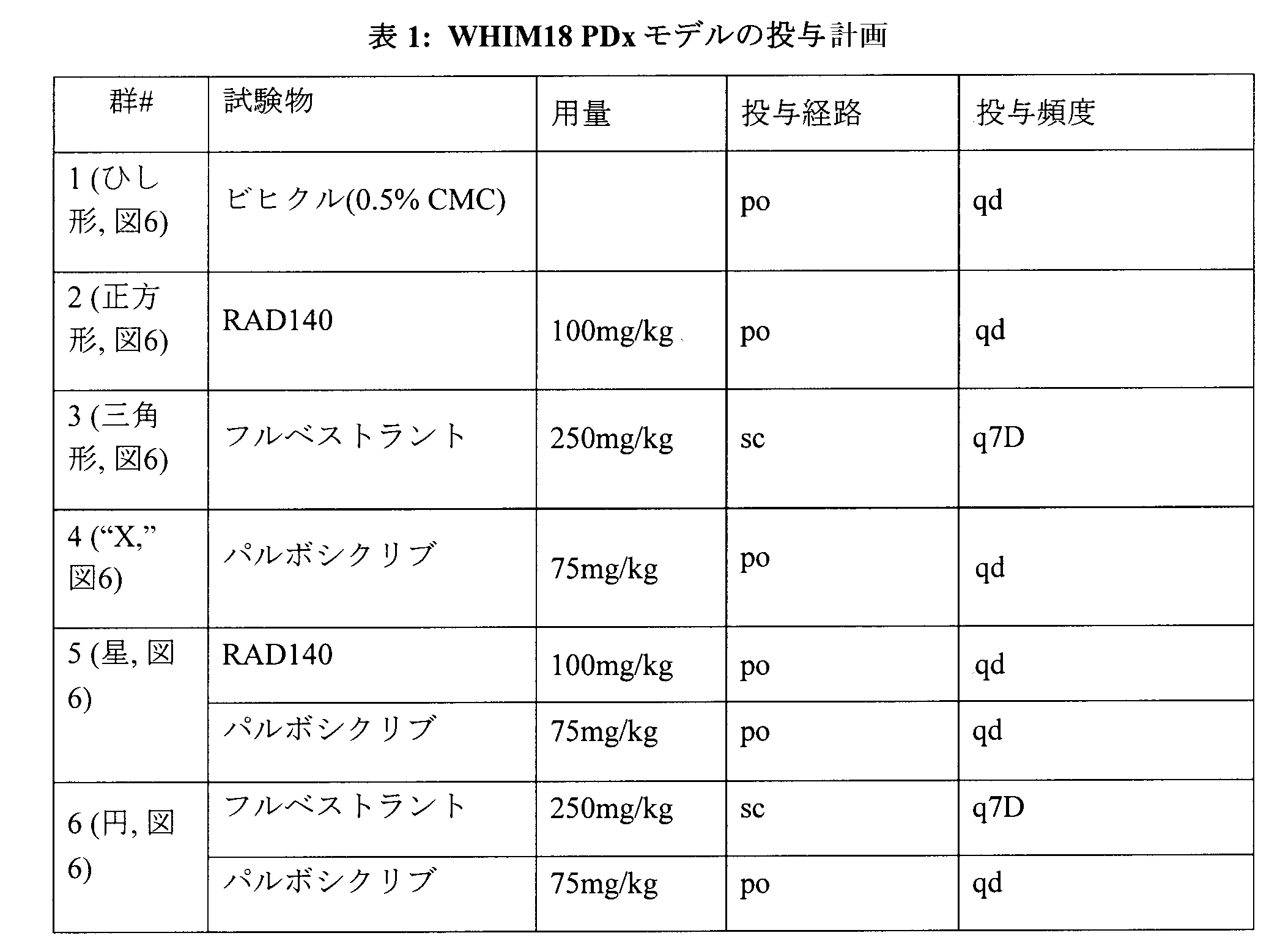
この実施例における投与のためのRAD140組成物は、適量の0.5% CMCを遮光しながら4℃で連続撹拌してRAD140に添加することにより調製した。RAD140組成物は毎週調製した。 The RAD140 composition for administration in this example was prepared by adding an appropriate amount of 0.5% CMC to RAD140 with continuous stirring at 4°C, protected from light. The RAD140 composition was prepared weekly.
この実施例における投与のためのパルボシクリブ組成物は、適量の滅菌食塩水(0.9%塩化ナトリウム、注射用NDC 0409-7983-03)を撹拌しながらパルボシクリブに添加して調製した。パルボシクリブ組成物は、パルボシクリブが溶解するまで4℃で連続撹拌した。パルボシクリブ組成物は毎週調製した。 The palbociclib composition for administration in this example was prepared by adding an appropriate amount of sterile saline (0.9% sodium chloride for injection, NDC 0409-7983-03) to palbociclib with stirring. The palbociclib composition was stirred continuously at 4°C until the palbociclib was dissolved. Palbociclib compositions were prepared weekly.
Biopticon's TumorImagerTMを使用して1週間に2回腫瘍体積を測定し、対応するTumorManagerTMソフトウェアを使用して体積を計算した。試験の前半(27日)に1週間に1回マウスを計量した。一旦重量減少を示したマウスは、1週間に2回計量した。さらに、0日目と比較して≧5%の体重減少(BWL)を有するかまたは有意な臨床徴候(例えば背中を曲げた姿勢、汚らしい見た目)を示した任意のマウスは毎日計量した。0日目と比較して≧15%のBWLを有した任意のマウスについて投与を中止し、マウスの体重がBWL≦15%まで戻った場合に投与を再開した。
Tumor volumes were measured twice weekly using Biopticon's TumorImagerTM and volumes were calculated using the corresponding TumorManagerTM software. Mice were weighed once weekly during the first half of the study (day 27). Once mice showed weight loss, they were weighed twice weekly. Additionally, any mice with a body weight loss (BWL) of ≥ 5% compared to
マウスが瀕死になった場合、マウスの腫瘍体積が2,000mm3を越えた場合または0日目と比較してマウスの体重が≧20%減少した場合にはマウスを試験から取り除いた。可能な場合は、試験試料を採取し、最後の投与の時間および屠殺(take down)時間を記録した。
Mice were removed from the study if they became moribund, if their tumor volume exceeded 2,000 mm3 , or if their body weight decreased by ≥ 20% compared to
56日目の最後の投与の6時間後に残りの動物を屠殺した(taken down)。フルベストラントの最後の投与は屠殺の朝に行った。実際の屠殺は6~9時間の間であった。CO2での死亡の直後に心臓穿刺により採血し、血液をEDTAチューブに入れて2000g、4℃で10分間スピンダウンした。血漿をエッペンドルフチューブに移して-80℃で保存した。
The remaining animals were taken down 6 hours after the last dose on
採血後に腫瘍を切除して計量した。それぞれの腫瘍について、腫瘍の半分を10%中性緩衝化ホルマリン(NBF)に入れ、腫瘍のもう半分をエッペンドルフチューブに入れて液体N2中で瞬時に凍結し、-80℃で保存した。ホルマリン固定パラフィン包埋(FFPE)ブロックのために回収した全ての組織を中性緩衝化ホルマリン(NBF)中で24~48時間固定し、次いで70%エタノールに移して、その後FFPEブロックに処理されるように輸送した。 Tumors were excised and weighed after blood collection. For each tumor, half of the tumor was placed in 10% neutral buffered formalin (NBF) and the other half of the tumor was placed in an Eppendorf tube and snap frozen in liquid N2 and stored at -80°C. All tissues retrieved for formalin-fixed paraffin-embedded (FFPE) blocks were fixed in neutral buffered formalin (NBF) for 24-48 hours and then transferred to 70% ethanol and shipped for subsequent processing into FFPE blocks.
結果:
インビボ実験の結果をグラフにより図6に示す。腫瘍増殖の相対的減少を以下の表2および3に統計により示す。
result:
The results of the in vivo experiments are shown graphically in Figure 6. The relative reduction in tumor growth is statistically shown in Tables 2 and 3 below.
腫瘍増殖阻害(TGI、%)は、56日目のビヒクル群に対して計算した(表2、式1)。


Δ腫瘍体積56日目-0日目の双方向分布および2つの試料の等分散を使用して、スチューデントt検定をエクセルで計算した。
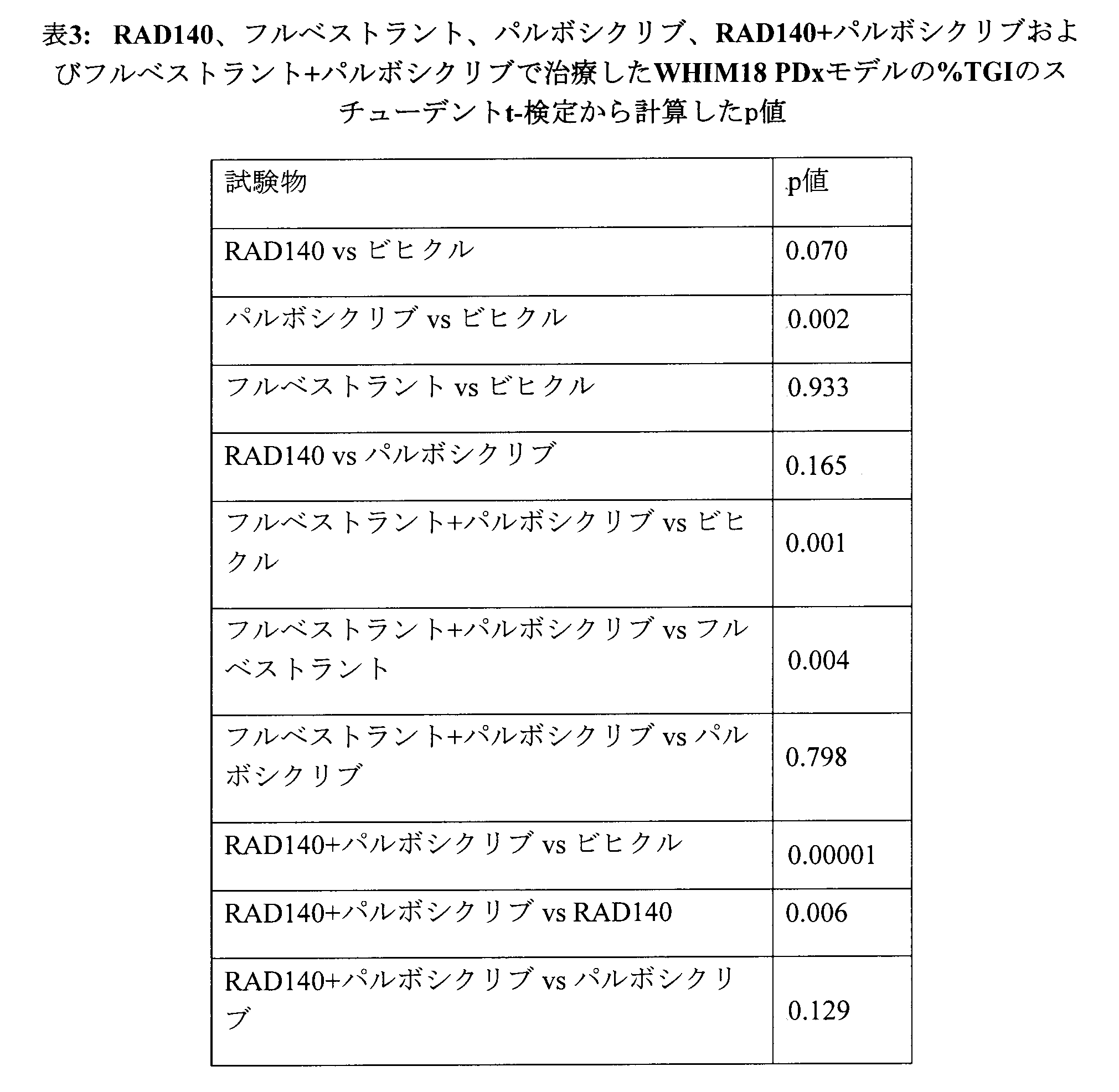
100mg/kgの用量で単独またはパルボシクリブと組み合わせたRAD140の投与は、雌胸腺除去ヌードマウス(WHIM18 PDx)に埋め込んだHER2-、ER+、PR+乳癌腫瘍の増殖を阻害した(図6)。RAD140とパルボシクリブの組合せは、いずれかの薬物単独よりも有効であるように思われる。いずれの群においても明らかな毒性は観察されなかった。 Administration of RAD140 alone or in combination with palbociclib at a dose of 100 mg/kg inhibited the growth of HER2-, ER+, and PR+ breast cancer tumors implanted in female thymic nude mice (WHIM18 PDx) (Figure 6). The combination of RAD140 and palbociclib appears to be more effective than either drug alone. No obvious toxicity was observed in any group.
実施例7
PDxモデル#2、すなわち実施例/図3に記載されるものと同じPDxモデルにおいて、低用量1mg/kg bidまたは10mg/kg bidで投与されたRAD140は共に、両方の群で約81%のTGI値で判断されるように、腫瘍増殖の実質的な阻害をもたらした。
Example 7
In
実施例8
PDxモデル#1、すなわち実施例/図1に記載されるものと同じPDxモデルにおいて、低用量1mg/kg bid、3mg/kg bidまたは10mg/kg bidで投与されるRAD140は全て、49%、65%および57%のそれぞれのTGI値で判断されるように、腫瘍増殖の実質的な阻害をもたらした。
Example 8
In
実施例9
RAD140は、ヌードマウス中に移植されたPDx腫瘍異種移植片において良好な活性を有することが示された。活性は、1mg/kg~100mg/kgの範囲で有意であった。マウスにおける特異的曝露レベル、ならびに公知および誘導(derived)薬物動態学パラメーターの両方からの交差種(cross species)薬物動態学的モデリングを考慮すると、女性患者における用量範囲を計算できる。特に、1mg/kg (bid)~100mg/kg (bid)の用量は全て、本明細書の実施例に記載される1つ以上のモデルにおいて良好な有効性を有することが示された。種間の半減期およびミクロソーム安定性に基づいて、RAD140は5mg~500mgの用量範囲での1日1回の経口用量として有効であることが予測される。例えば、10mg/kg (qd)のマウス有効用量は、60kgの女性において約50mg qdの用量に効果的に変換されると考えられる。1mg/kg~100mg/kg (bid)の範囲は有効であることが示されたので、10mg~1000mgのより広い範囲が臨床的に明らかである。特にこの範囲において、10mg~250mg、25mg~250mg、25~500のさらなる範囲も支持されることが見出され得る。同様に、該範囲のいずれかに該当する個々の用量点は良好に支持されるので、該範囲内の具体的な点、整数または非整数が支持される。例えば、12.5mg、17.5mgなどの用量は、10mg、25mg、50mg、75mg、100mg、150mg、200mg、300mg、400mgおよび500mgなどの用量と同様に具体的に企図される。さらなる非限定的な例により、10mg、15mg、20mg、25mg、50mg、75、100、125、150、175、200、250、300、350、400、450、500mgの用量。記載される用量のQD投与は、動物における薬物動態学的試験からRAD140は1日に一回の投与に適する長い半減期を有することが予測されるので、非常に適切であると予測されるが、bid投与も作用するが、しかしながら1日1回の投与のための上述の用量は、1日に2回で与えられるので2回に分割される。
Example 9
RAD140 was shown to have good activity in PDx tumor xenografts implanted in nude mice. Activity was significant in the range of 1 mg/kg to 100 mg/kg. Given the specific exposure levels in mice, and cross species pharmacokinetic modeling from both known and derived pharmacokinetic parameters, a dose range in female patients can be calculated. In particular, doses from 1 mg/kg (bid) to 100 mg/kg (bid) were all shown to have good efficacy in one or more of the models described in the Examples herein. Based on the interspecies half-life and microsomal stability, RAD140 is predicted to be effective as a once-daily oral dose in the dose range of 5 mg to 500 mg. For example, a mouse effective dose of 10 mg/kg (qd) would be effectively translated to a dose of approximately 50 mg qd in a 60 kg woman. The range of 1 mg/kg to 100 mg/kg (bid) has been shown to be effective, so a broader range of 10 mg to 1000 mg is clinically evident. Particularly within this range, further ranges of 10 mg to 250 mg, 25 mg to 250 mg, 25 to 500 may also be found to be supported. Similarly, specific points within the range, integer or non-integer, are supported, as are individual dose points that fall within any of the ranges. For example, doses of 12.5 mg, 17.5 mg, etc. are specifically contemplated, as are doses of 10 mg, 25 mg, 50 mg, 75 mg, 100 mg, 150 mg, 200 mg, 300 mg, 400 mg, and 500 mg, etc. Further non-limiting examples include doses of 10 mg, 15 mg, 20 mg, 25 mg, 50 mg, 75, 100, 125, 150, 175, 200, 250, 300, 350, 400, 450, 500 mg. QD administration of the doses described is expected to be highly suitable as pharmacokinetic studies in animals predict that RAD140 has a long half-life suitable for once-daily administration, although bid administration also works, however the doses listed above for once-daily administration are split into two doses so that they are given twice a day.
実施例10:
方法1: 被験体に、式I

Rx=CN;
Ry=CF3もしくはCl;
Rz=CH3、CH2CH3もしくはCl;または
RyおよびRzは一緒になって:

Ra’は、H、F、Cl、CN、OHもしくはOSO3-であり;ならびに
R1およびR2はそれぞれ独立して、水素およびメチルからなる群より選択される)
の化合物、その薬学的に許容され得る塩、またはその薬学的に許容され得る溶媒和物を投与する工程を含む、被験体においてAR+/ER+乳癌を治療する方法。
方法2: 式Iの化合物が、化合物II:

方法3. 式Iの化合物が、RAD140(化合物III):

方法4. 投与が経口経路によるものである、方法1~3いずれか記載の方法。
方法5. 前記被験体が女性である、方法1~4いずれか記載の方法。
方法6. 前記女性が閉経前の女性である、方法5記載の方法。
方法7. 前記女性が閉経後の女性である、方法5記載の方法。
方法8. 該被験体が、アジュバント設定(adjuvant setting)において治療される、方法1~7いずれか記載の方法。
方法9. 該被験体が、1つ以上の内分泌学的薬剤による治療後に疾患の進行を有していた、方法1~7いずれか記載の方法。
方法10. 前記1つ以上の内分泌学的薬剤が、SERM、SERD、プロゲスチン、アロマターゼ阻害剤およびそれらの組合せからなる群より選択される、方法9記載の方法。
方法11. 前記被験体が、CDK4/6阻害剤、mTOR阻害剤、BCL-2阻害剤、PI3K阻害剤およびそれらの組合せからなる群より選択される1つ以上の薬剤による治療後に疾患の進行を有していた、方法1~7いずれか記載の方法。
方法12. 前記乳癌が、局所的、進行性または転移性の乳癌である、方法1~11いずれか記載の方法。
方法13. 前記RAD140が、1日当たり10~500mg、10mg~250mgまたは25mg~250mgで投与される、方法3~12いずれか記載の方法。
方法14. 該投与が1日に1回である、方法13記載の方法。
方法15. 該被験体が、1つ以上の変異を含むESR1を発現する、方法1~14いずれか記載の方法。
方法16. 前記変異が、非変異ESR1と比較して、リガンドの結合親和性に影響する、方法15記載の方法。
方法17. 前記変異が、非変異ESR1と比較して、変異したESR1に対するエストラジオール親和性の低減を生じる、方法16記載の方法。
方法18. 前記変異が、ESR1経路を介して、リガンド依存的に、またはリガンドに独立してシグナル伝達する、方法15~17いずれか記載の方法。
方法19. 前記変異が、非変異ESR1の配列から少なくとも10個の連続したアミノ酸および別のヒトタンパク質から少なくとも10個の連続したアミノ酸を含む融合タンパク質を生じる、方法15~18いずれか記載の方法。
方法20. 前記変異が、ESR1の正常(非変異)リガンド結合ドメインアミノ酸配列から10個以上の連続したアミノ酸を欠損するESR1を生じる、方法15~19いずれか記載の方法。
方法21. 前記変異が、ESR1-AKAP12、ESR1-CCDC170、ESR1-YAP1、ESR1-POLH、ESR1-PCDH11Xおよびそれらの組合せからなる群より選択される1つ以上の変異を含む、方法15~20いずれか記載の方法。
方法22. 該治療が、CDK4/6阻害剤の投与をさらに含む、方法1~21いずれか記載の方法。
方法23. 前記CDK4/6阻害剤が、CDK4およびCDK6に対して<100nMのIC50を有する、方法22記載の方法。
方法24. 前記CDK4/6阻害剤が、パルボシクリブ、リボシクリブ、トリラシクリブおよびアベマシクリブからなる群より選択される、方法1~23いずれか記載の方法。
方法25. 前記治療が、mTOR阻害剤の投与をさらに含む、方法1~21いずれか記載の方法。
方法26. 前記mTOR阻害剤が、シロリムス、テムシロリムス、エベロリムス、リダファロリムスおよびMLN0128からなる群より選択される、方法25記載の方法。
方法27. PI3K阻害剤の投与をさらに含む、方法1~21いずれか記載の方法。
方法28. PI3K阻害剤が、BEZ235、GDC-0980、BKM120、GDC-0941、BYL719、GDC-0032、MK2206、GDC-0068、GSK2110183、GSK2141795、AZD5363、AZD2014、MLN0128またはCC-223である、方法27記載の方法。
方法29. PARP阻害剤の投与をさらに含む、方法1~21いずれか記載の方法。
方法30. 前記PARP阻害剤が、タラゾパリブ、ベリパリブ、ニラパリブ、beigene290、E7449、KX01、ABT767、CK102、JPI289、KX02、IMP4297、SC10914、NT125、PJ34、VPI289またはANG-3186である、方法29記載の方法。
方法31. MCL-1阻害剤の投与をさらに含む、方法1~21いずれか記載の方法。
方法32. 前記MCL-1阻害剤が、7-(5-((4-(4-(N,N-ジメチルスルファモイル)ピペラジン-1-イル)フェノキシ)メチル)-1,3-ジメチル-1H-ピラゾール-4-イル)-1-(2-モルホリノエチル)-3-(3-(ナフタレン-1-イルオキシ)プロピル)-1H-インドール-2-カルボン酸、S63845、オマサタキシン、セリシクリブ、UMI-77、AT101、サブトクラックスまたはTW-37である、方法31記載の方法。
方法33. BCL-2阻害剤の投与をさらに含む、方法1~21いずれか記載の方法。
方法34. 前記BCL-2阻害剤が、ベネトクラックス、ナビトクラックス、ABT737、G3139またはS55746である、方法33記載の方法。
方法35. 前記治療が、非アジュバント設定における第一線の治療である、方法1~7または12~34のいずれか1つ記載の方法。
方法36. 方法1~3いずれか記載のARアゴニストならびにPARP阻害剤、mTOR阻害剤、CDK4/6阻害剤、PI3K阻害剤、BCL2阻害剤、MCL-1阻害剤およびそれらの組合せからなる群より選択される1つ以上の薬剤を含む、キット。
方法37. mTOR阻害剤、CDK4/6阻害剤、PI3K阻害剤、PARP阻害剤、BCL2阻害剤、MCL-1阻害剤およびそれらの組合せからなる群より選択される1つ以上の薬剤と一緒にステロイド性または非ステロイド性のARアゴニストの投与を含む、被験体においてAR+/ER+乳癌を治療する方法。
方法38. 前記ARアゴニストがステロイド性ARアゴニストである、方法37記載の方法。
方法39. 前記ARアゴニストが選択的アンドロゲン受容体調節剤である、方法38記載の方法。
方法40. 前記選択的アンドロゲン受容体調節剤が、2-クロロ-4-[[(1R,2R)-2-ヒドロキシ-2-メチル-シクロペンチル]アミノ]-3-メチル-ベンゾニトリル、PF-06260414、エノボサルム、BMS-564929、LGD-4033、AC-262356、JNJ-28330835、S-40503、GSK-2881078、AZD-3514、MK4541、LG121071、GLPG0492、NEP28、YK11、MK0773、ACP-105、LY-2452473、S-101479、S-40542、S-42およびLGD-3303からなる群より選択される、方法39記載の方法。
方法41. 該治療がアジュバント設定におけるものである、方法37~40いずれか記載の方法。
方法42. 前記治療が非アジュバント設定における第一線のものである、方法37~40いずれか記載の方法。
方法43. 前記被験体が、以前の内分泌学的治療による治療後に疾患の進行を有していた、方法37~40いずれか記載の方法。
方法44. 前記被験体が、mTOR阻害剤、CDK4/6阻害剤、PI3K阻害剤、PARP阻害剤、BCL2阻害剤、MCL-1阻害剤およびそれらの組合せからなる群より選択される薬剤による治療後に疾患の進行を有していた、方法37~40または43のいずれか1つ記載の方法。
方法45. 前記被験体が女性である、方法37~44いずれか記載の方法。
方法46. 前記女性が閉経前の女性である、方法45記載の方法。
方法47. 前記女性が閉経後の女性である、方法45記載の方法。
方法48. 前記乳癌が局所的である、方法37~47いずれか記載の方法。
方法49. 前記乳癌が進行性または転移性のものである、方法37~47いずれか記載の方法。
方法50. 前記m-TOR阻害剤が、シロリムス、テムシロリムス、エベロリムス、リダファロリムスまたはMLN0128である、方法37~49いずれか記載の方法。
方法51. 前記CDK4/6阻害剤が、パルボシクリブ、リボシクリブ、トリラシクリブまたはアベマシクリブである、方法37~50いずれか記載の方法。
方法52. 前記PI3K阻害剤が、BEZ235、GDC-0980、BKM120、GDC-0941、BYL719、GDC-0032、MK2206、GDC-0068、GSK2110183、GSK2141795、AZD5363、AZD2014、MLN0128またはCC-223である、方法37~51いずれか記載の方法。
方法53. 前記PARP阻害剤が、タラゾパリブ、ベリパリブ、ニラパリブ、beigene290、E7449、KX01、ABT767、CK102、JPI289、KX02、IMP4297、SC10914、NT125、PJ34、VPI289またはANG-3186である、方法37~52いずれか記載の方法。
方法54. 前記MCL-1阻害剤が、7-(5-((4-(4-(N,N-ジメチルスルファモイル)ピペラジン-1-イル)フェノキシ)メチル)-1,3-ジメチル-1H-ピラゾール-4-イル)-1-(2-モルホリノエチル)-3-(3-(ナフタレン-1-イルオキシ)プロピル)-1H-インドール-2-カルボン酸、S63845、オマサタキシン、セリシクリブ、UMI-77、AT101、サブトクラックスまたはTW-37である、方法37~53いずれか記載の方法。
方法55. 前記BCL-2阻害剤が、ベネトクラックス、ナビトクラックス、ABT737、G3139またはS55746である、方法37~54いずれか記載の方法。
方法56. 活性剤が一緒に投与される、方法37~55いずれか記載の方法。
方法57. 活性剤が、共製剤化(coformulation)において投与される、方法35~56いずれか記載の方法。
方法58. ARアゴニストまたは選択的アンドロゲン受容体調節剤、ならびにmTOR阻害剤、CDK4/6阻害剤、PI3K阻害剤、PARP阻害剤、BCL2阻害剤、MCL-1阻害剤およびそれらの組合せからなる群より選択される1つ以上の薬剤を含む、乳癌の治療に有用なキット。
方法59. 被験体においてAR+/ER+乳癌を治療する方法であって、前記被験体が1つ以上のESR1変異を有し、前記方法が、ARアゴニストの投与を含む、方法。
方法60. 前記ARアゴニストが非ステロイド性である、方法59記載の方法。
方法61. 前記ARアゴニストが選択的アンドロゲン受容体調節剤である、方法60記載の方法。
方法62. 前記選択的アンドロゲン受容体調節剤が、2-クロロ-4-[[(1R,2R)-2-ヒドロキシ-2-メチル-シクロペンチル]アミノ]-3-メチル-ベンゾニトリル、PF-06260414、エノボサルム、BMS-564929、LGD-4033、AC-262356、JNJ-28330835、S-40503、GSK-2881078、AZD-3514、MK4541、LG121071、GLPG0492、NEP28、YK11、MK0773、ACP-105、LY-2452473、S-101479、S-40542、S-42およびLGD-3303からなる群より選択される、方法61記載の方法。
方法63. 前記変異が、非変異ESR1と比較して、リガンドの結合親和性に影響する、方法58~62いずれか記載の方法。
方法64. 前記変異が、非変異ESR1と比較して、変異したESR1に対するエストラジオール親和性の低減を生じる、方法59~63いずれか記載の方法。
方法65. 前記変異が、ESR1経路を介して、リガンド依存的に、またはリガンドに独立してシグナル伝達する、方法59~64いずれか記載の方法。
方法66. 前記変異が、非変異ESR1の配列から少なくとも10個の連続したアミノ酸および別のヒトタンパク質から少なくとも10個の連続したアミノ酸を含む融合タンパク質を生じる、方法59~65いずれか記載の方法。
方法67. 前記変異が、ESR1の正常(非変異)リガンド結合ドメインアミノ酸配列から10個以上の連続したアミノ酸を欠損するESR1を生じる、方法59~66いずれか記載の方法。
方法68. 前記変異が、ESR1-AKAP12、ESR1-CCDC170、ESR1-YAP1、ESR1-POLH、ESR1-PCDH11Xおよびそれらの組合せからなる群より選択される融合である、方法59~67いずれか記載の方法。
方法69. 該投与が経口経路によるものである、方法59~68いずれか記載の方法。
方法70. 前記治療がアジュバント設定におけるものである、方法59~69いずれか記載の方法。
方法71. 前記治療が非アジュバント設定における第一線のものである、方法59~69いずれか記載の方法。
方法72. 前記被験体が、以前の内分泌学的治療による治療後に疾患の進行を有していた、方法59~69いずれか記載の方法。
方法73. 前記被験体が、mTOR阻害剤、CDK4/6阻害剤、PI3K阻害剤、PARP阻害剤、BCL2阻害剤、MCL-1阻害剤およびそれらの組合せからなる群より選択される1つ以上の薬剤による治療後に疾患の進行を有していた、方法59~69または72のいずれか1つ記載の方法。
方法74. 前記被験体が女性である、方法59~73いずれか記載の方法。
方法75. 前記女性が閉経前の女性である、方法74記載の方法。
方法76. 前記女性が閉経後の女性である、方法74記載の方法。
方法77. 前記乳癌が局所的である、方法59~76いずれか記載の方法。
方法78. 前記乳癌が進行性または転移性である、方法59~76いずれか記載の方法。
方法79. 該治療が、CDK4/6阻害剤の投与をさらに含む、方法59~78いずれか記載の方法。
方法80. 前記CDK4/6阻害剤が、CDK4およびCDK6に対して、<100nMのIC50を有する、方法79記載の方法。
方法81. 前記CDK4/6阻害剤が、パルボシクリブ、リボシクリブ、トリラシクリブおよびアベマシクリブからなる群より選択される、方法79記載の方法。
方法82. 前記治療が、mTOR阻害剤の投与をさらに含む、方法59~78いずれか記載の方法。
方法83. 前記mTOR阻害剤が、シロリムス、テムシロリムス、エベロリムス、リダファロリムスおよびMLN0128からなる群より選択される、方法82記載の方法。
方法84. PI3K阻害剤の投与をさらに含む、方法59~78いずれか記載の方法。
方法85. 前記PI3K阻害剤が、BEZ235、GDC-0980、BKM120、GDC-0941、BYL719、GDC-0032、MK2206、GDC-0068、GSK2110183、GSK2141795、AZD5363、AZD2014、MLN0128またはCC-223である、方法84記載の方法。
方法86. PARP阻害剤の投与をさらに含む、方法59~78いずれか記載の方法。
方法87. 前記PARP阻害剤が、タラゾパリブ、ベリパリブ、ニラパリブ、beigene290、E7449、KX01、ABT767、CK102、JPI289、KX02、IMP4297、SC10914、NT125、PJ34、VPI289またはANG-3186である、方法86記載の方法。
方法88. MCL-1阻害剤の投与をさらに含む、方法59~78いずれか記載の方法。
方法89. 前記MCL-1阻害剤が、7-(5-((4-(4-(N,N-ジメチルスルファモイル)ピペラジン-1-イル)フェノキシ)メチル)-1,3-ジメチル-1H-ピラゾール-4-イル)-1-(2-モルホリノエチル)-3-(3-(ナフタレン-1-イルオキシ)プロピル)-1H-インドール-2-カルボン酸、S63845、オマサタキシン、セリシクリブ、UMI-77、AT101、サブトクラックスまたはTW-37である、方法88記載の方法。
方法90. BCL-2阻害剤の投与をさらに含む、方法59~78いずれか記載の方法。
方法91. 前記BCL-2阻害剤が、ベネトクラックス、ナビトクラックス、ABT737、G3139またはS55746である、方法90記載の方法。
方法92. 前記治療が非アジュバント設定における第一線の治療である、方法59~91いずれか記載の方法。
方法93. 1) 1つ以上のESR1変異について被験体を試験する工程;および
2) 被験体が1つ以上のESR1変異について陽性の試験結果を示す場合に、該被験体を、方法1~35、37~57、59~92のいずれか1つに記載の方法により治療する工程
を含む、乳癌について被験体を治療する方法。
方法94. 前記変異が、非変異ESR1と比較して、変異したESR1に対するエストラジオール親和性の低減を生じる、方法93記載の方法。
方法95. 前記変異が、ESR1経路を介して、リガンド依存的に、またはリガンドに独立してシグナル伝達する、方法93または94記載の方法。
方法96. 前記変異が、非変異ESR1の配列から少なくとも10個の連続したアミノ酸および別のヒトタンパク質から少なくとも10個の連続したアミノ酸を含む融合タンパク質を生じる、方法93~95いずれか記載の方法。
方法97. 前記変異が、ESR1の正常(非変異)リガンド結合ドメインアミノ酸配列から10個以上の連続したアミノ酸を欠損するESR1を生じる、方法93~95いずれか記載の方法。
方法98. 前記変異が、ESR1-AKAP12、ESR1-CCDC170、ESR1-YAP1、ESR1-POLH、ESR1-PCDH11Xおよびそれらの組合せからなる群より選択される融合である、方法93記載の方法。
方法99. 前記被験体がZBTB16のmRNAまたはタンパク質の発現のベースラインレベルについて最初に試験され、次いで治療期間後にZBTB16のmRNAまたはタンパク質の発現のレベルについて再度試験され、該レベルがベースラインよりも増加した場合に、被験体が治療を継続することが推奨される、方法1~35、37~57、59~98のいずれか1つ記載の方法。
方法100. 前記治療期間が少なくとも3日のARアゴニストの毎日投与である、方法99記載の方法。
方法101. 前記期間が少なくとも1週間のARアゴニストの毎日投与である、方法100記載の方法。
方法102. 治療前のレベルに対する治療後のレベルの比が>3である、方法99~101いずれか記載の方法。
方法103. 該比が>10である、方法102記載の方法。
方法104. 該比が>50である、方法103記載の方法。
Example 10:
Method 1: administering to a subject a dose of Formula I
R x =CN;
Ry = CF3 or Cl;
Rz = CH3 , CH2CH3 or Cl ; or
Ry and Rz together are:
R a' is H, F, Cl, CN, OH or OSO 3 -; and
R 1 and R 2 are each independently selected from the group consisting of hydrogen and methyl.
4. A method of treating AR+/ER+ breast cancer in a subject comprising administering a compound of formula (I) or a pharma- ceutically acceptable salt or solvate thereof.
Method 2: A compound of formula I is reacted with compound II:
Method 3. The compound of formula I is RAD140 (compound III):
Method 4. The method of any of Methods 1-3, wherein administration is by oral route.
Method 5. The method of any one of Methods 1-4, wherein the subject is female.
Method 6. The method of Method 5, wherein said woman is a premenopausal woman.
Method 8. The method of any of Methods 1-7, wherein said subject is treated in an adjuvant setting.
Method 9. The method of any of Methods 1-7, wherein said subject has had disease progression following treatment with one or more endocrinological agents.
Method 10. The method of Method 9, wherein said one or more endocrinological agents are selected from the group consisting of SERMs, SERDs, progestins, aromatase inhibitors, and combinations thereof.
Method 11. The method of any of Methods 1-7, wherein the subject has had disease progression following treatment with one or more agents selected from the group consisting of a CDK4/6 inhibitor, an mTOR inhibitor, a BCL-2 inhibitor, a PI3K inhibitor, and combinations thereof.
Method 12. The method of any of Methods 1-11, wherein said breast cancer is localized, advanced or metastatic breast cancer.
Method 13. The method of any of Methods 3-12, wherein said RAD140 is administered at 10-500 mg, 10 mg-250 mg, or 25 mg-250 mg per day.
Method 15. The method of any of methods 1-14, wherein the subject expresses an ESR1 that contains one or more mutations.
Method 16. The method of method 15, wherein the mutation affects the binding affinity of a ligand compared to non-mutated ESR1.
Method 17. The method of method 16, wherein the mutation results in a decrease in estradiol affinity for the mutated ESR1 compared to non-mutated ESR1.
Method 18. The method of any of methods 15-17, wherein said mutation signals through the ESR1 pathway in a ligand-dependent or ligand-independent manner.
Method 19. The method of any of methods 15-18, wherein the mutation results in a fusion protein comprising at least 10 contiguous amino acids from the sequence of non-mutated ESR1 and at least 10 contiguous amino acids from another human protein.
Method 20. The method of any of Methods 15-19, wherein the mutation results in ESR1 lacking 10 or more consecutive amino acids from the amino acid sequence of the normal (non-mutated) ligand-binding domain of ESR1.
Method 22. The method of any of Methods 1-21, wherein said treatment further comprises administration of a CDK4/6 inhibitor.
Method 23. The method of Method 22, wherein said CDK4/6 inhibitor has an IC50 of <100 nM against CDK4 and CDK6.
Method 24. The method of any of Methods 1-23, wherein said CDK4/6 inhibitor is selected from the group consisting of palbociclib, ribociclib, trilaciclib, and abemaciclib.
Method 25. The method of any of Methods 1-21, wherein said treatment further comprises administration of an mTOR inhibitor.
Method 26. The method of Method 25, wherein said mTOR inhibitor is selected from the group consisting of sirolimus, temsirolimus, everolimus, ridafarolimus and MLN0128.
Method 27. The method of any of methods 1-21, further comprising administration of a PI3K inhibitor.
Method 29. The method of any of methods 1-21, further comprising administration of a PARP inhibitor.
Method 30. The method of Method 29, wherein said PARP inhibitor is talazoparib, veliparib, niraparib, beigene290, E7449, KX01, ABT767, CK102, JPI289, KX02, IMP4297, SC10914, NT125, PJ34, VPI289 or ANG-3186.
Method 31. The method of any of methods 1-21, further comprising administration of an MCL-1 inhibitor.
Method 32. The method of Method 31, wherein said MCL-1 inhibitor is 7-(5-((4-(4-(N,N-dimethylsulfamoyl)piperazin-1-yl)phenoxy)methyl)-1,3-dimethyl-1H-pyrazol-4-yl)-1-(2-morpholinoethyl)-3-(3-(naphthalen-1-yloxy)propyl)-1H-indole-2-carboxylic acid, S63845, omasataxin, seliciclib, UMI-77, AT101, sabutoclax or TW-37.
Method 33. The method of any of methods 1-21, further comprising administration of a BCL-2 inhibitor.
Method 34. The method of Method 33, wherein said BCL-2 inhibitor is venetoclax, navitoclax, ABT737, G3139 or S55746.
Method 36. A kit comprising an AR agonist according to any of methods 1-3 and one or more agents selected from the group consisting of a PARP inhibitor, an mTOR inhibitor, a CDK4/6 inhibitor, a PI3K inhibitor, a BCL2 inhibitor, an MCL-1 inhibitor, and combinations thereof.
Method 37. A method of treating AR+/ER+ breast cancer in a subject comprising administration of a steroidal or non-steroidal AR agonist together with one or more agents selected from the group consisting of an mTOR inhibitor, a CDK4/6 inhibitor, a PI3K inhibitor, a PARP inhibitor, a BCL2 inhibitor, an MCL-1 inhibitor, and combinations thereof.
Method 38. The method of Method 37, wherein said AR agonist is a steroidal AR agonist.
Method 40. The method of
Method 41. The method of any of Methods 37-40, wherein said treating is in an adjuvant setting.
Method 43. The method of any of Methods 37-40, wherein said subject has had disease progression following treatment with a previous endocrinological therapy.
Method 44. The method of any one of Methods 37-40 or 43, wherein said subject has had disease progression following treatment with an agent selected from the group consisting of an mTOR inhibitor, a CDK4/6 inhibitor, a PI3K inhibitor, a PARP inhibitor, a BCL2 inhibitor, an MCL-1 inhibitor, and combinations thereof.
Method 45. The method of any of methods 37-44, wherein the subject is female.
Method 46. The method of Method 45, wherein said woman is a premenopausal woman.
Method 47. The method of Method 45, wherein said woman is a postmenopausal woman.
Method 48. The method of any of methods 37-47, wherein the breast cancer is localized.
Method 50. The method of any of Methods 37-49, wherein the m-TOR inhibitor is sirolimus, temsirolimus, everolimus, ridafarolimus, or MLN0128.
Method 51. The method of any of Methods 37-50, wherein said CDK4/6 inhibitor is palbociclib, ribociclib, trilaciclib, or abemaciclib.
Method 52. The method of any of Methods 37-51, wherein the PI3K inhibitor is BEZ235, GDC-0980, BKM120, GDC-0941, BYL719, GDC-0032, MK2206, GDC-0068, GSK2110183, GSK2141795, AZD5363, AZD2014, MLN0128 or CC-223.
Method 53. The method of any of Methods 37-52, wherein said PARP inhibitor is talazoparib, veliparib, niraparib, beigene290, E7449, KX01, ABT767, CK102, JPI289, KX02, IMP4297, SC10914, NT125, PJ34, VPI289 or ANG-3186.
Method 54. The method of any of Methods 37-53, wherein said MCL-1 inhibitor is 7-(5-((4-(4-(N,N-dimethylsulfamoyl)piperazin-1-yl)phenoxy)methyl)-1,3-dimethyl-1H-pyrazol-4-yl)-1-(2-morpholinoethyl)-3-(3-(naphthalen-1-yloxy)propyl)-1H-indole-2-carboxylic acid, S63845, omasataxin, seliciclib, UMI-77, AT101, sabutoclax, or TW-37.
Method 55. The method of any of Methods 37-54, wherein said BCL-2 inhibitor is venetoclax, navitoclax, ABT737, G3139 or S55746.
Method 57. The method of any of Methods 35-56, wherein the active agents are administered in a coformulation.
Method 58. A kit useful for treating breast cancer comprising an AR agonist or selective androgen receptor modulator and one or more agents selected from the group consisting of an mTOR inhibitor, a CDK4/6 inhibitor, a PI3K inhibitor, a PARP inhibitor, a BCL2 inhibitor, an MCL-1 inhibitor and combinations thereof.
Method 59. A method of treating AR+/ER+ breast cancer in a subject, wherein the subject has one or more ESR1 mutations, the method comprising administration of an AR agonist.
Method 60. The method of method 59, wherein said AR agonist is non-steroidal.
Method 61. The method of Method 60, wherein said AR agonist is a selective androgen receptor modulator.
Method 62. The method of Method 61, wherein said selective androgen receptor modulator is selected from the group consisting of 2-chloro-4-[[(1R,2R)-2-hydroxy-2-methyl-cyclopentyl]amino]-3-methyl-benzonitrile, PF-06260414, enobosarm, BMS-564929, LGD-4033, AC-262356, JNJ-28330835, S-40503, GSK-2881078, AZD-3514, MK4541, LG121071, GLPG0492, NEP28, YK11, MK0773, ACP-105, LY-2452473, S-101479, S-40542, S-42 and LGD-3303.
Method 64. The method of any of methods 59-63, wherein the mutation results in a decrease in estradiol affinity for the mutated ESR1 compared to non-mutated ESR1.
Method 65. The method of any of methods 59-64, wherein said mutation signals through the ESR1 pathway in a ligand-dependent or ligand-independent manner.
Method 66. The method of any of methods 59-65, wherein the mutation results in a fusion protein comprising at least 10 contiguous amino acids from the sequence of non-mutated ESR1 and at least 10 contiguous amino acids from another human protein.
Method 67. The method of any of Methods 59-66, wherein the mutation results in ESR1 lacking 10 or more consecutive amino acids from the normal (non-mutated) ligand-binding domain amino acid sequence of ESR1.
Method 68. The method of any of Methods 59-67, wherein the mutation is a fusion selected from the group consisting of ESR1-AKAP12, ESR1-CCDC170, ESR1-YAP1, ESR1-POLH, ESR1-PCDH11X, and combinations thereof.
Method 69. The method of any of Methods 59-68, wherein said administration is by oral route.
Method 71. The method of any of methods 59-69, wherein said treatment is first line in a non-adjuvant setting.
Method 72. The method of any of Methods 59-69, wherein the subject has had disease progression after treatment with a previous endocrinological therapy.
Method 73. The method of any one of Methods 59-69 or 72, wherein the subject has had disease progression following treatment with one or more agents selected from the group consisting of an mTOR inhibitor, a CDK4/6 inhibitor, a PI3K inhibitor, a PARP inhibitor, a BCL2 inhibitor, an MCL-1 inhibitor, and combinations thereof.
Method 74. The method of any of methods 59-73, wherein the subject is female.
Method 75. The method of Method 74, wherein said woman is a premenopausal woman.
Method 76. The method of Method 74, wherein said woman is a postmenopausal woman.
Method 78. The method of any of methods 59-76, wherein the breast cancer is advanced or metastatic.
Method 79. The method of any of methods 59-78, wherein said treating further comprises administration of a CDK4/6 inhibitor.
Method 80. The method of Method 79, wherein said CDK4/6 inhibitor has an IC50 of <100 nM against CDK4 and CDK6.
Method 81. The method of Method 79, wherein said CDK4/6 inhibitor is selected from the group consisting of palbociclib, ribociclib, trilaciclib and abemaciclib.
Method 82. The method of any of methods 59-78, wherein said treatment further comprises administration of an mTOR inhibitor.
Method 83. The method of Method 82, wherein said mTOR inhibitor is selected from the group consisting of sirolimus, temsirolimus, everolimus, ridafarolimus, and MLN0128.
Method 84. The method of any of methods 59-78, further comprising administration of a PI3K inhibitor.
Method 85. The method of Method 84, wherein the PI3K inhibitor is BEZ235, GDC-0980, BKM120, GDC-0941, BYL719, GDC-0032, MK2206, GDC-0068, GSK2110183, GSK2141795, AZD5363, AZD2014, MLN0128 or CC-223.
Method 86. The method of any of methods 59-78, further comprising administration of a PARP inhibitor.
Method 87. The method of Method 86, wherein said PARP inhibitor is talazoparib, veliparib, niraparib, beigene290, E7449, KX01, ABT767, CK102, JPI289, KX02, IMP4297, SC10914, NT125, PJ34, VPI289 or ANG-3186.
Method 88. The method of any of methods 59-78, further comprising administration of an MCL-1 inhibitor.
Method 89. The method of Method 88, wherein said MCL-1 inhibitor is 7-(5-((4-(4-(N,N-dimethylsulfamoyl)piperazin-1-yl)phenoxy)methyl)-1,3-dimethyl-1H-pyrazol-4-yl)-1-(2-morpholinoethyl)-3-(3-(naphthalen-1-yloxy)propyl)-1H-indole-2-carboxylic acid, S63845, omasataxin, seliciclib, UMI-77, AT101, sabutoclax, or TW-37.
Method 90. The method of any of methods 59-78, further comprising administration of a BCL-2 inhibitor.
Method 91. The method of Method 90, wherein said BCL-2 inhibitor is venetoclax, navitoclax, ABT737, G3139 or S55746.
Method 92. The method of any of methods 59-91, wherein said treatment is a first line treatment in a non-adjuvant setting.
Method 93. 1) testing a subject for one or more ESR1 mutations; and
2) A method of treating a subject for breast cancer, comprising the step of treating the subject with a method according to any one of methods 1-35, 37-57, 59-92, if the subject tests positive for one or more ESR1 mutations.
Method 94. The method of Method 93, wherein the mutation results in a decrease in estradiol affinity for the mutated ESR1 compared to non-mutated ESR1.
Method 95. The method of Method 93 or 94, wherein said mutation signals through the ESR1 pathway in a ligand-dependent or ligand-independent manner.
Method 96. The method of any of Methods 93-95, wherein the mutation results in a fusion protein comprising at least 10 contiguous amino acids from the sequence of non-mutated ESR1 and at least 10 contiguous amino acids from another human protein.
Method 97. The method of any of Methods 93-95, wherein the mutation results in ESR1 lacking 10 or more consecutive amino acids from the normal (non-mutated) ligand-binding domain amino acid sequence of ESR1.
Method 98. The method of Method 93, wherein the mutation is a fusion selected from the group consisting of ESR1-AKAP12, ESR1-CCDC170, ESR1-YAP1, ESR1-POLH, ESR1-PCDH11X, and combinations thereof.
Method 99. The method of any one of Methods 1-35, 37-57, 59-98, wherein the subject is first tested for a baseline level of ZBTB16 mRNA or protein expression, and then tested again after a period of treatment for the level of ZBTB16 mRNA or protein expression, and if the level increases above baseline, it is recommended that the subject continue treatment.
Method 101. The method of
Method 102. The method of any of Methods 99-101, wherein the ratio of post-treatment level to pre-treatment level is >3.
Method 103. The method of method 102, wherein said ratio is >10.
Method 104. The method of method 103, wherein said ratio is >50.
本発明の態様として以下のものが挙げられる。
[1]被験体に、式I

(式中、
Rx=CN;
Ry=CF3もしくはCl;
Rz=CH3、CH2CH3もしくはCl;または
RyおよびRzは一緒になって:

を形成する;
Ra’は、H、F、Cl、CN、OHもしくはOSO3-であり;ならびに
R1およびR2はそれぞれ独立して、水素およびメチルからなる群より選択される)
の化合物、その薬学的に許容され得る塩、またはその薬学的に許容され得る溶媒和物を投与する工程を含む、被験体においてAR+/ER+乳癌を治療する方法。
[2]式Iの化合物が、化合物II:

である、[1]記載の方法。
[3]式Iの化合物が、RAD140(化合物III):

である、[1]記載の方法。
[4]投与が経口経路によるものである、[1]~[3]いずれか記載の方法。
[5]前記被験体が女性である、[1]~[4]いずれか記載の方法。
[6]前記女性が閉経前の女性である、[5]記載の方法。
[7]前記女性が閉経後の女性である、[5]記載の方法。
[8]該被験体が、アジュバント設定(adjuvant setting)において治療される、[1]~[7]いずれか記載の方法。
[9]該被験体が、1つ以上の内分泌学的薬剤による治療後に疾患の進行を有していた、[1]~[7]いずれか記載の方法。
[10]前記1つ以上の内分泌学的薬剤が、SERM、SERD、プロゲスチン、アロマターゼ阻害剤およびそれらの組合せからなる群より選択される、[9]記載の方法。
[11]前記被験体が、CDK4/6阻害剤、mTOR阻害剤、BCL-2阻害剤、PI3K阻害剤およびそれらの組合せからなる群より選択される1つ以上の薬剤による治療後に疾患の進行を有していた、[1]~[7]いずれか記載の方法。
[12]前記乳癌が、局所的、進行性または転移性の乳癌である、[1]~[11]いずれか記載の方法。
[13]前記RAD140が、1日当たり10~500mg、10mg~250mgまたは25mg~250mgで投与される、[3]~[12]いずれか記載の方法。
[14]該投与が1日に1回である、[13]記載の方法。
[15]該被験体が、1つ以上の変異を含むESR1を発現する、[1]~[14]いずれか記載の方法。
[16]前記変異が、非変異ESR1と比較して、リガンドの結合親和性に影響する、[15]記載の方法。
[17]前記変異が、非変異ESR1と比較して、変異したESR1に対するエストラジオール親和性の低減を生じる、[16]記載の方法。
[18]前記変異が、ESR1経路を介して、リガンド依存的に、またはリガンドに独立してシグナル伝達する、[15]~[17]いずれか記載の方法。
[19]前記変異が、非変異ESR1の配列から少なくとも10個の連続したアミノ酸および別のヒトタンパク質から少なくとも10個の連続したアミノ酸を含む融合タンパク質を生じる、[15]~[18]いずれか記載の方法。
[20]前記変異が、ESR1の正常(非変異)リガンド結合ドメインアミノ酸配列から10個以上の連続したアミノ酸を欠損するESR1を生じる、[15]~[19]いずれか記載の方法。
[21]前記変異が、ESR1-AKAP12、ESR1-CCDC170、ESR1-YAP1、ESR1-POLH、ESR1-PCDH11Xおよびそれらの組合せからなる群より選択される1つ以上の変異を含む、[15]~[20]いずれか記載の方法。
[22]該治療が、CDK4/6阻害剤の投与をさらに含む、[1]~[21]いずれか記載の方法。
[23]前記CDK4/6阻害剤が、CDK4およびCDK6に対して<100nMのIC50を有する、[22]記載の方法。
[24]前記CDK4/6阻害剤が、パルボシクリブ、リボシクリブ、トリラシクリブおよびアベマシクリブからなる群より選択される、[1]~[23]いずれか記載の方法。
[25]前記治療が、mTOR阻害剤の投与をさらに含む、[1]~[21]いずれか記載の方法。
[26]前記mTOR阻害剤が、シロリムス、テムシロリムス、エベロリムス、リダファロリムスおよびMLN0128からなる群より選択される、[25]記載の方法。
[27]PI3K阻害剤の投与をさらに含む、[1]~[21]いずれか記載の方法。
[28]PI3K阻害剤が、BEZ235、GDC-0980、BKM120、GDC-0941、BYL719、GDC-0032、MK2206、GDC-0068、GSK2110183、GSK2141795、AZD5363、AZD2014、MLN0128またはCC-223である、[27]記載の方法。
[29]PARP阻害剤の投与をさらに含む、[1]~[21]いずれか記載の方法。
[30]前記PARP阻害剤が、タラゾパリブ、ベリパリブ、ニラパリブ、beigene290、E7449、KX01、ABT767、CK102、JPI289、KX02、IMP4297、SC10914、NT125、PJ34、VPI289またはANG-3186である、[29]記載の方法。
[31]MCL-1阻害剤の投与をさらに含む、[1]~[21]いずれか記載の方法。
[32]前記MCL-1阻害剤が、7-(5-((4-(4-(N,N-ジメチルスルファモイル)ピペラジン-1-イル)フェノキシ)メチル)-1,3-ジメチル-1H-ピラゾール-4-イル)-1-(2-モルホリノエチル)-3-(3-(ナフタレン-1-イルオキシ)プロピル)-1H-インドール-2-カルボン酸、S63845、オマサタキシン、セリシクリブ、UMI-77、AT101、サブトクラックスまたはTW-37である、[31]記載の方法。
[33]BCL-2阻害剤の投与をさらに含む、[1]~[21]いずれか記載の方法。
[34]前記BCL-2阻害剤が、ベネトクラックス、ナビトクラックス、ABT737、G3139またはS55746である、[33]記載の方法。
[35]前記治療が、非アジュバント設定における第一線の治療である、[1]~[7]または[12]~[34]のいずれか1項記載の方法。
[36][1]~[3]いずれか記載のARアゴニストならびにPARP阻害剤、mTOR阻害剤、CDK4/6阻害剤、PI3K阻害剤、BCL2阻害剤、MCL-1阻害剤およびそれらの組合せからなる群より選択される1つ以上の薬剤を含む、キット。
[37]mTOR阻害剤、CDK4/6阻害剤、PI3K阻害剤、PARP阻害剤、BCL2阻害剤、MCL-1阻害剤およびそれらの組合せからなる群より選択される1つ以上の薬剤と一緒にステロイド性または非ステロイド性のARアゴニストの投与を含む、被験体においてAR+/ER+乳癌を治療する方法。
[38]前記ARアゴニストがステロイド性ARアゴニストである、[37]記載の方法。
[39]前記ARアゴニストが選択的アンドロゲン受容体調節剤である、[38]記載の方法。
[40]前記選択的アンドロゲン受容体調節剤が、2-クロロ-4-[[(1R,2R)-2-ヒドロキシ-2-メチル-シクロペンチル]アミノ]-3-メチル-ベンゾニトリル、PF-06260414、エノボサルム、BMS-564929、LGD-4033、AC-262356、JNJ-28330835、S-40503、GSK-2881078、AZD-3514、MK4541、LG121071、GLPG0492、NEP28、YK11、MK0773、ACP-105、LY-2452473、S-101479、S-40542、S-42およびLGD-3303からなる群より選択される、[39]記載の方法。
[41]該治療がアジュバント設定におけるものである、[37]~[40]いずれか記載の方法。
[42]前記治療が非アジュバント設定における第一線のものである、[37]~[40]いずれか記載の方法。
[43]前記被験体が、以前の内分泌学的治療による治療後に疾患の進行を有していた、[37]~[40]いずれか記載の方法。
[44]前記被験体が、mTOR阻害剤、CDK4/6阻害剤、PI3K阻害剤、PARP阻害剤、BCL2阻害剤、MCL-1阻害剤およびそれらの組合せからなる群より選択される1つ以上の薬剤による治療後に疾患の進行を有していた、[37]~[40]または[43]のいずれか1項記載の方法。
[45]前記被験体が女性である、[37]~[44]いずれか記載の方法。
[46]前記女性が閉経前の女性である、[45]記載の方法。
[47]前記女性が閉経後の女性である、[45]記載の方法。
[48]前記乳癌が局所的である、[37]~[47]いずれか記載の方法。
[49]前記乳癌が進行性または転移性のものである、[37]~[47]いずれか記載の方法。
[50]前記m-TOR阻害剤が、シロリムス、テムシロリムス、エベロリムス、リダファロリムスまたはMLN0128である、[37]~[49]いずれか記載の方法。
[51]前記CDK4/6阻害剤が、パルボシクリブ、リボシクリブ、トリラシクリブまたはアベマシクリブである、[37]~[50]いずれか記載の方法。
[52]前記PI3K阻害剤が、BEZ235、GDC-0980、BKM120、GDC-0941、BYL719、GDC-0032、MK2206、GDC-0068、GSK2110183、GSK2141795、AZD5363、AZD2014、MLN0128またはCC-223である、[37]~[51]いずれか記載の方法。
[53]前記PARP阻害剤が、タラゾパリブ、ベリパリブ、ニラパリブ、beigene290、E7449、KX01、ABT767、CK102、JPI289、KX02、IMP4297、SC10914、NT125、PJ34、VPI289またはANG-3186である、[37]~[52]いずれか記載の方法。
[54]前記MCL-1阻害剤が、7-(5-((4-(4-(N,N-ジメチルスルファモイル)ピペラジン-1-イル)フェノキシ)メチル)-1,3-ジメチル-1H-ピラゾール-4-イル)-1-(2-モルホリノエチル)-3-(3-(ナフタレン-1-イルオキシ)プロピル)-1H-インドール-2-カルボン酸、S63845、オマサタキシン、セリシクリブ、UMI-77、AT101、サブトクラックスまたはTW-37である、[37]~[53]いずれか記載の方法。
[55]前記BCL-2阻害剤が、ベネトクラックス、ナビトクラックス、ABT737、G3139またはS55746である、[37]~[54]いずれか記載の方法。
[56]活性剤が一緒に投与される、[37]~[55]いずれか記載の方法。
[57]活性剤が、共製剤化(coformulation)において投与される、[35]~[56]いずれか記載の方法。
[58]ARアゴニストまたは選択的アンドロゲン受容体調節剤、ならびにmTOR阻害剤、CDK4/6阻害剤、PI3K阻害剤、PARP阻害剤、BCL2阻害剤、MCL-1阻害剤およびそれらの組合せからなる群より選択される1つ以上の薬剤を含む、乳癌の治療に有用なキット。
[59]被験体においてAR+/ER+乳癌を治療する方法であって、前記被験体が1つ以上のESR1変異を有し、前記方法が、ARアゴニストの投与を含む、方法。
[60]前記ARアゴニストが非ステロイド性である、[59]記載の方法。
[61]前記ARアゴニストが選択的アンドロゲン受容体調節剤である、[60]記載の方法。
[62]前記選択的アンドロゲン受容体調節剤が、2-クロロ-4-[[(1R,2R)-2-ヒドロキシ-2-メチル-シクロペンチル]アミノ]-3-メチル-ベンゾニトリル、PF-06260414、エノボサルム、BMS-564929、LGD-4033、AC-262356、JNJ-28330835、S-40503、GSK-2881078、AZD-3514、MK4541、LG121071、GLPG0492、NEP28、YK11、MK0773、ACP-105、LY-2452473、S-101479、S-40542、S-42およびLGD-3303からなる群より選択される、[61]記載の方法。
[63]前記変異が、非変異ESR1と比較して、リガンドの結合親和性に影響する、[59]~[62]いずれか記載の方法。
[64]前記変異が、非変異ESR1と比較して、変異したESR1に対するエストラジオール親和性の低減を生じる、[59]~[63]いずれか記載の方法。
[65]前記変異が、ESR1経路を介して、リガンド依存的に、またはリガンドに独立してシグナル伝達する、[59]~[64]いずれか記載の方法。
[66]前記変異が、非変異ESR1の配列から少なくとも10個の連続したアミノ酸および別のヒトタンパク質から少なくとも10個の連続したアミノ酸を含む融合タンパク質を生じる、[59]~[65]いずれか記載の方法。
[67]前記変異が、ESR1の正常(非変異)リガンド結合ドメインアミノ酸配列から10個以上の連続したアミノ酸を欠損するESR1を生じる、[59]~[66]いずれか記載の方法。
[68]前記変異が、ESR1-AKAP12、ESR1-CCDC170、ESR1-YAP1、ESR1-POLH、ESR1-PCDH11Xおよびそれらの組合せからなる群より選択される融合である、[59]~[67]いずれか記載の方法。
[69]該投与が経口経路によるものである、[59]~[68]いずれか記載の方法。
[70]前記治療がアジュバント設定におけるものである、[59]~[69]いずれか記載の方法。
[71]前記治療が非アジュバント設定における第一線のものである、[59]~[69]いずれか記載の方法。
[72]前記被験体が、以前の内分泌学的治療による治療後に疾患の進行を有していた、[59]~[69]いずれか記載の方法。
[73]前記被験体が、mTOR阻害剤、CDK4/6阻害剤、PI3K阻害剤、PARP阻害剤、BCL2阻害剤、MCL-1阻害剤およびそれらの組合せからなる群より選択される1つ以上の薬剤による治療後に疾患の進行を有していた、[59]~[69]または[72]のいずれか1項記載の方法。
[74]前記被験体が女性である、[59]~[73]いずれか記載の方法。
[75]前記女性が閉経前の女性である、[74]記載の方法。
[76]前記女性が閉経後の女性である、[74]記載の方法。
[77]前記乳癌が局所的である、[59]~[76]いずれか記載の方法。
[78]前記乳癌が進行性または転移性である、[59]~[76]いずれか記載の方法。
[79]該治療が、CDK4/6阻害剤の投与をさらに含む、[59]~[78]いずれか記載の方法。
[80]前記CDK4/6阻害剤が、CDK4およびCDK6に対して、<100nMのIC50を有する、[79]記載の方法。
[81]前記CDK4/6阻害剤が、パルボシクリブ、リボシクリブ、トリラシクリブおよびアベマシクリブからなる群より選択される、[79]記載の方法。
[82]前記治療が、mTOR阻害剤の投与をさらに含む、[59]~[78]いずれか記載の方法。
[83]前記mTOR阻害剤が、シロリムス、テムシロリムス、エベロリムス、リダファロリムスおよびMLN0128からなる群より選択される、[82]記載の方法。
[84]PI3K阻害剤の投与をさらに含む、[59]~[78]いずれか記載の方法。
[85]前記PI3K阻害剤が、BEZ235、GDC-0980、BKM120、GDC-0941、BYL719、GDC-0032、MK2206、GDC-0068、GSK2110183、GSK2141795、AZD5363、AZD2014、MLN0128またはCC-223である、[84]記載の方法。
[86]PARP阻害剤の投与をさらに含む、[59]~[78]いずれか記載の方法。
[87]前記PARP阻害剤が、タラゾパリブ、ベリパリブ、ニラパリブ、beigene290、E7449、KX01、ABT767、CK102、JPI289、KX02、IMP4297、SC10914、NT125、PJ34、VPI289またはANG-3186である、[86]記載の方法。
[88]MCL-1阻害剤の投与をさらに含む、[59]~[78]いずれか記載の方法。
[89]前記MCL-1阻害剤が、7-(5-((4-(4-(N,N-ジメチルスルファモイル)ピペラジン-1-イル)フェノキシ)メチル)-1,3-ジメチル-1H-ピラゾール-4-イル)-1-(2-モルホリノエチル)-3-(3-(ナフタレン-1-イルオキシ)プロピル)-1H-インドール-2-カルボン酸、S63845、オマサタキシン、セリシクリブ、UMI-77、AT101、サブトクラックスまたはTW-37である、[88]記載の方法。
[90]BCL-2阻害剤の投与をさらに含む、[59]~[78]いずれか記載の方法。
[91]前記BCL-2阻害剤が、ベネトクラックス、ナビトクラックス、ABT737、G3139またはS55746である、[90]記載の方法。
[92]前記治療が非アジュバント設定における第一線の治療である、[59]~[91]いずれか記載の方法。
[93]1) 1つ以上のESR1変異について被験体を試験する工程;および
2) 被験体が1つ以上のESR1変異について陽性の試験結果を示す場合に、該被験体を、[1]~[35]、[37]~[57]、[59]~[92]のいずれか1項に記載の方法により治療する工程
を含む、乳癌について被験体を治療する方法。
[94]前記変異が、非変異ESR1と比較して、変異したESR1に対するエストラジオール親和性の低減を生じる、[93]記載の方法。
[95]前記変異が、ESR1経路を介して、リガンド依存的に、またはリガンドに独立してシグナル伝達する、[93]または[94]記載の方法。
[96]前記変異が、非変異ESR1の配列から少なくとも10個の連続したアミノ酸および別のヒトタンパク質から少なくとも10個の連続したアミノ酸を含む融合タンパク質を生じる、[93]~[96]いずれか記載の方法。
[97]前記変異が、ESR1の正常(非変異)リガンド結合ドメインアミノ酸配列から10個以上の連続したアミノ酸を欠損するESR1を生じる、[93]~[96]いずれか記載の方法。
[98]前記変異が、ESR1-AKAP12、ESR1-CCDC170、ESR1-YAP1、ESR1-POLH、ESR1-PCDH11Xおよびそれらの組合せからなる群より選択される融合である、[93]記載の方法。
[99]前記被験体がZBTB16のmRNAまたはタンパク質の発現のベースラインレベルについて最初に試験され、次いで治療期間後にZBTB16のmRNAまたはタンパク質の発現のレベルについて再度試験され、該レベルがベースラインよりも増加した場合に、被験体が治療を継続することが推奨される、[1]~[35]、[37]~[57]、[59]~[98]のいずれか1項記載の方法。
[100]前記治療期間が少なくとも3日のARアゴニストの毎日投与である、[99]記載の方法。
[101]前記期間が少なくとも1週間のARアゴニストの毎日投与である、[100]記載の方法。
[102]治療前のレベルに対する治療後のレベルの比が>3である、[99]~[101]いずれか記載の方法。
[103]該比が>10である、[102]記載の方法。
[104]該比が>50である、[103]記載の方法。
The aspects of the present invention include the following.
[1] A subject is administered a compound of formula I
(Wherein,
R x =CN;
Ry = CF3 or Cl;
Rz = CH3 , CH2CH3 or Cl ; or
Ry and Rz together are:
Forming
R a' is H, F, Cl, CN, OH or OSO 3 -; and
R 1 and R 2 are each independently selected from the group consisting of hydrogen and methyl.
4. A method of treating AR+/ER+ breast cancer in a subject comprising administering a compound of formula (I) or a pharma- ceutically acceptable salt or solvate thereof.
[2] The compound of formula I is compound II:
The method according to [1],
[3] The compound of formula I is RAD140 (compound III):
The method according to [1],
[4] The method of any one of [1] to [3], wherein administration is by oral route.
[5] The method according to any one of [1] to [4], wherein the subject is a female.
[6] The method described in [5], wherein the woman is a premenopausal woman.
[7] The method described in [5], wherein the woman is a postmenopausal woman.
[8] The method of any one of [1] to [7], wherein the subject is treated in an adjuvant setting.
[9] The method of any of [1] to [7], wherein the subject has had disease progression following treatment with one or more endocrinological agents.
[10] The method of [9], wherein the one or more endocrinological agents are selected from the group consisting of SERMs, SERDs, progestins, aromatase inhibitors, and combinations thereof.
[11] The method of any of [1] to [7], wherein the subject has had disease progression after treatment with one or more agents selected from the group consisting of a CDK4/6 inhibitor, an mTOR inhibitor, a BCL-2 inhibitor, a PI3K inhibitor, and combinations thereof.
[12] The method according to any one of [1] to [11], wherein the breast cancer is localized, progressive or metastatic breast cancer.
[13] The method according to any one of [3] to [12], wherein the RAD140 is administered at 10 to 500 mg, 10 to 250 mg, or 25 to 250 mg per day.
[14] The method of [13], wherein the administration is once a day.
[15] The method according to any one of [1] to [14], wherein the subject expresses ESR1 containing one or more mutations.
[16] The method according to [15], wherein the mutation affects the binding affinity of a ligand compared to non-mutated ESR1.
[17] The method described in [16], wherein the mutation results in a decrease in estradiol affinity for the mutated ESR1 compared to non-mutated ESR1.
[18] The method according to any one of [15] to [17], wherein the mutation signals through the ESR1 pathway in a ligand-dependent or ligand-independent manner.
[19] The method according to any one of [15] to [18], wherein the mutation results in a fusion protein comprising at least 10 consecutive amino acids from the sequence of non-mutated ESR1 and at least 10 consecutive amino acids from another human protein.
[20] The method according to any one of [15] to [19], wherein the mutation results in ESR1 lacking 10 or more consecutive amino acids from the amino acid sequence of the normal (non-mutated) ligand-binding domain of ESR1.
[21] The method according to any one of [15] to [20], wherein the mutation comprises one or more mutations selected from the group consisting of ESR1-AKAP12, ESR1-CCDC170, ESR1-YAP1, ESR1-POLH, ESR1-PCDH11X, and combinations thereof.
[22] The method of any of [1] to [21], wherein the treatment further comprises administration of a CDK4/6 inhibitor.
[23] The method of [22], wherein the CDK4/6 inhibitor has an IC50 of <100 nM against CDK4 and CDK6.
[24] The method according to any one of [1] to [23], wherein the CDK4/6 inhibitor is selected from the group consisting of palbociclib, ribociclib, trilaciclib and abemaciclib.
[25] The method of any of [1] to [21], wherein the treatment further comprises administration of an mTOR inhibitor.
[26] The method according to [25], wherein the mTOR inhibitor is selected from the group consisting of sirolimus, temsirolimus, everolimus, ridafarolimus and MLN0128.
[27] The method according to any one of [1] to [21], further comprising administration of a PI3K inhibitor.
[28] The method of [27], wherein the PI3K inhibitor is BEZ235, GDC-0980, BKM120, GDC-0941, BYL719, GDC-0032, MK2206, GDC-0068, GSK2110183, GSK2141795, AZD5363, AZD2014, MLN0128 or CC-223.
[29] The method according to any one of [1] to [21], further comprising administration of a PARP inhibitor.
[30] The method of [29], wherein the PARP inhibitor is talazoparib, veliparib, niraparib, beigene290, E7449, KX01, ABT767, CK102, JPI289, KX02, IMP4297, SC10914, NT125, PJ34, VPI289 or ANG-3186.
[31] The method according to any one of [1] to [21], further comprising administration of an MCL-1 inhibitor.
[32] The method of [31], wherein the MCL-1 inhibitor is 7-(5-((4-(4-(N,N-dimethylsulfamoyl)piperazin-1-yl)phenoxy)methyl)-1,3-dimethyl-1H-pyrazol-4-yl)-1-(2-morpholinoethyl)-3-(3-(naphthalen-1-yloxy)propyl)-1H-indole-2-carboxylic acid, S63845, omasataxin, seliciclib, UMI-77, AT101, sabutoclax or TW-37.
[33] The method according to any one of [1] to [21], further comprising administration of a BCL-2 inhibitor.
[34] The method of [33], wherein the BCL-2 inhibitor is venetoclax, navitoclax, ABT737, G3139 or S55746.
[35] The method of any one of [1] to [7] or [12] to [34], wherein the treatment is a first-line treatment in a non-adjuvant setting.
[36] A kit comprising the AR agonist according to any one of [1] to [3] and one or more agents selected from the group consisting of a PARP inhibitor, an mTOR inhibitor, a CDK4/6 inhibitor, a PI3K inhibitor, a BCL2 inhibitor, an MCL-1 inhibitor, and combinations thereof.
[37] A method for treating AR+/ER+ breast cancer in a subject, comprising administering a steroidal or non-steroidal AR agonist together with one or more agents selected from the group consisting of an mTOR inhibitor, a CDK4/6 inhibitor, a PI3K inhibitor, a PARP inhibitor, a BCL2 inhibitor, an MCL-1 inhibitor, and combinations thereof.
[38] The method described in [37], wherein the AR agonist is a steroidal AR agonist.
[39] The method described in [38], wherein the AR agonist is a selective androgen receptor modulator.
[40] The method of [39], wherein the selective androgen receptor modulator is selected from the group consisting of 2-chloro-4-[[(1R,2R)-2-hydroxy-2-methyl-cyclopentyl]amino]-3-methyl-benzonitrile, PF-06260414, enobosarm, BMS-564929, LGD-4033, AC-262356, JNJ-28330835, S-40503, GSK-2881078, AZD-3514, MK4541, LG121071, GLPG0492, NEP28, YK11, MK0773, ACP-105, LY-2452473, S-101479, S-40542, S-42 and LGD-3303.
[41] The method of any of [37] to [40], wherein the treatment is in an adjuvant setting.
[42] The method of any of [37] to [40], wherein the treatment is first line in a non-adjuvant setting.
[43] The method of any of [37] to [40], wherein the subject has had disease progression after treatment with a previous endocrinological therapy.
[44] The method of any one of [37] to [40] or [43], wherein the subject has had disease progression after treatment with one or more agents selected from the group consisting of an mTOR inhibitor, a CDK4/6 inhibitor, a PI3K inhibitor, a PARP inhibitor, a BCL2 inhibitor, an MCL-1 inhibitor, and combinations thereof.
[45] The method according to any one of [37] to [44], wherein the subject is a female.
[46] The method described in [45], wherein the female is a premenopausal female.
[47] The method described in [45], wherein the woman is a postmenopausal woman.
[48] The method according to any one of [37] to [47], wherein the breast cancer is localized.
[49] The method according to any one of [37] to [47], wherein the breast cancer is advanced or metastatic.
[50] The method according to any one of [37] to [49], wherein the m-TOR inhibitor is sirolimus, temsirolimus, everolimus, ridafarolimus or MLN0128.
[51] The method according to any one of [37] to [50], wherein the CDK4/6 inhibitor is palbociclib, ribociclib, trilaciclib or abemaciclib.
[52] The method according to any one of [37] to [51], wherein the PI3K inhibitor is BEZ235, GDC-0980, BKM120, GDC-0941, BYL719, GDC-0032, MK2206, GDC-0068, GSK2110183, GSK2141795, AZD5363, AZD2014, MLN0128 or CC-223.
[53] The method according to any one of [37] to [52], wherein the PARP inhibitor is talazoparib, veliparib, niraparib, beigene290, E7449, KX01, ABT767, CK102, JPI289, KX02, IMP4297, SC10914, NT125, PJ34, VPI289 or ANG-3186.
[54] The method according to any one of [37] to [53], wherein the MCL-1 inhibitor is 7-(5-((4-(4-(N,N-dimethylsulfamoyl)piperazin-1-yl)phenoxy)methyl)-1,3-dimethyl-1H-pyrazol-4-yl)-1-(2-morpholinoethyl)-3-(3-(naphthalen-1-yloxy)propyl)-1H-indole-2-carboxylic acid, S63845, omasataxin, seliciclib, UMI-77, AT101, sabutoclax, or TW-37.
[55] The method according to any of [37] to [54], wherein the BCL-2 inhibitor is venetoclax, navitoclax, ABT737, G3139 or S55746.
[56] The method according to any one of [37] to [55], wherein an active agent is administered concomitantly.
[57] The method of any one of [35] to [56], wherein the active agent is administered in a coformulation.
[58] A kit useful for treating breast cancer, comprising an AR agonist or selective androgen receptor modulator and one or more agents selected from the group consisting of an mTOR inhibitor, a CDK4/6 inhibitor, a PI3K inhibitor, a PARP inhibitor, a BCL2 inhibitor, an MCL-1 inhibitor, and combinations thereof.
[59] A method of treating AR+/ER+ breast cancer in a subject, wherein the subject has one or more ESR1 mutations, the method comprising administration of an AR agonist.
[60] The method described in [59], wherein the AR agonist is non-steroidal.
[61] The method described in [60], wherein the AR agonist is a selective androgen receptor modulator.
[62] The method of [61], wherein the selective androgen receptor modulator is selected from the group consisting of 2-chloro-4-[[(1R,2R)-2-hydroxy-2-methyl-cyclopentyl]amino]-3-methyl-benzonitrile, PF-06260414, enobosarm, BMS-564929, LGD-4033, AC-262356, JNJ-28330835, S-40503, GSK-2881078, AZD-3514, MK4541, LG121071, GLPG0492, NEP28, YK11, MK0773, ACP-105, LY-2452473, S-101479, S-40542, S-42 and LGD-3303.
[63] The method according to any one of [59] to [62], wherein the mutation affects the binding affinity of a ligand compared to non-mutated ESR1.
[64] The method according to any one of [59] to [63], wherein the mutation results in a reduction in estradiol affinity for the mutated ESR1 compared to non-mutated ESR1.
[65] The method of any one of [59] to [64], wherein the mutation signals through the ESR1 pathway in a ligand-dependent or ligand-independent manner.
[66] The method of any of [59] to [65], wherein the mutation results in a fusion protein containing at least 10 consecutive amino acids from the sequence of non-mutated ESR1 and at least 10 consecutive amino acids from another human protein.
[67] The method according to any one of [59] to [66], wherein the mutation results in ESR1 lacking 10 or more consecutive amino acids from the amino acid sequence of the normal (non-mutated) ligand-binding domain of ESR1.
[68] The method according to any one of [59] to [67], wherein the mutation is a fusion selected from the group consisting of ESR1-AKAP12, ESR1-CCDC170, ESR1-YAP1, ESR1-POLH, ESR1-PCDH11X and combinations thereof.
[69] The method of any one of [59] to [68], wherein the administration is by the oral route.
[70] The method of any of [59] to [69], wherein the treatment is in an adjuvant setting.
[71] The method of any of [59] to [69], wherein the treatment is first line in a non-adjuvant setting.
[72] The method of any of [59] to [69], wherein the subject has had disease progression after treatment with a previous endocrinological therapy.
[73] The method of any one of [59] to [69] or [72], wherein the subject has had disease progression after treatment with one or more agents selected from the group consisting of an mTOR inhibitor, a CDK4/6 inhibitor, a PI3K inhibitor, a PARP inhibitor, a BCL2 inhibitor, an MCL-1 inhibitor, and combinations thereof.
[74] The method according to any one of [59] to [73], wherein the subject is a female.
[75] The method described in [74], wherein the woman is a premenopausal woman.
[76] The method described in [74], wherein the woman is a postmenopausal woman.
[77] The method according to any one of [59] to [76], wherein the breast cancer is localized.
[78] The method according to any one of [59] to [76], wherein the breast cancer is advanced or metastatic.
[79] The method of any of [59] to [78], wherein the treatment further comprises administration of a CDK4/6 inhibitor.
[80] The method of [79], wherein the CDK4/6 inhibitor has an IC50 of <100 nM against CDK4 and CDK6.
[81] The method described in [79], wherein the CDK4/6 inhibitor is selected from the group consisting of palbociclib, ribociclib, trilaciclib and abemaciclib.
[82] The method of any of [59] to [78], wherein the treatment further comprises administration of an mTOR inhibitor.
[83] The method of [82], wherein the mTOR inhibitor is selected from the group consisting of sirolimus, temsirolimus, everolimus, ridafarolimus and MLN0128.
[84] The method of any one of [59] to [78], further comprising administration of a PI3K inhibitor.
[85] The method of [84], wherein the PI3K inhibitor is BEZ235, GDC-0980, BKM120, GDC-0941, BYL719, GDC-0032, MK2206, GDC-0068, GSK2110183, GSK2141795, AZD5363, AZD2014, MLN0128 or CC-223.
[86] The method of any one of [59] to [78], further comprising administration of a PARP inhibitor.
[87] The method of [86], wherein the PARP inhibitor is talazoparib, veliparib, niraparib, beigene290, E7449, KX01, ABT767, CK102, JPI289, KX02, IMP4297, SC10914, NT125, PJ34, VPI289 or ANG-3186.
[88] The method of any one of [59] to [78], further comprising administration of an MCL-1 inhibitor.
[89] The method of [88], wherein the MCL-1 inhibitor is 7-(5-((4-(4-(N,N-dimethylsulfamoyl)piperazin-1-yl)phenoxy)methyl)-1,3-dimethyl-1H-pyrazol-4-yl)-1-(2-morpholinoethyl)-3-(3-(naphthalen-1-yloxy)propyl)-1H-indole-2-carboxylic acid, S63845, omasataxin, seliciclib, UMI-77, AT101, sabutoclax or TW-37.
[90] The method of any one of [59] to [78], further comprising administration of a BCL-2 inhibitor.
[91] The method of [90], wherein the BCL-2 inhibitor is venetoclax, navitoclax, ABT737, G3139 or S55746.
[92] The method of any of [59] to [91], wherein the treatment is a first-line treatment in a non-adjuvant setting.
[93] 1) testing a subject for one or more ESR1 mutations; and
2) A method of treating a subject for breast cancer, comprising treating the subject with a method according to any one of [1] to [35], [37] to [57], or [59] to [92], when the subject tests positive for one or more ESR1 mutations.
[94] The method described in [93], wherein the mutation results in a decrease in estradiol affinity for the mutated ESR1 compared to non-mutated ESR1.
[95] The method of [93] or [94], wherein the mutation signals through the ESR1 pathway in a ligand-dependent or ligand-independent manner.
[96] A method according to any of [93] to [96], wherein the mutation results in a fusion protein comprising at least 10 consecutive amino acids from the sequence of non-mutated ESR1 and at least 10 consecutive amino acids from another human protein.
[97] The method according to any one of [93] to [96], wherein the mutation results in ESR1 lacking 10 or more consecutive amino acids from the amino acid sequence of the normal (non-mutated) ligand-binding domain of ESR1.
[98] The method described in [93], wherein the mutation is a fusion selected from the group consisting of ESR1-AKAP12, ESR1-CCDC170, ESR1-YAP1, ESR1-POLH, ESR1-PCDH11X and combinations thereof.
[99] The method of any one of [1] to [35], [37] to [57], or [59] to [98], wherein the subject is first tested for a baseline level of ZBTB16 mRNA or protein expression, and then tested again after a period of treatment for the level of ZBTB16 mRNA or protein expression, and if the level increases above baseline, it is recommended that the subject continue treatment.
[100] The method of [99], wherein the treatment period is daily administration of the AR agonist for at least 3 days.
[101] The method of [100], wherein the period is daily administration of the AR agonist for at least one week.
[102] The method of any one of [99] to [101], wherein the ratio of the post-treatment level to the pre-treatment level is >3.
[103] The method of [102], wherein the ratio is >10.
[104] The method of [103], wherein the ratio is >50.
Claims (27)

である化合物、その薬学的に許容され得る塩、またはその薬学的に許容され得る溶媒和物を含む、医薬。 1. A medicament for treating AR+/ER+/HER2- breast cancer in a subject, comprising compound III:
or a pharma- ceutically acceptable salt or a pharma- ceutically acceptable solvate thereof.
(ii)該被験体が、1つ以上の内分泌学的薬剤による治療後に疾患の進行を有している、および/または
(iii)該被験体が、CDK4/6阻害剤、mTOR阻害剤、BCL-2阻害剤、PI3K阻害剤およびそれらの組合せからなる群より選択される1つ以上の薬剤による治療後に疾患の進行を有している、請求項1または2記載の医薬。 (i) the subject is treated in an adjuvant setting;
(ii) the subject has disease progression following treatment with one or more endocrinological agents; and/or
(iii) The pharmaceutical agent of claim 1 or 2, wherein the subject has disease progression after treatment with one or more agents selected from the group consisting of CDK4/6 inhibitors, mTOR inhibitors, BCL-2 inhibitors, PI3K inhibitors, and combinations thereof.
(i)PARP阻害剤、
(ii)MCL-1阻害剤、および/または
(iii)BCL-2阻害剤、
の投与をさらに含む、請求項1~16いずれか記載の医薬。 The treatment,
(i) a PARP inhibitor ,
( ii) an MCL-1 inhibitor , and /or
(iii) a BCL-2 inhibitor ,
The pharmaceutical composition according to any one of claims 1 to 16 , further comprising the administration of :
(i)前記PARP阻害剤が、タラゾパリブ、ベリパリブ、ニラパリブ、beigene290、E7449、KX01、ABT767、CK102、JPI289、KX02、IMP4297、SC10914、NT125、PJ34、VPI289またはANG-3186である、(i) the PARP inhibitor is talazoparib, veliparib, niraparib, beigene290, E7449, KX01, ABT767, CK102, JPI289, KX02, IMP4297, SC10914, NT125, PJ34, VPI289 or ANG-3186;
(ii)前記MCL-1阻害剤が、7-(5-((4-(4-(N,N-ジメチルスルファモイル)ピペラジン-1-イル)フェノキシ)メチル)-1,3-ジメチル-1H-ピラゾール-4-イル)-1-(2-モルホリノエチル)-3-(3-(ナフタレン-1-イルオキシ)プロピル)-1H-インドール-2-カルボン酸、S63845、オマサタキシン、セリシクリブ、UMI-77、AT101、またはサブトクラックスである、および/または(ii) the MCL-1 inhibitor is 7-(5-((4-(4-(N,N-dimethylsulfamoyl)piperazin-1-yl)phenoxy)methyl)-1,3-dimethyl-1H-pyrazol-4-yl)-1-(2-morpholinoethyl)-3-(3-(naphthalen-1-yloxy)propyl)-1H-indole-2-carboxylic acid, S63845, omasataxin, seliciclib, UMI-77, AT101, or sabutoclax; and/or
(iii)前記BCL-2阻害剤が、ベネトクラックス、ナビトクラックス、ABT737、G3139またはS55746である、(iii) the BCL-2 inhibitor is venetoclax, navitoclax, ABT737, G3139 or S55746;
の少なくとも1つが満たされる、請求項19記載の医薬。The pharmaceutical composition of claim 19, wherein at least one of the above is satisfied.
Applications Claiming Priority (8)
| Application Number | Priority Date | Filing Date | Title |
|---|---|---|---|
| US201662353350P | 2016-06-22 | 2016-06-22 | |
| US62/353,350 | 2016-06-22 | ||
| US201662377497P | 2016-08-19 | 2016-08-19 | |
| US62/377,497 | 2016-08-19 | ||
| US201762461546P | 2017-02-21 | 2017-02-21 | |
| US62/461,546 | 2017-02-21 | ||
| JP2018566897A JP7221699B2 (en) | 2016-06-22 | 2017-06-20 | AR+ methods of treating breast cancer |
| PCT/US2017/038390 WO2017223115A1 (en) | 2016-06-22 | 2017-06-20 | Ar+ breast cancer treatment methods |
Related Parent Applications (1)
| Application Number | Title | Priority Date | Filing Date |
|---|---|---|---|
| JP2018566897A Division JP7221699B2 (en) | 2016-06-22 | 2017-06-20 | AR+ methods of treating breast cancer |
Publications (2)
| Publication Number | Publication Date |
|---|---|
| JP2023055861A JP2023055861A (en) | 2023-04-18 |
| JP7628560B2 true JP7628560B2 (en) | 2025-02-10 |
Family
ID=60675862
Family Applications (2)
| Application Number | Title | Priority Date | Filing Date |
|---|---|---|---|
| JP2018566897A Active JP7221699B2 (en) | 2016-06-22 | 2017-06-20 | AR+ methods of treating breast cancer |
| JP2023014544A Active JP7628560B2 (en) | 2016-06-22 | 2023-02-02 | Treatment method for AR+ breast cancer |
Family Applications Before (1)
| Application Number | Title | Priority Date | Filing Date |
|---|---|---|---|
| JP2018566897A Active JP7221699B2 (en) | 2016-06-22 | 2017-06-20 | AR+ methods of treating breast cancer |
Country Status (22)
| Country | Link |
|---|---|
| US (3) | US20170368036A1 (en) |
| EP (2) | EP3474841B1 (en) |
| JP (2) | JP7221699B2 (en) |
| KR (3) | KR20220035276A (en) |
| AU (2) | AU2017281038B2 (en) |
| CA (1) | CA3027563C (en) |
| CY (1) | CY1125213T1 (en) |
| DK (1) | DK3474841T3 (en) |
| ES (1) | ES2913470T3 (en) |
| HR (1) | HRP20220619T1 (en) |
| IL (2) | IL292659A (en) |
| LT (1) | LT3474841T (en) |
| MX (2) | MX389702B (en) |
| NZ (1) | NZ749192A (en) |
| PL (1) | PL3474841T3 (en) |
| PT (1) | PT3474841T (en) |
| RS (1) | RS63311B1 (en) |
| RU (1) | RU2769527C2 (en) |
| SG (1) | SG11201811225RA (en) |
| SI (1) | SI3474841T1 (en) |
| SM (1) | SMT202200199T1 (en) |
| WO (1) | WO2017223115A1 (en) |
Families Citing this family (20)
| Publication number | Priority date | Publication date | Assignee | Title |
|---|---|---|---|---|
| US10987334B2 (en) | 2012-07-13 | 2021-04-27 | University Of Tennessee Research Foundation | Method of treating ER mutant expressing breast cancers with selective androgen receptor modulators (SARMs) |
| WO2016141458A1 (en) | 2015-03-12 | 2016-09-15 | British Columbia Cancer Agency Branch | Bisphenol ether derivatives and methods for using the same |
| US20170298033A1 (en) | 2016-04-15 | 2017-10-19 | The University Of British Columbia | Bisphenol derivatives and their use as androgen receptor activity modulators |
| MX389702B (en) | 2016-06-22 | 2025-03-20 | Ellipses Pharma Ltd | COMPOUNDS FOR USE IN THE TREATMENT OF ANDROGEN RECEPTOR-EXPRESSING BREAST CANCER (AR+). |
| EP3738084A4 (en) | 2018-01-08 | 2021-11-17 | G1 Therapeutics, Inc. | G1T38 SUPERIOR DOSAGE RATES |
| US20190240198A1 (en) * | 2018-02-05 | 2019-08-08 | Dean G. Tang | Formulations and methods for the treatment of cancers |
| US11485713B2 (en) | 2018-05-25 | 2022-11-01 | Essa Pharma, Inc. | Androgen receptor modulators and methods for their use |
| WO2020198712A1 (en) | 2019-03-28 | 2020-10-01 | Essa Pharma, Inc. | Pharmaceutical compositions and combinations comprising inhibitors of the androgen receptor and uses thereof |
| CA3134545A1 (en) * | 2019-03-28 | 2020-10-01 | Essa Pharma, Inc. | Pharmaceutical compositions and combinations comprising inhibitors of the androgen receptor and uses thereof |
| WO2020254299A1 (en) * | 2019-06-17 | 2020-12-24 | Les Laboratoires Servier | Combination of a mcl-1 inhibitor and a standard of care treatment for breast cancer, uses and pharmaceutical compositions thereof |
| KR20220044528A (en) * | 2019-08-06 | 2022-04-08 | 리커리엄 아이피 홀딩스, 엘엘씨 | Estrogen receptor modulators to treat mutants |
| KR20220098755A (en) | 2019-11-05 | 2022-07-12 | 애브비 인코포레이티드 | Dosing regimen for use in the treatment of myelofibrosis and MPN-associated disorders with nabitoclax |
| CN115916170A (en) | 2020-04-17 | 2023-04-04 | 埃萨制药股份有限公司 | N-terminal domain androgen receptor inhibitors in solid form and uses thereof |
| US20240180929A1 (en) * | 2020-08-23 | 2024-06-06 | Texas Biomedical Research Institute | Treatment of infectious diseases using bcl-2 family protein inhibitors |
| CN112321526B (en) * | 2020-09-30 | 2023-09-22 | 西北师范大学 | Method for synthesizing heteroaromatic methylamine compound through redox-decarboxylation coupling reaction |
| WO2022155543A1 (en) * | 2021-01-15 | 2022-07-21 | University Of Tennessee Research Foundation | Pharmaceutical compositions for treating breast cancers and methods of uses thereof |
| WO2022174121A1 (en) * | 2021-02-11 | 2022-08-18 | Veru, Inc. | Methods of prescreening and treating breast cancers with selective androgen receptor modulators |
| AU2022243527A1 (en) * | 2021-03-26 | 2023-11-09 | Impact Therapeutics (Shanghai) , Inc | Oral capsule of parp inhibitor and preparation method thereof |
| WO2023064782A2 (en) * | 2021-10-12 | 2023-04-20 | Baylor College Of Medicine | Transcriptional reprogramming differentiates active from inactive esr1 fusions in endocrine therapy-refractory metastatic breast cancer |
| WO2025122500A1 (en) * | 2023-12-04 | 2025-06-12 | Foundation Medicine, Inc. | Esr1 gene fusions and uses thereof |
Citations (2)
| Publication number | Priority date | Publication date | Assignee | Title |
|---|---|---|---|---|
| US20140080905A1 (en) | 2012-07-13 | 2014-03-20 | Gtx, Inc. | Method of treating estrogen receptor (er) -positive breast cancers with selective androgen receptor modulator (sarms) |
| JP2019518765A (en) | 2016-06-22 | 2019-07-04 | ラジウス ヘルス,インコーポレイテッド | AR + breast cancer treatment method |
Family Cites Families (166)
| Publication number | Priority date | Publication date | Assignee | Title |
|---|---|---|---|---|
| GB1547758A (en) | 1975-07-29 | 1979-06-27 | Shell Int Research | Herbicidal composition |
| FR2693461B1 (en) | 1992-07-08 | 1994-09-02 | Roussel Uclaf | New substituted phenylimidazolidines, process for their preparation, their use as medicaments and the pharmaceutical compositions containing them. |
| US5411981A (en) | 1991-01-09 | 1995-05-02 | Roussel Uclaf | Phenylimidazolidines having antiandrogenic activity |
| US5589452A (en) | 1992-07-14 | 1996-12-31 | Syntex (U.S.A.) Inc. | Analogs of parathyroid hormone and parathyroid hormone related peptide: synthesis and use for the treatment of osteoporosis |
| GB9310635D0 (en) | 1993-05-21 | 1993-07-07 | Glaxo Group Ltd | Chemical compounds |
| DE19517430A1 (en) | 1995-05-12 | 1996-11-14 | Boehringer Mannheim Gmbh | Pharmaceutical dosage form of parathyroid hormone with a two to six hour drug release period |
| UA51652C2 (en) | 1995-06-08 | 2002-12-16 | Новартіс Аг | A method of hydrogenation of imines |
| US6544949B1 (en) | 1995-07-13 | 2003-04-08 | Societe De Conseils De Recherches Et D'applications Scientifiques, S.A.S. | Analogs of parathyroid hormone |
| US5723577A (en) | 1995-07-13 | 1998-03-03 | Biomeasure Inc. | Analogs of parathyroid hormone |
| US7410948B2 (en) | 1995-07-13 | 2008-08-12 | Societe De Conseils De Recherches Et D'applications Scientifiques, Sas | Analogs of parathyroid hormone |
| US5969095A (en) | 1995-07-13 | 1999-10-19 | Biomeasure, Inc. | Analogs of parathyroid hormone |
| US5955574A (en) | 1995-07-13 | 1999-09-21 | Societe De Conseils De Recherches Et D'applications Scientifiques, S.A. | Analogs of parathyroid hormone |
| PT918774E (en) | 1996-06-27 | 2002-05-31 | Ligand Pharm Inc | ANDROGENE RECEPTOR MODULATORS AND METHODS |
| US20090264534A1 (en) | 1996-11-27 | 2009-10-22 | Dalton James T | Selective androgen receptor modulators |
| US6316408B1 (en) | 1997-04-16 | 2001-11-13 | Amgen Inc. | Methods of use for osetoprotegerin binding protein receptors |
| FR2770842B1 (en) | 1997-11-13 | 1999-12-17 | Oreal | NOVEL COMPOUNDS DERIVED FROM N-ARYL 2-HYDROXY ALKYLAMIDES |
| EP0922467A3 (en) | 1997-12-12 | 2000-05-24 | Takeda Chemical Industries, Ltd. | Iontophoretic drug delivery |
| JP4154017B2 (en) | 1997-12-30 | 2008-09-24 | 久光製薬株式会社 | Iontophoresis device and drug unit |
| US6159959A (en) | 1999-05-06 | 2000-12-12 | American Home Products Corporation | Combined estrogen and antiestrogen therapy |
| WO2001036039A2 (en) | 1999-11-17 | 2001-05-25 | Novartis Ag | Iontophoretic transdermal delivery of peptides |
| US6544553B1 (en) | 1999-12-28 | 2003-04-08 | Watson Pharmaceuticals, Inc. | Dosage forms and methods for oral delivery of progesterone |
| IL150463A0 (en) | 1999-12-30 | 2002-12-01 | Signal Pharm Inc | Compounds and methods for modulation of estrogen receptors |
| MXPA02012605A (en) | 2000-06-28 | 2003-05-14 | Squibb Bristol Myers Co | Selective androgen receptor modulators and methods for their identification, design and use. |
| ATE485837T1 (en) | 2000-08-03 | 2010-11-15 | Antares Pharma Ipl Ag | COMPOSITION FOR TRANSDERMAL AND/OR TRANSMUCOSAL ADMINISTRATION OF ACTIVE INGREDIENTS WHICH GUARANTEES ADEQUATE THERAPEUTIC LEVELS |
| DE60137728D1 (en) | 2000-08-24 | 2009-04-02 | Univ Tennessee Res Foundation | Selective modulators of the androgen receptor and methods for their use |
| AU2006201538B2 (en) | 2000-08-24 | 2008-02-21 | University Of Tennessee Research Foundation | Selective androgen receptor modulators and methods of use thereof |
| US7371721B2 (en) | 2000-09-18 | 2008-05-13 | Sanos Bioscience A/S | Use of GLP-2 and related compounds for the treatment, prevention, diagnosis, and prognosis of bone-related disorders and calcium homeostasis related syndromes |
| US7186683B2 (en) | 2000-09-18 | 2007-03-06 | Sanos Bioscience A/S | Use of GLP for the treatment, prevention, diagnosis, and prognosis of bone-related and nutrition-related disorders |
| NZ525551A (en) | 2000-10-26 | 2005-09-30 | Alza Corp | Transdermal drug delivery devices having coated microprotrusions |
| WO2003011824A1 (en) | 2001-07-31 | 2003-02-13 | Bristol-Myers Squibb Company | Bicyclic modulators of androgen receptor function |
| WO2003015761A1 (en) | 2001-08-13 | 2003-02-27 | Merck & Co., Inc. | Selective estrogen receptor modulators |
| US8853266B2 (en) | 2001-12-06 | 2014-10-07 | University Of Tennessee Research Foundation | Selective androgen receptor modulators for treating diabetes |
| JP2005524630A (en) | 2002-01-14 | 2005-08-18 | ノルディック・ビオサイエンス・エー/エス | Inhibition of cartilage destruction via estrogen receptor |
| US6933321B2 (en) | 2002-02-15 | 2005-08-23 | Endorecherche, Inc. | Antiandrogenic biphenyls |
| US7772433B2 (en) | 2002-02-28 | 2010-08-10 | University Of Tennessee Research Foundation | SARMS and method of use thereof |
| DK1501819T3 (en) | 2002-04-24 | 2011-01-10 | Merck Sharp & Dohme | estrogen |
| TW200407324A (en) | 2002-05-17 | 2004-05-16 | Bristol Myers Squibb Co | Bicyclic modulators of androgen receptor function |
| AU2003239869A1 (en) | 2002-05-23 | 2003-12-12 | Michael Holick | Use of a parathyroid hormone peptide analogs for the treatment of vaginal atrophy |
| TW200307553A (en) | 2002-05-24 | 2003-12-16 | Akzo Nobel Nv | Treatment of post-menopausal complaints in breast cancer patients |
| US7799757B2 (en) | 2002-06-13 | 2010-09-21 | Michael Chorev | Analogs of parathyroid hormone and PTH-related protein as bone anabolic agents |
| AU2003248052A1 (en) | 2002-07-12 | 2004-02-02 | Yamanouchi Pharmaceutical Co., Ltd. | N-phenyl-(2r,5s)dimethylpiperadine derivative |
| PL375042A1 (en) | 2002-08-12 | 2005-11-14 | Takeda Pharmaceutical Company Limited | Fused benzene derivative and use |
| US7662404B2 (en) | 2002-10-31 | 2010-02-16 | Transpharma Medical Ltd. | Transdermal delivery system for dried particulate or lyophilized peptides and polypeptides |
| US8133505B2 (en) | 2002-10-31 | 2012-03-13 | Transpharma Medical Ltd. | Transdermal delivery system for dried particulate or lyophilized medications |
| US7383084B2 (en) | 2002-10-31 | 2008-06-03 | Transpharma Medical Ltd. | Transdermal delivery system for dried particulate or lyophilized medications |
| IL152574A (en) | 2002-10-31 | 2009-09-22 | Transpharma Medical Ltd | Transdermal delivery system for dried particulate or lyophilized medications |
| US7622592B2 (en) | 2002-11-01 | 2009-11-24 | Merck & Co., Inc. | Carbonylamino-benzimidazole derivatives as androgen receptor modulators |
| UA79504C2 (en) | 2002-11-07 | 2007-06-25 | Organon Nv | Indols for treating diseases associated with androgen receptors |
| WO2004045518A2 (en) | 2002-11-15 | 2004-06-03 | Bristol-Myers Squibb Company | Open chain prolyl urea-related modulators of androgen receptor function |
| CA2512000C (en) | 2002-12-26 | 2011-08-09 | Eisai Co., Ltd. | Selective estrogen receptor modulator |
| EP1603858A2 (en) | 2003-03-11 | 2005-12-14 | NeuroSearch A/S | Kcnq channel modulating compounds and their pharmaceutical use |
| US7517529B2 (en) * | 2003-04-08 | 2009-04-14 | Biotempt B.V. | Treatment of type I diabetes |
| WO2004110978A2 (en) | 2003-06-10 | 2004-12-23 | Smithkline Beecham Corporation | 1-aminonaphthalenes as modulators of androgen, glucocorticoid, mineralocorticoid and progesterone receptors |
| JP2007500245A (en) | 2003-06-10 | 2007-01-11 | スミスクライン ビーチャム コーポレーション | Compound |
| WO2005000309A2 (en) | 2003-06-27 | 2005-01-06 | Ionix Pharmaceuticals Limited | Chemical compounds |
| FI20030958A0 (en) | 2003-06-27 | 2003-06-27 | Orion Corp | New compounds |
| KR20060038407A (en) | 2003-06-30 | 2006-05-03 | 알자 코포레이션 | Coated microprojection formulations containing nonvolatile counterions |
| CN1816324A (en) | 2003-07-04 | 2006-08-09 | 尼克麦德丹麦公司 | Parathyroid hormone (pth) containing pharmaceutical compositions for oral use |
| US7446110B2 (en) | 2003-09-10 | 2008-11-04 | Merck & Co., Inc. | 17-Heterocyclic-4-azasteroid derivatives as androgen receptor modulators |
| US20050124625A1 (en) | 2003-10-21 | 2005-06-09 | Salvati Mark E. | Piperazine derivatives and their use as modulators of nuclear hormone receptor function |
| GB0324551D0 (en) | 2003-10-21 | 2003-11-26 | Karobio Ab | Novel compounds |
| ES2377647T3 (en) | 2003-10-31 | 2012-03-29 | Alza Corporation | Self-acting applicator for microprojection ordering |
| US7256208B2 (en) | 2003-11-13 | 2007-08-14 | Bristol-Myers Squibb Company | Monocyclic N-Aryl hydantoin modulators of androgen receptor function |
| KR20070010115A (en) | 2003-11-13 | 2007-01-22 | 알자 코포레이션 | Transdermal Compositions and Devices |
| EP1687274A1 (en) | 2003-11-20 | 2006-08-09 | Warner-Lambert Company LLC | Androgen receptor modulators |
| IL159273A0 (en) | 2003-12-09 | 2004-06-01 | Transpharma Medical Ltd | Transdermal delivery system for sustained release of polypeptides |
| US20070196395A1 (en) | 2003-12-12 | 2007-08-23 | Mackerell Alexander | Immunomodulatory compounds that target and inhibit the py'binding site of tyrosene kinase p56 lck sh2 domain |
| RU2397176C2 (en) | 2004-01-07 | 2010-08-20 | Эндорешерш, Инк. | Steroid pharmaceutical products directed on spiral 12 |
| KR100849559B1 (en) | 2004-01-22 | 2008-07-31 | 일라이 릴리 앤드 캄파니 | Selective Estrogen Receptor Modulators for the Treatment of Vasomotor Symptoms |
| IL160033A0 (en) | 2004-01-25 | 2004-06-20 | Transpharma Medical Ltd | Transdermal delivery system for polynucleotides |
| US20050182105A1 (en) | 2004-02-04 | 2005-08-18 | Nirschl Alexandra A. | Method of using 3-cyano-4-arylpyridine derivatives as modulators of androgen receptor function |
| US7820702B2 (en) | 2004-02-04 | 2010-10-26 | Bristol-Myers Squibb Company | Sulfonylpyrrolidine modulators of androgen receptor function and method |
| US7514470B2 (en) | 2004-03-03 | 2009-04-07 | Smithkline Beecham Corporation | Aniline derivatives as selective androgen receptor modulators |
| US7625923B2 (en) | 2004-03-04 | 2009-12-01 | Bristol-Myers Squibb Company | Bicyclic modulators of androgen receptor function |
| US7388027B2 (en) | 2004-03-04 | 2008-06-17 | Bristol-Myers Squibb Company | Bicyclic compounds as modulators of androgen receptor function and method |
| US7696241B2 (en) | 2004-03-04 | 2010-04-13 | Bristol-Myers Squibb Company | Bicyclic compounds as modulators of androgen receptor function and method |
| GB0405033D0 (en) | 2004-03-05 | 2004-04-07 | Karobio Ab | Novel pharmaceutical compositions |
| US8519158B2 (en) | 2004-03-12 | 2013-08-27 | Ligand Pharmaceuticals Incorporated | Androgen receptor modulator compounds and methods |
| JP2007223901A (en) | 2004-03-24 | 2007-09-06 | Takeda Chem Ind Ltd | Heterocyclic compound and use thereof |
| CA2562132A1 (en) | 2004-04-08 | 2005-10-27 | Merck & Co., Inc. | 17 beta-acetamide-4-azasteroids as androgen receptor modulators |
| TW200602317A (en) | 2004-04-23 | 2006-01-16 | Akzo Nobel Nv | Novel androgens |
| JP5070042B2 (en) | 2004-05-03 | 2012-11-07 | ジヤンセン・フアーマシユーチカ・ナームローゼ・フエンノートシヤツプ | Novel indole compounds as selective androgen receptor modulators (SARMS) |
| CN1980891B (en) | 2004-05-03 | 2011-03-09 | 詹森药业有限公司 | Indole, benzofuran and benzothiophene derivatives as selective androgen receptor modulators (SARMS) |
| MXPA06013115A (en) | 2004-05-11 | 2007-02-28 | Pfizer Prod Inc | Benzonitrile derivatives to treat musculoskeletal frailty. |
| US7556821B2 (en) | 2004-05-13 | 2009-07-07 | Alza Corporation | Apparatus and method for transdermal delivery of parathyroid hormone agents |
| EP1756101A2 (en) | 2004-05-17 | 2007-02-28 | Acadia Pharmaceuticals Inc. | Androgen receptor modulators and method of treating disease using the same |
| EP1758874A1 (en) | 2004-05-29 | 2007-03-07 | 7TM Pharma A/S | Substituted thiazoleacetic acids as crth2 ligands |
| PL1753417T3 (en) | 2004-06-07 | 2012-09-28 | Univ Tennessee Res Found | A selective androgen receptor modulator and medical uses thereof |
| CA2579514A1 (en) | 2004-09-10 | 2006-03-23 | Janssen Pharmaceutica N.V. | Novel imidazolidin-2-one derivatives as selective androgen receptor modulators (sarms) |
| US7338973B2 (en) | 2004-09-20 | 2008-03-04 | Janssen Pharmaceutica N.V. | Tetracyclic heteroatom containing derivatives useful as sex steroid hormone receptor modulators |
| EP1805147B1 (en) | 2004-09-30 | 2014-08-13 | Janssen Pharmaceutica NV | Novel benzimidazole derivatives useful as selective androgen receptor modulators (sarms) |
| US8143425B2 (en) | 2004-10-12 | 2012-03-27 | Bristol-Myers Squibb Company | Heterocyclic aromatic compounds useful as growth hormone secretagogues |
| EP1809275A1 (en) | 2004-10-13 | 2007-07-25 | Smithkline Beecham Corporation | Chemical compounds |
| JP2008518968A (en) | 2004-10-29 | 2008-06-05 | メルク エンド カムパニー インコーポレーテッド | N- (pyridin-3-yl) -2-phenylbutanamide as an androgen receptor modulator |
| WO2006055184A2 (en) | 2004-11-16 | 2006-05-26 | Janssen Pharmaceutica N.V. | Novel heterocycle derivatives useful as selective androgen receptor modulators (sarms) |
| CA2587780A1 (en) | 2004-11-18 | 2006-05-26 | Transpharma Medical Ltd. | Combined micro-channel generation and iontophoresis for transdermal delivery of pharmaceutical agents |
| WO2006058088A2 (en) | 2004-11-23 | 2006-06-01 | Ptc Therapeutics, Inc. | Carbazole, carboline and indole derivatives useful in the inhibition of vegf production |
| CN101119993B (en) | 2005-01-10 | 2015-03-04 | 阿卡蒂亚药品公司 | Aminophenyl derivatives as selective androgen receptor modulators |
| JP2008536868A (en) | 2005-04-15 | 2008-09-11 | スミスクライン・ビーチャム・コーポレイション | Cyanoarylamine |
| PL1891038T3 (en) | 2005-05-13 | 2009-04-30 | Lilly Co Eli | Substituted n-arylpyrrolidines as selective androgen receptor modulators |
| EP1888512A2 (en) | 2005-06-06 | 2008-02-20 | Smithkline Beecham Corporation | Chemical compounds |
| US7829589B2 (en) | 2005-06-10 | 2010-11-09 | Elixir Pharmaceuticals, Inc. | Sulfonamide compounds and uses thereof |
| US7709516B2 (en) | 2005-06-17 | 2010-05-04 | Endorecherche, Inc. | Helix 12 directed non-steroidal antiandrogens |
| CA2612723A1 (en) | 2005-06-24 | 2007-01-04 | Eli Lilly And Company | Tetrahydrocarbazole derivatives useful as androgen receptor modulators |
| AR057656A1 (en) | 2005-07-01 | 2007-12-12 | Ligand Pharm Inc | MODULATING COMPOUNDS OF ANDROGEN RECEPTORS AND RELATED METHODS |
| JP5070054B2 (en) | 2005-08-01 | 2012-11-07 | 武田薬品工業株式会社 | Cyclic amine compound |
| JP2008303145A (en) | 2005-09-22 | 2008-12-18 | Takeda Chem Ind Ltd | Cardiotonic comprising grk inhibitor |
| US7776859B2 (en) | 2005-10-14 | 2010-08-17 | Bristol-Myers Squibb Company | Hexahydroimidazopyrazin-3-one compounds useful as modulators of androgen receptor function |
| WO2007045027A1 (en) * | 2005-10-19 | 2007-04-26 | Chavah Pty Ltd | Reduction of side effects from aromatase inhibitors used for treating breast cancer |
| CA2629193C (en) | 2005-11-18 | 2016-03-29 | 3M Innovative Properties Company | Coatable compositions, coatings derived therefrom and microarrays having such coatings |
| TW200730505A (en) | 2005-12-07 | 2007-08-16 | Merck & Co Inc | Polymorphs of an androgen receptor modulator |
| US8632801B2 (en) | 2005-12-28 | 2014-01-21 | Alza Corporation | Stable therapeutic formulations |
| EP1984343B1 (en) | 2006-01-24 | 2013-02-27 | Janssen Pharmaceutica N.V. | 2-substituted benzimidazoles as selective androgen receptor modulators (sarms) |
| AU2007220419B2 (en) | 2006-03-03 | 2012-03-15 | Orion Corporation | Selective androgen receptor modulators |
| AU2007225056A1 (en) | 2006-03-15 | 2007-09-20 | Alza Corporation | Apparatus and method for transdermal delivery of parathyroid hormone agents to prevent or treat osteopenia |
| US9119945B2 (en) | 2006-04-20 | 2015-09-01 | 3M Innovative Properties Company | Device for applying a microneedle array |
| WO2008002490A2 (en) | 2006-06-23 | 2008-01-03 | Radius Health, Inc. | Treatment of vasomotor symptoms with selective estrogen receptor modulators |
| MX2009000385A (en) | 2006-07-12 | 2009-04-06 | Univ Tennessee Res Foundation | Substituted acylanilides and methods of use thereof. |
| BRPI0713198A2 (en) | 2006-07-19 | 2012-10-16 | Osurf Ohio State University Res Foundation | selective modulators of androgen receptors, their analogs and derivatives, and their uses |
| ES2581765T3 (en) | 2006-08-24 | 2016-09-07 | University Of Tennessee Research Foundation | Substituted acilanilides and methods of use thereof |
| JP5275236B2 (en) | 2006-09-29 | 2013-08-28 | スミスクライン ビーチャム コーポレーション | Substituted indole compounds |
| BRPI0719821B8 (en) | 2006-10-03 | 2021-05-25 | Ipsen Pharma Sas | storage stable composition suitable for administration to patients |
| US7803770B2 (en) | 2006-10-03 | 2010-09-28 | Radius Health, Inc. | Method of treating osteoporosis comprising administration of PTHrP analog |
| WO2008044033A1 (en) | 2006-10-11 | 2008-04-17 | Astrazeneca Ab | Amide derivatives |
| UA98777C2 (en) | 2006-11-20 | 2012-06-25 | Эли Лилли Энд Компани | Tetrahydrocyclopenta[b]indole compounds as androgen receptor modulators |
| WO2008121602A1 (en) | 2007-03-29 | 2008-10-09 | Smithkline Beecham Corporation | Chemical compounds |
| WO2008124000A2 (en) | 2007-04-02 | 2008-10-16 | Ligand Pharmaceuticals Incorporated | Thiazole derivatives as androgen receptor modulator compounds |
| US9284345B2 (en) | 2007-04-12 | 2016-03-15 | Endorecherche, Inc. | 17alpha-substituted steroids as systemic antiandrogens and selective androgen receptor modulators |
| WO2008128100A1 (en) | 2007-04-13 | 2008-10-23 | The Regents Of The University Of California | Small-molecule inhibitors of the androgen receptor |
| ES2817249T3 (en) | 2007-04-16 | 2021-04-06 | Corium Inc | Microneedle matrices obtained by dissolution and casting containing an active principle |
| GB0712099D0 (en) | 2007-06-22 | 2007-08-01 | Wivenhoe Technology Ltd | Transmission Of Audio Information |
| ME01579B (en) | 2007-08-07 | 2014-09-20 | Takeda Pharmaceuticals Co | Pyrrolidin-2-one derivatives as androgen receptor modulators |
| WO2009054988A1 (en) | 2007-10-23 | 2009-04-30 | Alza Corporation | Transdermal sustained release drug delivery |
| EP2277124B1 (en) | 2007-11-21 | 2016-11-09 | Medizinische Hochschule Hannover | Means for treating myosin-related diseases |
| EP2222636B1 (en) | 2007-12-21 | 2013-04-10 | Ligand Pharmaceuticals Inc. | Selective androgen receptor modulators (sarms) and uses thereof |
| CA2709514A1 (en) | 2007-12-21 | 2009-07-02 | Astrazeneca Ab | Bicyclic derivatives for use in the treatment of androgen receptor associated conditions |
| US8268872B2 (en) | 2008-02-22 | 2012-09-18 | Radius Health, Inc. | Selective androgen receptor modulators |
| CA2716320C (en) * | 2008-02-22 | 2014-01-28 | Radius Health, Inc. | Selective androgen receptor modulators |
| WO2009133861A1 (en) | 2008-04-28 | 2009-11-05 | 武田薬品工業株式会社 | Cyclic amine compound |
| US20110124617A1 (en) | 2008-05-09 | 2011-05-26 | Lyttle C Richard | Combination Therapy for BreastCancer Comprising an Antiestrogenic Agent |
| EA019713B1 (en) | 2008-05-16 | 2014-05-30 | Эли Лилли Энд Компани | TETRAHYDROCYCLOPENTA[b]INDOLE ANDROGEN RECEPTOR MODULATORS |
| WO2010022176A1 (en) | 2008-08-19 | 2010-02-25 | Ferring International Center S.A. | Methods of treatment for skeletal conditons |
| KR101634836B1 (en) | 2008-12-26 | 2016-06-29 | 히사미쓰 세이야꾸 가부시키가이샤 | Microneedle device |
| US8629157B2 (en) | 2009-01-05 | 2014-01-14 | Boehringer Ingelheim International Gmbh | Pyrrolidine compounds which modulate the CB2 receptor |
| US20100226966A1 (en) | 2009-03-03 | 2010-09-09 | Daddona Peter E | Method for transdermal controlled release drug delivery |
| WO2010118287A1 (en) | 2009-04-10 | 2010-10-14 | Radius Health, Inc. | Selective androgen receptor modulators |
| ES2525353T3 (en) | 2009-04-28 | 2014-12-22 | Chugai Seiyaku Kabushiki Kaisha | Spiroimidazolone derivative |
| US20110172609A1 (en) | 2010-01-08 | 2011-07-14 | Ratio, Inc. | Microneedle component assembly for drug delivery device |
| AU2011212813B2 (en) | 2010-02-04 | 2014-10-23 | Radius Health, Inc. | Selective androgen receptor modulators |
| IE20100174A1 (en) | 2010-03-25 | 2012-02-29 | Trinity College Dublin | Transdermal administration of peptides |
| JP5606778B2 (en) | 2010-04-22 | 2014-10-15 | 大倉工業株式会社 | Surgical materials |
| EP2566501B1 (en) | 2010-05-04 | 2019-03-13 | Corium International, Inc. | Method and device for transdermal delivery of parathyroid hormone using a microprojection array |
| HUE030072T2 (en) | 2010-05-12 | 2017-04-28 | Radius Health Inc | Therapeutic regimens |
| EP2575845B1 (en) | 2010-05-28 | 2017-02-15 | 3M Innovative Properties Company | Aqueous formulations for coating microneedle arrays |
| US8642632B2 (en) * | 2010-07-02 | 2014-02-04 | Radius Health, Inc. | Selective androgen receptor modulators |
| US9133182B2 (en) | 2010-09-28 | 2015-09-15 | Radius Health, Inc. | Selective androgen receptor modulators |
| WO2012075375A1 (en) | 2010-12-02 | 2012-06-07 | Lanco Biosciences, Inc. | Delivery of parathyroid hormones by microinjection systems |
| EP2699252B1 (en) | 2011-04-22 | 2017-10-25 | Radius Health, Inc. | Method of drug delivery for pth, pthrp and related peptides |
| KR102143482B1 (en) | 2011-11-30 | 2020-08-11 | 쓰리엠 이노베이티브 프로퍼티즈 컴파니 | Microneedle device having a peptide therapeutic agent and an amino acid, methods of making and using the same |
| US9622992B2 (en) * | 2012-07-13 | 2017-04-18 | Gtx, Inc. | Method of treating androgen receptor (AR)-positive breast cancers with selective androgen receptor modulator (SARMs) |
| US9744149B2 (en) * | 2012-07-13 | 2017-08-29 | Gtx, Inc. | Method of treating androgen receptor (AR)-positive breast cancers with selective androgen receptor modulator (SARMs) |
| US10258596B2 (en) * | 2012-07-13 | 2019-04-16 | Gtx, Inc. | Method of treating HER2-positive breast cancers with selective androgen receptor modulators (SARMS) |
| EP2925365A1 (en) * | 2012-11-28 | 2015-10-07 | Novartis AG | Combination therapy |
| KR20140080905A (en) | 2012-12-20 | 2014-07-01 | 주식회사 비즈모델라인 | Method for Providing Non-Medium Payment Service |
| TN2015000543A1 (en) | 2013-06-11 | 2017-04-06 | Bayer Pharma AG | Combinations for the treatment of cancer comprising a mps-1 kinase inhibitor and a mitotic inhibitor |
| WO2014205184A2 (en) * | 2013-06-19 | 2014-12-24 | University Of Miami | Classification system, methods and kit for classifying. predicting and treating breast cancer |
-
2017
- 2017-06-20 MX MX2018015724A patent/MX389702B/en unknown
- 2017-06-20 ES ES17816081T patent/ES2913470T3/en active Active
- 2017-06-20 KR KR1020227007658A patent/KR20220035276A/en not_active Ceased
- 2017-06-20 CA CA3027563A patent/CA3027563C/en active Active
- 2017-06-20 HR HRP20220619TT patent/HRP20220619T1/en unknown
- 2017-06-20 SG SG11201811225RA patent/SG11201811225RA/en unknown
- 2017-06-20 PL PL17816081T patent/PL3474841T3/en unknown
- 2017-06-20 RU RU2018144427A patent/RU2769527C2/en active
- 2017-06-20 WO PCT/US2017/038390 patent/WO2017223115A1/en not_active Ceased
- 2017-06-20 EP EP17816081.8A patent/EP3474841B1/en active Active
- 2017-06-20 JP JP2018566897A patent/JP7221699B2/en active Active
- 2017-06-20 KR KR1020197001876A patent/KR102397890B1/en active Active
- 2017-06-20 SM SM20220199T patent/SMT202200199T1/en unknown
- 2017-06-20 AU AU2017281038A patent/AU2017281038B2/en active Active
- 2017-06-20 LT LTEPPCT/US2017/038390T patent/LT3474841T/en unknown
- 2017-06-20 EP EP22160700.5A patent/EP4066827A1/en active Pending
- 2017-06-20 RS RS20220514A patent/RS63311B1/en unknown
- 2017-06-20 SI SI201731163T patent/SI3474841T1/en unknown
- 2017-06-20 KR KR1020247016474A patent/KR102785824B1/en active Active
- 2017-06-20 PT PT178160818T patent/PT3474841T/en unknown
- 2017-06-20 US US15/628,559 patent/US20170368036A1/en not_active Abandoned
- 2017-06-20 DK DK17816081.8T patent/DK3474841T3/en active
- 2017-06-20 IL IL292659A patent/IL292659A/en unknown
- 2017-06-20 NZ NZ749192A patent/NZ749192A/en unknown
-
2018
- 2018-12-12 IL IL263678A patent/IL263678B/en unknown
- 2018-12-14 MX MX2022001075A patent/MX2022001075A/en unknown
-
2019
- 2019-11-26 US US16/696,110 patent/US11771682B2/en active Active
-
2021
- 2021-12-08 AU AU2021282467A patent/AU2021282467B2/en active Active
-
2022
- 2022-05-31 CY CY20221100374T patent/CY1125213T1/en unknown
-
2023
- 2023-02-02 JP JP2023014544A patent/JP7628560B2/en active Active
- 2023-09-29 US US18/478,029 patent/US12329746B2/en active Active
Patent Citations (2)
| Publication number | Priority date | Publication date | Assignee | Title |
|---|---|---|---|---|
| US20140080905A1 (en) | 2012-07-13 | 2014-03-20 | Gtx, Inc. | Method of treating estrogen receptor (er) -positive breast cancers with selective androgen receptor modulator (sarms) |
| JP2019518765A (en) | 2016-06-22 | 2019-07-04 | ラジウス ヘルス,インコーポレイテッド | AR + breast cancer treatment method |
Non-Patent Citations (12)
| Title |
|---|
| ACS Medicinal Chemistry Letters,2011年,2(2),pp.124-129 |
| Breast Caccer Research,2014年,Vol.16,No.406,pp.1-14 |
| Breast Cancer Res.Treat.,2014年,Vol.145,pp.389-399 |
| Cancer Biology & Therapy,2010年,10(9),pp.903-917 |
| Cancer Research,2015年,Vol.75,No.9,Supp.SUPPL.1,Abstract Number.PD6-4[online]STN,EMBASE |
| Cancer Research,2016年02月15日,Vol.76,No.4,Supp.SUPPL.1,Abstract Number.OT2-01-06 |
| Cell Reports,2013年,4(6),pp.1116-1130 |
| Molecular Cancer Research,2016年02月,Vol.14,No.2,Supp. Supplement,Abstract Number.IA19 |
| Nature Genetics,2013年,Vol.45,No.12,pp.1415-1416 |
| Pharmacogenomics and Personalized Medicine,2014年,Vol.7,pp.203-215 |
| Sci Transl Med.,2015年,7(313),313ra182,pp.1-8 |
| Seminars in oncology,2003年,Vol.30,No.Suppl 16,pp.143-149 |
Also Published As
Similar Documents
| Publication | Publication Date | Title |
|---|---|---|
| JP7628560B2 (en) | Treatment method for AR+ breast cancer | |
| JP7745708B2 (en) | Methods for treating cancer | |
| RU2858131C2 (en) | Methods for treating ar+ breast cancer | |
| HK40080890A (en) | Ar+ breast cancer treatment methods | |
| BR112018076001B1 (en) | USE OF RAD140 (COMPOUND III) FOR TREATMENT OF AR+/ER+ BREAST CANCER" | |
| CA2984357C (en) | Methods for treating cancer |
Legal Events
| Date | Code | Title | Description |
|---|---|---|---|
| A621 | Written request for application examination |
Free format text: JAPANESE INTERMEDIATE CODE: A621 Effective date: 20230207 |
|
| A131 | Notification of reasons for refusal |
Free format text: JAPANESE INTERMEDIATE CODE: A131 Effective date: 20240207 |
|
| A521 | Request for written amendment filed |
Free format text: JAPANESE INTERMEDIATE CODE: A523 Effective date: 20240502 |
|
| A131 | Notification of reasons for refusal |
Free format text: JAPANESE INTERMEDIATE CODE: A131 Effective date: 20240724 |
|
| A521 | Request for written amendment filed |
Free format text: JAPANESE INTERMEDIATE CODE: A523 Effective date: 20241022 |
|
| TRDD | Decision of grant or rejection written | ||
| A01 | Written decision to grant a patent or to grant a registration (utility model) |
Free format text: JAPANESE INTERMEDIATE CODE: A01 Effective date: 20250107 |
|
| A61 | First payment of annual fees (during grant procedure) |
Free format text: JAPANESE INTERMEDIATE CODE: A61 Effective date: 20250129 |
|
| R150 | Certificate of patent or registration of utility model |
Ref document number: 7628560 Country of ref document: JP Free format text: JAPANESE INTERMEDIATE CODE: R150 |