JP7631434B2 - Ligand for cereblon (CRBN) - Google Patents
Ligand for cereblon (CRBN) Download PDFInfo
- Publication number
- JP7631434B2 JP7631434B2 JP2023120536A JP2023120536A JP7631434B2 JP 7631434 B2 JP7631434 B2 JP 7631434B2 JP 2023120536 A JP2023120536 A JP 2023120536A JP 2023120536 A JP2023120536 A JP 2023120536A JP 7631434 B2 JP7631434 B2 JP 7631434B2
- Authority
- JP
- Japan
- Prior art keywords
- mmol
- optionally substituted
- compound
- amino
- mixture
- Prior art date
- Legal status (The legal status is an assumption and is not a legal conclusion. Google has not performed a legal analysis and makes no representation as to the accuracy of the status listed.)
- Active
Links
Classifications
-
- A—HUMAN NECESSITIES
- A61—MEDICAL OR VETERINARY SCIENCE; HYGIENE
- A61K—PREPARATIONS FOR MEDICAL, DENTAL OR TOILETRY PURPOSES
- A61K31/00—Medicinal preparations containing organic active ingredients
- A61K31/33—Heterocyclic compounds
- A61K31/395—Heterocyclic compounds having nitrogen as a ring hetero atom, e.g. guanethidine or rifamycins
- A61K31/495—Heterocyclic compounds having nitrogen as a ring hetero atom, e.g. guanethidine or rifamycins having six-membered rings with two or more nitrogen atoms as the only ring heteroatoms, e.g. piperazine or tetrazines
- A61K31/505—Pyrimidines; Hydrogenated pyrimidines, e.g. trimethoprim
- A61K31/506—Pyrimidines; Hydrogenated pyrimidines, e.g. trimethoprim not condensed and containing further heterocyclic rings
-
- A—HUMAN NECESSITIES
- A61—MEDICAL OR VETERINARY SCIENCE; HYGIENE
- A61K—PREPARATIONS FOR MEDICAL, DENTAL OR TOILETRY PURPOSES
- A61K31/00—Medicinal preparations containing organic active ingredients
- A61K31/33—Heterocyclic compounds
- A61K31/395—Heterocyclic compounds having nitrogen as a ring hetero atom, e.g. guanethidine or rifamycins
- A61K31/495—Heterocyclic compounds having nitrogen as a ring hetero atom, e.g. guanethidine or rifamycins having six-membered rings with two or more nitrogen atoms as the only ring heteroatoms, e.g. piperazine or tetrazines
- A61K31/505—Pyrimidines; Hydrogenated pyrimidines, e.g. trimethoprim
- A61K31/519—Pyrimidines; Hydrogenated pyrimidines, e.g. trimethoprim ortho- or peri-condensed with heterocyclic rings
- A61K31/52—Purines, e.g. adenine
-
- A—HUMAN NECESSITIES
- A61—MEDICAL OR VETERINARY SCIENCE; HYGIENE
- A61K—PREPARATIONS FOR MEDICAL, DENTAL OR TOILETRY PURPOSES
- A61K47/00—Medicinal preparations characterised by the non-active ingredients used, e.g. carriers or inert additives; Targeting or modifying agents chemically bound to the active ingredient
- A61K47/50—Medicinal preparations characterised by the non-active ingredients used, e.g. carriers or inert additives; Targeting or modifying agents chemically bound to the active ingredient the non-active ingredient being chemically bound to the active ingredient, e.g. polymer-drug conjugates
- A61K47/51—Medicinal preparations characterised by the non-active ingredients used, e.g. carriers or inert additives; Targeting or modifying agents chemically bound to the active ingredient the non-active ingredient being chemically bound to the active ingredient, e.g. polymer-drug conjugates the non-active ingredient being a modifying agent
- A61K47/54—Medicinal preparations characterised by the non-active ingredients used, e.g. carriers or inert additives; Targeting or modifying agents chemically bound to the active ingredient the non-active ingredient being chemically bound to the active ingredient, e.g. polymer-drug conjugates the non-active ingredient being a modifying agent the modifying agent being an organic compound
- A61K47/55—Medicinal preparations characterised by the non-active ingredients used, e.g. carriers or inert additives; Targeting or modifying agents chemically bound to the active ingredient the non-active ingredient being chemically bound to the active ingredient, e.g. polymer-drug conjugates the non-active ingredient being a modifying agent the modifying agent being an organic compound the modifying agent being also a pharmacologically or therapeutically active agent, i.e. the entire conjugate being a codrug
-
- A—HUMAN NECESSITIES
- A61—MEDICAL OR VETERINARY SCIENCE; HYGIENE
- A61P—SPECIFIC THERAPEUTIC ACTIVITY OF CHEMICAL COMPOUNDS OR MEDICINAL PREPARATIONS
- A61P35/00—Antineoplastic agents
-
- C—CHEMISTRY; METALLURGY
- C07—ORGANIC CHEMISTRY
- C07D—HETEROCYCLIC COMPOUNDS
- C07D401/00—Heterocyclic compounds containing two or more hetero rings, having nitrogen atoms as the only ring hetero atoms, at least one ring being a six-membered ring with only one nitrogen atom
- C07D401/02—Heterocyclic compounds containing two or more hetero rings, having nitrogen atoms as the only ring hetero atoms, at least one ring being a six-membered ring with only one nitrogen atom containing two hetero rings
- C07D401/04—Heterocyclic compounds containing two or more hetero rings, having nitrogen atoms as the only ring hetero atoms, at least one ring being a six-membered ring with only one nitrogen atom containing two hetero rings directly linked by a ring-member-to-ring-member bond
-
- C—CHEMISTRY; METALLURGY
- C07—ORGANIC CHEMISTRY
- C07D—HETEROCYCLIC COMPOUNDS
- C07D401/00—Heterocyclic compounds containing two or more hetero rings, having nitrogen atoms as the only ring hetero atoms, at least one ring being a six-membered ring with only one nitrogen atom
- C07D401/14—Heterocyclic compounds containing two or more hetero rings, having nitrogen atoms as the only ring hetero atoms, at least one ring being a six-membered ring with only one nitrogen atom containing three or more hetero rings
-
- C—CHEMISTRY; METALLURGY
- C07—ORGANIC CHEMISTRY
- C07D—HETEROCYCLIC COMPOUNDS
- C07D405/00—Heterocyclic compounds containing both one or more hetero rings having oxygen atoms as the only ring hetero atoms, and one or more rings having nitrogen as the only ring hetero atom
- C07D405/14—Heterocyclic compounds containing both one or more hetero rings having oxygen atoms as the only ring hetero atoms, and one or more rings having nitrogen as the only ring hetero atom containing three or more hetero rings
-
- C—CHEMISTRY; METALLURGY
- C07—ORGANIC CHEMISTRY
- C07D—HETEROCYCLIC COMPOUNDS
- C07D473/00—Heterocyclic compounds containing purine ring systems
- C07D473/02—Heterocyclic compounds containing purine ring systems with oxygen, sulphur, or nitrogen atoms directly attached in positions 2 and 6
- C07D473/16—Heterocyclic compounds containing purine ring systems with oxygen, sulphur, or nitrogen atoms directly attached in positions 2 and 6 two nitrogen atoms
-
- C—CHEMISTRY; METALLURGY
- C07—ORGANIC CHEMISTRY
- C07D—HETEROCYCLIC COMPOUNDS
- C07D473/00—Heterocyclic compounds containing purine ring systems
- C07D473/26—Heterocyclic compounds containing purine ring systems with an oxygen, sulphur, or nitrogen atom directly attached in position 2 or 6, but not in both
- C07D473/32—Nitrogen atom
- C07D473/34—Nitrogen atom attached in position 6, e.g. adenine
Landscapes
- Chemical & Material Sciences (AREA)
- Organic Chemistry (AREA)
- Health & Medical Sciences (AREA)
- Pharmacology & Pharmacy (AREA)
- Public Health (AREA)
- Medicinal Chemistry (AREA)
- Veterinary Medicine (AREA)
- Life Sciences & Earth Sciences (AREA)
- Animal Behavior & Ethology (AREA)
- General Health & Medical Sciences (AREA)
- Chemical Kinetics & Catalysis (AREA)
- General Chemical & Material Sciences (AREA)
- Nuclear Medicine, Radiotherapy & Molecular Imaging (AREA)
- Epidemiology (AREA)
- Engineering & Computer Science (AREA)
- Bioinformatics & Cheminformatics (AREA)
- Pharmaceuticals Containing Other Organic And Inorganic Compounds (AREA)
- Plural Heterocyclic Compounds (AREA)
- Nitrogen Condensed Heterocyclic Rings (AREA)
- Immunology (AREA)
Description
関連出願
本出願は、2018年6月29日に出願された米国仮出願第62/692,167号に対する35U.S.C.§119(e)の下での優先権の利益を主張し、該仮出願は参照により全体が本明細書に組み込まれる。
RELATED APPLICATIONS This application claims the benefit of priority under 35 U.S.C. §119(e) to U.S. Provisional Application No. 62/692,167, filed June 29, 2018, which is incorporated herein by reference in its entirety.
政府のライセンス権
本発明は、米国国立衛生研究所により授与された助成金番号R01CA214608の下での政府の支援により為された。政府は本発明においてある特定の権利を有する。
GOVERNMENT LICENSE RIGHTS This invention was made with Government support under Grant No. R01CA214608 awarded by the National Institutes of Health. The Government has certain rights in this invention.
セレブロン(CRBN)をコードする遺伝子は、記憶および学習に関する遺伝子の研究の過程において最初に同定され、該遺伝子には、大脳組織の発生におけるその仮定される役割に基づいてCRBNという名称が割り当てられたが、その理由は、他の区画の中でも海馬におけるその発現は記憶および学習プロセスと関連付けられるからである。Higgins et al.,Neurol.63(10):1927-31(2004) The gene encoding cereblon (CRBN) was first identified in the course of genetic research into memory and learning, and the gene was assigned the name CRBN based on its hypothesized role in the development of cerebral tissue, because its expression in the hippocampus, among other compartments, is associated with memory and learning processes. Higgins et al., Neurol. 63(10):1927-31 (2004)
セレブロンは、ヒト脳および他の組織の細胞質、核および表在性膜中に位置する442アミノ酸の多機能性タンパク質である(Wada et al.,Biochem.&Biophys.Res.Comm.477:388-94(2016))。それは、DNA損傷結合タンパク質-1(DDB1)、カリン4(Cul4AおよびCul4B)、およびカリン調節因子1(regulator of Cullins 1;RoC1)と相互作用して、CRL4CRBN E3ユビキチンリガーゼ複合体として公知の機能的なE3ユビキチンリガーゼ複合体を形成する。この複合体の部分としてのセレブロンの役割は、ユビキチン-プロテアソーム経路を介するタンパク質加水分解(分解)のためにタンパク質を標的化することを含む。例えば、Chang et al.,Int.J.Biochem.Mol.Biol.2(3):287-94(2011)を参照。 Cereblon is a 442 amino acid multifunctional protein located in the cytoplasm, nucleus and superficial membranes of human brain and other tissues (Wada et al., Biochem. & Biophys. Res. Comm. 477:388-94 (2016)). It interacts with DNA damage binding protein-1 (DDB1), cullin 4 (Cul4A and Cul4B), and regulator of Cullins 1 (RoC1) to form a functional E3 ubiquitin ligase complex known as the CRL4 CRBN E3 ubiquitin ligase complex. Cereblon's role as part of this complex includes targeting proteins for proteolysis (degradation) via the ubiquitin-proteasome pathway. See, e.g., Chang et al., Int. J. Biochem. See Mol. Biol. 2(3):287-94 (2011).
セレブロンは、正常細胞の他に腫瘍細胞の代謝および増殖と密接に関連付けられる。一方では、その存在は、細胞の成長および増殖を維持するために重要であるイオンチャネルの正常な代謝機能および正常な生理学的機能を確実にする。他方では、セレブロンはまた、がんなどの多くの疾患の発症に関与する。一般に、Shi et al.,J.Immunol.Res.Article ID 9130608(2017)を参照。 Cereblon is closely associated with the metabolism and proliferation of normal as well as tumor cells. On the one hand, its presence ensures the normal metabolic and physiological function of ion channels, which are important for maintaining cell growth and proliferation. On the other hand, cereblon is also involved in the development of many diseases, such as cancer. See generally Shi et al., J. Immunol. Res. Article ID 9130608 (2017).
免疫調節薬(「IMiDs」)は、多発性骨髄腫の治療のためにFDAにより承認されている薬物であるサリドマイドに由来する抗がん薬物の新たなクラスである。サリドマイド自体に加えて、2つのそのようなサリドマイドアナログ、レナリドミドおよびポマリドミドが(他の疾患の中でも)多発性骨髄腫の治療のためにFDAにより承認されている(そしてそれぞれREVLIMID(登録商標)およびPOMALYST(登録商標)の名称の下で販売されている)。その学術用語により示唆されるように、IMiDsの第1の公知の特性の1つは、T細胞においてインターロイキン-2の産生を結果としてもたらす、サイトカインモジュレーションおよびT細胞共刺激(Schafer et al.,J.Pharmacol.&Exper.Ther.305:1222-32(2003))を含む免疫調節能力であった。その後に、IMiDsは、ナチュラルキラー(NK)細胞活性化ならびにB細胞および単球阻害を含む広範囲の免疫細胞に対する多面的な効果を有することが示された(Corral et al.,J.Immunol.163:380-6(1999))。よりいっそう最近では、セレブロンがIMiDsの共通の一次標的として同定されている。 Immunomodulatory drugs ("IMiDs") are a new class of anticancer drugs derived from thalidomide, a drug approved by the FDA for the treatment of multiple myeloma. In addition to thalidomide itself, two such thalidomide analogs, lenalidomide and pomalidomide, are approved by the FDA for the treatment of multiple myeloma (among other diseases) (and are sold under the names REVLIMID® and POMALYST®, respectively). As suggested by the nomenclature, one of the first known properties of IMiDs was their immunomodulatory capabilities, including cytokine modulation and T cell costimulation (Schafer et al., J. Pharmacol. & Exper. Ther. 305:1222-32 (2003)), resulting in the production of interleukin-2 in T cells. Subsequently, IMiDs have been shown to have pleiotropic effects on a wide range of immune cells, including natural killer (NK) cell activation and B cell and monocyte inhibition (Corral et al., J. Immunol. 163:380-6 (1999)). More recently, cereblon has been identified as a common primary target of IMiDs.
例えば、転写因子のイカロスファミリーのメンバー、イカロスおよびアイオロス(それぞれ遺伝子IKZF1およびIKZF3によりコードされる は、レナリドミドおよびポマリドミドを用いた処理に応答してT細胞中でCRL4CRBNのタンパク質基質としてリクルートされて、T細胞機能を調節するIL-2および他のサイトカインの増進された産生を結果としてもたらすことが報告されている。Gandhi et al.,Br.J.Hematol.164:811-21(2014)を参照。ポマリドミドはそうではないが、レナリドミドは、5q欠失関連骨髄異形成症候群と関連付けられるCK1αハプロ不全を活用するプロテインキナーゼカゼインキナーゼ1α(CK1α)の分解を誘導することもまた報告されている。Kronke et al.,Nature 523:183-8(2015)。 For example, members of the Ikaros family of transcription factors, Ikaros and Aiolos (encoded by genes IKZF1 and IKZF3, respectively), have been reported to be recruited as protein substrates of CRL4 CRBN in T cells in response to treatment with lenalidomide and pomalidomide, resulting in enhanced production of IL-2 and other cytokines that regulate T cell function. See Gandhi et al., Br. J. Hematol. 164:811-21 (2014). Lenalidomide, but not pomalidomide, has also been reported to induce degradation of the protein kinase casein kinase 1 alpha (CK1α), leveraging CK1α haploinsufficiency associated with 5q deletion-associated myelodysplastic syndrome. Kronke et al., Nature 523:183-8 (2015).
より最近では、「セレブロンモジュレーター」と命名されたCRBN結合化合物が開発されている。例えば、「多面的経路修飾因子」(pleiotropic pathway modifier)と称される新たな化学的実体であるCC-122は、インビトロ、インビボ、および患者においてびまん性大B細胞リンパ腫(DLBCL)およびT細胞中でセレブロンに結合してアイオロスおよびイカロスの分解を促進し、細胞自律効果および免疫賦活効果の両方を結果としてもたらす。Hagner et al.,Blood 126(6):779-89(2016)を参照。CC-885は別の新たなセレブロンモジュレーターである。サリドマイド、レナリドミドおよびポマリドミドよりも広いこの薬物の抗腫瘍活性は、翻訳終結因子グルタチオンS-トランスフェラーゼパイ遺伝子1(GSTP1)のセレブロン依存性ユビキチン化および分解により媒介されることが報告されている。Matyskiela et al.,Nature 535:252-7(2016)を参照。 More recently, CRBN-binding compounds designated "cereblon modulators" have been developed. For example, CC-122, a new chemical entity termed a "pleiotropic pathway modifier," binds to cereblon and promotes the degradation of Aiolos and Ikaros in diffuse large B-cell lymphoma (DLBCL) and T cells in vitro, in vivo, and in patients, resulting in both cell-autonomous and immunostimulatory effects. See Hagner et al., Blood 126(6):779-89 (2016). CC-885 is another new cereblon modulator. The broader antitumor activity of this drug than thalidomide, lenalidomide and pomalidomide has been reported to be mediated by cereblon-dependent ubiquitination and degradation of the translation termination factor glutathione S-transferase pi gene 1 (GSTP1). See Matyskiela et al., Nature 535:252-7 (2016).
疾患治療におけるメディエーターとしてのセレブロンの活用はまた、それら自体疾患メディエーターである標的化されたタンパク質(例えば、ブロモドメイン含有タンパク質4(BRD4))をCRL4CRBN E3ユビキチンリガーゼにリクルートして標的化されたタンパク質の分解に繋がるヘテロ二機能性PROTAC(PROteolysis TArgeting Chimera;タンパク質分解誘導キメラ)の開発に繋がった。
例えば、Lu et al.,Cell Cancer Biol.22(6):755-63(2015)を参照。
The exploitation of cereblon as a mediator in disease treatment has also led to the development of heterobifunctional PROTACs (PROteolysis TArgeting Chimeras) that recruit targeted proteins that are themselves disease mediators (e.g., bromodomain-containing protein 4 (BRD4)) to the CRL4 CRBN E3 ubiquitin ligase, leading to degradation of the targeted protein.
See, for example, Lu et al., Cell Cancer Biol. 22(6):755-63 (2015).
本発明の第1の態様は、式(I):


一部の実施形態では、mおよびm1は、独立して、0、1、2、3、4、5、6、7または8である。ある特定の実施形態では、mおよびm1は、独立して、0、1、2、3、4、5または6である。 In some embodiments, m and m1 are independently 0, 1, 2, 3, 4, 5, 6, 7, or 8. In certain embodiments, m and m1 are independently 0, 1, 2, 3, 4, 5, or 6.
一部の実施形態では、ZはCH2である。 In some embodiments, Z is CH2 .
本発明の別の態様は、治療有効量の本発明の化合物、またはその薬学的に許容される塩もしくは立体異性体、および薬学的に許容される担体を含む医薬組成物を対象とする。 Another aspect of the invention is directed to a pharmaceutical composition comprising a therapeutically effective amount of a compound of the invention, or a pharma- ceutically acceptable salt or stereoisomer thereof, and a pharma- ceutically acceptable carrier.
本発明のさらなる態様は、本発明の化合物を製造する方法を対象とする。 A further aspect of the invention is directed to a method for producing the compounds of the invention.
本発明のさらなる態様は、それを必要とする対象への治療有効量の本発明の化合物の投与を伴う、セレブロンおよび該化合物を含有する複合体の基質であってもよいタンパク質の異常な活性を伴う疾患または障害を治療する方法を対象とする。 A further aspect of the present invention is directed to a method of treating a disease or disorder associated with abnormal activity of a protein that may be a substrate for cereblon and complexes containing the compound, comprising administering to a subject in need thereof a therapeutically effective amount of a compound of the present invention.
操作のいかなる理論によっても縛られることを意図しないが、本発明の化合物は、抗増殖効果と免疫調節効果との組合せにより治療的な(例えば、抗がん)効果または利益を発揮する。具体的には、該化合物のセレブロンへの結合は、CRL4CRBN E3ユビキチンリガーゼに対して区別された基質特異性を付与すると考えられる。この多様化した基質特異性は、潜在的な標的の種類および数を実質的に拡大し、そのため広範囲の治療応用を与える。例えば、イカロスファミリージンクフィンガータンパク質1(IKZF1)、およびIKZF3、ならびにカゼインキナーゼ1アルファ(CK1α)の発現産物に加えて、またはそれとは別に、本発明の化合物は、セレブロン依存性のユビキチン化および分解のために異なる基質の宿主を間接的に標的化してもよい。そのような基質としては、例えば、配列類似性83ファミリーメンバーF(family with sequence similarity 83 member F)(FAM83F)、DTWドメイン含有1(DTW domain containing 1)(DTWD1)、IKZF2、IKZF4、IKZF5、ジンクフィンガータンパク質91ホモログ(ZFP91)、ZFP62、ZFP36リングフィンガータンパク質様(ZFP36 ring finger protein like)(ZFP36L2)、リングフィンガータンパク質166(RNF166)、Ras関連タンパク質Rab-28(RAB28)、グルタチオンS-トランスフェラーゼパイ1(GSTP1)、GSPT2、ミトコンドリアインポート内膜トランスロカーゼサブユニットTim10(mitochondrial import inner membrane translocase subunit Tim10)(TIMM10)、GDNF誘導性ジンクフィンガータンパク質1(GZF1)、初期増殖応答1(EGR1)、がん過剰メチル化1(hyper-methylated in cancer 1)(HIC1)、HIC2、インスリノーマ関連タンパク質2(INSM2)、odd-skipped関連転写因子2(OSR2)、タンパク質ポリブロモ-1(protein polybromo-1)(PB1)、PRドメインジンクフィンガータンパク質15(PRD15)、スパルト様転写因子1(spalt like transcription factor 1)(SALL1)、SALL3、SALL4、WIZ、ジンクフィンガーおよびBTBドメイン含有タンパク質17(zinc finger and BTB domain-containing protein 17)(ZBT17)、ZBTB39、ZBT41、ZBT49、ZBT7A、ZBT7B、ZBTB2、Kタンパク質と相互作用するジンクフィンガータンパク質1(zinc finger protein interacting with K protein 1)(ZIK1)、ジンクフィンガータンパク質3(ZNF3)、ZNF217、ZNF276、ZNF316、ZNF324B、ZNF335、ZNF397、ZNF407、ZNF408、ZNF462、ZNF483、SNF517、ZNF526、ZNF581、ZNF587、ZNF589、ZNF618、ZNF644、ZNF646、ZNF653、ZN6F54、ZNF692、ZNF724、ZNF771、ZNF782、ZNF784、ZNF814、ジンクフィンガーおよびSCANドメイン含有10(zinc finger and SCAN domain containing 10)(ZSC10)、ZSC22、ZC827、ならびにUFM1特異的ペプチダーゼドメイン含有ジンクフィンガー(zinc finger with UFM1-specific peptidase domain)(ZUFSP)を挙げることができる。 Without intending to be bound by any theory of operation, the compounds of the present invention exert therapeutic (e.g., anti-cancer) effects or benefits through a combination of antiproliferative and immunomodulatory effects. Specifically, it is believed that the binding of the compounds to cereblon confers differentiated substrate specificity to CRL4 CRBN E3 ubiquitin ligase. This diversified substrate specificity substantially expands the variety and number of potential targets, thus providing a broad range of therapeutic applications. For example, in addition to or in addition to the expression products of Ikaros family zinc finger protein 1 (IKZF1), and IKZF3, and casein kinase 1 alpha (CK1α), the compounds of the present invention may indirectly target a host of different substrates for cereblon-dependent ubiquitination and degradation. Such substrates include, for example, family with sequence similarity 83 member F (FAM83F), DTW domain containing 1 (DTWD1), IKZF2, IKZF4, IKZF5, zinc finger protein 91 homolog (ZFP91), ZFP62, ZFP36 ring finger protein-like (ZFP36 ring finger protein-like), and the like. like (ZFP36L2), ring finger protein 166 (RNF166), Ras-related protein Rab-28 (RAB28), glutathione S-transferase pi 1 (GSTP1), GSPT2, mitochondrial import inner membrane translocase subunit Tim10 (TIMM10), GDNF-inducible zinc finger protein 1 (GZF1), early growth response 1 (EGR1), hyper-methylated in cancer 1 (Hypermethylated in cancer 1) (HIC1), HIC2, insulinoma-associated protein 2 (INSM2), odd-skipped related transcription factor 2 (OSR2), protein polybromo-1 (PB1), PR domain zinc finger protein 15 (PRD15), spalt like transcription factor 1 (SALL1), SALL3, SALL4, WIZ, zinc finger and BTB domain-containing protein 17 (Zinc finger and BTB domain-containing protein 17), 17) (ZBT17), ZBTB39, ZBT41, ZBT49, ZBT7A, ZBT7B, ZBTB2, zinc finger protein interacting with K protein 1 (zinc finger protein interacting with K protein 1) (ZIK1), zinc finger protein 3 (ZNF3), ZNF217, ZNF276, ZNF316, ZNF324B, ZNF335, ZNF397, ZNF407, ZNF408, ZNF462, ZNF483, SNF517, ZNF526, ZNF581, ZNF587, ZNF589, ZNF618, ZNF644, ZNF646, ZNF653, ZN6F54, ZNF692, ZNF724, ZNF771, ZNF782, ZNF784, ZNF814, zinc finger and SCAN domain containing 10 10) (ZSC10), ZSC22, ZC827, and zinc finger with UFM1-specific peptidase domain (ZUFSP).
治療有効量の式Iの化合物、またはその薬学的に許容される塩もしくは立体異性体をそれを必要とする対象に投与することを含む、カゼインキナーゼ1アルファ(CK1α)、配列類似性83ファミリーメンバーF(FAM83F)、DTWドメイン含有1(DTWD1)、ジンクフィンガータンパク質91ホモログ(ZFP91)、ZFP62、ZFP36リングフィンガータンパク質様(ZFP36L2)、リングフィンガータンパク質166(RNF166)、イカロスファミリージンクフィンガータンパク質1(IKZF1)、IKZF2、IKZF3、IKZF4、IKZF5、Ras関連タンパク質Rab-28(RAB28)、グルタチオンS-トランスフェラーゼパイ1(GSTP1)、GSPT2、ミトコンドリアインポート内膜トランスロカーゼサブユニットTim10(TIMM10)、GDNF誘導性ジンクフィンガータンパク質1(GZF1)、初期増殖応答1(EGR1)、がん過剰メチル化1(HIC1)、HIC2、インスリノーマ関連タンパク質2(INSM2)、odd-skipped関連転写因子2(OSR2)、タンパク質ポリブロモ-1(PB1)、PRドメインジンクフィンガータンパク質15(PRD15)、スパルト様転写因子1(SALL1)、SALL3、SALL4、WIZ、ジンクフィンガーおよびBTBドメイン含有タンパク質17(ZBT17)、ZBT41、ZBT49、ZBT7A、ZBT7B、ZBTB2、ZBTB39、Kタンパク質と相互作用するジンクフィンガータンパク質1(ZIK1)、ジンクフィンガータンパク質3(ZNF3)、ZNF217、ZNF276、ZNF316、ZNF324B、ZNF335、ZNF397、ZNF407、ZNF408、ZNF462、ZNF483、SNF517、ZNF526、ZNF581、ZNF587、ZNF589、ZNF618、ZNF644、ZNF646、ZNF653、ZNF654、ZNF692、ZNF724、ZNF771、ZNF782、ZNF784、ZNF814、ジンクフィンガーおよびSCANドメイン含有10(ZSC10)、ZSC22、ZC827、ならびにUFM1特異的ペプチダーゼドメイン含有ジンクフィンガー(ZUFSP)からなる群から選択されるタンパク質の異常な活性により特徴付けられまたは媒介される疾患または障害を治療する方法もまた提供される。 A method for treating casein kinase 1 alpha (CK1α), sequence similarity 83 family member F (FAM83F), DTW domain containing 1 (DTWD1), zinc finger protein 91 homolog (ZFP91), ZFP62, ZFP36 ring finger protein-like (ZFP36L2), ring finger protein 166 (RNF166), Ikaros family zinc finger protein 1 (IKZF1), IKZF2, IKZF3, comprising administering to a subject in need thereof a therapeutically effective amount of a compound of formula I, or a pharma- ceutical acceptable salt or stereoisomer thereof. , IKZF4, IKZF5, Ras-associated protein Rab-28 (RAB28), glutathione S-transferase pi 1 (GSTP1), GSPT2, mitochondrial import inner membrane translocase subunit Tim10 (TIMM10), GDNF-inducible zinc finger protein 1 (GZF1), early growth response 1 (EGR1), cancer hypermethylation 1 (HIC1), HIC2, insulinoma-associated protein 2 (INSM2), odd-skipped related transcription factor 2 (OSR2), protein polybromo-1 (PB1), PR domain zinc finger protein 1 (PMP1), and Receptor protein 15 (PRD15), Spalt-like transcription factor 1 (SALL1), SALL3, SALL4, WIZ, zinc finger and BTB domain-containing protein 17 (ZBT17), ZBT41, ZBT49, ZBT7A, ZBT7B, ZBTB2, ZBTB39, zinc finger protein interacting with K protein 1 (ZIK1), zinc finger protein 3 (ZNF3), ZNF217, ZNF276, ZNF316, ZNF324B, ZNF335, ZNF397, ZNF407, ZNF408, ZNF462, ZNF483, SNF Also provided are methods for treating a disease or disorder characterized or mediated by abnormal activity of a protein selected from the group consisting of: 517, ZNF526, ZNF581, ZNF587, ZNF589, ZNF618, ZNF644, ZNF646, ZNF653, ZNF654, ZNF692, ZNF724, ZNF771, ZNF782, ZNF784, ZNF814, zinc finger and SCAN domain-containing 10 (ZSC10), ZSC22, ZC827, and zinc finger containing UFM1-specific peptidase domain (ZUFSP).
一部の実施形態では、疾患または障害は、IKZF2の異常な活性により特徴付けられまたは媒介される。 In some embodiments, the disease or disorder is characterized or mediated by abnormal activity of IKZF2.
本発明の1つの利点は、標的が任意の現行世代のIMiDsにより直接的に標的化されるという点でさもなければ「ドラッガブル」でない可能性がある場合において該化合物は効果的な療法を提供し得ることである。本発明の化合物はまた、大きい柔軟性リンカーに起因して薬物動態上の課題を引き起こし得るセレブロン標的化PROTACSと比べて有利であり得る。 One advantage of the present invention is that the compounds may provide effective therapy in cases where the target may not otherwise be "druggable" in that it is directly targeted by any of the current generation IMiDs. The compounds of the present invention may also be advantageous compared to cereblon-targeted PROTACS, which may pose pharmacokinetic challenges due to their large flexible linkers.
他に定義されなければ、本明細書において使用される全ての科学技術用語は、本明細書における主題が属する技術分野の当業者により一般に理解されるものと同じ意味を有する。本明細書および添付の特許請求の範囲において使用される場合、そうでないことが指定されなければ、以下の用語は、本発明の理解を促進するために指し示される意味を有する。 Unless otherwise defined, all scientific and technical terms used herein have the same meaning as commonly understood by one of ordinary skill in the art to which the subject matter herein belongs. As used in this specification and the appended claims, unless otherwise specified, the following terms have the meanings indicated to facilitate understanding of the present invention.
本説明および添付の特許請求の範囲において使用される場合、単数形「a」、「an」、および「the」は、文脈が他に明確に規定しなければ、複数の指示対象を含む。そのため、例えば、「組成物」(a composition)への言及は2つまたはより多くのそのような組成物の混合を含み、「阻害剤」(an inhibitor)への言及は2つまたはより多くのそのような阻害剤の混合を含む、などである。 As used in this description and the appended claims, the singular forms "a," "an," and "the" include plural referents unless the context clearly dictates otherwise. So, for example, reference to "a composition" includes a mixture of two or more such compositions, reference to "an inhibitor" includes a mixture of two or more such inhibitors, etc.
他に記載されなければ、「約」という用語は、「約」という用語により修飾される具体的な値の10%以内(例えば、5%、2%または1%以内)を意味する。 Unless otherwise stated, the term "about" means within 10% (e.g., within 5%, 2%, or 1%) of the specific value modified by the term "about."
「含む」(comprising)という移行句は、「含む」(including)、「含有する」(containing)、または「により特徴付けられる」と同義であり、包含的またはオープンエンドであり、かつ追加の記載されない要素または方法ステップを除外しない。対照的に、「からなる」という移行語句は、請求項中に指定されないいかなる要素、ステップ、または成分も除外する。「から本質的になる」という移行語句は、指定された材料またはステップおよび請求項の発明の「基本的かつ新規の特徴に実質的に影響しないもの」に請求項の範囲を限定する。 The transitional phrase "comprising" is synonymous with "including," "containing," or "characterized by," is inclusive or open-ended, and does not exclude additional unrecited elements or method steps. In contrast, the transitional phrase "consisting of" excludes any element, step, or ingredient not specified in the claim. The transitional phrase "consisting essentially of" limits the scope of the claim to the specified materials or steps and those that do not "materially affect the basic and novel characteristics" of the claimed invention.
「異常な」という用語は、本明細書において使用される場合、非病的状態におけるタンパク質の正常な活性から異なる活性を指す。そのような異常な活性は、機能不全または脱調節されたものであってもよい。そのため、異常なという用語は、正常な健常対象と比べてより大きいまたはより小さいタンパク質の活性または機能を指すことがある。 The term "abnormal," as used herein, refers to an activity that differs from the normal activity of a protein in a non-pathological condition. Such an abnormal activity may be dysfunctional or deregulated. Thus, the term abnormal may refer to a greater or lesser activity or function of a protein compared to a normal healthy subject.
本発明の化合物に関して、および以下の用語がそれらをさらに記載するために本明細書において使用される範囲において、以下の定義が適用される。 With respect to the compounds of the present invention, and to the extent that the following terms are used herein to further describe them, the following definitions apply:
本明細書において使用される場合、「アルキル」という用語は、飽和した直鎖または分岐鎖の一価炭化水素ラジカルを指す。一実施形態では、アルキルラジカルはC1~C18の基である。他の実施形態では、アルキルラジカルは、C0~C6、C0~C5、C0~C3、C1~C12、C1~C8、C1~C6、C1~C5、C1~C4またはC1~C3の基(C0のアルキルは結合を指す)である。アルキル基の例としては、メチル、エチル、1-プロピル、2-プロピル、i-プロピル、1-ブチル、2-メチル-1-プロピル、2-ブチル、2-メチル-2-プロピル、1-ペンチル、n-ペンチル、2-ペンチル、3-ペンチル、2-メチル-2-ブチル、3-メチル-2-ブチル、3-メチル-1-ブチル、2-メチル-1-ブチル、1-ヘキシル、2-ヘキシル、3-ヘキシル、2-メチル-2-ペンチル、3-メチル-2-ペンチル、4-メチル-2-ペンチル、3-メチル-3-ペンチル、2-メチル-3-ペンチル、2,3-ジメチル-2-ブチル、3,3-ジメチル-2-ブチル、ヘプチル、オクチル、ノニル、デシル、ウンデシルおよびドデシルが挙げられる。一部の実施形態では、アルキル基はC1~C3のアルキル基である。一部の実施形態では、アルキル基はC1~C2のアルキル基である。 As used herein, the term "alkyl" refers to a saturated straight or branched chain monovalent hydrocarbon radical. In one embodiment, the alkyl radical is a C1 - C18 group. In other embodiments, the alkyl radical is a C0-C6, C0-C5, C0-C3, C1-C12 , C1 - C8 , C1 - C6 , C1 -C5 , C1 - C4 , or C1 - C3 group ( C0 alkyl refers to a bond ) . Examples of alkyl groups include methyl, ethyl, 1-propyl, 2-propyl, i-propyl, 1-butyl, 2-methyl-1-propyl, 2-butyl, 2-methyl-2-propyl, 1-pentyl, n-pentyl, 2-pentyl, 3-pentyl, 2-methyl-2-butyl, 3-methyl-2-butyl, 3-methyl-1-butyl, 2-methyl-1-butyl, 1-hexyl, 2-hexyl, 3-hexyl, 2-methyl-2-pentyl, 3-methyl-2-pentyl, 4-methyl-2-pentyl, 3-methyl-3-pentyl, 2-methyl-3-pentyl, 2,3-dimethyl-2-butyl, 3,3-dimethyl-2-butyl, heptyl, octyl, nonyl, decyl, undecyl, and dodecyl. In some embodiments, the alkyl group is a C 1 -C 3 alkyl group. In some embodiments, the alkyl group is a C 1 -C 2 alkyl group.
本明細書において使用される場合、「アルキレン」という用語は、直鎖または分岐鎖の二価炭化水素鎖であって、ラジカル基に分子の残部を連結し、炭素および水素のみからなり、不飽和を含有せず、かつ1~12個の炭素原子を有するものを指し、例えば、メチレン、エチレン、プロピレン、およびn-ブチレンなどである。アルキレン鎖は、単結合を通じて分子の残部におよび単結合を通じてラジカル基に結合していてもよい。一部の実施形態では、アルキレン基は1~8個の炭素原子を含有する(C1~C8のアルキレン)。
他の実施形態では、アルキレン基は1~5個の炭素原子を含有する(C1~C5のアルキレン)。他の実施形態では、アルキレン基は1~4個の炭素原子を含有する(C1~C4のアルキレン)。他の実施形態では、アルキレンは1~3個の炭素原子を含有する(C1~C3のアルキレン)。他の実施形態では、アルキレン基は1~2個の炭素原子を含有する(C1~C2のアルキレン)。他の実施形態では、アルキレン基は1個の炭素原子を含有する(C1のアルキレン)。
As used herein, the term "alkylene" refers to a straight or branched divalent hydrocarbon chain that connects the remainder of the molecule to a radical group, consists only of carbon and hydrogen, contains no unsaturation, and has 1 to 12 carbon atoms, such as, for example, methylene, ethylene, propylene, and n-butylene. The alkylene chain can be attached to the rest of the molecule through a single bond and to the radical group through a single bond. In some embodiments, alkylene groups contain 1 to 8 carbon atoms (C 1 -C 8 alkylene).
In other embodiments, alkylene groups contain 1-5 carbon atoms ( C1 - C5 alkylene). In other embodiments, alkylene groups contain 1-4 carbon atoms ( C1 - C4 alkylene). In other embodiments, alkylene groups contain 1-3 carbon atoms ( C1 -C3 alkylene). In other embodiments, alkylene groups contain 1-2 carbon atoms ( C1 - C2 alkylene). In other embodiments, alkylene groups contain 1 carbon atom ( C1 alkylene).
本明細書において使用される場合、「ハロアルキル」という用語は、1つまたはより多く(例えば、1、2、3、または4つ)のハロ基で置換された本明細書において定義されるようなアルキル基を指す。 As used herein, the term "haloalkyl" refers to an alkyl group, as defined herein, substituted with one or more (e.g., 1, 2, 3, or 4) halo groups.
本明細書において使用される場合、「アルケニル」という用語は、少なくとも1つの炭素-炭素二重結合を有する直鎖または分岐鎖の一価炭化水素ラジカルを指す。アルケニルとしては、「シス」および「トランス」配向性、または代替的に、「E」および「Z」配向性を有するラジカルが挙げられる。一例では、アルケニルラジカルはC2~C18の基である。他の実施形態では、アルケニルラジカルは、C2~C12、C2~C10、C2~C8、C2~C6またはC2~C3の基である。例としては、エテニルまたはビニル、プロパ-1-エニル、プロパ-2-エニル、2-メチルプロパ-1-エニル、ブタ-1-エニル、ブタ-2-エニル、ブタ-3-エニル、ブタ-1,3-ジエニル、2-メチルブタ-1,3-ジエン、ヘキサ-1-エニル、ヘキサ-2-エニル、ヘキサ-3-エニル、ヘキサ-4-エニルおよびヘキサ-1,3-ジエニルが挙げられる。 As used herein, the term "alkenyl" refers to a straight or branched chain monovalent hydrocarbon radical having at least one carbon-carbon double bond. Alkenyl includes radicals having "cis" and "trans" orientations, or alternatively, "E" and "Z" orientations. In one example, the alkenyl radical is a C2 - C18 group. In other embodiments, the alkenyl radical is a C2 - C12 , C2 - C10 , C2 - C8 , C2 -C6 , or C2 - C3 group. Examples include ethenyl or vinyl, prop-1-enyl, prop-2-enyl, 2-methylprop-1-enyl, but-1-enyl, but-2-enyl, but-3-enyl, buta-1,3-dienyl, 2-methylbuta-1,3-diene, hex-1-enyl, hex-2-enyl, hex-3-enyl, hex-4-enyl and hex-1,3-dienyl.
本明細書において使用される場合、「アルキニル」という用語は、少なくとも1つの炭素-炭素三重結合を有する直鎖状または分岐鎖状の一価炭化水素ラジカルを指す。一例では、アルキニルラジカルはC2~C18の基である。他の例では、アルキニルラジカルは、C2~C12、C2~C10、C2~C8、C2~C6またはC2~C3である。例としては、エチニル プロパ-1-イニル、プロパ-2-イニル、ブタ-1-イニル、ブタ-2-イニルおよびブタ-3-イニルが挙げられる。 As used herein, the term "alkynyl" refers to a straight-chain or branched monovalent hydrocarbon radical having at least one carbon-carbon triple bond. In one example, the alkynyl radical is a C2 - C18 group. In other examples, the alkynyl radical is C2 - C12 , C2 - C10 , C2 - C8 , C2 - C6 , or C2- C3 . Examples include ethynyl prop-1-ynyl, prop-2-ynyl, but- 1 -ynyl, but-2-ynyl, and but-3-ynyl.
「アルコキシル」または「アルコキシ」という用語は、本明細書において使用される場合、それに結合した酸素ラジカルを有する、上記に定義されるようなアルキル基を指す。
代表的なアルコキシル基としては、メトキシ、エトキシ、プロピルオキシ、およびtert-ブトキシなどが挙げられる。「エーテル」は、2つの炭化水素が酸素により共有結合的に連結されたものである。よって、そのアルキルをエーテルにするアルキルの置換基は、アルコキシルであるかまたはそれに似ており、例えば、-O-アルキル、-O-アルケニル、および-O-アルキニルの1つにより表すことができる。
The terms "alkoxyl" or "alkoxy" as used herein refers to an alkyl group, as defined above, having an oxygen radical attached thereto.
Representative alkoxyl groups include methoxy, ethoxy, propyloxy, tert-butoxy, and the like. An "ether" is two hydrocarbons covalently linked by an oxygen. Thus, the substituent of an alkyl that makes it an ether is or resembles an alkoxyl and can be represented, for example, by one of -O-alkyl, -O-alkenyl, and -O-alkynyl.
本明細書において使用される場合、「ハロゲン」(または「ハロ」または「ハロゲン化物」)という用語は、フッ素、塩素、臭素、またはヨウ素を指す。 As used herein, the term "halogen" (or "halo" or "halide") refers to fluorine, chlorine, bromine, or iodine.
本明細書において使用される場合、「エステル」という用語は、式--OC(O)Z1または--C(O)OZ1により表され、Z1は、全て本明細書に記載されるような、アルキル、ハロゲン化アルキル、アルケニル、アルキニル、アリール、ヘテロアリール、シクロアルキル、シクロアルケニル、ヘテロシクロアルキル、またはヘテロシクロアルケニル基であってもよい。 As used herein, the term "ester" is represented by the formula --OC(O) Z1 or --C(O) OZ1 , where Z1 can be an alkyl, halogenated alkyl, alkenyl, alkynyl, aryl, heteroaryl, cycloalkyl, cycloalkenyl, heterocycloalkyl, or heterocycloalkenyl group, all as described herein.
本明細書において使用される場合、「エーテル」という用語は、式Z1OZ2により表され、Z1およびZ2は、独立して、全て本明細書に記載されるような、アルキル、ハロゲン化アルキル、アルケニル、アルキニル、アリール、ヘテロアリール、シクロアルキル、シクロアルケニル、ヘテロシクロアルキル、またはヘテロシクロアルケニル基であることができる。 As used herein, the term "ether" is represented by the formula Z1OZ2 , where Z1 and Z2 can independently be an alkyl, halogenated alkyl, alkenyl, alkynyl, aryl, heteroaryl, cycloalkyl, cycloalkenyl, heterocycloalkyl, or heterocycloalkenyl group, all as described herein.
本明細書において使用される場合、「ケトン」という用語は、式Z1C(O)Z2により表され、A1およびA2は、独立して、全て本明細書に記載されるような、アルキル、ハロゲン化アルキル、アルケニル、アルキニル、アリール、ヘテロアリール、シクロアルキル、シクロアルケニル、ヘテロシクロアルキル、またはヘテロシクロアルケニル基を表す。 As used herein, the term "ketone" is represented by the formula Z1C (O) Z2 , where A1 and A2 independently represent an alkyl, halogenated alkyl, alkenyl, alkynyl, aryl, heteroaryl, cycloalkyl, cycloalkenyl, heterocycloalkyl, or heterocycloalkenyl group, all as described herein.
本明細書において使用される場合、「スルホニル」という用語は、式--S(O)2Z1により表されるスルホ-オキソ基を指し、Z1は、全て本明細書に記載されるような、水素、アルキル、ハロゲン化アルキル、アルケニル、アルキニル、アリール、ヘテロアリール、シクロアルキル、シクロアルケニル、ヘテロシクロアルキル、またはヘテロシクロアルケニル基であってもよい。 As used herein, the term "sulfonyl" refers to a sulfo-oxo group represented by the formula --S(O) 2 Z 1 , where Z 1 may be a hydrogen, alkyl, halogenated alkyl, alkenyl, alkynyl, aryl, heteroaryl, cycloalkyl, cycloalkenyl, heterocycloalkyl, or heterocycloalkenyl group, all as described herein.
本明細書において使用される場合、「スルホニルアミノ」(または「スルホンアミド」)という用語は式--S(O)2NH2により表される。 The term "sulfonylamino" (or "sulfonamide") as used herein is represented by the formula --S(O) 2 NH 2 .
本明細書において使用される場合、「環式基」という用語は、単独でまたはより大きい部分の部分として使用した、飽和した、部分的に飽和したまたは芳香族環系を含有する任意の基を広く指し、例えば、炭素環(シクロアルキル、シクロアルケニル)、複素環(ヘテロシクロアルキル、ヘテロシクロアルケニル)、アリールおよびヘテロアリール基である。環式基は、1つまたはより多くの(例えば、縮合した)環系を有してもよい。そのため、例えば、環式基は、1つまたはより多くの炭素環、複素環、アリールまたはヘテロアリール基を含有することができる。 As used herein, the term "cyclic group," used alone or as part of a larger moiety, refers broadly to any group that contains a saturated, partially saturated, or aromatic ring system, such as carbocyclic (cycloalkyl, cycloalkenyl), heterocyclic (heterocycloalkyl, heterocycloalkenyl), aryl, and heteroaryl groups. A cyclic group may have one or more (e.g., fused) ring systems. Thus, for example, a cyclic group can contain one or more carbocyclic, heterocyclic, aryl, or heteroaryl groups.
本明細書において使用される場合、「炭素環」(および「カルボシクリル」)という用語は、単独でまたはより大きい部分の部分として使用した、3~20個の炭素原子を有する飽和した、部分不飽和の、または芳香族環系を含有する基であって、単独またはより大きい部分の部分であるものを指す(例えば、アルク炭素環式基(alkcarbocyclic group))。カルボシクリルという用語は、単環式、二環式、三環式、縮合、架橋、およびスピロ環系、およびその組合せを含む。一実施形態では、カルボシクリルは3~15個の炭素原子(C3~C15)を含む。一実施形態では、カルボシクリルは3~12個の炭素原子(C3~C12)を含む。別の実施形態では、カルボシクリルは、C3~C8、C3~C10またはC5~C10を含む。別の実施形態では、単環としてのカルボシクリルは、C3~C8、C3~C6またはC5~C6を含む。一部の実施形態では、二環としてのカルボシクリルはC7~C12を含む。別の実施形態では、スピロ系としてのカルボシクリルはC5~C12を含む。単環式カルボシクリルの代表的な例としては、シクロプロピル、シクロブチル、シクロペンチル、1-シクロペンタ-1-エニル、1-シクロペンタ-2-エニル、1-シクロペンタ-3-エニル、シクロヘキシル、ペルジュウテリオシクロヘキシル、1-シクロヘキサ-1-エニル、1-シクロヘキサ-2-エニル、1-シクロヘキサ-3-エニル、シクロヘキサジエニル、シクロヘプチル、シクロオクチル、シクロノニル、シクロデシル、シクロウンデシル、フェニル、およびシクロドデシルが挙げられ、7~12個の環原子を有する二環式カルボシクリルとしては、[4,3]、[4,4]、[4,5]、[5,5]、[5,6]または[6,6]環系、例えば、ビシクロ[2.2.1]ヘプタン、ビシクロ[2.2.2]オクタン、ナフタレン、およびビシクロ[3.2.2]ノナンなどが挙げられる。スピロカルボシクリルの代表的な例としては、スピロ[2.2]ペンタン、スピロ[2.3]ヘキサン、スピロ[2.4]ヘプタン、スピロ[2.5]オクタンおよびスピロ[4.5]デカンが挙げられる。カルボシクリルという用語は、本明細書において定義されるようなアリール環系を含む。カルボシクリルという用語はまた、シクロアルキル環(例えば、飽和したまたは部分不飽和の単環式、二環式、またはスピロ炭素環)を含む。炭素環式基という用語はまた、1つまたはより多く(例えば、1、2または3個)の異なる環式基(例えば、アリールまたは複素環式環)に縮合した炭素環であって、ラジカルまたは結合点が炭素環上にあるものを含む。 As used herein, the term "carbocycle" (and "carbocyclyl"), used alone or as part of a larger moiety, refers to a group containing a saturated, partially unsaturated, or aromatic ring system having from 3 to 20 carbon atoms, alone or as part of a larger moiety (e.g., an alkcarbocyclic group). The term carbocyclyl includes monocyclic, bicyclic, tricyclic, fused, bridged, and spiro ring systems, and combinations thereof. In one embodiment, a carbocyclyl contains from 3 to 15 carbon atoms ( C3 - C15 ). In one embodiment, a carbocyclyl contains from 3 to 12 carbon atoms ( C3 - C12 ). In another embodiment, a carbocyclyl contains C3 - C8 , C3 - C10 , or C5 - C10 . In another embodiment, carbocyclyl as a monocyclic ring comprises C 3 -C 8 , C 3 -C 6 or C 5 -C 6. In some embodiments, carbocyclyl as a bicycle comprises C 7 -C 12. In another embodiment, carbocyclyl as a spiro system comprises C 5 -C 12. Representative examples of monocyclic carbocyclyls include cyclopropyl, cyclobutyl, cyclopentyl, 1-cyclopent-1-enyl, 1-cyclopent-2-enyl, 1-cyclopent-3-enyl, cyclohexyl, perdeuteriocyclohexyl, 1-cyclohex-1-enyl, 1-cyclohex-2-enyl, 1-cyclohex-3-enyl, cyclohexadienyl, cycloheptyl, cyclooct ... carbocyclyls include cycloalkyl, cyclononyl, cyclodecyl, cycloundecyl, phenyl, and cyclododecyl, and bicyclic carbocyclyls having 7 to 12 ring atoms include [4,3], [4,4], [4,5], [5,5], [5,6], or [6,6] ring systems, such as bicyclo[2.2.1]heptane, bicyclo[2.2.2]octane, naphthalene, and bicyclo[3.2.2]nonane. Representative examples of spirocarbocyclyls include spiro[2.2]pentane, spiro[2.3]hexane, spiro[2.4]heptane, spiro[2.5]octane, and spiro[4.5]decane. The term carbocyclyl includes aryl ring systems as defined herein. The term carbocyclyl also includes cycloalkyl rings (e.g., saturated or partially unsaturated monocyclic, bicyclic, or spirocarbocycles). The term carbocyclic group also includes a carbocyclic ring fused to one or more (e.g., 1, 2 or 3) different cyclic groups (e.g., aryl or heterocyclic rings), where the radical or point of attachment is on the carbocyclic ring.
そのため、炭素環という用語はまたカルボシクリルアルキル基を包含し、これは、本明細書において使用される場合、式--Rc-カルボシクリル(式中、Rcはアルキレン鎖である)の基を指す。炭素環という用語はまたカルボシクリルアルコキシ基を包含し、これは、本明細書において使用される場合、式--O--Rc-カルボシクリル(式中、Rcはアルキレン鎖である)の酸素原子を通じて結合した基を指す。 Thus, the term carbocycle also includes carbocyclylalkyl groups, which as used herein refer to groups of the formula --R c -carbocyclyl where R c is an alkylene chain. The term carbocycle also includes carbocyclylalkoxy groups, which as used herein refer to groups attached through an oxygen atom of the formula --O--R c -carbocyclyl where R c is an alkylene chain.
本明細書において使用される場合、「ヘテロシクリル」という用語は、単独でまたはより大きい部分の部分として使用した、飽和した、部分不飽和のまたは芳香族環系を含有する「カルボシクリル」であって、1つまたはより多く(例えば、1、2、3、または4個)の炭素原子がヘテロ原子(例えば、O、N、N(O)、S、S(O)、またはS(O)2)で置換されているものを指す。ヘテロシクリルという用語は、単環式、二環式、三環式、縮合、架橋、およびスピロ環系、およびその組合せを含む。一部の実施形態では、ヘテロシクリルは3~15員のヘテロシクリル環系を指す。一部の実施形態では、ヘテロシクリルは3~12員のヘテロシクリル環系を指す。一部の実施形態では、ヘテロシクリルは飽和した環系、例えば、3~12員の飽和したヘテロシクリル環系を指す。一部の実施形態では、ヘテロシクリルはヘテロアリール環系、例えば、5~14員のヘテロアリール環系を指す。ヘテロシクリルという用語はまたC3~C8のヘテロシクロアルキルを含み、これは、3~8個の炭素および1つまたはより多く(1、2、3または4個)のヘテロ原子を含有する飽和したまたは部分不飽和の単環式、二環式、またはスピロ環系である。 As used herein, the term "heterocyclyl," used alone or as part of a larger moiety, refers to "carbocyclyl" containing saturated, partially unsaturated, or aromatic ring systems in which one or more (e.g., 1, 2, 3, or 4) carbon atoms are replaced with a heteroatom (e.g., O, N, N(O), S, S(O), or S(O) 2 ). The term heterocyclyl includes monocyclic, bicyclic, tricyclic, fused, bridged, and spiro ring systems, and combinations thereof. In some embodiments, heterocyclyl refers to a 3- to 15-membered heterocyclyl ring system. In some embodiments, heterocyclyl refers to a 3- to 12-membered heterocyclyl ring system. In some embodiments, heterocyclyl refers to a saturated ring system, e.g., a 3- to 12-membered saturated heterocyclyl ring system. In some embodiments, heterocyclyl refers to a heteroaryl ring system, e.g., a 5- to 14-membered heteroaryl ring system. The term heterocyclyl also includes C 3 -C 8 heterocycloalkyl, which is a saturated or partially unsaturated monocyclic, bicyclic, or spiro ring system containing 3 to 8 carbons and one or more (1, 2, 3, or 4) heteroatoms.
一部の実施形態では、ヘテロシクリル基は、3~12個の環原子を含み、かつ単環、二環、三環およびスピロ環系を含み、環原子は炭素であり、かつ1~5個の環原子はヘテロ原子、例えば、窒素、硫黄または酸素である。一部の実施形態では、ヘテロシクリルは、窒素、硫黄または酸素から選択される1つまたはより多くのヘテロ原子を有する3~7員の単環を含む。一部の実施形態では、ヘテロシクリルは、窒素、硫黄または酸素から選択される1つまたはより多くのヘテロ原子を有する4~6員の単環を含む。一部の実施形態では、ヘテロシクリルは3員の単環を含む。一部の実施形態では、ヘテロシクリルは4員の単環を含む。一部の実施形態では、ヘテロシクリルは5~6員の単環を含む。一部の実施形態では、ヘテロシクリル基は0~3個の二重結合を含む。以上の任意の実施形態では、ヘテロシクリルは、1、2、3または4個のヘテロ原子を含む。任意の窒素または硫黄ヘテロ原子は、任意選択的に酸化されていてもよく(例えば、NO、SO、SO2)、任意の窒素ヘテロ原子は、任意選択的に四級化されていてもよい(例えば、[NR4]+Cl-、[NR4]+OH-)。ヘテロシクリルの代表的な例としては、オキシラニル、アジリジニル、チイラニル、アゼチジニル、オキセタニル、チエタニル、1,2-ジチエタニル、1,3-ジチエタニル、ピロリジニル、ジヒドロ-1H-ピロリル、ジヒドロフラニル、テトラヒドロピラニル、ジヒドロチエニル、テトラヒドロチエニル、イミダゾリジニル、ピペリジニル、ピペラジニル、モルホリニル、チオモルホリニル、1,1-ジオキソ-チオモルホリニル、ジヒドロピラニル、テトラヒドロピラニル、ヘキサヒドロチオピラニル、ヘキサヒドロピリミジニル、オキサジナニル、チアジナニル、チオキサニル、ホモピペラジニル、ホモピペリジニル、アゼパニル、オキセパニル、チエパニル、オキサゼピニル、オキサゼパニル、ジアゼパニル、1,4-ジアゼパニル、ジアゼピニル、チアゼピニル、チアゼパニル、テトラヒドロチオピラニル、オキサゾリジニル、チアゾリジニル、イソチアゾリジニル、1,1-ジオキソイソチアゾリジノニル、オキサゾリジノニル、イミダゾリジノニル、4,5,6,7-テトラヒドロ[2H]インダゾリル、テトラヒドロベンゾイミダゾリル、4,5,6,7-テトラヒドロベンゾ[d]イミダゾリル、1,6-ジヒドロイミダゾール[4,5-d]ピロロ[2,3-b]ピリジニル、チアジニル、オキサジニル、チアジアジニル、オキサジアジニル、ジチアジニル、ジオキサジニル、オキサチアジニル、チアトリアジニル、オキサトリアジニル、ジチアジアジニル、イミダゾリニル、ジヒドロピリミジル、テトラヒドロピリミジル、1-ピロリニル、2-ピロリニル、3-ピロリニル、インドリニル、チアピラニル、2H-ピラニル、4H-ピラニル、ジオキサニル、1,3-ジオキソラニル、ピラゾリニル、ピラゾリジニル、ジチアニル、ジチオラニル、ピリミジノイル、ピリミジンジオニル、ピリミジン-2,4-ジオニル、ピペラジノニル、ピペラジンジオニル、ピラゾリジニルイミダゾリニル、3-アザビシクロ[3.1.0]ヘキサニル、3,6-ジアザビシクロ[3.1.1]ヘプタニル、6-アザビシクロ[3.1.1]ヘプタニル、3-アザビシクロ[3.1.1]ヘプタニル、3-アザビシクロ[4.1.0]ヘプタニル、アザビシクロ[2.2.2]ヘキサニル、2-アザビシクロ[3.2.1]オクタニル、8-アザビシクロ[3.2.1]オクタニル、2-アザビシクロ[2.2.2]オクタニル、8-アザビシクロ[2.2.2]オクタニル、7-オキサビシクロ[2.2.1]ヘプタン、アザスピロ[3.5]ノナニル、アザスピロ[2.5]オクタニル、アザスピロ[4.5]デカニル、1-アザスピロ[4.5]デカン-2-オニル(1-azaspiro[4.5]decan-2-only)、アザスピロ[5.5]ウンデカニル、テトラヒドロインドリル、オクタヒドロインドリル、テトラヒドロイソインドリル、テトラヒドロインダゾリル、1,1-ジオキソヘキサヒドロチオピラニルが挙げられる。硫黄または酸素原子および1~3個の窒素原子を含有する5員のヘテロシクリルの例は、チアゾール-2-イルおよびチアゾール-2-イルN-オキシドを含むチアゾリル、1,3,4-チアジアゾール-5-イルおよび1,2,4-チアジアゾール-5-イルを含むチアジアゾリル、オキサゾリル、例えば、オキサゾール-2-イル、ならびにオキサジアゾリル、例えば、1,3,4-オキサジアゾール-5-イル、および1,2,4-オキサジアゾール-5-イルである。2~4個の窒素原子を含有する例示的な5員環ヘテロシクリルとしては、イミダゾリル、例えば、イミダゾール-2-イル;トリアゾリル、例えば、1,3,4-トリアゾール-5-イル;1,2,3-トリアゾール-5-イル、1,2,4-トリアゾール-5-イル、ならびにテトラゾリル、例えば、1H-テトラゾール-5-イルが挙げられる。ベンゾ縮合5員ヘテロシクリルの代表的な例は、ベンゾオキサゾール-2-イル、ベンゾチアゾール-2-イルおよびベンゾイミダゾール-2-イルである。例示的な6員のヘテロシクリルは1~3個の窒素原子および任意選択的に硫黄または酸素原子を含有し、例えば、ピリジル、例えば、ピリダ-2-イル、ピリダ-3-イル、およびピリダ-4-イル;ピリミジル、例えば、ピリミダ-2-イルおよびピリミダ-4-イル;トリアジニル、例えば、1,3,4-トリアジン-2-イルおよび1,3,5-トリアジン-4-イル;ピリダジニル、具体的には、ピリダジン-3-イル、およびピラジニルである。ピリジンN-オキシドおよびピリダジンN-オキシドおよびピリジル、ピリミダ-2-イル、ピリミダ-4-イル、ピリダジニルおよび1,3,4-トリアジン-2-イル基は、ヘテロシクリル基のさらに他の例である。一部の実施形態では、複素環式基は、1つまたはより多く(例えば、1、2または3個)の異なる環式基(例えば、炭素環または複素環式環)に縮合した複素環式環であって、ラジカルまたは結合点が複素環式環上にあり、かつ一部の実施形態では、結合点が、複素環式環中に含有されるヘテロ原子であるものを含む。 In some embodiments, heterocyclyl groups contain 3-12 ring atoms, and include monocyclic, bicyclic, tricyclic, and spirocyclic systems, where the ring atoms are carbon and 1-5 ring atoms are heteroatoms, e.g., nitrogen, sulfur, or oxygen. In some embodiments, heterocyclyls contain 3-7 membered monocyclic rings having one or more heteroatoms selected from nitrogen, sulfur, or oxygen. In some embodiments, heterocyclyls contain 4-6 membered monocyclic rings having one or more heteroatoms selected from nitrogen, sulfur, or oxygen. In some embodiments, heterocyclyls contain 3 membered monocyclic rings. In some embodiments, heterocyclyls contain 4 membered monocyclic rings. In some embodiments, heterocyclyls contain 5-6 membered monocyclic rings. In some embodiments, heterocyclyls contain 0-3 double bonds. In any of the above embodiments, heterocyclyls contain 1, 2, 3, or 4 heteroatoms. Any nitrogen or sulfur heteroatom may be optionally oxidized (e.g., NO, SO, SO 2 ), and any nitrogen heteroatom may be optionally quaternized (e.g., [NR 4 ] + Cl − , [NR 4 ] + OH − ). Representative examples of heterocyclyl include oxiranyl, aziridinyl, thiiranyl, azetidinyl, oxetanyl, thietanyl, 1,2-dithietanyl, 1,3-dithietanyl, pyrrolidinyl, dihydro-1H-pyrrolyl, dihydrofuranyl, tetrahydropyranyl, dihydrothienyl, tetrahydrothienyl, imidazolidinyl, piperidinyl, piperazinyl, morpholinyl, thiomorpholinyl, 1,1-dioxo-thiomorpholinyl, dihydropyranyl, tetrahydropyranyl, hexahydrothiopyranyl, hexahydropyrimidinyl, oxazinanyl, thiazinyl, thioxanyl, homopiperazinyl, homopiperidinyl, azepanyl, oxepanyl, thiepanyl, oxazepinyl, o- ... xazepanyl, diazepanyl, 1,4-diazepanyl, diazepinyl, thiazepinyl, thiazepanyl, tetrahydrothiopyranyl, oxazolidinyl, thiazolidinyl, isothiazolidinyl, 1,1-dioxoisothiazolidinonyl, oxazolidinonyl, imidazolidinonyl, 4,5,6,7-tetrahydro[2H]indazolyl, tetrahydrobenzimidazolyl, 4,5,6,7-tetrahydrobenzo[d]imidazolyl, 1,6-dihydroimidazole[4,5-d]pyrrolo[2,3-b]pyridinyl, thiazinyl, oxazinyl, thiadiazinyl, oxadiazinyl, dithiazinyl, dioxazinyl, oxathiazinyl, thiatriazinyl, oxatriazinyl, dithiadiazinyl , imidazolinyl, dihydropyrimidyl, tetrahydropyrimidyl, 1-pyrrolinyl, 2-pyrrolinyl, 3-pyrrolinyl, indolinyl, thiapyranyl, 2H-pyranyl, 4H-pyranyl, dioxanyl, 1,3-dioxolanyl, pyrazolinyl, pyrazolidinyl, dithianyl, dithiolanyl, pyrimidinoyl, pyrimidinedionyl, pyrimidine-2,4-dionyl, piperazinonyl, piperazinedionyl, pyrazolidinylimidazolinyl, 3-azabicyclo[3.1.0]hexanyl, 3,6-diazabicyclo[3.1.1]heptanyl, 6-azabicyclo[3.1.1]heptanyl, 3-azabicyclo[3.1.1]heptanyl, 3-azabicyclo[4.1.0]heptanyl, azabicyclo[3.1.0]hexanyl, azaspiro[2.2.2]hexanyl, 2-azabicyclo[3.2.1]octanyl, 8-azabicyclo[3.2.1]octanyl, 2-azabicyclo[2.2.2]octanyl, 8-azabicyclo[2.2.2]octanyl, 7-oxabicyclo[2.2.1]heptane, azaspiro[3.5]nonanyl, azaspiro[2.5]octanyl, azaspiro[4.5]decanyl, 1-azaspiro[4.5]decan-2-onyl (1-azaspiro[4.5]decan-2-only), azaspiro[5.5]undecanyl, tetrahydroindolyl, octahydroindolyl, tetrahydroisoindolyl, tetrahydroindazolyl, and 1,1-dioxohexahydrothiopyranyl. Examples of 5-membered heterocyclyls containing a sulfur or oxygen atom and one to three nitrogen atoms are thiazolyl, including thiazol-2-yl and thiazol-2-yl N-oxide, thiadiazolyl, including 1,3,4-thiadiazol-5-yl and 1,2,4-thiadiazol-5-yl, oxazolyl, for example oxazol-2-yl, and oxadiazolyl, for example 1,3,4-oxadiazol-5-yl, and 1,2,4-oxadiazol-5-yl. Exemplary 5-membered heterocyclyls containing two to four nitrogen atoms include imidazolyl, for example imidazol-2-yl; triazolyl, for example 1,3,4-triazol-5-yl; 1,2,3-triazol-5-yl, 1,2,4-triazol-5-yl, and tetrazolyl, for example 1H-tetrazol-5-yl. Representative examples of benzo-fused 5-membered heterocyclyls are benzoxazol-2-yl, benzothiazol-2-yl and benzimidazol-2-yl. Exemplary 6-membered heterocyclyls contain 1 to 3 nitrogen atoms and optionally sulfur or oxygen atoms, such as pyridyl, e.g., pyrid-2-yl, pyrid-3-yl, and pyrid-4-yl; pyrimidyl, e.g., pyrimid-2-yl and pyrimid-4-yl; triazinyl, e.g., 1,3,4-triazin-2-yl and 1,3,5-triazin-4-yl; pyridazinyl, particularly pyridazin-3-yl, and pyrazinyl. Pyridine N-oxide and pyridazine N-oxide and pyridyl, pyrimid-2-yl, pyrimid-4-yl, pyridazinyl and 1,3,4-triazin-2-yl groups are further examples of heterocyclyl groups. In some embodiments, heterocyclic groups include heterocyclic rings fused to one or more (e.g., 1, 2, or 3) different cyclic groups (e.g., carbocyclic or heterocyclic rings) where the radical or point of attachment is on the heterocyclic ring, and in some embodiments, the point of attachment is a heteroatom contained in the heterocyclic ring.
そのため、複素環という用語はN-ヘテロシクリル基を包含し、これは、本明細書において使用される場合、少なくとも1つの窒素を含有し、かつヘテロシクリル基の分子の残部への結合点がヘテロシクリル基中の窒素原子を通じたものであるヘテロシクリル基を指す。N-ヘテロシクリル基の代表的な例としては、1-モルホリニル、1-ピペリジニル、1-ピペラジニル、1-ピロリジニル、ピラゾリジニル、イミダゾリニルおよびイミダゾリジニルが挙げられる。複素環という用語はまたC-ヘテロシクリル基を包含し、これは、本明細書において使用される場合、少なくとも1つのヘテロ原子を含有し、かつヘテロシクリル基の分子の残部への結合点がヘテロシクリル基中の炭素原子を通じたものであるヘテロシクリル基を指す。C-ヘテロシクリルラジカルの代表的な例としては、2-モルホリニル、2-または3-または4-ピペリジニル、2-ピペラジニル、および2-または3-ピロリジニルが挙げられる。複素環という用語はまたヘテロシクリルアルキル基を包含し、これは、上記に開示されるように、式--Rc-ヘテロシクリル(式中、Rcはアルキレン鎖である)の基を指す。
複素環という用語はまたヘテロシクリルアルコキシ基を包含し、これは、本明細書において使用される場合、式--O--Rc-ヘテロシクリル(式中、Rcはアルキレン鎖である)の酸素原子を通じて結合したラジカルを指す。
Thus, the term heterocycle includes N-heterocyclyl groups, which as used herein refers to a heterocyclyl group which contains at least one nitrogen and the point of attachment of the heterocyclyl group to the rest of the molecule is through a nitrogen atom in the heterocyclyl group. Representative examples of N-heterocyclyl groups include 1-morpholinyl, 1-piperidinyl, 1-piperazinyl, 1-pyrrolidinyl, pyrazolidinyl, imidazolinyl and imidazolidinyl. The term heterocycle also includes C-heterocyclyl groups, which as used herein refers to a heterocyclyl group which contains at least one heteroatom and the point of attachment of the heterocyclyl group to the rest of the molecule is through a carbon atom in the heterocyclyl group. Representative examples of C-heterocyclyl radicals include 2-morpholinyl, 2- or 3- or 4-piperidinyl, 2-piperazinyl, and 2- or 3-pyrrolidinyl. The term heterocycle also encompasses heterocyclylalkyl groups, which refer to groups of the formula --R c -heterocyclyl, as disclosed above, where R c is an alkylene chain.
The term heterocycle also includes heterocyclylalkoxy groups, which as used herein refer to a radical attached through an oxygen atom of the formula --O--R c -heterocyclyl, where R c is an alkylene chain.
本明細書において使用される場合、単独でまたはより大きい部分(例えば、アルキル基上の末端炭素原子が結合点である「アラルキル」、例えば、ベンジル基)、酸素原子が結合点である「アラルコキシ」、または結合点がアリール基上にある「アロキシアルキル」)の部分として使用される「アリール」という用語は、縮合環を含む単環式、二環式または三環式の炭素環系を含む基であって、系中の少なくとも1つの環が芳香族であるものを指す。一部の実施形態では、アラルコキシ基はベンゾキシ基である。「アリール」という用語は「アリール環」という用語と交換可能に使用されることがある。一実施形態では、アリールとしては、6~18個の炭素原子を有する基が挙げられる。別の実施形態では、アリールとしては、6~10個の炭素原子を有する基が挙げられる。アリール基の例としては、フェニル、ナフチル、アントラシル、ビフェニル、フェナントレニル、ナフタセニル、1,2,3,4-テトラヒドロナフタレニル、1H-インデニル、および2,3-ジヒドロ-1H-インデニルなどが挙げられ、これらは本明細書に記載の1つまたはより多くの置換基により置換されていてもよくまたは独立して置換されていてもよい。具体的なアリールはフェニルである。一部の実施形態では、アリール基は、1つまたはより多く(例えば、1、2または3個)の異なる環式基(例えば、炭素環または複素環式環)に縮合したアリール環であって、ラジカルまたは結合点がアリール環上にあるものを含む。 As used herein, the term "aryl" used alone or as part of a larger moiety (e.g., "aralkyl" where the terminal carbon atom on an alkyl group is the point of attachment, e.g., a benzyl group, "aralkoxy" where an oxygen atom is the point of attachment, or "aroxyalkyl" where the point of attachment is on an aryl group) refers to a group that contains a monocyclic, bicyclic, or tricyclic carbocyclic ring system, including fused rings, in which at least one ring in the system is aromatic. In some embodiments, an aralkoxy group is a benzoxy group. The term "aryl" may be used interchangeably with the term "aryl ring." In one embodiment, aryl includes groups having 6 to 18 carbon atoms. In another embodiment, aryl includes groups having 6 to 10 carbon atoms. Examples of aryl groups include phenyl, naphthyl, anthracyl, biphenyl, phenanthrenyl, naphthacenyl, 1,2,3,4-tetrahydronaphthalenyl, 1H-indenyl, and 2,3-dihydro-1H-indenyl, which may be substituted or independently substituted with one or more substituents described herein. An exemplary aryl is phenyl. In some embodiments, aryl groups include aryl rings fused to one or more (e.g., 1, 2, or 3) different cyclic groups (e.g., carbocyclic or heterocyclic rings) where the radical or point of attachment is on the aryl ring.
そのため、アリールという用語はアラルキル基(例えば、ベンジル)を包含し、これは、上記に開示されるように、式--Rc-アリール(式中、Rcは、メチレンまたはエチレンなどのアルキレン鎖である)の基を指す。一部の実施形態では、アラルキル基は、置換されていてもよいベンジル基である。アリールという用語はまたアラルコキシ基を包含し、これは、本明細書において使用される場合、式--O--Rc-アリール(式中、Rcは、メチレンまたはエチレンなどのアルキレン鎖である)の酸素原子を通じて結合した基を指す。 Thus, the term aryl includes aralkyl groups (e.g., benzyl), which refers to groups of the formula --R c -aryl, as disclosed above, where R c is an alkylene chain such as methylene or ethylene. In some embodiments, the aralkyl group is an optionally substituted benzyl group. The term aryl also includes aralkoxy groups, which as used herein, refers to groups attached through an oxygen atom of the formula --O--R c -aryl, where R c is an alkylene chain such as methylene or ethylene.
本明細書において使用される場合、単独でまたはより大きい部分(例えば、「ヘテロアリールアルキル」(および「ヘテロアラルキル」)、または「ヘテロアリールアルコキシ」(および「ヘテロアラルコキシ」)の部分として使用される「ヘテロアリール」という用語は、5~14個の環原子を有する単環式、二環式または三環式の環系であって、少なくとも1つの環が芳香族であり、かつ少なくとも1つのヘテロ原子を含有するものを指す。一実施形態では、ヘテロアリールは、1つまたはより多くの環原子が、独立して置換されていてもよい窒素、硫黄または酸素である、4~6員の単環式芳香族基を含む。別の実施形態では、ヘテロアリールは、1つまたはより多くの環原子が窒素、硫黄または酸素である、5~6員の単環式芳香族基を含む。ヘテロアリール基の代表的な例としては、チエニル、フリル、イミダゾリル、ピラゾリル、チアゾリル、イソチアゾリル、オキサゾリル、イソキサゾリル、トリアゾリル、チアジアゾリル、オキサジアゾリル、テトラゾリル、チアトリアゾリル、オキサトリアゾリル、ピリジル、ピリミジル、ピラジニル、ピリダジニル、トリアジニル、テトラジニル、テトラゾロ[1,5-b]ピリダジニル、プリニル、ベンゾオキサゾリル、ベンゾフリル、ベンゾチアゾリル、ベンゾチアジアゾリル、ベンゾトリアロリル、ベンゾイミダゾリル、インドリル、1,3-チアゾール-2-イル、1,3,4-トリアゾール-5-イル、1,3-オキサゾール-2-イル、1,3,4-オキサジアゾール-5-イル、1,2,4-オキサジアゾール-5-イル、1,3,4-チアジアゾール-5-イル、1H-テトラゾール-5-イル、1,2,3-トリアゾール-5-イル、およびピリダ-2-イルN-オキシドが挙げられる。「ヘテロアリール」という用語はまた、ヘテロアリールが1つまたはより多くの環式(例えば、カルボシクリル、またはヘテロシクリル)環に縮合した基であって、ラジカルまたは結合点がヘテロアリール環上にあるものを含む。非限定的な例としては、インドリル、イソインドリル、ベンゾチエニル、ベンゾフラニル、ジベンゾフラニル、インダゾリル、ベンズイミダゾリル、ベンゾチアゾリル、キノリル、イソキノリル、シンノリニル、フタラジニル、キナゾリニル、キノキサリニル、4H-キノリジニル、カルバゾリル、アクリジニル、フェナジニル、フェノチアジニル、フェノキサジニル、テトラヒドロキノリル、テトラヒドロイソキノリニルおよびピリド[2,3-b]-1,4-オキサジン-3(4H)-オンが挙げられる。ヘテロアリール基は、単環式、二環式または三環式であってもよい。一部の実施形態では、ヘテロアリール基は、1つまたはより多く(例えば、1、2または3個)の異なる環式基(例えば、炭素環または複素環式環)に縮合したヘテロアリール環であって、ラジカルまたは結合点がヘテロアリール環上にあり、かつ一部の実施形態では、結合点が、複素環式環中に含有されるヘテロ原子であるものを含む。 As used herein, the term "heteroaryl," used alone or as part of a larger moiety (e.g., "heteroarylalkyl" (and "heteroaralkyl"), or "heteroarylalkoxy" (and "heteroaralkoxy"), refers to a monocyclic, bicyclic, or tricyclic ring system having 5 to 14 ring atoms in which at least one ring is aromatic and contains at least one heteroatom. In one embodiment, heteroaryl is a 4-6 membered monocyclic aromatic ring system in which one or more ring atoms are nitrogen, sulfur, or oxygen, which may be independently substituted. In another embodiment, heteroaryl includes 5-6 membered monocyclic aromatic groups in which one or more ring atoms is nitrogen, sulfur, or oxygen. Representative examples of heteroaryl groups include thienyl, furyl, imidazolyl, pyrazolyl, thiazolyl, isothiazolyl, oxazolyl, isoxazolyl, triazolyl, thiadiazolyl, oxadiazolyl, tetrazolyl, thiatriazolyl, oxatriazolyl, pyridyl, pyrimidyl, pyrazinyl, pyridazinyl, triazinyl, tetrazinyl, tetrazolo[1,5-b]pyridazinyl, purinyl, benzoxazolyl, benzofuryl, benzo The term "heteroaryl" also includes thiazolyl, benzothiadiazolyl, benzotriarolyl, benzimidazolyl, indolyl, 1,3-thiazol-2-yl, 1,3,4-triazol-5-yl, 1,3-oxazol-2-yl, 1,3,4-oxadiazol-5-yl, 1,2,4-oxadiazol-5-yl, 1,3,4-thiadiazol-5-yl, 1H-tetrazol-5-yl, 1,2,3-triazol-5-yl, and pyrid-2-yl N-oxide. The term "heteroaryl" also includes aryls having one or more cyclic (e.g., carbocyclyl, or heterocyclyl) rings. Includes ring-fused groups where the radical or point of attachment is on the heteroaryl ring. Non-limiting examples include indolyl, isoindolyl, benzothienyl, benzofuranyl, dibenzofuranyl, indazolyl, benzimidazolyl, benzothiazolyl, quinolyl, isoquinolyl, cinnolinyl, phthalazinyl, quinazolinyl, quinoxalinyl, 4H-quinolizinyl, carbazolyl, acridinyl, phenazinyl, phenothiazinyl, phenoxazinyl, tetrahydroquinolyl, tetrahydroisoquinolinyl, and pyrido[2,3-b]-1,4-oxazin-3(4H)-one. Heteroaryl groups may be monocyclic, bicyclic, or tricyclic. In some embodiments, heteroaryl groups include heteroaryl rings fused to one or more (e.g., 1, 2, or 3) different cyclic groups (e.g., carbocyclic or heterocyclic rings) where the radical or point of attachment is on the heteroaryl ring, and in some embodiments, the point of attachment is a heteroatom contained in the heterocyclic ring.
そのため、ヘテロアリールという用語はN-ヘテロアリール基を包含し、これは、本明細書において使用される場合、少なくとも1つの窒素を含有し、かつヘテロアリール基の分子の残部への結合点がヘテロアリール基中の窒素原子を通じたものである、上記に定義されるようなヘテロアリール基を指す。ヘテロアリールという用語はまたC-ヘテロアリール基を包含し、これは、本明細書において使用される場合、ヘテロアリール基の分子の残部への結合点がヘテロアリール基中の炭素原子を通じたものである、上記に定義されるようなヘテロアリール基を指す。ヘテロアリールという用語はまたヘテロアリールアルキル基を包含し、これは、上記に開示されるように、式--Rc-ヘテロアリール(式中、Rcは、上記に定義されるようなアルキレン鎖である)の基を指す。ヘテロアリールという用語はまたヘテロアラルコキシ(またはヘテロアリールアルコキシ)基を包含し、これは、本明細書において使用される場合、式--O--Rc-ヘテロアリール(式中、Rcは、上記に定義されるようなアルキレン基である)の酸素原子を通じて結合した基を指す。 Thus, the term heteroaryl includes N-heteroaryl groups, which as used herein refers to heteroaryl groups as defined above which contain at least one nitrogen and the point of attachment of the heteroaryl group to the remainder of the molecule is through a nitrogen atom in the heteroaryl group. The term heteroaryl also includes C-heteroaryl groups, which as used herein refers to heteroaryl groups as defined above where the point of attachment of the heteroaryl group to the remainder of the molecule is through a carbon atom in the heteroaryl group. The term heteroaryl also includes heteroarylalkyl groups, which refer to groups of the formula --R c -heteroaryl, as disclosed above, where R c is an alkylene chain, as defined above. The term heteroaryl also includes heteroaralkoxy (or heteroarylalkoxy) groups, which as used herein refers to groups bonded through an oxygen atom of the formula --O--R c -heteroaryl, where R c is an alkylene group, as defined above.
本明細書に記載の任意の基は、置換されていてもよくまたは非置換であってもよい。本明細書において使用される場合、「置換された」という用語は、全ての許容可能な置換基を広く指し、但し、暗黙的に、そのような置換は、置換される原子および置換基の許容される価数に従うものであり、かつ、置換は、安定な化合物、すなわち、転位、環化、脱離などにより自発的に変換を起こさない化合物を結果としてもたらす。代表的な置換基としては、ハロゲン、ヒドロキシル基、ならびに任意の他の有機グループ(organic groupings)が挙げられ、有機グループは、任意の数の炭素原子、例えば、1~14個の炭素原子を含有し、かつ1つまたはより多く(例えば、1、2、3、または4個)のヘテロ原子、例えば、酸素、硫黄、および窒素を含んでもよく、直鎖状、分岐鎖状、または環状の構造フォーマットにグループ分けされてもよい。 Any group described herein may be substituted or unsubstituted. As used herein, the term "substituted" refers broadly to all permissible substituents, with the implicit caveat that such substitution is subject to the permissible valence of the atom and substituent being substituted, and that the substitution results in a stable compound, i.e., a compound that does not spontaneously undergo transformation by rearrangement, cyclization, elimination, and the like. Representative substituents include halogens, hydroxyl groups, and any other organic groupings, which may contain any number of carbon atoms, e.g., 1-14 carbon atoms, and may include one or more (e.g., 1, 2, 3, or 4) heteroatoms, e.g., oxygen, sulfur, and nitrogen, and may be grouped into linear, branched, or cyclic structural formats.
置換基の代表的な例としては、アルキル、置換されたアルキル、アルコキシ、置換されたアルコキシ、アルケニル、置換されたアルケニル、アルキニル、置換されたアルキニル、環、置換された環、炭素環、置換された炭素環、複素環、置換された複素環、アリール(例えば、ベンジルおよびフェニル)、置換されたアリール(例えば、置換されたベンジルまたはフェニル)、ヘテロアリール、置換されたヘテロアリール、アラルキル、置換されたアラルキル、ハロ、ヒドロキシル、アリールオキシ、置換されたアリールオキシ、アルキルチオ、置換されたアルキルチオ、アリールチオ、置換されたアリールチオ、シアノ、カルボニル、置換されたカルボニル、カルボキシル、置換されたカルボキシル、アミノ、置換されたアミノ、アミド、置換されたアミド、スルホニル、置換されたスルホニル、アミノ酸、およびペプチド基を挙げることができる。 Representative examples of substituents include alkyl, substituted alkyl, alkoxy, substituted alkoxy, alkenyl, substituted alkenyl, alkynyl, substituted alkynyl, ring, substituted ring, carbocycle, substituted carbocycle, heterocycle, substituted heterocycle, aryl (e.g., benzyl and phenyl), substituted aryl (e.g., substituted benzyl or phenyl), heteroaryl, substituted heteroaryl, aralkyl, substituted aralkyl, halo, hydroxyl, aryloxy, substituted aryloxy, alkylthio, substituted alkylthio, arylthio, substituted arylthio, cyano, carbonyl, substituted carbonyl, carboxyl, substituted carboxyl, amino, substituted amino, amido, substituted amido, sulfonyl, substituted sulfonyl, amino acid, and peptide groups.
概括的に言えば、本発明の化合物は、式(I):




一部の実施形態では、mおよびm1は、独立して、0、1、2、3、4、5、6、7または8である。ある特定の実施形態では、mおよびm1は、独立して、0、1、2、3、4、5または6である。 In some embodiments, m and m1 are independently 0, 1, 2, 3, 4, 5, 6, 7, or 8. In certain embodiments, m and m1 are independently 0, 1, 2, 3, 4, 5, or 6.
mが0であり、RがHであり、XがC(O)であり、m1が1であり、YがNR1Aであり、かつR1がHである一部の実施形態では、式(I)の化合物は、式(Ia):

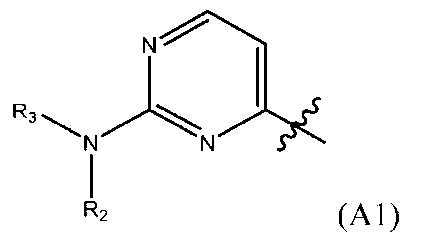
AがA1により表される一部の実施形態では、式(Ia)の化合物は、式(Ia1):

R3がアリール(例えば、フェニル)または置換されたアリール(例えば、置換されたフェニル)を表す一部の実施形態では、式(Ia1)の化合物は、式(Ia1a):

R3が置換されていてもよい複素環式基を表す一部の実施形態では、式(Ia1)の化合物は、式(Ia1b):
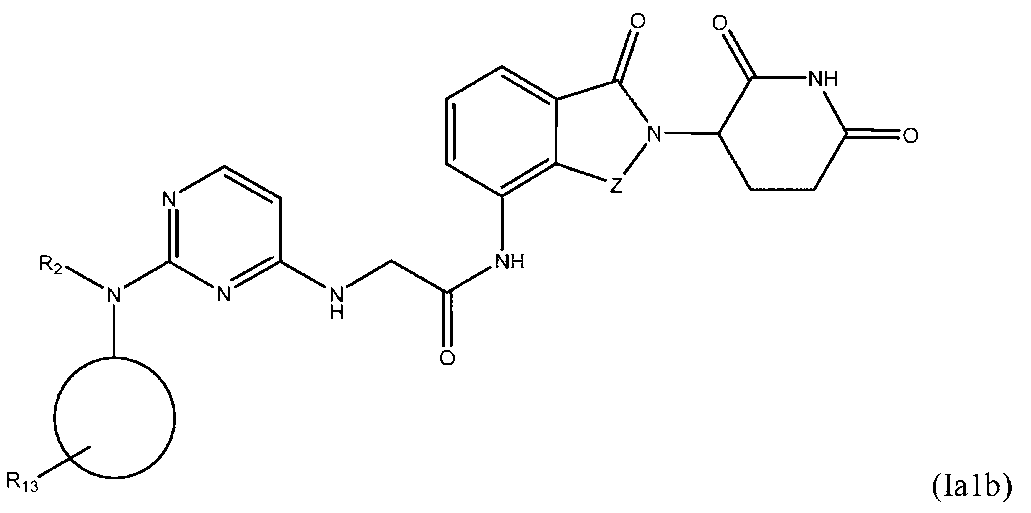
mが0であり、かつR2およびR3がそれらが結合した原子と共に任意選択的にC5~C14の複素環、例えば、置換されていてもよいC6~C14のヘテロアリール基を形成する一部の実施形態では、式(Ia1)の化合物は、式(Ia1c):
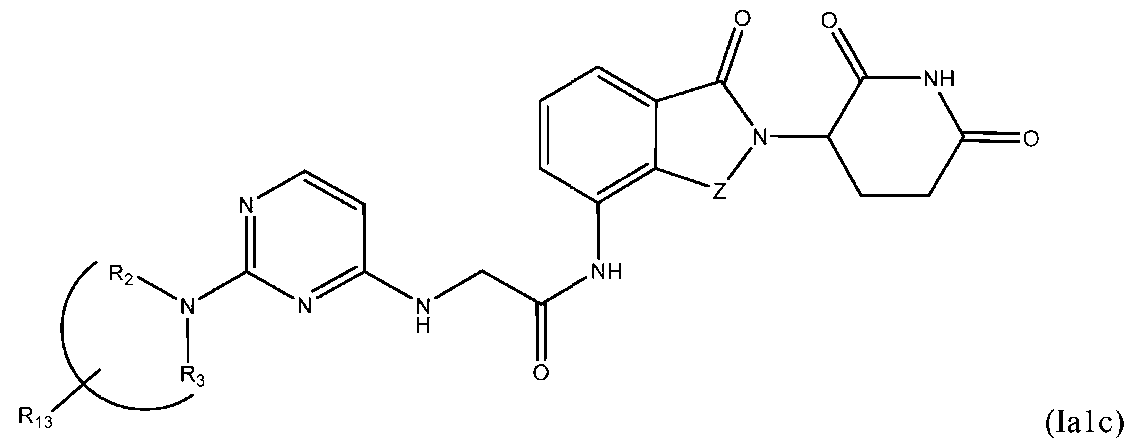
AがA2により表される一部の実施形態では、式(Ia)の化合物は、式(Ia2):

mおよびm1が0であり、XがHであり、Yが存在せず、かつRがAである一部の実施形態では、式(I)の化合物は、式(Ib):

AがA1により表される一部の実施形態では、式(Ib)の化合物は、式(Ib1):

R3が置換されていてもよいアリール(例えば、フェニル)である一部の実施形態では、式(Ib1)の化合物は、式(Ib1a):

一部の実施形態では、式(Ib1)の化合物は、式(Ib1b):

R2およびR3がそれらが結合した原子と共に置換されていてもよい複素環式基、例えば、置換されていてもよいヘテロアリール基を形成する一部の実施形態では、式(Ib1)の化合物は、式(Ib1c):

AがA2により表される一部の実施形態では、式(Ib)の化合物は、式(Ib2):

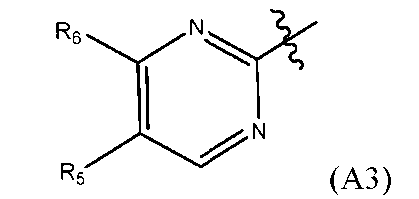
AがA3により表される一部の実施形態では、式(Ib)の化合物は、式(Ib3):

AがA4により表される一部の実施形態では、式(Ib)の化合物は、式(Ib4):

AがA5により表される一部の実施形態では、式(Ib)の化合物は、式(Ib5):
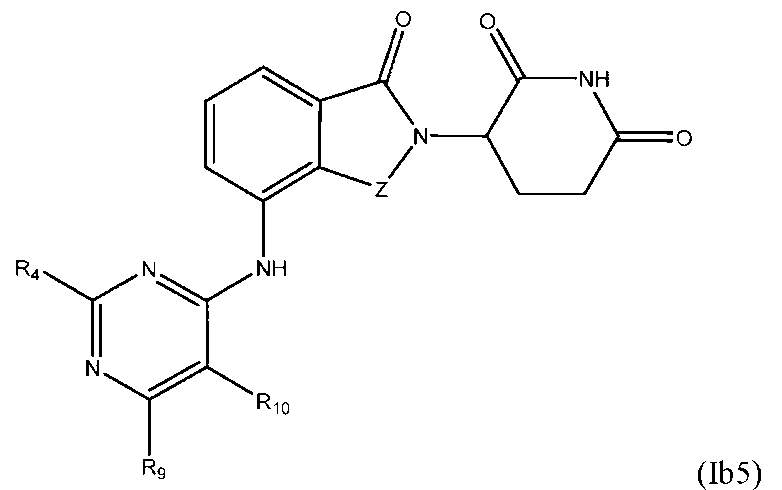
XがHであり、m1が0であり、RがAであり、かつYが存在しない一部の実施形態では、式(I)の化合物は、式(Ic):
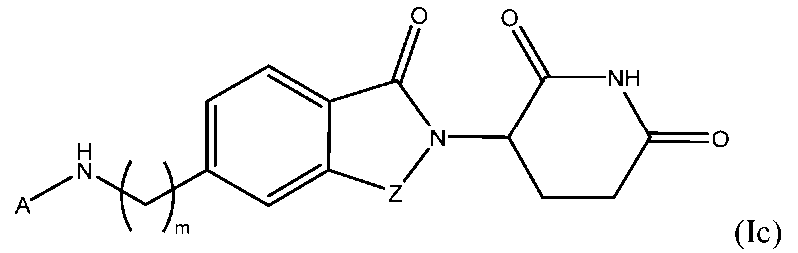
AがA3により表される一部の実施形態では、式(Ic)の化合物は、式(Ic1):

本発明の化合物に関して、R3、R4およびR8の代表的な例は以下の通りである:

本発明の化合物に関して、NR2R3基の代表的な例は以下の通りである:

本発明の化合物に関して、R9およびR10により形成される置換されていてもよいC5~C6の複素環式基の代表的な例は以下の通りである:

一部の実施形態では、ZはCH2である。 In some embodiments, Z is CH2 .
一部の実施形態では、本発明の化合物は以下の通りである:


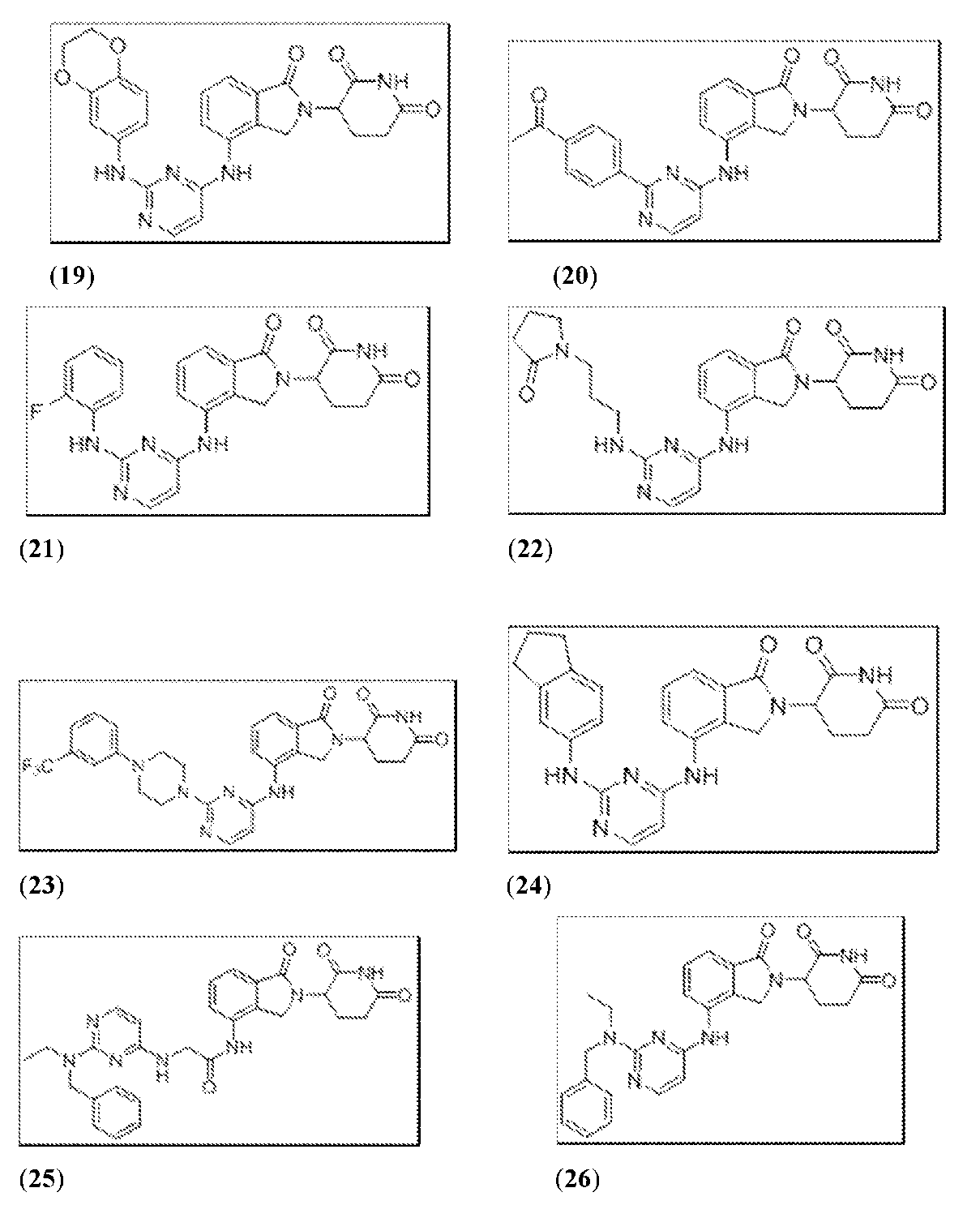


本出願の化合物は、遊離酸または遊離塩基、または薬学的に許容される塩の形態であってもよい。本明細書において使用される場合、塩の文脈における「薬学的に許容される」という用語は、化合物の生物学的活性または特性を妨げず、かつ比較的非毒性の化合物の塩を指し、すなわち、塩形態の化合物は、望ましくない生物学的効果(例えば、めまいまたは胃の不調)を引き起こすことも、それが含有される組成物の任意の他の成分と有害な方式で相互作用することもなく対象に投与することができる。「薬学的に許容される塩」という用語は、好適な酸または塩基との本発明の化合物の反応により得られる生成物を指す。本発明の化合物の薬学的に許容される塩の例としては、好適な無機塩基に由来するもの、例えば、Li、Na、K、Ca、Mg、Fe、Cu、Al、ZnおよびMn塩が挙げられる。薬学的に許容される非毒性の酸付加塩の例は、無機酸と形成されるアミノ基の塩、例えば、塩酸塩、臭化水素酸塩、ヨウ化水素酸塩、硝酸塩、硫酸塩、重硫酸塩、リン酸塩、イソニコチン酸塩、酢酸塩、乳酸塩、サリチル酸塩、クエン酸塩、酒石酸塩、パントテン酸塩、酒石酸水素塩、アスコルビン酸塩、コハク酸塩、マレイン酸塩、ゲンチシン酸塩(gentisinate)、フマル酸塩、グルコン酸塩、グルカロン酸塩(glucaronate)、糖酸塩、ギ酸塩、安息香酸塩、グルタミン酸塩、メタンスルホン酸塩、エタンスルホン酸塩、ベンゼンスルホン酸塩、4-メチルベンゼンスルホン酸塩またはp-トルエンスルホン酸塩などである。本発明のある特定の化合物は、様々な有機塩基、例えば、リジン、アルギニン、グアニジン、ジエタノールアミンまたはメトホルミンと薬学的に許容される塩を形成することができる。 The compounds of the present application may be in the form of a free acid or free base, or a pharma- ceutically acceptable salt. As used herein, the term "pharma-ceutically acceptable" in the context of a salt refers to a salt of a compound that does not interfere with the biological activity or properties of the compound and is relatively non-toxic, i.e., the compound in salt form can be administered to a subject without causing undesirable biological effects (e.g., dizziness or stomach upset) or interacting in a deleterious manner with any other components of the composition in which it is contained. The term "pharma-ceutically acceptable salt" refers to the product obtained by reaction of a compound of the present invention with a suitable acid or base. Examples of pharma-ceutically acceptable salts of the compounds of the present invention include those derived from suitable inorganic bases, such as Li, Na, K, Ca, Mg, Fe, Cu, Al, Zn, and Mn salts. Examples of pharmaceutically acceptable non-toxic acid addition salts are salts of amino groups formed with inorganic acids, such as hydrochloride, hydrobromide, hydroiodide, nitrate, sulfate, bisulfate, phosphate, isonicotinate, acetate, lactate, salicylate, citrate, tartrate, pantothenate, bitartrate, ascorbate, succinate, maleate, gentisinate, fumarate, gluconate, glucaronate, saccharate, formate, benzoate, glutamate, methanesulfonate, ethanesulfonate, benzenesulfonate, 4-methylbenzenesulfonate or p-toluenesulfonate. Certain compounds of the present invention can form pharmaceutically acceptable salts with various organic bases, such as lysine, arginine, guanidine, diethanolamine or metformin.
一部の実施形態では、本発明の化合物は、同位体の天然の存在量より高い量において、すなわち、濃縮された、原子の少なくとも1つの所望の同位体置換を有するという点で、同位体誘導体である。一実施形態では、化合物は重水素または複数の重水素原子を含む。
重水素、すなわち、2Hなどのより重い同位体での置換は、より高い代謝安定性の結果としてもたらされるある特定の治療的な利点、例えば、インビボ半減期の増加または投与必要量の低減をもたらすことがあり、そのため一部の状況において有利なことがある。
In some embodiments, the compounds of the invention are isotopically derivatives in that they have at least one desired isotopic substitution of an atom at a higher amount than the natural abundance of that isotope, i.e., enriched, hi one embodiment, the compound contains deuterium or multiple deuterium atoms.
Substitution with heavier isotopes such as deuterium, i.e., 2H , may afford certain therapeutic advantages resulting from greater metabolic stability, such as increased in vivo half-life or reduced dosage requirements, and therefore may be advantageous in some circumstances.
本発明の化合物は少なくとも1つのキラル中心を有してもよく、そのため立体異性体の形態であってもよく、これは、本明細書において使用される場合、空間中の原子の配向においてのみ異なる個々の化合物の全ての異性体を包含する。立体異性体という用語は、鏡像異性体(化合物の(R-)または(S-)配置を含むエナンチオマー)、化合物の鏡像異性体の混合物(エナンチオマーの物理的混合物、およびラセミ体またはラセミ混合物)、化合物の幾何(シス/トランスまたはE/Z、R/S)異性体、ならびに互いに鏡像でない1つより多くのキラル中心を有する化合物の異性体(ジアステレオ異性体)を含む。
化合物のキラル中心は、インビボでエピマー化を起こすことがあり、そのため、これらの化合物についてその(R-)形態の化合物の投与は、その(S-)形態の化合物の投与と同等であると考えられる。よって、本出願の化合物は、他の異性体を実質的に含まない個々の異性体の形態、または様々な異性体の混合物、例えば、立体異性体のラセミ混合物の形態において製造および使用されてもよい。
The compounds of the present invention may have at least one chiral center and therefore may be in the form of stereoisomers, which as used herein includes all isomers of individual compounds that differ only in the orientation of the atoms in space. The term stereoisomer includes enantiomers (enantiomers, which include the (R-) or (S-) configuration of the compounds), mixtures of enantiomers of the compounds (physical mixtures of enantiomers, and racemates or racemic mixtures), geometric (cis/trans or E/Z, R/S) isomers of the compounds, and isomers of the compounds with more than one chiral center that are not mirror images of one another (diastereoisomers).
The chiral centers of the compounds may undergo epimerization in vivo such that, for these compounds, administration of the compound in its (R-) form is considered equivalent to administration of the compound in its (S-) form. Thus, the compounds of the present application may be prepared and used in the form of individual isomers substantially free of other isomers, or in the form of mixtures of various isomers, e.g., racemic mixtures of stereoisomers.
追加的に、本発明の化合物は、N-オキシド、結晶形態(多形体としても公知)、同じ種類の活性を有する化合物の活性代謝物、互変異性体、ならびに化合物の非溶媒和形態の他に、薬学的に許容される溶媒、例えば、水およびエタノールなどとの溶媒和形態の使用を包含する。本明細書に提示されるコンジュゲートの溶媒和形態もまた本明細書に開示されると考えられる。 Additionally, the compounds of the present invention include the use of N-oxides, crystalline forms (also known as polymorphs), active metabolites of the compounds having the same type of activity, tautomers, and solvated forms with pharma- ceutically acceptable solvents, such as water and ethanol, in addition to the unsolvated forms of the compounds. Solvated forms of the conjugates presented herein are also considered to be disclosed herein.
合成方法
別の態様では、本発明は、本発明の化合物、またはその薬学的に許容される塩もしくは立体異性体を製造する方法を対象とする。概括的に言えば、本発明の化合物またはその薬学的に許容される塩もしくは立体異性体は、化学的に関連する化合物の調製に応用可能であることが公知の任意の方法により調製されてもよい。本発明の化合物は、様々な実施例において記載され、かつ本発明の化合物を調製することができる非限定的な方法を説明する合成スキームと組み合わせてより良好に理解されるであろう。
Synthetic Methods In another aspect, the present invention is directed to a method for preparing the compounds of the present invention, or their pharma-ceutically acceptable salts or stereoisomers. Generally speaking, the compounds of the present invention, or their pharma-ceutically acceptable salts or stereoisomers, may be prepared by any method known to be applicable to the preparation of chemically related compounds. The compounds of the present invention will be better understood in conjunction with the synthetic schemes described in the various examples and illustrating non-limiting methods by which the compounds of the present invention can be prepared.
医薬組成物
本発明の別の態様は、治療有効量の式(I)の化合物、またはその薬学的に許容される塩もしくは立体異性体、および薬学的に許容される担体を含む医薬組成物を対象とする。
「薬学的に許容される担体」という用語は、当該技術分野において公知のように、哺乳動物に本発明の化合物を投与するために好適な、薬学的に許容される材料、組成物または溶媒を指す。好適な担体としては、例えば、化合物を1つの臓器、または身体の部分から別の臓器、または身体の部分に運ぶまたは輸送するように機能する、液体(水性および同様に非水性の両方、およびその組合せ)、固体、被包材料、気体、ならびにその組合せ(例えば、半固体)、ならびに気体を挙げることができる。担体は、配合物の他の成分に対して生理学的に不活性であり、かつそれと適合性であり、かつ対象または患者に対して毒性でないという意味において「許容される」ものである。配合物の種類に依存して、組成物は1つまたはより多くの薬学的に許容される賦形剤を含んでもよい。
Pharmaceutical Compositions Another aspect of the present invention is directed to pharmaceutical compositions comprising a therapeutically effective amount of a compound of formula (I), or a pharma- ceutically acceptable salt or stereoisomer thereof, and a pharma- ceutically acceptable carrier.
The term "pharmaceutically acceptable carrier" refers to a pharmaceutically acceptable material, composition or vehicle suitable for administering the compounds of the present invention to a mammal, as known in the art. Suitable carriers can include, for example, liquids (both aqueous and non-aqueous as well as combinations thereof), solids, encapsulating materials, gases, and combinations thereof (e.g., semi-solids), and gases that function to carry or transport the compound from one organ or body part to another. A carrier is "acceptable" in the sense of being physiologically inert and compatible with the other ingredients of the formulation, and not toxic to the subject or patient. Depending on the type of formulation, the composition may contain one or more pharmaceutically acceptable excipients.
概括的に言えば、本発明の化合物は、従来の薬学的プラクティス、例えば、従来の混合、溶解、造粒、糖衣錠製造、水簸、乳化、被包、封入および圧縮方法に従って所与の種類の組成物に配合されてもよい(例えば、Remington:The Science and Practice of Pharmacy(20th ed.),ed.A.R.Gennaro,Lippincott Williams&Wilkins,2000およびEncyclopedia of Pharmaceutical Technology,eds.J.Swarbrick and J.C.Boylan,1988-1999,Marcel Dekker,New Yorkを参照)。配合物の種類は投与の様式に依存し、該様式としては、経腸(例えば、経口、頬側、舌下および直腸)、非経口(例えば、皮下(s.c.)、静脈内(i.v.)、筋肉内(i.m.)、および胸骨内注射、または注入技術、眼内、動脈内、髄内、髄腔内、脳室内、経皮、皮間(interdermal)、膣内、腹腔内、粘膜、鼻、気管内点滴、気管支点滴、および吸入)ならびに外用(例えば、経皮)を挙げることができる。一般に、投与の最も適切な経路は様々な要因に依存し、該要因としては、例えば、剤の性質(例えば、胃腸管の環境におけるその安定性)、および/または対象の状態(例えば、対象が経口投与を忍容できるかどうか)が挙げられる。例えば、非経口(例えば、静脈内)投与はまた、単回用量治療および/または急性状態の場合などにおいて、化合物が比較的迅速に投与され得るという点で有利なことがある。 Generally speaking, the compounds of the present invention may be formulated into a given type of composition according to conventional pharmaceutical practice, such as conventional mixing, dissolving, granulating, dragee-making, elutriating, emulsifying, encapsulating, encapsulating and compressing methods (see, e.g., Remington: The Science and Practice of Pharmacy (20th ed.), ed. A. R. Gennaro, Lippincott Williams & Wilkins, 2000 and Encyclopedia of Pharmaceutical Technology, eds. J. Swarbrick and J. C. Boylan, 1988-1999, Marcel Dekker, New York, 2000). See, York. The type of formulation will depend on the mode of administration, which may include enteral (e.g., oral, buccal, sublingual, and rectal), parenteral (e.g., subcutaneous (s.c.), intravenous (i.v.), intramuscular (i.m.), and intrasternal injection or infusion techniques, intraocular, intraarterial, intramedullary, intrathecal, intracerebroventricular, transdermal, interdermal, intravaginal, intraperitoneal, mucosal, nasal, intratracheal instillation, bronchial instillation, and inhalation), and topical (e.g., transdermal). In general, the most appropriate route of administration will depend on a variety of factors, including, for example, the nature of the agent (e.g., its stability in the environment of the gastrointestinal tract) and/or the condition of the subject (e.g., whether the subject can tolerate oral administration). For example, parenteral (e.g., intravenous) administration may also be advantageous in that the compound may be administered relatively quickly, such as in single-dose treatments and/or acute conditions.
一部の実施形態では、組成物は、経口または静脈内投与(例えば、全身性静脈注射)のために配合される。 In some embodiments, the composition is formulated for oral or intravenous administration (e.g., systemic intravenous injection).
よって、本発明の化合物は、固体組成物(例えば、粉末、錠剤、分散性の顆粒、カプセル、カシェ剤、および坐剤)、液体組成物(例えば、化合物が溶解した溶液、化合物の固体粒子が分散した懸濁液、エマルション、およびリポソーム、ミセル、またはナノ粒子を含有する溶液、シロップおよびエリキシル)、半固体組成物(例えば、ゲル、懸濁液およびクリーム)、ならびに気体(例えば、エアロゾル組成物用の噴射剤)中に配合されてもよい。化合物はまた、迅速、中間的または持続放出のために配合されてもよい。 Thus, the compounds of the invention may be formulated in solid compositions (e.g., powders, tablets, dispersible granules, capsules, cachets, and suppositories), liquid compositions (e.g., solutions in which the compound is dissolved, suspensions in which solid particles of the compound are dispersed, emulsions, and solutions containing liposomes, micelles, or nanoparticles, syrups, and elixirs), semi-solid compositions (e.g., gels, suspensions, and creams), and gases (e.g., propellants for aerosol compositions). The compounds may also be formulated for immediate, intermediate, or sustained release.
経口投与用の固体投与形態としては、カプセル、錠剤、丸剤、粉末、および顆粒が挙げられる。そのような固体投与形態中で、活性化合物は、担体、例えば、クエン酸ナトリウムまたはリン酸二カルシウムならびに追加の担体または賦形剤、例えば、a)充填剤または増量剤、例えば、デンプン、ラクトース、スクロース、グルコース、マンニトール、およびケイ酸、b)結合剤、例えば、メチルセルロース、微結晶セルロース、ヒドロキシプロピルメチルセルロース、カルボキシメチルセルロース、カルボキシメチルセルロースナトリウム、アルギン酸塩、ゼラチン、ポリビニルピロリジノン(polyvinylpyrrolidinone)、スクロース、およびアカシアなど、c)湿潤剤、例えば、グリセロール、d)崩壊剤、例えば、架橋ポリマー(例えば、架橋ポリビニルピロリドン(クロスポビドン)、架橋カルボキシメチルセルロースナトリウム(クロスカルメロースナトリウム)、デンプングリコール酸ナトリウム、アガー-アガー、炭酸カルシウム、ジャガイモまたはタピオカデンプン、アルギン酸、ある特定のケイ酸塩、および炭酸ナトリウム、e)溶液遅延剤、例えば、パラフィン、f)吸収促進剤、例えば、第四級アンモニウム化合物、g)湿潤剤、例えば、セチルアルコールおよびモノステアリン酸グリセロールなど、h)吸収剤、例えば、カオリンおよびベントナイトクレイ、ならびにi)潤滑剤、例えば、タルク、ステアリン酸カルシウム、ステアリン酸マグネシウム、固体ポリエチレングリコール、ラウリル硫酸ナトリウム、ならびにこれらの混合物と混合される。カプセル、錠剤および丸剤の場合、投与形態はまた緩衝化剤を含んでもよい。類似した種類の固体組成物はまた、ラクトースまたは乳糖の他に高分子量ポリエチレングリコールなどの賦形剤を使用して軟質および硬質充填ゼラチンカプセル中の充填剤として用いられてもよい。錠剤、糖衣錠、カプセル、丸剤、および顆粒の固体投与形態は、腸溶性コーティングおよび他のコーティングなどのコーティングおよびシェルを用いて調製することができる。
それらは乳白剤をさらに含有してもよい。
Oral solid dosage forms include capsules, tablets, pills, powders, and granules.In these solid dosage forms, the active compound is mixed with carriers such as sodium citrate or dicalcium phosphate and additional carriers or excipients such as a) fillers or extenders such as starch, lactose, sucrose, glucose, mannitol, and silicic acid, b) binders such as methylcellulose, microcrystalline cellulose, hydroxypropylmethylcellulose, carboxymethylcellulose, sodium carboxymethylcellulose, alginates, gelatin, polyvinylpyrrolidinone, sucrose, and acacia, c) wetting agents such as glycerol, d) disintegrants such as crosslinked polymers such as crosslinked polyvinylpyrrolidone ( crospovidone), cross-linked sodium carboxymethylcellulose (croscarmellose sodium), sodium starch glycolate, agar-agar, calcium carbonate, potato or tapioca starch, alginic acid, certain silicates, and sodium carbonate, e) solution retarders such as paraffin, f) absorption accelerators such as quaternary ammonium compounds, g) wetting agents such as cetyl alcohol and glycerol monostearate, h) absorbents such as kaolin and bentonite clay, and i) lubricants such as talc, calcium stearate, magnesium stearate, solid polyethylene glycols, sodium lauryl sulfate, and mixtures thereof. In the case of capsules, tablets, and pills, the dosage form may also contain buffering agents. Solid compositions of a similar type may also be employed as fillers in soft and hard-filled gelatin capsules using such excipients as lactose or milk sugar as well as high molecular weight polyethylene glycols. The solid dosage forms of tablets, dragees, capsules, pills, and granules can be prepared with coatings and shells such as enteric coatings and other coatings.
They may further contain an opacifying agent.
一部の実施形態では、本発明の化合物は、硬質または軟質ゼラチンカプセル中に配合されてもよい。使用することができる代表的な賦形剤としては、アルファデンプン、ステアリン酸マグネシウム、マンニトール、フマル酸ステアリルナトリウム、無水ラクトース、微結晶セルロースおよびクロスカルメロースナトリウムが挙げられる。ゼラチンシェルは、ゼラチン、二酸化チタン、酸化鉄および着色剤を含んでもよい。 In some embodiments, the compounds of the present invention may be formulated into hard or soft gelatin capsules. Exemplary excipients that may be used include pregelatinized starch, magnesium stearate, mannitol, sodium stearyl fumarate, anhydrous lactose, microcrystalline cellulose, and croscarmellose sodium. The gelatin shell may contain gelatin, titanium dioxide, iron oxide, and colorants.
経口投与用の液体投与形態としては、溶液、懸濁液、エマルション、マイクロエマルション、シロップおよびエリキシルが挙げられる。化合物に加えて、液体投与形態は当該技術分野において一般的に使用される水性または非水性担体、(化合物の溶解性に依存する)、例えば、水または他の溶剤、可溶化剤および乳化剤、例えば、エチルアルコール、イソプロピルアルコール、炭酸エチル、酢酸エチル、ベンジルアルコール、安息香酸ベンジル、プロピレングリコール、1,3-ブチレングリコール、ジメチルホルムアミド、油(具体的には、綿実、落花生、トウモロコシ、胚芽、オリーブ、ヒマシ、およびゴマ油)、グリセロール、テトラヒドロフルフリルアルコール、ポリエチレングリコールおよびソルビタンの脂肪酸エステル、およびこれらの混合物を含有してもよい。経口組成物はまた、賦形剤、例えば、湿潤剤、懸濁化剤、着色剤、甘味剤、香味剤、および芳香剤を含んでもよい。 Liquid dosage forms for oral administration include solutions, suspensions, emulsions, microemulsions, syrups and elixirs. In addition to the compound, the liquid dosage forms may contain aqueous or non-aqueous carriers commonly used in the art, such as water or other solvents (depending on the solubility of the compound), solubilizing and emulsifying agents, such as ethyl alcohol, isopropyl alcohol, ethyl carbonate, ethyl acetate, benzyl alcohol, benzyl benzoate, propylene glycol, 1,3-butylene glycol, dimethylformamide, oils (specifically cottonseed, peanut, corn, germ, olive, castor, and sesame oils), glycerol, tetrahydrofurfuryl alcohol, polyethylene glycol and fatty acid esters of sorbitan, and mixtures thereof. Oral compositions may also contain excipients, such as wetting agents, suspending agents, coloring agents, sweetening agents, flavoring agents, and aromatic agents.
注射可能な調製物は無菌水性溶液または油性懸濁液を含んでもよい。それらは、好適な分散剤または湿潤剤および懸濁化剤を使用して標準技術に従って配合されてもよい。無菌の注射可能な調製物はまた、非毒性の非経口的に許容される希釈剤または溶剤中の無菌の注射可能な溶液、懸濁液またはエマルション、例えば、1,3-ブタンジオール中の溶液であってもよい。用いることができる許容される溶媒および溶剤の中には、水、リンガー溶液、U.S.P.および等張性塩化ナトリウム溶液がある。追加的に、無菌の固定油は溶剤または懸濁媒体として従来用いられている。この目的のために、合成のモノまたはジグリセリドを含む任意のブランド固定油を用いることができる。追加的に、オレイン酸などの脂肪酸は注射可能液の調製において使用される。注射可能な配合物は、例えば、細菌保持フィルターを通じた濾過により、または使用前に無菌水もしくは他の無菌の注射可能な媒体中に溶解もしくは分散させることができる無菌の固体組成物の形態の滅菌剤を組み込むことにより滅菌することができる。化合物の効果は、その吸収を緩慢化させることにより長期化させてもよく、それは、液体懸濁液または乏しい水溶性を有する結晶性もしくは非晶性材料の使用により達成されてもよい。非経口的に投与された配合物からの化合物の持続吸収はまた、油性溶媒中に化合物を懸濁することにより達成されてもよい。 Injectable preparations may include sterile aqueous solutions or oily suspensions. They may be formulated according to standard techniques using suitable dispersing or wetting agents and suspending agents. Sterile injectable preparations may also be sterile injectable solutions, suspensions or emulsions in non-toxic parenterally acceptable diluents or solvents, for example, solutions in 1,3-butanediol. Among the acceptable solvents and vehicles that may be used are water, Ringer's solution, U.S.P. and isotonic sodium chloride solution. Additionally, sterile fixed oils are conventionally used as solvents or suspending media. For this purpose, any bland fixed oil may be used, including synthetic mono- or diglycerides. Additionally, fatty acids such as oleic acid are used in the preparation of injectable solutions. Injectable formulations may be sterilized, for example, by filtration through a bacteria-retaining filter, or by incorporating sterilizing agents in the form of sterile solid compositions that may be dissolved or dispersed in sterile water or other sterile injectable media prior to use. The effect of a compound may be prolonged by slowing its absorption, which may be accomplished by the use of liquid suspensions or crystalline or amorphous material with poor water solubility. Prolonged absorption of a compound from a parenterally administered formulation may also be accomplished by suspending the compound in an oil vehicle.
ある特定の実施形態では、本発明の化合物は、例えば、多くの場合にデポー調製物または持続放出配合物中の、直接的に臓器へのコンジュゲートの注射を介して、全身性ではなく局所的な方式において投与されてもよい。特定の実施形態では、長期作用性の配合物は、埋込み(例えば、皮下または筋肉内)または筋肉内注射により投与される。注射可能なデポー形態は、生分解性ポリマー、例えば、ポリラクチド-ポリグリコリド、ポリ(オルトエステル)およびポリ(無水物)中の化合物のマイクロカプセルマトリックスを形成することにより製造される。化合物の放出速度は、化合物対ポリマーの比および用いられる具体的なポリマーの性質を変更することにより制御されてもよい。デポー注射可能な配合物はまた、身体組織と適合性のリポソームまたはマイクロエマルション中に化合物を捕捉することにより調製される。さらには、他の実施形態では、化合物は、標的化される薬物送達システム中、例えば、臓器特異的な抗体でコーティングされたリポソーム中で送達される。そのような実施形態では、リポソームは、臓器に標的化され、臓器により選択的に取り込まれる。 In certain embodiments, the compounds of the invention may be administered in a local rather than systemic manner, for example, via injection of the conjugate directly into an organ, often in a depot preparation or sustained release formulation. In certain embodiments, long-acting formulations are administered by implantation (e.g., subcutaneous or intramuscular) or intramuscular injection. Injectable depot forms are prepared by forming microencapsule matrices of the compound in biodegradable polymers, such as polylactide-polyglycolide, poly(orthoesters) and poly(anhydrides). The rate of compound release may be controlled by varying the ratio of compound to polymer and the nature of the particular polymer employed. Depot injectable formulations are also prepared by entrapping the compound in liposomes or microemulsions that are compatible with body tissues. Furthermore, in other embodiments, the compound is delivered in a targeted drug delivery system, for example, liposomes coated with organ-specific antibodies. In such embodiments, the liposomes are targeted to and taken up selectively by the organ.
本発明の化合物は頬側または舌下投与のために配合されてもよく、その例としては、錠剤、ロゼンジおよびゲルが挙げられる。 The compounds of the invention may be formulated for buccal or sublingual administration, examples of which include tablets, lozenges and gels.
化合物は、吸入による投与のために配合されてもよい。吸入による投与のために好適な様々な形態は、エアロゾル、ミストまたは粉末を含む。医薬組成物は、好適な噴射剤(例えば、ジクロロジフルオロメタン、トリクロロフルオロメタン、ジクロロテトラフルオロエタン、二酸化炭素または他の好適な気体)の使用と共に、加圧パックまたはネブライザーからのエアロゾルスプレープレゼンテーションの形態において送達されてもよい。一部の実施形態では、加圧エアロゾルの投与単位は、定量を提供するための弁を提供することにより決定されてもよい。一部の実施形態では、例えば、吸入器または空気吸入器において使用するための、ゼラチンを含むカプセルおよびカートリッジが、化合物と好適な粉末基剤、例えば、ラクトースまたはデンプンとの粉末混合物を含有するように配合されてもよい。 The compound may be formulated for administration by inhalation. Various forms suitable for administration by inhalation include aerosols, mists or powders. The pharmaceutical composition may be delivered in the form of an aerosol spray presentation from a pressurized pack or nebulizer with the use of a suitable propellant (e.g., dichlorodifluoromethane, trichlorofluoromethane, dichlorotetrafluoroethane, carbon dioxide or other suitable gas). In some embodiments, the dosage unit of the pressurized aerosol may be determined by providing a valve to deliver a metered amount. In some embodiments, capsules and cartridges containing gelatin, for example for use in an inhaler or insufflator, may be formulated to contain a powder mix of the compound and a suitable powder base, for example lactose or starch.
本発明の化合物は外用投与のために配合されてもよく、外用投与は、本明細書において使用される場合、表皮への配合物の塗布による皮内への投与を指す。これらの種類の組成物は、典型的には、軟膏、ペースト、クリーム、ローション、ゲル、溶液およびスプレーの形態である。 The compounds of the present invention may be formulated for topical administration, which as used herein refers to administration intradermally by application of the formulation to the epidermis. These types of compositions are typically in the form of ointments, pastes, creams, lotions, gels, solutions and sprays.
外用塗布用の組成物の配合において有用な担体の代表的な例としては、溶剤(例えば、アルコール、ポリアルコール、水)、クリーム、ローション、軟膏、油、硬膏剤、リポソーム、粉末、エマルション、マイクロエマルション、および緩衝化溶液(例えば、低張または緩衝生理食塩水)が挙げられる。例えば、クリームは、飽和または不飽和脂肪酸、例えば、ステアリン酸、パルミチン酸、オレイン酸、パルミトオレイン酸、セチル、またはオレイルアルコールを使用して配合されてもよい。クリームはまた、ステアリン酸ポリオキシ-40などの非イオン性界面活性剤を含有してもよい。 Representative examples of carriers useful in formulating compositions for topical application include solvents (e.g., alcohols, polyalcohols, water), creams, lotions, ointments, oils, plasters, liposomes, powders, emulsions, microemulsions, and buffered solutions (e.g., hypotonic or buffered saline). For example, creams may be formulated using saturated or unsaturated fatty acids, such as stearic acid, palmitic acid, oleic acid, palmitoleic acid, cetyl, or oleyl alcohol. Creams may also contain nonionic surfactants, such as polyoxy-40 stearate.
一部の実施形態では、外用配合物はまた賦形剤を含んでもよく、その例は透過増進剤である。これらの剤は、好ましくは、全身吸収をほとんどまたは全く伴わずに、角質層を通じて表皮または真皮へと薬理学的に活性の化合物を輸送することができる。皮膚を通じた薬物の透過速度の増進における有効性に関して多様な化合物が評価1されている。 In some embodiments, topical formulations may also include excipients, examples of which are permeation enhancers. These agents are preferably capable of transporting pharmacologically active compounds through the stratum corneum into the epidermis or dermis with little or no systemic absorption. A variety of compounds have been evaluated1 for their effectiveness in enhancing the permeation rate of drugs through the skin.
例えば、様々な皮膚透過促進剤の使用および試験を調査しているPercutaneous Penetration Enhancers,Maibach H.I.and Smith H.E.(eds.),CRC Press,Inc.,Boca Raton,Fla.(1995)、およびBuyuktimkin et al.,Chemical Means of Transdermal Drug Permeation Enhancement in Transdermal and Topical Drug Delivery Systems,Gosh T.K.,Pfister W.R.,Yum S.I.(Eds.),Interpharm Press Inc.,Buffalo Grove,Ill.(1997)を参照。透過増進剤の代表的な例としては、トリグリセリド(例えば、ダイズ油)、アロエ組成物(例えば、アロエベラゲル)、エチルアルコール、イソプロピルアルコール、オクトリフェニルポリエチレングリコール(octolyphenylpolyethylene glycol)、オレイン酸、ポリエチレングリコール400、プロピレングリコール、N-デシルメチルスルホキシド(N-decylmethylsulfoxide)、脂肪酸エステル(例えば、イソプロピルミリステート、メチルラウレート、モノオレイン酸グリセロール、およびモノオレイン酸プロピレングリコール)、およびN-メチルピロリドンが挙げられる。 For example, Percutaneous Penetration Enhancers, Maibach H. I. and Smith H. E. (eds.), CRC Press, Inc., Boca Raton, Fla. (1995), which reviews the use and testing of various skin permeation enhancers, and Buyuktimkin et al., Chemical Means of Transdermal Drug Permeation Enhancement in Transdermal and Topical Drug Delivery Systems, Gosh T. K., Pfister W. R., Yum S. I. (Eds.), Interpharm Press Inc., Buffalo Grove, Ill. (1997). Representative examples of permeation enhancers include triglycerides (e.g., soybean oil), aloe compositions (e.g., aloe vera gel), ethyl alcohol, isopropyl alcohol, octolyphenylpolyethylene glycol, oleic acid, polyethylene glycol 400, propylene glycol, N-decylmethylsulfoxide, fatty acid esters (e.g., isopropyl myristate, methyl laurate, glycerol monooleate, and propylene glycol monooleate), and N-methylpyrrolidone.
外用配合物中の他に、他の種類の配合物中に(適合性である限り)含めることができるさらに他の賦形剤の代表的な例としては、防腐剤、抗酸化剤、保湿剤、皮膚軟化剤、緩衝化剤、可溶化剤、皮膚保護剤、および界面活性剤が挙げられる。好適な防腐剤としては、アルコール、第四級アミン、有機酸、パラベン、およびフェノールが挙げられる。好適な抗酸化剤としては、アスコルビン酸およびそのエステル、重亜硫酸ナトリウム、ブチル化ヒドロキシトルエン、ブチル化ヒドロキシアニソール、トコフェロール、ならびにEDTAおよびクエン酸のようなキレート剤が挙げられる。好適な保湿剤としては、グリセリン、ソルビトール、ポリエチレングリコール、尿素、およびプロピレングリコールが挙げられる。好適な緩衝化剤としては、クエン酸、塩酸、および乳酸緩衝剤が挙げられる。好適な可溶化剤としては、第四級塩化アンモニウム、シクロデキストリン、安息香酸ベンジル、レシチン、およびポリソルベートが挙げられる。好適な皮膚保護剤としては、ビタミンE油、アラトイン(allatoin)、ジメチコン、グリセリン、ワセリン、および酸化亜鉛が挙げられる。 Representative examples of further excipients that may be included in topical formulations as well as in other types of formulations (as long as they are compatible) include preservatives, antioxidants, humectants, emollients, buffering agents, solubilizers, skin protectants, and surfactants. Suitable preservatives include alcohols, quaternary amines, organic acids, parabens, and phenols. Suitable antioxidants include ascorbic acid and its esters, sodium bisulfite, butylated hydroxytoluene, butylated hydroxyanisole, tocopherol, and chelating agents such as EDTA and citric acid. Suitable humectants include glycerin, sorbitol, polyethylene glycol, urea, and propylene glycol. Suitable buffering agents include citric acid, hydrochloric acid, and lactic acid buffers. Suitable solubilizing agents include quaternary ammonium chloride, cyclodextrin, benzyl benzoate, lecithin, and polysorbates. Suitable skin protectants include vitamin E oil, allatoin, dimethicone, glycerin, petrolatum, and zinc oxide.
経皮配合物は、典型的には、化合物が、ポリマーまたは粘着剤中に溶解および/または分散されて、親油性エマルションまたは緩衝化された水性溶液中に配合された、経皮送達デバイスおよび経皮送達パッチを用いる。パッチは、医薬剤の連続的な、拍動性の、またはオンデマンドの送達のために構築されてもよい。化合物の経皮送達は、イオントフォレーシスパッチの手段により達成されてもよい。経皮パッチは、速度制御膜を使用することによりまたは化合物をポリマーマトリックスもしくはゲル内に捕捉することにより吸収速度が緩慢化された化合物の制御送達を提供してもよい。吸収を増加させるために吸収促進剤が使用されてもよく、その例としては、皮膚の通過を補助する吸収性の薬学的に許容される溶剤が挙げられる。 Transdermal formulations typically employ transdermal delivery devices and transdermal delivery patches in which the compound is dissolved and/or dispersed in a polymer or adhesive and formulated in a lipophilic emulsion or buffered aqueous solution. Patches may be constructed for continuous, pulsatile, or on-demand delivery of pharmaceutical agents. Transdermal delivery of compounds may be achieved by means of iontophoretic patches. Transdermal patches may provide controlled delivery of compounds with slowed absorption rates by using rate-controlling membranes or by entrapment of the compound within a polymer matrix or gel. Absorption enhancers may be used to increase absorption, examples of which include absorbable pharma- ceutically acceptable solvents that aid passage through the skin.
眼科用配合物としては点眼剤が挙げられる。 Ophthalmic formulations include eye drops.
直腸投与用の配合物としては、浣腸、直腸ゲル、直腸泡、直腸エアロゾル、および停留浣腸が挙げられ、これらは、従来の坐剤基剤、例えば、ココアバターまたは他のグリセリドの他に、合成ポリマー、例えば、ポリビニルピロリドン、およびPEGなどを含有してもよい。直腸または膣投与用の組成物はまた、坐剤として配合されてもよく、坐剤は、化合物を好適な非刺激性の担体および賦形剤、例えば、いずれも周囲温度において固体であるが体温において液体であり、したがって直腸または膣腔中で融解して化合物を放出する、ココアバター、脂肪酸グリセリドの混合物、ポリエチレングリコール、坐剤ワックス、およびその組合せと混合することにより調製することができる。
投与量
本明細書において使用される場合、「治療有効量」という用語は、カゼインキナーゼ1アルファ(CK1α)、配列類似性83ファミリーメンバーF(FAM83F)、DTWドメイン含有1(DTWD1)、ジンクフィンガータンパク質91ホモログ(ZFP91)、ZFP62、ZFP36リングフィンガータンパク質様(ZFP36L2)、リングフィンガータンパク質166(RNF166)、イカロスファミリージンクフィンガータンパク質1(IKZF1)、IKZF2、IKZF3、IKZF4、IKZF5、Ras関連タンパク質Rab-28(RAB28)、グルタチオンS-トランスフェラーゼパイ1(GSTP1)、GSPT2、ミトコンドリアインポート内膜トランスロカーゼサブユニットTim10(TIMM10)、GDNF誘導性ジンクフィンガータンパク質1(GZF1)、初期増殖応答1(EGR1)-、がん過剰メチル化1(HIC1)-、HIC2-、インスリノーマ関連タンパク質2(INSM2)-、odd-skipped関連転写因子2(OSR2)、タンパク質ポリブロモ-1(PB1)、PRドメインジンクフィンガータンパク質15(PRD15)、スパルト様転写因子1(SALL1)、SALL3、SALL4、WIZ、ジンクフィンガーおよびBTBドメイン含有タンパク質17(ZBT17)、ZBT41、ZBT49、ZBT7A、ZBT7B、ZBTB2、ZBTB39、Kタンパク質と相互作用するジンクフィンガータンパク質1(ZIK1)、ジンクフィンガータンパク質3(ZNF3)、ZNF217、ZNF276、ZNF316、ZNF324B、ZNF335、ZNF397、ZNF407、ZNF408、ZNF462、ZNF483、SNF517、ZNF526、ZNF581、ZNF587、ZNF589、ZNF618、ZNF644、ZNF646、ZNF653、ZNF654、ZNF692、ZNF724、ZNF771、ZNF782、ZNF784、ZNF814、ジンクフィンガーおよびSCANドメイン含有10(ZSC10)、ZSC22、ZC827、ならびにUFM1特異的ペプチダーゼドメイン含有ジンクフィンガー(ZUFSP)からなる群から選択されるタンパク質の異常な活性により特徴付けられまたは媒介される疾患または障害を患う具体的な患者において所望の治療応答を生じさせるのに効果的な本発明の化合物またはその薬学的に許容される塩もしくは立体異性体の量を指す。
一部の実施形態では、疾患または障害は、IKZF2の異常な活性により特徴付けられまたは媒介される。「治療有効量」という用語は、投与された場合に、治療すべき疾患もしくは障害における肯定的な修飾(例えば、軽快)を誘導し、または疾患もしくは障害の発症もしくは進行を予防するために十分な、または対象において治療されている疾患もしくは障害の症状の1つもしくはより多くを何らかの程度まで緩和し、または単純に疾患(例えば、がん)細胞を殺傷しもしくはその増殖を阻害する、本発明の化合物またはその薬学的に許容される塩もしくは立体異性体の量を含む。
Formulations for rectal administration include enemas, rectal gels, rectal foams, rectal aerosols, and retention enemas, which may contain conventional suppository bases such as cocoa butter or other glycerides as well as synthetic polymers such as polyvinylpyrrolidone, PEG, and the like. Compositions for rectal or vaginal administration may also be formulated as suppositories, which can be prepared by mixing the compound with suitable non-irritating carriers and excipients such as cocoa butter, mixtures of fatty acid glycerides, polyethylene glycol, suppository waxes, and combinations thereof, all of which are solid at ambient temperature but liquid at body temperature and thus will melt in the rectum or vaginal cavity and release the compound.
Dosage As used herein, the term "therapeutically effective amount" refers to any of the following: casein kinase 1 alpha (CK1α), sequence similarity 83 family member F (FAM83F), DTW domain containing 1 (DTWD1), zinc finger protein 91 homolog (ZFP91), ZFP62, ZFP36 ring finger protein-like (ZFP36L2), ring finger protein 166 (RNF166), Ikaros family zinc finger protein 1 (IKZF1), IKZF2, IKZF3, IKZF4, IKZF5, Ras-related protein Rab-28 (RAB28), , glutathione S-transferase pi 1 (GSTP1), GSPT2, mitochondrial import inner membrane translocase subunit Tim10 (TIMM10), GDNF-inducible zinc finger protein 1 (GZF1), early growth response 1 (EGR1)-, cancer hypermethylation 1 (HIC1)-, HIC2-, insulinoma-associated protein 2 (INSM2)-, odd-skipped related transcription factor 2 (OSR2), protein polybromo-1 (PB1), PR domain zinc finger protein 15 (PRD15), spalt-like transcription factor 1 (SALL1), and SALL L3, SALL4, WIZ, zinc finger and BTB domain-containing protein 17 (ZBT17), ZBT41, ZBT49, ZBT7A, ZBT7B, ZBTB2, ZBTB39, zinc finger protein interacting with K protein 1 (ZIK1), zinc finger protein 3 (ZNF3), ZNF217, ZNF276, ZNF316, ZNF324B, ZNF335, ZNF397, ZNF407, ZNF408, ZNF462, ZNF483, SNF517, ZNF526, ZNF581, ZNF587, ZNF589, ZNF618, ZNF644, It refers to an amount of a compound of the present invention or a pharma- ceutical acceptable salt or stereoisomer thereof effective to produce a desired therapeutic response in a particular patient suffering from a disease or disorder characterized or mediated by abnormal activity of a protein selected from the group consisting of ZNF646, ZNF653, ZNF654, ZNF692, ZNF724, ZNF771, ZNF782, ZNF784, ZNF814, zinc finger and SCAN domain containing 10 (ZSC10), ZSC22, ZC827, and zinc finger containing UFM1-specific peptidase domain (ZUFSP).
In some embodiments, the disease or disorder is characterized or mediated by abnormal activity of IKZF2. The term "therapeutically effective amount" includes an amount of a compound of the present invention or a pharma- ceutically acceptable salt or stereoisomer thereof that, when administered, is sufficient to induce a positive modification (e.g., amelioration) in the disease or disorder to be treated, or to prevent the onset or progression of the disease or disorder, or to alleviate to some extent one or more of the symptoms of the disease or disorder being treated in a subject, or simply kill or inhibit the proliferation of disease (e.g., cancer) cells.
本発明の化合物の合計の1日当たりの投与量およびその用法は、例えば、妥当な医学的判断を使用して主治医により、標準的な医療プラクティスに従って決められてもよい。任意の具体的な患者のための特定の治療的に効果的な用量は様々な要因に依存し、該要因としては、治療されている疾患または障害およびその重篤度(例えば、その現在の状態);用いられる特定の化合物の活性;用いられる特定の組成物;患者の年齢、体重、全般的健康状態、性別および食事;投与の時間、投与の経路、および用いられる特定の化合物の排出速度;治療の継続期間;用いられる特定の化合物と組み合わせてまたは同時的に使用される薬物;ならびに医学分野において周知の同様の要因が挙げられる(例えば、Goodman and Gilman’s,“The Pharmacological Basis of Therapeutics”,10th Edition,A.Gilman,J.Hardman and L.Limbird,eds.,McGraw-Hill Press,155-173,2001を参照)。 The total daily dosage of the compounds of the present invention and its usage may be determined in accordance with standard medical practice, for example, by the attending physician using sound medical judgment. The specific therapeutically effective dose for any particular patient will depend on a variety of factors, including the disease or disorder being treated and its severity (e.g., its current state); the activity of the specific compound used; the specific composition used; the patient's age, weight, general health, sex, and diet; the time of administration, route of administration, and rate of excretion of the specific compound used; the duration of treatment; drugs used in combination or concomitantly with the specific compound used; and similar factors well known in the medical arts (see, for example, Goodman and Gilman's, "The Pharmacological Basis of Therapeutics", 10th Edition, A. Gilman, J. Hardman and L. Limbird, eds., McGraw-Hill Press, 155-173, 2001).
本発明の化合物は、広範な投与量範囲にわたり効果的であり得る。一部の実施形態では、合計の1日当たりの投与量(例えば、成人のヒトについて)は、約0.001~約1600mg、0.01~約1000mg、0.01~約500mg、約0.01~約100mg、約0.5~約100mg、1から約100~400mg/日、約1~約50mg/日、および約5~約40mg/日、さらに他の実施形態では、約10~約30mg/日の範囲内であってもよい。個々の投与量は、化合物が1日当たりに投与される回数に依存して所望の投与量を含有するように配合されてもよい。例として、カプセルは、約1~約200mgの化合物(例えば、1、2、2.5、3、4、5、10、15、20、25、50、100、150、および200mg)を含むように配合されてもよい。一部の実施形態では、個々の投与量は、化合物が1日当たりに投与される回数に依存して所望の投与量を含有するように配合されてもよい。 The compounds of the present invention may be effective over a wide dosage range. In some embodiments, the total daily dosage (e.g., for an adult human) may be within the range of about 0.001 to about 1600 mg, 0.01 to about 1000 mg, 0.01 to about 500 mg, about 0.01 to about 100 mg, about 0.5 to about 100 mg, 1 to about 100-400 mg/day, about 1 to about 50 mg/day, and about 5 to about 40 mg/day, and in yet other embodiments, about 10 to about 30 mg/day. Individual dosages may be formulated to contain the desired dosage depending on the number of times the compound is administered per day. By way of example, capsules may be formulated to contain about 1 to about 200 mg of the compound (e.g., 1, 2, 2.5, 3, 4, 5, 10, 15, 20, 25, 50, 100, 150, and 200 mg). In some embodiments, the individual doses may be formulated to contain a desired dosage depending on the number of times the compound is administered per day.
使用方法
一部の態様では、本発明の化合物は、セレブロンによる分解のために標的化され得る、疾患または障害の発端、1つまたはより多くの症状またはマーカーの顕在化、重篤度または進行に参加するタンパク質の異常な活性により特徴付けられ、かつ標的化されたタンパク質の分解が治療的利益を付与することがある、疾患および障害の治療において有用であり得る。疾患または障害は、上記に開示されるように、非病的状態と比較して上昇したタンパク質レベルを伴うことがある異常なタンパク質活性により特徴付けられまたは媒介されると言われることがある。「疾患」は、動物がホメオスタシスを維持できず、かつ疾患が寛解されない場合に、動物の健康状態が増悪し続ける動物の健康状態として一般にみなされる。対照的に、動物における「障害」は、動物がホメオスタシスを維持できるが、動物の健康状態が障害の非存在下におけるよりも好都合なものではない健康状態である。治療されないままの場合、障害は、動物の健康状態のさらなる減少を必ずしも引き起こさない。一部の実施形態では、本出願の化合物は、増殖性疾患および障害(例えば、がんまたは良性新生物)の治療において有用であり得る。本明細書において使用される場合、「細胞増殖性疾患または障害」という用語は、非がん性状態、前がん性状態、およびがんを含む、制御されないまたは異常な細胞増殖、または両方により特徴付けられる状態を指す。
Methods of Use In some aspects, the compounds of the present invention may be useful in the treatment of diseases and disorders characterized by abnormal activity of a protein that participates in the initiation, manifestation, severity or progression of one or more symptoms or markers of the disease or disorder, which may be targeted for degradation by cereblon, and where degradation of the targeted protein may confer a therapeutic benefit. The disease or disorder may be said to be characterized or mediated by abnormal protein activity, which may involve elevated protein levels compared to non-pathological conditions, as disclosed above. A "disease" is generally considered as an animal's health condition in which the animal is unable to maintain homeostasis and the animal's health condition continues to worsen if the disease is not remitted. In contrast, a "disorder" in an animal is a health condition in which the animal is able to maintain homeostasis, but the animal's health condition is not more favorable than in the absence of the disorder. If left untreated, the disorder does not necessarily cause a further decrease in the animal's health condition. In some embodiments, the compounds of the present application may be useful in the treatment of proliferative diseases and disorders (e.g., cancer or benign neoplasms). As used herein, the term "cell proliferative disease or disorder" refers to conditions characterized by uncontrolled or abnormal cell proliferation, or both, including non-cancerous conditions, pre-cancerous conditions, and cancer.
「対象」(または「患者」)という用語は、本明細書において使用される場合、指し示される疾患または障害を被りやすいまたはそれを患う動物界の全てのメンバーを含む。一部の実施形態では、対象は、哺乳動物、例えば、ヒトまたは非ヒト哺乳動物である。方法はまた、伴侶動物、例えば、イヌおよびネコの他に、家畜類、例えば、ウシ、ウマ、ヒツジ、ヤギ、ブタ、ならびに他の家畜化された動物および野生動物に応用可能である。本発明による治療を「必要とする」対象は、特定の疾患または障害を「患っているまたは患っていることが疑われる」者であり得、陽性の診断をされたか、または他に十分な数のリスク因子もしくは医療専門家が対象が疾患もしくは障害を患っていると診断しもしくは疑う可能性があるような十分な数もしくは組合せの徴候もしくは症状を示す者であり得る。そのため、特定の疾患または障害を患っているまたは患っていることが疑われる対象は、必ずしも2つの別個の群ではない。 The term "subject" (or "patient"), as used herein, includes all members of the animal kingdom susceptible to or afflicted with the indicated disease or disorder. In some embodiments, the subject is a mammal, e.g., a human or a non-human mammal. The methods are also applicable to companion animals, e.g., dogs and cats, as well as livestock, e.g., cows, horses, sheep, goats, pigs, and other domesticated and wild animals. A subject "in need" of treatment according to the present invention may be one who is "suffering or suspected of suffering from" a particular disease or disorder, who has been positively diagnosed or who otherwise displays a sufficient number of risk factors or a sufficient number or combination of signs or symptoms such that a medical professional may diagnose or suspect that the subject suffers from the disease or disorder. Thus, subjects suffering from or suspected of suffering from a particular disease or disorder are not necessarily two separate groups.
本発明の化合物を用いる治療に適したものであり得る例示的な種類の非がん性(例えば、細胞増殖性)疾患または障害としては、炎症性疾患および状態、自己免疫疾患、神経変性疾患、心臓疾患、ウイルス性疾患、慢性および急性の腎臓疾患または傷害、代謝性疾患、アレルギー性および遺伝性疾患が挙げられる。 Exemplary types of non-cancerous (e.g., cell proliferative) diseases or disorders that may be suitable for treatment with the compounds of the invention include inflammatory diseases and conditions, autoimmune diseases, neurodegenerative diseases, cardiac diseases, viral diseases, chronic and acute kidney diseases or injuries, metabolic diseases, allergic and genetic diseases.
特定の非がん性疾患および障害の代表的な例としては、関節リウマチ、円形脱毛症、リンパ増殖性状態、自己免疫性血液学的障害(例えば、溶血性貧血、再生不良性貧血、無汗性外胚葉異形成症(anhidrotic ecodermal dysplasia)、赤芽球癆および特発性血小板減少症)、胆嚢炎、先端巨大症、リウマチ性脊椎炎、変形性関節症、痛風、強皮症、敗血症、敗血症性ショック、涙腺炎、クリオピリン関連周期性症候群(CAPS)、エンドトキシンショック、子宮内膜炎、グラム陰性敗血症、乾性角結膜炎、毒性ショック症候群、喘息、成人呼吸窮迫症候群、慢性閉塞性肺疾患、慢性肺炎、慢性移植片拒絶、化膿性汗腺炎、炎症性腸疾患、クローン病、ベーチェット症候群、全身性ループスエリテマトーデス、糸球体腎炎、多発性硬化症、若年発症糖尿病、自己免疫性網膜ぶどう膜炎、自己免疫性血管炎、甲状腺炎、アジソン病、扁平苔癬、虫垂炎、水疱性天疱瘡、尋常性天疱瘡、落葉性天疱瘡、新生物随伴性天疱瘡、重症筋無力症、免疫グロブリンA腎症、自己免疫性甲状腺炎または橋本病、シェーグレン症候群、白斑、ウェゲナー肉芽腫症、肉芽腫性睾丸炎、自己免疫性卵巣炎、サルコイドーシス、リウマチ性心炎、強直性脊椎炎、グレーブス病、自己免疫性血小板減少性紫斑病、乾癬、乾癬性関節炎、湿疹、疱疹状皮膚炎、潰瘍性大腸炎、膵臓線維症、肝炎、肝臓線維症、CD14媒介性敗血症、非CD14媒介性敗血症、急性および慢性腎疾患、過敏性腸症候群、発熱、再狭窄、大脳マラリア、子宮頸管炎、卒中および虚血性傷害、神経外傷、急性および慢性疼痛、アレルギー性鼻炎、アレルギー性結膜炎、慢性心不全、鬱血性心不全、急性冠症候群、悪液質、マラリア、癩病、リーシュマニア症、ライム病、ライター症候群、急性滑膜炎、筋肉変性、滑液包炎、腱炎、腱鞘炎、脱出性(herniated)、破裂性、または脱出性(prolapsed)椎間板症候群、大理石骨病、鼻副鼻腔炎、血栓症、珪肺症、肺サルコーシス(pulmonary sarcosis)、骨再吸収疾患、例えば、骨粗しょう症、移植片対宿主反応、線維筋痛症、AIDSおよび他のウイルス性疾患、例えば、帯状疱疹、単純ヘルペスIまたはII型、インフルエンザウイルスおよびサイトメガロウイルス、I型およびII型糖尿病、肥満症、インスリン抵抗性および糖尿病網膜症、22q11.2欠失症候群、アンジェルマン症候群、カナバン病、セリアック病、シャルコー-マリー-トゥース病、色覚異常、猫鳴き、ダウン症候群、嚢胞性線維症、デュシェンヌ型筋ジストロフィー、血友病、クラインフレター症候群(Klinefleter’s syndrome)、神経線維腫症、フェニルケトン尿症、プラダー-ウィリ症候群、乳児突然死症候群、鎌状赤血球疾患、テイ-サックス病、ターナー症候群、尿素サイクル障害、サラセミア、中耳炎、膵炎、耳下腺炎、心膜炎、腹膜炎、咽頭炎、胸膜炎、静脈炎、肺臓炎、嚢胞性線維症、ぶどう膜炎、多発性筋炎、直腸炎、間質性肺線維症、皮膚筋炎、動脈硬化症、筋萎縮性側索硬化症、非社交性(asocality)、免疫応答、静脈怒張、慢性再発性酵母膣炎を含む膣炎、鬱病、ならびに乳児突然死症候群が挙げられる。 Representative examples of specific non-cancerous diseases and disorders include rheumatoid arthritis, alopecia areata, lymphoproliferative conditions, autoimmune hematological disorders (e.g., hemolytic anemia, aplastic anemia, anhidrotic ecodermal dysplasia, pure red cell aplasia, and idiopathic thrombocytopenia), cholecystitis, acromegaly, rheumatoid spondylitis, osteoarthritis, gout, scleroderma, sepsis, septic shock, dacryoadenitis, cryopyrin-associated periodic syndrome (CAPS), endotoxic shock, endometritis, gram-negative sepsis, keratoconjunctivitis sicca, toxic shock syndrome, asthma, adult respiratory distress syndrome, chronic obstructive pulmonary disease, chronic pneumonia, chronic graft rejection, hidradenitis suppurativa, Inflammatory bowel disease, Crohn's disease, Behcet's syndrome, systemic lupus erythematosus, glomerulonephritis, multiple sclerosis, early-onset diabetes mellitus, autoimmune uveitis, autoimmune vasculitis, thyroiditis, Addison's disease, lichen planus, appendicitis, bullous pemphigus, pemphigus vulgaris, pemphigus foliaceus, paraneoplastic pemphigus, myasthenia gravis, immunoglobulin A nephropathy, autoimmune thyroiditis or Hashimoto's disease, Sjogren's syndrome, vitiligo, Wegener's disease granulomatous orchitis, autoimmune oophoritis, sarcoidosis, rheumatic carditis, ankylosing spondylitis, Graves' disease, autoimmune thrombocytopenic purpura, psoriasis, psoriatic arthritis, eczema, dermatitis herpetiformis, ulcerative colitis, pancreatic fibrosis, hepatitis, liver fibrosis, CD14-mediated sepsis, non-CD14-mediated sepsis, acute and chronic kidney disease, irritable bowel syndrome, fever, restenosis, cerebral malaria, cervicitis, stroke and ischemic injury, neurotrauma , acute and chronic pain, allergic rhinitis, allergic conjunctivitis, chronic heart failure, congestive heart failure, acute coronary syndromes, cachexia, malaria, leprosy, leishmaniasis, Lyme disease, Reiter's syndrome, acute synovitis, muscle degeneration, bursitis, tendinitis, tendonitis, herniated, ruptured, or prolapsed disc syndromes, osteopetrosis, rhinosinusitis, thrombosis, silicosis, pulmonary sarcosis, sarcosis), bone resorption disorders such as osteoporosis, graft versus host reaction, fibromyalgia, AIDS and other viral diseases such as shingles, herpes simplex type I or II, influenza virus and cytomegalovirus, diabetes mellitus type I and type II, obesity, insulin resistance and diabetic retinopathy, 22q11.2 deletion syndrome, Angelman syndrome, Canavan disease, celiac disease, Charcot-Marie-Tooth disease, color blindness, meowing, Down's syndrome, cystic fibrosis, Duchenne muscular dystrophy, hemophilia, Kleinfleter's syndrome syndrome), neurofibromatosis, phenylketonuria, Prader-Willi syndrome, sudden infant death syndrome, sickle cell disease, Tay-Sachs disease, Turner syndrome, urea cycle disorders, thalassemia, otitis media, pancreatitis, parotitis, pericarditis, peritonitis, pharyngitis, pleuritis, phlebitis, pneumonitis, cystic fibrosis, uveitis, polymyositis, proctitis, interstitial pulmonary fibrosis, dermatomyositis, arteriosclerosis, amyotrophic lateral sclerosis, asocalitty, immune response, venous distension, vaginitis including chronic recurrent yeast vaginitis, depression, and sudden infant death syndrome.
他の実施形態では、方法は、がんを有する対象を治療することを対象とする。概括的に言えば、本発明の化合物は、癌腫(原発性腫瘍および転移性腫瘍の両方を含む固形腫瘍)、肉腫、黒色腫、ならびに白血病、リンパ腫および多発性骨髄腫を含む血液がん(リンパ球、骨髄および/またはリンパ節を含む血液に影響するがん)の治療において効果的であり得る。成人腫瘍/がんおよび小児腫瘍/がんが含まれる。がんは、血管新生した、または未だ実質的に血管新生していない、または血管新生していない腫瘍であってもよい。 In other embodiments, the methods are directed to treating a subject with cancer. Generally speaking, the compounds of the present invention may be effective in treating carcinomas (solid tumors, including both primary and metastatic tumors), sarcomas, melanomas, and hematological cancers (cancers affecting the blood, including lymphocytes, bone marrow, and/or lymph nodes), including leukemia, lymphoma, and multiple myeloma. Adult tumors/cancers and pediatric tumors/cancers are included. The cancer may be a tumor that is vascularized or not yet substantially vascularized or not vascularized.
がんの代表的な例としては、副腎皮質癌(adenocortical carcinoma)、AIDS関連がん(例えば、カポジおよびAIDS関連リンパ腫)、虫垂がん、小児がん(例えば、小児小脳星状細胞腫、小児大脳星状細胞腫)、基底細胞癌、皮膚がん(非黒色腫)、胆道がん、肝臓外胆管がん、肝内胆管がん、膀胱がん、泌尿器膀胱がん、脳のがん(例えば、神経膠腫および膠芽腫、例えば、脳幹部神経膠腫、小脳星状細胞腫、大脳星状細胞腫/悪性神経膠腫、上衣腫、髄芽腫、テント上原始神経外胚葉腫瘍(supratentorial primitive neuroectodeimal tumors)、視覚路および視床下部神経膠腫)、乳がん、気管支腺腫/カルチノイド、カルチノイド腫瘍、神経系がん(例えば、中枢神経系がん、中枢神経系リンパ腫)、子宮頸がん、慢性骨髄増殖性障害、結腸直腸がん(例えば、結腸がん、直腸がん)、リンパ系新生物、菌状息肉腫(mycosis fungoids)、セザリー症候群、子宮内膜がん、食道がん、頭蓋外生殖細胞腫瘍、性腺外生殖細胞腫瘍、肝臓外胆管がん、眼がん、眼内黒色腫、網膜芽腫、胆嚢がん、胃腸がん(例えば、胃がん、小腸がん、胃腸カルチノイド腫瘍、消化管間質腫瘍(GIST))、胆管癌、生殖細胞腫瘍、卵巣生殖細胞腫瘍、妊娠性絨毛腫瘍 神経膠腫、頭頸部がん、神経内分泌腫瘍、ホジキンリンパ腫、アン・アーバーステージIIIおよびステージIV小児非ホジキンリンパ腫、ROS1陽性難治性非ホジキンリンパ腫、白血病、リンパ腫、多発性骨髄腫、下咽頭がん、眼内黒色腫、目のがん、膵島細胞腫瘍(内分泌性膵臓)、腎臓がん(例えば、ウィルムス腫瘍、腎細胞癌)、肝臓がん、肺がん(例えば、非小細胞肺がんおよび小細胞肺がん)、ALK陽性未分化大細胞リンパ腫、ALK陽性進行性悪性固形新生物、ワルデンシュトレームマクログロブリン血症(Waldenstrom’s macroglobulinema)、黒色腫、眼内(眼)黒色腫、メルケル細胞癌、中皮腫、原発不明転移性扁平上皮性頸部がん、多発性内分泌腺腫症(MEN)、骨髄異形成症候群、骨髄異形成(myelodyplastic)/骨髄増殖性疾患、鼻咽頭がん、神経芽腫、口のがん(例えば、口がん(mouth cancer)、口唇がん、口腔がん(oral cavity cancer)、舌がん、口咽頭がん、咽頭がん、喉頭がん)、卵巣がん(例えば、卵巣上皮がん、卵巣生殖細胞腫瘍、卵巣低悪性度腫瘍)、膵臓がん、膵島細胞膵臓がん、副鼻腔および鼻腔がん、副甲状腺がん、陰茎がん、咽頭がん、褐色細胞腫、松果体芽腫、転移性甲状腺未分化がん、未分化甲状腺がん、甲状腺乳頭がん、下垂体腫瘍、血漿細胞新生物/多発性骨髄腫、肺胸膜芽細胞腫、前立腺がん、網膜芽腫 横紋筋肉腫、唾液腺がん、子宮がん(例えば、子宮内膜がん(endometrial uterine cancer)、子宮肉腫、子宮体がん)、扁平細胞癌、精巣がん、胸腺腫、胸腺癌、甲状腺がん、若年性黄色肉芽腫、腎盂および尿管および他の泌尿器臓器の移行細胞がん、尿道がん、妊娠性絨毛腫瘍、膣がん、外陰がん、肝芽腫、ラブドイド腫瘍、ならびにウィルムス腫瘍が挙げられる。 Representative examples of cancer include adrenal cortical carcinoma, AIDS-related cancer (e.g., Kaposi's lymphoma and AIDS-related lymphoma), appendix cancer, childhood cancer (e.g., childhood cerebellar astrocytoma, childhood cerebral astrocytoma), basal cell carcinoma, skin cancer (non-melanoma), biliary tract cancer, extrahepatic bile duct cancer, intrahepatic bile duct cancer, bladder cancer, urinary bladder cancer, brain cancer (e.g., glioma and glioblastoma, e.g., brain stem glioma, cerebellar astrocytoma, cerebral astrocytoma/malignant glioma, ependymoma, medulloblastoma, supratentorial primitive neuroectodermal tumor, tumors), visual pathway and hypothalamic gliomas), breast cancer, bronchial adenoma/carcinoid, carcinoid tumors, nervous system cancers (e.g., central nervous system cancer, central nervous system lymphoma), cervical cancer, chronic myeloproliferative disorders, colorectal cancers (e.g., colon cancer, rectal cancer), lymphatic neoplasms, mycosis fungoides, Sezary syndrome, endometrial cancer, esophageal cancer, extracranial germ cell tumors, extragonadal germ cell tumors, extrahepatic bile duct cancer, eye cancer, intraocular melanoma, retinoblastoma, gallbladder cancer, gastrointestinal cancers (e.g., gastric cancer, small intestine cancer, gastrointestinal carcinoid tumors, gastrointestinal stromal tumors (GIST)), cholangiocarcinoma, germ cell tumors, ovarian germ cell tumors, gestational trophoblastic tumors Glioma, head and neck cancer, neuroendocrine tumors, Hodgkin's lymphoma, Ann Arbor stage III and stage IV pediatric non-Hodgkin's lymphoma, ROS1 positive refractory non-Hodgkin's lymphoma, leukemia, lymphoma, multiple myeloma, hypopharyngeal cancer, intraocular melanoma, eye cancer, pancreatic islet cell tumors (endocrine pancreas), kidney cancer (e.g., Wilms' tumor, renal cell carcinoma), liver cancer, lung cancer (e.g., non-small cell lung cancer and small cell lung cancer), ALK positive anaplastic large cell lymphoma, ALK positive advanced malignant solid neoplasm, Waldenstrom's macroglobulinemia macroglobulinema), melanoma, intraocular (eye) melanoma, Merkel cell carcinoma, mesothelioma, metastatic squamous cell carcinoma of the neck of unknown primary site, multiple endocrine neoplasia (MEN), myelodysplastic syndromes, myelodysplastic/myeloproliferative disorders, nasopharyngeal carcinoma, neuroblastoma, cancer of the mouth (e.g., mouth cancer, lip cancer, oral cavity cancer, cancer), tongue cancer, oropharyngeal cancer, pharyngeal cancer, laryngeal cancer), ovarian cancer (e.g., ovarian epithelial cancer, ovarian germ cell tumor, ovarian low malignant potential tumor), pancreatic cancer, islet cell pancreatic cancer, paranasal sinus and nasal cancer, parathyroid cancer, penile cancer, pharyngeal cancer, pheochromocytoma, pineoblastoma, metastatic anaplastic thyroid cancer, anaplastic thyroid cancer, papillary thyroid cancer, pituitary tumor, plasma cell neoplasm/multiple myeloma, pulmonary pleuroblastoma, prostate cancer, retinoblastoma rhabdomyosarcoma, salivary gland cancer, uterine cancer (e.g., endometrial cancer cancer), uterine sarcoma, uterine cancer), squamous cell carcinoma, testicular cancer, thymoma, thymic carcinoma, thyroid cancer, juvenile xanthogranuloma, transitional cell carcinoma of the renal pelvis and ureter and other urinary organs, urethral cancer, gestational trophoblastic neoplasm, vaginal cancer, vulvar cancer, hepatoblastoma, rhabdoid tumor, and Wilms' tumor.
本発明の化合物を用いて治療可能であり得る肉腫としては、軟組織および骨の両方のがんが同様に挙げられ、その代表的な例としては、骨肉腫または骨原性肉腫(骨)(例えば、ユーイング肉腫)、軟骨肉腫(軟骨)、平滑筋肉腫(平滑筋)、横紋筋肉腫(骨格筋)、中皮肉腫または中皮腫(身体腔の膜状内壁)、線維肉腫(線維組織)、血管肉腫または血管内皮腫(血管)、脂肪肉腫(脂肪組織)、神経膠腫または星状細胞腫(脳において見出される神経原性結合組織)、粘液肉腫(原始胚結合組織)、間葉系(mesenchymous)または混合性中胚葉腫瘍(混合性結合組織種)、および組織球性肉腫(免疫のがん)が挙げられる。 Sarcomas that may be treatable using the compounds of the invention include both soft tissue and bone cancers as well, representative examples of which include osteosarcoma or osteogenic sarcoma (bone) (e.g., Ewing's sarcoma), chondrosarcoma (cartilage), leiomyosarcoma (smooth muscle), rhabdomyosarcoma (skeletal muscle), mesothelioma or mesothelioma (membranous lining of body cavities), fibrosarcoma (fibrous tissue), angiosarcoma or hemangioendothelioma (blood vessels), liposarcoma (fatty tissue), glioma or astrocytoma (neurogenic connective tissue found in the brain), myxosarcoma (primitive embryonic connective tissue), mesenchymous or mixed mesodermal tumor (mixed connective tissue type), and histiocytic sarcoma (immune cancer).
一部の実施形態では、本発明の方法は、血液系、肝臓(肝細胞)、脳、肺、結腸直腸(例えば、結腸)、膵臓、前立腺、卵巣、乳房、皮膚(例えば、黒色腫)、および子宮内膜の細胞増殖性疾患または障害を有する対象の治療を伴う。 In some embodiments, the methods of the invention involve treating a subject having a cell proliferative disease or disorder of the blood system, liver (hepatocytes), brain, lung, colorectal (e.g., colon), pancreas, prostate, ovary, breast, skin (e.g., melanoma), and endometrium.
本明細書において使用される場合、「血液系の細胞増殖性疾患または障害」としては、リンパ腫、白血病、骨髄新生物、肥満細胞新生物、脊髄形成異常、良性モノクローナルガンマグロブリン血症、リンパ腫様丘疹症、真性多血症、慢性骨髄球性白血病、原因不明の骨髄異形成、および本態性血小板血症が挙げられる。血液がんの代表的な例としては、そのため、多発性骨髄腫、リンパ腫(T細胞リンパ腫、ホジキンリンパ腫、非ホジキンリンパ腫(びまん性大B細胞リンパ腫(DLBCL)、濾胞性リンパ腫(FL)、マントル細胞リンパ腫(MCL)およびALK+未分化大細胞リンパ腫(例えば、びまん性大B細胞リンパ腫(例えば、胚中心B細胞様びまん性大B細胞リンパ腫または活性化B細胞様びまん性大B細胞リンパ腫)、バーキットリンパ腫/白血病、マントル細胞リンパ腫、縦隔(胸腺)大B細胞リンパ腫、濾胞性リンパ腫、辺縁帯リンパ腫、リンパ形質細胞性リンパ腫/ワルデンシュトレームマクログロブリン血症、難治性B細胞非ホジキンリンパ腫、および再発性B細胞非ホジキンリンパ腫から選択されるB細胞非ホジキンリンパ腫、小児リンパ腫、およびリンパ球および皮膚起源のリンパ腫、例えば、小リンパ球性リンパ腫、原発性CNSリンパ腫(PCNSL)、辺縁帯リンパ腫(MZL)、慢性リンパ性白血病(CLL)、小児白血病、有毛細胞白血病、急性リンパ性白血病、急性骨髄球性白血病、急性骨髄性白血病(例えば、急性単球性白血病)、慢性リンパ性白血病、小リンパ球性白血病、慢性骨髄球性白血病、慢性骨髄性白血病、および肥満細胞白血病を含む白血病、骨髄新生物ならびに肥満細胞新生物を挙げることができる。 As used herein, "cell proliferative diseases or disorders of the blood system" include lymphoma, leukemia, myeloid neoplasm, mast cell neoplasm, myelodysplasia, benign monoclonal gammopathy, lymphomatoid papulosis, polycythemia vera, chronic myelocytic leukemia, myelodysplasia of unknown etiology, and essential thrombocythemia. Representative examples of blood cancers include multiple myeloma, lymphomas (T-cell lymphoma, Hodgkin's lymphoma, non-Hodgkin's lymphoma (diffuse large B-cell lymphoma (DLBCL), follicular lymphoma (FL), mantle cell lymphoma (MCL) and ALK+ anaplastic large cell lymphoma (e.g., diffuse large B-cell lymphoma (e.g., germinal center B-cell-like diffuse large B-cell lymphoma or activated B-cell-like diffuse large B-cell lymphoma), Burkitt's lymphoma/leukemia, mantle cell lymphoma, mediastinal (thymic) large B-cell lymphoma, follicular lymphoma, marginal zone lymphoma, lymphoplasmacytic lymphoma/Waldenstrom's macroglobulinemia, refractory leukemias, including myeloid neoplasms and mast cell neoplasms, including B-cell non-Hodgkin's lymphomas selected from recurrent B-cell non-Hodgkin's lymphomas, childhood lymphomas, and lymphomas of lymphocytic and cutaneous origin, such as small lymphocytic lymphoma, primary CNS lymphoma (PCNSL), marginal zone lymphoma (MZL), chronic lymphocytic leukemia (CLL), childhood leukemia, hairy cell leukemia, acute lymphocytic leukemia, acute myelocytic leukemia, acute myelocytic leukemia (e.g., acute monocytic leukemia), chronic lymphocytic leukemia, small lymphocytic leukemia, chronic myelocytic leukemia, chronic myelocytic leukemia, and mast cell leukemia.
本明細書において使用される場合、「肝臓の細胞増殖性疾患または障害」は、肝臓に影響する全ての形態の細胞増殖性障害を含む。肝臓の細胞増殖性障害としては、肝臓がん(例えば、肝細胞癌、肝内胆管癌および肝芽腫)、肝臓の前がんまたは前がん性状態、肝臓の良性の成長物または病変、および肝臓の悪性の成長物または病変、ならびに肝臓以外の身体中の組織および臓器中の転移性の病変を挙げることができる。脳の細胞増殖性障害としては、肝臓の過形成、化生、および異形成を挙げることができる。 As used herein, "cell proliferative diseases or disorders of the liver" includes all forms of cell proliferative disorders affecting the liver. Cell proliferative disorders of the liver can include liver cancer (e.g., hepatocellular carcinoma, intrahepatic cholangiocarcinoma, and hepatoblastoma), precancer or precancerous conditions of the liver, benign growths or lesions of the liver, and malignant growths or lesions of the liver, as well as metastatic lesions in tissues and organs throughout the body other than the liver. Cell proliferative disorders of the brain can include hepatic hyperplasia, metaplasia, and dysplasia.
本明細書において使用される場合、「脳の細胞増殖性疾患または障害」は、脳に影響する全ての形態の細胞増殖性障害を含む。脳の細胞増殖性障害としては、脳のがん(例えば、神経膠腫、膠芽腫、髄膜腫、下垂体腺腫、前庭神経鞘腫、および未分化神経外胚葉性腫瘍(髄芽腫))、脳の前がんまたは前がん性状態、脳の良性の成長物または病変、および脳の悪性の成長物または病変、ならびに脳以外の身体中の組織および臓器中の転移性の病変を挙げることができる。脳の細胞増殖性障害としては、脳の過形成、化生、および異形成を挙げることができる。 As used herein, "brain cell proliferative disease or disorder" includes all forms of cell proliferative disorders affecting the brain. Brain cell proliferative disorders can include brain cancers (e.g., gliomas, glioblastomas, meningiomas, pituitary adenomas, vestibular schwannomas, and primitive neuroectodermal tumors (medulloblastomas)), brain precancers or precancerous conditions, brain benign growths or lesions, and brain malignant growths or lesions, as well as metastatic lesions in tissues and organs throughout the body other than the brain. Brain cell proliferative disorders can include brain hyperplasia, metaplasia, and dysplasia.
本明細書において使用される場合、「肺の細胞増殖性疾患または障害」は、肺細胞に影響する全ての形態の細胞増殖性障害を含む。肺の細胞増殖性障害としては、肺がん、肺の前がんまたは前がん性状態、肺の良性の成長物または病変、ならびに肺以外の身体中の組織および臓器中の転移性の病変が挙げられる。肺がんとしては、肺の全ての形態のがん、例えば、悪性肺新生物、原位置(in situ)の癌腫、定型カルチノイド腫瘍、および非定型カルチノイド腫瘍が挙げられる。肺がんとしては、小細胞肺がん(「SLCL」)、非小細胞肺がん(「NSCLC」)、扁平細胞癌、腺癌、小細胞癌、大細胞癌、扁平細胞癌、および中皮腫が挙げられる。肺がんとしては、「瘢痕癌」、細気管支肺胞癌、巨細胞癌、紡錘細胞癌、および大細胞神経内分泌癌を挙げることができる。肺がんとしては、組織学的なおよび超微細構造の不均質性(例えば、混合性細胞種)を有する肺新生物が挙げられる。 As used herein, a "cell proliferative disease or disorder of the lung" includes all forms of cell proliferative disorders affecting lung cells. Cell proliferative disorders of the lung include lung cancer, precancerous or precancerous conditions of the lung, benign growths or lesions of the lung, and metastatic lesions in tissues and organs of the body other than the lung. Lung cancer includes all forms of cancer of the lung, such as malignant lung neoplasms, carcinoma in situ, typical carcinoid tumors, and atypical carcinoid tumors. Lung cancer includes small cell lung cancer ("SLCL"), non-small cell lung cancer ("NSCLC"), squamous cell carcinoma, adenocarcinoma, small cell carcinoma, large cell carcinoma, squamous cell carcinoma, and mesothelioma. Lung cancer can include "scar carcinoma," bronchioloalveolar carcinoma, giant cell carcinoma, spindle cell carcinoma, and large cell neuroendocrine carcinoma. Lung cancer includes lung neoplasms with histologic and ultrastructural heterogeneity (e.g., mixed cell types).
本明細書において使用される場合、「結腸の細胞増殖性疾患または障害」は、結腸細胞に影響する全ての形態の細胞増殖性障害を含み、これには、結腸がん、結腸の前がんまたは前がん性状態、結腸の腺腫様ポリープおよび結腸の異時性病変が含まれる。結腸がんとしては、弧発性および遺伝性の結腸がん、悪性結腸新生物、原位置の癌腫、定型カルチノイド腫瘍、および非定型カルチノイド腫瘍、腺癌、扁平細胞癌、ならびに扁平細胞癌が挙げられる。結腸がんは、遺伝性症候群、例えば、遺伝性非ポリポーシス結腸直腸がん、家族性腺腫様ポリポーシス、MYH関連ポリポーシス、ガードナー症候群、ポイツ-ジェガース症候群、ターコット症候群および若年性ポリポーシスと関連付けられ得る。結腸の細胞増殖性障害はまた、結腸の過形成、化生、および異形成により特徴付けられるものであってもよい。 As used herein, "cell proliferative diseases or disorders of the colon" include all forms of cell proliferative disorders affecting colon cells, including colon cancer, precancer or precancerous conditions of the colon, adenomatous polyps of the colon, and metachronous lesions of the colon. Colon cancer includes sporadic and hereditary colon cancer, malignant colon neoplasms, carcinoma in situ, typical carcinoid tumors, and atypical carcinoid tumors, adenocarcinoma, squamous cell carcinoma, and squamous cell carcinoma. Colon cancer may be associated with genetic syndromes, such as hereditary nonpolyposis colorectal cancer, familial adenomatous polyposis, MYH-associated polyposis, Gardner's syndrome, Peutz-Jeghers syndrome, Turcot's syndrome, and juvenile polyposis. Cell proliferative disorders of the colon may also be characterized by colonic hyperplasia, metaplasia, and dysplasia.
本明細書において使用される場合、「膵臓の細胞増殖性疾患または障害」は、膵臓細胞に影響する全ての形態の細胞増殖性障害を含む。膵臓の細胞増殖性障害としては、膵臓がん、膵臓の前がんまたは前がん性状態、膵臓の過形成、および膵臓の異形成、膵臓の良性の成長物または病変、および膵臓の悪性の成長物または病変、ならびに膵臓以外の身体中の組織および臓器中の転移性の病変を挙げることができる。膵臓がんとしては、膵臓の全ての形態のがんが挙げられ、これには、管腺癌、腺扁平上皮癌、多形性巨細胞癌、粘液性腺癌、破骨細胞様巨細胞癌、粘液性嚢胞腺癌、腺房癌、未分類大細胞癌、小細胞癌、膵芽腫、乳頭状新生物、粘液性嚢胞腺腫、乳頭状嚢胞性新生物、ならびに漿液性嚢胞腺腫、ならびに組織学的なおよび超微細構造の不均質性(例えば、混合性細胞種)を有する膵臓新生物が含まれる。 As used herein, "cell proliferative disease or disorder of the pancreas" includes all forms of cell proliferative disorders affecting pancreatic cells. Cell proliferative disorders of the pancreas can include pancreatic cancer, precancer or precancerous conditions of the pancreas, pancreatic hyperplasia, and pancreatic dysplasia, benign growths or lesions of the pancreas, and malignant growths or lesions of the pancreas, as well as metastatic lesions in tissues and organs throughout the body other than the pancreas. Pancreatic cancer includes all forms of cancer of the pancreas, including ductal adenocarcinoma, adenosquamous carcinoma, pleomorphic giant cell carcinoma, mucinous adenocarcinoma, osteoclast-like giant cell carcinoma, mucinous cystadenocarcinoma, acinar carcinoma, unclassified large cell carcinoma, small cell carcinoma, pancreatoblastoma, papillary neoplasm, mucinous cystadenoma, papillary cystic neoplasm, and serous cystadenoma, as well as pancreatic neoplasms with histologic and ultrastructural heterogeneity (e.g., mixed cell types).
本明細書において使用される場合、「前立腺の細胞増殖性疾患または障害」は、前立腺に影響する全ての形態の細胞増殖性障害を含む。前立腺の細胞増殖性障害としては、前立腺がん、前立腺の前がんまたは前がん性状態、前立腺の良性の成長物または病変、および前立腺の悪性の成長物または病変、ならびに前立腺以外の身体中の組織および臓器中の転移性の病変を挙げることができる。前立腺の細胞増殖性障害としては、前立腺の過形成、化生、および異形成を挙げることができる。 As used herein, "cell proliferative diseases or disorders of the prostate" includes all forms of cell proliferative disorders affecting the prostate. Cell proliferative disorders of the prostate can include prostate cancer, precancer or precancerous conditions of the prostate, benign growths or lesions of the prostate, and malignant growths or lesions of the prostate, as well as metastatic lesions in tissues and organs throughout the body other than the prostate. Cell proliferative disorders of the prostate can include hyperplasia, metaplasia, and dysplasia of the prostate.
本明細書において使用される場合、「卵巣の細胞増殖性疾患または障害」は、卵巣の細胞に影響する全ての形態の細胞増殖性障害を含む。卵巣の細胞増殖性障害としては、卵巣の前がんまたは前がん性状態、卵巣の良性の成長物または病変、卵巣がん、ならびに卵巣以外の身体中の組織および臓器中の転移性の病変を挙げることができる。卵巣の細胞増殖性障害としては、卵巣の過形成、化生、および異形成を挙げることができる。 As used herein, "cell proliferative diseases or disorders of the ovary" includes all forms of cell proliferative disorders affecting cells of the ovary. Cell proliferative disorders of the ovary can include ovarian precancer or precancerous conditions, ovarian benign growths or lesions, ovarian cancer, and metastatic lesions in tissues and organs of the body other than the ovaries. Cell proliferative disorders of the ovary can include ovarian hyperplasia, metaplasia, and dysplasia.
本明細書において使用される場合、「乳房の細胞増殖性疾患または障害」は、乳房細胞に影響する全ての形態の細胞増殖性障害を含む。乳房の細胞増殖性障害としては、乳がん、乳房の前がんまたは前がん性状態、乳房の良性の成長物または病変、ならびに乳房以外の身体中の組織および臓器中の転移性の病変を挙げることができる。乳房の細胞増殖性障害としては、乳房の過形成、化生、および異形成を挙げることができる。 As used herein, "cell proliferative diseases or disorders of the breast" includes all forms of cell proliferative disorders affecting breast cells. Cell proliferative disorders of the breast can include breast cancer, precancer or precancerous conditions of the breast, benign growths or lesions of the breast, and metastatic lesions in tissues and organs of the body other than the breast. Cell proliferative disorders of the breast can include hyperplasia, metaplasia, and dysplasia of the breast.
本明細書において使用される場合、「皮膚の細胞増殖性疾患または障害」は、皮膚細胞に影響する全ての形態の細胞増殖性障害を含む。皮膚の細胞増殖性障害としては、皮膚の前がんまたは前がん性状態、皮膚の良性の成長物または病変、黒色腫、悪性黒色腫または皮膚の他の悪性の成長物もしくは病変、ならびに皮膚以外の身体中の組織および臓器中の転移性の病変を挙げることができる。皮膚の細胞増殖性障害としては、皮膚の過形成、化生、および異形成を挙げることができる。 As used herein, "cell proliferative diseases or disorders of the skin" includes all forms of cell proliferative disorders affecting skin cells. Cell proliferative disorders of the skin can include precancerous or precancerous conditions of the skin, benign growths or lesions of the skin, melanoma, malignant melanoma or other malignant growths or lesions of the skin, and metastatic lesions in tissues and organs throughout the body other than the skin. Cell proliferative disorders of the skin can include hyperplasia, metaplasia, and dysplasia of the skin.
本明細書において使用される場合、「子宮内膜の細胞増殖性疾患または障害」は、子宮内膜に影響する全ての形態の細胞増殖性障害を含む。子宮内膜の細胞増殖性障害としては、子宮内膜がん、子宮内膜の前がんまたは前がん性状態、子宮内膜の良性の成長物または病変、および子宮内膜の悪性の成長物または病変、ならびに子宮内膜以外の身体中の組織および臓器中の転移性の病変を挙げることができる。子宮内膜の細胞増殖性障害としては、子宮内膜の過形成、化生、および異形成を挙げることができる。 As used herein, "cell proliferative diseases or disorders of the endometrium" includes all forms of cell proliferative disorders affecting the endometrium. Cell proliferative disorders of the endometrium can include endometrial cancer, precancer or precancerous conditions of the endometrium, benign growths or lesions of the endometrium, and malignant growths or lesions of the endometrium, as well as metastatic lesions in tissues and organs throughout the body other than the endometrium. Cell proliferative disorders of the endometrium can include endometrial hyperplasia, metaplasia, and dysplasia.
本発明の化合物は、患者、例えば、がん患者に、単剤療法としてまたは併用療法によって、およびフロントライン療法に非応答性の患者のためのフロントライン療法または後続療法として投与されてもよい。療法は、単独もしくは他の治療との組合せのいずれかでの「ファーストライン」、すなわち、以前の抗がん治療レジメンを受けていない患者における初期治療として、または単独もしくは他の治療との組合せのいずれかでの、以前の抗がん治療レジメンを受けた患者における治療としての「セカンドライン」、または単独もしくは他の治療との組合せのいずれかでの「サードライン」、「フォースライン」などの治療であってもよい。療法はまた、部分的に成功したが具体的な治療に対して不耐性である以前の治療を受けた患者に与えられてもよい。療法はまた、補助治療として、すなわち、検出可能な疾患を現在有しないまたは腫瘍の外科的除去後の患者におけるがんの再発を予防するために与えられてもよい。そのため、一部の実施形態では、化合物は、別の療法、例えば、化学療法、放射免疫療法、外科療法、免疫療法、放射線療法、標的化療法またはその任意の組合せを与えられた患者に投与されてもよい。 The compounds of the invention may be administered to patients, e.g., cancer patients, as monotherapy or in combination therapy, and as frontline or follow-on therapy for patients non-responsive to frontline therapy. The therapy may be a "first line" therapy, either alone or in combination with other therapies, i.e., as an initial treatment in patients who have not received a previous anti-cancer treatment regimen, or a "second line" therapy, either alone or in combination with other therapies, in patients who have received a previous anti-cancer treatment regimen, or a "third line", "fourth line", etc. therapy, either alone or in combination with other therapies. The therapy may also be given to patients who have received previous therapies that have been partially successful but are intolerant to the specific treatment. The therapy may also be given as an adjuvant therapy, i.e., to prevent recurrence of cancer in patients who currently have no detectable disease or after surgical removal of a tumor. Thus, in some embodiments, the compounds may be administered to patients who have received another therapy, e.g., chemotherapy, radioimmunotherapy, surgical therapy, immunotherapy, radiation therapy, targeted therapy, or any combination thereof.
本出願の方法は、単回用量または複数用量(例えば、1、2、3、4、5、6、7、8、10、15、20、またはより多くの用量)における患者への本発明の化合物またはその医薬組成物の投与を伴ってもよい。例えば、投与の頻度は、1日に1回から8週毎に約1回までの範囲内であってもよい。一部の実施形態では、投与の頻度は、1、2、3、4、5または6週間の1日に約1回からの範囲内であり、他の実施形態では、3週(21日)間の1日毎の投与を含む28日サイクルを伴う。 The methods of the present application may involve administration of a compound of the present invention or a pharmaceutical composition thereof to a patient in a single dose or multiple doses (e.g., 1, 2, 3, 4, 5, 6, 7, 8, 10, 15, 20, or more doses). For example, the frequency of administration may range from once per day to about once every 8 weeks. In some embodiments, the frequency of administration ranges from about once per day for 1, 2, 3, 4, 5, or 6 weeks, and in other embodiments involves a 28-day cycle that includes daily administration for 3 weeks (21 days).
併用療法
本発明の化合物は、疾患および障害の治療において、少なくとも1つの他の活性剤、例えば、抗がん剤またはレジメンと組み合わせて使用されてもよい。この文脈における「組み合わせて」という用語は、剤が併用投与されることを意味し、これは、同じもしくは別々の投与形態による実質的に同期間の投与、または逐次的、例えば、同じ治療レジメンの部分としてもしくは連続的な治療レジメンによる投与を含む。そのため、逐次的に与えられる場合、第2の化合物の投与の開始時に、2つの化合物のうちの1つ目は、一部の場合には、治療の部位において効果的な濃度で依然として検出可能である。順序および時間間隔は、それらが(例えば、それらがそれ以外に投与された場合よりも増加した利益を提供するように相乗的に)一緒に作用できるように決定されてもよい。例えば、治療剤は、異なる時点において任意の順序において同時または逐次的に投与されてもよいが、同時に投与されない場合、それらは、相乗的な様式であり得る所望の治療効果を提供するように時間的に十分に近く投与されてもよい。そのため、該用語は、正確に同じ時点での活性剤の投与に限定されない。
Combination Therapy The compounds of the present invention may be used in combination with at least one other active agent, such as an anti-cancer agent or regimen, in the treatment of diseases and disorders. The term "in combination" in this context means that the agents are administered together, including administration in the same or separate dosage forms for substantially the same time, or sequentially, such as as part of the same treatment regimen or by a continuous treatment regimen. Thus, when given sequentially, at the start of administration of the second compound, the first of the two compounds may still be detectable at effective concentrations at the site of treatment in some cases. The order and time intervals may be determined so that they can act together (e.g., synergistically to provide increased benefits than if they were administered otherwise). For example, the therapeutic agents may be administered simultaneously or sequentially in any order at different times, but if not administered simultaneously, they may be administered close enough in time to provide the desired therapeutic effect, which may be in a synergistic manner. Thus, the term is not limited to administration of the active agents at exactly the same time.
一部の実施形態では、治療レジメンは、疾患または状態(例えば、がん)の治療において使用するために公知の1つまたはより多くの追加の治療剤と組み合わせた本発明の化合物の投与を含んでもよい。追加の抗がん治療剤の投与量は、公知のまたは推奨される用量と同じまたはそれよりいっそう低いものであってもよい。Hardman et al.,eds.,Goodman&Gilman’s The Pharmacological Basis Of Therapeutics,10th ed.,McGraw-Hill,New York,2001;Physician’s Desk Reference 60th ed.,2006を参照。例えば、本発明の化合物と組み合わせて使用されてもよい抗がん剤は当該技術分野において公知である。例えば、米国特許第9,101,622号明細書(そのセクション5.2)および米国特許第9,345,705 B2号明細書(その第12~18欄)を参照。追加の活性剤および治療レジメンの代表的な例としては、放射線療法、化学療法薬(例えば、有糸分裂阻害剤、血管新生阻害剤、抗ホルモン、オートファジー阻害剤、アルキル化剤、インターカレーティング抗生物質(intercalating antibiotics)、増殖因子阻害剤、抗アンドロゲン、シグナル伝達経路阻害剤、抗微小管剤、白金配位複合体、HDAC阻害剤、プロテアソーム阻害剤、およびトポイソメラーゼ阻害剤)、免疫調節剤、治療的抗体(例えば、一特異性および二重特異性抗体)およびCAR-T療法が挙げられる。 In some embodiments, the treatment regimen may include administration of the compounds of the present invention in combination with one or more additional therapeutic agents known for use in treating a disease or condition (e.g., cancer). The dosage of the additional anti-cancer therapeutic agent may be the same as or lower than the known or recommended dose. See Hardman et al., eds., Goodman & Gilman's The Pharmacological Basis Of Therapeutics, 10th ed., McGraw-Hill, New York, 2001; Physician's Desk Reference 60th ed., 2006. For example, anti-cancer agents that may be used in combination with the compounds of the present invention are known in the art. See, for example, U.S. Pat. No. 9,101,622 (section 5.2 thereof) and U.S. Pat. No. 9,345,705 B2 (columns 12-18 thereof). Representative examples of additional active agents and treatment regimens include radiation therapy, chemotherapeutic agents (e.g., antimitotic agents, angiogenesis inhibitors, antihormones, autophagy inhibitors, alkylating agents, intercalating antibiotics, growth factor inhibitors, antiandrogens, signal transduction pathway inhibitors, antimicrotubule agents, platinum coordination complexes, HDAC inhibitors, proteasome inhibitors, and topoisomerase inhibitors), immunomodulatory agents, therapeutic antibodies (e.g., monospecific and bispecific antibodies), and CAR-T therapy.
一部の実施形態では、本発明の化合物および追加の(例えば、抗がん)治療剤は、5分未満の間隔、30分未満の間隔、1時間未満の間隔、約1時間の間隔、約1~約2時間の間隔、約2時間~約3時間の間隔、約3時間~約4時間の間隔、約4時間~約5時間の間隔、約5時間~約6時間の間隔、約6時間~約7時間の間隔、約7時間~約8時間の間隔、約8時間~約9時間の間隔、約9時間~約10時間の間隔、約10時間~約11時間の間隔、約11時間~約12時間の間隔、約12時間~18時間の間隔、18時間~24時間の間隔、24時間~36時間の間隔、36時間~48時間の間隔、48時間~52時間の間隔、52時間~60時間の間隔、60時間~72時間の間隔、72時間~84時間の間隔、84時間~96時間の間隔、または96時間~120時間の部分(part)で投与されてもよい。2つまたはより多くの抗がん治療剤は、同じ患者来院内に投与されてもよい。 In some embodiments, the compounds of the present invention and the additional (e.g., anti-cancer) therapeutic agent may be administered in parts less than 5 minutes apart, less than 30 minutes apart, less than 1 hour apart, about 1 hour apart, about 1 to about 2 hours apart, about 2 to about 3 hours apart, about 3 to about 4 hours apart, about 4 to about 5 hours apart, about 5 to about 6 hours apart, about 6 to about 7 hours apart, about 7 to about 8 hours apart, about 8 to about 9 hours apart, about 9 to about 10 hours apart, about 10 to about 11 hours apart, about 11 to about 12 hours apart, about 12 to 18 hours apart, 18 to 24 hours apart, 24 to 36 hours apart, 36 to 48 hours apart, 48 to 52 hours apart, 52 to 60 hours apart, 60 to 72 hours apart, 72 to 84 hours apart, 84 to 96 hours apart, or 96 to 120 hours apart. Two or more anti-cancer therapeutic agents may be administered within the same patient visit.
一部の実施形態では、本発明の化合物および追加の剤または治療剤(例えば、抗がん治療剤)は、周期的に投与される。サイクリング療法は、抗がん治療剤の一方もしくは両方に対する抵抗性の発生を低減するため、抗がん治療剤の一方もしくは両方の副作用を回避もしくは低減するため、および/または療法の有効性を向上させるために、ある期間にわたる1つの抗がん治療剤の投与、続いてある期間にわたる第2の抗がん治療剤の投与およびこの逐次投与、すなわち、サイクルを繰り返すことを伴う。がん治療の文脈における1つの例では、サイクリング療法は、抗がん治療剤の1つに対する抵抗性の発生を低減するため、抗がん治療剤の1つの副作用を回避もしくは低減するため、および/または抗がん治療剤の有効性を向上させるために、ある期間にわたる第1の抗がん治療剤の投与、続いてある期間にわたる第2の抗がん治療剤の投与、任意選択的に、続いてある期間にわたる第3の抗がん治療剤の投与など、ならびにこの逐次投与、すなわち、サイクルを繰り返すことを伴う。 In some embodiments, the compounds of the invention and the additional agent or therapeutic agent (e.g., anti-cancer therapeutic agent) are administered cyclically. Cycling therapy involves the administration of one anti-cancer therapeutic agent for a period of time, followed by the administration of a second anti-cancer therapeutic agent for a period of time, and repeating this sequential administration, i.e., the cycle, to reduce the development of resistance to one or both of the anti-cancer therapeutic agents, to avoid or reduce side effects of one or both of the anti-cancer therapeutic agents, and/or to improve the efficacy of the therapy. In one example in the context of cancer therapy, cycling therapy involves the administration of a first anti-cancer therapeutic agent for a period of time, followed by the administration of a second anti-cancer therapeutic agent for a period of time, optionally followed by the administration of a third anti-cancer therapeutic agent for a period of time, and repeating this sequential administration, i.e., the cycle, to reduce the development of resistance to one of the anti-cancer therapeutic agents, to avoid or reduce side effects of one of the anti-cancer therapeutic agents, and/or to improve the efficacy of the anti-cancer therapeutic agents.
薬学的キット
本発明の組成物はキットまたは薬学的システムに集められてもよい。本発明のこの態様によるキットまたは薬学的システムは、本発明の化合物またはその医薬組成物を含有する1つまたはより多くの容器、例えば、バイアル、チューブ、アンプル、またはボトルをその中に緊密に閉じ込めて有するキャリアまたはパッケージ、例えば、箱、カートン、またはチューブなどを含む。本発明のキットまたは薬学的システムはまた、化合物および組成物を使用するための印刷された説明書を含んでもよい。
Pharmaceutical Kits The compositions of the present invention may be assembled into a kit or pharmaceutical system. The kit or pharmaceutical system according to this aspect of the present invention comprises a carrier or package, such as a box, carton, or tube, having in close confinement therein one or more containers, such as vials, tubes, ampoules, or bottles, containing the compounds of the present invention or pharmaceutical compositions thereof. The kit or pharmaceutical system of the present invention may also include printed instructions for using the compounds and compositions.
本出願のこれらおよび他の態様は、以下の実施例を考慮することでさらに理解され、該実施例は、本出願のある特定の具体的な実施形態の実例を示すことが意図され、請求項により定義されるようなその範囲を限定することは意図されない。 These and other aspects of the present application will be further understood in consideration of the following examples, which are intended to illustrate certain specific embodiments of the present application and are not intended to limit its scope as defined by the claims.
実施例1:N-(2-(2,6-ジオキソピペリジン-3-イル)-1-オキソイソインドリン-4-イル)-2-((2-((2-フルオロフェニル)アミノ)ピリミジン-4-イル)アミノ)アセトアミド(1)の合成。


DMF(30mL)中の(tert-ブトキシカルボニル)グリシン(2.1g、12mmol)、DIEA(5mL、30mmol)の溶液に1-[ビス(ジメチルアミノ)メチレン]-1H-1,2,3-トリアゾロ[4,5-b]ピリジニウム3-オキシドヘキサフルオロホスフェート(HATU)(4.94g、13mmol)を加え、0.5h撹拌し、次にレナリドミド(2.59g、10mmol)を加え、混合物を次に室温でさらに1h撹拌した。混合物を次にシリカゲル(MeOH/DCM=0~10%)により精製して表題化合物を得た。 To a solution of (tert-butoxycarbonyl)glycine (2.1 g, 12 mmol), DIEA (5 mL, 30 mmol) in DMF (30 mL), 1-[bis(dimethylamino)methylene]-1H-1,2,3-triazolo[4,5-b]pyridinium 3-oxide hexafluorophosphate (HATU) (4.94 g, 13 mmol) was added and stirred for 0.5 h, then lenalidomide (2.59 g, 10 mmol) was added and the mixture was then stirred at room temperature for another 1 h. The mixture was then purified by silica gel (MeOH/DCM=0-10%) to obtain the title compound.
LCMS(m/z):417[M+H]+.

DCM(30mL)中の(2-((2-(2,6-ジオキソピペリジン-3-イル)-1-オキソイソインドリン-4-イル)アミノ)-2-オキソエチル)-カルバミン酸tert-ブチルの溶液にTFA(10mL)を加え、室温で3h撹拌した。混合物を次に真空中で濃縮させ、シリカゲル(MeOH/DCM=0~30%)により精製して表題化合物(972mg、2ステップで23%)を得た。 To a solution of tert-butyl (2-((2-(2,6-dioxopiperidin-3-yl)-1-oxoisoindolin-4-yl)amino)-2-oxoethyl)-carbamate in DCM (30 mL) was added TFA (10 mL) and stirred at room temperature for 3 h. The mixture was then concentrated in vacuo and purified on silica gel (MeOH/DCM = 0-30%) to give the title compound (972 mg, 23% for two steps).
LCMS(m/z):317[M+H]+.

THF(20mL)中の2-アミノ-N-(2-(2,6-ジオキソピペリジン-3-イル)-1-オキソイソインドリン-4-イル)アセトアミド(972mg、2.26mmol)および2,4-ジクロロピリミジン(332mg、2.26mmol)の溶液にDIEA(1.1mL、6.78mmol)を加え、次に終夜撹拌した。混合物を次に真空中で濃縮させ、シリカゲル(MeOH/DCM=0~10%)により精製して表題化合物(693mg、72%)を得た。 DIEA (1.1 mL, 6.78 mmol) was added to a solution of 2-amino-N-(2-(2,6-dioxopiperidin-3-yl)-1-oxoisoindolin-4-yl)acetamide (972 mg, 2.26 mmol) and 2,4-dichloropyrimidine (332 mg, 2.26 mmol) in THF (20 mL) and then stirred overnight. The mixture was then concentrated in vacuo and purified by silica gel (MeOH/DCM=0-10%) to give the title compound (693 mg, 72%).
LCMS(m/z):429[M+H]+.
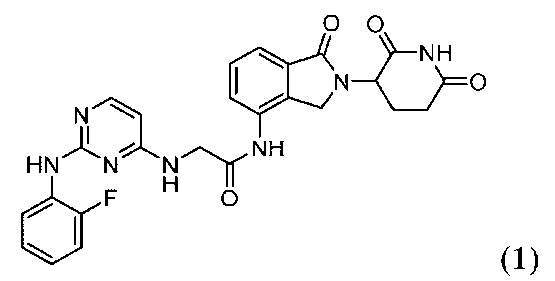
tBuOH(1mL)中の2-((2-クロロピリミジン-4-イル)アミノ)-N-(2-(2,6-ジオキソピペリジン-3-イル)-1-オキソイソインドリン-4-イル)アセトアミド(50mg、0.12mmol)および2-フルオロアニリン(13mg、0.12mmol)の溶液にTFA(18μL、0.24mmol)を加え、次に混合物を終夜加熱して還流させた。混合物を次に真空中で濃縮させ、分取HPLC(MeOH/H2O、0.05%のTFA)により精製して化合物1(4.6mg、6%)を得た。 To a solution of 2-((2-chloropyrimidin-4-yl)amino)-N-(2-(2,6-dioxopiperidin-3-yl)-1-oxoisoindolin-4-yl)acetamide (50 mg, 0.12 mmol) and 2-fluoroaniline (13 mg, 0.12 mmol) in t BuOH (1 mL) was added TFA (18 μL, 0.24 mmol) and the mixture was then heated to reflux overnight. The mixture was then concentrated in vacuo and purified by preparative HPLC (MeOH/H 2 O, 0.05% TFA) to give compound 1 (4.6 mg, 6%).
1H NMR(500MHz,DMSO-d6)δ 11.05(s,1H),10.18(s,1H),10.06(s,1H),9.38(t,J=5.7Hz,1H),7.90(d,J=7.2Hz,1H),7.83-7.74(m,2H),7.57-7.49(m,2H),7.26-7.16(m,1H),7.08-6.97(m,1H),6.45(d,J=7.2Hz,1H),5.16(dd,J=13.3,5.2Hz,1H),4.31-4.22(m,4H),2.93(ddd,J=17.4,13.6,5.4Hz,1H),2.65-2.56(m,1H),2.24(qd,J=13.2,4.5Hz,1H),2.03(ddd,J=10.3,5.4,2.8Hz,1H). 1H NMR (500MHz, DMSO- d6 )δ 11.05 (s, 1H), 10.18 (s, 1H), 10.06 (s, 1H), 9.38 (t, J = 5.7Hz, 1H), 7.90 (d, J = 7.2Hz, 1H), 7 .83-7.74 (m, 2H), 7.57-7.49 (m, 2H), 7.26-7.16 (m, 1H), 7.08-6.97 (m, 1H), 6.45 (d, J=7.2 Hz, 1H), 5.16 (dd, J = 13.3, 5.2Hz, 1H), 4.31-4.22 (m, 4H), 2.93 (ddd, J = 17.4, 13.6, 5.4Hz, 1H), 2.65-2.56 (m, 1H), 2.24 (qd, J=13.2, 4.5Hz, 1H), 2.03 (ddd, J=10.3, 5.4, 2.8Hz, 1H).
LCMS(m/z):504[M+H]+. LCMS (m/z): 504 [M+H] + .
実施例2:2-((2-((2,3-ジヒドロ-1H-インデン-5-イル)アミノ)ピリミジン-4-イル)アミノ)-N-(2-(2,6-ジオキソピペリジン-3-イル)-1-オキソイソインドリン-4-イル)アセトアミド(2)の合成。

tBuOH(1mL)中の2-((2-クロロピリミジン-4-イル)アミノ)-N-(2-(2,6-ジオキソピペリジン-3-イル)-1-オキソイソインドリン-4-イル)アセトアミド(50mg、0.12mmol)および2,3-ジヒドロ-1H-インデン-5-アミン(16mg、0.12mmol)の溶液にTFA(18μL、0.24mmol)を加え次に混合物を終夜加熱して還流させた。混合物を次に真空中で濃縮させ、分取HPLC(MeOH/H2O、0.05%のTFA)により精製して化合物2(4.4mg、6%)を得た。 To a solution of 2-((2-chloropyrimidin-4-yl)amino)-N-(2-(2,6-dioxopiperidin-3-yl)-1-oxoisoindolin-4-yl)acetamide (50 mg, 0.12 mmol) and 2,3-dihydro-1H-inden-5-amine (16 mg, 0.12 mmol) in t BuOH (1 mL) was added TFA (18 μL, 0.24 mmol) and the mixture was heated to reflux overnight. The mixture was then concentrated in vacuo and purified by preparative HPLC (MeOH/H 2 O, 0.05% TFA) to give compound 2 (4.4 mg, 6%).
1H NMR(500MHz,DMSO-d6)δ 11.01(s,1H),10.32(s,1H),10.11(s,1H),9.30(t,J=5.9Hz,1H),7.82(d,J=7.2Hz,1H),7.58-7.48(m,2H),7.34(s,1H),7.26-7.18(m,2H),7.08(d,J=8.0Hz,1H),6.39(d,J=7.2Hz,1H),5.12(dd,J=13.3,5.1Hz,1H),4.33-4.25(m,4H),2.85(dt,J=14.5,7.7Hz,2H),2.73(q,J=7.5Hz,4H),2.07-1.96(m,2H),1.91(p,J=7.0Hz,2H). 1H NMR (500MHz, DMSO-d 6 )δ 11.01 (s, 1H), 10.32 (s, 1H), 10.11 (s, 1H), 9.30 (t, J = 5.9Hz, 1H), 7.82 (d, J = 7.2H z, 1H), 7.58-7.48 (m, 2H), 7.34 (s, 1H), 7.26-7.18 (m, 2H), 7.08 (d, J = 8.0Hz, 1H), 6 .. 39 (d, J=7.2Hz, 1H), 5.12 (dd, J=13.3, 5.1Hz, 1H), 4.33-4.25 (m, 4H), 2.85 (dt, J= 14.5, 7.7Hz, 2H), 2.73 (q, J = 7.5Hz, 4H), 2.07-1.96 (m, 2H), 1.91 (p, J = 7.0Hz, 2H).
LCMS(m/z):526[M+H]+. LCMS (m/z): 526 [M+H] + .
実施例3:2-((2-((ベンゾ[d][1,3]ジオキソール-5-イルメチル)アミノ)ピリミジン-4-イル)アミノ)-N-(2-(2,6-ジオキソピペリジン-3-イル)-1-オキソイソインドリン-4-イル)アセトアミド(3)の合成。

tBuOH(1mL)中の2-((2-クロロピリミジン-4-イル)アミノ)-N-(2-(2,6-ジオキソピペリジン-3-イル)-1-オキソイソインドリン-4-イル)アセトアミド(50mg、0.12mmol)およびベンゾ[d][1,3]ジオキソール-5-イルメタンアミン(18mg、0.12mmol)の溶液にTFA(18μL、0.24mmol)を加え、次に混合物を終夜加熱して還流させた。混合物を次に真空中で濃縮させ、分取HPLC(MeOH/H2O、0.05%のTFA)により精製して化合物3(6.5mg、4%)を得た。 To a solution of 2-((2-chloropyrimidin-4-yl)amino)-N-(2-(2,6-dioxopiperidin-3-yl)-1-oxoisoindolin-4-yl)acetamide (50 mg, 0.12 mmol) and benzo[d][1,3]dioxol-5-ylmethanamine (18 mg, 0.12 mmol) in t BuOH (1 mL) was added TFA (18 μL, 0.24 mmol) and the mixture was then heated to reflux overnight. The mixture was then concentrated in vacuo and purified by preparative HPLC (MeOH/H 2 O, 0.05% TFA) to give compound 3 (6.5 mg, 4%).
1H NMR(500MHz,DMSO-d6)δ 11.02(s,1H),9.85(d,J=4.6Hz,1H),7.78(dd,J=7.6,1.4Hz,1H),7.68(d,J=5.7Hz,1H),7.54-7.43(m,2H),7.32(s,1H),6.94(s,1H),6.82(s,1H),6.76-6.65(m,2H),5.90(s,2H),5.86(d,J=6.0Hz,1H),5.14(dd,J=13.3,5.1Hz,1H),4.36-4.22(m,4H),4.09(d,J=5.9Hz,2H),2.92(ddd,J=17.2,13.6,5.4Hz,1H),2.69-2.57(m,1H),2.32-2.18(m,1H),2.03-1.96(m,1H). 1H NMR (500MHz, DMSO- d6 )δ 11.02 (s, 1H), 9.85 (d, J = 4.6Hz, 1H), 7.78 (dd, J = 7.6, 1.4Hz, 1H), 7.68 (d, J = 5.7Hz, 1H), 7.5 4-7.43 (m, 2H), 7.32 (s, 1H), 6.94 (s, 1H), 6.82 (s, 1H), 6.76-6.65 (m, 2H), 5.90 (s, 2H), 5.86 (d, J=6.0Hz, 1H), 5.14 (dd, J=13.3, 5.1Hz, 1H), 4.36-4.22 (m, 4H), 4.09 (d, J=5.9Hz, 2H), 2. 92 (ddd, J=17.2, 13.6, 5.4Hz, 1H), 2.69-2.57 (m, 1H), 2.32-2.18 (m, 1H), 2.03-1.96 (m, 1H).
LCMS(m/z):544[M+H]+. LCMS (m/z): 544 [M+H] + .
実施例4:N-(2-(2,6-ジオキソピペリジン-3-イル)-1-オキソイソインドリン-4-イル)-2-((2-((S)-2-(ヒドロキシメチル)ピロリジン-1-イル)ピリミジン-4-イル)アミノ)アセトアミド(4)の合成。

tBuOH(1mL)中の2-((2-クロロピリミジン-4-イル)アミノ)-N-(2-(2,6-ジオキソピペリジン-3-イル)-1-オキソイソインドリン-4-イル)アセトアミド(50mg、0.12mmol)および(S)-ピロリジン-2-イルメタノール(12mg、0.12mmol)の溶液にTFA(18μL、0.24mmol)を加え、次に混合物を終夜加熱して還流させた。混合物を次に真空中で濃縮させ、分取HPLC(MeOH/H2O、0.05%のTFA)により精製して化合物4(1.9mg、3%)を得た。 To a solution of 2-((2-chloropyrimidin-4-yl)amino)-N-(2-(2,6-dioxopiperidin-3-yl)-1-oxoisoindolin-4-yl)acetamide (50 mg, 0.12 mmol) and (S)-pyrrolidin-2-ylmethanol (12 mg, 0.12 mmol) in t BuOH (1 mL) was added TFA (18 μL, 0.24 mmol) and the mixture was then heated to reflux overnight. The mixture was then concentrated in vacuo and purified by preparative HPLC (MeOH/H 2 O, 0.05% TFA) to give compound 4 (1.9 mg, 3%).
1H NMR(500MHz,DMSO-d6)δ 11.88(s,1H),11.04(s,1H),10.13(s,1H),9.12(s,1H),7.83(dd,J=7.6,1.4Hz,1H),7.73(d,J=7.3Hz,1H),7.57-7.46(m,2H),6.29(d,J=7.2Hz,1H),5.18(dd,J=13.3,5.1Hz,1H),4.42-4.26(m,4H),3.64-3.34(m,4H),2.94(ddd,J=18.1,13.5,5.4Hz,1H),2.67-2.60(m,1H),2.30(dd,J=13.1,4.6Hz,1H),2.10-1.90(m,6H). 1H NMR (500MHz, DMSO-d 6 )δ 11.88 (s, 1H), 11.04 (s, 1H), 10.13 (s, 1H), 9.12 (s, 1H), 7.83 (dd, J=7.6, 1.4Hz, 1H), 7.73 (d, J = 7.3Hz, 1H), 7.57-7.46 (m, 2H), 6.29 (d, J = 7.2Hz, 1H), 5.18 (dd, J = 13.3, 5.1Hz, 1H), 4.42-4.26 (m, 4H), 3.64-3.34 (m, 4H), 2.94 (ddd, J=18.1, 13.5 , 5.4Hz, 1H), 2.67-2.60 (m, 1H), 2.30 (dd, J=13.1, 4.6Hz, 1H), 2.10-1.90 (m, 6H).
LCMS(m/z):494[M+H]+. LCMS (m/z): 494 [M+H] + .
実施例5:2-((2-(ベンゾ[d][1,3]ジオキソール-5-イルアミノ)ピリミジン-4-イル)アミノ)-N-(2-(2,6-ジオキソピペリジン-3-イル)-1-オキソイソインドリン-4-イル)アセトアミド(5)の合成。

tBuOH(1mL)中の2-((2-クロロピリミジン-4-イル)アミノ)-N-(2-(2,6-ジオキソピペリジン-3-イル)-1-オキソイソインドリン-4-イル)アセトアミド(60mg、0.14mmol)および2,3-ジヒドロベンゾ[b][1,4]ジオキシン-6-アミン(21mg、0.14mmol)の溶液にTFA(21μL、0.28mmol)を加え、次に混合物を終夜加熱して還流させた。混合物を次に真空中で濃縮させ、分取HPLC(MeOH/H2O、0.05%のTFA)により精製して化合物5(5.2mg、6%)を得た。 To a solution of 2-((2-chloropyrimidin-4-yl)amino)-N-(2-(2,6-dioxopiperidin-3-yl)-1-oxoisoindolin-4-yl)acetamide (60 mg, 0.14 mmol) and 2,3-dihydrobenzo[b][1,4]dioxin-6-amine (21 mg, 0.14 mmol) in t BuOH (1 mL) was added TFA (21 μL, 0.28 mmol) and the mixture was then heated to reflux overnight. The mixture was then concentrated in vacuo and purified by preparative HPLC (MeOH/H 2 O, 0.05% TFA) to give compound 5 (5.2 mg, 6%).
1H NMR(500MHz,DMSO-d6)δ 11.02(s,1H),10.25(s,1H),10.12(s,1H),9.28(s,1H),7.83-7.74(m,2H),7.56-7.47(m,2H),7.01(d,J=2.5Hz,1H),6.97(d,J=8.6Hz,1H),6.74(d,J=8.7Hz,1H),6.37(d,J=7.2Hz,1H),5.14(dd,J=13.3,5.1Hz,1H),4.32(s,2H),4.16-4.05(m,4H),2.92(ddd,J=17.2,13.5,5.4Hz,1H),2.64-2.56(m,1H),2.32-2.20(m,1H),2.06-1.95(m,1H). 1H NMR (500MHz, DMSO- d6 )δ 11.02 (s, 1H), 10.25 (s, 1H), 10.12 (s, 1H), 9.28 (s, 1H), 7.83-7.74 (m, 2H), 7.56-7.4 7 (m, 2H), 7.01 (d, J = 2.5Hz, 1H), 6.97 (d, J = 8.6Hz, 1H), 6.74 (d, J = 8.7Hz, 1H), 6.37 (d, J = 7.2Hz, 1H), 5.14 (dd, J = 13.3, 5.1Hz, 1H), 4.32 (s, 2H), 4.16-4.05 (m, 4H), 2.92 (dd d, J=17.2, 13.5, 5.4Hz, 1H), 2.64-2.56 (m, 1H), 2.32-2.20 (m, 1H), 2.06-1.95 (m, 1H).
LCMS(m/z):530[M+H]+. LCMS (m/z): 530 [M+H] + .
実施例6:N-(2-(2,6-ジオキソピペリジン-3-イル)-1-オキソイソインドリン-4-イル)-2-((2-((3-(2-オキソピロリジン-1-イル)プロピル)アミノ)ピリミジン-4-イル)アミノ)アセトアミド(6)の合成。

tBuOH(1mL)中の2-((2-クロロピリミジン-4-イル)アミノ)-N-(2-(2,6-ジオキソピペリジン-3-イル)-1-オキソイソインドリン-4-イル)アセトアミド(60mg、0.14mmol)および1 1-(3-アミノプロピル)ピロリジン-2-オン(20mg、0.14mmol)の溶液にTFA(18μL、0.24mmol)を加え、次に混合物を終夜加熱して還流させた。混合物を次に真空中で濃縮させ、分取HPLC(MeOH/H2O、0.05%のTFA)により精製して化合物6(4.1mg、5%)を得た。 To a solution of 2-((2-chloropyrimidin-4-yl)amino)-N-(2-(2,6-dioxopiperidin-3-yl)-1-oxoisoindolin-4-yl)acetamide (60 mg, 0.14 mmol) and 1 1-(3-aminopropyl)pyrrolidin-2-one (20 mg, 0.14 mmol) in t BuOH (1 mL) was added TFA (18 μL, 0.24 mmol) and the mixture was then heated to reflux overnight. The mixture was then concentrated in vacuo and purified by preparative HPLC (MeOH/H 2 O, 0.05% TFA) to give compound 6 (4.1 mg, 5%).
1H NMR(500MHz,DMSO-d6)δ 11.94(s,1H),11.04(d,J=2.3Hz,1H),10.20-10.08(m,1H),8.04-7.93(m,1H),7.85(ddd,J=17.0,7.4,1.6Hz,1H),7.74(d,J=7.3Hz,1H),7.58-7.46(m,2H),6.30-6.23(m,1H),5.17(ddd,J=13.3,5.2,2.9Hz,1H),4.49-4.21(m,4H),3.31(d,J=22.6Hz,2H),3.19-3.08(m,2H),2.98-2.90(m,1H),2.67-2.59(m,1H),2.34-2.25(m,1H),2.14(d,J=7.8Hz,1H),2.08-1.99(m,1H),1.81(s,1H),1.62(s,1H). 1H NMR (500MHz, DMSO- d6 )δ 11.94 (s, 1H), 11.04 (d, J = 2.3Hz, 1H), 10.20-10.08 (m, 1H), 8.04-7.93 (m, 1H), 7.85 (ddd, J = 17.0, 7 .4, 1.6Hz, 1H), 7.74 (d, J = 7.3Hz, 1H), 7.58-7.46 (m, 2H), 6.30-6.23 (m, 1H), 5.17 (ddd, J = 13.3, 5.2, 2.9Hz, 1H), 4.49-4.21 (m, 4H), 3.31 (d, J=22.6Hz, 2H), 3.19-3.08 (m, 2H), 2.98-2.90 (m, 1H), 2.67- 2.59 (m, 1H), 2.34-2.25 (m, 1H), 2.14 (d, J=7.8Hz, 1H), 2.08-1.99 (m, 1H), 1.81 (s, 1H), 1.62 (s, 1H).
LCMS(m/z):535[M+H]+. LCMS (m/z): 535 [M+H] + .
実施例7:N-(2-(2,6-ジオキソピペリジン-3-イル)-1-オキソイソインドリン-4-イル)-2-((2-((4-メトキシフェニル)アミノ)ピリミジン-4-イル)アミノ)アセトアミド(7)の合成。

tBuOH(1mL)中の2-((2-クロロピリミジン-4-イル)アミノ)-N-(2-(2,6-ジオキソピペリジン-3-イル)-1-オキソイソインドリン-4-イル)アセトアミド(100mg、0.234mmol)および4-メトキシアニリン(29mg、0.234mmol)の溶液にTFA(36μL、0.468mmol)を加え、次に混合物を終夜加熱して還流させた。混合物を次に真空中で濃縮させ、分取HPLC(MeOH/H2O、0.05%のTFA)により精製して化合物7(10.9mg、7%)を得た。 To a solution of 2-((2-chloropyrimidin-4-yl)amino)-N-(2-(2,6-dioxopiperidin-3-yl)-1-oxoisoindolin-4-yl)acetamide (100 mg, 0.234 mmol) and 4-methoxyaniline (29 mg, 0.234 mmol) in t BuOH (1 mL) was added TFA (36 μL, 0.468 mmol) and the mixture was then heated to reflux overnight. The mixture was then concentrated in vacuo and purified by preparative HPLC (MeOH/H 2 O, 0.05% TFA) to give compound 7 (10.9 mg, 7%).
1H NMR(500MHz,DMSO-d6)δ 11.02(s,1H),10.46(s,1H),10.15(s,1H),9.32(d,J=5.7Hz,1H),7.81(td,J=9.1,7.7,4.1Hz,2H),7.58-7.47(m,2H),7.42(d,J=8.5Hz,2H),6.78(d,J=8.5Hz,2H),6.38(d,J=7.2Hz,1H),5.14(dd,J=13.3,5.1Hz,1H),4.33-4.23(m,4H),3.60(s,3H),2.93(ddd,J=17.2,13.5,5.4Hz,1H),2.65-2.56(m,1H),2.23(qd,J=13.2,4.4Hz,1H),2.01(dtd,J=12.4,7.4,6.2,3.7Hz,1H). 1H NMR (500MHz, DMSO- d6 )δ 11.02 (s, 1H), 10.46 (s, 1H), 10.15 (s, 1H), 9.32 (d, J = 5.7Hz, 1H), 7.81 (td, J = 9.1, 7.7, 4.1Hz , 2H), 7.58-7.47 (m, 2H), 7.42 (d, J = 8.5Hz, 2H), 6.78 (d, J = 8.5Hz, 2H), 6.38 (d, J = 7.2Hz, 1H), 5 .. 14 (dd, J = 13.3, 5.1Hz, 1H), 4.33-4.23 (m, 4H), 3.60 (s, 3H), 2.93 (ddd, J = 17.2, 13.5, 5.4Hz, 1 H), 2.65-2.56 (m, 1H), 2.23 (qd, J = 13.2, 4.4Hz, 1H), 2.01 (dtd, J = 12.4, 7.4, 6.2, 3.7Hz, 1H).
LCMS(m/z):516[M+H]+. LCMS (m/z): 516 [M+H] + .
実施例8:2-((2-([1,1’-ビフェニル]-4-イル)ピリミジン-4-イル)アミノ)-N-(2-(2,6-ジオキソピペリジン-3-イル)-1-オキソイソインドリン-4-イル)アセトアミド(8)の合成。

1H NMR(500MHz,DMSO-d6)δ 11.01(s,1H),10.30(s,1H),8.77(dd,J=4.4,1.4Hz,1H),8.36(d,J=8.2Hz,2H),8.31-8.27(m,1H),7.90-7.72(m,5H),7.56-7.50(m,4H),7.49-7.39(m,1H),6.88(d,J=6.7Hz,1H),5.11(dd,J=13.4,5.0Hz,1H),4.49(d,J=5.4Hz,2H),4.37(s,2H),2.87(t,J=13.9Hz,1H),2.64(d,J=5.1Hz,1H),2.17(d,J=13.4Hz,1H),1.96(s,1H). 1H NMR (500MHz, DMSO- d6 )δ 11.01 (s, 1H), 10.30 (s, 1H), 8.77 (dd, J = 4.4, 1.4Hz, 1H), 8.36 (d, J = 8.2Hz, 2H), 8 .31-8.27 (m, 1H), 7.90-7.72 (m, 5H), 7.56-7.50 (m, 4H), 7.49-7.39 (m, 1H), 6.88 (d , J=6.7Hz, 1H), 5.11 (dd, J=13.4, 5.0Hz, 1H), 4.49 (d, J=5.4Hz, 2H), 4.37 (s, 2H), 2 .87 (t, J=13.9Hz, 1H), 2.64 (d, J=5.1Hz, 1H), 2.17 (d, J=13.4Hz, 1H), 1.96 (s, 1H).
LCMS(m/z):547[M+H]+. LCMS (m/z): 547 [M+H] + .
実施例9:N-(2-(2,6-ジオキソピペリジン-3-イル)-1-オキソイソインドリン-4-イル)-2-((2-(3-メトキシフェニル)ピリミジン-4-イル)アミノ)アセトアミド(9)の合成。

tBuOH(2mL)中の2-((2-クロロピリミジン-4-イル)アミノ)-N-(2-(2,6-ジオキソピペリジン-3-イル)-1-オキソイソインドリン-4-イル)アセトアミド(100mg、0.23mmol)および(3-メトキシフェニル)ボロン酸(43mg、0.28mmol)の溶液にN,N-ジシクロヘキシルメチルアミン(49mg、0.25mmol)、Pd2dba3(21mg、0.023mmol)およびトリ-tert-ブチルホスホニウムテトラフルオロボレート(13mg、0.046mmol)を加えた。混合物を80℃に加熱し、N2雰囲気で終夜撹拌した。混合物を次に濾過し、真空中で濃縮させ、分取HPLC(MeOH/H2O、0.05%のTFA)により精製して化合物9(4.0mg、3%)を得た。 To a solution of 2-((2-chloropyrimidin-4-yl)amino)-N-(2-(2,6-dioxopiperidin-3-yl)-1-oxoisoindolin-4-yl)acetamide (100 mg, 0.23 mmol) and (3-methoxyphenyl)boronic acid (43 mg, 0.28 mmol) in t BuOH (2 mL) was added N,N-dicyclohexylmethylamine (49 mg, 0.25 mmol), Pd 2 dba 3 (21 mg, 0.023 mmol) and tri-tert-butylphosphonium tetrafluoroborate (13 mg, 0.046 mmol). The mixture was heated to 80° C. and stirred under N 2 atmosphere overnight. The mixture was then filtered, concentrated in vacuo and purified by preparative HPLC (MeOH/H 2 O, 0.05% TFA) to give compound 9 (4.0 mg, 3%).
1H NMR(500MHz,DMSO-d6)δ 11.03(s,1H),10.31(s,1H),9.79(s,1H),8.24(d,J=7.2Hz,1H),8.19-8.17(m,1H),7.81(dd,J=7.6,1.5Hz,1H),7.68(ddd,J=8.9,7.3,1.8Hz,1H),7.56-7.52(m,2H),7.32(d,J=8.4Hz,1H),7.11(t,J=7.6Hz,1H),6.98(d,J=7.2Hz,1H),5.14(dd,J=13.3,5.2Hz,1H),4.50(d,J=5.5Hz,2H),4.36-4.25(m,2H),3.98(s,3H),2.92(ddd,J=18.3,13.4,5.5Hz,1H),2.62-2.56(m,1H),2.15-2.07(m,1H),2.00-1.96(m,1H). 1H NMR (500MHz, DMSO-d 6 )δ 11.03 (s, 1H), 10.31 (s, 1H), 9.79 (s, 1H), 8.24 (d, J=7.2Hz, 1H), 8.19-8.17 (m, 1H), 7.81 (dd, J=7.6, 1. 5Hz, 1H), 7.68 (ddd, J = 8.9, 7.3, 1.8Hz, 1H), 7.56-7.52 (m, 2H), 7.32 (d, J = 8.4Hz, 1H), 7.11 (t, J = 7.6Hz, 1H), 6.98 (d, J = 7.2Hz, 1H), 5.14 (dd, J = 13.3, 5.2Hz, 1H), 4.50 (d, J = 5.5Hz, 2H), 4.36-4.25 (m, 2H), 3.9 8 (s, 3H), 2.92 (ddd, J=18.3, 13.4, 5.5Hz, 1H), 2.62-2.56 (m, 1H), 2.15-2.07 (m, 1H), 2.00-1.96 (m, 1H).
LCMS(m/z):501[M+H]+. LCMS (m/z): 501 [M+H] + .
実施例10:2-((2-(2,5-ジメトキシフェニル)ピリミジン-4-イル)アミノ)-N-(2-(2,6-ジオキソピペリジン-3-イル)-1-オキソイソインドリン-4-イル)アセトアミド(10)の合成。

tBuOH(2mL)中の2-((2-クロロピリミジン-4-イル)アミノ)-N-(2-(2,6-ジオキソピペリジン-3-イル)-1-オキソイソインドリン-4-イル)アセトアミド(100mg、0.23mmol)および(2,5-ジメトキシフェニル)ボロン酸(51mg、0.28mmol)の溶液にN,N-ジシクロヘキシルメチルアミン(49mg、0.25mmol)、Pd2dba3(21mg、0.023mmol)およびトリ-tert-ブチルホスホニウムテトラフルオロボレート(13mg、0.046mmol)を加えた。混合物を80℃に加熱し、N2雰囲気で終夜撹拌した。混合物を次に濾過し、真空中で濃縮させ、分取HPLC(MeOH/H2O、0.05%のTFA)により精製して化合物10(2.8mg、1%)を得た。 To a solution of 2-((2-chloropyrimidin-4-yl)amino)-N-(2-(2,6-dioxopiperidin-3-yl)-1-oxoisoindolin-4-yl)acetamide (100 mg, 0.23 mmol) and (2,5-dimethoxyphenyl)boronic acid (51 mg, 0.28 mmol) in tBuOH (2 mL) was added N,N-dicyclohexylmethylamine (49 mg, 0.25 mmol), Pd 2 dba 3 (21 mg, 0.023 mmol) and tri-tert-butylphosphonium tetrafluoroborate (13 mg, 0.046 mmol). The mixture was heated to 80 °C and stirred under N 2 atmosphere overnight. The mixture was then filtered, concentrated in vacuo and purified by preparative HPLC (MeOH/H 2 O, 0.05% TFA) to give compound 10 (2.8 mg, 1%).
1H NMR(500MHz,DMSO-d6)δ 11.01(s,1H),10.30(s,1H),9.60(s,1H),8.23(d,J=9.3Hz,1H),8.16(d,J=7.2Hz,1H),7.84-7.78(m,1H),7.59-7.49(m,2H),6.88(d,J=7.1Hz,1H),6.80(d,J=2.4Hz,1H),6.66(dt,J=8.9,2.0Hz,1H),5.13(dd,J=13.3,5.1Hz,1H),4.47(d,J=5.5Hz,2H),4.32(s,2H),4.01(s,3H),3.89(s,3H),2.92(ddd,J=18.3,13.5,5.4Hz,1H),2.58(d,J=17.5Hz,1H),2.20-2.08(m,1H),2.01-1.90(m,1H). 1H NMR (500MHz, DMSO-d 6 )δ 11.01 (s, 1H), 10.30 (s, 1H), 9.60 (s, 1H), 8.23 (d, J = 9.3Hz, 1H), 8.16 (d, J = 7.2Hz, 1H), 7.84-7.7 8 (m, 1H), 7.59-7.49 (m, 2H), 6.88 (d, J = 7.1Hz, 1H), 6.80 (d, J = 2.4Hz, 1H), 6.66 (dt, J = 8.9, 2.0Hz, 1H), 5.13 (dd, J = 13.3, 5.1Hz, 1H), 4.47 (d, J = 5.5Hz, 2H), 4.32 (s, 2H), 4.01 (s, 3H), 3.89 (s, 3H), 2 92 (ddd, J=18.3, 13.5, 5.4Hz, 1H), 2.58 (d, J=17.5Hz, 1H), 2.20-2.08 (m, 1H), 2.01-1.90 (m, 1H).
LCMS(m/z):531[M+H]+. LCMS (m/z): 531 [M+H] + .
実施例11:N-(2-(2,6-ジオキソピペリジン-3-イル)-1-オキソイソインドリン-4-イル)-2-((2-(4-フルオロフェニル)ピリミジン-4-イル)アミノ)アセトアミド(11)の合成。

tBuOH(2mL)中の2-((2-クロロピリミジン-4-イル)アミノ)-N-(2-(2,6-ジオキソピペリジン-3-イル)-1-オキソイソインドリン-4-イル)アセトアミド(100mg、0.23mmol)および(4-フルオロフェニル)ボロン酸(50mg、0.28mmol)の溶液にN,N-ジシクロヘキシルメチルアミン(49mg、0.25mmol)、Pd2dba3(21mg、0.023mmol)およびトリ-tert-ブチルホスホニウムテトラフルオロボレート(13mg、0.046mmol)を加えた。混合物を80℃に加熱し、N2雰囲気で終夜撹拌した。混合物を次に濾過し、真空中で濃縮させ、分取HPLC(MeOH/H2O、0.05%のTFA)により精製して化合物11(10.0mg、3%)を得た。 To a solution of 2-((2-chloropyrimidin-4-yl)amino)-N-(2-(2,6-dioxopiperidin-3-yl)-1-oxoisoindolin-4-yl)acetamide (100 mg, 0.23 mmol) and (4-fluorophenyl)boronic acid (50 mg, 0.28 mmol) in tBuOH (2 mL) was added N,N-dicyclohexylmethylamine (49 mg, 0.25 mmol), Pd 2 dba 3 (21 mg, 0.023 mmol) and tri-tert-butylphosphonium tetrafluoroborate (13 mg, 0.046 mmol). The mixture was heated to 80 °C and stirred under N 2 atmosphere overnight. The mixture was then filtered, concentrated in vacuo, and purified by preparative HPLC (MeOH/H 2 O, 0.05% TFA) to give compound 11 (10.0 mg, 3%).
1H NMR(500MHz,DMSO-d6)δ 11.02(s,1H),10.30(s,1H),9.30(s,1H),8.36-8.23(m,2H),7.81(d,J=7.2Hz,1H),7.57-7.49(m,3H),7.42(t,J=8.6Hz,2H),6.88(d,J=6.8Hz,1H),5.13(dd,J=13.3,5.1Hz,1H),4.47(d,J=5.3Hz,2H),4.34(s,2H),2.92(ddt,J=18.1,13.6,4.7Hz,1H),2.65-2.57(m,1H),2.19-2.12(m,1H),1.98(d,J=10.2Hz,1H). 1H NMR (500MHz, DMSO-d 6 )δ 11.02 (s, 1H), 10.30 (s, 1H), 9.30 (s, 1H), 8.36-8.23 (m, 2H), 7.81 (d, J = 7.2Hz , 1H), 7.57-7.49 (m, 3H), 7.42 (t, J = 8.6Hz, 2H), 6.88 (d, J = 6.8Hz, 1H), 5.13 (dd , J=13.3, 5.1Hz, 1H), 4.47 (d, J=5.3Hz, 2H), 4.34 (s, 2H), 2.92 (ddt, J=18.1, 1 3.6, 4.7Hz, 1H), 2.65-2.57 (m, 1H), 2.19-2.12 (m, 1H), 1.98 (d, J=10.2Hz, 1H).
LCMS(m/z):489[M+H]+. LCMS (m/z): 489 [M+H] + .
実施例12:2-((2-(4-アセチルフェニル)ピリミジン-4-イル)アミノ)-N-(2-(2,6-ジオキソピペリジン-3-イル)-1-オキソイソインドリン-4-イル)アセトアミド(12)の合成。

tBuOH(2mL)中の2-((2-クロロピリミジン-4-イル)アミノ)-N-(2-(2,6-ジオキソピペリジン-3-イル)-1-オキソイソインドリン-4-イル)アセトアミド(100mg、0.23mmol)および(4-アセチルフェニル)ボロン酸(45mg、0.28mmol)の溶液にN,N-ジシクロヘキシルメチルアミン(49mg、0.25mmol)、Pd2dba3(21mg、0.023mmol)およびトリ-tert-ブチルホスホニウムテトラフルオロボレート(13mg、0.046mmol)を加えた。混合物を80℃に加熱し、N2雰囲気で終夜撹拌した。混合物を次に濾過し、真空中で濃縮させ、分取HPLC(MeOH/H2O、0.05%のTFA)により精製して12(3.6mg、3%)を得た。 To a solution of 2-((2-chloropyrimidin-4-yl)amino)-N-(2-(2,6-dioxopiperidin-3-yl)-1-oxoisoindolin-4-yl)acetamide (100 mg, 0.23 mmol) and (4-acetylphenyl)boronic acid (45 mg, 0.28 mmol) in t BuOH (2 mL) was added N,N-dicyclohexylmethylamine (49 mg, 0.25 mmol), Pd 2 dba 3 (21 mg, 0.023 mmol) and tri-tert-butylphosphonium tetrafluoroborate (13 mg, 0.046 mmol). The mixture was heated to 80° C. and stirred under N 2 atmosphere overnight. The mixture was then filtered, concentrated in vacuo and purified by preparative HPLC (MeOH/H 2 O, 0.05% TFA) to give 12 (3.6 mg, 3%).
1H NMR(500MHz,DMSO-d6)δ 10.99(s,1H),10.22(s,1H),8.75(s,1H),8.40(d,J=8.4Hz,2H),8.29(d,J=6.4Hz,1H),8.06(d,J=8.1Hz,2H),7.81(d,J=7.4Hz,1H),7.57-7.47(m,2H),6.82(d,J=6.4Hz,1H),5.11(dd,J=13.1,5.1Hz,1H),4.43-4.38(m,2H),4.33(s,2H),2.90(ddd,J=18.2,13.5,5.4Hz,1H),2.63(s,3H),2.57(d,J=19.1Hz,1H),2.14(d,J=13.6Hz,1H),2.00-1.91(m,1H). 1H NMR (500MHz, DMSO-d 6 )δ 10.99 (s, 1H), 10.22 (s, 1H), 8.75 (s, 1H), 8.40 (d, J = 8.4Hz, 2H), 8.29 (d, J = 6.4Hz, 1H), 8 .06 (d, J=8.1Hz, 2H), 7.81 (d, J=7.4Hz, 1H), 7.57-7.47 (m, 2H), 6.82 (d, J=6.4Hz, 1H), 5. 11 (dd, J = 13.1, 5.1Hz, 1H), 4.43-4.38 (m, 2H), 4.33 (s, 2H), 2.90 (ddd, J = 18.2, 13.5, 5.4 Hz, 1H), 2.63 (s, 3H), 2.57 (d, J=19.1Hz, 1H), 2.14 (d, J=13.6Hz, 1H), 2.00-1.91 (m, 1H).
LCMS(m/z):513[M+H]+. LCMS (m/z): 513 [M+H] + .
実施例13:2-((2-(ベンゾフラン-2-イル)ピリミジン-4-イル)アミノ)-N-(2-(2,6-ジオキソピペリジン-3-イル)-1-オキソイソインドリン-4-イル)アセトアミド(13)の合成。

tBuOH(2mL)中の2-((2-クロロピリミジン-4-イル)アミノ)-N-(2-(2,6-ジオキソピペリジン-3-イル)-1-オキソイソインドリン-4-イル)アセトアミド(150mg、0.35mmol)およびベンゾフラン-2-イルボロン酸(68mg、0.42mmol)の溶液にN,N-ジシクロヘキシルメチルアミン(75mg、0.39mmol)、Pd2dba3(32mg、0.035mmol)およびトリ-tert-ブチルホスホニウムテトラフルオロボレート(20mg、0.07mmol)を加えた。混合物を80℃に加熱し、N2雰囲気で終夜撹拌した。混合物を次に濾過し、真空中で濃縮させ、分取HPLC(MeOH/H2O、0.05%のTFA)により精製して13(12.3mg、6%)を得た。 To a solution of 2-((2-chloropyrimidin-4-yl)amino)-N-(2-(2,6-dioxopiperidin-3-yl)-1-oxoisoindolin-4-yl)acetamide (150 mg, 0.35 mmol) and benzofuran-2-ylboronic acid (68 mg, 0.42 mmol) in t BuOH (2 mL) was added N,N-dicyclohexylmethylamine (75 mg, 0.39 mmol), Pd 2 dba 3 (32 mg, 0.035 mmol) and tri-tert-butylphosphonium tetrafluoroborate (20 mg, 0.07 mmol). The mixture was heated to 80° C. and stirred under N 2 atmosphere overnight. The mixture was then filtered, concentrated in vacuo and purified by preparative HPLC (MeOH/H 2 O, 0.05% TFA) to give 13 (12.3 mg, 6%).
1H NMR(500MHz,DMSO-d6)δ 10.99(s,1H),10.20(s,1H),8.22(d,J=5.8Hz,1H),8.14(s,1H),7.83(dd,J=7.4,1.6Hz,1H),7.72(d,J=7.8Hz,1H),7.66(s,1H),7.63(d,J=8.3Hz,1H),7.56-7.49(m,2H),7.43-7.38(m,1H),7.29(s,1H),6.67(s,1H),5.07(dd,J=13.4,4.9Hz,1H),4.36(d,J=22.3Hz,4H),2.92-2.79(m,1H),2.46(s,1H),2.13(d,J=13.9Hz,1H),1.89(s,1H). 1H NMR (500MHz, DMSO-d 6 )δ 10.99 (s, 1H), 10.20 (s, 1H), 8.22 (d, J = 5.8Hz, 1H), 8.14 (s, 1H), 7.83 (dd, J = 7.4, 1.6 Hz, 1H), 7.72 (d, J = 7.8Hz, 1H), 7.66 (s, 1H), 7.63 (d, J = 8.3Hz, 1H), 7.56-7.49 (m, 2H) , 7.43-7.38 (m, 1H), 7.29 (s, 1H), 6.67 (s, 1H), 5.07 (dd, J=13.4, 4.9Hz, 1H), 4.36 (d, J=22.3Hz, 4H), 2.92-2.79 (m, 1H), 2.46 (s, 1H), 2.13 (d, J=13.9Hz, 1H), 1.89 (s, 1H).
LCMS(m/z):511[M+H]+. LCMS (m/z): 511 [M+H] + .
実施例14:N-(2-(2,6-ジオキソピペリジン-3-イル)-1-オキソイソインドリン-4-イル)-2-((2-((R)-2-(ヒドロキシメチル)ピロリジン-1-イル)ピリミジン-4-イル)アミノ)アセトアミド(14)の合成。

tBuOH(2mL)中の2-((2-クロロピリミジン-4-イル)アミノ)-N-(2-(2,6-ジオキソピペリジン-3-イル)-1-オキソイソインドリン-4-イル)アセトアミド(210mg、0.5mmol)および(R)-ピロリジン-2-イルメタノール(50mg、0.5mmol)の溶液にTFA(76μL、1.0mmol)を加え、次に混合物を終夜加熱して還流させた。混合物を次に真空中で濃縮させ、分取HPLC(MeOH/H2O、0.05%のTFA)により精製して化合物14(5.1mg、2%)を得た。 To a solution of 2-((2-chloropyrimidin-4-yl)amino)-N-(2-(2,6-dioxopiperidin-3-yl)-1-oxoisoindolin-4-yl)acetamide (210 mg, 0.5 mmol) and (R)-pyrrolidin-2-ylmethanol (50 mg, 0.5 mmol) in t BuOH (2 mL) was added TFA (76 μL, 1.0 mmol) and the mixture was then heated to reflux overnight. The mixture was then concentrated in vacuo and purified by preparative HPLC (MeOH/H 2 O, 0.05% TFA) to give compound 14 (5.1 mg, 2%).
1H NMR(500MHz,DMSO-d6)δ 11.04(s,1H),10.15(s,1H),9.13(s,1H),7.83(d,J=7.6Hz,1H),7.74(d,J=7.2Hz,1H),7.60-7.47(m,2H),6.29(d,J=7.2Hz,1H),5.18(dd,J=13.3,5.2Hz,1H),4.44-4.27(m,4H),3.60-3.36(m,5H),2.94(ddd,J=18.1,13.5,5.5Hz,1H),2.68-2.58(m,1H),2.30(tt,J=13.1,6.7Hz,1H),2.06-2.00(m,1H),1.91(dqd,J=18.5,12.4,6.4Hz,4H). 1H NMR (500MHz, DMSO- d6 )δ 11.04 (s, 1H), 10.15 (s, 1H), 9.13 (s, 1H), 7.83 (d, J = 7.6Hz, 1H), 7.74 (d, J = 7.2Hz, 1H ), 7.60-7.47 (m, 2H), 6.29 (d, J = 7.2Hz, 1H), 5.18 (dd, J = 13.3, 5.2Hz, 1H), 4.44-4.27 (m, 4H), 3.60-3.36 (m, 5H), 2.94 (ddd, J=18.1, 13.5, 5.5Hz, 1H), 2.68-2.58 (m, 1H), 2 .30 (tt, J=13.1, 6.7Hz, 1H), 2.06-2.00 (m, 1H), 1.91 (dqd, J=18.5, 12.4, 6.4Hz, 4H).
LCMS(m/z):494[M+H]+. LCMS (m/z): 494 [M+H] + .
実施例15:N-(2-(2,6-ジオキソピペリジン-3-イル)-1-オキソイソインドリン-4-イル)-2-((2-((2-メトキシフェニル)アミノ)ピリミジン-4-イル)アミノ)アセトアミド(15)の合成。

tBuOH(2mL)中の2-((2-クロロピリミジン-4-イル)アミノ)-N-(2-(2,6-ジオキソピペリジン-3-イル)-1-オキソイソインドリン-4-イル)アセトアミド(140mg、0.33mmol)および2-メトキシアニリン(40mg、0.33mmol)の溶液にTFA(50μL、0.66mmol)を加え、次に混合物を終夜加熱して還流させた。混合物を次に真空中で濃縮させ、分取HPLC(MeOH/H2O、0.05%のTFA)により精製して化合物15(9.5mg、5%)を得た。 To a solution of 2-((2-chloropyrimidin-4-yl)amino)-N-(2-(2,6-dioxopiperidin-3-yl)-1-oxoisoindolin-4-yl)acetamide (140 mg, 0.33 mmol) and 2-methoxyaniline (40 mg, 0.33 mmol) in t BuOH (2 mL) was added TFA (50 μL, 0.66 mmol) and the mixture was then heated to reflux overnight. The mixture was then concentrated in vacuo and purified by preparative HPLC (MeOH/H 2 O, 0.05% TFA) to give compound 15 (9.5 mg, 5%).
1H NMR(500MHz,DMSO-d6)δ 11.03(s,1H),10.18(s,1H),9.64(s,1H),9.38(t,J=5.8Hz,1H),7.94-7.77(m,3H),7.56-7.49(m,2H),7.12(t,J=7.7Hz,1H),7.09-7.07(m,1H),6.80(t,J=7.7Hz,1H),5.14(dd,J=13.3,5.2Hz,1H),4.34-4.20(m,4H),3.83(s,3H),2.92(ddd,J=17.2,13.5,5.4Hz,1H),2.66-2.54(m,1H),2.19(qd,J=13.1,4.4Hz,1H),2.00(dtd,J=12.8,5.4,2.2Hz,1H). 1H NMR (500MHz, DMSO- d6 )δ 11.03 (s, 1H), 10.18 (s, 1H), 9.64 (s, 1H), 9.38 (t, J=5.8Hz, 1H), 7.94-7.77 (m, 3H), 7.5 6-7.49 (m, 2H), 7.12 (t, J = 7.7Hz, 1H), 7.09-7.07 (m, 1H), 6.80 (t, J = 7.7Hz, 1H), 5.14 (dd , J = 13.3, 5.2Hz, 1H), 4.34-4.20 (m, 4H), 3.83 (s, 3H), 2.92 (ddd, J = 17.2, 13.5, 5.4Hz, 1 H), 2.66-2.54 (m, 1H), 2.19 (qd, J=13.1, 4.4Hz, 1H), 2.00 (dtd, J=12.8, 5.4, 2.2Hz, 1H).
LCMS(m/z):516[M+H]+. LCMS (m/z): 516 [M+H] + .
実施例16:N-(2-(2,6-ジオキソピペリジン-3-イル)-1-オキソイソインドリン-4-イル)-2-((2-(4-(3-(トリフルオロメチル)フェニル)ピペラジン-1-イル)ピリミジン-4-イル)アミノ)アセトアミド(16)の合成。

tBuOH(2mL)中の2-((2-クロロピリミジン-4-イル)アミノ)-N-(2-(2,6-ジオキソピペリジン-3-イル)-1-オキソイソインドリン-4-イル)アセトアミド(135mg、0.316mmol)および1-(3-(トリフルオロメチル)フェニル)ピペラジン(73mg、0.316mmol)の溶液にTFA(48μL、0.632mmol)を加え、次に混合物を終夜加熱して還流させた。混合物を次に真空中で濃縮させ、分取HPLC(MeOH/H2O、0.05%のTFA)により精製して化合物16(12.1mg、5%)を得た。 To a solution of 2-((2-chloropyrimidin-4-yl)amino)-N-(2-(2,6-dioxopiperidin-3-yl)-1-oxoisoindolin-4-yl)acetamide (135 mg, 0.316 mmol) and 1-(3-(trifluoromethyl)phenyl)piperazine (73 mg, 0.316 mmol) in t BuOH (2 mL) was added TFA (48 μL, 0.632 mmol) and the mixture was then heated to reflux overnight. The mixture was then concentrated in vacuo and purified by preparative HPLC (MeOH/H 2 O, 0.05% TFA) to give compound 16 (12.1 mg, 5%).
1H NMR(500MHz,DMSO-d6)δ 11.04(s,1H),10.27(s,1H),9.27(t,J=5.6Hz,1H),7.88(dd,J=7.4,1.6Hz,1H),7.80(dd,J=7.2,2.1Hz,1H),7.59-7.51(m,2H),7.47-7.43(m,1H),7.29-7.22(m,1H),7.17(t,J=6.9Hz,1H),7.11(d,J=7.5Hz,1H),5.18(dd,J=13.3,5.1Hz,1H),4.36(dd,J=34.4,7.4Hz,4H),3.85(t,J=5.1Hz,4H),3.37(dt,J=48.5,5.2Hz,4H),2.93(ddd,J=18.0,13.5,5.3Hz,1H),2.64-2.57(m,1H),2.31(qd,J=13.2,4.4Hz,1H),2.04(ddd,J=13.3,5.8,3.4Hz,1H). 1H NMR (500MHz, DMSO- d6 )δ 11.04 (s, 1H), 10.27 (s, 1H), 9.27 (t, J = 5.6Hz, 1H), 7.88 (dd, J = 7.4, 1.6Hz, 1H), 7.80 (dd, J = 7.2, 2.1Hz, 1H), 7. 59-7.51 (m, 2H), 7.47-7.43 (m, 1H), 7.29-7.22 (m, 1H), 7.17 (t, J = 6.9Hz, 1H), 7.11 (d, J = 7.5Hz, 1H), 5.18 (dd, J = 13.3, 5.1Hz, 1H), 4.36 (dd, J = 34.4, 7.4Hz, 4H), 3.85 (t, J = 5.1Hz, 4H), 3.37 (dt, J = 48.5, 5.2Hz, 4H), 2.93 (ddd , J=18.0, 13.5, 5.3Hz, 1H), 2.64-2.57 (m, 1H), 2.31 (qd, J=13.2, 4.4Hz, 1H), 2.04 (ddd, J=13.3, 5.8, 3.4Hz, 1H).
LCMS(m/z):623[M+H]+. LCMS (m/z): 623 [M+H] + .
実施例17:N-(2-(2,6-ジオキソピペリジン-3-イル)-1-オキソイソインドリン-4-イル)-2-((2-(メチル(フェニル)アミノ)ピリミジン-4-イル)アミノ)アセトアミド(17)の合成。

tBuOH(2mL)中の2-((2-クロロピリミジン-4-イル)アミノ)-N-(2-(2,6-ジオキソピペリジン-3-イル)-1-オキソイソインドリン-4-イル)アセトアミド(135mg、0.316mmol)およびN-メチルアニリン(34mg、0.316mmol)の溶液にTFA(48μL、0.632mmol)を加え、次に混合物を終夜加熱して還流させた。混合物を次に濃縮させ、分取HPLC(MeOH/H2O、0.05%のTFA)により精製して化合物17(16.5mg、6%)を得た。 To a solution of 2-((2-chloropyrimidin-4-yl)amino)-N-(2-(2,6-dioxopiperidin-3-yl)-1-oxoisoindolin-4-yl)acetamide (135 mg, 0.316 mmol) and N-methylaniline (34 mg, 0.316 mmol) in t BuOH (2 mL) was added TFA (48 μL, 0.632 mmol) and the mixture was then heated to reflux overnight. The mixture was then concentrated and purified by preparative HPLC (MeOH/H 2 O, 0.05% TFA) to give compound 17 (16.5 mg, 6%).
1H NMR(500MHz,DMSO-d6)δ 11.04(s,1H),10.20(s,1H),9.35(t,J=5.7Hz,1H),7.86(dd,J=7.4,1.6Hz,1H),7.60(d,J=7.2Hz,1H),7.57-7.53(m,2H),7.49(d,J=7.4Hz,2H),7.45(dt,J=8.2,2.6Hz,3H),6.38(d,J=7.2Hz,1H),5.18(dd,J=13.3,5.1Hz,1H),4.46-4.28(m,4H),3.44(s,3H),2.99-2.87(m,1H),2.67-2.58(m,1H),2.31(qd,J=13.2,4.5Hz,1H),2.13-1.96(m,1H). 1H NMR (500MHz, DMSO-d 6 )δ 11.04 (s, 1H), 10.20 (s, 1H), 9.35 (t, J = 5.7Hz, 1H), 7.86 (dd, J = 7.4, 1.6Hz, 1H), 7.60 ( d, J = 7.2Hz, 1H), 7.57-7.53 (m, 2H), 7.49 (d, J = 7.4Hz, 2H), 7.45 (dt, J = 8.2, 2.6Hz, 3H) , 6.38 (d, J=7.2Hz, 1H), 5.18 (dd, J=13.3, 5.1Hz, 1H), 4.46-4.28 (m, 4H), 3.44 (s, 3H), 2.99-2.87 (m, 1H), 2.67-2.58 (m, 1H), 2.31 (qd, J=13.2, 4.5Hz, 1H), 2.13-1.96 (m, 1H).
LCMS(m/z):500[M+H]+. LCMS (m/z): 500 [M+H] + .
実施例18:2-((2-(ベンジル(エチル)アミノ)ピリミジン-4-イル)アミノ)-N-(2-(2,6-ジオキソピペリジン-3-イル)-1-オキソイソインドリン-4-イル)アセトアミド(25)の合成。

tBuOH(2mL)中の2-((2-クロロピリミジン-4-イル)アミノ)-N-(2-(2,6-ジオキソピペリジン-3-イル)-1-オキソイソインドリン-4-イル)アセトアミド(98mg、0.23mmol)およびN-ベンジルエタンアミン(31mg、0.23mmol)の溶液にTFA(36μL、0.46mmol)を加え、次に混合物を終夜加熱して還流させた。混合物を次に真空中で濃縮させ、分取HPLC(MeOH/H2O、0.05%のTFA)により精製して化合物25(1.4mg、0.8%)を得た。 To a solution of 2-((2-chloropyrimidin-4-yl)amino)-N-(2-(2,6-dioxopiperidin-3-yl)-1-oxoisoindolin-4-yl)acetamide (98 mg, 0.23 mmol) and N-benzylethanamine (31 mg, 0.23 mmol) in t BuOH (2 mL) was added TFA (36 μL, 0.46 mmol) and the mixture was then heated to reflux overnight. The mixture was then concentrated in vacuo and purified by preparative HPLC (MeOH/H 2 O, 0.05% TFA) to give compound 25 (1.4 mg, 0.8%).
1H NMR(500MHz,DMSO-d6)δ 11.04(s,1H),10.05(s,1H),7.77(dt,J=13.2,7.1Hz,2H),7.54-7.46(m,2H),7.40-7.18(m,6H),6.33(d,J=6.6Hz,1H),5.15(dd,J=13.2,5.2Hz,1H),4.78(d,J=16.6Hz,2H),4.30(d,J=5.7Hz,4H),3.52(s,2H),2.93(ddd,J=17.4,13.6,5.4Hz,1H),2.68-2.57(m,1H),2.17(d,J=16.2Hz,1H),2.01(s,1H),1.03(t,J=7.0Hz,3H). 1H NMR (500MHz, DMSO-d 6 )δ 11.04 (s, 1H), 10.05 (s, 1H), 7.77 (dt, J=13.2, 7.1Hz, 2H), 7.54-7.46 (m, 2H), 7.4 0-7.18 (m, 6H), 6.33 (d, J = 6.6Hz, 1H), 5.15 (dd, J = 13.2, 5.2Hz, 1H), 4.78 (d, J = 16 .. 6Hz, 2H), 4.30 (d, J = 5.7Hz, 4H), 3.52 (s, 2H), 2.93 (ddd, J = 17.4, 13.6, 5.4Hz, 1H ), 2.68-2.57 (m, 1H), 2.17 (d, J = 16.2Hz, 1H), 2.01 (s, 1H), 1.03 (t, J = 7.0Hz, 3H).
LCMS(m/z):528[M+H]+. LCMS (m/z): 528 [M+H] + .
実施例19:N-(2-(2,6-ジオキソピペリジン-3-イル)-1-オキソイソインドリン-4-イル)-2-((2-(4-フルオロ-2-メトキシフェニル)ピリミジン-4-イル)アミノ)アセトアミド(34)の合成。
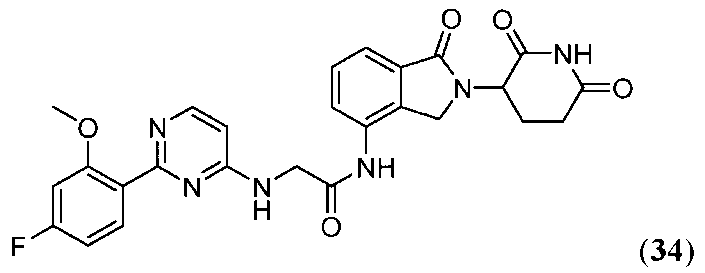
tBuOH(2mL)中の2-((2-クロロピリミジン-4-イル)アミノ)-N-(2-(2,6-ジオキソピペリジン-3-イル)-1-オキソイソインドリン-4-イル)アセトアミド(100mg、0.23mmol)および(4-フルオロ-2-メトキシフェニル)ボロン酸(60mg、0.28mmol)の溶液にN,N-ジシクロヘキシルメチルアミン(49mg、0.25mmol)、Pd2dba3(21mg、0.023mmol)およびトリ-tert-ブチルホスホニウムテトラフルオロボレート(13mg、0.046mmol)を加えた。混合物を80℃に加熱し、N2雰囲気で終夜撹拌した。混合物を次に濾過し、真空中で濃縮させ、分取HPLC(MeOH/H2O、0.05%のTFA)により精製して化合物34(1.6mg、1%)を得た。 To a solution of 2-((2-chloropyrimidin-4-yl)amino)-N-(2-(2,6-dioxopiperidin-3-yl)-1-oxoisoindolin-4-yl)acetamide (100 mg, 0.23 mmol) and (4-fluoro-2-methoxyphenyl)boronic acid (60 mg, 0.28 mmol) in t BuOH (2 mL) was added N,N-dicyclohexylmethylamine (49 mg, 0.25 mmol), Pd 2 dba 3 (21 mg, 0.023 mmol) and tri-tert-butylphosphonium tetrafluoroborate (13 mg, 0.046 mmol). The mixture was heated to 80 °C and stirred under N 2 atmosphere overnight. The mixture was then filtered, concentrated in vacuo and purified by preparative HPLC (MeOH/H 2 O, 0.05% TFA) to give compound 34 (1.6 mg, 1%).
LCMS(m/z):519[M+H]+. LCMS (m/z): 519 [M+H] + .
実施例20:3-(4-((2-((4-メトキシフェニル)アミノ)ピリミジン-4-イル)アミノ)-1-オキソイソインドリン-2-イル)ピペリジン-2,6-ジオン(18)の合成。


DMF(6mL)中のレナリドミド(777mg、3mmol)および2,4-ジクロロピリミジン(882mg、6mmol)の溶液にDIEA(1.5mL、9mmol)を加え、次に混合物を110℃に終夜加熱した。混合物を真空中で濃縮させ、次にシリカゲル(MeOH/DCM=0~6%)により精製して表題化合物(321mg、29%)をペールホワイト固体として得た。 To a solution of lenalidomide (777 mg, 3 mmol) and 2,4-dichloropyrimidine (882 mg, 6 mmol) in DMF (6 mL) was added DIEA (1.5 mL, 9 mmol), then the mixture was heated to 110 °C overnight. The mixture was concentrated in vacuo and then purified on silica gel (MeOH/DCM = 0-6%) to give the title compound (321 mg, 29%) as a pale white solid.
LCMS(m/z):372[M+H]+.

tBuOH(2mL)中の3-(4-((2-クロロピリミジン-4-イル)アミノ)-1-オキソイソインドリン-2-イル)ピペリジン-2,6-ジオン(112mg、0.3mmol)および4-メトキシアニリン(37mg、0.3mmol)の溶液にTFA(45μL、0.6mmol)を加え、次に混合物を終夜加熱して還流させた。混合物を次に真空中で濃縮させ、分取HPLC(MeOH/H2O、0.05%のTFA)により精製して化合物18(64.3mg、38%)を得た。 To a solution of 3- (4-((2-chloropyrimidin-4-yl)amino)-1-oxoisoindolin-2-yl)piperidine-2,6-dione (112 mg, 0.3 mmol) and 4-methoxyaniline (37 mg, 0.3 mmol) in t BuOH (2 mL) was added TFA (45 μL, 0.6 mmol) and the mixture was then heated to reflux overnight. The mixture was then concentrated in vacuo and purified by preparative HPLC (MeOH/H 2 O, 0.05% TFA) to give compound 18 (64.3 mg, 38%).
1H NMR(500MHz,DMSO-d6)δ 11.01(s,1H),10.36(d,J=51.4Hz,2H),7.94(dd,J=41.2,7.4Hz,2H),7.65(d,J=7.5Hz,1H),7.56(t,J=7.7Hz,1H),7.32(d,J=8.4Hz,2H),6.85(d,J=8.4Hz,2H),6.43(d,J=6.9Hz,1H),5.14(dd,J=13.2,5.2Hz,1H),4.46(d,J=17.5Hz,1H),4.33(d,J=17.4Hz,1H),3.74(s,3H),2.90(ddd,J=18.1,13.6,5.4Hz,1H),2.62-2.53(m,1H),2.35-2.24(m,1H),1.87(d,J=11.2Hz,1H). 1H NMR (500MHz, DMSO-d 6 )δ 11.01 (s, 1H), 10.36 (d, J = 51.4Hz, 2H), 7.94 (dd, J = 41.2, 7.4Hz, 2H), 7.65 (d, J = 7.5Hz, 1H), 7 .56 (t, J=7.7Hz, 1H), 7.32 (d, J=8.4Hz, 2H), 6.85 (d, J=8.4Hz, 2H), 6.43 (d, J=6.9Hz, 1H), 5.1 4 (dd, J=13.2, 5.2Hz, 1H), 4.46 (d, J=17.5Hz, 1H), 4.33 (d, J=17.4Hz, 1H), 3.74 (s, 3H), 2.90 ( ddd, J = 18.1, 13.6, 5.4Hz, 1H), 2.62-2.53 (m, 1H), 2.35-2.24 (m, 1H), 1.87 (d, J = 11.2Hz, 1H).
LCMS(m/z):459[M+H]+. LCMS (m/z): 459 [M+H] + .
実施例21:3-(4-((2-((2,3-ジヒドロベンゾ[b][1,4]ジオキシン-6-イル)アミノ)ピリミジン-4-イル)アミノ)-1-オキソイソインドリン-2-イル)ピペリジン-2,6-ジオン(19)の合成。

tBuOH(2mL)中の3-(4-((2-クロロピリミジン-4-イル)アミノ)-1-オキソイソインドリン-2-イル)ピペリジン-2,6-ジオン(98mg、0.26mmol)および2,3-ジヒドロベンゾ[b][1,4]ジオキシン-6-アミン(40mg、0.26mmol)の溶液にTFA(40μL、0.52mmol)を加え、次に混合物を終夜加熱して還流させた。混合物を次に真空中で濃縮させ、分取HPLC(MeOH/H2O、0.05%のTFA)により精製して化合物19(15.9mg、10.1%)を得た。 To a solution of 3-(4-((2-chloropyrimidin-4-yl)amino)-1-oxoisoindolin-2-yl)piperidine-2,6-dione (98 mg, 0.26 mmol) and 2,3-dihydrobenzo[b][1,4]dioxin-6-amine (40 mg, 0.26 mmol) in t BuOH (2 mL) was added TFA (40 μL, 0.52 mmol) and the mixture was then heated to reflux overnight. The mixture was then concentrated in vacuo and purified by preparative HPLC (MeOH/H 2 O, 0.05% TFA) to give compound 19 (15.9 mg, 10.1%).
1H NMR(500MHz,DMSO-d6)δ 11.01(s,1H),10.41(d,J=52.9Hz,2H),7.94(dd,J=57.8,7.2Hz,2H),7.69-7.49(m,2H),6.99(s,1H),6.85-6.71(m,2H),6.43(d,J=6.9Hz,1H),5.14(dd,J=13.3,5.3Hz,1H),4.46(d,J=17.5Hz,1H),4.30(d,J=17.4Hz,1H),4.20(s,4H),2.97-2.85(m,1H),2.57(s,1H),2.25(s,1H),1.82(s,1H). 1H NMR (500MHz, DMSO-d 6 )δ 11.01 (s, 1H), 10.41 (d, J=52.9Hz, 2H), 7.94 (dd, J=57.8, 7.2Hz, 2H), 7.6 9-7.49 (m, 2H), 6.99 (s, 1H), 6.85-6.71 (m, 2H), 6.43 (d, J=6.9Hz, 1H), 5. 14 (dd, J=13.3, 5.3Hz, 1H), 4.46 (d, J=17.5Hz, 1H), 4.30 (d, J=17.4Hz, 1H ), 4.20 (s, 4H), 2.97-2.85 (m, 1H), 2.57 (s, 1H), 2.25 (s, 1H), 1.82 (s, 1H).
LCMS(m/z):487[M+H]+. LCMS (m/z): 487 [M+H] + .
実施例22:3-(4-((2-((2-フルオロフェニル)アミノ)ピリミジン-4-イル)アミノ)-1-オキソイソインドリン-2-イル)ピペリジン-2,6-ジオン(21)の合成。

tBuOH(2mL)中の3-(4-((2-クロロピリミジン-4-イル)アミノ)-1-オキソイソインドリン-2-イル)ピペリジン-2,6-ジオン(83mg、0.22mmol)および2-フルオロアニリン(25mg、0.22mmol)の溶液にTFA(33μL、0.44mmol)を加え、次に混合物を終夜加熱して還流させた。混合物を次に真空中で濃縮させ、分取HPLC(MeOH/H2O、0.05%のTFA)により精製して化合物21(11.0mg、9%)を得た。 To a solution of 3- (4-((2-chloropyrimidin-4-yl)amino)-1-oxoisoindolin-2-yl)piperidine-2,6-dione (83 mg, 0.22 mmol) and 2-fluoroaniline (25 mg, 0.22 mmol) in t BuOH (2 mL) was added TFA (33 μL, 0.44 mmol) and the mixture was then heated to reflux overnight. The mixture was then concentrated in vacuo and purified by preparative HPLC (MeOH/H 2 O, 0.05% TFA) to give compound 21 (11.0 mg, 9%).
1H NMR(500MHz,DMSO-d6)δ 11.02(s,1H),10.31(s,1H),10.01(s,1H),8.07(d,J=6.8Hz,1H),7.89(d,J=7.9Hz,1H),7.59(dd,J=9.9,7.0Hz,2H),7.46(t,J=7.7Hz,1H),7.30(ddd,J=10.5,8.3,1.4Hz,1H),7.24(tdd,J=7.9,5.2,1.6Hz,1H),7.11(t,J=7.7Hz,1H),6.49(d,J=6.7Hz,1H),5.14(dd,J=13.3,5.1Hz,1H),4.45(d,J=17.5Hz,1H),4.33(d,J=17.4Hz,1H),2.96-2.84(m,1H),2.59(dt,J=17.0,3.3Hz,1H),2.31(qd,J=13.2,4.4Hz,1H),1.97-1.84(m,1H).LCMS(m/z):447[M+H]+. 1H NMR (500MHz, DMSO-d 6 )δ 11.02 (s, 1H), 10.31 (s, 1H), 10.01 (s, 1H), 8.07 (d, J = 6.8Hz, 1H), 7.89 (d, J = 7.9Hz, 1H), 7.59 (dd, J = 9.9, 7. 0Hz, 2H), 7.46 (t, J = 7.7Hz, 1H), 7.30 (ddd, J = 10.5, 8.3, 1.4Hz, 1H), 7.24 (tdd, J = 7.9, 5.2, 1.6Hz, 1H), 7.11 (t, J=7.7Hz, 1H), 6.49 (d, J=6.7Hz, 1H), 5.14 (dd, J=13.3, 5.1Hz, 1H), 4.45 (d, J=17.5Hz, 1H), 4.33 (d, J=17 .4Hz, 1H), 2.96-2.84 (m, 1H), 2.59 (dt, J=17.0, 3.3Hz, 1H), 2.31 (qd, J=13.2, 4.4Hz, 1H), 1.97-1.84 (m, 1H). LCMS (m/z): 447 [M+H] + .
実施例23:3-(1-オキソ-4-((2-((3-(2-オキソピロリジン-1-イル)プロピル)アミノ)ピリミジン-4-イル)アミノ)イソインドリン-2-イル)ピペリジン-2,6-ジオン(22)の合成。

tBuOH(2mL)中の3-(4-((2-クロロピリミジン-4-イル)アミノ)-1-オキソイソインドリン-2-イル)ピペリジン-2,6-ジオン(90mg、0.24mmol)および1-(3-アミノプロピル)ピロリジン-2-オン(34mg、0.24mmol)の溶液にTFA(36μL、0.48mmol)を加え、次に混合物を終夜加熱して還流させた。混合物を次に真空中で濃縮させ、分取HPLC(MeOH/H2O、0.05%のTFA)により精製して化合物22(8.6mg、6%)を得た。 To a solution of 3-(4-((2-chloropyrimidin-4-yl)amino)-1-oxoisoindolin-2-yl)piperidine-2,6-dione (90 mg, 0.24 mmol) and 1-(3-aminopropyl)pyrrolidin-2-one (34 mg, 0.24 mmol) in t BuOH (2 mL) was added TFA (36 μL, 0.48 mmol) and the mixture was then heated to reflux overnight. The mixture was then concentrated in vacuo and purified by preparative HPLC (MeOH/H 2 O, 0.05% TFA) to give compound 22 (8.6 mg, 6%).
1H NMR(500MHz,DMSO-d6)δ 11.03(s,1H),10.58(s,1H),8.32(s,1H),7.93(d,J=6.9Hz,2H),7.65(dd,J=18.8,7.5Hz,2H),6.38(s,1H),5.19(dd,J=13.3,5.1Hz,1H),4.48(d,J=17.7Hz,1H),4.38(d,J=17.8Hz,1H),3.17(d,J=21.2Hz,6H),2.94(ddd,J=18.0,13.7,5.4Hz,1H),2.60(d,J=17.2Hz,1H),2.39(qd,J=13.2,4.5Hz,1H),2.14(s,2H),2.02(d,J=12.2Hz,1H),1.73(d,J=83.3Hz,4H). 1H NMR (500MHz, DMSO- d6 )δ 11.03 (s, 1H), 10.58 (s, 1H), 8.32 (s, 1H), 7.93 (d, J = 6.9Hz, 2H), 7.65 (dd, J = 18.8, 7.5Hz, 2H), 6.38 (s, 1H), 5.19 (dd, J = 13.3, 5.1Hz, 1H), 4.48 (d, J = 17.7Hz, 1H), 4.38 (d, J = 17.8Hz, 1H), 3.17 (d, J = 21.2Hz, 6H), 2.94 (ddd, J = 18.0, 13.7, 5.4Hz, 1H), 2.60 (d, J = 17.2Hz, 1H), 2.39 (qd, J=13.2, 4.5Hz, 1H), 2.14 (s, 2H), 2.02 (d, J=12.2Hz, 1H), 1.73 (d, J=83.3Hz, 4H).
LCMS(m/z):478[M+H]+. LCMS (m/z): 478 [M+H] + .
実施例24:3-(1-オキソ-4-((2-(4-(3-(トリフルオロメチル)フェニル)ピペラジン-1-イル)ピリミジン-4-イル)アミノ)イソインドリン-2-イル)ピペリジン-2,6-ジオン(23)の合成。

tBuOH(2mL)中の3-(4-((2-クロロピリミジン-4-イル)アミノ)-1-オキソイソインドリン-2-イル)ピペリジン-2,6-ジオン(85mg、0.23mmol)および1-(3-(トリフルオロメチル)フェニル)ピペラジン(53mg、0.23mmol)の溶液にTFA(35μL、0.46mmol)を加え、次に混合物を終夜加熱して還流させた。混合物を次に真空中で濃縮させ、分取HPLC(MeOH/H2O、0.05%のTFA)により精製して化合物23(10.9mg、7%)を得た。 To a solution of 3-(4-((2-chloropyrimidin-4-yl)amino)-1-oxoisoindolin-2-yl)piperidine-2,6-dione (85 mg, 0.23 mmol) and 1-(3-(trifluoromethyl)phenyl)piperazine (53 mg, 0.23 mmol) in t BuOH (2 mL) was added TFA (35 μL, 0.46 mmol) and the mixture was then heated to reflux overnight. The mixture was then concentrated in vacuo and purified by preparative HPLC (MeOH/H 2 O, 0.05% TFA) to give compound 23 (10.9 mg, 7%).
1H NMR(500MHz,DMSO-d6)δ 11.03(s,1H),10.53(s,1H),8.00(d,J=6.9Hz,1H),7.84(d,J=7.8Hz,1H),7.68(d,J=7.4Hz,1H),7.62(t,J=7.7Hz,1H),7.44(t,J=8.0Hz,1H),7.28-7.23(m,1H),7.22(t,J=1.9Hz,1H),7.10(d,J=7.6Hz,1H),6.41(d,J=6.9Hz,1H),5.19(dd,J=13.3,5.2Hz,1H),4.47(d,J=17.6Hz,1H),4.37(d,J=17.5Hz,1H),3.76(q,J=4.0Hz,4H),3.39(t,J=4.3Hz,4H),2.93(ddd,J=17.4,13.7,5.4Hz,1H),2.58(dt,J=17.2,3.1Hz,1H),2.38(qd,J=13.2,4.4Hz,1H),2.02(ddq,J=10.5,5.6,3.3,2.7Hz,1H). 1H NMR (500MHz, DMSO-d 6 )δ 11.03 (s, 1H), 10.53 (s, 1H), 8.00 (d, J = 6.9Hz, 1H), 7.84 (d, J = 7.8Hz, 1H), 7.68 (d, J = 7.4Hz, 1H), 7.62 (t, J = 7.7Hz, 1H), 7. 44 (t, J = 8.0Hz, 1H), 7.28-7.23 (m, 1H), 7.22 (t, J = 1.9Hz, 1H), 7.10 (d, J = 7.6Hz, 1H), 6.41 (d, J = 6.9Hz, 1H), 5.19 (dd, J = 13. 3, 5.2Hz, 1H), 4.47 (d, J = 17.6Hz, 1H), 4.37 (d, J = 17.5Hz, 1H), 3.76 (q, J = 4.0Hz, 4H), 3.39 (t, J = 4.3Hz, 4H), 2.93 (ddd, J = 1 7.4, 13.7, 5.4Hz, 1H), 2.58 (dt, J = 17.2, 3.1Hz, 1H), 2.38 (qd, J = 13.2, 4.4Hz, 1H), 2.02 (ddq, J = 10.5, 5.6, 3.3, 2.7Hz, 1H).
LCMS(m/z):566[M+H]+. LCMS (m/z): 566 [M+H] + .
実施例25:3-(4-((2-((2,3-ジヒドロ-1H-インデン-5-イル)アミノ)ピリミジン-4-イル)アミノ)-1-オキソイソインドリン-2-イル)ピペリジン-2,6-ジオン(24)の合成。

tBuOH(2mL)中の3-(4-((2-クロロピリミジン-4-イル)アミノ)-1-オキソイソインドリン-2-イル)ピペリジン-2,6-ジオン(90mg、0.24mmol)および2,3-ジヒドロ-1H-インデン-5-アミン(33mg、0.24mmol)の溶液にTFA(36μL、0.48mmol)を加え、次に混合物を終夜加熱して還流させた。混合物を次に真空中で濃縮させ、分取HPLC(MeOH/H2O、0.05%のTFA)により精製して化合物24(15.6mg、11%)を得た。 To a solution of 3-(4-((2-chloropyrimidin-4-yl)amino)-1-oxoisoindolin-2-yl)piperidine-2,6-dione (90 mg, 0.24 mmol) and 2,3-dihydro-1H-inden-5-amine (33 mg, 0.24 mmol) in t BuOH (2 mL) was added TFA (36 μL, 0.48 mmol) and the mixture was then heated to reflux overnight. The mixture was then concentrated in vacuo and purified by preparative HPLC (MeOH/H 2 O, 0.05% TFA) to give compound 24 (15.6 mg, 11%).
1H NMR(500MHz,DMSO-d6)δ 10.99(s,1H),10.47(d,J=32.6Hz,2H),8.03(d,J=6.9Hz,1H),7.87(d,J=7.9Hz,1H),7.68(d,J=7.4Hz,1H),7.58(t,J=7.7Hz,1H),7.32(s,1H),7.09(q,J=8.2Hz,2H),6.45(d,J=6.9Hz,1H),5.12(dd,J=13.3,5.1Hz,1H),4.46(d,J=17.5Hz,1H),4.31(d,J=17.5Hz,1H),2.88(ddd,J=18.0,13.6,5.4Hz,1H),2.79(t,J=7.4Hz,2H),2.68(t,J=6.8Hz,2H),2.57-2.55(m,1H),2.22(qd,J=13.3,4.4Hz,1H),1.98(p,J=7.4Hz,2H),1.75(d,J=12.2Hz,1H). 1H NMR (500MHz, DMSO-d 6 )δ 10.99 (s, 1H), 10.47 (d, J = 32.6Hz, 2H), 8.03 (d, J = 6.9Hz, 1H), 7.87 (d, J = 7.9Hz, 1H), 7.68 (d, J = 7.4Hz, 1H), 7.5 8 (t, J = 7.7Hz, 1H), 7.32 (s, 1H), 7.09 (q, J = 8.2Hz, 2H), 6.45 (d, J = 6.9Hz, 1H), 5.12 (dd, J = 13.3, 5.1Hz, 1H), 4.4 6 (d, J = 17.5Hz, 1H), 4.31 (d, J = 17.5Hz, 1H), 2.88 (ddd, J = 18.0, 13.6, 5.4Hz, 1H), 2.79 (t, J = 7.4Hz, 2H), 2.68 (t , J=6.8Hz, 2H), 2.57-2.55 (m, 1H), 2.22 (qd, J=13.3, 4.4Hz, 1H), 1.98 (p, J=7.4Hz, 2H), 1.75 (d, J=12.2Hz, 1H).
LCMS(m/z):469[M+H]+. LCMS (m/z): 469 [M+H] + .
実施例26:3-(4-((2-(ベンジル(エチル)アミノ)ピリミジン-4-イル)アミノ)-1-オキソイソインドリン-2-イル)ピペリジン-2,6-ジオン(26)の合成。

tBuOH(2mL)中の3-(4-((2-クロロピリミジン-4-イル)アミノ)-1-オキソイソインドリン-2-イル)ピペリジン-2,6-ジオン(90mg、0.24mmol)およびN-ベンジルエタンアミン(33mg、0.24mmol)の溶液にTFA(36μL、0.48mmol)を加え、次に混合物を終夜加熱して還流させた。混合物を次に真空中で濃縮させ、分取HPLC(MeOH/H2O、0.05%のTFA)により精製して化合物26(7.6mg、5%)を得た。 To a solution of 3- (4-((2-chloropyrimidin-4-yl)amino)-1-oxoisoindolin-2-yl)piperidine-2,6-dione (90 mg, 0.24 mmol) and N-benzylethanamine (33 mg, 0.24 mmol) in t BuOH (2 mL) was added TFA (36 μL, 0.48 mmol) and the mixture was then heated to reflux overnight. The mixture was then concentrated in vacuo and purified by preparative HPLC (MeOH/H 2 O, 0.05% TFA) to give compound 26 (7.6 mg, 5%).
1H NMR(500MHz,DMSO-d6)δ 11.04(s,1H),10.38(s,1H),7.96(d,J=7.0Hz,1H),7.64-7.55(m,1H),7.38-7.24(m,4H),7.18(s,2H),6.43(s,1H),5.17(dd,J=13.3,5.1Hz,1H),4.74(s,2H),4.50-4.28(m,2H),3.55(s,2H),2.93(ddd,J=17.3,13.6,5.4Hz,1H),2.61(dt,J=17.2,3.3Hz,1H),2.36(qd,J=12.9,4.4Hz,1H),2.07-1.93(m,1H),1.10(s,3H). 1H NMR (500MHz, DMSO-d 6 )δ 11.04 (s, 1H), 10.38 (s, 1H), 7.96 (d, J=7.0Hz, 1H), 7.64-7.55 (m, 1H), 7.38-7.2 4 (m, 4H), 7.18 (s, 2H), 6.43 (s, 1H), 5.17 (dd, J = 13.3, 5.1Hz, 1H), 4.74 (s, 2H), 4 .. 50-4.28 (m, 2H), 3.55 (s, 2H), 2.93 (ddd, J=17.3, 13.6, 5.4Hz, 1H), 2.61 (dt, J= 17.2, 3.3Hz, 1H), 2.36 (qd, J=12.9, 4.4Hz, 1H), 2.07-1.93 (m, 1H), 1.10 (s, 3H).
LCMS(m/z):471[M+H]+. LCMS (m/z): 471 [M+H] + .
実施例27:3-(4-((2-(メチル(フェニル)アミノ)ピリミジン-4-イル)アミノ)-1-オキソイソインドリン-2-イル)ピペリジン-2,6-ジオン(27)の合成。

tBuOH(2mL)中の3-(4-((2-クロロピリミジン-4-イル)アミノ)-1-オキソイソインドリン-2-イル)ピペリジン-2,6-ジオン(80mg、0.22mmol)およびN-メチルアニリン(23mg、0.22mmol)の溶液にTFA(33μL、0.44mmol)を加え、次に混合物を終夜加熱して還流させた。混合物を次に真空中で濃縮させ、分取HPLC(MeOH/H2O、0.05%のTFA)により精製して化合物27(17.4mg、14%)を得た。 To a solution of 3- (4-((2-chloropyrimidin-4-yl)amino)-1-oxoisoindolin-2-yl)piperidine-2,6-dione (80 mg, 0.22 mmol) and N-methylaniline (23 mg, 0.22 mmol) in t BuOH (2 mL) was added TFA (33 μL, 0.44 mmol) and the mixture was then heated to reflux overnight. The mixture was then concentrated in vacuo and purified by preparative HPLC (MeOH/H 2 O, 0.05% TFA) to give compound 27 (17.4 mg, 14%).
1H NMR(500MHz,DMSO-d6)δ 11.05(s,1H),10.50(s,1H),7.86(dd,J=22.4,7.5Hz,2H),7.58(d,J=7.5Hz,1H),7.53(t,J=7.6Hz,2H),7.47-7.39(m,4H),6.50(d,J=7.0Hz,1H),5.18(dd,J=13.3,5.1Hz,1H),4.47(d,J=17.5Hz,1H),4.37(d,J=17.5Hz,1H),3.39(s,3H),2.94(ddd,J=17.3,13.6,5.4Hz,1H),2.62(dt,J=17.2,3.4Hz,1H),2.37(qd,J=13.2,4.4Hz,1H),2.02(dtd,J=12.8,5.3,2.3Hz,1H). 1H NMR (500MHz, DMSO-d 6 )δ 11.05 (s, 1H), 10.50 (s, 1H), 7.86 (dd, J = 22.4, 7.5Hz, 2H), 7.58 (d, J = 7.5Hz, 1H), 7.53 (t, J = 7.6Hz, 2H), 7.47-7.39 (m, 4H), 6.50 (d, J = 7.0Hz, 1H), 5.18 (dd, J = 13.3, 5.1Hz, 1H), 4.47 (d, J=17.5Hz, 1H), 4.37 (d, J=17.5Hz, 1H), 3.39 (s, 3H), 2.94 (ddd, J=17.3, 13.6, 5.4Hz, 1H), 2. 62 (dt, J=17.2, 3.4Hz, 1H), 2.37 (qd, J=13.2, 4.4Hz, 1H), 2.02 (dtd, J=12.8, 5.3, 2.3Hz, 1H).
LCMS(m/z):443[M+H]+. LCMS (m/z): 443 [M+H] + .
実施例28:3-(4-((2-(メシチルアミノ)ピリミジン-4-イル)アミノ)-1-オキソイソインドリン-2-イル)ピペリジン-2,6-ジオン(28)の合成。

tBuOH(2mL)中の3-(4-((2-クロロピリミジン-4-イル)アミノ)-1-オキソイソインドリン-2-イル)ピペリジン-2,6-ジオン(86mg、0.23mmol)および2,4,6-トリメチルアニリン(31mg、0.23mmol)の溶液にTFA(35μL、0.46mmol)を加え、次に混合物を終夜加熱して還流させた。混合物を次に真空中で濃縮させ、分取HPLC(MeOH/H2O、0.05%のTFA)により精製して化合物28(4.7mg、4%)を得た。 To a solution of 3- (4-((2-chloropyrimidin-4-yl)amino)-1-oxoisoindolin-2-yl)piperidine-2,6-dione (86 mg, 0.23 mmol) and 2,4,6-trimethylaniline (31 mg, 0.23 mmol) in t BuOH (2 mL) was added TFA (35 μL, 0.46 mmol) and the mixture was then heated to reflux overnight. The mixture was then concentrated in vacuo and purified by preparative HPLC (MeOH/H 2 O, 0.05% TFA) to give compound 28 (4.7 mg, 4%).
LCMS(m/z):471[M+H]+. LCMS (m/z): 471 [M+H] + .
実施例29:3-(4-((2-((S)-2-(ヒドロキシメチル)ピロリジン-1-イル)ピリミジン-4-イル)アミノ)-1-オキソイソインドリン-2-イル)ピペリジン-2,6-ジオン(29)の合成。

tBuOH(2mL)中の3-(4-((2-クロロピリミジン-4-イル)アミノ)-1-オキソイソインドリン-2-イル)ピペリジン-2,6-ジオン(82mg、0.22mmol)および(S)-ピロリジン-2-イルメタノール(23mg、0.22mmol)の溶液にTFA(33μL、0.44mmol)を加え、次に混合物を終夜加熱して還流させた。混合物を次に真空中で濃縮させ、分取HPLC(MeOH/H2O、0.05%のTFA)により精製して29(6.3mg、5%)を得た。 To a solution of 3-(4-((2-chloropyrimidin-4-yl)amino)-1-oxoisoindolin-2-yl)piperidine-2,6-dione (82 mg, 0.22 mmol) and (S)-pyrrolidin-2-ylmethanol (23 mg, 0.22 mmol) in t BuOH (2 mL) was added TFA (33 μL, 0.44 mmol) and the mixture was then heated to reflux overnight. The mixture was then concentrated in vacuo and purified by preparative HPLC (MeOH/H 2 O, 0.05% TFA) to give 29 (6.3 mg, 5%).
1H NMR(500MHz,DMSO-d6)δ 11.03(s,1H),10.46(s,2H),8.12-7.87(m,2H),7.63(dd,J=20.9,7.6Hz,2H),6.44(s,1H),5.19(dt,J=13.3,5.2Hz,1H),4.57-4.31(m,2H),4.11(s,1H),3.47(d,J=38.9Hz,4H),2.94(ddd,J=18.2,13.9,5.0Hz,1H),2.66-2.56(m,1H),2.40-2.31(m,1H),2.09(s,1H),2.05-1.84(m,4H). 1H NMR (500MHz, DMSO-d 6 )δ 11.03 (s, 1H), 10.46 (s, 2H), 8.12-7.87 (m, 2H), 7.63 (dd, J=20.9, 7.6H z, 2H), 6.44 (s, 1H), 5.19 (dt, J=13.3, 5.2Hz, 1H), 4.57-4.31 (m, 2H), 4. 11 (s, 1H), 3.47 (d, J = 38.9Hz, 4H), 2.94 (ddd, J = 18.2, 13.9, 5.0Hz, 1H) , 2.66-2.56 (m, 1H), 2.40-2.31 (m, 1H), 2.09 (s, 1H), 2.05-1.84 (m, 4H).
LCMS(m/z):437[M+H]+. LCMS (m/z): 437 [M+H] + .
実施例30:3-(4-((2-((R)-2-(ヒドロキシメチル)ピロリジン-1-イル)ピリミジン-4-イル)アミノ)-1-オキソイソインドリン-2-イル)ピペリジン-2,6-ジオン(30)の合成。

tBuOH(2mL)中の3-(4-((2-クロロピリミジン-4-イル)アミノ)-1-オキソイソインドリン-2-イル)ピペリジン-2,6-ジオン(82mg、0.22mmol)および(R)-ピロリジン-2-イルメタノール(23mg、0.22mmol)の溶液にTFA(33μL、0.44mmol)を加え、次に混合物を終夜加熱して還流させた。混合物を次に真空中で濃縮させ、分取HPLC(MeOH/H2O、0.05%のTFA)により精製して化合物30(12.0mg、10%)を得た。 To a solution of 3-(4-((2-chloropyrimidin-4-yl)amino)-1-oxoisoindolin-2-yl)piperidine-2,6-dione (82 mg, 0.22 mmol) and (R)-pyrrolidin-2-ylmethanol (23 mg, 0.22 mmol) in t BuOH (2 mL) was added TFA (33 μL, 0.44 mmol) and the mixture was then heated to reflux overnight. The mixture was then concentrated in vacuo and purified by preparative HPLC (MeOH/H 2 O, 0.05% TFA) to give compound 30 (12.0 mg, 10%).
1H NMR(500MHz,DMSO-d6)δ 11.03(s,1H),10.49(s,1H),8.22-7.88(m,2H),7.74-7.37(m,2H),6.44(s,1H),5.18(dt,J=13.3,5.2Hz,1H),4.56-4.28(m,2H),4.11(s,1H),3.63-3.37(m,4H),2.99-2.85(m,1H),2.67-2.56(m,1H),2.43-2.32(m,1H),2.11(d,J=15.7Hz,1H),2.06-1.83(m,5H). 1H NMR (500MHz, DMSO-d 6 )δ 11.03 (s, 1H), 10.49 (s, 1H), 8.22-7.88 (m, 2H), 7.74-7.37 (m, 2H), 6.44 (s, 1H), 5.18 (dt, J=13.3, 5.2Hz, 1H), 4.56-4.28 (m, 2H), 4 .11 (s, 1H), 3.63-3.37 (m, 4H), 2.99-2.85 (m, 1H), 2.67-2.56 (m, 1H), 2.43-2.32 (m, 1H), 2.11 (d, J=15.7Hz, 1H), 2.06-1.83 (m, 5H).
LCMS(m/z):437[M+H]+. LCMS (m/z): 437 [M+H] + .
実施例31:3-(4-((2-(((R)-1-ヒドロキシ-3-メチルブタン-2-イル)アミノ)ピリミジン-4-イル)アミノ)-1-オキソイソインドリン-2-イル)ピペリジン-2,6-ジオン(37)の合成。

tBuOH(2mL)中の3-(4-((2-クロロピリミジン-4-イル)アミノ)-1-オキソイソインドリン-2-イル)ピペリジン-2,6-ジオン(100mg、0.27mmol)および(R)-2-アミノ-3-メチルブタン-1-オール(28mg、0.27mmol)の溶液にTFA(41μL、0.54mmol)を加え、次に混合物を終夜加熱して還流させた。混合物を次に真空中で濃縮させ、分取HPLC(MeOH/H2O、0.05%のTFA)により精製して化合物37(4.5mg、3%)を得た。 To a solution of 3-(4-((2-chloropyrimidin-4-yl)amino)-1-oxoisoindolin-2-yl)piperidine-2,6-dione (100 mg, 0.27 mmol) and (R)-2-amino-3-methylbutan-1-ol (28 mg, 0.27 mmol) in t BuOH ( 2 mL) was added TFA (41 μL, 0.54 mmol) and the mixture was then heated to reflux overnight. The mixture was then concentrated in vacuo and purified by preparative HPLC (MeOH/H 2 O, 0.05% TFA) to give compound 37 (4.5 mg, 3%).
1H NMR(500MHz,DMSO-d6)δ 11.02(s,1H),10.50(s,1H),8.21(s,1H),7.94(d,J=7.3Hz,2H),7.66(d,J=7.1Hz,1H),7.60(t,J=7.7Hz,1H),6.37(s,1H),5.17(dd,J=13.1,5.1Hz,1H),4.59-4.34(m,2H),3.48(d,J=9.0Hz,2H),2.99-2.87(m,1H),2.62(dd,J=15.3,11.7Hz,1H),2.44-2.31(m,1H),2.01(d,J=16.2Hz,1H),1.84(s,1H),0.86(d,J=42.6Hz,6H). 1H NMR (500MHz, DMSO-d 6 )δ 11.02 (s, 1H), 10.50 (s, 1H), 8.21 (s, 1H), 7.94 (d, J = 7.3Hz, 2H), 7.66 (d, J = 7.1Hz , 1H), 7.60 (t, J = 7.7Hz, 1H), 6.37 (s, 1H), 5.17 (dd, J = 13.1, 5.1Hz, 1H), 4.59-4.3 4 (m, 2H), 3.48 (d, J = 9.0Hz, 2H), 2.99-2.87 (m, 1H), 2.62 (dd, J = 15.3, 11.7Hz, 1H) , 2.44-2.31 (m, 1H), 2.01 (d, J = 16.2Hz, 1H), 1.84 (s, 1H), 0.86 (d, J = 42.6Hz, 6H).
LCMS(m/z):439[M+H]+. LCMS (m/z): 439 [M+H] + .
実施例32:3-(4-((2-((2-メトキシフェニル)アミノ)ピリミジン-4-イル)アミノ)-1-オキソイソインドリン-2-イル)ピペリジン-2,6-ジオン(38)の合成。

tBuOH(2mL)中の3-(4-((2-クロロピリミジン-4-イル)アミノ)-1-オキソイソインドリン-2-イル)ピペリジン-2,6-ジオン(100mg、0.27mmol)および2-メトキシアニリン(33mg、0.27mmol)の溶液にTFA(41μL、0.54mmol)を加え、次に混合物を終夜加熱して還流させた。
混合物を次に真空中で濃縮させ、分取HPLC(MeOH/H2O、0.05%のTFA)により精製して化合物38(20.6mg、13%)を得た。
To a solution of 3- (4-((2-chloropyrimidin-4-yl)amino)-1-oxoisoindolin-2-yl)piperidine-2,6-dione (100 mg, 0.27 mmol) and 2-methoxyaniline (33 mg, 0.27 mmol) in t BuOH (2 mL) was added TFA (41 μL, 0.54 mmol) and then the mixture was heated to reflux overnight.
The mixture was then concentrated in vacuo and purified by preparative HPLC (MeOH/H 2 O, 0.05% TFA) to give compound 38 (20.6 mg, 13%).
1H NMR(500MHz,DMSO-d6)δ 11.02(s,1H),10.64(s,1H),9.86-9.75(m,1H),8.04(d,J=7.0Hz,1H),7.88(d,J=7.9Hz,1H),7.65(dd,J=7.5,0.9Hz,1H),7.53(t,J=7.6Hz,2H),7.20(t,J=7.6Hz,1H),7.11(dd,J=8.4,1.4Hz,1H),6.82(t,J=7.8Hz,1H),6.51(d,J=7.1Hz,1H),5.14(dd,J=13.2,5.2Hz,1H),4.47(d,J=17.5Hz,1H),4.34(d,J=17.5Hz,1H),3.82(s,3H),2.90(ddd,J=17.3,13.7,5.4Hz,1H),2.57(dt,J=17.2,3.4Hz,1H),2.28(qd,J=13.2,4.4Hz,1H),1.87(d,J=12.6Hz,1H). 1H NMR (500MHz, DMSO-d 6 )δ 11.02 (s, 1H), 10.64 (s, 1H), 9.86-9.75 (m, 1H), 8.04 (d, J = 7.0Hz, 1H), 7.88 (d, J = 7.9Hz, 1H), 7.65 (dd, J = 7.5, 0. 9Hz, 1H), 7.53 (t, J = 7.6Hz, 2H), 7.20 (t, J = 7.6Hz, 1H), 7.11 (dd, J = 8.4, 1.4Hz, 1H), 6.82 (t, J = 7.8Hz, 1H), 6.51 (d , J=7.1Hz, 1H), 5.14 (dd, J=13.2, 5.2Hz, 1H), 4.47 (d, J=17.5Hz, 1H), 4.34 (d, J=17.5Hz, 1H), 3.82 (s, 3H), 2.90 (d dd, J=17.3, 13.7, 5.4Hz, 1H), 2.57 (dt, J=17.2, 3.4Hz, 1H), 2.28 (qd, J=13.2, 4.4Hz, 1H), 1.87 (d, J=12.6Hz, 1H).
LCMS(m/z):459[M+H]+. LCMS (m/z): 459 [M+H] + .
実施例33:4-((4-((2-(2,6-ジオキソピペリジン-3-イル)-1-オキソイソインドリン-4-イル)アミノ)ピリミジン-2-イル)アミノ)ベンゼンスルホンアミド(40)の合成。

tBuOH(2mL)中の3-(4-((2-クロロピリミジン-4-イル)アミノ)-1-オキソイソインドリン-2-イル)ピペリジン-2,6-ジオン(60mg、0.16mmol)および4-アミノベンゼンスルホンアミド(28mg、0.16mmol)の溶液にTFA(24μL、0.32mmol)を加え、次に混合物を終夜加熱して還流させた。混合物を次に真空中で濃縮させ、分取HPLC(MeOH/H2O、0.05%のTFA)により精製して化合物40(9.0mg、9%)を得た。 To a solution of 3- (4-((2-chloropyrimidin-4-yl)amino)-1-oxoisoindolin-2-yl)piperidine-2,6-dione (60 mg, 0.16 mmol) and 4-aminobenzenesulfonamide (28 mg, 0.16 mmol) in t BuOH (2 mL) was added TFA (24 μL, 0.32 mmol) and the mixture was then heated to reflux overnight. The mixture was then concentrated in vacuo and purified by preparative HPLC (MeOH/H 2 O, 0.05% TFA) to give compound 40 (9.0 mg, 9%).
1H NMR(500MHz,DMSO-d6)δ 11.01(s,1H),10.39(s,1H),10.17(s,1H),8.12(d,J=6.5Hz,1H),7.97(d,J=7.7Hz,1H),7.72-7.55(m,6H),7.24(s,2H),6.48(d,J=6.6Hz,1H),5.15(dd,J=13.3,5.2Hz,1H),4.48(d,J=17.5Hz,1H),4.37(d,J=17.5Hz,1H),2.90(ddd,J=17.3,13.6,5.4Hz,1H),2.56(dt,J=16.9,3.4Hz,1H),2.30(qd,J=13.2,4.5Hz,1H),1.90(dtd,J=12.9,5.4,2.3Hz,1H). 1H NMR (500MHz, DMSO-d 6 )δ 11.01 (s, 1H), 10.39 (s, 1H), 10.17 (s, 1H), 8.12 (d, J = 6.5Hz, 1H), 7.97 (d, J = 7.7Hz, 1H), 7.72-7.55 (m, 6H), 7.24 (s, 2H), 6.48 (d, J=6.6Hz, 1H), 5.15 (dd, J=13.3, 5.2Hz, 1H), 4.4 8 (d, J = 17.5 Hz, 1H), 4.37 (d, J = 17.5 Hz, 1H), 2.90 (ddd, J = 17.3, 13.6, 5.4 Hz, 1H), 2.56 (d t, J=16.9, 3.4Hz, 1H), 2.30 (qd, J=13.2, 4.5Hz, 1H), 1.90 (dtd, J=12.9, 5.4, 2.3Hz, 1H).
LCMS(m/z):508[M+H]+. LCMS (m/z): 508 [M+H] + .
実施例34:3-(4-((2-(インドリン-5-イルアミノ)ピリミジン-4-イル)アミノ)-1-オキソイソインドリン-2-イル)ピペリジン-2,6-ジオン(43)の合成。

tBuOH(2mL)中の3-(4-((2-クロロピリミジン-4-イル)アミノ)-1-オキソイソインドリン-2-イル)ピペリジン-2,6-ジオン(50mg、0.135mmol)およびtert-ブチル5-アミノインドリン-1-カルボキシレート(32mg、0.135mmol)の溶液にTFA(21μL、0.27mmol)を加え、次に混合物を終夜加熱して還流させた。混合物を次に真空中で濃縮させ、分取HPLC(MeOH/H2O、0.05%のTFA)により精製して化合物43(10.4mg、13%)を得た。 To a solution of 3-(4-((2-chloropyrimidin-4-yl)amino)-1-oxoisoindolin-2-yl)piperidine-2,6-dione (50 mg, 0.135 mmol) and tert-butyl 5-aminoindoline-1-carboxylate (32 mg, 0.135 mmol) in t BuOH (2 mL) was added TFA (21 μL, 0.27 mmol) and the mixture was then heated to reflux overnight. The mixture was then concentrated in vacuo and purified by preparative HPLC (MeOH/H 2 O, 0.05% TFA) to give compound 43 (10.4 mg, 13%).
1H NMR(500MHz,DMSO-d6)δ 11.01(s,1H),10.48(d,J=30.2Hz,2H),8.02(d,J=6.9Hz,1H),7.95(d,J=7.8Hz,1H),7.66(dd,J=7.5,1.1Hz,1H),7.61(t,J=7.6Hz,1H),7.07(s,1H),7.01(s,2H),6.46(d,J=6.9Hz,1H),5.15(dd,J=13.2,5.1Hz,1H),4.49(d,J=17.5Hz,1H),4.34(d,J=17.5Hz,1H),3.56(t,J=8.2Hz,2H),2.99(t,J=8.1Hz,2H),2.94-2.85(m,1H),2.64-2.55(m,1H),2.33(ddd,J=26.6,13.2,3.2Hz,1H),2.25(s,1H),1.90(dd,J=11.1,5.2Hz,1H). 1H NMR (500MHz, DMSO-d 6 )δ 11.01 (s, 1H), 10.48 (d, J = 30.2Hz, 2H), 8.02 (d, J = 6.9Hz, 1H), 7.95 (d, J = 7.8Hz, 1H), 7.66 (dd, J = 7.5, 1.1H) z, 1H), 7.61 (t, J = 7.6Hz, 1H), 7.07 (s, 1H), 7.01 (s, 2H), 6.46 (d, J = 6.9Hz, 1H), 5.15 (dd, J = 13.2, 5.1Hz, 1H ), 4.49 (d, J = 17.5 Hz, 1H), 4.34 (d, J = 17.5 Hz, 1H), 3.56 (t, J = 8.2 Hz, 2H), 2.99 (t, J = 8.1 Hz, 2H), 2.94-2.85 (m, 1H), 2.64-2.55 (m, 1H), 2.33 (ddd, J=26.6, 13.2, 3.2Hz, 1H), 2.25 (s, 1H), 1.90 (dd, J=11.1, 5.2Hz, 1H).
LCMS(m/z):470[M+H]+. LCMS (m/z): 470 [M+H] + .
実施例35:3-(4-((2-(((3s,5s,7s)-アダマンタン-1-イル)アミノ)ピリミジン-4-イル)アミノ)-1-オキソイソインドリン-2-イル)ピペリジン-2,6-ジオン(44)の合成。

tBuOH(2mL)中の3-(4-((2-クロロピリミジン-4-イル)アミノ)-1-オキソイソインドリン-2-イル)ピペリジン-2,6-ジオン(50mg、0.135mmol)および(3s,5s,7s)-アダマンタン-1-アミン(24mg、0.162mmol)の溶液にTFA(67μL、0.405mmol)を加え、次に混合物を終夜加熱して還流させた。混合物を次に真空中で濃縮させ、分取HPLC(MeOH/H2O、0.05%のTFA)により精製して化合物44(4.1mg、3%)を得た。 To a solution of 3-(4-((2-chloropyrimidin-4-yl)amino)-1-oxoisoindolin-2-yl)piperidine-2,6-dione (50 mg, 0.135 mmol) and (3s,5s,7s)-adamantan-1-amine (24 mg, 0.162 mmol) in t BuOH (2 mL) was added TFA (67 μL, 0.405 mmol) and the mixture was then heated to reflux overnight. The mixture was then concentrated in vacuo and purified by preparative HPLC (MeOH/H 2 O, 0.05% TFA) to give compound 44 (4.1 mg, 3%).
1H NMR(500MHz,DMSO-d6)δ 11.01(s,1H),10.61(s,1H),7.99(s,1H),7.93(d,J=7.2Hz,1H),7.72(dd,J=10.6,7.6Hz,2H),7.62(t,J=7.6Hz,1H),6.33(d,J=7.2Hz,1H),5.16(dd,J=13.3,5.2Hz,1H),4.40(d,J=17.6Hz,1H),4.30(d,J=17.6Hz,1H),2.92(ddd,J=17.3,13.6,5.4Hz,1H),2.64-2.53(m,1H),2.44-2.36(m,1H),2.09(s,1H),1.96-1.91(m,1H),1.86(s,3H),1.76(s,6H),1.50(d,J=12.2Hz,3H),1.33(d,J=11.9Hz,3H). 1H NMR (500MHz, DMSO-d 6 )δ 11.01 (s, 1H), 10.61 (s, 1H), 7.99 (s, 1H), 7.93 (d, J = 7.2Hz, 1H), 7.72 (dd, J = 10.6, 7.6Hz, 2H), 7.62 (t, J=7.6Hz, 1H), 6.33 (d, J=7.2Hz, 1H), 5.16 (dd, J=13.3, 5.2Hz, 1H), 4.40 (d, J=17.6Hz, 1H), 4.30 ( d, J = 17.6Hz, 1H), 2.92 (ddd, J = 17.3, 13.6, 5.4Hz, 1H), 2.64-2.53 (m, 1H), 2.44-2.36 (m, 1H), 2.09 ( s, 1H), 1.96-1.91 (m, 1H), 1.86 (s, 3H), 1.76 (s, 6H), 1.50 (d, J = 12.2Hz, 3H), 1.33 (d, J = 11.9Hz, 3H).
LCMS(m/z):487[M+H]+. LCMS (m/z): 487 [M+H] + .
実施例36:3-(4-((2-(ナフタレン-2-イルアミノ)ピリミジン-4-イル)アミノ)-1-オキソイソインドリン-2-イル)ピペリジン-2,6-ジオン(45)の合成。

tBuOH(2mL)中の3-(4-((2-クロロピリミジン-4-イル)アミノ)-1-オキソイソインドリン-2-イル)ピペリジン-2,6-ジオン(50mg、0.135mmol)およびtert-ブチル5-アミノインドリン-1-カルボキシレート(23mg、0.162mmol)の溶液にTFA(21μL、0.27mmol)を加え、次に混合物を終夜加熱して還流させた。混合物を次に真空中で濃縮させ、分取HPLC(MeOH/H2O、0.05%のTFA)により精製して化合物45(16.8mg、21%)を得た。 To a solution of 3-(4-((2-chloropyrimidin-4-yl)amino)-1-oxoisoindolin-2-yl)piperidine-2,6-dione (50 mg, 0.135 mmol) and tert-butyl 5-aminoindoline-1-carboxylate (23 mg, 0.162 mmol) in t BuOH (2 mL) was added TFA (21 μL, 0.27 mmol) and the mixture was then heated to reflux overnight. The mixture was then concentrated in vacuo and purified by preparative HPLC (MeOH/H 2 O, 0.05% TFA) to give compound 45 (16.8 mg, 21%).
1H NMR(500MHz,DMSO-d6)δ 10.98(s,1H),10.79(s,1H),10.61(s,1H),8.11(d,J=7.0Hz,1H),8.03-8.00(m,1H),7.95(d,J=7.9Hz,1H),7.84(t,J=8.3Hz,2H),7.71(d,J=7.5Hz,1H),7.58(d,J=7.7Hz,1H),7.55-7.39(m,4H),6.52(d,J=6.9Hz,1H),5.08(dd,J=13.2,5.2Hz,1H),4.49(d,J=17.6Hz,1H),4.35(d,J=17.6Hz,1H),2.81(ddd,J=17.2,13.7,5.4Hz,1H),2.45(s,1H),2.16(dt,J=11.5,5.3Hz,1H),1.62(s,1H). 1H NMR (500MHz, DMSO- d6 )δ 10.98 (s, 1H), 10.79 (s, 1H), 10.61 (s, 1H), 8.11 (d, J = 7.0Hz, 1H), 8.03-8.00 (m, 1H), 7.95 (d, J = 7 9Hz, 1H), 7.84 (t, J=8.3Hz, 2H), 7.71 (d, J=7.5Hz, 1H), 7.58 (d, J=7.7Hz, 1H), 7.55-7.39 (m, 4H) , 6.52 (d, J=6.9Hz, 1H), 5.08 (dd, J=13.2, 5.2Hz, 1H), 4.49 (d, J=17.6Hz, 1H), 4.35 (d, J=17.6Hz, 1H), 2.81 (ddd, J=17.2, 13.7, 5.4Hz, 1H), 2.45 (s, 1H), 2.16 (dt, J=11.5, 5.3Hz, 1H), 1.62 (s, 1H).
LCMS(m/z):479[M+H]+. LCMS (m/z): 479 [M+H] + .
実施例37:3-(4-((2-((9H-フルオレン-3-イル)アミノ)ピリミジン-4-イル)アミノ)-1-オキソイソインドリン-2-イル)ピペリジン-2,6-ジオン(46)の合成。

tBuOH(2mL)中の3-(4-((2-クロロピリミジン-4-イル)アミノ)-1-オキソイソインドリン-2-イル)ピペリジン-2,6-ジオン(50mg、0.135mmol)および9H-フルオレン-3-アミン(24mg、0.135mmol)の溶液にTFA(21μL、0.27mmol)を加え、次に混合物を終夜加熱して還流させた。混合物を次に濃縮させ、分取HPLC(MeOH/H2O、0.05%のTFA)により精製して化合物46(30.0mg、37%)を得た。 To a solution of 3-(4-((2-chloropyrimidin-4 - yl)amino)-1-oxoisoindolin-2-yl)piperidine-2,6-dione (50 mg, 0.135 mmol) and 9H-fluoren-3-amine (24 mg, 0.135 mmol) in t BuOH (2 mL) was added TFA (21 μL, 0.27 mmol) and the mixture was then heated to reflux overnight. The mixture was then concentrated and purified by preparative HPLC (MeOH/H 2 O, 0.05% TFA) to give compound 46 (30.0 mg, 37%).
1H NMR(500MHz,DMSO-d6)δ 10.99(s,1H),10.79(s,1H),10.64(s,1H),8.10(d,J=6.9Hz,1H),7.92(d,J=7.9Hz,1H),7.82(d,J=7.5Hz,1H),7.79-7.74(m,1H),7.74-7.70(m,2H),7.63(t,J=7.7Hz,1H),7.55(d,J=7.4Hz,1H),7.39-7.33(m,2H),7.28(td,J=7.4,1.2Hz,1H),6.50(d,J=7.0Hz,1H),5.12(dd,J=13.2,5.2Hz,1H),4.51(d,J=17.6Hz,1H),4.36(d,J=17.5Hz,1H),2.85(ddd,J=17.3,13.6,5.4Hz,1H),2.54(d,J=11.7Hz,1H),2.30-2.15(m,1H),1.80-1.67(m,1H). 1H NMR (500MHz, DMSO-d 6 )δ 10.99 (s, 1H), 10.79 (s, 1H), 10.64 (s, 1H), 8.10 (d, J = 6.9Hz, 1H), 7.92 (d, J = 7.9Hz, 1H), 7.82 (d, J = 7.5Hz, 1H) , 7.79-7.74 (m, 1H), 7.74-7.70 (m, 2H), 7.63 (t, J = 7.7Hz, 1H), 7.55 (d, J = 7.4Hz, 1H), 7.39-7.33 (m, 2H), 7.28 (t d, J=7.4, 1.2Hz, 1H), 6.50 (d, J=7.0Hz, 1H), 5.12 (dd, J=13.2, 5.2Hz, 1H), 4.51 (d, J=17.6Hz, 1H), 4.36 (d, J=1 7.5Hz, 1H), 2.85 (ddd, J=17.3, 13.6, 5.4Hz, 1H), 2.54 (d, J=11.7Hz, 1H), 2.30-2.15 (m, 1H), 1.80-1.67 (m, 1H).
LCMS(m/z):517[M+H]+. LCMS (m/z): 517 [M+H] + .
実施例38:3-(1-オキソ-4-((2-((5,6,7,8-テトラヒドロナフタレン-2-イル)アミノ)ピリミジン-4-イル)アミノ)イソインドリン-2-イル)ピペリジン-2,6-ジオン(52)の合成。

tBuOH(2mL)中の3-(4-((2-クロロピリミジン-4-イル)アミノ)-1-オキソイソインドリン-2-イル)ピペリジン-2,6-ジオン(100mg、0.27mmol)および5,6,7,8-テトラヒドロナフタレン-2-アミン(40mg、0.27mmol)の溶液にTFA(41μL、0.54mmol)を加え、次に混合物を終夜加熱して還流させた。混合物を次に真空中で濃縮させ、分取HPLC(MeOH/H2O、0.05%のTFA)により精製して化合物52(70.4mg、44%)を得た。 To a solution of 3- (4-((2-chloropyrimidin-4-yl)amino)-1-oxoisoindolin-2-yl)piperidine-2,6-dione (100 mg, 0.27 mmol) and 5,6,7,8-tetrahydronaphthalen-2-amine (40 mg, 0.27 mmol) in t BuOH (2 mL) was added TFA (41 μL, 0.54 mmol) and the mixture was then heated to reflux overnight. The mixture was then concentrated in vacuo and purified by preparative HPLC (MeOH/H 2 O, 0.05% TFA) to give compound 52 (70.4 mg, 44%).
1H NMR(500MHz,DMSO-d6)δ 10.99(s,1H),10.62(s,1H),10.54(s,1H),8.03(d,J=7.0Hz,1H),7.85(d,J=7.9Hz,1H),7.68(d,J=7.5Hz,1H),7.58(t,J=7.7Hz,1H),7.09(d,J=2.2Hz,1H),7.04(dd,J=8.3,2.2Hz,1H),6.93(d,J=8.3Hz,1H),6.46(d,J=7.0Hz,1H),5.12(dd,J=13.2,5.2Hz,1H),4.45(d,J=17.6Hz,1H),4.29(d,J=17.5Hz,1H),2.89(ddd,J=17.3,13.7,5.4Hz,1H),2.64(d,J=6.2Hz,2H),2.55(d,J=2.6Hz,1H),2.45(s,2H),2.20(qd,J=13.4,4.3Hz,1H),1.68(dd,J=7.6,4.3Hz,4H).LCMS(m/z):483[M+H]+. 1H NMR (500MHz, DMSO-d 6 )δ 10.99 (s, 1H), 10.62 (s, 1H), 10.54 (s, 1H), 8.03 (d, J = 7.0Hz, 1H), 7.85 (d, J = 7.9Hz, 1H), 7.68 (d, J = 7.5Hz, 1H), 7.5 8 (t, J = 7.7Hz, 1H), 7.09 (d, J = 2.2Hz, 1H), 7.04 (dd, J = 8.3, 2.2Hz, 1H), 6.93 (d, J = 8.3Hz, 1H), 6.46 (d, J = 7.0Hz, 1H), 5.12 (dd, J=13.2, 5.2Hz, 1H), 4.45 (d, J=17.6Hz, 1H), 4.29 (d, J=17.5Hz, 1H), 2.89 (ddd, J=17.3, 13.7, 5.4Hz, 1H), 2 .64 (d, J=6.2Hz, 2H), 2.55 (d, J=2.6Hz, 1H), 2.45 (s, 2H), 2.20 (qd, J=13.4, 4.3Hz, 1H), 1.68 (dd, J=7.6, 4.3Hz, 4H). LCMS (m/z): 483 [M+H] + .
実施例39:3-(4-((2-(4-アセチルフェニル)ピリミジン-4-イル)アミノ)-1-オキソイソインドリン-2-イル)ピペリジン-2,6-ジオン(20)の合成。

tBuOH(2mL)中の3-(4-((2-クロロピリミジン-4-イル)アミノ)-1-オキソイソインドリン-2-イル)ピペリジン-2,6-ジオン(115mg、0.3mmol)および(4-アセチルフェニル)ボロン酸(61mg、0.36mmol)の溶液にN,N-ジシクロヘキシルメチルアミン(64mg、0.33mmol)、Pd2dba3(27mg、0.03mmol)およびトリ-tert-ブチルホスホニウムテトラフルオロボレート(18mg、0.06mmol)を加えた。混合物を80℃に加熱し、N2雰囲気で終夜撹拌した。混合物を次に濾過し、真空中で濃縮させ、分取HPLC(MeOH/H2O、0.05%のTFA)により精製して化合物20(10.0mg、6%)を得た。 To a solution of 3-(4-((2-chloropyrimidin-4-yl)amino)-1-oxoisoindolin-2-yl)piperidine-2,6-dione (115 mg, 0.3 mmol) and (4-acetylphenyl)boronic acid (61 mg, 0.36 mmol) in t BuOH (2 mL) was added N,N-dicyclohexylmethylamine (64 mg, 0.33 mmol), Pd 2 dba 3 (27 mg, 0.03 mmol) and tri-tert-butylphosphonium tetrafluoroborate (18 mg, 0.06 mmol). The mixture was heated to 80° C. and stirred overnight under N 2 atmosphere. The mixture was then filtered, concentrated in vacuo and purified by preparative HPLC (MeOH/H 2 O, 0.05% TFA) to give compound 20 (10.0 mg, 6%).
1H NMR(500MHz,DMSO-d6)δ 11.00(s,1H),9.65(s,1H),8.49(d,J=5.8Hz,1H),8.37(d,J=8.3Hz,2H),8.13(d,J=7.8Hz,1H),8.07(d,J=8.3Hz,2H),7.67-7.53(m,2H),6.87(d,J=5.9Hz,1H),5.17(dd,J=13.3,5.1Hz,1H),4.52(d,J=17.3Hz,1H),4.43(d,J=17.3Hz,1H),2.92(ddd,J=17.2,13.6,5.4Hz,1H),2.63(s,3H),2.61-2.55(m,1H),2.35(qd,J=13.2,4.4Hz,1H),2.01(dtd,J=12.7,5.3,2.2Hz,1H). 1H NMR (500MHz, DMSO-d 6 )δ 11.00 (s, 1H), 9.65 (s, 1H), 8.49 (d, J = 5.8Hz, 1H), 8.37 (d, J = 8.3Hz, 2H), 8.13 (d, J = 7.8Hz, 1H ), 8.07 (d, J = 8.3Hz, 2H), 7.67-7.53 (m, 2H), 6.87 (d, J = 5.9Hz, 1H), 5.17 (dd, J = 13.3, 5.1Hz, 1 H), 4.52 (d, J = 17.3Hz, 1H), 4.43 (d, J = 17.3Hz, 1H), 2.92 (ddd, J = 17.2, 13.6, 5.4Hz, 1H), 2.63 (s, 3H), 2.61-2.55 (m, 1H), 2.35 (qd, J=13.2, 4.4Hz, 1H), 2.01 (dtd, J=12.7, 5.3, 2.2Hz, 1H).
LCMS(m/z):456[M+H]+. LCMS (m/z): 456 [M+H] + .
実施例40:3-(4-((2-([1,1’-ビフェニル]-4-イル)ピリミジン-4-イル)アミノ)-1-オキソイソインドリン-2-イル)ピペリジン-2,6-ジオン(31)の合成。

tBuOH(2mL)中の3-(4-((2-クロロピリミジン-4-イル)アミノ)-1-オキソイソインドリン-2-イル)ピペリジン-2,6-ジオン(100mg、0.27mmol)および[1,1’-ビフェニル]-4-イルボロン酸(80mg、0.41mmol)の溶液にN,N-ジシクロヘキシルメチルアミン(58mg、0.30mmol)、Pd2dba3(25mg、0.027mmol)およびトリ-tert-ブチルホスホニウムテトラフルオロボレート(16mg、0.054mmol)を加えた。
混合物を80℃に加熱し、N2雰囲気で終夜撹拌した。混合物を次に濾過し、真空中で濃縮させ、分取HPLC(MeOH/H2O、0.05%のTFA)により精製して化合物31(4.0mg、2%)を得た。
To a solution of 3-(4-((2-chloropyrimidin-4-yl)amino)-1-oxoisoindolin-2-yl)piperidine-2,6-dione (100 mg, 0.27 mmol) and [1,1′-biphenyl]-4-ylboronic acid (80 mg, 0.41 mmol) in t BuOH (2 mL) was added N,N-dicyclohexylmethylamine (58 mg, 0.30 mmol), Pd 2 dba 3 (25 mg, 0.027 mmol) and tri-tert-butylphosphonium tetrafluoroborate (16 mg, 0.054 mmol).
The mixture was heated to 80° C. and stirred under N 2 atmosphere overnight. The mixture was then filtered, concentrated in vacuo, and purified by preparative HPLC (MeOH/H 2 O, 0.05% TFA) to give compound 31 (4.0 mg, 2%).
1H NMR(500MHz,DMSO-d6)δ 11.01(s,1H),9.99(s,1H),8.47(d,J=6.1Hz,1H),8.30(d,J=8.5Hz,2H),8.10(dd,J=7.3,1.6Hz,1H),7.85(d,J=8.5Hz,2H),7.79-7.75(m,2H),7.67-7.61(m,2H),7.51(dd,J=8.4,7.0Hz,2H),7.44-7.39(m,1H),6.88(d,J=6.2Hz,1H),5.18(dd,J=13.4,5.1Hz,1H),4.54(d,J=17.4Hz,1H),4.44(d,J=17.4Hz,1H),2.92(ddd,J=18.0,13.6,5.4Hz,1H),2.64-2.54(m,1H),2.35(qd,J=13.2,4.5Hz,1H),2.07-1.96(m,1H). 1H NMR (500MHz, DMSO- d6 )δ 11.01 (s, 1H), 9.99 (s, 1H), 8.47 (d, J = 6.1Hz, 1H), 8.30 (d, J = 8.5Hz, 2H), 8.10 (dd, J = 7.3, 1.6Hz, 1H), 7. 85 (d, J = 8.5Hz, 2H), 7.79-7.75 (m, 2H), 7.67-7.61 (m, 2H), 7.51 (dd, J = 8.4, 7.0Hz, 2H), 7.44-7.39 (m, 1H) ), 6.88 (d, J = 6.2Hz, 1H), 5.18 (dd, J = 13.4, 5.1Hz, 1H), 4.54 (d, J = 17.4Hz, 1H), 4.44 (d, J = 17.4Hz, 1H), 2 92 (ddd, J=18.0, 13.6, 5.4Hz, 1H), 2.64-2.54 (m, 1H), 2.35 (qd, J=13.2, 4.5Hz, 1H), 2.07-1.96 (m, 1H).
LCMS(m/z):490[M+H]+. LCMS (m/z): 490 [M+H] + .
実施例41:3-(4-((2-(3-メトキシフェニル)ピリミジン-4-イル)アミノ)-1-オキソイソインドリン-2-イル)ピペリジン-2,6-ジオン(32)の合成。

tBuOH(2mL)中の3-(4-((2-クロロピリミジン-4-イル)アミノ)-1-オキソイソインドリン-2-イル)ピペリジン-2,6-ジオン(78mg、0.21mmol)および(3-メトキシフェニル)ボロン酸(48mg、0.32mmol)の溶液にN,N-ジシクロヘキシルメチルアミン(45mg、0.23mmol)、Pd2dba3(19mg、0.021mmol)およびトリ-tert-ブチルホスホニウムテトラフルオロボレート(12mg、0.042mmol)を加えた。混合物を80℃に加熱し、N2雰囲気で終夜撹拌した。混合物を次に濾過し、真空中で濃縮させ、分取HPLC(MeOH/H2O、0.05%のTFA)により精製して化合物32(13.7mg、12%)を得た。 To a solution of 3-(4-((2-chloropyrimidin-4-yl)amino)-1-oxoisoindolin-2-yl)piperidine-2,6-dione (78 mg, 0.21 mmol) and (3-methoxyphenyl)boronic acid (48 mg, 0.32 mmol) in t BuOH (2 mL) was added N,N-dicyclohexylmethylamine (45 mg, 0.23 mmol), Pd 2 dba 3 (19 mg, 0.021 mmol) and tri-tert-butylphosphonium tetrafluoroborate (12 mg, 0.042 mmol). The mixture was heated to 80° C. and stirred under N 2 atmosphere overnight. The mixture was then filtered, concentrated in vacuo and purified by preparative HPLC (MeOH/H 2 O, 0.05% TFA) to give compound 32 (13.7 mg, 12%).
1H NMR(500MHz,DMSO-d6)δ 11.19(s,1H),11.02(s,1H),8.44(d,J=7.1Hz,1H),7.96(d,J=7.8Hz,1H),7.86(d,J=7.8Hz,1H),7.73(dd,J=7.5,1.1Hz,1H),7.67(td,J=7.8,7.3,1.3Hz,2H),7.32(dd,J=8.5,0.9Hz,1H),7.17(td,J=7.5,1.0Hz,1H),7.06(d,J=6.9Hz,1H),5.18(dd,J=13.3,5.1Hz,1H),4.52(d,J=17.6Hz,1H),4.42(d,J=17.6Hz,1H),3.98(s,3H),2.93(ddd,J=17.3,13.7,5.4Hz,1H),2.64-2.55(m,1H),2.38-2.29(m,1H),2.00(ddq,J=10.3,5.4,3.1,2.6Hz,1H). 1H NMR (500MHz, DMSO-d 6 )δ 11.19 (s, 1H), 11.02 (s, 1H), 8.44 (d, J = 7.1Hz, 1H), 7.96 (d, J = 7.8Hz, 1H), 7.86 (d, J = 7.8Hz, 1H), 7.73 (dd, J = 7. 5, 1.1Hz, 1H), 7.67 (td, J = 7.8, 7.3, 1.3Hz, 2H), 7.32 (dd, J = 8.5, 0.9Hz, 1H), 7.17 (td, J = 7.5, 1.0Hz, 1H), 7.06 ( d, J=6.9Hz, 1H), 5.18 (dd, J=13.3, 5.1Hz, 1H), 4.52 (d, J=17.6Hz, 1H), 4.42 (d, J=17.6Hz, 1H), 3.98 (s, 3H), 2.9 3 (ddd, J=17.3, 13.7, 5.4Hz, 1H), 2.64-2.55 (m, 1H), 2.38-2.29 (m, 1H), 2.00 (ddq, J=10.3, 5.4, 3.1, 2.6Hz, 1H).
LCMS(m/z):444[M+H]+. LCMS (m/z): 444 [M+H] + .
実施例42:3-(4-((2-(4-フルオロ-2-メトキシフェニル)ピリミジン-4-イル)アミノ)-1-オキソイソインドリン-2-イル)ピペリジン-2,6-ジオン(33)の合成。

tBuOH(2mL)中の3-(4-((2-クロロピリミジン-4-イル)アミノ)-1-オキソイソインドリン-2-イル)ピペリジン-2,6-ジオン(96mg、0.26mmol)および(4-フルオロ-2-メトキシフェニル)ボロン酸(66mg、0.39mmol)の溶液にN,N-ジシクロヘキシルメチルアミン(56mg、0.29mmol)、Pd2dba3(22mg、0.026mmol)およびトリ-tert-ブチルホスホニウムテトラフルオロボレート(15mg、0.052mmol)を加えた。混合物を80℃に加熱し、N2雰囲気で終夜撹拌した。混合物を次に濾過し、真空中で濃縮させ、分取HPLC(MeOH/H2O、0.05%のTFA)により精製して化合物33(17.1mg、11%)を得た。 To a solution of 3-(4-((2-chloropyrimidin-4-yl)amino)-1-oxoisoindolin-2-yl)piperidine-2,6-dione (96 mg, 0.26 mmol) and (4-fluoro-2-methoxyphenyl)boronic acid (66 mg, 0.39 mmol) in t BuOH (2 mL) was added N,N-dicyclohexylmethylamine (56 mg, 0.29 mmol), Pd 2 dba 3 (22 mg, 0.026 mmol) and tri-tert-butylphosphonium tetrafluoroborate (15 mg, 0.052 mmol). The mixture was heated to 80° C. and stirred under N 2 atmosphere overnight. The mixture was then filtered, concentrated in vacuo and purified by preparative HPLC (MeOH/H 2 O, 0.05% TFA) to give compound 33 (17.1 mg, 11%).
1H NMR(500MHz,DMSO-d6)δ 11.14(s,1H),11.03(s,1H),8.43(d,J=7.0Hz,1H),7.94(d,J=7.8Hz,1H),7.89(dd,J=8.8,6.7Hz,1H),7.72(dd,J=7.6,1.0Hz,1H),7.66(t,J=7.7Hz,1H),7.26(dd,J=11.3,2.4Hz,1H),7.03(td,J=8.5,4.1Hz,2H),5.18(dd,J=13.3,5.1Hz,1H),4.50(d,J=17.6Hz,1H),4.41(d,J=17.6Hz,1H),3.98(s,3H),2.93(ddd,J=17.3,13.6,5.4Hz,1H),2.64-2.56(m,1H),2.33(qd,J=13.2,4.4Hz,1H),2.00(dtd,J=12.6,5.1,2.1Hz,1H). 1H NMR (500MHz, DMSO-d 6 )δ 11.14 (s, 1H), 11.03 (s, 1H), 8.43 (d, J = 7.0Hz, 1H), 7.94 (d, J = 7.8Hz, 1H), 7.89 (dd, J = 8.8, 6.7Hz, 1H), 7.7 2 (dd, J=7.6, 1.0Hz, 1H), 7.66 (t, J=7.7Hz, 1H), 7.26 (dd, J=11.3, 2.4Hz, 1H), 7.03 (td, J=8.5, 4.1Hz, 2H), 5.18 (dd, J=13.3, 5.1Hz, 1H), 4.50 (d, J=17.6Hz, 1H), 4.41 (d, J=17.6Hz, 1H), 3.98 (s, 3H), 2.93 (ddd, J=17 .3, 13.6, 5.4Hz, 1H), 2.64-2.56 (m, 1H), 2.33 (qd, J=13.2, 4.4Hz, 1H), 2.00 (dtd, J=12.6, 5.1, 2.1Hz, 1H).
LCMS(m/z):462[M+H]+. LCMS (m/z): 462 [M+H] + .
実施例43:3-(4-((2-(2,4-ジメトキシフェニル)ピリミジン-4-イル)アミノ)-1-オキソイソインドリン-2-イル)ピペリジン-2,6-ジオン(35)の合成。

tBuOH(2mL)中の3-(4-((2-クロロピリミジン-4-イル)アミノ)-1-オキソイソインドリン-2-イル)ピペリジン-2,6-ジオン(100mg、0.27mmol)および(2,4-ジメトキシフェニル)ボロン酸(74mg、0.41mmol)の溶液にN,N-ジシクロヘキシルメチルアミン(58mg、0.30mmol)、Pd2dba3(25mg、0.027mmol)およびトリ-tert-ブチルホスホニウムテトラフルオロボレート(16mg、0.054mmol)を加えた。混合物を80℃に加熱し、N2雰囲気で終夜撹拌した。混合物を次に濾過し、真空中で濃縮させ、分取HPLC(MeOH/H2O、0.05%のTFA)により精製して化合物35(9.3mg、6%)を得た。 To a solution of 3-(4-((2-chloropyrimidin-4-yl)amino)-1-oxoisoindolin-2-yl)piperidine-2,6-dione (100 mg, 0.27 mmol) and (2,4-dimethoxyphenyl)boronic acid (74 mg, 0.41 mmol) in t BuOH (2 mL) was added N,N-dicyclohexylmethylamine (58 mg, 0.30 mmol), Pd 2 dba 3 (25 mg, 0.027 mmol) and tri-tert-butylphosphonium tetrafluoroborate (16 mg, 0.054 mmol). The mixture was heated to 80° C. and stirred overnight under N 2 atmosphere. The mixture was then filtered, concentrated in vacuo and purified by preparative HPLC (MeOH/H 2 O, 0.05% TFA) to give compound 35 (9.3 mg, 6%).
1H NMR(500MHz,DMSO-d6)δ 11.11(s,1H),11.02(s,1H),8.35(d,J=7.1Hz,1H),7.93(d,J=8.5Hz,2H),7.74(d,J=7.5Hz,1H),7.68(t,J=7.7Hz,1H),6.99(s,1H),6.82(d,J=2.3Hz,1H),6.80-6.76(m,1H),5.18(dd,J=13.3,5.1Hz,1H),4.51(d,J=17.6Hz,1H),4.40(d,J=17.6Hz,1H),4.03(s,3H),3.89(s,3H),2.92(ddd,J=17.3,13.6,5.4Hz,1H),2.63-2.55(m,1H),2.33(qd,J=12.9,4.2Hz,1H),2.00(td,J=6.0,2.3Hz,1H). 1H NMR (500MHz, DMSO-d 6 )δ 11.11 (s, 1H), 11.02 (s, 1H), 8.35 (d, J = 7.1Hz, 1H), 7.93 (d, J = 8.5Hz, 2H), 7.74 (d, J = 7.5Hz, 1H), 7 .68 (t, J=7.7Hz, 1H), 6.99 (s, 1H), 6.82 (d, J=2.3Hz, 1H), 6.80-6.76 (m, 1H), 5.18 (dd, J=13.3, 5.1 Hz, 1H), 4.51 (d, J = 17.6Hz, 1H), 4.40 (d, J = 17.6Hz, 1H), 4.03 (s, 3H), 3.89 (s, 3H), 2.92 (ddd, J = 17 .3, 13.6, 5.4Hz, 1H), 2.63-2.55 (m, 1H), 2.33 (qd, J=12.9, 4.2Hz, 1H), 2.00 (td, J=6.0, 2.3Hz, 1H).
LCMS(m/z):474[M+H]+. LCMS (m/z): 474 [M+H] + .
実施例44:3-(4-((2-(ベンゾフラン-2-イル)ピリミジン-4-イル)アミノ)-1-オキソイソインドリン-2-イル)ピペリジン-2,6-ジオン(36)の合成。

tBuOH(2mL)中の3-(4-((2-クロロピリミジン-4-イル)アミノ)-1-オキソイソインドリン-2-イル)ピペリジン-2,6-ジオン(100mg、0.27mmol)およびベンゾフラン-2-イルボロン酸(65mg、0.41mmol)の溶液にN,N-ジシクロヘキシルメチルアミン(58mg、0.30mmol)、Pd2dba3(25mg、0.027mmol)およびトリ-tert-ブチルホスホニウムテトラフルオロボレート(16mg、0.054mmol)を加えた。混合物を80℃に加熱し、N2雰囲気で終夜撹拌した。混合物を次に濾過し、真空中で濃縮させ、分取HPLC(MeOH/H2O、0.05%のTFA)により精製して化合物36(5.0mg、3%)を得た。 To a solution of 3- (4-((2-chloropyrimidin-4-yl)amino)-1-oxoisoindolin-2-yl)piperidine-2,6-dione (100 mg, 0.27 mmol) and benzofuran-2-ylboronic acid (65 mg, 0.41 mmol) in t BuOH (2 mL) was added N,N-dicyclohexylmethylamine (58 mg, 0.30 mmol), Pd 2 dba 3 (25 mg, 0.027 mmol) and tri-tert-butylphosphonium tetrafluoroborate (16 mg, 0.054 mmol). The mixture was heated to 80° C. and stirred overnight under N 2 atmosphere. The mixture was then filtered, concentrated in vacuo and purified by preparative HPLC (MeOH/H 2 O, 0.05% TFA) to give compound 36 (5.0 mg, 3%).
1H NMR(500MHz,DMSO-d6)δ 10.99(s,1H),9.75(s,1H),8.44(d,J=5.9Hz,1H),8.08(d,J=7.7Hz,1H),7.78(dt,J=7.8,1.0Hz,1H),7.68(dq,J=8.3,0.9Hz,1H),7.63(t,J=7.6Hz,1H),7.61-7.57(m,2H),7.43(ddd,J=8.4,7.2,1.4Hz,1H),7.34-7.30(m,1H),6.83(d,J=6.0Hz,1H),5.16(dd,J=13.2,5.1Hz,1H),4.60(d,J=17.4Hz,1H),4.44(d,J=17.4Hz,1H),2.90(ddd,J=17.3,13.6,5.4Hz,1H),2.59-2.53(m,1H),2.37(ddd,J=15.6,12.4,4.5Hz,1H),2.03(ddq,J=10.6,5.6,3.3,2.7Hz,1H). 1H NMR (500MHz, DMSO-d 6 )δ 10.99 (s, 1H), 9.75 (s, 1H), 8.44 (d, J = 5.9Hz, 1H), 8.08 (d, J = 7.7Hz, 1H), 7.78 (dt, J = 7.8, 1.0Hz, 1H), 7.68 (dq, J = 8 .3, 0.9Hz, 1H), 7.63 (t, J = 7.6Hz, 1H), 7.61-7.57 (m, 2H), 7.43 (ddd, J = 8.4, 7.2, 1.4Hz, 1H), 7.34-7.30 (m, 1H), 6.8 3 (d, J=6.0Hz, 1H), 5.16 (dd, J=13.2, 5.1Hz, 1H), 4.60 (d, J=17.4Hz, 1H), 4.44 (d, J=17.4Hz, 1H), 2.90 (ddd, J=17.3 , 13.6, 5.4Hz, 1H), 2.59-2.53 (m, 1H), 2.37 (ddd, J=15.6, 12.4, 4.5Hz, 1H), 2.03 (ddq, J=10.6, 5.6, 3.3, 2.7Hz, 1H).
LCMS(m/z):454[M+H]+. LCMS (m/z): 454 [M+H] + .
実施例45:3-(4-((2-(4-フルオロフェニル)ピリミジン-4-イル)アミノ)-1-オキソイソインドリン-2-イル)ピペリジン-2,6-ジオン(39)の合成。

tBuOH(2mL)中の3-(4-((2-クロロピリミジン-4-イル)アミノ)-1-オキソイソインドリン-2-イル)ピペリジン-2,6-ジオン(60mg、0.16mmol)および(4-フルオロフェニル)ボロン酸(34mg、0.24mmol)の溶液にN,N-ジシクロヘキシルメチルアミン(34mg、0.18mmol)、Pd2dba3(15mg、0.016mmol)およびトリ-tert-ブチルホスホニウムテトラフルオロボレート(10mg、0.032mmol)を加えた。混合物を80℃に加熱し、N2雰囲気で終夜撹拌した。混合物を次に濾過し、真空中で濃縮させ、分取HPLC(MeOH/H2O、0.05%のTFA)により精製して化合物39(1.5mg、2%)を得た。 To a solution of 3-(4-((2-chloropyrimidin-4-yl)amino)-1-oxoisoindolin-2-yl)piperidine-2,6-dione (60 mg, 0.16 mmol) and (4-fluorophenyl)boronic acid (34 mg, 0.24 mmol) in t BuOH (2 mL) was added N,N-dicyclohexylmethylamine (34 mg, 0.18 mmol), Pd 2 dba 3 (15 mg, 0.016 mmol) and tri-tert-butylphosphonium tetrafluoroborate (10 mg, 0.032 mmol). The mixture was heated to 80° C. and stirred under N 2 atmosphere overnight. The mixture was then filtered, concentrated in vacuo and purified by preparative HPLC (MeOH/H 2 O, 0.05% TFA) to give compound 39 (1.5 mg, 2%).
1H NMR(500MHz,DMSO-d6)δ 11.01(s,1H),9.96(s,1H),8.44(d,J=6.1Hz,1H),8.25(dd,J=8.6,5.7Hz,1H),8.04(dd,J=7.0,1.9Hz,1H),7.84(dd,J=8.3,6.3Hz,1H),7.62(d,J=7.0Hz,2H),7.36(t,J=8.7Hz,1H),7.15(t,J=8.9Hz,1H),6.86(d,J=6.1Hz,1H),5.17(dd,J=13.3,5.1Hz,1H),4.50(d,J=17.4Hz,1H),4.42(d,J=17.4Hz,1H),2.92(ddd,J=18.2,13.5,5.4Hz,1H),2.66-2.55(m,1H),2.34(qd,J=13.3,4.6Hz,1H),2.03-1.97(m,1H). 1H NMR (500MHz, DMSO-d 6 )δ 11.01 (s, 1H), 9.96 (s, 1H), 8.44 (d, J = 6.1Hz, 1H), 8.25 (dd, J = 8.6, 5.7Hz, 1H), 8.04 (dd, J = 7.0, 1.9Hz , 1H), 7.84 (dd, J = 8.3, 6.3Hz, 1H), 7.62 (d, J = 7.0Hz, 2H), 7.36 (t, J = 8.7Hz, 1H), 7.15 (t, J = 8.9Hz, 1H), 6.86 (d, J=6.1Hz, 1H), 5.17 (dd, J=13.3, 5.1Hz, 1H), 4.50 (d, J=17.4Hz, 1H), 4.42 (d, J=17.4Hz, 1H), 2. 92 (ddd, J=18.2, 13.5, 5.4Hz, 1H), 2.66-2.55 (m, 1H), 2.34 (qd, J=13.3, 4.6Hz, 1H), 2.03-1.97 (m, 1H).
LCMS(m/z):432[M+H]+. LCMS (m/z): 432 [M+H] + .
実施例46:3-(4-((2-((2,3-ジヒドロ-1H-インデン-5-イル)アミノ)-9-イソプロピル-9H-プリン-6-イル)アミノ)-1-オキソイソインドリン-2-イル)ピペリジン-2,6-ジオン(53)の合成。


DMF(2mL)中のレナリドミド(78mg、0.34mmol)および2,6-ジクロロ-9-イソプロピル-9H-プリン(88mg、0.34mmol)の溶液にDIEA(169μL、1.02mmol)を加え、次に混合物を100℃に終夜加熱した。
混合物を次に真空中で濃縮させ、分取HPLC(MeOH/H2O、0.05%のTFA)により精製して表題化合物を得た。
To a solution of lenalidomide (78 mg, 0.34 mmol) and 2,6-dichloro-9-isopropyl-9H-purine (88 mg, 0.34 mmol) in DMF (2 mL) was added DIEA (169 μL, 1.02 mmol), then the mixture was heated to 100° C. overnight.
The mixture was then concentrated in vacuo and purified by preparative HPLC (MeOH/H 2 O, 0.05% TFA) to give the title compound.
LCMS(m/z):454[M+H]+.

tBuOH(1mL)中の3-(4-((2-クロロ-9-イソプロピル-9H-プリン-6-イル)アミノ)-1-オキソイソインドリン-2-イル)ピペリジン-2,6-ジオン(60mg、0.13mmol)および2,3-ジヒドロ-1H-インデン-5-アミン(18mg、0.13mmol)の溶液にTFA(20μL、0.26mmol)を加え、次に混合物を終夜加熱して還流させた。混合物を次に真空中で濃縮させ、分取HPLC(MeOH/H2O、0.05%のTFA)により精製して化合物53(19.8mg、23%)を得た。 To a solution of 3-(4-((2-chloro-9-isopropyl-9H-purin-6-yl)amino)-1-oxoisoindolin-2-yl)piperidine-2,6-dione (60 mg, 0.13 mmol) and 2,3-dihydro-1H-inden-5-amine (18 mg, 0.13 mmol) in t BuOH (1 mL) was added TFA (20 μL, 0.26 mmol) and the mixture was then heated to reflux overnight. The mixture was then concentrated in vacuo and purified by preparative HPLC (MeOH/H 2 O, 0.05% TFA) to give compound 53 (19.8 mg, 23%).
1H NMR(500MHz,DMSO-d6)δ 10.93(s,1H),9.74(s,1H),9.03(s,1H),8.31(s,1H),7.85(d,J=7.7Hz,1H),7.69-7.50(m,3H),7.28(d,J=8.3Hz,1H),6.96(d,J=8.2Hz,1H),5.08(dd,J=13.2,5.2Hz,1H),4.78-4.68(m,1H),4.57(d,J=17.3Hz,1H),4.34(d,J=17.3Hz,1H),2.85(ddd,J=18.3,13.6,5.4Hz,1H),2.74(t,J=7.3Hz,2H),2.64(t,J=7.5Hz,2H),2.48(s,1H),2.20(dd,J=13.3,4.5Hz,1H),1.98-1.88(m,2H),1.74-1.67(m,1H),1.57(d,J=6.7Hz,6H). 1H NMR (500MHz, DMSO-d 6 )δ 10.93 (s, 1H), 9.74 (s, 1H), 9.03 (s, 1H), 8.31 (s, 1H), 7.85 (d, J = 7.7Hz, 1H), 7.69-7.50 (m, 3H), 7.28 (d, J = 8.3Hz, 1H), 6.96 (d, J = 8.2Hz, 1H), 5.08 (dd, J = 13.2, 5.2Hz, 1H), 4.78-4.68 (m, 1H), 4.57 (d, J = 17.3Hz, 1H) ), 4.34 (d, J = 17.3Hz, 1H), 2.85 (ddd, J = 18.3, 13.6, 5.4Hz, 1H), 2.74 (t, J = 7.3Hz, 2H), 2.64 (t, J = 7.5Hz, 2H ), 2.48 (s, 1H), 2.20 (dd, J = 13.3, 4.5Hz, 1H), 1.98-1.88 (m, 2H), 1.74-1.67 (m, 1H), 1.57 (d, J = 6.7Hz, 6H).
LCMS(m/z):551[M+H]+. LCMS (m/z): 551 [M+H] + .
実施例47:3-(4-((9-イソプロピル-2-((5,6,7,8-テトラヒドロナフタレン-2-イル)アミノ)-9H-プリン-6-イル)アミノ)-1-オキソイソインドリン-2-イル)ピペリジン-2,6-ジオン(55)の合成。

tBuOH(1mL)中の3-(4-((2-クロロ-9-イソプロピル-9H-プリン-6-イル)アミノ)-1-オキソイソインドリン-2-イル)ピペリジン-2,6-ジオン(45mg、0.1mmol)および5,6,7,8-テトラヒドロナフタレン-2-アミン(15mg、0.1mmol)の溶液にTFA(15μL、0.2mmol)を加え、次に混合物を終夜加熱して還流させた。混合物を次に真空中で濃縮させ、分取HPLC(MeOH/H2O、0.05%のTFA)により精製して化合物55(11.0mg、16%)を得た。 To a solution of 3-(4-((2-chloro-9-isopropyl-9H-purin-6-yl)amino)-1-oxoisoindolin-2-yl)piperidine-2,6-dione (45 mg, 0.1 mmol) and 5,6,7,8-tetrahydronaphthalen-2-amine (15 mg, 0.1 mmol) in t BuOH (1 mL) was added TFA (15 μL, 0.2 mmol) and the mixture was then heated to reflux overnight. The mixture was then concentrated in vacuo and purified by preparative HPLC (MeOH/H 2 O, 0.05% TFA) to give compound 55 (11.0 mg, 16%).
1H NMR(500MHz,DMSO-d6)δ 10.94(s,1H),9.82(s,1H),9.01(s,1H),8.40(s,1H),7.91(d,J=7.6Hz,1H),7.63-7.50(m,2H),7.41(s,1H),7.26(dd,J=8.3,2.3Hz,1H),6.80(d,J=8.3Hz,1H),5.08(dd,J=13.2,5.1Hz,1H),4.71(p,J=6.8Hz,1H),4.59(d,J=17.3Hz,1H),4.35(d,J=17.3Hz,1H),3.08(qd,J=7.3,4.7Hz,4H),2.91-2.81(m,1H),2.56-2.52(m,1H),1.77(d,J=12.2Hz,1H),1.68(t,J=3.3Hz,4H),1.58(d,J=6.7Hz,6H). 1H NMR (500MHz, DMSO-d 6 )δ 10.94 (s, 1H), 9.82 (s, 1H), 9.01 (s, 1H), 8.40 (s, 1H), 7.91 (d, J = 7.6Hz, 1H), 7.63-7.50 (m, 2H), 7.4 1 (s, 1H), 7.26 (dd, J = 8.3, 2.3Hz, 1H), 6.80 (d, J = 8.3Hz, 1H), 5.08 (dd, J = 13.2, 5.1Hz, 1H), 4.71 (p, J=6.8Hz, 1H), 4.59 (d, J=17.3Hz, 1H), 4.35 (d, J=17.3Hz, 1H), 3.08 (qd, J=7.3, 4.7Hz, 4H), 2.91-2. 81 (m, 1H), 2.56-2.52 (m, 1H), 1.77 (d, J = 12.2Hz, 1H), 1.68 (t, J = 3.3Hz, 4H), 1.58 (d, J = 6.7Hz, 6H).
LCMS(m/z):565[M+H]+. LCMS (m/z): 565 [M+H] + .
実施例48:3-(4-((9-イソプロピル-2-(メシチルアミノ)-9H-プリン-6-イル)アミノ)-1-オキソイソインドリン-2-イル)ピペリジン-2,6-ジオン(56)の合成。
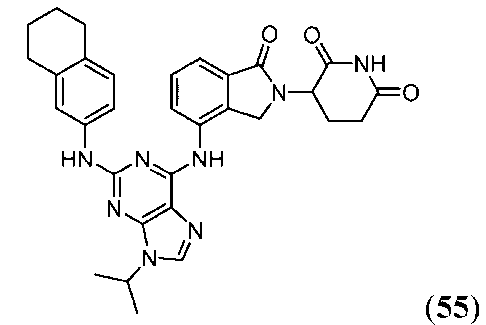
tBuOH(1mL)中の3-(4-((2-クロロ-9-イソプロピル-9H-プリン-6-イル)アミノ)-1-オキソイソインドリン-2-イル)ピペリジン-2,6-ジオン(45mg、0.1mmol)および2,4,6-トリメチルアニリン(14mg、0.1mmol)の溶液にTFA(15μL、0.2mmol)を加え、次に混合物を終夜加熱して還流させた。混合物を次に真空中で濃縮させ、分取HPLC(MeOH/H2O、0.05%のTFA)により精製して化合物56(0.5mg、0.8%)を得た。 To a solution of 3-(4-((2-chloro-9-isopropyl-9H-purin-6-yl)amino)-1-oxoisoindolin-2-yl)piperidine-2,6-dione (45 mg, 0.1 mmol) and 2,4,6-trimethylaniline (14 mg, 0.1 mmol) in t BuOH (1 mL) was added TFA (15 μL, 0.2 mmol) and the mixture was then heated to reflux overnight. The mixture was then concentrated in vacuo and purified by preparative HPLC (MeOH/H 2 O, 0.05% TFA) to give compound 56 (0.5 mg, 0.8%).
LCMS(m/z):553[M+H]+. LCMS (m/z): 553 [M+H] + .
実施例49:3-(4-((2-(2-メトキシフェニル)-9H-プリン-6-イル)アミノ)-1-オキソイソインドリン-2-イル)ピペリジン-2,6-ジオン(47)の合成。


DMF(30mL)中の2,6-ジクロロ-9H-プリン(1.89g、10mmol)およびNaOH(1.2g、30mmol)の溶液に2-(トリメチルシリル)エトキシメチルクロリド(3.5mL、20mmol)を加え、次に混合物を4h撹拌した。混合物を次にEtOAcを用いて抽出し、ブラインを用いて洗浄し、Na2SO4上で乾燥させ、真空中で濃縮させていかなる精製もせずに次のステップで用いた。 To a solution of 2,6-dichloro-9H-purine (1.89 g, 10 mmol) and NaOH (1.2 g, 30 mmol) in DMF (30 mL) was added 2-(trimethylsilyl)ethoxymethyl chloride (3.5 mL, 20 mmol), then the mixture was stirred for 4 h. The mixture was then extracted with EtOAc, washed with brine, dried over Na 2 SO 4 , concentrated in vacuo and used in the next step without any purification.
LCMS(m/z):319[M+H]+.

DMF(30mL)中の2,6-ジクロロ-9-((2-(トリメチルシリル)エトキシ)メチル)-9H-プリン(10mmol)およびレナリドミド(2.6g、10mmol)の溶液にDIEA(3.3mL、20mmol)を加え、次に110℃まで加熱し、終夜撹拌した。混合物をシリカゲル(MeOH/DCM=0~4%)により精製して直接的に表題化合物(1.0g、2ステップで19%)を黄色固体として得た。 DIEA (3.3 mL, 20 mmol) was added to a solution of 2,6-dichloro-9-((2-(trimethylsilyl)ethoxy)methyl)-9H-purine (10 mmol) and lenalidomide (2.6 g, 10 mmol) in DMF (30 mL), then heated to 110 °C and stirred overnight. The mixture was purified by silica gel (MeOH/DCM = 0-4%) directly to give the title compound (1.0 g, 19% for two steps) as a yellow solid.
LCMS(m/z):542[M+H]+.

tBuOH(2mL)中の3-(4-((2-クロロ-9-((2-(トリメチルシリル)エトキシ)メチル)-9H-プリン-6-イル)アミノ)-1-オキソイソインドリン-2-イル)ピペリジン-2,6-ジオン(83mg、0.15mmol)および(2-メトキシフェニル)ボロン酸(27mg、0.18mmol)の溶液にN,N-ジシクロヘキシルメチルアミン(32mg、0.17mmol)、Pd2dba3(14mg、0.015mmol)およびトリ-tert-ブチルホスホニウムテトラフルオロボレート(9mg、0.03mmol)を加えた。混合物を80℃に加熱し、N2雰囲気で終夜撹拌した。混合物を次に濾過し、真空中で濃縮させ、シリカゲル(MeOH/DCM=0~4%)により精製して中間体を得た。中間体を次に真空中で濃縮させ、TFA/DCM=1/1中に溶解させ、2h撹拌し、次に再び真空中で濃縮させ、分取HPLC(MeOH/H2O、0.05%のTFA)により精製して化合物47(26.0mg、29%)を得た。 To a solution of 3-(4-((2-chloro-9-((2-(trimethylsilyl)ethoxy)methyl)-9H-purin-6-yl)amino)-1-oxoisoindolin-2-yl)piperidine-2,6-dione (83 mg, 0.15 mmol) and (2-methoxyphenyl)boronic acid (27 mg, 0.18 mmol) in t BuOH (2 mL) was added N,N-dicyclohexylmethylamine (32 mg, 0.17 mmol), Pd 2 dba 3 (14 mg, 0.015 mmol) and tri-tert-butylphosphonium tetrafluoroborate (9 mg, 0.03 mmol). The mixture was heated to 80° C. and stirred overnight under N 2 atmosphere. The mixture was then filtered, concentrated in vacuo and purified by silica gel (MeOH/DCM=0-4%) to give the intermediate. The intermediate was then concentrated in vacuo, dissolved in TFA/DCM=1/1, stirred for 2 h, then concentrated in vacuo again and purified by preparative HPLC (MeOH/H 2 O, 0.05% TFA) to give compound 47 (26.0 mg, 29%).
1H NMR(500MHz,DMSO-d6)δ 10.99(s,1H),8.50(s,1H),8.05(dd,J=6.9,2.1Hz,1H),7.62-7.50(m,4H),7.45(ddd,J=8.9,7.5,1.8Hz,1H),7.17-7.12(m,1H),7.04(td,J=7.5,0.9Hz,1H),5.15(dd,J=13.3,5.1Hz,1H),4.60(d,J=17.5Hz,1H),4.45(d,J=17.4Hz,1H),2.92(ddd,J=17.2,13.6,5.4Hz,1H),2.60(d,J=3.3Hz,1H),2.55(s,3H),2.32(qd,J=13.3,4.6Hz,1H),1.95(dt,J=10.0,4.0Hz,1H).LCMS(m/z):484[M+H]+. 1H NMR (500MHz, DMSO-d 6 )δ 10.99 (s, 1H), 8.50 (s, 1H), 8.05 (dd, J = 6.9, 2.1Hz, 1H), 7.62-7.50 (m, 4H), 7.45 (ddd, J = 8.9 , 7.5, 1.8Hz, 1H), 7.17-7.12 (m, 1H), 7.04 (td, J=7.5, 0.9Hz, 1H), 5.15 (dd, J=13.3, 5.1Hz, 1 H), 4.60 (d, J=17.5Hz, 1H), 4.45 (d, J=17.4Hz, 1H), 2.92 (ddd, J=17.2, 13.6, 5.4Hz, 1H), 2.6 0 (d, J=3.3Hz, 1H), 2.55 (s, 3H), 2.32 (qd, J=13.3, 4.6Hz, 1H), 1.95 (dt, J=10.0, 4.0Hz, 1H). LCMS (m/z): 484 [M+H] + .
実施例50:3-(4-((2-([1,1’-ビフェニル]-4-イル)-9H-プリン-6-イル)アミノ)-1-オキソイソインドリン-2-イル)ピペリジン-2,6-ジオン(48)の合成。
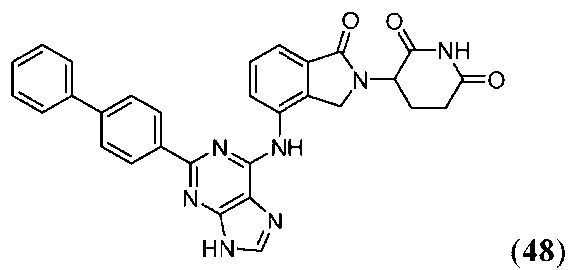
tBuOH(2mL)中の3-(4-((2-クロロ-9-((2-(トリメチルシリル)エトキシ)メチル)-9H-プリン-6-イル)アミノ)-1-オキソイソインドリン-2-イル)ピペリジン-2,6-ジオン(72mg、0.13mmol)および[1,1’-ビフェニル]-4-イルボロン酸(32mg、0.16mmol)の溶液にN,N-ジシクロヘキシルメチルアミン(27mg、0.14mmol)、Pd2dba3(12mg、0.013mmol)およびトリ-tert-ブチルホスホニウムテトラフルオロボレート(8mg、0.026mmol)を加えた。混合物を80℃に加熱し、N2雰囲気で終夜撹拌した。混合物を次に濾過し、真空中で濃縮させ、シリカゲル(MeOH/DCM=0~4%)により精製して中間体を得た。中間体を次に真空中で濃縮させ、TFA/DCM=1/1中に溶解させ、2h撹拌し、次に再び濃縮させ、分取HPLC(MeOH/H2O、0.05%のTFA)により精製して化合物48(1.7mg、2%)を得た。 To a solution of 3-(4-((2-chloro-9-((2-(trimethylsilyl)ethoxy)methyl)-9H-purin-6-yl)amino)-1-oxoisoindolin-2-yl)piperidine-2,6-dione (72 mg, 0.13 mmol) and [1,1′-biphenyl]-4-ylboronic acid (32 mg, 0.16 mmol) in t BuOH (2 mL) was added N,N-dicyclohexylmethylamine (27 mg, 0.14 mmol), Pd 2 dba 3 (12 mg, 0.013 mmol) and tri-tert-butylphosphonium tetrafluoroborate (8 mg, 0.026 mmol). The mixture was heated to 80° C. and stirred overnight under N 2 atmosphere. The mixture was then filtered, concentrated in vacuo and purified by silica gel (MeOH/DCM=0-4%) to give the intermediate. The intermediate was then concentrated in vacuo, dissolved in TFA/DCM=1/1, stirred for 2 h, then concentrated again and purified by preparative HPLC (MeOH/H 2 O, 0.05% TFA) to give compound 48 (1.7 mg, 2%).
1H NMR(500MHz,DMSO-d6)δ 10.94(s,1H),9.91(s,1H),8.36-8.24(m,3H),8.01-7.96(m,1H),7.75(dd,J=9.9,7.9Hz,4H),7.64-7.59(m,2H),7.49(dd,J=8.3,7.1Hz,2H),7.42-7.35(m,1H),5.13(dd,J=13.1,5.1Hz,1H),4.64(d,J=17.4Hz,1H),4.51(d,J=17.4Hz,1H),2.93-2.78(m,1H),2.51(d,J=1.9Hz,1H),2.34(qd,J=13.2,4.8Hz,1H),1.96(dd,J=14.9,8.4Hz,1H). 1H NMR (500MHz, DMSO- d6 )δ 10.94 (s, 1H), 9.91 (s, 1H), 8.36-8.24 (m, 3H), 8.01-7.96 (m, 1H), 7.75 (dd, J=9.9, 7. 9Hz, 4H), 7.64-7.59 (m, 2H), 7.49 (dd, J=8.3, 7.1Hz, 2H), 7.42-7.35 (m, 1H), 5.13 (dd , J=13.1, 5.1Hz, 1H), 4.64 (d, J=17.4Hz, 1H), 4.51 (d, J=17.4Hz, 1H), 2.93-2.78 (m, 1 H), 2.51 (d, J=1.9Hz, 1H), 2.34 (qd, J=13.2, 4.8Hz, 1H), 1.96 (dd, J=14.9, 8.4Hz, 1H).
LCMS(m/z):530[M+H]+. LCMS (m/z): 530 [M+H] + .
実施例51:3-(4-((2-(4-フルオロ-2-メトキシフェニル)-9H-プリン-6-イル)アミノ)-1-オキソイソインドリン-2-イル)ピペリジン-2,6-ジオン(49)の合成。

tBuOH(2mL)中の3-(4-((2-クロロ-9-((2-(トリメチルシリル)エトキシ)メチル)-9H-プリン-6-イル)アミノ)-1-オキソイソインドリン-2-イル)ピペリジン-2,6-ジオン(82mg、0.15mmol)および(4-フルオロ-2-メトキシフェニル)ボロン酸(31mg、0.18mmol)の溶液にN,N-ジシクロヘキシルメチルアミン(32mg、0.17mmol)、Pd2dba3(14mg、0.015mmol)およびトリ-tert-ブチルホスホニウムテトラフルオロボレート(9mg、0.03mmol)を加えた。混合物を80℃に加熱し、N2雰囲気で終夜撹拌した。混合物を次に濾過し、真空中で濃縮させ、シリカゲル(MeOH/DCM=0~4%)により精製して中間体を得た。中間体を次に真空中で濃縮させ、TFA/DCM=1/1中に溶解させ、2h撹拌し、次に再び濃縮させ、分取HPLC(MeOH/H2O、0.05%のTFA)により精製して化合物49(16.4mg、18%)を得た。 To a solution of 3-(4-((2-chloro-9-((2-(trimethylsilyl)ethoxy)methyl)-9H-purin-6-yl)amino)-1-oxoisoindolin-2-yl)piperidine-2,6-dione (82 mg, 0.15 mmol) and (4-fluoro-2-methoxyphenyl)boronic acid (31 mg, 0.18 mmol) in t BuOH (2 mL) was added N,N-dicyclohexylmethylamine (32 mg, 0.17 mmol), Pd 2 dba 3 (14 mg, 0.015 mmol) and tri-tert-butylphosphonium tetrafluoroborate (9 mg, 0.03 mmol). The mixture was heated to 80° C. and stirred overnight under N 2 atmosphere. The mixture was then filtered, concentrated in vacuo and purified by silica gel (MeOH/DCM=0-4%) to give the intermediate. The intermediate was then concentrated in vacuo, dissolved in TFA/DCM=1/1, stirred for 2 h, then concentrated again and purified by preparative HPLC (MeOH/H 2 O, 0.05% TFA) to give compound 49 (16.4 mg, 18%).
1H NMR(500MHz,DMSO-d6)δ 10.98(s,1H),9.74(s,1H),8.30(s,1H),8.11-7.99(m,1H),7.58-7.48(m,3H),6.98(dd,J=11.6,2.4Hz,1H),6.82(td,J=8.4,2.4Hz,1H),5.13(dd,J=13.3,5.1Hz,1H),4.59(d,J=17.4Hz,1H),4.45(d,J=17.3Hz,1H),3.77(s,3H),2.91(ddd,J=17.9,13.5,5.4Hz,1H),2.63-2.55(m,1H),2.36(qd,J=13.2,4.5Hz,1H),1.94(d,J=12.8Hz,1H). 1H NMR (500MHz, DMSO-d 6 )δ 10.98 (s, 1H), 9.74 (s, 1H), 8.30 (s, 1H), 8.11-7.99 (m, 1H), 7.58-7.48 (m, 3H), 6.98 (dd, J=11.6, 2.4Hz, 1H), 6.82 (td, J=8.4, 2.4Hz, 1H), 5.13 (dd, J=13.3, 5.1Hz, 1H), 4 .. 59 (d, J=17.4Hz, 1H), 4.45 (d, J=17.3Hz, 1H), 3.77 (s, 3H), 2.91 (ddd, J=17.9, 13.5, 5.4Hz, 1H), 2.63-2.55 (m, 1H), 2.36 (qd, J=13.2, 4.5Hz, 1H), 1.94 (d, J=12.8Hz, 1H).
LCMS(m/z):502[M+H]+. LCMS (m/z): 502 [M+H] + .
実施例52:3-(4-((2-(4-フルオロフェニル)-9H-プリン-6-イル)アミノ)-1-オキソイソインドリン-2-イル)ピペリジン-2,6-ジオン(50)の合成。

tBuOH(2mL)中の3-(4-((2-クロロ-9-((2-(トリメチルシリル)エトキシ)メチル)-9H-プリン-6-イル)アミノ)-1-オキソイソインドリン-2-イル)ピペリジン-2,6-ジオン(82mg、0.15mmol)および(4-フルオロフェニル)ボロン酸(25mg、0.18mmol)の溶液にN,N-ジシクロヘキシルメチルアミン(32mg、0.17mmol)、Pd2dba3(14mg、0.015mmol)およびトリ-tert-ブチルホスホニウムテトラフルオロボレート(9mg、0.03mmol)を加えた。混合物を80℃に加熱し、N2雰囲気で終夜撹拌した。混合物を次に濾過し、真空中で濃縮させ、シリカゲル(MeOH/DCM=0~4%)により精製して中間体を得た。中間体を次に真空中で濃縮させ、TFA/DCM=1/1中に溶解させ、2h撹拌し、次に再び濃縮させ、分取HPLC(MeOH/H2O、0.05%のTFA)により精製して化合物50(6.3mg、7%)を得た。 To a solution of 3-(4-((2-chloro-9-((2-(trimethylsilyl)ethoxy)methyl)-9H-purin-6-yl)amino)-1-oxoisoindolin-2-yl)piperidine-2,6-dione (82 mg, 0.15 mmol) and (4-fluorophenyl)boronic acid (25 mg, 0.18 mmol) in t BuOH (2 mL) was added N,N-dicyclohexylmethylamine (32 mg, 0.17 mmol), Pd 2 dba 3 (14 mg, 0.015 mmol) and tri-tert-butylphosphonium tetrafluoroborate (9 mg, 0.03 mmol). The mixture was heated to 80° C. and stirred overnight under N 2 atmosphere. The mixture was then filtered, concentrated in vacuo and purified by silica gel (MeOH/DCM=0-4%) to give the intermediate. The intermediate was then concentrated in vacuo, dissolved in TFA/DCM=1/1, stirred for 2 h, then concentrated again and purified by preparative HPLC (MeOH/H 2 O, 0.05% TFA) to give compound 50 (6.3 mg, 7%).
1H NMR(500MHz,DMSO-d6)δ 10.94(s,1H),9.89(s,1H),8.34(s,1H),8.27-8.20(m,2H),7.95(dd,J=6.0,2.9Hz,1H),7.61(q,J=3.9,3.1Hz,2H),7.31-7.19(m,2H),5.13(dd,J=13.2,5.1Hz,1H),4.58(d,J=17.4Hz,1H),4.48(d,J=17.3Hz,1H),2.88(ddd,J=18.0,11.5,5.4Hz,1H),2.55(s,1H),2.33(qd,J=13.1,4.4Hz,1H),2.01-1.91(m,1H). 1H NMR (500MHz, DMSO-d 6 )δ 10.94 (s, 1H), 9.89 (s, 1H), 8.34 (s, 1H), 8.27-8.20 (m, 2H), 7.95 (dd, J=6.0, 2 9Hz, 1H), 7.61 (q, J = 3.9, 3.1Hz, 2H), 7.31-7.19 (m, 2H), 5.13 (dd, J = 13.2, 5. 1Hz, 1H), 4.58 (d, J = 17.4Hz, 1H), 4.48 (d, J = 17.3Hz, 1H), 2.88 (ddd, J = 18.0, 1 1.5, 5.4Hz, 1H), 2.55 (s, 1H), 2.33 (qd, J=13.1, 4.4Hz, 1H), 2.01-1.91 (m, 1H).
LCMS(m/z):472[M+H]+. LCMS (m/z): 472 [M+H] + .
実施例53:3-(4-((2-(3,5-ジメトキシフェニル)-9H-プリン-6-イル)アミノ)-1-オキソイソインドリン-2-イル)ピペリジン-2,6-ジオン(51)の合成。

tBuOH(2mL)中の3-(4-((2-クロロ-9-((2-(トリメチルシリル)エトキシ)メチル)-9H-プリン-6-イル)アミノ)-1-オキソイソインドリン-2-イル)ピペリジン-2,6-ジオン(90mg、0.17mmol)および(3,5-ジメトキシフェニル)ボロン酸(36mg、0.2mmol)の溶液にN,N-ジシクロヘキシルメチルアミン(36mg、0.18mmol)、Pd2dba3(15mg、0.017mmol)およびトリ-tert-ブチルホスホニウムテトラフルオロボレート(10mg、0.03mmol)を加えた。混合物を80℃に加熱し、N2雰囲気で終夜撹拌した。混合物を次に濾過し、真空中で濃縮させ、シリカゲル(MeOH/DCM=0~4%)により精製して中間体を得た。中間体を次に真空中で濃縮させ、TFA/DCM=1/1中に溶解させ、2h撹拌し、次に再び真空中で濃縮させ、分取HPLC(MeOH/H2O、0.05%のTFA)により精製して化合物51(4.5mg、4%)を得た。 To a solution of 3-(4-((2-chloro-9-((2-(trimethylsilyl)ethoxy)methyl)-9H-purin-6-yl)amino)-1-oxoisoindolin-2-yl)piperidine-2,6-dione (90 mg, 0.17 mmol) and (3,5-dimethoxyphenyl)boronic acid (36 mg, 0.2 mmol) in t BuOH (2 mL) was added N,N-dicyclohexylmethylamine (36 mg, 0.18 mmol), Pd 2 dba 3 (15 mg, 0.017 mmol) and tri-tert-butylphosphonium tetrafluoroborate (10 mg, 0.03 mmol). The mixture was heated to 80° C. and stirred overnight under N 2 atmosphere. The mixture was then filtered, concentrated in vacuo and purified by silica gel (MeOH/DCM=0-4%) to give the intermediate. The intermediate was then concentrated in vacuo, dissolved in TFA/DCM=1/1, stirred for 2 h, then concentrated in vacuo again and purified by preparative HPLC (MeOH/H 2 O, 0.05% TFA) to give compound 51 (4.5 mg, 4%).
LCMS(m/z):514[M+H]+. LCMS (m/z): 514 [M+H] + .
実施例54:4-(3-((2-((2,3-ジヒドロ-1H-インデン-5-イル)アミノ)ピリミジン-4-イル)アミノ)プロピル)-2-(2,6-ジオキソピペリジン-3-イル)イソインドリン-1,3-ジオン(57)の合成。

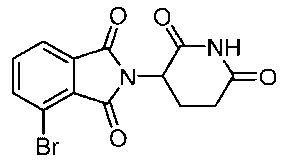
AcOH(30mL)中の4-ブロモイソベンゾフラン-1,3-ジオン(2.27g、10mml)および3-アミノピペリジン-2,6-ジオン塩酸塩(1.8g、11mmol)の溶液にNaOAc(984mg、12mmol)を加え、次に混合物を140℃で終夜加熱して還流させた。混合物を冷却し、次に混合物を濾過し、水を用いて洗浄し、次に空気で乾燥させて、いかなる精製もせずに粗生成物を得た。 To a solution of 4-bromoisobenzofuran-1,3-dione (2.27 g, 10 mml) and 3-aminopiperidine-2,6-dione hydrochloride (1.8 g, 11 mmol) in AcOH (30 mL) was added NaOAc (984 mg, 12 mmol), and then the mixture was heated to reflux at 140 °C overnight. The mixture was cooled, and then the mixture was filtered, washed with water, and then air-dried to obtain the crude product without any purification.
LCMS(m/z):337[M+H]+.

DMF(5mL)中の4-ブロモ-2-(2,6-ジオキソピペリジン-3-イル)イソインドリン-1,3-ジオン(336mg、1mmol)およびプロパ-2-イン-1-イルカルバミン酸tert-ブチル(310mg、2mmol)の溶液にCuI(38mg、0.2mmol)、Et3N(2.5mL)およびPd(PPh3)2Cl2(70mg、0.1mmol)を加えた。結果として得られた混合物を次に70℃まで加熱し、N2雰囲気下で3h撹拌した。混合物を次に濾過し、真空中で濃縮させ、シリカゲル(MeOH/DCM=0~4%)により精製して表題化合物を得た。 To a solution of 4-bromo-2-(2,6-dioxopiperidin-3-yl)isoindoline-1,3-dione (336 mg, 1 mmol) and tert-butyl prop-2-yn-1-ylcarbamate (310 mg, 2 mmol) in DMF (5 mL) was added CuI (38 mg, 0.2 mmol), Et 3 N (2.5 mL) and Pd(PPh 3 ) 2 Cl 2 (70 mg, 0.1 mmol). The resulting mixture was then heated to 70° C. and stirred under N 2 atmosphere for 3 h. The mixture was then filtered, concentrated in vacuo and purified by silica gel (MeOH/DCM=0-4%) to give the title compound.
LCMS(m/z):412[M+H]+.

MeOH中の(3-(2-(2,6-ジオキソピペリジン-3-イル)-1,3-ジオキソイソインドリン-4-イル)プロパ-2-イン-1-イル)カルバミン酸tert-ブチルの溶液にPd/C(10重量%のローディング、マトリックス炭素)を加え、次に混合物を室温で終夜水素添加した。反応混合物を濾過し、濾液を真空中で濃縮させて表題化合物を得た。 Pd/C (10 wt% loading, matrix carbon) was added to a solution of tert-butyl (3-(2-(2,6-dioxopiperidin-3-yl)-1,3-dioxoisoindolin-4-yl)prop-2-yn-1-yl)carbamate in MeOH, and the mixture was then hydrogenated at room temperature overnight. The reaction mixture was filtered and the filtrate was concentrated in vacuo to give the title compound.
LCMS(m/z):415[M+H]+.

TFA/DCM=1/2(v/v)中の(3-(2-(2,6-ジオキソピペリジン-3-イル)-1,3-ジオキソイソインドリン-4-イル)プロピル)カルバミン酸tert-ブチルの溶液を室温で3h撹拌し、次に真空中で濃縮させた。粗表題化合物をいかなる精製もせずに次のステップにおいて使用した。 A solution of tert-butyl (3-(2-(2,6-dioxopiperidin-3-yl)-1,3-dioxoisoindolin-4-yl)propyl)carbamate in TFA/DCM=1/2 (v/v) was stirred at room temperature for 3 h and then concentrated in vacuo. The crude title compound was used in the next step without any purification.
LCMS(m/z):315[M+H]+.

イソプロパノール中の4-(3-アミノプロピル)-2-(2,6-ジオキソピペリジン-3-イル)イソインドリン-1,3-ジオンおよび2,4-ジクロロピリミジン(1eq)の溶液にDIEA(3eq)を加え、次に混合物を50℃で3h撹拌した。混合物を次に真空中で濃縮させ、シリカゲル(MeOH/DCM=0~10%)により精製して表題化合物(115mg)を得た。 DIEA (3 eq) was added to a solution of 4-(3-aminopropyl)-2-(2,6-dioxopiperidin-3-yl)isoindoline-1,3-dione and 2,4-dichloropyrimidine (1 eq) in isopropanol, and the mixture was then stirred at 50°C for 3 h. The mixture was then concentrated in vacuo and purified by silica gel (MeOH/DCM = 0-10%) to give the title compound (115 mg).
LCMS(m/z):428[M+H]+.

tBuOH(2mL)中の4-(3-((2-クロロピリミジン-4-イル)アミノ)プロピル)-2-(2,6-ジオキソピペリジン-3-イル)イソインドリン-1,3-ジオン(50mg、0.12mmol)および2,3-ジヒドロ-1H-インデン-5-アミン(16mg、0.12mmol)の溶液にTFA(18μL、0.24mmol)を加え、次に混合物を100℃で終夜撹拌した。混合物を真空中で濃縮させ、分取HPLCにより精製して化合物57(13.3mg、17%)を得た。 To a solution of 4-(3-((2-chloropyrimidin-4-yl)amino) propyl )-2-(2,6-dioxopiperidin-3-yl)isoindoline-1,3-dione (50 mg, 0.12 mmol) and 2,3-dihydro-1H-inden-5-amine (16 mg, 0.12 mmol) in t BuOH (2 mL) was added TFA (18 μL, 0.24 mmol), then the mixture was stirred at 100° C. overnight. The mixture was concentrated in vacuo and purified by preparative HPLC to give compound 57 (13.3 mg, 17%).
1H NMR(500MHz,DMSO-d6)δ 11.12(s,1H),10.42(s,1H),9.05(t,J=5.6Hz,1H),7.82(d,J=7.6Hz,1H),7.79-7.65(m,3H),7.39(s,1H),7.27-7.15(m,2H),6.19(d,J=7.2Hz,1H),5.14(dd,J=12.9,5.4Hz,1H),3.39(q,J=6.4Hz,2H),2.94-2.88(m,1H),2.84(qd,J=7.4,2.8Hz,8H),2.65-2.56(m,1H),1.99(dq,J=29.1,7.4Hz,6H). 1H NMR (500MHz, DMSO-d 6 )δ 11.12 (s, 1H), 10.42 (s, 1H), 9.05 (t, J = 5.6Hz, 1H), 7.82 (d, J = 7.6Hz, 1H), 7.79-7.65 (m, 3H), 7.39 (s, 1H), 7.27-7.15 (m, 2H), 6.19 (d, J = 7.2Hz, 1H), 5.14 (dd, J=12.9, 5.4Hz, 1H), 3.39 (q, J=6.4Hz, 2H), 2.94-2.88 (m, 1H), 2. 84 (qd, J=7.4, 2.8Hz, 8H), 2.65-2.56 (m, 1H), 1.99 (dq, J=29.1, 7.4Hz, 6H).
LCMS(m/z):525[M+H]+. LCMS (m/z): 525 [M+H] + .
実施例56:2-(2,6-ジオキソピペリジン-3-イル)-4-(3-((2-(メシチルアミノ)ピリミジン-4-イル)アミノ)プロピル)イソインドリン-1,3-ジオン(58)の合成。

tBuOH(2mL)中の4-(3-((2-クロロピリミジン-4-イル)アミノ)プロピル)-2-(2,6-ジオキソピペリジン-3-イル)イソインドリン-1,3-ジオン(50mg、0.12mmol)および2,4,6-トリメチルアニリン(16mg、0.12mmol)の溶液にTFA(18μL、0.24mmol)を加え、次に混合物を100℃で終夜撹拌した。混合物を濃縮させ、分取HPLCにより精製して化合物58(6.3mg、8%)を得た。 To a solution of 4-(3-((2-chloropyrimidin-4-yl)amino)propyl)-2-(2,6-dioxopiperidin-3-yl)isoindoline-1,3-dione (50 mg, 0.12 mmol) and 2,4,6-trimethylaniline (16 mg, 0.12 mmol) in t BuOH (2 mL) was added TFA (18 μL, 0.24 mmol), then the mixture was stirred at 100° C. overnight. The mixture was concentrated and purified by preparative HPLC to give compound 58 (6.3 mg, 8%).
LCMS(m/z):527[M+H]+. LCMS (m/z): 527 [M+H] + .
実施例57:4-(6-((2-((2,3-ジヒドロ-1H-インデン-5-イル)アミノ)ピリミジン-4-イル)アミノ)ヘキシル)-2-(2,6-ジオキソピペリジン-3-イル)イソインドリン-1,3-ジオン(59)の合成。


DMF(10mL)中の4-ブロモ-2-(2,6-ジオキソピペリジン-3-イル)イソインドリン-1,3-ジオン(672mg、2mmol)およびヘキサ-5-イン-1-イルカルバミン酸tert-ブチル(788mg、4mmol)の溶液にCuI(76mg、0.4mmol)、Et3N(5mL)およびPd(PPh3)2Cl2(140mg、0.2mmol)を加えた。結果として得られた混合物を次に70℃まで加熱し、N2雰囲気下で3h撹拌した。混合物を次に濾過し、真空中で濃縮させ、シリカゲル(MeOH/DCM=0~6%)により精製して表題化合物を得た。 To a solution of 4-bromo-2-(2,6-dioxopiperidin-3-yl)isoindoline-1,3-dione (672 mg, 2 mmol) and tert-butyl hex-5-yn-1-ylcarbamate (788 mg, 4 mmol) in DMF (10 mL) was added CuI (76 mg, 0.4 mmol), Et 3 N (5 mL) and Pd(PPh 3 ) 2 Cl 2 (140 mg, 0.2 mmol). The resulting mixture was then heated to 70° C. and stirred under N 2 atmosphere for 3 h. The mixture was then filtered, concentrated in vacuo and purified by silica gel (MeOH/DCM=0-6%) to give the title compound.
LCMS(m/z):454[M+H]+.

MeOH中の(6-(2-(2,6-ジオキソピペリジン-3-イル)-1,3-ジオキソイソインドリン-4-イル)ヘキサ-5-イン-1-イル)カルバミン酸tert-ブチルの溶液にPd/C(10重量%のローディング、マトリックス炭素)を加え、次に混合物を室温で終夜水素添加した。反応混合物を濾過し、濾液を真空中で濃縮させて表題化合物を得た。 Pd/C (10 wt% loading, matrix carbon) was added to a solution of tert-butyl (6-(2-(2,6-dioxopiperidin-3-yl)-1,3-dioxoisoindolin-4-yl)hex-5-yn-1-yl)carbamate in MeOH, and the mixture was then hydrogenated at room temperature overnight. The reaction mixture was filtered and the filtrate was concentrated in vacuo to give the title compound.
LCMS(m/z):458[M+H]+.

TFA/DCM=1/2(v/v)中の(6-(2-(2,6-ジオキソピペリジン-3-イル)-1,3-ジオキソイソインドリン-4-イル)ヘキシル)カルバミン酸tert-ブチルの溶液を室温で3h撹拌し、次に真空中で濃縮させた。粗表題化合物をいかなる精製もせずに次のステップにおいて使用した。 A solution of tert-butyl (6-(2-(2,6-dioxopiperidin-3-yl)-1,3-dioxoisoindolin-4-yl)hexyl)carbamate in TFA/DCM=1/2 (v/v) was stirred at room temperature for 3 h and then concentrated in vacuo. The crude title compound was used in the next step without any purification.
LCMS(m/z):358[M+H]+.

イソプロパノール中の4-(6-アミノヘキシル)-2-(2,6-ジオキソピペリジン-3-イル)イソインドリン-1,3-ジオンおよび2,4-ジクロロピリミジン(1eq)の溶液にDIEA(3eq)を加え、次に混合物を50℃で3h撹拌した。混合物を次に真空中で濃縮させ、シリカゲル(MeOH/DCM=0~10%)により精製して表題化合物(120mg)を得た。 DIEA (3 eq) was added to a solution of 4-(6-aminohexyl)-2-(2,6-dioxopiperidin-3-yl)isoindoline-1,3-dione and 2,4-dichloropyrimidine (1 eq) in isopropanol, and the mixture was then stirred at 50°C for 3 h. The mixture was then concentrated in vacuo and purified by silica gel (MeOH/DCM = 0-10%) to give the title compound (120 mg).
LCMS(m/z):470[M+H]+.

tBuOH(2mL)中の4-(6-((2-クロロピリミジン-4-イル)アミノ)ヘキシル)-2-(2,6-ジオキソピペリジン-3-イル)イソインドリン-1,3-ジオン(40mg、0.085mmol)および2,3-ジヒドロ-1H-インデン-5-アミン(11mg、0.085mmol)の溶液にTFA(13μL、0.17mmol)を加え、次に混合物を100℃で終夜撹拌した。混合物を真空中で濃縮させ、分取HPLCにより精製して化合物59(3.2mg、6%)を得た。 To a solution of 4-(6-((2-chloropyrimidin-4-yl)amino)hexyl)-2-(2,6-dioxopiperidin-3-yl)isoindoline-1,3-dione (40 mg, 0.085 mmol) and 2,3-dihydro-1H-inden-5-amine (11 mg, 0.085 mmol) in t BuOH (2 mL) was added TFA (13 μL, 0.17 mmol), then the mixture was stirred at 100° C. overnight. The mixture was concentrated in vacuo and purified by preparative HPLC to give compound 59 (3.2 mg, 6%).
1H NMR(500MHz,DMSO-d6)δ 11.12(d,J=3.5Hz,1H),8.83(s,1H),7.97-7.62(m,5H),7.42(s,1H),7.08-6.99(m,1H),6.65-6.57(m,1H),5.94-5.85(m,1H),5.22-5.06(m,1H),2.90(ddd,J=16.9,13.8,5.4Hz,1H),2.77(td,J=15.8,13.9,7.2Hz,4H),2.61(d,J=19.1Hz,1H),2.34(dt,J=46.4,7.0Hz,2H),2.13-2.03(m,1H),2.03-1.90(m,2H),1.69-1.49(m,4H),1.38(d,J=18.4Hz,2H). 1H NMR (500MHz, DMSO-d 6 )δ 11.12 (d, J = 3.5Hz, 1H), 8.83 (s, 1H), 7.97-7.62 (m, 5H), 7.42 (s, 1H), 7.08-6.99 (m, 1H), 6.65-6.57 (m, 1H), 5.94-5.85 (m, 1H), 5.22-5.06 (m, 1H), 2.90 (ddd, J=16.9, 13.8, 5.4Hz , 1H), 2.77 (td, J = 15.8, 13.9, 7.2Hz, 4H), 2.61 (d, J = 19.1Hz, 1H), 2.34 (dt, J = 46.4, 7.0H z, 2H), 2.13-2.03 (m, 1H), 2.03-1.90 (m, 2H), 1.69-1.49 (m, 4H), 1.38 (d, J = 18.4Hz, 2H).
LCMS(m/z):567[M+H]+. LCMS (m/z): 567 [M+H] + .
実施例58:4-(6-((2-((9H-フルオレン-2-イル)アミノ)ピリミジン-4-イル)アミノ)ヘキシル)-2-(2,6-ジオキソピペリジン-3-イル)イソインドリン-1,3-ジオン(60)の合成。

tBuOH(2mL)中の4-(6-アミノヘキシル)-2-(2,6-ジオキソピペリジン-3-イル)イソインドリン-1,3-ジオンおよび2,4-ジクロロピリミジン(40mg、0.085mmol)および9H-フルオレン-3-アミン(15mg、0.085mmol)の溶液にTFA(13μL、0.17mmol)を加え、次に混合物を100℃で終夜撹拌した。混合物を真空中で濃縮させ、分取HPLCにより精製して化合物60を得た。(5.6mg、9%)。 To a solution of 4-(6-aminohexyl)-2-(2,6-dioxopiperidin-3 - yl)isoindoline-1,3-dione and 2,4-dichloropyrimidine (40 mg, 0.085 mmol) and 9H-fluoren-3-amine (15 mg, 0.085 mmol) in t BuOH (2 mL) was added TFA (13 μL, 0.17 mmol), then the mixture was stirred at 100° C. overnight. The mixture was concentrated in vacuo and purified by preparative HPLC to give compound 60 (5.6 mg, 9%).
LCMS(m/z):615[M+H]+. LCMS (m/z): 615 [M+H] + .
実施例59:2-(2,6-ジオキソピペリジン-3-イル)-4-(6-((2-(4-(3-(トリフルオロメチル)フェニル)ピペラジン-1-イル)ピリミジン-4-イル)アミノ)ヘキシル)イソインドリン-1,3-ジオン(61)の合成。

tBuOH(2mL)中の4-(6-アミノヘキシル)-2-(2,6-ジオキソピペリジン-3-イル)イソインドリン-1,3-ジオンおよび2,4-ジクロロピリミジン(40mg、0.085mmol)および1-(3-(トリフルオロメチル)フェニル)ピペラジン(19mg、0.085mmol)の溶液にTFA(13μL、0.17mmol)を加え、次に混合物を100℃で終夜撹拌した。混合物を真空中で濃縮させ、分取HPLCにより精製して化合物61(5.5mg、8%)を得た。 To a solution of 4-(6-aminohexyl)-2-(2,6-dioxopiperidin-3-yl)isoindoline-1,3-dione and 2,4-dichloropyrimidine (40 mg, 0.085 mmol) and 1-(3-(trifluoromethyl)phenyl)piperazine (19 mg, 0.085 mmol) in t BuOH (2 mL) was added TFA (13 μL, 0.17 mmol), then the mixture was stirred overnight at 100° C. The mixture was concentrated in vacuo and purified by preparative HPLC to give compound 61 (5.5 mg, 8%).
1H NMR(500MHz,DMSO-d6)δ 11.30-10.99(m,1H),8.84(s,1H),8.00-7.75(m,3H),7.70(td,J=6.7,2.4Hz,1H),7.48-7.40(m,1H),7.22(s,1H),7.10(d,J=3.4Hz,1H),6.68-6.60(m,1H),6.18-6.07(m,1H),5.14(ddd,J=13.2,5.2,3.3Hz,1H),3.85(d,J=5.6Hz,4H),3.48(s,4H),2.98-2.85(m,1H),2.67-2.55(m,1H),2.31(q,J=6.9Hz,1H),2.05(dt,J=11.6,5.0Hz,1H),1.71-1.49(m,4H),1.24(s,4H). 1H NMR (500MHz, DMSO-d 6 )δ 11.30-10.99 (m, 1H), 8.84 (s, 1H), 8.00-7.75 (m, 3H), 7.70 (td, J=6.7, 2.4Hz, 1H), 7.48-7.4 0 (m, 1H), 7.22 (s, 1H), 7.10 (d, J = 3.4Hz, 1H), 6.68-6.60 (m, 1H), 6.18-6.07 (m, 1H), 5.14 (ddd , J = 13.2, 5.2, 3.3Hz, 1H), 3.85 (d, J = 5.6Hz, 4H), 3.48 (s, 4H), 2.98-2.85 (m, 1H), 2.67-2.55 (m, 1H), 2.31 (q, J=6.9Hz, 1H), 2.05 (dt, J=11.6, 5.0Hz, 1H), 1.71-1.49 (m, 4H), 1.24 (s, 4H).
LCMS(m/z):664[M+H]+. LCMS (m/z): 664 [M+H] + .
実施例60:3-(5-(((5-クロロ-4-((2-(イソプロピルスルホニル)フェニル)アミノ)ピリミジン-2-イル)アミノ)メチル)-1-オキソイソインドリン-2-イル)ピペリジン-2,6-ジオン(41)の合成。

DMA(2mL)中の2,5-ジクロロ-N-(2-(イソプロピルスルホニル)フェニル)ピリミジン-4-アミン(67mg、0.19mmol)および3-(5-(アミノメチル)-1-オキソイソインドリン-2-イル)ピペリジン-2,6-ジオンTFA(50mg、0.13mmol)の溶液にDIEA(67mg、0.52mmol)を室温で加えた。反応混合物を130℃まで終夜加熱した。粗混合物をHPLCにより精製して化合物41(18mg、0.031mmol、24%)を得た。 To a solution of 2,5-dichloro-N-(2-(isopropylsulfonyl)phenyl)pyrimidin-4-amine (67 mg, 0.19 mmol) and 3-(5-(aminomethyl)-1-oxoisoindolin-2-yl)piperidine-2,6-dione TFA (50 mg, 0.13 mmol) in DMA (2 mL) was added DIEA (67 mg, 0.52 mmol) at room temperature. The reaction mixture was heated to 130 °C overnight. The crude mixture was purified by HPLC to give compound 41 (18 mg, 0.031 mmol, 24%).
1H NMR(500MHz,DMSO-d6)δ 10.98(s,1H),9.50(s,1H),8.30-7.93(m,3H),7.90-7.54(m,3H),7.50-7.27(m,3H),5.09(dd,J=13.3,5.1Hz,1H),4.54(d,J=48.2Hz,2H),4.42-4.16(m,2H),3.39(d,J=58.0Hz,1H),2.90(ddd,J=17.3,13.6,5.5Hz,1H),2.59(dd,J=17.1,3.8Hz,1H),2.37(qd,J=13.2,4.4Hz,1H),1.14(m,6H). 1H NMR (500MHz, DMSO-d 6 )δ 10.98 (s, 1H), 9.50 (s, 1H), 8.30-7.93 (m, 3H), 7.90-7.54 (m, 3H), 7.50-7 .27 (m, 3H), 5.09 (dd, J=13.3, 5.1Hz, 1H), 4.54 (d, J=48.2Hz, 2H), 4.42-4 .16 (m, 2H), 3.39 (d, J=58.0Hz, 1H), 2.90 (ddd, J=17.3, 13.6, 5.5Hz, 1H), 2.59 (dd, J=17.1, 3.8Hz, 1H), 2.37 (qd, J=13.2, 4.4Hz, 1H), 1.14 (m, 6H).
LCMS(m/z):583[M+H]+. LCMS (m/z): 583 [M+H] + .
実施例61:3-(4-((5-クロロ-4-((2-(イソプロピルスルホニル)フェニル)アミノ)ピリミジン-2-イル)アミノ)-1-オキソイソインドリン-2-イル)ピペリジン-2,6-ジオン(42)の合成

s-BuOH(2mL)中の2,5-ジクロロ-N-(2-(イソプロピルスルホニル)フェニル)ピリミジン-4-アミン(67mg、0.19mmol)およびレナリドミド(50mg、0.19mmol)の溶液にTFA(33mg、0.29mmol)を室温で加えた。反応混合物を100℃まで終夜加熱した。粗混合物をHPLCにより精製して化合物42(21mg、0.037mmol、19%)を得た。(M+H)+計算値:569.13、検出値569.14. To a solution of 2,5-dichloro-N-(2-(isopropylsulfonyl)phenyl)pyrimidin-4-amine (67 mg, 0.19 mmol) and lenalidomide (50 mg, 0.19 mmol) in s-BuOH (2 mL) was added TFA (33 mg, 0.29 mmol) at room temperature. The reaction mixture was heated to 100° C. overnight. The crude mixture was purified by HPLC to give compound 42 (21 mg, 0.037 mmol, 19%). (M+H) + calculated: 569.13, found 569.14.
1H NMR(500MHz,DMSO-d6)δ 10.97(s,1H),9.60(s,1H),9.43(s,1H),8.47(d,J=8.4Hz,1H),8.29(s,1H),7.82(td,J=7.7,7.1,2.1Hz,2H),7.61-7.46(m,3H),7.35-7.26(m,1H),5.10(dd,J=13.3,5.1Hz,1H),4.51-4.28(m,2H),3.47(p,J=6.8Hz,1H),2.87(ddd,J=17.3,13.7,5.4Hz,1H),2.54(d,J=4.0Hz,1H),2.28(qd,J=13.3,4.5Hz,1H),1.88-1.76(m,1H),1.17(dd,J=10.0,6.8Hz,6H). 1H NMR (500MHz, DMSO- d6 )δ 10.97 (s, 1H), 9.60 (s, 1H), 9.43 (s, 1H), 8.47 (d, J = 8.4Hz, 1H), 8.29 (s, 1H), 7.82 (td, J = 7 .7, 7.1, 2.1Hz, 2H), 7.61-7.46 (m, 3H), 7.35-7.26 (m, 1H), 5.10 (dd, J=13.3, 5.1Hz, 1H), 4 .. 51-4.28 (m, 2H), 3.47 (p, J = 6.8Hz, 1H), 2.87 (ddd, J = 17.3, 13.7, 5.4Hz, 1H), 2.54 (d, J = 4 0Hz, 1H), 2.28 (qd, J=13.3, 4.5Hz, 1H), 1.88-1.76 (m, 1H), 1.17 (dd, J=10.0, 6.8Hz, 6H).
LCMS(m/z):569[M+H]+. LCMS (m/z): 569 [M+H] + .
実施例62:レナリドミド解離アッセイ Example 62: Lenalidomide dissociation assay
様々な本発明の化合物をセレブロン結合性について解析した。Atto565-Lenalidomide解離アッセイにおいて化合物を384ウェルマイクロプレート(Corning、4514)中で1%のDMSOに対して正規化したD300e Digital Dispenser(HP)を使用して10nMのAtto565-Leanlidomide、100nMのDDB1ΔB-CRBN、50mMのTris(pH7.5)、200mMのNaCl、0.1%のPluronic(登録商標)F-68溶液(Sigma)中に分注した。化合物滴定を室温で60分間インキュベートした。蛍光偏光における変化をPHERAstar(登録商標)FSマイクロプレートリーダー(BMG Labtech)を使用して120sサイクルで1hモニターした。2つの独立した複製物(n=2)からのデータを使用し、GraphPad Prism 7において可変勾配式を使用してIC50値を推定した。自由濃度を使用する競合モデルのためにNikolovska-Coleska et al.,Analytical Biochemistry 332(2):261-273(2004)に記載の式に従って上記の条件について40nMのプローブKdを用いてKiを算出した。 Various compounds of the invention were analyzed for cereblon binding. In an Atto565-Lenalidomide dissociation assay, compounds were dispensed in 384-well microplates (Corning, 4514) using a D300e Digital Dispenser (HP) normalized to 1% DMSO in 10 nM Atto565-Lenalidomide, 100 nM DDB1ΔB-CRBN, 50 mM Tris pH 7.5, 200 mM NaCl, 0.1% Pluronic® F-68 solution (Sigma). Compound titrations were incubated at room temperature for 60 minutes. Changes in fluorescence polarization were monitored for 1 h with 120 s cycles using a PHERAstar® FS microplate reader (BMG Labtech). Data from two independent replicates (n=2) were used to estimate IC50 values using the variable slope equation in GraphPad Prism 7. Ki was calculated using a probe Kd of 40 nM for the above conditions according to the equation described in Nikolovska-Coleska et al., Analytical Biochemistry 332(2):261-273 (2004) for the competition model using free concentrations.
IC50およびKi値において示される結果を以下の表1に示す。 The results, expressed in IC 50 and Ki values, are shown in Table 1 below.
実施例63:細胞CRBN dBET6解離アッセイ Example 63: Cellular CRBN dBET6 dissociation assay
MCS-eGFP-P2A-mCherryを含有するように改変された哺乳動物pcDNA5/FRT Vector(アンピシリンおよびハイグロマイシンB抵抗性)にBRD4BD2をサブクローニングした。Flip-In(商標)293システムを使用してeGFP-タンパク質融合物およびmCherryレポーターを発現する安定な細胞株を生成した。0.05mg/mlのLipofectamine(登録商標)2000(Invitrogen(商標))を含有する100μlのOpti-MEM I(Gibco(商標)、Life Technologies(商標))培地中でプラスミド(0.3μg)およびpOG44(4.7μg)DNAを20分間プレインキュベートし、6ウェルプレートフォーマット(Falcon(登録商標)、353046)においてウェル当たり1.9mlのDMEM培地を含有するFlip-In(商標)293細胞(Gibco(商標)、Life Technologies(商標))に加えた。細胞を48時間後に繁殖させ、10cm2プレート(Corning、430165)中の選択マーカーとして50μg/mlのハイグロマイシンB(REF 10687010、Invitrogen(商標))を含有するDMEM培地に移した。2~3回の継代サイクル後、FACS(FACSAria(商標)II、BD)を使用してeGFPおよびmCherryを発現する細胞を濃縮させた。 BRD4BD2 was subcloned into a mammalian pcDNA5/FRT Vector (ampicillin and hygromycin B resistant) modified to contain MCS-eGFP-P2A-mCherry. Stable cell lines expressing the eGFP-protein fusion and mCherry reporter were generated using the Flip-In™ 293 system. Plasmid (0.3 μg) and pOG44 (4.7 μg) DNA were pre-incubated for 20 minutes in 100 μl of Opti-MEM I (Gibco™, Life Technologies™) medium containing 0.05 mg/ml Lipofectamine® 2000 (Invitrogen™) and added to Flip-In™ 293 cells (Gibco™, Life Technologies™) containing 1.9 ml DMEM medium per well in a 6-well plate format (Falcon®, 353046). Cells were propagated after 48 hours and transferred to DMEM medium containing 50 μg/ml hygromycin B (REF 10687010, Invitrogen™) as a selection marker in 10 cm2 plates (Corning, 430165). After 2-3 passage cycles, cells expressing eGFP and mCherry were enriched using FACS (FACSAria™ II, BD).
化合物処理の1日前にウェル当たり100μlの10%のFBSを含有するDMEM培地と共に96ウェルプレート(3596、Costar)中にmCherryレポーターと共にBRD4BD2-GFPを安定的に発現する細胞を30~50%の密集度で播種した。0.5%のDMSOに対して正規化したD300e Digital Dispenser(HP)を使用して化合物および100nMのdBET6を分注し、トリプシン処理およびDMEM培地への再懸濁後に5時間細胞とインキュベートし、96ウェルプレート(353910、Falcon(登録商標))に移し、フローサイトメーター(guava easyCyte(商標)HT、Millipore(商標))により解析した。
ウェル当たり最低3000の事象からシグナルを取得し、eGFPおよびmCherryの蛍光をモニターした。FlowJo(登録商標)(FlowJo(登録商標)、LCC)を使用してデータを解析した。細胞残屑と頻繁に関連付けられる前方および側方散乱外れ値を除去したところ総細胞の>90%が残り、続いてeGFPおよびmCherryシグナル外れ値を除去したところ総細胞の88~90%が残り、定量化のために使用されるセットが作製された。mCherryと比べたeGFPタンパク質量を次に、式:10×eGFP/mCherryを使用して各個々の細胞について10倍増幅比として定量化した。比のメジアンを次にセット当たりで算出し、DMSO比のメジアンに対して正規化した。


Signal was acquired from a minimum of 3000 events per well to monitor eGFP and mCherry fluorescence. Data was analyzed using FlowJo® (FlowJo®, LCC). Forward and side scatter outliers, frequently associated with cellular debris, were removed leaving >90% of the total cells, followed by removal of eGFP and mCherry signal outliers leaving 88-90% of the total cells to generate the set used for quantification. eGFP protein amount relative to mCherry was then quantified as a 10-fold amplification ratio for each individual cell using the formula: 10×eGFP/mCherry. Median ratios were then calculated per set and normalized to the median DMSO ratio.
表1に示されるように、レナリドミド部分への同じアミンベースの連結を共有する化合物1~17は、インビトロで13~0.13μMの範囲内のKiでCRBNに結合した。
化合物14および16および17は、レナリドミドの親和性(Ki 1.49μM)を超える親和性を示した。
As shown in Table 1, compounds 1-17, which share the same amine-based linkage to the lenalidomide moiety, bound to CRBN in vitro with K ranging from 13 to 0.13 μM.
Compounds 14, 16 and 17 demonstrated affinities exceeding that of lenalidomide (K i 1.49 μM).
これらの分子を細胞CRBNエンゲージメントアッセイにおいてさらに評価し、該アッセイは、競合的なリガンドによるCRBNからのCRBNベースの分解剤分子dBET6の解離、それゆえBRD4の第2のブロモドメインの分解におけるレスキューに依拠する。このアッセイは、試験した分子の透過性により影響を受ける細胞CRBN結合性の読取りを提供した。データを表1に示す。 These molecules were further evaluated in a cellular CRBN engagement assay, which relies on the competitive ligand-mediated dissociation of the CRBN-based degrader molecule dBET6 from CRBN, thus rescuing the second bromodomain of BRD4 from degradation. This assay provided a readout of cellular CRBN binding that was influenced by the permeability of the molecules tested. Data are shown in Table 1.
表1に指し示されるように、細胞CRBNエンゲージメントは、不活性の化合物(化合物22、34、40)からFDA承認済みのレナリドミド(0.82μMのEC50)のEC50を超えるEC50を有する化合物まで変動し、化合物23、26、39、52についてそれぞれ0.66、0.67、0.742、0.46μMのEC50であった。IMiDコアの同じピリミジンベースの結合は最も強力な化合物である化合物23、26、39および52により共有される。このアッセイにおいて試験した残りの化合物は、レナリドミドと比較して良好から中等度までの細胞CRBNエンゲージメントを示した。 As indicated in Table 1, cellular CRBN engagement ranged from inactive compounds (compounds 22, 34, 40 ) to compounds with EC50s exceeding that of FDA-approved lenalidomide ( EC50 of 0.82 μM), with EC50s of 0.66, 0.67, 0.742, and 0.46 μM for compounds 23, 26, 39, and 52 , respectively. The same pyrimidine-based bond of the IMiD core is shared by the most potent compounds, compounds 23, 26, 39, and 52. The remaining compounds tested in this assay showed good to moderate cellular CRBN engagement compared to lenalidomide.
全ての特許文献および非特許文献は、本発明が関係する技術分野の当業者の技術レベルの指標となる。全てのこれらの文献は、各個々の文献が参照により組み込まれるものと特におよび個々に指し示されたのと同じ程度まで参照により本明細書に組み込まれる。 All patent and non-patent literature is indicative of the level of skill of those skilled in the art to which this invention pertains. All such publications are incorporated herein by reference to the same extent as if each individual publication was specifically and individually indicated to be incorporated by reference.
本明細書における発明を具体的な実施形態を参照して記載したが、これらの実施形態は単に本発明の原理および応用の実例的なものであることが理解されるべきである。したがって、多数の改変が実例的な実施形態に対して為され得ることならびに他の構成が添付の特許請求の範囲により定義される本発明の精神および範囲から離れることなく工夫され得ることが理解されるべきである。 Although the invention herein has been described with reference to specific embodiments, it is to be understood that these embodiments are merely illustrative of the principles and applications of the invention. It is therefore to be understood that numerous modifications may be made to the illustrative embodiments and that other arrangements may be devised without departing from the spirit and scope of the invention as defined by the appended claims.
Claims (16)
R2はHまたはC1~C2のアルキルであり、
R3は、置換されていてもよいC1~C5のアルキル、置換されていてもよいC6~C14のアリール、置換されていてもよいC6~C14のヘテロアリール、置換されていてもよいC5~C14の炭素環もしくは置換されていてもよいC5~C14の複素環であり、またはR2およびR3は、それらが結合したNと共に、置換されていてもよいC6~C14の複素環式基もしくは置換されていてもよいC6~C14のヘテロアリール基を形成し、
置換されている場合の置換基は、それぞれ独立してアルキル、アルコキシ、アルケニル、アルキニル、炭素環、複素環、アリール、ヘテロアリール、アラルキル、ハロ、ヒドロキシル、アリールオキシ、アルキルチオ、アリールチオ、シアノ、カルボキシル、アミノ、またはアミド、である、ただし、化合物が:
の化合物、またはその薬学的に許容される塩もしくは立体異性体。 Formula (Ia1) or (Ib1):
R2 is H or C1-C2 alkyl;
R 3 is an optionally substituted C1-C5 alkyl, an optionally substituted C6-C14 aryl, an optionally substituted C6-C14 heteroaryl, an optionally substituted C5-C14 carbocycle or an optionally substituted C5-C14 heterocycle, or R 2 and R 3 together with the N to which they are attached form an optionally substituted C6-C14 heterocycle or an optionally substituted C6-C14 heteroaryl group;
When substituted, the substituents are each independently alkyl, alkoxy, alkenyl, alkynyl, carbocycle, heterocycle, aryl, heteroaryl, aralkyl, halo, hydroxyl, aryloxy, alkylthio, arylthio, cyano , carboxyl , amino, or amido , provided that the compound is:
or a pharma- ceutically acceptable salt or stereoisomer thereof.
R11およびR12は、それぞれ独立して、H、ハロ、CF3、もしくはC1~C2のアルコキシである、または
R11およびR12はそれぞれ独立して、Cもしくはヘテロ原子であり、かつそれらが結合した原子と共に置換されていてもよいC5~C14の炭素環、置換されていてもよいC5~C14の複素環、置換されていてもよいC6~C14のアリールもしくは置換されていてもよいC6~C14のヘテロアリール基を形成する)
により表される構造を有する、請求項1に記載の化合物、またはその薬学的に許容される塩もしくは立体異性体。 The compound of formula (Ia1) has the formula (Ia1a):
2. The compound of claim 1 having a structure represented by:
により表される構造を有する、請求項1に記載の化合物、またはその薬学的に許容される塩もしくは立体異性体。 The compound of formula (Ia1) may have the formula (Ia1c):
2. The compound of claim 1 having a structure represented by:
R 11 およびR 12 はそれぞれ独立してH、ハロ、CF 3 、もしくはC1~C2のアルコキシである、またはR 11 およびR 12 はそれぞれ独立してCもしくはヘテロ原子であり、かつそれらが結合した原子と共に置換されていてもよいC5~C14の炭素環、置換されていてもよいC5~C14の複素環、置換されていてもよいC6~C14のアリールもしくは置換されていてもよいC6~C14のヘテロアリール基を形成する)
により表される構造を有する、請求項1に記載の化合物、またはその薬学的に許容される塩もしくは立体異性体。 The compound of formula (Ib1) has the formula (Ib1a):
R 11 and R 12 are each independently H, halo, CF 3 , or C1-C2 alkoxy, or R 11 and R 12 are each independently C or a heteroatom and together with the atom to which they are attached form an optionally substituted C5-C14 carbocycle, an optionally substituted C5-C14 heterocycle, an optionally substituted C6-C14 aryl, or an optionally substituted C6-C14 heteroaryl group .
2. The compound of claim 1 having a structure represented by:
により表される構造を有する、請求項1に記載の化合物、またはその薬学的に許容される塩もしくは立体異性体。 The compound of formula (Ib1) has the formula (Ib1c):
2. The compound of claim 1 having a structure represented by:
Applications Claiming Priority (4)
| Application Number | Priority Date | Filing Date | Title |
|---|---|---|---|
| US201862692167P | 2018-06-29 | 2018-06-29 | |
| US62/692,167 | 2018-06-29 | ||
| PCT/US2019/039555 WO2020006264A1 (en) | 2018-06-29 | 2019-06-27 | Ligands to cereblon (crbn) |
| JP2020571833A JP7321194B2 (en) | 2018-06-29 | 2019-06-27 | Ligands for cereblon (CRBN) |
Related Parent Applications (1)
| Application Number | Title | Priority Date | Filing Date |
|---|---|---|---|
| JP2020571833A Division JP7321194B2 (en) | 2018-06-29 | 2019-06-27 | Ligands for cereblon (CRBN) |
Publications (2)
| Publication Number | Publication Date |
|---|---|
| JP2023139195A JP2023139195A (en) | 2023-10-03 |
| JP7631434B2 true JP7631434B2 (en) | 2025-02-18 |
Family
ID=68987146
Family Applications (2)
| Application Number | Title | Priority Date | Filing Date |
|---|---|---|---|
| JP2020571833A Active JP7321194B2 (en) | 2018-06-29 | 2019-06-27 | Ligands for cereblon (CRBN) |
| JP2023120536A Active JP7631434B2 (en) | 2018-06-29 | 2023-07-25 | Ligand for cereblon (CRBN) |
Family Applications Before (1)
| Application Number | Title | Priority Date | Filing Date |
|---|---|---|---|
| JP2020571833A Active JP7321194B2 (en) | 2018-06-29 | 2019-06-27 | Ligands for cereblon (CRBN) |
Country Status (8)
| Country | Link |
|---|---|
| US (2) | US11530219B2 (en) |
| EP (1) | EP3813829A4 (en) |
| JP (2) | JP7321194B2 (en) |
| KR (2) | KR20250020690A (en) |
| CN (1) | CN112638380B (en) |
| AU (1) | AU2019294835B2 (en) |
| CA (1) | CA3102214A1 (en) |
| WO (1) | WO2020006264A1 (en) |
Families Citing this family (28)
| Publication number | Priority date | Publication date | Assignee | Title |
|---|---|---|---|---|
| DK2767532T3 (en) | 2012-12-21 | 2016-09-12 | Nat Inst For Quantum And Radiological Science And Tech | New connection for reproduction of tau protein heavy in the brain. |
| CN111372585A (en) | 2017-11-16 | 2020-07-03 | C4医药公司 | Degradants and degrons for target protein degradation |
| EP3773576A4 (en) | 2018-03-26 | 2021-12-29 | C4 Therapeutics, Inc. | Cereblon binders for the degradation of ikaros |
| EP3781156A4 (en) | 2018-04-16 | 2022-05-18 | C4 Therapeutics, Inc. | SPIROCYCLIC COMPOUNDS |
| TW201946624A (en) | 2018-05-09 | 2019-12-16 | 新旭生技股份有限公司 | Heteroaryl compounds and uses thereof |
| AU2019294835B2 (en) * | 2018-06-29 | 2025-04-17 | Dana-Farber Cancer Institute, Inc. | Ligands to cereblon (CRBN) |
| CN111606883B (en) | 2019-02-25 | 2023-05-09 | 上海科技大学 | Sulfur-containing compound based on glutarimide skeleton and application thereof |
| WO2021023233A1 (en) | 2019-08-05 | 2021-02-11 | 上海科技大学 | Egfr protein degradant and anti-tumor application thereof |
| CN114728071B (en) | 2019-11-13 | 2024-12-06 | 新旭生技股份有限公司 | Compounds for degrading TAU protein aggregates and uses thereof |
| WO2021126973A1 (en) * | 2019-12-17 | 2021-06-24 | Orionis Biosciences, Inc. | Compounds modulating protein recruitment and/or degradation |
| PH12022551482A1 (en) | 2019-12-18 | 2023-11-29 | Novartis Ag | 3-(5-methoxy-1-oxoisoindolin-2-yl)piperidine-2,6-dione derivatives and uses thereof |
| CN113582980B (en) * | 2020-04-30 | 2023-11-24 | 上海科技大学 | Compounds based on heterocyclic and glutarimide skeletons and their applications |
| AU2022207648A1 (en) | 2021-01-13 | 2023-07-27 | Monte Rosa Therapeutics Ag | Isoindolinone compounds |
| KR20240020735A (en) | 2021-05-07 | 2024-02-15 | 카이메라 쎄라퓨틱스 인코포레이티드 | CDK2 degraders and their uses |
| WO2022254362A1 (en) | 2021-06-03 | 2022-12-08 | Novartis Ag | 3-(1-oxoisoindolin-2-yl)piperidine-2,6-dione derivatives and medical uses thereof |
| CN115504963A (en) * | 2021-06-22 | 2022-12-23 | 苏州开拓药业股份有限公司 | A c-Myc protein degradation agent |
| WO2022272061A1 (en) * | 2021-06-25 | 2022-12-29 | Celgene Corporation | Cereblon binding compounds, compositions thereof, and methods of treatment therewith |
| US20250066325A1 (en) * | 2021-11-04 | 2025-02-27 | The Brigham And Women's Hospital, Inc. | Directed degron molecules and applications thereof |
| US12122764B2 (en) | 2021-12-22 | 2024-10-22 | Gilead Sciences, Inc. | IKAROS zinc finger family degraders and uses thereof |
| KR20240123836A (en) * | 2021-12-22 | 2024-08-14 | 길리애드 사이언시즈, 인코포레이티드 | Icarus zinc finger family decomposers and their uses |
| KR102738668B1 (en) | 2022-02-25 | 2024-12-06 | 계명대학교 산학협력단 | Novel compound having anticancer and use thereof |
| WO2023178181A1 (en) | 2022-03-17 | 2023-09-21 | Gilead Sciences, Inc. | Ikaros zinc finger family degraders and uses thereof |
| CA3249074A1 (en) | 2022-06-06 | 2023-12-14 | C4 Therapeutics, Inc. | Bicyclic-substituted glutarimide cereblon binders |
| US20260028326A1 (en) * | 2022-08-10 | 2026-01-29 | Gluetacs Therapeutics (Shanghai) Co., Ltd. | Compound based on isoindoline-substituted glutarimide backbone and use thereof |
| EP4612128A4 (en) | 2022-11-04 | 2025-09-10 | Bristol Myers Squibb Co | COMPOUNDS AND THEIR USE FOR THE TREATMENT OF HEMOGLOBINOPATHIES |
| WO2024167423A1 (en) * | 2023-02-07 | 2024-08-15 | Captor Therapeutics S.A. | Gspt1 degrader compounds |
| EP4713023A2 (en) * | 2023-05-18 | 2026-03-25 | Firefly Bio, Inc. | Isoindolinone-glutarimide antibody conjugates, and uses thereof |
| WO2025101912A1 (en) * | 2023-11-09 | 2025-05-15 | The Board Of Trustees Of The Leland Stanford Junior University | Hells helicase degraders and uses thereof |
Citations (4)
| Publication number | Priority date | Publication date | Assignee | Title |
|---|---|---|---|---|
| JP2004525889A (en) | 2000-12-27 | 2004-08-26 | セルジーン・コーポレーション | Isoindole-imide compounds, compositions, and uses thereof |
| JP2007513164A (en) | 2003-12-02 | 2007-05-24 | セルジーン・コーポレーション | Methods and compositions for the treatment and management of abnormal hemoglobinosis and anemia |
| JP2012528802A (en) | 2009-06-01 | 2012-11-15 | ナンジン キャベンディッシュ バイオ−エンジニアリング テクノロジー カンパニー,リミテッド | Method for synthesizing 3- (substituted dihydrogenisoindoleketone-2-yl) -2,6-piperidinedione and its intermediate |
| JP7321194B2 (en) | 2018-06-29 | 2023-08-04 | ダナ-ファーバー キャンサー インスティテュート,インコーポレイテッド | Ligands for cereblon (CRBN) |
Family Cites Families (11)
| Publication number | Priority date | Publication date | Assignee | Title |
|---|---|---|---|---|
| AU2004319758A1 (en) * | 2004-04-14 | 2005-11-24 | Celgene Corporation | Methods of using and compositions comprising immunomodulatory compounds for the treatment and management of myelodysplastic syndromes |
| UA91560C2 (en) * | 2005-08-31 | 2010-08-10 | Селджин Корпорэйшн | Isoindole-imide compounds and compositions comprising and methods of using the same |
| EA017405B9 (en) * | 2006-12-08 | 2014-05-30 | АйАрЭм ЭлЭлСи | Compounds and compositions as protein kinase inhibitors |
| PT2358697E (en) * | 2008-10-29 | 2016-02-03 | Celgene Corp | Isoindoline compounds for use in the treatment of cancer. |
| RU2738833C9 (en) * | 2014-04-14 | 2022-02-28 | Арвинас, Оперэйшнз, Инк. | Imide modulators of proteolysis and methods for using them |
| EP3827836A1 (en) * | 2014-06-27 | 2021-06-02 | Celgene Corporation | Compositions and methods for inducing conformational changes in cereblon and other e3 ubiquitin ligases |
| US9499514B2 (en) * | 2014-07-11 | 2016-11-22 | Celgene Corporation | Antiproliferative compounds and methods of use thereof |
| CN109790143A (en) | 2016-05-10 | 2019-05-21 | C4医药公司 | The C of amine connection for target protein degradation3Glutarimide degron body |
| CN118108706A (en) | 2017-09-04 | 2024-05-31 | C4医药公司 | Glutarimide |
| WO2019140387A1 (en) | 2018-01-12 | 2019-07-18 | Kymera Therapeutics, Inc. | Crbn ligands and uses thereof |
| CA3101338A1 (en) | 2018-06-13 | 2019-12-19 | Biotheryx, Inc. | Aminoamide compounds |
-
2019
- 2019-06-27 AU AU2019294835A patent/AU2019294835B2/en active Active
- 2019-06-27 JP JP2020571833A patent/JP7321194B2/en active Active
- 2019-06-27 KR KR1020257001993A patent/KR20250020690A/en active Pending
- 2019-06-27 EP EP19827425.0A patent/EP3813829A4/en active Pending
- 2019-06-27 KR KR1020217001892A patent/KR20210025061A/en active Pending
- 2019-06-27 CA CA3102214A patent/CA3102214A1/en active Pending
- 2019-06-27 CN CN201980057157.9A patent/CN112638380B/en active Active
- 2019-06-27 WO PCT/US2019/039555 patent/WO2020006264A1/en not_active Ceased
- 2019-06-27 US US17/255,734 patent/US11530219B2/en active Active
-
2022
- 2022-11-11 US US17/985,415 patent/US12110292B2/en active Active
-
2023
- 2023-07-25 JP JP2023120536A patent/JP7631434B2/en active Active
Patent Citations (4)
| Publication number | Priority date | Publication date | Assignee | Title |
|---|---|---|---|---|
| JP2004525889A (en) | 2000-12-27 | 2004-08-26 | セルジーン・コーポレーション | Isoindole-imide compounds, compositions, and uses thereof |
| JP2007513164A (en) | 2003-12-02 | 2007-05-24 | セルジーン・コーポレーション | Methods and compositions for the treatment and management of abnormal hemoglobinosis and anemia |
| JP2012528802A (en) | 2009-06-01 | 2012-11-15 | ナンジン キャベンディッシュ バイオ−エンジニアリング テクノロジー カンパニー,リミテッド | Method for synthesizing 3- (substituted dihydrogenisoindoleketone-2-yl) -2,6-piperidinedione and its intermediate |
| JP7321194B2 (en) | 2018-06-29 | 2023-08-04 | ダナ-ファーバー キャンサー インスティテュート,インコーポレイテッド | Ligands for cereblon (CRBN) |
Also Published As
| Publication number | Publication date |
|---|---|
| US20230312575A1 (en) | 2023-10-05 |
| AU2019294835B2 (en) | 2025-04-17 |
| US11530219B2 (en) | 2022-12-20 |
| EP3813829A4 (en) | 2021-12-08 |
| JP7321194B2 (en) | 2023-08-04 |
| AU2019294835A1 (en) | 2020-12-17 |
| US20210292325A1 (en) | 2021-09-23 |
| CN112638380B (en) | 2024-05-24 |
| JP2021530451A (en) | 2021-11-11 |
| JP2023139195A (en) | 2023-10-03 |
| WO2020006264A1 (en) | 2020-01-02 |
| KR20250020690A (en) | 2025-02-11 |
| US12110292B2 (en) | 2024-10-08 |
| KR20210025061A (en) | 2021-03-08 |
| CN112638380A (en) | 2021-04-09 |
| EP3813829A1 (en) | 2021-05-05 |
| CA3102214A1 (en) | 2020-01-02 |
Similar Documents
| Publication | Publication Date | Title |
|---|---|---|
| JP7631434B2 (en) | Ligand for cereblon (CRBN) | |
| US12030892B2 (en) | CRBN modulators | |
| US12234220B2 (en) | Immunomodulatory compounds | |
| CN113490495A (en) | Small molecule degradation agent of HELIOS and use method thereof | |
| JP7626721B2 (en) | Small molecules targeting bromo/acetyl proteins and uses thereof | |
| US20240376096A1 (en) | Small molecule cyclin dependent kinase 4/6 (cdk4/6) and ikzf2 (helios) degraders and methods of use thereof | |
| WO2023056443A1 (en) | Binders of cereblon and methods of use thereof | |
| US20230192644A1 (en) | Piperidine-2,6-diones as small molecule degraders of helios and methods of use | |
| US20230226196A1 (en) | Compounds for targeted degradation of interleukin-2-inducible t-cell kinase and methods of use |
Legal Events
| Date | Code | Title | Description |
|---|---|---|---|
| A521 | Request for written amendment filed |
Free format text: JAPANESE INTERMEDIATE CODE: A523 Effective date: 20230824 |
|
| A621 | Written request for application examination |
Free format text: JAPANESE INTERMEDIATE CODE: A621 Effective date: 20230824 |
|
| A131 | Notification of reasons for refusal |
Free format text: JAPANESE INTERMEDIATE CODE: A131 Effective date: 20240815 |
|
| A521 | Request for written amendment filed |
Free format text: JAPANESE INTERMEDIATE CODE: A523 Effective date: 20241113 |
|
| TRDD | Decision of grant or rejection written | ||
| A01 | Written decision to grant a patent or to grant a registration (utility model) |
Free format text: JAPANESE INTERMEDIATE CODE: A01 Effective date: 20250109 |
|
| A61 | First payment of annual fees (during grant procedure) |
Free format text: JAPANESE INTERMEDIATE CODE: A61 Effective date: 20250205 |
|
| R150 | Certificate of patent or registration of utility model |
Ref document number: 7631434 Country of ref document: JP Free format text: JAPANESE INTERMEDIATE CODE: R150 |