JP7634112B2 - Heterocyclic compounds capable of activating STING - Google Patents
Heterocyclic compounds capable of activating STING Download PDFInfo
- Publication number
- JP7634112B2 JP7634112B2 JP2023564644A JP2023564644A JP7634112B2 JP 7634112 B2 JP7634112 B2 JP 7634112B2 JP 2023564644 A JP2023564644 A JP 2023564644A JP 2023564644 A JP2023564644 A JP 2023564644A JP 7634112 B2 JP7634112 B2 JP 7634112B2
- Authority
- JP
- Japan
- Prior art keywords
- alkyl
- group
- following formula
- compound
- compound represented
- Prior art date
- Legal status (The legal status is an assumption and is not a legal conclusion. Google has not performed a legal analysis and makes no representation as to the accuracy of the status listed.)
- Active
Links
Classifications
-
- C—CHEMISTRY; METALLURGY
- C07—ORGANIC CHEMISTRY
- C07D—HETEROCYCLIC COMPOUNDS
- C07D401/00—Heterocyclic compounds containing two or more hetero rings, having nitrogen atoms as the only ring hetero atoms, at least one ring being a six-membered ring with only one nitrogen atom
- C07D401/14—Heterocyclic compounds containing two or more hetero rings, having nitrogen atoms as the only ring hetero atoms, at least one ring being a six-membered ring with only one nitrogen atom containing three or more hetero rings
-
- A—HUMAN NECESSITIES
- A61—MEDICAL OR VETERINARY SCIENCE; HYGIENE
- A61K—PREPARATIONS FOR MEDICAL, DENTAL OR TOILETRY PURPOSES
- A61K31/00—Medicinal preparations containing organic active ingredients
- A61K31/33—Heterocyclic compounds
- A61K31/395—Heterocyclic compounds having nitrogen as a ring hetero atom, e.g. guanethidine or rifamycins
- A61K31/435—Heterocyclic compounds having nitrogen as a ring hetero atom, e.g. guanethidine or rifamycins having six-membered rings with one nitrogen as the only ring hetero atom
- A61K31/44—Non condensed pyridines; Hydrogenated derivatives thereof
- A61K31/445—Non condensed piperidines, e.g. piperocaine
- A61K31/4523—Non condensed piperidines, e.g. piperocaine containing further heterocyclic ring systems
- A61K31/454—Non condensed piperidines, e.g. piperocaine containing further heterocyclic ring systems containing a five-membered ring with nitrogen as a ring hetero atom, e.g. pimozide, domperidone
-
- A—HUMAN NECESSITIES
- A61—MEDICAL OR VETERINARY SCIENCE; HYGIENE
- A61K—PREPARATIONS FOR MEDICAL, DENTAL OR TOILETRY PURPOSES
- A61K31/00—Medicinal preparations containing organic active ingredients
- A61K31/33—Heterocyclic compounds
- A61K31/395—Heterocyclic compounds having nitrogen as a ring hetero atom, e.g. guanethidine or rifamycins
- A61K31/435—Heterocyclic compounds having nitrogen as a ring hetero atom, e.g. guanethidine or rifamycins having six-membered rings with one nitrogen as the only ring hetero atom
- A61K31/44—Non condensed pyridines; Hydrogenated derivatives thereof
- A61K31/445—Non condensed piperidines, e.g. piperocaine
- A61K31/4523—Non condensed piperidines, e.g. piperocaine containing further heterocyclic ring systems
- A61K31/4545—Non condensed piperidines, e.g. piperocaine containing further heterocyclic ring systems containing a six-membered ring with nitrogen as a ring hetero atom, e.g. pipamperone, anabasine
-
- A—HUMAN NECESSITIES
- A61—MEDICAL OR VETERINARY SCIENCE; HYGIENE
- A61K—PREPARATIONS FOR MEDICAL, DENTAL OR TOILETRY PURPOSES
- A61K45/00—Medicinal preparations containing active ingredients not provided for in groups A61K31/00 - A61K41/00
- A61K45/06—Mixtures of active ingredients without chemical characterisation, e.g. antiphlogistics and cardiaca
-
- A—HUMAN NECESSITIES
- A61—MEDICAL OR VETERINARY SCIENCE; HYGIENE
- A61P—SPECIFIC THERAPEUTIC ACTIVITY OF CHEMICAL COMPOUNDS OR MEDICINAL PREPARATIONS
- A61P29/00—Non-central analgesic, antipyretic or antiinflammatory agents, e.g. antirheumatic agents; Non-steroidal antiinflammatory drugs [NSAID]
-
- A—HUMAN NECESSITIES
- A61—MEDICAL OR VETERINARY SCIENCE; HYGIENE
- A61P—SPECIFIC THERAPEUTIC ACTIVITY OF CHEMICAL COMPOUNDS OR MEDICINAL PREPARATIONS
- A61P31/00—Antiinfectives, i.e. antibiotics, antiseptics, chemotherapeutics
-
- A—HUMAN NECESSITIES
- A61—MEDICAL OR VETERINARY SCIENCE; HYGIENE
- A61P—SPECIFIC THERAPEUTIC ACTIVITY OF CHEMICAL COMPOUNDS OR MEDICINAL PREPARATIONS
- A61P35/00—Antineoplastic agents
-
- A—HUMAN NECESSITIES
- A61—MEDICAL OR VETERINARY SCIENCE; HYGIENE
- A61P—SPECIFIC THERAPEUTIC ACTIVITY OF CHEMICAL COMPOUNDS OR MEDICINAL PREPARATIONS
- A61P37/00—Drugs for immunological or allergic disorders
-
- A—HUMAN NECESSITIES
- A61—MEDICAL OR VETERINARY SCIENCE; HYGIENE
- A61P—SPECIFIC THERAPEUTIC ACTIVITY OF CHEMICAL COMPOUNDS OR MEDICINAL PREPARATIONS
- A61P37/00—Drugs for immunological or allergic disorders
- A61P37/02—Immunomodulators
-
- A—HUMAN NECESSITIES
- A61—MEDICAL OR VETERINARY SCIENCE; HYGIENE
- A61P—SPECIFIC THERAPEUTIC ACTIVITY OF CHEMICAL COMPOUNDS OR MEDICINAL PREPARATIONS
- A61P37/00—Drugs for immunological or allergic disorders
- A61P37/08—Antiallergic agents
-
- C—CHEMISTRY; METALLURGY
- C07—ORGANIC CHEMISTRY
- C07D—HETEROCYCLIC COMPOUNDS
- C07D405/00—Heterocyclic compounds containing both one or more hetero rings having oxygen atoms as the only ring hetero atoms, and one or more rings having nitrogen as the only ring hetero atom
- C07D405/14—Heterocyclic compounds containing both one or more hetero rings having oxygen atoms as the only ring hetero atoms, and one or more rings having nitrogen as the only ring hetero atom containing three or more hetero rings
-
- C—CHEMISTRY; METALLURGY
- C07—ORGANIC CHEMISTRY
- C07D—HETEROCYCLIC COMPOUNDS
- C07D491/00—Heterocyclic compounds containing in the condensed ring system both one or more rings having oxygen atoms as the only ring hetero atoms and one or more rings having nitrogen atoms as the only ring hetero atoms, not provided for by groups C07D451/00 - C07D459/00, C07D463/00, C07D477/00 or C07D489/00
- C07D491/02—Heterocyclic compounds containing in the condensed ring system both one or more rings having oxygen atoms as the only ring hetero atoms and one or more rings having nitrogen atoms as the only ring hetero atoms, not provided for by groups C07D451/00 - C07D459/00, C07D463/00, C07D477/00 or C07D489/00 in which the condensed system contains two hetero rings
- C07D491/10—Spiro-condensed systems
-
- C—CHEMISTRY; METALLURGY
- C07—ORGANIC CHEMISTRY
- C07D—HETEROCYCLIC COMPOUNDS
- C07D495/00—Heterocyclic compounds containing in the condensed system at least one hetero ring having sulfur atoms as the only ring hetero atoms
- C07D495/02—Heterocyclic compounds containing in the condensed system at least one hetero ring having sulfur atoms as the only ring hetero atoms in which the condensed system contains two hetero rings
- C07D495/10—Spiro-condensed systems
Landscapes
- Chemical & Material Sciences (AREA)
- Health & Medical Sciences (AREA)
- Organic Chemistry (AREA)
- Medicinal Chemistry (AREA)
- Pharmacology & Pharmacy (AREA)
- Life Sciences & Earth Sciences (AREA)
- Animal Behavior & Ethology (AREA)
- General Health & Medical Sciences (AREA)
- Public Health (AREA)
- Veterinary Medicine (AREA)
- Nuclear Medicine, Radiotherapy & Molecular Imaging (AREA)
- General Chemical & Material Sciences (AREA)
- Chemical Kinetics & Catalysis (AREA)
- Immunology (AREA)
- Epidemiology (AREA)
- Engineering & Computer Science (AREA)
- Bioinformatics & Cheminformatics (AREA)
- Communicable Diseases (AREA)
- Oncology (AREA)
- Pulmonology (AREA)
- Pain & Pain Management (AREA)
- Rheumatology (AREA)
- Pharmaceuticals Containing Other Organic And Inorganic Compounds (AREA)
- Nitrogen Condensed Heterocyclic Rings (AREA)
- Plural Heterocyclic Compounds (AREA)
- Medicines That Contain Protein Lipid Enzymes And Other Medicines (AREA)
- Heterocyclic Carbon Compounds Containing A Hetero Ring Having Oxygen Or Sulfur (AREA)
- Nitrogen And Oxygen Or Sulfur-Condensed Heterocyclic Ring Systems (AREA)
- Medicines Containing Antibodies Or Antigens For Use As Internal Diagnostic Agents (AREA)
Description
本発明は、STING(インターフェロン遺伝子刺激物質)を活性化することができる低分子及びその塩に関する。詳細には、本発明は、STINGを活性化することができるヘテロ環式化合物に関する。さらに、本発明は、これらの化合物を含む医薬組成物及び組合せ、並びにSTINGに関連した又はSTINGによって調節された疾患を処置する方法におけるそれらの使用に関する。特に、本発明の医薬組成物は、炎症、アレルギー及び自己免疫疾患、感染症、がんの治療に適しており、且つワクチンアジュバントとして適している。 The present invention relates to small molecules and salts thereof capable of activating STING (stimulator of interferon genes). In particular, the present invention relates to heterocyclic compounds capable of activating STING. Furthermore, the present invention relates to pharmaceutical compositions and combinations comprising these compounds and their use in methods of treating diseases associated with or modulated by STING. In particular, the pharmaceutical compositions of the present invention are suitable for the treatment of inflammation, allergy and autoimmune diseases, infectious diseases, cancer, and as vaccine adjuvants.
STINGは、ダメージ関連分子パターン(DAMP)及び病原体関連分子パターン(PAMP)を含めて細胞外及び細胞内危険信号を検出することによって病原体と宿主細胞とを識別する、自然免疫系において中心的役割を果たすパターン認識受容体(PRRP)の1種である。これらの認識プロセスは、ウイルス及び細菌感染並びに悪性細胞に対する防御の最前線を構成する。しかし、病原体及びがん細胞は、免疫系による認識を逃れる方法を進化させてきた。したがって、免疫療法の目的は、抗原特異的免疫応答を惹起し、又は病原性侵入物若しくはがん性細胞に対する免疫系のある特定の細胞型において既存の応答を再活性化することである。
PRRPのうち、STING(TMEM173、MPYS、MITA、ERISとしても知られている)は、核酸センサーのファミリーに属し、サイトゾルDNAシグナル伝達のアダプターである。哺乳類細胞において、健全な状態では、DNAは、核において区画化される。DNAを含む病原体の侵襲など発病状況で、又は悪性細胞において、DNAは細胞質中に存在する。この場合、STINGは、上記のサイトゾルDNAを検出して、病原性事象に対して免疫反応を誘導するのに重要である。
STINGは基礎状態では二量体として存在し、そのN末端ドメインがERに固定され、C末端ドメインがサイトゾルに存在する。タンパク質のサイクリックGMP-AMP合成酵素(cGAS)によって生成された環式ジヌクレオチド(CDN)は、STINGの天然リガンドである(Ablasser et al, Nature 498, 380 - 384, 2013)。CDNとSTINGとの結合は、TANK結合キナーゼ(TBK1)及びインターフェロン制御因子3(IRF3)の結合及び活性化、次にERから核周辺エンドソームへの再局在化を可能にする立体構造変化を誘導する(Liu et al, Science 347, Issue 6227, 2630-1 - 2630-14, 2015)。TBK1による転写因子IRF3及びNF-kBのリン酸化によって、I型インターフェロン(IFN)を含めて複数のサイトカインが発現する。
STING is a type of pattern recognition receptor (PRRP) that plays a central role in the innate immune system, distinguishing pathogens from host cells by detecting extracellular and intracellular danger signals, including damage-associated molecular patterns (DAMPs) and pathogen-associated molecular patterns (PAMPs). These recognition processes constitute the first line of defense against viral and bacterial infections and malignant cells. However, pathogens and cancer cells have evolved ways to evade recognition by the immune system. Thus, the goal of immunotherapy is to elicit an antigen-specific immune response or reactivate existing responses in certain cell types of the immune system against pathogenic invaders or cancerous cells.
Among PRRPs, STING (also known as TMEM173, MPYS, MITA, ERIS) belongs to a family of nucleic acid sensors and is an adaptor of cytosolic DNA signaling. In mammalian cells, under healthy conditions, DNA is compartmentalized in the nucleus. In pathological situations, such as the invasion of DNA-containing pathogens, or in malignant cells, DNA is present in the cytoplasm. In this case, STING is important for detecting said cytosolic DNA and inducing an immune response against pathogenic events.
STING exists as a dimer in the basal state, with its N-terminal domain anchored in the ER and its C-terminal domain in the cytosol. Cyclic dinucleotides (CDNs) generated by the protein cyclic GMP-AMP synthase (cGAS) are the natural ligands of STING (Ablasser et al, Nature 498, 380 - 384, 2013). Binding of CDNs to STING induces a conformational change that allows binding and activation of TANK-binding kinase (TBK1) and interferon regulatory factor 3 (IRF3), followed by relocalization from the ER to perinuclear endosomes (Liu et al, Science 347, Issue 6227, 2630-1 - 2630-14, 2015). Phosphorylation of the transcription factors IRF3 and NF-kB by TBK1 results in the expression of multiple cytokines, including type I interferons (IFNs).
抗原提示細胞及び他の細胞型によるI型IFN産生は、T細胞の活性化及びそれによる抗原特異的エフェクターCD4及びCD8 T細胞の分化において重要な事象と考えられる。I型IFNの欠如は、ウイルス感染又は腫瘍細胞に対するT細胞依存性免疫応答を低減させることが示された(Zitvogel et al, Nature Reviews Immunology 15, 405 - 414, 2015)。一方、がん治療時におけるI型IFNシグネチャーの存在は、腫瘍浸潤T細胞数の増加及び潜在的に良好な臨床アウトカムに関連している(Sistigu et al, Nature Medicine 20, 1301 - 1309, 2014)。 Type I IFN production by antigen-presenting cells and other cell types is considered a key event in T cell activation and the subsequent differentiation of antigen-specific effector CD4 and CD8 T cells. Lack of type I IFN has been shown to reduce T cell-dependent immune responses to viral infections or tumor cells (Zitvogel et al, Nature Reviews Immunology 15, 405 - 414, 2015). On the other hand, the presence of a type I IFN signature during cancer treatment is associated with increased numbers of tumor-infiltrating T cells and potentially better clinical outcomes (Sistigu et al, Nature Medicine 20, 1301 - 1309, 2014).
マウスを使った最近の研究で示されているように、腫瘍微小環境におけるI型IFNの効率的な分泌及びがん細胞に対するT細胞依存性免疫応答の誘導は、STINGの存在に依存する(Woo et al, Immunity 41, 5, 830 - 842, 2014; Corrales et al, Cell Reports 11, 1018 - 1030, 2015; Deng et al, Immunity 41, 5, 843 - 852, 2014)。STINGの欠失は、腫瘍微小環境におけるI型IFNレベルの低減及び数種のマウス腫瘍モデルにおける抗腫瘍効果の低減をもたらし、それによってI型IFNの存在の重要性が強調された。一方、STINGの特異的活性化により、がん細胞に対する抗原特異的T細胞免疫応答が改善された。
I型インターフェロンは、適応免疫細胞と自然免疫細胞の両方の活性化を誘導することによって抗腫瘍免疫応答を顕著に増強することができる。
As shown in recent mouse studies, efficient secretion of type I IFNs in the tumor microenvironment and induction of T cell-dependent immune responses against cancer cells depend on the presence of STING (Woo et al, Immunity 41, 5, 830 - 842, 2014; Corrales et al, Cell Reports 11, 1018 - 1030, 2015; Deng et al, Immunity 41, 5, 843 - 852, 2014). Deletion of STING resulted in reduced type I IFN levels in the tumor microenvironment and reduced antitumor efficacy in several mouse tumor models, thereby highlighting the importance of the presence of type I IFNs. On the other hand, specific activation of STING improved antigen-specific T cell immune responses against cancer cells.
Type I interferons can significantly enhance antitumor immune responses by inducing the activation of both adaptive and innate immune cells.
ウイルス感染を含めて数種の悪性腫瘍及びがん治療におけるI型IFNの重要性を考えれば、STINGの特異的活性化を可能にする戦略は、治療上の重要である。STING活性化は、さまざまな承認化学療法剤又は放射線治療などの他の抗がん療法(Wu et al., Med Res Rev 2020 May;40(3):1117-1141)又は感染症治療と相乗的でありうる。
先行技術では、STINGの低分子調節物質が例えば国際公開第2020075790号に記載されている。
Given the importance of type I IFN in several malignancies and cancer treatments, including viral infections, strategies that allow specific activation of STING are of therapeutic importance, as STING activation may be synergistic with other anti-cancer therapies, such as various approved chemotherapeutic agents or radiation therapy (Wu et al., Med Res Rev 2020 May;40(3):1117-1141), or infectious disease treatments.
In the prior art, small molecule modulators of STING have been described, for example in WO2020075790.
本発明による化合物は、THP1-Blueレポーター細胞株を使用するインビトロレポーターシステムで示されたようにSTINGの新規活性化物質である。
一態様において、本発明は、式(I)の化合物又はその塩に関する。
The compounds according to the invention are novel activators of STING as demonstrated in an in vitro reporter system using the THP1-Blue reporter cell line.
In one aspect, the present invention relates to a compound of formula (I) or a salt thereof:

(式中、
Aは、N又はCであり、
Bは、
1個又は2個のN原子を含む5~7員の単環式ヘテロシクリル、
1個のN原子を含む6員の二環式ヘテロシクリル、
2個のN原子を含む7~11員の二環式ヘテロシクリル、
1個のN原子及び1個のO原子を含む7員の二環式ヘテロシクリル、
1個のN原子並びにO及びSからなる群から選択される1個のヘテロ原子を含む6員の単環式ヘテロシクリル、
3個のヘテロ原子を含み、そのうちの2個がNであり、もう1個がOである9員の二環式ヘテロシクリル、
1個のN原子及び1個のS原子を含む9員の二環式ヘテロシクリル、
3個のN原子を含み、そのうち2個がC1-6-アルキルで置換されている10員の二環式ヘテロシクリル、
フェニル、
3個のN原子を含む9員の二環式ヘテロアリール、
-C1-4-アルキレン-ピリミジン、及び
-C1-4-アルキレン-O-C1-3-アルキル
からなる群の中から選択される基であり;
Dは、
2個のN原子を含む9員の二環式ヘテロアリール、
1個のN原子を含む10員の二環式ヘテロアリール、及び
ベンゾジオキソール
からなる群の中から選択される基であり;
R1は、-H、-C1-6-アルキル、-CF3、-C2-6-アルキニル、-O-C1-6-アルキル及びハロゲンからなる群の中から選択され;
R2は、-H、-C1-6-アルキル、-C1-6-アルキレン-OH、-C(O)OH、-C(O)O-C1-6-アルキル及び-ピラゾリル-C1-6-アルキルからなる群の中から選択され;
R3は、-H又は-C1-6-アルキルであり;
R4は、-H、-C1-3-アルキル、-NH2、-NHC1-3-アルキル及びN(C1-3-アルキル)2からなる群の中から選択され;
R5は、非存在であり、或いは-H、-C1-6-アルキル、-S(O2)-C1-6-アルキル、-NH-S(O2)-C1-6-アルキル、=O、-C(O)-C1-6-アルキル、-C(O)H、-C(O)OH、-C(O)NH2、-C(O)O-C1-6-アルキル、-NR5.1R5.2、-C1-6-アルキレン-C(O)OH、-S(O2)-NH2、-ピロリジン(pyrolidin)-2-オン-1-イル、-テトラゾリル、並びにR5.3で置換されている、N及びOからなる群から選択される1個又は2個のヘテロ原子を有する5員のヘテロアリールからなる群の中から選択され;
R5.1は、-H、-C1-6-アルキル、-C(O)-C1-6-アルキル及び-C1-6-アルキレン-O-C1-6-アルキルからなる群の中から選択され;
R5.2は、-H、-C1-6-アルキル、-C(O)-C1-6-アルキル、-C1-6-アルキレン-O-C1-6-アルキル及び-C1-6-アルキレン-R5.3からなる群の中から選択され;
R5.3は、-H、-C1-6-アルキル、並びにN及びOからなる群から選択される1個又は2個のヘテロ原子を有する6員のヘテロアリールからなる群の中から選択され;
R6は、非存在であり、或いは-H、-C1-6-アルキル、=O及び-C(O)OHからなる群の中から選択される)
(Wherein,
A is N or C;
B is,
5-7 membered monocyclic heterocyclyl containing 1 or 2 N atoms;
6-membered bicyclic heterocyclyl containing one N atom;
7-11 membered bicyclic heterocyclyl containing two N atoms;
a 7-membered bicyclic heterocyclyl containing one N atom and one O atom;
6-membered monocyclic heterocyclyl containing one N atom and one heteroatom selected from the group consisting of O and S;
a 9-membered bicyclic heterocyclyl containing three heteroatoms, two of which are N and one of which is O;
a 9-membered bicyclic heterocyclyl containing one N atom and one S atom;
10-membered bicyclic heterocyclyl containing 3 N atoms, 2 of which are substituted by C 1-6 -alkyl;
Phenyl,
9-membered bicyclic heteroaryl containing 3 N atoms;
a radical selected from the group consisting of -C1-4 -alkylene-pyrimidine, and -C1-4 -alkylene-O- C1-3 -alkyl;
D is
9-membered bicyclic heteroaryl containing two N atoms;
a radical selected from the group consisting of 10-membered bicyclic heteroaryl containing one N atom, and benzodioxole;
R 1 is selected from the group consisting of -H, -C 1-6 -alkyl, -CF 3 , -C 2-6 -alkynyl, -O-C 1-6 -alkyl and halogen;
R 2 is selected from the group consisting of -H, -C 1-6 -alkyl, -C 1-6 -alkylene-OH, -C(O)OH, -C(O)O-C 1-6 -alkyl and -pyrazolyl-C 1-6 -alkyl;
R3 is -H or -Ci_6 -alkyl;
R 4 is selected from the group consisting of -H, -C 1-3 -alkyl, -NH 2 , -NHC 1-3 -alkyl and N(C 1-3 -alkyl) 2 ;
R 5 is absent or selected from the group consisting of -H, -C 1-6 -alkyl, -S(O 2 )-C 1-6 -alkyl, -NH-S(O 2 )-C 1-6 -alkyl, =O, -C(O)-C 1-6 -alkyl, -C(O)H, -C(O)OH, -C(O)NH 2 , -C(O)O-C 1-6 -alkyl, -NR 5.1 R 5.2 , -C 1-6 -alkylene -C(O)OH, -S(O 2 )-NH 2 , -pyrolidin-2-one-1-yl, -tetrazolyl and 5-membered heteroaryl having 1 or 2 heteroatoms selected from the group consisting of N and O, substituted by R 5.3;
R 5.1 is selected from the group consisting of -H, -C 1-6 -alkyl, -C(O)-C 1-6 -alkyl and -C 1-6 -alkylene-O-C 1-6 -alkyl;
R 5.2 is selected from the group consisting of -H, -C 1-6 -alkyl, -C(O)-C 1-6 -alkyl, -C 1-6 -alkylene-O-C 1-6 -alkyl and -C 1-6 -alkylene-R 5.3 ;
R 5.3 is selected from the group consisting of -H, -C 1-6 -alkyl and 6-membered heteroaryl having 1 or 2 heteroatoms selected from the group consisting of N and O;
R 6 is absent or selected from the group consisting of -H, -C 1-6 -alkyl, ═O and -C(O)OH.
本明細書に定義された式(I)の化合物又はその塩は、STINGに関連した又はSTINGによって調節された病態生理学的プロセスの処置、特に炎症、アレルギー若しくは自己免疫疾患、感染症又はがんの処置、或いはワクチンアジュバントとしての使用に特に適している。 The compounds of formula (I) or salts thereof as defined herein are particularly suitable for the treatment of pathophysiological processes associated with or modulated by STING, in particular for the treatment of inflammation, allergy or autoimmune diseases, infectious diseases or cancer, or for use as vaccine adjuvants.
別の態様において、本発明は、式(I)の化合物又はその塩を伴う処置方法に関する。別の態様において、本発明は、一般式(I)の化合物の医薬品としての使用に関する。別の態様において、本発明は、一般式(I)の少なくとも1種の化合物を含む医薬組成物に関する。別の態様において、本発明は、別の活性物質を含む組合せ医薬品における一般式(I)の化合物の使用に関する。別の実施形態において、本発明は、実施例及び方法を含めて、一般式(I)の化合物の一般合成スキームを提供する。 In another aspect, the present invention relates to a method of treatment involving a compound of formula (I) or a salt thereof. In another aspect, the present invention relates to the use of a compound of general formula (I) as a medicament. In another aspect, the present invention relates to a pharmaceutical composition comprising at least one compound of general formula (I). In another aspect, the present invention relates to the use of a compound of general formula (I) in a combination pharmaceutical comprising another active substance. In another embodiment, the present invention provides a general synthesis scheme for a compound of general formula (I), including examples and methods.
本発明の化合物は、ヒトSTINGへの好適な結合親和性、細胞EC50によって測定された好適な細胞活性、すなわち異なるヒトSTING対立遺伝子を有する細胞における好適な細胞活性、及び細胞アッセイにおける好適な透過性などいくつかの有利な特性を示す。 The compounds of the present invention exhibit several advantageous properties, including favorable binding affinity to human STING, favorable cellular activity as measured by cellular EC50, i.e., in cells with different human STING alleles, and favorable permeability in cellular assays.
したがって、さらなる態様において、本発明は、STINGを活性化し、その結果STING依存的にインビトロ及び/又はインビボでサイトカイン産生を誘導し、治療における使用、すなわち医薬品としての使用に適した薬理学的特性及び薬物動態特性を有する式(I)の新規化合物を、その塩を含めて提供する。 Thus, in a further aspect, the present invention provides novel compounds of formula (I), including salts thereof, which activate STING and thereby induce cytokine production in vitro and/or in vivo in a STING-dependent manner and have pharmacological and pharmacokinetic properties suitable for use in therapy, i.e. as pharmaceuticals.
本発明による化合物は、典型的にSTING「HAQ」バージョンに対して10μM未満、好ましくは7μM未満、より好ましくは5μM未満、最も好ましくは3μM未満の細胞EC50を示す。
さらに、本発明による化合物は、ヒトSTINGバリアント「H232R」(野生型と名付けられることもある)に対しても10μM未満、好ましくは7μM未満、より好ましくは5μM未満、最も好ましくは3μM未満の細胞EC50を示す(Yi et al., 2013; PLOS ONE 8(10))。
さらに、本発明による化合物は、ヒトSTINGバリアント「R232H」に対しても10μM未満、好ましくは7μM未満、より好ましくは5μM未満、最も好ましくは3μM未満の細胞EC50を示す。
さらに、本発明による化合物は、ヒトSTINGバリアント「R293Q」に対しても10μM未満、好ましくは7μM未満、より好ましくは5μM未満、最も好ましくは3μM未満の細胞EC50を示す。
さらに、本発明による化合物は、ヒトSTINGバリアント「AQ」に対しても10μM未満、好ましくは7μM未満、より好ましくは5μM未満、最も好ましくは3μM未満の細胞EC50を示す。
Compounds according to the invention typically exhibit a cellular EC50 against the STING "HAQ" version of less than 10 μM, preferably less than 7 μM, more preferably less than 5 μM, and most preferably less than 3 μM.
Furthermore, the compounds according to the present invention also exhibit a cellular EC50 against the human STING variant "H232R" (sometimes referred to as wild type) of less than 10 μM, preferably less than 7 μM, more preferably less than 5 μM, and most preferably less than 3 μM (Yi et al., 2013; PLOS ONE 8(10)).
Furthermore, the compounds according to the present invention also exhibit a cellular EC50 against the human STING variant "R232H" of less than 10 μM, preferably less than 7 μM, more preferably less than 5 μM, and most preferably less than 3 μM.
Furthermore, the compounds according to the present invention also exhibit a cellular EC50 against the human STING variant "R293Q" of less than 10 μM, preferably less than 7 μM, more preferably less than 5 μM, and most preferably less than 3 μM.
Furthermore, the compounds according to the present invention also exhibit a cellular EC50 against human STING variant "AQ" of less than 10 μM, preferably less than 7 μM, more preferably less than 5 μM, and most preferably less than 3 μM.
「H232R」、「R232H」及び「R293Q」は、所与の位置における単一のアミノ置換である。「AQ」は、G230AとR293Qの2つの置換からなるバリアントであり、「HAQ」は、R71H、G230A、R293Qの3つの置換からなるSTINGバリアントである(Yi et al., 2013; PLOS ONE 8(10))。異なるヒトSTINGバリアントに対する活性は、一塩基多型の患者において所望の薬理応答を誘導する機会を最大にするので有利である。
さらに、本発明の化合物は、ヒトSTINGタンパク質への好適な結合を示す。ヒトSTINGへの好適な結合親和性は好適な細胞活性及び/又は好適な薬物動態特性と相まって、薬理学的有効性のためのより低い用量を実現することができる。用量の低減は、副作用の低減を引き起こす可能性がある患者への「薬物負荷」又は「薬物負担」(親薬物及びその代謝物)の低減、及び薬物製品の生産コストの低減という利点を有する。
化合物のタンパク質への結合は、表面プラズモン共鳴、シンチレーション近接アッセイ、等温滴定熱量測定又は示差走査蛍光定量などの公知方法によって決定することができる。後者の試験では、融解温度Tmとも呼ばれる、タンパク質がアンフォールドする温度は、タンパク質の疎水性部分に結合する色素の蛍光の変化によって測定される。低分子の結合後のTmシフトは、この低分子の結合親和性と相互関係がある。STINGアゴニストの高結合親和性は、>10K、好ましくは>13K、より好ましくは>15KのTmのシフトによって反映される。
"H232R", "R232H" and "R293Q" are single amino substitutions at a given position. "AQ" is a variant with two substitutions, G230A and R293Q, and "HAQ" is a STING variant with three substitutions, R71H, G230A and R293Q (Yi et al., 2013; PLOS ONE 8(10)). Activity against different human STING variants is advantageous as it maximizes the chances of inducing the desired pharmacological response in patients with single nucleotide polymorphisms.
Furthermore, the compounds of the present invention show favorable binding to human STING protein. The favorable binding affinity to human STING, combined with favorable cellular activity and/or favorable pharmacokinetic properties, can realize lower doses for pharmacological efficacy. The reduced dose has the advantages of reducing the "drug load" or "drug burden" (parent drug and its metabolites) on the patient, which may cause reduced side effects, and reducing the production costs of the drug product.
The binding of a compound to a protein can be determined by known methods such as surface plasmon resonance, scintillation proximity assay, isothermal titration calorimetry or differential scanning fluorimetry. In the latter test, the temperature at which the protein unfolds, also called the melting temperature Tm , is measured by the change in fluorescence of a dye that binds to the hydrophobic portion of the protein. The Tm shift after binding of a small molecule correlates with the binding affinity of this small molecule. High binding affinity of STING agonists is reflected by a Tm shift of >10K, preferably >13K, more preferably >15K.
本発明の別の態様において、本発明の化合物は、Caco-2-細胞株において測定して、細胞内STINGタンパク質の標的結合を促進する良好な細胞透過性を示し、Papp,ABが、細胞単層の頂端側から側底側(Caco-2 A→B)への細胞透過性を測定して5×10E-6cm/s超、好ましくは8×10E-6cm/s超、より好ましくは10×10E-6cm/s超である。さらに、本発明の化合物は、Caco細胞からの排出比が(以下に示されたように算出して)、<8、好ましくは<5、より好ましくは<3.5と低く、これは、細胞内における滞留時間が良好であることを意味し、それによって標的結合の長期化が促進される。 In another aspect of the invention, compounds of the invention exhibit good cell permeability facilitating target binding of intracellular STING protein as measured in Caco-2 cell line, with P app,AB being greater than 5×10E-6 cm/s, preferably greater than 8×10E-6 cm/s, more preferably greater than 10×10E-6 cm/s, as measured cell permeability from the apical to the basolateral side (Caco-2 A→B) of the cell monolayer. Furthermore, compounds of the invention have low efflux ratios from Caco cells (calculated as shown below) of <8, preferably <5, more preferably <3.5, which means good intracellular residence time, thereby facilitating prolonged target binding.
本発明の別の態様において、本発明の化合物は、以下に示されたように溶解度がpH6.8で>40μg/ml、好ましくはpH6.8で>50μg/ml、より好ましくはpH6.8で>60μg/mlであり、それによってこれらの化合物の全身及び吸入又は腫瘍内投与のための使用が促進される。
本明細書に定義された一般式(I)による本発明の化合物又はその塩
In another aspect of the invention, the compounds of the invention have a solubility of >40 μg/ml at pH 6.8, preferably >50 μg/ml at pH 6.8, more preferably >60 μg/ml at pH 6.8, as shown below, thereby facilitating the use of these compounds for systemic and inhaled or intratumoral administration.
A compound of the invention according to general formula (I) as defined herein or a salt thereof
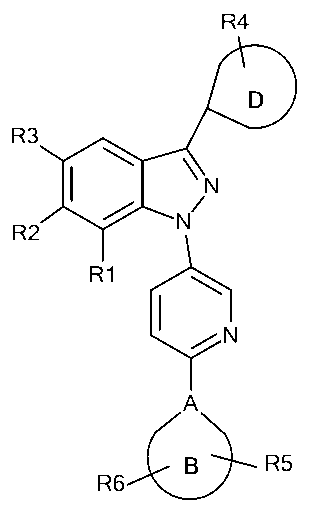
(式中、
Aは、N又はCであり、
Bは、
1個又は2個のN原子を含む5~7員の単環式ヘテロシクリル、
1個のN原子を含む6員の二環式ヘテロシクリル、
2個のN原子を含む7~11員の二環式ヘテロシクリル、
1個のN原子及び1個のO原子を含む7員の二環式ヘテロシクリル、
1個のN原子並びにO及びSからなる群から選択される1個のヘテロ原子を含む6員の単環式ヘテロシクリル、
3個のヘテロ原子を含み、そのうちの2個がNであり、もう1個がOである9員の二環式ヘテロシクリル、
1個のN原子及び1個のS原子を含む9員の二環式ヘテロシクリル、
3個のN原子を含み、そのうち2個がC1-6-アルキルで置換されている10員の二環式ヘテロシクリル、
フェニル、
3個のN原子を含む9員の二環式ヘテロアリール、
-C1-4-アルキレン-ピリミジン、及び
-C1-4-アルキレン-O-C1-3-アルキル
からなる群の中から選択される基であり;
Dは、
2個のN原子を含む9員の二環式ヘテロアリール、
1個のN原子を含む10員の二環式ヘテロアリール、及び
ベンゾジオキソール
からなる群の中から選択される基であり;
R1は、-H、-C1-6-アルキル、-CF3、-C2-6-アルキニル、-O-C1-6-アルキル及びハロゲンからなる群の中から選択され;
R2は、-H、-C1-6-アルキル、-C1-6-アルキレン-OH、-C(O)OH、-C(O)O-C1-6-アルキル及び-ピラゾリル-C1-6-アルキルからなる群の中から選択され;
R3は、-H又は-C1-6-アルキルであり;
R4は、-H、-C1-3-アルキル、-NH2、-NHC1-3-アルキル及びN(C1-3-アルキル)2からなる群の中から選択され;
R5は、非存在であり、或いは-H、-C1-6-アルキル、-S(O2)-C1-6-アルキル、-NH-S(O2)-C1-6-アルキル、=O、-C(O)-C1-6-アルキル、-C(O)H、-C(O)OH、-C(O)NH2、-C(O)O-C1-6-アルキル、-NR5.1R5.2、-C1-6-アルキレン-C(O)OH、-S(O2)-NH2、-ピロリジン-2-オン-1-イル、-テトラゾリル、並びにR5.3で置換されている、N及びOからなる群から選択される1個又は2個のヘテロ原子を有する5員のヘテロアリールからなる群の中から選択され;
R5.1は、-H、-C1-6-アルキル、-C(O)-C1-6-アルキル及び-C1-6-アルキレン-O-C1-6-アルキルからなる群の中から選択され;
R5.2は、-H、-C1-6-アルキル、-C(O)-C1-6-アルキル、-C1-6-アルキレン-O-C1-6-アルキル及び-C1-6-アルキレン-R5.3からなる群の中から選択され;
R5.3は、-H、-C1-6-アルキル、並びにN及びOからなる群から選択される1個又は2個のヘテロ原子を有する6員のヘテロアリールからなる群の中から選択され;
R6は、非存在であり、或いは-H、-C1-6-アルキル、=O及び-C(O)OHからなる群の中から選択される)
は、STINGに関連した又はSTINGによって調節された病態生理学的プロセスの処置、特に炎症、アレルギー若しくは自己免疫疾患、感染症又はがんの処置、或いはワクチンアジュバントとしての使用に特に適している。上記に鑑み、別の態様において、本発明はさらに、医薬品として使用するための、本明細書に定義された式(I)の化合物又はその薬学的に許容される塩にも関する。本発明の他の態様は、上記及び下記の説明並びに実施例から直接に当業者に明らかになる。
(Wherein,
A is N or C;
B is,
5-7 membered monocyclic heterocyclyl containing 1 or 2 N atoms;
6-membered bicyclic heterocyclyl containing one N atom;
7-11 membered bicyclic heterocyclyl containing two N atoms;
a 7-membered bicyclic heterocyclyl containing one N atom and one O atom;
6-membered monocyclic heterocyclyl containing one N atom and one heteroatom selected from the group consisting of O and S;
a 9-membered bicyclic heterocyclyl containing three heteroatoms, two of which are N and one of which is O;
a 9-membered bicyclic heterocyclyl containing one N atom and one S atom;
10-membered bicyclic heterocyclyl containing 3 N atoms, 2 of which are substituted by C 1-6 -alkyl;
Phenyl,
9-membered bicyclic heteroaryl containing 3 N atoms;
a radical selected from the group consisting of -C1-4 -alkylene-pyrimidine, and -C1-4 -alkylene-O- C1-3 -alkyl;
D is
9-membered bicyclic heteroaryl containing two N atoms;
a radical selected from the group consisting of 10-membered bicyclic heteroaryl containing one N atom, and benzodioxole;
R 1 is selected from the group consisting of -H, -C 1-6 -alkyl, -CF 3 , -C 2-6 -alkynyl, -O-C 1-6 -alkyl and halogen;
R 2 is selected from the group consisting of -H, -C 1-6 -alkyl, -C 1-6 -alkylene-OH, -C(O)OH, -C(O)O-C 1-6 -alkyl and -pyrazolyl-C 1-6 -alkyl;
R3 is -H or -Ci_6 -alkyl;
R 4 is selected from the group consisting of -H, -C 1-3 -alkyl, -NH 2 , -NHC 1-3 -alkyl and N(C 1-3 -alkyl) 2 ;
R 5 is absent or selected from the group consisting of -H, -C 1-6 -alkyl, -S(O 2 )-C 1-6 -alkyl, -NH-S(O 2 )-C 1-6 -alkyl, =O, -C(O)-C 1-6 -alkyl, -C(O)H, -C(O)OH, -C(O)NH 2 , -C(O)O-C 1-6 -alkyl, -NR 5.1 R 5.2 , -C 1-6 -alkylene-C(O)OH, -S(O 2 )-NH 2 , -pyrrolidin-2-one-1-yl, -tetrazolyl and 5-membered heteroaryl having 1 or 2 heteroatoms selected from the group consisting of N and O, substituted by R 5.3;
R 5.1 is selected from the group consisting of -H, -C 1-6 -alkyl, -C(O)-C 1-6 -alkyl and -C 1-6 -alkylene-O-C 1-6 -alkyl;
R 5.2 is selected from the group consisting of -H, -C 1-6 -alkyl, -C(O)-C 1-6 -alkyl, -C 1-6 -alkylene-O-C 1-6 -alkyl and -C 1-6 -alkylene-R 5.3 ;
R 5.3 is selected from the group consisting of -H, -C 1-6 -alkyl and 6-membered heteroaryl having 1 or 2 heteroatoms selected from the group consisting of N and O;
R 6 is absent or selected from the group consisting of -H, -C 1-6 -alkyl, ═O and -C(O)OH.
are particularly suitable for the treatment of pathophysiological processes associated with or modulated by STING, in particular for the treatment of inflammation, allergy or autoimmune diseases, infectious diseases or cancer, or for use as a vaccine adjuvant. In view of the above, in another aspect, the present invention also relates to a compound of formula (I) as defined herein, or a pharma- ceutically acceptable salt thereof, for use as a medicament. Other aspects of the present invention will be apparent to the skilled artisan directly from the above and below description and examples.
使用されている用語及び定義
本明細書で具体的に定義されていない用語は、本開示及び文脈を考慮に入れて当業者が与えるはずの意味が与えられるべきである。しかし、本明細書において使用されたように、別段の指定がない限り、以下の用語は指示された意味を有し、以下の慣例に準拠する。
Terms and Definitions Used Terms not specifically defined herein should be given the meaning that one of ordinary skill in the art would give them in light of the disclosure and the context. However, as used herein, unless otherwise specified, the following terms have the indicated meanings and are subject to the following conventions:
以下に定義された基、ラジカル、又は部分において、炭素原子の数は基の前に置かれて指定されていることが多く、例えばC1-6-アルキルとは、1~6個の炭素原子を有するアルキル基又はラジカルを意味する。一般に、HO、H2N、(O)S、(O)2S、NC(シアノ)、HOOC、F3Cなどのような基において、当業者は、基自体の自由原子価から分子へのラジカル付着点がわかる。2個以上の部分基を含む組み合わせた基では、最後に指名された部分基は、ラジカル付着点であり、例えば置換基「アリール-C1-3-アルキレン」とは、C1-3-アルキル基に結合しているアリール基を意味し、置換基の後者が、コアに又は置換基が付着している基に結合している。 In the groups, radicals or moieties defined below, the number of carbon atoms is often specified preceding the group, for example C 1-6 -alkyl means an alkyl group or radical having from 1 to 6 carbon atoms. Generally, in groups such as HO, H 2 N, (O)S, (O) 2 S, NC (cyano), HOOC, F 3 C, etc., the skilled artisan will recognize the point of radical attachment to the molecule from the free valence of the group itself. In combined groups containing more than one subgroup, the last named subgroup is the point of radical attachment, for example the substituent "aryl-C 1-3 -alkylene" means an aryl group bound to a C 1-3 -alkyl group, the latter of which is bound to the core or to the group to which it is attached.
本発明の化合物が化学名の形及び式で描かれている場合、何らかの矛盾が起きたら、式が優先するものとする。波線は、定義されたコア分子に接続されている結合を示すために部分式において使用することができる。
例えば、用語「3-カルボキシプロピル基」は、以下の置換基を表す。
When compounds of the invention are depicted in chemical name form and in formula form, in the event of any discrepancy, the formula shall prevail. Wavy lines may be used in subformulas to indicate bonds that are connected to a defined core molecule.
For example, the term "3-carboxypropyl group" represents the following substituent:


1.1.1.1 用語 置換された
本明細書では用語「置換された」とは、指名された原子上の1個又は複数の水素が、置換基の定義された一群から選択される基で置き換えられていることを意味する。ただし、指名された原子の正常な原子価を超えていないこと、及び置換によって、安定な化合物になることを条件とする。同様に、用語「置換された」は、例えば「置換アルキル」、「置換アリール」など、単一の原子ではなく化学的部分と結びつけて使用することができる。
1.1.1.1 Terminology Substituted As used herein, the term "substituted" means that one or more hydrogens on the named atom have been replaced with a group selected from the defined group of substituents, provided that the normal valences of the named atom are not exceeded and that the substitution results in a stable compound. Similarly, the term "substituted" can be used in connection with chemical moieties other than a single atom, such as, for example, "substituted alkyl,""substitutedaryl," etc.
1.1.1.2 立体化学-溶媒和物-水和物
明確に示されていない限り、本明細書及び添付の特許請求の範囲の全体にわたって、所与の化学式又は化学名は、互変異性体、並びにすべての立体異性体、光学異性体、幾何異性体(例えば、エナンチオマー、ジアステレオマー、E/Z異性体など)及びそれらのラセミ体、並びに別個のエナンチオマーのさまざまな割合の混合物、ジアステレオマーの混合物、又はそのような異性体及びエナンチオマーが存在する上記の形のいずれかの混合物、並びにそれらの溶媒和物、例えば水和物などを包含するものとする。
明確に示されていない限り、以下にさらに詳細に定義された「薬学的に許容される塩」も、それらの溶媒和物、例えば水和物などを包含するものとする。
1.1.1.2 Stereochemistry - Solvates - Hydrates Unless expressly indicated, throughout this specification and the appended claims, a given chemical formula or name is intended to encompass tautomers, as well as all stereoisomers, optical isomers, geometric isomers (e.g., enantiomers, diastereomers, E/Z isomers, etc.) and their racemates, as well as mixtures of various proportions of the separate enantiomers, mixtures of diastereomers, or mixtures of any of the above forms in which such isomers and enantiomers exist, as well as solvates thereof, such as, for example, hydrates.
Unless expressly indicated, the "pharmacologically acceptable salts", as defined in more detail below, are also intended to encompass solvates thereof, such as, for example, hydrates.
1.1.1.3 立体異性体
一般に、実質的に純粋な立体異性体は、当業者に公知の合成原理に従って、例えば対応する混合物の分離、立体化学的に純粋な出発物質の使用及び/又は立体選択的合成によって得ることができる。当技術分野において、ラセミ体の分割、又は合成、例えば光学活性出発物質から始める合成、及び/又はキラル試薬の使用などによって光学活性体を調製する方法が公知である。
1.1.1.3 Stereoisomers In general, substantially pure stereoisomers can be obtained according to synthetic principles known to those skilled in the art, for example, by separation of the corresponding mixtures, by use of stereochemically pure starting materials and/or by stereoselective synthesis. It is known in the art how to prepare optically active forms, for example, by resolution of racemic forms, or by synthesis, for example, synthesis beginning with optically active starting materials and/or by use of chiral reagents.
本発明のエナンチオマーとして純粋な化合物又は中間体は、不斉合成を介して調製することができ、例えば公知の方法(例えば、クロマトグラフィー分離又は結晶化)及び/又はキラル出発物質、キラル触媒若しくはキラル補助剤などのキラル試薬の使用によって分離することができる適切なジアステレオマー化合物又は中間体の調製及びその後の分離によって調製することができる。
さらに、対応するラセミ混合物のキラル固定相クロマトグラフィー分離;又は適切な分割剤を使用したラセミ混合物の分割、例えば光学活性酸若しくは塩基を用いたラセミ化合物のジアステレオマー塩の形成、その後の塩分割及び塩からの所望の化合物の遊離;又はキラル光学活性補助試薬を用いた対応するラセミ化合物の誘導体化、その後のジアステレオマー分離及びキラル補助基の除去;又はラセミ体の速度論的分割(例えば、酵素分割);適した条件下におけるエナンチオモルファス結晶のコングロメレートからのエナンチオ選択的結晶化;又はキラル光学活性補助剤の存在における適した溶媒からの(分別)結晶化などによって、エナンチオマーとして純粋な化合物を対応するラセミ混合物から調製する方法が当業者に公知である。
Enantiomerically pure compounds or intermediates of the present invention may be prepared via asymmetric synthesis, for example by the preparation and subsequent separation of appropriate diastereomeric compounds or intermediates which may be separated by known methods (e.g. chromatographic separation or crystallization) and/or the use of chiral reagents, such as chiral starting materials, chiral catalysts or chiral auxiliaries.
Furthermore, methods are known to those skilled in the art for preparing enantiomerically pure compounds from the corresponding racemic mixtures, such as by chiral stationary phase chromatographic separation of the corresponding racemic mixtures; or by resolution of the racemic mixtures using a suitable resolving agent, e.g., formation of diastereomeric salts of the racemates with an optically active acid or base, followed by salt resolution and liberation of the desired compound from the salt; or by derivatization of the corresponding racemates with a chiral, optically active auxiliary reagent, followed by diastereomeric separation and removal of the chiral auxiliary; or by kinetic resolution of the racemates (e.g., enzymatic resolution); enantioselective crystallization from conglomerates of enantiomorphous crystals under suitable conditions; or by (fractional) crystallization from a suitable solvent in the presence of a chiral, optically active auxiliary.
1.1.1.4 塩
本明細書で「薬学的に許容される」という句は、妥当な医学的判断の範囲内で、過度の毒性、刺激、アレルギー応答、又は他の問題若しくは合併症なしにヒトの組織と接触させて使用するのに適し、且つ合理的なベネフィット・リスク比に相応した化合物、材料、組成物、及び/又は剤形を指すために使用される。
本明細書では「薬学的に許容される塩」は、親化合物の酸又は塩基塩を作製することによって親化合物が改変された、開示化合物の誘導体を指す。薬学的に許容される塩の例としては、アミンなどの塩基性残基の鉱物又は有機酸塩、カルボン酸などの酸性残基のアルカリ又は有機塩などが挙げられるが、これらに限定されない。
例えば、そのような塩には、ベンゼンスルホン酸、安息香酸、クエン酸、エタンスルホン酸、フマル酸、ゲンチシン酸、臭化水素酸、塩酸、マレイン酸、リンゴ酸、マロン酸、マンデル酸、メタンスルホン酸、4-メチル-ベンゼンスルホン酸、リン酸、サリチル酸、コハク酸、硫酸及び酒石酸に由来する塩が含まれる。
1.1.1.4 Salts The phrase "pharmacologically acceptable" is used herein to refer to compounds, materials, compositions, and/or dosage forms that are, within the scope of sound medical judgment, suitable for use in contact with human tissue without undue toxicity, irritation, allergic response, or other problem or complication, and are commensurate with a reasonable benefit-risk ratio.
As used herein, "pharmaceutically acceptable salts" refers to derivatives of the disclosed compounds where the parent compound has been modified by making acid or base salts of the parent compound. Examples of pharmaceutically acceptable salts include, but are not limited to, mineral or organic acid salts of basic residues such as amines, alkali or organic salts of acidic residues such as carboxylic acids, and the like.
For example, such salts include salts derived from benzenesulfonic acid, benzoic acid, citric acid, ethanesulfonic acid, fumaric acid, gentisic acid, hydrobromic acid, hydrochloric acid, maleic acid, malic acid, malonic acid, mandelic acid, methanesulfonic acid, 4-methyl-benzenesulfonic acid, phosphoric acid, salicylic acid, succinic acid, sulfuric acid, and tartaric acid.
アンモニア、L-アルギニン、カルシウム、2,2’-イミノビスエタノール、L-リシン、マグネシウム、N-メチル-D-グルカミン、カリウム、ナトリウム及びトリス(ヒドロキシメチル)-アミノメタンに由来するカチオンを用いて、別の薬学的に許容される塩を形成することができる。
本発明の薬学的に許容される塩は、塩基性又は酸性部分を含む親化合物から通常の化学的方法で合成することができる。一般的に、そのような塩は、これらの化合物の遊離酸又は塩基の形と十分量の適切な塩基又は酸を水中或いはエーテル、酢酸エチル、エタノール、イソプロパノール、若しくはアセトニトリル、又はそれらの混合物などの有機希釈剤中で反応させることによって調製することができる。
例えば、本発明の化合物を精製又は単離するのに有用な上記以外の酸の塩(例えば、トリフルオロ酢酸塩)も、本発明の一部を構成する。
Additional pharma-ceutically acceptable salts can be formed with cations derived from ammonia, L-arginine, calcium, 2,2'-iminobisethanol, L-lysine, magnesium, N-methyl-D-glucamine, potassium, sodium and tris(hydroxymethyl)-aminomethane.
The pharma- ceutically acceptable salts of the present invention can be synthesized from the parent compound that contains a basic or acidic moiety by conventional chemical methods. Generally, such salts can be prepared by reacting the free acid or base form of these compounds with a sufficient amount of the appropriate base or acid in water or an organic diluent such as ether, ethyl acetate, ethanol, isopropanol, or acetonitrile, or a mixture thereof.
For example, salts of other acids (eg, trifluoroacetates) that are useful for purifying or isolating the compounds of the invention also form part of this invention.
1.1.1.5 ハロゲン
用語「ハロゲン」は、フッ素、塩素、臭素及びヨウ素を表す。
1.1.1.6 ヘテロ原子
ヘテロ原子は、考えられる酸化段階すべてで存在することができる。例えば、硫黄は、スルホキシド(R-S(O)-R’)及びスルホン(-R-S(O)2-R’)として存在することができる。
1.1.1.7 アルキル
用語「C1-n-アルキル」(ここで、nは、2、3、4、5又は6、好ましくは4、5又は6から選択される整数である)は単独で又は別のラジカルとの組合せで、1~n個のC原子を有する非環式、飽和、分枝状又は線状の炭化水素ラジカルを表す。例えば、用語C1-5-アルキルは、ラジカルH3C-、H3C-CH2-、H3C-CH2-CH2-、H3C-CH(CH3)-、H3C-CH2-CH2-CH2-、H3C-CH2-CH(CH3)-、H3C-CH(CH3)-CH2-、H3C-C(CH3)2-、H3C-CH2-CH2-CH2-CH2-、H3C-CH2-CH2-CH(CH3)-、H3C-CH2-CH(CH3)-CH2-、H3C-CH(CH3)-CH2-CH2-、H3C-CH2-C(CH3)2-、H3C-C(CH3)2-CH2-、H3C-CH(CH3)-CH(CH3)-及びH3C-CH2-CH(CH2CH3)-を包含する。
1.1.1.5 Halogen The term "halogen" refers to fluorine, chlorine, bromine and iodine.
1.1.1.6 Heteroatoms Heteroatoms can be present in all possible oxidation states, for example sulfur can be present as sulfoxide (R--S(O)--R') and sulfone (--R--S(O) 2 --R').
1.1.1.7 Alkyl The term "C 1-n -alkyl", where n is an integer selected from 2, 3, 4, 5 or 6, preferably 4, 5 or 6, alone or in combination with other radicals, denotes an acyclic, saturated, branched or linear hydrocarbon radical having 1 to n C atoms. For example, the term C 1-5 -alkyl includes the radicals H 3 C-, H 3 C-CH 2 -, H 3 C-CH 2 -CH 2 -, H 3 C-CH(CH 3 )-, H 3 C-CH 2 -CH 2 -CH 2 -, H 3 C-CH 2 -CH(CH 3 )-, H 3 C-CH(CH 3 )-CH 2 -, H 3 C-C(CH 3 ) 2 -, H 3 C-CH 2 -CH 2 -CH 2 -CH 2 - , H 3 C-CH 2 -CH 2 -CH 2 -CH (CH 3 )-, H 3 C-CH 2 -CH (CH 3 )-CH 2 -, H 3 C-CH (CH 3 )-CH 2 - --, H3C --CH2 -- C( CH3 ) 2-- , H3C --C( CH3 ) 2 -- CH2-- , H3C --CH( CH3 )--CH( CH3 )-- and H3C -- CH2 --CH( CH2CH3 )-- .
1.1.1.8 アルキレン
用語「C1-n-アルキレン」(ここで、nは、2、3、4、5又は6、好ましくは4、5又は6から選択される整数である)単独で又は別のラジカルとの組合せで、1~n個の炭素原子を含む非環式、飽和、分枝状又は直鎖の2価のアルキルラジカルを表す。例えば、用語C1-4-アルキレンには、-CH2-、-CH2-CH2-、-CH(CH3)-、-CH2-CH2-CH2-、-C(CH3)2-、-CH(CH2CH3)-、-CH(CH3)-CH2-、-CH2-CH(CH3)-、-CH2-CH2-CH2-CH2-、-CH2-CH2-CH(CH3)-、-CH(CH3)-CH2-CH2-、-CH2-CH(CH3)-CH2-、-CH2-C(CH3)2-、-C(CH3)2-CH2-、-CH(CH3)-CH(CH3)-、-CH2-CH(CH2CH3)-、-CH(CH2CH3)-CH2-、-CH(CH2CH2CH3)-、-CH(CH(CH3))2-及び-C(CH3)(CH2CH3)-が含まれる。
1.1.1.8 Alkylene The term "C 1-n -alkylene", where n is an integer selected from 2, 3, 4, 5 or 6, preferably 4, 5 or 6, alone or in combination with other radicals, denotes an acyclic, saturated, branched or straight-chain divalent alkyl radical containing 1 to n carbon atoms. For example, the term C 1-4 -alkylene includes -CH 2 -, -CH 2 -CH 2 -, -CH(CH 3 )-, -CH 2 -CH 2 -CH 2 -, -C(CH 3 ) 2 -, -CH(CH 2 CH 3 )-, -CH(CH 3 )-CH 2 -, -CH 2 -CH(CH 3 )-, -CH 2 -CH 2 -CH 2 -CH 2 -, -CH 2 -CH 2 -CH(CH 3 )-, -CH(CH 3 )-CH 2 -CH 2 -, -CH 2 -CH(CH 3 )-CH 2 -, -CH 2 -C(CH 3 ) 2 -, -C(CH 3 ) 2 -CH 2 -, -CH(CH 3 )-CH(CH 3 )-, -CH 2 -CH(CH 2 CH 3 )-, -CH(CH 2 CH 3 )-CH 2 -, -CH(CH 2 CH 2 CH 3 )-, -CH(CH(CH 3 )) 2 - and -C(CH 3 )(CH 2 CH 3 )- is included.
1.1.1.9 アルケニル
用語「C2-m-アルケニル」は、「C2-m-アルキル」基(ここで、mは、3、4、5又は6、好ましくは4、5又は6から選択される整数である)の少なくとも2個の炭素原子が互いに二重結合で結合している場合に使用される。
1.1.1.10 アルケニレン
用語「C2-m-アルケニレン」は、「C2-m-アルキレン」基(ここで、mは、3、4、5又は6、好ましくは4、5又は6から選択される整数である)の少なくとも2個の炭素原子が互いに二重結合で結合している場合に使用される。
1.1.1.11 アルキニル
用語「C2-m-アルキニル」は、「C2-m-アルキル」基(ここで、mは、3、4、5又は6、好ましくは4、5又は6から選択される整数である)の少なくとも2個の炭素原子が互いに三重結合で結合している場合に使用される。
1.1.1.12 アルキニレン
用語「C2-m-アルキニレン」は、「C2-m-アルキレン」基(ここで、mは、3、4、5又は6、好ましくは4、5又は6から選択される整数である)の炭素原子の少なくとも2個が互いに三重結合で結合している場合に使用される。
1.1.1.9 Alkenyl The term "C2 -m -alkenyl" is used when at least two carbon atoms of a "C2 -m -alkyl" group, where m is an integer selected from 3, 4, 5 or 6, preferably 4, 5 or 6, are bonded to each other by a double bond.
1.1.1.10 Alkenylene The term "C2 -m -alkenylene" is used when at least two carbon atoms of a "C2 -m -alkylene" group, where m is an integer selected from 3, 4, 5 or 6, preferably 4, 5 or 6, are bonded to each other by a double bond.
1.1.1.11 Alkynyl The term "C2 -m -alkynyl" is used when at least two carbon atoms of a "C2 -m -alkyl" group, where m is an integer selected from 3, 4, 5 or 6, preferably 4, 5 or 6, are joined to each other by a triple bond.
1.1.1.12 Alkynylene The term "C2 -m -alkynylene" is used when at least two of the carbon atoms of a "C2 -m -alkylene" group, where m is an integer selected from 3, 4, 5 or 6, preferably 4, 5 or 6, are bonded to each other by a triple bond.
1.1.1.13 シクロアルキル
用語「C3-k-シクロアルキル」(ここで、kは、3、4、5、6、7又は8、好ましくは4、5又は6から選択される整数である)は単独又は別のラジカルとの組合せで、3~k個のC原子を有する環式、飽和、非分枝状炭化水素ラジカルを表す。例えば、用語C3-7-シクロアルキルには、シクロプロピル、シクロブチル、シクロペンチル、シクロヘキシル及びシクロヘプチルが含まれる。
1.1.1.14 シクロアルケニル
用語「C3-k-シクロアルケニル」(ここで、kは、3、4、5、6、7又は8、好ましくは4、5又は6から選択される整数である)は単独又は別のラジカルとの組合せで、3~k個のC原子を有する環式、不飽和ではあるが非芳香族、非分枝状炭化水素ラジカルを表し、3~k個のC原子のうち少なくとも2個が互いに二重結合で結合している。例えば、用語C3-7-シクロアルケニルには、シクロプロペニル、シクロブテニル、シクロペンテニル、シクロペンタジエニル、シクロヘキセニル、シクロヘキサジエニル、シクロヘプテニル、シクロヘプタジエニル及びシクロヘプタトリエニルが含まれる。
1.1.1.13 Cycloalkyl The term "C 3-k -cycloalkyl", where k is an integer selected from 3, 4, 5, 6, 7 or 8, preferably 4, 5 or 6, alone or in combination with other radicals, denotes a cyclic, saturated, unbranched hydrocarbon radical having 3 to k C atoms. For example, the term C 3-7 -cycloalkyl includes cyclopropyl, cyclobutyl, cyclopentyl, cyclohexyl and cycloheptyl.
1.1.1.14 Cycloalkenyl The term "C 3-k -cycloalkenyl", where k is an integer selected from 3, 4, 5, 6, 7 or 8, preferably 4, 5 or 6, alone or in combination with other radicals, denotes a cyclic, unsaturated but non-aromatic, unbranched hydrocarbon radical having 3 to k C atoms, at least two of which are linked to each other by a double bond. For example, the term C 3-7 -cycloalkenyl includes cyclopropenyl, cyclobutenyl, cyclopentenyl, cyclopentadienyl, cyclohexenyl, cyclohexadienyl, cycloheptenyl, cycloheptadienyl and cycloheptatrienyl.
1.1.1.15 ハロ-(アルキル、アルキレン又はシクロアルキル)
(飽和又は不飽和)「アルキル」、「アルキレン」又は「シクロアルキル」基に付いている用語「ハロ」は、1個又は複数の水素原子がフッ素、塩素又は臭素、好ましくはフッ素及び塩素の中から選択されるハロゲン原子、特に好ましくはフッ素で置き換えられている、アルキル、アルキレン又はシクロアルキル基を定義する。例としては、H2FC-、HF2C-、F3C-が挙げられる。
1.1.1.15 Halo-(alkyl, alkylene or cycloalkyl)
The term "halo" attached to a (saturated or unsaturated) "alkyl", "alkylene" or "cycloalkyl" group defines an alkyl, alkylene or cycloalkyl group in which one or more hydrogen atoms have been replaced by a halogen atom selected from among fluorine, chlorine or bromine, preferably fluorine and chlorine, especially preferred fluorine. Examples include H2FC- , HF2C- , F3C- .
1.1.1.16 カルボシクリル
用語「カルボシクリル」は単独で又は別のラジカルとの組合せで、3~14個の炭素原子からなる単環、二環又は三環式の環構造を意味する。用語「カルボシクリル」は、完全飽和、部分飽和及び芳香族の環系を指す。用語「カルボシクリル」は、縮合、架橋及びスピロ環系を包含する。
1.1.1.16 Carbocyclyl The term "carbocyclyl", alone or in combination with another radical, means a monocyclic, bicyclic, or tricyclic ring structure of 3 to 14 carbon atoms. The term "carbocyclyl" refers to fully saturated, partially saturated, and aromatic ring systems. The term "carbocyclyl" includes fused, bridged, and spiro ring systems.

1.1.1.17 アリール
本明細書では用語「アリール」は単独で又は別のラジカルとの組合せで、6個の炭素原子を含む炭素環式芳香族単環式基を表し、別の5員又は6員の飽和又は不飽和芳香族炭素環式基にさらに縮合していてもよい。アリールとしては、フェニル、インダニル、インデニル、ナフチル、アントラセニル、フェナントレニル、テトラヒドロナフチル及びジヒドロナフチルが挙げられるが、これらに限定されない。
1.1.1.17 Aryl The term "aryl," as used herein, alone or in combination with another radical, refers to a carbocyclic aromatic monocyclic group containing 6 carbon atoms, which may be further fused to another 5- or 6-membered saturated or unsaturated aromatic carbocyclic group. Aryl includes, but is not limited to, phenyl, indanyl, indenyl, naphthyl, anthracenyl, phenanthrenyl, tetrahydronaphthyl, and dihydronaphthyl.
1.1.1.18 ヘテロシクリル
用語「ヘテロシクリル」とは、芳香族環を含んでいてもよい、N、O、S、SO、SO2から選択される1個又は複数のヘテロ原子を含み、3~14個の環原子からなる飽和又は不飽和の単環式又は多環式環系を意味し、ヘテロ原子のいずれも、芳香族環の一部でない。用語「ヘテロシクリル」は、考えられる異性体すべてを含むように意図される。
したがって、用語「ヘテロシクリル」には、以下の例示的構造(それぞれの形は適切な原子価が維持される限り共有結合を通していずれの原子に付着されていてもよいので、ラジカルとして描かれていない)が含まれる。
1.1.1.18 Heterocyclyl The term "heterocyclyl" means a saturated or unsaturated monocyclic or polycyclic ring system of 3 to 14 ring atoms containing one or more heteroatoms selected from N, O, S, SO, SO2 , which may contain an aromatic ring, and none of the heteroatoms are part of an aromatic ring. The term "heterocyclyl" is intended to include all possible isomers.
Thus, the term "heterocyclyl" includes the following exemplary structures (not depicted as radicals because each form may be attached to any atom through a covalent bond as long as appropriate valences are maintained):


1.1.1.19 ヘテロアリール
用語「ヘテロアリール」とは、少なくとも1個の芳香族環を含み、N、O、S、SO又はSO2から選択される1個又は複数のヘテロ原子を含み、5~14個の環原子からなる単環式又は多環式環系を意味し、ヘテロ原子の少なくとも1個が芳香族環の一部であり、得られた環系が化学的に安定でなければならない。用語「ヘテロアリール」は、考えられる異性体すべてを含むように意図される。
1.1.1.19 Heteroaryl The term "heteroaryl" means a monocyclic or polycyclic ring system containing at least one aromatic ring and containing one or more heteroatoms selected from N, O, S, SO or SO2 , and consisting of 5 to 14 ring atoms, wherein at least one of the heteroatoms is part of an aromatic ring, and the resulting ring system must be chemically stable. The term "heteroaryl" is intended to include all possible isomers.
したがって、用語「ヘテロアリール」には、以下の例示的構造(それぞれの形は適切な原子価が維持される限り共有結合を通していずれの原子に付着されていてもよいので、ラジカルとして描かれていない)が含まれる。 Thus, the term "heteroaryl" includes the following exemplary structures (not depicted as radicals because each form may be attached to any atom through a covalent bond as long as appropriate valences are maintained):

用語「二環式環系」とは、スピロ環、縮合、及び架橋環系を含めて、連結した2つの環式部分構造からなる基を意味する。
好ましい実施形態
本発明の特定の一実施形態は、式(I)の化合物又はその塩
The term "bicyclic ring system" means a group consisting of two linked cyclic moieties, including spirocyclic, fused and bridged ring systems.
Preferred embodiment A particular embodiment of the present invention is a compound of formula (I) or a salt thereof

(式中、R1は、-C1-6-アルキル、-CF3、-O-C1-6-アルキル及びハロゲンからなる群の中から選択される)に関する。
in which R 1 is selected from the group consisting of --C 1-6 -alkyl, --CF 3 , --O--C 1-6 -alkyl and halogen.
別の特定の実施形態は、式(I)の化合物又はその塩(式中、R1は、-C1-6-アルキル、-CF3、-O-C1-6-アルキル、-Br及び-Clからなる群の中から選択される)に関する。
別の特定の実施形態は、式(I)の化合物又はその塩(式中、R1は、-C1-6-アルキル、-CF3、-Br及び-Clからなる群の中から選択される)に関する。
別の特定の実施形態は、式(I)の化合物又はその塩(式中、R1は、-C1-6-アルキル、-CF3、-O-C1-6-アルキル、ハロゲンからなる群の中から選択され、R4は、-H又は-C1-3-アルキルである)に関する。
Another particular embodiment relates to compounds of formula (I) or salts thereof, in which R 1 is selected from the group consisting of -C 1-6 -alkyl, -CF 3 , -O-C 1-6 -alkyl, -Br and -Cl.
Another particular embodiment relates to compounds of formula (I) or salts thereof, wherein R 1 is selected from the group consisting of -C 1-6 -alkyl, -CF 3 , -Br and -Cl.
Another particular embodiment relates to compounds of formula (I) or salts thereof, in which R 1 is selected from the group consisting of -C 1-6 -alkyl, -CF 3 , -O-C 1-6 -alkyl, halogen and R 4 is -H or -C 1-3 -alkyl.
本発明の別の特定の実施形態は、式(I)の化合物又はその塩(式中、R2は-Hである)に関する。
本発明の別の特定の実施形態は、式(I)の化合物又はその塩(式中、R3は-Hである)に関する。
本発明の別の特定の実施形態は、式(I)の化合物又はその塩(式中、R2は-Hであり、R3は-Hである)に関する。
本発明の別の特定の実施形態は、式(I)の化合物又はその塩(式中、R4は、-H又は-C1-3-アルキルである)に関する。
Another particular embodiment of the present invention relates to compounds of formula (I) or salts thereof, wherein R 2 is —H.
Another particular embodiment of the present invention relates to compounds of formula (I) or salts thereof, wherein R 3 is —H.
Another particular embodiment of the present invention relates to compounds of formula (I) or salts thereof, wherein R 2 is —H and R 3 is —H.
Another particular embodiment of the invention relates to compounds of formula (I) or salts thereof, in which R 4 is —H or —C 1-3 -alkyl.
本発明の別の特定の実施形態は、式(I)の化合物又はその塩(式中、R5は、-H、-C1-6-アルキル、-S(O2)-C1-6-アルキル、=O、-C(O)H、-C(O)NH2、-C(O)OH、-C(O)O-C1-6-アルキル、-NR5.1R5.2、並びにR5.3で置換されている、N及びOからなる群から選択される1個又は2個のヘテロ原子を有する5員のヘテロアリールからなる群の中から選択され、R5.1は、-H、-C1-6-アルキル、-C(O)-C1-6-アルキル及び-C1-6-アルキレン-O-C1-6-アルキルからなる群の中から選択され、R5.2は、-H、-C1-6-アルキル、-C(O)-C1-6-アルキル、-C1-6-アルキレン-O-C1-6-アルキル及び-C1-6-アルキル-R5.3からなる群の中から選択され、R5.3は、-H又は-C1-6-アルキルである)に関する。 Another particular embodiment of the present invention is a compound of formula (I) or a salt thereof, in which R 5 is selected from the group consisting of -H, -C 1-6 -alkyl, -S(O 2 )-C 1-6 -alkyl, ═O, -C(O)H, -C(O)NH 2 , -C(O)OH, -C(O)O-C 1-6 -alkyl, -NR 5.1 R 5.2 and 5-membered heteroaryl having 1 or 2 heteroatoms selected from the group consisting of N and O, substituted with R 5.3 , R 5.1 is selected from the group consisting of -H, -C 1-6 -alkyl, -C(O)-C 1-6 -alkyl and -C 1-6 -alkylene-O-C 1-6 -alkyl, R 5.2 is -H, -C 1-6 -alkyl, -C(O)-C 1-6 -alkyl, -C 1-6 -alkylene-O-C 1-6 -alkyl and -C 1-6 -alkyl-R 5.3 , wherein R 5.3 is -H or -C 1-6 -alkyl.
本発明の別の特定の実施形態は、式(I)の化合物又はその塩(式中、R5は、-H、-C1-6-アルキル、-S(O2)-C1-6-アルキル、-NH-S(O2)-C1-6-アルキル、=O、-C(O)-C1-6-アルキル、-C(O)H、-C(O)OH、-C(O)NH2、-C(O)O-C1-6-アルキル、-NR5.1R5.2、-C1-6-アルキレン-C(O)OH、-S(O2)-NH2、-ピロリジン-2-オン-1-イル、並びにR5.3で置換されている、N及びOからなる群から選択される1個又は2個のヘテロ原子を有する5員のヘテロアリールからなる群の中から選択され、R5.1は、-H、-C1-6-アルキル、-C(O)-C1-6-アルキル及び-C1-6-アルキレン-O-C1-6-アルキルからなる群の中から選択され、R5.2は、-H、-C1-6-アルキル、-C(O)-C1-6-アルキル、-C1-6-アルキレン-O-C1-6-アルキル及び-C1-6-アルキレン-R5.3からなる群の中から選択され、R5.3は、-H、-C1-6-アルキル、並びにN及びOからなる群から選択される1個又は2個のヘテロ原子を有する6員のヘテロアリールからなる群の中から選択される)に関する。 Another particular embodiment of the present invention is a compound of formula (I) or a salt thereof, wherein R 5 is selected from the group consisting of -H, -C 1-6 -alkyl, -S(O 2 )-C 1-6 -alkyl, -NH-S(O 2 )-C 1-6 -alkyl, ═O, -C(O)-C 1-6 -alkyl, -C(O)H, -C(O)OH, -C(O)NH 2 , -C(O)O-C 1-6 -alkyl, -NR 5.1 R 5.2 , -C 1-6 -alkylene-C(O)OH, -S(O 2 )-NH 2 , -pyrrolidin-2-one-1-yl and 5-membered heteroaryl having 1 or 2 heteroatoms selected from the group consisting of N and O, substituted with R 5.3 , and R 5.1 is -H, -C R 5.2 is selected from the group consisting of -H, -C 1-6 -alkyl, -C(O)-C 1-6 -alkyl, -C 1-6 -alkylene-O-C 1-6 -alkyl and -C 1-6 -alkylene-R 5.3 , R 5.3 being selected from the group consisting of -H, -C 1-6 -alkyl and 6 -membered heteroaryl having 1 or 2 heteroatoms selected from the group consisting of N and O) .
本発明の別の特定の実施形態は、式(I)の化合物又はその塩(式中、R5は、-H、-C1-6-アルキル、-S(O2)-C1-6-アルキル、=O、-C(O)H、C(O)NH2、-C(O)OH、-C(O)O-C1-6-アルキル及び-NR5.1R5.2からなる群の中から選択され、R5.1は、-H、-C1-6-アルキル、-C(O)-C1-6-アルキル及び-C1-6-アルキル-O-C1-6-アルキルからなる群の中から選択され、R5.2は、-H、-C1-6-アルキル、-C(O)-C1-6-アルキル及び-C1-6-アルキレン-O-C1-6-アルキルからなる群の中から選択される)に関する。
本発明の別の特定の実施形態は、式(I)の化合物又はその塩(式中、R5は、-H、-C1-6-アルキル、-S(O2)-C1-6-アルキル、=O、-C(O)H、-C(O)NH2、-C(O)OH及び-C(O)O-C1-6-アルキルからなる群の中から選択される)に関する。
Another particular embodiment of the present invention relates to compounds of formula (I) or salts thereof, wherein R 5 is selected from the group consisting of -H, -C 1-6 -alkyl, -S(O 2 )-C 1-6 -alkyl, ═O, -C(O)H, C(O)NH 2 , -C(O)OH, -C(O)O-C 1-6 -alkyl and -NR 5.1 R 5.2 , R 5.1 being selected from the group consisting of -H, -C 1-6 -alkyl, -C(O)-C 1-6 -alkyl and -C 1-6 -alkyl-O-C 1-6 -alkyl and R 5.2 being selected from the group consisting of -H, -C 1-6 -alkyl, -C ( O)-C 1-6 -alkyl and -C 1-6 -alkylene-O-C 1-6 -alkyl.
Another particular embodiment of the present invention relates to compounds of formula (I) or salts thereof, wherein R5 is selected from the group consisting of -H, -Ci -6 -alkyl, -S( O2 )-Ci -6 -alkyl, =O, -C(O)H, -C(O) NH2 , -C(O)OH and -C(O)O-Ci- 6 -alkyl.
本発明の別の特定の実施形態は、式(I)の化合物又はその塩(式中、R5は、-C(O)H、C(O)NH2、-C(O)OH及び-C(O)O-C1-6-アルキルからなる群の中から選択される)に関する。
本発明の別の特定の実施形態は、式(I)の化合物又はその塩(式中、R5は、-C(O)OH又は-C(O)O-C1-3-アルキルである)に関する。
本発明の別の特定の実施形態は、式(I)の化合物又はその塩(式中、R5は、原子価によって必要とされた場合、非存在である)に関する。
本発明の別の特定の実施形態は、式(I)の化合物又はその塩(式中、R6は、-H又は-C(O)OHである)に関する。
Another particular embodiment of the present invention relates to compounds of formula (I) or salts thereof, wherein R 5 is selected from the group consisting of -C(O)H, C(O)NH 2 , -C(O)OH and -C(O)O-C 1-6 -alkyl.
Another particular embodiment of the invention relates to compounds of formula (I) or salts thereof, in which R 5 is —C(O)OH or —C(O)O—C 1-3 -alkyl.
Another particular embodiment of the present invention relates to compounds of formula (I) or salts thereof, wherein R 5 is absent, when required by valence.
Another particular embodiment of the present invention relates to compounds of formula (I) or salts thereof, wherein R 6 is —H or —C(O)OH.
本発明の別の特定の実施形態は、式(I)の化合物又はその塩(式中、R6は、原子価によって必要とされた場合、非存在である)に関する。
本発明の別の特定の実施形態は、式(I)の化合物又はその塩(式中、R5は-Hであり、R6は-Hである)に関する。
本発明の別の特定の実施形態は、式(I)の化合物又はその塩(式中、AはNである)に関する。
本発明の別の特定の実施形態は、式(I)の化合物又はその塩(式中、Bは、1個又は2個のN原子を含む5~7員の単環式ヘテロシクリル、1個のN原子を含む6員の二環式ヘテロシクリル、2~3個のN原子を含む7~11員の二環式ヘテロシクリル、1個のN原子及び1個のO原子を含む7員の二環式ヘテロシクリル、1個のN原子並びにO及びSからなる群から選択される1個のヘテロ原子を含む6員の単環式ヘテロシクリル、3個のヘテロ原子を含み、そのうちの2個がNであり、もう1個がOである9員の二環式ヘテロシクリル、1個のN原子及び1個のS原子を含む9員の二環式ヘテロシクリル、並びに3個のN原子を含み、そのうち2個がC1-6-アルキルで置換されている10員の二環式ヘテロシクリルからなる群の中から選択される基である)に関する。
本発明の別の特定の実施形態は、式(I)の化合物又はその塩(式中、Bは、
Another particular embodiment of the present invention relates to compounds of formula (I) or salts thereof, wherein R 6 is absent, when required by valence.
Another particular embodiment of the present invention relates to compounds of formula (I) or salts thereof, wherein R 5 is —H and R 6 is —H.
Another particular embodiment of the present invention relates to compounds of formula (I) or salts thereof, wherein A is N.
Another particular embodiment of the present invention relates to compounds of formula (I) or salts thereof, in which B is a radical selected from the group consisting of 5-7 membered monocyclic heterocyclyl containing one or two N atoms, 6 membered bicyclic heterocyclyl containing one N atom, 7-11 membered bicyclic heterocyclyl containing 2-3 N atoms, 7 membered bicyclic heterocyclyl containing one N atom and one O atom, 6 membered monocyclic heterocyclyl containing one N atom and one heteroatom selected from the group consisting of O and S, 9 membered bicyclic heterocyclyl containing three heteroatoms, two of which are N and the other one is O, 9 membered bicyclic heterocyclyl containing one N atom and one S atom, and 10 membered bicyclic heterocyclyl containing three N atoms, two of which are substituted by C 1-6 -alkyl.
Another particular embodiment of the present invention is a compound of formula (I) or a salt thereof, wherein B is

本発明の別の特定の実施形態は、式(I)の化合物又はその塩(式中、Bは、
Another particular embodiment of the present invention is a compound of formula (I) or a salt thereof, wherein B is

本発明の別の特定の実施形態は、式(I)の化合物又はその塩(式中、Bは、
Another particular embodiment of the present invention is a compound of formula (I) or a salt thereof, wherein B is

本発明の別の特定の実施形態は、式(I)の化合物又はその塩(式中、Dは、2個のN原子を含む9員の二環式ヘテロアリール及び1個のN原子を含む10員の二環式ヘテロアリールからなる群の中から選択される)に関する。
本発明の別の特定の実施形態は、式(I)の化合物又はその塩(式中、Dは、
Another particular embodiment of the present invention relates to compounds of formula (I) or salts thereof, wherein D is selected from the group consisting of 9-membered bicyclic heteroaryl containing 2 N atoms and 10-membered bicyclic heteroaryl containing 1 N atom.
Another particular embodiment of the present invention is a compound of formula (I) or a salt thereof, wherein D is

本発明の別の特定の実施形態は、式(I)の化合物又はその塩(式中、Dは、
Another particular embodiment of the present invention is a compound of formula (I) or a salt thereof, wherein D is

本発明の別の特定の実施形態は、式(I)の化合物又はその塩(式中、Dは、
Another particular embodiment of the present invention is a compound of formula (I) or a salt thereof, wherein D is

本発明の別の特定の実施形態は、式(I)の化合物又はその塩(式中、Dは、
Another particular embodiment of the present invention is a compound of formula (I) or a salt thereof, wherein D is

本発明の別の特定の実施形態は、式(I)の化合物又はその塩(式中、Dは、
Another particular embodiment of the present invention is a compound of formula (I) or a salt thereof, wherein D is

本発明の別の特定の実施形態は、式(I)の化合物又はその塩(式中、Dは、
Another particular embodiment of the present invention is a compound of formula (I) or a salt thereof, wherein D is

本発明の別の特定の実施形態は、式(I)の化合物又はその塩(式中、Dは、
Another particular embodiment of the present invention is a compound of formula (I) or a salt thereof, wherein D is

本発明の別の特定の実施形態は、式(I)の化合物又はその塩(式中、Dは、
Another particular embodiment of the present invention is a compound of formula (I) or a salt thereof, wherein D is

本発明の別の特定の実施形態は、式(I)の化合物又はその塩(式中、Dは、
Another particular embodiment of the present invention is a compound of formula (I) or a salt thereof, wherein D is

本発明の別の特定の実施形態は、式(I)の化合物又はその塩(式中、Dは、
Another particular embodiment of the present invention is a compound of formula (I) or a salt thereof, wherein D is

本発明の別の特定の実施形態は、式(I)の化合物又はその塩(式中、Dは、
Another particular embodiment of the present invention is a compound of formula (I) or a salt thereof, wherein D is

本発明の別の特定の実施形態は、式(I)の化合物又はその塩(式中、Dは、
Another particular embodiment of the present invention is a compound of formula (I) or a salt thereof, wherein D is

本発明の別の特定の実施形態は、
Another particular embodiment of the present invention comprises

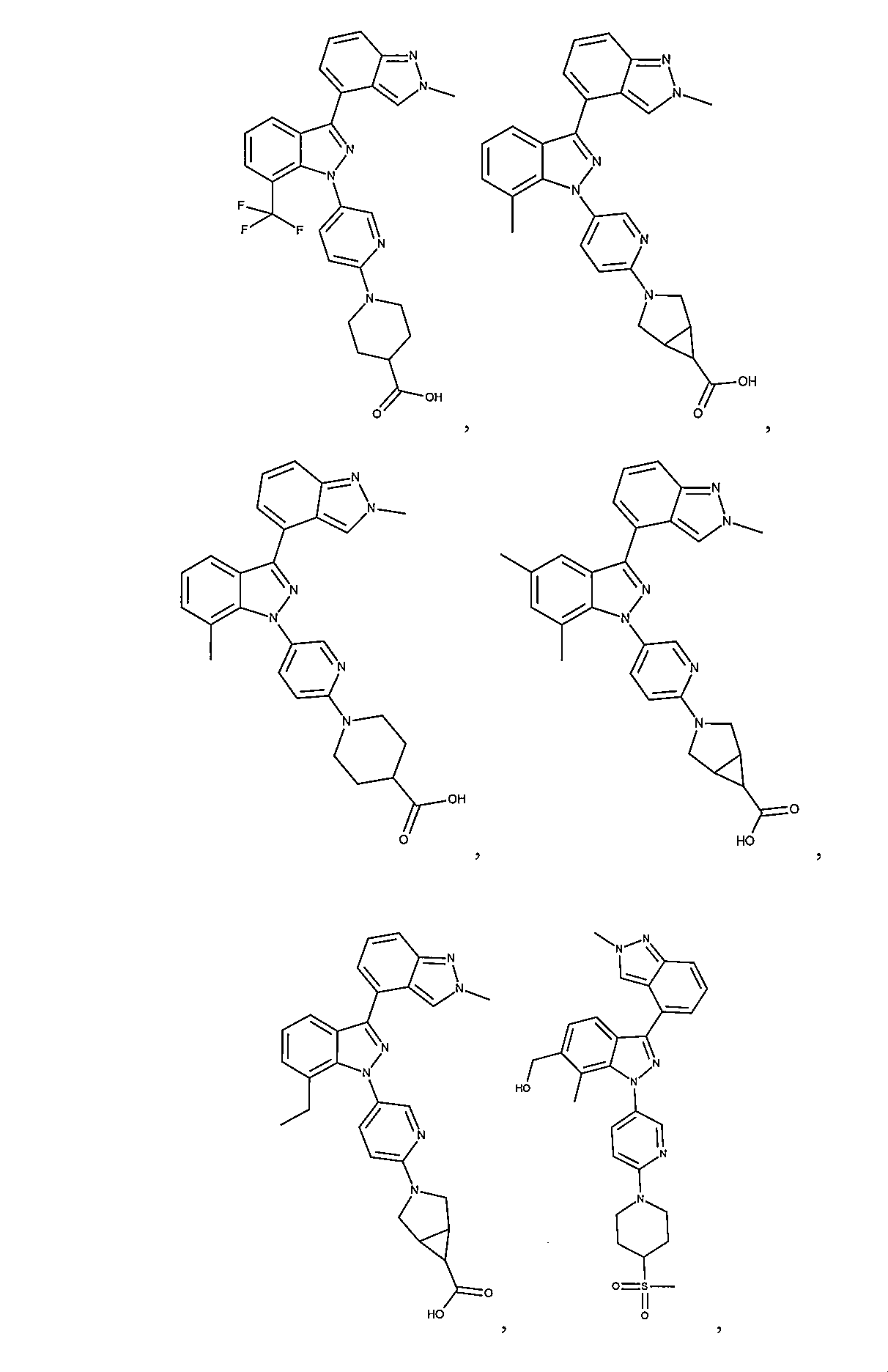


本発明の別の特定の実施形態は、
Another particular embodiment of the present invention comprises


一態様において、本発明は、式(I)の化合物又はその塩に関する。
In one aspect, the present invention relates to a compound of formula (I) or a salt thereof:

式中、式(I)の構造的代表において描かれているように、AはBの一部であり、すなわちBはAを含む。例えば、Aがヘテロ原子であるとき、このヘテロ原子は、BがヘテロシクリルであるときBの唯一のヘテロ原子でありうる。また、例えば、Bがメンバーのある特定の数(例えば、5~7員、6員など)によって定義されたヘテロシクリルである場合、Aは、そのようなメンバーの1員である。また、別の例として、Bが1個のN原子を含む6員の単環式ヘテロシクリルである場合、Aは、このN原子とすることができる。
wherein, as depicted in the structural representation of formula (I), A is a part of B, i.e., B contains A. For example, when A is a heteroatom, this heteroatom can be the only heteroatom of B when B is heterocyclyl. Also, for example, when B is a heterocyclyl defined by a certain number of members (e.g., 5-7 members, 6 members, etc.), A is one such member. And, as another example, when B is a 6-membered monocyclic heterocyclyl containing one N atom, A can be this N atom.
一態様において、本発明は、式(I)の化合物又はその塩(式中、Bは、-C1-4-アルキレン-ピリミジン及び-C1-4-アルキレン-O-C1-3-アルキルの中から選択される基である。ただし、Aが窒素であることを条件とする)に関する。
A、B、D、R1、R2、R3、R4、R5、R5.1、R5.2、R5.3、R6の定義のいずれか及びそれぞれを互いに組み合わせてもよい。
一態様において、本発明は、塩を含まない形態の式(I)の化合物に関する。
一態様において、本発明は、医薬品として使用するための式(I)の化合物又はその薬学的に許容される塩に関する。一態様において、本発明は、炎症、アレルギー若しくは自己免疫疾患、感染症及びがんからなる群の中から選択される疾患の処置において使用するための、又はワクチンアジュバントとして使用するための、式(I)の化合物又はその薬学的に許容される塩に関する。一態様において、本発明は、式(I)の化合物又はその薬学的に許容される塩及び薬学的に許容される担体に関する。一態様において、本発明は、式(I)の化合物又はその薬学的に許容される塩、別の活性物質として細胞静止物質、細胞傷害性物質、細胞増殖阻害物質、抗血管新生物質、ステロイド、ウイルス、免疫原性細胞死誘導物質、がん標的剤、免疫調節剤、抗体及びナノボディからなる群から選択される物質に関する。
In one aspect, the present invention relates to a compound of formula (I) or a salt thereof, wherein B is a group selected from among -Ci -4 -alkylene-pyrimidine and -Ci -4 -alkylene-O-Ci- 3 -alkyl, with the proviso that A is nitrogen.
Any and each of the definitions of A, B, D, R1 , R2 , R3 , R4 , R5 , R5.1 , R5.2 , R5.3 , R6 may be combined with each other.
In one aspect, the present invention relates to compounds of formula (I) in salt-free form.
In one aspect, the present invention relates to a compound of formula (I) or a pharma- ceutically acceptable salt thereof for use as a medicament. In one aspect, the present invention relates to a compound of formula (I) or a pharma- ceutically acceptable salt thereof for use in the treatment of a disease selected from the group consisting of inflammation, allergy or autoimmune diseases, infectious diseases and cancer, or for use as a vaccine adjuvant. In one aspect, the present invention relates to a compound of formula (I) or a pharma- ceutically acceptable salt thereof and a pharma- ceutically acceptable carrier. In one aspect, the present invention relates to a compound of formula (I) or a pharma- ceutically acceptable salt thereof, and, as another active substance, a substance selected from the group consisting of a cytostatic substance, a cytotoxic substance, a cell growth inhibitor, an antiangiogenic substance, a steroid, a virus, an immunogenic cell death inducer, a cancer targeting agent, an immunomodulator, an antibody and a nanobody.
処置方法
本発明の別の態様において、一般式(I)の化合物又はその塩は、STINGの調節が治療上有益である疾患及び/又は状態の予防及び/又は処置に有用でありうることが見出される。さらに、本発明の化合物は、それらの活性のためにワクチンアジュバントとして適している。
STINGに関連した又はSTINGによって調節された疾患及び状態は、炎症、アレルギー若しくは自己免疫疾患、例えばアレルギー性鼻炎若しくは喘息、感染症又はがんを包含するが、これらに限定されない。
Methods of Treatment In another aspect of the present invention, it is found that the compounds of general formula (I) or salts thereof may be useful for the prevention and/or treatment of diseases and/or conditions in which modulation of STING is therapeutically beneficial. Furthermore, the compounds of the present invention are suitable as vaccine adjuvants due to their activity.
Diseases and conditions associated with or modulated by STING include, but are not limited to, inflammatory, allergic or autoimmune diseases, such as allergic rhinitis or asthma, infectious diseases or cancer.
自己免疫疾患には、全身性エリテマトーデス、乾癬、インスリン依存性糖尿病(IDDM)、皮膚筋炎及びシェーグレン症候群(SS)が含まれるが、これらに限定されない。
本発明の化合物を使用して、身体のあらゆる組織及び器官の炎症を処置することができ、それらの炎症には、筋骨格炎症、血管炎症、神経炎症、消化器系炎症、眼炎症、生殖器系炎症、及び他の炎症が含まれるが、これらに限定されない。
Autoimmune diseases include, but are not limited to, systemic lupus erythematosus, psoriasis, insulin-dependent diabetes mellitus (IDDM), dermatomyositis, and Sjogren's syndrome (SS).
The compounds of the present invention can be used to treat inflammation in any tissue or organ of the body, including, but not limited to, musculoskeletal inflammation, vascular inflammation, neuroinflammation, gastrointestinal inflammation, ocular inflammation, reproductive system inflammation, and other inflammation.
本発明の化合物で処置することができる筋骨格炎症の例には、関節炎(例えば、変形性関節症、関節リウマチ、乾癬性関節炎、強直性脊椎炎、急性及び慢性感染性関節炎、痛風及び偽痛風に伴う関節炎、並びに若年性特発性関節炎が含まれる)、腱炎、滑膜炎、腱鞘炎、滑液包炎、結合織炎(線維筋痛)、上顆炎、筋炎、及び骨炎(例えば、パジェット病、恥骨骨炎、及び嚢胞性線維性骨炎が含まれる)が含まれる。本発明の化合物で処置することができる眼炎症の例には、眼瞼炎、眼瞼皮膚弛緩症、結膜炎、涙腺炎、角膜炎、乾性角結膜炎(ドライアイ)、強膜炎、睫毛乱生症、及びブドウ膜炎が含まれる。本発明の化合物で処置することができる神経系の炎症の例には、脳炎、ギランバレー症候群、髄膜炎、ニューロミオトニア、ナルコレプシー、多発性硬化症、脊髄炎及び統合失調症が含まれる。本発明の化合物で処置することができる脈管構造又はリンパ系の炎症の例には、関節硬化症、関節炎、静脈炎、血管炎、及びリンパ管炎が含まれる。本発明の化合物で処置することができる消化器系の炎症状態の例には、胆管炎、胆嚢炎、腸炎(enteritis)、腸炎(enterocolitis)、胃炎、胃腸炎、炎症性腸疾患(クローン病や潰瘍性大腸炎など)、回腸炎、及び直腸炎が含まれる。本発明の化合物で処置することができる生殖器系の炎症状態の例には、子宮頚管炎、絨毛羊膜炎、子宮内膜炎、精巣上体炎、臍炎、卵巣炎、精巣炎、卵管炎、卵管卵巣膿瘍、尿道炎、膣炎、外陰炎、及び外陰部痛が含まれる。 Examples of musculoskeletal inflammation that can be treated with the compounds of the present invention include arthritis (e.g., osteoarthritis, rheumatoid arthritis, psoriatic arthritis, ankylosing spondylitis, acute and chronic infectious arthritis, arthritis associated with gout and pseudogout, and juvenile idiopathic arthritis), tendonitis, synovitis, tenosynovitis, bursitis, fibromyalgia, epicondylitis, myositis, and osteitis (e.g., Paget's disease, osteitis pubis, and osteitis fibrosus cyst). Examples of ocular inflammation that can be treated with the compounds of the present invention include blepharitis, cutis laxa, conjunctivitis, dacryoadenitis, keratitis, keratoconjunctivitis sicca (dry eye), scleritis, trichiasis, and uveitis. Examples of nervous system inflammation that can be treated with the compounds of the present invention include encephalitis, Guillain-Barre syndrome, meningitis, neuromyotonia, narcolepsy, multiple sclerosis, myelitis, and schizophrenia. Examples of inflammation of the vasculature or lymphatic system that can be treated with the compounds of the invention include arthrosclerosis, arthritis, phlebitis, vasculitis, and lymphangitis. Examples of inflammatory conditions of the digestive system that can be treated with the compounds of the invention include cholangitis, cholecystitis, enteritis, enterocolitis, gastritis, gastroenteritis, inflammatory bowel disease (such as Crohn's disease and ulcerative colitis), ileitis, and proctitis. Examples of inflammatory conditions of the reproductive system that can be treated with the compounds of the invention include cervicitis, chorioamnionitis, endometritis, epididymitis, omphalitis, oophoritis, orchitis, salpingitis, tubo-ovarian abscess, urethritis, vaginitis, vulvitis, and vulvodynia.
化合物を使用して、炎症性成分を有する自己免疫状態を処置することができる。そのような状態には、急性播種性汎発型脱毛症、ベーチェット病、シャガス病、慢性疲労症候群、自律神経障害、脳脊髄炎、強直性脊椎炎、再生不良性貧血、化膿性汗腺炎、自己免疫性肝炎、自己免疫性卵巣炎、セリアック病、クローン病、1型糖尿病、巨細胞性動脈炎、グッドパスチャー症候群、グレーブス病、ギランバレー症候群、橋本病、ヘノッホ・シェーンライン紫斑病、川崎病、エリテマトーデス、顕微鏡的大腸炎、顕微鏡的多発動脈炎、混合性結合組織病、多発性硬化症、重症筋無力症、オプソクローヌスミオクローヌス症候群、視神経炎、オルド甲状腺炎、天疱瘡、結節性多発動脈炎、多発性筋肉痛、関節リウマチ、ライター症候群、シェーグレン症候群、側頭動脈炎、ウェゲナー肉芽腫症、温式自己免疫性溶血性貧血、間質性膀胱炎、ライム病、モルヘア、乾癬、サルコイドーシス、強皮症、潰瘍性大腸炎、及び白斑が含まれる。 The compounds can be used to treat autoimmune conditions that have an inflammatory component. Such conditions include acute disseminated alopecia universalis, Behcet's disease, Chagas' disease, chronic fatigue syndrome, autonomic neuropathy, encephalomyelitis, ankylosing spondylitis, aplastic anemia, hidradenitis suppurativa, autoimmune hepatitis, autoimmune oophoritis, celiac disease, Crohn's disease, type 1 diabetes, giant cell arteritis, Goodpasture's syndrome, Graves' disease, Guillain-Barre syndrome, Hashimoto's disease, Henoch-Schönlein purpura, Kawasaki disease, lupus erythematosus, microscopic colonic necrosis factor syndrome, and the like. These include inflammatory bowel disease, microscopic polyarteritis, mixed connective tissue disease, multiple sclerosis, myasthenia gravis, opsoclonus-myoclonus syndrome, optic neuritis, ordothyroiditis, pemphigus, polyarteritis nodosa, polymyalgia, rheumatoid arthritis, Reiter's syndrome, Sjogren's syndrome, temporal arteritis, Wegener's granulomatosis, warm autoimmune hemolytic anemia, interstitial cystitis, Lyme disease, mole hair, psoriasis, sarcoidosis, scleroderma, ulcerative colitis, and vitiligo.
化合物を使用して、炎症性成分を有するT細胞媒介過敏性疾患を処置することができる。そのような状態には、接触過敏症、接触皮膚炎(ツタウルシが原因のものが含まれる)、じんま疹、皮膚アレルギー、呼吸アレルギー(枯草熱、アレルギー性鼻炎)及びグルテン過敏性腸症(セリアック病)が含まれる。 The compounds can be used to treat T cell-mediated hypersensitivity disorders that have an inflammatory component. Such conditions include contact hypersensitivity, contact dermatitis (including that caused by poison ivy), urticaria, skin allergies, respiratory allergies (hay fever, allergic rhinitis) and gluten-sensitive enteropathy (celiac disease).
化合物で処置することができる他の炎症状態には、例えば虫垂炎、皮膚炎、皮膚筋炎、心内膜炎、結合織炎、歯肉炎、舌炎、肝炎、化膿性汗腺炎、虹彩炎、喉頭炎、乳腺炎、心筋炎、腎炎、耳炎、膵炎、耳下腺炎、心外膜炎、腹膜炎、咽頭炎、胸膜炎、肺臓炎、前立腺炎、腎盂腎炎、及び口内炎、移植片拒絶(器官、例えば腎臓、肝臓、心臓、肺臓、膵臓(例えば、膵島細胞)、骨髄、角膜、小腸、皮膚同種移植片(allograft)、皮膚同種移植片(homograft)、及び心臓弁異種移植片、血清病、並びに移植片対宿主病が関与する)、急性膵炎、慢性膵炎、急性呼吸窮迫症候群、セザリー(Sexary)症候群、先天性副腎皮質過形成、非化濃性甲状腺炎、がんに伴う高カルシウム血症、天疱瘡、水疱性疱疹状皮膚炎、重度多形性紅斑、剥離性皮膚炎、脂漏性皮膚炎、季節性又は通年性アレルギー性鼻炎、気管支喘息、接触皮膚炎、アトピー性皮膚炎、薬物過敏症反応、アレルギー性結膜炎、角膜炎、眼部帯状疱疹、虹彩炎及び虹彩毛様体炎(oiridocyclitis)、脈絡網膜炎、視神経炎、症候性サルコイドーシス、電撃性又は播種性肺結核化学療法、成人における特発性血小板減少性紫斑病、成人における続発性血小板減少症、後天性(自己免疫性)溶血性貧血、成人における白血病及びリンパ腫、小児期急性白血病、限局性腸炎、自己免疫性血管炎、多発性硬化症、慢性閉塞性肺疾患、実質器官移植拒絶、敗血症が含まれる。好ましい処置には、移植片拒絶、関節リウマチ、乾癬性関節炎、多発性硬化症、1型糖尿病、喘息、炎症性腸疾患、全身性エリテマトーデス、乾癬、慢性肺疾患、及び感染状態に伴う炎症(例えば、敗血症)の処置が含まれる。 Other inflammatory conditions that can be treated with the compounds include, for example, appendicitis, dermatitis, dermatomyositis, endocarditis, fibromyalgia, gingivitis, glossitis, hepatitis, suppurative hidradenitis, iritis, laryngitis, mastitis, myocarditis, nephritis, otitis, pancreatitis, parotitis, pericarditis, peritonitis, pharyngitis, pleuritis, pneumonitis, prostatitis, pyelonephritis, and stomatitis, transplant rejection (involving organs such as kidney, liver, heart, lung, pancreas (e.g., islet cells), bone marrow, cornea, small intestine, skin allografts, skin homografts, and heart valve xenografts, serum sickness, and graft-versus-host disease), acute pancreatitis, chronic pancreatitis, acute respiratory distress syndrome, Sézary syndrome, congenital adrenal hyperplasia, non-dense thyroiditis, cancer, hypercalcemia associated with chronic obstructive pulmonary disease, pemphigus, bullous dermatitis herpetiformis, severe erythema multiforme, exfoliative dermatitis, seborrheic dermatitis, seasonal or perennial allergic rhinitis, bronchial asthma, contact dermatitis, atopic dermatitis, drug hypersensitivity reactions, allergic conjunctivitis, keratitis, herpes zoster ophthalmicus, iritis and oiridocyclitis, chorioretinitis, optic neuritis, symptomatic sarcoidosis, fulminant or disseminated pulmonary tuberculosis chemotherapy, idiopathic thrombocytopenic purpura in adults, secondary thrombocytopenia in adults, acquired (autoimmune) hemolytic anemia, leukemia and lymphoma in adults, acute childhood leukemia, regional enteritis, autoimmune vasculitis, multiple sclerosis, chronic obstructive pulmonary disease, parenchymal organ transplant rejection, sepsis. Preferred treatments include treatment of transplant rejection, rheumatoid arthritis, psoriatic arthritis, multiple sclerosis, type 1 diabetes, asthma, inflammatory bowel disease, systemic lupus erythematosus, psoriasis, chronic lung disease, and inflammation associated with infectious conditions (e.g., sepsis).
一態様において、本発明の化合物を使用して処置される疾患又は状態はがんである。式(I)の化合物又はその塩若しくは溶媒和物が潜在的に有益な抗腫瘍効果を有することができるがん疾患及び病態の例には、肺臓、骨、膵臓、皮膚、脳、頭部、頚部、子宮、卵巣、胃、結腸、結腸直腸、乳房、食道、小腸、腸、内分泌系、甲状腺、副甲状腺、副腎、尿道、前立腺、陰茎、精巣、尿管、膀胱、腎臓又は肝臓、胆管のがん;尿路上皮がん;直腸がん;肛門部のがん;ファロピウス管、子宮内膜、頸部、腟、陰門、腎盂、腎細胞の癌;肉腫;軟部組織の肉腫;粘液腫;横紋筋腫;線維腫;脂肪腫;奇形腫;胆管癌;肝芽腫;血管肉腫;血管腫(hemagioma);肝癌;線維肉腫;軟骨肉腫;骨髄腫;慢性又は急性白血病;リンパ球性リンパ腫;CNS原発リンパ腫;CNS新生物;脊髄軸腫瘍;扁平上皮癌;滑膜肉腫;悪性胸膜中皮腫;脳幹グリオーマ;下垂体腺腫;気管支腺腫;軟骨性過誤腫(chondromatous hanlartoma);中皮腫;ホジキン病又は上記のがんの1種若しくは複数の組合せが含まれるが、これらに限定されない。 In one embodiment, the disease or condition treated using the compounds of the invention is cancer. Examples of cancer diseases and conditions for which the compounds of formula (I) or salts or solvates thereof may have a potentially beneficial anti-tumor effect include cancer of the lung, bone, pancreas, skin, brain, head, neck, uterus, ovaries, stomach, colon, colorectum, breast, esophagus, small intestine, intestine, endocrine system, thyroid, parathyroid, adrenal gland, urethra, prostate, penis, testes, ureter, bladder, kidney or liver, bile duct; urothelial cancer; rectal cancer; anal cancer; fallopian tube, endometrium, cervix, vagina, vulva, rectum ... These include, but are not limited to, carcinoma of the hilum, renal pelvis, or renal cell; sarcoma; sarcoma of soft tissue; myxoma; rhabdomyoma; fibroma; lipoma; teratoma; cholangiocarcinoma; hepatoblastoma; angiosarcoma; hemangioma; hepatoma; fibrosarcoma; chondrosarcoma; myeloma; chronic or acute leukemia; lymphocytic lymphoma; primary CNS lymphoma; CNS neoplasm; spinal axis tumor; squamous cell carcinoma; synovial sarcoma; malignant pleural mesothelioma; brain stem glioma; pituitary adenoma; bronchial adenoma; chondromatous hanlartoma; mesothelioma; Hodgkin's disease, or a combination of one or more of the above cancers.
本発明による化合物で処置することができる好ましいがんは、皮膚、肺、例えば小細胞肺がん、非小細胞肺がん、肝臓、膵臓、結腸、結腸直腸、脳、乳房、卵巣、前立腺、腎臓、膀胱、胆管、子宮内膜、甲状腺、頸部、胃、頭部、頚部、肉腫、軟部組織の肉腫、食道、頭頚部がん、直腸及び尿路上皮がん、並びにリンパ腫である。
新しい化合物は、上記の疾患の予防、姑息的、根治的又は半根治的、短期又は長期処置のために、手術、放射線治療又は他の「最新」化合物、例えば細胞静止物質若しくは細胞傷害性物質、細胞増殖阻害物質、抗血管新生物質、ステロイド、抗体、ナノボディ、がん標的剤、腫瘍溶解性ウイルスを含むがこれに限定されないウイルス、又は免疫原性細胞死誘導物質などと任意に組み合わせても使用することができる。
新しい化合物は、上記の疾患の予防、姑息的、根治的又は半根治的、短期又は長期処置のために、化合物にとって異なる投与経路、例えば静脈内、腫瘍内、皮下、吸入、経口投与経路などを組み合わせることによって、手術、放射線治療又は他の「最新」化合物、例えば細胞静止物質若しくは細胞傷害性物質、細胞増殖阻害物質、抗血管新生物質、ステロイド、抗体、ナノボディ、がん標的剤、腫瘍溶解性ウイルスを含むがこれらに限定されないウイルス、又は免疫原性細胞死誘導物質などと任意に組み合わせても使用することができる。手術の一例にすぎないものとして、部分又は完全腫瘍切除を本発明の化合物と組み合わせることができる。放射線治療の一例にすぎないものとして、外照射療法を本発明の化合物と組み合わせることができる。
Preferred cancers which may be treated with the compounds according to the invention are skin, lung, e.g. small cell lung cancer, non-small cell lung cancer, liver, pancreas, colon, colorectal, brain, breast, ovarian, prostate, kidney, bladder, bile duct, endometrial, thyroid, cervical, stomach, head, neck, sarcoma, sarcoma of soft tissue, esophagus, head and neck cancer, rectal and urothelial cancer, and lymphoma.
The new compounds can be used in any combination with surgery, radiotherapy or other "modern" compounds such as cytostatic or cytotoxic substances, cell growth inhibitors, anti-angiogenic substances, steroids, antibodies, nanobodies, cancer targeting agents, viruses including but not limited to oncolytic viruses, or immunogenic cell death inducers, for the prevention, palliative, curative or semi-curative, short-term or long-term treatment of the above mentioned diseases.
The new compounds can be used in any combination with surgery, radiation therapy or other "modern" compounds, such as cytostatic or cytotoxic substances, cell growth inhibitors, antiangiogenic substances, steroids, antibodies, nanobodies, cancer targeting agents, viruses, including but not limited to oncolytic viruses, or immunogenic cell death inducers, by combining different administration routes for the compounds, such as intravenous, intratumoral, subcutaneous, inhalation, oral administration routes, for the prevention, palliative, curative or semi-curative, short-term or long-term treatment of the above diseases. As just one example of surgery, partial or complete tumor resection can be combined with the compounds of the present invention. As just one example of radiation therapy, external beam radiation therapy can be combined with the compounds of the present invention.
ある特定の実施形態において、本化合物及び組成物を、アジュバントとしての役割で、ワクチンを使用する治療又は予防的戦略においてアジュバントとして使用することができる。したがって、本発明の化合物又はその塩は、1種又は複数の所定の抗原に対する免疫応答を刺激するように選択される1種又は複数のワクチンと一緒に使用することができる。本発明の化合物又はその塩は、そのようなワクチンと一緒に又はそれらに加えて提供することができる。 In certain embodiments, the compounds and compositions, in their adjuvant role, can be used as adjuvants in therapeutic or prophylactic strategies that use vaccines. Thus, the compounds or salts thereof of the present invention can be used with one or more vaccines selected to stimulate an immune response against one or more predetermined antigens. The compounds or salts thereof of the present invention can be provided with or in addition to such vaccines.
そのようなワクチンは、目的の抗原、精製抗原、抗原を発現及び/又は分泌するように組換え技術によって操作された生ウイルス又は細菌送達ベクター、抗原を負荷された又は抗原をコードする核酸、リポソーム抗原送達ビヒクル、若しくは抗原をコードするネイキッド核酸ベクターを含む組成物をトランスフェクトされた細胞を含む抗原提示細胞(APC)ベクターを含む、不活性化又は弱毒化された細菌又はウイルスを含むことができる。この一覧は、限定するものではない。例として、そのようなワクチンは、GM-CSF、CCL20、CCL3、IL-12p70、FLT-3リガンド、サイトカインの1種又は複数を発現及び分泌する不活性化腫瘍細胞又は腫瘍溶解性ウイルスも含むことができる。
したがって、本発明は、医薬品又はワクチンアジュバントとして使用するための一般式(I)の化合物に関する。
Such vaccines may include inactivated or attenuated bacteria or viruses, including the antigen of interest, purified antigen, live virus or bacterial delivery vectors recombinantly engineered to express and/or secrete the antigen, antigen presenting cell (APC) vectors including cells loaded with the antigen or transfected with compositions including nucleic acids encoding the antigen, liposomal antigen delivery vehicles, or naked nucleic acid vectors encoding the antigen. This list is not limiting. By way of example, such vaccines may also include inactivated tumor cells or oncolytic viruses that express and secrete one or more of the following cytokines: GM-CSF, CCL20, CCL3, IL-12p70, FLT-3 ligand.
Thus, the present invention relates to compounds of general formula (I) for use as a medicament or vaccine adjuvant.
さらなる態様において、本発明は、STINGに関連した又はSTINGによって調節された疾患又は状態の処置方法において使用するための式(I)の新規化合物をその塩を含めて提供する。
さらなる態様において、本発明は、炎症、アレルギー若しくは自己免疫疾患、例えばアレルギー性鼻炎若しくは喘息を処置するための、感染症若しくはがんを処置するため、又はワクチンアジュバントとして使用するための式(I)の新規化合物又はその塩を提供する。
In a further aspect, the present invention provides novel compounds of formula (I), including salts thereof, for use in a method of treatment of a disease or condition associated with or modulated by STING.
In a further aspect, the present invention provides novel compounds of formula (I) or salts thereof for treating inflammatory, allergic or autoimmune diseases, such as allergic rhinitis or asthma, for treating infectious diseases or cancer, or for use as a vaccine adjuvant.
さらに、本発明は、STINGに関連した又はSTINGによって調節された疾患及び/又は状態を処置及び/又は予防するための一般式(I)の化合物の使用に関する。STINGに関連した又はSTINGによって調節された疾患及び病態には、炎症、アレルギー又は自己免疫疾患、例えばアレルギー性鼻炎又は喘息、感染症又はがんが含まれるが、これらに限定されず、以上に記載された具体的な疾患を含むがそれらに限定されない。さらに、本発明の化合物は、それらの活性のためにワクチンアジュバントとして適しており、以上に記載された具体的な適用を含むが、これらに限定されない。
したがって、本発明は、医薬品又はワクチンアジュバントとして使用するための一般式(I)の化合物に関する。
さらに、本発明は、上記の疾患及び病態を処置及び/又は予防するための一般式(I)の化合物の使用に関する。
Furthermore, the present invention relates to the use of compounds of general formula (I) for treating and/or preventing diseases and/or conditions associated with or regulated by STING. Diseases and conditions associated with or regulated by STING include, but are not limited to, inflammatory, allergic or autoimmune diseases, such as allergic rhinitis or asthma, infectious diseases or cancer, including but not limited to the specific diseases described above. Furthermore, the compounds of the present invention are suitable as vaccine adjuvants due to their activity, including but not limited to the specific applications described above.
Thus, the present invention relates to compounds of general formula (I) for use as a medicament or vaccine adjuvant.
Furthermore, the present invention relates to the use of the compounds of general formula (I) for treating and/or preventing the abovementioned diseases and pathologies.
さらなる態様において、本発明は、上記の疾患及び病態の処置及び/又は予防において使用するための一般式(I)の化合物に関する。
さらなる態様において、本発明は、上記のがんの処置及び/又は予防において腫瘍切除及び/又は放射線治療の前又は後に使用するための一般式(I)の化合物に関する。
さらなる態様において、本発明は、上記の疾患及び病態の処置及び/又は予防のための医薬品を調製するための一般式(I)の化合物の使用に関する。
さらなる態様において、本発明は、上記の疾患及び病態を処置又は予防する方法であって、有効量の一般式(I)の化合物をヒトに投与するステップを含む方法に関する。
1日当たり適用可能な一般式(I)の化合物の投与量範囲は、患者の体重1kg当たり通常0.00001~100mg、例えば体重1kg当たり0.00001~10mgである。各投与単位は、好都合に0.001~1000mg、例えば0.001~100mgを含むことができる。
実際の治療有効量又は治療用量は、当然、患者の年齢及び体重、投与経路、並びに疾患の重症度など、当業者によって公知の因子に依存する。いずれの場合も、化合物又は組成物は、用量で、且つ患者の独自の状態に基づいて治療有効量を送達することが可能になる形で投与される。
関連した態様において、本発明は、個体における免疫応答を誘導し、刺激し、又はアジュバントする方法に関する。これらの方法は、本発明の化合物を個体に投与するステップを含む。
In a further aspect, the present invention relates to the compounds of general formula (I) for use in the treatment and/or prevention of the abovementioned diseases and pathologies.
In a further aspect, the present invention relates to compounds of general formula (I) for use before or after tumor resection and/or radiotherapy in the treatment and/or prevention of the abovementioned cancers.
In a further aspect, the present invention relates to the use of compounds of general formula (I) for preparing a medicinal product for the treatment and/or prevention of the abovementioned diseases and pathologies.
In a further aspect, the present invention relates to a method for treating or preventing the above mentioned diseases and conditions, comprising the step of administering to a human an effective amount of a compound of general formula (I).
The applicable daily dosage range of the compound of general formula (I) is usually 0.00001-100 mg per kg of patient body weight, for example 0.00001-10 mg per kg of body weight. Each dosage unit may conveniently contain 0.001-1000 mg, for example 0.001-100 mg.
The actual therapeutically effective amount or therapeutic dose will, of course, depend on factors known by those skilled in the art, such as the age and weight of the patient, the route of administration, and the severity of the disease. In any case, the compound or composition will be administered in a dose and in a manner that allows for the delivery of a therapeutically effective amount based on the patient's unique condition.
In a related aspect, the invention relates to methods of inducing, stimulating or adjuvanting an immune response in an individual, the methods comprising the step of administering to the individual a compound of the invention.
さらなる態様において、本発明は、疾患の処置又は予防のための抗原又は抗原組成物を含む免疫原性組成物を製造するための一般式(I)の化合物の使用を提供する。
さらなる態様において、本発明は、疾患を処置又は予防する方法であって、疾患に苦しむ又はなりやすいヒト対象に、抗原又は抗原組成物及び一般式(I)の化合物を含む免疫原性組成物を投与するステップを含む方法を提供する。
さらなる態様において、本発明は、疾患の処置又は予防において使用するための抗原又は抗原組成物及び一般式(I)の化合物を含むワクチン組成物を提供する。
さらなる態様において、本発明は、疾患の処置又は予防のための抗原又は抗原組成物を含むワクチン組成物を製造するための一般式(I)の化合物の使用を提供する。
さらなる態様において、本発明は、疾患を処置又は予防する方法であって、疾患に苦しむ又はなりやすいヒト対象に、抗原又は抗原組成物及び一般式(I)の化合物を含むワクチン組成物を投与するステップを含む方法を提供する。
In a further aspect, the present invention provides the use of a compound of general formula (I) for the preparation of an immunogenic composition comprising an antigen or antigenic composition for the treatment or prevention of a disease.
In a further aspect, the present invention provides a method of treating or preventing a disease comprising the step of administering to a human subject suffering from or susceptible to the disease an immunogenic composition comprising an antigen or antigenic composition and a compound of general formula (I).
In a further aspect, the present invention provides a vaccine composition comprising an antigen or antigenic composition and a compound of general formula (I) for use in the treatment or prevention of disease.
In a further aspect, the present invention provides the use of a compound of general formula (I) for the manufacture of a vaccine composition comprising an antigen or an antigenic composition for the treatment or prevention of a disease.
In a further aspect, the present invention provides a method of treating or preventing a disease comprising the step of administering to a human subject suffering from or susceptible to the disease a vaccine composition comprising an antigen or antigenic composition and a compound of general formula (I).
医薬組成物
本発明の別の態様において、治療有効量の上記化合物の投与に適した前記化合物の医薬組成物を製剤化できることが見出される。式(I)の化合物を投与するのに適した調製物は当業者に明らかであり、例えば錠剤、丸剤、カプセル、坐剤、ロゼンジ、トローチ、内用液剤、シロップ、エリキシル、サシェ、注射液剤(皮下、静脈内、筋肉内、腹腔内、腫瘍内及び腫瘍周囲)、吸入剤、注入剤、エリキシル、乳剤、及び散剤が含まれる。さらに、本発明による化合物は、標的送達プラットフォームを介して投与することができ、例えばそのような標的送達プラットフォームは、抗体-薬物コンジュゲート、ナノボディ-薬物コンジュゲート、ペプチド-薬物コンジュゲート、ウイルス様粒子、又はナノ粒子製剤とすることができる。
Pharmaceutical Compositions In another aspect of the present invention, it is found that pharmaceutical compositions of said compounds can be formulated suitable for administration of a therapeutically effective amount of said compounds. Suitable preparations for administration of the compounds of formula (I) will be apparent to those skilled in the art and include, for example, tablets, pills, capsules, suppositories, lozenges, troches, oral solutions, syrups, elixirs, sachets, injectable solutions (subcutaneous, intravenous, intramuscular, intraperitoneal, intratumoral and peritumor), inhalants, infusions, elixirs, emulsions, and powders. Furthermore, the compounds according to the present invention can be administered via targeted delivery platforms, for example such targeted delivery platforms can be antibody-drug conjugates, nanobody-drug conjugates, peptide-drug conjugates, virus-like particles, or nanoparticle formulations.
好適な錠剤は、例えば式Iの1種又は複数の化合物を公知の賦形剤、例えば不活性な希釈剤、担体、崩壊剤、アジュバント、界面活性剤、結合剤及び/又は滑沢剤と混合することによって得ることができる。
本開示の目的としては、医薬組成物は、薬学的に許容される担体、アジュバント及びビヒクルを含む製剤として、経口、非経口、吸入噴霧、局所、経鼻、経口、又は直腸内投与を含めてさまざまな手段によって投与することができる。本開示の医薬組成物は、注射可能な無菌水性又は油性懸濁剤など注射可能な無菌調製物の形で投与することができる。
別の実施形態によれば、一般式(I)の1種又は複数の化合物を含むワクチンが提供される。さらなる態様において、本発明は、一般式(I)の化合物を含むワクチンアジュバントを提供する。さらなる態様において、本発明は、抗原又は抗原組成物及び一般式(I)の化合物を含む免疫原性組成物を提供する。
さらなる態様において、本発明は、疾患の処置又は予防において使用するための抗原又は抗原組成物及び一般式(I)の化合物を含む免疫原性組成物を提供する。
Suitable tablets can be obtained, for example, by mixing one or more compounds of formula I with known excipients, such as inert diluents, carriers, disintegrants, adjuvants, surfactants, binders and/or lubricants.
For purposes of this disclosure, pharmaceutical compositions can be administered by a variety of means, including oral, parenteral, inhalation spray, topical, nasal, oral, or rectal administration, as formulations containing pharma- ceutical acceptable carriers, adjuvants, and vehicles. Pharmaceutical compositions of the present disclosure can be administered in the form of injectable sterile preparations, such as injectable sterile aqueous or oleaginous suspensions.
According to another embodiment there is provided a vaccine comprising one or more compounds of general formula (I).In a further aspect the invention provides a vaccine adjuvant comprising a compound of general formula (I).In a further aspect the invention provides an immunogenic composition comprising an antigen or antigenic composition and a compound of general formula (I).
In a further aspect, the present invention provides an immunogenic composition comprising an antigen or antigenic composition and a compound of general formula (I) for use in the treatment or prevention of disease.
組合せ療法
本発明の化合物は単独で使用することができ、又は適切な免疫応答を誘導し、改変し、若しくは刺激するのに十分な量の薬学的に許容される賦形剤と組み合わせることができる。免疫応答は、特異的免疫応答、非特異的免疫応答、特異的応答と非特異的応答の両方、生得的応答、一次免疫応答、適応免疫、二次免疫応答、記憶免疫応答、免疫細胞活性化、免疫細胞増殖、免疫細胞分化、及びサイトカイン発現を含むことができるが、これらに限定されない。
ある特定の実施形態において、本明細書に記載された化合物及びそれらの組成物は、1種又は複数の所定の抗原に対する免疫応答を刺激するように意図されたワクチン;アジュバント;CTLA-4及びPD-1経路アンタゴニスト、脂質、リポソーム、化学療法剤、免疫調節性細胞株、がん標的剤、免疫原性細胞死誘導物質、免疫調節剤などを含む1種又は複数の追加の組成物と併せて投与され、免疫調節剤が、一般に全般的活性化-調節型の作用剤並びにある特定の免疫細胞サブタイプの頻度を調節及び/又は増加させる作用剤であると理解されうる。
Combination Therapy The compounds of the present invention can be used alone or can be combined with a pharma- ceutically acceptable excipient in an amount sufficient to induce, modify, or stimulate an appropriate immune response, which can include, but is not limited to, specific immune responses, non-specific immune responses, both specific and non-specific responses, innate responses, primary immune responses, adaptive immunity, secondary immune responses, memory immune responses, immune cell activation, immune cell proliferation, immune cell differentiation, and cytokine expression.
In certain embodiments, the compounds described herein and compositions thereof are administered in conjunction with one or more additional compositions including vaccines intended to stimulate an immune response to one or more predetermined antigens; adjuvants; CTLA-4 and PD-1 pathway antagonists, lipids, liposomes, chemotherapeutic agents, immunomodulatory cell lines, cancer targeting agents, immunogenic cell death inducers, immunomodulatory agents, etc., which may be understood to be general activation-modulatory agents in general as well as agents that modulate and/or increase the frequency of certain immune cell subtypes.
本明細書に記載された化合物及びそれらの組成物は、追加の治療若しくは予防的組成物又は治療若しくは予防的モダリティの前、後、及び/又はそれと同時に投与することができる。
本発明による化合物、組成物は1種又は複数の追加の治療剤とのあらゆる組合せを含めて、粘膜(例えば、経口、舌下、腟内、経鼻、頸部など)、腫瘍内、腹腔内、腫瘍周囲、経皮、吸入、又は非経口(例えば、皮下、静脈内、筋肉内、動脈内、皮内、髄腔内及び硬膜外投与)経路によって投与することができる。
さらに、本発明による化合物、組成物は1種又は複数の追加の治療剤とのあらゆる組合せを含めて、標的送達プラットフォームを介して投与することができ、例えばそのような標的送達プラットフォームは、抗体-薬物コンジュゲート、ナノボディ-薬物コンジュゲート、ペプチド-薬物コンジュゲート、ウイルス様粒子、又はナノ粒子とすることができる。
The compounds described herein and compositions thereof can be administered before, after, and/or simultaneously with additional therapeutic or prophylactic compositions or therapeutic or prophylactic modalities.
The compounds, compositions according to the present invention, including any combination with one or more additional therapeutic agents, can be administered by mucosal (e.g., oral, sublingual, intravaginal, nasal, cervical, etc.), intratumoral, intraperitoneal, peritumor, transdermal, inhalation, or parenteral (e.g., subcutaneous, intravenous, intramuscular, intraarterial, intradermal, intrathecal, and epidural administration) routes.
Furthermore, the compounds, compositions according to the present invention, including any combination with one or more additional therapeutic agents, can be administered via a targeted delivery platform, for example, such a targeted delivery platform can be an antibody-drug conjugate, a nanobody-drug conjugate, a peptide-drug conjugate, a virus-like particle, or a nanoparticle.
考えられる投与方法のうち、腹腔内、腫瘍内、腫瘍周囲、皮下、吸入又は静脈内投与が好ましい。本発明による化合物、組成物は1種又は複数の追加の治療剤とのあらゆる組合せを含めて、異なる投与方法の組合せによって前、後、及び/又は同時に投与することもできる。単に例として、吸入又は静脈内投与に続いて、腫瘍内若しくは腫瘍周囲投与を行ってもよく、又は腫瘍内若しくは腫瘍周囲投与に続いて、吸入又は静脈内投与を行ってもよい。追加的に、化合物のそのような異なる経路を介した投与は、腫瘍切除又は放射線治療など追加の治療ステップの前又は後に行ってもよい。単に例として、本発明の化合物は、放射線治療後に投与することができる。さらに、本発明の化合物は、放射線治療後に静脈内投与によって与えることができる。さらに、本発明の化合物は、腫瘍切除後に静脈内投与によって与えることができる。さらに、本発明の化合物は、放射線治療後に腫瘍内投与によって与えることができる。さらに、本発明の化合物は、放射線治療後に腫瘍周囲投与によって与えることができる。さらに、本発明の化合物は、腫瘍切除後に吸入投与によって与えることができる。さらに、本発明の化合物は、静脈内投与、次に腫瘍内投与を行うことによって与えることができ、両投与は放射線治療後に行われる。さらに、本発明の化合物は、腫瘍内投与、次に静脈内投与を行うことによって与えることができ、両投与は放射線治療後に行われる。さらに、本発明の化合物は、静脈内投与、次に腫瘍周囲投与を行うことによって与えることができ、両投与は放射線治療後に行われる。さらに、本発明の化合物は、腫瘍周囲投与、次に静脈内投与を行うことによって与えることができ、両投与は放射線治療後に行われる。 Among the possible administration methods, intraperitoneal, intratumoral, peritumoral, subcutaneous, inhalation or intravenous administration are preferred. The compounds, compositions according to the invention can also be administered before, after and/or simultaneously by a combination of different administration methods, including any combination with one or more additional therapeutic agents. By way of example only, inhalation or intravenous administration can be followed by intratumoral or peritumoral administration, or intratumoral or peritumoral administration can be followed by inhalation or intravenous administration. Additionally, administration of the compounds via such different routes can be performed before or after additional therapeutic steps, such as tumor resection or radiation therapy. By way of example only, the compounds of the invention can be administered after radiation therapy. Furthermore, the compounds of the invention can be given by intravenous administration after radiation therapy. Furthermore, the compounds of the invention can be given by intratumoral administration after tumor resection. Furthermore, the compounds of the invention can be given by peritumoral administration after radiation therapy. Furthermore, the compounds of the invention can be given by inhalation administration after tumor resection. Furthermore, the compounds of the invention can be given by intravenous administration followed by intratumoral administration, both administrations being performed after radiation therapy. Additionally, the compounds of the present invention can be administered intratumorally and then intravenously, both of which are administered after radiation therapy. Additionally, the compounds of the present invention can be administered intravenously and then peritumoral, both of which are administered after radiation therapy. Additionally, the compounds of the present invention can be administered peritumorally and then intravenously, both of which are administered after radiation therapy.
追加の治療剤との共投与方法は、当技術分野において周知である。
本発明の化合物のアジュバント特性のため、それらの使用は、他のワクチン、アジュバント、抗原、抗体、及び免疫調節物質を含めて他の治療モダリティと組み合わせることもできる。
本明細書に記載された本発明の化合物及びそれらの組成物に加えて、本発明の組成物又は方法は、1種又は複数の追加の物質をさらに含んでもよく、追加の物質は、それらの性質のため、免疫系を刺激又はその他の方法で利用するように働いて、標的とされる腫瘍細胞に存在するがん抗原に応答することができる。
Methods for co-administration with additional therapeutic agents are well known in the art.
Because of the adjuvant properties of the compounds of the invention, their use may also be combined with other therapeutic modalities, including other vaccines, adjuvants, antigens, antibodies, and immunomodulators.
In addition to the compounds of the invention and compositions thereof described herein, the compositions or methods of the invention may further comprise one or more additional substances which, by their nature, can act to stimulate or otherwise harness the immune system to respond to cancer antigens present on targeted tumor cells.
本発明の化合物は、CTLA-4経路アンタゴニスト、PD-1経路アンタゴニスト、Tim-3経路アンタゴニスト、Vista経路アンタゴニスト、BTLA経路アンタゴニスト、LAG-3経路アンタゴニスト、又はTIGIT経路アンタゴニストからなる群から選択される免疫チェックポイント阻害物質など免疫チェックポイント阻害物質との組合せで使用することができる。
本発明の化合物は、がん免疫アゴニストとの組合せ、T-細胞受容体アゴニストとの組合せ、又はTNF受容体スーパーファミリーアゴニスト若しくはアンタゴニストとの組合せで使用することができる。
The compounds of the invention can be used in combination with an immune checkpoint inhibitor, such as an immune checkpoint inhibitor selected from the group consisting of a CTLA-4 pathway antagonist, a PD-1 pathway antagonist, a Tim-3 pathway antagonist, a Vista pathway antagonist, a BTLA pathway antagonist, a LAG-3 pathway antagonist, or a TIGIT pathway antagonist.
The compounds of the invention can be used in combination with cancer immunoagonists, in combination with T-cell receptor agonists, or in combination with TNF receptor superfamily agonists or antagonists.
本発明の化合物は、治療抗体又は治療ナノボディとの組合せで使用することができる。一部の実施形態において、治療抗体の作用機序は、抗体依存性細胞傷害(ADCC)である。 The compounds of the invention can be used in combination with a therapeutic antibody or a therapeutic nanobody. In some embodiments, the mechanism of action of the therapeutic antibody is antibody-dependent cellular cytotoxicity (ADCC).
本明細書に記載された方法の追加の実施形態において、本発明の化合物は、当業者に公知の化学療法剤(例えば、低分子医薬化合物)との組合せで使用される。したがって、方法は、対象に有効量の1種又は複数の化学療法剤を追加処置又は組合せ処置として投与するステップをさらに含む。
式(I)の化合物若しくはその薬学的に許容される塩(化合物(I)の個々の実施形態又は一般的サブセットをすべて含む)と一緒に/組合せで、又は本明細書に(以上及び以下で)開示された医学的使用、使用、処置及び/若しくは予防方法において使用することもできる追加の薬理活性物質には、ホルモン、ホルモン類似体及び抗ホルモン(例えば、タモキシフェン、トレミフェン、ラロキシフェン、フルベストラント、酢酸メゲストロール、フルタミド、ニルタミド、ビカルタミド、アミノグルテチミド、酢酸シプロテロン、フィナステリド、酢酸ブセレリン、フルドロコルチゾン、フルオキシメステロン、メドロキシプロゲステロン、オクトレオチド);アロマターゼ阻害物質(例えば、アナストロゾール、レトロゾール、リアロゾール、ボロゾール、エキセメスタン、アタメスタン);LHRHアゴニスト及びアンタゴニスト(例えば、酢酸ゴセレリン、リュープロリド(luprolide));増殖因子及び/又はそれらの対応する受容体の阻害物質(増殖因子は、例えば血小板由来増殖因子(PDGF)、繊維芽細胞増殖因子(FGF)、血管内皮増殖因子(VEGF)、上皮増殖因子(EGF)、インスリン様増殖因子(IGF)、ヒト上皮増殖因子(HER、例えばHER2、HER3、HER4))及び/又はそれらの対応する受容体であり、阻害物質は、例えば(抗)増殖因子抗体、(抗)増殖因子受容体抗体、及びチロシンキナーゼ阻害物質であり、例えばアファチニブ、ダコミチニブ、カネルチニブ、ネラチニブ、アビチニブ、ポジオチニブ、AV 412、PF-6274484、HKI 357、オルムチニブ、オシメルチニブ、アルモネルチニブ、ナザルチニブ、ラゼルチニブ、ペリチニブ、エルロチニブ、ゲフィチニブ、イコチニブ、サピチニブ、ラパチニブ、バルリチニブ、バンデタニブ、TAK-285、AEE788、BMS599626/AC-480、GW 583340、ネシツムマブ、パニツムマブ、セツキシマブ、アミバンタマブ(amivantanab)、ペルツズマブ、トラスツズマブ、トラスツズマブエムタンシンなど、又は変異EGFR、エクソン20変異を有するHER2、及び肝細胞増殖因子(HGF)/c-METの阻害物質、例えばエミベツズマブ、アミバンタマブ、サボリチニブ、カボザンチニブ、フォレチニブである);代謝拮抗物質(例えば、メトトレキセート、ラルチトレキセド、5-フルオロウラシル(5-FU)、カペシタビン、フロクスウリジン、ゲムシタビン、メルカプトプリン、チオグアニン、クラドリビン、ペントスタチン、シタラビン(ara C)、フルダラビン、トリフルリジン及びチピラシルの組合せ(=TAS102)); 抗腫瘍性抗生物質(例えば、ドキソルビシン、ドキシル(PEG化リポソームドキソルビシン塩酸塩)、マイオセット(非PEG化リポソームドキソルビシン)、ダウノルビシン、エピルビシン及びイダルビシンなどのアントラサイクリン、マイトマイシン-C、ブレオマイシン、ダクチノマイシン、プリカマイシン、ストレプトゾシン);白金誘導体(例えば、シスプラチン、オキサリプラチン、カルボプラチン);アルキル化剤(例えば、エストラムスチン、メクロレタミン(meclorethamine)、メルファラン、クロラムブシル、ブスルファン、ダカルバジン、シクロホスファミド、イホスファミド、テモゾロミド、ニトロソウレア、例えばカルムスチンやロムスチンなど、チオテパ);有糸分裂阻害剤(例えば、ビンカアルカロイド、例えばビンブラスチン、ビンデシン、ビノレルビン及びビンクリスチン;及びパクリタキセル、ドセタキセル、nab-パクリタキセル(アブラキサン)などのタキサン);血管新生阻害物質(例えば、タスキニモド、ベバシズマブ)、チューブリン阻害物質;DNA合成阻害物質、PARP阻害物質、トポイソメラーゼ阻害物質(例えば、エピポドフィロトキシン、例えばエトポシドやエトポホスなど、テニポシド、アムサクリン、トポテカン、イリノテカン、ミトキサントロン);セリン/トレオニンキナーゼ阻害物質(例えば、PDK 1阻害物質、Raf阻害物質、A-Raf阻害物質、B-Raf阻害物質、C-Raf阻害物質、mTOR阻害物質(例えば、ラパマイシン、テムシロリムス、エベロリムス、リダホロリムス、ゾタロリムス、サパニセルチブ、トリン1、ダクトリシブ(dactosilib)、GDC-0349、vs-5584;ビスツセルチブ;AZD8055)、mTORC1/2阻害物質、PI3K阻害物質、PI3Kα阻害物質(例えば、アルペリシブ、セラベリシブ、GDC-0077、HH-CYH33、AMG 511、ブパルリシブ、ダクトリシブ、ピクチリシブ、タセリシブ)、二重mTOR/PI3K阻害物質、STK 33阻害物質、AKT阻害物質、PLK 1阻害物質、CDK4/6の阻害物質(例えば、パルボシクリブ、リボシクリブ、アベマシクリブ、トリラシクリブ、PF-06873600)、オーロラキナーゼ阻害物質);チロシンキナーゼ阻害物質(例えば、PTK2/FAK阻害物質);タンパク質間相互作用阻害物質(例えば、IAP阻害物質/SMAC模倣物、MCL-1(例えば、AZD-5991、AMG-176、AMG-397、S64315、S63845、A-1210477)、MDM2、MDM2/MDMX);MEK阻害物質(例えば、トラメチニブ、コビメチニブ、ビニメチニブ、セルメチニブ、レファメチニブ);SOS1-阻害物質(すなわち、SOS1のGEF官能性を、例えばSOS1に結合し、SOS1と(変異)Rasタンパク質、例えばKRASとの間のタンパク質間相互作用を妨げることによって調節/阻害する化合物;例えばBAY-293)、GDP負荷又はGTP負荷RAS及び/又はそのあらゆる変異体の阻害物質(すなわち、(変異)RASタンパク質の官能性を、例えばGDP負荷又はGTP負荷(変異)RASタンパク質、例えばKRAS、NRAS及び/又はHRAS、好ましくはKRASに結合することによって調節/阻害する化合物);KRAS G12Cの不可逆的阻害物質(AMG-510、MRTX849、ARS-324、GDC-6036);GDP負荷(変異)KRASへの可逆的又は不可逆的結合剤;GTP負荷(変異)KRASへの可逆的又は不可逆的結合剤;ALK阻害物質(例えば、クリゾチニブ、アレクチニブ、エントレクチニブ、ブリガチニブ、セリチニブ);ERK阻害物質;FLT3阻害物質;BRD4阻害物質;IGF-1R阻害物質;TRAILR2アゴニスト;Bcl-xL阻害物質;Bcl-2阻害物質(例えば、ベネトクラクス、オバトクラックス、ナビトクラックス、オブリマーセン);Bcl-2/Bcl-xL阻害物質;ErbB受容体阻害物質;BCR-ABL阻害物質;ABL阻害物質;Src阻害物質(例えば、ダサチニブ、ポナチニブ、ボスチニブ、バンデタニブ、KX-01、サラカチニブ、KX2-391、SU 6656、WH-4-023);ラパマイシン類似体(例えば、エベロリムス、テムシロリムス、リダホロリムス、シロリムス);アンドロゲン合成阻害物質;アンドロゲン受容体阻害物質;DNMT阻害物質;HDAC阻害物質;ANG1/2阻害物質;ヒストンデアセチラーゼ阻害物質;IL6の阻害物質;JAK及び/又はそのあらゆる変異体の阻害物質;A-Raf及び/若しくはB-Raf及び/若しくはC-Raf並びに/又はそれらのあらゆる変異体の阻害物質(エンコラフェニブ、ダブラフェニブ、ベムラフェニブ、PLX-8394、RAF-709(=国際公開第2014/151616号の実施例131)、LXH254、ソラフェニブ、LY-3009120(=国際公開第2013/134243号の実施例1)、リフィラフェニブ、TAK-632、アゲラフェニブ、CCT196969、RO5126766、RAF265);受容体チロシンキナーゼ(RTK)及び/又はそのあらゆる変異体の阻害物質;SHP2及び/又はそのあらゆる変異体の阻害物質(例えば、SHP099、TNO155、RMC-4550、RMC-4630、IACS-13909);CYP17阻害物質;放射性医薬品;プロテアソーム阻害物質(例えば、カルフィルゾミブ);免疫チェックポイント阻害物質などの免疫療法剤(例えば、CTLA4、PD1、PD-L1、PD-L2、LAG3、SIRPα抗体、及びTIM3結合分子/免疫グロブリン(イピリムマブ、ニボルマブ、ペンブロリズマブ、チスレリズマブ、アテゾリズマブ、アベルマブ、デュルバルマブ、ピディリズマブ、PDR-001(=スパルタリズマブ)、AMG-404、エザベンリマブ、シンチリマブ、カムレリズマブ、トリパリマブ(toribalimab)、チスレリズマブ);ADCC(抗体依存性細胞傷害)エンハンサー(例えば、抗CD33抗体、抗CD37抗体、抗CD20抗体);T細胞エンゲージャー、例えばPSMA×CD3、B7H6/CD3(例えば、国際公開第2021/064137号に開示)、DLL3/CD3(例えば、国際公開第2019/234220に開示)、例えば二重特異性T細胞エンゲージャー(例えばCD3×BCMA、CD3×CD33、CD3×CD19のようなBiTE(登録商標))、がんワクチン、MDM2-阻害物質、腫瘍溶解性ウイルス、並びにアミフォスチン、アナグレリド、クロドロナト、フィルグラスチム(filgrastin)、インターフェロン、インターフェロンα、ロイコボリン、プロカルバジン、レバミソール、メスナ、ミトタン、パミドロネート及びポルフィマーなどのさまざまな化学療法剤が含まれるが、これらに限定されない。本発明の化合物は、OX40アゴニスト、ICOS-リガンド、CD27アゴニスト、GITRアゴニスト、Toll様受容体アゴニストとの組合せで使用することができる。
In additional embodiments of the methods described herein, the compounds of the invention are used in combination with chemotherapeutic agents known to those of skill in the art (e.g., small molecule pharmaceutical compounds), and thus the methods further comprise administering to the subject an effective amount of one or more chemotherapeutic agents as an additional or combination treatment.
Additional pharmacologically active substances that may also be used together/in combination with the compounds of formula (I) or pharma- ceutically acceptable salts thereof (including any individual embodiment or general subset of compound (I)), or in the medical uses, methods of use, treatment and/or prophylaxis disclosed herein (above and below), include hormones, hormone analogs and antihormones (e.g., tamoxifen, toremifene, raloxifene, fulvestrant, megestrol acetate, flutamide, nilutamide, bicalutamide, aminoglutethimide, cyproterone acetate, finasteride, buserelin acetate, fludrocortisone, fluoxymesterone, medroxyprogesterone, octreotide); aromatase inhibitors (e.g., anastrozole, letrozole, lia ... zole, vorozole, exemestane, atamestane); LHRH agonists and antagonists (e.g. goserelin acetate, luprolide); inhibitors of growth factors and/or their corresponding receptors (growth factors are e.g. platelet derived growth factor (PDGF), fibroblast growth factor (FGF), vascular endothelial growth factor (VEGF), epidermal growth factor (EGF), insulin-like growth factor (IGF), human epidermal growth factor (HER, e.g. HER2, HER3, HER4)) and/or their corresponding receptors, inhibitors are e.g. (anti)growth factor antibodies, (anti)growth factor receptor antibodies, and tyrosine kinase inhibitors, e.g. afatinib, dacomitinib, canertinib, neratinib, avitinib, poziotinib, AV 412, PF-6274484, HKI 357, olmutinib, osimertinib, almonertinib, nazartinib, lazertinib, pelitinib, erlotinib, gefitinib, icotinib, sapitinib, lapatinib, varlitinib, vandetanib, TAK-285, AEE788, BMS599626/AC-480, GW 583340, necitumumab, panitumumab, cetuximab, amivantanab, pertuzumab, trastuzumab, trastuzumab emtansine, or inhibitors of mutated EGFR, HER2 with exon 20 mutations, and hepatocyte growth factor (HGF)/c-MET, such as emibetuzumab, amivantamab, savolitinib, cabozantinib, foretinib; antimetabolites (e.g. methotrexate, raltitrexed, 5-fluorouracil (5-FU), capecitabine, floxuridine, gemcitabine, mercaptopurine, thioguanine, cladribine, pentostatin, cytarabine (ara C), fludarabine, trifluridine and tipiracil in combination (=TAS102); Antitumor antibiotics (e.g., doxorubicin, Doxil (PEGylated liposomal doxorubicin hydrochloride), Myoset (non-PEGylated liposomal doxorubicin), anthracyclines such as daunorubicin, epirubicin and idarubicin, mitomycin-C, bleomycin, dactinomycin, plicamycin, streptozocin); platinum derivatives (e.g., cisplatin, oxaliplatin, carboplatin); alkylating agents (e.g., estramustine, meclorethamine, melphalan, chlorambucil, busulfan, dacarbazine, cyclophosphamide, ifosfamide, temozolomide, nitrosamine, rheumatoid arthritis drugs (e.g., rheumatoid arthritis drugs, such as ... 1 inhibitors, Raf inhibitors, A-Raf inhibitors, B-Raf inhibitors, C-Raf inhibitors, mTOR inhibitors (e.g., rapamycin, temsirolimus, everolimus, ridaforolimus, zotarolimus, sapanisertib, torin 1, dactosilib, GDC-0349, vs-5584; bistusertib; AZD8055), mTORC1/2 inhibitors, PI3K inhibitors, PI3Kα inhibitors (e.g., alpelisib, ceravelisib, GDC-0077, HH-CYH33, AMG 511, buparlisib, dactolisib, pictilisib, taselisib), dual mTOR/PI3K inhibitors, STK 33 inhibitors, AKT inhibitors, PLK 1 inhibitors, CDK4/6 inhibitors (e.g., palbociclib, ribociclib, abemaciclib, trilaciclib, PF-06873600), Aurora kinase inhibitors); tyrosine kinase inhibitors (e.g., PTK2/FAK inhibitors); protein-protein interaction inhibitors (e.g., IAP inhibitors/SMAC mimetics, MCL-1 (e.g., AZD-5991, AMG-176, AMG-397, S64315, S63845, A-1210477), MDM2, MDM2/MDMX); MEK inhibitors (e.g., trametinib, cobimetinib, binimetinib, selumetinib, leuproreductase inhibitors, fametinib); SOS1-inhibitors (i.e. compounds which modulate/inhibit the GEF functionality of SOS1, for example by binding to SOS1 and interfering with the protein-protein interaction between SOS1 and (mutated) Ras proteins, for example KRAS; e.g. BAY-293); inhibitors of GDP- or GTP-loaded RAS and/or any mutants thereof (i.e. compounds which modulate/inhibit the functionality of (mutated) RAS proteins, for example by binding to GDP- or GTP-loaded (mutated) RAS proteins, for example KRAS, NRAS and/or HRAS, preferably KRAS); KRAS Irreversible inhibitors of G12C (AMG-510, MRTX849, ARS-324, GDC-6036); reversible or irreversible binders to GDP-loaded (mutated) KRAS; reversible or irreversible binders to GTP-loaded (mutated) KRAS; ALK inhibitors (e.g., crizotinib, alectinib, entrectinib, brigatinib, ceritinib); ERK inhibitors; FLT3 inhibitors; BRD4 inhibitors; IGF-1R inhibitors toxic substances; TRAILR2 agonists; Bcl-xL inhibitors; Bcl-2 inhibitors (e.g., venetoclax, obatoclax, navitoclax, oblimersen); Bcl-2/Bcl-xL inhibitors; ErbB receptor inhibitors; BCR-ABL inhibitors; ABL inhibitors; Src inhibitors (e.g., dasatinib, ponatinib, bosutinib, vandetanib, KX-01, saracatinib, KX2-391, SU 6656, WH-4-023); rapamycin analogues (e.g. everolimus, temsirolimus, ridaforolimus, sirolimus); androgen synthesis inhibitors; androgen receptor inhibitors; DNMT inhibitors; HDAC inhibitors; ANG1/2 inhibitors; histone deacetylase inhibitors; inhibitors of IL6; inhibitors of JAK and/or any mutants thereof; inhibitors of A-Raf and/or B-Raf and/or C-Raf and/or any mutants thereof (encorafenib, dabrafenib, vemurafenib, PLX-8394, RAF-709 (= Example 131 of WO 2014/151616) , LXH254, sorafenib, LY-3009120 (= Example 1 of WO 2013/134243), lifirafenib, TAK-632, agerafenib, CCT196969, RO5126766, RAF265); inhibitors of receptor tyrosine kinases (RTKs) and/or any mutants thereof; inhibitors of SHP2 and/or any mutants thereof (e.g. SHP099, TNO155, RMC-4550, RMC-4630, IACS-13909); CYP17 inhibitors; radiopharmaceuticals; proteasome inhibitors (e.g. carfilzomib); immunotherapeutics such as immune checkpoint inhibitors (e.g. CT LA4, PD1, PD-L1, PD-L2, LAG3, SIRPα antibodies, and TIM3 binding molecules/immunoglobulins (ipilimumab, nivolumab, pembrolizumab, tislelizumab, atezolizumab, avelumab, durvalumab, pidilizumab, PDR-001 (=spartalizumab), AMG-404, ezabenlimab, sintilimab, camrelizumab, toribalimab, tislelizumab); ADCC (antibody-dependent cellular cytotoxicity) enhancers (e.g. anti-CD33 antibodies, anti-CD37 antibodies, anti-CD20 antibodies); T cell engagers, e.g. PSMAxCD3, B7H6/CD3 (e.g. WO 02/06336; WO 02/06337 ... Examples of chemotherapeutic agents include, but are not limited to, OX40 agonists, ICOS-ligands, CD27 agonists, GITR agonists, Toll-like receptor agonists, and the like.
好ましい実施形態において、式(I)の化合物又はその薬学的に許容される塩(化合物(I)の個々の実施形態又は一般的サブセットをすべて含む)と一緒に/組合せで、又は本明細書に(以上及び以下で)開示された医学的使用、使用、処置及び/若しくは予防方法において使用することもできる追加の薬理活性物質には、チェックポイント阻害物質(イピリムマブ、ニボルマブ、ペンブロリズマブ、チスレリズマブ、アテゾリズマブ、アベルマブ、デュルバルマブ、ピディリズマブ、PDR-001(=スパルタリズマブ)、AMG-404、エザベンリマブ、シンチリマブ、カムレリズマブ、トリパリマブ、チスレリズマブ)、タキサン(パクリタキセル、ドセタキセル、nab-パクリタキセル(アブラキサン))、T細胞エンゲージャー、例えばPSMA×CD3、B7H6/CD3(例えば、国際公開第2021/604137に開示)、DLL3/CD3(例えば、国際公開第2019/234220号に開示)、例えば二重特異性T細胞エンゲージャー(BiTE(登録商標))、例えばCD3×BCMA、CD3×CD33、CD3×CD19など、がんワクチン、MDM2阻害物質、及び腫瘍溶解性ウイルスが含まれる。 In a preferred embodiment, additional pharmacologically active substances that may also be used together/in combination with the compound of formula (I) or a pharma- ceutically acceptable salt thereof (including all individual embodiments or general subsets of compound (I)) or in the medical uses, methods of use, treatment and/or prophylaxis disclosed herein (above and below) include checkpoint inhibitors (ipilimumab, nivolumab, pembrolizumab, tislelizumab, atezolizumab, avelumab, durvalumab, pidilizumab, PDR-001 (= spartalizumab), AMG-404, ezabenlimab, scinti limab, camrelizumab, toripalimab, tislelizumab), taxanes (paclitaxel, docetaxel, nab-paclitaxel (abraxane)), T cell engagers such as PSMAxCD3, B7H6/CD3 (e.g., as disclosed in WO 2021/604137), DLL3/CD3 (e.g., as disclosed in WO 2019/234220), bispecific T cell engagers (BiTEs®) such as CD3xBCMA, CD3xCD33, CD3xCD19, cancer vaccines, MDM2 inhibitors, and oncolytic viruses.
本明細書に記載された方法の追加の実施形態において、本発明の化合物は、本明細書の方法に記載された適応症を処置するための化学療法剤及び/又は追加の作用剤、例えばがんターゲティング療法剤との組合せで使用される。したがって、方法はさらに、追加の処置又は組合せ処置として、対象に有効量の1種又は複数のがんターゲティング剤を投与するステップを含む。
本明細書に記載された方法の追加の実施形態において、本発明の化合物は、本明細書の方法に記載された適応症を処置するための化学療法剤及び/若しくは追加の作用剤、並びに/又は放射線治療及び/若しくは腫瘍切除などの追加の療法との組合せで使用される。
さらに別の態様において、本発明は、患者におけるSTINGに関連した又はSTINGによって調節された疾患又は状態を処置する方法であって、そのような処置を必要とするヒト患者に、治療有効量の本発明の化合物を治療有効量の1種又は複数の以上に記載された追加の治療剤との組合せで投与するステップを含む方法に関する。
In additional embodiments of the methods described herein, the compounds of the present invention are used in combination with chemotherapeutic agents and/or additional agents, such as cancer targeting therapeutic agents, to treat the indications described in the methods herein. Thus, the methods further comprise administering to the subject an effective amount of one or more cancer targeting agents as an additional or combination treatment.
In additional embodiments of the methods described herein, the compounds of the invention are used in combination with chemotherapeutic agents and/or additional agents to treat the indications described in the methods herein, and/or additional therapies such as radiation therapy and/or tumor resection.
In yet another aspect, the present invention relates to a method of treating a disease or condition associated with or modulated by STING in a patient, comprising the step of administering to a human patient in need of such treatment a therapeutically effective amount of a compound of the present invention in combination with a therapeutically effective amount of one or more additional therapeutic agents described above.
本発明による化合物を追加の治療剤と組み合わせた使用は、同時に又は時間をずらして行うことができる。
本発明による化合物及び1種又は複数の追加の治療剤は、両方が一緒に1個の製剤中に存在してもよく、又は別々に2個の同一若しくは異なる製剤中に、例えばいわゆるキットオブパーツとして存在してもよい。
したがって、さらなる態様において、本発明は、一般式(I)の化合物及び別の少なくとも1種の治療剤を含む組合せを提供する。
The use of the compounds according to the invention in combination with an additional therapeutic agent may be simultaneous or staggered.
The compound according to the invention and the one or more additional therapeutic agents may be present both together in one formulation or separately in two identical or different formulations, e.g. as a so-called kit of parts.
Therefore, in a further aspect, the present invention provides a combination comprising a compound of general formula (I) and at least one further therapeutic agent.
本発明のさらなる態様は、式(I)の化合物又はその薬学的に許容される塩及び別の少なくとも1種の治療剤並びに薬学的に許容される賦形剤の1種又は複数を含む医薬組成物を提供することである。
さらなる態様において、本発明は、治療において使用するための、式(I)の化合物又はその薬学的に許容される塩及び別の少なくとも1種の治療剤を含む組合せを提供する。
さらなる態様において、本発明は、STINGの調節が有益である疾患又は状態の処置において使用するための式(I)の化合物又はその薬学的に許容される塩及び別の少なくとも1種の治療剤を含む組合せを提供する。
さらなる態様において、本発明は、炎症、アレルギー及び自己免疫疾患、感染症並びにがんの処置において使用するための式(I)の化合物又はその薬学的に許容される塩及び別の少なくとも1種の治療剤を含む組合せを提供する。
さらなる態様において、本発明は、患者におけるSTINGの調節が有益である疾患又は状態を処置する方法であって、治療有効量の式(I)の化合物又はその薬学的に許容される塩及び別の少なくとも1種の治療剤を含む組合せを投与するステップを含む方法を提供する。
さらなる態様において、本発明は、患者における炎症、アレルギー若しくは自己免疫疾患、感染症又はがんを処置する方法であって、治療有効量の式(I)の化合物又はその薬学的に許容される塩及び別の少なくとも1種の治療剤を含む組合せを投与するステップを含む方法を提供する。
A further aspect of the present invention is to provide a pharmaceutical composition comprising a compound of formula (I) or a pharma- ceutically acceptable salt thereof and at least one additional therapeutic agent and one or more pharma- ceutically acceptable excipients.
In a further aspect, the present invention provides a combination comprising a compound of formula (I) or a pharma- ceutically acceptable salt thereof and at least one further therapeutic agent for use in therapy.
In a further aspect, the present invention provides a combination comprising a compound of formula (I) or a pharma- ceutically acceptable salt thereof and at least one further therapeutic agent for use in the treatment of a disease or condition in which modulation of STING is beneficial.
In a further aspect, the present invention provides a combination comprising a compound of formula (I) or a pharma- ceutically acceptable salt thereof and at least one further therapeutic agent for use in the treatment of inflammation, allergy and autoimmune diseases, infectious diseases and cancer.
In a further aspect, the present invention provides a method for treating a disease or condition in a patient in which modulation of STING is beneficial, comprising administering a therapeutically effective amount of a combination comprising a compound of formula (I) or a pharma- ceutically acceptable salt thereof and at least one other therapeutic agent.
In a further aspect, the present invention provides a method of treating inflammation, allergy or autoimmune disease, infectious disease or cancer in a patient, the method comprising the step of administering a therapeutically effective amount of a combination comprising a compound of formula (I) or a pharma- ceutically acceptable salt thereof and at least one other therapeutic agent.
実際の薬学的に有効な量又は治療用量は、当然、患者の年齢及び体重、投与経路並びに疾患の重症度など当業者によって公知の因子に依存する。いずれの場合も、組合せは、用量で、且つ患者の独自の状態に基づいて薬学的に有効な量を送達することが可能になる形で投与される。 The actual pharmacologic effective amount or therapeutic dose will, of course, depend on factors known by those skilled in the art, such as the age and weight of the patient, the route of administration, and the severity of the disease. In any case, the combination will be administered in a dose and in a manner that will allow for the delivery of a pharmacologic effective amount based on the patient's unique condition.
別の態様において、本発明は、本発明による化合物並びに1種又は複数の以上及び以下に記載した追加の治療剤を含み、一緒に1種又は複数の不活性な担体及び/又は希釈剤を任意に含む医薬組成物に関する。 In another aspect, the present invention relates to a pharmaceutical composition comprising a compound according to the present invention and one or more of the additional therapeutic agents described above and below, together with optionally one or more inert carriers and/or diluents.
本発明の他の特徴及び利点は、本発明の原理を例として説明する以下のより詳細な実施例から明らかになる。
化学合成
Other features and advantages of the present invention will become apparent from the following more detailed embodiments which illustrate, by way of example, the principles of the invention.
Chemical synthesis
本発明の他の特徴及び利点は、本発明の原理をその範囲を限定することなく例示的に説明する以下のより詳細な実施例から明らかになる。
Other features and advantages of the present invention will become apparent from the following more detailed examples which illustrate, by way of example, the principles of the invention without limiting its scope.
全般
別段の記載がない限り、反応はすべて、化学研究室でよく使用される方法を使用して市販の装置で実施される。空気及び/又は水分に敏感な出発物質は保護ガス下で貯蔵され、それらを用いた対応する反応及び操作が保護ガス(窒素又はアルゴン)下で実施される。
本発明による化合物は、IUPACガイドラインに従って命名される。化合物を構造式とその命名法の両方によって表すことになっている場合、矛盾するときには構造式が決め手となる。
General Unless otherwise stated, all reactions are carried out on commercially available equipment using methods commonly used in chemical laboratories. Air- and/or moisture-sensitive starting materials are stored under protective gas and the corresponding reactions and manipulations with them are carried out under protective gas (nitrogen or argon).
The compounds according to the invention are named according to IUPAC guidelines. When a compound is to be represented by both a structural formula and its nomenclature, the structural formula will control in case of conflict.
クロマトグラフィー
薄層クロマトグラフィーは、Merck社によって作製された(蛍光指示薬F-254を用いた)ガラスにシリカゲル60を塗布した既製TLCプレートで実施される。
Biotage Isolera Four装置が、自動分取NPクロマトグラフィーのために、Millipore社によって作製されたシリカゲル(Granula Silica Si-60A 35~70μm)を充填したInterchim Puri Flashカラム(50μm、12~300g)又はガラスカラムと共に使用される。
分取RP HPLCは、Waters社によって作製されたカラム(Sunfire C18、10μm、30×100mm Part. No. 186003971又はX-Bridge C18、10μm、30×100mm Part. No. 186003930)を用いて実施される。化合物は、0.2% HCOOHを水に添加した、H2O/アセトニトリル又はH2O/MeOHのさまざまなグラジエント、又は水-HCOOH混合物の代わりに塩基性水性緩衝液(1Lの水は、5mLの炭酸水素アンモニウム溶液(H2O 1L当たり158g)及び2mLのアンモニア(MeOH中7mol/l溶液)を含む)を利用するさまざまなグラジエントを用いて溶離される。
中間体化合物の分析用HPLC(反応モニタリング)は、Waters社及びPhenomenex社によって作製されたカラムを用いて実施される。分析用機器は、各場合において質量検出器も備える。
Chromatography Thin layer chromatography is performed on prefabricated silica gel 60 on glass TLC plates manufactured by Merck (with fluorescent indicator F-254).
A Biotage Isolera Four instrument is used for automated preparative NP chromatography with Interchim Puri Flash columns (50 μm, 12-300 g) or glass columns packed with silica gel (Granula Silica Si-60A 35-70 μm) made by Millipore.
Preparative RP HPLC is performed using columns made by Waters (Sunfire C18, 10 μm, 30×100 mm Part. No. 186003971 or X-Bridge C18, 10 μm, 30×100 mm Part. No. 186003930). Compounds are eluted using various gradients of H 2 O/acetonitrile or H 2 O/MeOH with 0.2% HCOOH added to water, or using basic aqueous buffers instead of water-HCOOH mixtures (1 L water contains 5 mL of ammonium bicarbonate solution (158 g per L H 2 O) and 2 mL of ammonia (7 mol/l solution in MeOH)).
Analytical HPLC (reaction monitoring) of the intermediate compounds is carried out using columns made by Waters and Phenomenex Inc. The analytical equipment is also equipped with a mass detector in each case.
HPLC質量分析/UV分光分析
本発明による実施例化合物を特徴付ける保持時間/MS-ESI+は、例えばAgilent社で作製されたHPLC-MS装置(質量検出器を用いた高速液体クロマトグラフィー)を使用して決定される。注入ピークに溶離する化合物を保持時間tR=0とする。
HPLC-Mass Spectrometry/UV Spectroscopy The retention times/MS-ESI + characterizing the example compounds according to the present invention are determined using an HPLC-MS device (high performance liquid chromatography with a mass detector) manufactured by, for example, Agilent. The compound eluting in the injection peak has a retention time tR=0.
分析用HPLC方法(A.M.)
方法_1
HPLC: Agilent 1100/1200シリーズ
MS: Agilent LC/MSD SL
カラム: Waters X-Bridge BEH C18、2.5μm、2.1×30mm XP
溶離液: A: H2O中5mM NH4HCO3/19mM NH3; B: ACN(HPLCグレード)
検出: MS: 正と負のモード
質量範囲: 100~800m/z
流速: 1.4ml/分
カラム温度: 45℃
グラジエント: 0.00~0.01分: 5% B
0.01~1.00分: 5% → 100% B
1.00~1.37分: 100% B
1.37~1.40分: 100% → 5% B
Analytical HPLC method (A.M.)
Method 1
HPLC: Agilent 1100/1200 series MS: Agilent LC/MSD SL
Column: Waters X-Bridge BEH C18, 2.5 μm, 2.1×30 mm XP
Eluent: A: 5mM NH4HCO3 /19mM NH3 in H2O ; B: ACN (HPLC grade)
Detection: MS: positive and negative mode Mass range: 100-800 m/z
Flow rate: 1.4 ml/min Column temperature: 45° C.
Gradient: 0.00-0.01 min: 5% B
0.01 to 1.00 minutes: 5% → 100% B
1.00-1.37 minutes: 100% B
1.37-1.40 minutes: 100% → 5% B
方法_2
HPLC: Agilent 1100/1200シリーズ
MS: Agilent LC/MSD(API-ES +/- 3000V、Quadrupol、G6140)
カラム: Waters、XBridge C18、2.5μm、2.1×20mmカラム
溶媒: A: H2O中20mM NH4HCO3/NH3 pH9;B: ACN(HPLCグレード)
検出: MS: 正と負のモード
質量範囲: 120~900m/z
流速: 1.00mL/分
カラム温度: 60℃
グラジエント: 0.00~1.50分: 10% → 95% B
1.50~2.00分: 95% B
2.00~2.10分: 95% → 10% B
Method 2
HPLC: Agilent 1100/1200 series MS: Agilent LC/MSD (API-ES +/- 3000V, Quadrupol, G6140)
Column: Waters, XBridge C18, 2.5 μm, 2.1×20 mm column Solvents: A: 20 mM NH 4 HCO 3 /NH 3 in H 2 O pH 9; B: ACN (HPLC grade)
Detection: MS: positive and negative mode Mass range: 120-900 m/z
Flow rate: 1.00 mL/min Column temperature: 60° C.
Gradient: 0.00-1.50 min: 10% → 95% B
1.50-2.00 minutes: 95% B
2.00-2.10 minutes: 95% → 10% B
方法_3
HPLC: Agilent 1260システム
MS: 1200シリーズ LC/MSD(MM-ES+APCI +/- 3000 V、Quadrupol、G6130)
カラム: YMC;Part. No. TA12S03-0302WT;Triart C18、3μm、12nm;30×2.0mmカラム
溶離液: A: H2O + 0.11% HCOOH;B: MeCN + 0.1% HCOOH(HPLCグレード)
検出シグナル: UV 254nm(バンド幅10、リファレンスオフ)
質量範囲: 正 150~750m/z
流速: 1.4mL/分
カラム温度: 45℃
グラジエント: 0.0~1.0分: 15% → 100% B
1.0~1.23分: 100% B
Method 3
HPLC: Agilent 1260 system MS: 1200 series LC/MSD (MM-ES+APCI +/- 3000 V, Quadrupol, G6130)
Column: YMC; Part. No. TA12S03-0302WT; Triart C18, 3 μm, 12 nm; 30 x 2.0 mm column Eluent: A: H 2 O + 0.11% HCOOH; B: MeCN + 0.1% HCOOH (HPLC grade)
Detection signal: UV 254 nm (bandwidth 10, reference off)
Mass range: 150-750 m/z
Flow rate: 1.4 mL/min Column temperature: 45° C.
Gradient: 0.0-1.0 min: 15% → 100% B
1.0 to 1.23 minutes: 100% B
方法_4
UPLC/MS: Waters Acquity-UPLC-SQ Detector-2
カラム: AQUITY UPLC BEH C18 1.7μm、2.1×50mm
溶媒: A: ACN中0.05% HCOOH;B: H2O + 0.05% HCOOH
検出: MS: 正と負のモード
質量範囲: 100~1500m/z
流速: 0.6mL/分
カラム温度: 35℃
グラジエント: 0.00~0.30分: 97% B
0.30~2.20分: 97% → 2% B
2.20~3.30分: 2% B
3.30~4.50分: 2% B
4.50~4.51分: 2% B → 97% B
Method 4
UPLC/MS: Waters Acquity-UPLC-SQ Detector-2
Column: AQUITY UPLC BEH C18 1.7 μm, 2.1 × 50 mm
Solvent: A: 0.05% HCOOH in ACN; B: H2O + 0.05% HCOOH
Detection: MS: positive and negative mode Mass range: 100-1500 m/z
Flow rate: 0.6 mL/min Column temperature: 35° C.
Gradient: 0.00-0.30 min: 97% B
0.30-2.20 minutes: 97% → 2% B
2.20-3.30 minutes: 2% B
3.30-4.50 minutes: 2% B
4.50-4.51 minutes: 2% B → 97% B
方法_5
UPLC/MS: Waters Acquity-UPLC-SQ Detector-2
カラム: AQUITY UPLC BEH C18 1.7μm、2.1×50mm
溶媒: A: ACN中0.07% HCOOH;B: H2O + 0.07% HCOOH
検出: MS: 正と負のモード
質量範囲: 100~1500m/z
流速: 0.6mL/分
カラム温度: 35℃
グラジエント: 0.00~0.30分: 97% B
0.30~2.20分: 97% → 2% B
2.20~3.30分: 2% B
3.30~4.50分: 2% B
4.50~4.51分: 2% B → 97% B
Method 5
UPLC/MS: Waters Acquity-UPLC-SQ Detector-2
Column: AQUITY UPLC BEH C18 1.7 μm, 2.1 × 50 mm
Solvent: A: 0.07% HCOOH in ACN; B: H2O + 0.07% HCOOH
Detection: MS: positive and negative mode Mass range: 100-1500 m/z
Flow rate: 0.6 mL/min Column temperature: 35° C.
Gradient: 0.00-0.30 min: 97% B
0.30-2.20 minutes: 97% → 2% B
2.20-3.30 minutes: 2% B
3.30-4.50 minutes: 2% B
4.50-4.51 minutes: 2% B → 97% B
方法_6
UPLC/MS: Waters Acquity-UPLC-SQ Detector-2
カラム: AQUITY UPLC BEH C18 1.7μm、2.1×50mm
溶媒: A: H2O + 0.07% HCOOH; B: ACN中0.07% HCOOH
検出: MS: 正と負のモード
質量範囲: 100~1500m/z
流速: 0.6mL/分
カラム温度: 35℃
グラジエント: 0.00~0.30分: 97% A
0.30~2.70分: 97% → 2% A
2.70~3.50分: 2% A
3.50~3.51分: 2% → 97% A
Method 6
UPLC/MS: Waters Acquity-UPLC-SQ Detector-2
Column: AQUITY UPLC BEH C18 1.7 μm, 2.1 × 50 mm
Solvent: A: H 2 O + 0.07% HCOOH; B: 0.07% HCOOH in ACN
Detection: MS: positive and negative mode Mass range: 100-1500 m/z
Flow rate: 0.6 mL/min Column temperature: 35° C.
Gradient: 0.00-0.30 min: 97% A
0.30 to 2.70 minutes: 97% → 2% A
2.70-3.50 min: 2% A
3.50-3.51 minutes: 2% → 97% A
方法_7
HPLC: Agilent 1100/1200システム
MS: 1200シリーズ LC/MSD(MM-ES + APCI +/- 3000 V、Quadrupol、G6130B)
カラム: Waters、Part.No. 186003389、XBridge BEH C18、2.5μm、2.1×30mm)カラム
溶離液: A: 5mM NH4HCO3/18mM NH3(pH=9.2);B: ACN(HPLCグレード)
検出シグナル: UV 254nm、230nm、214nm(バンド幅8、リファレンスオフ)
質量範囲: 正 150~750m/z
流速: 1.4mL/分
カラム温度: 45℃
グラジエント: 0.0~1.0分 15% → 95% B
1.0~1.3分 95% B
Method 7
HPLC: Agilent 1100/1200 system MS: 1200 series LC/MSD (MM-ES + APCI +/- 3000 V, Quadrupol, G6130B)
Column: Waters, Part. No. 186003389, XBridge BEH C18, 2.5 μm, 2.1×30 mm) column Eluent: A: 5 mM NH 4 HCO 3 /18 mM NH 3 (pH=9.2); B: ACN (HPLC grade)
Detection signal: UV 254 nm, 230 nm, 214 nm (bandwidth 8, reference off)
Mass range: 150-750 m/z
Flow rate: 1.4 mL/min Column temperature: 45° C.
Gradient: 0.0-1.0 min 15% → 95% B
1.0-1.3 minutes 95% B
方法_8
HPLC: Agilent 1100/1200システム
MS: 1200シリーズ LC/MSD(MM-ES + APCI +/- 3000 V、Quadrupol、G6130B)
カラム: Waters、Part.No. 186003389、XBridge BEH C18、2.5μm、2.1×30mm)カラム
溶離液: A: 5mM NH4HCO3/18mM NH3(pH=9.2);B: ACN(HPLCグレード)
質量範囲: 正/負 150~750
検出シグナル: UV 254nm、230nm、214nm(バンド幅8、リファレンスオフ)
流速: 1.4mL/分
カラム温度: 45℃
グラジエント: 0.0~1.0分: 15% → 95% B
1.0~1.3分: 95% B
Method 8
HPLC: Agilent 1100/1200 system MS: 1200 series LC/MSD (MM-ES + APCI +/- 3000 V, Quadrupol, G6130B)
Column: Waters, Part. No. 186003389, XBridge BEH C18, 2.5 μm, 2.1×30 mm) column Eluent: A: 5 mM NH 4 HCO 3 /18 mM NH 3 (pH=9.2); B: ACN (HPLC grade)
Mass range: positive/negative 150-750
Detection signal: UV 254 nm, 230 nm, 214 nm (bandwidth 8, reference off)
Flow rate: 1.4 mL/min Column temperature: 45° C.
Gradient: 0.0-1.0 min: 15% → 95% B
1.0-1.3 minutes: 95% B
本発明による化合物の調製
本発明による化合物及びそれらの中間体は、当業者に公知で、有機合成の文献に記載されている合成方法を使用して得ることができる。これらの方法は、本発明を例示するものであり、その主題事項及び特許請求された化合物の範囲をこれらの実施例に限定するものではない。好ましくは、化合物は、以下にさらに十分に説明された調製方法、特に実験の部に記載された調製方法に類似した形で得られる。場合によっては、反応ステップを実施する際の順序は、変えてもよい。当業者に公知であるが、ここでは詳細に記載されていない反応方法の変形を使用してもよい。
本発明による化合物を調製する一般方法は、以下のスキームを研究する当業者に明らかになる。出発物質は、文献若しくは本明細書に記載されている方法によって調製することができ、又は類似若しくは同様の方式で調製することができる。通常の保護基を使用して、出発物質又は中間体のあらゆる官能基を保護することができる。これらの保護基は、当業者によく知られている方法を使用して、反応順序内の好適な段階で再び切断することができる。
Preparation of the compounds according to the invention The compounds according to the invention and their intermediates can be obtained using synthetic methods known to those skilled in the art and described in the organic synthesis literature. These methods are illustrative of the invention, and do not limit the scope of its subject matter and the compounds claimed to these examples. Preferably, the compounds are obtained in a manner similar to the preparation methods described more fully below, in particular the preparation methods described in the experimental section. In some cases, the order in which the reaction steps are carried out may be changed. Variants of reaction methods known to those skilled in the art, but not described in detail here, may also be used.
General methods for preparing compounds according to the invention will be apparent to those skilled in the art upon studying the following schemes. The starting materials can be prepared by methods described in the literature or herein, or can be prepared in a similar or analogous manner. Conventional protecting groups can be used to protect any functional groups of the starting materials or intermediates. These protecting groups can be cleaved again at a suitable stage in the reaction sequence, using methods well known to those skilled in the art.
式(I)の化合物を調製する一方法を、スキームIに例示する。オルト-メチルアニリン誘導体Aから、インダゾールBを合成することができる。その後のヨウ素化によって、3-ヨード-インダゾールCが生じる。(6-フルオロピリジン-3-イル)ボロン酸を利用して例えばChan-Lamカップリングによって、中間体Dを得ることができる。中間体Eへの変換は、例えば鈴木カップリングを介して達成することができる。最後に、例えば芳香族求核置換によって、化合物Fが合成される。生成物は、通常の手段によって単離され、好ましくはクロマトグラフィーによって精製される。
スキームI:
One method for preparing compounds of formula (I) is illustrated in Scheme I. From ortho-methylaniline derivative A, indazole B can be synthesized. Subsequent iodination gives 3-iodo-indazole C. Intermediate D can be obtained utilizing (6-fluoropyridin-3-yl)boronic acid, for example, by Chan-Lam coupling. Conversion to intermediate E can be achieved, for example, via Suzuki coupling. Finally, compound F is synthesized, for example, by aromatic nucleophilic substitution. The product is isolated by conventional means and purified, preferably by chromatography.
Scheme I:

B1 7-メチル-6-ニトロ-1H-インダゾール

B2 7-メチル-1H-インダゾール-6-カルボン酸メチル
B2 7-methyl-1H-indazole-6-carboxylate methyl

B3 (7-メチル-1H-インダゾール-6-イル)メタノール
B3 (7-methyl-1H-indazol-6-yl)methanol

中間体Cの調製
C1 (3-ヨード-7-メチル-1H-インダゾール-6-イル)メタノール
Preparation of Intermediate C C1 (3-iodo-7-methyl-1H-indazol-6-yl)methanol

同じようにして、中間体Bから以下の中間体を調製する。
In a similar manner, the following intermediates are prepared from intermediate B:


中間体Dの調製
D1 1-(6-フルオロピリジン-3-イル)-3-ヨード-7-メチル-1H-インダゾール
Preparation of Intermediate D D1 1-(6-fluoropyridin-3-yl)-3-iodo-7-methyl-1H-indazole

同じようにして、対応する3-ヨード-インダゾール(中間体C)から以下の中間体を調製する。
In a similar manner, the following intermediates are prepared from the corresponding 3-iodo-indazole (Intermediate C):


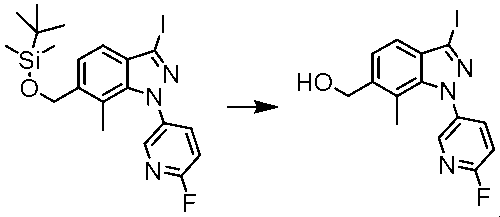
中間体Eの調製
E1 1-(6-フルオロピリジン-3-イル)-2’,7-ジメチル-1H,2’H-3,4’-ビインダゾール
Preparation of Intermediate E E1 1-(6-fluoropyridin-3-yl)-2',7-dimethyl-1H,2'H-3,4'-biindazole

同じようにして、中間体Dから、対応するボロン酸誘導体を利用して以下の中間体を調製する。
In a similar manner, the following intermediates are prepared from intermediate D utilizing the corresponding boronic acid derivatives:


追加の中間体Eを、以下の通り合成する。
E10 1-(6-フルオロピリジン-3-イル)-2’,7-ジメチル-1H,2’H-[3,4’-ビインダゾール]-6-アミン
Additional intermediate E is synthesized as follows.
E10 1-(6-fluoropyridin-3-yl)-2',7-dimethyl-1H,2'H-[3,4'-biindazol]-6-amine

E11 1-(6-フルオロピリジン-3-イル)-6-ヨード-2’,7-ジメチル-1H,2’H-3,4’-ビインダゾール
E11 1-(6-fluoropyridin-3-yl)-6-iodo-2',7-dimethyl-1H,2'H-3,4'-biindazole

E12 1-(6-フルオロピリジン-3-イル)-2’,7-ジメチル-6-(1-メチル-1H-ピラゾール-4-イル)-1H,2’H-3,4’-ビインダゾール
E12 1-(6-fluoropyridin-3-yl)-2',7-dimethyl-6-(1-methyl-1H-pyrazol-4-yl)-1H,2'H-3,4'-biindazole

1-(6-フルオロピリジン-3-イル)-6-ヨード-2’,7-ジメチル-1H,2’H-3,4’-ビインダゾールE11(100mg、200μmol)、1-メチル-4-(4,4,5,5-テトラメチル-1,3,2-ジオキサボロラン-2-イル)-1H-ピラゾール(52mg、240μmol)、({[1,1’-ビフェニル]-2-イル}アミノ)パラジウムイリウムジシクロヘキシル({2’,6’-ジメトキシ-[1,1’-ビフェニル]-2-イル})ホスファンメタンスルホネート(8mg、10μmol)、K3PO4(87mg、400μmol)、ジオキサン(1ml)及び水(0.5ml)の混合物を、アルゴン雰囲気下で80℃で16時間撹拌する。室温で、水(30ml)を添加し、混合物をDCMで抽出する。合わせた有機層をNa2SO4で脱水し、真空中で濃縮して、50mg(56%)の粗E12を得る。それをさらに精製することなく、次ステップで使用する。
スキーム1に示した合成ステップの代替順序に従うことによって、中間体Sを経由して追加の中間体Eを得ることができる。
A mixture of 1-(6-fluoropyridin-3-yl)-6-iodo-2',7-dimethyl-1H,2'H-3,4'-biindazole E11 (100 mg, 200 μmol), 1-methyl-4-(4,4,5,5-tetramethyl-1,3,2-dioxaborolan-2-yl)-1H-pyrazole (52 mg, 240 μmol), ({[1,1'-biphenyl]-2-yl}amino)palladiumylium dicyclohexyl({2',6'-dimethoxy-[1,1'-biphenyl]-2-yl})phosphane methanesulfonate (8 mg, 10 μmol), K 3 PO 4 (87 mg, 400 μmol), dioxane (1 ml) and water (0.5 ml) is stirred at 80° C. for 16 hours under an argon atmosphere. At room temperature, water (30 ml) is added and the mixture is extracted with DCM. The combined organic layers are dried over Na2SO4 and concentrated in vacuo to give 50 mg (56%) of crude E12, which is used in the next step without further purification.
Additional intermediates E can be obtained via intermediate S by following an alternate sequence of the synthetic steps shown in Scheme 1.
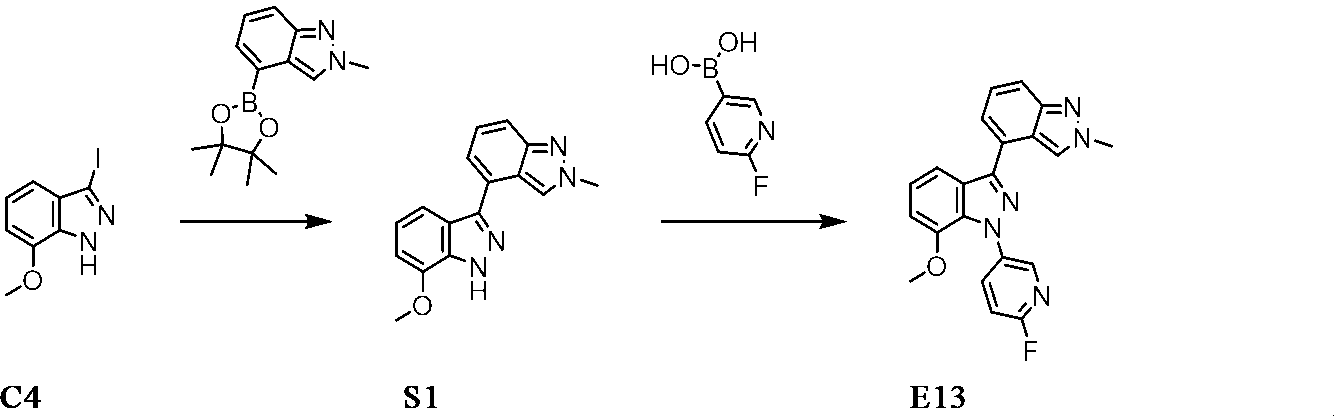
S1 7-メトキシ-2’-メチル-1H,2’H-3,4’-ビインダゾール
3-ヨード-7-メトキシ-1H-インダゾールC4(500mg、1.62mmol)、2-メチル-4-(4,4,5,5-テトラメチル-1,3,2-ジオキサボロラン-2-イル)-2H-インダゾール(512mg、1.94mmol)、({[1,1’-ビフェニル]-2-イル}アミノ)パラジウムイリウムジシクロヘキシル({2’,6’-ジメトキシ-[1,1’-ビフェニル]-2-イル})ホスファンメタンスルホネート(126mg、162μmol)、K3PO4(695mg、3.24mmol)、ジオキサン(5ml)及び水(1ml)の混合物を、アルゴン雰囲気下で80℃で16時間撹拌する。室温で、混合物をDCMで希釈し、水で抽出する。有機層をNa2SO4で脱水し、真空中で濃縮し、中間体7-メトキシ-2’-メチル-1H,2’H-3,4’-ビインダゾールをNPクロマトグラフィーによって精製する。収量:256mg(57%)。HPLC-MS:M+H=279;tR=0.55分(方法_7)
S1と同じようにして、以下の中間体S2を合成する。
S1 7-Methoxy-2'-methyl-1H,2'H-3,4'-biindazole A mixture of 3-iodo-7-methoxy-1H-indazole C4 (500 mg, 1.62 mmol), 2-methyl-4-(4,4,5,5-tetramethyl-1,3,2-dioxaborolan-2-yl)-2H-indazole (512 mg, 1.94 mmol), ({[1,1'-biphenyl]-2-yl}amino)palladium ilium dicyclohexyl({2',6'-dimethoxy-[1,1'-biphenyl]-2-yl})phosphane methanesulfonate (126 mg, 162 µmol), K3PO4 (695 mg, 3.24 mmol), dioxane (5 ml) and water (1 ml) is stirred at 80°C for 16 hours under an argon atmosphere. At room temperature, the mixture is diluted with DCM and extracted with water. The organic layer is dried over Na 2 SO 4 and concentrated in vacuo, and the intermediate 7-methoxy-2′-methyl-1H,2′H-3,4′-biindazole is purified by NP chromatography. Yield: 256 mg (57%). HPLC-MS: M+H=279; tR=0.55 min (Method_7).
The following intermediate S2 is synthesized in a similar manner to S1.

E13 1-(6-フルオロピリジン-3-イル)-7-メトキシ-2’-メチル-1H,2’H-3,4’-ビインダゾール
7-メトキシ-2’-メチル-1H,2’H-3,4’-ビインダゾールS1(256mg、920μmol)に、DCM(5ml)及びDMF(2.25ml)中の(6-フルオロピリジン-3-イル)ボロン酸(259mg、1.84mmol)、酢酸銅(II)(167mg、920μmol)及びピリジン(218μl、2.8mmol)を添加する。混合物を、空気に曝露しながら室温で60時間撹拌する。固体を濾過して取り除き、濾液を真空中で濃縮し、生成物をNPクロマトグラフィーによって精製する。収量:185mg(54%)。HPLC-MS:M+H=374;tR=0.70分(方法_7)
さらに、中間体Dを中間体Tにボロニル化して、例えばヘテロアリールブロミドと鈴木カップリングして、別の中間体Eを得ることができる。
T1 3-(5,5-ジメチル-1,3,2-ジオキサボリナン-2-イル)-1-(6-フルオロピリジン-3-イル)-7-メチル-1H-インダゾール
E13 1-(6-fluoropyridin-3-yl)-7-methoxy-2'-methyl-1H,2'H-3,4'-biindazole To 7-methoxy-2'-methyl-1H,2'H-3,4'-biindazole S1 (256 mg, 920 μmol) is added (6-fluoropyridin-3-yl)boronic acid (259 mg, 1.84 mmol), copper(II) acetate (167 mg, 920 μmol) and pyridine (218 μl, 2.8 mmol) in DCM (5 ml) and DMF (2.25 ml). The mixture is stirred at room temperature for 60 h with exposure to air. The solids are filtered off, the filtrate is concentrated in vacuo and the product is purified by NP chromatography. Yield: 185 mg (54%). HPLC-MS: M+H=374; tR=0.70 min (Method_7)
Additionally, intermediate D can be boronylated to intermediate T, which can then undergo Suzuki coupling with, for example, a heteroaryl bromide, to provide another intermediate E.
T1 3-(5,5-dimethyl-1,3,2-dioxaborinane-2-yl)-1-(6-fluoropyridin-3-yl)-7-methyl-1H-indazole

E14 1-(6-フルオロピリジン-3-イル)-7-メチル-3-{ピラゾロ[1,5-a]ピリジン-4-イル}-1H-インダゾール
E14 1-(6-fluoropyridin-3-yl)-7-methyl-3-{pyrazolo[1,5-a]pyridin-4-yl}-1H-indazole

同じようにして、中間体T1から、対応するヘテロアリールブロミドとカップリングすることによって以下の中間体を調製する。E15及びE18はそれぞれU2及びU3を利用して調製する。 In a similar manner, the following intermediates are prepared from intermediate T1 by coupling with the corresponding heteroaryl bromides: E15 and E18 are prepared using U2 and U3, respectively.


U2 4-ブロモ-2-メチルピラゾロ[1,5-a]ピリジン
U2 4-bromo-2-methylpyrazolo[1,5-a]pyridine

U3) 5-ブロモ-N,N-ジメチルイソキノリン-3-アミン
U3) 5-bromo-N,N-dimethylisoquinolin-3-amine

実施例#1~#45及び中間体Fの調製:
#1) 3-(5-(2’,7-ジメチル-1H,2’H-[3,4’-ビインダゾール]-1-イル)ピリジン-2-イル)-3-アザビシクロ[3.1.0]ヘキサン-6-カルボン酸メチル
Preparation of Examples #1-#45 and Intermediate F:
#1) 3-(5-(2',7-dimethyl-1H,2'H-[3,4'-biindazol]-1-yl)pyridin-2-yl)-3-azabicyclo[3.1.0]hexane-6-carboxylate methyl

同じようにして、中間体Eから、対応するアミンを利用して以下の実施例を調製する。アミンの塩(例えば、塩酸塩)の場合には、それぞれ当量の追加の塩基を使用する。
In the same manner, the following examples are prepared from intermediate E utilizing the corresponding amines. In the case of the salt of the amine (e.g. the hydrochloride salt), an additional equivalent of base is used in each case.


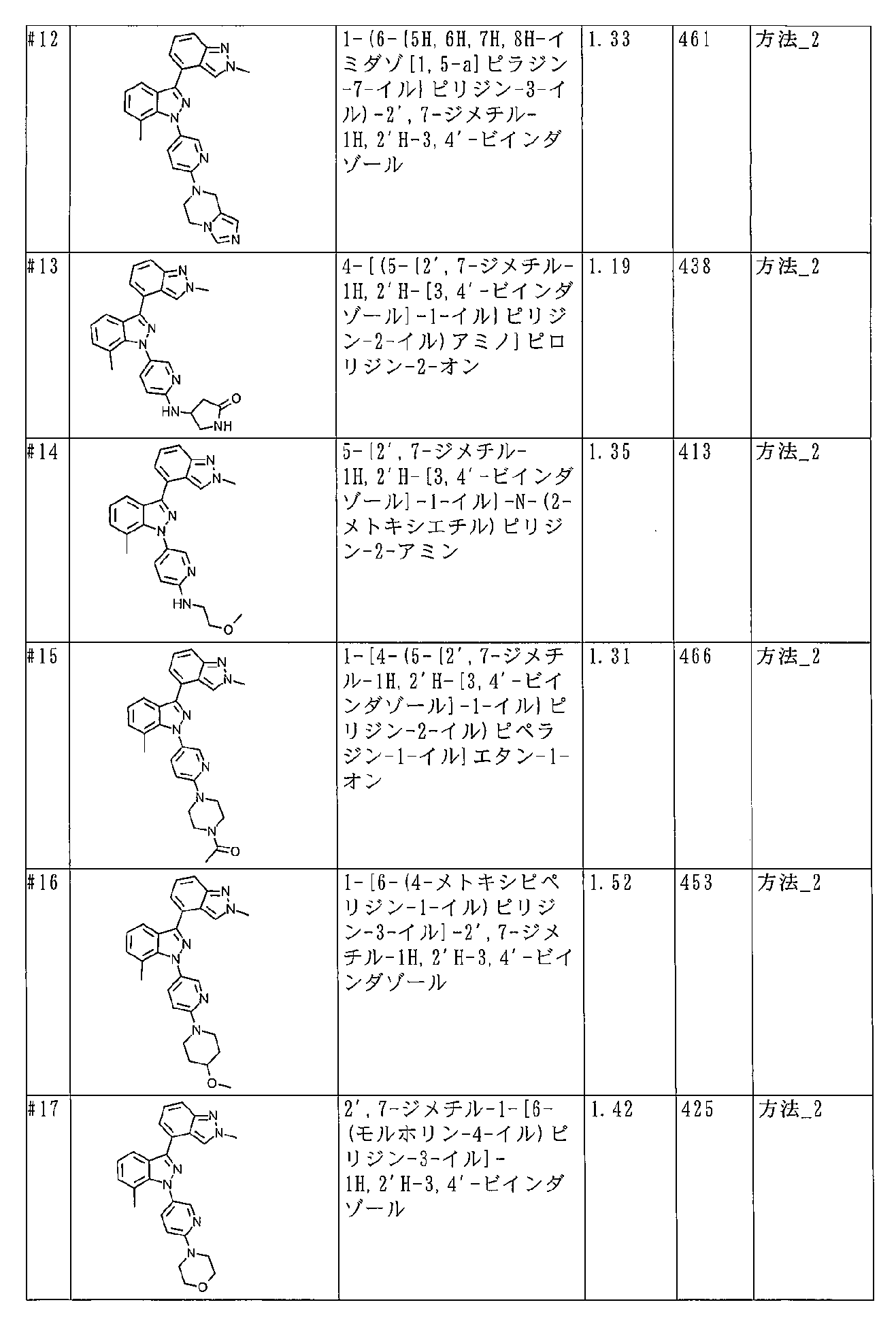


同じようにして、それぞれF2~F6から、以下の実施例を調製する。
In the same manner, prepare the following examples from F2 to F6 respectively.

実施例#51~#54の調製:
#51 4-(5-(2’,7-ジメチル-1H,2’H-[3,4’-ビインダゾール]-1-イル)ピリジン-2-イル)ピペラジン-1-カルボアルデヒド
Preparation of Examples #51-#54:
#51 4-(5-(2',7-dimethyl-1H,2'H-[3,4'-biindazol]-1-yl)pyridin-2-yl)piperazine-1-carbaldehyde
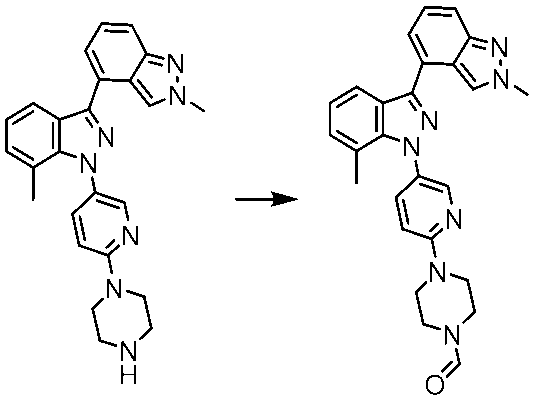
DCM(200μl)中のギ酸(2μl;53μmol)及びN-メチルモルホリン(6μl;57μmol)の混合物を0℃に冷却する。クロロギ酸イソブチル(7μl;54μmol)を添加し、RMを20℃で2時間撹拌する。2’,7-ジメチル-1-[6-(ピペラジン-1-イル)ピリジン-3-イル]-1H,2’H-3,4’-ビインダゾール#46(10mg、24μmol)を添加し、撹拌をRTで16時間続ける。 A mixture of formic acid (2 μl; 53 μmol) and N-methylmorpholine (6 μl; 57 μmol) in DCM (200 μl) is cooled to 0°C. Isobutyl chloroformate (7 μl; 54 μmol) is added and the RM is stirred at 20°C for 2 h. 2',7-Dimethyl-1-[6-(piperazin-1-yl)pyridin-3-yl]-1H,2'H-3,4'-biindazole #46 (10 mg, 24 μmol) is added and stirring is continued at RT for 16 h.
混合物を真空中で濃縮し、生成物をRPクロマトグラフィーによって精製する。収量:7mg(66%)。HPLC-MS:M+H=452;tR=1.31分(方法_2)
同じようにして、それぞれ#45、#48及び#49から、以下の実施例を調製する。
The mixture is concentrated in vacuo and the product is purified by RP chromatography. Yield: 7 mg (66%). HPLC-MS: M+H=452; tR=1.31 min (Method_2).
In the same manner, prepare the following examples from #45, #48 and #49 respectively.


DCM(200μl)及びNMP(200μl)中の3-(5-{2’,7-ジメチル-1H,2’H-[3,4’-ビインダゾール]-1-イル}ピリジン-2-イル)-3-アザビシクロ[3.1.0]ヘキサン-6-アミン#47(46mg、106μmol)に、室温でDIPEA(103μl、636μmol)及び塩化アセチル(10μl、139μmol)を添加する。混合物を40分間撹拌し、真空中で濃縮し、生成物をRP HPLCによって精製する。収量:18mg(36%)。HPLC-MS:M+H=478;tR=1.26分(方法_2)
#56 N-[1-(5-{2’,7-ジメチル-1H,2’H-[3,4’-ビインダゾール]-1-イル}ピリジン-2-イル)ピペリジン-4-イル]メタンスルホンアミド
To 3-(5-{2',7-dimethyl-1H,2'H-[3,4'-biindazol]-1-yl}pyridin-2-yl)-3-azabicyclo[3.1.0]hexan-6-amine #47 (46 mg, 106 μmol) in DCM (200 μl) and NMP (200 μl) is added DIPEA (103 μl, 636 μmol) and acetyl chloride (10 μl, 139 μmol) at room temperature. The mixture is stirred for 40 min, concentrated in vacuo and the product is purified by RP HPLC. Yield: 18 mg (36%). HPLC-MS: M+H=478; tR=1.26 min (Method_2)
#56 N-[1-(5-{2',7-dimethyl-1H,2'H-[3,4'-biindazol]-1-yl}pyridin-2-yl)piperidin-4-yl]methanesulfonamide

実施例#57~#71の調製:
#57 1-(5-(2’,7-ジメチル-1H,2’H-[3,4’-ビインダゾール]-1-イル)ピリジン-2-イル)ピペリジン-4-カルボン酸
Preparation of Examples #57-#71:
#57 1-(5-(2',7-dimethyl-1H,2'H-[3,4'-biindazol]-1-yl)pyridin-2-yl)piperidine-4-carboxylic acid

同じようにして、それぞれ#32、#1、#33~#44から、以下の実施例を調製する。
In the same manner, prepare the following examples from #32, #1, #33-#44, respectively.


別の実施例を追加の化学変換によって得る。
#72 3-(5-{2’,7-ジメチル-1H,2’H-[3,4’-ビインダゾール]-1-イル}ピリジン-2-イル)-3-アザビシクロ[3.1.0]ヘキサン-6-カルボキサミド
Further examples are obtained by additional chemical transformations.
#72 3-(5-{2',7-dimethyl-1H,2'H-[3,4'-biindazol]-1-yl}pyridin-2-yl)-3-azabicyclo[3.1.0]hexane-6-carboxamide

NMP(500μl)中の3-(5-{2’,7-ジメチル-1H,2’H-[3,4’-ビインダゾール]-1-イル}ピリジン-2-イル)-3-アザビシクロ-[3.1.0]ヘキサン-6-カルボン酸#1(20mg、43μmol)、DIPEA(22μl、129μmol)の混合物に、HATU(25mg、66μmol)を添加し、混合物をRTで10分間撹拌する。
塩化アンモニウム(10mg、187μmol)を添加し、撹拌を16時間続ける。混合物を真空中で濃縮し、生成物をRPクロマトグラフィーによって精製する。収量:11mg(55%)。HPLC-MS:M+H=464;tR=1.28分(方法_2)
中間体S2から出発して、ビルディングブロックVを用いて実施例#73を合成する。
V1 5-ブロモ-2-(4-メタンスルホニルフェニル)ピリジン
To a mixture of 3-(5-{2',7-dimethyl-1H,2'H-[3,4'-biindazol]-1-yl}pyridin-2-yl)-3-azabicyclo-[3.1.0]hexane-6-carboxylic acid #1 (20 mg, 43 μmol), DIPEA (22 μl, 129 μmol) in NMP (500 μl) is added HATU (25 mg, 66 μmol) and the mixture is stirred at RT for 10 min.
Ammonium chloride (10 mg, 187 μmol) is added and stirring is continued for 16 h. The mixture is concentrated in vacuo and the product is purified by RP chromatography. Yield: 11 mg (55%). HPLC-MS: M+H=464; tR=1.28 min (Method_2).
Starting from intermediate S2, building block V is used to synthesize example #73.
V1 5-bromo-2-(4-methanesulfonylphenyl)pyridine

V2 [6-(4-メタンスルホニルフェニル)ピリジン-3-イル]ボロン酸
V2 [6-(4-methanesulfonylphenyl)pyridin-3-yl]boronic acid

#73 1-[6-(4-メタンスルホニルフェニル)ピリジン-3-イル]-2’,7-ジメチル-1H,2’H-3,4’-ビインダゾール
#73 1-[6-(4-methanesulfonylphenyl)pyridin-3-yl]-2',7-dimethyl-1H,2'H-3,4'-biindazole

W1を経由して、実施例#74を合成する。
W1 3-(5-{2’-メチル-7-[2-(トリメチルシリル)エチニル]-1H,2’H-[3,4’-ビインダゾール]-1-イル}ピリジン-2-イル)-3-アザビシクロ[3.1.0]ヘキサン-6-カルボン酸メチル
Example #74 is synthesized via W1.
W1 3-(5-{2'-methyl-7-[2-(trimethylsilyl)ethynyl]-1H,2'H-[3,4'-biindazol]-1-yl}pyridin-2-yl)-3-azabicyclo[3.1.0]hexane-6-carboxylate methyl
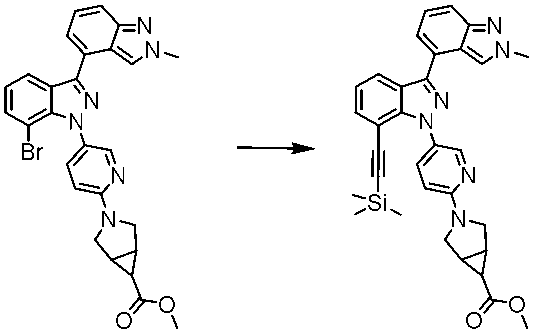
#74 3-(5-{7-エチニル-2’-メチル-1H,2’H-[3,4’-ビインダゾール]-1-イル}ピリジン-2-イル)-3-アザビシクロ[3.1.0]ヘキサン-6-カルボン酸 #74 3-(5-{7-ethynyl-2'-methyl-1H,2'H-[3,4'-biindazol]-1-yl}pyridin-2-yl)-3-azabicyclo[3.1.0]hexane-6-carboxylic acid

実施例#1、26、28、29、30、37、38、41、42、44、47、55、59、64、65、68、69、71、72、74では、報告された以下の値は、(1R,5S,6R)-3-アザビシクロ[3.1.0]ヘキサン-6-カルボン酸又は(1R,5S,6S)-3-アザビシクロ[3.1.0]ヘキサン-6-アミン部分を含む異性体を表す。実施例#6の場合、(R)異性体のデータを示す。 For Examples #1, 26, 28, 29, 30, 37, 38, 41, 42, 44, 47, 55, 59, 64, 65, 68, 69, 71, 72, 74, the following reported values represent isomers containing the (1R,5S,6R)-3-azabicyclo[3.1.0]hexane-6-carboxylic acid or (1R,5S,6S)-3-azabicyclo[3.1.0]hexane-6-amine moiety. For Example #6, data for the (R) isomer is shown.
薬理活性
示差走査蛍光定量(DSF)により決定されたhSTINGとの相互作用
DSFでは、融解温度Tmとも呼ばれる、タンパク質がアンフォールドする温度は、タンパク質の疎水性部分に結合する色素の蛍光の変化によって測定される。低分子の結合後のTmシフトは、この低分子の結合親和性と相互関係がある。標的タンパク質として、ヒトSTING(hSTING、残基155~341、MW: 21578.4Da;タンパク質ストック溶液:c=20mM Tris、100mM NaCl、2mM TCEP(pH8.8)中1302μMストック溶液)を使用し、アッセイ緩衝液として、20mM Tris、150mM NaCl(pH7.5)を必要な場合に適宜添加した。
アッセイにおける成分の最終濃度:100μM 試験化合物、5μM 標的タンパク質、「5倍」SYPR Orange(ストック溶液のDMSO中SYPRO橙色溶液から(invitrogen社カタログ番号S6650-500ul)、濃度「5000倍」)
アッセイ手順:
1)化合物ストック溶液(DMSO中10mM)の希釈液をアッセイ緩衝液(20mM Tris、150mM NaCl;pH7.5)中で調製した。
2)5μlの蛍光色素ストック溶液(DMSO中5000倍SYPROオレンジ)を、19μlの標的タンパク質(1302μM)及び976μlのアッセイ緩衝液と混合した。
3)このタンパク質-色素-混合物(25倍SYPROオレンジ及び25μMタンパク質)の2μlを、ステップ1で調製された希釈化合物溶液の8μlに添加した。最終体積は10μlであった。
4)20個の化合物ごとに、2個の陰性対照を測定した。
5)2連測定のためにプレートを準備し、1000gで2分間遠心分離した。
6)測定には、CFX384 Real-Time System(Bio-Rad社)を使用した。工程は、0.5℃/サイクルで140サイクルからなるものであった(温度傾斜15秒/サイクル、25℃から95℃)。
データ分析:融解曲線をBio-Rad CFX Managerで処理した。ピーク型を「負」に設定した。2回反復のTM(融解温度)測定を平均し、標準偏差を算出した。
Pharmacological Activity Interaction with hSTING Determined by Differential Scanning Fluorometry (DSF) In DSF, the temperature at which a protein unfolds, also called the melting temperature, Tm , is measured by the change in fluorescence of a dye that binds to the hydrophobic portion of the protein. The Tm shift after binding of a small molecule correlates with the binding affinity of this small molecule. Human STING (hSTING, residues 155-341, MW: 21578.4 Da; protein stock solution: c=1302 μM stock solution in 20 mM Tris, 100 mM NaCl, 2 mM TCEP, pH 8.8) was used as the target protein, and 20 mM Tris, 150 mM NaCl, pH 7.5 was added as appropriate when necessary as the assay buffer.
Final concentrations of components in the assay: 100 μM test compound, 5 μM target protein, "5x" SYPR Orange (from stock solution of SYPRO orange in DMSO (Invitrogen Cat. No. S6650-500 ul), at "5000x" concentration).
Assay procedure:
1) Dilutions of compound stock solutions (10 mM in DMSO) were prepared in assay buffer (20 mM Tris, 150 mM NaCl; pH 7.5).
2) 5 μl of fluorescent dye stock solution (SYPRO Orange 5000x in DMSO) was mixed with 19 μl of target protein (1302 μM) and 976 μl of assay buffer.
3) 2 μl of this protein-dye-mixture (25x SYPRO orange and 25 μM protein) was added to 8 μl of the diluted compound solution prepared in step 1. The final volume was 10 μl.
4) For every 20 compounds, two negative controls were measured.
5) Plates were prepared for duplicate measurements and centrifuged at 1000 g for 2 minutes.
6) A CFX384 Real-Time System (Bio-Rad) was used for the measurements. The process consisted of 140 cycles at 0.5° C./cycle (temperature ramp 15 sec/cycle, from 25° C. to 95° C.).
Data analysis: Melting curves were processed with Bio-Rad CFX Manager. Peak type was set to "negative". Duplicate TM (melting temperature) measurements were averaged and standard deviations were calculated.
TMの変化(「サーマルシフト」)を表1に示す。

インターフェロン制御因子誘導性レポーター遺伝子の活性化を介して測定されたインビトロサイトカイン誘導
本発明による化合物のサイトカイン誘導活性は、THP1レポーター細胞系を使用し、細胞EC50値を得ることによって示されてきた。細胞系において発現されたSTINGタンパク質の活性化によって、インターフェロン産生が増加する。インターフェロン制御因子(IRF)誘導性SEAP遺伝子(分泌型胚性アルカリホスファターゼ)レポーターコンストラクトの安定な組込みによって、機能的インターフェロンシグナル伝達経路をモニターすることができる。Invivogen社のTHP1-Blue(商標)ISG比色酵素アッセイ及び好適な光学濃度(OD)読み取り装置を使用して、SEAPの活性を検出及び定量することができる。この技法を使用すれば、STING経路の薬理学的改変を特徴付けることができる。
In Vitro Cytokine Induction Measured via Activation of an Interferon Regulatory Factor Inducible Reporter Gene The cytokine induction activity of the compounds according to the invention has been demonstrated using the THP1 reporter cell line and obtaining cellular EC50 values. Activation of the STING protein expressed in the cell line increases interferon production. Stable integration of an interferon regulatory factor (IRF) inducible SEAP gene (secreted embryonic alkaline phosphatase) reporter construct allows monitoring of a functional interferon signaling pathway. Using the Invivogen THP1-Blue™ ISG colorimetric enzyme assay and a suitable optical density (OD) reader, the activity of SEAP can be detected and quantified. This technique allows characterization of pharmacological modifications of the STING pathway.
いくつかの一塩基多型が、ヒトSTING遺伝子において同定された。上記の化合物の活性を決定するために、異なるヒトSTINGバリアントを発現するTHP1-Blue(商標)ISGレポーター細胞系が生み出された。そうするために、CRISPR/CAS9系を使用して、まず内因性ヒトSTINGを欠失させた。THP1-Blue ISG細胞を、STING遺伝子を標的にするALL-IN-ONE CRISPRプラスミド(Sigma社から購入、導入成功のためのレポーター遺伝子のgRNA及びGFPをコードする)を用いて電気穿孔した。次いで、GFP陽性細胞をトランスフェクション後24時間で選別し、増殖させた。次いで、細胞を半固体のメトセル培地に分散して、単細胞クローン単離を可能にした。次いで、Quanti-Blue(商標)レポーターアッセイを使用して、クローンをcGAMP応答性についてスクリーニングした。続いて、非応答性クローンを、ウェスタンブロッティング及びSTING座位のシーケンシングによってSTING損失について分析した。 Several single nucleotide polymorphisms were identified in the human STING gene. To determine the activity of the above compounds, THP1-Blue™ ISG reporter cell lines expressing different human STING variants were generated. To do so, endogenous human STING was first deleted using the CRISPR/CAS9 system. THP1-Blue ISG cells were electroporated with an ALL-IN-ONE CRISPR plasmid (purchased from Sigma, encoding a reporter gene gRNA and GFP for successful transfection) targeting the STING gene. GFP-positive cells were then selected 24 hours after transfection and expanded. The cells were then dispersed in semi-solid methocel medium to allow single-cell clonal isolation. Clones were then screened for cGAMP responsiveness using the Quanti-Blue™ reporter assay. Non-responsive clones were then analyzed for STING loss by Western blotting and sequencing of the STING locus.
ヒトSTINGバリアントの過剰発現については、確認されたTHP1-Blue(商標)ISG hSTING KOクローンに、hSTINGの対立遺伝子バリアント(WT(H232R)、HAQ、R232H、AQ及びR293Q)をコードする個々のレトロウイルスプラスミド(MSCV-ires-GFP-Blasti)を導入した。導入された細胞をさまざまなGFP蛍光レベルによって選別し、STING対立遺伝子発現をウェスタンブロットによって分析した。親の未改変THP1-Blue ISG細胞系から、内因性STINGレベルに匹敵するレベルで異所性STINGタンパク質(WT、HAQ、R232H、AQ及びR293Q)を発現する集団を選択し、化合物の特徴付けに使用した。
異なるヒトSTINGアイソフォーム及びIRF誘導性SEAPレポーターコンストラクトを安定に発現するTHP1-Blue(商標)ISG細胞において、SEAP活性の測定を行った。37℃、湿度95%及び5%CO2のインキュベーター中、10%ウシ胎仔血清、50μg/mlのペニシリン-ストレプトマイシン、100μg/mlのZeocin、及び100μg/mlのNormocinを含むRPMI1640培地で、細胞を培養した。
For overexpression of human STING variants, confirmed THP1-Blue™ ISG hSTING KO clones were transduced with individual retroviral plasmids (MSCV-ires-GFP-Blasti) encoding allelic variants of hSTING (WT (H232R), HAQ, R232H, AQ and R293Q). Transduced cells were sorted by different GFP fluorescence levels and STING allelic expression was analyzed by Western blot. From the parental unmodified THP1-Blue ISG cell line, populations expressing ectopic STING protein (WT, HAQ, R232H, AQ and R293Q) at levels comparable to endogenous STING levels were selected and used for compound characterization.
Measurement of SEAP activity was performed in THP1-Blue™ ISG cells stably expressing different human STING isoforms and an IRF-inducible SEAP reporter construct. Cells were cultured in RPMI 1640 medium containing 10% fetal bovine serum, 50 μg/ml penicillin-streptomycin, 100 μg/ml Zeocin, and 100 μg/ml Normocin in an incubator at 37° C. with 95% humidity and 5% CO2.
アッセイの準備において、細胞をアッセイプレートに1ウェル当たり10000細胞/15μLの密度で分配した。化合物を、50%水性DMSOでの8点段階希釈及び培地への最終希釈段階によって調製して、アッセイにおいて最終DMSO濃度0.5%を確実にした。5μLの希釈化合物をプレートに添加し、続いて37℃で24時間インキュベートした。
アッセイの当日に、1ウェル当たり75μlのQuanti-Blue(商標)試薬をプレートのウェルすべてに添加し、プレートを37℃でもう30分インキュベートした。620nmにおけるODをEnVision読み取り装置(PerkinElmer社)で測定した。
In preparation for the assay, cells were dispensed into assay plates at a density of 10,000 cells/15 μL per well. Compounds were prepared by 8-point serial dilution in 50% aqueous DMSO with a final dilution step into medium to ensure a final DMSO concentration of 0.5% in the assay. 5 μL of diluted compound was added to the plate followed by incubation at 37° C. for 24 hours.
On the day of the assay, 75 μl per well of Quanti-Blue™ reagent was added to all wells of the plate and the plate was incubated for another 30 minutes at 37° C. The OD at 620 nm was measured with an EnVision reader (PerkinElmer).
EC50値及びHill勾配は、620nMにおけるODを使用して、Megalabソフトウェア(Boehringer Ingelheim社)で8点の4パラメトリック非線形曲線適合から導き出した。
EC50値のデータは、表2a~2eで見ることができる。
STING HAQ-バリアントのEC50値のデータは、表2aで見ることができる。以下に示されたデータは、(HAQを内因的に発現する)親のTHP1-Blue(商標)ISG細胞株又は遺伝子操作されたTHP1-Blue(商標)ISG細胞株に由来するデータであり、最初のSTINGはノックアウトされ、HAQ特異的STINGアイソフォームは以上に記載されたように再導入された。
EC 50 values and Hill slopes were derived from an eight-point, four-parametric non-linear curve fit with Megalab software (Boehringer Ingelheim) using the OD at 620 nM.
The EC 50 data can be seen in Tables 2a-2e.
Data for EC50 values of STING HAQ-variants can be found in Table 2a. Data presented below is from parental THP1-Blue™ ISG cell lines (which endogenously express HAQ) or engineered THP1-Blue™ ISG cell lines in which the original STING was knocked out and the HAQ-specific STING isoform was reintroduced as described above.


細胞透過性測定
Caco-2細胞を、Leibniz Institute DSMZ-German Collection of Microorganisms and Cell Cultures(Braunschweig、Germany)から入手し、(最終濃度で)10% FCS(ウシ胎仔血清)、1% NEAA(非必須アミノ酸)、2mMのグルタミン、100U/mLのペニシリン及び100μg/mLのストレプトマイシンを含むDMEM(ダルベッコ変法イーグル培地)で培養した。Caco-2細胞を、双方向透過性アッセイのために24ウェルのTranswellインサート(Corning社、#3379)に160,000細胞/cm2の密度で播種し、培地を2日ごとに変えながら3週間培養した。
Cell Permeability Measurements Caco-2 cells were obtained from the Leibniz Institute DSMZ-German Collection of Microorganisms and Cell Cultures (Braunschweig, Germany) and cultured in DMEM (Dulbecco's Modified Eagle's Medium) containing (final concentrations) 10% FCS (fetal calf serum), 1% NEAA (non-essential amino acids), 2 mM glutamine, 100 U/mL penicillin, and 100 μg/mL streptomycin. Caco-2 cells were seeded at a density of 160,000 cells/cm 2 in 24-well Transwell inserts (Corning, #3379) for bidirectional permeability assays and cultured for 3 weeks with medium changes every 2 days.
双方向透過性アッセイのために、10mM DMSOストック溶液を、0.25%ウシ血清アルブミンを含むトランスポート緩衝液(最終濃度:128.13mM NaCl、5.36mM KCl、1mM MgSO4、1.8mM CaCl2、4.17mM NaHCO3、1.19mM Na2HPO4、0.41mM NaH2PO4、15mM 2-[4-(2-ヒドロキシエチル)ピペラジン-1-イル]エタンスルホン酸(HEPES)、20mM グルコース、pH7.4)で希釈して、試験化合物の最終濃度を10μMとし、頂端側又は側底側コンパートメントに添加した。細胞を化合物と共に2時間までインキュベートした。反対側のコンパートメントからの試料を異なる時点で採取した。 For bidirectional permeability assays, 10 mM DMSO stock solutions were diluted in transport buffer (final concentrations: 128.13 mM NaCl, 5.36 mM KCl, 1 mM MgSO4, 1.8 mM CaCl2, 4.17 mM NaHCO3 , 1.19 mM Na2HPO4 , 0.41 mM NaH2PO4 , 15 mM 2- [4-(2-hydroxyethyl)piperazin-1-yl]ethanesulfonic acid (HEPES), 20 mM glucose, pH 7.4) containing 0.25% bovine serum albumin to give a final concentration of 10 μM of test compounds and added to the apical or basolateral compartment. Cells were incubated with compounds for up to 2 hours. Samples from the opposite compartment were taken at different time points.
RIASと呼ばれる完全に自動化された柔軟なプラットフォームにカスタマイズされたRapidFireベースのハイスループットHPLC/MS/MSシステム(高速液体クロマトグラフィー/質量分析;BioCius社)を使用して、コンパートメントの化合物濃度を定量した。この改変されたセットアップでは、試料を真空ポンプで10μLの試料ループに250ミリ秒間吸引し、C4カートリッジ(3.8μLのベッドボリューム;BioCius社)に水性移動相(99.9% 水、0.09% ギ酸、及び0.01% TFA;流速1.5mL/分)を流した。バイオ分析を行う前に、試料に内部標準溶液を加え、アセトニトリル(ACN)で希釈して、タンパク質沈殿を行った。測定は、多重反応モニタリング(MRM)モードで操作した。外部較正を使用して、定量を行った。固相抽出ステップは、妨害マトリックス(例えば、緩衝液成分)を除去する間に分析物を3000ミリ秒間保持した。単純なステップグラジエントで、分析物を有機移動相(99.9% アセトニトリル/メタノール[1:1(v:v)]、0.09% ギ酸、及び0.01% TFA)でカートリッジから3,000ミリ秒間溶離し戻し、質量分析計に流速1.25mL/分で流し込んだ。その後、カートリッジを、500ミリ秒間(流速1.5mL/分)で水性移動相と再び平衡させた。RapidFireソフトウェア及びカスタマイズした制御ソフトウェアは、BioCius社から得た。QuickQuan 2.3、Xcalibur 2.0.7、及びXDK 2.1.0.25を使用して、RapidFireシステムに統合されたTSQ Vantage質量分析計(ThermoFisher社、San Jose、CA)を操作した。質量スペクトルデータ処理ソフトウェアQuickCalc 7.1.9は、ThermoFisher社から購入した。RIAS用のMasterソフトウェアは、LabVIEW(バージョン8.6.1;National Instruments社、Austin、TX)を使用してインハウスでプログラミングした。データ分析をAssayExplorer 3.2(Symyx社、Sunnyvale、CA)で行い、相関プロットをSpotfireバージョン2.2.0(TIBCO社、Palo Alto、CA)で可視化した。 Compound concentrations in the compartments were quantified using a RapidFire-based high-throughput HPLC/MS/MS system (high performance liquid chromatography/mass spectrometry; BioCius) customized into a fully automated flexible platform called RIAS. In this modified setup, the sample was aspirated by a vacuum pump into a 10 μL sample loop for 250 ms and the aqueous mobile phase (99.9% water, 0.09% formic acid, and 0.01% TFA; flow rate 1.5 mL/min) was run through a C4 cartridge (3.8 μL bed volume; BioCius). Prior to bioanalysis, samples were spiked with an internal standard solution and diluted with acetonitrile (ACN) to perform protein precipitation. Measurements were operated in multiple reaction monitoring (MRM) mode. Quantification was performed using external calibration. A solid-phase extraction step retained the analyte for 3000 ms while removing interfering matrices (e.g., buffer components). Analytes were eluted back from the cartridge in a simple step gradient with an organic mobile phase (99.9% acetonitrile/methanol [1:1 (v:v)], 0.09% formic acid, and 0.01% TFA) for 3,000 ms and run into the mass spectrometer at a flow rate of 1.25 mL/min. The cartridge was then re-equilibrated with the aqueous mobile phase for 500 ms (flow rate of 1.5 mL/min). RapidFire software and customized control software were from BioCius. A TSQ Vantage mass spectrometer (ThermoFisher, San Jose, Calif.) integrated into the RapidFire system was operated using QuickQuan 2.3, Xcalibur 2.0.7, and XDK 2.1.0.25. Mass spectral data processing software QuickCalc 7.1.9 was purchased from ThermoFisher. Master software for RIAS was programmed in-house using LabVIEW (version 8.6.1; National Instruments, Austin, TX). Data analysis was performed with AssayExplorer 3.2 (Symyx, Sunnyvale, CA) and correlation plots were visualized with Spotfire version 2.2.0 (TIBCO, Palo Alto, CA).
頂端側から側底側への方向(Papp,AB)及び側底側から頂端側への方向(Papp,BA)における見かけ透過係数、並びに排出比を以下の通り算出した。
Papp,AB=QAB/(C0 ・ s ・ t)
Papp,BA=QBA/(C0 ・ s ・ t)
排出比=Papp,BA/Papp,AB
ここで、Qは、インキュベーション時間t後にレシーバコンパートメントにおいて回収された化合物の量であり、C0は、ドナーコンパートメントに与えられた初期の化合物濃度であり、sは、Transwellインサートの表面積である。品質管理として、1種の基準P-gp基質(アパファント)及び1種の低透過性化合物(BI内部基準、Papp約3・10-7cm/秒、排出なし)がアッセイプレートごとに含まれる。さらに、透過性アッセイの前に、各プレートについて経上皮電気抵抗(TEER)値を測定し、ドナー及びレシーバコンパートメントにおける全回収率を各化合物について決定した。結果を表3a及び3bで見ることができる。
The apparent permeability coefficients in the apical to basolateral direction (P app,AB ) and basolateral to apical direction (P app,BA ), as well as the efflux ratios, were calculated as follows:
P app,AB = Q AB / (C 0・ s ・ t)
P app,BA =Q BA /(C 0・ s ・ t)
Emission ratio = P app,BA /P app,AB
where Q is the amount of compound recovered in the receiver compartment after incubation time t, C 0 is the initial compound concentration applied to the donor compartment, and s is the surface area of the Transwell insert. As quality controls, one reference P-gp substrate (apafant) and one low permeability compound (BI internal standard, P app approx. 3·10 −7 cm/sec, no efflux) are included per assay plate. In addition, transepithelial electrical resistance (TEER) values were measured for each plate prior to the permeability assay, and the total recovery in the donor and receiver compartments was determined for each compound. The results can be seen in Tables 3a and 3b.


溶解度測定
DMSO中の化合物の10mMストック溶液を最終濃度250μMに水性McIlvaine緩衝液(pH6.8)又は参照としてアセトニトリル/水(1:1)で希釈して、水性溶解度を決定した。試料を、室温で96ウェルプレート(Whatman Uniplate(登録商標)96ウェル、750μL、ポリプロピレン、丸底)中で24時間振盪した。次いで、プレートを3,000rpmで2分間遠心分離した。250μLの各試料を、ポリカーボネートメンブラン(孔径0.45μm)付きのMillipore MultiScreenHTSフィルタープレートに移した。3,000rpmで2分間遠心分離することによって、濾液を収集した。溶解した濃度は、Waters ACQUITY UPLC(登録商標)BEH 2.1×50mm C18カラム、粒径1.7μmを装備したWaters ACQUITY UPLC(登録商標)SQDシステムで、水/0.1% ギ酸を溶媒Aとし、アセトニトリル/0.1% ギ酸を溶媒Bとして短期グラジエント(5→95% B、全サイクル時間1.7分)を使用して、UPLC/UV(超高速液体クロマトグラフィー/紫外線)によって決定した。光ダイオードアレイUV検出器を254nmで操作して、化合物シグナルを測定した。Waters Empowerソフトウェアを使用して、参照標準に対してピーク面積を比較することによって、溶解度を1点較正で決定した。結果を表4で見ることができる。
Solubility measurements Aqueous solubility was determined by diluting 10 mM stock solutions of compounds in DMSO to a final concentration of 250 μM in aqueous McIlvaine buffer (pH 6.8) or acetonitrile/water (1:1) as a reference. Samples were shaken for 24 hours in 96-well plates (Whatman Uniplate® 96-well, 750 μL, polypropylene, round bottom) at room temperature. The plates were then centrifuged at 3,000 rpm for 2 minutes. 250 μL of each sample was transferred to a Millipore MultiScreen HTS filter plate with polycarbonate membrane (pore size 0.45 μm). The filtrate was collected by centrifugation at 3,000 rpm for 2 minutes. Dissolved concentrations were determined by UPLC/UV (ultra-performance liquid chromatography/ultraviolet) on a Waters ACQUITY UPLC® SQD system equipped with a Waters ACQUITY UPLC® BEH 2.1×50 mm C18 column, 1.7 μm particle size, using a short gradient (5→95% B, 1.7 min total cycle time) of water/0.1% formic acid as solvent A and acetonitrile/0.1% formic acid as solvent B. A photodiode array UV detector was operated at 254 nm to measure compound signals. Solubility was determined with a one-point calibration by comparing peak areas against reference standards using Waters Empower software. Results can be seen in Table 4.


Claims (38)

(式中、
Aは、N又はCであり、
Bは、
1個又は2個のN原子を含む5~7員の単環式ヘテロシクリル、
1個のN原子を含む6員の二環式ヘテロシクリル、
2個のN原子を含む7~11員の二環式ヘテロシクリル、
1個のN原子及び1個のO原子を含む7員の二環式ヘテロシクリル、
1個のN原子並びにO及びSからなる群から選択される1個のヘテロ原子を含む6員の単環式ヘテロシクリル、
3個のヘテロ原子を含み、そのうちの2個がNであり、もう1個がOである9員の二環式ヘテロシクリル、
1個のN原子及び1個のS原子を含む9員の二環式ヘテロシクリル、
3個のN原子を含み、そのうち2個がC1-6-アルキルで置換されている10員の二環式ヘテロシクリル、
フェニル、
3個のN原子を含む9員の二環式ヘテロアリール、
からなる群の中から選択される基であり;
Dは、
2個のN原子を含む9員の二環式ヘテロアリール、
1個のN原子を含む10員の二環式ヘテロアリール、及び
ベンゾジオキソール
からなる群の中から選択される基であり;
R1は、-H、-C1-6-アルキル、-CF3、-C2-6-アルキニル、-O-C1-6-アルキル及びハロゲンからなる群の中から選択され;
R2は、-H、-C1-6-アルキル、-C1-6-アルキレン-OH、-C(O)OH、-C(O)O-C1-6-アルキル及び-ピラゾリル-C1-6-アルキルからなる群の中から選択され;
R3は、-H又は-C1-6-アルキルであり;
R4は、-H、-C1-3-アルキル、-NH2、-NHC1-3-アルキル及びN(C1-3-アルキル)2からなる群の中から選択され;
R5は、非存在であり、或いは-H、-C1-6-アルキル、-S(O2)-C1-6-アルキル、-NH-S(O2)-C1-6-アルキル、=O、-C(O)-C1-6-アルキル、-C(O)H、-C(O)OH、-C(O)NH2、-C(O)O-C1-6-アルキル、-NR5.1R5.2、-C1-6-アルキレン-C(O)OH、-S(O2)-NH2、-ピロリジン-2-オン-1-イル、-テトラゾリル、並びにR5.3で置換されている、N及びOからなる群から選択される1個又は2個のヘテロ原子を有する5員のヘテロアリールからなる群の中から選択され;
R5.1は、-H、-C1-6-アルキル、-C(O)-C1-6-アルキル及び-C1-6-アルキレン-O-C1-6-アルキルからなる群の中から選択され;
R5.2は、-H、-C1-6-アルキル、-C(O)-C1-6-アルキル、-C1-6-アルキレン-O-C1-6-アルキル及び-C1-6-アルキレン-R5.3からなる群の中から選択され;
R5.3は、-H、-C1-6-アルキル、並びにN及びOからなる群から選択される1個又は2個のヘテロ原子を有する6員のヘテロアリールからなる群の中から選択され;
R6は、非存在であり、或いは-H、-C1-6-アルキル、=O及び-C(O)OHからなる群の中から選択される。) A compound of formula (I) or a salt thereof.
(Wherein,
A is N or C;
B is,
5-7 membered monocyclic heterocyclyl containing 1 or 2 N atoms;
6-membered bicyclic heterocyclyl containing one N atom;
7-11 membered bicyclic heterocyclyl containing two N atoms;
a 7-membered bicyclic heterocyclyl containing one N atom and one O atom;
6-membered monocyclic heterocyclyl containing one N atom and one heteroatom selected from the group consisting of O and S;
a 9-membered bicyclic heterocyclyl containing three heteroatoms, two of which are N and one of which is O;
a 9-membered bicyclic heterocyclyl containing one N atom and one S atom;
10-membered bicyclic heterocyclyl containing 3 N atoms, 2 of which are substituted by C 1-6 -alkyl;
Phenyl,
9-membered bicyclic heteroaryl containing 3 N atoms;
is a group selected from the group consisting of:
D is
9-membered bicyclic heteroaryl containing two N atoms;
a radical selected from the group consisting of 10-membered bicyclic heteroaryl containing one N atom, and benzodioxole;
R 1 is selected from the group consisting of -H, -C 1-6 -alkyl, -CF 3 , -C 2-6 -alkynyl, -O-C 1-6 -alkyl and halogen;
R 2 is selected from the group consisting of -H, -C 1-6 -alkyl, -C 1-6 -alkylene-OH, -C(O)OH, -C(O)O-C 1-6 -alkyl and -pyrazolyl-C 1-6 -alkyl;
R3 is -H or -Ci_6 -alkyl;
R 4 is selected from the group consisting of -H, -C 1-3 -alkyl, -NH 2 , -NHC 1-3 -alkyl and N(C 1-3 -alkyl) 2 ;
R 5 is absent or selected from the group consisting of -H, -C 1-6 -alkyl, -S(O 2 )-C 1-6 -alkyl, -NH-S(O 2 )-C 1-6 -alkyl, =O, -C(O)-C 1-6 -alkyl, -C(O)H, -C(O)OH, -C(O)NH 2 , -C(O)O-C 1-6 -alkyl, -NR 5.1 R 5.2 , -C 1-6 -alkylene-C(O)OH, -S(O 2 )-NH 2 , -pyrrolidin-2-one-1-yl, -tetrazolyl and 5-membered heteroaryl having 1 or 2 heteroatoms selected from the group consisting of N and O, substituted by R 5.3;
R 5.1 is selected from the group consisting of -H, -C 1-6 -alkyl, -C(O)-C 1-6 -alkyl and -C 1-6 -alkylene-O-C 1-6 -alkyl;
R 5.2 is selected from the group consisting of -H, -C 1-6 -alkyl, -C(O)-C 1-6 -alkyl, -C 1-6 -alkylene-O-C 1-6 -alkyl and -C 1-6 -alkylene-R 5.3 ;
R 5.3 is selected from the group consisting of -H, -C 1-6 -alkyl and 6-membered heteroaryl having 1 or 2 heteroatoms selected from the group consisting of N and O;
R 6 is absent or selected from the group consisting of -H, -C 1-6 -alkyl, ═O and -C(O)OH.
R4が、-H又は-C1-3-アルキルである、
請求項1に記載の化合物又はその塩。 R 1 is selected from the group consisting of -C 1-6 -alkyl, -CF 3 , -O-C 1-6 -alkyl and halogen;
R 4 is —H or —C 1-3 -alkyl;
The compound according to claim 1 or a salt thereof.

R1が、-C1-6-アルキル、-CF3、-O-C1-6-アルキル、-Br及び-Clからなる群の中から選択され;
R2が-Hであり;
R3が-Hである、
請求項1に記載の化合物又はその塩。 D.
R 1 is selected from the group consisting of -C 1-6 -alkyl, -CF 3 , -O-C 1-6 -alkyl, -Br and -Cl;
R2 is -H;
R3 is -H;
The compound according to claim 1 or a salt thereof.


R5.1が、-H、-C1-6-アルキル、-C(O)-C1-6-アルキル及び-C1-6-アルキレン-O-C1-6-アルキルからなる群の中から選択され:
R5.2が、-H、-C1-6-アルキル、-C(O)-C1-6-アルキル、-C1-6-アルキレン-O-C1-6-アルキル及び-C1-6-アルキル-R5.3からなる群の中から選択され;
R5.3が、-H又は-C1-6-アルキルである、
請求項1に記載の化合物又はその塩。 R 5 is selected from the group consisting of 5-membered heteroaryl having 1 or 2 heteroatoms selected from the group consisting of N and O, substituted with -H, -C 1-6 -alkyl, -S(O 2 ) -C 1-6 -alkyl, =O, -C(O)H, -C(O)NH 2 , -C(O)OH, -C(O)O-C 1-6 -alkyl, -NR 5.1 R 5.2 and R 5.3 ;
R 5.1 is selected from the group consisting of -H, -C 1-6 -alkyl, -C(O)-C 1-6 -alkyl and -C 1-6 -alkylene-O-C 1-6 -alkyl:
R 5.2 is selected from the group consisting of -H, -C 1-6 -alkyl, -C(O)-C 1-6 -alkyl, -C 1-6 -alkylene-O-C 1-6 -alkyl and -C 1-6 -alkyl-R 5.3 ;
R 5.3 is -H or -C 1-6 -alkyl;
The compound according to claim 1 or a salt thereof.


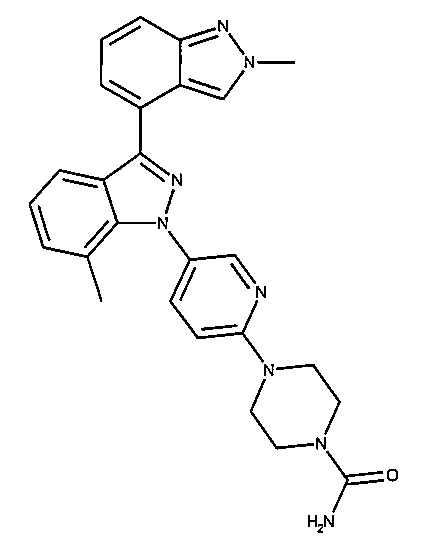


Applications Claiming Priority (3)
| Application Number | Priority Date | Filing Date | Title |
|---|---|---|---|
| EP21171155 | 2021-04-29 | ||
| EP21171155.1 | 2021-04-29 | ||
| PCT/EP2022/061379 WO2022229341A1 (en) | 2021-04-29 | 2022-04-28 | Heterocyclic compounds capable of activating sting |
Publications (2)
| Publication Number | Publication Date |
|---|---|
| JP2024514361A JP2024514361A (en) | 2024-04-01 |
| JP7634112B2 true JP7634112B2 (en) | 2025-02-20 |
Family
ID=75825418
Family Applications (1)
| Application Number | Title | Priority Date | Filing Date |
|---|---|---|---|
| JP2023564644A Active JP7634112B2 (en) | 2021-04-29 | 2022-04-28 | Heterocyclic compounds capable of activating STING |
Country Status (31)
| Country | Link |
|---|---|
| US (2) | US12065427B2 (en) |
| EP (1) | EP4330250B1 (en) |
| JP (1) | JP7634112B2 (en) |
| KR (1) | KR20240004646A (en) |
| CN (2) | CN117255784A (en) |
| AR (1) | AR125477A1 (en) |
| AU (1) | AU2022265323C1 (en) |
| BR (1) | BR112023017873A2 (en) |
| CA (1) | CA3214127A1 (en) |
| CL (1) | CL2023002959A1 (en) |
| CO (1) | CO2023014672A2 (en) |
| CR (1) | CR20230509A (en) |
| DK (1) | DK4330250T3 (en) |
| DO (1) | DOP2023000234A (en) |
| EC (1) | ECSP23069018A (en) |
| ES (1) | ES3019235T3 (en) |
| FI (1) | FI4330250T3 (en) |
| HR (1) | HRP20250430T1 (en) |
| HU (1) | HUE071621T2 (en) |
| IL (1) | IL307977A (en) |
| JO (1) | JOP20230270A1 (en) |
| LT (1) | LT4330250T (en) |
| MA (1) | MA64568B1 (en) |
| MX (1) | MX2023012800A (en) |
| NZ (1) | NZ803250A (en) |
| PE (1) | PE20240069A1 (en) |
| PL (1) | PL4330250T3 (en) |
| PT (1) | PT4330250T (en) |
| RS (1) | RS66626B1 (en) |
| SI (1) | SI4330250T1 (en) |
| WO (1) | WO2022229341A1 (en) |
Families Citing this family (3)
| Publication number | Priority date | Publication date | Assignee | Title |
|---|---|---|---|---|
| US12065427B2 (en) * | 2021-04-29 | 2024-08-20 | Boehringer Ingelheim International Gmbh | Heterocyclic compounds capable of activating STING |
| WO2024089155A1 (en) * | 2022-10-28 | 2024-05-02 | Boehringer Ingelheim International Gmbh | Heterocyclic compounds as sting antagonists |
| EP4688750A1 (en) | 2023-04-06 | 2026-02-11 | Pfizer Inc. | Substituted indazole propionic acid derivative compounds and uses thereof as ampk activators |
Citations (4)
| Publication number | Priority date | Publication date | Assignee | Title |
|---|---|---|---|---|
| WO2012095781A1 (en) | 2011-01-13 | 2012-07-19 | Pfizer Limited | Indazole derivatives as sodium channel inhibitors |
| JP2012521429A (en) | 2009-03-23 | 2012-09-13 | メルク・シャープ・エンド・ドーム・コーポレイション | P2X3 receptor antagonist for the treatment of pain |
| WO2020075790A1 (en) | 2018-10-11 | 2020-04-16 | 小野薬品工業株式会社 | Sting-agonist compound |
| US20200172534A1 (en) | 2018-07-03 | 2020-06-04 | Ifm Due, Inc. | Compounds and compositions for treating conditions associated with sting activity |
Family Cites Families (12)
| Publication number | Priority date | Publication date | Assignee | Title |
|---|---|---|---|---|
| AR090151A1 (en) | 2012-03-07 | 2014-10-22 | Lilly Co Eli | RAF INHIBITING COMPOUNDS |
| US9242969B2 (en) | 2013-03-14 | 2016-01-26 | Novartis Ag | Biaryl amide compounds as kinase inhibitors |
| TWI848953B (en) | 2018-06-09 | 2024-07-21 | 德商百靈佳殷格翰國際股份有限公司 | Multi-specific binding proteins for cancer treatment |
| TW202028183A (en) | 2018-10-10 | 2020-08-01 | 大陸商江蘇豪森藥業集團有限公司 | Nitrogen-containing heteroaryl derivative regulators, preparation method and application thereof |
| CN113563313B (en) * | 2019-01-31 | 2022-11-04 | 成都先导药物开发股份有限公司 | an immunomodulator |
| CN112521394A (en) * | 2019-09-19 | 2021-03-19 | 中国药科大学 | Heterocyclic amide compound, pharmaceutically acceptable salt thereof, preparation method and application thereof |
| KR20220070254A (en) * | 2019-09-25 | 2022-05-30 | 화이자 인코포레이티드 | Polyheterocyclic modulator of STING (interferon gene stimulator) |
| TWI878355B (en) | 2019-10-02 | 2025-04-01 | 德商百靈佳殷格翰國際股份有限公司 | Multi-specific binding proteins for cancer treatment |
| CN112869927B (en) | 2019-11-29 | 2024-11-19 | 百安健康复医疗(深圳)有限公司 | Orthotics for treating knee osteoarthritis |
| CN114761394B (en) | 2020-01-16 | 2024-03-29 | 浙江海正药业股份有限公司 | Pyridine or pyrimidine derivative and preparation method and application thereof |
| JP7736700B2 (en) | 2020-02-28 | 2025-09-09 | リミックス セラピューティクス インコーポレイテッド | Heterocyclic amides and their use for modulating splicing |
| US12065427B2 (en) * | 2021-04-29 | 2024-08-20 | Boehringer Ingelheim International Gmbh | Heterocyclic compounds capable of activating STING |
-
2022
- 2022-04-27 US US17/730,395 patent/US12065427B2/en active Active
- 2022-04-28 CR CR20230509A patent/CR20230509A/en unknown
- 2022-04-28 PL PL22727008.9T patent/PL4330250T3/en unknown
- 2022-04-28 FI FIEP22727008.9T patent/FI4330250T3/en active
- 2022-04-28 NZ NZ803250A patent/NZ803250A/en unknown
- 2022-04-28 CN CN202280030669.8A patent/CN117255784A/en active Pending
- 2022-04-28 BR BR112023017873A patent/BR112023017873A2/en active IP Right Grant
- 2022-04-28 CA CA3214127A patent/CA3214127A1/en active Pending
- 2022-04-28 MX MX2023012800A patent/MX2023012800A/en unknown
- 2022-04-28 PT PT227270089T patent/PT4330250T/en unknown
- 2022-04-28 AU AU2022265323A patent/AU2022265323C1/en active Active
- 2022-04-28 SI SI202230106T patent/SI4330250T1/en unknown
- 2022-04-28 RS RS20250291A patent/RS66626B1/en unknown
- 2022-04-28 HU HUE22727008A patent/HUE071621T2/en unknown
- 2022-04-28 EP EP22727008.9A patent/EP4330250B1/en active Active
- 2022-04-28 MA MA64568A patent/MA64568B1/en unknown
- 2022-04-28 ES ES22727008T patent/ES3019235T3/en active Active
- 2022-04-28 IL IL307977A patent/IL307977A/en unknown
- 2022-04-28 LT LTEPPCT/EP2022/061379T patent/LT4330250T/en unknown
- 2022-04-28 PE PE2023002941A patent/PE20240069A1/en unknown
- 2022-04-28 KR KR1020237040758A patent/KR20240004646A/en active Pending
- 2022-04-28 AR ARP220101113A patent/AR125477A1/en unknown
- 2022-04-28 CN CN202410587835.5A patent/CN118546123A/en active Pending
- 2022-04-28 HR HRP20250430TT patent/HRP20250430T1/en unknown
- 2022-04-28 WO PCT/EP2022/061379 patent/WO2022229341A1/en not_active Ceased
- 2022-04-28 JP JP2023564644A patent/JP7634112B2/en active Active
- 2022-04-28 DK DK22727008.9T patent/DK4330250T3/en active
-
2023
- 2023-09-13 EC ECSENADI202369018A patent/ECSP23069018A/en unknown
- 2023-10-03 CL CL2023002959A patent/CL2023002959A1/en unknown
- 2023-10-20 DO DO2023000234A patent/DOP2023000234A/en unknown
- 2023-10-26 JO JOJO/P/2023/0270A patent/JOP20230270A1/en unknown
- 2023-10-30 CO CONC2023/0014672A patent/CO2023014672A2/en unknown
-
2024
- 2024-03-06 US US18/596,986 patent/US20240270718A1/en active Pending
Patent Citations (4)
| Publication number | Priority date | Publication date | Assignee | Title |
|---|---|---|---|---|
| JP2012521429A (en) | 2009-03-23 | 2012-09-13 | メルク・シャープ・エンド・ドーム・コーポレイション | P2X3 receptor antagonist for the treatment of pain |
| WO2012095781A1 (en) | 2011-01-13 | 2012-07-19 | Pfizer Limited | Indazole derivatives as sodium channel inhibitors |
| US20200172534A1 (en) | 2018-07-03 | 2020-06-04 | Ifm Due, Inc. | Compounds and compositions for treating conditions associated with sting activity |
| WO2020075790A1 (en) | 2018-10-11 | 2020-04-16 | 小野薬品工業株式会社 | Sting-agonist compound |
Non-Patent Citations (1)
| Title |
|---|
| Chen, Nan-Nan et al.,Agonist of stimulator of interferon genes as antitumor agents: a patent review (2008-2020),Expert Opinion on Therapeutic Patents,2021年,31(6),pp. 563-584,https://doi.org/10.1080/13543776.2021.1877660 |
Also Published As
Similar Documents
| Publication | Publication Date | Title |
|---|---|---|
| JP7634112B2 (en) | Heterocyclic compounds capable of activating STING | |
| ES2624439T3 (en) | Condensed pyridinyl triazolone and pyridinyl triazolone derivatives | |
| EP4608820A1 (en) | Heterocyclic compounds capable of activating sting | |
| WO2021000855A1 (en) | Malt1 inhibitors and uses thereof | |
| TWI916562B (en) | Heterocyclic compounds capable of activating sting | |
| JP2025536352A (en) | Heterocyclic compounds capable of activating STING | |
| HK40108588B (en) | Heterocyclic compounds capable of activating sting | |
| HK40108588A (en) | Heterocyclic compounds capable of activating sting | |
| EA049138B1 (en) | HETEROCYCLIC COMPOUNDS CAPABLE OF ACTIVATING STING | |
| WO2024089008A1 (en) | Heterocyclic compounds capable of activating sting | |
| BR112019006512A2 (en) | cyclic dinucleotide compounds | |
| BR112019006512B1 (en) | COMPOUNDS, SUBSTANTIALLY PURE STEREOISOMERS, PHARMACEUTICALLY ACCEPTABLE SALT, SODIUM SALT, PHARMACEUTICAL COMPOSITIONS, VACCINE AND USES OF SAID COMPOUNDS |
Legal Events
| Date | Code | Title | Description |
|---|---|---|---|
| A521 | Request for written amendment filed |
Free format text: JAPANESE INTERMEDIATE CODE: A523 Effective date: 20231020 |
|
| A621 | Written request for application examination |
Free format text: JAPANESE INTERMEDIATE CODE: A621 Effective date: 20231020 |
|
| A131 | Notification of reasons for refusal |
Free format text: JAPANESE INTERMEDIATE CODE: A131 Effective date: 20241003 |
|
| A977 | Report on retrieval |
Free format text: JAPANESE INTERMEDIATE CODE: A971007 Effective date: 20241004 |
|
| A521 | Request for written amendment filed |
Free format text: JAPANESE INTERMEDIATE CODE: A523 Effective date: 20241225 |
|
| TRDD | Decision of grant or rejection written | ||
| A01 | Written decision to grant a patent or to grant a registration (utility model) |
Free format text: JAPANESE INTERMEDIATE CODE: A01 Effective date: 20250109 |
|
| A61 | First payment of annual fees (during grant procedure) |
Free format text: JAPANESE INTERMEDIATE CODE: A61 Effective date: 20250207 |
|
| R150 | Certificate of patent or registration of utility model |
Ref document number: 7634112 Country of ref document: JP Free format text: JAPANESE INTERMEDIATE CODE: R150 |