JP7635277B2 - Personal lubricants containing lambda-carrageenan - Google Patents
Personal lubricants containing lambda-carrageenan Download PDFInfo
- Publication number
- JP7635277B2 JP7635277B2 JP2022580078A JP2022580078A JP7635277B2 JP 7635277 B2 JP7635277 B2 JP 7635277B2 JP 2022580078 A JP2022580078 A JP 2022580078A JP 2022580078 A JP2022580078 A JP 2022580078A JP 7635277 B2 JP7635277 B2 JP 7635277B2
- Authority
- JP
- Japan
- Prior art keywords
- carrageenan
- antiviral
- lubricating composition
- weight
- composition
- Prior art date
- Legal status (The legal status is an assumption and is not a legal conclusion. Google has not performed a legal analysis and makes no representation as to the accuracy of the status listed.)
- Active
Links
- 229920001525 carrageenan Polymers 0.000 title claims description 449
- 239000000679 carrageenan Substances 0.000 title claims description 437
- 229940113118 carrageenan Drugs 0.000 title claims description 437
- 239000000314 lubricant Substances 0.000 title claims description 94
- 239000000203 mixture Substances 0.000 claims description 578
- 230000000840 anti-viral effect Effects 0.000 claims description 393
- 235000010418 carrageenan Nutrition 0.000 claims description 337
- 230000001050 lubricating effect Effects 0.000 claims description 337
- UHVMMEOXYDMDKI-JKYCWFKZSA-L zinc;1-(5-cyanopyridin-2-yl)-3-[(1s,2s)-2-(6-fluoro-2-hydroxy-3-propanoylphenyl)cyclopropyl]urea;diacetate Chemical compound [Zn+2].CC([O-])=O.CC([O-])=O.CCC(=O)C1=CC=C(F)C([C@H]2[C@H](C2)NC(=O)NC=2N=CC(=CC=2)C#N)=C1O UHVMMEOXYDMDKI-JKYCWFKZSA-L 0.000 claims description 314
- 230000001568 sexual effect Effects 0.000 claims description 108
- 239000000843 powder Substances 0.000 claims description 84
- 238000000034 method Methods 0.000 claims description 78
- DNIAPMSPPWPWGF-UHFFFAOYSA-N Propylene glycol Chemical compound CC(O)CO DNIAPMSPPWPWGF-UHFFFAOYSA-N 0.000 claims description 75
- 238000002156 mixing Methods 0.000 claims description 71
- 241000701806 Human papillomavirus Species 0.000 claims description 64
- 210000000981 epithelium Anatomy 0.000 claims description 64
- 229920005862 polyol Polymers 0.000 claims description 64
- 150000003077 polyols Chemical class 0.000 claims description 64
- 239000007864 aqueous solution Substances 0.000 claims description 50
- 239000000758 substrate Substances 0.000 claims description 46
- 239000000725 suspension Substances 0.000 claims description 46
- ZNOZWUKQPJXOIG-XSBHQQIPSA-L [(2r,3s,4r,5r,6s)-6-[[(1r,3s,4r,5r,8s)-3,4-dihydroxy-2,6-dioxabicyclo[3.2.1]octan-8-yl]oxy]-4-[[(1r,3r,4r,5r,8s)-8-[(2s,3r,4r,5r,6r)-3,4-dihydroxy-6-(hydroxymethyl)-5-sulfonatooxyoxan-2-yl]oxy-4-hydroxy-2,6-dioxabicyclo[3.2.1]octan-3-yl]oxy]-5-hydroxy-2-( Chemical compound O[C@@H]1[C@@H](O)[C@@H](OS([O-])(=O)=O)[C@@H](CO)O[C@H]1O[C@@H]1[C@@H]2OC[C@H]1O[C@H](O[C@H]1[C@H]([C@@H](CO)O[C@@H](O[C@@H]3[C@@H]4OC[C@H]3O[C@H](O)[C@@H]4O)[C@@H]1O)OS([O-])(=O)=O)[C@@H]2O ZNOZWUKQPJXOIG-XSBHQQIPSA-L 0.000 claims description 43
- 241000700605 Viruses Species 0.000 claims description 37
- 230000005540 biological transmission Effects 0.000 claims description 37
- 239000003755 preservative agent Substances 0.000 claims description 25
- 230000002401 inhibitory effect Effects 0.000 claims description 23
- 235000003599 food sweetener Nutrition 0.000 claims description 21
- 239000003765 sweetening agent Substances 0.000 claims description 21
- 239000007900 aqueous suspension Substances 0.000 claims description 19
- 241000282414 Homo sapiens Species 0.000 claims description 17
- 238000010438 heat treatment Methods 0.000 claims description 16
- 239000000243 solution Substances 0.000 claims description 14
- 238000001816 cooling Methods 0.000 claims description 8
- 239000003002 pH adjusting agent Substances 0.000 claims description 7
- 241000711573 Coronaviridae Species 0.000 claims description 5
- 239000000463 material Substances 0.000 claims description 5
- 241000709664 Picornaviridae Species 0.000 claims description 4
- 239000011324 bead Substances 0.000 claims description 4
- 241000701242 Adenoviridae Species 0.000 claims description 3
- 241000700586 Herpesviridae Species 0.000 claims description 3
- 240000001155 Opuntia dillenii Species 0.000 claims description 3
- 235000006544 Opuntia dillenii Nutrition 0.000 claims description 3
- 241000712464 Orthomyxoviridae Species 0.000 claims description 3
- 241001631646 Papillomaviridae Species 0.000 claims description 3
- 241000711504 Paramyxoviridae Species 0.000 claims description 3
- 241000711904 Pneumoviridae Species 0.000 claims description 3
- 241000702247 Reoviridae Species 0.000 claims description 3
- 241000712907 Retroviridae Species 0.000 claims description 3
- 108700010877 adenoviridae proteins Proteins 0.000 claims description 3
- 201000003176 Severe Acute Respiratory Syndrome Diseases 0.000 claims 3
- 210000000214 mouth Anatomy 0.000 description 39
- 210000001215 vagina Anatomy 0.000 description 37
- 229920001282 polysaccharide Polymers 0.000 description 29
- 239000005017 polysaccharide Substances 0.000 description 28
- 235000013772 propylene glycol Nutrition 0.000 description 28
- -1 sulfate ester Chemical class 0.000 description 28
- 210000000436 anus Anatomy 0.000 description 27
- KRKNYBCHXYNGOX-UHFFFAOYSA-N citric acid Chemical compound OC(=O)CC(O)(C(O)=O)CC(O)=O KRKNYBCHXYNGOX-UHFFFAOYSA-N 0.000 description 24
- 239000000499 gel Substances 0.000 description 22
- 210000003899 penis Anatomy 0.000 description 22
- XLYOFNOQVPJJNP-UHFFFAOYSA-N water Substances O XLYOFNOQVPJJNP-UHFFFAOYSA-N 0.000 description 21
- 241000725303 Human immunodeficiency virus Species 0.000 description 20
- 241000700584 Simplexvirus Species 0.000 description 18
- 230000000694 effects Effects 0.000 description 18
- PEDCQBHIVMGVHV-UHFFFAOYSA-N Glycerine Chemical compound OCC(O)CO PEDCQBHIVMGVHV-UHFFFAOYSA-N 0.000 description 17
- DNIAPMSPPWPWGF-GSVOUGTGSA-N (R)-(-)-Propylene glycol Chemical compound C[C@@H](O)CO DNIAPMSPPWPWGF-GSVOUGTGSA-N 0.000 description 15
- 235000019204 saccharin Nutrition 0.000 description 15
- CVHZOJJKTDOEJC-UHFFFAOYSA-N saccharin Chemical compound C1=CC=C2C(=O)NS(=O)(=O)C2=C1 CVHZOJJKTDOEJC-UHFFFAOYSA-N 0.000 description 15
- 229940081974 saccharin Drugs 0.000 description 15
- 239000000901 saccharin and its Na,K and Ca salt Substances 0.000 description 15
- 230000006870 function Effects 0.000 description 14
- 150000004676 glycans Chemical class 0.000 description 14
- 239000003205 fragrance Substances 0.000 description 12
- 239000004615 ingredient Substances 0.000 description 12
- 210000001331 nose Anatomy 0.000 description 12
- 230000000670 limiting effect Effects 0.000 description 10
- 208000036142 Viral infection Diseases 0.000 description 9
- 239000000284 extract Substances 0.000 description 9
- 150000003839 salts Chemical class 0.000 description 9
- 230000009385 viral infection Effects 0.000 description 9
- 241001474374 Blennius Species 0.000 description 8
- QAOWNCQODCNURD-UHFFFAOYSA-L Sulfate Chemical compound [O-]S([O-])(=O)=O QAOWNCQODCNURD-UHFFFAOYSA-L 0.000 description 8
- 239000002253 acid Substances 0.000 description 8
- 150000001875 compounds Chemical class 0.000 description 8
- 230000001965 increasing effect Effects 0.000 description 8
- 230000007423 decrease Effects 0.000 description 7
- 210000003928 nasal cavity Anatomy 0.000 description 7
- 210000003800 pharynx Anatomy 0.000 description 7
- PUPZLCDOIYMWBV-UHFFFAOYSA-N (+/-)-1,3-Butanediol Chemical compound CC(O)CCO PUPZLCDOIYMWBV-UHFFFAOYSA-N 0.000 description 6
- 208000025721 COVID-19 Diseases 0.000 description 6
- 230000008901 benefit Effects 0.000 description 6
- 230000015572 biosynthetic process Effects 0.000 description 6
- WERYXYBDKMZEQL-UHFFFAOYSA-N butane-1,4-diol Chemical compound OCCCCO WERYXYBDKMZEQL-UHFFFAOYSA-N 0.000 description 6
- 210000003756 cervix mucus Anatomy 0.000 description 6
- 210000003679 cervix uteri Anatomy 0.000 description 6
- 239000003795 chemical substances by application Substances 0.000 description 6
- 210000003029 clitoris Anatomy 0.000 description 6
- 150000002016 disaccharides Chemical class 0.000 description 6
- 235000013305 food Nutrition 0.000 description 6
- 235000011187 glycerol Nutrition 0.000 description 6
- 230000036541 health Effects 0.000 description 6
- 229910052751 metal Inorganic materials 0.000 description 6
- 239000002184 metal Substances 0.000 description 6
- 239000002245 particle Substances 0.000 description 6
- 229920000642 polymer Polymers 0.000 description 6
- 239000000047 product Substances 0.000 description 6
- 210000000664 rectum Anatomy 0.000 description 6
- 208000024891 symptom Diseases 0.000 description 6
- 210000003905 vulva Anatomy 0.000 description 6
- 241001465754 Metazoa Species 0.000 description 5
- 238000010521 absorption reaction Methods 0.000 description 5
- 238000009472 formulation Methods 0.000 description 5
- 208000015181 infectious disease Diseases 0.000 description 5
- 238000003780 insertion Methods 0.000 description 5
- 230000037431 insertion Effects 0.000 description 5
- 230000008520 organization Effects 0.000 description 5
- 230000002335 preservative effect Effects 0.000 description 5
- 230000003612 virological effect Effects 0.000 description 5
- DNIAPMSPPWPWGF-VKHMYHEASA-N (+)-propylene glycol Chemical compound C[C@H](O)CO DNIAPMSPPWPWGF-VKHMYHEASA-N 0.000 description 4
- YPFDHNVEDLHUCE-UHFFFAOYSA-N 1,3-propanediol Substances OCCCO YPFDHNVEDLHUCE-UHFFFAOYSA-N 0.000 description 4
- FBPFZTCFMRRESA-KVTDHHQDSA-N D-Mannitol Chemical compound OC[C@@H](O)[C@@H](O)[C@H](O)[C@H](O)CO FBPFZTCFMRRESA-KVTDHHQDSA-N 0.000 description 4
- 241000709661 Enterovirus Species 0.000 description 4
- LYCAIKOWRPUZTN-UHFFFAOYSA-N Ethylene glycol Chemical compound OCCO LYCAIKOWRPUZTN-UHFFFAOYSA-N 0.000 description 4
- GLZPCOQZEFWAFX-UHFFFAOYSA-N Geraniol Chemical compound CC(C)=CCCC(C)=CCO GLZPCOQZEFWAFX-UHFFFAOYSA-N 0.000 description 4
- 241000282412 Homo Species 0.000 description 4
- 238000004566 IR spectroscopy Methods 0.000 description 4
- 229930195725 Mannitol Natural products 0.000 description 4
- 206010028980 Neoplasm Diseases 0.000 description 4
- 239000004288 Sodium dehydroacetate Substances 0.000 description 4
- TVXBFESIOXBWNM-UHFFFAOYSA-N Xylitol Natural products OCCC(O)C(O)C(O)CCO TVXBFESIOXBWNM-UHFFFAOYSA-N 0.000 description 4
- 239000003125 aqueous solvent Substances 0.000 description 4
- 239000008367 deionised water Substances 0.000 description 4
- 229910021641 deionized water Inorganic materials 0.000 description 4
- 239000003651 drinking water Substances 0.000 description 4
- 235000020188 drinking water Nutrition 0.000 description 4
- 238000000265 homogenisation Methods 0.000 description 4
- 238000001727 in vivo Methods 0.000 description 4
- 238000002329 infrared spectrum Methods 0.000 description 4
- 238000005461 lubrication Methods 0.000 description 4
- 239000000594 mannitol Substances 0.000 description 4
- 235000010355 mannitol Nutrition 0.000 description 4
- HEBKCHPVOIAQTA-UHFFFAOYSA-N meso ribitol Natural products OCC(O)C(O)C(O)CO HEBKCHPVOIAQTA-UHFFFAOYSA-N 0.000 description 4
- 239000003921 oil Substances 0.000 description 4
- 238000004806 packaging method and process Methods 0.000 description 4
- 230000002688 persistence Effects 0.000 description 4
- 229920000166 polytrimethylene carbonate Polymers 0.000 description 4
- 238000002360 preparation method Methods 0.000 description 4
- 238000012545 processing Methods 0.000 description 4
- 210000000582 semen Anatomy 0.000 description 4
- 229940079839 sodium dehydroacetate Drugs 0.000 description 4
- 239000011550 stock solution Substances 0.000 description 4
- 239000000126 substance Substances 0.000 description 4
- 235000000346 sugar Nutrition 0.000 description 4
- 239000002562 thickening agent Substances 0.000 description 4
- 238000012546 transfer Methods 0.000 description 4
- 241000701161 unidentified adenovirus Species 0.000 description 4
- 239000000341 volatile oil Substances 0.000 description 4
- 239000000811 xylitol Substances 0.000 description 4
- 235000010447 xylitol Nutrition 0.000 description 4
- HEBKCHPVOIAQTA-SCDXWVJYSA-N xylitol Chemical compound OC[C@H](O)[C@@H](O)[C@H](O)CO HEBKCHPVOIAQTA-SCDXWVJYSA-N 0.000 description 4
- 229960002675 xylitol Drugs 0.000 description 4
- QTBSBXVTEAMEQO-UHFFFAOYSA-N Acetic acid Chemical compound CC(O)=O QTBSBXVTEAMEQO-UHFFFAOYSA-N 0.000 description 3
- 229920000289 Polyquaternium Polymers 0.000 description 3
- 206010062106 Respiratory tract infection viral Diseases 0.000 description 3
- WINXNKPZLFISPD-UHFFFAOYSA-M Saccharin sodium Chemical compound [Na+].C1=CC=C2C(=O)[N-]S(=O)(=O)C2=C1 WINXNKPZLFISPD-UHFFFAOYSA-M 0.000 description 3
- HEMHJVSKTPXQMS-UHFFFAOYSA-M Sodium hydroxide Chemical compound [OH-].[Na+] HEMHJVSKTPXQMS-UHFFFAOYSA-M 0.000 description 3
- 238000004458 analytical method Methods 0.000 description 3
- 210000001124 body fluid Anatomy 0.000 description 3
- OWBTYPJTUOEWEK-UHFFFAOYSA-N butane-2,3-diol Chemical compound CC(O)C(C)O OWBTYPJTUOEWEK-UHFFFAOYSA-N 0.000 description 3
- 201000011510 cancer Diseases 0.000 description 3
- 239000001913 cellulose Substances 0.000 description 3
- 229920002678 cellulose Polymers 0.000 description 3
- 235000019219 chocolate Nutrition 0.000 description 3
- 239000003814 drug Substances 0.000 description 3
- 235000013373 food additive Nutrition 0.000 description 3
- 239000002778 food additive Substances 0.000 description 3
- 125000000524 functional group Chemical group 0.000 description 3
- 150000002334 glycols Chemical class 0.000 description 3
- 230000009878 intermolecular interaction Effects 0.000 description 3
- 239000004816 latex Substances 0.000 description 3
- 229920000126 latex Polymers 0.000 description 3
- 239000007788 liquid Substances 0.000 description 3
- 239000000845 maltitol Substances 0.000 description 3
- 235000010449 maltitol Nutrition 0.000 description 3
- VQHSOMBJVWLPSR-WUJBLJFYSA-N maltitol Chemical compound OC[C@H](O)[C@@H](O)[C@@H]([C@H](O)CO)O[C@H]1O[C@H](CO)[C@@H](O)[C@H](O)[C@H]1O VQHSOMBJVWLPSR-WUJBLJFYSA-N 0.000 description 3
- 229940035436 maltitol Drugs 0.000 description 3
- 229960002566 papillomavirus vaccine Drugs 0.000 description 3
- OJTDGPLHRSZIAV-UHFFFAOYSA-N propane-1,2-diol Chemical compound CC(O)CO.CC(O)CO OJTDGPLHRSZIAV-UHFFFAOYSA-N 0.000 description 3
- 238000011321 prophylaxis Methods 0.000 description 3
- 238000007789 sealing Methods 0.000 description 3
- 235000019259 sodium dehydroacetate Nutrition 0.000 description 3
- 239000007787 solid Substances 0.000 description 3
- 230000007928 solubilization Effects 0.000 description 3
- 238000005063 solubilization Methods 0.000 description 3
- 230000003381 solubilizing effect Effects 0.000 description 3
- 239000002904 solvent Substances 0.000 description 3
- 238000003756 stirring Methods 0.000 description 3
- 238000003860 storage Methods 0.000 description 3
- 238000011282 treatment Methods 0.000 description 3
- WQZGKKKJIJFFOK-SVZMEOIVSA-N (+)-Galactose Chemical group OC[C@H]1OC(O)[C@H](O)[C@@H](O)[C@H]1O WQZGKKKJIJFFOK-SVZMEOIVSA-N 0.000 description 2
- MXOAEAUPQDYUQM-QMMMGPOBSA-N (S)-chlorphenesin Chemical compound OC[C@H](O)COC1=CC=C(Cl)C=C1 MXOAEAUPQDYUQM-QMMMGPOBSA-N 0.000 description 2
- SERLAGPUMNYUCK-DCUALPFSSA-N 1-O-alpha-D-glucopyranosyl-D-mannitol Chemical compound OC[C@@H](O)[C@@H](O)[C@H](O)[C@H](O)CO[C@H]1O[C@H](CO)[C@@H](O)[C@H](O)[C@H]1O SERLAGPUMNYUCK-DCUALPFSSA-N 0.000 description 2
- QCDWFXQBSFUVSP-UHFFFAOYSA-N 2-phenoxyethanol Chemical compound OCCOC1=CC=CC=C1 QCDWFXQBSFUVSP-UHFFFAOYSA-N 0.000 description 2
- WZYRMLAWNVOIEX-BGPJRJDNSA-N 3,6-anhydro-D-galactose Chemical group O=C[C@H](O)[C@H]1OC[C@@H](O)[C@@H]1O WZYRMLAWNVOIEX-BGPJRJDNSA-N 0.000 description 2
- 206010059313 Anogenital warts Diseases 0.000 description 2
- 241001631457 Cannula Species 0.000 description 2
- 206010008342 Cervix carcinoma Diseases 0.000 description 2
- 201000006082 Chickenpox Diseases 0.000 description 2
- 241000206575 Chondrus crispus Species 0.000 description 2
- 235000005979 Citrus limon Nutrition 0.000 description 2
- 244000131522 Citrus pyriformis Species 0.000 description 2
- 208000000907 Condylomata Acuminata Diseases 0.000 description 2
- FBPFZTCFMRRESA-FSIIMWSLSA-N D-Glucitol Natural products OC[C@H](O)[C@H](O)[C@@H](O)[C@H](O)CO FBPFZTCFMRRESA-FSIIMWSLSA-N 0.000 description 2
- 239000004386 Erythritol Substances 0.000 description 2
- UNXHWFMMPAWVPI-UHFFFAOYSA-N Erythritol Natural products OCC(O)C(O)CO UNXHWFMMPAWVPI-UHFFFAOYSA-N 0.000 description 2
- VEXZGXHMUGYJMC-UHFFFAOYSA-N Hydrochloric acid Chemical compound Cl VEXZGXHMUGYJMC-UHFFFAOYSA-N 0.000 description 2
- 201000005505 Measles Diseases 0.000 description 2
- 244000246386 Mentha pulegium Species 0.000 description 2
- 235000016257 Mentha pulegium Nutrition 0.000 description 2
- 235000004357 Mentha x piperita Nutrition 0.000 description 2
- 208000005647 Mumps Diseases 0.000 description 2
- 240000004760 Pimpinella anisum Species 0.000 description 2
- 235000012550 Pimpinella anisum Nutrition 0.000 description 2
- 239000002202 Polyethylene glycol Substances 0.000 description 2
- 241000702670 Rotavirus Species 0.000 description 2
- 208000019802 Sexually transmitted disease Diseases 0.000 description 2
- QAOWNCQODCNURD-UHFFFAOYSA-N Sulfuric acid Chemical compound OS(O)(=O)=O QAOWNCQODCNURD-UHFFFAOYSA-N 0.000 description 2
- 208000006105 Uterine Cervical Neoplasms Diseases 0.000 description 2
- 206010046980 Varicella Diseases 0.000 description 2
- HCHKCACWOHOZIP-UHFFFAOYSA-N Zinc Chemical compound [Zn] HCHKCACWOHOZIP-UHFFFAOYSA-N 0.000 description 2
- ACRPXCXKILJIJN-KCDKBNATSA-N [(2r,3s,4r,5r)-1,2,4,5-tetrahydroxy-6-oxohexan-3-yl] hydrogen sulfate Chemical compound OC[C@@H](O)[C@H](OS(O)(=O)=O)[C@H](O)[C@@H](O)C=O ACRPXCXKILJIJN-KCDKBNATSA-N 0.000 description 2
- 150000007513 acids Chemical class 0.000 description 2
- 230000001154 acute effect Effects 0.000 description 2
- 239000002671 adjuvant Substances 0.000 description 2
- 208000025009 anogenital human papillomavirus infection Diseases 0.000 description 2
- 201000004201 anogenital venereal wart Diseases 0.000 description 2
- 230000000844 anti-bacterial effect Effects 0.000 description 2
- 230000000845 anti-microbial effect Effects 0.000 description 2
- 239000004599 antimicrobial Substances 0.000 description 2
- 239000008122 artificial sweetener Substances 0.000 description 2
- 235000021311 artificial sweeteners Nutrition 0.000 description 2
- 239000002585 base Substances 0.000 description 2
- WPYMKLBDIGXBTP-UHFFFAOYSA-N benzoic acid Chemical compound OC(=O)C1=CC=CC=C1 WPYMKLBDIGXBTP-UHFFFAOYSA-N 0.000 description 2
- UAHWPYUMFXYFJY-UHFFFAOYSA-N beta-myrcene Chemical compound CC(C)=CCCC(=C)C=C UAHWPYUMFXYFJY-UHFFFAOYSA-N 0.000 description 2
- 201000010881 cervical cancer Diseases 0.000 description 2
- 229960003993 chlorphenesin Drugs 0.000 description 2
- WZYRMLAWNVOIEX-UHFFFAOYSA-N cinnamtannin B-2 Chemical group O=CC(O)C1OCC(O)C1O WZYRMLAWNVOIEX-UHFFFAOYSA-N 0.000 description 2
- 150000001860 citric acid derivatives Chemical class 0.000 description 2
- QMVPMAAFGQKVCJ-UHFFFAOYSA-N citronellol Chemical compound OCCC(C)CCC=C(C)C QMVPMAAFGQKVCJ-UHFFFAOYSA-N 0.000 description 2
- 230000000295 complement effect Effects 0.000 description 2
- 230000001276 controlling effect Effects 0.000 description 2
- 239000006071 cream Substances 0.000 description 2
- 230000034994 death Effects 0.000 description 2
- 231100000517 death Toxicity 0.000 description 2
- 201000010099 disease Diseases 0.000 description 2
- 208000037265 diseases, disorders, signs and symptoms Diseases 0.000 description 2
- 229920001971 elastomer Polymers 0.000 description 2
- 239000003792 electrolyte Substances 0.000 description 2
- 210000002919 epithelial cell Anatomy 0.000 description 2
- 235000019414 erythritol Nutrition 0.000 description 2
- UNXHWFMMPAWVPI-ZXZARUISSA-N erythritol Chemical compound OC[C@H](O)[C@H](O)CO UNXHWFMMPAWVPI-ZXZARUISSA-N 0.000 description 2
- 229940009714 erythritol Drugs 0.000 description 2
- RRAFCDWBNXTKKO-UHFFFAOYSA-N eugenol Chemical compound COC1=CC(CC=C)=CC=C1O RRAFCDWBNXTKKO-UHFFFAOYSA-N 0.000 description 2
- 210000003811 finger Anatomy 0.000 description 2
- 239000000796 flavoring agent Substances 0.000 description 2
- 235000019634 flavors Nutrition 0.000 description 2
- 239000012530 fluid Substances 0.000 description 2
- 239000003349 gelling agent Substances 0.000 description 2
- 235000001050 hortel pimenta Nutrition 0.000 description 2
- WGCNASOHLSPBMP-UHFFFAOYSA-N hydroxyacetaldehyde Natural products OCC=O WGCNASOHLSPBMP-UHFFFAOYSA-N 0.000 description 2
- 238000000338 in vitro Methods 0.000 description 2
- 230000005764 inhibitory process Effects 0.000 description 2
- 230000007794 irritation Effects 0.000 description 2
- 239000000905 isomalt Substances 0.000 description 2
- 235000010439 isomalt Nutrition 0.000 description 2
- HPIGCVXMBGOWTF-UHFFFAOYSA-N isomaltol Natural products CC(=O)C=1OC=CC=1O HPIGCVXMBGOWTF-UHFFFAOYSA-N 0.000 description 2
- 235000008960 ketchup Nutrition 0.000 description 2
- JVTAAEKCZFNVCJ-UHFFFAOYSA-N lactic acid Chemical compound CC(O)C(O)=O JVTAAEKCZFNVCJ-UHFFFAOYSA-N 0.000 description 2
- 239000000832 lactitol Substances 0.000 description 2
- 235000010448 lactitol Nutrition 0.000 description 2
- VQHSOMBJVWLPSR-JVCRWLNRSA-N lactitol Chemical compound OC[C@H](O)[C@@H](O)[C@@H]([C@H](O)CO)O[C@@H]1O[C@H](CO)[C@H](O)[C@H](O)[C@H]1O VQHSOMBJVWLPSR-JVCRWLNRSA-N 0.000 description 2
- 229960003451 lactitol Drugs 0.000 description 2
- CDOSHBSSFJOMGT-UHFFFAOYSA-N linalool Chemical compound CC(C)=CCCC(C)(O)C=C CDOSHBSSFJOMGT-UHFFFAOYSA-N 0.000 description 2
- 230000009021 linear effect Effects 0.000 description 2
- 238000005259 measurement Methods 0.000 description 2
- LXCFILQKKLGQFO-UHFFFAOYSA-N methylparaben Chemical compound COC(=O)C1=CC=C(O)C=C1 LXCFILQKKLGQFO-UHFFFAOYSA-N 0.000 description 2
- 230000004048 modification Effects 0.000 description 2
- 238000012986 modification Methods 0.000 description 2
- 208000010805 mumps infectious disease Diseases 0.000 description 2
- 229940087419 nonoxynol-9 Drugs 0.000 description 2
- 229920004918 nonoxynol-9 Polymers 0.000 description 2
- 230000003287 optical effect Effects 0.000 description 2
- HFPZCAJZSCWRBC-UHFFFAOYSA-N p-cymene Chemical compound CC(C)C1=CC=C(C)C=C1 HFPZCAJZSCWRBC-UHFFFAOYSA-N 0.000 description 2
- 230000001717 pathogenic effect Effects 0.000 description 2
- 229940068196 placebo Drugs 0.000 description 2
- 239000000902 placebo Substances 0.000 description 2
- 239000004033 plastic Substances 0.000 description 2
- 229920001223 polyethylene glycol Polymers 0.000 description 2
- 229920001451 polypropylene glycol Polymers 0.000 description 2
- 230000008569 process Effects 0.000 description 2
- QELSKZZBTMNZEB-UHFFFAOYSA-N propylparaben Chemical compound CCCOC(=O)C1=CC=C(O)C=C1 QELSKZZBTMNZEB-UHFFFAOYSA-N 0.000 description 2
- 230000002829 reductive effect Effects 0.000 description 2
- 230000001105 regulatory effect Effects 0.000 description 2
- 238000011160 research Methods 0.000 description 2
- 208000023504 respiratory system disease Diseases 0.000 description 2
- 230000004044 response Effects 0.000 description 2
- 239000005060 rubber Substances 0.000 description 2
- YGSDEFSMJLZEOE-UHFFFAOYSA-N salicylic acid Chemical compound OC(=O)C1=CC=CC=C1O YGSDEFSMJLZEOE-UHFFFAOYSA-N 0.000 description 2
- 230000035807 sensation Effects 0.000 description 2
- 235000019615 sensations Nutrition 0.000 description 2
- 229920002545 silicone oil Polymers 0.000 description 2
- 159000000000 sodium salts Chemical class 0.000 description 2
- DSOWAKKSGYUMTF-GZOLSCHFSA-M sodium;(1e)-1-(6-methyl-2,4-dioxopyran-3-ylidene)ethanolate Chemical compound [Na+].C\C([O-])=C1/C(=O)OC(C)=CC1=O DSOWAKKSGYUMTF-GZOLSCHFSA-M 0.000 description 2
- 239000000600 sorbitol Substances 0.000 description 2
- 239000013589 supplement Substances 0.000 description 2
- FBWNMEQMRUMQSO-UHFFFAOYSA-N tergitol NP-9 Chemical compound CCCCCCCCCC1=CC=C(OCCOCCOCCOCCOCCOCCOCCOCCOCCO)C=C1 FBWNMEQMRUMQSO-UHFFFAOYSA-N 0.000 description 2
- 230000008719 thickening Effects 0.000 description 2
- MGSRCZKZVOBKFT-UHFFFAOYSA-N thymol Chemical compound CC(C)C1=CC=C(C)C=C1O MGSRCZKZVOBKFT-UHFFFAOYSA-N 0.000 description 2
- 210000001519 tissue Anatomy 0.000 description 2
- 230000000699 topical effect Effects 0.000 description 2
- 229960005486 vaccine Drugs 0.000 description 2
- 150000003751 zinc Chemical class 0.000 description 2
- NOOLISFMXDJSKH-UTLUCORTSA-N (+)-Neomenthol Chemical compound CC(C)[C@@H]1CC[C@@H](C)C[C@@H]1O NOOLISFMXDJSKH-UTLUCORTSA-N 0.000 description 1
- DTGKSKDOIYIVQL-WEDXCCLWSA-N (+)-borneol Chemical compound C1C[C@@]2(C)[C@@H](O)C[C@@H]1C2(C)C DTGKSKDOIYIVQL-WEDXCCLWSA-N 0.000 description 1
- REPVLJRCJUVQFA-UHFFFAOYSA-N (-)-isopinocampheol Natural products C1C(O)C(C)C2C(C)(C)C1C2 REPVLJRCJUVQFA-UHFFFAOYSA-N 0.000 description 1
- APLIJWUIYRMNEC-DPYQTVNSSA-N (1S)-1-[(2S,3S,4R)-3,4-dihydroxyoxolan-2-yl]-1-hydroxy-2-oxoethanesulfonic acid Chemical compound S(=O)(=O)(O)[C@@](C=O)(O)[C@@H]1[C@@H](O)[C@H](O)CO1 APLIJWUIYRMNEC-DPYQTVNSSA-N 0.000 description 1
- WZYRMLAWNVOIEX-MOJAZDJTSA-N (2s)-2-[(2r,3r,4s)-3,4-dihydroxyoxolan-2-yl]-2-hydroxyacetaldehyde Chemical group O=C[C@@H](O)[C@@H]1OC[C@H](O)[C@H]1O WZYRMLAWNVOIEX-MOJAZDJTSA-N 0.000 description 1
- 239000001490 (3R)-3,7-dimethylocta-1,6-dien-3-ol Substances 0.000 description 1
- KJPRLNWUNMBNBZ-QPJJXVBHSA-N (E)-cinnamaldehyde Chemical compound O=C\C=C\C1=CC=CC=C1 KJPRLNWUNMBNBZ-QPJJXVBHSA-N 0.000 description 1
- QMVPMAAFGQKVCJ-SNVBAGLBSA-N (R)-(+)-citronellol Natural products OCC[C@H](C)CCC=C(C)C QMVPMAAFGQKVCJ-SNVBAGLBSA-N 0.000 description 1
- DSSYKIVIOFKYAU-XCBNKYQSSA-N (R)-camphor Chemical compound C1C[C@@]2(C)C(=O)C[C@@H]1C2(C)C DSSYKIVIOFKYAU-XCBNKYQSSA-N 0.000 description 1
- CDOSHBSSFJOMGT-JTQLQIEISA-N (R)-linalool Natural products CC(C)=CCC[C@@](C)(O)C=C CDOSHBSSFJOMGT-JTQLQIEISA-N 0.000 description 1
- IBZYPBGPOGJMBF-UHFFFAOYSA-N 3,6 anhydrogalactose Chemical group CCC=CCC1C(CC(=O)NC(C(C)CC)C(O)=O)CCC1=O IBZYPBGPOGJMBF-UHFFFAOYSA-N 0.000 description 1
- DCQFFOLNJVGHLW-UHFFFAOYSA-N 4'-Me ether-Punctatin+ Chemical group O1C(O)C(O)C2OCC1C2O DCQFFOLNJVGHLW-UHFFFAOYSA-N 0.000 description 1
- WBZFUFAFFUEMEI-UHFFFAOYSA-M Acesulfame k Chemical compound [K+].CC1=CC(=O)[N-]S(=O)(=O)O1 WBZFUFAFFUEMEI-UHFFFAOYSA-M 0.000 description 1
- 241000380131 Ammophila arenaria Species 0.000 description 1
- 208000007860 Anus Neoplasms Diseases 0.000 description 1
- 108010011485 Aspartame Proteins 0.000 description 1
- 241000894006 Bacteria Species 0.000 description 1
- 239000005711 Benzoic acid Substances 0.000 description 1
- 241001678559 COVID-19 virus Species 0.000 description 1
- 241000345998 Calamus manan Species 0.000 description 1
- 244000025254 Cannabis sativa Species 0.000 description 1
- 241000218645 Cedrus Species 0.000 description 1
- NPBVQXIMTZKSBA-UHFFFAOYSA-N Chavibetol Natural products COC1=CC=C(CC=C)C=C1O NPBVQXIMTZKSBA-UHFFFAOYSA-N 0.000 description 1
- 241000723346 Cinnamomum camphora Species 0.000 description 1
- 244000223760 Cinnamomum zeylanicum Species 0.000 description 1
- 241000207199 Citrus Species 0.000 description 1
- RYGMFSIKBFXOCR-UHFFFAOYSA-N Copper Chemical compound [Cu] RYGMFSIKBFXOCR-UHFFFAOYSA-N 0.000 description 1
- 240000004784 Cymbopogon citratus Species 0.000 description 1
- 235000017897 Cymbopogon citratus Nutrition 0.000 description 1
- 244000166675 Cymbopogon nardus Species 0.000 description 1
- 235000018791 Cymbopogon nardus Nutrition 0.000 description 1
- NOOLISFMXDJSKH-UHFFFAOYSA-N DL-menthol Natural products CC(C)C1CCC(C)CC1O NOOLISFMXDJSKH-UHFFFAOYSA-N 0.000 description 1
- 241000991587 Enterovirus C Species 0.000 description 1
- 244000004281 Eucalyptus maculata Species 0.000 description 1
- 239000005770 Eugenol Substances 0.000 description 1
- 241000208150 Geraniaceae Species 0.000 description 1
- 239000005792 Geraniol Substances 0.000 description 1
- GLZPCOQZEFWAFX-YFHOEESVSA-N Geraniol Natural products CC(C)=CCC\C(C)=C/CO GLZPCOQZEFWAFX-YFHOEESVSA-N 0.000 description 1
- XQFRJNBWHJMXHO-RRKCRQDMSA-N IDUR Chemical compound C1[C@H](O)[C@@H](CO)O[C@H]1N1C(=O)NC(=O)C(I)=C1 XQFRJNBWHJMXHO-RRKCRQDMSA-N 0.000 description 1
- 241001313288 Labia Species 0.000 description 1
- 240000005183 Lantana involucrata Species 0.000 description 1
- 235000013628 Lantana involucrata Nutrition 0.000 description 1
- 244000178870 Lavandula angustifolia Species 0.000 description 1
- 235000010663 Lavandula angustifolia Nutrition 0.000 description 1
- 235000006679 Mentha X verticillata Nutrition 0.000 description 1
- 235000002899 Mentha suaveolens Nutrition 0.000 description 1
- 235000001636 Mentha x rotundifolia Nutrition 0.000 description 1
- 241000127282 Middle East respiratory syndrome-related coronavirus Species 0.000 description 1
- 239000004909 Moisturizer Substances 0.000 description 1
- 235000006677 Monarda citriodora ssp. austromontana Nutrition 0.000 description 1
- 241000699670 Mus sp. Species 0.000 description 1
- 235000007265 Myrrhis odorata Nutrition 0.000 description 1
- 238000005481 NMR spectroscopy Methods 0.000 description 1
- 239000004384 Neotame Substances 0.000 description 1
- GLZPCOQZEFWAFX-JXMROGBWSA-N Nerol Natural products CC(C)=CCC\C(C)=C\CO GLZPCOQZEFWAFX-JXMROGBWSA-N 0.000 description 1
- 241000702244 Orthoreovirus Species 0.000 description 1
- 208000009608 Papillomavirus Infections Diseases 0.000 description 1
- 208000009565 Pharyngeal Neoplasms Diseases 0.000 description 1
- 206010034811 Pharyngeal cancer Diseases 0.000 description 1
- 235000008331 Pinus X rigitaeda Nutrition 0.000 description 1
- 241000018646 Pinus brutia Species 0.000 description 1
- 235000011613 Pinus brutia Nutrition 0.000 description 1
- 241000711902 Pneumovirus Species 0.000 description 1
- 208000000474 Poliomyelitis Diseases 0.000 description 1
- UVMRYBDEERADNV-UHFFFAOYSA-N Pseudoeugenol Natural products COC1=CC(C(C)=C)=CC=C1O UVMRYBDEERADNV-UHFFFAOYSA-N 0.000 description 1
- 235000004789 Rosa xanthina Nutrition 0.000 description 1
- 241000109329 Rosa xanthina Species 0.000 description 1
- 244000178231 Rosmarinus officinalis Species 0.000 description 1
- 240000000513 Santalum album Species 0.000 description 1
- 235000008632 Santalum album Nutrition 0.000 description 1
- BQCADISMDOOEFD-UHFFFAOYSA-N Silver Chemical compound [Ag] BQCADISMDOOEFD-UHFFFAOYSA-N 0.000 description 1
- 244000062793 Sorghum vulgare Species 0.000 description 1
- 239000004376 Sucralose Substances 0.000 description 1
- 235000016639 Syzygium aromaticum Nutrition 0.000 description 1
- 244000223014 Syzygium aromaticum Species 0.000 description 1
- 239000005844 Thymol Substances 0.000 description 1
- 235000007303 Thymus vulgaris Nutrition 0.000 description 1
- 240000002657 Thymus vulgaris Species 0.000 description 1
- 206010046935 Vaginal odour Diseases 0.000 description 1
- 235000009499 Vanilla fragrans Nutrition 0.000 description 1
- 244000263375 Vanilla tahitensis Species 0.000 description 1
- 235000012036 Vanilla tahitensis Nutrition 0.000 description 1
- 240000001519 Verbena officinalis Species 0.000 description 1
- 235000018718 Verbena officinalis Nutrition 0.000 description 1
- SZEJJURKOHIFBI-DPYQTVNSSA-N [(2r,3s,4s,5r)-3,4,5,6-tetrahydroxy-1-oxohexan-2-yl] hydrogen sulfate Chemical compound OC[C@@H](O)[C@H](O)[C@H](O)[C@H](C=O)OS(O)(=O)=O SZEJJURKOHIFBI-DPYQTVNSSA-N 0.000 description 1
- QPMACCJUPWZSDV-DPYQTVNSSA-N [(2r,3s,4s,5r)-3,4,5-trihydroxy-1-oxo-6-sulfooxyhexan-2-yl] hydrogen sulfate Chemical compound OS(=O)(=O)OC[C@@H](O)[C@H](O)[C@H](O)[C@@H](OS(O)(=O)=O)C=O QPMACCJUPWZSDV-DPYQTVNSSA-N 0.000 description 1
- 238000002835 absorbance Methods 0.000 description 1
- 235000010358 acesulfame potassium Nutrition 0.000 description 1
- 229960004998 acesulfame potassium Drugs 0.000 description 1
- 239000000619 acesulfame-K Substances 0.000 description 1
- 230000006978 adaptation Effects 0.000 description 1
- 230000002411 adverse Effects 0.000 description 1
- 238000013019 agitation Methods 0.000 description 1
- 229910052783 alkali metal Inorganic materials 0.000 description 1
- 229910052784 alkaline earth metal Inorganic materials 0.000 description 1
- VYBREYKSZAROCT-UHFFFAOYSA-N alpha-myrcene Natural products CC(=C)CCCC(=C)C=C VYBREYKSZAROCT-UHFFFAOYSA-N 0.000 description 1
- 230000000843 anti-fungal effect Effects 0.000 description 1
- 229940121375 antifungal agent Drugs 0.000 description 1
- 239000012736 aqueous medium Substances 0.000 description 1
- 239000008346 aqueous phase Substances 0.000 description 1
- 125000003118 aryl group Chemical group 0.000 description 1
- 239000000605 aspartame Substances 0.000 description 1
- 235000010357 aspartame Nutrition 0.000 description 1
- IAOZJIPTCAWIRG-QWRGUYRKSA-N aspartame Chemical compound OC(=O)C[C@H](N)C(=O)N[C@H](C(=O)OC)CC1=CC=CC=C1 IAOZJIPTCAWIRG-QWRGUYRKSA-N 0.000 description 1
- 229960003438 aspartame Drugs 0.000 description 1
- 230000001580 bacterial effect Effects 0.000 description 1
- 235000010233 benzoic acid Nutrition 0.000 description 1
- 229960004365 benzoic acid Drugs 0.000 description 1
- 235000021028 berry Nutrition 0.000 description 1
- JGQFVRIQXUFPAH-UHFFFAOYSA-N beta-citronellol Natural products OCCC(C)CCCC(C)=C JGQFVRIQXUFPAH-UHFFFAOYSA-N 0.000 description 1
- 238000010504 bond cleavage reaction Methods 0.000 description 1
- CKDOCTFBFTVPSN-UHFFFAOYSA-N borneol Natural products C1CC2(C)C(C)CC1C2(C)C CKDOCTFBFTVPSN-UHFFFAOYSA-N 0.000 description 1
- 229940116229 borneol Drugs 0.000 description 1
- 230000003139 buffering effect Effects 0.000 description 1
- 239000004067 bulking agent Substances 0.000 description 1
- 229930008380 camphor Natural products 0.000 description 1
- 229960000846 camphor Drugs 0.000 description 1
- 210000000234 capsid Anatomy 0.000 description 1
- 239000002775 capsule Substances 0.000 description 1
- HHTWOMMSBMNRKP-UHFFFAOYSA-N carvacrol Natural products CC(=C)C1=CC=C(C)C(O)=C1 HHTWOMMSBMNRKP-UHFFFAOYSA-N 0.000 description 1
- RECUKUPTGUEGMW-UHFFFAOYSA-N carvacrol Chemical compound CC(C)C1=CC=C(C)C(O)=C1 RECUKUPTGUEGMW-UHFFFAOYSA-N 0.000 description 1
- 235000007746 carvacrol Nutrition 0.000 description 1
- 150000001768 cations Chemical class 0.000 description 1
- 238000012512 characterization method Methods 0.000 description 1
- KJPRLNWUNMBNBZ-UHFFFAOYSA-N cinnamic aldehyde Natural products O=CC=CC1=CC=CC=C1 KJPRLNWUNMBNBZ-UHFFFAOYSA-N 0.000 description 1
- 229940117916 cinnamic aldehyde Drugs 0.000 description 1
- 235000017803 cinnamon Nutrition 0.000 description 1
- 235000000484 citronellol Nutrition 0.000 description 1
- 235000020971 citrus fruits Nutrition 0.000 description 1
- 229910052802 copper Inorganic materials 0.000 description 1
- 239000010949 copper Substances 0.000 description 1
- 239000002537 cosmetic Substances 0.000 description 1
- 238000002425 crystallisation Methods 0.000 description 1
- 230000008025 crystallization Effects 0.000 description 1
- 230000003247 decreasing effect Effects 0.000 description 1
- 230000007123 defense Effects 0.000 description 1
- 230000003111 delayed effect Effects 0.000 description 1
- 239000002781 deodorant agent Substances 0.000 description 1
- 238000013461 design Methods 0.000 description 1
- 239000000645 desinfectant Substances 0.000 description 1
- 238000011161 development Methods 0.000 description 1
- 235000005911 diet Nutrition 0.000 description 1
- 230000000378 dietary effect Effects 0.000 description 1
- 238000004090 dissolution Methods 0.000 description 1
- DTGKSKDOIYIVQL-UHFFFAOYSA-N dl-isoborneol Natural products C1CC2(C)C(O)CC1C2(C)C DTGKSKDOIYIVQL-UHFFFAOYSA-N 0.000 description 1
- 231100000673 dose–response relationship Toxicity 0.000 description 1
- 229940079593 drug Drugs 0.000 description 1
- 230000002708 enhancing effect Effects 0.000 description 1
- BEFDCLMNVWHSGT-UHFFFAOYSA-N ethenylcyclopentane Chemical compound C=CC1CCCC1 BEFDCLMNVWHSGT-UHFFFAOYSA-N 0.000 description 1
- 229960002217 eugenol Drugs 0.000 description 1
- 238000001914 filtration Methods 0.000 description 1
- 239000012467 final product Substances 0.000 description 1
- 230000008014 freezing Effects 0.000 description 1
- 238000007710 freezing Methods 0.000 description 1
- 210000004392 genitalia Anatomy 0.000 description 1
- 229940113087 geraniol Drugs 0.000 description 1
- 201000010536 head and neck cancer Diseases 0.000 description 1
- 208000014829 head and neck neoplasm Diseases 0.000 description 1
- 230000007407 health benefit Effects 0.000 description 1
- 239000003906 humectant Substances 0.000 description 1
- 125000002887 hydroxy group Chemical group [H]O* 0.000 description 1
- 235000010979 hydroxypropyl methyl cellulose Nutrition 0.000 description 1
- 229920003088 hydroxypropyl methyl cellulose Polymers 0.000 description 1
- 206010022000 influenza Diseases 0.000 description 1
- 208000037797 influenza A Diseases 0.000 description 1
- 208000037798 influenza B Diseases 0.000 description 1
- 208000037799 influenza C Diseases 0.000 description 1
- 239000003112 inhibitor Substances 0.000 description 1
- 230000000977 initiatory effect Effects 0.000 description 1
- 239000007972 injectable composition Substances 0.000 description 1
- 238000002347 injection Methods 0.000 description 1
- 239000007924 injection Substances 0.000 description 1
- 230000003993 interaction Effects 0.000 description 1
- WYXXLXHHWYNKJF-UHFFFAOYSA-N isocarvacrol Natural products CC(C)C1=CC=C(O)C(C)=C1 WYXXLXHHWYNKJF-UHFFFAOYSA-N 0.000 description 1
- 239000004310 lactic acid Substances 0.000 description 1
- 235000014655 lactic acid Nutrition 0.000 description 1
- 239000001102 lavandula vera Substances 0.000 description 1
- 235000018219 lavender Nutrition 0.000 description 1
- 229930007744 linalool Natural products 0.000 description 1
- 238000004811 liquid chromatography Methods 0.000 description 1
- 238000004895 liquid chromatography mass spectrometry Methods 0.000 description 1
- 229920002521 macromolecule Polymers 0.000 description 1
- 239000004337 magnesium citrate Substances 0.000 description 1
- 229960005336 magnesium citrate Drugs 0.000 description 1
- 235000002538 magnesium citrate Nutrition 0.000 description 1
- 230000014759 maintenance of location Effects 0.000 description 1
- 238000004519 manufacturing process Methods 0.000 description 1
- 230000000873 masking effect Effects 0.000 description 1
- 238000004949 mass spectrometry Methods 0.000 description 1
- 230000007246 mechanism Effects 0.000 description 1
- 229940041616 menthol Drugs 0.000 description 1
- 239000004292 methyl p-hydroxybenzoate Substances 0.000 description 1
- 235000010270 methyl p-hydroxybenzoate Nutrition 0.000 description 1
- 229960002216 methylparaben Drugs 0.000 description 1
- 230000000813 microbial effect Effects 0.000 description 1
- 244000005700 microbiome Species 0.000 description 1
- 235000019713 millet Nutrition 0.000 description 1
- 230000003278 mimic effect Effects 0.000 description 1
- 230000001333 moisturizer Effects 0.000 description 1
- 235000019412 neotame Nutrition 0.000 description 1
- HLIAVLHNDJUHFG-HOTGVXAUSA-N neotame Chemical compound CC(C)(C)CCN[C@@H](CC(O)=O)C(=O)N[C@H](C(=O)OC)CC1=CC=CC=C1 HLIAVLHNDJUHFG-HOTGVXAUSA-N 0.000 description 1
- 108010070257 neotame Proteins 0.000 description 1
- 230000007935 neutral effect Effects 0.000 description 1
- 239000002674 ointment Substances 0.000 description 1
- 229920001542 oligosaccharide Polymers 0.000 description 1
- 150000002482 oligosaccharides Chemical class 0.000 description 1
- 150000007524 organic acids Chemical class 0.000 description 1
- 239000004482 other powder Substances 0.000 description 1
- FJKROLUGYXJWQN-UHFFFAOYSA-N papa-hydroxy-benzoic acid Natural products OC(=O)C1=CC=C(O)C=C1 FJKROLUGYXJWQN-UHFFFAOYSA-N 0.000 description 1
- 230000036961 partial effect Effects 0.000 description 1
- 244000052769 pathogen Species 0.000 description 1
- 229960005323 phenoxyethanol Drugs 0.000 description 1
- 150000004804 polysaccharides Polymers 0.000 description 1
- 229920002635 polyurethane Polymers 0.000 description 1
- 239000004814 polyurethane Substances 0.000 description 1
- 230000002035 prolonged effect Effects 0.000 description 1
- 230000000069 prophylactic effect Effects 0.000 description 1
- 239000004405 propyl p-hydroxybenzoate Substances 0.000 description 1
- 235000010232 propyl p-hydroxybenzoate Nutrition 0.000 description 1
- 229960003415 propylparaben Drugs 0.000 description 1
- 235000012950 rattan cane Nutrition 0.000 description 1
- 230000009467 reduction Effects 0.000 description 1
- 230000000241 respiratory effect Effects 0.000 description 1
- 230000003938 response to stress Effects 0.000 description 1
- 230000000717 retained effect Effects 0.000 description 1
- 238000000518 rheometry Methods 0.000 description 1
- 229960004889 salicylic acid Drugs 0.000 description 1
- 210000003296 saliva Anatomy 0.000 description 1
- 230000007017 scission Effects 0.000 description 1
- 230000035911 sexual health Effects 0.000 description 1
- 230000035936 sexual power Effects 0.000 description 1
- 238000010008 shearing Methods 0.000 description 1
- 229910052709 silver Inorganic materials 0.000 description 1
- 239000004332 silver Substances 0.000 description 1
- 210000003491 skin Anatomy 0.000 description 1
- 150000003384 small molecules Chemical class 0.000 description 1
- 239000001509 sodium citrate Substances 0.000 description 1
- NLJMYIDDQXHKNR-UHFFFAOYSA-K sodium citrate Chemical compound O.O.[Na+].[Na+].[Na+].[O-]C(=O)CC(O)(CC([O-])=O)C([O-])=O NLJMYIDDQXHKNR-UHFFFAOYSA-K 0.000 description 1
- 239000004334 sorbic acid Substances 0.000 description 1
- 235000010199 sorbic acid Nutrition 0.000 description 1
- 229940075582 sorbic acid Drugs 0.000 description 1
- 241000894007 species Species 0.000 description 1
- 239000003381 stabilizer Substances 0.000 description 1
- 230000004936 stimulating effect Effects 0.000 description 1
- 235000019408 sucralose Nutrition 0.000 description 1
- BAQAVOSOZGMPRM-QBMZZYIRSA-N sucralose Chemical compound O[C@@H]1[C@@H](O)[C@@H](Cl)[C@@H](CO)O[C@@H]1O[C@@]1(CCl)[C@@H](O)[C@H](O)[C@@H](CCl)O1 BAQAVOSOZGMPRM-QBMZZYIRSA-N 0.000 description 1
- 150000008163 sugars Chemical class 0.000 description 1
- 230000019635 sulfation Effects 0.000 description 1
- 238000005670 sulfation reaction Methods 0.000 description 1
- 230000000153 supplemental effect Effects 0.000 description 1
- 230000009747 swallowing Effects 0.000 description 1
- 229920002994 synthetic fiber Polymers 0.000 description 1
- 230000009885 systemic effect Effects 0.000 description 1
- 238000012360 testing method Methods 0.000 description 1
- 230000001225 therapeutic effect Effects 0.000 description 1
- 238000002560 therapeutic procedure Methods 0.000 description 1
- 230000009974 thixotropic effect Effects 0.000 description 1
- 229960000790 thymol Drugs 0.000 description 1
- 239000001585 thymus vulgaris Substances 0.000 description 1
- 230000007704 transition Effects 0.000 description 1
- PLSARIKBYIPYPF-UHFFFAOYSA-H trimagnesium dicitrate Chemical compound [Mg+2].[Mg+2].[Mg+2].[O-]C(=O)CC(O)(CC([O-])=O)C([O-])=O.[O-]C(=O)CC(O)(CC([O-])=O)C([O-])=O PLSARIKBYIPYPF-UHFFFAOYSA-H 0.000 description 1
- 241001529453 unidentified herpesvirus Species 0.000 description 1
- 241001430294 unidentified retrovirus Species 0.000 description 1
- 208000019206 urinary tract infection Diseases 0.000 description 1
- 230000029812 viral genome replication Effects 0.000 description 1
- 239000012905 visible particle Substances 0.000 description 1
- 229910052725 zinc Inorganic materials 0.000 description 1
- 239000011701 zinc Substances 0.000 description 1
Images


Classifications
-
- A—HUMAN NECESSITIES
- A61—MEDICAL OR VETERINARY SCIENCE; HYGIENE
- A61K—PREPARATIONS FOR MEDICAL, DENTAL OR TOILETRY PURPOSES
- A61K47/00—Medicinal preparations characterised by the non-active ingredients used, e.g. carriers or inert additives; Targeting or modifying agents chemically bound to the active ingredient
- A61K47/30—Macromolecular organic or inorganic compounds, e.g. inorganic polyphosphates
- A61K47/36—Polysaccharides; Derivatives thereof, e.g. gums, starch, alginate, dextrin, hyaluronic acid, chitosan, inulin, agar or pectin
-
- A—HUMAN NECESSITIES
- A61—MEDICAL OR VETERINARY SCIENCE; HYGIENE
- A61K—PREPARATIONS FOR MEDICAL, DENTAL OR TOILETRY PURPOSES
- A61K31/00—Medicinal preparations containing organic active ingredients
- A61K31/70—Carbohydrates; Sugars; Derivatives thereof
- A61K31/715—Polysaccharides, i.e. having more than five saccharide radicals attached to each other by glycosidic linkages; Derivatives thereof, e.g. ethers, esters
- A61K31/731—Carrageenans
-
- A—HUMAN NECESSITIES
- A61—MEDICAL OR VETERINARY SCIENCE; HYGIENE
- A61K—PREPARATIONS FOR MEDICAL, DENTAL OR TOILETRY PURPOSES
- A61K47/00—Medicinal preparations characterised by the non-active ingredients used, e.g. carriers or inert additives; Targeting or modifying agents chemically bound to the active ingredient
- A61K47/06—Organic compounds, e.g. natural or synthetic hydrocarbons, polyolefins, mineral oil, petrolatum or ozokerite
- A61K47/08—Organic compounds, e.g. natural or synthetic hydrocarbons, polyolefins, mineral oil, petrolatum or ozokerite containing oxygen, e.g. ethers, acetals, ketones, quinones, aldehydes, peroxides
- A61K47/10—Alcohols; Phenols; Salts thereof, e.g. glycerol; Polyethylene glycols [PEG]; Poloxamers; PEG/POE alkyl ethers
-
- A—HUMAN NECESSITIES
- A61—MEDICAL OR VETERINARY SCIENCE; HYGIENE
- A61K—PREPARATIONS FOR MEDICAL, DENTAL OR TOILETRY PURPOSES
- A61K9/00—Medicinal preparations characterised by special physical form
- A61K9/0012—Galenical forms characterised by the site of application
- A61K9/0034—Urogenital system, e.g. vagina, uterus, cervix, penis, scrotum, urethra, bladder; Personal lubricants
-
- A—HUMAN NECESSITIES
- A61—MEDICAL OR VETERINARY SCIENCE; HYGIENE
- A61P—SPECIFIC THERAPEUTIC ACTIVITY OF CHEMICAL COMPOUNDS OR MEDICINAL PREPARATIONS
- A61P31/00—Antiinfectives, i.e. antibiotics, antiseptics, chemotherapeutics
- A61P31/12—Antivirals
Landscapes
- Health & Medical Sciences (AREA)
- Chemical & Material Sciences (AREA)
- Life Sciences & Earth Sciences (AREA)
- General Health & Medical Sciences (AREA)
- Veterinary Medicine (AREA)
- Public Health (AREA)
- Medicinal Chemistry (AREA)
- Pharmacology & Pharmacy (AREA)
- Animal Behavior & Ethology (AREA)
- Epidemiology (AREA)
- Chemical Kinetics & Catalysis (AREA)
- General Chemical & Material Sciences (AREA)
- Communicable Diseases (AREA)
- Nuclear Medicine, Radiotherapy & Molecular Imaging (AREA)
- Gynecology & Obstetrics (AREA)
- Reproductive Health (AREA)
- Oil, Petroleum & Natural Gas (AREA)
- Molecular Biology (AREA)
- Virology (AREA)
- Urology & Nephrology (AREA)
- Engineering & Computer Science (AREA)
- Organic Chemistry (AREA)
- Oncology (AREA)
- Inorganic Chemistry (AREA)
- Medicinal Preparation (AREA)
- Pharmaceuticals Containing Other Organic And Inorganic Compounds (AREA)
- Orthopedics, Nursing, And Contraception (AREA)
- Medical Preparation Storing Or Oral Administration Devices (AREA)
- Acyclic And Carbocyclic Compounds In Medicinal Compositions (AREA)
Description
本発明は、性行為中のパートナー間のヒトパピローマウイルスの伝染を低減するか又は阻害するのに有用な個人用潤滑剤組成物の製造方法に関する。 The present invention relates to a method for making a personal lubricant composition useful for reducing or inhibiting the transmission of human papillomavirus between partners during sexual activity.
世界保健機関(WHO)によると、ヒトパピローマウイルス(HPV)は世界で最も一般的な性感染症(STI)であり、毎年1400万人以上が新たな感染症にかかっている。米国だけでも、18歳から59歳までの人々の42%以上がHPVに感染しており、男性の9人に1人が経口HPVに感染している。さらに、HPVは本質的にすべての子宮頸ガンの根本原因であり、年齢標準化された発生率で世界中の女性で2番目に多いガンであり、年間約500,000人の死亡につながっている。子宮頸ガンによる死亡の85%以上は発展途上国にあり、女性のガン全体の13%を占めている。WHOはまた、HPVが肛門ガンの90%を引き起こすと推定している。HPVと咽頭ガンに関する別の研究では、AECOMは、口の中にHPV型が存在すると、頭頸部ガンを発症する確率が22倍になることを見出した。HPVは、すべての生殖器疣贅の根本的な原因でもある。 According to the World Health Organization (WHO), human papillomavirus (HPV) is the most common sexually transmitted infection (STI) in the world, with more than 14 million new infections each year. In the United States alone, more than 42% of people between the ages of 18 and 59 are infected with HPV, and one in nine men is infected with oral HPV. Furthermore, HPV is essentially the underlying cause of all cervical cancers, the second most common cancer in women worldwide by age-standardized incidence, leading to approximately 500,000 deaths annually. More than 85% of cervical cancer deaths are in developing countries, accounting for 13% of all cancers in women. The WHO also estimates that HPV causes 90% of anal cancers. In another study on HPV and pharyngeal cancer, AECOM found that the presence of HPV types in the mouth increases the odds of developing head and neck cancer by 22 times. HPV is also the underlying cause of all genital warts.
HPVは、皮膚と皮膚の接触から拡散し、最も一般的に性行為中に性器、肛門、及び口に伝染する。その結果、コンドームはHPVの伝染を防ぐのにわずかな効果しかない。HPVにはいくつかの治療オプションがあるが、実際には150を超えるHPV株が存在し、そのうち約30株がガンや生殖器疣贅を引き起こすことが示されている。ワクチンは開発されており、有用である可能性があるが、現在米国で入手可能な最高のHPVワクチンは、150を超えるHPV株のうち9株に対してしか抗ウイルス活性を示さず、少数の人々にしか効果がない。2015年、CDCは、HPVワクチンの青少年の摂取率が40%にすぎず、一般に、あらゆる年齢のアフリカ系アメリカ人女性と同様に、26歳以上の人には効果がないと報告した。さらに、CDCは、以前にHPVにさらされたことがある場合、ワクチンも無効であると報告している。さらに、HPVワクチンは一般的に高価で、複数回の治療や注射が必要であり、発展途上国の人々にはほとんど利用できない。その結果、多くの人が予防接種を受けておらず、HPVに対する唯一の防御手段としてコンドームに頼っている。 HPV spreads through skin-to-skin contact and is most commonly transmitted to the genitals, anus, and mouth during sexual intercourse. As a result, condoms are only marginally effective in preventing HPV transmission. Although there are several treatment options for HPV, there are in fact over 150 strains of HPV, of which approximately 30 have been shown to cause cancer and genital warts. Vaccines have been developed and may be useful, but the best HPV vaccines currently available in the United States only show antiviral activity against 9 of the over 150 strains of HPV, making them effective in only a small number of people. In 2015, the CDC reported that HPV vaccines have only a 40% uptake rate among adolescents and are generally ineffective in people over the age of 26, as well as African-American women of all ages. In addition, the CDC reports that the vaccine is also ineffective if there has been previous exposure to HPV. Furthermore, HPV vaccines are generally expensive, require multiple treatments or injections, and are largely unavailable to people in developing countries. As a result, many people do not get vaccinated and rely on condoms as their only defense against HPV.
インビトロ(in vitro)(Buck, CB, et al., (2006) PLoS Pathogens 2(7):671-680) を参照) 及びインビボ(in vivo)マウス(Roberts, J. N., et al., (2007) Nature Medicine 13 (7):857-861、及びMaguire, R. A., et al., (1998) Sexually Transmitted Diseases 25 (9):494-500を参照)での様々なウイルスの伝染を低減又は阻害するための、カラギーナン製剤、特にカラギーナンのラムダ型を含有する製剤の使用について、いくつかの有望な研究が行われている。いくつかの他の特許及び特許公開公報も同様に、抗微生物又は抗ウイルス化合物としての医薬品内でのカラギーナンの使用について論じている(米国特許第5,208,031号及び同第8,367,098号、並びに米国特許公開第2005/0171053号、同2005/0239742号、同2005/0261240号、同2006/0127340号、同2008/0227749号、同2009/0088405号、及び同2011/0229446号を参照のこと。これらの開示は参照によりその全体が組み込まれる)。 There has been some promising research into the use of carrageenan preparations, particularly those containing the lambda form of carrageenan, to reduce or inhibit the transmission of various viruses in vitro (see Buck, CB, et al., (2006) PLoS Pathogens 2(7):671-680) and in vivo in mice (see Roberts, J. N., et al., (2007) Nature Medicine 13 (7):857-861, and Maguire, R. A., et al., (1998) Sexually Transmitted Diseases 25 (9):494-500). Several other patents and patent publications also discuss the use of carrageenan in pharmaceuticals as an antimicrobial or antiviral compound (see U.S. Pat. Nos. 5,208,031 and 8,367,098, and U.S. Patent Publication Nos. 2005/0171053, 2005/0239742, 2005/0261240, 2006/0127340, 2008/0227749, 2009/0088405, and 2011/0229446, the disclosures of which are incorporated by reference in their entireties).
より最近では、ヒトにおけるインビボ研究により、ラムダ-カラギーナン製剤を利用して性行為中のHPVの伝染を阻害できることが示された(Magnan, S., et al., (2019) Clin. Microbiol. Infect. 25(2):210-216を参照のこと。その開示はその全体が参照により組み込まれる)。しかし、カラギーナンは性行為中に使用するのに適した形に加工するのが非常に難しいため、カラギーナンを含む市販の個人用潤滑剤はほとんどない。カラギーナンは大きく柔軟な多糖類であり、ほとんどが少なくとも2つ、通常は3つの異なる形態:カッパ-カラギーナン、イオタ-カラギーナン、及びラムダ-カラギーナンの複雑な混合物として得られ、それらは硫酸化の度合いが異なる。カラギーナンのカッパ型及びイオタ型は、分子あたりの硫酸エステル基の数が最も少なく、ほとんどのカラギーナン混合物を支配し、通常、食品又は化粧品業界でゲル化剤又は増粘剤として使用される。一方、ラムダ-カラギーナンは、多糖あたりの硫酸エステル基の数が最も多く、ゲルを全く形成することができない。ラムダ-カラギーナンの場合、硫酸エステルレベルが増加すると、一般に水中での溶解温度が低下し、ゲル強度の低下又はゲル形成の阻害と密接に関連する。存在する場合、組成物中のカラギーナンの総濃度の関数として、カラギーナンのカッパ、イオタ、及びラムダ型のすべての組み合わせは、組成物の粘度に指数関数的な影響を与える。これにより、組成物が性的な潤滑剤として使用される場合、レオロジー、触覚性、パフォーマンス上の利点を損失させる可能性がある。特に、カラギーナンベースの配合物は、塗布後にすぐに乾燥する傾向があり、そもそも個人用潤滑剤を使用する目的を無効にする粘着性の非潤滑性残留物をもたらす。さらに、特定のカラギーナン含有組成物の粘度は、組成物内のカッパ、イオタ、及びラムダ型の正確な割合に非常に敏感である。したがって、50%ラムダ-カラギーナン及び50%カッパ-カラギーナンを含む組成物は、70%ラムダ-カラギーナン及び30%カッパ-カラギーナンを含む組成物とは、双方の組成物におけるカラギーナンの全濃度が同一であっても、異なる粘度を有するであろう。この効果は、カラギーナンの3つの形態すべてを含む組成物で悪化する。その結果、カラギーナン含有組成物の粘度は、カラギーナンの全濃度が同じであっても、カッパ、イオタ、及びラムダ型の割合が異なる場合、組成物ごとに一般的に予測できない。 More recently, in vivo studies in humans have demonstrated that lambda-carrageenan formulations can be used to inhibit the transmission of HPV during sexual activity (see Magnan, S., et al., (2019) Clin. Microbiol. Infect. 25(2):210-216, the disclosure of which is incorporated by reference in its entirety). However, few commercial personal lubricants contain carrageenan because carrageenan is very difficult to process into a form suitable for use during sexual activity. Carrageenan is a large, flexible polysaccharide that is mostly obtained as a complex mixture of at least two, but usually three, different forms: kappa-carrageenan, iota-carrageenan, and lambda-carrageenan, which differ in their degree of sulfation. The kappa and iota forms of carrageenan have the fewest number of sulfate ester groups per molecule, dominate most carrageenan mixtures, and are typically used as gelling or thickening agents in the food or cosmetic industry. Lambda-carrageenan, on the other hand, has the highest number of sulfate ester groups per polysaccharide and is unable to form gels at all. In the case of lambda-carrageenan, increasing sulfate ester levels generally result in a decrease in the dissolution temperature in water, which is closely associated with a decrease in gel strength or inhibition of gel formation. When present, all combinations of kappa, iota, and lambda forms of carrageenan as a function of the total concentration of carrageenan in the composition have an exponential effect on the viscosity of the composition. This can result in the loss of rheological, tactile, and performance benefits when the composition is used as a sexual lubricant. In particular, carrageenan-based formulations tend to dry out quickly after application, resulting in a sticky, non-lubricating residue that defeats the purpose of using a personal lubricant in the first place. Furthermore, the viscosity of a particular carrageenan-containing composition is very sensitive to the exact proportions of kappa, iota, and lambda forms in the composition. Thus, a composition containing 50% lambda-carrageenan and 50% kappa-carrageenan will have a different viscosity than a composition containing 70% lambda-carrageenan and 30% kappa-carrageenan, even if the total concentration of carrageenan in both compositions is the same. This effect is exacerbated in compositions containing all three forms of carrageenan. As a result, the viscosity of carrageenan-containing compositions is generally unpredictable from composition to composition when the percentages of kappa, iota, and lambda forms are different, even if the total concentration of carrageenan is the same.
さらに、カラギーナン含有組成物を製造するために使用される加工工程自体が、性的潤滑剤としての粘度及び性能に影響を及ぼす可能性がある。例えば、成分が混合される温度は、特に混合物中のカラギーナンの各形態の比の関数として、カラギーナン含有製品の粘度に劇的な影響を与える。未処理のカラギーナン混合物を水性溶媒に入れ加熱すると、混合物内の個々の多糖類が水和し始め、他の多糖類と分子間相互作用し始め、組成物の粘度を増大させる。温度をさらに上昇させると、分子間相互作用が破壊され、カラギーナンが均質化され、水溶液相に含まれ、全体の粘度を開始レベル近くまで下げる。しかし、組成物内に含まれるカラギーナンの各型の割合は、冷却時に何が起こるかに影響を与える可能性がある。主な型がカッパ-又はイオタ-カラギーナンである場合、冷却された組成物はゲルを形成するが、主な型がラムダ-カラギーナンである場合、冷却された組成物はゲルを形成しない。それにもかかわらず、組成物内のカッパ-カラギーナン及びイオタ-カラギーナンの相対的比率は、ゲル化しないラムダ-カラギーナン含有組成物の粘度に影響を与える。 In addition, the processing steps used to make a carrageenan-containing composition can itself affect its viscosity and performance as a sexual lubricant. For example, the temperature at which the ingredients are mixed can dramatically affect the viscosity of a carrageenan-containing product, especially as a function of the ratio of each form of carrageenan in the mixture. When an unprocessed carrageenan mixture is placed in an aqueous solvent and heated, the individual polysaccharides in the mixture begin to hydrate and enter into intermolecular interactions with the other polysaccharides, increasing the viscosity of the composition. Further increases in temperature disrupt the intermolecular interactions and the carrageenan becomes homogenized and contained in the aqueous phase, lowering the overall viscosity to near the starting level. However, the proportions of each type of carrageenan contained within the composition can affect what happens upon cooling. If the predominant type is kappa- or iota-carrageenan, the cooled composition will form a gel, but if the predominant type is lambda-carrageenan, the cooled composition will not form a gel. Nevertheless, the relative proportions of kappa-carrageenan and iota-carrageenan in the composition affect the viscosity of a lambda-carrageenan-containing composition that does not gel.
一方、カラギーナン含有組成物を過度に加熱すると、隣接する糖単位内の分子内結合を切断する効果があり、カラギーナン分子に有意な変化を効果的に引き起こし、それらの平均分子量を減少させる。これにより、得られる組成物の粘度がさらに低下する可能性があるが、組成物が適用されると、組成物がさらに急速に乾燥するというトレードオフを伴う。同様に、カラギーナン含有混合物を高速又は高剪断条件下で長時間混合すると、組成物内のカラギーナン分子の分子内及び分子間関係が崩壊する可能性がある。 On the other hand, excessive heating of a carrageenan-containing composition has the effect of breaking intramolecular bonds within adjacent sugar units, effectively causing significant changes to the carrageenan molecules and reducing their average molecular weight. This may further reduce the viscosity of the resulting composition, but with the trade-off that the composition will dry out more rapidly once applied. Similarly, mixing a carrageenan-containing mixture at high speeds or under high shear conditions for extended periods of time may disrupt the intra- and intermolecular relationships of the carrageenan molecules within the composition.
したがって、ラムダ-カラギーナンを含有し、男性と女性の両方が快適で目立たない方法でHPV感染から身を守ることを可能にする性的潤滑剤としても十分に機能する製剤の必要性が依然として存在する。潤滑剤の処方は、性行為中に個人用潤滑剤を使用することによって得られる粘度、触覚性、及びパフォーマンスの向上を維持しながら、HPVに対する有効性のバランスを取る必要がある。また、性行為中、特に2人以上の男性が関与する場合に、HPV、HIV、及びヘルペスに感染するリスクを低減する、コンドーム又はその他の性的付属品と組み合わせて使用できる製品の必要性も残っている。 Therefore, there remains a need for formulations that contain lambda-carrageenan and also function well as sexual lubricants to allow both men and women to protect themselves from HPV infection in a comfortable and discreet manner. Lubricant formulations must balance effectiveness against HPV while maintaining the improved viscosity, tactility, and performance that can be obtained by using personal lubricants during sexual activity. There also remains a need for products that can be used in combination with condoms or other sexual accessories to reduce the risk of acquiring HPV, HIV, and herpes during sexual activity, especially when two or more men are involved.
本発明は、ラムダ-カラギーナンを含み、性感染ウイルス及び分類学的科に由来する他の病原性ウイルスを含むがこれに限定されない、ウイルスによって引き起こされる伝染、持続性、又は症状を低減するか、阻害するか、又は改善するのに有用な、低粘度の抗ウイルス性潤滑組成物の製造方法を提供する。分類学的科に由来する他の病原性ウイルスは、オルソミクソウイルス科(Orthomyxoviridae)、パラミクソウイルス科(paramyxoviridae)、ニューモウイルス科(pneumoviridae)、コロナウイルス科(coronaviridae)、レトロウイルス科(retroviridae)、ヘルペスウイルス科(herpesviridae)、パピローマウイルス科(papillomaviridae)、ピコルナウイルス科(picornaviridae)、レオウイルス科(reoviridae)、及びアデノウイルス科(adenoviridae)、並びにそれらの組合せのいずれか1種とすることができるか、又は、それらからなる群から選択することができる。開示されたプロセスに従って作製された抗ウイルス性潤滑組成物は、子宮頸部、外陰部、膣、クリトリス、陰茎、肛門、口、鼻、鼻腔、又は喉の内又は上の組織を含む、ウイルスが存在するか、又は広がる可能性のある上皮又は皮膚組織に適用することができる。 The present invention provides a method for producing a low viscosity antiviral lubricating composition comprising lambda-carrageenan and useful for reducing, inhibiting, or ameliorating the transmission, persistence, or symptoms caused by viruses, including, but not limited to, sexually transmitted viruses and other pathogenic viruses from taxonomic families. The other pathogenic viruses from taxonomic families can be any one of or selected from the group consisting of Orthomyxoviridae, Paramyxoviridae, Pneumoviridae, Coronaviridae, Retroviridae, Herpesviridae, Papillomaviridae, Picornaviridae, Reoviridae, and Adenoviridae, and combinations thereof. The antiviral lubricating compositions made according to the disclosed processes can be applied to epithelial or skin tissues where viruses may reside or spread, including tissues in or on the cervix, vulva, vagina, clitoris, penis, anus, mouth, nose, nasal cavity, or throat.
様々な態様において、本発明の方法によって作製される抗ウイルス潤滑組成物は、性行為と併せて使用することができる。本明細書で使用される場合、「性行為」という用語には、1人、2人、又はそれ以上の性的パートナーの子宮頸部、外陰部、膣、クリトリス、陰茎、肛門、口、又は喉の中又は上の皮膚又は上皮組織との親密な又は性的接触が含まれる。ある態様において、本発明の抗ウイルス潤滑組成物の適用は、ラムダ-カラギーナンを含まないプラセボ組成物と比較して、ヒトにおける性感染症ウイルスの伝染を減少させるのに効果的であり、その非限定的な例にはヒトパピローマウイルス(HPV)、ヒト免疫不全ウイルス(HIV)、及び単純ヘルペスウイルス(HSV)が挙げられる。さらなる態様において、抗ウイルス潤滑組成物は、男性と女性の性的出会い、男性と男性の性的出会い、及び女性と女性の性的出会いの間に発生する可能性がある、ガンを引き起こすことが知られているHPV株を含むがこれに限定されないHPVの伝染に対する保護を提供する。よりさらなる態様において、抗ウイルス性潤滑組成物は、HPVの少なくとも1つの株に既に感染している者を含む、リスクの高い性的パートナーの間でのHPVの伝染に対する保護を提供することができる。 In various aspects, the antiviral lubricating compositions made by the methods of the present invention can be used in conjunction with sexual activity. As used herein, the term "sexual activity" includes intimate or sexual contact with the skin or epithelial tissue in or on the cervix, vulva, vagina, clitoris, penis, anus, mouth, or throat of one, two, or more sexual partners. In certain aspects, application of the antiviral lubricating compositions of the present invention is effective in reducing the transmission of sexually transmitted viruses in humans, non-limiting examples of which include human papillomavirus (HPV), human immunodeficiency virus (HIV), and herpes simplex virus (HSV), as compared to a placebo composition not containing lambda-carrageenan. In further aspects, the antiviral lubricating compositions provide protection against the transmission of HPV, including but not limited to HPV strains known to cause cancer, which may occur during male-female sexual encounters, male-male sexual encounters, and female-female sexual encounters. In yet further embodiments, the antiviral lubricant composition can provide protection against transmission of HPV between high-risk sexual partners, including those already infected with at least one strain of HPV.
様々な態様において、本明細書に記載の抗ウイルス潤滑組成物はいずれも、ある性的パートナーから別の性的パートナーへのHPVの伝染を予防的に阻害するために、性行為前に1人以上の性的パートナーの皮膚又は上皮組織、特に膣、肛門、口、又は陰茎のうちの少なくとも1つの上又は内部に位置する皮膚又は上皮組織と接触させることができる。そのような態様において、抗ウイルス性潤滑組成物は、性的パートナーの1人以上の皮膚と、性行為の8時間未満前、例えば、4時間未満前、2時間未満前、1時間未満前、30分未満前、15分未満前、5分未満前、1分未満前、又は30秒前から、1秒未満までで接触させることができる。他の態様において、抗ウイルス性潤滑組成物は、HPVが伝染した後、細胞から細胞へのHPVの拡散を減らすために、性行為後に、1人以上の性的パートナーの皮膚又は上皮組織、特に膣、肛門、口、又は陰茎の少なくとも1つの上又は内部に位置する皮膚又は上皮組織と接触することができる。そのような態様において、抗ウイルス性潤滑組成物は、性行為後8時間以内に、例えば4時間未満、2時間未満、1時間未満、30分未満、15分後未満、5分未満、1分未満、又は30秒未満などで性行為後1秒未満までに、1人以上の性的パートナーの皮膚又は上皮組織と接触させることができる。 In various aspects, any of the antiviral lubricating compositions described herein can be contacted with the skin or epithelial tissue of one or more sexual partners prior to sexual intercourse, particularly skin or epithelial tissue located on or within at least one of the vagina, anus, mouth, or penis, to prophylactically inhibit transmission of HPV from one sexual partner to another. In such aspects, the antiviral lubricating composition can be contacted with the skin of one or more sexual partners less than 8 hours, e.g., less than 4 hours, less than 2 hours, less than 1 hour, less than 30 minutes, less than 15 minutes, less than 5 minutes, less than 1 minute, or less than 30 seconds to less than 1 second prior to sexual intercourse. In other aspects, the antiviral lubricating composition can be contacted with the skin or epithelial tissue of one or more sexual partners after sexual intercourse, particularly skin or epithelial tissue located on or within at least one of the vagina, anus, mouth, or penis, to reduce cell-to-cell spread of HPV after HPV has been transmitted. In such embodiments, the antiviral lubricating composition may be contacted with the skin or epithelial tissue of one or more sexual partners within 8 hours after sexual intercourse, e.g., within 4 hours, within 2 hours, within 1 hour, within 30 minutes, within 15 minutes, within 5 minutes, within 1 minute, or within 30 seconds, by within 1 second after sexual intercourse.
様々な態様において、本発明の方法によって作製される抗ウイルス潤滑組成物は、性行為とは無関係に人の皮膚又は上皮組織に適用することができる。ある態様において、抗ウイルス潤滑組成物は、コロナウイルス、レオウイルス、アデノウイルス、オルソミクソウイルス、パラミクソウイルス、ニューモウイルス、ピコルナウイルス、並びに非性感染症レトロウイルス及びヘルペスウイルスなどを挙げることができるがこれらに限定されない非性感染症ウイルスの伝染又は影響を低減するか、阻害するか、又は改善するのに適用することができる。そのようなウイルスによって引き起こされる疾患の非限定的な例として、重症急性呼吸器疾患(SARS)、COVID-19、インフルエンザ、麻疹、おたふくかぜ、水痘、エンテロウイルス、ライノウイルス、ポリオ、アデノウイルス、及びロタウイルスを挙げることができるが、これらに限定されない。ある態様において、抗ウイルス性潤滑組成物は、上記のウイルス科又は型のいずれかによって引き起こされるウイルスによって引き起こされる疾患からの感染症を有する動物に適用することができる。抗ウイルス性潤滑組成物を適用して、ヒト又は動物におけるそのような状態の治療又は影響の軽減を助けるための方法及び基材は、以下にさらに詳述する。 In various embodiments, the antiviral lubricating composition made by the method of the present invention can be applied to human skin or epithelial tissues independent of sexual activity. In certain embodiments, the antiviral lubricating composition can be applied to reduce, inhibit, or ameliorate the transmission or effects of non-sexually transmitted viruses, including, but not limited to, coronaviruses, reoviruses, adenoviruses, orthomyxoviruses, paramyxoviruses, pneumoviruses, picornaviruses, and non-sexually transmitted retroviruses and herpes viruses. Non-limiting examples of diseases caused by such viruses include, but are not limited to, severe acute respiratory disease (SARS), COVID-19, influenza, measles, mumps, chickenpox, enteroviruses, rhinoviruses, polio, adenoviruses, and rotaviruses. In certain embodiments, the antiviral lubricating composition can be applied to animals having an infection from a disease caused by a virus caused by any of the above virus families or types. Methods and substrates for applying the antiviral lubricating composition to help treat or reduce the effects of such conditions in humans or animals are described in further detail below.
他の態様において、抗ウイルス性潤滑組成物は、膣保湿剤、膣脱臭剤、及び膣臭除去剤としてを含むがこれらに限定されない目的のために、生理用品と併せて利用することができる。 In other embodiments, the antiviral lubricant composition can be utilized in conjunction with feminine hygiene products for purposes including, but not limited to, as a vaginal moisturizer, vaginal deodorant, and vaginal odor eliminator.
別の態様において、抗ウイルス性潤滑組成物は、機械的歪みに応答して組成物の粘度をさらに低下させるチキソトロピックせん断減粘を受ける非ニュートン擬塑性流体である。非限定的な例として、そのような機械的歪みは、1人、2人以上の人が、男性と女性の性的パートナー、2人以上の男性の性的パートナー、2人以上の女性の性的パートナー、及びそれらの組合せでの性行為を含む性行為に携わるとき、生じる可能性がある。 In another aspect, the antiviral lubricant composition is a non-Newtonian pseudoplastic fluid that undergoes thixotropic shear thinning, further reducing the viscosity of the composition in response to mechanical strain. By way of non-limiting example, such mechanical strain may occur when one, two or more individuals engage in sexual activity, including sexual activity with a male and a female sexual partner, two or more male sexual partners, two or more female sexual partners, and combinations thereof.
別の態様において、抗ウイルス性潤滑組成物は、乾燥した抗ウイルス性潤滑性組成物に水又は他の体液を添加する際に、皮膚上の乾燥抗ウイルス性潤滑性組成物の潤滑性が保持できるレオロジープロファイルを有する。体液の非限定的な例には、唾液及び膣分泌物(vaginal secretions or discharge)が含まれる。さらなる態様において、水又は体液を乾燥した抗ウイルス潤滑組成物に添加する際に、抗ウイルス潤滑組成物は、HPVに対するものを含む、その抗ウイルス活性を保持する。 In another aspect, the antiviral lubricating composition has a rheological profile that allows the lubricity of the dried antiviral lubricating composition on the skin to be maintained upon addition of water or other bodily fluids to the dried antiviral lubricating composition. Non-limiting examples of bodily fluids include saliva and vaginal secretions or discharges. In a further aspect, upon addition of water or bodily fluids to the dried antiviral lubricating composition, the antiviral lubricating composition retains its antiviral activity, including against HPV.
様々な態様において、本発明の抗ウイルス性潤滑組成物は、オイル、特にシリコーンオイル;セルロース;及びポリクオタニウム(polyquaternium)を挙げることができるがそれらに限定されない商業上入手可能な個人用潤滑剤に典型的に利用される成分を実質的に含まずに調製することができる。様々な態様において、抗ウイルス潤滑組成物は、商業上入手可能な個人用潤滑剤にもしばしば存在するノノキシノール-9などの殺精子剤を実質的に含まないように調製することができる。しかし、他の態様において、抗ウイルス潤滑組成物は、オイル、セルロース、ポリクオタニウム、及び/又はノノキシノール-9を含むように調製することができる。 In various embodiments, the antiviral lubricating compositions of the present invention can be prepared substantially free of ingredients typically utilized in commercially available personal lubricants, including, but not limited to, oils, particularly silicone oils; cellulose; and polyquaterniums. In various embodiments, the antiviral lubricating compositions can be prepared substantially free of spermicides, such as nonoxynol-9, that are also often present in commercially available personal lubricants. However, in other embodiments, the antiviral lubricating compositions can be prepared to include oils, cellulose, polyquaterniums, and/or nonoxynol-9.
別の態様において、本発明の抗ウイルス性潤滑組成物を形成する方法は、(a)カラギーナンを有するカラギーナン粉末を提供する工程であって、該カラギーナンがラムダ-カラギーナンを少なくとも80重量%及びイオタ-カラギーナン及びカッパ-カラギーナン並びにこれらの組合せを含むものからなる群から選択される第2級カラギーナンを10重量%まで、好ましくはカッパ-カラギーナンを10重量%有する工程;(b)混合しながら、カラギーナン粉末をある量のポリオールを有する水溶液と合わせて、カラギーナン水性懸濁液を形成する工程;(c)該カラギーナン水性懸濁液を少なくとも60℃の温度まで加熱する工程;(d)加熱したカラギーナン水溶液懸濁液を均一な水溶液に変換するのに十分な時間混合する工程;(e)均一な水溶液を50℃未満の温度に冷却する工程;及び(f)冷却した均一な水溶液に1以上のpH調整剤を混合し、それによって抗ウイルス性潤滑組成物を形成する工程;を有することができる。 In another aspect, a method of forming an antiviral lubricating composition of the present invention can include the steps of: (a) providing a carrageenan powder having carrageenan, the carrageenan having at least 80% by weight lambda-carrageenan and up to 10% by weight of a secondary carrageenan selected from the group consisting of iota-carrageenan and kappa-carrageenan and combinations thereof, preferably 10% by weight kappa-carrageenan; (b) combining the carrageenan powder with an amount of an aqueous solution having a polyol while mixing to form a carrageenan aqueous suspension; (c) heating the carrageenan aqueous suspension to a temperature of at least 60° C.; (d) mixing the heated aqueous carrageenan suspension for a time sufficient to convert the aqueous suspension into a homogenous aqueous solution; (e) cooling the homogenous aqueous solution to a temperature of less than 50° C.; and (f) mixing one or more pH adjusters with the cooled homogenous aqueous solution, thereby forming the antiviral lubricating composition.
様々な態様において、カラギーナン懸濁液は濁っている。カラギーナン懸濁液中の実質的にすべての多糖類が加熱及び混合により均質化されると、カラギーナン懸濁液は透明になり、得られる均一な溶液は半透明になる。別の態様において、抗ウイルス性カラギーナン懸濁液は、均一な溶液の形成時に透明になり、透明のままである。別の態様において、抗ウイルス性潤滑組成物内に目に見える微粒子、凝集体、又は凝集物は実質的にゼロである。 In various embodiments, the carrageenan suspension is cloudy. When substantially all of the polysaccharides in the carrageenan suspension are homogenized by heating and mixing, the carrageenan suspension becomes clear and the resulting uniform solution is translucent. In another embodiment, the antiviral carrageenan suspension becomes clear upon formation of the uniform solution and remains clear. In another embodiment, there are substantially zero visible particulates, aggregates, or agglomerates in the antiviral lubricating composition.
様々な態様において、本明細書に開示される混合物、懸濁液、又は抗ウイルス潤滑組成物のいずれかの濁度は、ホルマジン比濁単位(Formazin Nephelometric Units、FNU)、ジャクソン濁度単位(Jackson Turbidity Units、JTU)、及び比濁濁度単位(NTU)を挙げることができるがこれに限定されない、試料中の懸濁粒子の濃度を測定する方法に基づいて定量的に記載することができる。別の態様において、本明細書に記載の混合物、懸濁液、又は抗ウイルス潤滑組成物のいずれかの濁度は、NTUの関数として特徴付けられる。別の態様において、水溶液にカラギーナンを添加したときのカラギーナン懸濁液の濁度は、少なくとも100NTUであり、少なくとも200NTU、300NTU、400NTU、500NTU、600NTU、700NTU、800NTU、900NTU、1000NTU、2000NTU、又は3000NTUを含み、少なくとも4000NTUまでである。別の態様において、均一化抗ウイルス性潤滑組成物の濁度は、25NTU未満であり、20NTU未満、15NTU未満、10NTU未満、8NTU未満、6NTU未満、5NTU未満、4NTU未満、NTU未満3、又は2NTU未満であり、1NTU未満までで、好ましくは5NTU以下であり、より好ましくは飲料水の濁度とほぼ同じであるのがよい。 In various aspects, the turbidity of any of the mixtures, suspensions, or antiviral lubricant compositions disclosed herein can be quantitatively described based on methods that measure the concentration of suspended particles in a sample, including, but not limited to, Formazin Nephelometric Units (FNU), Jackson Turbidity Units (JTU), and Nephelometric Turbidity Units (NTU). In another aspect, the turbidity of any of the mixtures, suspensions, or antiviral lubricant compositions disclosed herein can be characterized as a function of NTU. In another aspect, the turbidity of the carrageenan suspension when the carrageenan is added to the aqueous solution is at least 100 NTU, including at least 200 NTU, 300 NTU, 400 NTU, 500 NTU, 600 NTU, 700 NTU, 800 NTU, 900 NTU, 1000 NTU, 2000 NTU, or 3000 NTU, up to at least 4000 NTU. In another aspect, the turbidity of the homogenized antiviral lubricating composition is less than 25 NTU, less than 20 NTU, less than 15 NTU, less than 10 NTU, less than 8 NTU, less than 6 NTU, less than 5 NTU, less than 4 NTU, less than 3 NTU, or less than 2 NTU, up to less than 1 NTU, preferably less than 5 NTU, and more preferably about the same as the turbidity of drinking water.
様々な態様において、カラギーナン粉末を水溶液と混合しながら合わせる工程は、(A):湿潤カラギーナン混合物を形成するのに十分な時間、カラギーナン粉末をポリオールと混合するサブ工程、及び(B)混合しながら、カラギーナン水性懸濁液を形成するのに十分な時間、湿潤カラギーナン混合物を水溶液と合わせるサブ工程;を有する。様々な態様において、湿潤カラギーナン混合物中のポリオールとカラギーナンとの重量比は、少なくとも1:10であり、少なくとも1:5、1:1、2:1、4:1、6:1、8:1、10:1、20:1、30:1、又は40:1であり、少なくとも50:1までを挙げることができる。さらなる態様において、ポリオールとカラギーナンとの重量比は、1:1~10:1である。様々な態様において、カラギーナン懸濁液を形成するための水溶液と混合する湿潤カラギーナン混合物との重量比は、3:1~60:1である。よりさらなる態様において、カラギーナン懸濁液を形成するための水溶液と混合する湿潤カラギーナン混合物との重量比は、8:1~45:1である。 In various embodiments, the step of combining the carrageenan powder with the aqueous solution while mixing includes the substeps of (A) mixing the carrageenan powder with the polyol for a time sufficient to form a wet carrageenan mixture, and (B) combining the wet carrageenan mixture with the aqueous solution while mixing for a time sufficient to form a carrageenan aqueous suspension. In various embodiments, the weight ratio of polyol to carrageenan in the wet carrageenan mixture is at least 1:10, and may be at least 1:5, 1:1, 2:1, 4:1, 6:1, 8:1, 10:1, 20:1, 30:1, or 40:1, including up to at least 50:1. In further embodiments, the weight ratio of polyol to carrageenan is from 1:1 to 10:1. In various embodiments, the weight ratio of the wet carrageenan mixture to be combined with the aqueous solution to form the carrageenan suspension is from 3:1 to 60:1. In yet a further embodiment, the weight ratio of the aqueous solution to form the carrageenan suspension and the wet carrageenan mixture to be mixed is from 8:1 to 45:1.
様々な態様において、湿潤カラギーナン混合物を水溶液と混合する工程は、湿潤カラギーナン混合物に含まれるカラギーナンを水溶液内に分散させる工程を有する。さらなる態様において、分散工程は、分散ミキサーを用いて、カラギーナンを水溶液中に均質化するのに十分な時間、カラギーナン粉末をポリオールと十分にせん断混合することを有し、同時に各カラギーナン多糖類内の糖残基間の分子内結合の切断を最小限に抑える。 In various embodiments, the step of mixing the wet carrageenan mixture with the aqueous solution comprises dispersing the carrageenan contained in the wet carrageenan mixture within the aqueous solution. In further embodiments, the dispersing step comprises thoroughly shear mixing the carrageenan powder with the polyol using a dispersing mixer for a time sufficient to homogenize the carrageenan in the aqueous solution while minimizing scission of the intramolecular bonds between the sugar residues within each carrageenan polysaccharide.
様々な態様において、湿潤カラギーナン混合物、カラギーナン水性懸濁液、及び/又は抗ウイルス性潤滑組成物のうちの1以上を加熱することにより、水中でのカラギーナンの可溶化及び均質化が可能になる。様々な態様において、湿潤カラギーナン混合物、カラギーナン水性懸濁液、及び/又は抗ウイルス性潤滑組成物のうちの1つ以上を、少なくとも60℃、例えば少なくとも65℃、70℃、75℃、80℃、85℃、又は90℃の温度に加熱し、任意に少なくとも95℃まで加熱する。様々な態様において、カラギーナン水性懸濁液を少なくとも70℃、最大75℃まで加熱する。 In various embodiments, one or more of the wet carrageenan mixture, the carrageenan aqueous suspension, and/or the antiviral lubricating composition are heated to a temperature of at least 60° C., e.g., at least 65° C., 70° C., 75° C., 80° C., 85° C., or 90° C., and optionally to at least 95° C. In various embodiments, the carrageenan aqueous suspension is heated to at least 70° C. and up to 75° C.
様々な態様において、他の粉末、固体、又は液体のアジュバントを水溶液に混合する工程は、十分なせん断混合下で、組成的に均一な溶液を形成するのに十分な時間、水溶液内でアジュバントを攪拌することを有する。 In various embodiments, the step of mixing other powder, solid, or liquid adjuvants into the aqueous solution includes agitating the adjuvant in the aqueous solution under sufficient shear mixing for a sufficient time to form a compositionally homogenous solution.
様々な態様において、ラムダ-カラギーナンを有するカラギーナン粉末は、海藻、特に紅藻であるコンドルス・クリスパス(Chondrus crispus)からの乾燥抽出物である。様々な態様において、ラムダ-カラギーナンは、海藻抽出物のうち少なくとも80重量%、例えば少なくとも85重量%、90重量%、又は95重量%有する。様々な態様において、ラムダ-カラギーナンは、海藻抽出物のうち最大100重量%、例えば最大95重量%、90重量%、又は85重量%有する。様々な態様において、ラムダ-カラギーナンは、海藻抽出物のうち90重量%有する。 In various embodiments, the carrageenan powder comprising lambda-carrageenan is a dried extract from seaweed, particularly the red seaweed Chondrus crispus. In various embodiments, the lambda-carrageenan comprises at least 80% by weight of the seaweed extract, e.g., at least 85%, 90%, or 95% by weight. In various embodiments, the lambda-carrageenan comprises up to 100% by weight of the seaweed extract, e.g., up to 95%, 90%, or 85% by weight. In various embodiments, the lambda-carrageenan comprises 90% by weight of the seaweed extract.
様々な態様において、カラギーナン粉末は、粉末形態のカラギーナンのみからなる。別の態様において、カラギーナン粉末は、粉末形態のカラギーナンのみから本質的になる。 In various embodiments, the carrageenan powder consists solely of carrageenan in powder form. In another embodiment, the carrageenan powder consists essentially solely of carrageenan in powder form.
様々な態様において、カラギーナン粉末は、粉末形態のカラギーナン及び追加の粉末成分を有することができる。追加の粉末成分の非限定的な例として、pH調整剤、消毒剤、防腐剤、甘味料、及び塩を挙げることができ、これらはすべて、以下でさらに詳述する。 In various embodiments, the carrageenan powder can have carrageenan in powder form and additional powdered ingredients. Non-limiting examples of additional powdered ingredients can include pH adjusters, disinfectants, preservatives, sweeteners, and salts, all of which are described in further detail below.
様々な態様において、ラムダ-カラギーナンを有するカラギーナン粉末内で、残りのカラギーナン種は、カッパ-カラギーナン、イオタ-カラギーナン、又はカッパ-カラギーナンとイオタ-カラギーナンの組合せを有することができる。様々な態様において、カッパ-カラギーナン及びイオタ-カラギーナンのいずれか又は両方は、カラギーナン粉末のうち最大20重量%、例えばカラギーナン粉末のうち最大15重量%、10重量%、8重量%、6重量%、4重量%、2重量%、又は1重量%有することができる。様々な態様において、存在する場合、カッパ-カラギーナン及びイオタ-カラギーナンは合わせて、カラギーナン粉末のうち、少なくとも1重量%、例えば2重量%、4重量%、6重量%、8重量%、又は10重量%、及び少なくとも15重量%まで有する。様々な態様において、ラムダ-カラギーナンは、カラギーナン粉末のうち90重量%有することができ、カッパ-カラギーナンとイオタ-カラギーナンを合わせて、カラギーナン粉末のうち10重量%有する。様々な態様において、ラムダ-カラギーナンは、カラギーナン粉末のうち90重量%有することができ、カッパ-カラギーナンは、カラギーナン粉末のうち10重量%有する。様々な態様において、ラムダ-カラギーナンはカラギーナン粉末のうち90重量%有することができ、ラムダ-カラギーナンはカラギーナン粉末のうち10重量%有する。 In various embodiments, within a carrageenan powder having lambda-carrageenan, the remaining carrageenan species can comprise kappa-carrageenan, iota-carrageenan, or a combination of kappa-carrageenan and iota-carrageenan. In various embodiments, either or both of the kappa-carrageenan and iota-carrageenan can comprise up to 20% by weight of the carrageenan powder, such as up to 15%, 10%, 8%, 6%, 4%, 2%, or 1% by weight of the carrageenan powder. In various embodiments, when present, the kappa-carrageenan and iota-carrageenan together comprise at least 1% by weight of the carrageenan powder, such as 2%, 4%, 6%, 8%, or 10%, and up to at least 15% by weight. In various embodiments, lambda-carrageenan can comprise 90% by weight of the carrageenan powder, and kappa-carrageenan and iota-carrageenan combined comprise 10% by weight of the carrageenan powder. In various embodiments, lambda-carrageenan can comprise 90% by weight of the carrageenan powder, and kappa-carrageenan comprises 10% by weight of the carrageenan powder. In various embodiments, lambda-carrageenan can comprise 90% by weight of the carrageenan powder, and lambda-carrageenan comprises 10% by weight of the carrageenan powder.
様々な態様において、抗ウイルス潤滑組成物は、カラギーナンを少なくとも0.001重量%、例えば少なくとも0.01重量%、0.1重量%、0.5重量%、0.75重量%、1.0重量%、1.2重量%、1.4重量%、1.6重量%、1.8重量%、2.0重量%、2.2重量%、2.4重量%、2.5重量%、又は3重量%有し、任意に少なくとも5重量%まで有する。他の態様において、抗ウイルス潤滑組成物は、カラギーナンを5重量%未満、例えば3重量%未満、2.5重量%未満、2.4重量%未満、2.2重量%未満、2重量%未満、1.8重量%未満、1.6重量%未満、1.4重量%未満、1.2重量%未満、1.0重量%未満、0.75重量%未満、0.5重量%未満、0.1重量%未満、0.01重量%未満、又は0.001重量%未満、有する。さらなる態様において、抗ウイルス潤滑組成物は、カラギーナンを0.2重量%~2.3重量%有する。よりさらなる態様において、抗ウイルス潤滑組成物は、カラギーナンを0.8重量%~2重量%有する。またさらなる態様において、抗ウイルス潤滑組成物は、カラギーナンを1.5重量%~1.7重量%有する。 In various embodiments, the antiviral lubricating composition has at least 0.001 wt.%, e.g., at least 0.01 wt.%, 0.1 wt.%, 0.5 wt.%, 0.75 wt.%, 1.0 wt.%, 1.2 wt.%, 1.4 wt.%, 1.6 wt.%, 1.8 wt.%, 2.0 wt.%, 2.2 wt.%, 2.4 wt.%, 2.5 wt.%, or 3 wt.%, optionally up to at least 5 wt.%, of carrageenan. In other embodiments, the antiviral lubricating composition has less than 5 wt. % carrageenan, e.g., less than 3 wt. %, less than 2.5 wt. %, less than 2.4 wt. %, less than 2.2 wt. %, less than 2 wt. %, less than 1.8 wt. %, less than 1.6 wt. %, less than 1.4 wt. %, less than 1.2 wt. %, less than 1.0 wt. %, less than 0.75 wt. %, less than 0.5 wt. %, less than 0.1 wt. %, less than 0.01 wt. %, or less than 0.001 wt. % carrageenan. In further embodiments, the antiviral lubricating composition has 0.2 wt. % to 2.3 wt. % carrageenan. In yet further embodiments, the antiviral lubricating composition has 0.8 wt. % to 2 wt. % carrageenan. In still further embodiments, the antiviral lubricating composition has 1.5 wt. % to 1.7 wt. % carrageenan.
様々な態様において、カラギーナン粉末へ1つ以上のポリオールを添加することにより、粉末内のカラギーナン多糖類を部分的に解きほぐし、水溶液の添加の際に相互作用するために追加の分極性接点を利用可能にする。他の態様において、抗ウイルス性潤滑組成物内にポリオールが存在することにより、性行為中に着用者又はそのパートナーが経験する感覚、触覚性、及び/又は潤滑性を高める。さらなる態様において、少なくとも1つのポリオールは、グリセロール;プロピレングリコール(1,2-プロパンジオール);1,3-プロパンジオール;1,3-ブタンジオール;1,4-ブタンジオール;2,3-ブタンジオール;キシリトール;ソルビトール;エリスリトール;イソマルト(isomalt);ラクチトール;マルチトール;マンニトール;ポリエチレングリコール;及びポリプロピレングリコール;並びにそれらの組合せをからなる群から選択することができる。よりさらなる態様において、抗ウイルス性潤滑組成物は、抗ウイルス性潤滑組成物のうちポリオールを50重量%未満、例えば25重量%未満、15重量%未満、10重量%未満、9重量%未満、8重量%未満、7重量%未満、6重量%未満、5重量%未満、4重量%未満、3重量%未満、2重量%未満、1重量%未満、0.5重量%未満、又は0.1重量%未満有する。他の態様において、抗ウイルス潤滑組成物は、ポリオールを少なくとも0.1重量%、例えばポリオールを少なくとも0.5重量%、1重量%、2重量%、3重量%、4重量%、5重量%、6重量%、7重量%、8重量%、9重量%、10重量%、15重量%、25重量%、又は35重量%有する。またさらなる態様において、抗ウイルス潤滑組成物は、ポリオールを10重量%未満有する。よりまたさらなる態様において、抗ウイルス性潤滑組成物は、ポリオールを0.5重量%~5重量%有する。他のなおさらなる態様において、抗ウイルス潤滑組成物は、ポリオールを4重量%~4.5重量%有する。ある態様において、ポリオールはプロピレングリコールである。ある態様において、ポリオールは1,3-プロパンジオールである。 In various embodiments, the addition of one or more polyols to the carrageenan powder partially unravels the carrageenan polysaccharides within the powder, making additional polarizable contacts available for interaction upon addition of an aqueous solution. In other embodiments, the presence of a polyol within the antiviral lubricant composition enhances the sensation, tactility, and/or lubricity experienced by the wearer or their partner during sexual activity. In further embodiments, the at least one polyol can be selected from the group consisting of glycerol; propylene glycol (1,2-propanediol); 1,3-propanediol; 1,3-butanediol; 1,4-butanediol; 2,3-butanediol; xylitol; sorbitol; erythritol; isomalt; lactitol; maltitol; mannitol; polyethylene glycol; and polypropylene glycol; and combinations thereof. In still further embodiments, the antiviral lubricating composition has less than 50 wt% of the antiviral lubricating composition polyol, such as less than 25 wt%, less than 15 wt%, less than 10 wt%, less than 9 wt%, less than 8 wt%, less than 7 wt%, less than 6 wt%, less than 5 wt%, less than 4 wt%, less than 3 wt%, less than 2 wt%, less than 1 wt%, less than 0.5 wt%, or less than 0.1 wt%. In other embodiments, the antiviral lubricating composition has at least 0.1 wt% of the polyol, such as at least 0.5 wt%, 1 wt%, 2 wt%, 3 wt%, 4 wt%, 5 wt%, 6 wt%, 7 wt%, 8 wt%, 9 wt%, 10 wt%, 15 wt%, 25 wt%, or 35 wt% of the polyol. In still further embodiments, the antiviral lubricating composition has less than 10 wt% of the polyol. In yet still further embodiments, the antiviral lubricating composition has from 0.5 wt% to 5 wt% of the polyol. In still further embodiments, the antiviral lubricating composition has 4% to 4.5% by weight of a polyol. In some embodiments, the polyol is propylene glycol. In some embodiments, the polyol is 1,3-propanediol.
様々な態様において、抗ウイルス潤滑組成物は、粘度が10,000cP未満、例えば8,000cP未満、6,000cP未満、5,000cP未満、4,000cP未満、3,000cP未満、2,000cP未満又は1,000cP未満である注入可能な組成物である。他の態様において、抗ウイルス潤滑組成物は、粘度が少なくとも500cP、例えば少なくとも1,000cP、2,000cP、3,000cP、4,000cP、5,000cP、6,0000cP、又は8,000cPである。さらなる態様において、抗ウイルス潤滑組成物は、粘度が500cP~8,000cP、より特に1,000cP~4,000cP、さらにより特に2,000cP~3,000cPである。ある態様において、抗ウイルス潤滑組成物は、粘度が1,500cP~2,500cPである。ある態様において、抗ウイルス潤滑組成物は、粘度が2,000cPである。 In various embodiments, the antiviral lubricating composition is an injectable composition having a viscosity of less than 10,000 cP, e.g., less than 8,000 cP, less than 6,000 cP, less than 5,000 cP, less than 4,000 cP, less than 3,000 cP, less than 2,000 cP, or less than 1,000 cP. In other embodiments, the antiviral lubricating composition has a viscosity of at least 500 cP, e.g., at least 1,000 cP, 2,000 cP, 3,000 cP, 4,000 cP, 5,000 cP, 6,0000 cP, or 8,000 cP. In further embodiments, the antiviral lubricating composition has a viscosity of from 500 cP to 8,000 cP, more particularly from 1,000 cP to 4,000 cP, and even more particularly from 2,000 cP to 3,000 cP. In one embodiment, the antiviral lubricating composition has a viscosity of 1,500 cP to 2,500 cP. In one embodiment, the antiviral lubricating composition has a viscosity of 2,000 cP.
様々な態様において、抗ウイルス性潤滑組成物は、開いた容器から注ぐことを可能にする粘度を有するが、適用時に傾斜面、傾いた面、曲面、又は反形曲面に留まる。表面の非限定的な例として、子宮頸部、外陰部、膣、陰核、陰茎、肛門、鼻、鼻腔、口、及び喉などの皮膚又は上皮組織を挙げることができる。抗ウイルス性潤滑組成物を適用できる表面の他の非限定的な例として、大人のおもちゃ(sex toy)、バイブレータ、リング、又はビーズなどの性的アクセサリー又はデバイス、又はスワブ(swab);細長いスティック又はロッド(elongate stick or rod)、ウェラブルインサート(wearable insert)、インジェクタ(injector)、シリンジ(syringe)、 カニューレ、ピペットなどの内部アプリケータを挙げることができる。 In various embodiments, the antiviral lubricating composition has a viscosity that allows it to be poured from an open container, but remains on an inclined, slanted, curved, or inversely curved surface when applied. Non-limiting examples of surfaces include skin or epithelial tissues, such as the cervix, vulva, vagina, clitoris, penis, anus, nose, nasal cavity, mouth, and throat. Other non-limiting examples of surfaces to which the antiviral lubricating composition can be applied include sexual accessories or devices, such as sex toys, vibrators, rings, or beads, or internal applicators, such as swabs; elongate sticks or rods, wearable inserts, injectors, syringes, cannulas, pipettes, etc.
様々な態様において、性行為中に一般的に適用されるように、適用される抗ウイルス潤滑組成物を含む表面に1つ以上のせん断力を加えるか、又はその表面を使用すると、抗ウイルス潤滑組成物の粘度は非ニュートン様式で減少する。さらなる態様において、粘度は、5,000cP未満、例えば4,000cP未満、3,000cP未満、2,500cP未満、2,000cP未満、1,500cP未満、1,000cP未満、800cP未満、600cP未満、500cP未満、400cP未満、又は300cP未満に低下し、及び任意に200cP未満に低下する。他の態様において、抗ウイルス性潤滑組成物の潤滑性は、少なくとも15秒間、例えば少なくとも30秒間、1分間、2分間、3分間、4分間、5分間、10分間、15分間、20分間、30分間、又は45分間、任意に少なくとも1時間まで連続的に剪断力を加えた際に保持される。 In various embodiments, upon application of one or more shear forces to or use of a surface comprising an applied antiviral lubricating composition, as is commonly applied during sexual activity, the viscosity of the antiviral lubricating composition decreases in a non-Newtonian manner. In further embodiments, the viscosity decreases to less than 5,000 cP, e.g., less than 4,000 cP, less than 3,000 cP, less than 2,500 cP, less than 2,000 cP, less than 1,500 cP, less than 1,000 cP, less than 800 cP, less than 600 cP, less than 500 cP, less than 400 cP, or less than 300 cP, and optionally less than 200 cP. In other embodiments, the lubricity of the antiviral lubricating composition is maintained upon application of continuous shear forces for at least 15 seconds, e.g., at least 30 seconds, 1 minute, 2 minutes, 3 minutes, 4 minutes, 5 minutes, 10 minutes, 15 minutes, 20 minutes, 30 minutes, or 45 minutes, optionally up to at least 1 hour.
様々な態様において、抗ウイルス性潤滑組成物内のカラギーナンの総濃度を増加させると、組成物の粘度が指数関数的に増加する。さらなる態様において、カラギーナンのカッパ、イオタ、及びラムダ型の相対濃度は、抗ウイルス潤滑組成物の粘度の指数関数的成長速度に異なる影響を与える。よりさらなる態様において、抗ウイルス性潤滑組成物は、ラムダ-カラギーナンを90%及びカッパ-カラギーナン又はイオタ-カラギーナンの一方又は双方を10%有する。さらに別の態様において、抗ウイルス性潤滑組成物は、ラムダ-カラギーナンを90%及びカッパ-カラギーナンを10%有する。よりまたさらなる態様において、抗ウイルス性潤滑組成物は、ラムダ-カラギーナンを90%及びイオタ-カラギーナンを10%有する。 In various embodiments, increasing the total concentration of carrageenan in the antiviral lubricating composition exponentially increases the viscosity of the composition. In a further embodiment, the relative concentrations of kappa, iota, and lambda forms of carrageenan affect the exponential growth rate of the viscosity of the antiviral lubricating composition differently. In yet a further embodiment, the antiviral lubricating composition has 90% lambda-carrageenan and 10% of either or both kappa-carrageenan or iota-carrageenan. In yet another embodiment, the antiviral lubricating composition has 90% lambda-carrageenan and 10% kappa-carrageenan. In yet a further embodiment, the antiviral lubricating composition has 90% lambda-carrageenan and 10% iota-carrageenan.
様々な態様において、混合ローターのタイプ及び混合速度を最適化して、得られる抗ウイルス潤滑組成物の粘度を制御することができる。ある態様において、混合は、カラギーナン含有組成物を均質化するのに十分なせん断条件下で行う一方、各カラギーナン多糖類の長さを維持し、組成物を皮膚又は上皮組織に適用する前に、特に性行為の前又は同時に、その潤滑性を維持することができる。 In various embodiments, the type of mixing rotor and mixing speed can be optimized to control the viscosity of the resulting antiviral lubricating composition. In some embodiments, mixing can be performed under shear conditions sufficient to homogenize the carrageenan-containing composition while preserving the length of each carrageenan polysaccharide and maintaining its lubricity prior to application of the composition to skin or epithelial tissue, particularly prior to or concurrent with sexual activity.
様々な態様において、撹拌工程又は分散工程を含む本発明の混合工程を実施するための装置は、意図された用途のための任意の従来の混合装置を有することができる。混合装置の非限定的な一例は、パドルミキサーである。パドルミキサーの一例は、少なくとも1つの折り畳みインペラーブレードを備えるミキサーである。パドルミキサーの特定の例の1つは、2つの折り畳み式インペラーブレードを備えるMixer Direct R-AD665工業用ガロンパドルミキサーである。よりさらなる態様において、パドルミキサーは、抗ウイルス性潤滑組成物を形成するための混合工程のそれぞれに使用される。他のよりさらなる態様において、各混合工程は、500回転/分(RPM)以下の回転速度で動作する低速ミキサーで実施される。またさらなる態様において、水溶液内のカラギーナンを均質化した後の抗ウイルス性潤滑組成物の混合は、250RPM以下の速度で行うことができる。 In various embodiments, the equipment for carrying out the mixing steps of the present invention, including the stirring or dispersing steps, can have any conventional mixing equipment for the intended use. One non-limiting example of a mixing equipment is a paddle mixer. One example of a paddle mixer is a mixer with at least one folding impeller blade. One specific example of a paddle mixer is a Mixer Direct R-AD665 industrial gallon paddle mixer with two folding impeller blades. In still further embodiments, a paddle mixer is used for each of the mixing steps to form the antiviral lubricant composition. In other still further embodiments, each mixing step is carried out in a low speed mixer operating at a rotational speed of 500 revolutions per minute (RPM) or less. In still further embodiments, mixing of the antiviral lubricant composition after homogenizing the carrageenan in the aqueous solution can be carried out at a speed of 250 RPM or less.
様々な態様において、本発明の方法によって形成される抗ウイルス潤滑組成物は、皮膚又は上皮組織、特に膣又は直腸内の上皮組織が健康な血漿水電解質バランスを維持することを可能にする重量モル浸透圧濃度を有する。さらなる態様において、抗ウイルス性潤滑組成物の重量モル浸透圧濃度は、1200mOsmol/kg未満、例えば1000mOsmol/kg未満、900mOsmol/kg未満、800mOsmol/kg未満、700mOsmol/kg未満、600mOsmol/kg未満、500mOsmol/kg未満、400mOsmol/kg未満、300mOsmol/kg未満、又は200mOsmol/kg未満であり、任意に100mOsmol/kg未満である。よりさらなる態様において、抗ウイルス性潤滑組成物の重量モル浸透圧濃度は、650mOsmol/kg~800mOsmol/kgである。他のよりさらなる態様において、抗ウイルス潤滑組成物の重量モル浸透圧濃度は、ヒト精液の通常の重量モル浸透圧濃度と等浸透圧であり、250mOsmol/kg~380mOsmol/kgである。またさらなる態様において、抗ウイルス潤滑組成物の重量モル浸透圧濃度は、膣分泌物の通常の重量モル浸透圧濃度と等浸透圧であり、260mOsmol/kg~290mOsmol/kgである。 In various embodiments, the antiviral lubricating composition formed by the methods of the present invention has an osmolality that enables the skin or epithelial tissue, particularly epithelial tissue within the vagina or rectum, to maintain a healthy plasma water electrolyte balance. In further embodiments, the osmolality of the antiviral lubricating composition is less than 1200 mOsmol/kg, e.g., less than 1000 mOsmol/kg, less than 900 mOsmol/kg, less than 800 mOsmol/kg, less than 700 mOsmol/kg, less than 600 mOsmol/kg, less than 500 mOsmol/kg, less than 400 mOsmol/kg, less than 300 mOsmol/kg, or less than 200 mOsmol/kg, and optionally less than 100 mOsmol/kg. In yet further embodiments, the osmolality of the antiviral lubricating composition is between 650 mOsmol/kg and 800 mOsmol/kg. In yet another yet further aspect, the osmolality of the antiviral lubricating composition is isotonic with the normal osmolality of human semen, between 250 mOsmol/kg and 380 mOsmol/kg. In yet a further aspect, the osmolality of the antiviral lubricating composition is isotonic with the normal osmolality of vaginal secretions, between 260 mOsmol/kg and 290 mOsmol/kg.
様々な態様において、本発明の抗ウイルス潤滑組成物は、酸、特に有機酸、より特にクエン酸を有する1つ以上のpH調整剤をさらに有することができる。他の態様において、1つ以上のpH調整剤は、弱酸及びその共役塩基を含み、緩衝液を生成することができる。非限定的な一例として、抗ウイルス性潤滑組成物へのクエン酸塩の添加は、クエン酸及びクエン酸ナトリウム又はクエン酸マグネシウムなどのクエン酸塩の双方を添加することにより達成することができる。 In various embodiments, the antiviral lubricating composition of the present invention can further comprise one or more pH adjusters having an acid, particularly an organic acid, more particularly citric acid. In other embodiments, the one or more pH adjusters can comprise a weak acid and its conjugate base to form a buffer. As a non-limiting example, the addition of a citrate salt to the antiviral lubricating composition can be accomplished by adding both citric acid and a citrate salt, such as sodium citrate or magnesium citrate.
様々な態様において、抗ウイルス性潤滑組成物のpHは、9.0未満、例えば8.0未満、7.0未満、6.5未満、6.0未満、5.5未満、5.0未満、4.5未満、又は4.0未満であり、場合により3.5未満である。他のさらなる態様において、抗ウイルス性潤滑組成物のpHは、少なくとも3.5、例えば少なくとも4.0、4.5、5.0、5.5、6.0、6.5、7.0又は8.0であり、場合により少なくとも9.0である。よりさらなる態様において、抗ウイルス性潤滑組成物のpHは5.5~7.0である。またさらなる態様において、抗ウイルス性潤滑組成物のpHは、膣に直接適用されるか、又は性行為中に膣に接触するように最適化することができる。そのような態様において、抗ウイルス性潤滑組成物のpHは3.5~5.5であり、特に4.5である。 In various embodiments, the pH of the antiviral lubricating composition is less than 9.0, e.g., less than 8.0, less than 7.0, less than 6.5, less than 6.0, less than 5.5, less than 5.0, less than 4.5, or less than 4.0, and optionally less than 3.5. In other further embodiments, the pH of the antiviral lubricating composition is at least 3.5, e.g., at least 4.0, 4.5, 5.0, 5.5, 6.0, 6.5, 7.0, or 8.0, and optionally at least 9.0. In still further embodiments, the pH of the antiviral lubricating composition is 5.5 to 7.0. In still further embodiments, the pH of the antiviral lubricating composition can be optimized for application directly to the vagina or for contact with the vagina during sexual activity. In such embodiments, the pH of the antiviral lubricating composition is 3.5 to 5.5, and particularly 4.5.
様々な態様において、抗ウイルス性潤滑組成物のpHは、カラギーナンが均質化され、得られた抗ウイルス性潤滑性組成物が冷却された後に調整される。さらなる態様において、抗ウイルス性潤滑組成物は、50℃未満、例えば45℃未満、40℃未満、35℃未満、30℃未満、又は25℃未満、任意に20℃未満に冷却することができる。よりさらなる態様において、組成物のpHを調整する前に、抗ウイルス性潤滑組成物を30℃未満に冷却する。 In various embodiments, the pH of the antiviral lubricating composition is adjusted after the carrageenan is homogenized and the resulting antiviral lubricating composition is cooled. In further embodiments, the antiviral lubricating composition can be cooled to less than 50° C., e.g., less than 45° C., less than 40° C., less than 35° C., less than 30° C., or less than 25° C., optionally less than 20° C. In yet further embodiments, the antiviral lubricating composition is cooled to less than 30° C. before adjusting the pH of the composition.
様々な態様において、pH調整された抗ウイルス潤滑組成物中の1以上のpH調整剤の濃度は、抗ウイルス潤滑組成物のうち1重量%未満、有し、例えば抗ウイルス性潤滑組成物のうち0.5重量%未満、0.25重量%未満、0.1重量%未満、又は0.05重量%未満、任意に0.01重量%未満、有する。さらなる態様において、pH調整された抗ウイルス潤滑組成物中の1以上のpH調整剤の濃度は、0.1重量%以下である。よりさらなる態様において、pH調整された抗ウイルス潤滑組成物中の1以上のpH調整剤の重量は0.05重量%以下である。pH調整剤は、ポリオールが加えられるカラギーナン粉末の成分として組成物に、カラギーナン懸濁液に、又はカラギーナンが均質化された後に抗ウイルス性潤滑組成物に加えることができる。 In various embodiments, the concentration of one or more pH adjusters in the pH adjusted antiviral lubricating composition is less than 1% by weight of the antiviral lubricating composition, e.g., less than 0.5%, less than 0.25%, less than 0.1%, or less than 0.05%, optionally less than 0.01% by weight of the antiviral lubricating composition. In further embodiments, the concentration of one or more pH adjusters in the pH adjusted antiviral lubricating composition is 0.1% by weight or less. In yet further embodiments, the concentration of one or more pH adjusters in the pH adjusted antiviral lubricating composition is 0.05% by weight or less. The pH adjusters can be added to the composition as a component of the carrageenan powder to which the polyol is added, to the carrageenan suspension, or to the antiviral lubricating composition after the carrageenan is homogenized.
様々な態様において、抗ウイルス性潤滑組成物を形成する方法は、1つ以上の甘味料及び/又は1つ以上の防腐剤を、カラギーナン粉末、カラギーナン水性懸濁液、又は冷却された均一な水溶液のいずれかに混合する工程をさらに有することができる。様々な態様において、1つ以上の甘味料がカラギーナン水性懸濁液に添加される。様々な態様において、1つ以上の防腐剤が、1つ以上のpH調整剤と共に均一な水溶液に添加される。様々な態様において、上記の甘味料及び防腐剤、ならびに塩及び/又は芳香剤などの追加成分のそれぞれを抗ウイルス潤滑剤組成物内に含めて、その抗ウイルス活性を補い、皮膚又は上皮組織への適用を助け、及び/又は性行為の際のその性能を高めることができる。 In various embodiments, the method of forming the antiviral lubricant composition can further include mixing one or more sweeteners and/or one or more preservatives into either the carrageenan powder, the carrageenan aqueous suspension, or the cooled homogenous aqueous solution. In various embodiments, one or more sweeteners are added to the carrageenan aqueous suspension. In various embodiments, one or more preservatives are added to the homogenous aqueous solution along with one or more pH adjusters. In various embodiments, each of the above sweeteners and preservatives, as well as additional ingredients such as salts and/or flavorings, can be included within the antiviral lubricant composition to supplement its antiviral activity, aid in application to skin or epithelial tissue, and/or enhance its performance during sexual activity.
様々な態様において、本発明の抗ウイルス潤滑組成物は、抗ウイルス潤滑組成物のうち1つ以上の甘味料、特にサッカリンを0.01重量%~1重量%、特に抗ウイルス潤滑組成物のうち0.1重量%~0.5重量%、さらに有することができる。別の態様において、抗ウイルス潤滑組成物中のサッカリンの濃度は最大0.5重量%である。別の態様において、抗ウイルス潤滑組成物中のサッカリンの濃度は0.125重量%である。 In various embodiments, the antiviral lubricating composition of the present invention may further comprise one or more sweeteners, particularly saccharin, at 0.01% to 1% by weight of the antiviral lubricating composition, particularly 0.1% to 0.5% by weight of the antiviral lubricating composition. In another embodiment, the concentration of saccharin in the antiviral lubricating composition is up to 0.5% by weight. In another embodiment, the concentration of saccharin in the antiviral lubricating composition is 0.125% by weight.
様々な態様において、サッカリンは、濃縮原液からのアリコートとして、カラギーナン混合物又はカラギーナン懸濁液に添加することができる。さらなる態様において、カラギーナン混合物又は抗ウイルス潤滑組成物に添加されるサッカリン原液の総重量は、完成した抗ウイルス潤滑組成物のうち1重量%~10重量%、有する。よりさらなる態様において、サッカリン原液は、水中2.5重量%のサッカリンである。またさらなる態様において、カラギーナン混合物に添加される2.5重量%サッカリン原液の量は、抗ウイルス潤滑組成物の5重量%に等しく、抗ウイルス潤滑組成物中のサッカリンの最終濃度は0.125重量%である。よりまたさらなる態様において、サッカリンはサッカリンナトリウムとして提供される。 In various embodiments, saccharin can be added to the carrageenan mixture or suspension as an aliquot from a concentrated stock solution. In further embodiments, the total weight of the saccharin stock solution added to the carrageenan mixture or antiviral lubricating composition is from 1% to 10% by weight of the finished antiviral lubricating composition. In yet further embodiments, the saccharin stock solution is 2.5% by weight saccharin in water. In yet further embodiments, the amount of 2.5% by weight saccharin stock solution added to the carrageenan mixture is equal to 5% by weight of the antiviral lubricating composition, with the final concentration of saccharin in the antiviral lubricating composition being 0.125% by weight. In yet still further embodiments, the saccharin is provided as sodium saccharin.
様々な態様において、本発明の抗ウイルス性潤滑組成物は、1以上の防腐剤、特に2-フェノキシルエタノール、クロルフェネシン、及びデヒドロ酢酸ナトリウム、並びにそれらの組合せからなる群から選択される1以上の防腐剤を0.01重量%~1.0重量%さらに有することができる。 In various embodiments, the antiviral lubricating compositions of the present invention may further comprise 0.01% to 1.0% by weight of one or more preservatives, particularly one or more preservatives selected from the group consisting of 2-phenoxylethanol, chlorphenesin, and sodium dehydroacetate, and combinations thereof.
様々な態様において、本発明の抗ウイルス性潤滑組成物は、組成物に心地よい芳香効果を与えるように設計された1つ以上の芳香剤を任意にさらに有することができる。芳香剤は、精油、又は匂いを与えることができる精油内の成分化合物を含むことができる。そのような芳香剤によって提供され得る芳香の非限定的な例として、柑橘類、レモン、ベリー、又はペパーミントの芳香を挙げることができる。ある態様において、芳香剤は、抗ウイルス潤滑組成物の0.01重量%~5重量%、特に抗ウイルス潤滑組成物の0.1重量%~2.5重量%、有することができる。 In various embodiments, the antiviral lubricating compositions of the present invention can optionally further comprise one or more fragrances designed to impart a pleasant fragrance effect to the composition. The fragrances can include essential oils, or component compounds within essential oils that can impart an odor. Non-limiting examples of fragrances that can be provided by such fragrances can include citrus, lemon, berry, or peppermint fragrances. In certain embodiments, the fragrances can comprise 0.01% to 5% by weight of the antiviral lubricating composition, particularly 0.1% to 2.5% by weight of the antiviral lubricating composition.
様々な態様において、本発明の抗ウイルス性潤滑組成物は、塩、特にナトリウム塩又は亜鉛塩、より特に亜鉛塩をさらに有することができ、それを用いて組成物のイオン強度を増加させることができる一方、組成物のレオロジー特性又は抗ウイルス活性のいずれか又は双方を支持するか又は補完することができる。塩は、ポリオールが添加されるカラギーナン粉末の成分として組成物に、カラギーナン懸濁液に、又はカラギーナンが均質化された後に抗ウイルス潤滑組成物に添加することができる。 In various embodiments, the antiviral lubricating composition of the present invention can further comprise a salt, particularly a sodium salt or a zinc salt, more particularly a zinc salt, which can be used to increase the ionic strength of the composition while supporting or complementing either or both of the rheological properties or the antiviral activity of the composition. The salt can be added to the composition as a component of the carrageenan powder to which the polyol is added, to the carrageenan suspension, or to the antiviral lubricating composition after the carrageenan is homogenized.
様々な態様において、本発明の均質化抗ウイルス潤滑組成物を形成する方法は、12時間未満、例えば10時間未満、8時間未満、6時間未満、4時間未満、又は3時間未満、及び任意に2.5時間未満で完了することができる。さらなる態様において、本発明の均質化抗ウイルス潤滑組成物を形成する方法は、2~3時間で完了する。 In various embodiments, the method of forming the homogenized antiviral lubricating composition of the present invention can be completed in less than 12 hours, e.g., less than 10 hours, less than 8 hours, less than 6 hours, less than 4 hours, or less than 3 hours, and optionally less than 2.5 hours. In further embodiments, the method of forming the homogenized antiviral lubricating composition of the present invention is completed in 2 to 3 hours.
別の態様において、抗ウイルス潤滑組成物を形成する方法は、(a)カラギーナンを有するカラギーナン粉末を提供する工程であって、該カラギーナンがラムダ-カラギーナンを90重量%及びカッパ-カラギーナンを10重量%有する工程;(b)混合しながら、カラギーナン粉末をプロピレングリコールを含む水溶液と合わせて、カラギーナン水性懸濁液を形成する工程;(c)1つ以上の甘味料をカラギーナン水性懸濁液に添加する工程;(d)カラギーナン水性懸濁液を少なくとも70℃から75℃までの温度まで加熱する工程;(e)均一な水溶液を形成するのに十分な時間、加熱したカラギーナン水性懸濁液を混合する工程;(f)均一な水溶液を30℃未満の温度に冷却する工程;(g)抗ウイルス潤滑組成物を3.5~7.0のpHに調整するのに十分な、1つ以上のpH調整剤及び1つ以上の防腐剤を冷却均一水溶液に混合し、それによって抗ウイルス潤滑組成物を形成する工程;を有することができる。別の態様において、上記方法によって形成される抗ウイルス性潤滑組成物は、カラギーナンを1.5重量%~1.7重量%、プロピレングリコールを4.0重量%~4.5重量%、1つ以上の甘味料を0.5重量%まで、1つ以上の防腐剤を1重量%まで、及び1つ以上のpH調整剤を0.01重量%~1重量%、バランスとして水から本質的になることができる。さらなる態様において、上記方法によって形成される抗ウイルス性潤滑組成物は、半透明とすることができ、粘度が少なくとも2,000cP、最大3,000cPであり、及び濁度が25NTU以下、好ましくは5NTU以下とすることができる。よりさらなる態様において、上記方法によって形成される抗ウイルス性潤滑組成物は、重量モル浸透圧濃度を少なくとも650mOsmol/kg~850mOsmol/kgまでの範囲とすることができる。またさらなる態様において、上記方法によって形成される抗ウイルス潤滑組成物のpHは3.5~5.5である。他のまたさらなる態様において、上記方法によって形成される抗ウイルス性潤滑組成物のpHは5.5~7.0である。よりまたさらなる態様において、上記方法によって形成される抗ウイルス潤滑組成物は、HPVの伝染を低減するか、阻害するか、又は改善するのに有効である。他のよりまたさらなる態様において、上記方法によって形成される抗ウイルス潤滑組成物は、COVID-19の伝染を低減するか、阻害するか、又は改善するのに有効である。 In another aspect, a method of forming an antiviral lubricating composition can include the steps of: (a) providing a carrageenan powder having carrageenan, the carrageenan having 90% by weight lambda-carrageenan and 10% by weight kappa-carrageenan; (b) combining the carrageenan powder with an aqueous solution comprising propylene glycol while mixing to form a carrageenan aqueous suspension; (c) adding one or more sweeteners to the carrageenan aqueous suspension; (d) heating the carrageenan aqueous suspension to a temperature of at least 70°C to 75°C; (e) mixing the heated carrageenan aqueous suspension for a time sufficient to form a homogenous aqueous solution; (f) cooling the homogenous aqueous solution to a temperature of less than 30°C; and (g) mixing one or more pH adjusters and one or more preservatives into the cooled homogenous aqueous solution sufficient to adjust the pH of the antiviral lubricating composition to between 3.5 and 7.0, thereby forming the antiviral lubricating composition. In another aspect, the antiviral lubricating composition formed by the method can consist essentially of 1.5% to 1.7% by weight carrageenan, 4.0% to 4.5% by weight propylene glycol, up to 0.5% by weight one or more sweeteners, up to 1% by weight one or more preservatives, and 0.01% to 1% by weight one or more pH adjusters, with the balance being water. In a further aspect, the antiviral lubricating composition formed by the method can be translucent, have a viscosity of at least 2,000 cP and up to 3,000 cP, and a turbidity of 25 NTU or less, preferably 5 NTU or less. In yet a further aspect, the antiviral lubricating composition formed by the method can have an osmolality ranging from at least 650 mOsmol/kg to 850 mOsmol/kg. In yet a further aspect, the pH of the antiviral lubricating composition formed by the method is 3.5 to 5.5. In yet another embodiment, the pH of the antiviral lubricant composition formed by the above method is 5.5 to 7.0. In yet another embodiment, the antiviral lubricant composition formed by the above method is effective in reducing, inhibiting, or ameliorating the transmission of HPV. In yet another embodiment, the antiviral lubricant composition formed by the above method is effective in reducing, inhibiting, or ameliorating the transmission of COVID-19.
別の態様において、本発明の抗ウイルス性潤滑組成物を形成する方法は、(a)カラギーナンを有するカラギーナン粉末を提供する工程であって、該カラギーナンがラムダ-カラギーナンを90重量%及びカッパ-カラギーナンを10重量%まで有する工程;(b)カラギーナン粉末をポリオールと混合する工程であって、カラギーナン粉末とポリオールとを、湿潤カラギーナン混合物を形成するのに十分な時間攪拌又は攪拌することを含み、グリコールとカラギーナンとの重量比が1:1~10:1である工程;(c)濁ったカラギーナン懸濁液を形成するのに十分な時間、湿潤カラギーナン混合物をせん断混合下で水溶液に分散させる工程であって、水溶液とカラギーナンとの重量比が45:1~8:1である工程;(d)濁ったカラギーナン懸濁液を撹拌しながら、濁ったカラギーナン懸濁液に1つ以上の甘味料を添加する工程であって、甘味料が、完成した抗ウイルス潤滑組成物の0.5重量%までを有する工程;(e)濁ったカラギーナン懸濁液を、100分までを含む十分な時間、せん断混合下で、70℃の温度まで加熱し、濁ったカラギーナン懸濁液を清澄化された均一な溶液に変換し、それによって抗ウイルス潤滑組成物を形成する工程;(f)抗ウイルス性潤滑組成物の温度が30℃未満になるまで、均質化抗ウイルス性潤滑性組成物を冷却する工程;(g)抗ウイルス性潤滑組成物をpH3.5~7.0に調整するのに十分な重量で、1つ以上のpH調整剤を撹拌下で冷却した抗ウイルス性潤滑性組成物に添加する工程;(h)抗ウイルス潤滑組成物の1重量%までの1つ以上の防腐剤を濁ったカラギーナン懸濁液又は冷却した抗ウイルス潤滑組成物に撹拌下で添加する工程;を有することができ、(i)抗ウイルス潤滑組成物は、カラギーナンを0.2重量%~2.3重量%、及びポリオールを10重量%まで有し、(ii)抗ウイルス性潤滑組成物は、粘度が5,000cP未満であり;(iii)抗ウイルス潤滑組成物は半透明であり、(iv)抗ウイルス潤滑組成物は、ヒトパピローマウイルス(HPV)の伝染を低減するか、阻害するか、又は改善するのに有効である。さらなる態様において、抗ウイルス性潤滑組成物は、カラギーナンを1.5重量%~1.7重量%;1,2-プロパンジオールを4重量%~4.5重量%有し;粘度が2,000cP~3,000cPであり;重量モル浸透圧濃度が650mOsmol/kg~850mOsmol/kgであり;pHが6.25~6.75である。よりさらなる態様において、カラギーナンは、ラムダ-カラギーナンを90重量%及びカッパ-カラギーナンを約10重量%有する。よりまたさらなる態様において、上記方法によって形成される抗ウイルス潤滑組成物は、HPVの伝染を低減するか、阻害するか、又は改善するのに有効である。他のよりまたさらなる態様において、上記方法によって形成される抗ウイルス潤滑組成物は、COVID-19の伝染を低減するか、阻害するか、又は改善するのに有効である。 In another aspect, a method of forming the antiviral lubricating composition of the present invention includes the steps of: (a) providing a carrageenan powder having carrageenan, the carrageenan having 90% by weight lambda-carrageenan and up to 10% by weight kappa-carrageenan; (b) mixing the carrageenan powder with a polyol, the carrageenan powder and the polyol being stirred or agitated for a sufficient time to form a wet carrageenan mixture, the weight ratio of glycol to carrageenan being 1:1 to 10:1; (c) dispersing the wet carrageenan mixture in an aqueous solution under shear mixing for a sufficient time to form a cloudy carrageenan suspension, the weight ratio of aqueous solution to carrageenan being 45:1 to 8:1; (d) adding one or more sweeteners to the cloudy carrageenan suspension while stirring the cloudy carrageenan suspension, the sweeteners comprising up to 0.5% by weight of the finished antiviral lubricating composition; (e) shearing the cloudy carrageenan suspension for a sufficient time, including up to 100 minutes. (f) heating under mixing to a temperature of 70° C. to convert the cloudy carrageenan suspension to a clarified homogenous solution, thereby forming an antiviral lubricating composition; (g) cooling the homogenized antiviral lubricating composition until the temperature of the antiviral lubricating composition is less than 30° C.; (h) adding one or more pH adjusters to the cooled antiviral lubricating composition under agitation in an amount sufficient by weight to adjust the antiviral lubricating composition to a pH of 3.5 to 7.0; (i) adding up to 1 wt. % of one or more pH adjusters to the antiviral lubricating composition. adding a preservative to the cloudy carrageenan suspension or to the cooled antiviral lubricating composition under stirring, wherein (i) the antiviral lubricating composition has 0.2% to 2.3% by weight of carrageenan and up to 10% by weight of polyol, (ii) the antiviral lubricating composition has a viscosity of less than 5,000 cP, (iii) the antiviral lubricating composition is translucent, and (iv) the antiviral lubricating composition is effective in reducing, inhibiting, or ameliorating the transmission of human papillomavirus (HPV). In a further aspect, the antiviral lubricating composition has 1.5% to 1.7% by weight of carrageenan; 4% to 4.5% by weight of 1,2-propanediol; a viscosity of 2,000 cP to 3,000 cP; an osmolality of 650 mOsmol/kg to 850 mOsmol/kg; and a pH of 6.25 to 6.75. In yet further embodiments, the carrageenan comprises 90% lambda-carrageenan and about 10% kappa-carrageenan by weight. In yet further embodiments, the antiviral lubricant composition formed by the above method is effective in reducing, inhibiting, or ameliorating the transmission of HPV. In other yet further embodiments, the antiviral lubricant composition formed by the above method is effective in reducing, inhibiting, or ameliorating the transmission of COVID-19.
他の面において、本発明はまた、ウイルス感染の伝染、症状、又は影響を低減するか、阻害するか、又は改善する方法であって、(a)上記の抗ウイルス潤滑組成物のいずれかを提供する工程;(b)抗ウイルス性潤滑組成物を、1人以上のパートナーの皮膚又は上皮組織と接触させる工程;を有する方法を記載する。抗ウイルス潤滑組成物を適用できる皮膚又は上皮組織の非限定的な例として、皮膚、子宮頸部、陰門、膣、陰核、陰茎、肛門、鼻、鼻腔、口、及び喉を挙げることができる。別の態様において、抗ウイルス潤滑組成物は、ウイルス感染が存在することが知られている内部又は外部の任意の皮膚又は上皮組織に適用することができる。 In another aspect, the present invention also describes a method of reducing, inhibiting, or ameliorating the transmission, symptoms, or effects of a viral infection, comprising: (a) providing any of the antiviral lubricating compositions described above; and (b) contacting the antiviral lubricating composition with skin or epithelial tissue of one or more partners. Non-limiting examples of skin or epithelial tissue to which the antiviral lubricating composition can be applied include the skin, cervix, vulva, vagina, clitoris, penis, anus, nose, nasal cavity, mouth, and throat. In another aspect, the antiviral lubricating composition can be applied to any skin or epithelial tissue, internal or external, where viral infection is known to exist.
さまざまな態様において、ウイルス感染の伝染、症状、又は影響を低減するか、阻害するか、又は改善する方法は、(a)1つ以上の皮膚接触面を有する基材を提供する工程であって、該基材が皮膚又は上皮組織に接触するように、及び/又は1つ以上の体腔に挿入するように構成されている工程;(b)基材の1つ以上の皮膚接触面を抗ウイルス性潤滑組成物で潤滑化し、それによって潤滑化基材を製造する工程;(c)潤滑化基材を皮膚又は上皮組織と接触させる工程;及び(d)抗ウイルス性潤滑組成物を潤滑化基材から皮膚又は上皮組織に移す工程;を有することができる。 In various embodiments, a method for reducing, inhibiting, or ameliorating the transmission, symptoms, or effects of a viral infection can include (a) providing a substrate having one or more skin-contacting surfaces, the substrate configured for contact with skin or epithelial tissue and/or insertion into one or more body cavities; (b) lubricating one or more skin-contacting surfaces of the substrate with an antiviral lubricating composition, thereby producing a lubricated substrate; (c) contacting the lubricated substrate with skin or epithelial tissue; and (d) transferring the antiviral lubricating composition from the lubricated substrate to the skin or epithelial tissue.
様々な態様において、性行為に携わる2人以上のパートナー間のHPV、HIV、及びHSVを含むがこれらに限定されない性感染ウイルスの伝染を低減するか、阻害するか、又は改善する方法は、(a)上記の抗ウイルス性潤滑組成物のいずれかを提供する工程;及び(b)抗ウイルス性潤滑性組成物を1人以上のパートナーの皮膚又は上皮組織と接触させる工程であって、皮膚又は上皮組織が少なくとも膣、肛門、口、陰茎のいずれかである工程;を有することができる。さらなる態様において、少なくとも1人のパートナーが男性であり、少なくとも1人のパートナーが女性である。他のさらなる態様において、少なくとも2人のパートナーが男性である。また別のさらなる態様において、少なくとも2人のパートナーが女性である。さらに別の態様において、男性又は女性の任意の組合せで構成される3人以上の性的パートナーである。 In various embodiments, a method for reducing, inhibiting, or ameliorating the transmission of sexually transmitted viruses, including but not limited to HPV, HIV, and HSV, between two or more sexual partners can include the steps of (a) providing any of the antiviral lubricating compositions described above; and (b) contacting the antiviral lubricating composition with skin or epithelial tissue of one or more partners, where the skin or epithelial tissue is at least one of the vagina, anus, mouth, and penis. In a further embodiment, at least one partner is male and at least one partner is female. In another further embodiment, at least two partners are male. In yet another further embodiment, at least two partners are female. In yet another embodiment, there are three or more sexual partners, consisting of any combination of males or females.
様々な態様において、性行為に携わるパートナー間で、HPV、HIV、及びHSVを含むがこれらに限定されない性感染ウイルスの伝染を低減するか、阻害するか、改善するか、又は防止する方法は、(a)1つ以上の皮膚接触面を含む基材を提供する工程であって、基材は、膣、口、又は肛門からなる群から選択される1つ又は複数の体腔に挿入するように構成されている工程;(b)基材の1つ以上の皮膚接触面を抗ウイルス性潤滑組成物で潤滑化し、それによって潤滑化基材を製造する工程;(c)潤滑化基材を、1人以上のパートナーの膣、肛門、口、又は陰茎の少なくとも1つの上又は内部に位置する皮膚又は上皮組織と接触させる工程;及び(d)抗ウイルス性潤滑組成物を潤滑化基材から皮膚又は上皮組織に移す工程;を有することができる。 In various aspects, a method for reducing, inhibiting, ameliorating, or preventing the transmission of sexually transmitted viruses, including, but not limited to, HPV, HIV, and HSV, between sexually engaged partners can include the steps of: (a) providing a substrate comprising one or more skin-contacting surfaces, the substrate configured for insertion into one or more body cavities selected from the group consisting of the vagina, the mouth, or the anus; (b) lubricating one or more skin-contacting surfaces of the substrate with an antiviral lubricating composition, thereby producing a lubricated substrate; (c) contacting the lubricated substrate with skin or epithelial tissue located on or within at least one of the vagina, anus, mouth, or penis of one or more partners; and (d) transferring the antiviral lubricating composition from the lubricated substrate to the skin or epithelial tissue.
様々な態様において、基材はコンドームである。さらなる態様において、コンドームはラテックスを有する。他のさらなる態様において、コンドームは、ポリウレタン及び/又は他の合成材料を有する。また他のさらなる態様において、コンドームは油性個人用潤滑剤と適合しない。さらに別の態様において、コンドームは、男性用コンドーム及び女性用コンドームからなる群から選択される。 In various embodiments, the substrate is a condom. In further embodiments, the condom comprises latex. In other further embodiments, the condom comprises polyurethane and/or other synthetic materials. In still other further embodiments, the condom is incompatible with oil-based personal lubricants. In yet other embodiments, the condom is selected from the group consisting of male condoms and female condoms.
コンドームが基材である様々な態様において、性行為に携わるパートナー間のHPV、HIV、及びHSVを含むがこれらに限定されない性感染ウイルスの伝染を低減するか、阻害するか、改善するか、又は防止する方法は、コンドームの皮膚接触面を潤滑化する工程;1人以上のパートナーの口、膣、又は肛門内の皮膚又は上皮組織を、コンドームの潤滑化皮膚接触面と接触させる工程;及びコンドームの潤滑化皮膚接触面から抗ウイルス性潤滑組成物を皮膚又は上皮組織に移す工程をさらに有する。 In various embodiments in which a condom is the substrate, a method for reducing, inhibiting, ameliorating, or preventing the transmission of sexually transmitted viruses, including but not limited to HPV, HIV, and HSV, between sexually engaged partners further comprises the steps of lubricating the skin-contacting surface of the condom; contacting the skin or epithelial tissue within the mouth, vagina, or anus of one or more partners with the lubricated skin-contacting surface of the condom; and transferring an antiviral lubricating composition from the lubricated skin-contacting surface of the condom to the skin or epithelial tissue.
コンドームが基材である様々な態様において、性行為に携わるパートナー間のHPV、HIV、及びHSVを含むがこれらに限定されない性感染ウイルスの伝染を低減するか、阻害するか、改善するか、又は防止する方法は、一方のパートナーの指又は陰茎にコンドームを装着する工程;コンドームの外面を抗ウイルス性潤滑組成物で潤滑化する工程;コンドームの潤滑化外面を用いて、1人以上の追加のパートナーの口、膣、又は肛門内の皮膚又は上皮組織に接触する工程;及びコンドームの潤滑化外面から皮膚又は上皮組織に抗ウイルス潤滑組成物を移す工程;をさらに有する。 In various embodiments in which a condom is the substrate, a method for reducing, inhibiting, ameliorating, or preventing the transmission of sexually transmitted viruses, including but not limited to HPV, HIV, and HSV, between sexually engaged partners further comprises the steps of: placing a condom on the finger or penis of one partner; lubricating the exterior surface of the condom with an antiviral lubricating composition; contacting the skin or epithelial tissue within the mouth, vagina, or anus of one or more additional partners with the lubricated exterior surface of the condom; and transferring the antiviral lubricating composition from the lubricated exterior surface of the condom to the skin or epithelial tissue.
コンドームが基材である様々な態様において、性行為に携わるパートナー間のHPV、HIV、及びHSVを含むがこれらに限定されない性感染症ウイルスの伝染を低減するか、阻害するか、改善するか、又は防止するための方法は、コンドームを潤滑化する工程;潤滑化コンドームをパッケージ内に密封する工程;潤滑化コンドームをパッケージ内に保管する工程;パッケージから潤滑化コンドームを取り出す工程;性的パートナーの1人の指又は陰茎に潤滑化コンドームを適用する工程;潤滑化コンドームを用いて、1人以上の追加のパートナーの口、膣、又は肛門内の皮膚又は上皮組織に接触する工程;及び抗ウイルス性潤滑組成物を潤滑化コンドームから皮膚又は上皮組織に移す工程をさらに有する。 In various embodiments in which a condom is the substrate, the method for reducing, inhibiting, ameliorating, or preventing the transmission of sexually transmitted viruses, including but not limited to HPV, HIV, and HSV, between sexually engaged partners further comprises the steps of lubricating the condom; sealing the lubricated condom in a package; storing the lubricated condom in the package; removing the lubricated condom from the package; applying the lubricated condom to the finger or penis of one of the sexual partners; contacting the skin or epithelial tissue within the mouth, vagina, or anus of one or more additional partners with the lubricated condom; and transferring an antiviral lubricating composition from the lubricated condom to the skin or epithelial tissue.
様々な態様において、基材は、大人のおもちゃ、ディルド(dildo)、バイブレータ、リング、又はビーズを含むがこれらに限定されない性的付属品デバイスである。さらなる態様において、この方法は、性的付属品デバイスをパッケージ内に密封する工程、潤滑化性的付属品デバイスをパッケージング内に保管する工程、及び1人以上のパートナーの皮膚又は上皮組織に接触する前に潤滑化性的付属品デバイスをパッケージから取り出す工程をさらに有する。抗ウイルス潤滑組成物は、典型的には1人以上の性的パートナーの皮膚と接触する前に、特に膣、肛門、又は口に挿入する前に、性的付属品デバイスの任意の皮膚接触面に適用することができる。 In various embodiments, the substrate is a sexual accessory device, including, but not limited to, a sex toy, a dildo, a vibrator, a ring, or a bead. In a further embodiment, the method further comprises sealing the sexual accessory device in a package, storing the lubricated sexual accessory device in the packaging, and removing the lubricated sexual accessory device from the package prior to contacting the skin or epithelial tissue of one or more partners. The antiviral lubricating composition can be applied to any skin-contacting surface of the sexual accessory device, typically prior to contacting the skin of one or more sexual partners, particularly prior to insertion into the vagina, anus, or mouth.
様々な態様において、本発明の抗ウイルス性潤滑組成物のいずれかによって潤滑化したコンドームを、潤滑化していない性的付属品デバイスに適用し、性行為中に使用するための潤滑性を提供することができる。他の態様において、潤滑化していないコンドームを、本発明の抗ウイルス潤滑組成物のいずれかによって潤滑化した性的付属品デバイスに適用することができる。さらに他の態様において、潤滑化していないコンドームを潤滑化していない性的付属品装置に適用し、その後、本発明の抗ウイルス潤滑組成物のいずれかによって潤滑化することができる。 In various embodiments, a condom lubricated with any of the antiviral lubricating compositions of the present invention can be applied to an unlubricated sexual accessory device to provide lubrication for use during sexual activity. In other embodiments, an unlubricated condom can be applied to a sexual accessory device lubricated with any of the antiviral lubricating compositions of the present invention. In yet other embodiments, an unlubricated condom can be applied to an unlubricated sexual accessory device and then lubricated with any of the antiviral lubricating compositions of the present invention.
様々な態様において、基材は、膣、直腸、口、又は鼻に挿入するように構成する内部アプリケータであり、内部アプリケータは、スワブ、細長いスティック又はロッド、ウェアラブルデバイス、インジェクタ、シリンジ、 カニューレ、又はピペットからなる群から選択される。さらなる態様において、内部アプリケータは、人の体腔内、特に膣、鼻、口、又は直腸内の上皮組織に接触するように構成される皮膚接触面を備える。他のさらなる態様において、内部アプリケータは、抗ウイルス潤滑組成物をヒトの体腔、特に膣、鼻、口、又は直腸内の上皮組織に移す前に、抗ウイルス潤滑組成物を収容又は含有するように構成する容器を有する。 In various embodiments, the substrate is an internal applicator configured for insertion into the vagina, rectum, mouth, or nose, the internal applicator being selected from the group consisting of a swab, an elongated stick or rod, a wearable device, an injector, a syringe, a cannula, or a pipette. In further embodiments, the internal applicator comprises a skin contacting surface configured for contacting epithelial tissue within a human body cavity, particularly within the vagina, nose, mouth, or rectum. In other further embodiments, the internal applicator has a reservoir configured to house or contain the antiviral lubricating composition prior to transferring the antiviral lubricating composition to epithelial tissue within a human body cavity, particularly within the vagina, nose, mouth, or rectum.
様々な態様において、基材は、喉を含む鼻腔又は口腔内の上皮組織に接触するために、口又は鼻に挿入するのに十分な長さのスワブである。様々な態様において、潤滑化スワブを鼻又は口に挿入して、鼻腔又は口腔内の上皮組織に接触させ、非限定的な例としてのSARS、COVID-19、中東呼吸器症候群(MERS)、及びアデノウイルスなどのウイルス性呼吸器感染症の伝染、症状、又は影響を低減するか、阻害するか、又は改善することができる。 In various embodiments, the substrate is a swab of sufficient length to be inserted into the mouth or nose to contact epithelial tissue within the nasal or oral cavity, including the throat. In various embodiments, the lubricated swab can be inserted into the nose or mouth to contact epithelial tissue within the nasal or oral cavity to reduce, inhibit, or ameliorate the transmission, symptoms, or effects of viral respiratory infections, such as, but not limited to, SARS, COVID-19, Middle East Respiratory Syndrome (MERS), and adenovirus.
本発明はまた、性行為に携わるパートナー間のHPV、HIV、及びHSVを含むがこれらに限定されない性感染ウイルスの伝染を低減するか、阻害するか、又は改善するためのキットを提供し、該キットは、上述の抗ウイルス潤滑組成物、及び抗ウイルス潤滑組成物を1人以上のパートナーの皮膚と接触させる、上記に開示された方法のいずれかを説明する説明書を有する。キットは、コンドーム、性的付属品デバイス、及び/又は内部アプリケータを含む、上記の基材のいずれかをさらに有することができる。
本発明のこれら及び他の態様は、以下の詳細な説明から当業者には明らかであろう。
The present invention also provides kits for reducing, inhibiting, or ameliorating the transmission of sexually transmitted viruses, including but not limited to HPV, HIV, and HSV, between sexually engaged partners, comprising an antiviral lubricating composition as described above and instructions describing any of the methods disclosed above for contacting the antiviral lubricating composition with the skin of one or more partners. The kits can further comprise any of the substrates described above, including condoms, sexual accessory devices, and/or internal applicators.
These and other aspects of the present invention will become apparent to those skilled in the art from the following detailed description.
例示的な態様を参照し、それらを説明するために特定の用語を使用しているが、本発明の範囲を限定する意図はないことを理解されたい。本明細書に記載された方法のさらなる修正、ならびに記載された本発明の原理の追加の適用は、関連技術の当業者であり、本開示を所有する者に想起されるであろうが、本発明の範囲内であるとみなされるべきである。さらに、別段の定義がない限り、本明細書で使用されるすべての技術用語及び科学用語は、この特定の発明の態様が関係する当業者によって一般に理解されるのと同じ意味を有する。使用される用語は、それらの態様を説明することのみを目的としており、また、そのように指定されていない限り、用語は限定的なものではない。見出しは、便宜上のみ提供されており、本発明を決して限定するものと解釈すべきではない。さらに、明細書及び特許請求の範囲を通じて、所与の化学式又は名称は、すべての光学異性体及び立体異性体、ならびにそのような異性体及び混合物が存在するラセミ混合物を包含するものとする。 While reference has been made to exemplary embodiments and specific terms have been used to describe them, it should be understood that no limitation of the scope of the invention is intended. Further modifications of the methods described herein, as well as additional applications of the principles of the invention described, will occur to those skilled in the relevant art and in possession of this disclosure, but should be considered within the scope of the invention. Furthermore, unless otherwise defined, all technical and scientific terms used herein have the same meaning as commonly understood by those skilled in the art to which this particular inventive aspect pertains. The terms used are intended only to describe those aspects, and unless so specified, the terms are not limiting. Headings are provided for convenience only and should not be construed as limiting the invention in any way. Furthermore, throughout the specification and claims, a given chemical formula or name is intended to encompass all optical isomers and stereoisomers, as well as racemic mixtures where such isomers and mixtures exist.
本開示は、コロナウイルス科及びパピローマウイルス科の一方又は両方を含むがこれらに限定されない、いくつかの異なる分類学的科(taxonomic family)に対して抗ウイルス活性を有し、性行為中に個人用潤滑剤として利用できる水性組成物を含む。抗ウイルス性潤滑組成物は、ウイルス感染が体の内側又は外側に存在することが知られている皮膚又は上皮組織、又は性行為中に一般的に潤滑される、子宮頸部、外陰部、膣、陰核、陰茎、肛門、鼻、鼻腔、口、喉を含むがこれらに限定されない領域に接触することができる。抗ウイルス性潤滑組成物は、男性と女性、男性と男性、女性と女性の性的パートナーシップを含む性的パートナー間のヒトパピローマウイルス(HPV)、ヒト免疫不全ウイルス(HIV)、又は単純ヘルペスウイルス(HSV)を含む性感染症ウイルスの伝染及び/又は持続を低減するか、阻害するか、改善するか、又は防止することができる。 The present disclosure includes an aqueous composition that has antiviral activity against several different taxonomic families, including but not limited to Coronaviridae and/or Papillomaviridae, and can be utilized as a personal lubricant during sexual activity. The antiviral lubricant composition can contact skin or epithelial tissues where viral infections are known to exist inside or outside the body, or areas that are commonly lubricated during sexual activity, including but not limited to the cervix, vulva, vagina, clitoris, penis, anus, nose, nasal passages, mouth, and throat. The antiviral lubricant composition can reduce, inhibit, ameliorate, or prevent the transmission and/or persistence of sexually transmitted viruses, including human papillomavirus (HPV), human immunodeficiency virus (HIV), or herpes simplex virus (HSV), between sexual partners, including male-female, male-male, and female-female sexual partnerships.
ラムダ-カラギーナン含有組成物
本発明の抗ウイルス性潤滑組成物の抗ウイルス活性は、カラギーナン、特にラムダ-カラギーナンの存在に起因する。カラギーナンは、広範囲の海藻類、特に米国の大西洋岸で見られる紅海藻であるコンドルス・クリスパスから抽出される、天然に存在する硫酸化多糖類の広いファミリーの総称である。抽出したカラギーナンは通常、硫酸化含有量、各多糖内の硫酸化位置、及び酸/塩基特性の点で異なる10の型のいずれかで取得できる。カッパ-カラギーナン、イオタ-カラギーナン、ラムダ-カラギーナンの3つの型は、食品及び製薬業界で使用される組成物内で特に一般的である。カッパ-カラギーナン、イオタ-カラギーナン、及びラムダ-カラギーナンの構造を以下に示す。
Lambda-Carrageenan-Containing Compositions The antiviral activity of the antiviral lubricating compositions of the present invention is due to the presence of carrageenans, particularly lambda-carrageenan. Carrageenan is a general term for a broad family of naturally occurring sulfated polysaccharides extracted from a wide range of seaweeds, particularly the red seaweed Chondrus crispus, found on the Atlantic coast of the United States. The extracted carrageenans are typically obtained in any of ten types that differ in terms of sulfate content, position of sulfate within each polysaccharide, and acid/base properties. Three types, kappa-carrageenan, iota-carrageenan, and lambda-carrageenan, are particularly common in compositions used in the food and pharmaceutical industries. The structures of kappa-carrageenan, iota-carrageenan, and lambda-carrageenan are shown below:

上記のように、カッパ-カラギーナン、イオタ-カラギーナン、及びラムダ-カラギーナンはガラクトース単位の繰り返しを含む。特に、カッパ-カラギーナン及びイオタ-カラギーナンは、D-ガラクトース及び3,6-アンヒドロ-ガラクトース(3,6-AG)の交互単位を有するが、ラムダ-カラギーナンは3,6-AGを有しない。各型は、二糖あたりの硫酸基の数が異なり、カッパ-カラギーナン、イオタ-カラギーナン、及びラムダ-カラギーナンは、交互単位ごとにそれぞれ1つ、2つ、又は3つの硫酸基を有する。多糖類内の硫酸基の数が増加すると、特定の型のカラギーナンは、ゲルを生成する能力が低下する。同様に、カッパ型、イオタ型、ラムダ型のカラギーナンはすべて、水溶液に可溶化する能力がある。ただし、特定の型が可溶化する温度は、相対的な硫酸塩含有量の関数でもある。したがって、ラムダ-カラギーナンの純粋なサンプルは、カッパ-カラギーナンの純粋なサンプルよりも低い温度で水中に可溶化することができる。 As noted above, kappa-, iota-, and lambda-carrageenans contain repeating galactose units. In particular, kappa- and iota-carrageenans have alternating units of D-galactose and 3,6-anhydro-galactose (3,6-AG), while lambda-carrageenans lack 3,6-AG. Each type differs in the number of sulfate groups per disaccharide, with kappa-, iota-, and lambda-carrageenans having one, two, or three sulfate groups per alternating unit, respectively. As the number of sulfate groups in the polysaccharide increases, the ability of a particular type of carrageenan to form a gel decreases. Similarly, kappa-, iota-, and lambda-type carrageenans are all capable of solubilizing in aqueous solutions; however, the temperature at which a particular type becomes solubilized is also a function of the relative sulfate content. Thus, a pure sample of lambda-carrageenan can be solubilized in water at a lower temperature than a pure sample of kappa-carrageenan.
カラギーナンは、増粘剤及び/又はゲル化剤として、食品及び製薬業界で一般的に使用されている。カラギーナンが水性組成物内で水和されると、それらは膨潤し始め、全カラギーナン濃度の関数として指数関数的に組成物の粘度を上昇させる。ただし、指数関数的増加率は、カラギーナンの各形態内の硫酸塩含有量に反比例するため、カッパ-カラギーナンは、それ自体がラムダ-カラギーナンよりも粘度に大きな影響を与えるイオタ-カラギーナンよりも粘度の指数関数的増加を引き起こす。なお、カッパ-カラギーナン及びイオタ-カラギーナンを有する加熱した組成物は、特に陽イオンの存在下で、多糖類が二重らせん準結晶ネットワークを形成するため、冷却時にゲルネットワークを形成することができる。しかしながら、組成物内にラムダ-カラギーナンが存在すると、ゲル形成が部分的に阻害され、ラムダ-カラギーナンが最も豊富な組成物では、ゲル形成が完全に妨げられる。特定の理論に拘束されるわけではないが、ラムダ-カラギーナン内の3,6-AG基の欠如がゲル阻害を促進すると考えられている。 Carrageenans are commonly used in the food and pharmaceutical industries as thickening and/or gelling agents. When carrageenans are hydrated in an aqueous composition, they begin to swell, exponentially increasing the viscosity of the composition as a function of the total carrageenan concentration. However, the rate of exponential increase is inversely proportional to the sulfate content in each form of carrageenan, so that kappa-carrageenan causes a greater exponential increase in viscosity than iota-carrageenan, which itself has a greater effect on viscosity than lambda-carrageenan. It should be noted that heated compositions having kappa-carrageenan and iota-carrageenan can form a gel network upon cooling, as the polysaccharides form a double helical quasicrystalline network, especially in the presence of cations. However, the presence of lambda-carrageenan in the composition partially inhibits gel formation, and in compositions most rich in lambda-carrageenan, gel formation is completely prevented. Without being bound to a particular theory, it is believed that the lack of 3,6-AG groups in lambda-carrageenan promotes gel inhibition.
組成物の粘度に対するカラギーナンのカッパ、イオタ、ラムダ型の相対的な効果は知られているが、粘度の指数関数的成長率は一般に、ある組成物から別の組成物へと予測することはできない。特にカッパ、イオタ、及びラムダ-カラギーナンの比が組成によって異なるとき、予測することができない。また、カラギーナン及び他の成分を加工する方法も、得られる組成物の粘度に劇的な影響を与える。最終製品の粘度に関連する要因として、加熱温度、せん断条件、ローターのタイプ、混合速度、混合時間、及び組成物にも追加される追加の成分を挙げることができるが、これらに限定されない。その結果、全カラギーナン濃度の関数としての粘度は、カラギーナンの各型の比率が一定であり、それ以外の処理ステップは同じである場合にのみモデル化することができる。 Although the relative effects of kappa, iota, and lambda forms of carrageenan on the viscosity of a composition are known, the exponential growth rate of viscosity is generally not predictable from one composition to another, especially when the ratios of kappa, iota, and lambda-carrageenan vary from composition to composition. Also, the method of processing the carrageenan and other ingredients dramatically affects the viscosity of the resulting composition. Factors related to the viscosity of the final product include, but are not limited to, heating temperature, shear conditions, rotor type, mixing speed, mixing time, and additional ingredients that are also added to the composition. As a result, viscosity as a function of total carrageenan concentration can only be modeled when the ratio of each type of carrageenan is constant and the other processing steps are the same.
カッパ型及びイオタ型のカラギーナンを主に含むカラギーナン組成物が組成物又はゲルを増粘するのに有用である一方、それらはHPVに対して不活性である。一方、ラムダ-カラギーナン型は、インビトロ(上記Buck, et al.を参照)及びインビボの双方でHPVに対して活性であることが示されている。同様に、いくつかの特許及び特許公開公報が、抗微生物又は抗ウイルス化合物としての医薬品内でのカラギーナンの使用について議論している(米国特許第5,208,031号及び同第8,367,098号、並びに米国特許公開第2005/0171053号、同第2005/0239742号、同第2005/0261240号、同第2006/0127340号、同第2008/0227749号、同第2009/0088405号、及び同第2011/0229446号を参照のこと、これらの開示は参照によりその全体が組み込まれる)。特定の理論に縛られるものではないが、ラムダ-カラギーナンは、多糖類がウイルスを引き寄せ、ウイルスのキャプシドと相互作用し、ウイルスの複製を停止又は防止し、さらにウイルスの活動を阻害する「錠と鍵」タイプのメカニズムを利用する。これにより、ウイルス、特に性的に活発な男性と女性のHPVの伝染と持続を大幅に減少することとなる。 While carrageenan compositions containing primarily kappa and iota carrageenans are useful for thickening compositions or gels, they are inactive against HPV, whereas lambda-carrageenan types have been shown to be active against HPV both in vitro (see Buck, et al., supra) and in vivo. Similarly, several patents and patent publications discuss the use of carrageenan in pharmaceuticals as an antimicrobial or antiviral compound (see U.S. Pat. Nos. 5,208,031 and 8,367,098, as well as U.S. Patent Publication Nos. 2005/0171053, 2005/0239742, 2005/0261240, 2006/0127340, 2008/0227749, 2009/0088405, and 2011/0229446, the disclosures of which are incorporated by reference in their entireties.) Without being bound to a particular theory, lambda-carrageenan utilizes a "lock and key" type mechanism whereby the polysaccharide attracts the virus, interacts with the viral capsid, and stops or prevents viral replication, further inhibiting viral activity. This will significantly reduce the transmission and persistence of the virus, especially HPV, in sexually active men and women.
ある研究において、性行為中にHPVにかかるか及び/又は感染する危険性が高い性的に活発な女性に、ラムダ-カラギーナン含有ゲルが与えられた(Marais, D., et al., (2011) Antiviral Therapy 16: 1219-1226、及び米国特許第 8,367,098号を参照のこと。これらの開示は、その全体が参照として組み込まれる)。試験した組成物Carraguard(登録商標)は、カッパ-カラギーナン及びラムダ-カラギーナンの混合物を3重量%有し、粘度が30,000~40,000cPである。研究参加者は、膣性交と併せてゲルを塗布するように指示された。3年間の研究にわたって、著者らは、「ゲルの使用に対する遵守率が比較的高い」女性のうち、ラムダ-カラギーナン含有ゲルを与えられた女性は、HPV陽性に分類される可能性がわずか62%であると判断した。 In one study, sexually active women at high risk of acquiring and/or transmitting HPV during sexual activity were given a gel containing lambda-carrageenan (see Marais, D., et al., (2011) Antiviral Therapy 16: 1219-1226, and U.S. Patent No. 8,367,098, the disclosures of which are incorporated by reference in their entirety). The composition tested, Carraguard®, has a 3% by weight mixture of kappa-carrageenan and lambda-carrageenan and a viscosity of 30,000-40,000 cP. Study participants were instructed to apply the gel in conjunction with vaginal intercourse. Over the course of the three-year study, the authors determined that among women with "relatively high compliance with gel use," those given the lambda-carrageenan-containing gel were only 62% likely to be classified as HPV positive.
しかしながら、上記のように、(任意の型の)カラギーナンは、組成物の粘度を指数関数的に増加させるため、歴史的に増粘剤として使用されてきたが、個人用潤滑剤配合物では一般に好ましくない。特に、カッパ-カラギーナン及び/又は大量のイオタ-カラギーナンを含むゲル組成物は典型的に非常に粘稠であり、皮膚又は上皮組織に適用されるとすぐに乾燥する傾向があり、粘着性の残留物を形成し、潤滑性を失う原因となる。その結果、米国特許第8,367,098号の関連組成物と共に、Marais, et al.で研究されたものを含む、最も局所的なカラギーナン含有組成物は典型的に、ゲル又はクリームである。これらのカラギーナン含有組成物の粘度を文脈に入れるために、一般的な組成物のいくつかと比較したCarraguard(登録商標)の粘度を以下の表1に示す。 However, as noted above, carrageenan (of any type) has historically been used as a thickening agent because it exponentially increases the viscosity of the composition, but is generally not preferred in personal lubricant formulations. In particular, gel compositions containing kappa-carrageenan and/or large amounts of iota-carrageenan are typically very viscous and tend to dry out quickly when applied to skin or epithelial tissue, causing the formation of sticky residues and loss of lubrication. As a result, most topical carrageenan-containing compositions, including those studied in Marais, et al., along with related compositions in U.S. Pat. No. 8,367,098, are typically gels or creams. To put the viscosity of these carrageenan-containing compositions into context, the viscosity of Carraguard® compared to some common compositions is shown in Table 1 below.
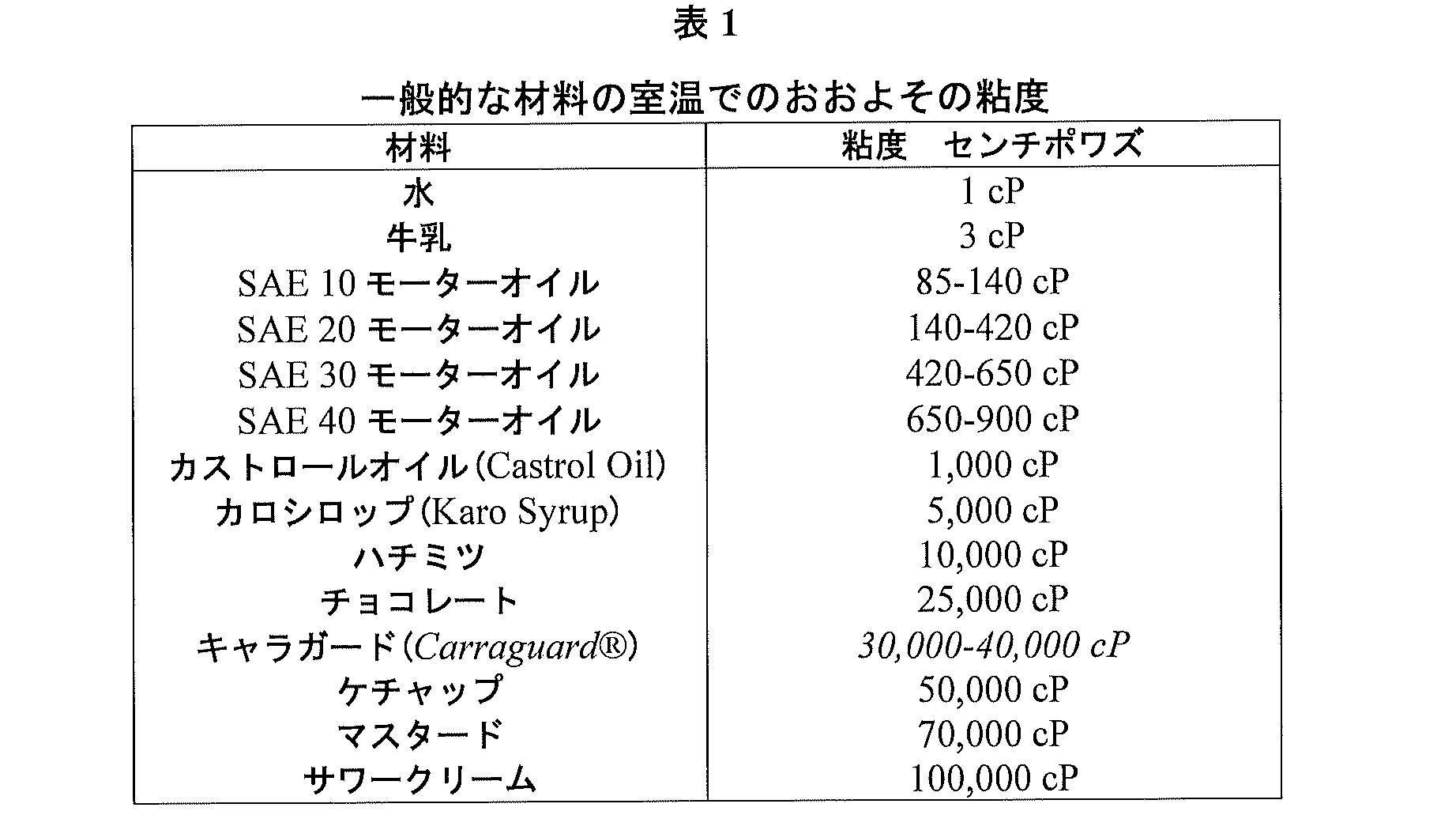
表1に示すように、Maraisの研究で利用されたCarraguard(登録商標)ゲルの粘度は、チョコレートの粘度とケチャップの粘度との間の範囲にある。チョコレートとケチャップはどちらもせん断減粘特性を有し、特にチョコレートは性行為中に利用できる食用組成物を有することができるが、両方の組成物の粘度が高いため、個人的及び性的潤滑剤としての機能を低下させる。 As shown in Table 1, the viscosity of the Carraguard® gel utilized in the Marais study ranges between that of chocolate and that of ketchup. Although both chocolate and ketchup have shear thinning properties, and chocolate in particular may have an edible composition that can be utilized during sexual activity, the high viscosity of both compositions reduces their functionality as personal and sexual lubricants.
対照的に、個人用潤滑剤として一般的に使用され、カラギーナンを含まない組成物は典型的に、Maraisの研究で使用され’098特許に記載されているゲルよりも粘性が5~10倍低い。理想的には、個人用潤滑剤組成物は、容器から注ぐか、軽く絞ることができ、塗布後に皮膚に残り、性行為中などの応力に応答するずり減粘(shear thinning)を生じるような粘度を有すべきである。個人用潤滑剤に一般的に見られる材料として、オイル、特にシリコーンオイル、ガム、セルロース、グリセリン、ポリオール類、グリコール類、グリカン類、ポリクオテミウム類、及びその他のポリマーを挙げることができるがこれらに限定されない。しかしながら、これらの潤滑剤は性行為中に心地よい結果をもたらすが、HPVに対する保護は提供しない。 In contrast, compositions commonly used as personal lubricants that do not contain carrageenan are typically 5-10 times less viscous than the gels used in the Marais study and described in the '098 patent. Ideally, a personal lubricant composition should have a viscosity that allows it to be poured or gently squeezed from a container, remain on the skin after application, and produce shear thinning in response to stresses such as during sexual activity. Materials commonly found in personal lubricants include, but are not limited to, oils, especially silicone oils, gums, cellulose, glycerin, polyols, glycols, glycans, polyquaterniums, and other polymers. However, while these lubricants provide pleasurable results during sexual activity, they do not provide protection against HPV.
別のヒトのインビボ研究(上記Magnan, et al.を参照のこと)は、抗HPV活性のためのラムダ-カラギーナンを含む粘性の低い個人用組成物の使用を調査した。上記Maraisの研究と同様に、女性はプラセボ又はラムダ-カラギーナンを有する市販の組成物、Divine 9(登録商標)を無作為に割り当てられ、性行為と併せて組成物を適用するように言われた。試験組成物は、ラムダ-カラギーナン及びイオタ-カラギーナンを有するカラギーナン混合物を1.4重量%、プロピレングリコールを37重量%、有し、粘度が1,000~4,000cPであった(下記実施例1を参照のこと)。Magnan研究は、Marais 研究と同様のHPV発生率の低下を示したが、そのような高濃度のプロピレングリコールの存在により、組成物の重量モル浸透圧濃度は5,000mOsm/kgを超え、そのレベルは、その組成物を用いる人々に潜在的に危険を及ぼし、ある人々には、HPVにかかる可能性を増大させるかもしれない。 Another human in vivo study (see Magnan, et al., supra) investigated the use of a low viscosity personal use composition containing lambda-carrageenan for anti-HPV activity. As in the Marais study, women were randomly assigned to receive either a placebo or a commercially available composition with lambda-carrageenan, Divine 9®, and were asked to apply the composition in conjunction with sexual activity. The test composition had 1.4% by weight of a carrageenan blend with lambda-carrageenan and iota-carrageenan, 37% by weight of propylene glycol, and had a viscosity of 1,000-4,000 cP (see Example 1, below). The Magnan study showed a similar reduction in HPV incidence to the Marais study, but the presence of such high concentrations of propylene glycol caused the osmolality of the composition to exceed 5,000 mOsm/kg, a level that could potentially pose a risk to people using the composition and may increase the likelihood of contracting HPV in some people.
性的健康に関する世界保健機関(WHO)の報告書に示されている結果によると(「男性及び女性のコンドームのための追加の潤滑剤の使用及び調達:WHO/UNFPA/FHI360 Advisory Note」世界保健機関、ジュネーブ スイス、(2012) を参照のこと、参照によりその全体が組み込まれる)、調査によると、重量モル浸透圧濃度の高い潤滑剤は膣及び肛門上皮の損傷を引き起こし、HPV、HIV、及びその他の性感染症による感染のリスクを高める可能性がある。WHOは、特定の個人用潤滑剤の重量モル浸透圧濃度を決定する主な要因が組成物内のグリコールの存在であることも発見した。一般に「ポリオール」としても知られるグリコールは最も一般的に、グリセロール、1,2-プロパンジオール、及び1,3-プロパンジオールを有し、上皮細胞内の水-電解質のバランスを乱す可能性がある。WHOは、ほとんどの市販の潤滑剤が、通常の膣分泌物の重量モル浸透圧濃度(260~290mOsmol/kg)及び精液の重量モル浸透圧濃度(250~380mOsmol/kg)をはるかに超える重量モル浸透圧濃度を有することを示し、企業が市販の個人用潤滑剤組成物の重量モル浸透圧濃度を、膣分泌物及び/又は精液と可能な限り等浸透圧(250~400mOsmol/kgの間)であることを目標として、1,200mOsmol/kg以下に調整することを推奨している。 According to findings presented in a World Health Organization (WHO) report on sexual health (see "Use and Procurement of Additional Lubricants for Male and Female Condoms: WHO/UNFPA/FHI360 Advisory Note," World Health Organization, Geneva Switzerland, (2012), incorporated by reference in its entirety), research has shown that lubricants with high osmolality may cause damage to the vaginal and anal epithelium and increase the risk of infection with HPV, HIV, and other sexually transmitted diseases. The WHO also found that the main factor that determines the osmolality of a particular personal lubricant is the presence of glycols in the composition. Glycols, also commonly known as "polyols," most commonly include glycerol, 1,2-propanediol, and 1,3-propanediol, and may disrupt the water-electrolyte balance within epithelial cells. The WHO has noted that most commercially available lubricants have osmolalities far exceeding those of normal vaginal secretions (260-290 mOsmol/kg) and semen (250-380 mOsmol/kg), and recommends that companies adjust the osmolality of commercially available personal lubricant compositions to 1,200 mOsmol/kg or less, aiming to be as isotonic as possible with vaginal secretions and/or semen (between 250-400 mOsmol/kg).
本発明の抗ウイルス潤滑組成物
本発明は、ラムダ-カラギーナンを含み、HPVを含むウイルスに対して活性であり、カラギーナンを含まない市販の潤滑剤と同様の粘度を有する、いくつかの新規な抗ウイルス潤滑組成物を提供する。別の態様において、抗ウイルス性潤滑組成物は、組成物が適用されると数時間その水分及び潤滑性を保持することを可能にし、性行為に携わる人々に心地よい体験を提供するレオロジープロファイルを有する。さらなる態様において、抗ウイルス潤滑剤組成物は、特に性行為中に、機械的歪みに応答してずり減粘を受ける擬塑性非ニュートン流体組成物である。よりさらなる態様において、本発明の抗ウイルス性潤滑剤組成物は、容器から直接、絞る必要もなければ手で取り出す必要もなく、容器から直接注ぐことができる。他のよりさらなる態様において、抗ウイルス性潤滑組成物はゲルネットワークを実質的に含まない。
Antiviral Lubricant Compositions of the Invention The present invention provides several novel antiviral lubricant compositions that contain lambda-carrageenan, are active against viruses, including HPV, and have a viscosity similar to commercially available lubricants that do not contain carrageenan. In another aspect, the antiviral lubricant composition has a rheological profile that allows the composition to retain its moisture and lubricity for several hours once applied, providing a pleasant experience for people engaged in sexual activity. In a further aspect, the antiviral lubricant composition is a pseudoplastic non-Newtonian fluid composition that undergoes shear thinning in response to mechanical strain, particularly during sexual activity. In yet a further aspect, the antiviral lubricant composition of the present invention can be poured directly from the container without the need for squeezing or manual removal. In another yet further aspect, the antiviral lubricant composition is substantially free of a gel network.
上記のように、すべての型のカラギーナンは、海藻抽出物から、典型的にはカラギーナンの2つ、3つ、又はそれ以上の型の混合物として得ることができる。カラギーナン混合物は、生の抽出物として入手することも、粉末として入手することもできる。さらなる態様において、抗ウイルス潤滑組成物内で利用されるカラギーナンは、カラギーナン粉末として得られる。市販のカラギーナン粉末の非限定的な例には、Viscarin(登録商標)PC109、Viscarin(登録商標)PC209、Viscarin(登録商標)PC515、Gelcarin(登録商標)PC379、及びGelcarin(登録商標)PC911が含まれる。よりさらなる態様において、カラギーナン粉末はViscarin(登録商標)PC209である。 As noted above, all types of carrageenan can be obtained from seaweed extracts, typically as a mixture of two, three, or more types of carrageenan. The carrageenan mixture can be obtained as a raw extract or as a powder. In a further aspect, the carrageenan utilized in the antiviral lubricant composition is obtained as a carrageenan powder. Non-limiting examples of commercially available carrageenan powders include Viscarin® PC 109, Viscarin® PC 209, Viscarin® PC 515, Gelcarin® PC 379, and Gelcarin® PC 911. In yet a further aspect, the carrageenan powder is Viscarin® PC 209.
別の態様において、カラギーナン粉末は、ラムダ-カラギーナンを少なくとも約90重量%を含む、ラムダ-カラギーナンを少なくとも約85重量%有する。
別の態様において、カッパ-カラギーナン及びイオタ-カラギーナンは合わせて、カラギーナン粉末の最大約15重量%、10重量%、8重量%、6重量%、4重量%、2重量%を含む約20重量%まで有することができ、又はカラギーナン粉末の約1重量%まで有することができる。他の態様において、存在する場合、カッパ-カラギーナン及びイオタ-カラギーナンは合わせて、カラギーナン粉末の少なくとも約1重量%有し、カラギーナン粉末の少なくとも約2重量%、4重量%、6重量%、8重量%、又は10重量%、少なくとも約15重量%まで有することができる。
In another embodiment, the carrageenan powder has at least about 85% by weight lambda-carrageenan, including at least about 90% by weight lambda-carrageenan.
In another embodiment, the kappa-carrageenan and iota-carrageenan together may comprise up to about 20%, including up to about 15%, 10%, 8%, 6%, 4%, 2%, or up to about 1% by weight of the carrageenan powder. In other embodiments, when present, the kappa-carrageenan and iota-carrageenan together may comprise at least about 1% by weight of the carrageenan powder and at least about 2%, 4%, 6%, 8%, or 10%, up to at least about 15% by weight of the carrageenan powder.
別の態様において、カラギーナン粉末は、ラムダ-カラギーナンを少なくとも約90重量%及びイオタ-カラギーナンを最大約10重量%有する。さらなる態様において、カラギーナン粉末は、ラムダ-カラギーナンを約90重量%及びイオタ-カラギーナンを約10重量%有する。 In another embodiment, the carrageenan powder has at least about 90% by weight lambda-carrageenan and up to about 10% by weight iota-carrageenan. In a further embodiment, the carrageenan powder has about 90% by weight lambda-carrageenan and about 10% by weight iota-carrageenan.
別の態様において、カラギーナン粉末は、ラムダ-カラギーナンを少なくとも約90重量%及びカッパ-カラギーナンを最大約10重量%有する。さらなる態様において、カラギーナン粉末は、ラムダ-カラギーナンを約90重量%及びカッパ-カラギーナンを約10重量%有する。 In another embodiment, the carrageenan powder has at least about 90% by weight lambda-carrageenan and up to about 10% by weight kappa-carrageenan. In a further embodiment, the carrageenan powder has about 90% by weight lambda-carrageenan and about 10% by weight kappa-carrageenan.
別の態様において、ラムダ-カラギーナンを有するカラギーナン混合物は、抗ウイルス性潤滑組成物内で実質的に均質化され、組成物内のカラギーナン多糖類の大部分は、水性溶媒内に遊離分子として存在する。さらなる態様において、カラギーナン混合物は、抗ウイルス潤滑組成物内で完全に均質化される。あるよりさらなる態様において、均一な抗ウイルス潤滑組成物は、実質的に均一な外観及び密度を有する。他のよりさらなる態様において、抗ウイルス性潤滑組成物は、カラギーナンと溶媒との比率が実質的に均一である溶液である。また他のよりさらなる態様において、抗ウイルス潤滑組成物は、肉眼及び/又は顕微鏡下で10倍の倍率で見える、粒子、凝集物、塊、又はその他の固体を実質的に含まない。またさらなる態様において、抗ウイルス潤滑組成物は半透明である。よりまたさらなる態様において、抗ウイルス潤滑組成物は透明である。 In another aspect, the carrageenan mixture with lambda-carrageenan is substantially homogenized within the antiviral lubricating composition, with the majority of the carrageenan polysaccharides within the composition being present as free molecules within the aqueous solvent. In a further aspect, the carrageenan mixture is completely homogenized within the antiviral lubricating composition. In some even further aspects, the homogenous antiviral lubricating composition has a substantially uniform appearance and density. In other even further aspects, the antiviral lubricating composition is a solution in which the ratio of carrageenan to solvent is substantially uniform. In still other even further aspects, the antiviral lubricating composition is substantially free of particles, aggregates, clumps, or other solids visible to the naked eye and/or under a microscope at 10x magnification. In still further aspects, the antiviral lubricating composition is translucent. In yet still further aspects, the antiviral lubricating composition is transparent.
別の態様において、カラギーナンは、抗ウイルス潤滑組成物のうち、少なくとも約0.01重量%、0.1重量%、0.5重量%、1重量%、2重量%、2.5重量%、又は3重量%から少なくとも約5重量%までを含む、抗ウイルス潤滑組成物のうち、少なくとも約0.001重量%有する。さらなる態様において、カラギーナンは、抗ウイルス潤滑組成物のうち、0.5重量%~約2.3重量%有する。よりさらなる態様において、カラギーナンは、抗ウイルス組成物のうち、0.8重量%~約2.0重量%有する。またさらなる態様において、カラギーナンは、抗ウイルス潤滑組成物のうち、1.5重量%~約1.7重量%有する。 In another embodiment, the carrageenan comprises at least about 0.001 wt.% of the antiviral lubricating composition, including at least about 0.01 wt.%, 0.1 wt.%, 0.5 wt.%, 1 wt.%, 2 wt.%, 2.5 wt.%, or 3 wt.% to at least about 5 wt.% of the antiviral lubricating composition. In a further embodiment, the carrageenan comprises from 0.5 wt.% to about 2.3 wt.% of the antiviral lubricating composition. In yet a further embodiment, the carrageenan comprises from 0.8 wt.% to about 2.0 wt.% of the antiviral lubricating composition. In yet a further embodiment, the carrageenan comprises from 1.5 wt.% to about 1.7 wt.% of the antiviral lubricating composition.
同様に、ラムダ-カラギーナン含有抗ウイルス潤滑組成物の粘度、レオロジー、感覚、及び全体的な性能は、抗ウイルス潤滑組成物に少量のポリマー、特にポリオールを添加することによって制御することができる。上記のように、ポリオール類は、増量剤、風味保持剤/マスキング剤、保湿剤、安定剤、結晶化防止剤として、また全身及び口腔の健康上の利点のために、市販の製品に一般的に見られる化合物の1つの種類である。ポリオール類は通常、市販の個人用潤滑剤製品に存在する可能性のある他のポリマーの溶解性を高めるために添加されるが、ポリオール類を本発明の抗ウイルス潤滑組成物に少量添加し、粘度を低下させ、刺激を軽減し、潤滑性の二次的な供給源を提供し、及び/又は性行為中にユーザにしばしば喜ばれる刺激的な「暖かさ」又は「うずき」感を提供することができる。 Similarly, the viscosity, rheology, feel, and overall performance of lambda-carrageenan-containing antiviral lubricating compositions can be controlled by adding small amounts of polymers, particularly polyols, to the antiviral lubricating compositions. As noted above, polyols are a class of compounds commonly found in commercial products as bulking agents, flavor retention/masking agents, humectants, stabilizers, crystallization inhibitors, and for systemic and oral health benefits. Although polyols are typically added to enhance the solubility of other polymers that may be present in commercial personal lubricant products, polyols can be added in small amounts to the antiviral lubricating compositions of the present invention to reduce viscosity, reduce irritation, provide a secondary source of lubrication, and/or provide a stimulating "warmth" or "tingling" sensation often enjoyed by users during sexual activity.
添加できるポリオール類の非限定的な例として、グリセロール;プロピレングリコール(1,2-プロパンジオール);1,3-プロパンジオール;1,3-ブタンジオール;1,4-ブタンジオール;2,3-ブタンジオール;キシリトール;ソルビトール;エリスリトール;イソマルト;ラクチトール;マルチトール;マンニトール;ポリエチレングリコール;及びポリプロピレングリコール;並びにそれらの組み合わせを挙げることができる。一般に、抗ウイルス潤滑組成物に含まれるポリオール(類)の同一性及び濃度は、所望の特性を得るために制御することができる。例えば、マンニトールとキシリトールは特別な食事の必要性のための食品添加物として規制されているが、ポリオール類はそれ以外では「一般に安全と見なされている」(GRAS)。キシリトールは口腔予防にも使用されており、マンニトールは尿路感染症の予防薬としても使用されている。1,3-ブタンジオール、1,4-ブタンジオール、2,3-ブタンジオールは、軟膏、クリーム、及びゲル組成物の局所適用における刺激を軽減することが示されている。砂糖ベースのポリオール類はある甘味を提供できるが、マルチトールは食用製品の脂肪の質感を模倣することができる。 Non-limiting examples of polyols that can be added include glycerol; propylene glycol (1,2-propanediol); 1,3-propanediol; 1,3-butanediol; 1,4-butanediol; 2,3-butanediol; xylitol; sorbitol; erythritol; isomalt; lactitol; maltitol; mannitol; polyethylene glycol; and polypropylene glycol; and combinations thereof. In general, the identity and concentration of the polyol(s) included in the antiviral lubricant composition can be controlled to obtain the desired properties. For example, mannitol and xylitol are regulated as food additives for special dietary needs, but polyols are otherwise "generally regarded as safe" (GRAS). Xylitol is also used in oral prophylaxis, and mannitol is used as a prophylactic for urinary tract infections. 1,3-butanediol, 1,4-butanediol, and 2,3-butanediol have been shown to reduce irritation in topical application of ointments, creams, and gel compositions. Sugar-based polyols can provide a certain sweetness, while maltitol can mimic the texture of fat in edible products.
別の態様において、ポリオールは、抗ウイルス潤滑組成物の約50重量%未満、有することができ、抗ウイルス潤滑組成物の約25重量%未満、15重量%未満、10重量%未満、9重量%未満、8重量%未満、7重量%未満、6重量%未満、5重量%未満、4重量%未満、3重量%未満、又は2重量%未満を含み、抗ウイルス性潤滑組成物の約1重量%未満まで、有することができる。他のさらなる態様において、抗ウイルス潤滑組成物は、ポリオールを少なくとも約2重量%、3重量%、4重量%、5重量%、6重量%、7重量%、8重量%、9重量%、10重量%、15重量%、又は25重量%を含む、また、少なくとも約35重量%を含む、少なくとも約1重量%、有する。よりさらなる態様において、ポリオールは、抗ウイルス性潤滑組成物の約~約10重量%、有する。 In another aspect, the polyol can comprise less than about 50 wt% of the antiviral lubricating composition, including less than about 25 wt%, less than 15 wt%, less than 10 wt%, less than 9 wt%, less than 8 wt%, less than 7 wt%, less than 6 wt%, less than 5 wt%, less than 4 wt%, less than 3 wt%, or less than 2 wt% of the antiviral lubricating composition, and can comprise less than about 1 wt% of the antiviral lubricating composition. In other further aspects, the antiviral lubricating composition comprises at least about 1 wt%, including at least about 2 wt%, 3 wt%, 4 wt%, 5 wt%, 6 wt%, 7 wt%, 8 wt%, 9 wt%, 10 wt%, 15 wt%, or 25 wt%, including at least about 35 wt%. In yet further aspects, the polyol comprises from about to about 10 wt% of the antiviral lubricating composition.
別の態様において、ポリオールはプロピレングリコール(1,2-プロパンジオール)である。さらなる態様において、抗ウイルス潤滑組成物は、プロピレングリコールを最大8重量%有する。よりさらなる態様において、抗ウイルス潤滑組成物は、プロピレングリコールを0.5重量%から約5重量%有する。またさらなる態様において、抗ウイルス潤滑組成物は、プロピレングリコールを約4重量%~約5重量%有する。ある態様において、抗ウイルス潤滑組成物は、プロピレングリコールを約4.0重量%~約4.5重量%有する。なおまたさらなる態様において、抗ウイルス潤滑組成物は、プロピレングリコールを約2.0重量%~約2.5重量%有する。 In another embodiment, the polyol is propylene glycol (1,2-propanediol). In a further embodiment, the antiviral lubricating composition has up to 8% by weight propylene glycol. In yet a further embodiment, the antiviral lubricating composition has 0.5% to about 5% by weight propylene glycol. In yet a further embodiment, the antiviral lubricating composition has about 4% to about 5% by weight propylene glycol. In an embodiment, the antiviral lubricating composition has about 4.0% to about 4.5% by weight propylene glycol. In yet a further embodiment, the antiviral lubricating composition has about 2.0% to about 2.5% by weight propylene glycol.
別の態様において、ポリオールの存在により、市販の個人用潤滑剤の性的性能の利益の全てを維持するため、既知の個人用潤滑剤組成物よりも優れた抗ウイルス潤滑組成物が得られる一方、HPVの伝染及び/又は持続を阻害する能力を有する。また、抗ウイルス性潤滑組成物は、個人用潤滑剤組成物の触覚上の利点を提供するのに十分な薄さであると同時に、性的接触を開始する前に皮膚又は上皮組織、特に膣、肛門、陰茎、又は口に留まるのに十分な厚さでもある。ある態様において、個人用潤滑剤組成物は、粘度が約10,000cP未満、約8,000cP未満、6,000cP未満、4,000cP未満、又は2,000cP未満~約1,000cP未満までである。他の態様において、抗ウイルス性潤滑組成物は、粘度が少なくとも約500cPであり、少なくとも約1,000cP、2,000cP、4,000cP、又は6,000cPから少なくとも約8,000cPまでである。さらなる態様において、抗ウイルス潤滑組成物は、粘度が約500cP~約8,000cP、特に約1,000cP~約4,000cP、より特に約2,000cP~約3,000cPの粘度である。ある態様において、抗ウイルス潤滑組成物は、粘度が約1,500cP~2,500cPである。ある態様において、抗ウイルス潤滑組成物は、粘度が約2,000cPである。 In another aspect, the presence of polyols provides an antiviral lubricating composition superior to known personal lubricant compositions because it maintains all of the sexual performance benefits of commercially available personal lubricants while having the ability to inhibit the transmission and/or persistence of HPV. The antiviral lubricating composition is also thin enough to provide the tactile benefits of a personal lubricant composition while being thick enough to remain on the skin or epithelial tissue, particularly the vagina, anus, penis, or mouth, prior to the initiation of sexual contact. In some aspects, the personal lubricant composition has a viscosity of less than about 10,000 cP, less than about 8,000 cP, less than 6,000 cP, less than 4,000 cP, or less than 2,000 cP to less than about 1,000 cP. In other aspects, the antiviral lubricating composition has a viscosity of at least about 500 cP, from at least about 1,000 cP, 2,000 cP, 4,000 cP, or 6,000 cP to at least about 8,000 cP. In further embodiments, the antiviral lubricating composition has a viscosity of about 500 cP to about 8,000 cP, particularly about 1,000 cP to about 4,000 cP, more particularly about 2,000 cP to about 3,000 cP. In some embodiments, the antiviral lubricating composition has a viscosity of about 1,500 cP to 2,500 cP. In some embodiments, the antiviral lubricating composition has a viscosity of about 2,000 cP.
別の態様において、WHOが推奨するレベル内の重量モル浸透圧濃度を提供するために、抗ウイルス潤滑組成物内のポリオールの量が制限される。他の態様において、抗ウイルス性潤滑組成物は、重量モル浸透圧濃度が約1,200mOsm/kg未満であり、約1,000mOsm/kg未満、900mOsm/kg未満、800mOsm/kg未満、700mOsm/kg未満、600mOsm/kg未満、500mOsm/kg未満、400mOsm/kg未満、300mOsm/kg未満、又は200mOsmol/kg未満であり、約100mOsmol/kg未満までである。さらなる態様において、抗ウイルス潤滑組成物の重量モル浸透圧濃度は、約250~約800mOsmol/kgである。他のさらなる態様において、抗ウイルス潤滑組成物の重量モル浸透圧濃度は、約650~約850mOsmol/kgである。 In another aspect, the amount of polyol in the antiviral lubricating composition is limited to provide an osmolality within the levels recommended by the WHO. In other aspects, the antiviral lubricating composition has an osmolality of less than about 1,200 mOsm/kg, less than about 1,000 mOsm/kg, less than 900 mOsm/kg, less than 800 mOsm/kg, less than 700 mOsm/kg, less than 600 mOsm/kg, less than 500 mOsm/kg, less than 400 mOsm/kg, less than 300 mOsm/kg, or less than 200 mOsmol/kg, up to less than about 100 mOsmol/kg. In a further aspect, the antiviral lubricating composition has an osmolality of about 250 to about 800 mOsmol/kg. In other further embodiments, the antiviral lubricating composition has an osmolality of about 650 to about 850 mOsmol/kg.
別の態様において、抗ウイルス潤滑組成物の重量モル浸透圧濃度は、ヒト血漿の重量モル浸透圧濃度と等浸透圧である。さらなる態様において、抗ウイルス潤滑組成物は、精液と等浸透圧である。他のさらなる態様において、抗ウイルス潤滑組成物は、膣分泌物と等浸透圧である。また他のさらなる態様において、抗ウイルス性潤滑組成物の重量モル浸透圧濃度は、約250mOsmol/kg~約400mOsmol/kgである。 In another embodiment, the osmolality of the antiviral lubricating composition is isotonic with the osmolality of human plasma. In a further embodiment, the antiviral lubricating composition is isotonic with semen. In another further embodiment, the antiviral lubricating composition is isotonic with vaginal secretions. In yet another further embodiment, the antiviral lubricating composition has an osmolality of about 250 mOsmol/kg to about 400 mOsmol/kg.
また、別の態様において、いくつかの補足成分を抗ウイルス潤滑組成物に添加して、組成物の抗ウイルス活性を補完するか、及び/又はセックス中の組成物の性能を高めることができる。いくつかの態様において、pH調整剤を添加することによって抗ウイルス潤滑組成物のpHを制御することができる。カラギーナンが水に可溶化すると、組成物のpHは典型的に約7~9である。しかしながら、抗ウイルス性潤滑組成物の有効性は、組成物のpHを制御して、組成物を塗布する標的表面に一致させるか又は類似するようにすることによって補うことができる。例えば、健康な膣のpHは通常、約3.5~約5.5の範囲ですが、他の上皮細胞のpHは、直腸内に位置するものを含め、中性pHに近い。したがって、いくつかの態様において、pH調整剤は、意図する上皮表面に相補的な範囲、特に約7.0未満、6.5未満、6.0未満、5.5未満、5.0未満、4.5未満、又は4.0未満を含み、約3.5未満までを含む約8.0未満のpHまでpHを低下させることができる酸である。他の態様において、抗ウイルス潤滑組成物のpHは、少なくとも約3.5であり、少なくとも約4.0、4.5、5.0、5.5、6.0、6.5、又は7.0を含み、少なくとも約8.0までである。さらなる態様において、抗ウイルス潤滑組成物のpHは、約3.5~約5.5、特に約4.5である。他のさらなる態様において、抗ウイルス潤滑組成物のpHは、約5.5~約7.0である。また他のさらなる態様において、抗ウイルス潤滑組成物のpHは、約6.25~約6.75である。 Also, in another aspect, some supplemental ingredients can be added to the antiviral lubricating composition to complement the antiviral activity of the composition and/or enhance the performance of the composition during sex. In some aspects, the pH of the antiviral lubricating composition can be controlled by adding a pH adjuster. When carrageenan is solubilized in water, the pH of the composition is typically about 7-9. However, the effectiveness of the antiviral lubricating composition can be complemented by controlling the pH of the composition to match or resemble the target surface to which the composition is applied. For example, the pH of a healthy vagina is usually in the range of about 3.5 to about 5.5, while the pH of other epithelial cells, including those located in the rectum, is closer to neutral pH. Thus, in some aspects, the pH adjuster is an acid that can lower the pH to a range complementary to the intended epithelial surface, particularly a pH of less than about 8.0, including less than about 7.0, less than 6.5, less than 6.0, less than 5.5, less than 5.0, less than 4.5, or less than 4.0, including up to less than about 3.5. In other embodiments, the pH of the antiviral lubricating composition is at least about 3.5, including at least about 4.0, 4.5, 5.0, 5.5, 6.0, 6.5, or 7.0, up to at least about 8.0. In further embodiments, the pH of the antiviral lubricating composition is from about 3.5 to about 5.5, particularly about 4.5. In other further embodiments, the pH of the antiviral lubricating composition is from about 5.5 to about 7.0. In yet other further embodiments, the pH of the antiviral lubricating composition is from about 6.25 to about 6.75.
いくつかの態様において、pH調整剤は、塩酸又は硫酸を含むがこれらに限定されない強酸である。しかしながら、他の態様において、pH調整剤は、緩衝抗ウイルス潤滑組成物を作り出すため、弱酸である。弱酸は、緩衝能、pKa、及び可用性に基づいて選択することができる。pH調整剤として利用できる弱酸の非限定的な例として、クエン酸、乳酸、及び酢酸を挙げることができる。さらなる態様において、抗ウイルス潤滑組成物は、pH調整剤を約0.01重量%~約1.0重量%、特に約0.04重量%~約0.06重量%有する。よりさらなる態様において、pH調整剤はクエン酸である。 In some embodiments, the pH adjuster is a strong acid, including, but not limited to, hydrochloric acid or sulfuric acid. However, in other embodiments, the pH adjuster is a weak acid to create a buffered antiviral lubricating composition. Weak acids can be selected based on buffering capacity, pKa, and availability. Non-limiting examples of weak acids that can be utilized as pH adjusters include citric acid, lactic acid, and acetic acid. In further embodiments, the antiviral lubricating composition has about 0.01% to about 1.0% by weight of the pH adjuster, particularly about 0.04% to about 0.06% by weight. In yet further embodiments, the pH adjuster is citric acid.
いくつかの態様において、抗ウイルス潤滑組成物は、保存中の抗ウイルス潤滑組成物内の微生物増殖を防止するために添加することができる、1つ以上の防腐剤を任意にさらに有することができる。1つ以上の防腐剤のいずれかは、当業者に既知の防腐剤から選択することができ、メチルパラベン、安息香酸、サリチル酸、ソルビン酸、プロピルパラベン、及びデヒドロ酢酸ナトリウム、並びにそれらの組合せの1以上をあげることができるがこれらに限定されない。防腐剤は、本発明の組成物のうち、約1重量%までの量で該組成物中に存在するのがよい。 In some embodiments, the antiviral lubricating composition can optionally further comprise one or more preservatives that can be added to prevent microbial growth in the antiviral lubricating composition during storage. Any of the one or more preservatives can be selected from preservatives known to those of skill in the art, including, but not limited to, one or more of methylparaben, benzoic acid, salicylic acid, sorbic acid, propylparaben, and sodium dehydroacetate, and combinations thereof. The preservatives may be present in the compositions of the present invention in an amount up to about 1% by weight of the composition.
いくつかの態様において、抗ウイルス潤滑組成物は、人の口と接触したときに組成物の風味を高める1つ以上の甘味料を任意にさらに含むことができる。いくつかの態様において、甘味料は人工甘味料であり、その存在は保存中の抗ウイルス潤滑組成物内の細菌増殖を阻害することもできる。人工甘味料の非限定的な例として、アスパルテーム、サッカリン、スクラロース、ネオテーム、及びアセスルファムカリウムを挙げることができるが、これらに限定されない。さらなる態様において、甘味料はサッカリンである。よりさらなる態様において、抗ウイルス性潤滑組成物は、サッカリンを約0.005重量%まで、さらに有する。またさらなる態様において、抗ウイルス潤滑組成物は、サッカリンを約0.125%有する。 In some embodiments, the antiviral lubricating composition may optionally further comprise one or more sweeteners that enhance the flavor of the composition upon contact with the human mouth. In some embodiments, the sweetener is an artificial sweetener, the presence of which may also inhibit bacterial growth in the antiviral lubricating composition during storage. Non-limiting examples of artificial sweeteners may include, but are not limited to, aspartame, saccharin, sucralose, neotame, and acesulfame potassium. In a further embodiment, the sweetener is saccharin. In yet a further embodiment, the antiviral lubricating composition further comprises up to about 0.005% by weight saccharin. In yet a further embodiment, the antiviral lubricating composition comprises about 0.125% saccharin.
甘味料に加えて、又は甘味料の代わりに、抗ウイルス潤滑組成物は、組成物自体の香り、又は抗ウイルス潤滑組成物が適用される皮膚もしくは上皮組織のいずれかをマスクすることができる他の芳香剤(aromatic agent)又はフレグランス(flegrance)を任意にさらに有することができる。そのようなフレグランスの非限定的な例として、任意のエッセンシャルオイルベースのフレグランスを選択できるが、バニラ、ラベンダー、オレガノ、タイム、レモングラス、レモン類、オレンジ類、アニス、クローブ、アニスの実、シナモン、ゼラニウム類、バラ類、ミント、ペパーミント、シトロネラ、ユーカリ、サンダルウッド、スギ、ロスマリン、マツ、バーベインノミグラス、又はラタンヒエ、もしくはそれらの組合せを挙げることができる。他の態様において、抗ウイルス潤滑組成物は、エッセンシャルオイルベースのフレグランスに含まれる匂いやフレグランスの原因となる、1つ以上の化学的な、芳香発生化合物を任意に、さらに有することができる。抗ウイルス潤滑組成物のいずれかに有することができる化学的芳香発生化合物の非限定的な例として、カルバクロール、オイゲノール、リナロール、チモール、p-シメン、ミルセン、ボルネオール、カンファー、カリオフィリン、シンナムアルデヒド、ゲラニオール、ネロール、シトロネロール、及びメントール、並びにそれらの組合せを挙げることができる。 In addition to or instead of a sweetener, the antiviral lubricating composition can optionally further comprise other aromatic agents or fragrances that can mask either the aroma of the composition itself or the skin or epithelial tissue to which the antiviral lubricating composition is applied. Non-limiting examples of such fragrances include vanilla, lavender, oregano, thyme, lemongrass, lemons, oranges, anise, clove, aniseed, cinnamon, geraniums, roses, mint, peppermint, citronella, eucalyptus, sandalwood, cedar, rosemary, pine, vervain flea grass, or rattan millet, or combinations thereof, although any essential oil-based fragrance can be selected. In another embodiment, the antiviral lubricating composition can optionally further comprise one or more chemical, aroma-producing compounds that are responsible for the odor or fragrance contained in the essential oil-based fragrance. Non-limiting examples of chemical aroma generating compounds that may be present in any of the antiviral lubricating compositions include carvacrol, eugenol, linalool, thymol, p-cymene, myrcene, borneol, camphor, caryophylline, cinnamaldehyde, geraniol, nerol, citronellol, and menthol, and combinations thereof.
いくつかの態様において、抗ウイルス潤滑組成物は、1つ以上の金属塩を任意にさらに有することができる。金属塩を添加することにより、組成物のイオン強度の制御、その抗菌活性又は抗ウイルス活性の増強、又は1つ以上の成分の可溶化への添加を含む、いくつかの効果をもたらすことができる。添加できる金属塩として、亜鉛、銀、銅、アルカリ金属塩、又はアルカリ土類金属塩を挙げることができるが、これらに限定されない。さらなる態様において、金属塩は亜鉛塩又はナトリウム塩である。 In some embodiments, the antiviral lubricating composition can optionally further comprise one or more metal salts. The addition of a metal salt can provide several benefits, including controlling the ionic strength of the composition, enhancing its antibacterial or antiviral activity, or adding to the solubilization of one or more components. Metal salts that can be added can include, but are not limited to, zinc, silver, copper, alkali metal salts, or alkaline earth metal salts. In further embodiments, the metal salt is a zinc salt or a sodium salt.
いくつかの態様において、抗ウイルス潤滑組成物は、1つ以上の薬学的抗ウイルス、抗真菌、又は抗菌化合物を任意にさらに有することができる。 In some embodiments, the antiviral lubricating composition can optionally further comprise one or more pharmaceutical antiviral, antifungal, or antibacterial compounds.
また、本発明はまた、以下に記載する方法によって製造される抗ウイルス性潤滑組成物を使用して、性行為に携わる2人以上のパートナー間でのHPV、HIV、及びHSVを含むがこれらに限定されない性感染ウイルスの伝染を低減するか、阻害するか、又は改善するいくつかの方法を提供する。第1の態様において、該方法は、抗ウイルス性潤滑組成物を1人以上のパートナーの皮膚又は上皮組織と接触させる工程であって、該皮膚又は上皮組織は膣、肛門、口、又は陰茎のうちの少なくとも1つの上又は内部に位置する工程を有する。本明細書で用いるとき、「膣」という用語は、膣自体及び/又は外陰部、陰唇、クリトリス、膣口、及び子宮頸部を含むがこれらに限定されない、膣を取り囲む皮膚又は上皮組織を含む。さらなる態様において、少なくとも1人のパートナーが男性であり、少なくとも1人のパートナーが女性である。他のさらなる態様において、少なくとも2人のパートナーが男性である。さらに別の態様において、少なくとも2人のパートナーが女性である。 The present invention also provides several methods of reducing, inhibiting, or ameliorating the transmission of sexually transmitted viruses, including but not limited to HPV, HIV, and HSV, between two or more partners engaged in sexual activity using an antiviral lubricating composition produced by the method described below. In a first aspect, the method includes contacting the antiviral lubricating composition with skin or epithelial tissue of one or more partners, the skin or epithelial tissue being located on or within at least one of the vagina, anus, mouth, or penis. As used herein, the term "vagina" includes the vagina itself and/or the skin or epithelial tissue surrounding the vagina, including but not limited to the vulva, labia, clitoris, vaginal opening, and cervix. In a further aspect, at least one partner is male and at least one partner is female. In another further aspect, at least two partners are male. In yet another aspect, at least two partners are female.
別の態様において、抗ウイルス性潤滑組成物は、性行為前に、性的パートナーのうちの1人以上の皮膚、特に膣、肛門、口、又は陰茎のうちの少なくとも1つの上又は内部に位置する皮膚と接触させ、ある性的パートナーから別の性的パートナーへの、HPV、HIV、及びHSVを含むがこれらに限定されない性感染ウイルスの伝染を予防的に阻害することができる。そのような態様において、抗ウイルス潤滑組成物は、性行為前の約8時間未満、4時間未満、2時間未満、1時間未満、30分未満、15分未満、5分未満、1分未満、又は約30秒未満に、また性行為前の約1秒未満までに、1人以上の性的パートナーの皮膚に接触させることができる。他の態様において、抗ウイルス性潤滑組成物は、性行為前の、少なくとも約30秒、1分、5分、15分、30分、1時間、2時間、4時間、又は約8時間に、1人以上の性的パートナーの皮膚と接触させることができる。 In another embodiment, the antiviral lubricating composition can be contacted with the skin of one or more sexual partners, particularly the skin located on or in at least one of the vagina, anus, mouth, or penis, prior to sexual activity to prophylactically inhibit the transmission of sexually transmitted viruses, including but not limited to HPV, HIV, and HSV, from one sexual partner to another. In such an embodiment, the antiviral lubricating composition can be contacted with the skin of one or more sexual partners less than about 8 hours, less than 4 hours, less than 2 hours, less than 1 hour, less than 30 minutes, less than 15 minutes, less than 5 minutes, less than 1 minute, or less than about 30 seconds prior to sexual activity, and up to less than about 1 second prior to sexual activity. In other embodiments, the antiviral lubricating composition can be contacted with the skin of one or more sexual partners at least about 30 seconds, 1 minute, 5 minutes, 15 minutes, 30 minutes, 1 hour, 2 hours, 4 hours, or about 8 hours prior to sexual activity.
別の態様において、抗ウイルス性潤滑組成物は、性行為後に、性的パートナーのうちの1人以上の皮膚、特に膣、肛門、口、又は陰茎のうちの少なくとも1つの上又は内部に位置する皮膚と接触させ、HPVが皮膚と皮膚の接触によって感染した後、HPV、HIV、及びHSVを含むがこれらに限定されない性感染ウイルスの細胞から細胞への拡散を低減することができる。そのような態様において、抗ウイルス潤滑組成物は、性行為後、約8時間未満、4時間未満、2時間未満、1時間未満、30分未満、15分未満、5分未満、1分未満、又は約30秒未満、約1秒未満までに、性的パートナーのうちの1人以上の皮膚と接触されることができる。他の態様において、抗ウイルス性潤滑組成物は、性行為後、少なくとも約30秒、1分、5分、15分、30分、1時間、2時間、4時間、又は約8時間に、1人以上の性的パートナーの皮膚と接触させることができる。 In another aspect, the antiviral lubricating composition can be contacted with the skin of one or more sexual partners, particularly skin located on or in at least one of the vagina, anus, mouth, or penis, after sexual intercourse to reduce cell-to-cell spread of sexually transmitted viruses, including but not limited to HPV, HIV, and HSV, after HPV is transmitted by skin-to-skin contact. In such an aspect, the antiviral lubricating composition can be contacted with the skin of one or more sexual partners by less than about 8 hours, less than 4 hours, less than 2 hours, less than 1 hour, less than 30 minutes, less than 15 minutes, less than 5 minutes, less than 1 minute, or by less than about 30 seconds, less than about 1 second, after sexual intercourse. In other aspects, the antiviral lubricating composition can be contacted with the skin of one or more sexual partners at least about 30 seconds, 1 minute, 5 minutes, 15 minutes, 30 minutes, 1 hour, 2 hours, 4 hours, or about 8 hours after sexual intercourse.
別の態様において、性行為に携わる2人以上のパートナー間でのHPV、HIV、及びHSVを含むがこれらに限定されない性感染ウイルスの伝染を低減するか、阻害するか、又は改善する方法は、1つ以上の皮膚接触面を有する基材を提供する工程であって、該基材が、膣、口、又は肛門からなる群から選択される1つ以上の体腔に挿入するように構成される工程;基材の1つ以上の皮膚接触面を抗ウイルス性潤滑組成物で潤滑化し、それによって潤滑化基材を製造する工程;潤滑化基材を、1人以上のパートナーの膣、肛門、口、又は陰茎の少なくとも1つの上又は内部に位置する皮膚又は上皮組織と接触させる工程;及び抗ウイルス性潤滑組成物を潤滑化基材から皮膚又は上皮組織に移す工程をさらに有する。いくつかのさらなる態様において、性行為中に基材を用いるのは、男性又は女性のいずれかの一人だけである。他のさらなる態様において、基材を使用する2人以上のパートナーが存在し、性的パートナーのいずれは男性又は女性のいずれかであってもよい。 In another aspect, a method for reducing, inhibiting, or ameliorating the transmission of sexually transmitted viruses, including but not limited to HPV, HIV, and HSV, between two or more partners engaged in sexual activity further comprises the steps of providing a substrate having one or more skin-contacting surfaces, the substrate configured for insertion into one or more body cavities selected from the group consisting of the vagina, mouth, or anus; lubricating one or more skin-contacting surfaces of the substrate with an antiviral lubricating composition, thereby producing a lubricated substrate; contacting the lubricated substrate with skin or epithelial tissue located on or within at least one of the vagina, anus, mouth, or penis of one or more partners; and transferring the antiviral lubricating composition from the lubricated substrate to the skin or epithelial tissue. In some further aspects, only one of the partners, either male or female, uses the substrate during sexual activity. In other further aspects, there are two or more partners using the substrate, and any of the sexual partners may be either male or female.
本発明の方法と組み合わせて使用するのに適した基材として、性行為中に膣、肛門、口、又は陰茎の上又は内部の内面又は外面に接触するのに使用できる任意の物体、デバイス、又は付属品を挙げることができる。本発明の方法に従って利用できる基材の非限定的な例として、ゴム、ラテックス、プラスチック、木材、及び/又は金属を含むがこれらに限定されない材料を有するコンドーム;大人のおもちゃ、ディルド、バイブレータ、リング、ビーズなどの性的な付属品;及び内部アプリケータが挙げられる。そのような例は、米国特許第6,983,751号及び同第9,119,763号;米国意匠特許第D599486号;及び米国特許公開第2006/0178602号に記載され、これらの開示は、参照によりその全体が含まれる。当業者は、性行為中に利用することができ、本発明の抗ウイルス性潤滑組成物を適用することができる、商業上入手可能であり即興で、性的テーマであるかどうかにかかわらず、基材の無数の他の例があることを理解するであろう。 Substrates suitable for use in conjunction with the methods of the present invention can include any object, device, or accessory that can be used to contact the interior or exterior surface of the vagina, anus, mouth, or penis during sexual activity. Non-limiting examples of substrates that can be utilized in accordance with the methods of the present invention include condoms having materials including, but not limited to, rubber, latex, plastic, wood, and/or metal; sexual accessories such as sex toys, dildos, vibrators, rings, beads, and the like; and internal applicators. Examples of such substrates are described in U.S. Pat. Nos. 6,983,751 and 9,119,763; U.S. Design Patent No. D599486; and U.S. Patent Publication No. 2006/0178602, the disclosures of which are incorporated by reference in their entireties. Those skilled in the art will appreciate that there are countless other examples of substrates, commercially available and off-the-shelf, whether sexually themed or not, that can be utilized during sexual activity and to which the antiviral lubricating composition of the present invention can be applied.
別の態様において、基材はコンドームである。本願で用いるとき、「コンドーム」という用語は、男性又は女性により陰茎、膣、肛門、又は指の内部又は上に装着するように設計されるデバイスを含む。コンドームは、以下に説明する性的な付属品の上に装着することもできる。抗ウイルス性潤滑組成物は、コンドームを陰茎、指、膣、肛門、口、又はその他の体の一部又は物体の上又は中に配置する前に、又はその後に、コンドームの内面又はコンドームの外面の少なくとも一方に位置する皮膚接触面に塗布することができる。さらなる態様において、本発明の抗ウイルス性潤滑性化合物のいずれかで予め潤滑化したコンドームは、潤滑化コンドームを封入し、パッケージの外側の外部環境から密閉するパッケージで提供することができる。よりさらなる態様において、パッケージは水密シールを含み、それにより、パッケージを開け、陰茎又は類似の性的付属品装置の上に予め潤滑化したコンドームを適用し、性行為に携わる前に、抗ウイルス潤滑組成物の損失を防止する。性行為中に使用する前にコンドームを外部環境から保護するようにコンドームを潤滑化し、それらをパッケージする方法は、当業界で周知である。 In another embodiment, the substrate is a condom. As used herein, the term "condom" includes devices designed to be worn in or on the penis, vagina, anus, or finger by a man or woman. Condoms can also be worn over sexual accessories as described below. The antiviral lubricating composition can be applied to the skin contacting surface located on at least one of the inner surface of the condom or the outer surface of the condom before or after placing the condom on or in the penis, finger, vagina, anus, mouth, or other body part or object. In a further embodiment, condoms pre-lubricated with any of the antiviral lubricating compounds of the present invention can be provided in a package that encloses the lubricated condom and seals it from the external environment outside the package. In yet a further embodiment, the package includes a watertight seal, thereby preventing loss of the antiviral lubricating composition before opening the package and applying the pre-lubricated condom over the penis or similar sexual accessory device and engaging in sexual activity. Methods of lubricating condoms and packaging them to protect them from the external environment before use during sexual activity are well known in the art.
コンドームが基材であるいくつかの態様において、性行為に携わるパートナー間でのHPV、HIV、及びHSVを含むがこれらに限定されない性感染症ウイルスの伝染を軽減するか、阻害するか、改善するか、又は防止する方法は、コンドームの皮膚接触面を潤滑化する工程;1人以上のパートナーの口、膣、又は肛門内の皮膚又は上皮組織をコンドームの潤滑化皮膚接触面と接触させる工程;及びコンドームの潤滑化皮膚接触面から皮膚又は上皮組織に抗ウイルス性潤滑組成物を移す工程;をさらに有する。 In some embodiments where a condom is the substrate, the method of reducing, inhibiting, ameliorating, or preventing the transmission of sexually transmitted viruses, including but not limited to HPV, HIV, and HSV, between sexually engaged partners further comprises the steps of lubricating the skin-contacting surface of the condom; contacting the skin or epithelial tissue within the mouth, vagina, or anus of one or more partners with the lubricated skin-contacting surface of the condom; and transferring an antiviral lubricating composition from the lubricated skin-contacting surface of the condom to the skin or epithelial tissue.
基材がコンドームであるさらなる態様において、性行為に携わる2人以上のパートナー間でのHPV、HIV、及びHSVを含むがこれらに限定されない性感染症ウイルスの伝染を軽減するか、阻害するか、又は改善する方法は、1人のパートナーの指又は陰茎にコンドームを装着する工程;コンドームの外面を抗ウイルス性潤滑組成物で潤滑化する工程;コンドームの潤滑化外面を用いて、1人以上のさらなるパートナーの口、膣、又は肛門内の皮膚又は上皮組織に接触させる工程;及びコンドームの潤滑化外面から皮膚又は上皮組織に抗ウイルス潤滑組成物を移す工程;をさらに有する。 In a further embodiment in which the substrate is a condom, the method of reducing, inhibiting, or ameliorating the transmission of sexually transmitted viruses, including but not limited to HPV, HIV, and HSV, between two or more partners engaged in sexual activity further comprises the steps of: placing the condom on the finger or penis of one partner; lubricating the exterior surface of the condom with an antiviral lubricating composition; contacting the skin or epithelial tissue within the mouth, vagina, or anus of one or more additional partners with the lubricated exterior surface of the condom; and transferring the antiviral lubricating composition from the lubricated exterior surface of the condom to the skin or epithelial tissue.
基材がコンドームである他のさらなる態様において、性行為に携わる2人以上のパートナー間でのHPV、HIV、及びHSVを含むがこれらに限定されない性感染性ウイルスの伝染を低減するか、阻害するか、又は改善する方法は、コンドームを潤滑化する工程;潤滑化コンドームをパッケージ内に密封する工程;潤滑化コンドームをパッケージ内に保管する工程;パッケージから潤滑化コンドームを取り出す工程;1人の性的パートナーの指又は陰茎に潤滑化コンドームを適用する工程;潤滑化コンドームを用して、1人以上のさらなるパートナーの口、膣、又は肛門内の皮膚又は上皮組織に接触させる工程;及び潤滑化コンドームから抗ウイルス性潤滑組成物を皮膚又は上皮組織に移す工程;をさらに有する。 In yet another embodiment in which the substrate is a condom, the method of reducing, inhibiting, or ameliorating the transmission of sexually transmitted viruses, including but not limited to HPV, HIV, and HSV, between two or more sexually engaged partners further comprises the steps of lubricating the condom; sealing the lubricated condom in a package; storing the lubricated condom in the package; removing the lubricated condom from the package; applying the lubricated condom to the finger or penis of one sexual partner; contacting the skin or epithelial tissue in the mouth, vagina, or anus of one or more additional partners with the lubricated condom; and transferring the antiviral lubricating composition from the lubricated condom to the skin or epithelial tissue.
別の態様において、基材は内部アプリケータである。本発明の方法と組み合わせて使用するのに適した内部アプリケータは、人の体腔に挿入されるように構成することができ、抗ウイルス潤滑組成物を人の体腔内の上皮組織に移すことができる任意の物体、装置、又は付属品を含むことができる。本発明の方法に従って利用できる内部アプリケータの非限定的な例として、ゴム、ラテックス、プラスチック、木材、及び/又は金属を挙げることができるがそれらに限定されない材料を有するシリンジ、ピペット、スワブ、カニューレ、細長いスティック又はロッド、及びウェラブルインサートが挙げられる。そのような例は、米国特許第2,546,754号、同第4,557,720号、同第4,808,166号、同第6,503,220号、同第6,537,260号、同第7,442,179号、同第7,591,808号、同第9,290,551号、同第9,757,549号、及び同第9,884,173号に記載され、これらの開示は参照によりその全体が含まれる。当業者は、本発明の抗ウイルス性潤滑組成物を塗布し、皮膚と接触させるか又は体腔内に挿入し、抗ウイルス潤滑組成物を体腔内の上皮組織に移すことができる市販及び即席の体内アプリケータの無数の他の例があることを理解するであろう。 In another aspect, the substrate is an internal applicator. Internal applicators suitable for use in conjunction with the methods of the present invention can include any object, device, or accessory that can be configured to be inserted into a body cavity of a person and that can transfer the antiviral lubricating composition to epithelial tissue within a body cavity of a person. Non-limiting examples of internal applicators that can be utilized in accordance with the methods of the present invention include syringes, pipettes, swabs, cannulas, elongated sticks or rods, and wearable inserts having materials that can include, but are not limited to, rubber, latex, plastic, wood, and/or metal. Examples of such are described in U.S. Patent Nos. 2,546,754, 4,557,720, 4,808,166, 6,503,220, 6,537,260, 7,442,179, 7,591,808, 9,290,551, 9,757,549, and 9,884,173, the disclosures of which are incorporated by reference in their entireties. Those skilled in the art will appreciate that there are numerous other examples of commercially available and ready-to-use internal applicators that can be applied with the antiviral lubricating composition of the present invention and contacted with the skin or inserted into a body cavity to transfer the antiviral lubricating composition to epithelial tissue within the body cavity.
別の態様において、内部アプリケータは、人の体腔内、特に膣又は直腸内の上皮組織に接触するように構成される皮膚接触面を備える。他の態様において、内部アプリケータは、抗ウイルス潤滑組成物をヒトの体腔内の上皮組織に移す前に、抗ウイルス潤滑組成物を収容するか又は含むように構成される容器を有する。いずれの場合も、内部アプリケータは、抗ウイルス性潤滑組成物を含むか含まないパッケージで提供することができる。さらなる態様において、内部アプリケータを抗ウイルス潤滑組成物で予め潤滑化し、パッケージ内に密封し、潤滑化内部アプリケータを外部環境から保護し、人の体腔内の上皮組織に移す前に抗ウイルス潤滑組成物の損失を防ぐ。潤滑剤又は治療物質を内部アプリケータに適用し、それらをパッケージする方法は、当業界で周知である。 In another aspect, the internal applicator comprises a skin-contacting surface configured to contact epithelial tissue within a human body cavity, particularly within the vagina or rectum. In another aspect, the internal applicator has a container configured to house or contain the antiviral lubricating composition prior to transfer of the antiviral lubricating composition to epithelial tissue within a human body cavity. In either case, the internal applicator can be provided in a package with or without the antiviral lubricating composition. In a further aspect, the internal applicator is pre-lubricated with the antiviral lubricating composition and sealed within a package to protect the lubricated internal applicator from the external environment and prevent loss of the antiviral lubricating composition prior to transfer to epithelial tissue within a human body cavity. Methods for applying lubricants or therapeutic substances to internal applicators and packaging them are well known in the art.
別の態様において、本発明は、性行為に関連しないウイルスの伝染、症状、又は影響を低減するか、阻害するか、又は改善する方法も提供する。方法は、(a)上記の抗ウイルス性潤滑組成物のいずれかを提供する工程、及び(b)ウイルス感染が知られているか、又は存在すると推定される皮膚又は上皮組織に、体の内側又は外側のいずれかで接触する工程、を含む。抗ウイルス性潤滑組成物は、指又は上記のアプリケータのいずれかを用いて、皮膚又は上皮組織に適用することができる。別の態様において、潤滑化スワブ、スティック、又はロッドを口及び鼻を含む上記の体腔のいずれかに挿入し、鼻腔又は喉の内側の上皮組織に接触させることができる。 In another aspect, the present invention also provides a method of reducing, inhibiting, or ameliorating the transmission, symptoms, or effects of non-sexually associated viruses. The method includes the steps of (a) providing any of the antiviral lubricating compositions described above, and (b) contacting skin or epithelial tissue, either inside or outside the body, where viral infection is known or suspected to be present. The antiviral lubricating composition can be applied to the skin or epithelial tissue using a finger or any of the applicators described above. In another aspect, a lubricated swab, stick, or rod can be inserted into any of the body cavities described above, including the mouth and nose, and contacted with epithelial tissue inside the nasal cavity or throat.
本発明の抗ウイルス性潤滑組成物のいずれかで処置することができるウイルス分類学的科の非限定的な例として、オルソミクソウイルス科、パラミクソウイルス科、ニューモウイルス科、コロナウイルス科、レトロウイルス科、ヘルペスウイルス科、パドロマウイルス科、ピコルナウイルス科、レオウイルス科、及びアデノウイルス科、ならびにそれらの組合せが挙げられる。これらの分類学的科内のそのようなウイルスとして、重症急性呼吸器疾患(SARS)1株及び2株(COVID-19);インフルエンザA、B、及びC;エンテロウイルス、ライノウイルス、ポリオウイルス、アデノウイルス、ロタウイルス、及びはしか、おたふくかぜ、水痘の原因となるウイルスを挙げることができるが、これらに限定されない。別の態様において、抗ウイルス潤滑組成物を、ウイルス感染を有するヒトの皮膚又は上皮に、又はウイルス感染を受けるのを予防するための予防として適用することができる。別の態様において、抗ウイルス潤滑組成物をウイルス感染を有する動物の皮膚又は上皮に、又はウイルス感染を受けるのを予防するための予防として適用することができる。 Non-limiting examples of virus taxonomic families that may be treated with any of the antiviral lubricating compositions of the present invention include Orthomyxoviridae, Paramyxoviridae, Pneumoviridae, Coronaviridae, Retroviridae, Herpesviridae, Padromaviridae, Picornaviridae, Reoviridae, and Adenoviridae, and combinations thereof. Such viruses within these taxonomic families may include, but are not limited to, Severe Acute Respiratory Disease (SARS) strains 1 and 2 (COVID-19); influenza A, B, and C; enterovirus, rhinovirus, poliovirus, adenovirus, rotavirus, and the viruses that cause measles, mumps, and chickenpox. In another embodiment, the antiviral lubricating composition may be applied to the skin or epithelium of a human having a viral infection or as a prophylaxis to prevent the human from acquiring a viral infection. In another embodiment, the antiviral lubricating composition may be applied to the skin or epithelium of an animal having a viral infection or as a prophylaxis to prevent the animal from acquiring a viral infection.
抗ウイルス潤滑組成物の処理
本発明の方法によって製造される抗ウイルス性潤滑組成物は、HPV、HIV、及びHSVなどの性感染症ウイルスのウイルス活性を含むウイルス活性を阻害する能力を有し、性行為中の潤滑剤としてその性能を高める最適化された粘度、潤滑性、及び感覚を有する一方、同時に、該組成物の重量モル浸透圧濃度を最小限に抑える点で独特である。本発明のある態様において、本発明の抗ウイルス性潤滑組成物を形成する方法は、(a)カラギーナンを有するカラギーナン粉末を提供する工程であって、該カラギーナンがラムダ-カラギーナンを少なくとも約90重量%及びイオタ-カラギーナンを約10重量%まで有する工程;(b)混合しながらカラギーナン粉末をポリオールを有する水溶液と合わせて、濁ったカラギーナン懸濁液を形成する工程;及び(c)濁ったカラギーナン懸濁液を少なくとも60℃の温度まで加熱し、濁ったカラギーナン懸濁液を清澄化した均一な溶液に変換するのに十分な時間混合し、それによって抗ウイルス潤滑組成物を形成する工程;を有することができ、(i)該抗ウイルス潤滑組成物がカラギーナンを約0.5重量%~約2.3重量%、及びポリオールを約10重量%まで有し;(ii)抗ウイルス性潤滑組成物は粘度が約5,000cP未満であり;(iii)抗ウイルス潤滑組成物は半透明であり;(iv)抗ウイルス潤滑組成物は、濁度が25ネフェロメトリック濁度単位(NTU)未満である。
Treatment of Antiviral Lubricant Compositions The antiviral lubricant compositions produced by the methods of the present invention are unique in that they have the ability to inhibit viral activity, including the viral activity of sexually transmitted viruses such as HPV, HIV, and HSV, and have optimized viscosity, lubricity, and feel that enhance their performance as a lubricant during sexual activity, while at the same time minimizing the osmolality of the composition. In one embodiment of the invention, a method of forming an antiviral lubricating composition of the invention can include the steps of: (a) providing a carrageenan powder having carrageenan, the carrageenan having at least about 90% by weight lambda-carrageenan and up to about 10% by weight iota-carrageenan; (b) combining the carrageenan powder with an aqueous solution having a polyol while mixing to form a cloudy carrageenan suspension; and (c) heating the cloudy carrageenan suspension to a temperature of at least 60° C. and mixing for a time sufficient to convert the cloudy carrageenan suspension to a clarified homogenous solution, thereby forming an antiviral lubricating composition; wherein (i) the antiviral lubricating composition has from about 0.5% by weight to about 2.3% by weight carrageenan and up to about 10% by weight polyol; (ii) the antiviral lubricating composition has a viscosity of less than about 5,000 cP; (iii) the antiviral lubricating composition is translucent; and (iv) the antiviral lubricating composition has a turbidity of less than 25 nephelometric turbidity units (NTU).
別の態様において、本発明の抗ウイルス性潤滑組成物を形成する方法は、まずカラギーナン粉末及びポリオールを合わせて、カラギーナン及びポリオールを有する湿潤カラギーナン混合物を形成する予備混合工程をさらに有することができる。特定の理論に拘束されるものではないが、水を添加する前にカラギーナン粉末をポリオール内で予備混合及び分散させると、カラギーナン多糖類を部分的に解きほぐし、水溶液の添加時に相互作用する追加の分極性接触が利用可能になると考えられる。予備混合には、低速及び低せん断条件下での混合;水溶液中のカラギーナンを均質化するための低温での加熱;各混合工程、特に水溶液内のカラギーナンを均質化するための混合の能率促進;及び個人用潤滑剤としての組成物の粘度と性能に悪影響を与える可能性があるカラギーナン多糖類をより小さなセグメントに分解されないように保護すること;といういくつかの利点があると考えられるが、これらに限定されない(下記参照)。さらなる態様において、本発明の抗ウイルス性潤滑組成物を形成する方法は、(a)カラギーナンを有するカラギーナン粉末を提供する工程であって、該カラギーナンがラムダ-カラギーナンを約90重量%及びイオタ-カラギーナンを約10重量%まで有する工程;(b)カラギーナン粉末をポリオールと混合して湿潤カラギーナン混合物を形成する工程であって、グリコールとカラギーナンとの重量比が約1:1~約10:1である工程;(c)混合しながら、湿潤カラギーナン混合物を水溶液と合わせて、濁ったカラギーナン懸濁液を形成する工程であって、水溶液とカラギーナンとの体積比が約45:1~約8:1である工程;(d)濁ったカラギーナン懸濁液を少なくとも60℃の温度まで加熱し、濁ったカラギーナン懸濁液を清澄な均質溶液に変換するのに十分な時間混合し、それによって抗ウイルス潤滑組成物を形成する工程;を有することができ、(i)抗ウイルス潤滑組成物がカラギーナンを約0.5重量%~約2.3重量%、及びポリオールを約10重量%まで有し、(ii)抗ウイルス性潤滑組成物は、粘度が約5,000cP未満であり;(iii)抗ウイルス潤滑組成物が半透明であり;且つ(iv)抗ウイルス潤滑組成物は、濁度が25NTU未満である。 In another aspect, the method of forming the antiviral lubricant composition of the present invention can further include a premixing step of first combining the carrageenan powder and polyol to form a wet carrageenan mixture having carrageenan and polyol. Without being bound to a particular theory, it is believed that premixing and dispersing the carrageenan powder in the polyol prior to adding water partially disentangles the carrageenan polysaccharides and makes additional polarizable contacts available to interact upon addition of the aqueous solution. Premixing is believed to have several advantages, including, but not limited to, mixing under low speed and low shear conditions; heating at low temperatures to homogenize the carrageenan in the aqueous solution; facilitating the efficiency of each mixing step, particularly mixing to homogenize the carrageenan in the aqueous solution; and protecting the carrageenan polysaccharides from breaking down into smaller segments that can adversely affect the viscosity and performance of the composition as a personal lubricant (see below). In a further aspect, a method of forming the antiviral lubricating composition of the present invention includes the steps of: (a) providing a carrageenan powder having carrageenan, the carrageenan having about 90% by weight lambda-carrageenan and up to about 10% by weight iota-carrageenan; (b) mixing the carrageenan powder with a polyol to form a wet carrageenan mixture, the weight ratio of glycol to carrageenan being about 1:1 to about 10:1; (c) combining the wet carrageenan mixture with an aqueous solution while mixing to form a cloudy carrageenan suspension, the mixture of the aqueous solution and the carrageenan being about 1:1 to about 10:1; The volume ratio is about 45:1 to about 8:1; (d) heating the cloudy carrageenan suspension to a temperature of at least 60° C. and mixing for a time sufficient to convert the cloudy carrageenan suspension to a clear homogenous solution, thereby forming an antiviral lubricating composition; (i) the antiviral lubricating composition has about 0.5% to about 2.3% by weight of carrageenan and up to about 10% by weight of polyol, (ii) the antiviral lubricating composition has a viscosity of less than about 5,000 cP; (iii) the antiviral lubricating composition is translucent; and (iv) the antiviral lubricating composition has a turbidity of less than 25 NTU.
特に、抗ウイルス性潤滑組成物の粘度は、性行為と併せて使用できる個人用潤滑剤としてのその性能における重要な要素である。理想的には、個人用潤滑剤は、皮膚又は上皮組織に塗布して性行為が開始されるまでそこに留まるのに十分な粘性を持ち、同時に組成物からの潤滑性と水分が性行為の全期間を通じて保持されるレオロジープロファイルも有する。組成物中のカラギーナンの存在は、組成物の粘度がカラギーナン濃度の関数として指数関数的に増加するため、性的な潤滑剤の性能とは正反対である(下記の実施例3を参照のこと)。 In particular, the viscosity of the antiviral lubricant composition is an important factor in its performance as a personal lubricant that can be used in conjunction with sexual activity. Ideally, a personal lubricant will be viscous enough to be applied to the skin or epithelial tissue and remain there until sexual activity begins, while also having a rheological profile that allows lubrication and moisture from the composition to be retained throughout the entire duration of sexual activity. The presence of carrageenan in the composition is the opposite of sexual lubricant performance, as the viscosity of the composition increases exponentially as a function of carrageenan concentration (see Example 3 below).
同様に、抗ウイルス性潤滑組成物の粘度は、総カラギーナン濃度に加えて、カラギーナンのカッパ-、イオタ-、及びラムダ型の同一性及び相対濃度;追加成分、特にポリオール類の濃度と同一性;及びポリオールが存在する場合のカラギーナンとポリオールとの重量比を含むがこれらに限定されない、いくつかの要因のバランスに敏感である。また、粘度は、湿潤カラギーナン混合物、カラギーナン懸濁液、及び/又は抗ウイルス性潤滑組成物の1以上の加熱;組成物の任意の成分の添加率;混合工程の速度と継続時間;及び混合に用いるローターのタイプを含むがこれらに限定されない、処理工程自体にも依存する。要するに、性行為中の抗ウイルス潤滑剤組成物の性能を最適化するには、上記要因を全て調整する必要がある。 Similarly, the viscosity of the antiviral lubricant composition is sensitive to the balance of several factors, including, but not limited to, the identity and relative concentrations of the kappa, iota, and lambda forms of carrageenan, in addition to the total carrageenan concentration; the concentration and identity of additional components, particularly polyols; and the weight ratio of carrageenan to polyol, if polyol is present. Viscosity also depends on the processing steps themselves, including, but not limited to, one or more of heating the wet carrageenan mixture, carrageenan suspension, and/or antiviral lubricant composition; the rate of addition of any components of the composition; the speed and duration of the mixing step; and the type of rotor used for mixing. In short, all of the above factors must be adjusted to optimize the performance of the antiviral lubricant composition during sexual activity.
別の態様において、抗ウイルス性潤滑組成物の粘度は、総カラギーナン濃度だけでなく、抗ウイルス潤滑組成物の粘度の指数関数的な増加率に異なる影響を与えるカラギーナンのカッパ、イオタ、及びラムダ形態の相対濃度にも依存する。一例として、カッパ-カラギーナンが存在し、その濃度が高まると、組成物の粘度に急激な増加を引き起こすが、イオタ-カラギーナンの存在及び濃度の増加によって引き起こされる指数関数的成長率は、カッパ-カラギーナンの率よりも小さい。ラムダ-カラギーナンの存在と濃度の増加によって引き起こされる指数関数的成長率は、カッパ-カラギーナンとイオタ-カラギーナンの両方よりも小さい。したがって、主にラムダ-カラギーナンである組成物は、主にカッパ-カラギーナン及び/又はイオタ-カラギーナンである組成物よりも低い粘度を有する。その結果、上記のように、本発明の抗ウイルス潤滑組成物は、ラムダ-カラギーナンを約90%以上、及びカッパ-カラギーナン又はイオタ-カラギーナンの一方又は両方を約10%まで有することができる。よりさらなる態様において、抗ウイルス性潤滑組成物は、ラムダ-カラギーナンを約90%及びカッパ-カラギーナンを約10%有する。他のよりさらなる態様において、抗ウイルス性潤滑組成物は、ラムダ-カラギーナンを約90%及びラムダ-カラギーナンを約10%有する。 In another aspect, the viscosity of the antiviral lubricating composition depends not only on the total carrageenan concentration, but also on the relative concentrations of the kappa, iota, and lambda forms of carrageenan, which have different effects on the exponential rate of increase in the viscosity of the antiviral lubricating composition. As an example, the presence and increasing concentration of kappa-carrageenan causes a rapid increase in the viscosity of the composition, but the exponential growth rate caused by the presence and increasing concentration of iota-carrageenan is less than that of kappa-carrageenan. The exponential growth rate caused by the presence and increasing concentration of lambda-carrageenan is less than that of both kappa-carrageenan and iota-carrageenan. Thus, a composition that is primarily lambda-carrageenan has a lower viscosity than a composition that is primarily kappa-carrageenan and/or iota-carrageenan. As a result, as described above, the antiviral lubricating composition of the present invention can have about 90% or more lambda-carrageenan and up to about 10% of one or both of kappa-carrageenan or iota-carrageenan. In yet further embodiments, the antiviral lubricating composition has about 90% lambda-carrageenan and about 10% kappa-carrageenan. In other yet further embodiments, the antiviral lubricating composition has about 90% lambda-carrageenan and about 10% lambda-carrageenan.
また、カラギーナン混合物が得られる物理的形態もまた、それらがどのように処理されなければならないかに影響を与える。カラギーナンが生の抽出物として得られるとき、それらはすでに主に液状である。しかしながら、生のカラギーナン抽出物の貯蔵寿命は通常、固形粉末に比べて短く、カラギーナン抽出物には望ましくない成分や有害な成分が含まれている可能性がある。その結果、食品又は製薬業界で使用するために粉末状の乾燥カラギーナンを入手するのが一般的であるが、液体組成物で使用するにはカラギーナンを再可溶化する必要があるというトレードオフが伴う。 The physical form in which the carrageenan mixtures are obtained also influences how they must be processed. When carrageenans are obtained as raw extracts, they are already primarily liquid. However, raw carrageenan extracts usually have a shorter shelf life compared to solid powders, and carrageenan extracts may contain undesirable or harmful components. As a result, it is common to obtain dry carrageenan in powder form for use in the food or pharmaceutical industry, but with the trade-off that the carrageenan must be resolubilized for use in liquid compositions.
カラギーナンを最終的に増粘剤として使用する用途において、カラギーナン粉末は、しばしば積極的な加熱条件下でも、長時間にわたる高せん断及び高速混合条件によって簡単に可溶化することができる。しかしながら、カラギーナン粉末は、本発明の抗ウイルス性潤滑組成物を製造するために同じ方法で処理することはできない。なぜなら、そのような条件は、特に性行為中に生じるせん断減粘応力を受けると、得られる組成物が経時的にその潤滑性を失う原因となるからである。特定の理論に拘束されるわけではないが、カラギーナン多糖類の長さは、得られる組成物の潤滑性及び水分と直接相関すると考えられる。多糖類の平均長が長くなるにつれて、組成物の潤滑性も向上する。他方、高剪断及び高応力条件下でカラギーナン粉末を可溶化すると、得られる組成物が早期に乾燥する。 In applications where carrageenan is ultimately used as a thickening agent, carrageenan powder can be easily solubilized by prolonged high shear and high speed mixing conditions, often under aggressive heating conditions. However, carrageenan powder cannot be processed in the same manner to produce the antiviral lubricating composition of the present invention, because such conditions would cause the resulting composition to lose its lubricity over time, especially when subjected to shear thinning stresses encountered during sexual activity. Without being bound by any particular theory, it is believed that the length of the carrageenan polysaccharides directly correlates with the lubricity and moisture of the resulting composition. As the average length of the polysaccharides increases, so does the lubricity of the composition. On the other hand, solubilizing carrageenan powder under high shear and high stress conditions causes the resulting composition to dry out prematurely.
別の態様において、カラギーナン粉末の可溶化は、粉末をポリオールに添加することによって補助することができる。上述のように、ポリオール類は、それらの存在が性行為中に提供する心地よい特性のために、一般に個人用潤滑剤組成物に含まれる。各ポリオール分子の複数のヒドロキシル基は、より大きなカラギーナン多糖内の個々の糖が溶液中で相互作用できる分子間接触を提供するため、追加の利点がある。別の理論に制限されるものではないが、湿潤カラギーナン混合物を形成するためにカラギーナン粉末と混合されるポリオールの量が増加するにつれて、水性溶媒と相互作用して可溶化するために利用可能になる各カラギーナン多糖内の極性官能基の数も増加し、抗ウイルス潤滑組成物の粘度の同時増加を起こす。 In another aspect, solubilization of the carrageenan powder can be aided by adding the powder to a polyol. As mentioned above, polyols are commonly included in personal lubricant compositions due to the soothing properties their presence provides during sexual activity. The multiple hydroxyl groups on each polyol molecule provide an additional benefit as they provide intermolecular contacts that allow the individual sugars within the larger carrageenan polysaccharide to interact in solution. Without being limited to another theory, as the amount of polyol mixed with the carrageenan powder to form the wet carrageenan mixture increases, the number of polar functional groups within each carrageenan polysaccharide that become available to interact with and solubilize the aqueous solvent also increases, causing a concomitant increase in the viscosity of the antiviral lubricant composition.
ラムダ-カラギーナン潤滑剤組成物と共にポリオールを含む従来の抗ウイルス性潤滑組成物は、37重量%を超えるプロピレングリコールを含むバルク溶媒にカラギーナン粉末を単純に添加することによって合成されている(以下の実施例1を参照)。この濃度において、プロピレングリコール濃度は、組成物の重量モル浸透圧濃度の危険な増加を引き起こす。しかしながら、溶媒中のポリオール濃度を単純に下げるだけでは、75℃まで加熱してもカラギーナン粉末を完全に均質化することはできないことがわかった。代わりに、水を加えても透過できない半水和カラギーナン分子に囲まれた乾燥カラギーナン粉末を含む複数の「ハイドロシールされた」塊が形成された。水を含む大気条件にさらされただけの乾燥粉末でも同様であり、同様の現象が’098特許(上記)で観察された。 Conventional antiviral lubricating compositions containing polyols with lambda-carrageenan lubricant compositions have been synthesized by simply adding carrageenan powder to a bulk solvent containing greater than 37% by weight propylene glycol (see Example 1 below). At this concentration, the propylene glycol concentration causes a dangerous increase in the osmolality of the composition. However, it was found that simply lowering the polyol concentration in the solvent was not enough to completely homogenize the carrageenan powder, even when heated to 75°C. Instead, multiple "hydrosealed" clumps were formed that contained dry carrageenan powder surrounded by hemihydrated carrageenan molecules that were impermeable to the addition of water. The same was true for dry powders that were only exposed to aqueous atmospheric conditions, and a similar phenomenon was observed in the '098 patent (noted above).
いくつかの態様において、本発明の抗ウイルス性潤滑組成物を形成する方法は、カラギーナンの添加前に、最初にカラギーナン粉末を少なくとも1つのポリオールと混合して湿潤カラギーナン混合物を形成する工程を含むことができる。さらなる態様において、最初にカラギーナン粉末をポリオールに可溶化することにより、抗ウイルス潤滑組成物内のカラギーナン多糖類の完全な均質化が促進される。 In some embodiments, the method of forming the antiviral lubricating composition of the present invention can include first mixing the carrageenan powder with at least one polyol to form a wet carrageenan mixture prior to the addition of the carrageenan. In further embodiments, first solubilizing the carrageenan powder in the polyol promotes complete homogenization of the carrageenan polysaccharides within the antiviral lubricating composition.
また、ポリオールの同一性及びポリオールとカラギーナンとの重量比も、抗ウイルス性潤滑組成物の粘度に影響を与える。非限定的な例として、1,2-プロパンジオールは粘性が水より約50倍高いが、グリセロールは粘性が1,2-プロパンジオールより約23倍高い。したがって、抗ウイルス潤滑組成物は、同じ粘度を有しながら、グリセロールを含む第2の組成物よりもはるかに高い濃度の1,2-プロパンジオールを有することができる。その結果、別の態様において、湿潤カラギーナン混合物中のポリオールとカラギーナンとの重量比は、少なくとも1:10であり、少なくとも1:5、1:1、2:1、4:1、6:1、8:1、10:1、20:1、30:1、又は40:1、少なくとも50:1までである。さらなる態様において、ポリオールとカラギーナンとの重量比は、約1:1~約10:1である。よりさらなる態様において、ポリオールは1,2-プロパンジオールである。 The identity of the polyol and the weight ratio of the polyol to the carrageenan also affect the viscosity of the antiviral lubricating composition. As a non-limiting example, 1,2-propanediol is about 50 times more viscous than water, while glycerol is about 23 times more viscous than 1,2-propanediol. Thus, an antiviral lubricating composition can have a much higher concentration of 1,2-propanediol than a second composition containing glycerol while having the same viscosity. As a result, in another aspect, the weight ratio of polyol to carrageenan in the wet carrageenan mixture is at least 1:10, at least 1:5, 1:1, 2:1, 4:1, 6:1, 8:1, 10:1, 20:1, 30:1, or 40:1, up to at least 50:1. In a further aspect, the weight ratio of polyol to carrageenan is from about 1:1 to about 10:1. In yet a further aspect, the polyol is 1,2-propanediol.
同様に、湿潤カラギーナン混合物と混合してカラギーナン懸濁液を形成する水溶液の重量比も、抗ウイルス性潤滑組成物の粘度に影響を与える。いくつかの態様において、湿潤カラギーナン混合物に対する水溶液の重量比が増加するにつれて、抗ウイルス潤滑組成物の粘度が低下する。さらなる態様において、カラギーナン懸濁液を形成するために湿潤カラギーナン混合物と混合する水溶液の重量比は約3:1~約60:1である。よりさらなる態様において、湿潤カラギーナン混合物と混合してカラギーナン懸濁液を形成する水溶液の重量比は約8:1~約45:1である。 Similarly, the weight ratio of the aqueous solution mixed with the wet carrageenan mixture to form the carrageenan suspension also affects the viscosity of the antiviral lubricating composition. In some embodiments, as the weight ratio of the aqueous solution to the wet carrageenan mixture increases, the viscosity of the antiviral lubricating composition decreases. In further embodiments, the weight ratio of the aqueous solution mixed with the wet carrageenan mixture to form the carrageenan suspension is from about 3:1 to about 60:1. In yet further embodiments, the weight ratio of the aqueous solution mixed with the wet carrageenan mixture to form the carrageenan suspension is from about 8:1 to about 45:1.
別の態様において、湿潤カラギーナン混合物、カラギーナン懸濁液、及び/又は抗ウイルス潤滑組成物の1つ又は複数を加熱することにより、水中でのカラギーナンの可溶化及び均質化が可能になる。特定の理論に拘束されるものではないが、カラギーナンを加熱すると、各カラギーナン多糖類の少なくとも部分的なアンフォールディングと、多糖類間の分子間相互作用の破壊が引き起こされ、どちらも組成物の粘度が上昇すると考えられている。加熱を続けると、カラギーナン多糖類が水溶液内で可溶化し始め、粘度が低下し、均一な抗ウイルス潤滑組成物が形成される。しかしながら、全てのカラギーナンが均質化された後も組成物を加熱し続けると、組成物の粘度は低下し続ける可能性があり、多糖類自体が分子量と鎖長の小さいオリゴ糖にどんどん解離する可能性がある。さらなる態様において、粘度が約5,000cP未満である抗ウイルス潤滑組成物が形成されるまで、カラギーナン懸濁液を加熱する。よりさらなる態様において、粘度が約1,000cP~約4,000cPである抗ウイルス性潤滑組成物が形成されるまで、カラギーナン懸濁液を加熱する。 In another aspect, heating one or more of the wet carrageenan mixture, the carrageenan suspension, and/or the antiviral lubricating composition allows for solubilization and homogenization of the carrageenan in water. Without being bound to a particular theory, it is believed that heating the carrageenan causes at least partial unfolding of each carrageenan polysaccharide and disruption of the intermolecular interactions between the polysaccharides, both of which increase the viscosity of the composition. As heating continues, the carrageenan polysaccharides begin to solubilize in the aqueous solution, decreasing the viscosity and forming a homogenous antiviral lubricating composition. However, if the composition continues to be heated after all the carrageenan has been homogenized, the viscosity of the composition may continue to decrease and the polysaccharides themselves may increasingly dissociate into oligosaccharides of smaller molecular weight and chain length. In a further aspect, the carrageenan suspension is heated until an antiviral lubricating composition is formed that has a viscosity of less than about 5,000 cP. In yet a further embodiment, the carrageenan suspension is heated until an antiviral lubricating composition is formed having a viscosity of about 1,000 cP to about 4,000 cP.
均質化されていないカラギーナン懸濁液などのカラギーナンを含む組成物は典型的には、曇っているか、かすんでいるか、又は濁っており、肉眼で見える多数のカラギーナン粒子を有する。特定の理論に拘束されるものではないが、カラギーナン懸濁液の濁りは、2つ以上のカラギーナン多糖類が完全にほどかれ、水性溶媒にさらされる前に凝集体が形成されたために生じると考えられる。別の態様において、半透明の抗ウイルス潤滑組成物が形成されるまでカラギーナン懸濁液を加熱する。さらなる態様において、透明な抗ウイルス潤滑組成物が形成されるまでカラギーナン懸濁液を加熱する。そのような態様において、抗ウイルス性潤滑組成物の半透明及び/又は透明特性は、長期間にわたるパッケージ及び/又は貯蔵の後でも維持される。よりさらなる態様において、抗ウイルス性潤滑組成物内に目に見える粒子、凝集物、又は凝集物は実質的にゼロである。またさらなる態様において、十分に均質な抗ウイルス性潤滑組成物は溶液である。 Compositions that include carrageenan, such as non-homogenized carrageenan suspensions, are typically cloudy, hazy, or turbid with numerous carrageenan particles visible to the naked eye. Without being bound to a particular theory, it is believed that the cloudiness of the carrageenan suspension results from the formation of aggregates before two or more carrageenan polysaccharides are fully unwound and exposed to the aqueous solvent. In another embodiment, the carrageenan suspension is heated until a translucent antiviral lubricating composition is formed. In a further embodiment, the carrageenan suspension is heated until a transparent antiviral lubricating composition is formed. In such an embodiment, the translucent and/or transparent properties of the antiviral lubricating composition are maintained even after extended periods of packaging and/or storage. In yet a further embodiment, there are substantially zero visible particles, aggregates, or agglomerates in the antiviral lubricating composition. In yet a further embodiment, the substantially homogenous antiviral lubricating composition is a solution.
本明細書に開示される混合物、懸濁液、又は抗ウイルス性潤滑組成物のいずれかの濁度は、サンプル中の懸濁粒子の濃度を決定する方法に基づいて定量的に説明することができ、これにはホルマジン比濁単位(FNU)、ジャクソン濁度単位(JTU)、NTU、光学密度、ヘルム単位(Helm Units)、100万分の1(PPM)などが含まれるが、これらに限定されない。FNUとNTUは、小さな粒子が均一に分布する組成物の濁度を表すために広く使用され、入射光線に対して90度で散乱する光の量を測定することによって測定する。特に、NTUは入射光ビームとして通常、約400nm~約680nmの可視光を使用して測定するが、FNUは入射光ビームとして通常、約780nm~約900nmの赤外光を使用して測定する。 The turbidity of any of the mixtures, suspensions, or antiviral lubricant compositions disclosed herein can be quantitatively described based on the method of determining the concentration of suspended particles in a sample, including, but not limited to, Formazin Nephelometric Units (FNU), Jackson Turbidity Units (JTU), NTU, optical density, Helm Units, parts per million (PPM), and the like. FNU and NTU are commonly used to describe the turbidity of compositions with small particles uniformly distributed, and are measured by measuring the amount of light scattered at 90 degrees to the incident light beam. In particular, NTU is measured using visible light, typically from about 400 nm to about 680 nm, as the incident light beam, while FNU is measured using infrared light, typically from about 780 nm to about 900 nm, as the incident light beam.
別の態様において、本明細書に記載の混合物、懸濁液、又は抗ウイルス潤滑組成物のいずれかの濁度は、NTUの関数として特徴付けられる。よりさらなる態様において、カラギーナンを水溶液に添加したときのカラギーナン懸濁液の濁度は、少なくとも約100NTUであり、少なくとも約200NTU、300NTU、400NTU、500NTU、600NTU、700NTU、800NTU、900NTU、1000NTU、2000NTU、又は3000NTUを含み、少なくとも約4000NTUまでを含む。他のよりさらなる態様において、均質化抗ウイルス潤滑組成物の濁度は、約25NTU未満であり、約20NTU未満、15NTU未満、10NTU未満、8NTU未満、6NTU未満、5NTU未満、4NTU未満、3NTU未満、又は2NTU未満を含み、約1NTU未満までである。またさらなる態様において、均質化した抗ウイルス潤滑組成物の濁度は、約5NTU以下である。 In another aspect, the turbidity of any of the mixtures, suspensions, or antiviral lubricant compositions described herein is characterized as a function of NTU. In yet a further aspect, the turbidity of the carrageenan suspension when the carrageenan is added to an aqueous solution is at least about 100 NTU, including at least about 200 NTU, 300 NTU, 400 NTU, 500 NTU, 600 NTU, 700 NTU, 800 NTU, 900 NTU, 1000 NTU, 2000 NTU, or 3000 NTU, including up to at least about 4000 NTU. In other yet further aspects, the turbidity of the homogenized antiviral lubricating composition is less than about 25 NTU, including less than about 20 NTU, less than 15 NTU, less than 10 NTU, less than 8 NTU, less than 6 NTU, less than 5 NTU, less than 4 NTU, less than 3 NTU, or less than 2 NTU, up to less than about 1 NTU. In still further aspects, the turbidity of the homogenized antiviral lubricating composition is about 5 NTU or less.
他の態様において、本発明の方法により作製された、抗ウイルス潤滑組成物、特に性行為中に口と接触する可能性がある抗ウイルス潤滑組成物は、飲料水の濁度とほぼ同等である濁度を有するまで、均質化することができる。政府、保健機関、及びその他の規制機関は、ポリマー類及びその他の高分子;不溶性小分子;及び細菌及びその他の微生物;を含むがそれらに限定されない、溶液の濁度を高める薬剤による潜在的に危険な健康状態から人や動物を保護するための安全基準について説明する。飲料水は5NTUを超えてはならず、理想的には1NTU未満にすべきであるとWHOは判断した。米国では、従来のろ過方法又は直接ろ過方法を利用するシステムは、飲料水の濁度を1NTU未満に下げる必要があり、いくつかの地域では濁度レベル0.1NTU未満を達成しようと努力している。 In another aspect, the antiviral lubricant compositions made by the methods of the present invention, particularly those that may come into contact with the mouth during sexual activity, can be homogenized to have a turbidity that is approximately equivalent to that of drinking water. Governments, health agencies, and other regulatory bodies set forth safety standards to protect humans and animals from potentially dangerous health conditions due to agents that increase the turbidity of a solution, including, but not limited to, polymers and other macromolecules; insoluble small molecules; and bacteria and other microorganisms. The WHO has determined that drinking water should not exceed 5 NTU, and ideally should be less than 1 NTU. In the United States, systems utilizing conventional or direct filtration methods are required to reduce the turbidity of drinking water to less than 1 NTU, with some areas striving to achieve turbidity levels of less than 0.1 NTU.
別の態様において、混合装置のタイプ、回転速度、及び混合時間を最適化し、得られる抗ウイルス性潤滑組成物の粘度を制御し、カラギーナンを水溶液中に分散及び均質化することができる。いくつかの態様において、組成物を皮膚又は上皮組織に適用する前に、特に性行為前に又は性行為に関連して、各カラギーナン多糖類の長さを維持し、それらの潤滑性を維持しながら、組成物を均質化するのに十分な時間、低剪断条件下で混合を行うことができる。対照的に、及び他の態様において、混合は高剪断条件下で最小限の時間行うことができるが、最小限の時間を超えて混合すると、カラギーナン多糖類が回復不能に破壊し、組成物の粘度を低下させ、性行為中の潤滑剤としての組成物の性能を低下させる可能性がある。ミキサーの非限定的な例として、スクリューミキサー、タンブルミキサー、リボンミキサー、及びパドルミキサーが挙げられるが、これらに限定されない。よりさらなる態様において、抗ウイルス性潤滑組成物を形成するための混合工程のそれぞれにパドルミキサーを用いることができる。同様に、比較的低速で混合しても、各多糖の構造的完全性が保持される。他のよりさらなる態様において、各混合工程を約500RPM以下の混合速度で実施する。またさらなる態様において、水溶液内でカラギーナンを均質化した後の抗ウイルス性潤滑組成物の混合は、約250RPM以下の速度で行うことができる。 In another aspect, the type of mixing device, rotation speed, and mixing time can be optimized to control the viscosity of the resulting antiviral lubricating composition and to disperse and homogenize the carrageenan in the aqueous solution. In some aspects, mixing can be performed under low shear conditions for a time sufficient to homogenize the composition while maintaining the length of each carrageenan polysaccharide and maintaining their lubricity before applying the composition to skin or epithelial tissue, particularly before or in connection with sexual activity. In contrast, and in other aspects, mixing can be performed under high shear conditions for a minimum time, but mixing beyond the minimum time can irretrievably destroy the carrageenan polysaccharide, reducing the viscosity of the composition and reducing the performance of the composition as a lubricant during sexual activity. Non-limiting examples of mixers include, but are not limited to, screw mixers, tumble mixers, ribbon mixers, and paddle mixers. In still further aspects, a paddle mixer can be used for each of the mixing steps to form the antiviral lubricating composition. Similarly, mixing at relatively low speeds maintains the structural integrity of each polysaccharide. In other still further aspects, each mixing step is performed at a mixing speed of about 500 RPM or less. In yet a further aspect, mixing of the antiviral lubricant composition after homogenizing the carrageenan in the aqueous solution can be performed at a speed of about 250 RPM or less.
別の態様において、抗ウイルス潤滑組成物を形成する方法は、(e)抗ウイルス潤滑組成物の温度が約30℃未満になるまで、均質化した抗ウイルス潤滑組成物を冷却する工程;(f)抗ウイルス性潤滑組成物を約3.5~約7.0のpHに調整するのに十分な重量で、1つ以上のpH調整剤を冷却した抗ウイルス性潤滑性組成物に混合する工程;(g)任意選択で、1つ以上甘味料を抗ウイルス潤滑組成物の最大0.5重量%でカラギーナン懸濁液又は冷却した抗ウイルス潤滑組成物に混合する工程;(h)任意選択で、カラギーナン懸濁液又は冷却した抗ウイルス潤滑組成物に、1つ以上の防腐剤を抗ウイルス潤滑組成物の1重量%までで混合する工程;を含む、いくつかの工程をさらに有することができる。さらなる態様において、上記のpH調整剤、甘味料、及び防腐剤、ならびに塩及び/又は芳香剤などの追加成分のそれぞれを抗ウイルス潤滑剤組成物内に含めて、その抗HPV活性を補うか、及び/又は性行為中のパフォーマンスを向上させることができる。pH調整剤、甘味料、及び防腐剤を添加した結果としての組成物特性は、上述した。 In another aspect, the method of forming the antiviral lubricating composition may further include several steps including: (e) cooling the homogenized antiviral lubricating composition until the temperature of the antiviral lubricating composition is less than about 30° C.; (f) mixing one or more pH adjusters into the cooled antiviral lubricating composition in an amount sufficient by weight to adjust the antiviral lubricating composition to a pH of about 3.5 to about 7.0; (g) optionally mixing one or more sweeteners into the carrageenan suspension or the cooled antiviral lubricating composition at up to 0.5% by weight of the antiviral lubricating composition; (h) optionally mixing one or more preservatives into the carrageenan suspension or the cooled antiviral lubricating composition at up to 1% by weight of the antiviral lubricating composition. In further aspects, each of the pH adjusters, sweeteners, and preservatives described above, as well as additional ingredients such as salts and/or flavorings, may be included in the antiviral lubricating composition to supplement its anti-HPV activity and/or improve performance during sexual activity. The composition properties as a result of adding pH adjusters, sweeteners, and preservatives are described above.
別の態様において、上記方法を利用して、異なるラムダ、カッパ、及びイオタ-カラギーナン比を有するカラギーナン混合物を任意の所望の粘度で水性溶媒に均質化することができる。いくつかの態様において、ラムダ-カラギーナンは、カラギーナン粉末の少なくとも約60又は70重量%、最大約80重量%を含む、カラギーナン粉末のうち少なくとも約50重量%有する。他の態様において、ラムダ-カラギーナンは、カラギーナン粉末のうち約85重量%未満、80重量%未満、又は70重量%未満から約60重量%未満まで有する。そのような態様において、カッパ及びイオタ-カラギーナンの量を、存在する場合、カッパ-カラギーナン及びイオタ-カラギーナンが合わせてカラギーナン粉末のうち約50重量%まで、例えば40重量%まで、30重量%まで、20重量%まで、有するように、増やすことができる。 In another aspect, the above method can be utilized to homogenize carrageenan mixtures having different lambda, kappa, and iota-carrageenan ratios in an aqueous medium at any desired viscosity. In some aspects, lambda-carrageenan comprises at least about 50% by weight of the carrageenan powder, including at least about 60 or 70% by weight and up to about 80% by weight of the carrageenan powder. In other aspects, lambda-carrageenan comprises less than about 85% by weight, less than 80% by weight, or less than 70% by weight to less than about 60% by weight of the carrageenan powder. In such aspects, the amount of kappa and iota-carrageenan, if present, can be increased such that kappa-carrageenan and iota-carrageenan collectively comprise up to about 50% by weight of the carrageenan powder, e.g., up to 40% by weight, up to 30% by weight, up to 20% by weight.
本発明の特定の態様を説明してきたが、本発明は、本開示の精神及び範囲内でさらに修正することができる。当業者は、日常的な実験のみを使用して、本明細書に記載の特定の手順、態様、特許請求の範囲、及び例に対する多数の均等物を認識又は確認することができる。したがって、そのような等価物は本発明の範囲内にあるとみなされ、したがって、本願は、その一般原則を使用して、本発明のあらゆる変形、使用、又は適応をカバーすることを意図している。また、本発明は、本発明が関係し、添付の特許請求の範囲に含まれる当技術分野における既知又は慣例の範囲内にあるような、本開示からの逸脱をカバーすることを意図している。 While certain aspects of the invention have been described, the invention can be further modified within the spirit and scope of the disclosure. Those skilled in the art will recognize, or be able to ascertain using no more than routine experimentation, numerous equivalents to the specific procedures, aspects, claims, and examples described herein. Such equivalents are therefore deemed to be within the scope of the invention, and this application is therefore intended to cover any variations, uses, or adaptations of the invention using its general principles. Also, the invention is intended to cover such departures from the disclosure as come within known or customary in the art to which this invention pertains and fall within the scope of the appended claims.
明確にするために、別個の態様の文脈で説明される本発明の特定の特徴は、単一の態様において組み合わせて提供されてもよいことが理解される。逆に、簡潔にするために、単一の態様の文脈で説明されている本発明の様々な特徴は、別個に、又は任意の適切なサブコンビネーションで、又は本発明の任意の他の説明された態様で適切に提供されてもよい。態様がそれらの要素なしでは機能しない場合を除き、様々な態様の文脈で説明される特定の特徴は、それらの態様の必須の特徴とみなすべきではない。 It will be understood that certain features of the invention that are, for clarity, described in the context of separate embodiments, may also be provided in combination in a single embodiment. Conversely, for brevity, various features of the invention that are described in the context of a single embodiment may also be provided separately or in any suitable subcombination or with any other described embodiment of the invention, as appropriate. Certain features described in the context of various embodiments are not to be regarded as essential features of those embodiments, unless the embodiment cannot function without those elements.
本明細書で言及されるすべての参考文献、特許、及び特許出願の内容は、参考として本明細書に組み込まれ、そのような参考文献が本発明の先行技術として利用可能であることを認めるものと解釈すべきではない。本明細書に組み入れられた刊行物及び特許出願のすべては、本発明が関係する当業者のレベルを示しており、あたかも個々の刊行物又は特許出願が具体的に示され、参照によって個々に示されているかのように、同程度に組み込まれる。 The contents of all references, patents, and patent applications mentioned in this specification are incorporated herein by reference and should not be construed as an admission that such references are available as prior art to the present invention. All publications and patent applications incorporated herein are indicative of the level of skill of those skilled in the art to which this invention pertains and are incorporated to the same extent as if each individual publication or patent application was specifically indicated and individually indicated by reference.
本発明を、以下の実施例及び予言的実施例によってさらに説明するが、いずれも本発明を限定するものと解釈すべきではない。さらに、セクションの見出しが使用されている限りにおいて、それらは必ずしも限定的であると解釈すべきではない。建設的又は予言的であると示された例を説明するために過去時制を使用することは、建設的又は予言的な例が実際に実行されたことを反映することを意図したものではない。 The present invention is further illustrated by the following examples and prophetic examples, none of which should be construed as limiting the present invention. Moreover, to the extent that section headings are used, they should not be construed as necessarily limiting. The use of the past tense to describe examples shown to be constructive or prophetic is not intended to reflect that the constructive or prophetic examples were actually performed.
以下の実施例及び予言的実施例は、現在最もよく知られている本発明の態様を例示する。しかし、以下は、本発明の原理の適用の単なる例示又は説明であることを理解されたい。当業者は、本発明の精神及び範囲から逸脱することなく、多数の修正及び代替の組成物、方法、及びシステムを考案することができる。したがって、本発明を詳細に説明してきたが、以下の実施例は、本発明の最も実用的で好ましい態様であると現在考えられるものに関してさらなる詳細を提供する。 The following examples and prophetic examples illustrate the aspects of the invention that are currently best known. However, it is to be understood that the following are merely exemplary or illustrative of the application of the principles of the invention. Numerous modifications and alternative compositions, methods, and systems may be devised by those skilled in the art without departing from the spirit and scope of the invention. Thus, while the invention has been described in detail, the following examples provide further details regarding what are presently believed to be the most practical and preferred aspects of the invention.
実施例
実施例1:高重量モル浸透圧濃度個人用潤滑剤組成物の調製
以下の抗ウイルス性潤滑組成物を、ラムダ-カラギーナンベースの個人用潤滑剤であるDivine 9(登録商標)の市販の調製に使用される手順に従って調製した。
成分
55.70%(w/w) 脱イオン水
37.40%(w/w) プロピレングリコール
5.00%(w/w) 2.5%(w/v)サッカリンナトリウムの脱イオン水溶液
1.40%(w/w) Viscarin(登録商標)PC209 カラギーナン粉末
0.04%(w/w) クエン酸
0.01%(w/w) 水酸化ナトリウム
0.95%(w/w) GeoGard ECT防腐剤(Lonza Consumer Care)
0.03%(w/w) GeoGard 111 - デヒドロ酢酸ナトリウム防腐剤(Lonza Consumer Care)
EXAMPLES Example 1 Preparation of a High Osmolality Personal Lubricant Composition The following antiviral lubricant composition was prepared according to the procedure used in the commercial preparation of Divine 9®, a lambda-carrageenan based personal lubricant.
component
55.70% (w/w) deionized water 37.40% (w/w) propylene glycol 5.00% (w/w) 2.5% (w/v) sodium saccharin in deionized water 1.40% (w/w) Viscarin® PC209 carrageenan powder 0.04% (w/w) citric acid 0.01% (w/w) sodium hydroxide 0.95% (w/w) GeoGard ECT preservative (Lonza Consumer Care)
0.03% (w/w) GeoGard 111 - Sodium Dehydroacetate Preservative (Lonza Consumer Care)
Viscarin(登録商標)PC209カラギーナン粉末を除くすべての成分を合わせ、完全に一緒に混合した。絶えず混合しながら、組成物を徐々に75℃まで加熱した。組成物が50℃に達したとき、ビスカリン(Viscarin)(登録商標)PC209カラギーナン粉末を、カラギーナン粉末のすべてが添加されるまで徐々に混ぜ合わせた。ビスカリン(Viscarin)(登録商標)PC209カラギーナン粉末がすべて溶解するまで、約2時間、組成物を75℃で混合し続けた。カラギーナン粉末が溶解したら、混合を停止し、組成物を急速に冷却した。組成物の温度が30℃に達したら、クエン酸を加えてpHを約6.5±0.25にした。 All ingredients except Viscarin® PC209 carrageenan powder were combined and mixed together thoroughly. With constant mixing, the composition was gradually heated to 75°C. When the composition reached 50°C, Viscarin® PC209 carrageenan powder was gradually mixed in until all of the carrageenan powder had been added. Mixing of the composition continued at 75°C for approximately 2 hours until all of the Viscarin® PC209 carrageenan powder was dissolved. Once the carrageenan powder was dissolved, mixing was stopped and the composition was rapidly cooled. Once the temperature of the composition reached 30°C, citric acid was added to bring the pH to approximately 6.5±0.25.
実施例2:低重量モル浸透圧濃度抗ウイルス潤滑組成物の調製
以下の抗ウイルス潤滑組成物を、本発明の態様及び以下の手順に従って調製した。
成分
88.49%(w/w) 脱イオン水
4.40%(w/w) 1,2-プロパンジオール
5%(w/w) 2.5%(w/v)サッカリンナトリウムの脱イオン水溶液
1.60%(w/w) Viscarin(登録商標)PC 209 カラギーナン粉末
0.05%(w/w) クエン酸
0.32%(w/w) 2-フェノキシエタノール
0.11%(w/w) クロルフェネシン
0.03%(w/w) GeoGard 111-デヒドロ酢酸ナトリウム防腐剤(Lonza Consumer Care)
Example 2: Preparation of a low osmolality antiviral lubricant composition The following antiviral lubricant composition was prepared according to an embodiment of the present invention and the following procedure.
component
88.49% (w/w) deionized water 4.40% (w/w) 1,2-propanediol 5% (w/w) 2.5% (w/v) solution of sodium saccharin in deionized water 1.60% (w/w) Viscarin® PC 209 carrageenan powder 0.05% (w/w) Citric acid 0.32% (w/w) 2-phenoxyethanol 0.11% (w/w) Chlorphenesin 0.03% (w/w) GeoGard 111-sodium dehydroacetate preservative (Lonza Consumer Care)
Viscarin(登録商標)PC 209カラギーナン粉末及び1,2-プロパンジオールを約10分間混合し、500RPMで動作する2つの折りたたみ式インペラーブレードを備えたMixer Direct R-AD665工業用ガロンパドルミキサーを使用して湿潤カラギーナン混合物を形成した。10分後、湿潤カラギーナン混合物中に粉末の凝集粒子は観察されなかった。混合を続けながら、湿潤カラギーナン混合物に約90容量%の水と全サッカリンをさらに5分間かけて加え、濁ったカラギーナン懸濁液を形成した。カラギーナン懸濁液を70℃に加熱し、カラギーナン粉末が水中で完全に均質化されるまで、同じ混合条件下で混合した。約90分後、濁った懸濁液から清澄な溶液への移行時に均質化が達成された。均質化を行った後、混合をさらに10分間続けた。ミキサーを一時停止し、組成物を30℃未満に冷却した。冷却したら、防腐剤、クエン酸、及び残りの水を組成物に加え、250RPMで20分間混合した。得られた抗ウイルス潤滑組成物は半透明であり、pHは約6.5±0.25であった。 Viscarin® PC 209 carrageenan powder and 1,2-propanediol were mixed for approximately 10 minutes to form a wet carrageenan mixture using a Mixer Direct R-AD665 industrial gallon paddle mixer equipped with two folding impeller blades operating at 500 RPM. After 10 minutes, no agglomerated particles of powder were observed in the wet carrageenan mixture. With continued mixing, approximately 90% by volume of water and total saccharin were added to the wet carrageenan mixture over an additional 5 minutes to form a cloudy carrageenan suspension. The carrageenan suspension was heated to 70°C and mixed under the same mixing conditions until the carrageenan powder was completely homogenized in the water. After approximately 90 minutes, homogenization was achieved at the transition from a cloudy suspension to a clear solution. Mixing was continued for an additional 10 minutes after homogenization. The mixer was paused and the composition was cooled to below 30°C. Once cooled, the preservative, citric acid, and remaining water were added to the composition and mixed at 250 RPM for 20 minutes. The resulting antiviral lubricating composition was translucent and had a pH of approximately 6.5±0.25.
実施例3:組成物粘度に対するカラギーナン濃度の指数関数的影響
抗ウイルス性潤滑組成物の粘度に対するカラギーナンの効果を評価するために、いくつかの組成物を様々なカラギーナン濃度で配合した。第1のサンプルであるサンプルVIは、実施例1の組成物と同じ成分仕様及び手順に従って調製した。実施例2の手順を使用して、異なる濃度のカラギーナンを含む追加の抗ウイルス潤滑組成物(サンプルV2~V5)を調製した。加える水の量は必要に応じて調整した。各サンプル組成の最終容量200mL。カラギーナンの濃度及び各サンプルの粘度を以下の表2に示す。
Example 3: Exponential Effect of Carrageenan Concentration on Composition Viscosity To evaluate the effect of carrageenan on the viscosity of antiviral lubricating compositions, several compositions were formulated with various carrageenan concentrations. The first sample, Sample VI, was prepared according to the same ingredient specifications and procedures as the composition of Example 1. Additional antiviral lubricating compositions (Samples V2-V5) containing different concentrations of carrageenan were prepared using the procedure of Example 2. The amount of water added was adjusted as necessary. The final volume of each sample composition was 200 mL. The concentration of carrageenan and the viscosity of each sample are shown in Table 2 below.

粘度測定の各々は、器具に付属の説明書に従って、毎分12回転での#2スピンドルを用いるブルックフィールドLVFダイアルリーディング粘度計(Brookfield LVF Dial Reading Viscometer)を使用して行った。カラギーナン濃度の関数としての抗ウイルス潤滑組成物の粘度の関係を図1に示す。データをMicrosoft Excelを用いる指数関数モデルに合致させることにより、R2値が0.994の近似曲線が得られ、データとモデルの間に強い相関関係があることがわかる。 Each of the viscosity measurements was performed using a Brookfield LVF Dial Reading Viscometer using a #2 spindle at 12 revolutions per minute, following the instructions provided with the instrument. The relationship of viscosity of the antiviral lubricant composition as a function of carrageenan concentration is shown in Figure 1. Fitting the data to an exponential model using Microsoft Excel yielded a fitted curve with an R2 value of 0.994, indicating a strong correlation between the data and the model.
実施例4:組成の重量モル浸透圧濃度に対する1,2-プロパンジオールの線形効果
抗ウイルス性潤滑組成物の重量モル浸透圧濃度に対する1,2-プロパンジオールの効果を評価するために、1,2-プロパンジオールの濃度を変化させていくつかの組成物を処方した。第1のサンプルであるサンプルO1は、実施例1の組成物と同じ成分仕様及び手順に従って調製した。実施例2の手順を使用して、濃度が異なる1,2-プロパンジオールを有する追加の抗ウイルス潤滑組成物(サンプルO2~O5)を調整した。水の添加量は必要に応じて調整した。各サンプル組成の最終容量:50mL。1,2-プロパンジオールの濃度と各サンプルの重量オスモル濃度を以下の表3に示す。
Example 4: Linear Effect of 1,2-propanediol on Composition Osmolality To evaluate the effect of 1,2-propanediol on the osmolality of antiviral lubricating compositions, several compositions were formulated with varying concentrations of 1,2-propanediol. The first sample, Sample O1, was prepared according to the same ingredient specifications and procedures as the composition of Example 1. Additional antiviral lubricating compositions (Samples O2-O5) were prepared using the procedure of Example 2, with different concentrations of 1,2-propanediol. The amount of water added was adjusted as needed. Final volume of each sample composition: 50 mL. The concentration of 1,2-propanediol and the osmolality of each sample are shown in Table 3 below.

重量モル浸透圧濃度測定の各々は、米国薬局方条約標準プロトコル(USP<785>、Osmolarity and Osmolarity, 2017を参照)に従って、凝固点降下を測定できる浸透圧計で実施した。1,2-プロパンジオール濃度の関数としての抗ウイルス性潤滑組成物の重量モル浸透圧濃度の関係を図2に示す。Microsoft Excelを用いてデータを線形モデルに適合させると、R2値が0.9974の近似線が得られ、データとモデルの間に強い相関関係があることがわかる。 Each of the osmolality measurements was performed with an osmometer capable of measuring freezing point depression according to the United States Pharmacopeial Convention standard protocol (USP<785>, see Osmolarity and Osmolarity, 2017). The relationship of osmolality of the antiviral lubricant composition as a function of 1,2-propanediol concentration is shown in Figure 2. The data was fitted to a linear model using Microsoft Excel, resulting in a fitted line with an R2 value of 0.9974, indicating a strong correlation between the data and the model.
予言的実施例
実施例5:抗ウイルス性潤滑組成物の二糖含有量の特徴
カラギーナンの一次形態は各々、異なる反復二糖構造を有する-イオタ-カラギーナンは、D-ガラクトース-4-硫酸及び2-スルホ-3,6-無水-D-ガラクトースの交互二糖を有し;カッパ-カラギーナンは、D-ガラクトース-4-硫酸及び3,6-無水-D-ガラクトースの交互二糖を有し;ラムダ-カラギーナンは、D-ガラクトース-2-硫酸(1-3結合)及びD-ガラクトース-2,6-二硫酸(1,4結合)の交互二糖を有する。その結果、ラムダ-カラギーナンは通常、ポリマーあたりより多くの硫酸基を含み、イオタ-カラギーナン及びカッパ-カラギーナンで一般的に見られる無水ガラクトース残基は実質的にほとんどない。したがって、抗ウイルス性潤滑組成物中のラムダ-とイオタ-とカッパ-カラギーナンの相対比は、赤外分光法(IR)、核磁気共鳴(NMR)分光法(de Araujo, C.A., et al., (2013) Carbohydrate Polymers 91:483-491を参照のこと)、及び質量分析法と結合した液体クロマトグラフィ(LC-MS)(インターネットhttp://abstracts.aaps.org/Verify/AAPS2017/PosterSubmissions/M8109.pdf on May 3, 2018から入手できる、Diez, F., et al., (2017) “Development of an Analytical Method to Determine the amount of e Carrageenan in HPMC Capsules by LCMS,” American Association of Pharmaceutical Scientists Poster Submissionを参照のこと)を含むがこれらに限定されないいくつかの分析技術によって測定することができる。
PROPHETIC EXAMPLE Example 5: Characterization of the Disaccharide Content of Antiviral Lubricating Compositions Each of the primary forms of carrageenan has a different repeating disaccharide structure--iota-carrageenan has alternating disaccharides of D-galactose-4-sulfate and 2-sulfo-3,6-anhydro-D-galactose; kappa-carrageenan has alternating disaccharides of D-galactose-4-sulfate and 3,6-anhydro-D-galactose; and lambda-carrageenan has alternating disaccharides of D-galactose-2-sulfate (1-3 linkage) and D-galactose-2,6-disulfate (1,4 linkage). As a result, lambda-carrageenan typically contains many more sulfate groups per polymer and is substantially free of the anhydrogalactose residues commonly found in iota- and kappa-carrageenan. Thus, the relative ratios of lambda, iota, and kappa carrageenans in the antiviral lubricating composition can be measured by a number of analytical techniques, including, but not limited to, infrared spectroscopy (IR), nuclear magnetic resonance (NMR) spectroscopy (see de Araujo, CA, et al., (2013) Carbohydrate Polymers 91:483-491), and liquid chromatography coupled with mass spectrometry (LC-MS) (see Diez, F., et al., (2017) "Development of an Analytical Method to Determine the amount of e Carrageenan in HPMC Capsules by LCMS," American Association of Pharmaceutical Scientists Poster Submission, available online at http://abstracts.aaps.org/Verify/AAPS2017/PosterSubmissions/M8109.pdf on May 3, 2018).
特に、抗ウイルス性潤滑組成物のIRスペクトルを利用して、他のラムダ-カラギーナン含有組成物と比較することができる組成物のプロファイル、並びに組成物内のラムダ-、イオタ-及びカッパ-カラギーナン型の相対モル比の双方を測定することができる(Volery, P., et al., (2004) J. Agric. Food Chem. 52 (25):7457-7463を参照のこと)。典型的なIRスペクトルのフィンガープリント領域(約800cm-1~約1250cm-1)内で、カラギーナンは、各ポリマー内で一般的に見られる残基又は官能基に対していくつかの強くて広い吸収帯を有し、且つ約1065cm-1~約1020cm-1、特に約1050cm-1に強い吸収最大値を有する。1050cm-1での主要な吸収バンドの強度を比較して、残基又は官能基に対応する特定のバンドの吸光度の強度を用いて、IRサンプルでカラギーナンの特定の形態の相対存在量を測定することができる。特徴的な吸収バンドと、1050cm-1での主要な吸収バンドに対するそれらの強度を、以下の表4に示す。 In particular, the IR spectrum of the antiviral lubricating composition can be used to determine both the composition's profile, which can be compared to other lambda-carrageenan-containing compositions, as well as the relative molar ratios of lambda-, iota-, and kappa-carrageenan types within the composition (see Volery, P., et al., (2004) J. Agric. Food Chem. 52 (25):7457-7463). Within the fingerprint region of a typical IR spectrum (from about 800 cm −1 to about 1250 cm −1 ), carrageenan has several strong and broad absorption bands for residues or functional groups commonly found within each polymer, and a strong absorption maximum from about 1065 cm −1 to about 1020 cm −1 , especially at about 1050 cm −1 . By comparing the intensity of the major absorption band at 1050 cm −1 , the intensity of absorbance of a particular band corresponding to a residue or functional group can be used to measure the relative abundance of a particular form of carrageenan in an IR sample. The characteristic absorption bands and their intensities relative to the main absorption band at 1050 cm −1 are given in Table 4 below.
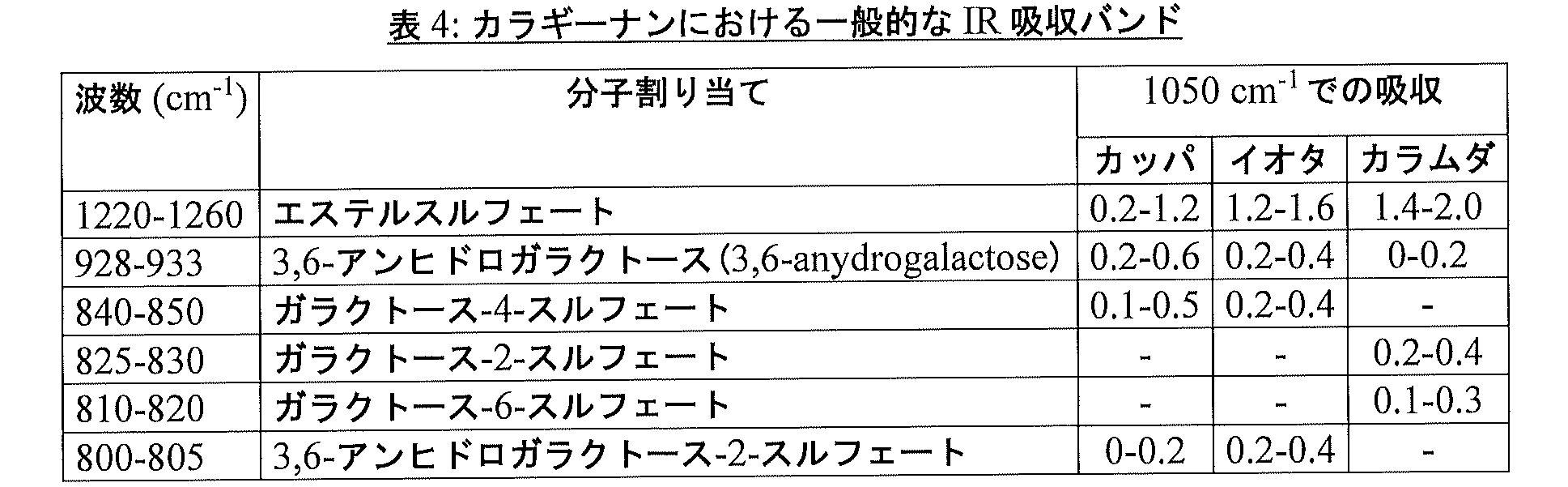
本発明の原理に従って研究を行い、抗ウイルス性潤滑組成物のサンプル内のカラギーナンを特徴付ける。抗ウイルス性潤滑組成物のサンプルを、国際連合食糧農業機関/世界保健機関の食品添加物の仕様の共同概要(“Carrageenan, Compendium of Food Additive Specifications FAO JEFCA Monographs 16; FAO/WHO Publications; Rome, Italy; pp. 7-12を参照のこと)に記載されている手順に従って、IR分光分析に付する。本発明の抗ウイルス性潤滑組成物は、ラムダ-カラギーナンを含む他の組成物と比較することができる独特且つ特徴的なIRスペクトルを有することが期待される。抗ウイルス性潤滑組成物のIRスペクトルは、810cm-1~820cm-1並びに825cm-1~830cm-1にピークを有することが期待され、これは抗ウイルス潤滑組成物内のラムダ-カラギーナンの存在を示している。さらに、抗ウイルス性潤滑組成物中のラムダ-カラギーナンのモル比は、カッパ-カラギーナン及びイオタ-カラギーナンのモル比よりも大きいこともまた予想される。 A study was conducted in accordance with the principles of the present invention to characterize carrageenan within samples of an antiviral lubricant composition. A sample of the antiviral lubricating composition is subjected to IR spectroscopy analysis according to the procedures set forth in the Joint Food and Agriculture Organization of the United Nations/World Health Organization Compendium of Food Additive Specifications (see "Carrageenan, Compendium of Food Additive Specifications FAO JEFCA Monographs 16; FAO/WHO Publications; Rome, Italy; pp. 7-12). The antiviral lubricating composition of the present invention is expected to have a unique and characteristic IR spectrum that can be compared to other compositions containing lambda-carrageenan. The IR spectrum of the antiviral lubricating composition is expected to have peaks at 810 cm −1 to 820 cm −1 and 825 cm −1 to 830 cm −1 , indicating the presence of lambda-carrageenan in the antiviral lubricating composition. Furthermore, it is also expected that the molar ratio of lambda-carrageenan in the antiviral lubricating composition is greater than the molar ratios of kappa-carrageenan and iota-carrageenan.
実施例6:ヒト被験者における呼吸器ウイルスに対する抗ウイルス性潤滑組成物の抗ウイルス効果
本発明の原理に従って研究を行い、COVID-19などの活動性ウイルス性呼吸器感染症を有するヒト対象、又は活動性ウイルス性呼吸器感染症を有する者と密接に接触しているヒト対象における抗ウイルス潤滑組成物の有効性を測定する。参加者は、実施例2の抗ウイルス潤滑組成物をスワブの先端に塗布し、スワブを鼻を通して、鼻及び鼻腔内の上皮組織と接触するまで挿入するように求められる。あるいは、参加者は、ある量の抗ウイルス潤滑組成物を口に分配し、飲み込む前に口内で組成物をすするか、渦巻くか、又はうがいをするように求められる。いずれかの方法で投与される組成物の容量は、0.1mL~5mLの間である。実施例2の抗ウイルス潤滑組成物は、そのままの形態で、又は投与前に希釈して投与することができる。参加者は、抗ウイルス性潤滑組成物を鼻腔に1日1~4回投与するよう求められる。また、参加者は、別の人と密接に接触するか又は公の場に出る前及び/又は後に組成物を投与するように求められ得る。活動性感染症の場合、症状の進行は、用量依存的に、完全に排除されるまで和らぐか又は軽減されると予想される。また、病気ではないが、病気の患者と密接に接触している被験者に伝染するウイルスのウイルス量は、遅延するか、減少するか、又は排除されると予想される。
Example 6: Antiviral Efficacy of Antiviral Lubricant Composition Against Respiratory Viruses in Human Subjects A study is conducted in accordance with the principles of the present invention to measure the efficacy of an antiviral lubricant composition in human subjects who have an active viral respiratory infection, such as COVID-19, or who are in close contact with someone who has an active viral respiratory infection. Participants are asked to apply the antiviral lubricant composition of Example 2 to the tip of a swab and insert the swab through their nose until it contacts the epithelial tissue within the nose and nasal cavity. Alternatively, participants are asked to dispense a quantity of the antiviral lubricant composition into their mouth and sip, swirl, or gargle the composition in their mouth before swallowing. The volume of the composition administered by either method is between 0.1 mL and 5 mL. The antiviral lubricant composition of Example 2 can be administered in neat form or diluted prior to administration. Participants are asked to administer the antiviral lubricant composition to their nasal passages one to four times per day. Participants may also be asked to administer the composition before and/or after coming into close contact with another person or going out in public. In the case of active infection, the progression of symptoms is expected to be slowed or reduced in a dose-dependent manner until it is completely eliminated, and the viral load of the virus that is transmitted to subjects who are not sick but are in close contact with sick patients is expected to be delayed, reduced, or eliminated.
Claims (20)
(b)ポリオール0.1重量%~8重量%;
(c)1以上のpH調整剤0.01重量%~1重量%;及び
(d)任意の0.5重量%までの1以上の甘味料及び1重量%までの1以上の防腐剤;
を有する抗ウイルス性潤滑組成物であって、
(i)抗ウイルス潤滑組成物は、濁度が約25ネフェロメトリック濁度単位(NTU)以下である均一な水溶液であり;
(ii)抗ウイルス潤滑組成物は半透明であり;
(iii)抗ウイルス性潤滑組成物は、粘度が500cP~10,000cPであり;且つ
(iv)抗ウイルス性潤滑組成物のpHが3.5~7.0である、
抗ウイルス性潤滑組成物であって、該抗ウイルス性潤滑組成物は、
(a)カラギーナンを有するカラギーナン粉末を提供する工程であって、該カラギーナンがラムダ-カラギーナンを90重量%及びカッパ-カラギーナンを10重量%有する工程;
(b)カラギーナン粉末をポリオールを有する溶液と混合し、カラギーナン水性懸濁液を形成する工程;
(c)カラギーナン水性懸濁液を少なくとも70℃から75℃までの温度まで加熱する工程;
(d)濁度が約25ネフェロメトリック濁度単位(NTU)以下である均一な水溶液を形成するのに十分な時間、加熱されたカラギーナン水性懸濁液を混合する工程;
(e)該均一な水溶液を約30℃未満の温度に冷却する工程;及び
(f)抗ウイルス潤滑組成物をpH3.5~7.0の範囲に調整するのに十分な量で1以上のpH調整剤を混合し、それによって抗ウイルス潤滑組成物を形成する工程;
を有する方法によって調製される、上記抗ウイルス性潤滑組成物。 (a) 0.1% to 3% by weight of carrageenan having about 90% by weight of lambda-carrageenan and about 10% by weight of kappa-carrageenan;
(b) 0.1% to 8% by weight of a polyol;
(c) 0.01% to 1% by weight of one or more pH adjusting agents; and (d) optionally up to 0.5% by weight of one or more sweeteners and up to 1% by weight of one or more preservatives;
1. An antiviral lubricating composition comprising:
(i) the antiviral lubricating composition is a homogenous aqueous solution having a turbidity of about 25 nephelometric turbidity units (NTU) or less;
(ii) the antiviral lubricating composition is translucent;
(iii) the antiviral lubricating composition has a viscosity of from 500 cP to 10,000 cP; and (iv) the antiviral lubricating composition has a pH of from 3.5 to 7.0.
1. An antiviral lubricating composition comprising:
(a) providing a carrageenan powder having carrageenan, the carrageenan having 90% by weight lambda-carrageenan and 10% by weight kappa-carrageenan;
(b) mixing the carrageenan powder with a solution having a polyol to form an aqueous carrageenan suspension;
(c) heating the carrageenan aqueous suspension to a temperature of at least 70°C to 75°C;
(d) mixing the heated carrageenan aqueous suspension for a period of time sufficient to form a homogenous aqueous solution having a turbidity of about 25 nephelometric turbidity units (NTU) or less;
(e) cooling the homogeneous aqueous solution to a temperature below about 30° C.; and
(f) mixing one or more pH adjusters in an amount sufficient to adjust the antiviral lubricating composition to a pH in the range of 3.5 to 7.0, thereby forming an antiviral lubricating composition;
The antiviral lubricant composition as described above is prepared by a method comprising the steps of :
(b)ポリオール0.1重量%~8重量%;
(c)1以上のpH調整剤0.01重量%~1重量%;及び
(d)任意の0.5重量%までの1以上の甘味料及び1重量%までの1以上の防腐剤;
を有する抗ウイルス性潤滑組成物であって
(i)抗ウイルス潤滑組成物は、濁度が約25ネフェロメトリック濁度単位(NTU)以下である均一な水溶液であり;
(ii)抗ウイルス潤滑組成物は半透明であり;
(iii)抗ウイルス性潤滑組成物は、粘度が500cP~10,000cPであり;且つ
(iv)抗ウイルス性潤滑組成物のpHが3.5~7.0である;抗ウイルス性潤滑組成物を形成する方法であって、
(a)カラギーナンを有するカラギーナン粉末を提供する工程であって、該カラギーナンがラムダ-カラギーナンを90重量%及びカッパ-カラギーナンを10重量%有する工程;
(b)カラギーナン粉末をポリオールを有する溶液と混合し、カラギーナン水性懸濁液を形成する工程;
(c)カラギーナン水性懸濁液を少なくとも70℃から75℃までの温度まで加熱する工程;
(d)濁度が約25ネフェロメトリック濁度単位(NTU)以下である均一な水溶液を形成するのに十分な時間、加熱されたカラギーナン水性懸濁液を混合する工程;
(e)該均一な水溶液を約30℃未満の温度に冷却する工程;及び
(f)抗ウイルス潤滑組成物をpH3.5~7.0の範囲に調整するのに十分な量で1以上のpH調整剤を混合し、それによって抗ウイルス潤滑組成物を形成する工程;
を有する、上記方法。 (a) 0.1% to 3% by weight of carrageenan having about 90% by weight of lambda-carrageenan and about 10% by weight of kappa-carrageenan;
(b) 0.1% to 8% by weight of a polyol;
(c) 0.01% to 1% by weight of one or more pH adjusters; and
(d) optionally up to 0.5% by weight of one or more sweeteners and up to 1% by weight of one or more preservatives;
1. An antiviral lubricant composition comprising:
(i) the antiviral lubricating composition is a homogenous aqueous solution having a turbidity of about 25 nephelometric turbidity units (NTU) or less;
(ii) the antiviral lubricating composition is translucent;
(iii) the antiviral lubricating composition has a viscosity of 500 cP to 10,000 cP; and
(iv) the pH of the antiviral lubricating composition is from 3.5 to 7.0; a method of forming an antiviral lubricating composition comprising:
(a) providing a carrageenan powder having carrageenan, the carrageenan having 90% by weight lambda-carrageenan and 10% by weight kappa-carrageenan;
(b) mixing the carrageenan powder with a solution having a polyol to form an aqueous carrageenan suspension;
(c) heating the carrageenan aqueous suspension to a temperature of at least 70°C to 75°C;
(d) mixing the heated carrageenan aqueous suspension for a period of time sufficient to form a homogenous aqueous solution having a turbidity of about 25 nephelometric turbidity units (NTU) or less;
(e) cooling the homogeneous aqueous solution to a temperature of less than about 30° C.; and (f) admixing one or more pH adjusters in an amount sufficient to adjust the pH of the antiviral lubricating composition to a range of 3.5 to 7.0, thereby forming an antiviral lubricating composition.
The above method,
ポリオールがプロピレングリコールであり、該プロピレングリコールが抗ウイルス性潤滑組成物のうち0.1重量%~8重量%有し;
抗ウイルス性潤滑組成物の粘度が500cP~10,000cPであり;
抗ウイルス性潤滑組成物の重量モル浸透圧濃度が200mOsmol/kg~1400mOsmol/kgである請求項13に記載の方法。 Carrageenan is present in an amount of 0.1% to 3% by weight of the antiviral lubricating composition;
the polyol is propylene glycol, and the propylene glycol comprises 0.1% to 8% by weight of the antiviral lubricating composition;
The viscosity of the antiviral lubricating composition is from 500 cP to 10,000 cP;
14. The method of claim 13, wherein the antiviral lubricating composition has an osmolality of 200 mOsmol/kg to 1400 mOsmol/kg.
プロピレングリコールが抗ウイルス性潤滑組成物のうち4.0重量%~4.5重量%有し;
抗ウイルス性潤滑組成物のpHが5.5~7.0の範囲であり;
抗ウイルス性潤滑組成物の粘度が2,000cP~3,000cPであり;
抗ウイルス潤滑組成物の重量モル浸透圧濃度が650mOsmol/kg~850mOsmol/kgである請求項14に記載の方法。 Carrageenan is present in the antiviral lubricating composition at 1.5% to 1.7% by weight;
Propylene glycol is present in the antiviral lubricating composition at 4.0% to 4.5% by weight;
The pH of the antiviral lubricating composition is in the range of 5.5 to 7.0;
The viscosity of the antiviral lubricating composition is from 2,000 cP to 3,000 cP;
15. The method of claim 14, wherein the antiviral lubricating composition has an osmolality of 650 mOsmol/kg to 850 mOsmol/kg.
(A)湿潤カラギーナン混合物を形成するのに十分な時間、カラギーナン粉末をある量のプロピレングリコールと混合するサブ工程であって、プロピレングリコールの量とカラギーナン粉末との重量比が約1:1~約10:1であるサブ工程;及び
(B)カラギーナン水性懸濁液を形成するのに十分な時間、混合しながら、湿潤カラギーナン混合物を水溶液と合わせるサブ工程であって、水溶液と湿潤カラギーナン混合物との体積比が約45:1~約8:1であるサブ工程;
を有する請求項13~15のいずれか一項に記載の方法。 Step (b)
(A) mixing the carrageenan powder with an amount of propylene glycol for a time sufficient to form a wet carrageenan mixture, wherein the weight ratio of the amount of propylene glycol to the amount of carrageenan powder is about 1:1 to about 10:1; and (B) combining the wet carrageenan mixture with an aqueous solution while mixing for a time sufficient to form a carrageenan aqueous suspension, wherein the volume ratio of the aqueous solution to the wet carrageenan mixture is about 45:1 to about 8:1;
The method according to any one of claims 13 to 15, comprising the steps of:
20. The method of claim 19, wherein the total mixing time for forming the wet carrageenan mixture, forming the carrageenan aqueous suspension, forming the homogenous aqueous solution, and forming the antiviral lubricating composition is about 3 hours or less.
Applications Claiming Priority (1)
| Application Number | Priority Date | Filing Date | Title |
|---|---|---|---|
| PCT/US2020/038991 WO2021262141A1 (en) | 2020-06-22 | 2020-06-22 | Personal lubricants comprising lambda-carrageenan |
Publications (2)
| Publication Number | Publication Date |
|---|---|
| JP2023538798A JP2023538798A (en) | 2023-09-12 |
| JP7635277B2 true JP7635277B2 (en) | 2025-02-25 |
Family
ID=79281651
Family Applications (1)
| Application Number | Title | Priority Date | Filing Date |
|---|---|---|---|
| JP2022580078A Active JP7635277B2 (en) | 2020-06-22 | 2020-06-22 | Personal lubricants containing lambda-carrageenan |
Country Status (9)
| Country | Link |
|---|---|
| EP (1) | EP4167956A4 (en) |
| JP (1) | JP7635277B2 (en) |
| KR (1) | KR20230042020A (en) |
| CN (1) | CN115942941A (en) |
| AU (1) | AU2020454698A1 (en) |
| BR (1) | BR112022026026A2 (en) |
| CA (1) | CA3183518A1 (en) |
| MX (1) | MX2022016267A (en) |
| WO (1) | WO2021262141A1 (en) |
Families Citing this family (1)
| Publication number | Priority date | Publication date | Assignee | Title |
|---|---|---|---|---|
| US20230285284A1 (en) * | 2022-03-10 | 2023-09-14 | Elizabeth McQuaid | Lubricant pods |
Citations (4)
| Publication number | Priority date | Publication date | Assignee | Title |
|---|---|---|---|---|
| US20080227749A1 (en) | 2004-04-08 | 2008-09-18 | Vivus, Inc. | Carrageenan-based formulations and associated methods of use |
| US20110229446A1 (en) | 2010-03-02 | 2011-09-22 | Roman Stephen B | Method and composition to relieve sexual discomfort and improve vaginal health |
| US20180369137A1 (en) | 2017-06-27 | 2018-12-27 | Lifestyles Healthcare Pte. Ltd. | Natural Lubricant |
| WO2019217618A1 (en) | 2018-05-10 | 2019-11-14 | Mario Elmen Tremblay | Lubricated substrates comprising lambda-carrageenan |
Family Cites Families (4)
| Publication number | Priority date | Publication date | Assignee | Title |
|---|---|---|---|---|
| CN1471914A (en) * | 2003-04-29 | 2004-02-04 | 胡世玺 | Medicine, application and preparing method for preventnig SARS pneumonia by SARS virus |
| KR20080070482A (en) * | 2007-05-31 | 2008-07-30 | (주)디딤바이오텍 | Lubricant composition comprising immunopotentiator with mucosal immunity and preparation method thereof |
| JP6170044B2 (en) * | 2011-07-20 | 2017-07-26 | エフ. カイザー,パトリック | Intravaginal device for drug delivery |
| CN107847430B (en) * | 2015-07-14 | 2021-02-02 | 玛丽诺姆德生物技术股份公司 | A nasal congestion dredging composition with antiviral activity |
-
2020
- 2020-06-22 KR KR1020237002595A patent/KR20230042020A/en not_active Ceased
- 2020-06-22 AU AU2020454698A patent/AU2020454698A1/en active Pending
- 2020-06-22 WO PCT/US2020/038991 patent/WO2021262141A1/en not_active Ceased
- 2020-06-22 JP JP2022580078A patent/JP7635277B2/en active Active
- 2020-06-22 CA CA3183518A patent/CA3183518A1/en active Pending
- 2020-06-22 EP EP20942177.5A patent/EP4167956A4/en active Pending
- 2020-06-22 BR BR112022026026A patent/BR112022026026A2/en unknown
- 2020-06-22 MX MX2022016267A patent/MX2022016267A/en unknown
- 2020-06-22 CN CN202080103325.6A patent/CN115942941A/en active Pending
Patent Citations (4)
| Publication number | Priority date | Publication date | Assignee | Title |
|---|---|---|---|---|
| US20080227749A1 (en) | 2004-04-08 | 2008-09-18 | Vivus, Inc. | Carrageenan-based formulations and associated methods of use |
| US20110229446A1 (en) | 2010-03-02 | 2011-09-22 | Roman Stephen B | Method and composition to relieve sexual discomfort and improve vaginal health |
| US20180369137A1 (en) | 2017-06-27 | 2018-12-27 | Lifestyles Healthcare Pte. Ltd. | Natural Lubricant |
| WO2019217618A1 (en) | 2018-05-10 | 2019-11-14 | Mario Elmen Tremblay | Lubricated substrates comprising lambda-carrageenan |
Also Published As
| Publication number | Publication date |
|---|---|
| EP4167956A1 (en) | 2023-04-26 |
| WO2021262141A1 (en) | 2021-12-30 |
| MX2022016267A (en) | 2023-03-31 |
| AU2020454698A1 (en) | 2023-02-23 |
| CA3183518A1 (en) | 2021-12-30 |
| KR20230042020A (en) | 2023-03-27 |
| BR112022026026A2 (en) | 2023-03-07 |
| JP2023538798A (en) | 2023-09-12 |
| CN115942941A (en) | 2023-04-07 |
| EP4167956A4 (en) | 2024-02-21 |
Similar Documents
| Publication | Publication Date | Title |
|---|---|---|
| JP5118633B2 (en) | Mucoadhesive xyloglucan-containing preparations useful in medical devices and pharmaceutical preparations | |
| CN100488517C (en) | Compositions for trapping and inactivating pathogenic microorganisms and spermatozoa and pharmaceutical uses thereof | |
| KR102905131B1 (en) | Lubricating substrate containing lambda-carrageenan | |
| US20080193489A1 (en) | Personal Lubricant Compositions That Are Free Of Glycerin and Parabens | |
| US11446240B2 (en) | Personal lubricants comprising lambda-carrageenan | |
| RU2697051C2 (en) | Combined medicinal preparation for prevention of sexually transmitted infections | |
| CN103405610A (en) | Compact water-soluble human body lubricant, preparation method thereof and condom | |
| JP7635277B2 (en) | Personal lubricants containing lambda-carrageenan | |
| Nathan | Non-prescription medicines | |
| US12036313B2 (en) | Personal lubricants comprising lambda-carrageenan | |
| US12043598B2 (en) | Condoms lubricated with antiviral lubricious compositions containing lambda-carrageenan | |
| US11744796B2 (en) | Personal lubricants comprising lambda-carrageenan | |
| RU2428174C1 (en) | Lubricant for intimate women's hygiene | |
| WO2017069793A1 (en) | Vaginal gel compositions and methods of use thereof | |
| BE1018740A3 (en) | COMPOSITION FOR THE TREATMENT OF HUMID EPITHELIAL SURFACES. | |
| Shaikh et al. | Formulation and assessment of polyherbal candies for soothing cough and sore throat | |
| Boddu et al. | Excipients and non-medicinal agents as active pharmaceutical ingredients | |
| JP7394295B2 (en) | Candy formulation and method for manufacturing candy formulation | |
| Nagare et al. | Formulation and Evaluation of Herbal Lozenges for the Effective Management of Mouth Ulcers | |
| Savory | A Compendium of Domestic Medicine and Companion to the Medicine Chest... |
Legal Events
| Date | Code | Title | Description |
|---|---|---|---|
| A621 | Written request for application examination |
Free format text: JAPANESE INTERMEDIATE CODE: A621 Effective date: 20230621 |
|
| A711 | Notification of change in applicant |
Free format text: JAPANESE INTERMEDIATE CODE: A711 Effective date: 20240328 |
|
| A521 | Request for written amendment filed |
Free format text: JAPANESE INTERMEDIATE CODE: A821 Effective date: 20240328 |
|
| A131 | Notification of reasons for refusal |
Free format text: JAPANESE INTERMEDIATE CODE: A131 Effective date: 20240625 |
|
| A601 | Written request for extension of time |
Free format text: JAPANESE INTERMEDIATE CODE: A601 Effective date: 20240918 |
|
| A521 | Request for written amendment filed |
Free format text: JAPANESE INTERMEDIATE CODE: A523 Effective date: 20241223 |
|
| TRDD | Decision of grant or rejection written | ||
| A01 | Written decision to grant a patent or to grant a registration (utility model) |
Free format text: JAPANESE INTERMEDIATE CODE: A01 Effective date: 20250114 |
|
| A61 | First payment of annual fees (during grant procedure) |
Free format text: JAPANESE INTERMEDIATE CODE: A61 Effective date: 20250212 |
|
| R150 | Certificate of patent or registration of utility model |
Ref document number: 7635277 Country of ref document: JP Free format text: JAPANESE INTERMEDIATE CODE: R150 |