KR0161237B1 - Process for preparing cyclopentene, cyclopentane and cyclohexane derivatives - Google Patents
Process for preparing cyclopentene, cyclopentane and cyclohexane derivatives Download PDFInfo
- Publication number
- KR0161237B1 KR0161237B1 KR1019890013556A KR890013556A KR0161237B1 KR 0161237 B1 KR0161237 B1 KR 0161237B1 KR 1019890013556 A KR1019890013556 A KR 1019890013556A KR 890013556 A KR890013556 A KR 890013556A KR 0161237 B1 KR0161237 B1 KR 0161237B1
- Authority
- KR
- South Korea
- Prior art keywords
- formula
- compound
- hydrogen atom
- group
- alkyl
- Prior art date
- Legal status (The legal status is an assumption and is not a legal conclusion. Google has not performed a legal analysis and makes no representation as to the accuracy of the status listed.)
- Expired - Fee Related
Links
- 0 CC1*CCC1 Chemical compound CC1*CCC1 0.000 description 6
Classifications
-
- C—CHEMISTRY; METALLURGY
- C07—ORGANIC CHEMISTRY
- C07C—ACYCLIC OR CARBOCYCLIC COMPOUNDS
- C07C69/00—Esters of carboxylic acids; Esters of carbonic or haloformic acids
- C07C69/74—Esters of carboxylic acids having an esterified carboxyl group bound to a carbon atom of a ring other than a six-membered aromatic ring
- C07C69/753—Esters of carboxylic acids having an esterified carboxyl group bound to a carbon atom of a ring other than a six-membered aromatic ring of polycyclic acids
-
- C—CHEMISTRY; METALLURGY
- C07—ORGANIC CHEMISTRY
- C07C—ACYCLIC OR CARBOCYCLIC COMPOUNDS
- C07C67/00—Preparation of carboxylic acid esters
- C07C67/30—Preparation of carboxylic acid esters by modifying the acid moiety of the ester, such modification not being an introduction of an ester group
- C07C67/333—Preparation of carboxylic acid esters by modifying the acid moiety of the ester, such modification not being an introduction of an ester group by isomerisation; by change of size of the carbon skeleton
-
- C—CHEMISTRY; METALLURGY
- C07—ORGANIC CHEMISTRY
- C07C—ACYCLIC OR CARBOCYCLIC COMPOUNDS
- C07C69/00—Esters of carboxylic acids; Esters of carbonic or haloformic acids
- C07C69/74—Esters of carboxylic acids having an esterified carboxyl group bound to a carbon atom of a ring other than a six-membered aromatic ring
Landscapes
- Chemical & Material Sciences (AREA)
- Organic Chemistry (AREA)
- Organic Low-Molecular-Weight Compounds And Preparation Thereof (AREA)
- Low-Molecular Organic Synthesis Reactions Using Catalysts (AREA)
Abstract
내용없음.None.
Description
본 발명은 살진균 활성을 갖는 특정의 시클로펜텐 유도체 및 특정의 시클로펜탄 및 시클로헥산 유도체의 제조방법에 관한 것으로서, 이들 전부는 살진균 활성을 갖는 기타의 시클로펜탄 유도체의 제조에서 유용하다.The present invention relates to certain cyclopentene derivatives having fungicidal activity and to methods of preparing certain cyclopentane and cyclohexane derivatives, all of which are useful in the preparation of other cyclopentane derivatives having fungicidal activity.
Bull. Chem. Soc.Jap., 43(7), (1970), pp. 2204-8 에서는 1-벤질-2-카르복실시클로펜트-1-엔을 기술하고, Bull. Chem. Soc. Jap., 60(2), (1987), pp. 836-8 에서는 1-벤질-2-메톡시카르보닐시클로펜트-1엔을 개시한다. 그러나, 이들 문헌에는 이들 화합물 중 어느 하나도 살진균 활성을 나타낸다고 지적된 바 없다.Bull. Chem. Soc. Jap., 43 (7), (1970), pp. 2204-8 describes 1-benzyl-2-carboxycyclopent-1-ene, Bull. Chem. Soc. Jap., 60 (2), (1987), pp. 836-8 discloses 1-benzyl-2-methoxycarbonylcyclopent-1ene. However, these documents do not indicate that any of these compounds exhibit fungicidal activity.
또한, 미합중국 특허 제 4067823호에서는 1-벤질리덴-2-메톡시카르보닐시클로펜탄을 기술하고 있고, Liebigs Ann. Chem., (8),(1980), pp. 1283-95에서는 1-(4-메톡시벤질리덴)-2-메톡시카르보닐시클로펜탄을 기술하고 있다.In addition, US Patent No. 4067823 describes 1-benzylidene-2-methoxycarbonylcyclopentane, and Liebigs Ann. Chem., (8), (1980), pp. 1283-95 describes 1- (4-methoxybenzylidene) -2-methoxycarbonylcyclopentane.
따라서, 동시 계류중인 특허 출원 T616은 살진균 활성을 갖는 하기 일반식(Ⅰ)의 화합물을 기술한다.Therefore, co-pending patent application T616 describes compounds of the general formula (I) having fungicidal activity.

상기 식에서, n은 0-5의 정수를 나타내고, 각각의 R은 할로겐 원자, 니트로, 시아노, 히드록실, 알킬, 할로알킬, 알콕시, 할로알콕시, 아미노, 알킬아미노, 디알킬아미노, 알콕시카르보닐, 카르복실, 알카노일, 알킬티오, 알킬술피닐, 알킬술포닐, 카르바모일, 알킬아미도, 시클로알킬 또는 페닐기를 나타내고, R1및 R2는 독립적으로 수소 원자 또는 알킬기를 나타내고, R5는 수소 원자 또는 알킬기 또는 시클로알킬기를 나타내며, 단 n이 0이고 R1및 R2모두가 수소 원자를 나타낼 때, R5는 수소 원자 또는 메틸기를 나타내지 않는다.Wherein n represents an integer of 0-5, each R represents a halogen atom, nitro, cyano, hydroxyl, alkyl, haloalkyl, alkoxy, haloalkoxy, amino, alkylamino, dialkylamino, alkoxycarbonyl , Carboxyl, alkanoyl, alkylthio, alkylsulfinyl, alkylsulfonyl, carbamoyl, alkylamido, cycloalkyl or phenyl group, R 1 and R 2 independently represent a hydrogen atom or an alkyl group, R 5 Represents a hydrogen atom or an alkyl group or a cycloalkyl group, provided that when n is 0 and both R 1 and R 2 represent a hydrogen atom, R 5 does not represent a hydrogen atom or a methyl group.
상업적으로 구입가능한 출발물질로부터 출발한 T616에 기술된 일반식 (Ⅰ)의 화합물의 제조방법은 최소한 다섯 개의 합성 단계를 요한다. 각 단계에서 얻어진 수율은 100%가 아니기 때문에, 일반식(Ⅰ)의 화합물의 잠재적인 수율은 각 연속적인 합성에서 감소된다. 그러나, 이제 신규한 방법은 두 개 더 적은 합성단계로 이루어진 상기 화합물의 제조방법을 발견하여 일반식(Ⅰ)의 화합물의 더 높은 전체 수율을 제공하게 된다.The process for the preparation of the compounds of formula (I) described in T616 starting from commercially available starting materials requires at least five synthetic steps. Since the yield obtained in each step is not 100%, the potential yield of the compound of general formula (I) is reduced in each successive synthesis. However, the new process now finds a process for the preparation of the compound which consists of two fewer synthetic steps, providing a higher overall yield of the compound of general formula (I).
본 발명에 따르면 극성 용매의 존재하에서, 하기 일반식(Ⅱ) 또는 (Ⅲ)의 화합물을According to the present invention, in the presence of a polar solvent, a compound of formula (II) or (III)
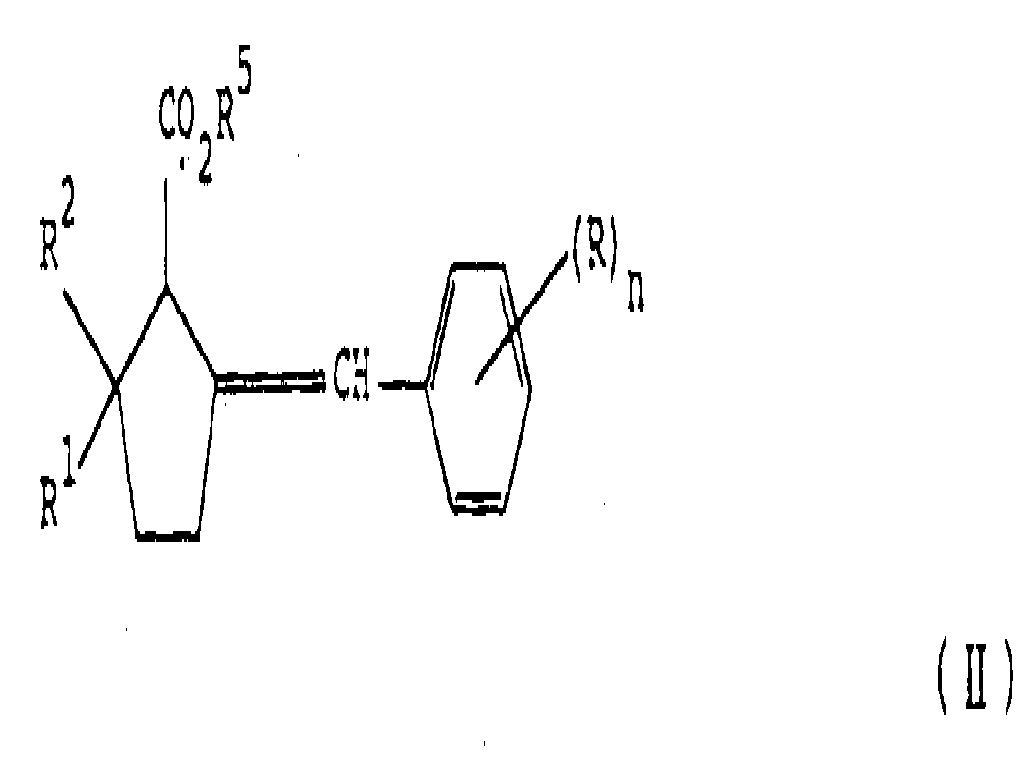

(여기서, n,R,R1,R2및 R5는 상기에서 정의한 바와 같고, X 및 Y는 독립적으로 할로겐 원자, 바람직하게는 염소 또는 브롬원자를 나타낸다) 하기 일반식(Ⅳ)의 화합물Wherein n, R, R 1 , R 2 and R 5 are as defined above and X and Y independently represent a halogen atom, preferably a chlorine or bromine atom.

(여기서, R5는 상기에서 정의한 바와 같고, M은 알칼리 금속원자, 바람직하게는 나트륨 원자를 나타낸다)과 함께 가열시키는 것으로 구성되는, 상기 정의된 일반식(Ⅰ)의 화합물 제조방법이 제공된다.A process for preparing a compound of formula (I) as defined above is provided which consists of heating together with R 5 as defined above and M represents an alkali metal atom, preferably sodium atom.
바람직하게, 극성 용매는 하기 일반식(Ⅴ)의 화합물이다.Preferably, the polar solvent is a compound of formula (V)

(여기서, R5는 상기에서 정의한 바와 같고, 디메틸포름아미드 또는 디메틸술폭시드이다.)Wherein R 5 is as defined above and is dimethylformamide or dimethyl sulfoxide.
만일 일반식(Ⅴ)의 화합물이 용매로서 사용된다면, 바람직하게 R5는 일반식(Ⅳ) 및 (Ⅴ)에서 같은 의미를 가진다. 예컨대, 일반식(Ⅳ)의 화합물이 나트륨 메톡시드라면, 일반식(Ⅴ)의 용매는 메탄올인 것이 바람직하다.If the compound of formula (V) is used as the solvent, preferably R 5 has the same meaning in formulas (IV) and (V). For example, if the compound of formula (IV) is sodium methoxide, the solvent of formula (V) is preferably methanol.
반응은 80℃ 내지 용매의 환류 온도에서 편리하게 수행된다. 바람직하게 과량의 일반식(Ⅳ) 화합물이 사용된다.The reaction is conveniently carried out at 80 ° C. to the reflux temperature of the solvent. Excess formula (IV) compound is preferably used.
치환체 R,R1,R2및 R5중 어느 하나가 알킬 치환기를 나타내거나 함유하는 경우, 이는 선형이거나 가지형일 수 있고, 12개 이하, 바람직하게는 6개이하, 특히 4개 이하의 탄소원자를 함유할 수 있다. 시클로알킬 치환기는 3-8개, 바람직하게는 3-6개의 탄소원자를 함유할 수 있다.When either of the substituents R, R 1 , R 2 and R 5 represents or contains an alkyl substituent, it may be linear or branched, having up to 12, preferably up to 6, in particular up to 4 carbon atoms It may contain. Cycloalkyl substituents may contain 3-8, preferably 3-6, carbon atoms.
R1및 R2가 독립적으로 수소 원자 또는 C1-4알킬기, 특히 메틸기를 나타내는 것이 바람직하다.It is preferable that R 1 and R 2 independently represent a hydrogen atom or a C 1-4 alkyl group, especially a methyl group.
바람직하게, R은 할로겐, 특히 염소 원자를 나타낸다.Preferably, R represents a halogen, in particular a chlorine atom.
R5가 수소 원자 또는 C1-6알킬기를 나타내는 것이 또한 바람직하다.It is also preferable that R 5 represents a hydrogen atom or a C 1-6 alkyl group.
n이 1이고 R이 바람직하게는 페닐고리의 4-위치에 치환된 염소원자를 나타내며, R1및 R2모두가 수소원자 또는 메틸기를 나타내고, R5가 메틸기를 나타내는 것이 특히 바람직하다.It is particularly preferable that n is 1 and R preferably represents a chlorine atom substituted in the 4-position of the phenyl ring, both R 1 and R 2 represent a hydrogen atom or a methyl group, and R 5 represents a methyl group.
본 발명에 따라서, 하기 일반식(Ⅱ)의 화합물이 제공된다.According to the present invention, compounds of the following general formula (II) are provided.

상기 식에서, n은 0-5인 정수를 나타내고, 각각의 R은 할로겐 원자, 니트로, 시아노, 히드록실, 알킬, 할로알킬, 알콕시, 할로알콕시, 아미노, 알킬아미노, 디알킬아미노, 알콕시카르보닐, 카르복실, 알카노일, 알킬티오, 알킬술피닐, 알킬술포닐, 카르바모일, 알킬아미도, 시클로알킬 또는 페닐기를 나타내고, R1및 R2는 독립적으로 수소 원자 또는 알킬기를 나타내고, R5는 수소 원자 또는 알킬기 또는 시킬로알킬기를 나타내며, 단 R1및 R2모두가 수소원자를 나타내고, R5가 메틸기를 나타낼 때, n은 0이 아니고, n이 1일 때 R은 메톡시기를 나타내지 않는다.Wherein n represents an integer of 0-5, each R represents a halogen atom, nitro, cyano, hydroxyl, alkyl, haloalkyl, alkoxy, haloalkoxy, amino, alkylamino, dialkylamino, alkoxycarbonyl , Carboxyl, alkanoyl, alkylthio, alkylsulfinyl, alkylsulfonyl, carbamoyl, alkylamido, cycloalkyl or phenyl group, R 1 and R 2 independently represent a hydrogen atom or an alkyl group, R 5 Represents a hydrogen atom or an alkyl group or a haloalkyl group, provided that both R 1 and R 2 represent a hydrogen atom, and when R 5 represents a methyl group, n is not 0, and when n is 1, R represents a methoxy group Do not.
임의의 앞의 치환체가 알킬 치환기를 나타내거나 함유할 때, 이는 선형이거나 가지형일 수 있고, 12개 이하, 바람직하게는 6개 이하, 특히 4개 이하의 탄소원자를 함유할 수 있다.When any preceding substituent represents or contains an alkyl substituent, it may be linear or branched and may contain up to 12, preferably up to 6, in particular up to 4 carbon atoms.
R1및 R2가 독립적으로 수소 원자 또는 C1-4알킬, 특히 메틸기를 나타내는 것이 바람직하다.It is preferable that R 1 and R 2 independently represent a hydrogen atom or a C 1-4 alkyl, in particular a methyl group.
바람직하게, R은 할로겐, 특히 염소원자를 나타낸다.Preferably, R represents a halogen, in particular a chlorine atom.
R5가 수소 원자 또는 C1-6알킬기를 나타내는 것이 또한 바람직하다.It is also preferable that R 5 represents a hydrogen atom or a C 1-6 alkyl group.
일반식(Ⅱ)의 화합물의 특히 바람직한 하부군(sub-group)은 n이 1이고, R이 바람직하게는 페닐고리의 4-위치에 치환된 염소원자를 나타내고, R1및 R2모두가 수소 원자를 나타내거나 메틸기를 나타내고, R5가 메틸기를 나타내는 것이다.Particularly preferred sub-groups of compounds of formula (II) are those in which n is 1, R preferably represents a chlorine atom substituted in the 4-position of the phenyl ring, and both R 1 and R 2 are hydrogen It represents an atom or a methyl group, and R <5> represents a methyl group.
본 발명은 또한 하기 일반식(Ⅴ)의 용매의 존재하에서The invention also relates to the presence of a solvent of the general formula (V)

(여기서, R5는 상기에서 정의한 바와 같다)(Wherein R 5 is as defined above)
일반식(Ⅳ)의 화합물Compound of formula (IV)

(여기서, R5는 상기에서 정의한 바와 같고, M은 알칼리 금속, 바람직하게는 나트륨 원자를 나타낸다)과 일반식(Ⅲ)의 화합물Wherein R 5 is as defined above and M represents an alkali metal, preferably sodium atom) and a compound of formula (III)

(여기서, n,R,R1,R2는 상기에서 정의한 바와 같고, X 및 Y는 독립적으로 할로겐 원자, 바람직하게는 염소 또는 브롬 원자를 나타낸다)을 반응시키는 것으로 구성되는 상기 정의된 일반식(Ⅱ)의 화합물의 제조방법을 제공한다.Wherein n, R, R 1 , R 2 are as defined above and X and Y independently represent a halogen atom, preferably a chlorine or bromine atom. Provided is a process for preparing the compound of II).
바람직하게, R5는 일반식(Ⅳ) 및 (Ⅴ)에서 같은 의미를 가진다. 예컨대, 일반식(Ⅳ)의 화합물이나 나트륨 메톡시드이면, 일반식(Ⅴ)의 용매가 메탄올인 것이 바람직하다.Preferably, R 5 has the same meaning in formulas (IV) and (V). For example, if it is a compound of general formula (IV) and sodium methoxide, it is preferable that the solvent of general formula (V) is methanol.
반응은 일반식(Ⅳ)의 화합물의 약간 과량을 사용하여 0℃ 내지 실온에서 편리하게 수행된다.The reaction is conveniently carried out at 0 ° C. to room temperature using a slight excess of the compound of formula (IV).
본 발명의 또 다른 양상에 따르면 일반식(Ⅲ)의 화합물이 제공된다.According to another aspect of the invention there is provided a compound of formula (III).

상기 식에서, n은 0-5의 정수를 나타내고, 각각의 R은 할로겐 원자, 니트로, 시아노, 히드록실, 알킬, 할로알킬, 알콕시, 할로알콕시, 아미노, 알킬아미노, 디알킬아미노, 알콕시카르보닐, 카르복실, 알카노일, 알킬티오, 알킬술피닐, 알킬술포닐, 카르바모일, 알킬아미노, 시클로알킬 또는 페닐기를 나타내고, R1및 R2는 독립적으로 수소원자 또는 알킬기를 나타내고, X 및 Y 는 독립적으로 할로겐 원자를 나태낸다.Wherein n represents an integer of 0-5, each R represents a halogen atom, nitro, cyano, hydroxyl, alkyl, haloalkyl, alkoxy, haloalkoxy, amino, alkylamino, dialkylamino, alkoxycarbonyl , Carboxyl, alkanoyl, alkylthio, alkylsulfinyl, alkylsulfonyl, carbamoyl, alkylamino, cycloalkyl or phenyl group, R 1 and R 2 independently represent a hydrogen atom or an alkyl group, X and Y Independently represents a halogen atom.
임의의 상기 치환체가 알킬 치환기를 나타내거나 함유할 때, 이는 선형이거나 가지형일 수 있고, 12개 이하, 바람직하게 6개 이하, 특히 4개 이하의 탄소원자를 함유할 수 있다. 시클로알킬 치환기는 3 내지 8, 바람직하게 3 내지 6개의 탄소원자를 함유할 수 있다.When any of the above substituents represent or contain alkyl substituents, they may be linear or branched and may contain up to 12, preferably up to 6, in particular up to 4 carbon atoms. Cycloalkyl substituents may contain 3 to 8, preferably 3 to 6 carbon atoms.
R1및 R2가 독립적으로 수소원자 또는 C1-4알킬, 특히 메틸기를 나타내는 것이 바람직하다.It is preferable that R 1 and R 2 independently represent a hydrogen atom or C 1-4 alkyl, in particular a methyl group.
바람직하게, R은 할로겐, 특히 염소 원자를 나타낸다.Preferably, R represents a halogen, in particular a chlorine atom.
X 및 Y는 독립적으로 염소 또는 브롬원자를 나타내는 것이 또한 바람직하다.It is also preferable that X and Y independently represent a chlorine or bromine atom.
일반식(Ⅲ)의 화합물이 특히 바람직한 하부군은 n이 1이고, R이 바람직하게는 페닐고리의 4-위치에 치환된 염소원자를 나타내고, R1및 R2모두가 수소원자를 나타내거나 메틸기를 나타내고, X 및 Y 모두가 브롬 원자를 나타내는 것이다.Particularly preferred subgroups of compounds of formula (III) are those in which n is 1, R preferably represents a chlorine atom substituted in the 4-position of the phenyl ring, and both R 1 and R 2 represent a hydrogen atom or a methyl group And X and Y both represent a bromine atom.
본 발명은 또한 화합물 XY(여기서, X 및 Y는 상기에서 정의한 바와 같다)와 하기 일반식(Ⅳ)의 화합물을 반응시키는 것으로 구성되는 상기 정의된 일반식(Ⅲ)의 화합물의 제조방법을 제공한다.The present invention also provides a process for the preparation of a compound of formula (III) as defined above comprising reacting compound XY (where X and Y are as defined above) with a compound of formula (IV) .

상기 식에서, n, R, R1및 R2는 상기에서 정의한 바와 같다.Wherein n, R, R 1 and R 2 are as defined above.
본 방법은 용매의 존재하에서 수행될 수 있다. 적절한 용매는 석유, 저급 알코올, 예컨대 메탄올, 염소화된 탄화수소, 예턴대 사염화탄소, 에테르 및 아세트산을 포함한다.The method can be carried out in the presence of a solvent. Suitable solvents include petroleum, lower alcohols such as methanol, chlorinated hydrocarbons, eg carbon tetrachloride, ethers and acetic acid.
반응은 만일 용매가 존재한다면 용매의 성질에 따라, -10℃∼실온에서 적절하게 수행된다. 바람직한 온도는 0℃∼실온이다.The reaction is suitably carried out at -10 ° C to room temperature, depending on the nature of the solvent, if a solvent is present. Preferable temperature is 0 degreeC-room temperature.
일반식(Ⅵ)의 화합물은 염기의 존재하에서, 하기 일반식(Ⅶ)의 화합물과 하기 일반식(Ⅷ)의 화합물의 반응에 의해 편리하게 제조될 수 있다.The compound of formula (VI) can be conveniently prepared by the reaction of a compound of formula (VII) and a compound of formula (VII) in the presence of a base.

상기 식에서, R1및 R2는 상기에서 정의한 바와 같다.Wherein R 1 and R 2 are as defined above.

상기 식에서, n 및 R은 상기에서 정의한 바와 같다.Wherein n and R are as defined above.
적절한 염기는 금속 수산화물 또는 탄산염, 예컨대 수산화나트륨, 수산화칼륨, 탄산나트륨 및 탄산칼륨을 포함한다.Suitable bases include metal hydroxides or carbonates such as sodium hydroxide, potassium hydroxide, sodium carbonate and potassium carbonate.
본 방법은 용매의 존재하에서 편리하게 수행된다. 적절한 용매는 물 및 저급 알코올을 포함한다.The method is conveniently carried out in the presence of a solvent. Suitable solvents include water and lower alcohols.
반응은 만일 용매가 존재한다면, 용매의 성질에 따라 20℃-100℃에서 적절하게 수행된다.The reaction is suitably carried out at 20 ° C.-100 ° C., depending on the nature of the solvent, if a solvent is present.
일반식(Ⅳ),(Ⅴ),(Ⅶ) 및 (Ⅷ)의 화합물 및 화합물 XY는 공지된 화합물이거나 공지된 방법과 유사한 방법에 의해 제조될 수 있다.Compounds of formulas (IV), (V), (iii) and (iii) and compound XY are known compounds or can be prepared by methods analogous to known methods.
일반식(Ⅰ), (Ⅱ) 및 (Ⅲ)의 화합물을 하기 일반식(Ⅸ)의 살진균 활성을 갖는 시클로펜탄 유도체의 제조에서 중간체로서 유용하다.Compounds of formulas (I), (II) and (III) are useful as intermediates in the preparation of cyclopentane derivatives having fungicidal activity of the general formula (VII) below.

상기 식에서, n,R, R1및 R2는 상기에서 정의한 바와 같고, A는 질소원자 또는 CH기를 나타낸다. 일반식(Ⅸ)의 특정 화합물은 동시 계류중인 특허 출원 GB-A1-2180236 및 EP-A2-0267778의 주제이다.Wherein n, R, R 1 and R 2 are as defined above and A represents a nitrogen atom or a CH group. Certain compounds of formula IV are the subject of co-pending patent applications GB-A1-2180236 and EP-A2-0267778.
EP-A2-0267778 및 GB-A1-2180236에 기술된 화합물은 하기의 구조를 가지는 두 개의 입체 이성질체 형태로 존재한다.The compounds described in EP-A2-0267778 and GB-A1-2180236 exist in two stereoisomeric forms having the structure:


문자 A 및 B는 상기의 이성질체 A 및 B 와 동일한 입체화학적 배열을 가지는 화합물을 나타내기 위해 이후 사용될 것이다.Letters A and B will be used later to refer to compounds having the same stereochemical configuration as isomers A and B above.
이성질체 A 및 B는 에를 들면 크로마토그래피에 의해 분리될 수 있으며, 상이한 살진균 활성을 나타낸다. 일반적으로, 일반식(ⅨA)의 이성질체는 일반식(ⅨB)의 이성질체보다 더 큰 살진균 활성을 나타낸다. 일반식(Ⅰ),(Ⅱ) 및 (Ⅲ)의 화합물로부터 일반식 (ⅨA)의 화합물을 합성하기 위해 사용되는 방법은 하기 반응도에 나타낸다.Isomers A and B can be separated, for example by chromatography, and exhibit different fungicidal activity. In general, the isomers of formula (VIIA) exhibit greater fungicidal activity than the isomers of formula (VIIB). The method used for synthesizing the compound of the general formula (VIIA) from the compounds of the general formulas (I), (II) and (III) is shown in the following scheme.

상기 반응도에서, n, R, R1, R2, R5, X, Y 및 A는 상기에서 정의한 바와 같고, R3는 선택적으로 치환된 알킬기 또는 아릴기, 바람직하게는 C1-4알킬 또는 페닐기를 나타내는데, 각각은 선택적으로 할로겐원자, 니트로, 시아노, 히드록실, C1-4알킬, C1-4할로알킬, C1-4알콕시, C1-4할로알콕시, 아미노,1-4알킬아미노, 디-1-4알킬아미노,1-4알콕시카르보닐, 카르복실,1-4알카노일,1-4알킬티오,1-4알킬술피닐, 카르바모일,1-4알킬아미도,C3-8시클로알킬 및 페닐기로부터 선택된 하나 이상의 치환체에 의해 치횐되고, Q는 수소 또는 알칼리 금속, 바람직하게는 나트륨 원자를 나타낸다. 본 발명의 부분이 아닌 상기 반응도에서의 중간체 화합물 및 방법 단계는 동시 계류중인 특허 출원 T616, T622, T623 및 T626의 주제이다.In this scheme, n, R, R 1 , R 2 , R 5 , X, Y and A are as defined above and R 3 is an optionally substituted alkyl or aryl group, preferably C 1-4 alkyl or Phenyl group, each of which is optionally a halogen atom, nitro, cyano, hydroxyl, C 1-4 alkyl, C 1-4 haloalkyl, C 1-4 alkoxy, C 1-4 haloalkoxy, amino, 1-4 Alkylamino, di- 1-4 alkylamino, 1-4 alkoxycarbonyl, carboxyl, 1-4 alkanoyl, 1-4 alkylthio, 1-4 alkylsulfinyl, carbamoyl, 1-4 alkylamido Is substituted by one or more substituents selected from C3-8 cycloalkyl and a phenyl group, Q represents hydrogen or an alkali metal, preferably a sodium atom. Intermediate compounds and method steps in this scheme that are not part of the present invention are the subject of co-pending patent applications T616, T622, T623 and T626.
본 발명은 하기 실시예에 의해 더 예중된다.The invention is further exemplified by the following examples.
[실시예 1]Example 1
2-브로모-2-(α-브로모-4-클로로벤질)-5,5-디메틸시클로헥사논의 제조Preparation of 2-bromo-2- (α-bromo-4-chlorobenzyl) -5,5-dimethylcyclohexanone
(일반식 Ⅲ ; n=1, R=4-Cl, R1=R2=CH3, X=Y=Br)(General Formula III; n = 1, R = 4-Cl, R 1 = R 2 = CH 3 , X = Y = Br)
(a) 2-(4-클로로벤질리덴)-5,5-디메틸시클로헥사논의 제조(a) Preparation of 2- (4-chlorobenzylidene) -5,5-dimethylcyclohexanone
수산화나트륨(5.4g, 0.27몰)을 함유하는 물(100㎖)내 3,3-디메틸시클로헥사논(34g, 0.27몰) 및 4-클로로벤즈알데히드(38g, 0.27몰)의 혼합물을 24시간동안 환류시켰다. 냉각시, 혼합물을 톨루엔으로 추출하고, 플래싱시켜 메탄올로부터 결정화시킨후에 2-(4-클로로벤질리덴)-5,5-디메틸시클로헥사논(48g)을 얻었다.A mixture of 3,3-dimethylcyclohexanone (34 g, 0.27 mole) and 4-chlorobenzaldehyde (38 g, 0.27 mole) in water (100 mL) containing sodium hydroxide (5.4 g, 0.27 mole) was refluxed for 24 hours. I was. Upon cooling, the mixture was extracted with toluene, flashed and crystallized from methanol to give 2- (4-chlorobenzylidene) -5,5-dimethylcyclohexanone (48 g).
융점 : 85-86℃, 수율 ; 75%Melting point: 85-86 ° C., yield; 75%
(b) 2-브로모-2-(α-브로모-4-클로로벤질)-5,5-디메틸시클로헥사논의 제조(b) Preparation of 2-bromo-2- (α-bromo-4-chlorobenzyl) -5,5-dimethylcyclohexanone
(a)에서 얻어진 5g(0.02몰)의 2-(4-클로로벤질리덴)-5,5-디메틸시클로헥사논을 디클로로메탄(25㎖)에 용해시키고 5-10℃로 냉각시켰다. 브롬(3.2g, 0.02몰)을 5분 동안 첨가시키고, 결과 얻어진 용액을 플래싱시켜 메탄올과 함께 분쇄(trituration)한 후 흰색 고체로서 5.5g의 2-브로모-2-(α-브로모-4-클로로벤질)-5,5-디메틸시클로헥사논을 얻었다.5 g (0.02 mol) of 2- (4-chlorobenzylidene) -5,5-dimethylcyclohexanone obtained in (a) was dissolved in dichloromethane (25 mL) and cooled to 5-10 ° C. Bromine (3.2 g, 0.02 mol) is added for 5 minutes, the resulting solution is flashed and triturated with methanol and then 5.5 g of 2-bromo-2- (α-bromo-4 as a white solid). -Chlorobenzyl) -5,5-dimethylcyclohexanone was obtained.
융점 ; 114-5℃, 수율 ; 67%Melting point; 114-5 ° C., yield; 67%
[실시예 2]Example 2
1-(4-클로로벤질리덴)-3,3-디메틸-2-메톡시카르보닐시클로펜탄의 제조Preparation of 1- (4-chlorobenzylidene) -3,3-dimethyl-2-methoxycarbonylcyclopentane
(일반식 Ⅱ ; n=1, R=4-Cl, R1=R2=CH3, R5=CH3)(General Formula II; n = 1, R = 4-Cl, R 1 = R 2 = CH 3 , R 5 = CH 3 )
실시예1에서 얻어진 5g(0.012몰)의 2-브로모-2-(α-브로모-4-클로로벤질)-5,5-디메틸시클로헥사논을 7㎖의 디클로로메탄에 용해시키고 이 용액을 0-5℃에서 메탄올(50㎖)에 용해된 0.7g(0.03g 원자)의 나트륨에 첨가시켰다. 5℃에서 10분 더 있은 후에, 아세트산(1.8g, 0.03몰)을 첨가시키고, 혼합물을 석유와 물 사이에 분배시켰다. 작업하여 3.25g의 미정제 생성물을 얻었는데, GC분석에 의해 2.57g의 1-(4-클로로벤질리덴)-3,3-디메틸-2-메톡시카르보닐시클로펜탄을 함유함이 밝혀졌다. 수율 : 75%. 생성물의 구조는 NMR 분광기로 확인되었다.5 g (0.012 mol) of 2-bromo-2- (α-bromo-4-chlorobenzyl) -5,5-dimethylcyclohexanone obtained in Example 1 was dissolved in 7 ml of dichloromethane and the solution was It was added to 0.7 g (0.03 g atom) of sodium dissolved in methanol (50 mL) at 0-5 ° C. After another 10 minutes at 5 ° C., acetic acid (1.8 g, 0.03 mol) was added and the mixture was partitioned between petroleum and water. Working gave 3.25 g of crude product, which was found to contain 2.57 g of 1- (4-chlorobenzylidene) -3,3-dimethyl-2-methoxycarbonylcyclopentane by GC analysis. Yield 75%. The structure of the product was confirmed by NMR spectroscopy.
[실시예 3]Example 3
1-(4-클로로벤질)-3,3-디메틸-2-메톡시카르보닐시클로펜트-1-엔의 제조Preparation of 1- (4-chlorobenzyl) -3,3-dimethyl-2-methoxycarbonylcyclopent-1-ene
(일반식 Ⅰ ; n=1, R=4-Cl, R1=R2=CH3, R5=CH3)(Formula I; n = 1, R = 4-Cl, R 1 = R 2 = CH 3 , R 5 = CH 3 )
실시예 2에서 얻어진 미정제 1-(4-클로로벤질레덴)-3,3-디메틸-2-메톡시카르보닐시클로펜탄을 용해된 나트륨(0.3g)을 함유하는 메탄올(20ml)에서 15분동안 환류시켜 오일로서 1-(4-클로로벤질)-3,3-디메틸-2-메톡시카르보닐시클로펜트-1-엔을 얻었다.Crude 1- (4-chlorobenzyledene) -3,3-dimethyl-2-methoxycarbonylcyclopentane obtained in Example 2 was dissolved in methanol (20 ml) containing sodium (0.3 g) for 15 minutes. It was refluxed to obtain 1- (4-chlorobenzyl) -3,3-dimethyl-2-methoxycarbonylcyclopent-1-ene as an oil.
[실시예 4]Example 4
1-(4-클로로벤질)-3,3-디메틸-2-메톡시카르보닐시클로펜트-1-엔의 제조Preparation of 1- (4-chlorobenzyl) -3,3-dimethyl-2-methoxycarbonylcyclopent-1-ene
(일반식 Ⅰ ; n-1, R=4-Cl, R1=R2=CH3, R5=CH3)(General Formula I; n-1, R = 4-Cl, R 1 = R 2 = CH 3 , R 5 = CH 3 )
(a) 2-브로모-2-(α-브로모-4-클로로벤질)-5,5-디메틸시클로헥사논의 제조(a) Preparation of 2-bromo-2- (α-bromo-4-chlorobenzyl) -5,5-dimethylcyclohexanone
실시예1(a)에 따라 제조된 10g(0.04몰)의 2-(4-클로로벤질리덴)-5,5-디메틸시클로헥사논을 50㎖의 디클로로메탄에 용해시키고 5-10℃로 냉각시켰다. 브롬(6.4g, 0.04몰)을 5분동안 첨가시켜 용액내에서 2-브로모-2-(α-브로모-4-클로로벤질)-5,5-디메틸시클로헥사논을 얻었다.10 g (0.04 mol) of 2- (4-chlorobenzylidene) -5,5-dimethylcyclohexanone prepared according to Example 1 (a) was dissolved in 50 mL of dichloromethane and cooled to 5-10 ° C. . Bromine (6.4 g, 0.04 mole) was added over 5 minutes to afford 2-bromo-2- (α-bromo-4-chlorobenzyl) -5,5-dimethylcyclohexanone in solution.
(b) 1-(4-클로로벤질)-3,3-디메틸-2-메톡시카르보닐시클로펜트-1-엔의 제조(b) Preparation of 1- (4-chlorobenzyl) -3,3-dimethyl-2-methoxycarbonylcyclopent-1-ene
150㎖ 메탄올내에 용해된 2.8g(0.12g 원자)나트륨의 용액에 (a)에서 얻어진 반응 혼합물을 15분동안 5-10℃에서 첨가시켰다. 20분 후, 혼합물을 48℃에서 30분동안 환류시켰다. 용매를 플러싱시키고 잔류물을 석유와 물 사이에 분배시켜, 증발에 의해 11.4g의 미정제 생성물을 얻었는데, GC분석에 의해 7.52g의 1-(4-클로로벤질)-3,3-디메틸-2-메톡시카르보닐시클로펜트-1-엔을 함유함이 밝혀졌다. 수율 : 67%. 생성물의 구조는 NMR 분광학에 의해 확인되었다.To the solution of 2.8 g (0.12 g atomic) sodium dissolved in 150 ml methanol was added the reaction mixture obtained in (a) at 5-10 ° C. for 15 minutes. After 20 minutes, the mixture was refluxed at 48 ° C. for 30 minutes. The solvent was flushed and the residue was partitioned between petroleum and water to give 11.4 g of crude product by evaporation which was 7.52 g of 1- (4-chlorobenzyl) -3,3-dimethyl- by GC analysis. It was found to contain 2-methoxycarbonylcyclopent-1-ene. Yield 67%. The structure of the product was confirmed by NMR spectroscopy.
Claims (6)


Applications Claiming Priority (8)
| Application Number | Priority Date | Filing Date | Title |
|---|---|---|---|
| NL8822384.7 | 1988-09-23 | ||
| NL8822383.9 | 1988-09-23 | ||
| NL8822386.2 | 1988-09-23 | ||
| NL8822384 | 1988-09-23 | ||
| NL8822387 | 1988-09-23 | ||
| NL8822387.0 | 1988-09-23 | ||
| NL8822386 | 1988-09-23 | ||
| NL8822383 | 1988-09-23 |
Related Child Applications (1)
| Application Number | Title | Priority Date | Filing Date |
|---|---|---|---|
| KR1019970079117A Division KR0146153B1 (en) | 1988-09-23 | 1997-12-30 | Method for preparing cyclohexane derivative |
Publications (2)
| Publication Number | Publication Date |
|---|---|
| KR900004672A KR900004672A (en) | 1990-04-12 |
| KR0161237B1 true KR0161237B1 (en) | 1999-01-15 |
Family
ID=19853551
Family Applications (1)
| Application Number | Title | Priority Date | Filing Date |
|---|---|---|---|
| KR1019890013556A Expired - Fee Related KR0161237B1 (en) | 1988-09-23 | 1989-09-20 | Process for preparing cyclopentene, cyclopentane and cyclohexane derivatives |
Country Status (1)
| Country | Link |
|---|---|
| KR (1) | KR0161237B1 (en) |
-
1989
- 1989-09-20 KR KR1019890013556A patent/KR0161237B1/en not_active Expired - Fee Related
Also Published As
| Publication number | Publication date |
|---|---|
| KR900004672A (en) | 1990-04-12 |
Similar Documents
| Publication | Publication Date | Title |
|---|---|---|
| KR0146153B1 (en) | Method for preparing cyclohexane derivative | |
| EP0357404B1 (en) | Process for the preparation of cyclopentane derivatives | |
| KR0161237B1 (en) | Process for preparing cyclopentene, cyclopentane and cyclohexane derivatives | |
| US4626594A (en) | Process for the preparation of beta-hydroxyethyl-(1,2,4-triazole) derivatives | |
| US5606072A (en) | Process for the production of 2-substituted 5-chlorimidazole-4-carbaldehyde | |
| US4751312A (en) | Process and intermediates for the synthesis of diastereomeric compounds | |
| EP0490063B1 (en) | Process for the preparation of insecticidal, acaricidal and molluscicidal 2-halopyrrole-3-carbonitrile compounds | |
| GB1594450A (en) | 1,3-oxathiolane sulphoxides and their use in the preparation of 5,6-dihydro-2-methyl-1,4-oxathiin derivatives | |
| US4152334A (en) | Process for preparing 5,6-dihydro-2-methyl-1,4-oxathiin derivatives | |
| HU190628B (en) | Process for preparing 3-vinyl-substituted 2,2-dimethyl-cyclopropane-1-carboxylic acids and and their esters | |
| JP3241760B2 (en) | Cyclohexanone derivative | |
| EP0578849B1 (en) | Process for the preparation of 1,3-dioxane-4,6-dione derivates | |
| JPS6160662A (en) | Manufacture of 5-acylpyrimidines | |
| US5169993A (en) | Cyclohexenol derivatives | |
| JP3013114B2 (en) | Method for producing cyclic ketones | |
| US5144079A (en) | Preparation of trisubstituted benzene intermediates | |
| US5468869A (en) | Process for production of (azolylmethyl)-(biphenylmethyl)cyclopentanol derivatives | |
| CN1024661C (en) | Process for the preparation of cyclopentene and derivatives of cyclopentane and cycloethane | |
| US3905940A (en) | Process for the manufacture of 5-amino-2-({62 -cyanoethyl)-5-cyclohexen-1-one | |
| US4192806A (en) | Methyl fumaraldehyde monoacetals and process | |
| HU193454B (en) | Process for producing 3-phenyl-butyraldehyde derivatives | |
| US6111125A (en) | Preparation of (1R,4S)-4-hydroxy-1,2,2-trimethylcyclopentyl methyl ketone and derivatives and stereoisomers of this compound | |
| KR910003636B1 (en) | Process for the preparation of benzophenon oxime compounds | |
| Potapov et al. | The first example of addition of alkylselenenyl bromides to acetylene | |
| IL119561A (en) | Substituted benzodioxane derivatives |
Legal Events
| Date | Code | Title | Description |
|---|---|---|---|
| PA0109 | Patent application |
St.27 status event code: A-0-1-A10-A12-nap-PA0109 |
|
| R17-X000 | Change to representative recorded |
St.27 status event code: A-3-3-R10-R17-oth-X000 |
|
| PG1501 | Laying open of application |
St.27 status event code: A-1-1-Q10-Q12-nap-PG1501 |
|
| A201 | Request for examination | ||
| AMND | Amendment | ||
| P11-X000 | Amendment of application requested |
St.27 status event code: A-2-2-P10-P11-nap-X000 |
|
| P13-X000 | Application amended |
St.27 status event code: A-2-2-P10-P13-nap-X000 |
|
| PA0201 | Request for examination |
St.27 status event code: A-1-2-D10-D11-exm-PA0201 |
|
| E902 | Notification of reason for refusal | ||
| PE0902 | Notice of grounds for rejection |
St.27 status event code: A-1-2-D10-D21-exm-PE0902 |
|
| AMND | Amendment | ||
| P11-X000 | Amendment of application requested |
St.27 status event code: A-2-2-P10-P11-nap-X000 |
|
| P13-X000 | Application amended |
St.27 status event code: A-2-2-P10-P13-nap-X000 |
|
| E601 | Decision to refuse application | ||
| PE0601 | Decision on rejection of patent |
St.27 status event code: N-2-6-B10-B15-exm-PE0601 |
|
| J201 | Request for trial against refusal decision | ||
| PJ0201 | Trial against decision of rejection |
St.27 status event code: A-3-3-V10-V11-apl-PJ0201 |
|
| PB0901 | Examination by re-examination before a trial |
St.27 status event code: A-6-3-E10-E12-rex-PB0901 |
|
| B701 | Decision to grant | ||
| PB0701 | Decision of registration after re-examination before a trial |
St.27 status event code: A-3-4-F10-F13-rex-PB0701 |
|
| GRNT | Written decision to grant | ||
| PR0701 | Registration of establishment |
St.27 status event code: A-2-4-F10-F11-exm-PR0701 |
|
| PR1002 | Payment of registration fee |
St.27 status event code: A-2-2-U10-U11-oth-PR1002 Fee payment year number: 1 |
|
| PG1601 | Publication of registration |
St.27 status event code: A-4-4-Q10-Q13-nap-PG1601 |
|
| FPAY | Annual fee payment |
Payment date: 20020209 Year of fee payment: 4 |
|
| PR1001 | Payment of annual fee |
St.27 status event code: A-4-4-U10-U11-oth-PR1001 Fee payment year number: 4 |
|
| LAPS | Lapse due to unpaid annual fee | ||
| PC1903 | Unpaid annual fee |
St.27 status event code: A-4-4-U10-U13-oth-PC1903 Not in force date: 20020823 Payment event data comment text: Termination Category : DEFAULT_OF_REGISTRATION_FEE |
|
| PC1903 | Unpaid annual fee |
St.27 status event code: N-4-6-H10-H13-oth-PC1903 Ip right cessation event data comment text: Termination Category : DEFAULT_OF_REGISTRATION_FEE Not in force date: 20020823 |
|
| P22-X000 | Classification modified |
St.27 status event code: A-4-4-P10-P22-nap-X000 |
|
| P22-X000 | Classification modified |
St.27 status event code: A-4-4-P10-P22-nap-X000 |