KR101256830B1 - Process for the production of a frozen food product - Google Patents
Process for the production of a frozen food product Download PDFInfo
- Publication number
- KR101256830B1 KR101256830B1 KR1020067009989A KR20067009989A KR101256830B1 KR 101256830 B1 KR101256830 B1 KR 101256830B1 KR 1020067009989 A KR1020067009989 A KR 1020067009989A KR 20067009989 A KR20067009989 A KR 20067009989A KR 101256830 B1 KR101256830 B1 KR 101256830B1
- Authority
- KR
- South Korea
- Prior art keywords
- mono
- diglycerides
- formula
- emulsifier system
- compound
- Prior art date
- Legal status (The legal status is an assumption and is not a legal conclusion. Google has not performed a legal analysis and makes no representation as to the accuracy of the status listed.)
- Expired - Fee Related
Links
Images


Classifications
-
- C—CHEMISTRY; METALLURGY
- C09—DYES; PAINTS; POLISHES; NATURAL RESINS; ADHESIVES; COMPOSITIONS NOT OTHERWISE PROVIDED FOR; APPLICATIONS OF MATERIALS NOT OTHERWISE PROVIDED FOR
- C09K—MATERIALS FOR MISCELLANEOUS APPLICATIONS, NOT PROVIDED FOR ELSEWHERE
- C09K23/00—Use of substances as emulsifying, wetting, dispersing, or foam-producing agents
- C09K23/34—Higher-molecular-weight carboxylic acid esters
-
- A—HUMAN NECESSITIES
- A23—FOODS OR FOODSTUFFS; TREATMENT THEREOF, NOT COVERED BY OTHER CLASSES
- A23G—COCOA; COCOA PRODUCTS, e.g. CHOCOLATE; SUBSTITUTES FOR COCOA OR COCOA PRODUCTS; CONFECTIONERY; CHEWING GUM; ICE-CREAM; PREPARATION THEREOF
- A23G9/00—Frozen sweets, e.g. ice confectionery, ice-cream; Mixtures therefor
- A23G9/32—Frozen sweets, e.g. ice confectionery, ice-cream; Mixtures therefor characterised by the composition containing organic or inorganic compounds
-
- A—HUMAN NECESSITIES
- A21—BAKING; EDIBLE DOUGHS
- A21D—TREATMENT OF FLOUR OR DOUGH FOR BAKING, e.g. BY ADDITION OF MATERIALS; BAKING; BAKERY PRODUCTS
- A21D15/00—Improving finished, partly finished or par-baked bakery products
- A21D15/02—Improving finished, partly finished or par-baked bakery products by cooling, e.g. refrigeration or freezing
-
- A—HUMAN NECESSITIES
- A21—BAKING; EDIBLE DOUGHS
- A21D—TREATMENT OF FLOUR OR DOUGH FOR BAKING, e.g. BY ADDITION OF MATERIALS; BAKING; BAKERY PRODUCTS
- A21D2/00—Treatment of flour or dough by adding materials thereto before or during baking
- A21D2/08—Treatment of flour or dough by adding materials thereto before or during baking by adding organic substances
- A21D2/14—Organic oxygen compounds
- A21D2/16—Fatty acid esters
-
- A—HUMAN NECESSITIES
- A21—BAKING; EDIBLE DOUGHS
- A21D—TREATMENT OF FLOUR OR DOUGH FOR BAKING, e.g. BY ADDITION OF MATERIALS; BAKING; BAKERY PRODUCTS
- A21D6/00—Other treatment of flour or dough before baking, e.g. cooling, irradiating or heating
- A21D6/001—Cooling
-
- A—HUMAN NECESSITIES
- A23—FOODS OR FOODSTUFFS; TREATMENT THEREOF, NOT COVERED BY OTHER CLASSES
- A23B—PRESERVATION OF FOODS, FOODSTUFFS OR NON-ALCOHOLIC BEVERAGES; CHEMICAL RIPENING OF FRUIT OR VEGETABLES
- A23B2/00—Preservation of foods or foodstuffs, in general
- A23B2/80—Freezing; Subsequent thawing; Cooling
-
- A—HUMAN NECESSITIES
- A23—FOODS OR FOODSTUFFS; TREATMENT THEREOF, NOT COVERED BY OTHER CLASSES
- A23B—PRESERVATION OF FOODS, FOODSTUFFS OR NON-ALCOHOLIC BEVERAGES; CHEMICAL RIPENING OF FRUIT OR VEGETABLES
- A23B2/00—Preservation of foods or foodstuffs, in general
- A23B2/80—Freezing; Subsequent thawing; Cooling
- A23B2/85—Freezing; Subsequent thawing; Cooling with addition of or treatment with chemicals
-
- A—HUMAN NECESSITIES
- A23—FOODS OR FOODSTUFFS; TREATMENT THEREOF, NOT COVERED BY OTHER CLASSES
- A23B—PRESERVATION OF FOODS, FOODSTUFFS OR NON-ALCOHOLIC BEVERAGES; CHEMICAL RIPENING OF FRUIT OR VEGETABLES
- A23B7/00—Preservation of fruit or vegetables; Chemical ripening of fruit or vegetables
- A23B7/04—Freezing; Subsequent thawing; Cooling
- A23B7/05—Freezing; Subsequent thawing; Cooling with addition of chemicals or treatment with chemicals other than cryogenics, before or during cooling, e.g. in the form of an ice coating or frozen block
-
- A—HUMAN NECESSITIES
- A23—FOODS OR FOODSTUFFS; TREATMENT THEREOF, NOT COVERED BY OTHER CLASSES
- A23G—COCOA; COCOA PRODUCTS, e.g. CHOCOLATE; SUBSTITUTES FOR COCOA OR COCOA PRODUCTS; CONFECTIONERY; CHEWING GUM; ICE-CREAM; PREPARATION THEREOF
- A23G9/00—Frozen sweets, e.g. ice confectionery, ice-cream; Mixtures therefor
- A23G9/32—Frozen sweets, e.g. ice confectionery, ice-cream; Mixtures therefor characterised by the composition containing organic or inorganic compounds
- A23G9/327—Frozen sweets, e.g. ice confectionery, ice-cream; Mixtures therefor characterised by the composition containing organic or inorganic compounds characterised by the fatty product used, e.g. fat, fatty acid, fatty alcohol, their esters, lecithin, glycerides
-
- A—HUMAN NECESSITIES
- A23—FOODS OR FOODSTUFFS; TREATMENT THEREOF, NOT COVERED BY OTHER CLASSES
- A23L—FOODS, FOODSTUFFS OR NON-ALCOHOLIC BEVERAGES, NOT OTHERWISE PROVIDED FOR; PREPARATION OR TREATMENT THEREOF
- A23L29/00—Foods or foodstuffs containing additives; Preparation or treatment thereof
- A23L29/10—Foods or foodstuffs containing additives; Preparation or treatment thereof containing emulsifiers
-
- C—CHEMISTRY; METALLURGY
- C09—DYES; PAINTS; POLISHES; NATURAL RESINS; ADHESIVES; COMPOSITIONS NOT OTHERWISE PROVIDED FOR; APPLICATIONS OF MATERIALS NOT OTHERWISE PROVIDED FOR
- C09K—MATERIALS FOR MISCELLANEOUS APPLICATIONS, NOT PROVIDED FOR ELSEWHERE
- C09K23/00—Use of substances as emulsifying, wetting, dispersing, or foam-producing agents
-
- C—CHEMISTRY; METALLURGY
- C09—DYES; PAINTS; POLISHES; NATURAL RESINS; ADHESIVES; COMPOSITIONS NOT OTHERWISE PROVIDED FOR; APPLICATIONS OF MATERIALS NOT OTHERWISE PROVIDED FOR
- C09K—MATERIALS FOR MISCELLANEOUS APPLICATIONS, NOT PROVIDED FOR ELSEWHERE
- C09K23/00—Use of substances as emulsifying, wetting, dispersing, or foam-producing agents
- C09K23/017—Mixtures of compounds
- C09K23/018—Mixtures of two or more different organic oxygen-containing compounds
Landscapes
- Engineering & Computer Science (AREA)
- Chemical & Material Sciences (AREA)
- Life Sciences & Earth Sciences (AREA)
- Food Science & Technology (AREA)
- Polymers & Plastics (AREA)
- Wood Science & Technology (AREA)
- Organic Chemistry (AREA)
- Materials Engineering (AREA)
- Zoology (AREA)
- Thermal Sciences (AREA)
- Physics & Mathematics (AREA)
- Inorganic Chemistry (AREA)
- Health & Medical Sciences (AREA)
- General Chemical & Material Sciences (AREA)
- Chemical Kinetics & Catalysis (AREA)
- Nutrition Science (AREA)
- Confectionery (AREA)
- Freezing, Cooling And Drying Of Foods (AREA)
- General Preparation And Processing Of Foods (AREA)
- Emulsifying, Dispersing, Foam-Producing Or Wetting Agents (AREA)
Abstract
본 발명은 식품 중간물을 유화제 시스템과 접촉시키는 단계를 포함한 냉동 식품의 제조 방법을 제공하고, 상기 유화제 시스템은 필수적으로 식(Ⅰ)의 화합물:

상기 R1은 탄화수소기임; 및 선택적으로 모노-디글리세라이드 및/또는 불포화 락틸화 모노-디글리세라이드로 구성됨을 특징으로 하는 방법을 제공한다.

식품 중간물, 유화제 시스템, 냉동 식품, 모노-디글리세라이드, 탄화수소기
The present invention provides a process for preparing frozen food comprising contacting a food intermediate with an emulsifier system, wherein the emulsifier system is essentially a compound of formula (I):
R 1 is a hydrocarbon group; And optionally mono-diglycerides and / or unsaturated lactylated mono-diglycerides.
Food intermediates, emulsifier systems, frozen foods, mono-diglycerides, hydrocarbon groups
Description
본 발명은 일반적으로 냉동 저장 동안 냉동 식품의 질을 유지시키고 저장 수명을 증가시키는데 유용한 방법 및 성분에 관한 것이다. 냉동 식품은 특히 아이스크림, 냉동 디저트, 냉동 반죽 및 냉동 빵을 포함한다.The present invention generally relates to methods and components useful for maintaining the quality of frozen foods and increasing shelf life during frozen storage. Frozen foods include in particular ice cream, frozen desserts, frozen dough and frozen bread.
식품의 질감뿐만 아니라 그 풍미는 소비자에게 중요하다. 냉동 식품에서 질감은 얼음 결정의 크기에 의해 크게 좌우된다. 또한 제품 내의 얼음 결정의 크기는 구조 유지에 중요하다. 아이스크림 및 냉동 디저트와 같은 냉동 식품의 제조자는 부드러운-질감의 제품을 확보하는데 많은 노력과 비용을 들이고 있다. 그러나 냉동 보관동안 얼음 결정이 수, 크기 및 형태가 변하게 된다. 이들 변화는 집약적으로 재-결정화로 알려져 있다. 재-결정화는 예를 들어 냉동 식품의 질감을 거칠게 하거나 악화시킴으로서 냉동 식품 질의 손실을 이끌 수 있다.The texture of the food as well as its flavor is important to the consumer. In frozen foods, texture depends largely on the size of the ice crystals. The size of the ice crystals in the product is also important for structure maintenance. Manufacturers of frozen foods, such as ice cream and frozen desserts, have invested a lot of effort and money in obtaining soft-textured products. However, during freezing, ice crystals change in number, size and shape. These changes are known intensively as re-crystallization. Re-crystallization can lead to loss of frozen food quality, for example by roughening or worsening the texture of frozen food.
일부 재-결정화는 상온에서 자연적으로 발생한다. 그러나 온도 변동은 재-결정화 문제를 증가시키는 것으로 알려져 있다. 냉동 저장 동안 온도의 증가는 얼음 결정의 일부 특히 더 작은 결정들이 융해되어 결국 유액상(serum phase) 내의 동결되지 않은 물의 양을 증가시키는 것으로 여겨진다. 온도가 감소하면 물은 재-동결되나 재-핵형성화되지(re-nucleate) 않는다. Some recrystallization occurs naturally at room temperature. However, temperature fluctuations are known to increase re-crystallization problems. The increase in temperature during freezing storage is believed to melt some of the ice crystals, especially smaller crystals, and eventually increase the amount of unfrozen water in the serum phase. As the temperature decreases, the water re-freezes but does not re-nucleate.
재-결정화를 유도할 수 있는 온도 변동은 이동 중 또는 가정 냉동실 내에서의 보관 동안과 같이 냉동 저장 조건이 덜 이상적인 경우에 특히 일반적이다. 또한 이들 온도 변동은 냉동 시스템의 순환 특성 및 자동화 해동의 필요성의 결과로서 냉동 보관 동안 발생한다.Temperature fluctuations that can lead to re-crystallization are especially common when freezing storage conditions are less ideal, such as during transport or during storage in a home freezer. These temperature fluctuations also occur during freezing storage as a result of the circulation characteristics of the refrigeration system and the need for automated thawing.
제조자가 재-결정화와 관련된 손해를 감소시키기 위한 다양한 기술을 이용하고 있으나 성공은 제한되었고 중요한 문제점이 남아 있다.Although manufacturers use a variety of techniques to reduce the damage associated with re-crystallization, success has been limited and significant problems remain.
통상적으로 갈락토마난(galactomanan), 카라기난(carageenan), 알지네이트(alginate), 크산탄 검 및 카르복시메틸셀룰로오스나트륨(sodium carboxymethyl cellulose)와 같은 안정화제(수성콜로이드)가 저장 동안 얼음 결정 성장을 지연시키거나 감소시키는데 사용되었다. 그러나 안정화제는 얼음 결정 핵형성 과정(얼음 결정의 초기 크기)에 어떠한 영향도 미치지 않는다.Typically stabilizers (aqueous colloids), such as galactomanan, carageenan, alginate, xanthan gum and sodium carboxymethyl cellulose, delay ice crystal growth during storage or It was used to reduce. However, stabilizers have no effect on the ice crystal nucleation process (initial size of ice crystals).
최근 아이스크림 및 냉동 디저트의 저장 수명을 증가시키기 위한 다른 해결책이 제안되었다. 그러나 이들 새로운 해결책도 그의 한계점을 지닌다.Recently, other solutions have been proposed to increase the shelf life of ice cream and frozen desserts. But these new solutions also have their limitations.
아이스크림 및 냉동 디저트의 저온 압출성형이 제안되었고 완성된 아이스크림 및 냉동 디저트 내의 얼음 결정의 초기 크기를 감소시키기 위해 일부 아이스크림 및 냉동 디저트에 의해 현재 사용되고 있다. 그러나 저온 압출성형은 재-결정화 과정을 방지하거나 지연시키지 않는다. 따라서 저온 압출성형은 작은 시작점으로부터 재-결정화 과정을 시작시킴으로서 아이스크림 및 냉동 디저트의 저장 수명을 연장시킬 뿐이다. 또한 저온 압출성형의 이용은 새로운 처리 장비(단일 또는 2중 나사 압출성형기)의 높은 투자를 포함한다.Cold extrusion of ice cream and frozen desserts has been proposed and is currently used by some ice creams and frozen desserts to reduce the initial size of ice crystals in the finished ice cream and frozen dessert. However, cold extrusion does not prevent or delay the re-crystallization process. Cold extrusion thus only extends the shelf life of ice cream and frozen desserts by starting the re-crystallization process from a small starting point. The use of low temperature extrusion also involves a high investment in new processing equipment (single or double screw extruders).
또한 냉동-방지 단백질(또한 얼음 구성 단백질 또는 얼음 결정 변형 단백질)의 이용이 아이스크림 및 냉동 제품의 저장 수명을 증가시키는 수단으로서 제안되었다. 그러나 이들 단백질은 예를 들어 이들을 굳게 하거나 부서지기 쉽게 하는 것과 같이 냉동 식품의 질감을 변화시키는 것으로 나타났다. 또다른 어려움은 상품화 규모면에서 이러한 냉동-방지 단백질의 생성이 현재 적절하지 않다는 것이다. 더욱이 이러한 냉동-방지 단백질의 이용에 대한 필요한 합법적 승인이 아직 허가되지 않았다.The use of anti-freeze proteins (also ice component proteins or ice crystal modified proteins) has also been proposed as a means of increasing the shelf life of ice cream and frozen products. However, these proteins have been shown to change the texture of frozen foods, for example to harden or break them. Another difficulty is that production of such anti-freeze proteins is not currently appropriate in terms of commercialization scale. Moreover, the necessary legal approval for the use of such anti-freeze proteins has not yet been granted.
따라서 재-결정화 과정을 감소시키거나 방지하고 아이스크림 및 냉동 디저트와 같은 냉동 식품의 특성을 개선시키는 새로운 기술에 대한 요구가 있다. 이들 기술은 저비용이고 완전하게 안전하고 인간 소비에 적당해야 한다.Thus, there is a need for new technologies that reduce or prevent re-crystallization processes and improve the properties of frozen foods such as ice cream and frozen desserts. These techniques must be low cost, completely safe and suitable for human consumption.
WO 01/06865(Societe des Produits Nestle S.A.)는 냉동 통기(aerated) 제품을 제조하고, 유화제 혼합물을 첨가하고, 혼합물을 통기시키고 통기된 혼합물을 냉동시키는데 적당한 성분의 혼합물을 제조함으로서 통기된 냉동 제품의 제조 방법을 기술하고 있다. 유화제 혼합물은 알파 지방 결정의 형성 및 안정화를 촉진시키는 것이 가능한 적어도 하나 이상의 유화제를 포함한다. 이러한 문헌에 따라 알파 지방 결정의 표면적은 통기된 냉동 제품 내의 얼음 결정이 더 큰 얼음 결정으로 성장하게 하지 않는 장벽으로 작용한다. 유화제는 프로필렌 글리콜 모노스테아레이트(PGMS), 소르비탄 트리스테아레이트(STS), 락틸화 모노글리세라이드(LACTEM), 아세틸화 모노글리세라이드(ACETEM) 또는 불포화 모노글리세라이드 중의 적어도 하나 이상이 될 수 있다. 바람직하게는 유화제 혼합물은 프로필렌 글리콜 모노스테아레이트, 소르비탄 트리스테아레이트 및 불포화 모노글리세라이드이다. 이는 단지 예시하된 유화제 혼합물이다.WO 01/06865 (Societe des Produits Nestle SA) discloses refrigerated aerated products by preparing frozen aerated products, adding emulsifier mixtures, venting the mixture and preparing a mixture of ingredients suitable for freezing the aerated mixture. The manufacturing method is described. The emulsifier mixture comprises at least one emulsifier capable of promoting the formation and stabilization of alpha fat crystals. According to this document, the surface area of alpha fat crystals acts as a barrier against the ice crystals in the aerated frozen product from growing into larger ice crystals. The emulsifier can be at least one of propylene glycol monostearate (PGMS), sorbitan tristearate (STS), lactylated monoglycerides (LACTEM), acetylated monoglycerides (ACETEM) or unsaturated monoglycerides. . Preferably the emulsifier mixture is propylene glycol monostearate, sorbitan tristearate and unsaturated monoglycerides. It is merely an exemplified emulsifier mixture.
본 발명은 당분야의 문제점을 해결하고자 한다.The present invention seeks to solve problems in the art.
발명의 설명DESCRIPTION OF THE INVENTION
하나의 관점에서 본 발명은 식품 중간물을 유화제 시스템과 접촉시키는 단계를 포함한 냉동 식품의 제조 방법을 제공하고, 상기 유화제 시스템은 필수적으로 식 Ⅰ의 화합물:In one aspect, the present invention provides a method of making a frozen food comprising contacting a food intermediate with an emulsifier system, wherein the emulsifier system is essentially a compound of Formula I:

R1은 탄화수소기임; 및 선택적으로 모노-디글리세라이드 및/또는 불포화 락틸화 모노-디글리세라이드로 구성됨을 특징으로 한다.R 1 is a hydrocarbon group; And optionally mono-diglycerides and / or unsaturated lactylated mono-diglycerides.
두 번째 관점에서 본 발명은 여기서 기술된 방법에 의해 수득되거나 수득가능한 냉동 식품을 제공한다.In a second aspect the present invention provides a frozen food obtainable or obtainable by the method described herein.
세 번째 관점에서 본 발명은 필수적으로 식 Ⅰ의 화합물:In a third aspect the present invention is essentially a compound of formula I:

R1은 탄화수소기임; 및 선택적으로 모노-디글리세라이드 및/또는 불포화 락틸화 모노-디글리세라이드로 구성된 유화제 시스템을 제공한다:R 1 is a hydrocarbon group; And optionally mono-diglycerides and / or unsaturated lactylated mono-diglycerides.
네 번째 관점에서 본 발명은 식품 중간물 및 유화제 시스템을 포함한 냉동 식품을 제공하고; 상기 유화제 시스템은 필수적으로 식 Ⅰ의 화합물:In a fourth aspect the present invention provides a frozen food comprising a food intermediate and an emulsifier system; The emulsifier system is essentially a compound of formula I:

R1은 탄화수소기임; 및 선택적으로 모노-디글리세라이드 및/또는 불포화 락틸화 모노-디글리세라이드로 구성됨을 특징으로 한다.R 1 is a hydrocarbon group; And optionally mono-diglycerides and / or unsaturated lactylated mono-diglycerides.
다섯 번째 관점에서 본 발명은 냉동 식품에서 얼음-결정 성장 억제제로서 유화제 시스템의 이용을 제공하고, 상기 유화제 시스템은 식 Ⅰ의 화합물을 포함함을 특징으로 한다:In a fifth aspect the present invention provides the use of an emulsifier system as an ice-crystal growth inhibitor in frozen foods, said emulsifier system comprising a compound of formula I:

R1은 탄화수소기임.R 1 is a hydrocarbon group.
여기서 사용된 "모노-디글리세라이드"라는 용어는 모노-글리세라이드, 디글리세라이드 및 그의 혼합물을 의미한다.The term "mono-diglyceride" as used herein refers to mono-glycerides, diglycerides and mixtures thereof.
여기서 사용된 "불포화 락틸화 모노-디글리세라이드"라는 용어는 5 이상의 요오드가를 지닌 락틸화 모노-글리세라이드, 디글리세라이드 및 그의 혼합물을 의미한다.As used herein, the term "unsaturated lactylated mono-diglycerides" refers to lactylated mono-glycerides, diglycerides having a iodine number of at least 5, and mixtures thereof.
요오드가는 지방 또는 기름 100 그램에 의해 흡수되는 요오드의 그람 수(즉, A.O.C.S. Official Method Cd 1-25)로 한정된다. 5 이상의 요오드가를 지닌 지방산 및 유도체는 적어도 부분적으로 불포화되어 포화 및 (모노- 또는 폴리-)불포화 지방산 또는 유도체의 혼합물을 부분적으로 의미한다.Iodine is limited to the number of grams of iodine absorbed by 100 grams of fat or oil (ie A.O.C.S. Official Method Cd 1-25). Fatty acids and derivatives having five or more iodines are at least partially unsaturated to mean a mixture of saturated and (mono- or poly-) unsaturated fatty acids or derivatives.
여기서 사용된 "식품 중간물"이라는 용어는 냉동 식품의 제조에 적당한 성분의 혼합물을 의미한다.The term "food intermediate" as used herein refers to a mixture of ingredients suitable for the manufacture of frozen food.
여기서 사용된 "얼음-결정 성장 억제제"라는 용어는 얼음 결정 성장 억제제의 부재시의 얼음 결정 크기와 비교시 초기 얼음 결정 형성 동안 얼음-결정 크기를 감소시키는 것이 가능하고/또는 이후의 재결정화 동안 얼음-결정 크기를 감소시키는 것이 가능한 물질을 의미한다.The term "ice-crystal growth inhibitor" as used herein is capable of reducing the ice-crystal size during initial ice crystal formation and / or during the subsequent recrystallization as compared to the ice crystal size in the absence of the ice crystal growth inhibitor. By material it is possible to reduce the crystal size.
장점Advantages
프로필렌 글리콜 모노스테아레이트(PGMS)와 같은 여기서 기술된 식 Ⅰ의 화합물은 냉동 식품 내에서 얼음-결정 성장에 대한 강한 보호를 제공하는 것으로 나타났다. 당분야에 알려진 바와는 반대로 얼음 결정 성장이 억제되기 위해 유화제 시스템이 소르비탄 트리스테아레이트(STS), 락틸화 모노글리세라이드(LACTEM), 아세틸화 모노글리세라이드(ACETEM) 또는 불포화 모노글리세라이드를 항상 포함할 필요는 없음을 발견하였다. 얼음-결정 형성 및 성장의 억제는 PGMS와 같은 식 Ⅰ의 화합물 단독에 의해 야기되는 것이다.Compounds of formula I described herein, such as propylene glycol monostearate (PGMS), have been shown to provide strong protection against ice-crystal growth in frozen foods. Contrary to what is known in the art, the emulsifier system always uses sorbitan tristearate (STS), lactylated monoglycerides (LACTEM), acetylated monoglycerides (ACETEM) or unsaturated monoglycerides to suppress ice crystal growth. It was found that it does not need to be included. Inhibition of ice-crystal formation and growth is caused by compounds of formula I alone, such as PGMS.
이론에 속박됨이 없이 식 Ⅰ의 화합물 및 지방은 부가적인 얼음-결정 성장을 물리적으로 억제하는 것이 가능한 층을 지닌 형성된 얼음 결정을 포함하는 것으로 여겨진다. 매우 작은 얼음 결정은 클러스터 내에 존재하는 것으로 여겨진다.Without being bound by theory, the compounds of formula I and fats are believed to contain formed ice crystals with layers capable of physically inhibiting additional ice-crystal growth. Very small ice crystals are believed to be present in the cluster.
식 Ⅰ의 화합물은 원심분리 또는 입자 크기 분석에 의해 조사될 수 있는 아이스크림 믹스의 지방 상 내로의 물의 축적을 발생시킨다.The compound of formula I results in the accumulation of water into the fat phase of the ice cream mix, which can be investigated by centrifugation or particle size analysis.
더욱이 당분야에 알려진 바와 반대로 알파 지방 결정은 얼음-결정 형성 및 성장의 억제에 중요한 역할을 하지 않는 것으로 나타났다. 얼음 결정 성장의 억제는 아이스크림의 지방 작은구체의 표면 상의 층상(lamellar phase) 내에서 물이 얼음 결정의 표면 상에 결합할 수 있는 능력에 관련되고, 이러한 방식으로 그의 성장을 제한하는 것으로 여겨진다.Moreover, contrary to what is known in the art, alpha fat crystals do not appear to play an important role in the inhibition of ice-crystal formation and growth. Inhibition of ice crystal growth is related to the ability of water to bind on the surface of ice crystals in the lamellar phase on the surface of the fat microspheres of the ice cream, and is believed to limit its growth in this way.
또한 통기된 냉동 제품 내의 공기는 많은 유화제 및 안정화제에 의해 안정화되는 것으로 나타났다. 예를 들어 불포화 모노글리세라이드는 통기 안정화를 위해 포화 모노글리세라이드에 의해 대체된다.It has also been shown that the air in the aerated frozen product is stabilized by many emulsifiers and stabilizers. Unsaturated monoglycerides, for example, are replaced by saturated monoglycerides for aeration stabilization.
또한 포화 모노글리세라이드, 폴리소르베이트 또는 불포화 LACTEM이 아이스크림 내에서 개선된 기포 안정성을 제공함이 발견되었다.It has also been found that saturated monoglycerides, polysorbates or unsaturated LACTEMs provide improved bubble stability in ice cream.
또한 식 Ⅰ의 화합물은 물-결합 효과를 통해 요거트의 질감을 개선시키는데 사용될 수 있다.The compounds of formula I can also be used to improve the texture of yoghurt through water-binding effects.
또한 식 Ⅰ의 화합물은 아이스크림 및 냉동 디저트 내의 락토오스 결정화를 억제시키는데 사용될 수 있다.The compounds of formula I can also be used to inhibit lactose crystallization in ice cream and frozen desserts.
참고를 용이하게 하기 위해 본 발명의 이들 또는 또다른 관점은 적당한 섹션 표제하에서 논의된다. 그러나 각 섹션의 지침은 각 특정 섹션에 항상 한정적인 것은 아니다.These or other aspects of the invention are discussed under the appropriate section headings for ease of reference. However, the guidelines in each section are not always limited to each specific section.
바람직한 관점Desirable perspective
앞서 논의된 바와 같이 하나의 관점에서 본 발명은 식품 중간물을 유화제 시스템과 접촉시키는 단계를 포함한 냉동 식품의 제조 방법을 제공하고, 상기 유화제 시스템은 필수적으로 식 Ⅰ의 화합물:As discussed above, in one aspect, the present invention provides a method of making a frozen food comprising contacting a food intermediate with an emulsifier system, wherein the emulsifier system is essentially a compound of Formula I:

R1은 탄화수소기임; 및 선택적으로 모노-디글리세라이드 및/또는 불포화 락틸화 모노-디글리세라이드로 구성됨을 특징으로 한다.R 1 is a hydrocarbon group; And optionally mono-diglycerides and / or unsaturated lactylated mono-diglycerides.
유화제 시스템Emulsifier system
식 Ⅰ의 화합물Compound of formula I
바람직한 관점에서 식 Ⅰ의 R1은 C1-C30 탄화수소기이다.In a preferred aspect, R 1 in formula I is a C 1 -C 30 hydrocarbon group.
여기서 "탄화수소"라는 용어는 선형, 분지형 또는 환형의 알킬기, 알케닐기 또는 알키닐기 또는 아릴기를 의미한다. 또한 탄화수소라는 용어는 선택적으로 치환됨을 특징으로 하는 기를 포함한다. 탄화수소가 치환분(들)을 지닌 분지된 구조인 경우 치환분은 탄화수소 백본 또는 그 분지 상에 존재하고; 대안으로 치환분은 탄화수소 백본와 분지 상에 존재한다.The term "hydrocarbon" herein means a linear, branched or cyclic alkyl group, alkenyl group or alkynyl group or aryl group. The term hydrocarbon also includes groups characterized by being optionally substituted. When the hydrocarbon is a branched structure with substituent (s), the substituent is present on the hydrocarbon backbone or branch thereof; Alternatively the substituents are present on the hydrocarbon backbone and the branch.
바람직하게는 식 Ⅰ에서 R1은 C7-C29 탄화수소기로부터 독립적으로 선택된다. 더욱 바람직하게는 R1은 C11-C29 탄화수소기로부터 독립적으로 선택되고, 더욱 바람직하게는 R1은 C17-C23기 또는 C19-C23기와 같은 C17-C29 탄화수소기로부터 독립적으로 선택된다. 매우 바람직한 관점에서 R1은 C21 탄화수소기이다. 또다른 바람직한 관점에서 R1은 C9-C27 탄화수소기로부터 독립적으로 선택되고, 더욱 바람직하게는 R1은 C15-C21기 또는 C17-C21기와 같은 C15-C27 탄화수소기로부터 독립적으로 선택된다. 매우 바람직한 관점에서 R1은 C15 탄화수소기이다. 특히 매우 바람직한 관점에서 R1은 C17 탄화수소기이다.Preferably in formula I R 1 is independently selected from C 7 -C 29 hydrocarbon groups. More preferably R 1 is independently C 11 -C be independently selected from 29 hydrocarbon group, more preferably R 1 is from C 17 -C 23 group or a C 19 -C 23 C 17 -C 29 hydrocarbon group, such group Is selected. In a very preferred aspect, R 1 is a C 21 hydrocarbon group. In another preferred aspect R 1 is independently selected from hydrocarbon group with 27 C 9 -C, more preferably R 1 is from C 15 -C 21 group or a C 17 -C 21 group such as C 15 -C 27 hydrocarbon group Selected independently. In a very preferred aspect, R 1 is a C 15 hydrocarbon group. In a very particularly preferred aspect R 1 is a C 17 hydrocarbon group.
바람직하게는 식 Ⅰ에서 R1은 C7-C29 알킬기로부터 독립적으로 선택된다. 더욱 바람직하게는 R1은 C11-C29 알킬기로부터 독립적으로 선택되고, 더욱 바람직하게는 R1은 C17-C23기 또는 C19-C23기와 같은 C17-C29 알킬기로부터 독립적으로 선택된다. 매우 바람직한 관점에서 R1은 C21 알킬기이다. 또다른 바람직한 관점에서 R1은 C9-C27 알킬기로부터 독립적으로 선택되고, 더욱 바람직하게는 R1은 C15-C21기 또는 C17-C21기와 같은 C15-C27 알킬기로부터 독립적으로 선택된다. 특히 매우 바람직한 관점에서 R1은 C15 알킬기이다. 특히 매우 바람직한 관점에서 R1은 C17 알킬기이다.Preferably in formula I R 1 is independently selected from C 7 -C 29 alkyl groups. More preferably R 1 is C 11 -C 29 are independently selected from an alkyl group, more preferably R 1 is C 17 -C 23 group or a C 19 -C 23 are independently selected from C 17 -C 29 alkyl group, such as do. In a very preferred aspect, R 1 is a C 21 alkyl group. In another preferred aspect R 1 is independently selected from C 9 -C 27 alkyl group, more preferably R 1 are independently selected from C 15 -C 21 group or a C 17 C 15 -C 27 alkyl group such as -C 21 group and Is selected. In a very particularly preferred aspect, R 1 is a C 15 alkyl group. In a very particularly preferred aspect, R 1 is a C 17 alkyl group.
바람직하게는 R1은 포화 탄화수소기이다.Preferably, R 1 is a saturated hydrocarbon group.
하나의 관점에서 R1은 포화 탄화수소기 및 불포화 탄화수소기로부터 독립적으로 선택된다. 따라서 이러한 관점에서 본 발명은 식품 중간물을 유화제 시스템과 접촉시키는 단계를 포함한 냉동 식품의 제조 방법을 제공하고, 상기 유화제 시스템은 필수적으로 식 Ⅰ의 화합물:In one aspect R 1 is independently selected from saturated hydrocarbon groups and unsaturated hydrocarbon groups. In this respect, therefore, the present invention provides a method for preparing frozen food comprising contacting a food intermediate with an emulsifier system, wherein the emulsifier system is essentially a compound of formula I:

R1은 탄화수소기임; 및 선택적으로 포화 모노-디글리세라이드 및/또는 불포화 모노-디글리세라이드로 구성됨을 특징으로 한다.R 1 is a hydrocarbon group; And optionally saturated mono-diglycerides and / or unsaturated mono-diglycerides.
바람직하게는 R1은 (CH2)nCH3기이고, n은 0 또는 양수이다. 바람직하게는 n은 6∼28, 더욱 바람직하게는 16∼22 또는 18∼22와 같은 16∼28와 같은 10∼28의 정수로부터 독립적으로 선택된다. 매우 바람직한 관점에서 n은 20이다. 바람직하게는 n은 6∼28, 더욱 바람직하게는 8∼26, 더욱 바람직하게는 14∼20 또는 16∼20과 같은 8∼26의 정수로부터 독립적으로 선택된다. 특히 매우 바람직한 관점에서 n은 14이다. 특히 매우 바람직한 관점에서 n은 16이다.Preferably R 1 is a (CH 2 ) n CH 3 group and n is 0 or positive. Preferably n is independently selected from an integer of 10 to 28, such as 16 to 28, such as 16 to 28, more preferably 16 to 22 or 18 to 22. In a very preferred aspect n is 20. Preferably n is independently selected from an integer of 8 to 26, such as 6 to 28, more preferably 8 to 26, more preferably 14 to 20 or 16 to 20. N is 14 in a particularly preferred aspect. N is 16 in a particularly preferred aspect.
본 발명이 여기서 기술된 식 Ⅰ의 화합물의 혼합물을 제공함이 인식될 것이다. 예를 들어 본 발명은 하나의 화합물에서 R1은 C15 알킬기이고 또다른 화합물에서 R1은 C17 알킬기인 식 Ⅰ의 화합물의 혼합물을 파악한다. 예를 들어 본 발명은 하나의 화합물에서 R1은 (CH2)14CH3기이고 또다른 화합물에서 R1은 (CH2)16CH3기인 식 Ⅰ의 화합물의 혼합물을 파악한다.It will be appreciated that the present invention provides a mixture of the compounds of formula I described herein. For example, the present invention identifies mixtures of compounds of Formula I wherein R 1 is a C 15 alkyl group in one compound and R 1 is a C 17 alkyl group in another compound. For example, the present invention identifies a mixture of compounds of Formula I in which R 1 is a (CH 2 ) 14 CH 3 group in one compound and R 1 is a (CH 2 ) 16 CH 3 group in another compound.
하나의 매우 바람직한 관점에서 식 Ⅰ의 화합물은 적어도 프로필렌 글리콜 모노스테아레이트(PGMS)이다.In one very preferred aspect the compound of formula I is at least propylene glycol monostearate (PGMS).
유화제 시스템은 식 Ⅱ의 화합물의 소량을 포함한다.The emulsifier system comprises a small amount of the compound of formula II.

R1은 탄화수소기이고, R2는 탄화수소기이다.R 1 is a hydrocarbon group and R 2 is a hydrocarbon group.
식 Ⅰ의 화합물의 제조Preparation of Compound of Formula I
식 Ⅰ에 따른 프로필렌 글리콜 지방산 에스테르의 산업적 제조는 일반적으로 통상의 스테아르산 혼합의 형태로, 지방산으로 프로필렌 글리콜을 에스테르화시킴으로서 발생될 수 있다. 에스테르화는 알칼리성 촉매의 존재 또는 부재시 170∼210℃의 온도에서 수행된다. 반응 동안 물이 증류에 의해 반응 혼합물로부터 분리된다. 지방산과 프로필렌 글리콜 사이의 비율을 변화시킴으로서 반응 혼합물의 조성을 조절하는 것이 가능하다.Industrial production of propylene glycol fatty acid esters according to formula I can generally occur by esterifying propylene glycol with fatty acids, in the form of a conventional stearic acid mixture. The esterification is carried out at a temperature of 170 to 210 ° C. with or without alkaline catalyst. During the reaction, water is separated from the reaction mixture by distillation. It is possible to control the composition of the reaction mixture by varying the ratio between fatty acids and propylene glycol.
여분의 프로필렌 글리콜의 증류에 의한 반응 혼합물의 농축 후 일반적인 생성물은 식 Ⅰ에 따른 약 50∼70% 모노에스테르와 식 Ⅱ에 따른 약 30∼50% 디에스테르의 혼합물로 구성된다. 모노에스테르의 농축은 일반적으로 산업적 제조 과정을 위한 헥산으로부터의 분획적 결정화 또는 분자 증류 방법에 의해 달성될 수 있다. 이후 최종 생성물은 바람직하게는 약 90∼100%, 더욱 바람직하게는 95∼100%의 식 Ⅰ에 따른 프로필렌 글리콜 모노에스테르의 식 Ⅰ에 따른 프로필렌 글리콜 모노에스테르 함량을 지닌다.After concentration of the reaction mixture by distillation of excess propylene glycol, the general product consists of a mixture of about 50-70% monoester according to formula I and about 30-50% diester according to formula II. Concentration of the monoesters can generally be achieved by fractional crystallization or molecular distillation methods from hexane for industrial production processes. The final product then preferably has a propylene glycol monoester content according to formula I of propylene glycol monoester according to formula I of about 90 to 100%, more preferably 95 to 100%.
프로필렌 글리콜 에스테르는 알칼리성 촉매의 존재시 프로필렌 글리콜로의 지방(트리글리세라이드)의 상호에스테르화에 기반한 다른 방법에 의해 제조될 수 있다. 본 반응은 200℃와 300℃ 사이의 온도 및 15 바(bar)까지의 압력에서 발생된다. 모노글리세라이드, 디글리세라이드 및 트리글리세라이드 및 일부 자유 프로필렌 글리콜 지방산 및 글리세롤과 함께 프로필렌 글리콜 모노 및 디에스테르를 포함한 반응 혼합물은 매우 복잡하다.Propylene glycol esters can be prepared by other methods based on the interesterification of fats (triglycerides) with propylene glycol in the presence of an alkaline catalyst. The reaction takes place at temperatures between 200 ° C. and 300 ° C. and pressures up to 15 bar. The reaction mixtures comprising propylene glycol mono and diesters with monoglycerides, diglycerides and triglycerides and some free propylene glycol fatty acids and glycerol are very complex.
모노에스테르의 농축은 적용에 따라 다르게 분자 증류에 의해 달성될 수 있고, 상호에스테르화로부터의 반응 혼합물은 자유 프로필렌 글리콜 및 자유 글리세롤의 선택적 제거 후 직접 사용된다.Concentration of the monoesters can be achieved by molecular distillation, depending on the application, and the reaction mixture from the interesterification is used directly after the selective removal of free propylene glycol and free glycerol.
지방산으로의 프로필렌 글리콜의 효소 촉매된 에스테르화는 기술되어 있으나 이러한 기술은 상업적 규모에 아직 사용되지 않는다(Shaw, Jei-Fu; Lo-Shian, J. Amer. Oil Chem. Soc., 1994, 71, 715).Enzyme catalyzed esterification of propylene glycol to fatty acids has been described but this technique is not yet used on commercial scale (Shaw, Jei-Fu; Lo-Shian, J. Amer. Oil Chem. Soc., 1994, 71, 715).
선택적 모노-디글리세라이드 및/또는 불포화 락틸화 모노-디글리세라이드Selective mono-diglycerides and / or unsaturated lactylated mono-diglycerides
앞서 논의된 바와 같이 하나의 관점에서 본 발명은 식품 중간물을 유화제 시스템과 접촉시키는 단계를 포함한 냉동 식품의 제조 방법을 제공하고, 상기 유화제 시스템은 필수적으로 식 Ⅰ의 화합물:As discussed above, in one aspect, the present invention provides a method of making a frozen food comprising contacting a food intermediate with an emulsifier system, wherein the emulsifier system is essentially a compound of Formula I:

R1은 탄화수소기임; 및 선택적으로 모노-디글리세라이드 및/또는 불포화 락틸화 모노-디글리세라이드로 구성됨을 특징으로 한다.R 1 is a hydrocarbon group; And optionally mono-diglycerides and / or unsaturated lactylated mono-diglycerides.
하나의 바람직한 관점에서 본 발명은 식품 중간물을 유화제 시스템과 접촉시키는 단계를 포함한 냉동 식품의 제조 방법을 제공하고, 상기 유화제 시스템은 필수적으로 식 Ⅰ의 화합물:In one preferred aspect the present invention provides a method of making a frozen food comprising contacting a food intermediate with an emulsifier system, wherein the emulsifier system is essentially a compound of formula I:

R1은 탄화수소기임; 및 선택적으로 모노-디글리세라이드로 구성됨을 특징으로 한다.R 1 is a hydrocarbon group; And optionally mono-diglycerides.
하나의 바람직한 관점에서 유화제 시스템은 식 Ⅰ의 화합물로 필수적으로 구성된다.In one preferred aspect the emulsifier system consists essentially of the compound of formula (I).
또다른 바람직한 관점에서 유화제 시스템은 식 Ⅰ의 화합물 및 모노-글리세라이드로 필수적으로 구성된다.In another preferred aspect the emulsifier system consists essentially of the compound of formula I and mono-glycerides.
또다른 바람직한 관점에서 유화제 시스템은 식 Ⅰ의 화합물 및 불포화 락틸화 모노-글리세라이드로 필수적으로 구성된다.In another preferred aspect the emulsifier system consists essentially of the compound of formula I and unsaturated lactylated mono-glycerides.
또다른 바람직한 관점에서 유화제 시스템은 식 Ⅰ의 화합물, 모노-글리세라이드 및 불포화 락틸화 모노-디글리세라이드로 필수적으로 구성된다.In another preferred aspect the emulsifier system consists essentially of the compound of formula I, mono-glycerides and unsaturated lactylated mono-diglycerides.
하나의 관점에서 선택적 모노-디글리세라이드가 존재한다. 하나의 바람직한 관점에서 선택적 불포화 락틸화 모노-디글리세라이드가 존재한다. 하나의 바람직한 관점에서 선택적 모노-디글리세르디 및 선택적 불포화 락틸화 모노-디글리세라이드가 존재한다.In one aspect there is a selective mono-diglyceride. In one preferred aspect there is a selective unsaturated lactylated mono-diglyceride. In one preferred aspect there are selective mono-diglycerides and selective unsaturated lactylated mono-diglycerides.
하나의 바람직한 관점에서 선택적 모노-디글리세라이드는 모노글리세라이드이다. 하나의 바람직한 관점에서 선택적 모노-디글리세라이드는 디글리세라이드이다. 하나의 바람직한 관점에서 선택적 모노-디글리세라이드는 모노글리세라이드와 디글리세라이드의 혼합물이다.In one preferred aspect the optional mono-diglycerides are monoglycerides. In one preferred aspect the optional mono-diglycerides are diglycerides. In one preferred aspect the optional mono-diglycerides are mixtures of monoglycerides and diglycerides.
식 Ⅰ의 화합물 및 모노-디글리세라이드 및/또는 불포화 락틸화 모노-디글리세라이드는 상승효과를 지님이 발견되었다.It has been found that the compounds of formula I and mono-diglycerides and / or unsaturated lactylated mono-diglycerides have a synergistic effect.
바람직하게는 모노-디글리세라이드는 포화 모노-디글리세라이드이다.Preferably the mono-diglyceride is saturated mono-diglyceride.
하나의 관점에서 모노-디글리세라이드는 본 발명의 조성물/방법에 존재한다.In one aspect mono-diglycerides are present in the compositions / methods of the present invention.
따라서 하나의 바라직한 관점에서 본 발명은 식품 중간물을 유화제 시스템과 접촉시키는 단계를 포함한 냉동 식품의 제조 방법을 제공하고, 상기 유화제 시스템은 필수적으로 식 Ⅰ의 화합물:Thus, in one preferred aspect, the present invention provides a process for the preparation of frozen food comprising contacting a food intermediate with an emulsifier system, wherein the emulsifier system is essentially a compound of formula I:

R1은 탄화수소기임; 및 포화 모노-디글리세라이드(포화 모노글리세라이드와 같은)로 구성됨을 특징으로 한다.R 1 is a hydrocarbon group; And saturated mono-diglycerides (such as saturated monoglycerides).
바람직하게는 본 발명에 사용되는 모노-디글리세라이드는 어떠한 적당한 지방산 사슬 길이도 지닌 모노-디글리세라이드로부터 선택된다. 예를 들어 4∼24개 탄소, 6∼24개 탄소, 8∼24개 탄소, 10∼24개 탄소, 12∼24개 탄소, 4∼22개 탄소, 4∼20개 탄소, 4∼18개 탄소, 4∼16개 탄소, 4∼14개 탄소, 4∼12개 탄소, 6∼22개 탄소, 8∼20개 탄소, 10∼18개 탄소, 10∼16개 탄소, 10∼14개 탄소와 같은 4∼24개 탄소의 지방산 사슬 길이를 지닌 모노-디글리세라이드, 글리세롤과 라우르산(바람직하게는 라우르산은 코코넛유, 바바수야자유, 코훈야자유, 무루무루야자유, 오우리쿠리야자유 및 터컴야자유를 포함한 야자커넬유로부터 수득됨)의 반응 생성물을 포함한 12개 탄소의 지방산 사슬 길이를 지닌 모노-디글리세라이드 및 글리세롤과 라드 및 짐승기름을 포함한 동물지방의 반응 생성물로부터 또는 글리세롤과 평지씨유, 대두유, 야자유를 포함한 식물유의 반응 생성물로부터 제조된 모노-디글리세라이드; 그의 혼합물 및 유도체.Preferably the mono-diglycerides used in the present invention are selected from mono-diglycerides having any suitable fatty acid chain length. For example, 4 to 24 carbons, 6 to 24 carbons, 8 to 24 carbons, 10 to 24 carbons, 12 to 24 carbons, 4 to 22 carbons, 4 to 20 carbons, 4 to 18 carbons , 4-16 carbons, 4-14 carbons, 4-12 carbons, 6-22 carbons, 8-20 carbons, 10-18 carbons, 10-16 carbons, 10-14 carbons, Mono-diglycerides with fatty acid chain lengths of 4 to 24 carbons, glycerol and lauric acid (preferably lauric acid is coconut oil, babassu palm oil, kohun palm oil, murumuru palm oil, urikuriya palm oil and turcum palm oil Mono-diglycerides having a fatty acid chain length of 12 carbons and the reaction products of animal fats including glycerol and lard and beast oil or glycerol and rapeseed oil, Mono-diglycerides prepared from the reaction products of vegetable oils including soybean oil, palm oil; Mixtures and derivatives thereof.
적당한 모노-디글리세라이드의 예는 대니스코 A/S사로부터 구입가능한 DIMODAN HR(증류 포화된 모노-디글리세라이드)이다. An example of a suitable mono-diglyceride is DIMODAN HR (distilled saturated mono-diglyceride), available from Danisco A / S.
모노-디글리세라이드, 바람직하게는 포화 모노-디글리세라이드 및/또는 불포화 락틸화 모노-디글리세라이드의 유화제 시스템 내의 존재는 냉동 식품의 융해 안정성를 증가시킴으로서 식 Ⅰ의 화합물의 효과를 증진시키는 것으로 발견되었다. 특히 냉동 식품이 아이스크림인 경우 모노-디글리세라이드 및/또는 불포화 락틸화 모노-디글리세라이드의 존재는 아이스크림의 크림질 및 융해 안정성의 증가를 이끄는 것으로 발견되었다.The presence in the emulsifier system of mono-diglycerides, preferably saturated mono-diglycerides and / or unsaturated lactylated mono-diglycerides, has been found to enhance the effect of the compound of formula I by increasing the melting stability of frozen foods. It became. In particular when the frozen food is ice cream, the presence of mono-diglycerides and / or unsaturated lactylated mono-diglycerides has been found to lead to an increase in the creamy and melting stability of the ice cream.
유화제 시스템Emulsifier system
바람직한 실시태양에서 유화제 시스템은 소르비탄 트리스테아레이트를 포함하지 않는다(또는 소르비탄 트리스테아레이트가 본질적으로 없다).In a preferred embodiment the emulsifier system is free of sorbitan tristearate (or essentially free of sorbitan tristearate).
또다른 바람직한 실시태양에서 유화제 시스템은 아세틸화 모노글리세라이드를 포함하지 않는다(또는 아세틸화 모노글리세라이드가 본질적으로 없다).In another preferred embodiment the emulsifier system does not include acetylated monoglycerides (or is essentially free of acetylated monoglycerides).
식 Ⅰ의 화합물, 모노-디글리세라이드 및 불포화 락틸화 모노-디글리세라이드 이외의 유화제의 유화제 시스템 내의 존재는 열 충격 시험 후 얼음 결정 크기 상의 악영향을 미침 발견되었다. 특히 소르비탄 트리스테아레이트 및 아세틸 모노글리세라이드와 같은 유화제의 유화제 시스템 내의 존재는 열 충격 시험 후 얼음 결정 크기 상에 악영향을 미침이 발견되었다.The presence in the emulsifier system of emulsifiers other than the compounds of formula I, mono-diglycerides and unsaturated lactylated mono-diglycerides was found to have an adverse effect on ice crystal size after the heat shock test. In particular, the presence in the emulsifier system of emulsifiers such as sorbitan tristearate and acetyl monoglycerides has been found to adversely affect ice crystal size after heat shock tests.
양amount
앞서 논의된 바와 같이 하나의 관점에서 본 발명은 식품 중간물을 유화제 시스템과 접촉시키는 단계를 포함한 냉동 식품의 제조 방법을 제공하고, 상기 유화제 시스템은 필수적으로 식 Ⅰ의 화합물:As discussed above, in one aspect, the present invention provides a method of making a frozen food comprising contacting a food intermediate with an emulsifier system, wherein the emulsifier system is essentially a compound of Formula I:

R1은 탄화수소기임; 및 선택적으로 모노-디글리세라이드 및/또는 불포화 락틸화 모노-디글리세라이드로 구성됨을 특징으로 한다.R 1 is a hydrocarbon group; And optionally mono-diglycerides and / or unsaturated lactylated mono-diglycerides.
바람직하게는 식 Ⅰ의 화합물은 식품 중간물의 적어도 0.2 중량%, 더욱 바람직하게는 0.2∼1.00 중량%, 더욱 바람직하게는 0.3 중량% 또는 0.45 중량%와 같이 0.2∼0.5 중량%의 양으로 존재한다.Preferably the compound of formula I is present in an amount of 0.2-0.5% by weight, such as at least 0.2% by weight, more preferably 0.2-1.00% by weight, more preferably 0.3% or 0.45% by weight of the food intermediate.
바람직하게는 모노-디글리세라이드는 식품 중간물의 적어도 0.05∼1.0 중량%, 더욱 바람직하게는 0.05∼0.8 중량%, 0.05∼0.6 중량%, 더욱 바람직하게는 0.1∼0.6 중량%의 양으로 존재한다.Preferably the mono-diglycerides are present in an amount of at least 0.05-1.0% by weight, more preferably 0.05-0.8%, 0.05-0.6%, more preferably 0.1-0.6% by weight of the food intermediate.
바람직하게는 식 Ⅰ의 화합물 및 모노-디글리세라이드는 2 : 1 내지 1 : 2의 비율로 존재한다.Preferably the compound of formula I and mono-diglyceride are present in a ratio of 2: 1 to 1: 2.
바람직하게는 식 Ⅰ의 화합물은 식품 중간물의 0.3 중량%의 양으로 존재하고, 모노-디글리세라이드는 식품 중간물의 0.15 중량%의 양으로 존재한다.Preferably the compound of formula I is present in an amount of 0.3% by weight of the food intermediate and mono-diglycerides is present in an amount of 0.15% by weight of the food intermediate.
식품 중간물의 약 0.3 중량%의 양의 식 Ⅰ의 화합물 및 식품 중간물의 약 0.15 중량%의 양의 모노-디글리세라이드, 바람직하게는 포화 모노-디글리세라이드를 포함한 유화제 시스템과 식품 중간물을 접촉시키는 단계는 강한 열 충격 발생시 대니스코 A/S사로부터의 CREMODAN SE 716과 같은 종전 유화제/안정화제 시스템으로 제조된 냉동 식품보다 약 60% 더 작은 얼음 결정을 지닌 냉동 식품을 제조함이 발견되었다.Contacting the food intermediate with an emulsifier system comprising a compound of formula I in an amount of about 0.3% by weight of the food intermediate and a mono-diglyceride, preferably saturated mono-diglyceride, in an amount of about 0.15% by weight of the food intermediate The step of found to produce frozen foods with ice crystals about 60% smaller than frozen foods prepared with conventional emulsifier / stabilizer systems such as CREMODAN SE 716 from Danisco A / S under strong thermal shock.
더욱이 식 Ⅰ의 화합물 및 모노-디글리세라이드 및/또는 불포화 락틸화 모노-디글리세라이드를 포함한 유화제 시스템과 식품 중간물을 접촉시키는 단계는 식 Ⅰ의 화합물만을 포함한 유화제 시스템으로 제조된 냉동 식품보다 약 40% 더 작은 얼음 결정을 지닌 냉동 식품을 제조함이 발견되었다. 따라서 식 Ⅰ의 화합물 및 모노-디글리세라이드 및/또는 불포화 락틸화 모노-디글리세라이드가 얼음-결정 성장 억제 상에 상승효과를 지님이 발견되었다.Furthermore, contacting the food intermediate with an emulsifier system comprising the compound of formula I and mono-diglycerides and / or unsaturated lactylated mono-diglycerides is less than frozen food prepared with an emulsifier system containing only the compound of formula I. It has been found to produce frozen foods with 40% smaller ice crystals. Thus it was found that the compounds of formula I and mono-diglycerides and / or unsaturated lactylated mono-diglycerides have a synergistic effect on ice-crystal growth inhibition.
식 Ⅰ의 화합물은 얼음 결정의 성장을 억제할 수 있는 반면 모노-디글리세라이드 및/또는 불포화 락틸화 모노-디글리세라이드는 기포를 안정화시키고 융해 안정성을 증가시키고 냉동 식품의 감각 성질을 개선시키는 것으로 여겨진다. 따라서 식 Ⅰ의 화합물 및 모노-디글리세라이드 및/또는 불포화 락틸화 모노-디글리세라이드, 바람직하게는 포화 모노-디글리세라이드로 필수적으로 구성된 유화제 시스템이 매우 유리하다.Compounds of formula I can inhibit the growth of ice crystals, while mono-diglycerides and / or unsaturated lactylated mono-diglycerides are found to stabilize bubbles, increase melting stability and improve sensory properties of frozen foods. Is considered. Thus an emulsifier system consisting essentially of the compound of formula I and mono-diglycerides and / or unsaturated lactylated mono-diglycerides, preferably saturated mono-diglycerides, is very advantageous.
식품 중간물Food intermediates
앞서 논의된 바와 같이 하나의 관점에서 본 발명은 식품 중간물을 유화제 시스템과 접촉시키는 단계를 포함한 냉동 식품의 제조 방법을 제공하고, 상기 유화제 시스템은 필수적으로 식 Ⅰ의 화합물:As discussed above, in one aspect, the present invention provides a method of making a frozen food comprising contacting a food intermediate with an emulsifier system, wherein the emulsifier system is essentially a compound of Formula I:

R1은 탄화수소기임; 및 선택적으로 모노-디글리세라이드 및/또는 불포화 락틸화 모노-디글리세라이드로 구성됨을 특징으로 한다.R 1 is a hydrocarbon group; And optionally mono-diglycerides and / or unsaturated lactylated mono-diglycerides.
앞서 논의된 바와 같이 여기서 사용된 "식품 중간물"이라는 용어는 냉동 식품 제조에 적당한 성분의 혼합물을 의미한다.As discussed above, the term "food intermediate" as used herein means a mixture of ingredients suitable for the manufacture of frozen food.
성분은 바람직한 냉동 식품에 따라 달라질 것이다. 예를 들어 바람직한 냉동 식품이 아이스크림인 경우 적당한 성분은 유지방 또는 식물성 지방과 같은 지방, 무지유고형분(MSNF), 감미료, 안정화제, 풍미제 및 착색제를 포함한다. 또다른 예로서 냉동 식품이 반죽인 경우 적당한 성분은 물, 식물성 지방과 같은 지방, 밀가루, 효모, 염, 효소 및 안정화제를 포함한다.The ingredients will vary depending on the desired frozen food. For example, where the preferred frozen food is ice cream, suitable ingredients include fats such as milk fat or vegetable fats, nonfat milk solids (MSNF), sweeteners, stabilizers, flavors and colorants. As another example, where the frozen food is a dough, suitable ingredients include water, fats such as vegetable fats, flour, yeast, salts, enzymes and stabilizers.
하나의 바람직한 실시태양에서 식품 중간물은 지방을 포함한다. 바람직하게는 지방은 고라우르지방 또는 유지방이다.In one preferred embodiment the food intermediate comprises fat. Preferably the fat is high lauric fat or milk fat.
여기서 사용된 "고라우르지방"이라는 용어는 주된 지방산이 라우르산인 지방을 의미한다.The term "golauric fat" as used herein refers to a fat whose main fatty acid is lauric acid.
바람직한 실시태양에서 지방은 경화 야자커넬유 및 경화 코코넛유로 구성된 군으로부터 선택된 고라우르지방이다.In a preferred embodiment the fat is a high lauric fat selected from the group consisting of hardened palm kernel oil and hardened coconut oil.
지방이 β' 안정성인 경우 가장 작은 얼음 결정이 수득됨이 발견되었다. 경화 야자커넬유 및 경화 코코넛유와 같은 고라우르지방이 β' 안정성이다. 따라서 하나의 바람직한 실시태양에서 식품 중간물은 β' 안정성 지방을 포함한다. 알파-안정성 지방인 대니스코 A/S로부터의 Benefat D는 불충분한 효과를 제공한다. 이는 알파 지방 결정이 얼음 결정 효과에 중요하지 않음을 나타낸다.It was found that the smallest ice crystals were obtained when the fat was β 'stable. High lauric fats such as hardened palm kernel oil and hardened coconut oil are β 'stable. Thus in one preferred embodiment the food intermediate comprises β 'stable fat. Benefat D from Danisco A / S, an alpha-stable fat, provides insufficient effects. This indicates that alpha fat crystals are not important for the ice crystal effect.
이론에 속박됨이 없이 식 Ⅰ의 화합물 및 지방은 얼음 결정 성장을 물리적으로 억제하는 층으로 형성 얼음 결정을 감싸는 것으로 여겨진다. 도 8 참조. 매우 작은 얼음 결정은 클러스터 내에 존재하는 것으로 여겨진다. 도 3 및 5 참조.Without being bound by theory, it is believed that the compounds of formula I and fats surround the formed ice crystals with a layer that physically inhibits ice crystal growth. See FIG. 8. Very small ice crystals are believed to be present in the cluster. See FIGS. 3 and 5.
아이스크림 제조Ice cream manufacturers
앞서 논의된 바와 같이 본 발명의 방법은 식품 중간물을 유화제 시스템과 접촉시키는 단계를 포함한다.As discussed above, the method of the present invention includes contacting the food intermediate with an emulsifier system.
부가적인 공정 단계는 바람직한 냉동 식품에 따라 달라짐이 용이하게 인식될 것이다. 바람직한 냉동 식품이 아이스크림인 경우 하기 공정 단계가 수행된다.It will be readily appreciated that additional process steps will depend on the desired frozen food. If the preferred frozen food is ice cream, the following process steps are carried out.
혼합mix
먼저 선택된 성분이 함께 혼합된다. 일반적으로 액상 성분이 먼저 함께 혼합되고 건조 성분이 이후에 첨가된다. 액상 성분은 차갑거나 약 60℃로 가열된다. 혼합은 분말을 혼합하기 위해 빠른 교반을 필요로 하고 종종 고속 블렌더(blender)가 사용된다.The selected ingredients are first mixed together. Generally the liquid ingredients are mixed together first and the dry ingredients are then added. The liquid component is cold or heated to about 60 ° C. Mixing requires rapid agitation to mix the powder and often high speed blenders are used.
버터/버터유 또는 식물성 지방이 사용되는 경우 이는 개별적으로 융해되고 40℃에서 또는 정전기 믹서를 통해 투여 펌프에 의한 균질기의 입구에서 혼합물에 첨가되어야 한다.If butter / butter oil or vegetable fat is used it must be melted separately and added to the mixture at 40 ° C. or at the inlet of the homogenizer by the dosing pump via an electrostatic mixer.
저온살균 및 균질화Pasteurization and Homogenization
혼합물은 이후 저온살균된다. 저온살균은 병원성 박테리아 및 저온성세균과 같은 부패 생물을 파괴시키기 위해 수행된다. 저온살균에는 3가지 개별적 단계가 있다: 저온살균, 균질화 및 냉각.The mixture is then pasteurized. Pasteurization is carried out to destroy decaying organisms such as pathogenic bacteria and cryogenic bacteria. There are three separate stages of pasteurization: pasteurization, homogenization and cooling.
혼합물의 균질화는 1 ㎛ 이하로 판명된 지방 구체의 크기를 분열시키거나 감소시킴으로서 지방 에멀젼을 형성하기 위해 수행된다.Homogenization of the mixture is carried out to form a fat emulsion by breaking up or reducing the size of the fat spheres found to be 1 μm or less.
저온살균은 연속 저온살균 또는 일괄 저온살균에 의해 수행된다.Pasteurization is carried out by continuous pasteurization or batch pasteurization.
연속 저온살균Continuous pasteurization
현재 적용되는 가장 일반적인 저온살균 원리는 아이스크림 믹스가 일반적으로 플레이트 열 교환기 내에서 80∼90℃ 범위의 온도에서 최소 16초 동안 가열되는 연속 저온살균이다. 연속 저온살균은 일반적으로 고온 단기간(HTST) 열 교환기 내에서 수행된 후 크고 절연된 공급 탱크 내에서 성분이 혼합된다. 30∼40℃까지의 일부 예열이 성분의 가용화에 필요하다. HTST 시스템은 가열 섹션, 냉각 섹션 및 재생 섹션으로 장착된다. The most common pasteurization principle currently applied is continuous pasteurization, where the ice cream mix is generally heated in a plate heat exchanger for a minimum of 16 seconds at a temperature in the range of 80-90 ° C. Continuous pasteurization is generally carried out in a high temperature short term (HTST) heat exchanger followed by mixing of the components in a large insulated feed tank. Some preheating up to 30-40 ° C. is required for solubilization of the components. The HTST system is equipped with a heating section, a cooling section and a regeneration section.
일괄 저온살균Batch pasteurization
일괄 저온살균은 모든 혼합 성분이 온수 재킷이 장착된 큰 통에서 서서히 가열된다. 큰 통의 바닥 및 측면에서의 엉킴을 방지하기 위해 가열 공정은 혼합물과 열 매체 사이의 낮은 차별적 온도(델타 T)로 알맞게 되어야 한다. 델타 T가 낮아야 하고 혼합물 부피/큰통 표면의 비율이 일반적으로 높기 때문에 혼합물을 60℃의 온도로 가열시키는데 몇분 정도가 필연적으로 소요될 것이다. 큰 통 표면으로부터 혼합물까지 열 전달을 증가시키기 위해 혼합물의 효과적인 교반이 필요하다. 일괄 저온살균을 위한 에너지 소비가 매우 크고 연속 저온살균과 달리 열 회수가 없다.Batch pasteurization is where all the mixed ingredients are slowly heated in a vat equipped with a hot water jacket. The heating process should be moderated with a low differential temperature (delta T) between the mixture and the heat medium to prevent entanglement at the bottom and sides of the bin. Because the delta T should be low and the ratio of mixture volume / vat surface is generally high, it will inevitably take several minutes to heat the mixture to a temperature of 60 ° C. Effective agitation of the mixture is necessary to increase heat transfer from the large tub surface to the mixture. The energy consumption for batch pasteurization is very high and there is no heat recovery unlike continuous pasteurization.
균질화Homogenization
저온살균후 혼합물은 고압으로 균질화된다. 일반적으로 균질화는 약 80℃에서 발생하고 균질화 압력은 65∼75℃의 온도에서 90 bar(1300 psi) 내지 250 bar(3600 psi)의 범위가 될 수 있다. 일괄 탱크는 일반적으로 직렬로 작동되어 하나가 보유되는 동안 다른건은 제조되게 된다. 자동화 타이머 및 밸브는 적당한 보유 시간이 상충하였음을 보증한다.After pasteurization the mixture is homogenized at high pressure. Generally, homogenization occurs at about 80 ° C. and the homogenization pressure can range from 90 bar (1300 psi) to 250 bar (3600 psi) at a temperature of 65-75 ° C. Batch tanks are generally operated in series so that one is produced while the other is held. Automated timers and valves ensure that proper retention times have been compromised.
균질화는 저온살균 전 또는 후에 수행될 수 있다.Homogenization can be carried out before or after pasteurization.
이후 혼합물은 열 교환기(플레이트 또는 이중 또는 삼중 튜브)를 통과시킴으로서 냉장 온도(4℃)로 냉각된다.The mixture is then cooled to refrigeration temperature (4 ° C.) by passing through a heat exchanger (plate or double or triple tube).
숙성ferment
혼합물이 약 4℃인 숙성 온도로 냉각된다. 이후 혼합물은 최소 4시간, 바람직하게는 밤새 숙성된다. 이는 지방이 결정화하고 단백질 및 다당류가 충분히 수화되게 하는 시간이다.The mixture is cooled to a aging temperature of about 4 ° C. The mixture is then aged for at least 4 hours, preferably overnight. This is the time for the fat to crystallize and for the protein and polysaccharides to fully hydrate.
냉동frozen
숙성후 혼합물은 어떠한 액상 향미료, 과일 퓨레 또는 색소도 첨가되는 향미료 탱크로 옮겨진다. 이후 혼합물은 물 일부를 냉동시키고 공기를 냉동 혼합물 내로 휩(whip)시키는 역동적 냉동 공정에 진입한다. 냉동은 연속 냉동 공정 또는 일괄 냉동/휘핑 공정에 의해 수행된다.After aging the mixture is transferred to a flavor tank to which any liquid flavor, fruit puree or pigment is added. The mixture then enters a dynamic refrigeration process that freezes some of the water and whips air into the freezing mixture. Freezing is performed by a continuous freezing process or a batch freezing / whipped process.
연속 냉동은 배럴 냉동고 내에서 수행된다. 배럴 냉동고는 암모니아 또는 프레온과 같은 끓는 냉매로 재킷된 긁힌-표면, 관 모양의 열 교환기이다. 혼합물은 배럴 냉동고를 통해 펌프되고 약 30초 내지 3분 내에 다른 말단으로 옮겨진다. 일괄 냉동고의 경우 공정은 10∼15분이 소요된다. 혼합물이 다른 말단으로 옮겨지면 물의 약 50%가 냉동된다. 배럴 냉동고 내부에 회전 칼날이 존재하여 긁힌 얼음이 냉동고의 표면으로부터 떨어져 있게 한다. 또한 혼합물을 휩시키고 공기를 통기시키는 것을 돕도록 기계 내부에 교반기가 존재한다.Continuous freezing is carried out in a barrel freezer. The barrel freezer is a scratched-surface, tubular heat exchanger jacketed with a boiling refrigerant such as ammonia or freon. The mixture is pumped through a barrel freezer and transferred to the other end in about 30 seconds to 3 minutes. For batch freezers, the process takes 10-15 minutes. When the mixture is transferred to the other end, about 50% of the water is frozen. A rotating blade is present inside the barrel freezer to keep the scraped ice away from the surface of the freezer. There is also an agitator inside the machine to help whip the mixture and vent the air.
아이스크림은 상당히 많은 양, 일반적으로 부피의 반까지의 공기를 포함한다. 이는 제품에 그의 특성적 가벼움(lightness)을 제공한다. 공기 함량은 오버런(overrun)으로 명명된다.Ice cream contains quite a large amount, typically up to half the volume of air. This gives the product its characteristic lightness. The air content is named overrun.
경화Hardening
아이스크림이 냉동된 물의 반으로 이루어지면 과일 조각, 견과류 또는 쿠키와 같은 입자성 물질이 반-냉동 슬러리에 첨가된다. 이후 아이스크림은 포장되고 대부분의 잔여 물이 냉동되는 -30∼-40℃에서 블라스트(blast) 냉동고에 놓이게 된다.If the ice cream consists of half of frozen water, particulate matter such as fruit pieces, nuts or cookies is added to the semi-frozen slurry. The ice cream is then packaged and placed in a blast freezer at -30 to -40 [deg.] C. where most of the residue is frozen.
경화는 블라스트 냉동고 내의 포장된 제품의 정적(정지한, 움직이지 않는) 냉동을 포함한다. 냉동 속도는 이상적으로 빨라야 하고, 따라서 냉동 기술이 증가된 대류(강제 공기 팬을 지닌 냉동 터널) 또는 증가된 전도(플레이트 냉동고)로 낮은 온도(-40℃)를 포함한다.Curing includes static (still, stationary) freezing of packaged products in blast freezers. The freezing rate should ideally be fast, so refrigeration techniques include low temperatures (-40 ° C.) with increased convection (refrigeration tunnels with forced air fans) or increased conduction (plate freezers).
통상의 경화 공정 대신에 아이스크림은 아이스크림 냉동고에서 아이스크림의 온도를 -12∼-18℃까지 저하시키는 저온 압출기(단독 또는 이중 나사 압출기)로 펌프된다. 충전 또는 압출성형후 아이스크림은 즉시 냉동 저장소로 옮겨진다.Instead of the usual curing process, the ice cream is pumped to a low temperature extruder (alone or double screw extruder) in the ice cream freezer which lowers the temperature of the ice cream to -12 to -18 ° C. After filling or extrusion, the ice cream is immediately transferred to the freezer.
보관keep
경화된 아이스크림은 -25℃ 이하에서 보관되어야 한다. 약 -25℃ 이하에서 아이스크림은 빠른 얼음 결정 성장의 위험이 없이 장기간 매우 안정하다; 그러나 이러한 온도 이상에서 얼음 결정 성장이 가능하게 되고 결정 성장 속도는 저장 온도에 따라 달라진다. 저장 온도가 높을수록 얼음 결정의 성장 속도가 빨라진다. 이는 아이스크림의 저장 수명을 제한한다.Cured ice cream should be stored below -25 ℃. Below about -25 ° C the ice cream is very stable for a long time without the risk of rapid ice crystal growth; Above this temperature, however, ice crystal growth is possible and the rate of crystal growth depends on the storage temperature. The higher the storage temperature, the faster the ice crystals grow. This limits the shelf life of the ice cream.
공정 단계Process step
앞서 논의된 바와 같이 본 발명의 방법은 식물 중간물을 유화제 시스템과 접촉시키는 단계를 포함한다.As discussed above, the method of the present invention comprises contacting the plant intermediate with an emulsifier system.
하나의 바람직한 실시태양에서 본 방법은 유화제 시스템을 물에 용해시키는 단계를 포함한다. 이러한 실시태양에서 유화제 시스템이 물에 용해된 후 식물 중간물이 물과 접촉된다.In one preferred embodiment the method comprises dissolving the emulsifier system in water. In this embodiment the plant intermediate is contacted with water after the emulsifier system is dissolved in water.
하나의 바람직한 실시태양에서 본 방법은 유화제 시스템을 지방에 용해시키는 단계를 포함한다. 이러한 실시태양에서 유화제 시스템이 지방에 용해된 후 식품 중간물이 지방과 접촉된다.In one preferred embodiment the method comprises dissolving the emulsifier system in fat. In this embodiment the food intermediate is contacted with fat after the emulsifier system is dissolved in fat.
하나의 바람직한 실시태양에서 본 방법은 역동적 냉동 단계를 포함한다.In one preferred embodiment the method comprises a dynamic freezing step.
여기서 한정된 "역동적 냉동 단계"라는 용어는 식품 중간물을 냉동 조건에 놓이게 하는 동안 식품 중간물을 교반하는 것을 의미한다. 이는 식품 중간물이 정적인 냉동 조건에 놓이게 되는 정적 냉동 단계와 대조적이다.As defined herein, the term "dynamic freezing step" means stirring the food intermediate while placing the food intermediate under refrigeration conditions. This is in contrast to the static freezing step, where the food intermediate is placed in static freezing conditions.
식 Ⅰ의 화합물은 정적 냉동 조건하에서 얼음 결정 성장에 유의적인 영향을 미치지 않는 것으로 나타났다(냉동 단계 검경에 의한 조사시 기계적 처리 없이).The compounds of formula I did not appear to have a significant effect on ice crystal growth under static freezing conditions (without mechanical treatment upon irradiation by freezing stage microscopy).
하나의 바람직한 실시태양에서 본 방법은 냉동 단계를 포함한다.In one preferred embodiment the method comprises a freezing step.
하나의 바람직한 실시태양에서 본 방법은 -4℃ 이하의 냉동고로부터의 배출 온도를 지닌 냉동 단계를 포함한다. 바람직하게는 냉동고로부터의 배출 온도는 약 -4℃∼-7℃, 바람직하게는 약 -5℃∼-7℃, 더욱 바람직하게는 약 -5℃∼-6℃, 더욱 바람직하게는 약 -6℃이다. In one preferred embodiment the method comprises a freezing step having a discharge temperature from the freezer of -4 ° C or lower. Preferably the discharge temperature from the freezer is about -4 ° C to -7 ° C, preferably about -5 ° C to -7 ° C, more preferably about -5 ° C to -6 ° C, more preferably about -6 ° C. ℃.
배출 온도는 아이스크림 냉동고에서 배출시 아이스크림의 온도이다. The discharge temperature is the temperature of the ice cream upon discharge from the ice cream freezer.
하나의 실시태양에서 본 발명은:In one embodiment the invention is:
(ⅰ) 식품 중간물을 혼합하는 단계;(Iii) mixing the food intermediates;
(ⅱ) 식품 중간물을 유화제 시스템과 접촉시키는 단계;(Ii) contacting the food intermediate with an emulsifier system;
(ⅲ) 식품 중간물을 저온살균하는 단계;(Iii) pasteurizing the food intermediate;
(ⅳ) 식품 중간물을 균질화하는 단계;(Iii) homogenizing the food intermediate;
(ⅴ) 식품 중간물을 숙성시키는 단계;(Iii) aging the food intermediate;
(ⅵ) 식품 중간물을 냉동시키는 단계; (Iii) freezing the food intermediate;
(ⅶ) 식품 중간물을 경화시키는 단계를 포함한 냉동 식품의 제조 방법을 제공하고, 상기 유화제 시스템은 필수적으로 식 Ⅰ의 화합물:(Iii) providing a method for preparing frozen food comprising curing the food intermediate, wherein the emulsifier system is essentially a compound of Formula I:

R1은 탄화수소기임; 및 선택적으로 모노-디글리세라이드 및/또는 불포화 락틸화 모노-디글리세라이드로 구성됨을 특징으로 한다.R 1 is a hydrocarbon group; And optionally mono-diglycerides and / or unsaturated lactylated mono-diglycerides.
냉동 식품Frozen food
하나의 바람직한 관점에서 냉동 식품은 통기된 냉동 식품이다.In one preferred aspect, the frozen food is aerated frozen food.
이러한 실시태양에서 본 발명은 식품 중간물을 유화제 시스템과 접촉시키는 단계를 포함한 냉동 식품의 제조 방법을 제공하고, 상기 유화제 시스템은 필수적으로 식 Ⅰ의 화합물:In this embodiment the present invention provides a method of making a frozen food comprising contacting a food intermediate with an emulsifier system, wherein the emulsifier system is essentially a compound of Formula I:

R1은 탄화수소기임; 및 선택적으로 모노-디글리세라이드 및/또는 불포화 락틸화 모노-디글리세라이드로 구성됨을 특징으로 한다.R 1 is a hydrocarbon group; And optionally mono-diglycerides and / or unsaturated lactylated mono-diglycerides.
여기서 사용된 "통기된 냉동 식품"라는 용어는 제조시 공기가 포함된 냉동 식품을 의미한다.As used herein, the term "aerated frozen food" refers to frozen food that includes air in its manufacture.
앞서 논의된 바와 같이 하나의 관점에서 본 발명은 여기서 기술된 방법에 의해 수득되거나 수득가능한 냉동 식품을 제공한다.As discussed above, in one aspect, the present invention provides frozen foods obtainable or obtainable by the methods described herein.
여기서 사용된 "열 충격에 대해 저항적"이라는 용어는 실질적인 구조적 변화 없이 약 일주일의 기간 동안 6시간 마다 약 -5℃∼-20℃의 온도 재순환을 하는 것이 가능함을 의미한다.The term "resistance to thermal shock" as used herein means that it is possible to recirculate a temperature of about -5 ° C to -20 ° C every 6 hours for a period of about a week without substantial structural changes.
열 충격 동안 본 발명에 따른 유화제 시스템을 이용하여 제조된 냉동 식품 내의 얼음 결정은 종전 모노-디글리세라이드 유화제를 이용하여 제조된 냉동 식품 내 얼음 결정보다 약 50∼500% 이하로 성장함이 발견하였다. 성장은 열 충격 처리된 아이스크림과 신선한 아이스크림 사이의 D(50,3)의 차이로 측정된다.It was found that during heat shock ice crystals in frozen foods prepared using the emulsifier system according to the present invention grew up to about 50-500% less than ice crystals in frozen foods prepared using conventional mono-diglyceride emulsifiers. Growth is measured by the difference in D (50,3) between heat shock treated ice cream and fresh ice cream.
D(50,3)은 평균 입자(얼음 결정) 크기 직경으로 정의되고, 이는 다른 입자(얼음 결정) 크기 분포를 비교하는데 이용된다. 이러한 ㎛의 크기는 D(50,0)(수 분포) 또는 D(50,3)(부피 분포)로 명명된다. 이러한 크기(직경)에 참고로 분산된 입자(얼음 결정)의 총 수 또는 부피 분포의 50%는 더 큰 직경을 지니고 입자의 총 수 또는 부피 분포의 50%는 더 큰 직경을 지닌다.D (50,3) is defined as the mean particle (ice crystal) size diameter, which is used to compare different particle (ice crystal) size distributions. The size of this μm is named D (50,0) (number distribution) or D (50,3) (volume distribution). By reference to this size (diameter), 50% of the total number or volume distribution of particles (ice crystals) dispersed have a larger diameter and 50% of the total number or volume distribution of particles have a larger diameter.
하나의 바람직한 관점에서 본 발명은 원형 얼음 결정, 바람직하게는 30 ㎛ 이하, 바람직하게는 28 ㎛, 더욱 바람직하게는 24 ㎛ 이하 크기(D(50,3))의 원형 얼음 결정을 포함한 냉동 식품을 제공한다.In one preferred aspect, the present invention relates to frozen foods comprising circular ice crystals, preferably circular ice crystals having a size of 30 μm or less, preferably 28 μm, more preferably 24 μm or less (D (50,3)). to provide.
본 발명에 따른 냉동 식품은 종전 모노-디글리세라이드 유화제를 사용하여 제조된 신선한(열 충격 처리되지 않은) 냉동 식품 내의 얼음 결정보다 일반적으로 30% 더 작은(D(50,3)에서의 차이) 매우 작은 원형 얼음 결정을 포함하는 것으로 나타났다.Frozen foods according to the present invention are generally 30% smaller (difference in D (50,3)) than ice crystals in fresh (unheat shock treated) frozen foods prepared using conventional mono-diglyceride emulsifiers It was found to contain very small circular ice crystals.
바람직하게는 냉동 식품은 아이스크림, 아이스 밀크, 냉동 요거트, 냉동 디저트, 냉동 과일주스, 셔벗, 냉동수 얼음(생선 냉장용 얼음 플레이크(ice flake) 또는 냉동 시스템에 사용된 얼음 결정), 냉동 반죽, 냉동 보관 빵 및 냉동 채소로 구성된 군으로부터 선택된다.Preferably the frozen food is ice cream, ice milk, frozen yoghurt, frozen dessert, frozen fruit juice, sherbet, frozen water ice (ice flakes for fish refrigeration or ice crystals used in frozen systems), frozen dough, frozen Storage bread and frozen vegetables.
하나의 실시태양에서 바람직하게는 냉동 식품은 아이스크림, 아이스 밀크, 냉동 요거트 및 냉동 디저트로 구성된 군으로부터 선택된다. 더욱 바람직하게는 냉동 식품은 아이스크림이다.In one embodiment preferably the frozen food is selected from the group consisting of ice cream, ice milk, frozen yoghurt and frozen dessert. More preferably the frozen food is ice cream.
하나의 실시태양에서 바람직하게는 냉동 식품은 냉동 과일주스, 셔벗 및 냉동수 얼음(생선 냉장용 얼음 플레이크(ice flake) 또는 냉동 시스템에 사용된 얼음 결정)으로 구성된 군으로부터 선택된다. 더욱 바람직하게는 냉동 식품은 냉동수 얼음이다.In one embodiment preferably the frozen food is selected from the group consisting of frozen fruit juice, sherbet and frozen water ice (ice flakes for fish refrigeration or ice crystals used in refrigeration systems). More preferably the frozen food is frozen water ice.
하나의 실시태양에서 바람직하게는 냉동 식품은 냉동 반죽 및 냉동 보관 빵으로 구성된 군으로부터 선택된다.In one embodiment preferably the frozen food is selected from the group consisting of frozen dough and frozen storage bread.
하나의 실시태양에서 바람직하게는 냉동 식품은 냉동 채소이다.In one embodiment preferably the frozen food is frozen vegetables.
유화제 시스템Emulsifier system
하나의 관점에서 본 발명은 필수적으로 식 Ⅰ의 화합물:In one aspect, the invention is essentially a compound of formula I:

R1은 탄화수소기임; 및 선택적으로 모노-디글리세라이드 및/또는 불포화 락틸화 모노-디글리세라이드로 구성된 유화제 시스템을 제공한다.R 1 is a hydrocarbon group; And optionally mono-diglycerides and / or unsaturated lactylated mono-diglycerides.
바람직하게는 본 발명은 여기서 한정된 유화제 시스템을 제공한다.Preferably the present invention provides an emulsifier system as defined herein.
하나의 관점에서 본 발명은 식품 중간물 및 유화제 시스템을 포함한 냉동 식품을 제공하고, 상기 유화제 시스템은 필수적으로 식 Ⅰ의 화합물:In one aspect the present invention provides a frozen food comprising a food intermediate and an emulsifier system, wherein the emulsifier system is essentially a compound of formula I:

R1은 탄화수소기임; 및 선택적으로 모노-디글리세라이드 및/또는 불포화 락틸화 모노-디글리세라이드로 구성됨을 특징으로 한다.R 1 is a hydrocarbon group; And optionally mono-diglycerides and / or unsaturated lactylated mono-diglycerides.
이용Use
광범위한 관점에서 본 발명은 얼음-결정 성장을 억제하는 유화제 시스템의 이용을 제공하고, 상기 유화제 시스템은 식 Ⅰ의 화합물을 포함함을 특징으로 한다:In a broad aspect the present invention provides the use of an emulsifier system that inhibits ice-crystal growth, characterized in that the emulsifier system comprises a compound of formula I:

R1은 탄화수소기임.R 1 is a hydrocarbon group.
앞서 논의된 바와 같이 하나의 관점에서 본 발명은 냉동 식품 내의 얼음-결정 성장을 억제하는 유화제 시스템의 이용을 제공하고, 상기 유화제 시스템은 식 Ⅰ의 화합물을 포함함을 특징으로 한다:As discussed above, in one aspect, the present invention provides the use of an emulsifier system that inhibits ice-crystal growth in frozen foods, wherein the emulsifier system comprises a compound of formula I:

R1은 탄화수소기임.R 1 is a hydrocarbon group.
바람직하게는 본 발명은 냉동 식품 내의 얼음-결정 성장을 억제하는 유화제 시스템의 이용을 제공하고, 상기 유화제 시스템은 필수적으로 식 Ⅰ의 화합물:Preferably the present invention provides for the use of an emulsifier system that inhibits ice-crystal growth in frozen foods, wherein the emulsifier system is essentially a compound of formula I:

R1은 탄화수소기임; 및 선택적으로 모노-디글리세라이드 및/또는 불포화 락틸화 모노-디글리세라이드로 구성됨을 특징으로 한다.R 1 is a hydrocarbon group; And optionally mono-diglycerides and / or unsaturated lactylated mono-diglycerides.
더욱 바람직하게는 본 발명은 냉동 식품 내의 얼음-결정 성장을 억제하는 유화제 시스템의 이용을 제공하고, 상기 유화제 시스템은 여기서 한정된 바와 같음을 특징으로 한다.More preferably, the present invention provides for the use of an emulsifier system that inhibits ice-crystal growth in frozen foods, wherein the emulsifier system is as defined herein.
또다른 관점에서 본 발명은 냉동 식품의 지방상(fat phase) 내로 물의 흡수를 증가시키는 유화제 시스템의 이용을 제공하고, 상기 유화제 시스템은 식 Ⅰ의 화합물을 포함함을 특징으로 한다:In another aspect, the present invention provides the use of an emulsifier system that increases the absorption of water into the fat phase of frozen foods, wherein the emulsifier system comprises a compound of Formula I:

R1은 탄화수소기임.R 1 is a hydrocarbon group.
바람직하게는 상기 냉동 식품은 식품 중간물로부터 제조된다. 바람직하게는 식품 중간물은 물과 지방을 포함한다.Preferably the frozen food is prepared from food intermediates. Preferably the food intermediate comprises water and fat.
바람직하게는 이러한 관점에서 유화제 시스템은 필수적으로 식 Ⅰ의 화합물:Preferably in this respect the emulsifier system is essentially a compound of formula I:

R1은 탄화수소기임; 및 선택적으로 모노-디글리세라이드 및/또는 불포화 락틸화 모노-디글리세라이드로 구성된다.R 1 is a hydrocarbon group; And optionally mono-diglycerides and / or unsaturated lactylated mono-diglycerides.
더욱 바람직하게는 본 발명은 냉동 식품의 지방상 내로 물의 흡수를 증가시키는 유화제 시스템의 이용을 제공하고, 상기 유화제 시스템은 여기서 한정된 바와 같음을 특징으로 한다.More preferably, the present invention provides for the use of an emulsifier system to increase the absorption of water into the fat phase of the frozen food, wherein the emulsifier system is as defined herein.
광범위한 관점Broad perspective
광범위한 관점에서 본 발명은 식품 중간물을 유화제 시스템과 접촉시키는 단계를 포함한 냉동 식품의 제조 방법을 제공하고, 상기 유화제 시스템은 얼음 결정 성장을 억제하고 기포 구조를 안정화시키는 것이 가능함을 특징으로 한다.In a broad aspect the present invention provides a method of making a frozen food comprising contacting a food intermediate with an emulsifier system, characterized in that the emulsifier system is capable of inhibiting ice crystal growth and stabilizing the bubble structure.
또다른 광범위한 관점에서 본 발명은 식품 중간물을 유화제 시스템과 접촉시키는 단계를 포함한 냉동 식품의 제조 방법을 제공하고, 상기 식품 중간물은 지방을 포함하고, 상기 유화제 시스템은 지방상의 β 구조를 안정화시키고 지방 구체의 표면 상에 층상 구조를 형성하는 것이 가능함을 특징으로 한다.In another broad aspect the present invention provides a method of making a frozen food comprising contacting a food intermediate with an emulsifier system, the food intermediate comprising fat, wherein the emulsifier system stabilizes the β structure of the fatty phase and It is characterized by the possibility of forming a layered structure on the surface of the fatty spheres.
이러한 관점에서 바람직하게는 유화제 시스템은 필수적으로 식 Ⅰ의 화합물:In this respect preferably the emulsifier system is essentially a compound of formula I:

R1은 탄화수소기임; 및 선택적으로 모노-디글리세라이드 및/또는 불포화 락틸화 모노-디글리세라이드로 구성된다.R 1 is a hydrocarbon group; And optionally mono-diglycerides and / or unsaturated lactylated mono-diglycerides.
광범위한 관점에서 본 발명은 식품 중간물을 유화제 시스템과 접촉시키는 단계를 포함한 냉동 식품의 제조 방법을 제공하고, 상기 유화제 시스템은 식 Ⅰ의 화합물을 포함함을 특징으로 한다:In a broad aspect the present invention provides a process for preparing frozen food comprising contacting a food intermediate with an emulsifier system, wherein the emulsifier system comprises a compound of formula I:

R1은 포화 C7-C29, 바람직하게는 C21, 바람직하게는 C17 탄화수소기임.R 1 is a saturated C 7 -C 29 , preferably C 21 , preferably C 17 hydrocarbon group.
광범위한 관점에서 본 발명은 식품 중간물을 유화제 시스템과 접촉시키는 단계를 포함한 냉동 식품의 제조 방법을 제공하고, 상기 유화제 시스템은 식 Ⅰ의 화합물을 포함하고:In a broad aspect the present invention provides a method of making a frozen food comprising contacting a food intermediate with an emulsifier system, the emulsifier system comprising a compound of formula I:

R1은 탄화수소기임; 상기 식 Ⅰ의 화합물은 식품 중간물의 0.2∼1.0 중량%, 바람직하게는 약 0.03∼0.45 중량%의 양으로 존재함을 특징으로 한다.R 1 is a hydrocarbon group; The compound of formula I is characterized in that it is present in an amount of 0.2 to 1.0% by weight, preferably about 0.03 to 0.45% by weight of the food intermediate.
광범위한 관점에서 본 발명은 식품 중간물을 유화제 시스템과 접촉시키는 단계를 포함한 냉동 식품의 제조 방법을 제공하고, 상기 유화제 시스템은 식 Ⅰ의 화합물을 포함하고:In a broad aspect the present invention provides a method of making a frozen food comprising contacting a food intermediate with an emulsifier system, the emulsifier system comprising a compound of formula I:

R1은 탄화수소기임; 상기 방법은 냉동 단계를 포함하고, 상기 배출 온도는 약 -4℃∼-7℃, 바람직하게는 약 -6℃임을 특징으로 한다.R 1 is a hydrocarbon group; The method comprises a freezing step, wherein the discharge temperature is about -4 ° C to -7 ° C, preferably about -6 ° C.
광범위한 관점에서 본 발명은 식품 중간물을 유화제 시스템과 접촉시키는 단계를 포함한 냉동 식품의 제조 방법을 제공하고, 상기 유화제 시스템은 식 Ⅰ의 화합물을 포함하고:In a broad aspect the present invention provides a method of making a frozen food comprising contacting a food intermediate with an emulsifier system, the emulsifier system comprising a compound of formula I:

R1은 탄화수소기임; 상기 방법은 역동적 냉동 단계를 포함함을 특징으로 한다.R 1 is a hydrocarbon group; The method is characterized in that it comprises a dynamic freezing step.
광범위한 관점에서 본 발명은 식품 중간물을 유화제 시스템과 접촉시키는 단계를 포함한 냉동 식품의 제조 방법을 제공하고, 상기 유화제 시스템은 식 Ⅰ의 화합물을 포함하고:In a broad aspect the present invention provides a method of making a frozen food comprising contacting a food intermediate with an emulsifier system, the emulsifier system comprising a compound of formula I:

R1은 탄화수소기임; 오버런은 200% 이하임을 특징으로 한다.R 1 is a hydrocarbon group; Overrun is characterized by less than 200%.
광범위한 관점에서 본 발명은 식품 중간물을 유화제 시스템과 접촉시키는 단계를 포함한 냉동 식품의 제조 방법을 제공하고, 상기 유화제 시스템은 식 Ⅰ의 화합물을 포함하고:In a broad aspect the present invention provides a method of making a frozen food comprising contacting a food intermediate with an emulsifier system, the emulsifier system comprising a compound of formula I:

R1은 탄화수소기임; 상기 식 Ⅰ의 화합물은 식품 중간물과 접촉되기 전 물에 용해됨을 특징으로 한다.R 1 is a hydrocarbon group; The compound of formula I is characterized in that it is dissolved in water before contact with the food intermediate.
광범위한 관점에서 본 발명은 식품 중간물을 유화제 시스템과 접촉시키는 단계를 포함한 냉동 식품의 제조 방법을 제공하고, 상기 유화제 시스템은 식 Ⅰ의 화합물을 포함하고:In a broad aspect the present invention provides a method of making a frozen food comprising contacting a food intermediate with an emulsifier system, the emulsifier system comprising a compound of formula I:

R1은 탄화수소기임; 상기 식 Ⅰ의 화합물은 식품 중간물과 접촉되기 전 지방에 용해됨을 특징으로 한다.R 1 is a hydrocarbon group; The compound of formula I is characterized in that it is dissolved in fat before contact with the food intermediate.
광범위한 관점에서 본 발명은 식품 중간물을 유화제 시스템과 접촉시키는 단계를 포함한 냉동 식품의 제조 방법을 제공하고, 상기 유화제 시스템은 식 Ⅰ의 화합물을 포함하고:In a broad aspect the present invention provides a method of making a frozen food comprising contacting a food intermediate with an emulsifier system, the emulsifier system comprising a compound of formula I:

R1은 탄화수소기임; 상기 식품 중간물은 지방, 바람직하게는 고라우르지방, 더욱 바람직하게는 경화 야자커넬유 및 경화 코코넛유로부터 선택된 고라우르지방을 포함함을 특징으로 한다.R 1 is a hydrocarbon group; The food intermediate is characterized in that it comprises fat, preferably high lauric fat, more preferably high lauric fat selected from hardened palm kernel oil and hardened coconut oil.
광범위한 관점에서 본 발명은 식품 중간물을 유화제 시스템과 접촉시키는 단계를 포함한 냉동 식품의 제조 방법을 제공하고, 상기 유화제 시스템은 식 Ⅰ의 화합물:In a broad aspect, the present invention provides a method of making a frozen food comprising contacting a food intermediate with an emulsifier system, wherein the emulsifier system is a compound of Formula I:

R1은 탄화수소기임; 및 모노-디글리세라이드 및/또는 불포화 락틸화 모노-디글리세라이드를 포함하고, 상기 식 Ⅰ의 화합물은 식품 중간물의 0.2∼0.5 중량%, 바람직하게는 0.3∼0.45 중량%의 양으로 존재하고, 모노-디글리세라이드 및/또는 불포화 락틸화 모노-디글리세라이드는 식품 중간물의 0.05∼1.0 중량%, 바람직하게는 0.1∼0.6 중량%의 양으로 존재함을 특징으로 한다:R 1 is a hydrocarbon group; And mono-diglycerides and / or unsaturated lactylated mono-diglycerides, wherein the compound of formula I is present in an amount of 0.2 to 0.5% by weight, preferably 0.3 to 0.45% by weight of the food intermediate, Mono-diglycerides and / or unsaturated lactylated mono-diglycerides are characterized in that they are present in an amount of 0.05 to 1.0% by weight, preferably 0.1 to 0.6% by weight of the food intermediate:
광범위한 관점에서 본 발명은 식품 중간물을 유화제 시스템과 접촉시키는 단계를 포함한 냉동 식품의 제조 방법을 제공하고, 상기 유화제 시스템은 식 Ⅰ의 화합물을 포함하고:In a broad aspect the present invention provides a method of making a frozen food comprising contacting a food intermediate with an emulsifier system, the emulsifier system comprising a compound of formula I:

R1은 탄화수소기임; 상기 냉동 식품은 30 ㎛ 이하, 바람직하게는 28 ㎛ 이하, 더욱 바람직하게는 24 ㎛의 크기(D(50,3))의 얼음 결정을 포함함을 특징으로 한다.R 1 is a hydrocarbon group; The frozen food is characterized in that it comprises ice crystals of size (D (50,3)) of up to 30 μm, preferably up to 28 μm, more preferably up to 24 μm.
광범위한 관점에서 본 발명은 식품 중간물을 유화제 시스템과 접촉시키는 단계를 포함한 냉동 식품의 제조 방법을 제공하고, 상기 유화제 시스템은 식 Ⅰ의 화합물을 포함하고:In a broad aspect the present invention provides a method of making a frozen food comprising contacting a food intermediate with an emulsifier system, the emulsifier system comprising a compound of formula I:

R1은 탄화수소기임; 상기 냉동 식품은 열 충격 처리된 후 30 ㎛ 이하의 크기(D(50,3))의 얼음 결정을 포함함을 특징으로 한다.R 1 is a hydrocarbon group; The frozen food is characterized in that it comprises ice crystals of size (D (50,3)) of 30 μm or less after heat shock treatment.
광범위한 관점에서 본 발명은 물-결합 효과를 통해 요거트의 질감을 재선시키기 위한 유화제 시스템의 이용을 제공하고, 상기 유화제 시스템은 식 Ⅰ의 화합물을 포함함을 특징으로 한다:In a broad aspect the present invention provides the use of an emulsifier system to re-enact the texture of yoghurt through a water-binding effect, characterized in that the emulsifier system comprises a compound of formula I:

R1은 탄화수소기임.R 1 is a hydrocarbon group.
또다른 광범위한 관점에서 냉동 식품, 바람직하게는 아이스크림 또는 냉동 디저트 내에서 락토오스 결정화를 억제하기 위한 유화제 시스템의 이용을 제공하고, 상기 유화제 시스템은 식 Ⅰ의 화합물을 포함함을 특징으로 한다:In another broad aspect, there is provided the use of an emulsifier system for inhibiting lactose crystallization in frozen foods, preferably ice cream or frozen desserts, wherein the emulsifier system comprises a compound of formula I:

R1은 탄화수소기임.R 1 is a hydrocarbon group.
본 발명의 관점은 첨부된 청구항에서 한정된다.Aspects of the invention are defined in the appended claims.
도 1은 광학 현미경으로부터의 얼음 결정 이미지를 나타낸 것이다.1 shows ice crystal images from an optical microscope.
도 2는 0.55%의 양으로 CREMODAN SE 315로 제조된 아이스크림 표본(실시예 5, 표본 번호 1)의 주사형 전자현미경 사진이다.2 is a scanning electron micrograph of an ice cream specimen (Example 5, Specimen No. 1) made of CREMODAN SE 315 in an amount of 0.55%.
도 3은 0.30%의 양으로 GRINDSTED PGMS SPV로 제조된 아이스크림 표본(실시 예 5, 표본 번호 2)의 주사형 전자현미경 사진이다.3 is a scanning electron micrograph of an ice cream specimen (Example 5, Specimen No. 2) prepared with GRINDSTED PGMS SPV in an amount of 0.30%.
도 4는 열 충격 후 0.55%의 양으로 CREMODAN SE 315로 제조된 아이스크림 표본(실시예 5, 표본 번호 1)의 주사형 전자현미경 사진이다.4 is a scanning electron micrograph of an ice cream specimen (Example 5, Specimen No. 1) made of CREMODAN SE 315 in an amount of 0.55% after heat shock.
도 5는 열 충격 후 0.30%의 양으로 GRINDSTED PGMS SPV로 제조된 아이스크림 표본(실시예 5, 표본 번호 2)의 주사형 전자현미경 사진이다.5 is a scanning electron micrograph of an ice cream specimen (Example 5, Specimen No. 2) made with GRINDSTED PGMS SPV in an amount of 0.30% after heat shock.
도 6은 CREMODAN SE 315(0.55%) 및 GRINDSTED PGMS SPV(0.30%)로 제조된 아이스크림 표본(실시예 5)의 얼음 결정 직경 수 분포를 비교한 그래프이다.FIG. 6 is a graph comparing the distribution of ice crystal diameter numbers of ice cream specimens (Example 5) prepared with CREMODAN SE 315 (0.55%) and GRINDSTED PGMS SPV (0.30%).
도 7은 열 충격 후 CREMODAN SE 315(0.55%) 및 GRINDSTED PGMS SPV(0.30%)로 제조된 아이스크림 표본(실시예 5)의 얼음 결정 직경 수 분포를 비교한 그래프이다.7 is a graph comparing the distribution of ice crystal diameter numbers of ice cream specimens (Example 5) prepared with CREMODAN SE 315 (0.55%) and GRINDSTED PGMS SPV (0.30%) after heat shock.
도 8은 열 충격 전 0.30%의 적량 내에서 GRINDSTED PGMS SPV로 제조된 아이스크림 표본(실시예 5, 표번 번호 2)의 투과형 전자현미경 사진이다.FIG. 8 is a transmission electron micrograph of an ice cream sample (Example 5, Table No. 2) prepared with GRINDSTED PGMS SPV in a proper amount of 0.30% before heat shock.
(실시예 1)(Example 1)
아이스크림은 휘퍼(whipper)로서 통상의 냉동고를 이용하여 표 1에 기술된 성분을 이용하여 제조되었다. 아이스크림은 120%의 오버런을 지녔다. 냉동고 배출구로부터의 배출 온도는 -5.5℃로 일정하였다. 냉동고에서의 아이스크림 휘핑 후 제품은 용기에 충진되었고 -25℃에서 경화 터널 내에서 통상적으로 경화되었고 -25℃에서 보관되었다.Ice cream was prepared using the ingredients described in Table 1 using a conventional freezer as a whipper. The ice cream had a 120% overrun. The discharge temperature from the freezer outlet was constant at -5.5 ° C. After ice cream whipping in the freezer, the product was filled into a container and typically cured in a curing tunnel at -25 ° C and stored at -25 ° C.

Polawar 70은 Aarhus United사의 경화 야자커넬유이다.Polawar 70 is a hardened palm kernel oil from Aarhus United.
GRINDSTED STS 30은 대니스코 A/S사의 소르비탄 트리스테아레이트이다.GRINDSTED STS 30 is sorbitan tristearate from Danny A / S.
DIMODAN UP/B는 대니스코 A/S사의 불포화 증류 모노글리세라이드이다.DIMODAN UP / B is an unsaturated distilled monoglyceride from Danisco A / S.
DIMODNA HR은 대니스코 A/S사의 증류 포화 모노글리세라이드이다.DIMODNA HR is a distilled saturated monoglyceride from Danisco A / S.
GRINSTED PGMS SPV는 대니스코 A/S사의 프로필렌 글리콜 모노에스테르이다.GRINSTED PGMS SPV is a propylene glycol monoester from Danisco A / S.
CREMODAN SE 716은 대니스코 A/S사의 통상적 유화제/안정화제 혼합물(E471, E410, E412)이다.CREMODAN SE 716 is a conventional emulsifier / stabilizer mixture (E471, E410, E412) from Danisco A / S.
표본 번호 1 유화제 시스템으로서 CREMODAN SE 716(0.60%)로 제조된 아이 스크림Ice cream made from CREMODAN SE 716 (0.60%) as sample number 1 emulsifier system
표본 번호 2 유화제 시스템으로서 PGMS(0.30%)로 제조된 아이스크림Ice cream made with PGMS (0.30%) as sample number 2 emulsifier system
표본 번호 3 유화제 시스템으로서 불포화 모노글리세라이드(0.18%)로 제조된 아이스크림Ice cream made from unsaturated monoglycerides (0.18%) as
표본 번호 4 유화제 시스템으로서 소르비탄 트리스테아레이트(0.30%)로 제조된 아이스크림Ice cream made from sorbitan tristearate (0.30%) as
표본 번호 5 유화제 시스템으로서 PGMS(0.30%) + 불포화 모노글리세라이드(0.05%)로 제조된 아이스크림Ice cream made with PGMS (0.30%) + unsaturated monoglycerides (0.05%) as
표본 번호 6 유화제 시스템으로서 PGMS(0.30%) + 불포화 모노글리세라이드(0.15%)로 제조된 아이스크림Ice cream made with PGMS (0.30%) + unsaturated monoglycerides (0.15%) as sample number 6 emulsifier system
표본 번호 7 유화제 시스템으로서 PGMS(0.30%) + 포화 모노글리세라이드로 제조된 아이스크림Ice cream made of PGMS (0.30%) + saturated monoglycerides as sample number 7 emulsifier system
표본 번호 8 유화제 시스템으로서 PGMS(0.30%) + 불포화 모노글리세라이드(0.05%) + 소르비탄 트리스테아레이트로 제조된 아이스크림Specimen number 8 Ice cream made from PGMS (0.30%) + unsaturated monoglycerides (0.05%) + sorbitan tristearate as emulsifier system
아이스크림 표본의 하나의 세트는 -15℃에서 이미지 분석 및 광학 현미경을 이용하여 얼음 결정 크기에 대해 신선하게(-25℃에서 5일 보관 후 -18℃에서 1일 보관 후) 분석되었다. 얼음 결정 분석은 하기 방법으로 수행되었다.One set of ice cream specimens was freshly analyzed for ice crystal size (after 5 days storage at -25 ° C and then 1 day storage at -18 ° C) using image analysis and optical microscopy at -15 ° C. Ice crystal analysis was performed by the following method.
광학 현미경에 의한 얼음 결정 크기 분포Ice Crystal Size Distribution by Optical Microscope
원리: 온도-조절된 냉동 장갑 상자내에서 아이스크림으로부터 분리된 얼음 결정이 이미지 분석에 의해 조사되었다. 이러한 얼음 결정으로부터 크기 분포 분석이 수행되었다. 얼음 결정 크기의 측정은 아이스크림의 질감 평가에 대한 좋은 보충이 된다. Principle : Ice crystals separated from ice cream in a temperature-controlled frozen glove box were investigated by image analysis. Size distribution analysis was performed from these ice crystals. Measurement of ice crystal size is a good supplement to ice cream texture evaluation.
표본 제조: -15℃의 온도에서 장갑 상자 내부의 강철판위에 아이스크림 핀치(pinch)가 n-부탄올 한방울에 현택되었고 시각적 관찰에 의해 표본이 균질해 보일 때까지 2개의 현미경 슬라이드 사이를 압착시킴으로서 분산되었다. 이러한 표본 제조는 몇 퍼센트의 중복 결정을 지닌 아이스크림의 단층을 유발한다. 기포는 n0부탄올 처리에 의해 크게 제거되었다. 150∼300개의 결정이 하나의 결정 크기 분포에 측정을 위해 분석되었다. Sample preparation : An ice cream pinch was suspended in a drop of n-butanol on a steel plate inside a glove box at a temperature of -15 ° C and dispersed by squeezing between two microscope slides until the sample looked homogeneous by visual observation. Such sample preparation results in a monolayer of ice cream with a few percent redundancy crystals. Bubbles were largely removed by n0 butanol treatment. 150-300 crystals were analyzed for measurement in one crystal size distribution.
냉동된 장갑 상자: 절연되고 냉동된 장갑 상자는 상자 내부에 3층 열창(thermo window)과 표본의 조작을 위한 2개 장갑이 장착되었다. Nikon Eclipse E400 현미경은 상자의 중심에 하우스되었다. 사진 접안렌즈는 사용되지 않았다. 대신에 표본은 현미경 상단에 놓인 비디오 카메라를 사용하여 컴퓨터 스크린 상에서 관찰되었다. 현미경 단계는 케이블에 의해 상자 외부로부터 작동되었다. 폐쇄된 회로, 가열기 및 자동온도조절 제어기를 지닌 압축기는 -5∼-25℃(본 연구에서 -15℃) 내에서 본 단계의 +/- 0.5℃의 온도 조절을 보증한다. 3개 추가 온도계는 상자 내 다양한 위치에서의 온도를 모니터하는데 사용되었다. Frozen glove box : The insulated and frozen glove box is equipped with a three-layer thermo window inside the box and two gloves for manipulating the specimen. The Nikon Eclipse E400 microscope was housed in the center of the box. Photo eyepieces were not used. Instead, specimens were viewed on a computer screen using a video camera placed on top of the microscope. Microscopic stages were operated from outside the box by cables. Compressors with closed circuits, heaters and thermostats guarantee temperature regulation of +/- 0.5 ° C at this stage within -5 to -25 ° C (-15 ° C in this study). Three additional thermometers were used to monitor the temperature at various locations in the box.
이미지 분석: 얼음 결정 분산의 이미지는 인쇄되었고 얼음 결정 경계선은 수동으로 강조되었다. 흑백 인쇄물(그레이 스케일) 상에 다른 색을 이용함으로서(적색 및 녹색) 중복 결정 사이를 구별하는 것이 가능하였다. 이미지 분석은 Adobe Photoshop 및 Microsoft Excel 소프트웨어 프로그램으로 수행되었다. 통계적 계산을 기반으로 수 분포 및 부피 분포는 10, 50 및 90% 4분위에 따라 그래프되어 제공되었다. Image Analysis : Images of ice crystal dispersion were printed and ice crystal boundaries were manually highlighted. By using different colors (red and green) on black and white prints (gray scale) it was possible to distinguish between overlapping crystals. Image analysis was performed with Adobe Photoshop and Microsoft Excel software programs. Based on statistical calculations, the number distribution and volume distribution were presented graphically according to the 10, 50 and 90% quartiles.
표 2는 신선한 표본의 얼음 결정 크기 분석 결과를 나타낸다.Table 2 shows the results of ice crystal size analysis of fresh samples.

이러한 조사로부터의 얼음 결정 이미지의 예는 도 1에서 관찰할 수 있다.Examples of ice crystal images from this irradiation can be seen in FIG. 1.
아이스크림의 또다른 세트는 열 충격 처리되었다. 제품은 혼합되고 하루동안 -18℃에서 냉동고 캐비닛에 보관되었다. 제품이 혼합되었을 때 6시간마다 20℃와 -5℃ 사이에서 변화하는 온도로 열 충격 냉동고 캐비닛에 놓였다. 제품은 7일간 이러한 냉동고 캐비닛 내에서 유지되었다. 모든 표본 - 신선한 것 및 열 충격-처리된 것 모두 -은 분석 전에 2일간 -18℃에서 혼합되었다.Another set of ice creams was heat shock treated. The product was mixed and stored in freezer cabinet at -18 ° C for one day. When the product was mixed, it was placed in a thermal shock freezer cabinet at a temperature varying between 20 ° C and -5 ° C every 6 hours. The product was kept in these freezer cabinets for 7 days. All samples-both fresh and heat shock-treated-were mixed at -18 ° C for 2 days prior to analysis.
표 3은 열 충격 처리된 제품의 얼음 결정 분석 결과를 나타낸다.Table 3 shows the results of ice crystal analysis of heat shock treated products.

얼음 결정 분석으로부터 나타난 바와 같이 최상의 결과(가장 작은 얼음 결정)는 PGMS + 모노글리세라이드(표본 5, 6 및 7)로 수득되었다. 이들 3개 표본 중 최상의 결과(가장 작은 얼음 결정)은 신선한 것과 열 충격 처리된 것 모두 PGMS + 포화 모노글리세라이드(표본 7)로 수득되었다. 또한 이들 시험은 단독 유화제로 사용된 소르비탄 트리스테아레이트 및 불포화 모노-디글리세라이드가 얼음 결정 성장 억제에 대해 단독 유화제로서 기능을 하지 않음을 나타낸다. 소르비탄 트리스테아레이트는 얼음 결정 성장 억제 상의 악영향을 미치기까지 한다. 이는 열 충격 처리 후 표본 5 및 8에서 얼음 결정 크기를 비교함으로서 관찰될 수 있다. 표본 번호 7은 통상의 유화제 및 안정화제 시스템을 지닌 아이스크림(표본 번호 1) 내의 얼음 결정보다 약 460% 이하로 성장하였다.As shown from the ice crystal analysis, the best results (smallest ice crystals) were obtained with PGMS + monoglycerides (
(실시예 2)(Example 2)
아이스크림은 휘퍼로서 통상의 냉동고를 사용하여 표 4에 기술된 성분을 사용하여 제조되었다. 냉동고 배출구로부터의 배출 온도는 -5.5℃로 일정하였다. 냉동고에서의 아이스크림 휘핑 후 제품은 용기에 충진되었고 -25℃에서 경화 터널 내에서 통상적으로 경화되었고 -25℃에서 보관되었다.Ice cream was prepared using the ingredients described in Table 4 using a conventional freezer as a whipper. The discharge temperature from the freezer outlet was constant at -5.5 ° C. After ice cream whipping in the freezer, the product was filled into a container and typically cured in a curing tunnel at -25 ° C and stored at -25 ° C.

본 시험에서 PGMS는 다른 적량으로 단일 유화제로서 사용되었다.PGMS was used as a single emulsifier in other quantities in this test.
아이스크림 표본의 한 세트는 -15℃에서 이미지 분석 및 광학 현미경을 이용하여 얼음 결정 크기에 대해 신선하게(-25℃에서 5일 보관 후 -18℃에서 1일 보관 후) 분석되었다. 표 5는 신선한 표본의 얼음 결정 크기 분석의 결과를 나타낸다.One set of ice cream specimens was freshly analyzed for ice crystal size (after 5 days storage at -25 ° C and then 1 day storage at -18 ° C) using image analysis and optical microscopy at -15 ° C. Table 5 shows the results of ice crystal size analysis of fresh samples.

표 5에 나타난 바와 같이 얼음 결정 크기는 PGMS의 양이 증가함에 따라 감소된다.As shown in Table 5, ice crystal size decreases with increasing amount of PGMS.
(실시예 3)(Example 3)
아이스크림은 휘퍼로서 통상의 냉동고를 사용하여 표 6에 기술된 성분을 사용하여 제조되었다. 아이스크림은 120%의 오버런을 지녔다. 냉동고 배출구로부터의 배출 온도는 -3.0℃, -4.0℃, -5.0℃ 및 -6.0℃로 조정되었다. 냉동고에서의 아이스크림 휘핑 후 제품은 용기에 충진되었고 -25℃에서 경화 터널 내에서 통상적으로 경화되었고 -25℃에서 보관되었다.Ice cream was prepared using the ingredients described in Table 6 using a conventional freezer as a whipper. The ice cream had a 120% overrun. The discharge temperatures from the freezer outlet were adjusted to -3.0 ° C, -4.0 ° C, -5.0 ° C and -6.0 ° C. After ice cream whipping in the freezer, the product was filled into a container and typically cured in a curing tunnel at -25 ° C and stored at -25 ° C.

아이스크림 표본의 한 세트는 -15℃에서 이미지 분석 및 광학 현미경을 이용하여 얼음 결정 크기에 대해 신선하게(-25℃에서 5일 보관 후 -18℃에서 1일 보관 후) 분석되었다. 표 7은 신선한 표본의 얼음 결정 크기 분석의 결과를 나타낸다.One set of ice cream specimens was freshly analyzed for ice crystal size (after 5 days storage at -25 ° C and then 1 day storage at -18 ° C) using image analysis and optical microscopy at -15 ° C. Table 7 shows the results of ice crystal size analysis of fresh samples.

표 7로부터 특정양의 전단(shear)이 아이스크림 냉동고 내에서 아이스크림에 적용될 때 PGMS만이 작용하고, 이는 PGMS가 정적인 조건 하에서는 작용하지 않음을 나타냄을 알 수 있었다.It can be seen from Table 7 that only PGMS acts when a certain amount of shear is applied to ice cream in an ice cream freezer, indicating that PGMS does not work under static conditions.
(실시예 4)(Example 4)
아이스크림 믹스는 표 6에 기술된 성분을 사용하여 제조되었다. PGMS는 2가지 다른 방식으로 믹스에 첨가되었다. 한가지 방식은 50℃에서 용해된 지방 내로 유화제를 첨가한 후 여분의 믹스에 지방상을 첨가한 후 균질화/저온살균/냉각시키는 것이다. 또다른 방식은 50℃에서 물상(water phase)에 직접 유화제를 첨가한 후 여분의 성분을 첨가한 후 균질화/저온살균/냉각시키는 것이다. 24시간 숙성 후 아이스크림은 휘퍼로서 통상의 냉동고를 이용하여 제조되었다. 아이스크림은 120%의 오버런을 지녔다. 냉동고 배출구로부터의 배출 온도는 -5.5℃로 일정하였다. 냉동고에서의 아이스크림 휘핑 후 제품은 용기에 충진되었고 -25℃에서 경화 터널 내에서 통상적으로 경화되었고 -25℃에서 보관되었다.Ice cream mixes were prepared using the ingredients described in Table 6. PGMS was added to the mix in two different ways. One way is to add the emulsifier into the dissolved fat at 50 ° C. and then add the fat phase to the extra mix and then homogenize / pasteurize / cool. Another way is to add the emulsifier directly to the water phase at 50 ° C. and then add extra ingredients and then homogenize / pasteurize / cool. After aging for 24 hours, the ice cream was prepared using a conventional freezer as a whipper. The ice cream had a 120% overrun. The discharge temperature from the freezer outlet was constant at -5.5 ° C. After ice cream whipping in the freezer, the product was filled into a container and typically cured in a curing tunnel at -25 ° C and stored at -25 ° C.
아이스크림 표본의 한 세트는 -15℃에서 이미지 분석 및 광학 현미경을 이용하여 얼음 결정 크기에 대해 신선하게(-25℃에서 5일 보관 후 -18℃에서 1일 보관 후) 분석되었다. 표 8은 신선한 표본의 얼음 결정 크기 분석의 결과를 나타낸다.One set of ice cream specimens was freshly analyzed for ice crystal size (after 5 days storage at -25 ° C and then 1 day storage at -18 ° C) using image analysis and an optical microscope at -15 ° C. Table 8 shows the results of ice crystal size analysis of fresh samples.

표 8에 나타난 바와 같이 PGMS의 첨가 방식(지방상 또는 물상으로의)은 얼음 결정 조절에 대한 PGMS의 기능성에 영향을 미치지 않는다.As shown in Table 8, the mode of addition of PGMS (in fat or water) does not affect the functionality of PGMS for ice crystal regulation.
(실시예 5)(Example 5)
아이스크림은 휘퍼로서 통상의 냉동고를 사용하여 표 9에 기술된 성분을 사용하여 제조되었다. 아이스크림은 120%의 오버런을 지녔다. 냉동고 배출구로부터의 배출 온도는 -5.5℃로 일정하였다. 냉동고에서의 아이스크림 휘핑 후 제품은 용기에 충진되었고 -25℃에서 경화 터널 내에서 통상적으로 경화되었고 -25℃에서 보관되었다.Ice cream was prepared using the ingredients described in Table 9 using a conventional freezer as a whipper. The ice cream had a 120% overrun. The discharge temperature from the freezer outlet was constant at -5.5 ° C. After ice cream whipping in the freezer, the product was filled into a container and typically cured in a curing tunnel at -25 ° C and stored at -25 ° C.

CREMODAN SE 315는 대니스코 A/S사의 통상의 유화제 및 안정화제 시스템(E471, E410, E412)이다. CREMODAN SE 315 is a conventional emulsifier and stabilizer system (E471, E410, E412) from Danisco A / S.
아이스크림 표본의 한 세트는 -15℃에서 이미지 분석 및 광학 현미경을 이용하여 얼음 결정 크기에 대해 신선하게(-25℃에서 5일 보관 후 -18℃에서 1일 보관 후) 분석되었다. 표 10은 신선한 표본의 얼음 결정 크기 분석의 결과를 나타낸다.One set of ice cream specimens was freshly analyzed for ice crystal size (after 5 days storage at -25 ° C and then 1 day storage at -18 ° C) using image analysis and optical microscopy at -15 ° C. Table 10 shows the results of ice crystal size analysis of fresh samples.

표 10으로부터 PGMS로 제조된 아이스크림(표본 번호 2)은 통상의 유화제/안정화제 시스템으로 제조된 아이스크림(표본 번호 1)보다 훨씬 더 작은 얼음 결정을 지님을 알 수 있다.It can be seen from Table 10 that ice cream made with PGMS (Sample No. 2) has much smaller ice crystals than ice cream made with conventional emulsifier / stabilizer systems (Sample No. 1).
아이스크림의 또다른 세트는 열 충격 처리되었다. 제품은 혼합되고 하루동안 -18℃에서 냉동고 캐비닛에 보관되었다. 제품이 혼합되었을 때 6시간마다 20℃와 -5℃ 사이에서 변화하는 온도로 열 충격 냉동고 캐비닛에 놓였다. 제품은 7일간 이러한 냉동고 캐비닛 내에서 유지되었다. Another set of ice creams was heat shock treated. The product was mixed and stored in freezer cabinet at -18 ° C for one day. When the product was mixed, it was placed in a thermal shock freezer cabinet at a temperature varying between 20 ° C and -5 ° C every 6 hours. The product was kept in these freezer cabinets for 7 days.
모든 표본 - 신선한 것 및 열 충격-처리된 것 모두 -은 분석 전에 1일간 -18℃에서 혼합되었다.All samples-both fresh and heat shock-treated-were mixed at -18 ° C for 1 day prior to analysis.
표 11은 열 충격 처리된 제품의 얼음 결정 분석 결과를 나타낸다.Table 11 shows the results of ice crystal analysis of heat shock treated products.

표 11에서 PGMS로 제조된 표본이 통상의 유화제 및 안정화제 시스템으로 제조된 아이스크림보다 약 430% 이하로 성장함을 다시 알 수 있다.It can be seen again from Table 11 that samples made with PGMS grow up to about 430% less than ice cream made with conventional emulsifier and stabilizer systems.
SEM(주사형 전자현미경)이 아이스크림 표본의 구조, 얼음 결정 및 기포 크기 분포를 조사하는데 사용되었다(도 2∼5 참조).Scanning electron microscopy (SEM) was used to investigate the structure, ice crystals and bubble size distribution of the ice cream specimens (see FIGS. 2-5).
SEM 조사의 요약: PGMS는 열 충격 후 거의 성장하지 않은 매우 작은 얼음 결정(도 3)을 제공한다. 얼음 결정은 클러스터 내에 결합된다. CREMODAN SE 315로 제조된 아이스크림은 열 충격 후 훨씬 더 많이 성장한 더 큰 얼음 결정(도 2)을 제공하였다(도 4).Summary of SEM Survey: PGMS provides very small ice crystals (FIG. 3) that hardly grew after heat shock. Ice crystals bind within the cluster. Ice cream made with CREMODAN SE 315 provided larger ice crystals (FIG. 2) that grew much more after heat shock (FIG. 4).
TEM(투과형 전자현미경)은 표본 번호 2(열 충격처리되지 않은)에 수행되었다. 도 8은 수화된 지방 구체에 의한 얼음 결정의 물리적 차단이 관찰될 수 있는 표본 번호 2의 투과형 전자현미경 사진을 나타낸다. 얼음 결정의 물리적 차단은 성장을 방지하거나 그의 성장을 제한한다.TEM (Transmission Electron Microscopy) was performed on sample number 2 (not thermal shocked). FIG. 8 shows a transmission electron micrograph of sample number 2 in which physical blockade of ice crystals by hydrated fat spheres can be observed. Physical blocking of ice crystals prevents growth or limits its growth.
(실시예 6)(Example 6)
다른 지방 형태의 시험: 아이스크림은 휘퍼로서 통상의 냉동고를 사용하여 표 12에 기술된 성분을 사용하여 제조되었다. 아이스크림은 120%의 오버런을 지녔다. 냉동고 배출구로부터의 배출 온도는 -5.5℃로 일정하였다. 냉동고에서의 아이스크림 휘핑 후 제품은 용기에 충진되었고 -25℃에서 경화 터널 내에서 통상적으로 경화되었고 -25℃에서 보관되었다.Tests in Other Fatty Forms: Ice creams were prepared using the ingredients described in Table 12 using conventional freezers as whippers. The ice cream had a 120% overrun. The discharge temperature from the freezer outlet was constant at -5.5 ° C. After ice cream whipping in the freezer, the product was filled into a container and typically cured in a curing tunnel at -25 ° C and stored at -25 ° C.

BENEFAT D는 대니스코 A/S사에서 구입가능한 Salatrim (짧은 사슬과 긴 사슬 지방산 에스테르의 혼합물)이다.BENEFAT D is Salatrim (a mixture of short and long chain fatty acid esters) available from Danisco A / S.
아이스크림의 한세트는 열 충격 처리되었다. 제품은 혼합되고 하루동안 -18℃에서 냉동고 캐비닛에 보관되었다. 제품이 혼합되었을 때 6시간마다 20℃와 -5℃ 사이에서 변화하는 온도로 열 충격 냉동고 캐비닛에 놓였다. 제품은 7일간 이러한 냉동고 캐비닛 내에서 유지되었다. 모든 표본 - 신선한 것 및 열 충격-처리된 것 모두 -은 분석 전에 2일간 -18℃에서 혼합되었다.One set of ice cream was heat shock treated. The product was mixed and stored in freezer cabinet at -18 ° C for one day. When the product was mixed, it was placed in a thermal shock freezer cabinet at a temperature varying between 20 ° C and -5 ° C every 6 hours. The product was kept in these freezer cabinets for 7 days. All samples-both fresh and heat shock-treated-were mixed at -18 ° C for 2 days prior to analysis.
표 13은 열 충격 처리된 제품의 얼음 결정 분석 결과를 나타낸다.Table 13 shows the results of ice crystal analysis of heat shock treated products.

알파-안정성 지방인 BENEFAT D는 불충분한 효과를 나타낸다. 이는 알파 지방 결정이 얼음 결정 효과에 중요하지 않음을 나타낸다. 고라우르지방이고 베타 프라임 안정성인 HPKO 및 HCNO는 매우 우수한 효과를 나타낸다. 유지방은 BENEFAT D와 라우르지방 사이의 효과를 나타낸다.BENEFAT D, an alpha-stable fat, exhibits insufficient effects. This indicates that alpha fat crystals are not important for the ice crystal effect. Golaurfat and beta prime stability HPKO and HCNO show very good effects. Milk fat shows effects between BENEFAT D and lauric fat.
(실시예 7)(Example 7)
아이스크림 믹스는 표 14에 기술된 성분을 이용하여 제조되었다. 믹스는 78℃/175 bar에서 균질화되었고 84℃에서 20초간 저온살균되었다. 이후에 5℃로 냉각되었다.Ice cream mixes were prepared using the ingredients described in Table 14. The mix was homogenized at 78 ° C./175 bar and pasteurized at 84 ° C. for 20 seconds. It was then cooled to 5 ° C.

2 g 아이스크림 믹스는 20 g 탈염수와 혼합되고 2시간 동안 교반되었다. 혼합물은 Malvern Masterizer 1000에서 입자 크기 분석되었다.The 2 g ice cream mix was mixed with 20 g demineralized water and stirred for 2 hours. The mixture was analyzed for particle size on Malvern Masterizer 1000.
입자 크기 분석 결과는 표 15에 나타나 있다.The particle size analysis results are shown in Table 15.

이는 PGMS를 포함한 표본 번호 2 및 3의 지방 구체는 통상의 유화제/안정화제 혼합물을 포함한 표본 번호 1과 비교시 물을 축적하고(팽창하고) 크기가 증가되었음을 나타낸다.This indicates that the fat spheres of Sample Nos. 2 and 3, including PGMS, accumulate (expand) water and increase in size compared to Sample No. 1, which includes conventional emulsifier / stabilizer mixtures.
(실시예 8)(Example 8)
실시예 7로부터의 숙성된 아이스크림 믹스는 5℃에서 초원심분리되었고 지방상(크림층)이 X-선 측정을 위해 분리되었다. X-선 측정은 어떠한 표본 내에서도 알파 결정 안정성의 표시를 나타내지 않는다. 모든 표본은 베타-프라임 결정 구조를 지녔다.The aged ice cream mix from Example 7 was ultracentrifuged at 5 ° C. and the fat phase (cream layer) was separated for X-ray measurements. X-ray measurements show no indication of alpha crystal stability in any sample. All samples had a beta-prime crystal structure.
WO 01/06865(Societe des Produits Nestle S.A.)에서는 알파 지방 결정이 얼음 결정 성장 억제 효과에 중요함을 청구하고 있고, 이는 본 발견에 의해 지지되지 않는다.WO 01/06865 (Societe des Produits Nestle S.A.) claims that alpha fat crystals are important for the effect of inhibiting ice crystal growth, which is not supported by this finding.
(실시예 9)(Example 9)
아이스크림은 휘퍼로서 통상의 냉동고를 사용하여 표 16에 기술된 성분을 사용하여 제조되었다. 아이스크림은 120%의 오버런을 지녔다. 냉동고 배출구로부터의 배출 온도는 -5.5℃로 일정하였다. 냉동고에서의 아이스크림 휘핑 후 제품은 용기에 충진되었고 -25℃에서 경화 터널 내에서 통상적으로 경화되었고 -25℃에서 보관되었다.Ice cream was prepared using the ingredients described in Table 16 using a conventional freezer as a whipper. The ice cream had a 120% overrun. The discharge temperature from the freezer outlet was constant at -5.5 ° C. After ice cream whipping in the freezer, the product was filled into a container and typically cured in a curing tunnel at -25 ° C and stored at -25 ° C.

GRINSTED ACETEM 50-00 아세트산 에스테르는 대니스코 A/S사의 모노-디글리세라이드의 아세트산 에스테르이다.GRINSTED ACETEM 50-00 acetic acid ester is an acetic acid ester of mono-diglycerides from Danisco A / S.
GRINSTED LACETEM P22 라우르산 에스테르는 대니스코 A/S사의 모노-디글리세라이드의 락트산 에스테르이다.GRINSTED LACETEM P22 lauric acid ester is a lactic acid ester of mono-diglycerides from Danisco A / S.
아이스크림 표본의 한 세트는 -15℃에서 이미지 분석 및 광학 현미경을 이용하여 얼음 결정 크기에 대해 신선하게(-25℃에서 5일 보관 후 -18℃에서 1일 보관 후) 분석되었다. 표 17은 신선한 표본의 얼음 결정 크기 분석의 결과를 나타낸다.One set of ice cream specimens was freshly analyzed for ice crystal size (after 5 days storage at -25 ° C and then 1 day storage at -18 ° C) using image analysis and optical microscopy at -15 ° C. Table 17 shows the results of ice crystal size analysis of fresh samples.

표 17에 나타난 바와 같이 모노-디글리세라이드의 아세트산 에스테르 및 락트산 에스테르는 통상의 유화제/안정화제 시스템(표본 번호 1)과 비교시 얼음 결정 크기 상에 어떠한 효과도 나타내지 않는다. 나타난 바와 같이 높은 용량으로 사용된 PGMS는 매우 작은 얼음 결정을 제공한다.As shown in Table 17 the acetic acid esters and lactic acid esters of mono-diglycerides show no effect on ice crystal size compared to conventional emulsifier / stabilizer systems (Sample No. 1). As shown, PGMS used at high doses gave very small ice crystals.
(실시예 10)(Example 10)
아이스크림은 휘퍼로서 통상의 냉동고를 사용하여 표 18에 기술된 성분을 사용하여 제조되었다. 아이스크림은 100%의 오버런을 지녔다. 냉동고 배출구로부터의 배출 온도는 -5.0℃로 일정하였다. 냉동고에서의 아이스크림 휘핑 후 제품은 용기에 충진되었고 -25℃에서 경화 터널 내에서 통상적으로 경화되었고 -25℃에서 보관되었다.Ice cream was prepared using the ingredients described in Table 18 using conventional freezers as whippers. The ice cream had a 100% overrun. The discharge temperature from the freezer outlet was constant at -5.0 ° C. After ice cream whipping in the freezer, the product was filled into a container and typically cured in a curing tunnel at -25 ° C and stored at -25 ° C.
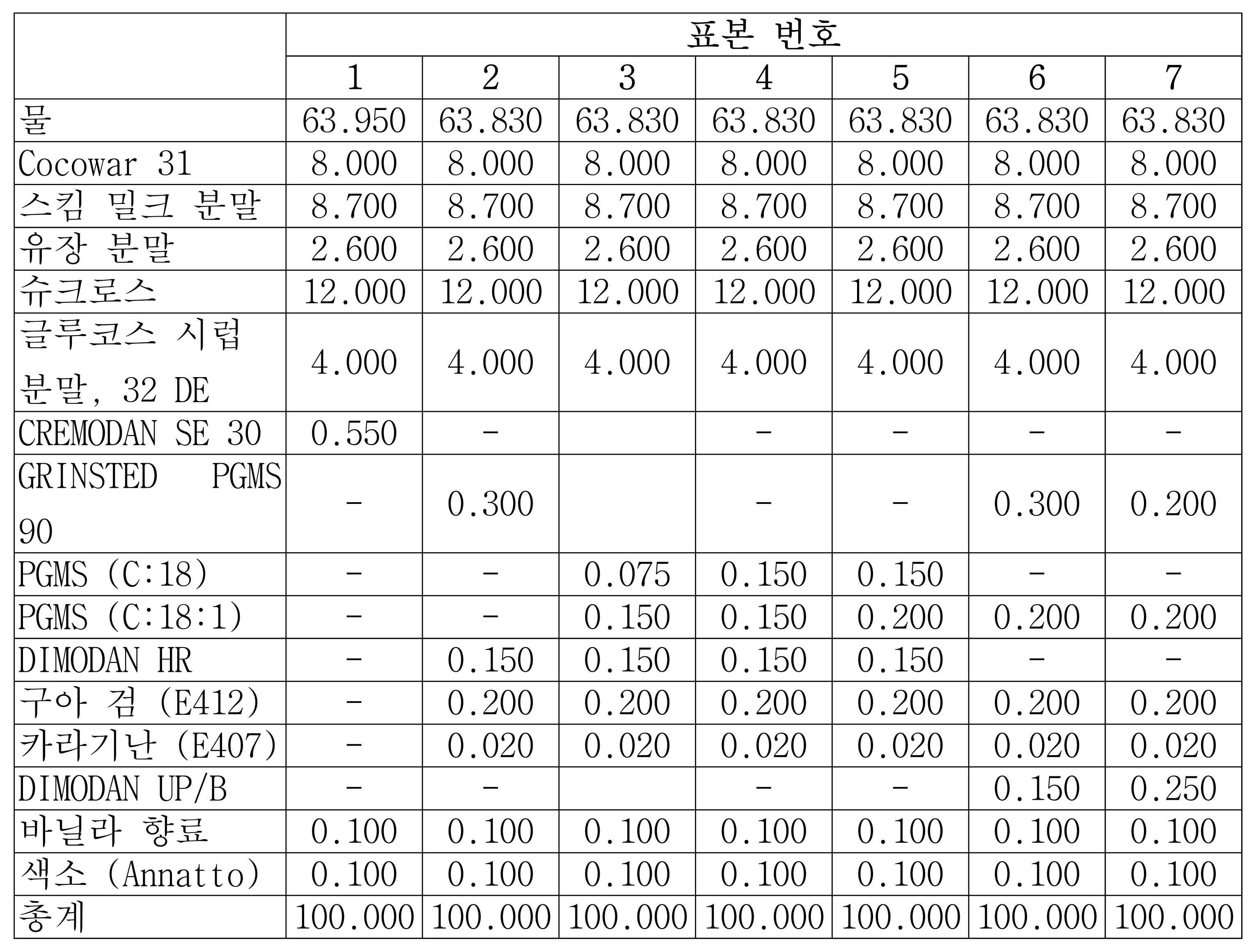
Cocowar 31은 Aarhus United사의 경화 코코넛유이다.Cocowar 31 is a hardened coconut oil from Aarhus United.
GRINSTED PGMS 90은 대니스코 A/S사의 프로필렌 글리콜 모노에스테르이다.GRINSTED PGMS 90 is a propylene glycol monoester from Danisco A / S.
CREMODAN SE 30은 대니스코 A/S사의 통상적인 유화제/안정화제 시스템 혼합물이다(E417, E410, E401, E412, E407).CREMODAN SE 30 is a conventional emulsifier / stabilizer system mixture from Danisco A / S (E417, E410, E401, E412, E407).
PGMS(C:18)은 스테아르 지방산에 기반한 PGMS 즉, 포화 PGMS의 실험 표본이다.PGMS (C: 18) is an experimental sample of PGMS, ie saturated PGMS, based on stearic fatty acids.
PGMS(C:18:1)은 올레 지방산에 기반한 PGMS 즉, 불포화 PGMS의 실험 표본이다.PGMS (C: 18: 1) is an experimental sample of oleic acid based PGMS, ie unsaturated PGMS.
아이스크림 표본 한세트는 용해(meltdown) 성능에 대해 분석되었다. 아이스크림의 용해율(방울 비율)은 하기 방법에 따라 시험되었다.One set of ice cream samples was analyzed for meltdown performance. The dissolution rate (drop ratio) of the ice cream was tested according to the following method.
적어도 24시간 동안 -18℃에서 보관된 아이스크림의 직사각형 조각(125 cc, 치수: 약 100 mm x 50 mm x 25 mm)이 계량되고 그리드 상에 놓였다. 용해가 발생하는 온실에 22℃+/-1℃의 일정 온도로 유지되었다. 그리드는 분석 저울에 놓인 500 ml 유리 비이커 위에 놓였다.Rectangular pieces (125 cc, dimensions: about 100 mm × 50 mm × 25 mm) of ice cream stored at −18 ° C. for at least 24 hours were weighed and placed on a grid. It was maintained at a constant temperature of 22 ° C. + / − 1 ° C. in the greenhouse where dissolution occurred. The grid was placed on a 500 ml glass beaker placed on the analytical balance.
분석 저울은 기록하고(2분마다 1 측정) 시간 함수로서 용해된 아이스크림 양을 계산하는 컴퓨터에 연결되었다. 2시간 후 용해 작용의 그래프가 작성될 수 있었다.The analytical balance was connected to a computer that recorded (measured every 2 minutes) and calculated the amount of ice cream dissolved as a function of time. After 2 hours a graph of dissolution can be made.
표 19는 2시간 후 그리드로부터 용해된 아이스크림의 양을 나타낸다.Table 19 shows the amount of ice cream dissolved from the grid after 2 hours.

표 19에 나타난 바와 같이 가장 높은 용해 저항성은 불포화 모노-디글리세라이드(표본 6 및 7) 다음으로 불포화 PGMS(표본 5 및 )로부터 수득되었다.As shown in Table 19, the highest dissolution resistance was obtained from unsaturated mono-diglycerides (samples 6 and 7) followed by unsaturated PGMS (
아이스크림의 또다른 세트는 열 충격 처리되었다. 제품은 혼합되고 하루동안 -18℃에서 냉동고 캐비닛에 보관되었다. 제품이 혼합되었을 때 6시간마다 20℃와 -5℃ 사이에서 변화하는 온도로 열 충격 냉동고 캐비닛에 놓였다. 제품은 7일간 이러한 냉동고 캐비닛 내에서 유지되었다. 이러한 열 충격 처리 후 아이스크림은 분석전 2일간 -18℃에서 혼합되었다. 아이스크림 표본은 얼음 결정 크기에 대해 분석되었다. 표 20은 신선한 표본(D(50,3)) 및 열 충격 처리된 표본(D(10,3) D(50,3) 및 D(90,3))의 얼음 결정 분석 결과를 나타낸다.Another set of ice creams was heat shock treated. The product was mixed and stored in freezer cabinet at -18 ° C for one day. When the product was mixed, it was placed in a thermal shock freezer cabinet at a temperature varying between 20 ° C and -5 ° C every 6 hours. The product was kept in these freezer cabinets for 7 days. After this heat shock treatment, the ice cream was mixed at -18 ° C for 2 days before analysis. Ice cream specimens were analyzed for ice crystal size. Table 20 shows the results of ice crystal analysis of fresh specimens (D (50,3)) and heat shock treated specimens (D (10,3) D (50,3) and D (90,3)).

얼음 결정 분석에 나타난 바와 같이 가장 작은 얼음 결정은 PGMS + 모노-디글리세라이드(표본 2∼7)에서 수득되었다. 0.15% 또는 0.225%의 양의 불포화 PGMS(표본 4 및 5)는 포화 모노-디글리세라이드(표본 2) 만큼 작은 얼음 결정을 제공하지 않았다. 또한 PGMS 양의 감소 및 모노-디글리세라이드 양의 증가는 더 큰 얼음 결정을 제공한다(표본 6과 비교시 표본 7).As shown in the ice crystal analysis, the smallest ice crystals were obtained in PGMS + mono-diglycerides (Samples 2-7). Unsaturated PGMS (
또한 열 충격 전후의 표본의 기포 크기가 측정되었다.In addition, the bubble size of the sample before and after the thermal shock was measured.
결과는 하기 표에 나타나 있다.The results are shown in the table below.

불포화 유화제(들)는 과도하게 투여되지 않아야 한다. 표본 5 및 7에서 나타난 바와 같이 다량의 불포화 유화제 사용은 얼음 결정 크기 외에 기포 크기의 성장을 유발한다.The unsaturated emulsifier (s) should not be administered excessively. As shown in
유화제로서 단독으로 사용된 PGMS는 아이스크림에서 작은 얼음 결정을 제공하나 기포 안정성은 불충분하다. 이는 어떠한 유화제도 첨가되지 않은 아이스크림의 경우와 유사하다. 양질의 기포 안정성은 PGMS(0.3%)와 함께 적은 양(0.15%)의 포화 또는 불포화 모노-디글리세라이드를 첨가함으로서 달성될 수 있다. 이와 동시에 얼음 결정 크기의 감소도 수득된다. 더욱 우수한 기포 안정성은 더욱 우수한 용해 안정성을 유발한다. 또한 용해 안정성의 개선은 조리법 내에서 로커스트 빈 검(Locust Bean Gum, LBG)을 사용함으로서 수득될 수 있다.PGMS, used alone as an emulsifier, provides small ice crystals in ice cream but lacks bubble stability. This is similar to the case of ice cream without any emulsifier added. Good bubble stability can be achieved by adding small amounts (0.15%) of saturated or unsaturated mono-diglycerides with PGMS (0.3%). At the same time a decrease in ice crystal size is also obtained. Better bubble stability results in better dissolution stability. Improvements in dissolution stability can also be obtained by using Locust Bean Gum (LBG) in the recipe.
통상의 PGMSs 내의 지방산 함량은 C16 및 C18 지방산의 다양한 함량으로 구성된다. 바람직한 조성물은 50% 이상 95% 이상의 C18 지방산을 포함한다. The fatty acid content in conventional PGMSs consists of various contents of C16 and C18 fatty acids. Preferred compositions comprise at least 50% and at least 95% C18 fatty acids.
높은 C18 함량의 또다른 장점은 더욱 우수한 분말의 질 및 조작 성질이다. PGMS의 바람직한 지방산 조성은 0∼50%, 더욱 바람직하게는 5∼10%의 C16 지방산(들) 및 50∼95%, 더욱 바람직하게는 90∼95%의 C18 지방산(들)이다.Another advantage of the high C18 content is better powder quality and handling properties. Preferred fatty acid compositions of PGMS are 0-50%, more preferably 5-10% C16 fatty acid (s) and 50-95%, more preferably 90-95% C18 fatty acid (s).
개선된 용해 안정성을 위해 불포화 PGMS가 사용된다. PGMS의 바람직한 지방산 조성은 0∼50%, 더욱 바람직하게는 0%의 C16 지방산(들) 및 50∼95%, 더욱 바람직하게는 50%의 C18 지방산(들) 및 25∼50%, 더욱 바람직하게는 50%의 C18:1 지방산(들)이다.Unsaturated PGMS is used for improved dissolution stability. Preferred fatty acid compositions of PGMS are 0-50%, more preferably 0% C16 fatty acid (s) and 50-95%, more preferably 50% C18 fatty acid (s) and 25-50%, more preferably Is 50% C18: 1 fatty acid (s).
(실시예 11)(Example 11)
실시예 10으로부터의 표본 2의 조리법은 다른 냉동 공정을 사용하여 아이스크림을 제조하는데 사용되었다. 아이스크림 한세트는 휘퍼로서 통상의 냉동고를 사용하여 제조되었다. 아이스크림은 100%의 오버런을 지녔다. 냉동고 배출구로부터의 배출 온도는 -5.0℃로 일정하였다. 냉동고에서의 아이스크림 휘핑 후 제품은 용기에 충진되었고 -25℃에서 경화 터널 내에서 통상적으로 경화되었고 -25℃에서 보관되었다. 이들 표본은 통상의 냉동 공정을 사용하여 제조된 것으로 특성화될 수 있다.The recipe of Sample 2 from Example 10 was used to make ice cream using another freezing process. One set of ice cream was made using a conventional freezer as a whipper. The ice cream had a 100% overrun. The discharge temperature from the freezer outlet was constant at -5.0 ° C. After ice cream whipping in the freezer, the product was filled into a container and typically cured in a curing tunnel at -25 ° C and stored at -25 ° C. These specimens can be characterized as prepared using conventional refrigeration processes.
아이스크림의 또다른 세트는 휘퍼로서 통상의 냉동고를 사용하여 제조되었다. 아이스크림은 100%의 오버런을 지녔다. 냉동고 배출구로부터의 배출 온도는 -5.0℃로 일정하였다. 냉동고에서의 아이스크림 휘핑 후 제품은 저온 냉동고라 불리는 곳(WO 2004/062883 A1에 기술됨, 저온 압출기)에 공급된 후 제품은 -12℃의 온도에서 저온 압출기로부터 배출되었고 용기에 중진되었고 -25℃의 경화 터널 내에서 통상적으로 경화되었고 -25℃에서 보관되었다. 압출성형 후 아이스크림은 100%의 오버런을 지녔다. 이들 표본은 저온 압출성형 공정을 사용하여 제조된 것으로 특성화되었다. 신선한 아이스크림 내 더 작은 얼음 결정을 달성하기 위해 아이스크림의 저온 압출성형이 사용된다. Another set of ice creams was prepared using a conventional freezer as a whipper. The ice cream had a 100% overrun. The discharge temperature from the freezer outlet was constant at -5.0 ° C. After ice cream whipping in the freezer, the product was fed to a place called a low temperature freezer (as described in WO 2004/062883 A1, a low temperature extruder) and then the product was discharged from the low temperature extruder at a temperature of -12 ° C and was neutralized in the vessel and -25 ° C. It was typically cured in a cure tunnel of and stored at -25 ° C. After extrusion the ice cream had a 100% overrun. These samples were characterized as made using a low temperature extrusion process. Cold extrusion of ice cream is used to achieve smaller ice crystals in fresh ice cream.
아이스크림 표본은 얼음 결정 크기에 대해 분석되었다. 표 22는 신선한 표본의 얼음 결정 분석 결과를 나타낸다.Ice cream specimens were analyzed for ice crystal size. Table 22 shows the results of ice crystal analysis of fresh samples.

표 22에 나타난 바와 같이 PGMS 주성분 유화제 시스템이 사용되는 경우 저온 압출성형만으로는 통상의 공정과 비교시 얼음 결정 크기 상에 거의 영향을 미치지 않았다. 이는 신선한 아이스크림 내에서 작은 얼음 결정 크기가 요구될 때 PGMS 주성분 유화제 시스템이 저온 압출성형의 대안으로서 사용될 수 있음을 의미한다. PGMS 주성분 유화제 시스템은 보관 동안 얼음 결정의 성장도 제어하고, 이는 저온 압출성형을 단독으로 사용함으로서 달성되는 특징이 아니다.As shown in Table 22, low temperature extrusion alone had little effect on ice crystal size compared to conventional processes when the PGMS main component emulsifier system was used. This means that PGMS main component emulsifier systems can be used as an alternative to cold extrusion when small ice crystal sizes are required in fresh ice cream. The PGMS main component emulsifier system also controls the growth of ice crystals during storage, which is not a feature achieved by using cold extrusion alone.
상기 명세서 내에 논의된 모든 문헌은 참고문헌으로 포함된다. 본 발명의 기술된 방법 및 시스템의 다양한 변형 및 변화는 본 발명의 범위 및 정신에 위배됨이 없이 당업자에게 분명할 것이다. 본 발명이 특정한 바람직한 실시태양과 관련하여 기술되었으나 청구된 본 발명은 이러한 특정한 실시태양에 한정적이지 않음이 이해되어야 한다. 실제로 화학 또는 관련 분야의 기술자에게 분명한 본 발명을 수행하기 위한 기술된 방법의 다양한 변형은 하기 청구항의 범위 내에 포함된다.All documents discussed within the above specification are incorporated by reference. Various modifications and variations of the described methods and systems of the invention will be apparent to those skilled in the art without departing from the scope and spirit of the invention. While the invention has been described in connection with specific preferred embodiments, it should be understood that the invention as claimed is not limited to this specific embodiment. Indeed, various modifications of the described methods for carrying out the invention which are obvious to those skilled in the chemical or related art are included within the scope of the following claims.
Claims (48)


Applications Claiming Priority (5)
| Application Number | Priority Date | Filing Date | Title |
|---|---|---|---|
| GB0329517.7 | 2003-12-19 | ||
| GBGB0329517.7A GB0329517D0 (en) | 2003-12-19 | 2003-12-19 | Process |
| US57150004P | 2004-05-17 | 2004-05-17 | |
| US60/571,500 | 2004-05-17 | ||
| PCT/IB2004/004361 WO2005060763A1 (en) | 2003-12-19 | 2004-12-17 | Process for the production of a frozen food product |
Publications (2)
| Publication Number | Publication Date |
|---|---|
| KR20060115391A KR20060115391A (en) | 2006-11-08 |
| KR101256830B1 true KR101256830B1 (en) | 2013-04-22 |
Family
ID=34712701
Family Applications (1)
| Application Number | Title | Priority Date | Filing Date |
|---|---|---|---|
| KR1020067009989A Expired - Fee Related KR101256830B1 (en) | 2003-12-19 | 2004-12-17 | Process for the production of a frozen food product |
Country Status (25)
| Country | Link |
|---|---|
| EP (1) | EP1715747B1 (en) |
| JP (2) | JP4268982B2 (en) |
| KR (1) | KR101256830B1 (en) |
| AR (1) | AR046958A1 (en) |
| AT (1) | ATE445328T1 (en) |
| AU (1) | AU2004304718B2 (en) |
| BR (1) | BRPI0417857B1 (en) |
| CA (1) | CA2546423C (en) |
| CY (1) | CY1110696T1 (en) |
| DE (1) | DE602004023652D1 (en) |
| DK (1) | DK1715747T3 (en) |
| EA (1) | EA012327B1 (en) |
| EG (1) | EG24511A (en) |
| ES (1) | ES2333439T3 (en) |
| HR (1) | HRP20060181B1 (en) |
| IL (1) | IL175651A (en) |
| MA (1) | MA28272A1 (en) |
| MX (1) | MX272734B (en) |
| NO (1) | NO331774B1 (en) |
| NZ (1) | NZ547212A (en) |
| PE (1) | PE20050825A1 (en) |
| PL (1) | PL1715747T3 (en) |
| PT (1) | PT1715747E (en) |
| SI (1) | SI1715747T1 (en) |
| WO (1) | WO2005060763A1 (en) |
Families Citing this family (13)
| Publication number | Priority date | Publication date | Assignee | Title |
|---|---|---|---|---|
| EP1584241B2 (en) † | 2004-04-08 | 2015-12-02 | Nestec S.A. | Aerated frozen confections |
| PL1715747T3 (en) * | 2003-12-19 | 2010-03-31 | Dupont Nutrition Biosci Aps | Process for the production of a frozen food product |
| AU2006201781B8 (en) * | 2005-07-14 | 2008-05-15 | Unilever Plc | Low fat frozen confectionery product |
| DK2117337T3 (en) | 2006-11-27 | 2011-06-06 | Palsgaard As | Frozen food products, emulsification systems and related processes |
| CN101028033B (en) * | 2007-02-13 | 2010-04-14 | 内蒙古伊利实业集团股份有限公司 | Anti-freezing and ageing-resistant polished glutinous rice grain for ice cream |
| US20110300255A9 (en) | 2007-05-09 | 2011-12-08 | Nestec S.A. | Freeze-dried, dairy or dairy-substitute compositions and methods of using same |
| EP2505067B1 (en) | 2007-05-09 | 2019-04-10 | Nestec S.A. | Freeze-dried, aerated fruit or vegetable compositions |
| MY148286A (en) | 2007-05-09 | 2013-03-29 | Nestec Sa | Freeze-dried, aerated dairy or dairy-substitute compositions and methods of making thereof |
| JP6351936B2 (en) * | 2013-07-19 | 2018-07-04 | 理研ビタミン株式会社 | Freezing tolerance imparting agent for noodles |
| JP2017042160A (en) * | 2015-08-28 | 2017-03-02 | 三菱化学フーズ株式会社 | Production method of frozen vegetable |
| JP6243492B1 (en) * | 2016-08-19 | 2017-12-06 | 森永製菓株式会社 | Combined frozen food |
| JP6352465B1 (en) * | 2017-02-24 | 2018-07-04 | 森永製菓株式会社 | Frozen food |
| JP6802817B2 (en) * | 2018-03-01 | 2020-12-23 | ビタミン乳業株式会社 | Frozen liquid dairy products, their freezing methods and containers provided for them |
Citations (1)
| Publication number | Priority date | Publication date | Assignee | Title |
|---|---|---|---|---|
| JP2003505056A (en) * | 1999-07-21 | 2003-02-12 | ソシエテ デ プロデユイ ネツスル ソシエテ アノニム | Froth frozen products |
Family Cites Families (10)
| Publication number | Priority date | Publication date | Assignee | Title |
|---|---|---|---|---|
| US3582357A (en) * | 1969-03-24 | 1971-06-01 | Pillsbury Co | Edible mix composition for producing an aerated product |
| US3673106A (en) * | 1969-06-18 | 1972-06-27 | Kraftco Corp | Emulsifier system |
| CA1020401A (en) * | 1973-03-12 | 1977-11-08 | Robert L. Sturms | Whipped fat-free frozen desert |
| US3991224A (en) * | 1973-03-12 | 1976-11-09 | Kraftco Corp | Whipped food product and method for making same |
| GB1484167A (en) * | 1975-11-13 | 1977-09-01 | Kraftco Corp | Milk product |
| JPS597295B2 (en) * | 1976-09-03 | 1984-02-17 | 花王株式会社 | Ice cream manufacturing method |
| US4504510A (en) * | 1982-05-28 | 1985-03-12 | Stauffer Chemical Company | Method of preparing freeze-thaw and refrigerator stable pancake batter and product thereof |
| JP2766287B2 (en) * | 1989-01-27 | 1998-06-18 | 日世株式会社 | Milk shake and method for producing the same |
| JP3379215B2 (en) * | 1994-03-18 | 2003-02-24 | 三菱化学株式会社 | Emulsifier for ice creams and method for producing ice creams using the same |
| PL1715747T3 (en) * | 2003-12-19 | 2010-03-31 | Dupont Nutrition Biosci Aps | Process for the production of a frozen food product |
-
2004
- 2004-12-17 PL PL04806521T patent/PL1715747T3/en unknown
- 2004-12-17 AR ARP040104754A patent/AR046958A1/en active IP Right Grant
- 2004-12-17 WO PCT/IB2004/004361 patent/WO2005060763A1/en not_active Ceased
- 2004-12-17 SI SI200431318T patent/SI1715747T1/en unknown
- 2004-12-17 PT PT04806521T patent/PT1715747E/en unknown
- 2004-12-17 MX MXPA06007016 patent/MX272734B/en active IP Right Grant
- 2004-12-17 HR HRP20060181AA patent/HRP20060181B1/en not_active IP Right Cessation
- 2004-12-17 EA EA200601094A patent/EA012327B1/en not_active IP Right Cessation
- 2004-12-17 KR KR1020067009989A patent/KR101256830B1/en not_active Expired - Fee Related
- 2004-12-17 NZ NZ547212A patent/NZ547212A/en not_active IP Right Cessation
- 2004-12-17 IL IL175651A patent/IL175651A/en not_active IP Right Cessation
- 2004-12-17 BR BRPI0417857A patent/BRPI0417857B1/en active IP Right Grant
- 2004-12-17 JP JP2006527515A patent/JP4268982B2/en not_active Expired - Fee Related
- 2004-12-17 CA CA2546423A patent/CA2546423C/en not_active Expired - Lifetime
- 2004-12-17 AT AT04806521T patent/ATE445328T1/en active
- 2004-12-17 AU AU2004304718A patent/AU2004304718B2/en not_active Ceased
- 2004-12-17 DK DK04806521.3T patent/DK1715747T3/en active
- 2004-12-17 ES ES04806521T patent/ES2333439T3/en not_active Expired - Lifetime
- 2004-12-17 EP EP04806521A patent/EP1715747B1/en not_active Expired - Lifetime
- 2004-12-17 DE DE602004023652T patent/DE602004023652D1/en not_active Expired - Lifetime
-
2005
- 2005-01-03 PE PE2005000025A patent/PE20050825A1/en not_active Application Discontinuation
-
2006
- 2006-06-15 EG EGNA2006000568 patent/EG24511A/en active
- 2006-06-26 MA MA29136A patent/MA28272A1/en unknown
- 2006-07-17 NO NO20063306A patent/NO331774B1/en not_active IP Right Cessation
-
2007
- 2007-04-27 JP JP2007120355A patent/JP2007190035A/en not_active Withdrawn
-
2010
- 2010-01-05 CY CY20101100004T patent/CY1110696T1/en unknown
Patent Citations (1)
| Publication number | Priority date | Publication date | Assignee | Title |
|---|---|---|---|---|
| JP2003505056A (en) * | 1999-07-21 | 2003-02-12 | ソシエテ デ プロデユイ ネツスル ソシエテ アノニム | Froth frozen products |
Non-Patent Citations (1)
| Title |
|---|
| 송재철, 양한철저, 식품첨가물학, 세문사, 1995.1.5. * |
Also Published As
Similar Documents
| Publication | Publication Date | Title |
|---|---|---|
| JP2007190035A (en) | Process for manufacturing frozen food products | |
| US7488504B2 (en) | Process for production of a frozen food product | |
| US8425967B2 (en) | Aerated frozen products | |
| CN103442589B (en) | Frozen confections with improved heat shock stability | |
| CA2602390C (en) | Process for manufacturing aerated frozen confections | |
| RU2412605C2 (en) | Application of compound ethers of polyatomic alcohol and fatty acids in aerated frozen confectionary products with improved nutritional properties | |
| CN104093320A (en) | Frozen confectionery product with improved stability | |
| GB2430346A (en) | Emulsifier system for frozen foods | |
| WO2017005931A1 (en) | Emulsifier composition | |
| JPS6087750A (en) | Mix for freezing whipping and production of whipped topping | |
| PL219573B1 (en) | Method for producing ice cream in cuvettes and ice cream in cuvettes | |
| HK1079660A (en) | Use of polyol esters of fatty acids in aerated frozen confection with decreased freezing point | |
| IE84600B1 (en) | Production of ice-cream | |
| IE20030274A1 (en) | Production of ice-cream |
Legal Events
| Date | Code | Title | Description |
|---|---|---|---|
| PA0105 | International application |
St.27 status event code: A-0-1-A10-A15-nap-PA0105 |
|
| PG1501 | Laying open of application |
St.27 status event code: A-1-1-Q10-Q12-nap-PG1501 |
|
| A201 | Request for examination | ||
| AMND | Amendment | ||
| E13-X000 | Pre-grant limitation requested |
St.27 status event code: A-2-3-E10-E13-lim-X000 |
|
| P11-X000 | Amendment of application requested |
St.27 status event code: A-2-2-P10-P11-nap-X000 |
|
| P13-X000 | Application amended |
St.27 status event code: A-2-2-P10-P13-nap-X000 |
|
| PA0201 | Request for examination |
St.27 status event code: A-1-2-D10-D11-exm-PA0201 |
|
| R18-X000 | Changes to party contact information recorded |
St.27 status event code: A-3-3-R10-R18-oth-X000 |
|
| E902 | Notification of reason for refusal | ||
| PE0902 | Notice of grounds for rejection |
St.27 status event code: A-1-2-D10-D21-exm-PE0902 |
|
| T11-X000 | Administrative time limit extension requested |
St.27 status event code: U-3-3-T10-T11-oth-X000 |
|
| T11-X000 | Administrative time limit extension requested |
St.27 status event code: U-3-3-T10-T11-oth-X000 |
|
| T11-X000 | Administrative time limit extension requested |
St.27 status event code: U-3-3-T10-T11-oth-X000 |
|
| AMND | Amendment | ||
| E13-X000 | Pre-grant limitation requested |
St.27 status event code: A-2-3-E10-E13-lim-X000 |
|
| P11-X000 | Amendment of application requested |
St.27 status event code: A-2-2-P10-P11-nap-X000 |
|
| P13-X000 | Application amended |
St.27 status event code: A-2-2-P10-P13-nap-X000 |
|
| R18-X000 | Changes to party contact information recorded |
St.27 status event code: A-3-3-R10-R18-oth-X000 |
|
| E601 | Decision to refuse application | ||
| PE0601 | Decision on rejection of patent |
St.27 status event code: N-2-6-B10-B15-exm-PE0601 |
|
| T11-X000 | Administrative time limit extension requested |
St.27 status event code: U-3-3-T10-T11-oth-X000 |
|
| PN2301 | Change of applicant |
St.27 status event code: A-3-3-R10-R13-asn-PN2301 St.27 status event code: A-3-3-R10-R11-asn-PN2301 |
|
| AMND | Amendment | ||
| E13-X000 | Pre-grant limitation requested |
St.27 status event code: A-2-3-E10-E13-lim-X000 |
|
| J201 | Request for trial against refusal decision | ||
| P11-X000 | Amendment of application requested |
St.27 status event code: A-2-2-P10-P11-nap-X000 |
|
| P13-X000 | Application amended |
St.27 status event code: A-2-2-P10-P13-nap-X000 |
|
| PJ0201 | Trial against decision of rejection |
St.27 status event code: A-3-3-V10-V11-apl-PJ0201 |
|
| PB0901 | Examination by re-examination before a trial |
St.27 status event code: A-6-3-E10-E12-rex-PB0901 |
|
| B701 | Decision to grant | ||
| PB0701 | Decision of registration after re-examination before a trial |
St.27 status event code: A-3-4-F10-F13-rex-PB0701 |
|
| GRNT | Written decision to grant | ||
| PR0701 | Registration of establishment |
St.27 status event code: A-2-4-F10-F11-exm-PR0701 |
|
| PR1002 | Payment of registration fee |
St.27 status event code: A-2-2-U10-U12-oth-PR1002 Fee payment year number: 1 |
|
| PG1601 | Publication of registration |
St.27 status event code: A-4-4-Q10-Q13-nap-PG1601 |
|
| FPAY | Annual fee payment |
Payment date: 20160318 Year of fee payment: 4 |
|
| PR1001 | Payment of annual fee |
St.27 status event code: A-4-4-U10-U11-oth-PR1001 Fee payment year number: 4 |
|
| R18-X000 | Changes to party contact information recorded |
St.27 status event code: A-5-5-R10-R18-oth-X000 |
|
| LAPS | Lapse due to unpaid annual fee | ||
| PC1903 | Unpaid annual fee |
St.27 status event code: A-4-4-U10-U13-oth-PC1903 Not in force date: 20170417 Payment event data comment text: Termination Category : DEFAULT_OF_REGISTRATION_FEE |
|
| PC1903 | Unpaid annual fee |
St.27 status event code: N-4-6-H10-H13-oth-PC1903 Ip right cessation event data comment text: Termination Category : DEFAULT_OF_REGISTRATION_FEE Not in force date: 20170417 |
|
| R18-X000 | Changes to party contact information recorded |
St.27 status event code: A-5-5-R10-R18-oth-X000 |
|
| PN2301 | Change of applicant |
St.27 status event code: A-5-5-R10-R13-asn-PN2301 St.27 status event code: A-5-5-R10-R11-asn-PN2301 |
|
| P22-X000 | Classification modified |
St.27 status event code: A-4-4-P10-P22-nap-X000 |