KR20080108321A - How to destroy arthropod fertility - Google Patents
How to destroy arthropod fertility Download PDFInfo
- Publication number
- KR20080108321A KR20080108321A KR1020087026518A KR20087026518A KR20080108321A KR 20080108321 A KR20080108321 A KR 20080108321A KR 1020087026518 A KR1020087026518 A KR 1020087026518A KR 20087026518 A KR20087026518 A KR 20087026518A KR 20080108321 A KR20080108321 A KR 20080108321A
- Authority
- KR
- South Korea
- Prior art keywords
- carboxamide
- chloro
- arthropod pest
- carbonyl
- phenyl
- Prior art date
- Legal status (The legal status is an assumption and is not a legal conclusion. Google has not performed a legal analysis and makes no representation as to the accuracy of the status listed.)
- Withdrawn
Links
Classifications
-
- A—HUMAN NECESSITIES
- A01—AGRICULTURE; FORESTRY; ANIMAL HUSBANDRY; HUNTING; TRAPPING; FISHING
- A01N—PRESERVATION OF BODIES OF HUMANS OR ANIMALS OR PLANTS OR PARTS THEREOF; BIOCIDES, e.g. AS DISINFECTANTS, AS PESTICIDES OR AS HERBICIDES; PEST REPELLANTS OR ATTRACTANTS; PLANT GROWTH REGULATORS
- A01N43/00—Biocides, pest repellants or attractants, or plant growth regulators containing heterocyclic compounds
- A01N43/48—Biocides, pest repellants or attractants, or plant growth regulators containing heterocyclic compounds having rings with two nitrogen atoms as the only ring hetero atoms
- A01N43/56—1,2-Diazoles; Hydrogenated 1,2-diazoles
-
- A—HUMAN NECESSITIES
- A01—AGRICULTURE; FORESTRY; ANIMAL HUSBANDRY; HUNTING; TRAPPING; FISHING
- A01N—PRESERVATION OF BODIES OF HUMANS OR ANIMALS OR PLANTS OR PARTS THEREOF; BIOCIDES, e.g. AS DISINFECTANTS, AS PESTICIDES OR AS HERBICIDES; PEST REPELLANTS OR ATTRACTANTS; PLANT GROWTH REGULATORS
- A01N37/00—Biocides, pest repellants or attractants, or plant growth regulators containing organic compounds containing a carbon atom having three bonds to hetero atoms with at the most two bonds to halogen, e.g. carboxylic acids
- A01N37/18—Biocides, pest repellants or attractants, or plant growth regulators containing organic compounds containing a carbon atom having three bonds to hetero atoms with at the most two bonds to halogen, e.g. carboxylic acids containing the group —CO—N<, e.g. carboxylic acid amides or imides; Thio analogues thereof
- A01N37/30—Biocides, pest repellants or attractants, or plant growth regulators containing organic compounds containing a carbon atom having three bonds to hetero atoms with at the most two bonds to halogen, e.g. carboxylic acids containing the group —CO—N<, e.g. carboxylic acid amides or imides; Thio analogues thereof containing the groups —CO—N< and, both being directly attached by their carbon atoms to the same carbon skeleton, e.g. H2N—NH—CO—C6H4—COOCH3; Thio-analogues thereof
-
- A—HUMAN NECESSITIES
- A01—AGRICULTURE; FORESTRY; ANIMAL HUSBANDRY; HUNTING; TRAPPING; FISHING
- A01N—PRESERVATION OF BODIES OF HUMANS OR ANIMALS OR PLANTS OR PARTS THEREOF; BIOCIDES, e.g. AS DISINFECTANTS, AS PESTICIDES OR AS HERBICIDES; PEST REPELLANTS OR ATTRACTANTS; PLANT GROWTH REGULATORS
- A01N41/00—Biocides, pest repellants or attractants, or plant growth regulators containing organic compounds containing a sulfur atom bound to a hetero atom
- A01N41/02—Biocides, pest repellants or attractants, or plant growth regulators containing organic compounds containing a sulfur atom bound to a hetero atom containing a sulfur-to-oxygen double bond
- A01N41/10—Sulfones; Sulfoxides
Landscapes
- Life Sciences & Earth Sciences (AREA)
- Agronomy & Crop Science (AREA)
- Pest Control & Pesticides (AREA)
- Plant Pathology (AREA)
- Health & Medical Sciences (AREA)
- Engineering & Computer Science (AREA)
- Dentistry (AREA)
- General Health & Medical Sciences (AREA)
- Wood Science & Technology (AREA)
- Zoology (AREA)
- Environmental Sciences (AREA)
- Agricultural Chemicals And Associated Chemicals (AREA)
- Acyclic And Carbocyclic Compounds In Medicinal Compositions (AREA)
Abstract
본원에는, 절지동물 해충 성충 또는 그의 환경을 준치사 번식-파괴량의 카르복사미드 살절지동물제, 그의 N-산화물, 또는 이들의 염과 접촉시키는 것을 포함하는, 절지동물 해충 성충의 번식능을 파괴하는 방법이 개시된다.Herein is provided the reproductive ability of an arthropod pest adult, including contacting an arthropod pest adult, or an environment thereof, with a tertiary breeding-destructive amount of carboxamide pesticide, an N-oxide, or a salt thereof. A method of breaking is disclosed.
절지동물 해충, 카르복사미드, 살절지동물제Arthropod pest, carboxamide, pesticide
Description
본 발명은, 절지동물 해충 또는 그의 환경을 준치사 번식-파괴량의 카르복사미드 살절지동물제, 그의 N-산화물, 또는 이들의 염과 접촉시키는 것을 포함하는, 절지동물 해충의 번식능을 파괴하는 방법에 관한 것이다.The present invention destroys the reproductive ability of arthropod pests, which comprises contacting the arthropod pests or their environment with a quaternary breeding-destructive amount of carboxamide pesticide, its N-oxide, or salts thereof. It is about how to.
절지동물 해충의 방제는 높은 농작물 효율을 달성하는 데 있어 매우 중요하다. 삼림지, 온실 농작물, 관상용 농작물, 묘상 농작물, 저장 식품 및 섬유 생산물, 가축용, 가정용, 잔디, 목재 생산물, 및 공중 및 동물 위생에 있어 절지동물 해충의 방제는 또한 중요하다. 성장하고 있는 또한 저장된 농경 작물에 끼치는 절지동물의 피해는 생산성을 현저히 감소시키고, 이로써 소비자에게 비용 증가를 일으킬 수 있다. Control of arthropod pests is of great importance in achieving high crop efficiency. Control of arthropod pests is also important in woodlands, greenhouse crops, ornamental crops, seed crops, stored food and fiber products, livestock, household, grass, wood products, and public and animal hygiene. The damage of arthropods to growing and stored agricultural crops can significantly reduce productivity, thereby increasing costs for consumers.
절지동물의 방제 방법은 흔히, 살절지동물제를 해충 또는 그의 환경에 대하여 치사 적용량으로 적용하는 것을 수반한다. 동일한 살절지동물제에 대한 반복된 노출은 살절지동물제에 대해 내성을 갖는 개체의 선택을 초래할 수 있고, 이는 내성을 갖는 집단의 발달을 일으킬 수 있다. 오르가노클로라이드, 오르가노포스페이트, 카르바메이트, 스피노신 및 피레트로이드 등의 화학적 살충제에 대한 내성은 공지되어 있다. Methods of controlling arthropods often involve the application of arthropods in lethal application to pests or their environment. Repeated exposure to the same pesticide may result in the selection of individuals resistant to the pesticide, which may lead to the development of a resistant population. Resistance to chemical pesticides such as organochloride, organophosphate, carbamate, spinosine and pyrethroid are known.
대안적 방제 방법은, 예컨대 교미 파괴를 통해 해충 번식능을 감소시키는 것을 포함하며, 여기서는 곤충 성 페로몬을 사용하여 절지동물 해충에 대하여 농작물 및 삼림을 보호하기 위한 살절지동물제를 부분적으로 또는 완전히 대체한다. 해충의 교미가 효과적으로 파괴되면, 처리된 코호트(cohort) 콜로니의 집단이 즉시 감소되지 않을 수는 있어도, 코호트 세대의 자손의 2차 침입이 잠재적인 농작물 피해와 함께 현저히 감소된다. 그러나, 곤충 페로몬을 사용하는 것의 결점은 페로몬의 불안정성 뿐만 아니라 최적의 결과를 위해 요구되는 복잡한 제제화 및 방출 방법을 포함하며, 이는 흔히 요망되는 효능 미만이 되게 한다.Alternative control methods include, for example, reducing pest propagation through mating destruction, where partial or complete replacement of the pesticides for protecting crops and forests against arthropod pests using insect pheromones. do. If pest mating is effectively destroyed, the secondary invasion of the offspring of the cohort generation is significantly reduced with potential crop damage, although the population of treated cohort colonies may not be immediately reduced. However, drawbacks of using insect pheromones include not only the instability of the pheromones, but also the complex formulation and release methods required for optimal results, which often lead to less than the desired efficacy.
안트라닐아미드 (미국 특허 제6,747,047호, PCT 출원공개 제WO 2003/015518호 및 동 제WO 2004/067528호 참조) 및 프탈 디아미드 (미국 특허 제6,603,044호 참조)는 최근에 발견된, 경제적 중요성을 갖는 많은 절지동물 해충에 대한 활성을 갖는 카르복사미드 살절지동물제의 부류이다. 이들 공개 문헌에는, 카르복사미드가 사망을 일으킴으로써 절지동물을 방제하는 테스트가 개시되어 있다. 사망에 의해 경제적 수준의 해충 방제를 달성하기 위해서는, 전형적으로 살충제를 표적 해충의 80% 이상을 죽이는 농도 (즉, LC80)로 적용할 것이 요구된다. Anthranylamides (see US Pat. No. 6,747,047, PCT Application Publication No. WO 2003/015518 and WO 2004/067528) and phthal diamides (see US Pat. No. 6,603,044) have recently found economic significance. Is a class of carboxamide arthropods having activity against many arthropod pests. These publications disclose tests for controlling arthropods by causing carboxamide to die. In order to achieve economic levels of pest control by death, it is typically required to apply pesticides at concentrations that kill at least 80% of the target pests (ie LC 80 ).
두드러지게, 카르복사미드 살절지동물제를 사용하여 절지동물 해충 집단을 효과적으로 방제함으로써 페로몬과 유사한 효과를 이들의 결점 없이 달성하는 방법이 본 발명에 의해 발견되었다.Notably, a method has been found by the present invention to achieve pheromone-like effects without their drawbacks by effectively controlling arthropod pest populations using carboxamide pesticides.
<발명의 요약>Summary of the Invention
본 발명은, 절지동물 해충 성충 또는 그의 환경을 준치사 번식-파괴량의 카르복사미드 살절지동물제, 그의 N-산화물, 또는 이들의 염과 접촉시키는 것을 포함하되, 단, 절지동물 해충 성충이 시디아 포모넬라(Cydia pomonella) 또는 그라폴리타 몰레스타(Grapholita molesta) 이외의 것인, 절지동물 해충 성충의 번식능을 파괴하는 방법에 관한 것이다. The present invention includes contacting an arthropod pest adult or an environment thereof with a tertiary breeding-destructive amount of carboxamide pesticide, an N-oxide thereof, or a salt thereof, provided that the arthropod pest adult Cydia pomonella pomonella ) or Grapholita molesta ), other than the method for destroying the fertility of arthropod pests.
본 발명은 또한, 카르복사미드 살절지동물제, 그의 N-산화물, 또는 이들의 염이, 살절지동물제, 그의 N-산화물, 또는 이들의 염, 및 계면활성제 및 액체 희석제로 구성된 군으로부터 선택된 1종 이상의 추가 성분을 포함하는 조성물로서 제제화하는 방법에 관한 것이다.The invention also provides a carboxamide pesticide, its N-oxide, or salt thereof selected from the group consisting of the pesticide, its N-oxide, or salt thereof, and a surfactant and a liquid diluent. A method of formulating as a composition comprising one or more additional ingredients.
본원에 사용된 용어 "포함하다(comprise, include)", "포함하는(comprising, including)", "갖다", "갖는", "함유하다" 또는 "함유하는", 또는 이들의 임의의 다른 변화형은, 비배타적인 포함을 포괄하도록 의도된다. 예를 들어, 일련의 요소들을 포함하는 조성물, 혼합물, 공정, 방법, 물품 또는 장치는 반드시 이들 요소에만 제한되지는 않으며, 명백히 기재되지 않았거나 이러한 조성물, 혼합물, 공정, 방법, 물품 또는 장치에 대해 고유한 다른 요소들을 포함할 수 있다. 또한, 달리 명백히 언급되지 않는 한, "또는"은 포괄적인 "또는"을 의미하며, 배타적인 "또는"을 의미하지 않는다. 예를 들어, 조건 A 또는 B는, 하기의 것 중 어느 하나에 의해 만족된다: A가 참이고 (또는 존재하고) B가 거짓임 (또는 존재하지 않음), A가 거짓이고 (또는 존재하지 않고) B가 참임 (또는 존재함), 및 A와 B 둘 다 참임 (또는 존재함).As used herein, the terms "comprise, include", "comprising, including", "have", "have", "have" or "containing", or any other variation thereof. The form is intended to encompass non-exclusive inclusion. For example, a composition, mixture, process, method, article, or device comprising a series of elements is not necessarily limited to these elements, and is not explicitly described or for such compositions, mixtures, processes, methods, articles, or devices. May contain other elements that are unique. Also, unless expressly stated to the contrary, "or" means inclusive "or" and does not mean exclusive "or". For example, condition A or B is satisfied by any of the following: A is true (or present) and B is false (or not present), and A is false (or not present) ) B is true (or present), and both A and B are true (or present).
또한, 영문에서, 본 발명의 요소 또는 성분 바로 앞의 부정 관사 "a" 및 "an"은, 요소 또는 성분의 경우 (즉, 존재)의 수에 대해 비제한적인 것으로 의도된다. 따라서, "a" 또는 "an"은 하나 또는 하나 이상을 포함하도록 이해되어야 하며, 요소 또는 성분의 단수형 용어 형태는, 그 수가 명백히 단수형을 의미하지 않는 한 복수형 또한 포함한다.Also, in the English language, the indefinite articles "a" and "an" immediately before an element or component of the present invention are intended to be non-limiting with respect to the number of instances (ie, beings) of the element or component. Thus, "a" or "an" should be understood to include one or more than one, and the singular form of the element or component also includes the plural unless the number expressly means the singular.
용어 "절지동물 해충 성충"은, 절지동물 해충의 번식 단계인 성충 성장 단계를 지칭한다. 대부분의 절지동물은 상이한 성장/발달 단계를 겪는데, 일부는 갑작스럽고 현저한 신체 형태 변화를 포함하며; 절지동물이 성숙함에 따른 이들 변화를 기술하는 용어는 변태로서 공지되어 있다. 변태의 4가지 종류: 증절변태, 불변태, 불완전 변태 및 완전 변태가 기술된다. 절지동물종의 어떠한 종류의 변태일지라도, "절지동물 성충"은, 절지동물이 성충 성장 단계에 도달한 것을, 즉 그의 생식 기가 완전히 발달하여 교미, 산란 및 다른 형태의 번식 거동을 나타낼 수 있고, 번식에 의해 후속 세대의 자손을 생산할 수 있는 것을 의미한다. 따라서, 본 발명의 방법은, 절지 동물의 "성충" 번식 성장 단계의 절지동물, 즉 "절지동물 성충"을 준치사 번식-파괴량의 카르복사미드 살절지동물제와 접촉시키는 것에 관한 것이다. The term “arthropod pest adult” refers to an adult growth stage, which is a breeding stage of an arthropod pest. Most arthropods undergo different growth / development stages, some of which include sudden and significant changes in body shape; The term describing these changes as arthropods mature is known as metamorphosis. Four types of metamorphosis are described: symptomatic metamorphosis, metamorphosis, incomplete metamorphosis and complete metamorphosis. No matter what kind of metamorphosis of an arthropod species, an "arthropod adult" is one in which the arthropod has reached adult growth stage, that is, its genitals are fully developed and can exhibit mating, spawning and other forms of breeding behavior. By means to be able to produce offspring of subsequent generations. Thus, the method of the present invention relates to contacting arthropods of the "adult" breeding growth stage of arthropods, ie, "arthropod adults," with a semi-larval breeding-destructive amount of carboxamide arthropod.
용어 "절지동물 해충"은, 성장하고 있거나 저장된 농경 작물, 삼림지, 온실 농작물, 관상용 농작물, 묘상 농작물, 저장 식품 및 섬유 생산물, 가축용, 가정용 및 기타 건축물에 대한, 또는 공중 및 동물 위생에 해로운 해충인 곤충, 좀진드기 및 진드기를 포함한다. 본 발명의 개시의 문맥에서, "절지동물 해충의 방제"는, 교미를 방해하거나, 암컷에 의해 보다 적은 충란(egg)을 생산시키거나, 또는 보다 적은 생존가능한 자손을 생산시킴으로써 2차 침입을 감소시키는 것을 포함하는, 처리된 해충 성충의 번식능을 파괴하는 것을 의미한다. The term "arthropod pest" refers to pests that are harmful to growing or stored agricultural crops, woodland, greenhouse crops, ornamental crops, seed crops, stored food and fiber products, livestock, household and other buildings, or to public and animal hygiene. Phosphorous insects, mite and mites. In the context of the present disclosure, "control of arthropod pests" reduces secondary invasion by preventing mating, producing fewer eggs by the female, or producing less viable offspring. It means destroying the fertility of the treated insect pests, including causing them.
본 발명의 문맥에서, 용어 "준치사 농도", "준치사 적용량" 또는 "준치사량"은, 약 50% 이하의 사망률을 제공하는 (LC50 이하); 즉, 처리 후 개체수의 약 50% 이상이 살아 있는 농도 또는 적용량 또는 양을 의미한다.In the context of the present invention, the term "triker concentration", "triker application amount" or "trival dose" provides a mortality rate of about 50% or less (LC 50 or less); That is, at least about 50% of the population after treatment refers to the living concentration or application amount or amount.
교미 파괴는, 수컷 및 암컷 해충이 교미를 위해 서로 유인하는 능력의 장애를 일으키는, 또는 이들이 서로 자리를 잡더라도 이들이 성공적으로 교미할 수 없는 현상 또는 효과이다. 이로 인해, 암컷에 의해 전혀 번식되지 않거나, 충란 또는 생존하는 출생충의 수가 감소되거나 (번식 방식에 따라), 또는 이들의 생존, 장명(longevity) 또는 성장 및 발달에 의해 나타나는 임의의 자손의 생존가능성이 감소된다. 곤충 교미 거동에서 파괴를 일으키는 천연물의 예로는, 성 페로몬 및 기타 신호물질(semiochemical)이 포함된다 (페로몬 및 신호물질에 대한 일반적 참조 문헌은 문헌 [The BiopPesticide Manual, Second Edition, L. G. Copping, Ed., British Crop Protection Council, Farnham, Surrey, U. K., 2001]임).Mating destruction is a phenomenon or effect that causes male and female pests to impair their ability to attract each other for mating, or that they cannot successfully mate even if they are in place. Because of this, the viability of any offspring that are not reproduced at all by the female, the number of eggs or eggs that survive or survive (depending on the breeding method), or which are manifested by their survival, longevity or growth and development Is reduced. Examples of natural products that cause destruction in insect mating behavior include sex pheromones and other signaling agents (general references for pheromones and signaling agents are described in The BiopPesticide Manual, Second Edition, LG Copping, Ed., British Crop Protection Council, Farnham, Surrey, UK, 2001].
본 발명의 개시의 문맥에서, 용어 "생식능"은, 암컷 해충에 의해 생산된 자손의 생존가능성 및 건강함을 지칭한다. 이 경우, 이는 통상적으로 생명 능력 파라미터, 예컨대 장수, 발달 시기, 체중 및 형태 이상의 존재 또는 부재에 의해 판정된다. 해충 생식능 파라미터에 대한 화학물질의 효과는 일반적으로, 처리된 성충의 자손의 성장, 발달 및 생명 능력 파라미터에서 나타난다.In the context of the present disclosure, the term "fertility" refers to the viability and health of the offspring produced by female pests. In this case, this is typically determined by the presence or absence of vitality parameters such as longevity, timing of development, weight and shape abnormalities. The effect of chemicals on pest fertility parameters generally appears in the growth, development, and viability parameters of the offspring of treated adults.
본 발명의 개시에서 사용된 용어 "산란능"은, 암컷 절지동물에 의해 생산된 충란 또는 생존 자손의 총수를 지칭한다. 일반적으로, 이는 암컷 절지동물에 의해 생산된 후손의 수를 나타낸다.As used in the present disclosure, the term "scattering ability" refers to the total number of eggs or surviving offspring produced by a female arthropod. In general, this refers to the number of offspring produced by female arthropods.
용어 "번식능의 파괴"은, 교미 파괴, 별도의 또는 조합된 생식능 또는 산란능에 대한 악영향, 또는 이들의 임의의 치환(permutation)을 포함한다. 용어 "번식-파괴량", "번식-파괴 적용량" 또는 "번식-파괴 농도는", 이러한 정의에 의해, 처리된 절지동물 해충의 번식능을 파괴하고, 이로써 처리된 절지동물 해충의 자손 개체수를 감소시키는 양, 적용량 또는 농도를 의미한다. The term "destruction of fertility" includes mating disruption, adverse effects on separate or combined fertility or spawning ability, or any permutation thereof. The terms "reproduction-destruction amount", "reproduction-destruction amount" or "reproduction-destruction concentration", by this definition, destroy the reproductive capacity of the treated arthropod pests, thereby reducing The amount, application amount or concentration to be reduced.
당업계에 공지된 바와 같이, 용어 "카르복사미드"는, 하기 화학식 A로 나타낸 구성으로 결합된 탄소, 질소 및 산소를 포함하는 잔기를 지칭한다. 화학식 A에서 탄소 원자는 카르복사미드 잔기가 결합된 라디칼 내의 탄소 원자에 결합된다. 화학식 A에서 질소 원자는 화학식 A의 카르보닐 탄소에, 또한 2개의 다른 원자에 결합되는데, 이들 중 적어도 1개의 원자는 카르복사미드 잔기가 결합된 또다른 라디칼의 탄소 원자 또는 수소 원자로부터 선택된다.As is known in the art, the term "carboxamide" refers to a moiety comprising carbon, nitrogen and oxygen bonded in the configuration represented by Formula A below. In formula (A) a carbon atom is bonded to a carbon atom in the radical to which the carboxamide residue is bonded. The nitrogen atom in formula A is bonded to the carbonyl carbon of formula A and also to two other atoms, at least one of which is selected from a carbon atom or a hydrogen atom of another radical to which a carboxamide residue is bonded.
<화학식 A><Formula A>

일 실시양태에서, 본 발명의 방법의 카르복사미드 살절지동물제는 2개 이상의 카르복사미드 잔기를 함유한다. 또다른 실시양태에서, 카르복사미드 살절지동물제는 카르보시클릭 또는 헤테로시클릭 고리의 탄소 원자에 인접하여 결합된 (즉, 오르토 배열로) 2개 이상의 카르복사미드 잔기를 함유한다. 추가의 실시양태에서, 1종 이상의 카르복사미드 살절지동물제의 카르보시클릭 또는 헤테로시클릭 고리는 방향족이다 (즉, 방향족성에 대해 휙켈(Hueckel)의 4n+2 법칙을 만족시킴).In one embodiment, the carboxamide pesticide of the method of the invention contains two or more carboxamide residues. In another embodiment, the carboxamide pesticide contains at least two carboxamide residues (ie in ortho configuration) bonded adjacent to a carbon atom of a carbocyclic or heterocyclic ring. In further embodiments, the carbocyclic or heterocyclic ring of the at least one carboxamide pesticide is aromatic (ie, satisfies Hueckel's 4n + 2 law for aromaticity).
본 발명의 실시양태는 하기 실시양태들을 포함한다.Embodiments of the present invention include the following embodiments.
실시양태 1. 카르복사미드 살절지동물제가 하기 화학식 1의 안트라닐아미드, N-산화물, 및 이들의 염으로부터 선택되는 것인, "발명의 요약"에 기재된 방법.Embodiment 1. The method set forth in "Summary of Invention", wherein the carboxamide pesticide is selected from anthraninilamides, N-oxides, and salts thereof.

식 중,In the formula,
X는 N, CF, CCl, CBr 또는 CI이고; X is N, CF, CCl, CBr or CI;
R1은 CH3, Cl, Br 또는 F이며; R 1 is CH 3 , Cl, Br or F;
R2는 H, F, Cl, Br 또는 CN이고; R 2 is H, F, Cl, Br or CN;
R3은 F, Cl, Br, C1-C4 할로알킬 또는 C1-C4 할로알콕시이며; R 3 is F, Cl, Br, C 1 -C 4 haloalkyl or C 1 -C 4 haloalkoxy;
R4a는 H, C1-C4 알킬, 시클로프로필메틸 또는 1-시클로프로필에틸이고; R 4a is H, C 1 -C 4 alkyl, cyclopropylmethyl or 1-cyclopropylethyl;
R4b는 H 또는 CH3이며; R 4b is H or CH 3 ;
R5는 H, F, Cl 또는 Br이고; R 5 is H, F, Cl or Br;
R6은 H, F, Cl 또는 Br이다. R 6 is H, F, Cl or Br.
실시양태 1A. X가 N이고; R1이 CH3이며; R2가 Cl 또는 CN이고; R3이 Cl, Br 또는 CF3이며; R4a가 C1-C4 알킬이고; R4b가 H이며; R5가 Cl이고; R6이 H인, 실시양태 1의 방법. Embodiment 1A. X is N; R 1 is CH 3 ; R 2 is Cl or CN; R 3 is Cl, Br or CF 3 ; R 4a is C 1 -C 4 alkyl; R 4b is H; R 5 is Cl; The method of embodiment 1, wherein R 6 is H.
실시양태 1B. X가 N이고; R1이 CH3이며; R2가 Cl 또는 CN이고; R3이 Cl, Br 또는 CF3이며; R4a가 Me 또는 CH(CH3)2이고; R4b가 H이며; R5가 Cl이고; R6이 H인, 실시양태 1의 방법. Embodiment 1B. X is N; R 1 is CH 3 ; R 2 is Cl or CN; R 3 is Cl, Br or CF 3 ; R 4a is Me or CH (CH 3 ) 2 ; R 4b is H; R 5 is Cl; The method of embodiment 1, wherein R 6 is H.
실시양태 1C. 카르복사미드 살절지동물제가,Embodiment 1C. Carboxamide pesticide,
N-[4-클로로-2-메틸-6-[[(1-메틸에틸)아미노]카르보닐]페닐]-1-(3-클로로-2-피리디닐)-3-(트리플루오로메틸)-1H-피라졸-5-카르복사미드,N- [4-chloro-2-methyl-6-[[(1-methylethyl) amino] carbonyl] phenyl] -1- (3-chloro-2-pyridinyl) -3- (trifluoromethyl) -1H-pyrazole-5-carboxamide,
N-[4-클로로-2-메틸-6-[(메틸아미노)카르보닐]페닐]-1-(3-클로로-2-피리디닐)-3-(트리플루오로메틸)-1H-피라졸-5-카르복사미드, N- [4-chloro-2-methyl-6-[(methylamino) carbonyl] phenyl] -1- (3-chloro-2-pyridinyl) -3- (trifluoromethyl) -1H-pyrazole -5-carboxamide,
3-브로모-N-[4-클로로-2-메틸-6-[[(1-메틸에틸)아미노]카르보닐]페닐]-1-(3-클로로-2-피리디닐)-1H-피라졸-5-카르복사미드,3-bromo-N- [4-chloro-2-methyl-6-[[(1-methylethyl) amino] carbonyl] phenyl] -1- (3-chloro-2-pyridinyl) -1H-pyra Sol-5-carboxamide,
3-브로모-N-[4-클로로-2-메틸-6-[(메틸아미노)카르보닐]페닐]-1-(3-클로로- 2-피리디닐)-1H-피라졸-5-카르복사미드,3-bromo-N- [4-chloro-2-methyl-6-[(methylamino) carbonyl] phenyl] -1- (3-chloro-2-pyridinyl) -1H-pyrazole-5-car Replica,
3-브로모-1-(3-클로로-2-피리디닐)-N-[4-시아노-2-메틸-6-[(메틸아미노)-카르보닐]페닐]-1H-피라졸-5-카르복사미드, 3-bromo-1- (3-chloro-2-pyridinyl) -N- [4-cyano-2-methyl-6-[(methylamino) -carbonyl] phenyl] -1 H-pyrazole-5 Carboxamide,
1-(3-클로로-2-피리디닐)-N-[4-시아노-2-메틸-6-[(메틸아미노)카르보닐]-페닐]-3-(트리플루오로메틸)-1H-피라졸-5-카르복사미드,1- (3-chloro-2-pyridinyl) -N- [4-cyano-2-methyl-6-[(methylamino) carbonyl] -phenyl] -3- (trifluoromethyl) -1H- Pyrazole-5-carboxamide,
3-브로모-1-(2-클로로페닐)-N-[4-시아노-2-메틸-6-[[(1-메틸에틸)아미노]-카르보닐]페닐]-1H-피라졸-5-카르복사미드,3-Bromo-1- (2-chlorophenyl) -N- [4-cyano-2-methyl-6-[[(1-methylethyl) amino] -carbonyl] phenyl] -1 H-pyrazole- 5-carboxamide,
3-브로모-1-(2-클로로페닐)-N-[4-시아노-2-메틸-6-[(메틸아미노)카르보닐]-페닐]-1H-피라졸-5-카르복사미드,3-bromo-1- (2-chlorophenyl) -N- [4-cyano-2-methyl-6-[(methylamino) carbonyl] -phenyl] -1 H-pyrazole-5-carboxamide ,
3-브로모-1-(2-클로로페닐)-N-[2,4-디클로로-6-[(메틸아미노)카르보닐]-페닐]-1H-피라졸-5-카르복사미드,3-bromo-1- (2-chlorophenyl) -N- [2,4-dichloro-6-[(methylamino) carbonyl] -phenyl] -1 H-pyrazole-5-carboxamide,
3-브로모-N-[4-클로로-2-[[(시클로프로필메틸)아미노]카르보닐]-6-메틸-페닐]-1-(3-클로로-2-피리디닐)-1H-피라졸-5-카르복사미드, 3-bromo-N- [4-chloro-2-[[(cyclopropylmethyl) amino] carbonyl] -6-methyl-phenyl] -1- (3-chloro-2-pyridinyl) -1 H-pyra Sol-5-carboxamide,
3-브로모-1-(3-클로로-2-피리디닐)-N-[4-시아노-2-[[(시클로프로필메틸)아미노]-카르보닐]-6-메틸페닐]-1H-피라졸-5-카르복사미드,3-bromo-1- (3-chloro-2-pyridinyl) -N- [4-cyano-2-[[(cyclopropylmethyl) amino] -carbonyl] -6-methylphenyl] -1 H-pyra Sol-5-carboxamide,
3-브로모-N-[4-클로로-2-[[(1-시클로프로필에틸)아미노]카르보닐]-6-메틸- 페닐]-1-(3-클로로-2-피리디닐)-1H-피라졸-5 -카르복사미드, 및 3-bromo-N- [4-chloro-2-[[(1-cyclopropylethyl) amino] carbonyl] -6-methyl-phenyl] -1- (3-chloro-2-pyridinyl) -1 H -Pyrazole-5 -carboxamide, and
3-브로모-1-(3-클로로-2-피리디닐)-N-[4-시아노-2-[[(1-시클로프로필에틸)아미노]-카르보닐]-6-메틸페닐]-1H-피라졸-5-카르복사미드3-bromo-1- (3-chloro-2-pyridinyl) -N- [4-cyano-2-[[(1-cyclopropylethyl) amino] -carbonyl] -6-methylphenyl] -1 H -Pyrazole-5-carboxamide
로 구성된 군으로부터 선택되는 것인, 실시양태 1의 방법.The method of embodiment 1, wherein the method is selected from the group consisting of:
실시양태 2. 카르복사미드 살절지동물제가 하기 화학식 2의 프탈 디아미드 및 이들의 염으로부터 선택되는 것인, "발명의 요약"에 기재된 방법.Embodiment 2. The method described in the "Summary of Invention", wherein the carboxamide pesticide is selected from phthal diamides of formula (2) and salts thereof.
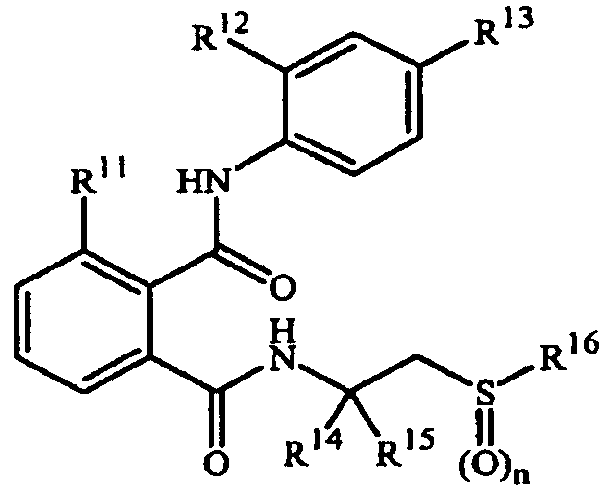
식 중,In the formula,
R11은 CH3, Cl, Br 또는 I이고; R 11 is CH 3 , Cl, Br or I;
R12는 CH3 또는 Cl이며;R 12 is CH 3 or Cl;
R13은 C1-C3 플루오로알킬이고;R 13 is C 1 -C 3 fluoroalkyl;
R14는 H 또는 CH3이며;R 14 is H or CH 3 ;
R15는 H 또는 CH3이고;R 15 is H or CH 3 ;
R16은 C1-C2 알킬이며;R 16 is C 1 -C 2 alkyl;
n은 0, 1 또는 2이다.n is 0, 1 or 2.
실시양태 2B. R11이 Cl, Br 또는 I이고; R12가 CH3이며; R13이 CF3, CF2CF3 또는 CF(CF3)2이고; R14가 H 또는 CH3이며; R15가 H 또는 CH3이고; R16이 CH3이며; n이 0, 1 또는 2인, 실시양태 2의 방법.Embodiment 2B. R 11 is Cl, Br or I; R 12 is CH 3 ; R 13 is CF 3 , CF 2 CF 3 or CF (CF 3 ) 2 ; R 14 is H or CH 3 ; R 15 is H or CH 3 ; R 16 is CH 3 ; The method of embodiment 2, wherein n is 0, 1 or 2.
실시양태 2C. 카르복사미드 살절지동물제가 N2-[1,1-디메틸-2-(메틸술포닐)에틸]-3-요오도-N1-[2-메틸-4-[1,2,2,2-테트라플루오로-1-(트리플루오로메틸)에틸]페닐]-1,2-벤젠디카르복사미드인, 실시양태 2의 방법.Embodiment 2C. Carboxamide live arthropods I N 2 - [1,1- dimethyl-2- (methylsulfonyl) ethyl] -3-iodo -N 1 - [2- methyl-4- [1,2,2,2 -Tetrafluoro-1- (trifluoromethyl) ethyl] phenyl] -1,2-benzenedicarboxamide.
실시양태 3. 절지동물 해충이 노린재목(Hemiptera)의 종인, "발명의 요약"에 기재된 방법.Embodiment 3. The method described in the "Summary of Invention", wherein the arthropod pest is a species of Hemiptera.
실시양태 3A. 절지동물 해충이 가루이과(Aleyrodidae), 진딧물과(Aphididae) 및 매미충과(Cicadellidae) 중 하나에 속하는 종인, 실시양태 3의 방법.Embodiment 3A. The method of embodiment 3, wherein the arthropod pest is a species belonging to one of Aleyrodidae, Aphididae, and Cicadellidae.
실시양태 3B. 절지동물 해충이 베미시아 아르겐티폴리(Bemisia argentifolii)인, 실시양태 3의 방법.Embodiment 3B. The method of embodiment 3, wherein the arthropod pest is Bemisia argentifolii .
실시양태 3C. 절지동물 해충이 미주스 페르시카에(Myzus persicae)인, 실시 양태 3의 방법.Embodiment 3C. The method of embodiment 3, wherein the arthropod pest is Myzus persicae .
실시양태 3D. 절지동물 해충이 네포테틱스 비레센스(Nephotettix virescens)인, 실시양태 3의 방법.Embodiment 3D. The method of embodiment 3, wherein the arthropod pest is Nephotettix virescens .
실시양태 4. 절지동물 해충이 총채벌레목(Thysanoptera)의 종인, "발명의 요약"에 기재된 방법.Embodiment 4. The method described in the "summary of invention" wherein the arthropod pest is a species of Thysanoptera.
실시양태 4A. 종이 총채벌레과(Thripidae)에 속하는 것인, 실시양태 4의 방법.Embodiment 4A. The method of embodiment 4, wherein the species belongs to the Thripidae family.
실시양태 4B. 절지동물 해충이 프랑클리니엘라 옥시덴탈리스(Frankliniella occidentalis)인, 실시양태 4의 방법.Embodiment 4B. The method of embodiment 4, wherein the arthropod pest is Frankliniella occidentalis .
실시양태 5. 절지동물 해충이 딱정벌레목(Coleoptera)의 종인, "발명의 요약"에 기재된 방법.Embodiment 5. The method described in the "Summary of Invention", wherein the arthropod pest is a species of Coleoptera.
실시양태 5A. 절지동물 해충이 잎벌레과(Chrysomelidae)에 속하는 종인, 실시양태 5의 방법.Embodiment 5A. The method of embodiment 5, wherein the arthropod pest is a species belonging to the Chrysomelidae.
실시양태 5B. 절지동물 해충이 렙티노타르사 데셈리네아타(Leptinotarsa decemlineata)인, 실시양태 5의 방법.Embodiment 5B. The method of embodiment 5, wherein the arthropod pest is Leptinotarsa decemlineata .
실시양태 5C. 절지동물 해충이 렙티노타르사 데셈리네아타 이외의 것인, "발명의 요약"에 기재된 방법.Embodiment 5C. The method according to "Summary of Invention", wherein the arthropod pests are other than leptinotarsa dessimineata.
실시양태 6. 절지동물 해충이 나비목(Lepidoptera)의 종인, "발명의 요약"에 기재된 방법.Embodiment 6. The method described in the "Summary of Invention", wherein the arthropod pest is a species of Lepidoptera.
실시양태 6A. 절지동물 해충이 밤나방과(Noctuidae) 및 좀나방 과(Plutellidae) 중 하나에 속하는 종인, 실시양태 6의 방법.Embodiment 6A. The method of embodiment 6, wherein the arthropod pest is a species belonging to one of the family Noctuidae and Plutellidae.
실시양태 6B. 절지동물 해충이 스포돕테라 엑시구아(Spodoptera exigua)인, 실시양태 6의 방법.Embodiment 6B. The method of embodiment 6, wherein the arthropod pest is Spodoptera exigua .
실시양태 6C. 절지동물 해충이 플루텔라 크실로스텔라(Plutella xylostella)인, 실시양태 6의 방법.Embodiment 6C. The method of embodiment 6, wherein the arthropod pest is Plutella xylostella .
실시양태 6D. 절지동물 해충이 헬리코베르파 아르미게라(Helicoverpa armigera)인, 실시양태 6의 방법.Embodiment 6D. The method of embodiment 6, wherein the arthropod pest is Helicoverpa armigera .
실시양태 6E. 절지동물 해충이 플루텔라 크실로스텔라 이외의 것인, "발명의 요약"에 기재된 방법. Embodiment 6E. The method described in "Summary of Invention", wherein the arthropod pest is other than flutella xyllstella.
실시양태 7. 절지동물 해충이 파리목(Diptera)의 종인, "발명의 요약"에 기재된 방법.Embodiment 7. The method described in the "Summary of Invention", wherein the arthropod pest is a species of Diptera.
실시양태 7A. 절지동물 해충이 과실파리과(Tephritidae) 및 집파리과(Muscidae) 중 하나에 속하는 종인, 실시양태 7의 방법.Embodiment 7A. The method of embodiment 7, wherein the arthropod pest is a species belonging to one of Tephritidae and Muscidae.
실시양태 7B. 절지동물 해충이 무스카 도메스티카(Musca domestica)인, 실시양태 7의 방법.Embodiment 7B. The method of embodiment 7, wherein the arthropod pest is Musca domestica .
상기 언급에서, 단독으로, 또는 "할로알킬" 또는 "플루오로알킬" 등의 복합어에 사용된 용어 "알킬"은, 직쇄 또는 분지쇄 알킬, 예컨대 메틸, 에틸, n-프로필, i-프로필, 또는 상이한 부틸 이성질체를 포함한다. "알콕시"는, 예를 들어 메톡시, 에톡시, n-프로필옥시, 이소프로필옥시 및 상이한 부톡시 이성질체를 포함한다. 단독으로, 또는 "할로알킬" 등의 복합어에 사용된 용어 "할로겐"은, 플루오 르, 염소, 브롬 또는 요오드를 포함한다. 또한, "할로알킬" 또는 "할로알콕시" 등의 복합어에 사용된 경우, 상기 알킬은 동일하거나 상이할 수 있는 할로겐 원자로 부분적으로 또는 완전히 치환될 수 있다. "할로알킬"의 예로는, CF3, CH2Cl, CH2CF3 및 CCl2CF3이 포함된다. 용어 "할로알콕시" 등은, 용어 "할로알킬"과 유사하게 정의된다. "할로알콕시"의 예로는, OCF3, OCH2CCl3, OCH2CH2CHF2 및 OCH2CF3이 포함된다.In the above, the term "alkyl" alone or in combinations such as "haloalkyl" or "fluoroalkyl" refers to straight or branched chain alkyl such as methyl, ethyl, n-propyl, i-propyl, or Different butyl isomers. "Alkoxy" includes, for example, methoxy, ethoxy, n-propyloxy, isopropyloxy and different butoxy isomers. The term "halogen", alone or in compound words such as "haloalkyl", includes fluorine, chlorine, bromine or iodine. In addition, when used in compound words such as "haloalkyl" or "haloalkoxy", the alkyl may be partially or completely substituted with halogen atoms which may be the same or different. Examples of "haloalkyl" include CF 3 , CH 2 Cl, CH 2 CF 3 and CCl 2 CF 3 . The term "haloalkoxy" and the like are defined similarly to the term "haloalkyl". Examples of "haloalkoxy" include OCF 3 , OCH 2 CCl 3 , OCH 2 CH 2 CHF 2 and OCH 2 CF 3 .
치환기 내의 탄소 원자의 총 수는 "Ci-Cj" 접두어로 나타내며, 여기서 i 및 j는 1 내지 4의 수이다. 예를 들어, C1-C4 알킬은, 메틸 내지 부틸 (각종 이성질체 포함)을 나타낸다.The total number of carbon atoms in the substituents is denoted by the "C i -C j " prefix, where i and j are numbers from 1 to 4. For example, C 1 -C 4 alkyl represents methyl to butyl (including various isomers).
본 발명의 방법을 위한 카르복사미드 살절지동물제 (예를 들어, 화학식 1 또는 2)는 하나 이상의 입체이성질체로서 존재할 수 있다. 각종 입체이성질체는, 거울상이성질체, 부분입체이성질체, 회전장애이성질체 및 기하이성질체를 포함한다. 당업자는, 하나의 입체이성질체가 다른 입체이성질체(들)에 비해 풍부한 경우, 또는 다른 입체이성질체(들)과 분리된 경우, 보다 활성일 수 있고/거나 유리한 효과를 나타낼 수 있음을 인지할 것이다. 또한, 당업자는 상기 입체이성질체를 분리하고/거나, 풍부화시키고/거나, 선택적으로 제조하는 방법을 인지한다. 이들 카르복사미드 살절지동물제는 입체이성질체의 혼합물, 개별 입체이성질체 또는 광학 활성 형태로서 존재할 수 있다.Carboxamide pesticides (eg, Formula 1 or 2) for the methods of the invention may exist as one or more stereoisomers. Various stereoisomers include enantiomers, diastereomers, atropisomers and geometric isomers. Those skilled in the art will appreciate that one stereoisomer may be more active and / or have a beneficial effect when compared to other stereoisomer (s) or when separated from other stereoisomer (s). One skilled in the art also knows how to isolate, enrich and / or selectively prepare such stereoisomers. These carboxamide pesticides may be present as mixtures of stereoisomers, individual stereoisomers or in optically active forms.
본 발명의 방법을 위한 카르복사미드 살절지동물제 (예를 들어, 화학식 1)는 또한, N-산화물의 형태로 존재할 수 있다. 당업자는, 질소가 산화물로 산화되기 위해서는 이용가능한 고립쌍을 필요로 하기 때문에 모든 질소 함유 헤테로사이클이 N-산화물을 형성할 수 있는 것은 아님을 인지할 것이며; 당업자는 N-산화물을 형성할 수 있는 질소 함유 헤테로사이클을 인식할 것이다. 당업자는 또한, 3급아민이 N-산화물을 형성할 수 있음을 인식할 것이다. 헤테로사이클 및 3급 아민의 N-산화물 제조를 위한 합성 방법은, 헤테로사이클 및 3급 아민을 퍼옥시산, 예컨대 퍼아세트산 및 m-클로로퍼벤조산 (MCPBA), 과산화수소, 알킬 히드로퍼옥시드, 예컨대 t-부틸 히드로퍼옥시드, 나트륨 퍼보레이트, 및 디옥시란, 예컨대 디메틸디옥시란에 의해 산화시키는 것을 포함하며, 이는 당업자에게 공지되어 있다. 이들 N-산화물의 제조 방법은, 문헌에 광범위하게 기재되고 개설되어 있다 (예를 들어, 문헌 [T. L. Gilchrist, Comprehensive Organic Synthesis, vol. 7, pp 748-750, S. V. Ley, Ed., Pergamon Press]; [M. Tisler and B. Stanovnik, Comprehensive Heterocyclic Chemistry, vol. 3, pp 18-20, A. J. Boulton and A. McKillop, Eds., Pergamon Press]; [M. R. Grimmett and B. R. T. Keene, Advances in Heterocyclic Chemistry, vol. 43, pp 149-161, A. R. Katritzky, Ed., Academic Press]; [M. Tisler and B. Stanovnik, Advances in Heterocyclic Chemistry, vol. 9, pp 285-291, A. R. Katritzky and A. J. Boulton, Eds., Academic Press]; 및 [G. W. H. Cheeseman and E. S. G. Werstiuk, Advances in Heterocyclic Chemistry, vol. 22, pp 390-392, A. R. Katritzky and A. J. Boulton, Eds., Academic Press] 참조).Carboxamide pesticides (eg, formula 1) for the method of the invention may also be present in the form of N-oxides. Those skilled in the art will appreciate that not all nitrogen containing heterocycles can form N-oxides because nitrogen requires an available isolated pair to oxidize to oxides; Those skilled in the art will recognize nitrogen containing heterocycles capable of forming N-oxides. Those skilled in the art will also recognize that tertiary amines can form N-oxides. Synthetic methods for the preparation of N-oxides of heterocycles and tertiary amines include heterocycles and tertiary amines with peroxy acids such as peracetic acid and m-chloroperbenzoic acid (MCPBA), hydrogen peroxide, alkyl hydroperoxides such as t Oxidizing with butyl hydroperoxide, sodium perborate, and dioxirane, such as dimethyldioxirane, which is known to those skilled in the art. Methods for producing these N-oxides are extensively described and outlined in the literature (for example, TL Gilchrist, Comprehensive Organic Synthesis, vol. 7, pp 748-750, SV Ley, Ed., Pergamon Press) M. Tisler and B. Stanovnik, Comprehensive Heterocyclic Chemistry, vol. 3, pp 18-20, AJ Boulton and A. McKillop, Eds., Pergamon Press; MR Grimmett and BRT Keene, Advances in Heterocyclic Chemistry, vol. 43, pp 149-161, AR Katritzky, Ed., Academic Press; M. Tisler and B. Stanovnik, Advances in Heterocyclic Chemistry, vol. 9, pp 285-291, AR Katritzky and AJ Boulton, Eds., Academic Press; and GWH Cheeseman and ESG Werstiuk, Advances in Heterocyclic Chemistry, vol. 22, pp 390-392, AR Katritzky and AJ Boulton, Eds., Academic Press.
본 발명의 방법을 위한 카르복사미드 살절지동물제 (예를 들어, 화학식 1 또는 2)는 염의 형태로 존재할 수도 있다. 이러한 염은, 무기산 또는 유기산, 예컨대 브롬화수소산, 염산, 질산, 인산, 황산, 아세트산, 부티르산, 푸마르산, 락트산, 말레산, 말론산, 옥살산, 프로피온산, 살리실산, 타르타르산, 4-톨루엔술폰산 또는 발레르산과의 산-부가염을 포함한다. 염은, 카르복사미드 살절지동물제가 산성기, 예컨대 카르복실산 또는 페놀을 함유하는 경우, 유기 염기 (예를 들어, 피리딘 또는 트리에틸아민) 또는 무기 염기 (예를 들어, 나트륨, 칼륨, 리튬, 칼슘, 마그네슘 또는 바륨의 수소화물, 수산화물 또는 탄산염)에 의해 형성된 것들을 포함할 수도 있다.Carboxamide pesticides (eg, Formula 1 or 2) for the methods of the invention may also be present in the form of salts. Such salts are used with inorganic or organic acids such as hydrobromic acid, hydrochloric acid, nitric acid, phosphoric acid, sulfuric acid, acetic acid, butyric acid, fumaric acid, lactic acid, maleic acid, malonic acid, oxalic acid, propionic acid, salicylic acid, tartaric acid, 4-toluenesulfonic acid or valeric acid. Acid-addition salts. Salts are organic bases (eg, pyridine or triethylamine) or inorganic bases (eg, sodium, potassium, lithium, if the carboxamide pesticide contains an acidic group such as carboxylic acid or phenol) , Hydrides, hydroxides or carbonates of calcium, magnesium or barium).
제제화/유용성Formulation / Utility
본 발명에 따른 카르복사미드 살절지동물제는, 일반적으로, 고체 희석제, 액체 희석제 및 계면활성제로 구성된 군으로부터 선택된 1종 이상의 성분을 포함하는, 농경 또는 비농경 용도에 적합한 담체와의 제제 또는 조성물로 사용될 수 있다. 적합한 제제는, 미국 특허 제6,747,047호, PCT 출원공개 제WO 2003/015518호, 동 제WO 2004/067528호 및 미국 특허 제6,603,044호에 개시되어 있다.Carboxamide pesticides according to the present invention generally comprise a formulation or composition with a carrier suitable for agricultural or non-agronomic use, comprising at least one component selected from the group consisting of solid diluents, liquid diluents and surfactants. Can be used as Suitable formulations are disclosed in US Pat. No. 6,747,047, PCT Application WO 2003/015518, WO 2004/067528, and US Pat. No. 6,603,044.
제제는 전형적으로, 유효량의 활성 성분, 희석제 및 계면활성제를 하기 대략적 범위 내로 (총합이 100 중량%임) 함유한다. 이어서, 상기 제제화된 조성물을 요망되는 준치사 번식-파괴 적용률이 되도록 물로 희석할 수 있다. 준치사 번식-파괴량의 카르복사미드 살절지동물제를 포함하는 적합한 조성물의 예로는, 물, 유 기 용매 또는 오일을 액체 희석제로서 포함하는 액체 조성물이 포함된다. The formulations typically contain an effective amount of the active ingredient, diluent and surfactant within the following approximate range (total 100% by weight). The formulated composition can then be diluted with water to achieve the desired subdivision breeding-destruction rate. Examples of suitable compositions comprising a subgingival breeding-destructive amount of carboxamide pesticide include a liquid composition comprising water, an organic solvent or an oil as a liquid diluent.

제제화 분야에 대한 추가의 정보는, 문헌 [T. S. Woods, "The Formulator's Toolbox - Product Forms for Modern Agriculture", Pesticide Chemistry and Bioscience, The Food-Environment Challenge, T. Brooks and T. R. Roberts, Eds., Proceedings of the 9th International Congress on Pesticide Chemistry, The Royal Society of Chemistry, Cambridge, 1999, pp. 120-133]를 참조한다. 또한, U.S. 3,235,361의 컬럼 6, 라인 16 내지 컬럼 7, 라인 19 및 실시예 10 내지 41; U.S. 3,309,192의 컬럼 5, 라인 43 내지 컬럼 7, 라인 62 및 실시예 8, 12, 15, 39, 41, 52, 53, 58, 132, 138 내지 140, 162 내지 164, 166, 167 및 169 내지 182; U.S. 2,891,855의 컬럼 3, 라인 66 내지 컬럼 5, 라인 17 및 실시예 1 내지 4; 문헌 [Klingman, Weed Control as a Science, John Wiley and Sons, Inc., New York, 1961, pp 81-96]; [Hance et al., Weed Control Handbook, 8th Ed., Blackwell Scientific Publications, Oxford, 1989]; 및 [Developments in formulation technology, PJB Publications, Richmond, UK, 2000]을 참조한다.Further information on the field of formulation is described in T. S. Woods, "The Formulator's Toolbox-Product Forms for Modern Agriculture", Pesticide Chemistry and Bioscience, The Food-Environment Challenge, T. Brooks and TR Roberts, Eds., Proceedings of the 9th International Congress on Pesticide Chemistry, The Royal Society of Chemistry, Cambridge, 1999, pp. 120-133. In addition, U.S. 3,235,361, column 6, line 16 to column 7, line 19 and Examples 10 to 41; U.S. Column 5, lines 43 to column 7, lines 62 and Examples 8, 12, 15, 39, 41, 52, 53, 58, 132, 138 to 140, 162 to 164, 166, 167 and 169 to 182 of 3,309,192; U.S. Column 3, lines 66 to 5, line 17 and Examples 1 to 4 of 2,891,855; Klingman, Weed Control as a Science, John Wiley and Sons, Inc., New York, 1961, pp 81-96; Hance et al., Weed Control Handbook, 8th Ed., Blackwell Scientific Publications, Oxford, 1989; And Developments in formulation technology, PJB Publications, Richmond, UK, 2000.
본 발명의 방법에서는, 카르복사미드 살절지동물제를 전형적으로, 카르복사미드 살절지동물제에 추가로 계면활성제 및 액체 희석제로 구성된 군으로부터 선택된 1종 이상의 추가 성분을 포함하는 조성물의 형태로 절지동물 해충 성충 또는 그의 환경과 접촉시킨다. 따라서, 본 발명은 또한, 준치사 번식-파괴량의 카르복사미드 살절지동물제, 및 계면활성제 및 액체 희석제로 구성된 군으로부터 선택된 1종 이상의 추가 성분을 포함하는 조성물을 절지동물 해충 성충 또는 그의 환경과 접촉시키는 방법에 관한 것이다. In the process of the present invention, the carboxamide pesticide is typically dissected in the form of a composition comprising at least one additional component selected from the group consisting of a surfactant and a liquid diluent, in addition to the carboxamide pesticide. Contact with animal pest adults or their environment. Accordingly, the present invention also provides a composition comprising a subtotal breeding-destructive amount of carboxamide pesticide and at least one additional ingredient selected from the group consisting of a surfactant and a liquid diluent. And a method of contacting the same.
본 발명의 방법은, 무척추동물 해충 (예컨대, 바실루스 투링기엔시스(Bacillus thuringiensis) 델타-내독소)에 대해 독성인 단백질을 발현하도록 유전적으로 형질전환된 식물에 적용할 수 있다. 외부 적용된 준치사 번식-파괴량의 카르복사미드 살절지동물제의 효과는, 번식 파괴에 있어 발현된 독소 단백질과 상승작용할 수 있다. The method of the present invention, invertebrate pests (such as Bacillus turing group N-Sys (Bacillus thuringiensis ) delta-endotoxin) to plants genetically transformed to express proteins toxic. The effect of an externally applied quaternary breed-destructive amount of carboxamide pesticide can synergize with the expressed toxin protein in breeding destruction.
특정 경우에는, 유사한 스펙트럼의 방제를 갖지만 작용 방식이 상이한 다른 살절지동물제와의 조합이 내성 관리를 위해 특히 유리하다. 다른 살절지동물제에 대한 일반적 참조 문헌은, 문헌 [The Pesticide Manual, 13th Edition, C. D. S. Tomlin, Ed., British Crop Protection Council, Farnham, Surrey, U.K., 2003] 및 [The BioPesticide Manual, 2nd Edition, L. G. Copping, Ed., British Crop Protection Council, Farnham, Surrey, U.K., 2001]을 포함한다.In certain cases, combinations with other insecticidal agents with similar spectrum of control but different modes of action are particularly advantageous for resistance management. General references for other pesticides include The Pesticide Manual, 13 th Edition, CDS Tomlin, Ed., British Crop Protection Council, Farnham, Surrey, UK, 2003 and The BioPesticide Manual, 2 nd Edition. , LG Copping, Ed., British Crop Protection Council, Farnham, Surrey, UK, 2001.
준치사 번식-파괴량의 카르복사미드 살절지동물제를 포함하는 조성물을 농경 및/또는 비농경 침입 장소를 포함하는 해충의 환경에, 보호될 영역에, 또는 직접 방제될 해충에 적용함으로써 농경 및 비농경 분야에서 절지동물 해충의 번식이 파괴된다. 농경 분야는, 전형적으로 준치사 번식-파괴량의 카르복사미드 살절지동물제를 포함하는 조성물을 식재 전 농작물의 종자에, 농작물의 잎, 줄기, 꽃 및/또는 과실에, 또는 농작물 식재 전 또는 후에 토양 또는 다른 성장 환경에 적용함으로써 절지동물 해충 생식으로부터 논밭 농작물을 보호하는 것을 포함한다. 비농경 분야는, 농작물의 논밭 이외의 영역에서의 절지동물 해충의 파괴에 관련된다. 비농경 분야는, 저장된 곡류, 콩류 및 기타 식품에서, 또한 직물, 예컨대 의류 및 카펫에서의 절지동물 해충 번식의 파괴를 포함한다. 비농경 분야는 또한, 관상용 식물, 삼림, 과수원에서, 정원에서, 대로변 및 철로변의 길을 따라, 또한 잔디, 예컨대 잔디밭, 골프장 및 목장에서의 절지동물 해충 번식의 파괴를 포함한다. 비농경 분야는 또한, 인간 및/또는 반려동물, 농원, 농장, 동물원 또는 다른 동물에 의해 점유될 수 있는 주택 및 다른 빌딩에서의 절지동물 해충 번식의 파괴를 포함한다. 비농경 분야는 또한, 빌딩에 사용되는 목재 또는 다른 구조재를 손상시킬 수 있는 흰개미 등의 해충의 번식 파괴를 포함한다. 비농경 분야는 또한, 기생충이거나 또는 감염성 질병을 전달하는 해충의 번식 파괴에 의해 인간 및 동물 위생을 보호하는 것을 포함한다. 이러한 해충은, 예를 들어 털진드기, 진드기, 이, 모기, 파리 및 벼룩을 포함한다.By applying a composition comprising a parasitic breeding-destructive amount of a carboxamide pesticide to the environment of the pest, including areas of agricultural and / or non-agricultural invasion, to areas to be protected, or to pests to be directly controlled. Reproduction of arthropod pests is destroyed in non-agricultural fields. The agricultural sector typically comprises a composition comprising a semi-larval breeding-destructive amount of carboxamide pesticide on seeds of the crop before planting, on the leaves, stems, flowers and / or fruits of the crop, or before or after planting the crop. And later protecting the paddy crops from arthropod pest reproduction by application to soil or other growing environments. The non-agricultural field involves the destruction of arthropod pests in areas other than the rice fields of crops. Non-agricultural applications include the destruction of arthropod pest breeding in stored cereals, legumes and other foods, as well as in fabrics such as clothing and carpets. The non-agricultural sector also includes the destruction of arthropod pest breeding in ornamental plants, forests, orchards, in gardens, along roadways and railroad paths, and in grasses such as lawns, golf courses, and ranches. The non-agricultural sector also includes the destruction of arthropod pest breeding in houses and other buildings that may be occupied by humans and / or pets, farms, farms, zoos or other animals. Non-agricultural applications also include the propagation and destruction of pests such as termites, which can damage wood or other structural materials used in buildings. The non-agricultural field also includes protecting human and animal hygiene by breeding destruction of pests that are parasites or carry infectious diseases. Such pests include, for example, hair mites, mites, teeth, mosquitoes, flies and fleas.
준치사 번식-파괴량의 카르복사미드 살절지동물제를 포함하는 조성물을 농경 및/또는 비농경 침입 장소를 포함하는 해충 성충의 환경에, 보호될 영역에, 또는 직접 성충 해충에 적용함으로써 절지동물 해충의 번식이 파괴되고, 농경 및 다른 농작물의 보호, 및 동물 및 인간 위생이 달성된다. 따라서, 본 발명은, 절지동물 해충 성충 또는 그의 환경을 준치사 번식-파괴량의 카르복사미드 살절지동물제와, 또는 준치사 번식-파괴량의 카르복사미드 살절지동물제를 포함하는 조성물과 접촉시키는 것을 포함하는, 농경 및/또는 비농경 분야에서 절지동물 해충 성충의 번식을 파괴하는 방법을 포함한다. 보다 특별하게는, 본 발명은, 준치사 번식-파괴량의 카르복사미드 살절지동물제를 포함하는 조성물을 농경 및/또는 비농경 침입 장소를 포함하는 해충의 환경에, 보호될 영역에, 또는 직접 성충 해충에 적용하는 것을 포함하는, 잎 및 토양 서식 절지동물의 번식 파괴 및 농경 및/또는 비농경 작물의 보호 방법을 포함한다.Arthrops by applying a composition comprising a parasitic breeding-destructive amount of carboxamide pesticide to the environment of a pest adult including an agricultural and / or non-agronomic invasion site, to the area to be protected, or directly to an adult pest Pest reproduction is destroyed, protection of agricultural and other crops, and animal and human hygiene are achieved. Accordingly, the present invention relates to a composition comprising an arthropod pest adult or an environment thereof comprising a tertiary breeding-destructive amount of carboxamide pesticide and a tertiary breeding-destructive amount of carboxamide pesticide; And methods of destroying the breeding of arthropod pest adults in the agricultural and / or non-agricultural field, including contacting. More particularly, the present invention provides a composition comprising a subgingival breeding-destructive amount of carboxamide pesticide, in an area to be protected, in an environment of pests comprising agricultural and / or non-agronomic invasion sites, or Methods for the protection and propagation of leaf and soil arthropods and the protection of agricultural and / or non-agricultural crops, including application directly to adult pests.
접촉 방법의 일 실시양태는, 해충 및/또는 해충의 환경에 분무하는 것이다. 별법으로, 본 발명의 방법에 따라, 카르복사미드 살절지동물제는, 식물을, 액체 제제의 토양 관주로서 적용된 준치사 번식-파괴량의 카르복사미드 살절지동물제를 포함하는 조성물과 접촉시킴으로써 식물 흡수를 통해 효과적으로 전달될 수 있다.One embodiment of the contacting method is to spray the pest and / or the environment of the pest. Alternatively, according to the method of the present invention, the carboxamide pesticide is prepared by contacting the plant with a composition comprising a quasi-fertile breeding-destructive amount of carboxamide pesticide applied as a soil irrigation of the liquid formulation. It can be effectively delivered through plant uptake.
절지동물 해충의 토양 환경을 준치사 번식-파괴량의 카르복사미드 살절지동물제와 접촉시키는 것을 포함하는 절지동물 해충의 방제 방법이 주목된다. 침입 장소에 대한 국소 적용을 포함하는 본 발명의 방법이 또한 주목된다. 다른 접촉 방법은, 직접적인 또한 잔류 분무제, 공기 중 분무제, 겔, 종자 코팅, 마이크로캡슐화, 조직적 흡수, 미끼, 이어 택(ear tag), 거환(bolus), 분무기, 훈증막, 에어로졸, 더스트 및 많은 다른 것들에 의한 본 발명의 방법에 따른 카르복사미드 살절 지동물제의 적용을 포함한다. 본 발명의 방법에 따른 카르복사미드 살절지동물제는 또한, 절지동물 방제 장치 (예를 들어, 곤충 그물망)를 제작하기 위한 재료 내에 주입될 수 있다. 종자 코팅은, 식물이 특수한 특성을 발현하도록 유전적으로 형질전환된 식물이 발아되는 것들을 포함한 모든 유형의 종자에 적용될 수 있다. 대표적 예로는, 바실루스 투링기엔시스 독소 등의 무척추동물 해충에 대해 독성인 단백질을 발현하는 것들, 또는 "라운드업 레디(Roundup Ready)" 종자 등의 제초제 내성을 나타내는 것들이 포함된다.Of particular note is a method of controlling arthropod pests comprising contacting the soil environment of the arthropod pests with a tertiary breeding-destructive amount of carboxamide pesticide. Also of note are methods of the present invention that include topical application to the site of intrusion. Other contact methods include direct and residual sprays, airborne sprays, gels, seed coatings, microencapsulations, systemic absorption, baits, ear tags, bolus, sprayers, fumigation membranes, aerosols, dusts and many others. By them the application of the carboxamide killing terrestrial agent according to the method of the invention. Carboxamide arthropods according to the method of the present invention may also be injected into materials for making arthropod control devices (eg insect nets). Seed coatings can be applied to all types of seeds, including those from which genetically transformed plants germinate so that the plants express particular properties. Representative examples include those that express proteins toxic to invertebrate pests, such as Bacillus thuringiensis toxin, or those that exhibit herbicide tolerance, such as "Roundup Ready" seeds.
본 발명의 방법에 따른 카르복사미드 살절지동물제는, 다른 보조제 없이 LC50 이하의 비율로 적용될 수 있으나, 가장 흔한 적용은 카르복사미드 살절지동물제를 적합한 담체, 희석제 및 계면활성제와, 또한 가능하게는 고려되는 최종 용도에 따라 음식과 조합하여 포함하는 제제의 적용이다. 한가지 적용 방법은, 카르복사미드 살절지동물제의 수 분산액 또는 정유 용액을 분무하는 것을 포함한다. 분무 오일, 분무 오일 농축물, 살포제 고착제, 보조제, 기타 용매 및 상승제, 예컨대 피페로닐 부톡시드와의 조합은 흔히 효능을 향상시킨다. 비농경 용도에서는, 이러한 분무제를 분무제 용기, 예컨대 캔, 병 또는 다른 용기로부터, 펌프에 의해 또는 이를 가압 용기, 예를 들어 가압 에어로졸 분무 캔으로부터 방출시킴으로써 적용할 수 있다. 이러한 분무 조성물은 다양한 형태, 예를 들어 분무제, 미스트, 발포제, 발연제 또는 연무제를 취할 수 있다. 따라서, 이러한 분무 조성물은 경우에 따라 추진제, 발포제 등을 추가로 포함할 수 있다. 준치사 번식-파괴량의 카르복사미드 살절지동물제, 또는 본 발명의 준치사 번식-파괴량의 카르복사미드 살절지동물제 및 담체를 포함하는 조성물을 포함하는 분무 조성물이 주목된다. 이러한 분무 조성물의 일 실시양태는, 준치사 번식-파괴량의 카르복사미드 살절지동물제, 또는 본 발명의 준치사 번식-파괴량의 카르복사미드 살절지동물제 및 추진제를 포함하는 조성물을 포함한다. 대표적 추진제로는, 메탄, 에탄, 프로판, 부탄, 이소부탄, 부텐, 펜탄, 이소펜탄, 네오펜탄, 펜텐, 히드로플루오로카본, 클로로플루오로카본, 디메틸 에테르, 및 이들의 혼합물이 포함되나, 이에 제한되지는 않는다. 모기, 먹파리, 침파리, 사슴 등에, 말파리, 장수말벌, 말벌, 호박벌, 진드기, 거미, 개미, 각다귀 등으로 구성된 군으로부터 선택된 1종 이상의 절지동물 해충을 개별적으로 또는 조합하여 방제하는 데 사용되는 분무 조성물 (및 분무 용기로부터 분배된 이러한 분무 조성물의 사용 방법)이 주목된다.Carboxamide pesticides according to the method of the present invention can be applied at a ratio of LC 50 or less without other adjuvants, but the most common application is to use carboxamide pesticides with suitable carriers, diluents and surfactants, and also Possibly an application of a formulation comprising in combination with food depending on the end use contemplated. One application method involves spraying an aqueous dispersion or essential oil solution of a carboxamide pesticide. Combinations with spray oils, spray oil concentrates, dusting agents, adjuvants, other solvents and synergists such as piperonyl butoxide often improve the efficacy. In non-agricultural applications, such sprays may be applied from spray containers, such as cans, bottles or other containers, by pumps or by releasing them from pressurized containers, such as pressurized aerosol spray cans. Such spray compositions may take various forms, for example sprays, mists, blowing agents, fuming agents or aerosols. Thus, such spray compositions may optionally further comprise propellants, blowing agents, and the like. Of note is a spray composition comprising a subgingival propagation-destructive amount of carboxamide pesticide, or a composition comprising a subtertiary propagation-destruction amount carboxamide pesticide of the present invention and a carrier. One embodiment of such a spray composition comprises a composition comprising a quaternary breeding-destructive amount of carboxamide pesticide, or a quarterly breeding-destructive amount of carboxamide pesticide of the present invention and a propellant. do. Representative propellants include, but are not limited to, methane, ethane, propane, butane, isobutane, butene, pentane, isopentane, neopentane, pentene, hydrofluorocarbons, chlorofluorocarbons, dimethyl ethers, and mixtures thereof It is not limited. Used to control individually or in combination one or more arthropod pests selected from the group consisting of mosquitoes, ink flies, chimpanzees, deer, etc., horse flies, longevity wasps, wasps, bumblebees, ticks, spiders, ants, hornbill Of note are the spray compositions (and methods of use of such spray compositions dispensed from spray containers).
본 발명의 방법에 따른 카르복사미드 살절지동물제는, 절지동물 해충에 의해 소비되는 미끼 조성물 내로 혼입되거나, 또는 덫, 미끼 장치 등과 같은 장치 내에 사용될 수 있다. 이러한 미끼 조성물은, (a) 활성 성분, 즉 준치사 번식-파괴량의 카르복사미드 살절지동물제; (b) 1종 이상의 음식 재료; 임의로는 (c) 유인 물질, 및 임의로는 (d) 1종 이상의 습윤제를 포함하는 과립 형태로 존재할 수 있다. 약 0.001 내지 0.1%의 활성 성분, 약 40 내지 99%의 음식 재료 및/또는 유인 물질; 및 임의로는 약 0.05 내지 10%의 습윤제를 포함하는 과립 또는 미끼 조성물이 주목되며, 이는 섭취에 의해, 매우 낮은 적용률, 특히 준치사 번식-파괴량인 활성 성분의 적용량으로도 토양 무척추동물 해충 방제에 효과적이다. 일부 음식 재료는 음식 공급원 및 유인 물질 둘 다로서 기능할 수 있다. 음식 재료는 탄수화물, 단백질 및 지질을 포함한다. 음식 재료의 예는, 야채분, 당, 전분, 동물성 지방, 식물성 오일, 효모 추출물 및 우유 고형물이다. 유인 물질의 예는, 방향제 및 향미제, 예컨대 과실 또는 식물 추출물, 향수, 또는 다른 동물성 또는 식물성 성분, 페로몬, 또는 표적 절지동물 해충을 유인하는 것으로 공지된 다른 제제이다. 습윤제, 즉 수분 보유제의 예는, 글리콜 및 다른 폴리올, 글리세린 및 소르비톨이다. 개미, 흰개미 및 바퀴벌레로 구성된 군으로부터 선택된 1종 이상의 절지동물 해충 성충의 번식을 파괴하는 데 사용되는 미끼 조성물 (및 이러한 미끼 조성물의 사용 방법)이 주목된다. 절지동물 해충의 번식을 파괴하기 위한 장치는, 본 발명의 미끼 조성물 및 미끼 조성물을 수용하도록 적합화된 외피를 포함할 수 있으며, 여기서 상기 외피는 무척추동물 해충이 구멍으로 통과하는 것을 허용하여 절지동물 해충이 외피 외부의 위치로부터 미끼 조성물에 접근할 수 있도록 크기조절된 하나 이상의 구멍을 가지며, 또한 상기 외피는 절지동물 해충에 대해 가능한 또는 알려진 활동을 갖는 장소에 또는 그 근처에 배치되도록 추가로 적합화된다.Carboxamide pesticides according to the method of the present invention can be incorporated into bait compositions consumed by arthropod pests or used in devices such as traps, bait devices and the like. Such bait compositions may comprise (a) an active ingredient, i.e. a quasi-larval breeding-destruction amount of carboxamide pesticide; (b) one or more food ingredients; Optionally in the form of granules comprising (c) an attractant, and optionally (d) one or more wetting agents. About 0.001 to 0.1% of the active ingredient, about 40 to 99% of the food ingredients and / or attractants; And optionally granules or bait compositions comprising from about 0.05 to 10% of a humectant, which, by ingestion, is used to control soil invertebrates pests even at very low application rates, in particular with an application amount of the subcategories breeding-destruction amount. effective. Some food ingredients can function as both a food source and an attractant. Food ingredients include carbohydrates, proteins and lipids. Examples of food ingredients are vegetable meals, sugars, starches, animal fats, vegetable oils, yeast extracts and milk solids. Examples of attractants are fragrances and flavoring agents such as fruit or plant extracts, perfumes, or other animal or vegetable ingredients, pheromones, or other agents known to attract target arthropod pests. Examples of humectants, ie moisture retainers, are glycols and other polyols, glycerin and sorbitol. Of note are bait compositions (and methods of using such bait compositions) used to destroy the propagation of one or more arthropod pest adults selected from the group consisting of ants, termites and cockroaches. Apparatus for destroying the breeding of arthropod pests may include a bait composition of the present invention and a shell adapted to receive the bait composition, wherein the sheath allows arthropods to pass through the invertebrate pest The pest has one or more holes sized to allow access to the bait composition from a location outside the skin, and the skin is further adapted to be placed at or near a location having possible or known activity for the arthropod pest. do.
절지동물 해충 성충 개체수의 약 50% 이하의 사망률을 제공하면서 상기 해충 성충의 번식을 효과적으로 파괴하기 위해 요구되는 카르복사미드 살절지동물제의 적용률 (예를 들어, 농도)은, 해충종, 그의 크기, 위치, 계절, 숙주 농작물 또는 동물, 섭식 거동, 주변 습도, 온도, 적용 방법 등에 따라 달라진다. 표준 환경 하에, 소정의 적용 조건을 이용하여 특정 해충종에 대해 카르복사미드 살절지동물제 의 LC80, LC50 또는 LC20 (80, 50 또는 20% 사망률을 제공하는 농도)을 먼저 결정한다. 일부 경우에는 LC20 미만의 농도가 번식능을 유의하게 파괴할 수 있으나, 보다 전형적으로는 LC20 내지 LC50 범위의 농도가 사용된다. 상기 범위의 하한의 농도가 요망되는 번식 파괴 수준을 제공하지 않는 것으로 나타나면, LC50에 보다 가까운 또는 LC50의 농도를 사용할 수 있다. LC20 내지 LC50의 농도 범위는 비교적 작아, 당업자는 번식능 파괴를 통해 요망되는 절지동물 해충 방제 수준을 제공하는 준치사량을 용이하게 결정할 수 있다.The rate of application of carboxamide pesticides (eg, concentrations) required to effectively destroy the breeding of the pest adult while providing a mortality rate of about 50% or less of the arthropod pest adult population is determined by the pest species, its size. , Location, season, host crop or animal, feeding behavior, ambient humidity, temperature, application method, and the like. Under standard circumstances, predetermined application conditions are first used to determine the LC 80 , LC 50 or LC 20 (concentrations giving 80, 50 or 20% mortality) of carboxamide pesticides for a particular pest species. In some cases concentrations below LC 20 can significantly disrupt fertility, but more typically concentrations ranging from LC 20 to LC 50 are used. If it does not provide a breeding destruction level of the concentration of the lower limit of the desired range, it is possible to use concentrations close to or LC 50 than the LC 50. The concentration range of LC 20 to LC 50 is relatively small, so that a person skilled in the art can easily determine the sub-catalyst dose that provides the desired arthropod pest control level through disruptive fertility.
농경 생태계의 경우, 카르복사미드 살절지동물제의 준치사 번식-파괴량의 적용률은 전형적으로 약 1 내지 약 250 g/헥타르 범위 내인 것으로 밝혀졌으나, 0.1 g/헥타르만큼 낮은 적용률이 필요할 수 있거나, 또는 500 g/헥타르만큼 높은 적용률이 요구될 수 있다. 비농경 분야의 경우, 카르복사미드 살절지동물제의 준치사 번식-파괴량의 적용률은 전형적으로 약 1 내지 약 50 g/평방미터 범위 내인 것으로 밝혀졌으나, 0.1 g/평방미터만큼 낮은 적용률이 충분할 수 있거나, 또는 150 g/평방미터만큼 높은 적용률이 요구될 수 있다.For agro-ecosystems, the application rate of the subtotal breeding-destruction amount of carboxamide pesticides has typically been found to be in the range of about 1 to about 250 g / ha, although application rates as low as 0.1 g / ha may be necessary, Or application rates as high as 500 g / hectare may be required. For non-agricultural applications, the application rate of the subtotal breeding-destruction amount of carboxamide pesticides has typically been found to be in the range of about 1 to about 50 g / sqm, but applications rates as low as 0.1 g / sqm would be sufficient. Application rates as high as 150 g / square meter may be required.
본 발명의 방법에 의해 효과적으로 방제되는 해충은, 나비목, 예컨대 밤나방과의 거염벌레, 야도충, 자벌레, 및 헬리오틴(heliothine) (예를 들어, 폴(fall) 거염벌레 [스포돕테라 푸기페르다(Spodoptera fugiperda) J. E. Smith], 사탕무 거염벌레 [스포돕테라 엑시구아 Huebner], 옥수수 줄기 나무좀 [세사미아 노나그리오 이데스(Sesamia nonagrioides) Lefebvre], 남부 거염벌레 [스포돕테라 에리다니아(Spodoptera eridania) Cramer], 담배 거세미나방, 송이 모충 [스포돕테라 리투라(Spodoptera litura) Fabricius], 목화 잎벌레 [스포돕테라 리토랄리스(Spodoptera littoralis) Boisduval], 노란줄무늬 거염벌레 [스포돕테라 오르니토갈리(Spodoptera ornithogalli) Guenee], 검거세미나방 [아그로티스 입실론(Agrotis ipsilon) Hufhagel], 양배추 자벌레 [트리코플루시아 니(Trichoplusia ni) Huebner], 회색 담배나방 [헬리오티스 비레센스(Heliothis virescens) Fabricius], 가시 목화씨벌레 [에아리아스 인술라나(Earias insulana) Boisduval], 반점 목화씨벌레 [에아리아스 비텔라(Earias vittella) Fabricius), 미국 목화씨벌레 [헬리코베르파 아르미게라 Huebner], 큰담배나방 애벌레 [헬리코베르파 제아(Helicoverpa zea) Boddie], 목화 잎벌레 [알라바마 아르길라세아(Alabama argillacea) Huebner], 벨벳콩(velvetbean) 모충 [안티카르시아 겜마탈리스(Anticarsia gemmatalis) Huebner], 녹색 과실벌레 [리토판 안텐나타(Lithophane antennata) Walker], 양배추 거염벌레 [바라트라 브라시카에(Barathra brassicae) Linnaeus], 대두 자벌레 [슈도플루시아 인클루덴스(Pseudoplusia includens) Walker], 분홍 줄기 나무좀 [세사미아 인페렌스(Sesamia inferens) Walker]); 명나방과의 나무좀, 보호 고치를 만드는 유충(casebearer), 거미집나방, 뿔나방, 배추벌레 및 알락나방 (예를 들어, 유럽 옥수수 나무좀 [오스트리니아 누빌랄리스(Ostrinia nubilalis) Huebner], 네이블 오렌지 벌레 [아미엘로이스 트란시텔라(Amyelois transitella) Walker], 옥수수 뿌리 거미집나방 [크램부스 칼리기노셀 루스(Crambus caliginosellus) Clemens], 잔디 거미집나방 (명나방과: 크램비나에(Crambinae)), 예컨대 잔디 벌레 [헤르페토그람마 리카르시살리스(Herpetogramma licarsisalis) Walker], 사탕수수 줄기 나무좀 [칠로 인푸스카텔루스(Chilo infuscatellus) Snellen], 토마토 나무좀 [네오류시노데스 엘레간탈리스(Neoleucinodes elegantalis) Guenee], 녹색 잎말이나방 (나팔로세루스 메디날리스(Cnaphalocerus medinalis), 포도 뿔나방 [데스미아 푸네랄리스(Desmia funeralis) Huebner], 멜론 나방 [디아파니아 니티달리스(Diaphania nitidalis) Stoll], 양배추속 벌레 [헬루알라 히달리스(Helluala hydralis) Guenee], 노란 줄기 나무좀 [시르포파가 인세르툴라스(Scirpophaga incertulas) Walker], 조기 발아 나무좀 [시르포파가 인푸스카텔루스(Scirpophaga infuscatellus) Snellen], 흰 줄기 나무좀 [시르포파가 인노타타(Scirpophaga innotata) Walker], 상부 발아 나무좀 [시르포파가 니벨라(Scirpophaga nivella Fabricius], 검은머리 벼 나무좀 [칠로 폴리크리수스(Chilo polychrysus) Meyrick], 양배추 송이 모충 [크로시돌로미아 비노탈리스(Crocidolomia binotalis) English], 벼 줄기 나무좀 [칠로 수프레살리스(Chilo suppressalis) Walker], 반점 줄기 나무좀 [칠로 파르텔루스(Chilo partellus) Swinhoe], 사탕수수 나무좀 [엘다나 사카리나(Eldana saccharina) Walker], 및 새포아풀속 거미집나방 [크램부스 테테렐루스(Crambus teterrellus) Zincken]); 잎말이나방과의 잎말이나방, 눈벌레, 씨벌레 및 과실 벌레 (예를 들어, 그레이프 베리 나방 [엔도피자 비테아나(Endopiza viteana) Clemens], 포도나무 나방 또는 포도 나방 [로베시아 보트라나(Lobesia botrana) Denis & Schiffermueller], 과실 나무 잎말이나방 [아르칩스 아르기로스필라(Archips argyrospila) Walker], 유럽 잎말이나방 [아르칩스 로사나(Archips rosana) Linnaeus] 및 기타 아르칩스(Archips)종, 감률류 의사 코들링 나방 [크립토플레비아 류코트레타(Cryptophlebia leucotreta) Meyrick], 감귤류 나무좀 [엑디톨로파 아우란티아나(Ecdytolopha aurantiana) Lima], 붉은띠 잎말이나방 [아르기로타에니아 벨루티나나(Argyrotaenia velutinana) Walker], 사선띠 잎말이나방 [초리스토네우라 로사세아나(Choristoneura rosaceana) Harris], 밝은 갈색 사과 나방 [에피피아스 포스트비타나(Epiphyas postvittana) Walker], 유럽 그레이프 베리 나방 [유포에실리아 암비구엘라(Eupoecilia ambiguella) Huebner], 사과 눈 나방 [판데미스 피루사나(Pandemis pyrusana) Kearfott], 잡식성 잎말이나방 [플라티노타 스툴타나(Platynota stultana) Walsingham], 가로줄무늬 과실나무 토르트릭스(tortrix) [판데미스 세라사나(Pandemis cerasana) Huebner], 사과 갈색 토르트릭스 [판데미스 헤파라나(Pandemis heparana) Denis & Schiffermueller]); 뿔나방과로부터의 나무좀 및 벌레 및 나방 (예를 들어, 토마토 요충 [케이페리아 리코페르시셀라(Keiferia lycopersicella) Walshingham], 감자 덩이줄기 나방 [프토리마에아 오페르쿨렐라(Phthorimaea operculella) Zeller], 사탕무 나방 [스크로비팔파 오셀라텔라(Scrobipalpa ocellatella) Boyd], 토마토 굴나방 [투타 압솔루타(Tuta absoluta) Meyrick], 복숭아 잔가지 나무좀 [아나르시아 리네아텔라(Anarsia Lineatella) Zeller] 및 분홍 목화씨벌레 [펙티노포라 고시피엘라(Pectinophora gossypiella) Saunders]); 및 많은 다른 경제적으로 중요한 나비목 해충 (예를 들 어, 좀나방과의 배추좀나방 [플루텔라 크실로스텔라 Linnaeus], 매미 나방 [리만트리아 디스파르(Lymantria dispar) Linnaeus], 복숭아 과실 나무좀 [카르포시나 니포넨시스(Carposina niponensis) Walsingham], 감귤류 굴나방 [필로크니스티스 시트렐라(Phyllocnistis citrella) Stainton], 큰 흰나비 [피에리스 브라시카에(Pieris brassicae) Linnaeus], 작은 흰나비 [피에리스 라파에(Pieris rapae) Linnaeus], 반점 테니폼(teniform) 굴나방 [리토콜레티스 블란카르델라(Lithocolletis blancardella) Fabricius], 아시아 사과 굴나방 [리토콜레티스 링고니엘라(Lithocolletis ringoniella) Matsumura], 혹명나방 [레로데아 유팔라(Lerodea eufala) Edwards], 사과 굴나방 [류콥테라 시텔라(Leucoptera scitella) Zeller] 및 벼 잎말이나방 [나팔로크로시스 메디날리스(Cnaphalocrosis medinalis) Guenee)]의 성충; 바퀴목(Blattodea), 예를 들면 바퀴과(Blattellidae) 및 왕바퀴과(Blattidae)로부터의 바퀴벌레 (예를 들어, 동양 바퀴벌레 [블라타 오리엔탈리스(Blatta orientalis) Linnaeus], 아시아 바퀴벌레 [블라텔라 아사히나이(Blatella asahinai) Mizukubo], 독일 바퀴벌레 [블라텔라 게르마니카(Blattella germanica) Linnaeus], 갈색띠 바퀴벌레 [수펠라 롱기팔파(Supella longipalpa) Fabricius], 미국 바퀴벌레 [페리플라네타 아메리카나(Periplaneta americana) Linnaeus], 갈색 바퀴벌레 [페리플라네타 브룬네아(Periplaneta brunnea) Burmeister], 마데이라 바퀴벌레 [류코파에아 마데라에(Leucophaea maderae) Fabricius], 암갈색 바퀴벌레 [페리플라네타 풀리기노사(Periplaneta fuliginosa) Service], 오스트레일리아 바퀴벌레 [페리플라네타 아우스트랄라시아 에(Periplaneta australasiae) Fabr.], 랍스터 바퀴벌레 [나우포에타 시네레아(Nauphoeta cinerea) Olivier] 및 매끈한 바퀴벌레 [심플로세 팔렌스(Symploce pallens) Stephens])의 성충; 딱정벌레목, 예를 들면 소바구미과(Anthribidae), 콩바구미과(Bruchidae) 및 바구미과(Curculionidae)로부터의 바구미 (예를 들어, 목화다래 바구미 [안토노무스 그란디스(Anthonomus grandis) Boheman], 벼물 바구미 [리소르홉트루스 오리조필루스(Lissorhoptrus oryzophilus) Kuschel], 곡물 바구미 [시토필루스 그라나리우스(Sitophilus granarius) Linnaeus], 벼 바구미 [시토필루스 오리자에(Sitophilus oryzae) Linnaeus], 일년생 새포아풀속 바구미 [리스트로노투스 마쿨리콜리스(Listronotus maculicollis) Dietz], 자두 바구미 (코노트라첼루스 네누파르(Conotrachelus nenuphar) Herbst], 자주개자리 바구미 [히페라 포스티카(Hypera postica) Gyllenhal], 사탕무 바구미 [보티노데레스 푼크티벤트리스(Bothynoderes punctiventris) Germar), 새포아풀속 바구미 [스페노포루스 파르불루스(Sphenophorus parvulus) Gyllenhal], 사냥용 바구미 [스페노포루스 베나투스(Sphenophorus venatus) vestitus], 덴버 바구미 [스페노포루스 시카트리스트리아투스(Sphenophorus cicatristriatus) Fahraeus]); 잎벌레과(Chrysomelidae)의 뜀벼룩 갑충, 오이 갑충, 뿌리벌레, 잎 갑충, 감자 갑충 및 굴나방 (예를 들어, 콜로라도 감자 갑충 [렙티노타르사 데셈리네아타(Leptinotarsa decemlineata) Say], 서양 옥수수 뿌리벌레 [디아브로티카 비르기페라 비르기페라(Diabrotica virgifera virgifera) LeConte], 남부 옥수수 잎 갑충 [미요크로우스 덴티콜리스(Myochrous denticollis) Say], 멕시코 콩 갑충 [에필라크나 바리베스티스(Epilachna varivestis) Mulsant), 콩 잎 갑충 (세로토마 트리푸르카타(Cerotoma trifurcata) Foerst.], 곡류 잎 갑충 [오울레마 멜라노푸스(Oulema melanopus) Linnaeus], 디아브로티카(Diabrotica)속의 뿌리벌레 및 실리오데스(Psylliodes) 또는 필로트레타(Phyllotreta)속의 뜀벼룩 갑충); 풍뎅이과(Scarabaeidae)로부터의 풍뎅이 및 기타 갑충 (예를 들어, 일본 알풍뎅이 [포필리아 자포니카(Popillia japonica) Newman], 등얼룩풍뎅이 [아노말라 오리엔탈리스(Anomala orientalis) Waterhouse], 북부 마스크 풍뎅이 [시클로세팔라 보레알리스(Cyclocephala borealis) Arrow], 남부 마스크 풍뎅이 [시클로세팔라 임마쿨라타(Cyclocephala immaculata) Olivier] 또는 시클로세팔라 루리다(Cyclocephala lurida) Bland], 쇠똥구리 및 흰 땅벌레 (아포디우스(Aphodius)종), 검은 잔디 아타에니우스 [아타에니우스 스프레툴루스(Ataenius spretulus) Haldeman], 떡갈잎 풍뎅이 [코티니스 니티다(Cotinis nitida) Linnaeus], 아시아 정원 풍뎅이 [말라데라 카스타네아(Maladera castanea) Arrow], 5/6월 풍뎅이 (필로파가(Phyllophaga)종) 및 유럽 풍뎅이 [리조트로구스 마잘리스(Rhizotrogus majalis) Razoumowsky]); 수시렁이과(Dermestidae)로부터의 수시렁이; 방아벌레과(Elateridae)로부터의 방아벌레, 예컨대 아그리오테스(Agriotes), 아토우스(Athous) 또는 리모니우스(Limonius)속의 방아벌레; 나무좀과(Scolytidae)로부터의 나무좀 및 거저리과(Tenebrionidae)로부터의 밀가루 갑충의 성충을 포함한다. 또한, 농경 및 비농경 해충은, 집게벌레목(Dermaptera), 예를 들면 집게벌레과(Forficulidae)로부터의 집게벌레 (예를 들어, 유럽 집게벌레 [포르피쿨라 아우리쿨라리아(Forficula auricularia) Linnaeus], 검은 집게벌레 [첼리소체스 모리오(Chelisoches morio) Fabricius])의 성체; 노린재목 및 매미목(Homoptera), 예컨대 장님노린재과(Miridae)로부터의 노린재, 매미과(Cicadidae)로부터의 매미, 예컨대 주기 매미 [마기시다다 셉텐데심(Magicidada septendecim) Linnaeus]; 매미충과로부터의 매미충 (예를 들어, 엠포아스카(Empoasca)종) (예를 들어, 감자 멸구 [엠포아스카 파바에(Empoasca fabae) Harris], 에스터 멸구 [마크롤레스테스 쿠아드릴리네아투스(Macrolestes quadrilineatus) Forbes], 녹색 멸구 [네포테틱스 신티셉스(Nephotettix cinticeps) Uhler], 벼 멸구 [네포테틱스 니그로픽투스(Nephotettix nigropictus) Stal], 녹색 벼 멸구 [네포테틱스 비레센스 Distant], 흰 사과 멸구 [티플로시바 포마리아(Typhlocyba pomaria) McAtee] 및 포도 멸구 (에리트로네우라(Erythroneura)종)); 빈대과(Cimicidae)로부터의 빈대 (예를 들어, [시멕스 렉툴라리우스(Cimex lectularius) Linnaeus]; 꽃매미과(Fulgoroidae) 및 멸구과(Delphacidae)로부터의 멸구 (예를 들어, 애멸구 [라오델팍스 스트리아텔루스(Laodelphax striatellus) Fallen], 벼멸구 [닐라파르바타 루겐스(Nilaparvata lugens) Stal], 옥수수 멸구 [페레그리누스 마이디스(Peregrinus maidis) Ashmead], 흰등 멸구 [소가텔라 푸르시페라(Sogatella furcifera) Horvath] 및 벼 델파시드(delphacid) [소가토데스 오리지콜라(Sogatodes oryzicola) Muir]); 뿔매미과(Membracidae)로부터의 뿔매미, 나무이과(Psyllidae)로부터의 나무이 (예를 들어, 배 나무이 [카코프실라 피리콜라(Cacopsylla pyricola) Foerster], 아시아 감귤류 나무이 [디아포리나 시트리(Diaphorina citri) Kuwayama], 감자 나무이 [파라트리오자 콕케렐리(Paratrioza cockerelli) Sulc], 감나무 나무이 [트리오자 디오스피리(Trioza diospyri) Ashmead] 및 핵베리 니플레갈 메이커(hackberry nipplegall maker) [파치필라 셀티디스맘마(Pachypsylla celtidismamma) Fletcher]); 가루이과로부터의 흰파리 (예를 들어, 담배 흰파리, 고구마 흰파리 [베미시아 타바시(Bemisia tabaci) Gennadius], 은잎 흰파리 [베미시아 아르겐티폴리 Bellows & Perring], 감귤류 흰파리 [디아류로데스 시트리(Dialeurodes citri) Ashmead] 및 온실 흰파리 [트리아류로데스 바포라리오룸(Trialeurodes vaporariorum) Westwood]); 진딧물과로부터의 진딧물 (예를 들어, 완두 진딧물 [아시르티시폰 피숨(Acyrthisiphon pisum) Harris], 동부 진딧물 [아피스 크라시보라(Aphis craccivora) Koch], 검은콩 진딧물 [아피스 파마에(Aphis fabae) Scopoli], 목화 진딧물, 멜론 진딧물 [아피스 고시피(Aphis gossypii) Glover], 사과 진딧물 [아피스 포미(Aphis pomi) De Geer], 조팝나무 진딧물 [아피스 스피라에콜라(Aphis spiraecola) Patch], 디기탈리스 진딧물 [아울라코르툼 솔라니(Aulacorthum solani) Kaltenbach], 딸기 진딧물 [차에토시폰 프라가에폴리(Chaetosiphon fragaefolii) Cockerell], 러시아 밀 진딧물 [디우라피스 녹시아(Diuraphis noxia) Kurdjumov/Mordvilko], 장미 사과 진딧물 [디사피스 플란타기네아(Dysaphis plantaginea) Paaserini], 솜 사과 진딧물 [에리오소마 라니게룸(Eriosoma lanigerum) Hausmann], 복숭아가루 진딧물 [히알로프테루스 프루니(Hyalopterus pruni) Geoffroy], 순무 진딧물 [리파피스 에리시미(Lipaphis erysimi) Kaltenbach], 곡류 진딧물 [메토폴로피움 디로둠(Metopolophium dirrhodum) Walker], 감자 진딧물 [마크로시품 유포르비아에(Macrosipum euphorbiae) Thomas], 복숭아-감자 진딧물, 복숭아 혹 진딧물 [미주스 페르시카에 Sulzer], 상추 진딧물 [나소보비아 리비스니그리(Nasonovia ribisnigri) Mosley], 뿌리 진딧물 및 혹 진딧물 (펨피구스(Pemphigus)종), 옥수수 잎 진딧물 [로팔로시품 마이디스(Rhopalosiphum maidis) Fitch], 버드 체리-오트 진딧물 (로팔로시품 파디(Rhopalosiphum padi) Linnaeus], 녹색 진딧물 [시자피스 그라미눔(Schizaphis graminum) Rondani], 보리 수염 진딧물 [시토비온 아베나에(Sitobion avenae) Fabricius], 반점 자주개자리 진딧물 [테리오아피스 마쿨라타(Therioaphis maculata) Buckton], 검은 감귤류 진딧물 [톡솝테라 아우란티(Toxoptera aurantii) Boyer de Fonscolombe], 갈색 감귤류 진딧물 [톡솝테라 시트리시다(Toxoptera citricida) Kirkaldy] 및 베텔빈(betelvine) 진딧물 [아피스 프랑굴라에(Aphis frangulae) Kaltenbach]); 뿌리혹벌레과(Phylloxeridae)로부터의 뿌리혹벌레, 예컨대 페칸 뿌리혹벌레 [필록세라 데바스타트릭스(Phylloxera devastatrix) Pergande]; 가루깍지벌레과(Pseudococcidae)로부터의 깍지벌레 (예를 들어, 감귤류 깍지벌레 [플라노코쿠스 시트리(Planococcus citri) Risso], 긴꼬리 깍지벌레 [슈도코쿠스 롱기스피누스(Pseudococcus longispinus) Targioni-Tozzetti] 및 기타 깍지벌레 복합 (기타 슈도코쿠스(Pseudococcus)종); 밀깍지벌레과(Coccidae), 깍지벌레과(Diaspididae) 및 이세리아깍지벌레과(Margarodidae)로부터의 깍지벌레 (예를 들어, 무화과 깍지벌레 [코쿠스 헤스페리둠(Coccus hesperidum) Linnaeus], 녹색 깍지벌레 [코쿠스 비리디스(Coccus viridis) Green], 솜방석 깍지벌레 [이세리아 푸르차시(Icerya purchasi) Maskell] 및 산 조스(San Jose) 깍지벌레 [쿠아드라스 피디오투스 페르시키오수스(Quadraspidiotus perniciosus) Comstock]); 및 거품벌레과(Cercopidae)로부터의 거품벌레; 긴노린재과(Lygaeidae)로부터의 종자 벌레 (예를 들어, 털 빈대 벌레 [블리수스 류콥테루스(Blissus leucopterus) Say], 남부 빈대 벌레 [블리수스 인술라리스(Blissus insularis) Barber], 큰 유액분비 벌레 [온코펠투스 파시아투스(Oncopeltus fasciatus) Dallas] 및 루테르글렌(Rutherglen) 벌레 [니시우스 비니토르(Nysius vinitor) Bergroth]); 장님노린재과의 등검은황록장님노린재 (예를 들어, 토마토 벌레 [시르토펠티스 모데스타(Cyrtopeltis modesta) Distant], 타르니쉐드(tarnished) 장님노린재 [리구스 리네올라리스(Lygus lineolaris) Palisot de Beauvois] 및 목화 뜀벼룩 [슈다토모셀리스 세리아투스(Pseudatomoscelis seriatus) Reuter]); 노린재과(Pentatomidae)로부터의 노린재 (예를 들어, 녹색 노린재 [아크로스테르눔 힐라레(Acrosternum hilare) Say], 갈색 노린재 [유치스투스 세르부스(Euchistus servus) Say], 남부 녹색 노린재 [네자라 비리둘라(Nezara viridula) Linnaeus], 벼 노린재 [오에발루스 푸그낙스(Oebalus pugnax) Fabricius] 및 1-반점 노린재 [유치스투스 바리올라리우스(Euchistus variolarius) Palisot de Beauvois]); 허리노린재과(Coreidae)로부터의 호박노린재 (예를 들어, 호박노린재 [아나사 트리스티스(Anasa tristis) De Geer] 및 큰허리 노린재 종자 벌레 [렙토글로수스 코르쿨루스(Leptoglossus corculus) Say)]; 방패벌레과(Tingidae)로부터의 방패벌레, 예컨대 목화 방패벌레 [코리투차 고시피(Corythucha gossypii) Fabricius]; 및 별박이노린재과(Pyrrhocoridae)로부터의 별박이노린재 및 목화 해충, 예컨대 목화 해충 [디스데 르 수투렐루스(Dysdercus suturellus) Herrich-Schaffer]의 성충을 포함한다. 또한, 응애목(Acari) (좀진드기), 예컨대 잎응애과(Tetranychidae)의 거미 좀진드기 및 붉은 좀진드기 (예를 들어, 유럽 붉은 좀진드기 [파노니추스 울미(Panonychus ulmi) Koch], 2-반점 거미 좀진드기 [테트라니추스 우르티카에(Tetranychus urticae) Koch], 맥다니엘(McDaniel) 좀진드기 [테트라니추스 맥다니엘리(Tetranychus mcdanieli) McGregor]); 애응애과(Tenuipalpidae)의 납작 좀진드기 (예를 들어, 감귤류 납작 좀진드기 [브레비팔푸스 레위시(Brevipalpus lewisi) McGregor]); 혹응애과(Eriophyidae)로부터의 녹 및 눈 좀진드기 및 기타 잎 섭식 좀진드기 및 인간 및 동물 위생에 있어 중요한 좀진드기, 즉 에피데르몹티다에(Epidermoptidae)과의 먼지 진드기, 모낭진드기과(Demodicidae)의 모낭 좀진드기, 고기진드기과(Glycyphagidae)의 곡물 좀진드기, 참진드기목(Ixodidae)의 진드기 (예를 들어, 사슴 진드기 [익소데스 스카풀라리스(Ixodes scapularis) Say], 오스트레일리아 마비 진드기 [익소데스 홀로시쿨루스(Ixodes holocyclus) Neumann), 미국 개 진드기 [데르마센토르 바리아빌리스(Dermacentor variabilis) Say], 텍사스 진드기 [암블리욤마 아메리카눔(Amblyomma americanum) Linnaeus]) 및 양진드기과(Psoroptidae), 물집진드기과(Pyemotidae) 및 옴진드기과(Sarcoptidae)의 딱지 및 옴 좀진드기의 성충; 메뚜기목(Orthoptera), 예를 들면 여치, 메뚜기 및 귀뚜라미 (예를 들어, 이동 여치 [멜라노플루스 산구이니페스(Melanoplus sanguinipes) Fabricius] 및 [멜라노플루스 디페렌티알리스(M. differentialis) Thomas]), 미국 여치 (예를 들어, [스키스토세르카 아메리카나(Schistocerca americana) Drury]), 사막 메뚜기 [스키스토세르카 그레가리아(Schistocerca gregaria) Forskal], 이동 메뚜기 [로쿠스타 미그라토리아(Locusta migratoria) Linnaeus], 관목 메뚜기 (조노세루스(Zonocerus)종)), 집귀뚜라미 [아체타 도메스티쿠스(Acheta domesticus) Linnaeus], 땅강아지 (예를 들어, 황갈색 땅강아지 [스캅테리스쿠스 비시누스(Scapteriscus vicinus) Scudder] 및 남부 땅강아지 [스캅테리스쿠스 보렐리이(Scapteriscus borellii) Giglio-Tos])의 성충; 파리목의 성충, 예를 들면 굴나방, 등에, 과실 파리 (과실파리과(Tephritidae), 프릿파리 (예를 들어, [오시넬라 프릿(Oscinella frit) Linnaeus]), 토양 구더기, 집파리 (예를 들어, [무스카 도메스티카(Musca domestica) Linnaeus]), 아기 집파리 (예를 들어, [판니아 카니쿨라리스(Fannia canicularis) Linnaeus], [판니아 페모랄리스(F. femoralis) Stein]), 침파리 (예를 들어, [스토목시스 칼시트란스(Stomoxys calcitrans) Linnaeus]), 얼굴 파리, 뿔파리, 큰 검정파리 (예를 들어, 크리소미아(Chrysomya)종, 포르미아(Phormia)종), 및 기타 무스코이드(muscoid) 파리 해충, 말파리 (예를 들어, 타바누스(Tabanus)종), 말파리 (예를 들어, 가스트로필루스(Gastrophilus)종, 오에스트루스(Oestrus)종), 쇠파리 (예를 들어, 히포데르마(Hypoderma)종), 사슴파리 (예를 들어, 크리솝스(Chrysops)종), 케드(ked) (예를 들어, [멜로파구스 오비누스(Melophagus ovinus) Linnaeus]) 및 기타 짧은뿔파리아목(Brachycera), 모기 (예를 들어, 아에데스(Aedes)종, 아노펠레스(Anopheles)종, 쿨렉스(Culex)종), 먹파리 (예를 들어, 프로시물리움(Prosimulium)종, 시물리움(Simulium)종), 무는 등에, 모래 파리, 뿌리이리응애, 및 기타 긴뿔파리아목(Nematocera)의 성충; 총채벌레목, 예를 들면 양파 총채벌레 [트립스 타바시(Thrips tabaci) Lindeman], 멜론 총채벌레 [트립스 팔미(Thrips palmi) Karny], 꽃노랑 총채벌레 [프랑클리니엘라 옥시덴탈리스 Pergande], 콩꽃 총채벌레 [메갈루로트립스 우시타투스(Megalurothrips usitatus) Bagnall], 감귤류 총채벌레 [시르토트립스 시트리(Scirthothrips citri) Moulton], 대두 총채벌레 (세리코트립스 바리아빌리스(Sericothrips variabilis) Beach], 동양 벼 총채벌레 [스텐카에토트립스 비포르미스(Stenchaetothrips biformis) Bagnall], 및 기타 잎 섭식 총채벌레의 성충; 벌목(Hymenoptera), 예를 들면 개미 (예를 들어, 붉은 카펜터 개미 [캄포노투스 페루기네우스(Camponotus ferrugineus) Fabricius], 검은 카펜터 개미 [캄포노투스 펜실바니쿠스(Camponotus Pensylvanicus) De Geer], 파라오 개미 [모노모리움 파라오니스(Monomorium pharaonis) Linnaeus], 작은 불개미 (와스만니아 아우로푼크타타(Wasmannia auropunctata) Roger], 불개미 [솔레놉시스 게미나타(Solenopsis geminata) Fabricius], 붉은 불개미 [솔레놉시스 인빅타(Solenopsis invicta) Buren], 아르헨티나 개미 [이리도미르멕스 후밀리스(Iridomyrmex humilis) Mayr], 미친 개미 [파라트레치나 롱기코르니스(Paratrechina longicornis) Latreille], 주름 개미 [테트라모리움 카에스피툼(Tetramorium caespitum) Linnaeus], 옥수수밭 개미 [라시우스 알리에누스(Lasius alienus) Foerster], 향이 있는 집개미 [타피노마 세실레(Tapinoma sessile) Say], 꿀벌 (예를 들면, 카펜터 꿀벌), 호박벌, 말벌, 장수말벌, 및 잎벌 (네오딥리온(Neodiprion)종; 세푸스(Cephus)종)의 곤충 해충; 개미과(Formicidae), 예를 들면 플로리다 카펜터 개미 [캄포노투스 플로리다누 스(Camponotus floridanus) Buckley], 붉은 카펜터 개미 [캄포노투스 페루기네우스 Fabricius], 검은 카펜터 개미 [캄포노투스 펜실바니쿠스 De Geer], 흰발 개미 [테크노미르멕스 알비페스(Technomyrmex albipes) fr. Smith], 큰 머리 개미 (페이돌레(Pheidole)종), 유령 개미 [타피노마 멜라노세팔룸(Tapinoma melanocephalum) Fabricius]; 파라오 개미 [모노모리움 파라오니스 Linnaeus], 작은 불개미 [와스만니아 아우로푼크타타 Roger], 불개미 [솔레놉시스 게미나타 Fabricius], 붉은 불개미 [솔레놉시스 인빅타 Buren], 아르헨티나 개미 [이리도미르멕스 후밀리스 Mayr], 미친 개미 [파라트레치나 롱기코르니스 Latreille], 주름 개미 [테트라모리움 카에스피툼 Linnaeus], 옥수수밭 개미 [라시우스 알리에누스 Foerster] 및 향이 있는 집개미 [타피노마 세실레 Say]의 곤충 해충이 포함된다. 꿀벌 (예를 들면, 카펜터 꿀벌), 호박벌, 말벌, 장수말벌 및 잎벌 (네오딥리온종; 세푸스종)을 비롯한 기타 벌목; 흰개미목(Isoptera)의 곤충 해충, 예를 들면 테르미티다에(Termitidae) (예를 들어, 마크로테르메스(Macrotermes)종, [오도토테르메스 오베수스(Odontotermes obesus) Rambur]), 칼로테르미티다에(Kalotermitidae)과 (예를 들어, 크립토테르메스(Cryptotermes)종) 및 리노테르미티다에(Rhinotermitidae)과 (예를 들어, 레티쿨리테르메스(Reticulitermes)종, 콥토테르메스(Coptotermes)종, [헤트테로테르메스 테누이스(Heterotermes tenuis) Hagen])의 흰개미, 동부 지하 흰개미 [레티쿨리테르메스 플라비페스(Reticulitermes flavipes) Kollar], 서부 지하 흰개미 [레티쿨리테르메스 헤스페르수스(Reticulitermes hesperus) Banks], 대만 지하 흰개미 [콥토테르메스 포르모사누스(Coptotermes formosanus) Shiraki], 서부 인디안 건목 흰 개미 [인시시테르메스 임미그란스(Incisitermes immigrans) Snyder], 분말 포스트 흰개미 [크립토테르메스 브레비스(Cryptotermes brevis) Walker], 건목 흰개미 [인시시테르메스 스니데리(Incisitermes snyderi) Light], 남동부 지하 흰개미 [레티쿨리테르메스 비르기니쿠스(Reticulitermes virginicus) Banks], 서부 건목 흰개미 [인시시테르메스 마이너(Incisitermes minor) Hagen], 나무 흰개미, 예컨대 나수티테르메스(Nasutitermes)종, 및 다른 경제적으로 중요한 흰개미; 좀목(Thysanura)의 곤충 해충, 예컨대 좀벌레 [레피스마 사카리나(Lepisma saccharina) Linnaeus] 및 얼룩좀 [테르모비아 도메스티카(Thermobia domestica) Packard]; 털이목(Mallophaga)의 곤충 해충, 또한 예를 들면 머리이 [페디쿨루스 휴마누스 카피티스(Pediculus humanus capitis) De Geer], 몸이 [페디쿨루스 휴마누스(Pediculus humanus) Linnaeus], 닭몸이 [메나칸투스 스트라미네우스(Menacanthus stramineus) Nitszch], 개이 [트리코덱테스 카니스(Trichodectes canis) De Geer], 솜털이 [고니오코테스 갈리나에(Goniocotes gallinae) De Geer], 양몸이 [보비콜라 오비스(Bovicola ovis) Schrank], 짧은코 소이 [하에마토피누스 유리스테르누스(Haematopinus eurysternus) Nitzsch], 긴코 소이 [리노그나투스 비툴리(Linognathus vituli) Linnaeus], 및 사람 및 동물을 공격하는 기타 흡입성 및 씹는 기생 이; 벼룩목(Siphonoptera)의 곤충 해충, 예를 들면 동양 쥐 벼룩 [크세놉실라 체오피스(Xenopsylla cheopis) Rothschild], 고양이 벼룩 [테노세팔리데스 펠리스(Ctenocephalides felis) Bouche], 개 벼룩 [테노세팔리데스 카니스(Ctenocephalides canis) Curtis], 암 벼룩 [세라토필루스 갈리나 에(Ceratophyllus gallinae) Schrank], 미국도깨비바늘 벼룩 [에치드노파가 갈리나세아(Echidnophaga gallinacea) Westwood], 인간 벼룩 [풀렉스 이리탄스(Pulex irritans) Linnaeus] 및 포유류 및 새를 괴롭히는 기타 벼룩이 포함된다. 추가로 포함되는 절지동물 해충은, 거미목(Araneae)의 거미, 예컨대 갈색 은둔 거미 [록소셀레스 레클루사(Loxosceles reclusa) Gertsch & Mulaik] 및 검은 독거미 [라트로덱투스 막탄스(Latrodectus mactans) Fabricius], 및 그리마목(Scutigeromorpha)의 지네, 예컨대 그리마 [스쿠티게라 콜레옵트라타(Scutigera coleoptrata) Linnaeus]를 포함한다. 당업자는 모든 해충이 본 발명의 방법에 의해 동등하게 효과적으로 방제될 수 있는 것은 아님을 인지할 것이다. Pests that are effectively controlled by the method of the present invention include lepidoptera, such as beetle moths, worms, beetles, and heliotin (eg, fall beetles [Spodopera pugiperda) ( Spodoptera fugiperda ) JE Smith], sugar beetle beetle [Spodoptera exigua Huebner], corn stalk on the tree [ Sesamia nonagrio ides ( Sesamia) nonagrioides ) Lefebvre], Southern Giant Beetle [ Spodoptera eridania ) Cramer], tobacco castoria , cluster caterpillar [ Spodoptera litura ) Fabricius], cotton leaf beetle [ Spodoptera littoralis Boisduval], yellow-striped giant beetle [ Spodoptera ornithogalli Guenee], arthropod seminar [ Agrotis ipsilon ] Hufhagel], Cabbage Beetle [ Trichoplusia ni Huebner], Gray Tobacco Moth [ Heliothis virescens Fabricius], Spiny Cotton Seed Beetle [ Earias insulana Boisduval], Spotted Cotton Seed Bug [ Earias vittella Fabricius, US Cottonseed Seeds [ Helicoberpa Armigera Huebner], Tobacco Moth Caterpillar [ Helicoverpa zea Boddie], Cotton Leaf Beetle [ Alabama argillacea ) Huebner], velvetbean caterpillar [ Anticarsia gemmatalis Huebner], green fruit beetle [ Litophan antenata ntennata Walker], cabbage giant beetle [ Barathra brassicae Linnaeus], soybean beetle [ Pseudoplusia includens Walker], pink stem bark [ Sesamia inferens Walker] ); Tree moths, casebearers, cobweb moths, horn moths, cabbage beetles and allan moths (eg European corn beetles [ Ostrinia nubilalis Huebner], navel orange worms) [ Amielois Transitella transitella ) Walker], corn root cobweb moth [ Crambus caliginosellus ) Clemens], grass cobweb moths ( Mammoaceae : Crambinae ), such as grass worms [ Herpetogramma licarsisalis Walker], sugarcane stem bark [Chilo inpuscatelus ( Chilo infuscatellus ) Snellen], tomato bark [ Neoleucinodes elegantalis Guenee], green leaf moth ( Cnaphalocerus medinalis), grape horn moth [des Mia Pune LAL-less (Desmia funeralis) Huebner], melon moth [Dia Hispania's otherwise Community (Diaphania nitidalis ) Stoll], Cabbage Worm [Helluala Hidallis hydralis ) Guenee], yellow stem bark [Sirpopaga scirpophaga incertulas ) Walker], early germination tree [ Sirpophaga infuscatellus Snellen], white trunk tree [ Sirpophaga innotata Walker], upper germination tree [ Sirpophaga nibela nivella Fabricius], Black-headed rice plant [ Chilo polychrysus Meyrick], Cabbage larvae [ Crocidolomia binotalis English], Rice stem tree plant [ Chilo suppressalis ) Walker], spotted stem bark [ Chilo partellus Swinhoe], sugar cane bark [ Eldana saccharina Walker], and Cactus moth [ Crambus teterrellus Zincken] ]); Leaf moths, eye bugs, seeds and fruit worms (eg grape berry moth [ Endopiza viteana Clemens], vine moth or grape moth [ Lobesia botrana] ) Denis & Schiffermueller], fruit tree leaf moth [ Archips argyrospila Walker], European leaf moth [ Archips rosana Linnaeus] and other Archips species, sensitizing pseudo-codling moth Cryptophlebia ( Cryptophlebia) leucotreta ) Meyrick], citrus tree roots [ Ecdytolopha aurantiana Lima], red- leaved leaf moth [ Argyrotaenia velutinana Walker], slash- leaved moth [ choristone ] Choristoneura rosaceana Harris], light brown apple moth [ Epiphyas postvittana Walker], European grapeberry moth [ Eupeoecilia ambiguella Huebner], apple eye moth [ Pandemis pyrusana Kearfott], omnivorous leaf moth [ Platinynota stultana Walsingham], horizontal stripe fruit tortrix [ Pantemis cerasana Huebner], Apple brown tortrix ( Pandemis heparana Denis &Schiffermueller); Bark and worms and moths from the horn moth family (for example, tomato worms [ Keferia lycopersicella Walshingham], potato tuber moths [ Pthorimaea operculella Zeller], Beet moth [ Scrobipalpa ocellatella Boyd], tomato oyster moth [ Tuta absoluta Meyrick], peach twig [ Anarsia Lineatella Zeller] and pink cottonseed beetle [Peck Tinophora gossypiella Saunders]; And many other economically important lepidopteran pests (for example, Chinese moth cabbage moth [Flutella xyllella Linnaeus], Cicada moth [ Lymantria dispar Linnaeus], Peach fruit tree bark [Carphossi]). My Nipponesis ( Carposina niponensis ) Walsingham], Citrus Oyster Moth [ Phyllocnistis citrella ) Stainton], large white butterfly [ Pieris brassicae Linnaeus], small white butterfly [Pierris rapae Linnaeus], spot teniform oyster moth [Litocholete Blancardella ( Lithocolletis blancardella ) Fabricius], Asian Apple Oyster Moth [ Lithocolletis ringoniella ) Matsumura], a wild moth [ Lerodea eufala Edwards], apple oyster moth [ Lucoptera scitella Zeller] and rice leaf moth [ Cnaphalocrosis medinalis Guenee] )] Adults; Cockroaches from the Blattodea, for example Bratellidae and the Blattidae (for example, the Oriental cockroaches [ Blatta Orientalis] orientalis ) Linnaeus], Asian Cockroaches [ Blatella asahinai Mizukubo], German Cockroaches [ Blatella germanica Linnaeus], Brown Cockroach [ Supella longipalpa Fabricius], USA Cockroaches [ Periplaneta americana Linnaeus], Brown cockroaches [ Periplaneta brunnea Burmeister], Madeira cockroaches [ Leucophaea Maderaea maderae ) Fabricius], dark brown cockroach [ Periplaneta fuliginosa )], Australia Cockroach [ Periplaneta australasiae ) Fabr.], lobster cockroaches ( Nauphoeta cinerea Olivier) and smooth cockroaches ( Symploce pallens Stephens); Coleoptera from eg Coleoptera (Anthribidae), Bruchidae and Curculionidae (eg, cotton snail weevil [ Anthonomus grandis] grandis ) Boheman], rice weevil [ Lissorhoptrus oryzophilus Kuschel], grain weevil [ Sitophilus granarius Linnaeus], rice weevil [ Sitophilus oryzae ) Linnaeus], annual annual weevil weevil [ Listronotus maculicollis Dietz], plum weevil ( Conotrachelus nenuphar ) Herbst, alfalfa weevil [ Hypera postica ) Gyllenhal], sugar beet weevil [ Bothinoderes punctiventris Germar), Sappophorus weevil [ Sphenophorus parvulus ) Gyllenhal], Hunting Weevil [ Sphenophorus venatus ) vestitus], Denver weevil [ Sphenophorus cicatristriatus ) Fahraeus]); Jumping flea beetle, cucumber beetle, root beetle, leaf beetle, potato beetle and oyster moth of Chrysomelidae (eg Colorado potato beetle [ Leptinotarsa decemlineata Say], western corn root beetle) [ Diabrotica virgifera virgifera LeConte], Southern Corn Leaf Beetle [ Myochrous denticollis Say], Mexican Bean Beetle [ Epilachna varivestis Mulsant) , Bean leaf beetle ( Serrotoma tripurkata) trifurcata ) Foerst.], Cereal Leaf Beetle [ Oulema Melanopus ( Oulema) melanopus Linnaeus], root beetle of the genus Diabrotica , and flea beetle of the genus Psylliodes or Phyllotreta ; Scarabs and other beetles from Scarabaeidae (eg Japanese beetles [Popilli japonica ( Popillia) japonica ) Newman], Scarab Beetle [ Anomala orientalis Waterhouse], Northern Mask Scarab [ Cyclocephala borealis ) Arrow, Southern Mask Scarab [ Cyclocephala immaculata) Olivier] or cyclo Seppala Metalurgs is (Cyclocephala lurida) Bland], dung beetle and white grub (apo RADIUS (Aphodius) species), black grass Atta Ennis mouse [Atta Ennis funny spray Toulouse (Ataenius spretulus) Haldeman], Oak Leaf Scarab [ Cotinis nitida Linnaeus], Asian Garden Scarab [ Maldera castanea Arrow], May / June Scarab ( Phyllophaga Species) and European Scarab [Resort Rogus Magal Rhizotrogus majalis ) Razoumowsky]); Locust from Dermestidae; Skipjack, e.g. Agde Rio test (Agriotes), Atto-house (Athous) or Li-house monitor (Limonius) in the skipjack from the mill beolregwa (Elateridae); Adults of tree beetle from Scolytidae and flour beetle from Tenebrionidae. Further, agricultural and non-agricultural pests, earwig (Dermaptera), e.g. forficulidae formate earwig from (Forficulidae) (e.g., European earwig [Phi Kula Oh we Kula Liao (Forficula auricularia ) Linnaeus], the black beetle [ Chlisosoches Morio morio ) Fabricius]); Stink wood and Homoptera, such as Blind from Miridae, Cicada from Cicadidae, such as cycle cicada [ Magicidada Septendesim ( Magicidada) septendecim ) Linnaeus; Cicada larvae (for example, Empoasca species) from the family Cicada (for example, potato extinct [ Empoasca fabae) fabae ) Harris], ester extinct [ Macrolestes quadrilineatus Forbes], green extinct [ Nephotettix cinticeps ) Uhler], rice planthopper [ Nephotettix nigropictus ) Stal], Green Rice Anchovy [ Nepotetics non-resense Distant], White Apple Anchovy [ Typhlocyba pomaria ) McAtee] and grape rot ( Erythroneura species)); Bedbugs from Cimicidae (eg, Cimex Rectularius) lectularius ) Linnaeus; Extinct from Fulgoroidae and Delphacidae (eg, larvae [Laodelphax striatellus Fallen], rice plant [ Nilaparvata lugens ) Stal], corn extinct [ Peregrinus mydis maidis ) Ashmead], white light extinction [ Sogatella furcifera Horvath] and rice delphacid [ Sogatodes origola] oryzicola ) Muir]); Horn cicada from Membracidae, tree from Psyllidae (e.g. Pear tree [ Cacopsylla pyricola Foerster], Asian citrus tree [ Diaphorina citri ] Kuwayama ], Potato tree [ Paratrioza cockerelli Sulc], persimmon tree [ Trioza diospyri Ashmead] and hackberry nipplegall maker [Pachypilla Celtidis Mamma ( Pachypsylla) celtidismamma ) Fletcher]); White flies from the powder family (eg tobacco white flies, sweet potato white flies [ Bemisia tabaci ) Gennadius], silver leaf white fly [Bemisia argentipoli Bellows & Perring], citrus white fly [ Dialeurodes citri Ashmead] and greenhouse white fly [ Trialurode vaporariorum ( Trialeurodes) vaporariorum ) Westwood]); Aphids from the aphid family (for example, pea aphids [ Acyrthisiphon pisum Harris], eastern aphids [ Aphis craccivora Koch], black bean aphids [ Aphis fabae Scopoli] , cotton aphid, melon aphid [Apis Notice Phi (Aphis gossypii) Glover], apple aphids - Apis breech (Aphis pomi) De Geer], spirea aphid [Apis cola (Aphis spiraecola) Patch in Spira], foxglove aphid [aulla Kaltenbach, Aulacorthum solani , Strawberry Aphid [ Chaetosiphon fragaefolii Cockerell], Russian Wheat Aphid [ Diuraphis noxia Kurdjumov / Mordvilko], Rose Apple Aphid [ Dysaphis plantation ( Dysaphis plantaginea ) Paaserini], cotton apple aphid [ Eriosoma lanigerum ) Hausmann], peach aphid [ Hyalopterus pruni Geoffroy], turnip aphid [ Lipaphis erysimi Kaltenbach], cereal aphid [ Metopolophium dirrhodum Walker] , Potato aphid [ Macrosipum euphorbiae Thomas], peach-potato aphid, peach aphid [ Misso Persicae Sulzer], lettuce aphid [ Nasonovia Libisnigri ( Nasonovia) ribisnigri Mosley], root aphids and hump aphids ( Pempigus species), corn leaf aphids [ Rhopalosiphum maidis ) Fitch], bud cherry- oat aphid ( Rhopalosiphum padi ) Linnaeus], green aphids [ Sizapis graminum Rondani], barley bearded aphids [ Sitobion avenae ) Fabricius], spot alfalfa aphid [ Therioaphis maculata Buckton], black citrus aphid [ Toxoptera aurantii Boyer de Fonscolombe], brown citrus aphid [Toxtera citricida] Toxoptera citricida Kirkaldy and betelvine aphids (Aphis frangulae Kaltenbach); Root worms from Phylloxeridae such as pecan root worms ( Phylloxera devastatrix Pergande); Pod worm from the powder pod beolregwa (Pseudococcidae) (e.g., citrus pod worm [Plastic sheet Noko kusu Li (Planococcus citri) Risso], tail pod worm [pseudo nose kusu ronggi RY Taunus (Pseudococcus longispinus ) Targioni-Tozzetti] and other coleopteran complexes (other Pseudococcus species); Pods from Coccidae, Diaspididae and Margarodidae (eg fig pod [ Coccus hesperidum Linnaeus], green pod [ Cocodae ] Coccus viridis Green], Cotton Cushion Clipping Beetle [ Iceria purchasi Maskell] and San Jose Clipping Beetle [Quadras pidiotus Persiosus ( Quadraspidiotus) perniciosus ) Comstock]); And foam bugs from Cercopidae; Seed worms from Lygaeidae (eg hairy bugs [Blissus leucopterus ( Blissus) leucopterus )], southern bedbug worm [ Blissus insularis Barber], large latex worm [ Oncopeltus fasciatus Dallas] and Rutherglen worm [Nisius beanie Nysius vinitor Bergroth]; The back of the Blind Stingray is a yellow-green Blind Sting (for example tomato worm [ Cyrtopeltis modesta ) Distant], tarnished blinding [ Lygus Lineolaris ( Lygus) lineolaris ) Palisot de Beauvois] and cotton flea [ Pseudatomoscelis] seriatus ) Reuter]); Stink bug from Pentatomidae (e.g., green stink bug [ Acrosternum hilare Say], brown stink bug [ Euchistus servus Say], southern green stink bug [ Nezara viridula ] ( Nezara viridula ) Linnaeus], rice stink bugs [ Oebalus pugnax Fabricius] and 1-spot stink bugs [ Euchistus variolarius Palisot de Beauvois]; Pumpkin stink bug from Coreidae (eg, pumpkin stink bug [ Anasa tristis De Geer] and Loin stink bug seed worms ( Leptoglossus corculus Say)); Shield worms from Tingidae, such as cotton shield worms [ Corythucha gossypii ) Fabricius]; And starling from Pyrrhocoridae and cotton pests, such as cotton pests [ Dysdercus suturellus ), including adults of Herrich-Schaffer. Also, Acari (mite mites), such as spider mite and red mite (Tetranychidae) (eg, European red mite [ Panonychus ulmi Koch], 2-spots) spider mites bit [tetra you chuseu Ur urticae (Tetranychus urticae) Koch], McDaniel (McDaniel) little mite [tetrahydro you chuseu McDaniel Li (Tetranychus mcdanieli ) McGregor]); Flat mite mite (Tenuipalpidae) (for example, citrus flat mite [Brevipalpus levisi] lewisi ) McGregor]); Rust and snow mites from Eriophyidae and other leaf feeding mites and dust mites important to human and animal hygiene, Epidermoptidae, hair follicles of Demodicidae Little tick, Grain mite of Glycyphagidae, Little tick of Ixodidae (eg deer mite [ Ixodes scapularis Say], Australian paralytic mite [Exosodes holocyculus) ( Ixodes holocyclus ) Neumann), American mite [ Dermacentor variabilis Say], Texas mite [ Amblyomma americanum ) Linnaeus]) and adults of scabs and scabies mites of Psoroptidae, Pyemotidae and Sarcoptidae; Orthoptera, for example cucurbita, locusts and crickets (for example, mobile cubitus [ Melanoplus Sanguinipes] sanguinipes ) Fabricius] and [ M. differentialis Thomas], US margins (e.g., [ Schistocerca americana Drury]), desert grasshoppers [Schistoserca gre Schistocerca gregaria Forskal], mobile grasshopper [ Locusta migratoria Linnaeus], shrub grasshopper ( Zonocerus spp.), House cricket [ Acheta domesticus ) Linnaeus, adult puppies (eg, tan puppies [ Scapteriscus vicinus Scudder] and southern puppies [ Scapteriscus borellii Giglio-Tos]); Adults of the fly, for example oyster moths, etc., fruit flies (Tephritidae, frit flies (eg, Oscinella frit) frit ) Linnaeus]), soil maggots, house flies (eg [ Musca domestica Linnaeus]), baby house flies (eg [ Pannia canniculis) canicularis Linnaeus], [ F. femoralis Stein], chimpanzees (eg, Stomoxys calcitrans ) Linnaeus]), facial flies, horn flies, large black flies (e.g., Chrysomya species, Phormia species), and other muscoid fly pests, horsefly ( For example, Tabanus species, horsefly (e.g. Gastrophilus species, Oestrus species), cowflies (e.g. Hypoderma species) Deer flies (eg, Chrysops species), ked (eg [ Melophagus ovinus Linnaeus]) and other Brachiesra , mosquitoes ( For example, Aedes species, Anopheles species, Culex species, Muck Flies (eg, Prosimulium species, Simulium species), Radish on back, sand flies, rooted mites, and other adults of Nematocera; Coleoptera, for example onion larva [Trips Tabashi tabaci ) Lindeman], melon whiskers [ Thrips palmi ) Karny], flower yellow whiskers [Franciniella oxentalis Pergande], soybean whiskers [ Megalurothrips usitatus Bagnall], citrus whiskers [ Scirthothrips citri citri ) Moulton], soybean whiskers ( Sericothrips variabilis ) Beach], oriental rice larvae [ Stenchaetothrips biformis Bagnall], and other leaf feeding larvae ; Lumberjack (Hymenoptera), for example ants (e.g. red carpenter ants [ Camonotus ferrugineus Fabricius], black carpenter ants [ Camonotus Pensylvanicus De Geer], pharaoh ant [mono mode Solarium Pharaoh varnish (Monomorium pharaonis) Linnaeus], little fire ant (waseu only in California Au punkeu tartar (Wasmannia auropunctata) Roger], fire ant [Soleil knob cis gemi displayed (Solenopsis geminata ) Fabricius], red fire ant [ Solenopsis invicta Buren], Argentine ant [ Iridomyrmex humilis Mayr], crazy ant [ Paratrechina longicornis Latreille] , Wrinkle ants [ Tetramorium caespitum Linnaeus], Cornfield ants [ Lasius alienus Foerster], Scented ants [ Tapinoma ceciles ( Tapinoma) sessile )], insect pests of bees (e.g., Carpenter bees), bumblebees, wasps, wasps, and leaf bees ( Neodiprion species; Cephus species); Formicidae, for example the Florida Carpenter ant [ Camonotus floronotus floridanus ) Buckley], red carpenter ant [ Camponotus Perugineus Fabricius], black carpenter ant [ Camponototus PA de Geer], white haired ant [ Technomyrmex albipes ) fr. Smith], large headed ant ( Pheidole species), ghost ant [ Tapinoma melanocepalum melanocephalum ) Fabricius; Pharaoh Ant [Monomorium Pharaonicis Linnaeus], Small Fire Ant [Wasmannia Auropunktata Roger], Fire Ant [Solenopsis Geminata Fabricius], Red Fire Ant [Solenopsis Invicta Buren], Argentine Ant [Irido Mirmex Humilis Mayr], crazy ants [paratrecina longgikornis Latreille], pleated ants [Tetramorium kaespitum Linnaeus], cornfield ants [Lassius alienus Foerster] and incense house ants [Tapinomas ce Siles Say] insect pests. Bees (eg, Carpenter bees), bumblebees, wasps, long-horned wasps, and leaf bees (neopridion species; Sepus species); Insect pests of the neck termites (Isoptera), for example in the hotel proximity (Termitidae) (e.g., a mark Termez (Macrotermes) species, [Eau Termez gone into Versus (Odontotermes obesus ) Rambur]), Kalotermitidae (eg, Cryptotermes species) and Rinotermitidae (eg, Reticulitermes ) Species, Coptotermes species, [ Heterotermes tenuis ) Hagen]) termites, eastern subterranean termites [ Reticulitermes flavipes] flavipes ) Kollar], Western Underground Termites [ Reticulitermes hesperus Banks], Taiwan Underground Termites [ Coptotermes formosanus Shiraki], Western Indian Dry-necked White Ants [Incitermess] Incimitermes immigrans Snyder], powder post termite [ Cryptotermes brevis Walker], dry termite [ Incisitermes snyderi Light], southeastern underground termite [reticulite termes bir ] Guineacus ( Reticulitermes virginicus ) Banks, Western Dry-headed Termites [ Incitertermes minor ( Incisitermes) minor ) Hagen], wood termites, such as the Nasutitermes species, and other economically important termites; Insect pests of Thysanura , such as worms ( Lepisma saccharina Linnaeus) and spots [Thermobia domestica Packard]; Insect pests of Mallopha, also for example the head [ Pediculus Humanus capitis ( Pediculus) humanus capitis ) De Geer], body [ Pediculus humanus Linnaeus], chicken body [Menacantus stramineus ( Menacanthus) stramineus ) Nitszch], the dog [ Trichodectes canis De Geer], the fluffy [ Goniocotes gallinae De Geer], the sheep body [ Bovicola ovis Schrank], short Ko Soi ( Haematopinus eurysternus Nitzsch ), Ginko Soi [ Linognathus vituli Linnaeus], and other inhaling and chewing parasites that attack humans and animals; Insect pests of Siphonoptera, for example oriental rat fleas [ Xenopsylla cheopis Rothschild], cat fleas [ Ctenocephalides felis Bouche], dog fleas [Tenocephalides] Canis ( Ctenocephalides canis ) Curtis, Cancer Flea [ Ceratophyllus gallinae Schrank], American Flea Needle Flea [ Echidnophaga gallinacea Westwood], Human Flea [ Fullex Iritans ] Pulex irritans ) Linnaeus] and other fleas that plague mammals and birds. Further included arthropod pests include spiders of Araneae, such as brown recluse spiders ( Loxosceles reclusa Gertsch & Mulaik) and black tarantula [ Latrodectus mactans Fabricius]. And centipedes of Scutigeromorpha, such as Grima ( Scutigera coleoptrata Linnaeus). Those skilled in the art will appreciate that not all pests can be equally effectively controlled by the method of the present invention.
집파리 (무스카 도메스티카)의 방제를 위한 본 발명의 방법이 주목된다. 복숭아 혹 진딧물 (미주스 페르시카에)의 방제를 위한 본 발명의 방법이 주목된다. 녹색 벼 멸구 (네포테틱스 비레센스)의 방제를 위한 본 발명의 방법이 주목된다. 꽃노랑 총채벌레 (프랑클리니엘라 옥시덴탈리스)의 방제를 위한 본 발명의 방법이 주목된다. 콜로라도 감자 갑충 (렙티노타르사 데셈리네아타)의 방제를 위한 본 발명의 방법이 주목된다. 사탕무 거염벌레 (스포돕테라 엑시구아)의 방제를 위한 본 발명의 방법이 주목된다. 배추좀나방 (플루텔라 크실로스텔라)의 방제를 위한 본 발명의 방법이 주목된다. 미국 목화씨벌레 (헬리코베르파 아르미게라)의 방제를 위한 본 발명의 방법이 주목된다. 은잎 흰파리 (베미시아 아르겐티폴리)의 방제를 위한 본 발명의 방법이 주목된다.Of note is the method of the invention for the control of housefly (Musca domestica). Of note is the method of the invention for the control of peach or aphids (Miscus persicaae). Of note is the method of the present invention for the control of green rice planthoppers (nepotetics nonresense). Of note is the method of the present invention for the control of yellow-flowered whiskers (Franciniella oxydentalis). Of note is the method of the present invention for the control of Colorado potato beetle (Leptinotarsa dessimineata). Of note is the method of the present invention for the control of sugar beetle beetle (Spododotera exigua). Of note is the method of the present invention for the control of Chinese cabbage moth (Flutella xylostella). Of note is the method of the present invention for the control of US cottonseed worms (Helicoberpa armigera). Of note is the method of the present invention for the control of silver leaf white flies (Bemisia argentipoli).
하기 테스트는, 본 발명의 방법의 이용시 특정 해충에 대한 번식능 (생식능 및/또는 산란능 포함) 파괴 효과를 입증한다. 그러나, 본 발명의 방법에 의해 제공되는 번식능 파괴가 이들 종에 제한되는 것은 아니다.The following tests demonstrate the effect of destroying fertility (including fertility and / or spawning ability) against certain pests when using the methods of the invention. However, the fertility disruption provided by the method of the present invention is not limited to these species.
화합물 표 1Compound Table 1
화합물 번호Compound number
1 3-브로모-N-[4-클로로-2-메틸-6-[(메틸아미노)카르보닐]페닐]-1 -(3-클로로-2-피리디닐)-1H-피라졸-5-카르복사미드.1 3-bromo-N- [4-chloro-2-methyl-6-[(methylamino) carbonyl] phenyl] -1-(3-chloro-2-pyridinyl) -1H-pyrazole-5- Carboxamide.
2 3-브로모-1-(3-클로로-2-피리디닐)-N-[4-시아노-2-메틸-6-[(메틸아미노)-카르보닐]페닐]-1H-피라졸-5-카르복사미드.2 3-Bromo-1- (3-chloro-2-pyridinyl) -N- [4-cyano-2-methyl-6-[(methylamino) -carbonyl] phenyl] -1 H-pyrazole- 5-carboxamide.
3 N2-[1,1-디메틸-2-(메틸술포닐)에틸]-3-요오도-N1-[2-메틸-4-[1,2,2,2-테트라플루오로-1-(트리플루오로메틸)에틸]페닐]-1,2-벤젠디카르복사미드.3 N 2 - [1,1- dimethyl-2- (methylsulfonyl) ethyl] -3-iodo -N 1 - [2- methyl-4-a [1,2,2,2- tetra-fluoro-1 -(Trifluoromethyl) ethyl] phenyl] -1,2-benzenedicarboxamide.
4 N-[4-클로로-2-메틸-6-[[(1-메틸에틸)아미노]카르보닐]페닐]-1-(3 -클로로-2-피리디닐)-3-(트리플루오로메틸)-1H-피라졸-5-카르복사미드.4 N- [4-chloro-2-methyl-6-[[(1-methylethyl) amino] carbonyl] phenyl] -1- (3-chloro-2-pyridinyl) -3- (trifluoromethyl ) -1H-pyrazole-5-carboxamide.
5 N-[4-클로로-2-메틸-6-[(메틸아미노)카르보닐]페닐]-1-(3-클로로-2-피리디닐)-3-(트리플루오로메틸)-1H-피라졸-5-카르복사미드.5 N- [4-chloro-2-methyl-6-[(methylamino) carbonyl] phenyl] -1- (3-chloro-2-pyridinyl) -3- (trifluoromethyl) -1H-pyra Sol-5-carboxamide.
6 3-브로모-N-[4-클로로-2-메틸-6-[[(1-메틸에틸)아미노]카르보닐]-페닐]-1-(3-클로로-2-피리디닐)-1H-피라졸-5-카르복사미드.6 3-bromo-N- [4-chloro-2-methyl-6-[[(1-methylethyl) amino] carbonyl] -phenyl] -1- (3-chloro-2-pyridinyl) -1H -Pyrazole-5-carboxamide.
7 1-(3-클로로-2-피리디닐)-N-[4-시아노-2-메틸-6-[(메틸아미노)카르보닐]-페닐]-3-(트리플루오로메틸)-1H-피라졸-5-카르복사미드.7 1- (3-chloro-2-pyridinyl) -N- [4-cyano-2-methyl-6-[(methylamino) carbonyl] -phenyl] -3- (trifluoromethyl) -1H -Pyrazole-5-carboxamide.
8 3-브로모-1-(2-클로로페닐)-N-[4-시아노-2-메틸-6-[[(1-메틸에틸)-아미노]카르보닐]페닐]-1H-피라졸-5-카르복사미드.8 3-Bromo-1- (2-chlorophenyl) -N- [4-cyano-2-methyl-6-[[(1-methylethyl) -amino] carbonyl] phenyl] -1 H-pyrazole -5-carboxamide.
9 3-브로모-1-(2-클로로페닐)-N-[4-시아노-2-메틸-6-[(메틸아미노)-카르보닐]페닐]-1H-피라졸-5-카르복사미드.9 3-bromo-1- (2-chlorophenyl) -N- [4-cyano-2-methyl-6-[(methylamino) -carbonyl] phenyl] -1 H-pyrazole-5-carbox mid.
10 3-브로모-1-(2-클로로페닐)-N-[2,4-디클로로-6-[(메틸아미노)카르보닐]-페닐]-1H-피라졸-5-카르복사미드.10 3-bromo-1- (2-chlorophenyl) -N- [2,4-dichloro-6-[(methylamino) carbonyl] -phenyl] -1 H-pyrazole-5-carboxamide.
11 3-브로모-N-[4-클로로-2-[[(시클로프로필메틸)아미노]카르보닐]-6-메틸-페닐]-1-(3-클로로-2-피리디닐)-1H-피라졸-5-카르복사미드.11 3-bromo-N- [4-chloro-2-[[(cyclopropylmethyl) amino] carbonyl] -6-methyl-phenyl] -1- (3-chloro-2-pyridinyl) -1H- Pyrazole-5-carboxamide.
12 3-브로모-1-(3-클로로-2-피리디닐)-N-[4-시아노-2-[[(시클로프로필메틸)-아미노]카르보닐]-6-메틸페닐]-1H-피라졸-5-카르복사미드.12 3-Bromo-1- (3-chloro-2-pyridinyl) -N- [4-cyano-2-[[(cyclopropylmethyl) -amino] carbonyl] -6-methylphenyl] -1 H- Pyrazole-5-carboxamide.
13 3-브로모-N-[4-클로로-2-[[(1-시클로프로필에틸)아미노]카르보닐]-6-메틸-페닐]-1-(3-클로로-2-피리디닐)-1H-피라졸-5-카르복사미드.13 3-Bromo-N- [4-chloro-2-[[(1-cyclopropylethyl) amino] carbonyl] -6-methyl-phenyl] -1- (3-chloro-2-pyridinyl)- 1H-pyrazole-5-carboxamide.
14 3-브로모-1-(3-클로로-2-피리디닐)-N-[4-시아노-2-[[(1-시클로프로필에틸)-아미노]카르보닐]-6-메틸페닐]-1H-피라졸-5-카르복사미드.14 3-Bromo-1- (3-chloro-2-pyridinyl) -N- [4-cyano-2-[[(1-cyclopropylethyl) -amino] carbonyl] -6-methylphenyl]- 1H-pyrazole-5-carboxamide.
15 N2-[1,1-디메틸-2-(메틸술포닐)에틸]-3-요오도-N1-[2-메틸-4-[1,2,2,2-테트라플루오로-1-(트리플루오로메틸)에틸]페닐]-1,2-벤젠디카르복사미드.15 N 2 - [1,1- dimethyl-2- (methylsulfonyl) ethyl] -3-iodo -N 1 - [2- methyl-4-a [1,2,2,2- tetra-fluoro-1 -(Trifluoromethyl) ethyl] phenyl] -1,2-benzenedicarboxamide.
화합물 표 1에 열거된 화합물의 제조 방법은, 미국 특허 제6,747,047호, PCT 출원 공개 제WO 2003/015518호, 동 제WO 2004/067528호 및 미국 특허 제6,603,044 호에 개시되어 있다.Compounds Methods for preparing compounds listed in Table 1 are disclosed in US Pat. No. 6,747,047, PCT Application Publication No. WO 2003/015518, WO 2004/067528, and US Pat. No. 6,603,044.
본 발명의 생물학적 Biological of the Invention 실시예Example
"준치사 적용량 또는 농도"를 결정하는 일반적 방법General Method of Determining “Quantine Application or Concentration”
본 발명의 문맥에서 테스트된 특정 해충종 및 집단에 대한 각종 테스트에서 사용된 준치사 농도 또는 적용량을 다중-비율, 적용량-확인 테스트로부터 평가하여 방제율 및 활성 파괴율을 측정하였다. 80% 이상의 사망률 (즉, ≥ LC80)을 제공하는 농도의 테스트 화합물이 경제적 수준의 방제를 나타내는 것으로 판단하였으며, 화합물 성능이 50% 이하의 사망률을 제공하는 경우 (즉, ≤ LC50) 준치사 농도를 선택하였다. 따라서, 표적 해충종에 따라, LC50 또는 LC50 내지 LC20의 적합한 농도를 준치사 적용량으로서 선택하였다. 각각의 적용량을 선택하는 데 사용된 구체적 방법은 각각의 테스트에서 기재하였다.The subtotal concentrations or doses used in the various tests for the particular pest species and population tested in the context of the present invention were evaluated from the multi-ratio, dose-identification test to determine control and active destruction rates. It was determined that test compounds at concentrations that gave a mortality rate of at least 80% (ie ≥ LC 80 ) exhibited an economic level of control, and where compound performance provided a mortality rate of 50% or less (ie ≤ LC 50 ) The concentration was chosen. Therefore, depending on the target pest species, a suitable concentration of LC 50 or LC 50 to LC 20 was chosen as the subdivision application. The specific method used to select each application amount is described in each test.
테스트 ATest A
집파리, 무스카 도메스티카 (L.)를 평가하기 위해, 각각의 테스트 유닛을 동일한 나이 (± 1일)의 한 쌍의 처녀 암컷 및 수컷 집파리 성충으로 구성하였다. 연구에 사용되는 파리 성충을 얻기 위해, 대략 동일한 나이 (± 1일)의 번데기를 성별에 따라 분리하고, 성충이 발생될 때까지 별도의 용기에 배치하였다. To assess the housefly, Musca domestica (L.), each test unit consisted of a pair of virgin female and male housefly adults of the same age (± 1 day). To obtain fly adults used in the study, pupas of approximately the same age (± 1 day) were separated by gender and placed in separate containers until adulthood occurred.
50, 100, 500 및 1000 ppm의 농도에서 얻어진 예비 적용량-반응 곡선을 기초로 하여 프로빗 분석 외삽을 이용하여 집파리에 대한 화합물 2의 LC20 준치사 적용 량을 2 ppm으로 평가하였다. 2가지의 처리는 2 ppm의 화합물 2 및 테스트 화합물을 사용하지 않은 대조군으로 구성되었다. 각각의 처리는 10개의 반복샘플을 가졌다.Based on the pre-applied dose-response curves obtained at concentrations of 50, 100, 500 and 1000 ppm, the LC 20 sub-quantity application of Compound 2 to houseflies was evaluated at 2 ppm using probit analysis extrapolation. Two treatments consisted of 2 ppm of Compound 2 and a control without test compound. Each treatment had 10 replicate samples.
성충 발생 후, 집파리 성충을 망상 우리에 배치하고, 벨트 분무기를 사용하여 테스트 용액을 분무하였다. 8001E 티 젯(Tee Jet) 플랫 팬 분무 노즐이 장착된 압축 공기-추진 (이동) 벨트 분무기를 사용하여 테스트 용액을 적용하였다. 노즐을 테스트 유닛 상부 약 20 cm에 배치하고, 276 kPa에서 500 L/ha에 상당하는 부피를 전달하도록 보정하였다. 이어서, 처리된 집파리를 개별적으로, 천으로 덮이고 먹이 공급원으로서의 10% 수크로스 용액 중에 침지된 면 심지의 마개를 갖는 투명 플라스틱 컵으로 제조된 무균 용기로 전달하였다. After adult development, housefly adults were placed in reticulated cages and sprayed with the test solution using a belt sprayer. The test solution was applied using a compressed air-propelled (moving) belt sprayer equipped with an 8001E Tee Jet flat fan spray nozzle. The nozzle was placed about 20 cm above the test unit and calibrated to deliver a volume equivalent to 500 L / ha at 276 kPa. The treated housefly was then individually delivered to a sterile container made of a clear plastic cup covered with a cloth and having a stopper of cotton wick immersed in a 10% sucrose solution as a food source.
처리 1일 후, 스크리닝 천으로 덮이고 성충 먹이 공급원 및 산란을 위한 기재를 함유하는 300 mL의 투명 플라스틱 컵으로 제조된 우리 내에 처리된 수컷 및 암컷을 함께 배치하고 교미시켰다. 기재는 미리 5% 탄산암모늄 용액 중에 침지된 면 심지 마개를 가졌다. After 1 day of treatment, treated males and females were placed and mated together in cages made of 300 mL clear plastic cups covered with a screening cloth and containing an adult food source and a substrate for spawning. The substrate had a cotton wick stopper previously immersed in 5% ammonium carbonate solution.
암컷 성충 당 산란된 충란의 수를 7일 동안 매일 관찰하였다. 충란을 함유하는 면 심지를 매일 제거하여 카운팅하고, 이어서 26℃, 75% 상대 습도 및 매일 16시간 조명 하에 성장 챔버 내에서 유지하여 충란이 부화되어 신생충이 발생되도록 하였다. 생식능에 대한 효과를 측정하기 위해, 암컷 당 생산된 신생충의 수를 처리 후 제8일에 합산하였다. The number of eggs spawned per adult adult was observed daily for 7 days. Cotton wicks containing eggs were removed and counted daily, followed by keeping in a growth chamber under illumination at 26 ° C., 75% relative humidity, and 16 hours daily to allow the eggs to hatch to develop new worms. To determine the effect on fertility, the number of nematodes produced per female was summed on day 8 after treatment.
결과를 하기 표 A에 열거하였다. 데이타는 2 ppm의 화합물 2가 집파리의 산 란능 (암컷 당 충란의 평균수에 의해 나타남)에 불리한 영향을 주는 것으로 나타났다.The results are listed in Table A below. The data showed that 2 ppm of Compound 2 adversely affected the spawning ability of the housefly (indicated by the average number of eggs per female).

테스트 BTest B
복숭아 혹 진딧물 [미주스 페르시카에 Sulzer]에 대한 번식능 효과를 평가하기 위해, 각각의 테스트 유닛을 실험실 후방 배양으로부터의 복숭아 혹 진딧물의 혼합 집단 (약충 및 성충)을 가한 6 cm x 6 cm 정사각형 포트에서 성장된 무우 식물로 구성하였다. 각각의 식물에 약 100 마리의 진딧물을 가하였다. 테스트 용액을 제조하여, 테스트 A에 대해 기재된 바와 같이 테스트 식물에 분무하였다 (처리 당 2개의 식물). 처리는 100 및 500 ppm의 화합물 1, 4 및 6 ppm의 화합물 2, 및 테스트 화합물을 사용하지 않은 대조군을 포함하였다.To assess the fertility effect on peach nodules [Sulzer in Missouri Persica], each test unit was added to a 6 cm x 6 cm square with a mixed population of peach nodules (insects and adults) from the laboratory rear culture. Consists of radish plants grown in pots. About 100 aphids were added to each plant. Test solutions were prepared and sprayed onto the test plants as described for Test A (2 plants per treatment). Treatments included 100 and 500 ppm of compound 1, 4 and 6 ppm of compound 2, and a control without test compound.
진딧물을 24시간 동안 처리된 식물 상에서 유지하고, 이어서 처리된 식물 상에 체류하는 진딧물 성충만을 6 cm x 6 cm 정사각형 포트 내의 미처리된 무우 식물로 전달하였다. 하나의 테스트 유닛 또는 하나의 반복샘플은 포트 내의 무우 식물 상의 단독 진딧물 성충으로 구성되었다. 각각의 반복샘플 내의 약충의 수를 처리 4일 및 6일 후에 카운팅하였다. 보다 높은 각각의 테스트 화합물의 농도에서는 총 45개의 반복샘플을 사용하였고, 보다 낮은 각각의 테스트 화합물의 농도에서는 총 30개의 반복샘플을 사용하였다. 또한, 처리 1일 후 ("1일") 진딧물을 단독으로 미처리된 무우 식물로 전달하기 전, 생존 진딧물 및 처리된 식물 상에 남아 있는 진딧물의 총 수를 카운팅하였다.Aphids were maintained on the treated plants for 24 hours, and then only aphid adults residing on the treated plants were transferred to untreated radish plants in a 6 cm x 6 cm square pot. One test unit or one replicate sample consisted of a single aphid adult on the radish plant in the pot. The number of nymphs in each replicate sample was counted 4 and 6 days after treatment. A total of 45 replicate samples were used at higher concentrations of each test compound and a total of 30 replicate samples were used at lower concentrations of each test compound. In addition, the total number of surviving aphids and aphids remaining on the treated plants was counted one day after treatment (“day”) before transferring the aphids alone to the untreated radish plants.
결과를 하기 표 B에 열거하였다. 진딧물 성충 (암컷) 당 생산된 약충의 수에 대해 제곱근 변환을 수행하고, 데이타를 평균 분할을 위한 분산분석 (ANOVA) 및 피셔(Fisher)의 최소유의차 (LSD) 테스트를 이용하여 분석하였다. 각각의 평가 기간에 대해, 동일한 문자를 갖는 각 컬럼의 평균은 유의한 차이를 갖지 않는다 (피셔의 LSD 테스트, P = 0.05).The results are listed in Table B below. Square root transformation was performed on the number of nymphs produced per aphid adult (female) and the data analyzed using ANOVA and Fischer's least significant difference (LSD) test for mean splitting. For each evaluation period, the mean of each column with the same letter does not have a significant difference (Fisher's LSD test, P = 0.05).
표 B에 나타낸 데이타에 따르면, 처리 1일 후 (전달 직전) 생존 진딧물의 수는 모든 처리에서 80% 초과였으나, 화합물 2로 처리된 식물은, 식물 상에 체류되지 않은 28 내지 48%의 생존 진딧물을 가졌다. 이들 진딧물 중 다수는 반사 상태였다. 미처리된 대조군과 비교할 때, 6 ppm의 화합물 2로의 처리는 처리 4일 및 6일 후 둘 다에서 전달된 성충 당 현저히 적은 약충을 제공하였고, 4 ppm의 화합물 2로 처리한 경우에는 처리 4일 후에 현저히 적은 약충을 제공하였다 (표 B). 데이타는, 테스트된 노출 방법 및 농도를 이용할 때 준치사 농도의 화합물 2로의 처리는 복숭아 혹 진딧물의 산란능을 감소시키는 것으로 나타났다.According to the data shown in Table B, the number of surviving aphids after 1 day of treatment (just before delivery) was greater than 80% in all treatments, but plants treated with Compound 2 were 28-48% of surviving aphids that did not stay on the plant. Had Many of these aphids were reflective. Compared to the untreated control, treatment with 6 ppm of Compound 2 gave significantly less nymph per adult delivered at both 4 and 6 days after treatment, and 4 days after treatment with 4 ppm of Compound 2 Significantly fewer nymphs were provided (Table B). The data showed that treatment with sub-terminal concentrations of Compound 2 reduced the scattering ability of peach or aphids using the tested exposure methods and concentrations.

1 진딧물을 미처리된 무우 식물을 함유하는 테스트 유닛으로 전달하기 직전, 테스트 화합물로의 처리 24시간 후에 살아 있는 모든 진딧물의 백분율.Transmitting the test units containing the raw beet plant 1 immediately before the aphid, a percentage of all the aphids alive 24 hours after treatment with the test compound.
2 처리된 식물 상에 존재하는 모든 진딧물의 백분율. 토양에 존재하는 진딧물은 이 범주에서 제외됨. 2 Percentage of all aphids present on treated plants. Aphids present in soil are excluded from this category.
3 사용가능한 반복샘플의 수 - 데이타 분석 및 계산에서 죽은 성충을 함유하는 반복샘플은 제외됨. (테스트 B: 1-방식 ANOVA 테스트 (4일: F = 6.07; df = 5, 141 ; P < 0.0001) (6일: F = 7.7; df = 5, 134; P < 0.0001). 3 Number of repeat samples available—Repeat samples containing dead adults are excluded from data analysis and calculations. (Test B: 1-way ANOVA test (4 days: F = 6.07; df = 5, 141; P <0.0001) (6 days: F = 7.7; df = 5, 134; P <0.0001).
* 성충 당 전달된 약충의 수는 평균 ± 표준 오차로 기록하였음; 문자는 피셔의 최소유의차 (LSD) 테스트에 따른 평균수로 지정됨. 동일한 문자를 갖는 수는 유의한 차이를 갖지 않는 것임 (피셔의 LSD 테스트, P = 0.05). * The number of delivered nymphs per adult is reported as mean ± standard error; Letters are assigned as the average number according to Fisher's least significant difference (LSD) test. Numbers with identical characters do not have significant differences (Fisher's LSD test, P = 0.05).
테스트 CTest C
녹색 벼 멸구 [네포테틱스 비레센스 Distant]에 대한 번식능 효과를 평가하기 위해, 각각의 테스트 유닛을 용기 내의 1주된 묘목 및 새로 발생된 녹색 멸구 성충으로 구성하였다. 최소 160 마리의 곤충 성충 암컷 및 160 마리의 곤충 성충 수컷을 사용하였다.To evaluate the fertility effects on green rice rot [Nepotetics non-resense Distant], each test unit consisted of 1 week seedlings and newly generated green locust adults in the vessel. At least 160 insect adult females and 160 insect adult males were used.
40 마리의 새로 발생된 동성의 성충을 갖는 각각의 배치를 망상 우리 내에 배치하였다. 이어서, 우리에 가둔 성충을 CO2 백팩 분무기를 사용하여 선택된 준치사 농도의 테스트 화합물로 처리하였다. 이어서, 처리된 곤충을 40일된 벼 식물을 함유하는 미처리된 용기로 전달하였다. 처리 2일 후, 생존 곤충 성충의 수를 기록하고, 처리된 수컷 곤충 1 마리 및 처리된 암컷 곤충 1 마리를 1주된 벼 묘목을 함유하는 교미 우리 내에 함께 배치하였다.Each batch with 40 newly generated homosexual adults was placed in a reticulated cage. Adults trapped in the cages were then treated with test compounds of selected subdivision concentrations using a CO 2 backpack sprayer. The treated insects were then delivered to an untreated container containing a 40 day old rice plant. After 2 days of treatment, the number of surviving insect adults was recorded and one treated male insect and one treated female insect were placed together in a mating cage containing one week of rice seedlings.
각각의 처리는 10 내지 20개의 반복샘플을 가졌고, 하나의 반복샘플은 한 쌍의 처녀 곤충 성충을 가졌다. 각 쌍의 곤충을 새로운 1주된 벼 묘목을 함유하는 새로운 컵으로 매일 옮겼다. 14일 또는 21일까지 매일 평가를 수행하였다. 평가 기간은 녹색 멸구 암컷 성충이 생존가능한 충란을 활발히 생산하는 기간이었다. 생식능 효과의 평가를 위해 충란을 1주 된 벼 묘목을 함유하는 우리 내에 배치하였다. Each treatment had 10-20 repeat samples and one repeat sample had a pair of virgin insect adults. Each pair of insects was transferred daily to a new cup containing a new weekly rice seedling. Assessments were performed daily up to 14 or 21 days. The evaluation period was a period during which the green extinct female adult actively produced viable eggs. Eggs were placed in cages containing 1 week old rice seedlings for evaluation of fertility effects.
(i) 생존 곤충 성충의 수, (ii) 암컷 곤충 성충 당 생산된 충란의 수, (iii) 암컷 당 부화된 충란의 수, 및 (iv) 제2 영(instar) 단계까지 생존하는 약충의 수를 포함하는 데이타를 매일 기록하였다.(i) the number of surviving insect adults, (ii) the number of eggs produced per adult insect insect, (iii) the number of hatched eggs per female, and (iv) the number of live insects up to the second instar stage. The data including the daily was recorded.
데이타는, 상기 노출 방법, 및 테스트 화합물의 농도를 사용할 때, 준치사 농도의 테스트 화합물로의 처리가 녹색 벼 멸구의 산란능 및 생식능을 감소시키는 것으로 나타났다.The data show that when using the exposure method, and the concentration of the test compound, treatment with sub-lethal concentrations with the test compound reduces the spawning and fertility of the green rice hopper.
테스트 DTest d
꽃노랑 총채벌레 [프랑클리니엘라 옥시덴탈리스 Pergande]에 대한 번식능 효과를 평가하기 위해, 각각의 테스트 유닛을 원통형 플라스틱 커버를 갖는 소형 포트 내의 콩 식물로 구성하였다. In order to evaluate the fertility effect on the flower yellow whipworm [Franciniella oxydentalis Pergande], each test unit consisted of a bean plant in a small pot with a cylindrical plastic cover.
총채벌레 성충에 대한 화합물 2를 사용한 이전 연구에서, 10 ppm의 적용률은 50% 미만의 성충 사망률을 제공하는 것으로 나타났다. 따라서, 화합물 2의 준치사 농도는 화합물 2를 테스트 처리에서 10 ppm으로 선택하였다. 물로 희석하여 선택된 농도가 되도록 하여 테스트 용액을 제조하였다. 처리는 10 ppm의 화합물 2 및 테스트 화합물을 사용하지 않은 대조군을 포함하였다. In previous studies using Compound 2 for narcosis adults, an application rate of 10 ppm was shown to give an adult mortality rate of less than 50%. Thus, the quasi-density concentration of compound 2 was chosen to be 10 ppm of compound 2 in the test treatment. A test solution was prepared by diluting with water to a selected concentration. Treatments included controls without 10 ppm of Compound 2 and test compounds.
테스트 식물에 8001E 노즐이 장착되고, 207 kPa의 분무 압력 및 0.74 m/초의 벨트 속도에서, 468 L/ha의 분무가 제공되도록 보정된 벨트 분무기를 사용하여 테스트 용액을 분무하였다. 분무 노즐을 포트 내의 각각의 식물 유닛의 상부 19 cm에 배치하였다. 분무 후, 식물을 약 2시간 동안 통풍이 잘되는 영역에서 건조시켰다. 이어서, 처리된 식물을 함유하는 테스트 유닛에 약 20 마리의 총채벌레 성충을 가하였다. 처리된 식물에 대한 24시간 노출 후, 5 마리의 생존 총채벌레 성충의 군을 미처리된 콩 식물을 함유하는 새로운 테스트 유닛으로 전달하였다. 테스트 유닛을 70% 상대 습도 및 23℃의 주간 온도 및 25℃의 야간 온도로 하루 24시간 당 16시간의 조명이 제공되는 성장 챔버 내에 48시간 동안 저장하여 산란시켰다 (충란 산란). 5 마리의 총채벌레 성충을 갖는 각각의 유닛을 하나의 반복샘플로 간주하고, 처리 당 총 8개의 반복샘플을 사용하였다.The test plant was sprayed with a 8001E nozzle and a belt sprayer calibrated to provide 468 L / ha of spray at a spray pressure of 207 kPa and a belt speed of 0.74 m / sec. Spray nozzles were placed at the top 19 cm of each plant unit in the pot. After spraying, the plants were dried in a well ventilated area for about 2 hours. Subsequently, about 20 caterpillar adults were added to the test unit containing the treated plants. After 24 hours of exposure to the treated plants, a group of five surviving whipworm adults were transferred to a new test unit containing untreated soybean plants. The test units were stored and scattered for 48 hours in a growth chamber provided with 16 hours of illumination per 24 hours per day at 70% relative humidity and a daytime temperature of 23 ° C. and a night temperature of 25 ° C. (egg scattering). Each unit with five caterpillar adults was considered one replicate and a total of eight replicates were used per treatment.
48시간 후, 총채벌레 성충을 식물로부터 제거하였다. 총채벌레 성충을 제거한 4일 후, 식물 당 약충의 수를 카운팅하였다. 결과를 하기 표 D에 열거하였다. 데이타를 평균 분할을 위한 피셔의 LSD 테스트를 이용하여 분석하였다. 상이한 문자 앞의 평균 수는 유의한 차이를 갖는다 (피셔의 LSD 테스트, P = 0.05). 이들 결과는, 일정 농도 (10 ppm)의 화합물 2에 노출되고 생존한 꽃노랑 총채벌레 성충의 테스트 콜로니는 이후, 미처리된 집단에 비해 현저히 적은 약충 자손을 생산한 것으로 나타났고 (표 D), 따라서 이는 이들의 번식능이 불리하게 영향 받았다는 것을 나타낸다.After 48 hours, the caterpillar adult was removed from the plant. Four days after elimination of the caterpillar adults, the number of nymphs per plant was counted. The results are listed in Table D below. Data was analyzed using Fisher's LSD test for mean split. The average number before the different letters has a significant difference (Fisher's LSD test, P = 0.05). These results indicate that test colonies of adult yellow-flowered whipworm adults exposed to a constant concentration (10 ppm) of Compound 2 then produced significantly less nymph offspring than the untreated population (Table D), thus This indicates that their fertility was adversely affected.

a. N은 반복샘플의 수를 의미함. a. N means the number of repeat samples.
* 식물 당 약충의 수는 평균 ± 표준 오차로 기록하였음; 문자는 피셔의 최소유의차 (LSD) 테스트에 따른 평균수로 지정됨. 상이한 문자를 갖는 수는 유의한 차이를 갖는 것임 (피셔의 LSD 테스트, P = 0.05). * Number of nymphs per plant reported as mean ± standard error; Letters are assigned as the average number according to Fisher's least significant difference (LSD) test. Numbers with different letters have significant differences (Fisher's LSD test, P = 0.05).
테스트 ETest E
콜로라도 감자 갑충 [렙티노타르사 데셈리네아타 Say]에 대한 번식능 효과를 평가하기 위해, 감자 갑충의 콜로니를 감자 식물 상에서 실험실 내에서 배양하였다. 번데기에 토양 물질을 제공하여 번데기화를 촉진시켰다. 토양으로부터 갑충 성충의 발생 후, 갑충 성충을 상이한 우리 내로 분리하여 수컷과 암컷 갑충 사이의 초기 접촉을 회피하였다. 그 직후, 각각의 갑충 성충의 성별을 결정하고, 각각의 개별 곤충을 페트리(Petri) 디쉬에 배치하고, 제거된 감자잎 조각을 섭취시킨 후, 테스트 화합물 용액으로의 처리를 위해 전체 식물 함유 테스트 유닛에 배치하였다. 각각의 처리는 동일한 나이의 20 마리 (10 마리의 수컷 및 10 마리의 암컷)의 갑충 성충으로 구성되었고, 1 마리의 수컷과 암컷으로 구성된 한 쌍을 하나의 반복샘플로 간주하였으며; 따라서 처리 당 10개의 반복샘플이 존재하였다.To evaluate the fertility effect on the Colorado potato beetle [Leptinotarsa desemrineata Say], colonies of potato beetle were cultured in a laboratory on potato plants. The pupa was provided with soil material to promote pupalization. After the development of the beetle adult from the soil, the beetle adult was separated into different cages to avoid the initial contact between the male and female beetle. Immediately thereafter, the sex of each beetle adult was determined, each individual insect was placed in a Petri dish, the removed potato leaf pieces were ingested, and then the whole plant-containing test unit for treatment with the test compound solution. Placed in. Each treatment consisted of 20 beetle adults of the same age (10 males and 10 females) and a pair of 1 male and female was considered one repeat sample; Thus there were 10 repeat samples per treatment.
테스트 화합물을 아세톤으로 희석하여 선택된 준치사 농도를 제공하여 테스트 용액을 제조하였다. 처리는 6.25 및 25 ppm의 화합물 1 및 테스트 화합물을 사용하지 않은 대조군을 포함하였다. The test solution was prepared by diluting the test compound with acetone to provide the selected subdivision concentration. Treatments included controls of 6.25 and 25 ppm of Compound 1 and no test compounds.
둥근 토탄 포트 내의 2 내지 3개의 잎을 갖는 15일 된 감자 식물에 10 쌍의 갑충 성충을 가하고, 테스트 용액을 1개의 티젯(Teejet) 노즐, 모델 8003-EVS가 장착되고 1 m/s의 속도 및 345 kPa에서 약 280 L/ha가 제공되도록 보정된 이동 팔 터널 분무기를 사용하여 310 kPa의 분무 압력으로 적용하였다. 필터지의 조각으로 식물 주위를 감싸 토양을 덮고, 분무 노즐을 포트 내의 식물 유닛의 상부 40 cm에 배치하여 잎의 상면이 분무 혼합물과 접촉된 식물의 유일한 부분이 되도록 하였다.Ten pairs of beetle adults are added to two to three leaf 15-day potato plants in round peat pots, and the test solution is equipped with one Teejet nozzle, model 8003-EVS, at a speed of 1 m / s and It was applied at a spray pressure of 310 kPa using a mobile arm tunnel sprayer calibrated to provide about 280 L / ha at 345 kPa. A piece of filter paper was wrapped around the plant to cover the soil and a spray nozzle was placed 40 cm above the plant unit in the pot so that the top of the leaf was the only part of the plant that was in contact with the spray mixture.
24시간 후, 1 마리의 처리된 수컷 및 1 마리의 처리된 암컷을 감자 식물을 함유하는 덮인 용기 상으로 전달하여 교미가 일어날 수 있게 하였다. 테스트 유닛을 70% 상대 습도 및 20℃에서 하루 16시간의 조명이 제공되는 성장 챔버 내에서 유지하였다. 매일 관찰하여 산란 데이타를 기록하였다. 암컷이 낳은 충란을 매일 수집하여 20일 동안 카운팅하였다. 이어서, 수집된 충란을 탈수 방지를 위해 적신 필터지로 라이닝된 페트리 디쉬에 배치하고, 70% 상대 습도에서 하루 16시간의 조명 하에 20 내지 24℃에서 인큐베이터 내에서 유지하였다. 부화된 충란의 수 및 번데기 단계로 발달된 생존가능한 유충의 수를 또한 기록하였다. 남아 있는 비부화 충란이 진균 감염 및 높은 습도에 의해 죽은 후 연구를 중단하였다.After 24 hours, one treated male and one treated female were transferred onto a covered container containing potato plants to allow mating to occur. The test unit was maintained in a growth chamber provided with illumination of 16 hours per day at 70% relative humidity and 20 ° C. Observations were recorded daily and scattering data recorded. The eggs laid by the females were collected daily and counted for 20 days. The collected eggs were then placed in a Petri dish lined with filter paper soaked to prevent dehydration and maintained in an incubator at 20-24 ° C. under 16 hours of illumination at 70% relative humidity. The number of hatched eggs and the number of viable larvae developed in the pupal stage were also recorded. The study was discontinued after the remaining unhatched eggs were killed by fungal infection and high humidity.
결과를 하기 표 E에 열거하였다. 6.25 및 25 ppm의 화합물 1로 처리된 콜로라도 감자 갑충 성충에 대한 데이타는 대조군과 유의하게 상이하지 않았다. 따라서, 이들 낮은 준치사량의 화합물 1로의 처리는 콜로라도 감자 갑충 성충의 산란능 및 생식능에 대한 명백한 효과가 없었다. 이는 콜로라도 감자 갑충에 대해 상기한 조건 하에 화합물 1을 사용하여 본 발명을 실행하기 위해서는 LC50에 보다 가까운 준치사 번식-파괴 농도가 요구됨을 나타낸다.The results are listed in Table E below. The data for Colorado potato beetle adults treated with 6.25 and 25 ppm of Compound 1 were not significantly different from the control. Thus, treatment with these low sub-total doses of Compound 1 had no apparent effect on spawning and fertility of Colorado potato beetle adults. This indicates that quaternary breeding-destruction concentrations closer to LC 50 are required to practice the invention with Compound 1 under the conditions described above for the Colorado potato beetle.

테스트 FTest F
사탕무 거염벌레 (스포돕테라 엑시구아)에 대한 번식능 효과를 평가하기 위해, 각각의 테스트 유닛을 한 쌍의 스포돕테라 엑시구아 나방 성충 (암컷 및 수컷)으로 구성하였다. 나방 성충을 얻기 위해, 대략 동일한 나이 (± 1일)의 번데기를 성별 분류하여 성충이 발생될 때까지 개별 용기 내에 배치하였다. 발생 후, 테스트 곤충을 망상 우리 내에 배치하였다.To evaluate the fertility effects on sugar beetle worms (Spododotera exigua), each test unit consisted of a pair of Spododotera exigua moth adults (female and male). To obtain moth adults, pupas of approximately the same age (± 1 day) were gendered and placed in separate containers until adulthood occurred. After development, test insects were placed in reticular cages.
사탕무 거염벌레에 대한 화합물 1의 준치사 농도는 12.5, 25, 50 및 100 ppm의 비율을 사용한 예비 연구를 기초로 하여 결정하였다. 처리는, 12.5, 20 및 31 ppm (이는 LC20, LC50 및 LC80에 상응함) (적용량-반응 곡선으로부터 추정됨)의 화합물 1을 함유하는 테스트 용액 및 테스트 화합물을 사용하지 않은 대조군으로 구성되었다.The subtotal concentrations of Compound 1 for sugar beetle worms were determined based on preliminary studies using ratios of 12.5, 25, 50 and 100 ppm. The treatment consisted of a test solution containing 12.5, 20 and 31 ppm (corresponding to LC 20 , LC 50 and LC 80 ) (estimated from dose-response curves) of Compound 1 and a control without test compounds It became.
우리에 가둔 성충에, 테스트 유닛 상부 18 cm에 배치된 8001E 티 젯 플랫 팬 분무 노즐을 사용하여, 207 kPa에서 0.7 m/초로 보정된 (약 5.5 mL/초의 유속을 제공함) 압축 공기-추진 (이동) 벨트 분무기를 사용하여 지정된 처리의 테스트 용액을 분무하였다. 각각의 처리는 12개의 반복샘플 (즉, 처리 당 12 마리의 암컷 성충 및 12 마리의 수컷 성충을 사용함)을 가졌다.Adults trapped in cages, using an 8001E Tea Jet Flat Pan Spray Nozzle placed 18 cm above the test unit, calibrated to 0.7 m / sec at 207 kPa (providing a flow rate of about 5.5 mL / sec) ) A test solution of the designated treatment was sprayed using a belt sprayer. Each treatment had 12 replicate samples (ie using 12 female adults and 12 male adults per treatment).
처리 1일 후, 처리된 수컷 및 암컷 (각각 1 마리)을 스크리닝 천으로 덮인 300 mL의 투명 플라스틱 컵으로 제조된 우리 내에 배치하여 교미시켰다. 10% 수크로스 용액으로 침지된 면 심지/마개를 먹이 공급원으로서 각각의 우리에 공급하였다. After one day of treatment, treated males and females (one each) were placed and mated in cages made of 300 mL clear plastic cups covered with a screening cloth. Cotton wicks / stoppers soaked in 10% sucrose solution were fed to each cage as a food source.
산란된 충란의 수 및 부화된 충란의 수를, 암컷 나방이 생존가능한 충란을 활발히 생산하는 전형적인 기간을 나타내는 처리 3, 4, 5 및 6일 후 ("3일", "4일", "5일" 및 "6일")에 카운팅하였다. 나방의 쌍을 각각의 평가 후 새로운 우리로 전달하였다. 부화된 충란의 수를 평가하기 위해, 충란을 함유하는 교미 우리를 27℃, 50% 상대 습도 및 하루 16시간의 조명 하에 성장 챔버 내에서 안전하게 유지하였다.The number of eggs spawned and the number of eggs hatched are 3, 4, 5 and 6 days after treatment ("3 days", "4 days", "5 days) representing the typical period during which female moths actively produce viable eggs. "And" 6 days "). A pair of moths were transferred to a new cage after each evaluation. To assess the number of hatched eggs, mating cages containing eggs were safely maintained in the growth chamber under 27 ° C., 50% relative humidity and 16 hours of illumination per day.
결과를 하기 표 F1 및 F2에 열거하였다. 미처리 데이타를 평균 분할을 위한 피셔의 LSD 테스트를 이용하여 분석하였다. 동일한 문자 앞의 수는 유의한 차이를 갖지 않는다 (피셔의 LSD 테스트, P = 0.05). 각각의 처리로부터 충란의 수를 대조군으로부터의 충란의 수로 나누고, 그 몫을 1에서 빼고, 이어서 100%를 곱함으로써 감소율을 유도하였다. 결과는, 모든 테스트 비율에서, 또한 모든 관찰일에, 화합물 1로 처리된 사탕무 거염벌레의 충란의 수 (산란능) 및 신생충의 수 (생식능)의 현저한 감소를 나타내었다. 따라서, 준치사 번식-파괴 농도의 화합물 1로의 처리는 대조군 처리에 비해 사탕무 거염벌레의 산란능 (표 F1) 및 생식능 (표 F2)에 현저한 영향을 주었다.The results are listed in Tables F1 and F2 below. Raw data was analyzed using Fisher's LSD test for mean partitioning. The number before the same letter has no significant difference (Fisher's LSD test, P = 0.05). The reduction rate was induced by dividing the number of eggs from each treatment by the number of eggs from the control, subtracting their share from 1, and then multiplying by 100%. The results showed a significant reduction in the number of eggs (laying ability) and the number of neutrophils (reproductive capacity) of sugar beetle worms treated with compound 1 at all test rates and also on all observation days. Thus, treatment with compound 1 of the subtotal breeding-destruction concentration had a significant effect on the laying ability (Table F1) and fertility (Table F2) of sugar beetle worms compared to the control treatment.

* 충란의 수는 피셔의 최소유의차 (LSD) 테스트에 따라 문자와 함께 기록하였음. 동일한 문자를 갖는 수는 유의한 차이를 갖지 않는 것임 (피셔의 LSD 테스트, P = 0.05). * The number of eggs was recorded with letters according to Fisher's least significant difference test (LSD). Numbers with identical characters do not have significant differences (Fisher's LSD test, P = 0.05).

* 신생충의 수는 피셔의 최소유의차 (LSD) 테스트에 따라 문자로 기록하였음. 동일한 문자를 갖는 수는 유의한 차이를 갖지 않는 것임 (피셔의 LSD 테스트, P = 0.05). * The number of nymphs is reported in text according to Fisher's least significant difference (LSD) test. Numbers with identical characters do not have significant differences (Fisher's LSD test, P = 0.05).
테스트 GTest G
배추좀나방 (플루텔라 크실로스텔라)에 대한 번식능을 평가하기 위해, 각각의 성별을 갖는 최소 120 마리의 배추좀나방 유충을 사용하였다. 후기 영 유충 단계의 수컷 및 암컷 개체를 분리하여 차이니즈 케일을 함유하는 개별 용기 내에 가두었다. 수컷 배추좀나방은 후기 영 유충 단계에서의 복부 상의 백색 점에 의해 식별하였다. 번데기가 발생하면, 각각의 번데기를 이것이 성충으로서 발생될 때까지 별도로 가두었다.In order to assess the fertility for Chinese cabbage moth (Flutella xylostella), at least 120 Chinese cabbage moth larvae of each gender were used. Male and female individuals of the late young larval stage were separated and placed in separate containers containing Chinese kale. Male cabbage moths were identified by white spots on the abdomen in the late larval stage. When the pupa develops, each pupa is confined separately until it develops as an adult.
이전 실험실 연구에서는 10 ppm의 화합물 1 및 2 둘 다 배추좀나방의 약 20% 사망률을 제공하고 (LC20), 따라서 본 테스트에서는 화합물 1 및 2 둘 다 화합물에 대해 10 ppm을 준치사 농도로 선택하였다. 또한, 테스트 화합물을 사용하지 않은 대조군이 포함되었다. In previous laboratory studies, both 10 ppm of Compounds 1 and 2 provided about 20% mortality of Chinese cabbage moths (LC 20 ), and therefore in this test both Compounds 1 and 2 were selected as sub-lethal concentrations for compounds. It was. Also included were controls without test compound.
동일한 성별을 갖는 40 마리의 새로 발생된 (< 24시간) 나방을 망상 우리 내에 배치하였다. 이어서, 500 L/Ha로 CO2 백팩 분무기를 사용하여 가두어진 나방 성충에 테스트 용액을 분무하였다. 대조군 처리를 위해, 성충에 유사한 분무 부피의 물을 분무하였다. 이어서, 처리된 개체의 군을 성충 먹이 공급원 (즉, 10% 수크로스 용액 중에 침지된 면 심지)을 갖는 무균 용기로 전달하였다. 상이한 군의 처리된 곤충에 대해 별도의 용기를 사용하였다. 처리 1일 후, 생존한, 반사 상태의 또한 죽은 성충의 수를 카운팅하였다. 1 마리의 생존한 처리된 수컷 및 1 마리의 생존한 처리된 암컷을, 10% 수크로스 용액의 성충 먹이 공급원이 공급된 나일론 스크린으로 덮인 300 mL의 투명 플라스틱 컵인 교미 우리 내에 함께 배치하였다. 40 newly generated (<24 hours) moths of the same gender were placed in reticulated cages. The test solution was then sprayed to confined moth adults using a CO 2 backpack sprayer at 500 L / Ha. For control treatments, adults were sprayed with a similar spray volume of water. The group of treated individuals was then delivered to a sterile container having an adult food source (ie, cotton wick soaked in 10% sucrose solution). Separate containers were used for different groups of treated insects. After 1 day of treatment, the number of surviving, reflexive and also dead adults was counted. One surviving treated male and one surviving treated female were placed together in a mating cage, a 300 mL clear plastic cup covered with a nylon screen fed with an adult food source of 10% sucrose solution.
처녀 성충의 각각의 쌍이 반복샘플이었고, 각각의 처리는 10 내지 20개 반복샘플로 구성되었다. 매일 나방의 각각의 쌍을 0% 수크로스 용액의 먹이가 공급된 새로운 컵으로 옮겼다.Each pair of virgin adults was a repeat sample and each treatment consisted of 10 to 20 repeat samples. Each pair of moths was transferred to a new cup fed with 0% sucrose solution each day.
암컷 나방이 생존가능한 충란을 활발히 생산하는 2일 동안 매일 암컷 나방 당 산란된 충란의 수를 카운팅였다. 하기 표 G에 열거된 결과는, 대조군의 경우에도 암컷 나방 당 매우 적은 충란을 제공하기 때문에 의미 있는 비교 정보가 추론될 수 없음을 나타내며, 이는 미지의 원인에 의한 조직적 번식 문제를 나타낸다. 그러나, 대조군이 작용되면, 배추좀나방에 대한 번식능 효과가 나타날 것으로 예상된다. The number of eggs spawned per female moth was counted daily for two days during which female moths actively produced viable eggs. The results listed in Table G below indicate that no significant comparative information can be deduced because the control group provides very little egg per female moth, indicating a systematic reproduction problem due to unknown causes. However, when the control is applied, it is expected that the fertility effect on the Chinese cabbage moth.

테스트 HTest H
미국 목화씨벌레 [헬리코베르파 아르미게라 Huebner]에 대한 번식능 효과를 평가하기 위해, 각각의 테스트 유닛을 한 쌍의 헬리코베르파 아르미게라 나방 성충 (암컷 및 수컷)으로 구성하였다. 나방 성충을 얻기 위해, 대략 동일한 나이 (± 1일)의 번데기를 성충이 발생될 때까지 별도의 용기 내에 배치하였다. 발생 후, 대략 동일한 나이 (± 1일)의 나방 성충을 테스트를 위해 선택하였다. 10 마리의 동성의 나방 성충을 미세-망상 폴리에스테르 물질의 슬리브로 덮인 2.5 cm2의 용기 내의 포트 내의 목화 식물을 함유하는 우리 내에 배치하였다. 이어서, 우리에 플랫 팬 노즐이 장착되고, 207 kPa의 분무 압력에서 약 200 mL (500 L/ha)의 분무가 제공되도록 보정된 CO2 분무기를 사용하여 지정된 처리의 테스트 화합물을 상부에 분무하였다. 분무 노즐을 우리 상부 60 cm에 배치하였다.In order to evaluate the fertility effect on the American cotton seed worms (Helicoberpa Armigera Huebner), each test unit consisted of a pair of Helicobaver Armigera moth adults (female and male). To obtain moth adults, pupas of approximately the same age (± 1 day) were placed in separate containers until adulthood occurred. After development, moth adults of about the same age (± 1 day) were selected for testing. Ten homosexual moths were placed in cages containing cotton plants in pots in a 2.5 cm 2 container covered with a sleeve of micro-reticular polyester material. The test compound of the designated treatment was then sprayed on top using a CO 2 sprayer equipped with a flat pan nozzle and calibrated to provide about 200 mL (500 L / ha) of spraying at a spray pressure of 207 kPa. Spray nozzles were placed 60 cm above the cage.
미국 목화씨벌레에 대한 화합물 1의 준치사 비율은 10, 25, 50, 80 및 100 ppm의 비율을 사용한 예비 적용량-반응 곡선을 기초로 하여 추정되었다. LC20 및 LC50을 각각 18 ppm 및 33 ppm으로 결정하였다. 3가지 처리는 10, 20 및 30 ppm의 화합물 1을 함유하는 테스트 용액 및 테스트 화합물을 사용하지 않은 물로 분무된 대조군으로 구성되었다.The subtotal ratio of Compound 1 to US cottonseed worms was estimated based on preliminary dose-response curves using ratios of 10, 25, 50, 80 and 100 ppm. LC 20 and LC 50 were determined to be 18 ppm and 33 ppm, respectively. The three treatments consisted of a test solution containing 10, 20 and 30 ppm of compound 1 and a control sprayed with water without the test compound.
처리된 나방 성충을 개별적으로, 천으로 덮이고 성충 먹이 공급원으로서의 10% 수크로스 용액 중에 침지된 면 심지가 공급된 투명 플라스틱 컵으로 제조된 무균 용기로 전달하였다. 각각의 처리에서는, 10 마리의 암컷 성충 및 10 마리의 수컷 성충 (즉, 처리 당 10개의 반복샘플)을 사용하였다. 처리 1일 후, 한 쌍의 처리된 성충 (수컷 및 암컷)을 스크리닝 천 커버를 갖고 성충 먹이의 공급원을 함유하는 300 mL의 투명 플라스틱 컵으로 제조된 우리 내에 함께 배치하여, 나방들을 교미시켰다. 나방의 각각의 쌍을 매일 새로운 컵으로 전달하였다. 산란된 충란의 수를 약 10일 동안 (이는 암컷이 전형적으로 생존가능한 충란을 생산하는 기간임)매일 카운팅하여 합산하였다. 충란의 생존가능성을 평가하기 위해, 충란을 함유하는 교미 우리를 24 내지 27℃에서 하루 14시간의 조명 하에 70% 상대 습도에서 성장 챔버 내에 저장하였다. 부화된 충란의 수를 처리 10일 후 ("10일") 매일 카운팅하였고, 이어서 이는 하기 표 H에 열거된 바와 같이 합산되었다. Treated moth adults were individually delivered to sterile containers made of clear plastic cups covered with cloth and fed cotton wicks submerged in a 10% sucrose solution as an adult food source. In each treatment, 10 female adults and 10 male adults (ie, 10 replicate samples per treatment) were used. After one day of treatment, a pair of treated adults (males and females) were placed together in cages made of 300 mL clear plastic cups with a screening cloth cover and containing a source of adult food, to moth. Each pair of moths was delivered to a new cup every day. The number of spawned eggs was summed by counting each day for about 10 days, which is the period during which females typically produce viable eggs. To assess the viability of the eggs, the mating cages containing the eggs were stored in a growth chamber at 70% relative humidity under light of 14 hours per day at 24 to 27 ° C. The number of hatched eggs was counted daily after 10 days of treatment (“10 days”), which were then summed as listed in Table H below.

데이타는, 준치사 번식-파괴 농도의 화합물 1로의 처리는 상기 테스트 조건 하에 산란된 충란의 수를 지속적으로 감소시키지 않았으나, 이들 농도는 대조군에 비해 미국 목화씨벌레의 부화된 충란의 수를 점진적으로 실질적으로 감소시키는 것으로 나타났다.The data show that treatment with the subtotal breeding-destructive concentration of Compound 1 did not continually reduce the number of eggs spawned under the test conditions, but these concentrations gradually reduced the number of hatched eggs of US cottonseed worms compared to the control. It was shown to decrease.
Claims (27)


Applications Claiming Priority (2)
| Application Number | Priority Date | Filing Date | Title |
|---|---|---|---|
| US78775306P | 2006-03-31 | 2006-03-31 | |
| US60/787,753 | 2006-03-31 |
Publications (1)
| Publication Number | Publication Date |
|---|---|
| KR20080108321A true KR20080108321A (en) | 2008-12-12 |
Family
ID=38655981
Family Applications (1)
| Application Number | Title | Priority Date | Filing Date |
|---|---|---|---|
| KR1020087026518A Withdrawn KR20080108321A (en) | 2006-03-31 | 2007-03-20 | How to destroy arthropod fertility |
Country Status (9)
| Country | Link |
|---|---|
| US (1) | US20090076092A1 (en) |
| EP (1) | EP2001300A2 (en) |
| JP (1) | JP2009532347A (en) |
| KR (1) | KR20080108321A (en) |
| CN (1) | CN101415329A (en) |
| AU (1) | AU2007243792A1 (en) |
| BR (1) | BRPI0709372A2 (en) |
| MX (1) | MX2008012368A (en) |
| WO (1) | WO2007126636A2 (en) |
Families Citing this family (3)
| Publication number | Priority date | Publication date | Assignee | Title |
|---|---|---|---|---|
| AR036872A1 (en) | 2001-08-13 | 2004-10-13 | Du Pont | ANTRANILAMIDE COMPOSITE, COMPOSITION THAT INCLUDES IT AND METHOD FOR CONTROLLING AN INVERTEBRATE PEST |
| CN114621144A (en) * | 2022-03-23 | 2022-06-14 | 南开大学 | A class of cyano-substituted phenylpyrazole amide derivatives and preparation method and use thereof |
| CN118285270A (en) * | 2024-04-19 | 2024-07-05 | 四川省烟草公司广元市公司 | A method for large-scale breeding of Chinese beetle mites using sweet potato weevils |
Family Cites Families (3)
| Publication number | Priority date | Publication date | Assignee | Title |
|---|---|---|---|---|
| US3578711A (en) * | 1968-07-18 | 1971-05-11 | Allied Chem | N-(3,4-dichlorophenyl) - 3-(n'-(3,4-dichlorophenyl) carbamoyl)methyl - 2,2 - dimethylcyclobutane carboxamide |
| CZ299375B6 (en) * | 1998-11-30 | 2008-07-09 | Nihon Nohyaku Co., Ltd. | Phthalimide derivatives or salts thereof, agricultural- horticultural insecticidal agent and application method thereof |
| MY138097A (en) * | 2000-03-22 | 2009-04-30 | Du Pont | Insecticidal anthranilamides |
-
2007
- 2007-03-20 BR BRPI0709372-1A patent/BRPI0709372A2/en not_active IP Right Cessation
- 2007-03-20 JP JP2009502857A patent/JP2009532347A/en not_active Abandoned
- 2007-03-20 US US12/282,212 patent/US20090076092A1/en not_active Abandoned
- 2007-03-20 WO PCT/US2007/006929 patent/WO2007126636A2/en not_active Ceased
- 2007-03-20 EP EP07753549A patent/EP2001300A2/en not_active Withdrawn
- 2007-03-20 CN CNA2007800123067A patent/CN101415329A/en active Pending
- 2007-03-20 MX MX2008012368A patent/MX2008012368A/en unknown
- 2007-03-20 AU AU2007243792A patent/AU2007243792A1/en not_active Abandoned
- 2007-03-20 KR KR1020087026518A patent/KR20080108321A/en not_active Withdrawn
Also Published As
| Publication number | Publication date |
|---|---|
| WO2007126636A2 (en) | 2007-11-08 |
| CN101415329A (en) | 2009-04-22 |
| BRPI0709372A2 (en) | 2011-07-12 |
| JP2009532347A (en) | 2009-09-10 |
| EP2001300A2 (en) | 2008-12-17 |
| WO2007126636A3 (en) | 2008-03-20 |
| AU2007243792A1 (en) | 2007-11-08 |
| US20090076092A1 (en) | 2009-03-19 |
| MX2008012368A (en) | 2008-10-09 |
Similar Documents
| Publication | Publication Date | Title |
|---|---|---|
| KR101897840B1 (en) | Mesoionic pyrido [1,2-a] pyrimidine pesticides | |
| KR102951093B1 (en) | A mixture containing indazole insecticide | |
| ES2399572T3 (en) | Naxaphthalene isoxazoline compounds for the control of invertebrate pests | |
| KR101135806B1 (en) | Isoxazolines for controlling invertebrate pests | |
| KR20090005201A (en) | Pyrazoline for invertebrate pest control | |
| ES2737404T3 (en) | Bicyclic Pyrazole Pesticides | |
| KR101951976B1 (en) | 1,3-diaryl-substituted heterocyclic pesticides | |
| KR20080080168A (en) | Isoxazolin for Invertebrate Pest Control | |
| KR20160054002A (en) | Heterocycle-substituted bicyclic azole pesticides | |
| CN112752753B (en) | Insecticidal mixtures containing indazole compounds | |
| KR20080038426A (en) | Anthranilamides for invertebrate pest control | |
| KR20170127535A (en) | Heterocyclic-substituted heterocyclic azole insecticides | |
| KR20150013751A (en) | 1,3-diaryl-substituted heterocyclic pesticides | |
| KR20180094031A (en) | Heterocycle-substituted bicyclic azole pesticides | |
| BR112019023474A2 (en) | compound, composition, method to control an invertebrate pest and treated seed | |
| KR102389531B1 (en) | 1-aryl-3-alkylpyrazole insecticides | |
| CN109890807A (en) | The bicyclic azoles pesticide of heterocyclic substituted | |
| KR20180057716A (en) | Heterocycle-substituted bicyclic azole pesticides | |
| KR20080108321A (en) | How to destroy arthropod fertility | |
| KR20260028789A (en) | Bait composition | |
| TW202523208A (en) | Liquid-fertilizer ready agrochemical formulations | |
| CN121604886A (en) | Microencapsulated pheromone preparation | |
| CN121985878A (en) | Microencapsulated pheromone preparation | |
| KR20260051398A (en) | Linked bicyclic compounds for controlling and eradicating invertebrate pests | |
| TW202325160A (en) | Solid diamide and bifenthrin formulation for controlling invertebrate pests |
Legal Events
| Date | Code | Title | Description |
|---|---|---|---|
| PA0105 | International application |
Patent event date: 20081029 Patent event code: PA01051R01D Comment text: International Patent Application |
|
| PG1501 | Laying open of application | ||
| PC1203 | Withdrawal of no request for examination | ||
| WITN | Application deemed withdrawn, e.g. because no request for examination was filed or no examination fee was paid |