KR20090077607A - Magnetic impedance sensor and its manufacturing method - Google Patents
Magnetic impedance sensor and its manufacturing method Download PDFInfo
- Publication number
- KR20090077607A KR20090077607A KR1020080003644A KR20080003644A KR20090077607A KR 20090077607 A KR20090077607 A KR 20090077607A KR 1020080003644 A KR1020080003644 A KR 1020080003644A KR 20080003644 A KR20080003644 A KR 20080003644A KR 20090077607 A KR20090077607 A KR 20090077607A
- Authority
- KR
- South Korea
- Prior art keywords
- crystalline
- wire pattern
- magnetic
- magnetic wire
- impedance sensor
- Prior art date
- Legal status (The legal status is an assumption and is not a legal conclusion. Google has not performed a legal analysis and makes no representation as to the accuracy of the status listed.)
- Granted
Links
Images




Classifications
-
- G—PHYSICS
- G01—MEASURING; TESTING
- G01R—MEASURING ELECTRIC VARIABLES; MEASURING MAGNETIC VARIABLES
- G01R33/00—Arrangements or instruments for measuring magnetic variables
- G01R33/02—Measuring direction or magnitude of magnetic fields or magnetic flux
- G01R33/06—Measuring direction or magnitude of magnetic fields or magnetic flux using galvano-magnetic devices
- G01R33/063—Magneto-impedance sensors; Nanocristallin sensors
-
- G—PHYSICS
- G01—MEASURING; TESTING
- G01R—MEASURING ELECTRIC VARIABLES; MEASURING MAGNETIC VARIABLES
- G01R33/00—Arrangements or instruments for measuring magnetic variables
- G01R33/02—Measuring direction or magnitude of magnetic fields or magnetic flux
- G01R33/038—Measuring direction or magnitude of magnetic fields or magnetic flux using permanent magnets, e.g. balances, torsion devices
Landscapes
- Physics & Mathematics (AREA)
- Condensed Matter Physics & Semiconductors (AREA)
- General Physics & Mathematics (AREA)
- Chemical & Material Sciences (AREA)
- Engineering & Computer Science (AREA)
- Nanotechnology (AREA)
- Hall/Mr Elements (AREA)
- Measuring Magnetic Variables (AREA)
Abstract
본 발명은 자기임피던스 센서와 이의 제조방법에 관한 것으로, 더욱 구체적으로, 전기도금법에 의해 제조된 신자성 합금박막을 이용하여 제조된 자기임피던스 센서와 이의 제조방법에 관한 것이다. 본 발명의 제1실시예에 따르는 자기임피던스 센서의 제조방법은, 전기도금법을 이용하여 기판 상에 결정질 연자성 합금박막을 형성하는 단계; 결정질 연자성 합금박막을 패터닝하여 결정질 자성 와이어 패턴을 형성하는 단계; 스퍼터링 방법을 이용하여 결정질 자성 와이어 패턴의 양단에 연결되는 제1 및 제2입력전극과, 제1입력전극과 제2입력전극 사이에서 결정질 자성 와이어 패턴에 연결되는 제1 및 제2출력전극을 형성하는 단계; 및 결정질 자성 와이어 패턴에 대하여 일정한 각도로 기울어져 결정질 자성 와이어 패턴에 인접하여 배치되도록 영구자석을 설치하는 단계를 포함하는 것을 특징으로 한다. 이에 의하여, 자기임피던스 센서의 두께, 폭, 길이의 조절이 용이하고(자기임피던스 센서의 형상을 자유롭게 조절할 수 있고), 이에 따라 자기임피던스 특성을 조절할 수 있다. 또한, 자기임피던스 센서의 제조가 용이하고, 대량생산이 가능해진다.The present invention relates to a magnetic impedance sensor and a method for manufacturing the same, and more particularly, to a magnetic impedance sensor manufactured using a neomagnetic alloy thin film manufactured by an electroplating method and a method of manufacturing the same. A method of manufacturing a magnetic impedance sensor according to a first embodiment of the present invention includes forming a crystalline soft magnetic alloy thin film on a substrate by using an electroplating method; Patterning the crystalline soft magnetic alloy thin film to form a crystalline magnetic wire pattern; A first and second input electrodes connected to both ends of the crystalline magnetic wire pattern and a first and second output electrode connected to the crystalline magnetic wire pattern between the first input electrode and the second input electrode by using a sputtering method Making; And installing a permanent magnet so as to be inclined at a predetermined angle with respect to the crystalline magnetic wire pattern and disposed adjacent to the crystalline magnetic wire pattern. As a result, the thickness, width, and length of the magnetic impedance sensor can be easily adjusted (the shape of the magnetic impedance sensor can be freely adjusted), and thus the magnetic impedance characteristic can be adjusted. In addition, it is easy to manufacture the magnetic impedance sensor, and mass production is possible.
Description
본 발명은 자기임피던스 센서와 이의 제조방법에 관한 것으로, 더욱 구체적으로, 전기도금법에 의해 제조된 신자성 합금박막을 이용하여 제조된 자기임피던스 센서와 이의 제조방법에 관한 것이다. The present invention relates to a magnetic impedance sensor and a method for manufacturing the same, and more particularly, to a magnetic impedance sensor manufactured using a neomagnetic alloy thin film manufactured by an electroplating method and a method of manufacturing the same.
현재 상용되고 있는 자기센서로는 홀센서, 자기저항(MR, magneto-resistance) 센서, 자기임피던스(MI, magneto-impedance) 센서 등이 있다. 그 중에서 자기임피던스 센서는 자성체에 고주파 교류전류를 흘려주면 자성체의 표피효과로 교류자기저항(자기임피던스)의 변화량이 커지게 되는 자기임피던스 현상을 이용한 것이다. 이러한 자기임피던스 센서는 다른 자기센서에 비해 높은 자기 민감도를 지니고 있어 차세대 고감도 자기 센서로 많은 각광을 받고 있으며, 자동차, 핸드폰, 로봇, 도로, 환경분야 등에서 널리 응용될 수 있다. Current magnetic sensors include Hall sensors, magneto-resistance (MR) sensors, and magneto-impedance (MI) sensors. Among them, the magnetic impedance sensor uses a magnetic impedance phenomenon in which a high-frequency alternating current flows through the magnetic material, and the amount of change in the alternating magnetic resistance (magnetic impedance) is increased due to the skin effect of the magnetic material. These magnetic impedance sensors have high magnetic sensitivity compared to other magnetic sensors, and thus are attracting much attention as next generation high sensitivity magnetic sensors, and can be widely applied in automobiles, mobile phones, robots, roads, and environmental fields.
특히, 자기임피던스 센서는 자동차용 경사각 센서로 이용될 수 있는데, 외부의 요인(도로의 상황 등)에 의해 자동차의 국부적 높낮이가 달라지는 경우에 전조등에서 발산되는 빛의 방향이 달라지게 된다. 이에 의해, 전조등의 빛이 마주 오는 운전자의 시야를 방해하게 되고, 이에 따라 사고의 발생확률이 급격히 증가되게 된다. 이러한 사고의 발생확률은 필라멘트 방식의 전조등에서 LED방식의 전조등으로 바꿀 경우 더 증가되게 된다. 따라서, 이와 같이 차고의 위치가 달라졌을 경우 전조등의 방향을 상대 운전자에게 아무런 피해를 주지 않는 원래의 방향으로 되돌리는 방안이 요구되며, 이러한 방안을 구현하기 위하여는 차량의 국부적인 미세한 차고 변화를 감지할 수 있는 경사각 센서의 개발이 매우 중요하다. 이와 같은 차고의 변화를 감지하는데 자기임피던스 센서가 사용될 수 있다.In particular, the self-impedance sensor may be used as an inclination angle sensor for a vehicle. When the local height of the vehicle is changed by external factors (such as a road situation), the direction of light emitted from the headlamp is changed. As a result, the light of the headlamp obstructs the driver's view of the oncoming driver, and thus the probability of occurrence of an accident is rapidly increased. The probability of occurrence of such an accident is further increased when switching from the filament headlamp to the LED headlamp. Therefore, if the garage location is changed in this way, it is required to return the headlight to the original direction without any damage to the other driver, and in order to implement such a scheme, it is necessary to detect a local minute garage change of the vehicle. The development of inclined angle sensors is very important. A magnetic impedance sensor can be used to detect such a change in the garage.
자기임피던스 센서를 제작하기 위해서는 연자성 특성이 우수한 자성재료의 개발이 필수적이다. 여기서, 자기임피던스 현상은 연자성 물질에서 발생하는 현상이다. 구체적으로, 자기임피던스 현상은 연자성 물질에 교류전류가 흐르면 연자성 물질이 쉽게 자화되는데, 이렇게 자화된 연자성 물질에 외부 자기장이 영향을 미치면 연자성 물질의 임피던스가 변화되게 되는 현상이다. 이때 연자성 특성이 우수할수록 임피던스의 변화량이 커져서 연자성 물질로 제조된 자기임피던스 센서의 민감도가 향상되게 된다. 현재 상용화되고 있는 자기임피던스 센서에 사용되는 연자성 재료는 Co계열 또는 Fe계열 비정질 재료가 주로 사용되고 있다. In order to manufacture a magnetic impedance sensor, it is essential to develop a magnetic material having excellent soft magnetic properties. In this case, the magnetic impedance phenomenon is a phenomenon occurring in the soft magnetic material. Specifically, the magnetic impedance phenomenon is a phenomenon in which the soft magnetic material is easily magnetized when an alternating current flows in the soft magnetic material. When the external magnetic field is affected by the soft magnetic material, the impedance of the soft magnetic material is changed. At this time, the better the soft magnetic characteristics, the greater the change in impedance, so that the sensitivity of the magnetic impedance sensor made of the soft magnetic material is improved. Co-based or Fe-based amorphous materials are mainly used as soft magnetic materials used in magnetic impedance sensors that are currently commercialized.
종래의 자기임피던스 센서(미도시)는 중심부에 비정질 와이어가 전극 기판 상에 고정되어 있고, 그 전극 기판 주변에 전자코일이 감겨져 있다. 전자 코일의 직경은 1mm 내지 2mm 정도로 사용되고 있으며, 전체 소자의 크기는 폭, 높이, 길이가 수 mm 정도로 제작되고 있다. 이러한 종래의 자기임피던스 센서는 비정질 재료를 사용하여 멜트 스핀(melt-spin) 방법을 통하여 제조된다. 멜트 스핀 방법은 용 해된 금속 합금(비정질 재료)을 냉각시키며 도선 형태로 뽑아내는 것으로, 그 방법적 특성상 도선의 폭과 두께의 조절이 힘들다. 또한, 비정질 재료를 이용한 자기임피던스 센서의 제조는 대량생산이 어려워 제조 단가가 높고, 소자의 소형화가 어렵다는 단점을 가지고 있다. 이에 따라, 이러한 문제점을 해결하기 위하여는 새로운 재료의 개발과 새로운 공정의 도입이 필요하다. 또한, 자기임피던스 센서를 상용화하기 위해서는 소자 제작을 위한 회로설계, 구동소자 개발 등이 뒷받침 되어야 하며 소자의 소형화를 위해서는 새로운 제조공정의 개발이 필요하다.In a conventional magnetic impedance sensor (not shown), an amorphous wire is fixed on an electrode substrate at a central portion thereof, and an electromagnetic coil is wound around the electrode substrate. The diameter of the electromagnetic coil is used in the range of 1 mm to 2 mm, and the size of the entire device is manufactured in the width, height, and length of about several mm. Such conventional magnetic impedance sensors are manufactured by using a melt-spin method using an amorphous material. Melt spin method cools the molten metal alloy (amorphous material) and pulls it out in the form of wires. Due to its method, it is difficult to control the width and thickness of the wires. In addition, the production of a magnetic impedance sensor using an amorphous material has a disadvantage in that mass production is difficult and manufacturing costs are high, and it is difficult to miniaturize the device. Accordingly, in order to solve these problems, it is necessary to develop new materials and introduce new processes. In addition, in order to commercialize the magnetic impedance sensor, circuit design for the fabrication of a device, development of a driving device, etc. must be supported, and a new manufacturing process is required for the miniaturization of the device.
본 발명은 상기 종래의 문제점을 해결하기 위해 안출된 것으로, 본 발명의 목적은 연자성 특성이 우수한 나노 입자의 결정질 신자성 합금박막을 이용하여 제조된 자기임피던스 센서를 제공하는 것이다.The present invention has been made to solve the above problems, an object of the present invention is to provide a magnetic impedance sensor manufactured using a crystalline neomagnetic alloy thin film of nanoparticles excellent in soft magnetic properties.
본 발명의 다른 목적은 전기도금법을 이용하여 연자성 특성이 우수한 나노 입자의 결정질 신자성 합금박막을 제조하고, 제조된 합금박막에 리소그라피 공정기술을 접목시켜 자기임피던스 센서를 제조하는 방법을 제공하는 것이다. It is another object of the present invention to provide a method for manufacturing a magnetic impedance sensor by preparing a crystalline neomagnetic alloy thin film of nanoparticles having excellent soft magnetic properties by using the electroplating method, and incorporating lithography processing technology into the prepared alloy thin film. .
본 발명은 자기임피던스 센서에 관한 것으로, 상기 목적은, 본 발명에 따라, 결정질 자성 와이어 패턴과; 결정질 자성 와이어 패턴의 양단에 연결되어 있는 제1 및 제2입력전극과; 제1입력전극과 제2입력전극 사이에서 결정질 자성 와이어 패턴에 연결되어 있는 제1 및 제2출력전극; 및 결정질 자성 와이어 패턴에 대하여 일정한 각도로 기울어져 결정질 자성 와이어 패턴에 인접하여 배치되어 있는 영구자석을 포함하는 것을 특징으로 하는 자기임피던스 센서에 의하여 달성된다.The present invention relates to a magnetic impedance sensor, and the object is, according to the present invention, a crystalline magnetic wire pattern; First and second input electrodes connected to both ends of the crystalline magnetic wire pattern; First and second output electrodes connected to the crystalline magnetic wire pattern between the first input electrode and the second input electrode; And a permanent magnet inclined at a predetermined angle with respect to the crystalline magnetic wire pattern and disposed adjacent to the crystalline magnetic wire pattern.
여기서, 결정질 자성 와이어 패턴은 CoFeNi의 조성을 갖는 결정질 연자성 재료로 이루어질 수 있다.Here, the crystalline magnetic wire pattern may be made of a crystalline soft magnetic material having a composition of CoFeNi.
그리고, 제1입력전극, 제2입력전극, 제1출력전극 및 제2출력전극은 스퍼터링 방법에 의하여 금, 구리 및 은 중 어느 하나로 제조될 수 있다.The first input electrode, the second input electrode, the first output electrode, and the second output electrode may be made of any one of gold, copper, and silver by a sputtering method.
또한, 결정질 자성 와이어 패턴, 제1입력전극, 제2입력전극, 제1출력전극 및 제2출력전극은 동일한 재료로 동시에 일체로 제조될 수도 있다.In addition, the crystalline magnetic wire pattern, the first input electrode, the second input electrode, the first output electrode and the second output electrode may be integrally manufactured simultaneously with the same material.
그리고, 결정질 자성 와이어 패턴은 1μm 내지 10 μm의 두께와, 50 μm 내지 200 μm의 폭을 가지며, 제1출력전극과 제2출력전극 사이의 거리는 2mm 내지 10mm일 수 있다.The crystalline magnetic wire pattern has a thickness of 1 μm to 10 μm and a width of 50 μm to 200 μm, and a distance between the first output electrode and the second output electrode may be 2 mm to 10 mm.
여기서, 결정질 자성 와이어 패턴의 폭이 작을수록 자기임피던스 센서의 민감도는 증가하는 반면에 감지 자기장 범위는 감소하고, 결정질 자성 와이어 패턴의 두께가 두꺼워질수록 자기임피던스 센서의 민감도와 감지 자기장 범위는 증가하며, 여기서 민감도의 증가량은 감지 자기장 범위의 증가량보다 클 수 있다.Here, as the width of the crystalline magnetic wire pattern is smaller, the sensitivity of the magnetic impedance sensor is increased while the sensing magnetic field range is decreased, and as the thickness of the crystalline magnetic wire pattern is thicker, the sensitivity and the magnetic field range of the magnetic impedance sensor are increased. Where the increase in sensitivity may be greater than the increase in the sensing magnetic field range.
그리고, 감지 자기장 범위는 ±5 에르스텟(Oe) 내지 ±15 에르스텟(Oe)으로 설정될 수 있다.In addition, the sensing magnetic field range may be set to ± 5 ersted (Oe) to ± 15 ersted (Oe).
또한, 영구자석은 결정질 자성 와이어 패턴에 바이어스 자기장을 인가하여 결정질 자성 와이어 패턴의 출력이 바이어스 자기장에 따라 선형적으로 변화하는 영역으로 동작점을 이동시켜 주며, 결정질 자성 와이어 패턴에 대하여 15°내지 75°의 예각을 이루도록 배치되어 있을 수 있다.In addition, the permanent magnet applies a bias magnetic field to the crystalline magnetic wire pattern to move the operating point to an area where the output of the crystalline magnetic wire pattern changes linearly with the bias magnetic field. The permanent magnet is 15 ° to 75 with respect to the crystalline magnetic wire pattern. It may be arranged to achieve an acute angle of °.
그리고, 결정질 자성 와이어 패턴, 상기 제1입력전극, 상기 제2입력전극, 상기 제1출력전극 및 상기 제2출력전극이 형성되어 있는 기판을 더 포함하며, 결정질 자성 와이어 패턴과 기판 사이에는 계면 접착력을 향상시켜주는 금속층이 더 형성되어 있을 수 있다.And a substrate on which a crystalline magnetic wire pattern, the first input electrode, the second input electrode, the first output electrode and the second output electrode are formed, and an interface adhesion force between the crystalline magnetic wire pattern and the substrate. There may be further formed a metal layer to improve the.
또한, 영구자석이 회전함에 따라 외부자기장과 자기임피던스 센서가 이루는 각도가 -90° 내지 +90°로 변할 때, ±30° 구간에서 1V이상의 선형적인 출력전압 변화를 보일 수 있다.In addition, when the angle between the external magnetic field and the magnetic impedance sensor changes from -90 ° to + 90 ° as the permanent magnet rotates, a linear output voltage change of 1V or more may be exhibited in a ± 30 ° range.
본 발명의 다른 목적은, 본 발명에 따라, 전기도금법을 이용하여 기판 상에 결정질 연자성 합금박막을 형성하는 단계; 결정질 연자성 합금박막을 패터닝하여 결정질 자성 와이어 패턴을 형성하는 단계; 스퍼터링 방법을 이용하여 결정질 자성 와이어 패턴의 양단에 연결되는 제1 및 제2입력전극과, 제1입력전극과 제2입력전극 사이에서 결정질 자성 와이어 패턴에 연결되는 제1 및 제2출력전극을 형성하는 단계; 및 결정질 자성 와이어 패턴에 대하여 일정한 각도로 기울어져 결정질 자성 와이어 패턴에 인접하여 배치되도록 영구자석을 설치하는 단계를 포함하는 것을 특징으로 하는 자기임피던스 센서의 제조방법에 의하여 달성된다.Another object of the present invention, according to the present invention, the step of forming a crystalline soft magnetic alloy thin film on the substrate using the electroplating method; Patterning the crystalline soft magnetic alloy thin film to form a crystalline magnetic wire pattern; A first and second input electrodes connected to both ends of the crystalline magnetic wire pattern and a first and second output electrode connected to the crystalline magnetic wire pattern between the first input electrode and the second input electrode by using a sputtering method Making; And installing a permanent magnet inclined at a predetermined angle with respect to the crystalline magnetic wire pattern to be disposed adjacent to the crystalline magnetic wire pattern.
본 발명의 다른 목적은, 본 발명에 따라, 전기도금법을 이용하여 기판 상에 결정질 연자성 합금박막을 형성하는 단계; 결정질 연자성 합금박막을 패터닝하여 결정질 자성 와이어 패턴, 결정질 자성 와이어 패턴의 양단에 연결되는 제1 및 제2입력전극, 및 제1입력전극과 제2입력전극 사이에서 결정질 자성 와이어 패턴에 연결되는 제1 및 제2출력전극을 형성하는 단계; 결정질 자성 와이어 패턴에 대하여 일정한 각도로 기울어져 결정질 자성 와이어 패턴에 인접하여 배치되도록 영구자석을 설치하는 단계를 포함하는 것을 특징으로 하는 자기임피던스 센서의 제조방법에 의하여 달성된다.Another object of the present invention, according to the present invention, the step of forming a crystalline soft magnetic alloy thin film on the substrate using the electroplating method; The crystalline soft magnetic alloy thin film is patterned to form a crystalline magnetic wire pattern, first and second input electrodes connected to both ends of the crystalline magnetic wire pattern, and a first connected to the crystalline magnetic wire pattern between the first input electrode and the second input electrode. Forming a first and a second output electrode; It is achieved by a method of manufacturing a magnetic impedance sensor comprising the step of installing a permanent magnet inclined at a predetermined angle with respect to the crystalline magnetic wire pattern disposed adjacent to the crystalline magnetic wire pattern.
본 발명의 다른 목적은, 본 발명에 따라, 결정질 자성 와이어 패턴, 결정질 자성 와이어 패턴의 양단에 연결되는 제1 및 제2입력전극, 및 제1입력전극과 제2입력전극 사이에서 결정질 자성 와이어 패턴에 연결되는 제1 및 제2출력전극을 포함 하는 자기임피던스 센서를 제조하는 방법에 있어서, 결정질 자성 와이어 패턴, 제1 및 제2입력전극 및 제1 및 제2출력전극에 대응하는 형상을 갖는 금속기판을 마련하는 단계; 전기도금법을 이용하여 금속기판 상에 결정질 연자성 합금박막을 전기도금하여 일체로 마련된 결정질 자성 와이어 패턴, 제1 및 제2입력전극 및 제1 및 제2출력전극을 형성하는 단계; 일체로 마련된 결정질 자성 와이어 패턴, 제1 및 제2입력전극 및 제1 및 제2출력전극을 기판 상으로 옮기는 단계; 및 결정질 자성 와이어 패턴에 대하여 일정한 각도로 기울어져 결정질 자성 와이어 패턴에 인접하여 배치되도록 영구자석을 설치하는 단계를 포함하는 것을 특징으로 하는 자기임피던스 센서의 제조방법에 의하여 달성된다.Another object of the present invention is to, according to the present invention, the crystalline magnetic wire pattern, the first and second input electrode connected to both ends of the crystalline magnetic wire pattern, and the crystalline magnetic wire pattern between the first input electrode and the second input electrode A method of manufacturing a magnetic impedance sensor comprising first and second output electrodes connected to a metal, the method comprising: a metal having a shape corresponding to a crystalline magnetic wire pattern, first and second input electrodes, and first and second output electrodes; Preparing a substrate; Electroplating a crystalline soft magnetic alloy thin film on a metal substrate using an electroplating method to form an integrated crystalline magnetic wire pattern, first and second input electrodes and first and second output electrodes; Transferring the integrally formed crystalline magnetic wire pattern, the first and second input electrodes and the first and second output electrodes onto a substrate; And installing a permanent magnet inclined at a predetermined angle with respect to the crystalline magnetic wire pattern to be disposed adjacent to the crystalline magnetic wire pattern.
여기서, 결정질 연자성 합금박막은 CoFeNi의 조성을 갖도록 형성될 수 있다.Here, the crystalline soft magnetic alloy thin film may be formed to have a composition of CoFeNi.
그리고, 결정질 연자성 합금박막의 형성 전에, 기판 상에 계면접착력을 향상시키기 위한 금속층을 형성하는 단계; 및 금속층 상에 결정질 연자성 합금박막과 동일한 재료의 시드층(seed layer)을 스퍼터링 방법을 통하여 형성하는 단계를 더 포함할 수 있다.And, before the formation of the crystalline soft magnetic alloy thin film, forming a metal layer on the substrate for improving the interfacial adhesion; And forming a seed layer of the same material as the crystalline soft magnetic alloy thin film on the metal layer through a sputtering method.
또한, 결정질 연자성 합금박막을 패터닝하는 단계는 포토리소그래피(photolithography) 공정을 이용할 수 있다.In addition, the patterning of the crystalline soft magnetic alloy thin film may use a photolithography process.
그리고, 결정질 자성 와이어 패턴은 1μm 내지 10 μm의 두께와, 50 μm 내지 200 μm의 폭을 가지도록 형성되며, 제1출력전극과 제2출력전극 사이의 거리는 2mm 내지 10mm을 갖도록 형성될 수 있다.The crystalline magnetic wire pattern may be formed to have a thickness of 1 μm to 10 μm and a width of 50 μm to 200 μm, and the distance between the first output electrode and the second output electrode may be 2 mm to 10 mm.
또한, 영구자석은 결정질 자성 와이어 패턴에 바이어스 자기장을 인가하여 결정질 자성 와이어 패턴의 출력이 바이어스 자기장에 따라 선형적으로 변화하는 영역으로 동작점을 이동시켜 주며, 결정질 자성 와이어 패턴에 대하여 15°내지 75°이하의 예각을 이루도록 배치될 수 있다.In addition, the permanent magnet applies a bias magnetic field to the crystalline magnetic wire pattern to move the operating point to an area where the output of the crystalline magnetic wire pattern changes linearly with the bias magnetic field. The permanent magnet is 15 ° to 75 with respect to the crystalline magnetic wire pattern. It may be arranged to achieve an acute angle below °.
그리고, 결정질 자성 와이어 패턴, 제1 및 제2입력전극 및 제1 및 제2출력전극을 기판 상으로 옮기는 단계는, 결정질 자성 와이어 패턴, 제1 및 제2입력전극 및 제1 및 제2출력전극의 상부 표면에 접착제를 도포하는 단계; 접착제가 도포된 결정질 자성 와이어 패턴, 제1 및 제2입력전극 및 제1 및 제2출력전극을 기판에 부착하는 단계; 및 금속기판을 제거하는 단계를 포함할 수 있다.The transferring of the crystalline magnetic wire pattern, the first and second input electrodes and the first and second output electrodes onto the substrate may include the crystalline magnetic wire pattern, the first and second input electrodes and the first and second output electrodes. Applying an adhesive to the upper surface of the; Attaching the crystalline magnetic wire pattern, the first and second input electrodes and the first and second output electrodes, to which the adhesive is applied; And removing the metal substrate.
본 발명은 비정질 연자성 재료를 이용하는 종래의 방법과 달리 CoFeNi 조성을 갖는 결정질의 연자성 재료를 이용하여 자기임피던스 센서를 제작한다. 이에 따라, 종래의 멜트 스핀 방법이 아닌 전기도금법을 이용하여 결정질 연자성 합금박막을 형성할 수 있고, 형성된 결정질 연자성 합금박막은 포토리소그래피 공정을 이용하여 원하는 형상으로 패터닝될 수 있다. 전기도금법과 포토리소그래피 공정을 이용함에 의하여 자기임피던스 센서의 두께, 폭, 길이의 조절이 용이하고(자기임피던스 센서의 형상을 자유롭게 조절할 수 있고), 이에 따라 자기임피던스 특성을 조절할 수 있다. 또한, 전기도금법을 이용하기 때문에 저렴한 비용으로 자기임피던스 센서의 제조가 용이하고, 포토리소그래피 공정을 이용하기 때문에 대량생산이 용이하다. 이에 더하여, 자기임피던스 센서의 형상을 용이하게 조절할 수 있기 때문에 감지 가능한 자기장의 범위를 변화시킬 수 있으며, 자기임피던스 센서 주위에 영구 자석을 일정각도 기울여 설치함으로써 바이어스 코일의 필요성을 제거하여 회로의 구성을 간소화 함으로써 저비용 고감도 경사각 센서 등에 유용하게 적용될 수 있다.Unlike the conventional method using an amorphous soft magnetic material, the present invention fabricates a magnetic impedance sensor using a crystalline soft magnetic material having a CoFeNi composition. Accordingly, the crystalline soft magnetic alloy thin film may be formed using an electroplating method rather than the conventional melt spin method, and the formed crystalline soft magnetic alloy thin film may be patterned into a desired shape using a photolithography process. By using the electroplating method and the photolithography process, the thickness, width, and length of the magnetic impedance sensor can be easily adjusted (the shape of the magnetic impedance sensor can be freely adjusted), and thus the magnetic impedance characteristic can be adjusted. In addition, since the electroplating method is used, it is easy to manufacture a magnetic impedance sensor at low cost, and mass production is easy because the photolithography process is used. In addition, since the shape of the magnetic impedance sensor can be easily adjusted, the range of the magnetic field that can be detected can be changed, and the permanent magnet is inclined at a certain angle around the magnetic impedance sensor, thereby eliminating the need for a bias coil to configure the circuit. By simplifying, it can be usefully applied to low cost and high sensitivity tilt angle sensors.
이하, 도면을 참고하여 본 발명의 제1 내지 제3실시예에 따르는 자기임피던스 센서와 이의 제조방법에 대하여 설명하도록 한다. 이하의 설명에서는 본 발명에 따르는 제1실시예를 기준으로 먼저 설명을 하고, 제2 및 제3실시예에서는 제1실시예와 구별되는 특징적인 부분만 발췌하여 설명하기로 한다. 제2 및 제3실시예에서, 설명이 생략된 부분은 상기 제1실시예에 따르며, 설명의 편의를 위하여 동일한 구성요소에 대하여는 동일한 도면번호를 사용하여 설명하기로 한다.Hereinafter, a magnetic impedance sensor and a method of manufacturing the same according to the first to third embodiments of the present invention will be described with reference to the drawings. In the following description, the first embodiment according to the present invention will be described first, and in the second and third embodiments, only characteristic parts distinguished from the first embodiment will be described. In the second and third embodiments, parts where description is omitted will be described according to the first embodiment, and the same components will be described with the same reference numerals for convenience of description.
일반적으로, 자기임피던스 센서(1)는 고주파 전류가 인가되었을 때 외부 자계의 강도에 따라 내부에 발생하는 교류전압을 신호처리를 통하여 아날로그 직류전압으로 출력하는 자기임피던스 소자이다.In general, the
본 발명의 제1실시예에 따르는 자기임피던스 센서(1)는, 도1에 도시된 바와 같이, 기판(10)과, 상기 기판(10) 상에 형성되어 있는 결정질 자성 와이어 패턴(20)과, 결정질 자성 와이어 패턴(20)의 양단에 연결되어 있는 제1 및 제2입력전극(30a, 30b)과, 제1입력전극(30a)과 제2입력전극(30b) 사이에서 결정질 자성 와이어 패턴(20)에 연결되어 있는 제1 및 제2출력전극(40a, 40b), 및 결정질 자성 와이어 패턴(20)에 대하여 일정한 각도로 기울어져 결정질 자성 와이어 패턴(20)에 인접하여 배치되어 있는 영구자석(50)을 포함한다.As shown in FIG. 1, the
본 발명의 제1실시예에 따르는 기판(10)은 실리콘 등의 반도체 재료로 이루어진 기판이거나 플라스틱 또는 석영 등을 포함하는 절연성 기판일 수도 있고, 또는 스테인리스와 같은 도전성 기판일 수도 있다. 예를 들어, 본 발명의 제1실시예에 따르는 기판(10)은 실리콘 웨이퍼(Si wafer)일 수 있다. The
기판(10) 상에는, 도2에 도시된 바와 같이, 수 십 나노미터(nanometer) 두께의 금속층(15)이 형성되어 있다. 금속층(15)은 결정질 자성 와이어 패턴(20)의 형성시 기판(10)과 결정질 자성 와이어 패턴(20) 사이에 계면접착력을 증가시키기 위한 층으로, 티타늄과 같은 도전성 금속으로 이루어져 있다. 금속층(15)은 스퍼터링(sputtering), 진공증착(EVAPORATION) 등의 방법으로 형성될 수 있다. 본 발명에서 결정질 자성 와이어 패턴(20)의 형성 전에 기판(10) 상에 금속층(15)을 형성하는 이유는 다음과 같다. 본 발명에 따르는 결정질 자성 와이어 패턴(20)은 전기도금법에 의하여 형성되는데, 전기도금법을 행하기 위하여는 도금하려는 면이 전도성 재료로 이루어져야 한다. 그러나, 기판(10)은 반도체 재료, 절연성 재료 등으로 이루어져 있기 때문에 전기도금법을 행할 수 없다. 이에 따라, 기판(10) 상에 결정질 자성 와이어 패턴(20)과 동일한 재료로 이루어진 시드층(seed layer)(18)을 먼저 형성할 필요가 있다. 이러한 시드층(18)은 스퍼터링(sputtering) 등의 방법으로 형성되는데, 시드층(18)의 형성시 기판(10)과의 사이에서 계면접착력이 좋지 않으면 시드층(18)의 특성이 좋지 않아 전기도금시 결정질 자성 와이어 패턴(20)이 잘 형성되지 않거나 형성된 후 박리될 수 있다. 본 발명에서는 이러한 문제점을 해소하기 위하여 금속층(15)을 먼저 형성하는 것이다.On the
금속층(15)이 형성된 기판(10) 상에는 막대형상의 결정질 자성 와이어 패턴(20)이 형성되어 있다. 결정질 자성 와이어 패턴(20)은 전기도금법에 의하여 형성되는 결정질 연자성 합금박막이 긴 막대형상으로 패터닝(patterning)되어 형성된 것이다. 여기서, 결정질 연자성 합금박막의 패터닝은 포토리소그래피(photolithography) 방법을 이용할 수 있다. 결정질 자성 와이어 패턴(20)은 CoFeNi의 조성을 가지며, 더욱 바람직하게는Co31 -35Fe27 -30Ni36 -41의 조성을 가진다. 본 발명에 따르는 결정질 자성 와이어 패턴(20)의 재료적인 측면에서의 구체적인 특성, 조성 및 제조방법 등은 본 발명의 출원인이 한국특허청에 선출원하여 등록 받은 한국등록특허 제0640221호에 따른다. 이러한 결정질 자성 와이어 패턴(20)은 매우 우수한 연자성 특성(soft magnetic property)을 보여, 자기임피던스 센서(1)로 제작시 감지가능한 자장의 측정범위 및 민감도(sensitivity)가 개선된다. 또한, 종래의 비정질 연자성 재료가 아니기 때문에 전기도금법에 의하여 형성될 수 있어, 원하는 두께, 폭, 길이로 결정질 자성 와이어 패턴(20)을 형성할 수 있다.A bar-shaped crystalline
본 발명에 따르는 결정질 자성 와이어 패턴(20)의 크기에 따라 자기임피던스 센서(1)의 민감도(sensitivity)와 감지가능한 자장의 측정범위(감지 자기장 범위)가 달라지기 때문에, 용도에 따라 적절한 크기로 자기임피던스 센서(1)를 제작할 필요가 있다. 구체적으로, 결정질 자성 와이어 패턴(20)의 폭(w)이 커지면 민감도(sensitivity)가 다소 떨어지는 대신 감지 자기장 범위(감지가능한 자장의 측정범위)는 넓어지고, 결정질 자성 와이어 패턴(20)의 길이(l)가 늘어나면 민감 도(sensitivity)는 개선되나 감지 자기장 범위는 다소 좁아진다. 그리고, 결정질 자성 와이어 패턴(20)의 두께(t)가 두꺼워질수록 자기임피던스 센서(1)의 민감도와 감지 자기장 범위는 증가하며, 여기서 일반적으로 민감도의 증가량은 감지 자기장 범위의 증가량보다 크다. 본 발명에서는 길이(l)가 2mm 내지 10mm 범위이고, 폭(w)이 50μm 내지 200μm 범위이며, 두께(t)가 1μm 내지 10μm 범위를 갖도록 결정질 자성 와이어 패턴(20)을 제작하였다. 그리고, 본 발명에서는 전기도금 후에 포토리소그래피 공정을 이용하여 결정질 자성 와이어 패턴(20)을 형성하기 때문에, 종래의 방법과 비교하여 보다 정밀하게 결정질 자성 와이어 패턴(20)의 길이(l), 폭(w) 및 두께(t)를 조절할 수 있고, 결정질 자성 와이어 패턴(20)의 폭(w) 또는/및 두께(t)를 조절하여 원하는 용도(특성)에 맞도록 자기임피던스 센서(1)를 제작할 수 있다. 한편, 본 발명에서 결정질 자성 와이어 패턴(20)의 길이(l)는 제1출력전극(40a)과 제2출력전극(40b) 사이의 거리를 말한다. 상술한 바와 같은 조건으로 제작된 자기임피던스 센서(1)는 ±5 에르스텟(Oe) 내지 ±15 에르스텟(Oe) 범위를 측정할 수 있다. 한편, 본 발명의 설명에서 결정질 자성 와이어 패턴(20)의 두께(t)는 시드층(18)의 두께를 포함한 것으로 정의한다.Since the sensitivity of the
결정질 자성 와이어 패턴(20)의 양단에는, 도1에 도시된 바와 같이, 제1 및 제2입력전극(30a, 30b)이 형성되어 있고, 제1입력전극(30a)과 제2입력전극(30b) 사이의 와이어(20)에는 제1및 제2출력전극(40a, 40b)이 형성되어 있다. 그리고, 제1 및 제2입력전극(30a, 30b)은 결정질 자성 와이어 패턴(20)의 일측에 형성되어 있고, 제1 및 제2출력전극(40a, 40b)은 결정질 자성 와이어 패턴(20)의 타측에 형성 되어 있다. 본 발명의 제1실시예에 따르는 자기임피던스 센서(1)는 제1 및 제2입력전극(30a, 30b)과 제1 및 제2출력전극(40a, 40b)은 동일한 재료로 동시에 제조되나, 결정질 자성 와이어 패턴(20)과는 다른 재료 및 다른 방법으로 제조된다. 구체적으로, 제1 및 제2입력전극(30a, 30b)과 제1 및 제2출력전극(40a, 40b)은 전기전도성이 좋은 금, 은, 구리와 같은 재질로, 스퍼터링(sputtering) 방법에 의하여 형성될 수 있다. 제1 및 제2입력전극(30a, 30b)에 고주파 교류전류가 인가되면, 외부 자계의 강도에 따라 내부에 발생하는 교류전압이 제1 및 제2출력전극(40a, 40b)으로 출력되고, 출력된 교류전압은 회로에서 신호처리를 통하여 아날로그 직류전압으로 출력된다.First and
한편, 본 발명의 제2실시예(도6a 및 도6b참조)에 따르는 자기임피던스 센서(1)의 제1입력전극(30a), 제2입력전극(30b), 제1출력전극(40a) 및 제2출력전극(40a, 40b)은 결정질 자성 와이어 패턴(20)과 동시에 동일한 재료로 형성될 수도 있다. 즉, 제1입력전극(30a), 제2입력전극(30b), 제1출력전극(40a) 및 제2출력전극(40a, 40b)은 전기도금법에 의하여 CoFeNi 조성의 결정질 연자성 물질로 이루어질 수 있다. 그리고, 제2실시예에 따르는 자기임피던스 센서(1)는, 제1실시예와 달리, 제1입력전극(30a)과 기판(10) 사이, 제2입력전극(30b)과 기판(10) 사이, 제1출력전극(40a)과 기판(10) 사이 및 제2출력전극(40a, 40b)과 기판(10) 사이에 금속층(15)과 시드층(18)을 더 포함한다.Meanwhile, the
영구자석(50)은 결정질 자성 와이어 패턴(20)에 대하여 일정한 각도로 기울어져 결정질 자성 와이어 패턴(20)에 인접하여 배치되어 있다. 영구자석(50)은 결 정질 자성 와이어 패턴(20)에 대하여 15°내지 75°의 예각을 이루도록 배치되어 있다. 바람직하게는 45°를 이루도록 배치된다. 영구자석(50)은 결정질 자성 와이어 패턴(20)에 바이어스 자기장을 인가하여 결정질 자성 와이어 패턴(20)의 출력이 바이어스 자기장에 따라 선형적으로 변화하는 영역으로 동작점을 이동시켜 준다(원점 보정). 일반적으로 자기임피던스 센서(1)의 원점을 보정하기 위하여 바이어스 자기장을 가해주는 방법으로는 자기임피던스 센서(1) 주위에 바이어스 코일을 감아서 바이어스 자기장을 가해주는 방법(미도시)과 본 발명에 개시된 바와 같이 영구자석을 이용하는 방법이 있다. 두 가지 방법 모두 본 발명에서 이용가능하나, 대량생산, 제조비용의 절감 등의 관점에서 영구자석을 이용하는 것이 바람직하다.The
본 발명에서는 결정질 자성 와이어 패턴(20)에 대하여 일정한 각도로 영구자석(50)을 기울여 외부 바이어스 자기장을 제어함으로써 회로상에 별도의 원점 보정용 바이어스 코일이 없어도 원점 보정을 가능하게 하였다.In the present invention, by controlling the external bias magnetic field by tilting the
또한, 영구자석(50)과 결정질 자성 와이어 패턴(20) 사이의 거리, 결정질 자성 와이어 패턴(20)의 폭(w), 길이(l), 두께(t)를 최적화하고, 결정질 자성 와이어 패턴(20)에 대한 영구자석(50)의 기울기를 조절하여 선형적인 출력전압 변화 특성을 갖는 자기임피던스 센서(1)를 개발하였다.In addition, the distance between the
이하, 본 발명의 제1실시예에 따라 제조된 자기임피던스 센서(1)의 구동방법에 대하여 설명한다.Hereinafter, a driving method of the
상술한 바와 같은 조건으로 제조된 자기임피던스 센서(1)의 제1 및 제2입력전극(30a, 30b)에 고주파 교류전류(예를 들어, 1~10MHz)가 인가되면, 외부 자기장 의 강도(예를 들어, -100 0e ~ 100 0e)에 따라 내부에 발생하는 교류전압이 제1 및 제2출력전극(40a, 40b)으로 출력된다. 즉, 제1 및 제2출력전극(40a, 40b)을 통하여 결정질 자성 와이어 패턴(20)의 교류저항, 즉 임피던스를 측정하고, 이때 자기임피던스 센서(1)의 임피던스는 일정량의 교류 전류하에서 외부 자기장의 강도에 따라 교류전압으로 환산된다. 출력된 교류전압은 회로에서 신호처리를 통하여 아날로그 직류전압으로 출력된다. 출력된 아날로그 직류전압은 도3a의 그래프와 같이 두 개의 정점(double peak)을 가지며, 외부자기장이 영(0)인 y축에 대해 대칭을 이루고 있는 형태이다. 여기서, 외부 자기장 값을 나타내는 그래프의 정점은, 도3a에 도시된 바와 같이, 결정질 자성 와이어 패턴(20)의 폭(w)을 50㎛ 내지 200㎛로 변화시킴에 따라 약 5 0e 내지 15 0e로 변화됨을 확인하였다. 이에 따라, 자기임피던스 센서(1)의 용도에 따라 좁은 자기장 영역에서부터 비교적 넓은 자기장 영역을 감지할 수 있음을 확인할 수 있다. 자기임피던스 센서(1)로서 적용되기 위하여는 외부 자기장의 변화에 대한 출력 전압의 변화가 직선적인 관계를 이루어야 하기 때문에, 도3a의 "A"부분(도3b참조)만 선택하여 이용하는 것이 바람직하다. 그리고, 선택된 "A"부분(도3b참조)의 측정 범위가 양의 값 범위와 음의 값 범위에 있도록 하는 것이 바람직하기 때문에, 영구자석(50)을 적절히 배치하여, 도4와 같이 원점 보정을 한다. 즉, 영구자석(50)의 위치(영구자석으로부터 결정질 자성 와이어 패턴 사이의 거리)와 각도(영구자석이 결정질 자성 와이어 패턴에 대하여 기울어진 각도)를 조절하여 "A"부분(도3b참조)을 이동시켜, 도4에 도시된 바와 같이, 자기임피던스 센서(1)의 측정 자기장 범위의 중간값이 대략 x축의 0점에 위치하도록 한다.When a high frequency AC current (for example, 1 to 10 MHz) is applied to the first and
도 5는 본 발명에서 결정질 자성 와이어 패턴(20)의 길이 폭, 두께의 최적화에 의해 얻어진 실제 출력전압의 변화를 보여준다. 즉, 이론적으로는 영구자석(50)의 각도의 변화에 따른 출력전압의 변화는 직선적인 관계를 갖지 않지만, 본 발명에서와 같이 결정질 자성 외아어 패턴(20)의 길이, 폭, 두께를 최적화하면 도 5와 같이 직선적인 각도와 출력전압과의 관계를 얻을 수 있어 경사각센서에 적용이 매우 유용하다. 이와 같은 자기임피던스 센서(1)는 영구자석(50)이 회전함에 따라 외부자기장과 자기임피던스 센서(1)가 이루는 각도가 -90° 내지 +90°로 변할 때, ±30° 구간에서 1V이상의 선형적인 출력전압 변화를 보인다.5 shows the change in the actual output voltage obtained by the optimization of the length, width and thickness of the crystalline
이하, 본 발명의 제3실시예에 따르는 자기임피던스 센서(1)에 대하여 도7을 참조하여 설명한다. Hereinafter, the
제3실시예에 따르는 자기임피던스 센서(1)는 제조방법이 제1 및 제2실시예와 다르며, 이에 따라 자기임피던스 센서(1)의 단면구조도 상이하다. 제3실시예에 따르는 결정질 자성 와이어 패턴(20), 제1입력전극(30a), 제2입력전극(30b), 제1출력전극(40a) 및 제2출력전극(40b)은 일체로 도전성의 금속기판(미도시)에 전기도금법을 통하여 형성된 후, 형성된 결정질 자성 와이어 패턴(20), 제1입력전극(30a), 제2입력전극(30b), 제1출력전극(40a) 및 제2출력전극(40b)은 다시 기판(10)으로 옮겨진다. 구체적으로, 결정질 자성 와이어 패턴(20), 제1입력전극(30a), 제2입력전극(30b), 제1출력전극(40a) 및 제2출력전극(40b)의 표면에 접착제(60)를 바른 후, 표면에 기판(10)을 부착킨다. 그 후, 전기도금시 이용하였던 금속기판(미도시)를 제거하여 제3실시예에 따르는 구조의 자기임피던스 센서(1)를 완성한다.The manufacturing method of the
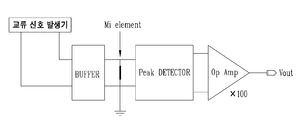
도 8은 본 발명의 자기임피던스 센서(1)를 이용한 경사각 센서에 대한 회로도이다. 고주파 발진기를 통해 교류전압을 인가하고, 완충 증폭기 (Buffer)를 이용하여 임피던스 정합을 구현하였으며, 외부 자장에 대해 변화하는 자기임피던스 소자의 교류전압을 교류-직류 변환기(Peak Detector)를 이용하여 신호처리 하고, 계측 증폭기 (Op Amp)를 통해 증폭하여 아날로그로 출력하게 된다. 도 8의 회로도를 갖는 자기 임피던스 센서를 이용하여 실제 측정한 도 5의 각도변화에 따른 출력전압의 변화그래프에서 보는 바와 같이 -40도에서 40도의 각도 변화구간에서 약 1.5V정도의 출력전압 변화 폭을 갖고 있어 경사각 센서로의 응용에 유용하게 쓰일 수 있다. 8 is a circuit diagram of an inclination angle sensor using the
이하, 본 발명의 제1 내지 제3실시예에 따르는 자기임피던스 센서의 제조방법에 대하여 도9 내지 도11을 참조하여 설명한다. 이하의 설명 중에서 생략되거나 요약된 부분은 상술한 자기임피던스 센서에 대한 설명에 따르도록 한다.Hereinafter, a method of manufacturing a magnetic impedance sensor according to the first to third embodiments of the present invention will be described with reference to FIGS. 9 to 11. Parts omitted or summarized in the following description should follow the description of the above-described magnetic impedance sensor.
먼저, 도9를 참조하여 본 발명의 제1실시예에 따르는 자기임피던스 센서의 제조방법에 대하여 설명하도록 한다. First, a method of manufacturing a magnetic impedance sensor according to a first embodiment of the present invention will be described with reference to FIG. 9.
기판 상에 스퍼터링(sputtering) 방법 또는 진공증착(EVAPORATION) 방법으로 수 십 나노미터(nanometer) 두께의 금속층을 먼저 형성한다(S10). 여기서, 금속층은 결정질 자성 와이어 패턴의 형성시 기판과 결정질 자성 와이어 패턴 사이에 계면접착력을 증가시키기 위한 층으로, 티타늄과 같은 도전성 금속으로 이루어져 있다. 본 발명에서 금속층을 먼저 형성하는 이유는 다음과 같다. 본 발명에 따르는 결정질 자성 와이어 패턴은 전기도금법에 의하여 형성되는데, 전기도금법을 행하기 위하여는 도금하려는 면이 전도성 재료로 이루어져야 한다. 그러나, 기판은 반도체 재료, 절연성 재료 등으로 이루어져 있기 때문에 전기도금법을 행할 수 없다. 이에 따라, 기판 상에 결정질 자성 와이어 패턴과 동일한 재료로 이루어진 시드층(seed layer)을 먼저 형성할 필요가 있다. 이러한 시드층은 스퍼터링(sputtering) 등의 방법으로 형성되는데, 시드층의 형성시 기판과의 사이에서 계면접착력이 좋지 않으면 시드층의 특성이 좋지 않아 전기도금시 결정질 자성 와이어 패턴이 잘 형성되지 않거나 형성된 후 박리될 수 있다. 본 발명에서는 이러한 문제점을 해소하기 위하여 금속층을 먼저 형성하는 것이다.A metal layer having a thickness of several tens of nanometers (nanometer) is first formed on the substrate by a sputtering method or an evaporation method (S10). Here, the metal layer is a layer for increasing the interfacial adhesion between the substrate and the crystalline magnetic wire pattern when forming the crystalline magnetic wire pattern, it is made of a conductive metal such as titanium. The reason for forming the metal layer in the present invention is as follows. The crystalline magnetic wire pattern according to the present invention is formed by an electroplating method. In order to perform the electroplating method, the surface to be plated must be made of a conductive material. However, since the substrate is made of a semiconductor material, an insulating material, or the like, the electroplating method cannot be performed. Accordingly, it is necessary to first form a seed layer made of the same material as the crystalline magnetic wire pattern on the substrate. The seed layer is formed by sputtering or the like. If the interfacial adhesion between the substrate and the substrate is poor at the time of forming the seed layer, the seed layer may not have good characteristics, so that the crystalline magnetic wire pattern may not be formed or formed during electroplating. It may then be peeled off. In the present invention, to solve this problem, the metal layer is first formed.
이후, 스퍼터링 방법으로 상기 금속층 상에 차후에 형성될 결정질 연자성 합금박막과 동일한 재료(결정질 연자성 재료)를 이용하여 수 십나노 두께의 시드층(seed layer)을 형성한다(S20). Subsequently, a seed layer having a thickness of several tens of nanometers is formed using the same material (crystalline soft magnetic material) as the crystalline soft magnetic alloy thin film to be formed later on the metal layer by a sputtering method (S20).
이어, 전기도금법을 이용하여 상기 시드층 상에 결정질 연자성 합금박막을 도금한다(S30). 시드층을 포함한 결정질 연자성 합금박막의 두께가 대략 1μm 내지 10 μm가 되도록 결정질 연자성 합금박막을 형성한다. 결정질 연자성 금속박막은 CoFeNi의 조성을 가지며, 더욱 바람직하게는Co31 -35Fe27 -30Ni36 -41의 조성을 가진다. 본 발명에 따르는 결정질 연자성 금속박막의 재료적인 측면에서의 구체적인 특성, 조성 및 제조방법 등은 본 발명의 출원인이 한국특허청에 선출원하여 등록 받은 한국등록특허 제0640221호에 따른다. 이러한 결정질 연자성 금속박막은 매우 우수한 연 자성 특성(soft magnetic property)을 보여, 자기임피던스 센서로 제작시 감지가능한 자장의 측정범위 및 민감도(sensitivity)가 개선된다. 또한, 본 발명에서는 종래와 달리 전기도금법을 이용하여 결정질 연자성 합금박막을 제조하기 때문에 원하는 두께로 결정질 연장성 합금박막을 제조할 수 있다.Subsequently, the crystalline soft magnetic alloy thin film is plated on the seed layer by using an electroplating method (S30). The crystalline soft magnetic alloy thin film is formed such that the thickness of the crystalline soft magnetic alloy thin film including the seed layer is approximately 1 μm to 10 μm. The crystalline soft magnetic metal thin film has a composition of CoFeNi, more preferably has a composition of Co 31 -35 Fe 27 -30 Ni 36 -41 . Specific properties, compositions, and manufacturing methods in the material aspect of the crystalline soft magnetic metal thin film according to the present invention are in accordance with Korean Patent No. 0640221 registered and filed by the applicant of the present invention to the Korean Intellectual Property Office. The crystalline soft magnetic metal thin film exhibits very good soft magnetic properties, thereby improving the measurement range and sensitivity of the magnetic field that can be detected when fabricating a magnetic impedance sensor. In addition, in the present invention, since the crystalline soft magnetic alloy thin film is manufactured by using an electroplating method, the crystalline elongated alloy thin film may be manufactured to a desired thickness.
다음, 형성된 결정질 연자성 합금박막을 긴 막대형상으로 패터닝하여 결정질 자성 와이어 패턴(20, 도1참조)을 형성한다(S40). 여기서, 패터닝 기술은 포토리소그래피 공정(photolithography process)을 이용한다. 구체적으로, 결정질 연자성 합금박막 상에 감광막(photoresist)를 도포한다. 도포방법은 스핀코팅 등을 이용할 수 있다. 여기서, 감광막은 포지티브형이거나 네거티브형 일 수 있다. 그 후, 감광막을 원하는 형상으로 패터닝하기 위하여 일정한 형상의 개구부를 갖는 마스크를 이용하여 감광막을 노광한 후, 감광막을 현상하여 형성하고자 하는 결정질 자성 와이어 패턴에 대응하는 위치의 감광막만을 남기고 나머지의 감광막은 제거한다. 그 후, 습식식각하여 감광막에 의하여 덮여있지 않은 결정질 연자성 합금박막을 제거하여 결정질 자성 와이어 패턴을 형성한다. 그 후, 아세톤 등을 이용하여 잔존하는 감광막을 제거한다. 여기서, 포토리소그래피 고정으로 결정질 연자성 합금박막을 패터닝 하기 때문에 원하는 폭(w)으로 결정질 자성 와이어 패턴을 형성할 수 있다. 본 발명에서는 50 μm 내지 200 μm의 폭을 갖도록 결정질 자성 합금박막을 제조한다.Next, the formed crystalline soft magnetic alloy thin film is patterned into a long rod shape to form a crystalline magnetic wire pattern 20 (see FIG. 1) (S40). Here, the patterning technique uses a photolithography process. Specifically, a photoresist is applied onto the crystalline soft magnetic alloy thin film. The coating method may be spin coating or the like. Here, the photoresist may be positive or negative. Subsequently, in order to pattern the photoresist film into a desired shape, the photoresist film is exposed using a mask having a predetermined opening, and then the photoresist film is developed to leave only the photoresist film at a position corresponding to the crystalline magnetic wire pattern to be formed. Remove Thereafter, by wet etching, the crystalline soft magnetic alloy thin film not covered by the photosensitive film is removed to form a crystalline magnetic wire pattern. Thereafter, the remaining photosensitive film is removed using acetone or the like. Here, since the crystalline soft magnetic alloy thin film is patterned by photolithography fixing, a crystalline magnetic wire pattern can be formed with a desired width w. In the present invention, a crystalline magnetic alloy thin film is manufactured to have a width of 50 μm to 200 μm.
그 후, 스퍼터링 방법을 이용하여 상기 결정질 자성 와이어 패턴의 양단에 연결되는 제1 및 제2입력전극과, 상기 제1입력전극과 상기 제2입력전극 사이에서 상기 결정질 자성 와이어 패턴에 연결되는 제1 및 제2출력전극을 형성한다(S50). 제1 및 제2입력전극은 결정질 자성 와이어 패턴의 일측에 형성되고, 제1 및 제2출력전극은 결정질 자성 와이어 패턴의 타측에 형성된다. 여기서, 제1 및 제2입력전극과 제1 및 제2출력전극은 전기전도성이 좋은 금, 은, 구리와 같은 재질을 포함할 수 있다. 본 발며에서는 제1출력전극과 제2출력전극 사이의 거리가 2mm 내지 10mm이 되도록 형성한다.Thereafter, a first and second input electrodes connected to both ends of the crystalline magnetic wire pattern using a sputtering method, and a first connected to the crystalline magnetic wire pattern between the first input electrode and the second input electrode. And a second output electrode (S50). The first and second input electrodes are formed on one side of the crystalline magnetic wire pattern, and the first and second output electrodes are formed on the other side of the crystalline magnetic wire pattern. Here, the first and second input electrodes and the first and second output electrodes may include materials such as gold, silver, and copper having good electrical conductivity. In the present invention, the distance between the first output electrode and the second output electrode is formed to be 2 mm to 10 mm.
다음, 형성된 결정질 자성 와이어 패턴에 대하여 일정한 각도로 기울어져 상기 결정질 자성 와이어 패턴에 인접하여 배치되도록 영구자석을 설치한다(S60). 영구자석은 결정질 자성 와이어 패턴에 대하여 15°내지 75°의 예각을 이루도록 배치된다. 바람직하게는 45°를 이루도록 배치된다. 영구자석은 결정질 자성 와이어 패턴에 바이어스 자기장을 인가하여 결정질 자성 와이어 패턴의 출력이 바이어스 자기장에 따라 선형적으로 변화하는 영역으로 동작점을 이동시켜 준다(원점 보정). 본 발명에서는 결정질 자성 와이어 패턴에 대하여 일정한 각도로 영구자석을 기울여 외부 바이어스 자기장을 제어함으로써 회로상에 별도의 원점 보정용 바이어스 코일이 없어도 원점 보정이 가능하다.Next, the permanent magnet is installed so as to be inclined at a predetermined angle with respect to the formed crystalline magnetic wire pattern and disposed adjacent to the crystalline magnetic wire pattern (S60). The permanent magnets are arranged to form an acute angle of 15 ° to 75 ° with respect to the crystalline magnetic wire pattern. It is preferably arranged to achieve 45 °. The permanent magnet applies a bias magnetic field to the crystalline magnetic wire pattern to move the operating point to an area where the output of the crystalline magnetic wire pattern changes linearly with the bias magnetic field (origin correction). In the present invention, by controlling the external bias magnetic field by tilting the permanent magnet at a predetermined angle with respect to the crystalline magnetic wire pattern, the home position correction can be performed even if there is no separate home correction bias coil on the circuit.
이하, 도10을 참조하여 본 발명의 제2실시예에 따르는 자기임피던스 센서의 제조방법에 대하여 설명하도록 한다. 제2실시예의 제조방법에 대한 설명에서는 제1실시예에 따르는 제조방법과 구별되는 부분을 중심으로 설명하도록 하며, 설명이 생략되거나 요약된 부분은 제1실시예에 따르는 제조방법에 대한 설명에 따른다.Hereinafter, a method of manufacturing the magnetic impedance sensor according to the second embodiment of the present invention will be described with reference to FIG. 10. In the description of the manufacturing method of the second embodiment will be described centering on the parts that are distinct from the manufacturing method according to the first embodiment, the description is omitted or summarized according to the description of the manufacturing method according to the first embodiment. .
먼저, 도10에 도시된 바와 같이, 기판 상에 금속층을 형성한다(S100).First, as shown in FIG. 10, a metal layer is formed on a substrate (S100).
이후, 스퍼터링 방법으로 금속층 상에 시드층을 형성한다(S200).Thereafter, a seed layer is formed on the metal layer by a sputtering method (S200).
다음, 전기도금법으로 시드층 상에 결정질 연자성 합금박막을 형성한다(S200).Next, a crystalline soft magnetic alloy thin film is formed on the seed layer by electroplating (S200).
그 후, 포토리소그래피 공정을 이용하여 결정질 자성 와이어 패턴, 제1입력전극, 제2입력전극, 제1출력전극 및 제2출력전극을 동시에 형성한다(S400). 즉, 제1실시예와 달리, 제1입력전극, 제2입력전극, 제1출력전극 및 제2출력전극은 전기도금법에 의하여 형성되며, CoFeNi 조성의 결정질 연자성 물질로 이루어질 수 있다. 그리고, 제2실시예에서는 결정질 자성 와이어 패턴과 제1입력전극, 제2입력전극, 제1출력전극 및 제2출력전극을 동시에 형성하기 때문에, 완성된 자기임피던스 센서의 단면은 제1실시예와 달리 제1입력전극(30a)과 기판(10) 사이, 제2입력전극(30b)과 기판(10) 사이, 제1출력전극(40a)과 기판(10) 사이 및 제2출력전극(40a, 40b)과 기판(10) 사이에 금속층과 시드층을 더 형성되어 있다.Thereafter, a crystalline magnetic wire pattern, a first input electrode, a second input electrode, a first output electrode, and a second output electrode are simultaneously formed using a photolithography process (S400). That is, unlike the first embodiment, the first input electrode, the second input electrode, the first output electrode and the second output electrode are formed by an electroplating method, and may be made of a crystalline soft magnetic material of CoFeNi composition. In the second embodiment, since the crystalline magnetic wire pattern and the first input electrode, the second input electrode, the first output electrode, and the second output electrode are simultaneously formed, the cross section of the completed magnetic impedance sensor is different from that of the first embodiment. Alternatively, between the
제2실시예에 따르는 방법은 제1입력전극, 제2입력전극, 제1출력전극 및 제2출력전극을 형성하기 위한 별도의 스퍼터링 공정이 불필요하여 공정수 절감 및 비용 절감의 장점이 있다.The method according to the second embodiment does not need a separate sputtering process for forming the first input electrode, the second input electrode, the first output electrode, and the second output electrode, thereby reducing the number of processes and the cost.
마지막으로, 형성된 결정질 자성 와이어 패턴에 대하여 일정한 각도로 기울어져 상기 결정질 자성 와이어 패턴에 인접하여 배치되도록 영구자석을 설치한다(S500).Finally, the permanent magnet is installed to be inclined at a predetermined angle with respect to the formed crystalline magnetic wire pattern and disposed adjacent to the crystalline magnetic wire pattern (S500).
이에 의하여, 제2실시예에 따르는 자기임피던스 센서가 완성된다.As a result, the magnetic impedance sensor according to the second embodiment is completed.
이하, 도11을 참조하여 본 발명의 제3실시예에 따르는 자기임피던스 센서의 제조방법에 대하여 설명하도록 한다. 제3실시예의 제조방법에 대한 설명에서는 제1실시예에 따르는 제조방법과 구별되는 부분을 중심으로 설명하도록 하며, 설명이 생략되거나 요약된 부분은 제1실시예에 따르는 제조방법에 대한 설명에 따른다.Hereinafter, a method of manufacturing a magnetic impedance sensor according to a third embodiment of the present invention will be described with reference to FIG. 11. In the description of the manufacturing method of the third embodiment, description will be made mainly on the parts that are distinguished from the manufacturing method according to the first embodiment, and the descriptions thereof will be omitted or summarized according to the description of the manufacturing method according to the first embodiment. .
먼저, 결정질 자성 와이어 패턴, 제1입력전극, 제2입력전극, 제1출력전극 및 제2출력전극에 대응하는 형상을 갖는 금속기판을 마련한다(S1000). 금속기판을 원하는 형상으로 마련하는 기술은 공지의 방법에 따른다.First, a metal substrate having a shape corresponding to a crystalline magnetic wire pattern, a first input electrode, a second input electrode, a first output electrode, and a second output electrode is prepared (S1000). Techniques for providing a metal substrate in a desired shape follow a known method.
다음, 전기도금법을 이용하여 상기 금속기판 상에 결정질 연자성 합금박막을 전기도금하여 일체로 마련된 결정질 자성 와이어 패턴, 제1 입력전극, 제2입력전극, 제1출력전극 및 제2출력전극을 형성한다(S2000).Next, an crystalline magnetic wire pattern, a first input electrode, a second input electrode, a first output electrode, and a second output electrode are integrally formed by electroplating a crystalline soft magnetic alloy thin film on the metal substrate using an electroplating method. (S2000).
이 후, 형성된 결정질 자성 와이어 패턴, 제1입력전극, 제2입력전극, 제1출력전극 및 제2출력전극의 상부 표면에 접착제를 도포한다(S3000). 여기서, 접착제는 후술하는 공정을 용이하게 하기 위하여 자성 와이어 패턴, 제1입력전극, 제2입력전극, 제1출력전극 및 제2출력전극과 금속기판 사이의 접합력보다 더 큰 접합력을 갖는 것이 바람직하다. 그리고, 접착제의 도포는 코팅 등의 여러 가지 방법이 적용될 수 있다. 다른 방법으로, 자성 와이어 패턴, 제1입력전극, 제2입력전극, 제1출력전극 및 제2출력전극이 형성된 금속기판을 접착제가 채워져 있는 용기 속에 담그고, 상기 용기에 자기장 등을 가하면 접착제가 자성 와이어 패턴, 제1입력전극, 제2입력전극, 제1출력전극 및 제2출력전극의 표면에 부착된다. 잡착제가 자성 와이어 패턴, 제1입력전극, 제2입력전극, 제1출력전극 및 제2출력전극의 표면에 도포되면, 금속기판을 빼내어 일정시간 건조하여 사용할 수도 있다.Thereafter, an adhesive is applied to the upper surfaces of the formed crystalline magnetic wire pattern, the first input electrode, the second input electrode, the first output electrode, and the second output electrode (S3000). Here, it is preferable that the adhesive has a larger bonding force than the bonding force between the magnetic wire pattern, the first input electrode, the second input electrode, the first output electrode, and the second output electrode and the metal substrate in order to facilitate the process described later. . In addition, various methods such as coating may be applied to the adhesive. Alternatively, the metal substrate on which the magnetic wire pattern, the first input electrode, the second input electrode, the first output electrode, and the second output electrode are formed is immersed in a container filled with adhesive, and when the magnetic field is applied to the container, the adhesive becomes magnetic. It is attached to the surface of the wire pattern, the first input electrode, the second input electrode, the first output electrode and the second output electrode. When the adhesive is applied to the surface of the magnetic wire pattern, the first input electrode, the second input electrode, the first output electrode and the second output electrode, the metal substrate may be removed and dried for a predetermined time.
이어, 접착제가 도포된 결정질 자성 와이어 패턴, 제1입력전극, 제2입력전극, 제1출력전극 및 제2출력전극을 기판에 부착한다(S4000). 여기서, 기판은 제1 및 제2실시예에서 언급한 절연성 또는 반도체성 재료로 만들어진 기판이다.Subsequently, the crystalline magnetic wire pattern, the first input electrode, the second input electrode, the first output electrode, and the second output electrode coated with the adhesive are attached to the substrate (S4000). Here, the substrate is a substrate made of the insulating or semiconducting material mentioned in the first and second embodiments.
다음, 금속기판을 제거한다(S5000). 금소기판을 제거하는 방법으로는 단지 금속기판에 힘을 가하여 이격시킬 수 있다. 이는 접착제의 접착력이 자성 와이어 패턴, 제1입력전극, 제2입력전극, 제1출력전극 및 제2출력전극과 금속기판 사이의 접합력보다 더 크기 때문에 가능하다. 다른 방법으로는, 접착된 요소들을 특수한 용액(접착력이 자성 와이어 패턴, 제1입력전극, 제2입력전극, 제1출력전극 및 제2출력전극과 금속기판 사이의 접합력을 감소킬 수 있는 용액)에 첨가한 후, 금속기판을 분리함으로써 수행될 수 있다. 이에 따라, 일체로 마련된 자성 와이어 패턴, 제1입력전극, 제2입력전극, 제1출력전극 및 제2출력전극은 기판으로 옮겨진다.Next, the metal substrate is removed (S5000). As a method of removing the gold substrate, it can be separated only by applying force to the metal substrate. This is possible because the adhesive force of the adhesive is greater than the bonding force between the magnetic wire pattern, the first input electrode, the second input electrode, the first output electrode and the second output electrode and the metal substrate. Alternatively, the bonded elements may be a special solution (a solution in which the adhesion force may reduce the bonding force between the magnetic wire pattern, the first input electrode, the second input electrode, the first output electrode and the second output electrode and the metal substrate). After addition to, it can be carried out by separating the metal substrate. Accordingly, the magnetic wire pattern, the first input electrode, the second input electrode, the first output electrode, and the second output electrode, which are integrally provided, are transferred to the substrate.
마지막으로, 형성된 결정질 자성 와이어 패턴에 대하여 일정한 각도로 기울어져 상기 결정질 자성 와이어 패턴에 인접하여 배치되도록 영구자석을 설치한다(S6000). Finally, the permanent magnet is installed to be inclined at a predetermined angle with respect to the formed crystalline magnetic wire pattern and disposed adjacent to the crystalline magnetic wire pattern (S6000).
이에 의하여, 제3실시예에 따르는 자기임피던스 센서가 완성된다.Thereby, the magnetic impedance sensor according to the third embodiment is completed.
도1은 본 발명의 제1실시예에 따르는 자기임피던스 센서의 사시도이다.1 is a perspective view of a magnetic impedance sensor according to a first embodiment of the present invention.
도2는 도1의 Ⅱ-Ⅱ'따르는 단면도이다.FIG. 2 is a cross-sectional view taken along line II-II 'of FIG. 1.
도3a는 본 발명에 따르는 자기임피던스 센서의 결정질 자성 와이어 패턴의 폭 및 두께를 변화시켜 측정한 출력값의 그래프이다.Figure 3a is a graph of the output value measured by varying the width and thickness of the crystalline magnetic wire pattern of the magnetic impedance sensor according to the present invention.
도3b는 도3a의 "A"부분의 확대도이다.FIG. 3B is an enlarged view of portion “A” of FIG. 3A.
도4는 도3b의 그래프를 영구자석을 이용하여 원점 보정한 그래프이다.FIG. 4 is a graph of zero point correction using the permanent magnet of the graph of FIG. 3B.
도5는 본 발명에 따라 최적화된 자기임피던스 센서의 실제 출력값을 나타내는 그래프이다.5 is a graph showing the actual output value of the magnetic impedance sensor optimized according to the present invention.
도6a는 제2실시예에 따르는 자기임피던스 센서의 요부 사시도이다.6A is a perspective view of principal parts of a magnetic impedance sensor according to the second embodiment.
도6b는 도6a의 Ⅵb-Ⅵb'따르는 단면도이다.FIG. 6B is a cross-sectional view taken along the line VIb-VIb 'of FIG. 6a.
도7은 본 발명의 제3실시예에 따르는 자기 임피던스 센서의 요부 단면도이다.7 is a sectional view of principal parts of a magnetic impedance sensor according to a third embodiment of the present invention.
도8은 본 발명에 따르는 자기임피던스 센서를 포함하는 경사각 센서의 회로도이다.8 is a circuit diagram of an inclination angle sensor including a magnetic impedance sensor according to the present invention.
도9는 본 발명의 제1실시예에 따르는 자기임피던스 센서의 제조방법을 설명하는 흐름도이다.9 is a flowchart illustrating a manufacturing method of the magnetic impedance sensor according to the first embodiment of the present invention.
도10은 본 발명의 제2실시예에 따르는 자기임피던스 센서의 제조방법을 설명하는 흐름도이다.10 is a flowchart for explaining a method of manufacturing a magnetic impedance sensor according to the second embodiment of the present invention.
도11은 본 발명의 제3실시예에 따르는 자기임피던스 센서의 제조방법을 설명 하는 흐름도이다.11 is a flowchart illustrating a method of manufacturing a magnetic impedance sensor according to a third embodiment of the present invention.
* 도면의 주요 부분에 대한 부호의 설명 * Explanation of symbols for the main parts of the drawings
1 : 자기임피던스 센서 10 : 기판1: magnetic impedance sensor 10: substrate
15 : 금속층 18 : 시드층15: metal layer 18: seed layer
20 : 결정질 자성 와이어 패턴 30a : 제1입력전극20: crystalline
30b : 제2입력전극 40a : 제1출력전극30b:
40b : 제2출력전극 50 : 영구자석40b: second output electrode 50: permanent magnet
60 : 접착제60: adhesive
Claims (19)
Priority Applications (1)
| Application Number | Priority Date | Filing Date | Title |
|---|---|---|---|
| KR1020080003644A KR100968143B1 (en) | 2008-01-11 | 2008-01-11 | Magnetic impedance sensor and its manufacturing method |
Applications Claiming Priority (1)
| Application Number | Priority Date | Filing Date | Title |
|---|---|---|---|
| KR1020080003644A KR100968143B1 (en) | 2008-01-11 | 2008-01-11 | Magnetic impedance sensor and its manufacturing method |
Publications (2)
| Publication Number | Publication Date |
|---|---|
| KR20090077607A true KR20090077607A (en) | 2009-07-15 |
| KR100968143B1 KR100968143B1 (en) | 2010-07-06 |
Family
ID=41336082
Family Applications (1)
| Application Number | Title | Priority Date | Filing Date |
|---|---|---|---|
| KR1020080003644A Expired - Fee Related KR100968143B1 (en) | 2008-01-11 | 2008-01-11 | Magnetic impedance sensor and its manufacturing method |
Country Status (1)
| Country | Link |
|---|---|
| KR (1) | KR100968143B1 (en) |
Cited By (4)
| Publication number | Priority date | Publication date | Assignee | Title |
|---|---|---|---|---|
| WO2011103406A3 (en) * | 2010-02-18 | 2011-12-15 | University Of Delaware | Electromagnetic wave detection systems and methods |
| US8476900B2 (en) | 2009-05-14 | 2013-07-02 | University Of Delaware | Electromagnetic detection apparatus and methods |
| US8941379B2 (en) | 2009-05-14 | 2015-01-27 | University Of Delaware | Electromagnetic wave detection systems and methods |
| US20240219487A1 (en) * | 2022-12-31 | 2024-07-04 | Melexis Technologies Sa | Sensor device with circuit and integrated component for magneto-impedance measurement, and method of producing same |
Family Cites Families (4)
| Publication number | Priority date | Publication date | Assignee | Title |
|---|---|---|---|---|
| CN100356605C (en) * | 2001-07-19 | 2007-12-19 | 松下电器产业株式会社 | Magnetic sensor and method for manufacturing the same |
| KR100590211B1 (en) * | 2002-11-21 | 2006-06-15 | 가부시키가이샤 덴소 | Magnetic impedance device, sensor apparatus using the same and method for manufacturing the same |
| KR100485591B1 (en) * | 2003-01-29 | 2005-05-04 | (주) 아모센스 | Compact Micro Magnetic Field Detecting Sensor Using Magneto Impedance Effects and Method for Making the Same |
| KR100649781B1 (en) * | 2004-06-25 | 2006-11-24 | (주) 아모센스 | 3-axis magnetic sensor using AC magnetoresistance sensor and omnidirectional magnetic sensor |
-
2008
- 2008-01-11 KR KR1020080003644A patent/KR100968143B1/en not_active Expired - Fee Related
Cited By (4)
| Publication number | Priority date | Publication date | Assignee | Title |
|---|---|---|---|---|
| US8476900B2 (en) | 2009-05-14 | 2013-07-02 | University Of Delaware | Electromagnetic detection apparatus and methods |
| US8941379B2 (en) | 2009-05-14 | 2015-01-27 | University Of Delaware | Electromagnetic wave detection systems and methods |
| WO2011103406A3 (en) * | 2010-02-18 | 2011-12-15 | University Of Delaware | Electromagnetic wave detection systems and methods |
| US20240219487A1 (en) * | 2022-12-31 | 2024-07-04 | Melexis Technologies Sa | Sensor device with circuit and integrated component for magneto-impedance measurement, and method of producing same |
Also Published As
| Publication number | Publication date |
|---|---|
| KR100968143B1 (en) | 2010-07-06 |
Similar Documents
| Publication | Publication Date | Title |
|---|---|---|
| JP6302613B1 (en) | Manufacturing method of nano coil type GSR sensor element | |
| KR101267246B1 (en) | Flux gate senior and electronic azimuth indicator making use thereof | |
| CN102334040B (en) | Magneto-impedance sensor element and method for manufacturing same | |
| KR100968143B1 (en) | Magnetic impedance sensor and its manufacturing method | |
| JP7207671B2 (en) | Magnetic sensor utilizing anomalous Hall effect, Hall sensor, and method for manufacturing Hall sensor | |
| JP2014512003A (en) | Single-chip push-pull bridge type magnetic field sensor | |
| US20040150397A1 (en) | Magnetic sensor and method for manufacturing the same | |
| US20100090692A1 (en) | Magnetic sensor module and piston position detector | |
| JP6132085B2 (en) | Magnetic detector | |
| US20130038421A1 (en) | Magnetic detector and method for manufacturing the same | |
| RU2656237C2 (en) | Magnetic current sensor with a film concentrator | |
| CN1940586A (en) | Magnetic field detector and manufacturing method thereof | |
| JP2000284030A (en) | Magnetic sensor element | |
| CN101976723B (en) | Manufacture method of current isolator | |
| JP2001004726A (en) | Magnetic field sensor | |
| KR101083068B1 (en) | Ring type flat hall resistance sensor | |
| CN1245608C (en) | Magnetic encoder with magnetic tunnel junction and magnetosensitive resistance chip | |
| AU6060599A (en) | Magnetoresistive devices, giant magnetoresistive devices and methods for making same | |
| RU2636141C1 (en) | Film system for forming magnetic field | |
| US11333723B2 (en) | Magnetic sensor | |
| JP5620075B2 (en) | Magnetic field sensor and magnetic field measurement method using the same | |
| JP2012198038A (en) | Magnetic substance member and manufacturing method thereof | |
| TW434598B (en) | Enhancement Hall sensor | |
| KR100462792B1 (en) | The fabrication method of magnetic sensor using exchange-biased spin valves | |
| KR100479445B1 (en) | The fabrication method of the full bridge type magnetic sensor using exchange biased spin valves |
Legal Events
| Date | Code | Title | Description |
|---|---|---|---|
| A201 | Request for examination | ||
| PA0109 | Patent application |
St.27 status event code: A-0-1-A10-A12-nap-PA0109 |
|
| PA0201 | Request for examination |
St.27 status event code: A-1-2-D10-D11-exm-PA0201 |
|
| D13-X000 | Search requested |
St.27 status event code: A-1-2-D10-D13-srh-X000 |
|
| D14-X000 | Search report completed |
St.27 status event code: A-1-2-D10-D14-srh-X000 |
|
| PG1501 | Laying open of application |
St.27 status event code: A-1-1-Q10-Q12-nap-PG1501 |
|
| E902 | Notification of reason for refusal | ||
| PE0902 | Notice of grounds for rejection |
St.27 status event code: A-1-2-D10-D21-exm-PE0902 |
|
| R18-X000 | Changes to party contact information recorded |
St.27 status event code: A-3-3-R10-R18-oth-X000 |
|
| T11-X000 | Administrative time limit extension requested |
St.27 status event code: U-3-3-T10-T11-oth-X000 |
|
| E13-X000 | Pre-grant limitation requested |
St.27 status event code: A-2-3-E10-E13-lim-X000 |
|
| P11-X000 | Amendment of application requested |
St.27 status event code: A-2-2-P10-P11-nap-X000 |
|
| P13-X000 | Application amended |
St.27 status event code: A-2-2-P10-P13-nap-X000 |
|
| E701 | Decision to grant or registration of patent right | ||
| PE0701 | Decision of registration |
St.27 status event code: A-1-2-D10-D22-exm-PE0701 |
|
| GRNT | Written decision to grant | ||
| PR0701 | Registration of establishment |
St.27 status event code: A-2-4-F10-F11-exm-PR0701 |
|
| PR1002 | Payment of registration fee |
St.27 status event code: A-2-2-U10-U11-oth-PR1002 Fee payment year number: 1 |
|
| PG1601 | Publication of registration |
St.27 status event code: A-4-4-Q10-Q13-nap-PG1601 |
|
| FPAY | Annual fee payment |
Payment date: 20130531 Year of fee payment: 4 |
|
| PR1001 | Payment of annual fee |
St.27 status event code: A-4-4-U10-U11-oth-PR1001 Fee payment year number: 4 |
|
| PN2301 | Change of applicant |
St.27 status event code: A-5-5-R10-R13-asn-PN2301 St.27 status event code: A-5-5-R10-R11-asn-PN2301 |
|
| FPAY | Annual fee payment |
Payment date: 20140528 Year of fee payment: 5 |
|
| PR1001 | Payment of annual fee |
St.27 status event code: A-4-4-U10-U11-oth-PR1001 Fee payment year number: 5 |
|
| FPAY | Annual fee payment |
Payment date: 20150529 Year of fee payment: 6 |
|
| PR1001 | Payment of annual fee |
St.27 status event code: A-4-4-U10-U11-oth-PR1001 Fee payment year number: 6 |
|
| FPAY | Annual fee payment |
Payment date: 20160601 Year of fee payment: 7 |
|
| PR1001 | Payment of annual fee |
St.27 status event code: A-4-4-U10-U11-oth-PR1001 Fee payment year number: 7 |
|
| FPAY | Annual fee payment |
Payment date: 20170601 Year of fee payment: 8 |
|
| PR1001 | Payment of annual fee |
St.27 status event code: A-4-4-U10-U11-oth-PR1001 Fee payment year number: 8 |
|
| FPAY | Annual fee payment |
Payment date: 20180409 Year of fee payment: 9 |
|
| PR1001 | Payment of annual fee |
St.27 status event code: A-4-4-U10-U11-oth-PR1001 Fee payment year number: 9 |
|
| P22-X000 | Classification modified |
St.27 status event code: A-4-4-P10-P22-nap-X000 |
|
| PR1001 | Payment of annual fee |
St.27 status event code: A-4-4-U10-U11-oth-PR1001 Fee payment year number: 10 |
|
| PR1001 | Payment of annual fee |
St.27 status event code: A-4-4-U10-U11-oth-PR1001 Fee payment year number: 11 |
|
| PN2301 | Change of applicant |
St.27 status event code: A-5-5-R10-R11-asn-PN2301 |
|
| P14-X000 | Amendment of ip right document requested |
St.27 status event code: A-5-5-P10-P14-nap-X000 |
|
| P16-X000 | Ip right document amended |
St.27 status event code: A-5-5-P10-P16-nap-X000 |
|
| PN2301 | Change of applicant |
St.27 status event code: A-5-5-R10-R14-asn-PN2301 |
|
| Q16-X000 | A copy of ip right certificate issued |
St.27 status event code: A-4-4-Q10-Q16-nap-X000 |
|
| PR1001 | Payment of annual fee |
St.27 status event code: A-4-4-U10-U11-oth-PR1001 Fee payment year number: 12 |
|
| PR1001 | Payment of annual fee |
St.27 status event code: A-4-4-U10-U11-oth-PR1001 Fee payment year number: 13 |
|
| PC1903 | Unpaid annual fee |
St.27 status event code: A-4-4-U10-U13-oth-PC1903 Not in force date: 20230630 Payment event data comment text: Termination Category : DEFAULT_OF_REGISTRATION_FEE |
|
| PN2301 | Change of applicant |
St.27 status event code: A-5-5-R10-R13-asn-PN2301 St.27 status event code: A-5-5-R10-R11-asn-PN2301 |
|
| PC1903 | Unpaid annual fee |
St.27 status event code: N-4-6-H10-H13-oth-PC1903 Ip right cessation event data comment text: Termination Category : DEFAULT_OF_REGISTRATION_FEE Not in force date: 20230630 |
|
| P22-X000 | Classification modified |
St.27 status event code: A-4-4-P10-P22-nap-X000 |