KR20100000065A - Polycarbosilane and method of producing it - Google Patents
Polycarbosilane and method of producing it Download PDFInfo
- Publication number
- KR20100000065A KR20100000065A KR1020080059412A KR20080059412A KR20100000065A KR 20100000065 A KR20100000065 A KR 20100000065A KR 1020080059412 A KR1020080059412 A KR 1020080059412A KR 20080059412 A KR20080059412 A KR 20080059412A KR 20100000065 A KR20100000065 A KR 20100000065A
- Authority
- KR
- South Korea
- Prior art keywords
- monomer
- polycarbosilane
- formula
- structural unit
- polyallylphenylsilane
- Prior art date
- Legal status (The legal status is an assumption and is not a legal conclusion. Google has not performed a legal analysis and makes no representation as to the accuracy of the status listed.)
- Granted
Links
Images


Classifications
-
- C—CHEMISTRY; METALLURGY
- C08—ORGANIC MACROMOLECULAR COMPOUNDS; THEIR PREPARATION OR CHEMICAL WORKING-UP; COMPOSITIONS BASED THEREON
- C08G—MACROMOLECULAR COMPOUNDS OBTAINED OTHERWISE THAN BY REACTIONS ONLY INVOLVING UNSATURATED CARBON-TO-CARBON BONDS
- C08G77/00—Macromolecular compounds obtained by reactions forming a linkage containing silicon with or without sulfur, nitrogen, oxygen or carbon in the main chain of the macromolecule
- C08G77/60—Macromolecular compounds obtained by reactions forming a linkage containing silicon with or without sulfur, nitrogen, oxygen or carbon in the main chain of the macromolecule in which all the silicon atoms are connected by linkages other than oxygen atoms
-
- C—CHEMISTRY; METALLURGY
- C08—ORGANIC MACROMOLECULAR COMPOUNDS; THEIR PREPARATION OR CHEMICAL WORKING-UP; COMPOSITIONS BASED THEREON
- C08G—MACROMOLECULAR COMPOUNDS OBTAINED OTHERWISE THAN BY REACTIONS ONLY INVOLVING UNSATURATED CARBON-TO-CARBON BONDS
- C08G77/00—Macromolecular compounds obtained by reactions forming a linkage containing silicon with or without sulfur, nitrogen, oxygen or carbon in the main chain of the macromolecule
- C08G77/42—Block-or graft-polymers containing polysiloxane sequences
- C08G77/44—Block-or graft-polymers containing polysiloxane sequences containing only polysiloxane sequences
-
- C—CHEMISTRY; METALLURGY
- C08—ORGANIC MACROMOLECULAR COMPOUNDS; THEIR PREPARATION OR CHEMICAL WORKING-UP; COMPOSITIONS BASED THEREON
- C08G—MACROMOLECULAR COMPOUNDS OBTAINED OTHERWISE THAN BY REACTIONS ONLY INVOLVING UNSATURATED CARBON-TO-CARBON BONDS
- C08G77/00—Macromolecular compounds obtained by reactions forming a linkage containing silicon with or without sulfur, nitrogen, oxygen or carbon in the main chain of the macromolecule
- C08G77/04—Polysiloxanes
- C08G77/12—Polysiloxanes containing silicon bound to hydrogen
-
- C—CHEMISTRY; METALLURGY
- C08—ORGANIC MACROMOLECULAR COMPOUNDS; THEIR PREPARATION OR CHEMICAL WORKING-UP; COMPOSITIONS BASED THEREON
- C08G—MACROMOLECULAR COMPOUNDS OBTAINED OTHERWISE THAN BY REACTIONS ONLY INVOLVING UNSATURATED CARBON-TO-CARBON BONDS
- C08G77/00—Macromolecular compounds obtained by reactions forming a linkage containing silicon with or without sulfur, nitrogen, oxygen or carbon in the main chain of the macromolecule
- C08G77/42—Block-or graft-polymers containing polysiloxane sequences
Landscapes
- Chemical & Material Sciences (AREA)
- Health & Medical Sciences (AREA)
- Chemical Kinetics & Catalysis (AREA)
- Medicinal Chemistry (AREA)
- Polymers & Plastics (AREA)
- Organic Chemistry (AREA)
- Silicon Polymers (AREA)
Abstract
본 발명은 폴리카르보실란 및 그 제조 방법에 관한 것으로서, 알릴기를 포함함으로서 공기 중에 노출되지 않은 상태에서 자외선 흡수에 의하여 경화할 수 있는 폴리카르보실란 및 그 제조방법을 제공한다.The present invention relates to a polycarbosilane and a method for producing the same, which includes an allyl group, which can be cured by ultraviolet absorption in a state not exposed to air. Polycarbosilane and a method for producing the same are provided.
Description
본 발명은 폴리카르보실란 및 그 제조 방법에 관한 것이다. The present invention relates to a polycarbosilane and a method for producing the same.
일반적으로 폴리카르보실란(Polycarbosilane ; PCS) 등은 프리 세라믹 전구체로서 주로 내산화성, 내약품성, 내열성을 증진시키기 위한 SiC 코팅, SiC 분말, SiC 복합재료의 전구체, SiC 분말의 소결조제 또는 SiC계 연속 섬유를 제조하기 위한 전구체로 널리 이용되고 있다. Generally, polycarbosilane (PCS) and the like are pre-ceramic precursors, mainly SiC coatings, SiC powders, precursors of SiC composites, sintering aids of SiC powders, or SiC-based continuous fibers to improve oxidation resistance, chemical resistance, and heat resistance. It is widely used as a precursor for preparing a.
폴리카르보실란은 폴리디메틸실란(Polydimethylsilane ; PDMS)을 출발 물질로 하여 약 400℃ 이상의 고온 가압 반응에 의한 야지마(Yajima) 방법(미국 특허 US 4,052,430)이 주로 이용되고 있고, 이후, 다양한 촉매를 사용하여 폴리카르보실란을 제조하는 방법들이 개발되어 왔다. Polycarboxylic silane (Polydimethylsilane; PDMS) as a starting material Yajima (Yajima) method (US Pat. No. 4,052,430) by a high temperature pressurization reaction of about 400 ℃ or more is mainly used, and then using various catalysts Methods of making polycarbosilanes have been developed.
이러한 폴리카보실란은 코팅 후 일반적으로 200oC 이상의 공기 중에서 열경 화를 하기 때문에 고온에서 열처리 후 실리콘카바이드(SiC)로 전환시켰을 때 산소 함유량이 많아져서 최종품질이 나빠지는 문제점을 안고 있다.Since the polycarbosilane is generally thermally cured in air of 200 ° C. or higher after coating, the polycarbosilane has a problem in that the final quality is deteriorated due to the increase in oxygen content when converted to silicon carbide (SiC) after heat treatment at high temperature.
한편, 최종제품의 산소 함유량을 줄이기 위한 방법으로는 전자빔을 쪼여 경화시키는 방법이 사용되고 있으나, 이 경우에는 고가의 전자빔 조사 장치를 보유하는데 드는 비용에 의하여 제조 원가가 상승하는 단점을 안고 있다. On the other hand, as a method for reducing the oxygen content of the final product is used a method of curing the electron beam by splitting, in this case has the disadvantage that the manufacturing cost increases due to the cost of having an expensive electron beam irradiation apparatus.
본 발명은 공기 중에 노출되지 않은 상태에서 자외선 흡수에 의하여 경화할 수 있는 폴리카르보실란 및 그 제조방법을 제공한다. 또, 본 발명은 높은 분자량을 가지면서도, 유기 용매에 양호한 용해성을 가지는 폴리카르보실란을 제공한다. The present invention provides a polycarbosilane that can be cured by ultraviolet absorption in a state of not being exposed to air and a method of manufacturing the same. The present invention also provides a polycarbosilane having a high molecular weight and having good solubility in an organic solvent.
본 발명의 일 구현예에 따른 폴리카르보실란은 알릴기를 포함하는 화학식 1의 구조단위와 페닐기를 포함하는 화학식 2의 구조단위를 포함하고, 겔 투과 크로마토 그래피(GPC; Gel Permeation Chromatography)에 의해 측정되는 폴리스티렌 환산 중량평균 분자량(Mw)이 2,000 내지 6,000인 것이다.Polycarbosilane according to an embodiment of the present invention includes a structural unit of formula (1) including an allyl group and a structural unit of formula (2) including a phenyl group, measured by Gel Permeation Chromatography (GPC) Polystyrene conversion weight average molecular weight (Mw) is 2,000-6,000.
화학식 1

화학식 2Formula 2

본 발명의 폴리카르보실란은 알릴기를 포함함으로서 공기 중에서 열경화 할 필요없이, 질소 등 불활성 가스의 분위기 하에서 경화될 수 있어 경화 후의 산소 함유량이 적은 최종 제품을 생산할 수 있다. The polycarbosilane of the present invention can be cured under an atmosphere of an inert gas such as nitrogen, without the need for thermosetting in air by including an allyl group, thereby producing a final product having a low oxygen content after curing.
특히, 본 발명에 따른 폴리카르보실란은 탄소수 3 내지 10의 알릴기를 포함할 수 있으며, 특히 탄소수 3 내지 5 의 알릴기를 포함하는 것이 자외선 흡수에 의한 경화가 더욱 우수하다. In particular, the polycarbosilane according to the present invention may include an allyl group having 3 to 10 carbon atoms, and particularly including an allyl group having 3 to 5 carbon atoms is more excellent in curing by ultraviolet absorption.
또, 본 발명에 따른 폴리카르보실란은 화학식 1로 표시되는 구조단위와 화학식 2로 표시되는 구조단위가 9 : 1 내지 1 : 9 의 몰비인 것이 자외선 흡수에 의한 경화에 더 유리하다. In addition, the polycarbosilane according to the present invention is more advantageous for curing by UV absorption in that the structural unit represented by the formula (1) and the structural unit represented by the formula (2) have a molar ratio of 9: 1 to 1: 9.
본 발명에 따른 일 구현예로서 화학식 1로 표시되는 구조단위와 화학식 2로 표시되는 구조단위를 포함하는 폴리카르보실란은 헥산, 톨루엔 및 테트라하이드로퓨란 중에서 선택되는 1종 또는 2종 이상의 유기용매에 10 ~ 30 중량% 용해되어 SiC 코팅 등을 위한 전구체로 사용할 수 있다. As an embodiment of the present invention, the polycarbosilane comprising the structural unit represented by the formula (1) and the structural unit represented by the formula (2) is selected from hexane, toluene and tetrahydrofuran in one or two or more organic solvents. ~ 30% by weight can be used as a precursor for SiC coating and the like.
본 발명에 따른 폴리카르보실란의 제조 방법은 다음과 같다.Method for producing a polycarbosilane according to the present invention is as follows.
본 발명에 따른 폴리카르보실란을 제조하기 위하여, 먼저 폴리알릴페닐실란을 합성한다. In order to prepare the polycarbosilane according to the present invention, polyallylphenylsilane is first synthesized.
유기 용매에 금속나트륨을 분산시킨다. 유기 용매는 톨루엔, 자일렌, 테트라하이드로퓨란 등에서 선택된 1종 또는 2종 이상의 혼합물일 수 있다. 금속나트륨은 유기 용매에 분산되기 쉬운 적당한 크기로 잘라 유기 용매에 혼합하여 교반함으로서 유기용매에 분산시킨다.The sodium metal is dispersed in the organic solvent. The organic solvent may be one or a mixture of two or more selected from toluene, xylene, tetrahydrofuran and the like. The sodium metal is cut into a suitable size that is easy to be dispersed in an organic solvent, mixed with the organic solvent and stirred to disperse in the organic solvent.
알릴메틸클로로실란 모노머와 페닐메틸클로로실란 모노머를 미리 혼합하고, 모노머 혼합 용액을 금속나트륨이 분산된 용액에 주입한다. 모노머의 주입시에는 알릴메틸글로로실란 모노머와 페닐메틸클로로실란 모노머를 미리 충분히 교반 혼합하여 주입하는 것이 중요하며, 미리 충분한 혼합없이 두 모노머를 동시 투입 또는 분리 투입을 하는 경우에는 폴리알릴페닐실란으로 합성되지 않을 수 있다. The allylmethylchlorosilane monomer and the phenylmethylchlorosilane monomer are mixed in advance, and the monomer mixed solution is poured into the solution in which the metal sodium is dispersed. When injecting the monomer, it is important to stir and mix the allylmethyl glorosilane monomer and the phenylmethylchlorosilane monomer in advance sufficiently, and in the case of simultaneous or separate addition of both monomers without sufficient mixing in advance, polyallylphenylsilane May not be synthesized.
또, 모노머 혼합 용액의 주입 시, 모노머 혼합 용액을 300ml/hr 이하의 주입속도로 주입하는 것이 바람직하다. 300ml/hr이상으로 하는 것은 주입속도가 너무 빠르면 미반응 모노머의 손실을 가져와 최종 물질의 수율이 떨어질 수 있게 된다. 또, 공정 소요 시간에 따른 생산 효율을 고려하여 모노머 혼합 용액을 50ml/hr 이상의 주입속도로 주입하는 것은 더욱 바람직하다. 특히 바람직하기로는 모노머 혼합 용액을 50~150ml/hr의 주입속도로 주입하는 것이다. 또한 모노머 혼합 용액은 알릴메틸클로로실란 모노머와 페닐메틸클로로실란 모노머가 9 : 1 내지 1 : 9 의 몰비로 혼합되는 것이 바람직하다. In addition, when injecting the monomer mixture solution, it is preferable to inject the monomer mixture solution at an injection rate of 300 ml / hr or less. Setting it to 300 ml / hr or more may result in the loss of unreacted monomer if the injection rate is too fast, resulting in a lower yield of the final material. In addition, it is more preferable to inject the monomer mixture solution at an injection rate of 50 ml / hr or more in consideration of the production efficiency according to the process time required. Especially preferably, the monomer mixed solution is injected at an injection rate of 50 to 150 ml / hr. In the monomer mixed solution, it is preferable that the allylmethylchlorosilane monomer and the phenylmethylchlorosilane monomer are mixed in a molar ratio of 9: 1 to 1: 9.
모노머 및 금속나트륨 혼합 용액을 90 ~ 130℃에서 반응시켜 폴리알릴페닐실란을 중합하고, 중합된 폴리알릴페닐실란의 침전물을 분리한다. 중합된 폴리알릴페닐실란은 보라색 침전으로 형성되며, 반응물을 실온으로 냉각시킨 뒤, 과량의 메탄올로 잔여 금속나트륨을 제거하고, 필터한 후, 증류수와 알코올로 세척하여 백색 분말의 폴리알릴페닐실란을 얻을 수 있다. 얻어진 백색 분말은 진공하에서 건조하여 사용한다. The monomer and the mixed sodium metal solution are reacted at 90 to 130 ° C. to polymerize the polyallylphenylsilane, and the precipitate of the polymerized polyallylphenylsilane is separated. The polymerized polyallylphenylsilane is formed as a purple precipitate, the reaction is cooled to room temperature, excess metal sodium is removed with excess methanol, filtered and washed with distilled water and alcohol to give a white powder of polyallylphenylsilane. You can get it. The obtained white powder is dried under vacuum and used.
다음으로, 폴리알릴페닐실란을 고온에서 '쿠마다 전환 반응'을 실시하여 폴리알릴페닐카르보실란을 제조한다. Next, polyallylphenylsilane is subjected to a 'kumada conversion reaction' at a high temperature to produce polyallylphenylcarbosilane.
침전분리된 폴리알릴페닐실란을 5~30기압, 300 ~ 370℃에서 5 ~ 20시간 1차 전환반응시키고, 5~30기압, 400 ~ 470℃에서 5 ~ 20시간 2차 전환반응시킴으로서 본 발명에 따른 알릴기를 포함하는 화학식 1의 구조단위와 페닐기를 포함하는 화학식 2의 구조단위를 포함하는 폴리카르보실란을 제조할 수 있다.In the present invention, the polyallylphenylsilane precipitated and separated is subjected to the first conversion reaction at 5 to 30 atmospheres at 300 to 370 ° C for 5 to 20 hours, and the second conversion reaction at 5 to 30 atmospheres at 400 to 470 ° C for 5 to 20 hours. Polycarbosilane comprising a structural unit of
이처럼 두 단계 온도에서 반응을 진행시킨 이유는 1차 전환반응 단계인 300~370℃에서는 쿠마다전환 반응이 일어나 실란결합이 카르보실란으로 전환되는 과정인데 폴리알릴페닐실란의 열분석 결과를 보면 폴리알릴페닐실란의 Si-Si 결합 이 350℃ 부근에서 급격하게 분해가 일어나기 시작하여 압력이 증가하게 되는 쿠마다 전환반응이 일어나 폴리알릴페닐카보실란으로 전환된다. 2차 전환 반응인 400 ~ 470℃에서는 전환된 저분자량의 카보실란이 중합되는 과정으로 저 분자량의 카르보실란은 세라믹 수율이 낮기 때문에 중합과정을 통하여 코팅에 적합한 분자량을 갖는 폴리알릴페닐카보실란으로 전환된다. The reason why the reaction was carried out at the two-step temperature is the process of converting the silane bonds to carbosilane by the Kumada conversion reaction in the first conversion reaction step, 300-370 ° C. According to the thermal analysis of polyallylphenylsilane, The Si-Si bond of phenylsilane begins to decompose rapidly at around 350 ° C., resulting in a Kumada conversion reaction which increases the pressure, thereby converting to polyallylphenyl carbosilane. In the
모든 실험은 질소 분위기에서 수행하며 반응하는 동안 내용물을 교반기로 교반 시키면서 반응시킨다. 이 때, 불활성 가스는 질소, 아르곤 및 헬륨 가스 중에서 선택된 1종 또는 2종 이상의 것일 수 있다. All experiments are carried out in a nitrogen atmosphere and the contents are reacted while stirring with a stirrer. At this time, the inert gas may be one or two or more selected from nitrogen, argon and helium gas.
상술한 예시는 본 발명에 따른 폴리카르보실란을 제조할 수 있는 일예로서 권리범위가 여기에 제한되는 것은 아니다.The above-described example is not limited to the scope of rights as an example that can produce a polycarbosilane according to the present invention.
이로써, 본 발명은 자외선에 의하여 경화가 가능하여, 경화 후의 산소 함량이 매우 적고, 헥산 등의 유기용매에 용해가 잘되어 SiC 코팅 등을 위한 전구체로 사용이 가능한 알릴기를 포함하는 폴리카르보실란 및 이의 제조 방법을 제공하였다. Accordingly, the present invention is a polycarbosilane comprising an allyl group which can be cured by ultraviolet light, has a very low oxygen content after curing, is well soluble in an organic solvent such as hexane, and can be used as a precursor for SiC coating and the like. A method of preparation was provided.
이하, 본 발명의 실시예에 대하여 설명하며, 본 발명의 실시예에 있어서, 분자량, FT-IR(Furier Transform Infrared Spectroscopy), XRD(X-ray diffraction)는 하기의 방법에 의하여 측정하였다.Hereinafter, Examples of the present invention will be described. In Examples of the present invention, the molecular weight, FT-IR (Furier Transform Infrared Spectroscopy), and XRD (X-ray diffraction) were measured by the following method.
<분자량><Molecular weight>
겔 투과 크로마토 그래피(GPC; Gel Permeation Chromatography)에 의해 측정되는 폴리스티렌 환산 수평균 분자량(Mn), 중량평균 분자량(Mw), 분자량 분포(Mw/Mn)를 측정하였다. Polystyrene reduced number average molecular weight (Mn), weight average molecular weight (Mw), and molecular weight distribution (Mw / Mn) were measured by gel permeation chromatography (GPC; Gel Permeation Chromatography).
기기; Waters사 GPC device; Waters GPC
시료 준비 방법 ; 최종 중합반응 후의 중합체 1mg을 THF(Tetra hydrofuran) 1ml에 녹여, 100㎕를 주입한다.Sample preparation method; 1 mg of the polymer after the final polymerization was dissolved in 1 ml of THF (Tetra hydrofuran), and 100 µl was injected.
용매; THF를 1ml/min의 속도로 주입하면서 측정한다.menstruum; THF is measured while injecting at a rate of 1 ml / min.
기타 주위 조건 ; GPC 칼럼은 Zorbax mixed-b 칼럼 두 개를 연결하여 40℃에서 사용하였다. Other ambient conditions; The GPC column was used at 40 ° C. by connecting two Zorbax mixed-b columns.
검출방법 ; 굴절율 측정기(RI)로 검출하였다.Detection method; Detection was by a refractive index meter (RI).
<적외선 분광 분석(FT-IR)> Infrared Spectroscopy (FT-IR)
기기 ; FTS-175C FT-IRdevice ; FTS-175C FT-IR
시료준비방법 ; 시료 3mg과 1g의 잘 건조된 KBr를 막자사발에 잘 섞은 다음 10mm 직경의 10Gpa 압력으로 가압하여 펠렛을 만들어 사용하였다. Sample preparation method; 3 mg of sample and 1 g of well dried KBr were mixed well in a mortar and then pressurized at 10 Gpa pressure of 10 mm diameter to make pellets.
<X선회절분석법(XRD)>X-ray diffraction analysis (XRD)
기기 ; MAC Science Co. Ltd, MO3XMFdevice ; MAC Science Co. Ltd, MO3XMF
시료준비방법 ; 시료를 1200℃에서 4시간 동안 소결한 후 스캔 속도0.500o/min으로 XRD data를 얻었다.Sample preparation method; After the sample was sintered at 1200 ° C. for 4 hours, XRD data was obtained at a scanning speed of 0.500 o / min.
실시예 1Example 1
4구 둥근 플라스크에 톨루엔 용매 2L을 넣은 뒤 금속나트륨 320g을 8cm3의 크기로 자라 질소 분위기 하에서 혼합하고 교반하면서 110℃의 온도로 가열시켜 톨루엔 유기 용매에 금속 나트륨을 분산시켰다.2 L of toluene solvent was added to a four-necked round flask, and 320 g of sodium metal was grown to a size of 8 cm 3 , mixed under a nitrogen atmosphere, and heated to a temperature of 110 ° C. while stirring to disperse metal sodium in an organic toluene solvent.
알릴메틸디클로로실란과 페닐메틸디클로로실란 모노머를 9:1의 몰비로 혼합 한 후에 모노머 혼합용액 800ml를 깔때기를 이용하여 금속나트륨이 분산된 용액에 100ml/hr의 속도로 주입하고, 110℃의 온도에서 12시간 동안 반응시켰다. 반응이 완료되어 보라색 침전이 형성되면, 실온으로 냉각시킨 뒤 메탄올로 잔여 나트륨을 제거하고 필터한 후 증류수와 알코올로 세척하여 백색 분말의 폴리알릴페닐실란을 얻었다. After mixing allylmethyldichlorosilane and phenylmethyldichlorosilane monomer in a molar ratio of 9: 1, 800 ml of the monomer mixture solution was injected into a solution containing metal sodium at a rate of 100 ml / hr using a funnel, at a temperature of 110 ° C. The reaction was carried out for 12 hours. When the reaction was completed to form a purple precipitate, after cooling to room temperature to remove the residual sodium with methanol, filtered and washed with distilled water and alcohol to obtain a polyallylphenylsilane of white powder.
백색 분말의 폴리알릴페닐실란을 진공하에서 건조하여 오토클레이브에 옮겨 담고, 10atm의 압력에서 350℃의 온도로 6시간 동안 1차 전환반응시키고, 온도를 450℃로 올려 6시간 동안 2차 전환반응시켜 다양한 분자량의 폴리알릴페닐카보실란을 합성하였다.The white powdered polyallylphenylsilane was dried under vacuum and transferred to an autoclave, and the first conversion reaction was carried out at a pressure of 10 atm to a temperature of 350 ° C. for 6 hours, and the temperature was raised to 450 ° C. for a second conversion reaction for 6 hours. Polyallylphenylcarbosilanes of various molecular weights were synthesized.
모든 실험은 질소 분위기에서 수행하였으며 반응하는 동안 내용물을 교반기로 교반시키면서 반응하였다. All experiments were carried out in a nitrogen atmosphere and the contents were reacted while stirring the contents with a stirrer.
최종 반응 후, 반응물을 핵산에 녹여 필터 하고 핵산에 녹지 않는 폴리알릴페닐카보실란을 제거하였다. 핵산을 증류시킨 후 폴리알릴페닐카보실란을 얻었다. After the final reaction, the reaction was dissolved in nucleic acid and filtered to remove polyallylphenylcarbosilane that was insoluble in nucleic acid. After distilling the nucleic acid, polyallylphenylcarbosilane was obtained.
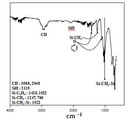
이렇게 제조한 폴리알릴페닐카보실란의 수율은 약 65%였고, 겔 투과 크로마토 그래피(GPC; Gel Permeation Chromatography)에 의해 측정되는 폴리스티렌 환산 중량평균 분자량(Mw)은 2,180이었으며, FT-IR의 측정결과는 도 1과 같이, -Si-CH2-Si-피크가 1035cm-1에서 강하게 나타나는 것을 볼 때, 알릴기와 페닐기를 포함하는 화학식 3의 구조단위를 포함하는 폴리알릴페닐카르보실란을 확인하였다. 또한 제조한 폴리알릴페닐카보실란을 아르곤 분위기하에서 1200℃로 열처리한 후 XRD로 분석해 본 결과 도 2와 같이, β-SiC와 일치하는 것을 보아 SiC 전구체로 알맞은 재료임을 확인하였다.The yield of the polyallylphenyl carbosilane thus prepared was about 65%, the polystyrene reduced weight average molecular weight (Mw) measured by gel permeation chromatography (GPC) was 2,180, and the FT-IR measurement result was As shown in FIG. 1, when -Si-CH 2 -Si-peak was strongly observed at 1035 cm -1 , polyallylphenylcarbosilane including a structural unit of formula 3 including an allyl group and a phenyl group was confirmed. In addition, the polyallylphenyl carbosilane was heat-treated at 1200 ° C. under argon atmosphere, and analyzed by XRD. As shown in FIG.
<화학식 3><Formula 3>

이와 같이 수득된 본 발명의 실시예 1에 의한 폴리알릴페닐카보실란은The polyallylphenyl carbosilane according to Example 1 of the present invention thus obtained is
핵산에 30중량%까지 용해되어 SiC 코팅을 위한 전구체로 사용이 가능하였다. Dissolved in the nucleic acid up to 30% by weight could be used as a precursor for SiC coating.
실시예 2Example 2
4구 둥근 플라스크에 톨루엔 용매 2L을 넣은 뒤 금속나트륨 320g을 질소 분위기 하에서 8 cm3의 크기로 잘라 혼합하고, 교반하면서 110℃의 온도로 가열 시켜 톨루엔 유기 용매에 금속 나트륨을 분산시켰다.2L of toluene solvent was put into a four-necked round flask, and 320 g of metal sodium was cut into a size of 8 cm 3 under a nitrogen atmosphere, mixed, heated to a temperature of 110 ° C. while stirring, and metal sodium was dispersed in the toluene organic solvent.
알릴메틸디클로로실란과 페닐메틸디클로로실란 모노머를 5:5의 몰비로 혼합 한 후에 모노머 혼합용액 800ml를 깔때기를 이용하여 금속나트륨이 분산된 용액에 100ml/hr의 속도로 주입하고, 110℃의 온도에서 12시간 동안 반응하였다. 반응이 완료되어 보라색 침전이 형성되면, 실온으로 냉각시킨 뒤 메탄올로 잔여 나트륨을 제거하고 필터한 후 증류수와 알코올로 세척하여 백색 분말의 폴리알릴페닐실란을 얻었다. After mixing allylmethyldichlorosilane and the phenylmethyldichlorosilane monomer in a molar ratio of 5: 5, 800 ml of the monomer mixture solution was injected into the solution containing metal sodium at a rate of 100 ml / hr using a funnel, and at a temperature of 110 ° C. The reaction was carried out for 12 hours. When the reaction was completed to form a purple precipitate, after cooling to room temperature to remove residual sodium with methanol, filtered and washed with distilled water and alcohol to obtain a polyallylphenylsilane of white powder.
백색 분말의 폴리프로페닐페닐실란을 진공하에서 건조하여 오토클레이브에 옮겨 담고, 10atm의 압력에서 350℃의 온도로 6시간 동안 1차 전환 반응하고, 온도를 450℃로 올려 6시간 동안 2차 전환 반응을 하여 폴리알릴페닐카보실란을 합성하였다.The white powdered polypropenylphenylsilane was dried under vacuum and transferred to an autoclave, and the first conversion reaction was carried out at a pressure of 10 atm to a temperature of 350 ° C. for 6 hours, and the temperature was raised to 450 ° C. for a second conversion reaction for 6 hours. Then, polyallylphenyl carbosilane was synthesized.
모든 실험은 질소 분위기에서 수행하였으며 반응하는 동안 내용물을 교반기로 교반시키면서 반응하였다. All experiments were carried out in a nitrogen atmosphere and the contents were reacted while stirring the contents with a stirrer.
최종 반응 후, 반응물을 핵산에 녹여 필터 하고 핵산에 녹지 않는 폴리알릴 페닐실란을 제거하였다. 알릴메틸디클로로실란과 페닐메틸디클로로실란 모노머를 5:5의 몰비로 혼합하여 제조한 경우에는 핵산에 녹지 않는 고분자량 (Mw=6,000이상)의 폴리알릴페카보닐실란이 많이 생성되었다. 핵산을 증류시킨 후 핵산에 녹아 있는 저분자량의 폴리알릴페카보닐실란을 회수하였다. After the final reaction, the reaction was dissolved in nucleic acid and filtered to remove polyallyl phenylsilane that was insoluble in the nucleic acid. When allylmethyldichlorosilane and the phenylmethyldichlorosilane monomer were mixed at a molar ratio of 5: 5, a high molecular weight (Mw = 6,000 or more) of polyallylpecarbonylsilane that was insoluble in nucleic acids was produced. After distilling the nucleic acid, low molecular weight polyallylpecarbonylsilane dissolved in the nucleic acid was recovered.
이렇게 제조한 폴리프로페닐실란의 수율은 약 40%였고, 겔 투과 크로마토 그래피(GPC; Gel Permeation Chromatography)에 의해 측정되는 폴리스티렌 환산 중량평균 분자량(Mw)은 3,140이었으며, FT-IR의 측정결과는 도3과 같이, -Si-CH2-Si- 피크가 1035cm-1에서 강하게 나타나는 것을 볼 때, 알릴기와 페닐기를 포함하는 화학식 4의 구조단위를 포함하는 폴리알릴페닐실란을 확인하였다. The yield of polypropenylsilane thus prepared was about 40%, and the polystyrene reduced weight average molecular weight (Mw) measured by gel permeation chromatography (GPC) was 3,140. As shown in FIG. 3, when the -Si-CH 2 -Si-peak was strongly observed at 1035 cm −1 , a polyallylphenylsilane including the structural unit of formula 4 including an allyl group and a phenyl group was confirmed.
화학식 4Formula 4

이와 같이 수득된 본 발명의 실시예 2에 의한 폴리프로페닐카보실란은Thus obtained polypropenyl carbosilane according to Example 2 of the present invention
핵산에 30 중량%까지 용해되어 SiC 코팅을 위한 전구체로 사용이 가능하였다. Dissolved in the nucleic acid up to 30% by weight was available as a precursor for SiC coating.
비교예Comparative example
4구 둥근 플라스크에 톨루엔 용매 2L을 넣은 뒤 금속나트륨 320g을 질소 분위기 하에서 8cm3의 크기로 잘라 혼합하고, 교반하면서 110℃의 온도로 가열 시켜 톨루엔 유기 용매에 금속 나트륨을 분산시켰다.2L of toluene solvent was put into a four-necked round flask, and 320 g of metal sodium was cut into a size of 8 cm 3 under a nitrogen atmosphere, mixed, and heated to a temperature of 110 ° C. while stirring to disperse metal sodium in an organic toluene solvent.
5:5의 몰비로 알릴메틸디클로로실란 340ml 페닐메틸디클로로실란 460ml를 따로 준비한 후, 각각의 모노머를 둥근 플라스크의 양쪽에서 동시에 100ml/hr의 속도로 주입하고, 110℃의 온도에서 12시간 동안 반응하였다. After separately preparing 340 ml of allylmethyldichlorosilane 340 ml phenylmethyldichlorosilane at a molar ratio of 5: 5, each monomer was injected at the same time at a rate of 100 ml / hr at both sides of the round flask and reacted at a temperature of 110 ° C. for 12 hours. .
반응이 완료되어 보라색 침전이 형성되었으나, 반응 생성물은 두 개의 층으로 분리가 일어나, 한층은 톨루엔 용매의 위쪽에 부유하고, 다른 한층은 바닥에 침전되어있는 형태로 분리되어, 알릴메틸디클로로실란과 페닐메틸디클로로실란 모노머는 서로 분리되어 폴리알릴페닐실란은 합성되지 않았다. The reaction was completed to form a purple precipitate, but the reaction product was separated into two layers, one floating above the toluene solvent and the other separated in the form of precipitated at the bottom, allylmethyldichlorosilane and phenyl. The methyldichlorosilane monomers were separated from each other so that no polyallylphenylsilane was synthesized.
그 후, 실온으로 냉각시킨 뒤 메탄올로 잔여 나트륨을 제거하고 필터한 후 증류수와 알코올로 세척하여 백색 분말을 얻어, 진공하에서 건조하고, 오토클레이브를 옮겨 담고, 10atm의 압력에서 350℃에서 6시간 동안 1차 전환 반응하고, 온도를 450℃로 올려 6시간 동안 2차 전환반응을 실시하였으나, 아무런 변화가 없어, 폴리알릴페닐카보실란을 제조할 수 없었다. Then, after cooling to room temperature, residual sodium was removed with methanol, filtered and washed with distilled water and alcohol to obtain a white powder, dried under vacuum, the autoclave was transferred, and stored at 350 ° C. for 6 hours at a pressure of 10 atm. After the first conversion reaction, the temperature was raised to 450 ° C and the second conversion reaction was carried out for 6 hours, but there was no change, and thus polyallylphenyl carbosilane could not be prepared.
도 1은 본 발명의 실시예 1에 의해 제조된 폴리알릴페닐카보실란의 FT-IR 측정결과 그래프이다. 1 is a graph of the FT-IR measurement results of the polyallylphenyl carbosilane prepared by Example 1 of the present invention.
도 2는 본 발명의 실시예 1에 의해 제조된 폴리알릴페닐카보실란을 1200℃ 열처리 한 후 XRD 측정결과 그래프이다. Figure 2 is a graph of the XRD measurement results after the heat treatment of the polyallylphenyl carbosilane prepared by Example 1 of 1200 ℃.
도 3은 본 발명의 실시예 2에 의해 제조된 폴리알릴페닐실란의 FT-IR 측정결과 그래프이다. Figure 3 is a graph of the FT-IR measurement results of polyallylphenylsilane prepared by Example 2 of the present invention.
Claims (8)


Priority Applications (3)
| Application Number | Priority Date | Filing Date | Title |
|---|---|---|---|
| KR1020080059412A KR100968803B1 (en) | 2008-06-24 | 2008-06-24 | Polycarbosilane and preparation method thereof |
| US12/483,318 US8026329B2 (en) | 2008-06-24 | 2009-06-12 | Polycarbosilane and method of producing the same |
| JP2009141137A JP5011350B2 (en) | 2008-06-24 | 2009-06-12 | Polycarbosilane and method for producing the same |
Applications Claiming Priority (1)
| Application Number | Priority Date | Filing Date | Title |
|---|---|---|---|
| KR1020080059412A KR100968803B1 (en) | 2008-06-24 | 2008-06-24 | Polycarbosilane and preparation method thereof |
Publications (2)
| Publication Number | Publication Date |
|---|---|
| KR20100000065A true KR20100000065A (en) | 2010-01-06 |
| KR100968803B1 KR100968803B1 (en) | 2010-07-08 |
Family
ID=41431905
Family Applications (1)
| Application Number | Title | Priority Date | Filing Date |
|---|---|---|---|
| KR1020080059412A Expired - Fee Related KR100968803B1 (en) | 2008-06-24 | 2008-06-24 | Polycarbosilane and preparation method thereof |
Country Status (3)
| Country | Link |
|---|---|
| US (1) | US8026329B2 (en) |
| JP (1) | JP5011350B2 (en) |
| KR (1) | KR100968803B1 (en) |
Cited By (1)
| Publication number | Priority date | Publication date | Assignee | Title |
|---|---|---|---|---|
| CN112375224A (en) * | 2020-11-05 | 2021-02-19 | 江西信达航科新材料科技有限公司 | Low-viscosity high-yield liquid polycarbosilane and preparation method thereof |
Families Citing this family (8)
| Publication number | Priority date | Publication date | Assignee | Title |
|---|---|---|---|---|
| KR100968803B1 (en) * | 2008-06-24 | 2010-07-08 | 주식회사 티씨케이 | Polycarbosilane and preparation method thereof |
| CN102030904B (en) * | 2010-12-08 | 2012-05-23 | 中国人民解放军国防科学技术大学 | Method for preparing spinnable polysiloxane ceramic precursor for SiC fibers |
| CN109337078B (en) * | 2018-09-28 | 2021-06-29 | 中国科学院宁波材料技术与工程研究所 | A kind of preparation method of silicon carbide ceramic precursor polycarbosilane |
| CN115667181A (en) * | 2020-05-30 | 2023-01-31 | Hrl实验室有限责任公司 | Pre-ceramic 3D printing monomers and polymer formulations |
| CN112538165A (en) * | 2020-11-24 | 2021-03-23 | 福建立亚化学有限公司 | Polydimethylsiloxane material and preparation method thereof |
| CN113429574B (en) * | 2021-07-19 | 2023-05-30 | 王军 | Polycarbosilane and its preparation method |
| CN114044910A (en) * | 2021-12-30 | 2022-02-15 | 江西信达航科新材料科技有限公司 | High-temperature-resistant silicon carbide fiber precursor modified polycarbosilane and preparation method thereof |
| CN115010934B (en) * | 2022-06-17 | 2023-09-29 | 北京理工大学 | A kind of high viscosity liquid polycarbosilane and its preparation method |
Family Cites Families (21)
| Publication number | Priority date | Publication date | Assignee | Title |
|---|---|---|---|---|
| JPS51126300A (en) * | 1975-04-26 | 1976-11-04 | Res Inst Iron Steel Tohoku Univ | Method for manufacturing an organoo silicon polymer having silicon and carbon atoms as main skeleton component |
| JPS5483099A (en) * | 1977-12-15 | 1979-07-02 | Asahi Chem Ind Co Ltd | Preparation of organosilicon polymer |
| US4347347A (en) * | 1979-06-28 | 1982-08-31 | Ube Industries, Ltd. | Crosslinked organometallic block copolymers and process for production thereof |
| CA1154032A (en) * | 1979-11-21 | 1983-09-20 | Seishi Yajima | Polymetallocarbosilane, and process for its production |
| JPS6046131B2 (en) * | 1980-11-11 | 1985-10-14 | 宇部興産株式会社 | Manufacturing method of polycarbosilane |
| JPS5863724A (en) * | 1981-10-12 | 1983-04-15 | Shin Etsu Chem Co Ltd | Method for producing organosilicon polymer |
| JPS6140324A (en) * | 1984-07-31 | 1986-02-26 | Shin Nisso Kako Co Ltd | Production of organosilicon polymer |
| DE3667070D1 (en) * | 1985-08-27 | 1989-12-28 | Ube Industries | Heat-resistant paint comprising polymetallocarbosilane |
| US4808659A (en) * | 1985-12-13 | 1989-02-28 | Ube Industries, Ltd. | Adhesive composition comprising organometallic polymer |
| JPH064701B2 (en) * | 1986-11-06 | 1994-01-19 | 日本カーボン株式会社 | Method for producing organosilicon polymer |
| US4818732A (en) * | 1987-03-19 | 1989-04-04 | The Standard Oil Company | High surface area ceramics prepared from organosilane gels |
| DE4018374A1 (en) * | 1990-06-08 | 1991-12-12 | Kali Chemie Ag | NEW POLYCARBOSILANES AND METHOD FOR THE PRODUCTION THEREOF |
| US6761975B1 (en) * | 1999-12-23 | 2004-07-13 | Honeywell International Inc. | Polycarbosilane adhesion promoters for low dielectric constant polymeric materials |
| WO2005068540A1 (en) * | 2004-01-16 | 2005-07-28 | Jsr Corporation | Composition for forming insulating film, method for producing same, silica insulating film and method for forming same |
| WO2005082976A1 (en) * | 2004-02-26 | 2005-09-09 | Jsr Corporation | Polymer and process for producing the same, composition for forming insulating film, and insulating film and method of forming the same |
| JP4883256B2 (en) * | 2004-10-15 | 2012-02-22 | Jsr株式会社 | Surface hydrophobizing composition, surface hydrophobizing method, semiconductor device and manufacturing method thereof |
| US7749425B2 (en) * | 2005-12-21 | 2010-07-06 | General Electric Company | Nanoscale ceramic composites and methods of making |
| US7714092B2 (en) | 2006-01-13 | 2010-05-11 | Starfire Systems, Inc. | Composition, preparation of polycarbosilanes and their uses |
| KR100776251B1 (en) * | 2006-02-23 | 2007-11-13 | 요업기술원 | Method for producing polyphenylcarbosilane using multistage reaction process and polyphenylcarbosilane prepared by the same |
| US7745362B2 (en) * | 2006-08-11 | 2010-06-29 | General Electric Company | Metal-containing structured ceramic materials |
| KR100968803B1 (en) * | 2008-06-24 | 2010-07-08 | 주식회사 티씨케이 | Polycarbosilane and preparation method thereof |
-
2008
- 2008-06-24 KR KR1020080059412A patent/KR100968803B1/en not_active Expired - Fee Related
-
2009
- 2009-06-12 US US12/483,318 patent/US8026329B2/en not_active Expired - Fee Related
- 2009-06-12 JP JP2009141137A patent/JP5011350B2/en not_active Expired - Fee Related
Cited By (1)
| Publication number | Priority date | Publication date | Assignee | Title |
|---|---|---|---|---|
| CN112375224A (en) * | 2020-11-05 | 2021-02-19 | 江西信达航科新材料科技有限公司 | Low-viscosity high-yield liquid polycarbosilane and preparation method thereof |
Also Published As
| Publication number | Publication date |
|---|---|
| US20090318655A1 (en) | 2009-12-24 |
| KR100968803B1 (en) | 2010-07-08 |
| JP5011350B2 (en) | 2012-08-29 |
| US8026329B2 (en) | 2011-09-27 |
| JP2010007071A (en) | 2010-01-14 |
Similar Documents
| Publication | Publication Date | Title |
|---|---|---|
| KR100968803B1 (en) | Polycarbosilane and preparation method thereof | |
| Chen et al. | Preparation and stereolithography of SiC ceramic precursor with high photosensitivity and ceramic yield | |
| Ni et al. | Morphology and thermal properties of inorganic–organic hybrids involving epoxy resin and polyhedral oligomeric silsesquioxanes | |
| Seyferth et al. | High‐yield synthesis of Si3N4/SiC ceramic materials by pyrolysis of a novel polyorganosilazane | |
| CA2062218C (en) | Silicon boron nitride ceramic and precursor compounds, a process for their preparation and their use | |
| CN101240070B (en) | Supercritical fluid synthesis method of ceramic precursor polycarbosilane | |
| WO1998029476A1 (en) | Process for the preparation of polysilanes | |
| Schiavon et al. | Synthesis of a polycyclic silazane network and its evolution to silicon carbonitride glass | |
| Lodhe et al. | Synthesis and characterization of high ceramic yield polycarbosilane precursor for SiC | |
| EP0295062B1 (en) | Polysilacyclobutasilazanes | |
| CN109851797B (en) | Methyl phenyl-containing silicon aryl ether aryne resin, composite material thereof and preparation method thereof | |
| Zhong et al. | Accelerating the crosslinking process of hyperbranched polycarbosilane by UV irradiation | |
| CN109438712B (en) | Boron modified polycarbosilane resin and preparation method thereof | |
| CN102002164A (en) | Method for synthesizing ceramic precursor polycarbosilane | |
| US6133396A (en) | Highly processable hyperbranched polymer precursors to controlled chemical and phase purity fully dense SiC | |
| CN100509920C (en) | Method for synthesizing polysilane containing two bonds | |
| Wang et al. | Synthesis, characterization and ceramization of a novel vinyl-rich liquid precursor for Si (O) C ceramic | |
| Zhang et al. | Comparison of effects of nitrogen sources on the structures and properties of SiBNC ceramic fiber precursors | |
| US7202376B2 (en) | Method of producing polycarbosilane using zeolite as catalyst | |
| CN104530435B (en) | Synthesis method of Fe-Si-C ceramic precursor | |
| CN109762010B (en) | Sulfur-containing silicon arylyne resin, composite material and preparation method thereof | |
| Krishnan et al. | Liquid-gaseous phase pyrolysis polycondensation of oligosilanes to polycarbosilane: Influence of process variables on molecular and structural characteristics | |
| TW382009B (en) | Preparation of high density zirconium carbide ceramics with preceramic polymer binders | |
| KR100776251B1 (en) | Method for producing polyphenylcarbosilane using multistage reaction process and polyphenylcarbosilane prepared by the same | |
| Yu et al. | Synthesis and characterization of a propargyl‐substituted polycarbosilane with high ceramic yield |
Legal Events
| Date | Code | Title | Description |
|---|---|---|---|
| A201 | Request for examination | ||
| PA0109 | Patent application |
St.27 status event code: A-0-1-A10-A12-nap-PA0109 |
|
| PA0201 | Request for examination |
St.27 status event code: A-1-2-D10-D11-exm-PA0201 |
|
| R18-X000 | Changes to party contact information recorded |
St.27 status event code: A-3-3-R10-R18-oth-X000 |
|
| D13-X000 | Search requested |
St.27 status event code: A-1-2-D10-D13-srh-X000 |
|
| D14-X000 | Search report completed |
St.27 status event code: A-1-2-D10-D14-srh-X000 |
|
| N231 | Notification of change of applicant | ||
| PN2301 | Change of applicant |
St.27 status event code: A-3-3-R10-R13-asn-PN2301 St.27 status event code: A-3-3-R10-R11-asn-PN2301 |
|
| N231 | Notification of change of applicant | ||
| PN2301 | Change of applicant |
St.27 status event code: A-3-3-R10-R13-asn-PN2301 St.27 status event code: A-3-3-R10-R11-asn-PN2301 |
|
| PG1501 | Laying open of application |
St.27 status event code: A-1-1-Q10-Q12-nap-PG1501 |
|
| E701 | Decision to grant or registration of patent right | ||
| PE0701 | Decision of registration |
St.27 status event code: A-1-2-D10-D22-exm-PE0701 |
|
| GRNT | Written decision to grant | ||
| PR0701 | Registration of establishment |
St.27 status event code: A-2-4-F10-F11-exm-PR0701 |
|
| PR1002 | Payment of registration fee |
St.27 status event code: A-2-2-U10-U11-oth-PR1002 Fee payment year number: 1 |
|
| PG1601 | Publication of registration |
St.27 status event code: A-4-4-Q10-Q13-nap-PG1601 |
|
| FPAY | Annual fee payment |
Payment date: 20130701 Year of fee payment: 4 |
|
| PR1001 | Payment of annual fee |
St.27 status event code: A-4-4-U10-U11-oth-PR1001 Fee payment year number: 4 |
|
| FPAY | Annual fee payment |
Payment date: 20140701 Year of fee payment: 5 |
|
| PR1001 | Payment of annual fee |
St.27 status event code: A-4-4-U10-U11-oth-PR1001 Fee payment year number: 5 |
|
| PR1001 | Payment of annual fee |
St.27 status event code: A-4-4-U10-U11-oth-PR1001 Fee payment year number: 6 |
|
| FPAY | Annual fee payment |
Payment date: 20160628 Year of fee payment: 7 |
|
| PR1001 | Payment of annual fee |
St.27 status event code: A-4-4-U10-U11-oth-PR1001 Fee payment year number: 7 |
|
| R18-X000 | Changes to party contact information recorded |
St.27 status event code: A-5-5-R10-R18-oth-X000 |
|
| FPAY | Annual fee payment |
Payment date: 20170629 Year of fee payment: 8 |
|
| PR1001 | Payment of annual fee |
St.27 status event code: A-4-4-U10-U11-oth-PR1001 Fee payment year number: 8 |
|
| FPAY | Annual fee payment |
Payment date: 20180702 Year of fee payment: 9 |
|
| PR1001 | Payment of annual fee |
St.27 status event code: A-4-4-U10-U11-oth-PR1001 Fee payment year number: 9 |
|
| FPAY | Annual fee payment |
Payment date: 20190701 Year of fee payment: 10 |
|
| PR1001 | Payment of annual fee |
St.27 status event code: A-4-4-U10-U11-oth-PR1001 Fee payment year number: 10 |
|
| PN2301 | Change of applicant |
St.27 status event code: A-5-5-R10-R13-asn-PN2301 St.27 status event code: A-5-5-R10-R11-asn-PN2301 |
|
| PR1001 | Payment of annual fee |
St.27 status event code: A-4-4-U10-U11-oth-PR1001 Fee payment year number: 11 |
|
| PR1001 | Payment of annual fee |
St.27 status event code: A-4-4-U10-U11-oth-PR1001 Fee payment year number: 12 |
|
| PR1001 | Payment of annual fee |
St.27 status event code: A-4-4-U10-U11-oth-PR1001 Fee payment year number: 13 |
|
| PC1903 | Unpaid annual fee |
St.27 status event code: A-4-4-U10-U13-oth-PC1903 Not in force date: 20230702 Payment event data comment text: Termination Category : DEFAULT_OF_REGISTRATION_FEE |
|
| PC1903 | Unpaid annual fee |
St.27 status event code: N-4-6-H10-H13-oth-PC1903 Ip right cessation event data comment text: Termination Category : DEFAULT_OF_REGISTRATION_FEE Not in force date: 20230702 |