KR20110060902A - Wound dressing with polyurethane foam layer and cover layer made of thermoplastic polymer - Google Patents
Wound dressing with polyurethane foam layer and cover layer made of thermoplastic polymer Download PDFInfo
- Publication number
- KR20110060902A KR20110060902A KR1020117006259A KR20117006259A KR20110060902A KR 20110060902 A KR20110060902 A KR 20110060902A KR 1020117006259 A KR1020117006259 A KR 1020117006259A KR 20117006259 A KR20117006259 A KR 20117006259A KR 20110060902 A KR20110060902 A KR 20110060902A
- Authority
- KR
- South Korea
- Prior art keywords
- foam
- polyurethane
- cover layer
- anionic
- foam layer
- Prior art date
- Legal status (The legal status is an assumption and is not a legal conclusion. Google has not performed a legal analysis and makes no representation as to the accuracy of the status listed.)
- Withdrawn
Links
Images

Classifications
-
- A—HUMAN NECESSITIES
- A61—MEDICAL OR VETERINARY SCIENCE; HYGIENE
- A61F—FILTERS IMPLANTABLE INTO BLOOD VESSELS; PROSTHESES; DEVICES PROVIDING PATENCY TO, OR PREVENTING COLLAPSING OF, TUBULAR STRUCTURES OF THE BODY, e.g. STENTS; ORTHOPAEDIC, NURSING OR CONTRACEPTIVE DEVICES; FOMENTATION; TREATMENT OR PROTECTION OF EYES OR EARS; BANDAGES, DRESSINGS OR ABSORBENT PADS; FIRST-AID KITS
- A61F13/00—Bandages or dressings; Absorbent pads
-
- A—HUMAN NECESSITIES
- A61—MEDICAL OR VETERINARY SCIENCE; HYGIENE
- A61L—METHODS OR APPARATUS FOR STERILISING MATERIALS OR OBJECTS IN GENERAL; DISINFECTION, STERILISATION OR DEODORISATION OF AIR; CHEMICAL ASPECTS OF BANDAGES, DRESSINGS, ABSORBENT PADS OR SURGICAL ARTICLES; MATERIALS FOR BANDAGES, DRESSINGS, ABSORBENT PADS OR SURGICAL ARTICLES
- A61L15/00—Chemical aspects of, or use of materials for, bandages, dressings or absorbent pads
- A61L15/16—Bandages, dressings or absorbent pads for physiological fluids such as urine or blood, e.g. sanitary towels, tampons
- A61L15/22—Bandages, dressings or absorbent pads for physiological fluids such as urine or blood, e.g. sanitary towels, tampons containing macromolecular materials
- A61L15/26—Macromolecular compounds obtained otherwise than by reactions only involving carbon-to-carbon unsaturated bonds; Derivatives thereof
-
- A—HUMAN NECESSITIES
- A61—MEDICAL OR VETERINARY SCIENCE; HYGIENE
- A61F—FILTERS IMPLANTABLE INTO BLOOD VESSELS; PROSTHESES; DEVICES PROVIDING PATENCY TO, OR PREVENTING COLLAPSING OF, TUBULAR STRUCTURES OF THE BODY, e.g. STENTS; ORTHOPAEDIC, NURSING OR CONTRACEPTIVE DEVICES; FOMENTATION; TREATMENT OR PROTECTION OF EYES OR EARS; BANDAGES, DRESSINGS OR ABSORBENT PADS; FIRST-AID KITS
- A61F13/00—Bandages or dressings; Absorbent pads
- A61F13/01—Non-adhesive bandages or dressings
- A61F13/01008—Non-adhesive bandages or dressings characterised by the material
- A61F13/01017—Non-adhesive bandages or dressings characterised by the material synthetic, e.g. polymer based
-
- A—HUMAN NECESSITIES
- A61—MEDICAL OR VETERINARY SCIENCE; HYGIENE
- A61F—FILTERS IMPLANTABLE INTO BLOOD VESSELS; PROSTHESES; DEVICES PROVIDING PATENCY TO, OR PREVENTING COLLAPSING OF, TUBULAR STRUCTURES OF THE BODY, e.g. STENTS; ORTHOPAEDIC, NURSING OR CONTRACEPTIVE DEVICES; FOMENTATION; TREATMENT OR PROTECTION OF EYES OR EARS; BANDAGES, DRESSINGS OR ABSORBENT PADS; FIRST-AID KITS
- A61F13/00—Bandages or dressings; Absorbent pads
- A61F13/01—Non-adhesive bandages or dressings
- A61F13/01021—Non-adhesive bandages or dressings characterised by the structure of the dressing
- A61F13/01029—Non-adhesive bandages or dressings characterised by the structure of the dressing made of multiple layers
-
- A—HUMAN NECESSITIES
- A61—MEDICAL OR VETERINARY SCIENCE; HYGIENE
- A61F—FILTERS IMPLANTABLE INTO BLOOD VESSELS; PROSTHESES; DEVICES PROVIDING PATENCY TO, OR PREVENTING COLLAPSING OF, TUBULAR STRUCTURES OF THE BODY, e.g. STENTS; ORTHOPAEDIC, NURSING OR CONTRACEPTIVE DEVICES; FOMENTATION; TREATMENT OR PROTECTION OF EYES OR EARS; BANDAGES, DRESSINGS OR ABSORBENT PADS; FIRST-AID KITS
- A61F13/00—Bandages or dressings; Absorbent pads
- A61F13/02—Adhesive bandages or dressings
- A61F13/0246—Adhesive bandages or dressings characterised by the skin-adhering layer
- A61F13/025—Adhesive bandages or dressings characterised by the skin-adhering layer having a special distribution arrangement of the adhesive
-
- A—HUMAN NECESSITIES
- A61—MEDICAL OR VETERINARY SCIENCE; HYGIENE
- A61L—METHODS OR APPARATUS FOR STERILISING MATERIALS OR OBJECTS IN GENERAL; DISINFECTION, STERILISATION OR DEODORISATION OF AIR; CHEMICAL ASPECTS OF BANDAGES, DRESSINGS, ABSORBENT PADS OR SURGICAL ARTICLES; MATERIALS FOR BANDAGES, DRESSINGS, ABSORBENT PADS OR SURGICAL ARTICLES
- A61L15/00—Chemical aspects of, or use of materials for, bandages, dressings or absorbent pads
- A61L15/16—Bandages, dressings or absorbent pads for physiological fluids such as urine or blood, e.g. sanitary towels, tampons
- A61L15/22—Bandages, dressings or absorbent pads for physiological fluids such as urine or blood, e.g. sanitary towels, tampons containing macromolecular materials
-
- A—HUMAN NECESSITIES
- A61—MEDICAL OR VETERINARY SCIENCE; HYGIENE
- A61L—METHODS OR APPARATUS FOR STERILISING MATERIALS OR OBJECTS IN GENERAL; DISINFECTION, STERILISATION OR DEODORISATION OF AIR; CHEMICAL ASPECTS OF BANDAGES, DRESSINGS, ABSORBENT PADS OR SURGICAL ARTICLES; MATERIALS FOR BANDAGES, DRESSINGS, ABSORBENT PADS OR SURGICAL ARTICLES
- A61L15/00—Chemical aspects of, or use of materials for, bandages, dressings or absorbent pads
- A61L15/16—Bandages, dressings or absorbent pads for physiological fluids such as urine or blood, e.g. sanitary towels, tampons
- A61L15/42—Use of materials characterised by their function or physical properties
-
- A—HUMAN NECESSITIES
- A61—MEDICAL OR VETERINARY SCIENCE; HYGIENE
- A61P—SPECIFIC THERAPEUTIC ACTIVITY OF CHEMICAL COMPOUNDS OR MEDICINAL PREPARATIONS
- A61P17/00—Drugs for dermatological disorders
- A61P17/02—Drugs for dermatological disorders for treating wounds, ulcers, burns, scars, keloids, or the like
-
- C—CHEMISTRY; METALLURGY
- C08—ORGANIC MACROMOLECULAR COMPOUNDS; THEIR PREPARATION OR CHEMICAL WORKING-UP; COMPOSITIONS BASED THEREON
- C08G—MACROMOLECULAR COMPOUNDS OBTAINED OTHERWISE THAN BY REACTIONS ONLY INVOLVING UNSATURATED CARBON-TO-CARBON BONDS
- C08G18/00—Polymeric products of isocyanates or isothiocyanates
- C08G18/06—Polymeric products of isocyanates or isothiocyanates with compounds having active hydrogen
- C08G18/08—Processes
- C08G18/0804—Manufacture of polymers containing ionic or ionogenic groups
- C08G18/0819—Manufacture of polymers containing ionic or ionogenic groups containing anionic or anionogenic groups
- C08G18/0828—Manufacture of polymers containing ionic or ionogenic groups containing anionic or anionogenic groups containing sulfonate groups or groups forming them
-
- C—CHEMISTRY; METALLURGY
- C08—ORGANIC MACROMOLECULAR COMPOUNDS; THEIR PREPARATION OR CHEMICAL WORKING-UP; COMPOSITIONS BASED THEREON
- C08G—MACROMOLECULAR COMPOUNDS OBTAINED OTHERWISE THAN BY REACTIONS ONLY INVOLVING UNSATURATED CARBON-TO-CARBON BONDS
- C08G18/00—Polymeric products of isocyanates or isothiocyanates
- C08G18/06—Polymeric products of isocyanates or isothiocyanates with compounds having active hydrogen
- C08G18/08—Processes
- C08G18/10—Prepolymer processes involving reaction of isocyanates or isothiocyanates with compounds having active hydrogen in a first reaction step
- C08G18/12—Prepolymer processes involving reaction of isocyanates or isothiocyanates with compounds having active hydrogen in a first reaction step using two or more compounds having active hydrogen in the first polymerisation step
-
- C—CHEMISTRY; METALLURGY
- C08—ORGANIC MACROMOLECULAR COMPOUNDS; THEIR PREPARATION OR CHEMICAL WORKING-UP; COMPOSITIONS BASED THEREON
- C08G—MACROMOLECULAR COMPOUNDS OBTAINED OTHERWISE THAN BY REACTIONS ONLY INVOLVING UNSATURATED CARBON-TO-CARBON BONDS
- C08G18/00—Polymeric products of isocyanates or isothiocyanates
- C08G18/06—Polymeric products of isocyanates or isothiocyanates with compounds having active hydrogen
- C08G18/28—Polymeric products of isocyanates or isothiocyanates with compounds having active hydrogen characterised by the compounds used containing active hydrogen
- C08G18/2805—Compounds having only one group containing active hydrogen
- C08G18/2815—Monohydroxy compounds
- C08G18/283—Compounds containing ether groups, e.g. oxyalkylated monohydroxy compounds
-
- C—CHEMISTRY; METALLURGY
- C08—ORGANIC MACROMOLECULAR COMPOUNDS; THEIR PREPARATION OR CHEMICAL WORKING-UP; COMPOSITIONS BASED THEREON
- C08G—MACROMOLECULAR COMPOUNDS OBTAINED OTHERWISE THAN BY REACTIONS ONLY INVOLVING UNSATURATED CARBON-TO-CARBON BONDS
- C08G18/00—Polymeric products of isocyanates or isothiocyanates
- C08G18/06—Polymeric products of isocyanates or isothiocyanates with compounds having active hydrogen
- C08G18/28—Polymeric products of isocyanates or isothiocyanates with compounds having active hydrogen characterised by the compounds used containing active hydrogen
- C08G18/30—Low-molecular-weight compounds
- C08G18/32—Polyhydroxy compounds; Polyamines; Hydroxyamines
- C08G18/3225—Polyamines
- C08G18/3228—Polyamines acyclic
-
- C—CHEMISTRY; METALLURGY
- C08—ORGANIC MACROMOLECULAR COMPOUNDS; THEIR PREPARATION OR CHEMICAL WORKING-UP; COMPOSITIONS BASED THEREON
- C08G—MACROMOLECULAR COMPOUNDS OBTAINED OTHERWISE THAN BY REACTIONS ONLY INVOLVING UNSATURATED CARBON-TO-CARBON BONDS
- C08G18/00—Polymeric products of isocyanates or isothiocyanates
- C08G18/06—Polymeric products of isocyanates or isothiocyanates with compounds having active hydrogen
- C08G18/28—Polymeric products of isocyanates or isothiocyanates with compounds having active hydrogen characterised by the compounds used containing active hydrogen
- C08G18/30—Low-molecular-weight compounds
- C08G18/32—Polyhydroxy compounds; Polyamines; Hydroxyamines
- C08G18/3225—Polyamines
- C08G18/3234—Polyamines cycloaliphatic
-
- C—CHEMISTRY; METALLURGY
- C08—ORGANIC MACROMOLECULAR COMPOUNDS; THEIR PREPARATION OR CHEMICAL WORKING-UP; COMPOSITIONS BASED THEREON
- C08G—MACROMOLECULAR COMPOUNDS OBTAINED OTHERWISE THAN BY REACTIONS ONLY INVOLVING UNSATURATED CARBON-TO-CARBON BONDS
- C08G18/00—Polymeric products of isocyanates or isothiocyanates
- C08G18/06—Polymeric products of isocyanates or isothiocyanates with compounds having active hydrogen
- C08G18/28—Polymeric products of isocyanates or isothiocyanates with compounds having active hydrogen characterised by the compounds used containing active hydrogen
- C08G18/30—Low-molecular-weight compounds
- C08G18/38—Low-molecular-weight compounds having heteroatoms other than oxygen
- C08G18/3855—Low-molecular-weight compounds having heteroatoms other than oxygen having sulfur
-
- C—CHEMISTRY; METALLURGY
- C08—ORGANIC MACROMOLECULAR COMPOUNDS; THEIR PREPARATION OR CHEMICAL WORKING-UP; COMPOSITIONS BASED THEREON
- C08G—MACROMOLECULAR COMPOUNDS OBTAINED OTHERWISE THAN BY REACTIONS ONLY INVOLVING UNSATURATED CARBON-TO-CARBON BONDS
- C08G18/00—Polymeric products of isocyanates or isothiocyanates
- C08G18/06—Polymeric products of isocyanates or isothiocyanates with compounds having active hydrogen
- C08G18/28—Polymeric products of isocyanates or isothiocyanates with compounds having active hydrogen characterised by the compounds used containing active hydrogen
- C08G18/40—High-molecular-weight compounds
- C08G18/4009—Two or more macromolecular compounds not provided for in one single group of groups C08G18/42 - C08G18/64
-
- C—CHEMISTRY; METALLURGY
- C08—ORGANIC MACROMOLECULAR COMPOUNDS; THEIR PREPARATION OR CHEMICAL WORKING-UP; COMPOSITIONS BASED THEREON
- C08G—MACROMOLECULAR COMPOUNDS OBTAINED OTHERWISE THAN BY REACTIONS ONLY INVOLVING UNSATURATED CARBON-TO-CARBON BONDS
- C08G18/00—Polymeric products of isocyanates or isothiocyanates
- C08G18/06—Polymeric products of isocyanates or isothiocyanates with compounds having active hydrogen
- C08G18/28—Polymeric products of isocyanates or isothiocyanates with compounds having active hydrogen characterised by the compounds used containing active hydrogen
- C08G18/40—High-molecular-weight compounds
- C08G18/42—Polycondensates having carboxylic or carbonic ester groups in the main chain
- C08G18/44—Polycarbonates
-
- C—CHEMISTRY; METALLURGY
- C08—ORGANIC MACROMOLECULAR COMPOUNDS; THEIR PREPARATION OR CHEMICAL WORKING-UP; COMPOSITIONS BASED THEREON
- C08G—MACROMOLECULAR COMPOUNDS OBTAINED OTHERWISE THAN BY REACTIONS ONLY INVOLVING UNSATURATED CARBON-TO-CARBON BONDS
- C08G18/00—Polymeric products of isocyanates or isothiocyanates
- C08G18/06—Polymeric products of isocyanates or isothiocyanates with compounds having active hydrogen
- C08G18/28—Polymeric products of isocyanates or isothiocyanates with compounds having active hydrogen characterised by the compounds used containing active hydrogen
- C08G18/40—High-molecular-weight compounds
- C08G18/48—Polyethers
- C08G18/4804—Two or more polyethers of different physical or chemical nature
- C08G18/4808—Mixtures of two or more polyetherdiols
-
- C—CHEMISTRY; METALLURGY
- C08—ORGANIC MACROMOLECULAR COMPOUNDS; THEIR PREPARATION OR CHEMICAL WORKING-UP; COMPOSITIONS BASED THEREON
- C08G—MACROMOLECULAR COMPOUNDS OBTAINED OTHERWISE THAN BY REACTIONS ONLY INVOLVING UNSATURATED CARBON-TO-CARBON BONDS
- C08G18/00—Polymeric products of isocyanates or isothiocyanates
- C08G18/06—Polymeric products of isocyanates or isothiocyanates with compounds having active hydrogen
- C08G18/28—Polymeric products of isocyanates or isothiocyanates with compounds having active hydrogen characterised by the compounds used containing active hydrogen
- C08G18/40—High-molecular-weight compounds
- C08G18/48—Polyethers
- C08G18/4854—Polyethers containing oxyalkylene groups having four carbon atoms in the alkylene group
-
- C—CHEMISTRY; METALLURGY
- C08—ORGANIC MACROMOLECULAR COMPOUNDS; THEIR PREPARATION OR CHEMICAL WORKING-UP; COMPOSITIONS BASED THEREON
- C08G—MACROMOLECULAR COMPOUNDS OBTAINED OTHERWISE THAN BY REACTIONS ONLY INVOLVING UNSATURATED CARBON-TO-CARBON BONDS
- C08G18/00—Polymeric products of isocyanates or isothiocyanates
- C08G18/06—Polymeric products of isocyanates or isothiocyanates with compounds having active hydrogen
- C08G18/70—Polymeric products of isocyanates or isothiocyanates with compounds having active hydrogen characterised by the isocyanates or isothiocyanates used
- C08G18/72—Polyisocyanates or polyisothiocyanates
- C08G18/721—Two or more polyisocyanates not provided for in one single group C08G18/73 - C08G18/80
- C08G18/722—Combination of two or more aliphatic and/or cycloaliphatic polyisocyanates
-
- C—CHEMISTRY; METALLURGY
- C08—ORGANIC MACROMOLECULAR COMPOUNDS; THEIR PREPARATION OR CHEMICAL WORKING-UP; COMPOSITIONS BASED THEREON
- C08G—MACROMOLECULAR COMPOUNDS OBTAINED OTHERWISE THAN BY REACTIONS ONLY INVOLVING UNSATURATED CARBON-TO-CARBON BONDS
- C08G18/00—Polymeric products of isocyanates or isothiocyanates
- C08G18/06—Polymeric products of isocyanates or isothiocyanates with compounds having active hydrogen
- C08G18/70—Polymeric products of isocyanates or isothiocyanates with compounds having active hydrogen characterised by the isocyanates or isothiocyanates used
- C08G18/72—Polyisocyanates or polyisothiocyanates
- C08G18/73—Polyisocyanates or polyisothiocyanates acyclic
-
- C—CHEMISTRY; METALLURGY
- C08—ORGANIC MACROMOLECULAR COMPOUNDS; THEIR PREPARATION OR CHEMICAL WORKING-UP; COMPOSITIONS BASED THEREON
- C08G—MACROMOLECULAR COMPOUNDS OBTAINED OTHERWISE THAN BY REACTIONS ONLY INVOLVING UNSATURATED CARBON-TO-CARBON BONDS
- C08G18/00—Polymeric products of isocyanates or isothiocyanates
- C08G18/06—Polymeric products of isocyanates or isothiocyanates with compounds having active hydrogen
- C08G18/70—Polymeric products of isocyanates or isothiocyanates with compounds having active hydrogen characterised by the isocyanates or isothiocyanates used
- C08G18/72—Polyisocyanates or polyisothiocyanates
- C08G18/74—Polyisocyanates or polyisothiocyanates cyclic
- C08G18/75—Polyisocyanates or polyisothiocyanates cyclic cycloaliphatic
- C08G18/751—Polyisocyanates or polyisothiocyanates cyclic cycloaliphatic containing only one cycloaliphatic ring
- C08G18/752—Polyisocyanates or polyisothiocyanates cyclic cycloaliphatic containing only one cycloaliphatic ring containing at least one isocyanate or isothiocyanate group linked to the cycloaliphatic ring by means of an aliphatic group
- C08G18/753—Polyisocyanates or polyisothiocyanates cyclic cycloaliphatic containing only one cycloaliphatic ring containing at least one isocyanate or isothiocyanate group linked to the cycloaliphatic ring by means of an aliphatic group containing one isocyanate or isothiocyanate group linked to the cycloaliphatic ring by means of an aliphatic group having a primary carbon atom next to the isocyanate or isothiocyanate group
-
- C—CHEMISTRY; METALLURGY
- C08—ORGANIC MACROMOLECULAR COMPOUNDS; THEIR PREPARATION OR CHEMICAL WORKING-UP; COMPOSITIONS BASED THEREON
- C08J—WORKING-UP; GENERAL PROCESSES OF COMPOUNDING; AFTER-TREATMENT NOT COVERED BY SUBCLASSES C08B, C08C, C08F, C08G or C08H
- C08J9/00—Working-up of macromolecular substances to porous or cellular articles or materials; After-treatment thereof
-
- C—CHEMISTRY; METALLURGY
- C08—ORGANIC MACROMOLECULAR COMPOUNDS; THEIR PREPARATION OR CHEMICAL WORKING-UP; COMPOSITIONS BASED THEREON
- C08L—COMPOSITIONS OF MACROMOLECULAR COMPOUNDS
- C08L71/00—Compositions of polyethers obtained by reactions forming an ether link in the main chain; Compositions of derivatives of such polymers
- C08L71/02—Polyalkylene oxides
-
- C—CHEMISTRY; METALLURGY
- C08—ORGANIC MACROMOLECULAR COMPOUNDS; THEIR PREPARATION OR CHEMICAL WORKING-UP; COMPOSITIONS BASED THEREON
- C08L—COMPOSITIONS OF MACROMOLECULAR COMPOUNDS
- C08L75/00—Compositions of polyureas or polyurethanes; Compositions of derivatives of such polymers
- C08L75/04—Polyurethanes
-
- A—HUMAN NECESSITIES
- A61—MEDICAL OR VETERINARY SCIENCE; HYGIENE
- A61F—FILTERS IMPLANTABLE INTO BLOOD VESSELS; PROSTHESES; DEVICES PROVIDING PATENCY TO, OR PREVENTING COLLAPSING OF, TUBULAR STRUCTURES OF THE BODY, e.g. STENTS; ORTHOPAEDIC, NURSING OR CONTRACEPTIVE DEVICES; FOMENTATION; TREATMENT OR PROTECTION OF EYES OR EARS; BANDAGES, DRESSINGS OR ABSORBENT PADS; FIRST-AID KITS
- A61F13/00—Bandages or dressings; Absorbent pads
- A61F2013/00361—Plasters
- A61F2013/00727—Plasters means for wound humidity control
- A61F2013/00731—Plasters means for wound humidity control with absorbing pads
- A61F2013/0074—Plasters means for wound humidity control with absorbing pads containing foams
-
- A—HUMAN NECESSITIES
- A61—MEDICAL OR VETERINARY SCIENCE; HYGIENE
- A61F—FILTERS IMPLANTABLE INTO BLOOD VESSELS; PROSTHESES; DEVICES PROVIDING PATENCY TO, OR PREVENTING COLLAPSING OF, TUBULAR STRUCTURES OF THE BODY, e.g. STENTS; ORTHOPAEDIC, NURSING OR CONTRACEPTIVE DEVICES; FOMENTATION; TREATMENT OR PROTECTION OF EYES OR EARS; BANDAGES, DRESSINGS OR ABSORBENT PADS; FIRST-AID KITS
- A61F13/00—Bandages or dressings; Absorbent pads
- A61F2013/00361—Plasters
- A61F2013/00855—Plasters pervious to air or vapours
-
- C—CHEMISTRY; METALLURGY
- C08—ORGANIC MACROMOLECULAR COMPOUNDS; THEIR PREPARATION OR CHEMICAL WORKING-UP; COMPOSITIONS BASED THEREON
- C08G—MACROMOLECULAR COMPOUNDS OBTAINED OTHERWISE THAN BY REACTIONS ONLY INVOLVING UNSATURATED CARBON-TO-CARBON BONDS
- C08G2110/00—Foam properties
- C08G2110/0008—Foam properties flexible
-
- Y—GENERAL TAGGING OF NEW TECHNOLOGICAL DEVELOPMENTS; GENERAL TAGGING OF CROSS-SECTIONAL TECHNOLOGIES SPANNING OVER SEVERAL SECTIONS OF THE IPC; TECHNICAL SUBJECTS COVERED BY FORMER USPC CROSS-REFERENCE ART COLLECTIONS [XRACs] AND DIGESTS
- Y10—TECHNICAL SUBJECTS COVERED BY FORMER USPC
- Y10T—TECHNICAL SUBJECTS COVERED BY FORMER US CLASSIFICATION
- Y10T156/00—Adhesive bonding and miscellaneous chemical manufacture
- Y10T156/10—Methods of surface bonding and/or assembly therefor
Landscapes
- Chemical & Material Sciences (AREA)
- Health & Medical Sciences (AREA)
- Chemical Kinetics & Catalysis (AREA)
- Medicinal Chemistry (AREA)
- Organic Chemistry (AREA)
- Polymers & Plastics (AREA)
- Engineering & Computer Science (AREA)
- Veterinary Medicine (AREA)
- General Health & Medical Sciences (AREA)
- Public Health (AREA)
- Life Sciences & Earth Sciences (AREA)
- Animal Behavior & Ethology (AREA)
- Vascular Medicine (AREA)
- Biomedical Technology (AREA)
- Heart & Thoracic Surgery (AREA)
- Materials Engineering (AREA)
- Hematology (AREA)
- Epidemiology (AREA)
- Dermatology (AREA)
- Manufacturing & Machinery (AREA)
- Bioinformatics & Cheminformatics (AREA)
- Nuclear Medicine, Radiotherapy & Molecular Imaging (AREA)
- Pharmacology & Pharmacy (AREA)
- General Chemical & Material Sciences (AREA)
- Polyurethanes Or Polyureas (AREA)
- Laminated Bodies (AREA)
- Materials For Medical Uses (AREA)
- Cosmetics (AREA)
Abstract
본 발명은, 발포체 층 (10) 및 커버 층 (20)을 포함하며, 여기서 커버 층 (20)은 열가소성 중합체, 바람직하게는 폴리우레탄을 포함하고, 적어도 부분적으로 발포체 층 (10)에 직접적으로 연결되어 있고, 발포체 층 (10)은 수성, 음이온성 친수성화 폴리우레탄 분산액 (I)을 포함하는 조성물을 발포 및 건조시킴으로써 수득된 폴리우레탄 발포체를 포함하는, 상처 드레싱으로서 적합한 적층 복합재에 관한 것이다. 발포체는 에틸렌 옥시드/프로필렌 옥시드 블록 공중합체를 사용하여 안정화될 수 있다. 본 발명은 또한, 상기 종류의 적층 복합재의 제조 방법 및 예를 들어 상처 드레싱으로서의 그의 용도에 관한 것이다.The present invention comprises a foam layer (10) and a cover layer (20), wherein the cover layer (20) comprises a thermoplastic polymer, preferably polyurethane, and at least partially connected directly to the foam layer (10) The foam layer 10 relates to a laminated composite suitable as a wound dressing comprising a polyurethane foam obtained by foaming and drying a composition comprising an aqueous, anionic hydrophilized polyurethane dispersion (I). The foam can be stabilized using ethylene oxide / propylene oxide block copolymers. The invention also relates to a process for the production of laminated composites of this kind and to their use, for example, as wound dressings.
Description
본 발명은, 발포체 층 및 또한 커버 층을 포함하며, 여기서 커버 층은 열가소성 중합체를 포함하고, 적어도 부분적으로 발포체 층에 직접적으로 접합되어 있는, 상처 드레싱으로서 유용한 적층 복합재에 관한 것이다. 본 발명은 또한, 상기와 같은 적층 복합재의 제조 방법 및 또한 예를 들어 상처 드레싱으로서의 그의 용도에 관한 것이다.The invention relates to a laminated composite useful as a wound dressing, comprising a foam layer and also a cover layer, wherein the cover layer comprises a thermoplastic polymer and is at least partially bonded directly to the foam layer. The invention also relates to a process for producing such laminated composites and also to their use, for example as wound dressings.
상처 관리에서는 상처에 놓여지는 발포체 층을 갖는 상처 드레싱을 사용할 수 있다. 이는 상처로부터 유출되는 수분을 흡수하는 발포체의 능력이 치유에 유리한 분위기를 상처에서 생성할 수 있기 때문에 유리한 것으로 판명되었다. 그러나, 이러한 발포체 자체는 흔히, 이들이 더러워질 수 있고, 박테리아에 의해 침투되거나 착용 동안 기계적 응력에 의해 파괴될 수 있다는 단점을 갖는다.Wound care can use wound dressings having a layer of foam placed on the wound. This proved to be advantageous because the foam's ability to absorb moisture emanating from the wound can create an atmosphere in the wound that is beneficial for healing. However, such foams themselves often have the disadvantage that they can be soiled, penetrated by bacteria or destroyed by mechanical stress during wear.
개선책으로서, 보호 커버 호일이 상처 드레싱의 외부 표면 상에 제공될 수 있다. 이러한 커버 호일은, 미생물 불투과성, 상처 분비물에 대한 불투과성과 함께 동시에 수증기에 대한 상처 드레싱의 투과성을 제공할 수 있다. 지금까지 커버 호일은 접착제에 의하여 발포체 층에 부착되어야 했다.As a remedy, a protective cover foil can be provided on the outer surface of the wound dressing. Such cover foils can provide microbial impermeability, impermeability to wound secretions, as well as permeability of the wound dressing to water vapor. Until now the cover foil had to be attached to the foam layer by an adhesive.
그러나 접착제의 사용은 단점을 갖는다. 접착제의 층을 적용하는 것은, 상처 드레싱의 제작에서 추가적 노동 및 재료 요구 및 그에 따라 추가적 비용을 초래한다. 또한, 접착제는 수증기에 대한 투과성에 대해 불리한 효과를 가질 수 있다. 끝으로, 접착제는 또한 상처 드레싱의 열 성형성에 영향을 미칠 수 있다.However, the use of adhesives has disadvantages. Applying a layer of adhesive results in additional labor and material requirements and thus additional costs in the manufacture of the wound dressing. The adhesive can also have an adverse effect on the permeability to water vapor. Finally, the adhesive can also affect the thermoformability of the wound dressing.
전체적으로 본원에 참고로 도입되는 WO 2007/115696에는, 폴리우레탄 분산액 및 특정 응고제를 포함하는 조성물을 발포 및 건조시키는, 상처 치료를 위한 폴리우레탄 발포체의 제조 방법이 개시되어 있다. 폴리우레탄 분산액은 예를 들어 유기 폴리이소시아네이트, 및 400 g/mol 내지 8000 g/mol의 수 평균 분자량 및 1.5 내지 6의 OH 관능가를 갖는 중합체 폴리올로부터, 또한 임의로 62 g/mol 내지 399 g/mol의 분자량을 갖는 히드록실-관능성 화합물, 및 임의로 이소시아네이트-반응성, 음이온성 또는 잠재적 음이온성 및 임의로 비이온성 친수성화제와 함께 이소시아네이트-관능성 예비중합체를 제조함으로써 수득가능하다. 이어서, 예비중합체의 유리 NCO 기를 임의로 전체적으로 또는 부분적으로 32 g/mol 내지 400 g/mol의 분자량을 갖는 아미노-관능성 화합물, 및 또한 아미노-관능성, 음이온성 또는 잠재적 음이온성 친수성화제와 사슬 연장시키면서 반응시킨다. 예비중합체를 이 단계 이전, 동안 또는 이후에 물 중에 분산시킨다. 존재하는 임의의 잠재적 이온성 기를 중화제와의 부분적인 또는 완전한 반응에 의해 이온 형태로 전환시킨다.WO 2007/115696, which is hereby incorporated by reference in its entirety, discloses a process for the preparation of polyurethane foams for wound treatment, which foams and dries a composition comprising a polyurethane dispersion and certain coagulants. Polyurethane dispersions are for example from organic polyisocyanates and polymeric polyols having a number average molecular weight of 400 g / mol to 8000 g / mol and an OH functionality of 1.5 to 6, and optionally 62 g / mol to 399 g / mol It is obtainable by preparing an isocyanate-functional prepolymer with a hydroxyl-functional compound having a molecular weight and optionally an isocyanate-reactive, anionic or potentially anionic and optionally nonionic hydrophilizing agent. The free NCO group of the prepolymer is then optionally chained in whole or in part with an amino-functional compound having a molecular weight of 32 g / mol to 400 g / mol, and also an amino-functional, anionic or potentially anionic hydrophilizing agent To react. The prepolymer is dispersed in water before, during or after this step. Any potential ionic groups present are converted to the ionic form by partial or complete reaction with the neutralizer.
EP 0 485 657에는, 상처 또는 피부 궤양을 위한 드레싱이 개시되어 있다. 드레싱은 반투과성 폴리우레탄 필름 및 다수의 동심원 폴리에틸렌 발포체 고리를 포함한다. 반투과성 박막으로의 발포체 고리의 적용은 상처 드레싱의 수분/증기 전달 특성의 변형을 허용한다. 이들은 상처 환경에 적합하게 되도록 조정될 수 있다. 반투과성 박막은 고리의 상부 표면에 접합된다. 이 접합은 접착제에 의하여 달성된다는 것이 추가로 개시되어 있다.EP 0 485 657 discloses dressings for wounds or skin ulcers. The dressing comprises a semipermeable polyurethane film and a plurality of concentric polyethylene foam rings. Application of the foam ring to the semipermeable membrane allows modification of the moisture / vapor transfer properties of the wound dressing. These can be adjusted to suit the wound environment. The semipermeable membrane is bonded to the upper surface of the ring. It is further disclosed that this bonding is achieved by an adhesive.
DE 103 01 835에는, 프린팅된 상처 드레싱 및 투명한 고정 호일을 갖는 플라스터가 개시되어 있다. 상처 드레싱은 개별적으로 프린팅되고, 또한 보다 특히, 프린팅된 모티프의 윤곽을 고려하여 성형될 수 있다. 상처-대향면의 한쪽 면 상에 부착된 고정 호일은 상처 드레싱과 적어도 양면 상에서 중첩되고, 투명 물질로 되어 있어 플라스터로 인한 미용 손상이 상처 드레싱의 크기로 본질적으로 감소된다. 우수한 점착성의 투명한 고정 호일은 추가로 분할되는 경우 심지어 문제가 되는 피부 영역에서도 단단한 고정을 제공한다. 이러한 플라스터의 제조 방법, 그의 용도 및 또한 사용 방법 또한 개시되어 있다. 투명한 고정 호일은 폴리우레탄으로 구성될 수 있다. 이 공개문헌에 따르면, 투명한 고정 호일 물질은, 플라스터를 피부에 고정시키기 위해 또한 상처 드레싱을 고정 호일에 고정시키기 위해 제공되는 투명 접착제와 함께 상처-대향면 상에 제공된다.DE 103 01 835 discloses a plaster with a printed wound dressing and a transparent fixing foil. Wound dressings may be printed individually and more particularly shaped in view of the contour of the printed motif. The stationary foil attached on one side of the wound-facing side overlaps the wound dressing on at least both sides and is made of a transparent material so that cosmetic damage due to the plaster is essentially reduced to the size of the wound dressing. Good sticky transparent fixation foils provide tight fixation even in problematic skin areas when further divided. Also disclosed are methods of making such plasters, their use and also methods of use. The transparent fixing foil may consist of polyurethane. According to this publication, a transparent anchoring foil material is provided on the wound-facing surface with a transparent adhesive provided for anchoring the plaster to the skin and for anchoring the wound dressing to the anchoring foil.
따라서, 대안적 상처 드레싱에 대한 필요성이 존재한다. 보다 특히, 발포체 층 및 커버 층이 사용을 제한하지 않으며 열 성형성을 갖는 강도로 접착제 없이 함께 접합되어 있는 상처 드레싱에 대한 필요성이 존재한다.Thus, there is a need for alternative wound dressings. More particularly, there is a need for wound dressings in which the foam layer and cover layer do not restrict use and are bonded together without adhesive in strength with thermoformability.
따라서, 본 발명은, 발포체 층 및 또한 커버 층을 포함하며, 여기서 커버 층은 열가소성 중합체를 포함하고, 적어도 부분적으로 발포체 층에 직접적으로 접합되어 있고, 발포체 층은 수성, 음이온성 친수성화 폴리우레탄 분산액 (I)을 포함하는 조성물을 발포 및 건조시킴으로써 수득된 폴리우레탄 발포체를 포함하는, 상처 드레싱으로서 유용한 적층 복합재를 제안한다.Thus, the present invention comprises a foam layer and also a cover layer, wherein the cover layer comprises a thermoplastic polymer and is at least partially bonded directly to the foam layer, the foam layer being an aqueous, anionic hydrophilized polyurethane dispersion A laminated composite useful as a wound dressing is proposed comprising a polyurethane foam obtained by foaming and drying a composition comprising (I).
발포체 층은 발포된 폴리우레탄 분산액으로부터 수득가능한 발포체를 포함한다. 이 발포체 층은 덮이게 될 상처 상에 위치한다. 유리하게는, 이 발포체는 서로 소통하는 셀을 포함하는 미세다공성의, 적어도 부분적으로 개방-공극 구조를 갖는다. The foam layer comprises foams obtainable from foamed polyurethane dispersions. This foam layer is located on the wound to be covered. Advantageously, this foam has a microporous, at least partially open-pore structure comprising cells in communication with each other.
본 발명의 적층 복합재의 커버 층은 열가소성 중합체를 포함한다. 열가소성 중합체는 초기에, 물질의 가공 및 사용에 전형적인 온도 범위에서 반복적으로 가열 및 냉각하는 경우 열가소성으로 남아 있는 중합체를 의미하는 것으로 이해되어야 한다. 열가소성은, 제조 중합체에 대해 전형적인 온도 범위에서, 제조 중합체가 반복적으로 고온인 경우 연화되고 저온인 경우 경화되고, 또한 연화된 상태에서, 반복적으로 유동에 의해 중간체 또는 최종 물품으로 (예를 들어 성형부, 압출부 또는 형성부로서) 성형가능하게 되는 제조 중합체의 특성을 지칭하는 것으로 이해되어야 한다. 유리하게는, 커버 층은 반투과성 막으로서, 즉 발포체 층을 통과하는 상처 분비물 및 또한 외부로부터의 물을 유지하면서, 수증기는 통과시키는 막으로서 구현된다.The cover layer of the laminated composite of the present invention comprises a thermoplastic polymer. Thermoplastic polymer is to be understood initially to mean a polymer which remains thermoplastic when repeatedly heated and cooled in the temperature range typical for the processing and use of the material. Thermoplastics, in the temperature range typical for the production polymer, soften when the production polymer is repeatedly high temperature and harden when it is low temperature, and also in the softened state, by repeated flow into the intermediate or final article (e.g. It is to be understood that it refers to the properties of the producing polymer, which becomes moldable, as an extrusion or forming part. Advantageously, the cover layer is embodied as a semipermeable membrane, ie as a membrane through which water vapor passes while retaining wound secretions and also water from the outside.
또한, 막 또는 호일이 ≥ 5 ㎛ 내지 ≤ 80 ㎛, 특히 ≥ 5 ㎛ 내지 ≤ 60 ㎛, 보다 바람직하게는 ≥ 10 ㎛ 내지 ≤ 30 ㎛ 범위의 두께, 및 450% 초과의 파단 신장률을 갖는 것이 특히 유리한 것으로 확인될 것이다. It is also particularly advantageous for the membrane or foil to have a thickness in the range of ≧ 5 μm to ≦ 80 μm, in particular ≧ 5 μm to ≦ 60 μm, more preferably ≧ 10 μm to ≦ 30 μm, and elongation at break of greater than 450%. Will be confirmed.
본 발명에서, 커버 층 및 발포체 층은 적어도 부분적으로 함께 직접적으로 접합되어 있다. 그 결과, 이러한 적층 복합재에는 두 층이 직접적으로 중첩되어 있는 영역이 존재한다. 이들 영역에서, 적층 복합재는 발포체 층과 커버 층 사이에 접착제가 존재하지 않는다는 사실에 대해 정확히 주목할 만하다. In the present invention, the cover layer and the foam layer are at least partially bonded directly together. As a result, such laminated composites have regions in which the two layers directly overlap. In these areas, the laminated composite is precisely notable for the fact that there is no adhesive between the foam layer and the cover layer.
폴리우레탄 분산액 (I)은 유리 이소시아네이트기를 전체적으로 또는 부분적으로 음이온성 또는 잠재적 음이온성 친수성화제와 반응시킴으로써 제조된 폴리우레탄을 포함한다. 이러한 친수성화제는 이소시아네이트-반응성 관능기, 예컨대 아미노, 히드록실 또는 티올 기, 뿐만 아니라 산 또는 산 음이온 기, 예컨대 카르복실레이트, 술포네이트 또는 포스포네이트 기를 갖는 화합물이다. Polyurethane dispersions (I) include polyurethanes prepared by reacting free isocyanate groups in whole or in part with anionic or potentially anionic hydrophilizing agents. Such hydrophilizing agents are compounds having isocyanate-reactive functional groups such as amino, hydroxyl or thiol groups, as well as acid or acid anionic groups such as carboxylate, sulfonate or phosphonate groups.
발포체 층 및 커버 층은, 접착제 층에 대한 필요성이 제거되는 결과로서 보다 적은 작업으로 수득가능한, 보호 커버 및/또는 막 호일을 포함하는 상처 드레싱을 수득하도록 본 발명에 따라 선택된다. 그러나, 층간 상호접착이 충분하다. 제조 후, 적층 복합재는 계속해서 열성형에 의해 추가로 가공가능하고, 이는 상처 드레싱에 대해 매우 다양한 형상을 달성할 수 있게 한다.The foam layer and cover layer are selected according to the invention to obtain a wound dressing comprising a protective cover and / or a membrane foil, which is obtainable in less work as a result of the need for an adhesive layer is eliminated. However, interlayer adhesion is sufficient. After manufacture, the laminated composite is further processable by thermoforming, which makes it possible to achieve a wide variety of shapes for wound dressings.
본 발명에 따른 적층 복합재의 일 실시양태에서에서, 발포체 층의 폴리우레탄 발포체가 수득되는 조성물은 추가로 지방산 아미드, 술포숙신아미드, 히드로카본술포네이트, 히드로카르빌 술페이트, 지방산 염, 알킬폴리글리코시드 및/또는 에틸렌 옥시드-프로필렌 옥시드 블록 공중합체를 포함하는 군으로부터 선택된 혼합물을 포함한다. In one embodiment of the laminate composite according to the invention, the composition from which the polyurethane foam of the foam layer is obtained further comprises fatty acid amide, sulfosuccinamide, hydrocarbonsulfonate, hydrocarbyl sulfate, fatty acid salt, alkylpoly Mixtures selected from the group comprising glycosides and / or ethylene oxide-propylene oxide block copolymers.
이러한 혼합물은 발포체 형성제 및/또는 발포체 안정화제로서 작용할 수 있다. 지방산 아미드, 술포숙신아미드, 히드로카본술포네이트, 히드로카르빌 술페이트 또는 지방산 염 중의 친유성 라디칼은 바람직하게는 ≥ 12 내지 ≤ 24개의 탄소 원자를 포함한다. 적합한 알킬폴리글리코시드는 예를 들어 비교적 장쇄 모노알콜 (알킬 라디칼 내에 ≥ 4 내지 ≤ 22개의 탄소 원자)과 모노-, 디- 또는 폴리사카라이드의 반응에 의해 수득가능하다. 히드로카르빌 라디칼 내에 ≥ 14 내지 ≤ 24개의 탄소 원자를 갖는 알킬벤조술포네이트 또는 알킬벤젠 술페이트 또한 적합하다. Such mixtures can act as foam formers and / or foam stabilizers. The lipophilic radicals in fatty acid amides, sulfosuccinamides, hydrocarbonsulfonates, hydrocarbyl sulfates or fatty acid salts preferably comprise ≧ 12 to ≦ 24 carbon atoms. Suitable alkylpolyglycosides are obtainable, for example, by reaction of relatively long chain monoalcohols (≧ 4 to ≦ 22 carbon atoms in the alkyl radical) with mono-, di- or polysaccharides. Also suitable are alkylbenzosulfonates or alkylbenzene sulfates having ≧ 14 to ≦ 24 carbon atoms in the hydrocarbyl radical.
지방산 아미드는 바람직하게는 모노- 또는 디-(C2/C3-알칸올)아민을 기재로 하는 것들이다. 지방산 염은 예를 들어 알칼리 금속 염, 아민 염 또는 비치환된 암모늄 염일 수 있다. Fatty acid amides are preferably those based on mono- or di- (C 2 / C 3 -alkanol) amines. Fatty acid salts can be, for example, alkali metal salts, amine salts or unsubstituted ammonium salts.
이러한 지방산 유도체는 전형적으로 지방산, 예컨대 라우르산, 미리스트산, 팔미트산, 올레산, 스테아르산, 리시놀레산, 베헨산 또는 아라키드산, 코코 지방산, 탈로우 지방산, 대두 지방산 및 이들의 수소화 생성물을 기재로 한다. Such fatty acid derivatives are typically fatty acids such as lauric acid, myristic acid, palmitic acid, oleic acid, stearic acid, ricinoleic acid, behenic or arachidic acid, coco fatty acids, tallow fatty acids, soybean fatty acids and hydrogenation thereof Based on the product.
예시적인 유용한 발포체 안정화제는 술포숙신아미드 및 암모늄 스테아레이트의 혼합물이며, 암모늄 스테아레이트 함량은 바람직하게는 ≥ 20 중량% 내지 ≤ 60 중량%, 보다 바람직하게는 ≥ 30 중량% 내지 ≤ 50 중량%이고, 술포숙신아미드 함량은 바람직하게는 ≥ 40 중량% 내지 ≤ 80 중량%, 보다 바람직하게는 ≥ 50 중량% 내지 ≤ 70 중량%이다. Exemplary useful foam stabilizers are mixtures of sulfosuccinamide and ammonium stearate, and the ammonium stearate content is preferably ≧ 20% to ≦ 60% by weight, more preferably ≧ 30% to ≦ 50% by weight. And the sulfosuccinamide content is preferably ≧ 40% to ≦ 80% by weight, more preferably ≧ 50% to ≦ 70% by weight.
추가의 예시적인 유용한 발포체 안정화제는 지방 알콜-폴리글리코시드 및 암모늄 스테아레이트의 혼합물이며, 암모늄 스테아레이트 함량은 바람직하게는 ≥ 20 중량% 내지 ≤ 60 중량%, 보다 바람직하게는 ≥ 30 중량% 내지 ≤ 50 중량%이고, 지방 알콜-폴리글리코시드 함량은 바람직하게는 ≥ 40 중량% 내지 ≤ 80 중량%, 보다 바람직하게는 ≥ 50 중량% 내지 ≤ 70 중량%이다. Further exemplary useful foam stabilizers are mixtures of fatty alcohol-polyglycosides and ammonium stearate, and the ammonium stearate content is preferably from ≧ 20% to ≦ 60% by weight, more preferably from ≧ 30% by weight. ≦ 50% by weight, and the fatty alcohol-polyglycoside content is preferably ≧ 40% to ≦ 80% by weight, more preferably ≧ 50% to ≦ 70% by weight.
에틸렌 옥시드-프로필렌 옥시드 블록 공중합체는 OH- 또는 NH-관능성 출발 분자로의 에틸렌 옥시드 및 프로필렌 옥시드의 부가 생성물을 포함한다. Ethylene oxide-propylene oxide block copolymers include addition products of ethylene oxide and propylene oxide to OH- or NH-functional starting molecules.
유용한 출발 분자로는 원칙적으로 특히 물, 폴리에틸렌 글리콜, 폴리프로필렌 글리콜, 글리세롤, 트리메틸올프로판, 펜타에리트리톨, 에틸렌디아민, 톨릴렌디아민, 소르비톨, 수크로스 및 이들의 혼합물이 있다. Useful starting molecules are in principle water, in particular polyethylene, polypropylene glycol, glycerol, trimethylolpropane, pentaerythritol, ethylenediamine, tolylenediamine, sorbitol, sucrose and mixtures thereof.
출발물질로서 상기한 종류의 이- 또는 삼관능성 화합물을 사용하는 것이 바람직하다. 폴리에틸렌 글리콜 또는 폴리프로필렌 글리콜이 특히 바람직하다. Preference is given to using di- or trifunctional compounds of the above kind as starting materials. Particular preference is given to polyethylene glycol or polypropylene glycol.
각 경우에 알킬렌 옥시드의 양, 및 에틸렌 옥시드 (EO) 및 프로필렌 옥시드 (PO) 블록의 개수를 변화시킴으로써, 다양한 종류의 블록 공중합체를 수득할 수 있다. By varying the amount of alkylene oxide and the number of ethylene oxide (EO) and propylene oxide (PO) blocks in each case, various kinds of block copolymers can be obtained.
또한 원칙적으로, 에틸렌 옥시드 또는 프로필렌 옥시드로부터 엄밀하게 블록 방식으로 구성되는 공중합체가 EO 및 PO의 개별 혼합 블록 또한 포함하는 것이 가능하다. It is also possible, in principle, for the copolymer, which is constructed strictly in the ethylene oxide or propylene oxide, to also comprise separate mixing blocks of EO and PO.
이러한 혼합 블록은, 이 블록에 대해 EO 및 PO의 랜덤 분포에 의해 이 블록이 생성되도록 중부가 반응에 EO 및 PO의 혼합물을 사용함으로써 수득된다.This mixing block is obtained by using a mixture of EO and PO in the polyaddition reaction so that this block is produced by a random distribution of EO and PO for this block.
본 발명에 따라 사용되는 EO/PO 블록 공중합체의 에틸렌 옥시드 함량은 공중합체에 존재하는 에틸렌 옥시드 및 프로필렌 옥시드 단위의 총 합계를 기준으로 바람직하게는 ≥ 5 중량%, 보다 바람직하게는 ≥ 20 중량%, 가장 바람직하게는 ≥ 40 중량%이다. The ethylene oxide content of the EO / PO block copolymers used according to the invention is preferably ≥ 5% by weight, more preferably ≥, based on the total sum of ethylene oxide and propylene oxide units present in the
본 발명에 따라 사용되는 EO/PO 블록 공중합체의 에틸렌 옥시드 함량은 공중합체에 존재하는 에틸렌 옥시드 및 프로필렌 옥시드 단위의 총 합계를 기준으로 바람직하게는 ≤ 95 중량%, 보다 바람직하게는 ≤ 90 중량%, 가장 바람직하게는 ≤ 85 중량%이다. The ethylene oxide content of the EO / PO block copolymers used according to the invention is preferably ≦ 95% by weight, more preferably ≦ based on the total sum of ethylene oxide and propylene oxide units present in the copolymer 90% by weight, most preferably ≦ 85% by weight.
본 발명에 따라 사용되는 EO/PO 블록 공중합체의 수 평균 분자량은 바람직하게는 ≥ 1000 g/mol, 보다 바람직하게는 ≥ 2000 g/mol, 가장 바람직하게는 ≥ 5000 g/mol이다. The number average molecular weight of the EO / PO block copolymers used according to the invention is preferably ≧ 1000 g / mol, more preferably ≧ 2000 g / mol and most preferably ≧ 5000 g / mol.
본 발명에 따라 사용되는 EO/PO 블록 공중합체의 수 평균 분자량은 바람직하게는 ≤ 10 000 g/mol, 보다 바람직하게는 ≤ 9500 g/mol, 가장 바람직하게는 ≤ 9000 g/mol이다. The number average molecular weight of the EO / PO block copolymers used according to the invention is preferably ≦ 10 000 g / mol, more preferably ≦ 9500 g / mol, most preferably ≦ 9000 g / mol.
EO/PO 블록 공중합체를 사용하는 것의 유리한 한 측면은, 수득된 발포체가 다른 안정화제를 사용할 때보다 낮은 소수성을 갖는다는 것이다. 결과적으로 액체에 대한 흡수 거동이 유리한 영향을 받을 수 있다. 또한, 다른 안정화제와는 대조적으로 EO/PO 블록 공중합체를 사용할 경우 비-세포독성 발포체가 수득된다. One advantageous aspect of using EO / PO block copolymers is that the foam obtained has lower hydrophobicity than when using other stabilizers. As a result, the absorption behavior of the liquid can be advantageously affected. In addition, non-cytotoxic foams are obtained when using EO / PO block copolymers in contrast to other stabilizers.
에틸렌 옥시드-프로필렌 옥시드 블록 공중합체가 하기 화학식 1에 따른 구조를 갖는 것이 바람직하다:It is preferred that the ethylene oxide-propylene oxide block copolymer has a structure according to formula (1):
<화학식 1><Formula 1>

상기 식에서, n은 ≥ 2 내지 ≤ 200의 범위이고, m은 ≥ 10 내지 ≤ 60의 범위이다. Wherein n ranges from ≧ 2 to ≦ 200 and m ranges from ≧ 10 to ≦ 60.
n은 바람직하게는 ≥ 60 내지 ≤ 180, 보다 바람직하게는 ≥ 130 내지 ≤ 160의 범위이다. m은 바람직하게는 ≥ 25 내지 ≤ 45, 보다 바람직하게는 ≥ 25 내지 ≤ 35의 범위이다. n is preferably in the range from ≧ 60 to ≦ 180, more preferably from ≧ 130 to ≦ 160. m is preferably in the range from ≧ 25 to ≦ 45, more preferably from ≧ 25 to ≦ 35.
상기한 종류의 EO/PO 블록 공중합체는 ≥ 4, 보다 바람직하게는 ≥ 8, 가장 바람직하게는 ≥ 14의 친수성-친유성 균형 (HLB)을 갖는다는 점에서 특히 바람직하다. HLB 값은 식 HLB = 20 ㆍ Mh/M (여기서, Mh는 에틸렌 옥시드로부터 형성된 친수성 부분의 수 평균 몰 질량이고, M은 전체 분자의 수 평균 몰 질량임)에 따라 계산된다 (문헌 [Griffin, W.C.: Classification of surface active agents by HLB, J. Soc. Cosmet. Chem. 1, 1949]). 그러나, HLB 값은 ≤ 19, 바람직하게는 ≤ 18이다.The EO / PO block copolymers of the above kind are particularly preferred in that they have a hydrophilic-lipophilic balance (HLB) of ≧ 4, more preferably ≧ 8, most preferably ≧ 14. The HLB value is calculated according to the formula HLB = 20 · Mh / M, where Mh is the number average molar mass of the hydrophilic moiety formed from ethylene oxide and M is the number average molar mass of the entire molecule (Griffin, WC: Classification of surface active agents by HLB, J. Soc. Cosmet. Chem. 1, 1949]. However, the HLB value is ≤ 19, preferably ≤ 18.
본 발명의 적층 복합재의 일 실시양태에서, 수성, 음이온성 친수성화 폴리우레탄 분산액 (I)은,In one embodiment of the laminate composite of the present invention, the aqueous, anionic hydrophilized polyurethane dispersion (I) is
A) A1) 유기 폴리이소시아네이트 및A) A1) organic polyisocyanates and
A2) ≥ 400 g/mol 내지 ≤ 8000 g/mol의 수 평균 분자량 및 ≥ 1.5 내지 ≤ 6의 OH 관능가를 갖는 중합체 폴리올 A2) polymeric polyols having a number average molecular weight of ≧ 400 g / mol to ≦ 8000 g / mol and an OH functionality of ≧ 1.5 to ≦ 6
을 포함하는 반응 혼합물로부터 수득가능한 이소시아네이트-관능성 예비중합체를 제공하고,Providing an isocyanate-functional prepolymer obtainable from a reaction mixture comprising
또한 후속적으로,Also subsequently,
B) 예비중합체의 유리 NCO 기를B) free NCO groups of the prepolymer
B1) 아미노-관능성 음이온성 또는 잠재적 음이온성 친수성화제 B1) amino-functional anionic or potentially anionic hydrophilic agents
와 사슬 연장시키며 완전히 또는 부분적으로 반응시키고, 단계 B) 전에, 단계 B) 동안 또는 단계 B) 후에 예비중합체를 물 중에 분산시키고, 여기서 반응 혼합물 중에 여전히 존재하는 잠재적 이온성 기를 중화제와 부분적으로 또는 완전히 반응시켜 이들의 이온 형태로 전환시킴Chain reaction with and fully or partially, dispersing the prepolymer in water before step B), during step B) or after step B), wherein the potential ionic groups still present in the reaction mixture are partially or completely with the neutralizing agent. Reacts and converts them into their ionic form
으로써 수득가능하다.It is obtainable by.
바람직한 수성, 음이온성 폴리우레탄 분산액 (I)은 낮은 정도의, 바람직하게는 고체 수지 100 g 당 ≥ 0.1 내지 ≤ 15 밀리당량 범위의 친수성 음이온성 기를 갖는다. Preferred aqueous, anionic polyurethane dispersions (I) have a low degree of hydrophilic anionic groups, preferably in the range of ≧ 0.1 to ≦ 15 milliequivalents per 100 g of solid resin.
우수한 침강 안정성을 달성하기 위해, 특정 폴리우레탄 분산액의 수 평균 입도는 레이저 상관 분광학에 의해 측정시 바람직하게는 ≤ 750 nm, 보다 바람직하게는 ≤ 500 nm이다. In order to achieve good sedimentation stability, the number average particle size of certain polyurethane dispersions is preferably ≦ 750 nm, more preferably ≦ 500 nm as measured by laser correlation spectroscopy.
NCO-관능성 예비중합체의 제조를 위해 성분 A2) 내지 A4)의 화합물의 NCO-반응성 기, 예컨대 아미노, 히드록실 또는 티올 기에 대한 성분 A1)의 화합물의 NCO 기의 비는 ≥ 1.05 내지 ≤ 3.5, 바람직하게는 ≥ 1.2 내지 ≤ 3.0, 보다 바람직하게는 ≥ 1.3 내지 ≤ 2.5이다. The ratio of the NCO groups of the compounds of component A1) to the NCO-reactive groups of the compounds of components A2) to A4), such as amino, hydroxyl or thiol groups, for the preparation of NCO-functional prepolymers is from 1.05 to ≤ 3.5, It is preferably ≧ 1.2 to ≦ 3.0, more preferably ≧ 1.3 to ≦ 2.5.
단계 B)에서 아미노-관능성 화합물은 예비중합체의 유리 이소시아네이트기에 대한 이들 화합물의 이소시아네이트-반응성 아미노기의 당량 비가 ≥ 40% 내지 ≤ 150%, 바람직하게는 ≥ 50% 내지 ≤ 125%, 보다 바람직하게는 ≥ 60% 내지 ≤ 120%인 양으로 사용된다.The amino-functional compounds in step B) have an equivalent ratio of the isocyanate-reactive amino groups of these compounds to the free isocyanate groups of the prepolymer ≧ 40% to ≦ 150%, preferably ≧ 50% to ≦ 125%, more preferably It is used in an amount of ≧ 60% to ≦ 120%.
성분 A1)에 적합한 폴리이소시아네이트는 ≥ 2의 NCO 관능가를 갖는 방향족, 방향지방족, 지방족 또는 지환족 폴리이소시아네이트이다. Suitable polyisocyanates for component A1) are aromatic, aliphatic, aliphatic or cycloaliphatic polyisocyanates with NCO functionality of ≥ 2.
이러한 적합한 폴리이소시아네이트의 예는 1,4-부틸렌 디이소시아네이트, 1,6-헥사메틸렌 디이소시아네이트 (HDI), 이소포론 디이소시아네이트 (IPDI), 2,2,4- 및/또는 2,4,4-트리메틸헥사메틸렌 디이소시아네이트, 이성질체 비스(4,4'-이소시아네이토시클로헥실)메탄 또는 임의의 목적하는 이성질체 함량의 이들의 혼합물, 1,4-시클로헥실렌 디이소시아네이트, 1,4-페닐렌 디이소시아네이트, 2,4- 및/또는 2,6-톨릴렌 디이소시아네이트 (TDI), 1,5-나프틸렌 디이소시아네이트, 2,2'- 및/또는 2,4'- 및/또는 4,4'-디페닐메탄 디이소시아네이트, 1,3- 및/또는 1,4-비스(2-이소시아네이토프로프-2-일)벤젠 (TMXDI), 1,3-비스(이소시아네이토메틸)벤젠 (XDI), 및 또한 C1-C8-알킬기를 갖는 알킬 2,6-디이소시아네이토헥사노에이트 (라이신 디이소시아네이트)이다. Examples of such suitable polyisocyanates include 1,4-butylene diisocyanate, 1,6-hexamethylene diisocyanate (HDI), isophorone diisocyanate (IPDI), 2,2,4- and / or 2,4,4 -Trimethylhexamethylene diisocyanate, isomer bis (4,4'-isocyanatocyclohexyl) methane or mixtures thereof of any desired isomer content, 1,4-cyclohexylene diisocyanate, 1,4-phenyl Ethylene diisocyanate, 2,4- and / or 2,6-tolylene diisocyanate (TDI), 1,5-naphthylene diisocyanate, 2,2'- and / or 2,4'- and / or 4, 4'-diphenylmethane diisocyanate, 1,3- and / or 1,4-bis (2-isocyanatoprop-2-yl) benzene (TMXDI), 1,3-bis (isocyanatomethyl ) Benzene (XDI), and also alkyl 2,6-diisocyanatohexanoate (lysine diisocyanate) with a C 1 -C 8 -alkyl group.
상기한 폴리이소시아네이트 뿐만 아니라, 비례적으로, 우레트디온, 이소시아누레이트, 우레탄, 알로파네이트, 뷰렛, 이미노옥사디아진디온 및/또는 옥사디아진트리온 구조체의 변형 디이소시아네이트, 및 또한 분자당 2개 초과의 NCO 기를 갖는 비-변형 폴리이소시아네이트, 예를 들어 4-이소시아네이토메틸-1,8-옥탄 디이소시아네이트 (노난 트리이소시아네이트) 또는 트리페닐메탄 4,4',4"-트리이소시아네이트를 사용하는 것 또한 가능하다. In addition to the aforementioned polyisocyanates, in proportion, modified diisocyanates of uretdione, isocyanurate, urethane, allophanate, biuret, iminooxadiazinedione and / or oxadiazinetrione structures, and also per molecule Non-modified polyisocyanates having more than two NCO groups, for example 4-isocyanatomethyl-1,8-octane diisocyanate (nonane triisocyanate) or triphenylmethane 4,4 ', 4 "-triisocyanate It is also possible to use.
바람직하게는, 상기한 종류의 폴리이소시아네이트 또는 폴리이소시아네이트 혼합물은 전적으로 지방족 및/또는 지환족 부착된 이소시아네이트기 갖고, 혼합물의 경우 ≥ 2 내지 ≤ 4, 바람직하게는 ≥ 2 내지 ≤ 2.6, 보다 바람직하게는 ≥ 2 내지 ≤ 2.4의 평균 NCO 관능가를 갖는다. Preferably, the polyisocyanate or polyisocyanate mixture of the above kind has entirely aliphatic and / or cycloaliphatic attached isocyanate groups, and in the case of mixtures ≧ 2 to ≦ 4, preferably ≧ 2 to ≦ 2.6, more preferably Have an average NCO functionality of ≧ 2 to ≦ 2.4.
A1)에는 1,6-헥사메틸렌 디이소시아네이트, 이소포론 디이소시아네이트, 이성질체 비스(4,4'-이소시아네이토시클로헥실)메탄, 및 또한 이들의 혼합물을 사용하는 것이 특히 바람직하다.Particular preference is given to A1) with 1,6-hexamethylene diisocyanate, isophorone diisocyanate, isomer bis (4,4'-isocyanatocyclohexyl) methane, and also mixtures thereof.
A2)에는 ≥ 400 g/mol 내지 ≤ 8000 g/mol, 바람직하게는 ≥ 400 g/mol 내지 ≤ 6000 g/mol, 보다 바람직하게는 ≥ 600 g/mol 내지 ≤ 3000 g/mol의 수 평균 분자량 Mn을 갖는 중합체 폴리올을 사용한다. 이들은 바람직하게는 ≥ 1.5 내지 ≤ 6, 보다 바람직하게는 ≥ 1.8 내지 ≤ 3, 가장 바람직하게는 ≥ 1.9 내지 ≤ 2.1의 OH 관능가를 갖는다. A2) has a number average molecular weight M of ≥ 400 g / mol to ≤ 8000 g / mol, preferably ≥ 400 g / mol to ≤ 6000 g / mol, more preferably ≥ 600 g / mol to ≤ 3000 g / mol Polymer polyols with n are used. They preferably have an OH functionality of ≧ 1.5 to ≦ 6, more preferably ≧ 1.8 to ≦ 3, most preferably ≧ 1.9 to ≦ 2.1.
이러한 중합체 폴리올로는 예를 들어 폴리에스테르 폴리올, 폴리아크릴레이트 폴리올, 폴리우레탄 폴리올, 폴리카르보네이트 폴리올, 폴리에테르 폴리올, 폴리에스테르 폴리아크릴레이트 폴리올, 폴리우레탄 폴리아크릴레이트 폴리올, 폴리우레탄 폴리에스테르 폴리올, 폴리우레탄 폴리에테르 폴리올, 폴리우레탄 폴리카르보네이트 폴리올 및 폴리에스테르 폴리카르보네이트 폴리올이 있다. 이들은 개별적으로 또는 서로와의 임의의 원하는 혼합물로 A2)에 사용될 수 있다.Such polymer polyols are, for example, polyester polyols, polyacrylate polyols, polyurethane polyols, polycarbonate polyols, polyether polyols, polyester polyacrylate polyols, polyurethane polyacrylate polyols, polyurethane polyester polyols , Polyurethane polyether polyols, polyurethane polycarbonate polyols and polyester polycarbonate polyols. They can be used in A2) individually or in any desired mixtures with each other.
이러한 폴리에스테르 폴리올은 디- 및 또한 임의로는 트리- 및 테트라올 및 디- 및 또한 임의로는 트리- 및 테트라카르복실산 또는 히드록시 카르복실산 또는 락톤으로부터 형성된 중축합물을 포함한다. 유리 폴리카르복실산 대신에, 폴리에스테르의 제조를 위해 저급 알콜의 상응하는 폴리카르복실산 무수물 또는 상응하는 폴리카르복실산 에스테르를 사용하는 것 또한 가능하다Such polyester polyols include polycondensates formed from di- and also optionally tri- and tetraols and di- and also optionally tri- and tetracarboxylic acids or hydroxy carboxylic acids or lactones. Instead of free polycarboxylic acids, it is also possible to use the corresponding polycarboxylic anhydrides or the corresponding polycarboxylic acid esters of lower alcohols for the production of polyesters.
적합한 디올의 예는 에틸렌 글리콜, 부틸렌 글리콜, 디에틸렌 글리콜, 트리에틸렌 글리콜, 폴리알킬렌 글리콜, 예컨대 폴리에틸렌 글리콜, 또한 1,2-프로판디올, 1,3-프로판디올, 부탄디올(1,3), 부탄디올(1,4), 헥산디올(1,6) 및 이성질체, 네오펜틸 글리콜 또는 네오펜틸 글리콜 히드록시피발레이트이며, 이들 중 헥산디올(1,6) 및 이성질체, 네오펜틸 글리콜 및 네오펜틸 글리콜 히드록시피발레이트가 바람직하다. 이들 이외에도, 폴리올, 예컨대 트리메틸올프로판, 글리세롤, 에리트리톨, 펜타에리트리톨, 트리메틸올벤젠 또는 트리스히드록시에틸 이소시아누레이트를 사용하는 것 또한 가능하다. Examples of suitable diols are ethylene glycol, butylene glycol, diethylene glycol, triethylene glycol, polyalkylene glycols such as polyethylene glycol, also 1,2-propanediol, 1,3-propanediol, butanediol (1,3) , Butanediol (1,4), hexanediol (1,6) and isomers, neopentyl glycol or neopentyl glycol hydroxypivalate, of which hexanediol (1,6) and isomers, neopentyl glycol and neopentyl glycol Hydroxy pivalate is preferred. In addition to these, it is also possible to use polyols such as trimethylolpropane, glycerol, erythritol, pentaerythritol, trimethylolbenzene or trishydroxyethyl isocyanurate.
유용한 디카르복실산으로는 프탈산, 이소프탈산, 테레프탈산, 테트라히드로프탈산, 헥사히드로프탈산, 시클로헥산디카르복실산, 아디프산, 아젤라산, 세박산, 글루타르산, 테트라클로로프탈산, 말레산, 푸마르산, 이타콘산, 말론산, 수베르산, 2-메틸숙신산, 3,3-디에틸 글루타르산 및/또는 2,2-디메틸숙신산이 있다. 상응하는 무수물 또한 산의 공급원으로서 사용할 수 있다.Useful dicarboxylic acids include phthalic acid, isophthalic acid, terephthalic acid, tetrahydrophthalic acid, hexahydrophthalic acid, cyclohexanedicarboxylic acid, adipic acid, azelaic acid, sebacic acid, glutaric acid, tetrachlorophthalic acid, maleic acid, Fumaric acid, itaconic acid, malonic acid, suberic acid, 2-methylsuccinic acid, 3,3-diethyl glutaric acid and / or 2,2-dimethylsuccinic acid. Corresponding anhydrides can also be used as the source of acid.
에스테르화되는 폴리올의 평균 관능가가 ≥ 2인 경우, 벤조산 및 헥산카르복실산과 같은 모노카르복실산을 또한 추가로 사용할 수 있다. If the average functionality of the polyol to be esterified is ≧ 2, monocarboxylic acids such as benzoic acid and hexanecarboxylic acid may also be used further.
바람직한 산은 상기한 종류의 지방족 또는 방향족 산이다. 아디프산, 이소프탈산 및 임의로는 트리멜리트산이 특히 바람직하다.Preferred acids are aliphatic or aromatic acids of the aforementioned kind. Adipic acid, isophthalic acid and optionally trimellitic acid are particularly preferred.
말단 히드록실기를 갖는 폴리에스테르 폴리올의 제조에서 반응 참가자로서 유용한 히드록시 카르복실산으로는 예를 들어 히드록시카프로산, 히드록시부티르산, 히드록시데칸산, 히드록시스테아르산 등이 있다. 적합한 락톤으로는 카프로락톤, 부티로락톤 및 동족체가 있다. 카프로락톤이 바람직하다. Hydroxy carboxylic acids useful as reaction participants in the preparation of polyester polyols having terminal hydroxyl groups include, for example, hydroxycaproic acid, hydroxybutyric acid, hydroxydecanoic acid, hydroxystearic acid and the like. Suitable lactones include caprolactone, butyrolactone and homologues. Caprolactone is preferred.
A2)에는 또한 ≥ 400 g/mol 내지 ≤ 8000 g/mol, 바람직하게는 ≥ 600 g/mol 내지 ≤ 3000 g/mol 범위의 수 평균 분자량 Mn을 갖는 히드록실-함유 폴리카르보네이트, 바람직하게는 폴리카르보네이트 디올을 사용할 수 있다. 이들은 탄산 유도체, 예컨대 디페닐 카르보네이트, 디메틸 카르보네이트 또는 포스겐과, 폴리올, 바람직하게는 디올의 반응에 의해 수득가능하다. A2) also contains hydroxyl-containing polycarbonates, preferably having a number average molecular weight M n in the range from ≧ 400 g / mol to ≦ 8000 g / mol, preferably ≧ 600 g / mol to ≦ 3000 g / mol. Polycarbonate diol can be used. These are obtainable by reaction of carbonic acid derivatives such as diphenyl carbonate, dimethyl carbonate or phosgene with polyols, preferably diols.
이러한 디올의 예는 에틸렌 글리콜, 1,2-프로판디올, 1,3-프로판디올, 1,3-부탄디올, 1,4-부탄디올, 1,6-헥산디올, 1,8-옥탄디올, 네오펜틸 글리콜, 1,4-비스히드록시메틸시클로헥산, 2-메틸-1,3-프로판디올, 2,2,4-트리메틸-1,3-펜탄디올, 디프로필렌 글리콜, 폴리프로필렌 글리콜, 디부틸렌 글리콜, 폴리부틸렌 글리콜, 비스페놀 A 및 상기한 종류의 락톤-변형 디올이다.Examples of such diols are ethylene glycol, 1,2-propanediol, 1,3-propanediol, 1,3-butanediol, 1,4-butanediol, 1,6-hexanediol, 1,8-octanediol, neopentyl Glycol, 1,4-bishydroxymethylcyclohexane, 2-methyl-1,3-propanediol, 2,2,4-trimethyl-1,3-pentanediol, dipropylene glycol, polypropylene glycol, dibutylene Glycols, polybutylene glycols, bisphenol A and lactone-modified diols of the aforementioned kind.
폴리카르보네이트 디올은 바람직하게는 ≥ 40 중량% 내지 ≤ 100 중량%의 헥산디올을 함유하며, 1,6-헥산디올 및/또는 헥산디올 유도체가 바람직하다. 이러한 헥산디올 유도체는 헥산디올을 기재로 하며, 에스테르 또는 에테르 기 뿐만 아니라 말단 OH 기를 갖는다. 이러한 유도체는 헥산디올과 과량의 카프로락톤의 반응에 의해 또는 디- 또는 트리헥실렌 글리콜을 형성하는 헥산디올의 자체 에테르화에 의해 수득가능하다.The polycarbonate diols preferably contain ≧ 40% to ≦ 100% by weight of hexanediol, with 1,6-hexanediol and / or hexanediol derivatives being preferred. Such hexanediol derivatives are based on hexanediol and have ester or ether groups as well as terminal OH groups. Such derivatives are obtainable by reaction of hexanediol with excess caprolactone or by the etherification of hexanediol to form di- or trihexylene glycol.
순수한 폴리카르보네이트 디올 대신에 또는 그에 추가로, 폴리에테르-폴리카르보네이트 디올을 또한 A2)에 사용할 수 있다.Instead of or in addition to pure polycarbonate diols, polyether-polycarbonate diols can also be used in A2).
히드록실-함유 폴리카르보네이트는 바람직하게는 선형 구조를 갖는다. The hydroxyl-containing polycarbonates preferably have a linear structure.
A2)에는 또한 폴리에테르 폴리올을 사용할 수 있다. Polyether polyols can also be used for A2).
유용한 예는 양이온 개환에 의한 테트라히드로푸란의 중합에 의해 수득가능한 폴리테트라메틸렌 글리콜 폴리에테르이다. Useful examples are polytetramethylene glycol polyethers obtainable by polymerization of tetrahydrofuran by cationic ring opening.
유용한 폴리에테르 폴리올은 또한 이- 또는 다관능성 출발 분자로의 스티렌 옥시드, 에틸렌 옥시드, 프로필렌 옥시드, 부틸렌 옥시드 및/또는 에피클로로히드린의 부가 생성물을 포함한다. 이- 또는 다관능성 출발 분자로의 에틸렌 옥시드의 적어도 부분적인 부가에 기초한 폴리에테르 폴리올은 또한 성분 A4) (비이온성 친수성화제)로서 사용될 수 있다.Useful polyether polyols also include addition products of styrene oxide, ethylene oxide, propylene oxide, butylene oxide and / or epichlorohydrin to di- or multifunctional starting molecules. Polyether polyols based on at least partial addition of ethylene oxide to di- or polyfunctional starting molecules can also be used as component A4) (nonionic hydrophilizing agents).
유용한 출발 분자로는 예를 들어 물, 부틸 디글리콜, 글리세롤, 디에틸렌 글리콜, 트리메틸올프로판, 프로필렌 글리콜, 소르비톨, 에틸렌디아민, 트리에탄올아민, 또는 1,4-부탄디올이 있다. 바람직한 출발 분자는 물, 에틸렌 글리콜, 프로필렌 글리콜, 1,4-부탄디올, 디에틸렌 글리콜 및 부틸 디글리콜이다.Useful starting molecules are, for example, water, butyl diglycol, glycerol, diethylene glycol, trimethylolpropane, propylene glycol, sorbitol, ethylenediamine, triethanolamine, or 1,4-butanediol. Preferred starting molecules are water, ethylene glycol, propylene glycol, 1,4-butanediol, diethylene glycol and butyl diglycol.
폴리우레탄 분산액 (I)의 특히 바람직한 실시양태는 성분 A2)로서 폴리카르보네이트 폴리올 및 폴리테트라메틸렌 글리콜 폴리올의 혼합물을 함유하며, 이 혼합물에서 폴리카르보네이트 폴리올의 비율은 ≥ 20 중량% 내지 ≤ 80 중량%이고, 이 혼합물에서 폴리테트라메틸렌 글리콜 폴리올의 비율은 ≥ 20 중량% 내지 ≤ 80 중량%이다. 폴리테트라메틸렌 글리콜 폴리올의 경우 ≥ 30 중량% 내지 ≤ 75 중량%의 비율, 폴리카르보네이트 폴리올의 경우 ≥ 25 중량% 내지 ≤ 70 중량%의 비율이 바람직하다. 폴리테트라메틸렌 글리콜 폴리올의 경우 ≥ 35 중량% 내지 ≤ 70 중량%의 비율, 폴리카르보네이트 폴리올의 경우 ≥ 30 중량% 내지 ≤ 65 중량%의 비율이 특히 바람직하고, 단 각각은 폴리카르보네이트 및 폴리테트라메틸렌 글리콜 폴리올에 대한 중량%의 총 합계는 ≤ 100 중량%이고, 폴리카르보네이트 폴리올 및 폴리테트라메틸렌 글리콜 폴리에테르 폴리올의 총 합계로 계산되는 성분 A2)의 비율은 ≥ 50 중량%, 바람직하게는 ≥ 60 중량%, 보다 바람직하게는 ≥ 70 중량%이다.A particularly preferred embodiment of the polyurethane dispersion (I) contains as a component A2) a mixture of polycarbonate polyols and polytetramethylene glycol polyols, in which the proportion of polycarbonate polyols is from ≧ 20% by weight to ≦ 80 wt% and the proportion of polytetramethylene glycol polyol in this mixture is ≧ 20 wt% to ≦ 80 wt%. Preference is given to ratios of ≧ 30% to ≦ 75% by weight for polytetramethylene glycol polyols and ≧ 25% to ≦ 70% by weight for polycarbonate polyols. Particular preference is given to ratios of ≧ 35% to ≦ 70% by weight for polytetramethylene glycol polyols and to ≧ 30% to ≦ 65% by weight for polycarbonate polyols, provided that each is a polycarbonate and The total sum of the wt% relative to the polytetramethylene glycol polyol is ≦ 100 wt% and the proportion of component A2) calculated as the total sum of the polycarbonate polyol and polytetramethylene glycol polyether polyol is ≧ 50 wt%, preferably Preferably ≧ 60% by weight, more preferably ≧ 70% by weight.
성분 B1)의 이소시아네이트-반응성 음이온성 또는 잠재적 음이온성 친수성화제는 1개 이상의 이소시아네이트-반응성 기, 예컨대 아미노, 히드록실 또는 티올 기를 갖고, 또한 1개 이상의 관능기, 예컨대 -COO-M+, -SO3 -M+, -PO(O-M+)2 (여기서, M+는 예를 들어 금속 양이온, H+, NH4 +, NHR3 +이고, 각각의 경우에 R은 C1-C12-알킬, C5-C6-시클로알킬 및/또는 C2-C4-히드록시알킬일 수 있음)를 갖는 임의의 화합물이며, 여기서 상기 관능기는 수성 매질과의 상호작용시 pH-의존성 해리 평형으로 들어가고, 이로써 음성 또는 중성 전하를 가질 수 있다.The isocyanate-reactive anionic or potentially anionic hydrophilizing agent of component B1) has at least one isocyanate-reactive group such as amino, hydroxyl or thiol groups and also has at least one functional group such as -COO - M + , -SO 3 - M +, -PO (O - M +) 2 ( wherein, M + is a metal cation, for example, H +, NH 4 +, and NHR 3 +, R in each case is C 1 -C 12 - alkyl, , C 5 -C 6 -cycloalkyl and / or C 2 -C 4 -hydroxyalkyl, wherein the functional group enters a pH-dependent dissociation equilibrium upon interaction with an aqueous medium and , It can have a negative or neutral charge.
이소시아네이트-반응성 음이온성 또는 잠재적 음이온성 친수성화제는 바람직하게는 이소시아네이트-반응성 아미노-관능성 음이온성 또는 잠재적 음이온성 친수성화제이다. The isocyanate-reactive anionic or potentially anionic hydrophilic agent is preferably an isocyanate-reactive amino-functional anionic or potentially anionic hydrophilic agent.
유용한 음이온성 또는 잠재적 음이온성 친수성화 화합물은 모노- 및 디아미노 카르복실산, 모노- 및 디아미노 술폰산 및 또한 모노- 및 디아미노 포스폰산 및 이들의 염이다. 이러한 음이온성 또는 잠재적 음이온성 친수성화제의 예는 N-(2-아미노에틸)-β-알라닌, 2-(2-아미노에틸아미노)에탄술폰산, 에틸렌디아민프로필술폰산, 에틸렌디아민부틸술폰산, 1,2- 또는 1,3-프로필렌디아민-β-에틸술폰산, 글리신, 알라닌, 타우린, 라이신, 3,5-디아미노벤조산 및 IPDA 및 아크릴산의 부가 생성물 (EP-A 0 916 647, 실시예 1)이다. 추가로 음이온성 또는 잠재적 음이온성 친수성화제로서 WO-A 01/88006으로부터의 시클로헥실아미노프로판술폰산 (CAPS)을 사용하는 것이 가능하다. Useful anionic or potentially anionic hydrophilic compounds are mono- and diamino carboxylic acids, mono- and diamino sulfonic acids and also mono- and diamino phosphonic acids and salts thereof. Examples of such anionic or potentially anionic hydrophilizing agents are N- (2-aminoethyl) -β-alanine, 2- (2-aminoethylamino) ethanesulfonic acid, ethylenediaminepropylsulfonic acid, ethylenediaminebutylsulfonic acid, 1,2 Or addition products of 1,3-propylenediamine-β-ethylsulfonic acid, glycine, alanine, taurine, lysine, 3,5-diaminobenzoic acid and IPDA and acrylic acid (EP-A 0 916 647, Example 1). It is further possible to use cyclohexylaminopropanesulfonic acid (CAPS) from WO-A 01/88006 as an anionic or potentially anionic hydrophilic agent.
성분 B1)을 위한 바람직한 음이온성 또는 잠재적 음이온성 친수성화제는 카르복실레이트 또는 카르복실 기 및/또는 술포네이트 기를 갖는 상기한 종류의 것들, 예컨대 N-(2-아미노에틸)-β-알라닌, 2-(2-아미노에틸아미노)에탄술폰산의 염, 또는 IPDA 및 아크릴산의 부가 생성물 (EP-A 0 916 647, 실시예 1)의 염이다. Preferred anionic or potentially anionic hydrophilizing agents for component B1) are those of the above kind having carboxylate or carboxyl groups and / or sulfonate groups, such as N- (2-aminoethyl) -β-alanine, 2 Salts of-(2-aminoethylamino) ethanesulfonic acid or of addition products of IPDA and acrylic acid (EP-A 0 916 647, Example 1).
음이온성 또는 잠재적 음이온성 친수성화제 및 비이온성 친수성화제의 혼합물 또한 사용할 수 있다. Mixtures of anionic or potentially anionic hydrophilizing agents and nonionic hydrophilizing agents can also be used.
본 발명의 적층 복합재의 추가의 실시양태에서, 단계 A)에서의 반응 혼합물은In a further embodiment of the laminated composite of the present invention, the reaction mixture in step A)
A3) ≥ 62 g/mol 내지 ≤ 399 g/mol의 분자량을 갖는 히드록실-관능성 화합물A3) hydroxyl-functional compounds having a molecular weight of ≧ 62 g / mol to ≦ 399 g / mol
을 추가로 포함한다. It further includes.
성분 A3)의 화합물은 ≥ 62 내지 ≤ 399 g/mol의 분자량을 갖는다.The compound of component A3) has a molecular weight of ≧ 62 to ≦ 399 g / mol.
A3)에는 20개 이하의 탄소 원자를 갖는 특정된 분자량 범위의 폴리올, 예컨대 에틸렌 글리콜, 디에틸렌 글리콜, 트리에틸렌 글리콜, 1,2-프로판디올, 1,3-프로판디올, 1,4-부탄디올, 1,3-부틸렌 글리콜, 시클로헥산디올, 1,4-시클로헥산디메탄올, 1,6-헥산디올, 네오펜틸 글리콜, 히드로퀴논 디히드록시에틸 에테르, 비스페놀 A (2,2-비스(4-히드록시페닐)프로판), 수소화 비스페놀 A, (2,2-비스(4-히드록시시클로헥실)프로판), 트리메틸올프로판, 글리세롤, 펜타에리트리톨 및 또한 이들의 서로와의 임의의 원하는 혼합물을 사용할 수 있다.A3) includes polyols of a specified molecular weight range having up to 20 carbon atoms, such as ethylene glycol, diethylene glycol, triethylene glycol, 1,2-propanediol, 1,3-propanediol, 1,4-butanediol, 1,3-butylene glycol, cyclohexanediol, 1,4-cyclohexanedimethanol, 1,6-hexanediol, neopentyl glycol, hydroquinone dihydroxyethyl ether, bisphenol A (2,2-bis (4- Hydroxyphenyl) propane), hydrogenated bisphenol A, (2,2-bis (4-hydroxycyclohexyl) propane), trimethylolpropane, glycerol, pentaerythritol and also any desired mixtures thereof with each other Can be.
특정된 분자량 범위의 에스테르 디올, 예컨대 α-히드록시부틸-ε-히드록시카프로산 에스테르, ω-히드록시헥실-γ-히드록시부티르산 에스테르, β-히드록시에틸 아디페이트 또는 비스(β-히드록시에틸) 테레프탈레이트 또한 적합하다. Ester diols in the specified molecular weight range such as α-hydroxybutyl-ε-hydroxycaproic acid ester, ω-hydroxyhexyl-γ-hydroxybutyric acid ester, β-hydroxyethyl adipate or bis (β-hydroxy Ethyl) terephthalate is also suitable.
A3)에는 추가로 일관능성 이소시아네이트-반응성 히드록실-함유 화합물을 사용할 수 있다. 이러한 일관능성 화합물의 예는 에탄올, n-부탄올, 에틸렌 글리콜 모노부틸 에테르, 디에틸렌 글리콜 모노메틸 에테르, 에틸렌 글리콜 모노부틸 에테르, 디에틸렌 글리콜 모노부틸 에테르, 프로필렌 글리콜 모노메틸 에테르, 디프로필렌 글리콜 모노메틸 에테르, 트리프로필렌 글리콜 모노메틸 에테르, 디프로필렌 글리콜 모노프로필 에테르, 프로필렌 글리콜 모노부틸 에테르, 디프로필렌 글리콜 모노부틸 에테르, 트리프로필렌 글리콜 모노부틸 에테르, 2-에틸헥산올, 1-옥탄올, 1-도데칸올, 1-헥사데칸올이다. It is further possible to use monofunctional isocyanate-reactive hydroxyl-containing compounds in A3). Examples of such monofunctional compounds are ethanol, n-butanol, ethylene glycol monobutyl ether, diethylene glycol monomethyl ether, ethylene glycol monobutyl ether, diethylene glycol monobutyl ether, propylene glycol monomethyl ether, dipropylene glycol monomethyl Ether, tripropylene glycol monomethyl ether, dipropylene glycol monopropyl ether, propylene glycol monobutyl ether, dipropylene glycol monobutyl ether, tripropylene glycol monobutyl ether, 2-ethylhexanol, 1-octanol, 1-dode Canol, 1-hexadecanol.
성분 A3)을 위한 바람직한 화합물은 1,6-헥산디올, 1,4-부탄디올, 네오펜틸 글리콜 및 트리메틸올프로판이다. Preferred compounds for component A3) are 1,6-hexanediol, 1,4-butanediol, neopentyl glycol and trimethylolpropane.
본 발명의 적층 복합재의 추가의 실시양태에서, 단계 A)에서의 반응 혼합물은In a further embodiment of the laminated composite of the present invention, the reaction mixture in step A)
A4) 이소시아네이트-반응성 음이온성 또는 잠재적 음이온성 및 임의로는 비이온성 친수성화제A4) isocyanate-reactive anionic or potentially anionic and optionally nonionic hydrophilizing agents
를 추가로 포함한다.It further includes.
성분 A4)를 위한 음이온성 또는 잠재적 음이온성 친수성화 화합물은 1개 이상의 이소시아네이트-반응성 기, 예컨대 아미노, 히드록실, 또는 티올 기를 갖고, 또한 1개 이상의 관능기, 예컨대 -COO-M+, -SO3 -M+, -PO(O-M+)2 (여기서, M+는 예를 들어 금속 양이온, H+, NH4 +, NHR3 +이고, 각각의 경우에 R은 C1-C12-알킬, C5-C6-시클로알킬 및/또는 C2-C4-히드록시알킬일 수 있음)를 갖는 임의의 화합물이며, 여기서 상기 관능기는 수성 매질과의 상호작용시 pH-의존성 해리 평형으로 들어가고, 이로써 음성 또는 중성 전하를 가질 수 있다. 유용한 음이온성 또는 잠재적 음이온성 친수성화 화합물로는 예를 들어 모노- 및 디히드록시 카르복실산, 모노- 및 디히드록시 술폰산 및 또한 모노- 및 디히드록시 포스폰산 및 이들의 염이 있다. 이러한 음이온성 또는 잠재적 음이온성 친수성화제의 예는 디메틸올프로피온산, 디메틸올부티르산, 히드록시피발산, 말산, 시트르산, 글리콜산, 락트산, 및 DE-A 2 446 440, 5 내지 9면에 화학식 I 내지 III으로 기재된 2-부텐디올 및 NaHSO3으로부터 형성된 프로폭실화 부가물이다. 성분 A4)를 위한 바람직한 음이온성 또는 잠재적 음이온성 친수성화제는 카르복실레이트 또는 카르복실 기 및/또는 술포네이트 기를 갖는 상기한 종류의 것들이다.Anionic or potentially anionic hydrophilic compounds for component A4) have at least one isocyanate-reactive group such as amino, hydroxyl, or thiol groups and also have at least one functional group such as -COO - M + , -SO 3 - M +, -PO (O - M +) 2 ( wherein, M + is a metal cation, for example, H +, NH 4 +, and NHR 3 +, R in each case is C 1 -C 12 - alkyl, , C 5 -C 6 -cycloalkyl and / or C 2 -C 4 -hydroxyalkyl, wherein the functional group enters a pH-dependent dissociation equilibrium upon interaction with an aqueous medium and , It can have a negative or neutral charge. Useful anionic or potentially anionic hydrophilizing compounds are, for example, mono- and dihydroxy carboxylic acids, mono- and dihydroxy sulfonic acids and also mono- and dihydroxy phosphonic acids and salts thereof. Examples of such anionic or potentially anionic hydrophilizing agents include dimethylolpropionic acid, dimethylolbutyric acid, hydroxypivalic acid, malic acid, citric acid, glycolic acid, lactic acid, and DE-A 2 446 440, pages 5-9, formulas I through Propoxylated adduct formed from 2-butenediol and NaHSO 3 described as III. Preferred anionic or potentially anionic hydrophilizing agents for component A4) are those of the above kind having carboxylate or carboxyl groups and / or sulfonate groups.
특히 바람직한 음이온성 또는 잠재적 음이온성 친수성화제는 이온성 또는 잠재적 이온성 기로서 카르복실레이트 또는 카르복실 기를 함유하는 것들, 예컨대 디메틸올프로피온산, 디메틸올부티르산 및 히드록시피발산 및/또는 이들의 염이다. Particularly preferred anionic or potentially anionic hydrophilizing agents are those containing carboxylate or carboxyl groups as ionic or potentially ionic groups such as dimethylolpropionic acid, dimethylolbutyric acid and hydroxypivalic acid and / or salts thereof. .
성분 A4)를 위한 유용한 비이온성 친수성화 화합물로는 예를 들어 1개 이상의 히드록실 또는 아미노 기, 바람직하게는 1개 이상의 히드록실 기를 함유하는 폴리옥시알킬렌 에테르가 있다. 그의 예는 분자 당 평균 ≥ 5 내지 ≤ 70, 바람직하게는 ≥ 7 내지 ≤ 55의 에틸렌 옥시드 단위를 함유하고 적합한 출발 분자의 알콕실화에 의해 수득가능한 모노히드록실-관능성 폴리알킬렌 옥시드 폴리에테르 알콜이다. 이들은 순수한 폴리에틸렌 옥시드 에테르이거나, 또는 존재하는 모든 알킬렌 옥시드 단위를 기준으로 ≥ 30 mol%, 바람직하게는 ≥ 40 mol%의 에틸렌 옥시드 단위를 함유하는 혼합 폴리알킬렌 옥시드 에테르이다.Useful nonionic hydrophilizing compounds for component A4) are, for example, polyoxyalkylene ethers containing at least one hydroxyl or amino group, preferably at least one hydroxyl group. Examples thereof are monohydroxyl-functional polyalkylene oxide polys containing ethylene oxide units of average ≧ 5 to ≦ 70, preferably ≧ 7 to ≦ 55 per molecule and obtainable by alkoxylation of suitable starting molecules Ether alcohol. These are pure polyethylene oxide ethers or mixed polyalkylene oxide ethers containing ≧ 30 mol%, preferably ≧ 40 mol% ethylene oxide units, based on all alkylene oxide units present.
상기한 종류의 바람직한 폴리에틸렌 옥시드 에테르는 ≥ 40 mol% 내지 ≤ 100 mol%의 에틸렌 옥시드 단위 및 ≥ 0 mol% 내지 ≤ 60 mol%의 프로필렌 옥시드 단위를 갖는 일관능성 혼합 폴리알킬렌 옥시드 폴리에테르이다. Preferred polyethylene oxide ethers of the above kind are monofunctional mixed polyalkylene oxide polys having ≧ 40 mol% to ≦ 100 mol% ethylene oxide units and ≧ 0 mol% to ≦ 60 mol% propylene oxide units. Ether.
성분 A4)를 위한 바람직한 비이온성 친수성화 화합물로는 적합한 출발물질로의 알킬렌 옥시드의 블록 방식 부가에 의해 제조된 블록 (공)중합체인 상기한 종류의 것들이 있다. Preferred nonionic hydrophilizing compounds for component A4) are those of the above kind which are block (co) polymers prepared by blockwise addition of alkylene oxides to suitable starting materials.
이러한 비이온성 친수성화제를 위한 유용한 출발 분자로는 포화 모노알콜, 예컨대 메탄올, 에탄올, n-프로판올, 이소프로판올, n-부탄올, 이소부탄올, sec-부탄올, 이성질체 펜탄올, 헥산올, 옥탄올 및 노난올, n-데칸올, n-도데칸올, n-테트라데칸올, n-헥사데칸올, n-옥타데칸올, 시클로헥산올, 이성질체 메틸시클로헥산올 또는 히드록시메틸시클로헥산, 3-에틸-3-히드록시메틸옥세탄 또는 테트라히드로푸르푸릴 알콜, 디에틸렌 글리콜 모노알킬 에테르, 예를 들어 디에틸렌 글리콜 모노부틸 에테르, 불포화 알콜, 예컨대 알릴 알콜, 1,1-디메틸알릴 알콜 또는 올레산 알콜, 방향족 알콜, 예컨대 페놀, 이성질체 크레졸 또는 메톡시페놀, 방향지방족 알콜, 예컨대 벤질 알콜, 아니스 알콜 또는 신나밀 알콜, 2급 모노아민, 예컨대 디메틸아민, 디에틸아민, 디프로필아민, 디이소프로필아민, 디부틸아민, 비스(2-에틸헥실)아민, N-메틸시클로헥실아민, N-에틸시클로헥실아민 또는 디시클로헥실아민 및 또한 헤테로시클릭 2급 아민, 예컨대 모르폴린, 피롤리딘, 피페리딘 또는 1H 피라졸이 있다. 바람직한 출발 분자는 상기한 종류의 포화 모노알콜이다. 출발 분자로서 디에틸렌 글리콜 모노부틸 에테르 또는 n-부탄올을 사용하는 것이 특히 바람직하다. Useful starting molecules for such nonionic hydrophilizing agents include saturated monoalcohols such as methanol, ethanol, n-propanol, isopropanol, n-butanol, isobutanol, sec-butanol, isomer pentanol, hexanol, octanol and nonanol , n-decanol, n-dodecanol, n-tetradecanol, n-hexadecanol, n-octadecanol, cyclohexanol, isomer methylcyclohexanol or hydroxymethylcyclohexane, 3-ethyl-3 Hydroxymethyloxetane or tetrahydrofurfuryl alcohol, diethylene glycol monoalkyl ethers, for example diethylene glycol monobutyl ether, unsaturated alcohols such as allyl alcohol, 1,1-dimethylallyl alcohol or oleic acid alcohol, aromatic alcohol For example phenol, isomeric cresol or methoxyphenol, aliphatic alcohols such as benzyl alcohol, anise alcohol or cinnamil alcohol, secondary monoamines such as dimethylamine, diethylamine, dipropyl Min, diisopropylamine, dibutylamine, bis (2-ethylhexyl) amine, N-methylcyclohexylamine, N-ethylcyclohexylamine or dicyclohexylamine and also heterocyclic secondary amines such as morpholine , Pyrrolidine, piperidine or 1H pyrazole. Preferred starting molecules are saturated monoalcohols of the above kind. Particular preference is given to using diethylene glycol monobutyl ether or n-butanol as starting molecule.
알킬화 반응을 위해 유용한 알킬렌 옥시드는 특히 에틸렌 옥시드 및 프로필렌 옥시드이며, 이는 임의의 목적하는 순서로 또는 혼합물로 알콕실화 반응에 사용될 수 있다. Alkylene oxides useful for the alkylation reaction are especially ethylene oxide and propylene oxide, which can be used in the alkoxylation reaction in any desired order or in a mixture.
본 발명의 적층 복합재의 추가의 실시양태에서는, 단계 B)에서 예비중합체의 유리 NCO 기를In a further embodiment of the laminated composite of the present invention, the free NCO group of the prepolymer in step B)
B2) ≥ 32 g/mol 내지 ≤ 400 g/mol의 분자량을 갖는 아미노-관능성 화합물B2) amino-functional compounds having a molecular weight of ≧ 32 g / mol to ≦ 400 g / mol
과 추가로 완전히 또는 부분적으로 반응시킨다.And further fully or partially reacted with.
성분 B2)에는 디- 또는 폴리아민, 예컨대 1,2-에틸렌디아민, 1,2-디아미노프로판, 1,3-디아미노프로판, 1,4-디아미노부탄, 1,6-디아미노헥산, 이소포론디아민, 2,2,4- 및 2,4,4-트리메틸헥사메틸렌디아민의 이성질체 혼합물, 2-메틸펜타메틸렌디아민, 디에틸렌트리아민, 트리아미노노난, 1,3-크실렌디아민, 1,4-크실렌디아민, α,α,α',α'-테트라메틸-1,3- 및 -1,4-크실렌디아민 및 4,4-디아미노디시클로헥실메탄 및/또는 디메틸에틸렌디아민을 사용할 수 있다. 히드라진 및 또한 히드라지드, 예컨대 아디포히드라지드를 사용하는 것 또한 가능하지만, 이는 덜 바람직하다. Component B2) contains di- or polyamines such as 1,2-ethylenediamine, 1,2-diaminopropane, 1,3-diaminopropane, 1,4-diaminobutane, 1,6-diaminohexane, iso Isomeric mixtures of porondiamine, 2,2,4- and 2,4,4-trimethylhexamethylenediamine, 2-methylpentamethylenediamine, diethylenetriamine, triaminononane, 1,3-xylenediamine, 1, 4-xylenediamine, α, α, α ', α'-tetramethyl-1,3- and -1,4-xylenediamine and 4,4-diaminodicyclohexylmethane and / or dimethylethylenediamine can be used have. It is also possible to use hydrazines and also hydrazides such as adipohydrazide, but this is less preferred.
성분 B2)에는 추가로 1급 아미노기 뿐만 아니라 2급 아미노기 또한 갖거나, 또는 아미노기 (1급 또는 2급) 뿐만 아니라 OH기 또한 갖는 화합물을 사용할 수 있다. 그의 예는 1급/2급 아민, 예컨대 디에탄올아민, 3-아미노-1-메틸아미노프로판, 3-아미노-1-에틸아미노프로판, 3-아미노-1-시클로헥실아미노프로판, 3-아미노-1-메틸아미노부탄, 알칸올아민, 예컨대 N-아미노에틸에탄올아민, 에탄올아민, 3-아미노프로판올, 네오펜탄올아민이다. In the component B2), compounds having not only primary amino groups but also secondary amino groups, or having amino groups (primary or secondary) as well as OH groups can also be used. Examples thereof include primary and secondary amines such as diethanolamine, 3-amino-1-methylaminopropane, 3-amino-1-ethylaminopropane, 3-amino-1-cyclohexylaminopropane, 3-amino- 1-methylaminobutane, alkanolamines such as N-aminoethylethanolamine, ethanolamine, 3-aminopropanol, neopentanolamine.
성분 B2)에는 추가로 일관능성 이소시아네이트-반응성 아민 화합물, 예를 들어 메틸아민, 에틸아민, 프로필아민, 부틸아민, 옥틸아민, 라우릴아민, 스테아릴아민, 이소노닐옥시프로필아민, 디메틸아민, 디에틸아민, 디프로필아민, 디부틸아민, N-메틸아미노프로필아민, 디에틸(메틸)아미노프로필아민, 모르폴린, 피페리딘, 또는 적합하게 치환된 그의 유도체, 디1급 아민 및 모노카르복실산으로부터 형성된 아미드-아민, 디1급 아민, 1급/3급 아민의 모노케팀, 예컨대 N,N-디메틸아미노프로필아민을 사용할 수 있다. 성분 B2)를 위한 바람직한 화합물은 1,2-에틸렌디아민, 1,4-디아미노부탄 및 이소포론디아민이다. Component B2) further contains monofunctional isocyanate-reactive amine compounds such as methylamine, ethylamine, propylamine, butylamine, octylamine, laurylamine, stearylamine, isononyloxypropylamine, dimethylamine, di Ethylamine, dipropylamine, dibutylamine, N-methylaminopropylamine, diethyl (methyl) aminopropylamine, morpholine, piperidine, or derivatives thereof suitably substituted, diprimary amines and monocarboxyl Monoketims of amide-amines, diprimary amines, primary and tertiary amines formed from acids, such as N, N-dimethylaminopropylamine, can be used. Preferred compounds for component B2) are 1,2-ethylenediamine, 1,4-diaminobutane and isophoronediamine.
본 발명의 적층 복합재의 추가의 실시양태에서는, 수성, 음이온성 친수성화 폴리우레탄 분산액 (I)의 제조에서, 성분 A1)이 1,6-헥사메틸렌 디이소시아네이트, 이소포론 디이소시아네이트 및/또는 이성질체 비스(4,4'-이소시아네이토시클로헥실)메탄을 포함하는 군으로부터 선택된다. 또한, 성분 A2)는 폴리카르보네이트 폴리올 및 폴리테트라메틸렌 글리콜 폴리올의 혼합물을 포함하며, 여기서 폴리카르보네이트 폴리올 및 폴리테트라메틸렌 글리콜 폴리에테르 폴리올의 총 합계로 계산되는 성분 A2)의 비율은 ≥ 70 중량% 내지 ≤ 100 중량%이다.In a further embodiment of the laminated composite of the present invention, in the preparation of the aqueous, anionic hydrophilized polyurethane dispersion (I), component A1) is 1,6-hexamethylene diisocyanate, isophorone diisocyanate and / or isomeric bis It is selected from the group containing (4,4'-isocyanatocyclohexyl) methane. In addition, component A2) comprises a mixture of polycarbonate polyol and polytetramethylene glycol polyol, wherein the proportion of component A2) calculated as the total sum of polycarbonate polyol and polytetramethylene glycol polyether polyol is> 70 wt% to ≤ 100 wt%.
폴리우레탄 분산액 (I) 및 혼합물 이외에도, 추가의 보조 물질을 사용하는 것 또한 가능하다. In addition to the polyurethane dispersions (I) and mixtures, it is also possible to use additional auxiliary materials.
이러한 보조 물질의 예는 증점제/요변성제, 항산화제, 광안정화제, 유화제, 가소제, 안료, 충전제 및/또는 유동 제어제이다. Examples of such auxiliaries are thickeners / denaturants, antioxidants, light stabilizers, emulsifiers, plasticizers, pigments, fillers and / or flow control agents.
시판되는 증점제, 예컨대 덱스트린, 전분 또는 셀룰로스의 유도체, 예를 들어 셀룰로스 에테르 또는 히드록시에틸셀룰로스, 폴리사카라이드 유도체, 예컨대 아라비아 검 또는 구아, 폴리아크릴산, 폴리비닐피롤리돈, 폴리(메트)아크릴 화합물 또는 폴리우레탄을 기재로 하는 유기 완전 합성 증점제 (회합 증점제), 및 또한 무기 증점제, 예컨대 벤토나이트 또는 실리카를 사용할 수 있다. Commercially available thickeners such as dextrins, starches or derivatives of cellulose, for example cellulose ethers or hydroxyethylcellulose, polysaccharide derivatives such as gum arabic or guar, polyacrylic acid, polyvinylpyrrolidone, poly (meth) acrylic compounds Or organic fully synthetic thickeners (associative thickeners) based on polyurethanes, and also inorganic thickeners such as bentonite or silica.
원칙적으로, 본 발명의 조성물은 또한 가교제, 예컨대 비-블록 폴리이소시아네이트, 아미드- 및 아민-포름알데히드 수지, 페놀계 수지, 알데히드계 및 케톤계 수지, 예를 들어 페놀-포름알데히드 수지, 레졸, 푸란 수지, 우레아 수지, 카르밤산 에스테르 수지, 트리아진 수지, 멜라민 수지, 벤조구아나민 수지, 시아나미드 수지 또는 아닐린 수지를 함유할 수 있다. In principle, the compositions of the invention also contain crosslinking agents such as non-block polyisocyanates, amide- and amine-formaldehyde resins, phenolic resins, aldehyde-based and ketone-based resins, for example phenol-formaldehyde resins, resols, furans Resin, urea resin, carbamic acid ester resin, triazine resin, melamine resin, benzoguanamine resin, cyanamide resin or aniline resin.
본 발명의 적층 복합재의 추가의 실시양태에서, 커버 층의 열가소성 중합체는 폴리우레탄, 폴리에틸렌, 폴리프로필렌, 폴리비닐 클로라이드, 폴리스티렌, 폴리에테르, 폴리에스테르, 폴리아미드, 폴리카르보네이트, 폴리에테르-폴리아미드 공중합체, 폴리아크릴레이트, 폴리메타크릴레이트 및/또는 폴리말레에이트를 포함하는 군으로부터 선택된 물질을 포함한다. 해당 물질은 바람직하게는 열가소성 폴리우레탄 (TPU)을 포함한다. 유리하게는, 이들 물질은 엘라스토머이다. ≥ 5 ㎛ 내지 ≤ 80 ㎛, 특히 ≥ 5 ㎛ 내지 ≤ 60 ㎛, 보다 바람직하게는 ≥ 10 ㎛ 내지 ≤ 30 ㎛의 두께의 이러한 물질의 호일이 여기서 또한 유리하다.In a further embodiment of the laminated composite of the present invention, the thermoplastic polymer of the cover layer is polyurethane, polyethylene, polypropylene, polyvinyl chloride, polystyrene, polyether, polyester, polyamide, polycarbonate, polyether-poly Materials selected from the group comprising amide copolymers, polyacrylates, polymethacrylates and / or polymaleates. The material preferably comprises a thermoplastic polyurethane (TPU). Advantageously, these materials are elastomers. Also advantageous here are foils of such materials having a thickness of ≧ 5 μm to ≦ 80 μm, in particular ≧ 5 μm to ≦ 60 μm, more preferably of ≧ 10 μm to ≦ 30 μm.
본 발명의 적층 복합재의 추가의 실시양태에서, 커버 층의 열가소성 중합체는 지방족 폴리에스테르 폴리우레탄, 방향족 폴리에스테르 폴리우레탄, 지방족 폴리에테르 폴리우레탄 및/또는 방향족 폴리에테르 폴리우레탄을 포함하는 군으로부터 선택된 폴리우레탄을 포함한다. 따라서 통기성의 탄성 막 호일을 수득할 수 있다. 이에 따라 수득가능한 커버 층은 폭넓은 온도 범위에 걸쳐 높은 가요성/탄성, 우수한 바람 및 수분 불투과성과 조합된 높은 수증기 투과성, 저소음, 우수한 텍스타일 촉감, 세척 및 세정에 대한 내구성, 매우 우수한 화학 및 기계적 내구성 및 가소제의 부재에 있어 주목할 만하다. In a further embodiment of the laminated composite of the present invention, the thermoplastic polymer of the cover layer is a poly selected from the group comprising aliphatic polyester polyurethanes, aromatic polyester polyurethanes, aliphatic polyether polyurethanes and / or aromatic polyether polyurethanes. Urethane. Thus, a breathable elastic membrane foil can be obtained. The cover layers thus obtained have high water vapor permeability combined with high flexibility / elasticity, good wind and moisture impermeability over a wide temperature range, low noise, good textile feel, durability to wash and clean, very good chemical and mechanical Notable for durability and absence of plasticizers.
본 발명의 적층 복합재의 추가의 실시양태에서, 발포체 층과 커버 층 사이의 직접적 접합은 ≥ 0.01 N/mm 내지 ≤ 0.50 N/mm의 박리 강도를 갖는다. 박리 강도는 또한 ≥ 0.03 N/mm 내지 ≤ 0.30 N/mm 또는 ≥ 0.05 N/mm 내지 ≤ 0.20 N/mm의 범위일 수 있다. 박리 강도는 100 mm/분의 횡단 속도로 쯔빅 유니버설 테스터(Zwick Universal Tester) 상에서 360° 박리 시험을 수행함으로써 측정할 수 있다.In a further embodiment of the laminated composite of the present invention, the direct bond between the foam layer and the cover layer has a peel strength of ≧ 0.01 N / mm to ≦ 0.50 N / mm. Peel strength may also range from ≧ 0.03 N / mm to ≦ 0.30 N / mm or ≧ 0.05 N / mm to ≦ 0.20 N / mm. Peel strength can be measured by performing a 360 ° peel test on a Zwick Universal Tester at a transversal speed of 100 mm / min.
본 발명의 적층 복합재의 추가의 실시양태에서, 적층 복합재의 수증기 투과율은 ≥ 1000 g/24시간 x m2 내지 ≤ 4000 g/24시간 x m2의 범위이다. 이 수증기 투과율은 또한 ≥ 1500 g/24시간 x m2 내지 ≤ 3000 g/24시간 x m2 또는 ≥ 1800 g/24시간 x m2 내지 ≤ 2500 g/24시간 x m2의 범위일 수 있다. In a further embodiment of the laminated composite of the present invention, the water vapor transmission rate of the laminated composite ranges from ≧ 1000 g / 24 hours xm 2 to ≦ 4000 g / 24 hours xm 2 . This water vapor transmission can also range from ≧ 1500 g / 24 hours xm 2 to ≦ 3000 g / 24 hours xm 2 or ≧ 1800 g / 24 hours xm 2 to ≦ 2500 g / 24 hours xm 2 .
본 발명의 적층 복합재의 커버 층은, ≥ 2000 mm의, 층 상의 물 기둥으로 나타내어지는 수분 불투과성을 가질 수 있다. 이 값은 또한 ≥ 4000 mm 또는 ≥ 6000 mm의 범위일 수 있다.The cover layer of the laminated composite of the present invention may have a water impermeability, represented by water pillars on the layer, ≧ 2000 mm. This value may also range from ≧ 4000 mm or ≧ 6000 mm.
또한, 커버 층은 ≥ 1000 g/24시간 x m2 내지 ≤ 8000 g/24시간 x m2의 수증기 투과율을 가질 수 있다. 이 수증기 투과율은 또한 ≥ 2000 g/24시간 x m2 내지 ≤ 6000 g/24시간 x m2 또는 ≥ 3000 g/24시간 x m2 내지 ≤ 5000 g/24시간 x m2의 범위일 수 있다. In addition, the cover layer may have a water vapor transmission rate of ≧ 1000 g / 24 hours xm 2 to ≦ 8000 g / 24 hours xm 2 . This water vapor transmission rate may also range from ≧ 2000 g / 24 hours xm 2 to ≦ 6000 g / 24 hours xm 2 or ≧ 3000 g / 24 hours xm 2 to ≦ 5000 g / 24 hours xm 2 .
폴리우레탄 분산액의 제조를 위한 예시적인 방법에서는 성분 A1) 내지 A4) 및 B1) 내지 B2)를 하기 양으로 사용하며, 여기서 개개의 양은 항상 합이 ≤ 100 중량%이다:In an exemplary method for the preparation of the polyurethane dispersions components A1) to A4) and B1) to B2) are used in the following amounts, where the individual amounts always add up to ≦ 100% by weight:
≥ 5 중량% 내지 ≤ 40 중량%의 성분 A1);≧ 5% to ≦ 40% by weight of component A1);
≥ 55 중량% 내지 ≤ 90 중량%의 성분 A2);≧ 55 wt% to ≦ 90 wt% of component A2);
총 합계 ≥ 0.5 중량% 내지 ≤ 20 중량%의 성분 A3) 및 B2);Components A3) and B2) in total ≧ 0.5% to ≦ 20% by weight;
총 합계 ≥ 0.1 중량% 내지 ≤ 25 중량%의 성분 A4) 및 B1) (여기서는, 성분 A1) 내지 A4) 및 B1) 내지 B2)의 총량을 기준으로, ≥ 0.1 중량% 내지 ≤ 5 중량%의 A4) 및/또는 B1)로부터의 음이온성 또는 잠재적 음이온성 친수성화제가 사용됨).≧ 0.1 wt% to ≦ 5 wt% of A4 based on the total amount of components A4) and B1) (here components A1) to A4) and B1) to B2) in total And / or anionic or potentially anionic hydrophilizing agents from B1) are used).
폴리우레탄 분산액의 제조를 위한 추가의 예시적인 방법에서는 성분 A1) 내지 A4) 및 B1) 내지 B2)를 하기 양으로 사용하며, 여기서 개개의 양은 항상 합이 ≤ 100 중량%이다:In a further exemplary method for the preparation of the polyurethane dispersions components A1) to A4) and B1) to B2) are used in the following amounts, where the individual amounts always add up to ≦ 100% by weight:
≥ 5 중량% 내지 ≤ 35 중량%의 성분 A1);≧ 5 wt% to ≦ 35 wt% of component A1);
≥ 60 중량% 내지 ≤ 90 중량%의 성분 A2);> 60 wt% to <90 wt% of component A2);
총 합계 ≥ 0.5 중량% 내지 ≤ 15 중량%의 성분 A3) 및 B2);Components A3) and B2) in total ≧ 0.5% to ≦ 15% by weight;
총 합계 ≥ 0.1 중량% 내지 ≤ 15 중량%의 성분 A4) 및 B1) (여기서는, 성분 A1) 내지 A4) 및 B1) 내지 B2)의 총량을 기준으로, ≥ 0.2 중량% 내지 ≤ 4 중량%의 A4) 및/또는 B1)로부터의 음이온성 또는 잠재적 음이온성 친수성화제가 사용됨).≧ 0.2 wt% to ≦ 4 wt% of A4, based on the total amount of components A4) and B1) (here components A1) to A4) and B1) to B2) in total And / or anionic or potentially anionic hydrophilizing agents from B1) are used).
폴리우레탄 분산액의 제조를 위한 매우 특히 바람직한 방법에서는 성분 A1) 내지 A4) 및 B1) 내지 B2)를 하기 양으로 사용하며, 여기서 개개의 양은 항상 합이 ≤ 100 중량%이다:In a very particularly preferred method for the preparation of the polyurethane dispersions components A1) to A4) and B1) to B2) are used in the following amounts, where the individual amounts always add up to ≦ 100% by weight:
≥ 10 중량% 내지 ≤ 30 중량%의 성분 A1);≧ 10% to ≦ 30% by weight of component A1);
≥ 65 중량% 내지 ≤ 85 중량%의 성분 A2);> 65 wt% to <85 wt% of component A2);
총 합계 ≥ 0.5 중량% 내지 ≤ 14 중량%의 성분 A3) 및 B2);Component A3) and B2) in total ≧ 0.5% to ≦ 14% by weight;
총 합계 ≥ 0.1 중량% 내지 ≤ 13.5 중량%의 성분 A4) 및 B1) (여기서는, 성분 A1) 내지 A4) 및 B1) 내지 B2)의 총량을 기준으로, ≥ 0.5 중량% 내지 ≤ 3.0 중량%의 A4) 및/또는 B1)로부터의 음이온성 또는 잠재적 음이온성 친수성화제가 사용됨).≧ 0.5 wt% to ≦ 3.0 wt% of A4, based on the total amount of components A4) and B1) (here components A1) to A4) and B1) to B2) in total And / or anionic or potentially anionic hydrophilizing agents from B1) are used).
음이온성 친수성화 폴리우레탄 분산액 (I)의 제조는 하나 이상의 단계에서 균일한 상에서, 또는 다단계 반응의 경우 부분적으로 분산 상에서 수행할 수 있다. A1) 내지 A4)의 중부가를 완전히 또는 부분적으로 수행한 후, 분산, 유화 또는 용해 단계를 수행한다. 이어서, 적절한 경우 분산 상에서의 추가의 중부가 또는 개질을 수행한다.The preparation of the anionic hydrophilized polyurethane dispersion (I) can be carried out in one or more stages in a homogeneous phase or, in the case of a multistage reaction, partly in the dispersion phase. After complete or partial addition of the heavy parts of A1) to A4), a dispersion, emulsifying or dissolving step is carried out. Subsequent additional additions or modifications to the dispersion phase are then carried out, where appropriate.
예를 들어 예비중합체 혼합 공정, 아세톤 공정 또는 용융 분산 공정과 같은 공정을 이용할 수 있다. 아세톤 공정이 바람직하다. For example, processes such as prepolymer mixing process, acetone process or melt dispersion process can be used. Acetone processes are preferred.
아세톤 공정에 의한 제조는 전형적으로 성분 A2) 내지 A4) 및 폴리이소시아네이트 성분 A1)을 전체적으로 또는 부분적으로 초기 충전물로서 도입하여 이소시아네이트-관능성 폴리우레탄 예비중합체를 생성하고, 임의로 수혼화성이지만 이소시아네이트-불활성인 용매로 희석하고, ≥ 50℃ 내지 ≤ 120℃ 범위의 온도로 가열하는 것을 포함한다. 이소시아네이트 부가 반응은 폴리우레탄 화학에서 공지된 촉매를 사용하여 촉진시킬 수 있다. Preparation by the acetone process typically introduces components A2) to A4) and polyisocyanate component A1) in whole or in part as initial charge to produce an isocyanate-functional polyurethane prepolymer, optionally water miscible but isocyanate-inert. Dilution with a solvent and heating to a temperature in the range from ≧ 50 ° C. to ≦ 120 ° C. Isocyanate addition reactions can be promoted using catalysts known in polyurethane chemistry.
유용한 용매로는 통상적인 지방족, 케토-관능성 용매, 예컨대 아세톤 또는 2-부타논이 있으며, 이는 제조 공정의 개시시에 바로 첨가될 수 있을 뿐만 아니라 이후에 임의로 일부분씩 첨가될 수도 있다. 아세톤 및 2-부타논이 바람직하다. Useful solvents include customary aliphatic, keto-functional solvents such as acetone or 2-butanone, which may be added immediately at the beginning of the manufacturing process, as well as optionally in portions afterwards. Acetone and 2-butanone are preferred.
다른 용매, 예컨대 크실렌, 톨루엔, 시클로헥산, 부틸 아세테이트, 메톡시프로필 아세테이트, N-메틸피롤리돈, N-에틸피롤리돈, 에테르 또는 에스테르 단위를 갖는 용매를 추가로 사용할 수 있으며, 이들은 전체적으로 또는 부분적으로 증류되거나, 또는 N-메틸피롤리돈, N-에틸피롤리돈의 경우에는 분산액 중에 완전히 잔류한다. 그러나, 통상적인 지방족, 케토-관능성 용매는 별문제로 하고 임의의 다른 용매를 사용하지 않는 것이 바람직하다.Other solvents such as xylene, toluene, cyclohexane, butyl acetate, methoxypropyl acetate, N-methylpyrrolidone, N-ethylpyrrolidone, ether or ester units can further be used, which in whole or Partially distilled, or in the case of N-methylpyrrolidone, N-ethylpyrrolidone, remains completely in the dispersion. However, conventional aliphatic, keto-functional solvents are preferred and do not use any other solvents.
후속적으로, 반응의 개시시에 첨가되지 않은 A1) 내지 A4) 중 임의의 성분을 첨가한다.Subsequently, any component of A1) to A4) that is not added at the start of the reaction is added.
A1) 내지 A4)로부터의 폴리우레탄 예비중합체의 제조에서, 이소시아네이트-반응성 기에 대한 이소시아네이트기의 물질 양의 비는 예를 들어 ≥ 1.05 내지 ≤ 3.5의 범위, 바람직하게는 ≥ 1.2 내지 ≤ 3.0의 범위, 보다 바람직하게는 ≥ 1.3 내지 ≤ 2.5의 범위이다.In the preparation of the polyurethane prepolymers from A1) to A4), the ratio of the amount of material of the isocyanate groups to the isocyanate-reactive groups is for example in the range from ≧ 1.05 to ≦ 3.5, preferably from ≧ 1.2 to ≦ 3.0, More preferably ≧ 1.3 to ≦ 2.5.
성분 A1) 내지 A4)의 반응에 의해 예비중합체를 형성하는 것은 부분적으로 또는 완전히, 그러나 바람직하게는 완전히 수행된다. 유리 이소시아네이트기를 함유하는 폴리우레탄 예비중합체는 용매 없이 또는 용액 중에서 이러한 방식으로 수득된다.The formation of the prepolymer by the reaction of components A1) to A4) is carried out partially or completely, but preferably completely. Polyurethane prepolymers containing free isocyanate groups are obtained in this way without solvent or in solution.
잠재적 음이온성 기를 음이온성 기로 부분적으로 또는 완전히 전환시키는 것을 수행하기 위한 중화 단계에서는 염기, 예컨대 3급 아민, 예를 들어 모든 알킬 라디칼 내에 ≥ 1 내지 ≤ 12개, 바람직하게는 ≥ 1 내지 ≤ 6개의 탄소 원자, 보다 바람직하게는 ≥ 2 내지 ≤ 3개의 탄소 원자를 갖는 트리알킬아민, 또는 알칼리 금속 염기, 예컨대 상응하는 수산화물을 사용한다. The neutralization step for carrying out the partial or complete conversion of the potential anionic groups to anionic groups involves ≧ 1 to ≦ 12, preferably ≧ 1 to ≦ 6 in the base, such as tertiary amines, for example all alkyl radicals. Trialkylamines having carbon atoms, more preferably ≧ 2 to ≦ 3 carbon atoms, or alkali metal bases such as the corresponding hydroxides are used.
그의 예는 트리메틸아민, 트리에틸아민, 메틸디에틸아민, 트리프로필아민, N-메틸모르폴린, 메틸디이소프로필아민, 에틸디이소프로필아민 및 디이소프로필에틸아민이다. 알킬 라디칼은 또한 예를 들어 디알킬모노알칸올-, 알킬디알칸올- 및 트리알칸올아민의 경우에서와 같이 히드록실기를 가질 수 있다. 유용한 중화제는 적절한 경우 무기 염기, 예컨대 수성 암모니아 용액, 수산화나트륨 또는 수산화칼륨을 추가로 포함한다.Examples thereof are trimethylamine, triethylamine, methyldiethylamine, tripropylamine, N-methylmorpholine, methyldiisopropylamine, ethyldiisopropylamine and diisopropylethylamine. Alkyl radicals may also have hydroxyl groups, for example as in the case of dialkylmonoalkanol-, alkyldialkanol- and trialkanolamines. Useful neutralizers further include, where appropriate, inorganic bases such as aqueous ammonia solution, sodium hydroxide or potassium hydroxide.
암모니아, 트리에틸아민, 트리에탄올아민, 디메틸에탄올아민 또는 디이소프로필에틸아민, 및 또한 수산화나트륨 및 수산화칼륨이 바람직하며, 수산화나트륨 및 수산화칼륨이 특히 바람직하다.Ammonia, triethylamine, triethanolamine, dimethylethanolamine or diisopropylethylamine, and also sodium hydroxide and potassium hydroxide are preferred, and sodium hydroxide and potassium hydroxide are particularly preferred.
염기는 중화되는 산 기의 물질 양의 ≥ 50 내지 ≤ 125 mol%, 바람직하게는 ≥ 70 내지 ≤ 100 mol%의 물질 양으로 사용된다. 중화는 또한 분산 단계와 동시에 중화제를 분산수에 포함시켜 수행할 수 있다.The base is used in a material amount of ≧ 50 to ≦ 125 mol%, preferably ≧ 70 to ≦ 100 mol% of the amount of material of the acid groups to be neutralized. Neutralization can also be carried out by including the neutralizing agent in the dispersion water simultaneously with the dispersing step.
후속적으로, 추가 공정 단계에서, 이미 수행되지 않았거나 단지 어느 정도만 수행되었을 경우, 수득된 예비중합체를 아세톤 또는 2-부타논과 같은 지방족 케톤의 도움으로 용해시킨다. Subsequently, in a further process step, if not already performed or only to some extent, the obtained prepolymer is dissolved with the aid of aliphatic ketones such as acetone or 2-butanone.
단계 B)의 사슬 연장에서, NH2- 및/또는 NH-관능성 성분을 부분적으로 또는 완전히 여전히 잔류하는 예비중합체의 이소시아네이트기와 반응시킨다. 바람직하게는, 사슬 연장은 물에 분산시키기 전에 수행한다.In the chain extension of step B), the NH 2 -and / or NH-functional component is reacted with isocyanate groups of the prepolymer which remain partially or completely still. Preferably, chain extension is carried out before dispersion in water.
사슬 종결은 전형적으로 이소시아네이트-반응성 기를 갖는 아민 B2), 예컨대 메틸아민, 에틸아민, 프로필아민, 부틸아민, 옥틸아민, 라우릴아민, 스테아릴아민, 이소노닐옥시프로필아민, 디메틸아민, 디에틸아민, 디프로필아민, 디부틸아민, N-메틸아미노프로필아민, 디에틸(메틸)아미노프로필아민, 모르폴린, 피페리딘 또는 적합한 치환된 그의 유도체, 디1급 아민 및 모노카르복실산으로부터 형성된 아미드-아민, 디1급 아민, 1급/3급 아민의 모노케팀, 예컨대 N,N-디메틸아미노프로필아민을 사용하여 수행한다. Chain terminations are typically amines B2) having isocyanate-reactive groups such as methylamine, ethylamine, propylamine, butylamine, octylamine, laurylamine, stearylamine, isononyloxypropylamine, dimethylamine, diethylamine Amides formed from dipropylamine, dibutylamine, N-methylaminopropylamine, diethyl (methyl) aminopropylamine, morpholine, piperidine or suitable substituted derivatives thereof, diprimary amines and monocarboxylic acids -Monoketims of amines, diprimary amines, primary and tertiary amines, such as N, N-dimethylaminopropylamine.
부분적인 또는 완전한 사슬 연장을 NH2 또는 NH 기를 갖는 정의 B1)에 따른 음이온성 또는 잠재적 음이온성 친수성화제를 사용하여 수행할 경우, 예비중합체의 사슬 연장은 바람직하게는 분산 전에 수행한다. When partial or complete chain extension is carried out using anionic or potentially anionic hydrophilizing agents according to definition B1) with NH 2 or NH groups, the chain extension of the prepolymer is preferably carried out before dispersion.
아민 성분 B1) 및 B2)는 본 발명의 방법에서 수- 또는 용매-희석된 형태로, 개별적으로 또는 혼합물로 임의로 사용할 수 있으며, 여기서는 원칙적으로 임의의 첨가 순서가 가능하다. The amine components B1) and B2) can optionally be used in water- or solvent-diluted form, individually or in mixtures in the process of the invention, in which any order of addition is possible in principle.
물 또는 유기 용매를 희석제로서 사용할 경우, B)에 사용되는 사슬-연장 성분의 희석제 함량은 바람직하게는 ≥ 70 중량% 내지 ≤ 95 중량%의 범위이다. When water or an organic solvent is used as the diluent, the diluent content of the chain-extending component used in B) is preferably in the range of ≧ 70% by weight to ≦ 95% by weight.
분산은 바람직하게는 사슬 연장 후에 수행한다. 분산을 위해, 용해되고 사슬-연장된 폴리우레탄 중합체를 적절한 경우 실질적인 전단, 예컨대 강력 교반에 의해 분산수에 도입하거나, 또는 반대로 분산수를 사슬-연장된 폴리우레탄 중합체 용액에 교반하여 넣는다. 물을 용해된 사슬-연장된 폴리우레탄 중합체에 첨가하는 것이 바람직하다.Dispersion is preferably carried out after chain extension. For dispersion, the dissolved and chain-extended polyurethane polymer is introduced into the dispersion water, if appropriate, by substantial shear, such as vigorous stirring, or conversely, the dispersion water is stirred into the chain-extended polyurethane polymer solution. Preference is given to adding water to the dissolved chain-extended polyurethane polymer.
이어서, 분산 단계 후 여전히 분산액에 존재하는 용매를 전형적으로 증류에 의해 제거한다. 분산 단계 동안의 제거 또한 가능하다.The solvent still present in the dispersion after the dispersion step is then typically removed by distillation. Removal during the dispersion step is also possible.
폴리우레탄 분산액 (I) 중의 유기 용매의 잔류 농도는 전체 분산액을 기준으로 전형적으로 ≤ 1.0 중량%, 바람직하게는 ≤ 0.5 중량%이다. The residual concentration of the organic solvent in the polyurethane dispersion (I) is typically <1.0 wt%, preferably <0.5 wt%, based on the total dispersion.
본 발명의 폴리우레탄 분산액 (I)의 pH는 전형적으로 ≤ 9.0, 바람직하게는 ≤ 8.5, 보다 바람직하게는 ≤ 8.0, 가장 바람직하게는 ≥ 6.0 내지 ≤ 7.5의 범위이다.The pH of the polyurethane dispersion (I) of the present invention is typically in the range of ≦ 9.0, preferably ≦ 8.5, more preferably ≦ 8.0, most preferably ≧ 6.0 to ≦ 7.5.
폴리우레탄 분산액 (I)의 고체 함량은 바람직하게는 ≥ 40 중량% 내지 ≤ 70 중량%의 범위, 보다 바람직하게는 ≥ 50 중량% 내지 ≤ 65 중량%의 범위, 더욱 더 바람직하게는 ≥ 55 중량% 내지 ≤ 65 중량%의 범위, 특히 ≥ 60 중량% 내지 ≤ 65 중량%의 범위이다.The solids content of the polyurethane dispersion (I) is preferably in the range of ≧ 40% to ≦ 70% by weight, more preferably in the range of ≧ 50% to ≦ 65% by weight, even more preferably ≧ 55% by weight. To ≦ 65% by weight, in particular ≧ 60% to ≦ 65% by weight.
본 발명에 따른 조성물의 예를 하기에 언급하며, 여기서 중량%의 총 합계는 ≤ 100 중량%의 값을 갖는다. 이들 조성물은 건조 물질을 기준으로 전형적으로 ≥ 80 중량부 내지 ≤ 99.5 중량부의 분산액 (I), ≥ 0 중량부 내지 ≤ 10 중량부의 발포체 보조제, ≥ 0 중량부 내지 ≤ 10 중량부의 가교제 및 ≥ 0 중량부 내지 ≤ 10 중량부의 증점제를 포함한다.Examples of compositions according to the invention are mentioned below, wherein the total sum of the weight percents has a value of ≦ 100 weight percent. These compositions typically comprise ≧ 80 parts by weight to ≦ 99.5 parts by weight of dispersion (I), ≧ 0 parts by ≦ 10 parts by weight of foam aid, ≧ 0 parts by ≦ 10 parts by weight of crosslinking agent and ≧ 0 parts by weight Parts to ≦ 10 parts by weight of a thickener.
본 발명에 따른 이들 조성물은 건조 물질을 기준으로 바람직하게는 ≥ 85 중량부 내지 ≤ 97 중량부의 분산액 (I), ≥ 0.5 중량부 내지 ≤ 7 중량부의 발포체 보조제, ≥ 0 중량부 내지 ≤ 5 중량부의 가교제 및 ≥ 0 중량부 내지 ≤ 5 중량부의 증점제를 포함한다. These compositions according to the invention preferably comprise ≧ 85 parts by weight to ≦ 97 parts by weight of dispersion (I), ≧ 0.5 parts by ≦ 7 parts by weight of foam aid, ≧ 0 parts by ≦ 5 parts by weight Crosslinking agent and ≧ 0 parts by weight to ≦ 5 parts by weight of a thickener.
본 발명에 따른 이들 조성물은 건조 물질을 기준으로 보다 바람직하게는 ≥ 89 중량부 내지 ≤ 97 중량부의 분산액 (I), ≥ 0.5 중량부 내지 ≤ 6 중량부의 발포체 보조제, ≥ 0 중량부 내지 ≤ 4 중량부의 가교제 및 ≥ 0 중량부 내지 ≤ 4 중량부의 증점제를 포함한다. These compositions according to the invention are more preferably ≧ 89 parts by weight to ≦ 97 parts by weight of dispersion (I), ≧ 0.5 parts by ≦ 6 parts by weight of foam aid, ≧ 0 parts by ≦ 4 parts by weight Parts crosslinking agent and> 0 parts by weight to <4 parts by weight of a thickener.
발포체 안정화제로서 에틸렌 옥시드-프로필렌 옥시드 블록 공중합체를 포함하는 본 발명에 따른 조성물의 예를 하기에 언급한다. 이들 조성물은 건조 물질을 기준으로 ≥ 80 중량부 내지 ≤ 99.9 중량부의 분산액 (I) 및 ≥ 0.1 중량부 내지 ≤ 20 중량부의 에틸렌 옥시드-프로필렌 옥시드 블록 공중합체를 포함한다. 조성물은 건조 물질을 기준으로 바람직하게는 ≥ 85 중량부 내지 ≤ 99.5 중량부의 분산액 (I) 및 0.5 내지 15 중량부의 에틸렌 옥시드-프로필렌 옥시드 블록 공중합체를 포함한다. 여기서는, ≥ 90 중량부 내지 ≤ 99 중량부의 분산액 (I) 및 ≥ 1 중량부 내지 ≤ 10 중량부의 에틸렌 옥시드-프로필렌 옥시드 블록 공중합체가 특히 바람직하고, ≥ 94 중량부 내지 ≤ 99 중량부의 분산액 (I) 및 ≥ 1 내지 ≤ 6 중량부의 에틸렌 옥시드-프로필렌 옥시드 블록 공중합체가 매우 특히 바람직하다.Examples of compositions according to the invention comprising ethylene oxide-propylene oxide block copolymers as foam stabilizers are mentioned below. These compositions comprise ≧ 80 parts by weight to ≦ 99.9 parts by weight of dispersion (I) based on dry matter and ≧ 0.1 parts by weight to ≦ 20 parts by weight of ethylene oxide-propylene oxide block copolymer. The composition preferably comprises ≧ 85 parts by weight to ≦ 99.5 parts by weight of dispersion (I) and 0.5 to 15 parts by weight of ethylene oxide-propylene oxide block copolymer based on the dry matter. Particular preference is given here to ≧ 90 parts by weight to ≦ 99 parts by weight of dispersion (I) and ≧ 1 part by weight to ≦ 10 parts by weight of ethylene oxide-propylene oxide block copolymer, and ≧ 94 parts to ≦ 99 parts by weight of dispersion. Very particular preference is given to (I) and ≧ 1 to ≦ 6 parts by weight of ethylene oxide-propylene oxide block copolymer.
본 발명의 목적상, "중량부"는 상대적인 비율을 나타내며, 중량%와는 다른 개념이다. 따라서, 비율의 산술적 총 합계는 또한 100을 초과하는 값으로 가정할 수 있다. For the purposes of the present invention, "parts by weight" refers to relative proportions, which is different from weight percent. Thus, the arithmetic total sum of the ratios can also be assumed to be a value above 100.
언급된 성분 이외에, 본 발명에 따른 조성물에는 또한 추가의 수성 결합제를 사용할 수 있다. 이러한 수성 결합제는 예를 들어 폴리에스테르, 폴리아크릴레이트, 폴리에폭시 또는 다른 폴리우레탄 중합체로 구성될 수 있다. 유사하게, 예를 들어 EP-A-0 753 531에 기재된 바와 같은 방사선-경화성 결합제와의 조합도 가능하다. 다른 음이온성 또는 비이온성 분산액, 예컨대 폴리비닐 아세테이트, 폴리에틸렌, 폴리스티렌, 폴리부타디엔, 폴리비닐 클로라이드, 폴리아크릴레이트 및 공중합체 분산액을 이용하는 것도 추가로 가능하다. In addition to the components mentioned, further aqueous binders may also be used in the compositions according to the invention. Such aqueous binders may, for example, consist of polyester, polyacrylates, polyepoxy or other polyurethane polymers. Similarly, combinations with radiation-curable binders, for example as described in EP-A-0 753 531, are possible. It is further possible to use other anionic or nonionic dispersions such as polyvinyl acetate, polyethylene, polystyrene, polybutadiene, polyvinyl chloride, polyacrylate and copolymer dispersions.
본 발명의 방법에서의 발포는 진탕에 의한 고속 회전에서의 조성물의 기계적 교반에 의해 또는 취입 기체의 감압에 의해 달성된다. Foaming in the process of the invention is achieved by mechanical agitation of the composition at high speed rotation by shaking or by depressurization of the blowing gas.
기계적 발포는 임의의 목적하는 기계적 교반, 혼합 및 분산 기술을 이용하여 수행할 수 있다. 공기가 일반적으로 도입되지만, 질소 및 다른 기체 또한 이 목적을 위해 사용될 수 있다.Mechanical foaming can be carried out using any desired mechanical stirring, mixing and dispersing techniques. Air is generally introduced, but nitrogen and other gases can also be used for this purpose.
본 발명은 또한, The present invention also provides
- 수성, 음이온성 친수성화 폴리우레탄 분산액 (I)을 포함하는 조성물을 발포시킴으로써 수득된 폴리우레탄 발포체를 포함하는 발포체 층을 제공하는 단계;Providing a foam layer comprising a polyurethane foam obtained by foaming a composition comprising an aqueous, anionic hydrophilized polyurethane dispersion (I);
- 발포체 층의 정상부에 커버 층을 적용하는 단계Applying a cover layer on top of the foam layer
를 포함하는, 본 발명에 따른 적층 복합재의 제조 방법을 제공한다.It provides a method of manufacturing a laminated composite according to the present invention, including.
수득된 발포체를 발포 과정에서 또는 그 직후에 기재의 정상부에 적용하거나 또는 금형에 도입하고, 건조시킨다. 유용한 기재로는 특히 종이, 호일, 필름 또는 시트가 있으며, 이는 손상된 부위를 덮기 위해 상처 드레싱을 사용하기 전에 상처 드레싱으로부터의 간단한 박리를 허용한다.The foam obtained is applied to the top of the substrate during or immediately after the foaming process or introduced into the mold and dried. Useful substrates are in particular paper, foil, film or sheet, which allows simple peeling from the wound dressing before using the wound dressing to cover the damaged area.
적용은, 예를 들어 붓기 또는 블레이드 코팅에 의해 이루어질 수 있지만, 다른 통상의 기술 또한 가능하다. 중간 건조 단계를 갖는 다층 적용 또한 원칙적으로 가능하다. 그 후 커버 층의 적용, 그 후 적층 복합재의 건조가 이어질 수 있다.Application can be effected, for example, by pouring or blade coating, but other conventional techniques are also possible. Multilayer applications with intermediate drying steps are also possible in principle. Application of the cover layer may then be followed by drying of the laminate composite.
별법으로, 발포체 층을 커버 층 정상부에 직접적으로 블레이드 코팅하고, 여전히 습윤한 적층 복합재를 건조시킬 수 있다.Alternatively, the foam layer can be blade coated directly on top of the cover layer and the wet laminated composite can be dried.
추가의 다른 가능성은, 미리 건조된 발포체 층의 상부에 커버 층이 놓이는 것, 또는 커버 층의 상부에 미리 건조된 발포체 층이 놓이는 것, 및 수득된 적층 복합재를 추가로 가열 컨디셔닝하는 것이다.Further other possibilities are the laying of the cover layer on top of the pre-dried foam layer, or the laying of the pre-dried foam layer on top of the cover layer, and further heating conditioning the obtained laminated composite.
그러나, 유리하게는, 발포체 층의 정상부에 커버 층을 적용하는 것을, 미리 건조된 발포체 층의 정상부에 커버 층을 적층시킴으로써 실행한다. 예를 들어, 미리 건조된 발포체 층의 정상부에 커버 층을 적층시키기 위해 캘린더링 기계를 사용할 수 있다. 발포체에 대한 커버 층의 부착을 향상시킬 수 있도록 커버 층을 유리하게는 약간의 압력 하에 적용한다.Advantageously, however, the application of the cover layer on top of the foam layer is carried out by laminating the cover layer on top of the previously dried foam layer. For example, a calendaring machine can be used to laminate the cover layer on top of the pre-dried foam layer. The cover layer is advantageously applied under slight pressure so as to improve the adhesion of the cover layer to the foam.
일반적으로, 발포체에 대한 만족스러운 건조 속도는 20℃만큼 낮은 온도에서 나타나며, 따라서 손상된 인간 또는 동물 조직에서의 건조는 문제가 없다. 그러나, 바람직하게는 발포체의 더욱 신속한 건조 및 고정을 위해 30℃ 초과의 온도가 이용된다. ≥ 80℃ 내지 ≤ 160℃, 바람직하게는 ≥ 100℃ 내지 ≤ 150℃, 보다 바람직하게는 ≥ 120℃ 내지 ≤ 140℃의 온도가 유리하다. 그러나, 건조 온도는 200℃를 초과하지 않아야 하는데, 이는 그렇지 않으면 발포체의 원치않는 황변이 일어날 수 있기 때문이다. 두 단계 이상의 건조 또한 가능하다.In general, satisfactory drying rates for foams are seen at temperatures as low as 20 ° C., so drying in damaged human or animal tissue is not a problem. However, preferably temperatures above 30 ° C. are used for faster drying and fixing of the foam. A temperature of ≧ 80 ° C. to ≦ 160 ° C., preferably ≧ 100 ° C. to ≦ 150 ° C., more preferably ≧ 120 ° C. to ≦ 140 ° C. is advantageous. However, the drying temperature should not exceed 200 ° C., otherwise unwanted yellowing of the foam may occur. Two or more stages of drying are also possible.
건조는 일반적으로 통상의 가열 및 건조 장치, 예컨대 (순환 공기) 건조 캐비넷, 고온 공기 또는 IR 방사기를 사용하여 수행한다. 가열된 표면, 예를 들어 롤 상에 코팅된 기재를 이끌어서 건조시키는 것 또한 가능하다. Drying is generally carried out using conventional heating and drying equipment such as (circulating air) drying cabinets, hot air or IR emitters. It is also possible to draw and dry the coated substrate on a heated surface, for example a roll.
적용 및 건조는 각각 배치식으로 또는 연속식으로 수행할 수 있지만, 전적으로 연속적인 공정이 바람직하다. Application and drying can be carried out either batchwise or continuously, respectively, but a completely continuous process is preferred.
건조 전에, 폴리우레탄 발포체의 발포체 밀도는 전형적으로 ≥ 50 g/리터 내지 ≤ 800 g/리터, 바람직하게는 ≥ 100 g/리터 내지 ≤ 500 g/리터, 보다 바람직하게는 ≥ 100 g/리터 내지 ≤ 350 g/리터 (1 리터의 발포체 부피를 기준으로 한 모든 투입 물질의 질량 [g])의 범위이다.Prior to drying, the foam density of the polyurethane foam is typically from ≧ 50 g / liter to ≦ 800 g / liter, preferably from ≧ 100 g / liter to ≦ 500 g / liter, more preferably from ≧ 100 g / liter to ≦ It is in the range of 350 g / liter (mass [g] of all input materials based on 1 liter of foam volume).
건조 후에, 폴리우레탄 발포체는 서로 소통하는 셀을 갖는 미세다공성의, 적어도 부분적으로 개방-공극 구조를 가질 수 있다. 건조된 발포체의 밀도는 전형적으로 0.4 g/cm3 미만, 바람직하게는 0.35 g/cm3 미만, 보다 바람직하게는 ≥ 0.01 g/cm3 내지 ≤ 0.3 g/cm3의 범위, 가장 바람직하게는 ≥ 0.1 g/cm3 내지 ≤ 0.3 g/cm3의 범위이다.After drying, the polyurethane foam can have a microporous, at least partially open-pore structure with cells in communication with each other. The density of the dried foam is typically less than 0.4 g / cm 3 , preferably less than 0.35 g / cm 3 , more preferably in the range from ≧ 0.01 g / cm 3 to ≦ 0.3 g / cm 3 , most preferably ≥ 0.1 g / cm 3 to ≦ 0.3 g / cm 3 .
건조 후에, 폴리우레탄 발포체 층, 즉 발포체 층 및/또는 커버 층의 두께는 전형적으로 ≥ 0.1 mm 내지 ≤ 50 mm, 바람직하게는 ≥ 0.5 mm 내지 ≤ 20 mm, 보다 바람직하게는 ≥ 1 mm 내지 ≤ 10 mm, 가장 바람직하게는 ≥ 1.5 mm 내지 ≤ 5 mm의 범위이다.After drying, the thickness of the polyurethane foam layer, ie the foam layer and / or cover layer, is typically from ≧ 0.1 mm to ≦ 50 mm, preferably from ≧ 0.5 mm to ≦ 20 mm, more preferably from ≧ 1 mm to ≦ 10. mm, most preferably ≧ 1.5 mm to ≦ 5 mm.
수득된 적층 복합재는 최종적으로, 이것이 그의 이후 사용에 적합하게 될 수 있도록 압력 및 가열 하에 추가로 성형될 수 있다.The laminated composite obtained can finally be further molded under pressure and heating so that it may be suitable for its later use.
본 발명은 또한, 본 발명에 따른 적층 복합재의 스포츠 용품, 텍스타일 용품, 미용 용품 또는 상처 드레싱으로서의 용도를 제공한다. 상처 드레싱으로서의 용도가 바람직하다. 유리하게는, 상처 드레싱은 이것이 신체 일부 상에 놓일 수 있는 형상을 갖는다. 신체 일부의 일례는, 발뒤꿈치, 이마, 턱, 목, 장골 능선 또는 둔부(들)이다. 신체 일부는 또한 예를 들어 관절일 수 있다. 상처 드레싱은, 그의 크기와 관련하여, 수용 신체 일부, 예컨대 발뒤꿈치 또는 관절, 즉 예를 들어 손가락 관절, 팔꿈치 관절, 무릎 관절 또는 발목에 적합화된다.The invention also provides the use of the laminated composite according to the invention as a sporting article, textile article, cosmetic article or wound dressing. Use as a wound dressing is preferred. Advantageously, the wound dressing has a shape in which it can rest on a body part. One example of a body part is a heel, forehead, chin, neck, iliac ridge or buttock (s). The body part may also be a joint, for example. Wound dressings are adapted, in terms of their size, to a receiving body part, such as a heel or joint, ie a finger joint, elbow joint, knee joint or ankle.
본 발명을 하기 도면을 참조로 하여 추가로 설명하며, 여기서,The invention is further described with reference to the following figures, wherein
도 1은 본 발명의 적층 복합재의 단면도를 나타낸다.1 shows a cross-sectional view of a laminated composite of the present invention.
도 1은 본 발명의 적층 복합재의 단면도를 나타낸다. 발포체 층 (10)은 폴리우레탄 발포체 층으로서 구현되고, 폴리우레탄 발포체 층은 상기한 바와 같이 수득가능하다. 열가소성 폴리우레탄 막으로서 구현되는 커버 층 (20)은 발포체 층 (10)과 직접 접촉된다. 적층 복합재의 사용시, 발포체 층 (10)의 하부 표면이 상처 상에 위치한다. 발포체 층 (10)의 다공성 발포체는 상처로부터의 잔여 분비물을 흡수할 수 있다. 수증기는 커버 층 (20)을 통과할 수 있고, 따라서 상처 치유에 유리한 분위기가 상처에서 확립될 수 있다. 동시에, 커버 층 (20)은 하위 발포체 층 (10)을 더러워지지 않고 미생물에 의해 침투되지 않도록 보호한다. 후속적으로, 적층 복합재를 추가로 성형하여 신체 윤곽에 적합화되는 상처 드레싱을 수득할 수 있다.1 shows a cross-sectional view of a laminated composite of the present invention. The
본 발명을 하기 실시예를 참조로 하여 추가로 설명한다.The invention is further illustrated with reference to the following examples.
달리 언급되지 않는 한, 모든 %는 중량 기준이다. Unless stated otherwise, all percentages are by weight.
고체 함량은 DIN-EN ISO 3251에 따라 측정하였다. NCO 함량은, 달리 명시적으로 언급되지 않는 한, DIN-EN ISO 11909에 따라 용적측정으로 측정하였다. "자유 흡수성"은 DIN EN 13726-1 파트 3.2에 따라 생리학적 염수의 흡수에 의해 측정하였다.Solid content was measured according to DIN-EN ISO 3251. NCO content was measured by volumetric measurement according to DIN-EN ISO 11909, unless explicitly stated otherwise. "Free absorbency" was determined by absorption of physiological saline according to DIN EN 13726-1 part 3.2.
사용된 물질 및 약어:Substances and Abbreviations Used:
디아미노술포네이트: NH2-CH2CH2-NH-CH2CH2-SO3Na (물 중 45%)Diaminosulfonate: NH 2 -CH 2 CH 2 -NH-CH 2 CH 2 -SO 3 Na (45% in water)
데스모펜(Desmophen)® C2200: 폴리카르보네이트 폴리올, OH가 56 mg KOH/g, 수 평균 분자량 2000 g/몰 (바이엘 머티리얼사이언스 아게(Bayer MaterialScience AG), 독일 레버쿠젠 소재)Desmophen ® C2200: polycarbonate polyol, OH number 56 mg KOH / g, number average molecular weight 2000 g / mol (Bayer MaterialScience AG, Leverkusen, Germany)
폴리(Poly)THF® 2000: 폴리테트라메틸렌 글리콜 폴리올, OH가 56 mg KOH/g, 수 평균 분자량 2000 g/몰 (바스프 아게(BASF AG), 독일 루드빅샤펜 소재)PolyTHF ® 2000: polytetramethylene glycol polyol, OH number 56 mg KOH / g, number average molecular weight 2000 g / mol (BASF AG, Ludwigshafen, Germany)
폴리THF® 1000: 폴리테트라메틸렌 글리콜 폴리올, OH가 112 mg KOH/g, 수 평균 분자량 1000 g/몰 (바스프 아게, 독일 루드빅샤펜 소재)PolyTHF ® 1000: polytetramethylene glycol polyol, OH value 112 mg KOH / g, number average molecular weight 1000 g / mol (Bauge AG, Ludwigshafen, Germany)
LB 25 폴리에테르: 에틸렌 옥시드-프로필렌 옥시드 기재의 일관능성 폴리에테르, 수 평균 분자량 2250 g/mol, OH가 25 mg KOH/g (바이엘 머티리얼사이언스 아게, 독일 레버쿠젠 소재)LB 25 polyether: monofunctional polyether based on ethylene oxide-propylene oxide, number average molecular weight 2250 g / mol, OH value 25 mg KOH / g (Biel Material Science AG, Leverkusen, Germany)
플루로닉(Pluronic)® PE 6800: EO/PO 블록 공중합체, 중량 평균 분자량 8000 g/mol (바스프 아게, 독일 루드빅샤펜 소재)Pluronic ® PE 6800: EO / PO block copolymer, weight average molecular weight 8000 g / mol (BASF AG, Ludwigshafen, Germany)
호일 1: 폴리에테르-폴리우레탄 막 호일, 수증기 투과율 (DIN 53122; 38℃/90% 상대 습도): 4500 g/(m2 x d)Foil 1: polyether-polyurethane membrane foil, water vapor transmission rate (DIN 53122; 38 ° C./90% relative humidity): 4500 g / (m 2 xd)
호일 2: 폴리에테르-폴리우레탄 막 호일, 수증기 투과율 (DIN 53122; 38℃/90% 상대 습도): 3000 g/(m2 x d)Foil 2: polyether-polyurethane membrane foil, water vapor transmission rate (DIN 53122; 38 ° C./90% relative humidity): 3000 g / (m 2 xd)
호일 3: 폴리에테르-폴리우레탄 막 호일, 수증기 투과율 (DIN 53122; 38℃/90% 상대 습도): 2000 g/(m2 x d)Foil 3: polyether-polyurethane membrane foil, water vapor transmission rate (DIN 53122; 38 ° C./90% relative humidity): 2000 g / (m 2 xd)
폴리우레탄 분산액 1의 평균 입도 (수 평균이 기록됨)의 측정을 레이저 상관 분광학 (LCS; 기기: 맬버른 제타사이저(Malvern Zetasizer) 1000, 맬버른 인스트루먼트 리미티드)을 이용하여 수행하였다.Measurement of the average particle size (number average recorded) of polyurethane dispersion 1 was carried out using laser correlation spectroscopy (LCS; instrument: Malvern Zetasizer 1000, Melbourne Instrument Limited).
발포체 첨가제에 대해 기록된 함량은 수용액을 기준으로 한 것이다.The contents reported for the foam additives are based on aqueous solutions.
실시예 1: 폴리우레탄 분산액 1의 제조Example 1 Preparation of Polyurethane Dispersion 1
1077.2 g의 폴리THF® 2000, 409.7 g의 폴리THF® 1000, 830.9 g의 데스모펜® C2200 및 48.3 g의 LB 25 폴리에테르를 표준 교반 장치에서 70℃로 가열하였다. 이어서, 258.7 g의 헥사메틸렌 디이소시아네이트 및 341.9 g의 이소포론 디이소시아네이트의 혼합물을 70℃에서 5분에 걸쳐 첨가하고, 이론적인 NCO 값에 도달할 때까지 또는 실제 NCO 값이 이론적인 NCO 값보다 약간 작을 때까지 혼합물을 120℃에서 교반하였다. 바로 제조된 예비중합체를 4840 g의 아세톤으로 용해시키고, 이 공정에서 50℃로 냉각시키고, 후속적으로 10분에 걸쳐 칭량된 27.4 g의 에틸렌디아민, 127.1 g의 이소포론디아민, 67.3 g의 디아미노술포네이트 및 1200 g의 물의 용액과 혼합하였다. 후속적으로, 혼합물을 10분 동안 교반하였다. 이어서, 654 g의 물을 첨가하여 분산액을 형성하였다. 그 후, 감압 하에 증류에 의해 용매를 제거하였다. 1077.2 g PolyTHF ® 2000, 409.7 g PolyTHF ® 1000, 830.9 g Desmophen ® C2200 and 48.3 g LB 25 polyether were heated to 70 ° C. in a standard stirring device. Then, a mixture of 258.7 g hexamethylene diisocyanate and 341.9 g isophorone diisocyanate is added over 5 minutes at 70 ° C. until the theoretical NCO value is reached or the actual NCO value is slightly less than the theoretical NCO value. The mixture was stirred at 120 ° C. until small. The ready-made prepolymer was dissolved in 4840 g of acetone, cooled to 50 ° C. in this process, and subsequently weighed 27.4 g ethylenediamine, 127.1 g isophoronediamine, 67.3 g diamino over 10 minutes Mix with a solution of sulfonate and 1200 g of water. Subsequently, the mixture was stirred for 10 minutes. Then 654 g of water were added to form a dispersion. Thereafter, the solvent was removed by distillation under reduced pressure.
수득된 폴리우레탄 분산액은 하기 특성을 가졌다:The polyurethane dispersion obtained had the following properties:
고체 함량: 61.6%Solids content: 61.6%
입도 (LCS): 528 nmParticle Size (LCS): 528 nm
pH (23℃): 7.5pH (23 ° C.): 7.5
실시예 2 내지 6 :폴리우레탄 분산액 1로부터의 호일-발포체 적층체의 제조Examples 2 to 6: Preparation of Foil-foam Laminates from Polyurethane Dispersion 1
실시예 1에 따라 제조된 폴리우레탄 분산액 1 120 g을 물 중의 플루로닉® PE 6800의 30% 용액 12.6 g과 혼합하고, 시판되는 수동 교반기 (벤트 와이어(bent wire)로부터 제조된 교반기)에 의하여 0.4 리터의 발포체 부피로 발포시켰다. 발포체를 6 mm의 갭 높이로 설정된 블레이드 코터에 의하여 비-접착성 종이 상에 내리고, 순환 공기 건조 캐비닛에서 120℃에서 20분 동안 건조시켰다. 후속적으로, 열가소성 폴리우레탄의 호일 (TPU 호일; 표 참조)을 건조된 발포체 상에 놓고, 2-층 물질의 약간의 볼팅에 의해, 주름 및 버블 없이 발포체의 볼록면 상에 고정시켰다. 이어서, 복합재 물질을 표에 기록된 온도에서 건조 캐비닛에서 30분 동안 가열 컨디셔닝하였다. 우수한 기계적 특성 및 미세한 다공성 구조를 갖는 깨끗한 백색 호일-발포체 적층체를 수득하였다.By the embodiments of the polyurethane dispersion 1 120 g prepared according to the first manual stirrer is mixed Flu and Nick ® PE 30% solution of 12.6 g of 6800 in water, and commercially available (with a stirrer made from a bent wire (bent wire)) Foamed to a foam volume of 0.4 liters. The foam was lowered onto non-adhesive paper by a blade coater set to a gap height of 6 mm and dried for 20 minutes at 120 ° C. in a circulating air drying cabinet. Subsequently, a foil of thermoplastic polyurethane (TPU foil; see table) was placed on the dried foam and fixed on the convex side of the foam without wrinkles and bubbles by slight bolting of the two-layer material. The composite material was then heat conditioned in a drying cabinet for 30 minutes at the temperatures reported in the table. A clean white foil-foam laminate with good mechanical properties and fine porous structure was obtained.
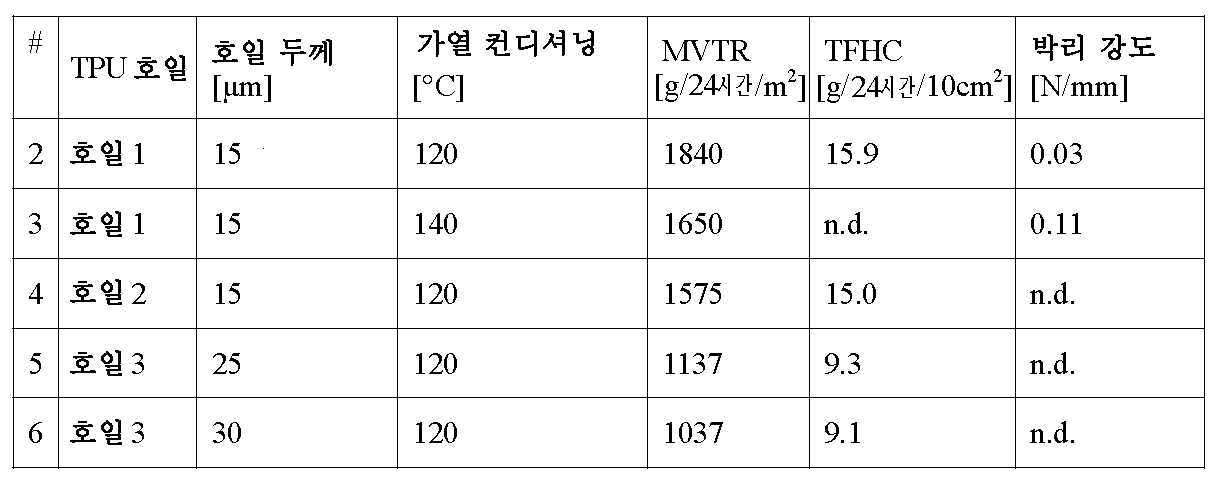
n.d.: 값이 측정되지 않음.n.d .: The value is not measured.
MVTR: DIN EN 13726-2 파트 3.2에 따른 상처 드레싱의 수증기 전달률.MVTR: Vapor transfer rate of wound dressing according to DIN EN 13726-2 Part 3.2.
TFHC: DIN EN 13726-1 파트 3.3에 따른, 유체와의 접촉시 상처 드레싱의 총 유체 취급능. TFHC: Total fluid handling of wound dressings in contact with fluid, according to DIN EN 13726-1 Part 3.3.
박리 강도: 100 mm/분의 횡단 속도로 쯔빅 유니버설 테스터 상에서 360° 박리 시험을 수행함으로써 측정됨. Peel Strength: Measured by performing a 360 ° peel test on a Zwick Universal Tester at a transversal speed of 100 mm / min.
실시예는, 수증기 전달률 및 수분 흡수성에 의해 상처 드레싱으로서 유용한 적층 복합재가 막 호일과 함께 적층될 수 있음을 보여준다.The examples show that laminated composites useful as wound dressings can be laminated together with the membrane foil by water vapor delivery rate and water absorption.
Claims (15)
<화학식 1>

상기 식에서, n은 ≥ 2 내지 ≤ 200의 범위이고, m은 ≥ 10 내지 ≤ 60의 범위이다. The laminate composite according to claim 2, wherein the ethylene oxide-propylene oxide block copolymer has a structure according to formula (1).
<Formula 1>
Wherein n ranges from ≧ 2 to ≦ 200 and m ranges from ≧ 10 to ≦ 60.
A) A1) 유기 폴리이소시아네이트 및
A2) ≥ 400 g/mol 내지 ≤ 8000 g/mol의 수 평균 분자량 및 ≥ 1.5 내지 ≤ 6의 OH 관능가를 갖는 중합체 폴리올
을 포함하는 반응 혼합물로부터 수득가능한 이소시아네이트-관능성 예비중합체를 제공하고,
또한 후속적으로,
B) 예비중합체의 유리 NCO 기를
B1) 아미노-관능성 음이온성 또는 잠재적 음이온성 친수성화제
와 사슬 연장시키며 완전히 또는 부분적으로 반응시키고, 단계 B) 전에, 단계 B) 동안 또는 단계 B) 후에 예비중합체를 물 중에 분산시키고, 여기서 반응 혼합물 중에 여전히 존재하는 잠재적 이온성 기를 중화제와 부분적으로 또는 완전히 반응시켜 이들의 이온 형태로 전환시킴
으로써 수득가능한 것인 적층 복합재.The method of claim 1 wherein the aqueous, anionic hydrophilized polyurethane dispersion (I) is
A) A1) organic polyisocyanates and
A2) polymeric polyols having a number average molecular weight of ≧ 400 g / mol to ≦ 8000 g / mol and an OH functionality of ≧ 1.5 to ≦ 6
Providing an isocyanate-functional prepolymer obtainable from a reaction mixture comprising
Also subsequently,
B) free NCO groups of the prepolymer
B1) amino-functional anionic or potentially anionic hydrophilic agents
Chain reaction with and fully or partially, dispersing the prepolymer in water before step B), during step B) or after step B), wherein the potential ionic groups still present in the reaction mixture are partially or completely with the neutralizing agent. Reacts and converts them into their ionic form
Laminated composites obtainable by
A3) ≥ 62 g/mol 내지 ≤ 399 g/mol의 분자량을 갖는 히드록실-관능성 화합물
을 추가로 포함하는 것인 적층 복합재.The process of claim 4 wherein the reaction mixture in step A) is
A3) hydroxyl-functional compounds having a molecular weight of ≧ 62 g / mol to ≦ 399 g / mol
Laminated composite further comprising.
A4) 이소시아네이트-반응성 음이온성 또는 잠재적 음이온성 및 임의로는 비이온성 친수성화제
를 추가로 포함하는 것인 적층 복합재.The process of claim 4 wherein the reaction mixture in step A) is
A4) isocyanate-reactive anionic or potentially anionic and optionally nonionic hydrophilizing agents
Laminated composite further comprising.
B2) ≥ 32 g/mol 내지 ≤ 400 g/mol의 분자량을 갖는 아미노-관능성 화합물
과 추가로 완전히 또는 부분적으로 반응시키는 것인 적층 복합재.The free NCO group of the prepolymer in claim B,
B2) amino-functional compounds having a molecular weight of ≧ 32 g / mol to ≦ 400 g / mol
And further fully or partially reacting with the laminate.
- 발포체 층의 정상부에 커버 층 (20)을 적용하는 단계
를 포함하는, 제1항에 따른 적층 복합재의 제조 방법.Providing a foam layer comprising a polyurethane foam obtained by foaming a composition comprising an aqueous, anionic hydrophilized polyurethane dispersion (I);
Applying a cover layer 20 to the top of the foam layer
A method for producing a laminated composite according to claim 1, comprising a.
Applications Claiming Priority (2)
| Application Number | Priority Date | Filing Date | Title |
|---|---|---|---|
| EP08164722.4 | 2008-09-19 | ||
| EP08164722A EP2165718A1 (en) | 2008-09-19 | 2008-09-19 | Wound dressing with a polyurethane foam layer and a covering layer made from thermoplastic polymer |
Publications (1)
| Publication Number | Publication Date |
|---|---|
| KR20110060902A true KR20110060902A (en) | 2011-06-08 |
Family
ID=40242532
Family Applications (1)
| Application Number | Title | Priority Date | Filing Date |
|---|---|---|---|
| KR1020117006259A Withdrawn KR20110060902A (en) | 2008-09-19 | 2009-09-08 | Wound dressing with polyurethane foam layer and cover layer made of thermoplastic polymer |
Country Status (11)
| Country | Link |
|---|---|
| US (1) | US20110171277A1 (en) |
| EP (2) | EP2165718A1 (en) |
| JP (1) | JP2012502708A (en) |
| KR (1) | KR20110060902A (en) |
| CN (1) | CN102159165A (en) |
| AU (1) | AU2009294937A1 (en) |
| BR (1) | BRPI0919337A2 (en) |
| CA (1) | CA2737468A1 (en) |
| RU (1) | RU2011115101A (en) |
| TW (1) | TW201023917A (en) |
| WO (1) | WO2010031509A2 (en) |
Families Citing this family (25)
| Publication number | Priority date | Publication date | Assignee | Title |
|---|---|---|---|---|
| EP2338528B1 (en) * | 2009-12-24 | 2013-05-29 | Paul Hartmann AG | Hydrogel matrix with increased absorption capacity for liquids |
| DE102011106393A1 (en) | 2011-07-02 | 2013-01-03 | Steffen Herr | Textile sheet for use as wound dressing layer for patient having e.g. burn, has functional layers arranged at defined distance from each other, where distance between layers is controlled during manufacturing of sheet |
| DE102012007919A1 (en) | 2012-04-20 | 2013-10-24 | Steffen Herr | Textile sheet used as wound dressing, has functional layers that are made of textile material and arranged near to wound side, while another layer is placed away from the skin and wound, and whose spacing is controlled |
| CN103356333B (en) * | 2013-07-22 | 2015-04-29 | 科云生医科技股份有限公司 | Wound cover and method of manufacture |
| EP3086745A1 (en) * | 2013-12-27 | 2016-11-02 | 3M Innovative Properties Company | Liquid-absorbent composite nonwoven fabric and articles thereof |
| CN105816272B (en) * | 2015-01-05 | 2019-02-15 | 陕西远光高科技有限公司 | A medical functional foam dressing material |
| DE102015206083A1 (en) * | 2015-04-02 | 2016-10-06 | Ivf Hartmann Ag | Wound dressing for wound treatment in a moist or wet-moist environment |
| TWI597075B (en) * | 2015-05-12 | 2017-09-01 | Hydrophilic polyurethane, hydrophilic polyurethane foam and its preparation Wet wound dressing | |
| CN106310497A (en) * | 2015-07-01 | 2017-01-11 | 泰升国际科技股份有限公司 | Negative pressure therapeutic device |
| CN105153393B (en) | 2015-08-04 | 2017-10-17 | 李明莹 | Hydrophilic and bio-safety foam of polymers, its preparation method and application |
| JP6492183B2 (en) * | 2015-09-01 | 2019-03-27 | 三井化学株式会社 | Buffer material, buffer material for automatic motion device for painting, automatic motion device with buffer material, and automatic motion device for coating material with buffer material |
| GB201610184D0 (en) | 2016-06-10 | 2016-07-27 | Eumar Tech Ltd | Product |
| EP3538593A4 (en) * | 2016-11-14 | 2020-07-15 | Covestro Deutschland AG | POLYURETHANE FOAM FOR USE IN COSMETIC APPLICATIONS |
| WO2018226417A1 (en) | 2017-06-08 | 2018-12-13 | Hollister Incorporated | Skin barrier including skin friendly ingredients |
| TWI638006B (en) * | 2017-07-20 | 2018-10-11 | 泰陞國際科技股份有限公司 | 疤 疤 patch and its manufacturing method |
| TWI620580B (en) * | 2017-07-20 | 2018-04-11 | Taicend Technology Co Ltd | Anti-stick dressing and manufacturing method thereof |
| EP3590990A1 (en) * | 2018-07-03 | 2020-01-08 | Covestro Deutschland AG | Method and device for producing a polyurethane dispersion with reduced foaming |
| BR112020026352A2 (en) * | 2018-07-04 | 2021-03-30 | Coloplast A/S | OPEN CELL FOAM WOUND DRESSING, AND, METHOD FOR MANUFACTURING AN OPEN CELL FOAM WOUND Wound Dressing |
| NL2022104B1 (en) | 2018-11-30 | 2020-06-26 | Stahl Int B V | Process to prepare aqueous polyurethane dispersions that are substantially free of volatile organic compounds and that have a high solids content |
| NL2022103B1 (en) | 2018-11-30 | 2020-06-26 | Stahl Int B V | Composite structure with polyurethane layers, which is substantially free of volatile organic compounds |
| US11000419B2 (en) | 2018-12-31 | 2021-05-11 | Geof CLIPPERT | Re-closable wound dressing |
| US20220227916A1 (en) * | 2019-05-16 | 2022-07-21 | Dow Global Technologies Llc | Compatibilized blends of terephalate ester polyols and hydrocarbon blowing agents |
| JP7343310B2 (en) * | 2019-06-10 | 2023-09-12 | 株式会社Adeka | skin cosmetics |
| WO2020264042A1 (en) * | 2019-06-24 | 2020-12-30 | Clippert Geof | Re-closable wound dressing with increased adhesive layer |
| CN113637145B (en) * | 2021-07-13 | 2022-04-29 | 广东图恩新材料有限公司 | High-storage-stability polyurethane composite material and preparation method thereof |
Family Cites Families (11)
| Publication number | Priority date | Publication date | Assignee | Title |
|---|---|---|---|---|
| DE2446440C3 (en) | 1974-09-28 | 1981-04-30 | Bayer Ag, 5090 Leverkusen | Process for the preparation of aqueous dispersions of polyurethanes containing sulfonate groups |
| CA1326416C (en) * | 1986-08-25 | 1994-01-25 | Ralph Xavier Ewall | Polymeric wound dressings |
| EP0485657A1 (en) | 1990-11-15 | 1992-05-20 | Catalina Biomedical Corporation | Modifiable, semi permeable wound dressing |
| GB9102660D0 (en) * | 1991-02-07 | 1991-03-27 | Ultra Lab Ltd | Wound dressing materials |
| DE4418319C3 (en) * | 1994-05-26 | 2001-08-09 | Stockhausen Chem Fab Gmbh | Layered body for the absorption of liquids and its manufacture and use |
| DE19525489A1 (en) * | 1995-07-13 | 1997-01-16 | Wolff Walsrode Ag | Radiation-curable, aqueous dispersions, their preparation and use |
| DE19750186A1 (en) | 1997-11-13 | 1999-05-20 | Bayer Ag | Hydrophilizing agent, a process for its preparation and its use as a dispersant for aqueous polyurethane dispersions |
| DE10024624A1 (en) | 2000-05-18 | 2001-11-22 | Bayer Ag | Modified polyisocyanates, e.g. useful in coating compositions, obtained by reacting polyisocyanates with 2-(cyclohexylamino)ethanesulfonic acid and/or 3-(cyclohexylamino)propanesulfonic acid |
| DE10301835A1 (en) * | 2003-01-20 | 2004-07-29 | Beiersdorf Ag | Plaster for dressing wounds has clear fixing film and wound dressing with visible printing on side remote from wound, printed directly on dressing or as normal or mirror image on film bonded to dressing |
| US20060142529A1 (en) * | 2004-02-06 | 2006-06-29 | Verena Thiede | Hydrophilic polyurethane polymers derived from a mdi-based isocyanate-terminated prepolymer |
| DE102006016636A1 (en) | 2006-04-08 | 2007-10-18 | Bayer Materialscience Ag | Polyurethane foams for wound treatment |
-
2008
- 2008-09-19 EP EP08164722A patent/EP2165718A1/en not_active Ceased
-
2009
- 2009-09-08 AU AU2009294937A patent/AU2009294937A1/en not_active Abandoned
- 2009-09-08 RU RU2011115101/15A patent/RU2011115101A/en not_active Application Discontinuation
- 2009-09-08 CA CA2737468A patent/CA2737468A1/en not_active Abandoned
- 2009-09-08 US US13/120,037 patent/US20110171277A1/en not_active Abandoned
- 2009-09-08 KR KR1020117006259A patent/KR20110060902A/en not_active Withdrawn
- 2009-09-08 EP EP09778394A patent/EP2328626A2/en not_active Withdrawn
- 2009-09-08 CN CN2009801366578A patent/CN102159165A/en active Pending
- 2009-09-08 BR BRPI0919337-5A patent/BRPI0919337A2/en not_active IP Right Cessation
- 2009-09-08 WO PCT/EP2009/006505 patent/WO2010031509A2/en not_active Ceased
- 2009-09-08 JP JP2011527234A patent/JP2012502708A/en not_active Withdrawn
- 2009-09-18 TW TW098131445A patent/TW201023917A/en unknown
Also Published As
| Publication number | Publication date |
|---|---|
| CA2737468A1 (en) | 2010-03-25 |
| TW201023917A (en) | 2010-07-01 |
| EP2328626A2 (en) | 2011-06-08 |
| AU2009294937A1 (en) | 2010-03-25 |
| JP2012502708A (en) | 2012-02-02 |
| EP2165718A1 (en) | 2010-03-24 |
| RU2011115101A (en) | 2012-10-27 |
| US20110171277A1 (en) | 2011-07-14 |
| BRPI0919337A2 (en) | 2015-08-11 |
| WO2010031509A2 (en) | 2010-03-25 |
| CN102159165A (en) | 2011-08-17 |
| WO2010031509A3 (en) | 2010-08-12 |
Similar Documents
| Publication | Publication Date | Title |
|---|---|---|
| KR20110060902A (en) | Wound dressing with polyurethane foam layer and cover layer made of thermoplastic polymer | |
| US8197835B2 (en) | Biomedical foam articles | |
| US20110110996A1 (en) | Layer composite, suitable as a wound dressing, comprising a polyurethane foam layer, an absorber layer and a cover layer | |
| US20070254974A1 (en) | Production of polyurethane wound dressing foams | |
| US20090099082A1 (en) | Production of polyurethane foams | |
| US20090092647A1 (en) | Polyurethane foams for wound management | |
| US20090054542A1 (en) | Eo/po block copolymers useful as stabilizers for pur foams | |
| US20090148395A1 (en) | Biomedical foam articles | |
| KR20110117107A (en) | Dispersed Two-Component Polyurethane Foam | |
| KR20110073430A (en) | Method of Making Molded Polyurethane Foam Wound Dressing | |
| WO2009043497A1 (en) | Production of polyurethane foams | |
| KR20110119658A (en) | Polyurethane Surfactant Stabilized Polyurethane Foam | |
| KR20090074200A (en) | Alkylpolyglycosides as stabilizers for PU foams | |
| US20110160633A1 (en) | Method for producing shaped polyurethane foam wound dressings | |
| WO2013000910A1 (en) | Composite foam for wound dressings | |
| US8629195B2 (en) | Production of polyurethane foams |
Legal Events
| Date | Code | Title | Description |
|---|---|---|---|
| PA0105 | International application |
Patent event date: 20110318 Patent event code: PA01051R01D Comment text: International Patent Application |
|
| PG1501 | Laying open of application | ||
| PC1203 | Withdrawal of no request for examination | ||
| WITN | Application deemed withdrawn, e.g. because no request for examination was filed or no examination fee was paid |