KR20120082425A - Bab triblock polymers having improved release characteristics - Google Patents
Bab triblock polymers having improved release characteristicsInfo
- Publication number
- KR20120082425A KR20120082425A KR1020127009664A KR20127009664A KR20120082425A KR 20120082425 A KR20120082425 A KR 20120082425A KR 1020127009664 A KR1020127009664 A KR 1020127009664A KR 20127009664 A KR20127009664 A KR 20127009664A KR 20120082425 A KR20120082425 A KR 20120082425A
- Authority
- KR
- South Korea
- Prior art keywords
- block copolymer
- bab
- factor
- block
- csf
- Prior art date
- Legal status (The legal status is an assumption and is not a legal conclusion. Google has not performed a legal analysis and makes no representation as to the accuracy of the status listed.)
- Granted
Links
Images
Classifications
-
- C—CHEMISTRY; METALLURGY
- C08—ORGANIC MACROMOLECULAR COMPOUNDS; THEIR PREPARATION OR CHEMICAL WORKING-UP; COMPOSITIONS BASED THEREON
- C08G—MACROMOLECULAR COMPOUNDS OBTAINED OTHERWISE THAN BY REACTIONS ONLY INVOLVING UNSATURATED CARBON-TO-CARBON BONDS
- C08G63/00—Macromolecular compounds obtained by reactions forming a carboxylic ester link in the main chain of the macromolecule
- C08G63/66—Polyesters containing oxygen in the form of ether groups
- C08G63/664—Polyesters containing oxygen in the form of ether groups derived from hydroxy carboxylic acids
-
- C—CHEMISTRY; METALLURGY
- C08—ORGANIC MACROMOLECULAR COMPOUNDS; THEIR PREPARATION OR CHEMICAL WORKING-UP; COMPOSITIONS BASED THEREON
- C08G—MACROMOLECULAR COMPOUNDS OBTAINED OTHERWISE THAN BY REACTIONS ONLY INVOLVING UNSATURATED CARBON-TO-CARBON BONDS
- C08G63/00—Macromolecular compounds obtained by reactions forming a carboxylic ester link in the main chain of the macromolecule
- C08G63/02—Polyesters derived from hydroxycarboxylic acids or from polycarboxylic acids and polyhydroxy compounds
- C08G63/06—Polyesters derived from hydroxycarboxylic acids or from polycarboxylic acids and polyhydroxy compounds derived from hydroxycarboxylic acids
- C08G63/08—Lactones or lactides
-
- A—HUMAN NECESSITIES
- A61—MEDICAL OR VETERINARY SCIENCE; HYGIENE
- A61K—PREPARATIONS FOR MEDICAL, DENTAL OR TOILETRY PURPOSES
- A61K47/00—Medicinal preparations characterised by the non-active ingredients used, e.g. carriers or inert additives; Targeting or modifying agents chemically bound to the active ingredient
- A61K47/30—Macromolecular organic or inorganic compounds, e.g. inorganic polyphosphates
- A61K47/34—Macromolecular compounds obtained otherwise than by reactions only involving carbon-to-carbon unsaturated bonds, e.g. polyesters, polyamino acids, polysiloxanes, polyphosphazines, copolymers of polyalkylene glycol or poloxamers
-
- A—HUMAN NECESSITIES
- A61—MEDICAL OR VETERINARY SCIENCE; HYGIENE
- A61K—PREPARATIONS FOR MEDICAL, DENTAL OR TOILETRY PURPOSES
- A61K9/00—Medicinal preparations characterised by special physical form
- A61K9/0012—Galenical forms characterised by the site of application
- A61K9/0019—Injectable compositions; Intramuscular, intravenous, arterial, subcutaneous administration; Compositions to be administered through the skin in an invasive manner
-
- A—HUMAN NECESSITIES
- A61—MEDICAL OR VETERINARY SCIENCE; HYGIENE
- A61K—PREPARATIONS FOR MEDICAL, DENTAL OR TOILETRY PURPOSES
- A61K9/00—Medicinal preparations characterised by special physical form
- A61K9/06—Ointments; Bases therefor; Other semi-solid forms, e.g. creams, sticks, gels
-
- A—HUMAN NECESSITIES
- A61—MEDICAL OR VETERINARY SCIENCE; HYGIENE
- A61K—PREPARATIONS FOR MEDICAL, DENTAL OR TOILETRY PURPOSES
- A61K9/00—Medicinal preparations characterised by special physical form
- A61K9/08—Solutions
-
- A—HUMAN NECESSITIES
- A61—MEDICAL OR VETERINARY SCIENCE; HYGIENE
- A61K—PREPARATIONS FOR MEDICAL, DENTAL OR TOILETRY PURPOSES
- A61K9/00—Medicinal preparations characterised by special physical form
- A61K9/48—Preparations in capsules, e.g. of gelatin, of chocolate
- A61K9/50—Microcapsules having a gas, liquid or semi-solid filling; Solid microparticles or pellets surrounded by a distinct coating layer, e.g. coated microspheres, coated drug crystals
- A61K9/51—Nanocapsules; Nanoparticles
- A61K9/5107—Excipients; Inactive ingredients
- A61K9/513—Organic macromolecular compounds; Dendrimers
- A61K9/5146—Organic macromolecular compounds; Dendrimers obtained otherwise than by reactions only involving carbon-to-carbon unsaturated bonds, e.g. polyethylene glycol, polyamines, polyanhydrides
- A61K9/5153—Polyesters, e.g. poly(lactide-co-glycolide)
-
- A—HUMAN NECESSITIES
- A61—MEDICAL OR VETERINARY SCIENCE; HYGIENE
- A61P—SPECIFIC THERAPEUTIC ACTIVITY OF CHEMICAL COMPOUNDS OR MEDICINAL PREPARATIONS
- A61P35/00—Antineoplastic agents
-
- A—HUMAN NECESSITIES
- A61—MEDICAL OR VETERINARY SCIENCE; HYGIENE
- A61P—SPECIFIC THERAPEUTIC ACTIVITY OF CHEMICAL COMPOUNDS OR MEDICINAL PREPARATIONS
- A61P37/00—Drugs for immunological or allergic disorders
- A61P37/02—Immunomodulators
- A61P37/04—Immunostimulants
-
- C—CHEMISTRY; METALLURGY
- C08—ORGANIC MACROMOLECULAR COMPOUNDS; THEIR PREPARATION OR CHEMICAL WORKING-UP; COMPOSITIONS BASED THEREON
- C08G—MACROMOLECULAR COMPOUNDS OBTAINED OTHERWISE THAN BY REACTIONS ONLY INVOLVING UNSATURATED CARBON-TO-CARBON BONDS
- C08G63/00—Macromolecular compounds obtained by reactions forming a carboxylic ester link in the main chain of the macromolecule
- C08G63/88—Post-polymerisation treatment
- C08G63/90—Purification; Drying
-
- C—CHEMISTRY; METALLURGY
- C08—ORGANIC MACROMOLECULAR COMPOUNDS; THEIR PREPARATION OR CHEMICAL WORKING-UP; COMPOSITIONS BASED THEREON
- C08G—MACROMOLECULAR COMPOUNDS OBTAINED OTHERWISE THAN BY REACTIONS ONLY INVOLVING UNSATURATED CARBON-TO-CARBON BONDS
- C08G65/00—Macromolecular compounds obtained by reactions forming an ether link in the main chain of the macromolecule
- C08G65/34—Macromolecular compounds obtained by reactions forming an ether link in the main chain of the macromolecule from hydroxy compounds or their metallic derivatives
-
- C—CHEMISTRY; METALLURGY
- C08—ORGANIC MACROMOLECULAR COMPOUNDS; THEIR PREPARATION OR CHEMICAL WORKING-UP; COMPOSITIONS BASED THEREON
- C08G—MACROMOLECULAR COMPOUNDS OBTAINED OTHERWISE THAN BY REACTIONS ONLY INVOLVING UNSATURATED CARBON-TO-CARBON BONDS
- C08G2261/00—Macromolecular compounds obtained by reactions forming a carbon-to-carbon link in the main chain of the macromolecule
- C08G2261/10—Definition of the polymer structure
- C08G2261/12—Copolymers
- C08G2261/126—Copolymers block
Landscapes
- Health & Medical Sciences (AREA)
- Chemical & Material Sciences (AREA)
- Medicinal Chemistry (AREA)
- Life Sciences & Earth Sciences (AREA)
- Animal Behavior & Ethology (AREA)
- General Health & Medical Sciences (AREA)
- Public Health (AREA)
- Veterinary Medicine (AREA)
- Pharmacology & Pharmacy (AREA)
- Chemical Kinetics & Catalysis (AREA)
- Organic Chemistry (AREA)
- Epidemiology (AREA)
- Polymers & Plastics (AREA)
- Engineering & Computer Science (AREA)
- Bioinformatics & Cheminformatics (AREA)
- Immunology (AREA)
- Inorganic Chemistry (AREA)
- Proteomics, Peptides & Aminoacids (AREA)
- General Chemical & Material Sciences (AREA)
- Nuclear Medicine, Radiotherapy & Molecular Imaging (AREA)
- Biomedical Technology (AREA)
- Nanotechnology (AREA)
- Optics & Photonics (AREA)
- Physics & Mathematics (AREA)
- Dermatology (AREA)
- Medicinal Preparation (AREA)
- Medicines That Contain Protein Lipid Enzymes And Other Medicines (AREA)
- Polyesters Or Polycarbonates (AREA)
- Biological Depolymerization Polymers (AREA)
- Pharmaceuticals Containing Other Organic And Inorganic Compounds (AREA)
- Compositions Of Macromolecular Compounds (AREA)
- Polyurethanes Or Polyureas (AREA)
- Other Resins Obtained By Reactions Not Involving Carbon-To-Carbon Unsaturated Bonds (AREA)
Abstract
리버스 열 겔화 특성을 나타내는 향상된 생분해성 및 생흡수성 BAB-블록 공중합체 및 당해 BAB-블록 공중합체를 포함하는 수성 중합체 조성물을 제공한다. 상기 개선된 BAB-블록 공중합체 및 이를 포함하는 조성물의 제조방법 또한 제공한다.An improved biodegradable and bioabsorbable BAB-block copolymer exhibiting reverse thermal gelling properties and an aqueous polymer composition comprising the BAB-block copolymer are provided. Also provided is an improved BAB-block copolymer and process for preparing a composition comprising the same.
Description
본 발명은 승온에 노출시, 예를 들면, 투여 직전 또는 투여시에 체온에 노출시 리버스 열 겔화 특성(reverse thermal gellation property)을 나타내는 생분해성 및 생흡수성 BAB-블록 공중합체에 관한 것이다. 본원에 개시된 중합체는, 예를 들면, 약물의 비경구 투여시 유리하게 사용된다.The present invention relates to biodegradable and bioabsorbable BAB-block copolymers that exhibit reverse thermal gellation properties upon exposure to elevated temperature, eg, immediately before or upon administration to body temperature. The polymers disclosed herein are advantageously used, for example, in parenteral administration of a drug.
리버스 열 겔화를 나타내는 생분해성 블록 공중합체는 라티(Rathi) 등에게 허여된 미국 특허 제6,201,072호, 제6,117,949호 및 제6,004,573호와 차(Cha) 등에게 허여된 미국 특허 제5,702,717호에 개시되어 있고, 상기 특허 문헌 각각은 본원에 참고로 인용된다. 이들 중합체 조성물은 저온에서 액체 용액으로 존재하다가 생리학적 관련 온도에서 가역적으로 겔을 형성하고, 우수한 약물 방출 특성을 제공한다. 이들 조성물은 중량 평균 분자량이 약 2000 내지 4990인 ABA형 또는 BAB형 블록 공중합체를 포함하고, 생분해성 폴리에스테르를 포함하는 소수성 A 중합체 블록 약 51 내지 83 중량% 및 폴리에틸렌 글리콜로 구성된 친수성 B 중합체 블록 약 17 내지 49 중량%를 포함한다. 피아오(Piao) 등에게 허여된 미국 특허 제7,018,645로 및 제7,135,190호에는 유사한 리버스 열 겔화 특성을 나타내는 트리블록 공중합체들의 혼합물이 개시되어 있다.Biodegradable block copolymers exhibiting reverse thermal gelation are disclosed in US Pat. Nos. 6,201,072, 6,117,949 and 6,004,573 to Rathi et al. And US Pat. No. 5,702,717 to Cha et al. , Each of which is incorporated herein by reference. These polymer compositions exist as liquid solutions at low temperatures and then reversibly form gels at physiologically relevant temperatures and provide good drug release properties. These compositions comprise an ABA or BAB type block copolymer having a weight average molecular weight of about 2000 to 4990 and a hydrophilic B polymer block composed of about 51 to 83% by weight of a hydrophobic A polymer block comprising biodegradable polyester and polyethylene glycol About 17 to 49 weight percent. US Pat. Nos. 7,018,645 and 7,135,190 to Piao et al. Disclose mixtures of triblock copolymers exhibiting similar reverse thermal gelling properties.
라티의 특허들에는 리버스 열 겔화 특성을 갖는 BAB-블록 공중합체들이 개시되어 있다. 미국 특허 제6,117,949호에 따르면, BAB 트리블록 공중합체는 양 말단에서 동일한 PEG B-블록을 사용하여 합성되지만(Mw=550), 폴리(락타이드) 및/또는 폴리(글리콜라이드) 함량은 다양하였다. PEG와 PLGA는 에스테르, 우레탄 또는 에스테르와 우레탄의 배합물 링크(link)를 통해 서로 커플링되었다. 라티의 특허들에 기재된 선행 BAB-블록 공중합체들은 2000 내지 4990 범위의 중량 평균 분자량 Mw를 갖는다. 다음 표는 라티의 특허들에 개시된 BAB 트리블록 공중합체의 특성을 기재한다.Lati's patents disclose BAB-block copolymers with reverse thermal gelling properties. According to US Pat. No. 6,117,949, BAB triblock copolymers are synthesized using the same PEG B-block at both ends (Mw = 550), but vary in poly (lactide) and / or poly (glycolide) content. . PEG and PLGA were coupled to each other via an ester, urethane or a combination link of ester and urethane. The preceding BAB-block copolymers described in Lati's patents have a weight average molecular weight M w in the range of 2000 to 4990. The following table describes the properties of BAB triblock copolymers disclosed in Lati's patents.
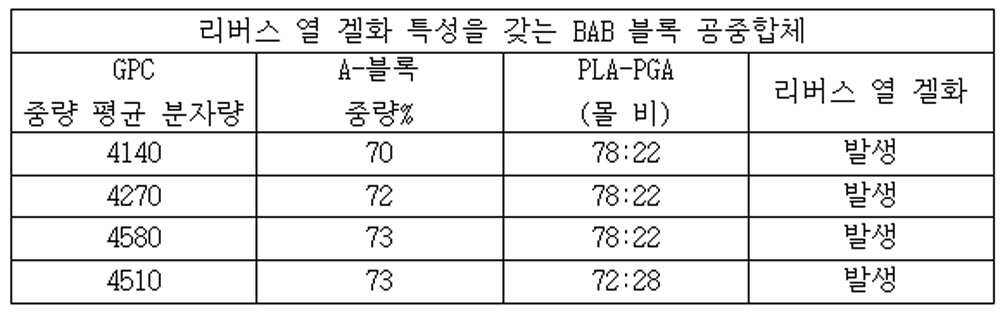
상기 표에 기재된 PEG-PLGA-PEG 트리블록 공중합체들 모두는 리버스 열 겔화 특성을 갖는다. 상기 트리블록 공중합체의 졸/겔 전이 온도는 각각 36, 34, 30 및 26℃였다. 라티 특허들이 중량 평균 분자량 Mw가 2000 내지 4990달톤의 범위에 있는 ABA-트리블록 공중합체의 경우에는 우수한 약물 방출 특성을 입증하고 있지만, 라티 특허들은 개시된 BAB-트리블록 공중합체들의 방출 특성을 특성화하지 않았다. 또한, 친수성 화합물들에 대한 방출 특성은 조사되지 않았다. 친수성 활성제(active agents)에 대한 선행 기술의 트리블록 공중합체 조성물들의 방출 특성은 다수의 조절된 방출 적용에는 적합하지 않은 것으로 밝혀졌다. All of the PEG-PLGA-PEG triblock copolymers listed in the table above have reverse thermal gelation properties. The sol / gel transition temperatures of the triblock copolymers were 36, 34, 30 and 26 ° C, respectively. Although Lati patents demonstrate good drug release properties for ABA-triblock copolymers having a weight average molecular weight M w in the range of 2000 to 4990 daltons, Lati patents characterize the release properties of the disclosed BAB-triblock copolymers. Did not do it. In addition, the release properties for hydrophilic compounds have not been investigated. The release properties of prior art triblock copolymer compositions for hydrophilic active agents have been found to be unsuitable for many controlled release applications.
본 발명의 개요Summary of the Invention
리버스 열 겔화 특성을 나타내고, 특히 친수성 활성제에 대한 향상된 약물 방출 특성을 갖는 신규한 재구성 BAB-트리블록 공중합체들이 개발되었다. 놀랍게도, 본 발명의 BAB-트리블록 공중합체가 ABA-트리블록 공중합체에 비해 조절된 방출 열가역성 중합체성 조성물, 특히 친수성 활성제와 함께 사용되는 경우에 목적하는 방출 특성을 나타내는 중합체성 조성물을 제공하는 데 유리한 것으로 밝혀졌다. 본 발명자들은 또한 PLG/PEG 비를 증가시키고 공지된 BAB-블록 공중합체 조성물에 비해 BAB-블록 공중합체의 분자량을 증가시킴으로써, 특히 친수성 활성제의 경우에 BAB-블록 공중합체의 약물 방출 특성에 대한 극적 효과를 가짐을 밝혀냈다. ABA 및 BAB 트리블록들에 대한 선행 연구는 양 중합체에 대한 방출 특성이 유사할 것이고, 동일 범위의 트리블록 분자량이 ABA 트리블록 공중합체 뿐만 아니라 BAB 트리블록 공중합체에도 적합할 거라는 것을 시사하였다. 그러나, 본 발명자들은 놀랍게도 조절된 방출성 열가역성 BAB-트리블록 조성물에 대한 트리블록 분자량 범위가 ABA-트리블록 공중합체에 유효한 트리블록 분자량 범위와 상이함을 밝혀냈다.New reconstituted BAB-triblock copolymers have been developed that exhibit reverse thermal gelling properties and especially have improved drug release properties for hydrophilic active agents. Surprisingly, the BAB-triblock copolymer of the present invention provides a controlled release thermoreversible polymeric composition compared to the ABA-triblock copolymer, in particular a polymeric composition exhibiting the desired release properties when used in combination with a hydrophilic active agent. It turned out to be advantageous. We also increased the PLG / PEG ratio and increased the molecular weight of BAB-block copolymers compared to known BAB-block copolymer compositions, thereby dramatically reducing the drug release properties of BAB-block copolymers, particularly in the case of hydrophilic active agents. It was found to have an effect. Previous studies on ABA and BAB triblocks suggested that the release properties for both polymers would be similar and that the same range of triblock molecular weights would be suitable for ABA triblock copolymers as well as BAB triblock copolymers. However, the inventors have surprisingly found that the triblock molecular weight range for controlled release thermoreversible BAB-triblock compositions differs from the effective triblock molecular weight range for ABA-triblock copolymers.
본 발명의 목적은 생분해성이고, 리버스 열 겔화 거동을 나타내고, 즉 저온에서 액체 용액으로서 존재하다가 생리학적 관련 온도에서 가역적으로 겔을 형성하고, 선행 BAB-트리블록 및 ABA-트리블록 공중합체들에 비해 향상된 약물 방출 특성을 제공하는 저분자량 트리블록 공중합체 약물 전달 시스템을 제공하는 것이다.It is an object of the present invention to be biodegradable and exhibit reverse thermal gelling behavior, i.e. present as a liquid solution at low temperatures and then reversibly form a gel at physiologically relevant temperatures, It is to provide a low molecular weight triblock copolymer drug delivery system that provides improved drug release properties.
본 발명의 또 다른 목적은 약물이 방출되는 체내에서 겔 저장소(depot)를 생성시켜 중합체들이 선행 BAB-트리블록 및 ABA-트리블록 공중합체들에 비해 향상된 약물 방출 특성을 나타내도록 하는 생분해성 중합체성 매트릭스 중의 약물의 비경구 투여방법을 제공하는 것이다. It is another object of the present invention to create a gel depot in the body where the drug is released so that the polymers exhibit improved drug release properties compared to the preceding BAB-triblock and ABA-triblock copolymers. It is to provide a method for parenteral administration of the drug in the matrix.
본 발명의 또 다른 목적은 친수성 및 소수성 약물, 펩타이드 및 단백질 약물, 호르몬, 유전자/핵산, 올리고뉴클레오타이드 및 항암제의 비경구 또는 종양내 투여용 약물 전달 시스템을 제공하는 것이다. 항암제 부류로는, 예를 들면, 알킬화제, 항대사물질, 항생제, 호르몬제, 항혈관신생제(anti-vascularization) 또는 니트로스우레아가 있다.Another object of the present invention is to provide a drug delivery system for parenteral or intratumoral administration of hydrophilic and hydrophobic drugs, peptide and protein drugs, hormones, genes / nucleic acids, oligonucleotides and anticancer agents. Anticancer agent classes include, for example, alkylating agents, anti-metabolic agents, antibiotics, hormones, anti-vascularizations or nitrosureas.
상기 및 기타 목적들은 i) 생분해성 폴리에스테르를 포함하는 생분해성 소수성 A-블록 약 60 내지 85 중량%; 및 ii) 폴리에틸렌 글리콜을 포함하고 각각의 중량 평균 분자량이 300 내지 1000달톤인 생분해성 친수성 B-블록 약 15 내지 40 중량%를 포함하는 BAB-블록 공중합체로서, 상기 BAB-블록 공중합체가 5000 내지 8000 범위의 Mw를 갖고, 중합체 수용액으로 형성되는 경우에 리버스 열 겔화 특성을 나타낼 수 있는 BAB-블록 공중합체에 의해 달성될 수 있다. 바람직하게는, 상기 블록 공중합체는 A-블록 함량이 65 내지 80%의 범위에 있고, 상기 블록 공중합체의 B-블록 함량은 20 내지 35%의 범위에 있고, 보다 바람직하게는, 상기 블록 공중합체는 A-블록 함량이 67 내지 75%의 범위에 있고 B-블록 함량이 25 내지 33%의 범위에 있다. 상기 블록 공중합체의 수 평균 분자량 Mn은 바람직하게는 3800 내지 5000달톤의 범위, 보다 바람직하게는 4000 내지 4600달톤의 범위에 있다.These and other objects include: i) about 60 to 85 weight percent of a biodegradable hydrophobic A-block comprising a biodegradable polyester; And ii) about 15 to 40 weight percent of a biodegradable hydrophilic B-block comprising polyethylene glycol and each having a weight average molecular weight of 300 to 1000 Daltons, wherein the BAB-block copolymer is from 5000 to It can be achieved with a BAB-block copolymer having a Mw in the range of 8000 and capable of exhibiting reverse thermal gelling properties when formed into aqueous polymer solution. Preferably, the block copolymer has an A-block content in the range of 65 to 80%, and the B-block content of the block copolymer is in the range of 20 to 35%, more preferably, the block air The coalescence has an A-block content in the range of 67 to 75% and a B-block content in the range of 25 to 33%. The number average molecular weight M n of the block copolymer is preferably in the range of 3800 to 5000 Daltons, more preferably in the range of 4000 to 4600 Daltons.
상기 및 기타 목적들은 i) 생분해성 폴리에스테르를 포함하는 생분해성 소수성 A-블록 약 60 내지 85 중량%; 및 ii) 폴리에틸렌 폴리올을 포함하고 각각의 중량 평균 분자량이 300 내지 1000달톤인 생분해성 친수성 B-블록 약 15 내지 40 중량%를 포함하는 수성 BAB-블록 공중합체 조성물로서, 상기 BAB-블록 공중합체 조성물이 5000 내지 8000 범위의 Mw를 갖고, 리버스 열 겔화 특성을 나타내는, 수성 BAB-블록 공중합체 조성물에 의해 달성될 수 있다. 바람직하게는, 상기 블록 공중합체는 A-블록 함량이 65 내지 80%의 범위에 있고, 상기 블록 공중합체의 B-블록 함량은 20 내지 35%의 범위에 있으며, 보다 바람직하게는, 상기 블록 공중합체는 A-블록 함량이 67 내지 75%의 범위에 있고, B-블록 함량이 25 내지 33%의 범위에 있다. 상기 블록 공중합체의 수 평균 분자량 Mn은 바람직하게는 3800 내지 5000달톤의 범위, 보다 바람직하게는 4000 내지 4600달톤의 범위에 있다.These and other objects include: i) about 60 to 85 weight percent of a biodegradable hydrophobic A-block comprising a biodegradable polyester; And ii) about 15 to 40 weight percent of a biodegradable hydrophilic B-block comprising polyethylene polyol and each having a weight average molecular weight of 300 to 1000 Daltons, wherein the BAB-block copolymer composition This can be achieved by an aqueous BAB-block copolymer composition having a Mw in the range of 5000 to 8000 and exhibiting reverse thermal gelling properties. Preferably, the block copolymer has an A-block content in the range of 65 to 80%, the B-block content of the block copolymer is in the range of 20 to 35%, and more preferably, the block air The coalescence has an A-block content in the range of 67 to 75% and a B-block content in the range of 25 to 33%. The number average molecular weight M n of the block copolymer is preferably in the range of 3800 to 5000 Daltons, more preferably in the range of 4000 to 4600 Daltons.
상기 및 기타 목적들은 (1) i) 생분해성 폴리에스테르를 포함하는 생분해성 소수성 A-블록 약 60 내지 85 중량%; 및 ii) 폴리에틸렌 글리콜을 포함하고 각각의 중량 평균 분자량이 300 내지 1000달톤인 생분해성 친수성 B-블록 약 15 내지 40 중량%를 포함하는 수성 BAB-블록 공중합체 조성물로서, 상기 BAB-블록 공중합체 조성물의 Mw가 5000 내지 8000의 범위에 있고, 리버스 열 겔화 특성을 나타내는 수성 BAB-블록 공중합체 조성물을 제공하는 단계; 및 (2) 상기 조성물을 온혈 동물에게 투여하는 단계를 포함하는, 하나 이상의 약물을 조절된 방출 형태로 온혈 동물에게 투여하는 방법에 의해 달성될 수 있다. 바람직하게는, 상기 블록 공중합체는 A-블록 함량이 65 내지 80%의 범위에 있고, 상기 블록 공중합체의 B-블록 함량은 20 내지 35%의 범위에 있으며, 보다 바람직하게는, 상기 블록 공중합체는 A-블록 함량이 67 내지 75%의 범위에 있고 B-블록 함량이 25 내지 33%의 범위에 있다. 상기 블록 공중합체의 수 평균 분자량 Mn은 바람직하게는 3800 내지 5000달톤의 범위, 보다 바람직하게는 4000 내지 4600달톤의 범위에 있다.These and other objects include (1) about 60 to 85 weight percent of i) a biodegradable hydrophobic A-block comprising a biodegradable polyester; And ii) about 15 to 40% by weight of a biodegradable hydrophilic B-block comprising polyethylene glycol and each having a weight average molecular weight of 300 to 1000 Daltons, wherein the BAB-block copolymer composition Providing an aqueous BAB-block copolymer composition having a Mw of 5000 to 8000 and exhibiting reverse thermal gelling properties; And (2) administering the composition to a warm blooded animal, the method comprising administering to the warm blooded animal in a controlled release form. Preferably, the block copolymer has an A-block content in the range of 65 to 80%, the B-block content of the block copolymer is in the range of 20 to 35%, and more preferably, the block air The coalescence has an A-block content in the range of 67 to 75% and a B-block content in the range of 25 to 33%. The number average molecular weight M n of the block copolymer is preferably in the range of 3800 to 5000 Daltons, more preferably in the range of 4000 to 4600 Daltons.
상기 및 기타 목적들은 (1) i) 생분해성 폴리에스테르를 포함하는 생분해성 소수성 A-블록 약 60 내지 85 중량%; 및 ii) 폴리에틸렌 글리콜을 포함하고 각각의 중량 평균 분자량이 300 내지 1000달톤인 생분해성 친수성 B-블록 약 15 내지 40 중량%를 포함하는 BAB-블록 공중합체 조성물로서, 상기 BAB-블록 공중합체 조성물이 5000 내지 8000 범위의 Mw를 갖고, 중합체 수용액으로 형성되는 경우에 리버스 열 겔화 특성을 나타낼 수 있는 BAB-블록 공중합체 조성물을 제공하는 단계; 및 (2) 중합체 수용액으로서 형성되는 경우에 리버스 열 겔화를 나타낼 수 있는 상기 블록 공중합체를 동결 건조시키는 단계를 포함하는, BAB-블록 공중합체 조성물의 제조방법에 의해 달성될 수 있다. 바람직하게는, 상기 블록 공중합체는 A-블록 함량이 65 내지 80%의 범위에 있고, 상기 블록 공중합체의 B-블록 함량은 20 내지 35%의 범위에 있으며, 보다 바람직하게는, 상기 블록 공중합체는 A-블록 함량이 67 내지 75%의 범위에 있고 B-블록 함량이 25 내지 33%의 범위에 있다. 상기 블록 공중합체의 수 평균 분자량 Mn는 바람직하게는 3800 내지 5000달톤의 범위, 보다 바람직하게는 4000 내지 4600달톤의 범위에 있다.These and other objects include (1) about 60 to 85 weight percent of i) a biodegradable hydrophobic A-block comprising a biodegradable polyester; And ii) about 15 to 40 weight percent of a biodegradable hydrophilic B-block comprising polyethylene glycol and each having a weight average molecular weight of 300 to 1000 Daltons, wherein the BAB-block copolymer composition is Providing a BAB-block copolymer composition having a M w in the range of 5000 to 8000 and capable of exhibiting reverse thermal gelling properties when formed into an aqueous polymer solution; And (2) freeze drying the block copolymer which may exhibit reverse thermal gelation when formed as an aqueous polymer solution. Preferably, the block copolymer has an A-block content in the range of 65 to 80%, the B-block content of the block copolymer is in the range of 20 to 35%, and more preferably, the block air The coalescence has an A-block content in the range of 67 to 75% and a B-block content in the range of 25 to 33%. The number average molecular weight M n of the block copolymer is preferably in the range of 3800 to 5000 Daltons, more preferably in the range of 4000 to 4600 Daltons.
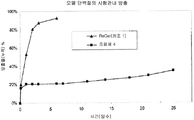
도 1은 실시예의 중합체 조성물의 방출 프로파일을 ABA-블록 공중합체 ReGel와 비교한 것이다.
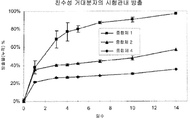
도 2는 실시예의 BAB-블록 공중합체 조성물들에 의한 친수성 거대분자의 방출을 비교한 것이다.
바람직한 구현예의 상세한 설명
본 발명의 추가의 목적 및 이점은 다음 개요 및 본 발명의 다양한 양태들의 상세한 설멸으로부터 명확해질 것이다. 본 명세서에 사용되는 바와 같이, 다음 용어들은 다음과 같이 부여된 의미를 갖는다:
"비경구"는 근육내, 복강내, 복부내, 피하, 종양내, 뇌내(또는 절제된 종양 강 내), 관절내, 척수강내, 골수내, 안내 및 실행 가능한 정도로 정맥내 및 동맥내를 의미한다.
"겔화 온도"는 생분해성 블록 공중합체가 리버스 열 겔화를 일으키는 온도, 즉, 그 미만에서는 상기 블록 공중합체가 물에 가용성이고 그 이상에서는 상기 블록 공중합체가 상 전이를 일으켜 반고체 겔을 형성하는 온도를 의미한다.
"겔화 온도", "리버스 열 겔화 온도" 등은 겔화 온도를 나타내는 점에서 상호교환적으로 사용된다.
본 명세서에서 생분해성 블록 공중합체를 지칭하는 데 사용되는 경우의 "중합체 용액", "수용액" 등은 이들 블록 공중합체가 기능적 농도로 용해되고 상기 블록 공중합체의 겔화 온도 미만의 온도에서 유지되는 수계 용액을 의미한다.
폴리에틸렌 글리콜(PEG)은 때때로 폴리(에틸렌 옥사이드)(PEO) 또는 폴리(옥시에틸렌)라고도 하고, 당해 용어들은 본 발명의 목적상 상호교환적으로 사용될 수 있다.
"리버스 열 겔화"는 블록 공중합체 용액의 온도가 상기 공중합체의 겔화 온도 이상으로 증가함에 따라, 블록 공중합체 용액의 점도가 자발적으로 증가하고, 다수의 경우에 반고체 겔을 형성하는 현상이다. 본 발명의 목적상 "겔"은 겔화 온도 이상에서 나타나는 반고체 겔 상태 및 높은 점성 상태를 모두 포함한다. 겔화 온도 미만으로 냉각되는 경우에, 겔은 자발적으로 반전되어 보다 낮은 점도 용액을 재형성한다. 용액과 겔 사이의 이런 순환은 무한히 반복될 수 있는데, 그 이유는 용액/겔 전이가 중합체 시스템의 화학 조성에서 변화를 수반하지 않기 때문이다. 겔을 생성하는 모든 상호작용은 성격상 물리적이고, 공유 결합의 형성이나 파괴를 수반하지 않는다.
"약물 전달 액체" 또는 "리버스 열 겔화 특성을 갖는 약물 전달 액체"는 온혈 동물 투여에 적합한 약물(이런 약물은 본질적으로 용해되거나 콜로이드성일 수 있다)를 함유하고, 온도가 상기 블록 공중합체의 겔화 온도 이상으로 상승할 때 겔화된 약물 저장소(drug depot)를 형성하는 중합체 용액을 의미한다.
"저장소(depot)"는 온혈 동물에 투여 이후의 약물 전달 액체를 의미하는데, 이는 온도가 겔화 온도가 이상으로 상승하면 겔을 형성한다.
"겔"은 "중합체 용액" 또는 "약물 전달 액체"의 온도가 블록 공중합체의 겔화 온도 이상으로 상승함에 따라 자발적으로 발생하는 반고체 상을 의미한다. 특정 상황에서, 형성된 겔은 물을 잃거나 주위 환경으로부터 물을 흡수하여 보다 치밀하거나 팽윤될 수 있고, 이러한 겔 또한 본 발명의 범위에 속한다.
"수용성 중합체 조성물"은 약물과 생분해성 블록 공중합체를 균일하게 함유하는 수상(water phase)으로 구성되는 약물 전달 액체 또는 겔을 의미한다. 겔화 온도 미만의 온도에서, 상기 공중합체는 수상에 가용성이고 조성물은 용액이 된다. 겔화 온도 이상의 온도에서, 상기 공중합체는 고화되어 수상과 함께 겔을 형성하고 조성물은 겔 또는 반고체가 된다.
"생분해성"은 블록 공중합체가 체내에서 화학적으로 파괴되거나 분해되어 무독성 성분을 형성할 수 있음을 의미한다. 분해 속도는 약물 방출 속도와 동일하거나 상이하다.
"약물"은 생활성을 보유하고 치료 목적으로 사용되거나 적합화된 임의의 유기 또는 무기 화합물 또는 물질을 의미한다. 단백질, 호르몬, 항암제, 올리고뉴클레오타이드, DNA, RNA, 유전자 치료제가 약물의 광의한 범위에 포함된다.
"펩타이드", "폴리펩타이드", "올리고펩타이드" 및 "단백질"은 펩타이드 또는 단백질 약물을 지칭하는 경우 상호교환적으로 사용되고, 특별한 언급이 없으면 특정 분자량, 펩타이드 서열 또는 길이, 생활성 분야 또는 치료 용도에 있어서 한정되지 않는다. 이러한 치료 용도는, 예를 들면, 알킬화제, 항대사물질, 항생제, 호르몬제, 항혈관신생제 또는 니트로스우레아를 포함할 수 있다.
"생분해성 폴리에스테르"는 임의의 생분해성 폴리에스테르를 의미하는데, 바람직하게는, D,L-락타이드, D-락타이드, L-락타이드, D,L-락트산, D-락트산, L-락트산, 글리콜리드, 글리콜산, ε-카프로락톤, ε-하이드록시 헥소노산, γ-부티로락톤, γ-하이드록시 부티르산, δ-발레로락톤, δ-하이드록시 발레르산, 하이드로옥시부티르산, 말산, 또는 이들의 공중합체 중의 하나 이상으로부터 합성된다.
BAB형 블록 공중합체는 본원에 참고로 전부 인용된 미국 특허 제5,702,717호, 제6,004,573호 및 제6,117,949호에 개시된 반응식에 따라 개환 중합 또는 축합 중합에 의해 일관능성 디블록(MeO-PEG-PLG)을 형성한 후, 동일하거나 상이한 분자량의 두 개의 디블록 공중합체를 예를 들면, 에스테르 또는 우레탄 결합을 사용하여 커플링하여 BAB 트리블록(MeO-PEG-PLG-PEG-OMe) 공중합체를 수득함으로써 합성할 수 있다. 다른 경우, 상기 일관능성 B(PEG) 블록들을 에스테르 또는 우레탄 결합 등에 의해 A 블록(폴리에스테르)의 각각의 말단에 커플링시킬 수 있다. 다르게는, BAB형 블록 공중합체는 이관능성 소수성 A 블록을 양쪽 말단에서 에틸렌옥사이드와 반응시킴으로써 제조할 수도 있다. 축합 중합 및 개환 중합 과정은 이소시아네이트와 같은 커플링제의 존재하에 이관능성 소수성 A 블록의 양쪽 말단에 일관능성 친수성 B 블록을 커플링할 수 있기 때문에 이용될 수 있다. 또한, 커플링 반응 전에 카보닐 디이미다졸, 석신산 무수물, N-하이드록시 석신이미드 및 p-니트로페닐 클로로포르메이트 등의 활성화제로 관능성 그룹을 활성화시킬 수 있다.
상기 친수성 B-블록은 적합한 분자량의 PEG로부터 형성된다. PEG는 이의 독특한 생체적합성, 비독성, 친수성, 가용화 특성 및 환자 몸으로부터 빠른 제거로 인해 친수성 수용성 블록으로서 선택되었다. 바람직한 구현예에서, 상기 PEG 성분은 상이한 평균 분자량의 PEG들의 혼합물로부터 선택될 수 있다. 상기 소수성 A-블록들은 이들의 생분해성, 생체적합성 및 가용화 특성으로 인해 이용된다. 이들 소수성 생분해성 폴리에스테스 A-블록들의 시험관내 및 생체내 분해는 잘 이해되고, 분해 생성물은 자연적으로 발생하거나 (또는 자연적으로 발생하는 생성물과 동등한 특성을 갖거나) 환자 몸에 의해 용이하게 대사되고/되거나 제거되는 생체적합성 화합물이다.
상기 블록 공중합체가 겔화 온도 미만의 온도에서 가용성인 농도를 기능성 농도로 간주할 수 있다. 일반적으로 말해서, 3%만큼 낮은 블록 공중합체 농도 및 약 50 중량% 이하의 블록 공중합체 농도가 사용될 수 있고, 여전히 기능성일 수 있다. 그러나, 약 5 내지 40%의 범위의 농도가 바람직하고, 약 10 내지 35 중량% 범위의 농도가 가장 바람직하다. 공중합체를 사용하여 실행 가능한 겔 상 전이를 수득하기 위해서는 특정 최소 농도, 예를 들면, 3 중량%가 요구된다. 보다 낮은 기능성 농도 범위에서, 형성된 겔은 약하고 상 분리를 야기할 수 있다. 상기 중합체 농도가 보다 높은 경우, 보다 강한 겔 네트워크가 형성될 수 있다.
상기 생분해성 공중합체와 펩타이드/단백질 약물, 및/또는 기타 유형의 약물과의 혼합물을 겔화 온도 미만에서 공중합체의 수용액으로서 제조하여 약물 전달 액체를 형성할 수 있고, 이때, 상기 약물은 부분적으로 또는 완전히 용해될 수 있다. 약물이 부분적으로 용해되는 경우 또는 약물이 본질적으로 불용성인 경우, 상기 약물은 현탁액 또는 에멀젼과 같은 콜로이드 상태로 존재한다. 상기 개시된 중합체는 근육내 또는 피하, 종양내, 뇌내(또는 절제된 종양 강 내), 관절내, 척수강내, 골수내, 안내, 국소, 경피, 질, 볼, 경점막, 직장, 비내, 경구 또는 귀 투여 등의 비경구 투여에 유리하게 사용되고, 이때 체온이 겔화 온도 이상이므로, 상기 중합체들은 가역적 열 겔화를 일으킨다.
이러한 시스템은 물질의 생체적합성, 겔의 유연성 및 팽윤이 주위 조직에 손상을 야기하는 생리적 영역에서의 팽윤 특성의 정밀한 조절로 인해 주위 조직에 대한 최소한의 물리적 자극 및 최소한의 독성을 나타낸다. 상기 시스템 중의 폴리에스테르 블록들은 특정 시간 간격으로 락트산, 글리콜산 및 기타 상응하는 단량체로 추가로 완전히 생분해된다. 상기 폴리에틸렌 글리콜 블록들은 배설에 의해 체외로 제거된다. 약물 방출성, 겔 강도, 겔화 온도 및 분해 속도는 다양한 중합체 블록들의 적당한 설계 및 제조에 의해, 즉 A-블록과 B-블록의 중량%, 락테이트와 글리콜레이트의 mol% 및 BAB 블록 공중합체의 분자량 및 다분산도의 변경을 통해 조절될 수 있다. 약물 방출성은 또한 약물 전달 액체 중의 중합체의 농도의 조정을 통해 조절 가능하다.
용해된 약물 또는 현탁액 또는 에멀젼으로서의 약물을 함유하는 블록 공중합체의 용액으로 구성되는 투여 형태를 체내로 투여한다. 이후, 이러한 제형은, 제형의 온도가 체온으로 상승함에 따라, 상기 블록 공중합체의 리버스 열 겔화 특성으로 인해 자발적으로 겔화하여 약물 저장소를 형성한다. 얼마나 많은 약물이 상기 제형에 부하될 수 있는지에 대한 유일한 제한은 기능성이다. 즉, 상기 약물 부하량은 공중합체의 열 겔화 특성이 허용되지 않는 정도로 악영향을 미칠 때까지, 약물 방출 특성이 역으로 변할 때까지, 또는 제형의 특성들이 제형의 투여를 허용되지 않게 어렵게 할 정도로 악영향을 미칠 때까지 증가될 수 있다. 일반적으로 말해서, 대부분의 경우, 약물은 제형의 약 0.01 내지 20 중량%를 구성하는 것으로 예측되고, 약 0.01 내지 10%의 범위가 매우 통상적이다. 약물 부하량의 이러한 범위는 본 발명에 비제한적이다. 기능성이 유지되는 한, 상기 범위를 벗어나는 약물 부하량도 본 발명의 범위에 속한다.
본 명세서에 기재된 조성물에 대한 명백한 이점은 다수의 약물 물질의 용해도를 증가시키는 상기 블록 공중합체의 능력에 있다. 소수성 A-블록(들)과 친수성 B-블록(들)의 조합으로 인해 블록 공중합체는 양친매성으로 되고, 소수성 약물을 안정화하고 가용화하는 뚜렷한 친수성 및 소수성 영역을 갖는다. 이와 관련하여, 이는 친수성 및 소수성 특성 둘 다를 갖는다는 점에서 비누 또는 계면활성제처럼 작용한다. 선행 기술의 ABA 트리블록 공중합체들이 파클리탁셀과 같은 소수성 또는 난수용성 약물을 가용화하는 데 특히 유리한 것으로 밝혀졌지만, 이들 ABA 트리블록 공중합체들의 친수성 화합물에 대한 방출 특성은 다수의 조절된 방출 용도로는 부적합한 것으로 밝혀졌다.
놀랍게도, 본 발명의 BAB-트리블록 공중합체는 특히 친수성 활성제에 대해 조절 방출성 열가역성 중합체성 조성물을 제공하는 데 있어서 ABA-트리블록 공중합체에 비해 유리한 것으로 밝혀졌다. 본 발명의 BAB-트리블록 공중합체의 방출 특성을 다수의 친수성 단백질과 기타 친수성 활성제의 조절된 방출 거동 예측용 모델 단백질인 소 혈청 알부민(BSA)에 대해 조사하였다. 도 1에 도시된 바와 같이, 선행 기술의 ABA-트리블록 공중합체 ReGel은 처음 5일 이내에 BSA의 대략 95%를 방출한다. 이에 반해, BAB-트리블록(조성물 4, 표 1)은 25일을 초과하는 기간에 걸쳐 BSA의 서방출을 나타내었다. 도 1의 데이터는 BAB-트리블록 공중합체가 연장된 기간 동안 BSA와 같은 단백질을 포함하여 친수성 분자의 조절된 방출에 유리함을 입증한다.
본 발명자들은 또한 PLG/PEG 비의 증가 및 공지된 BAB-블록 공중합체 조성물에 비해 BAB-블록 공중합체의 분자량의 증가가 특히 친수성 활성제의 경우에 BAB-블록 공중합체의 약물 방출 특성에 대한 극적 효과를 가짐을 밝혀냈다. ABA 및 BAB 트리블록에 대한 선행 연구는 두 중합체의 방출 특성이 유사하고, 동일한 범위의 트리블록 분자량이 ABA 트리블록 공중합체 뿐만 아니라 BAB 트리블록 공중합체에도 적합할 것임을 암시하였다. 상기 BAB-트리블록 공중합체의 방출 특성은 전형적인 친수성 거대분자인 덱스트란(분자량 70,000달톤)에 대해 조사되었다. 본 발명자들은 놀랍게도 PLG/PEG 비 및 총 분자량이 BAB-트리블록들에 있어서 이전에 적합한 것으로 기재되었던 수준 이상으로 증가되는 경우, 친수성 활성제에 바람직한 조절된 방출 특성이 수득됨을 밝혀냈다.
본 발명의 특히 바람직한 측면에 있어서, 다음 친수성 생활성제가 이들의 친수성 특성에 근거하여 본 발명의 BAB-블록 공중합체와 함께 사용하는 데 특히 적합한 것으로 기대된다: 옥시토신(oxytocin), 바소프레신(vasopressin), 부신피질 호르몬(adrenocorticotropic hormone), 상피 성장 인자(epidermal growth factor), 혈소판 유래된 성장 인자(platelet-derived growth factor, PDGF), 색소 상피 유래 인자(pigment epithelial derived factor, PEDF), 프롤락틴(prolactin), 룰리베린(luliberin), 황체 형성 호르몬 방출 호르몬(luteinizing hormone releasing hormone, LHRH), LHRH 효능제, LHRH 길항제, 성장 호르몬(사람, 돼지, 소 등), 성장 호르몬 방출 인자(growth hormone releasing factor), 인슐린, 에리트로포이에틴, 소마토스타틴, 글루카곤, 인터루킨[인터루킨-2(IL-2), 인터루킨-11(IL-11)], 인터페론(인터페론-α,β 또는 γ), 가스트린(gastrin)(테트라가스트린, 펜타가스트린, 우로가스트론), 세크레틴(secretin), 칼시토닌(calcitonin), 엔케펄린(enkephalins), 면역글로불린, 엔도르핀(endorphins), 안지오텐신(angiotensins), 갑상선 자극 호르몬 방출 호르몬(thyrotropin releasing hormone, TRH), 종양 괴사 인자(tumor necrosis factor, TNF), 신경 성장 인자(nerve growth factor, NGF), 과립구-콜로니 자극 인자(granulocyte-colony stimulating factor, G-CSF), 과립구 대식세포-콜로니 자극 인자(granulocyte macrophage-colony stimulating factor, GM-CSF), 대식세포-콜로니 자극 인자(macrophage-colony stimulating factor, M-CSF), 헤파리나아제(heparinase), hANP, 글루카곤 유사 펩타이드(glucagon-like peptide, GLP-1), 골 형태형성 단백질(bone morphogenic protein, BMP), 항체 및 이의 단편, 효소, 사이토카인(cytokines), 백신(vaccines), 고세렐린(goserelin), 라파마이신(rapamycin), 리툭시마브(rituximab), 레닌(renin), 브래디키닌(bradykinin), 바시트라신(bacitracins), 폴리믹신(polymyxins), 콜리스틴(colistins), 티로시딘(tyrocidine), 그라미시딘(gramicidins), 사이클로스포린(cyclosporins) 및 이의 합성 유사체, 변형체 또는 약리학적 활성 단편.
특정 상황에서, 약물 부하된 중합체는 용액 대신에 겔 상태로 투여될 수 있다. 겔화는 약물 부하된 중합체의 온도를 투여 전에 중합체의 겔화 온도 이상으로 상승시킨 결과일 수 있거나, 용액 중의 중합체의 농도를 투여 온도에서 포화 농도 이상으로 상승시킴으로써 야기할 수 있거나, 중합체 용액에 첨가제를 부가하여 용액을 겔화함으로써 야기할 수 있다. 어떤 경우든, 이렇게 형성된 겔은 비경구 투여로, 예를 들면, 근육내 또는 피하, 종양내, 뇌내(또는 절제된 종양 강 내), 관절내, 척수강내, 골수내, 안내, 국소, 경피, 질, 볼, 경점막, 폐, 경요도, 직장, 비내, 경구 또는 귀 투여로 투여될 수 있다.
본 발명은 핵산, 호르몬, 항암제를 포함한 모든 유형의 약물 및 생활성제에 적용 가능하고, 이는 폴리펩타이드 및 단백질을 전달하는 비통상적으로 유효한 방식을 제공한다. 다수의 불안정한 펩타이드 및 단백질 약물은 본 발명의 블록 공중합체로 제형화하기에 쉽고 본 명세서에 기재된 리버스 열 겔화 공정으로부터 이익을 얻을 수 있다. 다음에 기재하는 것으로 특별히 제한되지는 않지만, 약제학적으로 유용한 폴리펩타이드 및 단백질의 예는 에리트로포이에틴, 옥시토신, 바소프레신, 부신피질 호르몬, 상피 성장 인자, 혈소판 유래된 성장 인자(PDGF), 프롤락틴, 룰리베린, 황체 형성 호르몬 방출 호르몬(LHRH), LHRH 효능제, LHRH 길항제, 성장 호르몬(사람, 돼지, 소 등), 성장 호르몬 방출 인자, 인슐린, 소마토스타틴, 글루카곤, 인터루킨-2(IL-2), 인터페론-α,β 또는 γ, 가스트린, 테트라가스트린, 펜타가스트린, 우로가스트론, 세크레틴, 칼시토닌, 엔케펄린, 엔도르핀, 안지오텐신, 갑상선 자극 호르몬 방출 호르몬(TRH), 종양 괴사 인자(TNF), 신경 성장 인자(NGF), 과립구-콜로니 자극 인자(G-CSF), 과립구 대식세포-콜로니 자극 인자(GM-CSF), 대식세포-콜로니 자극 인자(M-CSF), 헤파리나아제, 골 형태형성 단백질(BMP), hANP, 글루카곤 유사 펩타이드(GLP-1), 인터루킨-11(IL-11), 레닌, 브래디키닌, 바시트라신, 폴리믹신, 콜리스틴, 티로시딘, 그라미시딘, 사이클로스포린 또는 이의 합성 유사체, 변형체 또는 약리학적 활성 단편, 효소, 사이토카인, 항체 또는 백신일 수 있다.
이용될 수 있는 폴리펩타이드 또는 단백질 약물에 대한 유일한 제한은 기능성이다. 일부 경우에 폴리펩타이드 및 단백질의 기능성 또는 물리적 안정성은 또한 중합체 약물 조성물로 형성하기 전 또는 후에 본 발명의 BAB 블록 공중합체에 다양한 첨가제를 부가함으로써 증가시킬 수 있다. 첨가제는 또한 상기 폴리펩타이드 또는 단백질 약물의 수용액 또는 현탁액에 부가될 수 있다. (당을 포함한) 폴리올, 아미노산, 계면활성제, 중합체, 기타 단백질 및 특정 염 등의 첨가제가 약물 전달 조성물의 특성을 변화시키지 않으면서 약물 자체를 안정화시키는 점과 관련하여 사용될 수 있다. 이들 첨가제는 블록 공중합체로 용이하게 혼입될 수 있고, 리버스 열 겔화 특성과 함께 기능성을 유지한다.
단백질 공학의 발전에 의해 펩타이드 또는 단백질의 고유 안정성 증가 가능성이 제공될 수 있다. 이러한 생성된 가공 또는 개질된 단백질들은 조절 가능성과 관련하여 신규 존재물로서 간주될 수 있고, 이는 본 발명에서 사용하기 위한 이의 적합성을 변경시키지 않는다. 개질의 전형적인 예들 중의 하나는 폴리펩타이드 약물들의 안정성을 폴리에틸렌 글리콜 등의 수용성 중합체를 폴리펩타이드와 공유적으로 결합(conjugating)시킴으로써 상당히 향상시킬 수 있는 PEG화(PEGylation)이다. 또 다른 예는 말단 및/또는 내부 부가, 제거 또는 치환에 의한 하나 이상의 아미노산 잔기의 아이덴티티(identity) 또는 위치 면에서 아미노산 서열의 변화이다. 안정성의 향상은 치료학적으로 유효한 폴리펩타이드 또는 단백질이 약물 전달 액체를 환자에게 단일 투여 후 연장된 기간에 걸쳐 계속적으로 방출되도록 할 수 있다.
앞서 기재한 펩타이드 또는 단백질계 약물 이외에 모든 치료학적 및 의학적으로 유용한 범주로부터의 기타 약물이 이용될 수 있다. 이들 약물은 익히 알려진 문헌[참조: Merck Index, Physicians Desk Reference, and The Pharmacological Basis of Therapeutics]에 기재되어 있다. 단지 예시용으로 특정 제제의 간단한 목록을 제공하며, 이들로 한정하고자 하는 것은 아니다: 항암제, 예를 들면, 악티노마이신(actinomycin) D, 아나스트로졸(anastrozole), 아자시티딘(azacitidine), 베바시주맙(bevacizumab), 비칼루타미드(bicalutamide), 블레오마이신(bleomycin), BCNU, 보르테조밉(bortezomib), 캄프토테신(camptothecin), 카페시타빈(capecitabine), 카르보플라틴(carboplatin), 세툭시맙(cetuximab), 다우노루비신(daunorubicin), 다사티닙(dasatinib), 도세탁셀(docetaxel), 독소루비신(doxorubicin), 에피루비신(epirubicin), 에를로티닙(erlotinib), 엑세메스탄(exemestane), 게피티닙(gefitinib), 겜시타빈(gemcitabine), 고세렐린(goserelin), 이마티닙(imatinib), STI-571, 이리노테칸(irinotecan), 라파티닙(lapatinib), 레트로졸(letrozole), 류프롤리드(leuprolide), 메토트렉세이트(methotrexate), 미토마이신(mitomycin), 옥살리플라틴(oxaliplatin), 파클리탁셀(paclitaxel), 페메트렉세드(pemetrexed), 리툭시맙(rituximab), 소라페닙(sorafenib), 수니티닙(sunitinib), 타목시펜(tamoxifen), 탁소테레(taxotere), 테가푸르-우라실(tegafur-uracil), 테모졸로미드(temozolomide), 트라스투주맙(trastuzumab), 트리프토렐린(triptorelin), 비노렐빈(vinorelbine); 항정신병약, 예를 들면, 올란자핀(olanzapine) 및 지프라시돈(ziprasidone); 항균 물질(antibacterials), 예를 들면, 세폭시틴(cefoxitin); 구충제, 예를 들면, 이베르멕틴(ivermectin); 항바이러스 물질, 예를 들면, 아사이클로비르(acyclovir); 면역억제제, 예를 들면, 사이클로스포린(cyclosporin) A(사이클릭 폴리펩타이드형 제제), 스테로이드(steroids) 및 프로스타글란딘(prostaglandins). 추가의 항암제로는 포르카바진(porcabazine), 다카르바진(dacarbazine), 알트레타민(altretamine), 디스플라틴(displatin), 머캅토푸린(mercaptopurine), 티오구아닌(thioguanine), 플루다라빈 포스페이트(fludarabine phosphate), 클라드리빈(cladribine), 펜토스타틴(pentostatin), 플루오로우라실(fluorouracil), 사이타라빈(cytarabine), 아자시티딘(azacitidine), 빈블라스틴(vinblastine), 빈크리스틴(vincristine), 에토포시드(etoposide), 테니포시드(teniposide), 토포테칸(topotecan), 닥티노마이신(dactinomycin), 이다루비신(idarubincin), 플리카마이신(plicamycin), 플루타미드(flutamide), 류프롤리드(leuprolide), 가소에렐린(gasoerelin), 아미노글루테티미드(aminoglutethimide), 암사크린(amsacrine), 하이드록시우레아(hydroxyurea), 아스파라기나제(asparaginase), 미톡산트론(mitoxantrone), 미토탄(mitotane), 레티노산 유도체(retinoic acid derivative), 골수 성장 인자(bone marrow growth factors) 아미포스틴(amifostine), 카르무스틴(carmustine), 로무스틴(lomustine), 세무스틴(semustine), 항-VEGF 등이 있다.
위에서 언급한 바와 같이, 본 발명은 공지된 BAB-트리블록 공중합체들에 비해 향상된 약물 방출 특성을 나타내는 BAB-트리블록 공중합체들에 관한 것이다. 놀랍게도, BAB-블록 공중합체의 경우, PLG/PEG 비의 증가 및 상기 BAB-블록 공중합체의 분자량의 증가가 특히 친수성 화합물과 관련하여 블록 공중합체의 약물 방출 특성에 대한 극적 효과를 갖는 것으로 밝혀졌다. 본 발명의 바람직한 양태들을 예시하기 위해서, 다양한 BAB-트리블록 공중합체의 합성을 완료하였다. 다음은 본 발명의 바람직한 양태들을 예시하지만 대표적인 것으로만 의도되는 실시예이다.
실시예 1
MeO - PEG - PLG - PEG - OMe 중합체의 합성( PLG / PEG =2.6, L/G=72/28)
모노메톡시 폴리에틸렌 글리콜(MeO-PEG, Mw 550; 50g)을 톨루엔 350ml에 가하고, 공비 증류에 의해 건조시켜 잔류하는 물을 제거하였다. 반응 혼합물 중의 톨루엔의 최종 체적은 대략 200ml였다. 반응 플라스크를 90℃로 냉각시키고, DL-락타이드(98.99g) 및 글리콜라이드(31.01g)를 순차적으로 가하였다. DL-락타이드와 글리콜라이드가 용해된 후, 제1 주석 옥토에이트(약 126mg)을 적가하여 중합을 개시하였다. 반응 혼합물을 130℃에서 20 내지 22시간 동안 환류시켰다. 반응 플라스크를 60℃로 냉각시키고, 헥사메틸 디이소시아네이트 HMDI(7.65g)를 가한 후, 반응 혼합물을 60℃에서 18 내지 20시간 동안 가열하고, 130℃에서 6시간 동안 추가로 가열하였다. 톨루엔(약 100ml)을 증류 제거하고, 반응 혼합물을 무수 디에틸 에테르 1400ml에서 침전시켰다. 디에틸 에테르를 가만히 따라서 제거하고, 잔류물을 메틸렌 클로라이드(60ml)에 용해시킨 다음, 중합체를 무수 디에틸 에테르 1000ml에서 침전시켰다. 디에틸 에테르를 가만히 따라서 제거하고, 잔류하는 용매를 회전 증발기를 사용하여 진공하에 80 내지 90℃에서 제거하였다. 마지막으로, 생성물을 진공(수은 1mm 미만)하에 140℃에서 5시간 동안 건조시켜 MeO-PEG-PLG-PEG-OMe 중합체를 162g 수득하였다.
BAB 중합체의 정제
BAB 중합체를 대략 20%(w/w)의 농도로 물에 용해시키고 70 내지 80℃에서 침전시켜 추가로 정제하였다. 상청액을 가만히 따라서 제거하고, 등량의 물을 침전된 중합체 혼합물에 가하였다. 중합체를 용해시키고, 70 내지 80℃에서 다시 첨전시켰다. 마지막으로, 침전된 중합체를 최소량의 물에 용해시키고 동결 건조시켜 순수한 중합체를 수득하였다.
분석 방법
중량 평균 분자량 및 수 평균 분자량을 GPC(겔 투과 크로마토그래피) 및 NMR 각각에 의해 측정하였다. 락타이드/글리콜라이드 비는 NMR 데이터로부터 계산하였다. GPC 분석을 페노겔(Phenogel), 혼합 층(mixed bed) 및 페노겔의 조합물 상에서 PEG 표준물로 보정되고 RI 검출 및 용출제로서 테트라하이드로푸란을 사용하는 500Å 칼럼에서 수행하였다. NMR 스펙트럼은 브루커(Bruker) 200MHz 기기에서 CDCl3 중에서 얻었다.
실시예 2
실시예 1에 약술된 일반적인 과정에 따라서, 소수성 대 친수성 비가 상이한 BAB형의 블록 공중합체들을 합성하였다(표 I). 합성된 다양한 BAB 중합체들의 조성이 표 I에 기재되어 있다. 합성된 블록 공중합체들(MeO-PEG-PLG-PEG-OMe) 모두 가역성 열 겔화 특성을 갖는다.
표 I

실시예 3
본 실시예는 시험관내에서 BAB 트리블록[MeO-PEG-(DL-락타이드-코-글리콜라이드)-PEG-OMe] 중합체로부터 소 혈청 알부민(모델 단백질)의 방출 프로파일을 예시한다. FITC-표지된 소 혈청 알부민을 BAB 트리블록 공중합체(표 1의 실시예 4) 수용액에 5mg/ml의 농도로 용해시켰다. 최종 혼합물 중의 BAB 중합체의 농도는 30%(w/w)였다. 시험관내 방출 시험을 위해, 당해 혼합물의 0.25gm 샘플을 바이알에 넣고 37℃에서 평형화하였다. 상기 온도는 상기 공중합체의 겔화 온도보다 높으므로, 겔이 바이알의 바닥에 형성된다. 일단 겔이 형성되면, PBS(인산염 완충된 염수, pH 7.4) 5ml를 상기 바이알에 가하였다. 바이알을 밀폐시키고, 37℃의 인큐베이터에 넣어두었다. 방출 조사를 3중으로 수행하였다. 샘플들을 방출 조사동안 주기적으로 수거하였다. 방출 완충액을 각각의 시점에 신선한 완충액으로 교체하였다. 샘플 중의 방출된 단백질 함량을 형광 마이크로플레이트 판독기로 분석하였다. 결과를 도 1에 나타낸다.
도 1은 본 발명에 따르는 BAB-트리블록(표 1의 조성물 4)의 방출 프로파일을 친수성 단백질과 기타 친수성 활성제의 방출 특성을 예측하기 위해 사용되는 모델 단백질인 공지된 ABA-트리블록의 방출 프로파일과 비교한다. 비교용으로 사용된 상기 ABA-트리블록은 미국 특허 제6,201,072호, 제6,117,949호 및 제6,004,573호에서 라티 등에 의해 개시된 ReGel이다. 도 1에 도시된 바와 같이, 선행 기술의 ABA-트리블록 공중합체 ReGel은 처음 5일 이내에 BSA의 대략 95%를 방출한다. 이에 반해, 본 발명의 BAB-트리블록 공중합체(표 1의 조성물 4)는 25일을 초과하는 기간에 걸쳐 BSA의 서방출을 나타낸다. 도 1의 데이터는 BAB-트리블록 공중합체가 연장된 기간에 걸친 BSA 등의 단백질을 포함하여 친수성 분자들의 조절된 방출에 유리함을 입증한다.
실시예 4
본 실시예는 덱스트란(70kDa, 모델 거대분자)의 방출 프로파일에 대한 BAB 트리블록 공중합체 조성물의 효과를 예시한다. FITC-표지된 덱스트란을 다양한 BAB 트리블록 공중합체(표 1의 실시예 1, 2 및 4) 수용액에 5mg/ml의 농도로 용해시켰다. 최종 혼합물 중의 BAB 중합체의 농도는 30%(w/w)였다. 방출 조사는 실시예 3에 기재된 바와 같이 37℃에서 수행하였고, 샘플들을 형광 마이크로플레이트 판독기로 분석하였다. 결과를 도 2에 나타낸다.
도 2는 PLG/PEG 비가 상이한 BAB-트리블록 공중합체들의 방출 프로파일을 전형적인 친수성 거대분자인 덱스트란(M.W. 70,000달톤)과 비교한다. 본 발명자들은 예기치 않게도 PLG/PEG 비의 증가 및 공지된 BAB-블록 공중합체 조성물에 비해 B AB-블록 공중합체의 분자량 증가가 특히 친수성 활성제의 경우에 BAB-블록 공중합체의 약물 방출 특성에 대한 극적 효과를 가짐을 밝혀냈다. 도 2에 도시된 바와 같이, PLG/PEG 비가 2.36인 BAB-트리블록 공중합체는 10일에 걸쳐 덱스트란의 90%를 방출한 반면, PLG/PEG 비가 2.45 및 2.60인 BAB-트리블록 공중합체들은 동일한 기간 동안 각각 45% 이하 및 25% 이하로 방출하였다. 따라서, 도 2의 데이터는 본 발명에 따르는 BAB-트리블록 공중합체가 특히 친수성 제제에 대해 향상된 방출 특성을 가짐을 입증한다.
상기 설명은 당업자가 리버스 열 겔화 특성을 갖는 수용액을 형성하는 BAB형 블록 공중합체를 제조할 수 있도록 하고 이를 약물 전달 분야에서 이용할 수 있도록 할 것이다. 단백질의 조절된 전달이 블록 공중합체 수용액으로부터 형성된 하이드로겔의 기능성을 보여주기 위해서 실시예에서 예시되었지만, 이들 설명은 생분해성 블록 공중합체에 이용될 수 있고 부하될 수 있는 모든 약물을 완전히 언급하고자 한 것은 아니다. 확실히, 다양한 부류의 치료제의 다수의 기타 약물이 본원에 기재된 바와 같은 블록 공중합체의 수성 조성물로부터의 전달용으로 적합하다. 제조될 수 있고 중요한 리버스 열 겔화 특성을 입증하는 모든 블록 공중합체가 구체적으로 제시된 것은 아니다. 그러나, 당업자에게는 다음 청구의 범위 및 이의 기능적 등가물에 의해서만 제한되는 본 발명의 범위로부터 벗어남이 없이 다수의 변경이 이루어질 수 있음이 자명할 것이다.1 compares the release profile of the polymer composition of the example with ABA-block copolymer ReGel.
Figure 2 compares the release of hydrophilic macromolecules by the BAB-block copolymer compositions of the examples.
desirable Implementation details
Further objects and advantages of the invention will be apparent from the following summary and detailed description of the various aspects of the invention. As used herein, the following terms have the meanings assigned as follows:
"Parenteral" means intramuscular, intraperitoneal, intraperitoneal, subcutaneous, intratumoral, intracranial (or resected intratumoral), intraarticular, spinal, intramedullary, intravenous and intraarterial. .
The "gelling temperature" is the temperature at which a biodegradable block copolymer causes reverse thermal gelling, i.e., below which the block copolymer is soluble in water and above which the block copolymer causes a phase transition to form a semisolid gel. Means.
"Gelation temperature", "reverse thermal gelation temperature", etc. are used interchangeably in the point which shows gelation temperature.
As used herein, "polymer solution", "aqueous solution", etc., as used to refer to a biodegradable block copolymer, refers to an aqueous system in which these block copolymers are dissolved at a functional concentration and maintained at a temperature below the gelation temperature of the block copolymer. Means a solution.
Polyethylene glycol (PEG) is sometimes also referred to as poly (ethylene oxide) (PEO) or poly (oxyethylene), and the terms may be used interchangeably for the purposes of the present invention.
"Reverse thermal gelation" is a phenomenon in which the viscosity of the block copolymer solution spontaneously increases and in many cases forms a semisolid gel as the temperature of the block copolymer solution increases above the gelation temperature of the copolymer. For the purposes of the present invention "gel" includes both semisolid gel states and high viscosity states that appear above the gelling temperature. If cooled below the gelling temperature, the gel will spontaneously invert to rebuild the lower viscosity solution. This circulation between the solution and the gel can be repeated indefinitely because the solution / gel transition does not involve changes in the chemical composition of the polymer system. All interactions that produce the gel are physical in nature and do not involve the formation or breakage of covalent bonds.
"Drug delivery liquid" or "drug delivery liquid with reverse thermal gelling properties" contains drugs suitable for the administration of warm-blooded animals (such drugs may be inherently dissolved or colloidal) and the temperature is at the gelation temperature of the block copolymer. It refers to a polymer solution which, when raised above, forms a gelled drug depot.
"Depot" means drug delivery liquid after administration to a warm blooded animal, which forms a gel when the temperature rises above the gelling temperature.
"Gel" means a semisolid phase that spontaneously occurs as the temperature of the "polymer solution" or "drug delivery liquid" rises above the gelling temperature of the block copolymer. In certain circumstances, gels formed may be denser or swell by losing water or absorbing water from the surrounding environment, and such gels are within the scope of the present invention.
"Water soluble polymer composition" means a drug delivery liquid or gel consisting of a water phase that uniformly contains a drug and a biodegradable block copolymer. At temperatures below the gelling temperature, the copolymer is soluble in the water phase and the composition becomes a solution. At temperatures above the gelling temperature, the copolymer solidifies to form a gel with the water phase and the composition becomes a gel or semisolid.
"Biodegradable" means that the block copolymer can be chemically destroyed or degraded in the body to form non-toxic components. The rate of degradation is the same or different than the rate of drug release.
"Drug" means any organic or inorganic compound or substance that retains bioactivity and is used or adapted for therapeutic purposes. Proteins, hormones, anticancer agents, oligonucleotides, DNA, RNA, gene therapies are included in the broad range of drugs.
"Peptide", "polypeptide", "oligopeptide" and "protein" are used interchangeably when referring to peptides or protein drugs, and unless stated otherwise, specific molecular weights, peptide sequences or lengths, bioactive fields or therapeutic uses It is not limited in. Such therapeutic uses may include, for example, alkylating agents, antimetabolic agents, antibiotics, hormones, antiangiogenic agents or nitrosureas.
"Biodegradable polyester" means any biodegradable polyester, preferably D, L-lactide, D-lactide, L-lactide, D, L-lactic acid, D-lactic acid, L- Lactic acid, glycolide, glycolic acid, ε-caprolactone, ε-hydroxy hexanoic acid, γ-butyrolactone, γ-hydroxy butyric acid, δ-valerolactone, δ-hydroxy valeric acid, hydrooxybutyric acid, Synthesized from one or more of malic acid, or copolymers thereof.
The BAB type block copolymers are characterized in that the monoblock diblock (MeO-PEG-PLG) is prepared by ring-opening polymerization or condensation polymerization according to the schemes disclosed in U.S. Pat. After formation, two diblock copolymers of the same or different molecular weight are synthesized by coupling, for example, using ester or urethane bonds to obtain a BAB triblock (MeO-PEG-PLG-PEG-OMe) copolymer. can do. In other cases, the monofunctional B (PEG) blocks can be coupled to each end of the A block (polyester) by ester or urethane bonds or the like. Alternatively, the BAB type block copolymer may be prepared by reacting a bifunctional hydrophobic A block with ethylene oxide at both ends. Condensation polymerization and ring-opening polymerization processes can be used because the monofunctional hydrophilic B blocks can be coupled to both ends of the bifunctional hydrophobic A block in the presence of a coupling agent such as isocyanate. In addition, functional groups can be activated with activators such as carbonyl diimidazole, succinic anhydride, N-hydroxy succinimide and p-nitrophenyl chloroformate prior to the coupling reaction.
The hydrophilic B-block is formed from PEG of suitable molecular weight. PEG has been selected as a hydrophilic water soluble block due to its unique biocompatibility, nontoxicity, hydrophilicity, solubilization properties and rapid removal from the patient's body. In a preferred embodiment, the PEG component can be selected from a mixture of PEGs of different average molecular weights. The hydrophobic A-blocks are used because of their biodegradability, biocompatibility and solubilization properties. In vitro and in vivo degradation of these hydrophobic biodegradable polyester A-blocks are well understood, and degradation products are either naturally occurring (or have properties equivalent to those of naturally occurring products) and are easily metabolized by the patient's body. Biocompatible compounds to be removed or removed.
Concentrations in which the block copolymer is soluble at temperatures below the gelling temperature can be regarded as functional concentrations. Generally speaking, block copolymer concentrations as low as 3% and block copolymer concentrations up to about 50% by weight can be used and still be functional. However, concentrations in the range of about 5 to 40% are preferred, with concentrations in the range of about 10 to 35% by weight being most preferred. In order to obtain a viable gel phase transition using a copolymer, a certain minimum concentration, for example 3% by weight, is required. In the lower functional concentration range, the gel formed is weak and can cause phase separation. If the polymer concentration is higher, stronger gel networks can be formed.
Mixtures of the biodegradable copolymers with peptide / protein drugs, and / or other types of drugs, may be prepared as aqueous solutions of the copolymer below the gelling temperature to form drug delivery liquids, wherein the drugs are partially or Can be completely dissolved. When the drug is partially dissolved or when the drug is insoluble in nature, the drug is in a colloidal state such as a suspension or emulsion. The disclosed polymers can be used intramuscularly or subcutaneously, intratumorally, intracranially (or in resected tumor cavity), intraarticular, intrathecal, intramedullary, intraocular, topical, transdermal, vaginal, buccal, transmucosal, rectal, intranasal, oral or ear It is advantageously used for parenteral administration such as administration, and since the body temperature is above the gelling temperature, the polymers cause reversible thermal gelation.
Such systems exhibit minimal physical irritation and minimal toxicity to surrounding tissue due to precise control of the swelling properties in the physiological region where the biocompatibility of the material, the flexibility of the gel and the swelling cause damage to surrounding tissue. The polyester blocks in the system are further fully biodegraded into lactic acid, glycolic acid and other corresponding monomers at certain time intervals. The polyethylene glycol blocks are removed ex vivo by excretion. Drug release, gel strength, gelation temperature and degradation rate are determined by suitable design and preparation of various polymer blocks, i.e., by weight percent of A-block and B-block, mol% of lactate and glycolate and of BAB block copolymers. It can be adjusted through alteration of molecular weight and polydispersity. Drug release is also adjustable through adjustment of the concentration of the polymer in the drug delivery liquid.
Dosage forms consisting of dissolved drugs or solutions of block copolymers containing drugs as suspensions or emulsions are administered into the body. This formulation then gels spontaneously to form a drug reservoir due to the reverse thermal gelling properties of the block copolymer as the temperature of the formulation rises to body temperature. The only limitation on how many drugs can be loaded into the formulation is functionality. That is, the drug loading is adversely affected until the thermal gelling properties of the copolymer are adversely affected, until the drug release properties are reversed, or the properties of the formulation are unacceptably difficult to administer. Can be increased until mad. Generally speaking, in most cases, the drug is expected to comprise about 0.01 to 20% by weight of the formulation, with a range of about 0.01 to 10% being very common. This range of drug loadings is not limited to the present invention. As long as the functionality is maintained, drug loads outside the above ranges are also within the scope of the present invention.
An obvious advantage for the compositions described herein lies in the ability of such block copolymers to increase the solubility of many drug substances. The combination of hydrophobic A-block (s) and hydrophilic B-block (s) makes the block copolymer amphiphilic and has distinct hydrophilic and hydrophobic regions that stabilize and solubilize the hydrophobic drug. In this regard, it acts like a soap or surfactant in that it has both hydrophilic and hydrophobic properties. While ABA triblock copolymers of the prior art have been found to be particularly advantageous for solubilizing hydrophobic or poorly water-soluble drugs such as paclitaxel, the release properties of these ABA triblock copolymers for hydrophilic compounds are inadequate for many controlled release applications. It turned out.
Surprisingly, the BAB-triblock copolymers of the present invention have been found to be advantageous over ABA-triblock copolymers, particularly in providing controlled release thermoreversible polymeric compositions for hydrophilic active agents. The release properties of the BAB-triblock copolymers of the present invention were investigated for bovine serum albumin (BSA), a model protein for predicting the controlled release behavior of many hydrophilic proteins and other hydrophilic active agents. As shown in FIG. 1, the prior art ABA-triblock copolymer ReGel releases approximately 95% of BSA within the first 5 days. In contrast, BAB-Triblock (
We also found that the increase in PLG / PEG ratio and the increase in molecular weight of BAB-block copolymers compared to known BAB-block copolymer compositions have a dramatic effect on the drug release properties of BAB-block copolymers, particularly in the case of hydrophilic active agents. It was found that Previous studies on ABA and BAB triblocks suggested that the release properties of the two polymers were similar and that the same range of triblock molecular weights would be suitable for ABA triblock copolymers as well as BAB triblock copolymers. The release properties of the BAB-triblock copolymers were investigated for dextran (molecular weight 70,000 Daltons), which is a typical hydrophilic macromolecule. The inventors have surprisingly found that when the PLG / PEG ratio and the total molecular weight are increased above the levels previously described as suitable for BAB-triblocks, the controlled release properties desired for hydrophilic active agents are obtained.
In a particularly preferred aspect of the invention, the following hydrophilic bioactive agents are expected to be particularly suitable for use with the BAB-block copolymers of the invention on the basis of their hydrophilic properties: oxytocin, vasopressin, Adrenocorticotropic hormone, epidermal growth factor, platelet-derived growth factor (PDGF), pigment epithelial derived factor (PEDF), prolactin, Luliberin, luteinizing hormone releasing hormone (LHRH), LHRH agonists, LHRH antagonists, growth hormones (humans, pigs, cattle, etc.), growth hormone releasing factor, Insulin, erythropoietin, somatostatin, glucagon, interleukin [interleukin-2 (IL-2), interleukin-11 (IL-11)], interferon (interferon-α, β or γ), gastrin ( gastrin (tetragastrin, pentagastrin, urogastron), secretin, calcitonin, enkephalins, immunoglobulins, endorphins, angiotensins, thyrotropin releasing hormone (TRH), tumor necrosis factor (TNF), nerve growth factor (NGF), granulocyte-colony stimulating factor (G-CSF), granulocyte macrophage-colony Granulocyte macrophage-colony stimulating factor (GM-CSF), macrophage-colony stimulating factor (M-CSF), heparanase, hANP, glucagon-like peptide , GLP-1), bone morphogenic protein (BMP), antibodies and fragments thereof, enzymes, cytokines, vaccines, vaccines, goserelin, rapamycin, rituxi Rituximab, Renin, bradykinin, bacitracins, polymyxins, colistins, tyrocidine, gramicidins, cyclosporins and cyclosporins thereof Synthetic analogues, variants or pharmacologically active fragments.
In certain circumstances, drug loaded polymers may be administered in gel form instead of solution. Gelling may be the result of raising the temperature of the drug loaded polymer above the gelling temperature of the polymer prior to administration, or may be caused by raising the concentration of the polymer in solution above the saturation concentration at the administration temperature, or adding an additive to the polymer solution By gelling the solution. In any case, the gel thus formed may be administered parenterally, eg, intramuscularly or subcutaneously, intratumorally, intracranially (or in resected tumor cavity), intraarticular, intrathecal, intramedullary, intraocular, topical, transdermal, vaginal It may be administered by buccal, buccal, transmucosal, pulmonary, urethral, rectal, nasal, oral or ear administration.
The present invention is applicable to all types of drugs and bioactive agents, including nucleic acids, hormones, anticancer agents, which provides an unusually effective way of delivering polypeptides and proteins. Many labile peptide and protein drugs are easy to formulate into the block copolymers of the present invention and can benefit from the reverse thermal gelation process described herein. Examples of pharmaceutically useful polypeptides and proteins include, but are not limited to, erythropoietin, oxytocin, vasopressin, corticosteroids, epithelial growth factor, platelet derived growth factor (PDGF), prolactin, rule Liberin, luteinizing hormone releasing hormone (LHRH), LHRH agonist, LHRH antagonist, growth hormone (human, pig, bovine, etc.), growth hormone releasing factor, insulin, somatostatin, glucagon, interleukin-2 (IL-2), Interferon-α, β or γ, gastrin, tetragastrin, pentagastrin, urogastron, secretin, calcitonin, enkephalin, endorphin, angiotensin, thyroid stimulating hormone releasing hormone (TRH), tumor necrosis factor (TNF), nerve growth factor (NGF), granulocyte-colony stimulating factor (G-CSF), granulocyte macrophage-colony stimulating factor (GM-CSF), macrophage-colony stimulating factor (M-CSF), heparinase, bone morphogenesis Protein (BMP), hANP, glucagon-like peptide (GLP-1), interleukin-11 (IL-11), renin, bradykinin, vacitracin, polymyxin, colistin, tyrosidine, gramicidine, cyclosporine or Synthetic analogs, variants or pharmacologically active fragments, enzymes, cytokines, antibodies or vaccines thereof.
The only limitation on the polypeptide or protein drug that can be used is the functionality. In some cases the functional or physical stability of the polypeptides and proteins can also be increased by adding various additives to the BAB block copolymers of the invention before or after formation into the polymeric drug composition. Additives may also be added to the aqueous solution or suspension of the polypeptide or protein drug. Additives such as polyols (including sugars), amino acids, surfactants, polymers, other proteins and certain salts can be used in connection with stabilizing the drug itself without changing the properties of the drug delivery composition. These additives can be easily incorporated into the block copolymer and maintain functionality with reverse thermal gelling properties.
Advances in protein engineering may offer the possibility of increasing the inherent stability of the peptide or protein. Such resulting processed or modified proteins can be regarded as novel entities in terms of their controllability, which does not alter their suitability for use in the present invention. One typical example of modification is PEGylation, which can significantly improve the stability of polypeptide drugs by covalently conjugating a water soluble polymer such as polyethylene glycol with the polypeptide. Another example is a change in amino acid sequence in terms of identity or location of one or more amino acid residues by terminal and / or internal additions, removals or substitutions. Improving the stability may allow the therapeutically effective polypeptide or protein to be continuously released over a prolonged period of time after a single administration of the drug delivery liquid to the patient.
In addition to the peptide or protein based drugs described above, other drugs from all therapeutic and medically useful categories can be used. These drugs are described in the well known literature, Merck Index, Physicians Desk Reference, and The Pharmacological Basis of Therapeutics. A simple list of specific agents is provided for illustrative purposes only and is not intended to be limiting: anticancer agents such as actinomycin D, anastrozole, azacyitidine, beva Bevacizumab, bicalutamide, bleomycin, BCNU, bortezomib, camptothecin, capecitabine, carboplatin, cetuxit Cetuximab, daunorubicin, dasatinib, dasatinib, docetaxel, doxorubicin, epirubicin, epirubicin, erlotinib, exemestane, Gefitinib, gemcitabine, goserelin, imatinib, STI-571, irinotecan, lapatinib, letrozole, leuprolide , Methotrexate, mitomycin, oxaliplatin (oxaliplatin), paclitaxel, pemetrexed, rituximab, sorafenib, sunitinib, tamoxifen, tamoxifen, taxotere, tegapur -Tegafur-uracil, temozolomide, trastuzumab, triptorelin, vinorelbine; Antipsychotics such as olanzapine and ziprasidone; Antibacterials such as cefoxitin; Insect repellents such as ivermectin; Antiviral agents such as acyclovir; Immunosuppressive agents such as cyclosporin A (cyclic polypeptide type agents), steroids and prostaglandins. Additional anticancer agents include porcabazine, dacarbazine, altretamine, displatin, mercaptopurine, thioguanine, fludarabine phosphate ( fludarabine phosphate, cladribine, pentostatin, fluorouracil, fluorouracil, cytarabine, azacyitidine, vinblastine, vincristine , Etoposide, teniposide, topotecan, topotecan, dactinomycin, idarubincin, plicamycin, flutamide, flutamide Leuprolide, gasoerelin, aminoglutethimide, amsacrine, hydroxyurea, asparaginase, mitoxantrone, mitotan mitotane, retinoic acid derivative, bone marrow Bone marrow growth factors include amifostine, carmustine, lomustine, semustine, and anti-VEGF.
As mentioned above, the present invention relates to BAB-triblock copolymers which exhibit improved drug release properties over known BAB-triblock copolymers. Surprisingly, for BAB-block copolymers, it has been found that an increase in the PLG / PEG ratio and an increase in the molecular weight of the BAB-block copolymer have a dramatic effect on the drug release properties of the block copolymer, especially with respect to hydrophilic compounds. . To illustrate the preferred embodiments of the present invention, the synthesis of various BAB-triblock copolymers was completed. The following are examples that illustrate preferred embodiments of the invention but are intended to be representative only.
Example 1
MeO - PEG - PLG - PEG - OMe Synthesis of polymers PLG Of PEG = 2.6, L / G = 72/28)
Monomethoxy polyethylene glycol (MeO-PEG, Mw 550; 50 g) was added to 350 ml of toluene and dried by azeotropic distillation to remove residual water. The final volume of toluene in the reaction mixture was approximately 200 ml. The reaction flask was cooled to 90 ° C. and DL-lactide (98.99 g) and glycolide (31.01 g) were added sequentially. After the DL-lactide and glycolide were dissolved, the first tin octoate (about 126 mg) was added dropwise to initiate polymerization. The reaction mixture was refluxed at 130 ° C. for 20-22 hours. The reaction flask was cooled to 60 ° C. and hexamethyl diisocyanate HMDI (7.65 g) was added, then the reaction mixture was heated at 60 ° C. for 18-20 hours and further heated at 130 ° C. for 6 hours. Toluene (about 100 ml) was distilled off and the reaction mixture was precipitated in 1400 ml of anhydrous diethyl ether. Diethyl ether was then removed gently and the residue was dissolved in methylene chloride (60 ml) and the polymer was precipitated in 1000 ml of anhydrous diethyl ether. Diethyl ether was then gently removed and the remaining solvent was removed at 80-90 ° C. under vacuum using a rotary evaporator. Finally, the product was dried at 140 ° C. for 5 hours under vacuum (less than 1 mm of mercury) to give 162 g of MeO-PEG-PLG-PEG-OMe polymer.
BAB Purification of the polymer
The BAB polymer was further purified by dissolving in water at a concentration of approximately 20% (w / w) and precipitating at 70-80 ° C. The supernatant was then removed gently and an equivalent amount of water was added to the precipitated polymer mixture. The polymer was dissolved and reloaded at 70-80 ° C. Finally, the precipitated polymer was dissolved in a minimum amount of water and lyophilized to give pure polymer.
Analytical Method
Weight average molecular weight and number average molecular weight were measured by GPC (gel permeation chromatography) and NMR, respectively. Lactide / glycolide ratios were calculated from NMR data. GPC analysis was performed on a 500 mm column, calibrated with PEG standards on a combination of Phenogel, mixed bed and phenogel and using tetrahydrofuran as RI detection and eluent. NMR Spectrum in CDCl on Bruker 200MHz Instruments3 Obtained in.
Example 2
In accordance with the general procedure outlined in Example 1, block copolymers of BAB type with different hydrophobic to hydrophilic ratios were synthesized (Table I). The compositions of the various BAB polymers synthesized are listed in Table I. All of the synthesized block copolymers (MeO-PEG-PLG-PEG-OMe) have reversible thermal gelation properties.
Table I
Example 3
This example illustrates the release profile of bovine serum albumin (model protein) from BAB triblock [MeO-PEG- (DL-lactide-co-glycolide) -PEG-OMe] polymer in vitro. FITC-labeled bovine serum albumin was dissolved in an aqueous solution of BAB triblock copolymer (Example 4 in Table 1) at a concentration of 5 mg / ml. The concentration of BAB polymer in the final mixture was 30% (w / w). For in vitro release testing, 0.25 gm samples of this mixture were placed in vials and equilibrated at 37 ° C. Since the temperature is higher than the gelling temperature of the copolymer, a gel is formed at the bottom of the vial. Once the gel was formed, 5 ml of PBS (phosphate buffered saline, pH 7.4) was added to the vial. The vial was sealed and placed in an incubator at 37 ° C. Release irradiation was performed in triplicate. Samples were collected periodically during release irradiation. Release buffer was replaced with fresh buffer at each time point. The released protein content in the sample was analyzed with a fluorescent microplate reader. The results are shown in FIG.
1 shows the release profile of the BAB-triblock (
Example 4
This example illustrates the effect of BAB triblock copolymer composition on the release profile of dextran (70 kDa, model macromolecule). FITC-labeled dextran was dissolved at various concentrations of 5 mg / ml in various BAB triblock copolymers (Examples 1, 2 and 4 of Table 1). The concentration of BAB polymer in the final mixture was 30% (w / w). Emission irradiation was performed at 37 ° C. as described in Example 3 and samples were analyzed with a fluorescent microplate reader. The results are shown in Fig.
FIG. 2 compares the release profile of BAB-triblock copolymers with different PLG / PEG ratios to dextran (M.W. 70,000 Daltons), which is a typical hydrophilic macromolecule. The inventors unexpectedly found that the increase in the PLG / PEG ratio and the increase in molecular weight of the B AB-block copolymers compared to the known BAB-block copolymer compositions were particularly dependent on the drug release properties of the BAB-block copolymers in the case of hydrophilic active agents. It has been found to have a dramatic effect. As shown in FIG. 2, the BAB-triblock copolymer with a PLG / PEG ratio of 2.36 releases 90% of dextran over 10 days, while the BAB-triblock copolymers with PLG / PEG ratios of 2.45 and 2.60 It was released up to 45% and up to 25% respectively during the same period. Thus, the data in FIG. 2 demonstrate that the BAB-triblock copolymers according to the invention have improved release properties, especially for hydrophilic formulations.
The above description will enable those skilled in the art to make BAB type block copolymers that form aqueous solutions with reverse thermal gelling properties and make them available in the field of drug delivery. Although controlled delivery of proteins has been illustrated in the Examples to demonstrate the functionality of hydrogels formed from aqueous block copolymer solutions, these descriptions are intended to fully refer to all drugs that can be used and loaded into biodegradable block copolymers. It is not. Indeed, many other drugs of various classes of therapeutic agents are suitable for delivery from an aqueous composition of block copolymers as described herein. Not all block copolymers that can be prepared and demonstrate significant reverse thermal gelling properties are not specifically shown. However, it will be apparent to those skilled in the art that many modifications may be made without departing from the scope of the present invention, which is limited only by the following claims and their functional equivalents.
Claims (72)
ii) 폴리에틸렌 글리콜을 포함하고, 각각의 중량 평균 분자량이 300 내지 1000달톤인 생분해성 친수성 B-블록 약 15 내지 40 중량%를 포함하는 BAB-블록 공중합체로서,
상기 BAB-블록 공중합체가 5000 내지 8000 범위의 Mw를 갖고, 중합체 수용액으로 형성되는 경우에 리버스 열 겔화 특성(reverse thermal gellation property)을 나타낼 수 있는, BAB-블록 공중합체.i) about 60 to 85 weight percent of a biodegradable hydrophobic A-block comprising a biodegradable polyester; And
ii) a BAB-block copolymer comprising polyethylene glycol and comprising from about 15 to 40 weight percent of a biodegradable hydrophilic B-block each having a weight average molecular weight of 300 to 1000 Daltons,
BAB-block copolymer, wherein the BAB-block copolymer has a Mw in the range of 5000 to 8000 and can exhibit reverse thermal gellation properties when formed into an aqueous polymer solution.
ii) 폴리에틸렌 글리콜을 포함하고, 각각의 중량 평균 분자량이 300 내지 1000달톤인 생분해성 친수성 B-블록 약 15 내지 40 중량%를 포함하는 BAB-블록 공중합체로서,
상기 BAB-블록 공중합체가 3800 이상의 Mn을 갖고, 중합체 수용액으로 형성되는 경우에 리버스 열 겔화 특성을 나타낼 수 있는, BAB-블록 공중합체.i) about 60 to 85 weight percent of a biodegradable hydrophobic A-block comprising a biodegradable polyester; And
ii) a BAB-block copolymer comprising polyethylene glycol and comprising from about 15 to 40 weight percent of a biodegradable hydrophilic B-block each having a weight average molecular weight of 300 to 1000 Daltons,
A BAB-block copolymer, wherein the BAB-block copolymer has a Mn of 3800 or more and can exhibit reverse thermal gelling properties when formed into an aqueous polymer solution.
ii) 폴리에틸렌 글리콜을 포함하고, 각각의 중량 평균 분자량이 300 내지 1000달톤인 생분해성 친수성 B-블록 약 15 내지 40 중량%를 포함하는 수성 BAB-블록 공중합체 조성물로서,
상기 BAB-블록 공중합체 조성물이 5000 내지 8000 범위의 Mw를 갖고, 리버스 열 겔화 특성을 나타내는, BAB-블록 공중합체.i) about 60 to 85 weight percent of a biodegradable hydrophobic A-block comprising a biodegradable polyester; And
ii) an aqueous BAB-block copolymer composition comprising polyethylene glycol and comprising from about 15 to 40 weight percent of a biodegradable hydrophilic B-block having a weight average molecular weight of 300 to 1000 Daltons,
BAB-block copolymer, wherein the BAB-block copolymer composition has a Mw in the range of 5000 to 8000 and exhibits reverse thermal gelation properties.
ii) 폴리에틸렌 글리콜을 포함하고, 각각의 중량 평균 분자량이 300 내지 1000달톤인 생분해성 친수성 B-블록 약 15 내지 40 중량%를 포함하는 수성 BAB-블록 공중합체 조성물로서,
상기 BAB-블록 공중합체 조성물이 3800 이상의 Mn을 갖고, 리버스 열 겔화 특성을 나타내는, 수성 BAB-블록 공중합체 조성물.i) about 60 to 85 weight percent of a biodegradable hydrophobic A-block comprising a biodegradable polyester; And
ii) an aqueous BAB-block copolymer composition comprising polyethylene glycol and comprising from about 15 to 40 weight percent of a biodegradable hydrophilic B-block having a weight average molecular weight of 300 to 1000 Daltons,
An aqueous BAB-block copolymer composition wherein the BAB-block copolymer composition has a Mn of at least 3800 and exhibits reverse thermal gelation properties.
ii) 폴리에틸렌 글리콜을 포함하고, 각각의 중량 평균 분자량이 300 내지 1000달톤인 생분해성 친수성 B-블록 약 15 내지 40 중량%를 포함하는 수성 BAB-블록 공중합체 조성물로서, 상기 BAB-블록 공중합체 조성물이 5000 내지 8000 범위의 Mw를 갖고, 리버스 열 겔화 특성을 나타내는, 수성 BAB-블록 공중합체 조성물을 제공하는 단계; 및
(2) 상기 조성물을 온혈 동물에게 투여하는 단계를 포함하는, 하나 이상의 약물을 조절된 방출 형태로 온혈 동물에게 투여하는 방법.(1) i) about 60 to 85 weight percent of a biodegradable hydrophobic A-block comprising a biodegradable polyester; And
ii) an aqueous BAB-block copolymer composition comprising polyethylene glycol, wherein the BAB-block copolymer composition comprises about 15 to 40% by weight of a biodegradable hydrophilic B-block, each having a weight average molecular weight of 300 to 1000 Daltons. Providing an aqueous BAB-block copolymer composition having a Mw in the range of 5000 to 8000 and exhibiting reverse thermal gelling properties; And
(2) administering one or more drugs to the warm-blooded animal in a controlled release form, comprising administering the composition to the warm-blooded animal.
ii) 폴리에틸렌 글리콜을 포함하고, 각각의 중량 평균 분자량이 300 내지 1000달톤인 생분해성 친수성 B-블록 약 15 내지 40 중량%를 포함하는 BAB-블록 공중합체 조성물로서, 상기 BAB-블록 공중합체 조성물이 5000 내지 8000 범위의 Mw를 갖고, 중합체 수용액으로 형성되는 경우에 리버스 열 겔화 특성을 나타낼 수 있는, BAB-블록 공중합체 조성물을 제공하는 단계; 및
(2) 중합체 수용액으로 형성되는 경우에 리버스 열 겔화를 나타낼 수 있는 상기 블록 공중합체를 동결 건조시키는 단계를 포함하는, BAB-블록 공중합체 조성물의 제조방법.(1) i) about 60 to 85 weight percent of a biodegradable hydrophobic A-block comprising a biodegradable polyester; And
ii) a BAB-block copolymer composition comprising polyethylene glycol, wherein the BAB-block copolymer composition comprises about 15 to 40 weight percent of a biodegradable hydrophilic B-block having a weight average molecular weight of 300 to 1000 Daltons. Providing a BAB-block copolymer composition having an Mw in the range of 5000 to 8000 and capable of exhibiting reverse thermal gelling properties when formed into an aqueous polymer solution; And
(2) lyophilizing the block copolymer capable of exhibiting reverse thermal gelation when formed into an aqueous polymer solution, the method of producing a BAB-block copolymer composition.
Applications Claiming Priority (7)
| Application Number | Priority Date | Filing Date | Title |
|---|---|---|---|
| US24377609P | 2009-09-18 | 2009-09-18 | |
| US61/243,776 | 2009-09-18 | ||
| US27571609P | 2009-10-16 | 2009-10-16 | |
| US58074709A | 2009-10-16 | 2009-10-16 | |
| US12/580,747 | 2009-10-16 | ||
| US61/275,716 | 2009-10-16 | ||
| PCT/US2010/049530 WO2011035264A1 (en) | 2009-09-18 | 2010-09-20 | Bab triblock polymers having improved release characteristics |
Related Child Applications (1)
| Application Number | Title | Priority Date | Filing Date |
|---|---|---|---|
| KR1020177031062A Division KR101894200B1 (en) | 2009-09-18 | 2010-09-20 | BAB triblock polymers having improved release characteristics |
Publications (2)
| Publication Number | Publication Date |
|---|---|
| KR20120082425A true KR20120082425A (en) | 2012-07-23 |
| KR101838304B1 KR101838304B1 (en) | 2018-03-13 |
Family
ID=43759052
Family Applications (2)
| Application Number | Title | Priority Date | Filing Date |
|---|---|---|---|
| KR1020177031062A Active KR101894200B1 (en) | 2009-09-18 | 2010-09-20 | BAB triblock polymers having improved release characteristics |
| KR1020127009664A Active KR101838304B1 (en) | 2009-09-18 | 2010-09-20 | BAB triblock polymers having improved release characteristics |
Family Applications Before (1)
| Application Number | Title | Priority Date | Filing Date |
|---|---|---|---|
| KR1020177031062A Active KR101894200B1 (en) | 2009-09-18 | 2010-09-20 | BAB triblock polymers having improved release characteristics |
Country Status (11)
| Country | Link |
|---|---|
| EP (1) | EP2478066B1 (en) |
| JP (1) | JP5643824B2 (en) |
| KR (2) | KR101894200B1 (en) |
| CN (1) | CN102639670B (en) |
| AU (1) | AU2010295314B2 (en) |
| BR (1) | BR112012005859B1 (en) |
| CA (1) | CA2774526C (en) |
| DK (1) | DK2478066T3 (en) |
| ES (1) | ES2626929T3 (en) |
| MX (1) | MX343980B (en) |
| WO (1) | WO2011035264A1 (en) |
Families Citing this family (11)
| Publication number | Priority date | Publication date | Assignee | Title |
|---|---|---|---|---|
| WO2013055331A1 (en) * | 2011-10-12 | 2013-04-18 | The Curators Of The University Of Missouri | Pentablock polymers |
| US9422387B2 (en) * | 2012-03-30 | 2016-08-23 | Kimberly-Clark Worldwide, Inc. | Dual responsive block copolymer compositions |
| JP6222984B2 (en) * | 2013-05-13 | 2017-11-01 | 学校法人 関西大学 | Temperature-responsive biodegradable polymer composition and method for producing the same |
| US9611353B2 (en) | 2013-05-16 | 2017-04-04 | The Curators Of The University Of Missouri | Drug loading pentablock polymers |
| TWI849231B (en) * | 2015-03-03 | 2024-07-21 | 香港商南沙生物科技(香港)有限公司 | Compositions and methods for pegylated il-11 |
| KR102469706B1 (en) * | 2015-04-06 | 2022-11-22 | 닛신보 케미칼 가부시키가이샤 | Epoxy Resin Composition |
| CN107602833B (en) * | 2017-09-22 | 2019-12-24 | 上海景峰制药有限公司 | Preparation method and purification method of PDLLA-PEG-PDLLA triblock copolymer |
| CN108641074B (en) * | 2018-05-23 | 2021-01-29 | 重庆大学 | Biodegradable material and preparation method and application thereof |
| CN112839652A (en) | 2018-08-15 | 2021-05-25 | 艾葳生物科技有限公司 | Multikinase inhibitors of VEGF and TGFβ and their uses |
| KR102888598B1 (en) * | 2018-11-26 | 2025-11-20 | 아이비바 바이오파마, 인크. | Pharmaceutical biodegradable gels for drug delivery |
| CN114699566B (en) * | 2022-04-08 | 2022-12-20 | 海泽临床成果转化医学研究院(无锡)有限公司 | Preparation method of absorbable ligation clip |
Family Cites Families (15)
| Publication number | Priority date | Publication date | Assignee | Title |
|---|---|---|---|---|
| US617949A (en) | 1899-01-17 | Machine for manufacturing glassware | ||
| US5702717A (en) | 1995-10-25 | 1997-12-30 | Macromed, Inc. | Thermosensitive biodegradable polymers based on poly(ether-ester)block copolymers |
| EP1034207B1 (en) * | 1997-10-03 | 2005-03-02 | Macromed Inc. | BIODEGRADABLE LOW MOLECULAR WEIGHT TRIBLOCK POLY(LACTIDE-co-GLYCOLIDE) POLYETHYLENE GLYCOL COPOLYMERS HAVING REVERSE THERMAL GELATION PROPERTIES |
| US6117949A (en) | 1998-10-01 | 2000-09-12 | Macromed, Inc. | Biodegradable low molecular weight triblock poly (lactide-co-glycolide) polyethylene glycol copolymers having reverse thermal gelation properties |
| US6004573A (en) | 1997-10-03 | 1999-12-21 | Macromed, Inc. | Biodegradable low molecular weight triblock poly(lactide-co-glycolide) polyethylene glycol copolymers having reverse thermal gelation properties |
| US6201072B1 (en) * | 1997-10-03 | 2001-03-13 | Macromed, Inc. | Biodegradable low molecular weight triblock poly(lactide-co- glycolide) polyethylene glycol copolymers having reverse thermal gelation properties |
| US6841617B2 (en) * | 2000-09-28 | 2005-01-11 | Battelle Memorial Institute | Thermogelling biodegradable aqueous polymer solution |
| JP4548623B2 (en) * | 1999-02-24 | 2010-09-22 | 多木化学株式会社 | Biomaterial |
| US6589549B2 (en) * | 2000-04-27 | 2003-07-08 | Macromed, Incorporated | Bioactive agent delivering system comprised of microparticles within a biodegradable to improve release profiles |
| US7018645B1 (en) | 2000-04-27 | 2006-03-28 | Macromed, Inc. | Mixtures of various triblock polyester polyethylene glycol copolymers having improved gel properties |
| US20040185101A1 (en) * | 2001-03-27 | 2004-09-23 | Macromed, Incorporated. | Biodegradable triblock copolymers as solubilizing agents for drugs and method of use thereof |
| EP1555278A1 (en) * | 2004-01-15 | 2005-07-20 | Innocore Technologies B.V. | Biodegradable multi-block co-polymers |
| CN1958074B (en) * | 2006-08-21 | 2010-11-03 | 中国科学院成都有机化学有限公司 | Injectable block copolymer hydrogel of temperature sensibility(epsi - caprolactone - glycolide)- polyethyleneglycol |
| CN1916050B (en) * | 2006-08-21 | 2010-05-26 | 中国科学院成都有机化学有限公司 | Injectable temperature sensitive hydrogel of poly (lactide - glycolide - p-dioxane ketone) - polyethyleneglycol block copolymer |
| CN101333294A (en) * | 2007-06-28 | 2008-12-31 | 信谊药厂 | Biodegradable triblock copolymer with invertible thermal gelling property |
-
2010
- 2010-09-20 WO PCT/US2010/049530 patent/WO2011035264A1/en not_active Ceased
- 2010-09-20 KR KR1020177031062A patent/KR101894200B1/en active Active
- 2010-09-20 AU AU2010295314A patent/AU2010295314B2/en active Active
- 2010-09-20 JP JP2012529968A patent/JP5643824B2/en active Active
- 2010-09-20 BR BR112012005859-2A patent/BR112012005859B1/en active IP Right Grant
- 2010-09-20 CN CN200980162049.4A patent/CN102639670B/en active Active
- 2010-09-20 CA CA2774526A patent/CA2774526C/en active Active
- 2010-09-20 MX MX2012003361A patent/MX343980B/en active IP Right Grant
- 2010-09-20 EP EP10817989.6A patent/EP2478066B1/en active Active
- 2010-09-20 KR KR1020127009664A patent/KR101838304B1/en active Active
- 2010-09-20 ES ES10817989.6T patent/ES2626929T3/en active Active
- 2010-09-20 DK DK10817989.6T patent/DK2478066T3/en active
Also Published As
| Publication number | Publication date |
|---|---|
| ES2626929T3 (en) | 2017-07-26 |
| KR20170123353A (en) | 2017-11-07 |
| BR112012005859A2 (en) | 2017-02-21 |
| RU2012111985A (en) | 2013-10-27 |
| CA2774526C (en) | 2018-04-24 |
| JP2013505337A (en) | 2013-02-14 |
| AU2010295314B2 (en) | 2014-08-28 |
| EP2478066A1 (en) | 2012-07-25 |
| MX2012003361A (en) | 2012-07-03 |
| EP2478066A4 (en) | 2014-10-01 |
| KR101894200B1 (en) | 2018-08-31 |
| CN102639670A (en) | 2012-08-15 |
| DK2478066T3 (en) | 2017-06-19 |
| JP5643824B2 (en) | 2014-12-17 |
| MX343980B (en) | 2016-12-01 |
| KR101838304B1 (en) | 2018-03-13 |
| EP2478066B1 (en) | 2017-04-26 |
| CA2774526A1 (en) | 2011-03-24 |
| CN102639670B (en) | 2016-02-17 |
| WO2011035264A1 (en) | 2011-03-24 |
| AU2010295314A1 (en) | 2012-04-19 |
| BR112012005859B1 (en) | 2021-08-31 |
Similar Documents
| Publication | Publication Date | Title |
|---|---|---|
| KR101894200B1 (en) | BAB triblock polymers having improved release characteristics | |
| US8753621B2 (en) | BAB triblock polymers having improved release characteristics | |
| US9155722B2 (en) | Reconstitutable reverse thermal gelling polymers | |
| DK1778191T3 (en) | Biodegradable DIBLOKCOPLYMERE having reverse thermal gelling properties, and methods of use thereof | |
| US7018645B1 (en) | Mixtures of various triblock polyester polyethylene glycol copolymers having improved gel properties | |
| KR20010083880A (en) | Biodegradable low molecular weight triblock polyester polyethylene glycol copolymers having reverse thermal gelation properties | |
| EP2480588B1 (en) | Reconstitutable reverse thermal gelling polymers | |
| RU2575844C2 (en) | Bab triblock polymers having improved release characteristics | |
| HK1173174A (en) | Bab triblock polymers having improved release characteristics | |
| HK1173174B (en) | Bab triblock polymers having improved release characteristics | |
| HK1173168B (en) | Reconstitutable reverse thermal gelling polymers | |
| HK1173168A (en) | Reconstitutable reverse thermal gelling polymers | |
| HK1106440B (en) | Biodegradable diblock copolymers having reverse thermal gelation properties and methods of use thereof |
Legal Events
| Date | Code | Title | Description |
|---|---|---|---|
| PA0105 | International application |
Patent event date: 20120416 Patent event code: PA01051R01D Comment text: International Patent Application |
|
| PG1501 | Laying open of application | ||
| A201 | Request for examination | ||
| PA0201 | Request for examination |
Patent event code: PA02012R01D Patent event date: 20150821 Comment text: Request for Examination of Application |
|
| E902 | Notification of reason for refusal | ||
| PE0902 | Notice of grounds for rejection |
Comment text: Notification of reason for refusal Patent event date: 20160808 Patent event code: PE09021S01D |
|
| E902 | Notification of reason for refusal | ||
| PE0902 | Notice of grounds for rejection |
Comment text: Notification of reason for refusal Patent event date: 20170214 Patent event code: PE09021S01D |
|
| N231 | Notification of change of applicant | ||
| PN2301 | Change of applicant |
Patent event date: 20170529 Comment text: Notification of Change of Applicant Patent event code: PN23011R01D |
|
| E90F | Notification of reason for final refusal | ||
| PE0902 | Notice of grounds for rejection |
Comment text: Final Notice of Reason for Refusal Patent event date: 20170905 Patent event code: PE09021S02D |
|
| A107 | Divisional application of patent | ||
| PA0104 | Divisional application for international application |
Comment text: Divisional Application for International Patent Patent event code: PA01041R01D Patent event date: 20171026 |
|
| E701 | Decision to grant or registration of patent right | ||
| PE0701 | Decision of registration |
Patent event code: PE07011S01D Comment text: Decision to Grant Registration Patent event date: 20180102 |
|
| GRNT | Written decision to grant | ||
| PR0701 | Registration of establishment |
Comment text: Registration of Establishment Patent event date: 20180307 Patent event code: PR07011E01D |
|
| PR1002 | Payment of registration fee |
Payment date: 20180307 End annual number: 3 Start annual number: 1 |
|
| PG1601 | Publication of registration | ||
| FPAY | Annual fee payment |
Payment date: 20210218 Year of fee payment: 4 |
|
| PR1001 | Payment of annual fee |
Payment date: 20210218 Start annual number: 4 End annual number: 4 |
|
| FPAY | Annual fee payment |
Payment date: 20220216 Year of fee payment: 5 |
|
| PR1001 | Payment of annual fee |
Payment date: 20220216 Start annual number: 5 End annual number: 5 |
|
| PR1001 | Payment of annual fee |
Payment date: 20240226 Start annual number: 7 End annual number: 7 |