KR20140052009A - Associative thickeners based on hyperbranched polymers - Google Patents
Associative thickeners based on hyperbranched polymers Download PDFInfo
- Publication number
- KR20140052009A KR20140052009A KR20147005911A KR20147005911A KR20140052009A KR 20140052009 A KR20140052009 A KR 20140052009A KR 20147005911 A KR20147005911 A KR 20147005911A KR 20147005911 A KR20147005911 A KR 20147005911A KR 20140052009 A KR20140052009 A KR 20140052009A
- Authority
- KR
- South Korea
- Prior art keywords
- polymer
- hyperbranched
- groups
- group
- mol
- Prior art date
- Legal status (The legal status is an assumption and is not a legal conclusion. Google has not performed a legal analysis and makes no representation as to the accuracy of the status listed.)
- Abandoned
Links
Classifications
-
- C—CHEMISTRY; METALLURGY
- C08—ORGANIC MACROMOLECULAR COMPOUNDS; THEIR PREPARATION OR CHEMICAL WORKING-UP; COMPOSITIONS BASED THEREON
- C08G—MACROMOLECULAR COMPOUNDS OBTAINED OTHERWISE THAN BY REACTIONS ONLY INVOLVING UNSATURATED CARBON-TO-CARBON BONDS
- C08G18/00—Polymeric products of isocyanates or isothiocyanates
- C08G18/06—Polymeric products of isocyanates or isothiocyanates with compounds having active hydrogen
- C08G18/08—Processes
- C08G18/10—Prepolymer processes involving reaction of isocyanates or isothiocyanates with compounds having active hydrogen in a first reaction step
-
- A—HUMAN NECESSITIES
- A61—MEDICAL OR VETERINARY SCIENCE; HYGIENE
- A61K—PREPARATIONS FOR MEDICAL, DENTAL OR TOILETRY PURPOSES
- A61K8/00—Cosmetics or similar toiletry preparations
- A61K8/18—Cosmetics or similar toiletry preparations characterised by the composition
- A61K8/72—Cosmetics or similar toiletry preparations characterised by the composition containing organic macromolecular compounds
- A61K8/84—Cosmetics or similar toiletry preparations characterised by the composition containing organic macromolecular compounds obtained by reactions otherwise than those involving only carbon-carbon unsaturated bonds
- A61K8/87—Polyurethanes
-
- A—HUMAN NECESSITIES
- A61—MEDICAL OR VETERINARY SCIENCE; HYGIENE
- A61Q—SPECIFIC USE OF COSMETICS OR SIMILAR TOILETRY PREPARATIONS
- A61Q15/00—Anti-perspirants or body deodorants
-
- A—HUMAN NECESSITIES
- A61—MEDICAL OR VETERINARY SCIENCE; HYGIENE
- A61Q—SPECIFIC USE OF COSMETICS OR SIMILAR TOILETRY PREPARATIONS
- A61Q17/00—Barrier preparations; Preparations brought into direct contact with the skin for affording protection against external influences, e.g. sunlight, X-rays or other harmful rays, corrosive materials, bacteria or insect stings
- A61Q17/04—Topical preparations for affording protection against sunlight or other radiation; Topical sun tanning preparations
-
- A—HUMAN NECESSITIES
- A61—MEDICAL OR VETERINARY SCIENCE; HYGIENE
- A61Q—SPECIFIC USE OF COSMETICS OR SIMILAR TOILETRY PREPARATIONS
- A61Q19/00—Preparations for care of the skin
-
- A—HUMAN NECESSITIES
- A61—MEDICAL OR VETERINARY SCIENCE; HYGIENE
- A61Q—SPECIFIC USE OF COSMETICS OR SIMILAR TOILETRY PREPARATIONS
- A61Q5/00—Preparations for care of the hair
-
- A—HUMAN NECESSITIES
- A61—MEDICAL OR VETERINARY SCIENCE; HYGIENE
- A61Q—SPECIFIC USE OF COSMETICS OR SIMILAR TOILETRY PREPARATIONS
- A61Q5/00—Preparations for care of the hair
- A61Q5/12—Preparations containing hair conditioners
-
- A—HUMAN NECESSITIES
- A61—MEDICAL OR VETERINARY SCIENCE; HYGIENE
- A61Q—SPECIFIC USE OF COSMETICS OR SIMILAR TOILETRY PREPARATIONS
- A61Q9/00—Preparations for removing hair or for aiding hair removal
- A61Q9/04—Depilatories
-
- C—CHEMISTRY; METALLURGY
- C08—ORGANIC MACROMOLECULAR COMPOUNDS; THEIR PREPARATION OR CHEMICAL WORKING-UP; COMPOSITIONS BASED THEREON
- C08G—MACROMOLECULAR COMPOUNDS OBTAINED OTHERWISE THAN BY REACTIONS ONLY INVOLVING UNSATURATED CARBON-TO-CARBON BONDS
- C08G18/00—Polymeric products of isocyanates or isothiocyanates
- C08G18/06—Polymeric products of isocyanates or isothiocyanates with compounds having active hydrogen
- C08G18/28—Polymeric products of isocyanates or isothiocyanates with compounds having active hydrogen characterised by the compounds used containing active hydrogen
- C08G18/2805—Compounds having only one group containing active hydrogen
- C08G18/2815—Monohydroxy compounds
- C08G18/283—Compounds containing ether groups, e.g. oxyalkylated monohydroxy compounds
-
- C—CHEMISTRY; METALLURGY
- C08—ORGANIC MACROMOLECULAR COMPOUNDS; THEIR PREPARATION OR CHEMICAL WORKING-UP; COMPOSITIONS BASED THEREON
- C08G—MACROMOLECULAR COMPOUNDS OBTAINED OTHERWISE THAN BY REACTIONS ONLY INVOLVING UNSATURATED CARBON-TO-CARBON BONDS
- C08G18/00—Polymeric products of isocyanates or isothiocyanates
- C08G18/06—Polymeric products of isocyanates or isothiocyanates with compounds having active hydrogen
- C08G18/28—Polymeric products of isocyanates or isothiocyanates with compounds having active hydrogen characterised by the compounds used containing active hydrogen
- C08G18/30—Low-molecular-weight compounds
- C08G18/32—Polyhydroxy compounds; Polyamines; Hydroxyamines
- C08G18/3203—Polyhydroxy compounds
- C08G18/3206—Polyhydroxy compounds aliphatic
-
- C—CHEMISTRY; METALLURGY
- C08—ORGANIC MACROMOLECULAR COMPOUNDS; THEIR PREPARATION OR CHEMICAL WORKING-UP; COMPOSITIONS BASED THEREON
- C08G—MACROMOLECULAR COMPOUNDS OBTAINED OTHERWISE THAN BY REACTIONS ONLY INVOLVING UNSATURATED CARBON-TO-CARBON BONDS
- C08G18/00—Polymeric products of isocyanates or isothiocyanates
- C08G18/06—Polymeric products of isocyanates or isothiocyanates with compounds having active hydrogen
- C08G18/28—Polymeric products of isocyanates or isothiocyanates with compounds having active hydrogen characterised by the compounds used containing active hydrogen
- C08G18/30—Low-molecular-weight compounds
- C08G18/32—Polyhydroxy compounds; Polyamines; Hydroxyamines
- C08G18/3225—Polyamines
- C08G18/3234—Polyamines cycloaliphatic
-
- C—CHEMISTRY; METALLURGY
- C08—ORGANIC MACROMOLECULAR COMPOUNDS; THEIR PREPARATION OR CHEMICAL WORKING-UP; COMPOSITIONS BASED THEREON
- C08G—MACROMOLECULAR COMPOUNDS OBTAINED OTHERWISE THAN BY REACTIONS ONLY INVOLVING UNSATURATED CARBON-TO-CARBON BONDS
- C08G18/00—Polymeric products of isocyanates or isothiocyanates
- C08G18/06—Polymeric products of isocyanates or isothiocyanates with compounds having active hydrogen
- C08G18/28—Polymeric products of isocyanates or isothiocyanates with compounds having active hydrogen characterised by the compounds used containing active hydrogen
- C08G18/40—High-molecular-weight compounds
- C08G18/42—Polycondensates having carboxylic or carbonic ester groups in the main chain
- C08G18/44—Polycarbonates
-
- C—CHEMISTRY; METALLURGY
- C08—ORGANIC MACROMOLECULAR COMPOUNDS; THEIR PREPARATION OR CHEMICAL WORKING-UP; COMPOSITIONS BASED THEREON
- C08G—MACROMOLECULAR COMPOUNDS OBTAINED OTHERWISE THAN BY REACTIONS ONLY INVOLVING UNSATURATED CARBON-TO-CARBON BONDS
- C08G18/00—Polymeric products of isocyanates or isothiocyanates
- C08G18/06—Polymeric products of isocyanates or isothiocyanates with compounds having active hydrogen
- C08G18/28—Polymeric products of isocyanates or isothiocyanates with compounds having active hydrogen characterised by the compounds used containing active hydrogen
- C08G18/40—High-molecular-weight compounds
- C08G18/48—Polyethers
- C08G18/4833—Polyethers containing oxyethylene units
-
- C—CHEMISTRY; METALLURGY
- C08—ORGANIC MACROMOLECULAR COMPOUNDS; THEIR PREPARATION OR CHEMICAL WORKING-UP; COMPOSITIONS BASED THEREON
- C08G—MACROMOLECULAR COMPOUNDS OBTAINED OTHERWISE THAN BY REACTIONS ONLY INVOLVING UNSATURATED CARBON-TO-CARBON BONDS
- C08G18/00—Polymeric products of isocyanates or isothiocyanates
- C08G18/06—Polymeric products of isocyanates or isothiocyanates with compounds having active hydrogen
- C08G18/28—Polymeric products of isocyanates or isothiocyanates with compounds having active hydrogen characterised by the compounds used containing active hydrogen
- C08G18/40—High-molecular-weight compounds
- C08G18/48—Polyethers
- C08G18/50—Polyethers having heteroatoms other than oxygen
- C08G18/5021—Polyethers having heteroatoms other than oxygen having nitrogen
-
- C—CHEMISTRY; METALLURGY
- C08—ORGANIC MACROMOLECULAR COMPOUNDS; THEIR PREPARATION OR CHEMICAL WORKING-UP; COMPOSITIONS BASED THEREON
- C08G—MACROMOLECULAR COMPOUNDS OBTAINED OTHERWISE THAN BY REACTIONS ONLY INVOLVING UNSATURATED CARBON-TO-CARBON BONDS
- C08G18/00—Polymeric products of isocyanates or isothiocyanates
- C08G18/06—Polymeric products of isocyanates or isothiocyanates with compounds having active hydrogen
- C08G18/28—Polymeric products of isocyanates or isothiocyanates with compounds having active hydrogen characterised by the compounds used containing active hydrogen
- C08G18/40—High-molecular-weight compounds
- C08G18/48—Polyethers
- C08G18/50—Polyethers having heteroatoms other than oxygen
- C08G18/5021—Polyethers having heteroatoms other than oxygen having nitrogen
- C08G18/5024—Polyethers having heteroatoms other than oxygen having nitrogen containing primary and/or secondary amino groups
-
- C—CHEMISTRY; METALLURGY
- C08—ORGANIC MACROMOLECULAR COMPOUNDS; THEIR PREPARATION OR CHEMICAL WORKING-UP; COMPOSITIONS BASED THEREON
- C08G—MACROMOLECULAR COMPOUNDS OBTAINED OTHERWISE THAN BY REACTIONS ONLY INVOLVING UNSATURATED CARBON-TO-CARBON BONDS
- C08G18/00—Polymeric products of isocyanates or isothiocyanates
- C08G18/06—Polymeric products of isocyanates or isothiocyanates with compounds having active hydrogen
- C08G18/28—Polymeric products of isocyanates or isothiocyanates with compounds having active hydrogen characterised by the compounds used containing active hydrogen
- C08G18/40—High-molecular-weight compounds
- C08G18/48—Polyethers
- C08G18/50—Polyethers having heteroatoms other than oxygen
- C08G18/5021—Polyethers having heteroatoms other than oxygen having nitrogen
- C08G18/5054—Polyethers having heteroatoms other than oxygen having nitrogen containing heterocyclic rings having at least one nitrogen atom in the ring
- C08G18/5063—Polyethers having heteroatoms other than oxygen having nitrogen containing heterocyclic rings having at least one nitrogen atom in the ring containing three nitrogen atoms in the ring
-
- C—CHEMISTRY; METALLURGY
- C08—ORGANIC MACROMOLECULAR COMPOUNDS; THEIR PREPARATION OR CHEMICAL WORKING-UP; COMPOSITIONS BASED THEREON
- C08G—MACROMOLECULAR COMPOUNDS OBTAINED OTHERWISE THAN BY REACTIONS ONLY INVOLVING UNSATURATED CARBON-TO-CARBON BONDS
- C08G18/00—Polymeric products of isocyanates or isothiocyanates
- C08G18/06—Polymeric products of isocyanates or isothiocyanates with compounds having active hydrogen
- C08G18/28—Polymeric products of isocyanates or isothiocyanates with compounds having active hydrogen characterised by the compounds used containing active hydrogen
- C08G18/40—High-molecular-weight compounds
- C08G18/64—Macromolecular compounds not provided for by groups C08G18/42 - C08G18/63
- C08G18/6415—Macromolecular compounds not provided for by groups C08G18/42 - C08G18/63 having nitrogen
-
- C—CHEMISTRY; METALLURGY
- C08—ORGANIC MACROMOLECULAR COMPOUNDS; THEIR PREPARATION OR CHEMICAL WORKING-UP; COMPOSITIONS BASED THEREON
- C08G—MACROMOLECULAR COMPOUNDS OBTAINED OTHERWISE THAN BY REACTIONS ONLY INVOLVING UNSATURATED CARBON-TO-CARBON BONDS
- C08G18/00—Polymeric products of isocyanates or isothiocyanates
- C08G18/06—Polymeric products of isocyanates or isothiocyanates with compounds having active hydrogen
- C08G18/70—Polymeric products of isocyanates or isothiocyanates with compounds having active hydrogen characterised by the isocyanates or isothiocyanates used
- C08G18/72—Polyisocyanates or polyisothiocyanates
- C08G18/73—Polyisocyanates or polyisothiocyanates acyclic
-
- C—CHEMISTRY; METALLURGY
- C08—ORGANIC MACROMOLECULAR COMPOUNDS; THEIR PREPARATION OR CHEMICAL WORKING-UP; COMPOSITIONS BASED THEREON
- C08G—MACROMOLECULAR COMPOUNDS OBTAINED OTHERWISE THAN BY REACTIONS ONLY INVOLVING UNSATURATED CARBON-TO-CARBON BONDS
- C08G18/00—Polymeric products of isocyanates or isothiocyanates
- C08G18/06—Polymeric products of isocyanates or isothiocyanates with compounds having active hydrogen
- C08G18/70—Polymeric products of isocyanates or isothiocyanates with compounds having active hydrogen characterised by the isocyanates or isothiocyanates used
- C08G18/72—Polyisocyanates or polyisothiocyanates
- C08G18/74—Polyisocyanates or polyisothiocyanates cyclic
- C08G18/75—Polyisocyanates or polyisothiocyanates cyclic cycloaliphatic
- C08G18/751—Polyisocyanates or polyisothiocyanates cyclic cycloaliphatic containing only one cycloaliphatic ring
- C08G18/752—Polyisocyanates or polyisothiocyanates cyclic cycloaliphatic containing only one cycloaliphatic ring containing at least one isocyanate or isothiocyanate group linked to the cycloaliphatic ring by means of an aliphatic group
- C08G18/753—Polyisocyanates or polyisothiocyanates cyclic cycloaliphatic containing only one cycloaliphatic ring containing at least one isocyanate or isothiocyanate group linked to the cycloaliphatic ring by means of an aliphatic group containing one isocyanate or isothiocyanate group linked to the cycloaliphatic ring by means of an aliphatic group having a primary carbon atom next to the isocyanate or isothiocyanate group
- C08G18/755—Polyisocyanates or polyisothiocyanates cyclic cycloaliphatic containing only one cycloaliphatic ring containing at least one isocyanate or isothiocyanate group linked to the cycloaliphatic ring by means of an aliphatic group containing one isocyanate or isothiocyanate group linked to the cycloaliphatic ring by means of an aliphatic group having a primary carbon atom next to the isocyanate or isothiocyanate group and at least one isocyanate or isothiocyanate group linked to a secondary carbon atom of the cycloaliphatic ring, e.g. isophorone diisocyanate
-
- C—CHEMISTRY; METALLURGY
- C08—ORGANIC MACROMOLECULAR COMPOUNDS; THEIR PREPARATION OR CHEMICAL WORKING-UP; COMPOSITIONS BASED THEREON
- C08G—MACROMOLECULAR COMPOUNDS OBTAINED OTHERWISE THAN BY REACTIONS ONLY INVOLVING UNSATURATED CARBON-TO-CARBON BONDS
- C08G18/00—Polymeric products of isocyanates or isothiocyanates
- C08G18/06—Polymeric products of isocyanates or isothiocyanates with compounds having active hydrogen
- C08G18/70—Polymeric products of isocyanates or isothiocyanates with compounds having active hydrogen characterised by the isocyanates or isothiocyanates used
- C08G18/72—Polyisocyanates or polyisothiocyanates
- C08G18/77—Polyisocyanates or polyisothiocyanates having heteroatoms in addition to the isocyanate or isothiocyanate nitrogen and oxygen or sulfur
- C08G18/78—Nitrogen
- C08G18/79—Nitrogen characterised by the polyisocyanates used, these having groups formed by oligomerisation of isocyanates or isothiocyanates
- C08G18/791—Nitrogen characterised by the polyisocyanates used, these having groups formed by oligomerisation of isocyanates or isothiocyanates containing isocyanurate groups
- C08G18/792—Nitrogen characterised by the polyisocyanates used, these having groups formed by oligomerisation of isocyanates or isothiocyanates containing isocyanurate groups formed by oligomerisation of aliphatic and/or cycloaliphatic isocyanates or isothiocyanates
-
- C—CHEMISTRY; METALLURGY
- C08—ORGANIC MACROMOLECULAR COMPOUNDS; THEIR PREPARATION OR CHEMICAL WORKING-UP; COMPOSITIONS BASED THEREON
- C08G—MACROMOLECULAR COMPOUNDS OBTAINED OTHERWISE THAN BY REACTIONS ONLY INVOLVING UNSATURATED CARBON-TO-CARBON BONDS
- C08G18/00—Polymeric products of isocyanates or isothiocyanates
- C08G18/06—Polymeric products of isocyanates or isothiocyanates with compounds having active hydrogen
- C08G18/70—Polymeric products of isocyanates or isothiocyanates with compounds having active hydrogen characterised by the isocyanates or isothiocyanates used
- C08G18/72—Polyisocyanates or polyisothiocyanates
- C08G18/80—Masked polyisocyanates
- C08G18/8061—Masked polyisocyanates masked with compounds having only one group containing active hydrogen
- C08G18/8064—Masked polyisocyanates masked with compounds having only one group containing active hydrogen with monohydroxy compounds
-
- C—CHEMISTRY; METALLURGY
- C08—ORGANIC MACROMOLECULAR COMPOUNDS; THEIR PREPARATION OR CHEMICAL WORKING-UP; COMPOSITIONS BASED THEREON
- C08G—MACROMOLECULAR COMPOUNDS OBTAINED OTHERWISE THAN BY REACTIONS ONLY INVOLVING UNSATURATED CARBON-TO-CARBON BONDS
- C08G64/00—Macromolecular compounds obtained by reactions forming a carbonic ester link in the main chain of the macromolecule
- C08G64/18—Block or graft polymers
- C08G64/183—Block or graft polymers containing polyether sequences
-
- C—CHEMISTRY; METALLURGY
- C08—ORGANIC MACROMOLECULAR COMPOUNDS; THEIR PREPARATION OR CHEMICAL WORKING-UP; COMPOSITIONS BASED THEREON
- C08G—MACROMOLECULAR COMPOUNDS OBTAINED OTHERWISE THAN BY REACTIONS ONLY INVOLVING UNSATURATED CARBON-TO-CARBON BONDS
- C08G64/00—Macromolecular compounds obtained by reactions forming a carbonic ester link in the main chain of the macromolecule
- C08G64/20—General preparatory processes
- C08G64/30—General preparatory processes using carbonates
- C08G64/305—General preparatory processes using carbonates and alcohols
-
- C—CHEMISTRY; METALLURGY
- C08—ORGANIC MACROMOLECULAR COMPOUNDS; THEIR PREPARATION OR CHEMICAL WORKING-UP; COMPOSITIONS BASED THEREON
- C08G—MACROMOLECULAR COMPOUNDS OBTAINED OTHERWISE THAN BY REACTIONS ONLY INVOLVING UNSATURATED CARBON-TO-CARBON BONDS
- C08G81/00—Macromolecular compounds obtained by interreacting polymers in the absence of monomers, e.g. block polymers
-
- C—CHEMISTRY; METALLURGY
- C08—ORGANIC MACROMOLECULAR COMPOUNDS; THEIR PREPARATION OR CHEMICAL WORKING-UP; COMPOSITIONS BASED THEREON
- C08G—MACROMOLECULAR COMPOUNDS OBTAINED OTHERWISE THAN BY REACTIONS ONLY INVOLVING UNSATURATED CARBON-TO-CARBON BONDS
- C08G83/00—Macromolecular compounds not provided for in groups C08G2/00 - C08G81/00
- C08G83/002—Dendritic macromolecules
- C08G83/005—Hyperbranched macromolecules
-
- C—CHEMISTRY; METALLURGY
- C08—ORGANIC MACROMOLECULAR COMPOUNDS; THEIR PREPARATION OR CHEMICAL WORKING-UP; COMPOSITIONS BASED THEREON
- C08G—MACROMOLECULAR COMPOUNDS OBTAINED OTHERWISE THAN BY REACTIONS ONLY INVOLVING UNSATURATED CARBON-TO-CARBON BONDS
- C08G83/00—Macromolecular compounds not provided for in groups C08G2/00 - C08G81/00
- C08G83/002—Dendritic macromolecules
- C08G83/005—Hyperbranched macromolecules
- C08G83/006—After treatment of hyperbranched macromolecules
-
- A—HUMAN NECESSITIES
- A61—MEDICAL OR VETERINARY SCIENCE; HYGIENE
- A61K—PREPARATIONS FOR MEDICAL, DENTAL OR TOILETRY PURPOSES
- A61K2800/00—Properties of cosmetic compositions or active ingredients thereof or formulation aids used therein and process related aspects
- A61K2800/10—General cosmetic use
-
- A—HUMAN NECESSITIES
- A61—MEDICAL OR VETERINARY SCIENCE; HYGIENE
- A61K—PREPARATIONS FOR MEDICAL, DENTAL OR TOILETRY PURPOSES
- A61K2800/00—Properties of cosmetic compositions or active ingredients thereof or formulation aids used therein and process related aspects
- A61K2800/40—Chemical, physico-chemical or functional or structural properties of particular ingredients
- A61K2800/48—Thickener, Thickening system
-
- A—HUMAN NECESSITIES
- A61—MEDICAL OR VETERINARY SCIENCE; HYGIENE
- A61K—PREPARATIONS FOR MEDICAL, DENTAL OR TOILETRY PURPOSES
- A61K2800/00—Properties of cosmetic compositions or active ingredients thereof or formulation aids used therein and process related aspects
- A61K2800/40—Chemical, physico-chemical or functional or structural properties of particular ingredients
- A61K2800/54—Polymers characterized by specific structures/properties
- A61K2800/544—Dendrimers, Hyperbranched polymers
-
- C—CHEMISTRY; METALLURGY
- C08—ORGANIC MACROMOLECULAR COMPOUNDS; THEIR PREPARATION OR CHEMICAL WORKING-UP; COMPOSITIONS BASED THEREON
- C08G—MACROMOLECULAR COMPOUNDS OBTAINED OTHERWISE THAN BY REACTIONS ONLY INVOLVING UNSATURATED CARBON-TO-CARBON BONDS
- C08G2115/00—Oligomerisation
- C08G2115/02—Oligomerisation to isocyanurate groups
Landscapes
- Chemical & Material Sciences (AREA)
- Health & Medical Sciences (AREA)
- Organic Chemistry (AREA)
- Polymers & Plastics (AREA)
- Medicinal Chemistry (AREA)
- Chemical Kinetics & Catalysis (AREA)
- Life Sciences & Earth Sciences (AREA)
- General Health & Medical Sciences (AREA)
- Veterinary Medicine (AREA)
- Public Health (AREA)
- Animal Behavior & Ethology (AREA)
- Dermatology (AREA)
- Birds (AREA)
- Epidemiology (AREA)
- Polyurethanes Or Polyureas (AREA)
- Cosmetics (AREA)
Abstract
본 발명은, 중합되어 내재된 형태로 과분지형 중합체를 포함하는 회합 폴리우레탄 증점제, 이들 증점제의 제조, 및 특히 미용 제제에서의 이의 용도에 관한 것이다.The present invention relates to associative polyurethane thickeners comprising a hyperbranched polymer in a polymerized and intrinsic form, to the preparation of these thickeners, and to their use, especially in cosmetic formulations.
Description
본 발명은 중합되어 내재된 형태로 과분지형 중합체를 포함하는 회합 중합성 증점제, 이들 증점제의 제조, 및 수성 제제, 특히 수성 미용 제제를 위한 증점제로서의 이의 용도에 관한 것이다.The present invention relates to associative polymeric thickeners comprising a hyperbranched polymer in a polymerized and intrinsic form, to the preparation of these thickeners, and to their use as aqueous thickeners, especially thickeners for aqueous cosmetic formulations.
폴리우레탄 기반의 회합 증점제는 종래기술에 속한다. 수연화성의 수성 또는 수성이 우세한 상의 폴리우레탄 용액 또는 분산액은 당업계에서 HEUR 증점제로서 지칭된다. 이들은 예를 들어 US 4,079,028 및 US 4,155,892 에 상세히 기술되어 있다.Polyurethane-based associative thickeners belong to the prior art. Aqueous polyurethane solutions or dispersions of aqueous or aqueous predominantly aqueous phase are referred to in the art as HEUR thickening agents. These are described in detail, for example, in US 4,079,028 and US 4,155,892.
US 4,079,028 (Rohm & Haas) 에 기재된 "별 형상 생성물" (B 군) 및 "복합 중합체" (C 군) 는 다가 알코올이 중합되어 내재된 폴리우레탄을 포함한다. 상기 다가 알코올은 저분자량 화합물, 예를 들어, 트리메틸올프로판, 펜타에리트리톨, 소르비톨, 에리트리톨, 만니톨 또는 디펜타에리트리톨이다."Star shaped products" (group B) and "composite polymers" (group C) described in US Pat. No. 4,079,028 (Rohm & Haas) include polyurethanes which are obtained by polymerization of polyhydric alcohols. The polyhydric alcohol is a low molecular weight compound such as trimethylol propane, pentaerythritol, sorbitol, erythritol, mannitol or dipentaerythritol.
EP 1566393 (Cognis) 에는 (a) 하나 이상의 다관능성 이소시아네이트를 (b) 하나 이상의 폴리에테르폴리올, (c) 하나 이상의 일관능성 알코올 및 (d) 원한다면 하나 이상의 다관능성 알코올 (상기 화합물 (d) 는 OH 기 이외의 추가 관능기를 포함하지 않음) 과 반응시킴으로써 제조될 수 있는 비이온성, 수분산성 또는 수용성 폴리우레탄의 수성 제제에 기반한 증점제가 기재되어 있다. 다관능성 알코올 (d) 는 적어도 대부분 삼관능성 알코올, 예를 들어, 글리세롤 또는 바람직하게는 트리메틸올프로판을 포함한다.EP 1566393 (Cognis) discloses a process for the preparation of polyfunctional polyisocyanates which comprises: (a) reacting one or more polyfunctional isocyanates with one or more polyether polyols, (c) one or more monofunctional alcohols, and (d) Water-soluble or water-soluble polyurethane, which can be prepared by reacting a polyfunctional monomer other than the above-mentioned monomer (s) with an additional functional group other than the monomer (s). The polyfunctional alcohol (d) comprises at least mostly trifunctional alcohols, for example glycerol or preferably trimethylol propane.
EP 1584331 A1 (Shiseido) 에는 미용 제제용 폴리우레탄 증점제가 기재되어 있다. 폴리우레탄은 또한 분지형일 수 있다. 모 폴리올 및 이의 알콕시화 유도체는 문단 [38] 및 [39] 에 기재되어 있다. EP 1584331 A1 (Shiseido) describes a polyurethane thickener for cosmetic preparations. The polyurethane may also be branched. The polyols and their alkoxylated derivatives are described in paragraphs [38] and [39].
EP 725097 A1 (Bayer) 은 또한 폴리우레탄 기반의 증점제가 기재되어 있다. 분지가 임의로 성분 a4) 에 의해서 폴리우레탄에 도입될 수 있다. a4) 는 분자량 범위 92 내지 600, 바람직하게는 92 내지 400 및 특히 바람직하게는 92 내지 200 에 있는 3- 내지 6-가 알코올, 예를 들어, 글리세롤, 트리메틸올프로판, 펜타에리트리톨 및/또는 소르비톨이다. EP 725097 A1 (Bayer) also describes polyurethane-based thickeners. The branch may optionally be introduced into the polyurethane by component a4). a4) is a 3 to 6-valent alcohol in the molecular weight range 92 to 600, preferably 92 to 400 and particularly preferably 92 to 200, for example glycerol, trimethylolpropane, pentaerythritol and / or sorbitol to be.
EP 978522 (National Starch) 에는 하기 화학식을 갖는 분지형 폴리우레탄 증점제가 기재되어 있다:EP 978522 (National Starch) describes branched polyurethane thickeners having the formula:

[식 중, A 는 친수성 폴리올이고 바람직하게는 트리메틸올프로판, [2-에틸-2-(히드록시메틸)-1,3-프로판디올], 펜타에리트리톨, 글리세롤 및 소르비톨로부터 선택됨].Wherein A is a hydrophilic polyol and is preferably selected from trimethylol propane, [2-ethyl-2- (hydroxymethyl) -1,3-propanediol], pentaerythritol, glycerol and sorbitol.
US 4327008 (PPG Industries) 는 분지형 구조의, 우레아 결합 및 소수성, 말단 기를 갖는 폴리우레탄 증점제, 및 코팅에서 이의 용도를 기술하고 있다. 중합체는 빌딩 블럭으로서, 알콕실화될 수 있는 다관능성 화합물 예컨대 다관능성 알코올 또는 아민을 포함한다.US 4327008 (PPG Industries) describes urethane bonding and hydrophobic, polyurethane thickeners with end groups, and their use in coatings, in a branched structure. The polymer comprises, as building blocks, multifunctional compounds, such as polyfunctional alcohols or amines, which can be alkoxylated.
EP 307775 (Rheox) 는 분지형 기본 구조를 갖는 폴리우레탄 증점제를 기술하고 있다. 분지는, 폴리이소시아네이트, 폴리에테르디올 및 일관능성 소수성 라디칼과 반응하는, 개질제를 통해 도입된다. 마찬가지로, 분지화제는 소수성 라디칼 및 이소시아네이트로의 반응성인 2 개 이상의 관능기를 추가로 포함한다.EP 307775 (Rheox) describes a polyurethane thickener having a branched basic structure. The branch is introduced through a modifier, which reacts with a polyisocyanate, a polyether diol and a monofunctional hydrophobic radical. Likewise, the branching agent further comprises two or more functional groups that are reactive with the hydrophobic radical and the isocyanate.
US 2009/0082483 A1 에는 소수성으로 개질된 후 자연 발생 폴리올 에스테르와의 에스테르교환반응에 의해 우레탄화되는, 폴리이소시아네이트 및 폴리글리세롤의 반응 생성물 기반의 폴리우레탄 발포체가 기재되어 있다.US 2009/0082483 A1 describes polyurethane foams based on the reaction products of polyisocyanates and polyglycerols, which are modified by hydrophobicity and subsequently urethanized by transesterification with naturally occurring polyol esters.
WO 2009/135857 는 유동 개질제, 특히 미용 제제에 대한 증점제로서의 폴리우레탄을 기술하고 있다. 개시된 폴리우레탄은 중합된 과분지형 중합체를 포함하지는 않는다.WO 2009/135857 describes polyurethanes as flow modifiers, in particular thickeners for cosmetic preparations. The disclosed polyurethanes do not include polymerized hyperbranched polymers.
WO 2010/130599, WO 2007/125028 및 WO 2006/087227 는 중합된, 과분지형 중합체를 포함하는 중합체를 개시하고 있다. 또한, 중합체는 중합된 알코올 유래의 알킬 라디칼을 포함한다. 그러나, 이들은 단쇄 알킬 라디칼, 특히 메틸 라디칼이다.WO 2010/130599, WO 2007/125028 and WO 2006/087227 disclose polymers comprising polymerized, hyperbranched polymers. In addition, the polymer comprises an alkyl radical derived from a polymerized alcohol. However, they are short chain alkyl radicals, especially methyl radicals.
과분지형 또는 수지상 폴리우레탄은 문헌으로부터 공지되어 있다. 이러한 과분지형 폴리우레탄의 합성을 위해, 바람직한 것은 둘 모두의 이소시아네이트 기 및 이소시아네이트 기와 반응하여 연결을 형성할 수 있는 기를 갖는 ABx 단량체를 사용하는 것이다. x 는 2 내지 8 의 자연수이다. 바람직하게는 x 는 2 또는 3 이다. A 가 이소시아네이트 기이고 B 가 이들과 반응할 수 있는 기, 또는 이의 역이 가능하다. 이 물질의 부류는 수성계에 대한 증점제로서 기술되어 있지는 않다.Hyperbranched or dendritic polyurethanes are known from the literature. For the synthesis of such hyperbranched polyurethanes, it is preferred to use AB x monomers having a group capable of reacting with both isocyanate groups and isocyanate groups to form a linkage. x is a natural number of 2 to 8; Preferably, x is 2 or 3. A group in which A is an isocyanate group and B can react with these groups, or vice versa. The class of this material is not described as a thickener for aqueous systems.
이소시아네이트 기와 반응성인 기는 바람직하게는 OH 기이고, 이는 우레탄 결합이 형성됨을 의미하는 것이다.The group reactive with the isocyanate group is preferably an OH group, which means that a urethane bond is formed.
ABx 단량체는 다양한 기술에 의해 공지된 방식으로 제조될 수 있다.AB x monomers can be prepared in a manner known by a variety of techniques.
ABx 단량체는 예를 들어 보호성 기 기술을 이용하여 WO 97/02304 에 의해 개시된 방법에 의해 합성될 수 있다. 하나의 예로는, TDI 의 이소시아네이트 기 중 하나가 우선 공지된 방식으로 캡핑되고 (예를 들어 옥심과의 반응에 의해) 2,4-톨릴렌 디이소시아네이트 (TDI) 및 트리메틸올프로판으로부터 AB2 단량체를 제조하는 기술이 있다. 남아 있는 유리 NCO 기는 트리메틸올프로판과 반응하며, 이때 3 개의 OH 기 중 하나는 이소시아네이트 기와 반응한다. 보호성 기를 분해한 후, 하나의 이소시아네이트 기 및 2 개의 OH 기를 갖는 분자가 수득된다.AB x monomers can be synthesized, for example, by methods disclosed by WO 97/02304 using protective group techniques. In one example, one of the isocyanate groups of TDI is capped in the first known manner (e.g., by reaction with oxime) and the AB 2 monomer from 2,4-tolylene diisocyanate (TDI) and trimethylol propane There is a technology to manufacture. The remaining free NCO group reacts with trimethylolpropane, where one of the three OH groups reacts with the isocyanate group. After decomposing the protecting group, molecules having one isocyanate group and two OH groups are obtained.
특히 유리하게는, ABx 분자는 보호성 기가 요구되지 않는, DE-A 199 04 444 에 의해 개시된 방법에 따라 합성될 수 있다. 이 방법에서, 디- 또는 폴리이소시아네이트가 사용되고 이소시아네이트 기와 반응성인 2 개 이상의 기를 갖는 화합물과 반응한다. 하나 이상의 반응물은 다른 반응물과 비교하여 상이한 반응성을 갖는 기를 갖는다. 바람직하게는, 둘 모두의 반응물은 다른 반응물과 비교하여 상이한 반응성을 갖는 기를 갖는다. 반응 조건은 오직 특정 반응성 기가 서로 반응할 수 있도록 선택된다.Particularly advantageously, the AB x molecule can be synthesized according to the process disclosed by DE-A 199 04 444, in which no protective groups are required. In this process, di- or polyisocyanates are used and react with compounds having two or more groups that are reactive with isocyanate groups. The one or more reactants have groups that have different reactivity compared to the other reactants. Preferably, both reactants have groups that have different reactivity compared to the other reactants. The reaction conditions are selected so that only certain reactive groups can react with one another.
본 발명의 목적은 공지된 증점제와 비교하여 미용 적용에 적합한 증점제를 제공하는 것이며, 이는 통상적인 회합 증점제보다 더욱 높은 점도 값을 보유할 수 있다는 점을 특징으로 한다.It is an object of the present invention to provide thickeners suitable for cosmetic applications as compared to known thickeners, which are characterized by having a higher viscosity value than conventional associative thickeners.
본 목적은 본 발명의 주제이고 하기에서 더욱 상세히 설명되는 이하 P, MP1 또는 MP2 로 지칭되는 증점제에 의해 달성된다.This object is achieved by a thickener referred to hereinafter as P, MP1 or MP2 which is the subject of the present invention and is described in more detail below.
본 발명에 따른 이들 증점제는 종래 기술의 공지된 증점제와 비교하여 많은 유리한 특성을 갖는다. 이는 특히, 물에서의 용해도 증가, 상이한 요건에 대한 분자 구조의 적합화 (조정), 더욱 효과적인 피부 습윤화와 같은 개선된 미용 특성, 생물학적 이용가능성 증가, 활성 성분의 용해도 증가 및 광보호성 작용제와 같은 물질 효과의 증가, 피부에의 축적 및/또는 부착 증가, 미용 제제의 추가 구성성분과의 개선된 호환성 및 결과적으로 에멀젼의 안정도 증가 측면에서 구별되는 특성을 갖는다.These thickeners according to the invention have a number of advantageous properties compared with known thickeners of the prior art. This is especially true with increasing solubility in water, adaptation (adjustment) of the molecular structure to different requirements, improved cosmetic properties such as more effective skin moisturization, increased bioavailability, increased solubility of the active ingredient, Have the properties distinguished in terms of an increase in the same material effect, an increase in accumulation and / or adhesion to the skin, an improved compatibility with the further constituents of the cosmetic preparation and consequently an increase in the stability of the emulsion.
특히, 본 발명에 따른 증점제는 약 35 내지 약 40℃의 온도 범위에서 안정적인 증점 조성물을 제공한다는 유리한 점을 갖는 반면, 종래 기술의 공지된 증점제는 이러한 온도 범위에서 그러하지 못하다. 높은 외부 온도를 갖는 나라에서 사용되는 미용 제형에서 증점제를 사용하는 경우 이점이 특히 중요하다.In particular, the thickener according to the present invention has the advantage of providing a stable thickening composition in the temperature range of from about 35 to about 40 DEG C, while the known thickening agents of the prior art do not. This is particularly important when thickening agents are used in cosmetic formulations used in countries with high external temperatures.
더욱이, 본 발명에 따른 증점제는 통상적인 폴리우레탄 증점 조성물과 비교하여, 동일한 사용량에 대해 증점 생성물의 점도를 증가시키는, 이의 제형 형태의 증점 조성물의 상대적으로 낮은 고유 점도를 갖는 폴리우레탄 기재의 증점제라는 점이 유리하다.Moreover, the thickener according to the invention is a polyurethane-based thickener having a relatively low intrinsic viscosity of the thickened formulations of the formulations in comparison with conventional polyurethane thickening compositions, which increases the viscosity of the thickening product for the same usage The point is advantageous.
본 발명은 중합되어 내재된 형태로 하기를 포함하는 중합체 P 를 제공한다:The present invention provides a polymer P in polymerized and intrinsic form, comprising:
a) 하나 이상의 폴리이소시아네이트a) at least one polyisocyanate
b) 하나 이상의 일반식 I 의 알코올b) one or more alcohols of the general formula I

[식 중, [Wherein,
R1 은 C6-C40-알킬, C6-C40-알케닐, C3-C10-시클로알킬, C6-C30-아릴, C7-C40-아릴알킬로부터 선택되고,R 1 is selected from C 6 -C 40 -alkyl, C 6 -C 40 -alkenyl, C 3 -C 10 -cycloalkyl, C 6 -C 30 -aryl, C 7 -C 40 -arylalkyl,
R2 는 C2-C10-알킬렌, C6-C10-아릴렌, C7-C10-아릴알킬렌으로부터 선택되며R 2 is selected from C 2 -C 10 -alkylene, C 6 -C 10 -arylene, C 7 -C 10 -arylalkylene,
n 은 0 내지 200 임]n is from 0 to 200;
c) 관능기를 갖는 하나 이상의 과분지형 중합체 HB (이때, 과분지형 중합체 분자 당 관능기의 평균 수 f 가 3 < f <100, 특히 3 < f < 20 로 적용되고, 단, 과분지형 중합체는 과분지형 폴리에테르폴리올로부터 선택되지는 않음),c) at least one hyperbranched polymer HB having functional groups wherein the average number f of functional groups per hyperbranched polymer molecule is 3 < f < 100, in particular 3 < f < 20, with the proviso that the hyperbranched polymer is a hyperbranched poly Ether polyol), < / RTI >
d) 임의로, b) 및 c) 와 상이하고, 300 g/mol 이상의 분자량을 가지며, 하기를 포함하는 하나 이상의 화합물,d) optionally, at least one compound which differs from b) and c) and has a molecular weight of at least 300 g / mol,
i. 둘 이상의 OH 기 및 i. Two or more OH groups and
ii. 에테르기 및 에스테르기로부터 선택되는 둘 이상의 기 ii. Two or more groups selected from an ether group and an ester group
e) 임의로, 상기 b) 내지 d) 와는 상이하고 분자 당 이소시아네이트기에 대해 반응성인 1 내지 10 개의 기를 갖는 추가 화합물.e) optionally further compounds having from 1 to 10 groups which are different from b) to d) above and which are reactive towards isocyanate groups per molecule.
바람직한 하나의 구현예에서, 본 발명에 따른 중합체 수용성 또는 수연화성이다.In one preferred embodiment, the polymer according to the invention is water-soluble or hydrous.
본 발명의 문맥 내에서, "수용성" 은 수용성으로서 언급되는 물질, 즉 예를 들어 본 발명에 따른 중합체의 1 그램 이상, 바람직하게는 10 그램 이상이 1 리터의 탈염수에 용해되어 육안으로 투명한 용액을 제공하는 것을 의미한다.In the context of the present invention, "water-soluble" means that a substance which is referred to as a water-soluble substance, for example a solution of at least 1 gram, preferably at least 10 grams of the polymer according to the invention, in 1 liter of demineralized water, .
본 발명의 문맥 내에서, "수분산성" 은 수분산성으로서 언급되는 물질, 즉 예를 들어 본 발명에 따른 중합체의 1 그램 이상, 바람직하게는 10 그램 이상이 1 리터의 탈염수에 최대 평균 입자 크기가 1 ㎛ 인 퇴적 없이 분산되는 것을 의미한다.In the context of the present invention, "water-dispersible" means that the material referred to as water-dispersible, i. E. At least 1 gram, preferably at least 10 grams, of the polymer according to the invention has a maximum average particle size It is dispersed without deposition of 1 mu m.
바람직한 하나의 구현예에서, 본 발명에 따른 중합체는 비가교된다. 본 발명의 문맥 내에서, "비가교된" 은 중합체의 불용성 부분을 통해 측정된 15 중량% 미만, 바람직하게는 10 중량% 미만, 및 특히 5 중량% 미만의 가교도가 존재하는 것을 의미한다. 중합체의 불용성 부분은 속슬렛 장치에서, 중합체의 분자량 분포를 결정하기 위한 겔 투과 크로마토그래피에 사용된 바와 같은 동일한 용매, 즉 테트라히드로푸란, 디메틸아세트아미드 또는 헥사플루오르이소프로판올 (중합체가 더 잘 용해되는 용매에 의존함) 로 4 시간 추출하고, 잔류물을 일정한 무게가 될 때까지 건조시킨 후 남은 잔류물을 칭량함으로써 결정된다.In one preferred embodiment, the polymers according to the invention are unconjugated. In the context of the present invention, "uncrosslinked" means that there is a degree of crosslinking of less than 15 wt%, preferably less than 10 wt%, and especially less than 5 wt%, as determined through the insoluble portion of the polymer. The insoluble portion of the polymer may be present in the Soxhlet apparatus in the same solvent as used for gel permeation chromatography to determine the molecular weight distribution of the polymer, such as tetrahydrofuran, dimethylacetamide or hexafluoroisopropanol, ), Drying the residue to a constant weight, and weighing the remainder of the residue.
a) a) 폴리이소시아네이트Polyisocyanate
본 발명에 따르면, 폴리이소시아네이트는 분자당 2 개 이상의 이소시아네이트기를 갖는 화합물이다. 적합한 폴리이소시아네이트는 바람직하게는 분자당 평균적으로 2 (디이소시아네이트) 내지 4 개의 NCO 기를 포함하고, 디이소시아네이트가 특히 바람직하다.According to the present invention, the polyisocyanate is a compound having two or more isocyanate groups per molecule. Suitable polyisocyanates preferably contain on average 2 (diisocyanate) to 4 NCO groups per molecule, with diisocyanate being particularly preferred.
예를 들어, 언급될 수 있는 적합한 이소시아네이트는 1,5-나프틸렌 디이소시아네이트, 4,4'-디페닐메탄 디이소시아네이트 (MDI), 자일릴렌 디이소시아네이트 (XDI), 테트라메틸자일렌 디이소시아네이트 (TMXDI), 4,4'-디페닐디메틸메탄 디이소시아네이트, 디- 및 테트라알킬디페닐메탄 디이소시아네이트, 4,4-디벤질 디이소시아네이트, 1,3-페닐렌 디이소시아네이트, 1,4-페닐렌 디이소시아네이트, 토일렌 디이소시아네이트 (TDI) 의 이성질체, 임의로 혼합물 중의 것, 1-메틸-2,4-디이소시아네이토시클로헥산, 1,6-디이소시아네이토-2,2,4-트리메틸헥산, 1-이소시아네이토메틸-S-이소시아네이토-1-트리메틸-시클로헥산, 4,4'-디이소시아네이토페닐퍼플루오르에탄, 테트라메톡시부탄 1,4-디이소시아네이트, 부탄 1,4-디이소시아네이트, 헥산 1,6-디이소시아네이트 (HDI), 이소포론 디이소시아네이트 (IPDI), 디시클로헥실메탄 디이소시아네이트, 시클로헥산 1,4-디이소시아네이트, 에틸렌 디이소시아네이트, 비스-이소시아네이토에틸 프탈레이트이다.For example, suitable isocyanates that may be mentioned are 1,5-naphthylene diisocyanate, 4,4'-diphenylmethane diisocyanate (MDI), xylylene diisocyanate (XDI), tetramethyl xylene diisocyanate (TMXDI ), 4,4'-diphenyldimethylmethane diisocyanate, di- and tetraalkyldiphenylmethane diisocyanate, 4,4-dibenzyldiisocyanate, 1,3-phenylene diisocyanate, 1,4-phenylene di Isocyanates, isomers of tolylene diisocyanate (TDI), optionally in mixtures, 1-methyl-2,4-diisocyanatocyclohexane, 1,6-diisocyanato-2,2,4-trimethylhexane, Isocyanato-1-trimethyl-cyclohexane, 4,4'-diisocyanatophenyl perfluoroethane, tetramethoxybutane 1,4-diisocyanate, butane 1, Diisocyanate, hexane 1,6-diisocyanate (HDI), iso Rhone-diisocyanate (IPDI), dicyclohexylmethane diisocyanate, cyclohexane 1,4-diisocyanate, ethylene diisocyanate, bis- is isocyanato ethyl phthalate.
바람직한 하나의 구현예에서, 본 발명에 따른 중합체 P 는 축합되어 내재된 시클로지방족 또는 지방족 디이소시아네이트 라디칼, 특히 바람직하게는 지방족 디이소시아네이트 라디칼을 포함한다.In one preferred embodiment, the polymer P according to the invention comprises a condensed and embedded cycloaliphatic or aliphatic diisocyanate radical, particularly preferably an aliphatic diisocyanate radical.
예로서 언급될 수 있는 축합되어 내재된 지방족 디이소시아네이트는 하기와 같다: 1,4-부틸렌 디이소시아네이트, 1,12-도데카메틸렌 디이소시아네이트, 1,10-데카메틸렌 디이소시아네이트, 2-부틸-2-에틸펜타메틸렌 디이소시아네이트, 2,4,4- 또는 2,2,4-트리메틸헥사메틸렌 디이소시아네이트 및 특히 헥사메틸렌 디이소시아네이트 (헥산 1,6-디이소시아네이트, HDI).The condensed and inherent aliphatic diisocyanates which may be mentioned by way of example are: 1,4-butylene diisocyanate, 1,12-dodecamethylene diisocyanate, 1,10-decamethylene diisocyanate, 2-butyl- 2-ethylpentamethylene diisocyanate, 2,4,4- or 2,2,4-trimethylhexamethylene diisocyanate and especially hexamethylene diisocyanate (hexane 1,6-diisocyanate, HDI).
예로서 언급될 수 있는 축합되어 내재된 시클로지방족 디이소시아네이트는 하기와 같다: 이소포론 디이소시아네이트 (IPDI), 2-이소시아네이토프로필시클로헥실 이소시아네이트, 4-메틸시클로헥산 1,3-디이소시아네이트 (H-TDI) 및 1,3-비스(이소시아네이토메틸)시클로헥산. 또한 "포화 MDI" 로서 언급되는 소위 H12-MDI 또는 디이소시아네이트, 예를 들어 4,4'-메틸렌비스(시클로헥실 이소시아네이트) (대안적으로 디시클로헥실메탄 4,4'-디이소시아네이트로도 지칭됨) 또는 2,4'-메틸렌비스(시클로헥실) 디이소시아네이트가 또한 본 발명에 따른 폴리우레탄에서 라디칼로서 존재할 수 있다.Examples of condensed and intrinsic cycloaliphatic diisocyanates that may be mentioned by way of example are: isophorone diisocyanate (IPDI), 2-isocyanatopropylcyclohexyl isocyanate, 4-methylcyclohexane 1,3-diisocyanate H-TDI) and 1,3-bis (isocyanatomethyl) cyclohexane. In addition, a so-called H 12 -MDI or a diisocyanate, for example 4,4'-methylenebis (cyclohexyl isocyanate), referred to as "saturated MDI" (alternatively referred to as a dicyclohexylmethane 4,4'-diisocyanate ) Or 2,4'-methylenebis (cyclohexyl) diisocyanate may also be present as a radical in the polyurethane according to the invention.
바람직한 하나의 구현예에서, a) 는 헥사메틸렌 디이소시아네이트이거나 그것을 포함한다.In one preferred embodiment, a) is or comprises hexamethylene diisocyanate.
추가 바람직한 하나의 구현예에서, a) 는 이소포론 디이소시아네이트이거나 그것을 포함한다.In a further preferred embodiment, a) is or comprises isophorone diisocyanate.
물론 또한 a) 로서 폴리이소시아네이트의 혼합물을 사용하는 것이 또한 가능하다. It is of course also possible to use mixtures of polyisocyanates as a).
b) 일반식 b) I 의Of I 알코올 Alcohol
본 발명에 따른 중합체 P 는, 중합되어 내재된 형태로, 하나 이상의 일반식 I 의 알코올을 포함한다:Polymer P according to the present invention comprises at least one alcohol of the general formula I in polymerized and intrinsic form:

[식 중, [Wherein,
R1 은 C6-C40-알킬, C6-C40-알케닐, C3-C10-시클로알킬, C6-C30-아릴, C7-C40-아릴알킬로부터 선택되고,R 1 is selected from C 6 -C 40 -alkyl, C 6 -C 40 -alkenyl, C 3 -C 10 -cycloalkyl, C 6 -C 30 -aryl, C 7 -C 40 -arylalkyl,
R2 는 C2-C10-알킬렌, C6-C10-아릴렌, C7-C10-아릴알킬렌으로부터 선택되며R 2 is selected from C 2 -C 10 -alkylene, C 6 -C 10 -arylene, C 7 -C 10 -arylalkylene,
n 은 0 내지 200 임].n is from 0 to 200;
하나의 구현예에서, R1 은 C6-C40-알킬이다. 바람직한 하나의 구현예에서, R1 은 C6-C30-알킬 라디칼, 추가로 바람직하게는 C8-C26-알킬 라디칼, 특히 바람직하게는 C12-C26-알킬 라디칼 및 매우 특히 바람직하게는 C12-C20-알킬 라디칼이다.In one embodiment, R 1 is C 6 -C 40 -alkyl. In one preferred embodiment, R 1 is a C 6 -C 30 -alkyl radical, further preferably a C 8 -C 26 -alkyl radical, particularly preferably a C 12 -C 26 -alkyl radical and very particularly preferably Is a C 12 -C 20 -alkyl radical.
R1 은 예를 들어 헥산, 헵탄, 옥탄, 2-에틸헥산, 노난, 데칸, 운데칸, 도데칸, 트리데칸, 이소트리데칸, 테트라데칸, 펜타데칸, 헥사데칸, 헵타데칸, 옥타데칸, 노나데칸, 에이코산, 헤니코산, 도코산, 트리코산, 이소트리코산, 테트라코산, 펜타코산, 헥사코산, 헵타코산, 옥타코산, 노나코산, 트리아콘탄, 2-옥틸도데칸, 2-도데실헥사데칸, 2-테트라데실옥타데칸, 2-데실테트라데칸, 또는 모노메틸-분지형 이소옥타데칸과 같은 선형 또는 분지형 알칸의 라디칼로부터 선택된다.R < 1 > is, for example, hexane, heptane, octane, 2-ethylhexane, nonane, decane, undecane, dodecane, tridecane, isotridecane, tetradecane, pentadecane, hexadecane, heptadecane, octadecane, Octanoic acid, 2-octyldodecane, 2-octyldodecane, 2-octyldodecane, 2-octyldodecane, 2- Is selected from radicals of linear or branched alkanes such as dodecyl hexadecane, 2-tetradecyl octadecane, 2-decyl tetradecane, or monomethyl-branched isooctadecane.
하나의 구현예에서, R1 은 C6-C40-알케닐이다. 적합한 C6-C40-알케닐 라디칼은 직쇄 또는 분지형일 수 있다. 이들은 바람직하게는 대부분 단일-, 이- 또는 또는 고도불포화된 천연 또는 합성 지방산 및 지방 알코올 및 또한 옥소 알코올에서 발생하는 바와 같은 선형 알케닐 라디칼이다. 이들은 예를 들어 n-헥세닐, n-헵테닐, n-옥테닐, n-노네닐, n-데세닐, n-운데세닐, n-도데세닐, n-트리데세닐, n-테트라데세닐, n-펜타데세닐, n-헥사데세닐, n-헵타데세닐, n-옥타데세닐, n-노나데세닐을 포함한다.In one embodiment, R 1 is C 6 -C 40 -alkenyl. Suitable C 6 -C 40 -alkenyl radicals may be linear or branched. These are preferably mostly straight-chain alkenyl radicals as occurring in mono-, bi- or polyunsaturated natural or synthetic fatty acids and fatty alcohols and also oxoalcohols. These may be, for example, n-hexenyl, n-heptenyl, n-octenyl, n-nonenyl, n-decenyl, n-undecenyl, n-dodecenyl, , n-pentadecenyl, n-hexadecenyl, n-heptadecenyl, n-octadecenyl, and n-nonadecenyl.
하나의 구현예에서, R1 은 C3-C13-시클로알킬이다. 시클로알킬은 바람직하게는 시클로펜틸, 시클로헥실, 시클로헵틸 또는 시클로옥틸이다.In one embodiment, R 1 is C 3 -C 13 -cycloalkyl. Cycloalkyl is preferably cyclopentyl, cyclohexyl, cycloheptyl or cyclooctyl.
하나의 구현예에서, R1 은 C6-C30-아릴로부터 선택되며, 이때 아릴은 비치환된 및 치환된 아릴기를 포함하고, 바람직하게는 페닐, 톨릴, 자일릴, 메시틸, 나프틸, 플루오레닐, 안트라세닐, 페난트레닐, 나프타세닐 및 특히 페닐, 톨릴, 자일릴 또는 메시틸이다.In one embodiment, R 1 is selected from C 6 -C 30 -aryl, wherein the aryl includes unsubstituted and substituted aryl groups, preferably phenyl, tolyl, xylyl, mesityl, naphthyl, Fluorenyl, anthracenyl, phenanthrenyl, naphthacenyl and especially phenyl, tolyl, xylyl or mesityl.
하나의 구현예에서, R1 은 C7-C40-아릴알킬이다. 아릴알킬은 알킬 및 아릴 라디칼 둘다 포함하는 기를 나타내고, 상기 아릴알킬기는 아릴 라디칼을 통해서 또는 알킬 라디칼을 통해서 상기 기들을 지니는 화합물에 연결된다. 예를 들어, R1 은 EP 761780 A2, p.4, l. 53-55 에 기재된 아릴알킬 라디칼일 수 있다.In one embodiment, R 1 is C 7 -C 40 -arylalkyl. Arylalkyl refers to a group containing both alkyl and aryl radicals, and the arylalkyl group is linked to a compound having an aryl radical or via an alkyl radical. For example, R 1 is as described in EP 761780 A2, p. 53-55. ≪ / RTI >
하나의 구현예에서, R1 은 분지형 알킬 라디칼이다. 바람직하게는, 분지형 알킬 라디칼의 측쇄는 알킬 라디칼 또는 알케닐 라디칼, 특히 바람직하게는 알킬 라디칼, 특히 비분지형 알킬 라디칼과 같다. In one embodiment, R < 1 > is a branched alkyl radical. Preferably, the side chain of the branched alkyl radical is an alkyl radical or an alkenyl radical, particularly preferably an alkyl radical, in particular a unbranched alkyl radical.
하나의 구현예에서, 분지형 알킬 라디칼 R1 의 측쇄는 탄소수 6 이하, 바람직하게는 4 이하의 사슬 길이를 갖는다. In one embodiment, the side chain of the branched alkyl radical R < 1 > has a chain length of no more than 6 carbon atoms, preferably no more than 4 carbon atoms.
하나의 구현예에서, 분지는 주쇄 보다 상당히 짧다. 하나의 구현예에서, R1 의 각 분지는 R1 의 주쇄의 사슬 길이의 반 이하에 상응하는 사슬 길이를 갖는다. 하나의 구현예에서, 분지는 주쇄 보다 상당히 짧다. 하나의 바람직한 구현예에서, 분지형 R1 은 이소- 및/또는 네오알킬 라디칼이다. 하나의 바람직한 구현예에서, 사용되는 분지형 알킬 라디칼 R1 은 이소알칸의 라디칼이다. 특히 바람직한 것은 C13-알킬 라디칼, 특히 이소-C13-알킬 라디칼이다.In one embodiment, the branch is significantly shorter than the backbone. In one embodiment, each branch of the R 1 has a chain length equivalent to a half or less of the chain length of the main chain of R 1. In one embodiment, the branch is significantly shorter than the backbone. In one preferred embodiment, branched R < 1 > is an iso-and / or neoalkyl radical. In one preferred embodiment, the branched alkyl radical R < 1 > used is a radical of an isoalkane. Particularly preferred are C 13 - alkyl radical, in particular isopropyl -C 13 - alkyl radicals.
다른 구현예에서, R1 은 분지형 알킬 라디칼을 포함하고, 이의 측쇄는 탄소수 4 이상, 바람직하게는 6 이상의 사슬 길이를 갖는다. In another embodiment, R < 1 > comprises a branched alkyl radical, and the side chain thereof has a chain length of at least 4 carbon atoms, preferably at least 6 carbon atoms.
바람직한 하나의 구현예에서, 일반식 (I) 에서 R2 는 -CH2-CH2-, -CH(CH3)-CH2- 및 이의 혼합물, 특히 바람직하게는 -CH2-CH2- 로부터 선택된다.In one preferred embodiment, R 2 in the general formula (I) is selected from -CH 2 -CH 2 -, -CH (CH 3 ) -CH 2 - and mixtures thereof, particularly preferably from -CH 2 -CH 2 - Is selected.
바람직한 하나의 구현예에서, n 은 10 내지 100 범위로부터 선택된다.In one preferred embodiment, n is selected from the range of 10 to 100.
일반적으로, b) 는 또한 상이한 알코올들의 혼합물일 수 있다.In general, b) may also be a mixture of different alcohols.
본 발명의 하나의 바람직한 구현예에서, 하나 이상의 알코올 b) 는 알콕시화 알코올로부터 선택된다. 바람직한 알콕시화 알코올은 에톡시화 알코올 (R2 = -CH2-CH2-), 프로폭시화 알코올 (R2 = -CH(CH3)-CH2-) 및 에톡시화 및 프로폭시화 둘다된 알코올이다. 이와 관련하여, 에틸렌 옥시드 단위 및 프로필렌 옥시드 단위는 무작위 또는 블록방식으로 분포될 수 있다. In one preferred embodiment of the invention, at least one alcohol b) is selected from alkoxylated alcohols. Preferred alkoxylated alcohols are ethoxylated alcohols (R 2 = -CH 2 -CH 2 -), propoxylated alcohols (R 2 = -CH (CH 3 ) -CH 2 -) and ethoxylated and propoxylated to be. In this regard, ethylene oxide units and propylene oxide units can be distributed in a random or block manner.
적합한 알코올 b) 는 예를 들어, 알콕시화, 바람직하게는 에톡시화된 하기의 것이다:Suitable alcohols b) are, for example, alkoxylated, preferably ethoxylated, as follows:
- 천연 원료로부터, 또는 알루미늄 알킬 촉매의 존재 하에 에틸렌의 지글러 빌드업 반응으로부터의 선형 알코올. 적합한 선형 알코올의 예는 선형 C6-C30-알코올, 특히 C12-C30-알코올이다. 언급될 수 있는 특히 바람직한 알코올은 하기와 같다: n-도데칸올, n-테트라데칸올, n-헥사데칸올, n-옥타데칸올, n-에이코산올, n-도코산올, n-테트라코산올, n-헥사코산올, n-옥타코산올, 및/또는 n-트리콘탄올, 및 또한 상술된 알코올의 혼합물, 예를 들어 NAFOL® 등급 예컨대 NAFOL® 22+ (Sasol).Linear alcohols from natural raw materials or from Ziegler build-up reactions of ethylene in the presence of aluminum alkyl catalysts. Examples of suitable linear alcohols are linear C 6 -C 30 -alcohols, especially C 12 -C 30 -alcohols. Particularly preferred alcohols that may be mentioned are: n-dodecanol, n-tetradecanol, n-hexadecanol, n-octadecanol, n-eicosanol, n-dococanol, , n-hexachoate, n-octachoate, and / or n-tricontanol, and also mixtures of the abovementioned alcohols, such as NAFOL® grade such as NAFOL® 22+ (Sasol).
- 옥소 알코올 예컨대, 이소헵탄올, 이소옥탄올, 이소노난올, 이소데칸올, 이소운데칸올, 이소트리데칸올 (예를 들어 Exxal® 등급 7, 8, 9, 10, 11, 13).- Oxoalcohols such as isoheptanol, isooctanol, isononanol, isodecanol, isoundecanol, isotridecanol (Exxal® grades 7, 8, 9, 10, 11, 13).
- 2 위치에서 분지된 알코올; 이는 소위 게르베 반응을 통해 1차 알코올을 이량체화함으로써 접근가능한 당업자에게 공지된 게르베 알코올이다. 여기서 언급될 수 있는 특히 바람직한 알코올은 Isofol®12 (Sasol), Rilanit®G16 (BASF SE) 이다.Alcohols branched at the 2 position; It is a germe alcohol which is known to the person skilled in the art which is accessible by dimerising the primary alcohol through the so-called gerbil reaction. Particularly preferred alcohols which may be mentioned here are Isofol (R) 12 (Sasol), Rilanit (R) G16 (BASF SE).
- 올리고머화 올레핀과의 프리델-크래프츠 알킬화에 의해 수득되고 방향족 고리뿐만 아니라 포화 탄화수소 라디칼을 포함하는 알코올. 언급될 수 있는 특히 바람직한 알코올은 i-옥틸페놀 및 i-노닐페놀이다.Alcohols obtained by Friedel-Crafts alkylation with oligomerized olefins and containing saturated rings as well as aromatic rings. Particularly preferred alcohols which may be mentioned are i-octylphenol and i-nonylphenol.
- EP 761780 A2, p.4 의 화학식 (4) 의 알코올- an alcohol of formula (4) of EP 761780 A2, p.4

또는 EP 761780 A2, p.4 의 화학식 (5) 의 알코올Or an alcohol of formula (5) of EP 761780 A2, p.4

식 중, Wherein,
- R4, R5, R7 및 R8 은 서로 독립적으로, EP 761780 A2, 4 페이지, 45 줄 내지 58 줄에 기재된 의미를 가지고; 바람직하게는, R4, R5, R7 및 R8 은 서로 독립적으로, 4 개 이상 탄소 원자를 갖는 알킬 라디칼이며, 알코올에서 탄소 원자의 전체 수는 30 개 이하이고,R 4 , R 5 , R 7 and R 8 independently of one another have the meanings given in EP 761780 A2, page 4, line 45 to line 58; Preferably, R 4 , R 5 , R 7 and R 8 independently of one another are alkyl radicals having 4 or more carbon atoms, the total number of carbon atoms in the alcohol is 30 or less,
- R6 은 알킬렌 라디칼 예컨대, -CH2-, -CH2-CH2-, -CH2-CH(CH3)- 이고;R 6 is an alkylene radical such as -CH 2 -, -CH 2 -CH 2 -, -CH 2 -CH (CH 3 ) -;
예를 들어, 여기서 적합한 알코올로서 2-데실-1-테트라데칸올을 언급할 수 있다.For example, 2-decyl-1-tetradecanol may be mentioned as a suitable alcohol here.
하나의 구현예에서, 하나 이상의 알코올 b) 는 에톡시화 선형 C16-C18-지방 알코올의 혼합물이다. In one embodiment, the at least one alcohol b) is a mixture of ethoxylated linear C 16 -C 18 -fatty alcohols.
하나의 구현예에서, 하나 이상의 알코올 b) 는 구조식 RO(CH2CH2O)xH [식 중, R 은 선형 C16-C18-알킬 라디칼이고, x 는 3, 5, 7, 8, 11, 13, 18, 25 또는 80 으로부터 선택되며, 바람직하게는 x 는 11, 13, 18, 25 또는 80 으로부터 선택됨] 의 선형, 비이온성 화합물이다. 그러한 에톡시화, 선형 지방 알코올은 예를 들어 Lutensol®AT11 또는 Lutensol®AT80 로서 시판된다.In one embodiment, the one or more alcohols b) have the formula RO (CH 2 CH 2 O) x H wherein R is a linear C 16 -C 18 -alkyl radical and x is 3, 5, 7, 8, 11, 13, 18, 25 or 80, preferably x is selected from 11, 13, 18, 25 or 80. Such ethoxylated, linear fatty alcohols are commercially available, for example, as Lutensol®AT11 or Lutensol®AT80.
하나의 구현예에서, 하나 이상의 알코올 b) 는 구조식 RO(CH2CH2O)xH [식 중, R 은 선형 C8-C30-알킬 라디칼이고, 바람직하게는 선형 C16-C18-알킬 라디칼이며, x 는 4 내지 30 임] 의 화합물로부터 선택된다.In one embodiment, the one or more alcohols b) have the formula RO (CH 2 CH 2 O) x H wherein R is a linear C 8 -C 30 -alkyl radical, preferably a linear C 16 -C 18- Lt; / RTI > is an alkyl radical and x is from 4 to 30.
추가 구현예에서, 하나 이상의 알코올 b) 는 구조식 RO(CH2CH2O)xH [식 중, R 은 선형 C8-C30-알킬 라디칼이고, 바람직하게는 선형 C16-C18-알킬 라디칼이며, x 는 30 내지 80 임] 의 화합물로부터 선택된다.In a further embodiment, the one or more alcohols b) have the formula RO (CH 2 CH 2 O) x H wherein R is a linear C 8 -C 30 -alkyl radical, preferably linear C 16 -C 18 -alkyl Radical, and x is 30 to 80.
본 발명의 하나의 구현예에서, b) 는 에톡시화 선형 및 에톡시화 분지형 장쇄 알코올의 혼합물, 특히 상술된 유형들의 혼합물로부터 선택된다. In one embodiment of the invention, b) is selected from mixtures of ethoxylated linear and ethoxylated branched long-chain alcohols, in particular mixtures of the types mentioned above.
추가 구현예에서, b) 는 에톡시화 이소-C13-옥소 알코올 및 이들의 혼합물로부터 선택된다.In further embodiments, b) it is an ethoxylated iso -C 13 - is selected from the oxo-alcohols and mixtures thereof.
하나의 구현예에서, 하나 이상의 알코올 b) 는 구조식 RO(CH2CH2O)xH [식 중, R 은 C13-알킬 라디칼, 바람직하게는 이소-C13-알킬 라디칼이고, x = 3, 5, 6, 6.5, 7, 8, 10, 12, 15 또는 20, 바람직하게는 x = 10, 12, 15 또는 20 이 사용됨] 의 분지형, 비이온성 화합물이다. 통상적으로, 그러한 에톡시화, 알킬-분지형 알코올은 예를 들어 Lutensol®TO10 으로서 시판된다.In one embodiment, the one or more alcohols b) have the formula RO (CH 2 CH 2 O) x H wherein R is a C 13 -alkyl radical, preferably an iso-C 13 -alkyl radical, and x = 3 , 5, 6, 6.5, 7, 8, 10, 12, 15 or 20, preferably x = 10, 12, 15 or 20 is used. Typically, such ethoxylated, alkyl-branched alcohols are commercially available, for example, as Lutensol®TO10.
추가 구현예에서, b) 는 에톡시화 C16-C18-지방 알코올 및 에톡시화 이소-C13-옥소 알코올을 포함하는 혼합물로부터 선택된다.In a further embodiment, b) is selected from mixtures comprising ethoxylated C 16 -C 18 -fatty alcohols and ethoxylated iso-C 13 -oxoalcohols.
추가 구현예에서, b) 는 에톡시화 형태의 EP 761780 A2, 4 페이지의 상기-기재된 화학식 (4) 또는 (5) 의 알코올로부터 선택된다.In a further embodiment, b) is selected from the ethoxylated forms of EP 761780 A2, the alcohols of the above-described formula (4) or (5) on page 4.
c) c) 과분지형Hyperbranch 중합체 polymer HBHB
본 발명에 따른 중합체는, 중합되어 내재된 형태로, 관능기를 갖는 하나 이상의 과분지형 중합체 HB 를 포함하며, 이때 과분지형 중합체 분자 당 관능기의 평균 수 f 에 대해서 3 < f < 100 가 적용되며, 단, 과분지형 중합체는 과분지형 폴리에테르폴리올로부터 선택되지는 않는다.The polymer according to the present invention comprises at least one hyperbranched polymer HB having a functional group in a polymerized and intrinsic form, wherein 3 < f < 100 is applied to the average number f of functional groups per hyperbranched polymer molecule, , The hyperbranched polymer is not selected from the hyperbranched polyether polyol.
바람직한 과분지형 중합체 HB 는 각 경우 하기의 과분지형으로부터 선택된다:The preferred hyperbranched polymer HB is selected in each case from the following hyperbranched configuration:
c1) 폴리우레아,c1) polyurea,
c2) 폴리카르보네이트, 폴리에스테르카르보네이트, 폴리에테르카르보네이트,c2) a polycarbonate, a polyester carbonate, a polyether carbonate,
c3) 폴리에스테르, 폴리에테르에스테르, c3) polyesters, polyether esters,
c4) 폴리에테르 에스테르 카르보네이트, c4) polyetherester carbonate,
c5) 폴리우레탄, c5) polyurethane,
c6) 폴리이소시아누레이트,c6) polyisocyanurate,
c7) 폴리아미드, 폴리에스테르 아미드,c7) polyamide, polyester amide,
c8) 폴리아민, 폴리에스테르 아민, 폴리에테르 아민,c8) polyamines, polyesteramines, polyetheramines,
(이때, 과분지형 중합체 분자 당 관능기의 평균 수 f 에 대해서 3 < f < 50 가 적용되며, 추가로 바람직하게는 3 < f < 20 가 적용된다.(Here, 3 < f < 50 is applied to the average number f of functional groups per hyperbranched polymer molecule, and further preferably 3 < f <
상기 언급된 과분지형 중합체 HB 는, 예를 들어 US 3,932,532, DE 10307172, WO 00/56802, WO 2009/101141, 문헌 [Nishikubo et al., Polymer Journal 2004, 36 (5) 413] 또는 [Chen et. al, J. Poly. Sci. Part A: Polym. Chem. 2002, 40, 1991] 에 기술되어 있는 바와 같은 과분지형 폴리에테르폴리올과는 상이하며, 예를 들어 WO 2004/074346, DE 19947631, DE 10211664 에 기술된 바와 같은 폴리글리세롤과는 상이하다.The above-mentioned hyperbranched polymer HB is disclosed, for example, in US 3,932,532, DE 10307172, WO 00/56802, WO 2009/101141, Nishikubo et al., Polymer Journal 2004, 36 (5) 413 or Chen et. al., J. Poly. Sci. Part A: Polym. Chem. 2002, 40, 1991, and is different from polyglycerols as described, for example, in WO 2004/074346, DE 19947631, DE 10211664. The term " polyglycerol "
과분지형 중합체 HB 는 에테르 기 및 히드록실 기를 포함할 뿐만 아니라, 에테르 및 히드록실 기, 예를 들어 우레아, 카르보네이트, 에스테르, 우레탄, 이소시아누레이트, 아미드 또는 아미노 기와는 상이한 기에서 헤테로원자를 포함한다.The hyperbranched polymer HB comprises not only ether and hydroxyl groups but also ether and hydroxyl groups such as ureas, carbonates, esters, urethanes, isocyanurates, amides or amino groups with heteroatoms .
축합되어 내재되는 과분지형 중합체 HB 는 바람직하게는 히드록실, 아미노, 이소시아네이트, 카르복실산 및 카르보닐 클로라이드 기로부터 선택되는 말단 기를 포함한다.The condensed and inherently hyperbranched polymer HB preferably comprises a terminal group selected from the group consisting of hydroxyl, amino, isocyanate, carboxylic acid and carbonyl chloride groups.
본 발명에 따른 중합체는 상기 언급된 과분지형 중합체 HB 이외에도 (이들을 대신하는 것이 아님) 과분지형 폴리에테르폴리올 및 폴리글리세롤을 포함할 수 있다.Polymers according to the present invention may include hyperbranched polyether polyols and polyglycerols in addition to, but not in excess of, the above-mentioned hyperbranched polymer HB.
수지상 및 과분지형 중합체의 정의에 관해서는, 문헌 [P.J. Flory, J. Am. Chem. Soc. 1952, 74, 2718] 및 [H. Frey et al., Chem. Eur. J. 2000, 6, No. 14, 2499] 을 참조한다.Regarding the definition of dendritic and hyperbranched polymers, reference is made to P. J. Flory, J. Am. Chem. Soc. 1952, 74, 2718] and [H. Frey et al., Chem. Eur. J. 2000, 6, No. 14, 2499].
본 발명에 따라 사용되는 과분지형 중합체 c) 는 분자 당 분지도 (DB) 를 10 내지 100%, 바람직하게는 10 내지 90% 및 특히 20 내지 80%로 갖는다. 분지도 (DB) 는, 수지상 연결의 평균 수 + 분자당 말단기의 평균수를 분자당 수지상, 선형 및 말단 연결의 합으로 나누고, 100 을 곱한 것이다. "분지도" 의 정의에 관해서는 문헌 [H. Frey et al., Acta Polym. 1997, 48] 을 참조한다.The hyperbranched polymer c) used according to the invention has a molecular weight per molecule (DB) of 10 to 100%, preferably 10 to 90% and in particular 20 to 80%. The branching map (DB) is obtained by dividing the average number of dendritic linkages + the average number of end groups per molecule by the sum of the dendritic, linear, and terminal linkages per molecule and 100. The definition of "branching" Frey et al., Acta Polym. 1997, 48].
본 발명의 문맥에서, 용어 "과분지형 중합체" 는 일반적으로 높은 관능성 및 분지형 구조를 특징으로 하는 중합체를 포함한다. 본 발명의 문맥에서, "과분지형 중합체" 는 덴드리머, 과분지형 중합체 및 이로부터 유래하는 구조를 포함한다.In the context of the present invention, the term "hyperbranched polymer" includes polymers that are generally characterized by high functionality and branched structure. In the context of the present invention, "hyperbranched polymer" includes dendrimers, hyperbranched polymers and structures derived therefrom.
"덴드리머" 는 고대칭성 구조를 갖는 분자적으로 균일한 거대분자이다. 덴드리머는 별형 중합체로부터 구조적으로 유도되고, 각각의 경우에서 각각의 사슬은 별형 방식으로 다시 분지된다. 덴드리머는 소분자로부터 연속적으로 반복하는 반응 순서의 의해 시작하고, 그동안 고도의 분지가 각 경우 관능기 (결국 추가 분지를 위한 시작점임) 에 위치된 말단에서 생성됨으로써 형성된다."Dendrimers" are molecularly homogeneous macromolecules with a highly symmetric structure. The dendrimers are structurally derived from star polymers, and in each case each chain is re-branched in a star-like manner. Dendrimers are formed by starting with a sequence of successive repeating reactions from small molecules, while a high degree of branching is formed at the end located in each case a functional group (eventually the starting point for the additional branch).
따라서, 각 반응 단계에서, 단량체 말단 기의 수는 궁극적으로는 동근 트리 구조를 생성한다. 덴드리머의 특징은 이의 증강 (발생) 을 위해 수행되는 반응 단계의 수이다. 균일한 증강으로 인해, 덴드리머는 통상 규정된 몰 질량을 갖는다.Thus, at each reaction step, the number of monomer end groups ultimately produces a synergistic tree structure. The feature of the dendrimer is the number of reaction steps carried out for its enhancement (generation). Due to the uniform enhancement, the dendrimer typically has a defined molar mass.
특히 적합한 과분지형 중합체 c) 는 길이가 상이하면서 분지된 측쇄를 갖고 몰 질량 분포를 갖는 분자적으로 및 구조적으로 비균일한 과분지형 폴리에테르폴리올이다.Particularly suitable hyperbranched polymers c) are molecularly and structurally non-uniform hyperbranched polyether polyols having different length and branched side chains and a molar mass distribution.
본 발명의 바람직한 하나의 구현예에서, 이에 따른 과분지형 중합체 c) 는 덴드리머로부터 선택되지는 않는다.In one preferred embodiment of the invention, the resulting hyperbranched polymer c) is not selected from dendrimers.
특히, 소위 ABx 단량체는 과분지형 중합체의 합성에 적합하다. 이는 연결을 형성하기 위해 함께 반응할 수 있는 2 개의 상이한 관능기 A 및 B 를 갖는다. 여기서 관능기 A 는 분자 당 오로지 1 회, 관능기 B 는 2 회 이상 존재한다. ABx 단량체와 다른 것과의 반응은 본질적으로 분지점의 규칙적인 배열을 갖는 비가교된 중합체를 생성한다. 상기 중합체는 사슬 말단에 사실상 오로지 B 기만을 갖는다. 추가 상세한 설명은 예를 들어 문헌 [Journal of Molecular Science, Rev. Macromol. Chem. Phys., C37(3), 555-579 (1997)] 에서 찾을 수 있다.In particular, so-called AB x monomers are suitable for the synthesis of hyperbranched polymers. It has two different functional groups A and B which can react together to form a link. Here, the functional group A is present only once per molecule, and the functional group B is present twice or more. The reaction of the AB x monomer with another produces an essentially non-crosslinked polymer with a regular arrangement of branches. The polymer has substantially only the B group at the chain end. Additional details may be found, for example, in the Journal of Molecular Science, Rev. Macromol. Chem. Phys., C37 (3), 555-579 (1997).
용어 "관능기" 는 예를 들어, 과분지형 중합체 HB 의 중합체-유사 관능화 과정에서 화학 반응에 참여할 수 있는 과분지형 중합체 HB 에서 원자성 기를 나타낸다. 이러한 관능기의 예에는 유리 OH 기, 이소시아네이트 기, 카르바모일 기가 있다.The term "functional group" refers, for example, to an atomic group in the hyperbranched polymer HB which is capable of participating in a chemical reaction in the polymer-like functionalization of the hyperbranched polymer HB. Examples of such functional groups include a free OH group, an isocyanate group, and a carbamoyl group.
바람직하게는, 이의 합성 동안 생성되는 기 뿐만 아니라 (예를 들어, 과분지형 폴리우레탄의 경우, 우레탄 및/또는 우레아 기, 및/또는 이소시아네이트 기로부터 발생하는 추가의 기; 과분지형 폴리아미드의 경우, 아미드 기), 과분지형 중합체 c) 는 4 개 이상의 추가의 관능기를 갖는다. 이들 관능기의 최대 수는 일반적으로 중요하지 않다. 그러나, 이는 100 이하이다. 바람직하게는, 분자 당 관능기의 분율은 4 내지 100, 특히 바람직하게는 5 내지 30, 특히 6 내지 20 이다.Preferably, in addition to the groups produced during the synthesis thereof (for example in the case of hyperbranched polyurethanes, further groups resulting from urethane and / or urea groups and / or isocyanate groups; in the case of hyperbranched polyamides, Amide group), the hyperbranched polymer c) has at least four additional functional groups. The maximum number of these functional groups is generally not critical. However, this is less than 100. Preferably, the fraction of functional groups per molecule is 4 to 100, particularly preferably 5 to 30, in particular 6 to 20.
본 발명에 따르면, 과분지형 중합체 HB 바람직하게는 300 g/mol 이상의 수-평균 분자량 Mn 을 갖는다. 과분지형 중합체의 수-평균 분자량 Mn 는 500 g/mol 내지 20 000 g/mol 이다. 과분지형 중합체의 중량-평균 Mw 분자량은 바람직하게는 1000 내지 100 000 g/mol 이다.According to the present invention, the hyperbranched polymer HB preferably has a number-average molecular weight M n of at least 300 g / mol. The number average molecular weight M n of the hyperbranched polymer is from 500 g / mol to 20 000 g / mol. Branched polymer of too good weight-average M w molecular weight is preferably 1000 to 100 000 g / mol.
c1c1 ) ) 과분지형Hyperbranch 폴리우레아Polyurea
과분지형 폴리우레아는 일반적으로 공지되어 있으며 이의 제조 방법은 예를 들어 WO 2003/066702, WO 2005/075541 및 WO 2005/044897 에 더욱 상세히 기술된다.Hyperbranched polyureas are generally known and their preparation methods are described in more detail, for example, in WO 2003/066702, WO 2005/075541 and WO 2005/044897.
본 발명에 따라 적합한 과분지형 폴리우레아는 또한 특허 출원 PCT/EP2010/067978 에 기술된 바와 같은 것들이다. 본원은 이의 전문을 참조한다.Suitable hyperbranched polyureas according to the invention are also those described in patent application PCT / EP2010 / 067978. We refer to the full text of this article.
본 발명의 문맥에서, 용어 "폴리우레아" 는 우레아 기 이외에도 알로파네이트 기, 뷰렛 기 및 아민 기와 같은 추가의 기를 포함한다. 우레탄 기는 바람직하게는 O-알킬우레탄 기이고, 이때 알킬 라디칼은 1 내지 18 개의 탄소 원자를 갖는다. 바람직하게는, O-알킬우레탄 기는 차단제로서 사용된 모노알코올과 이소시아네이트 기를 반응시킴으로써 수득될 수 있다.In the context of the present invention, the term "polyurea" includes, in addition to urea groups, further groups such as allophanate groups, biuret groups and amine groups. The urethane group is preferably an O-alkyl urethane group, wherein the alkyl radical has from 1 to 18 carbon atoms. Preferably, the O-alkyl urethane group can be obtained by reacting an isocyanate group with a monoalcohol used as a blocking agent.
바람직한 것은, 약 500 내지 100 000 g/mol, 바람직하게는 1000 내지 50 000 g/mol 범위의 중량-평균 분자량 Mw 을 갖는 과분지형 폴리우레아이다. Mw 의 측정은 겔 투과 크로마토그래피에 의해 대부분 이루어진다. 바람직하게는 측정은 실시예에서 기술되는 바와 같이 수행된다.Preferred are hyperbranched polyureas having a weight-average molecular weight M w in the range of about 500 to 100 000 g / mol, preferably 1000 to 50 000 g / mol. The measurement of M w is mostly carried out by gel permeation chromatography. Preferably the measurements are carried out as described in the examples.
따라서, 과분지형 폴리우레아는, 예를 들어 디알킬 카르보네이트를 폴리아민과 반응시킴으로써 및/또는 우레아를 폴리아민과 직접 반응시킴으로써, 상이한 방식으로 접근 가능하다. 그러나, 바람직한 과분지형 폴리우레아는 차단된 폴리이소시아네이트를 폴리아민과 반응시킴으로써 접근 가능하다. 추가로 제조 방법은 예를 들어, 예를 들어, WO 2005/044897 (카르보네이트 (예를 들어, 디에틸 카르보네이트; A2 단량체) 및 다관능성 아민 (예를 들어, 트리아민; B3 단량체) 의 과분지형 폴리우레아의 합성법을 기재함), 또는 WO05075541 (우레아 또는 우레아 유도체 (A2 단량체) 및 다관능성 아민 (예를 들어, 트리아민; B3 단량체) 의 과분지형 폴리우레아의 합성법을 기재함) 에 기술되어 있다.Thus, hyperbranched polyureas are accessible in different ways, for example by reacting a dialkyl carbonate with a polyamine and / or by reacting a urea directly with a polyamine. However, the preferred hyperbranched polyurea is accessible by reacting the blocked polyisocyanate with a polyamine. In addition, the preparation method can be carried out, for example, in accordance with, for example, WO 2005/044897 (carbonate (e.g. diethyl carbonate; A 2 monomer) and polyfunctional amine (for example triamine; B 3 A method of synthesizing a hyperbranched polyurea of a urea or urea derivative (A 2 monomer) and a polyfunctional amine (for example, triamine; B 3 monomer) is disclosed in WO05075541 Quot;).
과분지형 폴리우레아 c1) 은, 적어도 이관능성 차단된 디- 또는 폴리이소시아네이트를 하나 이상의 적어도 이관능성 1차 및/또는 2차 아민과 반응시켜 (차단제를 제거) 폴리우레아를 생성시키는 것을 포함하는 방법에 의해 수득될 수 있다.Hyperbranched polyurea c1) comprises reacting at least a bifunctional blocked di- or polyisocyanate with at least one at least difunctional primary and / or secondary amine (removing the blocking agent) to produce the polyurea ≪ / RTI >
적어도 이관능성 차단된 디- 또는 폴리이소시아네이트는 예를 들어, 디- 또는 폴리이소시아네이트를 지방족, 아르지방족 또는 방향족 알코올, 바람직하게는 모노알코올과 반응시킴으로써 제조될 수 있다. 더욱이, 이들은 예를 들어, 1차 아민을 알코올 및 우레아와 반응시킴으로써 (EP-A-18586), 1차 아민을 O-알킬 카르바메이트와 반응시킴으로써 (EP 18588 또는 EP-A-28338), 1차 아민을 디메틸 카르보네이트와 반응시킴으로써 (EP-A-570071), 또는 포름아미드를 디메틸 카르보네이트와 반응시키거나 1차 아민을 메틸 포르메이트와 반응시킴으로써 (EP-A-609786) 합성될 수 있다. 일반적으로, EP 355443, EP 566925, EP 568782 또는 DE 19820114 에 따른 포스겐-미함유 제조된 디- 또는 폴리이소시아네이트의 합성에서 출발 물질 또는 중간체로서 제조되는 디- 또는 폴리이소시아네이트를 사용하는 것이 가능하다.At least bifunctional blocked di- or polyisocyanates can be prepared, for example, by reacting di- or polyisocyanates with aliphatic, araliphatic or aromatic alcohols, preferably monoalcohols. Furthermore, they can be prepared by reacting primary amines with O-alkylcarbamates (EP 18588 or EP-A-28338) by reacting primary amines with alcohols and ureas (EP-A- Can be synthesized (EP-A-609786) by reacting an amine with dimethyl carbonate (EP-A-570071), or by reacting a formamide with dimethyl carbonate or by reacting a primary amine with methyl formate have. It is generally possible to use di- or polyisocyanates which are prepared as starting materials or intermediates in the synthesis of phosgene-free prepared di- or polyisocyanates according to EP 355443, EP 566925, EP 568782 or DE 19820114.
디- 또는 폴리이소시아네이트를 디- 또는 폴리아민과 반응시켜 과분지형 폴리우레아를 생성하며, 이소시아네이트 및 알코올의 반응의 역 (주어진 반응 조건 하에서 이소시아네이트 및 아민 사이의 반응의 역과 비교시) 을 이용하여 표적 분자 증강을 제어한다. 이때 원칙적으로, 알코올은 이소시아네이트 기에 대한 차단제로서 사용되며, 즉 이소시아네이트와 아민과의 고 반응성을 위한 중재자로서 사용된다.Reaction of di- or polyisocyanates with di- or polyamines to produce hyperbranched polyureas and the reverse of the reaction of isocyanates and alcohols (in comparison to the reverse of the reaction between isocyanate and amine under given reaction conditions) . At this time, in principle, the alcohol is used as a blocking agent for the isocyanate group, that is, it is used as a mediator for the high reactivity of the isocyanate and the amine.
적합한 차단제는 모노알코올 또는 차단 시약, 바람직하게는 모노알코올이다. 적합한 모노알코올은 바람직하게는 선형 또는 분지형 지방족 모노알코올, 예컨대 메탄올, 에탄올, 프로판올, 부탄올, 펜탄올, 헥산올, 헵탄올, 옥탄올, 이소프로판올, 이소부탄올 또는 2-에틸-1-헥산올 또는 아르지방족 모노알코올, 예컨대 벤질 알코올 또는 페닐에탄올이다. 특히 바람직한 것은 선형 또는 분지형 지방족 모노알코올 및 벤질 알코올이다. 탄소수 1 내지 18, 바람직하게는 1 내지 6 의 선형 지방족 모노알코올이 특히 바람직하다.Suitable blocking agents are monoalcohols or blocking reagents, preferably monoalcohols. Suitable monoalcohols are preferably linear or branched aliphatic monoalcohols such as methanol, ethanol, propanol, butanol, pentanol, hexanol, heptanol, octanol, isopropanol, isobutanol or 2-ethyl- Araliphatic monoalcohols such as benzyl alcohol or phenyl ethanol. Particularly preferred are linear or branched aliphatic monoalcohols and benzyl alcohols. Particularly preferred are linear aliphatic monoalcohols of 1 to 18 carbon atoms, preferably 1 to 6 carbon atoms.
추가 구현예에서, 출발 물질은 적어도 이관능성 차단된 디- 또는 폴리이소시아네이트이고, 소위 차단 시약으로 차단된 이의 NCO 기는 종래 기술에 기술된 바와 같다. 이들 차단 시약은 일반적으로 160℃ 미만의 온도에서 이소시아네이트 기의 열적 가역성 차단을 보장함을 특징으로 한다.In a further embodiment, the starting material is at least a bifunctional blocked di- or polyisocyanate, the NCO group of which is blocked with a so-called blocking reagent, as described in the prior art. These blocking reagents are generally characterized by ensuring thermally reversible blocking of the isocyanate groups at temperatures below < RTI ID = 0.0 > 160 C. < / RTI >
결과적으로, 이러한 유형의 차단제는 열적으로 경화성 단일 성분 폴리우레탄계에 사용되는 이소시아네이트의 개질을 위해 사용된다. 바람직하게는, 사용되는 차단 시약은 페놀, 카프로락탐, 1H-이미다졸, 2-메틸이미다졸, 1,2,4-트리아졸, 3,5-디메틸피라졸, 말론산 디알킬 에스테르, 아세트아닐라이드, 아세톤 옥심 또는 부타논 옥심이다. 과분지형 폴리우레아를 생성하는 디- 또는 폴리아민과의 반응은 차단제의 제거 하에 일어난다. 결과적으로, 모노알코올 또는 차단 시약으로 차단된 NCO 기는 이하 "캡핑된 NCO 기" 로서 지칭된다.As a result, this type of barrier agent is used for the modification of isocyanates used in thermally curable monocomponent polyurethane systems. Preferably, the blocking reagents used are selected from the group consisting of phenol, caprolactam, lH-imidazole, 2-methylimidazole, l, 2,4-triazole, 3,5-dimethyl pyrazole, malonic acid dialkyl ester, Anilide, acetone oxime or butanone oxime. The reaction with di- or polyamines producing hyperbranched polyurea takes place under the elimination of the blocking agent. As a result, the NCO group blocked with the monoalcohol or blocking reagent is hereinafter referred to as the "capped NCO group ".
반응 후, 과분지형 폴리우레아는 아미노 기 또는 캡핑된 NCO 기를 갖는, 즉 변형 없는 것을 지칭한다.After the reaction, the hyperbranched polyurea refers to having an amino group or a capped NCO group, i.e., without modification.
과분지형 폴리우레아는 극성 용매, 예를 들어 알코올, 예컨대 메탄올, 에탄올, 부탄올, 알코올/물 혼합물, 에스테르 예컨대 에틸 아세테이트 및 부틸 아세테이트, 또한 디메틸포름아미드, 디메틸아세트아미드, N-메틸피롤리돈, 에틸렌 카르보네이트 또는 프로필렌 카르보네이트에 잘 용해된다.The hyperbranched polyureas can be used in polar solvents such as alcohols such as methanol, ethanol, butanol, alcohol / water mixtures, esters such as ethyl acetate and butyl acetate and also dimethylformamide, dimethylacetamide, It is soluble in carbonate or propylene carbonate.
우레아 기 외에도, 과분지형 폴리우레아 c1) 는 또한 3 개 이상, 바람직하게는 6 개 이상, 더욱 더 바람직하게는 8 개 이상의 관능기를 갖는다.Besides the urea group, the hyperbranched polyurea c1) also has at least 3, preferably at least 6, even more preferably at least 8 functional groups.
원칙적으로, 관능기의 수가는 상한선은 없으나, 관능기의 매우 큰 수가를 갖는 생성물은 예를 들어 고유 점도 또는 불량한 용해도와 같은 원치 않는 특성을 가질 수 있다.In principle, the number of functional groups does not have an upper limit, but a product having a very large number of functional groups may have undesirable properties such as, for example, intrinsic viscosity or poor solubility.
본 발명의 매우 과분지형인 관능성 폴리우레아 c1) 는 바람직하게는 우레아 기와는 상이한, 분자 당 평균 100 개 이하, 추가로 바람직하게는 50 개 이하의 관능기를 갖는다. 과분지형 폴리우레아 c1) 의 제조에 사용되는 적어도 이관능성의 1차 및/또는 2차 아민은 둘 이상의 반응성 아민 기를 갖는 화합물로부터 선택된다. 둘 이상의 반응성 아민 기를 갖는 화합물은 예를 들어 다음과 같다: 에틸렌디아민, N-알킬에틸렌디아민, 프로필렌디아민, 2,2-디메틸-1,3-프로판디아민, N-알킬프로필렌디아민, 부틸렌디아민, N-알킬부틸렌디아민, 헥사메틸렌디아민, N-알킬헥사메틸렌디아민, 톨릴렌디아민, 디아미노디페닐메탄, 디아미노디시클로헥실메탄, 페닐렌디아민, 시클로헥실디아민, 디아미노디페닐술폰, 이소포론디아민, 2-부틸-2-에틸-1,5-펜타메틸렌디아민, 2,2,4- 또는 2,4,4-트리메틸-1,6-헥사메틸렌디아민, 2-아미노프로필시클로헥실아민, 3(4)-아미노메틸-1-메틸시클로헥실아민, 1,4-디아미노-4-메틸펜탄, 아민-종결된 폴리옥시알킬렌폴리올 (소위 Jeffamine), 아민화된 폴리테트라메틸렌 글리콜, N-아미노알킬피페리딘, 암모니아, 비스(아미노에틸)아민, 비스(아미노프로필)아민, 비스(아미노부틸)아민, 비스(아미노펜틸)아민, 비스(아미노헥실)아민, 트리스(아미노에틸)아민, 트리스(아미노프로필)아민, 트리스(아미노헥실)아민, 트리스아미노헥산, 4-아미노메틸-1,8-옥타메틸렌디아민, N'-(3-아미노프로필)-N,N-디메틸-1,3-프로판디아민, 트리스아미노노난 또는 멜라민. 또한, 상기 언급된 화합물 둘 이상의 임의의 원하는 혼합물을 사용하는 것이 가능하다.The highly hyperbranched functionalized polyurea c1) of the present invention preferably has an average of not more than 100, more preferably not more than 50 functional groups on average per molecule, which is different from the urea group. At least difunctional primary and / or secondary amines used in the preparation of hyperbranched polyurea c1) are selected from compounds having at least two reactive amine groups. Compounds having two or more reactive amine groups are, for example, ethylenediamine, N-alkylethylenediamine, propylenediamine, 2,2-dimethyl-1,3-propanediamine, N-alkylpropylenediamine, butylenediamine, Alkylbenzylenediamine, N-alkylbutylenediamine, hexamethylenediamine, N-alkylhexamethylenediamine, tolylenediamine, diaminodiphenylmethane, diaminodicyclohexylmethane, phenylenediamine, cyclohexyldiamine, diaminodiphenylsulfone, iso 2-ethyl-1,5-pentamethylenediamine, 2,2,4- or 2,4,4-trimethyl-1,6-hexamethylenediamine, 2-aminopropylcyclohexylamine, Aminomethyl-1-methylcyclohexylamine, 1,4-diamino-4-methylpentane, amine-terminated polyoxyalkylene polyol (so-called Jeffamine), aminated polytetramethylene glycol, N - aminoalkylpiperidine, ammonia, bis (aminoethyl) amine, bis (aminopropyl) amine, bis Aminopentyl) amine, bis (aminopentyl) amine, tris (aminoethyl) amine, tris (aminopropyl) amine, tris (aminohexyl) amine, trisaminohexane, , 8-octamethylenediamine, N '- (3-aminopropyl) -N, N-dimethyl-1,3-propanediamine, trisammononane or melamine. It is also possible to use any desired mixture of two or more of the above-mentioned compounds.
바람직한 적어도 이관능성 1차 및/또는 2차 아민은 적어도 이관능성 1차 아민, 특히 바람직하게는 이관능성 지방족 1차 아민, 특히 이소포론디아민이다.Preferred at least bifunctional primary and / or secondary amines are at least bifunctional primary amines, particularly preferably bifunctional aliphatic primary amines, in particular isophoronediamine.
적합한 디- 또는 폴리이소시아네이트는 종래 기술에 따라 공지되어 있는 지방족, 시클로지방족, 아르지방족 및 방향족 디- 또는 폴리이소시아네이트이고 하기 예로 구체화한다. 하기를 언급할 수 있다: 바람직하게는, 4,4'-디페닐메탄 디이소시아네이트, 단량체성 디페닐메탄 디이소시아네이트 및 올리고머성 디페닐메탄 디이소시아네이트 (중합체-MDI) 혼합물, 테트라메틸렌 디이소시아네이트, 테트라메틸렌 디이소시아네이트 삼량체, 헥사메틸렌 디이소시아네이트, 헥사메틸렌 디이소시아네이트 삼량체, 이소포론 디이소시아네이트 삼량체, 4,4'-메틸렌비스(시클로헥실) 디이소시아네이트, 자일릴렌 디이소시아네이트, 테트라메틸자일릴렌 디이소시아네이트, 도데실 디이소시아네이트, 라이신 알킬 에스테르 디이소시아네이트 (이때, 알킬은 C1 내지 C10, 1,4-디이소시아네이토시클로헥산 또는 4-이소시아네이토메틸-1,8-옥타메틸렌 디이소시아네이트임). 폴리우레아 c1) 을 증강시키기 위해 특히 바람직하고 적합한 것은 각각 다양한 NCO 기를 갖는 디- 또는 폴리이소시아네이트이다. 하기를 언급할 수 있다: 2,4-톨릴렌 디이소시아네이트 (2,4-TDI), 2,4'-디페닐메탄 디이소시아네이트 (2,4'-MDI), 트리이소시아네이토톨루엔, 이소포론 디이소시아네이트 (IPDI), 2-부틸-2-에틸펜타메틸렌 디이소시아네이트, 2,2,4- 또는 2,4,4-트리메틸-1,6-헥사메틸렌 디이소시아네이트, 2-이소시아네이토프로필시클로헥실 이소시아네이트, 3(4)-이소시아네이토메틸-1-메틸시클로헥실 이소시아네이트, 1,4-디이소시아네이토-4-메틸펜탄, 2,4'-메틸렌비스(시클로헥실) 디이소시아네이트 및 4-메틸시클로헥산 1,3-디이소시아네이트 (HTDI). 폴리우레아를 증강시키기 위해 적합한 것은 또한 이소시아네이트이며, 이의 NCO 기는 초기에 동등하게 반응성이 있으나, 이때, 하나의 NCO 기에 반응물을 추선 첨가하는 결과로서, 제 2 NCO 기의 경우 각각 하강이 유도될 수 있다. 이의 예에는 이소시아네이트가 있으며, 이의 NCO 기는 탈위치화 p-전자계를 통해 커플링되며, 예를 들어, 1,3- 및 1,4-페닐렌 디이소시아네이트, 1,5-나프틸렌 디이소시아네이트, 디페닐 디이소시아네이트, 톨리딘 디이소시아네이트 또는 2,6-톨릴렌 디이소시아네이트가 있다. 우레탄, 알로파네이트, 우레아, 뷰렛, 우레트디온, 아미드, 이소시아누레이트, 카르보디이미드, 우레톤이민, 옥사디아진트리온 또는 이미노옥사디아진디온 구조에 의한 연결에 의해 상기 언급된 디- 또는 폴리이소시아네이트 또는 이의 혼합물로부터 제조될 수 있는 예를 들어, 올리고- 또는 폴리이소시아네이트를 사용하는 것이 가능하다. 구체적으로는, 폴리우레아의 증강에 바람직하게는 적합한 디- 또는 폴리이소시아네이트는 우레탄, 알로파네이트, 우레아, 뷰렛, 우레트디온, 아미드, 이소시아누레이트, 카르보디이미드, 우레톤이민, 옥사디아진트리온 또는 이미노옥사디아진디온 구조, 바람직하게는 이소시아누레이트 구조에 의한 연결을 통한 지방족, 시클로지방족, 아르지방족 및 방향족, 바람직하게는 지방족, 디- 또는 폴리이소시아네이트로부터 제조될 수 있는 올리고- 또는 폴리이소시아네이트이다. 통상적으로는, 이들 올리고- 또는 폴리이소시아네이트는 2.1 내지 4.9, 바람직하게는 2.9 내지 4.4, 특히 3.4 내지 3.9 의 평균 NCO 관능기를 갖는다. 평균 몰 질량은 대부분의 경우 300 내지 3000 g/mol, 바람직하게는 400 내지 1500 g/mol, 특히 500 내지 800 g/mol 이다.Suitable di- or polyisocyanates are aliphatic, cycloaliphatic, araliphatic and aromatic di- or polyisocyanates known in the prior art and are embodied in the following examples. The following can be mentioned: preferably, a mixture of 4,4'-diphenylmethane diisocyanate, monomeric diphenylmethane diisocyanate and oligomeric diphenylmethane diisocyanate (polymer-MDI), tetramethylene diisocyanate, tetra Methylene diisocyanate trimer, hexamethylene diisocyanate, hexamethylene diisocyanate trimer, isophorone diisocyanate trimer, 4,4'-methylene bis (cyclohexyl) diisocyanate, xylylene diisocyanate, tetramethyl xylylene diisocyanate , Dodecyl diisocyanate, lysine alkyl ester diisocyanate wherein alkyl is C1 to C10, 1,4-diisocyanatocyclohexane or 4-isocyanatomethyl-1,8-octamethylene diisocyanate. Particularly preferred and suitable for reinforcing polyurea c1) are di- or polyisocyanates, respectively, having various NCO groups. Mention may be made of: 2,4-tolylene diisocyanate (2,4-TDI), 2,4'-diphenylmethane diisocyanate (2,4'-MDI), triisocyanatotoluene, isophorone Diisocyanate (IPDI), 2-butyl-2-ethylpentamethylene diisocyanate, 2,2,4- or 2,4,4-trimethyl-1,6-hexamethylene diisocyanate, 2-isocyanatopropylcycl Diisocyanato-4-methylpentane, 2,4'-methylenebis (cyclohexyl) diisocyanate and 4 (4) -isocyanatomethyl-1-methylcyclohexyl isocyanate. -Methylcyclohexane 1,3-diisocyanate (HTDI). Suitable for enhancing the polyurea is also an isocyanate whose NCO group is initially equally reactive but at which time it can be induced in each case for the second NCO group as a result of the addition of the reactants to one NCO group . Examples of these are isocyanates, the NCO groups of which are coupled via a delocalized p-electron system, such as 1,3- and 1,4-phenylene diisocyanate, 1,5-naphthylene diisocyanate, di Phenyl diisocyanate, tolidine diisocyanate or 2,6-tolylene diisocyanate. Mentioned di-tertiary amines by linking by urethane, allophanate, urea, biuret, uretdione, amide, isocyanurate, carbodiimide, uretonimine, oxadiazinetrione or iminooxadiazine structure, It is possible to use, for example, oligo- or polyisocyanates which can be prepared from polyisocyanates or mixtures thereof. Specifically, the di- or polyisocyanate suitably suitable for the enhancement of the polyurea is a urethane, an allophanate, a urea, a buret, a uretdion, an amide, an isocyanurate, a carbodiimide, a uretonimine, Oligo-, di- or polyisocyanates which may be prepared from aliphatic, cycloaliphatic, araliphatic and aromatic, preferably aliphatic, di- or polyisocyanates, via linkages by means of dicarboxylic, Or a polyisocyanate. Typically, these oligo- or polyisocyanates have an average NCO functionality of from 2.1 to 4.9, preferably from 2.9 to 4.4, in particular from 3.4 to 3.9. The average molar mass is in most cases 300 to 3000 g / mol, preferably 400 to 1500 g / mol, in particular 500 to 800 g / mol.
과분지형의 고도의 관능성 폴리우레아 c1) 의 제조 동안, 캡핑된 이소시아네이트에 대해, 가능한 단순한 축합 생성물을 생성하도록 하는 몰로 캡핑된 NCO 기와 반응성인 2 개 이상의 아민 기를 갖는 화합물의 비율을 조정하는 것이 필요하다 (이하 축합 생성물 (A) 로서 지칭됨). 이는 평균적으로, 캡핑된 NCO 기 및 하나 초과의 캡핑된 NCO 기와 반응성인 하나의 기 또는 캡핑된 NCO 기와 반응성인 하나 초과의 기 및 하나의 캡핑된 NCO 기를 포함한다. 하나의 캡핑된 디- 또는 폴리이소시아네이트 (X) 및 디- 또는 폴리아민 (Y) 의 축합 생성물 (A) 의 가장 단순한 구조는 XYn 또는 XnY 배열을 생성하며, 이때 n 은 일반적으로 1 내지 6, 바람직하게는 1 내지 4, 특히 바람직하게는 1 내지 3 의 수이다. 공정에서 유일한 기로서 생성되는 반응성 기는 일반적으로 이하 본원에서 "초점기" 로서 지칭된다.For the capped isocyanate, it is necessary to adjust the proportion of compounds having two or more amine groups that are reactive with the molar-capped NCO groups to produce as simple a condensation product as possible during the preparation of the highly functional polyureas c1) (Hereinafter referred to as condensation product (A)). This includes, on average, one capped NCO group and one capped NCO group which is reactive with one group or capped NCO group that is reactive with one more capped NCO group. The simplest structure of the condensation product (A) of one capped di- or polyisocyanate (X) and di- or polyamine (Y) is XY n or X n Y arrangement, wherein n is generally a number from 1 to 6, preferably from 1 to 4, particularly preferably from 1 to 3. The reactive group generated as the only group in the process is generally referred to herein as the "focussing group ".
예를 들어, 캡핑된 디이소시아네이트 및 2가 아민으로부터 가장 단순한 축합 생성물의 제조의 경우, 전환율은 1:1 이며, 이후 XY 유형의 분자가 생성된다. 캡핑된 디이소시아네이트 및 3가 아민 (전환율 1:1) 으로부터 축합 생성물 (A) 의 제조의 경우, XY2 유형의 분자가 생성된다. 이때, 초점기는 캡핑된 이소시아네이트 기이다. 마찬가지로, 캡핑된 디이소시아네이트 및 4가 아민 (전환율 1:1) 로부터의 축합 생성물 (A) 의 제조의 경우, XY3 유형의 분자가 생성된다. 또한, 축합 생성물 (A) 의 제조는 캡핑된 디이소시아네이트 및 캡핑된 디이소시아네이트와 반응성인 2가 성분 (전환율은 몰 측면에서 2:1) 로부터 일어날 수 있다. 이때, 유형 X2Y 의 분자, 및 초점 기는 아민이다. 예를 들어, 2 개의 캡핑된 이소시아네이트 기 또는 2 개의 아민 기를 갖는 이관능성 화합물이 성분에 추가로 첨가되는 경우, 사슬이 연장된다. 다시, 유형 X2Y 의 분자가 생성되고, 초점기는 캡핑된 이소시아네이트이다. 반응 생성물 (A) 는 바람직하게는 단리되지 않는다. 바람직하게는, 공정의 추가 과정에서, 반응 생성물 (A) 의 과분지형 폴리우레아 (P) 로의 전환이 직접 일어난다.For example, in the case of preparation of the simplest condensation product from capped diisocyanate and divalent amine, the conversion is 1: 1, after which molecules of the XY type are produced. In the case of the preparation of the condensation product (A) from the capped diisocyanate and trivalent amine (conversion ratio 1: 1), XY 2 type molecules are produced. Here, the foci is a capped isocyanate group. Similarly, in the case of the preparation of the condensation product (A) from capped diisocyanate and tetravalent amine (conversion 1: 1), XY 3 type molecules are produced. In addition, the preparation of the condensation product (A) can take place from capped diisocyanate and a divalent component which is reactive with the capped diisocyanate (conversion is 2: 1 in terms of mole). Wherein the molecule of type X 2 Y, and the focal group is an amine. For example, when a difunctional compound having two capped isocyanate groups or two amine groups is additionally added to the component, the chain is extended. Again, a molecule of type X 2 Y is produced, and the focal group is a capped isocyanate. The reaction product (A) is preferably not isolated. Preferably, in an additional step of the process, the conversion of the reaction product (A) to the hyperbranched polyurea (P) takes place directly.
축합 생성물 (A) 및 중축합 생성물 (P) 로의 전환은 용액 중에서 또는 희석 없이 통상 0 내지 250℃, 바람직하게는 60 내지 160℃ 의 온도에서 일어난다. 이와 관련하여, 일반적으로, 특정 출발 물질에 대해 비활성인 모든 용매를 사용하는 것이 가능하다. 예를 들어, 데칸, 도데칸, 벤젠, 톨루엔, 클로로벤젠, 자일렌, 디메틸포름아미드, 디메틸아세트아미드 또는 용매 나프타와 같은 유기 용매를 사용하는 것이 바람직하다. 바람직한 하나의 구현예에서, 축합 반응은 희석 없이 수행된다. 아민과의 반응 동안 방출된 캡핑제, 예를 들어 우레탄화를 위해 사용된 알코올은 임의적으로는 감압 하에 증류에 의해 평형이 되는 반응으로부터 제거되어, 반응의 속도를 증가시킬 수 있다.Conversion to the condensation product (A) and the polycondensation product (P) takes place usually in a temperature of 0 to 250 ° C, preferably 60 to 160 ° C, in a solution or without dilution. In this regard, it is generally possible to use all solvents that are inactive for a particular starting material. It is preferable to use an organic solvent such as decane, dodecane, benzene, toluene, chlorobenzene, xylene, dimethylformamide, dimethylacetamide or solvent naphtha. In one preferred embodiment, the condensation reaction is carried out without dilution. The capping agent released during the reaction with the amine, e. G., The alcohol used for urethanization, may optionally be removed from the equilibrium reaction by distillation under reduced pressure to increase the rate of the reaction.
추가의 바람직한 구현예에서, 차단을 위해 사용되는 알코올은 반응을 위한 용매로서 사용된다. 이 경우, 우레탄 성분은 알코올 중에서 용액으로서 초기 충전물로서 도입되고, 아민 성분은 상응하는 비로 첨가된다. 온도를 증가시키면, 우레탄으로서 결합된 알코올은 아민 성분에 의해 대체되고, 본 발명에 따른 우레아가 형성된다.In a further preferred embodiment, the alcohol used for the blocking is used as a solvent for the reaction. In this case, the urethane component is introduced as an initial charge as a solution in the alcohol, and the amine component is added at the corresponding ratio. As the temperature is increased, the alcohol bound as urethane is replaced by an amine component and the urea according to the invention is formed.
반응 속도를 증가시키기 위해, 촉매 또는 촉매 혼합물을 첨가하는 것이 가능하다. 적합한 촉매는 일반적으로 우레탄 반응을 촉매작용하는 화합물, 예를 들어, 암모늄 화합물, 오가노알루미늄, 오가노틴, 오가노아연, 오가노티탄, 오가노지르코늄 또는 오가노비스무쓰 화합물이다. 예를 들어, 디아자바이시클로옥탄 (DABCO), 디아자바이시클로노넨(DBN), 디아자바이시클로운데센 (DBU), 이미다졸, 예컨대 이미다졸, 1-메틸이미다졸, 2-메틸이미다졸, 1,2-디메틸이미다졸, 티타늄 테트라부틸레이트, 디부틸주석 옥시드, 디부틸주석 디라우레이트, 주석 디옥토에이트 지르코늄 아세틸아세토네이트 또는 이의 혼합물이 사용될 수 있다. 촉매의 첨가는, 사용된 이소시아네이트의 양을 기준으로 일반적으로 50 내지 10 000, 바람직하게는 100 내지 5000 중량 ppm 의 양으로 일어난다. 또한, 적합한 촉매를 첨가함으로써 적합한 온도의 선택을 통해 분자간 중축합 반응을 제어하는 것이 가능하다.In order to increase the reaction rate, it is possible to add a catalyst or a catalyst mixture. Suitable catalysts are generally compounds which catalyze urethane reactions, such as ammonium compounds, organoaluminum, organotin, organotitanates, organotitanium, organo zirconium or organobismuth compounds. For example, diazabicyclooctane (DABCO), diazabicyclononene (DBN), diazabicycloundecene (DBU), imidazoles such as imidazole, 1-methylimidazole, 2- Dimethyldimidazole, titanium tetrabutylate, dibutyltin oxide, dibutyltin dilaurate, tin dioctoate zirconium acetylacetonate, or a mixture thereof may be used. The addition of the catalyst generally takes place in an amount of from 50 to 10 000, preferably from 100 to 5000 ppm by weight, based on the amount of isocyanate used. It is also possible to control the intermolecular polycondensation reaction through the selection of a suitable temperature by adding a suitable catalyst.
또한, 중합체의 평균 분자량은 출발 성분의 조성 및 체류 시간을 통해 조정될 수 있다. 승온에서 제조된 축합 생성물 (A) 및/또는 중축합 생성물은 통상적으로 실온에서 연장된 기간에 걸쳐 안정적이다.In addition, the average molecular weight of the polymer can be adjusted through the composition of the starting components and the residence time. The condensation products (A) and / or polycondensation products prepared at elevated temperatures are typically stable over extended periods at room temperature.
축합 생성물 (A) 의 성질을 고려하면, 중축합 생성물이 가교가 없는 분지형의 상이한 구조를 갖는 축합 반응으로부터 생성되는 것이 가능하다. 또한, 초점 기로서 캡핑된 이소시아네이트 기 및 캡핑된 이소시아네이트 기와 반응성인 2 개 초과의 기, 또는 초점기로서 캡핑된 이소시아네이트와 반응성인 그외의 하나의 기 및 2 개 초과의 캡핑된 이소시아네이트 기를 갖는다. 반응성 기의 수가는 사용된 축합 생성물 (A) 의 성질 및 중축합 정도로부터 생긴다.Considering the properties of the condensation product (A), it is possible that the polycondensation product is produced from a condensation reaction having a branched structure having no crosslinking. It also has more than two groups that are reactive with capped isocyanate groups and capped isocyanate groups as focal groups, or one other group that is reactive with capped isocyanates as focal groups and more than two capped isocyanate groups. The number of reactive groups results from the nature and degree of polycondensation of the condensation product (A) used.
분자간 중축합 반응을 종결시키는 다양한 선택사항이 존재한다. 예를 들어, 반응이 정체되는 범위로 온도가 감소되고 생성물 (A) 또는 중축합 생성물이 저장에 안정적이다. 바람직한 하나의 구현예에서, 가능한 한 신속하게, 축합 생성물 (A) 의 분자간 반응을 고려하여, 원하는 중축합 정도를 갖는 중축합 생성물이 존재하며, (P) 의 초점기에 대해 반응성인 기를 갖는 생성물이 상기 생성물에 첨가되어, 반응이 종결된다. 따라서, 초점기로서 캡핑된 NCO 기의 경우, 예를 들어 모노-, 디- 또는 폴리아민이 첨가될 수 있다. 초점기로서 아민의 경우, 모노-, 디- 또는 폴리우레탄, 모노-, 디- 또는 폴리이소시아네이트, 알데히드, 케톤 또는 아민과 반응성인 산 유도체가 예를 들어, 생성물 (P) 에 첨가될 수 있다.There are various options to terminate the intermolecular polycondensation reaction. For example, the temperature is reduced to such an extent that the reaction stagnates and the product (A) or polycondensation product is stable in storage. In one preferred embodiment, a polycondensation product having a desired degree of polycondensation is present, considering the intermolecular reaction of the condensation product (A) as soon as possible, and a product having a group reactive towards the focal group of (P) Is added to the product, and the reaction is terminated. Thus, in the case of capped NCO groups as foci, for example mono-, di- or polyamines may be added. In the case of amines as focussing agents, acid derivatives which are reactive with mono-, di- or polyurethanes, mono-, di- or polyisocyanates, aldehydes, ketones or amines can be added, for example, to product (P).
대부분의 경우, 과분지형 폴리우레아의 제조는 2 mbar 내지 20 bar, 바람직하게는 대기압에서, 배치식, 반연속식 또는 연속식으로 작동되는 반응기에서 또는 반응기 케스케이드에서 일어난다. 임의적으로는 적합한 용매의 선택을 통해 반응 조건을 상기와 같이 조정함으로써, 본 발명에 따른 생성물은 추가의 정제 없이 제조 후 추가 가공될 수 있다.In most cases, the preparation of the hyperbranched polyurea takes place in a reactor operating in a batch, semi-continuous or continuous manner, or in a reactor cascade at 2 mbar to 20 bar, preferably at atmospheric pressure. Optionally, by adjusting the reaction conditions as described above through selection of suitable solvents, the product according to the invention can be further processed after preparation without further purification.
본 발명에 따라 적합한 과분지형 폴리우레아는 또한 WO 2006/087227, 페이지 9, 라인 5 내지 페이지 14, 라인 3 에 기술되어 있다.Suitable hyperbranched polyureas according to the invention are also described in WO 2006/087227, page 9, line 5 to page 14, line 3.
본 발명의 특정 구현예는 중합되어 내재된 형태로 하기를 포함하는 중합체 P 를 제공한다:Certain embodiments of the present invention provide polymer P in polymerized and intrinsic form comprising:
a) 하나 이상의 폴리이소시아네이트a) at least one polyisocyanate
b) 하나 이상의 일반식 I 의 알코올b) one or more alcohols of the general formula I

[식 중, [Wherein,
R1 은 C6-C40-알킬, C6-C40-알케닐, C3-C10-시클로알킬, C6-C30-아릴, C7-C40-아릴알킬로부터 선택되고,R 1 is selected from C 6 -C 40 -alkyl, C 6 -C 40 -alkenyl, C 3 -C 10 -cycloalkyl, C 6 -C 30 -aryl, C 7 -C 40 -arylalkyl,
R2 는 C2-C10-알킬렌, C6-C10-아릴렌, C7-C10-아릴알킬렌으로부터 선택되며R 2 is selected from C 2 -C 10 -alkylene, C 6 -C 10 -arylene, C 7 -C 10 -arylalkylene,
n 은 0 내지 200 임]n is from 0 to 200;
c) 관능기를 갖는 하나 이상의 과분지형 중합체 HB (이때, 과분지형 중합체 분자 당 관능기의 평균 수 f 가 3 < f <100 로 적용되고, 단, 과분지형 중합체는 과분지형 폴리에테르폴리올로부터 선택되지는 않음),c) at least one hyperbranched polymer HB having functional groups, wherein the average number f of functional groups per hyperbranched polymer molecule is applied with 3 < f < 100, with the proviso that the hyperbranched polymer is not selected from hyperbranched polyether polyols ),
d) 임의로, b) 및 c) 와 상이하고, 300 g/mol 이상의 분자량을 가지며, 하기를 포함하는 하나 이상의 화합물,d) optionally, at least one compound which differs from b) and c) and has a molecular weight of at least 300 g / mol,
i. 둘 이상의 OH 기 및 i. Two or more OH groups and
ii. 에테르기 및 에스테르기로부터 선택되는 둘 이상의 기 ii. Two or more groups selected from an ether group and an ester group
e) 임의로, 상기 b) 내지 d) 와는 상이하고 분자 당 이소시아네이트기에 대해 반응성인 1 내지 10 개의 기를 갖는 추가 화합물.e) optionally further compounds having from 1 to 10 groups which are different from b) to d) above and which are reactive towards isocyanate groups per molecule.
c) 로서 과분지형 폴리우레아 중합되어 내재된 형태의 본 발명에 따른 중합체는, 수성, 특히 미용, 제제에서 물 결합능을 증가시키기 위해 사용될 수 있다. 이들은 피부의 물 결합능을 증가시키기 위해 사용될 수 있다 (즉, 소위 보습제).c) can be used to increase the water binding capacity in aqueous, especially cosmetic, formulations. They can be used to increase the water binding capacity of the skin (i.e., so-called moisturizing agents).
c2c2 ) ) 과분지형Hyperbranch 폴리카르보네이트Polycarbonate
과분지형 폴리카르보네이트는 일반적으로 공지되어 있다.Hyperbranched polycarbonates are generally known.
WO 2006/089940 는 일관능성 폴리알킬렌 옥시드 폴리에테르 알코올과 적어도 부분적으로 직접 반응하는 물-에멀젼화 가능한 과분지형 폴리카르보네이트를 개시하고 있다.WO 2006/089940 discloses water-emulsifiable hyperbranched polycarbonates that are at least partially in direct reaction with mono-functional polyalkylene oxide polyether alcohols.
WO 2005/075565 는 폴리카르보네이트의 카르바모일 기 또는 카르보네이트 기 및/또는 OH 와 반응할 수 있는 관능화 시약과 과분지형 폴리카르보네이트의 반응을 개시하고 있다.WO 2005/075565 discloses the reaction of a hyperbranched polycarbonate with a functionalizing reagent capable of reacting with a carbamoyl or carbonate group and / or OH of the polycarbonate.
WO 2007/134736 및 WO 2008/009516 는 폴리카르보네이트의 카르바모일 기 또는 카르보네이트 기 및/또는 OH 와 반응할 수 있는 관능화 시약과 과분지형 폴리카르보네이트의 반응을 개시하고 있다. 예를 들어, 산 기를 포함하는 폴리카르보네이트가 수득될 수 있도록 무수물 기를 포함하는 화합물과의 반응이 구체적으로 기술되어 있다.WO 2007/134736 and WO 2008/009516 disclose the reaction of a hyperbranched polycarbonate with a functionalizing reagent capable of reacting with a carbamoyl or carbonate group and / or OH of the polycarbonate. For example, the reaction with a compound containing an anhydride group is specifically described so that polycarbonate containing an acid group can be obtained.
상기 언급된 개시에서 기술된 과분지형 폴리카르보네이트는 과분지형 폴리카르보네이트 c2) 로서 본 발명에 따라 적합하다.The hyperbranched polycarbonates described in the above mentioned disclosures are suitable according to the invention as hyperbranched polycarbonates c2).
WO 2010/130599 는 혼입 형태로 과분지형 폴리카르보네이트를 포함하는 앰피필을 기술하고 있다.WO 2010/130599 describes an amphipol containing a hyperbranched polycarbonate in admixture.
특히, 과분지형 폴리카르보네이트 (WO 2010/130599, p. 5, l. 29 ~ p. 16, l. 36 에 기술되어 있고 합성예 A.1 내지 A.4 에 기술되어 있음) 는 과분지형 폴리카르보네이트 c2) 로서 본 발명에 따라 적합하다.Particularly, hyperbranched polycarbonates (described in WO 2010/130599, p. 5, l. 29 to p. 16, l. 36 and described in Synthetic Examples A.1 to A.4) Polycarbonate c2). ≪ / RTI >
본 발명의 특정 구현예는 중합되어 내재된 형태로 하기를 포함하는 중합체 P 를 제공한다:Certain embodiments of the present invention provide polymer P in polymerized and intrinsic form comprising:
a) 하나 이상의 폴리이소시아네이트a) at least one polyisocyanate
b) 하나 이상의 일반식 I 의 알코올b) one or more alcohols of the general formula I

[식 중, [Wherein,
R1 은 C6-C40-알킬, C6-C40-알케닐, C3-C10-시클로알킬, C6-C30-아릴, C7-C40-아릴알킬로부터 선택되고,R 1 is selected from C 6 -C 40 -alkyl, C 6 -C 40 -alkenyl, C 3 -C 10 -cycloalkyl, C 6 -C 30 -aryl, C 7 -C 40 -arylalkyl,
R2 는 C2-C10-알킬렌, C6-C10-아릴렌, C7-C10-아릴알킬렌으로부터 선택되며R 2 is selected from C 2 -C 10 -alkylene, C 6 -C 10 -arylene, C 7 -C 10 -arylalkylene,
n 은 0 내지 200 임]n is from 0 to 200;
c) 관능기를 갖는 하나 이상의 과분지형 중합체 HB, 이때, 과분지형 중합체 분자 당 관능기의 평균 수 f 에 대해서는, 3 < f <100 이 적용되고 이때 HB 는 하기에 의해 수득될 수 있는 과분지형 폴리카르보네이트임: c) at least one hyperbranched polymer HB having a functional group, wherein, for an average number f of functional groups per hyperbranched polymer molecule, 3 < f < 100 is applied, wherein HB is a hyperbranched polycarb Nate Im:
A) 3 개 이상의 히드록시 기를 갖는 알코올 (B1) 과 유기 카르보네이트 (A) 또는 포스겐 유도체를 반응시키는 것에 의한 축합 생성물 (K) 의 제조, 및 A) the production of a condensation product (K) by reacting an alcohol (B1) having three or more hydroxy groups with an organic carbonate (A) or a phosgene derivative, and
B) K 의 분자간 반응에 의한 과분지형 폴리카르보네이트의 생성 (단, 과분지형 중합체는 과분지형 폴리에테르폴리올로부터 선택되지는 않음), B) Formation of hyperbranched polycarbonate by intermolecular reaction of K (note that the hyperbranched polymer is not selected from the hyperbranched polyether polyol)
d) 임의로, b) 및 c) 와 상이하고, 300 g/mol 이상의 분자량을 가지며, 하기를 포함하는 하나 이상의 화합물,d) optionally, at least one compound which differs from b) and c) and has a molecular weight of at least 300 g / mol,
i. 둘 이상의 OH 기 및 i. Two or more OH groups and
ii. 에테르기 및 에스테르기로부터 선택되는 둘 이상의 기 ii. Two or more groups selected from an ether group and an ester group
e) 임의로, 상기 b) 내지 d) 와는 상이하고 분자 당 이소시아네이트기에 대해 반응성인 1 내지 10 개의 기를 갖는 추가 화합물.e) optionally further compounds having from 1 to 10 groups which are different from b) to d) above and which are reactive towards isocyanate groups per molecule.
본 발명의 특정 구현예는 과분지형 폴리카르보네이트가 하기에 의해 수득될 수 있는 중합체 P 를 포함한다:Particular embodiments of the present invention include polymer P wherein the hyperbranched polycarbonate can be obtained by:
A) 3 개 이상의 OH 기를 포함하는 알코올 (B1) 과 유기 카르보네이트 또는 포스겐 유도체를 반응시키는 것에 의한 축합 생성물 (K) 의 제조, 및A) the production of a condensation product (K) by reacting an alcohol (B1) containing three or more OH groups with an organic carbonate or a phosgene derivative, and
B) 축합 생성물 (K) 의 후속 반응에 의한 과분지형 폴리카르보네이트의 생성,B) production of hyperbranched polycarbonate by subsequent reaction of the condensation product (K)
(이때, 카르보네이트 또는 포스겐 기에 대한 OH 기의 정량적 비율은, 축합 생성물 (K) 이 하나의 카르보네이트 또는 카르바모일 클로라이드 기 및 하나 초과의 OH 기, 또는 하나의 OH 기 및 하나 초과의 카르보네이트 또는 카르바모일 기를 갖도록 선택됨).Wherein the quantitative ratio of OH groups to carbonate or phosgene groups is such that the condensation product (K) has one carbonate or carbamoyl chloride group and more than one OH group, or one OH group and more than one Carbonate or carbamoyl group).
본 발명의 하나의 구현예에서, 3 개 이상의 OH 기를 포함하는 알코올 (B1) 은 폴리에테르폴리올이거나 이를 포함한다.In one embodiment of the present invention, the alcohol (B1) comprising three or more OH groups is or comprises a polyether polyol.
또한, 본 발명에 따르면, 과분지형 중합체 HB c) 에서의 축합 생성물 K 가 적어도 삼관능성 알코올을 C2-C4 알킬렌 옥시드와 알콕실화함으로써 수득될 수 있는, 축합되어 내재된 형태의 하나 이상의 폴리에테르올을 포함하는 중합체이다.Also according to the present invention, the condensation product K in the hyperbranched polymer HB c) can be obtained by alkoxylating at least trifunctional alcohols with C 2 -C 4 alkylene oxides in one or more condensed and inherent forms It is a polymer containing polyetherols.
또한, 본 발명은 피부에 느껴지는 감촉을 개선시키기 위해 c) 로서 중합되어 내재된 형태로 과분지형 폴리카르보네이트를 포함하는 본 발명에 따른 중합체의 용도를 제공한다.The present invention also provides the use of a polymer according to the present invention which comprises a hyperbranched polycarbonate in its intrinsic form, polymerized as c) to improve the feeling felt on the skin.
또한, 본 발명은 활성 성분을 용해시키기 위해 c) 로서 중합되어 내재된 형태로 과분지형 폴리카르보네이트를 포함하는 본 발명에 따른 중합체의 용도를 제공한다.The present invention also provides the use of the polymer according to the invention, which is polymerized as c) in order to dissolve the active ingredient and contains a hyperbranched polycarbonate in an inherent form.
c3c3 ) ) 과분지형Hyperbranch 폴리에스테르 Polyester
과분지형 폴리에스테르는 일반적으로 공지되어 있다.Hyperbranched polyesters are generally known.
본 발명에 따른 c3) 로서 적합한 것은 예를 들어 WO 2009/047210 에 개시된 이카르복실산 단위 및 삼관능성 알코올을 포함하는 과분지형 폴리에스테르이다. 사용된 C3-C40 알킬 라디칼 또는 알케닐 라디칼을 갖는 이카르복실산 단위는 치환된 숙신산 단위이며, 사용되는 삼관능성 알코올은 예를 들어, 글리세롤, 트리메틸올프로판, 펜타에리트리톨 및 이의 알콕실화 유도체이다.Suitable as c3) according to the invention are, for example, hyperbranched polyesters comprising an icaric acid unit as disclosed in WO 2009/047210 and trifunctional alcohols. The used carboxylic acid unit having a C 3 -C 40 alkyl radical or alkenyl radical is a substituted succinic acid unit and the trifunctional alcohols used are, for example, glycerol, trimethylol propane, pentaerythritol and its alkoxylated Derivative.
본 발명에 따라 c3) 으로서 적합한 것은 글리세롤, 트리메틸올프로판, 펜타에리트리톨 및 이의 알콕실화 유도체와 같은 삼관능성 알코올과 폴리이소부탄 기를 갖는 이카르복실산을 반응시킴으로써 수득되는 WO 2007/068632 에 개시된 과분지형 폴리에스테르이다.Suitable as c3) in accordance with the invention are the fullerenes disclosed in WO 2007/068632, which is obtained by reacting trifunctional alcohols such as glycerol, trimethylol propane, pentaerythritol and alkoxylated derivatives thereof with icarboxylic acids having polyisobutane groups Is a topographic polyester.
본 발명에 따라 특히 적합한 과분지형 폴리에스테르 c3) 은, 글리세롤, 트리메틸올에탄, 트리메틸올프로판, 비스(트리메틸올프로판), 펜타에리트리톨 및 이의 알콕실화 유도체로부터 선택되는 하나 이상의 삼관능성 알코올, 및 지방족 C10-C32 이카르복실산, 하나 이상의 폴리이소부틸렌 기를 갖는 이카르복실산 및 하나 이상의 C3-C40 기를 갖는 숙신산 단위로부터 선택되는 하나 이상의 소수성 이카르복실산을 축합되어 내재된 형태로 포함한다.Particularly suitable hyperbranched polyesters c3) according to the invention comprise at least one trifunctional alcohol selected from glycerol, trimethylol ethane, trimethylol propane, bis (trimethylol propane), pentaerythritol and alkoxylated derivatives thereof, At least one hydrophobic carboxylic acid selected from C 10 -C 32 icarboxylic acid, icarboxylic acid having at least one polyisobutylene group and succinic acid unit having at least one C 3 -C 40 group is condensed to form an inherent form .
특허 출원 PCT/EP2010/069680 의 페이지 7, 라인 17 ~ 페이지 17, 라인 36, 청구항 제 1 항 내지 제 6 항 중 어느 한 항에 기재되어 있는 과분지형 폴리에스테르가 본 발명에 특히 적합하다.On page 7, line 17 to page 17, line 36 of patent application PCT / EP2010 / 069680, the branched polyesters described in any one of claims 1 to 6 are particularly suitable for the present invention.
또한, 본 발명에 따라 c3) 로서 적합한 것은 WO 2007/125028, 페이지 1, 라인 7 내지 페이지 2, 라인 8, 페이지 12, 라인 20 내지 페이지 18, 라인 23 및 실시예 (a.1) 내지 (a.6) 에 기재되어 있는 과분지형 폴리에스테르이다.Also suitable as c3) in accordance with the invention are those described in WO 2007/125028, page 1, line 7 to page 2, line 8, page 12, line 20 to page 18, line 23 and examples (a.1) to 6). ≪ / RTI >
본 발명의 특정 구현예는 하기를 중합되어 내재된 형태로 포함하는 중합체 P 를 포함한다:Certain embodiments of the present invention include Polymer P which is polymerized and comprises the following in intrinsic form:
a) 하나 이상의 폴리이소시아네이트a) at least one polyisocyanate
b) 하나 이상의 일반식 I 의 알코올b) one or more alcohols of the general formula I

[식 중, [Wherein,
R1 은 C6-C40-알킬, C6-C40-알케닐, C3-C10-시클로알킬, C6-C30-아릴, C7-C40-아릴알킬로부터 선택되고,R 1 is selected from C 6 -C 40 -alkyl, C 6 -C 40 -alkenyl, C 3 -C 10 -cycloalkyl, C 6 -C 30 -aryl, C 7 -C 40 -arylalkyl,
R2 는 C2-C10-알킬렌, C6-C10-아릴렌, C7-C10-아릴알킬렌으로부터 선택되며R 2 is selected from C 2 -C 10 -alkylene, C 6 -C 10 -arylene, C 7 -C 10 -arylalkylene,
n 은 0 내지 200 임]n is from 0 to 200;
c) 관능기를 갖는 하나 이상의 과분지형 중합체 HB (이때, 과분지형 중합체 분자 당 관능기의 평균 수 f 에 대해서는, 3 < f <100 이 적용되고, 이때 HB 는, 지방족 C10-C32 이카르복실산, 하나 이상의 폴리이소부틸렌 기 및 하나 이상의 C3-C40 기를 갖는 숙신산 단위를 갖는 이카르복실산, 및 글리세롤, 트리메틸올에탄, 트리메틸올프로판, 비스(트리메틸올프로판), 펜타에리트리톨 및 이의 알콕실화 유도체로부터 선택되는 하나 이상의 삼관능성 알코올로부터 선택되는 하나 이상의 소수성 이카르복실산을 축합되어 내재된 형태로 포함하는 과분지형 폴리에스테르임),c) at least one hyperbranched polymer HB having functional groups, wherein 3 < f < 100 is applied for the average number f of functional groups per hyperbranched polymer molecule, wherein HB is an aliphatic C 10 -C 32 Ica acid, at least one polyisobutylene group and at least one C 3 -C 40 having a succinic acid unit having an Ika acid, and glycerol, trimethylolethane, trimethylolpropane, bis (trimethylolpropane), penta Branched polyesters containing at least one hydrophobic icarboxylic acid selected from at least one trifunctional alcohol selected from erythritol and its alkoxylated derivatives in condensed and intrinsic form)
d) 임의로, b) 및 c) 와 상이하고, 300 g/mol 이상의 분자량을 가지며, 하기를 포함하는 하나 이상의 화합물,d) optionally, at least one compound which differs from b) and c) and has a molecular weight of at least 300 g / mol,
i. 둘 이상의 OH 기 및 i. Two or more OH groups and
ii. 에테르기 및 에스테르기로부터 선택되는 둘 이상의 기 ii. Two or more groups selected from an ether group and an ester group
e) 임의로, 상기 b) 내지 d) 와는 상이하고 분자 당 이소시아네이트기에 대해 반응성인 1 내지 10 개의 기를 갖는 추가 화합물.e) optionally further compounds having from 1 to 10 groups which are different from b) to d) above and which are reactive towards isocyanate groups per molecule.
c5c5 ) ) 과분지형Hyperbranch 폴리우레탄 Polyurethane
본 발명의 문맥에서, "폴리우레탄" 은, 반복 단위가 우레탄 기에 의해 연결되는 중합체 뿐 아니라, 우레탄 기 이외에도, 예컨대 우레아, 알로파네이트, 뷰렛, 카르보디이미드, 아미드, 우레톤이민, 우레트디온, 이소시아누레이트 또는 옥사졸리돈(옥사졸리디논) 기 (예를 들어 Kunststofftaschenbuch [Plastics handbook], Saechtling, 26th edition, p. 491ff, Carl-Hanser-Verlag, Munich 1995 참조) 와 같은 일반적인 중합체를 포함한다. 특히, 본 발명에 따르면, 용어 "폴리우레탄" 은 우레아 기 뿐 아니라 우레탄 기를 갖는 중합체를 포함한다.In the context of the present invention, the term "polyurethane" is intended to encompass not only polymers in which the repeating units are linked by urethane groups, but also urethane groups such as urea, allophanate, biuret, carbodiimide, amide, uretonimine, , a common polymer such as isocyanurate or oxazolidone (oxazolidinone) groups (e.g. Kunststofftaschenbuch [Plastics handbook], Saechtling, 26 th edition, p. 491ff, Carl-Hanser-Verlag, see Munich 1995) . In particular, according to the present invention, the term "polyurethane" includes polymers having urethane groups as well as urea groups.
본 발명에 따라 적합한 과분지형 폴리우레탄 c5) 는 DE 10322401 A1 에 기술된 것들이다. 특히 적합한 것은, DE 10322401 A1 의 청구항 제 1 항 내지 제 7 항 중 어느 한 항에 따른 방법에 의해 수득될 수 있는 과분지형 폴리우레탄이다.Suitable hyperbranched polyurethanes c5) according to the invention are those described in DE 10322401 Al. Particularly suitable are hyperbranched polyurethanes which can be obtained by the process according to any one of claims 1 to 7 of DE 10322401 A1.
본 발명에 따라 적합한 과분지형 폴리우레탄 c5) 은 예를 들어 EP 1026185 A1 에 기술된 것이다. 특히 적합한 것은, EP 1026185 A1 의 제 1 항 내지 제 7 항 중 어느 한 항에 따른 방법에 의해 수득될 수 있는 과분지형 폴리우레탄이다.Suitable hyperbranched polyurethanes c5) according to the invention are, for example, those described in EP 1026185 A1. Particularly suitable are hyperbranched polyurethanes obtainable by the process according to any one of claims 1 to 7 of EP 1026185 A1.
또한, 본 발명에 따른 적합한 과분지형 폴리우레탄 c5) 는 WO 2006/087227, 페이지 9, 라인 5 내지 페이지 14, 라인 3 에 기술된 과분지형 폴리우레탄이다.Suitable hyperbranched polyurethanes c5) according to the invention are also the hyperbranched polyurethanes described in WO 2006/087227, page 9, line 5 to page 14, line 3.
c6c6 ) ) 과분지형Hyperbranch 폴리이소시아누레이트Polyisocyanurate
바람직한 과분지형 폴리이소시아누레이트 c6) 는 바람직하게는 산-촉매작용되는, 트리스(히드록시알킬) 이소시아누레이트, 바람직하게는 트리스(히드록시에틸) 이소시아누레이트, 다가 알코올, 바람직하게는 디에틸렌 글리콜 및 물의 축합에 의해 수득될 수 있다. 예를 들어 본원에 참조로서 포함되어 있는 유럽 특허 출원 제 10187941.9 호에 기술된 바와 같은 폴리이소시아누레이트가 바람직하다.The preferred hyperbranched polyisocyanurate c6) is preferably an acid-catalyzed, tris (hydroxyalkyl) isocyanurate, preferably tris (hydroxyethyl) isocyanurate, a polyhydric alcohol, preferably a Diethylene glycol, and water. For example, polyisocyanurates such as those described in European Patent Application No. 10187941.9, which is incorporated herein by reference, are preferred.
c7c7 ) ) 과분지형Hyperbranch 폴리아미드 Polyamide
과분지형 폴리아미드는 본원에 그 전문이 참조로서 포함되어 있는, 예를 들어, US 4,507,466, US 6,541,600, US-A-2003055209, US 6,300,424, US 5,514,764 및 WO 92/08749 에 기술되어 있다.Hyperbranched polyamides are described, for example, in US 4,507,466, US 6,541,600, US-A-2003055209, US 6,300,424, US 5,514,764 and WO 92/08749, the disclosures of which are incorporated herein by reference in their entirety.
본 발명에 따라 바람직한 폴리아미드는 WO 2006/087227, 페이지 14, 라인 11 내지 페이지 17, 라인 9 에 기재된 과정에 의해 수득될 수 있다.Preferred polyamides according to the invention can be obtained by the process described in WO 2006/087227, page 14, lines 11 to 17, line 9.
본 발명에 따라 적합한 과분지형 폴리에스테르 아미드는 본원에 그 전문이 참조로서 포함되어 있는 예를 들어 WO 99/16810 및 WO 00/56804 에 기술되어 있다.Suitable hyperbranched polyester amides according to the invention are described, for example, in WO 99/16810 and WO 00/56804, the disclosures of which are incorporated herein by reference in their entirety.
본 발명에 따른 바람직한 폴리에스테르 및 이의 제조 방법은 WO 2006/087227, 페이지 17, 라인 13 내지 페이지 21, 라인 29 에 기술되어 있다.Preferred polyesters according to the invention and their preparation are described in WO 2006/087227, page 17, line 13 to page 21, line 29.
c8c8 ) ) 과분지형Hyperbranch 폴리아민Polyamine
본 발명에 따른 적합한 과분지형 중합체 HB 는 또한 과분지형 폴리에테르 아민이다. 공지된 바와 같이, 폴리에테르 아민 폴리올은, 물을 제거하며, 예를 들어 산성 또는 염기성 촉매작용과 같은 촉매작용으로 이들 단량체를 에테르화시킴으로써, 임의적으로는 모노- 또는 디알칸올아민을 갖는 혼합물 중에서 예를 들어, 트리에탄올아민, 트리프로판올아민, 트리이소프로판올아민과 같은 트리알칸올아민으로부터 수득된다. 본 발명에 따라 적합한 과분지형 폴리에테르 아민의 제조는 예를 들어 US 2,178,173, US 2,290,415, US 2,407,895 및 DE 4003243 에 기술되어 있다.A suitable hyperbranched polymer HB according to the invention is also a hyperbranched polyether amine. As is known, polyether amine polyols can be prepared by removing water and etherifying these monomers by catalytic action, such as, for example, acidic or basic catalysis, optionally in the presence of mono- or dialkanol amines For example, from trialkanolamines such as triethanolamine, tripropanolamine, triisopropanolamine. The preparation of suitable hyperbranched polyether amines in accordance with the present invention is described, for example, in US 2,178,173, US 2,290,415, US 2,407,895 and DE 4003243.
본 발명에 따라 적합한 과분지형 폴리에테르 아민은 예를 들어 DE 4003243 A1, 페이지 2, 라인 40-51 및 특허 청구항 제 1 항 및 제 2 항에서 기술되어 있는 트리알칸올아민 폴리에테르이다.Suitable hyperbranched polyether amines according to the invention are, for example, the trialkanolamine polyethers described in DE 400 3243 Al, page 2, lines 40-51 and claims 1 and 2.
본 발명에 따라 적합한 과분지형 폴리에테르 아민은 예를 들어 WO 2009/047269 에 기술된 트리알칸올 단량체 및 임의적으로는 추가로 단량체 유형 기재의 폴리에테르 아민 폴리올이다. WO 2009/047269 의 바람직한 과분지형 폴리에테르 아민은 트리에탄올아민 단량체, 트리이소프로판올아민 단량체 및/또는 트리프로판올아민 단량체로 구성되며, 이는 상기 언급된 단량체, 특히 트리에탄올아민의 산 또는 염기 촉매작용된 축합에 의해 수득된다. WO 2009/047269 는 이의 전문이 본원에 참조로서 포함된다.Suitable hyperbranched polyether amines according to the invention are, for example, trialkanol monomers as described in WO 2009/047269 and optionally also polyether amine polyols on the basis of monomer types. The preferred hyperbranched polyether amines of WO 2009/047269 are comprised of triethanolamine monomers, triisopropanolamine monomers and / or tripropanolamine monomers, which are obtained by acid or base catalyzed condensation of the abovementioned monomers, in particular triethanolamine . WO 2009/047269 is incorporated herein by reference in its entirety.
본 발명은 중합되어 내재된 형태로 하기를 포함하는 중합체 P 를 제공한다:The present invention provides a polymer P in polymerized and intrinsic form, comprising:
a) 하나 이상의 폴리이소시아네이트a) at least one polyisocyanate
b) 하나 이상의 일반식 I 의 알코올b) one or more alcohols of the general formula I

[식 중, [Wherein,
R1 은 C6-C40-알킬, C6-C40-알케닐, C3-C10-시클로알킬, C6-C30-아릴, C7-C40-아릴알킬로부터 선택되고,R 1 is selected from C 6 -C 40 -alkyl, C 6 -C 40 -alkenyl, C 3 -C 10 -cycloalkyl, C 6 -C 30 -aryl, C 7 -C 40 -arylalkyl,
R2 는 C2-C10-알킬렌, C6-C10-아릴렌, C7-C10-아릴알킬렌으로부터 선택되며R 2 is selected from C 2 -C 10 -alkylene, C 6 -C 10 -arylene, C 7 -C 10 -arylalkylene,
n 은 0 내지 200 임]n is from 0 to 200;
c) 관능기를 갖는 하나 이상의 과분지형 중합체 HB (이때, 과분지형 중합체 분자 당 관능기의 평균 수 f 가 3 < f <100 로 적용되고, 이때 HB 는 트리알칸올아민의 축합에 의해 수득될 수 있는 과분지형 폴리아민임),c) at least one hyperbranched polymer HB having a functional group, wherein the average number f of functional groups per hyperbranched polymer molecule is 3 < f < 100, wherein HB is an excess Gt; polyamine < / RTI >
d) 임의로, b) 및 c) 와 상이하고, 300 g/mol 이상의 분자량을 가지며, 하기를 포함하는 하나 이상의 화합물,d) optionally, at least one compound which differs from b) and c) and has a molecular weight of at least 300 g / mol,
i. 둘 이상의 OH 기 및 i. Two or more OH groups and
ii. 에테르기 및 에스테르기로부터 선택되는 둘 이상의 기 ii. Two or more groups selected from an ether group and an ester group
e) 임의로, 상기 b) 내지 d) 와는 상이하고 분자 당 이소시아네이트기에 대해 반응성인 1 내지 10 개의 기를 갖는 추가 화합물.e) optionally further compounds having from 1 to 10 groups which are different from b) to d) above and which are reactive towards isocyanate groups per molecule.
c) 로서, 중합되어 내재된 형태로, 과분지형 폴리에테르 아민을 포함하는 본 발명에 따른 중합체는 실리콘 침착화에 대한 보조제로서 사용될 수 있다.As c), in a polymerized and intrinsic form, the polymers according to the invention comprising hyperbranched polyether amines can be used as adjuvants for silicon deposition.
또한, 본 발명은 수성 제제의 염 안정도를 증가시키기 위해 중합되어 내재된 형태로 과분지형 폴리에테르 아민을 포함하는 본 발명에 따른 중합체를 제공한다.The present invention also provides a polymer according to the invention comprising a hyperbranched polyetheramine in polymerized and intrinsic form to increase the salt stability of the aqueous formulation.
또한, 본 발명은 피부에 느끼는 감촉을 개선시키기 위해 중합되어 내재된 형태로 과분지형 폴리에테르 아민을 c) 로서 포함하는 본 발명에 따른 중합체의 용도를 제공한다.The present invention also provides the use of a polymer according to the invention comprising c) as hyperbranched polyetheramine in polymerized and intrinsic form to improve the feel to the skin.
추가로 적합한 과분지형 폴리아민은, WO 2006/087227, 페이지 21, 라인 31 내지 페이지 25, 라인 2 에 기술되어 있는 과분지형 폴리에스테르 아민이다.Further suitable hyperbranched polyamines are the hyperbranched polyesteramines described in WO 2006/087227, page 21, line 31 to page 25, line 2.
d) 상기 b) 및 c) 와 상이한 d) different from said b) and c) 폴리올Polyol
본 발명에 따른 중합체는 임의로, 중합되어 내재된 형태로, b) 및 c) 와 상이하고, 300 g/mol 이상, 바람직하게는 1200 g/mol 이상의 분자량을 갖는 하나 이상의 화합물 d) 를 포함한다.Polymers according to the invention optionally comprise at least one compound d) which, in polymerised and inherent form, is different from b) and c) and has a molecular weight of at least 300 g / mol, preferably at least 1200 g / mol.
화합물 d) 는 분자당, 둘 이상의 OH 기 및 에테르기 및 에스테르기로부터 선택되는 둘 이상의 기를 포함한다. 따라서 화합물 d) 는 폴리에테롤, 폴리에스테롤 및 폴리에테르에스테롤로부터 선택된다.The compound d) comprises two or more groups selected from the group consisting of two or more OH groups and ether groups and ester groups per molecule. Thus, compound d) is selected from polyethers, polyesters and polyethersters.
본 발명의 하나의 구현예에서, 폴리올 d) 는 1500 내지 20,000 g/mol, 바람직하게는 4000 내지 12,000 g/mol 의 수평균 분자량 Mn 을 갖는다.In an embodiment of the invention, polyol d) has an average molecular weight M n number of 1500 to 20,000 g / mol, preferably from 4000 to 12,000 g / mol.
적합한 폴리올 d) 는 예를 들어, 에틸렌 옥시드의 중합 생성물, 이의 혼합된 또는 그래프트 중합 생성물, 및 다가 알코올 또는 이들의 혼합물의 축합에 의해 수득된 폴리에테르 및 다가 알코올, 아미드, 폴리아미드 및 아미노알코올의 에톡시화에 의해 수득된 폴리에테르이다. 이들의 예는 예를 들어, 폴리에틸렌 글리콜, 에틸렌 옥시드의 트리메틸올프로판에의 부가 생성물, EO-PO 블록 공중합체, OH-말단 폴리에스테르 예를 들어, 다관능적 폴리카프로락톤 유형의 것이다.Suitable polyols d) are, for example, polyethers and polyhydric alcohols, amides, polyamides and amino alcohols obtained by condensation of the polymerization products of ethylene oxide, their mixed or graft polymerization products and polyhydric alcohols or mixtures thereof Lt; RTI ID = 0.0 > ethoxy < / RTI > Examples of these are, for example, polyethylene glycols, adducts of ethylene oxide to trimethylol propane, EO-PO block copolymers, OH-terminated polyesters, for example of the polyfunctional polycaprolactone type.
바람직한 폴리올 d) 는 폴리에테르폴리올이다. 이는 분자당, 둘 이상의 OH 기 및 둘 이상의 관능기 -O- (에테르기) 를 포함하는 폴리올이다. 이러한 폴리에테르폴리올은 일반적으로 매우 친수성이어서 실온 (20℃) 에서 수용성이다.Preferred polyols d) are polyether polyols. It is a polyol per molecule, containing at least two OH groups and at least two functional groups -O- (ether group). Such polyether polyols are generally very hydrophilic and are water soluble at room temperature (20 DEG C).
특히 바람직한 화합물 d) 는 분자당, 평균적으로 30 내지 450 개의 CH2CH2-O- 단위 (EO 단위) 를 포함한다. 따라서 바람직한 화합물 d) 는 화학식 HO-(CH2-CH2-O)n-H [식 중, n 은 값 30 내지 450 을 추정할 수 있음] 의 폴리올이다. 이는 보통 에틸렌 옥시드와 에틸렌 글리콜 또는 물의 축합 생성물이다. Particularly preferred compounds d) comprise, on average, from 30 to 450 CH 2 CH 2 -O- units (EO units) per molecule. Thus, preferred compounds d) are polyols of the formula HO- (CH 2 -CH 2 -O) n -H, wherein n can be estimated from a value of from 30 to 450. It is usually a condensation product of ethylene oxide with ethylene glycol or water.
바람직한 폴리에틸렌 글리콜 d) 는 1500 내지 20,000 g/mol, 특히 바람직하게는 1500 내지 12,000 g/mol, 특히 4000 내지 12,000 g/mol 범위의 분자량 Mn 을 갖는다.The preferred polyethylene glycol d) is from 1,500 to 20,000 g / mol, and particularly preferably has a molecular weight M n of 1500 to 12,000 g / mol, particularly 4000 to 12,000 g / mol range.
적합한 화합물 d) 는 또한 에틸렌 옥시드-프로필렌 옥시드 블록 공중합체, 예를 들어, 화학식 HO-(EO)m-(PO)n-(EO)o-H [식 중, m 및 o 는 서로 독립적으로, 10 내지 100, 바람직하게는 20 내지 80 범위의 정수이고, n 은 5 내지 50, 바람직하게는 20 내지 40 의 정수이며, m, n 및 o 는 HO-(EO)m-(PO)n-(EO)O-H 가 수용성이도록 선택됨] 의 EO-PO 블록 공중합체이다. Suitable compounds d) are also ethylene oxide-propylene oxide block copolymers such as those of the formula HO- (EO) m- (PO) n- (EO) o -H wherein m and o are independently (EO) m - (PO) n (O) m , n and o are integers in the range of 10 to 100, preferably 20 to 80, n is an integer of 5 to 50, preferably 20 to 40, - (EO) O- H is selected to be water-soluble).
하나의 구현예에서, 폴리에테롤 d) 는 1500 g/mol 내지 15,000 g/mol 범위의 분자량 Mn 을 갖는다. In one embodiment, the polyetherol d) has a molecular weight M n in the range of from 1500 g / mol to 15,000 g / mol.
추가 구현예에서, 폴리에테롤 d) 는 4000 g/mol 내지 12,000 g/mol 범위의 분자량 Mn 을 갖는다. In a further embodiment, the cholesterol in poly d) has a molecular weight M n of 4000 g / mol to about 12,000 g / mol range.
바람직한 구현예에서, 폴리에테롤 d) 는 6000 g/mol 내지 12,000 g/mol 범위의 분자량 Mn 을 갖는다. In a preferred embodiment, the polyetherol d) has a molecular weight M n in the range of 6000 g / mol to 12,000 g / mol.
추가 바람직한 구현예에서, 폴리에테롤 d) 는 6000 g/mol 내지 10,000 g/mol 범위의 분자량 Mn 을 갖는다. In a further preferred embodiment, the polyetherol d) has a molecular weight M n in the range of 6000 g / mol to 10,000 g / mol.
하나의 구현예에서, 폴리에테롤 d) 는 약 10,000 g/mol 의 분자량 Mn 을 갖는다.In one embodiment, the polyetherol d) has a molecular weight M n of about 10,000 g / mol.
더욱 특히 바람직한 구현예에서, 폴리에테롤 d) 는 약 6000 g/mol 의 분자량 Mn 을 갖는다. 적합한 폴리에테롤은 예를 들어, 상표명 Pluriol®E 6000 하에 시판되는 제품이다.In a more particularly preferred embodiment, the polyetherol d) has a molecular weight M n of about 6000 g / mol. Suitable polyetherols are, for example, those products sold under the trade name Pluriol®E 6000.
더욱 특히 바람직한 구현예에서, 폴리에테롤 d) 는 약 9000 g/mol 의 분자량 Mn 을 갖는다.In a more particularly preferred embodiment, the polyetherol d) has a molecular weight M n of about 9000 g / mol.
본 발명의 하나의 구현예에서, 본 발명에 따른 중합체의 제조를 위해, 전체 중합 화합물의 총량 기준으로 5중량% 이하, 바람직하게는 1중량% 이하의 양으로 사용되며, 추가로 바람직하게는 화합물 d) 가 사용되지 않는다. In one embodiment of the invention, for the production of the polymer according to the invention, it is used in an amount of up to 5% by weight, preferably up to 1% by weight, based on the total amount of the total polymerisation compound, d) is not used.
이렇게 하여, 순수한 형태에서 용이하게 취급될 수 있는 용용 점도가 낮은 본 발명에 따른 중합체가 수득된다. 상기 점도는 물을 첨가한 후에만 증가한다. 따라서, 처음에 다루기 쉬운 증점제 반제품이 수득되고, 이는 물의 첨가시, 즉 예를 들어 미용 제제에 사용되는 경우 오로지 증점 효과만 갖는다.Thus, a polymer according to the present invention having a low melt viscosity which can be easily handled in its pure form is obtained. The viscosity increases only after the addition of water. Thus, a semi-finished thickener which is easy to handle at first is obtained, which has only a thickening effect when added with water, i. E. When used, for example, in cosmetic preparations.
e) e) 분자 당Per molecule NCONCO 에 대해 About 반응성인 기를The reactive group 갖는 추가의 화합물 Additional compounds having
본 발명에 따른 중합체는 임의로, 중합되어 내재된 분자당 이소시아네이트기에 대해 반응성인 1 내지 10 개, 바람직하게는 1 내지 9 개의 기를 갖는, a) 내지 d) 와 상이한 화합물 e) 를 추가로 포함한다. The polymer according to the invention optionally further comprises a compound e) different from a) to d) having 1 to 10, preferably 1 to 9 groups which are polymerized and are reactive towards the isocyanate groups per intemolecular molecule.
이소시아네이트기에 대해 반응성인 기를 갖는 화합물은 바람직하게는 히드록실기를 갖는 화합물 예를 들어, 알코올, 아미노기를 갖는 화합물, 예를 들어, 아민 및 히드록실기 및 아미노기를 갖는 화합물, 예를 들어, 아미노알코올로부터 선택된다. The compound having a group reactive with the isocyanate group is preferably a compound having a hydroxyl group, for example, an alcohol, a compound having an amino group such as a compound having an amine and a hydroxyl group and an amino group, for example, an amino alcohol .
분자당 8 개 이하의 히드록실기를 갖는 화합물 e) 의 예는 예를 들어, EP 1584331A1 의 문단 [0039] 에 개시되어 있고, 이를 참조한다.An example of a compound e) having not more than 8 hydroxyl groups per molecule is disclosed, for example, in EP 1584331A1, which is incorporated herein by reference.
아미노기를 갖는 적합한 화합물은 예를 들어, 에틸렌디아민, 디에틸렌 트리아민 및 프로필렌디아민이다.Suitable compounds having amino groups are, for example, ethylenediamine, diethylenetriamine and propylenediamine.
히드록실기 및 아미노기를 갖는 적합한 화합물은 예를 들어, 에탄올아민 및 디에탄올아민이다.Suitable compounds having a hydroxyl group and an amino group are, for example, ethanolamine and diethanolamine.
제조 방법Manufacturing method
본 발명에 따른 중합체는 성분 a), b) 및 c) 를 바람직하게는 하기 비 (mol 대 mol) 로 포함한다: The polymers according to the invention preferably comprise components a), b) and c) in the following ratio (mol to mol):
본 발명에 따른 중합체가 중합되어 내재된 화합물 d) 를 포함하는 경우:When the polymer according to the invention is polymerized to comprise an inherent compound d):
a:b 는 10:1 내지 1:1.9; 바람직하게는 5:1 내지 1:1 이고a: b is from 10: 1 to 1: 1.9; Preferably from 5: 1 to 1: 1
b:c 는 25:1 내지 1:1; 바람직하게는 10:1 내지 1.5:1 이며b: c is from 25: 1 to 1: 1; Preferably from 10: 1 to 1.5: 1
a:d 는 10:1 내지 1:1.9; 바람직하게는 5:1 내지 1:1 임.a: d is from 10: 1 to 1: 1.9; Preferably from 5: 1 to 1: 1.
본 발명에 따른 중합체가 중합되어 내재된 d) 를 포함하지 않는 경우:When the polymer according to the invention is polymerized and does not contain an inherent d):
a:b 는 1.5:1 내지 1:1.9; 바람직하게는 1.2:1 내지 1:1.5 이고a: b is from 1.5: 1 to 1: 1.9; Preferably from 1.2: 1 to 1: 1.5
b:c 는 25:1 내지 1:1; 바람직하게는 10:1 내지 1.5:1 임.b: c is from 25: 1 to 1: 1; Preferably from 10: 1 to 1.5: 1.
화합물 e) 는 바람직하게는 이소시아네이트기에 대해 반응성인 성분 b) 내지 e) 에서 모든 기의 0 내지 50 몰%, 특히 바람직하게는 0 내지 25 몰%, 매우 특히 바람직하게는 0 내지 10 몰% 가 e) 로부터 나오는 양으로 중합되어 내재되어 있다.The compound e) preferably comprises 0 to 50 mol%, particularly preferably 0 to 25 mol%, very particularly preferably 0 to 10 mol% of all groups in the components b) to e) which are reactive towards the isocyanate group are e ). ≪ / RTI >
하나의 구현예에서, e) 는 이소시아네이트기에 대해 반응성인 성분 b) 내지 e) 의 모든 기의 0 내지 1 몰% 가 e) 로부터 나오는 양으로 중합되어 있다.In one embodiment, e) is polymerized in an amount from 0 to 1 mole percent of all groups of components b) to e) reactive with the isocyanate group, from e).
추가 구현예에서, 화합물 e) 는 중합되어 내재되어 있지 않다. In a further embodiment, compound e) is polymerized and is not inherent.
본 발명은 추가로 본 발명에 따른 중합체의 제조 방법을 제공한다. 본 발명에 따른 이러한 방법은 하기 기재되어 있다. 각 반응 단계들은 로마 숫자로 제공된다. 높은 수의 단계들이 시간적으로, 낮은 수의 단계들 후에 수행된다. The present invention further provides a process for preparing a polymer according to the invention. Such a method according to the present invention is described below. Each reaction step is provided in roman numerals. A high number of steps are performed in time, after a low number of steps.
본 발명에 따른 중합체를 제조하기 위해서, 성분 a) 내지 e) 는 a) 내지 e) 와 상이한 용매의 존재 하에 중합될 수 있다. 상기 용매는 a) 내지 e) 에 대해 비활성인 화합물을 의미하는 것으로 이해되고, 그 용매에서 시작 화합물 a) 내지 e), 생성된 중간체 및 본 발명에 따른 중합체가 가용성이다. 가용성은 논의되는 화합물의 1 g 이상이 표준 조건 하에 1 리터의 용매에 용해되어 육안으로 투명한 용액을 제공하는 것을 의미한다.In order to prepare the polymer according to the invention, components a) to e) can be polymerized in the presence of solvents different from a) to e). The solvent is understood to mean a compound which is inert towards a) to e), in which the starting compounds a) to e), the resulting intermediate and the polymer according to the invention are soluble. Solubility means that at least 1 g of the compound being discussed is dissolved in one liter of solvent under standard conditions to provide a visually clear solution.
적합한 용매는 예를 들어, 자일렌, 톨루엔, 아세톤, 테트라히드로푸란 (THF), 부틸 아세테이트, N-메틸피롤리돈 및 N-에틸피롤리돈이다.Suitable solvents are, for example, xylene, toluene, acetone, tetrahydrofuran (THF), butyl acetate, N-methylpyrrolidone and N-ethylpyrrolidone.
본 발명의 하나의 구현예에서, 본 발명에 따른 중합체는 본질적으로 용매의 부재 하에서 화합물 a) 내지 e) 로부터 제조된다. 본질적으로 용매의 부재는 화합물 a) 내지 e) 의 전체량에 대해, 10 중량% 미만, 바람직하게는 5 중량% 미만 의 a) 내지 e) 와 상이한 용매의 존재 하에 중합이 수행되는 것을 의미한다. In one embodiment of the invention, the polymer according to the invention is prepared essentially from the compounds a) to e) in the absence of a solvent. Essentially the absence of solvent means that the polymerization is carried out in the presence of a solvent different from a) to e) in less than 10% by weight, preferably less than 5% by weight, based on the total amount of compounds a) to e).
본 발명에 따른 중합체를 제조하기 위해서, 폴리우레탄 화학에서 통용되는 모든 촉매가 대체적으로 적합하다.In order to prepare the polymers according to the invention, all catalysts commonly used in polyurethane chemistry are generally suitable.
그러한 적합한 촉매 및 또한 이의 양, 용매 및 첨가 유형은 예를 들어 WO 2009/135856, 11 페이지 35 줄 내지 12 페이지 42 줄에 기재되어 있고, 이를 참조한다.Such suitable catalysts and also their amounts, solvents and type of addition are described, for example, in WO 2009/135856, page 11, line 35 to page 12, line 42, which is incorporated herein by reference.
바람직한 촉매는 특히 아연 2-에틸-헥사노에이트, 아연 n-옥타노에이트, 아연 n-데카노에이트, 아연 네오데카노에이트, 아연 리시놀레에이트 및 아연 스테아레이트로부터 선택되는 아연 카르복실레이트이다. 아연 네오데카노에이트가 특히 바람직하게 사용된다.Preferred catalysts are in particular zinc carboxylates selected from zinc 2-ethyl-hexanoate, zinc n-octanoate, zinc n-decanoate, zinc neodecanoate, zinc ricinoleate and zinc stearate. Zinc neodecanoate is particularly preferably used.
적합한 촉매는 또한 무기산 또는 카르복실산의 알칼리(토)금속염, 예컨대, 아세트산, 시트르산, 락트산, 옥살산의 칼륨염이다. Suitable catalysts are also alkali (earth) metal salts of inorganic or carboxylic acids, such as acetic acid, citric acid, lactic acid, and potassium salts of oxalic acid.
본 방법에 사용되는 화합물 모두가 본질적으로 무수인 경우가 본 발명에 따라 바람직하다. "본질적으로 무수" 는 본 방법에 사용되는 화합물 전체의 물 함량이 각 화합물의 전체량에 대해 5 중량% 미만, 바람직하게는 1 중량% 미만, 특히 바람직하게는 0.1 중량% 미만인 것을 의미한다.It is preferred according to the invention that all of the compounds used in the present process are essentially anhydrous. By "essentially anhydrous" is meant that the water content of the entire compound used in the process is less than 5 wt%, preferably less than 1 wt%, particularly preferably less than 0.1 wt% based on the total amount of each compound.
NCO 기를 포함하는 화합물과 접촉되기 전 화합물로부터 물을 제거하는 방법은 통상적이면서 당업자에게 알려져 있다.Methods for removing water from compounds prior to contact with compounds containing NCO groups are conventional and known to those skilled in the art.
본 발명의 하나의 구현예에서, 본 발명에 따른 중합체를 제조하기 위해서,In one embodiment of the invention, in order to prepare the polymer according to the invention,
I) 성분 d) 를 초기 충전물로서 도입하고,I) Component d) is introduced as an initial charge,
II) 성분 a) 를 첨가하기 시작하고, II) Starting to add component a)
III) NCO 값이 바람직하게는 출발값의 50% 이하에 도달시, 성분 b) 의 첨가를 시작하고, III) When the NCO value preferably reaches 50% or less of the starting value, the addition of component b) is started,
IV) 적어도 50, 바람직하게는 적어도 80, 특히 바람직하게는 적어도 90중량%의 b) 가 중합된 후, 성분 c) 의 첨가를 시작한다.IV) After at least 50, preferably at least 80, particularly preferably at least 90% by weight of b) is polymerized, the addition of component c) is started.
본 발명의 하나의 구현예에서, 본 발명에 따른 중합체를 제조하기 위해서,In one embodiment of the invention, in order to prepare the polymer according to the invention,
I) d) 를 초기 충전물로서 도입하고,I) d) as an initial filler,
II) a) 를 첨가하기 시작하고, II) Starting to add a)
III) NCO 값이 출발값의 99.9 내지 0.1%, 바람직하게는 출발값의 80 내지 5% 에 도달시, b) 및 c) 를 대략 동시에 첨가하기 시작한다.III) When the NCO value reaches 99.9 to 0.1% of the starting value, preferably 80 to 5% of the starting value, b) and c) are started to be added at approximately the same time.
본 발명의 하나의 바람직한 구현예에서, 본 발명에 따른 중합체를 제조하기 위해서,In one preferred embodiment of the invention, in order to prepare the polymer according to the invention,
I) d) 를 초기 충전물로서 도입하고,I) d) as an initial filler,
II) a) 를 첨가하기 시작하고, II) Starting to add a)
III) NCO 값이 출발값의 99.9 내지 0.1%, 바람직하게는 출발값의 80 내지 5% 에 도달시, b) 를 첨가하기 시작하고,III) When the NCO value reaches 99.9 to 0.1% of the starting value, preferably 80 to 5% of the starting value, b) is started to be added,
IV) NCO 값이 출발값의 95 내지 5%, 바람직하게는 출발값의 50 내지 5% 에 도달시, c) 를 첨가하기 시작한다.IV) When the NCO value reaches 95 to 5% of the starting value, preferably 50 to 5% of the starting value, c) is started to be added.
단계 IV) 는 단계 III) 후 일어난다.Step IV) occurs after step III).
본 발명의 추가 구현예에서, 본 발명에 따른 중합체를 제조하기 위해서, In a further embodiment of the invention, in order to prepare the polymer according to the invention,
I) 성분 b) 를 초기 충전물로서 도입하고, I) Component b) is introduced as an initial charge,
II) 성분 a) 를 첨가하기 시작하고,II) Starting to add component a)
III) NCO 값이 출발값의 99.9 내지 0.1%, 바람직하게는 출발값의 80 내지 5%, 매우 특히 바람직하게는 출발값의 50 내지 5% 에 도달시, 성분 c) 를 첨가하기 시작한다.III) Starting to add component c) when the NCO value reaches 99.9 to 0.1% of the starting value, preferably 80 to 5% of the starting value, very particularly preferably 50 to 5% of the starting value.
본 발명은 하기 단계를 포함하는 본 발명에 따른 중합체의 제조 방법을 제공한다:The present invention provides a process for preparing a polymer according to the invention comprising the following steps:
I) 성분 b) 를 초기 충전물로서 도입하고, I) Component b) is introduced as an initial charge,
II) 성분 a) 를 첨가하고,II) Component a) is added,
III) NCO 값이 출발값의 99.9 내지 0.1, 바람직하게는 80 내지 5, 추가 바람직하게는 50 내지 5% 범위에 있는 경우 c) 를 첨가하기 시작한다. III) If the NCO value is in the range of 99.9 to 0.1, preferably 80 to 5, more preferably 50 to 5% of the starting value, start adding c).
바람직하게는, 특정 구현예에 의해 수득가능한 중합체는 전체 중량에 대해, 5 중량% 미만, 추가 바람직하게는 1 중량% 미만 및 특히 0 중량% 의 중합되어 내재된 화합물 d) 를 갖는다.Preferably, the polymer obtainable by certain embodiments has less than 5% by weight, more preferably less than 1% by weight and especially 0% by weight, based on the total weight of the polymerized, embedded compounds d).
NCO 값 (이소시아네이트 함량) 은 DIN 53185 에 따라 적정법으로 측정되었다.The NCO value (isocyanate content) was determined by titration according to DIN 53185.
본 발명의 추가의 구현예에서, 본 발명에 따른 중합체를 제조하기 위해, In a further embodiment of the invention, in order to prepare the polymer according to the invention,
I) 성분 d) 를 초기 충전물로서 도입하고,I) Component d) is introduced as an initial charge,
II) 성분 a) 의 첨가를 시작하고,II) The addition of component a) is started,
III) NCO 값이 바람직하게는 출발값의 50% 에 도달시, 성분s b) 및 c) 를 동시에 첨가하고 바람직하게는 혼합한다.III) When the NCO value preferably reaches 50% of the starting value, components s b) and c) are added simultaneously and preferably mixed.
본 발명의 추가의 구현예에서, 본 발명에 따른 중합체를 제조하기 위해, In a further embodiment of the invention, in order to prepare the polymer according to the invention,
I) 성분 b) 를 초기 충전물로서 도입하고,I) Component b) is introduced as an initial charge,
II) 성분 a) 의 첨가를 시작하고,II) The addition of component a) is started,
III) NCO 값이 바람직하게는 출발값의 50% 이하에 도달시, 성분 c) 의 첨가를 시작한다.III) When the NCO value preferably reaches 50% or less of the starting value, the addition of component c) is started.
NCO 값 (이소시아네이트 함량) 을 DIN 53185 에 따라 측정하였다.The NCO value (isocyanate content) was determined according to DIN 53185.
화합물 c)의 Compound c) 개질화Reform
바람직한 구현예에서, 과분지형 중합체 HB c) 는 중합 후 자유 관능기를 포함한다. 이는 통상의 회합 증점제에 비해 극성 용매, 특히 알코올 및 물에서의 본 발명에 따른 중합체의 용해도를 증가시킨다. 중합되어 내재된 화합물 c) 의 자유 OH 기는 또한 본 발명에 따른 중합체를 포함하는 제제의 구조 및 시각적 외관에 긍정적 영향을 미친다. In a preferred embodiment, the hyperbranched polymer HB c) comprises free functional groups after polymerization. This increases the solubility of the polymers according to the invention in polar solvents, especially alcohols and water, as compared to conventional associative thickeners. The free OH groups of the polymerized and incorporated compounds c) also positively influence the structure and visual appearance of the formulations comprising the polymers according to the invention.
본 발명은 중합의 결과로서, 중합 전에 존재하는 과분지형 중합체 HB 의 관능기의 5 내지 95 몰% 가 소비되는 중합체 P 를 제공한다.The present invention provides a polymer P in which from 5 to 95 mol% of the functional groups of the hyperbranched polymer HB present prior to polymerization is consumed as a result of the polymerization.
본 발명은 바람직하게는 중합 전제 과분지형 중합체 HB 중에 존재하는 관능성 반응성 기의 80 몰%, 바람직하게는 60 몰% 이하가 중합 후 변경되지 않은 형태로 존재하는 중합체 P 를 제공한다.The present invention preferably provides a polymer P in which 80 mol%, preferably 60 mol% or less of the functional reactive groups present in the polymerisation premixed polymer HB are present in unaltered form after polymerization.
과분지형 중합체 HB 는 이의 관능기의 일부 이상을 반응시켜 중합 전에 개질될 수 있다. 개질 시약의 존재 또는 이의 제조 후 개질 HB 의 존재 하에 HB 를 제조함으로써 가능하다.The hyperbranched polymer HB can be modified before polymerization by reacting at least some of its functional groups. In the presence of a reforming reagent or after preparation thereof, in the presence of a modified HB.
또한, 본 발명은 본 발명에 따른 중합체 P 의 관능기의 일부 이상을 이들 관능기에 대해 반응성인 화합물과 반응시킴으로써 수득될 수 있는 개질된 중합체 MP1 을 제공한다.The present invention also provides a modified polymer MP1 which can be obtained by reacting at least some of the functional groups of the polymer P according to the invention with a compound reactive towards these functional groups.
또한, 본 발명은 중합 후 여전히 존재하는 본 발명에 따른 중합체 P 의 중합된 과분지형 중합체 HB 의 관능기의 일부 이상을 이들 관능기에 대해 반응성인 화합물과 반응시킴으로써 수득될 수 있는 개질된 중합체 MP1 을 제공한다.The present invention also provides a modified polymer MP1 which can be obtained by reacting at least some of the functional groups of the polymerized hyperbranched polymer HB of polymer P according to the invention with those which are reactive towards these functional groups still present after polymerization .
개질된 중합체 MP1 은 바람직하게는 중합 후 남아 있는 HP 의 관능기와 반응할 수 있는 적합한 개질 시약과 추가적인 공정 단계에서 본 발명에 따른 중합체 P 를 반응시킴으로써 수득된다.The modified polymer MP1 is preferably obtained by reacting the polymer P according to the invention in a further process step with a suitable modifying reagent capable of reacting with the functional groups of the remaining HP after polymerization.
중합된 HB 의 잔류하는 관능기는 예를 들어 산, 산 할라이드 또는 이소시아네이트 기를 포함하는 개질 시약을 첨가함으로써 개질될 수 있다. 중합된 화합물 c) 의 산 기와의 관능화는 예를 들어 무수 기를 포함하는 화합물과 OH 기를 반응시킴으로써 일어날 수 있다. 에스테르 기는 예를 들어 카프로락톤과의 반응에 의해 후속적으로 도입될 수 있다. 이때, 에스테르 사슬의 길이는 사용된 카프로락톤의 양을 통해 제어될 수 있다.The residual functional groups of the polymerized HB can be modified, for example, by the addition of a modifying reagent comprising an acid, acid halide or isocyanate group. Functionalization of the polymerized compound c) with an acid group can occur, for example, by reacting an OH group with a compound containing anhydride. The ester group can be subsequently introduced, for example, by reaction with caprolactone. At this time, the length of the ester chain can be controlled through the amount of caprolactone used.
또한, 중합된 HB 는 알킬렌 옥시드, 예를 들어 에틸렌 옥시드, 프로필렌 옥시드, 부틸렌 옥시드 또는 이의 혼합물와의 반응에 의해 관능화될 수 있다.The polymerized HB may also be functionalized by reaction with an alkylene oxide, such as ethylene oxide, propylene oxide, butylene oxide or mixtures thereof.
또한, 본 발명은 HB 의 관능기에 대해 반응성인 물질과 중합된 화합물 c) 의 관능화에 의해 수득될 수 있는 중합체를 제공하고, 이는 HB 의 이들 관능기에 대해 반응성인 하나 이상의 기 이외에도, 이는 추가로 기 예컨대 카르복실레이트, 술포네이트, 디올을 포함한다.The present invention also provides a polymer obtainable by functionalization of the polymerized compound c) with a substance which is reactive towards the functional group of HB, which, in addition to one or more groups which are reactive towards these functional groups of HB, Such as carboxylate, sulfonate, diol.
또한, 본 발명은 (HB 의 이들 관능기에 대해 반응성인 하나 이상의 기 이외에도) 당 분자를 포함하는, 중합된 화합물 c) 의 관능화에 의해 수득될 수 있는 중합체를 제공한다.The present invention also provides a polymer obtainable by functionalizing the polymerized compound c), which comprises a sugar molecule (in addition to one or more groups reactive with these functional groups of HB).
또한, 본 발명은 HB 의 관능기에 대해 반응성인 물질과 중합된 화합물 c) 의 관능화에 의해 수득될 수 있는 중합체를 제공하며, 이는 HB 의 이들 관능기에 대해 반응성인 하나 이상의 기뿐만 아니라 예를 들어, 폴리아크릴산 사슬과 같은 극성 중합체 사슬을 포함한다.The present invention also provides a polymer obtainable by functionalization of the polymerized compound c) with a substance which is reactive towards the functional groups of HB, which comprises not only one or more groups reactive with these functional groups of HB, , And a polar polymer chain such as a polyacrylic acid chain.
또한, 본 발명은 HB 의 관능기에 대해 반응성인 물질과 중합된 화합물 c) 의 관능화에 의해 수득될 수 있는 중합체를 제공하며, 이는, HB 의 이들 관능기에 대해 반응성인 하나 이상의 기 뿐만 아니라 비극성 중합체 사슬 예컨대, 예를 들어, 폴리이소부탄 사슬을 포함하는 중합체를 제공한다.The present invention also provides a polymer obtainable by functionalization of the polymerized compound c) with a substance reactive with the functional group of HB, which comprises not only one or more groups reactive with these functional groups of HB, but also a non- Such as, for example, a polyisobutane chain.
또한, 본 발명은 HB 의 관능기에 대해 반응성인 물질과 중합된 화합물 c) 의 관능화에 의해 수득될 수 있는 중합체를 제공하며, 이는, HB 의 이들 관능기에 대해 반응성인 하나 이상의 기 뿐만 아니라 실리콘 사슬을 포함하는 물질을 포함한다.The present invention also provides a polymer obtainable by functionalization of a polymerized compound c) with a substance reactive with the functional group of HB, which comprises at least one group reactive with these functional groups of HB, ≪ / RTI >
또한, 본 발명은 HB 의 관능기에 대해 반응성인 물질과 중합된 화합물 c) 의 관능화에 의해 수득될 수 있는 중합체를 제공하며, 이는, HB 의 이들 관능기에 대해 반응성인 하나 이상의 기 뿐만 아니라 양친매성 계면활성제 사슬을 포함한다.The present invention also provides a polymer obtainable by functionalization of a polymerized compound c) with a material which is reactive towards the functional groups of HB, which comprises one or more groups which are reactive towards these functional groups of HB, as well as amphipathic Surfactant chain.
본 발명에 따른 중합체가 -NCO 에 대해 반응성인 기를 포함하는 경우, 개질된 중합체 MP1 은 또한 하기에 의해 수득될 수 있다:When the polymer according to the invention comprises a group reactive towards -NCO, the modified polymer MP1 can also be obtained by:
I) -NCO 에 대해 반응성인 기의 일부 이상을 폴리이소시아네이트, 바람직하게는 디이소시아네이트와 반응시킴,I) reacting at least some of the groups reactive towards -NCO with polyisocyanates, preferably diisocyanates,
II) 폴리이소시아네이트의 잔류하는 NCO 기를 예를 들어 히드록실 기 또는 아민 기를 포함하는 물질과 같은 NCO 기에 대해 반응성인 물질과 반응시킴.II) reacting the remaining NCO groups of the polyisocyanate with materials reactive with NCO groups such as, for example, hydroxyl or amine groups.
따라서, 본 발명에 따른 것은 개질된 중합체 MP1 이며, 이때 중합체 P 의 관능기에 대해 반응성인 화합물은 이소시아네이트 기를 포함한다. 중합체 P 의 관능기에 대해 반응성인 이들 화합물은 바람직하게는 폴리이소시아네이트이다.Thus, in accordance with the present invention is a modified polymer MP1, wherein the compound that is reactive to the functional group of the polymer P comprises an isocyanate group. These compounds which are reactive towards the functional groups of the polymer P are preferably polyisocyanates.
상기 언급된 기 예컨대 카르복실레이트, 술포네이트, 디올, 당, 극성 및 비극성 중합체 사슬, 계면활성제 사슬은 바람직하게는 중합된 NCO-관능화된 과분지형 중합체 HB 에 대해 히드록실 기 또는 아미노 기를 통해 결합될 수 있다.The above-mentioned groups such as carboxylate, sulfonate, diol, sugar, polar and nonpolar polymer chains, and surfactant chains are preferably linked via a hydroxyl or amino group to the polymerized NCO-functionalized hyperbranched polymer HB .
또한, 본 발명에 따른 것은 중합체 MP1 을 반응시킴으로써 수득될 수 있는 개질된 중합체 MP2 이고, 이때 MP2 는 MP1 의 추가 반응 이후, 카르복실레이트, 술포네이트, 디올, 당, 극성 중합체 사슬, 비극성 PIB 사슬, 실리콘 사슬 및 양친매성 계면활성제 사슬로부터 선택되는 구조를 포함한다.Also according to the present invention is a modified polymer MP2 obtainable by reacting a polymer MP1 wherein MP2 is a polymer comprising a carboxylate, a sulfonate, a diol, a sugar, a polar polymer chain, a non-polar PIB chain, A silicone chain and an amphipathic surfactant chain.
본 발명의 구현예는 HB 의 관능기에 대해 반응성인 물질과 중합된 화합물 c) 의 관능화에 의해 수득될 수 있는 개질된 중합체 MP1 을 포함하며, 이때 중합 후 잔류하는 과분지형 중합체의 관능기의 50 내지 100 몰%가 이들 기에 대해 반응성인 기와 반응한다.Embodiments of the present invention include a modified polymer MP1 that can be obtained by functionalization of a polymerized compound c) with a material that is reactive toward the functional groups of HB wherein the functional groups of the hyperbranched polymer remaining after polymerization 100 mole% reacts with groups reactive with these groups.
본 발명의 구현예는 HB 의 관능기에 대해 반응성인 물질과 중합된 화합물 c) 의 관능화에 의해 수득될 수 있는 개질된 중합체 MP1 을 포함하며, 이때 중합 후 잔류하는 과분지형 중합체의 관능기의 50 내지 75 몰% 가 이들 기에 대해 반응성인 기와 반응한다.Embodiments of the present invention include a modified polymer MP1 that can be obtained by functionalization of a polymerized compound c) with a material that is reactive toward the functional groups of HB wherein the functional groups of the hyperbranched polymer remaining after polymerization 75 mol% react with groups reactive with these groups.
또한, 본 발명의 구현예는 수성 제제를 제조하기 위한 본 발명에 따른 중합체의 용도이다. 바람직한 것은 5중량% 이상, 특히 20중량% 이상, 매우 특히 바람직하게는 적어도 30중량% 이상, 가장 바람직하게는 70중량% 이상의 물을 포함하는 제제이다.Also, embodiments of the invention are the use of the polymers according to the invention for preparing aqueous formulations. Preference is given to preparations comprising at least 5% by weight, in particular at least 20% by weight, very particularly preferably at least 30% by weight and most preferably at least 70% by weight of water.
바람직한 것은, 95중량% 이하, 특히 바람직하게는 90중량% 이하, 특히 85중량% 이항의 물을 포함하는 제제이다.Preference is given to preparations containing not more than 95% by weight, particularly preferably not more than 90% by weight, in particular 85% by weight of water.
물을 포함하는 제제는 예를 들어, 용액, 에멀전, 현탁액 또는 분산액일 수 있다. Formulations containing water may be, for example, solutions, emulsions, suspensions or dispersions.
본 발명에 따른 중합체 이외에, 상기 제제의 제조를 위해 하기와 같은 추가 물질이 사용될 수 있다: 예컨대 통상적인 보조제 (예를 들어 분산제 및/또는 안정제), 계면활성제. 보존제, 소포제, 향료, 습윤제, UV 여과제, 안료, 완화제, 활성 성분, 추가 증점제, 염료, 연화제, 보습제 및/또는 다른 중합체.In addition to the polymers according to the invention, the following additional substances may be used for the preparation of the formulations: conventional adjuvants (for example dispersants and / or stabilizers), surfactants. Preservatives, defoamers, fragrances, wetting agents, UV filters, pigments, emollients, active ingredients, additional thickeners, dyes, softeners, moisturizers and / or other polymers.
미용 제제Beauty preparation
본 발명은 또한 본 발명에 따른 하나 이상의 중합체를 포함하는 미용 제제를 제공한다. The present invention also provides cosmetic formulations comprising one or more polymers according to the present invention.
미용 제제에서 사용하기 위해, 바람직한 것은 주석을 포함하는 촉매를 사용하지 않고 제조되는 본 발명에 따른 중합체이다. For use in cosmetic formulations, preferred are polymers according to the present invention which are prepared without the use of catalysts comprising tin.
미용 제제에 사용되는 경우 본 발명에 따른 중합체의 하나의 장점은 증점력이 각각의 경우에서 심지어 하기 1), 2) 및 3) 의 경우에서도 거의 변화되지 않는다는 것이다:One advantage of the polymers according to the invention when used in cosmetic formulations is that they do not change in each case even in the following cases 1), 2) and 3):
1) 염 또는 안료를 제제에 대해 1 중량% 이상, 바람직하게는 2 중량% 이상의 양으로 첨가한 후, 1) a salt or a pigment is added to the preparation in an amount of 1% by weight or more, preferably 2% by weight or more,
2) 약 50℃ 의 온도까지 올림 및2) raising to a temperature of about 50 < 0 >
3) 2 내지 13 범위에서 pH 를 변화시키는 경우.3) when changing the pH in the range of 2 to 13;
본 발명에 따른 중합체를 포함하는 미용 제제는 입자 크기의 감소 결과로서 공지된 증점제를 포함하는 제제에 비해 더욱 미세하게 분할된 구조를 갖는다. Cosmetic preparations comprising the polymers according to the invention have a finely divided structure compared to preparations comprising known thickeners as a result of the reduction in particle size.
과분지형 중합체 HB 유래의 유리 관능기는 물에서 더욱 큰 용해도를 가지며, 특히 관능기의 개질 정도인 소수성을 증가시키는 것은 증점력의 증가를 야기한다. 마찬가지로, 개질을 다양하게 함으로써, 유동 거동이 필요에 따라 적합화될 수 있다.The glass functional group derived from the hyperbranched polymer HB has a higher solubility in water, and in particular, the increase in the hydrophobicity, which is the degree of modification of the functional group, causes an increase in the viscosity. Likewise, by varying the modification, the flow behavior can be adapted as needed.
본 발명은 극성 용매 예컨대, 저분자량 일가 알코올 예컨대 에탄올 또는 저분자량 다가 알코올 예컨대, 프로필렌 글리콜 또는 글리세롤과의 상용성을 증가시키기 위한 중합체-유사 극성 개질된 본 발명에 따른 중합체를 제공한다. The present invention provides a polymer-like polar modified polymer according to the present invention for increasing the compatibility with polar solvents such as low molecular weight monohydric alcohols such as ethanol or low molecular weight polyhydric alcohols such as propylene glycol or glycerol.
본 발명은 또한 마찬가지로 수중 제한된 용해도를 갖는 성분 예컨대, 친수성 UV 여과제의 용해도를 증가시키기 위한 중합체-유사 극성 개질된 본 발명에 따른 중합체의 용도를 제공한다. The invention also provides the use of polymers according to the invention which likewise have polymer-like polarity modifications to increase the solubility of components with limited solubility in water, such as hydrophilic UV filters.
본 발명은 추가로 제제 내에서 및 또한 피부에 도포한 후 물-결합력을 증가시키기 위한 중합체-유사 극성 개질된 본 발명에 따른 중합체의 용도 (보습제) 를 제공한다. The present invention further provides a polymer-like polar modified modified polymeric application (humectant) for increasing the water-binding force in a formulation and also after application to the skin.
본 발명에 따른 중합체-유사 비극성 개질된 중합체의 용도는 바람직하게는 더욱 안정적인 에멀젼을 야기하며, 미용 오일과의 호환성이 증가되고 피부에 느껴지는 감촉이 더욱 양호하다.The use of the polymer-like, non-polar modified polymers according to the invention preferably results in a more stable emulsion, which is more compatible with cosmetic oils and feels better on the skin.
본 발명은 추가로 비극성 액체상 예컨대, 미용 오일 - 실리콘 오일과의 상용성을 증가시키기 위한 중합체-유사 비극성 개질된 본 발명에 따른 중합체의 용도를 제공한다. The present invention further provides the use of a polymer according to the invention, modified with a polymer-like nonpolarity, to increase compatibility with a nonpolar liquid phase such as a cosmetic oil-silicone oil.
본 발명은 또한 오일에서 제한된 용해도를 갖는 성분 예컨대, 소수성 UV 여과제의 용해도를 증가시키기 위한 중합체-유사 비극성 개질된 본 발명에 따른 중합체의 용도를 제공한다.The present invention also provides the use of polymers with limited solubility in oil, such as polymers according to the invention, modified polymer-like non-polar to increase the solubility of hydrophobic UV filters.
본 발명은 또한 제제에서 입자의 분산성을 증가시키기 위한 중합체-유사 비극성 개질된 본 발명에 따른 중합체의 용도를 제공한다.The present invention also provides the use of a polymer according to the present invention for improving the dispersibility of particles in a formulation.
본 발명은 또한 피부를 본 발명에 따른 중합체-유사 비극성 개질된 중합체를 포함하는 제제와 접촉시키는 것을 특징으로 하는, 피부 감촉을 증가시키기 위한 방법을 제공한다.The present invention also provides a method for increasing skin feel, comprising contacting the skin with a formulation comprising a polymer-like non-polar modified polymer according to the present invention.
(후속적으로) 양친매성으로 개질된 본 발명에 따른 중합체를 사용함으로써 경우에 따라 유동학적 거동을 조절하는 것이 가능하다. It is possible to control the rheological behavior in some cases by using a polymer according to the invention which is (subsequently) amphipathically modified.
본 발명에 따른 중합체는 일반적으로 미용 제제용으로 종래에 공지된 회합 증점제 대신에 사용될 수 있다. The polymers according to the invention can generally be used in place of conventionally known associative thickeners for cosmetic preparations.
폴리우레탄 기반의 회합 증점제를 포함하는 미용 제제는 WO 2009/135857 의 22 내지 73 페이지에 상세히 기재되어 있다. Cosmetic preparations containing polyurethane-based associative thickeners are described in detail in WO 2009/135857 on pages 22 to 73.
본 발명에 따른 제제는 WO 2009/135857 의 87 내지 114 페이지에 기재된 제제이다, 단 본 발명에 따른 제제는 상기 폴리우레탄 증점제 대신에 본원에 따른 중합체를 포함한다.The formulation according to the invention is the formulation described in WO 2009/135857, pages 87-114, except that the formulation according to the invention comprises a polymer according to the invention instead of the polyurethane thickener.
간행물 IPCOM000181520D 에 기재된 모든 제제는 이에 명시된 "polymer 1" 이 본 발명에 따른 중합체로 대체되는 것을 제외하고는 본 발명에 따른다. All formulations described in publication IPCOM000181520D are in accordance with the present invention, except that the "polymer 1" specified therein is replaced by a polymer according to the present invention.
간행물 IPCOM000181842D 에 기재된 모든 제제는 이에 명시된 "polymer 1" 이 본 발명에 따른 중합체로 대체되는 것을 제외하고는 본 발명에 따른다. All formulations described in publication IPCOM000181842D are in accordance with the present invention, except that the "polymer 1" specified therein is replaced by a polymer according to the present invention.
간행물 IPCOM000183957D 에 기재된 모든 제제는 이에 명시된 "polymer 1" 이 본 발명에 따른 중합체로 대체되는 것을 제외하고는 본 발명에 따른다.All preparations described in publication IPCOM000183957D are according to the invention, except that the "polymer 1" specified therein is replaced by a polymer according to the invention.
실시예Example
하기 실시예는 본 발명을 설명하고자 함이며, 이에 한정되는 것은 아니다.The following examples are intended to illustrate but not limit the invention.
HB 중합체 코어의 합성예Example of synthesis of HB polymer core
하기 약어가 사용된다:The following abbreviations are used:
TMP x 3.2 EO: 3.2 몰과량의 에틸렌 옥시드의 반응 생성물.TMP x 3.2 EO: reaction product of 3.2 molar excess of ethylene oxide.
TMP x 12.2 PO: 12.2 몰과량의 에틸렌 옥시드의 반응 생성물.TMP x 12.2 PO: a reaction product of 12.2 molar excess of ethylene oxide.
TMP x 15.7 PO: 트리메틸올프로판과 15.7 몰과량의 프로필렌 옥시드의 반응 생성물.TMP x 15.7 PO: reaction product of trimethylol propane with 15.7 molar excess of propylene oxide.
달리 지시되지 않는 한, 백분율은 중량%이다.Unless otherwise indicated, percentages are by weight.
Basonat®HI 100 (BASF SE): 헥사메틸렌 디이소시아네이트 기재 폴리이소시아누레이트, DIN EN ISO 11909 에 따른 NCO 함량 21.5중량%, 23℃ 에서 DIN EN ISO 3219 에 따른 점도 3500 mPas. Basonat 占 HI 100 (BASF SE): hexamethylene diisocyanate based polyisocyanurate, 21.5 wt% NCO content according to DIN EN ISO 11909, viscosity at 23 캜 according to DIN EN ISO 3219 3500 mPas.
검출기로서 굴절계를 사용하여 과분지형 중합체를 겔 투과 크로마토그래피로 분석하였다. 사용된 이동 상은 디메틸아세트아미드 (DMAc), 테트라히드로푸란 (THF) 또는 헥사플루오로가소프로판올 (HFIP) 이었고, 분자량을 측정하기 위해 사용된 표준은 폴리메틸 메타크릴레이트 (PMMA) 였다. OH 수가를 DIN 53240, Part 2 에 따라 측정하였다. 아민 수가를 DIN EN 13717 에 따라 측정하였다.The hyperbranched polymer was analyzed by gel permeation chromatography using a refractometer as a detector. The mobile phase used was dimethylacetamide (DMAc), tetrahydrofuran (THF) or hexafluorosuccopropanol (HFIP), and the standard used to measure the molecular weight was polymethylmethacrylate (PMMA). The OH water was measured according to DIN 53240, Part 2. The amine number was measured according to DIN EN 13717.
합성예 1: 극성 과분지형 폴리카르보네이트 (HB.1) 의 제조Synthesis Example 1: Preparation of Polar Hyperbranched Polycarbonate (HB.1)
앵커 교반기, 내부 온도계 및 증류 컬럼을 갖는 400 ℓ 교반 탱크 반응기에서 200 kg 의 삼관능성 알코올 TMP x 12.2 EO, 35.26 kg 의 디에틸 카르보네이트 및 0.04 kg 의 촉매 KOH 를 초기 충전물로서 도입하였다. 반응 혼합물을 교반 하에 비등점으로 가열시키고 방출되는 에탄올의 증발 냉각의 결과로서 반응 혼합물의 비등 온도를 122℃ 의 온도로 떨어뜨렸다. 이어서, 컬름을 통해 에탄올을 증류시키고 반응 혼합물의 온도를 190℃ 로 천천히 증가시켰다. 28.70 kg 의 증류액의 양을 증류시킨 후, 반응 혼합물을 100℃ 로 냉각시키고 0.07 kg 의 85% 강도 인산을 첨가함으로써 반응을 중지시켰다. 이어서, 잔류하는 휘발성 구성성분을 140℃ 에서 100 mbar 의 압력에서 120 분에 걸쳐 제거하고 혼합물을 실온으로 냉각시켰다.200 kg of trifunctional alcohol TMP x 12.2 EO, 35.26 kg of diethyl carbonate and 0.04 kg of catalyst KOH were introduced as initial charge in a 400 L stirred tank reactor with an anchor stirrer, internal thermometer and distillation column. The reaction mixture was heated to the boiling point with stirring and the boiling temperature of the reaction mixture was dropped to a temperature of 122 캜 as a result of evaporative cooling of the released ethanol. Ethanol was then distilled through the column and the temperature of the reaction mixture slowly increased to 190 < 0 > C. After distilling an amount of 28.70 kg of distillate, the reaction mixture was cooled to 100 ° C and the reaction was stopped by adding 0.07 kg of 85% strength phosphoric acid. The remaining volatile components were then removed over 120 minutes at 140 ° C and a pressure of 100 mbar and the mixture was cooled to room temperature.
과분지형 폴리카르보네이트를 연한 황색 수지 형태로 수득하였다 (GPC (DMAc): Mn = 3440 g/mol, Mw = 6370 g/mol; OH 수가: 134 mg KOH/g 중합체; 점도 (25 ℃): 1600 mPas). 344 g / mol, Mw = 6370 g / mol; OH number: 134 mg KOH / g polymer; viscosity (25 DEG C): < tb > ______________________________________ < tb > 1600 mPas).
합성예 2: 약하게 극성인 과분지형 폴리카르보네이트 (HB.2) 의 제조Synthesis Example 2: Preparation of weakly polar hyperbranched polycarbonate (HB.2)
앵커 교반기, 내부 온도계 및 증류 컬럼을 갖는 40 ℓ 교반 탱크 반응기에서 520.87 kg 의 삼관능성 알코올 TMP x 3.2 EO, 9.12 kg 의 디에틸 카르보네이트 및 0.015 g 의 촉매 KOH 를 초기 충전물로서 도입하였다. 반응 혼합물을 교반 하에 비등점으로 가열시키고 방출되는 에탄올의 증발 냉각의 결과로서 반응 혼합물의 비등 온도가 118℃ 의 온도로 떨어질 때까지 교반하였다. 이어서, 컬럼을 통해 에탄올을 증류시키고, 반응 혼합물의 온도를 190℃ 로 천천히 증가시켰다. 5.80 kg 양의 증류액을 증발시킨 후, 반응 혼합물을 140℃ 로 냉각시키고 0.025 kg 의 85% 강도 인산을 첨가함으로써 중지시켰다. 이어서, 잔류하는 휘발성 구성성분을 140℃ 에서 100 mbar 에서 3 h 에 걸쳐 제거하고, 혼합물을 실온으로 냉각시켰다. In a 40 L stirred tank reactor with an anchor stirrer, internal thermometer and distillation column, 520.87 kg of trifunctional alcohol TMP x 3.2 EO, 9.12 kg of diethyl carbonate and 0.015 g of catalyst KOH were introduced as initial charge. The reaction mixture was heated to the boiling point with stirring and stirred until the boiling temperature of the reaction mixture dropped to a temperature of 118 占 폚 as a result of evaporative cooling of the liberated ethanol. The ethanol was then distilled through the column and the temperature of the reaction mixture slowly increased to 190 < 0 > C. After evaporating a quantity of 5.80 kg of distillate, the reaction mixture was cooled to 140 DEG C and stopped by adding 0.025 kg of 85% strength phosphoric acid. The remaining volatile components were then removed over 3 h at 100 mbar at 140 < 0 > C and the mixture was cooled to room temperature.
과분지형 폴리카르보네이트를 연한 황색 수지 형태로 수득하였다 (GPC (DMAc): Mn = 1740 g/mol, Mw = 5020 g/mol; OH 수가: 256 mg KOH/g 중합체).The hyperbranched polycarbonate was obtained in the form of a pale yellow resin (GPC (DMAc): Mn = 1740 g / mol, Mw = 5020 g / mol; OH number: 256 mg KOH / g polymer).
합성예 3: 비극성 과분지형 폴리카르보네이트 (HB.3) 의 제조Synthesis Example 3: Preparation of non-polar hyperbranched polycarbonate (HB.3)
앵커 교반기, 내부 온도계 및 증류 컬럼을 갖는 400 ℓ 교반 탱크 반응기에서 257.82 kg 의 삼관능성 알코올 TMP x 15.7 PO 및 32.18 kg 의 디에틸 카르보네이트를 초기 충전물로서 도입하고 1.164 kg 의 에탄올 중에서 0.174 kg KOH 용액과 혼합하였다. 반응 혼합물을 비등점으로 가열시키고 방출되는 에탄올의 증발 냉각의 결과로서 반응 혼합물의 비등 온도가 139℃ 의 온도로 떨어질 때까지 교반하였다. 이어서, 컬럼을 통해 에탄올을 증류시키고, 반응 혼합물의 온도를 200℃ 로 천천히 증가시켰다. 18.0 kg 양의 증류액을 증발시킨 후, 반응 혼합물을 140℃ 로 냉각시키고 0.358 kg 의 85% 강도 인산을 첨가함으로써 반응을 중지시켰다. 이어서, 잔류하는 휘발성 구성성분을 140℃ 에서 제거하고 100 mbar 의 압력에서 3 h 에 걸쳐, 혼합물을 실온으로 냉각시켰다. 과분지형 폴리카르보네이트를 연한 황색 수지 형태로 수득하였다 (GPC (THF): Mn = 2920 g/mol, Mw = 5570 g/mol; OH 수가: 91 mg KOH/g 중합체; 점도 (25℃): 650 mPas). In a 400 L stirred tank reactor with anchor stirrer, internal thermometer and distillation column, 257.82 kg of trifunctional alcohol TMP x 15.7 PO and 32.18 kg of diethyl carbonate were introduced as initial charge and 0.174 kg of KOH solution in 1.164 kg of ethanol ≪ / RTI > The reaction mixture was heated to the boiling point and stirred until the boiling temperature of the reaction mixture dropped to a temperature of 139 캜 as a result of evaporative cooling of the liberated ethanol. The ethanol was then distilled through the column and the temperature of the reaction mixture slowly increased to 200 < 0 > C. After 18.0 kg of distillate was evaporated, the reaction mixture was cooled to 140 < 0 > C and the reaction was stopped by adding 0.358 kg of 85% strength phosphoric acid. The remaining volatile constituents were then removed at 140 캜 and the mixture was cooled to room temperature over 3 h at a pressure of 100 mbar. (25 占 폚): Polymer: Viscosity (25 占 폚): Polymerization temperature: 25 占 폚; Polymerization temperature: 650 mPas).
합성예 4: 과분지형 폴리에테르 아민 폴리올 (HB.4) 의 제조Synthesis Example 4: Preparation of hyperbranched polyetheramine polyol (HB.4)
교반기, 증류 브릿지, 기체 유입 튜브 및 내부 온도계를 장착한 4목 플라스크에, 2000 g 의 트리에탄올아민 및 13.4 g 의 50% 강도 수성 차아인산을 초기 충전물로서 도입하고 혼합물을 230℃ 로 천천히 가열시키고, 그 동안 약 220℃ 에서, 축합물이 형성되기 시작하였다. 이어서, 반응 혼합물을 230℃ 에서 5 h 동안 교반하고, 반응 동안 형성된 축합물을 증류 브릿지를 통한 스트립핑 기체로서 질소의 중간 스트림에 의해 제거하였다. 5 시간이 경과한 후, 혼합물을 140℃ 로 냉각시키고 압력을 단계적으로 50 mbar 로 천천히 감소시켜 임의의 잔류하는 휘발성 분획을 제거하였다.In a four-necked flask equipped with a stirrer, a distillation bridge, a gas inlet tube and an internal thermometer, 2000 g of triethanolamine and 13.4 g of 50% strength aqueous polyphosphoric acid were introduced as initial charge and the mixture was slowly heated to 230 ° C, Lt; RTI ID = 0.0 > 220 C, < / RTI > The reaction mixture was then stirred at 230 [deg.] C for 5 h and the condensate formed during the reaction was removed by an intermediate stream of nitrogen as a stripping gas via a distillation bridge. After 5 hours, the mixture was cooled to 140 ° C and the pressure slowly reduced to 50 mbar stepwise to remove any residual volatile fractions.
생성 혼합물을 실온으로 냉각시켰다.The resulting mixture was cooled to room temperature.
생성물은 하기 특성을 나타낸다:The product exhibits the following properties:
Mn = 4900 Da, Mw = 14700 Da. (GPC (HFIP))Mn = 4900 Da, Mw = 14700 Da. (GPC (HFIP))
OH 수가 = 460 mg KOH/gOH number = 460 mg KOH / g
합성예 5: 과분지형 폴리이소시아누레이트 (HB.5) 의 제조Synthesis Example 5: Preparation of hyperbranched polyisocyanurate (HB.5)
교반기, 내부 온도계 및 증류 단위를 장착한 4 ℓ 유리 플라스크에서, 1045.2 g 의 트리스(히드록시에틸) 이소시아누레이트 (THEIC), 424.2 g 의 디에틸렌 글리콜, 300 g 의 물 및 3 g 의 황산 (95중량% 강도) 를 초기 충전물로서 도입하고, 90℃ 로 가열시키고, 표준 압력에서 1 시간 동안 교반하였다. 이어서, 내부 온도를 170℃ 로 천천히 가열시키고, 혼합물을 10 h 동안 교반하고, 통과하는 증류액을 수집하였다. 이어서, 반응 혼합물을 120℃ 로 냉각시키고, 50% 강도 수성 NaOH 용액으로 증성화하고, 알루미듐 디시에 붓고 냉각시켰다.In a 4 liter glass flask equipped with a stirrer, an internal thermometer and a distillation unit, 1045.2 g of tris (hydroxyethyl) isocyanurate (THEIC), 424.2 g of diethylene glycol, 300 g of water and 3 g of sulfuric acid 95% strength by weight) was introduced as an initial charge, heated to 90 占 폚 and stirred at standard pressure for 1 hour. Subsequently, the internal temperature was slowly heated to 170 占 폚, the mixture was stirred for 10 hours, and the passing distillate was collected. The reaction mixture was then cooled to 120 < 0 > C, rendered to 50% strength aqueous NaOH solution, poured into alumidium dicyclic and allowed to cool.
생성물은 하기 특성을 나타낸다:The product exhibits the following properties:
Mn = 2200 Da, Mw = 63500 Da (GPC (DMAc))Mn = 2200 Da, Mw = 63500 Da (GPC (DMAc))
OH 수가: 243 mg KOH/gOH water: 243 mg KOH / g
합성예 6: 과분지형 폴리우레아 (HB.6) 의 제조Synthesis Example 6: Preparation of hyperbranched polyurea (HB.6)
교반기, 내부 온도계, 환류 응축기 및 질소 유입 튜브를 장착한 반응관에서, 건조 질소하의 기체화로, 646.5 g 의 Basonat®HI 100 를 초기 충전물로서 도입하고 교반 하에 80℃ 로 가열시켰다. 이어서, 2 h 기간에 걸쳐 연속 교반 하에, 498.0 g 의 n-부탄올을 반응 혼합물의 온도가 80℃ 를 초과하지 않도록 첨가하였다. 첨가가 완료되었을 때, 반응 혼합물을 80℃ 에서 추가의 3 시간 동안 교반하였다.In a reaction tube equipped with a stirrer, an internal thermometer, a reflux condenser and a nitrogen inlet tube, 646.5 g of Basonat (R) HI 100 was introduced as an initial charge with gasification under dry nitrogen and heated to 80 DEG C with stirring. Then, under continuous stirring over a 2 h period, 498.0 g of n-butanol was added so that the temperature of the reaction mixture did not exceed 80 캜. When the addition was complete, the reaction mixture was stirred at 80 < 0 > C for a further 3 hours.
혼합물을 50℃ 로 냉각시키고, 환류 응축기를 포획관을 갖는 하강 응축기로 교반하고, 반응 혼합물을 355.5 g 의 이소포론디아민 및 0.1 g 의 디부틸주석 디라우레이트와 혼합하였다. 이어서, 반응 혼합물을 교반 하에 170℃ 로 가열시키고 이 온도에서 5 h 동안 교반하고, 반응물이 증류에 의해 분리되고 수집되는 동안 n-부탄올을 방출시켰다. 이 동안, 반응 혼합물에서 아민 소비를 0.1N HCl 로 적정하여 모니터링하고, 그렇게 함으로써, 이론적으로 가능한 완료 전환율의 백분율로서 전환을 확인하였다. 42 몰% (즉 58 몰% 잔류하는 아민) 의 아민 전환율에 도달한 후, 실온으로 냉각함으로써 반응을 종결시켰다.The mixture was cooled to 50 DEG C, the reflux condenser was stirred with a dropping condenser with a trap, and the reaction mixture was mixed with 355.5 g of isophoronediamine and 0.1 g of dibutyltin dilaurate. The reaction mixture was then heated to 170 DEG C with stirring and stirred at this temperature for 5 h, and n-butanol was released while the reactants were separated by distillation and collected. During this time, the amine consumption in the reaction mixture was monitored by titration with 0.1N HCl and by doing so, conversion was confirmed as a percentage of the theoretically possible complete conversion. After reaching the amine conversion of 42 mole% (i.e., 58 mole% residual amine), the reaction was terminated by cooling to room temperature.
증류액 중의 부탄올의 양은 249 g 였다.The amount of butanol in the distillate was 249 g.
생성물은 하기 특성을 나타낸다:The product exhibits the following properties:
Mn = 2500 Da, Mw = 5200 Da. (GPC (HFIP))Mn = 2500 Da, Mw = 5200 Da. (GPC (HFIP))
아민 수가 = 0.5 g 의 1차 아민/100 g 의 중합체, 질소의 질량으로 계산됨 = 14.007 g/mol.Amine number = 0.5 g of primary amine / 100 g of polymer, calculated as mass of nitrogen = 14.007 g / mol.
관능성 PUR 회합 증점제의 합성예Synthesis of functional PUR associative thickener
일반적인 표시:General display:
증점제 A.1-A.12 의 분자량을 용매로서 THF (테트라히드로푸란) 에서 GPC 에 의해 측정하였고, 표준은 PMMA 였다.The molecular weight of thickener A.1-A.12 was measured by GPC in THF (tetrahydrofuran) as solvent and the standard was PMMA.
전체 반응을 보호성 기체 분위기 (건조 질소) 하에서 수행하였다. 달리 지시되지 않는 한, % 는 항상 중량%이다.The overall reaction was carried out under a protective gas atmosphere (dry nitrogen). Unless otherwise indicated,% is always% by weight.
합성예 V1: 과분지형 폴리이소시아누레이트 (OH 기의 관능화 정도 50%) 를 포함하는 PUR 회합 증점제 (A.1) 의 제조Synthesis Example V1: Preparation of PUR associative thickener (A.1) containing hyperbranched polyisocyanurate (degree of functionalization of OH group: 50%)
120.00 g 의 폴리에틸렌 글리콜 Pluriol®6000 (BASF SE, 분자량 6000 g/mol) 을 2 ℓ 의 중합 반응기 (앵커 교반기를 갖는 편평 플랜지 유리관) 에서 질소 하에 467.00 g 의 자일렌에 용해시켰다. 약 140℃ (내부 온도) 로 용액을 가열한 후, 정확하게 200 g 의 자일렌을 증류시켰다. 반응 혼합물의 물 함량은 오직 약 110 ppm 였다. 이어서, 중합체 용액을 50℃ (내부 온도) 로 냉각시키고 89 mg 의 아세트산과 혼합하고, 5 ml 의 자일렌에 용해시켜, 사전에 정량적으로 측정된 폴리에틸렌 글리콜 중 칼륨 아세테이트의 양을 중성화시켰다. 5 ml 의 자일렌에 용해된 360 mg 의 아연 네오데카노에이트 (TIB Kat 616, TIB Chemicals, Mannheim), 및 10 ml 의 자일렌에 용해된 6.72 g 의 헥사메틸렌 디이소시아네이트를 첨가함으로써, 중합을 시작하고 배치를 50℃ 의 내부 온도로 수행하여 이소시아네이트 함량은 0.40% 였다. 이어서, 20 ml 의 자일렌에 용해된 16.58 g 의 Lutensol®AT11 (BASF SE) 를 첨가하고, 이소시아네이트 함량이 0.16% 될 때까지 50℃ 에서 추가로 가열시켰다. 이어서, 20 ml 의 THF 에 용해된 5.35 g 의 과분지형 폴리이소시아누레이트 HB.5 를 첨가하고, 이소시아네이트 함량이 최종적으로 0% 가 될 때까지 반응 혼합물을 50℃ 에서 추가로 가열시켰다. 승온 (약 60℃) (잔류 함량 <100 ppm) 에서 진공 증류에 의해 용매 자일렌 및 THF 를 크게 제거하고 잔사를 599.9 g 의 물에 용해시켰다. 7.49 g 의 방부 Euxyl®K701 및 80 mg 의 안정화제 4-히드록시-TEMPO 를 수용액에 첨가하였다. 실온 (25℃) 으로 냉각한 후, 중합체 A.1 (Mn = 14 000 g/mol; Mw = 36 400 g/mol) 를 20.5%의 고체 함량을 갖는 수성 분산액 형태로 수득하였다. 분지형, 관능성 폴리우레탄 A.1 의 10% 강도 수용액의 점도는 33 000 mPa*s 였다 (전단 속도 100 1/s) (점도는 전단 속도 350 1/s 에서는 측정될 수 없음).120.00 g of polyethylene glycol Pluriol 6000 (BASF SE, molecular weight 6000 g / mol) was dissolved in 467.00 g of xylene under nitrogen in a 2 L polymerization reactor (flat flange glass tube with anchor stirrer). After heating the solution to about 140 캜 (internal temperature), exactly 200 g of xylene was distilled. The water content of the reaction mixture was only about 110 ppm. The polymer solution was then cooled to 50 캜 (internal temperature), mixed with 89 mg of acetic acid, and dissolved in 5 ml of xylene to neutralize the amount of potassium acetate in pre-quantitatively determined polyethylene glycol. Polymerization was initiated by the addition of 360 mg of zinc neodecanoate (TIB Kat 616, TIB Chemicals, Mannheim) dissolved in 5 ml of xylene and 6.72 g of hexamethylene diisocyanate dissolved in 10 ml of xylene And the batch was carried out at an internal temperature of 50 캜 to have an isocyanate content of 0.40%. Then 16.58 g of Lutensol ® AT11 (BASF SE) dissolved in 20 ml of xylene was added and further heated at 50 ° C until the isocyanate content was 0.16%. Then, 5.35 g of hyperbranched polyisocyanurate HB.5 dissolved in 20 ml of THF was added and the reaction mixture was further heated at 50 DEG C until the isocyanate content finally reached 0%. The solvent xylene and THF were largely removed by vacuum distillation at elevated temperature (about 60 ° C) (residual content <100 ppm) and the residue was dissolved in 599.9 g of water. To 7.49 g Preservatives Euxyl K701 ® and a stabilizer 4-hydroxy -TEMPO of 80 mg of was added to the aqueous solution. After cooling to room temperature (25 占 폚), Polymer A.1 (M n = 14 000 g / mol; M w = 36 400 g / mol) was obtained in the form of an aqueous dispersion with a solids content of 20.5%. The viscosity of 10% strength aqueous solution of branched, functional polyurethane A.1 was 33 000 mPa * s (shear rate 100 1 / s) (viscosity can not be measured at shear rate 350 1 / s).
합성예 V2: 극성 과분지형 폴리카르보네이트 (OH 관능화 정도 50%) 를 포함하는 PUR 회합 증점제 (A.2) 의 제조Synthesis Example V2: Preparation of PUR associative thickener (A.2) containing polar hyperbranched polycarbonate (OH functionalization degree 50%)
120.00 g 의 폴리에틸렌 글리콜 Pluriol®E6000 (BASF SE, 분자량 6000 g/mol) 를 2 ℓ 중합 반응기 (앵커 교반기를 갖는 편평 플랜지 유리관) 에서 질소 하에 467.00 g 의 자일렌에 용해시켰다. 용액을 약 140℃ (내부 온도) 로 가열한 후, 정확하게 200 g 의 자일렌을 증류시켰다. 반응 혼합물의 물 함량은 오직 약 100 ppm 이었다. 이어서, 중합체 용액을 50℃ (내부 온도) 를 50℃ (내부 온도) 로 냉각시키고 89 mg 의 아세트산 (5 ml 의 자일렌에 용해된) 과 혼합하여, 폴리에틸렌 글리콜 중 사전에 정량적으로 측정된 양의 칼륨 아세테이트를 중성화하였다. 360 mg 의 아연 네오데카노에이트 (TIB Kat 616, TIB Chemicals, Mannheim) (5 ml 의 자일렌에 용해된), 및 6.72 g 의 헥사메틸렌 디이소시아네이트 (10 ml 의 자일렌에 용해된) 를 첨가함으로써, 중합을 시작하고 배치를 50℃ 의 내부 온도에서 처리하여 이소시아네이트 함량이 0.40%이 되게 하였다. 이어서, 16.58 g 의 Lutensol®AT11 (BASF SE) (20 ml 의 자일렌에 용해된) 를 첨가하고, 반응 혼합물을 이소시아네이트 함량이 0.17%이 될 때가지 50℃ 에서 추가로 가열시켰다. 이어서, 14.74 g 의 극성, 과분지형 폴리카르보네이트 HB.1 (20 ml 의 자일렌에 용해된) 를 첨가하고, 이소시아네이트 함량이 최종적으로 0% 가 될 때까지 반응 혼합물을 50℃ 에서 추가로 가열시켰다. 승온 (약 60℃) (잔류 함량 <100 ppm) 에서 진공 증류에 의해 용매 자일렌을 다량 제거하고 잔사를 646.9 g 의 물에 용해시켰다. 8.05 g 의 방부 Euxyl®K701 및 80 mg 의 안정화제 4-히드록시-TEMPO 를 수용액에 첨가하였다. 실온 (25℃) 으로 냉각한 후, 중합체 A.2 (Mn = 13 900 g/mol; Mw = 38 800 g/mol) 를 20.5% 의 고체 함량을 갖는 수성 분산액 형태로 수득하였다. 분지형, 관능성 폴리우레탄 A.2 의 10% 강도 수용액의 점도는 27 000 mPa*s (전단 속도 100 1/s) (점도는 전단 속도 350 1/s 에서는 측정될 수 없음) 였다.120.00 g of polyethylene glycol Pluriol E6000 ® (BASF SE, molecular weight 6000 g / mol) to 2 ℓ polymerization reactor (glass tube having a flat flange anchor stirrer) was dissolved in 467.00 g of xylene under nitrogen. After heating the solution to about 140 ° C (internal temperature), exactly 200 g of xylene was distilled. The water content of the reaction mixture was only about 100 ppm. The polymer solution was then cooled to 50 캜 (internal temperature) to 50 캜 (internal temperature) and mixed with 89 mg of acetic acid (dissolved in 5 ml of xylene) to give a pre-quantitatively determined amount of polyethylene glycol Potassium acetate was neutralized. By adding 360 mg of zinc neodecanoate (TIB Kat 616, TIB Chemicals, Mannheim) (dissolved in 5 ml of xylene) and 6.72 g of hexamethylene diisocyanate (dissolved in 10 ml of xylene) , Polymerization was initiated and the batch was treated at an internal temperature of 50 캜 to give an isocyanate content of 0.40%. Then 16.58 g of Lutensol ® AT11 (BASF SE) (dissolved in 20 ml of xylene) was added and the reaction mixture was further heated at 50 ° C until the isocyanate content was 0.17%. Then 14.74 g of polar, hyperbranched polycarbonate HB.1 (dissolved in 20 ml of xylene) was added and the reaction mixture was further heated at 50 < 0 > C until the isocyanate content finally reached 0% . A large amount of solvent xylene was removed by vacuum distillation at an elevated temperature (about 60 ° C.) (residual content <100 ppm) and the residue was dissolved in 646.9 g of water. To 8.05 g Preservatives Euxyl K701 ® and a stabilizer 4-hydroxy -TEMPO of 80 mg of was added to the aqueous solution. After cooling to room temperature (25 캜), polymer A.2 (M n = 13 900 g / mol; M w = 38 800 g / mol) was obtained in the form of an aqueous dispersion having a solids content of 20.5%. The viscosity of the 10% strength aqueous solution of the branched, functional polyurethane A.2 was 27 000 mPa * s (shear rate 100 1 / s) (viscosity not measurable at a shear rate of 350 1 / s).
합성예 V3: 약하게 극성 과분지형 폴리카르보네이트 (OH 관능화 정도 50%) 를 포함하는 PUR 회합 증점제 (A.3) 의 제조Synthesis Example V3: Preparation of PUR associative thickener (A.3) containing weakly polar hyperbranched polycarbonate (OH functionalization degree 50%)
120.00 g 의 폴리에틸렌 글리콜 Pluriol®E6000 (BASF SE, 분자량 6000 g/mol) 을 2 ℓ 중합 반응기 (앵커 교반기를 갖는 편평 플랜지 유리관) 에서 질소 하에 467.00 g 의 자일렌에 용해시켰다. 용액을 약 140℃ (내부 온도) 로 가열한 후, 정확하게 200 g 의 자일렌을 증류시켰다. 반응 혼합물의 물 함량은 오직 약 100 ppm 이었다. 이어서, 중합체 용액을 50℃ (내부 온도) 로 냉각하고 89 mg 의 아세트산 (5 ml 의 자일렌에 용해된) 과 혼합하여, 폴리에틸렌 글리콜 중 사전에 정량적으로 측정된 양의 칼륨 아세테이트를 중성화하였다. 360 mg 의 아연 네오데카노에이트 (TIB Kat 616, TIB Chemicals, Mannheim) (5 ml 의 자일렌에 용해된), 및 6.72 g 의 헥사메틸렌 디이소시아네이트 (10 ml 의 자일렌에 용해된) 를 첨가함으로써 중합을 시작하고 배치를 50℃ 의 내부 온도에서 처리하여 이소시아네이트 함량이 0.40%이 되게 하였다. 이어서, 16.58 g 의 Lutensol®AT11 (BASF SE) (20 ml 의 자일렌에 용해된) 를 첨가하고, 이소시아네이트 함량이 0.17%이 될 때가지 반응 혼합물을 50℃ 에서 추가로 가열시켰다. 이어서, 7.72 g 의 약하게 극성인, 과분지형 폴리카르보네이트 HB.2 (20 ml 의 자일렌에 용해된) 를 첨가하고, 이소시아네이트 함량이 최종적으로 0% 가 될 때까지 반응 혼합물을 50℃ 에서 추가로 가열시켰다. 승온 (약 60℃) (잔류 함량 <100 ppm) 에서 진공 증류에 의해 용매 자일렌을 다량 제거하고 잔사를 611.8 g 의 물에 용해시켰다. 이어서, 7.63 g 의 방부 Euxyl®K701 및 80 mg 의 안정화제 4-히드록시-TEMPO 를 수용액에 첨가하였다. 실온 (25℃) 으로 냉각한 후, 중합체 A.3 (Mn = 16 000 g/mol; Mw = 40 600 g/mol) 를 고체 함량이 20.7% 인 수성 분산액 형태로 수득하였다. 분지형, 관능성 폴리우레탄 A.3 의 10% 강도 수용액의 점도는 34 000 mPa*s (전단 속도 100 1/s) (점도는 전단 속도 350 1/s 에서는 측정될 수 없음) 였다.120.00 g of polyethylene glycol Pluriol E6000 ® (BASF SE, molecular weight 6000 g / mol) to 2 ℓ polymerization reactor (glass tube having a flat flange anchor stirrer) was dissolved in 467.00 g of xylene under nitrogen. After heating the solution to about 140 ° C (internal temperature), exactly 200 g of xylene was distilled. The water content of the reaction mixture was only about 100 ppm. The polymer solution was then cooled to 50 캜 (internal temperature) and mixed with 89 mg of acetic acid (dissolved in 5 ml of xylene) to neutralize a pre-quantitatively determined amount of potassium acetate in polyethylene glycol. By adding 360 mg of zinc neodecanoate (TIB Kat 616, TIB Chemicals, Mannheim) (dissolved in 5 ml of xylene) and 6.72 g of hexamethylene diisocyanate (dissolved in 10 ml of xylene) Polymerization was started and the batch was treated at an internal temperature of 50 캜 to give an isocyanate content of 0.40%. Then 16.58 g of Lutensol ® AT11 (BASF SE) (dissolved in 20 ml of xylene) was added and the reaction mixture was further heated at 50 ° C until the isocyanate content was 0.17%. Then, 7.72 g of slightly polar, hyperbranched polycarbonate HB.2 (dissolved in 20 ml of xylene) was added and the reaction mixture was added at 50 < 0 > C until the isocyanate content finally reached 0% ≪ / RTI > A large amount of solvent xylene was removed by vacuum distillation at an elevated temperature (about 60 ° C.) (residual content <100 ppm) and the residue was dissolved in 611.8 g of water. It was then added to the preservative Euxyl ® K701 and 80 mg of the stabilizer 4-hydroxy -TEMPO of 7.63 g in an aqueous solution. After cooling to room temperature (25 캜), polymer A.3 (M n = 16 000 g / mol; M w = 40 600 g / mol) was obtained in the form of an aqueous dispersion with a solids content of 20.7%. The viscosity of the 10% strength aqueous solution of the branched, functional polyurethane A.3 was 34 000 mPa * s (shear rate 100 1 / s) (viscosity not measurable at a shear rate of 350 1 / s).
합성예 V4: 비극성 과분지형 폴리카르보네이트 (OH 관능화 정도 50%) 를 포함하는 PUR 회합 증점제 (A.4) 의 제조Synthesis Example V4: Preparation of PUR associative thickener (A.4) containing nonpolar hyperbranched polycarbonate (OH functionalization degree 50%)
120.00 g 의 폴리에틸렌 글리콜 Pluriol®E6000 (BASF SE, 분자량 6000 g/mol) 를 2 ℓ 의 중합 반응기 (앵커 교반기를 갖는 편평 플랜지 유리관) 에서 질소 하에 467.00 g 의 자일렌에 용해시켰다. 용액을 약 140℃ (내부 온도) 로 가열한 후, 정확하게 200 g 의 자일렌을 증류시켰다. 이후, 반응 혼합물의 물 함량은 오직 약 약 90 ppm 이었다. 이어서, 중합체 용액 를 50℃ (내부 온도) 로 냉각하고 89 mg 의 아세트산 (5 ml 의 자일렌에 용해된) 과 혼합하여, 폴리에틸렌 글리콜 중 사전에 정량적으로 측정된 양의 칼륨 아세테이트를 중성화하였다. 360 mg 의 아연 네오데카노에이트 (TIB Kat 616, TIB Chemicals, Mannheim) (5 ml 의 자일렌에 용해된), 및 6.72 g 의 헥사메틸렌 디이소시아네이트 (10 ml 의 자일렌에 용해된) 를 첨가함으로써, 중합을 시작하고 배치를 50℃ 의 내부 온도에서 처리하여 이소시아네이트 함량이 0.40%이 되게 하였다. 이어서, 16.58 g 의 Lutensol®AT11 (BASF SE) (20 ml 의 자일렌에 용해된) 를 첨가하고, 이소시아네이트 함량이 0.17% 이 될 때가지 반응 혼합물을 50℃ 에서 추가로 가열시켰다. 이어서, 21.70 g 의 비극성, 과분지형 폴리카르보네이트 HB.3 (20 ml 의 자일렌에 용해된) 를 첨가하고, 이소시아네이트 함량이 최종적으로 0% 가 될 때까지 반응 혼합물을 50℃ 에서 추가로 가열시켰다. 승온 (약 60℃) (잔류 함량 <100 ppm) 에서 진공 증류에 의해 용매 자일렌을 다량 제거하고 잔사를 681.7 g 의 물에 용해시켰다. 이어서, 8.47 g 의 방부 Euxyl®K701 및 90 mg 의 안정화제 4-히드록시-TEMPO 를 수용액에 첨가하였다. 실온 (25℃) 으로 냉각한 후, 중합체 A.4 (Mn = 12 200 g/mol; Mw = 33 200 g/mol) 를 고체 함량이 19.7%인 수성 분산액 형태로 수득하였다. 분지형, 관능성 폴리우레탄 A.4 의 10% 강도 수용액의 점도는 38 000 mPa*s (전단 속도 100 1/s) (점도는 전단 속도 350 1/s 에서는 측정될 수 없음) 였다.120.00 g of polyethylene glycol Pluriol ® E6000 (BASF SE, molecular weight 6000 g / mol) of the polymerization reactor of 2 ℓ (flat flanged glass tube having an anchor stirrer) was dissolved in 467.00 g of xylene under nitrogen. After heating the solution to about 140 ° C (internal temperature), exactly 200 g of xylene was distilled. Thereafter, the water content of the reaction mixture was only about 90 ppm. The polymer solution was then cooled to 50 캜 (internal temperature) and mixed with 89 mg of acetic acid (dissolved in 5 ml of xylene) to neutralize a pre-quantitatively determined amount of potassium acetate in polyethylene glycol. By adding 360 mg of zinc neodecanoate (TIB Kat 616, TIB Chemicals, Mannheim) (dissolved in 5 ml of xylene) and 6.72 g of hexamethylene diisocyanate (dissolved in 10 ml of xylene) , Polymerization was initiated and the batch was treated at an internal temperature of 50 캜 to give an isocyanate content of 0.40%. Then 16.58 g of Lutensol ® AT11 (BASF SE) (dissolved in 20 ml of xylene) was added and the reaction mixture was further heated at 50 ° C until the isocyanate content was 0.17%. Subsequently, 21.70 g of a nonpolar, hyperbranched polycarbonate HB.3 (dissolved in 20 ml of xylene) was added and the reaction mixture was further heated at 50 < 0 > C until the isocyanate content finally reached 0% . A large amount of solvent xylene was removed by vacuum distillation at an elevated temperature (about 60 ° C.) (residual content <100 ppm) and the residue was dissolved in 681.7 g of water. It was then added to the preservative Euxyl K701 ® and a stabilizer 4-hydroxy -TEMPO of 90 mg of 8.47 g in an aqueous solution. After cooling to room temperature (25 占 폚), Polymer A.4 (M n = 12 200 g / mol; M w = 33 200 g / mol) was obtained in the form of an aqueous dispersion having a solids content of 19.7%. The viscosity of the 10% strength aqueous solution of the branched, functional polyurethane A.4 was 38 000 mPa * s (shear rate 100 1 / s) (viscosity not measurable at shear rate 350 1 / s).
합성예 V5: 과분지형 폴리우레아 (OH 기 약 50% 의 관능화 정도) 를 포함하는 PUR 회합 증점제 (A.5) 의 제조Synthesis Example V5: Preparation of PUR associative thickener (A.5) containing hyperbranched polyurea (degree of functionalization of OH group of about 50%)
2 ℓ 중합 반응기 (앵커 교반기를 갖는 편평 플랜지 유리관) 에서 120.00 g 의 폴리에틸렌 글리콜 Pluriol®E6000 (BASF SE, 분자량 6000 g/mol) 을 질소 하에 467.00 g 의 자일렌에 용해시켰다. 용액을 약 140℃ (내부 온도) 로 가열한 후, 정확하게 200 g 의 자일렌을 증류시켰다. 반응 혼합물의 물 함량은 오직 약 100 ppm 이었다. 이어서, 중합체 용액 를 50℃ (내부 온도) 로 냉각하고 89 mg 의 아세트산 (5 ml 의 자일렌에 용해된) 과 혼합하여, 폴리에틸렌 글리콜 중 사전에 정량적으로 측정된 양의 칼륨 아세테이트를 중성화하였다. 360 mg 의 아연 네오데카노에이트 (TIB Kat 616, TIB Chemicals, Mannheim) (5 ml 의 자일렌에 용해된), 및 6.72 g 의 헥사메틸렌 디이소시아네이트 (10 ml 의 자일렌에 용해된) 를 첨가함으로써, 중합을 시작하고 50℃ 의 내부 온도에서 배치를 처리하여 이소시아네이트 함량이 0.41%이 되게 하였다. 이어서, 16.58 g 의 Lutensol®AT11 (BASF SE) (20 ml 의 자일렌에 용해된) 를 첨가하고, 이소시아네이트 함량이 0.18%이 될 때까지 반응 혼합물을 50℃ 에서 추가로 가열시켰다. 이어서, 16.46 g 의 과분지형 폴리우레아 HB.6 (50 ml 의 THF 에 용해된) 를 첨가하고, 이소시아네이트 함량이 최종적으로 0%가 될 때까지 반응 혼합물을 50℃ 에서 추가로 가열시켰다. 이후, 용매 자일렌 및 THF 를 승온 (약 60℃) (잔류 함량 <100 ppm) 에서 진공 증류에 의해 다량 제거하고 잔사를 639.0 g 의 물에 용해시켰다. 이어서, 7.99 g 의 방부 Euxyl®K701 및 80 mg 의 안정화제 4-히드록시-TEMPO 를 수용액에 첨가하였다. 실온 (25℃) 으로 냉각한 후, 중합체 A.5 (Mn = 11 600 g/mol; Mw = 28 600 g/mol) 를 20.4% 의 고체 함량을 갖는 수성 분산액 형태로 수득하였다. 분지형, 관능성 폴리우레탄 A.5 의 10% 강도 수용액의 점도는 17 000 mPa*s (전단 속도 100 1/s) (점도는 전단 속도 350 1/s 에서 측정될 수 없음) 였다.2 ℓ of the polymerization reactor polyethylene glycol Pluriol E6000 ® (BASF SE, molecular weight 6000 g / mol) 120.00 g of In (flat flange glass tube having an anchor stirrer) was dissolved in 467.00 g of xylene under nitrogen. After heating the solution to about 140 ° C (internal temperature), exactly 200 g of xylene was distilled. The water content of the reaction mixture was only about 100 ppm. The polymer solution was then cooled to 50 캜 (internal temperature) and mixed with 89 mg of acetic acid (dissolved in 5 ml of xylene) to neutralize a pre-quantitatively determined amount of potassium acetate in polyethylene glycol. By adding 360 mg of zinc neodecanoate (TIB Kat 616, TIB Chemicals, Mannheim) (dissolved in 5 ml of xylene) and 6.72 g of hexamethylene diisocyanate (dissolved in 10 ml of xylene) , The polymerization was initiated and the batch was treated at an internal temperature of 50 ° C to give an isocyanate content of 0.41%. Then 16.58 g of Lutensol ® AT11 (BASF SE) (dissolved in 20 ml of xylene) was added and the reaction mixture was further heated at 50 ° C until the isocyanate content was 0.18%. Subsequently, 16.46 g of hyperbranched polyurea HB.6 (dissolved in 50 ml of THF) was added and the reaction mixture was further heated at 50 캜 until the isocyanate content finally reached 0%. Subsequently, a large amount of solvent xylene and THF was removed by vacuum distillation at elevated temperature (about 60 DEG C) (residual content < 100 ppm) and the residue was dissolved in 639.0 g of water. It was then added to 7.99 g Preservatives Euxyl K701 ® and a stabilizer 4-hydroxy -TEMPO of 80 mg of an aqueous solution. After cooling to room temperature (25 캜), Polymer A.5 (M n = 11 600 g / mol; M w = 28 600 g / mol) was obtained in the form of an aqueous dispersion having a solids content of 20.4%. The viscosity of the 10% strength aqueous solution of the branched, functional polyurethane A.5 was 17 000 mPa * s (shear rate 100 1 / s) (viscosity not measurable at shear rate 350 1 / s).
합성예 V6: 과분지형 폴리우레아 (OH 기의 관능화 정도는 100%) 를 포함하는 PUR 회합 증점제 (A.6) 의 제조Synthesis Example V6: Preparation of PUR associative thickener (A.6) containing hyperbranched polyurea (degree of functionalization of OH group is 100%)
2 ℓ 중합 반응기 (앵커 교반기를 갖는 편평 플랜지 유리관) 에서 120.00 g 의 폴리에틸렌 글리콜 Pluriol®E6000 (BASF SE, 분자량 6000 g/mol) 을 질소 하에 467.00 g 의 자일렌에 용해시켰다. 용액을 약 140℃ (내부 온도) 로 가열한 후, 정확하게 200 g 의 자일렌을 증류시켰다. 이후, 반응 혼합물의 물 함량은 오직 약 약 90 ppm 이었다. 이어서, 중합체 용액 를 50℃ (내부 온도) 로 냉각하고 89 mg 의 아세트산 (5 ml 의 자일렌에 용해된) 과 혼합하여, 폴리에틸렌 글리콜 중 사전에 정량적으로 측정된 양의 칼륨 아세테이트를 중성화하였다. 360 mg 의 아연 네오데카노에이트 (TIB Kat 616, TIB Chemicals, Mannheim) (5 ml 의 자일렌에 용해된), 및 6.72 g 의 헥사메틸렌 디이소시아네이트 (10 ml 의 자일렌에 용해된) 를 첨가함으로써, 중합을 시작하고 50℃ 의 내부 온도에서 배치를 처리하여 이소시아네이트 함량이 0.41%이 되게 하였다. 이어서, 16.58 g 의 Lutensol®AT11 (BASF SE) (20 ml 의 자일렌에 용해된) 를 첨가하고, 이소시아네이트 함량이 0.15% 가 될 때까지 반응 혼합물을 50℃ 에서 추가로 가열시켰다. 이어서, 20 ml 의 THF 에 용해된 8.59 g 의 과분지형 폴리우레아 HB.6 를 첨가하고, 이소시아네이트 함량이 최종적으로 0% 가 될 때까지 반응 혼합물을 50℃ 에서 추가로 가열시켰다. 용매 자일렌 및 THF 승온 (약 60℃) (잔류 함량 <100 ppm) 에서 진공 증류에 의해 다량 제거하고 잔사를 607.5 g 의 물에 용해시켰다. 이어서, 7.60 g 의 방부 Euxyl®K701 및 80 mg 의 안정화제 4-히드록시-TEMPO 를 수용액에 첨가하였다. 실온 (25℃) 으로 냉각한 후, 중합체 A.6 (Mn = 13 700 g/mol; Mw = 34 000 g/mol) 을 고체 함량이 20.1%인 수성 분산액 형태로 수득하였다. 분지형, 관능성 폴리우레탄 A.6 의 10% 강도 수용액의 점도는 47 000 mPa*s (전단 속도 100 1/s) (점도는 전단 속도 350 1/s 에서는 측정될 수 없음) 였다.2 ℓ of the polymerization reactor polyethylene glycol Pluriol E6000 ® (BASF SE, molecular weight 6000 g / mol) 120.00 g of In (flat flange glass tube having an anchor stirrer) was dissolved in 467.00 g of xylene under nitrogen. After heating the solution to about 140 ° C (internal temperature), exactly 200 g of xylene was distilled. Thereafter, the water content of the reaction mixture was only about 90 ppm. The polymer solution was then cooled to 50 캜 (internal temperature) and mixed with 89 mg of acetic acid (dissolved in 5 ml of xylene) to neutralize a pre-quantitatively determined amount of potassium acetate in polyethylene glycol. By adding 360 mg of zinc neodecanoate (TIB Kat 616, TIB Chemicals, Mannheim) (dissolved in 5 ml of xylene) and 6.72 g of hexamethylene diisocyanate (dissolved in 10 ml of xylene) , The polymerization was initiated and the batch was treated at an internal temperature of 50 ° C to give an isocyanate content of 0.41%. Then 16.58 g of Lutensol ® AT11 (BASF SE) (dissolved in 20 ml of xylene) was added and the reaction mixture was further heated at 50 ° C until the isocyanate content was 0.15%. Then 8.59 g of hyperbranched polyurea HB.6 dissolved in 20 ml of THF was added and the reaction mixture was further heated at 50 캜 until the isocyanate content finally reached 0%. The solvent was removed by vacuum distillation in xylene and THF (about 60 ° C) (residual content <100 ppm), and the residue was dissolved in 607.5 g of water. It was then added to the preservative Euxyl ® K701 and 80 mg of the stabilizer 4-hydroxy -TEMPO of 7.60 g in an aqueous solution. After cooling to room temperature (25 占 폚), Polymer A.6 (M n = 13 700 g / mol; M w = 34 000 g / mol) was obtained in the form of an aqueous dispersion with a solids content of 20.1%. The viscosity of the 10% strength aqueous solution of the branched, functional polyurethane A.6 was 47 000 mPa * s (shear rate 100 1 / s) (viscosity can not be measured at a shear rate of 350 1 / s).
합성예 V7: 과분지형 폴리우레아 (OH 기의 관능화 정도는 100%) 를 포함하는 PUR 회합 증점제 (A.7) 의 제조Synthesis Example V7: Preparation of PUR associative thickener (A.7) containing hyperbranched polyurea (degree of functionalization of OH group is 100%)
2 ℓ 중합 반응기 (앵커 교반기를 갖는 편평 플랜지 유리관) 에서, 120.00 g 의 폴리에틸렌 글리콜 Pluriol®E6000 (BASF SE, 분자량 6000 g/mol) 을 질소 하에 467.00 g 의 자일렌에 용해시켰다. 용액을 약 140℃ (내부 온도) 로 가열한 후, 정확하게 200 g 의 자일렌을 증류시켰다. 반응 혼합물의 물 함량은 오직 약 100 ppm 이었다. 이어서, 중합체 용액 를 50℃ (내부 온도) 로 냉각하고 89 mg 의 아세트산 (5 ml 의 자일렌에 용해된) 과 혼합하여, 폴리에틸렌 글리콜 중 사전에 정량적으로 측정된 양의 칼륨 아세테이트를 중성화하였다. 360 mg 의 아연 네오데카노에이트 (TIB Kat 616, TIB Chemicals, Mannheim) (5 ml 의 자일렌에 용해된), 및 8.89 g 의 이소포론 디이소시아네이트 (10 ml 의 자일렌에 용해된) 를 첨가함으로써, 중합을 시작하고 배치를 50℃ 의 내부 온도에서 처리하여 이소시아네이트 함량이 0.40% 이 되게 하였다. 이어서, 8.29 g 의 Lutensol®AT11 (BASF SE) 및 7.17 g 의 Lutensol®TO10 (BASF SE) (20 ml 의 자일렌에 용해된) 의 혼합물을 첨가하고, 이소시아네이트 함량이 0.16% 이 될 때까지 반응 혼합물을 50℃ 에서 추가로 가열시켰다. 이어서, 20 ml 의 THF 에 용해된 8.59 g 의 과분지형 폴리우레아 HB.6 를 첨가하고, 이소시아네이트 함량이 최종적으로 0% 가 될 때까지 반응 혼합물을 50℃ 에서 추가로 가열시켰다. 용매 자일렌 및 THF 승온 (약 60℃) (잔류 함량 <100 ppm) 에서 진공 증류에 의해 다량 제거하고 잔사를 583.1 g 의 물에 용해시켰다. 이어서, 7.29 g 의 방부 Euxyl®K701 및 70 mg 의 안정화제 4-히드록시-TEMPO 수용액에 첨가하였다. 실온 (25℃) 으로 냉각한 후, 중합체 A.7 (Mn = 12 500 g/mol; Mw = 31 200 g/mol) 을 고체 함량이 19.8%인 수성 분산액 형태로 수득하였다. 분지형, 관능성 폴리우레탄 A.7 의 10% 강도 수용액 점도는 22 000 mPa*s (전단 속도 100 1/s) (점도는 전단 속도 350 1/s 에서는 측정될 수 없음) 였다.2 ℓ of the polymerization reactor in the (flat flanged glass tube having an anchor stirrer), 120.00 g of polyethylene glycol Pluriol E6000 ® (BASF SE, molecular weight 6000 g / mol) were dissolved in 467.00 g of xylene under nitrogen. After heating the solution to about 140 ° C (internal temperature), exactly 200 g of xylene was distilled. The water content of the reaction mixture was only about 100 ppm. The polymer solution was then cooled to 50 캜 (internal temperature) and mixed with 89 mg of acetic acid (dissolved in 5 ml of xylene) to neutralize a pre-quantitatively determined amount of potassium acetate in polyethylene glycol. By adding 360 mg of zinc neodecanoate (TIB Kat 616, TIB Chemicals, Mannheim) (dissolved in 5 ml of xylene) and 8.89 g of isophorone diisocyanate (dissolved in 10 ml of xylene) , Polymerization was initiated and the batch was treated at an internal temperature of 50 캜 to give an isocyanate content of 0.40%. Then, 8.29 g Lutensol ® AT11 (BASF SE) , and 7.17 g Lutensol ® TO10 (BASF SE ) was added to a mixture of (dissolved in xylene of 20 ml), and the reaction mixture until the isocyanate content was 0.16% of the Lt; RTI ID = 0.0 > 50 C. < / RTI > Then 8.59 g of hyperbranched polyurea HB.6 dissolved in 20 ml of THF was added and the reaction mixture was further heated at 50 캜 until the isocyanate content finally reached 0%. The solvent was removed by vacuum distillation in xylene and THF (about 60 ° C) (residual content <100 ppm), and the residue was dissolved in 583.1 g of water. It was then added to the preservative Euxyl ® K701 and 70 mg stabilizer 4-hydroxy -TEMPO aqueous solution of 7.29 g. After cooling to room temperature (25 캜), polymer A.7 (M n = 12 500 g / mol; M w = 31 200 g / mol) was obtained in the form of an aqueous dispersion with a solids content of 19.8%. The 10% strength aqueous solution viscosity of the branched, functional polyurethane A.7 was 22 000 mPa * s (shear rate 100 1 / s) (viscosity not measurable at shear rate 350 1 / s).
합성예 V8: 과분지형 폴리에테르 아민 폴리올 (OH 관능화 정도 50%) 를 포함하는 PUR 회합 증점제 (A.8) 의 제조Synthesis Example V8: Preparation of PUR associative thickener (A.8) containing hyperbranched polyetheramine polyol (OH functionalization degree 50%)
2 ℓ 중합 반응기 (앵커 교반기를 갖는 편평 플랜지 유리관) 에서, 120.00 g 의 폴리에틸렌 글리콜 Pluriol®E6000 (BASF SE, 분자량 6000 g/mol) 을 질소 하에 467.00 g 의 자일렌에 용해시켰다. 용액을 약 140℃ (내부 온도) 로 가열한 후, 정확하게 200 g 의 자일렌을 증류시켰다. 이후, 반응 혼합물의 물 함량은 오직 약 약 90 ppm 이었다. 이어서, 중합체 용액 를 50℃ (내부 온도) 로 냉각하고 89 mg 의 아세트산 (5 ml 의 자일렌에 용해된) 과 혼합하여, 폴리에틸렌 글리콜 중 사전에 정량적으로 측정된 양의 칼륨 아세테이트를 중성화하였다. 360 mg 의 아연 네오데카노에이트 (TIB Kat 616, TIB Chemicals, Mannheim) (5 ml 의 자일렌에 용해된), 및 6.72 g 의 헥사메틸렌 디이소시아네이트 (10 ml 의 자일렌에 용해된) 를 첨가함으로써, 중합을 시작하고 50℃ 의 내부 온도에서 배치를 처리하여 이소시아네이트 함량이 0.41%이 되게 하였다. 이어서, 8.29 g 의 Lutensol®AT11 (BASF SE) 및 7.17 g 의 Lutensol®TO10 (BASF SE) (20 ml 의 자일렌에 용해된) 의 혼합물을 첨가하고 이소시아네이트 함량이 0.17%이 될 때가지 반응 혼합물을 50℃ 에서 추가로 가열시켰다. 이어서, 4.51 g 의 과분지형 폴리에테르폴리올 HB.4 (20 ml 의 THF 에 용해된) 를 첨가하고, 이소시아네이트 함량이 최종적으로 0% 가 될 때까지 반응 혼합물을 50℃ 에서 추가로 가열시켰다. 용매 자일렌 및 THF 승온 (약 60℃) (잔류 함량 <100 ppm) 에서 진공 증류에 의해 다량 제거하고 잔사를 555.4 g 의 물에 용해시켰다. 이어서, 6.95 g 의 방부 Euxyl®K701 및 70 mg 의 안정화제 4-히드록시-TEMPO 수용액에 첨가하였다. 실온 (25℃) 으로 냉각한 후, 중합체 A.8 (Mn = 8700 g/mol; Mw = 19 800 g/mol) 를 고체 함량이 21.2%인 수성 분산액 형태로 수득하였다. 분지형, 관능성 폴리우레탄 A.8 의 10% 강도 수용액의 점도는 4000 mPa*s (전단 속도 100 1/s) 및 2700 mPa*s (전단 속도 350 1/s) 였다.2 ℓ of the polymerization reactor in the (flat flanged glass tube having an anchor stirrer), 120.00 g of polyethylene glycol Pluriol E6000 ® (BASF SE, molecular weight 6000 g / mol) were dissolved in 467.00 g of xylene under nitrogen. After heating the solution to about 140 ° C (internal temperature), exactly 200 g of xylene was distilled. Thereafter, the water content of the reaction mixture was only about 90 ppm. The polymer solution was then cooled to 50 캜 (internal temperature) and mixed with 89 mg of acetic acid (dissolved in 5 ml of xylene) to neutralize a pre-quantitatively determined amount of potassium acetate in polyethylene glycol. By adding 360 mg of zinc neodecanoate (TIB Kat 616, TIB Chemicals, Mannheim) (dissolved in 5 ml of xylene) and 6.72 g of hexamethylene diisocyanate (dissolved in 10 ml of xylene) , The polymerization was initiated and the batch was treated at an internal temperature of 50 ° C to give an isocyanate content of 0.41%. Then, 8.29 g of Lutensol ® AT11 (BASF SE), and 7.17 g of Lutensol ® TO10 (BASF SE) was added to a mixture of (20 ml dissolved in xylene), and the support reaction mixture when the isocyanate content is 0.17% RTI ID = 0.0 > 50 C. < / RTI > Subsequently, 4.51 g of a hyperbranched polyether polyol HB.4 (dissolved in 20 ml of THF) was added and the reaction mixture was further heated at 50 DEG C until the isocyanate content finally reached 0%. The solvent was removed by vacuum distillation in xylene and THF (about 60 ° C) (residual content <100 ppm) and the residue was dissolved in 555.4 g of water. Then, 6.95 g of preservative Euxyl ® K701 and 70 mg of stabilizing agent 4-hydroxy-TEMPO were added to the aqueous solution. After cooling to room temperature (25 캜), polymer A.8 (M n = 8700 g / mol; M w = 19 800 g / mol) was obtained in the form of an aqueous dispersion with a solids content of 21.2%. The viscosity of the 10% strength aqueous solution of the branched and functional polyurethane A.8 was 4000 mPa * s (shear rate 100 1 / s) and 2700 mPa * s (shear rate 350 1 / s).
합성예 V9: 극성 과분지형 폴리카르보네이트 (OH 기의 관능화 정도는 100%) 기재의 PUR 회합 증점제 (A.9) 의 제조Synthesis Example V9: Preparation of PUR associative thickener (A.9) based on polar hyperbranched polycarbonate (degree of functionalization of OH group is 100%)
415.80 g 의 Lutensol®AT80 (BASF SE) 을 2 ℓ 중합 반응기 (앵커 교반기를 갖는 편평 플랜지 유리관) 에서 질소 하에 415.80 g 의 아세톤에 용해시켰다. 이어서, 중합체 용액을 50℃ (내부 온도) 로 가열시키고 403 mg 의 아세트산과 혼합시켜, Lutensol® 중에서 사전에 정량적으로 측정된 양의 칼륨 아세테이트를 중성화하였다. 4 mg 의 아연 네오데카노에이트 (TIB Kat 616, TIB Chemicals, Mannheim) 및 22.23 g 의 이소포론 디이소시아네이트 (22.23 g 의 아세톤에 용해된) 를 첨가함으로써, 반응을 시작하고 배치를 50℃ 의 내부 온도에서 처리하여 이소시아네이트 함량이 0.40%이 되게 하였다. 이어서, 41.87 g 의 극성, 과분지형 폴리카르보네이트 HB.1 (41.87 g 의 아세톤에 용해된), 및 추가의 1.44 g 의 아연 네오데카노에이트 (TIB Kat 616, TIB Chemicals, Mannheim) (10.00 g 의 아세톤에 용해된) 를 첨가하고, 이소시아네이트 함량이 최종적으로 0% 가 될 때까지 반응 혼합물을 50℃ 에서 추가로 가열시켰다. 용매 아세톤을 승온 (약 60℃) (잔류 함량 <100 ppm) 에서 진공 증류에 의해 다량으로 제거하였다. 실온 (25℃) 으로 냉각한 후, 중합체 A.9 (Mn = 5300 g/mol; Mw = 7200 g/mol) 를 매우 점성인 액체 형태로 수득하였다. 분지형, 관능성 폴리우레탄 A.9 의 10% 강도 수용액의 점도는 2650 mPa*s (전단 속도 100 1/s) 및 2550 mPa*s (전단 속도 350 1/s) 였다.415.80 g of Lutensol ® AT80 (BASF SE) was dissolved in 415.80 g of acetone in a 2 L polymerization reactor (flat flange glass tube with an anchor stirrer) under nitrogen. The polymer solution was then heated to 50 < 0 > C (internal temperature) and mixed with 403 mg of acetic acid to neutralize a pre-quantitatively determined amount of potassium acetate in Lutensol. The reaction was started by adding 4 mg of zinc neodecanoate (TIB Kat 616, TIB Chemicals, Mannheim) and 22.23 g of isophorone diisocyanate (dissolved in 22.23 g of acetone) and the batch was heated to an internal temperature To give an isocyanate content of 0.40%. Then, 41.87 g of polar, hyperbranched polycarbonate HB.1 (dissolved in 41.87 g of acetone) and an additional 1.44 g of zinc neodecanoate (TIB Kat 616, TIB Chemicals, Mannheim) (10.00 g In acetone) was added and the reaction mixture was further heated at 50 < 0 > C until the isocyanate content was finally 0%. The solvent acetone was removed in a large amount by vacuum distillation at elevated temperature (about 60 ° C) (residual content <100 ppm). After cooling to room temperature (25 占 폚), polymer A.9 (M n = 5300 g / mol; M w = 7200 g / mol) was obtained in the form of very viscous liquid. The viscosity of the 10% strength aqueous solution of the branched, functional polyurethane A.9 was 2650 mPa * s (shear rate 100 1 / s) and 2550 mPa * s (shear rate 350 1 / s).
합성예 V10: 극성 과분지형 폴리카르보네이트 (OH 기의 관능화 정도는 100%) 기재의 PUR 회합 증점제 (A.10) 의 제조Synthesis Example V10: Preparation of PUR associative thickener (A.10) based on polar hyperbranched polycarbonate (degree of functionalization of OH group is 100%)
2 ℓ 중합 반응기 (앵커 교반기를 갖는 편평 플랜지 유리관) 에서, 415.80 g 의 Lutensol®AT80 (BASF SE) 를 질소 하에 415.80 g 의 아세톤에 용해시켰다. 이어서, 중합체 용액을 50℃ (내부 온도) 로 가열시키고 403 mg 의 아세트산과 혼합시켜, Lutensol® 중에서 사전에 정량적으로 측정된 양의 칼륨 아세테이트을 중성화하였다. 4 mg 의 아연 네오데카노에이트 (TIB Kat 616, TIB Chemicals, Mannheim) 및 16.80 g 의 헥사메틸렌 디이소시아네이트 (16.80 g 의 아세톤에 용해된) 를 첨가함으로써, 반응을 시작하고 배치를 50℃ 의 내부 온도에서 처리하여 이소시아네이트 함량이 0.49%가 되게 하였다. 이어서, 41.87 g 의 극성, 과분지형 폴리카르보네이트 HB.1 (41.87 g 의 아세톤에 용해된), 및 추가의 1.42 g 의 아연 네오데카노에이트 (TIB Kat 616, TIB Chemicals, Mannheim) (10.00 g 의 아세톤에 용해된) 를 첨가하고, 이소시아네이트 함량이 최종적으로 0% 가 될 때까지 반응 혼합물을 50℃ 에서 추가로 가열시켰다. 이후, 용매 아세톤을 승온 (약 60℃) (잔류 함량 <100 ppm) 에서 진공 증류에 의해 다량으로 제거하였다. 실온 (25℃) 으로 냉각한 후, 중합체 A.10 (Mn = 5800 g/mol; Mw = 8500 g/mol) 매우 점성인 액체 형태로 수득하였다. 분지형, 관능성 폴리우레탄 A.10 의 10% 강도 수용액의 점도는 14 000 mPa*s (전단 속도 100 1/s) 및 9500 mPa*s (전단 속도 350 1/s) 였다.In a 2 L polymerization reactor (flat flange glass tube with anchor stirrer), 415.80 g of Lutensol ® AT80 (BASF SE) were dissolved in 415.80 g of acetone under nitrogen. The polymer solution was then heated to 50 < 0 > C (internal temperature) and mixed with 403 mg of acetic acid to neutralize a pre-quantitatively determined amount of potassium acetate in Lutensol (R). The reaction was started by adding 4 mg of zinc neodecanoate (TIB Kat 616, TIB Chemicals, Mannheim) and 16.80 g of hexamethylene diisocyanate (dissolved in 16.80 g of acetone) and the batch was heated to an internal temperature To give an isocyanate content of 0.49%. Then, 41.87 g of polar, hyperbranched polycarbonate HB.1 (dissolved in 41.87 g of acetone) and an additional 1.42 g of zinc neodecanoate (TIB Kat 616, TIB Chemicals, Mannheim) (10.00 g In acetone) was added and the reaction mixture was further heated at 50 < 0 > C until the isocyanate content was finally 0%. The solvent acetone was then removed in large amounts by vacuum distillation at elevated temperature (ca. 60 < 0 > C) (residual content <100 ppm). After cooling to room temperature (25 DEG C), Polymer A.10 (M n = 5800 g / mol; M w = 8500 g / mol) was obtained in the form of a very viscous liquid. The viscosity of the 10% strength aqueous solution of the branched, functional polyurethane A.10 was 14 000 mPa * s (shear rate 100 1 / s) and 9500 mPa * s (shear rate 350 1 / s).
비교: 합성예 V11: 트리메틸올프로판 (분지형 구조는 종래 기술과 비교할 수 있음) 을 포함하는 PUR 회합 증점제 (OH 기의 관능화 정도는 100%) (A.11) 의 제조COMPARATIVE: Synthesis Example V11: Preparation of PUR associative thickener (degree of functionalization of OH group is 100%) containing trimethylol propane (branching structure is comparable with the prior art) (A.11)
2 ℓ 중합 반응기 (앵커 교반기를 갖는 편평 플랜지 유리관) 에서, 120.00 g 의 폴리에틸렌 글리콜 Pluriol® E6000 (BASF SE, 분자량 6000 g/mol) 을 질소 하에 467.00 g 의 자일렌에 용해시켰다. 용액을 약 140℃ (내부 온도) 로 가열한 후, 정확하게 200 g 의 자일렌을 증류시켰다. 반응 혼합물의 물 함량은 오직 약 120 ppm 이었다. 이어서, 중합체 용액 를 50℃ (내부 온도) 로 냉각하고 89 mg 의 아세트산 (5 ml 의 자일렌에 용해된) 과 혼합하여, 폴리에틸렌 글리콜 중 사전에 정량적으로 측정된 양의 칼륨 아세테이트를 중성화하였다. 360 mg 의 아연 네오데카노에이트 (TIB Kat 616, TIB Chemicals, Mannheim) (5 ml 의 자일렌에 용해된), 및 6.72 g 의 헥사메틸렌 디이소시아네이트 (10 ml 의 자일렌에 용해된) 를 첨가함으로써, 중합을 시작하고 배치를 50℃ 의 내부 온도에서 처리하여 이소시아네이트 함량이 0.40%이 되게 하였다. 이어서, 16.58 g 의 Lutensol® AT11 (BASF SE) (20 ml 의 자일렌에 용해된) 를 첨가하고, 반응 혼합물을 이소시아네이트 함량이 0.18%이 될 때까지 50℃ 에서 추가로 가열시켰다. 이어서, 0.79 g 의 1,1,1-트리스(히드록시메틸)프로판 (TMP) (20 ml 의 THF 에 용해된) 를 첨가하고, 이소시아네이트 함량이 최종적으로 0% 가 될 때까지 반응 혼합물을 50℃ 에서 추가로 가열시켰다. 용매 자일렌 및 THF 승온 (약 60℃) (잔류 함량 <100 ppm) 에서 진공 증류에 의해 다량 제거하고 잔사를 577.1 g 의 물에 용해시켰다. 이어서, 7.22 g 의 방부 Euxyl® K701 및 70 mg 의 안정화제 4-히드록시-TEMPO 수용액에 첨가하였다. 실온 (25℃) 으로 냉각한 후, 중합체 A.11 (Mn = 16 500 g/mol; Mw = 39 500 g/mol) 20.5% 의 고체 함량을 갖는 수성 분산액 형태로 수득하였다. 분지형 폴리에테르폴리우레탄 A.11 의 5% 강도 수용액의 점도는 12 500 mPa*s (전단 속도 100 1/s) 및 7500 mPa*s (전단 속도 350 1/s) 였다.2 ℓ of the polymerization reactor in the (flat flanged glass tube having an anchor stirrer), 120.00 g of polyethylene glycol Pluriol E6000 ® (BASF SE, molecular weight 6000 g / mol) were dissolved in 467.00 g of xylene under nitrogen. After heating the solution to about 140 ° C (internal temperature), exactly 200 g of xylene was distilled. The water content of the reaction mixture was only about 120 ppm. The polymer solution was then cooled to 50 캜 (internal temperature) and mixed with 89 mg of acetic acid (dissolved in 5 ml of xylene) to neutralize a pre-quantitatively determined amount of potassium acetate in polyethylene glycol. By adding 360 mg of zinc neodecanoate (TIB Kat 616, TIB Chemicals, Mannheim) (dissolved in 5 ml of xylene) and 6.72 g of hexamethylene diisocyanate (dissolved in 10 ml of xylene) , Polymerization was initiated and the batch was treated at an internal temperature of 50 캜 to give an isocyanate content of 0.40%. Then 16.58 g of Lutensol ® AT11 (BASF SE) (dissolved in 20 ml of xylene) was added and the reaction mixture was further heated at 50 ° C until the isocyanate content was 0.18%. Then 0.79 g of 1,1,1-tris (hydroxymethyl) propane (TMP) (dissolved in 20 ml of THF) was added and the reaction mixture was heated to 50 < 0 > C until the isocyanate content finally reached 0% Lt; / RTI > The solvent was removed by vacuum distillation in xylene and THF (about 60 ° C) (residual content <100 ppm) and the residue was dissolved in 577.1 g of water. It was then added to the preservative Euxyl K701 ® and a stabilizer 4-hydroxy -TEMPO aqueous solution of 70 mg of 7.22 g. After cooling to room temperature (25 캜), polymer A.11 (M n = 16 500 g / mol; M w = 39 500 g / mol) was obtained in the form of an aqueous dispersion having a solids content of 20.5%. The viscosity of the 5% strength aqueous solution of the branched polyether polyurethane A.11 was 12 500 mPa * s (shear rate 100 1 / s) and 7500 mPa * s (shear rate 350 1 / s).
비교: 합성예 V12: 에틸렌 글리콜 (선형 구조) (OH 기의 관능화 정도는 100%) 를 포함하는 PUR 회합 증점제 (A.12) 의 제조Synthesis Example V12: Preparation of PUR associative thickener (A.12) containing ethylene glycol (linear structure) (degree of functionalization of OH group is 100%)
2 ℓ 중합 반응기 (앵커 교반기를 갖는 편평 플랜지 유리관) 에서, 120.00 g 의 폴리에틸렌 글리콜 Pluriol® E6000 (BASF SE, 분자량 6000 g/mol) 을 질소 하에 467.00 g 의 자일렌에 용해시켰다. 용액을 약 140℃ (내부 온도) 로 가열한 후, 정확하게 200 g 의 자일렌을 증류시켰다. 반응 혼합물의 물 함량은 오직 약 100 ppm 이었다. 이어서, 중합체 용액 를 50℃ (내부 온도) 로 냉각하고 89 mg 의 아세트산 (5 ml 의 자일렌에 용해된) 과 혼합하여, 폴리에틸렌 글리콜 중 사전에 정량적으로 측정된 양의 칼륨 아세테이트를 중성화하였다. 360 mg 의 아연 네오데카노에이트 (TIB Kat 616, TIB Chemicals, Mannheim) (5 ml 의 자일렌에 용해된), 및 6.72 g 의 헥사메틸렌 디이소시아네이트 (10 ml 의 자일렌에 용해된) 를 첨가함으로써, 중합을 시작하고 배치를 50℃ 의 내부 온도에서 처리하여 이소시아네이트 함량이 0.40% 이 되게 하였다. 이어서, 16.58 g 의 Lutensol® AT11 (BASF SE) (20 ml 의 자일렌에 용해된) 를 첨가하고, 이소시아네이트 함량이 0.18%이 될 때까지 반응 혼합물을 50℃ 에서 추가로 가열시켰다. 이어서, 0.55 g 의 모노에틸렌 글리콜 (20 ml 의 THF 에 용해된) 를 첨가하고, 이소시아네이트 함량이 최종적으로 0% 가 될 때까지 반응 혼합물을 50℃ 에서 추가로 가열시켰다. 승온 (약 60℃) (잔류 함량 <100 ppm) 에서 진공 증류에 의해 용매 자일렌 및 THF 를 다량 제거하고 잔사를 575.9 g 의 물에 용해시켰다. 이어서, 7.20 g 의 방부 Euxyl® K701 및 70 mg 의 안정화제 4-히드록시-TEMPO 를 수용액에 첨가하였다. 실온 (25℃) 으로 냉각한 후, 중합체 A.12 (Mn = 14300 g/mol; Mw = 33500 g/mol) 를 고체 함량이 19.9%인 수성 분산액 형태로 수득하였다. 분지형 폴리에테르폴리우레탄 A.12 의 10% 강도 수용액의 점도는 27 000 mPa*s (전단 속도 100 1/s) (점도는 전단 속도 350 1/s 에서는 측정될 수 없음) 였다.2 ℓ of the polymerization reactor in the (flat flanged glass tube having an anchor stirrer), 120.00 g of polyethylene glycol Pluriol E6000 ® (BASF SE, molecular weight 6000 g / mol) were dissolved in 467.00 g of xylene under nitrogen. After heating the solution to about 140 ° C (internal temperature), exactly 200 g of xylene was distilled. The water content of the reaction mixture was only about 100 ppm. The polymer solution was then cooled to 50 캜 (internal temperature) and mixed with 89 mg of acetic acid (dissolved in 5 ml of xylene) to neutralize a pre-quantitatively determined amount of potassium acetate in polyethylene glycol. By adding 360 mg of zinc neodecanoate (TIB Kat 616, TIB Chemicals, Mannheim) (dissolved in 5 ml of xylene) and 6.72 g of hexamethylene diisocyanate (dissolved in 10 ml of xylene) , Polymerization was initiated and the batch was treated at an internal temperature of 50 캜 to give an isocyanate content of 0.40%. Then 16.58 g of Lutensol ® AT11 (BASF SE) (dissolved in 20 ml of xylene) was added and the reaction mixture was further heated at 50 ° C until the isocyanate content was 0.18%. Then 0.55 g of monoethylene glycol (dissolved in 20 ml of THF) was added and the reaction mixture was further heated at 50 DEG C until the isocyanate content finally reached 0%. A large amount of solvent xylene and THF was removed by vacuum distillation at an elevated temperature (about 60 ° C.) (residual content <100 ppm) and the residue was dissolved in 575.9 g of water. It was then added to 7.20 g Preservatives Euxyl K701 ® and a stabilizer 4-hydroxy -TEMPO of 70 mg of an aqueous solution. After cooling to room temperature (25 占 폚), Polymer A.12 (M n = 14300 g / mol; M w = 33500 g / mol) was obtained in the form of an aqueous dispersion having a solids content of 19.9%. The viscosity of the 10% strength aqueous solution of the branched polyether polyurethane A.12 was 27 000 mPa * s (shear rate 100 1 / s) (viscosity can not be measured at a shear rate of 350 1 / s).
개질된Reformed 중합체 polymer MP1MP1 및 And MP2 의MP2 합성예Synthetic example ::
합성예 MP2.1: 비극성 과분지형 폴리카르보네이트 (OH 기의 관능화 정도는 50%) 를 포함하는 PUR 회합 증점제의 제조 및 디이소시아네이트 및 알킬 사슬과의 후-관능화Synthesis Example MP2.1: Preparation of PUR associative thickener containing nonpolar hyperbranched polycarbonate (degree of functionalization of OH group is 50%) and post-functionalization with diisocyanate and alkyl chain
2 ℓ 중합 반응기 (앵커 교반기를 갖는 편평 플랜지 유리관) 에서, 120.00 g 의 폴리에틸렌 글리콜 Pluriol®E6000 (BASF SE, 분자량 6000 g/mol) 을 질소 하에 467.00 g 의 자일렌에 용해시켰다. 용액을 약 140℃ (내부 온도) 로 가열한 후, 정확하게 200 g 의 자일렌을 증류시켰다. 반응 혼합물의 물 함량은 오직 약 120 ppm 이었다. 이어서, 중합체 용액 를 50℃ (내부 온도) 로 냉각하고 59 mg 의 아세트산 (5 ml 의 자일렌에 용해된) 과 혼합시켜, 폴리에틸렌 글리콜 중 사전에 정량적으로 측정된 양의 칼륨 아세테이트를 중성화하였다. 360 mg 의 아연 네오데카노에이트 (TIB Kat 616, TIB Chemicals, Mannheim) (5 ml 의 자일렌에 용해된), 및 6.72 g 의 헥사메틸렌 디이소시아네이트 (10 ml 의 자일렌에 용해된) 를 첨가함으로써, 중합을 시작하고 50℃ 의 내부 온도에서 배치를 처리하여 이소시아네이트 함량이 0.41%이 되게 하였다. 이어서, 8.29 g 의 Lutensol®AT11 (BASF SE) 및 7.17 g 의 Lutensol®TO10 (BASF SE) (20 ml 의 자일렌에 용해된) 의 혼합물을 첨가하고 반응 혼합물을 이소시아네이트 함량이 0.15% 가 될 때까지 50℃ 에서 추가로 가열시켰다. 이어서, 21.70 g 의 비극성, 과분지형 폴리카르보네이트 HB.3 (20 ml 의 자일렌에 용해된) 를 첨가하고, 이소시아네이트 함량이 최종적으로 0% 가 될 때까지 반응 혼합물을 50℃ 에서 추가로 가열시켰다. 이후, 3.91 g 의 이소포론 디이소시아네이트 (10 ml 의 자일렌에 용해된) 를 첨가하고, 배치를 처리하여 이소시아네이트 함량이 0.15%가 되게 하였다. 이에 따라 수득된 중합체 MP1.1 을 4.96 g 의 옥타데칸올을 첨가하고 이소시아네이트 함량이 0% 가 될 때까지 혼합물을 50℃ 에서 추가로 가열시켰다. 승온 (약 60℃) (잔류 함량 <100 ppm) 에서 진공 증류에 의해 용매 자일렌을 다량 제거하고 잔사를 711.9 g 의 물에 용해시켰다. 이어서, 8.85 g 의 방부 Euxyl®K701 및 90 mg 의 안정화제 4-히드록시-TEMPO 를 수용액에 첨가하였다. 실온 (25℃) 으로 냉각한 후, 중합체 MP2.1 (Mn = 10 400 g/mol; Mw = 24 500 g/mol) 고체 함량이 19.7%인 수성 분산액 형태로 수득하였다. 분지형, 개질된 폴리우레탄 MP2.1 의 10% 강도 수용액의 점도는 10 800 mPa*s (전단 속도 100 1/s) 및 6200 mPa*s (전단 속도 350 1/s) 였다.2 ℓ of the polymerization reactor in the (flat flanged glass tube having an anchor stirrer), 120.00 g of polyethylene glycol Pluriol E6000 ® (BASF SE, molecular weight 6000 g / mol) were dissolved in 467.00 g of xylene under nitrogen. After heating the solution to about 140 ° C (internal temperature), exactly 200 g of xylene was distilled. The water content of the reaction mixture was only about 120 ppm. The polymer solution was then cooled to 50 캜 (internal temperature) and mixed with 59 mg of acetic acid (dissolved in 5 ml of xylene) to neutralize a pre-quantitatively determined amount of potassium acetate in polyethylene glycol. By adding 360 mg of zinc neodecanoate (TIB Kat 616, TIB Chemicals, Mannheim) (dissolved in 5 ml of xylene) and 6.72 g of hexamethylene diisocyanate (dissolved in 10 ml of xylene) , The polymerization was initiated and the batch was treated at an internal temperature of 50 ° C to give an isocyanate content of 0.41%. Then, 8.29 g Lutensol ® AT11 (BASF SE) , and 7.17 g Lutensol ® TO10 (BASF SE ) The isocyanate content of the mixture and the reaction mixture of (xylene dissolved in 20 ml) until 0.15% of the RTI ID = 0.0 > 50 C. < / RTI > Subsequently, 21.70 g of a nonpolar, hyperbranched polycarbonate HB.3 (dissolved in 20 ml of xylene) was added and the reaction mixture was further heated at 50 < 0 > C until the isocyanate content finally reached 0% . Then 3.91 g of isophorone diisocyanate (dissolved in 10 ml of xylene) was added and the batch was processed to give an isocyanate content of 0.15%. The polymer MP1.1 thus obtained was added with 4.96 g of octadecanol and the mixture was further heated at 50 DEG C until the isocyanate content was 0%. A large amount of solvent xylene was removed by vacuum distillation at an elevated temperature (about 60 DEG C) (residual content < 100 ppm) and the residue was dissolved in 711.9 g of water. It was then added to the preservative Euxyl K701 ® and a stabilizer 4-hydroxy -TEMPO of 90 mg of 8.85 g in an aqueous solution. After cooling to room temperature (25 占 폚), polymer MP2.1 (M n = 10 400 g / mol; M w = 24 500 g / mol) was obtained in the form of an aqueous dispersion having a solids content of 19.7%. The viscosity of 10% strength aqueous solution of branched, modified polyurethane MP2.1 was 10 800 mPa * s (shear rate 100 1 / s) and 6200 mPa * s (shear rate 350 1 / s).
합성예 MP2.2: 비극성 과분지형 폴리카르보네이트 (OH 기의 관능화 정도는 50%) 및 디이소시아네이트 및 실리콘 사슬을 이용한 후-관능화를 포함하는 PUR 회합 증점제의 제조Synthesis Example MP2.2: Preparation of PUR associative thickener containing non-polar hyperbranched polycarbonate (degree of functionalization of OH group is 50%) and post-functionalization using diisocyanate and silicone chain
2 ℓ 중합 반응기 (앵커 교반기를 갖는 편평 플랜지 유리관) 에서, 120.00 g 의 폴리에틸렌 글리콜 Pluriol®E6000 (BASF SE, 분자량 6000 g/mol) 을 질소 하에 467.00 g 의 자일렌에 용해시켰다. 용액을 약 140℃ (내부 온도) 로 가열한 후, 정확하게 200 g 의 자일렌을 증류시켰다. 반응 혼합물의 물 함량은 오직 약 110 ppm 이었다. 이어서, 중합체 용액 를 50℃ (내부 온도) 로 냉각하고 59 mg 의 아세트산 (5 ml 의 자일렌에 용해된) 과 혼합시켜, 폴리에틸렌 글리콜 중 사전에 정량적으로 측정된 양의 칼륨 아세테이트를 중성화하였다. 360 mg 의 아연 네오데카노에이트 (TIB Kat 616, TIB Chemicals, Mannheim) (5 ml 의 자일렌에 용해된), 및 6.72 g 의 헥사메틸렌 디이소시아네이트 (10 ml 의 자일렌에 용해된) 를 첨가함으로써, 중합을 시작하고 50℃ 의 내부 온도에서 배치를 처리하여 이소시아네이트 함량이 0.41%이 되게 하였다. 이어서, 8.29 g 의 Lutensol®AT11 (BASF SE) 및 7.17 g 의 Lutensol®TO10 (BASF SE) (20 ml 의 자일렌에 용해된) 의 혼합물을 첨가하고 반응 혼합물을 이소시아네이트 함량이 0.18%이 될 때까지 50℃ 에서 추가로 가열시켰다. 이어서, 21.70 g 의 비극성, 과분지형 폴리카르보네이트 HB.3 (20 ml 의 자일렌에 용해된) 를 첨가하고, 이소시아네이트 함량이 최종적으로 0% 가 될 때까지 반응 혼합물을 50℃ 에서 추가로 가열시켰다. 이후, 3.91 g 의 이소포론 디이소시아네이트 (10 ml 의 자일렌에 용해된) 을 첨가하고, 배치를 처리하여 이소시아네이트 함량이 0.15% 가 되게 하였다. 중합체 MP1.2 에, 이에 따라 수득된 44 g 의 테고머 H-Si 2311 (분자량 2500 g/mol) 을 첨가하고 혼합물을 50℃ 에서 이소시아네이트 함량이 0% 가 될 때까지 추가로 가열시켰다. 승온 (약 60℃) (잔류 함량 <100 ppm) 에서 진공 증류에 의해 용매 자일렌을 다량 제거하고 잔사를 868.9 g 의 물에 용해시켰다. 이어서, 10.81 g 의 방부 Euxyl®K701 및 110 mg 의 안정화제 4-히드록시-TEMPO 를 수용액에 첨가하였다. 실온 (25℃) 으로 냉각한 후, 중합체 MP2.2 (Mn = 12 100 g/mol; Mw = 27 800 g/mol) 고체 함량이 19.9%인 수성 분산액 형태로 수득하였다. 분지형, 개질된 폴리우레탄 MP2.2 의 10% 강도 수용액의 점도는 10 000 mPa*s (전단 속도 100 1/s) 및 5600 mPa*s (전단 속도 350 1/s) 였다.2 ℓ of the polymerization reactor in the (flat flanged glass tube having an anchor stirrer), 120.00 g of polyethylene glycol Pluriol E6000 ® (BASF SE, molecular weight 6000 g / mol) were dissolved in 467.00 g of xylene under nitrogen. After heating the solution to about 140 ° C (internal temperature), exactly 200 g of xylene was distilled. The water content of the reaction mixture was only about 110 ppm. The polymer solution was then cooled to 50 캜 (internal temperature) and mixed with 59 mg of acetic acid (dissolved in 5 ml of xylene) to neutralize a pre-quantitatively determined amount of potassium acetate in polyethylene glycol. By adding 360 mg of zinc neodecanoate (TIB Kat 616, TIB Chemicals, Mannheim) (dissolved in 5 ml of xylene) and 6.72 g of hexamethylene diisocyanate (dissolved in 10 ml of xylene) , The polymerization was initiated and the batch was treated at an internal temperature of 50 ° C to give an isocyanate content of 0.41%. Then, 8.29 g Lutensol ® AT11 (BASF SE) , and 7.17 g Lutensol ® TO10 (BASF SE ) The isocyanate content of the mixture and the reaction mixture of (xylene dissolved in 20 ml) until 0.18% of the RTI ID = 0.0 > 50 C. < / RTI > Subsequently, 21.70 g of a nonpolar, hyperbranched polycarbonate HB.3 (dissolved in 20 ml of xylene) was added and the reaction mixture was further heated at 50 < 0 > C until the isocyanate content finally reached 0% . Then 3.91 g of isophorone diisocyanate (dissolved in 10 ml of xylene) was added and the batch was processed to give an isocyanate content of 0.15%. 44 g of Tegomer H-Si 2311 (molecular weight 2500 g / mol) thus obtained was added to polymer MP1.2 and the mixture was further heated at 50 DEG C until the isocyanate content was 0%. A large amount of solvent xylene was removed by vacuum distillation at an elevated temperature (about 60 ° C.) (residual content <100 ppm) and the residue was dissolved in 868.9 g of water. It was then added to the preservative Euxyl K701 ® and a stabilizer 4-hydroxy -TEMPO of 110 mg of 10.81 g in an aqueous solution. After cooling to room temperature (25 캜), polymer MP2.2 (M n = 12 100 g / mol; M w = 27 800 g / mol) was obtained in the form of an aqueous dispersion having a solids content of 19.9%. The viscosity of the 10% strength aqueous solution of the branched, modified polyurethane MP2.2 was 10 000 mPa * s (shear rate 100 1 / s) and 5600 mPa * s (shear rate 350 1 / s).
합성예 MP2.3: 비극성 과분지형 폴리카르보네이트 (OH 기의 관능화 정도는 50%) 를 포함하는 PUR 회합 증점제의 제조 및 디이소시아네이트 및 디알킬아민을 이용한 후-관능화Synthesis Example MP2.3: Preparation of PUR associative thickener containing nonpolar hyperbranched polycarbonate (degree of functionalization of OH group is 50%) and post-functionalization with diisocyanate and dialkylamine
2 ℓ 중합 반응기 (앵커 교반기를 갖는 편평 플랜지 유리관) 에서, 120.00 g 의 폴리에틸렌 글리콜 Pluriol®E6000 (BASF SE, 분자량 6000 g/mol) 을 질소 하에 467.00 g 의 자일렌에 용해시켰다. 용액을 약 140℃ (내부 온도) 로 가열한 후, 정확하게 200 g 의 자일렌을 증류시켰다. 반응 혼합물의 물 함량은 오직 약 100 ppm 이었다. 이어서, 중합체 용액 를 50℃ (내부 온도) 로 냉각하고 59 mg 의 아세트산 (5 ml 의 자일렌에 용해된) 과 혼합시켜, 폴리에틸렌 글리콜 중 사전에 정량적으로 측정된 양의 칼륨 아세테이트를 중성화하였다. 360 mg 의 아연 네오데카노에이트 (TIB Kat 616, TIB Chemicals, Mannheim) (5 ml 의 자일렌에 용해된), 및 6.72 g 의 헥사메틸렌 디이소시아네이트 (10 ml 의 자일렌에 용해된) 를 첨가함으로써, 중합을 시작하고 50℃ 의 내부 온도에서 배치를 처리하여 이소시아네이트 함량이 0.41%이 되게 하였다. 이어서, 8.29 g 의 Lutensol®AT11 (BASF SE) 및 7.17 g 의 Lutensol®TO10 (BASF SE) (20 ml 의 자일렌에 용해된) 의 혼합물을 첨가하고 이소시아네이트 함량이 0.18%이 될 때까지 반응 혼합물을 50℃ 에서 추가로 가열시켰다. 이어서, 21.70 g 의 비극성, 과분지형 폴리카르보네이트 HB.3 (20 ml 의 자일렌에 용해된) 를 첨가하고, 이소시아네이트 함량이 최종적으로 0% 가 될 때까지 반응 혼합물을 50℃ 에서 추가로 가열시켰다. 이후, 3.91 g 의 이소포론 디이소시아네이트 (10 ml 의 자일렌에 용해된)을 첨가하고, 배치를 처리하여 이소시아네이트 함량이 0.16%가 되게 하였다. 중합체 MP1.3 에, 이에 따라 수득된 6.72 g 디트리데실아민을 첨가하고 혼합물을 50℃ 에서 이소시아네이트 함량이 0% 가 될 때까지 추가로 가열시켰다. 승온 (약 60℃) (잔류 함량 <100 ppm) 에서 진공 증류에 의해 용매 자일렌을 다량 제거하고 잔사를 719.7 g 의 물에 용해시켰다. 이어서, 8.95 g 의 방부 Euxyl®K701 및 90 mg 의 안정화제 4-히드록시-TEMPO 를 수용액에 첨가하였다. 실온 (25℃) 으로 냉각한 후, 중합체 MP2.3 (Mn = 11 000 g/mol; Mw = 26 700 g/mol) 고체 함량이 20.1%인 수성 분산액 형태로 수득하였다. 분지형, 개질된 폴리우레탄 MP2.3 의 10% 강도 수용액의 점도는 8800 mPa*s (전단 속도 100 1/s) 및 5300 mPa*s (전단 속도 350 1/s) 였다.2 ℓ of the polymerization reactor in the (flat flanged glass tube having an anchor stirrer), 120.00 g of polyethylene glycol Pluriol E6000 ® (BASF SE, molecular weight 6000 g / mol) were dissolved in 467.00 g of xylene under nitrogen. After heating the solution to about 140 ° C (internal temperature), exactly 200 g of xylene was distilled. The water content of the reaction mixture was only about 100 ppm. The polymer solution was then cooled to 50 캜 (internal temperature) and mixed with 59 mg of acetic acid (dissolved in 5 ml of xylene) to neutralize a pre-quantitatively determined amount of potassium acetate in polyethylene glycol. By adding 360 mg of zinc neodecanoate (TIB Kat 616, TIB Chemicals, Mannheim) (dissolved in 5 ml of xylene) and 6.72 g of hexamethylene diisocyanate (dissolved in 10 ml of xylene) , The polymerization was initiated and the batch was treated at an internal temperature of 50 ° C to give an isocyanate content of 0.41%. Then the reaction mixture until it was added to a mixture of 8.29 g of Lutensol ® AT11 (BASF SE), and 7.17 g of Lutensol ® TO10 (BASF SE) (dissolved in xylene of 20 ml), and the isocyanate content to be 0.18% RTI ID = 0.0 > 50 C. < / RTI > Subsequently, 21.70 g of a nonpolar, hyperbranched polycarbonate HB.3 (dissolved in 20 ml of xylene) was added and the reaction mixture was further heated at 50 < 0 > C until the isocyanate content finally reached 0% . Then 3.91 g of isophorone diisocyanate (dissolved in 10 ml of xylene) was added and the batch was processed to give an isocyanate content of 0.16%. To polymer MP1.3, 6.72 g of ditridecylamine thus obtained was added and the mixture was further heated at 50 DEG C until the isocyanate content was 0%. A large amount of solvent xylene was removed by vacuum distillation at an elevated temperature (about 60 ° C.) (residual content <100 ppm) and the residue was dissolved in 719.7 g of water. It was then added to the preservative Euxyl K701 ® and a stabilizer 4-hydroxy -TEMPO of 90 mg of 8.95 g in an aqueous solution. After cooling to room temperature (25 占 폚), polymer MP2.3 (M n = 11 000 g / mol; M w = 26 700 g / mol) was obtained in the form of an aqueous dispersion with a solids content of 20.1%. The viscosity of the 10% strength aqueous solution of the branched, modified polyurethane MP2.3 was 8800 mPa * s (shear rate 100 1 / s) and 5300 mPa * s (shear rate 350 1 / s).
합성예 MP2.4: 비극성 과분지형 폴리카르보네이트 (OH 기의 관능화 정도는 50%) 를 포함하는 PUR 회합 증점제의 제조 및 디이소시아네이트 및 아미노 당을 이용한 후-관능화Synthesis Example MP2.4: Preparation of PUR associative thickener containing nonpolar hyperbranched polycarbonate (degree of functionalization of OH group is 50%) and post-functionalization with diisocyanate and amino sugar
2 ℓ 중합 반응기 (앵커 교반기를 갖는 편평 플랜지 유리관) 에서, 120.00 g 의 폴리에틸렌 글리콜 Pluriol®E6000 (BASF SE, 분자량 6000 g/mol) 을 진공 하에 120℃ 에서 소량의 물로부터 유리시키고 267.00 g 의 아세톤 질소 하에 용해시켰다. 반응 혼합물의 물 함량은 약 290 ppm 였다. 중합체 용액을 59 mg 의 아세트산 (5 ml 의 아세톤에 용해된) 과 혼합시켜, 폴리에틸렌 글리콜 중 사전에 정량적으로 측정된 양의 칼륨 아세테이트를 중성화하였다. 360 mg 의 아연 네오데카노에이트 (TIB Kat 616, TIB Chemicals, Mannheim) (5 ml 의 아세톤에 용해된), 및 6.72 g 의 헥사메틸렌 디이소시아네이트 (10 ml 의 아세톤에 용해된) 을 첨가함으로써, 중합을 시작하고 50℃ 의 내부 온도에서 배치를 처리하여 이소시아네이트 함량이 0.42%가 되게 하였다. 이어서, 8.29 g 의 Lutensol®AT11 (BASF SE) 및 7.17 g 의 Lutensol®TO10 (BASF SE) (20 ml 의 아세톤에 용해된) 의 혼합물을 첨가하고 반응 혼합물을 이소시아네이트 함량이 0.16% 이 될 때까지 50℃ 에서 추가로 가열시켰다. 이어서, 21.70 g 의 비극성, 과분지형 폴리카르보네이트 HB.3 (20 ml 의 아세톤에 용해된) 를 첨가하고, 이소시아네이트 함량이 최종적으로 0% 가 될 때까지 반응 혼합물을 50℃ 에서 추가로 가열시켰다. 이후, 3.91 g 의 이소포론 디이소시아네이트 (10 ml 의 자일렌에 용해된)을 첨가하고, 배치를 처리하여 이소시아네이트 함량이 0.16%가 되게 하였다. 중합체 MP1.4 에, 이에 따라 수득된 4.68 g 의 당 아민 2,3,4,5,6-펜타히드록시-N-[3-(메틸아미노)프로필]헥사미드 (10 ml 의 물에 용해된) 을 첨가하고 혼합물을 50℃ 에서 이소시아네이트 함량이 0% 가 될 때까지 추가로 가열시켰다. 승온 (약 60℃) (잔류 함량 <100 ppm) 에서 진공 증류에 의해 용매 아세톤을 다량 제거하고 잔사를 696.4 g 의 물에 용해시켰다. 이어서, 8.71 g 의 방부 Euxyl®K701 및 90 mg 의 안정화제 4-히드록시-TEMPO 를 수용액에 첨가하였다. 실온 (25℃) 으로 냉각한 후, 중합체 MP2.4 (Mn = 7100 g/mol; Mw = 14 700 g/mol) 고체 함량이 19.6%인 수성 분산액 형태로 수득하였다. 분지형, 개질된 폴리우레탄 MP2.4 의 10% 강도 수용액의 점도는 1400 mPa*s (전단 속도 100 1/s) 및 1200 mPa*s (전단 속도 350 1/s) 였다.2 ℓ polymerization reactor (flat flanged glass tube having an anchor stirrer), 120.00 g of polyethylene glycol Pluriol ® E6000 (BASF SE, molecular weight 6000 g / mol) of glass from a small amount of water in 120 ℃ under vacuum and the 267.00 g of acetone nitrogen ≪ / RTI > The water content of the reaction mixture was about 290 ppm. The polymer solution was mixed with 59 mg of acetic acid (dissolved in 5 ml of acetone) to neutralize a pre-quantitatively determined amount of potassium acetate in polyethylene glycol. By adding 360 mg of zinc neodecanoate (TIB Kat 616, TIB Chemicals, Mannheim) (dissolved in 5 ml of acetone), and 6.72 g of hexamethylene diisocyanate (dissolved in 10 ml of acetone) Lt; RTI ID = 0.0 > 50 C < / RTI > to give an isocyanate content of 0.42%. Then, 8.29 g of Lutensol ® AT11 (BASF SE), and 7.17 g of Lutensol ® TO10 (BASF SE) until the isocyanate content of the mixture and the reaction mixture of (acetone dissolved in 20 ml) be 0.16% 50 Lt; 0 > C. Then, 21.70 g of a nonpolar, hyperbranched polycarbonate HB.3 (dissolved in 20 ml of acetone) was added and the reaction mixture was further heated at 50 DEG C until the isocyanate content finally reached 0% . Then 3.91 g of isophorone diisocyanate (dissolved in 10 ml of xylene) was added and the batch was processed to give an isocyanate content of 0.16%. To polymer MP1.4 was added 4.68 g of the sugar amine 2,3,4,5,6-pentahydroxy-N- [3- (methylamino) propyl] hexamide (10 ml of water ) Was added and the mixture was further heated at 50 < 0 > C until the isocyanate content was 0%. A large amount of solvent acetone was removed by vacuum distillation at an elevated temperature (about 60 DEG C) (residual content < 100 ppm) and the residue was dissolved in 696.4 g of water. It was then added to the preservative Euxyl K701 ® and a stabilizer 4-hydroxy -TEMPO of 90 mg of 8.71 g in an aqueous solution. After cooling to room temperature (25 캜), polymer MP 2.4 (M n = 7100 g / mol; M w = 14 700 g / mol) was obtained in the form of an aqueous dispersion having a solids content of 19.6%. The viscosity of the 10% strength aqueous solution of branched, modified polyurethane MP2.4 was 1400 mPa * s (shear rate 100 1 / s) and 1200 mPa * s (shear rate 350 1 / s).
제형 Formulation 실시예Example : :
PUR 회합 증점제 A.1-A.12 를 이용한 미용 제형의 제조; 제형 염기 (실시예 FA.1.1-FA.1.12) 로서 제공된 Cremophor®A6 / Cremophor®A25Preparation of cosmetic formulations using PUR associative thickener A.1-A.12; Cremophor ® A6 / Cremophor ® A25 supplied as a formulation base (Example FA.1.1-FA.1.12)
물 상 B 를 오일 상 A 에 첨가하고, 이어서 생성되는 O/W 에멀젼을 방부제 (상 C) 와 혼합함으로써 미용 제형을 제조하였다. 이로써, Cremophor®A6 / Cremophor®A25 염기 (표 1 및 표 2) 기재의 제형 FA.1.1-FA.1.12 을 수득하고 스테아레이트 염기 (표 3 및 표 4) 기재의 제형 FA.2.1-FA.2.12 을 수득하였다.A cosmetic formulation was prepared by adding water phase B to oil phase A and then mixing the resulting O / W emulsion with an antiseptic (phase C). This gave Formulation FA.1.1-FA.1.12 according to Cremophor ® A6 / Cremophor ® A25 base (Tables 1 and 2) and was formulated in Formulations FA.2.1-FA.2.12 ≪ / RTI >
제형 FA.1.1-FA.1.12 (표 1) 및 FA.2.1-FA.2.12 (표 3) 에서 실시예 A.1-A.12의 정량적 데이타로 중합체의 양을 수득하였다.The amounts of polymer were obtained from the quantitative data of Examples A.1-A.12 in Formulations FA.1.1-FA.1.12 (Table 1) and FA.2.1-FA.2.12 (Table 3).
표 1. Cremophor®6/Cremophor®A25 염기 기재의 미용 제형 FA.1.1-FA.1.12 제형 매개변수Table 1. Cosmetic Formulation of Cremophor ® 6 / Cremophor ® A25 Base Base FA.1.1 - FA.1.12 Formulation Parameters

표 2. 염 농도의 함수로서 미용 제형 FA.1.1-FA.1.12 의 점도Table 2. Viscosity of cosmetic formulations FA.1.1-FA.1.12 as a function of salt concentration
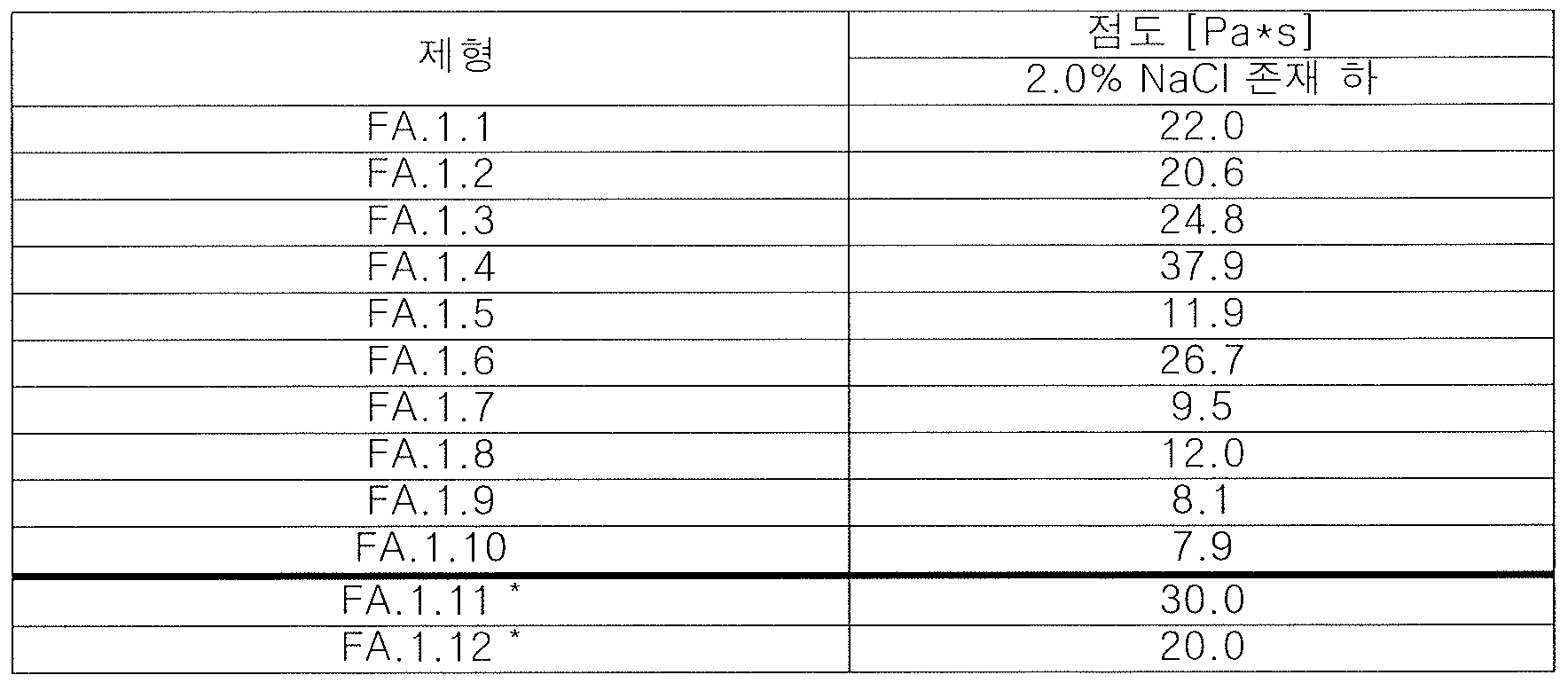
* 본 발명에 따르지 않음 * Not in accordance with the invention
FA.1.11 및 FA.1.12 는 매우 불량한 껄끄러운 구조를 나타냄.FA.1.11 and FA.1.12 show very poor gross structure.
더욱이, 2.0% NaCl 의 존재 하에 WO 2009/135857 로부터 제형 Z 1.7 의 점도 (Pa*s) 를 비교를 위해 측정하였다. 이는 9.1 이었다. 이러한 비교를 통해, 중합된 과분지형 중합체 HB 를 포함하는 본 발명에 따른 증점제가 WO 2009/135857 에 개시된 바와 같은 중합된 과분지형 중합체 HB 를 갖지 않는 증점제와 비교하여 점도에 있어서 더욱 크게 증가될 수 있음을 보여준다.Furthermore, the viscosity (Pa * s) of Formulation Z 1.7 was determined for comparison from WO 2009/135857 in the presence of 2.0% NaCl. This was 9.1. Through such a comparison, the thickener according to the invention comprising the polymerized hyperbranched polymer HB can be further increased in viscosity compared to the thickener having no polymerized hyperbranched polymer HB as disclosed in WO 2009/135857 Lt; / RTI >
표 3. 스테아레이트 염기 기재의 미용 제형 FA.2.1-FA.2.12 의 제형 매개변수Table 3. Cosmetic Formulation of Stearate Base Base Formulation Parameters of FA.2.1-FA.2.12

표 4. 염 농도의 함수로서 미용 제형 FA.2.1-FA.2.12 의 점도Table 4. Viscosity of cosmetic formulations FA.2.1-FA.2.12 as a function of salt concentration
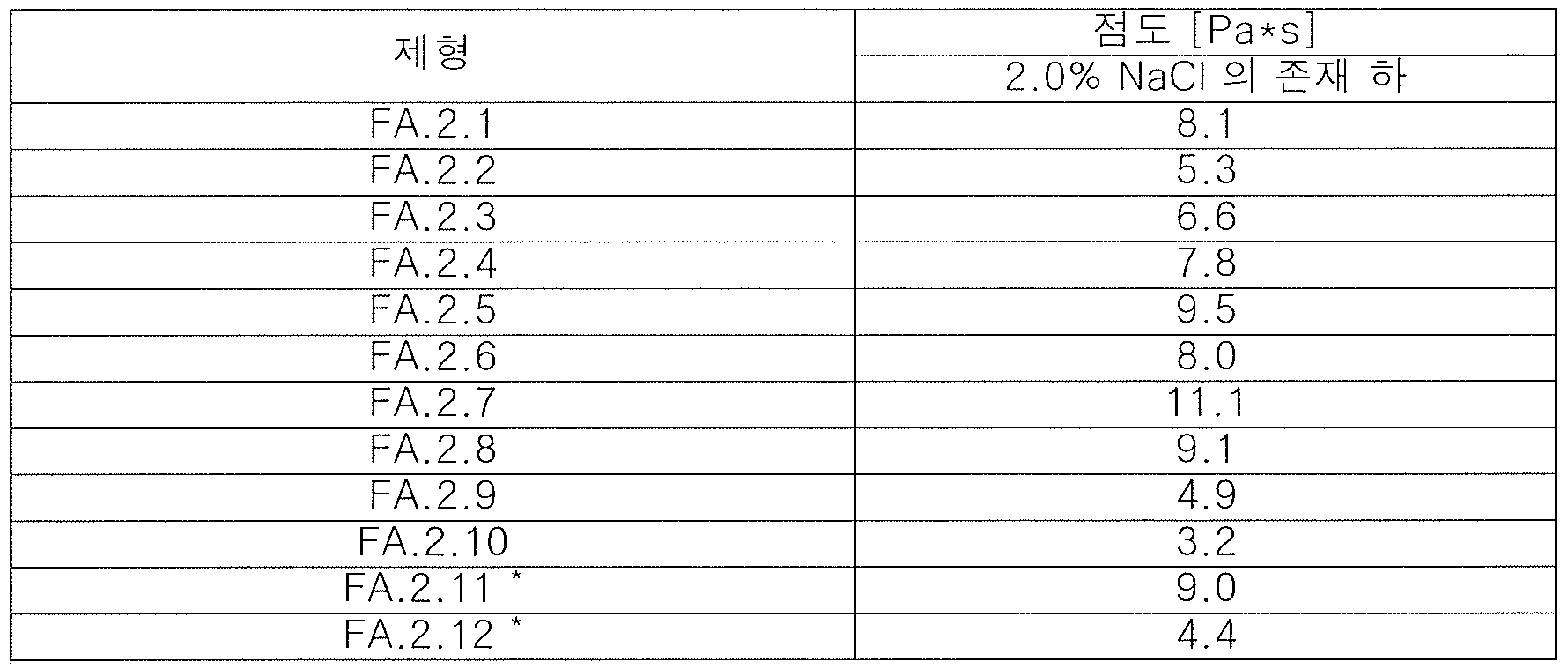
*본 발명에 따르지 않음 * Not in accordance with the invention
표 5. 전단 속도의 함수로서, 물 중 증점제 A.1-A.12 의 점도Table 5. Viscosity of thickener A.1-A.12 in water as a function of shear rate

* 본 발명에 따르지 않음 * Not in accordance with the invention
n.d. = 측정 불가n.d. = Not measurable
적용예Application example ::
본 발명에 따른 추가의 전형적인 제제를 하기에 기술하며, 이들 예로 본 발명에 한정되는 것은 아니다.Further exemplary formulations according to the present invention are described below, but are not limited to these examples.
기술된 미용 제제, 중합체 A.1, A.2, A.3, A.4, A.5, A.6, A.7, A.8, A.9 또는 A.10 이외에도 이의 조합은 60-80℃ 에서 물 상 및 오일 상을 결합한 후 생성 에멀젼 및 약 40℃ 에서 냉각된 에멀젼에 첨가될 수 있다.In addition to the described cosmetic preparations, Polymers A.1, A.2, A.3, A.4, A.5, A.6, A.7, A.8, After combining the water phase and the oil phase at -80 占 폚, the resulting emulsion and the emulsion cooled at about 40 占 폚 can be added.
또한 본 발명은, 본 발명에 따라 수득될 수 있는 폴리우레탄의 미용 제제로의 후속 첨가에 의해, 원하는 점도를 수립한다.The present invention also establishes the desired viscosity by subsequent addition of the polyurethane obtainable according to the invention to the cosmetic agent.
달리 지시되지 않는 한, 백분율은 중량%이다.Unless otherwise indicated, percentages are by weight.
O/W 에멀젼O / W Emulsion
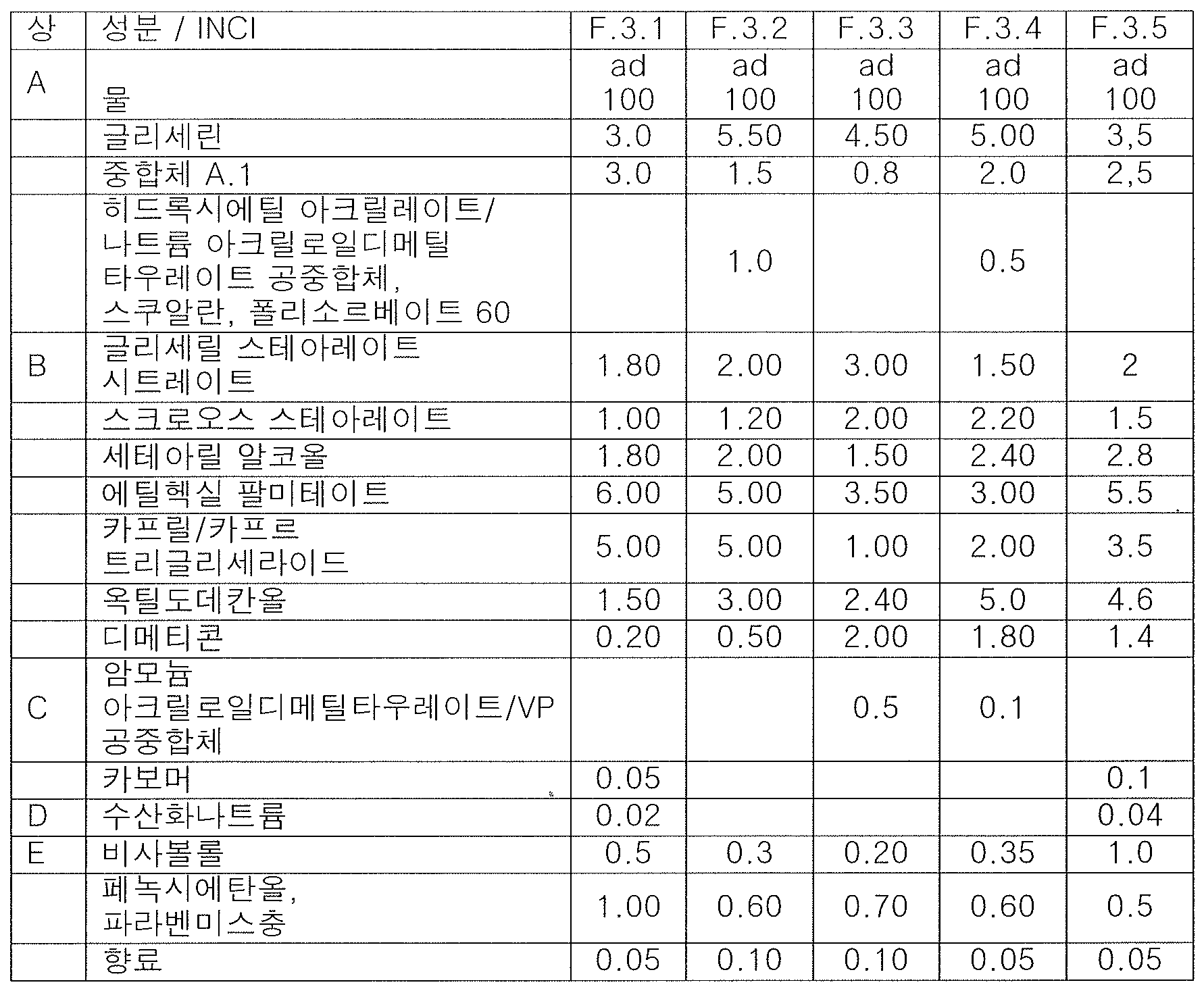
제조:Produce:
가열 상 A 및 B 를 약 80℃ 로 분리시켰다. 상 C 를 상 B 에 교반하고 이어서 상 A 를 상 B/C 에 교반하고 간략하게 균질화하였다.The heated phases A and B were separated to about 80 캜. Phase C was stirred in phase B and then phase A was stirred in phase B / C and briefly homogenized.
상 D (필요에 따라) 를 첨가하고 교반 하에 약 40℃ 로 냉각시켰다. 상 E 의 성분을 연속적으로 에멀젼에 첨가하고 교반 하에 실온으로 냉각시켰다. 간략하게 균질화하였다.Phase D (if necessary) was added and cooled to about 40 캜 under stirring. The ingredients of Phase E were continuously added to the emulsion and cooled to room temperature with stirring. Briefly homogenized.
중합체 A.1 를 포함하는 O/W 에멀젼 대신, 하나 이상의 중합체 A.2, A.3, A.4, A.5, A.6, A.7, A.8, A.9 또는 A.10 를 포함하는 O/W 에멀젼을 또한 제조하였다.One or more polymers A.2, A.3, A.4, A.5, A.6, A.7, A.8, A. 9, or A. 5 may be used instead of the O / W emulsion comprising polymer A.1. 10 was also prepared.
히드로분산액Hydro dispersion

제조:Produce:
가열 상 A 및 C 를 약 80℃로 분리하였다.The heated phases A and C were separated at about 80 캜.
상 B 를 상 A 에 교반하고 이어서 상 C 를 상 A/B 에 교반하였다. 간략하게 균질화하였다. 상 D 를 첨가하고 교반 하에 약 40℃ 로 냉각시켰다. 상 E 를 첨가하고 교반 하에 약 30℃ 로 냉각시켰다. 상 F 및 G 를 에멀젼에 첨가하고 교반 하에 실온으로 냉각시켰다. 간략하게 균질화하였다. 중합체 A.1 를 포함하는 히드로분산액 대신에, 하나 이상의 중합체 A.2, A.3, A.4, A.5, A.6, A.7, A.8, A.9 또는 A.10 를 포함하는 히드로분산액을 또한 제조하였다.Phase B was stirred in Phase A and then Phase C was stirred in Phase A / B. Briefly homogenized. Phase D was added and cooled to about < RTI ID = 0.0 > 40 C < / RTI > Phase E was added and cooled to about 30 < 0 > C with stirring. Phase F and G were added to the emulsion and cooled to room temperature with stirring. Briefly homogenized. One or more polymers A.2, A.3, A.4, A.5, A.6, A.7, A.8, A. 9 or A.10 ≪ / RTI > was also prepared.
고체-안정화 에멀젼Solid-stabilized emulsion
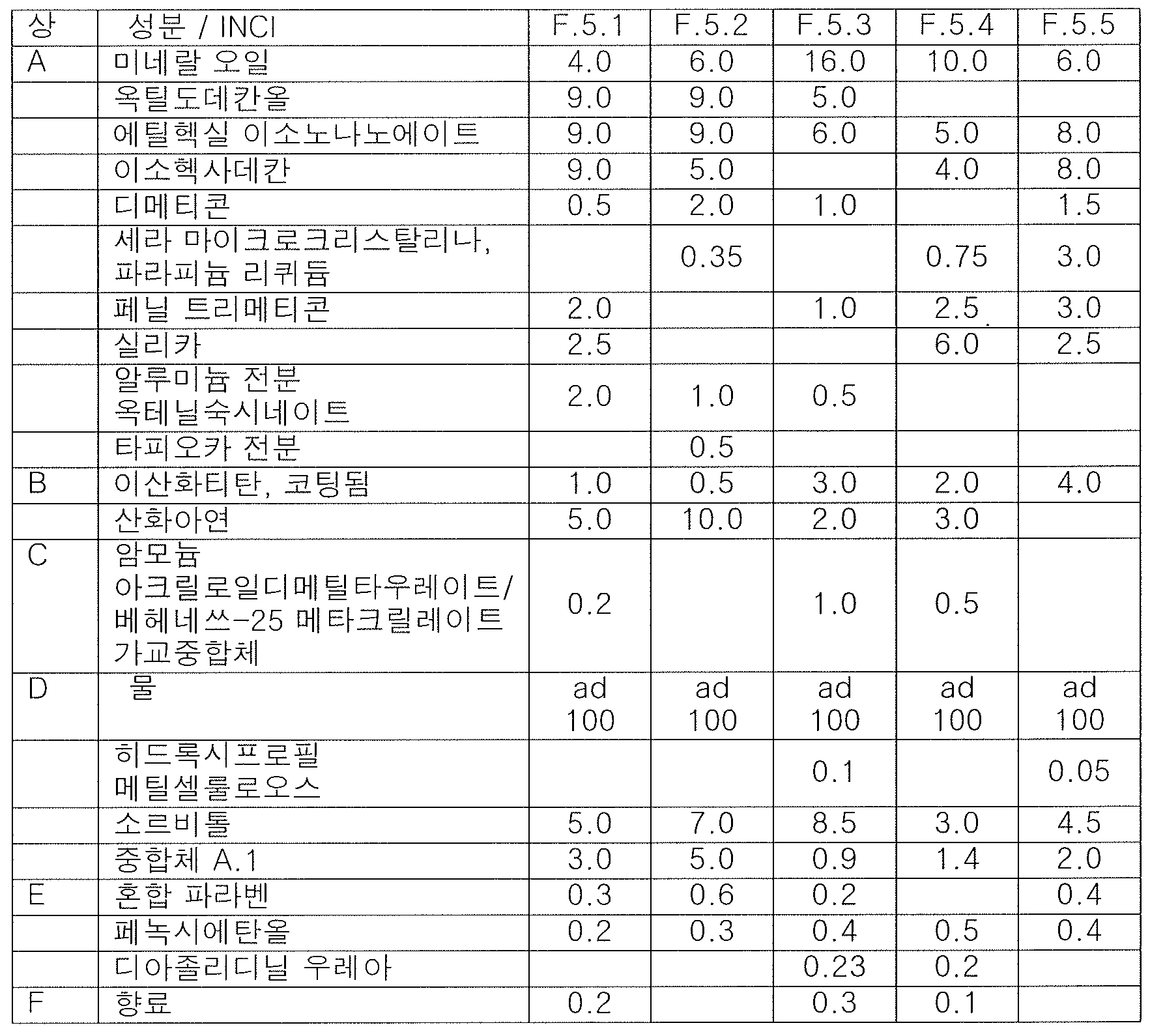
제조:Produce:
상 A 를 80℃ 로 가열시켰다. 상 B 를 상 A 에 첨가하고 3 분 동안 균질화하였다.Phase A was heated to 80 占 폚. Phase B was added to Phase A and homogenized for 3 minutes.
상 C 에서 교반하였다.The mixture was stirred at room temperature.
셀룰로오스 (필요에 따라) 를 물에 미리 팽윤시키고, 이어서 상 D 의 잔류하는 성분을 첨가하고 80℃ 로 가열시켰다.The cellulose (if necessary) was pre-swollen in water, then the remaining components of Phase D were added and heated to 80 占 폚.
상 D 를 상 A+B+C 로 교반하고 균질화하였다. 교반 하에 에멀젼을 약 40℃ 로 냉각시키고 상 E 및 F 를 첨가하였다. 교반 하에 실온 (RT) 로 냉각시키고 균질화하였다. Phase D was stirred with phase A + B + C and homogenized. The emulsion was cooled to about < RTI ID = 0.0 > 40 C < / RTI > It was cooled to room temperature (RT) with stirring and homogenized.
중합체 A.1 을 포함하는 고체-안정화된 에멀젼 대신에, 하나 이상의 중합체 A.2, A.3, A.4, A.5, A.6, A.7, A.8, A.9 또는 A.10 를 포함하는 고체-안정화된 에멀젼을 제조하였다.A.3, A.4, A.5, A.6, A.7, A.8, A.9 or < RTI ID = 0.0 > A.10. ≪ / RTI >
썬스크린 크림Sunscreen cream

제조:Produce:
상 A 및 B 를 분리하여 약 80℃ 로 가열시켰다.The phases A and B were separated and heated to about 80 캜.
상 A 를 상 B 에 교반하고 간략하게 균질화하였다. Phase A was stirred in phase B and briefly homogenized.
교반 하에 약 40℃ 로 냉각시켰다. 상 C 의 성분을 에멀젼에 연속적으로 첨가하고 교반 하에 실온으로 냉각시켰다. 간략하게 균질화하였다.Lt; RTI ID = 0.0 > 40 C < / RTI > The components of phase C were added continuously to the emulsion and cooled to room temperature with stirring. Briefly homogenized.
중합체 A.1 를 포함하는 썬스크린 크림 대신에, 하나 이상의 중합체 A.2, A.3, A.4, A.5, A.6, A.7, A.8, A.9 또는 A.10 를 포함하는 썬스크린 크림 또한 제조하였다.A.3, A.4, A.5, A.6, A.7, A.8, A. 9, or A. 9, instead of the sunscreen cream comprising polymer A.1. 10 was also prepared.
실리콘 에멀젼Silicone emulsion
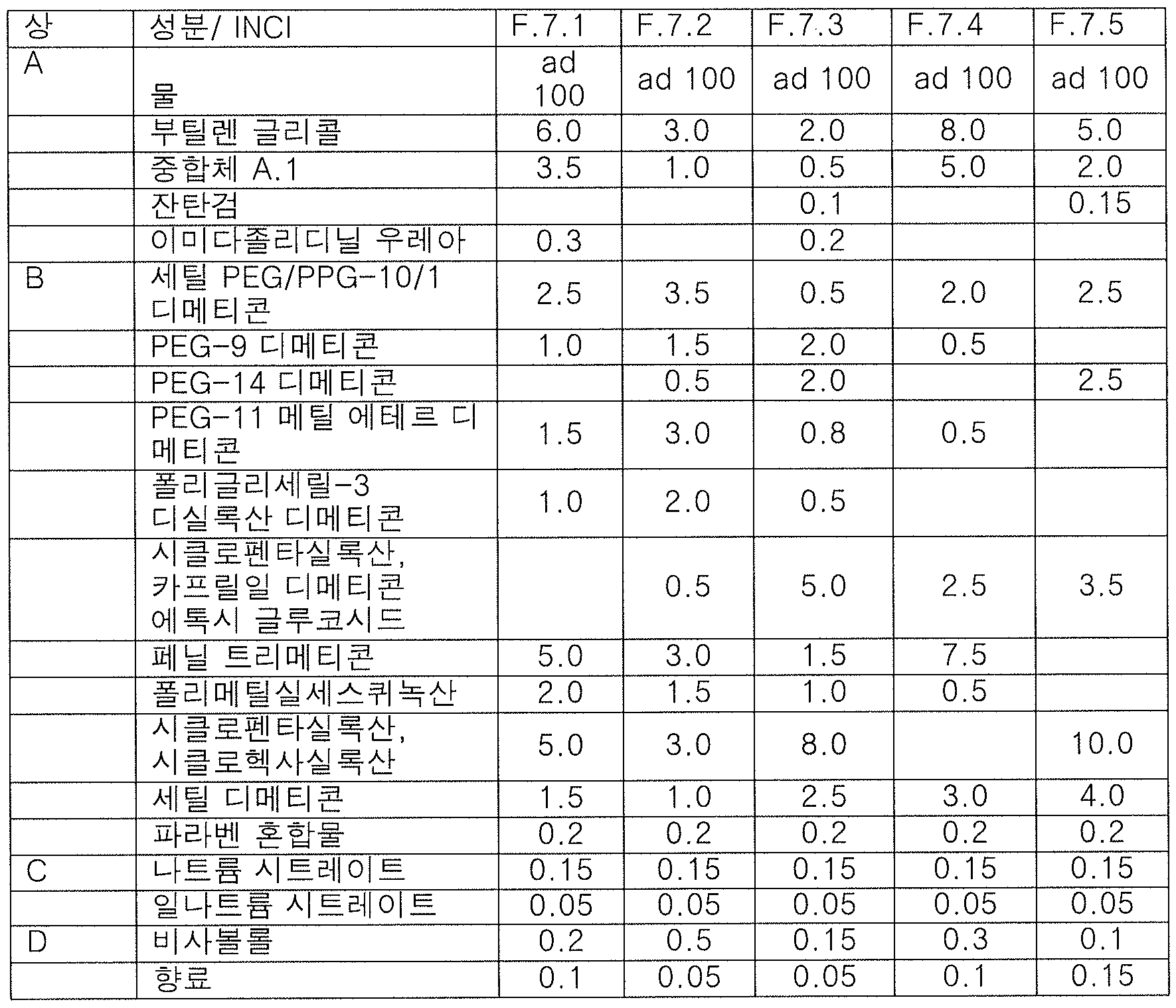
제조:Produce:
A 및 B 를 분리하여 약 80℃ 로 가열시켰다.A and B were separated and heated to about 80 캜.
상 A 를 상 B 로 교반하여 균질화하였다.Phase A was agitated by phase B to homogenize.
상 C 를 상 A+B 로 교반하여 균질화하였다.Phase C was homogenized by stirring with phase A + B.
교반 하에 약 40℃ 로 냉각시켰다. 상 C 를 첨가하고 교반 하에 30℃ 로 냉각하였다. 상 D 를 첨가하였다. 교반 하에 실온으로 냉각시키고 간략하게 균질화하였다. Lt; RTI ID = 0.0 > 40 C < / RTI > Phase C was added and cooled to 30 캜 under stirring. Phase D was added. Cooled to room temperature with stirring and briefly homogenized.
중합체 A.1 를 포함하는 실리콘 에멀젼 대신에, 하나 이상의 중합체 A.2, A.3, A.4, A.5, A.6, A.7, A.8, A.9 또는 A.10 를 포함하는 실리콘 에멀젼을 또한 제조하였다.A.3, A.4, A.5, A.6, A.7, A.8, A.9 or A.10, ≪ / RTI > was also prepared.
히드록시카르복실산 크림Hydroxycarboxylic acid cream
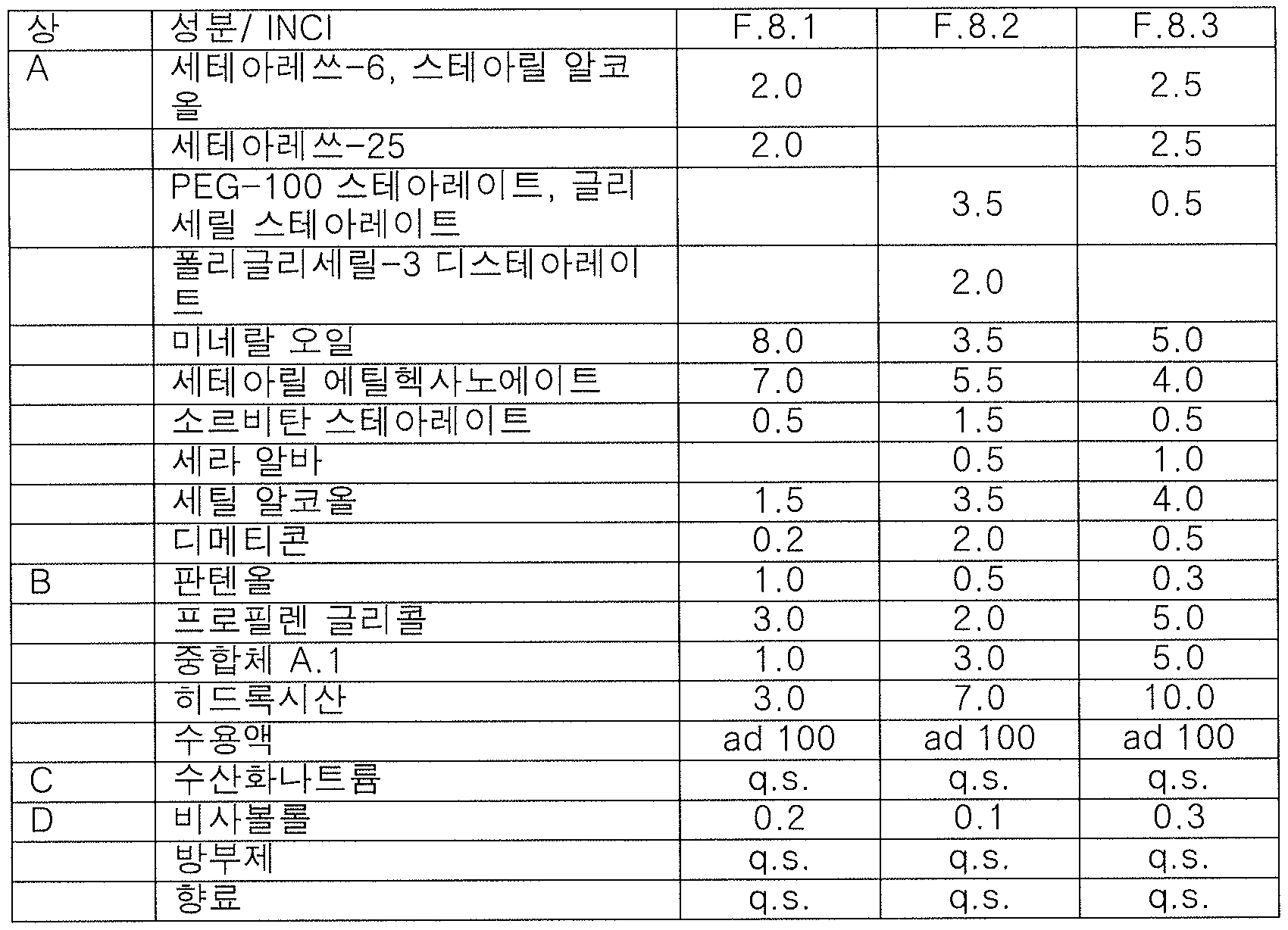
징후:symptom:
알파-히드록시 산: 예를 들어 락트산, 시트르산, 말산, 글리콜산Alpha-hydroxy acids such as lactic acid, citric acid, malic acid, glycolic acid
디히드록시산: 타르타르산Dihydroxy acid: tartaric acid
베타-히드록시산: 살리실산Beta-hydroxy acid: salicylic acid
pH > 3 으로 조정Adjust pH> 3
제조:Produce:
가열 상 A 및 B 를 분리하여 약 80℃ 로 가열시켰다. 필요에 따라 NaOH 를 이용하여 상 B 의 pH 를 > 3 으로 조정하였다. 상 B 를 상 A 로 교반하고, 간략하게 균질화하였다. The heated phases A and B were separated and heated to about 80 캜. The pH of phase B was adjusted to > 3 using NaOH as needed. Phase B was stirred with Phase A and briefly homogenized.
교반 하에 약 40℃ 로 냉각시키고, 상 D 의 성분을 연속적으로 첨가하여 다시 균질화하였다.Cooled to about < RTI ID = 0.0 > 40 C < / RTI > under stirring, and the ingredients of Phase D were added successively and homogenized again.
중합체 A.1 를 포함하는 히드록시카르복실산 크림 대신에, 하나 이상의 중합체 A.2, A.3, A.4, A.5, A.6, A.7, A.8, A.9 또는 A.10 를 포함하는 히드록시카르복실산 크림을 또한 제조하였다.Instead of the hydroxycarboxylic acid cream comprising polymer A.1, one or more polymers A.2, A.3, A.4, A.5, A.6, A.7, A.8, A. 9 Or a hydroxycarboxylic acid cream comprising A.10 was also prepared.
데오도란트 활성 성분을 이용한 에멀젼Emulsion using deodorant active ingredient
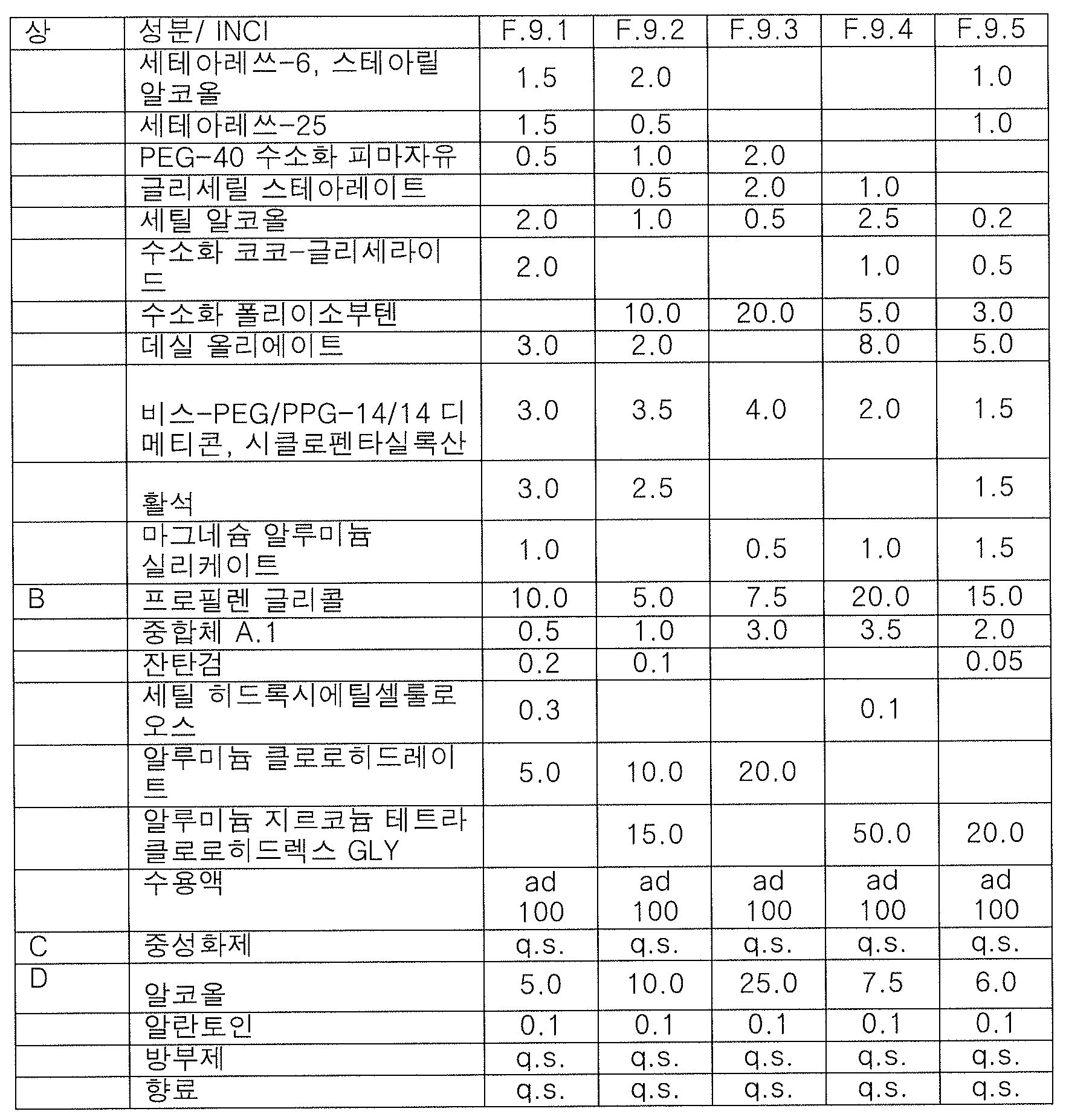
제조:Produce:
상 A 및 B 를 분리하여 약 80℃ 로 가열시켰다.The phases A and B were separated and heated to about 80 캜.
상 B 를 상 A 로 교반하여 균질화하였다. 필요에 따라, 상 C 를 이용하여 pH 를 4-5 로 조정하였다. 약 40℃ 로 냉각시키고, 상 D 를 첨가하고 교반 하에 실온으로 냉각시켰다. 간략하게 균질화하였다.Phase B was agitated with phase A to homogenize. If necessary, the pH was adjusted to 4-5 using phase C. Cooled to about < RTI ID = 0.0 > 40 C, < / RTI > Phase D was added and cooled to room temperature with stirring. Briefly homogenized.
징후: 4-5 의 pH 를 조정함Indications: Adjust the pH of 4-5
중합체 A.1 를 포함하는 데오도란트 활성 성분을 이용한 에멀젼 대신, 하나 이상의 중합체 A.2, A.3, A.4, A.5, A.6, A.7, A.8, A.9 또는 A.10 를 포함하는 데오도란트 활성 성분을 갖는 에멀젼을 또한 제조하였다.A.3, A.4, A.5, A.6, A.7, A.8, A.9, or A8, instead of the emulsion using the deodorant active ingredient comprising polymer A.1. An emulsion having a deodorant active ingredient comprising A.10 was also prepared.
제모 크림Hair Removal Cream

제조:Produce:
상 A 및 B 를 분리하여 약 80℃ 로 가열시켰다.The phases A and B were separated and heated to about 80 캜.
상 B 를 상 A 에 교반하여 균질화하고, 간략하게 균질화하였다.Phase B was homogenized by stirring in Phase A and briefly homogenized.
약 40℃ 로 냉각시키고, 상 C 를 첨가하고, 교반 하에 실온으로 냉각시키고 다시 균질화하였다.Cooled to about 40 DEG C, phase C was added, cooled to room temperature with stirring and homogenized again.
징후: 에멀젼의 pH 를 > 10 으로 조정하였다.Indications: The pH of the emulsion was adjusted to > 10.
중합체 A.1 를 포함하는 제모 크림 대신에, 하나 이상의 중합체 A.2, A.3, A.4, A.5, A.6, A.7, A.8, A.9 또는 A.10 를 포함하는 제모 크림을 또한 제조하였다.A.3, A.4, A.5, A.6, A.7, A.8, A.9, or A.10, instead of the hair removal cream comprising polymer A.1. ≪ / RTI > was also prepared.
컨디셔너 샴푸Conditioner Shampoo

컨디셔닝 중합체는, Polyquaternium-7, PQ-10, PQ-16, PQ-39, PQ-44, PQ-46, PQ-67, 구아 히드록시프로필트리모늄 클로라이드, PQ-87, 및 이의 조합을 의미하는 것이다.The conditioning polymer refers to polyquaternium-7, PQ-10, PQ-16, PQ-39, PQ-44, PQ-46, PQ-67, guar hydroxypropyl trimonium chloride, PQ-87, will be.
중합체 A.1 를 포함하는 컨디셔닝 중합체 대신에, 하나 이상의 중합체 A.2, A.3, A.4, A.5, A.6, A.7, A.8, A.9 또는 A.10 를 포함하는 컨디셔닝 샴푸를 또한 제조하였다.One or more polymers A.2, A.3, A.4, A.5, A.6, A.7, A.8, A.9 or A.10 ≪ / RTI > was also prepared.
헤어 컨디셔너Hair conditioner

컨디셔닝 중합체는 Polyquaternium-7, PQ-10, PQ-16, PQ-39, PQ-44, PQ-46, PQ-67, 구아 히드록시프로필트리모늄 클로라이드, PQ-87, 및 이들의 조합을 의미하는 것이다.The conditioning polymer is selected from the group consisting of Polyquaternium-7, PQ-10, PQ-16, PQ-39, PQ-44, PQ-46, PQ-67, guar hydroxypropyl trimonium chloride, PQ-87, will be.
제조:Produce:
가열 상 A 및 B 를 분리하여 약 80℃ 로 가열시켰다.The heated phases A and B were separated and heated to about 80 캜.
상 C 를 상 B 로 교반하고, 이어서 상 A 를 상 B/C 로 교반하고 간략하게 균질화하였다.Phase C was stirred with phase B, and phase A was then agitated with phase B / C and briefly homogenized.
교반 하에 약 50℃ 로 냉각시키고, 상 D 의 성분을 연속적으로 첨가하고 교반 하에 약 30℃ 로 냉각시켰다. 상 E 의 성분을 연속적으로 첨가하고 교반 하에 실온으로 냉각시켰다. 간략하게 균질화하였다.The mixture was cooled to about 50 캜 under stirring, and the components of Phase D were added successively and cooled to about 30 캜 under stirring. The components of Phase E were added sequentially and cooled to room temperature with stirring. Briefly homogenized.
중합체 A.1 를 포함하는 헤어 컨디셔너 대신에, 하나 이상의 중합체 A.2, A.3, A.4, A.5, A.6, A.7, A.8, A.9 또는 A.10 를 포함하는 헤어 컨디셔너를 또한 제조하였다.A.3, A.4, A.5, A.6, A.7, A.8, A. 9, or A.10 ≪ / RTI > was also prepared.
Claims (15)
a) 하나 이상의 폴리이소시아네이트,
b) 하나 이상의 일반식 I 의 알코올:

[식 중,
R1 은 C6-C40-알킬, C6-C40-알케닐, C3-C10-시클로알킬, C6-C30-아릴 및 C7-C40-아릴알킬로부터 선택되고,
R2 는 C2-C10-알킬렌, C6-C10-아릴렌 및 C7-C10-아릴알킬렌으로부터 선택되고,
n 은 0 내지 200 으로부터 선택됨],
c) 관능기를 갖는 하나 이상의 과분지형 중합체 HB (이때, 과분지형 중합체 분자 당 관능기의 평균 수 f 에 대해서 3 < f < 100, 특히 3 < f < 20 이 적용되고, 단, 과분지형 중합체는 과분지형 폴리에테르폴리올로부터 선택되지는 않음),
d) 임의적으로는, 상기 b) 및 c) 와는 상이하고, 300 g/mol 이상의 분자량을 가지며, i) 둘 이상의 OH 기 및 ii) 에테르 기 및 에스테르 기로부터 선택되는 둘 이상의 기를 포함하는 하나 이상의 화합물,
e) 임의적으로는, 상기 b) 내지 d) 와는 상이하고, 분자 당 이소시아네이트기에 대해 반응성인 1 내지 10 개의 기를 갖는 추가의 화합물.Polymer P in an inherent form, comprising: P:
a) at least one polyisocyanate,
b) one or more alcohols of the general formula I:
[Wherein,
R 1 is selected from C 6 -C 40 -alkyl, C 6 -C 40 -alkenyl, C 3 -C 10 -cycloalkyl, C 6 -C 30 -aryl and C 7 -C 40 -arylalkyl,
R 2 is selected from C 2 -C 10 -alkylene, C 6 -C 10 -arylene and C 7 -C 10 -arylalkylene,
n is selected from 0 to 200,
c) at least one hyperbranched polymer HB having a functional group, wherein 3 < f < 100, in particular 3 < f < 20 are applied for the average number f of functional groups per hyperbranched polymer molecule, provided that the hyperbranched polymer is a hyperbranched Polyether polyol), < RTI ID = 0.0 >
d) optionally, at least one compound which differs from b) and c) above and has a molecular weight of at least 300 g / mol, comprising two or more groups selected from i) two or more OH groups and ii) ,
e) optionally further compounds having from 1 to 10 groups which are different from b) to d) above and which are reactive towards isocyanate groups per molecule.
i. 유기 카르보네이트 또는 포스겐 유도체를 3 개 이상의 OH 기를 포함하는 알코올과 반응시킴으로써 축합 생성물 K 를 제조하는 단계, 및 이어서
ii. 축합 생성물 K 를 과분지형 폴리카르보네이트로 전환시키는 단계로서, 이때 카르보네이트 또는 포스겐 기에 대한 OH 기의 정량적 비율이 축합 생성물 K 가 평균적으로 1) 하나의 카르보네이트 또는 카르바모일 클로라이드 기 및 하나 초과의 OH 기, 또는 2) 하나의 OH 기 및 하나 초과의 카르보네이트 또는 카르바모일 기를 갖도록 선택되는 단계.The process of claim 3 wherein the hyperbranched polymer HB is a hyperbranched polycarbonate wherein the hyperbranched polycarbonate can be obtained by:
i. Preparing a condensation product K by reacting an organic carbonate or phosgene derivative with an alcohol comprising at least three OH groups,
ii. Converting the condensation product K to a hyperbranched polycarbonate, wherein the quantitative ratio of OH groups to carbonate or phosgene groups is such that the condensation product K on average has 1) one carbonate or carbamoyl chloride group and More than one OH group, or 2) one OH group and more than one carbonate or carbamoyl group.
Applications Claiming Priority (5)
| Application Number | Priority Date | Filing Date | Title |
|---|---|---|---|
| US201161515333P | 2011-08-05 | 2011-08-05 | |
| EP11176673 | 2011-08-05 | ||
| EP11176673.9 | 2011-08-05 | ||
| US61/515,333 | 2011-08-05 | ||
| PCT/EP2012/064687 WO2013020820A1 (en) | 2011-08-05 | 2012-07-26 | Associative thickeners based on hyperbranched polymers |
Publications (1)
| Publication Number | Publication Date |
|---|---|
| KR20140052009A true KR20140052009A (en) | 2014-05-02 |
Family
ID=47667904
Family Applications (1)
| Application Number | Title | Priority Date | Filing Date |
|---|---|---|---|
| KR20147005911A Abandoned KR20140052009A (en) | 2011-08-05 | 2012-07-26 | Associative thickeners based on hyperbranched polymers |
Country Status (7)
| Country | Link |
|---|---|
| US (1) | US20140341822A1 (en) |
| EP (1) | EP2739664A1 (en) |
| JP (2) | JP2014521797A (en) |
| KR (1) | KR20140052009A (en) |
| CN (1) | CN103857719B (en) |
| BR (1) | BR112014003273A8 (en) |
| WO (1) | WO2013020820A1 (en) |
Families Citing this family (23)
| Publication number | Priority date | Publication date | Assignee | Title |
|---|---|---|---|---|
| FR3024733B1 (en) * | 2014-08-05 | 2018-01-12 | Coatex Sas | THICKENING AGENT FOR AQUEOUS SYSTEMS, FORMULATIONS CONTAINING THE SAME AND USES THEREOF. |
| EP3183304B1 (en) * | 2014-08-22 | 2018-08-01 | BASF Coatings GmbH | Aqueous dispersion of a polyester and polyamide with low acid number and coating compositions comprising the same for the application of a base varnish layer |
| CN104193941B (en) * | 2014-09-15 | 2016-06-29 | 山东天庆科技发展有限公司 | Hyperbranched non-ion aqueous polyurethane leather finishing agent and preparation method thereof |
| MX2017006768A (en) | 2014-11-24 | 2018-01-18 | Ppg Ind Ohio Inc | Methods for reactive three-dimensional printing by extrusion. |
| CN107250191B (en) * | 2014-12-23 | 2020-08-04 | 巴斯夫欧洲公司 | Hyperbranched polymers modified with isocyanate linkers and mixtures of short-and long-chain alkyl polyethers |
| FR3041964B1 (en) * | 2015-10-05 | 2017-10-20 | Coatex Sas | THICKENING AGENT FOR AQUEOUS SYSTEMS, FORMULATIONS CONTAINING THE SAME AND USES THEREOF. |
| GB2549136A (en) * | 2016-04-07 | 2017-10-11 | Boots Co Plc | Polymer-containing composition and method thereof |
| GB2552922A (en) * | 2016-04-07 | 2018-02-21 | Boots Co Plc | Polymer-containing composition and method thereof |
| CN106634534B (en) * | 2016-12-27 | 2018-11-13 | 苏州中材非金属矿工业设计研究院有限公司 | A kind of anti-sag single-component polyurethane water-proof paint and preparation method thereof |
| US10434704B2 (en) | 2017-08-18 | 2019-10-08 | Ppg Industries Ohio, Inc. | Additive manufacturing using polyurea materials |
| US12384097B2 (en) | 2017-08-18 | 2025-08-12 | Ppg Industries Ohio, Inc. | Additive manufacturing using reactive compositions |
| JPWO2019049982A1 (en) * | 2017-09-08 | 2020-08-27 | Jnc株式会社 | Polyurea-based alternating copolymer, resin composition, coating film, resin film, OLED element, light emitting device, and method for producing polyurea-based alternating copolymer |
| CN108299608B (en) * | 2018-02-12 | 2020-10-16 | 中海油常州涂料化工研究院有限公司 | Alkali swelling association type thickener and preparation method thereof |
| WO2020167638A1 (en) | 2019-02-11 | 2020-08-20 | Ppg Industries Ohio, Inc. | Elastomeric compositions and methods of use |
| AU2020221467B2 (en) | 2019-02-11 | 2022-11-17 | Ppg Industries Ohio, Inc. | Multilayer systems and methods of making multilayer systems |
| CN113677502B (en) | 2019-02-11 | 2024-04-12 | Ppg工业俄亥俄公司 | Method of making a chemically resistant seal assembly |
| KR20210124439A (en) | 2019-02-11 | 2021-10-14 | 피피지 인더스트리즈 오하이오 인코포레이티드 | 3D printing of sealing caps |
| CN110965362A (en) * | 2019-12-21 | 2020-04-07 | 苏州大学 | Branched-chain polyurethane thickener and preparation method thereof |
| CN112724352B (en) * | 2020-12-28 | 2022-04-22 | 华南理工大学 | Silicon modified association type waterborne polyurethane thickener as well as preparation method and application thereof |
| CN113603856A (en) * | 2021-05-24 | 2021-11-05 | 华东师范大学 | Hydrogenated castor oil branched polyurethane associative thickener and preparation method and application thereof |
| CN115232318B (en) * | 2022-08-24 | 2023-12-26 | 宁波锋成先进能源材料研究院有限公司 | A kind of nonionic polymer surfactant and its preparation method and application |
| CN116023589B (en) * | 2023-02-15 | 2023-05-30 | 西南石油大学 | Polymer thickener for fracturing fluid, preparation method of polymer thickener and fracturing fluid |
| WO2026002565A1 (en) | 2024-06-28 | 2026-01-02 | Unilever Ip Holdings B.V. | Structured cleansing composition with suspending polymer, anionic surfactant and a co-surfactant |
Family Cites Families (61)
| Publication number | Priority date | Publication date | Assignee | Title |
|---|---|---|---|---|
| US2178173A (en) | 1939-10-31 | Derivatives of polymerized alkylol | ||
| US2290415A (en) | 1940-10-11 | 1942-07-21 | Petrolite Corp | Composition of matter and process for preventing water-in-oil type emulsions resulting from acidization of calcareous oil-bearing strata |
| US2407895A (en) | 1944-10-05 | 1946-09-17 | Petrolite Corp | Processes for resolving oil-in-water emulsions |
| US3932532A (en) | 1973-06-01 | 1976-01-13 | Ici United States Inc. | Ethers of polyglycerol |
| US4079028A (en) | 1975-10-03 | 1978-03-14 | Rohm And Haas Company | Polyurethane thickeners in latex compositions |
| US4155892A (en) | 1975-10-03 | 1979-05-22 | Rohm And Haas Company | Polyurethane thickeners for aqueous compositions |
| DE2917490A1 (en) | 1979-04-30 | 1980-11-13 | Basf Ag | METHOD FOR PRODUCING ALIPHATIC AND CYCLOALIPHATIC DI- AND POLYURETHANES |
| DE2917493A1 (en) | 1979-04-30 | 1980-11-13 | Basf Ag | METHOD FOR PRODUCING ALIPHATIC AND CYCLOALIPHATIC DI- AND POLYURETHANES |
| DE2942503A1 (en) | 1979-10-20 | 1981-05-07 | Basf Ag, 6700 Ludwigshafen | METHOD FOR PRODUCING AROMATIC DI- AND / OR POLYISOCYANATES |
| US4327008A (en) | 1980-12-29 | 1982-04-27 | Ppg Industries, Inc. | Urethane rheology modifiers and coating compositions containing same |
| US4507466A (en) | 1983-01-07 | 1985-03-26 | The Dow Chemical Corporation | Dense star polymers having core, core branches, terminal groups |
| US5023309A (en) | 1987-09-18 | 1991-06-11 | Rheox, Inc. | Water dispersible, modified polyurethane thickener with improved high shear viscosity in aqueous systems |
| DE3828033A1 (en) | 1988-08-18 | 1990-03-08 | Huels Chemische Werke Ag | CIRCUIT PROCESS FOR PRODUCING (CYCLO) ALIPHATIC DIISOCYANATES |
| DE4003243A1 (en) | 1990-02-03 | 1991-08-08 | Basf Ag | Use of tri:alkanolamine polyether(s) as demulsifiers in o/w emulsions - obtainable by condensing tri:alkanol:amine(s) in presence of (hypo)phosphorous acid |
| WO1992008749A1 (en) | 1990-11-19 | 1992-05-29 | Cornell Research Foundation, Inc. | Hyperbranched polyesters and polyamides |
| DE4213099A1 (en) | 1992-04-21 | 1993-10-28 | Basf Ag | Multi-stage process for the continuous production of organic polyisocyanates |
| DE4231417A1 (en) | 1992-05-05 | 1993-11-11 | Huels Chemische Werke Ag | Continuous multi-stage process for the production of (cyclo) aliphatic diisocyanates |
| IT1255763B (en) | 1992-05-15 | 1995-11-15 | Franco Rivetti | PROCEDURE FOR THE PREPARATION OF ALCHYL ISOCYANATES |
| JP2918012B2 (en) | 1993-02-03 | 1999-07-12 | 三菱瓦斯化学株式会社 | Method for producing urethane compound |
| DE19503281A1 (en) | 1995-02-02 | 1996-08-08 | Bayer Ag | Polyurethanes suitable as thickeners for aqueous systems |
| DE19524045A1 (en) | 1995-07-01 | 1997-01-02 | Basf Ag | Highly functionalized polyurethanes |
| KR100404774B1 (en) | 1995-09-06 | 2004-04-01 | 아사히 덴카 고교 가부시키가이샤 | Viscosity regulator |
| NL1007186C2 (en) | 1997-10-01 | 1999-04-07 | Dsm Nv | ß-hydroxyalkylamide group-containing condensation polymer. |
| DE19820114A1 (en) | 1998-05-06 | 1999-11-11 | Basf Ag | Process for the simultaneous production of (cyclo)aliphatic polyisocyanates |
| AU770290B2 (en) | 1998-08-06 | 2004-02-19 | National Starch And Chemical Investment Holding Corporation | Novel associative thickeners for aqueous systems |
| KR100613969B1 (en) | 1998-12-17 | 2006-08-18 | 가부시키가이샤 시세이도 | Cosmetic composition |
| DE29822679U1 (en) | 1998-12-19 | 1999-09-09 | Berthold Kühn Verwaltungsgesellschaft mbH, 99819 Krauthausen | Switchover switch |
| DE19947631A1 (en) | 1998-12-22 | 2000-06-29 | Bayer Ag | Process for the preparation of highly branched polyols based on glycidol |
| DE19904444A1 (en) | 1999-02-04 | 2000-08-10 | Basf Ag | Dendrimers and highly branched polyurethanes |
| SE514207C2 (en) | 1999-03-23 | 2001-01-22 | Perstorp Ab | Hyperbranched dendritic polyether and process for its preparation |
| TW499449B (en) | 1999-03-24 | 2002-08-21 | Dsm Nv | Condensation polymer containing esteralkylamide-acid groups |
| DE10111794A1 (en) * | 2001-03-12 | 2002-09-26 | Borchers Gmbh | New polyurethanes and their use for thickening aqueous systems |
| US6541599B1 (en) | 2001-07-31 | 2003-04-01 | Eastman Kodak Company | Process for manufacture of soluble highly branched polyamides, and at least partially aliphatic highly branched polyamides obtained therefrom |
| US6541600B1 (en) | 2001-07-31 | 2003-04-01 | Eastman Kodak Company | Water soluble and dispersible highly branched polyamides |
| DE10204979A1 (en) | 2002-02-06 | 2003-08-14 | Basf Ag | Process for the production of highly functional highly branched polyureas |
| DE10211664A1 (en) | 2002-03-15 | 2003-10-02 | Hyperpolymers Gmbh | Preparation of highly branched polyols based on glycosides useful as an additive in paints and adhesives, additive and crosslinker in polymers, in cosmetics, preparation of nano particles and active substance carrier |
| DE10307172A1 (en) | 2003-02-20 | 2005-05-19 | Clariant Gmbh | Process for the preparation of polyglycerol ethers by direct reaction of polyglycerols and alcohols |
| DE10322401A1 (en) | 2003-05-16 | 2004-12-02 | Basf Ag | Process for the production of dendrimeric or hyperbranched polyurethanes |
| KR101178959B1 (en) * | 2003-09-12 | 2012-08-31 | 바스프 에스이 | Highly functional, highly branched or hyperbranched polycarbonates and the production and use hereof |
| DE10351401A1 (en) | 2003-11-04 | 2005-06-09 | Basf Ag | Highly functional, highly branched polyureas |
| DE102004005652A1 (en) | 2004-02-04 | 2005-08-25 | Basf Ag | Flowable polyester molding compounds |
| DE102004006304A1 (en) | 2004-02-09 | 2005-08-25 | Basf Ag | Highly functional, highly branched polyureas |
| DE102004008015A1 (en) | 2004-02-19 | 2005-09-08 | Cognis Deutschland Gmbh & Co. Kg | Thickener for polyurethane base |
| US20090041813A1 (en) | 2005-02-21 | 2009-02-12 | Basf Aktiengesellschaft | Active substance composition comprising at least one nitrogen atom-containing, hyperbranched polymer |
| DE102005009166A1 (en) | 2005-02-25 | 2006-08-31 | Basf Ag | Use of high-functional, hyper branched polycarbonate (obtained by preparing condensation products either by reacting organic carbonates with an aliphatic, aliphatic/aromatic or aromatic alcohol), as solvent auxilary agent |
| DE102005030225A1 (en) * | 2005-06-29 | 2007-01-04 | Bayer Materialscience Ag | Self-crosslinking PU dispersions |
| JP4391459B2 (en) * | 2005-10-03 | 2009-12-24 | 第一工業製薬株式会社 | POLYURETHANE AQUEOUS DISPERSION FOR HEAT-RESISTANT HEAT-SENSITIVE SHEET OVERCOAT AND METHOD FOR PRODUCING THE SAME |
| DE102005056434A1 (en) * | 2005-11-26 | 2007-05-31 | Bayer Materialscience Ag | Aqueous, urethane-containing, hydroxy-functional polyester dispersions |
| DE102005060783A1 (en) | 2005-12-16 | 2007-06-28 | Basf Ag | Highly functional, hyperbranched polymers and a process for their preparation |
| EP2015730A1 (en) | 2006-04-28 | 2009-01-21 | Basf Se | Method for solubilising hydrophobic active substances in an aqueous medium |
| BRPI0712597A2 (en) | 2006-05-19 | 2012-07-03 | Basf Coatings Ag | Highly functional or highly branched polycarbonate powder coating materials. |
| WO2008009516A2 (en) | 2006-07-20 | 2008-01-24 | Basf Se | Water-based lacquers comprising highly functional, highly branched or hyperbranched polycarbonates |
| US20090082483A1 (en) | 2007-09-20 | 2009-03-26 | Petrovic Zoran S | Polyglycerol based polyols and polyurethanes and methods for producing polyols and polyurethanes |
| CA2699713C (en) | 2007-10-08 | 2015-12-22 | Bernd Bruchmann | Use of hyperbranched polyesters and/or polyesteramides for splitting oil-water emulsions |
| EP2197941B1 (en) | 2007-10-09 | 2011-05-25 | Basf Se | Use of highly functional, highly branched polyetheramine polyols for coating surfaces |
| KR101618888B1 (en) | 2008-02-15 | 2016-05-09 | 바스프 에스이 | Highly functional polyetherols and the production and use thereof |
| EP2184304A1 (en) | 2008-05-06 | 2010-05-12 | Basf Se | Polyurethane thickener |
| US20110064681A1 (en) * | 2008-05-06 | 2011-03-17 | Basf Se | Polyurethanes as rheological modifying means for cosmetic preparations |
| UA105793C2 (en) * | 2009-05-11 | 2014-06-25 | Басф Се | Hyperbranched polycarbonates for solubilization of low-solubility active substances |
| KR101722805B1 (en) * | 2009-11-26 | 2017-04-05 | 바스프 에스이 | Use of hyperbranched polyesters in cosmetic and dermatological formulations |
| CN102665669B (en) * | 2009-11-26 | 2014-04-16 | 巴斯夫欧洲公司 | Use of hyperbranched polycarbonates in cosmetic and dermatological formulations |
-
2012
- 2012-07-26 BR BR112014003273A patent/BR112014003273A8/en unknown
- 2012-07-26 CN CN201280048740.1A patent/CN103857719B/en not_active Expired - Fee Related
- 2012-07-26 KR KR20147005911A patent/KR20140052009A/en not_active Abandoned
- 2012-07-26 WO PCT/EP2012/064687 patent/WO2013020820A1/en not_active Ceased
- 2012-07-26 US US14/237,265 patent/US20140341822A1/en not_active Abandoned
- 2012-07-26 JP JP2014523290A patent/JP2014521797A/en active Pending
- 2012-07-26 EP EP12740586.8A patent/EP2739664A1/en not_active Withdrawn
-
2017
- 2017-02-10 JP JP2017022921A patent/JP2017141445A/en not_active Ceased
Also Published As
| Publication number | Publication date |
|---|---|
| JP2017141445A (en) | 2017-08-17 |
| BR112014003273A2 (en) | 2017-06-13 |
| CN103857719A (en) | 2014-06-11 |
| JP2014521797A (en) | 2014-08-28 |
| WO2013020820A1 (en) | 2013-02-14 |
| BR112014003273A8 (en) | 2017-06-20 |
| CN103857719B (en) | 2016-08-17 |
| US20140341822A1 (en) | 2014-11-20 |
| EP2739664A1 (en) | 2014-06-11 |
Similar Documents
| Publication | Publication Date | Title |
|---|---|---|
| KR20140052009A (en) | Associative thickeners based on hyperbranched polymers | |
| KR101924770B1 (en) | Dendritic polyether-polyurethane thickeners | |
| Shen et al. | A comparison of non-isocyanate and HDI-based poly (ether urethane): Structure and properties | |
| CN102015807B (en) | Polyurethane thickener | |
| EP2028205B1 (en) | Use of polyurethane dispersions based on polycarbonate polyols in personal care products | |
| CN103328527B (en) | Polyurethane thickener | |
| US9066891B2 (en) | Dendritic polyether-polyurethane thickeners | |
| US7893184B2 (en) | Method for producing dendritic or hyperbranched polyurethanes | |
| US8871817B2 (en) | Polyurethane thickeners | |
| KR20140041769A (en) | Process for the production of polyurethane polyureas containing side chains and of aqueous dispersions of these | |
| EP0978522A1 (en) | Associative thickeners for aqueous systems | |
| Bruchmann et al. | Tailor‐made crosslinkers for high performance PUR coatings–hyperbranched polyisocyanates | |
| WO2006006855A1 (en) | Supramolecular ionomers | |
| JP2013537921A (en) | Associative thickener for aqueous compositions | |
| CN109476812A (en) | Low hardness polyurethane dispersion | |
| CN103380159B (en) | Polyurethane thickener | |
| JPH11507405A (en) | Hydrophilic end-capped polyurethane thickener | |
| US20020188061A1 (en) | Polyurethanes and their use for the thickening of aqueous system | |
| WO1997021743A1 (en) | Polymeric thickeners for aqueous compositions | |
| CA2198444A1 (en) | Low molecular weight, liquid urethane diols and use thereof | |
| BR102020010991A2 (en) | PROCESS FOR OBTAINING POLYURETHANES, POLYURETHANES WITH CONTROLLED ARCHITECTURE AND MOLAR MASS AND LOW DISPERSION AND THEIR USES |
Legal Events
| Date | Code | Title | Description |
|---|---|---|---|
| PA0105 | International application |
Patent event date: 20140304 Patent event code: PA01051R01D Comment text: International Patent Application |
|
| PG1501 | Laying open of application | ||
| A201 | Request for examination | ||
| PA0201 | Request for examination |
Patent event code: PA02012R01D Patent event date: 20170725 Comment text: Request for Examination of Application |
|
| E902 | Notification of reason for refusal | ||
| PE0902 | Notice of grounds for rejection |
Comment text: Notification of reason for refusal Patent event date: 20180718 Patent event code: PE09021S01D |
|
| E701 | Decision to grant or registration of patent right | ||
| PE0701 | Decision of registration |
Patent event code: PE07011S01D Comment text: Decision to Grant Registration Patent event date: 20190517 |
|
| NORF | Unpaid initial registration fee | ||
| PC1904 | Unpaid initial registration fee |