KR20140103902A - Use of N, N '- (dimethyl) -uron and curing method of epoxy resin composition - Google Patents
Use of N, N '- (dimethyl) -uron and curing method of epoxy resin composition Download PDFInfo
- Publication number
- KR20140103902A KR20140103902A KR1020147009585A KR20147009585A KR20140103902A KR 20140103902 A KR20140103902 A KR 20140103902A KR 1020147009585 A KR1020147009585 A KR 1020147009585A KR 20147009585 A KR20147009585 A KR 20147009585A KR 20140103902 A KR20140103902 A KR 20140103902A
- Authority
- KR
- South Korea
- Prior art keywords
- epoxy resin
- resin composition
- curing
- dimethyl
- urone
- Prior art date
- Legal status (The legal status is an assumption and is not a legal conclusion. Google has not performed a legal analysis and makes no representation as to the accuracy of the status listed.)
- Granted
Links
Classifications
-
- C—CHEMISTRY; METALLURGY
- C08—ORGANIC MACROMOLECULAR COMPOUNDS; THEIR PREPARATION OR CHEMICAL WORKING-UP; COMPOSITIONS BASED THEREON
- C08G—MACROMOLECULAR COMPOUNDS OBTAINED OTHERWISE THAN BY REACTIONS ONLY INVOLVING UNSATURATED CARBON-TO-CARBON BONDS
- C08G59/00—Polycondensates containing more than one epoxy group per molecule; Macromolecules obtained by polymerising compounds containing more than one epoxy group per molecule using curing agents or catalysts which react with the epoxy groups
- C08G59/18—Macromolecules obtained by polymerising compounds containing more than one epoxy group per molecule using curing agents or catalysts which react with the epoxy groups ; e.g. general methods of curing
- C08G59/40—Macromolecules obtained by polymerising compounds containing more than one epoxy group per molecule using curing agents or catalysts which react with the epoxy groups ; e.g. general methods of curing characterised by the curing agents used
- C08G59/4007—Curing agents not provided for by the groups C08G59/42 - C08G59/66
- C08G59/4014—Nitrogen containing compounds
- C08G59/4021—Ureas; Thioureas; Guanidines; Dicyandiamides
-
- C—CHEMISTRY; METALLURGY
- C08—ORGANIC MACROMOLECULAR COMPOUNDS; THEIR PREPARATION OR CHEMICAL WORKING-UP; COMPOSITIONS BASED THEREON
- C08G—MACROMOLECULAR COMPOUNDS OBTAINED OTHERWISE THAN BY REACTIONS ONLY INVOLVING UNSATURATED CARBON-TO-CARBON BONDS
- C08G59/00—Polycondensates containing more than one epoxy group per molecule; Macromolecules obtained by polymerising compounds containing more than one epoxy group per molecule using curing agents or catalysts which react with the epoxy groups
- C08G59/14—Polycondensates modified by chemical after-treatment
- C08G59/1433—Polycondensates modified by chemical after-treatment with organic low-molecular-weight compounds
- C08G59/1477—Polycondensates modified by chemical after-treatment with organic low-molecular-weight compounds containing nitrogen
-
- C—CHEMISTRY; METALLURGY
- C08—ORGANIC MACROMOLECULAR COMPOUNDS; THEIR PREPARATION OR CHEMICAL WORKING-UP; COMPOSITIONS BASED THEREON
- C08L—COMPOSITIONS OF MACROMOLECULAR COMPOUNDS
- C08L63/00—Compositions of epoxy resins; Compositions of derivatives of epoxy resins
Landscapes
- Chemical & Material Sciences (AREA)
- Health & Medical Sciences (AREA)
- Chemical Kinetics & Catalysis (AREA)
- Medicinal Chemistry (AREA)
- Polymers & Plastics (AREA)
- Organic Chemistry (AREA)
- General Chemical & Material Sciences (AREA)
- Epoxy Resins (AREA)
- Reinforced Plastic Materials (AREA)
Abstract
본 발명은 제어된 방법으로 에폭시 수지 조성물을 경화시키기 위한 비스- 또는 다관능성 N,N’-(디메틸)-우론 또는 이들의 혼합물의 경화제로서의 용도에 관한 것이다.The present invention relates to the use of bis- or polyfunctional N, N '- (dimethyl) -urone or mixtures thereof as curing agents for curing epoxy resin compositions in a controlled manner.
Description
본 발명은 에폭시 수지 조성물의 제어된 경화를 위한 경화제로서의 비스- 또는 다관능성 N,N’-(디메틸)-우론의 용도, 에폭시 수지 조성물의 제어된 경화 방법, 및 몰딩(moulding)의 제조를 위한 비스- 또는 다관능성 N,N’-(디메틸)-우론을 포함하는 에폭시 수지 조성물에 관한 것이다.The present invention relates to the use of bis- or polyfunctional N, N '-( dimethyl) -urones as curing agents for controlled curing of epoxy resin compositions, controlled curing methods of epoxy resin compositions, and for the manufacture of moldings Bis- or polyfunctional N, N ' - (dimethyl) -uron.
열경화성 에폭시 수지의 용도는 이들의 양호한 내화학성, 이들의 매우 양호한 열적 및 동력학적-기계적 물성 및 이들의 높은 전기 절연 용량 때문에 광범위하다. 또한, 에폭시 수지는 많은 기재에 대한 양호한 흡착력을 나타내고 이에 따라 섬유 복합체에 사용하기에 매우 적합하다. 섬유 복합체에 사용하는 경우, 상기 섬유의 양호한 젖음성, 즉, 상기 복합체를 제조하기 위해 선택된 수지 배합물의 낮은 점도 및 우수한 기계적 물성이 모두 선호된다.The use of thermosetting epoxy resins is broad due to their good chemical resistance, their very good thermal and dynamical-mechanical properties, and their high electrical insulation capacity. In addition, epoxy resins exhibit good adhesion to many substrates and are therefore well suited for use in fiber composites. When used in fiber composites, both good wettability of the fibers, i.e., low viscosity of the resin formulation selected to make the composite and excellent mechanical properties are all favored.
다양한 공정, 예를 들면 프리프레그(prepreg) 공정, 다양한 주입(infusion) 또는 사출 공정, 특히 RTM 공정(resin transfer moulding; 수지 이송 몰딩)이 섬유 복합체로부터 몰딩을 제조하기 위해 사용된다. 이러한 공정들 중에서, 특히 주입 또는 사출 공정이 지난 몇 년 동안 중요해졌다. 예를 들면, 주입 공정에서, 개방형 몰드 내에 위치한 건조 보강 재료, 예를 들면 섬유 매트, 부직포, 직포 또는 편성포(knitted fabrics)를 불투과성(impervious) 진공 필름으로 덮고, 진공을 인가한 이후에, 분배 채널(distributor channel)에 의해 수지 배합물로 함침시킨다. 이러한 공정은 복잡한 구조를 갖는 대형 요소를 단시간 내에 몰딩할 수 있다는 이점을 갖는다.Various processes, such as prepreg processes, various infusion or injection processes, in particular RTM processes (resin transfer molding), are used to produce moldings from fiber composites. Of these processes, in particular injection or injection processes have become important in the last few years. For example, in an injection process, a dry reinforcement material, such as a fiber mat, non-woven fabric, woven or knitted fabrics, located in an open mold is covered with an impervious vacuum film, Impregnated with a resin formulation by a distributor channel. Such a process has an advantage that a large-sized element having a complicated structure can be molded in a short time.
에폭시 수지의 경화는 다양한 메커니즘에 의해 일어난다. 페놀 또는 무수물로의 경화 이외에, 경화는 종종 아민으로 수행된다. 이러한 물질은 주로 액체이고 에폭시 수지와 매우 잘 혼합될 수 있다. 이들의 높은 반응성과 그에 따른 매우 낮은 잠복성(latency) 때문에, 이러한 에폭시 수지 조성물은 2성분 형태로 제조된다. 이는 수지(A 성분) 및 경화제(B 성분)가 분리되어 저장되고 사용 직전까지 정확한 비율로 혼합되지 않음을 의미한다. 여기서 "잠복성의(latent)" 란 개별 성분들의 혼합물이 규정된 저장 조건 하에서 안정적임을 의미한다. 또한, 이러한 2성분 수지 배합물은 상온 경화성 수지 배합물로 지칭되며, 이를 위해 사용되는 경화제는 주로 아민 또는 아미도아민의 군으로부터 선택된다.Curing of the epoxy resin occurs by various mechanisms. In addition to curing with phenol or anhydride, curing is often carried out with an amine. These materials are mainly liquid and can be mixed very well with epoxy resins. Because of their high reactivity and consequently very low latency, such epoxy resin compositions are prepared in two-component form. This means that the resin (component A) and the curing agent (component B) are stored separately and not mixed at the correct ratio until just prior to use. "Latent" herein means that the mixture of individual components is stable under defined storage conditions. In addition, these two-component resin formulations are referred to as room temperature curable resin formulations, and the curing agent used for this purpose is mainly selected from the group of amines or amidoamines.
대조적으로, 단일 성분, 고온 경화성 에폭시 수지 배합물은 즉시 사용 가능한(ready for use) 형태로 미리 제조된다. 즉, 에폭시 수지 및 경화제는 제조업자에 의해 혼합된다. 따라서, 현장에서 사용하는 동안 개별 성분들의 혼합 오차가 배제된다. 이의 전제 조건은 실온에서 에폭시 수지와 반응하지 않으나 (저장 가능) 에너지 유입에 따라 가열될 경우 쉽게 반응하는, 잠복성 경화제 시스템이다. 이러한 단일 성분 에폭시 수지 배합물에 특히 적당하고 또한 저렴한 경화제는, 예를 들면 디시안디아미드이다. 대기 조건하에서, 상응하는 수지/경화제의 혼합물은 12 개월까지 사용 가능하게 저장될 수 있다.In contrast, single component, high temperature curable epoxy resin formulations are pre-prepared in ready for use form. That is, the epoxy resin and the curing agent are mixed by the manufacturer. Thus, mixing errors of individual components during use in the field are eliminated. Its precondition is a latent curing agent system that does not react with the epoxy resin at room temperature (but is storable) and reacts readily when heated with energy input. Particularly suitable and also inexpensive curing agents for such single component epoxy resin formulations are, for example, dicyandiamide. Under atmospheric conditions, a mixture of the corresponding resin / curing agent can be stored for up to 12 months of use.
우론(urone)은 에폭시 수지의 촉진 경화를 위한 경화 촉진제로서 오랜 기간 알려져 왔다. 따라서, 우론은 잠복성 경화제, 예를 들면 디시안디아미드와 함께 많은 응용 분야에 사용된다. 따라서, 경화 촉진제로서 매우 다양한 종류의 우론과 함께 잠복성 경화제로서의 디시안디아미드의 용도는 다수의 특허출원에 또한 기술된다. 이러한 문맥에서, 예를 들면 다음의 문헌 EP 603131 A1, EP 429395 A2, US 2,993,044 A, US 3,386,956 A, US 3,789,071, EP 2295483 A1, WO 2004/106402 A1, WO 2007/062853 A1에 대하여 인용이 이루어질 수 수 있다.Uranone has long been known as a hardening accelerator for accelerated curing of epoxy resins. Therefore, URON is used in many applications with latent curing agents such as dicyandiamide. Thus, the use of dicyandiamide as a latent curing agent with a wide variety of urones as cure accelerators is also described in numerous patent applications. In this context reference may be made, for example, to the following documents EP 603131 A1, EP 429395 A2, US 2,993,044 A, US 3,386,956 A, US 3,789,071, EP 2295483 A1, WO 2004/106402 A1, WO 2007/062853 A1 .
불행하게도, 높은 잠복성의 디시안디아미드 또는 기타 높은 잠복성 경화제를 갖는 에폭시 수지 혼합물은, 이러한 에폭시 수지 혼합물이 매우 빠르고 높은 열 출력, 즉 많은 양의 에너지 방출과 함께 경화된다는 단점을 갖는다. 이러한 효과는 디시안디아미드 및 경화 촉진제 예를 들면, 우론이 에폭시 수지 혼합물의 경화를 위해 사용되는 경우, 더욱더 뚜렷하다. 이러한 사실은, 층 두께에 따라, 몰딩은 방출되는 에너지와 함께 내부 응력을 얻기 때문에, 몰딩의 건설 및 제조와 관련된 전문가에게 상당한 문제를 나타낸다. 이러한 내부 응력은 몰딩에서의 크랙(crack)을 초래하고, 그 결과 몰딩은 요구된 기계적 안정성을 달성하지 못한다. 열 출력이 층 두께에 의존하여 너무 높을 경우, 예외적인 경우에는 심지어 탄화가 관찰될 수 있고, 그 결과 상기 성형품은 완전히 사용할 수 없게 된다. Unfortunately, mixtures of epoxy resins with highly latent dicyandiamide or other high latent curing agents have the disadvantage that such epoxy resin mixtures are very fast and cure with high heat output, i. E. A large amount of energy release. This effect is even more pronounced when dicyandiamide and a curing accelerator, e. G., Uron, are used for curing the epoxy resin mixture. This fact presents a considerable problem to the experts involved in the construction and manufacture of the moldings, since, depending on the layer thickness, the moldings obtain internal stresses along with the emitted energy. This internal stress results in a crack in the molding, and as a result the molding does not achieve the required mechanical stability. If the heat output is too high, depending on the layer thickness, in exceptional cases even carbonization can be observed, so that the molded article is completely unusable.
예를 들면, 풍력 발전소에서 금속 또는 목재 성분의 대체물로서 복합체 성분의 용도가 점점 더 중요해지고 있다. 예를 들면, 풍력 발전소의 제조업자는 더 큰 회전날개(rotor blade)에 의해 구동되는, 더 큰 장치를 계획하고 있다. 이러한 회전날개의 제조시, 제조 공정에서 형성된 열은 상기 부품이 제조 공정 동안에 열적으로 손상되지 않도록 가능한 한 효율적이고 균일하게 소산되어야 한다. 이는 경화 시스템으로서 경화제로서 디시안디아미드 및 경화 촉진제로서 우론을 포함하는 에폭시 수지 조성물을 사용할 경우, 이러한 시스템은 매우 빠르게 반응하고 매우 짧은 시간 내에 다량의 열을 방출하기 때문에, 단지 불충분하게 보장될 수 있을 뿐이다. 낮은 온도에서 경화함으로써 반응 속도가 어느 정도까지 제어될 수 있지만, 불충분한 열 소산의 결과로서 열의 강화(build-up)가, 큰 층 두께의 에폭시 수지를 갖는 크고 고형인 부품, 예를 들면, 회전날개에서 매우 빠르게 관찰된다. 이로 인해 경화 반응은 제어되지 않은 방식으로 촉진된다. 결국, 이는 상기 부품에 열 손상을 초래한다.For example, the use of composite components as a substitute for metal or wood components in wind power plants is becoming increasingly important. For example, manufacturers of wind power plants are planning larger devices, driven by larger rotor blades. In the manufacture of such rotary blades, the heat formed in the manufacturing process must be dissipated as efficiently and uniformly as possible so that the component is not thermally damaged during the manufacturing process. This is because, if an epoxy resin composition containing dicyandiamide as a curing agent and ureon as a curing accelerator is used as a curing system, such a system can react only very quickly and emits a large amount of heat in a very short time, Only. Although the reaction rate can be controlled to some extent by curing at low temperatures, the build-up of heat as a result of insufficient heat dissipation can be achieved by using a large and solid component with a large layer thickness of epoxy resin, It is observed very quickly on the wings. As a result, the curing reaction is promoted in an uncontrolled manner. Eventually, this causes thermal damage to the part.
크고 고형인 구조 부품의 무응력 제조를 위해, 이들은 가능한 한 균일하게 그리고 또한 더 천천히 경화되어야 한다. 이는 촉진제로서 우론 및 경화제로서 디시안디아미드를 포함하는 종래의 경화 시스템으로 단지 제한된 범위까지 달성될 수 있는데, 그 이유는 열의 국소 강화 및 이에 따른 불균일한 경화는 불균일한 열 소산의 결과로서 일어날 수 있기 때문이다. 이러한 위험은 특히 불규칙한 부품의 경우에 존재한다. For the stress-free manufacture of large and solid structural parts, they must be cured as uniformly and also as slowly as possible. This can be accomplished only to a limited extent with conventional curing systems that include dicyandiamide as the promoter and cyanide as the curing agent because local enhancement of the heat and thus uneven curing can occur as a result of uneven heat dissipation Because. This risk exists especially in the case of irregular parts.
따라서, 본 발명의 기저를 이루는 목적은 특히 큰 층 두께의 에폭시 수지를 갖는 고형 부품을 위한 에폭시 수지 조성물의 제어된 경화 방법, 및 이를 위해 요구되는 에폭시 수지 조성물을 제공하는 것이다. 이러한 방법에 의하면, 심지어 주어진 시간에 걸친 경화가 제조 대상 몰딩 또는 부품에서의 내부 응력의 발생 또는 기타 열 손상 없이 가능하다. Accordingly, an object underlying the present invention is to provide a controlled curing method of an epoxy resin composition for a solid part having an epoxy resin having a large layer thickness, and an epoxy resin composition required for the method. With this method, even curing over a given time is possible without the occurrence of internal stresses in the mold or part to be manufactured or other thermal damage.
이러한 목적은 본 발명의 제1항 및 제2항에 따른 방법 및 용도에 의해 달성된다.This object is achieved by the method and the use according to claims 1 and 2 of the present invention.
따라서, 제1 구현예에 따르면, 본 발명은 일반식 (Ⅰ)의 비스- 또는 다관능성 N,N’-(디메틸)-우론 또는 이들의 혼합물의, 에폭시 수지 조성물의 제어된 경화를 위한 경화제로서의 용도로서,Thus, according to a first embodiment, the present invention relates to the use of bis- or polyfunctional N, N '- (dimethyl) -urone of the general formula (I) or mixtures thereof as curing agents for controlled curing of epoxy resin compositions As an application,
R-(NH-CO-N(CH3)2)n 식(Ⅰ)R- (NH-CO-N ( CH 3) 2) n Equation (Ⅰ)
식 중During the meal
R = 선형 또는 분지형 지방족 라디칼, 또는 R = a linear or branched aliphatic radical, or
지환족 라디칼, 또는 Alicyclic radical, or
비치환, 할로-치환 및/또는 알킬-치환된 방향족 라디칼, 및Unsubstituted, halo-substituted and / or alkyl-substituted aromatic radicals, and
n = 2 내지 20의 수n = 2 to 20
상기 에폭시 수지 조성물은 1종 이상의 경화성 에폭시 수지를 포함하고, 상기 에폭시 수지 조성물은 60℃ 내지 180℃의 온도에서의 경화 동안에, (상기 에폭시 수지 조성물의 질량을 기준으로) 0.05 내지 0.99 W/g의 에폭시 수지 조성물에서의 최대 열 흐름(maximum heat flow)을 발생시켜, 상기 에폭시 수지 조성물이 완전히 경화되도록 하는 양으로 상기 일반식 (Ⅰ)의 N,N’-(디메틸)-우론 또는 이들의 혼합물을 포함하는 용도를 제공한다. 바람직하게는, 상기 에폭시 수지 조성물은 상기 일반식 (Ⅰ)의 N,N’-(디메틸)-우론 또는 이들의 혼합물을 제외하고 추가적인 경화제, 보조 경화제, 경화 촉진제 또는 기타 에폭시 수지의 경화용 촉매를 포함하지 않는다.Wherein the epoxy resin composition comprises at least one curable epoxy resin and wherein the epoxy resin composition comprises 0.05 to 0.99 W / g (based on the weight of the epoxy resin composition) of the epoxy resin composition during curing at a temperature of 60 占 폚 to 180 占 폚 N '- (dimethyl) -uron of the general formula (I) or a mixture thereof in an amount such that a maximum heat flow in the epoxy resin composition is generated and the epoxy resin composition is completely cured. Provides a use to include. Preferably, the epoxy resin composition further comprises an additional curing agent, an auxiliary curing agent, a curing accelerator or a catalyst for curing the epoxy resin except for N, N '- (dimethyl) -urone of the general formula (I) do not include.
제2 구현예에 따르면, 본 발명은 또한 에폭시 수지 조성물의 제어된 경화 방법, 및 경화제로서 1종 이상의 일반식 (Ⅰ)의 비스- 또는 다관능성 N,N’-(디메틸)-우론 또는 이들의 혼합물에 의한, 복합체의 제조 방법으로서,According to a second embodiment, the present invention also provides a controlled curing method of an epoxy resin composition, and a method of curing the epoxy resin composition, which comprises curing the bis- or multifunctional N, N '- (dimethyl) -urone of the formula (I) As a method of producing a composite by a mixture,
R-(NH-CO-N(CH3)2)n 식(Ⅰ)R- (NH-CO-N ( CH 3) 2) n Equation (Ⅰ)
식 중During the meal
R = 선형 또는 분지형 지방족 라디칼, 또는 R = a linear or branched aliphatic radical, or
지환족 라디칼, 또는 Alicyclic radical, or
비치환, 할로-치환 및/또는 알킬-치환된 방향족 라디칼, 및Unsubstituted, halo-substituted and / or alkyl-substituted aromatic radicals, and
n = 2 내지 20의 수n = 2 to 20
상기 에폭시 수지 조성물은 1종 이상의 경화성 에폭시 수지를 포함하고, 상기 에폭시 수지 조성물은 60℃ 내지 180℃의 온도에서의 경화 동안에, (상기 에폭시 수지 조성물의 질량을 기준으로) 0.05 내지 0.99 W/g의 상기 에폭시 수지 조성물에서의 최대 열 흐름을 발생시켜, 상기 에폭시 수지 조성물이 완전히 경화되도록 하는 양으로 상기 일반식 (Ⅰ)의 N,N’-(디메틸)-우론 또는 이들의 혼합물을 포함하는 방법을 제공한다. 바람직하게는, 상기 에폭시 수지 조성물은 상기 일반식 (Ⅰ)의 N,N’-(디메틸)-우론 또는 이들의 혼합물을 제외하고 임의의 추가적인 경화제, 보조 경화제(co-curing agent), 경화 촉진제 또는 기타 에폭시 수지의 경화용 촉매들을 포함하지 않는다.Wherein the epoxy resin composition comprises at least one curable epoxy resin and wherein the epoxy resin composition comprises 0.05 to 0.99 W / g (based on the weight of the epoxy resin composition) of the epoxy resin composition during curing at a temperature of 60 占 폚 to 180 占 폚 N '- (dimethyl) -urone of the general formula (I), or a mixture thereof, in such an amount as to cause the maximum heat flow in the epoxy resin composition to completely cure the epoxy resin composition to provide. Preferably, the epoxy resin composition further comprises any additional curing agent, co-curing agent, curing accelerator or a mixture of curing agents other than N, N '- (dimethyl) -urone of the formula (I) It does not contain curing catalysts for other epoxy resins.
대안적인 구현예에 따르면, 본 발명은 또한 일반식 (Ⅰ)의 비스- 또는 다관능성 N,N’-(디메틸)-우론 또는 이들의 혼합물의, 에폭시 수지 조성물의 제어된 경화를 위한 경화제로서의 용도, 경화제로서 1종 이상의 일반식 (Ⅰ)의 비스- 또는 다관능성 N,N’-(디메틸)-우론 또는 이들의 혼합물에 의한 에폭시 수지 조성물의 제어된 경화 방법, 및 경화제로서 1종 이상의 일반식 (Ⅰ)의 비스- 또는 다관능성 N,N’-(디메틸)-우론 또는 이들의 혼합물에 의한 복합체의 제조 방법으로서, According to an alternative embodiment, the present invention also relates to the use of bis- or polyfunctional N, N '- (dimethyl) -urone of formula (I) or mixtures thereof as curing agent for controlled curing of epoxy resin compositions , A controlled curing method of an epoxy resin composition using at least one bis- or polyfunctional N, N '- (dimethyl) -urone or a mixture thereof of at least one of the general formula (I) as a curing agent, A process for the preparation of a complex by bis- or polyfunctional N, N '- (dimethyl) -urone of formula (I) or a mixture thereof,
R-(NH-CO-N(CH3)2)n 식(Ⅰ)R- (NH-CO-N ( CH 3) 2) n Equation (Ⅰ)
식 중During the meal
R = 선형 또는 분지형 지방족 라디칼, 또는 R = a linear or branched aliphatic radical, or
지환족 라디칼, 또는 Alicyclic radical, or
비치환, 할로-치환 및/또는 알킬-치환된 방향족 라디칼, 및Unsubstituted, halo-substituted and / or alkyl-substituted aromatic radicals, and
n = 2 내지 20의 수n = 2 to 20
상기 에폭시 수지 조성물은 1종 이상의 경화성 에폭시 수지를 포함하고, 상기 일반식 (Ⅰ)의 N,N’-(디메틸)-우론 또는 이들의 혼합물을 제외하고 임의의 추가적인 경화제, 보조 경화제, 경화 촉진제 또는 기타 에폭시 수지의 경화용 촉매들을 포함하지 않는 용도 또는 방법을 제공한다. 바람직하게는, 상기 에폭시 수지 조성물은 상기 에폭시 수지 조성물이 완전히 경화되도록 하는 양으로, 및 특히 바람직하게는 60℃ 내지 180℃의 온도에서의 경화 동안에, (상기 에폭시 수지 조성물의 질량을 기준으로) 0.05 내지 0.99 W/g의 상기 에폭시 수지 조성물에서의 최대 열 흐름을 발생시켜, 상기 에폭시 수지 조성물이 완전히 경화되도록 하는 양으로 상기 일반식 (Ⅰ)의 N,N’-(디메틸)-우론 또는 이들의 혼합물을 포함한다.The epoxy resin composition comprises at least one curable epoxy resin and may further comprise any additional curing agent, auxiliary curing agent, curing accelerator or a mixture of curing agents other than N, N '- (dimethyl) -urone of the formula (I) And does not include catalysts for curing other epoxy resins. Preferably, the epoxy resin composition contains 0.05 (based on the mass of the epoxy resin composition) in an amount such that the epoxy resin composition is completely cured, and particularly preferably during curing at a temperature of 60 to 180 캜 N '- (dimethyl) -uron of the formula (I) in an amount such that the epoxy resin composition exhibits the maximum heat flow in the epoxy resin composition of the present invention And mixtures thereof.
놀랍게도, 상기 일반식 (Ⅰ)의 N,N’-(디메틸)-우론 또는 이들의 혼합물을, 특히 단독 경화제로서 사용하고, 의도적으로 0.05 내지 0.99 W/g의 최대 열 유량을 설정함으로써, 특히 에폭시 수지 조성물의 저응력 경화를 허용하는 방법을 제공하는 것이 최초로 가능하다는 것이 밝혀졌다. 따라서, 이러한 우론을 사용하여 제조된 몰딩에서 크랙 또는 기타 열 손상은 발견되지 않는다. 경화는 주어진 시간에 걸쳐 특히 균일하게 일어나고, 그 결과로서 국소 과열 또는 열 강화는 관찰되지 않는다. 또한, 경화가 완전히 일어날 것이라고, 즉, 상기 에폭시 수지가 완전히 경화되도록 상기 에폭시 수지의 완전한 중합이 일어날 것이라고 예측할 수는 없었다. 따라서, 제조 대상 성형품에 관하여 높은 품질 규격을 보장하는 몰딩의 제조 방법을 제공하는 것이 또한 가능하다.Surprisingly, by intentionally setting a maximum heat flow rate of 0.05 to 0.99 W / g using N, N '- (dimethyl) -urone of the above formula (I) or a mixture thereof, especially as a sole curing agent, It has first been found that it is possible to provide a method which allows low stress curing of the resin composition. Thus, no cracks or other thermal damage are found in the moldings made using these URONs. Curing takes place particularly uniformly over a given period of time, with no local superheat or thermal enhancement as a result. It was also not possible to predict that complete cure would occur, i.e. complete polymerization of the epoxy resin would occur such that the epoxy resin was fully cured. Therefore, it is also possible to provide a method of manufacturing a molding that ensures a high quality standard for a molded article to be manufactured.
최대 열 흐름은 본 발명에 따라 열 흐름식 시차 열량계(DSC822e, Mettler Toledo)를 사용하여 특히 등온적으로 측정되고, 피크 극대값이 최대 열 흐름으로 결정된다. 관찰되는 시험 조건은 실시예에서 언급된다.The maximum heat flow is measured isothermally in particular using a thermal flow differential calorimeter (DSC822e, Mettler Toledo) according to the invention, and the peak maximum is determined as the maximum heat flow. The test conditions to be observed are mentioned in the examples.
따라서, 고형 성분의 빠르지만 온화한 경화 방법으로서, 단독 경화제로서 사용되는 특정 우론의 선택에 의해 열 흐름이 경화 대상 성분에 맞춰진 방법을 제공하는 것이 또한 가능하다. 대조적으로, 불규칙한 성분이 가능한 한 균일하게 그리고 이에 따라 무응력으로 경화되는 것이 또한 가능하다. 대조적으로, 경화 속도가 최적화될 수 있어서 제조 공정은 가능한 한 빠르지만 성분에 대한 열 손상이 없이 일어난다.Therefore, it is also possible to provide a method in which the heat flow is adjusted to the component to be cured by the selection of a specific ureon to be used as a sole curing agent, as a quick but gentle curing method of the solid component. In contrast, it is also possible that the irregular components are cured as uniformly as possible and therefore with no stress. In contrast, the cure rate can be optimized so that the manufacturing process is as fast as possible, but without thermal damage to the component.
따라서, 특정 일 구현예에 따르면, 본 발명은 일반식 (Ⅰ)의 N,N’-(디메틸)-우론의, 에폭시 수지 조성물의 제어된 경화를 위한 경화제로서의 용도, 또는 경화제로서 일반식 (Ⅰ)의 N,N’-(디메틸)-우론을 사용하는 에폭시 수지 조성물의 경화 방법으로서, 상기 에폭시 수지 조성물이 0.5 mm 이상, 특히 2 mm 이상, 특히 4 mm 이상, 특히 10 mm 이상, 특히 20 mm 이상, 특히 바람직하게는 50 mm 이상, 특히 가장 바람직하게는 100 mm 이상의 층 두께를 갖는 용도 또는 방법을 제공한다. 동시에 또는 이들과 독립적으로, 상기 층 두께는 1000 mm 이하, 특히 500 mm 이하일 수 있다.Thus, according to a specific embodiment, the present invention relates to the use of N, N '- (dimethyl) -urea of the general formula (I) as a curing agent for controlled curing of epoxy resin compositions, ) Of N, N '- (dimethyl) -urone is used as a curing method for an epoxy resin composition, wherein the epoxy resin composition is 0.5 mm or more, particularly 2 mm or more, especially 4 mm or more, Particularly preferably not less than 50 mm, and most preferably not less than 100 mm. At the same time or independently of these, the layer thickness can be up to 1000 mm, in particular up to 500 mm.
배합물을 위한 적당한 우론의 선택은 원하는 경화 속도, 원하는 경화 온도 및/또는 가능한 한 균일하게 형성되는 반응열의 소산 가능성에 따라 이루어진다. 방향족 우론은 높은 반응성을 가지기 때문에, 발열 반응에서 형성되는 열량이 짧은 시간 단위내에 방출된다(높은 최대 열 흐름). 대조적으로, 지방족 우론은 상당히 낮은 반응성을 가지기 때문에, 형성되는 열량이 장시간에 걸쳐 방출된다(낮은 최대 열 흐름).The choice of suitable Wuron for the formulation is made according to the desired cure rate, the desired cure temperature and / or the dissipation potential of the reaction heat formed as uniformly as possible. Since aromatic wool has high reactivity, the heat generated in the exothermic reaction is released within a short time unit (high maximum heat flow). In contrast, since the aliphatic ureon has a significantly lower reactivity, the amount of heat that is formed is released over a long period of time (low maximum heat flow).
본 발명과 관련하여, 비스- 또는 다관능성 N,N’-(디메틸)-우론은 식(Ⅰ)으로 표시되는 구조를 갖는 물질인 것으로 이해되어야 한다. 관능성은 단지 디메틸우레아 치환기 또는 라디칼의 수에 의해 결정된다. 또한, 이하에서 디메틸우레아 치환기 또는 라디칼은 식 -(NH-CO-N(CH3)2)에 따른 라디칼 또는 치환기인 것으로 이해되어야 한다.In the context of the present invention, it is to be understood that the bis- or polyfunctional N, N '- (dimethyl) -uron is a material having the structure represented by formula (I). The functionality is determined only by the number of dimethylurea substituents or radicals. It is also to be understood that in the following the dimethylurea substituent or radical is a radical or substituent according to the formula - (NH-CO-N (CH 3 ) 2 ).
바람직한 제1 구현예에서, 본 발명에 따라 식(Ⅰ)의 N,N’-(디메틸)-우론이 사용되며, 식 중 R은 선형 또는 분지형 지방족 라디칼이다. 이러한 화합물은 낮은 반응성을 가지기 때문에, 형성되는 열량이 장시간에 걸쳐 방출된다 (낮은 최대 열 흐름).In a first preferred embodiment, N, N ' - (dimethyl) -urone of formula (I) is used according to the invention, wherein R is a linear or branched aliphatic radical. Since these compounds have low reactivity, the amount of heat that is formed is released over a long period of time (low maximum heat flow).
식(Ⅰ)의 화합물에서 라디칼 R은 선형 또는 분지형 지방족 라디칼일 수 있다. 본 발명에 따르면, 선형 또는 분지형 지방족 라디칼은 20개 이하의 탄소 원자의 사슬 길이를 갖는 선형 또는 분지형 알킬 라디칼, 특히 일반식 CxH2x +2-n을 갖는 알킬 라디칼일 수 있으며, 식 중 x = 1 내지 20, 바람직하게는 x = 1 내지 10이고, n은 2 내지 20의 정수로서 디메틸우레아 치환기의 수를 나타낸다. 더 바람직하게는, 알킬 또는 이러한 지방족 라디칼은 메틸, 에틸, 프로필, 부틸, 펜틸, 헥실, 헵틸, 옥틸, 노닐 또는 데실을 나타내고, 여기서 이러한 알킬 라디칼들은 더 바람직하게는 비분지형이거나, 일분지형(branched once)이거나, 다분지형(branched several time)이거나 또는 알킬 치환된 것일 수 있다.In the compounds of formula (I), the radical R can be a linear or branched aliphatic radical. According to the invention, a linear or branched aliphatic radical may be a linear or branched alkyl radical having a chain length of not more than 20 carbon atoms, in particular an alkyl radical having the general formula C x H 2x + 2-n , , X = 1 to 20, preferably x = 1 to 10, and n is an integer of 2 to 20, which represents the number of dimethylurea substituents. More preferably, alkyl or such aliphatic radicals represent methyl, ethyl, propyl, butyl, pentyl, hexyl, heptyl, octyl, nonyl or decyl, wherein such alkyl radicals are more preferably unbranched or branched once, branched several time, or alkyl-substituted.
이러한 알킬 라디칼 그 자체가 C1-알킬 내지 C5-알킬로 일-치환 또는 다치환된 것이 바람직하다. 본 발명에 따른 C1-알킬 내지 C5-알킬은 메틸, 에틸, n-프로필, 1-메틸에틸, n-부틸, 1-메틸프로필, 2-메틸프로필, 1,1-디메틸에틸, n-펜틸, 1-메틸부틸, 2-메틸부틸, 3-메틸부틸, 1,1-디메틸프로필, 1,2-디메틸프로필, 2,2-디메틸프로필 또는 1-에틸프로필을 나타낼 수 있다.Such alkyl radicals themselves are preferably mono- or multiply substituted with C1-alkyl to C5-alkyl. The C1-alkyl to C5-alkyl according to the invention is preferably selected from the group consisting of methyl, ethyl, n-propyl, 1-methylethyl, n- butyl, 1- methylpropyl, 2- methylpropyl, Methylbutyl, 3-methylbutyl, 1,1-dimethylpropyl, 1,2-dimethylpropyl, 2,2-dimethylpropyl or 1-ethylpropyl.
또한 바람직하게는, 알킬 라디칼, 특히 메틸, 에틸, 프로필, 부틸은 그 자체가 치환, 특히 C3-시클로알킬 라디칼 내지 C15-시클로알킬 라디칼로 다치환될 수 있으며, 여기서 C3-시클로알킬 내지 C15-시클로알킬은 하기에 주어진 의미를 갖는다.Also preferably, the alkyl radical, in particular methyl, ethyl, propyl, butyl, may itself be substituted, in particular polydispersed by a C3-cycloalkyl radical or a C15-cycloalkyl radical, wherein the C3-cycloalkyl to C15- Alkyl has the meanings given below.
디메틸우레아 치환기들(디메틸우레아 치환기의 수, n = 2 내지 20)은 알킬 또는 기본 구조의 치환기들 이외에 C1-알킬 내지 C5-알킬 치환기 또는 C1-시클로알킬 내지 C15-시클로알킬 치환기의 치환기들일 수 있다는 것이 여기서 강조되어야 한다.The dimethylurea substituents (number of dimethylurea substituents, n = 2 to 20) may be substituents of a C1-alkyl to C5-alkyl substituent or a C1-cycloalkyl to C15-cycloalkyl substituent other than alkyl or substituents of the basic structure It should be emphasized here.
추가의 일 구현예에서, 바람직하게는 일반식 (Ⅰ)의 N,N’-(디메틸)-우론이 사용되며, 여기서 R은 지환족 라디칼을 포함한다.In a further embodiment, N, N ' - (dimethyl) -urone of formula (I) is preferably used, wherein R comprises an alicyclic radical.
또한, 식 (Ⅰ)의 화합물에서 라디칼 R은 지환족 라디칼일 수 있다. 지환족 라디칼은 바람직하게는 3 내지 20개의 탄소 원자를 갖는다. 본 발명에 따르면, 지환족 라디칼은 특히 C3-시클로알킬 내지 C20-시클로알킬, 바람직하게는 C3-시클로알킬 내지 C15-시클로알킬을 나타낼 수 있다. R은 더 바람직하게는 3 내지 15개의 탄소 원자를 갖는 모노사이클릭 또는 바이사이클릭 시클로알킬 라디칼을 나타낼 수 있다. 특히, C3-시클로알킬 내지 C20-시클로알킬, 바람직하게는 C3-시클로알킬 내지 C15-시클로알킬은 일반식 CxH2x -n을 갖는 시클로알킬 라디칼을 나타내며, 식 중 x = 1 내지 20이고 n은 2 내지 20의 정수로서 디메틸우레아 치환기의 수를 나타낸다. 또한 바람직하게는, C3-시클로알킬 내지 C15-시클로알킬은 시클로프로필, 시클로부틸, 시클로펜틸, 시클로헥실 또는 시클로헵틸을 나타낼 수 있으며, 여기서 이러한 시클로알킬 라디칼은 그 자체가 또한 바람직하게는 상기에 주어진 의미를 갖는 C1-알킬 내지 C5-알킬 라디칼로 일-치환 또는 다치환될 수 있다. 상기 디메틸우레아 치환기(디메틸우레아 치환기의 수, n = 2 내지 20)는 시클로알킬 기본 구조의 치환기 이외에 C1-알킬 내지 C5-알킬 라디칼의 치환기일 수 있다는 것이 여기서 강조되어야 한다.In addition, in the compounds of formula (I), the radical R can be an alicyclic radical. Alicyclic radicals preferably have from 3 to 20 carbon atoms. According to the invention, the alicyclic radicals may in particular represent C3-cycloalkyl to C20-cycloalkyl, preferably C3-cycloalkyl to C15-cycloalkyl. R may more preferably represent a monocyclic or bicyclic cycloalkyl radical having 3 to 15 carbon atoms. In particular, cycloalkyl C3- to C20- cycloalkyl, preferably cycloalkyl C3- to C15- cycloalkyl denotes a cycloalkyl radical having the general formula C x H 2x -n, and the expression of the x = 1 to 20 n Represents an integer of 2 to 20 and represents the number of dimethylurea substituents. Also preferably, the C3-cycloalkyl to C15-cycloalkyl may represent cyclopropyl, cyclobutyl, cyclopentyl, cyclohexyl or cycloheptyl, wherein such cycloalkyl radicals themselves are preferably also as defined above Lt; RTI ID = 0.0 > Cl-alkyl < / RTI > It should be emphasized here that the dimethylurea substituent (the number of dimethylurea substituents, n = 2 to 20) may be a substituent of a C1-alkyl or a C5-alkyl radical in addition to the substituent of the cycloalkyl basic structure.
본 발명의 추가적인 일 구현예에서, 바람직하게는 일반식 (Ⅰ)의 N,N’-(디메틸)-우론이 사용되며, 여기서 R은 비치환, 할로-치환 및/또는 알킬-치환된 방향족 라디칼이다. 이러한 방향족 우론은 높은 반응성을 가지기 때문에, 형성되는 열량이 단시간에 걸쳐 방출된다 (높은 최대 열 흐름).In a further embodiment of the invention, preference is given to using N, N '- (dimethyl) -urone of the general formula (I), wherein R is an unsubstituted, halo-substituted and / or alkyl-substituted aromatic radical to be. Since such aromatic urethanes have high reactivity, the amount of heat that is formed is released over a short period of time (high maximum heat flow).
또한, 식 (Ⅰ)의 화합물에서 라디칼 R은 비치환, 할로-치환 및/또는 알킬-치환된 방향족 라디칼일 수 있다.In addition, in the compounds of formula (I), the radical R can be an unsubstituted, halo-substituted and / or alkyl-substituted aromatic radical.
할로겐은 특히 불소, 염소 또는 브롬을 나타낼 수 있다.Halogen can in particular represent fluorine, chlorine or bromine.
본 발명에 따르면, 특히 1 내지 4개의 고리를 갖는, 비치환, 할로-치환 및/또는 알킬-치환된 방향족 라디칼이 사용될 수 있다. 일반식 (Ⅱ) 또는 일반식 (Ⅲ)에 따른 n = 2 내지 4인 디메틸우레아 라디칼을 갖는 페닐 및 나프틸 라디칼이 특히 바람직하다.According to the present invention, unsubstituted, halo-substituted and / or alkyl-substituted aromatic radicals having 1 to 4 rings in particular can be used. Particularly preferred are phenyl and naphthyl radicals having a dimethyl urea radical with n = 2 to 4 according to formula (II) or formula (III).
비치환, 할로-치환 및/또는 알킬-치환된 방향족 라디칼은 특히 일반식 (Ⅱ) 또는 일반식 (Ⅲ)의 라디칼일 수 있다.The unsubstituted, halo-substituted and / or alkyl-substituted aromatic radicals may in particular be radicals of formula (II) or of formula (III).

식 중, 동시에 또는 독립적으로,Either simultaneously, or independently,
R2 = 각각, 서로 독립적으로, H, 할로겐 및 알킬로부터 선택되고,R < 2 > = each independently of the other, selected from H, halogen and alkyl,
n = 2, 3 또는 4이다.n = 2, 3 or 4;
할로겐은 바람직하게는 불소, 염소 또는 브롬이다.The halogen is preferably fluorine, chlorine or bromine.
알킬은 바람직하게는 C1-알킬 내지 C5-알킬이다.Alkyl is preferably Ci-alkyl to C5-alkyl.
본 발명에 따르면, n은 2 내지 20의 수를 나타낼 수 있고, 즉 2 내지 20개의 디메틸우레아 라디칼을 갖는 화합물이 본 발명에 따라 사용될 수 있다. 바람직하게는 n은 2 내지 10의 정수이고 더 바람직하게는 n은 2 내지 8의 정수이며, 더더욱 바람직하게는 n은 2 또는 3이다. 따라서, 특히 2, 3 또는 20개 이하의 디메틸우레아 라디칼을 갖는, 일반식 (Ⅰ)의 N,N’-(디메틸)-디우론, N,N’-(디메틸)-트리우론 또는 N,N’-(디메틸)-올리고우론, 또는 이들의 혼합물이 본 발명에 따라 사용될 수 있다. n=2인 N,N’-(디메틸)-디우론 및 n=3인 N,N’-(디메틸)-트리우론이 특히 바람직하다. 게다가, n=4 내지 20인 올리고우론이 또한 바람직하며, 여기서 n은 4 내지 20의 수일 수 있다. 기본 구조의 선택은 덜 중요하다는 것이 강조되어야 한다.According to the present invention, n can represent a number from 2 to 20, i.e. compounds having from 2 to 20 dimethylurea radicals can be used according to the invention. Preferably, n is an integer from 2 to 10, more preferably n is an integer from 2 to 8, and still more preferably n is 2 or 3. Thus, especially N, N '- (dimethyl) -diuron, N, N' - (dimethyl) -triuron or N, N'-dimethylcarbamate of formula (I), having 2, 3 or 20 dimethylurea radicals '- (dimethyl) -oliguron, or mixtures thereof may be used in accordance with the present invention. N, N '- (dimethyl) -diuron with n = 2 and N, N' - (dimethyl) -triuron with n = 3 are particularly preferred. Furthermore, oliguron having n = 4 to 20 is also preferred, wherein n may be a number from 4 to 20. It should be emphasized that the choice of basic structure is less important.
특히 가장 바람직하게는 비스[4-(N,N-디메틸우레아)-시클로헥실]메탄(H12MDI-우론), 1,1’-헥사메틸렌비스[3,3-디메틸우레아](HDI-우론), N,N"-1,5-나프탈렌디일비스[N’,N’-디메틸우레아](NDI-우론), 1,1’-m-자일릴렌비스(3,3-디메틸우레아)(MXDI-우론), N,N"-1,4-페닐렌비스[N’,N’-디메틸우레아](PDI-우론), 4,4’-메틸렌디페닐렌 비스(디메틸우레아)(MDI-우론), 1-(N,N-디메틸우레아)-3-(N,N-디메틸우레아메틸)-3,5,5-트리메틸시클로헥산(IPDI-우론) 및/또는 이들의 혼합물의 군에서 선택된 일반식 (Ⅰ)의 N,N’-(디메틸)-우론이 본 발명에 따라 사용될 수 있다.Particularly preferred are bis [4- (N, N-dimethylurea) -cyclohexyl] methane (H12MDI-ureon), 1,1'-hexamethylenebis [3,3-dimethylurea] (HDI- N, N'-1,5-naphthalenediylbis [N ', N'-dimethylurea] (NDI-urone), 1,1'-m- xylylenebis (3,3-dimethylurea) ), N, N "-1,4-phenylenebis [N ', N'-dimethylurea] (PDI-urone), 4,4'- methylenediphenylenebis (dimethylurea) (I) selected from the group of 1- (N, N-dimethylurea) -3- (N, N-dimethylurea methyl) -3,5,5-trimethylcyclohexane (IPDI-urone) and / N, N ' - (dimethyl) -urone of formula I can be used according to the invention.
본 발명에 따르면 2종 이상의 상이한 상기 일반식 (Ⅰ)의 N,N’-(디메틸)-우론이 경화제로서 사용되는 것이 더 바람직하다.According to the present invention, it is more preferable that two or more different N, N '- (dimethyl) -urons of the above-mentioned general formula (I) are used as a curing agent.
특히 상기 일반식 (Ⅰ)의 N,N’-(디메틸)-우론이 에폭시 수지 조성물에서 단독 경화제로서 사용될 수 있다는 것이 본 발명에 따라 밝혀졌다. 따라서, 이러한 에폭시 수지 조성물은 추가적인 경화제, 보조 경화제, 경화 촉진제 및/또는 에폭시 수지의 경화용 촉매들을 결여할 수 있다.In particular, it has been discovered in accordance with the present invention that N, N '- (dimethyl) -urone of the general formula (I) can be used as a sole curing agent in epoxy resin compositions. Therefore, such an epoxy resin composition may lack additional curing agents, auxiliary curing agents, curing accelerators and / or curing catalysts for epoxy resins.
본 발명에 따르면, 상기 에폭시 수지 조성물은 이러한 화합물을 결여할 수 있고, 즉 특히 상기 에폭시 수지 조성물의 총 중량을 기준으로, 1 wt% 이하, 더더욱 바람직하게는 0.1 wt% 이하, 더더욱 바람직하게는 0.001 wt% 이하 그리고 더더욱 바람직하게는 0 wt%를 포함할 수 있다.According to the present invention, the epoxy resin composition may lack such a compound, in particular less than 1 wt%, more preferably less than 0.1 wt%, more preferably less than 0.001 wt%, based on the total weight of the epoxy resin composition, wt% and even more preferably 0 wt%.
바람직한 일 구현예에서, 상기 에폭시 수지 조성물은 전체적으로 상기 일반식 (Ⅰ)의 알킬 또는 디알킬 세미카르바존을 제외하고는 추가적인 경화제 및/또는 보조 경화제를 포함하지 않는다. 특히, 상기 에폭시 수지 조성물은 추가적인 경화제 및/또는 보조 경화제를 결여한다. 종래의 경화제 및/또는 경화 보조제는 예를 들면, 지방족, 지환족 및 방향족 아민, 폴리아민, 아미도아민, 폴리아미드, 케티민, 머캅탄, 이소시아네이트, 무수물, 카르복실산, 폴리페놀, 아미노 수지 및 페놀성 수지 및 디시안디아미드이다.In a preferred embodiment, the epoxy resin composition does not include an additional curing agent and / or auxiliary curing agent, except for the alkyl or dialkyl semicarbazone of the above general formula (I). In particular, the epoxy resin composition lacks additional curing agent and / or auxiliary curing agent. Conventional curing agents and / or curing auxiliaries are, for example, aliphatic, alicyclic and aromatic amines, polyamines, amidoamines, polyamides, ketimines, mercaptans, isocyanates, anhydrides, carboxylic acids, polyphenols, Phenolic resins and dicyandiamides.
추가적인 경화제 및/또는 경화 보조제를 결여한다는 것은 특히 상기 시스템이 전체적으로 상기 총 에폭시 수지 조성물을 기준으로, 1 wt% 미만, 특히 0.1 wt% 미만, 더더욱 바람직하게는 0.01 wt% 미만, 특히 바람직하게는 0 wt%의 경화제 및/또는 경화 보조제로 간주될 수 있는 추가적인 화합물의 총 함량을 갖는다는 것을 의미한다.The lack of additional curing agents and / or curing auxiliaries means that the system as a whole is less than 1 wt%, especially less than 0.1 wt%, more preferably less than 0.01 wt%, particularly preferably less than 0 wt%, based on the total epoxy resin composition quot; has a total content of additional compounds which can be regarded as curing agents and / or curing auxiliaries.
추가적인 일 구현예에서, 본 발명에 따른 에폭시 수지 조성물은 경화 촉진제 및/또는 에폭시 수지의 경화용 촉매를 결여한다. 종래의 경화 촉진제 및/또는 에폭시 수지의 경화용 촉매는, 예를 들면, 3급 아민, 이미다졸, 우론, 보론 트리플루오라이드에 기초한 화합물, 티타네이트 화합물이다.In a further embodiment, the epoxy resin composition according to the invention lacks a curing accelerator and / or a catalyst for curing the epoxy resin. Conventional curing accelerators and / or curing catalysts for epoxy resins are, for example, compounds based on tertiary amines, imidazoles, urones, boron trifluoride, titanate compounds.
추가적인 경화 촉진제 및/또는 에폭시 수지의 경화용 촉매들을 결여한다는 것은 특히 상기 시스템이 전체적으로 상기 총 에폭시 수지 조성물을 기준으로, 1 wt% 미만, 특히 0.1 wt% 미만, 더더욱 바람직하게는 0.01 wt% 미만, 특히 바람직하게는 0 wt%의 경화 촉진제 및/또는 에폭시 수지의 경화용 촉매로 간주될 수 있는 추가적인 화합물의 총 함량을 갖는다는 것을 의미한다.The lack of additional curing accelerators and / or curing catalysts for epoxy resins is particularly advantageous when the system comprises less than 1 wt%, especially less than 0.1 wt%, more preferably less than 0.01 wt%, based on the total epoxy resin composition, Particularly preferably 0 wt.%, Of the curing accelerator and / or the total amount of additional compound which can be regarded as a catalyst for curing the epoxy resin.
가장 바람직한 구현예에서, 상기 에폭시 수지 조성물은 일반식 (Ⅰ)의 알킬 또는 디알킬 세미카르바존을 제외하고는 추가적인 경화제, 보조 경화제, 경화 촉진제 또는 기타 에폭시 수지의 경화용 촉매를 결여한다.In a most preferred embodiment, the epoxy resin composition lacks additional curing agents, auxiliary curing agents, curing accelerators or other curing catalysts for epoxy resins, except for alkyl or dialkyl semicarbazones of general formula (I).
본 발명의 추가적인 발전 형태에서, 본 발명은 또한 a) 1종 이상의 경화성 에폭시 수지 및 b) 일반식 (Ⅰ)의 비스- 또는 다관능성 N,N’-(디메틸)-우론 또는 이들의 혼합물의 군에서 선택된 1종 이상의 에폭시 수지용 경화제를 포함하는 몰딩의 제조를 위한 에폭시 수지 조성물을 제공한다.In a further development of the present invention, the present invention also relates to a composition comprising a) at least one curable epoxy resin and b) a group of bis- or polyfunctional N, N '- (dimethyl) -urone of the formula (I) And a curing agent for an epoxy resin selected from the group consisting of an epoxy resin and a curing agent.
R-(NH-CO-N(CH3)2)n 식(Ⅰ)R- (NH-CO-N ( CH 3) 2) n Equation (Ⅰ)
식 중During the meal
R = 선형 또는 분지형 지방족 라디칼, 또는 R = a linear or branched aliphatic radical, or
선형 또는 분지형 지환족 라디칼, 또는 Linear or branched alicyclic radical, or
비치환, 할로-치환 및/또는 알킬-치환된 방향족 라디칼, 및Unsubstituted, halo-substituted and / or alkyl-substituted aromatic radicals, and
n = 2 내지 20의 수이다.n = 2 to 20;
바람직하게는, 상기 에폭시 수지 조성물은 상기 일반식 (Ⅰ)의 N,N’-(디메틸)-우론 또는 이들의 혼합물의 군에서 선택된 경화제를 제외하고는 추가적인 경화제, 보조 경화제, 경화 촉진제 또는 기타 에폭시 수지의 경화용 촉매를 포함하지 않는다. 또한 바람직하게는, 상기 에폭시 수지 조성물은 60℃ 내지 180℃의 온도에서의 상기 에폭시 수지 조성물의 경화 동안에, (상기 에폭시 수지 조성물의 질량을 기준으로) 0.05 내지 0.99 W/g의 상기 에폭시 수지 조성물에서의 최대 열 흐름을 발생시켜, 상기 에폭시 수지 조성물이 완전히 경화되도록 하는 양으로 상기 일반식 (Ⅰ)의 N,N’-(디메틸)-우론 또는 이들의 혼합물의 군에서 선택된 경화제를 포함한다.Preferably, the epoxy resin composition further comprises a curing agent selected from the group consisting of N, N '- (dimethyl) -urone of the general formula (I) or a mixture thereof, an additional curing agent, a curing accelerator, But does not include a catalyst for curing the resin. Also preferably, the epoxy resin composition contains 0.05 to 0.99 W / g (based on the weight of the epoxy resin composition) of the epoxy resin composition during curing of the epoxy resin composition at a temperature of 60 to 180 캜 N '- (dimethyl) -urone of the general formula (I), or a mixture thereof, in such an amount as to cause the maximum heat flow of the epoxy resin composition to be completely cured.
본 발명은 상기 경화성 에폭시 수지에 관하여 어떠한 제한도 받지 않는다. 특히 통상적으로 1개 초과의 1,2-에폭시드기(옥시란, oxirane)를 포함하며, 포화되거나, 불포화되거나, 지방족이거나, 지환족이거나, 방향족이거나, 또는 헤테로사이클릭일 수 있는, 모든 상업적으로 입수가능한 제품이 적당하다. 상기 에폭시 수지는 치환기, 예를 들면, 할로겐, 인기(phosphorus group) 및 히드록실기를 추가적으로 포함할 수 있다. 2,2-비스(4-히드록시페닐)-프로판(비스페놀 A) 및 이의 브롬 치환된 유도체(테트라브로모 비스페놀 A)의 글리시딜 폴리에테르, 2,2-비스(4-히드록시페닐)메탄(비스페놀 F)의 글리시딜 폴리에테르, 및 노볼락의 글리시딜 폴리에테르에 기초한 에폭시 수지 이외에 아닐린 또는 치환된 아닐린, 예를 들면, p-아미노페놀 또는 4,4'-디아미노디페닐메탄에 기초한 에폭시 수지가, 본 발명에 따라 상기 경화제를 사용하여 특히 잘 경화될 수 있다.The present invention is not subject to any restrictions regarding the curable epoxy resin. Especially all commercially available, which may be saturated, unsaturated, aliphatic, alicyclic, aromatic, or heterocyclic, including, typically, more than one 1,2-epoxide group (oxirane) Acceptable products are available. The epoxy resin may additionally contain substituents, such as halogen, phosphorus groups and hydroxyl groups. Glycidyl polyethers of 2,2-bis (4-hydroxyphenyl) -propane (bisphenol A) and bromine-substituted derivatives thereof (tetrabromobisphenol A), 2,2-bis (4-hydroxyphenyl) In addition to glycidyl polyethers of methane (bisphenol F) and epoxy resins based on glycidyl polyethers of novolac, anilines or substituted anilines such as p-aminophenol or 4,4'-diaminodiphenyl Methane-based epoxy resins can be cured particularly well using the curing agents according to the present invention.
따라서, 바람직한 에폭시 수지 조성물은 경화성 에폭시 수지로서 특히 2,2-비스(4-히드록시페닐)-프로판(비스페놀 A)의 글리시딜 폴리에테르, 2,2-비스(4-히드록시페닐)-프로판(비스페놀 A)의 브롬 치환된 유도체(테트라브로모 비스페놀 A)의 글리시딜 폴리에테르, 2,2-비스(4-히드록시페닐)메탄(비스페놀 F)의 글리시딜 폴리에테르, 및/또는 노볼락 수지의 글리시딜 폴리에테르에 기초한 에폭시 수지의 군에서 선택된 1종 이상의 에폭시 수지를 포함한다.Therefore, preferred epoxy resin compositions are curable epoxy resins, especially glycidyl polyether of 2,2-bis (4-hydroxyphenyl) -propane (bisphenol A), 2,2- Glycidyl polyether of a bromine-substituted derivative (tetrabromobisphenol A) of propane (bisphenol A), glycidyl polyether of 2,2-bis (4-hydroxyphenyl) methane (bisphenol F) Or an epoxy resin based on a glycidyl polyether of novolak resin.
본 발명에 따른 상기 경화제의 사용량은 더 바람직하게는 수지 100부당 식 (Ⅰ)에 따른 N,N’-(디메틸)-우론 또는 이들의 혼합물 0.01 내지 15부, 바람직하게는 0.1 내지 15부, 바람직하게는 1 내지 15부 그리고 특히 가장 바람직하게는 2 내지 15부로 조절될 수 있다. 또한, 사용량은 수지 100부당, 식 (Ⅰ)의에 따른 N,N’-(디메틸)-우론 또는 이들의 혼합물 1 내지 12부, 특히 2 내지 12부, 더 바람직하게는 3 내지 12부, 특히 바람직하게는 4 내지 12부, 그리고 특히 가장 바람직하게는 5 내지 12부인 것이 바람직하다.The amount of the curing agent according to the present invention is more preferably from 0.01 to 15 parts, preferably from 0.1 to 15 parts, of N, N '- (dimethyl) -urone according to formula (I) 1 to 15 parts and most particularly preferably 2 to 15 parts. Further, the amount to be used is preferably 1 to 12 parts, particularly 2 to 12 parts, more preferably 3 to 12 parts, and particularly preferably 2 to 12 parts of N, N '- (dimethyl) -urone or a mixture thereof according to formula (I) Preferably 4 to 12 parts, and most preferably 5 to 12 parts.
본 발명에 따른 복수의 경화제의 조합이, 특히 본 명세서에 표시된 비율로, 또한 본 발명에 포함된다.Combinations of a plurality of curing agents according to the present invention are included in the present invention, particularly in the proportions shown in this specification.
본 발명에 따르면 이러한 양으로 60℃ 내지 180℃의 온도에서, (에폭시 수지 조성물의 질량을 기준으로) 0.05 내지 0.99 W/g의 상기 에폭시 수지 조성물에서의 최대 열 흐름을 발생시켜, 상기 에폭시 수지 조성물이 완전히 경화되도록 하는 것이 가능하다.According to the present invention, the maximum amount of heat flow in the epoxy resin composition of 0.05 to 0.99 W / g (based on the mass of the epoxy resin composition) is produced at such a temperature of 60 to 180 캜, To be completely cured.
따라서, 본 발명에 따르면, 에폭시 수지 조성물은 바람직하게는 (상기 에폭시 수지 조성물의 질량을 기준으로) 0.01 내지 10 wt%의 식 (Ⅰ)에 따른 N,N’-(디메틸)-우론 또는 이들의 혼합물을 포함할 수 있다. 0.01 wt% 이상, 특히 0.1 wt% 이상, 특히 바람직하게는 1.0 wt% 이상, 그리고 동시에 10 wt% 이하, 특히 8 wt% 이하, 그리고 가장 특히 7 wt% 이하의 식 (Ⅰ)에 따른 N,N’-(디메틸)-우론 또는 이들의 혼합물을 포함하는 에폭시 수지 조성물이 특히 바람직하다.Thus, according to the present invention, the epoxy resin composition preferably comprises N, N ' - (dimethyl) -urone according to formula (I) in an amount of 0.01 to 10 wt% (based on the weight of the epoxy resin composition) And mixtures thereof. (I) according to formula (I) of at least 0.01 wt%, especially at least 0.1 wt%, particularly preferably at least 1.0 wt%, and at the same time less than 10 wt%, in particular less than 8 wt% '- (dimethyl) -urone or a mixture thereof is particularly preferred.
또한, 본 명세서에 기술된 바람직한 에폭시 수지 조성물 또는 방법 또는 용도에 따르면, 상기 에폭시 수지 조성물이 60℃ 내지 180℃, 특히 60℃ 내지 160℃ 그리고 특히 가장 바람직하게는 60℃ 내지 150℃의 온도에서의 경화 동안에, (상기 에폭시 수지 조성물의 질량을 기준으로) 0.05 내지 0.99 W/g의 상기 에폭시 수지 조성물에서의 최대 열 흐름을 발생시켜, 상기 에폭시 수지 조성물이 완전히 경화되도록 하는 양으로 일반식 (Ⅰ)의 N,N’-(디메틸)-우론 또는 이들의 혼합물을 포함하도록 본 발명에 따라 특히 규정된다. 그러나, 상기 에폭시 수지 조성물이 80℃ 내지 160℃, 특히 90℃ 내지 160℃ 그리고 특히 가장 바람직하게는 100℃ 내지 160℃의 온도에서의 경화 동안에, (상기 에폭시 수지 조성물의 질량을 기준으로) 0.05 내지 0.99 W/g의 상기 에폭시 수지 조성물에서의 최대 열 흐름을 발생시켜, 상기 에폭시 수지 조성물이 완전히 경화되도록 하는 양으로 일반식 (Ⅰ)의 N,N’-(디메틸)-우론 또는 이들의 혼합물을 포함하도록 또한 규정될 수 있다.In addition, according to the preferred epoxy resin composition or method or use described herein, the epoxy resin composition is used at a temperature of 60 占 폚 to 180 占 폚, particularly 60 占 폚 to 160 占 폚, and most particularly preferably 60 占 폚 to 150 占 폚 (I) in an amount capable of causing a maximum heat flow in the epoxy resin composition of 0.05 to 0.99 W / g (based on the mass of the epoxy resin composition) to harden the epoxy resin composition during curing, Of N, N ' - (dimethyl) -uron, or mixtures thereof. However, when the epoxy resin composition is used in an amount of from 0.05 to 10 parts by weight (based on the weight of the epoxy resin composition) during curing at a temperature of from 80 DEG C to 160 DEG C, particularly from 90 DEG C to 160 DEG C and most particularly preferably from 100 DEG C to 160 DEG C, N '- (dimethyl) -urone of the general formula (I) or a mixture thereof in an amount such that the maximum heat flow in the epoxy resin composition of 0.99 W / g is generated and the epoxy resin composition is completely cured. May also be specified to include.
동시에 또는 이들과 독립적으로, 일반식 (Ⅰ)의 N,N’-(디메틸)-우론 또는 이들의 혼합물의 양은 (상기 에폭시 수지 조성물의 질량을 기준으로) 0.05 내지 0.99 W/g, 특히 0.05 내지 0.80 W/g, 특히 바람직하게는 0.05 내지 0.70 W/g 그리고 특히 가장 바람직하게는 0.05 내지 0.60 W/g의 상기 에폭시 수지 조성물에서의 최대 열 흐름을 발생시켜, 상기 에폭시 수지 조성물이 완전히 경화되도록 규정될 수 있다.At the same time or independently of these, the amount of N, N '- (dimethyl) -urone or mixtures thereof of the general formula (I) ranges from 0.05 to 0.99 W / g, It is preferred that a maximum heat flow is generated in the epoxy resin composition as described above so that the epoxy resin composition is completely cured in the epoxy resin composition of 0.80 W / g, particularly preferably 0.05 to 0.70 W / g, and most preferably 0.05 to 0.60 W / .
본 발명에 따르면, 상기 에폭시 수지 조성물은 완전히 경화된다. 이는 특히 상기 에폭시 수지 조성물이 80% 이상, 바람직하게는 90% 이상, 더 바람직하게는 95% 이상, 더더욱 바람직하게는 98% 이상, 특히 99% 이상 그리고 가장 바람직하게는 100%의 범위까지 경화된다는 것을 의미한다. 따라서, 상기 경화된 에폭시 수지 조성물에서 에폭시기는 특히 80% 이상, 바람직하게는 90% 이상, 더 바람직하게는 95% 이상, 더더욱 바람직하게는 98% 이상, 특히 99% 이상 그리고 가장 바람직하게는 100%의 범위까지 반응하였다.According to the present invention, the epoxy resin composition is completely cured. This is especially true when the epoxy resin composition is cured to a range of at least 80%, preferably at least 90%, more preferably at least 95%, even more preferably at least 98%, especially at least 99% and most preferably at least 100% . Therefore, in the cured epoxy resin composition, the epoxy group is particularly preferably at least 80%, preferably at least 90%, more preferably at least 95%, even more preferably at least 98%, especially at least 99% and most preferably at least 100% Of the total.
상기 경화된 에폭시 수지 조성물에서 미반응 에폭시기의 비율은 특히 20% 미만, 바람직하게는 10% 미만, 더 바람직하게는 5% 미만, 더더욱 바람직하게는 2% 미만, 특히 1% 미만 그리고 가장 바람직하게는 0%이다.The proportion of unreacted epoxy groups in the cured epoxy resin composition is in particular less than 20%, preferably less than 10%, more preferably less than 5%, still more preferably less than 2%, in particular less than 1% 0%.
본 발명에 따른 배합물의 경화 프로파일은 에폭시 수지의 경화에 대하여 당해 기술분야에서 통상의 지식을 가진자에게 알려진 바와 같이, 추가적인 상업적으로 입수 가능한 첨가제를 첨가함으로써 변화될 수 있다. 미경화된 에폭시 수지 조성물의 가공성을 향상시키거나 또는 열경화성 생성물의 열 기계적 특성을 요구사항 프로파일에 맞추기 위한 첨가제는, 예를 들면 반응성 희석제, 충전제, 유동성 첨가제(rheology additive), 예를 들면, 요변성 부여제(thixotropic agent) 또는 분산제, 소포제, 착색제, 안료, 충격 보강제(impact modifier), 충격 향상제(impact improver) 또는 방염제(fireproofing additive)를 포함한다.The cure profile of the formulation according to the present invention can be varied by adding additional commercially available additives, as is known to those skilled in the art for curing epoxy resins. Additives for improving the processability of the uncured epoxy resin composition or for adapting the thermomechanical properties of the thermosetting product to the requirements profile include, for example, reactive diluents, fillers, rheology additives, such as thixotropic A thixotropic agent or dispersant, a defoamer, a colorant, a pigment, an impact modifier, an impact improver or a fireproofing additive.
본 발명에 따른 경화제를 포함하는 에폭시 수지 배합물은 수동식 및 기계식 가공 방법 모두에 적절하고 특히, 그 중에서도 G.W.Ehrenstein, Faserverbund-Kunststoffe, 2006, 2nd edition, Carl Hanser Verlag, Munich, Chapter 5, page 148ff, and M. Reyne, Composite Solutions, 2006, JEC Publications, Chapter 5, page 51ff의 논문에 기재된 바와 같은, 함침된 보강 섬유 및 복합체의 제조에 특히 적합하다. 프리프레그 공정에서의 용도를 제외하고는, 주입 및 사출 공정에서의 취급이 특히 바람직한 가공의 형태이다. 에폭시 수지에서 본 발명에 따른 경화제의 일반적으로 매우 양호한 혼화성은 여기서 유리하다.Epoxy resin formulations comprising the curing agent according to the present invention are suitable for both manual and mechanical processing methods and are particularly suitable for use in both manual and mechanical processing methods, especially those described in GWEhrenstein, Faserverbund-Kunststoffe, 2006, 2nd edition, Carl Hanser Verlag, Munich, Chapter 5, page 148ff, Particularly suitable for the preparation of impregnated reinforcing fibers and composites as described in M. Reyne, Composite Solutions, 2006, JEC Publications, Chapter 5, page 51ff. Except for the use in the prepreg process, the handling in the injection and injection processes is a particularly preferred form of processing. The generally very good miscibility of the curing agent according to the invention in epoxy resins is advantageous here.
따라서, 본 발명은 또한 몰딩, 특히 중공 물품의 제조에서의 상술한 유형의 에폭시 수지 조성물의 용도를 제공한다. 이러한 용도는 4 내지 1000 mm, 특히 10 mm 이상, 바람직하게는 50 mm 이상 그리고 더더욱 바람직하게는 100 mm 이상, 그리고 특히 500 mm 이하의 층 두께 또는 벽을 갖는 몰딩, 특히 중공 물품의 제조에 관한 것이다.Thus, the present invention also provides the use of epoxy resin compositions of the type described above in molding, especially in the manufacture of hollow articles. This application relates to the production of moldings, in particular hollow articles, having a layer thickness or wall of 4 to 1000 mm, in particular of 10 mm or more, preferably of 50 mm or more and more preferably of 100 mm or more, and in particular of 500 mm or less .
본 발명에 따른 경화제의 유리한 응용 특성과 이들의 저렴한 제조 및, 이와 관련된 유리한 비용 편익 비율(cost-benefit ratio) 때문에, 이들은 몰딩, 복합체 또는 기타 고형 성분의 제조에 특히 적합하다. 따라서, 본 발명은 또한 보강 및/또는 운반 재료 및 상술한 유형의 에폭시 수지 조성물을 포함하는 복합 재료 또는 몰딩을 제공한다.Due to the advantageous application properties of the curing agents according to the invention and their inexpensive production and their associated cost-benefit ratio, they are particularly suitable for the manufacture of moldings, composites or other solid components. Accordingly, the present invention also provides a composite material or molding comprising a reinforcing and / or carrier material and an epoxy resin composition of the type described above.
모든 종래의 보강 재료가 상기 보강 재료로서 사용될 수 있다. 그러나, 어떠한 제한을 의미하지 않고, 유리 섬유, 탄소 섬유, 아라미드 섬유와 목재 섬유 및 천연 섬유가 특히 언급될 수 있다.All conventional reinforcing materials can be used as the reinforcing material. However, it does not imply any limitation, and glass fibers, carbon fibers, aramid fibers, wood fibers and natural fibers can be mentioned in particular.
본 발명이 실시예를 참조하여 하기에서 설명되지만, 본 발명이 실시예로 감축되는 것으로 해석되어서는 안된다. 대신에, 본 발명은 바람직한 구현예들의 임의의 조합을 마찬가지로 포괄한다.
The present invention is described below with reference to embodiments, but the present invention should not be construed as being reduced to the embodiments. Instead, the present invention encompasses any combination of the preferred embodiments as well.
실시예Example
1) 사용된 물질:
1) Materials Used:
에폭시 수지:Epoxy resin:
Epikot 828 LVEL(E.828, Momentive): 비스페놀 A 액체 수지 (EEW 182-187)
Epikot 828 LVEL (E.828, Momentive): bisphenol A liquid resin (EEW 182-187)
경화제:Hardener:
S1 (AlzChem AG): 비스[4-(N,N-디메틸우레아)시클로헥실]메탄S1 (AlzChem AG): bis [4- (N, N-dimethylurea) cyclohexyl] methane
- CAS: 52188-81-5 (H12MDI-우론)- CAS: 52188-81-5 (H12MDI-URON)
S2 (AlzChem AG): 1,1'-헥사메틸렌비스[3,3-디메틸우레아]S2 (AlzChem AG): 1,1'-hexamethylenebis [3,3-dimethylurea]
- CAS: 20575-76-2 (HDI-우론)- CAS: 20575-76-2 (HDI-URON)
S4 (AlzChem AG): N,N"-1,5-나프탈렌디일비스[N',N'-디메틸우레아]S4 (AlzChem AG): N, N "-1,5-naphthalenediylbis [N ', N'-dimethylurea]
- CAS: 73019-17-7 (NDI-우론)- CAS: 73019-17-7 (NDI-URON)
S5 (AlzChem AG): 1,1'-m-자일릴렌비스(3,3-디메틸우레아)S5 (AlzChem AG): 1,1'-m-xylylenebis (3,3-dimethylurea)
- CAS: 16578-48-6 (MXDI-우론)- CAS: 16578-48-6 (MXDI-URON)
S6 (AlzChem AG): N,N"-1,4-페닐렌비스[N',N'-디메틸우레아]S6 (AlzChem AG): N, N "-1,4-phenylenebis [N ', N'-dimethylurea]
- CAS: 89305-77-1 (PDI-우론)- CAS: 89305-77-1 (PDI-URON)
VP114 (AlzChem AG): 4,4'-메틸렌디페닐렌 비스(디메틸우레아)VP114 (AlzChem AG): 4,4'-methylenediphenylene bis (dimethylurea)
- CAS: 10097-09-3 (MDI-우론)- CAS: 10097-09-3 (MDI-URON)
VP115 (AlzChem AG): 1-(N,N-디메틸우레아)-3-(N,N-디메틸우레아메틸)-3,5,5-트리메틸시클로헥산VP115 (AlzChem AG): 1- (N, N-Dimethylurea) -3- (N, N-dimethylurea methyl) -3,5,5-trimethylcyclohexane
- CAS: 39992-90-0 (IPDI-우론)- CAS: 39992-90-0 (IPDI-URON)
DCD (DYHARD® 00S,DCD (DYHARDO 00S,
AlzChem AG): 디시안디아미드 (< 10 ㎛)AlzChem AG): dicyandiamide (<10 μm)
- CAS: 461-58-5- CAS: 461-58-5
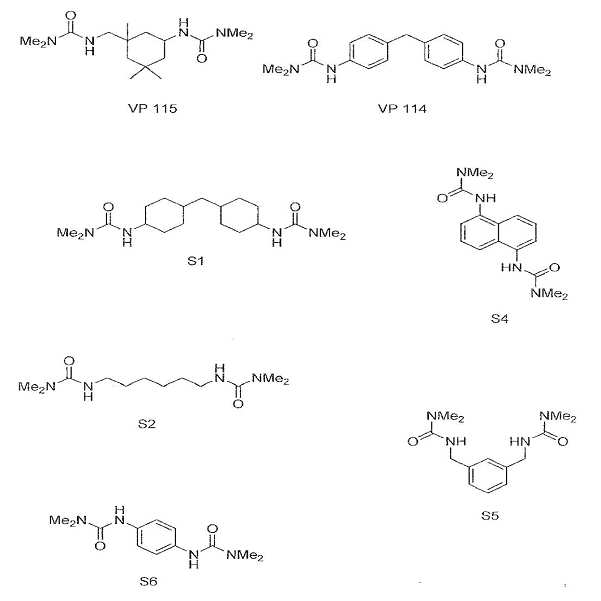
2) 하기 실시예들에서 언급된 데이터 및 측정 값들은 하기의 측정 방법들에 의해 얻어졌다.2) The data and measurements mentioned in the following examples were obtained by the following measurement methods.
a. 열 흐름식 시차 열량계(DSC822e, Mettler Toldedo)에 의해 DSC 측정을 수행:a. Perform DSC measurements with a thermal flow differential calorimeter (DSC822e, Mettler Toldedo):
ⅰ) 동력학적으로: 피크 온도(DSC 피크 T)를 결정하기 위한 온도 프로그램으로, 30℃에서부터 250℃까지(필요한 경우 400℃까지)의 가열을 10 K/분의 속도로 수행한다. 반응 피크에 탄젠트를 적용함으로써 상기 동일 측정으로부터 개시 온도를 결정한다. 에너지 함량은 피크 아래의 면적을 적분함으로써 상기 동일 측정으로부터 계산한다.I) Kinodynamically: With a temperature program to determine the peak temperature (DSC peak T), heating from 30 ° C to 250 ° C (400 ° C if necessary) is carried out at a rate of 10 K / min. The starting temperature is determined from the same measurement by applying a tangent to the reaction peak. The energy content is calculated from the same measurement by integrating the area under the peak.
ⅱ) 등온적으로: 등온 반응 시간 및 최대 열 흐름(주어진 온도에서의 등온 DSC 측정의 경우에서의 피크)을 결정하기 위해, 샘플을 30℃에서부터 표시된 원하는 온도 T까지 20 K/분의 속도로 가열하고 이후 시간 t 동안 일정하게 유지한다. 반응은 열 흐름이 최대값 후에 다시 주어진 온도에서 베이스라인에 도달할 때 완료된다. 시간에 따른 변화의 평가에서, 양의 피크는 경화 반응의 최대 열 흐름에 상응한다. 상기 동일 측정의 피크 아래의 적분 면적은 반응의 에너지 함량이다. 반응 피크에 탄젠트를 적용함으로써 상기 동일 측정으로부터 개시 온도를 결정한다.Ii) Isothermally: To determine the isothermal reaction time and the maximum heat flow (peak in the case of isothermal DSC measurement at a given temperature), the sample is heated from 30 ° C to the indicated desired temperature T at a rate of 20 K / min And then remains constant for time t. The reaction is complete when the heat flow reaches the baseline at the given temperature again after the maximum value. In the evaluation of the change over time, the positive peak corresponds to the maximum heat flow of the curing reaction. The integral area below the peak of the same measurement is the energy content of the reaction. The starting temperature is determined from the same measurement by applying a tangent to the reaction peak.
ⅲ) 유리 전이 온도(Tg)의 측정Iii) Measurement of glass transition temperature (Tg)
- 최대 유리 전이 온도(종점 Tg):- maximum glass transition temperature (end point Tg):
최대 유리 전이 온도(종점 Tg)를 결정하기 위해 겔 시간(gel time) 측정으로부터의 물질을 사용하였다. 배합물을 200℃까지 가열하고 상기 온도를 10분 동안 유지(온도 프로그램: 30℃에서 200℃까지, 가열 속도: 20 K/분, 유지: 10분)함으로써 완전히 경화시켰다. 50℃까지 냉각시킨 후에, 샘플을 20 K/분의 가열 속도로 200℃까지 2회 가열(2 × [온도 프로그램: 50℃에서 200℃까지, 가열 속도: 20 K/분, 유지: 10분], 냉각 속도: -20 K/분)하고 열 용량의 최대 변화의 변곡점에 탄젠트를 적용함으로써 종점 Tg를 결정하였다. 결정된 2개의 종점 Tg들로부터 산술 평균을 계산하였다.The material from the gel time measurement was used to determine the maximum glass transition temperature (end point Tg). The blend was heated to 200 DEG C and fully cured by holding the temperature for 10 minutes (temperature program: 30 DEG C to 200 DEG C, heating rate: 20 K / min, holding: 10 minutes). After cooling the sample to 50 캜, the sample was heated twice at 200 캜 with a heating rate of 20 K / min (2 캜 (temperature program: from 50 캜 to 200 캜, heating rate: 20 K / min, , Cooling rate: -20 K / min), and the end point Tg was determined by applying a tangent to the inflection point of the maximum change in the heat capacity. The arithmetic mean was calculated from the two determined end points Tg.
- 시험편의 유리 전이 온도(Tg): - Glass transition temperature (Tg) of the test piece:
주어진 온도에서 경화된 시험편의 Tg를 결정하기 위해, 상기 물질을 250℃까지 가열하였다(온도 프로그램: 30℃에서 250℃까지, 가열 속도: 10 K/분). 가열 곡선에서 열 용량의 최대 변화의 변곡점에 탄젠트를 적용함으로써 Tg를 결정하였다. To determine the Tg of the cured specimen at a given temperature, the material was heated to 250 DEG C (temperature program: 30 DEG C to 250 DEG C, heating rate: 10 K / min). The Tg was determined by applying a tangent to the inflection point of the maximum change in heat capacity in the heating curve.
b. 겔 시간 결정b. Determination of gel time
약 0.5 g의 새로 제조된 배합물을 알루미늄 도가니(crucible)내로 투입하고 140℃까지 예열된 가열 블록에서 가열하였으며, 스톱워치에 의해 가열 시간을 측정하였다. 이쑤시개(toothpick)로 교반함으로써, 배합물이 겔상(gel-like)이 되고 상기 도가니가 상기 이쑤시개를 사용하여 가열 블록으로부터 들어올려 질 수 있는 시간을 측정한다.About 0.5 g of the freshly prepared formulation was charged into an aluminum crucible and heated in a heating block preheated to 140 占 폚 and the heating time was measured by a stopwatch. Stirring with a toothpick measures the time that the formulation becomes gel-like and the crucible can be lifted from the heating block using the toothpick.
c. 저장 안정성 결정:c. Determine storage stability:
시작 값(0 h)으로서, 새롭게 제조된 배합물의 동력학 점도(dynamic viscosity)를 먼저 Haake 점도계(콘(1°)/플레이트 방법)에 의해 25℃에서 측정하였다. 이후, 샘플을 요구 온도(실온: 기후 캐비넷(climatic cabinet)(T = 23℃, 상대 습도 = 50%; 실온 보다 높은 온도: 표시된 온도의 오븐)에서 저장하였고 점도를 25℃에서 다시 일정한 간격으로 측정하였다.As the starting value (0 h), the dynamic viscosity of the freshly prepared formulation was first measured at 25 캜 by a Haake viscometer (cone (1 °) / plate method). The samples were then stored at the required temperature (room temperature: climatic cabinet (T = 23 ° C, relative humidity = 50%; temperature higher than room temperature: oven of the indicated temperature) and the viscosity measured again at 25 ° C Respectively.
3) 기계적 테스트, 열역학적 테스트 및 저장 안정성의 테스트를 위한 시험편용 수지 배합물의 제조 공정3) Manufacturing process of resin blend for test piece for mechanical test, thermodynamic test and storage stability test
a. E.828 600 g 및 미분화된(micronised) UR 500(3,3’-(4-메틸-1,3-페닐렌(비스(1,1-디메틸우레아)) 48 g(0.182 몰, 8 phr)을 1리터 용해기 용기(dissolver vessel)내로 투입하였다. 상기 반응 혼합물을 용해기(Dispermat, VMA-Getzmann)를 사용하여 1500 rpm으로 30분 동안 분산시켰다. 이후, 얻어진 혼합물을 50-60 rpm으로 약 2시간 동안 진공 (약 30 mbar)내에서 탈가스하였다. 상기 배합물은 그 표면 위에 더 이상 가시적인 기포가 없을 때 즉시 사용 가능하다.a. 600 g of E.828 and 48 g (0.182 mol, 8 phr) of micronised UR 500 (3,3 '- (4-methyl-1,3-phenylene (bis (1,1-dimethylurea) Was dispensed into a 1 liter dissolver vessel. The reaction mixture was dispersed for 30 minutes at 1500 rpm using a dissolver (Dispermat, VMA-Getzmann), then the resulting mixture was stirred at 50-60 rpm for about Degassed in a vacuum (about 30 mbar) for 2 hours. The formulation is ready to use immediately when there are no more visible bubbles on its surface.
b. E.828 600 g 및 미분화된 VP 114 48 g(0.141 몰, 8 phr)을 1리터 용해기 용기내로 투입하였다. 상기 반응 혼합물을 용해기(Dispermat, VMA-Getzmann)를 사용하여 1500 rpm으로 30분 동안 분산시켰다. 이후, 얻어진 혼합물을 50-60 rpm으로 약 2시간 동안 진공(약 30 mbar)내에서 탈가스하였다. 상기 배합물은 그 표면 위에 더 이상 가시적인 기포가 없을 때 즉시 사용 가능하다.b. 600 g of E.828 and 48 g (0.141 mol, 8 phr) of undifferentiated VP 114 were introduced into a 1 liter dissolver vessel. The reaction mixture was dispersed at 1500 rpm for 30 minutes using a dissolver (Dispermat, VMA-Getzmann). The resulting mixture was then degassed in vacuo (about 30 mbar) at 50-60 rpm for about 2 hours. The formulation is immediately usable when there are no more visible bubbles on its surface.
c. E.828 600 g 및 미분화된 VP 115 48 g(0.154 몰, 8 phr)을 1리터 용해기 용기내로 투입하였다. 상기 반응 혼합물을 용해기(Dispermat, VMA-Getzmann)를 사용하여 1500 rpm으로 30분 동안 분산시켰다. 이후, 얻어진 혼합물을 50-60 rpm으로 약 2시간 동안 진공 (약 30 mbar)내에서 탈가스하였다. 상기 배합물은 그 표면 위에 더 이상 가시적인 기포가 없을 때 즉시 사용 가능하다.c. 600 g of E.828 and 48 g (0.154 mol, 8 phr) of undifferentiated VP 115 were introduced into a 1 liter dissolver vessel. The reaction mixture was dispersed at 1500 rpm for 30 minutes using a dissolver (Dispermat, VMA-Getzmann). The resulting mixture was then degassed in vacuo (about 30 mbar) at 50-60 rpm for about 2 hours. The formulation is immediately usable when there are no more visible bubbles on its surface.
d. E.828 600 g과 미분화된 VP 114 24 g(0.071 몰, 4 phr) 및 미분화된 VP 115 24g(0.077 몰, 4 phr)을 1리터 용해기 용기내로 투입하였다. 상기 반응 혼합물을 용해기(Dispermat, VMA-Getzmann)를 사용하여 1500 rpm으로 30분 동안 분산시켰다. 이후, 얻어진 혼합물을 50-60 rpm으로 약 2시간 동안 진공(약 30 mbar)내에서 탈가스하였다. 상기 배합물은 그 표면 위에 더 이상 가시적인 기포가 없을 때 즉시 사용 가능하다.d. 600 g of E.828, 24 g (0.071 moles, 4 phr) of undifferentiated VP 114 and 24 g (0.077 moles, 4 phr) of undifferentiated VP 115 were introduced into a 1 liter dissolver vessel. The reaction mixture was dispersed at 1500 rpm for 30 minutes using a dissolver (Dispermat, VMA-Getzmann). The resulting mixture was then degassed in vacuo (about 30 mbar) at 50-60 rpm for about 2 hours. The formulation is immediately usable when there are no more visible bubbles on its surface.
e. E.828 600 g과 미분화된 VP 114 24 g(0.071 몰, 4 phr) 및 미분화된 UR 500 24g(0.091 몰, 4 phr)을 1리터 용해기 용기내로 투입하였다. 상기 반응 혼합물을 용해기(Dispermat, VMA-Getzmann)를 사용하여 1500 rpm으로 30분 동안 분산시켰다. 이후, 얻어진 혼합물을 50-60 rpm으로 약 2시간 동안 진공(약 30 mbar)내에서 탈가스하였다. 상기 배합물은 그 표면 위에 더 이상 가시적인 기포가 없을 때 즉시 사용 가능하다.e. 600 g of E.828, 24 g (0.071 moles, 4 phr) of undifferentiated VP 114 and 24 g (0.091 mol, 4 phr) of undifferentiated UR 500 were introduced into a 1 liter dissolver vessel. The reaction mixture was dispersed at 1500 rpm for 30 minutes using a dissolver (Dispermat, VMA-Getzmann). The resulting mixture was then degassed in vacuo (about 30 mbar) at 50-60 rpm for about 2 hours. The formulation is immediately usable when there are no more visible bubbles on its surface.
f. E.828 600 g과 미분화된 VP 115 24 g(0.077 몰, 4 phr) 및 미분화된 UR 500 24g(0.091 몰, 4 phr)을 1리터 용해기 용기내로 투입하였다. 상기 반응 혼합물을 용해기(Dispermat, VMA-Getzmann)를 사용하여 1500 rpm으로 30분 동안 분산시켰다. 이후, 얻어진 혼합물을 50-60 rpm으로 약 2시간 동안 진공 (약 30 mbar)내에서 탈가스하였다. 상기 배합물은 그 표면 위에 더 이상 가시적인 기포가 없을 때 즉시 사용 가능하다.f. 600 g of E.828, 24 g (0.077 mol, 4 phr) of undifferentiated VP 115 and 24 g (0.091 mol, 4 phr) of undifferentiated UR 500 were introduced into a 1 liter dissolver vessel. The reaction mixture was dispersed at 1500 rpm for 30 minutes using a dissolver (Dispermat, VMA-Getzmann). The resulting mixture was then degassed in vacuo (about 30 mbar) at 50-60 rpm for about 2 hours. The formulation is immediately usable when there are no more visible bubbles on its surface.
본 발명에 따른 에폭시 수지 조성물들 및 이들의 경화 거동을 하기 표 1에 나타내었다.
The epoxy resin compositions according to the present invention and their curing behavior are shown in Table 1 below.
(본 발명)(Invention)
(부)(part)
[℃][° C]
개시Start
[℃][° C]
겔 시간Gel time
[[
minmin
::
secsec
]]
TgTg
[℃][° C]
등온 DSC 피크 Isothermal DSC peak
[[
minmin
::
secsec
]]
최대 열 흐름 [W/g]Maximum heat flow [W / g]
(본 발명)3.a.
(Invention)
UR 500
(100:8)E.828 +
UR 500
(100: 8)
(본 발명)3.b.
(Invention)
VP 114
(100:8)E.828 +
VP 114
(100: 8)
(본 발명)3.c.
(Invention)
VP 115
(100:8)E.828 +
VP 115
(100: 8)
(본 발명)3.d.
(Invention)
VP 114 +
VP 115
(100:4:4)E.828 +
VP 114 +
VP 115
(100: 4: 4)
(본 발명)3.e.
(Invention)
VP 114 +
UR 500
(100:4:4)E.828 +
VP 114 +
UR 500
(100: 4: 4)
(본 발명)3.f.
(Invention)
VP 115 +
UR 500
(100:4:4)E.828 +
VP 115 +
UR 500
(100: 4: 4)
(본 발명)S1
(Invention)
H12MDI-우론
(100:8)E.828 +
H12MDI-URON
(100: 8)
(본 발명)S2
(Invention)
HDI-우론
(100:8)E.828 +
HDI-URON
(100: 8)
NDI-우론
(100:8)E.828 +
NDI-URON
(100: 8)
(본 발명)S5
(Invention)
MXDI-우론
(100:8)E.828 +
MXDI-URON
(100: 8)
(본 발명)S6
(Invention)
PDI-우론
(100:8)E.828 +
PDI-URON
(100: 8)
에폭시 수지 조성물들(비교예들) 및 이들의 경화 거동을 하기 표 2에 나타내었다.The epoxy resin compositions (comparative examples) and their curing behavior are shown in Table 2 below.
(본 발명)(Invention)
(부)(part)
동력학적 DSC 피크Kinetic DSC peak
[℃][° C]
동력학적 Dynamic
DSCDSC
개시Start
[℃][° C]
의of
겔 시간Gel time
[[
minmin
::
secsec
]]
TgTg
[℃][° C]
등온 Isothermal
DSCDSC
피크 peak
[[
minmin
::
secsec
]]
최대 열흐름 [W/g]Maximum heat flow [W / g]
DYHARD
100S
(100:6.5)E.828 +
DYHARD
100S
(100: 6.5)
DCD +
UR 500
(100:6.5:3)E.828 +
DCD +
UR 500
(100: 6.5: 3)
DCD +
VP 114
(100:6.5:3)E.828 +
DCD +
VP 114
(100: 6.5: 3)
DCD +
VP 115
(100:6.5:3)E.828 +
DCD +
VP 115
(100: 6.5: 3)
본 발명에 따른 에폭시 수지 조성물 및 이들의 경화 거동 - 140℃의 경화 온도에서 경화제 비율의 변동을 하기 표 3에 나타내었다.The epoxy resin composition according to the present invention and the curing behavior thereof The variation of the curing agent ratio at the curing temperature of 140 캜 is shown in Table 3 below.
(본 발명)(Invention)
(부)(part)
동력학적 Dynamic
DSCDSC
피크 peak
[℃][° C]
동력학적 Dynamic
DSCDSC
개시Start
[℃][° C]
의 겔 시간Gel time
[[
minmin
::
secsec
]]
TgTg
[℃][° C]
등온 Isothermal
DSCDSC
피크 peak
[[
minmin
::
secsec
]]
최대 maximum
열흐름Heat flow
[W/g] [W / g]
VP 114
(100:6)E.828 +
VP 114
(100: 6)
VP 114
(100:7)E.828 +
VP 114
(100: 7)
VP 114
(100:9)E.828 +
VP 114
(100: 9)
VP 114
(100:10)E.828 +
VP 114
(100: 10)
VP 114
(100:11)E.828 +
VP 114
(100: 11)
VP 115
(100:6)E.828 +
VP 115
(100: 6)
VP 115
(100:7)E.828 +
VP 115
(100: 7)
VP 115
(100:9)E.828 +
VP 115
(100: 9)
VP 115
(100:10)E.828 +
VP 115
(100: 10)
VP 115
(100:11)E.828 +
VP 115
(100: 11)
UR 500
(100:6)E.828 +
UR 500
(100: 6)
UR 500
(100:7)E.828 +
UR 500
(100: 7)
UR 500
(100:9)E.828 +
UR 500
(100: 9)
UR 500
(100:10)E.828 +
UR 500
(100: 10)
UR 500
(100:11)E.828 +
UR 500
(100: 11)
조성물 3.a 내지 3.f에 대해 상술한 바와 같이, 표 4의 조성물 4.a. 내지 4.o.를 상응하게 준비하였다.
As described above for compositions 3.a to 3.f, the composition of Table 4, 4.a. To 4. < / RTI >
결과의 요약
Summary of results
1) 3.a 내지 3.c의 수지 배합물의 경화 프로파일1) Curing profile of resin formulations 3.a to 3.c
ⅰ. 포인트 3.a 내지 3.c에 따라 제조된 수지 배합물은 이들이 또한 단독 경화제로서 사용될 수 있다는 것을 동력학적 DSC 측정에서 보여준다. 실시예 UR 500에 의해 보여진 바와 같이, 상기 반응은 이미 100℃에서 시작할 수 있음을 볼 것이다. 경화제로서 우론을 갖는 수지 배합물의 더 넓지만 덜 높은 곡선은 더 느린 경화 반응은 나타내고, 상기 반응에서 방출된 에너지는 우론이 DCD와 함께 촉진제로서 사용되는 수지 배합물의 경우보다 더 큰 온도 범위에 걸쳐 분배된다.I. The resin formulations prepared according to points 3.a to 3.c show in kinetic DSC measurements that they can also be used as sole curing agents. As shown by example UR 500, it will be seen that the reaction can already start at 100 ° C. The wider but lesser curves of the resin blend with urone as the curing agent indicate a slower curing reaction and the energy released in the reaction is distributed over a larger temperature range than in the case of the resin blend used with the DCD as co- do.
ⅱ. 포인트 3.a 내지 3.c에 따라 제조된 수지 배합물은 사용된 우론이 DCD 없이 단독 경화제로서 사용될 수 있다는 것을 등온 DSC 측정에서 보여준다. DCD의 촉진제로서 우론이 사용된 것과 대조적으로, DCD가 없는 우론이 더 느리게 반응하고 방출되는 열량이 더 장시간에 걸쳐 분배된다는 이점이 있다. 사용된 우론에 따라, 경화는 80℃ 미만에서 일어날 수 있으며, 최대 열 흐름은 (에폭시 수지 혼합물의 질량을 기준으로) 0.99 W/g를 초과하지 않는다.
Ii. The resin formulations prepared according to points 3.a to 3.c show isotherm DSC measurements that the uranium used can be used as the sole curing agent without DCD. In contrast to the use of URAN as an accelerator of DCD, URON without DCD reacts more slowly and has the advantage that the heat released is distributed over a longer period of time. Depending on the used isocyanate, curing can occur below 80 ° C, and the maximum heat flow does not exceed 0.99 W / g (based on the mass of the epoxy resin mixture).
2) 3.d 내지 3.f의 수지 배합물의 경화 프로파일2) Curing profile of resin formulations from 3.d to 3.f
포인트 3.d 내지 3.f에 따른 상이한 우론들의 혼합물로부터 제조된 수지 배합물은, 동력학적 DSC 측정 및 등온 DSC 측정(140℃에서의 실시예) 모두에서, 경화제로서 단지 1종의 우론을 갖는 수지 배합물들 사이에서 경화 프로파일이 조절될 수 있으며, 등온 DSC 측정에서의 열 흐름은 0.99 W/g 미만임을 보여준다.
The resin formulations prepared from mixtures of different urohons according to points 3.d to 3.f, in both the kinetic DSC measurement and the isothermal DSC measurement (example at 140 캜), the resins having only one urone as the curing agent The cure profile can be adjusted between the formulations and the heat flow in isothermal DSC measurements is less than 0.99 W / g.
3) 4.a 내지 4.o의 수지 배합물의 경화 프로파일3) Curing profile of resin formulations from 4.a to 4.o
ⅰ. 포인트 4.a 내지 4.o에 따라 제조된 수지 배합물은 동력학적 DSC 측정에서, 경화제의 비율과 독립적으로, 더 느린 반응을 보여주며, 상기 반응에서 방출되는 에너지는 우론이 DCD와 함께 촉진제로서 사용되는 수지 배합물의 경우보다 더 큰 온도 범위에 걸쳐 분배된다.I. Resin formulations prepared according to points 4.a to 4.o show slower reactions in the kinetic DSC measurement, independent of the ratio of the curing agent, and the energy released from the reaction is used as a promoter with the DCD Lt; RTI ID = 0.0 > than < / RTI >
ⅱ. 포인트 4.a 내지 4.o에 따라 제조된 수지 배합물은 실시예 4.o에서 가장 반응성 있는 우론인 UR 500에서 볼 수 있는 바와 같이, 사용된 우론이 경화제의 비율과 독립적으로 (에폭시 수지 혼합물의 질량을 기준으로) 0.99 W/g 미만의 최대 열 흐름을 달성한다는 것을 140℃에서의 등온 DSC 측정에서 보여준다.
Ii. The resin formulations made according to points 4.a to 4.o can be prepared as described in U.S. Pat. No. 4,054, which can be seen in UR 500, which is the most reactive urethane in Example 4.O, Lt; RTI ID = 0.0 > 140 C < / RTI >
특히 4 mm를 초과하는 두께를 갖는 두꺼운 및/또는 불균일한 두께의 성분은 경화되기 어렵다. 과제는 발열 경화 공정 동안에 형성되는 열, 또는 예를 들면, 디시안디아미드 및 우론 촉진제, 예를 들면, DYHARD UR 500으로 경화하는 경우에 특히 짧은 시간 내에 형성되는 열 흐름의 충분한 및/또는 균일한 소산이다. 따라서, 열의 강화는 10 mm 초과 내지 1000 mm의 두께를 갖는 특히 두꺼운 성분에서 일어날 수 있고, 이는 상기 성분을 열적으로 손상시키며, 극단적인 경우 부분적인 또는 완전한 탄화를 일으킨다. 또한, 4 mm를 초과하는 특히 불균일한 두께를 갖는 성분에서 너무 높은 열 흐름은 상기 성분 내에 불균일하게 빠른 경화를 초래하고, 그 결과로서 특히 큰 내부 응력이 강화된다. 특히 두꺼운 및/또는 불균일한 두께의 몰딩 또는 중공 물품들의 예는, 예를 들면, 풍력 발전소의 경우에 리딩 에지(leading edge)(4 mm 초과 내지 15 mm 초과), 특히 웹(web)과 스파(spar)(25 mm 초과) 및 특히 블레이드 루트(blade root)(10 mm 초과 내지 250 mm 초과)이다. 본 발명의 적절한 경화제를 선택함으로써 경화된 몰딩 또는 중공 물품의 내부 응력이 가능한 한 낮고 열 손상 및/또는 부분적인 또는 완전한 탄화가 경화 공정 동안 일어나지 않도록 열 흐름을 조절하는 것이 가능하다.
Particularly thick and / or non-uniform thickness components having a thickness exceeding 4 mm are hard to cure. The problem is that the heat formed during the exothermic curing process or the sufficient and / or uniform dissipation of the heat flow to be formed, in particular in a short period of time, when curing with dicyandiamide and urone accelerators, for example DYHARD UR 500 to be. Thus, the strengthening of the heat can occur in a particularly thick component having a thickness of more than 10 mm to 1000 mm, which thermally damages the component and in the extreme case causes partial or complete carbonization. In addition, too high a heat flow in components with particularly uneven thicknesses exceeding 4 mm results in nonuniformly fast curing in the components, and as a result, especially large internal stresses are intensified. Examples of particularly thick and / or non-uniform thickness molded or hollow articles are, for example, leading edges (greater than 4 mm to more than 15 mm) in the case of wind power plants, especially webs and spas spar (greater than 25 mm) and in particular blade root (greater than 10 mm and greater than 250 mm). By selecting the appropriate curing agent of the present invention it is possible to adjust the heat flow so that the internal stress of the cured molding or hollow article is as low as possible and that thermal damage and / or partial or complete carbonization does not occur during the curing process.
Claims (14)
R-(NH-CO-N(CH3)2)n 식(Ⅰ)
식 중
R = 선형 또는 분지형 지방족 라디칼, 또는
지환족 라디칼, 또는
비치환, 할로-치환 및/또는 알킬-치환된 방향족 라디칼, 및
n = 2 내지 20의 수
상기 에폭시 수지 조성물은 1종 이상의 경화성 에폭시 수지를 포함하고, 상기 에폭시 수지 조성물은 60℃ 내지 180℃의 온도에서의 경화 동안에, (상기 에폭시 수지 조성물의 질량을 기준으로) 0.05 내지 0.99 W/g의 상기 에폭시 수지 조성물에서의 최대 열 흐름(maximum heat flow)을 발생시켜, 상기 에폭시 수지 조성물이 완전히 경화되도록 하는 양으로 상기 일반식 (Ⅰ)의 N,N’-(디메틸)-우론 또는 이들의 혼합물을 포함하는 용도.As a curing agent for controlled curing of epoxy resin compositions of bis- or polyfunctional N, N '- (dimethyl) -urone of formula (I) or a mixture thereof As an application,
R- (NH-CO-N ( CH 3) 2) n Equation (Ⅰ)
During the meal
R = a linear or branched aliphatic radical, or
Alicyclic radical, or
Unsubstituted, halo-substituted and / or alkyl-substituted aromatic radicals, and
n = 2 to 20
Wherein the epoxy resin composition comprises at least one curable epoxy resin and wherein the epoxy resin composition comprises 0.05 to 0.99 W / g (based on the weight of the epoxy resin composition) of the epoxy resin composition during curing at a temperature of 60 占 폚 to 180 占 폚 N, N '- (dimethyl) -uron of the general formula (I) or a mixture thereof in an amount such that a maximum heat flow in the epoxy resin composition is caused to completely cure the epoxy resin composition ≪ / RTI >
R-(NH-CO-N(CH3)2)n 식(Ⅰ)
식 중
R = 선형 또는 분지형 지방족 라디칼, 또는
지환족 라디칼, 또는
비치환, 할로-치환 및/또는 알킬-치환된 방향족 라디칼, 및
n = 2 내지 20의 수
상기 에폭시 수지 조성물은 60℃ 내지 180℃의 온도에서의 경화 동안에, (상기 에폭시 수지 조성물의 질량을 기준으로) 0.05 내지 0.99 W/g의 상기 에폭시 수지 조성물에서의 최대 열 흐름을 발생시켜, 상기 에폭시 수지 조성물이 완전히 경화되도록 하는 양으로 상기 일반식 (Ⅰ)의 N,N’-(디메틸)-우론 또는 이들의 혼합물을 포함하는 방법.As a controlled curing method of an epoxy resin composition by using at least one bis- or polyfunctional N, N '- (dimethyl) -urone of the general formula (I) as a curing agent or a mixture thereof,
R- (NH-CO-N ( CH 3) 2) n Equation (Ⅰ)
During the meal
R = a linear or branched aliphatic radical, or
Alicyclic radical, or
Unsubstituted, halo-substituted and / or alkyl-substituted aromatic radicals, and
n = 2 to 20
The epoxy resin composition generates a maximum heat flow in the epoxy resin composition of 0.05 to 0.99 W / g (based on the mass of the epoxy resin composition) during curing at a temperature of 60 to 180 캜, N, N '- (dimethyl) -uron of the general formula (I) or a mixture thereof in an amount such that the resin composition is completely cured.
a) 1종 이상의 경화성 에폭시 수지, 및
b) 일반식 (Ⅰ)의 비스- 또는 다관능성 N,N’-(디메틸)-우론 또는 이들의 혼합물의 군에서 선택된 1종 이상의 에폭시 수지용 경화제
R-(NH-CO-N(CH3)2)n 식(Ⅰ)
식 중
R = 선형 또는 분지형 지방족 라디칼, 또는
지환족 라디칼, 또는
비치환, 할로-치환 및/또는 알킬-치환된 방향족 라디칼, 및
n = 2 내지 20의 수
를 포함하고,
상기 에폭시 수지 조성물은 60℃ 내지 180℃의 온도에서의 경화 동안에, (상기 에폭시 수지 조성물의 질량을 기준으로) 0.05 내지 0.99 W/g의 에폭시 수지 조성물에서의 최대 열 흐름을 발생시켜, 상기 에폭시 수지 조성물이 완전히 경화되도록 하는 양으로 상기 일반식 (Ⅰ)의 N,N’-(디메틸)-우론 또는 이들의 혼합물의 군에서 선택된 경화제를 포함하는 에폭시 수지 조성물.An epoxy resin composition for producing a molding,
a) at least one curable epoxy resin, and
b) at least one curing agent for an epoxy resin selected from the group consisting of bis- or polyfunctional N, N '- (dimethyl) -urone of the general formula (I)
R- (NH-CO-N ( CH 3) 2) n Equation (Ⅰ)
During the meal
R = a linear or branched aliphatic radical, or
Alicyclic radical, or
Unsubstituted, halo-substituted and / or alkyl-substituted aromatic radicals, and
n = 2 to 20
Lt; / RTI >
The epoxy resin composition generates a maximum heat flow in the epoxy resin composition of 0.05 to 0.99 W / g (based on the mass of the epoxy resin composition) during the curing at a temperature of 60 to 180 캜, An epoxy resin composition comprising a curing agent selected from the group consisting of N, N '- (dimethyl) -urone of the general formula (I) or a mixture thereof in such an amount that the composition is completely cured.
Reinforced and / or carrier material and an epoxy resin composition according to any one of claims 10 to 13.
Applications Claiming Priority (3)
| Application Number | Priority Date | Filing Date | Title |
|---|---|---|---|
| DE102011118760.3 | 2011-11-15 | ||
| DE102011118760A DE102011118760A1 (en) | 2011-11-15 | 2011-11-15 | Use of N, N '(-dimethyl) -units and methods for curing epoxy resin compositions |
| PCT/EP2012/072593 WO2013072356A1 (en) | 2011-11-15 | 2012-11-14 | Use of n,n'-(dimethyl) urons and method for curing epoxy resin compositions |
Publications (2)
| Publication Number | Publication Date |
|---|---|
| KR20140103902A true KR20140103902A (en) | 2014-08-27 |
| KR101962932B1 KR101962932B1 (en) | 2019-03-27 |
Family
ID=47178705
Family Applications (1)
| Application Number | Title | Priority Date | Filing Date |
|---|---|---|---|
| KR1020147009585A Expired - Fee Related KR101962932B1 (en) | 2011-11-15 | 2012-11-14 | Use of N,N’-dimethyl-urones and method for curing epoxy resin compositions |
Country Status (15)
| Country | Link |
|---|---|
| US (1) | US9663609B2 (en) |
| EP (1) | EP2780388B1 (en) |
| JP (1) | JP6272769B2 (en) |
| KR (1) | KR101962932B1 (en) |
| CN (1) | CN103917572B (en) |
| AU (1) | AU2012338922B2 (en) |
| CA (1) | CA2855900C (en) |
| DE (1) | DE102011118760A1 (en) |
| DK (1) | DK2780388T3 (en) |
| ES (1) | ES2538241T3 (en) |
| IN (1) | IN2014KN00896A (en) |
| MX (1) | MX351793B (en) |
| PL (1) | PL2780388T3 (en) |
| SI (1) | SI2780388T1 (en) |
| WO (1) | WO2013072356A1 (en) |
Families Citing this family (6)
| Publication number | Priority date | Publication date | Assignee | Title |
|---|---|---|---|---|
| DE102010020882A1 (en) | 2010-05-18 | 2011-11-24 | Alzchem Trostberg Gmbh | Semicarbazone for curing epoxy resins |
| DE102011118501A1 (en) | 2011-11-15 | 2013-05-16 | Alzchem Ag | Alkyl or dialkyl semicarbazones as hardeners for epoxy resins |
| GB2598101B (en) | 2020-08-13 | 2024-11-27 | Hexcel Composites Ltd | Urea derivatives and their use as curatives and curative accelerators for resin systems |
| DE102021101685A1 (en) | 2021-01-26 | 2022-07-28 | Alzchem Trostberg Gmbh | Storage Stable Epoxy Resin Composition (II) |
| GB2628339A (en) | 2023-03-17 | 2024-09-25 | Hexcel Composites Ltd | Use of hydroxy substituted urones as cure accelerators |
| DE102024103231A1 (en) | 2024-02-06 | 2025-08-07 | Alzchem Trostberg Gmbh | Storage-stable epoxy resin composition and suitable hardener systems |
Citations (4)
| Publication number | Priority date | Publication date | Assignee | Title |
|---|---|---|---|---|
| US3386955A (en) * | 1966-01-14 | 1968-06-04 | American Cyanamid Co | Substituted ureas as low temperature epoxy curing agents |
| JPH10306822A (en) * | 1997-05-01 | 1998-11-17 | Nippon Seiko Kk | Dynamic pressure bearing |
| JP2003039505A (en) * | 2001-07-27 | 2003-02-13 | Koyo Seiko Co Ltd | Resin molded object, method for molding the same and mold therefor |
| JP2011074298A (en) * | 2009-10-01 | 2011-04-14 | Adeka Corp | Adhesive resin composition for silicon wafer |
Family Cites Families (42)
| Publication number | Priority date | Publication date | Assignee | Title |
|---|---|---|---|---|
| US2993044A (en) | 1958-12-19 | 1961-07-18 | Monsanto Chemicals | Diureides and method for their preparation |
| US3274231A (en) | 1962-09-13 | 1966-09-20 | Asahi Chemical Ind | Compositions and methods of stabilizing unsaturated organic nitriles |
| US3454669A (en) | 1966-10-13 | 1969-07-08 | Lubrizol Corp | Novel epoxy curing agents |
| GB1153639A (en) * | 1966-12-30 | 1969-05-29 | Ciba Ltd | Epoxide Resin Compositions |
| FR1570670A (en) * | 1968-04-19 | 1969-06-13 | ||
| US3753680A (en) | 1970-05-14 | 1973-08-21 | Stauffer Chemical Co | Arylidene semicarbazones and their utility as herbicides |
| US3717612A (en) * | 1970-06-22 | 1973-02-20 | Hitco | Curable epoxy resin composition containing a substituted diurea compound |
| US3789071A (en) | 1971-10-07 | 1974-01-29 | Hitco | Epoxy curing agent |
| BE795111A (en) | 1972-02-09 | 1973-08-07 | Philips Nv | BENZYLIDENE-SEMICARBAZIDE COMPOUNDS AND THEIR INSECTICIDAL ACTIVITY |
| DE2236339A1 (en) | 1972-07-25 | 1974-02-07 | Bayer Ag | Alpha-cyano-hydrazones preparation - with pre and post-emergence herbici-dal activity |
| CH637411A5 (en) * | 1979-04-20 | 1983-07-29 | Ciba Geigy Ag | EPOXY RESIN, HARDENER AND HARDENING ACCELERATOR CONTAINING, STORAGEABLE HOMOGENEOUS MIXTURE AND THE USE THEREOF FOR THE PRODUCTION OF HARDENED PRODUCTS. |
| US4360649A (en) | 1980-04-30 | 1982-11-23 | Sumitomo Chemical Company, Limited | Curable composition |
| JPS57185316A (en) | 1981-05-11 | 1982-11-15 | Sumitomo Metal Mining Co Ltd | Electrically conductive resin paste |
| JPS6011458A (en) | 1983-06-30 | 1985-01-21 | Showa Denko Kk | Semicarbazide and semicarbazone derivative and herbicide |
| SU1502585A1 (en) * | 1987-05-08 | 1989-08-23 | Ленинградский Технологический Институт Им.Ленсовета | Pulverulent compound for obtaining foam plastic |
| US4918157A (en) * | 1987-07-08 | 1990-04-17 | Amoco Corporation | Thermosetting composition comprising cyanate ester, urea compound and epoxy resin |
| US4804740A (en) * | 1987-07-08 | 1989-02-14 | Amoco Corporation | Cyanate ester with urea latent cure accelerator |
| SU1574618A1 (en) | 1988-07-04 | 1990-06-30 | Научно-производственное объединение "Полимерклей" | Adhesive composition |
| ATE120469T1 (en) | 1989-11-21 | 1995-04-15 | Ciba Geigy Ag | CURABLE EPOXY RESIN MIXTURES CONTAINING A LATENT HARDENER, AN AMINE AND A THIOL. |
| US5043102A (en) | 1989-11-29 | 1991-08-27 | Advanced Products, Inc. | Conductive adhesive useful for bonding a semiconductor die to a conductive support base |
| DE69119301T2 (en) | 1990-06-16 | 1996-10-17 | Nihon Nohyaku Co Ltd | Hydrazine carboxamide derivatives, process for their preparation and their use |
| JPH0489820A (en) * | 1990-08-02 | 1992-03-24 | Mitsui Petrochem Ind Ltd | Adhesive for hermetic sealing of electronic part and junction member |
| EP0603131A1 (en) * | 1992-12-18 | 1994-06-22 | Ciba-Geigy Ag | Aromatic urea compound used as hardening accelerator for a composition of epoxy resin and dicyandiamide |
| FI941593A7 (en) * | 1994-04-07 | 1995-10-08 | Leonid Nikolayevitch Machliakovski | Powder composition for coatings |
| GB2300187B (en) * | 1995-04-28 | 1998-09-02 | Hodogaya Chemical Co Ltd | Cure-accelerator for epoxy resin |
| CA2206384A1 (en) * | 1996-05-29 | 1997-11-29 | Eiki Togashi | A method of injection-molding for epoxy resin moldings and an injection-moldable epoxy resin composition |
| TW467940B (en) | 1997-10-14 | 2001-12-11 | Toray Industries | Thermosetting resin composition for carbon-fiber reinforced composite material |
| JP2000224806A (en) * | 1999-01-27 | 2000-08-11 | Toshiba Corp | Hydrodynamic bearing motor |
| JP2004256729A (en) * | 2003-02-27 | 2004-09-16 | Kyocera Chemical Corp | Epoxy resin composition and sealed semiconductor device |
| DE10324486A1 (en) | 2003-05-30 | 2004-12-16 | Degussa Ag | Use of urea derivatives as accelerators for epoxy resins |
| JP2006070986A (en) * | 2004-09-01 | 2006-03-16 | Ntn Corp | Shaft member for dynamic-pressure bearing device |
| JP2006152170A (en) * | 2004-11-30 | 2006-06-15 | Nichias Corp | Conductive epoxy resin composition and method for producing the same |
| EP1710286A1 (en) * | 2005-04-04 | 2006-10-11 | 3M Innovative Properties Company | Reinforcement Pad |
| DE102005057590A1 (en) | 2005-12-02 | 2007-06-06 | Degussa Ag | Use of 1- (N'-cyanoguanyl) derivatives of N-containing five-membered heterocycles as curing agents for epoxy resin compositions |
| JP5138239B2 (en) * | 2007-02-22 | 2013-02-06 | ニチアス株式会社 | Resin composition for fuel cell separator and fuel cell separator |
| DE502008000478D1 (en) * | 2008-07-17 | 2010-05-06 | Sika Technology Ag | Adhesive compounds for oiled steel |
| JP5327583B2 (en) * | 2008-08-01 | 2013-10-30 | ニチアス株式会社 | Resin composition for fuel cell separator and fuel cell separator |
| BRPI1013503B1 (en) * | 2009-03-31 | 2019-05-07 | Cytec Technology Corp. | UN CHROME INITIATOR FORMULATION THAT INHIBITS CORROSION, AND, STRUCTURE |
| US8076395B2 (en) | 2009-09-11 | 2011-12-13 | Air Products And Chemicals, Inc. | Low temperature curable epoxy compositions containing urea curatives |
| CN101709195A (en) * | 2009-12-25 | 2010-05-19 | 广州擎天实业有限公司 | Pure epoxy powder coating for coating bakelite board and preparation method thereof |
| DE102010020882A1 (en) | 2010-05-18 | 2011-11-24 | Alzchem Trostberg Gmbh | Semicarbazone for curing epoxy resins |
| DE102011118501A1 (en) | 2011-11-15 | 2013-05-16 | Alzchem Ag | Alkyl or dialkyl semicarbazones as hardeners for epoxy resins |
-
2011
- 2011-11-15 DE DE102011118760A patent/DE102011118760A1/en not_active Withdrawn
-
2012
- 2012-11-14 MX MX2014005760A patent/MX351793B/en active IP Right Grant
- 2012-11-14 SI SI201230244T patent/SI2780388T1/en unknown
- 2012-11-14 ES ES12786988.1T patent/ES2538241T3/en active Active
- 2012-11-14 DK DK12786988.1T patent/DK2780388T3/en active
- 2012-11-14 IN IN896KON2014 patent/IN2014KN00896A/en unknown
- 2012-11-14 US US14/357,030 patent/US9663609B2/en active Active
- 2012-11-14 PL PL12786988T patent/PL2780388T3/en unknown
- 2012-11-14 KR KR1020147009585A patent/KR101962932B1/en not_active Expired - Fee Related
- 2012-11-14 CN CN201280054014.0A patent/CN103917572B/en not_active Expired - Fee Related
- 2012-11-14 CA CA2855900A patent/CA2855900C/en not_active Expired - Fee Related
- 2012-11-14 AU AU2012338922A patent/AU2012338922B2/en not_active Ceased
- 2012-11-14 EP EP12786988.1A patent/EP2780388B1/en active Active
- 2012-11-14 JP JP2014541640A patent/JP6272769B2/en not_active Expired - Fee Related
- 2012-11-14 WO PCT/EP2012/072593 patent/WO2013072356A1/en not_active Ceased
Patent Citations (4)
| Publication number | Priority date | Publication date | Assignee | Title |
|---|---|---|---|---|
| US3386955A (en) * | 1966-01-14 | 1968-06-04 | American Cyanamid Co | Substituted ureas as low temperature epoxy curing agents |
| JPH10306822A (en) * | 1997-05-01 | 1998-11-17 | Nippon Seiko Kk | Dynamic pressure bearing |
| JP2003039505A (en) * | 2001-07-27 | 2003-02-13 | Koyo Seiko Co Ltd | Resin molded object, method for molding the same and mold therefor |
| JP2011074298A (en) * | 2009-10-01 | 2011-04-14 | Adeka Corp | Adhesive resin composition for silicon wafer |
Also Published As
| Publication number | Publication date |
|---|---|
| US20140357762A1 (en) | 2014-12-04 |
| EP2780388B1 (en) | 2015-05-06 |
| KR101962932B1 (en) | 2019-03-27 |
| CN103917572B (en) | 2016-08-24 |
| AU2012338922A1 (en) | 2014-06-05 |
| MX351793B (en) | 2017-10-30 |
| CA2855900C (en) | 2019-11-12 |
| MX2014005760A (en) | 2014-05-30 |
| CN103917572A (en) | 2014-07-09 |
| WO2013072356A1 (en) | 2013-05-23 |
| AU2012338922B2 (en) | 2015-11-12 |
| DK2780388T3 (en) | 2015-08-03 |
| SI2780388T1 (en) | 2015-08-31 |
| PL2780388T3 (en) | 2015-10-30 |
| JP2014533324A (en) | 2014-12-11 |
| US9663609B2 (en) | 2017-05-30 |
| EP2780388A1 (en) | 2014-09-24 |
| IN2014KN00896A (en) | 2015-10-09 |
| JP6272769B2 (en) | 2018-01-31 |
| ES2538241T3 (en) | 2015-06-18 |
| DE102011118760A1 (en) | 2013-05-16 |
| CA2855900A1 (en) | 2013-05-23 |
Similar Documents
| Publication | Publication Date | Title |
|---|---|---|
| US10920027B2 (en) | Epoxy resin composition, molding material, and fiber-reinforced composite material | |
| KR101962932B1 (en) | Use of N,N’-dimethyl-urones and method for curing epoxy resin compositions | |
| US6838176B2 (en) | Epoxy resin composition and prepreg made with the epoxy resin composition | |
| US11661484B2 (en) | Epoxy resin composition for fiber-reinforced composite materials, and fiber-reinforced composite material | |
| US20220306837A1 (en) | Storage stable epoxy resin composition | |
| CN116761834A (en) | Storage stable epoxy resin composition | |
| KR101901991B1 (en) | Alkyl or dialkyl-semicarbazone as a hardener for epoxy resin | |
| CN116057043B (en) | Urea derivatives and their use as curing agents and curing accelerators for resin systems | |
| WO2017126307A1 (en) | Epoxy resin composition, prepreg for fiber-reinforced composite material, and fiber-reinforced composite material | |
| JP7610406B2 (en) | Curable resin composition and prepreg using same | |
| JP4344662B2 (en) | Epoxy resin composition, prepreg and molded body, and method for producing epoxy resin composition | |
| RU2447104C1 (en) | Epoxide compound | |
| JP2025059327A (en) | Epoxy resin composition, molded article, molding material for fiber-reinforced composite material, and fiber-reinforced composite material | |
| EP3858899A1 (en) | Resin composition for fiber-reinforced composite material, and fiber-reinforced composite material using same |
Legal Events
| Date | Code | Title | Description |
|---|---|---|---|
| PA0105 | International application |
St.27 status event code: A-0-1-A10-A15-nap-PA0105 |
|
| P11-X000 | Amendment of application requested |
St.27 status event code: A-2-2-P10-P11-nap-X000 |
|
| P13-X000 | Application amended |
St.27 status event code: A-2-2-P10-P13-nap-X000 |
|
| PG1501 | Laying open of application |
St.27 status event code: A-1-1-Q10-Q12-nap-PG1501 |
|
| A201 | Request for examination | ||
| E13-X000 | Pre-grant limitation requested |
St.27 status event code: A-2-3-E10-E13-lim-X000 |
|
| P11-X000 | Amendment of application requested |
St.27 status event code: A-2-2-P10-P11-nap-X000 |
|
| P13-X000 | Application amended |
St.27 status event code: A-2-2-P10-P13-nap-X000 |
|
| PA0201 | Request for examination |
St.27 status event code: A-1-2-D10-D11-exm-PA0201 |
|
| PN2301 | Change of applicant |
St.27 status event code: A-3-3-R10-R13-asn-PN2301 St.27 status event code: A-3-3-R10-R11-asn-PN2301 |
|
| E902 | Notification of reason for refusal | ||
| PE0902 | Notice of grounds for rejection |
St.27 status event code: A-1-2-D10-D21-exm-PE0902 |
|
| E13-X000 | Pre-grant limitation requested |
St.27 status event code: A-2-3-E10-E13-lim-X000 |
|
| P11-X000 | Amendment of application requested |
St.27 status event code: A-2-2-P10-P11-nap-X000 |
|
| P13-X000 | Application amended |
St.27 status event code: A-2-2-P10-P13-nap-X000 |
|
| E701 | Decision to grant or registration of patent right | ||
| PE0701 | Decision of registration |
St.27 status event code: A-1-2-D10-D22-exm-PE0701 |
|
| GRNT | Written decision to grant | ||
| PR0701 | Registration of establishment |
St.27 status event code: A-2-4-F10-F11-exm-PR0701 |
|
| PR1002 | Payment of registration fee |
St.27 status event code: A-2-2-U10-U12-oth-PR1002 Fee payment year number: 1 |
|
| PG1601 | Publication of registration |
St.27 status event code: A-4-4-Q10-Q13-nap-PG1601 |
|
| PC1903 | Unpaid annual fee |
St.27 status event code: A-4-4-U10-U13-oth-PC1903 Not in force date: 20220322 Payment event data comment text: Termination Category : DEFAULT_OF_REGISTRATION_FEE |
|
| PC1903 | Unpaid annual fee |
St.27 status event code: N-4-6-H10-H13-oth-PC1903 Ip right cessation event data comment text: Termination Category : DEFAULT_OF_REGISTRATION_FEE Not in force date: 20220322 |