KR20160098024A - Can pretreatment for improved coating adhesion - Google Patents
Can pretreatment for improved coating adhesion Download PDFInfo
- Publication number
- KR20160098024A KR20160098024A KR1020157015132A KR20157015132A KR20160098024A KR 20160098024 A KR20160098024 A KR 20160098024A KR 1020157015132 A KR1020157015132 A KR 1020157015132A KR 20157015132 A KR20157015132 A KR 20157015132A KR 20160098024 A KR20160098024 A KR 20160098024A
- Authority
- KR
- South Korea
- Prior art keywords
- cylinder
- acidic aqueous
- water
- aqueous composition
- wax
- Prior art date
- Legal status (The legal status is an assumption and is not a legal conclusion. Google has not performed a legal analysis and makes no representation as to the accuracy of the status listed.)
- Ceased
Links
- 238000000576 coating method Methods 0.000 title claims abstract description 47
- 239000011248 coating agent Substances 0.000 title claims abstract description 39
- 238000000034 method Methods 0.000 claims abstract description 63
- 239000000203 mixture Substances 0.000 claims abstract description 35
- 230000002378 acidificating effect Effects 0.000 claims abstract description 31
- 229910052751 metal Inorganic materials 0.000 claims abstract description 22
- 239000002184 metal Substances 0.000 claims abstract description 22
- 125000002887 hydroxy group Chemical group [H]O* 0.000 claims abstract description 16
- 239000007859 condensation product Substances 0.000 claims abstract description 14
- 229910052719 titanium Inorganic materials 0.000 claims abstract description 14
- XLYOFNOQVPJJNP-UHFFFAOYSA-N water Substances O XLYOFNOQVPJJNP-UHFFFAOYSA-N 0.000 claims abstract description 14
- 229910052726 zirconium Inorganic materials 0.000 claims abstract description 14
- VPVSTMAPERLKKM-UHFFFAOYSA-N glycoluril Chemical compound N1C(=O)NC2NC(=O)NC21 VPVSTMAPERLKKM-UHFFFAOYSA-N 0.000 claims abstract description 11
- 150000002484 inorganic compounds Chemical class 0.000 claims abstract description 11
- 229910010272 inorganic material Inorganic materials 0.000 claims abstract description 11
- 239000006185 dispersion Substances 0.000 claims abstract description 10
- 229910052735 hafnium Inorganic materials 0.000 claims abstract description 8
- 229910052710 silicon Inorganic materials 0.000 claims abstract description 8
- 125000003178 carboxy group Chemical group [H]OC(*)=O 0.000 claims abstract description 5
- 229920005989 resin Polymers 0.000 claims description 13
- 239000011347 resin Substances 0.000 claims description 13
- 125000002485 formyl group Chemical class [H]C(*)=O 0.000 claims description 12
- 238000004381 surface treatment Methods 0.000 claims description 11
- 239000011253 protective coating Substances 0.000 claims description 10
- 238000011010 flushing procedure Methods 0.000 claims description 9
- 229920000642 polymer Polymers 0.000 claims description 9
- 239000002253 acid Substances 0.000 claims description 8
- 229910052782 aluminium Inorganic materials 0.000 claims description 8
- XAGFODPZIPBFFR-UHFFFAOYSA-N aluminium Chemical compound [Al] XAGFODPZIPBFFR-UHFFFAOYSA-N 0.000 claims description 8
- 229910000831 Steel Inorganic materials 0.000 claims description 7
- 239000010959 steel Substances 0.000 claims description 7
- VZCYOOQTPOCHFL-OWOJBTEDSA-N Fumaric acid Chemical compound OC(=O)\C=C\C(O)=O VZCYOOQTPOCHFL-OWOJBTEDSA-N 0.000 claims description 6
- VZCYOOQTPOCHFL-UHFFFAOYSA-N trans-butenedioic acid Natural products OC(=O)C=CC(O)=O VZCYOOQTPOCHFL-UHFFFAOYSA-N 0.000 claims description 6
- NBIIXXVUZAFLBC-UHFFFAOYSA-K phosphate Chemical compound [O-]P([O-])([O-])=O NBIIXXVUZAFLBC-UHFFFAOYSA-K 0.000 claims description 5
- 238000005507 spraying Methods 0.000 claims description 5
- 229920000877 Melamine resin Polymers 0.000 claims description 4
- 229910052731 fluorine Inorganic materials 0.000 claims description 4
- JDSHMPZPIAZGSV-UHFFFAOYSA-N melamine Chemical compound NC1=NC(N)=NC(N)=N1 JDSHMPZPIAZGSV-UHFFFAOYSA-N 0.000 claims description 4
- 229920000728 polyester Polymers 0.000 claims description 4
- YCKRFDGAMUMZLT-UHFFFAOYSA-N Fluorine atom Chemical compound [F] YCKRFDGAMUMZLT-UHFFFAOYSA-N 0.000 claims description 3
- CERQOIWHTDAKMF-UHFFFAOYSA-N Methacrylic acid Chemical compound CC(=C)C(O)=O CERQOIWHTDAKMF-UHFFFAOYSA-N 0.000 claims description 3
- OFOBLEOULBTSOW-UHFFFAOYSA-N Propanedioic acid Natural products OC(=O)CC(O)=O OFOBLEOULBTSOW-UHFFFAOYSA-N 0.000 claims description 3
- 239000008346 aqueous phase Substances 0.000 claims description 3
- 229920001577 copolymer Polymers 0.000 claims description 3
- 150000002221 fluorine Chemical class 0.000 claims description 3
- 239000011737 fluorine Substances 0.000 claims description 3
- 239000001530 fumaric acid Substances 0.000 claims description 3
- VZCYOOQTPOCHFL-UPHRSURJSA-N maleic acid Chemical compound OC(=O)\C=C/C(O)=O VZCYOOQTPOCHFL-UPHRSURJSA-N 0.000 claims description 3
- 239000011976 maleic acid Substances 0.000 claims description 3
- QYKIQEUNHZKYBP-UHFFFAOYSA-N Vinyl ether Chemical compound C=COC=C QYKIQEUNHZKYBP-UHFFFAOYSA-N 0.000 claims description 2
- 230000029936 alkylation Effects 0.000 claims description 2
- 238000005804 alkylation reaction Methods 0.000 claims description 2
- 150000001875 compounds Chemical class 0.000 claims description 2
- 235000013873 oxidized polyethylene wax Nutrition 0.000 claims description 2
- 229920001281 polyalkylene Polymers 0.000 claims description 2
- IMROMDMJAWUWLK-UHFFFAOYSA-N Ethenol Chemical compound OC=C IMROMDMJAWUWLK-UHFFFAOYSA-N 0.000 claims 1
- 230000015572 biosynthetic process Effects 0.000 claims 1
- 125000001046 glycoluril group Chemical group [H]C12N(*)C(=O)N(*)C1([H])N(*)C(=O)N2* 0.000 claims 1
- 239000004209 oxidized polyethylene wax Substances 0.000 claims 1
- 229940085991 phosphate ion Drugs 0.000 claims 1
- 238000004519 manufacturing process Methods 0.000 abstract description 16
- 239000000126 substance Substances 0.000 abstract description 9
- 238000006243 chemical reaction Methods 0.000 abstract description 8
- 239000000853 adhesive Substances 0.000 abstract description 5
- 230000001070 adhesive effect Effects 0.000 abstract description 5
- 239000000758 substrate Substances 0.000 abstract description 5
- 229920003169 water-soluble polymer Polymers 0.000 abstract description 4
- 229910052684 Cerium Inorganic materials 0.000 abstract description 2
- 150000001299 aldehydes Chemical class 0.000 abstract 1
- 238000002203 pretreatment Methods 0.000 abstract 1
- 239000001993 wax Substances 0.000 description 20
- 239000000243 solution Substances 0.000 description 12
- 238000000465 moulding Methods 0.000 description 7
- LYCAIKOWRPUZTN-UHFFFAOYSA-N Ethylene glycol Chemical compound OCCO LYCAIKOWRPUZTN-UHFFFAOYSA-N 0.000 description 6
- OKKJLVBELUTLKV-UHFFFAOYSA-N Methanol Chemical compound OC OKKJLVBELUTLKV-UHFFFAOYSA-N 0.000 description 6
- HEMHJVSKTPXQMS-UHFFFAOYSA-M Sodium hydroxide Chemical compound [OH-].[Na+] HEMHJVSKTPXQMS-UHFFFAOYSA-M 0.000 description 6
- 235000013305 food Nutrition 0.000 description 6
- 229920002959 polymer blend Polymers 0.000 description 6
- 230000003628 erosive effect Effects 0.000 description 5
- -1 fatty acid esters Chemical class 0.000 description 5
- 239000000463 material Substances 0.000 description 5
- 229920000620 organic polymer Polymers 0.000 description 5
- IKHGUXGNUITLKF-UHFFFAOYSA-N Acetaldehyde Chemical compound CC=O IKHGUXGNUITLKF-UHFFFAOYSA-N 0.000 description 4
- KRHYYFGTRYWZRS-UHFFFAOYSA-N Fluorane Chemical compound F KRHYYFGTRYWZRS-UHFFFAOYSA-N 0.000 description 4
- NBIIXXVUZAFLBC-UHFFFAOYSA-N Phosphoric acid Chemical compound OP(O)(O)=O NBIIXXVUZAFLBC-UHFFFAOYSA-N 0.000 description 4
- JUJWROOIHBZHMG-UHFFFAOYSA-N Pyridine Chemical compound C1=CC=NC=C1 JUJWROOIHBZHMG-UHFFFAOYSA-N 0.000 description 4
- IISBACLAFKSPIT-UHFFFAOYSA-N bisphenol A Chemical compound C=1C=C(O)C=CC=1C(C)(C)C1=CC=C(O)C=C1 IISBACLAFKSPIT-UHFFFAOYSA-N 0.000 description 4
- 230000003750 conditioning effect Effects 0.000 description 4
- 238000005260 corrosion Methods 0.000 description 4
- 230000007797 corrosion Effects 0.000 description 4
- 238000003918 potentiometric titration Methods 0.000 description 4
- 239000004925 Acrylic resin Substances 0.000 description 3
- 229920000178 Acrylic resin Polymers 0.000 description 3
- WSFSSNUMVMOOMR-UHFFFAOYSA-N Formaldehyde Chemical compound O=C WSFSSNUMVMOOMR-UHFFFAOYSA-N 0.000 description 3
- 229910019142 PO4 Inorganic materials 0.000 description 3
- 239000011230 binding agent Substances 0.000 description 3
- 239000008367 deionised water Substances 0.000 description 3
- 229910021641 deionized water Inorganic materials 0.000 description 3
- 239000007788 liquid Substances 0.000 description 3
- 238000005259 measurement Methods 0.000 description 3
- 235000021317 phosphate Nutrition 0.000 description 3
- VXNZUUAINFGPBY-UHFFFAOYSA-N 1-Butene Chemical compound CCC=C VXNZUUAINFGPBY-UHFFFAOYSA-N 0.000 description 2
- KAKZBPTYRLMSJV-UHFFFAOYSA-N Butadiene Chemical compound C=CC=C KAKZBPTYRLMSJV-UHFFFAOYSA-N 0.000 description 2
- KRHYYFGTRYWZRS-UHFFFAOYSA-M Fluoride anion Chemical compound [F-] KRHYYFGTRYWZRS-UHFFFAOYSA-M 0.000 description 2
- VQTUBCCKSQIDNK-UHFFFAOYSA-N Isobutene Chemical compound CC(C)=C VQTUBCCKSQIDNK-UHFFFAOYSA-N 0.000 description 2
- QQONPFPTGQHPMA-UHFFFAOYSA-N Propene Chemical compound CC=C QQONPFPTGQHPMA-UHFFFAOYSA-N 0.000 description 2
- 229920002125 Sokalan® Polymers 0.000 description 2
- 239000004480 active ingredient Substances 0.000 description 2
- 230000002411 adverse Effects 0.000 description 2
- 229910000147 aluminium phosphate Inorganic materials 0.000 description 2
- 239000007864 aqueous solution Substances 0.000 description 2
- IAQRGUVFOMOMEM-UHFFFAOYSA-N but-2-ene Chemical compound CC=CC IAQRGUVFOMOMEM-UHFFFAOYSA-N 0.000 description 2
- 229910052804 chromium Inorganic materials 0.000 description 2
- 239000011651 chromium Substances 0.000 description 2
- 238000004140 cleaning Methods 0.000 description 2
- 239000002131 composite material Substances 0.000 description 2
- 238000005336 cracking Methods 0.000 description 2
- 239000003599 detergent Substances 0.000 description 2
- 235000014113 dietary fatty acids Nutrition 0.000 description 2
- 239000003792 electrolyte Substances 0.000 description 2
- 229930195729 fatty acid Natural products 0.000 description 2
- 239000000194 fatty acid Substances 0.000 description 2
- 239000011368 organic material Substances 0.000 description 2
- 239000010452 phosphate Substances 0.000 description 2
- XNGIFLGASWRNHJ-UHFFFAOYSA-N phthalic acid Chemical compound OC(=O)C1=CC=CC=C1C(O)=O XNGIFLGASWRNHJ-UHFFFAOYSA-N 0.000 description 2
- 239000004584 polyacrylic acid Substances 0.000 description 2
- 229920001225 polyester resin Polymers 0.000 description 2
- 239000004645 polyester resin Substances 0.000 description 2
- 238000012545 processing Methods 0.000 description 2
- UMJSCPRVCHMLSP-UHFFFAOYSA-N pyridine Natural products COC1=CC=CN=C1 UMJSCPRVCHMLSP-UHFFFAOYSA-N 0.000 description 2
- 238000007493 shaping process Methods 0.000 description 2
- HWCKGOZZJDHMNC-UHFFFAOYSA-M tetraethylammonium bromide Chemical compound [Br-].CC[N+](CC)(CC)CC HWCKGOZZJDHMNC-UHFFFAOYSA-M 0.000 description 2
- WBYWAXJHAXSJNI-VOTSOKGWSA-M .beta-Phenylacrylic acid Natural products [O-]C(=O)\C=C\C1=CC=CC=C1 WBYWAXJHAXSJNI-VOTSOKGWSA-M 0.000 description 1
- UUGLSEIATNSHRI-UHFFFAOYSA-N 1,3,4,6-tetrakis(hydroxymethyl)-3a,6a-dihydroimidazo[4,5-d]imidazole-2,5-dione Chemical compound OCN1C(=O)N(CO)C2C1N(CO)C(=O)N2CO UUGLSEIATNSHRI-UHFFFAOYSA-N 0.000 description 1
- SMZOUWXMTYCWNB-UHFFFAOYSA-N 2-(2-methoxy-5-methylphenyl)ethanamine Chemical compound COC1=CC=C(C)C=C1CCN SMZOUWXMTYCWNB-UHFFFAOYSA-N 0.000 description 1
- JAHNSTQSQJOJLO-UHFFFAOYSA-N 2-(3-fluorophenyl)-1h-imidazole Chemical compound FC1=CC=CC(C=2NC=CN=2)=C1 JAHNSTQSQJOJLO-UHFFFAOYSA-N 0.000 description 1
- NIXOWILDQLNWCW-UHFFFAOYSA-N 2-Propenoic acid Natural products OC(=O)C=C NIXOWILDQLNWCW-UHFFFAOYSA-N 0.000 description 1
- 229910000838 Al alloy Inorganic materials 0.000 description 1
- VYZAMTAEIAYCRO-UHFFFAOYSA-N Chromium Chemical compound [Cr] VYZAMTAEIAYCRO-UHFFFAOYSA-N 0.000 description 1
- WBYWAXJHAXSJNI-SREVYHEPSA-N Cinnamic acid Chemical compound OC(=O)\C=C/C1=CC=CC=C1 WBYWAXJHAXSJNI-SREVYHEPSA-N 0.000 description 1
- VGGSQFUCUMXWEO-UHFFFAOYSA-N Ethene Chemical compound C=C VGGSQFUCUMXWEO-UHFFFAOYSA-N 0.000 description 1
- 240000000731 Fagus sylvatica Species 0.000 description 1
- 235000010099 Fagus sylvatica Nutrition 0.000 description 1
- GRYLNZFGIOXLOG-UHFFFAOYSA-N Nitric acid Chemical compound O[N+]([O-])=O GRYLNZFGIOXLOG-UHFFFAOYSA-N 0.000 description 1
- LGRFSURHDFAFJT-UHFFFAOYSA-N Phthalic anhydride Natural products C1=CC=C2C(=O)OC(=O)C2=C1 LGRFSURHDFAFJT-UHFFFAOYSA-N 0.000 description 1
- 239000004698 Polyethylene Substances 0.000 description 1
- 239000013543 active substance Substances 0.000 description 1
- 150000001298 alcohols Chemical class 0.000 description 1
- 150000001336 alkenes Chemical class 0.000 description 1
- 150000001412 amines Chemical class 0.000 description 1
- 150000001450 anions Chemical class 0.000 description 1
- 238000000149 argon plasma sintering Methods 0.000 description 1
- 235000013361 beverage Nutrition 0.000 description 1
- KGBXLFKZBHKPEV-UHFFFAOYSA-N boric acid Chemical compound OB(O)O KGBXLFKZBHKPEV-UHFFFAOYSA-N 0.000 description 1
- 239000004327 boric acid Substances 0.000 description 1
- JHIWVOJDXOSYLW-UHFFFAOYSA-N butyl 2,2-difluorocyclopropane-1-carboxylate Chemical compound CCCCOC(=O)C1CC1(F)F JHIWVOJDXOSYLW-UHFFFAOYSA-N 0.000 description 1
- 150000001735 carboxylic acids Chemical class 0.000 description 1
- 229930016911 cinnamic acid Natural products 0.000 description 1
- 235000013985 cinnamic acid Nutrition 0.000 description 1
- LDHQCZJRKDOVOX-NSCUHMNNSA-N crotonic acid Chemical compound C\C=C\C(O)=O LDHQCZJRKDOVOX-NSCUHMNNSA-N 0.000 description 1
- 238000000354 decomposition reaction Methods 0.000 description 1
- 238000005238 degreasing Methods 0.000 description 1
- 230000001419 dependent effect Effects 0.000 description 1
- XNMQEEKYCVKGBD-UHFFFAOYSA-N dimethylacetylene Natural products CC#CC XNMQEEKYCVKGBD-UHFFFAOYSA-N 0.000 description 1
- 239000012153 distilled water Substances 0.000 description 1
- 150000002118 epoxides Chemical class 0.000 description 1
- 239000003822 epoxy resin Substances 0.000 description 1
- 150000002148 esters Chemical class 0.000 description 1
- 150000002170 ethers Chemical class 0.000 description 1
- 238000011156 evaluation Methods 0.000 description 1
- 150000004665 fatty acids Chemical class 0.000 description 1
- 238000011049 filling Methods 0.000 description 1
- 150000002222 fluorine compounds Chemical class 0.000 description 1
- 125000001153 fluoro group Chemical group F* 0.000 description 1
- 238000009472 formulation Methods 0.000 description 1
- 238000010348 incorporation Methods 0.000 description 1
- 150000002500 ions Chemical class 0.000 description 1
- 239000003446 ligand Substances 0.000 description 1
- 239000000155 melt Substances 0.000 description 1
- 238000005555 metalworking Methods 0.000 description 1
- WSFSSNUMVMOOMR-NJFSPNSNSA-N methanone Chemical compound O=[14CH2] WSFSSNUMVMOOMR-NJFSPNSNSA-N 0.000 description 1
- WBYWAXJHAXSJNI-UHFFFAOYSA-N methyl p-hydroxycinnamate Natural products OC(=O)C=CC1=CC=CC=C1 WBYWAXJHAXSJNI-UHFFFAOYSA-N 0.000 description 1
- LVHBHZANLOWSRM-UHFFFAOYSA-N methylenebutanedioic acid Natural products OC(=O)CC(=C)C(O)=O LVHBHZANLOWSRM-UHFFFAOYSA-N 0.000 description 1
- 238000013508 migration Methods 0.000 description 1
- 230000005012 migration Effects 0.000 description 1
- 150000007522 mineralic acids Chemical class 0.000 description 1
- 229910017604 nitric acid Inorganic materials 0.000 description 1
- 230000009972 noncorrosive effect Effects 0.000 description 1
- YOYLLRBMGQRFTN-SMCOLXIQSA-N norbuprenorphine Chemical compound C([C@@H](NCC1)[C@]23CC[C@]4([C@H](C3)C(C)(O)C(C)(C)C)OC)C3=CC=C(O)C5=C3[C@@]21[C@H]4O5 YOYLLRBMGQRFTN-SMCOLXIQSA-N 0.000 description 1
- 238000004806 packaging method and process Methods 0.000 description 1
- 239000012071 phase Substances 0.000 description 1
- 150000003013 phosphoric acid derivatives Chemical class 0.000 description 1
- 150000003014 phosphoric acid esters Chemical class 0.000 description 1
- 238000005554 pickling Methods 0.000 description 1
- 229920000647 polyepoxide Polymers 0.000 description 1
- 229920000573 polyethylene Polymers 0.000 description 1
- 235000013824 polyphenols Nutrition 0.000 description 1
- 238000007781 pre-processing Methods 0.000 description 1
- 238000002360 preparation method Methods 0.000 description 1
- 230000002265 prevention Effects 0.000 description 1
- 238000007789 sealing Methods 0.000 description 1
- 239000013049 sediment Substances 0.000 description 1
- 238000000926 separation method Methods 0.000 description 1
- 239000010802 sludge Substances 0.000 description 1
- 239000007787 solid Substances 0.000 description 1
- 239000011877 solvent mixture Substances 0.000 description 1
- 238000001228 spectrum Methods 0.000 description 1
- 239000007921 spray Substances 0.000 description 1
- 238000003860 storage Methods 0.000 description 1
- 230000003746 surface roughness Effects 0.000 description 1
- 239000004094 surface-active agent Substances 0.000 description 1
- 239000001648 tannin Substances 0.000 description 1
- 229920001864 tannin Polymers 0.000 description 1
- 235000018553 tannin Nutrition 0.000 description 1
- 238000012360 testing method Methods 0.000 description 1
- DXIGZHYPWYIZLM-UHFFFAOYSA-J tetrafluorozirconium;dihydrofluoride Chemical compound F.F.F[Zr](F)(F)F DXIGZHYPWYIZLM-UHFFFAOYSA-J 0.000 description 1
- LDHQCZJRKDOVOX-UHFFFAOYSA-N trans-crotonic acid Natural products CC=CC(O)=O LDHQCZJRKDOVOX-UHFFFAOYSA-N 0.000 description 1
- 150000003673 urethanes Chemical class 0.000 description 1
- 229920002554 vinyl polymer Polymers 0.000 description 1
Classifications
-
- C—CHEMISTRY; METALLURGY
- C23—COATING METALLIC MATERIAL; COATING MATERIAL WITH METALLIC MATERIAL; CHEMICAL SURFACE TREATMENT; DIFFUSION TREATMENT OF METALLIC MATERIAL; COATING BY VACUUM EVAPORATION, BY SPUTTERING, BY ION IMPLANTATION OR BY CHEMICAL VAPOUR DEPOSITION, IN GENERAL; INHIBITING CORROSION OF METALLIC MATERIAL OR INCRUSTATION IN GENERAL
- C23C—COATING METALLIC MATERIAL; COATING MATERIAL WITH METALLIC MATERIAL; SURFACE TREATMENT OF METALLIC MATERIAL BY DIFFUSION INTO THE SURFACE, BY CHEMICAL CONVERSION OR SUBSTITUTION; COATING BY VACUUM EVAPORATION, BY SPUTTERING, BY ION IMPLANTATION OR BY CHEMICAL VAPOUR DEPOSITION, IN GENERAL
- C23C22/00—Chemical surface treatment of metallic material by reaction of the surface with a reactive liquid, leaving reaction products of surface material in the coating, e.g. conversion coatings, passivation of metals
- C23C22/82—After-treatment
- C23C22/83—Chemical after-treatment
-
- B—PERFORMING OPERATIONS; TRANSPORTING
- B21—MECHANICAL METAL-WORKING WITHOUT ESSENTIALLY REMOVING MATERIAL; PUNCHING METAL
- B21D—WORKING OR PROCESSING OF SHEET METAL OR METAL TUBES, RODS OR PROFILES WITHOUT ESSENTIALLY REMOVING MATERIAL; PUNCHING METAL
- B21D22/00—Shaping without cutting, by stamping, spinning, or deep-drawing
- B21D22/20—Deep-drawing
- B21D22/201—Work-pieces; preparation of the work-pieces, e.g. lubricating, coating
-
- B—PERFORMING OPERATIONS; TRANSPORTING
- B21—MECHANICAL METAL-WORKING WITHOUT ESSENTIALLY REMOVING MATERIAL; PUNCHING METAL
- B21D—WORKING OR PROCESSING OF SHEET METAL OR METAL TUBES, RODS OR PROFILES WITHOUT ESSENTIALLY REMOVING MATERIAL; PUNCHING METAL
- B21D51/00—Making hollow objects
- B21D51/16—Making hollow objects characterised by the use of the objects
- B21D51/26—Making hollow objects characterised by the use of the objects cans or tins; Closing same in a permanent manner
-
- C—CHEMISTRY; METALLURGY
- C08—ORGANIC MACROMOLECULAR COMPOUNDS; THEIR PREPARATION OR CHEMICAL WORKING-UP; COMPOSITIONS BASED THEREON
- C08K—Use of inorganic or non-macromolecular organic substances as compounding ingredients
- C08K3/00—Use of inorganic substances as compounding ingredients
- C08K3/16—Halogen-containing compounds
-
- C—CHEMISTRY; METALLURGY
- C09—DYES; PAINTS; POLISHES; NATURAL RESINS; ADHESIVES; COMPOSITIONS NOT OTHERWISE PROVIDED FOR; APPLICATIONS OF MATERIALS NOT OTHERWISE PROVIDED FOR
- C09D—COATING COMPOSITIONS, e.g. PAINTS, VARNISHES OR LACQUERS; FILLING PASTES; CHEMICAL PAINT OR INK REMOVERS; INKS; CORRECTING FLUIDS; WOODSTAINS; PASTES OR SOLIDS FOR COLOURING OR PRINTING; USE OF MATERIALS THEREFOR
- C09D179/00—Coating compositions based on macromolecular compounds obtained by reactions forming in the main chain of the macromolecule a linkage containing nitrogen, with or without oxygen, or carbon only, not provided for in groups C09D161/00 - C09D177/00
- C09D179/04—Polycondensates having nitrogen-containing heterocyclic rings in the main chain; Polyhydrazides; Polyamide acids or similar polyimide precursors
- C09D179/08—Polyimides; Polyester-imides; Polyamide-imides; Polyamide acids or similar polyimide precursors
-
- C—CHEMISTRY; METALLURGY
- C23—COATING METALLIC MATERIAL; COATING MATERIAL WITH METALLIC MATERIAL; CHEMICAL SURFACE TREATMENT; DIFFUSION TREATMENT OF METALLIC MATERIAL; COATING BY VACUUM EVAPORATION, BY SPUTTERING, BY ION IMPLANTATION OR BY CHEMICAL VAPOUR DEPOSITION, IN GENERAL; INHIBITING CORROSION OF METALLIC MATERIAL OR INCRUSTATION IN GENERAL
- C23C—COATING METALLIC MATERIAL; COATING MATERIAL WITH METALLIC MATERIAL; SURFACE TREATMENT OF METALLIC MATERIAL BY DIFFUSION INTO THE SURFACE, BY CHEMICAL CONVERSION OR SUBSTITUTION; COATING BY VACUUM EVAPORATION, BY SPUTTERING, BY ION IMPLANTATION OR BY CHEMICAL VAPOUR DEPOSITION, IN GENERAL
- C23C22/00—Chemical surface treatment of metallic material by reaction of the surface with a reactive liquid, leaving reaction products of surface material in the coating, e.g. conversion coatings, passivation of metals
- C23C22/05—Chemical surface treatment of metallic material by reaction of the surface with a reactive liquid, leaving reaction products of surface material in the coating, e.g. conversion coatings, passivation of metals using aqueous solutions
- C23C22/06—Chemical surface treatment of metallic material by reaction of the surface with a reactive liquid, leaving reaction products of surface material in the coating, e.g. conversion coatings, passivation of metals using aqueous solutions using aqueous acidic solutions with pH less than 6
- C23C22/34—Chemical surface treatment of metallic material by reaction of the surface with a reactive liquid, leaving reaction products of surface material in the coating, e.g. conversion coatings, passivation of metals using aqueous solutions using aqueous acidic solutions with pH less than 6 containing fluorides or complex fluorides
- C23C22/36—Chemical surface treatment of metallic material by reaction of the surface with a reactive liquid, leaving reaction products of surface material in the coating, e.g. conversion coatings, passivation of metals using aqueous solutions using aqueous acidic solutions with pH less than 6 containing fluorides or complex fluorides containing also phosphates
- C23C22/361—Chemical surface treatment of metallic material by reaction of the surface with a reactive liquid, leaving reaction products of surface material in the coating, e.g. conversion coatings, passivation of metals using aqueous solutions using aqueous acidic solutions with pH less than 6 containing fluorides or complex fluorides containing also phosphates containing titanium, zirconium or hafnium compounds
Landscapes
- Chemical & Material Sciences (AREA)
- Engineering & Computer Science (AREA)
- Mechanical Engineering (AREA)
- Organic Chemistry (AREA)
- Chemical Kinetics & Catalysis (AREA)
- Chemical Treatment Of Metals (AREA)
- Materials Engineering (AREA)
- Metallurgy (AREA)
- General Chemical & Material Sciences (AREA)
- Paints Or Removers (AREA)
- Life Sciences & Earth Sciences (AREA)
- Wood Science & Technology (AREA)
- Health & Medical Sciences (AREA)
- Medicinal Chemistry (AREA)
- Polymers & Plastics (AREA)
- Application Of Or Painting With Fluid Materials (AREA)
Abstract
본 발명은 성형된 캔 시트 금속의 미끄럼 거동을 개선하는 왁스 및 후속 코팅을 위한 우수한 접착성 기재를 제공하는 무기-유기 전환층이 전처리 과정에서 형성되는 캔의 전처리를 위한 산성 수계 조성물의 용도에 관한 것이다. 본 발명은 캔 실린더를 먼저 원소 Zr, Ti, Si, Hf 또는 Ce의 수용성 무기 화합물 및 카르복실기 또는 히드록실기를 갖는 수용성 중합체를 함유하는 산성 수계 조성물과 접촉시키고 이어서 왁스의 수계 분산액과 접촉시키는 습식-화학 전처리 방법을 포함한다. 이러한 방식으로, 캔 제조 공정의 다른 방법 단계에 필요한 미끄럼성 및 성형성이 캔 실린더에 부여되고 코팅을 위한 우수한 접착성 기재가 또한 제공된다. 본 발명은 또한 글리콜우릴 및 알데히드의 축합 생성물로부터 선택되는 수용성 중합체를 함유하는, 전처리 방법에 특히 적합한 산성 수계 조성물에 관한 것이다. 또한, 본 발명은 본 발명에 따른 전처리를 포함하는 캔 실린더의 제조 방법에 관한 것이다.The present invention relates to the use of an acidic aqueous composition for the pretreatment of a can in which an inorganic-organic conversion layer providing a good adhesive substrate for wax and subsequent coating to improve the sliding behavior of the shaped can sheet metal is formed during the pretreatment will be. The present invention relates to a can-cylinder in which a canned cylinder is first contacted with an acidic aqueous composition containing a water soluble inorganic compound of elemental Zr, Ti, Si, Hf or Ce and a water soluble polymer having a carboxyl or hydroxyl group and then contacted with an aqueous dispersion of the wax, And a chemical pretreatment method. In this way, the slidability and moldability required for the other method steps of the can manufacturing process are imparted to the can cylinder and an excellent adhesive substrate for coating is also provided. The present invention also relates to acidic aqueous compositions which are particularly suitable for the pretreatment process which comprises a water-soluble polymer selected from condensation products of glycoluril and aldehydes. The present invention also relates to a method of manufacturing a can cylinder comprising a pretreatment according to the present invention.
Description
본 발명은, 성형된 캔 시트 금속의 미끄럼 거동을 개선하는 왁스 및 후속 코팅을 위한 우수한 접착성 기재를 제공하는, 무기-유기 전환층이 형성되는 과정에서 캔의 전처리를 위한 산성 수계 조성물의 용도에 관한 것이다. 본 발명은 캔 실린더를 먼저 원소 Zr, Ti, Si, Hf 또는 Ce의 수용성 무기 화합물 및 카르복실기 또는 히드록실기를 갖는 수용성 중합체를 함유하는 산성 수계 조성물과 접촉시키고 이어서 왁스의 수계 분산액과 접촉시키는 습식 화학 전처리 방법을 포함한다. 이러한 방식으로, 캔 제조 공정의 다른 방법 단계에 필요한 미끄럼성 및 성형성이 캔 실린더에 부여되고 코팅에 대한 우수한 접착성 기재가 또한 제공된다. 본 발명에 따른 방법에서, 금속 캔 실린더의 외면 및 내면 모두가 전처리된다. 또한, 본 발명은 또한 특히 글리콜우릴 및 알데히드의 축합 생성물로부터 선택되는 수용성 중합체를 함유하는, 특히 전처리 방법에 적합한 산성 수계 조성물에 관한 것이다. 또한, 본 발명에 따른 전처리를 포함하는 캔 실린더의 제조 방법에 관한 것이다.The present invention relates to the use of an acidic aqueous composition for the pretreatment of cans in the course of forming an inorganic-organic conversion layer, which provides an excellent adhesive substrate for wax and subsequent coating to improve the sliding behavior of the formed can sheet metal . The present invention relates to a process for the preparation of a canned cylinder by first contacting a can cylinder with an acidic aqueous composition containing a water soluble inorganic compound of the elemental Zr, Ti, Si, Hf or Ce and a water soluble polymer having a carboxyl or hydroxyl group and subsequently contacting the aqueous dispersion of the wax And a preprocessing method. In this way, the slidability and moldability required for the other process steps of the can making process are imparted to the can cylinder and an excellent adhesive substrate for the coating is also provided. In the method according to the present invention, both the outer surface and the inner surface of the metal can cylinder are pretreated. The present invention also relates to an acidic aqueous composition comprising a water-soluble polymer selected from the condensation products of glycoluril and aldehyde, and particularly suitable for the pretreatment process. Further, the present invention relates to a method of manufacturing a can cylinder including a pretreatment according to the present invention.
주석도금 강철(양철판), 알루미늄(또는 이하 간단히 "알루미늄"이라 총괄되는 알루미늄 합금) 및 강철로 제조되는 캔은 식품, 특히 음료의 보관을 위해 널리 이용된다. 캔 제조 과정에서, 캔 시트 금속을 딥드로잉하여 캔 실린더를 형성한 후, 캔은 통상 탈지되고 세정되고 통상 방부식 전처리되며, 이를 위한 목적으로, 예를 들어 산성 또는 알칼리성 세정제 및 부동태화 용액이 시판되고 있다. 적어도 세정제 용액은 캔에서 유래하는 금속 잔여물을 효과적으로 제거하기 위하여 해당 금속에 대한 충분한 용해력을 가져야 한다. 상기 세정 산세척을 통해 캔 표면은 통상 부동태화 용액에 의한 후속 방부식 전처리에서도 적합한 표면 조도가 유지되는 정도로 이미 거칠게 되어 있다. 원통형 캔의 외피면의 조도는 상호 접촉하는 캔들 사이, 및 캔과, 수용 및 추가로 캔 실린더의 성형을 위한 장치 사이의 마찰 증가를 초래한다. 이러한 마찰은 한 제조 단계에서 다음으로 캔의 운반 동안 정기적으로 예를 들면, 캔의 분리로 인한 캔의 적체가 형성되는 장소에서 정지 시간에 의해, 또는 음료 캔의 완성까지의 후속 공정 단계들에서 캔 실린더의 수용 및 성형 공정의 감속에 의해 운반 및 가공 속도를 감소시킨다. 이로써 생산 설비의 용량이 감소하므로 상호 접촉하는 캔 사이의 마찰을 가능한 적게 하기 위하여 캔 표면을 컨디셔닝하는 노력이 행해지고 있다.Tin-plated steel (beech steel), aluminum (or simply an aluminum alloy summarized as "aluminum") and cans made of steel are widely used for storage of foods, especially beverages. After the can sheet metal is deep drawn to form a can cylinder, the can is usually degreased, cleaned and typically is eroded and pretreated, for the purpose of this, for example, an acidic or alkaline detergent and a passivating solution, . At least the detergent solution should have sufficient solubility to the metal to effectively remove the metal residue from the can. Through the cleansing pickling, the can surface is already roughened to such an extent that proper surface roughness is maintained, even in the subsequent anticorrosive pretreatment with the passivating solution. The roughness of the outer surface of the cylindrical can results in increased friction between the mutually contacting cans and between the can and the device for receiving and further forming the can cylinder. Such friction may be produced during a subsequent manufacturing step, for example during a period of time during the transportation of the can, for example, by a stopping time at the location where the can of the can is formed due to the separation of the can, The speed of transportation and processing is reduced by the acceptance of the cylinder and the deceleration of the molding process. Efforts have been made to condition the can surface so as to minimize the friction between the can-making contacts, as the capacity of the production facility is thereby reduced.
이 목적에서, 캔 실린더에는 통상 방부식 전처리에 후속하는 컨디셔닝 플러싱 공정에서 일반적으로 적용되는 마찰-감소 코팅이 제공된다. 이 플러싱 단계에서, 캔 실린더는 통상 특정 계면활성제 및/또는 금속 표면의 미끄럼성을 증가시키는 유기 물질의 수계 용액으로 습윤된다. 이러한 물질은 캔 제조의 종래 기술에서 "이동성 개선제"라 표현된다. 따라서, 캔 실린더를 형성하기 위해 딥드로잉된 캔 시트 금속의 전처리는 통상 복수의 습식 화학 전처리 단계를 포함하여, 탈지 또는 세정 및 방부식 전처리 외에 "이동성 개선제"를 함유하는 플러싱 공정에 의한 캔 실린더의 외피면의 표면 컨디셔닝이 또한 실시된다.For this purpose, the can cylinders are provided with a friction-reducing coating which is generally applied in a conditioning flushing process, which is usually followed by erosion pretreatment. In this flushing step, the can cylinders are typically wetted with aqueous solutions of organic materials which increase the slidability of certain surfactants and / or metal surfaces. Such materials are referred to as "mobility improvers" in the prior art of can manufacturing. Thus, the pretreatment of the deep drawn can sheet metal to form the can cylinder typically includes a plurality of wet chemical pretreatment steps to remove the can of the can cylinder by a flushing process containing "mobility improver" in addition to degreasing or cleaning and erosion pretreatment Surface conditioning of the outer surface is also performed.
그러나, 마찰-감소층의 적용은 부식에 대한 보호 목적 및/또는 장식적 이유에서 적용되는 피복, 마킹 또는 기타 표면 코팅의 접착에 불리한 영향을 미친다. 특히 실린더 테두리를 인발("넥킹")하고 이어서 플랜지를 형성하기 위해 성형할 때 코팅 접착 부족으로 인한 코팅의 손상이 일어나서는 안된다. 그러나, 바로 이 성형 공정에서 코팅의 부서짐이 종종 관찰되며, 이렇게 손상된 캔 실린더는 정리되어야 한다.However, the application of the friction-reducing layer adversely affects the adhesion of coatings, markings or other surface coatings applied for protection against corrosion and / or for decorative reasons. Particularly when the cylinder rim is drawn ("necked") and subsequently molded to form a flange, the coating must not be damaged due to lack of coating adhesion. However, cracking of the coating is often observed in this molding process, and the damaged can cylinder must be cleaned.
특허문헌 US 4,859,351호는 수용성 유기 에톡실화 포스페이트 에스테르, 알콜 및/또는 후속되는 코팅과의 상용성이 뛰어난 지방산을 함유하는 마찰 저항의 감소를 위한 금속 캔의 표면 컨디셔닝을 개시한다. Patent document US 4,859,351 discloses the surface conditioning of metal can to reduce the frictional resistance containing fatty acids which are compatible with water-soluble organic ethoxylated phosphate esters, alcohols and / or subsequent coatings.
특허문헌 US 6,040,280호도 후속되는 코팅에 불리한 영향을 주지 않고 크롬-기재 전환 처리 직후에 후속되는, 에톡실화 지방산에스테르 및 폴리옥시알킬렌에테르를 베이스로 하는 알루미늄 캔용 표면 컨디셔닝을 개시한다.Patent document US 6,040,280 also discloses surface conditioning for aluminum can based on ethoxylated fatty acid esters and polyoxyalkylene ethers immediately after the chromium-based conversion treatment without adversely affecting subsequent coatings.
그러나, 캔 실린더의 표면 처리 및 코팅에 있어서, 캔의 충전물에 따라 다양한 내부식성과 관련한 상이한 요건을 충족할 것이 보장되어야 한다. 일반적으로 생태학적으로, 특히 식품 산업의 견지에서 무해한 활성 물질만이 사용가능하다. 이것은 캔 실린더의 외부 코팅 및 내부 코팅에서 결합제의 선택과 마찬가지로 표면 처리에서 활성 성분의 선택에 관한 것이며, 기술적으로 캔 외면의 처리만을 의도하는지 여부와 무관하게, 물질의 일부가 캔 실린더의 내부에 도달하는 것을 방지할 수 없는 분무 공정이 제조 기술의 이유로 행해지기 때문이다.However, in the surface treatment and coating of the can cylinder, it is to be ensured that the different requirements relating to various corrosion resistance are satisfied according to the filling of the can. In general, only active substances which are harmless in terms of ecology, especially in the food industry, are available. This relates to the selection of the active ingredient in the surface treatment, as well as the choice of binder in the outer and inner coatings of the can cylinder, whether or not a part of the material is technically intended to be treated only on the outer surface of the can, This is because a spraying process which can not be prevented from occurring due to the manufacturing technique is performed.
종래 기술에는, 일반적으로 무기산, 특히 인산, 플루오르화수소산 또는 불화물 및/또는 불화물 착물의 다른 공급원을 이용하고 추가의 유기 중합체를 사용하거나 사용하지 않고 처리하는, 금속 캔의 방부식 처리를 위한 다양한 무-크롬 방법이 공지되어 있다.The prior art includes various non-corrosive materials for the erosion treatment of metal cans, generally using inorganic acids, especially phosphoric acid, hydrofluoric acid or other sources of fluoride and / or fluoride complexes and with or without additional organic polymers. - chromium method is known.
예를 들면, 특허문헌 US-A-4,992,116호는 포스페이트, Zr, Ti, Hf 또는 Si의 불산, 및 탄닌 또는 폴리알케닐 페놀에 치환 아민의 만니히 부가물을 구성하는 폴리페놀 화합물을 함유하는 수계 산성 처리 용액을 개시한다.For example, patent document US-A-4,992,116 discloses an aqueous system containing a polyphenol compound constituting the Mannich adduct of substituted amines with phos- phates, Zr, Ti, Hf or Si hydrofluoric acid, and tannin or polyalkenylphenols Thereby starting an acidic treatment solution.
특허문헌 EP-B-8942호는 a) 0.5∼10g/L의 폴리아크릴산 또는 이의 에스테르 및 b) 0.2∼8g/L의 하나 이상의 헥사플루오로지르콘산, 헥사플루오로티탄산 또는 헥사플루오로규산 화합물을 함유하는, 바람직하게는 알루미늄 캔을 위한 처리 용액을 개시한다. The patent document EP-B-8942 discloses a composition comprising a) 0.5 to 10 g / l of polyacrylic acid or its esters and b) 0.2 to 8 g / l of at least one hexafluorozirconic acid, hexafluorotitanic acid or hexafluorosilicic acid compound ≪ / RTI > and preferably an aluminum can containing water.
본 발명의 과제는 상기 언급한 상이한 요구에 관하여 개선된 성능 스펙트럼을 갖는 금속 캔의 표면 처리 방법을 제공하는 데에 있다. 특히 캔 실린더를 형성하기 위해 딥드로잉되는 캔 시트 금속의 미끄럼 및 변형 거동을 더 개선하고 동시에 보호 코팅에 대한 우수한 방부식성 접착성 기재를 제공하는 것이다.It is an object of the present invention to provide a method of treating a surface of a metal can having an improved performance spectrum with respect to the above-mentioned different requirements. Especially to improve the sliding and deformation behavior of the can sheet metal which is being deep drawn to form the can cylinder, while at the same time providing an excellent corrosion-resistant adhesive substrate for the protective coating.
상기 과제는, 적어도 캔 실린더의 외피면을, The above problem is solved by a method of manufacturing a can cylinder,
(i) a) 원소 Zr, Ti, Si, Hf 및/또는 Ce의 하나 이상의 수용성 무기 화합물, 및(i) a) at least one water-soluble inorganic compound of elemental Zr, Ti, Si, Hf and / or Ce, and
b) 적어도 카르복실기 또는 히드록실기를 갖고, 산가 및/또는 수산기가의 합이 50mg KOH/g 이상인 하나 이상의 수용성 유기 수지 b) at least one water-soluble organic resin having at least a carboxyl group or a hydroxyl group and having an acid value and / or a hydroxyl group content of at least 50 mg KOH / g
를 함유하는 산성 수계 조성물과 접촉시키는 단계, 및 이어서 -중간 플러싱 단계의 개재 또는 개재 없이-With an acidic aqueous composition containing an acidic aqueous phase, and then - without intervening or intervening intermediate flashing steps -
(ii) 왁스의 수계 분산액과 접촉시키는 단계(ii) contacting the wax with an aqueous dispersion of the wax
를 포함하는, 금속 시트로부터 딥드로잉되고 일단이 개방된 캔 실린더의 다단계 표면 처리 방법에 의해 해결된다.Which is deeply drawn from the metal sheet and is open at one end.
본 발명의 의미에서, 20℃의 온도에서 수상에 용해되지 않는 침강물을 형성하지 않고 3의 pH 값을 갖는 1 킬로그램의 물에 50g의 무기 화합물이 용해될 수 있는 경우 무기 화합물은 수용성이다.In the sense of the present invention, when 50 g of inorganic compound can be dissolved in one kilogram of water having a pH value of 3 without forming a sediment which is insoluble in water phase at a temperature of 20 캜, the inorganic compound is water-soluble.
본 발명의 의미에서, 20℃의 온도에서 3의 pH 값을 갖는 1 킬로그램의 물에 10g의 중합체가 용해될 수 있고 투명 용액으로서 존재하는 경우 유기 중합체는 수용성이다. 20℃의 용액 온도에서 광산란법으로 860nm의 파장에서 DIN ISO 7027에 따라 측정한 탁도(NTU)가 50 미만일 경우 투명 용액으로 존재하는 것이다.In the sense of the present invention, 10 g of polymer can be dissolved in one kilogram of water having a pH value of 3 at a temperature of 20 DEG C and the organic polymer is water-soluble if present as a clear solution. If the turbidity (NTU) measured according to DIN ISO 7027 is less than 50 at a wavelength of 860 nm by light scattering at a solution temperature of 20 ° C, it is present as a clear solution.
본 발명에 따르면, 산가는 실험적으로 측정되는 측정 변수로서 중합체 또는 중합체 혼합물 중의 유리 산 기의 개수의 정도이다. 산가는 중합체 또는 중합체 혼합물의 계량된 양을 3:1의 체적비의 메탄올 및 증류수의 용매 혼합물에 용해시키고 이어서 메탄올 중 0.05몰/L KOH로 전위차 적정함으로서 측정한다. 전위차 측정은 복합 전극(Metrohm사의 LL-Solvotrode®; 기준 전해질: 0.4몰/L의 에틸렌 글리콜 중 테트라에틸암모늄 브로마이드)으로 수행한다. 산가는 전위차 적정 곡선의 변곡점에서 중합체 또는 중합체 혼합물의 그램당 첨가된 KOH의 양에 상응한다.According to the present invention, the acid value is the degree of the number of free acid groups in the polymer or polymer mixture as an empirically measured measurement variable. The acid is determined by dissolving the metered amount of polymer or polymer mixture in a solvent mixture of methanol and distilled water in a volume ratio of 3: 1, followed by potentiometric titration with 0.05 mol / L KOH in methanol. The potential difference measurement is carried out with a composite electrode (LL-Solvotrode® from Metrohm; reference electrolyte: tetraethylammonium bromide in ethylene glycol, 0.4 mol / L). The acid number corresponds to the amount of KOH added per gram of polymer or polymer mixture at the inflection point of the potentiometric titration curve.
유사하게, 본 발명에 따르면, 수산기가는 중합체 또는 중합체 혼합물 중의 유리 히드록실기의 개수의 정도로서 전위차 적정에 의해 실험적으로 측정될 수 있다. 이를 위하여, 계량된 양의 중합체 또는 중합체 혼합물을 0.1몰/L의 피리딘 중 프탈산 무수물의 반응 용액 중에서 130℃에서 45분 동안 가열하고 다음으로 1.5배 부피의 피리딘 반응 용액 및 이어서 1.5배 부피의 탈이온수(κ<1μScm-1) 반응 용액을 혼합한다. 프탈산의 유리된 양을 이 혼합물 중에서 1M 수산화나트륨으로 적정한다. 전위차 측정은 복합 전극(Metrohm사의 LL-Solvotrode®; 기준 전해질: 0.4몰/L의 에틸렌 글리콜 중 테트라에틸암모늄 브로마이드)으로 수행한다. 여기서 수산기가는 전위차 적정 곡선의 변곡점에서 중합체 또는 중합체 혼합물의 그램당 첨가된 NaOH의 양에 상응한다.Similarly, in accordance with the present invention, the hydroxyl value can be determined experimentally by potentiometric titration as the degree of the number of free hydroxyl groups in the polymer or polymer mixture. To this end, a metered amount of the polymer or polymer mixture is heated in a reaction solution of phthalic anhydride in 0.1 mol / L pyridine for 45 minutes at 130 ° C and then a 1.5-fold volume of pyridine reaction solution and then 1.5-fold volume of deionized water (κ < 1 μScm -1 ). The free amount of phthalic acid is titrated with 1 M sodium hydroxide in this mixture. The potential difference measurement is carried out with a composite electrode (LL-Solvotrode® from Metrohm; reference electrolyte: tetraethylammonium bromide in ethylene glycol, 0.4 mol / L). Where the hydroxyl value corresponds to the amount of NaOH added per gram of polymer or polymer mixture at the inflection point of the potentiometric titration curve.
본 발명의 의미에서 플러싱 단계는 달리 언급하지 않는 한 이전의 습식 화학 처리 단계로부터의 활성 성분을 함유하는 캔 표면에 부착된 습식 막의 제거에 배타적으로 이용된다. 따라서, 플러싱 단계는 바람직하게는 물로 수행되며, 플러싱 수는 바람직하게는 1g/L 미만, 특히 바람직하게는 100ppm 미만, 특별히 바람직하게는 10ppm 미만의 건조 잔여물을 가진다.In the sense of the present invention, the flushing step is used exclusively to remove the wet film attached to the can surface containing the active ingredient from the previous wet chemical treatment step, unless otherwise stated. Thus, the flushing step is preferably carried out with water, and the flushing water preferably has a dry residue of less than 1 g / L, particularly preferably less than 100 ppm, particularly preferably less than 10 ppm.
본 발명의 의미에서 왁스는 20℃에서 혼련될 수 있고 고체 내지 취약한 경화 상태이며, 조악 내지 미세결정질 구조를 갖고 투명색 내지 불투명이지만 유리질이 아니고 40℃ 초과에서 분해 없이 용융되며, 융점 약간 초과에서 약한 유동성(낮은 점성)이고 강한 온도 의존적 농도 및 용해도를 가지며, 약압에서 연마될 수 있는 유기 물질을 의미한다. 상기 기재한 특성 중 하나 이상 충족하지 않을 경우 그 유기 물질은 왁스가 아니다.The wax in the sense of the present invention can be kneaded at 20 ° C and is solid to weakly cured, has a coarse or microcrystalline structure and is transparent or opaque but is not glassy and melts at temperatures above 40 ° C without decomposition, (Low viscosity) and which has a strong temperature-dependent concentration and solubility, and which can be polished at a reduced pressure. The organic material is not a wax unless at least one of the characteristics described above is met.
본 발명에 따른 방법은 우선 상기 방법의 제2 필수 단계에서 캔 실린더의 표면에 적용되는 왁스의 양호한 접착을 실현한다. 왁스의 접착은 캔 코팅의 적용 전에 실행되는 본 발명에 따른 방법에서 하류의 플러싱 단계에서 왁스층의 유의적인 탈락이 관찰되지 않도록 하는 정도이다. 왁스의 양호한 접착은 캔 실린더의 상호 접촉하는 외피면의 마찰을 현저히 감소시키기 때문에, 산업적 캔 제조에서, 특히 각각의 제조 단계의 배출시에 캔 실린더의 이동성을 증대시켜 높은 운반 속도 및 이에 따른 높은 생산 속도를 보장할 수 있다. The method according to the invention first realizes good adhesion of the wax applied to the surface of the can cylinder in the second essential step of the method. The adhesion of the wax is such that no significant detachment of the wax layer is observed in the downstream flushing step in the process according to the invention, which is carried out before application of the can coating. The good adhesion of the wax significantly reduces the friction of the mutually contacting shell surfaces of the can cylinders, thus increasing the mobility of the can cylinders in industrial cans manufacturing, especially at the exit of each manufacturing stage, Speed can be guaranteed.
나아가, 캔 코팅의 적용 후, 본 발명에 따라 처리된 캔 실린더의 성형 거동이 개선되며, 상부 말단에서 캔 직경의 테이퍼링("넥킹")시 및 플랜지를 형성하기 위한 상부 말단의 성형 후에 코팅의 부서짐이 덜 빈번히 일어나고 훨씬 더 적은 범위에서 일어난다.Further, after the application of the can coating, the molding behavior of the canned cylinder treated according to the present invention is improved, and during the tapering ("necking") of the can diameter at the upper end and after the molding of the upper end to form the flange, Occurs less frequently and takes place in a much lesser extent.
따라서, 본 발명에 따른 방법은, 상기 캔 실린더의 밀봉 캡에 연결부의 제조, 예를 들면, 테두리 영역에서 캔 실린더의 직경의 테이퍼링("넥킹")을 위한 캔 실린더의 개방 단부의 인발 및/또는 플랜지를 형성하기 위한 캔 실린더의 성형에 직접 필요한 각각의 성형을 포함하는 캔 실린더의 개방 단부의 테두리 영역에서의 성형에 매우 유리하다.Thus, the method according to the invention can be used for the manufacture of a connection in the sealing cap of the can cylinder, for example, for drawing the open end of the can cylinder for tapering ("necking") the diameter of the can cylinder in the rim region and / It is very advantageous for molding in the edge region of the open end of the can cylinder including each molding directly required for forming the can cylinder for forming the flange.
본 발명에 따르면, 단계 (i)에서 산성 수계 조성물 중의 성분 a)에 따른 원소 Zr, Ti, Si, Hf 및/또는 Ce의 수용성 무기 화합물의 함량이 상기 언급한 원소의 전체 함량을 기준으로 0.01∼1g/L의 범위 내에 있고, 원소 Zr 및/또는 Ti의 수용성 무기 화합물의 양이 원소 Zr 및 Ti의 전체 함량을 기준으로 바람직하게는 0.01g/L 이상, 특히 바람직하게는 0.02g/L 이상인 방법이 바람직하다.According to the present invention, the content of the water-soluble inorganic compound of the element Zr, Ti, Si, Hf and / or Ce according to the component a) in the acidic aqueous composition in the step (i) 1 g / L, and the amount of the water-soluble inorganic compound of the element Zr and / or Ti is preferably 0.01 g / L or more, particularly preferably 0.02 g / L or more, based on the total content of the elements Zr and Ti .
이러한 맥락에서, 본 발명에 따른 방법의 단계 (i)에서 상기 산성 수계 조성물의 성분 a)에 따른 수용성 화합물은 원소 Zr, Ti 및/또는 Si의 불소 착물로부터 선택되는 것이 바람직하고, 특히 바람직하게는 원소 Zr 및/또는 Ti의 불소 착물로부터 선택된다.In this context, the water-soluble compound according to component a) of the acidic aqueous composition in step (i) of the process according to the invention is preferably selected from fluorine complexes of elemental Zr, Ti and / or Si, Is selected from fluorine complexes of elemental Zr and / or Ti.
본 발명의 의미에서, 불소 착물은 리간드로서 하나 이상의 불소 원자를 갖고 음이온으로서 수용액 중에 존재하는 상응하는 상기 언급한 금속 또는 반금속 원소와의 착물을 의미한다.In the sense of the present invention, the fluorine complex means a complex with the above-mentioned metal or semimetal element, which has at least one fluorine atom as a ligand and is present in an aqueous solution as an anion.
본 발명에 따른 방법에서 단계 (i)에서 사용되는 성분 b)에 따른 유기 수지의 양은 산성 수계 조성물 중에 바람직하게는 0.1∼50g/L의 범위, 특히 바람직하게는 0.5∼10g/L의 범위 내로 존재한다.The amount of the organic resin according to component b) used in step (i) in the process according to the invention is preferably in the range of 0.1 to 50 g / L, particularly preferably in the range of 0.5 to 10 g / L in the acidic aqueous composition do.
본 발명에 따른 방법에서 사용하는 단계 (i)에서의 산성 수계 조성물 중의 성분 b)에 따른 수용성 유기 수지는 바람직하게는 비닐 에테르, 비닐 알콜, (메타)아크릴산, 말레산 또는 푸마르산을 베이스로 하는 중합체 또는 공중합체로부터, 히드록실기를 함유하는 폴리에스테르로부터, 및 글리콜우릴 또는 멜라민과 알데히드의 축합 생성물로부터 선택되며; 글리콜우릴 또는 멜라민과 알데히드의 축합 생성물, 특히 히드록실가가 바람직하게는 50mg KOH/g 이상인 글리콜우릴과 알데히드의 축합 생성물을 구성하는 유기 수지가 특히 바람직하다. 여기서 글리콜우릴 또는 멜라민과 알데히드의 축합 생성물의 알킬화도는 바람직하게는 20% 미만, 특히 바람직하게는 10% 미만이다. 상기 언급한 축합 생성물에 대하여 1급 알데히드가 바람직하고 아세트알데히드 및 포름알데히드가 특히 바람직하다.The water-soluble organic resin according to component b) in the acidic aqueous composition in step (i) used in the process according to the invention is preferably selected from vinyl ethers, vinyl alcohols, polymers derived from (meth) acrylic acid, maleic acid or fumaric acid Or from a copolymer, from a polyester containing a hydroxyl group, and from a condensation product of glycoluril or melamine and an aldehyde; Particularly preferred is the condensation product of glycoluril or melamine with aldehyde, in particular the organic resin constituting the condensation product of glycoluril and aldehyde, which has a hydroxyl value of preferably at least 50 mg KOH / g. Wherein the alkylation degree of the condensation product of glycoluril or melamine and aldehyde is preferably less than 20%, particularly preferably less than 10%. For the condensation products mentioned above, a primary aldehyde is preferred and acetaldehyde and formaldehyde are particularly preferred.
또한, 본 발명에 따른 방법의 단계 (i)에서 산성 수계 조성물이 추가로 포스페이트 이온을 바람직하게는 0.1g/L 이상의 양으로 함유하는 것이 바람직하다. 포스페이트의 사용은 단계 (i)에서 형성된 전환층의 방부식 특성을 개선시킨다. 본 방법의 경제적 효율성의 이유 및 포스페이트 슬러지의 방지를 위해, 포스페이트 이온의 양은 바람직하게는 10g/L를 초과하지 않는다.It is also preferred that in step (i) of the process according to the invention the acidic aqueous composition additionally contains phosphate ions in an amount of preferably at least 0.1 g / L. The use of phosphate improves the erosion resistance properties of the conversion layer formed in step (i). For reasons of economical efficiency of the process and prevention of phosphate sludge, the amount of phosphate ions preferably does not exceed 10 g / L.
본 발명에 따른 방법에서 단계 (i)의 산성 수계 조성물의 pH 값은 바람직하게는 2 이상, 특히 바람직하게는 3 이상이고, 바람직하게는 6 이하, 특히 바람직하게는 5 이하이다.In the process according to the invention, the pH value of the acidic aqueous composition of step (i) is preferably at least 2, particularly preferably at least 3, preferably at most 6, particularly preferably at most 5.
본 발명에 따른 방법에서 일단이 개방된 캔 실린더는 단계 (ii)에서 캔 제조공정에서 수용 도구 또는 다른 캔과의 접촉시 캔 실린더의 외피면의 충분한 미끄럼성을 보장하기 위하여 왁스의 수계 분산액과 접촉된다. 이를 위해 사용되는 왁스는 바람직하게는 합성 왁스로부터, 특히 바람직하게는 산화된 폴리알킬렌 왁스로부터, 특히 바람직하게는 산화된 폴리에틸렌 왁스로부터 선택되며, 단계 (i)에 따라 전처리된 캔 실린더의 표면에 충분한 양의 왁스가 전개될 수 있도록, 단계 (ii)에서 수계 분산액 중의 왁스의 함량은 바람직하게는 0.1g/L 이상, 특히 바람직하게는 1g/L 이상이다. 본 발명에 따른 방법의 효율의 이유에서 단계 (ii)에서 수계 분산액 중의 왁스의 양은 바람직하게는 50g/L 이하, 특히 바람직하게는 10g/L 이하이다.The can cylinder which is once opened in the method according to the invention is in contact with the aqueous dispersion of the wax in order to ensure a sufficient slipperiness of the shell surface of the can cylinder upon contact with the receiving tool or other can in the can manufacturing process in step (ii) do. The wax to be used for this purpose is preferably selected from synthetic waxes, particularly preferably from oxidized polyalkylene waxes, particularly preferably from oxidized polyethylene waxes, and is applied to the surface of the canned cylinder pre-processed according to step (i) The content of wax in the aqueous dispersion in step (ii) is preferably 0.1 g / L or more, and particularly preferably 1 g / L or more so that a sufficient amount of wax can be developed. For reasons of efficiency of the process according to the invention, the amount of wax in the aqueous dispersion in step (ii) is preferably not more than 50 g / L, particularly preferably not more than 10 g / L.
본 발명에 따른 방법의 단계 (ii)에는 보통 최종적으로 캔 실린더를 캔 코팅으로 피복하는 것을 포함하는 추가의 습식 화학 처리 단계가 이어진다. 캔 코팅의 적용시, 캔 제조에서 내부 코팅 및 외부 코팅 사이에 차이가 만들어진다. 본 발명에 따른 방법은 외부 코팅 및 내부 코팅 모두의 적용을 위해 적합한 코팅 접착-개선 및 방부식 전처리를 제공한다.Step (ii) of the process according to the invention is usually preceded by a further wet chemical treatment step which comprises finally coating the can cylinder with a can coating. When applying can coating, there is a difference between the inner coating and the outer coating in can manufacturing. The process according to the present invention provides suitable coating adhesion-improving and erosion pretreatment for both external and internal coating applications.
따라서, 바람직한 본 발명에 따른 방법에서, 단계 (ii)에서 수계 조성물과의 접촉 후 및 임의로 단계 (ii)에 바로 후속되는 플러싱 단계 후 적어도 일단이 개방된 캔 실린더의 외피면에 보호 코팅이 제공된다.Thus, in a preferred method according to the invention, a protective coating is provided on the outer surface of the can cylinder at least one end opened after contact with the aqueous composition in step (ii) and optionally after the flushing step immediately following step (ii) .
캔 내부 코팅은 흔히 식품과 접촉하므로, 캔 내면의 코팅에는 특별한 요건이 있다. 종래 기술에서 캔 내부 코팅으로서 예를 들면 비스페놀 A계 에폭시드 수지의 사용이 금지되어 있다. 외부 포장으로부터 식품 내로 비스페놀 A의 이동에 대한 최대 한계를 확립하기 위한 다양한 국가적 입법이 진행중이며, EU-디렉티브 2002/72/EU에 의해 일부 도입되었다. Since the inner coating of the can is often in contact with food, there is a special requirement for the inner coating of the can. The use of, for example, bisphenol A-based epoxide resin as the inner coating of the can is prohibited in the prior art. Various national legislations are underway to establish maximum limits for the migration of bisphenol A from food packaging to food, and some were introduced by the EU Directive 2002/72 / EU.
캔 외면에 코팅 적용시, 주로 분무되는 코팅의 캔 내부로의 혼입을 완전히 방지하는 것이 가공 기술의 견지에서 불가능하기 때문에, 식품에 적합한 코팅이 또한 캔의 외부 영역의 코팅을 위해 바람직하게 사용된다. A coating suitable for food is also preferably used for coating the outer region of the can, since it is not possible, from the point of view of processing techniques, to completely prevent the incorporation of the sprayed coating into the can during application of the coating to the outer surface of the can.
본 발명에 따른 방법은 또한 아크릴 수지 및 폴리에스테르 수지를 베이스로 하는 결합제를 갖는 보호 코팅에 특히 적합한 것으로 확인되었다.The process according to the invention has also been found to be particularly suitable for protective coatings having a binder based on acrylic resin and polyester resin.
따라서, 딥드로잉된 캔 실린더의 표면 처리를 위한 바람직한 본 발명에 따른 방법에서, 적어도 일단이 개방된 캔 실린더의 외피면에는 아크릴 수지 및/또는 폴리에스테르 수지로부터 선택되는 결합제를 갖는 보호 코팅이 제공되며, 여기서 아크릴 수지는 바람직하게는 알켄, 특히 에텐, 프로펜, 1-부텐, 2-부텐, 이소부텐, 1,3-부타디엔 및/또는 2-메틸부타-1,3-디엔 및 α,β-불포화 카르복실산, 특히 신남산, 크로톤산, 푸마르산, 이타콘산, 말레산, 아크릴산 및/또는 메타크릴산의 공중합체로 이루어진다.Thus, in a preferred method according to the invention for the surface treatment of deep drawn can cylinders, a protective coating is provided on the outer surface of the can cylinder, at least one end of which is open, having a binder selected from acrylic resin and / or polyester resin , Wherein the acrylic resin is preferably selected from the group consisting of alkenes, especially ethene, propene, 1-butene, 2-butene, isobutene, 1,3-butadiene and / Unsaturated carboxylic acids, in particular cinnamic acid, crotonic acid, fumaric acid, itaconic acid, maleic acid, acrylic acid and / or methacrylic acid.
단계 (i) 및 단계 (ii)에서 각 수계 조성물의 접촉 및 보호 코팅의 적용은 본 발명에 따른 방법에서 바람직하게는 분무, 예컨대 에어리스법으로 수행된다. The contact of each aqueous composition in steps (i) and (ii) and the application of the protective coating are preferably carried out in a process according to the invention, for example by spraying, e.g.
소위 에어리스법에서, 각 액체는 공기 없이 원자화되어 재료 표면에 도포된다. 이 분무법에서, 소정량의 액체가 스프레이 건에 의해 도포되면서 캔이 그 종축을 중심으로 회전하여 균질한 습식 필름이 형성된다. In the so-called airless method, each liquid is atomized without air and applied to the material surface. In this spraying method, a predetermined amount of liquid is applied by a spray gun, and the can is rotated about its longitudinal axis to form a homogeneous wet film.
습식 필름이 보호 코팅으로 피복을 위해 도포된 후, 이러한 방식으로 전처리된 일단이 개방된 캔 실린더는 바람직하게는 120℃ 내지 200℃의 범위의 온도(물체 온도)에서 경화되어 코팅 필름을 형성한다.After the wet film is applied for coating with a protective coating, the can cylinders that have been pre-treated in this manner and are open at one end are preferably cured at a temperature (object temperature) in the range of 120 ° C to 200 ° C to form a coating film.
캔 제조의 추가의 과정에서, 이러한 본 발명에 따른 방법에서 습식-화학 방식으로 전처리되고 보호 코팅이 제공된 일단이 개방된 캔 실린더는 통상 일단이 개방된 테두리 영역에서 성형되며, 이는 특히 캔 실린더의 직경을 테이퍼링("넥킹")하기 위한 테두리 영역에서의 인발 및 플랜지를 형성하기 위한 성형을 포함한다.In an additional process of can manufacture, one end open can cylinder, which is pretreated in a wet-chemically manner and provided with a protective coating in the process according to the invention, is usually molded in one open end rim region, ("Necking"), and shaping to form a flange.
따라서, 상기 언급한 성형 공정이 공정 단계 (i) 및 (ii)에 따른 습식-화학 전처리에 이어지는 경우, 방부식성, 코팅 접착성 및 낮은 미끄럼 마찰계수 외에 본 발명에 따른 방법에 의하여 부여된 캔 실린더의 개선된 성형 거동은 기술적으로만 이용된다.Therefore, when the above-mentioned forming process is followed by wet-chemical pretreatment according to process steps (i) and (ii), in addition to corrosion resistance, coating adhesion and low sliding friction coefficient, The improved molding behavior of the < RTI ID = 0.0 >
본 발명에 따른 표면 처리 방법은 바람직하게는 결과적으로 공정 단계 (i)과 (ii) 및 임의로 보호 코팅을 적용하는 후속 단계가 일단이 개방된 테두리 영역에서 성형되지 않고, 특히 캔 실린더의 직경의 테이퍼링을 위해 인발되거나 거기에 플랜지를 형성하기 위해 성형되지 않은, 일단이 개방된 캔 실린더에만 수행되는 것을 특징으로 한다.The surface treatment method according to the present invention preferably results in a subsequent step of applying process steps (i) and (ii) and optionally a protective coating, is not molded in the open edge area, Which is not formed to form a flange therefrom, is carried out only in one open can cylinder.
본 발명에 따른 표면 처리 방법에 이용되는 일단이 개방된 캔 실린더는 바람직하게는 양철판, 강철판 또는 알루미늄판으로부터 딥드로잉된다.The can cylinder with one end opened for use in the surface treatment method according to the present invention is preferably deep drawn from a steel plate, a steel plate or an aluminum plate.
또한, 본 발명은 일단이 개방된 캔 실린더의 표면 처리를 위한 본 발명에 따른 표면 처리 방법의 공정 단계 (i)에 따른 습식-화학 전처리를 위해 특히 적합한 산성 수계 조성물을 포함한다. The present invention also includes an acidic aqueous composition particularly suitable for wet-chemical pretreatment according to process step (i) of the surface treatment method according to the invention for the surface treatment of an open-ended can cylinder.
이러한 본 발명에 따른 금속 캔의 표면 처리를 위한 산성 수계 조성물은 2 내지 5의 범위에 pH 값을 갖고, The acidic aqueous composition for surface treatment of metal can according to the present invention has a pH value in the range of 2 to 5,
a) 각 원소를 기준으로 0.005∼0.5중량%, 바람직하게는 0.01∼0.1중량%의 원소 Zr, Ti 및/또는 Si의 불소 착물, 및a) a fluorine complex of elemental Zr, Ti and / or Si in an amount of 0.005 to 0.5% by weight, preferably 0.01 to 0.1% by weight, based on each element; and
b) 0.05∼3중량%, 바람직하게는 0.1∼2중량%의 글리콜우릴과 알데히드의 축합 생성물에서 선택되고, 상기 축합 생성물이 바람직하게는 50mg KOH/g 이상의 수산기가를 갖고 상기 축합 생성물의 알킬화도는 바람직하게는 20% 미만인 수용성 수지를 포함한다.b) from 0.05 to 3% by weight, preferably from 0.1 to 2% by weight, of a condensation product of glycoluril and an aldehyde, said condensation product preferably having a hydroxyl value of at least 50 mg KOH / g, Preferably comprises less than 20% water soluble resin.
1급 알데히드, 특히 아세트알데히드 및 포름알데히드가 상기 축합 생성물을 위해 바람직하다.Primary aldehydes, especially acetaldehyde and formaldehyde, are preferred for the condensation products.
본 발명에 따른 산성 수계 조성물은 바람직하게는 에폭시드, 우레탄 및 폴리에스테르의 군에서 선택되는 0.1중량% 미만의 유기 중합체, 바람직하게는 글리콜우릴과 알데히드의 축합 생성물이 아닌 0.1중량% 미만의 이러한 유기 중합체를 함유한다.The acidic aqueous compositions according to the invention preferably contain less than 0.1% by weight of an organic polymer selected from the group of epoxides, urethanes and polyesters, preferably less than 0.1% by weight of such organics, not condensation products of glycoluril and aldehydes Lt; / RTI >
본 발명은 또한, The present invention also relates to
(A) 금속 시트의 원형 판금을 딥드로잉하여 일단이 개방된 캔 실린더를 형성하는 단계;(A) deep-drawing a circular sheet of metal sheet to form a can cylinder having one end open;
(B) 상기 일단이 개방된 캔 실린더를 습식 화학 전처리하고 이어서 코팅하는 단계로서, 상기 습식 화학 전처리에서 적어도 캔 실린더의 외피면을, (B) wet chemical pretreatment and subsequent coating of the one end open can cylinder, wherein in the wet chemical pretreatment, at least the outer surface of the can cylinder,
(i) a) 원소 Zr, Ti, Si, Hf 및/또는 Ce의 하나 이상의 수용성 무기 화합물, 및 (i) a) at least one water-soluble inorganic compound of elemental Zr, Ti, Si, Hf and / or Ce, and
b) 적어도 카르복실기 또는 히드록실기를 갖고, 산가 및/또는 수산기가의 합이 50mg KOH/g 이상인 하나 이상의 수용성 유기 수지 b) at least one water-soluble organic resin having at least a carboxyl group or a hydroxyl group and having an acid value and / or a hydroxyl group content of at least 50 mg KOH / g
를 함유하는 산성 수계 조성물과 접촉시키는 단계, 및 이어서 -중간 플러싱 단계의 개재 또는 개재 없이-With an acidic aqueous composition containing an acidic aqueous phase, and then - without intervening or intervening intermediate flashing steps -
(ii) 왁스의 수계 분산액과 접촉시키는 단계; 및 (ii) contacting the wax with an aqueous dispersion of the wax; And
(C) 상기 습식-화학 전처리되고 코팅된 캔 실린더를 일단이 개방된 테두리 영역에서 인발하여 캔 실린더의 직경을 테이퍼링하거나/하고, 성형하여 일단이 개방된 테두리 영역에서 플랜지를 형성하는 단계를 포함하는 캔 실린더의 제조 방법에 관한 것이다.(C) drawing the can-cylinder with the wet-chemically pretreated and coated can at one end open to form a flange in an open edge area by tapering and / or shaping the diameter of the can cylinder To a method of manufacturing a can cylinder.
일단이 개방된 캔 실린더를 형성하기 위한 원형 판금의 인발에 이어 바람직하게는 금속 처리액의 제거를 위한 세정 단계가 따른다.The drawing of the circular sheet metal to form the can cylinder once opened is followed by a cleaning step, preferably for the removal of the metalworking liquid.
본 발명에 따른 표면 처리 방법에 대하여 상기 기재한 것과 동일한 바람직한 구체예가 본 발명에 따른 제조 방법에서 캔 실린더를 위해 사용되는 습식-화학 전처리 및 후속되는 보호 코팅 피복에 적용된다. 전처리에서 조성물의 접촉, 캔 실린더의 코팅 및 금속 시트의 재료 선택을 위한 방법에 대해서도 마찬가지이다.The same preferred embodiments as described above for the surface treatment method according to the present invention apply to wet-chemical pretreatment and subsequent protective coating coatings used for can cylinders in the production process according to the present invention. The same is true for the method for the contact of the composition in the pretreatment, the coating of the can cylinder and the selection of the material of the metal sheet.
실시예:Example:
알루미늄 캔(EN AW-3104)의 전처리를 위한 기본 제형으로서 이하의 조성을 갖는 산성 수계 처리 용액이 사용되었다: As a basic formulation for the pretreatment of the aluminum can (EN AW-3104), an acidic aqueous treatment solution having the following composition was used:
H2ZrF6로부터 50ppm의 ZrH 2 ZrF 6 to 50 ppm Zr
붕산으로부터 40ppm의 BFrom the boric acid, 40 ppm of B
인산으로부터 80ppm의 PO4 80 ppm of PO 4 from phosphoric acid
질산으로부터 300ppm의 NO3 300 ppm NO 3 from nitric acid
25ppm의 유리 불화물(이온 선택 전극으로 측정)25 ppm of free fluoride (measured with ion selective electrode)
pH-값 3.2pH-value 3.2
제1 단계는 유기 중합체를 추가로 함유하는 상기 언급한 처리 용액으로 캔의 외면의 전환 처리를 수반한다. 이하의 유기 중합체가 이러한 전환 처리에 사용되었다:The first step entails a conversion treatment of the outer surface of the can with the aforementioned treatment solution further containing an organic polymer. The following organic polymers were used for this conversion treatment:
Org1: 테트라메틸올글리콜우릴 수지(수산기가 450∼480 mg KOH/g)Org1: Tetramethylolglycoluril resin (having a hydroxyl value of 450 to 480 mg KOH / g)
Org2: 말레산-메틸비닐에테르 공중합체(산가 220∼280 mg KOH/g)Org2: Maleic acid-methyl vinyl ether copolymer (acid value 220-280 mg KOH / g)
Org3: 폴리아크릴산Org3: Polyacrylic acid
알루미늄 캔의 외면에 먼저 표 1에 기재한 전처리 용액을 분무한 후, 탈이온수(κ<1μScm-1)를 플러싱하고, 이어서 제2 단계에서 7g/L의 유화된 비-이오노겐 산화 폴리에틸렌 왁스를 함유하는 수계 용액을 분무한 직후, 다시 탈이온수(κ<1μScm-1)로 플러싱하고 이어서 60℃의 온도에서 건조하였다.After spraying the pretreatment solution described in Table 1 on the outer surface of the aluminum can, deionized water (kappa < 1 mu S cm -1 ) was flushed and then 7 g / L of emulsified non-ionogenic polyethylene wax Was immediately flushed with deionized water (? < 1 ? S cm -1 ), and then dried at a temperature of 60 ° C.

앞서 기재한 2단계 방법에 따라 전처리된 캔 외면의 특성을 표 2에 미끄럼 거동 및 코팅 접착에 관하여 나타내었다.Properties of the outer surface of the can prepared by the two-step method described above are shown in Table 2 with respect to the sliding behavior and the coating adhesion.
미끄럼 거동은 삼각형 형태로 3개의 캔을 스택하여 측정하였으며, 여기서 기초를 형성하는 하부의 2개의 캔을 상기 캔의 종방향에 수직으로 한쪽 단부에서 들어올렸다. 캔 스택의 일단을 들어올릴 때 상부 캔이 미끄러지기 시작하는 캔축과 수평축 사이의 각도를 "슬립각"으로 한다. 이 시험을 동일하게 전처리된 상이한 캔들을 가지고 5회 반복하고 각 측정된 "슬립각"의 평균값을 구하였다.The sliding behavior was measured by stacking three cans in a triangular shape, wherein the two cans at the bottom forming the base were lifted at one end perpendicular to the longitudinal direction of the cans. The angle between the can axis and the horizontal axis at which the upper can begins to slide when lifting one end of the can stack is referred to as "slip angle ". This test was repeated 5 times with different pre-treated different cans and the average value of each measured "slip angle" was determined.
전처리된 캔을 시판되는 캔 코팅(코팅 베이스: 아크릴레이트-변성 폴리에스테르, DSM사, Uradil®SZ250; 층 두께 약 15㎛)으로 외부 피복 후, 개방된 캔 테두리의 테이퍼링 또는 압축("넥킹") 및 상기 캔 테두리의 90°플랜징 후, 코팅 접착을 측정하였다. 평가는 이하의 기준에 따라 각각 5개의 캔에 대하여 캔의 성형 영역에서 시각적으로 수행하였다.The pre-treated can was tapered or compressed ("necked") to an open cans border after external coating with a commercially available can coating (coating base: acrylate-modified polyester, DSM, Uradil®SZ250; And after 90 ° flanging of the cans rim, the coating adhesion was measured. The evaluation was performed visually in the can forming area for each of five cans according to the following criteria.
1: 보이는 균열 또는 코팅 부서짐 없음One: No visible cracks or coatings
2: 균열 및 약한 코팅 부서짐2: Cracks and weak coatings
3: 강한 코팅 부서짐3: Strong coating cracking
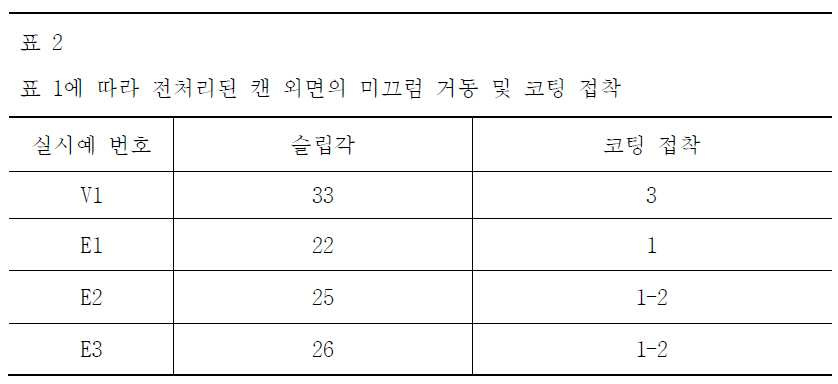
결과는 본 발명에 따른 2단계 표면 처리 방법에서 특히 제1 단계에서 글리콜우릴 수지를 함유하는 조성물(E-1)로 최소의 슬립각 및 최상의 코팅 접착이 달성됨을 나타낸다(E1-E3).The results show that the minimum slip angle and the best coating adhesion are achieved with the composition (E-1) containing the glycoluril resin in the first step, especially in the two-step surface treatment method according to the invention (E1-E3).
Claims (15)
(i) a) 원소 Zr, Ti, Si, Hf 및/또는 Ce의 하나 이상의 수용성 무기 화합물, 및
b) 적어도 카르복실기 또는 히드록실기를 갖고, 각 유기 수지의 산가 및/또는 수산기가의 합이 50mg KOH/g 이상인 하나 이상의 수용성 유기 수지
를 함유하는 산성 수계 조성물과 접촉시키는 단계, 및 이어서 -중간 플러싱 단계의 개재 또는 개재 없이-
(ii) 왁스의 수계 분산액과 접촉시키는 단계
를 포함하는, 금속 시트로부터 딥드로잉되고 일단이 개방된 캔 실린더의 표면 처리 방법.At least the outer surface of the can cylinder,
(i) a) at least one water soluble inorganic compound of elemental Zr, Ti, Si, Hf and / or Ce, and
b) at least one water-soluble organic resin having at least a carboxyl group or a hydroxyl group, the sum of the acid value and / or the hydroxyl value of each organic resin being 50 mg KOH / g or more
With an acidic aqueous composition containing an acidic aqueous phase, and then - without intervening or intervening intermediate flashing steps -
(ii) contacting the wax with an aqueous dispersion of the wax
And the one end of the can is deep drawn from the metal sheet.
단계 (i)에서 상기 산성 수계 조성물의 성분 a)에 따른 수용성 화합물이 원소 Zr, Ti 및/또는 Si의 불소 착물로부터 선택되는 것을 특징으로 하는 방법.The method according to claim 1,
Characterized in that in step (i) the water-soluble compound according to component a) of the acidic aqueous composition is selected from fluorine complexes of elemental Zr, Ti and / or Si.
단계 (i)에서 상기 산성 수계 조성물 중의 성분 a)에 따른 원소 Zr, Ti, Si, Hf 및/또는 Ce의 수용성 무기 화합물의 함량이 상기 원소의 전체 함량을 기준으로 하여 0.01∼1g/L의 범위 내에 있고, 원소 Zr 및/또는 Ti의 수용성 무기 화합물의 양이 원소 Zr 및 Ti의 전체 함량을 기준으로 하여 바람직하게는 0.01g/L 이상, 특히 바람직하게는 0.02g/L 이상인 것을 특징으로 하는 방법.3. The method according to claim 1 or 2,
The content of the water-soluble inorganic compound of the element Zr, Ti, Si, Hf and / or Ce according to the component a) in the acidic aqueous composition in the step (i) is in the range of 0.01 to 1 g / L , And the amount of the water-soluble inorganic compound of the element Zr and / or Ti is preferably 0.01 g / L or more, particularly preferably 0.02 g / L or more, based on the total content of the elements Zr and Ti .
단계 (i)에서 상기 산성 수계 조성물의 성분 b)에 따른 수용성 유기 수지가 비닐 에테르, 비닐 알콜, (메타)아크릴산, 말레산 또는 푸마르산을 베이스로 하는 중합체 또는 공중합체로부터, 히드록실기를 함유하는 폴리에스테르로부터, 및 글리콜우릴 또는 멜라민과 알데히드의 축합 생성물로부터 선택되는 것을 특징으로 하는 방법.4. The method according to any one of claims 1 to 3,
Wherein the water-soluble organic resin according to component b) of said acidic aqueous composition in step (i) is selected from polymers or copolymers based on vinyl ether, vinyl alcohol, (meth) acrylic acid, maleic acid or fumaric acid, From polyesters, and from condensation products of glycolurils or melamine with aldehydes.
단계 (i)에서 상기 산성 수계 조성물 중의 성분 b)에 따른 수용성 유기 수지의 함량이 0.1∼50g/L의 범위, 바람직하게는 0.5∼10g/L의 범위 내에 있는 것을 특징으로 하는 방법.5. The method according to any one of claims 1 to 4,
Characterized in that the content of the water-soluble organic resin according to component b) in said acidic aqueous composition in step (i) is in the range of 0.1 to 50 g / L, preferably in the range of 0.5 to 10 g / L.
단계 (i)에서 상기 산성 수계 조성물이 추가로 포스페이트 이온을 바람직하게는 0.1g/L 이상의 양으로 그러나 바람직하게는 10g/L 이하의 양으로 함유하는 것을 특징으로 하는 방법.6. The method according to any one of claims 1 to 5,
Characterized in that in step (i) said acidic aqueous composition additionally contains a phosphate ion in an amount of preferably at least 0.1 g / L but preferably at most 10 g / L.
단계 (i)에서 상기 산성 수계 조성물은 2 이상, 바람직하게는 3 이상, 및 6 이하, 바람직하게는 5 이하의 pH 값을 갖는 것을 특징으로 하는 방법.7. The method according to any one of claims 1 to 6,
Wherein the acidic aqueous composition in step (i) has a pH value of at least 2, preferably at least 3, and up to 6, preferably up to 5.
단계 (ii)에서 상기 수계 분산액 중의 왁스가 합성 왁스로부터, 바람직하게는 산화된 폴리알킬렌 왁스로부터, 특히 바람직하게는 산화된 폴리에틸렌 왁스로부터 선택되고, 상기 수계 분산액 중의 왁스의 함량이 0.1∼50g/L의 범위, 특히 바람직하게는 1∼10g/L의 범위 내에 있는 것을 특징으로 하는 방법.8. The method according to any one of claims 1 to 7,
In the step (ii), the wax in the aqueous dispersion is selected from a synthetic wax, preferably an oxidized polyalkylene wax, particularly preferably an oxidized polyethylene wax, and the content of the wax in the aqueous dispersion is 0.1 to 50 g / L, particularly preferably in the range of 1 to 10 g / L.
공정 단계 (i) 및 (ii)에서 각 수계 조성물과의 접촉이 각각 분무에 의하여 수행되는 것을 특징으로 하는 방법.9. The method according to any one of claims 1 to 8,
Wherein contact with each of the aqueous compositions in process steps (i) and (ii) is carried out by spraying, respectively.
단계 (ii)에서 상기 수계 조성물과의 접촉 후 및 임의로 단계 (ii)에 바로 후속되는 플러싱 단계 후 적어도 상기 일단이 개방된 캔 실린더의 외피면에 보호 코팅이 제공되는 것을 특징으로 하는 방법.10. The method according to any one of claims 1 to 9,
Characterized in that a protective coating is provided at least on the outer surface of the can cylinder which has been opened after said contacting with said aqueous composition in step (ii) and optionally after the flushing step immediately following step (ii).
상기 캔 실린더가 일단이 개방된 테두리 영역에서 성형되지 않은 것, 특히 캔 실린더의 직경의 테이퍼링을 위해 인발되거나, 플랜지의 형성을 위해 성형되지 않은 것을 특징으로 하는 방법.11. The method according to any one of claims 1 to 10,
Characterized in that said can cylinder is not formed in the edge region of which one end is open, in particular drawn for tapering the diameter of the can cylinder, or not formed for the formation of a flange.
상기 캔 실린더는 양철판, 강철판 또는 알루미늄판으로부터 딥드로잉되는 것을 특징으로 하는 방법.12. The method according to any one of claims 1 to 11,
Characterized in that the can cylinder is deep drawn from both steel plates, steel plates or aluminum plates.
(B) 상기 일단이 개방된 캔 실린더를 제 10 항에 따른 방법으로 전처리하고 코팅하는 단계, 및
(C) 상기 전처리되고 코팅된 캔 실린더를 일단이 개방된 테두리 영역에서 인발하여 캔 실린더의 직경을 테이퍼링하거나/하고, 성형하여 일단이 개방된 테두리 영역에서 플랜지를 형성하는 단계
를 포함하는 캔 실린더의 제조 방법.(A) deep-drawing a circular sheet of metal sheet to form an open can cylinder,
(B) pre-treating and coating the one-end open can cylinder with the method according to claim 10, and
(C) a step of drawing the canned cylinder, which has been pretreated and coated, by pulling out the canned cylinder in one opened edge region to taper and / or form the diameter of the canned cylinder to form a flange in an open-
Wherein the can cylinder is formed of a metal.
b) 0.1∼3중량%의, 글리콜우릴과 알데히드의 축합 생성물에서 선택되는 수용성 수지
를 포함하고 2∼5의 범위의 pH 값을 갖는, 금속 캔의 표면 처리를 위한 산성 수계 조성물.a) 0.005 to 0.5% by weight of a fluorine complex of elemental Zr, Ti and / or Si, based on each element, and
b) 0.1 to 3% by weight of a water-soluble resin selected from condensation products of glycoluril and aldehyde
And has a pH value in the range of 2 to 5. The acidic aqueous composition for surface treatment of metal can.
글리콜우릴과 알데히드의 축합 생성물은 50mg KOH/g 이상의 수산기가를 갖고, 알킬화도는 바람직하게는 20% 미만인 조성물.15. The method of claim 14,
Wherein the condensation product of glycoluril and aldehyde has a hydroxyl value of at least 50 mg KOH / g and the degree of alkylation is preferably less than 20%.
Applications Claiming Priority (1)
| Application Number | Priority Date | Filing Date | Title |
|---|---|---|---|
| PCT/EP2014/050191 WO2014072538A1 (en) | 2012-11-08 | 2014-01-08 | Can pretreatment for improved coating adhesion |
Publications (1)
| Publication Number | Publication Date |
|---|---|
| KR20160098024A true KR20160098024A (en) | 2016-08-18 |
Family
ID=53178568
Family Applications (1)
| Application Number | Title | Priority Date | Filing Date |
|---|---|---|---|
| KR1020157015132A Ceased KR20160098024A (en) | 2014-01-08 | 2014-01-08 | Can pretreatment for improved coating adhesion |
Country Status (3)
| Country | Link |
|---|---|
| JP (1) | JP6267223B2 (en) |
| KR (1) | KR20160098024A (en) |
| CA (1) | CA2890850C (en) |
Families Citing this family (2)
| Publication number | Priority date | Publication date | Assignee | Title |
|---|---|---|---|---|
| WO2017220632A1 (en) * | 2016-06-22 | 2017-12-28 | Chemetall Gmbh | Improved method for anti-corrosion pre-treatment of a metal surface containing steel, galvanised steel, aluminium, magnesium and/or a zinc-magnesium alloy |
| CN115646411B (en) * | 2022-11-01 | 2025-03-07 | 广东云易涂料科技有限公司 | Coating debugging and processing control method |
Family Cites Families (8)
| Publication number | Priority date | Publication date | Assignee | Title |
|---|---|---|---|---|
| US2327885A (en) * | 1939-05-13 | 1943-08-24 | Remington Arms Co Inc | Ammunition manufacture |
| JPH11106939A (en) * | 1997-09-30 | 1999-04-20 | Nippon Paint Co Ltd | Acrylic resin-containing metal surface treatment composition, treatment method and treated metal material |
| US6802913B1 (en) * | 1997-10-14 | 2004-10-12 | Henkel Kommanditgesellschaft Aut Aktien | Composition and process for multi-purpose treatment of metal surfaces |
| DE19923084A1 (en) * | 1999-05-20 | 2000-11-23 | Henkel Kgaa | Chromium-free corrosion protection agent for coating metallic substrates contains hexafluoro anions, phosphoric acid, metal compound, film-forming organic polymer or copolymer and organophosphonic acid |
| ATE518922T1 (en) * | 2000-10-11 | 2011-08-15 | Chemetall Gmbh | METHOD FOR THE PRETREATMENT OR/AND COATING OF METAL SURFACES PRIOR TO FORMING WITH A PAINT-LIKE COATING AND USE OF THE SUCH COATED SUBSTRATES |
| US20070125451A1 (en) * | 2005-01-14 | 2007-06-07 | Smith Steven R | Stable, thin-film organic passivates |
| US7947333B2 (en) * | 2006-03-31 | 2011-05-24 | Chemetall Gmbh | Method for coating of metallic coil or sheets for producing hollow articles |
| CN101512044B (en) * | 2006-09-18 | 2012-11-14 | 汉高两合股份公司 | Chromium-free thin organic-inorganic hybrid coatings on zinc-containing metals |
-
2014
- 2014-01-08 JP JP2015543483A patent/JP6267223B2/en active Active
- 2014-01-08 KR KR1020157015132A patent/KR20160098024A/en not_active Ceased
- 2014-01-08 CA CA2890850A patent/CA2890850C/en active Active
Also Published As
| Publication number | Publication date |
|---|---|
| CA2890850A1 (en) | 2014-05-15 |
| JP6267223B2 (en) | 2018-01-24 |
| JP2016501986A (en) | 2016-01-21 |
| CA2890850C (en) | 2021-03-02 |
Similar Documents
| Publication | Publication Date | Title |
|---|---|---|
| US10870923B2 (en) | Can pretreatment for improved coat adhesion | |
| US5868872A (en) | Chromium-free process for the no-rinse treatment of aluminum and its alloys and aqueous bath solutions suitable for this process | |
| US9771493B2 (en) | Can pretreatment for improved coating adhesion | |
| CN1267571A (en) | Aluminium hydrophilic processing technology, used primary agent and hydrophilic coating | |
| JP6267223B2 (en) | Can pretreatment method for improving coating film adhesion | |
| US9889468B2 (en) | Method for manufacturing coated can lids | |
| JPH10509766A (en) | Anti-corrosion and friction reduction treatment of metal surface | |
| EP4110888B1 (en) | One-step pretreatment method of metallic substrates for metal cold forming | |
| EP4110889B1 (en) | One-step pretreatment method of metallic substrates for metal cold forming | |
| RU2830572C1 (en) | Single-step method for pretreatment of metal substrates for metal cold forming | |
| JP6160163B2 (en) | Surface-treated aluminum plate, organic resin-coated surface-treated aluminum plate, and can body and can lid using the same | |
| EP4709804A1 (en) | Mobility enhancer useful in manufacturing containers | |
| JP2023021955A (en) | Seamless cans and painted metal sheets |
Legal Events
| Date | Code | Title | Description |
|---|---|---|---|
| PA0105 | International application |
Patent event date: 20150608 Patent event code: PA01051R01D Comment text: International Patent Application |
|
| PG1501 | Laying open of application | ||
| A201 | Request for examination | ||
| PA0201 | Request for examination |
Patent event code: PA02012R01D Patent event date: 20170203 Comment text: Request for Examination of Application |
|
| E902 | Notification of reason for refusal | ||
| PE0902 | Notice of grounds for rejection |
Comment text: Notification of reason for refusal Patent event date: 20171117 Patent event code: PE09021S01D |
|
| E601 | Decision to refuse application | ||
| PE0601 | Decision on rejection of patent |
Patent event date: 20180523 Comment text: Decision to Refuse Application Patent event code: PE06012S01D Patent event date: 20171117 Comment text: Notification of reason for refusal Patent event code: PE06011S01I |