KR20160117536A - Steel material for welding - Google Patents
Steel material for welding Download PDFInfo
- Publication number
- KR20160117536A KR20160117536A KR1020167024001A KR20167024001A KR20160117536A KR 20160117536 A KR20160117536 A KR 20160117536A KR 1020167024001 A KR1020167024001 A KR 1020167024001A KR 20167024001 A KR20167024001 A KR 20167024001A KR 20160117536 A KR20160117536 A KR 20160117536A
- Authority
- KR
- South Korea
- Prior art keywords
- steel
- haz
- less
- toughness
- welding
- Prior art date
- Legal status (The legal status is an assumption and is not a legal conclusion. Google has not performed a legal analysis and makes no representation as to the accuracy of the status listed.)
- Ceased
Links
Classifications
-
- C—CHEMISTRY; METALLURGY
- C22—METALLURGY; FERROUS OR NON-FERROUS ALLOYS; TREATMENT OF ALLOYS OR NON-FERROUS METALS
- C22C—ALLOYS
- C22C38/00—Ferrous alloys, e.g. steel alloys
-
- C—CHEMISTRY; METALLURGY
- C21—METALLURGY OF IRON
- C21D—MODIFYING THE PHYSICAL STRUCTURE OF FERROUS METALS; GENERAL DEVICES FOR HEAT TREATMENT OF FERROUS OR NON-FERROUS METALS OR ALLOYS; MAKING METAL MALLEABLE, e.g. BY DECARBURISATION OR TEMPERING
- C21D6/00—Heat treatment of ferrous alloys
- C21D6/005—Heat treatment of ferrous alloys containing Mn
-
- C—CHEMISTRY; METALLURGY
- C21—METALLURGY OF IRON
- C21D—MODIFYING THE PHYSICAL STRUCTURE OF FERROUS METALS; GENERAL DEVICES FOR HEAT TREATMENT OF FERROUS OR NON-FERROUS METALS OR ALLOYS; MAKING METAL MALLEABLE, e.g. BY DECARBURISATION OR TEMPERING
- C21D8/00—Modifying the physical properties of ferrous metals or ferrous alloys by deformation combined with, or followed by, heat treatment
- C21D8/02—Modifying the physical properties of ferrous metals or ferrous alloys by deformation combined with, or followed by, heat treatment during manufacturing of plates or strips
-
- C—CHEMISTRY; METALLURGY
- C21—METALLURGY OF IRON
- C21D—MODIFYING THE PHYSICAL STRUCTURE OF FERROUS METALS; GENERAL DEVICES FOR HEAT TREATMENT OF FERROUS OR NON-FERROUS METALS OR ALLOYS; MAKING METAL MALLEABLE, e.g. BY DECARBURISATION OR TEMPERING
- C21D8/00—Modifying the physical properties of ferrous metals or ferrous alloys by deformation combined with, or followed by, heat treatment
- C21D8/02—Modifying the physical properties of ferrous metals or ferrous alloys by deformation combined with, or followed by, heat treatment during manufacturing of plates or strips
- C21D8/0221—Modifying the physical properties of ferrous metals or ferrous alloys by deformation combined with, or followed by, heat treatment during manufacturing of plates or strips characterised by the working steps
- C21D8/0231—Warm rolling
-
- C—CHEMISTRY; METALLURGY
- C21—METALLURGY OF IRON
- C21D—MODIFYING THE PHYSICAL STRUCTURE OF FERROUS METALS; GENERAL DEVICES FOR HEAT TREATMENT OF FERROUS OR NON-FERROUS METALS OR ALLOYS; MAKING METAL MALLEABLE, e.g. BY DECARBURISATION OR TEMPERING
- C21D8/00—Modifying the physical properties of ferrous metals or ferrous alloys by deformation combined with, or followed by, heat treatment
- C21D8/02—Modifying the physical properties of ferrous metals or ferrous alloys by deformation combined with, or followed by, heat treatment during manufacturing of plates or strips
- C21D8/04—Modifying the physical properties of ferrous metals or ferrous alloys by deformation combined with, or followed by, heat treatment during manufacturing of plates or strips to produce plates or strips for drawing, e.g. for deep-drawing
- C21D8/0447—Modifying the physical properties of ferrous metals or ferrous alloys by deformation combined with, or followed by, heat treatment during manufacturing of plates or strips to produce plates or strips for drawing, e.g. for deep-drawing characterised by the heat treatment
- C21D8/0463—Modifying the physical properties of ferrous metals or ferrous alloys by deformation combined with, or followed by, heat treatment during manufacturing of plates or strips to produce plates or strips for drawing, e.g. for deep-drawing characterised by the heat treatment following hot rolling
-
- C—CHEMISTRY; METALLURGY
- C22—METALLURGY; FERROUS OR NON-FERROUS ALLOYS; TREATMENT OF ALLOYS OR NON-FERROUS METALS
- C22C—ALLOYS
- C22C38/00—Ferrous alloys, e.g. steel alloys
- C22C38/001—Ferrous alloys, e.g. steel alloys containing N
-
- C—CHEMISTRY; METALLURGY
- C22—METALLURGY; FERROUS OR NON-FERROUS ALLOYS; TREATMENT OF ALLOYS OR NON-FERROUS METALS
- C22C—ALLOYS
- C22C38/00—Ferrous alloys, e.g. steel alloys
- C22C38/02—Ferrous alloys, e.g. steel alloys containing silicon
-
- C—CHEMISTRY; METALLURGY
- C22—METALLURGY; FERROUS OR NON-FERROUS ALLOYS; TREATMENT OF ALLOYS OR NON-FERROUS METALS
- C22C—ALLOYS
- C22C38/00—Ferrous alloys, e.g. steel alloys
- C22C38/04—Ferrous alloys, e.g. steel alloys containing manganese
-
- C—CHEMISTRY; METALLURGY
- C22—METALLURGY; FERROUS OR NON-FERROUS ALLOYS; TREATMENT OF ALLOYS OR NON-FERROUS METALS
- C22C—ALLOYS
- C22C38/00—Ferrous alloys, e.g. steel alloys
- C22C38/06—Ferrous alloys, e.g. steel alloys containing aluminium
-
- C—CHEMISTRY; METALLURGY
- C22—METALLURGY; FERROUS OR NON-FERROUS ALLOYS; TREATMENT OF ALLOYS OR NON-FERROUS METALS
- C22C—ALLOYS
- C22C38/00—Ferrous alloys, e.g. steel alloys
- C22C38/12—Ferrous alloys, e.g. steel alloys containing tungsten, tantalum, molybdenum, vanadium, or niobium
-
- C—CHEMISTRY; METALLURGY
- C22—METALLURGY; FERROUS OR NON-FERROUS ALLOYS; TREATMENT OF ALLOYS OR NON-FERROUS METALS
- C22C—ALLOYS
- C22C38/00—Ferrous alloys, e.g. steel alloys
- C22C38/14—Ferrous alloys, e.g. steel alloys containing titanium or zirconium
-
- C—CHEMISTRY; METALLURGY
- C22—METALLURGY; FERROUS OR NON-FERROUS ALLOYS; TREATMENT OF ALLOYS OR NON-FERROUS METALS
- C22C—ALLOYS
- C22C38/00—Ferrous alloys, e.g. steel alloys
- C22C38/18—Ferrous alloys, e.g. steel alloys containing chromium
- C22C38/40—Ferrous alloys, e.g. steel alloys containing chromium with nickel
- C22C38/58—Ferrous alloys, e.g. steel alloys containing chromium with nickel with more than 1.5% by weight of manganese
-
- C—CHEMISTRY; METALLURGY
- C21—METALLURGY OF IRON
- C21D—MODIFYING THE PHYSICAL STRUCTURE OF FERROUS METALS; GENERAL DEVICES FOR HEAT TREATMENT OF FERROUS OR NON-FERROUS METALS OR ALLOYS; MAKING METAL MALLEABLE, e.g. BY DECARBURISATION OR TEMPERING
- C21D2211/00—Microstructure comprising significant phases
- C21D2211/004—Dispersions; Precipitations
-
- C—CHEMISTRY; METALLURGY
- C21—METALLURGY OF IRON
- C21D—MODIFYING THE PHYSICAL STRUCTURE OF FERROUS METALS; GENERAL DEVICES FOR HEAT TREATMENT OF FERROUS OR NON-FERROUS METALS OR ALLOYS; MAKING METAL MALLEABLE, e.g. BY DECARBURISATION OR TEMPERING
- C21D2211/00—Microstructure comprising significant phases
- C21D2211/008—Martensite
Landscapes
- Chemical & Material Sciences (AREA)
- Engineering & Computer Science (AREA)
- Materials Engineering (AREA)
- Mechanical Engineering (AREA)
- Metallurgy (AREA)
- Organic Chemistry (AREA)
- Physics & Mathematics (AREA)
- Thermal Sciences (AREA)
- Crystallography & Structural Chemistry (AREA)
- Heat Treatment Of Steel (AREA)
Abstract
본 발명은 용접 입열량이 200kJ/㎝이상의 경우에도 우수한 용접부 인성과 이음매 강도를 갖고, 항복 응력이 460MPa이상의 강재를 얻는 것을 목적으로 한다. 본 발명의 강재는 소정의 성분 조성을 갖고, 또한 Ti와 N의 질량%비를 2.0이상 4.0미만, 하기 (1)식에서 규정되는 A값을 10이상 25이하, 하기 (2)식에서 규정되는 Ceq를 0.38~0.43, 강재 중의 고용 B량을 5질량ppm이상으로 한다. A=2256×Ti-7716×N+10000×B…(1) Ceq=C+Mn/6+(Cr+Mo+V)/5+(Cu+Ni)/15…(2) 단, 각 원소 기호는 각 원소의 강 중 함유량(질량%)을 나타낸다.An object of the present invention is to obtain a steel having a tensile strength of 460 MPa or more and excellent weldability and joint strength even when the weld heat input is 200 kJ / cm or more. Steel material of the present invention has the composition given ingredient, and to less than the weight% ratio of Ti and N 2.0 4.0, to 1, the A value in the diet for more than 10 25 or less, (2) a C eq is the diet 0.38 to 0.43, and the amount of solid solution B in the steel is 5 mass ppm or more. A = 2256 x Ti-7716 x N + 10000 x B ... (1) C eq = C + Mn / 6 + (Cr + Mo + V) / 5 + (Cu + Ni) / 15 (2) where each element symbol represents the content (mass%) of each element in the steel.
Description
본 발명은 선박이나 건축·토목 등의 분야에 있어서의 각종 강 구조물에 사용되는 항복 응력이 460㎫이상의 용접용 강재로서, 특히, 용접 입열량이 200kJ/㎝를 넘는 대입열 용접에 적합한 강재에 관한 것으로, 상세하게는 상기 대입열 용접을 실시한 경우에 있어서도, 우수한 용접부 인성 및 이음매 강도를 갖는 강재에 관한 것이다.The present invention relates to a steel material having a yield stress of 460 MPa or more for use in various steel structures in the fields of ships, buildings, civil engineering, etc., and more particularly to a steel material suitable for large-volume heat welding with a weld heat input of more than 200 kJ / More specifically, the present invention relates to a steel material having excellent weld toughness and joint strength even in the case of performing the above-described high-temperature heat welding.
선박, 해양구조물, 건축 및 강관 등의 분야에서 사용되는 강 구조물은 용접 접합에 의해서 원하는 형상의 구조물로 마무리되는 것이 일반적이다. 따라서, 이들 구조물은 안전성을 확보하는 관점에서, 사용되는 강재의 모재 특성, 즉 강도·인성의 확보에 부가하여, 용접부의 인성에도 우수한 것이 요청되고 있다.Steel structures used in fields such as ships, offshore structures, buildings, and steel pipes are generally finished with structures of a desired shape by welding. Therefore, from the viewpoint of ensuring safety, these structures are required to have excellent toughness of the welded portion in addition to securing the properties of the base material of the steel to be used, that is, strength and toughness.
근래에는 상기 선박 등의 강 구조물은 가일층 대형화되며, 사용되는 강재에 대해서는 고강도화 및 후육화가 적극적으로 진행되고 있다. 그것에 수반해서, 용접 시공에는 서브 머지 아크 용접이나, 일렉트로 가스 용접 및 일렉트로 슬래그 용접 등의 고능률로 대입열의 용접 방법이 적용되도록 되어 왔지만, 이러한 대입열 용접에 의해서 용접 시공한 경우에 있어서도, 용접부의 인성이 우수한 강재가 필요하다.In recent years, steel structures such as ships have become larger in size, and steel materials used have been actively promoted in terms of high strength and thickening. In accordance with this, the welding method of high heat efficiency such as submerged arc welding, electrogas welding, and electroslag welding has been applied to welding work. However, even when welding is performed by such large heat welding, Steel with excellent toughness is required.
그러나, 고강도 강이나 후육 강판에 있어서, 모재의 기계적 특성(특히 저온 인성)과 용접 열 영향부(Heat Affected Zone;이하, HAZ로 기재함)의 저온 인성의 양립이 곤란하다는 보고가 산견(散見)된다.However, there are reports that it is difficult to achieve both of the mechanical properties (particularly low temperature toughness) of the base material and the low temperature toughness of the heat affected zone (hereinafter referred to as HAZ) in high strength steel or low carbon steel sheet, do.
이 보고에 대해, 예를 들면 특허문헌 1 및 특허문헌 2에 기재된 바와 같이, 제어 압연이나 제어 냉각을 이용해서, 모재의 저온 인성과 HAZ의 저온 인성의 양립을 달성하는 기술이 개시되어 있다.In this report, for example, as disclosed in Patent Documents 1 and 2, a technique of achieving compatibility between the low temperature toughness of the base material and the low temperature toughness of the HAZ by using controlled rolling and controlled cooling is disclosed.
다음에, 대입열 용접을 실시했을 때의 HAZ 조직에 대해 설명한다. HAZ에 있어서 용접 금속에 접하는 부분은 일반적으로 「본드부」로 칭해지고 있다. 본드부 근방의 HAZ는 열 영향부 중에서도 특히, 용융점 부근의 고온에 노출되기 문에, 결정립이 조대화되어 인성이 현저히 저하해 버리는 경향에 있다. 한편, 본드부에서 약간 떨어진 곳에서는 결정립이 세립역으로 되기 때문에 연화 영역을 형성하고, 이음매 강도의 저하의 주 원인으로 된다.Next, a description will be given of the HAZ structure at the time of performing large heat welding. The portion of the HAZ in contact with the weld metal is generally referred to as a " bond portion ". Since the HAZ near the bond portion is exposed to a high temperature in the vicinity of the melting point, particularly in the heat affected portion, the crystal grains are coarsened and the toughness tends to be remarkably lowered. On the other hand, at a position slightly away from the bond portion, the crystal grains become a grain boundary, so that a softened region is formed, which is a main cause of a decrease in joint strength.
상술한 바와 같이, 대입열 용접에서는 HAZ의 인성 저하가 일어나지만, 이 HAZ 인성 저하에 대해, 지금까지도 많은 대책이 검토되어 왔다. 예를 들면, TiN을 강 중에 미세 분산시켜, 오스테나이트립의 조대화를 억제하거나, 페라이트 변태핵으로서 이용하는 기술이 이미 실용화되고 있다. 또, Ti의 산화물을 분산시킴으로써, 상기와 마찬가지의 오스테나이트립의 조대화 억제 효과를 겨냥한 기술도 개발되고 있다.As described above, toughness deterioration of the HAZ occurs in high-temperature heat welding, but many countermeasures against this HAZ toughness deterioration have been studied so far. For example, techniques for finely dispersing TiN in steel to suppress coarsening of an austenitic grains or use it as ferrite transformation nuclei have already been put to practical use. Further, techniques for aiming at the coarsening inhibiting effect of the austenite grains similar to those described above are also developed by dispersing the Ti oxide.
그러나, TiN을 활용하는 상기 기술은 대입열 용접을 받았을 때에, 용접 열 영향부가 TiN의 용해 온도역까지 가열되기 때문에, TiN이 분해되어 상기 분산 효과가 소실되거나, TiN의 분해에 의해서 생성된 고용 Ti 및 고용 N에 의해서 강의 지(地)조직이 취화되어, 용접 열 영향부의 인성이 현저히 저하한다고 하는 문제를 안고 있다.However, since the above-described technique utilizing TiN is heated up to the melting temperature of the TiN at the weld heat affected zone when receiving large heat input welding, the TiN is decomposed to lose the dispersing effect, And the solidification of the steel structure is caused by the solid solution N and the toughness of the weld heat affected zone is remarkably lowered.
또, Ti 산화물을 활용하는 기술은 산화물을 균일 미세하게 분산시키는 것이 곤란하다는 문제가 있다. 이러한 문제를 해결하는 기술로서 예를 들면, 특허문헌 3에는 200kJ/㎝를 넘는 대입열 용접을 실시한 용접 열 영향부의 인성을 향상시키기 위해, 황화물의 형태 제어에 이용하는 Ca의 첨가량을 적정화하여, CaS를 정출시키고, 이것을 페라이트 변태핵으로서 유효하게 활용하는 기술이 개시되어 있다.Further, there is a problem that it is difficult to uniformly disperse the oxide uniformly in the technique utilizing the Ti oxide. As a technique for solving such a problem, for example, in Patent Document 3, in order to improve the toughness of the weld heat affected zone subjected to the large heat welding of over 200 kJ / cm, the amount of Ca to be used for controlling the shape of the sulfide is appropriately adjusted, And this is effectively used as a ferrite transformation nucleus.
상기 CaS는 산화물에 비해 저온에서 정출하기 때문에, 강 중에 미세 분산시키는 것이 가능하며, 또한 강판이 냉각될 때에는 이것을 핵으로 해서, MnS나 TiN, BN 등의 페라이트 변태 생성핵이 미세하게 분산되므로, 용접 열 영향부의 조직을 미세한 페라이트-펄라이트 조직으로 할 수 있으며, 고인성화를 달성할 수 있다. 고로, 특허문헌 3의 기술에 의해서, 대입열 용접에 수반하는 HAZ 인성 저하는 어느 정도 억제할 수 있게 되었다.Since the CaS is crystallized at a lower temperature than the oxide, CaS can be finely dispersed in the steel. When the steel sheet is cooled, the ferrite transformation nuclei such as MnS, TiN, and BN are finely dispersed using the steel as a nucleus. The structure of the heat-affected portion can be made into a fine ferrite-pearlite structure, and it is possible to attain high humanization. Therefore, according to the technique of Patent Document 3, the deterioration of the HAZ toughness due to the large heat welding can be suppressed to some extent.
그런데, 그 후의 연구에 의해서, 강판의 항복 응력이 460㎫이상으로 고강도화되고, 비교적 다량의 C나 합금 원소가 첨가된 강의 경우에 있어서는 용접 입열량이 200kJ/㎝를 넘는 대입열 용접을 실시하면, 본드부 근방의 HAZ에 섬형상 마텐자이트(이하, 본 발명에서는 MA라고도 함)라 불리는 경질의 취화 조직이 수 체적% 형성되고, 이 취화 조직이 용접부의 인성의 가일층의 향상을 저해하는 것을 알 수 있게 되었다.However, according to the succeeding research, when the yield stress of the steel sheet is increased to 460 MPa or more and the steel is added with a relatively large amount of C or an alloy element, if the heat input of welding exceeds 200 kJ / cm, (Hereinafter referred to as MA in the present invention) is formed in the HAZ near the bond portion, and the brittle structure hinders the improvement of the toughness of the toughness of the welded portion. It was possible.
즉, 이러한 고강도 강의 대입열 용접부에 있어서의 본드부 근방의 HAZ 인성 개선에는 오스테나이트립 조대화 억제나 페라이트 변태핵의 미세 분산, 고용 N의 저감에 부가해서, 또한 섬형상 마텐자이트의 생성을 억제할 필요가 있는 것을 지견하였다.That is, in order to improve the HAZ toughness near the bond portion in the high heat steel welded portion of the high strength steel, in addition to the inhibition of the austenite grain coarsening, the fine dispersion of the ferrite transformation nucleus and the reduction of the solid solution N, It is necessary to inhibit it.
HAZ부의 섬형상 마텐자이트를 저감하는 기술에 대해서는 예를 들면, 특허문헌 4에, C, Si의 함유량을 저감하는 것 이외에, P의 함유량의 저감이 유효하다는 것이 개시되어 있다.As a technique for reducing the island-shaped martensite of the HAZ, for example, Patent Document 4 discloses that reduction of the content of P is effective in addition to reducing the contents of C and Si.
또한, 특허문헌 5에서는 Mn을 적극적으로 첨가하고, 또한 P를 극력 저감함으로써, 본드부 근방 HAZ의 섬형상 마텐자이트를 저감하고, 인성이 우수한 항복 응력 460㎫급의 강재가 얻어진다고 되어 있다.In Patent Document 5, Mn is positively added and P is minimized to reduce the island-shaped martensite of the HAZ in the vicinity of the bond portion, whereby a steel material having an excellent toughness and a yield stress of 460 MPa is obtained.
한편, 대입열 용접에 수반하는 HAZ 연화를 억제하는 기술에 관해서는 HAZ 인성 대책만큼 많이 개시되어 있지 않다. 상기 특허문헌 3, 4 및 5의 어느 것에 있어서도 HAZ 연화에 관한 기술은 없다. 이것은 원래 대입열 용접용 강의 설계에 있어서는 이음매 강도를 확보할 수 있는 것을 전제로 하고 있었기 때문으로 생각된다.On the other hand, the technique for suppressing the HAZ softening accompanied by the large heat welding is not disclosed as much as the HAZ toughness measure. None of the above Patent Documents 3, 4 and 5 discloses a technique relating to HAZ softening. This is presumably because it is presupposed that the joint strength can be ensured in the design of the steel for welding with high heat input.
그래서, HAZ 연화의 억제에 관해, 이미 개시되어 있는 기술에 대해 설명한다.Therefore, the technique already disclosed with respect to inhibition of HAZ softening will be described.
이들 기술에는 Nb나 V 등의 석출 강화 원소를 이용하는 기술과, B에 의한 담금질성의 향상 효과를 이용하는 기술이 있다.These techniques include techniques using precipitation strengthening elements such as Nb and V and techniques utilizing the effect of improving the hardenability by B.
예를 들면 특허문헌 6에서는 C량을 높이는 동시에 Si, Mn을 저감하고, Nb나 V를 함유함으로써 HAZ 연화가 저감된다고 하고 있다.For example, in Patent Document 6, it is stated that the C content is increased and Si and Mn are reduced, and HAZ softening is reduced by containing Nb and V.
한편, 특허문헌 7에서는 B에 의한 담금질성 향상을 도모하기 위해, N량에 대해 Ti, B 및 Nb를 많이 함유하도록 성분식을 규정함으로써, HAZ 연화 억제를 도모하고 있다.On the other hand, in Patent Document 7, in order to improve the hardenability by B, HAZ softening is suppressed by defining a component formula so as to contain a large amount of Ti, B and Nb with respect to the amount of N.
또, 특허문헌 8에서는 고용 B량을 규정함으로써, B에 의한 담금질성 향상을 도모하고, HAZ 연화 억제를 도모하고 있다.In Patent Document 8, by specifying the amount of solid solution B, the hardenability by B is improved and HAZ softening is suppressed.
그러나, 상술한 바와 같이, 특허문헌 3에 기재된 기술은 특히, 항복 응력이 390㎫급의 강재에 대해 대입열 용접을 실시했을 때의 본드부의 인성을 개선하는 기술이지만, 그보다 항복 강도가 높은 예를 들면, 항복 응력:460㎫급의 강재에 대한 대입열 HAZ 인성 및 HAZ 연화에 대해서는 충분히 대처할 수 없는 경우가 있다.However, as described above, the technique described in Patent Document 3 is a technique for improving the toughness of the bond portion when the heat input welding is applied to a steel material having a yield stress of 390 MPa class, , The yield stress may be insufficient to cope with HAZ toughness and HAZ softening, which are applied to a steel material having a grade of 460 MPa.
또, 특허문헌 4에 기재된 기술은 항복 응력이 460㎫급의 강재를 대상으로 하며, C, Si 및 P의 함유량을 저감함으로써 본드부 근방의 HAZ의 섬형상 마텐자이트를 저감하고, 또한 Ca를 적정량 첨가하여 페라이트 변태핵을 미세하게 분산시켜 HAZ 인성의 확보를 도모하고 있지만, HAZ 연화에 대해서는 기술이 없으며, 또 Ni의 첨가를 필수로 하고 있기 때문에 합금 비용이 높아질 가능성이 있다고 하는 문제가 있다.The technique disclosed in Patent Document 4 is directed to a steel material having a yield stress of 460 MPa and reduces the content of C, Si and P, thereby reducing the island-shaped martensite of the HAZ near the bond portion, The ferrite transformation nuclei are finely dispersed by adding a proper amount to secure the HAZ toughness. However, there is no description about HAZ softening, and since addition of Ni is essential, there is a problem that the alloy cost may be increased.
또한, 특허문헌 5에 기재된 기술은 항복 응력이 460㎫급의 강재를 대상으로 하며, Mn을 적극적으로 이용함으로써 섬형상 마텐자이트를 저감하고, 저렴하게 소요의 강재가 얻어진다고 하고 있지만, 이것도 또 특허문헌 4와 마찬가지로 HAZ 연화에 관한 기술이 없다.The technique described in Patent Document 5 is directed to a steel material having a yield stress of 460 MPa, and it is said that by using Mn positively, the island-shaped martensite is reduced and the required steel material is obtained at low cost. There is no description about HAZ softening as in Patent Document 4.
한편, 특허문헌 6에 기재된 기술은 C량이 많고, Nb나 V 등의 석출 강화 원소를 이용해서 HAZ 연화에 대한 충분한 대처를 취하고 있지만, 대입열 용접시에 본드부 근방 HAZ에 다량의 섬형상 마텐자이트를 형성함으로써, 본드부 근방의 HAZ의 인성을 현저히 저하시킨다고 하는 우려가 있다.On the other hand, the technique described in Patent Document 6 has a large amount of C and sufficiently copes with HAZ softening by using precipitation strengthening elements such as Nb and V. However, a large amount of island-shaped martensite There is a concern that the toughness of the HAZ in the vicinity of the bond portion is remarkably lowered.
또, 특허문헌 7 및 8에 기재된 기술은 B의 담금질성을 이용해서 HAZ 연화를 억제하는 기술이지만, 그 중에서도 특허문헌 7은 다량의 Ti, B 및 N의 첨가를 전제로 하여, 제조성에 문제가 있는 동시에, 본드부 근방의 TiN이 녹는 영역에 있어서는 고용 N에 의한 HAZ의 인성의 저하가 우려된다.The technique described in Patent Documents 7 and 8 is a technique for suppressing HAZ softening by using the hardenability of B, but in particular, Patent Document 7 proposes that a large amount of Ti, B and N is added, At the same time, in the region where TiN is melted in the vicinity of the bond portion, the toughness of HAZ due to solid solution N may be lowered.
이에 부가하여, 특허문헌 8에 기재된 기술은 Nb프리를 전제로 하고 있으며, 항복 응력:460㎫급의 강재를 대상으로 한 경우, 이음매 강도의 확보가 곤란하다는 문제를 남기고 있었다.In addition to this, the technique described in Patent Document 8 is based on Nb-free, and in the case of a steel having a yield stress of 460 MPa, it is difficult to secure joint strength.
본 발명은 상기한 현상을 감안해서 개발된 것으로, 용접 입열량이 200kJ/㎝를 넘는 대입열 용접을 실시해도, 용접 열 영향부의 경도가 저하하지 않는 내연화성과, 본드부 근방의 HAZ 인성이 우수한 항복 응력이 460㎫이상의 대입열 용접용 강재를 저렴하게 제공하는 것을 목적으로 한다.SUMMARY OF THE INVENTION The present invention has been developed in consideration of the above-described phenomenon, and it is an object of the present invention to provide a weld metal which is excellent in resistance to fire, which does not lower the hardness of a weld heat affected zone even when subjected to large heat welding with a welding heat input of more than 200 kJ / cm, And an object of the present invention is to provide an inexpensive steel material for high heat input welding with a yield stress of 460 MPa or more.
발명자들은 상기한 과제를 해결하기 위해, 항복 응력이 460㎫이상의 고강도 강재에 대해 용접 입열량이 200kJ/㎝를 넘는 대입열 용접을 실시했을 때의, 본드부 근방의 HAZ 인성과 HAZ 최연화부역의 경도에 미치는 조직 인자의 영향에 대해 상세하게 조사하였다. 그 결과, 본드부 근방의 HAZ 인성에 관해서는 소량이어도 섬형상 마텐자이트의 존재가 인성에 대해 악영향을 미치는데 반해, 최연화부역의 경도는 섬형상 마텐자이트가 생성됨으로써 향상하는 것을 지견하였다.In order to solve the above-described problems, the inventors of the present invention have found that the HAZ toughness in the vicinity of the bond portion and the hardness of the HAZ minimum allowable portion when the heat input amount of welding exceeding 200 kJ / cm is applied to a high strength steel having a yield stress of 460 MPa or more On the effect of tissue factors on the development of atherosclerosis. As a result, it was found that the hardness of the shortest continuous zone improves by the formation of the island-shaped martensite, while the presence of the island-shaped martensite adversely affects the toughness even with a small amount of HAZ toughness in the vicinity of the bond portion.
그래서, 발명자들은 본드부 근방의 HAZ에 있어서의 섬형상 마텐자이트의 생성을 억제한 후에, 최연화부역의 섬형상 마텐자이트의 생성량을 높이기 위한 방책에 대해 검토하였다. 그 결과, 본드부 근방의 HAZ에 있어서는 C, Si, P량을 낮게 억제하는 동시에, C량 저감에 의해 우려되는 모재 강도 저하를 보충하기 위해 Mn을 적극적으로 함유시키는 것에 의해서, 본드부 근방의 HAZ 인성에 악영향을 미치는 섬형상 마텐자이트를 극력 생성시키는 일 없이, 모재 강도를 효과적으로 높일 수 있는 것을 알 수 있었다.Thus, the present inventors have studied a method for increasing the amount of island-shaped martensite in the minimum passenger's side after suppressing the formation of island-shaped martensite in the HAZ near the bond portion. As a result, in the HAZ near the bond portion, the amount of C, Si and P is suppressed to a low level, and Mn is positively contained in order to compensate for the decrease in the strength of the base material, It was found that the strength of the base material can be effectively increased without generating as much island-shaped martensite having an adverse effect on toughness as much as possible.
또, 최연화부역에 있어서는 Ti, N 및 B를 적정 범위로 제어함으로써 B의 담금질성 향상 효과를 활용하는 것에 의해 본드부 근방 HAZ의 섬형상 마텐자이트를 증가시키는 일 없이, 최연화부역에 있어서의 섬형상 마텐자이트의 형성을 촉진시킬 수 있는 것을 지견하였다.Further, by optimizing Ti, N, and B in the optimum range for the minimized quadrature, it is possible to improve the hardenability of B by increasing the island martensite of the HAZ in the vicinity of the bond portion, And that the formation of the shape martensite can be promoted.
즉, B는 용융점 부근의 고온에 노출되는 본드부 근방의 HAZ에 있어서는 상부 베이나이트의 생성이나, 성장에 수반하는 입계로부터의 이동이 일어나지 않고, 베이나이트 라스간에 잔류한 미변태 오스테나이트의 담금질성을 올리는 일이 없는 한편, 열 영향에 의한 온도 상승이 비교적 작은 HAZ 연화 영역에 있어서는 페라이트 변태에 수반해서 확산되고, 미변태 오스테나이트의 입계에 편석함으로써 그 담금질성을 향상시키고, 섬형상 마텐자이트의 형성을 촉진하는 효과가 있는 것을 알 수 있었다.That is, in the HAZ in the vicinity of the bond portion exposed to the high temperature near the melting point, B does not cause generation of the upper bainite and migration from the grain boundaries accompanied by the growth, and the quenchability of the untransformed austenite On the other hand, in the HAZ softening region where the temperature rise due to the thermal effect is relatively small, it diffuses with the ferrite transformation, segregation occurs at the grain boundaries of the untreated austenite, and the hardenability is improved. Which is an effect of accelerating the formation of the catalyst.
단, HAZ 연화 영역은 열 영향에 의한 온도 상승이 비교적 작기 때문에, 석출물의 용해가 거의 일어나지 않기 때문에, 담금질성에 기여하는 B의 존재량은 제조 공정시의 상태에 의존한다. 그리고, B는 모재 제조 공정의 제어 압연 및 냉각의 각 단계에서, 제조 조건에 따라서는 질화물을 형성하는 경우가 있으며, 이 경우, 그 담금질성 향상 효과는 발휘되지 않는다.However, since the HAZ softening region has a comparatively small temperature rise due to the heat effect, the dissolution of the precipitate hardly occurs, and therefore the amount of B present that contributes to the hardenability depends on the state of the manufacturing process. In addition, B may form nitride depending on the production conditions at each stage of control rolling and cooling of the base material manufacturing process. In this case, the effect of improving the hardenability is not exhibited.
그래서, 발명자들은 더욱 검토를 거듭한 결과, 강판 제조 공정에 있어서, 우선 처음에 오스테나이트 재결정 온도역에서 압연을 실시한 후에 오스테나이트 미재결정 온도역까지 가속 냉각을 실시하고, 계속해서 오스테나이트 미재결정 온도역 압연을 실행하며, 그 후, 재차, 가속 냉각을 실시하는 것에 의해서, B질화물의 석출을 가능한 한 억제하고, 전술한 성분의 최적화와 합치는 것에 의해 우수한 HAZ 특성을 얻을 수 있는 것을 찾아내고, 본 발명을 개발하기에 이르렀다.Therefore, as a result of further investigations, the inventors have found that, in the steel sheet manufacturing process, the steel sheet is first subjected to the rolling at the austenite recrystallization temperature zone and then accelerated to the austenite non-recrystallization temperature zone. Rolling is carried out and then accelerated cooling is performed again to find out that excellent HAZ characteristics can be obtained by suppressing the precipitation of B nitride as much as possible and matching with the optimization of the above- The present invention has been developed.
즉, 본 발명의 요지 구성은 다음과 같다.That is, the structure of the present invention is as follows.
1.질량%로, C:0.030∼0.080%, Si:0.01∼0.10%, Mn:1.80∼2.40%, P:0.010%이하, S:0.0005∼0.0040%, Al:0.005∼0.100%, Nb:0.003∼0.030%, Ti:0.010∼0.050%, N:0.0030∼0.0120% 및 B:0.0005∼0.0025%를 함유하고, 또한 Ti와 N의 질량%비(Ti/N)가 2.0이상 4.0미만으로서, 이하의 (1)식에서 규정되는 A값이 3이상 25이하, 이하의 (2)식에서 규정되는 Ceq가 0.38∼0.43의 범위에서, 잔부가 Fe 및 불가피한 불순물의 성분 조성으로 이루어지고, 항복 응력이 460㎫이상이고, 또한 고용 B량이 5질량ppm이상이고, 용접 입열량:200kJ/㎝이상의 입열 용접을 실시했을 때의 열 영향부에 있어서의 본드부 근방의 조직 중의 섬형상 마텐자이트가 1vol%이하이고, 또한 열 영향부에 있어서의 최연화부역의 조직 중의 섬형상 마텐자이트가 5vol%이상인 용접용 강재:1. A steel sheet comprising, by mass%, 0.030 to 0.080% of C, 0.01 to 0.10% of Si, 1.80 to 2.40% of Mn, 0.010% or less of P, 0.0005 to 0.0040% of S, 0.005 to 0.100% of Al, (Ti / N) of not less than 2.0 and not more than 4.0, wherein the ratio of Ti to N is not less than 4.0, and the content of Ti is not less than 0.02% The value of A defined in the formula (1) is not less than 3 but not more than 25, the Ce eq specified by the following formula (2) is in the range of 0.38 to 0.43, the balance of Fe and inevitable impurities and the yield stress is 460 MPa Or more, and the amount of solute B is 5 mass ppm or more, and the amount of island martensite in the vicinity of the bond portion in the heat affected zone when heat input welding of 200 kJ / cm or more is performed is 1 vol% or less , And the steel martensite in the structure of the minimization zone in the heat affected zone is not less than 5 vol%
A=2256×Ti-7716×N+10000×B…(1) A = 2256 x Ti-7716 x N + 10000 x B ... (One)
Ceq=C+Mn/6+(Cr+Mo+V)/5+(Cu+Ni)/15…(2) C eq = C + Mn / 6 + (Cr + Mo + V) / 5 + (Cu + Ni) / 15 (2)
단, 각 원소 기호는 각 원소의 강중 함유량(질량%)을 나타낸다.However, the symbol of each element represents the content (mass%) of steel in each element.
2.상기 성분 조성에, 질량%로, V:0.20%이하, Cu:0.30%이하, Ni:0.30%이하, Cr:0.40%이하 및 Mo:0.40%이하 중에서 선택한 1종 이상을 더 함유하는 상기 1에 기재된 용접용 강재.2. The steel according to claim 1, further comprising at least one member selected from the group consisting of V: 0.20% or less, Cu: not more than 0.30%, Ni: not more than 0.30%, Cr: not more than 0.40% 1].
3.상기 성분 조성에, 질량%로, Ca:0.0005∼0.0050%, Mg:0.0005∼0.0050%, Zr:0.0010∼0.0200%, REM:0.0010∼0.0200% 중에서 선택한 1종 이상을 더 함유하는 상기 1 또는 2에 기재된 용접용 강재.3. The steel sheet according to item 1 or 2, further comprising at least one member selected from the group consisting of Ca: 0.0005 to 0.0050%, Mg: 0.0005 to 0.0050%, Zr: 0.0010 to 0.0200%, and REM: 0.0010 to 0.0200% 2.
본 발명에 따르면, 대입열 용접을 실시했을 때에, 양호한 이음매 강도와 용접 열 영향부 인성을 겸비한 강재를 얻을 수 있기 때문에, 서브 머지 아크 용접이나 일렉트로 슬래그 용접과 같은 대입열 용접에 의해 시공되는 선박이나 대형 구조물의 품질 향상에 기여하는 바가 크다. 특히, 판 두께:50㎜를 넘는 강재에 대해 본 발명을 적용하면, 종래 기술에 관한 강재에 비해, 용접의 이음매 강도와 용접 열 영향부의 인성의 양립에 관해, 더욱 현저한 우위성을 나타낸다.INDUSTRIAL APPLICABILITY According to the present invention, it is possible to obtain a steel material having good joint strength and weld heat-affected portion toughness at the time of performing high-temperature heat welding, and therefore, it is possible to provide a ship which is constructed by submerged arc welding or electroslag welding Which contributes greatly to the quality improvement of large structures. Particularly, when the present invention is applied to a steel plate having a plate thickness of more than 50 mm, it exhibits a remarkable superiority in terms of both the joint strength of the weld and the toughness of the weld heat affected zone as compared with the steel material of the prior art.
이하, 본 발명을 구체적으로 설명한다. 또한, 본 발명에서 대상으로 하는 강재는 열간 압연으로 제조된 강재를 말한다.Hereinafter, the present invention will be described in detail. The steel material to be used in the present invention refers to a steel material produced by hot rolling.
본 발명에서는 강재의 성분 조성과, 강도와, 200kJ/㎝를 넘는 대입열 용접에 의해서 형성되는 용접 열 영향부의 연화 영역 중 최소의 경도(이하, HAZ 최연화부역의 경도라고도 함)를 각각 제어하는 것이 중요하다.In the present invention, it is necessary to control the component composition of the steel material, the strength thereof, and the minimum hardness (hereinafter also referred to as the hardness of the HAZ minimization zone) of the softened region of the weld heat affected zone formed by the large heat welding exceeding 200 kJ / It is important.
우선, 본 발명의 강재의 특징인 열 영향부의 섬형상 마텐자이트의 체적분율에 대해 설명한다.First, the volume fraction of the island-shaped martensite of the heat affected zone, which is a feature of the steel material of the present invention, will be described.
열 영향부에 있어서의 본드부 근방의 조직 중의 섬형상 마텐자이트가 1vol%이하The martensite in the vicinity of the bond portion in the heat affected zone is not more than 1 vol%
용접 열 영향부(HAZ) 중에서도, 고온에 노출되고 오스테나이트가 조대화되는 열 영향부에 있어서의 본드부 근방의 섬형상 마텐자이트의 생성을 억제하는 것에 의해서, 대입열 용접부에 있어서의 인성을 향상시킬 수 있다. 이러한 효과를 얻기 위해서는 상기 본드부 근방의 섬형상 마텐자이트의 체적분율을 1vol%이하로 억제할 필요가 있다. 또한, 상기 섬형상 마텐자이트의 체적분율의 하한값은 특히 한정되지 않는 0vol%이어도 좋다. 또, 본 발명에 있어서 열 영향부에 있어서의 본드부 근방은 본드부에서 600㎛이내의 범위의 용접 열 영향부를 가리키고, 그 조직은 상기 섬형상 마텐자이트 이외는 아시큘러-페라이트나 베이나이트를 주로 하며, 페라이트나 펄라이트를 포함하는 공지의 조직이다.Among the welded heat affected zones (HAZ), the formation of island-shaped martensite in the vicinity of the bond portion in the heat-affected zone exposed to high temperatures and coarsening of the austenite is suppressed, Can be improved. In order to obtain such an effect, it is necessary to suppress the volumetric fraction of the island-shaped martensite near the bond portion to 1 vol% or less. The lower limit value of the volume fraction of the island-shaped martensite may be 0 vol%, which is not particularly limited. In the present invention, the vicinity of the bond portion in the heat-affected portion refers to a weld heat affected portion within a range of 600 占 퐉 from the bond portion, and the structure is formed of acicular-ferrite or bainite other than the island- And is a known structure including ferrite and pearlite.
열 영향부에 있어서의 최연화부역의 섬형상 마텐자이트가 5vol%이상And the island-like martensitic phase of the best-suited minutiae in the heat-affected zone is at least 5 vol%
항복 응력:460㎫이상의 강재를 용접한 이음매에는 모재와 동등한 인장 강도, 즉 인장 강도로서 570㎫이상이 필요하게 된다. 여기서, 이음매의 인장 강도에 영향을 주는 인자로서는 주로 용접 금속의 강도나, 판 두께, HAZ 최연화부역의 경도 등이 있지만, 특히 열 영향부에 있어서의 최연화부역의 조직의 영향이 크다. 그리고, 항복 응력이 460㎫이상의 강재에 있어서의 연화 영역의 조직은 페라이트 및 제2상 조직이지만, 제2상 조직으로서, 5vol%이상의 체적분율의 섬형상 마텐자이트를 생성시킴으로써, 원하는 이음매 강도를 얻는 것이 가능하게 된다.Yield stress: For seams welded with steel products of 460 MPa or more, the tensile strength equivalent to that of the base material, that is, the tensile strength is required to be 570 MPa or more. Here, the factors affecting the tensile strength of the joint mainly include the strength of the weld metal, the thickness of the plate, the hardness of the HAZ minimization zone, and the like. The steel sheet having a yield stress of 460 MPa or higher has a structure of softened regions of ferrite and a second phase structure. However, by forming an island mantenite having a volume fraction of 5 vol% or more as a second phase structure, .
또한, 본 발명에 있어서, 열 영향부에 있어서의 연화 영역은 본드부에서 10㎜ 전후 떨어지고, 용접에 의한 가열 후에, 오스테나이트가 세립으로 되는 열 영향부를 가리킨다.Further, in the present invention, the softened region in the heat affected zone indicates a heat affected zone where the austenite becomes fine after heating by welding, which is about 10 mm away from the bond portion.
또, 본 발명에 있어서, 열 영향부에 있어서의 최연화부역은 1㎜정도의 등간격으로 격자형상으로 비커스 경도 HV(JIS Z 2244(1998))를 측정하고, 최저 경도를 나타낸 점을 중심으로 해서, 그곳에서 가장 가까운 4개의 측정점끼리를 연결한 영역을 가리킨다.In the present invention, Vickers hardness HV (JIS Z 2244 (1998)) is measured in the form of a lattice at equal intervals of about 1 mm in the heat-affected zone and the lowest hardness is taken as a center , And the area where the four nearest measuring points are connected to each other.
본 발명에서는 HAZ의 최연화부역의 조직을 상기와 같이 제어하는 동시에, 고강도를 달성하기 위해, 강재가 가져야 할 성분 조성을 이하와 같이 규정한다. 또한, 이하, 강재의 성분 조성에 관한 %표시는 질량%를 의미하고 있다.In the present invention, in order to control the structure of the minimization subregion of the HAZ as described above and achieve high strength, the composition of the steel has to be defined as follows. In the following, the% symbol for the composition of the steel means mass%.
C:0.030∼0.080%C: 0.030 to 0.080%
C는 강재의 강도를 높이는 원소이며, 구조용 강으로서 필요한 강도를 확보하기 위해서는 0.030%이상 함유시킬 필요가 있다. 한편, C가 0.080%를 넘으면, 본드부 근방의 HAZ에 있어서의 MA가 생성되기 쉬워지기 때문에, 상한은 0.080%로 한다.C is an element for increasing the strength of the steel material, and it is necessary to contain at least 0.030% in order to secure the strength required for the structural steel. On the other hand, if C exceeds 0.080%, MA in the HAZ near the bond portion tends to be generated, so the upper limit is 0.080%.
Si:0.01∼0.10%Si: 0.01 to 0.10%
Si는 강을 용제할 때의 탈산제로서 첨가되는 원소이며, 0.01%이상의 첨가가 필요하다. 한편, 0.10%를 넘으면, 모재의 인성이 저하하는 것 이외에, 대입열 용접한 본드부 근방 HAZ에 MA가 생성되어, 인성의 저하를 초래하기 쉬워진다. 따라서, Si는 0.01∼0.10%의 범위로 한다.Si is an element to be added as a deoxidizer in the case of dissolving a steel, and it is necessary to add Si at 0.01% or more. On the other hand, when the content exceeds 0.10%, MA tends to be generated in the HAZ near the bond portion welded by heat of substitution in addition to the deterioration of the toughness of the base material, and toughness tends to be lowered. Therefore, Si is set in the range of 0.01 to 0.10%.
Mn:1.80∼2.40%Mn: 1.80 to 2.40%
Mn은 C와 마찬가지로 강도를 높이는 원소이고, Mo나 V와 같은 합금 원소보다 저렴하며, 또한 본드부 근방의 HAZ에서의 MA 생성을 촉진하지 않기 때문에, 본 발명에서는 적극적으로 첨가한다. 그리고, 소요의 강도를 확보하고, 상기 효과를 얻기 위해서는 1.80%이상의 첨가가 필요하며, 1.90%이상의 첨가가 더욱 바람직하고, 2.00%이상의 첨가가 가장 바람직하다. 한편, 과잉으로 함유하면 용접부 인성을 손상시키기 때문에, 2.40%이하인 것이 필요하고, 2.20%이하인 것이 더욱 바람직하며, 2.10%이하인 것이 가장 바람직하다.Mn is an element that increases strength as in C, is cheaper than an alloy element such as Mo and V, and does not promote MA formation in the HAZ near the bond portion. Therefore, Mn is positively added in the present invention. In order to secure the necessary strength and obtain the above effect, the addition of 1.80% or more is required, the addition of 1.90% or more is more preferable, and the addition of 2.00% or more is most preferable. On the other hand, if it is contained in an excess amount, it will impair the toughness of the welded part. Therefore, it is required to be 2.40% or less, more preferably 2.20% or less, and most preferably 2.10% or less.
P:0.010%이하P: not more than 0.010%
P는 불순물로서 함유되는 원소의 일종이지만, 강판 모재 및 HAZ의 인성을 저하시키기 때문에, 소재 용제시의 경제성을 고려한 후에 가능한 범위에서 저감하는 것이 바람직하다. 이 때문에, P량은 0.010%이하로 제한한다. 바람직하게는 0.008%이하이다.P is one of the elements contained as impurities, but it is preferable to reduce the toughness of the steel sheet base material and the HAZ in a possible range after taking into consideration the economic efficiency of the material presentation. Therefore, the amount of P is limited to 0.010% or less. It is preferably 0.008% or less.
S:0.0005∼0.0040%S: 0.0005 to 0.0040%
S는 페라이트의 핵 생성 사이트로서 작용하는 MnS 혹은 CaS를 형성하기 위해 필요한 원소이다. 이 때문에, 0.0005%이상을 첨가한다. 그러나, 과도하게 첨가하면 모재 인성의 저하를 초래하기 때문에, 상한은 0.0040%로 한다.S is an element necessary for forming MnS or CaS serving as a nucleation site of ferrite. Therefore, 0.0005% or more is added. However, if it is added excessively, the toughness of the base material is lowered, so the upper limit is 0.0040%.
Al:0.005∼0.100%Al: 0.005 to 0.100%
Al은 강의 탈산을 위해 첨가되는 원소이며, 0.005%이상 함유시킬 필요가 있다. 한편, 0.100%를 넘어 함유하면, 모재의 인성뿐만 아니라, 용접 금속의 인성도 저하시킨다. 따라서, Al은 0.005∼0.100%의 범위로 한다. 바람직하게는 0.010∼0.100%의 범위이다.Al is an element added for deoxidation of steel, and it is necessary to contain Al in an amount of 0.005% or more. On the other hand, if it exceeds 0.100%, not only the toughness of the base material but also the toughness of the weld metal is lowered. Therefore, Al is set in the range of 0.005 to 0.100%. And preferably in the range of 0.010 to 0.100%.
Nb:0.003∼0.030%Nb: 0.003 to 0.030%
Nb는 모재 강도 및 HAZ 최연화부 경도, 더 나아가서는 용접 이음매 강도를 확보하는데 유효한 원소이다. 그러나, 0.003%미만의 첨가에서는 상기 효과가 작은 한편, 0.030%를 넘어 함유하면, 본드부 근방의 HAZ에 MA가 생성되어 인성을 저하시키게 된다. 따라서, Nb는 0.003∼0.030%의 범위로 한다.Nb is an effective element for securing the base material strength, hardness of HAZ minimum area, and further, weld joint strength. However, when the amount is less than 0.003%, the above effect is small. On the other hand, if it exceeds 0.030%, MA is generated in the HAZ near the bond portion to lower the toughness. Therefore, Nb is set in the range of 0.003 to 0.030%.
Ti:0.010∼0.050%Ti: 0.010 to 0.050%
Ti는 응고시에 TiN으로 되어 석출되고, 본드부 근방 HAZ의 오스테나이트립의 조대화를 억제한다. 또, Ti는 페라이트의 변태핵으로 되어, HAZ의 고인성화에 기여하는 동시에, B와 결합할 수 있는 N을 저감하고, 고용 B를 확보하는 것에 의해, HAZ 최연화부 경도, 더 나아가서는 용접 이음매 강도를 확보함에 있어서, 유효하게 작용한다. 이러한 효과를 얻기 위해서는 0.010%이상의 첨가가 필요하며, 0.015%이상 첨가하는 것이 바람직하다. 한편, 0.050%를 넘어 함유하면, 석출된 TiN이 조대화되고, 상기 효과가 얻어지지 않게 된다. 따라서, Ti는 0.010∼0.050%의 범위로 한다.Ti becomes TiN at the time of solidification and is precipitated to suppress coarsening of the austenite grains of the HAZ near the bond portion. Further, Ti becomes a transformation nucleus of ferrite and contributes to the enhancement of the HAZ, and by decreasing N capable of bonding with B and ensuring solubility B, the hardness of the HAZ minimization part, and furthermore the welded joint strength It effectively works. In order to obtain such an effect, 0.010% or more of addition is required, and it is preferable to add 0.015% or more. On the other hand, if it exceeds 0.050%, the precipitated TiN is coarsened and the above effect can not be obtained. Therefore, Ti is set to a range of 0.010 to 0.050%.
N:0.0030∼0.0120%N: 0.0030 to 0.0120%
N은 응고시에 TiN을 생성하고, 본드부 근방의 HAZ의 오스테나이트립의 조대화 억제에 기여하는 동시에, BN을 생성하고, 해당 BN이 페라이트 변태핵으로서 작용함으로써 본드부 근방의 HAZ의 조직을 미세화하고, 강재의 고인화에 기여한다. 그리고, 이러한 TiN을 필요량 확보하기 위해서는 N을 0.0030%이상 함유하는 것이 필요하며, 0.0050%이상 함유하는 것이 바람직하다. 더욱 바람직하게는 0.0070%이상이다. 한편, 과도하게 함유하면, 용접 입열 조건에 따라서는 TiN이 용해되는 영역에서 고용 N량이 증가하고, HAZ의 인성을 저하시키는 경우가 있다. 이것으로부터 상한을 0.0120%이하로 한다. 바람직하게는 0.0100%이하로 한다.N produces TiN at the time of solidification, contributes to suppressing the coarsening of the austenite grains of the HAZ near the bond portion, and at the same time generates BN, and the BN acts as the ferrite transformation core, And contributes to the hardening of the steel. In order to secure a necessary amount of such TiN, it is necessary to contain 0.0030% or more of N, preferably 0.0050% or more. And more preferably 0.0070% or more. On the other hand, if it is contained excessively, depending on the welding heat input conditions, the solute N amount increases in the region where TiN is dissolved, and the toughness of the HAZ may be lowered. From this, the upper limit is set to 0.0120% or less. And preferably 0.0100% or less.
B:0.0005∼0.0025%B: 0.0005 to 0.0025%
B는 강의 담금질성을 향상시키는 원소이며, 오스테나이트의 변태 온도를 저하시킴으로써, 베이나이트나 마텐자이트와 같은 경질의 조직의 생성을 촉진하고, 모재 강판의 고강도화에 기여한다. 마찬가지로, HAZ 연화부에 있어서도 연질상인 페라이트의 생성을 억제하고, HAZ 연화부의 강도를 향상시킨다. 이들 효과를 얻기 위해서는 B를 0.0005%이상 함유할 필요가 있다. 한편, B를 0.0025%초과 함유하면, 담금질성이 과잉으로 높아져, 모재 강판 및 HAZ의 인성 저하를 초래한다. 이 때문에, B는 0.0005∼0.0025%의 범위로 한다.B is an element that improves the hardenability of steel. By lowering the transformation temperature of austenite, it promotes the formation of hard tissues such as bainite and martensite, and contributes to the strength of the base steel sheet. Likewise, in the HAZ softened portion, generation of ferrite as a soft phase is suppressed and the strength of the HAZ softened portion is improved. In order to obtain these effects, it is necessary to contain B in an amount of 0.0005% or more. On the other hand, if B is contained in an amount of more than 0.0025%, the hardenability becomes excessively high, resulting in lowering toughness of the base steel sheet and HAZ. Therefore, B is set in the range of 0.0005 to 0.0025%.
고용 B량을 5질량ppm이상When the amount of solute B is 5 mass ppm or more
본 발명에 있어서, 강재 중의 고용 B량은 5질량ppm이상으로 한다. 강재 중의 고용 B량이 5ppm에 미치지 않는 경우, HAZ 연화 영역의 조직 형성시에 미변태 오스테나이트의 담금질성을 향상시키는 효과가 불충분하며, 원하는 경도를 얻기 위한 섬형상 마텐자이트량을 얻을 수 없게 된다.In the present invention, the amount of solute B in the steel is 5 mass ppm or more. When the amount of solute B in the steel is less than 5 ppm, the effect of improving the hardenability of the untreated austenite at the time of forming the structure of the HAZ softened region is insufficient, and the island-shaped martensitic amount for obtaining the desired hardness can not be obtained.
Ti와 N의 질량%비(Ti/N):2.0이상 4.0미만Mass% ratio (Ti / N) of Ti and N: 2.0 or more and less than 4.0
Ti/N은 후술하는 A값의 규정과 함께, 본 발명에 있어서 중요한 요건이다. Ti/N은 HAZ의 본드부에 있어서, TiN의 미세 분산 상황 및 고용 N에 의한 인성 열화에 크게 영향을 주기 때문에, 적절히 제어할 필요가 있다. 즉, Ti/N이 4.0이상이 되면 BN이 석출되지 않고, 또 Ti의 붕탄화물 등이 석출함으로써 HAZ 인성이 크게 저하하는 한편, 2.0을 하회하면 고용 N에 의한 HAZ 인성의 저하, 및 HAZ에 있어서의 BN 석출에 의해서, B의 담금질성을 확보할 수 없어 소요의 HAZ 최연화부 경도의 확보가 곤란하게 된다. 따라서, Ti/N의 값은 2.0이상 4.0미만으로 한다. 바람직하게는 2.5이상 3.5이하의 범위내이다.Ti / N is an important requirement in the present invention together with the specification of the A value to be described later. Ti / N greatly affects toughness deterioration due to solid solution N and the state of fine dispersion of TiN in the bond portion of the HAZ, so that it is necessary to appropriately control Ti / N. That is, when Ti / N is 4.0 or more, BN does not precipitate, and boron carbide or the like of Ti precipitates, HAZ toughness is largely lowered. On the other hand, when T / N is 2.0 or less, HAZ toughness due to solid solution N is decreased, The hardenability of B can not be ensured by the BN precipitation of the HAZ, and it becomes difficult to secure the required hardness of the HAZ minimum area. Therefore, the value of Ti / N should be 2.0 or more and less than 4.0. And preferably within the range of 2.5 to 3.5.
A값:3이상 25이하A value: 3 or more and 25 or less
이하에 나타내는 (1)식에서 규정되는 A값은 본 발명에 있어서 가장 중요한 항목의 하나이다. 강재가 대입열 용접의 열 영향부에 상당하는 열 이력을 받았을 때에, TiN이나 BN 등의 생성 반응이 평형론적으로 진행하지 않는 경우에 있어서도, 고용 B에 의한 담금질성 향상 효과가 발휘되기 위해서는 Ti, N, 및 B에 관해 전술한 강재의 첨가량을 만족시킨 후에, 또한 A값이 3이상일 필요가 있다. 단, A값이 25를 넘으면 강재의 담금질성이 과잉으로 되어 HAZ의 인성에 악영향을 미친다. 따라서, 본 발명에서는 A값은 3이상 25이하로 한다. 바람직하게는 6∼15의 범위이다.The A value defined by the following expression (1) is one of the most important items in the present invention. Even when the generation reaction of TiN, BN or the like does not proceed equilibrium when the steel material receives a thermal history corresponding to the heat affected portion of the large heat welding, in order to exhibit the effect of improving the hardenability by the solid solution B, N, and B, the value of A must be 3 or more. However, if the A value exceeds 25, the hardenability of the steel becomes excessive, which adversely affects the toughness of the HAZ. Therefore, in the present invention, the A value is set to 3 or more and 25 or less. Preferably in the range of 6 to 15.
A=2256×Ti-7716×N+10000×B…(1)A = 2256 x Ti-7716 x N + 10000 x B ... (One)
단, 각 원소 기호(Ti, N, B)는 각 원소의 강중 함유량(질량%)을 나타낸다.Note that each element symbol (Ti, N, B) represents the content (mass%) in steel of each element.
Ceq:0.38∼0.43C eq : 0.38-0.43
본 발명의 대입열 용접용 강재는 용접시의 입열에 의해, 모재 제조시에 실시된 TMCP 등의 조직 제어의 효과가 전부 무효로 되어 버린다. 그 때문에, 용접시의 가열·냉각하에 있어서도 용접 이음매의 강도와 인성을 양립시킬 필요가 있기 때문에, 담금질성의 지표인 탄소당량 Ceq를 적정 범위로 제어할 필요가 있다.In the steel material for high-temperature heat welding according to the present invention, the effect of the structure control such as the TMCP performed at the time of manufacturing the base material is completely invalidated due to heat input at the time of welding. Therefore, even under heating and cooling at the time of welding, it is necessary to maintain the strength and toughness of the welded joint at the same time, so it is necessary to control the carbon equivalent C eq , which is an index of the hardenability, to an appropriate range.
구체적으로는 이하의 (2)식에서 정의되는 탄소당량 Ceq가 0.38∼0.43의 범위로 되는 바와 같은 각 성분의 조성을 제어할 필요가 있다. 상기 Ceq가 0.38미만에서는 담금질성이 부족하고, 최연화부역의 경도가 현저히 저하하기 때문에, 원하는 용접 이음매의 강도를 확보할 수 없다. 한편, Ceq가 0.43을 넘으면, 담금질성이 과잉으로 되고, 본드부 근방에 있어서의 페라이트의 생성이 억제되며, 섬형상 마텐자이트의 생성이 촉진되기 때문에, 충분한 인성을 확보할 수 없게 된다. 바람직한 Ceq는 0.39∼0.42의 범위이다.Concretely, it is necessary to control the composition of each component such that the carbon equivalent C eq defined by the following formula (2) is in the range of 0.38 to 0.43. If the C eq is less than 0.38, the hardenability is insufficient and the hardness of the most-minimized sub-base remarkably decreases, so that the desired weld seam strength can not be secured. On the other hand, when C eq is more than 0.43, the hardenability becomes excessive, the generation of ferrite in the vicinity of the bond portion is suppressed, and the formation of island-shaped martensite is promoted, so that sufficient toughness can not be ensured. Preferred C eq is in the range of 0.39 to 0.42.
Ceq=C+Mn/6+(Cr+Mo+V)/5+(Cu+Ni)/15……(2)C eq = C + Mn / 6 + (Cr + Mo + V) / 5 + (Cu + Ni) / 15 ... (2)
여기서, 상기 식 중의 각 원소 기호는 각각의 원소(C, Mn, Cr, Mo, V, Cu, Ni)의 함유량(mass%)을 나타낸다.Here, the symbol of each element in the above formula represents the content (mass%) of each element (C, Mn, Cr, Mo, V, Cu, Ni).
이상이 본 발명의 기본 성분 조성으로, 잔부는 Fe 및 불가피한 불순물이다. 또한, 불가피한 불순물로서 예를 들면, O는 0.0050%이하이면 허용할 수 있다.As the basic composition of the present invention, the balance is Fe and unavoidable impurities. In addition, as an unavoidable impurity, for example, if O is 0.0050% or less, it is acceptable.
본 발명의 강재는 상기 성분에 부가해서, 또한 강도 향상 등을 목적으로 해서, V, Cu, Ni, Cr 및 Mo 중에서 선택되는 1종 이상을 선택적 원소로서 하기의 범위에서 함유할 수 있다.The steel material of the present invention may contain at least one selected from V, Cu, Ni, Cr and Mo as the selective element in the following range for the purpose of improving the strength and the like in addition to the above components.
V:0.20%이하, Cu:0.30%이하, Ni:0.30%이하, Cr:0.40%이하 및 Mo:0.40%이하V: 0.20% or less, Cu: 0.30% or less, Ni: 0.30% or less, Cr: 0.40% or less and Mo: 0.40%
V, Cu, Ni, Cr 및 Mo는 모재의 고강도화에 유효한 원소로서, 그 효과를 얻기 위해서는 V, Cu 및 Ni는 0.05%이상, Cr 및 Mo는 0.02%이상의 첨가가 바람직하다. 그러나, 어느 원소도 다량으로 첨가하면, 인성에 악영향을 미치기 때문에, 또, Ni는 합금 비용 증가로도 이어지기 때문에, 함유하는 경우에는 V는 0.20%이하, Cu는 0.30%이하, Ni는 0.30%이하, Cr 및 Mo는 0.40%이하로 하는 것이 바람직하다.V, Cu, Ni, Cr and Mo are effective elements for increasing the strength of the base material. In order to obtain the effect, V, Cu and Ni are preferably added in an amount of 0.05% or more and Cr and Mo in an amount of 0.02% or more. However, if added in a large amount, V is 0.20% or less, Cu is 0.30% or less, Ni is 0.30% or less, Ni is added in an amount of 0.30% or less, Cr and Mo are preferably 0.40% or less.
또한, 본 발명의 강재는 상기 성분에 부가해서, Ca, Mg, Zr 및 REM 중에서 선택되는 1종 이상을 선택적 원소로서 하기의 범위에서 함유할 수 있다.Further, in addition to the above-mentioned components, the steel material of the present invention may contain at least one selected from Ca, Mg, Zr and REM as selective elements in the following range.
Ca:0.0005∼0.0050% Ca: 0.0005 to 0.0050%
Ca는 S의 고정이나, 산화물, 황화물의 분산에 의한 인성 개선 효과를 얻기 위해 함유할 수 있다. 상기 효과를 얻기 위해서는 적어도 0.0005%를 함유하는 것이 바람직하다. 그러나, 0.0050%를 넘어 첨가해도, 상기 효과는 포화할 뿐이다. 따라서, Ca를 함유하는 경우에는 0.0005∼0.0050%의 범위로 하는 것이 바람직하다.Ca may be contained to fix S or to obtain toughness improving effect by dispersion of oxides and sulfides. In order to obtain the above effect, it is preferable that it contains at least 0.0005%. However, even if it is added in excess of 0.0050%, the above effect is only saturated. Therefore, in the case of containing Ca, it is preferable to set it to 0.0005 to 0.0050%.
Mg:0.0005∼0.0050%, Zr:0.0010∼0.0200%, REM:0.0010∼0.0200%Mg: 0.0005 to 0.0050%, Zr: 0.0010 to 0.0200%, REM: 0.0010 to 0.0200%
Mg, Zr 및 REM은 모두, 산화물의 분산에 의한 인성 개선 효과를 갖는 원소이다. 이러한 효과를 발현시키기 위해서는 Mg는 0.0005%이상, Zr 및 REM은 0.0010%이상 함유시키는 것이 바람직하다. 한편, Mg는 0.0050%초과, Zr 및 REM은 0.0200%초과를 첨가해도, 그 효과는 포화할 뿐이다. 따라서, 이들 원소를 함유하는 경우에는 상기 범위로 하는 것이 바람직하다.Mg, Zr and REM are all elements having an effect of improving toughness by dispersion of oxides. In order to exhibit such effects, it is preferable that Mg is contained in an amount of 0.0005% or more, and Zr and REM are contained in an amount of 0.0010% or more. On the other hand, if Mg is added in excess of 0.0050% and Zr and REM are added in excess of 0.0200%, the effect is only saturated. Therefore, in the case where these elements are contained, it is preferable to be within the above range.
제조 방법Manufacturing method
상기한 성분 조성을 갖는 강을 전로 혹은 전기로 등의 상법의 용접 방법을 이용해서 용제하고, 연속 주조법 혹은 조괴법 등의 상법의 공정에 의해 강판 제조를 위한 슬래브 소재로 하는 것이 바람직하다. 이하, 본 발명에 적용해서 바람직한 강판 제조 조건에 대해 설명한다.It is preferable that the steel having the above-mentioned composition is used as a slab material for steel sheet production by a solvent method using a welding method of a commercial method such as a converter or an electric furnace and by a process of a commercial method such as a continuous casting method or a roughing method. Hereinafter, preferable steel sheet producing conditions applied to the present invention will be described.
가열 온도:1050∼1200℃Heating temperature: 1050 ~ 1200 ℃
강 소재 중의 Nb 탄질화물을 완전하게 고용시키기 위해, 강 소재의 가열 온도를 1050℃이상으로 하는 것이 바람직하다. 한편, 가열 온도가 1200℃를 넘으면, 가열시에 오스테나이트 입경의 조대화가 일어나 모재 인성에 악영향을 미치기 때문에, 상한을 1200℃로 하는 것이 바람직하다.In order to completely employ the Nb carbonitride in the steel material, it is preferable to set the heating temperature of the steel material to 1050 DEG C or higher. On the other hand, if the heating temperature exceeds 1200 ° C, coarsening of the austenite grain size occurs upon heating, adversely affecting the toughness of the base material. Therefore, the upper limit is preferably 1200 ° C.
오스테나이트 재결정 온도역에 있어서의 압연Rolling in the austenite recrystallization temperature range
오스테나이트 재결정 온도역에 있어서의 압연은 가열시의 오스테나이트립을 어느 정도 미세화하는 효과가 있으며, 최저 1패스 이상, 바람직하게는 누적 압하율 20%이상을 실행하는 것이 바람직하다. 상기 성분 범위의 강이면, 오스테나이트 재결정 온도역의 하한 온도는 대략 900∼1000℃의 범위에 있다.The rolling at the austenite recrystallization temperature has an effect of finely finishing austenite lips at the time of heating, and it is preferable to carry out at least one pass, preferably a cumulative rolling reduction of 20% or more. If the composition is in the range of the above range, the lower limit temperature in the austenite recrystallization temperature range is in the range of approximately 900 to 1000 占 폚.
오스테나이트 재결정 온도역에서 오스테나이트 미재결정 온도역까지의 일차 냉각Primary cooling from the austenite recrystallization temperature range to the austenite non-recrystallization temperature range
본 공정은 제조 공정 중에서는 가장 중요한 항목의 하나이다. 상술한 바와 같이, HAZ 연화 영역에 있어서 조직의 담금질성을 향상시킬 수 있는 고용 B량은 강판 제조시의 상태에서 확보되어 있는 고용 B량에 상당한다.This process is one of the most important items in the manufacturing process. As described above, the amount of solute B capable of improving the hardenability of the structure in the HAZ softening region corresponds to the solute B retained in the state of the steel sheet.
따라서, 강판 제조시에 B질화물이 대량으로 석출된 경우, 담금질성을 확보하기 위한 고용 B가 부족하고, HAZ 연화 영역에 있어서 충분한 경도가 얻어지지 않게 되는 경우가 있다.Therefore, when a large amount of B nitride is precipitated at the time of producing the steel sheet, the solid solution B for securing the hardenability is insufficient, and sufficient hardness can not be obtained in the HAZ softening region in some cases.
또, 강판 제조시의 냉각 과정에 있어서 B질화물이 생성되는 온도역에 상당하는 오스테나이트 재결정 온도역에서 오스테나이트 미재결정 온도역까지의 냉각 속도를 가능한 한 빠르게 하는 것이 바람직하다. 통상, 이 공정은 열간 압연의 온도 저하 대기 시간으로서 공랭되지만, 본 발명에 있어서는 공랭보다 큰 냉각 속도를 갖는 가속 냉각을 실시함으로써, 다음 공정인 제어 압연 공정까지의 시간을 단축하는 동시에, B질화물의 석출에 의한 고용 B의 감소를 방지할 수 있다. 또한, 이 가속 냉각은 특히 1000℃에서 600℃의 온도 범위에서 실시하는 것이 유효하다.It is also desirable to make the cooling rate from the austenite recrystallization temperature range corresponding to the temperature range in which the B nitride is generated to the austenite non-recrystallization temperature range as fast as possible during the cooling process at the time of steel sheet production. Normally, this process is air-cooled as a temperature lowering waiting time of hot rolling. However, according to the present invention, by performing acceleration cooling having a cooling rate larger than air cooling, the time to the next control rolling process is shortened, It is possible to prevent the decrease of the solid solution B due to precipitation. This accelerated cooling is particularly effective in the temperature range of 1000 占 폚 to 600 占 폚.
본 발명에 있어서는 후술하는 오스테나이트 미재결정 온도역에 있어서의 압연 후의 냉각과 구별하기 위해, 오스테나이트 재결정 온도역에서의 압연에 계속해서 실시하는 가속 냉각을 일차 냉각으로 한다. 이 일차 냉각에 있어서는 수랭에 의한 가속 냉각 설비, 혹은 압연 중에 강판 표면에 발생하는 스케일을 제거하는 소위 디스케일링 설비 등에 의해, 공랭보다 큰 냉각 속도를 달성하는 것이 바람직하다. 구체적으로는 3℃/초 이상의 냉각 속도가 바람직하다.In the present invention, primary cooling is performed by accelerated cooling which is carried out successively after rolling at the austenite recrystallization temperature in order to distinguish it from the cooling after rolling in the austenite non-recrystallization temperature range described below. In this primary cooling, it is preferable to achieve a cooling rate larger than the air-cooling by an accelerated cooling facility by water cooling, or a so-called descaling facility for removing scale generated on the surface of the steel sheet during rolling. Concretely, a cooling rate of 3 DEG C / sec or more is preferable.
오스테나이트 미재결정 온도역에 있어서의 누적 압하율 40%이상의 압연Rolling at a cumulative rolling reduction of 40% or more at the austenite non-recrystallization temperature region
상기 가속 냉각에 계속해서, 오스테나이트 미재결정 온도역에서 제어 압연을 실시한다. 이 제어 압연에 있어서 누적 압하율이 작은 경우, 소정의 모재 인성을 얻는 것이 곤란하게 된다. 이 때문에, 누적 압하율의 하한을 40%로 한다. 누적 압하율은 높은 것이 바람직하지만, 공업적으로는 80%정도가 상한으로 되는 경우가 있기 때문에, 바람직하게는 50∼80%이다.Following the accelerated cooling, control rolling is carried out in the austenite-free recrystallization temperature range. When the cumulative rolling reduction is small in this control rolling, it is difficult to obtain a predetermined base material toughness. Therefore, the lower limit of the cumulative reduction ratio is set to 40%. The cumulative reduction ratio is preferably as high as possible, but it is preferably 50 to 80% because the upper limit may be about 80%.
오스테나이트 미재결정 온도역 압연 후, Ar3 변태 온도 이상의 온도부터 550℃이하의 온도역으로 이차 냉각Non-recrystallized austenite temperature region rolling, and then, Ar 3 secondary cooling to a temperature range of less than 550 ℃ from transformation temperature or more temperature
이차 냉각은 제어 압연에 의해 가공된 오스테나이트 조직을 변태시키는 것을 목적으로 하는 냉각이다. 그리고, 강 조직의 상 변태를 완료시키기 위해서는 550℃이하의 온도역까지 냉각할 필요가 있기 때문에 냉각 종료 온도의 하한은 550℃가 바람직하다. 이차 냉각에 있어서의 냉각 속도는 공랭보다 큰 냉각 속도가 필요하며, 5℃/초 이상의 강한 냉각이 바람직하다. 더욱 바람직하게는 10℃/초 이상의 강한 냉각이다. 냉각 방법은 특히 한정되지 않지만, 수랭에 의한 냉각이 바람직하다.The secondary cooling is cooling aimed at transforming the austenite structure processed by the control rolling. In order to complete the phase transformation of the steel structure, it is necessary to cool to a temperature range of 550 占 폚 or less, so that the lower limit of the cooling end temperature is preferably 550 占 폚. The cooling rate in the secondary cooling is required to be higher than the air-cooling rate, and strong cooling of 5 DEG C / sec or more is preferable. More preferably 10 DEG C / sec or more. The cooling method is not particularly limited, but cooling by water cooling is preferable.
여기서, 본 발명에 있어서의 강재 온도는 강재의 표면 온도와 판 두께 중심부의 온도의 평균 온도를 나타내고 있다. Ar3 변태점은 강재의 조성에 따라 다르기 때문에, 간이적으로 하기 식에 의해서 구할 수 있다. 또한, 하기 식에 있어서, 각 원소 기호는 각 원소의 강중 함유량(질량%)을 나타낸다. 함유되지 않는 경우에는 0으로 한다.Here, the steel material temperature in the present invention indicates the average temperature of the surface temperature of the steel material and the temperature of the center of the plate thickness. Since the Ar 3 transformation point differs depending on the composition of the steel material, it can be obtained simply by the following formula. In the following formulas, the symbol of each element represents the content (mass%) of each element in the steel. When it is not contained, it is set to 0.
Ar3(℃)=910-273C-74Mn-56Ni-16Cr-9Mo-5CuAr 3 (° C) = 910-273C-74Mn-56Ni-16Cr-9Mo-5Cu
실시예 Example
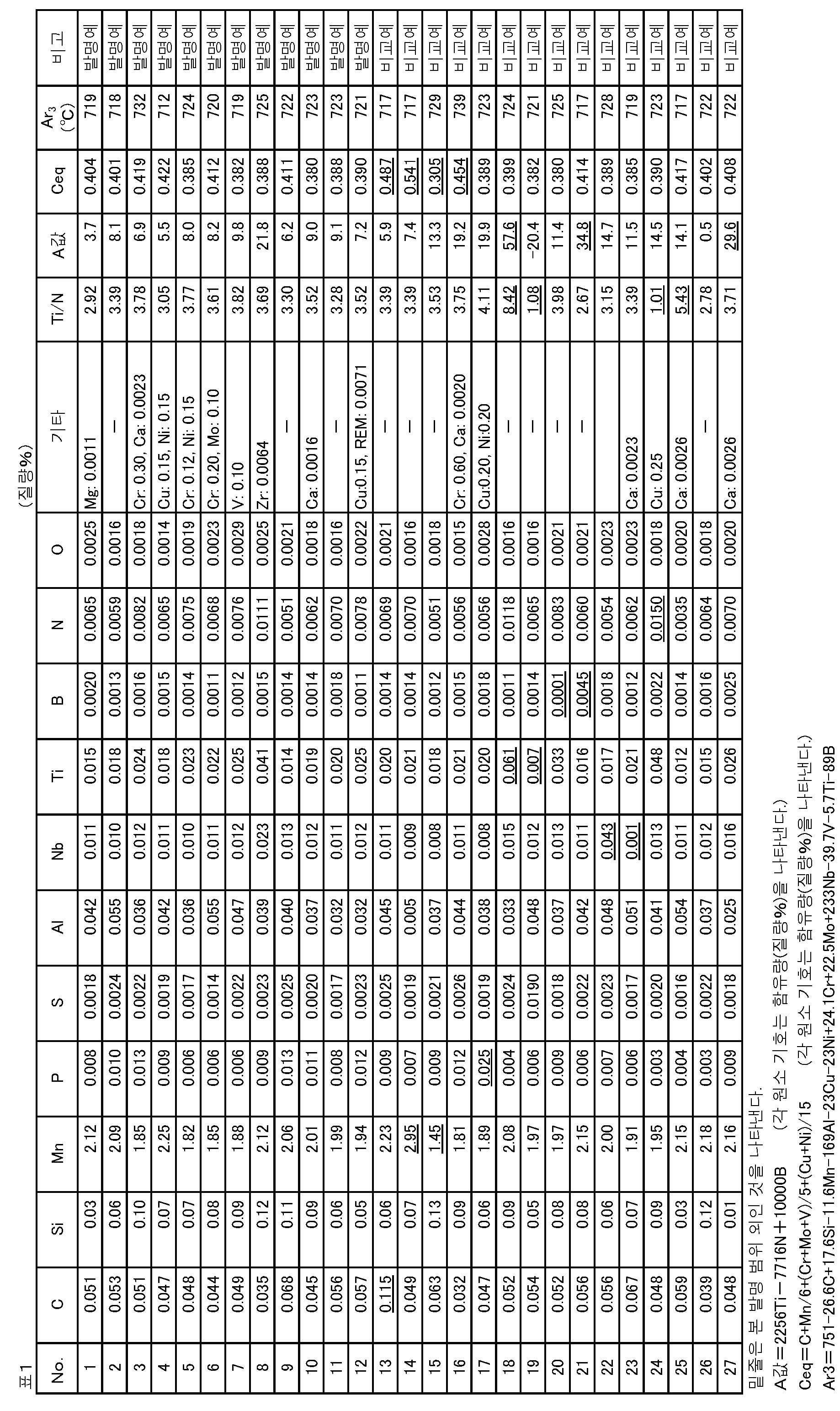
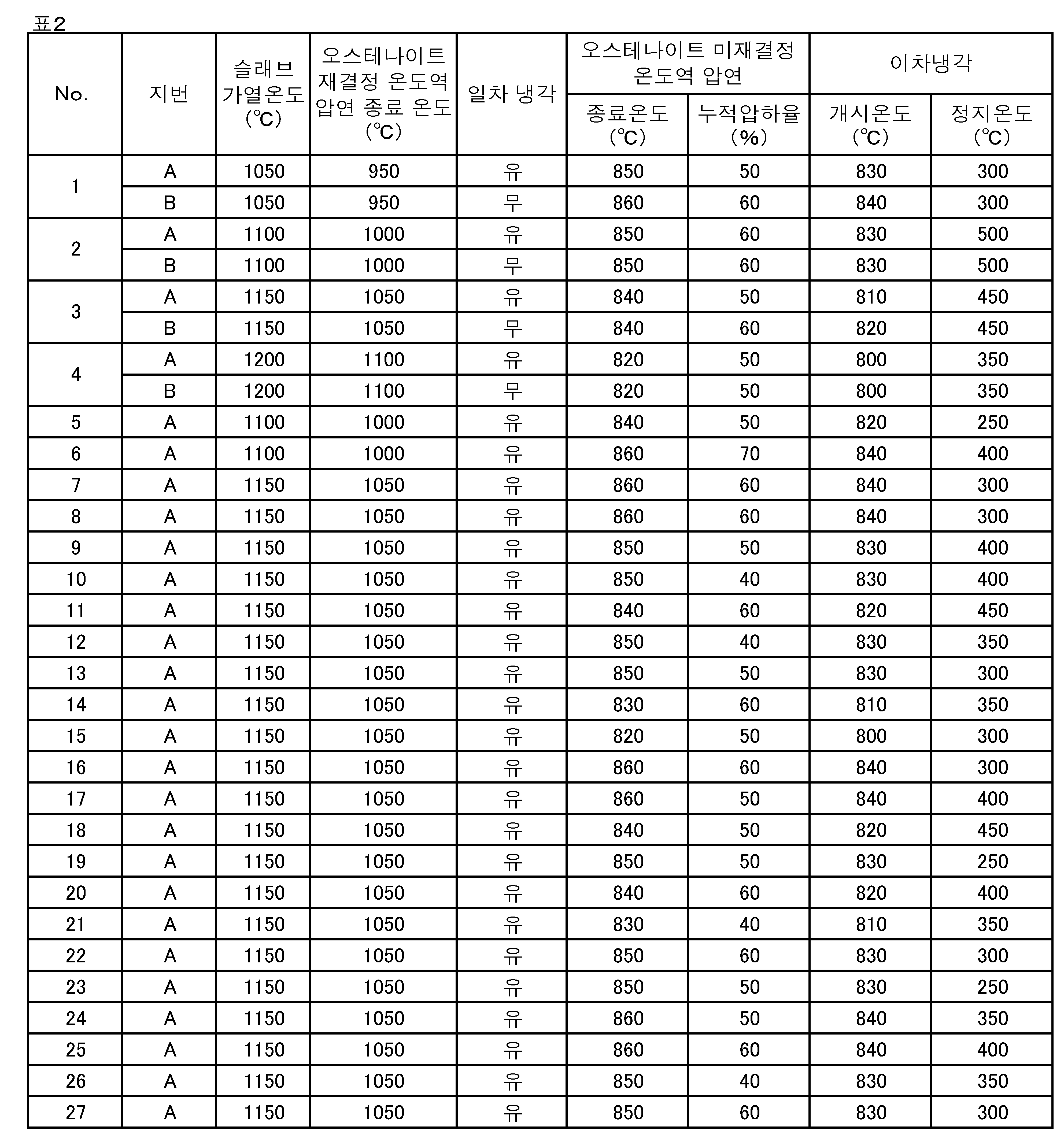
표 1에 나타내는 조성의 강을 전로에서 용제 후, 연속 주조법으로 슬래브로 하고, 표 2에 나타내는 제어 압연, 제어 냉각 조건에 의해 40∼80㎜ 두께의 강판을 제조하였다. 표 2에 나타내는 지번(枝番)은 강 성분이 동일하고, 제조 조건이 다른 것을 나타내고 있다. 또한, 일차 냉각은 압연기의 출구측에 설치한 수랭 설비에 의해 실시하고, 냉각 중의 평균 냉각 속도가 3℃이상인 것을 확인하고 있다.A steel having the composition shown in Table 1 was melted in a converter, and a continuous casting method was used to form a slab, and a steel sheet having a thickness of 40 to 80 mm was produced by controlled rolling and controlled cooling conditions shown in Table 2. The branch numbers shown in Table 2 indicate that the steel components are the same and the manufacturing conditions are different. The primary cooling was performed by a water cooling system provided on the outlet side of the rolling mill, and it was confirmed that the average cooling rate during cooling was 3 ° C or higher.
[표 1][Table 1]
[표 2][Table 2]
상기 조성 및 제조 공정을 거쳐 제조된 후강판에 대해, 판 두께 방향 1/4의 위치에서 평행부 14㎜Φ의 인장 시험편을 채취하고, JIS Z 2241(1998)의 규정에 준거하여 인장 시험을 실시하고, 0.2%내력(YS) 및 인장 강도(TS)를 구하였다.A tensile test piece having a parallel portion of 14 mm in diameter was prepared at a position of 1/4 in the thickness direction of the steel sheet after the composition and the manufacturing process, and tensile test was carried out in accordance with JIS Z 2241 (1998) 0.2% proof stress (YS) and tensile strength (TS) were obtained.
또, 판 두께 방향 1/4의 위치부터 JIS Z 2202(1998)의 규정에 준거하여 V노치 표준 치수의 샤르피 충격 시험편을 채취하고, JIS Z 2242(1998)의 규정에 준거하여 충격 시험을 실시하고, 파면 천이 온도(vTrs)를 구하였다.Charpy impact test pieces having a standard notch V-notch according to JIS Z 2202 (1998) were taken from the position of 1/4 in the plate thickness direction, and an impact test was carried out in accordance with the provisions of JIS Z 2242 (1998) , And the wave front transition temperature (vTrs).
여기서, vTrs의 목표값은 -60℃이하로 하였다.Here, the target value of vTrs is set to -60 DEG C or less.
또, 용접 입열량:200kJ/㎝이상의 입열 용접을 실시했을 때의, 열 영향부에 있어서의 최연화부역의 경도를 평가하기 위해, 판 두께 방향 1/4위치부터, 3㎜Φ×10㎜의 소형 시험편을 채취하고, 변태점 바로 위에 상당하는 온도의 900℃로 가열 후, 800∼500℃의 사이를 390초로 냉각하는 열 처리를 실행하였다. 이들 처리를 실행한 후의 소형 시험편의 비커스 경도 HV(JIS Z 2244(1998))를 1㎜정도의 간격으로 격자형상으로 측정하고, 그 중 가장 낮은 경도를 최연화부 경도로 하였다. 최연화부 경도의 목표값은 160이상으로 하였다. 또, HAZ 최연화부역을 가장 낮은 경도를 나타낸 점을 중심으로 해서, 그곳에서 가장 가까운 측정점끼리를 연결한 영역으로 하였다.In addition, in order to evaluate the hardness of the minimum heat-affected zone in the heat-affected zone when heat input welding with a heat input of 200 kJ / cm or more was performed, a small size of 3 mm? 10 mm A test piece was taken, heated to 900 캜 corresponding to a temperature just above the transformation point, and then subjected to a heat treatment for cooling the temperature between 800 캜 and 500 캜 to 390 캜. The Vickers hardness HV (JIS Z 2244 (1998)) of the small test pieces after performing these treatments was measured in a lattice shape at intervals of about 1 mm, and the lowest hardness was determined as the minimum hardness. The target value of the minimum hardness was set to 160 or more. In addition, the HAZ least-used minutiae were regarded as the area connecting the nearest measurement points with the center showing the lowest hardness as the center.
또, 상기 HAZ 최연화부역에 대응하는 부위를 나이탈로 에칭하여 조직을 출현하였다. SEM을 이용해서 1000배로 3시야의 조직 사진을 촬영하고, 그들을 화상 해석하여, MA의 평균 면적분율을 구하고, 이것을 HAZ 최연화부역의 MA 체적분율(vol%)로 하였다.In addition, a tissue corresponding to the HAZ least-evoked zone was etched away to reveal the tissue. SEM photographs were taken at a magnification of 1000 times at 3 fields and the images were analyzed to obtain an average area fraction of MA, which was defined as the MA volume fraction (vol%) of the HAZ minimum area.
용접 입열량:200kJ/㎝이상의 입열 용접을 실시했을 때의 열 영향부에 있어서의 본드부 근방부의 인성을 평가하기 위해, 상기 후강판으로부터 폭:80㎜×길이:80㎜×두께:15㎜의 시험편을 채취하고, 1450℃로 가열 후, 800∼500℃의 사이를 390초로 냉각한 후, 2㎜V 노치 샤르피 시험편을 채취하고, 상기와 마찬가지로 샤르피 충격 시험을 실행한 충격시험 온도는 -40℃로 하고, 3개의 시험의 평균값에 의해 평가하였다. 목표값은 -40℃에 있어서의 평균 흡수 에너지(vE-40℃)로 50J이상으로 하였다. 또, 상기와 마찬가지로, 열 이력 부여 후의 시험편 단면에 있어서의 MA의 면적분율을 평가하였다.In order to evaluate the toughness of the vicinity of the bond portion in the heat affected zone when heat input welding of 200 kJ / cm or more in terms of the weld heat input amount: 200 kJ / cm or more, The specimens were taken, heated to 1450 캜, cooled to a temperature of 800 to 500 캜 for 390 seconds, and then 2 mmV notch Charpy test pieces were sampled. The impact test temperature at which the Charpy impact test was carried out was performed at -40 캜 , And evaluated by the average value of three tests. The target value was set to 50 J or more at an average absorbed energy (vE -40 캜) at -40 캜. In the same manner as described above, the area fraction of MA on the cross section of the test piece after the application of the thermal history was evaluated.
표 3에, 상기 수순으로 평가를 실행한 강재의 모재 특성, HAZ 특성 및 HAZ 중의 MA 체적분율(vol%)의 측정 결과를 나타낸다.Table 3 shows the results of measurement of the base material properties, the HAZ characteristics, and the MA volume fraction (vol%) in the HAZ of the steel material subjected to the evaluation in the above procedure.
[표 3] [Table 3]
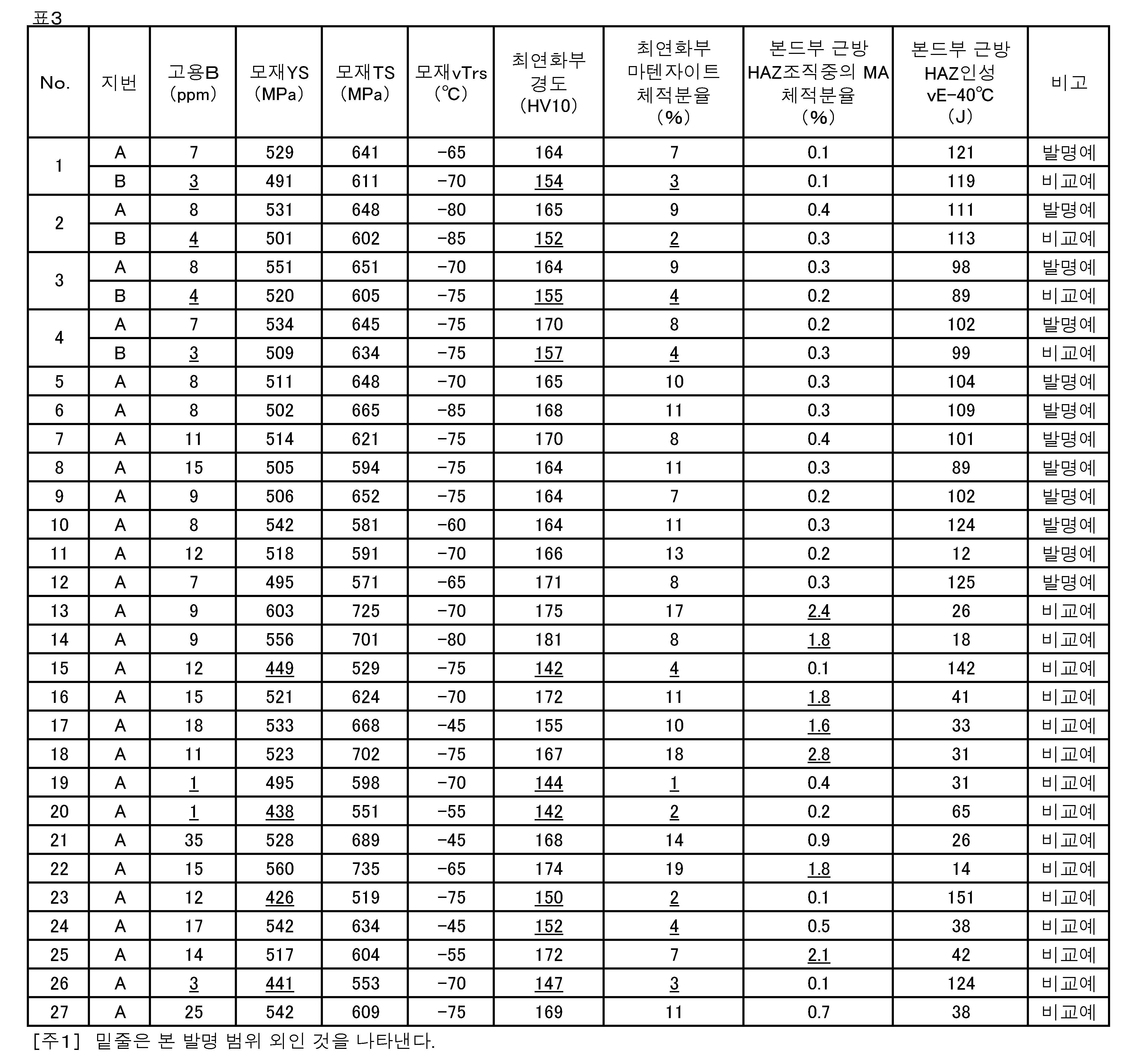
동일 표로부터, 강판 조성 No.1∼12에 있어서의 지번 A의 예에서는 모재와 HAZ에 있어서 우수한 특성이 얻어지고 있는 것을 알 수 있다. 이에 반해, 강판 조성 No.1∼4에 있어서의 지번 B의 강판에 있어서는 제조 조건의 영향에 의해, 본 발명의 요건을 만족시키지 않고, 모재 특성 및 HAZ 특성이 뒤떨어져 있다. 또, 강판 조성 No.13∼27에 있어서는 화학 성분이 본 발명의 정하는 범위를 이탈하고 있기 때문에, 지번 A라도 HAZ 특성에 뒤떨어져 있는 것을 알 수 있다.From the same table, it can be seen that excellent characteristics are obtained in the base material A and the HAZ in the example of the base No. A in the steel sheet composition Nos. 1 to 12. On the other hand, in the steel sheet No. 1 to 4 in the steel sheet compositions Nos. 1 to 4, the properties of the base material and the HAZ characteristics are inferior due to the effect of the production conditions, without satisfying the requirements of the present invention. In addition, in the steel sheet compositions Nos. 13 to 27, since the chemical components deviate from the range defined by the present invention, it can be seen that the HAZ characteristics are inferior even to the number one.
Claims (3)
A=2256×Ti-7716×N+10000×B…(1)
Ceq=C+Mn/6+(Cr+Mo+V)/5+(Cu+Ni)/15…(2)
단, 각 원소 기호는 각 원소의 강 중 함유량(질량%)을 나타낸다.The steel sheet according to any one of claims 1 to 3, wherein the steel sheet comprises, by mass%, 0.030 to 0.080% of C, 0.01 to 0.10% of Si, 1.80 to 2.40% of Mn, 0.010% or less of P, 0.0005 to 0.0040% of S, 0.005 to 0.100% of Al, (Ti / N) of not less than 2.0 and less than 4.0, and contains the following (1) to (3) ) in the range of C eq is from 0.38 to 0.43 a value that is the specified (2) where no more than 3 or less than 25, which is the diet, is composed of the composition of the balance of Fe and unavoidable impurities, the yield stress is at least 460㎫ , The amount of solute B is not less than 5 mass ppm, the amount of island martensite in the vicinity of the bond portion in the heat-affected zone when heat input welding of 200 kJ / cm or more is performed is not more than 1 vol% The steel strip for welding according to any one of claims 1 to 5,
A = 2256 x Ti-7716 x N + 10000 x B ... (One)
C eq = C + Mn / 6 + (Cr + Mo + V) / 5 + (Cu + Ni) / 15 (2)
However, each element symbol represents the content (mass%) in the steel of each element.
상기 성분 조성에, 질량%로, V:0.20%이하, Cu:0.30%이하, Ni:0.20%이하, Cr:0.40%이하 및 Mo:0.40%이하 중에서 선택한 1종 이상을 더 함유하는 용접용 강재.The method according to claim 1,
Wherein said composition further contains at least one selected from the group consisting of V: 0.20% or less, Cu: not more than 0.30%, Ni: not more than 0.20%, Cr: not more than 0.40%, and Mo: .
상기 성분 조성에, 질량%로, Ca:0.0005∼0.0050%, Mg:0.0005∼0.0050%, Zr:0.0010∼0.0200%, REM:0.0010∼0.0200% 중에서 선택한 1종 이상을 더 함유하는 용접용 강재.
3. The method according to claim 1 or 2,
Wherein the composition further contains at least one selected from the group consisting of Ca: 0.0005 to 0.0050%, Mg: 0.0005 to 0.0050%, Zr: 0.0010 to 0.0200%, and REM: 0.0010 to 0.0200%.
Applications Claiming Priority (3)
| Application Number | Priority Date | Filing Date | Title |
|---|---|---|---|
| JP2014053459 | 2014-03-17 | ||
| JPJP-P-2014-053459 | 2014-03-17 | ||
| PCT/JP2015/001417 WO2015141203A1 (en) | 2014-03-17 | 2015-03-13 | Steel material for welding |
Publications (1)
| Publication Number | Publication Date |
|---|---|
| KR20160117536A true KR20160117536A (en) | 2016-10-10 |
Family
ID=54144187
Family Applications (1)
| Application Number | Title | Priority Date | Filing Date |
|---|---|---|---|
| KR1020167024001A Ceased KR20160117536A (en) | 2014-03-17 | 2015-03-13 | Steel material for welding |
Country Status (5)
| Country | Link |
|---|---|
| JP (1) | JP6128276B2 (en) |
| KR (1) | KR20160117536A (en) |
| CN (1) | CN105899702B (en) |
| TW (1) | TWI526545B (en) |
| WO (1) | WO2015141203A1 (en) |
Families Citing this family (6)
| Publication number | Priority date | Publication date | Assignee | Title |
|---|---|---|---|---|
| JP6418418B2 (en) * | 2014-10-17 | 2018-11-07 | Jfeスチール株式会社 | Steel material for large heat input welding |
| CN108676975B (en) * | 2018-06-01 | 2020-02-07 | 马鞍山钢铁股份有限公司 | Heat treatment method for removing segregation defects in metal welding seam |
| CN110257612A (en) * | 2019-06-17 | 2019-09-20 | 首钢集团有限公司 | A kind of preparation method of low residual stress low alloy high strength steel plate |
| WO2022070873A1 (en) * | 2020-09-30 | 2022-04-07 | Jfeスチール株式会社 | Steel sheet |
| WO2022097588A1 (en) * | 2020-11-05 | 2022-05-12 | Jfeスチール株式会社 | Steel sheet and method for manufacturing steel sheet |
| CN117987748A (en) * | 2024-02-02 | 2024-05-07 | 鞍钢集团北京研究院有限公司 | A steel plate for large thickness and large line energy welding and its preparation method and welding method |
Citations (8)
| Publication number | Priority date | Publication date | Assignee | Title |
|---|---|---|---|---|
| JPS57134518A (en) | 1981-02-14 | 1982-08-19 | Kawasaki Steel Corp | Production of high-toughness high-tensile steel |
| JPS5983722A (en) | 1982-11-05 | 1984-05-15 | Kawasaki Steel Corp | Preparation of low carbon equivalent unnormalized high tensile steel plate |
| JPS6067622A (en) | 1983-09-21 | 1985-04-18 | Kobe Steel Ltd | Preparation of low carbon equivalent steel for large heat input welding reduced in welding joint softening |
| JP3546308B2 (en) | 2001-03-05 | 2004-07-28 | Jfeスチール株式会社 | Large heat input welding steel |
| JP2007177327A (en) | 2005-11-30 | 2007-07-12 | Kobe Steel Ltd | Thick steel plate having excellent toughness and reduced softening in weld heat-affected zone |
| JP2008163446A (en) | 2006-12-06 | 2008-07-17 | Jfe Steel Kk | Steel material for large heat input welding |
| JP4233033B2 (en) | 2003-11-06 | 2009-03-04 | 株式会社神戸製鋼所 | A thick steel plate with excellent toughness and strength in the heat affected zone. |
| JP2011006772A (en) | 2009-05-22 | 2011-01-13 | Jfe Steel Corp | Steel material for high heat input welding |
Family Cites Families (8)
| Publication number | Priority date | Publication date | Assignee | Title |
|---|---|---|---|---|
| JP4853575B2 (en) * | 2009-02-06 | 2012-01-11 | Jfeスチール株式会社 | High strength steel pipe for low temperature excellent in buckling resistance and weld heat affected zone toughness and method for producing the same |
| CN201431544Y (en) * | 2009-07-16 | 2010-03-31 | 林存香 | Medical cooling device |
| JP5842314B2 (en) * | 2009-09-16 | 2016-01-13 | Jfeスチール株式会社 | High heat input welding steel |
| JP5772620B2 (en) * | 2011-01-18 | 2015-09-02 | Jfeスチール株式会社 | Tapered plate manufacturing method |
| JP5824434B2 (en) * | 2011-11-14 | 2015-11-25 | 株式会社神戸製鋼所 | Thick steel plate with excellent toughness in weld heat affected zone |
| JP5949682B2 (en) * | 2012-07-03 | 2016-07-13 | Jfeスチール株式会社 | Manufacturing method of steel plate for high heat input welding with excellent brittle crack propagation stop properties |
| JP5958428B2 (en) * | 2012-07-30 | 2016-08-02 | Jfeスチール株式会社 | Manufacturing method of steel plates for high heat input welding |
| JP5849892B2 (en) * | 2012-08-03 | 2016-02-03 | Jfeスチール株式会社 | Steel material for large heat input welding |
-
2015
- 2015-03-13 KR KR1020167024001A patent/KR20160117536A/en not_active Ceased
- 2015-03-13 CN CN201580003317.3A patent/CN105899702B/en active Active
- 2015-03-13 WO PCT/JP2015/001417 patent/WO2015141203A1/en not_active Ceased
- 2015-03-13 JP JP2016508528A patent/JP6128276B2/en active Active
- 2015-03-16 TW TW104108368A patent/TWI526545B/en active
Patent Citations (8)
| Publication number | Priority date | Publication date | Assignee | Title |
|---|---|---|---|---|
| JPS57134518A (en) | 1981-02-14 | 1982-08-19 | Kawasaki Steel Corp | Production of high-toughness high-tensile steel |
| JPS5983722A (en) | 1982-11-05 | 1984-05-15 | Kawasaki Steel Corp | Preparation of low carbon equivalent unnormalized high tensile steel plate |
| JPS6067622A (en) | 1983-09-21 | 1985-04-18 | Kobe Steel Ltd | Preparation of low carbon equivalent steel for large heat input welding reduced in welding joint softening |
| JP3546308B2 (en) | 2001-03-05 | 2004-07-28 | Jfeスチール株式会社 | Large heat input welding steel |
| JP4233033B2 (en) | 2003-11-06 | 2009-03-04 | 株式会社神戸製鋼所 | A thick steel plate with excellent toughness and strength in the heat affected zone. |
| JP2007177327A (en) | 2005-11-30 | 2007-07-12 | Kobe Steel Ltd | Thick steel plate having excellent toughness and reduced softening in weld heat-affected zone |
| JP2008163446A (en) | 2006-12-06 | 2008-07-17 | Jfe Steel Kk | Steel material for large heat input welding |
| JP2011006772A (en) | 2009-05-22 | 2011-01-13 | Jfe Steel Corp | Steel material for high heat input welding |
Also Published As
| Publication number | Publication date |
|---|---|
| WO2015141203A1 (en) | 2015-09-24 |
| TWI526545B (en) | 2016-03-21 |
| JPWO2015141203A1 (en) | 2017-04-06 |
| JP6128276B2 (en) | 2017-05-17 |
| CN105899702B (en) | 2017-12-22 |
| TW201538746A (en) | 2015-10-16 |
| CN105899702A (en) | 2016-08-24 |
Similar Documents
| Publication | Publication Date | Title |
|---|---|---|
| KR101386042B1 (en) | Steel material for high heat input welding | |
| JP7236540B2 (en) | Steel material excellent in toughness of welded heat affected zone and method for producing the same | |
| JP2012207237A (en) | 500 MPa YIELD STRENGTH THICK STEEL PLATE EXCELLENT IN TOUGHNESS IN MULTILAYER WELD ZONE AND PRODUCTION METHOD THEREOF | |
| CN105899702B (en) | Steel material for welding | |
| KR101971772B1 (en) | Method of manufacturing steel plate for high-heat input welding | |
| KR20190037303A (en) | Steel for high heat input welding | |
| US10316385B2 (en) | High-tensile-strength steel plate and process for producing same | |
| KR101937005B1 (en) | Weld joint | |
| KR20180098394A (en) | Steel for high heat input welding | |
| JP5796636B2 (en) | Steel material for large heat input welding | |
| WO2015025486A1 (en) | Thick steel plate and method for manufacturing same | |
| KR101546154B1 (en) | Oil tubular country goods and method of manufacturing the same | |
| CN100529139C (en) | High tensile and fire-resistant steel excellent in weldability and gas cutting property and method for production thereof | |
| KR101930181B1 (en) | Steel material for high heat input welding | |
| JP5849892B2 (en) | Steel material for large heat input welding | |
| JP4344919B2 (en) | High strength steel plate excellent in weldability without preheating, its manufacturing method and welded steel structure | |
| JP4038166B2 (en) | Steel plate excellent in earthquake resistance and weldability and manufacturing method thereof | |
| JP5552967B2 (en) | Thick high-strength steel sheet with excellent low-temperature toughness of welds and method for producing the same | |
| JP4250113B2 (en) | Steel plate manufacturing method with excellent earthquake resistance and weldability | |
| JP6226163B2 (en) | High-tensile steel plate with excellent low-temperature toughness in heat affected zone and its manufacturing method | |
| JP5935678B2 (en) | High toughness high strength steel and method for producing the same | |
| JP7700972B2 (en) | Steel plate and its manufacturing method | |
| WO2021200572A1 (en) | High-strength low-alloy steel sheet having exceptional parent-material toughness and welded-joint toughness, and method for manufacturing said steel sheet | |
| JP2626421B2 (en) | Manufacturing method of high strength steel with excellent weldability |
Legal Events
| Date | Code | Title | Description |
|---|---|---|---|
| A201 | Request for examination | ||
| PA0105 | International application |
Patent event date: 20160831 Patent event code: PA01051R01D Comment text: International Patent Application |
|
| PA0201 | Request for examination | ||
| PG1501 | Laying open of application | ||
| E902 | Notification of reason for refusal | ||
| PE0902 | Notice of grounds for rejection |
Comment text: Notification of reason for refusal Patent event date: 20170928 Patent event code: PE09021S01D |
|
| E601 | Decision to refuse application | ||
| PE0601 | Decision on rejection of patent |
Patent event date: 20180404 Comment text: Decision to Refuse Application Patent event code: PE06012S01D Patent event date: 20170928 Comment text: Notification of reason for refusal Patent event code: PE06011S01I |