KR20170052631A - Method for producing 2'-O-fucosyllactose - Google Patents
Method for producing 2'-O-fucosyllactose Download PDFInfo
- Publication number
- KR20170052631A KR20170052631A KR1020177009260A KR20177009260A KR20170052631A KR 20170052631 A KR20170052631 A KR 20170052631A KR 1020177009260 A KR1020177009260 A KR 1020177009260A KR 20177009260 A KR20177009260 A KR 20177009260A KR 20170052631 A KR20170052631 A KR 20170052631A
- Authority
- KR
- South Korea
- Prior art keywords
- formula
- alkyl
- compound
- cycloalkyl
- fucosyllactose
- Prior art date
- Legal status (The legal status is an assumption and is not a legal conclusion. Google has not performed a legal analysis and makes no representation as to the accuracy of the status listed.)
- Withdrawn
Links
- HWHQUWQCBPAQQH-BWRPKUOHSA-N 2-fucosyllactose Chemical compound O[C@H]1[C@H](O)[C@H](O)[C@H](C)O[C@H]1O[C@@H]1[C@@H](O)[C@@H](O)[C@@H](CO)O[C@H]1O[C@H]([C@H](O)CO)[C@H](O)[C@@H](O)C=O HWHQUWQCBPAQQH-BWRPKUOHSA-N 0.000 title claims abstract description 85
- 238000004519 manufacturing process Methods 0.000 title claims description 7
- 150000001875 compounds Chemical class 0.000 claims abstract description 253
- 238000000034 method Methods 0.000 claims abstract description 88
- 125000002496 methyl group Chemical group [H]C([H])([H])* 0.000 claims abstract description 81
- 230000008569 process Effects 0.000 claims abstract description 46
- IDIOJRGTRFRIJL-UHFFFAOYSA-N iodosilane Chemical compound I[SiH3] IDIOJRGTRFRIJL-UHFFFAOYSA-N 0.000 claims abstract description 27
- 125000001424 substituent group Chemical group 0.000 claims abstract description 22
- 239000000203 mixture Substances 0.000 claims description 84
- 238000002360 preparation method Methods 0.000 claims description 77
- -1 iodine, iodide salts Chemical class 0.000 claims description 46
- 238000006243 chemical reaction Methods 0.000 claims description 42
- XLYOFNOQVPJJNP-UHFFFAOYSA-N water Substances O XLYOFNOQVPJJNP-UHFFFAOYSA-N 0.000 claims description 40
- 239000002585 base Substances 0.000 claims description 38
- SHZGCJCMOBCMKK-UHFFFAOYSA-N D-mannomethylose Natural products CC1OC(O)C(O)C(O)C1O SHZGCJCMOBCMKK-UHFFFAOYSA-N 0.000 claims description 34
- PNNNRSAQSRJVSB-SLPGGIOYSA-N Fucose Natural products C[C@H](O)[C@@H](O)[C@H](O)[C@H](O)C=O PNNNRSAQSRJVSB-SLPGGIOYSA-N 0.000 claims description 34
- CYRMSUTZVYGINF-UHFFFAOYSA-N trichlorofluoromethane Chemical compound FC(Cl)(Cl)Cl CYRMSUTZVYGINF-UHFFFAOYSA-N 0.000 claims description 34
- 125000000026 trimethylsilyl group Chemical group [H]C([H])([H])[Si]([*])(C([H])([H])[H])C([H])([H])[H] 0.000 claims description 34
- SHZGCJCMOBCMKK-DHVFOXMCSA-N L-fucopyranose Chemical compound C[C@@H]1OC(O)[C@@H](O)[C@H](O)[C@@H]1O SHZGCJCMOBCMKK-DHVFOXMCSA-N 0.000 claims description 32
- ZCYVEMRRCGMTRW-UHFFFAOYSA-N 7553-56-2 Chemical compound [I] ZCYVEMRRCGMTRW-UHFFFAOYSA-N 0.000 claims description 31
- 229910052740 iodine Inorganic materials 0.000 claims description 31
- 239000011630 iodine Substances 0.000 claims description 31
- 125000001997 phenyl group Chemical group [H]C1=C([H])C([H])=C(*)C([H])=C1[H] 0.000 claims description 31
- 239000001257 hydrogen Substances 0.000 claims description 26
- 229910052739 hydrogen Inorganic materials 0.000 claims description 26
- 239000003153 chemical reaction reagent Substances 0.000 claims description 25
- 125000006552 (C3-C8) cycloalkyl group Chemical group 0.000 claims description 23
- 125000004432 carbon atom Chemical group C* 0.000 claims description 22
- CSRZQMIRAZTJOY-UHFFFAOYSA-N trimethylsilyl iodide Chemical group C[Si](C)(C)I CSRZQMIRAZTJOY-UHFFFAOYSA-N 0.000 claims description 22
- 125000006239 protecting group Chemical group 0.000 claims description 20
- 239000011541 reaction mixture Substances 0.000 claims description 20
- UFHFLCQGNIYNRP-UHFFFAOYSA-N Hydrogen Chemical compound [H][H] UFHFLCQGNIYNRP-UHFFFAOYSA-N 0.000 claims description 18
- 235000013305 food Nutrition 0.000 claims description 18
- SNOOUWRIMMFWNE-UHFFFAOYSA-M sodium;6-[(3,4,5-trimethoxybenzoyl)amino]hexanoate Chemical compound [Na+].COC1=CC(C(=O)NCCCCCC([O-])=O)=CC(OC)=C1OC SNOOUWRIMMFWNE-UHFFFAOYSA-M 0.000 claims description 18
- 239000012535 impurity Substances 0.000 claims description 16
- 150000001412 amines Chemical class 0.000 claims description 15
- 239000002253 acid Substances 0.000 claims description 12
- 239000003513 alkali Substances 0.000 claims description 12
- 229910052799 carbon Inorganic materials 0.000 claims description 12
- 238000005828 desilylation reaction Methods 0.000 claims description 10
- 238000000746 purification Methods 0.000 claims description 10
- 150000004649 carbonic acid derivatives Chemical class 0.000 claims description 9
- 229910052783 alkali metal Inorganic materials 0.000 claims description 8
- PZPGRFITIJYNEJ-UHFFFAOYSA-N disilane Chemical compound [SiH3][SiH3] PZPGRFITIJYNEJ-UHFFFAOYSA-N 0.000 claims description 8
- 150000002431 hydrogen Chemical class 0.000 claims description 8
- 125000004765 (C1-C4) haloalkyl group Chemical group 0.000 claims description 7
- 235000013373 food additive Nutrition 0.000 claims description 7
- 239000002778 food additive Substances 0.000 claims description 7
- 229910052736 halogen Inorganic materials 0.000 claims description 7
- 150000002367 halogens Chemical class 0.000 claims description 7
- XMBWDFGMSWQBCA-UHFFFAOYSA-M iodide Chemical compound [I-] XMBWDFGMSWQBCA-UHFFFAOYSA-M 0.000 claims description 7
- 125000004767 (C1-C4) haloalkoxy group Chemical group 0.000 claims description 5
- KOPOQZFJUQMUML-UHFFFAOYSA-N chlorosilane Chemical compound Cl[SiH3] KOPOQZFJUQMUML-UHFFFAOYSA-N 0.000 claims description 5
- 229910052723 transition metal Inorganic materials 0.000 claims description 5
- 150000003624 transition metals Chemical class 0.000 claims description 5
- 125000002777 acetyl group Chemical group [H]C([H])([H])C(*)=O 0.000 claims description 4
- 150000001340 alkali metals Chemical class 0.000 claims description 4
- 238000011065 in-situ storage Methods 0.000 claims description 4
- 150000003512 tertiary amines Chemical class 0.000 claims description 4
- YQTCQNIPQMJNTI-UHFFFAOYSA-N 2,2-dimethylpropan-1-one Chemical group CC(C)(C)[C]=O YQTCQNIPQMJNTI-UHFFFAOYSA-N 0.000 claims description 3
- BVKZGUZCCUSVTD-UHFFFAOYSA-N carbonic acid Chemical class OC(O)=O BVKZGUZCCUSVTD-UHFFFAOYSA-N 0.000 claims description 3
- 230000008878 coupling Effects 0.000 claims description 3
- 238000010168 coupling process Methods 0.000 claims description 3
- 238000005859 coupling reaction Methods 0.000 claims description 3
- 230000002378 acidificating effect Effects 0.000 claims description 2
- 125000003236 benzoyl group Chemical group [H]C1=C([H])C([H])=C(C([H])=C1[H])C(*)=O 0.000 claims description 2
- 125000001981 tert-butyldimethylsilyl group Chemical group [H]C([H])([H])[Si]([H])(C([H])([H])[H])[*]C(C([H])([H])[H])(C([H])([H])[H])C([H])([H])[H] 0.000 claims description 2
- 150000007514 bases Chemical class 0.000 claims 3
- 150000003244 quercetin derivatives Chemical class 0.000 abstract 1
- 235000013350 formula milk Nutrition 0.000 description 192
- YMWUJEATGCHHMB-UHFFFAOYSA-N Dichloromethane Chemical compound ClCCl YMWUJEATGCHHMB-UHFFFAOYSA-N 0.000 description 141
- OKKJLVBELUTLKV-UHFFFAOYSA-N Methanol Chemical compound OC OKKJLVBELUTLKV-UHFFFAOYSA-N 0.000 description 75
- 239000000243 solution Substances 0.000 description 49
- ZMANZCXQSJIPKH-UHFFFAOYSA-N Triethylamine Chemical compound CCN(CC)CC ZMANZCXQSJIPKH-UHFFFAOYSA-N 0.000 description 45
- YXFVVABEGXRONW-UHFFFAOYSA-N Toluene Chemical compound CC1=CC=CC=C1 YXFVVABEGXRONW-UHFFFAOYSA-N 0.000 description 42
- FVAUCKIRQBBSSJ-UHFFFAOYSA-M sodium iodide Chemical compound [Na+].[I-] FVAUCKIRQBBSSJ-UHFFFAOYSA-M 0.000 description 39
- WEVYAHXRMPXWCK-UHFFFAOYSA-N Acetonitrile Chemical compound CC#N WEVYAHXRMPXWCK-UHFFFAOYSA-N 0.000 description 36
- 239000000047 product Substances 0.000 description 32
- ZMXDDKWLCZADIW-UHFFFAOYSA-N N,N-Dimethylformamide Chemical compound CN(C)C=O ZMXDDKWLCZADIW-UHFFFAOYSA-N 0.000 description 27
- XEKOWRVHYACXOJ-UHFFFAOYSA-N Ethyl acetate Chemical compound CCOC(C)=O XEKOWRVHYACXOJ-UHFFFAOYSA-N 0.000 description 24
- 238000004128 high performance liquid chromatography Methods 0.000 description 24
- 239000012043 crude product Substances 0.000 description 22
- VYPSYNLAJGMNEJ-UHFFFAOYSA-N Silicium dioxide Chemical compound O=[Si]=O VYPSYNLAJGMNEJ-UHFFFAOYSA-N 0.000 description 19
- LFQSCWFLJHTTHZ-UHFFFAOYSA-N Ethanol Chemical compound CCO LFQSCWFLJHTTHZ-UHFFFAOYSA-N 0.000 description 18
- JUJWROOIHBZHMG-UHFFFAOYSA-N Pyridine Chemical compound C1=CC=NC=C1 JUJWROOIHBZHMG-UHFFFAOYSA-N 0.000 description 18
- 239000012074 organic phase Substances 0.000 description 17
- 239000002904 solvent Substances 0.000 description 17
- 239000000741 silica gel Substances 0.000 description 16
- 229910002027 silica gel Inorganic materials 0.000 description 16
- VEXZGXHMUGYJMC-UHFFFAOYSA-N Hydrochloric acid Chemical compound Cl VEXZGXHMUGYJMC-UHFFFAOYSA-N 0.000 description 14
- NEXSMEBSBIABKL-UHFFFAOYSA-N hexamethyldisilane Chemical compound C[Si](C)(C)[Si](C)(C)C NEXSMEBSBIABKL-UHFFFAOYSA-N 0.000 description 13
- 235000009518 sodium iodide Nutrition 0.000 description 13
- GUBGYTABKSRVRQ-QKKXKWKRSA-N Lactose Natural products OC[C@H]1O[C@@H](O[C@H]2[C@H](O)[C@@H](O)C(O)O[C@@H]2CO)[C@H](O)[C@@H](O)[C@H]1O GUBGYTABKSRVRQ-QKKXKWKRSA-N 0.000 description 12
- 229910001516 alkali metal iodide Inorganic materials 0.000 description 12
- NLKNQRATVPKPDG-UHFFFAOYSA-M potassium iodide Chemical compound [K+].[I-] NLKNQRATVPKPDG-UHFFFAOYSA-M 0.000 description 12
- 238000010992 reflux Methods 0.000 description 12
- 239000011734 sodium Substances 0.000 description 12
- 239000007787 solid Substances 0.000 description 12
- 239000007795 chemical reaction product Substances 0.000 description 11
- 239000008101 lactose Substances 0.000 description 11
- 239000003960 organic solvent Substances 0.000 description 11
- XDTMQSROBMDMFD-UHFFFAOYSA-N Cyclohexane Chemical compound C1CCCCC1 XDTMQSROBMDMFD-UHFFFAOYSA-N 0.000 description 10
- IMNFDUFMRHMDMM-UHFFFAOYSA-N N-Heptane Chemical compound CCCCCCC IMNFDUFMRHMDMM-UHFFFAOYSA-N 0.000 description 10
- 238000004587 chromatography analysis Methods 0.000 description 10
- 238000009472 formulation Methods 0.000 description 10
- CSCPPACGZOOCGX-UHFFFAOYSA-N Acetone Chemical compound CC(C)=O CSCPPACGZOOCGX-UHFFFAOYSA-N 0.000 description 9
- 150000001720 carbohydrates Chemical class 0.000 description 9
- 235000014633 carbohydrates Nutrition 0.000 description 9
- 238000001914 filtration Methods 0.000 description 9
- UMJSCPRVCHMLSP-UHFFFAOYSA-N pyridine Natural products COC1=CC=CN=C1 UMJSCPRVCHMLSP-UHFFFAOYSA-N 0.000 description 9
- SPEUIVXLLWOEMJ-UHFFFAOYSA-N 1,1-dimethoxyethane Chemical compound COC(C)OC SPEUIVXLLWOEMJ-UHFFFAOYSA-N 0.000 description 8
- HEDRZPFGACZZDS-UHFFFAOYSA-N Chloroform Chemical compound ClC(Cl)Cl HEDRZPFGACZZDS-UHFFFAOYSA-N 0.000 description 8
- 239000008346 aqueous phase Substances 0.000 description 8
- 150000007529 inorganic bases Chemical class 0.000 description 8
- 150000004694 iodide salts Chemical class 0.000 description 8
- 239000002808 molecular sieve Substances 0.000 description 8
- BWHMMNNQKKPAPP-UHFFFAOYSA-L potassium carbonate Chemical compound [K+].[K+].[O-]C([O-])=O BWHMMNNQKKPAPP-UHFFFAOYSA-L 0.000 description 8
- URGAHOPLAPQHLN-UHFFFAOYSA-N sodium aluminosilicate Chemical compound [Na+].[Al+3].[O-][Si]([O-])=O.[O-][Si]([O-])=O URGAHOPLAPQHLN-UHFFFAOYSA-N 0.000 description 8
- CDBYLPFSWZWCQE-UHFFFAOYSA-L sodium carbonate Substances [Na+].[Na+].[O-]C([O-])=O CDBYLPFSWZWCQE-UHFFFAOYSA-L 0.000 description 8
- 238000003756 stirring Methods 0.000 description 8
- 125000000999 tert-butyl group Chemical group [H]C([H])([H])C(*)(C([H])([H])[H])C([H])([H])[H] 0.000 description 8
- 229910052784 alkaline earth metal Inorganic materials 0.000 description 7
- 125000000217 alkyl group Chemical group 0.000 description 7
- 239000000010 aprotic solvent Substances 0.000 description 7
- 229960001701 chloroform Drugs 0.000 description 7
- AKHNMLFCWUSKQB-UHFFFAOYSA-L sodium thiosulfate Chemical compound [Na+].[Na+].[O-]S([O-])(=O)=S AKHNMLFCWUSKQB-UHFFFAOYSA-L 0.000 description 7
- 235000019345 sodium thiosulphate Nutrition 0.000 description 7
- 239000000126 substance Substances 0.000 description 7
- QTBSBXVTEAMEQO-UHFFFAOYSA-N Acetic acid Chemical compound CC(O)=O QTBSBXVTEAMEQO-UHFFFAOYSA-N 0.000 description 6
- BVKZGUZCCUSVTD-UHFFFAOYSA-M Bicarbonate Chemical class OC([O-])=O BVKZGUZCCUSVTD-UHFFFAOYSA-M 0.000 description 6
- RTZKZFJDLAIYFH-UHFFFAOYSA-N Diethyl ether Chemical compound CCOCC RTZKZFJDLAIYFH-UHFFFAOYSA-N 0.000 description 6
- WYURNTSHIVDZCO-UHFFFAOYSA-N Tetrahydrofuran Chemical compound C1CCOC1 WYURNTSHIVDZCO-UHFFFAOYSA-N 0.000 description 6
- 230000015572 biosynthetic process Effects 0.000 description 6
- 239000000460 chlorine Substances 0.000 description 6
- IJOOHPMOJXWVHK-UHFFFAOYSA-N chlorotrimethylsilane Chemical compound C[Si](C)(C)Cl IJOOHPMOJXWVHK-UHFFFAOYSA-N 0.000 description 6
- 238000003776 cleavage reaction Methods 0.000 description 6
- 125000002446 fucosyl group Chemical group C1([C@@H](O)[C@H](O)[C@H](O)[C@@H](O1)C)* 0.000 description 6
- 239000007788 liquid Substances 0.000 description 6
- 230000007017 scission Effects 0.000 description 6
- 238000006884 silylation reaction Methods 0.000 description 6
- 238000003786 synthesis reaction Methods 0.000 description 6
- DPKBAXPHAYBPRL-UHFFFAOYSA-M tetrabutylazanium;iodide Chemical compound [I-].CCCC[N+](CCCC)(CCCC)CCCC DPKBAXPHAYBPRL-UHFFFAOYSA-M 0.000 description 6
- FAPWRFPIFSIZLT-UHFFFAOYSA-M Sodium chloride Chemical compound [Na+].[Cl-] FAPWRFPIFSIZLT-UHFFFAOYSA-M 0.000 description 5
- 150000007513 acids Chemical class 0.000 description 5
- 150000001336 alkenes Chemical class 0.000 description 5
- 239000003085 diluting agent Substances 0.000 description 5
- 125000004185 ester group Chemical group 0.000 description 5
- 238000010438 heat treatment Methods 0.000 description 5
- XMBWDFGMSWQBCA-UHFFFAOYSA-N hydrogen iodide Chemical compound I XMBWDFGMSWQBCA-UHFFFAOYSA-N 0.000 description 5
- 235000015097 nutrients Nutrition 0.000 description 5
- 235000016709 nutrition Nutrition 0.000 description 5
- 125000001181 organosilyl group Chemical group [SiH3]* 0.000 description 5
- 229920006395 saturated elastomer Polymers 0.000 description 5
- UIIMBOGNXHQVGW-UHFFFAOYSA-M sodium bicarbonate Substances [Na+].OC([O-])=O UIIMBOGNXHQVGW-UHFFFAOYSA-M 0.000 description 5
- SCYULBFZEHDVBN-UHFFFAOYSA-N 1,1-Dichloroethane Chemical compound CC(Cl)Cl SCYULBFZEHDVBN-UHFFFAOYSA-N 0.000 description 4
- RYHBNJHYFVUHQT-UHFFFAOYSA-N 1,4-Dioxane Chemical compound C1COCCO1 RYHBNJHYFVUHQT-UHFFFAOYSA-N 0.000 description 4
- PAMIQIKDUOTOBW-UHFFFAOYSA-N 1-methylpiperidine Chemical compound CN1CCCCC1 PAMIQIKDUOTOBW-UHFFFAOYSA-N 0.000 description 4
- ZAFNJMIOTHYJRJ-UHFFFAOYSA-N Diisopropyl ether Chemical compound CC(C)OC(C)C ZAFNJMIOTHYJRJ-UHFFFAOYSA-N 0.000 description 4
- BZLVMXJERCGZMT-UHFFFAOYSA-N Methyl tert-butyl ether Chemical compound COC(C)(C)C BZLVMXJERCGZMT-UHFFFAOYSA-N 0.000 description 4
- CTQNGGLPUBDAKN-UHFFFAOYSA-N O-Xylene Chemical compound CC1=CC=CC=C1C CTQNGGLPUBDAKN-UHFFFAOYSA-N 0.000 description 4
- OFBQJSOFQDEBGM-UHFFFAOYSA-N Pentane Chemical compound CCCCC OFBQJSOFQDEBGM-UHFFFAOYSA-N 0.000 description 4
- NQRYJNQNLNOLGT-UHFFFAOYSA-N Piperidine Chemical compound C1CCNCC1 NQRYJNQNLNOLGT-UHFFFAOYSA-N 0.000 description 4
- SMWDFEZZVXVKRB-UHFFFAOYSA-N Quinoline Chemical compound N1=CC=CC2=CC=CC=C21 SMWDFEZZVXVKRB-UHFFFAOYSA-N 0.000 description 4
- 239000000654 additive Substances 0.000 description 4
- 125000001931 aliphatic group Chemical group 0.000 description 4
- 150000001350 alkyl halides Chemical class 0.000 description 4
- 150000004945 aromatic hydrocarbons Chemical class 0.000 description 4
- 125000001797 benzyl group Chemical group [H]C1=C([H])C([H])=C(C([H])=C1[H])C([H])([H])* 0.000 description 4
- 239000003054 catalyst Substances 0.000 description 4
- HGCIXCUEYOPUTN-UHFFFAOYSA-N cis-cyclohexene Natural products C1CCC=CC1 HGCIXCUEYOPUTN-UHFFFAOYSA-N 0.000 description 4
- 238000002425 crystallisation Methods 0.000 description 4
- 230000008025 crystallization Effects 0.000 description 4
- 239000000706 filtrate Substances 0.000 description 4
- 238000005984 hydrogenation reaction Methods 0.000 description 4
- 238000007327 hydrogenolysis reaction Methods 0.000 description 4
- HSZCZNFXUDYRKD-UHFFFAOYSA-M lithium iodide Chemical compound [Li+].[I-] HSZCZNFXUDYRKD-UHFFFAOYSA-M 0.000 description 4
- 230000014759 maintenance of location Effects 0.000 description 4
- 238000006386 neutralization reaction Methods 0.000 description 4
- 235000011181 potassium carbonates Nutrition 0.000 description 4
- 150000003222 pyridines Chemical class 0.000 description 4
- 229910000029 sodium carbonate Inorganic materials 0.000 description 4
- 238000005809 transesterification reaction Methods 0.000 description 4
- GETQZCLCWQTVFV-UHFFFAOYSA-N trimethylamine Chemical compound CN(C)C GETQZCLCWQTVFV-UHFFFAOYSA-N 0.000 description 4
- 239000008096 xylene Substances 0.000 description 4
- OISVCGZHLKNMSJ-UHFFFAOYSA-N 2,6-dimethylpyridine Chemical compound CC1=CC=CC(C)=N1 OISVCGZHLKNMSJ-UHFFFAOYSA-N 0.000 description 3
- WKBOTKDWSSQWDR-UHFFFAOYSA-N Bromine atom Chemical group [Br] WKBOTKDWSSQWDR-UHFFFAOYSA-N 0.000 description 3
- 102100021935 C-C motif chemokine 26 Human genes 0.000 description 3
- 101100495769 Caenorhabditis elegans che-1 gene Proteins 0.000 description 3
- ZAMOUSCENKQFHK-UHFFFAOYSA-N Chlorine atom Chemical compound [Cl] ZAMOUSCENKQFHK-UHFFFAOYSA-N 0.000 description 3
- PXGOKWXKJXAPGV-UHFFFAOYSA-N Fluorine Chemical compound FF PXGOKWXKJXAPGV-UHFFFAOYSA-N 0.000 description 3
- 101000897493 Homo sapiens C-C motif chemokine 26 Proteins 0.000 description 3
- DGAQECJNVWCQMB-PUAWFVPOSA-M Ilexoside XXIX Chemical compound C[C@@H]1CC[C@@]2(CC[C@@]3(C(=CC[C@H]4[C@]3(CC[C@@H]5[C@@]4(CC[C@@H](C5(C)C)OS(=O)(=O)[O-])C)C)[C@@H]2[C@]1(C)O)C)C(=O)O[C@H]6[C@@H]([C@H]([C@@H]([C@H](O6)CO)O)O)O.[Na+] DGAQECJNVWCQMB-PUAWFVPOSA-M 0.000 description 3
- FXHOOIRPVKKKFG-UHFFFAOYSA-N N,N-Dimethylacetamide Chemical compound CN(C)C(C)=O FXHOOIRPVKKKFG-UHFFFAOYSA-N 0.000 description 3
- LRHPLDYGYMQRHN-UHFFFAOYSA-N N-Butanol Chemical compound CCCCO LRHPLDYGYMQRHN-UHFFFAOYSA-N 0.000 description 3
- NBIIXXVUZAFLBC-UHFFFAOYSA-N Phosphoric acid Chemical compound OP(O)(O)=O NBIIXXVUZAFLBC-UHFFFAOYSA-N 0.000 description 3
- 230000000996 additive effect Effects 0.000 description 3
- 150000007933 aliphatic carboxylic acids Chemical class 0.000 description 3
- 239000011260 aqueous acid Substances 0.000 description 3
- 125000000484 butyl group Chemical group [H]C([*])([H])C([H])([H])C([H])([H])C([H])([H])[H] 0.000 description 3
- 229910052801 chlorine Inorganic materials 0.000 description 3
- 239000012141 concentrate Substances 0.000 description 3
- 238000001816 cooling Methods 0.000 description 3
- 150000004292 cyclic ethers Chemical class 0.000 description 3
- 238000010511 deprotection reaction Methods 0.000 description 3
- 239000003480 eluent Substances 0.000 description 3
- 125000001495 ethyl group Chemical group [H]C([H])([H])C([H])([H])* 0.000 description 3
- 238000001704 evaporation Methods 0.000 description 3
- 230000008020 evaporation Effects 0.000 description 3
- 239000011737 fluorine Substances 0.000 description 3
- 229910052731 fluorine Inorganic materials 0.000 description 3
- 108010042430 galactose receptor Proteins 0.000 description 3
- 125000001183 hydrocarbyl group Chemical group 0.000 description 3
- 239000012442 inert solvent Substances 0.000 description 3
- 150000002500 ions Chemical class 0.000 description 3
- VLKZOEOYAKHREP-UHFFFAOYSA-N n-Hexane Chemical compound CCCCCC VLKZOEOYAKHREP-UHFFFAOYSA-N 0.000 description 3
- 230000035764 nutrition Effects 0.000 description 3
- NFHFRUOZVGFOOS-UHFFFAOYSA-N palladium;triphenylphosphane Chemical compound [Pd].C1=CC=CC=C1P(C=1C=CC=CC=1)C1=CC=CC=C1.C1=CC=CC=C1P(C=1C=CC=CC=1)C1=CC=CC=C1.C1=CC=CC=C1P(C=1C=CC=CC=1)C1=CC=CC=C1.C1=CC=CC=C1P(C=1C=CC=CC=1)C1=CC=CC=C1 NFHFRUOZVGFOOS-UHFFFAOYSA-N 0.000 description 3
- 239000012071 phase Substances 0.000 description 3
- 229910000028 potassium bicarbonate Inorganic materials 0.000 description 3
- 235000015497 potassium bicarbonate Nutrition 0.000 description 3
- 239000011736 potassium bicarbonate Substances 0.000 description 3
- 229910000027 potassium carbonate Inorganic materials 0.000 description 3
- TYJJADVDDVDEDZ-UHFFFAOYSA-M potassium hydrogencarbonate Chemical compound [K+].OC([O-])=O TYJJADVDDVDEDZ-UHFFFAOYSA-M 0.000 description 3
- 239000000843 powder Substances 0.000 description 3
- 150000003254 radicals Chemical class 0.000 description 3
- 238000007127 saponification reaction Methods 0.000 description 3
- 229910000030 sodium bicarbonate Inorganic materials 0.000 description 3
- 235000017557 sodium bicarbonate Nutrition 0.000 description 3
- 229940001593 sodium carbonate Drugs 0.000 description 3
- 235000017550 sodium carbonate Nutrition 0.000 description 3
- 239000000725 suspension Substances 0.000 description 3
- UQFSVBXCNGCBBW-UHFFFAOYSA-M tetraethylammonium iodide Chemical compound [I-].CC[N+](CC)(CC)CC UQFSVBXCNGCBBW-UHFFFAOYSA-M 0.000 description 3
- YLQBMQCUIZJEEH-UHFFFAOYSA-N tetrahydrofuran Natural products C=1C=COC=1 YLQBMQCUIZJEEH-UHFFFAOYSA-N 0.000 description 3
- GKXDJYKZFZVASJ-UHFFFAOYSA-M tetrapropylazanium;iodide Chemical compound [I-].CCC[N+](CCC)(CCC)CCC GKXDJYKZFZVASJ-UHFFFAOYSA-M 0.000 description 3
- UPQQXPKAYZYUKO-UHFFFAOYSA-N 2,2,2-trichloroacetamide Chemical compound OC(=N)C(Cl)(Cl)Cl UPQQXPKAYZYUKO-UHFFFAOYSA-N 0.000 description 2
- MHNNAWXXUZQSNM-UHFFFAOYSA-N 2-methylbut-1-ene Chemical compound CCC(C)=C MHNNAWXXUZQSNM-UHFFFAOYSA-N 0.000 description 2
- 125000004493 2-methylbut-1-yl group Chemical group CC(C*)CC 0.000 description 2
- BKOOMYPCSUNDGP-UHFFFAOYSA-N 2-methylbut-2-ene Chemical group CC=C(C)C BKOOMYPCSUNDGP-UHFFFAOYSA-N 0.000 description 2
- 125000005916 2-methylpentyl group Chemical group 0.000 description 2
- XKRFYHLGVUSROY-UHFFFAOYSA-N Argon Chemical compound [Ar] XKRFYHLGVUSROY-UHFFFAOYSA-N 0.000 description 2
- BVKZGUZCCUSVTD-UHFFFAOYSA-L Carbonate Chemical compound [O-]C([O-])=O BVKZGUZCCUSVTD-UHFFFAOYSA-L 0.000 description 2
- VQTUBCCKSQIDNK-UHFFFAOYSA-N Isobutene Chemical compound CC(C)=C VQTUBCCKSQIDNK-UHFFFAOYSA-N 0.000 description 2
- KFZMGEQAYNKOFK-UHFFFAOYSA-N Isopropanol Chemical compound CC(C)O KFZMGEQAYNKOFK-UHFFFAOYSA-N 0.000 description 2
- WHXSMMKQMYFTQS-UHFFFAOYSA-N Lithium Chemical compound [Li] WHXSMMKQMYFTQS-UHFFFAOYSA-N 0.000 description 2
- AFVFQIVMOAPDHO-UHFFFAOYSA-N Methanesulfonic acid Chemical compound CS(O)(=O)=O AFVFQIVMOAPDHO-UHFFFAOYSA-N 0.000 description 2
- SVYKKECYCPFKGB-UHFFFAOYSA-N N,N-dimethylcyclohexylamine Chemical compound CN(C)C1CCCCC1 SVYKKECYCPFKGB-UHFFFAOYSA-N 0.000 description 2
- ISWSIDIOOBJBQZ-UHFFFAOYSA-N Phenol Chemical compound OC1=CC=CC=C1 ISWSIDIOOBJBQZ-UHFFFAOYSA-N 0.000 description 2
- WQDUMFSSJAZKTM-UHFFFAOYSA-N Sodium methoxide Chemical compound [Na+].[O-]C WQDUMFSSJAZKTM-UHFFFAOYSA-N 0.000 description 2
- QAOWNCQODCNURD-UHFFFAOYSA-N Sulfuric acid Chemical compound OS(O)(=O)=O QAOWNCQODCNURD-UHFFFAOYSA-N 0.000 description 2
- DKGAVHZHDRPRBM-UHFFFAOYSA-N Tert-Butanol Chemical compound CC(C)(C)O DKGAVHZHDRPRBM-UHFFFAOYSA-N 0.000 description 2
- DTQVDTLACAAQTR-UHFFFAOYSA-N Trifluoroacetic acid Chemical compound OC(=O)C(F)(F)F DTQVDTLACAAQTR-UHFFFAOYSA-N 0.000 description 2
- 239000007983 Tris buffer Substances 0.000 description 2
- 239000003463 adsorbent Substances 0.000 description 2
- 150000001298 alcohols Chemical class 0.000 description 2
- 229910000288 alkali metal carbonate Inorganic materials 0.000 description 2
- 150000008041 alkali metal carbonates Chemical class 0.000 description 2
- 150000008044 alkali metal hydroxides Chemical class 0.000 description 2
- HOPRXXXSABQWAV-UHFFFAOYSA-N anhydrous collidine Natural products CC1=CC=NC(C)=C1C HOPRXXXSABQWAV-UHFFFAOYSA-N 0.000 description 2
- 239000007864 aqueous solution Substances 0.000 description 2
- 230000008901 benefit Effects 0.000 description 2
- GDTBXPJZTBHREO-UHFFFAOYSA-N bromine Substances BrBr GDTBXPJZTBHREO-UHFFFAOYSA-N 0.000 description 2
- 229910052794 bromium Inorganic materials 0.000 description 2
- 238000004517 catalytic hydrocracking Methods 0.000 description 2
- UTBIMNXEDGNJFE-UHFFFAOYSA-N collidine Natural products CC1=CC=C(C)C(C)=N1 UTBIMNXEDGNJFE-UHFFFAOYSA-N 0.000 description 2
- 230000000052 comparative effect Effects 0.000 description 2
- 150000001925 cycloalkenes Chemical class 0.000 description 2
- 235000013365 dairy product Nutrition 0.000 description 2
- 150000001983 dialkylethers Chemical class 0.000 description 2
- JXTHNDFMNIQAHM-UHFFFAOYSA-N dichloroacetic acid Chemical compound OC(=O)C(Cl)Cl JXTHNDFMNIQAHM-UHFFFAOYSA-N 0.000 description 2
- 235000005911 diet Nutrition 0.000 description 2
- 230000000378 dietary effect Effects 0.000 description 2
- XBDQKXXYIPTUBI-UHFFFAOYSA-N dimethylselenoniopropionate Natural products CCC(O)=O XBDQKXXYIPTUBI-UHFFFAOYSA-N 0.000 description 2
- 238000004821 distillation Methods 0.000 description 2
- 238000001035 drying Methods 0.000 description 2
- 230000008030 elimination Effects 0.000 description 2
- 238000003379 elimination reaction Methods 0.000 description 2
- 150000008267 fucoses Chemical class 0.000 description 2
- 229940052308 general anesthetics halogenated hydrocarbons Drugs 0.000 description 2
- 230000013595 glycosylation Effects 0.000 description 2
- 238000006206 glycosylation reaction Methods 0.000 description 2
- 150000008282 halocarbons Chemical class 0.000 description 2
- 229910001385 heavy metal Inorganic materials 0.000 description 2
- 235000020256 human milk Nutrition 0.000 description 2
- 210000004251 human milk Anatomy 0.000 description 2
- 125000004435 hydrogen atom Chemical group [H]* 0.000 description 2
- 230000007062 hydrolysis Effects 0.000 description 2
- 238000006460 hydrolysis reaction Methods 0.000 description 2
- 229910052500 inorganic mineral Inorganic materials 0.000 description 2
- PNDPGZBMCMUPRI-UHFFFAOYSA-N iodine Chemical compound II PNDPGZBMCMUPRI-UHFFFAOYSA-N 0.000 description 2
- 125000002346 iodo group Chemical group I* 0.000 description 2
- 239000003456 ion exchange resin Substances 0.000 description 2
- 229920003303 ion-exchange polymer Polymers 0.000 description 2
- 125000001449 isopropyl group Chemical group [H]C([H])([H])C([H])(*)C([H])([H])[H] 0.000 description 2
- 229910052808 lithium carbonate Inorganic materials 0.000 description 2
- 238000005259 measurement Methods 0.000 description 2
- 235000013336 milk Nutrition 0.000 description 2
- 239000008267 milk Substances 0.000 description 2
- 210000004080 milk Anatomy 0.000 description 2
- 235000010755 mineral Nutrition 0.000 description 2
- 239000011707 mineral Substances 0.000 description 2
- VMOWKUTXPNPTEN-UHFFFAOYSA-N n,n-dimethylpropan-2-amine Chemical compound CC(C)N(C)C VMOWKUTXPNPTEN-UHFFFAOYSA-N 0.000 description 2
- ISRXMEYARGEVIU-UHFFFAOYSA-N n-methyl-n-propan-2-ylpropan-2-amine Chemical compound CC(C)N(C)C(C)C ISRXMEYARGEVIU-UHFFFAOYSA-N 0.000 description 2
- 125000004430 oxygen atom Chemical group O* 0.000 description 2
- YWAKXRMUMFPDSH-UHFFFAOYSA-N pentene Chemical compound CCCC=C YWAKXRMUMFPDSH-UHFFFAOYSA-N 0.000 description 2
- QMMOXUPEWRXHJS-UHFFFAOYSA-N pentene-2 Natural products CCC=CC QMMOXUPEWRXHJS-UHFFFAOYSA-N 0.000 description 2
- 239000011148 porous material Substances 0.000 description 2
- 150000003141 primary amines Chemical class 0.000 description 2
- 238000002390 rotary evaporation Methods 0.000 description 2
- 239000011780 sodium chloride Substances 0.000 description 2
- 239000003381 stabilizer Substances 0.000 description 2
- 239000007858 starting material Substances 0.000 description 2
- GFYHSKONPJXCDE-UHFFFAOYSA-N sym-collidine Natural products CC1=CN=C(C)C(C)=C1 GFYHSKONPJXCDE-UHFFFAOYSA-N 0.000 description 2
- 125000000383 tetramethylene group Chemical group [H]C([H])([*:1])C([H])([H])C([H])([H])C([H])([H])[*:2] 0.000 description 2
- IMFACGCPASFAPR-UHFFFAOYSA-N tributylamine Chemical compound CCCCN(CCCC)CCCC IMFACGCPASFAPR-UHFFFAOYSA-N 0.000 description 2
- FIQMHBFVRAXMOP-UHFFFAOYSA-N triphenylphosphane oxide Chemical class C=1C=CC=CC=1P(C=1C=CC=CC=1)(=O)C1=CC=CC=C1 FIQMHBFVRAXMOP-UHFFFAOYSA-N 0.000 description 2
- 239000003039 volatile agent Substances 0.000 description 2
- FIARMZDBEGVMLV-UHFFFAOYSA-N 1,1,2,2,2-pentafluoroethanolate Chemical group [O-]C(F)(F)C(F)(F)F FIARMZDBEGVMLV-UHFFFAOYSA-N 0.000 description 1
- NWUYHJFMYQTDRP-UHFFFAOYSA-N 1,2-bis(ethenyl)benzene;1-ethenyl-2-ethylbenzene;styrene Chemical compound C=CC1=CC=CC=C1.CCC1=CC=CC=C1C=C.C=CC1=CC=CC=C1C=C NWUYHJFMYQTDRP-UHFFFAOYSA-N 0.000 description 1
- JLURWBIBHMXAHE-UHFFFAOYSA-N 1-cyclohexyl-n-(cyclohexylmethyl)methanamine Chemical compound C1CCCCC1CNCC1CCCCC1 JLURWBIBHMXAHE-UHFFFAOYSA-N 0.000 description 1
- 125000004206 2,2,2-trifluoroethyl group Chemical group [H]C([H])(*)C(F)(F)F 0.000 description 1
- 125000004778 2,2-difluoroethyl group Chemical group [H]C([H])(*)C([H])(F)F 0.000 description 1
- HEWZVZIVELJPQZ-UHFFFAOYSA-N 2,2-dimethoxypropane Chemical compound COC(C)(C)OC HEWZVZIVELJPQZ-UHFFFAOYSA-N 0.000 description 1
- JVSFQJZRHXAUGT-UHFFFAOYSA-N 2,2-dimethylpropanoyl chloride Chemical compound CC(C)(C)C(Cl)=O JVSFQJZRHXAUGT-UHFFFAOYSA-N 0.000 description 1
- UWKQJZCTQGMHKD-UHFFFAOYSA-N 2,6-di-tert-butylpyridine Chemical compound CC(C)(C)C1=CC=CC(C(C)(C)C)=N1 UWKQJZCTQGMHKD-UHFFFAOYSA-N 0.000 description 1
- 125000004337 3-ethylpentyl group Chemical group [H]C([H])([H])C([H])([H])C([H])(C([H])([H])C([H])([H])[H])C([H])([H])C([H])([H])* 0.000 description 1
- 125000005917 3-methylpentyl group Chemical group 0.000 description 1
- 125000004217 4-methoxybenzyl group Chemical group [H]C1=C([H])C(=C([H])C([H])=C1OC([H])([H])[H])C([H])([H])* 0.000 description 1
- CPELXLSAUQHCOX-UHFFFAOYSA-M Bromide Chemical compound [Br-] CPELXLSAUQHCOX-UHFFFAOYSA-M 0.000 description 1
- ROSDSFDQCJNGOL-UHFFFAOYSA-N Dimethylamine Chemical class CNC ROSDSFDQCJNGOL-UHFFFAOYSA-N 0.000 description 1
- 238000005684 Liebig rearrangement reaction Methods 0.000 description 1
- 241000124008 Mammalia Species 0.000 description 1
- 241000551546 Minerva Species 0.000 description 1
- 229910002651 NO3 Inorganic materials 0.000 description 1
- NHNBFGGVMKEFGY-UHFFFAOYSA-N Nitrate Chemical compound [O-][N+]([O-])=O NHNBFGGVMKEFGY-UHFFFAOYSA-N 0.000 description 1
- WETWJCDKMRHUPV-UHFFFAOYSA-N acetyl chloride Chemical compound CC(Cl)=O WETWJCDKMRHUPV-UHFFFAOYSA-N 0.000 description 1
- 239000012346 acetyl chloride Substances 0.000 description 1
- 150000008043 acidic salts Chemical class 0.000 description 1
- 150000001335 aliphatic alkanes Chemical class 0.000 description 1
- 125000003302 alkenyloxy group Chemical group 0.000 description 1
- 229910000147 aluminium phosphate Inorganic materials 0.000 description 1
- 239000012736 aqueous medium Substances 0.000 description 1
- 229910052786 argon Inorganic materials 0.000 description 1
- 150000001491 aromatic compounds Chemical class 0.000 description 1
- 125000003118 aryl group Chemical group 0.000 description 1
- 238000009835 boiling Methods 0.000 description 1
- 239000006227 byproduct Substances 0.000 description 1
- MIOPJNTWMNEORI-UHFFFAOYSA-N camphorsulfonic acid Chemical compound C1CC2(CS(O)(=O)=O)C(=O)CC1C2(C)C MIOPJNTWMNEORI-UHFFFAOYSA-N 0.000 description 1
- 150000001735 carboxylic acids Chemical class 0.000 description 1
- 239000000969 carrier Substances 0.000 description 1
- 230000015556 catabolic process Effects 0.000 description 1
- 238000012512 characterization method Methods 0.000 description 1
- 229920001429 chelating resin Polymers 0.000 description 1
- 230000002925 chemical effect Effects 0.000 description 1
- 125000001309 chloro group Chemical group Cl* 0.000 description 1
- 125000004775 chlorodifluoromethyl group Chemical group FC(F)(Cl)* 0.000 description 1
- 125000004773 chlorofluoromethyl group Chemical group [H]C(F)(Cl)* 0.000 description 1
- 125000004218 chloromethyl group Chemical group [H]C([H])(Cl)* 0.000 description 1
- 238000004140 cleaning Methods 0.000 description 1
- 238000010549 co-Evaporation Methods 0.000 description 1
- 239000003245 coal Substances 0.000 description 1
- 238000004440 column chromatography Methods 0.000 description 1
- 239000000498 cooling water Substances 0.000 description 1
- 239000013078 crystal Substances 0.000 description 1
- 125000004122 cyclic group Chemical group 0.000 description 1
- 125000000753 cycloalkyl group Chemical group 0.000 description 1
- 125000001995 cyclobutyl group Chemical group [H]C1([H])C([H])([H])C([H])(*)C1([H])[H] 0.000 description 1
- 125000000582 cycloheptyl group Chemical group [H]C1([H])C([H])([H])C([H])([H])C([H])([H])C([H])(*)C([H])([H])C1([H])[H] 0.000 description 1
- 125000000113 cyclohexyl group Chemical group [H]C1([H])C([H])([H])C([H])([H])C([H])(*)C([H])([H])C1([H])[H] 0.000 description 1
- 125000000640 cyclooctyl group Chemical group [H]C1([H])C([H])([H])C([H])([H])C([H])([H])C([H])(*)C([H])([H])C([H])([H])C1([H])[H] 0.000 description 1
- 125000001511 cyclopentyl group Chemical group [H]C1([H])C([H])([H])C([H])([H])C([H])(*)C1([H])[H] 0.000 description 1
- 125000001559 cyclopropyl group Chemical group [H]C1([H])C([H])([H])C1([H])* 0.000 description 1
- 238000006731 degradation reaction Methods 0.000 description 1
- 238000001514 detection method Methods 0.000 description 1
- 229960005215 dichloroacetic acid Drugs 0.000 description 1
- 125000004774 dichlorofluoromethyl group Chemical group FC(Cl)(Cl)* 0.000 description 1
- 125000004772 dichloromethyl group Chemical group [H]C(Cl)(Cl)* 0.000 description 1
- 235000013325 dietary fiber Nutrition 0.000 description 1
- 235000015872 dietary supplement Nutrition 0.000 description 1
- 125000001028 difluoromethyl group Chemical group [H]C(F)(F)* 0.000 description 1
- ZPWVASYFFYYZEW-UHFFFAOYSA-L dipotassium hydrogen phosphate Chemical compound [K+].[K+].OP([O-])([O-])=O ZPWVASYFFYYZEW-UHFFFAOYSA-L 0.000 description 1
- 229910000396 dipotassium phosphate Inorganic materials 0.000 description 1
- 235000019797 dipotassium phosphate Nutrition 0.000 description 1
- 230000000694 effects Effects 0.000 description 1
- 238000010828 elution Methods 0.000 description 1
- 230000007613 environmental effect Effects 0.000 description 1
- IIEWJVIFRVWJOD-UHFFFAOYSA-N ethyl cyclohexane Natural products CCC1CCCCC1 IIEWJVIFRVWJOD-UHFFFAOYSA-N 0.000 description 1
- 238000000605 extraction Methods 0.000 description 1
- 125000004785 fluoromethoxy group Chemical group [H]C([H])(F)O* 0.000 description 1
- 125000004216 fluoromethyl group Chemical group [H]C([H])(F)* 0.000 description 1
- 230000033581 fucosylation Effects 0.000 description 1
- 229940083124 ganglion-blocking antiadrenergic secondary and tertiary amines Drugs 0.000 description 1
- 239000008103 glucose Substances 0.000 description 1
- 239000008187 granular material Substances 0.000 description 1
- 125000001188 haloalkyl group Chemical group 0.000 description 1
- 125000005843 halogen group Chemical group 0.000 description 1
- 239000011874 heated mixture Substances 0.000 description 1
- 125000006343 heptafluoro propyl group Chemical group 0.000 description 1
- 125000000623 heterocyclic group Chemical group 0.000 description 1
- 229910000043 hydrogen iodide Inorganic materials 0.000 description 1
- 125000002887 hydroxy group Chemical group [H]O* 0.000 description 1
- 235000021125 infant nutrition Nutrition 0.000 description 1
- 208000015181 infectious disease Diseases 0.000 description 1
- 239000004615 ingredient Substances 0.000 description 1
- 239000000543 intermediate Substances 0.000 description 1
- 239000013067 intermediate product Substances 0.000 description 1
- 150000002496 iodine Chemical class 0.000 description 1
- 125000004491 isohexyl group Chemical group C(CCC(C)C)* 0.000 description 1
- 238000002955 isolation Methods 0.000 description 1
- 125000003253 isopropoxy group Chemical group [H]C([H])([H])C([H])(O*)C([H])([H])[H] 0.000 description 1
- 150000002597 lactoses Chemical class 0.000 description 1
- 229910052744 lithium Inorganic materials 0.000 description 1
- XGZVUEUWXADBQD-UHFFFAOYSA-L lithium carbonate Chemical compound [Li+].[Li+].[O-]C([O-])=O XGZVUEUWXADBQD-UHFFFAOYSA-L 0.000 description 1
- 239000000463 material Substances 0.000 description 1
- 150000002736 metal compounds Chemical class 0.000 description 1
- 229940098779 methanesulfonic acid Drugs 0.000 description 1
- 229910000403 monosodium phosphate Inorganic materials 0.000 description 1
- 235000019799 monosodium phosphate Nutrition 0.000 description 1
- 239000012452 mother liquor Substances 0.000 description 1
- 238000003541 multi-stage reaction Methods 0.000 description 1
- 125000003136 n-heptyl group Chemical group [H]C([H])([H])C([H])([H])C([H])([H])C([H])([H])C([H])([H])C([H])([H])C([H])([H])* 0.000 description 1
- 125000001280 n-hexyl group Chemical group C(CCCCC)* 0.000 description 1
- 125000000740 n-pentyl group Chemical group [H]C([H])([H])C([H])([H])C([H])([H])C([H])([H])C([H])([H])* 0.000 description 1
- 150000002825 nitriles Chemical class 0.000 description 1
- 229920001542 oligosaccharide Polymers 0.000 description 1
- 150000002482 oligosaccharides Chemical class 0.000 description 1
- 238000005580 one pot reaction Methods 0.000 description 1
- AUONHKJOIZSQGR-UHFFFAOYSA-N oxophosphane Chemical compound P=O AUONHKJOIZSQGR-UHFFFAOYSA-N 0.000 description 1
- 125000006340 pentafluoro ethyl group Chemical group FC(F)(F)C(F)(F)* 0.000 description 1
- 125000002255 pentenyl group Chemical group C(=CCCC)* 0.000 description 1
- 125000001147 pentyl group Chemical group C(CCCC)* 0.000 description 1
- 238000005191 phase separation Methods 0.000 description 1
- FAIAAWCVCHQXDN-UHFFFAOYSA-N phosphorus trichloride Chemical compound ClP(Cl)Cl FAIAAWCVCHQXDN-UHFFFAOYSA-N 0.000 description 1
- 230000000704 physical effect Effects 0.000 description 1
- 230000001766 physiological effect Effects 0.000 description 1
- 239000001267 polyvinylpyrrolidone Substances 0.000 description 1
- 235000013855 polyvinylpyrrolidone Nutrition 0.000 description 1
- 229920000036 polyvinylpyrrolidone Polymers 0.000 description 1
- 229940086066 potassium hydrogencarbonate Drugs 0.000 description 1
- 239000002244 precipitate Substances 0.000 description 1
- 235000019260 propionic acid Nutrition 0.000 description 1
- FVSKHRXBFJPNKK-UHFFFAOYSA-N propionitrile Chemical compound CCC#N FVSKHRXBFJPNKK-UHFFFAOYSA-N 0.000 description 1
- 125000001436 propyl group Chemical group [H]C([*])([H])C([H])([H])C([H])([H])[H] 0.000 description 1
- IUVKMZGDUIUOCP-BTNSXGMBSA-N quinbolone Chemical compound O([C@H]1CC[C@H]2[C@H]3[C@@H]([C@]4(C=CC(=O)C=C4CC3)C)CC[C@@]21C)C1=CCCC1 IUVKMZGDUIUOCP-BTNSXGMBSA-N 0.000 description 1
- 230000009257 reactivity Effects 0.000 description 1
- 230000000630 rising effect Effects 0.000 description 1
- 150000003839 salts Chemical class 0.000 description 1
- 125000002914 sec-butyl group Chemical group [H]C([H])([H])C([H])([H])C([H])(*)C([H])([H])[H] 0.000 description 1
- 238000010517 secondary reaction Methods 0.000 description 1
- 239000000377 silicon dioxide Substances 0.000 description 1
- 229910052708 sodium Inorganic materials 0.000 description 1
- 235000011182 sodium carbonates Nutrition 0.000 description 1
- AJPJDKMHJJGVTQ-UHFFFAOYSA-M sodium dihydrogen phosphate Chemical compound [Na+].OP(O)([O-])=O AJPJDKMHJJGVTQ-UHFFFAOYSA-M 0.000 description 1
- 238000012421 spiking Methods 0.000 description 1
- 230000000087 stabilizing effect Effects 0.000 description 1
- 238000003860 storage Methods 0.000 description 1
- 235000000346 sugar Nutrition 0.000 description 1
- 150000008163 sugars Chemical class 0.000 description 1
- 150000003460 sulfonic acids Chemical class 0.000 description 1
- 239000002562 thickening agent Substances 0.000 description 1
- 125000004001 thioalkyl group Chemical group 0.000 description 1
- 230000002110 toxicologic effect Effects 0.000 description 1
- 231100000027 toxicology Toxicity 0.000 description 1
- YNJBWRMUSHSURL-UHFFFAOYSA-N trichloroacetic acid Chemical compound OC(=O)C(Cl)(Cl)Cl YNJBWRMUSHSURL-UHFFFAOYSA-N 0.000 description 1
- 125000003866 trichloromethyl group Chemical group ClC(Cl)(Cl)* 0.000 description 1
- 125000002023 trifluoromethyl group Chemical group FC(F)(F)* 0.000 description 1
- 125000003258 trimethylene group Chemical group [H]C([H])([*:2])C([H])([H])C([H])([H])[*:1] 0.000 description 1
- 150000004043 trisaccharides Chemical class 0.000 description 1
- 238000005406 washing Methods 0.000 description 1
- 239000003643 water by type Substances 0.000 description 1
- 238000010626 work up procedure Methods 0.000 description 1
Classifications
-
- C—CHEMISTRY; METALLURGY
- C07—ORGANIC CHEMISTRY
- C07H—SUGARS; DERIVATIVES THEREOF; NUCLEOSIDES; NUCLEOTIDES; NUCLEIC ACIDS
- C07H15/00—Compounds containing hydrocarbon or substituted hydrocarbon radicals directly attached to hetero atoms of saccharide radicals
- C07H15/26—Acyclic or carbocyclic radicals, substituted by hetero rings
-
- A—HUMAN NECESSITIES
- A23—FOODS OR FOODSTUFFS; TREATMENT THEREOF, NOT COVERED BY OTHER CLASSES
- A23L—FOODS, FOODSTUFFS OR NON-ALCOHOLIC BEVERAGES, NOT OTHERWISE PROVIDED FOR; PREPARATION OR TREATMENT THEREOF
- A23L33/00—Modifying nutritive qualities of foods; Dietetic products; Preparation or treatment thereof
- A23L33/10—Modifying nutritive qualities of foods; Dietetic products; Preparation or treatment thereof using additives
-
- C—CHEMISTRY; METALLURGY
- C07—ORGANIC CHEMISTRY
- C07H—SUGARS; DERIVATIVES THEREOF; NUCLEOSIDES; NUCLEOTIDES; NUCLEIC ACIDS
- C07H1/00—Processes for the preparation of sugar derivatives
-
- C—CHEMISTRY; METALLURGY
- C07—ORGANIC CHEMISTRY
- C07H—SUGARS; DERIVATIVES THEREOF; NUCLEOSIDES; NUCLEOTIDES; NUCLEIC ACIDS
- C07H3/00—Compounds containing only hydrogen atoms and saccharide radicals having only carbon, hydrogen, and oxygen atoms
- C07H3/06—Oligosaccharides, i.e. having three to five saccharide radicals attached to each other by glycosidic linkages
-
- A—HUMAN NECESSITIES
- A23—FOODS OR FOODSTUFFS; TREATMENT THEREOF, NOT COVERED BY OTHER CLASSES
- A23V—INDEXING SCHEME RELATING TO FOODS, FOODSTUFFS OR NON-ALCOHOLIC BEVERAGES AND LACTIC OR PROPIONIC ACID BACTERIA USED IN FOODSTUFFS OR FOOD PREPARATION
- A23V2002/00—Food compositions, function of food ingredients or processes for food or foodstuffs
Landscapes
- Chemical & Material Sciences (AREA)
- Organic Chemistry (AREA)
- Life Sciences & Earth Sciences (AREA)
- Health & Medical Sciences (AREA)
- Engineering & Computer Science (AREA)
- Biochemistry (AREA)
- Biotechnology (AREA)
- General Health & Medical Sciences (AREA)
- Genetics & Genomics (AREA)
- Molecular Biology (AREA)
- Mycology (AREA)
- Nutrition Science (AREA)
- Food Science & Technology (AREA)
- Polymers & Plastics (AREA)
- Pharmaceuticals Containing Other Organic And Inorganic Compounds (AREA)
- Saccharide Compounds (AREA)
- Coloring Foods And Improving Nutritive Qualities (AREA)
- General Preparation And Processing Of Foods (AREA)
- Preparation Of Compounds By Using Micro-Organisms (AREA)
- Polysaccharides And Polysaccharide Derivatives (AREA)
Abstract
본 발명은 2'-O-푸코실락토오스의 제조 방법, 상기 방법으로 수득가능한 2'-O-푸코실락토오스 및 이의 용도에 관한 것이다. 방법은 염기 하에서 퍼실릴화, 보호된 하기 식 (I) 의 푸코오스 유도체와 하나 이상의 트리(C1-C6-알킬)실릴 요오다이드를 반응시킨 다음, 이에 따라 수득된 생성물과 일반식 (II) 의 화합물을 반응시키는 것을 포함한다.
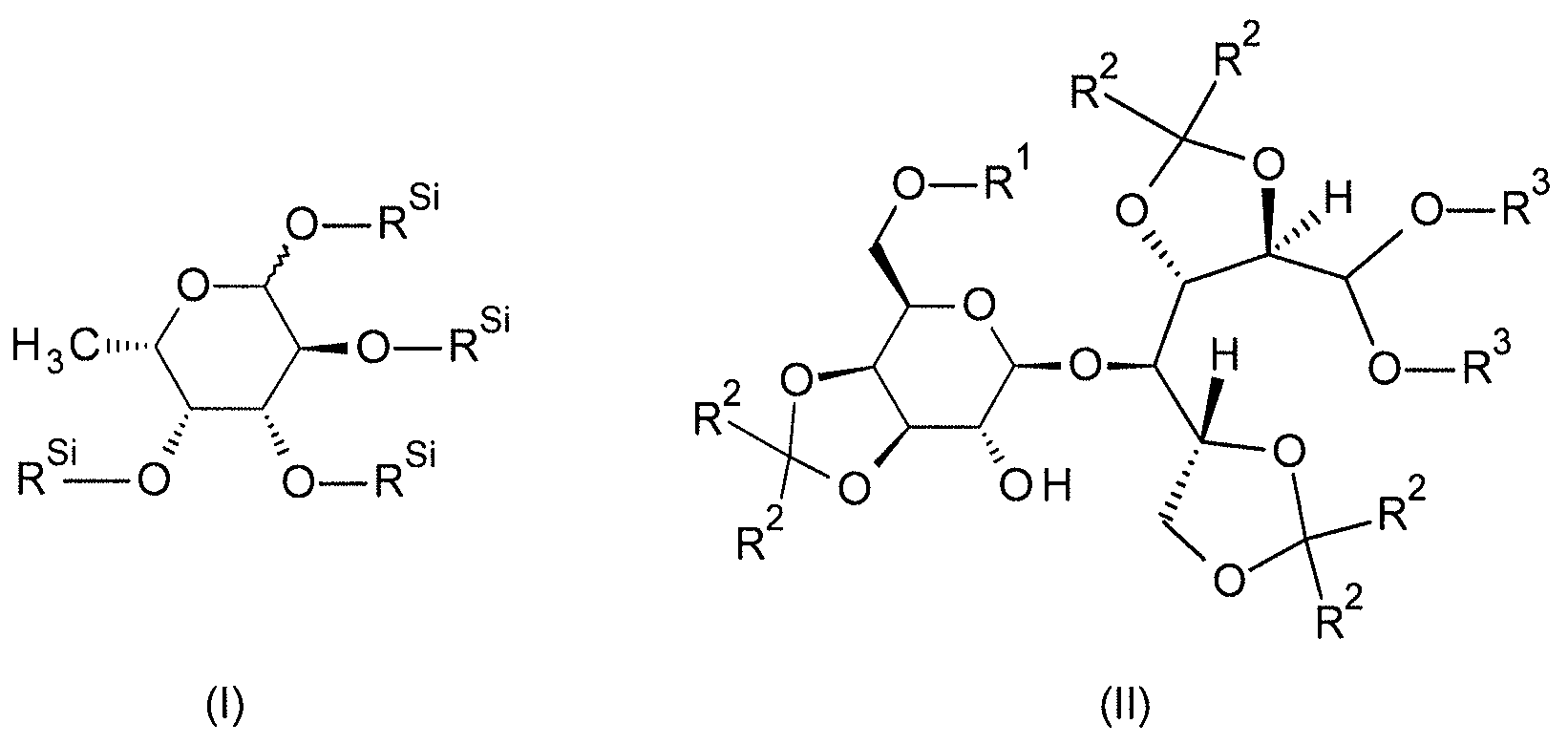
식 (I) 및 (II) 에서, 변수는 각각 하기와 같이 정의된다:
RSi
는 동일 또는 상이하고, 식 SiRaRbRc 의 잔기이고;
R1
은 C(=O)-R11 잔기 또는 SiR12R13R14 잔기이고,
R2
는 동일 또는 상이하고, C1-C8-알킬이거나, 함께 선형 C3-C6-알칸디일 (이는 미치환되거나 치환기로서 1 내지 6 개의 메틸기를 가짐) 을 형성하고;
R3
는 동일 또는 상이하고, C1-C8-알킬이거나, 함께 선형 C1-C4-알칸디일 (이는 미치환되거나 치환기로서 1 내지 6 개의 메틸기를 가짐) 을 형성함.The present invention relates to a process for producing 2'-O-fucosyllactose, 2'-O-fucosyllactose obtainable by the process and a use thereof. The process comprises reacting the fused quercetin derivative of the formula (I) with one or more tri (C 1 -C 6 -alkyl) silyl iodide, which is then protected with a base, and then reacting the product thus obtained with a compound of the formula Lt; RTI ID = 0.0 > II) < / RTI >
In the formulas (I) and (II), the variables are respectively defined as follows:
R Si is the same or different and is a residue of the formula SiR a R b R c ;
R 1 is C (= O) -R 11 residue or SiR 12 R 13 R 14 residue,
R 2 is the same or different and is C 1 -C 8 -alkyl or together form a linear C 3 -C 6 -alkanediyl, which is unsubstituted or has 1 to 6 methyl groups as substituents;
R 3 is the same or different and is C 1 -C 8 -alkyl or together form a linear C 1 -C 4 -alkanediyl, which is unsubstituted or has 1 to 6 methyl groups as substituents.
Description
본 발명은 2'-O-푸코실락토오스의 제조 방법, 상기 방법으로 수득가능한 2'-O-푸코실락토오스 및 이의 용도에 관한 것이다.The present invention relates to a process for producing 2'-O-fucosyllactose, 2'-O-fucosyllactose obtainable by the process and a use thereof.
2'-O-푸코실락토오스 (CAS-No.: 41263-94-9: α-L-푸코피라노실)-(1→2)-O-β-D-갈락토피라노실-(1→4)-D-글루코피라노오스) 는 모유에서 비교적 다량 발견되는 올리고당이다. 모유에 존재하는 2'-O-푸코실락토오스가 모유 수유한 신생아에서 감염의 위험을 인과적으로 감소시킨다는 것이 다양하게 보고되었다 (예를 들어, [Weichert et al, Nutrition Research, 33 (2013), Volume 10, 831-838]; [Jantscher-Krenn et al, Minerva Pediatr. 2012, 64 (1) 83-99]; [Morrow et al, J. Pediatr. 145 (2004) 297-303] 참조). 따라서, 2'-O-푸코실락토오스는 식품 보조제 성분으로서, 특히 유아 영양을 위한 인유화 우유 제품용 첨가제로서 특히 주목받고 있다.2'-O-fucosyllactose (CAS-No .: 41263-94-9:? - L-fucopyranosyl) - (1? 2) -O-? -D-galactopyranosyl- ) -D-glucopyranose) is an oligosaccharide that is found in relatively large amounts in breast milk. It has been reported that 2'-O-fucosyllactose present in breast milk causally reduces the risk of infection in newborns breastfed (see, for example, Weichert et al, Nutrition Research, 33 (2013) Volume 10, 831-838); [Jantscher-Krenn et al, Minerva Pediatr. 2012, 64 (1) 83-99]; [Morrow et al., J. Pediatr. 145 (2004) 297-303). Thus, 2'-O-fucosyllactose has received particular attention as an ingredient for dietary supplements, especially as an additive for humanized milk products for infant nutrition.
전형적인 화학 또는 생화학적 수단에 의한 2'-O-푸코실락토오스의 제조가 문헌에 다양하게 기재되었다 (예를 들어, [Carbohydrate Res. 88(1) (1981) 51], [Carbohydrate. Res. 154 (1986) 93-101], [Carbohydrate. Res. 212 (1991) C1-C3], [J. Org. Chem. (1997) 62, 992], [Heterocycles 84(1) (2012) 637], US 5,438,124, WO 2010/115934, WO 2010/115935, WO 2010/070616, WO 2012/113404 및 WO 2013/48294 참조). 화학적 제조는 통상적으로 활성화된 푸코실 공여체, 예컨대 메틸 1-티오-2,3,4-트리-O-벤질-β-L-푸코피라노시드, 메틸 3,4-O-이소프로필리덴-2-O-(4-메톡시벤질)-1-티오-L-푸코피라노시드, 펜테닐 3,4-O-이소프로필리덴-2-O-(4-메톡시벤질)-β-L-푸코피라노시드, 페닐 1-티오-2,3,4-트리-O-벤질-β-L-푸코피라노시드, 2,3,4-트리-O-벤질-β-L-푸코피라노실 브로마이드, 또는 2,3,4-트리-O-벤질-β-L-푸코피라노실 트리클로르아세트이미데이트 (푸코오스 공여체에 관하여, 상기 언급된 문헌 및 [Tetrahedron Lett. 31 (1990) 4325] 참조) 를 사용하는, 적합하게 보호된 수용체, 즉 아노머성 OH 기의 위치에 티오알킬 기, 알케닐옥시 기, 트리클로로아세트이미데이트 또는 브롬 원자를 갖는, 2-위치에서 부분 보호, 미보호된 락토오스 유도체, 예를 들어 4-O-(6-O-아세틸-3,4-이소프로필리덴-β-D-갈락토피라노실)-2,3;5,6-비스-O-이소프로필리덴-D-글루코오스 디메틸아세탈의 푸코실화를 기반으로 한다. 단점은 푸코오스 공여체의 복잡한, 일반적으로 다단계식 제조이다. 또 다른 단점은 푸코실화 시약의 벤질 보호기가, 생성물에서 제거하기 어렵고, 식품류에 허용되지 않는 불순물을 야기하는 중금속-함유 촉매를 사용하는 수소첨가분해에 의해 제거되어야 한다는 점이다.The preparation of 2'-O-fucosyllactose by typical chemical or biochemical means has been described variously in the literature (see, for example, [Carbohydrate Res. 88 (1) (1981) 51], [Carbohydrate. (1986) 93-101], [Carbohydrate. Res. 212 (1991) C1-C3], [J. Org. Chem. (1997) 62,992], [Heterocycles 84 5,438,124, WO 2010/115934, WO 2010/115935, WO 2010/070616, WO 2012/113404 and WO 2013/48294). The chemical preparation is typically carried out using an activated fucosyl donor such as methyl 1 -thio-2,3,4-tri-O-benzyl- beta -L-fucopyranoside, methyl 3,4-O-isopropylidene- L-fucopyranoside, pentenyl 3,4-O-isopropylidene-2-O- (4-methoxybenzyl) -? - L- Fucopyranoside, phenyl 1-thio-2,3,4-tri-O-benzyl- beta -L-fucopyranoside, 2,3,4-tri-O-benzyl- beta -L-fucopyranosyl Bromide, or 2,3,4-tri-O-benzyl- beta -L-fucopyranosyl trichloroacetimidate (see, for example, the above-mentioned references and Tetrahedron Lett. 31 (1990) 4325 for fucose donors , A partially protected, unprotected lactose at the 2-position with a thioalkyl group, alkenyloxy group, trichloroacetimidate or bromine atom at the position of the anomeric OH group Derivatives such as 4-O- (6-O-acetyl-3,4-isopropylidene-beta-D-galacto Pyranosyl) -2,3; 5,6-bis-O-isopropylidene-D-glucose dimethylacetal. The disadvantage is the complex, generally multistage, production of fucose donors. Another disadvantage is that the benzyl protecting group of the fucosylating reagent must be removed by hydrocracking using a heavy metal-containing catalyst which is difficult to remove from the product and causes impurities that are not acceptable to the food.
예를 들어, [R. K. Jain et al., Carbohydrate Research, 212 (1991), pp. C1-C3] 은, 푸코실화 시약으로서 메틸 3,4-O-이소프로필리덴-2-O-(4-메톡시벤질)-1-티오-β-L-푸코피라노시드 또는 펜틸 3,4-O-이소프로필리덴-2-O-(4-메톡시벤질)-β-L-푸코피라노시드를 사용하는 4-O-(6-O-아세틸-3,4-이소프로필리덴-β-D-갈락토피라노실)-2,3;5,6-비스-O-이소프로필리덴-D-글루코오스 디메틸아세탈의 푸코실화를 통한 2'-O-푸코실락토오스의 제조 경로를 기재한다. 그러나, 이러한 푸코실화 시약은 제조하기 복잡하다. 유사한 합성이 [J. Org. Chem. 1997, 62, 992] 에 기재되어 있다.For example, [R. K. Jain et al., Carbohydrate Research, 212 (1991), pp. C1-C3] can be obtained by reacting methyl 3,4-O-isopropylidene-2-O- (4-methoxybenzyl) -1-thio- beta -L-fucopyranoside or pentyl 3,4 4-O- (6-O-acetyl-3,4-isopropylidene-beta-D-glucopyranoside) using -O-isopropylidene-2-O- (4- methoxybenzyl) -D-galactopyranosyl) -2,3; 5,6-bis-O-isopropylidene-D-glucose dimethylacetal. However, such fucosylating reagents are complex to make. A similar synthesis [J. Org. Chem. 1997, 62, 992).
WO 2010/115934 및 WO 2010/115934 는 2-O-벤질화 푸코실 공여체를 사용하는 2-푸코실락토오스의 제조를 기재한다. 푸코실 공여체는 제조하기 복잡하고, 여전히 수소첨가분해에 의해 제거되어야 하는 벤질 기를 갖는다. 유사한 방법이 WO 2010/070616 에 공지되어 있다.WO 2010/115934 and WO 2010/115934 describe the preparation of 2-fucosyllactose using a 2-O-benzylated fucosyl donor. Fucosyl donors are complex to make and still have benzyl groups that must be removed by hydrogenolysis. A similar method is known from WO 2010/070616.
WO 2012/113404 는, 그 중에서도, 글리코실화에서 푸코실 공여체로서 사용될 수 있는 O-보호된 푸코실 포스파이트를 기재한다. 여기에서 또한, 2,3,4-O-보호된 푸코오스 유도체는 먼저 다단계식 반응으로 제조되어야 하는데, 이후 인(III) 트리클로라이드 및 페놀과 반응시켜 해당 푸코실 포스파이트를 수득한다.WO 2012/113404 describes, among others, O-protected fucosyl phosphites which can be used as fucosyl donors in glycosylation. Here too, the 2,3,4-O-protected fucose derivative should first be prepared in a multistage reaction, followed by reaction with phosphorus (III) trichloride and phenol to give the corresponding fucosyl phosphite.
요약하면, 현재 공지된 2'-O-푸코실락토오스의 제조 방법은 복잡하고, 따라서 경제적이지 않다는 점이 언급될 수 있다. 나아가, 사용되는 시약은 환경독성학적 관점에서 문제가 있다. 또한, 수득된 2'-O-푸코실락토오스는 완전히 제거될 수 없는 불순물, 예컨대 벤질 보호기의 수소첨가분해 제거로부터의 전이 물질 및 방향족, 및 또한 바람직하지 않은 3당류, 예컨대 2'-O-푸코실락토오스의 β-이성질체, 즉 β-L-푸코피라노실-(1→2)-O-β-D-갈락토피라노실-(1→4)-D-글루코피라노오스를 함유한다. 이러한 불순물은 특히 2'-O-푸코실락토오스가 인체 영양물, 특히 유아 영양물에 사용되는 경우 문제가 된다.In summary, it is noted that the presently known process for preparing 2'-O-fucosyllactose is complex and therefore not economical. Furthermore, the reagents used are problematic from an environmental toxicological point of view. In addition, the obtained 2'-O-fucosyllactose can be used as an impurity which can not be completely removed, for example, a transfer material and an aromatic from hydrogenolysis and elimination of a benzyl protecting group, and also an undesirable trisaccharide such as 2'- (1 → 2) -O- β-D-galactopyranosyl- (1 → 4) -D-glucopyranose, which is a β-isomer of silucose, ie, β-L-fucopyranosyl- Such impurities are particularly problematic when 2 ' -O-fucosyllactose is used in human nutrients, especially infant nutrients.
발명의 요약SUMMARY OF THE INVENTION
본 발명의 목적은 선행 기술의 문제점을 갖지 않는 2'-O-푸코실락토오스의 제조 방법을 제공하는 것이다. 방법은 특히 용이하게 제조될 수 있는 개시 물질, 특히 용이하게 이용가능한 푸코실 공여체의 사용을 가능하게 한다. 방법은 추가로 푸코실화에서 양호한 입체선택성 및 양호한 수율을 보장해야 한다. 또한, 방법은 전이 금속 촉매를 통한 수소첨가분해에 의한 임의의 보호기의 제거를 방지하기에 적합해야 한다.It is an object of the present invention to provide a process for preparing 2'-O-fucosyllactose which does not have the problems of the prior art. The method enables the use of starting materials, in particular readily available fucosyl donors, which can be prepared particularly easily. The method should further ensure good stereoselectivity and good yield in fucosylation. The process should also be suitable for preventing the removal of any protecting groups by hydrogenolysis via a transition metal catalyst.
하기 식 (I) 의 퍼실릴화, 보호된 푸코오스 유도체, 특히 하기 식 (I-α) 의 α-아노머:A fused silylated, protected fucose derivative of formula (I), especially an alpha -anomer of formula (I-a)

[식 중,[Wherein,
RSi 는 식 SiRaRbRc 의 잔기 (이때, R Si is a residue of the formula SiR a R b R c ,
Ra, Rb 및 Rc 는 동일 또는 상이하고, C1-C8-알킬, C3-C8-시클로알킬, 페닐 및 C3-C8-시클로알킬-C1-C4-알킬로부터 선택됨) 임] 를,R a , R b and R c are the same or different and are selected from C 1 -C 8 -alkyl, C 3 -C 8 -cycloalkyl, phenyl and C 3 -C 8 -cycloalkyl-C 1 -C 4 -alkyl Selected)
트리(C1-C6-알킬)실릴 요오다이드와 반응시키고, 이후 하나 이상의 염기 존재 하에서 이에 따라 수득된 푸코오스 공여체 (해당 요오다이드) 를 적합한 락토오스 수용체, 즉 하기에서 보다 상세히 정의되는 일반식 (II) 의 화합물과 반응시키는 것이, 이후 수소첨가 단계를 요구하지 않으면서 2'-O-푸코실락토오스를 수득하기 위해 그 자체로 공지된 방식으로 탈보호될 수 있는 해당, 일반식 (III) 의 보호된 2'-O-푸코실락토오스 유도체를 양호한 수율 및 높은 선택성으로 수득한다는 것을 발견하였다.(C 1 -C 6 -alkyl) silyl iodide, and then reacting the fucose donor (the iodide) thus obtained in the presence of one or more bases with a suitable lactose receptor, Reacting a compound of formula (II) with a compound of formula (II), which can then be deprotected in a manner known per se to give 2'-O-fucosyllactose without requiring a subsequent hydrogenation step ) Of protected 2'-O-fucosyllactose derivatives with good yield and high selectivity.
따라서, 본 발명은 먼저 하기 단계를 포함하는 2'-O-푸코실락토오스의 제조 방법에 관한 것이다: Accordingly, the present invention relates firstly to a process for the preparation of 2'-O-fucosyllactose comprising the following steps:
a) 하기 일반식 (I) 의 보호된 푸코오스, 특히 하기 식 (I-α) 의 α-아노머:a) The protected fucose of the general formula (I), in particular the? -Anomer of the general formula (I-a)

[식 중, RSi 는 식 SiRaRbRc 의 잔기 (이때,Wherein R Si is a residue of the formula SiR a R b R c ,
Ra, Rb 및 Rc 는 동일 또는 상이하고, C1-C8-알킬, C3-C8-시클로알킬, 페닐 및 C3-C8-시클로알킬-C1-C4-알킬로부터 선택됨) 임] 를,R a , R b and R c are the same or different and are selected from C 1 -C 8 -alkyl, C 3 -C 8 -cycloalkyl, phenyl and C 3 -C 8 -cycloalkyl-C 1 -C 4 -alkyl Selected)
일반식 (II) 의 화합물과 반응시키는 단계With a compound of formula (II)

[식 중,[Wherein,
R1 은 C(=O)-R11 잔기 또는 SiR12R13R14 잔기 (이때,R 1 is C (= O) -R 11 residue or SiR 12 R 13 R 14 residue,
R11 은 수소, C1-C8-알킬, C1-C8-할로알킬, C3-C8-시클로알킬, C3-C8-시클로알킬-C1-C4-알킬이거나 페닐 (이때, 상기 페닐은 미치환되거나 임의로 할로겐, CN, NO2, C1-C4-알킬, C1-C4-알콕시, C1-C4-할로알킬 및 C1-C4-알콕시로부터 선택되는 1 내지 5 개의 치환기를 가짐) 이고,R 11 is hydrogen, C 1 -C 8 -alkyl, C 1 -C 8 -haloalkyl, C 3 -C 8 -cycloalkyl, C 3 -C 8 -cycloalkyl-C 1 -C 4 -alkyl or phenyl Wherein said phenyl is unsubstituted or optionally selected from halogen, CN, NO 2 , C 1 -C 4 -alkyl, C 1 -C 4 -alkoxy, C 1 -C 4 -haloalkyl and C 1 -C 4 -alkoxy Lt; RTI ID = 0.0 > 1 to 5 < / RTI >
R12, R13 및 R14 은 동일 또는 상이하고, C1-C8-알킬, C3-C8-시클로알킬, 페닐 및 C3-C8-시클로알킬-C1-C4-알킬로부터 선택됨) 이고;R 12 , R 13 and R 14 are identical or different and are selected from C 1 -C 8 -alkyl, C 3 -C 8 -cycloalkyl, phenyl and C 3 -C 8 -cycloalkyl-C 1 -C 4 -alkyl Selected);
R2 는 동일 또는 상이할 수 있고, C1-C8-알킬이거나, 동일한 탄소 원자에 부착되어 있는 2 개의 R2 잔기가 함께 선형 C3-C6-알칸디일 (이는 미치환되거나 치환기로서 1 내지 6 개의 메틸기를 가짐) 을 형성하고;R 2 may be the same or different and is C 1 -C 8 -alkyl, or two R 2 moieties attached to the same carbon atom together form a linear C 3 -C 6 -alkanediyl, which is unsubstituted or substituted as a substituent Having from 1 to 6 methyl groups;
R3 는 동일 또는 상이할 수 있고, C1-C8-알킬이거나, 함께 선형 C1-C4-알칸디일 (이는 미치환되거나 치환기로서 1 내지 6 개의 메틸기를 가짐) 을 형성함];R 3 can be the same or different and are C 1 -C 8 -alkyl or together form a linear C 1 -C 4 -alkanediyl which is unsubstituted or has 1 to 6 methyl groups as substituents;
b) 2'-O-푸코실락토오스를 수득하기 위해, 단계 a) 에서 수득된 일반식 (III) 의 커플링 생성물을 탈보호하는 단계b) To obtain 2'-O-fucosyllactose, deprotection of the coupling product of general formula (III) obtained in step a)

[식 중, RSi, R1, R2 및 R3 는 상기 정의된 바와 같음]; Wherein R Si , R 1 , R 2 and R 3 are as defined above;
여기서, 단계 a) 는 Here, step a)
a.1) 트리(C1-C6-알킬)실릴 요오다이드로의 일반식 (I) 의 보호된 푸코오스의 처리 및a.1) treatment of the protected fucose of formula (I) with tri (C 1 -C 6 -alkyl) silyl iodide and
a.2) 하나 이상의 염기 존재 하, 식 (II) 의 화합물과 단계 a.1) 에서 수득된 생성물의 반응a.2) In the presence of one or more bases, the reaction of the compound of formula (II) with the product obtained in step a.1)
을 포함함..
본 발명은 추가로 일반식 (IIIa), (IIIb), (IIIc) 및 (IV) 의 보호 및 부분 보호된 2'-O-푸코실락토오스 유도체에 관한 것이다:The present invention further relates to protected and partially protected 2'-O-fucosyllactose derivatives of the general formulas (IIIa), (IIIb), (IIIc) and (IV)
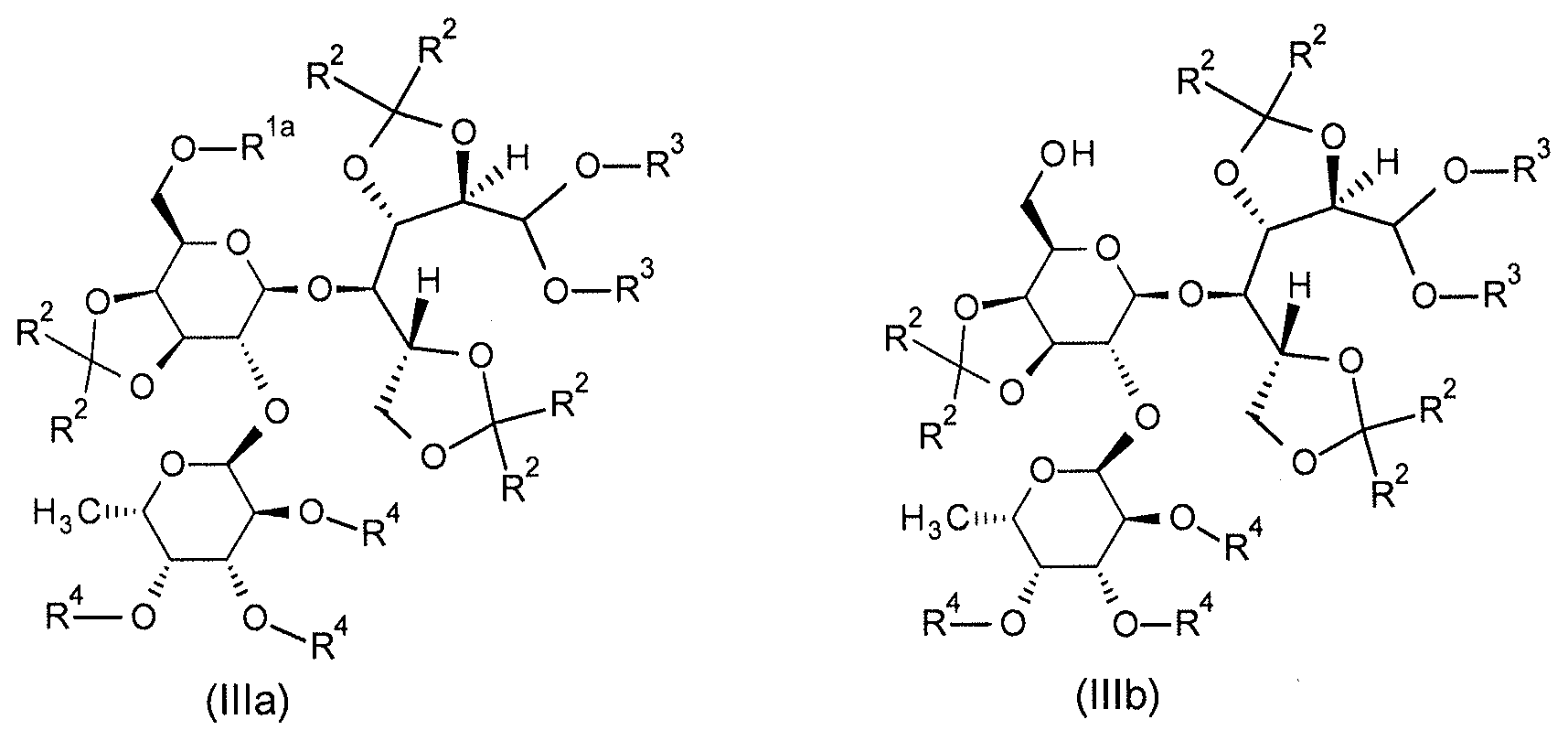

[식 중, [Wherein,
R1a (식 (IIIa) 에서) 는 SiR12R13R14 잔기 (이때,R 1a (in formula (IIIa)) is a SiR 12 R 13 R 14 moiety,
R12, R13 및 R14 은 동일 또는 상이하고, C1-C8-알킬, C3-C8-시클로알킬, 페닐 및 C3-C8-시클로알킬-C1-C4-알킬로부터 선택됨) 이고;R 12 , R 13 and R 14 are identical or different and are selected from C 1 -C 8 -alkyl, C 3 -C 8 -cycloalkyl, phenyl and C 3 -C 8 -cycloalkyl-C 1 -C 4 -alkyl Selected);
R2 (식 (IIIa), (IIIb) 및 (IIIc) 에서) 는 동일 또는 상이하고, C1-C8-알킬이거나, 동일한 탄소 원자에 부착되어 있는 2 개의 R2 잔기가 함께 선형 C3-C6-알칸디일 (이는 미치환되거나 치환기로서 1 내지 6 개의 메틸기를 가짐) 을 형성하고;R 2 (in formulas (IIIa), (IIIb) and (IIIc)) are the same or different and are C 1 -C 8 -alkyl or two R 2 moieties attached to the same carbon atom together form a linear C 3 - C 6 -alkanediyl, which is unsubstituted or has 1 to 6 methyl groups as a substituent;
R3 (식 (IIIa), (IIIb) 및 (IIIc) 에서) 는 동일 또는 상이할 수 있고, C1-C8-알킬이거나, 함께 선형 C1-C4-알칸디일 (이는 미치환되거나 치환기로서 1 내지 6 개의 메틸기를 가짐) 을 형성하고;R 3 (in formulas (IIIa), (IIIb) and (IIIc)) may be the same or different and are C 1 -C 8 -alkyl or together form a linear C 1 -C 4 -alkanediyl, Having 1 to 6 methyl groups as substituents);
R4 (식 (IIIa), (IIIb) 및 (IIIc) 에서) 는 동일 또는 상이하고, 수소이거나 SiRaRbRc 잔기 (이때,R 4 (in formulas (IIIa), (IIIb) and (IIIc)) are the same or different and are hydrogen or SiR a R b R c moieties,
Ra, Rb 및 Rc 는 동일 또는 상이하고, C1-C8-알킬, C3-C8-시클로알킬, 페닐 및 C3-C8-시클로알킬-C1-C4-알킬로부터 선택됨) 이고;R a , R b and R c are the same or different and are selected from C 1 -C 8 -alkyl, C 3 -C 8 -cycloalkyl, phenyl and C 3 -C 8 -cycloalkyl-C 1 -C 4 -alkyl Selected);
R11 (식 (IIIc) 및 (IV) 에서) 은 수소, C1-C8-알킬, C1-C8-할로알킬, C3-C8-시클로알킬, C3-C8-시클로알킬-C1-C4-알킬이거나 페닐 (이때, 상기 페닐은 미치환되거나 임의로 할로겐, CN, NO2, C1-C4-알킬, C1-C4-알콕시, C1-C4-할로알킬 및 C1-C4-할로알콕시로부터 선택되는 1 내지 5 개의 치환기를 가짐) 임].R 11 (in formulas (IIIc) and (IV)) is hydrogen, C 1 -C 8 -alkyl, C 1 -C 8 -haloalkyl, C 3 -C 8 -cycloalkyl, C 3 -C 8 -cycloalkyl -C 1 -C 4 - alkyl or phenyl (wherein said phenyl is unsubstituted or optionally halogen, CN, NO 2, C 1 -C 4 - alkyl, C 1 -C 4 - alkoxy, C 1 -C 4 - haloalkyl Alkyl and C 1 -C 4 -haloalkoxy).
본 발명은 추가로 일반식 (II) 의 부분 보호된 락토오스 유도체 (식 중, R1 은 SiR12R13R14 잔기 (이때, R12, R13 및 R14 은 동일 또는 상이하고, C1-C8-알킬, C3-C8-시클로알킬, 페닐 및 C3-C8-시클로알킬-C1-C4-알킬로부터 선택됨) 임) 에 관한 것이다. 이는 하기 식 (IIa) 로 기재된다: The present invention further provides a partially protected lactose derivative of formula (II) wherein R 1 is a SiR 12 R 13 R 14 moiety wherein R 12 , R 13 and R 14 are the same or different and represent C 1 - C 8 - related to being selected) alkyl) -alkyl, C 3 -C 8 - cycloalkyl, phenyl, and C 3 -C 8 - cycloalkyl, -C 1 -C 4. This is illustrated by the following formula (IIa): <

[식 중, R1a 는 SiR12R13R14 잔기 (이때, R12, R13 및 R14 은 상기 정의된 바와 같음) 이고, R2 및 R3 는 식 (II), (III), (IIIa), (IIIb) 및 (IIIc) 에 대해 정의된 바와 같음].Wherein R 1a is SiR 12 R 13 R 14 residue wherein R 12 , R 13 and R 14 are as defined above, and R 2 and R 3 are as defined in formulas (II), (III), IIIa), (IIIb) and (IIIc)].
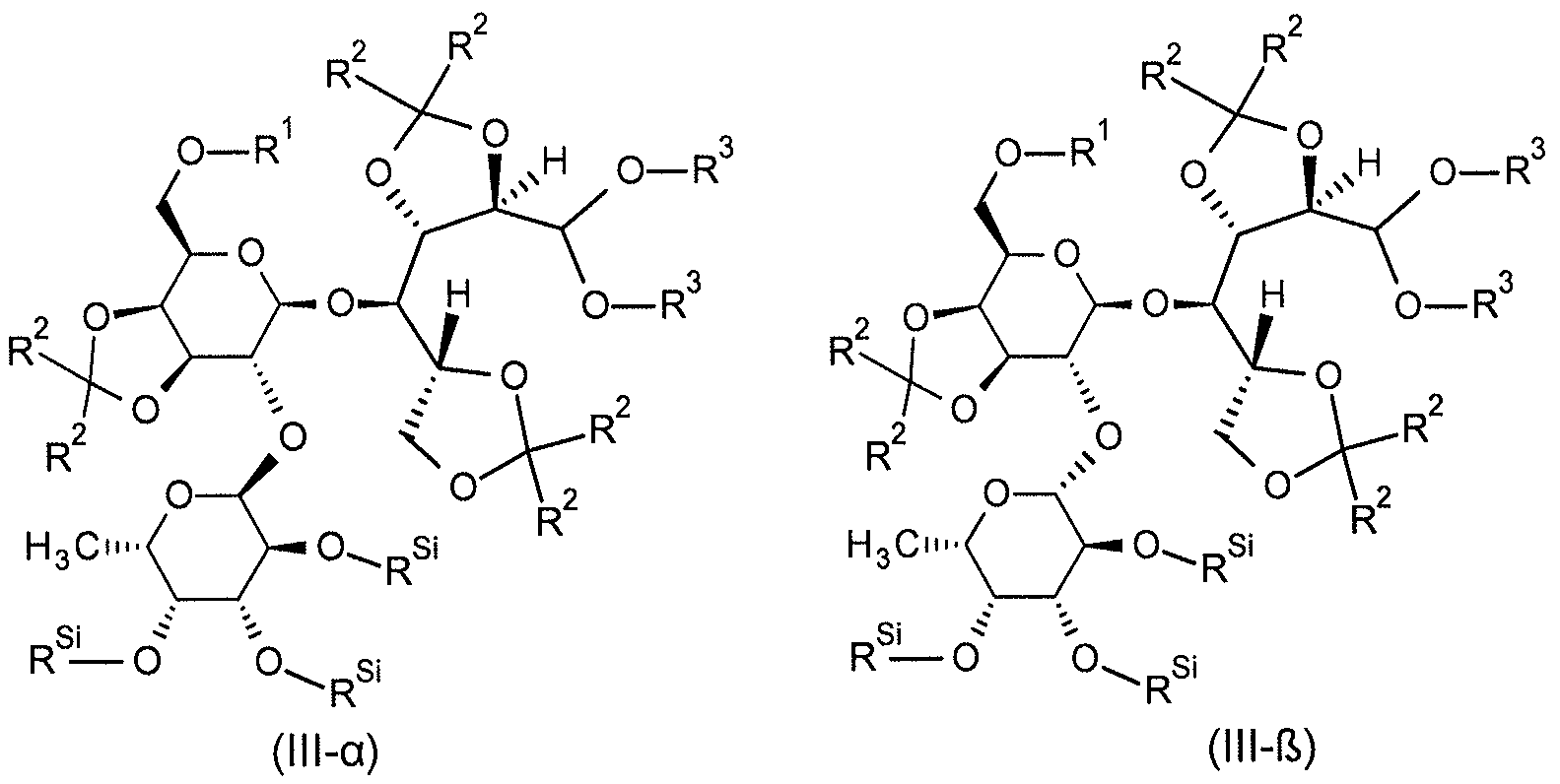
본 발명의 방법은 일련의 장점과 연관된다. 식 (I) 의 화합물은 푸코오스로부터 한 단계로 제조될 수 있기 때문에, 푸코실 공여체의 복잡한 제조가 회피될 수 있다. 방법은 글리코실화에 관하여 양호한 입체선택성 및 양호한 수율로 식 (III) 의 1차 커플링 생성물을 제공한다. 식 (III) 의 화합물의 보호기의 제거는 전이 금속 촉매를 통한 수소첨가분해에 대한 요구 없이 온화한 가수분해 조건 하에서 가능하다. 수득된 식 (III), 특히 식 (IIIa), (IIIb) 및 (IIIc) 의 중간체는 안정하고, 특히 저장 중 안정하고, 정제될 수 있다. 또한, 방법은 비교적 대규모로 용이하게 수행될 수 있다. 추가의 이점은 공지된 2'-O-푸코실락토오스에 비해, 본 발명에 따른 방법으로 수득가능한 2'-O-푸코실락토오스가, 예를 들어 수소첨가로부터 수득된 중금속 화합물 및 중금속, 및 또한 보호기의 수소첨가에 의해 형성된 알킬 방향족 화합물 (이들 불순물은 제거될 수 없음) 을 포함하지 않거나, 오로지 훨씬 낮은 분율로 포함한다는 점이다. 또한, 본 발명의 방법으로 바람직하지 않은 β-이성질체가 형성되지 않거나, 선행 기술 방법에서 형성된 β-이성질체의 양보다 훨씬 낮은, 매우 낮은 양으로만 오로지 형성된다. 실제로, 식 (I) 의 화합물과 식 (II) 의 화합물의 반응으로, 식 (III) 의 화합물의 바람직하지 않은 β-이성질체는 β-이성질체 (III-β) 대 α-이성질체 (III-α) 의 몰비가 1 : 25 를 초과하지 않고, 특히 1 : 35 내지 1 : 40 범위가 되도록 하는 낮은 양으로 형성된다. 따라서, 본 발명의 방법은 임의로 추가 정제 후 1 중량% 미만, 특히 0.5 중량% 미만의 바람직하지 않은 β-이성질체를 함유하는 목적하는 2'-O-푸코실락토오스를 함유하는 2'-O-푸코실락토오스의 제조를 가능하게 한다.The method of the present invention is associated with a series of advantages. Since the compound of formula (I) can be prepared in one step from fucose, the complex preparation of the fucosyl donor can be avoided. The method provides primary coupling products of formula (III) with good stereoselectivity and good yields with respect to glycosylation. Removal of the protecting group of the compound of formula (III) is possible under mild hydrolysis conditions without the need for hydrogenolysis via a transition metal catalyst. The intermediates of the obtained formula (III), in particular the formulas (IIIa), (IIIb) and (IIIc), are stable, in particular stable during storage and can be purified. Also, the method can be easily performed on a relatively large scale. A further advantage is that the 2 ' -O-fucosyllactose obtainable by the process according to the invention, compared to the known 2 ' -O-fucosyllactose, can be used as a thickening agent, for example a heavy metal compound obtained from hydrogenation, But does not include, or only contains a much lower fraction, alkylaromatics formed by the hydrogenation of the protecting group (these impurities can not be removed). Also, only very low amounts of the? -Isomers that are not undesirable in the process of the present invention are formed or are formed much lower than the amount of? -Isomers formed in the prior art process. In fact, by the reaction of the compound of formula (I) with the compound of formula (II), the undesired? -Isomer of the compound of formula (III) is? -Isomer (III-?) To? Is in the range of 1: 35 to 1:40, in particular, not exceeding 1: 25. Thus, the method of the present invention optionally further comprises the step of adding 2'-O-fucose containing the desired 2'-O-fucosyllactose containing less than 1% by weight, especially less than 0.5% Thereby making it possible to produce silucose.
방법 및 방법으로 수득된 식 (IIa) 의 반응물 및 식 (IIIa), (IIIb), (IIIc) 및 (IV) 의 중간체 생성물이 이에 따라 2'-O-푸코실락토오스의 제조에 특히 적합하다. 따라서, 본 발명은 또한 2'-O-푸코실락토오스를 제조하기 위한 일반식 (IIa) 의 화합물의 용도 및 또한 2'-O-푸코실락토오스를 제조하기 위한 일반식 (IIIa), (IIIb), (IIIc) 또는 (IV) 의 화합물의 용도에 관한 것이다. The reaction product of formula (IIa) obtained by the method and method and the intermediate product of formula (IIIa), (IIIb), (IIIc) and (IV) are thus particularly suitable for the preparation of 2'-O-fucosyllactose. The invention therefore also relates to the use of a compound of formula (IIa) for the preparation of 2'-O-fucosyllactose and also to the use of the compounds of formula (IIIa), (IIIb) for the preparation of 2'-O-fucosyllactose, , (IIIc) or (IV).
본 발명에 따른 방법으로 수득된 2'-O-푸코실락토오스의 품질은 식품류 제조에 특히 적합하다. 따라서, 본 발명은 또한 하기에 관한 것이다: The quality of 2 ' -O-fucosyllactose obtained by the process according to the invention is particularly suitable for the manufacture of foods. Accordingly, the present invention also relates to the following:
- 본원에 기재된 방법으로 수득가능한 2'-O-푸코실락토오스;- 2'-O-fucosyllactose obtainable by the process described herein;
- 일반식 (IIa), (IIIa), (IIIb), (IIIc) 또는 (IV) 의 화합물 중 하나 이상을 사용하여 제조된 2'-O-푸코실락토오스;- 2'-O-fucosyllactose prepared using at least one of the compounds of formulas (IIa), (IIIa), (IIIb), (IIIc) or (IV);
- 본원에 기재된 방법으로 수득가능한 2'-O-푸코실락토오스의 식품류에서 또는 식품 첨가제로서의 용도;- The use of 2'-O-fucosyllactose obtainable by the process described in the present application in foods or as food additives;
- 일반식 (IIa), (IIIa), (IIIb), (IIIc) 또는 (IV) 의 화합물 중 하나 이상을 사용하여 제조된 2'-O-푸코실락토오스의 식품류에서 또는 식품 첨가제로서의 용도;- Use of 2'-O-fucosyllactose prepared using at least one of the compounds of the formula (IIa), (IIIa), (IIIb), (IIIc) or (IV) in foodstuffs or as food additives;
- 일반식 (IIa), (IIIa), (IIIb), (IIIc) 또는 (IV) 의 화합물 중 하나 이상으로부터의 2'-O-푸코실락토오스 제조 및 이에 따라 수득가능한 2'-O-푸코실락토오스의 식품류에서의 제형화를 포함하는 식품류 제조 방법;- The preparation of 2'-O-fucosyllactose from at least one of the compounds of the general formula (IIa), (IIIa), (IIIb), (IIIc) or (IV) and the 2'-O-fucosyllactose A method of manufacturing a food product including a formulation in a foodstuff;
- 본원에 기재된 방법으로 수득가능한 2'-O-푸코실락토오스 및 식품류에 적합한 하나 이상의 담체를 포함하는 식품류 또는 식품 첨가제.- A food or food additive comprising 2'-O-fucosyllactose obtainable by the process as described herein and at least one carrier suitable for foods.
본 발명의 맥락에서, 사용된 용어는 일반적으로 하기와 같이 정의된다:In the context of the present invention, the terms used are generally defined as follows:
접두사 Cx-Cy 는 특정 경우에서 가능한 탄소 원자의 수를 의미한다.The prefix C x -C y means the number of carbon atoms possible in a particular case.
용어 "할로겐" 은 각각의 경우 플루오린, 브롬, 클로린 또는 요오드, 특히 플루오린, 클로린 또는 브롬을 의미한다.The term "halogen" means, in each case, fluorine, bromine, chlorine or iodine, in particular fluorine, chlorine or bromine.
용어 "C1-C4-알킬" 은 1 내지 4 개의 탄소 원자를 포함하는 선형 또는 분지형 알킬 잔기, 예컨대 메틸, 에틸, 프로필, 1-메틸에틸 (이소프로필), 부틸, 1-메틸프로필 (sec-부틸), 2-메틸프로필 (이소부틸) 또는 1,1-디메틸에틸 (tert-부틸) 을 의미한다. The term "C 1 -C 4 -alkyl" refers to a linear or branched alkyl residue comprising from 1 to 4 carbon atoms, such as methyl, ethyl, propyl, 1-methylethyl (isopropyl), butyl, sec-butyl), 2-methylpropyl (isobutyl) or 1,1-dimethylethyl (tert-butyl).
용어 "C1-C8-알킬" 은 1 내지 8 개의 탄소 원자를 포함하는 선형 또는 분지형 알킬 잔기를 의미한다. C1-C4-알킬에 대해 언급된 잔기 이외의 예는 n-펜틸, n-헥실, n-헵틸, n-옥틸, 2-펜틸, 2-헥실, 2-헵틸, 2-옥틸, 3-펜틸, 3-헥실, 3-헵틸, 3-옥틸, 2,2-디메틸프로필, 2-메틸부틸, 3-메틸부틸, 2-에틸부틸, 3-에틸부틸, 2-메틸펜틸, 3-메틸펜틸, 4-메틸펜틸, 2-에틸펜틸, 3-에틸펜틸, 4-에틸펜틸, 2-에틸헥실 및 이의 위치 이성질체이다.The term "C 1 -C 8 -alkyl" means a linear or branched alkyl residue comprising from 1 to 8 carbon atoms. Examples other than the moieties mentioned for C 1 -C 4 -alkyl are n-pentyl, n-hexyl, n-heptyl, n-octyl, Butyl, 2-methylbutyl, 2-methylpentyl, 3-methylpentyl, 2-methylpentyl, 2-methylbutyl , 4-methylpentyl, 2-ethylpentyl, 3-ethylpentyl, 4-ethylpentyl, 2-ethylhexyl and positional isomers thereof.
용어 "C1-C8-할로알킬" 은 1 내지 8 개의 탄소 원자, 특히 1 내지 4 개의 탄소 원자 (C1-C4-할로알킬) 를 포함하는 선형 또는 분지형 알킬 잔기 (이의 하나 이상 또는 모든 수소 원자는 할로겐 원자, 특히 플루오린 또는 클로린 원자로 대체됨) 를 의미한다. 이러한 목적에 대한 예는 클로로메틸, 디클로로메틸, 트리클로로메틸, 플루오로메틸, 디플루오로메틸, 트리플루오로메틸, 클로로플루오로메틸, 디클로로플루오로메틸, 클로로디플루오로메틸, 2,2-디플루오로에틸, 2,2,2-트리플루오로에틸, 1,1,2,2-테트라플루오로에틸, 펜타플루오로에틸, 2,2-디플루오로프로필, 3,3-디플루오로프로필, 3,3,3-트리플루오로프로필, 2,2,3,3,3-펜타플루오로프로필, 헵타플루오로프로필 등이다.The term "C 1 -C 8 -haloalkyl" refers to a linear or branched alkyl residue comprising 1 to 8 carbon atoms, especially 1 to 4 carbon atoms (C 1 -C 4 -haloalkyl) All hydrogen atoms are replaced by halogen atoms, especially fluorine or chlorine atoms. Examples for this purpose are chloromethyl, dichloromethyl, trichloromethyl, fluoromethyl, difluoromethyl, trifluoromethyl, chlorofluoromethyl, dichlorofluoromethyl, chlorodifluoromethyl, 2,2- Difluoroethyl, 2,2,2-trifluoroethyl, 1,1,2,2-tetrafluoroethyl, pentafluoroethyl, 2,2-difluoropropyl, 3,3-difluoro Propyl, 3,3,3-trifluoropropyl, 2,2,3,3,3-pentafluoropropyl, heptafluoropropyl and the like.
용어 "C1-C4-알콕시" 는 산소 원자를 통해 결합되어 있는 1 내지 4 개의 탄소 원자를 포함하는 직쇄 또는 분지형 포화 알킬 기를 의미한다. C1-C4-알콕시의 예는 메톡시, 에톡시, n-프로폭시, 1-메틸에톡시 (이소프로폭시), n-부톡시, 1-메틸프로폭시 (sec-부톡시), 2-메틸프로폭시 (이소부톡시) 및 1,1-디메틸에톡시 (tert-부톡시) 이다.The term "C 1 -C 4 - alkoxy" means a straight-chain or branched saturated alkyl comprising 1 to 4 carbon atoms which is bonded via an oxygen atom. Examples of C 1 -C 4 -alkoxy are methoxy, ethoxy, n-propoxy, 1-methylethoxy (isopropoxy), n-butoxy, 1-methylpropoxy -Methylpropoxy (isobutoxy) and 1,1-dimethylethoxy (tert-butoxy).
용어 "C1-C4-할로알콕시" 는 산소 원자를 통해 결합되어 있는 1 내지 4 개의 탄소 원자를 포함하는 직쇄 또는 분지형 포화 할로알킬 기를 의미한다. 이러한 경우의 예는 플루오로메톡시, 디플루오로메톡시, 트리플루오로메톡시, 1-플루오로에톡시, 2-플루오로에톡시, 2,2-디플루오로에톡시, 2,2,2-트리플루오로에톡시, 1,1,2,2-테트라플루오로에톡시, 펜타플루오로에톡시, 3,3,3-트리플루오로프로프-1-옥시, 1,1,1-트리플루오로프로프-2-옥시, 1-플루오로부톡시, 2-플루오로부톡시, 3-플루오로부톡시, 4-플루오로부톡시 등이다.The term "C 1 -C 4 - haloalkoxy" means a straight-chain or branched saturated haloalkyl containing 1 to 4 carbon atoms which is bonded via an oxygen atom. Examples of such groups include fluoromethoxy, difluoromethoxy, trifluoromethoxy, 1-fluoroethoxy, 2-fluoroethoxy, 2,2-difluoroethoxy, 2,2,2-tri Fluoroethoxy, 1,1,2,2-tetrafluoroethoxy, pentafluoroethoxy, 3,3,3-trifluoropropyl-1-oxy, 1,1,1-trifluoropropyl 2-oxy, 1-fluorobutoxy, 2-fluorobutoxy, 3-fluorobutoxy, 4-fluorobutoxy and the like.
용어 "C3-C8-시클로알킬" 은 3 내지 8 개의 탄소 원자를 포함하는 시클릭, 포화 히드로카르빌 잔기를 의미한다. 예는 시클로프로필, 시클로부틸, 시클로펜틸, 시클로헥실, 시클로헵틸 및 시클로옥틸이다.The term "C 3 -C 8 -cycloalkyl" means a cyclic, saturated hydrocarbyl residue comprising 3 to 8 carbon atoms. Examples are cyclopropyl, cyclobutyl, cyclopentyl, cyclohexyl, cycloheptyl and cyclooctyl.
용어 "C3-C8-시클로알킬-C1-C4-알킬" 은 1 내지 4 개의 탄소 원자를 포함하는 선형 또는 분지형 알킬 잔기 (상기 정의된 바와 같이 이의 하나의 수소 원자는 C3-C8-시클로알킬로 대체됨) 를 의미한다.The term "C 3 -C 8 -cycloalkyl-C 1 -C 4 -alkyl" means a linear or branched alkyl residue containing from one to four carbon atoms, wherein one hydrogen atom as defined above is replaced by a C 3 - It means replaced by cycloalkyl) - C 8.
용어 "선형 C1-C4-알칸디일" 은 1 내지 4 개의 탄소 원자를 갖는 선형, 2가 히드로카르빌 잔기, 예컨대 메틸렌, 에탄-1,2-디일, 프로판-1,3-디일, 및 부탄-1,4-디일을 의미한다.The term "linear C 1 -C 4 -alkanediyl" refers to a linear, divalent hydrocarbyl moiety having from 1 to 4 carbon atoms such as methylene, ethane-1,2-diyl, propane- And butane-1,4-diyl.
용어 "선형 C3-C6-알칸디일" 은 3 내지 6 개의 탄소 원자를 갖는 선형, 2가 히드로카르빌 잔기, 예컨대 프로판-1,3-디일, 부탄-1,4-디일, 펜탄-1,5-디일 및 헥산-1,6-디일을 의미한다.The term "linear C 3 -C 6 -alkanediyl" refers to a linear, divalent hydrocarbyl moiety having from 3 to 6 carbon atoms, such as propane-1,3-diyl, butane-1,4-diyl, pentane- 1,5-diyl and hexane-1,6-diyl.
용어 "식품류" 또는 "식품" 은 포유류, 특히 인간을 위한 영양물로 의도되고, 적합한 조성물 및 제형을 의미한다. 본 발명의 맥락에서, 이들은 자연-발생 제품, 예를 들어 유제품, 또한 직접 사용되거나, 임의로 레디-투-유즈 (ready-to-use) 제형으로 전환된 다음 액체를 첨가함으로써 사용될 수 있는, 예를 들어 식이 또는 의약 영양물용 인공 제조 제형 기재의 조성물을 모두 포함한다. The term " foodstuff "or" food "is intended as a nutrient for mammals, particularly humans, and means suitable compositions and formulations. In the context of the present invention, they can be used as natural-occurring products, for example dairy products, which can also be used directly or, optionally, converted into ready-to-use formulations and then added with liquids, ≪ / RTI > include all of the compositions of artificial preparation form bases for dietary or pharmaceutical nutrition.
용어 "식품 첨가제" 는 화학적, 물리적 또는 또한 생리학적 효과를 달성하기 위해 식품류와 혼합되는 물질을 의미한다.The term "food additive" means a substance that is mixed with a foodstuff to achieve a chemical, physical or physiological effect.
본 발명에 따른 방법 및 식 (II), (IIa), (III), (IIIa), (IIIb), (IIIb'), (IIIc) 및 (IIIc') 의 화합물에 대하여, 한 식 내의 변수 R2 는 바람직하게는 각각의 경우 동일한 정의를 갖는다. R2 는 특히 C1-C4-알킬, 특히 메틸이거나 동일한 탄소 원자에 부착되어 있는 2 개의 R2 잔기가 함께 1,5-펜탄디일이고, 따라서 이들이 부착되어 있는 탄소 원자와 시클로헥산-1,1-디일 잔기를 형성한다. 모든 R2 잔기는 특히 메틸이다.For the process according to the invention and for the compounds of the formulas (II), (IIa), (III), (IIIa), (IIIb), (IIIb '), (IIIc) and (IIIc'), 2 preferably have the same definition in each case. R 2 is in particular C 1 -C 4 -alkyl, in particular methyl or two R 2 moieties attached to the same carbon atom, together with 1,5-pentanediyl, and thus the carbon atoms to which they are attached and the cyclohexane-1, To form a 1-diyl residue. All R < 2 > residues are especially methyl.
본 발명에 따른 방법 및 식 (II), (IIa), (III), (IIIa), (IIIb), (IIIb'), (IIIc) 및 (IIIc') 의 화합물에 대하여, 한 식 내의 변수 R3 는 바람직하게는 각각의 경우 동일한 정의를 갖는다. R3 는 특히 C1-C4-알킬, 특히 메틸이다.For the process according to the invention and for the compounds of the formulas (II), (IIa), (III), (IIIa), (IIIb), (IIIb '), (IIIc) and (IIIc'), 3 preferably have the same definition in each case. R 3 is especially C 1 -C 4 -alkyl, in particular methyl.
본 발명에 따른 방법 및 식 (IIIa), (IIIb) 및 (IIIc) 의 화합물에 대하여, 한 식 내의 변수 R4 는 바람직하게는 각각의 경우 동일한 정의를 갖는다. R4 는 특히 수소이거나 트리(C1-C4-알킬)실릴, 특히 수소이거나 트리메틸실릴, 즉 SiRaRbRc 잔기에서 잔기 Ra, Rb 및 Rc 가 동일 또는 상이하고, 특히 C1-C4-알킬, 특히 메틸이다. 식 (IIIa) 의 화합물에서, R4 는 특히 트리(C1-C4-알킬)실릴, 특히 트리메틸실릴이다. 식 (IIIb) 의 화합물에서, R4 는 특히 수소이다.For the process according to the invention and for the compounds of the formulas (IIIa), (IIIb) and (IIIc), the variables R 4 in the formula preferably have the same definitions in each case. R 4 is, in particular, hydrogen or tri (C 1 -C 4 -alkyl) silyl, especially hydrogen or trimethylsilyl, i.e. the moieties R a , R b and R c in the SiR a R b R c moiety are the same or different, 1 -C 4 -alkyl, especially methyl. In the compounds of formula (IIIa), R 4 is especially tri (C 1 -C 4 -alkyl) silyl, in particular trimethylsilyl. In the compounds of formula (IIIb), R < 4 > is especially hydrogen.
본 발명에 따른 방법 및 식 (I) 및 (II) 의 화합물에 대하여, 한 식 내의 변수 RSi 는 바람직하게는 각각의 경우 동일한 정의를 갖는다. RSi 는 특히 수소 이거나 트리(C1-C4-알킬)실릴, 특히 수소이거나 트리메틸실릴, 즉 SiRaRbRc 잔기에서 잔기 Ra, Rb 및 Rc 가 동일 또는 상이하고, 특히 C1-C4-알킬, 특히 메틸이다. For the process according to the invention and for the compounds of formulas (I) and (II), the variables R Si in the formula preferably have the same definition in each case. R Si is especially hydrogen or tri (C 1 -C 4 -alkyl) silyl, in particular hydrogen or trimethylsilyl, i.e. the moieties R a , R b and R c in the SiR a R b R c moiety are the same or different, 1 -C 4 -alkyl, especially methyl.
제 1 구현예는 식 (II) 및 (III) 의 화합물에서, R1 잔기가 SiR12R13R14 잔기, 특히 트리(C1-C4-알킬)실릴, 특히 트리메틸실릴, 즉 SiR12R13R14 잔기에서 잔기 R12, R13 및 R14 이 동일 또는 상이하고, 특히 C1-C4-알킬, 특히 메틸인 방법에 관한 것이다. 따라서, 식 (IIa) 및 (IIIa) 에서, R1a 는 트리(C1-C4-알킬)실릴, 특히 트리메틸실릴이다.A first embodiment relates to compounds of formulas (II) and (III) wherein the R 1 moiety is a SiR 12 R 13 R 14 moiety, especially a tri (C 1 -C 4 -alkyl) silyl, especially trimethylsilyl, ie SiR 12 R R 13 residues R 12, R 13 and R 14 are the same or different from the 14th residue, in particular C 1 -C 4 - relates to alkyl, especially methyl manner. Thus, in formulas (IIa) and (IIIa), R 1a is tri (C 1 -C 4 -alkyl) silyl, in particular trimethylsilyl.
제 2 바람직한 구현예는 식 (II) 및 (III) 의 화합물에서, R1 잔기가 C(=O)-R11 잔기 (이때, R11 은 상기 정의된 바와 같고, 특히 수소, C1-C4-알킬, C1-C4-할로알킬 또는 페닐, 특히 메틸, tert-부틸 또는 페닐임) 인 방법에 관한 것이다. 따라서, 식 (IIIc), (IIIc') 및 (IV) 에서, R11 잔기는 바람직하게는 수소, C1-C4-알킬, C1-C4-할로알킬 또는 페닐, 특히 메틸, tert-부틸 또는 페닐이다. 본 발명의 특정 구현예에서, R11 은 메틸이 아니다. 구현예의 특수한 기에서, R11 은 메틸이다. 구현예의 추가 특수한 기에서, R11 은 tert-부틸이다.The second preferred embodiment is the formula (II) and (III) in the compound, R 1 moiety is C (= O) -R 11 moiety of (wherein, R 11 are as defined above, in particular hydrogen, C 1 -C 4 -alkyl, C 1 -C 4 -haloalkyl or phenyl, in particular methyl, tert-butyl or phenyl. Thus, in formulas (IIIc), (IIIc ') and (IV), the R 11 moiety is preferably hydrogen, C 1 -C 4 -alkyl, C 1 -C 4 -haloalkyl or phenyl, Butyl or phenyl. In certain embodiments of the invention, R < 11 > is not methyl. In a particular group of embodiments, R < 11 > is methyl. In a further special group of embodiments, R < 11 > is tert-butyl.
식 (I) 의 특히 바람직한 화합물의 예는 모든 RSi 잔기가 트리메틸실릴인 식 (I) 의 화합물이다. An example of a particularly preferred compound of formula (I) is a compound of formula (I) wherein all R < 2 > Si residues are trimethylsilyl.
본 발명의 방법에서, 식 (I) 의 화합물은 통상적으로 이의 α-아노머 (I-α) 형태로 이용된다. 또한, 식 (I) 의 화합물에 대해 이의 β-아노머 (I-β), α-아노머 (I-α) 및 β-아노머 (I-β) 의 혼합물이 가능하다. 식 (I) 의 화합물은 통상적으로 이의 α-아노머 (I-α) 로 본질적으로 이루어진, 즉 α-아노머 대 β-아노머의 비가 적어도 8 : 1 또는 적어도 9 : 1 인 형태로 이용된다. 그러나, 비는 (III) 의 목적하는 이성질체의 형성에 유의한 영향을 미치지 않는다.In the process of the present invention, the compound of formula (I) is typically used in its α-anomer (I-α) form. It is also possible for the compound of formula (I) to be a mixture of its β-anomer (I-β), α-anomer (I-α) and β-anomer (I-β). The compound of formula (I) is typically used in its form essentially consisting of its α-anomer (I-α), ie the ratio of α-anomer to β-anomer of at least 8: 1 or at least 9: 1 . However, the ratio does not have a significant effect on the formation of the desired isomer of (III).

식 (II) 의 특히 바람직한 화합물의 예는 모든 R2 잔기가 메틸이고, 모든 R3 잔기가 메틸이고, R1 이 트리메틸실릴인 식 (II) 의 화합물이다. 이러한 화합물은 또한 식 (IIa) 의 화합물의 예이다.An example of a particularly preferred compound of formula (II) is a compound of formula (II) wherein all R 2 moieties are methyl, all R 3 moieties are methyl, and R 1 is trimethylsilyl. Such compounds are also examples of compounds of formula (IIa).
식 (II) 의 추가로 특히 바람직한 화합물의 예는 또한 모든 R2 잔기가 메틸이고, 모든 R3 잔기가 메틸이고, R1 이 아세틸인 식 (II) 의 화합물이다.An example of a further particularly preferred compound of formula (II) is also the compound of formula (II) wherein all R 2 moieties are methyl, all R 3 moieties are methyl and R 1 is acetyl.
식 (II) 의 추가로 특히 바람직한 화합물의 또 다른 예는 또한 모든 R2 잔기가 메틸이고, 모든 R3 잔기가 메틸이고, R1 이 벤조일인 식 (II) 의 화합물이다.Another example of a further particularly preferred compound of formula (II) is also the compound of formula (II) wherein all R 2 moieties are methyl and all R 3 moieties are methyl and R 1 is benzoyl.
식 (II) 의 추가로 특히 바람직한 화합물의 또 다른 예는 또한 모든 R2 잔기가 메틸이고, 모든 R3 잔기가 메틸이고, R1 이 피발로일, 즉 C(=O)-C(CH3)3 인 식 (II) 의 화합물이다.Another example of a particularly preferred compound with the addition of the formula (II) is also the R 2 moieties are all methyl, and R 3 all are methyl residues, R 1 is pivaloyl, or C (= O) -C (CH 3 ) 3 < / RTI >
식 (III) 의 특히 바람직한 화합물의 예는, Examples of particularly preferred compounds of formula (III)
- 모든 R2 잔기가 메틸이고, 모든 R3 잔기가 메틸이고, 모든 RSi 잔기가 트리메틸실릴이고, R1 이 트리메틸실릴인 식 (III) 의 화합물; A compound of formula (III) wherein all R 2 residues are methyl, all R 3 residues are methyl, all R 2 Si residues are trimethylsilyl, and R 1 is trimethylsilyl;
- 모든 R2 잔기가 메틸이고, 모든 R3 잔기가 메틸이고, 모든 RSi 잔기가 트리메틸실릴이고, R1 이 아세틸인 식 (III) 의 화합물;A compound of formula (III) wherein all R 2 residues are methyl, all R 3 residues are methyl, all R 2 Si residues are trimethylsilyl, and R 1 is acetyl;
- 모든 R2 잔기가 메틸이고, 모든 R3 잔기가 메틸이고, 모든 RSi 잔기가 트리메틸실릴이고, R1 이 피발로일인 식 (III) 의 화합물이다.(III) wherein all R 2 residues are methyl, all R 3 residues are methyl, all R 2 Si residues are trimethylsilyl, and R 1 is pivaloyl.
식 (IIIa) 의 특히 바람직한 화합물의 예는, Examples of particularly preferred compounds of formula (IIIa)
- 모든 R2 잔기가 메틸이고, 모든 R3 잔기가 메틸이고, 모든 R4 잔기가 트리메틸실릴이고, R1a 가 트리메틸실릴인 식 (IIIa) 의 화합물; 및A compound of formula (IIIa) wherein all R 2 residues are methyl, all R 3 residues are methyl, all R 4 residues are trimethylsilyl and R 1a is trimethylsilyl; And
- 모든 R2 잔기가 메틸이고, 모든 R3 잔기가 메틸이고, 모든 R4 잔기가 수소이고, R1a 가 트리메틸실릴인 식 (IIIa) 의 화합물이다.- a compound of formula (IIIa) wherein all R 2 residues are methyl, all R 3 residues are methyl, all R 4 residues are hydrogen and R 1a is trimethylsilyl.
식 (IIIb) 의 특히 바람직한 화합물의 예는,Examples of particularly preferred compounds of formula (IIIb)
- 모든 R2 잔기가 메틸이고, 모든 R3 잔기가 메틸이고, 모든 R4 잔기가 트리메틸실릴인 식 (IIIb) 의 화합물; A compound of formula (IIIb) wherein all R 2 residues are methyl, all R 3 residues are methyl and all R 4 residues are trimethylsilyl;
- 모든 R2 잔기가 메틸이고, 모든 R3 잔기가 메틸이고, 모든 R4 잔기가 수소인 식 (IIIb) 의 화합물이다.- a compound of formula (IIIb) wherein all R 2 residues are methyl, all R 3 residues are methyl, and all R 4 residues are hydrogen.
식 (IIIc) 의 특히 바람직한 화합물의 예는,Examples of particularly preferred compounds of formula (IIIc)
- 모든 R2 잔기가 메틸이고, 모든 R3 잔기가 메틸이고, 모든 R4 잔기가 트리메틸실릴이고, R11 이 수소인 식 (IIIc) 의 화합물;A compound of formula (IIIc) wherein all R 2 residues are methyl, all R 3 residues are methyl, all R 4 residues are trimethylsilyl and R 11 is hydrogen;
- 모든 R2 잔기가 메틸이고, 모든 R3 잔기가 메틸이고, 모든 R4 잔기가 수소이고, R11 이 수소인 식 (IIIc) 의 화합물;A compound of formula (IIIc) wherein all R 2 residues are methyl, all R 3 residues are methyl, all R 4 residues are hydrogen and R 11 is hydrogen;
- 모든 R2 잔기가 메틸이고, 모든 R3 잔기가 메틸이고, 모든 R4 잔기가 트리메틸실릴이고, R11 이 메틸인 식 (IIIc) 의 화합물;A compound of formula (IIIc) wherein all R 2 residues are methyl, all R 3 residues are methyl, all R 4 residues are trimethylsilyl and R 11 is methyl;
- 모든 R2 잔기가 메틸이고, 모든 R3 잔기가 메틸이고, 모든 R4 잔기가 수소이고, R11 이 메틸인 식 (IIIc) 의 화합물;A compound of formula (IIIc) wherein all R 2 residues are methyl, all R 3 residues are methyl, all R 4 residues are hydrogen and R 11 is methyl;
- 모든 R2 잔기가 메틸이고, 모든 R3 잔기가 메틸이고, 모든 R4 잔기가 트리메틸실릴이고, R11 이 페닐인 식 (IIIc) 의 화합물;A compound of formula (IIIc) wherein all R 2 residues are methyl, all R 3 residues are methyl, all R 4 residues are trimethylsilyl, and R 11 is phenyl;
- 모든 R2 잔기가 메틸이고, 모든 R3 잔기가 메틸이고, 모든 R4 잔기가 수소이고, R11 이 페닐인 식 (IIIc) 의 화합물;A compound of formula (IIIc) wherein all R 2 residues are methyl, all R 3 residues are methyl, all R 4 residues are hydrogen and R 11 is phenyl;
- 모든 R2 잔기가 메틸이고, 모든 R3 잔기가 메틸이고, 모든 R4 잔기가 트리메틸실릴이고, R11 이 tert-부틸인 식 (IIIc) 의 화합물;A compound of formula (IIIc) wherein all R 2 residues are methyl, all R 3 residues are methyl, all R 4 residues are trimethylsilyl, and R 11 is tert-butyl;
- 모든 R2 잔기가 메틸이고, 모든 R3 잔기가 메틸이고, 모든 R4 잔기가 수소이고, R11 이 tert-부틸인 식 (IIIc) 의 화합물이다.- a compound of formula (IIIc) wherein all R 2 residues are methyl, all R 3 residues are methyl, all R 4 residues are hydrogen, and R 11 is tert-butyl.
식 (IV) 의 특히 바람직한 화합물의 예는,Examples of particularly preferred compounds of formula (IV)
- R11 이 메틸인 식 (IV) 의 화합물;- a compound of formula (IV) wherein R < 11 > is methyl;
- R11 이 에틸인 식 (IV) 의 화합물;- a compound of formula (IV) wherein R < 11 > is ethyl;
- R11 이 페닐인 식 (IV) 의 화합물;- a compound of formula (IV) wherein R < 11 > is phenyl;
- R11 이 tert-부틸인 식 (IV) 의 화합물이다.- a compound of formula (IV) wherein R < 11 > is tert-butyl.
본 발명에 따른 방법의 단계 a) 는 하나 이상의 트리(C1-C6-알킬)실릴 요오다이드로의 일반식 (I) 의 보호된 푸코오스의 처리를 포함한다. 이러한 경우, 식 (I) 의 화합물은 선택적으로 일반식 (I') 의 해당 요오다이드로 전환된다:Step a) of the process according to the invention comprises the treatment of the protected fucose of formula (I) with one or more tri (C 1 -C 6 -alkyl) silyl iodides. In this case, the compound of formula (I) is optionally converted into the corresponding iodide of formula (I '):

이러한 반응은 또한 하기 단계 a.1) 으로 지칭된다. 수득된 반응 생성물은 이후 식 (II) 의 화합물과 반응하고, 이때 반응은 임의로 반응 (단계 a.2) 에서 형성된 요오드화수소를 제거 (scavenge) 하기 위해 하나 이상의 염기 존재 하에서 수행된다. This reaction is also referred to as step a.1) below. The resulting reaction product is then reacted with a compound of formula (II), wherein the reaction is optionally carried out in the presence of at least one base to scavenge the hydrogen iodide formed in the reaction (step a.2).
사용된 트리(C1-C6-알킬)실릴 요오다이드는 바람직하게는 트리메틸실릴 요오다이드이다. The tri (C 1 -C 6 -alkyl) silyl iodide used is preferably trimethylsilyl iodide.
트리(C1-C6-알킬)실릴 요오다이드는 바람직하게는 식 (I) 의 화합물의 몰 당 0.8 mol 내지 1.4 mol 또는 0.8 mol 내지 1.2 mol 의 양, 특히 0.9 내지 1.1 mol 의 양, 특히 0.9 내지 1 mol 의 양으로 사용된다.The tri (C 1 -C 6 -alkyl) silyl iodide is preferably present in an amount of from 0.8 mol to 1.4 mol or from 0.8 mol to 1.2 mol, in particular from 0.9 to 1.1 mol, per mol of the compound of formula (I) To 1 mol.
트리(C1-C6-알킬)실릴 요오다이드, 특히 트리메틸실릴 요오다이드가 이와 같이 사용될 수 있다. 트리(C1-C6-알킬)실릴 요오다이드, 특히 트리메틸실릴 요오다이드는 또한 제자리에서 제조될 수 있다.Tri (C 1 -C 6 -alkyl) silyl iodide, especially trimethylsilyl iodide, may be used as such. Tri (C 1 -C 6 -alkyl) silyl iodides, especially trimethylsilyl iodides, can also be prepared in situ.
예를 들어, 트리(C1-C6-알킬)실릴 요오다이드의 제자리 제조는 요오다이드 염, 특히 알칼리 금속 요오다이드, 예컨대 리튬 요오다이드, 칼륨 요오다이드 또는 나트륨 요오다이드로의 해당 트리(C1-C6-알킬)실릴 클로라이드의 처리에 의해 달성될 수 있다. 이에 적합한 방법이, 예를 들어 [Synthesis 1983, p. 459], [Synthesis 1979, p. 740], [Synthesis 1981, p. 67], [Chem. Ber. 1962, 95, p. 174] 및 [Bioorganic and Med. Chem. Lett. 10, 2000, p. 2311] (유사하게 적용될 수 있음) 에 공지되어 있다. 이러한 목적을 위해, 요오다이드 염은 바람직하게는 트리(C1-C6-알킬)실릴 클로라이드를 기준으로 적어도 등몰량으로 사용되고, 특히 트리(C1-C6-알킬)실릴 클로라이드를 기준으로 과량으로 사용된다. 이러한 경우, 바람직한 절차는 트리(C1-C6-알킬)실릴 요오다이드, 특히 트리메틸실릴 요오다이드가 요오다이드 염, 특히 알칼리 금속 요오다이드, 예컨대 리튬 요오다이드, 칼륨 요오다이드 또는 나트륨 요오다이드로의 해당 트리(C1-C6-알킬)실릴 클로라이드의 처리에 의해 초기 제조되고, 반응 생성물이 일반식 (I) 의 화합물에 첨가되는 것이다. 제조는 바람직하게는 적합한 용매, 특히 비양성자성 용매, 예컨대 아세토니트릴 또는 프로피오니트릴에서 수행된다. For example, the preparation of the tri (C 1 -C 6 -alkyl) silyl iodide in situ involves the use of an iodide salt, especially an alkali metal iodide, such as lithium iodide, potassium iodide, or sodium iodide Can be accomplished by treatment of the corresponding (C 1 -C 6 -alkyl) silyl chloride. Suitable methods are described, for example, in Synthesis 1983, p. 459, Synthesis 1979, p. 740], [Synthesis 1981, p. 67], [Chem. Ber. 1962, 95, p. 174] and [Bioorganic and Med. Chem. Lett. 10, 2000, p. 2311] (which may be similarly applied). For this purpose, the iodide salt is preferably based on a tree-(alkyl C 1 -C 6) silyl chloride (C 1 -C 6 alkyl) is used at least in an equimolar amount relative to the silyl chloride, in particular tree It is used in excess. In this case, the preferred procedure is to use tri (C 1 -C 6 -alkyl) silyl iodide, especially trimethylsilyl iodide, in the presence of an iodide salt, especially an alkali metal iodide such as lithium iodide, potassium iodide (C 1 -C 6 -alkyl) silyl chloride with sodium iodide, and the reaction product is added to the compound of formula (I). The preparation is preferably carried out in a suitable solvent, especially an aprotic solvent such as acetonitrile or propionitrile.
트리(C1-C6-알킬)실릴 요오다이드의 제자리 제조는 해당 헥사(C1-C6-알킬)디실란, 특히 헥사메틸디실란 (HMDS) 을 요오드와 반응시킴으로써 달성될 수 있다. 이에 적합한 방법이, 예를 들어 [Synthesis Commun. 1974, p. 740]; [Chem. Commun. 2003, p. 1266]; [Carb. Lett. 1998, 3, p. 179] (유사하게 적용될 수 있음) 에 공지되어 있다.In situ preparation of the tri (C 1 -C 6 -alkyl) silyl iodide can be accomplished by reacting the corresponding hexa (C 1 -C 6 -alkyl) disilane, especially hexamethyl disilane (HMDS), with iodine. Suitable methods are described, for example, in Synthesis Commun. 1974, p. 740]; [Chem. Commun. 2003, p. 1266]; [Carb. Lett. 1998, 3, p. 179] (which may be similarly applied).
이러한 목적을 위해, 헥사-(C1-C6-알킬)디실란, 특히 HMDS 를 바람직하게는 제 1 단계에서 요오드 원소와 반응시킨 다음, 식 (I) 의 화합물을 이에 따라 수득된 반응 혼합물에 첨가한다. 헥사-(C1-C6-알킬)디실란, 특히 HMDS 의 요오드와의 반응은 벌크 또는 불활성 유기 용매에서 수행될 수 있다. 적합한 불활성 용매는 특히 할로겐화 탄화수소, 예컨대 트리클로로메탄 및 디클로로메탄을 포함한다. 헥사-(C1-C6-알킬)디실란, 특히 HMDS 의 요오드 원소와의 반응은 0 내지 110℃, 특히 0 내지 60℃ 범위의 온도에서 흔히 수행된다. 대안적으로, 헥사-(C1-C6-알킬)디실란, 특히 HMDS 는 요오드 및 식 (I) 의 화합물과 반응할 수 있다. 이러한 대안은 바람직하게는 불활성 용매에서 수행된다. 적합한 불활성 용매는 특히 할로겐화 탄화수소, 예컨대 트리클로로메탄 및 디클로로메탄을 포함한다. 바람직하게는, 헥사-(C1-C6-알킬)디실란 및 요오드는 0.5 : 1 내지 1 : 0.5 범위의 몰 비, 특히 약 1 : 1 의 몰 비로 반응한다. 바람직하게는, 헥사-(C1-C6-알킬)디실란 및 식 (I) 의 화합물은 0.5 : 1 내지 1 : 1 범위의 몰 비, 특히 0.5 : 1 내지 0.8 : 1 범위의 몰 비로 사용된다. 바람직하게는, 요오드 및 식 (I) 의 화합물은 0.5 : 1 내지 1 : 1 범위의 몰 비, 특히 0.5 : 1 내지 0.8 : 1 범위의 몰 비로 이용된다.For this purpose, hexa (C 1 -C 6 -alkyl) disilanes, in particular HMDS, are preferably reacted with the iodine element in the first step and then the compound of formula (I) is added to the reaction mixture thus obtained . The reaction of hexa- (C 1 -C 6 -alkyl) disilane, especially HMDS with iodine, can be carried out in bulk or in an inert organic solvent. Suitable inert solvents in particular include halogenated hydrocarbons such as trichloromethane and dichloromethane. The reaction of hexa- (C 1 -C 6 -alkyl) disilanes, especially HMDS with iodine elements, is often carried out at temperatures in the range from 0 to 110 ° C, especially from 0 to 60 ° C. Alternatively, hexa- (C 1 -C 6 -alkyl) disilanes, especially HMDS, can be reacted with iodine and compounds of formula (I). These alternatives are preferably carried out in an inert solvent. Suitable inert solvents in particular include halogenated hydrocarbons such as trichloromethane and dichloromethane. Preferably, the hexa- (C 1 -C 6 -alkyl) disilane and iodine react at a molar ratio ranging from 0.5: 1 to 1: 0.5, especially at a molar ratio of about 1: 1. Preferably, the hexa- (C 1 -C 6 -alkyl) disilane and the compound of formula (I) are used in a molar ratio ranging from 0.5: 1 to 1: 1, especially with a molar ratio ranging from 0.5: 1 to 0.8: 1 do. Preferably, the iodine and the compound of formula (I) are used in a molar ratio ranging from 0.5: 1 to 1: 1, in particular a molar ratio ranging from 0.5: 1 to 0.8: 1.
식 (I) 의 화합물은 일반적으로 불활성 유기 용매 또는 희석액에서 트리(C1-C6-알킬)실릴 요오다이드와 반응한다. 바람직한 것은 비양성자성 용매, 특히 낮은 함량의 물, 알코올 또는 산과 같은 양성자성 불순물을 갖는 것이다. 용매 중 양성자성 불순물 함량은 바람직하게는 1000 ppm 미만이다. 바람직하게는, 본 발명에 따른 방법에서 사용되기 전, 비양성자성 용매는 양성자성 불순물, 특히 물의 함량을 감소시키기 위해 적합한 흡착제, 예를 들어 포어 크기가 3 내지 4 옹스트롬인 분자체로 처리함으로써 처리된다. 바람직한 유기 용매는, 알켄 및 시클로알켄, 예컨대 이소부텐, 아밀렌 (1-펜텐, 2-펜텐, 2-메틸부트-1-엔, 3-메틸부트-1-엔 및 이의 혼합물), 시클로펜텐 및 시클로헥센, 할로알칸, 예컨대 디클로로메탄, 트리클로로메탄, 디클로로에탄, 방향족 탄화수소, 예컨대 톨루엔 및 자일렌, 및 또한 알킬 니트릴, 예컨대 아세토니트릴, 및 또한 상기 언급된 용매의 혼합물이다. 용매는 바람직하게는 모든 성분이 용해 형태로 존재하는 것이 선택된다. 식 (I) 의 화합물의 총 농도는 전체 시약 및 용매의 총 중량을 기준으로, 바람직하게는 5 내지 70 중량%, 특히 10 내지 50 중량% 범위이다. 예를 들어, 본 발명의 방법은 알켄이 아닌, 화합물 (I) 을 기준으로 5 내지 100 mol-% 의 안정화 첨가제로서의 알켄 또는 시클로알켄을 임의로 함유하는 비양성자성 용매에서 수행될 수 있다. 또한, 용매로서 하나 이상의 알켄에서 반응을 수행할 수 있다. 또한, 반응을 수행한 후 HI 또는 I2 를 제거하기 위해 안정화제로서 알켄을 첨가할 수 있다. The compounds of formula (I) generally react with tri (C 1 -C 6 -alkyl) silyl iodide in an inert organic solvent or diluent. Preference is given to aprotic solvents, especially those with a low content of protic impurities such as water, alcohols or acids. The amount of the protonic impurities in the solvent is preferably less than 1000 ppm. Preferably, prior to use in the process according to the invention, the aprotic solvent is treated by treatment with a suitable adsorbent, e. G. A molecular sieve having a pore size of 3 to 4 angstroms, in order to reduce the content of protic magnetic impurities, do. Preferred organic solvents are alkenes and cycloalkenes such as isobutene, amylene (1-pentene, 2-pentene, 2-methylbut-1-ene, 3-methylbut- Cyclohexene, haloalkanes such as dichloromethane, trichloromethane, dichloroethane, aromatic hydrocarbons such as toluene and xylene, and also alkylnitriles such as acetonitrile, and also mixtures of the above-mentioned solvents. The solvent is preferably selected such that all components are present in dissolved form. The total concentration of the compounds of formula (I) is preferably in the range of 5 to 70% by weight, in particular 10 to 50% by weight, based on the total weight of the total reagents and solvents. For example, the process of the present invention may be carried out in an aprotic solvent optionally containing an alkene or cycloalkene as a stabilizing additive, based on the compound (I), in an amount of 5 to 100 mol-%, which is not an alkene. The reaction can also be carried out in one or more alkenes as a solvent. Further, the alkene may be added as a stabilizer to remove HI or I 2 after performing the reaction.
식 (I) 의 화합물은 바람직하게는 -20 내지 110℃ 범위, 특히 0 내지 80℃ 범위, 특히 20 내지 65℃ 범위의 온도에서 트리(C1-C6-알킬)실릴 요오다이드와 반응한다. 반응은 주변 압력, 감압 또는 승압에서 수행될 수 있다. 반응은 통상적으로 900 내지 1100 mbar 범위의 압력에서 실시된다.The compounds of formula (I) preferably react with tri (C 1 -C 6 -alkyl) silyl iodides at temperatures ranging from -20 to 110 ° C, especially from 0 to 80 ° C, in particular from 20 to 65 ° C . The reaction can be carried out at ambient pressure, reduced pressure or elevated pressure. The reaction is typically carried out at pressures in the range of 900 to 1100 mbar.
식 (I) 의 화합물과 트리(C1-C6-알킬)실릴 요오다이드의 반응으로부터 수득되는 반응 생성물은 바람직하게는 단리되지 않지만, 추가 단리 또는 정제 없이, 특히 염기 존재 하에서 식 (II) 의 화합물과 반응하여 식 (III) 의 화합물을 수득한다. 식 (I) 의 화합물과 트리(C1-C6-알킬)실릴 요오다이드의 반응으로부터 수득되는 반응 생성물은 또한 예를 들어 바람직하게는 감압 하에서 반응 혼합물로부터 휘발성 성분을 제거함으로써, 및/또는 적합한 저-비등점 물질 (low-boiler), 예를 들어 헥산, 시클로헥산 또는 헵탄과 같은 알칸, 또는 톨루엔과 같은 방향족 화합물과 공-증발함으로써 정제 또는 단리될 수 있다.The reaction product obtained from the reaction of the compound of formula (I) with tri (C 1 -C 6 -alkyl) silyl iodide is preferably not isolated, but is obtained without further isolation or purification, especially in the presence of a base, Lt; / RTI > to give a compound of formula (III). The reaction product obtained from the reaction of the compound of formula (I) with tri (C 1 -C 6 -alkyl) silyl iodide may also be obtained, for example, by removing volatile components from the reaction mixture, preferably under reduced pressure, and / Can be purified or isolated by co-evaporation with a suitable low-boiler, for example an alkane such as hexane, cyclohexane or heptane, or an aromatic compound such as toluene.
임의로, 단계 a.2) 에서의 식 (II) 의 화합물과의 반응 전 단계 a.1) 에서 수득된 반응 생성물에 무기 염기가 첨가될 수 있다. 흔히, 무기 염기는 알칼리 카르보네이트, 알칼리 바이카르보네이트, 알칼리 토금속 카르보네이트 및 알칼리 토금속 바이카르보네이트로부터, 특히 알칼리 카르보네이트, 예컨대 리튬, 나트륨 및 칼륨 카르보네이트, 및 알칼리 바이카르보네이트, 예컨대 나트륨- 또는 칼륨 바이카르보네이트로부터 선택된다. 목적하는 경우, 이러한 무기 염기는 바람직하게는 식 (I) 의 화합물의 몰 당 0.01 내지 0.5 당량의 양, 즉 카르보네이트의 경우 식 (I) 의 화합물의 몰 당 0.005 mol 내지 0.25 mol 의 양, 바이카르보네이트의 경우 식 (I) 의 화합물의 몰 당 0.01 mol 내지 0.5 mol 의 양으로 첨가된다. Optionally, an inorganic base may be added to the reaction product obtained in step a.1) before reaction with the compound of formula (II) in step a.2). Often, inorganic bases are derived from alkaline carbonates, alkali bicarbonates, alkaline earth metal carbonates and alkaline earth metal bicarbonates, especially alkali carbonates such as lithium, sodium and potassium carbonate, For example, sodium or potassium bicarbonate. If desired, such inorganic bases are preferably present in an amount of from 0.01 to 0.5 equivalents per mole of the compound of formula (I), i.e. from 0.005 mol to 0.25 mol per mol of the compound of formula (I) in the case of carbonate, In the case of bicarbonate, it is added in an amount of 0.01 mol to 0.5 mol per mol of the compound of formula (I).
단계 a.1, 즉 트리(C1-C6-알킬)실릴 요오다이드로의 화합물 (I) 의 처리로부터 수득된 반응 생성물은 본 발명에 따라 단계 a.2 에서 식 (II) 의 화합물과 반응한다.The reaction product obtained from the treatment of compound (I) with the compound of formula (II) in step a.1, i.e. the tri (C 1 -C 6 -alkyl) silyl iodide, is reacted with the compound of formula do.
단계 a.2 에서의 반응은 하나 이상의 염기 존재 하에 수행된다. 2차 반응을 회피하기 위해, 염기는 바람직하게는 식 (I) 의 화합물을 기준으로 적어도 등몰량으로 사용된다. 특히, 염기는 식 (I) 의 화합물의 몰 당 1 내지 3 mol 의 양, 특히 식 (I) 의 화합물의 몰 당 1 내지 1.5 mol 의 양으로 사용된다.The reaction in step a.2 is carried out in the presence of one or more bases. To avoid secondary reactions, the base is preferably used in at least equimolar amounts, based on the compound of formula (I). In particular, the base is used in an amount of 1 to 3 mol per mol of the compound of formula (I), in particular in an amount of 1 to 1.5 mol per mol of the compound of formula (I).
바람직한 염기는 1차 아민 염기, 특히 3차 아민, 특히 피리딘 염기 및 또한 3차 지방족 또는 시클로지방족 아민이다. 적합한 피리딘 염기는, 예를 들어 피리딘, 퀴놀린 및 C1-C6-알킬-치환 피리딘, 특히 모노-, 디- 및 트리(C1-C6-알킬)피리딘, 예컨대 2,6-디(C1-C6-알킬)피리딘, 예를 들어 2,6-디메틸피리딘 또는 2,6-비스(tert-부틸)피리딘, 및 콜리딘이다. 적합한 3차 지방족 또는 시클로지방족 아민은 트리(C1-C6-알킬)아민, 예컨대 트리메틸아민, 트리에틸아민, 디이소프로필메틸아민, 트리-n-부틸아민 또는 이소프로필디메틸아민, C3-C8-시클로알킬-디(C1-C6-알킬)아민, 예컨대 시클로헥실디메틸아민, N-(C1-C6-알킬)피페리딘, 예컨대 N-메틸피페리딘, 및 디(C3-C8-시클로알킬)-C1-C6-알킬아민, 예컨대 비스시클로헥실메틸아민이다. 특히 바람직한 것은 트리(C1-C6-알킬)아민, 특히 트리메틸아민 및 트리에틸아민이다. 적합한 염기는 또한 알칼리 카르보네이트, 알칼리 바이카르보네이트, 알칼리 토금속 카르보네이트 및 알칼리 토금속 바이카르보네이트로 이루어진 군으로부터, 특히 알칼리 카르보네이트, 예컨대 리튬, 나트륨 및 칼륨 카르보네이트, 및 알칼리 바이카르보네이트, 예컨대 나트륨- 또는 칼륨 바이카르보네이트로부터 선택되는 무기 염기이다. Preferred bases are primary amine bases, especially tertiary amines, especially pyridine bases and also tertiary aliphatic or cycloaliphatic amines. Suitable pyridine bases are, for example, pyridine, quinoline and C 1 -C 6 -alkyl-substituted pyridines, especially mono-, di- and tri (C 1 -C 6 -alkyl) pyridines such as 2,6- 1 -C 6 - alkyl) pyridine, for example 2,6-dimethyl pyridine, or 2,6-bis (tert- butyl), pyridine, and collidine. Suitable tertiary aliphatic or cycloaliphatic amines tree (C 1 -C 6 - alkyl) amines such as trimethylamine, triethylamine, diisopropyl methyl amine, tri -n- butylamine or isopropyl dimethylamine, C 3 - C 8 - cycloalkyl-di (C 1 -C 6 - alkyl) amines, for example cyclohexyl dimethyl amine, N- (C 1 -C 6 - alkyl) piperidine, such as N- methyl-piperidine, and di ( C 3 -C 8 -cycloalkyl) -C 1 -C 6 -alkylamines such as biscyclohexylmethylamine. Particularly preferred are tri (C 1 -C 6 -alkyl) amines, especially trimethylamine and triethylamine. Suitable bases are also selected from the group consisting of alkali carbonates, alkali bicarbonates, alkaline earth metal carbonates and alkaline earth metal bicarbonates, in particular alkali carbonates such as lithium, sodium and potassium carbonates, Is an inorganic base selected from bicarbonates, such as sodium- or potassium bicarbonate.
바람직하게는, 단계 a.2 에서 사용되는 염기는 하나 이상의 아민 염기, 특히 하나 이상의 3차 아민를 포함한다. 특히, 염기는 하나 이상의 아민 염기, 특히 하나 이상의 3차 아민, 및 알칼리 카르보네이트, 알칼리 바이카르보네이트, 알칼리 토금속 카르보네이트 및 알칼리 토금속 바이카르보네이트로 이루어진 군으로부터, 특히 알칼리 카르보네이트 및 알칼리 바이카르보네이트로부터 선택되는 하나 이상의 무기 염기의 조합을 포함한다. 아민 염기 및 무기 염기의 조합이 사용되는 경우, 아민 염기는 바람직하게는 식 (I) 의 화합물의 몰 당 1 내지 2 mol 의 양, 특히 식 (I) 의 화합물의 몰 당 1 내지 1.5 mol 의 양으로 이용된다. 이러한 조합에서, 무기 염기는 바람직하게는 식 (I) 의 화합물의 몰 당 0.01 내지 0.5 당량, 즉 카르보네이트의 경우 식 (I) 의 화합물의 몰 당 0.005 mol 내지 0.25 mol 의 양, 바이카르보네이트의 경우 식 (I) 의 화합물의 몰 당 0.01 mol 내지 0.5 mol 의 양으로 이용된다.Preferably, the base used in step a.2 comprises at least one amine base, especially at least one tertiary amine. In particular, the base is selected from the group consisting of one or more amine bases, in particular one or more tertiary amines, and from the group consisting of alkaline carbonates, alkali bicarbonates, alkaline earth metal carbonates and alkaline earth metal bicarbonates, And combinations of at least one inorganic base selected from alkali bicarbonates. When a combination of an amine base and an inorganic base is used, the amine base is preferably present in an amount of 1 to 2 moles per mole of the compound of formula (I), in particular in an amount of 1 to 1.5 moles per mole of the compound of formula (I) . In this combination, the inorganic base is preferably present in an amount of from 0.01 to 0.5 equivalents per mole of the compound of formula (I), i.e. from 0.005 mol to 0.25 mol per mole of the compound of formula (I) in the case of carbonate, In the case of the nitrate, it is used in an amount of 0.01 mol to 0.5 mol per mol of the compound of the formula (I).
식 (II) 의 화합물은 일반적으로 식 (I) 의 화합물 대 식 (II) 의 화합물의 몰 비가 1 : 3 내지 3 : 1 범위, 특히 1 : 2 내지 2 : 1 범위, 특히 바람직하게는 1 : 1.5 내지 1.5 : 1 범위, 특히 1 : 1.1 내지 1.1 : 1 범위인 양으로 사용된다.The compound of formula (II) generally has a molar ratio of the compound of formula (I) to the compound of formula (II) in the range of 1: 3 to 3: 1, especially 1: 2 to 2: 1, 1.5 to 1.5: 1, in particular in the range of from 1: 1.1 to 1.1: 1.
바람직하게는, 단계 a.2) 는 요오드 원소, 요오다이드 염, 트리아릴포스핀 산화물 및 이의 혼합물로부터 선택되는 하나 이상의 추가 시약 존재 하에 수행된다. 적합한 요오드 염은 알칼리금속 요오다이드 및 또한 테트라알킬암모늄 요오다이드, 특히 테트라-C1-C6-알킬암모늄 요오다이드, 예컨대 테트라에틸암모늄 요오다이드 및 테트라프로필암모늄 요오다이드, 특히 테트라부틸암모늄 요오다이드를 포함한다. 바람직한 것은 알칼리금속 요오다이드, 특히 NaI 및 KI 이다. 적합한 트리아릴포스핀산화물은 트리페닐포스핀산화물이다. 특히, 단계 a.2) 는 요오드 원소 및 요오다이드 염으로 이루어진 군으로부터, 특히 요오드 원소 및 알칼리금속 요오다이드 및 이의 혼합물로 이루어진 군으로부터 선택되는 하나 이상의 추가 시약의 존재 하에서 수행된다. 특히, 단계 a.2) 는 요오드 원소 및 요오다이드 염의 혼합물의 존재 하, 특히 요오드 원소 및 알칼리금속 요오다이드 염의 혼합물의 존재 하, 매우 특히 요오드 원소 및 KI 의 혼합물의 존재 하 또는 요오드 원소 및 NaI 의 혼합물의 존재 하에서 수행된다.Preferably, step a.2) is carried out in the presence of one or more additional reagents selected from iodine elements, iodide salts, triarylphosphine oxides and mixtures thereof. Suitable iodide salts include alkali metal iodides and also tetraalkylammonium iodides, especially tetra-C 1 -C 6 -alkylammonium iodides such as tetraethylammonium iodide and tetrapropylammonium iodide, especially tetra Butyl ammonium iodide. Preferred are alkali metal iodides, especially NaI and KI. Suitable triarylphosphine oxides are triphenylphosphine oxides. In particular, step a.2) is carried out in the presence of one or more additional reagents selected from the group consisting of iodine and iodide salts, in particular selected from the group consisting of iodine elements and alkali metal iodides and mixtures thereof. In particular, step a.2) is carried out in the presence of a mixture of iodine and iodide salts, in particular in the presence of a mixture of iodine and alkali metal iodide salts, in particular in the presence of a mixture of iodine and KI, NaI. ≪ / RTI >
본 발명의 제 1 바람직한 구현예 A 에서, 단계 a.2 에서의 반응은 요오드 존재 하에 수행된다. 이러한 구현예에서, 트리(C1-C6-알킬)실릴 요오다이드는 바람직하게는 식 (I) 의 화합물의 몰 당 0.9 내지 1.1 mol 의 양, 특히 0.9 내지 1 mol 의 양으로 사용되고, 요오드는 바람직하게는 식 (I) 의 화합물의 몰 당 0.005 내지 0.5 mol, 특히 0.005 내지 0.1 mol 의 양으로 사용된다. In a first preferred embodiment A of the present invention, the reaction in step a.2 is carried out in the presence of iodine. In this embodiment, the tri (C 1 -C 6 -alkyl) silyl iodide is preferably used in an amount of 0.9 to 1.1 mol, in particular 0.9 to 1 mol, per mol of the compound of formula (I) Preferably in an amount of from 0.005 to 0.5 mol, in particular from 0.005 to 0.1 mol, per mol of the compound of formula (I).
본 발명의 추가의 바람직한 구현예 B 에서, 단계 a.2 에서의 반응은 요오다이드 염 존재 하에 수행된다. 이러한 구현예에서, 트리(C1-C6-알킬)실릴 요오다이드는 바람직하게는 식 (I) 의 화합물의 몰 당 0.9 내지 1.1 mol 의 양, 특히 0.9 내지 1 mol 의 양으로 사용되고, 요오드 염은 바람직하게는 식 (I) 의 화합물의 몰 당 0.005 내지 0.5 mol, 특히 0.005 내지 0.1 mol 의 양으로 사용된다. 알칼리 금속 요오다이드 이외에 적합한 요오다이드 염은 1차 테트라알킬암모늄 요오다이드, 특히 테트라-C1-C6-알킬암모늄 요오다이드, 예컨대 테트라에틸암모늄 요오다이드, 테트라프로필암모늄 요오다이드, 특히 테트라부틸암모늄 요오다이드이다. 특히 바람직한 것은 알칼리금속 요오다이드, 특히 NaI 및 KI 이다.In a further preferred embodiment B of the invention, the reaction in step a.2 is carried out in the presence of an iodide salt. In this embodiment, the tri (C 1 -C 6 -alkyl) silyl iodide is preferably used in an amount of 0.9 to 1.1 mol, in particular 0.9 to 1 mol, per mole of the compound of formula (I) Is preferably used in an amount of from 0.005 to 0.5 mol, in particular from 0.005 to 0.1 mol, per mole of the compound of formula (I). Suitable iodide salts in addition to the alkali metal iodide are the primary tetraalkylammonium iodides, especially tetra-C 1 -C 6 -alkylammonium iodides, such as tetraethylammonium iodide, tetrapropylammonium iodide , Especially tetrabutylammonium iodide. Particularly preferred are alkali metal iodides, especially NaI and KI.
본 발명의 추가의 바람직한 구현예 C 에서, 단계 a.2 에서의 반응은 요오드 원소 및 요오다이드 염의 혼합물의 존재 하에 수행된다. 이러한 구현예에서, 트리(C1-C6-알킬)실릴 요오다이드는 바람직하게는 식 (I) 의 화합물의 몰 당 0.9 내지 1.1 mol 의 양, 특히 0.9 내지 1 mol 의 양으로 사용되고, 요오드 원소는 바람직하게는 식 (I) 의 화합물의 몰 당 0.005 내지 0.5 mol, 특히 0.005 내지 0.1 mol 의 양으로 사용되고, 요오드 염은 바람직하게는 식 (I) 의 화합물의 몰 당 0.005 내지 0.5 mol, 특히 0.005 내지 0.1 mol 의 양으로 사용된다. 알칼리 금속 요오다이드 이외에 적합한 요오다이드 염은 1차 테트라알킬암모늄 요오다이드, 특히 테트라-C1-C6-알킬암모늄 요오다이드, 예컨대 테트라에틸암모늄 요오다이드, 테트라프로필암모늄 요오다이드, 특히 테트라부틸암모늄 요오다이드이다. 특히 바람직한 것은 알칼리금속 요오다이드, 특히 NaI 및 KI 이다.In a further preferred embodiment C of the invention, the reaction in step a.2 is carried out in the presence of a mixture of iodine and iodide salts. In this embodiment, the tri (C 1 -C 6 -alkyl) silyl iodide is preferably used in an amount of 0.9 to 1.1 mol, in particular 0.9 to 1 mol, per mol of the compound of formula (I) Is preferably used in an amount of from 0.005 to 0.5 mol, in particular from 0.005 to 0.1 mol, per mole of the compound of formula (I) and the iodide salt is preferably used in an amount of from 0.005 to 0.5 mol, in particular 0.005 To 0.1 mol. Suitable iodide salts in addition to the alkali metal iodide are the primary tetraalkylammonium iodides, especially tetra-C 1 -C 6 -alkylammonium iodides, such as tetraethylammonium iodide, tetrapropylammonium iodide , Especially tetrabutylammonium iodide. Particularly preferred are alkali metal iodides, especially NaI and KI.
본 발명의 추가의 바람직한 구현예 D 에서, 단계 a.2 에서의 반응은 트리아릴포스핀 산화물의 존재 하에 수행된다. 이러한 구현예에서, 트리(C1-C6-알킬)실릴 요오다이드는 바람직하게는 식 (I) 의 화합물의 몰 당 0.9 내지 1.1 mol 의 양, 특히 0.9 내지 1 mol 의 양으로 사용되고, 트리아릴포스핀 산화물은 바람직하게는 식 (I) 의 화합물의 몰 당 0.005 내지 0.5 mol, 특히 0.005 내지 0.1 mol 의 양으로 사용된다. 적합한 트리아릴포스핀 산화물은 특히 트리페닐포스핀 산화물이다.In a further preferred embodiment D of the invention, the reaction in step a.2 is carried out in the presence of a triarylphosphine oxide. In this embodiment, the tri (C 1 -C 6 -alkyl) silyl iodide is preferably used in an amount of 0.9 to 1.1 mol, in particular 0.9 to 1 mol, per mol of the compound of formula (I) The phosphine oxide is preferably used in an amount of 0.005 to 0.5 mol, in particular 0.005 to 0.1 mol, per mol of the compound of formula (I). Suitable triarylphosphine oxides are, in particular, triphenylphosphine oxides.
본 발명의 동등하게 바람직한 구현예에서, 상기 언급된 추가 시약은 단계 a.2) 중 첨가되지 않는다. In an equally preferred embodiment of the present invention, the above-mentioned additional reagents are not added in step a.2).
매우 바람직한 구현예에서, 하기 과정의 방법이 실행된다. 먼저, 헥사-(C1-C6-알킬)디실란, 특히 HMDS 를 요오드와 반응시킨 다음 수득된 반응 혼합물을 식 (I) 의 화합물과 반응시킨다. 통상적으로, 이러한 반응은 상기 언급된 조건, 특히 상기 언급된 바람직한 조건 하에서 수행된다. 이후, 특히 알칼리 카르보네이트, 알칼리금속 바이카르보네이트 및 이의 혼합물로부터 선택되는 무기 염기를 이에 따라 수득된 반응 혼합물에 첨가하고, 이에 따라 수득된 혼합물을 이후 아민 염기 존재 하에서 식 (II) 의 화합물과 반응시킨다. 반응 조건에 관하여, 상기 언급된 염기 및 시약의 양은 유사하게 적용된다. 이러한 구현예에 있어서, 단계 a.2) 는 바람직하게는 요오드 원소 및 요오드 염으로 이루어진 군으로부터, 특히 요오드 원소 및 알칼리금속 요오다이드 및 이의 혼합물로부터 선택되는 시약의 존재 하에서 수행된다. 이러한 구현예에 있어서, 단계 a.2) 는 특히 요오드 원소 및 요오드 염의 혼합물의 존재 하, 특히 요오드 원소 및 알칼리금속 요오다이드의 혼합물의 존재 하, 특히 요오드 원소 및 KI 의 혼합물의 존재 하 또는 요오드 원소 및 NaI 의 혼합물의 존재 하에서 수행된다. 이러한 시약의 상대적인 양에 관하여, 구현예 A, B 및 D 에 관한 서술이 유사하게 적용된다. In a highly preferred embodiment, the following process is carried out. First, Hexa- (C 1 -C 6 -alkyl) disilane, especially HMDS, is reacted with iodine and the resulting reaction mixture is reacted with a compound of formula (I). Typically, this reaction is carried out under the conditions mentioned above, in particular the above-mentioned preferred conditions. Then, an inorganic base selected in particular from alkali carbonates, alkali metal bicarbonates and mixtures thereof is added to the reaction mixture thus obtained, and the resulting mixture is subsequently reacted with the compound of formula (II) in the presence of an amine base Lt; / RTI > With respect to the reaction conditions, the amounts of the above-mentioned base and reagent are applied similarly. In this embodiment, step a.2) is preferably carried out in the presence of a reagent selected from the group consisting of iodine and iodine salts, in particular selected from iodine elements and alkali metal iodides and mixtures thereof. In this embodiment, step a.2) is carried out in the presence of a mixture of iodine element and iodide salt, in particular in the presence of a mixture of iodine element and alkali metal iodide, in particular in the presence of a mixture of iodine element and KI, Element and a mixture of NaI. Regarding the relative amounts of these reagents, the description of Embodiments A, B and D applies analogously.
단계 a.2), 즉 식 (I) 의 화합물의 트리(C1-C6-알킬)실릴 요오다이드로의 처리로부터 수득되는 반응 생성물의 식 (II) 의 화합물과의 반응은 일반적으로 상기 언급된 불활성 유기 용매 또는 희석액 중 하나에서 수행된다. 또한, 여기서 바람직한 것은 상기 언급된 비양성자성 용매, 특히 낮은 함량의 물, 알코올 또는 산과 같은 양성자성 불순물을 갖는 것이다. 용매 중 양성자성 불순물 함량은 바람직하게는 1000 ppm 미만이다. 바람직하게는, 본 발명에 따른 방법에서 사용되기 전, 비양성자성 용매는 양성자성 불순물, 특히 물의 함량을 감소시키기 위해 적합한 흡착제, 예를 들어 포어 크기가 3 내지 4 옹스트롬인 분자체로 처리함으로써 처리된다. 바람직한 유기 용매는 할로알칸, 예컨대 디클로로메탄, 트리클로로메탄, 디클로로에탄, 방향족 탄화수소, 예컨대 톨루엔 및 자일렌, 지방족 카르복실산의 디메틸아미드, 예컨대 디메틸포름아미드 (DMF) 및 디메틸아세트아미드, 및 또한 알킬 니트릴, 예컨대 아세토니트릴, 및 또한 상기 언급된 용매의 혼합물이다. 용매는 바람직하게는 모든 성분이 용해 형태로 존재하는 것이 선택된다. 식 (I) 및 (II) 의 화합물의 총 농도는 전체 시약 및 용매의 총 중량을 기준으로 바람직하게는 5 내지 75 중량%, 특히 10 내지 65 중량%, 또는 15 내지 60 중량% 범위이다.The reaction of the reaction product obtained from the treatment of step a.2), i.e. the treatment of the compound of formula (I) with tri (C 1 -C 6 -alkyl) silyl iodide, with a compound of formula (II) Lt; RTI ID = 0.0 > diluent < / RTI > Also preferred here are those having the abovementioned aprotic solvents, especially protic impurities such as low water, alcohol or acid. The amount of the protonic impurities in the solvent is preferably less than 1000 ppm. Preferably, prior to use in the process according to the invention, the aprotic solvent is treated by treatment with a suitable adsorbent, e. G. A molecular sieve having a pore size of 3 to 4 angstroms, in order to reduce the content of protic magnetic impurities, do. Preferred organic solvents include, but are not limited to, haloalkanes such as dichloromethane, trichloromethane, dichloroethane, aromatic hydrocarbons such as toluene and xylene, dimethylamides of aliphatic carboxylic acids such as dimethylformamide (DMF) and dimethylacetamide, Nitriles, such as acetonitrile, and also mixtures of the above-mentioned solvents. The solvent is preferably selected such that all components are present in dissolved form. The total concentration of the compounds of formulas (I) and (II) preferably ranges from 5 to 75% by weight, in particular from 10 to 65% by weight, or from 15 to 60% by weight, based on the total weight of the total reagents and solvents.
단계 a.2) 에서의 반응은 바람직하게는 -20 내지 110℃ 범위, 특히 0 내지 80℃ 범위의 온도에서 수행된다. 반응은 주변 압력, 감압 또는 승압에서 수행될 수 있다. 반응은 통상적으로 900 내지 1100 mbar 범위의 압력에서 실시된다.The reaction in step a.2) is preferably carried out at a temperature in the range of from -20 to 110 占 폚, especially in the range of from 0 to 80 占 폚. The reaction can be carried out at ambient pressure, reduced pressure or elevated pressure. The reaction is typically carried out at pressures in the range of 900 to 1100 mbar.
단계 a) 에서의 반응으로 수득된 식 (III) 의 화합물은 통상 후처리 방법으로 단리될 수 있고, 임의로 결정화 및/또는 크로마토그래피로 정제될 수 있다. 대안적으로, 단계 a) 에서의 반응으로 수득된 식 (III) 의 화합물을 직접 적어도 부분적으로 또는 완전히 탈보호시켜, 식 (IIIa) 의 화합물 (식 중, R4 = H), 식 (IIIc) 의 화합물 (식 중, R4 = H) 또는 식 (IIIb) 또는 (IV) 의 화합물을 수득할 수 있다. The compound of formula (III) obtained by the reaction in step a) can be isolated by conventional post treatment methods and optionally purified by crystallization and / or chromatography. Alternatively, the compound of formula (III) obtained by the reaction in step a) is directly at least partly or completely deprotected to give a compound of formula (IIIa) wherein R 4 = H, (Wherein R < 4 > = H) or a compound of formula (IIIb) or (IV).
식 (III) 의 화합물의 탈보호는 공지된 탈보호 반응과 유사하게 달성되고, 바람직하게는 가수분해 방법으로 수행된다. 이러한 보호기의 절단을 위한 조건은 예를 들어 [P.G.M Wuts et al., "Greene's Protecting Groups in Organic Synthesis, 4th Edition, Wiley 2006] 및 이에 인용된 문헌, 또는 2'-O-푸코실락토오스의 제조에 대해 처음 인용된 참조문헌으로부터 당업자에게 친숙하다.Deprotection of the compound of formula (III) is accomplished analogously to known deprotection reactions, preferably by hydrolysis. Conditions for cleavage of such a protecting group are described, for example, in PGM Wuts et al., "Greene ' s Protecting Groups in Organic Synthesis, 4th Edition, Wiley 2006 and in the literature cited therein, or in the preparation of 2'-O-fucosyllactose Are familiar to those skilled in the art from the references cited for the first time.
본 발명의 제 1 구현예 b.1) 에 있어서, 식 (III) 의 화합물은 산의 존재 하에서 물로 처리된다. 이러한 방식으로, 식 (III) 의 화합물로부터의 전체 보호기의 완전한 절단이 일반적으로 달성되고, 2'-O-푸코실락토오스가 수득된다. In a first embodiment b.1) of the present invention, the compound of formula (III) is treated with water in the presence of an acid. In this manner, complete cleavage of the entire protecting group from the compound of formula (III) is generally achieved and 2'-O-fucosyllactose is obtained.
적합한 산은 미네랄 산, 예컨대 염산, 황산, 인산, 미네랄 산의 산성 염, 예컨대 알칼리 금속 히드로겐 포스페이트 및 디히드로겐 포스페이트 또는 알칼리 금속 히드로겐 술페이트, 예를 들어 나트륨 디히드로겐 포스페이트 또는 칼륨 히드로겐 포스페이트, 또한 유기 카르복실산, 예컨대 아세트산, 프로피온산, 디클로로아세트산, 트리클로로아세트산 또는 트리플루오로아세트산, 및 유기 술폰산, 예컨대 메탄술폰산이다. 산은 통상적으로 수성 희산, 예를 들어 5 내지 70 중량% 농도 용액으로서 사용된다. 흔히, 수성 희산은 적합한 유기 용매와 조합되어 사용된다. 이의 예는 물과 혼화성인 유기 용매, 예컨대 C1-C4-알칸올, 예를 들어 메탄올, 에탄올, 이소프로판올, 1-부탄올 또는 tert-부탄올, 시클릭 에테르, 예컨대 테트라히드로푸란 또는 디옥산, 및 또한 물과 단지 제한된 혼화성을 갖는 유기 용매, 예를 들어 할로알칸, 예컨대 디클로로메탄, 트리클로로메탄, 디클로로에탄, 방향족 탄화수소, 예컨대 톨루엔 및 자일렌, 및 또한 디알킬 에테르, 예컨대 디에틸 에테르, 디이소프로필 에테르 또는 메틸 tert-부틸 에테르이다. 요구되는 반응 조건은 당업자에게, 예를 들어 [P. G. M. Wuts et al., loc. cit] 및 이에 인용된 문헌, 또는 2'-O-푸코실락토오스의 제조에 대해 처음 인용된 참조문헌으로부터 공지되어 있다. 보호기의 제거 후, 산은 통상적으로 중화되고, 이후 물을 제거함으로써 생성물은 단리된다. 중화는 이러한 목적에 통상적으로 사용되는, 알칼리금속 수산화물, 알칼리금속 카르보네이트 및 알칼리금속 바이카르보네이트를 포함하는 염기를 사용함으로써 달성될 수 있다. 또한, 중화는 염기성 또는 매우 염기성인 이온-교환 수지를 사용함으로써 달성될 수 있는데, 이는 생성물의 용액에 염을 형성하지 않으면서 중화를 가능하게 할 것이기 때문이다.Suitable acids include acidic salts of mineral acids such as hydrochloric acid, sulfuric acid, phosphoric acid, mineral acids such as alkali metal hydrogen phosphates and dihydrogenphosphates or alkali metal hydrogensulfates such as sodium dihydrogenphosphate or potassium hydrogen phosphate , Also organic carboxylic acids such as acetic acid, propionic acid, dichloroacetic acid, trichloroacetic acid or trifluoroacetic acid, and organic sulfonic acids such as methanesulfonic acid. The acid is typically used as an aqueous diluent, for example as a 5 to 70% strength by weight solution. Frequently, aqueous diluents are used in combination with suitable organic solvents. Examples thereof are organic solvents which are miscible with water, such as C 1 -C 4 -alkanols such as methanol, ethanol, isopropanol, 1-butanol or tert-butanol, cyclic ethers such as tetrahydrofuran or dioxane, It is also possible to use organic solvents having only limited miscibility with water, such as haloalkanes such as dichloromethane, trichloromethane, dichloroethane, aromatic hydrocarbons such as toluene and xylene, and also dialkyl ethers such as diethyl ether, di Isopropyl ether or methyl tert-butyl ether. The reaction conditions required can be determined by those skilled in the art, for example, [PGM Wuts et al., Loc. cit and the literature cited therein, or the references cited firstly for the preparation of 2'-O-fucosyllactose. After removal of the protecting group, the acid is usually neutralized, after which the product is isolated by removing water. Neutralization can be achieved by using bases comprising alkali metal hydroxides, alkali metal carbonates and alkali metal bicarbonates, which are commonly used for this purpose. Neutralization can also be achieved by using basic or very basic ion-exchange resins, since this will enable neutralization without forming a salt in the solution of the product.
구현예 b.1) 에서, 보호기의 절단은 또한 수성 매질 중 산성 이온-교환 수지를 이용하여 달성될 수 있다. 이로 인해, 개별 중화 단계가 회피될 수 있다.In embodiment b.1), cleavage of the protecting group can also be achieved using an acidic ion-exchange resin in an aqueous medium. This allows individual neutralization steps to be avoided.
본 발명의 추가 구현예 b.2) 에 있어서, 식 (III) 의 화합물 (식 중, R1 은 SiR12R13R14 잔기임) 은 먼저 탈실릴화 시약으로 처리되고, 이때 식 (IIIb') 의 화합물이 수득된다:In a further embodiment b. 2) of the invention, the compound of formula (III) wherein R 1 is SiR 12 R 13 R 14 residue is first treated with a desilylation reagent, ) ≪ / RTI > is obtained:

식 (III) 의 화합물 (식 중, R1 은 SiR12R13R14 잔기임) 은 식 (IIIa) 의 화합물 (식 중, R1a 는 SiR12R13R14 잔기이고, R4 는 SiRaRbRc 잔기임) 에 해당한다. 식 (IIIb') 의 화합물은 식 (IIIb) 의 화합물 (식 중, R4 는 수소임) 에 해당한다.The compound of formula (III) wherein R 1 is SiR 12 R 13 R 14 residue is a compound of formula (IIIa) wherein R 1a is SiR 12 R 13 R 14 residue and R 4 is SiR a R b R c residue. The compound of formula (IIIb ') corresponds to a compound of formula (IIIb), wherein R 4 is hydrogen.
탈실릴화는 두 SiR12R13R14 기 및 SiRaRbRc 기가 동시에 절단되도록 한 단계로 수행될 수 있다. 이는 또한 SiR12R13R14 및 SiRaRbRc 기가 상이한 반응성을 갖는 경우 연속하여 수행될 수 있다.Desilylation can be performed in one step so that two SiR 12 R 13 R 14 groups and SiR a R b R c groups are cleaved simultaneously. It may also be carried out continuously if the SiR 12 R 13 R 14 and SiR a R b R c groups have different reactivities.
탈실릴화를 위한 적합한 시약은, 예를 들어 바람직하게는 상기 언급된 C1-C4 알코올, 특히 메탄올 (물 첨가 포함 또는 미포함) 중 하나의 용액 중 상기 언급된 C1-C4 알코올, 특히 메탄올 (물 첨가 포함 또는 미포함), 및 또한 알칼리 금속 또는 알칼리 토금속 카르보네이트 및 히드로겐 카르보네이트, 예컨대 리튬 카르보네이트, 나트륨 카르보네이트, 칼륨 카르보네이트, 나트륨 히드로겐 카르보네이트 및 칼륨 히드로겐 카르보네이트이다. 적합한 탈실릴화 시약은 또한 바람직하게는 극성, 비양성자성 유기 용매, 예를 들어 시클릭 에테르, 예컨대 테트라히드로푸란 또는 디옥산, 또는 지방족 카르복실산의 디-C1-C4-알킬아미드, 예컨대 디메틸포름아미드 또는 디메틸아세트아미드, 또는 알킬 니트릴, 예컨대 아세토니트릴 또는 상기 언급된 극성, 비양성자성 유기 용매의 혼합물 중에서 사용되는 테트라알킬암모늄 플루오라이드이다. 요구되는 반응 조건은 당업자에게, 예를 들어 [P. G. M. Wuts et al., loc. cit.] 및 이에 인용된 문헌으로부터 공지되어 있다.Deionized suitable reagents for silylation, for example, preferably the above-mentioned C 1 -C 4 alcohols, especially methanol, a solution of one of the (with or without water addition) mentioned C 1 -C 4 alcohol, in particular Methanol (with or without water addition), and also alkali metal or alkaline earth metal carbonates and hydrogencarbonates such as lithium carbonate, sodium carbonate, potassium carbonate, sodium hydrogencarbonate and potassium Hydrogencarbonate. Suitable desilylating reagents are also preferably polar, aprotic organic solvents such as cyclic ethers such as tetrahydrofuran or dioxane, or di-C 1 -C 4 -alkyl amides of aliphatic carboxylic acids, Such as dimethylformamide or dimethylacetamide, or alkylnitriles such as acetonitrile or tetraalkylammonium fluorides used in mixtures of the abovementioned polar, aprotic organic solvents. The reaction conditions required can be determined by those skilled in the art, for example, [PGM Wuts et al., Loc. cit.] and citations therein.
이어서, 잔류 보호기는 산의 존재 하 식 (IIIb') 의 화합물을 물로 처리함으로써 제거된다. 이는 구현예 b1) 에 기재된 방식으로 실시될 수 있다.The remaining protecting group is then removed by treating the compound of formula (IIIb ') with water in the presence of an acid. This can be done in the manner described in embodiment b1).
본 발명의 추가 구현예 b.3) 에 있어서, 식 (III) 의 화합물 (식 중, R1 은 C(O)R11 잔기임) 은 먼저 탈실릴화 시약으로 처리되고, 이때 식 (IIIc') 의 화합물이 수득된다:In a further embodiment b. 3) of the invention, the compound of formula (III) wherein R 1 is C (O) R 11 residue is first treated with a desilylation reagent, ) ≪ / RTI > is obtained:

식 (IIIc') 의 화합물은 식 (IIIc) 의 화합물 (식 중, R4 는 수소임) 에 해당한다. 이어서, C(O)-R11 기 및 잔류 보호기가 동시에 또는 연속하여 제거된다.The compound of formula (IIIc ') corresponds to the compound of formula (IIIc), wherein R 4 is hydrogen. The C (O) -R < 11 > group and the residual protecting group are then removed simultaneously or sequentially.
식 (III) 의 화합물 (식 중, R1 은 C(O)R11 잔기임) 의 탈실릴화는, 탈실릴화 시약으로 화합물 (III) 을 처리함으로써 구현예 b2) 와 유사하게 달성된다. 탈실릴화에 요구되는 반응 조건은 당업자에게, 예를 들어 [P. G. M. Wuts et al., loc. cit.] 및 이에 인용된 문헌으로부터 공지되어 있다.The desilylation of a compound of formula (III) wherein R 1 is C (O) R 11 residue is accomplished analogously to embodiment b2) by treating compound (III) with a desilylation reagent. Reaction conditions required for desilylation are known to those skilled in the art, for example [PGM Wuts et al., Loc. cit.] and citations therein.
에스테르 기 C(=O)-R11 의 후속 절단은 염기성 비누화 또는 염기-촉매화 또는 효소-촉매화 트랜스에스테르화에 의해 그 자체로 공지된 방식으로 달성된다. 이러한 목적을 위한 방법은 예를 들어 [P. G. M. Wuts et al. loc. cit.] 또는 [Kociensky et al. Protective groups, 3rd Edition, Chapter 4.6, Thieme 2005] 으로부터 공지되어 있다. 이후, 잔류 C(R2)2 및 OR3 보호기는 예를 들어 수성 산으로의 처리에 의해, 구현예 b1) 과 관련하여 이미 기재된 바와 같이 그 자체로 공지된 방식으로 제거된다.Subsequent cleavage of the ester group C (= O) -R 11 is accomplished in a manner known per se by basic saponification or base-catalyzed or enzyme-catalyzed transesterification. Methods for this purpose are described, for example, in PGM Wuts et al. loc. cit.] or [Kociensky et al. Protective groups, 3rd Edition, Chapter 4.6, Thieme 2005]. The remaining C (R 2 ) 2 and OR 3 protecting groups are then removed in a manner known per se, for example as described previously in connection with embodiment b1), for example by treatment with aqueous acid.
추가 구현예 b.4) 에 따라, 대안적으로 절차는 또한 C(R2)2 및 OR3 보호기가 예를 들어 수성 산으로의 처리에 의해, 구현예 b1) 과 관련하여 이미 기재된 바와 같이 식 (IIIc') 의 화합물로부터 초기에 제거되고, 이때 일반식 (IV) 의 화합물이 상기 기재된 바와 같이 수득되는 것일 수 있다. 이후, 에스테르 기 C(=O)-R11 은 예를 들어 염기성 비누화 또는 염기성 트랜스에스테르화 또는 효소-촉매화 트랜스에스테르화에 의해 그 자체로 공지된 방식으로 식 (IV) 의 화합물로부터 절단될 수 있다.According to a further embodiment b.4), the procedure can alternatively also be carried out by treating the C (R 2 ) 2 and OR 3 protecting groups with, for example, an aqueous acid, Is initially removed from the compound of formula (IIIc '), wherein the compound of formula (IV) is obtained as described above. The ester group C (= O) -R 11 can then be cleaved from the compound of formula (IV) in a manner known per se by, for example, basic saponification or basic transesterification or enzyme-catalyzed transesterification have.
대안적으로, 절차는 또한 C(R2)2 및 OR3 보호기가 예를 들어 수성 산으로의 처리에 의해, 구현예 b1) 과 관련하여 이미 기재된 바와 같이 식 (IIIc') 의 화합물로부터 초기에 제거된 다음, 에스테르 기 C(=O)-R11 이 염기성 비누화 또는 효소-촉매화 트랜스에스테르화에 의해 그 자체로 공지된 방식으로 절단되는 것일 수 있다.Alternatively, the procedure can also be carried out initially by treatment of the C (R 2 ) 2 and OR 3 protecting groups with, for example, an aqueous acid, from a compound of formula (IIIc ') as previously described in connection with embodiment b1) And then the ester group C (= O) -R < 11 > is cleaved in a manner known per se by basic saponification or enzyme-catalyzed transesterification.
특히 바람직한 구현예 b.5) 에 있어서, 식 (III) 의 화합물은 C1-C4-알칸올 및 알칼리금속 염기로 먼저 처리되어 식 (IIIb') 의 화합물을 수득한 다음 산성 조건 하에서 잔류 보호기가 제거된다. 이러한 구현예에서, R11 은 바람직하게는 C1-C4-알킬, 예컨대 메틸, 에틸 또는 tert-부틸이다. 이로 인해, 탈실릴화 및 에스테르 기 C(=O)-R11 의 제거는 서로 연관될 수 있고, 단일 단계로 절단될 수 있다. 여기서, 적합한 시약은 결과적으로 용매로서 C1-C4-알칸올, 예컨대 메탄올 중 상기 언급된 알칼리 금속 수산화물 및 카르보네이트이다. 이러한 목적에 있어서, 메탄올과 나트륨 카르보네이트 또는 칼륨 카르보네이트의 조합이 특히 유용하다. 이러한 목적에 요구되는 반응 조건은 당업자에게 친숙하고, 통상의 실험에 의해 결정될 수 있다. 바람직하게는, 동시 탈실릴화 및 에스테르 기 C(=O)-R11 의 제거는 20 내지 50℃ 범위의 온도에서, C1-C4-알칸올, 예컨대 메탄올 중 알칼리금속 염기로의 (III) 의 처리에 의해 달성될 수 있다. 알칼리금속 염기, 특히 알칼리금속 카르보네이트의 양은 화합물 (III) 을 기준으로 바람직하게는 3 내지 10 당량, 특히 4 내지 7 당량, 즉 알칼리금속 카르보네이트의 경우 화합물 (III) 의 몰 당 1.5 내지 5 mol, 특히 2 내지 3.5 mol 이다. 보호기 C(R2)2 및 OR3 의 절단은 하기 b.1) 에 기재된 방법과 유사하게 달성될 수 있다.In a particularly preferred embodiment b. 5), the compound of formula (III) is first treated with a C 1 -C 4 -alkanol and an alkali metal base to give a compound of formula (IIIb '), Is removed. In this embodiment, R 11 is preferably C 1 -C 4 -alkyl, such as methyl, ethyl or tert-butyl. Due to this, the elimination of the desilylation and ester group C (= O) -R 11 can be interrelated and can be cleaved in a single step. Here, suitable reagents are consequently the alkali metal hydroxides and carbonates mentioned above in C 1 -C 4 -alkanol, for example methanol, as solvent. For this purpose, a combination of methanol and sodium carbonate or potassium carbonate is particularly useful. The reaction conditions required for this purpose are familiar to those skilled in the art and can be determined by routine experimentation. Preferably, the simultaneous desilylation and removal of the ester group C (= O) -R < 11 > is carried out at a temperature in the range of from 20 to 50 [deg.] C, in a C 1 -C 4 -alkanol, ). ≪ / RTI > The amount of alkali metal base, in particular alkali metal carbonate, is preferably from 3 to 10 equivalents, especially from 4 to 7 equivalents, based on the compound (III), i.e. from 1.5 to 1.5 equivalents per mole of compound (III) 5 mol, in particular 2 to 3.5 mol. Cleavage of the protecting groups C (R 2 ) 2 and OR 3 can be achieved analogously to the method described in b.
보호기의 제거 후 수득된 2'-O-푸코실락토오스는 임의로 석탄, 실리카 또는 폴리비닐 피롤리돈과 같은 보조 첨가제와 크로마토그래피 또는 결정화와 같은 종래의 정제 방법을 사용하여 정제될 수 있다. 2'-O-푸코실락토오스의 결정화에 대한 통상의 조건은 [Chem. Ber. 1956, 11, 2513] 에서 확인될 수 있다. 반응 조건 및 정제 방법에 따라, 수득된 2'-O-푸코실락토오스는 예를 들어 생성물의 중량을 기준으로 1% 내지 20% 의 양의 락토오스를 함유할 수 있다. 락토오스를 뺀 2'-O-푸코실락토오스의 화학적 순도는 통상적으로 90% 이상, 특히 적어도 95% 이상이다. 그러나, 소정의 락토오스는 식품에서 2'-O-푸코실락토오스의 사용시 문제 되지 않기 때문에 이는 문제 되는 불순물은 아니다.The 2'-O-fucosyllactose obtained after removal of the protecting group may optionally be purified using conventional purification methods such as chromatography or crystallization with ancillary additives such as coal, silica or polyvinylpyrrolidone. Typical conditions for the crystallization of 2'-O-fucosyllactose are described in Chem. Ber. 1956, 11, 2513). Depending on the reaction conditions and purification method, the 2'-O-fucosyllactose obtained may contain lactose in an amount of, for example, 1% to 20%, based on the weight of the product. The chemical purity of 2'-O-fucosyllactose minus lactose is usually at least 90%, in particular at least 95%. However, the desired lactose is not a problematic impurity because it is not a problem when using 2'-O-fucosyllactose in food.
특히, 본 발명의 방법은 심지어 후처리 전에 바람직하지 않은 β-이성질체 β-2'-O-푸코실락토오스 (=β-L-푸코피라노실)-(1→2)-O-β-D-갈락토피라노실-(1→4)-D-글루코피라노오스) 의 양이 낮아 반응 생성물의 정제가 2'-O-푸코실락토오스의 총량을 기준으로 1 중량% 미만, 특히 0.5 중량% 미만의 β-2'-O-푸코실락토오스를 함유하는 2'-O-푸코실락토오스를 수득하게 하는 방식의 2'-O-푸코실락토오스 제조를 가능하게 한다. 이는 현재까지 불가능하였다. 선행 기술의 방법에 반해, 본 발명의 방법은 벤질 보호기의 수소첨가분해 절단을 위한 전이 금속 촉매를 요구하지 않고, 따라서 본 발명의 방법으로 수득가능한 2'-O-푸코실락토오스에서의 전이 금속 농도는 흔히 1 ppm 미만, 특히 검출 수준 미만이다.In particular, the method of the present invention is particularly advantageous for the treatment of undesirable β-isomer β-2'-O-fucosyllactose (= β-L-fucopyranosyl) - (1 → 2) -O- The amount of galactopyranosyl- (1 → 4) -D-glucopyranose) is low so that the purification of the reaction product is less than 1% by weight, in particular less than 0.5% by weight, based on the total amount of 2'-O-fucosyllactose Of 2'-O-fucosyllactose in such a manner as to obtain 2'-O-fucosyllactose containing .beta.-2'-O-fucosyllactose. This has not been possible until now. In contrast to the prior art methods, the process of the present invention does not require a transition metal catalyst for hydrocracking cleavage of the benzyl protecting group, and therefore the transition metal concentration in the 2 ' -O-fucosyllactose obtainable by the process of the present invention Is often less than 1 ppm, particularly below the detection level.
본 발명에 따른 방법의 단계 a) 에서 사용되는 식 (I) 의 화합물은, 예를 들어 [Synlett. 1996, 499; Org. Lett. 13(3) (2001) 2081-2084]; 및 [Tetrahedron Asym.,16 (1) (2005) 149-158] 로부터 공지되어 있다.The compounds of formula (I) used in step a) of the process according to the invention are described, for example, in Synlett. 1996, 499; Org. Lett. 13 (3) (2001) 2081-2084; And Tetrahedron Asym., 16 (1) (2005) 149-158.
식 (II) 의 화합물 (식 중, R1 은 C(=O)-R11 잔기임) 은, 예를 들어 처음 인용된 참조문헌, 또는 [Tetrahedron Letters, 1981, 22 (50), 5007-5010], WO 2010/115934, WO 2010/115935 및 [Carbohydrate Research, 1981, 88, 51-60] 로부터 공지되어 있거나, 이에 기재된 방법과 유사하게 제조될 수 있다. The compound of formula (II) wherein R 1 is C (= O) -R 11 residue can be prepared according to the method described in the first cited reference or in Tetrahedron Letters, 1981, 22 (50), 5007-5010 ], WO 2010/115934, WO 2010/115935 and [Carbohydrate Research, 1981, 88, 51-60], or may be prepared analogously to the process described therein.
식 (II) 의 화합물 (식 중, R1 은 SiR12R13R14 잔기임) 은 식 (IIa) 의 화합물에 해당한다. 상기 화합물은 신규하고, 단 라디칼 R1 은 라디칼 SiR12R13R14 (이때, R12 및 R13 은 메틸이고, R14 은 tert-부틸임) 이 아니고, R2 및 R3 는 메틸이다 ([H. Kogelberg et al. Carbohydrate Research 201 (1990), 161-173] 참조). 따라서, 식 (IIa) 의 화합물은 마찬가지로 본 발명의 주제의 일부이고, 단 R2 및 R3 가 메틸인 경우, 라디칼 R1 은 tert-부틸디메틸실릴이 아니다.The compound of formula (II) wherein R 1 is SiR 12 R 13 R 14 residue corresponds to a compound of formula (IIa). The compounds are novel and, provided that the radical R 1 is a radical SiR 12 R 13 R 14 (wherein, R 12 and R 13 is methyl, R 14 is tert- butyl Im) is not a, R 2 and R 3 are methyl ( [H. Kogelberg et al. Carbohydrate Research 201 (1990), 161-173). Thus, the compound of formula (Ha) is likewise part of the subject matter of the present invention, provided that when R 2 and R 3 are methyl, the radical R 1 is not tert-butyldimethylsilyl.
식 (IIa) 의 화합물은 CH2-OH 기의 선택적 실릴화에 의해 식 (IIb) 의 화합물로부터 간단한 방식으로 제조될 수 있다.The compounds of formula (IIa) can be prepared in a simple manner from the compound of formula (IIb) by selective silylation of the CH 2 -OH group.

식 (IIb) 의 R2 및 R3 는 상기 정의된 바와 같고, 특히 하기 정의된 바와 같다: R 2 and R 3 in formula (IIb) are as defined above and in particular as defined below:
R2 는 특히 C1-C4-알킬, 특히 메틸이거나, 동일한 탄소 원자에 부착되어 있는 2 개의 R2 잔기는 함께 1,5-펜탄디일이고, 따라서 이들이 부착되어 있는 탄소 원자와 시클로헥산-1,1-디일 잔기를 형성한다. 모든 R2 잔기는 특히 메틸이다. R 2 is especially C 1 -C 4 -alkyl, in particular methyl, or two R 2 moieties attached to the same carbon atom together are 1,5-pentanediyl, and thus the carbon atoms to which they are attached and the cyclohexane-1 To form a 1-diyl residue. All R < 2 > residues are especially methyl.
R3 는 특히 C1-C4-알킬, 특히 메틸이다.R 3 is especially C 1 -C 4 -alkyl, in particular methyl.
선택적 실릴화를 위해, 식 (IIb) 의 화합물은 통상적으로 적합한 실릴화 시약, 예를 들어 식 SiXR12R13R14 (이때, R12, R13 및 R14 은 상기 정의된 바와 같고, 특히 메틸이고, X 는 할로겐, 특히 클로린임) 의 화합물과 반응한다. 실릴화 시약과의 반응은 바람직하게는 염기 존재 하에서 수행된다.Selective for silylation, formula (IIb) compound is typically a suitable silylating reagent, for example, expression SiXR 12 R 13 R 14 (wherein, R 12, R 13 and R 14 are as defined above, in particular methyl, and X is halogen, especially chlorine. The reaction with the silylation reagent is preferably carried out in the presence of a base.
선택적 실릴화를 위해, 식 (IIb) 의 화합물의 몰 당 0.9 내지 2 mol, 특히 1 내지 1.5 mol, 특히 약 1.1 mol 의 실릴화 시약이 통상적으로 사용된다.Silylating reagents of 0.9 to 2 mol, in particular 1 to 1.5 mol, in particular about 1.1 mol, per mol of the compound of formula (IIb) are typically used for the selective silylation.
반응을 선택적으로 진행하기 위해, (IIb) 의 반응은 바람직하게는 -40 내지 +40℃ 범위, 특히 -20 내지 +20℃ 범위, 특히 바람직하게는 -5 내지 +5℃ 범위, 예를 들어 약 0℃ 의 온도에서 수행된다.In order to selectively proceed the reaction, the reaction of (IIb) is preferably carried out at a temperature in the range of -40 to +40 DEG C, particularly in the range of -20 to + 20 DEG C, particularly preferably in the range of -5 to +5 DEG C, 0 < 0 > C.
적합한 염기는 1차 아민 염기, 특히 2차 및 3차 아민, 특히 피리딘 염기 및 3차 지방족 또는 시클로지방족 아민이다. 적합한 피리딘 염기는, 예를 들어 피리딘, 퀴놀린 및 C1-C6-알킬-치환 피리딘, 특히 모노-, 디- 및 트리(C1-C6-알킬)피리딘, 예컨대 2,6-디(C1-C6-알킬)피리딘 및 콜리딘이다. 적합한 3차 지방족 또는 시클로지방족 아민은 트리(C1-C6-알킬)아민, 예컨대 트리에틸아민, 디이소프로필메틸아민, 트리-n-부틸아민 또는 이소프로필디메틸아민, C3-C8-시클로알킬-디(C1-C6-알킬)아민, 예컨대 시클로헥실디메틸아민, N-(C1-C6-알킬)피페리딘, 예컨대 N-메틸피페리딘 및 디(C3-C8-시클로알킬)-C1-C6-알킬아민, 예컨대 비스시클로헥실메틸아민이다.Suitable bases are primary amine bases, especially secondary and tertiary amines, especially pyridine bases and tertiary aliphatic or cycloaliphatic amines. Suitable pyridine bases are, for example, pyridine, quinoline and C 1 -C 6 -alkyl-substituted pyridines, especially mono-, di- and tri (C 1 -C 6 -alkyl) pyridines such as 2,6- 1 -C 6 - alkyl) pyridine, and collidine. Suitable tertiary aliphatic or cycloaliphatic amines include tri (C 1 -C 6 -alkyl) amines such as triethylamine, diisopropylmethylamine, tri-n-butylamine or isopropyldimethylamine, C 3 -C 8- cycloalkyl-di (C 1 -C 6 - alkyl) amines, for example cyclohexyl dimethyl amine, N- (C 1 -C 6 - alkyl) piperidine, such as N- methyl-piperidine, and di (C 3 -C 8-cycloalkyl) -C 1 -C 6 - alkyl amines, such as bis-cyclohexylmethyl-amine.
염기는 통상적으로 식 (IIb) 의 화합물의 몰 당 0.9 내지 2 mol 의 양, 특히 1 내지 1.5 mol 의 양으로 사용된다.The base is usually used in an amount of from 0.9 to 2 mol, in particular from 1 to 1.5 mol, per mol of the compound of formula (IIb).
식 (IIb) 의 화합물은 일반적으로 불활성 유기 용매 또는 희석액에서 실릴화 시약과 반응한다. 바람직한 것은 비양성자성 용매, 특히 낮은 함량의 물, 알코올 또는 산과 같은 양성자성 불순물을 갖는 것이다. 바람직한 유기 용매는 할로알칸, 예컨대 디클로로메탄, 트리클로로메탄, 디클로로에탄, 방향족 탄화수소, 예컨대 톨루엔 및 자일렌, 디알킬 에테르, 예컨대 디에틸 에테르, 디이소프로필 에테르, 메틸 tert-부틸 에테르, 시클릭 에테르, 예컨대 테트라히드로푸란 또는 디옥산, 지방족 카르복실산의 디알킬아미드, 예컨대 디메틸포름아미드 또는 디메틸아세트아미드 및 또한 알킬 니트릴, 예컨대 아세토니트릴, 및 또한 상기 언급된 용매의 혼합물이다. 용매는 바람직하게는 모든 성분이 용해 형태로 존재하는 것이 선택된다. 식 (I) 및 (II) 의 화합물의 총 농도는 전체 시약의 총 중량을 기준으로 바람직하게는 5 내지 50 중량%, 특히 10 내지 40 중량% 범위이다.The compound of formula (IIb) is generally reacted with a silylation reagent in an inert organic solvent or diluent. Preference is given to aprotic solvents, especially those with a low content of protic impurities such as water, alcohols or acids. Preferred organic solvents are haloalkanes such as dichloromethane, trichloromethane, dichloroethane, aromatic hydrocarbons such as toluene and xylene, dialkyl ethers such as diethyl ether, diisopropyl ether, methyl tert-butyl ether, cyclic ethers Such as tetrahydrofuran or dioxane, dialkylamides of aliphatic carboxylic acids such as dimethylformamide or dimethylacetamide and also alkylnitriles such as acetonitrile, and also mixtures of the above-mentioned solvents. The solvent is preferably selected such that all components are present in dissolved form. The total concentration of the compounds of formulas (I) and (II) preferably ranges from 5 to 50% by weight, in particular from 10 to 40% by weight, based on the total weight of the total reagents.
식 (IIa) 의 화합물은 여과, 추출 또는 일부 경우 증류로 후처리될 수 있다. The compound of formula (IIa) may be post-treated by filtration, extraction or, in some cases, distillation.
식 (IIb) 의 화합물은, 예를 들어 [Carbohydrate Research, 212 (1991), pp. C1-C3]; [Tetrahedron Lett., 31 (1990) 4325]; [Carbohydrate Research, 75 (1979) C11]; [Carbohydrate Research, 88 (1981) 51]; [Chem. 5 (1999) 1512]; WO 2010/070616, WO 2012/113404, WO 2010/115934 및 WO 2010/115935 로부터 공지되어 있거나, 이에 기재된 방법으로 제조될 수 있다.Compounds of formula (IIb) are described, for example, in Carbohydrate Research, 212 (1991), pp. C1-C3]; [Tetrahedron Lett., 31 (1990) 4325; [Carbohydrate Research, 75 (1979) C11]; [Carbohydrate Research, 88 (1981) 51]; [Chem. 5 (1999) 1512; WO 2010/070616, WO 2012/113404, WO 2010/115934 and WO 2010/115935, or may be prepared by the methods described therein.
이미 언급된 바와 같이, 공지된 2'-O-푸코실락토오스에 비해, 본 발명에 따른 방법으로 수득가능한 2'-O-푸코실락토오스는 제거될 수 없는 불순물을 포함하지 않거나, 오로지 훨씬 낮은 분획을 포함한다는 것을 특징으로 한다. 특히, 본 발명에 따른 방법으로 수득가능한 2'-O-푸코실락토오스는 유의한 양의 불순물, 특히 식품류에서 사용하기에 문제가 될 수 있는 수소첨가로부터 수득되는 불순물을 포함하지 않는다. As already mentioned, the 2 ' -O-fucosyllactose obtainable by the process according to the invention, as compared to the known 2 ' -O-fucosyllactose, does not contain impurities that can not be removed, . In particular, the 2 ' -O-fucosyllactose obtainable by the process according to the present invention does not contain significant amounts of impurities, especially impurities obtained from hydrogenation which may be problematic for use in foods.
따라서, 이러한 2'-O-푸코실락토오스는 그 자체로 식품류로서 적합하고, 또한 식품류용 첨가제로서 적합하다. 2'-O-푸코실락토오스가 사용될 수 있는 식품류의 예는, 예를 들어 처음 인용된 선행 기술로부터 당업자에게 친숙하다. 본원에서, 이는 자연 발생 제품, 예를 들어 유제품, 및 또한 식이 또는 의약 영양물용 인공 제조 제형 기재의 조성물 형태를 취할 수 있다. 후자는 레디-투-유즈 제형일 수 있고, 직접 사용될 수 있거나, 농축 제형, 예를 들어 액체 또는 반-고체 농축물, 또는 액체 특히 물을 첨가함으로써 사용되기 전 레디-투-유즈 제형으로 전환되거나, 종래의 식품류로 혼입되는 과립, 플레이크 또는 분말과 같은 고체 제품 형태를 취할 수 있다.Therefore, such 2'-O-fucosyllactose is suitable as a foodstuff per se, and is also suitable as an additive for foods. Examples of foods for which 2'-O-fucosyllactose can be used are familiar to those skilled in the art from the prior art cited for instance. Herein, it may take the form of a composition of a naturally occurring product, such as dairy products, and also artificial preparation form bases for dietary or pharmaceutical nutrients. The latter can be a ready-to-use formulation and can be used directly or can be converted to a ready-to-use formulation prior to use by adding concentrated formulations, such as liquid or semi-solid concentrates, , Solid forms such as granules, flakes or powders that are incorporated into conventional foodstuffs.
농축물 및 또한 레디-투-유즈 제형은 고체, 액체 또는 반-고체 제형일 수 있다.Concentrates and also ready-to-use formulations may be solid, liquid or semi-solid formulations.
특히, 본 발명에 따른 2'-O-푸코실락토오스가 사용되는 식품류는 특히 신생아 분유 및 특히 유아 분유에서의 아동 영양을 위한 식품류 조성물이다.In particular, the foodstuff in which 2 ' -O-fucosyllactose according to the present invention is used is particularly a food composition for child nutrition in neonatal milk powder and especially infant milk powder.
일반적으로, 본 발명에 따른 2'-O-푸코실락토오스가 사용되는 식품류는 고체, 반-고체 또는 액체 식품류 조성물, 특히 반-고체 또는 특히 액체 식품류 조성물이다.In general, the foodstuffs in which 2 ' -O-fucosyllactose according to the invention is used are solid, semi-solid or liquid foodstuff compositions, in particular semi-solid or especially liquid foodstuff compositions.
식품류 조성물, 즉 레디-투-유즈 식품류 조성물 및 농축물은 본 발명에 따라 수득가능한 2'-O-푸코실락토오스를 식품류 제형 내에 혼입시킴으로써 그 자체로 공지된 방식으로 제조될 수 있다. 이러한 식품류 제형은 2'-O-푸코실락토오스 이외에 기타 영양분을 포함할 수 있고, 일반적으로 식품류에 적합한 하나 이상의 담체 (이는 고체, 액체 또는 반-고체일 수 있음) 를 포함한다. 담체는 식품류 또는 영양적 가치가 있는 물질일 수 있거나, 그 자체로 영양적 가치가 없는 물질, 예를 들어 식이 섬유 또는 물일 수 있다.Foodstuff compositions, i.e., ready-to-use foodstuff compositions and concentrates, can be prepared in a manner known per se by incorporating the 2'-O-fucosyllactose obtainable according to the present invention into a food grade formulation. Such food-grade formulations may include other nutrients in addition to 2'-O-fucosyllactose, and generally include one or more carriers (which may be solid, liquid or semi-solid) suitable for foods. The carrier may be a food or a substance of a nutritional value, or may be a substance which is itself not of nutritional value, for example, dietary fiber or water.
하기 실시예는 본 발명을 예시하기 위한 것이다.The following examples are intended to illustrate the invention.
하기 약어를 사용하였다:The following abbreviations were used:
d: 이중항d: Double term
s: 단일항s: Singlet
t: 삼중항t: Triplet
m: 다중항m: Multi-term
mc.: 중심 다중항mc .: Center multiple term
CHE: 시클로헥산CHE: Cyclohexane
DCM: 디클로로메탄, 바람직하게는 아밀렌으로 안정화되거나, 임의의 안정화제 없이 안정화됨DCM: Stabilized with dichloromethane, preferably amylene, or stabilized without any stabilizer
DMF: 디메틸포름아미드DMF: Dimethylformamide
of th.: 이론의of th
EE: 에틸 아세테이트EE: Ethyl acetate
EtOH: 에탄올EtOH: ethanol
eq: 등몰량eq: Equimolar
b.p. 비등점b.p. boiling point
MeOH: 메탄올MeOH: Methanol
NEt3: 트리에틸아민NEt 3 : Triethylamine
RT: 주변 온도, 약 22℃RT: Ambient temperature, about 22 ° C
Rt.: 체류 시간Rt .: Residence time
TMS: 트리메틸실릴TMS: Trimethylsilyl
TMSCl:트리메틸실릴 클로라이드TMSCl: trimethylsilyl chloride
TMSI: 트리메틸실릴 요오다이드TMSI: Trimethylsilyl iodide
2'-Fl:2'-O-푸코실락토오스2'-Fl: 2'-O-fucosyllactose
달리 언급되지 않는 경우, 2'-O-푸코실락토오스 (2'-FL) 는 알파 아노머를 지칭한다.Unless otherwise stated, 2'-O-fucosyllactose (2'-FL) refers to an alpha anomer.
달리 명시되지 않는 경우, Agilent Series 1200 및 Luna-NH2 컬럼 (3 ㎛; 250 x 4.6 mm, 100 Å) 를 사용하여 HPLC 분석을 수행하였다. 컬럼을 35℃ 에서 유지시키고, 135 bar 에서 작동시켰다. HPLC analysis was performed using Agilent Series 1200 and Luna-NH2 columns (3 쨉 m; 250 x 4.6 mm, 100 Å) unless otherwise stated. The column was maintained at 35 < 0 > C and operated at 135 bar.
아세토니트릴/물 75/25 v/v 를 용리액으로서 사용하였고; RID 검출기로 검출하였다. 유속은 1 mL/min, 실행 시간은 10 min 이었다. 샘플 용적은 5 μL 였다.75/25 v / v acetonitrile / water was used as the eluent; RID detector. The flow rate was 1 mL / min and the run time was 10 min. The sample volume was 5 μL.
샘플 제조를 위해, 10 mg 의 샘플을 각각의 경우 75/25 용적비의 1 mL 의 아세토니트릴/물에 용해시켰다. For sample preparation, 10 mg of sample was dissolved in 1 mL of acetonitrile / water in 75/25 volume ratio in each case.
또한, 하기 고압 액체 크로마토그래피 (HPLC) 방법 (하기에 제시됨) 을 사용하였다.In addition, the following High Pressure Liquid Chromatography (HPLC) method (shown below) was used.
HPLC 방법 2HPLC method 2
Agilent Series 1200 및 Luna-NH2 컬럼 (3 ㎛; 250 x 4.6 mm, 100Å) 를 사용하여 HPLC 분석을 수행하였다. 컬럼을 35℃ 에서 유지시키고, 204 bar 에서 작동시켰다. HPLC analysis was performed using Agilent Series 1200 and Luna-NH2 columns (3 쨉 m; 250 x 4.6 mm, 100 Å). The column was maintained at 35 < 0 > C and operated at 204 bar.
아세토니트릴/물 82.5/17.5 v/v 를 용리액으로서 사용하였고; RID 검출기로 검출하였다. 유속은 1 mL/min, 실행 시간은 10 내지 40 min 이었다. 샘플 용적은 5 μL 였다.Acetonitrile / water 82.5 / 17.5 v / v was used as the eluent; RID detector. The flow rate was 1 mL / min, and the execution time was 10 to 40 min. The sample volume was 5 μL.
샘플 제조를 위해, 100 mg 의 샘플을 각각의 경우 50/50 용적비의 10 mL 의 아세토니트릴/물에 용해시켰다. For sample preparation, 100 mg of sample was dissolved in 10 mL of acetonitrile / water in a 50/50 volume ratio in each case.
HPLC 방법 3 HPLC method 3
Agilent Series 1200 및 Waters Spherisorb-NH2 컬럼 (3 ㎛; 250 x 4.6 mm, 80Å) 를 사용하여 HPLC 분석을 수행하였다. 컬럼을 35℃ 에서 유지시키고, 112 bar 에서 작동시켰다. HPLC analysis was performed using an Agilent Series 1200 and Waters Spherisorb-NH2 column (3 쨉 m; 250 x 4.6 mm, 80 Å). The column was maintained at 35 < 0 > C and operated at 112 bar.
아세토니트릴/물 82.5/17.5 v/v 를 용리액으로서 사용하였고; RID 검출기로 검출하였다. 유속은 1 mL/min, 실행 시간은 10 내지 40 min 이었다. 샘플 용적은 5 μL 였다.Acetonitrile / water 82.5 / 17.5 v / v was used as the eluent; RID detector. The flow rate was 1 mL / min, and the execution time was 10 to 40 min. The sample volume was 5 μL.
샘플 제조를 위해, 100 mg 의 샘플을 각각의 경우 50/50 용적비의 10 mL 의 아세토니트릴/물에 용해시켰다. For sample preparation, 100 mg of sample was dissolved in 10 mL of acetonitrile / water in a 50/50 volume ratio in each case.
개별 화합물의 체류 시간은 시간에 따라 가변적이고, 가변성의 이유에는 컬럼 분해 및 샘플 조성이 포함된다. 측정 전, 논의되는 개시 물질의 참조 샘플, 논의되는 생성물, 및 논의되는 부산물을 항상 측정하여 실제 체류 시간을 측정하였다.The residence time of the individual compounds is variable over time, and the reasons for variability include column degradation and sample composition. Before the measurements, the reference samples of the starting materials discussed, the products discussed, and the by-products discussed were always measured to determine the actual residence time.
α/β-비 측정 α / β-ratio measurement
HPLC 방법 3 을 사용하여, 2'-O-푸코실락토오스의 β-이성질체는 체류 시간 Rt 가 10.2 min 인 반면, 표적 (목적하는) α-이성질체는 체류 시간 Rt 가 11.6 min 이다. 이러한 값은 컬럼 분해 및 샘플 조성으로 인해 시간에 따라 가변적이다. 임의의 경우, β-이성질체는 α-이성질체 이전에 용리된다. 임의의 경우, 두 이성질체의 참조 샘플을 항상 측정하여 실제 체류 시간을 측정하였다. Using HPLC Method 3, the? -Isomer of 2'-O-fucosyllactose has a retention time Rt of 10.2 min while the target (desired)? -Isomer has a retention time Rt of 11.6 min. These values are variable over time due to column resolution and sample composition. In any case, the? -Isomer is eluted prior to the? -Isomer. In any case, reference samples of both isomers were always measured to determine the actual residence time.
실시예:Example:
제조예 1: 테트라키스트리메틸실릴푸코오스의 제조:Preparation Example 1: Preparation of tetrakis (trimethylsilyl) fucose:
2.5 g (15.1 mmol) 의 푸코오스를 75 mL 의 DCM (0.2M 용액) 에 충전하였다. 이에 6.78 g (4.4 eq.) 의 트리에틸아민을 첨가하고, 혼합물을 0℃ 로 냉각시켰다. 이후, 7.35 g (4.4 eq.) 의 클로로트리메틸실란을 0℃ 에서 서서히 적가하고, 반응 혼합물을 1 h 동안 0℃ 에서 교반하였다. 혼합물을 RT 로 가온시키고, RT 에서 추가 16 h 후, 75 mL 의 펜탄을 첨가하고, 혼합물을 간단히 교반한 다음, 100 mL 의 냉각수에 첨가하였다. 상 분리 후, 수성 상을 펜탄으로 3 회 재추출하고, 조합된 유기 상을 연속하여 물로 2 회, NaCl 용액으로 3 회 세정하였다. 유기 상을 Na2SO4 로 건조시키고, 여과하고, 감압 하에서 건조될 때까지 농축시켰다. 수율: 6.6 g (97% of th.)2.5 g (15.1 mmol) of fucose were charged in 75 mL of DCM (0.2 M solution). To this was added 6.78 g (4.4 eq.) Of triethylamine and the mixture was cooled to 0 < 0 > C. Thereafter, 7.35 g (4.4 eq.) Of chlorotrimethylsilane was slowly added dropwise at 0 ° C, and the reaction mixture was stirred for 1 h at 0 ° C. The mixture was allowed to warm to RT and after an additional 16 h at RT 75 mL of pentane was added and the mixture was briefly stirred and then added to 100 mL of cold water. After phase separation, the aqueous phase was reextracted three times with pentane and the combined organic phases were washed successively twice with water and three times with NaCl solution. The organic phase was dried with Na 2 SO 4, filtered, and concentrated to dryness under reduced pressure. Yield: 6.6 g (97% of th.)

제조예 2: 테트라키스트리메틸실릴푸코오스의 제조:Preparation Example 2: Preparation of tetrakis (trimethylsilyl) fucose:
제조예 1 과 유사한 방식으로, 34.9 g 의 표제 화합물을 386 mL 의 DMF 중 13 g 의 푸코오스와 38.2 g 의 TMSCl 및 35.3 g 의 NEt3 로부터 상기 기재된 방법으로 수득한다.In a similar manner to that of Preparation Example 1, 34.9 g of the title compound was obtained from the above-described method from 13 g of fucose, 38.2 g of TMSCl and 35.3 g of NEt 3 in 386 mL of DMF.
제조예 3: 4-O-(3,4-이소프로필리덴-β-D-갈락토피라노실)-2,3;5,6-비스-O-이소프로필리덴-D-글루코오스 디메틸 아세탈 (화합물 II-1: 식 (II) 의 화합물 (식 중, R1 = H, R2 = CH3 및 R3 = CH3)) 의 제조Preparation Example 3: Preparation of 4-O- (3,4-isopropylidene- beta -D-galactopyranosyl) -2,3; 5,6-bis-O-isopropylidene-D-glucose dimethylacetal II-1: Preparation of compound of formula (II) wherein R 1 = H, R 2 = CH 3 and R 3 = CH 3 )
205.4 g (0.6 mol) 의 락토오스를 409 mL 의 1,4-디옥산에 충전하였다. 이에 28.44 g (0.12 mol = 0.2 eq.) 의 DL-캄포술폰산 및 376.4 mL (3 mol = 5 eq.) 의 디메톡시프로판을 첨가하였다. 혼합물을 환류 하 4 h 동안 가열하였다. 10.04 mL 의 트리에틸아민을 이후 첨가하였다. 냉각 후, 혼합물을 감압 (2 mbar) 및 50℃ 하에서 농축시키는 중 각각의 경우 300 mL 의 톨루엔을 2 회 첨가하고, 공동-증류시켰다. 남아 있는 잔류물을 1000 mL 의 메탄올/물 9:1 v/v 에 용해시키고, 60℃ 에서 1 h 동안 교반하였다. 감압 하에서 메탄올을 제거한 후, 600 mL 의 DCM 을 첨가하고, 수득한 용액을 5% NaHCO3 수용액으로 2 회 세정하였다. 감압 하에서 용매를 제거한 후, 잔류물을 50 mL 의 에틸 아세테이트에 용해시키고, -10℃ 에서 50 mL 의 시클로헥산 및 160 mL 의 디이소프로필 에테르를 첨가하여 결정화하였다.205.4 g (0.6 mol) of lactose was charged to 409 mL of 1,4-dioxane. 28.44 g (0.12 mol = 0.2 eq.) Of DL-camphorsulfonic acid and 376.4 mL (3 mol = 5 eq.) Of dimethoxypropane were added. The mixture was heated at reflux for 4 h. 10.04 mL of triethylamine was then added. After cooling, 300 mL of toluene was added in each case twice in vacuo, during which the mixture was concentrated under reduced pressure (2 mbar) and 50 DEG C, and co-distilled. The remaining residue was dissolved in 1000 mL of methanol / water 9: 1 v / v and stirred at 60 < 0 > C for 1 h. After removing the methanol under reduced pressure, 600 mL of DCM was added and the resulting solution was washed twice with 5% aqueous NaHCO 3 solution. After removal of the solvent under reduced pressure, the residue was dissolved in 50 mL of ethyl acetate and crystallized by addition of 50 mL of cyclohexane and 160 mL of diisopropyl ether at -10 ° C.
2 x 50 mL 의 저온 디이소프로필 에테르로의 결정 여과 및 세정은 순도 92% 의 118.9 g 의 표제 화합물을 제공한다. Filtration and washing of the crystals with 2 x 50 mL of cold diisopropyl ether afforded 118.9 g of the title compound with a purity of 92%.

제조예 4: 4-O-(6-O-아세틸-3,4-이소프로필리덴-β-D-갈락토피라노실)-2,3;5,6-비스-O-이소프로필리덴-D-글루코오스 디메틸 아세탈 (화합물 II-2: 식 (II) 의 화합물 (식 중, R1 = 아세틸, R2 = CH3 및 R3 = CH3)) 의 제조Preparation Example 4: Preparation of 4-O- (6-O-acetyl-3,4-isopropylidene- beta -D-galactopyranosyl) -2,3; 5,6-bis- -Glucose dimethylacetal (Compound II-2: preparation of compound of formula (II) (wherein R 1 = acetyl, R 2 = CH 3 and R 3 = CH 3 )
58.8 g (92% 농도 = 0.106 mol) 의 제조예 3 으로부터의 화합물 II-1 을 183 mL 의 DCM 에 용해시켰다. 용액을 25.12 mL (0.181 mol) 의 NEt3 로 처리하고, -5℃ 로 냉각시켰다. 이에 61 mL 의 DCM 중 용해된 60.9 g (0.16 mol) 의 아세틸 클로라이드 용액을 70 min 의 시간에 걸쳐 적가하고, 수득한 혼합물을 0℃ 에서 20 h 동안 교반하였다. 후처리를 위해, 혼합물을 100 mL 의 냉각수로 처리하고, 상을 분리하고, 수성 상을 각각의 경우 50 mL 의 DCM 으로 2 회 추출하였다.58.8 g (92% concentration = 0.106 mol) of the compound II-1 from Preparation 3 was dissolved in 183 mL of DCM. The solution was treated with 25.12 mL (0.181 mol) of NEt 3 and cooled to -5 [deg.] C. 60.9 g (0.16 mol) of acetyl chloride solution dissolved in 61 mL of DCM was added dropwise over a period of 70 min, and the resulting mixture was stirred at 0 ° C for 20 h. For post-treatment, the mixture was treated with 100 mL of cold water, the phases were separated, and the aqueous phase was extracted twice with 50 mL of DCM in each case.
조합된 유기 상을 연속하여 50 mL 의 1N 수성 염산, 50 mL 의 5% NaHCO3 수용액으로 세정하고, Na2SO4 를 통해 건조시키고, 감압 (250 mbar) 하 40℃ 에서 농축시켰다.The combined organic phases were successively washed with 50 mL of 1N aqueous hydrochloric acid, 50 mL of 5% aqueous NaHCO 3 , dried over Na 2 SO 4 and concentrated at 40 ° C under reduced pressure (250 mbar).
표제 화합물 II-2 를 순도 73% 의 65.1 g 의 양으로 수득하였다. 생성물을 추가로 직접 반응시키거나, 시클로헥산으로부터의 2차 성분의 결정화 또는 크로마토그래피에 의해 90% 순도로 정제하였다.The title compound II-2 was obtained in an amount of 65.1 g of 73% purity. The product was further reacted directly or purified by 90% purity by crystallization or chromatography of the secondary components from cyclohexane.

제조예 5: 4-O-(6-O-트리메틸실릴-3,4-이소프로필리덴-β-D-갈락토피라노실)-2,3;5,6-비스-O-이소프로필리덴-D-글루코오스 디메틸 아세탈 (화합물 II-3: 식 (II) 의 화합물 (식 중, R1 = TMS, R2 = CH3 및 R3 = CH3)) 의 제조Preparation Example 5: Preparation of 4-O- (6-O-trimethylsilyl-3,4-isopropylidene- beta -D- galactopyranosyl) -2,3; 5,6-bis- D-glucose dimethylacetal (Compound II-3: Preparation of compound of formula (II) (wherein R 1 = TMS, R 2 = CH 3 and R 3 = CH 3 )
23 mL 의 DCM 중 5.98 g 의 제조예 3 으로부터의 화합물 II-1 (85% 농도, 1 eq.) 및 1.55 mL (1.5 eq.) 의 NEt3 용액을, 0℃ 에서 6 mL 의 DCM 중 1.2 g (1.1 eq.) 의 TMSCl 용액으로 처리하고, 수득한 혼합물을 0℃ 에서 6 h 동안 교반하였다. 후처리를 위해, 26 mL 의 헵탄 및 50 mL 의 냉각수를 혼합물에 첨가하고, 유기 상을 분리하였다. 포화 NaCl 수용액으로 유기 상을 건조시키고, 용매를 감압 하에서 제거한 후, 5.7 g 의 화합물 II-3 을 추가 반응에 대해 충분히 순수한 미정제 생성물로서 남아있었다. 실리카 겔 상에서의 크로마토그래피 또는 증류에 의한 정제가 달성될 수 있다 (0.1 mbar 에서 b.p. 130-140℃). 에틸 아세테이트/시클로헥산 7/3 v/v 로의 500 mL 의 실리카 겔 상에서의 크로마토그래피는 1.97 g 의 화합물을 제공하였다:A solution of 5.98 g of compound II-1 (85% strength, 1 eq.) And 1.55 mL (1.5 eq.) Of NEt 3 in 23 mL of DCM at 0 ° C was treated with 1.2 g (1.1 eq.) In TMSCl and the resulting mixture was stirred at O < 0 > C for 6 h. For the post-treatment, 26 mL of heptane and 50 mL of cooling water were added to the mixture and the organic phase was separated. After drying the organic phase with a saturated aqueous NaCl solution and removing the solvent under reduced pressure, 5.7 g of compound II-3 remained as crude product pure enough for further reaction. Chromatography on silica gel or purification by distillation can be achieved (bp 130-140 [deg.] C at 0.1 mbar). Chromatography on 500 mL silica gel with ethyl acetate / cyclohexane 7/3 v / v provided 1.97 g of compound:

제조예 6: 4-O-(6-O-피발로일-3,4-이소프로필리덴-β-D-갈락토피라노실)-2,3;5,6-비스-O-이소프로필리덴-D-글루코오스-디메틸 아세탈 (화합물 II-4: 식 (II) 의 화합물 (식 중, R1 = C(=O)C(CH3)3, R2 = CH3, 및 R3 = CH3)) 의 제조Preparation Example 6: Preparation of 4-O- (6-O-pivaloyl-3,4-isopropylidene- beta -D-galactopyranosyl) -2,3; 5,6-bis- -D-glucose-dimethyl acetal (Compound II-4: Compound of formula (II) wherein R 1 ═C (═O) C (CH 3 ) 3 , R 2 ═CH 3 and R 3 ═CH 3 ))
150 g (280 mmol) 의 제조예 3 으로부터의 화합물 II-1 (R2 = R3 = CH3) 을 190 mL 의 DCM 에 충전하였다. 이에 57.19 g (565 mmol) 의 트리에틸아민을 첨가하였다. 35 mL 의 DCM 중 49.56 g (411 mmol) 의 피발로일 클로라이드의 용액을 2 h 의 시간에 걸쳐 첨가하여, 온도가 27℃ 초과로 상승하지 못하게 하였다. 이후, 반응 혼합물을 21 h 동안 가열 환류하였다 (내부 온도: 49℃). 냉각 후, 현탁액을 410 mL 의 냉각수에 붓고, 수득한 혼합물을 10 min 동안 교반하였다.150 g (280 mmol) of the compound II-1 from Preparation Example 3 (R 2 = R 3 = CH 3 ) was charged in 190 mL of DCM. 57.19 g (565 mmol) of triethylamine was added thereto. A solution of 49.56 g (411 mmol) of pivaloyl chloride in 35 mL of DCM was added over a period of 2 h to prevent the temperature from rising above 27 < 0 > C. The reaction mixture was then heated to reflux (internal temperature: 49 [deg.] C) for 21 h. After cooling, the suspension was poured into 410 mL of cold water and the resulting mixture was stirred for 10 min.
유기 상을 분리하고, 수성 상을 95 mL 의 DCM 으로 1 회 추출하였다. 조합된 유기 상을 연속하여 95 mL 의 물, 95 mL 의 포화 NaCl 용액으로 세정하고, 45 g 의 Na2SO4 를 통해 건조시키고, 고체를 여과하였다. 여과물을 회전 증발 (40℃, 5 mbar) 을 통해 증발시켜, 79.2 중량% 의 표제 화합물을 포함하는 188.65 g 의 생성물을 수득하였다 (89.2 % of th.).The organic phase was separated and the aqueous phase was extracted once with 95 mL of DCM. The combined organic phases were successively washed with 95 mL of water, 95 mL of saturated NaCl solution, dried over 45 g of Na 2 SO 4 and the solid was filtered. The filtrate was evaporated through rotary evaporation (40 DEG C, 5 mbar) to give 188.65 g of product (79.2% of th.) Containing 79.2 wt% of the title compound.

실시예 1: 식 IIIc 의 화합물 (식 중, R11 = CH3, R2 = CH3, R3 = CH3 및 R4 = H) 의 제조 Example 1: Preparation of a compound of the formula IIIc (wherein R 11 = CH 3 , R 2 = CH 3 , R 3 = CH 3 and R 4 = H)
3 mL 의 DCM 중 0.8 g 의 테트라키스트리메틸실릴푸코오스 (식 (I) 의 화합물 (식 중, RSi = 트리메틸실릴), 1 eq.) 의 용액에, RT 에서 DCM 중 5.2 mL 의 5 중량% 농도의 트리메틸실릴 요오다이드 용액을 적가하고, 혼합물을 RT 에서 20 min 동안 교반하였다.To a solution of 0.8 g tetrakistrimethylsilyl fucose (compound of formula (I) (R Si = trimethylsilyl), 1 eq.) In 3 mL of DCM was added 5.2 mL of a 5 wt% Was added dropwise, and the mixture was stirred at RT for 20 min.
이에 따라 수득한 용액을 3 mL 의 DCM 중 0.973 g (1 eq.) 의 제조예 4 로부터의 푸코오스 수용체 II-2 및 0.523 g 의 2,6-디-tert-부틸피리딘의 용액에 0℃ 에서 적가하고, 혼합물을 RT 에서 16 h 동안 교반하였다. 18 mL 의 메탄올을 이에 따라 수득한 반응 혼합물에 첨가하고, 혼합물을 30 min 동안 교반하였다. 이후, 메탄올계 혼합물을 25 mL 의 포화 NaHCO3 수용액에 첨가하고, 상을 분리하였다. 수성 상을 20 mL 의 DCM 으로 한 번 더 추출하고, 조합된 유기 상을 20 mL 의 포화 Na2SO3 수용액으로 세정하였다.The resulting solution was then added to a solution of 0.973 g (1 eq.) Of Fucose Receptor II-2 from Preparation 4 and 0.523 g of 2,6-di-tert-butylpyridine in 3 mL of DCM at 0 & , And the mixture was stirred at RT for 16 h. 18 mL of methanol was added to the reaction mixture thus obtained, and the mixture was stirred for 30 minutes. The methanolic mixture was then added to 25 mL of saturated aqueous NaHCO 3 solution and the phases were separated. The aqueous phase was again extracted with 20 mL of DCM, and the combined organic phase was washed with saturated Na 2 SO 3 aqueous solution of 20 mL.
유기 상을 실리카 겔 상에서 크로마토그래피 (200 mL 의 실리카 겔, DCM/MeOH 92/8) 하였고, 이때 0.57 g 의 푸코오스 수용체 II-2 를 회수하고, 0.13 g 의 보호된 식 IIIc 의 표제 화합물 (식 중, R11 = CH3, R2 = CH3, R3 = CH3 및 R4 = H) 을 수득하였다.The organic phase was chromatographed over silica gel (200 mL silica gel, DCM / MeOH 92/8), where 0.57 g of fucose Receptor II-2 was recovered and 0.13 g of the protected compound of formula IIIc , R 11 = CH 3 , R 2 = CH 3 , R 3 = CH 3 and R 4 = H).

실시예 2: 식 IIIc 의 화합물 (식 중, R11 = CH3, R2 = CH3, R3 = CH3 및 R4 = Si(CH3)3) 의 제조Example 2: Preparation of a compound of the formula IIIc (wherein R 11 = CH 3 , R 2 = CH 3 , R 3 = CH 3 and R 4 = Si (CH 3 ) 3 )
실시예 1 과 유사한 방식으로, 1.0 g 의 테트라키스트리메틸실릴푸코오스 및 1.22 g 의 제조예 4 로부터의 화합물 II-2 를 용매로서 아세토니트릴에서 반응시켰다. 메탄올이 첨가되지 않았다는 점에서 후처리는 실시예 1 과 상이했다. 반응 생성물의 실리카 겔 상에서의 크로마토그래피 후, 0.28 g 의 표제 화합물 및 0.67 g 의 사용된 푸코오스 수용체 II-2 를 수득하였다.In a similar manner as in Example 1, 1.0 g of tetrakis-trimethylsilyl fucose and 1.22 g of the compound II-2 from Preparation Example 4 were reacted in acetonitrile as a solvent. The post-treatment was different from Example 1 in that no methanol was added. After chromatography of the reaction product on silica gel, 0.28 g of the title compound and 0.67 g of the used Fucose Receptor II-2 were obtained.

실시예 3: 식 IIIc 의 화합물 (식 중, R11 = CH3, R2 = CH3, R3 = CH3 및 R4 = Si(CH3)3) 의 제조Example 3: Preparation of a compound of the formula IIIc (wherein R 11 = CH 3 , R 2 = CH 3 , R 3 = CH 3 and R 4 = Si (CH 3 ) 3 )
실시예 1 과 유사한 방식으로, 2.5 g (5.5 mmol) 의 테트라키스트리메틸실릴푸코오스를 먼저 1.1 g 의 트리메틸실릴 요오다이드와 반응시켰다. 반응 생성물을 0.75 g 의 NEt3, 2.5 g 의 분자체 및 1.4 g 의 요오드로 처리하고, 이어서 8.4 g (0.015 mol) 의 제조예 4 로부터의 화합물 II-2 와 40℃ 에서 48 h 동안 반응시켰다. 실리카 겔 상에서 EE/CHE 1 : 1 v/v 로 여과한 후, 2.1 g 의 표제 화합물을 수득하였다 (이론의 40% 수율).In a manner similar to Example 1, 2.5 g (5.5 mmol) of tetrakistrimethylsilyl fucose were first reacted with 1.1 g of trimethylsilyl iodide. The reaction product was treated with 0.75 g of NEt 3 , 2.5 g of molecular sieve and 1.4 g of iodine and then reacted with 8.4 g (0.015 mol) of the compound II-2 from preparation example 4 at 40 ° C for 48 h. After filtration on silica gel with EE / CHE 1: 1 v / v 2.1 g of the title compound were obtained (40% yield of theory).
실시예 4: 식 IIIc 의 화합물 (식 중, R11 = CH3, R2 = CH3, R3 = CH3 및 R4 = Si(CH3)3) 의 제조Example 4: Preparation of a compound of the formula IIIc (wherein R 11 = CH 3 , R 2 = CH 3 , R 3 = CH 3 and R 4 = Si (CH 3 ) 3 )
실시예 3 과 유사한 방식으로, 3.26 g (7.2 mmol) 의 테트라키스트리메틸실릴푸코오스를 먼저 1.44 g 의 트리메틸실릴 요오다이드와 반응시켰다. 20 min. 후, 휘발성 성분을 감압 하에서 제거하였다. 잔류물 (요오다이드) 을 각각의 경우 10 mL 의 n-헵탄과 공증발시켰다. 이후, 잔류물을 10 mL 의 DCM 에 용해시키고, 0.98 g 의 NEt3, 3.3 g 의 분자체 및 2.66 g 의 테트라부틸암모늄 요오다이드의 존재 하, DCM 중 20.79 g (14.4 mmol) 의 제조예 4 로부터의 화합물 II-2 의 38% 농도 용액과 반응시켰다. 실리카 겔 상에서 EE/CHE 1 : 1 v/v 로 여과한 후, 3.8 g 의 표제 화합물을 수득하였다 (이론의 57% 수율).In a similar manner to Example 3, 3.26 g (7.2 mmol) of tetrakistrimethylsilyl fucose were first reacted with 1.44 g of trimethylsilyl iodide. 20 min. The volatile components were then removed under reduced pressure. The residue (iodide) was co-evaporated with 10 mL of n-heptane in each case. The residue was then dissolved in 10 mL of DCM and treated with a solution of 20.79 g (14.4 mmol) of Preparation 4 (0.2 g) in DCM in the presence of 0.98 g of NEt 3 , 3.3 g of molecular sieves and 2.66 g of tetrabutylammonium iodide With a 38% strength solution of compound II-2. After filtration on silica gel with EE / CHE 1: 1 v / v, 3.8 g of the title compound were obtained (57% yield of theory).
실시예 5: 식 IIIc 의 화합물 (식 중, R11 = CH3, R2 = CH3, R3 = CH3 및 R4 = Si(CH3)3) 의 제조Example 5: Preparation of a compound of the formula IIIc (wherein R 11 = CH 3 , R 2 = CH 3 , R 3 = CH 3 and R 4 = Si (CH 3 ) 3 )
실시예 3 과 유사한 방식으로, 3.26 g (7.2 mmol) 의 테트라키스트리메틸실릴푸코오스를 먼저 1.44 g 의 트리메틸실릴 요오다이드와 반응시켰다. 20 min. 후, 휘발성 성분을 감압 하에서 제거하였다. 수득한 잔류물을 각각의 경우 10 mL n-헵탄과 2 회 공증발시켰다. 이후, 잔류물을 10 mL 의 DCM 에 용해시키고, 0.94 g 의 NEt3, 3 g 의 분자체 및 1.3 g 의 테트라부틸암모늄 요오다이드로 처리하고, 이어서 5.50 g 의 제조예 4 로부터의 화합물 II-2 와 40℃ 에서 64 h 동안 반응시켰다. 실리카 겔 상에서 EE/CHE 1 : 1 v/v 로 여과한 후, 2.1 g 의 표제 화합물을 수득하였다 (이론의 64% 수율).In a similar manner to Example 3, 3.26 g (7.2 mmol) of tetrakistrimethylsilyl fucose were first reacted with 1.44 g of trimethylsilyl iodide. 20 min. The volatile components were then removed under reduced pressure. The resulting residue was co-evaporated twice with 10 mL n-heptane in each case. The residue was then dissolved in 10 mL of DCM and treated with 0.94 g of NEt 3 , 3 g of molecular sieves and 1.3 g of tetrabutylammonium iodide followed by 5.50 g of the compound II-2 from Preparation 4 And 40 < 0 > C for 64 h. After filtration on silica gel with EE / CHE 1: 1 v / v 2.1 g of the title compound were obtained (64% yield of theory).
실시예 6: 식 IIIb 의 화합물 (식 중, R2 = CH3 및 R3 = CH3 및 R4 = H) 의 제조 Example 6: Preparation of compound of formula IIIb, wherein R 2 = CH 3 and R 3 = CH 3 and R 4 = H
실시예 3 과 유사한 방식으로, 1.5 g (3.3 mmol) 의 테트라키스트리메틸실릴푸코오스를 먼저 DCM 중 3.27 g 의 29 중량% 농도의 트리메틸실릴 요오다이드 용액과 20 min 동안 교반하였다. 이후, 반응 용액을 12 mL 의 DCM 중 0.45 g 의 NEt3, 0.12 g 의 테트라부틸암모늄 요오다이드 및 1.8 g (3.1 mmol) 의 제조예 4 로부터의 화합물 II-2 에 첨가하고, 혼합물을 40℃ 에서 24 h 동안 반응시켰다. 이후, 10 mL 의 메탄올을 반응 혼합물에 첨가하고, 이를 30 분 동안 RT 에서 교반한 다음, 50 mg 의 K2CO3 로 처리하고, 추가 3 h 동안 교반하였다. 수득한 혼합물을 20 mL 의 DCM 으로 희석한 후, 유기 상을 분리하고, 포화 NaHCO3 수용액으로 세정하고, 이어서 건조될 때까지 증발시켰다. 실리카 겔 상에서 CHE/EE 100/0 → CHE/EE/MeOH 0/80/20 의 구배로 잔류물을 여과하여, 163 mg 의 표제 화합물을 수득하였다.In a similar manner to Example 3, 1.5 g (3.3 mmol) of tetrakistrimethylsilyl fucose were first stirred with 3.27 g of a 29% strength by weight solution of trimethylsilyl iodide in DCM for 20 min. The reaction solution is then added to 0.45 g of NEt 3 , 0.12 g of tetrabutylammonium iodide and 1.8 g (3.1 mmol) of compound II-2 from Preparation 4 in 12 mL of DCM, For 24 h. Then, 10 mL of methanol was added to the reaction mixture, which was stirred for 30 min at RT, then treated with 50 mg of K 2 CO 3 and stirred for an additional 3 h. The resulting mixture was diluted with 20 mL of DCM, then the organic phase was separated, washed with saturated aqueous NaHCO 3 solution and then evaporated to dryness. Filtration of the residue on silica gel with a gradient of CHE / EE 100/0 CHE / EE / MeOH 0/80/20 gave 163 mg of the title compound.

실시예 7: 2'-O-푸코실락토오스의 제조Example 7: Preparation of 2'-O-fucosyllactose
3 mL 의 MeOH 중 0.3 g 의 실시예 5 로부터의 화합물 IIIc 를 0.3 mL 의 물및 2.3 eq. 의 K2CO3 와 RT 에서 16 h 동안 교반하였다. HPLC 크로마토그램은 98% 의 화합물 IIIb (식 중, R2 = R3 = CH3 및 R4 = H) 를 보였고, 이는 이의 체류 시간 Rt = 3.46 min. 및 실시예 6 으로부터의 샘플과의 스파이킹 (spiking) 에 의해 판별되었다. 이후, 이에 9 g 의 60 중량% 아세트산 수용액을 첨가하고, HPLC 에 따라 완전한 전환이 달성될 때까지 혼합물을 60℃ 에서 23 h 동안 교반하였다.0.3 g of the compound IIIc from Example 5 in 3 mL of MeOH was treated with 0.3 mL of water and 2.3 eq. Of K 2 CO 3 and RT for 16 h. The HPLC chromatogram showed 98% of compound IIIb, where R 2 = R 3 = CH 3 and R 4 = H, with a retention time R t = 3.46 min. And spiking with the sample from Example 6. < tb >< TABLE > Thereafter, 9 g of 60% by weight acetic acid aqueous solution was added thereto, and the mixture was stirred at 60 DEG C for 23 h until complete conversion was achieved by HPLC.
반응 혼합물의 증발 및 실리카 겔 상에서 클로로포름/메탄올 8/2 로의 잔류물의 여과 후, 54 mg 의 2'-O-푸코실락토오스를 수득하고, 이는 HPLC 중 이의 체류 시간 (Rt = 8.16 min.) 및 시판 2'-O-푸코실락토오스와의 비교에 의해 판별되었다.After evaporation of the reaction mixture and filtration of the residue with chloroform / methanol 8/2 on silica gel, 54 mg of 2'-O-fucosyllactose was obtained, which was obtained by measuring the retention time (Rt = 8.16 min) 2'-O-fucosyllactose.
아노머성 α-이성질체의 혼합물로서의 13CAs a mixture of anomeric? -Isomers, 13 C
이성질체 I 
이성질체 II 
실시예 8: 2'-O-푸코실락토오스의 제조Example 8: Preparation of 2'-O-fucosyllactose
0.3 g 의 실시예 5 로부터의 화합물 IIIc 를 7 mL 의 0.5% 수성 HCl 에서 24 h 동안 교반하였다.0.3 g of the compound IIIc from Example 5 was stirred in 7 mL of 0.5% aqueous HCl for 24 h.
HPLC 에 따라, 화합물 IIIc 를 정량적으로 2'-O-푸코실락토오스로 전환하고, 이는 실시예 7 과 동일한 이의 체류 시간에 의해 판별되었다.According to HPLC, the compound IIIc was quantitatively converted to 2'-O-fucosyllactose, which was judged by the residence time of the same as in Example 7.
실시예 9: 식 IIIa 의 화합물 (식 중, R1a = CH3, R2 = CH3, R3 = CH3, 및 R4 = Si(CH3)3) 의 제조Example 9: Preparation of a compound of the formula IIIa (wherein R 1a = CH 3 , R 2 = CH 3 , R 3 = CH 3 , and R 4 = Si (CH 3 ) 3 )
a) 3.4 g 의 테트라키스트리메틸실릴푸코오스 (식 (I) 의 화합물 (식 중, RSi = Si(CH3)3), 92% 농도, 6.9 mmol) 를 10 mL 의 DCM 중에 용해시킨 다음, 1.38 g (6.9 mmol) 의 TMSI 를 적가하고, 반응 혼합물을 20 min 동안 교반하였다. 이후, 휘발성 성분을 40℃ 에서 진공 중 제거하고, 잔류물을 각각의 경우 10 mL 의 톨루엔으로 2 회 공동증류시켰다. 미정제 생성물을 10 mL 의 DMF 에 용해시켰다. a) 3.4 g of tetraquistrimethylsilyl fucose (compound of formula (I) wherein R Si = Si (CH 3 ) 3 , 92% concentration, 6.9 mmol) was dissolved in 10 mL of DCM, 1.38 g (6.9 mmol) of TMSI was added dropwise and the reaction mixture was stirred for 20 min. The volatile components were then removed in vacuo at 40 캜, and the residue was co-distilled twice in each case with 10 mL of toluene. The crude product was dissolved in 10 mL of DMF.
b) 제 2 플라스크에서, 7.8 g 의 DMF 중 진공에서 사전 가열된 3.4 g 의 분자체 (4 옹스트롬), 0.11 g (0.7 mmol) 의 KI, 0.18 g (0.7 mmol) 의 I2, 0.92 g (9.1 mmol) 의 NEt3 및 5.7 g (10.4 mmol, 1.3 eq.) 의 제조예 4 로부터의 화합물 II-2 의 현탁액을 50℃ 에서 가열하였다. 이후, 단계 a) 로부터의 DMF 중 트리스(트리메틸실릴)푸코실 요오다이드의 용액을 적가하고, 혼합물을 24 h 동안 50℃ 에서 교반하였다.b) In a second flask, 3.4 g of pre-heated molecular sieves (4 angstroms), 0.11 g (0.7 mmol) of KI, 0.18 g (0.7 mmol) of I 2 , 0.92 g of 9.1 mmol) to a suspension of the compound II-2 from Preparation 4 of NEt 3 and 5.7 g (10.4 mmol, 1.3 eq .) was heated at 50 ℃ of. Thereafter, a solution of tris (trimethylsilyl) fucosyl iodide in DMF from step a) was added dropwise and the mixture was stirred at 50 DEG C for 24 h.
혼합물의 불용성 성분을 여과하고, 휘발성 성분을 진공에서 제거하여, 13.8 g 의 생성물 함량이 32.3% 인 미정제 생성물을 수득하였다 (정량적 HPLC 분석에 따름). 미정제 수율: 이론의 77.3%.The insoluble component of the mixture was filtered and the volatile components were removed in vacuo to yield a crude product with a product content of 32.3% 13.8 g (according to quantitative HPLC analysis). Crude yield: 77.3% of theory.
미정제 생성물을 1% NEt3 를 갖는 시클로헥산/에틸 아세테이트 2:1 → 1% NEt3 를 갖는 시클로헥산/에틸 아세테이트 1:1 의 구배로 실리카 겔 (1000 mL) 상에서 크로마토그래피로 추가 정제하여, 순도가 95% 인 5.1 g 의 표제 화합물을 수득하였다 (HPLC 방법에 따름; 10.3 min). To further purification by chromatography on silica gel (1000 mL) with a gradient of 1: The crude product of cyclohexane / ethyl acetate 2 with 1% NEt 3: 1 → 1 % cyclohexane / ethyl acetate 1 with NEt 3 5.1 g of the title compound with a purity of 95% were obtained (HPLC method; 10.3 min).
실시예 10: 식 IIIc 의 화합물 (식 중, R11 = CH3, R2 = CH3, R3 = CH3, 및 R4 = 트리메틸실릴) 의 제조Example 10: Preparation of a compound of the formula IIIc (wherein R 11 = CH 3 , R 2 = CH 3 , R 3 = CH 3 , and R 4 = trimethylsilyl)
a) 1.08 g (7.2 mmol) 의 헥사메틸디실란 (98% 농도) 및 1.86 g (7.2 mmol) 의 요오드 (98% 농도) 를 65℃ 에서 가열하고, 발열 반응이 약화될 때까지 혼합물을 상기 온도에서 남아있었다. 반응 혼합물을 약 110℃ 에서 환류될 때까지 서서히 가열하고, 90 min 동안 교반하였다. 반응 혼합물을 RT 로 냉각시켰다. 이후, 2 mL 의 DCM 중 3.58 g (7.2 mmol) 의 테트라키스트리메틸실릴푸코오스 (92% 농도) 를 첨가하고, 반응 혼합물을 20 min 동안 교반하였다. 휘발성 성분을 40℃ 에서 진공 중 제거하고, 잔류물을 각각의 경우 10 mL 의 톨루엔으로 3 회 공동증류시켰다. 잔류물을 10 mL 의 DCM 에 용해시켰다. a) 1.08 g (7.2 mmol) of hexamethyldisilane (98% strength) and 1.86 g (7.2 mmol) of iodine (98% strength) were heated at 65 DEG C and the mixture was left at this temperature there was. The reaction mixture was slowly heated to reflux at about < RTI ID = 0.0 > 110 C < / RTI > and stirred for 90 min. The reaction mixture was cooled to RT. Then 3.58 g (7.2 mmol) of tetrakistrimethylsilyl fucose (92% strength) in 2 mL of DCM was added and the reaction mixture was stirred for 20 min. The volatile components were removed in vacuo at 40 < 0 > C and the residue was co-distilled three times in each case with 10 mL of toluene. The residue was dissolved in 10 mL of DCM.
b) 제 2 플라스크에서, 3.5 g 의 DCM 중 진공에서 사전 가열된 3.4 g 분자체 (4 옹스트롬), 0.053 g (0.36 mmol) 의 NaI, 0.091 g (0.36 mmol) 의 I2, 0.95 g (9.4 mmol) 의 트리에틸아민 및 3.97 g (7.2 mmol, 1 eq.) 의 제조예 4 로부터의 식 II-2 의 화합물의 현탁액을 50℃ 에서 가열하고, 단계 a) 로부터의 요오드-함유 푸코오스 구성 요소의 용액을 적가하고, 혼합물을 24 h 동안 50℃ 에서 교반하였다. b) In a second flask, 3.4 g molecular sieve (4 angstrom), 0.053 g (0.36 mmol) NaI, 0.091 g (0.36 mmol) I 2 , 0.95 g (9.4 mmol ) Of triethylamine and 3.97 g (7.2 mmol, 1 eq.) Of the compound of formula II-2 from preparation 4 was heated at 50 < 0 > C and a solution of the iodo-containing fucose component from step a) The solution was added dropwise and the mixture was stirred for 24 h at 50 < 0 > C.
불용성 성분을 여과하고, 휘발성 성분을 진공에서 제거하여, 59.6 중량% 의 표제 화합물을 포함하는 8.1 g 의 미정제 생성물을 수득하였다 (수율: 78%).The insoluble components were filtered off and the volatile components were removed in vacuo to give 8.1 g of crude product (yield: 78%) containing 59.6% by weight of the title compound.
후처리를 위해, 미정제 생성물을 10 mL 의 DCM 에 다시 용해시키고, 10 mL 의 10% 나트륨 티오술페이트 용액으로 세정하였다. 진공에서 증발시킨 후, 71.6 중량% 의 표제 화합물을 포함하는 6.6 g 의 미정제 화합물을 수득하였다.For work-up, the crude product was redissolved in 10 mL of DCM and washed with 10 mL of 10% sodium thiosulfate solution. After evaporation in vacuo, 6.6 g of crude compound containing 71.6% by weight of the title compound were obtained.
실시예 9 와 유사한 방식으로, 미정제 표제 화합물을 실리카 겔 상에서 크로마토그래피로 정제하여, 순도가 99% 인 4.8 g 의 표제 화합물을 수득하였다 (수율: 75.8%, HPLC 방법 2; 10.3 min).In a similar manner to Example 9, the crude title compound was purified by chromatography on silica gel to give 4.8 g of the title compound (yield: 75.8%, HPLC method 2; 10.3 min) with a purity of 99%.
실시예 11: 식 IIIc 의 화합물 (식 중, R11 = CH3, R2 = CH3, R3 = CH3, 및 R4 = 트리메틸실릴) 의 제조Example 11: Preparation of a compound of the formula IIIc (wherein R 11 = CH 3 , R 2 = CH 3 , R 3 = CH 3 , and R 4 = trimethylsilyl)
a) 2.02 g (13.5 mmol) 의 헥사메틸디실란 (98% 농도) 및 3.47 g (13.5 mmol) 의 요오드 (98% 농도) 를 4.2 g 의 DCM 중에서 180 min 동안 RT 에서 교반한 다음, 4.2 g 의 DCM 중 11 g (22.5 mmol) 테트라키스트리메틸실릴푸코오스 (92.8% 농도) 를 첨가하였다. RT 에서 180 min 교반 후, 휘발성 성분을 진공 중 40℃ 에서 제거하고, 잔류물을 각각의 경우 10 mL 의 톨루엔으로 3 회 공동증류시켰다. 이후, 미정제 생성물을 3.8 mL 의 DCM 에 용해시켰다. a) 2.02 g (13.5 mmol) of hexamethyldisilane (98% strength) and 3.47 g (13.5 mmol) of iodine (98% strength) were stirred in 4.2 g of DCM for 180 min at RT and then 4.2 g of DCM 11 g (22.5 mmol) tetrakistrimethylsilyl fucose (92.8% concentration) was added. After stirring for 180 min at RT, the volatile components were removed in vacuo at 40 < 0 > C and the residue was co-distilled three times in each case with 10 mL of toluene. The crude product was then dissolved in 3.8 mL of DCM.
b) 제 2 플라스크에서, 10 g 의 DCM 중 0.169 g (1.1 mmol) 의 NaI, 2.96 g (29.3 mmol) 의 NEt3 및 12.42 g (22.5 mmol, 1 eq.) 의 제조예 4 로부터의 화합물 II-2 의 현탁액을 제조하고, 단계 a) 로부터의 요오드-함유 푸코오스 구성 요소의 용액을 적가하였다. 50-64℃ 의 내부 온도로 24 h 동안 가열한 후, 혼합물을 냉각시키고, 불용성 성분을 여과하였다. 이후, 여과물을 13.4 g 의 DCM 으로 희석하고, 10% 나트륨 티오술페이트 용액 (14 g) 으로 세정하였다.b) In a second flask, a solution of 0.169 g (1.1 mmol) of NaI, 2.96 g (29.3 mmol) of NEt 3 and 12.42 g (22.5 mmol, 1 eq.) of 10 g of DCM, 2 was prepared and a solution of the iodo-containing fucose component from step a) was added dropwise. After heating to an internal temperature of 50-64 DEG C for 24 h, the mixture was cooled and the insoluble components were filtered off. The filtrate was then diluted with 13.4 g of DCM and washed with 10% sodium thiosulfate solution (14 g).
농축 후, 72.5 중량% 의 표제 화합물을 포함하는 21.7 g 의 미정제 생성물을 수득하였다 (HPLC 방법 2 에 따름: 10.3 min).After concentration, 21.7 g of crude product containing 72.5% by weight of the title compound was obtained (HPLC Method 2: 10.3 min).
실시예 12: 식 IIIc 의 화합물 (식 중, R11 = C(CH3)3, R2 = CH3, R3 = CH3, 및 R4 = 트리메틸실릴) 의 제조Example 12: Preparation of a compound of the formula IIIc (wherein R 11 = C (CH 3 ) 3 , R 2 = CH 3 , R 3 = CH 3 , and R 4 = trimethylsilyl)
3 mL 의 DCM 중 3.33 g (13.1 mmol) 의 요오드 및 1.94 g (13.1 mmol) 의 헥사메틸디실란을 3 h 동안 RT 에서 교반하였다. 이에 3 mL 의 DCM 중 11 g (21.6 mmol) 의 89% 농도 테트라키스트리메틸실릴푸코오스 () 를 첨가하고, 추가 20 min 동안 RT 에서 교반을 지속하였다. 휘발성 성분을 진공 중 40℃ 및 30 mbar 에서 제거하고, 잔류물을 각각의 경우 10 mL 의 톨루엔으로 3 회 공증발시켰다. 잔류물을 1 mL 의 DCM 에서 용해시켰다.3.33 g (13.1 mmol) of iodine and 1.94 g (13.1 mmol) of hexamethyldisilane in 3 mL of DCM were stirred for 3 h at RT. To this was added 11 g (21.6 mmol) of 89% strength tetrakis-trimethylsilyl fucose () in 3 mL of DCM and stirring was continued at RT for an additional 20 min. Volatile components were removed in vacuo at 40 < 0 > C and 30 mbar, and the residue was co-evaporated three times with 10 mL toluene in each case. The residue was dissolved in 1 mL of DCM.
7.5 g 의 DCM 중 2.84 g (28 mmol) 의 트리에틸아민, 0.16 g (1.1 mmol) 의 NaI, 12.81 g (21.6 mmol) 의 제조예 6 으로부터의 화합물 II-4 의 환류 하 가열된 혼합물에 상기 용액을 적가하였다. 이후, 반응 혼합물을 환류 하 20 h 동안 교반하면서 가열하였다. 후처리를 위해, 10 mL 의 10 % 나트륨 티오술페이트 용액을 첨가하고, 혼합물을 5 min 동안 격렬하게 교반하고, 상을 분리하였다. 유기 상을 5 mL 의 물로 세정하고, Na2SO4 를 통해 건조시키고, 농축시켰다.To a heated mixture of 2.84 g (28 mmol) of triethylamine, 0.16 g (1.1 mmol) of NaI, 12.81 g (21.6 mmol) of the compound II-4 from Preparation 6 in 7.5 g of DCM, Was added dropwise. The reaction mixture was then heated under reflux for 20 h with stirring. For the post-treatment, 10 mL of 10% sodium thiosulfate solution was added, the mixture stirred vigorously for 5 min, and the phases were separated. The organic phase was washed with 5 mL of water, dried over Na 2 SO 4 and concentrated.
특징화 및 정제를 위해, 17.0 g 의 미정제 생성물을 시클로헥산/에틸 아세테이트 5:1 에 용해시키고, 1% 트리에틸아민으로 처리하고, 실리카 겔 컬럼 (컬럼 치수: 직경 d = 9 cm, 높이 h = 37 cm, 용적 V ~ 2.3 L) 의 상부에 이동시켰다. 컬럼을 약한 압력 하에서 용리하였다. 생성물 분획을 45℃ 및 5 mbar 에서 회전 증발 이후 1 h 동안 오일 펌프 진공을 통해 조합하고, 농축시켜 11.42 g 의 표제 화합물을 수득하였다.For characterization and purification, 17.0 g of crude product was dissolved in cyclohexane / ethyl acetate 5: 1, treated with 1% triethylamine and purified via silica gel column (column dimensions: diameter d = 9 cm, height h = 37 cm, volume V ~ 2.3 L). The column was eluted under weak pressure. The product fractions were combined via oil pump vacuum for 1 h after rotary evaporation at 45 < 0 > C and 5 mbar and concentrated to give 11.42 g of the title compound.

실시예 13: 식 IIIc 의 화합물 (식 중, R11 = C(CH3)3, R2 = CH3, R3 = CH3, 및 R4 = 트리메틸실릴) 의 제조Example 13: Preparation of a compound of formula IIIc (wherein R 11 = C (CH 3 ) 3 , R 2 = CH 3 , R 3 = CH 3 , and R 4 = trimethylsilyl)
a) 7.08 g (14 mmol) 의 89.4 중량% 농도 테트라키스트리메틸실릴푸코오스를 4 mL 의 DCM 에 용해시키고, 2.88 g (13.5 mmol) 의 TMSI (97%) 로 처리하였다. 20 min 동안 교반한 후, 휘발성 성분을 진공 중 제거하고, 이후 잔류물을 각각의 경우 10 mL 의 톨루엔으로 3 회 공동증류시켰다. 미정제 생성물을 2 mL 의 DCM 에 용해시켰다.a) An 89.4 wt% concentration of 7.08 g (14 mmol) of tetrakistrimethylsilyl fucose was dissolved in 4 mL of DCM and treated with 2.88 g (13.5 mmol) of TMSI (97%). After stirring for 20 min, the volatile components were removed in vacuo and the residue was then co-distilled three times with 10 mL of toluene in each case. The crude product was dissolved in 2 mL of DCM.
b) 제 2 플라스크에서, 4 g 의 DCM 중 8.28 g (14 mmol) 의 제조예 6 으로부터의 화합물 II-4 를 1.86 g 의 트리에틸아민 (푸코오스 구성 요소를 기준으로 1.3 eq.), 105 mg 의 NaI (푸코오스 구성 요소를 기준으로 0.05 eq.) 및 0.177 g 의 요오드 (푸코오스 구성 요소를 기준으로 0.05 eq.) 로 처리하고, 이어서 단계 a) 로부터의 트리메틸실릴푸코오스 요오다이드 용액을 50 내지 65℃ 에서 적가하였다. 환류 하 추가 24 h 동안 교반 및 가열한 후, 혼합물을 냉각시키고, 불용성 성분을 여과하였다. b) In a second flask, 8.28 g (14 mmol) of compound II-4 from Preparation 6 in 4 g of DCM was added to a solution of 1.86 g of triethylamine (1.3 eq. Based on the fucose component), 105 mg of NaI (0.05 eq. Based on the fucose component) and 0.177 g of iodine (0.05 eq. Based on the fucose component), followed by a solution of trimethylsilyl fucose iodide from step a) 65 C < / RTI > After stirring and heating for an additional 24 h at reflux, the mixture was cooled and the insoluble components were filtered off.
유기 상을 연속하여 10 mL 의 10% 나트륨 티오술페이트 용액 및 10 mL 의 물로 세정한 다음 Na2SO4 를 통해 건조시켰다. A continuous cleaning and 10% sodium thiosulfate solution and 10 mL of water and 10 mL of the organic phase and dried over Na 2 SO 4.
여과 및 농축 후, 69.5 중량% 의 표제 화합물을 포함하는 13.5 g 의 미정제 생성물을 수득하였다 (71% 수율, HPLC 방법 2 에 따름: 15.04 min).After filtration and concentration, 13.5 g of crude product containing 69.5% by weight of the title compound was obtained (71% yield, according to HPLC method 2: 15.04 min).
실시예 14: 식 IIIc 의 화합물 (식 중, R11 = C(CH3)3, R2 = CH3, R3 = CH3, R4 = 트리메틸실릴) 의 제조Example 14: Preparation of a compound of the formula IIIc (wherein R 11 = C (CH 3 ) 3 , R 2 = CH 3 , R 3 = CH 3 , R 4 = trimethylsilyl)
1.28 g (8.7 mmol) 의 헥사메틸디실란 (98%) 및 2.2 g (8.7 mmol) 의 요오드 (98%) 를 2 mL 의 DCM 중에서 180 min 동안 RT 에서 교반하였다. 이에 1 mL 의 DCM 중 8 g (14.3 mmol) 의 테트라키스트리메틸실릴푸코오스 (81% 농도) 를 첨가하였다. 180 min 동안 RT 에서 교반한 후, 0.573 g (5 mmol) KHCO3 를 첨가하고, 혼합물을 60 min 동안 RT 에서 교반하였다. 1.88 g (18.6 mmol) 의 트리에틸아민을 이후 첨가하고, 혼합물을 환류 하 가열하였다. 15.92 g 의 제조예 6 으로부터의 화합물 II-4 (14.3 mmol) 의 53 중량% 디클로로메탄 용액을 첨가하고, 혼합물을 교반 및 환류 하 24 h 동안 가열하였다.1.28 g (8.7 mmol) of hexamethyldisilane (98%) and 2.2 g (8.7 mmol) of iodine (98%) were stirred in 2 mL of DCM for 180 min at RT. To this was added 8 g (14.3 mmol) of tetrakistrimethylsilyl fucose (81% strength) in 1 mL of DCM. After stirring for 180 min at RT, 0.573 g (5 mmol) KHCO 3 was added and the mixture was stirred at RT for 60 min. 1.88 g (18.6 mmol) of triethylamine was then added and the mixture was heated under reflux. 15.92 g of a 53% by weight dichloromethane solution of compound II-4 (14.3 mmol) from preparation 6 was added and the mixture was heated with stirring and reflux for 24 h.
냉각 후, 불용성 성분을 여과하고, 이어서 여과물을 10 g 의 10% 나트륨 티오술페이트 용액 및 물로 세정하였다. Na2SO4 를 통해 건조시키고, 건조될 때 까지 농축시킨 후, 61.5 중량% 의 표제 화합물을 포함하는 16 g 의 미정제 생성물을 수득하였다 (HPLC 방법 2 에 따름) (미정제 수율: 71.5%).After cooling, the insoluble components were filtered, and then the filtrate was washed with 10 g of a 10% sodium thiosulfate solution and water. After drying over Na 2 SO 4 and concentration to dryness, 16 g of crude product containing 61.5% by weight of the title compound were obtained (HPLC Method 2) (crude yield: 71.5%). .
실시예 15: 2'-O-푸코실락토오스의 제조를 위한 원-포트 (one-pot) 반응Example 15: One-pot reaction for the preparation of 2'-O-fucosyllactose
2 mL 의 DCM 중 1.28 g 의 헥사메틸디실란 (8.7 mmol) 및 2.2 g 의 요오드 (8.7 mmol) 를 3 h 동안 RT 에서 교반하였다. 이후, 7.25 g (14.3 mmol) 의 테트라키스트리메틸실릴푸코오스 (89.4% 농도) 를 첨가하고, 혼합물을 20 min 동안 교반하였다. 휘발성 성분을 진공 중 제거하고, 잔류물을 각각의 경우 10 mL 의 톨루엔으로 3 회 증발시켰다. 잔류물을 1.4 mL 의 톨루엔에 용해시키고, 5.4 g 의 DCM 중 1.88 g (18.6 mmol) 의 트리에틸아민, 0.107 g (0.7 mmol) 의 NaI 및 8.47 g 의 제조예 6 으로부터의 화합물 II-4 의 용액에 적가하고, 용액을 환류 하 가열하였다. 혼합물을 교반하고, 환류 하 24 h 동안 가열하고, 여과하고, 농축시켰다.1.28 g of hexamethyldisilane (8.7 mmol) and 2.2 g of iodine (8.7 mmol) in 2 mL of DCM were stirred at RT for 3 h. Then, 7.25 g (14.3 mmol) of tetrakistrimethylsilyl fucose (89.4% concentration) was added and the mixture was stirred for 20 min. The volatiles were removed in vacuo and the residue was evaporated three times with 10 mL of toluene in each case. The residue was dissolved in 1.4 mL of toluene and a solution of 1.88 g (18.6 mmol) of triethylamine, 0.107 g (0.7 mmol) NaI and 8.47 g of compound II-4 from Preparation 6 in 5.4 g DCM , And the solution was heated under reflux. The mixture was stirred and heated to reflux 24 h, filtered and concentrated.
잔류물을 약 10 mL 의 DCM 에 용해시키고, 10 mL 의 10% 나트륨 카르보네이트 용액 및 10 mL 의 10% 나트륨 티오술페이트 용액으로 세정하였다. 조합된 수성 상을 6 mL 의 DCM 으로 추출하였다. 조합된 유기 상을 Na2SO4 를 통해 건조시키고, 농축시켜 13.9 g 의 미정제 생성물 IIIc (식 중, R11 = C(CH3)3, R2 = CH3, R3 = CH3 및 R4 = Si(CH3)3) 를 수득하였다. The residue was dissolved in about 10 mL of DCM and washed with 10 mL of 10% sodium carbonate solution and 10 mL of 10% sodium thiosulfate solution. The combined aqueous phases were extracted with 6 mL of DCM. Of the combined organic phases were dried over Na 2 SO 4, and concentrated to crude of 13.9 g the product IIIc (formula, R 11 = C (CH 3 ) 3, R 2 = CH 3, R 3 = CH 3 and R 4 = Si (CH 3 ) 3 ).
44.8 mL 의 메탄올 중 13.8 g 의 수득한 미정제 생성물 IIIc 를 2.82 g (20 mmol) 의 K2CO3 로 처리하고, 16 h 동안 교반하였다. 메탄올을 온도가 38℃ 가 될 때까지 300 mbar 에서 증류시켰다. 이후, 28 mL 의 DCM 을 첨가하고, 혼합물을 13.5 mL 의 물로 세정하였다. 수성 상을 6.6 mL 의 DCM 으로 재추출하고, 조합된 유기 상을 Na2SO4 를 통해 건조시켰다. 용매를 제거한 후, HPLC 분석을 통해 미정제 생성물에 대한 완전한 전환을 확인한 다음, 28 mL 의 DCM 에 용해시켰다. 이에 28 mL 의 물을 첨가하고, DCM 을 증류시켰다. 이후, 6.6 mL 의 물 및 34.8 mL 의 1 N HCl 을 첨가하고, 혼합물을 24 h 동안 RT 에서 교반하였다. 13.8 g of the obtained crude product IIIc in 44.8 mL of methanol were treated with 2.82 g (20 mmol) of K 2 CO 3 and stirred for 16 h. The methanol was distilled at 300 mbar until the temperature reached 38 ° C. Then, 28 mL of DCM was added and the mixture was washed with 13.5 mL of water. The aqueous phase re-extracted with 6.6 mL of DCM, and the combined organic phase was dried over Na 2 SO 4. After removal of the solvent, complete conversion to the crude product was confirmed by HPLC analysis and then dissolved in 28 mL of DCM. To this was added 28 mL of water and the DCM was distilled. Then, 6.6 mL of water and 34.8 mL of 1 N HCl were added and the mixture was stirred at RT for 24 h.
이어서, 혼합물을 53 mL 의 이온 교환기 IMAC HP 661 로 채워진 컬럼을 통해 용리하여 중화시킨 다음, 26 mL 의 물로 다시 세정하고, 조합된 수성 상을 6 mL 의 DCM 으로 다시 세정하였다. 진공 중 증발시킨 후, 67.2 중량% 의 2'-O-푸코실락토오스를 갖는 6.2 g 의 미정제 생성물을 수득하였다 (HPLC 방법 2). 표적 (1-2-α) 생성물 대 (1-2-β) 생성물의 비는 29:1 (면적 백분율) 이었다.The mixture was then neutralized by elution through a column packed with 53 mL of ion exchanger IMAC HP 661 and then backwashed with 26 mL of water and the combined aqueous phases were washed again with 6 mL of DCM. After evaporation in vacuo, 6.2 g of crude product with 67.2% by weight of 2'-O-fucosyllactose were obtained (HPLC Method 2). The ratio of the target (1-2-?) Product to the (1-2-?) Product was 29: 1 (area percent).
실시예 16: 식 IIIc 의 화합물 (식 중, R11 = C(CH3)3, R2 = CH3, R3 = CH3, 및 R4 = Si(CH3)3) 의 제조Example 16: Preparation of a compound of the formula IIIc (wherein R 11 = C (CH 3 ) 3 , R 2 = CH 3 , R 3 = CH 3 , and R 4 = Si (CH 3 ) 3 )
30 mL 의 DCM 중 17.97 g (0.120 mol) 의 헥사메틸디실란 및 30.84 g 의 요오드 (0.120 mol) 를 3 h 동안 RT 에서 교반하였다. 102.3 g 의 테트라키스트리메틸실릴푸코오스 (89 중량%, 0.205 mol) 를 첨가하고, 혼합물을 20 min 동안 RT 에서 교반하였다. 휘발성 성분을 진공 중 제거하고, 잔류물을 각각의 경우 75 mL 의 톨루엔으로 3 회 공동증류시켰다.17.97 g (0.120 mol) of hexamethyldisilane and 30.84 g of iodine (0.120 mol) in 30 mL of DCM were stirred for 3 h at RT. 102.3 g of tetrakis (trimethylsilyl) fucose (89 wt%, 0.205 mol) was added and the mixture was stirred at RT for 20 min. The volatile components were removed in vacuo and the residue was co-distilled three times in each case with 75 mL of toluene.
이에 따라 수득한 미정제 트리스(트리메틸실릴)푸코실 요오다이드를 75 g 의 DCM 중 118.83 g 의 제조예 6 으로부터의 화합물 II-4, 26.38 g (0.2607 mol) 의 트리에틸아민 및 1.5 g 의 NaI (0.01 mol) 의 용액에 적가하고, 용액을 환류 하 가열한 다음, 30 mL 의 DCM 으로 헹궜다. 환류 하 24 h 동안 가열한 후, 반응 혼합물을 RT 로 냉각시키고, 150 mL 의 DCM 및 200 mL 의 5% 나트륨 티오술페이트 용액을 첨가하고, 혼합물을 10 min 동안 격렬하게 교반하였다. 유기 상을 분리하고, 50 mL 의 물로 세정하고, Na2SO4 를 통해 건조시키고, 여과하고, 농축시켰다. HPLC 분석에 따라, 76.7% 의 표제 생성물을 수득하였다. The crude tris (trimethylsilyl) fucosyl iodide thus obtained was reacted with 118.83 g of the compound II-4 from Preparation Example 6, 26.38 g (0.2607 mol) of triethylamine and 1.5 g of NaI (0.01 mol), the solution is heated to reflux and then rinsed with 30 mL of DCM. After heating for 24 h under reflux, the reaction mixture was cooled to RT, 150 mL of DCM and 200 mL of 5% sodium thiosulfate solution were added, and the mixture was vigorously stirred for 10 min. The organic phase was separated, washed with 50 mL of water, dried over Na 2 SO 4 , filtered and concentrated. According to HPLC analysis, 76.7% of the title product was obtained.
미정제 생성물을 각각 100 g 의 두 분율로 분배하고, 두 분획을 시클로헥산/에틸 아세테이트 5:1 및 1% 의 트리에틸아민을 사용하는 실리카 겔 상에서의 컬럼 크로마토그래피 (컬럼: 직경 d = 12.5 cm, 높이 h = 40 cm, 용적 V~4.9 L) 로 정제하여, 94.6% (제 1 컬럼) 의 순도를 갖는 70.9 g 의 생성물 분획 및 87.5% (제 2 컬럼) 의 순도를 갖는 71.9 g 의 생성물 분획을 수득하였다. 두 생성물 분획을 조합하였다.The crude product was dispensed in two fractions of 100 g each and the two fractions were purified by column chromatography on silica gel using cyclohexane / ethyl acetate 5: 1 and 1% triethylamine (column: diameter d = 12.5 cm , Height h = 40 cm, volume V ~ 4.9 L) to give 70.9 g of product fraction with a purity of 94.6% (first column) and 71.9 g of product fraction with a purity of 87.5% (second column) ≪ / RTI > The two product fractions were combined.
실시예 17: 식 IIIb 의 화합물 (식 중, R2 = CH3, R3 = CH3 및 R4 = Si(CH3)3) 의 제조Example 17: Preparation of a compound of the formula IIIb (wherein R 2 = CH 3 , R 3 = CH 3 and R 4 = Si (CH 3 ) 3 )
155.38 g 의 화합물 IIIc (식 중, R11 = C(CH3)3, R2 = CH3, R3 = CH3, R4 = Si(CH3)3 (함량 85.7 중량%, 실시예 16 에 따라 제조됨)) 를 569 mL 의 MeOH 에서 38.5 g K2CO3 와 22 h 동안 RT 에서 교반하였다. 휘발성 성분을 진공 중 제거하고, 잔류물을 350 mL 의 DCM 에 용해시키고, 각각의 경우 150 mL 의 물로 3 회 세정하였다. 조합된 수성 상을 DCM 으로 1 회 재추출하고, 조합된 유기 상을 Na2SO4 를 통해 건조시켰다. 진공 중 여과 및 농축시킨 후, 90.4% 의 함량을 갖는 118.2 g 의 미정제 생성물 IIIb 를 수득하였다. 155.38 g of a compound IIIc wherein R 11 = C (CH 3 ) 3 , R 2 = CH 3 , R 3 = CH 3 , R 4 = Si (CH 3 ) 3 (content 85.7% by weight, ) Was stirred in 569 mL of MeOH and 38.5 g of K 2 CO 3 for 22 h at RT. The volatiles were removed in vacuo and the residue was dissolved in 350 mL of DCM and washed in each case three times with 150 mL of water. The combined aqueous phase with DCM 1 times re-extracted and the combined organic phase was dried over Na 2 SO 4. After filtration and concentration in vacuo, 118.2 g of crude product IIIb with a content of 90.4% were obtained.
추가 반응의 용이한 처리를 위해, 미정제 생성물을 100 mL 의 DCM 에 용해시켰다.For easy handling of the further reaction, the crude product was dissolved in 100 mL of DCM.
실시예 18: 2'-O-푸코실락토오스의 제조Example 18: Preparation of 2'-O-fucosyllactose
125 g 의 실시예 17 로부터의 미정제 생성물 용액 (DCM 중 59.1 g 의 화합물 IIIb) 을 175 mL 의 물로 처리하고, DCM 을 50℃ 및 400 mbar 에서 회전 증발기를 이용하여 증류시켰다. 수성 혼합물을 RT 로 냉각시키고, 추가로 191 mL 의 물 및 122 mL 의 2N HCl (HCl 의 총 농도는 0.5 mol/L 에 상응함) 을 첨가하고, 밤새 RT 에서 교반하였다. 이후, 용액 (535 g) 을 약 염기성 이온 교환기 Lewatit MP62 를 통해 여과시킨 다음, 각각의 경우 160 mL 의 물로 3 회 다시 세정하였다. 모액 및 세척액을 조합하고, 30℃ 및 5 mbar 에서 회전 증발기 및 1 h 동안 오일 펌프 진공을 이용하여 증발시켜, 90.7% 의 순도를 갖는 38.9 g 의 생성물을 수득하고; 생성물 함량은 78.3 중량% (HPLC 방법 3 에 따름) 이었다. 표적 (1-2-α) 생성물 대 (1-2-β) 생성물의 비는 49:1 (중량 백분율) 이었다. 125 g of the crude product solution from Example 17 (59.1 g of compound IIIb in DCM) was treated with 175 mL of water and the DCM was distilled using a rotary evaporator at 50 < 0 > C and 400 mbar. The aqueous mixture was cooled to RT and an additional 191 mL of water and 122 mL of 2N HCl (the total concentration of HCl was equivalent to 0.5 mol / L) was added and stirred overnight at RT. Then, the solution (535 g) was filtered through a weakly basic ion exchanger Lewatit MP62 and then washed again in each case with 160 mL of water three times. The mother liquor and wash liquor were combined and evaporated using a rotary evaporator at 30 ° C and 5 mbar and an oil pump vacuum for 1 h to give 38.9 g of product with a purity of 90.7%; The product content was 78.3% by weight (according to HPLC Method 3). The ratio of the target (1-2-?) Product to the (1-2-?) Product was 49: 1 (weight percent).
실시예 19: 2'-O-푸코실락토오스의 제조Example 19: Preparation of 2'-O-fucosyllactose
실시예 18 과 유사한 방식으로, 실시예 17 에서 수득된 DCM 중 25 g 의 화합물 IIIb 의 용액을 수성 염산으로 처리한 다음, 80 mL 의 Amberlyst A21 을 통해 여과시켜, 락토오스와 상이한 성분을 기준으로 88.7% 의 순도를 갖는 8.05 g 의 2'-O-푸코실락토오스를 수득하였다. 2'-O-푸코실락토오스의 함량은 72 중량% 였다.In a manner similar to Example 18, a solution of 25 g of compound IIIb in DCM obtained in Example 17 was treated with aqueous hydrochloric acid and then filtered through 80 mL of Amberlyst A21 to obtain 88.7% 0.0 > g < / RTI > of 2 ' -O-fucosyllactose. The content of 2'-O-fucosyllactose was 72% by weight.
실시예 20: 2'-O-푸코실락토오스의 제조Example 20: Preparation of 2'-O-fucosyllactose
실시예 18 과 유사한 방식으로, 실시예 17 에서 수득된 DCM 중 25 g 의 화합물 IIIb 의 용액을 수성 염산으로 처리한 다음, IMAC HP 661 을 통해 여과시켜, 락토오스와 상이한 성분을 기준으로 91.1% 의 순도를 갖는 7.7 g 의 미정제 생성물을 수득하였다. 2'-O-푸코실락토오스의 함량은 78 중량% 였다.In a similar manner to Example 18, a solution of 25 g of compound IIIb in DCM obtained in Example 17 was treated with aqueous hydrochloric acid and then filtered through IMAC HP 661 to obtain a purity of 91.1% 7.7 g of crude product are obtained. The content of 2'-O-fucosyllactose was 78% by weight.
5.0 g 의 2'-O-푸코실락토오스를 가열 하 15 mL 의 MeOH 에 용해시키고, 불용성 성분을 가열 하 여과하였다. 표제 생성물을 45 mL 의 저온 EtOH 를 첨가함으로써 여과물로부터 침전시키고, 침전물을 여과하고, EtOH 로 2 회 세정하였다. 표제 생성물을 순도 92% 로 수득하였고, 순도는 락토오스를 포함하지 않고 측정된다. 수율은 78.8% 였다.5.0 g of 2'-O-fucosyllactose was dissolved in 15 mL of MeOH under heating, and the insoluble components were filtered under heating. The title product was precipitated from the filtrate by the addition of 45 mL of cold EtOH, the precipitate was filtered and washed twice with EtOH. The title product was obtained with a purity of 92% and the purity was determined without lactose. The yield was 78.8%.
HPLC: 0.05 중량% 의 푸코오스; 8.9 중량% 의 락토오스; 0.2 중량% 의 2'-Fl β-아노머; 69.0 중량% 의 2'-Fl; 1.75 면적-% 의 3당류HPLC: 0.05% by weight fucose; 8.9 wt% lactose; 0.2% 2 ' -F1 [beta] -anomer; 69.0 wt% of 2'-Fl; 1.75 area -% of 3 sugars
정제 1: 메탄올을 사용하는 2'-O-푸코실락토오스의 정제: Tablet 1: Purification of 2'-O-fucosyllactose using methanol:
35 mL 의 MeOH 중 5.0 g 의 실시예 18 로부터의 2'-O-푸코실락토오스의 미정제 생성물을 환류 하 가열하고, 현탁액을 총 용적 10 mL 로 농축시켰다. 이후, 혼합물을 -5℃ 로 냉각시키고, 30 min 동안 교반하였다. 수득한 고체를 흡인시키고, 각각의 경우 2 mL 의 저온 메탄올로 2 회 및 각각의 경우 2 mL 의 저온 아세톤으로 2 회 세정하였다. 수율이 83.7 중량% 인 3.41 g 의 표제 생성물을 수득하였다. 5.0 g of the crude product of 2'-O-fucosyllactose from Example 18 in 35 mL of MeOH was heated to reflux and the suspension was concentrated to a total volume of 10 mL. The mixture was then cooled to -5 [deg.] C and stirred for 30 min. The solids obtained were aspirated and washed in each case twice with 2 mL of cold methanol and twice with 2 mL of cold acetone in each case. 3.41 g of the title product with a yield of 83.7% by weight was obtained.
표제 생성물은 11.5 중량% 의 락토오스를 함유하였고, HPLC 방법 3 에 따라 및 락토오스 함량을 고려하여 순도는 97.4 면적-% 였다.The titled product contained 11.5 wt% lactose, and according to HPLC Method 3 and considering the lactose content, the purity was 97.4 area-%.
정제 2: H2O/아세톤을 사용하는 2'-O-푸코실락토오스의 정제:Tablet 2: Purification of 2'-O-fucosyllactose using H 2 O / acetone:
5.0 g 의 실시예 18 로부터의 2'-O-푸코실락토오스를 75℃ 에서 3 mL 의 물에 용해시켰다. 이후, 용액을 냉각시키고, 1 mL 의 아세톤 및 5 mL 의 EtOH 를첨가하고, 혼합물을 16 h 동안 교반하였다. 혼합물을 여과하고, 수득한 고체를 각각의 경우 3 mL 의 EtOH/H2O (96.5:3.5) 로 3 회 세정하였다. 2.14 g 의 표제 생성물 (수율: 50.0%) 을 수득하였다. 락토오스의 함량은 HPLC 분석에 따라 12% 였다. 5.0 g of 2 ' -O-fucosyllactose from Example 18 was dissolved in 3 mL of water at 75 < 0 > C. The solution was then cooled, 1 mL of acetone and 5 mL of EtOH were added, and the mixture was stirred for 16 h. The mixture was filtered and the resulting solid was washed three times with 3 mL of EtOH / H 2 O (96.5: 3.5) in each case. 2.14 g of the title product (yield: 50.0%) was obtained. The content of lactose was 12% according to HPLC analysis.
실시예 21 (비교예): 비교 화합물, 2'-FL (2'-O-α-L-푸코피라노실락토오스) 의 β-이성질체의 제조:Example 21 (Comparative Example): Preparation of? -Isomer of a comparative compound, 2'-FL (2'-O-? -L-fucopyranosyllactose)
2,3,4-트리-O-아세틸-β-L-푸코피라노실트리클로로아세트이미데이트를 [Liebigs Ann Chemie, 1991, 121] 에 서술된 바와 같이 제조하였다.2,3,4-tri-O-acetyl -? - L-fucopyranosyl trichloroacetimidate was prepared as described in [Liebigs Ann Chemie, 1991, 121].
단계 1: O-(2,3,4-트리-O-아세틸-β-L-푸코피라노실)-(1-2)-O-(6-O-아세틸-3,4-이소프로필리덴-β-D-갈락토피라노실)-(1-4)-2,3:5,6-디-O-이소프로필리덴-D-글루코오스-디메틸아세탈Step 1: O- (2,3,4-tri-O-acetyl- beta -L-fucopyranosyl) - (1-2) -O- (6-0- ? - D-galactopyranosyl) - (1-4) -2,3: 5,6-di-O-isopropylidene-D-glucose-dimethyl acetal
1.5 g 의 분자체 4Å 로 채워진 플라스크를 진공 중 가열하고, 아르곤으로 퍼징하였다. 이에 2 g 의 CH2Cl2 중 2.77 g (5 mmol) 의 제조예 4 로부터의 화합물 II-2 의 용액 및 이후 -5 - 0℃ 에서 1.46 g (3.3 mmol) 의 3,4-트리-O-아세틸-β-L-푸코피라노실트리클로로아세트이미데이트를 첨가하고, 혼합물을 1 h 동안 0℃ 에서 교반하였다. 이후, 1 mL 의 CH2Cl2 중 48 mg 의 BF3·OEt2 를 0 내지 5℃ 에서 적가하고, 혼합물을 6 h 동안 0℃ 에서, 이후 밤새 0 내지 20℃ 에서 교반하였다. 반응 혼합물을 여과하고, 10 mL 의 CH2Cl2 로 세정하였다. 조합된 유기 상을 10 mL 의 포화 NaHCO3 용액으로 세정하고, Na2SO4 를 통해 건조시키고, 여과하고, 농축시켰다. 실리카 겔 (500 mL) 상에서 시클로헥산/에틸 아세테이트 2:1 내지 1:1 로의 크로마토그래피에 의해 정제된 3.85 g 의 미정제 생성물을 수득하여, 1 g 의 표제 화합물을 수득하였다.A flask filled with 1.5 g of molecular sieves 4A was heated in vacuo and purged with argon. To a solution of 2.77 g (5 mmol) of 2 g of CH 2 Cl 2 in a solution of II-2 from Preparation 4 and then 1.46 g (3.3 mmol) of 3,4-tri-O- Acetyl -? - L-fucopyranosyl trichloroacetimidate was added and the mixture was stirred for 1 h at 0 <0> C. Then 48 mg of BF 3 .OEt 2 in 1 mL of CH 2 Cl 2 was added dropwise at 0-5 ° C and the mixture was stirred for 6 h at 0 ° C and then overnight at 0-20 ° C. The reaction mixture was filtered and washed with 10 mL of CH 2 Cl 2 . The combined organic phases were washed with 10 mL of saturated NaHCO 3 solution, dried over Na 2 SO 4 , filtered and concentrated. 3.85 g of crude product purified by chromatography on silica gel (500 mL) with cyclohexane / ethyl acetate 2: 1 to 1: 1, yielding 1 g of the title compound.

단계 2: O-β-L-푸코피라노실-(1-2)-O-(3,4-이소프로필리덴-β-D-갈락토피라노실)-(1-4)-2,3:5,6-디-O-이소프로필리덴-D-글루코오스-디메틸아세탈Step 2: O-? -L-fucopyranosyl- (1-2) -O- (3,4-isopropylidene-? -D-galactopyranosyl) - (1-4) 5,6-di-O-isopropylidene-D-glucose-dimethyl acetal
1.87 g 의 단계 1 로부터의 화합물을 10 mL 의 메탄올 및 406 mg 의 나트륨 메틸레이트로 16 h 동안 RT 에서 교반 하 처리하였다. 이후, 불용성 성분을 여과하고, 혼합물을 진공 중 농축시키고, 100 mL 의 실리카 겔 상에서 디클로로메탄/MeOH 95:5 로의 크로마토그래피에 의해 정제하여, 1.1 g 의 표제 화합물을 수득하였다. 1.87 g of the compound from Step 1 were treated with 10 mL of methanol and 406 mg of sodium methylate for 16 h under stirring at RT. The insoluble components were then filtered and the mixture was concentrated in vacuo and purified by chromatography on dichloromethane / MeOH 95: 5 on 100 mL silica gel to give 1.1 g of the title compound.

단계 3: β-2'-O-푸코실락토오스Step 3: Preparation of β-2'-O-fucosyllactose
0.97 g 의 단계 2 로부터의 생성물을 21.6 mL 의 수성 염산 (0.5 M) 으로 처리하고, 20 h 동안 RT 에서 교반하였다. 이후, 반응 혼합물을 7.8 mL 의 이온 교환기 IMAC HP661 로 중화시키고, 여과하고, 10 mL 의 물로 세정하였다. 진공 중 휘발성 성분을 제거한 후, 잔류물을 고 진공 하 건조시키고, 환원 말단기에서의 아노머 혼합물로서 0.66 g 의 2'-O-푸코실락토오스의 β-이성질체를 수득하였다.0.97 g of the product from Step 2 was treated with 21.6 mL of aqueous hydrochloric acid (0.5 M) and stirred at RT for 20 h. The reaction mixture was then neutralized with 7.8 mL of ion exchanger IMAC HP661, filtered and washed with 10 mL of water. After removing the volatile components in vacuo, the residue was dried under high vacuum to give 0.66 g of the? -Isomer of 2'-O-fucosyllactose as the anomeric mixture at the reducing end.
아노머 I 
아노머 II 
Claims (32)
a) 일반식 (I) 의 보호된 푸코오스를,

[식 중, RSi 는 동일 또는 상이할 수 있고, 식 SiRaRbRc 의 잔기 (이때,
Ra, Rb 및 Rc 는 동일 또는 상이하고, C1-C8-알킬, C3-C8-시클로알킬, 페닐 및 C3-C8-시클로알킬-C1-C4-알킬로부터 선택됨) 임];
일반식 (II) 의 화합물과 반응시키는 단계

[식 중,
R1 은 C(=O)-R11 잔기 또는 SiR12R13R14 잔기 (이때,
R11 은 수소, C1-C8-알킬, C1-C8-할로알킬, C3-C8-시클로알킬, C3-C8-시클로알킬-C1-C4-알킬이거나 페닐 (이때, 상기 페닐은 미치환되거나 임의로 할로겐, CN, NO2, C1-C4-알킬, C1-C4-알콕시, C1-C4-할로알킬 및 C1-C4-할로알콕시로부터 선택되는 1 내지 5 개의 치환기를 가짐) 이고,
R12, R13 및 R14 은 동일 또는 상이하고, C1-C8-알킬, C3-C8-시클로알킬, 페닐 및 C3-C8-시클로알킬-C1-C4-알킬로부터 선택됨) 이고;
R2 는 동일 또는 상이할 수 있고, C1-C8-알킬이거나, 동일한 탄소 원자에 부착되어 있는 2 개의 R2 잔기가 함께 선형 C3-C6-알칸디일 (이는 미치환되거나 치환기로서 1 내지 6 개의 메틸기를 가짐) 을 형성하고;
R3 는 동일 또는 상이할 수 있고, C1-C8-알킬이거나, 함께 선형 C1-C4-알칸디일 (이는 미치환되거나 치환기로서 1 내지 6 개의 메틸기를 가짐) 을 형성함];
b) 2'-O-푸코실락토오스를 수득하기 위해, 단계 a) 에서 수득된 일반식 (III) 의 커플링 생성물을 탈보호하는 단계

[식 중, RSi, R1, R2 및 R3 는 상기 정의된 바와 같음];
여기서, 단계 a) 는
a.1) 트리(C1-C6-알킬)실릴 요오다이드로의 일반식 (I) 의 보호된 푸코오스의 처리
a.2) 하나 이상의 염기 존재 하, 식 (II) 의 화합물과 단계 a.1) 에서 수득된 생성물의 반응
을 포함함.A process for preparing 2'-O-fucosyllactose, comprising the steps of:
a) reacting the protected fucose of formula (I)
Wherein R Si may be the same or different and is a residue of the formula SiR a R b R c ,
R a , R b and R c are the same or different and are selected from C 1 -C 8 -alkyl, C 3 -C 8 -cycloalkyl, phenyl and C 3 -C 8 -cycloalkyl-C 1 -C 4 -alkyl Selected);
With a compound of formula (II)
[Wherein,
R 1 is C (= O) -R 11 residue or SiR 12 R 13 R 14 residue,
R 11 is hydrogen, C 1 -C 8 -alkyl, C 1 -C 8 -haloalkyl, C 3 -C 8 -cycloalkyl, C 3 -C 8 -cycloalkyl-C 1 -C 4 -alkyl or phenyl Wherein said phenyl is unsubstituted or optionally substituted with one or more substituents selected from halogen, CN, NO 2 , C 1 -C 4 -alkyl, C 1 -C 4 -alkoxy, C 1 -C 4 -haloalkyl and C 1 -C 4 -haloalkoxy Having from 1 to 5 substituents selected < RTI ID = 0.0 >
R 12 , R 13 and R 14 are identical or different and are selected from C 1 -C 8 -alkyl, C 3 -C 8 -cycloalkyl, phenyl and C 3 -C 8 -cycloalkyl-C 1 -C 4 -alkyl Selected);
R 2 may be the same or different and is C 1 -C 8 -alkyl, or two R 2 moieties attached to the same carbon atom together form a linear C 3 -C 6 -alkanediyl, which is unsubstituted or substituted as a substituent Having from 1 to 6 methyl groups;
R 3 can be the same or different and are C 1 -C 8 -alkyl or together form a linear C 1 -C 4 -alkanediyl which is unsubstituted or has 1 to 6 methyl groups as substituents;
b) deprotecting the coupling product of general formula (III) obtained in step a) to give 2'-O-fucosyllactose
Wherein R Si , R 1 , R 2 and R 3 are as defined above;
Here, step a)
a.1) Treatment of protected fucose of formula (I) with tri (C 1 -C 6 -alkyl) silyl iodide
a.2) reacting the compound of formula (II) with the product obtained in step a.1) in the presence of one or more bases
.
a.1) 식 (I) 의 화합물이 먼저 트리(C1-C6-알킬)실릴 요오다이드로 처리되고;
a.2) 염기 존재 하, 수득된 생성물이 추가 정제 없이 식 (II) 의 화합물과 반응하는 방법.7. The process according to any one of claims 1 to 6, wherein in step a):
a. 1) the compound of formula (I) is first treated with a tri (C 1 -C 6 -alkyl) silyl iodide;
a.2) in the presence of a base, the product obtained is reacted with a compound of formula (II) without further purification.
a.1) 먼저, 헥사(C1-C6-알킬)디실란이 요오드와 반응한 다음, 수득된 반응 혼합물이 식 (I) 의 화합물과 반응하고;
a.2) 단계 a.1) 의 반응 혼합물이 알칼리 카르보네이트, 알칼리 히드로겐 카르보네이트 및 이의 혼합물로부터 선택되는 염기성 화합물로 처리되고, 이후 수득된 혼합물이 아민 염기 존재 하에서 식 (II) 의 화합물과 반응하는 방법.11. The method of claim 10,
a.1) First, hexa (C 1 -C 6 -alkyl) disilane is reacted with iodine and then the resulting reaction mixture is reacted with a compound of formula (I);
a.2) the reaction mixture of step a.1) is treated with a basic compound selected from alkali carbonates, alkali hydrogencarbonates and mixtures thereof, and then the resulting mixture is reacted with a compound of formula (II) ≪ / RTI >
b.1) 산 존재 하에서 식 (III) 의 화합물이 물로 처리되거나;
또는
b.2) 식 (III) 의 화합물 (식 중, R1 은 SiR12R13R14 잔기임) 이 먼저 탈실릴화 시약으로 처리되고, 이때 식 (IIIb') 의 화합물이 수득되고:
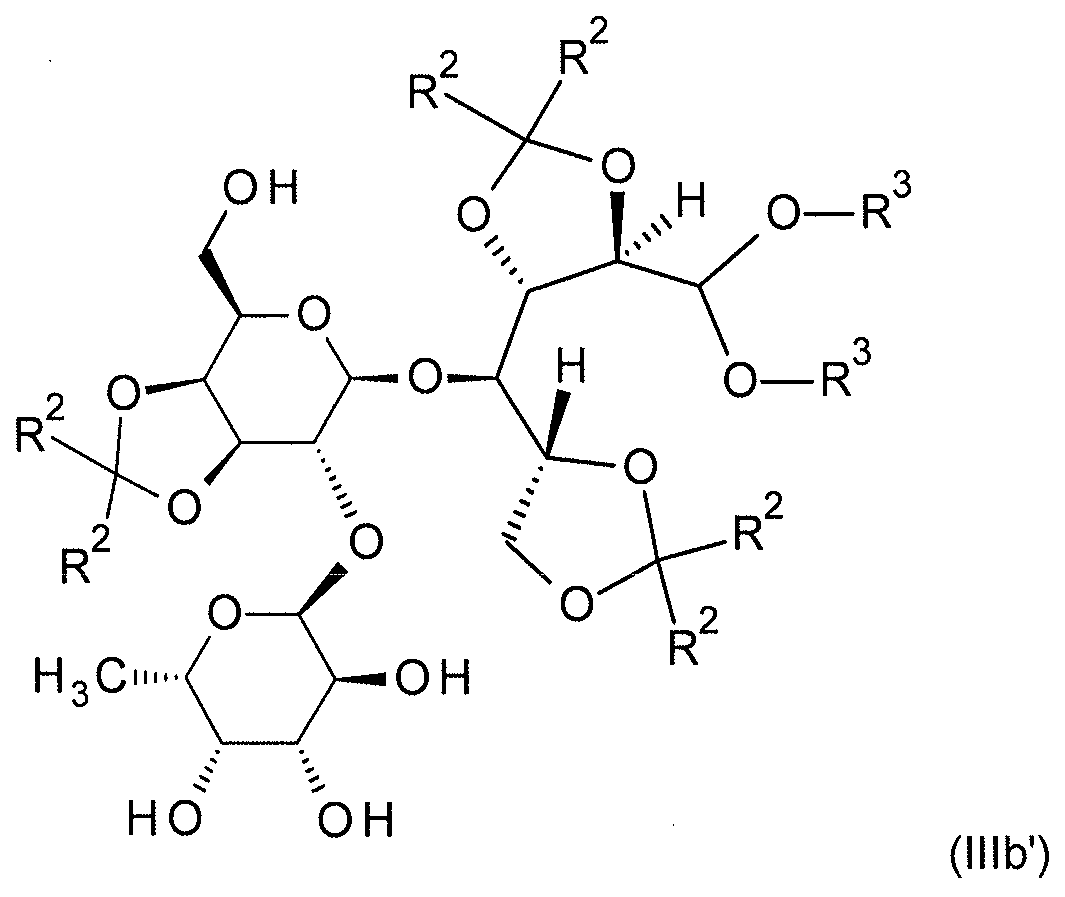
이후, 잔류 보호기가 산 존재 하에서 식 (IIIb') 의 화합물을 물로 처리함으로써 제거되거나;
또는
b.3) 식 (III) 의 화합물 (식 중, R1 은 C(O)R11 잔기임) 이 먼저 탈실릴화 시약으로 처리되고, 이때 식 (IIIc') 의 화합물이 수득되고:

이후, C(O)-R11 기 및 잔류 보호기가 연속적으로 제거되거나;
또는
b.4) 보호기 C(R2)2 및 OR3 가 먼저 식 (III) 의 화합물 (식 중, R1 은 C(O)R11 잔기임) 로부터 제거되고, 이때 식 (IV) 의 화합물이 수득되고:

이후, C(O)-R11 기가 제거되거나,
또는
b.5) 식 (III) 의 화합물 (식 중, R1 은 라디칼 C(O)-R11 임) 이 먼저 C1-C4-알칸올 및 알칼리금속 염기로 처리되어 식 (IIIb') 의 화합물을 수득하고, 이후 잔류 보호기가 산성 반응 조건 하에서 식 (IIIb') 의 화합물을 처리함으로써 제거되는 방법. 14. The process according to any one of claims 1 to 13, wherein in step b):
b.1) treating the compound of formula (III) with water in the presence of an acid;
or
b.2) Compounds of formula (III) wherein R 1 is SiR 12 R 13 R 14 residue are first treated with a desilylation reagent, wherein a compound of formula (IIIb ') is obtained:
The residual protecting group is then removed by treating the compound of formula (IIIb ') with water in the presence of acid;
or
b.3) Compounds of formula (III) wherein R 1 is C (O) R 11 residue are first treated with a desilylation reagent, wherein a compound of formula (IIIc ') is obtained:
Then the C (O) -R < 11 > group and the residual protecting group are removed continuously;
or
b.4) the protecting groups C (R 2 ) 2 and OR 3 are first removed from a compound of formula (III) wherein R 1 is C (O) R 11 residue, wherein the compound of formula (IV) Lt; / RTI >
The C (O) -R < 11 > group is then removed,
or
b.5) The compound of formula (III) (wherein R 1 is a radical C (O) -R 11 ) is first treated with a C 1 -C 4 -alkanol and an alkali metal base to form a compound of formula To obtain a compound, and then the remaining protecting group is removed by treating the compound of formula (IIIb ') under acidic reaction conditions.

[식 중,
R1a 는 SiR12R13R14 잔기 (이때,
R12, R13 및 R14 은 동일 또는 상이하고, C1-C8-알킬, C3-C8-시클로알킬, 페닐 및 C3-C8-시클로알킬-C1-C4-알킬로부터 선택됨) 이고;
R2 는 동일 또는 상이할 수 있고, C1-C8-알킬이거나, 동일한 탄소 원자에 부착되어 있는 2 개의 R2 잔기가 함께 선형 C3-C6-알칸디일 (이는 미치환되거나 치환기로서 1 내지 6 개의 메틸기를 가짐) 을 형성하고;
R3 는 동일 또는 상이할 수 있고, C1-C8-알킬이거나, 함께 선형 C1-C4-알칸디일 (이는 미치환되거나 치환기로서 1 내지 6 개의 메틸기를 가짐) 을 형성하고;
R4 는 동일 또는 상이하고, 수소이거나 SiRaRbRc 잔기 (이때,
Ra, Rb 및 Rc 는 동일 또는 상이하고, C1-C8-알킬, C3-C8-시클로알킬, 페닐 및 C3-C8-시클로알킬-C1-C4-알킬로부터 선택됨) 임].A compound of formula (IIIa): < EMI ID =
[Wherein,
R 1a is an SiR 12 R 13 R 14 residue,
R 12 , R 13 and R 14 are identical or different and are selected from C 1 -C 8 -alkyl, C 3 -C 8 -cycloalkyl, phenyl and C 3 -C 8 -cycloalkyl-C 1 -C 4 -alkyl Selected);
R 2 may be the same or different and is C 1 -C 8 -alkyl, or two R 2 moieties attached to the same carbon atom together form a linear C 3 -C 6 -alkanediyl, which is unsubstituted or substituted as a substituent Having from 1 to 6 methyl groups;
R 3 can be the same or different and are C 1 -C 8 -alkyl or together form a linear C 1 -C 4 -alkanediyl, which is unsubstituted or has 1 to 6 methyl groups as substituents;
R 4 are the same or different, hydrogen or SiR a R b R c moiety (wherein,
R a , R b and R c are the same or different and are selected from C 1 -C 8 -alkyl, C 3 -C 8 -cycloalkyl, phenyl and C 3 -C 8 -cycloalkyl-C 1 -C 4 -alkyl Selected).

[식 중,
R2 는 동일 또는 상이할 수 있고, C1-C8-알킬이거나, 동일한 탄소 원자에 부착되어 있는 2 개의 R2 잔기가 함께 선형 C3-C6-알칸디일 (이는 미치환되거나 치환기로서 1 내지 6 개의 메틸기를 가짐) 을 형성하고;
R3 는 동일 또는 상이할 수 있고, C1-C8-알킬이거나, 함께 선형 C1-C4-알칸디일 (이는 미치환되거나 치환기로서 1 내지 6 개의 메틸기를 가짐) 을 형성하고;
R4 는 동일 또는 상이하고, 수소이거나 SiRaRbRc 잔기 (이때,
Ra, Rb 및 Rc 는 동일 또는 상이하고, C1-C8-알킬, C3-C8-시클로알킬, 페닐 및 C3-C8-시클로알킬-C1-C4-알킬로부터 선택됨) 임].The compound of formula (IIIb)
[Wherein,
R 2 may be the same or different and is C 1 -C 8 -alkyl, or two R 2 moieties attached to the same carbon atom together form a linear C 3 -C 6 -alkanediyl, which is unsubstituted or substituted as a substituent Having from 1 to 6 methyl groups;
R 3 can be the same or different and are C 1 -C 8 -alkyl or together form a linear C 1 -C 4 -alkanediyl, which is unsubstituted or has 1 to 6 methyl groups as substituents;
R 4 are the same or different, hydrogen or SiR a R b R c moiety (wherein,
R a , R b and R c are the same or different and are selected from C 1 -C 8 -alkyl, C 3 -C 8 -cycloalkyl, phenyl and C 3 -C 8 -cycloalkyl-C 1 -C 4 -alkyl Selected).
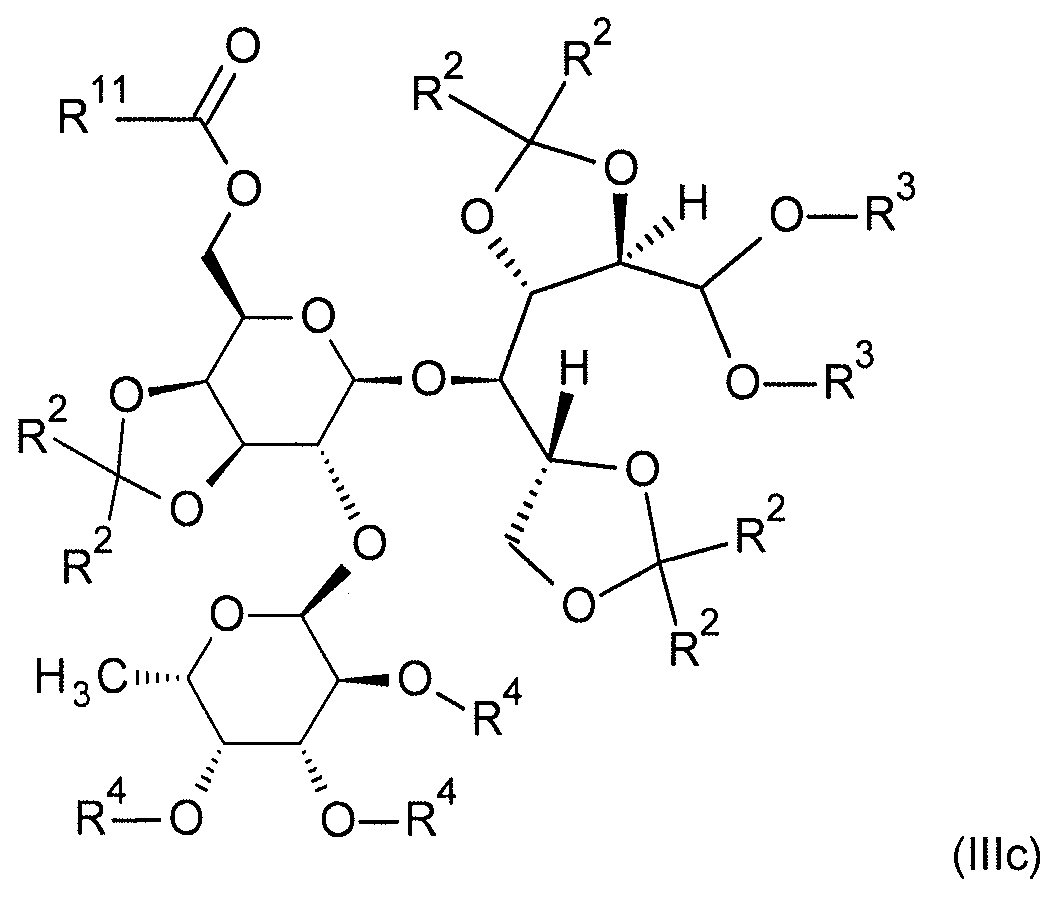
[식 중,
R11 은 수소, C1-C8-알킬, C1-C8-할로알킬, C3-C8-시클로알킬, C3-C8-시클로알킬-C1-C4-알킬이거나 페닐 (이때, 상기 페닐은 미치환되거나 임의로 할로겐, CN, NO2, C1-C4-알킬, C1-C4-알콕시, C1-C4-할로알킬 및 C1-C4-할로알콕시로부터 선택되는 1 내지 5 개의 치환기를 가짐) 이고;
R2 는 동일 또는 상이할 수 있고, C1-C8-알킬이거나, 동일한 탄소 원자에 부착되어 있는 2 개의 R2 잔기가 함께 선형 C3-C6-알칸디일 (이는 미치환되거나 치환기로서 1 내지 6 개의 메틸기를 가짐) 을 형성하고;
R3 는 동일 또는 상이할 수 있고, C1-C8-알킬이거나, 함께 선형 C1-C4-알칸디일 (이는 미치환되거나 치환기로서 1 내지 6 개의 메틸기를 가짐) 을 형성하고;
R4 는 동일 또는 상이하고, 수소이거나 SiRaRbRc 잔기 (이때, Ra, Rb 및 Rc 는 동일 또는 상이하고, C1-C8-알킬, C3-C8-시클로알킬, 페닐 및 C3-C8-시클로알킬-C1-C4-알킬로부터 선택됨) 임].The compound of formula (IIIc):
[Wherein,
R 11 is hydrogen, C 1 -C 8 -alkyl, C 1 -C 8 -haloalkyl, C 3 -C 8 -cycloalkyl, C 3 -C 8 -cycloalkyl-C 1 -C 4 -alkyl or phenyl Wherein said phenyl is unsubstituted or optionally substituted with one or more substituents selected from halogen, CN, NO 2 , C 1 -C 4 -alkyl, C 1 -C 4 -alkoxy, C 1 -C 4 -haloalkyl and C 1 -C 4 -haloalkoxy Having from 1 to 5 substituents selected;
R 2 may be the same or different and is C 1 -C 8 -alkyl, or two R 2 moieties attached to the same carbon atom together form a linear C 3 -C 6 -alkanediyl, which is unsubstituted or substituted as a substituent Having from 1 to 6 methyl groups;
R 3 can be the same or different and are C 1 -C 8 -alkyl or together form a linear C 1 -C 4 -alkanediyl, which is unsubstituted or has 1 to 6 methyl groups as substituents;
R 4 are the same or different and are hydrogen or SiR a R b R c moieties wherein R a , R b and R c are the same or different and are C 1 -C 8 -alkyl, C 3 -C 8 -cycloalkyl , Phenyl and C 3 -C 8 -cycloalkyl-C 1 -C 4 -alkyl.

[식 중,
R1a 는 SiR12R13R14 잔기 (이때, R12, R13 및 R14 은 동일 또는 상이하고, C1-C8-알킬, C3-C8-시클로알킬, 페닐 및 C3-C8-시클로알킬-C1-C4-알킬로부터 선택됨) 이고;
R2 는 동일 또는 상이할 수 있고, C1-C8-알킬이거나, 동일한 탄소 원자에 부착되어 있는 2 개의 R2 잔기가 함께 선형 C3-C6-알칸디일 (이는 미치환되거나 치환기로서 1 내지 6 개의 메틸기를 가짐) 을 형성하고;
R3 는 동일 또는 상이할 수 있고, C1-C8-알킬이거나, 함께 선형 C1-C4-알칸디일 (이는 미치환되거나 치환기로서 1 내지 6 개의 메틸기를 가짐) 을 형성함].R 1a is tert-butyldimethylsilyl, and the compound represented by the general formula (IIa) R 2 and R 3 are both methyl, except the compound of the formula (IIa).:
[Wherein,
R 1a is a SiR 12 R 13 R 14 moiety wherein R 12 , R 13 and R 14 are the same or different and are C 1 -C 8 -alkyl, C 3 -C 8 -cycloalkyl, phenyl and C 3 -C 8 8 -cycloalkyl-C 1 -C 4 -alkyl;
R 2 may be the same or different and is C 1 -C 8 -alkyl, or two R 2 moieties attached to the same carbon atom together form a linear C 3 -C 6 -alkanediyl, which is unsubstituted or substituted as a substituent Having from 1 to 6 methyl groups;
R 3 can be the same or different and are C 1 -C 8 -alkyl or together form a linear C 1 -C 4 -alkanediyl which is unsubstituted or has 1 to 6 methyl groups as substituents.
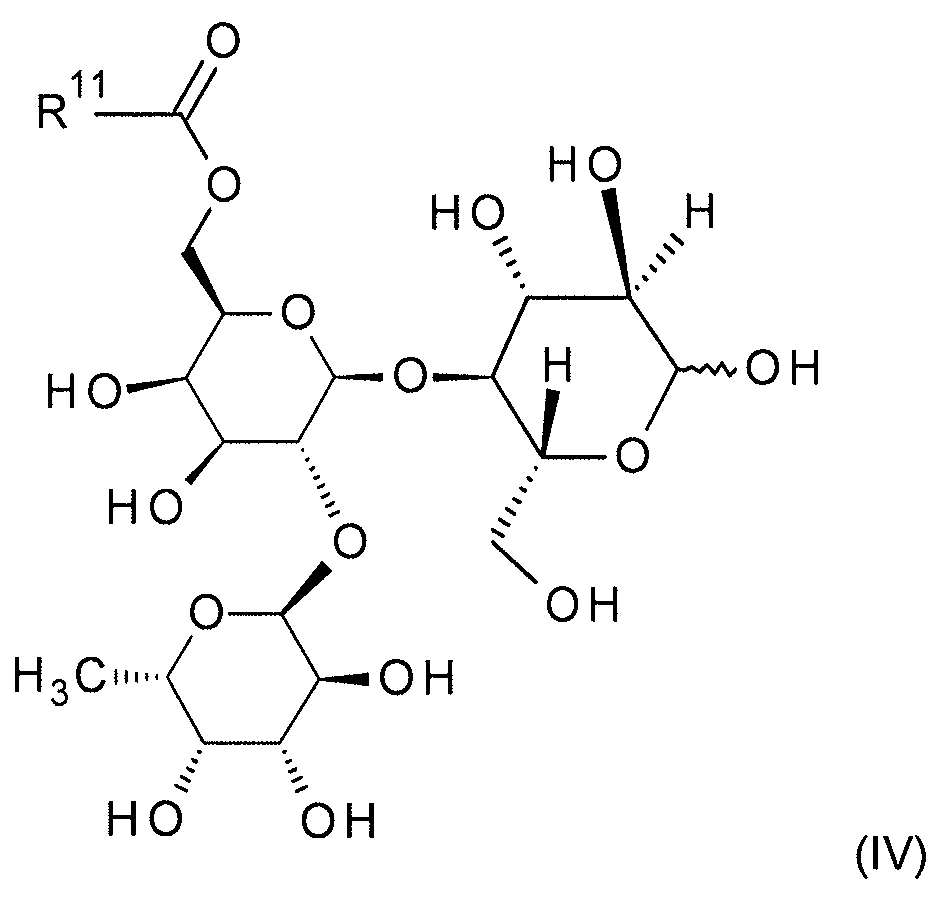
[식 중,
R11 은 수소, C2-C8-알킬, C1-C8-할로알킬, C3-C8-시클로알킬, C3-C8-시클로알킬-C1-C4-알킬이거나 페닐 (이때, 상기 페닐은 미치환되거나 임의로 할로겐, CN, NO2, C1-C4-알킬, C1-C4-알콕시, C1-C4-할로알킬 및 C1-C4-할로알콕시로부터 선택되는 1 내지 5 개의 치환기를 가짐) 임].The compound of formula (IV)
[Wherein,
R 11 is hydrogen, C 2 -C 8 -alkyl, C 1 -C 8 -haloalkyl, C 3 -C 8 -cycloalkyl, C 3 -C 8 -cycloalkyl-C 1 -C 4 -alkyl or phenyl Wherein said phenyl is unsubstituted or optionally substituted with one or more substituents selected from halogen, CN, NO 2 , C 1 -C 4 -alkyl, C 1 -C 4 -alkoxy, C 1 -C 4 -haloalkyl and C 1 -C 4 -haloalkoxy Having from 1 to 5 substituents selected.
Applications Claiming Priority (3)
| Application Number | Priority Date | Filing Date | Title |
|---|---|---|---|
| EP14184606.3 | 2014-09-12 | ||
| EP14184606 | 2014-09-12 | ||
| PCT/EP2015/070844 WO2016038192A1 (en) | 2014-09-12 | 2015-09-11 | Method for preparing 2'-o-fucosyllactose |
Publications (1)
| Publication Number | Publication Date |
|---|---|
| KR20170052631A true KR20170052631A (en) | 2017-05-12 |
Family
ID=51687775
Family Applications (1)
| Application Number | Title | Priority Date | Filing Date |
|---|---|---|---|
| KR1020177009260A Withdrawn KR20170052631A (en) | 2014-09-12 | 2015-09-11 | Method for producing 2'-O-fucosyllactose |
Country Status (14)
| Country | Link |
|---|---|
| US (1) | US11098075B2 (en) |
| EP (1) | EP3191498B1 (en) |
| JP (1) | JP6637492B2 (en) |
| KR (1) | KR20170052631A (en) |
| CN (1) | CN106795193B (en) |
| AU (1) | AU2015314165B2 (en) |
| BR (1) | BR112017004667A2 (en) |
| CA (1) | CA2960056A1 (en) |
| CR (1) | CR20170134A (en) |
| DK (1) | DK3191498T3 (en) |
| HU (1) | HUE051855T2 (en) |
| IL (1) | IL250682A0 (en) |
| MX (1) | MX2017003238A (en) |
| WO (1) | WO2016038192A1 (en) |
Families Citing this family (10)
| Publication number | Priority date | Publication date | Assignee | Title |
|---|---|---|---|---|
| DK3274465T3 (en) | 2015-03-26 | 2022-10-24 | Basf Se | BIOCATALYTIC PRODUCTION OF L-FUCOSE |
| JP6741687B2 (en) | 2015-05-04 | 2020-08-19 | ビーエーエスエフ ソシエタス・ヨーロピアBasf Se | How to prepare melon |
| MX2018009515A (en) * | 2016-02-03 | 2018-09-05 | Basf Se | Process for producing 2'-o-fucosyllactose. |
| EP3816297A1 (en) | 2016-02-19 | 2021-05-05 | Basf Se | Biocatalytic cyclising polyunsaturated carboxylic acid compounds |
| WO2017211784A1 (en) | 2016-06-07 | 2017-12-14 | Basf Se | Process for preparing 2,3-unsaturated alcohols |
| JP7039498B2 (en) | 2016-06-29 | 2022-03-22 | ビーエーエスエフ ソシエタス・ヨーロピア | Method for producing alpha and beta unsaturated aldehyde by oxidation of alcohol in the presence of liquid phase |
| ES3060113T3 (en) * | 2016-08-31 | 2026-03-25 | Oligoscience Biotechnology Gmbh | Milk replacer composition comprising 2'-fucosyllactose for use in the treatment or prevention of gastro-intestinal diseases of production animals |
| AU2019362595B2 (en) | 2018-10-18 | 2024-12-19 | Basf Se | Crystalline form II of 2'-O-fucosyllactose, process for its preparation, nutritional, cosmetic or pharmaceutical formulation containing the same |
| CN115279778B (en) | 2020-03-12 | 2025-06-24 | 格礼卡姆股份公司 | Crystallization of 2’-FL |
| WO2024038195A1 (en) * | 2022-08-19 | 2024-02-22 | Dsm Ip Assets B.V. | Synthesis of hmo propionate |
Family Cites Families (7)
| Publication number | Priority date | Publication date | Assignee | Title |
|---|---|---|---|---|
| US5438124A (en) | 1991-07-16 | 1995-08-01 | Health Research, Inc. | Glycosylating reagent for the synthesis of linear and other α-L-fucosyl oligosaccharides |
| IT1392456B1 (en) * | 2008-12-18 | 2012-03-09 | Inalco Spa | PROCESS FOR THE SYNTHESIS OF L-PHUCOSILATED OLIGOSACCHARIDES AND THEIR NEW INTERMEDIATES 2,3,4-TRIBENZYL-FUCHOSIL-DERIVATIVES. |
| CN102459294A (en) * | 2009-04-07 | 2012-05-16 | 格礼卡姆股份公司 | Synthesis of 2' -O-fucosyllactose |
| WO2012113404A1 (en) | 2011-02-21 | 2012-08-30 | Glycom A/S | Novel glycosyl phosphites |
| WO2012158517A1 (en) * | 2011-05-13 | 2012-11-22 | Glycosyn LLC | The use of purified 2'-fucosyllactose, 3-fucosyllactose and lactodifucotetraose as prebiotics |
| GB201111263D0 (en) | 2011-07-01 | 2011-08-17 | Nat Univ Ireland | Multivalent oligosaccharides |
| WO2013048294A1 (en) | 2011-09-30 | 2013-04-04 | Volvo Technology Corporation | Exhaust gas after treatment system comprising multiple catalytic objects |
-
2015
- 2015-09-11 CN CN201580048101.9A patent/CN106795193B/en active Active
- 2015-09-11 HU HUE15763307A patent/HUE051855T2/en unknown
- 2015-09-11 EP EP15763307.4A patent/EP3191498B1/en active Active
- 2015-09-11 MX MX2017003238A patent/MX2017003238A/en unknown
- 2015-09-11 WO PCT/EP2015/070844 patent/WO2016038192A1/en not_active Ceased
- 2015-09-11 CR CR20170134A patent/CR20170134A/en unknown
- 2015-09-11 CA CA2960056A patent/CA2960056A1/en not_active Abandoned
- 2015-09-11 KR KR1020177009260A patent/KR20170052631A/en not_active Withdrawn
- 2015-09-11 DK DK15763307.4T patent/DK3191498T3/en active
- 2015-09-11 US US15/510,268 patent/US11098075B2/en active Active
- 2015-09-11 AU AU2015314165A patent/AU2015314165B2/en not_active Ceased
- 2015-09-11 BR BR112017004667A patent/BR112017004667A2/en not_active IP Right Cessation
- 2015-09-11 JP JP2017513743A patent/JP6637492B2/en active Active
-
2017
- 2017-02-20 IL IL250682A patent/IL250682A0/en unknown
Also Published As
| Publication number | Publication date |
|---|---|
| CN106795193A (en) | 2017-05-31 |
| EP3191498A1 (en) | 2017-07-19 |
| JP6637492B2 (en) | 2020-01-29 |
| JP2017534575A (en) | 2017-11-24 |
| MX2017003238A (en) | 2017-06-29 |
| CR20170134A (en) | 2017-06-13 |
| CN106795193B (en) | 2021-02-26 |
| IL250682A0 (en) | 2017-04-30 |
| BR112017004667A2 (en) | 2018-01-30 |
| AU2015314165B2 (en) | 2019-06-06 |
| WO2016038192A1 (en) | 2016-03-17 |
| DK3191498T3 (en) | 2020-12-21 |
| CA2960056A1 (en) | 2016-03-17 |
| AU2015314165A1 (en) | 2017-03-16 |
| US20180230176A1 (en) | 2018-08-16 |
| EP3191498B1 (en) | 2020-09-30 |
| HUE051855T2 (en) | 2021-03-29 |
| US11098075B2 (en) | 2021-08-24 |
Similar Documents
| Publication | Publication Date | Title |
|---|---|---|
| KR20170052631A (en) | Method for producing 2'-O-fucosyllactose | |
| AU596644B2 (en) | C(29)-carbonyloxymilbemycin derivatives for controlling parasitic pests of animals and plants | |
| EP2417143B1 (en) | Synthesis of 2'-o-fucosyllactose | |
| US8450293B2 (en) | Synthesis and characterization of C8 analogs of c-di-GMP | |
| US11365211B2 (en) | Stereoselective synthesis and process for the manufacturing of 2′-deoxynucleosides | |
| KR20180104751A (en) | Method for producing 2'-O-fucosyllactose | |
| WO2017153452A1 (en) | Method for preparing 2'-o-fucosyllactose | |
| JP4773336B2 (en) | Reagents and methods for the preparation of LPS antagonist B1287 and its stereoisomers | |
| WO2007099392A2 (en) | Convergent synthesis of carbohydrate building blocks | |
| US5342929A (en) | Process for the preparation of glycosides | |
| JPH04352794A (en) | Avermectin derivative containing spacer inserted between disaccharide and aglycon useful as antiparasitic | |
| JP4762973B2 (en) | Method for producing 1,2-transglycoside compound | |
| Pavashe et al. | Methyl 3, 4, 6-tri-O-acetyl-2-deoxy-2-[(bis-methoxycarbonyl) methyl]-β-d-glucopyranoside | |
| JP2002511478A (en) | Method of synthesizing laminaribiose | |
| Pavashe et al. | acetyl-2-deoxy-2-[(bis-methoxycarbonyl) methyl]-β-D-glucopyranoside | |
| Stoelting et al. | The synthesis and properties of new carbohydrate‐modified mesoionic thiazolo [3, 2‐α] pyrimidine‐5, 7‐dione acyclonucleosides | |
| CN102099366A (en) | Crystalline Sugar Derivatives | |
| JPS6152152B2 (en) | ||
| CS259423B1 (en) | Process for preparing 3-phenoxybenzaldehyde bisulfite derivatives |
Legal Events
| Date | Code | Title | Description |
|---|---|---|---|
| PA0105 | International application |
Patent event date: 20170405 Patent event code: PA01051R01D Comment text: International Patent Application |
|
| PG1501 | Laying open of application | ||
| PC1203 | Withdrawal of no request for examination |