KR20170052684A - Pharmaceutical compositions comprising a dextromethorphan compound and quinidine for the treatment of agitation in dementia - Google Patents
Pharmaceutical compositions comprising a dextromethorphan compound and quinidine for the treatment of agitation in dementia Download PDFInfo
- Publication number
- KR20170052684A KR20170052684A KR1020177009991A KR20177009991A KR20170052684A KR 20170052684 A KR20170052684 A KR 20170052684A KR 1020177009991 A KR1020177009991 A KR 1020177009991A KR 20177009991 A KR20177009991 A KR 20177009991A KR 20170052684 A KR20170052684 A KR 20170052684A
- Authority
- KR
- South Korea
- Prior art keywords
- quinidine
- dextromethorphan
- administered
- salts
- salt
- Prior art date
- Legal status (The legal status is an assumption and is not a legal conclusion. Google has not performed a legal analysis and makes no representation as to the accuracy of the status listed.)
- Ceased
Links
Images


Classifications
-
- A—HUMAN NECESSITIES
- A61—MEDICAL OR VETERINARY SCIENCE; HYGIENE
- A61K—PREPARATIONS FOR MEDICAL, DENTAL OR TOILETRY PURPOSES
- A61K31/00—Medicinal preparations containing organic active ingredients
- A61K31/33—Heterocyclic compounds
- A61K31/395—Heterocyclic compounds having nitrogen as a ring hetero atom, e.g. guanethidine or rifamycins
- A61K31/435—Heterocyclic compounds having nitrogen as a ring hetero atom, e.g. guanethidine or rifamycins having six-membered rings with one nitrogen as the only ring hetero atom
- A61K31/47—Quinolines; Isoquinolines
- A61K31/485—Morphinan derivatives, e.g. morphine, codeine
-
- A—HUMAN NECESSITIES
- A61—MEDICAL OR VETERINARY SCIENCE; HYGIENE
- A61K—PREPARATIONS FOR MEDICAL, DENTAL OR TOILETRY PURPOSES
- A61K31/00—Medicinal preparations containing organic active ingredients
- A61K31/33—Heterocyclic compounds
- A61K31/38—Heterocyclic compounds having sulfur as a ring hetero atom
- A61K31/381—Heterocyclic compounds having sulfur as a ring hetero atom having five-membered rings
-
- A—HUMAN NECESSITIES
- A61—MEDICAL OR VETERINARY SCIENCE; HYGIENE
- A61K—PREPARATIONS FOR MEDICAL, DENTAL OR TOILETRY PURPOSES
- A61K31/00—Medicinal preparations containing organic active ingredients
- A61K31/33—Heterocyclic compounds
- A61K31/395—Heterocyclic compounds having nitrogen as a ring hetero atom, e.g. guanethidine or rifamycins
- A61K31/435—Heterocyclic compounds having nitrogen as a ring hetero atom, e.g. guanethidine or rifamycins having six-membered rings with one nitrogen as the only ring hetero atom
- A61K31/44—Non condensed pyridines; Hydrogenated derivatives thereof
- A61K31/445—Non condensed piperidines, e.g. piperocaine
- A61K31/4523—Non condensed piperidines, e.g. piperocaine containing further heterocyclic ring systems
- A61K31/4525—Non condensed piperidines, e.g. piperocaine containing further heterocyclic ring systems containing a five-membered ring with oxygen as a ring hetero atom
-
- A—HUMAN NECESSITIES
- A61—MEDICAL OR VETERINARY SCIENCE; HYGIENE
- A61K—PREPARATIONS FOR MEDICAL, DENTAL OR TOILETRY PURPOSES
- A61K31/00—Medicinal preparations containing organic active ingredients
- A61K31/33—Heterocyclic compounds
- A61K31/395—Heterocyclic compounds having nitrogen as a ring hetero atom, e.g. guanethidine or rifamycins
- A61K31/435—Heterocyclic compounds having nitrogen as a ring hetero atom, e.g. guanethidine or rifamycins having six-membered rings with one nitrogen as the only ring hetero atom
- A61K31/47—Quinolines; Isoquinolines
- A61K31/49—Cinchonan derivatives, e.g. quinine
-
- A—HUMAN NECESSITIES
- A61—MEDICAL OR VETERINARY SCIENCE; HYGIENE
- A61K—PREPARATIONS FOR MEDICAL, DENTAL OR TOILETRY PURPOSES
- A61K9/00—Medicinal preparations characterised by special physical form
- A61K9/20—Pills, tablets, discs, rods
- A61K9/2004—Excipients; Inactive ingredients
-
- A—HUMAN NECESSITIES
- A61—MEDICAL OR VETERINARY SCIENCE; HYGIENE
- A61K—PREPARATIONS FOR MEDICAL, DENTAL OR TOILETRY PURPOSES
- A61K9/00—Medicinal preparations characterised by special physical form
- A61K9/48—Preparations in capsules, e.g. of gelatin, of chocolate
- A61K9/4841—Filling excipients; Inactive ingredients
- A61K9/4866—Organic macromolecular compounds
-
- A—HUMAN NECESSITIES
- A61—MEDICAL OR VETERINARY SCIENCE; HYGIENE
- A61P—SPECIFIC THERAPEUTIC ACTIVITY OF CHEMICAL COMPOUNDS OR MEDICINAL PREPARATIONS
- A61P25/00—Drugs for disorders of the nervous system
- A61P25/28—Drugs for disorders of the nervous system for treating neurodegenerative disorders of the central nervous system, e.g. nootropic agents, cognition enhancers, drugs for treating Alzheimer's disease or other forms of dementia
-
- C—CHEMISTRY; METALLURGY
- C07—ORGANIC CHEMISTRY
- C07D—HETEROCYCLIC COMPOUNDS
- C07D221/00—Heterocyclic compounds containing six-membered rings having one nitrogen atom as the only ring hetero atom, not provided for by groups C07D211/00 - C07D219/00
- C07D221/02—Heterocyclic compounds containing six-membered rings having one nitrogen atom as the only ring hetero atom, not provided for by groups C07D211/00 - C07D219/00 condensed with carbocyclic rings or ring systems
- C07D221/22—Bridged ring systems
- C07D221/28—Morphinans
-
- A—HUMAN NECESSITIES
- A61—MEDICAL OR VETERINARY SCIENCE; HYGIENE
- A61K—PREPARATIONS FOR MEDICAL, DENTAL OR TOILETRY PURPOSES
- A61K2300/00—Mixtures or combinations of active ingredients, wherein at least one active ingredient is fully defined in groups A61K31/00 - A61K41/00
-
- A—HUMAN NECESSITIES
- A61—MEDICAL OR VETERINARY SCIENCE; HYGIENE
- A61K—PREPARATIONS FOR MEDICAL, DENTAL OR TOILETRY PURPOSES
- A61K9/00—Medicinal preparations characterised by special physical form
- A61K9/48—Preparations in capsules, e.g. of gelatin, of chocolate
- A61K9/4841—Filling excipients; Inactive ingredients
- A61K9/485—Inorganic compounds
-
- A—HUMAN NECESSITIES
- A61—MEDICAL OR VETERINARY SCIENCE; HYGIENE
- A61K—PREPARATIONS FOR MEDICAL, DENTAL OR TOILETRY PURPOSES
- A61K9/00—Medicinal preparations characterised by special physical form
- A61K9/48—Preparations in capsules, e.g. of gelatin, of chocolate
- A61K9/4841—Filling excipients; Inactive ingredients
- A61K9/4858—Organic compounds
Landscapes
- Health & Medical Sciences (AREA)
- Chemical & Material Sciences (AREA)
- Medicinal Chemistry (AREA)
- Pharmacology & Pharmacy (AREA)
- Life Sciences & Earth Sciences (AREA)
- Animal Behavior & Ethology (AREA)
- General Health & Medical Sciences (AREA)
- Public Health (AREA)
- Veterinary Medicine (AREA)
- Epidemiology (AREA)
- Bioinformatics & Cheminformatics (AREA)
- Engineering & Computer Science (AREA)
- Biomedical Technology (AREA)
- Neurology (AREA)
- Neurosurgery (AREA)
- Organic Chemistry (AREA)
- Emergency Medicine (AREA)
- Psychiatry (AREA)
- Chemical Kinetics & Catalysis (AREA)
- General Chemical & Material Sciences (AREA)
- Nuclear Medicine, Radiotherapy & Molecular Imaging (AREA)
- Hospice & Palliative Care (AREA)
- Inorganic Chemistry (AREA)
- Pharmaceuticals Containing Other Organic And Inorganic Compounds (AREA)
- Medicinal Preparation (AREA)
Abstract
본 발명은 알츠하이머병 관련 치매를 포함하는 치매 피험자의 초조함 및/또는 공격성 및/또는 관련 증상을 치료하는 방법에 관한 것이다. 당해 방법은 상기 치료를 필요로 하는 피험자에게 퀴니딘 또는 이의 약제학적으로 허용되는 염과 조합하여 덱스트로메토르판 화합물 또는 이의 약제학적으로 허용되는 염을 투여함을 포함한다. 특정 측면에서 본 발명은 또한 알츠하이머병을 앓는 피험자의 초조함 및/또는 공격성 및/또는 관련 증상을 치료하는데 사용되는 조성물에 관한 것이다.The present invention relates to a method for treating nervous and / or aggressive and / or related symptoms of a dementia subject comprising Alzheimer's disease dementia. The method comprises administering to a subject in need of such treatment a dextromethorphan compound or a pharmaceutically acceptable salt thereof in combination with quinidine or a pharmaceutically acceptable salt thereof. In particular aspects, the invention also relates to a composition for use in treating anxiety and / or aggression and / or related symptoms of a subject suffering from Alzheimer's disease.
Description
우선권preference
본 출원은 2014년 9월 14일자로 출원된 미국 가특허원 제62/050,170호; 2014년 10월 8일자로 출원된 제62/061,451호; 2014년 10월 13일자로 출원된 제62/063,122호; 2014년 10월 14일자로 출원된 제62/063,861호; 2014년 10월 26일자로 출원된 제62/068,742호; 2015년 2월 2일자로 출원된 제62/111,053호; 2015년 2월 3일자로 출원된 제62/111,590호; 2015년 3월 4일자로 출원된 제62/128,446호; 2015년 5월 15일자로 출원된 제62/162,140호; 2015년 5월 22일자로 출원된 제62/165,535호; 2015년 6월 2일자로 출원된 제62/169,997호; 2015년 6월 15일자로 출원된 제62/180,026호; 2015년 7월 16일자로 출원된 제62/193,347호; 2015년 8월 14일자로 출원된 제62/205,061호; 2015년 9월 10일자로 출원된 제62/216,636호; 2015년 9월 11일자로 출원된 제62/217,142호; 및 2015년 9월 11일자로 출원된 제62/217,470호의 이익을 주장하며, 이들의 전문은 본원 명세서에 참조로 인용된다.This application claims priority from US Provisional Patent Application No. 62 / 050,170, filed September 14, 2014; 62 / 061,451, filed October 8, 2014; 62 / 063,122, filed October 13, 2014; 62 / 063,861, filed October 14, 2014; 62 / 068,742, filed October 26, 2014; 62 / 111,053, filed February 2, 2015; 62 / 111,590, filed February 3, 2015; 62 / 128,446, filed March 4, 2015; 62 / 162,140, filed May 15, 2015; 62 / 165,535, filed May 22, 2015; 62 / 169,997, filed June 2, 2015; 62 / 180,026, filed June 15, 2015; 62 / 193,347, filed July 16, 2015; 62 / 205,061, filed August 14, 2015; 62 / 216,636, filed September 10, 2015; 62 / 217,142, filed September 11, 2015; And 62 / 217,470, filed September 11, 2015, the entire contents of which are incorporated herein by reference.
기술분야Technical field
본 발명은 알츠하이머병(Alzheimer's disease)과 같은 중추신경계(CNS) 장애와 관련된, 초조함(agitation) 및/또는 공격성(aggression) 및/또는 관련 증상과 같은 행동 장애(behavioral disorder)의 치료에 관한 것이다. 본 발명과 관련된 당해 방법은 덱스트로메토르판(dextromethorphan) 화합물을 단독으로 또는 퀴니딘(quinidine)(Q)과 같은 CYP2D6 억제제와 조합하여, 알츠하이머병과 같은 중추신경계(CNS) 장애에서 초조함 및/또는 공격성 및/또는 관련 증상을 앓는 피험자에게 투여함을 포함한다. 본 발명은 또한 덱스트로메토르판 화합물을 단독으로 또는 퀴니딘(Q)과 같은 CYP2D6 억제제와 조합하여 포함하는 약제학적 배합물(combination)에 관한 것이다.The present invention relates to the treatment of behavioral disorders such as agitation and / or aggression and / or related symptoms associated with central nervous system (CNS) disorders such as Alzheimer's disease. The method in connection with the present invention is directed to the use of a dextromethorphan compound alone or in combination with a CYP2D6 inhibitor such as quinidine (Q) in the treatment of central nervous system (CNS) disorders such as Alzheimer ' Aggressive < / RTI > and / or related symptoms. The present invention also relates to pharmaceutical combinations comprising a dextromethorphan compound either alone or in combination with a CYP2D6 inhibitor such as quinidine (Q).
알츠하이머병은 궁극적으로 사망에 이르게 하는 진행성(progressive) 신경퇴행성 질환이다. 5백4십만명의 미국인이 알츠하이머병을 앓고 있는 것으로 추정된다. 이 숫자는 1980년에서부터 2배로 증가하였으며 2050년까지 1천 6백만명 만큼 많아질 것으로 예상된다(Brookmeyer et al., Alzheimers Dement. 2011;7(1):61-73). 65세가 넘는 미국 성인들 중, 치매(dementia)의 유병율 추정치는 5% 내지 15% 범위이며, 알츠하이머병이 가장 흔한 유형의 치매이다(Kaplan and Sadock's Synopsis of Psychiatry: Behavioral Sciences, 1998; Evans et al., JAMA. 1989;262(18):2551-6; Losonczy et al., Public Health Reports., 1998;113:273-80).Alzheimer's disease is a progressive neurodegenerative disease that ultimately leads to death. It is estimated that 5.4 million Americans suffer from Alzheimer's disease. This number has doubled since 1980 and is expected to be as high as 16 million by 2050 (Brookmeyer et al., 2011; 7 (1): 61-73). Among American adults over 65 years of age, the prevalence estimate for dementia ranges from 5% to 15%, and Alzheimer's disease is the most common type of dementia (Kaplan and Sadock's Synopsis of Psychiatry: Behavioral Sciences, 1998; Evans et al. , JAMA 1989; 262 (18): 2551-6; Losonczy et al., Public Health Reports., 1998; 113: 273-80).
초조함은 AD의 일반적이고 중요한 임상적 특징이며 치매의 다른 형태인 것으로 널리 인정되고 있다(Ballard CG et al., Nat Rev Neurol. 2009;5(5):245-255). 임상의와 간병인이 용이하게 인정하기는 하지만, 치매에서 초조함의 합의 정의(consensus definition)는 국제 노인 정신의학회(International Psychogeriatric Association)(IPA) 초조함 정의 작업 그룹(Agitation Definition Working Group)(ADWG)에 의해 다음과 같은 기준으로 최근에야 개발되었다: "1) 인지 장애(cognitive impairment) 또는 치매 증후군 환자에서 발생(occurring); 2) 정신적 고통(emotional distress)과 일치하는 행동을 보임; 3) 과도한 운동 활동, 언어적 또는 신체적 공격성의 발현(manifesting); 및 4) 관계 및/또는 일상 활동을 손상시키는 과도한 장애(disability)를 초래하며 전적으로 다른 장애(정신과적, 내과적, 또는 물질-관련)에 기인한 것은 아닌 행동의 증거"(Cummings J et al., Int. Psychogeriatr. 2014:1-11). 초조함 및/또는 공격성은 치매 환자의 대략 80%까지 영향을 미칠 것으로 예상되며(Ryu S-H et al., Am J Geriatr Psychiatry. 2005;13(11):976-983; Tractenberg RE et al., J Geriatr psychiatry Neurol. 2003;16(2):94-99) 상기 질환이 진행됨에 따라 유병율은 증가한다.Nervousness is a common and important clinical feature of AD and is widely recognized as another form of dementia (Ballard CG et al., Nat Rev Neurol. 2009; 5 (5): 245-255). The consensus definition of nervousness in dementia, although readily recognized by clinicians and caregivers, is described by the International Psychogeriatric Association (IPA) Agitation Definition Working Group (ADWG) It has only recently been developed on the basis of the following: 1) occurrence in cognitive impairment or dementia syndrome, 2) behavior consistent with emotional distress, 3) Manifestation of verbal or physical aggression; and 4) disability leading to impairment of relationships and / or daily activities, and attributable solely to other disabilities (psychiatric, medical, or substance-related) (Cummings J et al., Int. Psychogeriatr. 2014: 1-11). It is expected that anxiety and / or aggression will affect up to 80% of demented patients (Ryu SH et al., Am J Geriatr Psychiatry 2005; 13 (11): 976-983; Tractenberg RE et al., J Geriatr Psychiatry Neurol 2003; 16 (2): 94-99). As the disease progresses, the prevalence rate increases.
치매 환자의 초조함은 기능 장애(functional disability)의 증가(Rabins P V et al., Alzheimer's Dement. 2013;9(2):204-207), 삶의 질의 악화(Gonzalez-Salvador T et al., Int J Geriatr Psychiatry. 2000;15(2):181-189), 조기 제도화(institutionalization)(Steele C et al., Am J Psychiatry. 1990;147(8):1049-1051), 간병인 부담의 증가(Rabins P V et al., Alzheimer's Dement. 2013;9(2):204-207), 의료비의 증가(Murman DL et al., Neurology. 2002;59(11):1721-1729), 중증 치매로의 단축된 시간(Peters ME et al., Am J Geriatr Psychiatry. 2014;22(3):S65-S66), 및 가속된 사망율(Peters ME et al., Am J Geriatr Psychiatry. 2014;22(3):S65-S66)과 관련된다. 이러한 이유로, 초조함 및 공격성은 알츠하이머 환자에 대한 약리학적 개입을 요구할 가능성이 가장 높은 신경정신병 증상이다(Ballard CG et al., Nat Rev Neurol. 2009;5(5):245-255).Alzheimer's Dement. 2013; 9 (2): 204-207), deterioration of quality of life (Gonzalez-Salvador T et al., Int J (1986), "The Role of Caregivers", Journal of Psychiatry, 5 (2): 181-189), early institutionalization (Steele et al., Am J Psychiatry 1990; (2): 204-207), increased medical costs (Murman DL et al., Neurology 2002; 59 (11): 1721-1729), shortened time to severe dementia (Peters ME et al., Am J Geriatr Psychiatry. 2014; 22 (3): S65-S66), and accelerated mortality (Peters ME et al., Am J Geriatr Psychiatry. ). For this reason, nervousness and aggression are the most likely neuropsychiatric symptoms that require pharmacological intervention in Alzheimer's patients (Ballard CG et al., Nat Rev Neurol. 2009; 5 (5): 245-255).
그러나, AD에서의 초조함에 대한 FDA-승인된 약리학적 치료는 현재 존재하지 않으며, 임상의는 궁극적으로 증상들을 제어하기 위한 시도로 항정신병제(antipsychotics), 진정제(sedatives)/수면제(hypnotics), 항불안제(anxiolytics), 및 항우울제(antidepressants)의 허가외(off-label) 사용에 의존하게 된다(Maher AR et al. JAMA. 2011;306(12):1359-1369). 불행하게도, 이들 치료는, 비교적 불량한 순응성(adherence), 안전성(safety), 및 내약성(tolerability)에 의해 상쇄되는 보통의 효능(modest efficacy)을 감안하면 유용성이 제한적이다(Ballard CG et al., Nat Rev Neurol. 2009;5(5):245-255; Schneider LS et al., N Engl J Med. 2006;355(15):1525-1538; Huybrechts KF et al., BMJ 2012;344:e977). 따라서, 치매에서의 초조함을 치료하기 위한 안전하고 효과적인 약리학적 개입을 개발할 필요성이 절실하다. 이러한 치료는 환자 치료에 유의미한 영향을 끼치며 간병인 부담을 줄이고 전반적인 질환 예후를 잠재적으로 개선시킬 수 있다.However, there is currently no FDA-approved pharmacologic treatment for nervousness in AD, and the clinician is ultimately trying to control symptoms by using antipsychotics, sedatives / hypnotics, (Maher AR et al., JAMA. 2011; 306 (12): 1359-1369), as well as anxiolytics, and antidepressants. Unfortunately, these treatments have limited usefulness due to the modest efficacy that is offset by relatively poor adherence, safety, and tolerability (Ballard CG et al., Nat Rev. Neurol 2009; 5 (5): 245-255; Schneider LS et al., N Engl J Med 2006; 355 (15): 1525-1538; Huybrechts KF et al., BMJ 2012; 344: e977). Therefore, there is a pressing need to develop safe and effective pharmacological interventions for the treatment of nervousness in dementia. These treatments have a significant impact on patient care, reduce caregiver burden and potentially improve overall disease prognosis.
알츠하이머 관련된 행동 증상을 위한 미국 식품의약국(FDA)-승인된 치료가 없기 때문에, 허가외 항정신병 제제의 처방이 공격성 및 초조함과 같은 증상의 치료를 위해 일반적으로 사용되고 있다(Salzman et al., J. Clin. Psychiatry. 2008; 69(6):889-98; Levenson and Crecelius, AMDA: Publications - Caring for the Ages., 2003;4(6):31,34-35). 이례적인 항정신병제는 (6 내지 12주에 걸친) 단기간의 공격성 치료에 보통의 효과를 나타내지만, 역효과가 잠재적 효능을 상쇄하는 경향이 있기 때문에 장기간 치료요법에서는 제한된 이익만을 나타낸다(Scheider et al., N. Engl. J. Med. 2006;355(15):1525-38). 이익은, 초조함과 같은 기타 증상에서는 덜 양호하게 확립된다(Sultzer et al., Am. J. Psychiatry. 2008; 165(7):844-54). 또한, 뇌졸중(stroke) 및 사망율 증가를 포함하는 항정신적 약품 사용의 심각한 부정적인 성과 가능성에 대한 우려가 상당하다(Hybrechts et al., BMJ. 2012; 344: e977). 항정신적이지 않은(non-antipsychotic) 향정신적(psychotropic) 약품이 증상 완화 및 2차 예방 둘 다에 대해 연구되었지만 효과는 거의 없었다(Tariot et al., Arch. Gen. Psychiatry. 2011; 68(8):853-61). 따라서, 알츠하이머병 피험자의 초조함 및 공격성을 치료하기 위한 기타 약리학적 및 비약리학적 접근의 주의깊은 고려가 불가피하다(Ballard et al., Curr. Opin. Psychiatry. 2009; 22(6):532-40; Lyketsos et al., The Journal of Alzheimer's Association. 2011; 7(5):532-9).Because there is no US Food and Drug Administration (FDA) -certified treatment for Alzheimer-related behavioral symptoms, prescriptions for non-licensed antipsychotic drugs are commonly used for the treatment of symptoms such as aggression and anxiety (Salzman et al., J Clinical Psychiatry 2008; 69 (6): 889-98; Levenson and Crecelius, AMDA: Publications - Caring for the Ages., 2003; 4 (6): 31, 34-35). Unusual antipsychotics show moderate effects on short-term aggressive treatment (over 6 to 12 weeks), but show limited benefit in long-term therapy because the adverse effects tend to counteract the potential efficacy (Scheider et al. N. Engl., J. Med., 2006; 355 (15): 1525-38). Profit is less well established in other symptoms such as nervousness (Sultzer et al., Am. J. Psychiatry. 2008; 165 (7): 844-54). In addition, there is considerable concern about the potential negative consequences of using antipsychotic drugs, including stroke and increased mortality (Hybrechts et al., BMJ. 2012; 344: e977). Non-antipsychotic psychotropic drugs have been studied for both symptom relief and secondary prevention, but with little effect (Tariot et al., Arch. Gen. Psychiatry. 2011; 68 (8) : 853-61). Therefore, careful consideration of other pharmacological and non-pharmacological approaches to treat the nervousness and aggressiveness of Alzheimer's subjects is inevitable (Ballard et al., Curr. Opin. Psychiatry. 2009; 22 (6): 532-40 ; Lyketsos et al., The Journal of Alzheimer's Association. 2011; 7 (5): 532-9).
덱스트로메토르판은 (+)-3-메톡시-N-메틸모르피난((+)-3-methoxy-N-methylmorphinan)의 일반명칭이다. 상기 물질은 모르핀 유사 오피오이드(opioid)의 우회전성 유사체(dextrorotatory analog)인 분자들의 그룹 중 하나이다. 덱스트로메토르판은 중추신경계 뉴런에 영향을 미치는 적어도 3개의 구별되는 수용체 활성을 갖는 것으로 알려져 있다. 덱스트로메토르판의 약리학적 프로파일이 여러 지시약에 대한 임상 효능을 시사하고는 있지만, 그 자체가 투여되는 경우 덱스트로메토르판의 효능은 플라세보(placebo)에 비해 기대에 미치치 못했다.Dextromethorphan is the generic name for (+) - 3-methoxy-N-methylmorphinan ((+) - 3- methoxy-N-methylmorphinan. The material is one of a group of molecules that is a dextrorotatory analog of a morphine-like opioid. Dextromethorphan is known to have at least three distinct receptor activities that affect the central nervous system neurons. Although the pharmacological profile of dextromethorphan suggests clinical efficacy for several indications, the efficacy of dextromethorphan when administered by itself is inferior to that of placebo.
덱스트로메토르판은 CYP2D6에 의해 촉매되는 덱스트로판(dextrorphan)에 대한 광범위한 간(hepatic) O-탈메틸화(demethylation)를 거치며 이는 신체에 의해 급속하게 제거된다는 것이 대부분의 사람들(미국의 일반 대중의 약 90%를 포함하는 것으로 추산됨)에게 오랫동안 알려져 왔다(Ramachander et al., J. Pharm. Sci. 1977;66(7):1047-8; and Vetticaden et al., Pharm. Res. 1989;6(1):13-9). CYP2D6은, 사이토크롬 P450 효소로 알려진, 간에 고농도로 존재하는 산화성 효소의 일종이다(Kronbach et al., Anal. Biochem. 1987;162(1):24-32; and Dayer et al., Clin. Pharmacol. Ther. 1989;45(1):34-40).Dextromethorphan undergoes extensive hepatic O-demethylation of dextrorphan catalyzed by CYP2D6, which is rapidly eliminated by the body, as is the case with most people (Ramachander et al., J. Pharm. Sci., 1977; 66 (7): 1047-8; and Vetticaden et al., Pharm. Res. 1989; 6 (1): 13-9). CYP2D6 is a type of oxidative enzyme present in high concentrations in the liver known as the cytochrome P450 enzyme (Kronbach et al., Anal. Biochem. 1987; 162 (1): 24-32; and Dayer et al., Clin. Pharmacol Ther. 1989; 45 (1): 34-40).
덱스트로메토르판을 대사시키는 것 이외에도, CYP2D6은 또한 사람의 다형성 데브리소퀸 하이드록시화(polymorphic debrisoquine hydroxylation)를 담당한다(Schmid et al., Clin. Pharmacol. Ther. 1985;38:618-624). 대체 경로는 주로 CYP3A4 및 N-탈메틸화에 의해 매개되어 3-메톡시모르피난을 형성한다(Von Moltke et al., J. Pharm. Pharmacol., 1998;50:997-1004). 덱스트로판 및 3-메톡시모르피난은 둘 다 3-하이드록시모르피난으로 추가로 탈메틸화될 수 있으며 이는 이어서 글루쿠로니드화(glucuronidation)된다. 덱스트로메토르판을 덱스트로판으로 변환시키는 대사 경로는 인구의 대다수에서 지배적이며, 당해 경로는, CYP2D6 광범위한 대사물(extensive metabolizer) 및 불량한 대사물(poor metabolizer)로서의 표현형 개체에 대한 탐색자(probe)로서 덱스트로메토르판을 사용하는 것 뒤에 있는 원리이다(Kupfer et al., Lancet. 1984;2:517-518; Guttendorf et al., Ther. Drug Monit. 1988;10:490-498). 백인 인구의 대략 7%는 불량한 대사물 표현형을 나타내며, 중국인 및 아프리카계 흑인 인구의 불량한 대사물 표현형의 발생율은 더 적다(Droll et al., Pharmacogenetics. 1998;8:325-333). 광범위한 대사물 및 불량한 대사물의 동통 역치(pain threshold)를 증가시키는 덱스트로메토르판의 능력에 관한 연구는, 덱스트로메토르판의 항통각(antinociceptive) 효과가 불량한 대사물에게는 중요하지만 광범위한 대사물에게는 중요하지 않음을 밝혀내었다(Desmeules et al., J. Pharmacol. Exp. Ther. 1999;288:607-612). 그 결과는, 신경조절(neuromodulation)에 대한 덱스트로판 대사산물보다는 모(parent) 덱스트로메토르판의 직접 효과와 일치한다.In addition to metabolizing dextromethorphan, CYP2D6 is also responsible for polymorphic debrisoquine hydroxylation of humans (Schmid et al., Clin. Pharmacol. Ther. 1985; 38: 618-624 ). The alternative pathway is mediated primarily by CYP3A4 and N-demethylation to form 3-methoxymorphinan (Von Moltke et al., J. Pharm. Pharmacol., 1998; 50: 997-1004). Both dextroplan and 3-methoxymorphinan may be further demethylated with 3-hydroxymorphinan, which is then glucuronidated. The metabolic pathway that converts dextromethorphan to dextro-plate is dominant in the majority of the population and the pathway is the probe for the phenotype of the CYP2D6 extensive metabolizer and the poor metabolizer (Kupfer et al., Lancet 1984; 2: 517-518; Guttendorf et al., Ther. Drug Monit. 1988; 10: 490-498). Approximately 7% of the white population represents poor metabolism phenotypes, and the incidence of poor metabolism phenotypes in Chinese and African-American populations is less (Droll et al., Pharmacogenetics. 1998; 8: 325-333). Studies of the ability of dextromethorphan to increase the pain threshold of a wide range of metabolites and poor metabolites are important for metabolites with poor antinociceptive effects of dextromethorphan, (Desmeules et al., J. Pharmacol. Exp. Ther. 1999; 288: 607-612). The results are consistent with the direct effect of the parent dextromethorphan rather than the dextrovan metabolite on neuromodulation.
상기한 바와 같이, 알츠하이머병 피험자의 초조함, 공격성 및/또는 관련 증상의 치료의 부가적이고 개선된 형태에 관한 시급한 필요성이 남아있다. 본 발명은 알츠하이머병 피험자의 초조함 및/또는 공격성 및/또는 관련 증상을 심각한 역효과의 위험의 증가 없이 치료하는 방법을 제공한다. As noted above, there remains an urgent need for additional and improved forms of treatment of Alzheimer ' s patient ' s anxiety, aggression and / or related symptoms. The present invention provides a method of treating an Alzheimer ' s subject's anxiety and / or aggression and / or related symptoms without increasing the risk of severe adverse effects.
본 발명에 제1 측면은 퀴니딘(Q)과 같은 CYP2D6 억제제와 조합하여 덱스트로메토르판 화합물을 투여함으로써 치매 피험자의 초조함 및/또는 공격성 및/또는 관련 증상을 치료하는 방법을 제공한다. 본 발명은 또한 덱스트로메토르판 화합물 및 퀴니딘 중의 하나 또는 둘 다의 약제학적으로 허용되는 염을 상기 기재된 방법에서 사용하는 것을 포함한다. 퀴니딘의 유사체 또는 유도체가 또한 본 발명에 기재된 방법에서 사용될 수 있다. 하나의 양태에서, 상기 치매는 알츠하이머형 치매이다.A first aspect of the present invention provides a method of treating the nervous and / or aggressive and / or related symptoms of a dementia subject by administering a dextromethorphan compound in combination with a CYP2D6 inhibitor such as quinidine (Q). The present invention also includes the use of a pharmaceutically acceptable salt of one or both of the dextromethorphan compound and quinidine in the methods described above. Analogs or derivatives of quinidine can also be used in the methods described herein. In one embodiment, the dementia is Alzheimer's disease.
본 발명의 제2 측면은 덱스트로메토르판 화합물, 및 퀴니딘과 같은 CYP2D6 억제제의 배합물에 관한 것이다. 본 발명은 또한 상기 기재된 배합물 중의 덱스트로메토르판 화합물 및 퀴니딘 중의 하나 또는 둘 다의 약제학적으로 허용되는 염의 사용을 포함한다. 상기 배합물은 치매 피험자의 초조함 및/또는 공격성 및/또는 관련 증상의 치료에 사용될 수 있다. 퀴니딘의 유사체 또는 유도체가 또한 상기 배합물에서 사용될 수 있다. 하나의 양태에서, 상기 치매는 알츠하이머형 치매이다.A second aspect of the invention relates to a dextromethorphan compound, and a combination of a CYP2D6 inhibitor such as quinidine. The invention also includes the use of a pharmaceutically acceptable salt of one or both of the dextromethorphan compound and quinidine in the formulations described above. The combination may be used to treat dementia and / or aggression and / or related symptoms of a dementia subject. Analogs or derivatives of quinidine can also be used in such formulations. In one embodiment, the dementia is Alzheimer's disease.
몇몇 양태에서, 본 발명의 제1 및 제2 측면에 따라, 덱스트로메토르판 화합물은 1일 약 10mg 내지 1일 약 200mg 범위의 양으로 투여 또는 사용되고, 퀴니딘은 1일 약 0.05mg 내지 1일 약 50mg 미만의 양으로 투여 또는 사용된다. In some embodiments, according to the first and second aspects of the present invention, the dextromethorphan compound is administered or used in an amount ranging from about 10 mg per day to about 200 mg per day, wherein the quinidine is administered at a dose of about 0.05 mg to 1 Day < / RTI >
몇몇 양태에서, 퀴니딘은 1일 약 4.75mg 내지 1일 약 20mg 범위의 양으로 투여 또는 사용된다. 몇몇 양태에서, 덱스트로메토르판 화합물은 1일 약 10mg 내지 1일 약 90mg 범위의 양으로 투여 또는 사용된다.In some embodiments, the quinidine is administered or used in an amount ranging from about 4.75 mg per day to about 20 mg per day. In some embodiments, the dextromethorphan compound is administered or used in an amount ranging from about 10 mg per day to about 90 mg per day.
몇몇 양태에서, 퀴니딘 및 덱스트로메토르판 화합물 중의 하나 또는 둘 다는 약제학적으로 허용되는 염의 형태이다. 본 발명에 따르는 약제학적으로 허용되는 염은 알칼리 금속, 리튬 염, 나트륨 염, 칼륨 염, 알칼리 토금속 염, 칼슘 염, 마그네슘 염, 라이신 염, N,N'디벤질에틸렌디아민 염, 클로로프로카인 염, 콜린 염, 디에탄올아민 염, 에틸렌디아민 염, 메글루민 염, 프로카인 염, 트리스 염, 유리 산 염, 유리 염기 염, 무기 염, 설페이트 염, 하이드로클로라이드 염, 및 하이드로브로마이드 염을 포함한다. 몇몇 양태에서, 덱스트로메토르판 화합물은 덱스트로메토르판 하이드로브로마이드의 형태 또는 중수소화 덱스트로메토르판 하이드로브로마이드의 형태이다. 몇몇 양태에서, 퀴니딘은 퀴니딘 설페이트의 형태이다.In some embodiments, one or both of the quinidine and dextromethorphan compounds is in the form of a pharmaceutically acceptable salt. The pharmaceutically acceptable salts according to the present invention are salts of alkali metals, lithium salts, sodium salts, potassium salts, alkaline earth metal salts, calcium salts, magnesium salts, lysine salts, N, N 'dibenzylethylenediamine salts, , Choline salts, diethanolamine salts, ethylenediamine salts, meglumine salts, procaine salts, tris salts, free acid salts, free base salts, inorganic salts, sulfate salts, hydrochloride salts, and hydrobromide salts . In some embodiments, the dextromethorphan compound is in the form of dextromethorphan hydrobromide or in the form of deuterated dextromethorphan hydrobromide. In some embodiments, the quinidine is in the form of quinidine sulfate.
몇몇 양태에서, 덱스트로메토르판 화합물 및 퀴니딘은 단위 투여형(unit dosage form)으로 투여 또는 사용된다. 몇몇 양태에서, 상기 단위 투여형은 약 4.75mg, 4.9mg, 9mg, 또는 10mg의 퀴니딘(예를 들면, 퀴니딘 설페이트) 및 약 45mg, 34mg, 30mg, 28mg, 24mg, 23mg, 20mg, 18mg, 15mg, 또는 10mg의 덱스트로메토르판 화합물(예를 들면, 중수소화 덱스트로메토르판 하이드로브로마이드 또는 덱스트로메토르판 하이드로브로마이드)을 포함한다. 하나의 양태에서, 상기 단위 투여형은 약 10mg의 퀴니딘(예를 들면, 퀴니딘 설페이트) 및 약 20mg 또는 30mg의 덱스트로메토르판 화합물(예를 들면, 덱스트로메토르판 하이드로브로마이드 또는 중수소화 덱스트로메토르판 하이드로브로마이드)을 포함한다. 또 다른 양태에서, 상기 단위 투여형은 약 9mg의 퀴니딘(예를 들면, 퀴니딘 설페이트) 및 약 15mg 또는 23mg의 덱스트로메토르판 화합물(예를 들면, 덱스트로메토르판 하이드로브로마이드 또는 중수소화 덱스트로메토르판 하이드로브로마이드)을 포함한다. 또 다른 양태에서, 상기 단위 투여형은 약 4.9mg의 퀴니딘(예를 들면, 퀴니딘 설페이트) 및 약 18mg, 24mg, 28mg, 30mg, 또는 34mg의 덱스트로메토르판 화합물(예를 들면, 덱스트로메토르판 하이드로브로마이드 또는 중수소화 덱스트로메토르판 하이드로브로마이드)을 포함한다. 또 다른 양태에서, 상기 단위 투여형은 약 4.75mg의 퀴니딘(예를 들면, 퀴니딘 설페이트) 및 약 18mg, 24mg, 28mg, 30mg, 또는 34mg의 덱스트로메토르판 화합물(예를 들면, 덱스트로메토르판 하이드로브로마이드 또는 중수소화 덱스트로메토르판 하이드로브로마이드)을 포함한다. 몇몇 양태에서, 덱스트로메토르판 화합물 및 퀴니딘의 단위 투여형은 정제 또는 캡슐제의 형태이다.In some embodiments, the dextromethorphan compound and quinidine are administered or used in unit dosage form. In some embodiments, the unit dosage form comprises about 4.75 mg, 4.9 mg, 9 mg, or 10 mg of quinidine (e.g. quinidine sulfate) and about 45 mg, 34 mg, 30 mg, 28 mg, 24 mg, 23 mg, 20 mg, 15 mg, or 10 mg dextromethorphan compound (e.g., deuterated dextromethorphan hydrobromide or dextromethorphan hydrobromide). In one embodiment, the unit dosage form comprises about 10 mg of quinidine (e.g., quinidine sulfate) and about 20 mg or 30 mg of dextromethorphan compound (e. G., Dextromethorphan hydrobromide or < ≪ / RTI > digest dextromethorphan hydrobromide). In another embodiment, the unit dosage form comprises about 9 mg of quinidine (e.g., quinidine sulfate) and about 15 mg or 23 mg of dextromethorphan compound (e.g., dextromethorphan hydrobromide or deuterated ≪ / RTI > digest dextromethorphan hydrobromide). In another embodiment, the unit dosage form comprises about 4.9 mg quinidine (e.g., quinidine sulfate) and about 18 mg, 24 mg, 28 mg, 30 mg, or 34 mg dextromethorphan compound (e.g., dex Trometholane hydrobromide or deuterated dextromethorphan hydrobromide). ≪ / RTI > In another embodiment, the unit dosage form comprises about 4.75 mg of quinidine (e.g., quinidine sulfate) and about 18 mg, 24 mg, 28 mg, 30 mg, or 34 mg dextromethorphan compound (e. Trometholane hydrobromide or deuterated dextromethorphan hydrobromide). ≪ / RTI > In some embodiments, the unit dosage form of dextromethorphan compound and quinidine is in the form of a tablet or capsule.
몇몇 양태에서, 덱스트로메토르판 화합물 및 퀴니딘은 병용 용량(combined dose)으로 또는 별개 용량(separate dose)으로 퀴니딘에 대한 덱스트로메토르판 화합물의 중량비 약 1:1 또는 그 미만으로 투여 또는 사용된다. 몇몇 양태에서, 상기 중량비는 약 1:1, 1:0.95, 1:0.9, 1:0.85, 1:0.8, 1:0.75, 1:0.7, 1:0.65, 1:0.6, 1:0.55 또는 1:0.5 또는 그 미만이다. 마찬가지로, 특정 양태에서, 투여량은 퀴니딘에 대한 덱스트로메토르판 화합물의 중량비가 약 1:0.5 미만, 예를 들면, 약 1:0.45, 1:0.4, 1:0.35, 1:0.3, 1:0.25, 1:0.2, 1:0.15, 또는 1:0.1, 1:0.09, 1:0.08, 1:0.07, 1:0.06, 1:0.05, 1:0.04, 1:0.03, 1:0.02, 또는 1:0.01, 또는 그 미만이다. 상기 중량비는, 예를 들면, 약 1:0.75, 약 1:0.68, 약 1:0.6, 약 1:0.56, 약 1:0.5, 약 1:0.44, 약 1:0.39, 약 1:0.38, 약 1:0.31, 약 1:0.30, 약 1:0.29, 약 1:0.28, 약 1:0.27, 약 1:0.26, 약 1:0.25, 약 1:0.24, 약 1:0.23, 약 1:0.22, 약 1:0.21, 약 1:0.20, 약 1:0.19, 약 1:0.18, 약 1:0.17, 1:0.16, 약 1:0.15, 약 1:0.14, 약 1:0.13, 약 1:0.12, 약 1:0.11 및 약 1:0.10일 수 있다. 몇몇 양태에서, 퀴니딘의 유리 염기에 대한 덱스트로메토르판의 유리 염기의 중량비는 약 1:0.68, 약 1:0.56, 약 1: 0.44, 약 1:0.38이다. 기타 특정 양태에서, 퀴니딘의 유리 염기에 대한 d6-중수소화 덱스트로메토르판의 유리 염기의 중량비는 약 1: 0.30, 약 1:0.22, 약 1: 0.19, 약 1: 0.18, 약 1:0.16, 및 약 1:0.15이다. In some embodiments, the dextromethorphan compound and quinidine are administered in a combined dose or in a separate dose at a ratio by weight of dextromethorphan compound to quinidine of about 1: 1 or less Or used. In some embodiments, the weight ratio is about 1: 1, 1: 0.95, 1: 0.9, 1: 0.85, 1: 0.8, 1: 0.75, 1: 0.7, 1: 0.65, 0.5 or less. Likewise, in certain embodiments, the dosage is such that the weight ratio of dextromethorphan compound to quinidine is less than about 1: 0.5, such as about 1: 0.45, 1: 0.4, 1: 0.35, : 0.25, 1: 0.2, 1: 0.15 or 1: 0.1, 1: 0.09, 1: 0.08, 1: 0.07,1: 0.06,1: 0.05,1: 0.04,1: 0.03,1: : 0.01, or less. The weight ratio may be, for example, about 1: 0.75, about 1: 0.68, about 1: 0.6, about 1: 0.56, about 1: 0.5, about 1: 0.44, about 1: 0.39, about 1: About 1: 0.23, about 1: 0.22, about 1: 0.26, about 1: 0.26, about 1: 0.25, about 1: 1: 0.11, about 1: 0.13, about 1: 0.12, about 1: 0.18, 0.11 and about 1: 0.10. In some embodiments, the weight ratio of the free base of dextromethorphan to the free base of quinidine is about 1: 0.68, about 1: 0.56, about 1: 0.44, about 1: 0.38. In other specific embodiments, the weight ratio of d6-deuterated dextromethorphan free base to quinidine free base is about 1: 0.30, about 1: 0.22, about 1: 0.19, about 1: 0.18, about 1: 0.16, and about 1: 0.15.
덱스트로메토르판 화합물 및 퀴니딘은 1일 1회 병용 용량으로 또는 1일 2회 이상의 병용 용량으로 투여 또는 사용될 수 있다. 하나의 양태에서, 덱스트로메토르판 화합물 및 퀴니딘은 공동으로 투여된다. The dextromethorphan compound and quinidine may be administered or used in combination doses once a day or in combination doses twice a day or more. In one embodiment, the dextromethorphan compound and quinidine are co-administered.
몇몇 양태에서, 알츠하이머병 피험자의 초조함 및/또는 공격성 및/또는 관련 증상을 퀴니딘과 조합되는 덱스트로메토르판 화합물로 치료함으로써 초래되는 개선사항은 다음의 점수들 중의 하나 이상의 개선사항에 의해 측정될 수 있다:In some embodiments, the improvement resulting from treating the anxiety and / or aggression and / or related symptoms of Alzheimer's subjects with a dextromethorphan compound in combination with quinidine is measured by one or more of the following scores: Can be:
ㆍ 신경정신병 인벤토리(Neuropsychiatric Inventory)(NPI) 초조함/공격성 도메인;Neuropsychiatric Inventory (NPI) Nervous / aggressive domains;
ㆍ NPI 합계;ㆍ NPI total;
ㆍ 복합적인 NPI 초조함/공격성; 과민(irritability)/불안정성(lability); 비정상적 운동 행동 및 불안 도메인(aberrant motor behavior and anxiety domains) (NPI4A);Complex NPI nervousness / aggressiveness; Irritability / lability; Abnormal motor behavior and anxiety domains (NPI4A);
ㆍ 복합적인 NPI 초조함/공격성; 과민/불안정성; 비정상적 운동 행동 및 탈억제 도메인(aberrant motor behavior and disinhibition domains) (NPI4D)Complex NPI nervousness / aggressiveness; Irritability / instability; Abnormal motor behavior and disinhibition domains (NPI4D)
ㆍ NPI 간병인 고통 - 초조함/공격성 도메인;ㆍ NPI caregiver pain - impatient / aggressive domain;
ㆍ 수정된 알츠하이머병 협력 연구 - 초조함에 대한, 전반적인 임상적 인상의 변화(Modified Alzheimer Disease Cooperative Study - Clinical Global Impression of Change)(ADCS-CGIC) 점수; 및/또는Modified Alzheimer's Disease Cooperative Study - Modified Alzheimer Disease Cooperative Study (ADCS-CGIC) scores for nervousness; And / or
ㆍ 초조함에 대한, 전반적인 환자 인상의 변화(Patient Global Impression of Change)(PGI-C) 점수.Patient Global Impression of Change (PGI-C) scores for nervousness.
하나의 양태에서, 초조함/공격성에 대한 피험자의 NPI 점수는 치료되지 않은 피험자 또는 플라세보가 투여된 피험자에 비해 적어도 1.5 감소하였다.In one embodiment, the subject's NPI score for nervousness / aggressiveness was at least 1.5 reduced compared to the untreated or placebo-administered subjects.
하나의 양태에서, 피험자의 NP14A 점수는 치료되지 않은 피험자 또는 플라세보가 투여된 피험자에 비해 적어도 2.4 감소한다.In one embodiment, the subject's NP14A score is reduced by at least 2.4 compared to the untreated subject or the subject to which the placebo is administered.
하나의 양태에서, 피험자의 NP14D 점수는 치료되지 않은 피험자 또는 플라세보가 투여된 피험자에 비해 적어도 3.0 감소한다.In one embodiment, the subject ' s NP14D score is at least 3.0 reduced compared to the untreated subject or the subject to which the placebo is administered.
하나의 양태에서, 초조함에 대한 피험자의 ADCS-CGIC 점수는 치료되지 않은 피험자 또는 플라세보가 투여된 피험자에 비해 적어도 0.5 개선된다.In one embodiment, the subject's ADCS-CGIC score for nervousness is improved by at least 0.5 compared to the untreated subject or the subject to which placebo is administered.
하나의 양태에서, 초조함에 대한 피험자의 PGI-C 점수는 치료되지 않은 피험자 또는 플라세보가 투여된 피험자에 비해 적어도 0.6 개선된다.In one embodiment, the subject's PGI-C score for nervousness is improved by at least 0.6 compared to the untreated subject or the subject to which the placebo is administered.
본원에 기재된 약제학적 제제(preparation)는, 임의로, 약제학적으로 허용되는 담체, 에주번트, 충전제, 또는 기타 약제학적 조성물을 포함할 수 있으며, 당해 분야에 공지된 다수의 형태 또는 경로 중의 임의의 것으로 투여될 수 있다.The pharmaceutical preparations described herein may optionally comprise a pharmaceutically acceptable carrier, ejuvant, filler, or other pharmaceutical composition, and may be in any of a number of forms or routes known in the art ≪ / RTI >
본원에 기재된 방법은, 임의로, 덱스트로메토르판 화합물, 및 퀴니딘과 같은 CYP2D6 억제제를 예를 들면 알츠하이머병의 치료용으로 공지되거나 식별된 하나 이상의 치료제와 같은 기타 치료제들과 함께 투여함을 포함할 수 있다.The methods described herein optionally include the administration of a dextromethorphan compound and a CYP2D6 inhibitor such as quinidine together with other therapeutic agents such as, for example, one or more therapeutic agents known or identified for the treatment of Alzheimer's disease can do.
상기 일반적인 기재사항 및 하기 상세한 기재사항은 예시 및 설명을 위한 것일 뿐이며 본 발명의 비제한적인 설명을 추가로 제공하기 위한 것임을 이해해야 한다.It is to be understood that both the foregoing general description and the following detailed description are exemplary and explanatory only and are intended to provide a further, non-limiting description of the invention.
도 1은 본 발명의 덱스트로메토르판 화합물의 하나의 양태, 즉, d6-중수소-개질된 덱스트로메토르판의 화학적 구조를 보여준다.
도 2는 알츠하이머병 임상 연구에 있어서의 초조함의 연구 설계를 제공한다. "덱스트로메토르판/퀴니딘 20/10"은 20mg의 덱스트로메토르판 및 10mg의 퀴니딘의 투여량을 의미한다. QD 및 BID는 각각 1일 1회 또는 2회의 투여량을 의미한다. 별표(*)는 1주차 방문 이전에 중단해서 1차 효능 평가항목(endpoint)에 대한 임의의 사후 기준 데이터를 갖지 않는 참가자를 나타낸다.
도 3은 본원에 기재된 알츠하이머병 임상 연구에 있어서의 초조함에 대한 시험 보고의 통합 표준(Consolidated Standards of Reporting Trials)(CONSORT) 환자 흐름도의 도식을 제공한다. ‡로 표기된 인구는 순차 병렬 비교 설계(sequential parallel comparison design)(SPCD)에 포함된 인구를 나타낸다.
도 4는 본원에 기재된 알츠하이머병 임상 연구에서 초조함을 나타내는 피험자에 대한 단계(stage) 1의 평균 NPI 초조함/공격성 점수를 예시하며, 이는, 순차 병렬 비교 설계(또는 SPCD)를 사용하였다. 고정 효과(fixed effect)로서의 치료 및 공변량(covariate)으로서의 기준치에 의해 공분산(covariance)의 분석(ANCOVA) 모델로부터 계산된 P-값이 각각의 방문에 대해 제공된다. a = 관찰된 사례들.
도 5는 알츠하이머병 임상 연구에서 초조함을 나타내는 피험자에 대한 단계 2의 평균 NPI 초조함/공격성 점수를 예시하였다(SPCD를 사용함). 고정 효과로서의 치료 및 공변량으로서의 기준치에 의해 ANCOVA 모델로부터 계산된 P-값이 각각의 방문에 대해 제공된다. a = 관찰된 사례들.
도 6은 본원에 기재된 알츠하이머병 임상 연구에서 초조함의 10주 2차 분석에서의 평균 NPI 초조함/공격성 점수를 예시한다. 10주 2차 분석은 당해 연구 동안 동일한 치료 과제에 남아있는 피험자만을 포함하였으며, 즉, 당해 연구 전체에 걸쳐 덱스트로메토르판/퀴니딘만을 또는 플라세보만을 투약받기 위해 무작위화되며 이에 따라 병렬 설계(parallel design)를 시뮬레이션하였다. 고정 효과로서의 치료 및 공변량으로서의 기준치에 의해 ANCOVA 모델로부터 계산된 P-값이 각각의 방문에 대해 제공된다. a = 관찰된 사례들.
도 7은 파록세틴(paroxetine) 및 AVP-786 - 그룹 1의 치료에 의한 시간에 따른 평균 혈장 농도를 나타낸다.
도 8은 파록세틴 및 AVP-786 - 그룹 2의 치료에 의한 시간에 따른 평균 혈장 농도를 나타낸다.
도 9는 듀록세틴(duloxetine) 및 AVP-786 - 그룹 3의 치료에 의한 시간에 따른 평균 혈장 농도를 나타낸다.
도 10은 듀록세틴 및 AVP-786 - 그룹 4의 치료에 의한 시간에 따른 평균 혈장 농도를 나타낸다.Figure 1 shows an embodiment of the dextromethorphan compound of the present invention, i.e., the chemical structure of the d6-deuterated-modified dextromethorphan.
Figure 2 provides a study design of nervousness in the clinical study of Alzheimer's disease. "Dextromethorphan / quinidine 20/10" refers to a dose of 20 mg of dextromethorphan and 10 mg of quinidine. QD and BID mean once or twice daily dosages, respectively. An asterisk (*) indicates a participant who stopped before the first visit and did not have any post-reference data for the primary efficacy endpoint.
FIG. 3 provides a diagram of the Consolidated Standards of Reporting Trials (CONSORT) patient flow chart in the Alzheimer ' s Disease Clinical Study described herein. The population denoted by ‡ represents the population included in the sequential parallel comparison design (SPCD).
FIG. 4 illustrates the mean NPI impatient / aggressive score of
Figure 5 illustrates the mean NPI impatience / aggression score of Step 2 (using SPCD) for subjects exhibiting nervousness in an Alzheimer ' s clinical trial. The P-value calculated from the ANCOVA model is provided for each visit by treatment as a fixation effect and a baseline as a covariate. a = observed cases.
Figure 6 illustrates the mean NPI nervousness / aggression score in a 10 week secondary analysis of nervousness in the Alzheimer ' s disease study described herein. The 10 week secondary analysis included only those subjects who remained in the same treatment task during the study, that is, randomized to receive only dextromethorphan / quinidine alone or placebo throughout the study, parallel design. The P-value calculated from the ANCOVA model is provided for each visit by treatment as a fixation effect and a baseline as a covariate. a = observed cases.
Figure 7 shows mean plasma concentrations over time by treatment with paroxetine and AVP-786-
Figure 8 shows mean plasma concentrations over time by treatment with paroxetine and AVP-786-
Figure 9 shows the mean plasma concentration over time by treatment of duloxetine and AVP-786-
Figure 10 shows the mean plasma concentration over time by treatment of durocetin and AVP-786-
아래의 상세한 기재사항 및 실시예는 본 발명의 특정 양태들을 예시한다. 숙련가는 당해 기재사항의 범주에 포함되는 다수의 변형태 및 수정태가 존재함을 인지할 것이다. 따라서, 특정 양태들의 기재는 본 발명의 범주를 한정시키고자 하지 않아야 한다.The following detailed description and examples illustrate certain aspects of the invention. Skilled artisans will appreciate that there are numerous variations and modifications that fall within the scope of the subject matter described. Accordingly, the description of particular embodiments should not attempt to limit the scope of the invention.
공개되거나 공개되지 않은 출원, 특허 및 문헌 참조를 포함하여 본원에 인용된 모든 참고 문헌은 그 전체가 본원에 참조로 인용되며 본 명세서의 일부가 된다.All references cited herein, including open or unpublished applications, patents, and literature references, are incorporated herein by reference in their entirety and are incorporated herein by reference.
정의Justice
용어 "호전" 및 "치료"는 상호교환적으로 사용되며 치료적 처치를 포함한다. 이들 용어는 둘 다 질환(예를 들면, 본원에 기재된 질환 또는 장애) 또는 질환의 증상이 단독으로 또는 함께(예를 들면 증후군) 발생 또는 진행하는 것을 개선, 감소, 억제, 약화, 저지 또는 안정화시키는 것을 의미한다. 본원에서 용어 "치료"는 피험자의 질환의 적어도 하나의 증상을 완화 또는 경감시키는 것을 의미하는데 사용된다. 예를 들면, 행동 장애와 관련하여, 용어 "치료"는 초조함 및/또는 공격성 및/또는 관련 증상 및 이의 징후들(예를 들면 치기(punching), 저주(cursing), 타격(hitting), 페이싱(pacing), 저항(resisting) 등) 및 관련된 행동들(예를 들면 과민, 불안 등)의 임의의 조합을 완화 또는 경감시키는 것을 의미할 수 있다. 본 발명의 의미 내에서, 용어 "치료"는 또한 발현(즉, 질환의 임상 소견 이전의 기간)을 저지, 지연시키고/시키거나 질환의 발병 또는 악화의 위험성을 감소시킴을 의미한다. The terms " improvement "and" treatment "are used interchangeably and include therapeutic treatments. These terms are used both to refer to those that both improve, reduce, inhibit, attenuate, inhibit, or stabilize the disease (e. G., The diseases or disorders described herein) or the symptoms of the disease, alone or in combination . The term "treatment" is used herein to mean alleviating or alleviating at least one symptom of a subject's disease. For example, in the context of behavioral disorders, the term "treatment" refers to the treatment and / or treatment of anxiety and / or aggression and / or related symptoms and their manifestations (e.g., punching, cursing, hitting, pacing, resisting, etc.) and related behaviors (e.g., hypersensitivity, anxiety, etc.). Within the meaning of the present invention, the term " treatment "also refers to inhibiting, delaying, and / or reducing the risk of developing or worsening a disease (i.e., a period prior to clinical presentation of the disease).
"질환"은 세포, 조직, 장기 또는 유기체의 정상 기능을 손상시키거나 방해하는 임의의 병태 또는 장애를 의미한다."Disease" means any condition or disorder that damages or disrupts normal function of a cell, tissue, organ or organism.
용어 "치매"는 방향상실(disorientation), 손상된 기억력, 판단력, 및 지적능력으로 특징지워지는 기질적 또는 심리적 인자들로 인한 일반적인 의식 저하(mental deterioration) 및 얕은 불안정 정동(shallow labile affect)을 의미한다. 본원에서 치매는 혈관성 치매, 허혈성 혈관 치매(ischemic vascular dementia)(IVD), 전두측두엽 치매(frontotemporal dementia)(FTD), 루이소체(Lewy body) 치매, 알츠하이머 치매 등을 포함한다. 치매의 가장 흔한 형태는 알츠하이머병(AD)과 관련된다.The term "dementia" refers to general mental deterioration and shallow labile affect due to physical or psychological factors characterized by disorientation, impaired memory, judgment, and intellectual ability . Dementia herein includes vascular dementia, ischemic vascular dementia (IVD), frontotemporal dementia (FTD), Lewy body dementia, Alzheimer's dementia, and the like. The most common form of dementia is associated with Alzheimer's disease (AD).
"알츠하이머병(AD)"은 기억력 손실, 착란(confusion), 및 방향상실로 발현되는 진행성 의식 저하를 의미하며, 일반적으로 말년에 시작되어 통상 5 내지 10년 내에 사망한다. 알츠하이머병은 숙련된 신경과의사 또는 임상의에 의해 진단될 수 있다. 하나의 양태에서, AD 피험자는, 가능한 AD의 존재에 대한 국립 신경 및 의사소통 장애 및 뇌졸중/알츠하이머병 및 관련 질환 협회(National Institute of Neurological and Communicative Disorders and Stroke/Alzheimer's Disease and Related Disorders Association)(NINCDS/ADRDA) 기준을 충족시킬 것이다."Alzheimer's disease (AD)" refers to memory loss, confusion, and progressive loss of consciousness manifested by loss of direction, generally beginning in later years and usually occurring within 5 to 10 years. Alzheimer's disease can be diagnosed by a skilled neurologist or clinician. In one embodiment, the AD subject is selected from the group consisting of the National Center for Neurological and Communication Disorders and the Stroke / Alzheimer's Disease and Related Disorders Association (NINCDS / ADRDA) standards.
용어 "유사체" 또는 "유도체"는, 본원에서, 통상의 약제학적 의미로, 참조 분자(예를 들면 덱스트로메토르판, 중수소화 덱스트로메토르판, 또는 퀴니딘)와 구조적으로 유사하지만, 참조 분자의 하나 이상의 특정 치환체를 또 다른 치환체로 대체함으로써 참조 분자와 구조적으로 유사한 분자를 생성하도록 표적화되고 제어된 방식으로 변형된 분자를 지칭하는데 사용된다. 특질(trait)을 개선 또는 편향시킬 수 있는 공지된 화합물의 약간 수정된 버전(예를 들면, 특정 표적 수용체 유형에서의 더 큰 효력 및/또는 선택성, 포유동물의 혈액-뇌 장벽(blood-brain barriers)에 침투하는 더 큰 능력, 더 적은 부작용 등)을 식별하기 위한 (예를 들면, 구조적 및/또는 생화학적 분석을 사용한) 유사체의 합성 및 선별은, 약제 화학에 널리 공지되어 있는 약물 고안 접근방식이다. 또한, 숙련가에에 공지된 방법을 사용하여, 치료 효능의 개선, 즉, 특정 표적 수용체 유형에서의 더 큰 효력 및/또는 선택성, 포유동물의 혈액-뇌 장벽에 침투하는 더 크거나 더 적은 능력(예를 들면, 더 크거나 더 적은 혈액-뇌 장벽 침투율), 더 적은 부작용, 피험자내에서의 더 오랜 기간의 체류 등을 갖는, 본 발명의 화합물의 유사체 및 유도체가 생성될 수 있다.The term "analogue" or "derivative ", as used herein, is intended to refer, in its usual pharmacological sense, to a compound that is structurally similar to a reference molecule (e.g., dextromethorphan, deuterated dextromethorphan, or quinidine) Is used to refer to a molecule that is targeted and modified in a controlled manner to produce a molecule structurally similar to the reference molecule by replacing one or more particular substituents of the reference molecule with another substituent. A slightly modified version of a known compound that can improve or deflect traits (e.g., greater potency and / or selectivity in a particular target receptor type, blood-brain barrier The synthesis and screening of analogs (e.g., using structural and / or biochemical assays) to identify drugs (eg, greater capacity to infiltrate, less side effects, etc.) to be. Also, methods known to those skilled in the art can be used to improve the therapeutic efficacy, i. E., Greater efficacy and / or selectivity in a particular target receptor type, greater or lesser ability to penetrate the blood- Analogs and derivatives of the compounds of the present invention may be produced having greater or lesser blood-brain barrier penetration rates, fewer side effects, longer duration of stay within the subject, and the like.
본원에서 사용된 용어 "초조함"은 공격성, 전투성(combativeness) 및 과잉행동(hyperactivity)를 포함하는 행동 이상증 또는 장애의 범위를 지칭할 수 있는 포괄적 용어(umbrella term)이다. 본원에 목적에 따라 상기 정의는 문헌(Cummings et al. International Psychogeriatrics; Volume 27; Issue 01; January 2015, pp 7-17)에 기재된 초조함을 포함한다. 광범위하게는, 커밍스(Cummings) 등은 초조함을 다음과 같이 정의한다: 1) 인지 장애 또는 치매 증후군 환자에서 발생; 2) 정신적 고통과 일치하는 행동을 보임; 3) 과도한 운동 활동, 언어적 공격성 또는 신체적 공격성의 발현; 및 4) 과도한 장애를 초래하며 전적으로 다른 장애(정신과적, 내과적, 또는 물질-관련)에 기인한 것은 아닌 행동의 증거. 용어 초조함은 또한 다음을 포함한다: The term "nervousness" as used herein is a umbrella term that can refer to a range of behavioral disorders or disorders including aggression, combativeness, and hyperactivity. For purposes herein, the above definition includes the impatience described in the literature (Cummings et al. International Psychogeriatrics; Volume 27; Issue 01; January 2015, pp 7-17). Broadly, Cummings et al. Define impatience as: 1) occurring in patients with cognitive impairment or dementia syndrome; 2) show behavior consistent with mental suffering; 3) Excessive motor activity, verbal aggression or physical aggression; And 4) evidence of behavior that results in excessive disability and is not attributable to an entirely different disorder (psychiatric, medical, or substance-related). The term irritation also includes:
1) 내면의 긴장감과 관련된 과도한 운동 활동. 이러한 활동은 대개 비생산적이고 반복적이며, 앉아있을 수 없는 무능력, 페이싱, 손을 쥐어짜고, 옷을 당기는 것과 같은 행동으로 이루어진다;1) Excessive athletic activity related to inner tension. These activities are usually unproductive, repetitive, inability to sit, incapacitated, paced, squeezing, and pulling clothes;
2) 필요에 의해 설명되지 않거나 착란 자체인 부적절한 언어, 발성 또는 운동 활동. 이는 목적없는 방랑(aimless wandering), 페이싱, 저주, 소리지르기(screaming), 물기(biting), 싸우기(fighting)와 같은 행동을 포함한다;2) Inappropriate language, vocal or athletic activity that is not explained by necessity or confusion itself. This includes actions such as aimless wandering, pacing, cursing, screaming, biting, and fighting;
3) 혼란스럽거나 불안정하거나 특정 환경에서 치료 전달을 방해하는 발성 또는 운동 행동. 이는 발성, 운동 장애, 공격성 및 저항 치료와 같은 네 가지 행동 영역을 포함한다;3) vocal or motor behavior that is confusing or unstable or interferes with delivery of treatment in certain circumstances. This includes four areas of behavior, such as speech, movement disorders, aggression, and resistance therapy;
4) 저항력(resistiveness)을 관리하고 혐오적인 신체 징후를 경감시키며 축적된 스트레스의 근원을 줄임으로써 내적 또는 외적 자극을 감소시키기 위해 개입 후 계속되는, 흥분(excitement)의 불쾌한 상태를 겪고 있는 피험자가 타인과 의사소통하는 행동; 및4) Subjects who are experiencing an unpleasant state of excitement following intervention to manage resistivity, alleviate the disturbing physical signs and reduce the source of accumulated stress by reducing internal or external stimuli; Communicating behavior; And
5) 피험자가 협조를 거부하고, 사람이 돕지 못하게 하거나, 다루기가 힘든 행동. 5) Behavior that the subject refuses to cooperate, prevents the person from helping, or is difficult to handle.
본원에서 사용되는 용어 "관련 증상"은 인지 장애 또는 치매 증후군에 대한 기준을 충족시키는 환자와 관련된 증상(예를 들면 AD, FTD, DLB, 혈관성 치매, 기타 치매, 전(pre)-치매 인지 장애 증후군, 예를 들면 경도 인지 장애 또는 기타 인지 장애)을 의미한다. 관련 증상은, 예를 들면, 관찰되거나 추론된 정신적 고통의 증거와 관련된 행동(예를 들면 기분의 급격한 변화, 과민, 폭발(outburst))을 포함한다. 몇몇 예에서, 상기 행동은 최소 2주 동안 지속되거나 자주 재발하며 환자의 평상시 행동으로부터의 변화를 나타낸다. 용어 "관련 증상"은 또한 과도한 운동 활동(예를 들면, 페이싱, 흔들기(rocking), 몸짓(gesturing), 손가락질(pointing fingers), 차분하지 못함(restlessness), 반복적인 버릇의 수행(performing repetitious mannerisms)을 포함함), 언어적 공격(예를 들면, 고함치기(yelling), 지나치게 큰 목소리로 말하기, 욕설 사용, 비명지르기, 소리치기(shouting)), 신체적 공격(예를 들면 잡기(grabbing), 떠밀기(shoving), 밀기(pushing), 저항, 타격(hitting others), 물건이나 사람을 차기(kicking), 긁기(scratching), 물기(biting), 던지기(throwing objects), 자기를 때리기(hitting self), 문을 세게 닫기(slamming doors), 물건 찢기(tearing things), 및 파괴(destroying) 특성)을 포함한다.As used herein, the term "related symptoms" refers to a condition associated with a patient who meets criteria for cognitive impairment or dementia syndrome (eg, AD, FTD, DLB, vascular dementia, other dementia, pre- , For example, mild cognitive impairment or other cognitive impairment). Related symptoms include, for example, behavior associated with evidence of observed or inferred mental pain (e.g., sudden changes in mood, irritability, outburst). In some instances, the behavior lasts for at least two weeks or recurs frequently and represents a change from a patient ' s normal behavior. The term "related symptoms" may also include excessive exercise activities (e.g., pacing, rocking, gesturing, pointing fingers, restlessness, performing repetitious mannerisms, ), Verbal attacks (eg, yelling, speaking too loudly, using profanity, screaming, shouting), physical attacks (eg, grabbing, It is important to note that there are many types of shitting, pushing, resistance, hitting others, kicking, scoring, biting, throwing objects, hitting self, Doors, slamming doors, tearing things, and destroying properties).
활성 성분에 적용되는 용어 "배합물"은 본원에서 본 발명의 약물들을 둘 다(즉, 덱스트로메토르판 화합물 및 퀴니딘) 포함하는 단일 약제학적 조성물(제형)을 정의하거나, 공동으로 투여되는 본 발명의 단일 약물(즉, 덱스트로메토르판 화합물 또는 퀴니딘)을 각각 포함하는 2가지 별개의 약제학적 조성물(제형)을 정의하는데 사용된다. The term "combination" as applied to the active ingredient defines herein a single pharmaceutical composition (formulation) comprising both the drugs of the invention (i. E., Dextromethorphan compound and quinidine) Is used to define two separate pharmaceutical compositions (formulations) each containing a single drug of the invention (i. E. Dextromethorphan compound or quinidine).
본 발명의 의미 내에서, 용어 "공동 투여"는 덱스트로메토르판 화합물 및 퀴니딘을 하나의 조성물 내에 동시에 투여하거나, 상이한 조성물들 내에 동시에 투여하거나, 연속으로 투여하는 것을 지칭하는데 사용된다. "공동"으로 간주되는 연속 투여를 위해, 상기 덱스트로메토르판 화합물 및 퀴니딘은, 치료, 예방, 저지, 피험자의 중추신경계(CNS) 장애와 관련된 행동 장애 발생의 발현의 지연, 및/또는 상기 행동 장애 발생의 위험성의 감소에 대한 결과적인 유익한 효과를 허용하는 시간 간격에 의해 분리 투여된다. 예를 들면, 몇몇 양태에서, 덱스트로메토르판 화합물 및 퀴니딘은 동일한 날에(예를 들면, 각각 1일 1회 또는 2회) 투여된다.Within the meaning of the present invention, the term " co-administration "is used to refer to the simultaneous administration of a dextromethorphan compound and quinidine in one composition, or simultaneously, or sequentially in different compositions. For continuous administration, which is regarded as "cavity ", the dextromethorphan compound and quinidine may be used to treat, prevent, inhibit, delay the onset of behavioral disorder incidence associated with the subject's central nervous system (CNS) By a time interval that allows the resulting beneficial effect on the reduction of the risk of developing the behavioral disorder. For example, in some embodiments, the dextromethorphan compound and quinidine are administered on the same day (e. G., Once or twice daily).
본원에서 사용되는, 총 NPI 점수는 표준 12개 NPI 도메인에 대한 복합적인 점수들이다. NPI는 치매를 포함하는 각종 질환 설정에서 정신병을 평가하기 위한 검증된 임상 기구이다. NPI는 다음의 12가지 신경정신병 증상 도메인을 포괄하는 간병인-정보제공자의 회고 면담이다: 망상(delusion), 환각(hallucination), 초조함/공격성, 불쾌(dysphoria)/우울(depression), 불안, 희열(euphoria)/들뜸(elation), 냉담(apathy)/무관심(indifference), 탈억제(disinhibition), 과민/불안정성, 비정상적 운동 행동, 야간 행동장애(nighttime behavioral disturbance), 및 식욕(appetite)/섭식 장애(eating disturbance). 작성된 NPI 면담은 각각의 증상 도메인에 대한 화합물 선별 질문, 및 이어서 선별 질문에 대한 긍정적인 반응이 도출될 때 시행되는 도메인-특이적 행동에 관한 질의 목록을 포함한다. 도메인 내에서의 신경정신병 징후들은 빈도수(0 내지 4) 및 중증도(1 내지 3) 둘 다의 측면에서 간병인에 의해 집합적으로 평가되어, 각각의 양으로(positively) 보증된 도메인에 대해 1 내지 12의 복합(빈도수×중증도) 증상 도메인 점수를 획득한다. 빈도수 및 중증도 평가 척도는, 간병인 응답의 신뢰성을 향상시키기 위한 고정 지점(anchor point)으로 정의된다. 간병인 고통은, 각각의 양의(positive) 신경정신병 증상 도메인에 대해, 0(전혀 고통스럽지 않음) 내지 5(극심하게 고통스러움)의 점수로 고정된 척도에서 평가된다. 본원에서 사용되는 NPI4A 점수는 NPI 초조함/공격성, 비정상적 운동 행동, 과민/불안정성, 및 불안 도메인을 포함하는 복합적인 점수이다. 본원에서 사용되는 NPI4D 점수는 NPI 초조함/공격성, 비정상적 운동 행동, 과민/불안정성, 및 탈억제 도메인을 포함하는 복합적인 점수이다.As used herein, total NPI scores are composite scores for the standard 12 NPI domains. NPI is a proven clinical instrument for assessing psychosis in various disease settings, including dementia. NPI is a retrospective interview of a caregiver-information provider covering the following 12 neuropsychiatric symptom domains: delusion, hallucination, nervousness / aggression, dysphoria / depression, anxiety, euphoria / elation, apathy / indifference, disinhibition, irritability / instability, abnormal motor behavior, nighttime behavioral disturbance, and appetite / eating disorder eating disturbance). The NPI interviews that were made include a compound screening question for each symptom domain, followed by a list of questions about the domain-specific behavior that is performed when a positive response to the screening question is derived. The neuropsychiatric symptoms in the domain are collectively assessed by the caregiver in terms of both frequency (0-4) and severity (1-3), ranging from 1 to 12 for each positively guaranteed domain (Frequency × severity) Symptom domain score of. Frequency and severity measures are defined as anchor points to improve the reliability of the caregiver response. Caregiver pain is assessed on a fixed scale with scores of 0 (no pain) to 5 (painfully painful) for each positive neuropsychiatric symptom domain. The NPI4A score used herein is a composite score that includes NPI nervous / aggressive, abnormal motor behavior, irritability / instability, and anxiety domains. The NPI4D score used herein is a composite score that includes NPI nervousness / aggression, abnormal motor behavior, hypersensitivity / instability, and depressant domains.
투여량 또는 양에 적용되는 용어 "치료적으로 효과적인"은 화합물 또는 약제학적 조성물을 필요로 하는 피험자에 투여시 목적하는 활성을 나타내기에 충분한 화합물 또는 약제학적 조성물의 양을 지칭한다. 덱스트로메토르판 화합물을 포함하는 약제학적 조성물에 관해 본원에서 사용되는, 용어 "치료적으로 효과적인 양/투여량"은 용어 "신경학적으로 효과적인 양/투여량"과 상호교환적으로 사용되며, 피험자에 투여시 효과적인 신경 반응, 즉, CNS 장애와 관련된 행동 장애의 개선을 나타내기에 충분한 화합물 또는 약제학적 조성물의 양/투여량을 지칭한다.The term " therapeutically effective " as applied to a dose or amount refers to that amount of a compound or pharmaceutical composition sufficient to exhibit the desired activity upon administration to a subject in need of the compound or pharmaceutical composition. The term "therapeutically effective amount / dose " as used herein with respect to a pharmaceutical composition comprising a dextromethorphan compound is used interchangeably with the term" neurologically effective amount / dose & Refers to an amount / dose of a compound or pharmaceutical composition sufficient to exhibit an effective neuroreaction upon administration to a subject, i. E., An improvement in a behavioral disorder associated with a CNS disorder.
본 발명의 조성물에 관해 사용되는 "약제학적으로 허용되는"은 생리학적으로 견딜 수 있고 피험자(예를 들면 사람)에게 투여시 통상 부반응을 일으키지 않는 분자 실체(molecular entity) 및 이러한 조성물의 다른 성분들을 지칭한다. 몇몇 양태에서, 용어 "약제학적으로 허용되는"은 연방 또는 주정부의 관리 기관에 의해 승인되거나 포유류, 특히 인간에 사용하기 위해 미국 약전 또는 기타 일반적으로 인정된 약국에 등재되어 있음을 의미한다. "Pharmaceutically acceptable" as used in reference to the composition of the present invention refers to a molecular entity which is physiologically tolerable and does not normally cause side reactions when administered to a subject (e.g., a human) Quot; In some embodiments, the term "pharmaceutically acceptable" means approved by a federal or state agency, or listed in the United States Pharmacopoeia or other generally recognized pharmacies for use in mammals, particularly humans.
본 발명의 약제학적 조성물에 적용되는 용어 "담체"는 활성 화합물(예를 들면, 덱스트로메토르판 화합물 또는 퀴니딘)과 함께 투여되는 희석제, 부형제, 또는 비히클을 지칭한다. 이러한 약제학적 담체는 멸균액, 예를 들면 물, 염류 용액, 덱스트로스 수용액, 글리세롤 수용액; 및 석유, 동물성유, 식물성유를 포함하는 오일, 또는 합성 기원의 오일, 땅콩유, 대두유, 광유, 참깨유 등일 수 있다. 적합한 약제학적 담체는 문헌["Remington's Pharmaceutical Sciences" by E. W. Martin, 18th Edition]에 기재되어 있다.The term "carrier" as applied to the pharmaceutical composition of the present invention refers to a diluent, excipient, or vehicle that is administered with an active compound (e.g., dextromethorphan compound or quinidine). Such pharmaceutical carriers may be sterilized solutions, such as water, saline solutions, aqueous dextrose solutions, aqueous glycerol solutions; And oils including petroleum, animal oils, vegetable oils, or oils of synthetic origin, peanut oil, soybean oil, mineral oil, sesame oil, and the like. Suitable pharmaceutical carriers are described in "Remington ' s Pharmaceutical Sciences" by E. W. Martin, 18th Edition.
본원에서 사용되는 용어 "피험자"는 포유류(예를 들면, 마우스 또는 래트와 같은 설치류)를 포함한다. 몇몇 양태에서, 상기 용어는 CNS 장애와 관련된 행동 장애, 예를 들면, 초조함 및/또는 공격성을 나타내는 사람을 지칭한다. 용어 "피험자"는 또한 치매의 신경정신병 증상 또는 행동 증상을 나타내는 사람을 포함한다. The term "subject" as used herein includes mammals (e.g., rodents such as mice or rats). In some embodiments, the term refers to a person exhibiting a behavioral disorder associated with a CNS disorder, e.g., nervousness and / or aggression. The term "subject" also includes a person who exhibits neuropsychiatric symptoms or behavioral symptoms of dementia.
천연 동위원소 존재비(natural isotopic abundance)의 일부 변형태는 합성에 사용된 화학 물질의 기원에 따라 합성된 화합물에서 발생하는 것으로 인식될 것이다. 따라서, 덱스트로메토르판의 제조는 소량의 중수소화 및/또는 13C-함유 동위이성체(isotopologue)를 본질적으로 함유할 것이다. 이러한 변형태에도 불구하고, 자연적으로 풍부하고(naturally abundant) 안정한 수소와 탄소 동위원소들의 농도는 본 발명의 화합물의 안정한 동위원소 치환의 수준에 비해 적으며 중요하지 않다. 예를 들면 문헌[Wada E et al., Seikagaku 1994, 66:15; Ganes L Z et al., Comp Biochem Physiol A Mol Integr Physiol 1998, 119:725]을 참조한다. 본 발명의 화합물에서, 특정 위치가 중수소를 갖는 것으로 지정되면, 해당 위치에서의 중수소의 존재비는, 일반적으로 약 0.015%인 중수소의 천연 존재비보다 상당히 큰 것으로 이해된다. 중수소를 갖는 것으로 지정된 위치는, 상기 화합물에서 중수소로 지정된 각각의 원자에서, 적어도 3000(45% 중수소 혼입)의 최소 동위원소 농축 인자를 통상적으로 갖는다.Some variants of the natural isotopic abundance will be perceived to occur in compounds synthesized depending on the origin of the chemical used in the synthesis. Thus, the preparation of the dextromethorphan sheet will essentially contain minor deuteration and / or 13 C-containing isotopologues. Despite these variations, the concentration of naturally abundant stable hydrogen and carbon isotopes is less than the level of stable isotopic substitution of the compounds of the present invention and is not critical. See, e.g., Wada E et al., Seikagaku 1994, 66:15; Ganes LZ et al., Comp Biochem Physiol A Mol Integr Physiol 1998, 119: 725. In the compounds of the present invention, if a particular position is designated as having deuterium, the abundance ratio of deuterium at that position is understood to be significantly greater than the natural abundance ratio of deuterium, which is generally about 0.015%. Locations designated as having deuterium typically have a minimum isotope enrichment factor of at least 3000 (45% deuterium incorporation) at each atom designated as deuterium in the compound.
본원에서 사용되는 용어 "동위원소 농축 인자(isotopic enrichment factor)"는 특정한 동위원소의 천연 존재비와 동위원소 존재비 사이의 비를 의미한다.As used herein, the term "isotopic enrichment factor" refers to the ratio between the natural abundance of a particular isotope and the abundance ratio of isotopes.
기타 양태에서, 본 발명의 화합물은 각각의 지정된 중수소 원자에 대해 적어도 3500(각각의 지정된 중수소 원자에 대해 52.5% 중수소 혼입), 적어도 4000(60% 중수소 혼입), 적어도 4500(67.5% 중수소 혼입), 적어도 5000(75% 중수소 혼입), 적어도 5500(82.5% 중수소 혼입), 적어도 6000(90% 중수소 혼입), 적어도 6333.3(95% 중수소 혼입), 적어도 6466.7(97% 중수소 혼입), 적어도 6600(99% 중수소 혼입), 또는 적어도 6633.3(99.5% 중수소 혼입)의 동위원소 농축 인자를 갖는다.In other embodiments, the compounds of the present invention have at least 3500 (52.5% deuterium incorporation for each designated deuterium atom), at least 4000 (60% deuterium incorporation), at least 4500 (67.5% deuterium incorporation) for each designated deuterium atom, At least 6000 (99% deuterium incorporation), at least 6300.3 (95% deuterium incorporation), at least 6466.7 (97% deuterium incorporation), at least 6,500 (99% deuterium incorporation) Deuterium incorporation), or an isotope enrichment factor of at least 6633.3 (99.5% deuterium incorporation).
본 발명의 화합물에서 구체적으로 특정한 동위원소로 지정되지 않은 임의의 원자는 해당 원자의 임의의 안정한 동위원소를 지칭함을 의미한다. 달리 언급하지 않는 한, 위치가 "H" 또는 "수소"로 구체적으로 지정되면, 해당 위치는 이의 천연 존재비의 동위원소 조성에서 수소를 갖는 것으로 이해된다.Means that any atom not specifically designated as a particular isotope in the compounds of the present invention refers to any stable isotope of that atom. Unless otherwise stated, when a position is specifically designated as "H" or "hydrogen ", it is understood that the position has hydrogen in the isotopic composition of its natural abundance ratio.
용어 "동위이성체(isotopologue)"는, 화학 구조 및 화학식이 본 발명의 특정한 화합물과 동일하며 하나 이상의 위치에서, 예를 들면 H 대 D에서 동위원소 조성만이 상이한 화학종을 지칭한다. 따라서 동위이성체는 이의 동위원소 조성물 중의 특정한 본 발명의 화합물과는 상이하다. The term "isotopologue" refers to chemical species whose chemical structure and chemical formula are the same as certain compounds of the present invention and differ only in isotopic composition, e.g. Thus, the isotopic isomers differ from the particular inventive compounds in their isotopic compositions.
본원에서 사용되는 용어 "화합물"은 이의 임의의 염, 용매화물, 또는 수화물을 포함하는 것으로도 의도된다. 용어 "덱스트로메토르판 화합물"은 당해 출원에서 사용의 편의를 위해 사용될 것이며, 덱스트로메토르판, 또는 중수소화 덱스트로메토르판, 또는 덱스트로메토르판의 유사체 또는 유도체, 또는 중수소화 덱스트로메토르판의 유사체 또는 유도체라는 용어를 포함할 것이다.The term "compound" as used herein is also intended to include any salts, solvates, or hydrates thereof. The term "dextromethorphan compound" will be used for convenience of use in the present application and includes dextromethorphan, deuterated dextromethorphan, analogs or derivatives of dextromethorphan, Dextromethorphan < / RTI > analogs or derivatives thereof.
일반적으로, 본 발명의 덱스트로메토르판 화합물은 "모르피난(morphinan)" 구조로 알려진 배열 내에 4개의 분자 고리를 가지며, 이러한 구조는 다음과 같다:Generally, the dextromethorphan compound of the present invention has four molecular rings in the sequence known as the "morphinan" structure, and this structure is as follows:
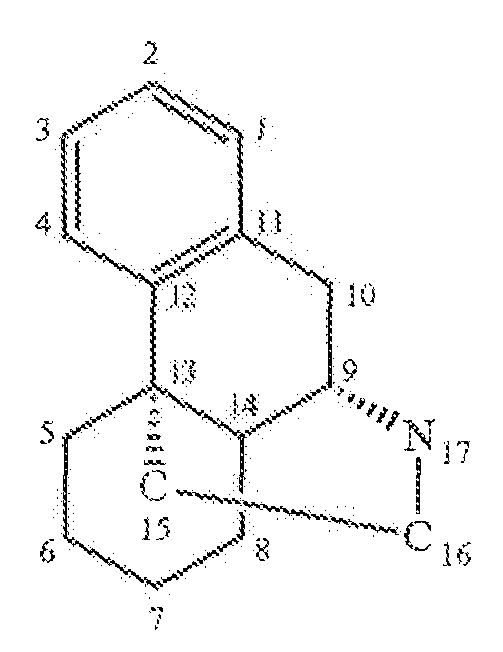
상기 구조식에서, 탄소 원자들은 통상적으로 번호가 매겨져 있으며, 9번 탄소 및 13번 탄소에 연결된 쐐기모양 결합(wedge-shaped bond)은, 이들 결합이 모르피난 구조의 다른 3개 고리의 평면으로부터 상승되었다는 것을 지시한다.In the above formula, the carbon atoms are typically numbered, and wedge-shaped bonds connected to carbons 9 and 13 indicate that these bonds have been elevated from the plane of the other three rings of the morphinan structure .
본 발명의 화합물의 염은 산 및 상기 화합물의 염기성 그룹, 예를 들면 아미노 관능성 그룹, 또는 염기 및 상기 화합물의 산성 그룹, 예를 들면 카복실 관능성 그룹 사이에서 형성된다. 또 다른 양태에 따라, 상기 화합물은 약제학적으로 허용되는 산 부가 염이다.Salts of the compounds of the present invention are formed between acids and basic groups of the compounds, such as amino functional groups, or bases, and acidic groups of the compounds, such as carboxyl functional groups. According to another embodiment, the compound is a pharmaceutically acceptable acid addition salt.
약제학적으로 허용되는 염의 형성에 통상적으로 사용되는 산은 무기 산, 예를 들면 중황화수소, 염산, 브롬화수소산, 요오드화수소산, 황산, 및 인산, 및 유기 산, 예를 들면 파라-톨루엔설폰산, 살리실산, 타르타르산, 비타르타르산(bitartaric acid), 아스코르브산, 말레산, 베실산(besylic acid), 푸마르산, 글루콘산, 글루쿠론산, 포름산, 글루탐산, 메탄설폰산, 에탄설폰산, 벤젠설폰산, 락트산, 옥살산, 파라-브로모페닐설폰산, 카본산, 석신산, 시트르산, 벤조산, 및 아세트산, 및 관련된 무기 및 유기 산을 포함한다. 따라서 이러한 약제학적으로 허용되는 염은 설페이트, 피로설페이트, 비설페이트, 설파이트, 비설파이트, 포스페이트, 모노하이드로겐포스페이트, 디하이드로겐포스페이트, 메타포스페이트, 피로포스페이트, 클로라이드, 브로마이드, 요오다이드, 아세테이트, 프로피오네이트, 데카노에이트, 카프릴레이트, 아크릴레이트, 포르메이트, 이소부티레이트, 카프레이트, 헵타노에이트, 프로피올레이트, 옥살레이트, 말로네이트, 석시네이트, 수베레이트(suberate), 세바케이트, 푸마레이트, 말리에이트, 부틴-1,4-디오에이트(butyne-1,4-dioate), 헥신-1,6-디오에이트, 벤조에이트, 클로로벤조에이트, 메틸벤조에이트, 디니트로벤조에이트, 하이드록시벤조에이트, 메톡시벤조에이트, 프탈레이트, 테레프탈레이트, 설포네이트, 자일렌 설포네이트, 페닐아세테이트, 페닐프로피오네이트, 페닐부티레이트, 시트레이트, 락테이트, β-하이드록시부티레이트, 글리콜레이트, 말리에이트, 타르트레이트, 메탄설포네이트, 프로판설포네이트, 나프탈렌-1-설포네이트, 나프탈렌-2-설포네이트, 만델레이트, 및 기타 염을 포함한다. 하나의 양태에서, 약제학적으로 허용되는 산 부가 염은 염산 및 브롬화수소산과 같은 무기 산으로 형성되는 산 부가 염, 및 말레산과 같은 유기 산으로 형성되는 산 부가 염을 포함한다. Acids commonly used in the formation of pharmaceutically acceptable salts include those derived from inorganic acids such as hydrogen sulfide, hydrochloric acid, hydrobromic acid, hydroiodic acid, sulfuric acid, and phosphoric acid, and organic acids such as para-toluenesulfonic acid, salicylic acid, But are not limited to, tartaric acid, bitartaric acid, ascorbic acid, besylic acid, fumaric acid, gluconic acid, glucuronic acid, formic acid, glutamic acid, methanesulfonic acid, ethanesulfonic acid, benzenesulfonic acid, lactic acid, , Para-bromophenylsulfonic acid, carbonic acid, succinic acid, citric acid, benzoic acid, and acetic acid, and related inorganic and organic acids. Thus, such pharmaceutically acceptable salts include, but are not limited to, sulfate, pyrosulfate, bisulfate, sulfite, bisulfite, phosphate, monohydrogenphosphate, dihydrogenphosphate, metaphosphate, pyrophosphate, chloride, bromide, iodide, acetate , Propionate, decanoate, caprylate, acrylate, formate, isobutyrate, caprate, heptanoate, propiolate, oxalate, malonate, succinate, suberate, Butyne-1, 4-dioate, hexyne-1, 6-dioate, benzoate, chlorobenzoate, methylbenzoate, dinitrobenzoate, Hydroxybenzoate, methoxybenzoate, phthalate, terephthalate, sulfonate, xylene sulfonate, phenylacetate, phenyl Naphthalene-2-sulphonate, naphthalene-2-sulphonate, naphthalene-2-sulphonate, naphthalene-2-sulphonate, Mandelate, and other salts. In one embodiment, the pharmaceutically acceptable acid addition salts include acid addition salts formed with inorganic acids such as hydrochloric acid and hydrobromic acid, and acid addition salts formed with organic acids such as maleic acid.
몇몇 양태에서, 약제학적으로 허용되는 염은 알칼리 금속, 리튬 염, 나트륨 염, 칼륨 염, 알칼리 토금속 염, 칼슘 염, 마그네슘 염, 라이신 염, N,N'디벤질에틸렌디아민 염, 클로로프로카인 염, 콜린 염, 디에탄올아민 염, 에틸렌디아민 염, 메글루민 염, 프로카인 염, 트리스 염, 유리 산 염, 유리 염기 염, 무기 염, 설페이트 염, 하이드로클로라이드 염, 및 하이드로브로마이드 염을 포함한다.In some embodiments, the pharmaceutically acceptable salts are selected from the group consisting of alkali metals, lithium salts, sodium salts, potassium salts, alkaline earth metal salts, calcium salts, magnesium salts, lysine salts, N, N'dibenzylethylenediamine salts, , Choline salts, diethanolamine salts, ethylenediamine salts, meglumine salts, procaine salts, tris salts, free acid salts, free base salts, inorganic salts, sulfate salts, hydrochloride salts, and hydrobromide salts .
달리 언급하지 않는 한, 본원에 기재된 투여량은, 덱스트로메토르판 화합물 및 퀴니딘의 하이드로브로마이드 및 설페이트 염 형태 각각을 지칭한다. 이러한 정보를 기반으로, 당해 분야의 숙련가는 활성 성분의 각각의 유리 산 또는 유리 염기에 대한 상응하는 투여량을 계산할 수 있다. 당해 분야의 숙련가는 덱스트로메토르판 염에 대한 분자량 및 덱스트로메토르판의 유리 염기에 대한 분자량을 계산할 수 있으며, 상기 유리 염기 및 상기 염에 대한 적절한 투여량을 계산하기 위한 비를 사용할 수 있다. 예를 들면, 15mg의 덱스트로메토르판 하이드로브로마이드(분자식 C18H25NO.HBr.H2O) 및 9mg의 퀴니딘 설페이트(분자식 (C20H24N2O2)2.H2SO4.2H2O)의 투여량이 투여 또는 사용될 수 있다 (대략 11mg의 덱스트로메토르판 및 7.5mg의 퀴니딘에 상응함). 다른 투여량은, 예를 들면, 23mg의 덱스트로메토르판 하이드로브로마이드 및 9mg의 퀴니딘 설페이트 (대략 17mg의 덱스트로메토르판 및 대략 7.5mg의 퀴니딘에 상응함); 20mg의 덱스트로메토르판 하이드로브로마이드 및 10mg의 퀴니딘 설페이트 (대략 15mg의 덱스트로메토르판 및 8.3mg의 퀴니딘에 상응함); 30mg의 덱스트로메토르판 하이드로브로마이드 및 10mg의 퀴니딘 설페이트 (대략 22mg의 덱스트로메토르판 및 8.3mg의 퀴니딘에 상응함)를 포함한다.Unless otherwise indicated, the dosages described herein refer to the hydrobromide and sulfate salt forms of the dextromethorphan compound and quinidine, respectively. Based on this information, one skilled in the art can calculate the corresponding dose for each free acid or free base of the active ingredient. One of skill in the art can calculate the molecular weight for the dextromethorphan salt and the molecular weight for the free base of dextromethorphan, and the ratio for calculating the appropriate dose for the free base and the salt can be used have. For example, 15 mg of dextromethorphan hydrobromide (molecular formula C 18 H 25 NO.HBr.H 2 O) and 9 mg of quinidine sulfate (molecular formula (C 20 H 24 N 2 O 2 ) 2 .H 2 SO 4 .2H 2 O) can be administered or used (corresponding to approximately 11 mg of dextromethorphan and 7.5 mg of quinidine). Other dosages include, for example, 23 mg of dextromethorphan hydrobromide and 9 mg of quinidine sulfate (corresponding to approximately 17 mg of dextromethorphan and approximately 7.5 mg of quinidine); 20 mg of dextromethorphan hydrobromide and 10 mg of quinidine sulfate (corresponding to about 15 mg of dextromethorphan and 8.3 mg of quinidine); 30 mg of dextromethorphan hydrobromide and 10 mg of quinidine sulfate (corresponding to approximately 22 mg of dextromethorphan and 8.3 mg of quinidine).
24mg의 d6-중수소화 덱스트로메토르판 하이드로브로마이드(분자식 C18H19D6NO.HBr.H2O) 및 4.75mg의 퀴니딘 설페이트(분자식 (C20H24N2O2)2.H2SO4.2H2O)의 투여량이 투여될 수 있다 (대략 18mg의 덱스트로메토르판 및 3.96mg의 퀴니딘에 상응함). d6-중수소화 덱스트로메토르판에 대한 다른 투여량은, 예를 들면, 34mg의 d6-덱스트로메토르판 하이드로브로마이드 및 4.75mg의 퀴니딘 설페이트 (대략 25.18mg의 d6-덱스트로메토르판 및 대략 3.96mg의 퀴니딘에 상응함); 18mg의 d6-덱스트로메토르판 하이드로브로마이드 및 4.9mg의 퀴니딘 설페이트 (대략 13.33mg의 d6-덱스트로메토르판 및 4.08mg의 퀴니딘에 상응함); 24mg의 d6-덱스트로메토르판 하이드로브로마이드 및 4.9mg의 퀴니딘 설페이트 (대략 17.78mg의 d6-덱스트로메토르판 및 4.08mg의 퀴니딘에 상응함); 28mg의 d6-덱스트로메토르판 하이드로브로마이드 및 4.9mg의 퀴니딘 설페이트 (대략 20.74mg의 d6-덱스트로메토르판 및 4.08mg의 퀴니딘에 상응함); 30mg의 d6-덱스트로메토르판 하이드로브로마이드 및 4.9mg의 퀴니딘 설페이트 (대략 22.22mg의 d6-덱스트로메토르판 및 4.08mg의 퀴니딘에 상응함); 34mg의 d6-덱스트로메토르판 하이드로브로마이드 및 4.9mg의 퀴니딘 설페이트 (대략 25.18mg의 d6-덱스트로메토르판 및 4.08mg의 퀴니딘에 상응함)를 포함한다.24 mg of d6-deuterated dextromethorphan hydrobromide (molecular formula C 18 H 19 D 6 NO.HBr.H 2 O) and 4.75 mg quinidine sulfate (molecular formula (C 20 H 24 N 2 O 2 ) 2 . H 2 SO 4 .2H 2 O) can be administered (corresponding to approximately 18 mg of dextromethorphan and 3.96 mg of quinidine). Other dosages for d6-deuterated dextromethorphan include, for example, 34 mg of d6-dextromethorphan hydrobromide and 4.75 mg of quinidine sulfate (approximately 25.18 mg of d6-dextromethorphan And approximately 3.96 mg quinidine); 18 mg of d6-dextromethorphan hydrobromide and 4.9 mg of quinidine sulfate (corresponding to approximately 13.33 mg of d6-dextromethorphan and 4.08 mg of quinidine); 24 mg of d6-dextromethorphan hydrobromide and 4.9 mg of quinidine sulfate (corresponding to approximately 17.78 mg of d6-dextromethorphan and 4.08 mg of quinidine); 28 mg of d6-dextromethorphan hydrobromide and 4.9 mg of quinidine sulfate (corresponding to approximately 20.74 mg of d6-dextromethorphan and 4.08 mg of quinidine); 30 mg of d6-dextromethorphan hydrobromide and 4.9 mg of quinidine sulfate (corresponding to approximately 22.22 mg of d6-dextromethorphan and 4.08 mg of quinidine); 34 mg of d6-dextromethorphan hydrobromide and 4.9 mg of quinidine sulfate (corresponding to approximately 25.18 mg of d6-dextromethorphan and 4.08 mg of quinidine).
본원에서 사용되는 용어 "수화물"은 비-공유결합성 분자간 힘(non-covalent intermolecular force)에 의해 결합되어 있는 물을 화학양론적 또는 비-화학양론적 양으로 추가로 포함하는 화합물을 의미한다.As used herein, the term "hydrate" refers to a compound that additionally contains stoichiometric or non-stoichiometric amounts of water bound by non-covalent intermolecular forces.
본원에서 사용되는 용어 "용매화물"은 비-공유결합성 분자간 힘에 의해 결합되어 있는, 물, 아세톤, 에탄올, 메탄올, 디클로로메탄, 2-프로판올 등과 같은 용매를 화학양론적 또는 비-화학양론적 양으로 추가로 포함하는 화합물을 의미한다.The term "solvate ", as used herein, refers to a solvent, such as water, acetone, ethanol, methanol, dichloromethane, 2-propanol or the like, which is bound by non-covalent intermolecular forces to a stoichiometric or non- ≪ / RTI >
본 발명의 화합물(예를 들면, 아래 기재된 화학식 I의 화합물)은, 예를 들면 중수소 치환 등의 결과로서, 비대칭 탄소 원자를 함유할 수 있다. 따라서, 본 발명의 화합물은 개별적인 거울상이성체(enantiomer), 또는 2개 거울상이성체들의 혼합물로서 존재할 수 있다. 따라서, 본 발명의 화합물은 라세믹 혼합물들을 포함할 것이며, 다른 가능한 입체이성체로부터 실질적으로 유리된 개별적인 각각의 입체이성체를 또한 포함할 것이다. 본원에서 사용되는 용어 "다른 입체이성체가 실질적으로 없는"은 25% 미만의 다른 입체이성체들, 몇몇 양태에서 10% 미만의 다른 입체이성체들, 몇몇 양태에서 5% 미만의 다른 입체이성체들, 몇몇 양태에서 2% 미만의 다른 입체이성체들, 또는 "X"% 미만의 다른 입체이성체들(여기서 X는 0 내지 100의 수이다)이 존재함을 의미한다. 제공된 화합물에 대한 개별적인 거울상이성체의 수득 또는 합성 방법은 당해 분야에 공지되어 있으며, 최종 화합물에 또는 출발 물질 또는 중간체에 대해 실행 가능하게 적용될 수 있다.The compounds of the invention (e. G., Compounds of formula (I) described below) may contain asymmetric carbon atoms as a result of, for example, deuterium substitution and the like. Thus, the compounds of the present invention may exist as separate enantiomers, or as mixtures of two enantiomers. Accordingly, the compounds of the present invention will comprise racemic mixtures and will also include individual respective stereoisomers substantially free from other possible stereoisomers. The term "substantially free of other stereoisomers" as used herein means that less than 25% of the other stereoisomers, in some embodiments less than 10% of the other stereoisomers, in some embodiments less than 5% of the other stereoisomers, Quot; means less than 2% of other stereoisomers, or less than "X"% of other stereoisomers (where X is a number from 0 to 100). Methods of obtaining or synthesizing individual enantiomers for the provided compounds are well known in the art and may be applied to the final compound or to the starting material or intermediates in an operable manner.
본원에서 사용되는 용어 "안정한 화합물"은 이의 제조를 허용하기에 충분한 안정성을 가지며 본원에 상세되는 목적(예를 들면, 치료제로의 제형화, 치료 화합물의 제조에 사용되는 중간체, 단리가능 또는 저장가능한 중간체 화합물, 치료제에 반응하는 질환 또는 병태의 치료)에 유용하도록 충분한 기간 동안 화합물의 온전함(integrity)을 유지하는 화합물을 지칭한다.As used herein, the term "stable compound" refers to a compound which has sufficient stability to permit its manufacture and which is capable of being used for purposes described herein (e. G., Formulations into therapeutic agents, intermediates used in the preparation of therapeutic compounds, Refers to a compound that maintains the integrity of a compound for a period of time sufficient to be useful in the treatment of a disease or condition responsive to a therapeutic agent.
"D"는 중수소를 의미한다."D" means deuterium.
"입체이성체(stereoisomer)"는 거울상이성체 및 부분입체이성체 둘 다를 지칭한다."Stereoisomer" refers to both enantiomers and diastereomers.
본원 명세서 전반에 걸쳐, 변수는 일반적으로 지칭될 수 있거나 (예를 들면, "각각의 R") 구체적으로 지칭될 수 있다 (예를 들면, R1 또는 R2). 달리 표시되지 않는 한, 변수가 일반적으로 지칭될 때, 이는 해당 특정한 변수의 모든 특정한 구체예들을 포함함을 의미한다.Throughout this specification, a variable may generally be referred to (e.g., "each R") or specifically referred to as R 1 or R 2 ). Unless otherwise indicated, when a variable is generally referred to, it is meant to include all specific embodiments of that particular variable.
본원에서 사용되는 용어 "포함하는(comprising)"은 "포함하는(including)", "함유하는(containing)" 또는 "특징으로 하는"과 유사하며 이는 포괄적이거나 제한이 없으며 언급되지 않은 추가 요소 또는 방법 단계를 배제하지 않는다.As used herein, the term " comprising "is to be interpreted as " including, ", " containing ", or" characterized ", and is inclusive, The step is not excluded.
본원 명세서에서 사용되는 성분의 양, 반응 조건 등을 나타내는 모든 숫자는 모든 경우에 있어서 용어 "약"에 의해 변형되는 것으로 이해되어야 한다. 따라서, 달리 표시되지 않는 한, 본원에 설정된 수치 파라미터들은 목적하는 특성에 따라 가변적일 수 있는 근사치이다. 최소한의, 그리고 본 출원의 우선권을 주장하는 임의의 출원의 임의의 청구항의 범위에 대한 등가물의 원칙의 적용을 제한하려는 시도는 아닌 것으로서, 각각의 수치 파라미터는 유효 숫자의 개수 및 보통의 대략적인 접근법(ordinary rounding approaches)을 고려하여 이해되어야 한다.It is to be understood that all numbers expressing quantities of ingredients, reaction conditions, etc., as used herein are to be understood as being modified in all instances by the term "about ". Thus, unless otherwise indicated, the numerical parameters set forth herein are approximations that may vary depending upon the desired properties. As a minimum, and not as an attempt to limit the application of the doctrine of equivalents to the scope of any claim of any application claiming priority to the instant application, each numerical parameter is referred to as the number of significant digits and the normal approximation and should be understood in view of ordinary rounding approaches.
치료 화합물Therapeutic compound
코데인 유사 레보르파놀(codeine analog levorphanol)의 비-오피오이드 d-이성체인 덱스트로메토르판(DM)은 처방전 없이 구입가능한(over-the-counter)(OTC) 진해제(antitussive agent)로서 약 50세에서 광범위하게 사용되고 있다. DM은 다수의 상이한 수용체들에 대한 결합 친화력(binding affinity) 및 중추신경계(CNS)에서의 1차 활성을 보유한 복합적인 약리학을 갖는다. DM은 항-글루타메이트 흥분 활성(excitatory activity)에 대한 관련된 가능성을 갖는, 약하고 비경쟁적인 N-메틸-D-아스파르테이트(NMDA) 수용체 길항제(Ki = 1500nM)로서의 이의 활성으로 잘 알려져 있다(Tortella et al. Trends Pharmacol Sci. 1989;10(12):501-7; Chou YC et al., Brain Res. 1999;821(2):516-9; Netzer R et al., Eur J Pharmacol. 1993;238(2-3):209-16; Jaffe DB et al., Neurosci Lett. 1989;105(1-2):227-32). DM은 또한 강력한 시그마-1 작용제이며(Zhou GZ et al., Eur J Pharmacol. 1991;206(4):261-9; Maurice T et al., Brain Res Brain Res Rev. 2001;37(1-3):116-32; Cobos EJ et al., Curr Neuropharmacol. 2008;6(4):344-66)(Ki = 200nM) 높은 결합 친화력으로 세로토닌(serotonin) 수송체(transporter)에 결합한다(SERT; Ki = 40nM). DM은 노르에피네프린(norepinephrine) 수송체에 대해 보통의 친화력만을 갖기는 하지만(Ki = 13μM), 이는 노르에피네프린의 흡수를 효과적으로 억제한다(Ki = 240nM)(Codd EE et al., J Pharmacol Exp Ther. 1995;274(3):1263-70). DM은, 0.7μM으로 보고된 IC50(50% 억제를 초래하는 농도) 값을 갖는, α3β4 니코틴성 아세틸콜린 수용체의 길항제이다(Damaj et al., J Pharmacol Exp Ther. 2005;312(2):780-5).A non-opioid d-isomer of codeine analogue levorphanol, dextromethorphan (DM), is an over-the-counter (OTC) antitussive agent that is approximately 50 years old . ≪ / RTI > DM has a complex pharmacology with binding affinity for a number of different receptors and primary activity in the central nervous system (CNS). DM is well known for its activity as a weak and noncompetitive N-methyl-D-aspartate (NMDA) receptor antagonist (K i = 1500 nM) with an associated potential for anti-glutamate excitatory activity (Tortella et al., Trends Pharmacol Sci. 1989; 10 (12): 501-7; Chou YC et al., Brain Res 1999; 821 (2): 516-9; 238 (2-3): 209-16; Jaffe DB et al., Neurosci Lett., 1989; 105 (1-2): 227-32). DM is also a potent sigma-1 agonist (Zhou GZ et al., Eur J Pharmacol. 1991; 206 (4): 261-9; Maurice T et al., Brain Res Brain Res Rev. 2001; (K i = 200 nM) binds to the serotonin transporter with a high binding affinity (SERT (SEQ ID NO: 2)): 116-32; Cobos EJ et al., Curr Neuropharmacol. 2008; ; K i = 40 nM). Although DM has only normal affinity for the norepinephrine transporter (K i = 13 μM), it effectively inhibits the absorption of norepinephrine (K i = 240 nM) (Codd EE et al., J Pharmacol Exp Ther. 1995; 274 (3): 1263-70). DM is an antagonist of the? 3? 4 nicotinic acetylcholine receptor with an IC50 (concentration resulting in 50% inhibition) reported as 0.7? M (Damaj et al., J Pharmacol Exp Ther. 2005; 312 (2): 780 -5).
이들 상호작용 중의 하나 이상의 결과로서, DM은 칼륨-자극된 글루타메이트 방출을 감소시키고(Annels SJ et al., Brain res. 1991;564(2):341-3) 모노아민(세로토닌, 노르에피네프린, 및 도파민(dopamine)) 신경전달을 조절한다(Codd EE et al., J Pharmacol Exp Ther. 1995;274(3):1263-70; Maurice T et al., Pharmacol Ther. 2009;124(2):195-206; Maurice T et al., Prog Neuropsychopharmacol Biol Psychiatry. 1997;21(1):69-102). α3β4 니코틴성 아세틸콜린 수용체의 DM 길항작용(Damaj MI et al., J Pharmacol Exp Ther. 2005;312(2):780-5)은 특정한 CNS 운동 장애 및 중독에 영향을 끼칠 있다(Silver AA et al., J Am Acad Child Adolesc Psychiatry. 2001;40(9):1103-10). 단독 투여되는 경우, DM은 간에서 주로 덱스트로판(DX)으로 급속히 대사작용하여, 극도로 낮은 생체이용율(bioavailability)을 초래하고 이에 따라 CNS 노출을 제한시킨다. DX는 DM과 동일하지만 주요 수용체에 대해서는 상이한 친화력을 갖는 수용체 중의 일부와 상호작용하지만, 신속한 글루쿠로니드(glucuronide) 접합(conjugation)을 거치므로, 혈액-뇌 장벽을 넘는 것이 방지되어, 처방된 용량에서의 CNS 효과가 감소한다(Church J et al., Eur J Pharmacol. 1985;111(2):185-90; Franklin PH et al., Mol Pharmacol. 1992;41(1):134-46).As a result of one or more of these interactions, DM has been shown to reduce potassium-stimulated glutamate release (Annels SJ et al., Brain Res. 1991; 564 (2): 341-3) and monoamines (serotonin, norepinephrine, Dopamine) neurotransmission (Codd EE et al., J Pharmacol Exp Ther. 1995; 274 (3): 1263-70; Maurice T et al., Pharmacol Ther. 2009; 124 (2): 195 Maurice T et al., Prog Neuropsychopharmacol Biol Psychiatry. 1997; 21 (1): 69-102). DM antagonism of the? 3? 4 nicotinic acetylcholine receptor (Damaj MI et al., J Pharmacol Exp Ther. 2005; 312 (2): 780-5) affects certain CNS motor disorders and addiction (Silver AA et al J Am Acad Child Adolesc Psychiatry 2001; 40 (9): 1103-10). When administered alone, DM rapidly metabolizes to the dextroplast (DX) in the liver, resulting in extremely low bioavailability and hence CNS exposure. DX is the same as DM but interacts with some of the receptors with different affinities for the major receptors, but because it undergoes rapid glucuronide conjugation, it is prevented from crossing the blood-brain barrier, (2): 185-90; Franklin PH et al., Mol Pharmacol. 1992; 41 (1): 134-46) .
본 발명은, 약제학적으로 허용되는 염, 용매화물, 및 수화물을 포함하는, 화학식 I의 화합물을 제공한다:The present invention provides a compound of formula (I), which comprises a pharmaceutically acceptable salt, solvate, and hydrate thereof:
화학식 IFormula I

상기 화학식 I에서, R1은 CH3, CH2D, CHD2, 및 CD3으로부터 선택되며; R2는 CH3, CH2D, CHD2, 및 CD3으로부터 선택된다.In Formula I above, R 1 is selected from CH 3 , CH 2 D, CHD 2 , and CD 3 ; R 2 is selected from CH 3 , CH 2 D, CHD 2 , and CD 3 .
적어도 하나의 중수소를 갖는 화학식 I에 따르는 모든 화합물은 중수소화 덱스트로메토르판으로 불린다. 하나의 양태에서 R1 및 R2는 둘 다 CD3이다. 당해 화합물은 또한 d6-덱스트로메토르판 또는 d6-DM으로 지칭된다. 또 다른 양태에서, R1 및 R2 중 하나만이 CD3이다.All compounds according to formula I having at least one deuterium are termed deuterated dextromethorphan. In one embodiment, R 1 and R 2 are both CD 3 . The compound is also referred to as d6-dextromethorphan or d6-DM. In yet another embodiment, only one of R 1 and R 2 is CD 3 .
또 다른 양태에서, 상기 화합물은 표 1에 열거된 화합물들 중의 임의의 하나로부터 선택된다.In another embodiment, the compound is selected from any one of the compounds listed in Table 1.
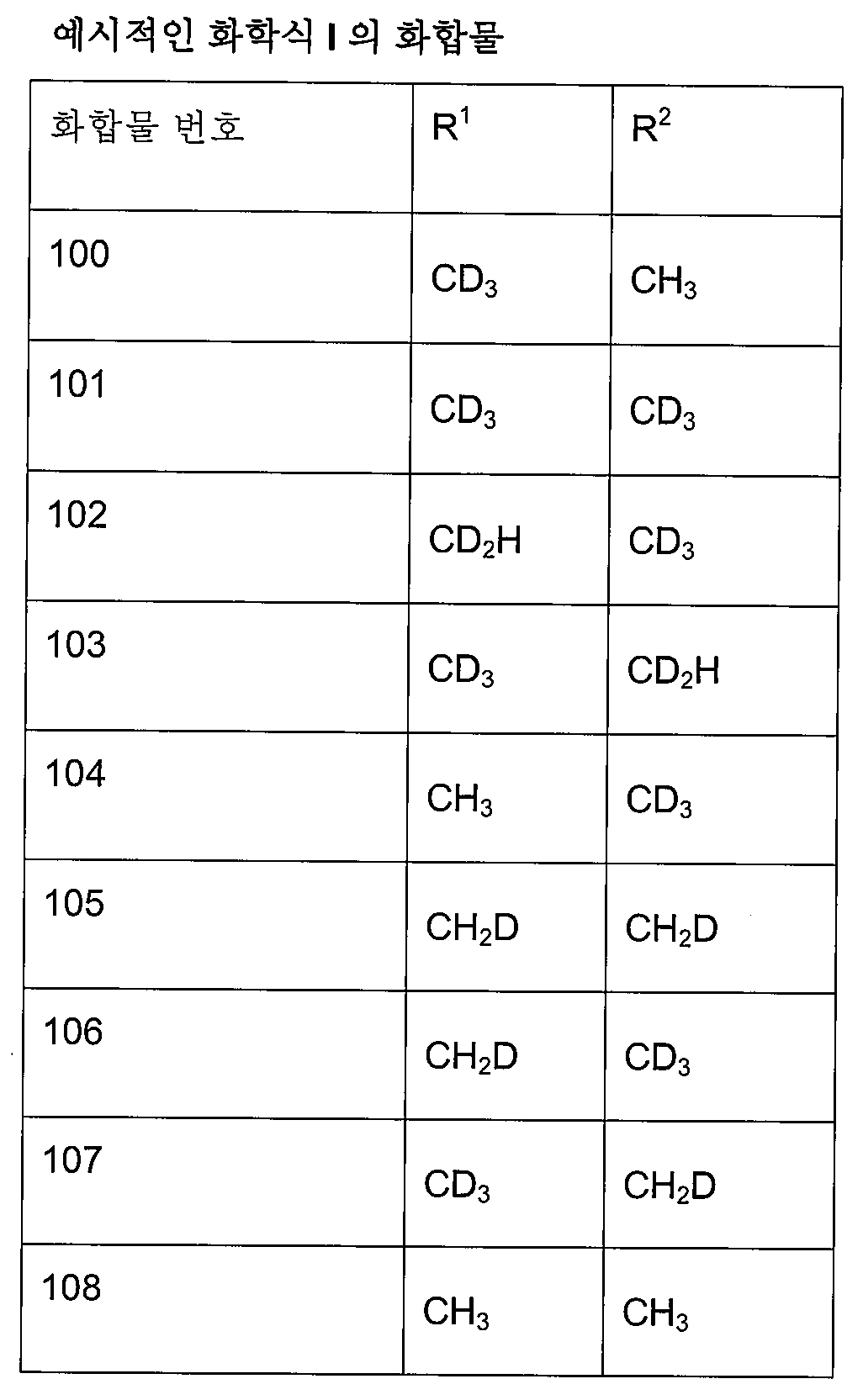
또 다른 일련의 양태에서, 상기 설정된 양태들 중의 임의의 것에서 중수소로 지정되지 않은 임의의 원자는 이의 천연 동위원소 존재비로 존재한다.In another set of embodiments, any atom not designated as deuterium in any of the above embodiments is present in its natural isotope abundance ratio.
또 다른 일련의 양태에서, 화학식 I의 화합물은 단리 또는 정제되며, 예를 들면, 화학식 I의 화합물은, 각각, 존재하는 화학식 I의 동위이성체의 총량의 적어도 50중량%(예를 들면, 적어도 55%, 60%, 65%, 70%, 75%, 80%, 85%, 90%, 95%, 97%, 98%, 98.5%, 99%, 99.5% 또는 99.9%)의 순도로 존재한다. 따라서, 몇몇 양태에서, 화학식 I의 화합물을 포함하는 조성물은 상기 화합물의 동위이성체의 분포를 포함할 수 있으며, 단, 상기 동위이성체의 적어도 50중량%는 상기 열거된 화합물이다.In another set of embodiments, the compounds of formula (I) are isolated or purified, for example the compounds of formula (I) are each at least 50 wt.% Of the total amount of isomers of formula (I) %, 60%, 65%, 70%, 75%, 80%, 85%, 90%, 95%, 97%, 98%, 98.5%, 99%, 99.5% or 99.9%. Thus, in some embodiments, a composition comprising a compound of formula I may comprise a distribution of iso-isomers of the compound, with the proviso that at least 50% by weight of the iso-isomers are those enumerated above.
몇몇 양태에서, D를 갖는 것으로 지정된 화학식 I의 화합물 내의 임의의 위치는, 화학식 I의 화합물의 지정된 위치(들)에서 적어도 45%(예를 들면, 적어도 52.5%, 적어도 60%, 적어도 67.5%, 적어도 75%, 적어도 82.5%, 적어도 90%, 적어도 95%, 적어도 97%, 적어도 99%, 또는 적어도 99.5%)의 최소의 중수소 혼입을 갖는다. 따라서, 몇몇 양태에서, 화학식 I의 화합물을 포함하는 조성물은 상기 화합물의 동위이성체의 분포를 포함할 수 있으며, 단, 상기 동위이성체의 적어도 45중량%는 지정된 위치(들)에서 D를 포함한다.In some embodiments, any position within the compounds of formula (I) designated as having D is at least 45% (e.g., at least 52.5%, at least 60%, at least 67.5% At least 75%, at least 82.5%, at least 90%, at least 95%, at least 97%, at least 99%, or at least 99.5%). Thus, in some embodiments, a composition comprising a compound of formula I may comprise a distribution of isoforms of the compound, with the proviso that at least 45% by weight of the isoform comprises D at the indicated location (s).
몇몇 양태에서, 화학식 I의 화합물은 상기 화합물의 기타 동위이성체가 "실질적으로 없으며", 예를 들면, 50% 미만, 25% 미만, 10% 미만, 5% 미만, 2% 미만, 1% 미만, 또는 0.5% 미만의 다른 동위이성체들이 존재한다.In some embodiments, the compounds of Formula I are " substantially free ", such as less than 50%, less than 25%, less than 10%, less than 5%, less than 2%, less than 1% Or less than 0.5% of other isotopes are present.
화학식 I의 화합물의 합성은 숙련된 합성 화학자에 의해 용이하게 수행될 수 있다. 관련 절차 및 중간체가 예를 들면 문헌[Kim H C et al., Bioorg Med Chem Lett 2001, 11:1651 and Newman A H et al., J Med Chem 1992, 35:4135]에 기재되어 있다.The synthesis of compounds of formula I can be readily carried out by skilled synthetic chemists. Related procedures and intermediates are described, for example, in Kim HC et al., Bioorg Med Chem Lett 2001, 11: 1651 and Newman A H et al., J Med Chem 1992, 35: 4135.
이러한 방법은, 본원에 기술된 화합물을 합성하기 위한 상응하는 중수소화 및 임의의 기타 동위 원소 함유 시약 및/또는 중간체를 사용하여 수행될 수 있거나, 동위원소 원자를 화학 구조에 도입하기 위한 당해 분야에 공지된 표준 합성 프로토콜을 사용하여 수행될 수 있다. Such methods may be carried out using corresponding deuteration and any other isotope-containing reagents and / or intermediates for synthesizing the compounds described herein, or may be carried out in the art for introducing isotopic atoms into the chemical structure Can be performed using known standard synthetic protocols.
중수소화 (d6)-DM(d6-DM)(도 1)은, 특정 위치에서 중수소가 6개의 수소 원자를 대체하는, DM의 중수소화 동위원소이다. 중수소는 수소의 안정하고 비-방사성인 동위원소이며 이는 물을 포함하는 주변 환경에 편재해 있다. 안정한 동위원소는 신생아에서부터 성인까지 모든 연령의 개체들에서 오랜 사용 역사를 갖고 의학 연구에서 일반적으로 사용되고 있다. 중수소는 추적자(tracer) 수준에서 PK 및 대사 연구에서 가장 일반적으로 사용된다. 중수소화 치료제의 만성 투여 동안 예상되는 노출 수준은 물과 같은 천연 공급원으로부터 매일 노출되는 것에 비해 매우 적을 것으로 예상된다. 예를 들면, 30mg 투여량의 d6-DM으로부터 초래되는 노출은 물 20mL(0.7oz)에 대략 상응할 것으로 추정된다. 이는 물 중의 중수소의 0.0156%의 천연 존재비를 기반으로 한 것이며, 중수소수(deuterated water)(MW = 20.03)의 배출과 함께, 소비되는 d6-DM(MW = 277.43) 투여량의 전부가 d3-덱스트로판(d3-DX)에 대해 대사작용할 것으로 추정된다. 후술된 추정은 배출되는 중수소수의 양을 과대평가하지만, 소비되는 중수소의 비교량의 아이디어를 제공한다. Deuterization (d6) -DM (d6-DM) (Fig. 1) is a deuterated isotope of DM in which deuterium replaces six hydrogen atoms at specific positions. Deuterium is a stable, non-radioactive isotope of hydrogen that is ubiquitous in the surrounding environment, including water. Stable isotopes have long been used in all age groups, from neonates to adults, and are commonly used in medical research. Deuterium is most commonly used in PK and metabolism studies at the tracer level. Exposure levels expected during chronic administration of dehydrogenating agents are expected to be very small compared to daily exposure from natural sources such as water. For example, exposure resulting from a 30 mg dose of d6-DM is estimated to correspond approximately to 20 mL (0.7 oz) of water. This is based on a natural abundance ratio of 0.0156% of deuterium in water, with all of the d6-DM (MW = 277.43) doses consumed, together with the discharge of deuterated water (MW = 20.03) It is estimated to metabolize tropane (d3-DX). The estimates described below overestimate the amount of deuterium emissions, but provide an idea of the amount of deuterium consumed.
본 발명자에 의해 중수소화 DM으로 수행된 약리학 연구는 중수소가 DM의 기본적인 약리학을 변화시키지 않음을 입증하였다. PK와 약물 대사 연구는 d6-DM이 DM과 동일한 대사 경로에 의해 대사됨을 나타낸다. CYP2D6에 의한 대사는 중수소로의 치환에 의한 억제에 가장 취약하였다. 시험관내(in vitro) 대사 연구는 d6-DM과 DM의 대사(사람을 포함하는 다양한 종에 의함)가 동일한 대사산물을 생성시킴을 보여주며, 즉, DM과 비교하여 d6-DM의 독특한 대사산물은 확인되지 않았다. 조직 분포 연구는 14C-표지된 DM(14C-DM)으로부터의 방사성표지와 같이 14C-표지된 d6-DM(14C-d6-DM)으로부터의 방사성표지의 유사한 분포를 보였다. d6-DM에 의한 독성 연구는, 유사한 노출에서, d6-DM 및 DM의 용량 제한적 독성(dose-limiting toxicity)(DLT)은 비교가능하며 CNS 효과와 관련된 불리한 임상적 증상을 기반으로 함을 나타낸다. 독성 측정은 d6-DM/Q에 의한 13주 독성 연구에서 평가하였으며, 비교를 위해 고용량의 DM/Q를 포함하였고, 이는, 비(non)-중수소화 DM/Q과 같이, d6-DM/Q의 유사한 소견을 보였다.Pharmacological studies conducted with deuterated DM by the inventor have demonstrated that deuterium does not alter the basic pharmacology of DM. PK and drug metabolism studies indicate that d6-DM is metabolized by the same metabolic pathway as DM. Metabolism by CYP2D6 was the most vulnerable to inhibition by deuterium replacement. In vitro metabolism studies show that the metabolism of d6-DM and DM (by various species, including humans) produces the same metabolite, that is, the unique metabolite of d6-DM compared to DM Was not confirmed. Tissue distribution studies have shown a similar distribution of the radiolabel from the 14 C- labeled DM (14 C-DM) a d6-DM 14 C- labeled, such as radiolabeled from (14 C-d6-DM) . Toxicity studies with d6-DM indicate that dose-limiting toxicity (DLT) of d6-DM and DM at comparable exposures is comparable and is based on adverse clinical symptoms associated with the CNS effect. Toxicity assays were assessed in a 13-week toxicity study with d6-DM / Q, and included a high dose of DM / Q for comparison, which included d6-DM / Q, such as non-deuterated DM / .
예시적 합성Illustrative synthesis
화학식 I의 화합물을 합성하기 위한 통상의 방법은 덱스트로메토르판의 제조에 사용되는 합성 방법에서 적절한 중수소화 중간체 및 시약을 대체시킨다. 이들 방법은 예를 들면 미국 특허 제7,973,049호에 기재되어 있으며, 이의 전문은 본원에 참조로 인용된다. 화학식 I의 화합물은 아래 나타낸 공지된 중간체 X, XI, 및 XII 중의 하나 및 공지된 절차들로부터 용이하게 수득될 수 있는 관련 중간체들로부터 제조될 수 있다.Conventional methods for synthesizing the compounds of formula I replace suitable deuterated intermediates and reagents in the synthetic methods used for the preparation of dextromethorphan. These methods are described, for example, in U.S. Patent No. 7,973,049, the entire disclosure of which is incorporated herein by reference. The compounds of formula I can be prepared from one of the known intermediates X, XI, and XII shown below and related intermediates which can be readily obtained from known procedures.

반응식 1은 화학식 I의 화합물의 일반적인 경로를 보여준다.
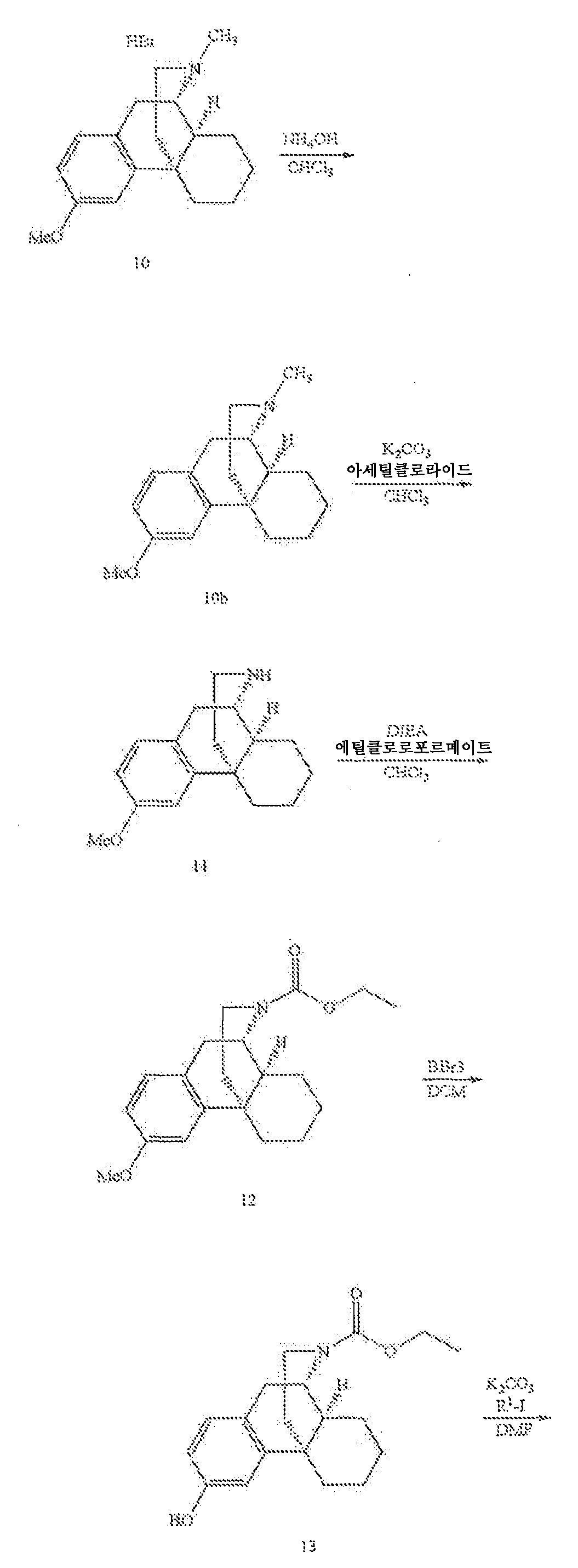

반응식 1은 화학식 I의 화합물의 제조를 위한 일반적인 경로를 보여주며 여기서 R1은 CH3이 아니다. HBr 염(10)은 NH4OH로 처리한 후 N-디메틸화시켜 11을 수득한다. 에틸클로로포르메이트를 사용하여 아민(11)을 아실화시켜 카바메이트(12)를 제공하고, 이어서 이를 BBr3을 사용하여 O-디메틸화시켜 알코올(13)을 수득한다. 염기의 존재하에 화합물(13)을 적절하게 중수소화 요오도메탄으로 처리하여 에테르(14)를 수득하고, 리튬 알루미늄 중수소화물(LAD)을 사용하여 환원시켜 화학식 I의 화합물(여기서, R2 = CD3)을 수득하거나, 리튬 알루미늄 수화물(LAH)을 사용하여 환원시켜 화합물(여기서, R2 = CH3)을 수득한다. R1이 CH3인 화합물에 있어서, 카바메이트(12)를 LAD로 직접 처리하여 R2가 CD3인 화합물을 생성시킨다.
상기 나타낸 특정한 접근법 및 화합물은 한정시키고자 하는 것은 아니다. 본원의 반응식에서의 화학 구조는, 동일한 변수명(즉, R1 또는 R2)에 의해 식별되는지와는 무관하게, 본원의 화학식의 상응하는 위치의 화학 그룹 정의(모이어티(moiety), 원자 등)와 상응하게 정의된 변수들을 묘사한다. 또 다른 화합물의 합성에 사용하기 위한 화합물 구조 내의 화학 그룹의 적합성은 당해 분야의 숙련가들 중의 한 명의 지식에 존재한다.The particular approaches and compounds shown above are not intended to be limiting. The chemical structure in the present reaction scheme has the same variable name (i.e., R 1 (Moiety, atom, etc.) at a corresponding position in the chemical formulas of the present invention, regardless of whether they are identified by R < 2 > The suitability of chemical groups within the structure of compounds for use in the synthesis of other compounds is within the knowledge of one of ordinary skill in the art.
본원의 반응식에 명시되지 않은 경로 내의 것을 포함하는, 화학식 I의 화합물 및 이의 합성 전구체의 추가의 합성 방법은, 당해 분야의 숙련가의 화학자의 의미에 존재한다. 본 발명의 화합물의 합성에 유용한, 합성 화학 전환 및 보호 그룹 방법론(보호 및 탈보호)이 당해 분야에 공지되어 있으며, 예를 들면, 문헌[Larock R, Comprehensive Organic Transformations, VCH Publishers (1989); Greene T W et al., Protective Groups in Organic Synthesis, 3rd Ed., John Wiley and Sons (1999); Fieser L et al., Fieser and Fieser's Reagents for Organic Synthesis, John Wiley and Sons (1994); and Paquette L, ed., Encyclopedia of Reagents for Organic Synthesis, John Wiley and Sons (1995); 및 이의 후속 간행물]에 기재된 바와 같다.Further synthetic methods for the synthesis of compounds of formula (I) and their synthetic precursors, including those in the pathways not specified in the reaction schemes herein, are in the sense of the skilled chemist of the art. Synthetic chemistry conversion and protection group methodologies (protection and deprotection) useful in the synthesis of compounds of the present invention are known in the art and are described, for example, in Larock R, Comprehensive Organic Transformations, VCH Publishers (1989); Greene TW et al., Protective Groups in Organic Synthesis, 3 rd Ed., John Wiley and Sons (1999); Fieser L et al., Fieser and Fieser ' s Reagents for Organic Synthesis, John Wiley and Sons (1994); and Paquette L, ed., Encyclopedia of Reagents for Organic Synthesis, John Wiley and Sons (1995); And its subsequent publications].
본 발명에 의해 구상되는 치환체 및 변수의 조합은 안정한 화합물들의 형성을 초래하는 것이다.The combination of substituents and variables contemplated by this invention results in the formation of stable compounds.
중수소화 Dehydration 덱스트로메토르판Dextromethorphan 및 And 덱스트로메토르판의Dextromethorphan 유사체 또는 유도체 Analog or derivative
본 발명의 방법 및 배합물에서 사용되는 덱스트로메토르판 화합물은 덱스트로메토르판 및 중수소화 덱스트로메토르판 둘 다의 유사체 또는 유도체를 포함하는 것으로 이해되어야 한다. 예를 들면, 하나의 양태에서, 본 발명에 따르는 방법 및 배합물은 중수소화 덱스트로메토르판을 포함하고, 또 다른 양태에서, 상기 방법 및 배합물은 중수소화 덱스트로메토르판의 유사체 또는 유도체를 포함한다. 유사하게, 또 다른 양태에서, 본 발명에 따르는 방법 및 배합물은 덱스트로메토르판을 포함하고, 또 다른 양태에서, 상기 방법 및 배합물은 덱스트로메토르판의 유사체 또는 유도체를 포함한다.The dextromethorphan compound used in the methods and formulations of the present invention should be understood to include analogs or derivatives of both dextromethorphan and deuterated dextromethorphan. For example, in one embodiment, the methods and formulations of the present invention comprise deuterated dextromethorphan, and in another embodiment, the methods and formulations comprise analogs or derivatives of deuterated dextromethorphan . Similarly, in another embodiment, the methods and formulations according to the present invention comprise a dextromethorphan plate, and in another embodiment, the methods and formulations comprise analogs or derivatives of dextromethorphan.
본원에서 사용되는 용어 "알킬"은 임의의 분지되거나 분지되지 않고 치환되거나 치환되지 않은 포화 탄화수소를 의미한다. 알킬 모이어티는 분지쇄 또는 직쇄일 수 있다. 알킬 그룹은 1 내지 10개의 탄소 원자를 가질 수 있다(본원에 제시될 때마다, "1 내지 10"과 같은 수 범위는 제공된 범위 내의 각각의 정수를 지칭하며; 예를 들면, "1 내지 10개의 탄소 원자"는, 본 발명의 정의가 수 범위가 지정되지 않은 용어 "알킬"의 경우를 또한 포괄하기는 하지만, 알킬 그룹이 10개 이하의 탄소 원자를 포함하여 1개의 탄소 원자, 2개의 탄소 원자, 3개의 탄소 원자 등으로 이루어질 수 있음을 의미한다).The term "alkyl" as used herein means any branched or unbranched, substituted or unsubstituted saturated hydrocarbon. The alkyl moiety may be branched or straight chain. Alkyl groups may have from 1 to 10 carbon atoms (as provided herein, a number range such as "1 to 10" refers to each integer within the range provided; for example, " Carbon atom ", as well as the case of the term "alkyl ", in which the definition of the present invention does not specify a number range, it is to be understood that the alkyl group includes one carbon atom, , 3 carbon atoms, and the like).
용어 "치환된"은 관련 분야로부터의 현재의 다수의 특허들에서 밝혀진 이의 통상의 의미를 갖는다. 예를 들면, 미국 특허 제6,509,331호; 제6,506,787호; 제6,500,825호; 제5,922,683호; 제5,886,210호; 제5,874,443호; 및 제6,350,759호를 참조하며, 이들은 모두 전문이 본원에 참조로 인용된다. 구체적으로는, "치환된"의 정의는 미국 특허 제6,509,331호에 제공된 바와 같이 광범위하며, 이는, 용어 "치환된 알킬"을, 몇몇 양태에서는 1 내지 5개의 치환체를 갖는 1 내지 10개의 탄소 원자의 알킬 그룹을 지칭하는 것으로 정의하고, 몇몇 양태에서는 1 내지 3개의 치환체를 갖는 1 내지 10개의 탄소 원자의 알킬 그룹을 지칭하는 것으로 정의하며, 이는, 알콕시, 치환된 알콕시, 사이클로알킬, 치환된 사이클로알킬, 사이클로알케닐, 치환된 사이클로알케닐, 아실, 아실아미노, 아실옥시, 아미노, 치환된 아미노, 아미노아실, 아미노아실옥시, 옥시아실아미노, 시아노, 할로겐, 하이드록실, 카복실, 카복실알킬, 케토, 티오케토, 티올, 티오알콕시, 치환된 티오알콕시, 아릴, 아릴옥시, 헤테로아릴, 헤테로아릴옥시, 헤테로사이클릭, 헤테로사이클로옥시, 하이드록시아미노, 알콕시아미노, 니트로, -SO-알킬, -SO-치환된 알킬, -SO-아릴, -SO-헤테로아릴, -SO2-알킬, -SO2-치환된 알킬, -SO2-아릴, 및 -SO2-헤테로아릴로 이루어진 그룹으로부터 선택된다. 나머지 상기 열거된 특허들 또한 숙련가에 의해 잘 이해되어 있는 용어 "치환된"에 대한 표준 정의들을 제공한다.The term "substituted" has its ordinary meaning as revealed in many current patents from the related art. See, for example, U.S. Patent No. 6,509,331; 6,506,787; 6,500,825; 5,922,683; 5,886, 210; 5,874, 443; And 6,350, 759, both of which are hereby incorporated by reference in their entirety. Specifically, the definition of "substituted" is broad as provided in U.S. Patent No. 6,509,331, which refers to a substituted alkyl group having from 1 to 10 carbon atoms having from 1 to 5 substituents in some embodiments Alkyl " refers to an alkyl group, and in some embodiments is defined to refer to an alkyl group of 1 to 10 carbon atoms with 1 to 3 substituents, including alkoxy, substituted alkoxy, cycloalkyl, substituted cycloalkyl Amino, acylamino, acylamino, acylamino, acylamino, acylamino, aminoacyl, aminoacyloxy, oxyacylamino, cyano, halogen, hydroxyl, carboxyl, , Thioketo, thiol, thioalkoxy, substituted thioalkoxy, aryl, aryloxy, heteroaryl, heteroaryloxy, heterocyclic, heterocyclooxy, Mino cyano, alkoxy, amino, nitro, -SO- alkyl, -SO- substituted alkyl, -SO- aryl, -SO- heteroaryl, -SO 2 - alkyl, -SO 2 - substituted alkyl, -SO 2 - aryl , and -SO 2 - is selected from the group consisting of heteroaryl. The rest of the above listed patents also provide standard definitions for the term "substituted" which is well understood by those skilled in the art.
용어 "사이클로알킬"은 임의의 비-방향족 탄화수소 환을 지칭하며, 몇몇 양태에서는 상기 환을 포함하는 5 내지 12개의 원자를 갖는 임의의 비-방향족 탄화수소 환을 지칭한다. 용어 "헤테로사이클" 또는 "헤테로사이클릭"은, 적어도 하나의 헤테로원자, 예를 들면, 산소, 황, 또는 질소 원자가 적어도 하나의 탄소 원자와 함께 환 내에 존재하는 비-방향족 탄화수소 환을 지칭한다.The term "cycloalkyl" refers to any non-aromatic hydrocarbon ring, and in some embodiments refers to any non-aromatic hydrocarbon ring having 5 to 12 atoms including the ring. The term "heterocycle" or "heterocyclic" refers to a non-aromatic hydrocarbon ring in which at least one heteroatom such as an oxygen, sulfur, or nitrogen atom is present in the ring with at least one carbon atom.
본원에서 사용되는 용어 "알케닐"은 2개 탄소 사이에 이중 결합을 함유하는, 임의의 분지되거나 분지되지 않고 치환되거나 치환되지 않은 불포화 탄화수소를 의미한다. 본원에서 사용되는 용어 "알키닐"은 2개 탄소 사이에 삼중 결합을 함유하는, 임의의 분지되거나 분지되지 않고 치환되거나 치환되지 않은 불포화 탄화수소를 의미한다.The term "alkenyl" as used herein means any branched or unbranched, substituted or unsubstituted unsaturated hydrocarbon containing a double bond between the two carbons. The term "alkynyl" as used herein refers to any branched or unbranched, substituted or unsubstituted unsaturated hydrocarbon containing a triple bond between the two carbons.
본원에서 사용되는 용어 "아릴" 및 "헤테로아릴"은 방향족 탄화수소 환을 지칭하며, 몇몇 양태에서, 상기 환을 포함하는 5, 6 또는 7개의 원자를 갖는 방향족 탄화수소 환, 기타 양태에서, 상기 환을 포함하는 6개의 원자를 갖는 방향족 탄화수소 환을 지칭한다. "헤테로아릴"은, 적어도 하나의 헤테로원자, 예를 들면, 산소, 황, 또는 질소 원자가 적어도 하나의 탄소 원자와 함께 환 내에 존재하는 방향족 탄화수소 환을 지칭한다. 용어 "헤테로사이클" 또는 "헤테로사이클릭"은 하나 이상의 헤테로원자를 함유하는 임의의 사이클릭 화합물을 지칭한다. 아릴, 헤테로사이클, 및 헤테로아릴은 상기 공지된 치환체 및 당해 분야에 공지된 치환체를 포함하는 임의의 치환체로 치환될 수 있다.As used herein, the terms "aryl" and "heteroaryl" refer to an aromatic hydrocarbon ring, and in some embodiments, an aromatic hydrocarbon ring having 5, 6 or 7 atoms comprising the ring, Quot; refers to an aromatic hydrocarbon ring having 6 atoms. "Heteroaryl" refers to an aromatic hydrocarbon ring in which at least one heteroatom, e.g., oxygen, sulfur, or nitrogen, is present in the ring with at least one carbon atom. The term " heterocycle "or" heterocyclic "refers to any cyclic compound containing one or more heteroatoms. The aryl, heterocycle, and heteroaryl may be substituted with any of the substituents including the known substituents and substituents known in the art.
그 자체로 표현되며 번호 지정이 없는 치환체 "R"은 알킬, 사이클로알킬, 아릴, (환 탄소를 통해 결합된) 헤테로아릴, 및 (환 탄소를 통해 결합된) 헤테로알리사이클릴로 이루어진 그룹으로부터 선택된 치환체를 지칭한다.The substituent "R" represented by itself and unspecified is a substituent selected from the group consisting of alkyl, cycloalkyl, aryl, heteroaryl (bonded through a ring carbon), and heteroalicyclic Quot;
용어 "아미노알킬"은 -RNR'R", -RNHR', 및 -RNH2로 이루어진 그룹으로부터 선택된 치환체를 지칭하며, 여기서 R, R', 및 R"는 독립적으로 본원에 정의된 R과 같다.The term "aminoalkyl" refers to a substituent selected from the group consisting of -RNR'R ", -RNHR ', and -RNH 2 , wherein R, R', and R" are independently the same as defined herein.
본원에서 사용되는 용어 "할로겐 원자"는 주기율표 7족의 방사-안정성 원자들 중의 임의의 하나, 예를 들면, 불소, 염소, 브롬, 또는 요오드를 의미한다.The term "halogen atom" as used herein means any one of the radial-stable atoms of Group 7 of the Periodic Table, for example, fluorine, chlorine, bromine, or iodine.
용어 "알콕시"는 임의의 분지되거나 분지되지 않고 치환되거나 치환되지 않은 포화 또는 불포화 에테르, 예를 들면 C1-C6 비측쇄의 치환되지 않은 포화 에테르, 메톡시, 및 디메틸, 디에틸, 메틸-이소부틸, 및 메틸-tert-부틸 에테르를 지칭한다.The term "alkoxy" refers to any branched or unbranched, substituted or unsubstituted, saturated or unsaturated ether, such as an unsubstituted saturated ether of C 1 -C 6 unbranched, methoxy, and dimethyl, diethyl, Isobutyl, and methyl-tert-butyl ether.
덱스트로메토르판의 여러 유사체가, 덱스트로메토르판의 대사를 지연시키거나 방지할 수 있는 것으로 밝혀졌다. 몇몇 양태에서, 아릴 환의 2-위치의 수소 R1는 벌키어(bulkier) 그룹으로 대체될 수 있다.Several analogues of dextromethorphan have been found to delay or prevent the metabolism of dextromethorphan. In some embodiments, the hydrogen R < 1 > at the 2-position of the aryl ring may be replaced with a group of bulkier.

본원에서 사용되는 용어 "벌키(bulky)" 또는 "벌키어(bulkier)"는 수소보다 큰 원추각(cone angle)을 갖는 치환체를 지칭한다. 적합한 치환체는 C1-C10 알킬, C2-C10 알케닐, C2-C10 알키닐, C6-C12 아릴, C7-C13 아릴알킬, C3-C10 사이클로알킬, C2-C10 헤테로사이클, C3-C10 헤테로사이클알킬, C3-C12 헤테로아릴, C4-C12 헤테로아릴알킬, 알킬아미노, 및 디알킬아미노를 포함하지만 이에 한정되지 않으며, 이때 각각의 수소는 저급 알킬, 알콕시, 또는 할로겐으로 임의로 치환된다.As used herein, the terms "bulky" or " bulkier "refer to a substituent having a cone angle greater than hydrogen. Suitable substituents include C 1 -C 10 alkyl, C 2 -C 10 alkenyl, C 2 -C 10 alkynyl, C 6 -C 12 aryl, C 7 -C 13 arylalkyl, C 3 -C 10 cycloalkyl, C But are not limited to, C 2 -C 10 heterocycle, C 3 -C 10 heterocyclealkyl, C 3 -C 12 heteroaryl, C 4 -C 12 heteroarylalkyl, alkylamino, and dialkylamino, Is optionally substituted with lower alkyl, alkoxy, or halogen.
임의의 특정 이론에 결부되고자 하지 않으면서, 벌키어 그룹의 도입은, CYP2D6가, 덱스트로메토르판 화합물을 덱스트로판과 기타 대사산물로 변환시키는 촉매 공정을 개시하는 것을 차단할 수 있는 것으로 사료된다. 그 결과, 중수소화 유사체를 포함하는 덱스트로메토르판 유사체의 급속한 대사는 방지될 수 있거나 현저하게 감소될 수 있다. 예를 들면, 비교적 큰 원추각을 갖는 t-부틸 알킬 그룹은 산소에 결합된 메틸 그룹을 보호할 수 있으며 덱스트로메토르판 또는 중수소화 덱스트로메토르판의 O-탈메틸화를 방지할 수 있다. 대안적으로, 벌키 그룹이 염기성 질소를 함유하는 경우, 이러한 질소가 메톡시 그룹으로부터 5 내지 7옹스트롬 떨어져 존재하는 것이, CYP2D6을 억제시킴으로써 산화를 방지할 수 있다.Without wishing to be bound by any particular theory, it is believed that the introduction of the Vulkier group may prevent CYP2D6 from initiating a catalytic process that converts dextromethorphan compounds to dextroplan and other metabolites . As a result, rapid metabolism of dextromethorphan analogs, including deuterated analogues, can be prevented or significantly reduced. For example, t -butylalkyl groups with relatively large cone angles can protect the methyl group bound to the oxygen and prevent O-demethylation of dextromethorphan or deuterated dextromethorphan . Alternatively, if the bulky group contains basic nitrogen, the presence of this nitrogen at 5 to 7 angstroms away from the methoxy group can prevent oxidation by inhibiting CYP2D6.
2 위치에 벌키 그룹을 갖는 적합한 유사체는 하기 화합물 (1-1) 및 (1-2)를 포함한다. Suitable analogues having a bulky group at the 2 position include the following compounds (1-1) and (1-2).

기타 양태에서, 3-위치의 메톡시 그룹은 벌키어 그룹 OR2로 치환될 수 있다.In other embodiments, the methoxy group at the 3-position may be substituted with a vulcanized group OR < 2 >.

적합한 치환체는 다음의 사항들을 포함하지만 이에 한정되지 않는다: R1은 수소, C1-C10 알킬, C2-C10 알케닐, C2-C10 알키닐, C6-C12 아릴, C7-C13 아릴알킬, C3-C10 사이클로알킬, C2-C10 헤테로사이클, C3-C10 헤테로사이클알킬, C3-C12 헤테로아릴, C4-C12 헤테로아릴알킬, 알킬아미노, 및 디알킬아미노로 이루어진 그룹으로부터 선택되고, 이때 각각의 수소는 저급 알킬, 알콕시 또는 할로겐으로 임의로 치환되고; R2는 C2-C10 알킬, C2-C10 알케닐, C2-C10 알키닐, C6-C12 아릴, C7-C13 아릴알킬, C3-C10 사이클로알킬, C2-C10 헤테로사이클, C4-C10 헤테로사이클알킬, C3-C12 헤테로아릴, C4-C12 헤테로아릴알킬, 알킬아미노, 및 디알킬아미노로 이루어진 그룹으로부터 선택되고, 이때 각각의 수소는 저급 알킬, 알콕시, 또는 할로겐으로 임의로 치환된다. R1이 수소인 경우, 덱스트로메토르판 및 덱스트로판을 배제하기 위해 R2는 수소 또는 메틸일 수 없다.Suitable substituents include, but are not limited to, R 1 is hydrogen, C 1 -C 10 alkyl, C 2 -C 10 alkenyl, C 2 -C 10 alkynyl, C 6 -C 12 aryl, C 7 -C 13 arylalkyl, C 3 -C 10 cycloalkyl, C 2 -C 10 heterocyclyl, C 3 -C 10 heterocyclyl alkyl, C 3 -C 12 heteroaryl, C 4 -C 12 heteroaryl, alkyl, Amino, and dialkylamino, wherein each hydrogen is optionally substituted with lower alkyl, alkoxy, or halogen; R 2 is selected from the group consisting of C 2 -C 10 alkyl, C 2 -C 10 alkenyl, C 2 -C 10 alkynyl, C 6 -C 12 aryl, C 7 -C 13 arylalkyl, C 3 -C 10 cycloalkyl, C Is selected from the group consisting of C 2 -C 10 heterocycle, C 4 -C 10 heterocyclealkyl, C 3 -C 12 heteroaryl, C 4 -C 12 heteroarylalkyl, alkylamino, and dialkylamino, Hydrogen is optionally substituted with lower alkyl, alkoxy, or halogen. When R 1 is hydrogen, R 2 can not be hydrogen or methyl to exclude dextromethorphan and dextroplan.
3-위치에 벌키 -OR2 그룹을 갖는 적합한 유사체는 아래의 화합물 (II-1) 내지 (II-4)를 포함한다.Suitable analogues having a bulky-OR 2 group at the 3-position include the following compounds (II-1) to (II-4).

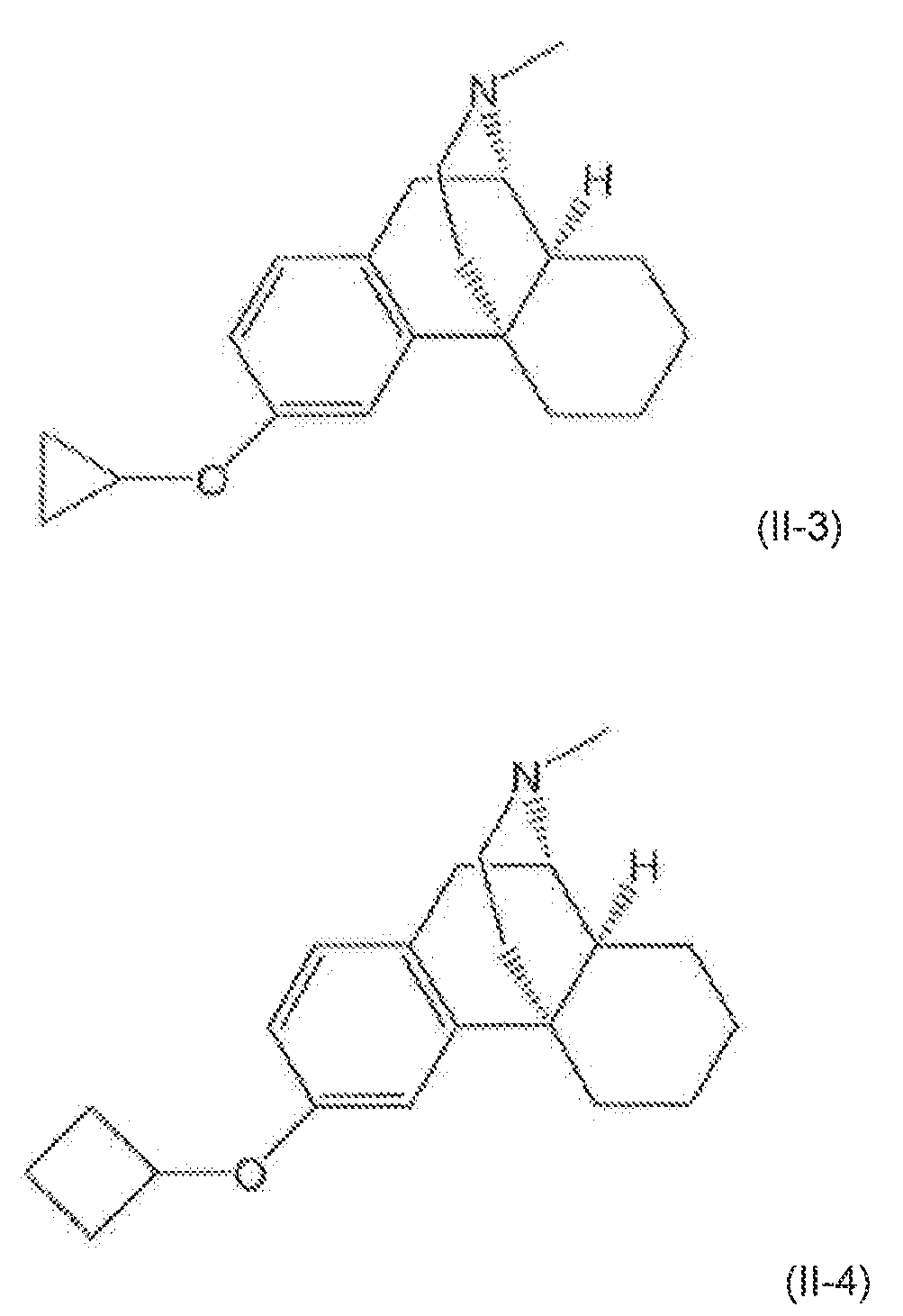
기타 양태에서, 3-위치의 메톡시 그룹은 황 원자를 포함하는 벌키어 그룹으로 치환될 수 있다. In other embodiments, the methoxy group at the 3-position may be substituted with a group of a vulcanizing agent comprising a sulfur atom.

적합한 치환체는 다음의 사항들을 포함하지만 이에 한정되지 않는다: 각각의 R1은 수소, C1-C10 알킬, C2-C10 알케닐, C2-C10 알키닐, C6-C12 아릴, C7-C13 아릴알킬, C3-C10 사이클로알킬, C2-C10 헤테로사이클, C3-C10 헤테로사이클알킬, C3-C12 헤테로아릴, C4-C12 헤테로아릴알킬, 알킬아미노, 및 디알킬아미노로 이루어진 그룹으로부터 독립적으로 선택되고, 이때 각각의 수소는 저급 알킬, 알콕시 또는 할로겐으로 임의로 치환되고; R2는 -SR1, 

3-위치에 벌키 그룹을 함유하는 황을 갖는 적합한 유사체는 아래의 화합물 (III-1) 내지 (III-3)을 포함한다.Suitable analogues with sulfur containing a bulky group at the 3-position include the following compounds (III-1) to (III-3).

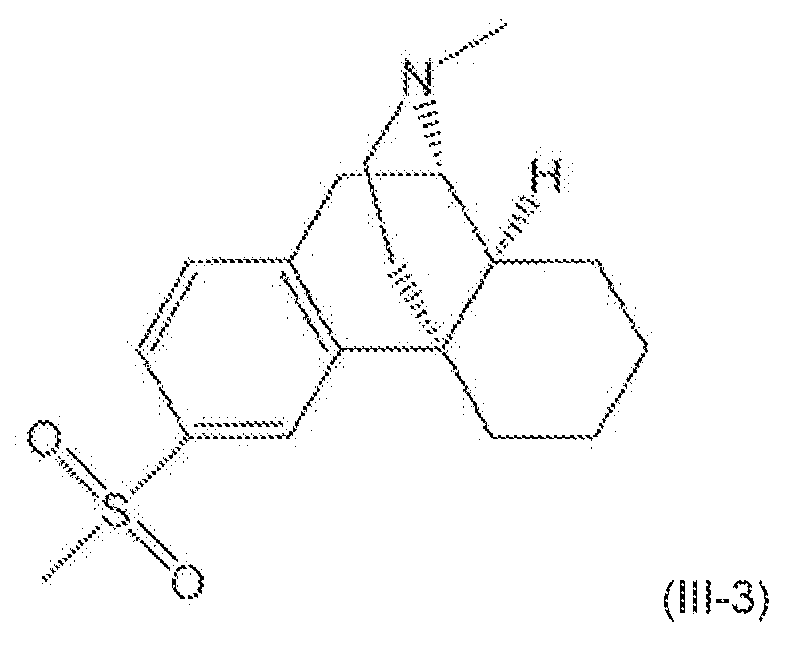
임의의 특정 이론에 결부되고자 하지 않으면서, 3-위치에 산소 또는 황 원자를 함유하는 벌키어 그룹의 도입은 덱스트로메토르판 또는 중수소화 덱스트로메토르판의 반감기(t1 /2)를 개선시킬 수 있는 것으로 사료된다. 반감기를 증가시킴으로써, 혈중 덱스트로메토르판 유사체의 농도는, 이것이 덱스트로판으로 대사되지 전에 더 오랜 시간 기간에 걸쳐 증가할 수 있다. 또 다른 치환체 및 치환이 또한 본 발명의 범주의 정신 내에 존재한다. 특히, 하나 이상 중수소 원자, 예를 들면 d6DM를 포함하는 치환체 및 치환은 본 발명의 범주내에 있다. 당해 분야의 숙련가는 본 발명의 덱스트로메토르판 유사체를 개질시켜 중수소화 덱스트로메토르판 유사체를 제공하는 방법을 알고 있을 것이다.Without becoming bound by any particular theory, the introduction of make keyer group containing an oxygen or sulfur atom in the 3-position is a dextromethorphan or deuterated index half life of Trojan methoxy Torr board (t 1/2) It can be said that it can be improved. By increasing the half-life, the concentration of dextromethorphan analog in the blood can increase over a longer period of time before it is metabolized to dextro-plate. Other substituents and substitutions are also within the spirit of the present invention. In particular, substituents and substitutions involving one or more deuterium atoms, such as d6DM, are within the scope of the present invention. One skilled in the art will know how to modify dextromethorphan analogs of the invention to provide deuterated dextromethorphan analogs.
문헌[Newman et al. In J Med Chem. 1992 Oct 30;35(22):4135-42]에 기재된 화합물 또한 본 발명의 범주에 포함된다. 뉴먼(Newman)에 의해 이들 화합물은 경련 작용(convulsive action)의 각종 시험관내(in vitro) 및 생체내(in vivo) 모델에서 항경련 활성(anticonvulsant activity)을 나타내는 것으로 식별되었다.Newman et al. In J Med Chem. 1992
CYP2D6CYP2D6 억제제 Inhibitor
본 발명은 덱스트로메토르판 화합물을 퀴니딘과 같은 CYP2D6 억제제와 함께 사용하는 것을 기술한다. 퀴니딘이 공동 투여에 가장 일반적으로 사용되는 한편, 문헌[Inaba et al., Drug Metabolism and disposition. 1985;13:443-447, Forme-Pfister et al., Biochem. Pharmacol. 1988;37:3829-3835, and Broly et al., Biochem. Pharmacol. 1990;39:1045-1053]에 기재된 바와 같은 기타 산화방지제 또한 덱스트로메토르판 화합물과 공동 투여되어 이의 대사를 감소시킬 수 있다. 이나바(Inaba) 등에 의해 보고된 바와 같이, 50마이크로몰 이하의 Ki 값(미하엘리스-멘톤 억제 값(Michaelis-Menton inhibition value))을 갖는 CYP2D6 억제제는 노르트립틸린(nortriptyline), 클로르프로마진(chlorpromazine), 돔페리돈(domperidone), 할로페리돌, 피팜페론(pipamperone), 라베타롤(labetalol), 메타프롤롤(metaprolol), 옥스프레놀롤(oxprenolol), 프로프라놀롤(propranolol), 티몰롤(timolol), 멕실레틴(mexiletine), 퀴닌(quinine), 디펜하이드라민(diphenhydramine), 아지말린(ajmaline), 로벨린(lobeline), 파파베린(papaverine), 및 요힘빈(yohimbine)을 포함한다. 특히 강력한 억제 활성을 갖는 화합물은 요힘빈, 할로페리돌, 아지말린, 로벨린, 및 피팜페론을 포함하며 이는 4 내지 0.33μM 범위의 Ki 값을 갖는다. 상기 보고된 산화방지제 이외에도, 일라이 릴리 앤드 컴퍼니(Eli Lilly and Co.)에 의해 상표명 Prozac®으로 시판되는 플루옥세틴(fluoxetine)이 일부 사람들의 혈중 덱스트로메토르판 농도를 증가시키는데 효과적인 것으로 또한 밝혀졌다. 또한, 다음의 화합물들 중의 임의의 것이 CYP2D6의 억제에 사용될 수 있다: 테르비나핀(terbinafine), 시나칼세트(cinacalcet), 부프레노르핀(buprenorphine), 이미프라민, 부프로피온(bupropion), 리토나비르(ritonavir), 설트랄린(sertraline), 듀록세틴, 티오리다진(thioridazine), 메토클로프라미드(metoclopramide), 파록세틴, 또는 플루복사민(fluvoxamine). 다른 산화방지제들의 투여량은 산화방지제에 따라 가변적일 것이며, 개별적인 기준에 따라 결정된다.The present invention describes the use of a dextromethorphan compound with a CYP2D6 inhibitor such as quinidine. Quinidine is most commonly used for co-administration, while Inaba et al., Drug Metabolism and disposition. 1985; 13: 443-447, Forme-Pfister et al., Biochem. Pharmacol. 1988; 37: 3829-3835, and Broly et al., Biochem. Pharmacol. 1990; 39: 1045-1053) may also be co-administered with a dextromethorphan compound to reduce its metabolism. As reported by Inaba et al., CYP2D6 inhibitors with a Ki value of less than 50 micromolar (Michaelis-Menton inhibition value) have been reported to be effective as nortriptyline, chlorpromazine ), Domperidone, haloperidol, pipamperone, labetalol, metaprolol, oxprenolol, propranolol, timolol, but are not limited to, mexiletine, quinine, diphenhydramine, ajmaline, lobeline, papaverine, and yohimbine. Compounds with particularly potent inhibitory activity include yovindine, haloperidol, azimarine, lobelin, and pifamerone, which have K i values in the range of 4 to 0.33 μM. In addition to the reported antioxidants, it has also been found that fluoxetine, marketed by Eli Lilly and Co. under the trade name Prozac ® , is effective in increasing the concentration of dextromethorphan in the blood of some people. In addition, any of the following compounds can be used to inhibit CYP2D6: terbinafine, cinacalcet, buprenorphine, imipramine, bupropion, Ritonavir, sertraline, duroxetin, thioridazine, metoclopramide, paroxetine, or fluvoxamine. The dosage of the other antioxidants will vary depending on the antioxidant and is determined according to individual criteria.
알츠하이머병의 초조함 및/또는 공격성을 앓는 피험자를, 유의미한 치료 효과를 제공하기 위해 현재까지 필요한 것으로 여겨진 최소량보다 현저히 더 적은 양의 퀴니딘과 조합하여 덱스트로메토르판 화합물로 치료할 수 있는 것으로 이례적으로 밝혀졌다.It is unusual to be able to treat a subject suffering from agitation and / or aggression of Alzheimer's disease with a dextromethorphan compound in combination with a significantly lower amount of quinidine than is considered necessary until now to provide a meaningful therapeutic effect It turned out.
덱스트로메토르판 또는 이의 중수소화 형태의 대사는 CYP2D6 억제제를 상기 덱스트로메토르판과 함께 공동 투여함으로써 추가로 방지될 수 있다. 퀴니딘은 강력한 CYP2D6 억제제이며, 이러한 용도에 대해 특히 연구되고 있다(스미스(Smith)의 미국 특허 제5,206,248). 퀴니딘의 화학 구조는 다음과 같다:Metabolism of dextromethorphan or its deuterated form can be additionally prevented by co-administration of the CYP2D6 inhibitor with the dextromethorphan. Quinidine is a potent CYP2D6 inhibitor and has been specifically studied for this use (Smith, US Patent No. 5,206,248). The chemical structure of quinidine is as follows:

퀴니딘 공동 투여는 적어도 2개의 뚜렷한 유익한 효과를 갖는다. 우선, 이는 혈액을 순환하는 덱스트로메토르판 화합물의 양을 상당히 증가시킨다. 또한, 이는 더욱 일관성 있고 예측 가능한 덱스트로메토르판 농도를 달성한다. 덱스트로메토르판 또는 퀴니딘과 덱스트로메토르판의 공동 투여, 및 혈장 농도에 있어서의 퀴니딘의 효과에 대한 연구가 특허 문헌에 기재되어 있다(예를 들면, 미국 특허 제5,166,207, 미국 특허 제5,863,927호, 미국 특허 제5,366,980호, 미국 특허 제5,206,248호, 미국 특허 제5,350,756호, 및 미국 특허 제7,973,049호 참조). Co-administration of quinidine has at least two distinct beneficial effects. First, it significantly increases the amount of dextromethorphan compound circulating in the blood. It also achieves a more consistent and predictable dextromethorphan concentration. Co-administration of dextromethorphan or quinidine with dextromethorphan and studies of the effect of quinidine on plasma concentrations have been described in the patent (see, for example, U.S. Patent No. 5,166,207, 5,863,927, 5,366,980, 5,206,248, 5,350,756, and 7,973,049).
퀴니딘 투여는 광범위한 대사물 표현형을 갖는 피험자를 불량한 대사물 표현형을 갖는 피험자로 변환시킬 수 있다(Inaba et al., Br. J. Clin. Pharmacol. 1986; 22: 199-200). 덱스트로메토르판의 혈액 수준은 퀴니딘과의 공동 투여시 덱스트로메토르판 투여량에 따라 선형으로 증가하지만, 고용량일지라도 덱스트로메토르판이 단독으로 제공된 대부분의 피험자에서는 검출 불가능하다(Zhang et al., Clin. Pharmac. & Therap. 1992;51:647-55). 이에 따라, 고속 대사물 및 이어서 퀴니딘과 공동 투여된 덱스트로메토르판에서 관찰되는 혈장 수준은, 불량한 대사물에서 관찰되는 혈장 수준을 모방한다. 따라서, 의료진은 불량한 대사물일 수 있는 피험자에게 퀴니딘을 투여하는 데에는 신중해야 한다.Quinidine administration can convert subjects with a wide range of metabolite phenotypes into subjects with poor metabolite phenotype (Inaba et al., Br. J. Clin. Pharmacol. 1986; 22: 199-200). Blood levels of dextromethorphan increase linearly with dose of dextromethorphan when co-administered with quinidine, but even at high doses, dextromethorphan alone is not detectable in most subjects provided alone (Zhang et < RTI ID = 0.0 > al., Clin. Pharmac. & Therap. 1992; 51: 647-55). Thus, plasma levels observed in dextromethorphan, coadministered with fast metabolites and subsequently with quinidine, mimic plasma levels observed in poor metabolites. Therefore, medical staff should be cautious in administering quinidine to subjects who may be a poor metabolizer.
약제학적 조성물Pharmaceutical composition
본 발명의 방법 및 배합물의 특징들 중의 하나는 이들이 알츠하이머병 피험자의 초조함 및/또는 공격성을 감소시키는 작용을 한다는 것이다. 몇몇 예에서 이러한 감소는 의식(consciousness) 또는 각성(alertness)를 진정시키거나 또는 중대하게 방해하지 않고 및/또는 심각한 역효과의 위험성을 증가시키지 않고 달성될 수 있다. 본원에서 사용되는, "유의미한 방해(significant interference)"는 임상적 수준에서의 유의미한 부작용(adverse event)(예를 들면, 의사 또는 심리학자에게 특정한 관심을 유발시킬 것이다) 또는 (예를 들면 개인의 차량 운전 능력을 손상시킬 정도로 충분히 심각한 졸림을 유발시킴으로써) 개인적 또는 사회적 수준에서의 유의미한 부작용을 지칭한다. 반면, 덱스트로메토르판-함유 기침 시럽과 같은 처방전 없이 구입가능한 약물에 의해 유발될 수 있는 매우 작은 부작용의 유형은, 권고된 투여량으로 사용되는 경우, 유의미한 방해로서 간주되지 않는다.One of the features of the methods and combinations of the present invention is that they act to reduce the agitation and / or aggressiveness of subjects with Alzheimer's disease. In some instances, this reduction can be achieved without sedation or with significant disruption of consciousness or alertness and / or without increasing the risk of serious adverse effects. As used herein, "significant interference" refers to a significant adverse event at the clinical level (e.g., will cause a particular interest to a physician or psychologist) Refers to significant side effects at the individual or societal level by inducing sleepiness sufficiently severe to impair abilities). On the other hand, the very small side effect type that can be caused by a prescription-free drug, such as dextromethorphan-containing cough syrup, is not considered a significant disruption when used at the recommended dosage.
알츠하이머병 피험자의 초조함 및/또는 공격성의 급성 또는 만성 관리시에 퀴니딘과 조합되는 덱스트로메토르판 화합물의 치료 용량의 규모는 병태의 특정 원인, 병태의 중증도, 및 투여 경로와 같은 인자에 따라 가변적일 수 있다. 용량 및/또는 투여 빈도수는 또한 피험자의 연령, 체중, 및 반응에 따라 가변적일 수 있다.The magnitude of the therapeutic dose of dextromethorphan compound in combination with quinidine in the acute or chronic management of anxiety and / or aggression in Alzheimer's subjects depends on factors such as the particular cause of the condition, the severity of the condition, Can be variable. The dose and / or frequency of administration may also vary depending on the age, weight, and response of the subject.
하나의 양태에서, 덱스트로메토르판 화합물 및 퀴니딘은 병용 용량으로 또는 별개 용량으로 투여된다. 별개 용량은 실질적으로 동시 투여될 수 있다. 하나의 양태에서, 퀴니딘에 대한 덱스트로메토르판 화합물의 중량비는 약 1:1 또는 그 미만이다. 몇몇 양태에서, 상기 중량비는 약 1:1, 1:0.95, 1:0.9, 1:0.85, 1:0.8, 1:0.75, 1:0.7, 1:0.65, 1:0.6, 1:0.55 또는 1:0.5 또는 그 미만이다. 마찬가지로, 특정 양태에서, 투여량은 약 1:0.5 미만, 예를 들면, 약 1:0.45, 1:0.4, 1:0.35, 1:0.3, 1:0.25, 1:0.2, 1:0.15, 또는 1:0.1, 1:0.09, 1:0.08, 1:0.07, 1:0.06, 1:0.05, 1:0.04, 1:0.03, 1:0.02, 또는 1:0.01, 또는 그 미만의, 퀴니딘에 대한 덱스트로메토르판 화합물의 중량비를 갖는다. 상기 중량비는 예를 들면 약 1:0.75, 약 1:0.68, 약 1:0.6, 약 1:0.56, 약 1:0.5, 약 1:0.44, 약 1:0.39, 약 1:0.38, 약 1:0.31, 약 1:0.30, 약 1:0.29, 약 1:0.28, 약 1:0.27, 약 1:0.26, 약 1:0.25, 약 1:0.24, 약 1:0.23, 약 1:0.22, 약 1:0.21, 약 1:0.20, 약 1:0.19, 약 1:0.18, 약 1:0.17, 1:0.16, 약 1:0.15, 약 1:0.14, 약 1:0.13, 약 1:0.12, 약 1:0.11 및 약 1:0.10일 수 있다. 몇몇 양태에서, 퀴니딘의 유리 염기에 대한 덱스트로메토르판의 유리 염기의 중량비는 약 1:0.68, 약 1:0.56, 약 1: 0.44, 약 1:0.38이다. 기타 특정 양태에서, 퀴니딘의 유리 염기에 대한 d6-중수소화 덱스트로메토르판의 유리 염기의 중량비는 약 1:0.30, 약 1:0.22, 약 1:0.19, 약 1:0.18, 약 1:0.16, 및 약 1:0.15이다.In one embodiment, the dextromethorphan compound and quinidine are administered in a combined or separate volume. Separate doses can be administered substantially simultaneously. In one embodiment, the weight ratio of dextromethorphan compound to quinidine is about 1: 1 or less. In some embodiments, the weight ratio is about 1: 1, 1: 0.95, 1: 0.9, 1: 0.85, 1: 0.8, 1: 0.75, 1: 0.7, 1: 0.65, 0.5 or less. Likewise, in certain embodiments, dosages are less than about 1: 0.5, such as about 1: 0.45, 1: 0.4, 1: 0.35, 1: 0.3, 1: 0.25, 1: 0.2, 1: 0.15, : 0.1, 1: 0.09, 1: 0.08, 1: 0.07, 1: 0.06, 1: 0.05, 1: 0.04, 1: 0.03, 1: 0.02, And a weight ratio of the tromethol compound. The weight ratio may be, for example, about 1: 0.75, about 1: 0.68, about 1: 0.6, about 1: 0.56, about 1: 0.5, about 1: 0.44, about 1: 0.39, about 1: , About 1: 0.23, about 1: 0.29, about 1: 0.28, about 1: 0.27, about 1: 0.26, about 1: , About 1: 0.20, about 1: 0.19, about 1: 0.18, about 1: 0.17, 1: 0.16, about 1: 0.15, about 1: 0.14, about 1: 0.13, about 1: 0.12, About 1: 0.10. In some embodiments, the weight ratio of the free base of dextromethorphan to the free base of quinidine is about 1: 0.68, about 1: 0.56, about 1: 0.44, about 1: 0.38. In other specific embodiments, the weight ratio of d6-deuterated dextromethorphan free base to quinidine free base is about 1: 0.30, about 1: 0.22, about 1: 0.19, about 1: 0.18, about 1: 0.16, and about 1: 0.15.
특정 양태에서, 덱스트로메토르판 화합물 및 퀴니딘이 1:1 또는 그 미만의 중량비로 투여되는 경우, 50mg 미만의 퀴니딘이 임의의 시간에 투여된다. 예를 들면, 특정 양태에서, 퀴니딘은 약 30, 25, 또는 20mg 또는 그 미만으로 투여된다. 기타 양태에서, 퀴니딘은 약 15, 10, 9.5, 9.0, 8.5, 8.0, 7.5, 7.0, 6.5, 6.0, 5.5, 5.0mg, 또는 그 미만으로 투여된다. 기타 양태에서, 퀴니딘은 약 5.00, 4.95, 4.90, 4.85, 4.80, 4.75, 4.70, 4.65, 4.60, 4.55, 4.50, 4.45, 4.40, 4.35, 4.30, 4.25, 4.20, 4.15, 4.10, 4.05, 4.00, 3.95, 3.90, 3.85, 3.80, 3.75, 3.70, 3.65, 3.60, 3.55, 3.50, 3.45, 3.40, 3.35, 3.30, 3.25, 3.20, 3.15, 3.10, 3.05, 3.00, 2.95, 2.90, 2.85, 2.80, 2.75, 2.70, 2.65, 2.60, 2.55, 2.50, 2.45, 2.40, 2.35, 2.30, 2.25, 2.20, 2.15, 2.10, 2.05, 2.00, 1.95, 1.90, 1.85, 1.80, 1.75, 1.70, 1.65, 1.60, 1.55, 1.50, 1.45, 1.40, 1.35, 1.30, 1.25, 1.20, 1.15, 1.10, 1.05, 1.00, 0.95, 0.90, 0.85, 0.80, 0.75, 0.70, 0.65, 0.60, 0.55, 0.50, 0.45, 0.40, 0.35, 0.30, 0.25, 0.20, 0.15, 0.10, 또는 0.05, 또는 그 미만으로 투여된다.In certain embodiments, when the dextromethorphan compound and quinidine are administered at a weight ratio of 1: 1 or less, less than 50 mg of quinidine is administered at any time. For example, in certain embodiments, the quinidine is administered at about 30, 25, or 20 mg or less. In other embodiments, the quinidine is administered at about 15, 10, 9.5, 9.0, 8.5, 8.0, 7.5, 7.0, 6.5, 6.0, 5.5, 5.0 mg, or less. In other embodiments, quinidine is present at about 5.00, 4.95, 4.90, 4.85, 4.80, 4.75, 4.70, 4.65, 4.60, 4.55, 4.50, 4.45, 4.40, 4.35, 4.30, 4.25, 4.20, 4.15, 3.95, 3.90, 3.85, 3.80, 3.75, 3.70, 3.65, 3.60, 3.55, 3.50, 3.45, 3.40, 3.35, 3.30, 3.25, 3.20, 3.15, 3.10, 3.05, 3.00, 2.95, 2.90, 2.85, 1.70, 1.65, 1.60, 1.55, 1.50, 1.50, 1.60, 1.50, 1.45, 1.40, 1.35, 1.30, 1.25, 1.20, 1.15, 1.10, 1.05, 1.00, 0.95, 0.90, 0.85, 0.80, 0.75, 0.70, 0.65, 0.60, 0.55, 0.50, 0.45, 0.40, 0.35, 0.20, 0.15, 0.10, or 0.05, or less.
몇몇 양태에서, 1:1 또는 그 미만의 중량비의 병용 용량(또는 동시 투여되는 별개 용량)은 1일 1회, 1일 2회, 1일 3회, 1일 4회, 또는 그 이상의 빈도수로 투여되어 피험자에게 1일 특정 투여 수준을 제공하며, 예를 들면, 60mg의 퀴니딘 및 60mg의 덱스트로메토르판 화합물이 1일 2회 용량으로 제공되고(각각의 투여량은 30mg의 퀴니딘 및 30mg의 덱스트로메토르판 화합물을 함유한다); 50mg의 퀴니딘 및 50mg의 덱스트로메토르판 화합물이 1일 2회 용량으로 제공되고(각각의 투여량은 25mg의 퀴니딘 및 25mg의 덱스트로메토르판 화합물을 함유한다); 40mg의 퀴니딘 및 40mg의 덱스트로메토르판 화합물이 1일 2회 용량으로 제공되고(각각의 투여량은 20mg의 퀴니딘 및 20mg의 덱스트로메토르판 화합물을 함유한다); 30mg의 퀴니딘 및 30mg의 덱스트로메토르판 화합물이 1일 2회 용량으로 제공되고(각각의 투여량은 15mg의 퀴니딘 및 15mg의 덱스트로메토르판 화합물을 함유한다); 또는 20mg의 퀴니딘 및 20mg의 덱스트로메토르판 화합물이 1일 2회 용량으로 제공된다(각각의 투여량은 10mg의 퀴니딘(즉, 약 9mg의 퀴니딘 유리 염기) 및 10mg의 덱스트로메토르판 화합물을 함유한다). 몇몇 양태에서, 병용 용량인 덱스트로메토르판 화합물 및 퀴니딘의 총량은 1일 투여 용량의 횟수에 따라 조절하여, 1:1 또는 그 미만의 중량비를 유지하면서도 피험자에게 적합한 1일 총 투여량을 제공할 수 있다.In some embodiments, the combined dose in a weight ratio of 1: 1 or less (or a separate dose concurrently administered) is administered at a frequency of once daily, twice daily, three times daily, four times daily, or more For example, 60 mg of quinidine and 60 mg of dextromethorphan compound are given twice a day in doses (each dose is 30 mg quinidine and 30 mg < RTI ID = 0.0 > Of dextromethorphan compound); 50 mg of quinidine and 50 mg of dextromethorphan compound are given twice daily (each dose contains 25 mg of quinidine and 25 mg of dextromethorphan compound); 40 mg of quinidine and 40 mg of dextromethorphan compound are provided in a dose of twice daily (each dose contains 20 mg of quinidine and 20 mg of dextromethorphan compound); 30 mg of quinidine and 30 mg of dextromethorphan compound are provided in a twice-a-day dose (each dose containing 15 mg of quinidine and 15 mg of dextromethorphan compound); Or 20 mg of quinidine and 20 mg of dextromethorphan compound are given in a dose of twice a day (each dose comprises 10 mg quinidine (i.e., about 9 mg quinidine free base) and 10 mg dextromethine Lt; / RTI > compound). In some embodiments, the combined amount of dextromethorphan compound and quinidine, in combination doses, is adjusted according to the number of doses administered per day to achieve a total daily dose suitable for the subject, while maintaining a weight ratio of 1: 1 or less .
몇몇 양태에서, 알츠하이머병 피험자의 초조함 및/또는 공격성을 치료하기 위한, 퀴니딘과 조합되는 덱스트로메토르판 화합물의 1일 총 용량은, 약 0.05mg 또는 그 미만 내지 약 60mg 또는 그 이상의 퀴니딘과 조합되는 약 10mg 또는 그 미만 내지 약 200mg 또는 그 이상의 덱스트로메토르판 화합물이다. 몇몇 양태에서, 알츠하이머병 피험자의 초조함 및/또는 공격성을 치료하기 위한 1일 용량은, 단독 용량 또는 분할 용량인, 약 2.5mg 내지 약 60mg의 퀴니딘과 조합되는 약 10mg 내지 약 90mg의 덱스트로메토르판 화합물이다. 몇몇 양태에서, 덱스트로메토르판 화합물의 1일 총 용량은, 약 15, 10, 9.5, 9.0, 8.5, 8.0, 7.5, 7.0, 6.5, 6.0, 5.5, 5.00, 4.95, 4.90, 4.85, 4.80, 4.75, 4.70, 4.65, 4.60, 4.55, 4.50, 4.45, 4.40, 4.35, 4.30, 4.25, 4.20, 4.15, 4.10, 4.05, 4.00, 3.95, 3.90, 3.85, 3.80, 3.75, 3.70, 3.65, 3.60, 3.55, 3.50, 3.45, 3.40, 3.35, 3.30, 3.25, 3.20, 3.15, 3.10, 3.05, 3.00, 2.95, 2.90, 2.85, 2.80, 2.75, 2.70, 2.65, 2.60, 2.55, 2.50, 2.45, 2.40, 2.35, 2.30, 2.25, 2.20, 2.15, 2.10, 2.05, 2.00, 1.95, 1.90, 1.85, 1.80, 1.75, 1.70, 1.65, 1.60, 1.55, 1.50, 1.45, 1.40, 1.35, 1.30, 1.25, 1.20, 1.15, 1.10, 1.05, 1.00, 0.95, 0.90, 0.85, 0.80, 0.75, 0.70, 0.65, 0.60, 0.55, 0.50, 0.45, 0.40, 0.35, 0.30, 0.25, 0.20, 0.15, 0.10, 또는 0.05mg 또는 그 미만의 퀴니딘과 조합되는, 약 15, 16, 17, 18, 19 또는 20mg이다.In some embodiments, the total daily dose of dextromethorphan compound in combination with quinidine for treating anxiety and / or aggression in Alzheimer's subjects is from about 0.05 mg or less to about 60 mg or more quinidine 0.0 > mg, < / RTI > or about 200 mg or more of dextromethorphan compound. In some embodiments, the daily dose for treating anxiety and / or aggression in Alzheimer's subjects is from about 10 mg to about 90 mg of dextromethol, in combination with about 2.5 mg to about 60 mg of quinidine, Lt; / RTI > In some embodiments, the total daily dose of dextromethorphan compound is about 15, 10, 9.5, 9.0, 8.5, 8.0, 7.5, 7.0, 6.5, 6.0, 5.5, 5.00, 4.95, 4.90, 4.85, 4.80, 4.75, 4.75, 4.70, 4.65, 4.60, 4.55, 4.50, 4.45, 4.40, 4.35, 4.30, 4.25, 4.20, 4.15, 4.10, 4.05, 4.00, 3.95, 3.90, 3.85, 3.80, 3.75, 3.70, 3.65, 3.60, 3.55, 2.70, 2.65, 2.60, 2.55, 2.50, 2.45, 2.40, 2.35, 2.30, 2.50, 1.25, 1.20, 1.15, 1.10, 1.05, 2.0, 2.0, 1.95, 1.90, 1.85, 1.80, 1.75, 1.70, 1.65, 1.60, 1.55, 1.50, 1.45, 1.40, 1.35, 1.30, 1.25, 1.20, In combination with a quinidine having the formula: 1.00, 0.95, 0.90, 0.85, 0.80, 0.75, 0.70, 0.65, 0.60, 0.55, 0.50, 0.45, 0.40, 0.35, 0.30, 0.25, 0.20, 0.15, 0.10, , About 15, 16, 17, 18, 19 or 20 mg.
몇몇 양태에서, 알츠하이머병 피험자의 초조함 및/또는 공격성을 치료하기 위한 1일 용량은, 단독 용량 또는 분할 용량으로, 약 15, 10, 9.5, 9.0, 8.5, 8.0, 7.5, 7.0, 6.5, 6.0, 5.5, 5.00, 4.95, 4.90, 4.85, 4.80, 4.75, 4.70, 4.65, 4.60, 4.55, 4.50, 4.45, 4.40, 4.35, 4.30, 4.25, 4.20, 4.15, 4.10, 4.05, 4.00, 3.95, 3.90, 3.85, 3.80, 3.75, 3.70, 3.65, 3.60, 3.55, 3.50, 3.45, 3.40, 3.35, 3.30, 3.25, 3.20, 3.15, 3.10, 3.05, 3.00, 2.95, 2.90, 2.85, 2.80, 2.75, 2.70, 2.65, 2.60, 2.55, 2.50, 2.45, 2.40, 2.35, 2.30, 2.25, 2.20, 2.15, 2.10, 2.05, 2.00, 1.95, 1.90, 1.85, 1.80, 1.75, 1.70, 1.65, 1.60, 1.55, 1.50, 1.45, 1.40, 1.35, 1.30, 1.25, 1.20, 1.15, 1.10, 1.05, 1.00, 0.95, 0.90, 0.85, 0.80, 0.75, 0.70, 0.65, 0.60, 0.55, 0.50, 0.45, 0.40, 0.35, 0.30, 0.25, 0.20, 0.15, 0.10, 또는 0.05mg 또는 그 미만의 퀴니딘과 조합되는, 약 20, 21, 22, 23, 24, 25, 26, 27, 28, 29, 또는 30mg의 덱스트로메토르판 화합물이거나; 또는 약 15, 10, 9.5, 9.0, 8.5, 8.0, 7.5, 7.0, 6.5, 6.0, 5.5, 5.00, 4.95, 4.90, 4.85, 4.80, 4.75, 4.70, 4.65, 4.60, 4.55, 4.50, 4.45, 4.40, 4.35, 4.30, 4.25, 4.20, 4.15, 4.10, 4.05, 4.00, 3.95, 3.90, 3.85, 3.80, 3.75, 3.70, 3.65, 3.60, 3.55, 3.50, 3.45, 3.40, 3.35, 3.30, 3.25, 3.20, 3.15, 3.10, 3.05, 3.00, 2.95, 2.90, 2.85, 2.80, 2.75, 2.70, 2.65, 2.60, 2.55, 2.50, 2.45, 2.40, 2.35, 2.30, 2.25, 2.20, 2.15, 2.10, 2.05, 2.00, 1.95, 1.90, 1.85, 1.80, 1.75, 1.70, 1.65, 1.60, 1.55, 1.50, 1.45, 1.40, 1.35, 1.30, 1.25, 1.20, 1.15, 1.10, 1.05, 1.00, 0.95, 0.90, 0.85, 0.80, 0.75, 0.70, 0.65, 0.60, 0.55, 0.50, 0.45, 0.40, 0.35, 0.30, 0.25, 0.20, 0.15, 0.10, 또는 0.05mg 또는 그 미만의 퀴니딘과 조합되는, 약 30, 31, 32, 33, 34, 35, 36, 37, 38, 39, 또는 40mg의 덱스트로메토르판 화합물이거나; 또는 약 15, 10, 9.5, 9.0, 8.5, 8.0, 7.5, 7.0, 6.5, 6.0, 5.5, 5.00, 4.95, 4.90, 4.85, 4.80, 4.75, 4.70, 4.65, 4.60, 4.55, 4.50, 4.45, 4.40, 4.35, 4.30, 4.25, 4.20, 4.15, 4.10, 4.05, 4.00, 3.95, 3.90, 3.85, 3.80, 3.75, 3.70, 3.65, 3.60, 3.55, 3.50, 3.45, 3.40, 3.35, 3.30, 3.25, 3.20, 3.15, 3.10, 3.05, 3.00, 2.95, 2.90, 2.85, 2.80, 2.75, 2.70, 2.65, 2.60, 2.55, 2.50, 2.45, 2.40, 2.35, 2.30, 2.25, 2.20, 2.15, 2.10, 2.05, 2.00, 1.95, 1.90, 1.85, 1.80, 1.75, 1.70, 1.65, 1.60, 1.55, 1.50, 1.45, 1.40, 1.35, 1.30, 1.25, 1.20, 1.15, 1.10, 1.05, 1.00, 0.95, 0.90, 0.85, 0.80, 0.75, 0.70, 0.65, 0.60, 0.55, 0.50, 0.45, 0.40, 0.35, 0.30, 0.25, 0.20, 0.15, 0.10, 또는 0.05mg 또는 그 미만의 퀴니딘과 조합되는, 약 40, 41, 42, 43, 44, 45, 46, 47, 48, 49, 또는 50mg의 덱스트로메토르판 화합물이거나; 또는 약 15, 10, 9.5, 9.0, 8.5, 8.0, 7.5, 7.0, 6.5, 6.0, 5.5, 5.00, 4.95, 4.90, 4.85, 4.80, 4.75, 4.70, 4.65, 4.60, 4.55, 4.50, 4.45, 4.40, 4.35, 4.30, 4.25, 4.20, 4.15, 4.10, 4.05, 4.00, 3.95, 3.90, 3.85, 3.80, 3.75, 3.70, 3.65, 3.60, 3.55, 3.50, 3.45, 3.40, 3.35, 3.30, 3.25, 3.20, 3.15, 3.10, 3.05, 3.00, 2.95, 2.90, 2.85, 2.80, 2.75, 2.70, 2.65, 2.60, 2.55, 2.50, 2.45, 2.40, 2.35, 2.30, 2.25, 2.20, 2.15, 2.10, 2.05, 2.00, 1.95, 1.90, 1.85, 1.80, 1.75, 1.70, 1.65, 1.60, 1.55, 1.50, 1.45, 1.40, 1.35, 1.30, 1.25, 1.20, 1.15, 1.10, 1.05, 1.00, 0.95, 0.90, 0.85, 0.80, 0.75, 0.70, 0.65, 0.60, 0.55, 0.50, 0.45, 0.40, 0.35, 0.30, 0.25, 0.20, 0.15, 0.10, 또는 0.05mg 또는 그 미만의 퀴니딘과 조합되는, 약 50, 51, 52, 53, 54, 55, 56, 57, 58, 59, 또는 60mg의 덱스트로메토르판 화합물이거나; 또는 약 15, 10, 9.5, 9.0, 8.5, 8.0, 7.5, 7.0, 6.5, 6.0, 5.5, 5.00, 4.95, 4.90, 4.85, 4.80, 4.75, 4.70, 4.65, 4.60, 4.55, 4.50, 4.45, 4.40, 4.35, 4.30, 4.25, 4.20, 4.15, 4.10, 4.05, 4.00, 3.95, 3.90, 3.85, 3.80, 3.75, 3.70, 3.65, 3.60, 3.55, 3.50, 3.45, 3.40, 3.35, 3.30, 3.25, 3.20, 3.15, 3.10, 3.05, 3.00, 2.95, 2.90, 2.85, 2.80, 2.75, 2.70, 2.65, 2.60, 2.55, 2.50, 2.45, 2.40, 2.35, 2.30, 2.25, 2.20, 2.15, 2.10, 2.05, 2.00, 1.95, 1.90, 1.85, 1.80, 1.75, 1.70, 1.65, 1.60, 1.55, 1.50, 1.45, 1.40, 1.35, 1.30, 1.25, 1.20, 1.15, 1.10, 1.05, 1.00, 0.95, 0.90, 0.85, 0.80, 0.75, 0.70, 0.65, 0.60, 0.55, 0.50, 0.45, 0.40, 0.35, 0.30, 0.25, 0.20, 0.15, 0.10, 또는 0.05mg 또는 그 미만의 퀴니딘과 조합되는, 약 60, 61, 62, 63, 64, 65, 66, 67, 68, 69, 또는 70mg의 덱스트로메토르판 화합물이거나; 또는 약 15, 10, 9.5, 9.0, 8.5, 8.0, 7.5, 7.0, 6.5, 6.0, 5.5, 5.00, 4.95, 4.90, 4.85, 4.80, 4.75, 4.70, 4.65, 4.60, 4.55, 4.50, 4.45, 4.40, 4.35, 4.30, 4.25, 4.20, 4.15, 4.10, 4.05, 4.00, 3.95, 3.90, 3.85, 3.80, 3.75, 3.70, 3.65, 3.60, 3.55, 3.50, 3.45, 3.40, 3.35, 3.30, 3.25, 3.20, 3.15, 3.10, 3.05, 3.00, 2.95, 2.90, 2.85, 2.80, 2.75, 2.70, 2.65, 2.60, 2.55, 2.50, 2.45, 2.40, 2.35, 2.30, 2.25, 2.20, 2.15, 2.10, 2.05, 2.00, 1.95, 1.90, 1.85, 1.80, 1.75, 1.70, 1.65, 1.60, 1.55, 1.50, 1.45, 1.40, 1.35, 1.30, 1.25, 1.20, 1.15, 1.10, 1.05, 1.00, 0.95, 0.90, 0.85, 0.80, 0.75, 0.70, 0.65, 0.60, 0.55, 0.50, 0.45, 0.40, 0.35, 0.30, 0.25, 0.20, 0.15, 0.10, 또는 0.05mg 또는 그 미만의 퀴니딘과 조합되는, 약 70, 71, 72, 73, 74, 75, 76, 77, 78, 79 또는 80mg의 덱스트로메토르판 화합물이거나; 또는 약 15, 10, 9.5, 9.0, 8.5, 8.0, 7.5, 7.0, 6.5, 6.0, 5.5, 5.00, 4.95, 4.90, 4.85, 4.80, 4.75, 4.70, 4.65, 4.60, 4.55, 4.50, 4.45, 4.40, 4.35, 4.30, 4.25, 4.20, 4.15, 4.10, 4.05, 4.00, 3.95, 3.90, 3.85, 3.80, 3.75, 3.70, 3.65, 3.60, 3.55, 3.50, 3.45, 3.40, 3.35, 3.30, 3.25, 3.20, 3.15, 3.10, 3.05, 3.00, 2.95, 2.90, 2.85, 2.80, 2.75, 2.70, 2.65, 2.60, 2.55, 2.50, 2.45, 2.40, 2.35, 2.30, 2.25, 2.20, 2.15, 2.10, 2.05, 2.00, 1.95, 1.90, 1.85, 1.80, 1.75, 1.70, 1.65, 1.60, 1.55, 1.50, 1.45, 1.40, 1.35, 1.30, 1.25, 1.20, 1.15, 1.10, 1.05, 1.00, 0.95, 0.90, 0.85, 0.80, 0.75, 0.70, 0.65, 0.60, 0.55, 0.50, 0.45, 0.40, 0.35, 0.30, 0.25, 0.20, 0.15, 0.10, 또는 0.05mg 또는 그 미만의 퀴니딘과 조합되는, 약 80, 81, 82, 83, 84, 85, 86, 87, 88, 89, 90mg의 덱스트로메토르판 화합물이다.In some embodiments, the daily dose for treating anxiety and / or aggression in Alzheimer's subjects is about 15, 10, 9.5, 9.0, 8.5, 8.0, 7.5, 7.0, 6.5, 6.0, 4.45, 4.40, 4.35, 4.30, 4.25, 4.20, 4.15, 4.10, 4.05, 4.00, 3.95, 3.90, 3.85, 4.75, 4.75, 4.70, 4.65, 2.80, 2.75, 2.70, 2.65, 2.60, 2.60, 3.70, 3.65, 3.60, 3.50, 3.50, 3.45, 3.40, 3.35, 3.30, 3.25, 3.20, 3.15, 3.10, 3.05, 1.55, 1.50, 1.45, 1.40, 1.35, 1.50, 1.60, 1.50, 1.50, 1.30, 1.25, 1.20, 1.15, 1.10, 1.05, 1.00, 0.95, 0.90, 0.85, 0.80, 0.75, 0.70, 0.65, 0.60, 0.55, 0.50, 0.45, 0.40, 0.35, 0.30, 0.25, 0.20, 0.15, 21, 22, 23, 24, 25, 26, 27, 28, 29, or 30 mg of a dextromethorphan compound in combination with quinidine, or 0.05 mg or less quinidine; Or about 15, 10, 9.5, 9.0, 8.5, 8.0, 7.5, 7.0, 6.5, 6.0, 5.5, 5.00, 4.95, 4.90, 4.85, 4.80, 4.75, 4.70, 4.65, 4.60, 4.55, 4.50, 4.45, 4.40, 3.35, 3.30, 3.25, 3.20, 3.15, 3.35, 3.35, 3.60, 3.55, 3.50, 3.35, 4.30, 4.25, 4.20, 4.15, 4.10, 4.05, 4.00, 3.95, 3.90, 3.85, 3.80, 2.30, 2.30, 2.25, 2.20, 2.15, 2.10, 2.05, 2.00, 1.95, 1.90, 2.75, 2.75, 2.80, 2.75, 2.70, 2.65, 2.60, 2.55, 2.50, 1.85, 1.80, 1.75, 1.70, 1.65, 1.60, 1.55, 1.50, 1.45, 1.40, 1.35, 1.30, 1.25, 1.20, 1.15, 1.10, 1.05, 1.00, 0.95, 0.90, 0.85, 0.80, 0.75, 0.70, 0.65, 31, 32, 33, 34, 35, 36, and 35, which are combined with a quinidine of about 0.60, 0.55, 0.50, 0.45, 0.40, 0.35, 0.30, 0.25, 0.20, 0.15, 0.10, 37, 38, 39, or 40 mg dextromethorphan compound; Or about 15, 10, 9.5, 9.0, 8.5, 8.0, 7.5, 7.0, 6.5, 6.0, 5.5, 5.00, 4.95, 4.90, 4.85, 4.80, 4.75, 4.70, 4.65, 4.60, 4.55, 4.50, 4.45, 4.40, 3.35, 3.30, 3.25, 3.20, 3.15, 3.35, 3.35, 3.60, 3.55, 3.50, 3.35, 4.30, 4.25, 4.20, 4.15, 4.10, 4.05, 4.00, 3.95, 3.90, 3.85, 3.80, 2.30, 2.30, 2.25, 2.20, 2.15, 2.10, 2.05, 2.00, 1.95, 1.90, 2.75, 2.75, 2.80, 2.75, 2.70, 2.65, 2.60, 2.55, 2.50, 1.85, 1.80, 1.75, 1.70, 1.65, 1.60, 1.55, 1.50, 1.45, 1.40, 1.35, 1.30, 1.25, 1.20, 1.15, 1.10, 1.05, 1.00, 0.95, 0.90, 0.85, 0.80, 0.75, 0.70, 0.65, 40, 41, 42, 43, 44, 45, 46, and 45, in combination with quinidine, at least about 0.60, 0.55, 0.50, 0.45, 0.40, 0.35, 0.30, 0.25, 0.20, 0.15, 0.10, 47, 48, 49, or 50 mg dextromethorphan compound; Or about 15, 10, 9.5, 9.0, 8.5, 8.0, 7.5, 7.0, 6.5, 6.0, 5.5, 5.00, 4.95, 4.90, 4.85, 4.80, 4.75, 4.70, 4.65, 4.60, 4.55, 4.50, 4.45, 4.40, 3.35, 3.30, 3.25, 3.20, 3.15, 3.35, 3.35, 3.60, 3.55, 3.50, 3.35, 4.30, 4.25, 4.20, 4.15, 4.10, 4.05, 4.00, 3.95, 3.90, 3.85, 3.80, 2.30, 2.30, 2.25, 2.20, 2.15, 2.10, 2.05, 2.00, 1.95, 1.90, 2.75, 2.75, 2.80, 2.75, 2.70, 2.65, 2.60, 2.55, 2.50, 1.85, 1.80, 1.75, 1.70, 1.65, 1.60, 1.55, 1.50, 1.45, 1.40, 1.35, 1.30, 1.25, 1.20, 1.15, 1.10, 1.05, 1.00, 0.95, 0.90, 0.85, 0.80, 0.75, 0.70, 0.65, 50, 51, 52, 53, 54, 55, 56, 55, 55, 60, or more combinations with quinidine, such as 0.60, 0.55, 0.50, 0.45, 0.40, 0.35, 0.30, 0.25, 0.20, 0.15, 0.10, 57, 58, 59, or 60 mg dextromethorphan compound; Or about 15, 10, 9.5, 9.0, 8.5, 8.0, 7.5, 7.0, 6.5, 6.0, 5.5, 5.00, 4.95, 4.90, 4.85, 4.80, 4.75, 4.70, 4.65, 4.60, 4.55, 4.50, 4.45, 4.40, 3.35, 3.30, 3.25, 3.20, 3.15, 3.35, 3.35, 3.60, 3.55, 3.50, 3.35, 4.30, 4.25, 4.20, 4.15, 4.10, 4.05, 4.00, 3.95, 3.90, 3.85, 3.80, 2.30, 2.30, 2.25, 2.20, 2.15, 2.10, 2.05, 2.00, 1.95, 1.90, 2.75, 2.75, 2.80, 2.75, 2.70, 2.65, 2.60, 2.55, 2.50, 1.85, 1.80, 1.75, 1.70, 1.65, 1.60, 1.55, 1.50, 1.45, 1.40, 1.35, 1.30, 1.25, 1.20, 1.15, 1.10, 1.05, 1.00, 0.95, 0.90, 0.85, 0.80, 0.75, 0.70, 0.65, 61, 62, 63, 64, 65, 66, and 65, which are combined with quinidine, such as 0.60, 0.55, 0.50, 0.45, 0.40, 0.35, 0.30, 0.25, 0.20, 0.15, 0.10, 67, 68, 69, or 70 mg dextromethorphan compound; Or about 15, 10, 9.5, 9.0, 8.5, 8.0, 7.5, 7.0, 6.5, 6.0, 5.5, 5.00, 4.95, 4.90, 4.85, 4.80, 4.75, 4.70, 4.65, 4.60, 4.55, 4.50, 4.45, 4.40, 3.35, 3.30, 3.25, 3.20, 3.15, 3.35, 3.35, 3.60, 3.55, 3.50, 3.35, 4.30, 4.25, 4.20, 4.15, 4.10, 4.05, 4.00, 3.95, 3.90, 3.85, 3.80, 2.30, 2.30, 2.25, 2.20, 2.15, 2.10, 2.05, 2.00, 1.95, 1.90, 2.75, 2.75, 2.80, 2.75, 2.70, 2.65, 2.60, 2.55, 2.50, 1.85, 1.80, 1.75, 1.70, 1.65, 1.60, 1.55, 1.50, 1.45, 1.40, 1.35, 1.30, 1.25, 1.20, 1.15, 1.10, 1.05, 1.00, 0.95, 0.90, 0.85, 0.80, 0.75, 0.70, 0.65, 70, 71, 72, 73, 74, 75, 76, and 75, which are combined with quinidine in an amount of 0.60, 0.55, 0.50, 0.45, 0.40, 0.35, 0.30, 0.25, 0.20, 0.15, 0.10, 77, 78, 79 or 80 mg dextromethorphan compound; Or about 15, 10, 9.5, 9.0, 8.5, 8.0, 7.5, 7.0, 6.5, 6.0, 5.5, 5.00, 4.95, 4.90, 4.85, 4.80, 4.75, 4.70, 4.65, 4.60, 4.55, 4.50, 4.45, 4.40, 3.35, 3.30, 3.25, 3.20, 3.15, 3.35, 3.35, 3.60, 3.55, 3.50, 3.35, 4.30, 4.25, 4.20, 4.15, 4.10, 4.05, 4.00, 3.95, 3.90, 3.85, 3.80, 2.30, 2.30, 2.25, 2.20, 2.15, 2.10, 2.05, 2.00, 1.95, 1.90, 2.75, 2.75, 2.80, 2.75, 2.70, 2.65, 2.60, 2.55, 2.50, 1.85, 1.80, 1.75, 1.70, 1.65, 1.60, 1.55, 1.50, 1.45, 1.40, 1.35, 1.30, 1.25, 1.20, 1.15, 1.10, 1.05, 1.00, 0.95, 0.90, 0.85, 0.80, 0.75, 0.70, 0.65, 81, 82, 83, 84, 85, 86, 85, 85, 85, 85, 85, 87, 88, 89 and 90 mg of dextromethorphan compound.
몇몇 양태에서, 덱스트로메토르판 화합물 및 퀴니딘의 1일 용량은 30mg의 덱스트로메토르판 하이드로브로마이드 및 30mg의 퀴니딘 설페이트이다. 다른 투여량은, 예를 들면, 15mg의 덱스트로메토르판 하이드로브로마이드 및 9mg의 퀴니딘 설페이트 (대략 11mg의 덱스트로메토르판 및 대략 7.5mg의 퀴니딘에 상응함); 23mg의 덱스트로메토르판 하이드로브로마이드 및 9mg의 퀴니딘 설페이트 (대략 17mg의 덱스트로메토르판 및 대략 7.5mg의 퀴니딘에 상응함); 20mg의 덱스트로메토르판 하이드로브로마이드 및 10mg의 퀴니딘 설페이트 (대략 15mg의 덱스트로메토르판 및 8.3mg의 퀴니딘에 상응함); 30mg의 덱스트로메토르판 하이드로브로마이드 및 10mg의 퀴니딘 설페이트 (대략 22mg의 덱스트로메토르판 및 8.3mg의 퀴니딘에 상응함)를 포함한다.In some embodiments, the daily dose of dextromethorphan compound and quinidine is 30 mg dextromethorphan hydrobromide and 30 mg quinidine sulfate. Other dosages include, for example, 15 mg dextromethorphan hydrobromide and 9 mg quinidine sulfate (corresponding to approximately 11 mg dextromethorphan and approximately 7.5 mg quinidine); 23 mg of dextromethorphan hydrobromide and 9 mg of quinidine sulfate (corresponding to approximately 17 mg of dextromethorphan and approximately 7.5 mg of quinidine); 20 mg of dextromethorphan hydrobromide and 10 mg of quinidine sulfate (corresponding to about 15 mg of dextromethorphan and 8.3 mg of quinidine); 30 mg of dextromethorphan hydrobromide and 10 mg of quinidine sulfate (corresponding to approximately 22 mg of dextromethorphan and 8.3 mg of quinidine).
30mg의 d6-덱스트로메토르판 하이드로브로마이드(분자식 C18H19D6NO.HBr.H2O) 및 30mg의 퀴니딘 설페이트(분자식 (C20H24N2O2)2.H2SO4.2H2O)의 용량(대략 22.22mg의 덱스트로메토르판 및 25mg의 퀴니딘에 상응함)이 투여 또는 사용될 수 있다. d6-중수소화 덱스트로메토르판에 대한 다른 투여량은, 예를 들면, 24mg의 d6-덱스트로메토르판 하이드로브로마이드 및 4.75mg의 퀴니딘 설페이트 (대략 18mg의 d6-덱스트로메토르판 및 대략 3.96mg의 퀴니딘에 상응함); 34mg의 d6-덱스트로메토르판 하이드로브로마이드 및 4.75mg의 퀴니딘 설페이트 (대략 25.18mg의 d6-덱스트로메토르판 및 대략 3.96mg의 퀴니딘에 상응함); 18mg의 d6-덱스트로메토르판 하이드로브로마이드 및 4.9mg의 퀴니딘 설페이트 (대략 13.33mg의 d6-덱스트로메토르판 및 4.08mg의 퀴니딘에 상응함); 24mg의 d6-덱스트로메토르판 하이드로브로마이드 및 4.9mg의 퀴니딘 설페이트 (대략 17.78mg의 d6-덱스트로메토르판 및 4.08mg의 퀴니딘에 상응함); 28mg의 d6-덱스트로메토르판 하이드로브로마이드 및 4.9mg의 퀴니딘 설페이트 (대략 20.74mg의 d6-덱스트로메토르판 및 4.08mg의 퀴니딘에 상응함); 30mg의 d6-덱스트로메토르판 하이드로브로마이드 및 4.9mg의 퀴니딘 설페이트 (대략 22.22mg의 d6-덱스트로메토르판 및 4.08mg의 퀴니딘에 상응함); 34mg의 d6-덱스트로메토르판 하이드로브로마이드 및 4.9mg의 퀴니딘 설페이트 (대략 25.18mg의 d6-덱스트로메토르판 및 4.08mg의 퀴니딘에 상응함)를 포함한다.30 mg of d6-dextromethorphan hydrobromide (molecular formula C 18 H 19 D 6 NO.HBr.H 2 O) and 30 mg of quinidine sulfate (molecular formula (C 20 H 24 N 2 O 2 ) 2 .H 2 SO 4 .2H 2 O) (corresponding to about 22.22 mg of dextromethorphan and 25 mg of quinidine) can be administered or used. Other dosages for d6-deuterated dextromethorphan include, for example, 24 mg of d6-dextromethorphan hydrobromide and 4.75 mg of quinidine sulfate (approximately 18 mg of d6-dextromethorphan and Corresponds to approximately 3.96 mg of quinidine); 34 mg of d6-dextromethorphan hydrobromide and 4.75 mg of quinidine sulfate (corresponding to approximately 25.18 mg of d6-dextromethorphan and approximately 3.96 mg of quinidine); 18 mg of d6-dextromethorphan hydrobromide and 4.9 mg of quinidine sulfate (corresponding to approximately 13.33 mg of d6-dextromethorphan and 4.08 mg of quinidine); 24 mg of d6-dextromethorphan hydrobromide and 4.9 mg of quinidine sulfate (corresponding to approximately 17.78 mg of d6-dextromethorphan and 4.08 mg of quinidine); 28 mg of d6-dextromethorphan hydrobromide and 4.9 mg of quinidine sulfate (corresponding to approximately 20.74 mg of d6-dextromethorphan and 4.08 mg of quinidine); 30 mg of d6-dextromethorphan hydrobromide and 4.9 mg of quinidine sulfate (corresponding to approximately 22.22 mg of d6-dextromethorphan and 4.08 mg of quinidine); 34 mg of d6-dextromethorphan hydrobromide and 4.9 mg of quinidine sulfate (corresponding to approximately 25.18 mg of d6-dextromethorphan and 4.08 mg of quinidine).
몇몇 양태에서, 상기 치료요법은 더 낮은 1일 용량, 예를 들면 1일 약 2.5 내지 10mg의 퀴니딘과 조합된 약 18mg 또는 30mg의 덱스트로메토르판 화합물에서 개시되어, 피험자의 포괄적인 반응에 따라, 약 10 내지 20mg의 퀴니딘과 조합된 약 90mg 이하의 덱스트로메토르판 화합물 또는 그 이상으로 증가한다. 몇몇 양태에서, 영유아, 소아, 65세가 넘는 피험자, 및 신장 및 간 기능이 손상된 피험자는 초기에는, 개별적인 반응(들) 및 혈액 수준(들)을 기준으로 하여, 적정(titration)될 수 있는 저용량을 투여받는다. 일반적으로, 18 내지 90mg의 덱스트로메토르판 화합물 및 4.75 내지 20mg의 퀴니딘의 1일 투여량이 대부분의 피험자에 의해 잘 받아들여진다.In some embodiments, the therapeutic regimen is disclosed in a dextromethorphan compound of about 18 mg or 30 mg combined with a lower daily dose, for example, about 2.5 to 10 mg of quinidine per day, to a comprehensive response of the subject Thus increasing to about 90 mg or less dextromethorphan compound combined with about 10-20 mg quinidine or more. In some embodiments, infants, children, subjects over 65 years of age, and subjects with impaired renal and hepatic function initially have a low dose that can be titrated, based on the individual response (s) and blood level (s) ≪ / RTI > In general, a daily dosage of 18 to 90 mg of dextromethorphan compound and 4.75 to 20 mg of quinidine is well accepted by most subjects.
당해 분야의 숙련가에게 명백한 바와 같이, 이들 기재된 범위를 벗어난 투여량이 몇몇 경우에 투여될 수 있다. 추가로, 숙련된 임상의 또는 치료 의사는 개별적인 반응을 고려하여 어떻게 그리고 언제 치료요법을 중단, 조절, 또는 종결할지 알고 있을 것으로 인지된다.As will be apparent to those skilled in the art, doses outside these stated ranges may be administered in some instances. In addition, a skilled clinician or treating physician will be aware of how and when to consider the individual response, knowing when to discontinue, adjust, or terminate the therapy.
알츠하이머병 피험자의 초조함 및/또는 공격성을 치료하기 위해 임의의 적합한 투여 경로가 효과적인 투여량의 덱스트로메토르판 화합물을 퀴니딘과 조합하여 피험자에게 제공하는데 사용될 수 있다. 예를 들면, 경구, 직장, 경피, 비경구(피하, 근육내, 정맥내), 척수강내, 국소, 흡입 등과 같은 투여 형태가 사용될 수 있다. 적합한 투여형은 정제, 트로키제, 분산제, 현탁제, 용액제, 캡슐제, 패치제 등을 포함한다. 본원에 기재된 화합물로부터 제조된 약물의 투여는 상기 화합물을 혈류도 도입할 수 있는 임의의 적합한 방법에 의해 수행될 수 있다. 몇몇 양태에서, 상기 제형은 활성 화합물과 숙련가에게 알려진 약제학적으로 허용되는 담체 또는 희석제와의 혼합물을 함유할 수 있다.Any suitable route of administration may be used to provide the subject with an effective dose of a dextromethorphan compound in combination with quinidine to treat the anxiety and / or aggression of the Alzheimer's subject. For example, administration forms such as oral, rectal, transdermal, parenteral (subcutaneous, intramuscular, intravenous), intrathecal, topical, inhalation and the like may be used. Suitable dosage forms include tablets, troches, dispersants, suspensions, solutions, capsules, patches and the like. Administration of a medicament made from a compound described herein may be carried out by any suitable method capable of introducing the compound into the blood stream. In some embodiments, the formulations may contain a mixture of the active compound and a pharmaceutically acceptable carrier or diluent known to the skilled artisan.
본원에 기재된 약제학적 조성물은 활성 성분으로서, 퀴니딘과 같은 CYP2D6 억제제와 조합된 덱스트로메토르판 화합물, 또는 덱스트로메토르판 화합물 및/또는 퀴니딘의 약제학적으로 허용되는 염을 포함하며, 약제학적으로 허용되는 담체, 및 임의로, 기타 치료 성분들을 또한 함유할 수 있다.The pharmaceutical compositions described herein comprise, as the active ingredient, a dextromethorphan compound in combination with a CYP2D6 inhibitor such as quinidine, or a pharmaceutically acceptable salt of dextromethorphan compound and / or quinidine, A pharmaceutically acceptable carrier, and optionally other therapeutic ingredients.
용어 "약제학적으로 허용되는 염" 또는 "이의 약제학적으로 허용되는 염"은 약제학적으로 허용되는 비독성 산 또는 염기로부터 제조되는 염을 지칭한다. 적합한 약제학적으로 허용되는 염은 금속 염, 예를 들면, 알루미늄, 아연 염; 알칼리 금속 염, 예를 들면, 리튬, 나트륨, 및 칼륨 염; 알칼리 토금속 염, 예를 들면, 칼슘 및 마그네슘 염; 유기 염, 예를 들면, 라이신, N,N'-디벤질에틸렌디아민, 클로로프로카인, 콜린, 디에탄올아민, 에틸렌디아민, 메글루민(N-메틸글루카민), 프로카인, 및 트리스 염; 유리 산 및 염기 염; 무기 염, 예를 들면, 설페이트, 하이드로클로라이드, 및 하이드로브로마이드; 및 현재 약제학적으로 광범위하게 사용되며 머크 인덱스(Merck Index)와 같은 숙련가에게 널리 알려진 공급원에 열거된 기타 염들을 포함한다.The term " pharmaceutically acceptable salts "or" pharmaceutically acceptable salts thereof "refers to salts prepared from pharmaceutically acceptable non-toxic acids or bases. Suitable pharmaceutically acceptable salts include, but are not limited to, metal salts such as aluminum, zinc salts; Alkali metal salts such as lithium, sodium, and potassium salts; Alkaline earth metal salts such as calcium and magnesium salts; Organic salts such as lysine, N, N'-dibenzylethylenediamine, chloropropane, choline, diethanolamine, ethylenediamine, meglumine (N-methylglucamine), procaine, and tris salts; Free acids and base salts; Inorganic salts such as sulfates, hydrochlorides, and hydrobromides; And other salts currently in wide use in pharmaceutical applications and listed in sources well known to those skilled in the art, such as the Merck Index.
임의의 적합한 성분이 본원에서 논의된 활성 약물의 염을 제조하기 위해 선택될 수 있으며, 이는 비독성이며, 목적하는 활성을 현저히 방해하지 않는다. 염 이외에도, 상기 화합물의 약제학적으로 허용되는 전구체 및 유도체가 사용될 수 있다. 중수소화 덱스트로메토르판 및/또는 퀴니딘의 약제학적으로 허용되는 아미드, 저급 알킬 에스테르, 및 보호된 유도체가 또한 본원에 기재된 조성물 및 방법에서 사용하기 적합할 수 있다. 특정 양태에서, 중수소화 덱스트로메토르판은 중수소화 덱스트로메토르판 하이드로브로마이드의 형태로 투여되고, 상기 덱스트로메토르판은 덱스트로메토르판 하이드로브로마이드로서 투여되고, 상기 퀴니딘은 퀴니딘 설페이트의 형태로 투여된다.Any suitable ingredient may be selected to produce a salt of the active drug as discussed herein, which is non-toxic and does not significantly interfere with the desired activity. In addition to the salts, pharmaceutically acceptable precursors and derivatives of the above compounds may be used. Pharmaceutically acceptable amides, lower alkyl esters, and protected derivatives of deuterated dextromethorphan and / or quinidine may also be suitable for use in the compositions and methods described herein. In certain embodiments, the deuterated dextromethorphan is administered in the form of deuterated dextromethorphan hydrobromide, wherein the dextromethorphan is administered as dextromethorphan hydrobromide, the quinidine is quinidine ≪ / RTI >
상기 조성물은 임의의 목적하는 형태로, 예를 들면, 정제, 산제, 캡슐제, 주사제, 현탁제, 사셰제(sachet), 카셰제(cachet), 패치제, 용액제, 엘릭시르제, 및 에어로졸로 제조될 수 있다. 전분, 당, 미세결정성 셀룰로스, 희석액, 과립화제(granulating agent), 윤활제, 결합제, 붕해제 등과 같은 담체가 고체형 경구 제제에서 사용될 수 있다. 특정 양태에서, 상기 조성물은 고체형 경구 제제(예를 들면 산제, 캡슐제, 및 정제)로서 제조된다. 특정 양태에서, 상기 조성물은 액체형 경구 제제로서 제조된다. 몇몇 양태에서, 상기 고체형 경구 제제는 정제이다. 필요한 경우, 정제는 표준 수성 또는 비수성 기술로 코팅될 수 있다.The compositions may be presented in any desired form, for example, as tablets, powders, capsules, injectables, suspensions, sachets, cachets, patches, solutions, elixirs, and aerosols . Carriers such as starches, sugars, microcrystalline cellulose, diluents, granulating agents, lubricants, binders, disintegrating agents and the like may be used in solid oral formulations. In certain embodiments, the compositions are prepared as solid oral preparations (e.g., powders, capsules, and tablets). In certain embodiments, the compositions are prepared as liquid oral preparations. In some embodiments, the solid oral formulation is a tablet. If desired, tablets may be coated with standard aqueous or non-aqueous techniques.
상기 설정된 투여형 이외에도, 본원에 기재된 화합물은 또한 서방출(sustained release), 지연 방출(delayed release), 또는 제어 방출 조성물 및/또는 전달 장치, 예를 들면, 미국 특허 제3,845,770호, 제3,916,899호, 제3,536,809호, 제3,598,123호, 및 제4,008,719호에 기재된 것들에 의해 투여될 수 있다.In addition to the established dosage forms, the compounds described herein may also be used in sustained release, delayed release, or controlled release compositions and / or delivery devices, such as those described in U.S. Patent Nos. 3,845,770, 3,916,899, 3,536,809, 3,598,123, and 4,008,719, all of which are incorporated herein by reference.
경구 투여에 적합한 약제학적 조성물은 캡슐제, 카셰제, 사셰제, 패치제, 주사제, 정제, 및 에어로졸 스프레이와 같은 별도의 단위로서 제공될 수 있으며, 각각은 소정량의 활성 성분을 산제 또는 과립제로서, 또는 수성 액체, 비수성 액체, 수중유 에멀젼 또는 유중수 액체 에멀젼 중의 용액제 또는 현탁제로서 함유한다. 이러한 조성물은 조제실의 통상의 방법들 중의 임의의 것에 의해 제조될 수 있지만, 상기 방법들 중의 다수는 통상적으로, 활성 성분을 하나 이상의 성분들로 이루어진 담체와 관련시키는 단계를 포함한다. 일반적으로, 상기 조성물은 활성 성분을 액체형 담체, 미분된 고체형 담체, 또는 이들 둘 다와 균일하고 정교하게 혼합하고, 이어서, 임의로, 생성물을 목적하는 방식으로 성형함으로써 제조된다.Pharmaceutical compositions suitable for oral administration may be presented as discrete units such as capsules, cachets, sachets, patches, injections, tablets, and aerosol sprays, each containing a predetermined amount of the active ingredient as a powder or granules , Or as a solution or suspension in an aqueous liquid, a non-aqueous liquid, an oil-in-water emulsion or a water-in-oil liquid emulsion. Such compositions can be prepared by any of the conventional methods of the preparation room, but many of the methods conventionally involve associating the active ingredient with a carrier of one or more ingredients. In general, the compositions are prepared by uniformly and finely mixing the active ingredient with a liquid carrier, a finely divided solid carrier, or both, and then optionally, shaping the product in the desired manner.
예를 들면, 정제는, 임의로, 하나 이상의 추가의 성분들과 압축 또는 성형되어 제조될 수 있다. 압축 정제는, 적합한 기계에서 활성 성분을 산제 또는 과립제와 같은 자유-유동 형태로 압축하고, 임의로 결합제, 윤활제, 불활성 희석제, 표면활성제 또는 분산제와 혼합함으로써 제조될 수 있다. 성형 정제는, 적합한 기계에서, 불활성 액체 희석제로 습윤된 분말화된 화합물의 혼합물을 성형함으로써 제조될 수 있다.For example, tablets may optionally be prepared by compression or molding with one or more additional ingredients. Compressed tablets may be prepared by compressing the active ingredient in a free-flowing form, such as a powder or granules, in a suitable machine, and optionally mixing with a binder, lubricant, inert diluent, surface active agent or dispersant. Molded tablets may be prepared by molding a mixture of the powdered compound wetted with an inert liquid diluent in a suitable machine.
몇몇 양태에서, 각각의 정제는 약 30mg의 덱스트로메토르판 하이드로브로마이드 및 30mg의 퀴니딘 설페이트를 함유한다. 상기 정제는, 예를 들면, 15mg의 덱스트로메토르판 하이드로브로마이드 및 9mg의 퀴니딘 설페이트 (대략 11mg의 덱스트로메토르판 및 대략 7.5mg의 퀴니딘에 상응함); 23mg의 덱스트로메토르판 하이드로브로마이드 및 9mg의 퀴니딘 설페이트 (대략 17mg의 덱스트로메토르판 및 대략 7.5mg의 퀴니딘에 상응함); 20mg의 덱스트로메토르판 하이드로브로마이드 및 10mg의 퀴니딘 설페이트 (대략 15mg의 덱스트로메토르판 및 8.3mg의 퀴니딘에 상응함); 30mg의 덱스트로메토르판 하이드로브로마이드 및 10mg의 퀴니딘 설페이트 (대략 22mg의 덱스트로메토르판 및 8.3mg의 퀴니딘에 상응함)를 포함할 수 있다.In some embodiments, each tablet contains about 30 mg dextromethorphan hydrobromide and 30 mg quinidine sulfate. The tablets may contain, for example, 15 mg of dextromethorphan hydrobromide and 9 mg of quinidine sulfate (corresponding to approximately 11 mg of dextromethorphan and approximately 7.5 mg of quinidine); 23 mg of dextromethorphan hydrobromide and 9 mg of quinidine sulfate (corresponding to approximately 17 mg of dextromethorphan and approximately 7.5 mg of quinidine); 20 mg of dextromethorphan hydrobromide and 10 mg of quinidine sulfate (corresponding to about 15 mg of dextromethorphan and 8.3 mg of quinidine); 30 mg of dextromethorphan hydrobromide and 10 mg of quinidine sulfate (corresponding to approximately 22 mg of dextromethorphan and 8.3 mg of quinidine).
상기 정제는 30mg의 d6-덱스트로메토르판 하이드로브로마이드(분자식 C18H19D6NO.HBr.H2O) 및 30mg의 퀴니딘 설페이트(분자식 (C20H24N2O2)2.H2SO4.2H2O) (대략 22.22mg의 덱스트로메토르판 및 25mg의 퀴니딘에 상응함)를 포함할 수 있다. 상기 정제는 다른 투여량으로, 예를 들면, 24mg의 d6-덱스트로메토르판 하이드로브로마이드 및 4.75mg의 퀴니딘 설페이트 (대략 18mg의 d6-덱스트로메토르판 및 대략 3.96mg의 퀴니딘에 상응함); 34mg의 d6-덱스트로메토르판 하이드로브로마이드 및 4.75mg의 퀴니딘 설페이트 (대략 25.18mg의 d6-덱스트로메토르판 및 대략 3.96mg의 퀴니딘에 상응함); 18mg의 d6-덱스트로메토르판 하이드로브로마이드 및 4.9mg의 퀴니딘 설페이트 (대략 13.33mg의 d6-덱스트로메토르판 및 4.08mg의 퀴니딘에 상응함); 24mg의 d6-덱스트로메토르판 하이드로브로마이드 및 4.9mg의 퀴니딘 설페이트 (17.78mg의 d6-덱스트로메토르판 및 4.08mg의 퀴니딘에 상응함); 28mg의 d6-덱스트로메토르판 하이드로브로마이드 및 4.9mg의 퀴니딘 설페이트 (대략 20.74mg의 d6-덱스트로메토르판 및 4.08mg의 퀴니딘에 상응함); 30mg의 d6-덱스트로메토르판 하이드로브로마이드 및 4.9mg의 퀴니딘 설페이트 (대략 22.22mg의 d6-덱스트로메토르판 및 4.08mg의 퀴니딘에 상응함); 34mg의 d6-덱스트로메토르판 하이드로브로마이드 및 4.9mg의 퀴니딘 설페이트 (대략 25.18mg의 d6-덱스트로메토르판 및 4.08mg의 퀴니딘에 상응함)를 함유할 수 있다.The tablets d6- dextromethorphan hydrobromide of 30mg (molecular formula C 18 H 19 D 6 NO.HBr.H 2 O) and quinidine sulfate (molecular formula (C 20 H 24 N 2 O 2) of 30mg 2. H 2 SO 4 .2H 2 O) (corresponding to approximately 22.22 mg of dextromethorphan and 25 mg of quinidine). The tablets may be administered in different dosages, for example, 24 mg of d6-dextromethorphan hydrobromide and 4.75 mg of quinidine sulfate (approximately 18 mg of d6-dextromethorphan and approximately 3.96 mg of quinidine box); 34 mg of d6-dextromethorphan hydrobromide and 4.75 mg of quinidine sulfate (corresponding to approximately 25.18 mg of d6-dextromethorphan and approximately 3.96 mg of quinidine); 18 mg of d6-dextromethorphan hydrobromide and 4.9 mg of quinidine sulfate (corresponding to approximately 13.33 mg of d6-dextromethorphan and 4.08 mg of quinidine); 24 mg of d6-dextromethorphan hydrobromide and 4.9 mg of quinidine sulfate (corresponding to 17.78 mg of d6-dextromethorphan and 4.08 mg of quinidine); 28 mg of d6-dextromethorphan hydrobromide and 4.9 mg of quinidine sulfate (corresponding to approximately 20.74 mg of d6-dextromethorphan and 4.08 mg of quinidine); 30 mg of d6-dextromethorphan hydrobromide and 4.9 mg of quinidine sulfate (corresponding to approximately 22.22 mg of d6-dextromethorphan and 4.08 mg of quinidine); 34 mg of d6-dextromethorphan hydrobromide and 4.9 mg of quinidine sulfate (corresponding to approximately 25.18 mg of d6-dextromethorphan and 4.08 mg of quinidine).
본원에서 사용되는, "최소 유효 치료량"은, 역효과를 생성시키지 않거나 또는 허용되는 정도 및 성질의 부작용만을 생성시키면서, 신체로부터 덱스트로메토르판 화합물을 급속 제거하는 것을 억제하는 만족스러운 수준을 제공하는 양이다. 더욱 구체적으로는, 몇몇 양태에서, 유효 치료량은 1일 약 9, 10, 18, 20, 25 또는 30mg 내지 약 90mg의 덱스트로메토르판 화합물 및 약 50mg 미만의 퀴니딘의 범위내에 있다. 몇몇 양태에서, 유효 치료량은 1일 약 20 또는 30mg 내지 약 90mg의 덱스트로메토르판 화합물 및 약 0.5mg 내지 약 30mg의 퀴니딘의 범위내에 있다. 몇몇 양태에서, 당해 양은 덱스트로메토르판 화합물의 혈장 반감기(plasma half-life)에 근거하여 분할 용량으로 투여된다. 예를 들면, 하나의 양태에서 중수소화 덱스트로메토르판 및 퀴니딘은 특정한 증분량(mg)으로 투여되어, 체중을 기준으로 하여 명시된 최대 투여량의 중수소화 덱스트로메토르판 및 퀴니딘과 함께, 특정 수준의 중수소화 덱스트로메토르판의 표적 농도(㎍/mL 혈장)를 달성한다. 몇몇 양태에서, 표적 용량은 12시간마다 투여된다. 몇몇 양태에서, 표적 용량은 1일 1회 투여된다. 몇몇 양태에서, 퀴니딘의 수준은 최소화되고 퀴니딘에 대한 높은 투여량에서 관찰되는 부작용은 최소화되거나 제거되며, 더 높은 수준의 퀴니딘과 조합된 덱스트로메토르판 화합물을 함유하는 조성물의 유의미한 이점이 제공된다.As used herein, a "minimum effective amount of treatment" provides a satisfactory level of inhibiting the rapid removal of a dextromethorphan compound from the body, while not producing adverse effects or creating only adverse effects and degrees of adverse effects It is a quantity. More particularly, in some embodiments, an effective therapeutic amount is in the range of about 9, 10, 18, 20, 25 or 30 mg to about 90 mg of dextromethorphan compound per day and less than about 50 mg of quinidine per day. In some embodiments, an effective therapeutic amount is in the range of about 20 or 30 mg to about 90 mg dextromethorphan compound per day and about 0.5 mg to about 30 mg quinidine per day. In some embodiments, the amount is administered in divided doses based on the plasma half-life of the dextromethorphan compound. For example, in one embodiment, the deuterated dextromethorphan and quinidine are administered at a particular increment (mg), and the maximum dose of dehydrated dextromethorphan and quinidine Together, a target concentration of deuterated dextromethorphan at a certain level (/ / mL plasma) is achieved. In some embodiments, the target dose is administered every 12 hours. In some embodiments, the target dose is administered once a day. In some embodiments, the level of quinidine is minimized and the side effects observed at high doses to quinidine are minimized or eliminated, and a significant advantage of a composition containing a dextromethorphan compound in combination with a higher level of quinidine / RTI >
몇몇 양태에서, 다른 치료제들이 상기 덱스트로메토르판 화합물 및 퀴니딘과 조합하여 투여된다. 예를 들면, 덱스트로메토르판 화합물 및 퀴니딘은 우울 또는 불안 치료를 위한 화합물과 조합되어 투여될 수 있다.In some embodiments, other therapeutic agents are administered in combination with the dextromethorphan compound and quinidine. For example, the dextromethorphan compound and quinidine may be administered in combination with a compound for the treatment of depression or anxiety.
몇몇 양태에서, 덱스트로메토르판 화합물 및 퀴니딘은, 알츠하이머병의 증상의 치료를 위한 공지된 치료제에 대한 애주번트로서 투여된다. 알츠하이머병의 증상의 치료를 위한 제제는 콜린에스테라제 억제제, 예를 들면 도네페질(donepezil), 리바스티그민(rivastigmine), 갈란타민(galantamine) 및 타크린(tacrine), 메만틴(memantine) 및 비타민 E를 포함하지만 이에 한정되지 않는다.In some embodiments, the dextromethorphan compound and quinidine are administered as an adjunct to a known therapeutic agent for the treatment of the symptoms of Alzheimer ' s disease. Agents for the treatment of symptoms of Alzheimer's disease include cholinesterase inhibitors such as donepezil, rivastigmine, galantamine and tacrine, memantine and < RTI ID = 0.0 > Vitamin E. < / RTI >
실시예Example
실시예Example 1: 알츠하이머병 임상 연구에 있어서의 초조함 및 공격성 1: Nervousness and aggressiveness in clinical research in Alzheimer's disease
임상 연구를 수행하여, 덱스트로메토르판 및 퀴니딘의 배합물이 알츠하이머병 피험자의 초조함 및/또는 공격성의 감소에 효과적인지를 밝혀내었다.Clinical studies have been conducted to reveal whether the combination of dextromethorphan and quinidine is effective in reducing the nervousness and / or aggressiveness of subjects with Alzheimer's disease.
당해 조사는, 개연성이 있는 알츠하이머병 및 임상적으로 유의미한 초조함을 나타내는 피험자에 있어서의 경구 덱스트로메토르판/퀴니딘의 효능의 10주의 무작위화된(randomized) 2중-더미(double-dummy)의 플라세보-제어된 다중-센터(multi-center) 연구였다. 당해 연구는 외래 알츠하이머병 클리닉 및 생활 지원(assisted living) 및 간호 시설을 포함하는 미국내 42개 현장에서 수행되었다.The investigation was based on a randomized double-dummy trial of 10 doses of oral dextromethorphan / quinidine efficacy in subjects with plausible Alzheimer ' s disease and clinically significant nervousness, Controlled, multi-center study. The study was conducted at 42 sites in the United States, including outpatient Alzheimer's clinics and assisted living and nursing facilities.
적합한 참가자는 다음 중 적어도 하나로 특징지워지는 불완전하게 조직화되고 목적 없는 정신운동 활동의 상태로 정의되는 임상적으로 유의미한 초조함 및 개연성이 있는 알츠하이머병(2011 국립 노화 연구소(National Institute on Aging)(NIA)-알츠하이머 협회(Alzheimer Association) 기준)을 보유한 50 내지 90세의 고령자였다: 공격적인 언어 행동(예를 들면, 소리지르기, 욕하기(cussing)); 공격적인 신체 행동(예를 들면, 물체 파괴, 잡기, 싸우기); 및 비공격적인 신체 행동(예를 들면, 페이싱, 차분하지 못함). 적격 참가자는 선별 전 7일 이내에 초조함을 (간헐적으로 또는 지속적으로) 나타내었으며 당해 초조함 증상은 일상 업무 및 적절한 약리학적 치료를 방해하기에 충분할 정도로 극심해야 했다. 또한 적격 참가자는 초조함에 대한 질병 등급의 중증도의 전반적 임상 인상(Clinical Global Impression of Severity of Illness scale)(CGIS)에서의 점수가 4(중간의 아픔(moderately ill)) 이상이었으며, 간이 정신상태 평가(Mini Mental State Examination)(MMSE) 점수가 8 내지 28이었다. 안정한 용량의 알츠하이머병 약품(≥2개월; 메만틴 및/또는 아세틸콜린에스테라제 억제제), 및 항우울제, 항정신병제, 또는 수면제(≥1개월; 단기작용 벤조디아제핀 및 비(non)벤조디아제핀을 포함함)가 허용되었으며; 투여량은 당해 연구에 걸쳐 안정하게 남아있어야 한다. 경구 로라제팜(lorazepam)(7일의 기간 내에 최대 1.5mg/day 및 최대 3일)이, 연구 조사관이 필요하다고 판단하는 경우 초조함에 대한 "응급" 약품으로서 당해 연구 동안 허용되었다.A suitable participant is a clinically significant nervous and probable Alzheimer's disease (National Institute of Aging (NIA) - 2011) defined as a condition of incompletely organized and undesired mental motor activity characterized by at least one of the following: Aged 50 to 90 years with Alzheimer's Association criteria: aggressive language behavior (eg, screaming, cussing); Aggressive physical behavior (eg, destruction, grabbing, fighting); And non-aggressive physical behavior (eg, pacing, non-calm). Eligible participants exhibited nervousness (intermittently or continuously) within 7 days prior to screening and the symptoms of nervousness had to be severe enough to interfere with routine work and appropriate pharmacological treatment. Eligible participants also had a score of 4 (moderately ill) on the Clinical Global Impression of Severity of Illness scale (CGIS) for severity of illness, Mini Mental State Examination (MMSE) score of 8-28. (≥2 months; memantine and / or acetylcholinesterase inhibitors) and antidepressants, antipsychotics, or sleeping pills (≥1 months; short-acting benzodiazepines and non-benzodiazepines) ) Were allowed; The dose should remain stable throughout the study. Oral lorazepam (up to 1.5 mg / day and up to 3 days in a 7-day period) was allowed during the study as an "emergency" drug for nervousness as determined by research investigators.
배제 기준은, 비-알츠하이머병 치매, 알츠하이머병의 2차 질환이 아닌 초조함, 정신 건강 시설에서의 입원, 유의미한 우울증(치매에서의 우울에 대한 코넬 등급(Cornell Scale for Depression in Dementia)[CSDD]≥10), 조현병(schizophrenia), 분열정동(schizoaffective) 또는 양극성 장애(bipolar disorder), (퀴니딘 사용 금지에 따른) 중증근무력증(myasthenia gravis), 또는 임상적으로 유의미한/불안정한 전신 질환; 완전 심블럭(complete heart block)의 병력, QT 간격(QTc) 연장(prolongation)의 정정된 변화(corrected change) 또는 다형성 심실빈맥(torsades de pointes); 선천적 QT 연장의 가족력; 1년 이내의 체위성 또는 불명확한 실신(postural or unexplained syncope)의 병력; 또는 3년 이내의 물질/알코올 남용이었다. 1세대 항정신병제인 트리사이클릭 및 모노아민 옥시다아제 억제제 항우울제는 허용되지 않았다.The exclusion criteria are: non-Alzheimer's disease, anxiety rather than secondary disease of Alzheimer's disease, admission to mental health facilities, significant depression (Cornell Scale for Depression in Dementia [CSDD] ≥ 10), schizophrenia, schizoaffective or bipolar disorder, myasthenia gravis (due to quinidine use inhibition), or clinically significant / unstable systemic disease; A history of complete heart block, a corrected change in QT interval QTc prolongation or polymorphic ventricular tachycardia (torsades de pointes); Family history of congenital QT prolongation; History of postural or unexplained syncope within 1 year; Or substance / alcohol abuse within 3 years. The first-generation antipsychotics tricyclic and monoamine oxidase inhibitor antidepressants were not allowed.
10주 시험은 2개의 연속 이중맹검(double-blind) 5주 단계(단계 1 및 단계 2)를 가졌다(도 2). 참가자는 3:4(적극 치료 그룹:플라세보 그룹) 비로 단계 1에서 무작위화되었다. 단계 1에서의 무작위화는 기준 인지 기능(MMSE >15 대 ≥15) 및 초조함 중증도(CGIS 4-5 대 6-7)에 의해 계층화(stratified)되었으며; 차단된 무작위화는 각각의 계층(stratum)의 치료 균형을 보장하였다. 단계 1의 최초의 7일 동안(1 내지 7일차), 적극 치료 그룹은 아침에 AVP-923-20(20mg의 덱스트로메토르판 및 10mg의 퀴니딘)을 투약받고 저녁에 플라세보를 투약받았으며 플라세보 그룹은 플라세보를 1일 2회 투약받았다. 단계 1의 이어지는 2주 동안(8 내지 21일차), AVP-923 그룹은 AVP-923-20을 1일 2회 투약받았고 플라세보 그룹은 플라세보를 1일 2회 투약받았다. 22일차에서, 약품의 용량은, AVP 그룹에서 1일 2회의 AVP-923-30(30mg의 덱스트로메토르판 및 10mg의 퀴니딘)으로 증가하였다. 단계 1의 나머지 2주 동안(22 내지 35일차) AVP 그룹은 AVP-923-30을 1일 2회 계속 투약받았으며 플라세보를 투약받은 참가자는 플라세보를 1일 2회 계속 투약받았다.The 10 week trial had two consecutive double-blind 5 week steps (
단계 2에서, 단계 1에서 AVP-923을 투약받은 참가자는 총 5주의 기간 동안 AVP-923를 1일 2회 계속 투약받았다. 단계 1에서 플라세보를 투약받은 참가자는, 단계 1의 말미에(4회차 방문) 이들의 질병의 중증도의 전반적 임상 인상(CGIS) 점수 및 이들의 초조함의 신경정신병 인벤토리(NPI) 초조함/공격성 도메인 점수에 의해 평가되는 이들의 임상 반응에 따라, 2개의 서브그룹들로 계층화되었다. 초조함에 대한 참가자의 CGIS 점수가 3 미만(약간 아픔(mildly ill))이고 이들의 NPI 초조함/공격성 도메인 점수가 기준치로부터 25% 또는 그 이상 감소하는 경우 참가자는 "반응군(responder)"으로 간주되었다. 이들 기준치를 충족시키지 않는 참가자는 "비반응군(non-responder)"으로 간주되었다. 이어서 각각의 플라세보 서브그룹(반응군 및 비반응군)은 1:1 비로 재무작위화되어(re-randomized) AVP-923 또는 대응하는 플라세보를 투약받았다. 단계 1 동안 플라세보를 투약받고 단계 2에서 재무작위화된 참가자는 당해 연구의 최초 7일 동안(단계 2, 36 내지 42일차) 아침에 AVP-923-20을 투약받고 저녁에 대응하는 플라세보를 투약받았다. 43일차에서 출발하여, 참가자는 AVP-923-20를 연속 2주 동안(단계 2, 43 내지 56일차) 1일 2회 투약받으며, 57일차에서 출발하여, 참가자는 AVP-923-30을 연구가 완료될 때까지 나머지 2주 동안(단계 2, 57 내지 70일차) 1일 2회 투약받았다.In
참가자는 선별시, 기준일(1일차)에서, 그리고 8일차, 22일차, 36일차, 43일차, 57일차 및 70일차(2 내지 7회차 방문)에 병원을 방문하였다. 선별기(screening phase)를 포함하는, 당해 연구에서 각각의 참가자의 참가 기간은 대략 14주였다. 혈장 중 약물 수준의 측정을 위한 혈액 표본을 36일차(4회차 방문) 및 70일차(7회차 방문)에 수집하였다. 사이토크롬(cytochrome) P450-2D6(CYP2D6) 유전형(genotyping)을 위한 혈액 표본을 1일차(기준 방문(Baseline visit))에 수집하였다. Participants visited the hospital at the time of selection, on the reference day (day 1), and on the 8th day, 22nd day, 36th day, 43th day, 57th day and 70th day (2nd to 7th visit). The duration of each participant in the study, including the screening phase, was approximately 14 weeks. Blood samples for the determination of drug levels in plasma were collected at day 36 (4th visit) and 70th day (7th visit). Blood samples for cytochrome P450-2D6 (CYP2D6) genotyping were collected on Day 1 (baseline visit).
연구자 또는 의뢰자는 병발성 질병, 부작용, 참가자의 건강 또는 안녕과 관련된 기타 이유의 경우에, 또는 협동 부족, 불이행, 프로토콜 위반(protocol violation), 또는 기타 투여 이유의 경우에 참가자를 연구 중단시킬 수 있다. 또한, 재무작위화 후에 언제라도 (심실(ventricular) 페이싱으로 인한 것이 아닌) QTc 간격(베체트-보정된 QT(Bazett-corrected QT)(QTcB) 또는 프리데리시아-보정된 QT(Fridericia-corrected QT)(QTcF)) > 500msec를 나타내거나 선별용 심전도(electrocardiographic)(ECG) 결과로부터의 QTc 간격 변화 > 60msec를 나타내는 참가자는 당해 연구를 철회하였다. QTc 값은 임상적 유의성에 대해 평가되고 기록되었다. 연구 완료 이전에 철회한 참가자는 7회차 방문(연구 종결) 평가를 완료하기 위해 클리닉에 방문할 것을 요청받았다. 연구 완료 전에 참가자가 연구를 철회하거나 중단하는 경우, 참가자 성과를 문서화하기 위해 모든 노력을 기울였다. 참가자가 연구를 철회하고 간병인 및/또는 참가자의 대표가 향후 정보 공개를 위한 동의를 철회하는 경우 추가의 평가는 수행되지 않았으며 추가의 데이터는 수집되지 않았다.A researcher or sponsor may suspend a participant in the event of a pathogenic disease, side effects, other reasons related to the health or well-being of the participant, or in case of lack of cooperation, non-compliance, protocol violation, . In addition, the QTc interval (Bazett-corrected QT (QTcB) or the Fridericia-corrected QT (QTcB)) (not due to ventricular pacing) (QTcF))> 500 msec or a change in QTc interval from electrocardiographic (ECG) results> 60 msec withdrew the study. QTc values were evaluated and recorded for clinical significance. Participants who withdrew prior to completion of the study were asked to visit the clinic to complete the 7th visit (end of study) evaluation. Every effort was made to document participant performance when a participant withdrew or discontinued the study before completion of the study. If the participant withdraws the study and a representative of the caregiver and / or participant withdraws consent for future disclosure, no further evaluation was performed and no additional data was collected.
참가자 및 간병인은 참가자가 연구 약품을 대략 12시간±4시간마다 물과 함께 (아침 및 저녁) 경구 복용해야 하는 것으로 지시받았다. AVP-923 및 플라세보는 동일하게 보이는 캡슐제 내에 제공되었고 어린이-보호용 캡이 장착된 85cc 백색 플라스틱 병에 포장되었으며, 병 1개는 아침 투여를 위해 백색으로 라벨링되고 병 1개는 저녁 투여를 위해 청색으로 라벨링되었다. AVP-923 및 플라세보 캡슐제의 조성은 표 2에 제공된다.Participants and caregivers were instructed that the participant should take oral medication with the study medication approximately every 12 hours ± 4 hours (morning and evening) with water. AVP-923 and placebo were provided in the same visible capsule and packaged in an 85cc white plastic bottle with a child-protective cap, one bottle labeled white for morning dosing and one bottle labeled blue for evening dosing Lt; / RTI > The compositions of AVP-923 and the placebo capsules are provided in Table 2.

참가자 및 간병인은 8일차, 22일차, 36일차, 43일차, 57일차, 및 70일차(2 내지 7회차 방문)에 임의의 미사용된 연구 약품 및 빈 용기를 클리닉으로 회수하도록 지시받았다. 당해 연구를 위해, 순응도(compliance)는 참가자가 이들의 계획된 용량의 적어도 80%를 복용하는 경우로서 정의되었다. 간병인에게는 다이어리 카드(diary card)가 제공되었으며 복용된 캡슐제의 수량 및 투여 시간을 기록하도록 지시받았다. 다이어리 카드는 8일차, 22일차, 36일차, 43일차, 57일차, 및 70일차(2 내지 7회차 방문)에 또는 조기 연구 중단시에 수집되었다.Participants and caregivers were instructed to clinically collect any unused research medication and empty containers on
효능efficacy
1차 효능 평가항목(endpoint)은 초조함/공격성 NPI 도메인의 개선이었다. 2차 효능 평가항목은 NPI 총 점수(범위: 1 내지 144), 개별적인 NPI 도메인 점수, 및 초조함/공격성, 비정상적 운동 행동, 및 과민/불안정성 도메인 + 불안(NPI4A) 또는 탈억제(NPI4D)를 포함하는 NPI 복합 점수가 기준치로부터 변하는 것을 포함하였다. NPI-간병인 고통 점수(NPI-CDS; 0 내지 5, 전혀 심하지 않음으로부터 극도로 심함)는 각각의 긍정적으로 기입된 NPI 도메인에 대해 포착되었다. 알츠하이머병 협력 연구-전반적인 임상적 인상의 변화(ADCS-CGIC; 1 내지 7, 현저한 개선 내지 현저한 악화) 및 간병인에 의해 평가된 전반적인 환자 인상의 변화(PGI-C)(1 내지 7, 매우 개선됨 내지 매우 악화됨) 점수는 5주 및 10주차에 평가되었으며 임상적 의미의 측정치를 제공하였다. 추가의 2차 평가항목은 ADCS-일상생활 능력 인벤토리(Activities of Daily Living Inventory)(ADCS-ADL; 0 내지 54, 높은 점수는 우수한 기능을 의미함); CSDD(0 내지 38, 높은 점수는 심각한 우울을 의미함); 간병인 부담감 지표(Caregiver Strain Index)(CSI; 0 내지 13, 높은 점수는 큰 스트레스 수준을 의미함); 알츠하이머병의 삶의 질(Quality of Life-Alzheimer Disease)(QOL-AD; 13 내지 52, 높은 점수는 우수한 QOL을 의미함); 및 향정신적 약품 변화/로라제팜의 응급 사용을 포함하였다. 인지(cognition)는 MMSE(0 내지 30, 낮은 점수는 큰 인지 장애를 의미함) 및 알츠하이머병 평가 등급-인지 서브등급(Alzheimer Disease Assessment Scale-Cognitive Subscale)(ADAS-cog; 0 내지 70, 높은 점수는 큰 인지 장애를 의미함)을 사용하여 평가하였다. 안전성 성과는 부작용(adverse event)(AE), 생체 신호(vital sign), 임상 실험실 시험 결과, 및 ECG 결과를 포함하였다. QT 간격에 대한 결과는 심박수의 변화로 보정되었으며 QTcF (QT/3√[RR]) 계산을 사용하였다.The primary efficacy endpoint was improvement of the impatient / aggressive NPI domain. Secondary efficacy endpoints included the NPI total score (range: 1 to 144), individual NPI domain score, and anxiety / aggression, abnormal athletic behavior, and hypersensitivity / instability domain plus anxiety (NPI4A) or disinhibition (NPI4D) NPI composite scores varied from baseline. The NPI-caregiver pain score (NPI-CDS; 0-5, from extreme to very unlikely) was captured for each positively-filled NPI domain. Alzheimer's cooperative studies - changes in overall clinical impression (ADCS-CGIC; 1-7, significant improvement or marked deterioration) and overall patient impression change (PGI-C) (1-7, The scores were assessed at
본원에 기재된 효능의 파라미터는 당해 연구 동안 다음과 같은 시간 지점에서 평가하였다: CSI 및 모든 NPI 도메인은 기준일 및 1주차, 3주차, 5주차, 6주차, 8주차, 및 10주차에 평가하고; ADCS-CGIC 초조함, QOL-AD (간병인), 및 ADAS-cog는 기준일 및 5주차 및 10주차에 평가하고; CSDD 및 MMSE는 선별시에 그리고 5주차 및 10주차에 평가하고; PGI-C는 5주차 및 10주차에 평가하였다.The parameters of efficacy described herein were evaluated at the following time points during the study: CSI and all NPI domains were evaluated on baseline and
1차 및 2차 효능 평가항목은 공개된 순차 병렬 비교 설계(SPCD) 방법(Fava et al., Psychother. Psychosom. 2003;72(3):115-127; Chen et al., Contemp. Clin. Trials., 2011;32(4):592-604)을 근거로 하여 분석하였으며, 상기 방법은 5주 단계들로부터의 데이터를 표준 최소 자승(ordinary least squares)(OLS)을 사용하여 1:1 증량(weighting)으로 분석하고, 단계 1의 모든 참가자 및 단계 2의 무작위화된 플라세보 비반응군만을 포함하였다(도 2). 1차 연구 평가항목 분석은 사전에 명시되었으며; 2차 평가항목에서의 다양성(multiplicity)을 다루기 위한 보정은 수행하지 않았다. 덱스트로메토르판/퀴니딘 그룹 및 플라세보 그룹을, 알파 = 0.05 유의 수준에서 2면 검정(2-sided test)을 사용하여 비교하였다. 또한, 고정 효과로서의 치료 및 공변량으로서의 기준점을 갖는 공분산의 분석(ANCOVA)을 사용하여, 각각의 단계 및 방문에서 치료 그룹 평균을 별도로 비교하였다. 마지막으로, 10주 병렬-암 설계(parallel-arm design)(도 2에 도시됨)를 시뮬레이션하기 위해, NPI 초조함/공격성 점수들의 사전 명시된 비교를 덱스트로메토르판/퀴니딘만을 투약받기 위해 무작위화된 참가자(n = 93) 또는 플라세보만을 투약받기 위해 무작위화된 참가자(n = 66)에 대해 (반응군 상태와는 무관하게) 총 10주의 시험 동안 수행하였다. 모든 통계 분석은 SAS® 버전 9.1 또는 그 이상의 버전을 사용하여 수행하였다(미국 노쓰캐롤라이나주 케리에 소재하는 SAS 인스티튜트(SAS Institute)).The primary and secondary efficacy endpoints are the open sequential parallel design (SPCD) method (Fava et al., Psychother. Psychosom. 2003; 72 (3): 115-127; Chen et al., Contemp. The method was based on the analysis of data from the 5-step steps in 1: 1 increments (OLS) using standard least squares (OLS) weighting) and included only all participants in
SPCD 방법론을 사용하고, 상기 1차 분석으로부터 발견한 결과물을 보증하기 위해, 1차 평가항목의 추가의 예비 민감성(exploratory sensitivity) 분석을 수행하였다. 도로스(Doros) 등에 의해 기술된 반복 측정 모델(repeated measures model)(MMRM, 사전 명시됨)(Doros et al., Stat. Med. 2013;32(16):2767-2789)을 사용하여, 결손 데이터의 잠재적 영향 및 단계 2의 재무작위화된 플라세보 "반응군"의 배제를 시험하였다. 당해 모델은 NPI 초조함/공격성 도메인에 대한 모든 이용가능한 데이터를 사용하였다. 3가지 별개의 모델들을 사용하여 치료 효과를 추정하였으며, 이는, 중간 방문으로부터의 데이터의 포함을 허용하는 일반적인 모델에 의해 기준점, 단계 1의 종점, 및 단계 2의 종점에서 수집된 데이터를 포함하였다. FDA 권고를 근거로 하여, SPCD에서, OLS 방법 대신, 겉보기 무관 회귀(Seemingly Unrelated Regression)(SUR) 방법(Doros et al., Stat. Med. 2013;32(16):2767-2789; Zellner et al., J. Am. Stat. Assoc. 1962;57(298):348-368; Tamura and Huang, Clin. Trials. 2007;4(4):309-317)를 사용하는 1차 평가항목의 2차 감도 분석을 상기 연구의 맹목(unblinding) 후에 수행하여, 결손 데이터가 무작위로 결손될 수 없는지의 여부를 다루었다. 상기한 것 이외에도, 1차 분석을 위해 상기되었지만 단계 2에서 재무작위화된 플라세보 반응군 및 비반응군 둘 다를 포함하는 동일한 SPCD 방법론을 사용하여 1차 평가항목의 사전 명시된 예비 분석을 수행하였다.The SPCD methodology was used and an additional exploratory sensitivity analysis of the primary endpoint was performed to assure the results from the primary analysis. Using a repeated measures model (MMRM, pre-specified) (Doros et al., Stat. Med. 2013; 32 (16): 2767-2789) described by Doros et al. The potential effects of the data and the exclusion of the re-randomized placebo "reaction group" of
치매-관련 초조함에 대한 공개된 치료 연구에서, 표준 편차(standard deviation)(SD)는 3.1점 내지 5.2점 범위인 NPI 초조함/공격성 점수의 변화를 추정한다(Herrmann et al., CNS Drugs. 2011;25(5):425-433; Mintzer et al., Am. J. Geriatr. Psychiatry. 2007;15(11):918-931; Herrmann et al., Dement. Geriatr. Cogn. Disord. 2007;23(2):116-119). SD를 5.0점으로 가정하고 5% 유의 수준에서 독립적인 표본들로부터의 평균을 2면 2표본 비교(2-sided, 2-sample comparison)한 것을 근거로 하여, 196명의 참가자의 표본 크기를 계산하여 90% 검증력(power)을 제공하여 2.5점의 평균 차이를 검출하였다. 알츠하이머병 피험자의 초조함의 치료시 SPCD 시험에 대한 선례가 없기 때문에 상기 표본 크기 계산은 병렬 설계를 기반으로 하였다.In open therapy studies of dementia-related nervousness, the standard deviation (SD) estimates changes in NPI nervousness / aggression scores ranging from 3.1 to 5.2 (Herrmann et al., CNS Drugs. 2011; 25 (5): 425-433; Mintzer et al., Am J. Geriatr Psychiatry 2007; 15 (11): 918-931; Herrmann et al., Dement. 2): 116-119). Based on the assumption that SD is 5.0 and 2-sided, 2-sample comparison of the mean from independent samples at the 5% significance level, the sample size of 196 participants is calculated 90% power was provided to detect an average difference of 2.5 points. The sample size calculation was based on a parallel design because there was no precedent for SPCD testing in the treatment of nervousness in Alzheimer's subjects.
안전성 분석 세트는 연구 약품을 적어도 1회 투여받은 모든 참가자를 포함하였다. 효능에 대한 수정된 의도-투약(modified intention-to-treat)(mITT) 분석 세트는 단계 1에서 사후 기준 NPI 초조함/공격성 평가를 받는 모든 참가자를 포함하였다. 결손 데이터는 최종 관찰값 진행 대체법(last observation carried forward)을 사용하여 귀결되었다.The safety analysis set included all participants who received at least one study drug. The modified intention-to-treat (mITT) assay set for efficacy included all participants receiving a post-baseline NPI nervousness / aggression rating in
모든 220명의 무작위화된 참가자(126명 여성, 94명 남성)는 안전성 분석 세트에 포함되었으며; 218명의 참가자는 효능을 위한 mITT 분석 세트를 구성하였으며 194명(88.2%)은 당해 연구를 완결하였다(도 3). 단계 2로의 도입시 SPCD 및 플라세보 그룹 재무작위화에 의해, 총 152명의 참가자는 덱스트로메토르판/퀴니딘(단계 1로부터 출발하는 93명 및 단계 2에서 플라세보로부터 재무작위화된 추가의 49명)을 투약받았고, 127명의 참가자는 플라세보를 투약받아, 플라세보(환자 911명/주)에서보다 덱스트로메토르판/퀴니딘(환자 1153명/주)에서 대략 26.7% 더 큰 노출이 초래되었다. 각각 AE를 8명(5.3%) 및 4명(3.1%) 포함하는, 덱스트로메토르판/퀴니딘을 투약받은 17명(11.2%)의 참가자 및 플라세보를 투약받은 9명(7.1%)의 참가자는 중단하였다. 참가자의 특징이 치료 그룹들에 걸쳐 균형있게 존재하며 표 3 및 표 4에 제공된다(mITT 효능 세트). 단계 2의 무작위화된 그룹들 또한 균형있게 존재하었다. mITT SPCD 무작위화된 플라세보 그룹 특징들이 표 5에 제공된다.All 220 randomized participants (126 women, 94 men) were included in the safety analysis set; 218 participants constituted the mITT assay set for efficacy and 194 (88.2%) completed the study (Figure 3). A total of 152 participants were randomly assigned to receive dextromethorphan / quinidine (93 patients starting from


덱스트로메토르판/퀴니딘은 mITT 인구 중에서의 1차 SPCD 분석(OLS Z-통계: -3.95; P < .001)에서 NPI 초조함/공격성 점수를 플라세보에 비해 유의하게 개선시켰다. 또한 각각의 단계에 대한 결과는 플라세보에서보다 덱스트로메토르판/퀴니딘에서 양호하였다(표 6). 단계 1에서, 평균(95% CI) NPI 초조함/공격성 점수는 덱스트로메토르판/퀴니딘에 의해 7.1(6.6, 7.6)로부터 3.8(3.1, 4.5)로 감소하고 플라세보(P < .001)에 의해 7.0(6.6, 7.4)으로부터 5.3(4.7, 5.9)으로 감소하였으며, 최소 자승(least squares)(LS) 평균(95% CI) 치료 차이(treatment difference)는 -1.5(-2.3, -0.7)였다. 차별적 반응(differential response)은 1주차에 보고되었다(-0.8 [-1.5,-0.03]; P = .04; 도 4). 단계 2(덱스트로메토르판/퀴니딘 또는 플라세보로 재무작위화된 플라세보 비반응군)에서, 평균(95% CI) NPI 초조함/공격성 점수는 덱스트로메토르판/퀴니딘에 의해 5.8(4.9, 6.7)로부터 3.8(2.9, 4.7)로 감소하고 플라세보(P = .02)에 의해 6.7(5.9, 7.5)로부터 5.8(4.7, 6.9)로 감소하였으며, LS 평균(95% CI) 치료 차이는 -1.6[-2.9, -0.3]이었다(도 5). NPI 초조함/공격성 도메인의 개선은 1주차에, 그리고 6주차(단계 2 동안)를 제외하고는 연구가 종결될 때까지 모든 시간 지점에서 통계적으로 유의미하였다. (도 2에 도시된 병렬-암 설계를 시뮬레이션하는, 반응군 상태와는 무관한) 전체 10주의 시험 동안의, 덱스트로메토르판/퀴니딘만을 투약받기 위해 무작위화된 참가자(n = 93) 또는 플라세보만을 투약받기 위해 무작위화된 참가자(n = 66) 사이의 NPI 초조함/공격성 점수의 사전 명시된 비교는, 또한 플라세보에서보다 덱스트로메토르판/퀴니딘에서 양호하였다(LS 평균 치료 차이[95% CI]는 -1.8 [-2.8, -0.7]이다)(표 6, 도 6). 플라세보와 비교한 덱스트로메토르판/퀴니딘에 대한 반응은 질환 단계에 의해 달라지는 것으로 보이지 않았다. 기준 MMSE 점수(>15 대 ≤15) 및 기준 CGIS(4 또는 5 대 6 또는 7)의 의한 계층화된 무작위화(stratified randomization)는 초조함 및 인지 기능 둘 다를 위한 균형있는 치료 암(treatment arm)을 초래하였다. 추가 분석을 수행하여 이들 인자의 잠재적 영향를 평가하였으며, 이들 분석의 몇몇 계층의 크기가 작고 당해 관찰이 더 큰 시험에서의 확증을 요구하기는 하지만, 반응의 차이를 제안하지는 않았다.Dextromethorphan / quinidine significantly improved NPI nervousness / aggression scores compared to placebo in the first SPCD analysis (OLS Z-statistics: -3.95; P <.001) in the mITT population. The results for each step were also better in dextromethorphan / quinidine than in the placebo (Table 6). In


사전 명시된 2차 성과의 SPCD 분석(표 6)은 전반적인 평가 점수(PGI-C 및 CGIC), NPI 합계, NPI 비정상적 운동 행동 및 과민/불안정성 도메인, NPI 4A 및 4D 복합체, NPI 간병인 고통(초조함/공격성 도메인 둘 다 및 합계), CSI, 및 CSDD에서 덱스트로메토르판/퀴니딘에 유리한 유의미한 개선을 나타내었다. QOL-AD, ADCS-ADL, MMSE, 및 ADAS-cog(예비 성과)의 변화로 인한 결과는 플라세보에 대해 유의미하지 않았다. 사후(post hoc) 분석은, 수반되는(concomitant) 아세틸콜린에스테라제 억제제, 메만틴, 항우울제, 또는 항정신병제를 복용한 참가자에 있어서, 이들 제제를 투약박지 않는 참가자와 비교하여, 덱스트로메토르판/퀴니딘으로 인한 NPI 초조함/공격성 점수의 유사한 개선을 나타내었다. 응급용 로라제팜은 덱스트로메토르판/퀴니딘 및 플라세보를 각각 투약받은 152명 중 10명(6.6%) 및 125명 중 13명(10.4%)의 참가자에 의해 사용되었다. 10주 치료 종료 후, 덱스트로메토르판/퀴니딘으로만 치료된 참가자의 45.1%(n = 82) 및 플라세보만을 복용한 참가자의 27.1%(n = 59)가, ADCS-CGIC가 "크게 개선" 또는 "매우 크게 개선"된 것으로 판단되었다.The SPCD analysis of the pre-specified secondary outcomes (Table 6) included the overall scores (PGI-C and CGIC), NPI sum, NPI abnormal athletic behavior and hypersensitive / instability domain, NPI 4A and 4D complex, NPI caregiver pain Domain, and sum), CSI, and CSDD. ≪ / RTI > Results from changes in QOL-AD, ADCS-ADL, MMSE, and ADAS-cog (preliminary results) were not significant for the placebo. Post hoc analysis showed that in participants who took the concomitant acetylcholinesterase inhibitor, memantine, antidepressants, or antipsychotics, these agents were compared to non-dosed participants, Showed similar improvement in the NPI nervousness / aggression score due to torspir / quinidine. Emergency lorazepam was used by 10 of the 152 (6.6%) and 13 of the 125 (10.4%) participants receiving dextromethorphan / quinidine and placebo, respectively. At the end of the 10-week treatment, ADCS-CGIC was "significantly improved" by 45.1% (n = 82) of participants treated with dextromethorphan / quinidine and 27.1% (n = 59) "Or" very much improved ".
안전성 및 내약성Safety and Tolerance
덱스트로메토르판/퀴니딘은 다중의 수반되는 약품을 투약받은 인구에서 일반적으로 내약성이 양호하며 인지 장애와 관련되지 않았다. 치료-응급 부작용(treatment-emergent adverse event)(TEAE)은 발생 당시의 치료 과제를 기본으로 하여 판정되었다. TEAE는 덱스트로메토르판/퀴니딘 치료 또는 플라세보 치료 동안 참가자 152명 중 93명(61.2%) 및 참가자 127명 중 55명(43.3%)에서 보고되었다(안전성 세트). 가장 일반적으로 발생하는 TEAE(>3%)는 덱스트로메토르판/퀴니딘 대 플라세보에 있어서 각각 낙상(fall)(8.6% 대 3.9%), 설사(diarrhea)(5.9% 대 3.1%), 요로감염(urinary tract infection)(5.3% 대 3.9%), 현기증(dizziness)(4.6% 대 2.4%) 및 초조함(3.3% 대 4.7%)이었다. 심각한 부작용(serious adverse event)(SAE)이 덱스트로메토르판/퀴니딘을 투약받은 참가자 12명(7.9%) 및 플라세보를 투약받은 참가자 6명(4.7%)에서 발생하였다. 덱스트로메토르판/퀴니딘을 투약받은 참가자의 SAE는 흉통(n = 2), 빈혈, 급성 심근경색증(myocardial infarction)(투약 종료 후 2일에 발병함), 서맥(bradycardia), 신장 감염, 대퇴골 골절(femur fracture), 탈수(dehydration), 결장암(colon cancer), 뇌혈관 사고(cerebrovascular accident), 공격성, 및 혈뇨(hematuria)를 포함하였다(각각 n = 1). 플라세보를 투약받은 참가자의 SAE는 특발성 혈소판 감소성 자반증(idiopathic thrombocytopenic purpura), 어지럼증(vertigo), 폐렴(pneumonia), 위장염(gastroenteritis), 타박상(contusion), 일과성 허혈 발작(transient ischemic attack), 및 초조함을 포함하였다(각각 n = 1). 덱스트로메토르판/퀴니딘을 투약받은 참가자 8명(5.3%) 및 플라세보를 투약받은 참가자 4명(3.1%)은 AE로 인해 치료를 중단하였으며, 이는, SAE로 인해 중단한 각각 4명(2.6%) 및 2명(1.6%)을 포함하였다. 당해 연구 동안 사망은 발생하지 않았다.Dextromethorphan / quinidine was generally well tolerated and not associated with cognitive impairment in the population treated with multiple concomitant medications. Treatment-emergent adverse event (TEAE) was assessed based on treatment at the time of occurrence. TEAE was reported in 93 (61.2%) of 152 participants and 55 (43.3%) of 127 participants (safety set) during dextromethorphan / quinidine therapy or placebo treatment. The most common TEAE (> 3%) was fall (8.6% vs. 3.9%), diarrhea (5.9% to 3.1%), and urinary excretion of dextromethorphan / quinidine versus placebo, respectively Urinary tract infection (5.3% vs. 3.9%), dizziness (4.6% vs. 2.4%) and nervousness (3.3% vs. 4.7%). Serious adverse events (SAEs) occurred in 12 participants (7.9%) who received dextromethorphan / quinidine and 6.7 (4.7%) who received placebo. Participants who received dextromethorphan / quinidine were randomly assigned to one of two groups: chest pain (n = 2), anemia, myocardial infarction (developed on
덱스트로메토르판/퀴니딘을 투약받는 동안 낙상한 13명의 참가자 중 9명은 이전에 낙상 병력이 있었다. 3명의 참가자는 연구 완료 후 2 내지 4일째에 낙상하였고 1명의 참가자는 두 경우 모두에서 응급용 로라제팜을 투약받은 후 24시간 이내에 낙상하였고; 플라세보를 투약받는 동안 낙상 병력을 가진 참가자는 없었다. 2명의 낙상자는 심각한 AE(SAE)와 관련되며, 덱스트로메토르판/퀴니딘을 투약받은 경우에는 대퇴골 골절을 보이고 플라세보를 투약받은 경우에는 타박상을 보였다.Nine of the 13 participants who had fallen while taking dextromethorphan / quinidine had a previous history of falls. Three participants fell 2 to 4 days after completion of the study and one participated in both cases and fell within 24 hours after dosing of lorazepam for emergency; None of the participants had fallen while taking the placebo. The two fallers were associated with severe AE (SAE), with femoral fractures when dextromethorphan / quinidine was administered, and bruises when treated with placebo.
임상적으로 의미있는 그룹간의 ECG 파라미터 차이는 관찰되지 않았다. 최종 방문시, 덱스트로메토르판/퀴니딘을 투약받은 참가자(n = 138) 및 플라세보를 투약받은 참가자(n = 60) 각각에 있어서 평균(SD) QTcF는 5.3msec (14.06) 및 -0.3msec (12.96)이었다. AVP 923을 투약받은 15명(10.3%) 및 플라세보를 투약받은 8명(6.7%)은 임의 방문시 QTcF 변화 ≥30msec를 나타내었고; 플라세보를 투약받은 1명의 참가자는 QTcF 변화 >60msec를 가졌다. QTcF >500msec를 나타낸 참가자는 없었다.No clinically relevant differences in ECG parameters between groups were observed. At the last visit, mean (SD) QTcF was 5.3 msec (14.06) and -0.3 msec in the participants receiving dextromethorphan / quinidine (n = 138) and those taking the placebo (12.96). 15 (10.3%) who received AVP 923 and 8 (6.7%) who received placebo showed QTcF change ≥30 msec at random visit; One participant who received a placebo had a QTcF change> 60 msec. No participants showed QTcF> 500 msec.
표 6 및 도 4, 도 5, 및 도 6에 제시된 데이터들로부터, 덱스트로메토르판 및 퀴니딘의 배합물이, 플라세보에 비해, 개연성이 있는 알츠하이머병 환자의 초조함 및 공격성을 치료하는데 상당히 효과적이라는 게 명백하다. 또한, 당해 배합물은 이들 노년 인구에 있어서 일반적으로 내약성이 양호하며, 인지 장애, 진정(sedation), 또는 임상적으로 유의미한 QTc 연장과는 관련이 없었다.From the data presented in Table 6 and Figures 4, 5 and 6, it can be seen that the combination of dextromethorphan and quinidine is considerably effective in treating the nervousness and aggressiveness of patients with plausible Alzheimer's disease compared to the placebo It is obvious. In addition, the combination is generally well tolerated in these elderly populations and has not been associated with cognitive impairment, sedation, or clinically significant QTc prolongation.
실시예Example 2: 알츠하이머병에서의 초조함의 치료를 위한 2: for the treatment of anxiety in Alzheimer's disease AVPAVP -786 연구의 이론적 근거(rationale).-786 The rationale of the study (rationale).
AVP-786은, 사이토크롬 P450(CYP) 간 동위효소(liver isoenzyme) 2D6(CYP2D6)를 통해 d6-DM 대사의 억제제로서 사용되는, 중수소화 (d6)-덱스트로메토르판 하이드로브로마이드(d6-DM), 중추신경계(CNS)-활성 성분, 및 퀴니딘 설페이트(Q)의 배합 산물이다. AVP-786은 알츠하이머병(AD) 피험자의 초조함의 치료에 임상적 이득을 제공할 수 있다. AVP-786 is a deuterated (d6) -dextromethorphan hydrobromide (d6-DM) that is used as an inhibitor of d6-DM metabolism via the cytochrome P450 (CYP) liver isoenzyme 2D6 (CYP2D6) DM), the central nervous system (CNS) -active ingredient, and the product of quinidine sulfate (Q). AVP-786 can provide a clinical benefit in the treatment of the nervousness of Alzheimer's (AD) subjects.
d6-DM은 글루타메이트, 모노아민, 시그마-1, 및 니코틴성 콜린성 경로의 조정을 담당하는 수용체에 결합하며, 이는 CNS 치료요법의 비결일 수 있다. d6-DM을 사용하여 본원 발명자에 의해 수행되는 약리학적 연구는 중수소화가 DM의 기본 약리학을 변경시키는 않는다는 것을 입증하였다. 또한, 약동학적(pharmacokinetic)(PK) 및 약물 대사 연구는, d6-DM은 DM과 동일한 대사 경로에 의해 대사되지만 중수소화는 CYP2D6에 의한 대사의 속도를 감소시키는 것으로 나타난다.d6-DM binds to receptors responsible for the regulation of glutamate, monoamines, sigma-1, and nicotinic cholinergic pathways, which may be the secret of CNS therapy. Pharmacological studies performed by the present inventors using d6-DM have demonstrated that deuteration does not alter the basic pharmacology of DM. Pharmacokinetic (PK) and drug metabolism studies also show that d6-DM is metabolized by the same metabolic pathway as DM but deuteration reduces the rate of metabolism by CYP2D6.
본원 발명자에 의해 수행된 최근의 2상 연구(phase 2 study)는 1차 효능 평가항목을 충족시키고, 플라세보와 비교하여, AVP-923을 투약받은 환자의 초조함의 명백한 개선을 보였다. 당해 연구는, AD를 보유한 220명의 환자의 초조함을 치료하기 위한 AVP-923의 효능, 안전성, 및 내약성을 평가하기 위한, 10주, 무작위화된, 이중맹검, 플라세보-제어된, 2-단계, 순차 병렬 비교 설계(SPCD) 연구였다. 신경정신병 인벤토리(NPI)의 초조함/공격성 도메인에 의해 측정된 바와 같이, AVP-923을 투약받은 환자는 플라세보를 투약받은 환자(p<0.001)에 비해 초조함이 유의하게 감소되었다. 연구된 2차 평가항목의 다수(예를 들면, NPI-합계, NPI-초조함/공격성 도메인 간병인 고통, 전반적인 임상적 인상의 변화[CGIC]-초조함, 중증도의 전반적 임상 인상[CGIS]-초조함, 및 전반적인 환자 인상의 변화[PGIC])는 또한 통계적으로 유의미하였다. 임상의 및 환자/간병인 인상의 변화는 초조함이 관찰된 개선사항의 임상적 의미를 제공하였다. 간이 정신상태 평가(MMSE) 및 알츠하이머병 평가 등급-인지 서브등급(ADAS-cog)에 의해 측정된 계수적으로 호의적인 인지 반응이 관찰되었으나 통계적 유의성을 달성하지 않았다.A
본원 발명자에 의해 수행된 추가의 연구는, 덱스트로메토르판(DM)의 d6-중수소 수정은 CYP2D6 대사의 속도를 감소시켜서 유의미하게 더 낮은 용량의 퀴니딘(AVP-923에 함유된 Q의 양의 50% 미만)과의 수반 사용이 AVP-786 및 AVP-923 각각에서의 DM에 대한 d6-DM의 생물학적등가성(bioequivalence)에 충분함을 보여주었다. AVP-786 중의 더 적은 양의 Q는 다른 CYP2D6 기질들과의 상호작용을 감소시켜서, CYP3A4 억제제의 존재하에 Q 수준을 골고루 제한시키고 심장 재분극(cardiac repolarization) 및 QTc 간격의 효과를 감소시킬 수 있다.Further studies performed by the present inventors showed that d6-deuterium fertilization of dextromethorphan (DM) reduced the rate of CYP2D6 metabolism and resulted in significantly lower doses of quinidine (the amount of Q contained in AVP-923 ) Was sufficient for the bioequivalence of d6-DM to DM in AVP-786 and AVP-923, respectively. A smaller amount of Q in AVP-786 may reduce interaction with other CYP2D6 substrates, thereby limiting Q levels evenly in the presence of CYP3A4 inhibitors and reducing the effects of cardiac repolarization and QTc interval.
실시예Example
3: 3:
알츠하이머형Alzheimer's type
치매를 보유한 환자의 초조함을 치료하기 위한 To treat the nervousness of patients with dementia
AVPAVP
-786(중수소화[d6]-덱스트로메토르판 하이드로브로마이드[-786 (deuterated [d6] -dextromethorphan hydrobromide [
d6d6
-DM]/-DM] /
퀴니딘Quinidine
설페이트[Q])의 효능, 안전성, 및 Sulfate < RTI ID = 0.0 > [Q]) < / RTI &
내약성을
당해 연구는 알츠하이머형 치매 피험자의 초조함의 치료를 위한 AVP-786의 효능, 안전성, 및 내약성을 평가하기 위해 고안되었다.This study was designed to evaluate the efficacy, safety, and tolerability of AVP-786 for the treatment of nervousness in subjects with Alzheimer's dementia.
AVPAVP -786 -786 치료 기간의Period of treatment 이론적 근거. Rationale.
12주의 치료 기간은 효능 평가에 최적의 치료 기간인 것으로 간주되며 AVP-923에 의한 연구 12-AVR-131로부터의 데이터의 검토를 기반으로 한다(Papakostas GI et al., Am J Psychiatry. 2012;169(12):1267-1274; Marshall R, Leigh-Pemberton R, Memisoglu A, et al. Opioid Modulation: a novel mechanism for the treatment of depression: results of the ALKS 5461 2상 study. 2004;2:5461). 총 12주의 연구를 위한 동일한 치료가 배정된 환자 또한 더 오랜 기간에 걸친 치료 반응의 평가를 허용한다. The 12-week treatment period is considered to be the optimal treatment period for efficacy assessment and is based on a review of data from study 12-AVR-131 by AVP-923 (Papakostas GI et al., Am J Psychiatry . (12): 1267-1274; Marshall R, Leigh-Pemberton R, Memisoglue A, et al Opioid Modulation: a novel mechanism for the treatment of depression: results of the ALKS 5461 2 phase study. Patients assigned the same treatment for a total of 12 weeks of study also allow evaluation of treatment response over a longer period of time.
연구 인구 Research population
환자(명): 대략 380명의 환자들이 미국내 대략 60개 센터에 등록될 것이다. Patient (s) : Approximately 380 patients will be enrolled at approximately 60 centers in the United States.
병태 /질환: 알츠하이머형의 치매에 이차적인 초조함을 보유한 환자. 개연성이 있는 알츠하이머병의 진단은 국립 노화 연구소(NIA)-알츠하이머 협회(AA) 작업 그룹에 의해 발행된 "2011 알츠하이머병 진단 지침(2011 Diagnostic Guidelines for Alzheimer's Disease)"을 기준으로 할 것이다(McKhann GM et al., Alzheimers Dement. 2011;7(3):263-269). 초조함의 진단은, 국제 노인 정신의학회(IPA) 초조함 정의 작업 그룹에 의해 개발된 인지 장애 환자의 초조함의 잠정 합의 정의(provisional consensus definition)를 기본으로 할 것이다(Cummings J et al., Int Psychogeriatr. 2014:1-11). Conditions / diseases: patients have the secondary anxiety in dementia of the Alzheimer type. The diagnosis of a probable Alzheimer's disease will be based on the 2011 Diagnostic Guidelines for Alzheimer's Disease issued by the National Aging Research Institute (NIA) - Alzheimer's Association (AA) Working Group (McKhann GM et al., Alzheimers Dement. 2011; 7 (3): 263-269). Diagnosis of irritability will be based on provisional consensus definition of impatience in patients with cognitive impairment developed by the IPA Working Group on Impulsivity (Cummings J et al., Int Psychogeriatr. 2014 : 1-11).
중요한 포함 기준: 선별 시점에서 그리고 무작위화 이전에 적어도 2주 동안의 임상적으로 유의미한 중간의/심각한 초조함(이는 일상 업무를 방해하며 이를 위해 처방 약품이 연구자의 의견에 따라 권고된다)을 갖는 환자. 선별시 및 기준일에서의 질병 규모의 중증도의 전반적 임상 인상(CGIS) 초조함 점수 ≥4 (중간의 아픔)가 연구 참여에서 요구된다. 적격 환자들에게는, 연구 과정 동안 임의의 금지 약품을 투여하지 않는 것을 포함하여 연구 절차를 수락할 능력이 있고 수락할 의사가 있는 믿을만한 간병인이 있어야 한다. Critical inclusion criteria: Patients with clinically significant median / severe irritability at the time of screening and for at least 2 weeks prior to randomization, which may interfere with routine work and prescribe medications are recommended in the opinion of the investigator. An overall clinical impression (CGIS) score of ≥4 (median pain) of disease severity at screening and baseline days is required in the study participation. Eligible patients should have a trusted caregiver who is willing to accept and accept the research protocol, including not administering any prohibited drugs during the course of the study.
중요한 배제 기준: 비-알츠하이머형이 우세한 치매(예를 들면, 혈관성 치매, 전두-측두엽 치매, 파킨슨병(Parkinson's disease), 물질-유발된(substance-induced) 치매) 환자 및 알츠하이머병에 이차적이지 않은 초조함(예를 들면, 통증, 기타 정신 장애(psychiatric disorder), 또는 섬망(delirium)에 이차적인)을 보유한 환자는 부적격하였다. Critical Exclusion Criteria: Non-Alzheimer's types are not secondary to Alzheimer's disease and patients with predominant dementia (eg, vascular dementia, frontotemporal dementia, Parkinson's disease, substance-induced dementia) Patients with nervousness (eg, pain, other psychiatric disorders, or secondary to delirium) were inadequate.
연구 설계Research design
구조: 이는 3상, 다중-센터, 무작위화된, 이중맹검, 플라세보-제어된 연구이다. Structure : This is a three-phase, multi-center, randomized, double-blind, placebo-controlled study.
기간: 환자는 대략 16주 동안 당해 연구에 등록될 것이며, 4주 선별 기간 및 12주 치료 기간을 갖는다. Duration : The patient will be enrolled in the study for approximately 16 weeks, with a 4-week screening period and a 12-week treatment period.
연구 치료: 시험 산물은 AVP-786(중수소화[d6]-덱스트로메토르판 하이드로브로마이드[d6-DM]/퀴니딘 설페이트[Q])이다. AVP-786의 2개 용량이 평가될 것이다: d6-DM 28mg/Q 4.9mg 및 d6-DM 18mg/Q 4.9mg (이후에 이들은 각각 AVP-786-28/4.9 및 AVP-786-18/4.9로 지칭된다). Research : The test product is AVP-786 (deuterated [d6] -dextromethorphan hydrobromide [d6-DM] / quinidine sulfate [Q]). Two doses of AVP-786 will be evaluated: 4.9 mg d6-DM 28 mg / Q and 4.9 mg d6-
AVP -786의 조성: 2개 용량의 IP 및 플라세보의 정성 및 정량 조성이 표 7에 열거된다. Composition of AVP- 786 : Qualitative and quantitative compositions of two doses of IP and placebo are listed in Table 7.

대조군: 연구 약품과 동일한 외관의 플라세보 캡슐제를 대조군으로서 사용할 것이다. Control : A placebo capsule of the same appearance as the study drug will be used as a control.
무작위화 /계층화: 적격 환자들은 AVP-786-28/4.9 캡슐제, AVP-786-18/4.9 캡슐제, 또는 대응하는 플라세보 캡슐제를 투약받기 위한 연구에서 무작위화될 것이다. 무작위화는 신경정신병 인벤토리(NPI) 초조함/공격성 도메인 점수(≤6 대 > 6), 낙상에 대한 위험성 평가(보통의/약간의 대 중간의/심각한), 및 항정신병 약품의 수반 사용(네 또는 아니오)에 의해 계층화될 것이다. Randomization / Tiering : Eligible patients will be randomized in a study to receive the AVP-786-28 / 4.9 capsules, the AVP-786-18 / 4.9 capsules, or the corresponding placebo capsules. Randomization was defined as the use of neuropsychiatric inventory (NPI) nervous / aggressive domain scores (≤6 vs.> 6), risk assessments for falls (moderate / moderate / severe) No).
용법 용량: 적격 환자들은 기준 방문에서 무작위로 배정되어 AVP-786 또는 대응하는 플라세보 캡슐제를 투약받을 것이다. AVP-786-28/4.9를 투약받기 위해 무작위화된 환자는 당해 연구의 최초 7일 동안 아침에 1일 1회 AVP-786-18/4.9로 시작하여 저녁에는 플라세보를 투약받을 것이다. 8일차부터, 환자는 AVP-786-18/4.9를 14일 동안 1일 2회 투약받을 것이다. 22일차부터, 환자는 AVP-786-28/4.9를 당해 연구의 나머지 9주 동안 1일 2회 투약받을 것이다. AVP-786-18/4.9를 투약받기 위해 무작위화된 환자는 당해 연구의 최초 7일 동안 아침에 1일 1회 AVP-786-18/4.9로 시작하여 저녁에는 플라세보를 투약받을 것이다. 8일차부터, 환자는 당해 연구의 나머지 11주 동안 AVP-786-18/4.9를 1일 2회 투약받을 것이다. 환자는 당해 연구 동안 몇몇 지점에서 AVP-786을 투약받는 적어도 50%의 기회를 가질 것이다. 상기 연구에 걸쳐 연구 약품은 1일 2회 경구 투여될 것이다(1일 2회, 아침에 캡슐제 1개 및 대략 12시간이 지난 저녁에 캡슐제 1개). DOSAGE CAPACITY : Eligible patients will be randomly assigned at baseline visit and receive AVP-786 or the corresponding placebo capsules. Patients randomized to receive AVP-786-28 / 4.9 will receive a placebo beginning at AVP-786-18 / 4.9 once a day in the morning for the first 7 days of the study and in the evening. From
평가 및 방문 Assessment and Visit
환자는 선별시, 기준일(1일차)에서, 그리고 8일차(1주차), 22일차(3주차), 43일차(6주차), 64일차(9주차), 및 85일차(12주차)에 클리닉을 방문할 것이다. 안전성 후속 전화 통화가 29일차(4주차) 및 71일차(10주차)에 이루어질 것이다. 평가 및 방문의 일정(표 8)에 요약된 바와 같이 각각의 방문시 연구 절차가 수행될 것이다. 평가는, 당해 연구에 걸쳐 동일한 평가자에 의해 언제든 가능한 때에 수행되어야 한다.Patients were screened at the first day of the screening and at the clinic on the 8th day (1st week), 22nd day (3rd week), 43th day (6th week), 64th day (9th week), and 85th day (12th week) . Safety follow-up phone calls will be held on the 29th (4th) and 71st (10th). Each visit will carry out the research procedure as outlined in the evaluation and schedule of visits (Table 8). Assessment should be carried out at any time and at any time by the same evaluator throughout the study.


반응 측정Measure the response
효능 1차 측정: 1차 효능은 신경정신병 인벤토리(NPI)의 초조함/공격성 도메인을 사용하여 평가될 것이다. Efficacy Primary measures: Primary efficacy will be assessed using the nervous / aggressive domains of neuropsychiatric inventory (NPI).
효능 2차 측정: 2차 효능 측정은, 전반적인 임상적 인상의 변화(CGIC) 초조함, NPI-초조함/공격성 도메인 간병인 고통 점수, NPI-비정상적 운동 행동 도메인, 자리트 부담 면담(Zarit Burden Interview)(ZBI), NPI-과민/불안정성 도메인, 전반적인 환자 인상의 변화(PGIC)(간병인이 평가함), 치매 삶의 질(Dementia Quality of Life)(DEMQOL), 치매에서의 우울에 대한 코넬 등급(CSDD), 치매에서의 자원 활용(Resource Utilization in Dementia)(RUD), 총 NPI, CGIS 초조함, 알츠하이머병 평가 등급-인지 서브등급(ADAS-cog), 일반 의료건강 등급(General Medical Health Rating)(GMHR), 및 EuroQol 5-차원 5-수준(EuroQol 5-Dimension 5-Level)(EQ-5D-5L)을 포함한다. Secondary measures of efficacy Secondary measures include : overall clinical impression change (CGIC) nervousness, NPI-nervous / aggressive domain caregiver pain score, NPI-abnormal motor behavior domain, Zarit Burden Interview (ZBI ), NPI-hypersensitive / unstable domains, changes in overall patient impressions (PGIC) (assessed by caregivers), Dementia Quality of Life (DEMQOL), Connell grades (CSDD) (RUD), total NPI, CGIS impatience, Alzheimer's disease rating-ADAS-cog, General Medical Health Rating (GMHR), and And the EuroQol 5-Dimension 5-Level (EQ-5D-5L).
약동학: d6-DM, 이의 대사산물, 및 Q의 혈장 농도가 측정될 것이다. Pharmacokinetics : d6-DM, its metabolite, and the plasma concentration of Q will be measured.
안전성 및 내약성: AVP-786의 안전성 및 내약성은 보고된 부작용(AE), 신체 및 신경학적 검사, 생체 신호, 임상 실험실 평가, 비운동시 12-유도 심전도(resting 12-lead electrocardiograms)(ECG), 시한 자살시도 추적 등급(Sheehan Suicidality Tracking Scale)(S-STS), 간이 정신상태 평가(MMSE), 및 일어나 걷기(Timed Up and Go)(TUG) 시험에 의해 평가될 것이다. 가임 여성에 대해서는 임신 검사를 수행할 것이다. Safety and Tolerance : The safety and tolerability of AVP-786 is based on reported side effects (AE), physical and neurological tests, vital signs, clinical laboratory evaluations, resting 12-lead electrocardiograms (ECG) Sheep Suicidality Tracking Scale (S-STS), MMSE, and Timed Up and Go (TUG) tests. Pregnant women will be tested for pregnant women.
일반적인 통계적 방법 및 분석 유형 Typical statistical methods and types of analysis
효능 분석: 당해 연구의 1차 효능 평가항목은 기준일로부터 12주차(85일차)까지의 NPI 초조함/공격성 도메인 점수의 변화이다. 치료 효과는, 관찰된 데이터에 대해 우도-기반 선형 혼합 효과 모델 반복 측정법(likelihood-based linear mixed effects model repeated measures)(MMRM)을 사용함으로써 추정할 것이다. 게이트-키핑(gate-keeping) 절차는, 다음의 2가지 1차 비교에서, 2면 α = 0.05에서의 전반적인 I형 오류를 제어하기 위해 사용될 것이다: AVP-786-28/4.9 대 플라세보 및 AVP-786-18/4.9 대 플라세보. 2차 효능 평가항목은 기준일로부터 12주차(85일차)까지의 다음의 효능 측정치의 변화를 포함한다: CGIC 초조함, NPI-초조함/공격성 도메인 간병인 고통 점수, NPI-비정상적 운동 행동 도메인, ZBI, NPI-과민/불안정성 도메인, PGIC, DEMQOL, CSDD, RUD, 총 NPI, CGIS 초조함, ADAS-cog, GMHR, 및 EQ-5D-5L. Efficacy analysis : The primary efficacy endpoint of the study was the change in NPI nervousness / aggression domain score from
안전성 분석: 안전성 측정치는 치료 그룹들에 의해 요약될 것이다. Safety analysis : Safety measures will be summarized by treatment groups.
표본 크기 계산: 검증력 계산을 수행하여, AVP-786-28/4.9(고용량) 대 플라세보에 의한 1차 효능 평가항목에 대한 이변량 정규분포(bivariate normal distribution)를 평가하였다. 완결된 2상 연구의 결과를 근거로 하여, 치료 차이는 -2.1인 것으로 평가되고 표준 편차는 4.7인 것으로 평가된다(-0.45의 효과 크기). 총 누적 탈락율(dropout rate)은 20%이다. 380명의 환자의 계획된 등록은 대략 93%의 검증력을 달성하여, 2면 α = 0.05 수준에서의 1형 오류율(type one error rate)을 갖는, AVP-786-28/4.9 대 플라세보를 비교하는 귀무 가설(null hypothesis)을 거부한다. 0.05 수준에서 전반적인 I형 오류율을 제어하기 위해, 저용량 AVP-786-18/4.9에 대한 귀무 가설은, 고용량에 대한 귀무 가설이 거부되는 경우에만 시험될 것이다. Sample Size Calculation : Verification power calculation was performed to evaluate the bivariate normal distribution for the primary efficacy endpoint by AVP-786-28 / 4.9 (high dose) versus placebo. Based on the results of the completed two phase study, the treatment difference is estimated to be -2.1 and the standard deviation is estimated to be 4.7 (effect size of -0.45). The total cumulative dropout rate is 20%. The planned enrollment of 380 patients achieved approximately 93% of the validity and a null hypothesis comparing the AVP-786-28 / 4.9 versus the AVP-786-28 / 4.9 placebo, with a type one error rate at the α = (null hypothesis). To control the overall I-type error rate at the 0.05 level, the null hypothesis for low dose AVP-786-18 / 4.9 will only be tested if the null hypothesis for high dose is rejected.
실시예Example 4: 4: 알츠하이머형의Alzheimer's 치매를 보유한 환자의 초조함을 치료하기 위한 AVP-786 (중수소화[ AVP-786 (deuterated [< RTI ID = 0.0 > d6d6 ]-] - 덱스트로메토르판Dextromethorphan 하이드로브로마이드[ Hydrobromide [ d6d6 -DM]/-DM] / 퀴니딘Quinidine 설페Sulphate 이트[Q])의 효능, 안전성, 및 Efficacy, safety, and 내약성을Tolerance 평가하기 위한 3상, 다중-센터, 무작위화된, 이중맹검, 플라세보-제어된 연구. Three-phase, multi-center, randomized, double-blind, placebo-controlled study for evaluation.
당해 연구의 목적은, 알츠하이머형의 치매를 보유한 환자의 초조함을 치료하기 위한, 플라세보와 비교한 AVP-786의 효능, 안전성, 및 내약성을 평가하기 위한 것이다. The purpose of the present study was to evaluate the efficacy, safety, and tolerability of AVP-786 in comparison with placebo, to treat impatience in patients with Alzheimer's disease.
만성 병태의 치료를 위해 개발된 약물은 효과의 유지를 입증할 필요가 있다. 12주 치료 기간은 일반적으로, 전문가 및 규제 기관에 의해, 만성 사용을 위한 화합물의 급성 및 만성 효과 및 안전성을 평가하기 위한 적절한 시간 프레임으로서 간주된다. 내약성을 보장하기 위해, 당해 연구 치료(AVP-786)에 할당된 환자는 점차적으로 더 큰 용량에 노출될 것이며, 저용량(AVP-786-18/4.9)을 1주 동안 1일 1회 투약하는 것으로 시작하여, 이어서 2주 동안 상기 저용량을 1일 2회 투약하고, 이어서 고용량(AVP-786-28/4.9)을 나머지 9주 연구 기간 동안 1일 2회 투약한다. 또한, 고용량에 의한 내약성 문제를 나타내는 환자에 대해 저용량으로의 1회 다운 적정(down titration)이 허용될 것이다.Drugs developed for the treatment of chronic conditions need to demonstrate the maintenance of efficacy. The 12 week treatment period is generally regarded by experts and regulatory agencies as the appropriate time frame for evaluating the acute and chronic effects and safety of the compounds for chronic use. To ensure tolerability, the patients assigned to the study treatment (AVP-786) will be gradually exposed to larger doses and will be dosed once daily for a week with a low dose (AVP-786-18 / 4.9) Initially, the low dose is then dosed twice a day for two weeks, followed by a high dose (AVP-786-28 / 4.9) twice a day for the remaining nine weeks of the study period. In addition, down titration to low doses will be allowed for patients exhibiting tolerance to high dose problems.
연구 인구 Research population
환자(명): 대략 325명의 환자들이 미국의 대략 50개 센터에 등록될 것이다. Patient (s) : Approximately 325 patients will be enrolled at approximately 50 centers in the United States.
병태 /질환: 알츠하이머형 치매에 이차적인 초조함을 보유한 환자. 개연성이 있는 알츠하이머병의 진단은 국립 노화 연구소(NIA)-알츠하이머 협회(AA) 작업 그룹에서 발행한 "2011 알츠하이머병 진단 지침"을 기준으로 할 것이다(McKhann GM et al., Alzheimers Dement. 2011;7(3):263-269). 초조함의 진단은, 국제 노인 정신의학회(IPA) 초조함 정의 작업 그룹에서 개발한, 인지 장애 환자의 초조함의 잠정 합의 정의를 기준으로 할 것이다(Cummings J et al., Mintzer J, Brodaty H, et al. Agitation in cognitive disorders: International Psychogeriatric Association provisional consensus clinical and research definition. Int Psychogeriatr. 2014:1-11). Conditions / diseases: patients have the secondary anxiety in Alzheimer's disease. The diagnosis of plausible Alzheimer's disease will be based on the "2011 Alzheimer's Disease Guideline" issued by the National Aging Research Institute (NIA) - Alzheimer's Association (AA) Working Group (McKhann GM et al., Alzheimers Dement. (3): 263-269). The diagnosis of nervousness will be based on the definition of tentative agreement of impatient patients developed by the IPA Working Group on Nervousness (Cummings J et al., Mintzer J, Brodaty H, et al. Agitation in cognitive disorders: International Psychogeriatric Association provisional consensus clinical and research definition. Int Psychogeriatr. 2014: 1-11).
중요한 포함 기준: 선별 시점에서 그리고 무작위화 이전에 적어도 2주 동안의 임상적으로 유의미한 중간의/심각한 초조함(이는 일상 업무를 방해하며 이를 위해 처방 약품이 연구자의 의견에 따라 지시된다)을 갖는 환자. 선별시 및 기준일에서의 질병 규모의 중증도의 전반적 임상 인상(CGIS) 초조함 점수 ≥4(중간의 아픔)가 연구 참여에서 요구된다. 적격 환자들에게는, 연구 과정 동안 임의의 금지 약품을 투여하지 않는 것을 포함하여 연구 절차를 수락할 능력이 있고 수락할 의사가 있는 믿을만한 간병인이 있어야 한다. Significant inclusion criteria: Patients with clinically significant median / severe irritability at the time of screening and for at least 2 weeks prior to randomization (which interferes with daily work and prescribes medication prescribed by the investigator). An overall clinical impression (CGIS) score of ≥4 (median pain) of disease severity at screening and baseline days is required in the study participation. Eligible patients should have a trusted caregiver who is willing to accept and accept the research protocol, including not administering any prohibited drugs during the course of the study.
중요한 배제 기준: 비-알츠하이머형이 우세한 치매(예를 들면, 혈관성 치매, 전두측두엽 치매, 파킨슨병, 물질-유발된 치매) 환자 및 알츠하이머병에 이차적이지 않은 초조함(예를 들면, 통증, 기타 정신 장애, 또는 섬망에 이차적인)을 보유한 환자는 부적격하였다. Critical Exclusion Criteria: The non-Alzheimer's type is associated with non-secondary nervousness (eg, pain, other psychoses) in patients with predominant dementia (eg, vascular dementia, frontotemporal dementia, Parkinson's disease, Disability, or delirium) were inadequate.
연구 설계 Research design
구조: 이는 3상, 다중-센터, 무작위화된, 이중맹검, 플라세보-제어된 연구이다. Structure : This is a three-phase, multi-center, randomized, double-blind, placebo-controlled study.
기간: 환자들은, 4주의 선별 기간 및 12주의 치료 기간의 대략 16주 동안 연구에 등록될 것이다. Duration : Patients will be enrolled in the study for approximately 16 weeks in a 4-week screening period and a 12-week treatment period.
연구 치료: 상기 시험 산물은 AVP-786(중수소화[d6]-덱스트로메토르판 하이드로브로마이드[d6-DM]/퀴니딘 설페이트[Q])이다. AVP-786의 2개 용량이 적정에 의해 평가될 것이다: d6-DM 28mg/Q 4.9mg 및 d6-DM 18mg/Q 4.9mg (이후 이들은 각각 AVP-786-28/4.9 및 AVP-786-18/4.9로 지칭된다). Research: The test product is AVP-786 (deuterated [d6] -dextromethorphan hydrobromide [d6-DM] / quinidine sulfate [Q]). The two doses of AVP-786 will be evaluated by titration: 4.9 mg of d6-DM 28 mg / Q and 4.9 mg of d6-
AVP -786의 조성: 2개 용량의 IP 및 플라세보의 정성 및 정량 조성이 아래 표 9에 열거된다. Composition of AVP- 786 : The qualitative and quantitative composition of two doses of IP and placebo are listed in Table 9 below.
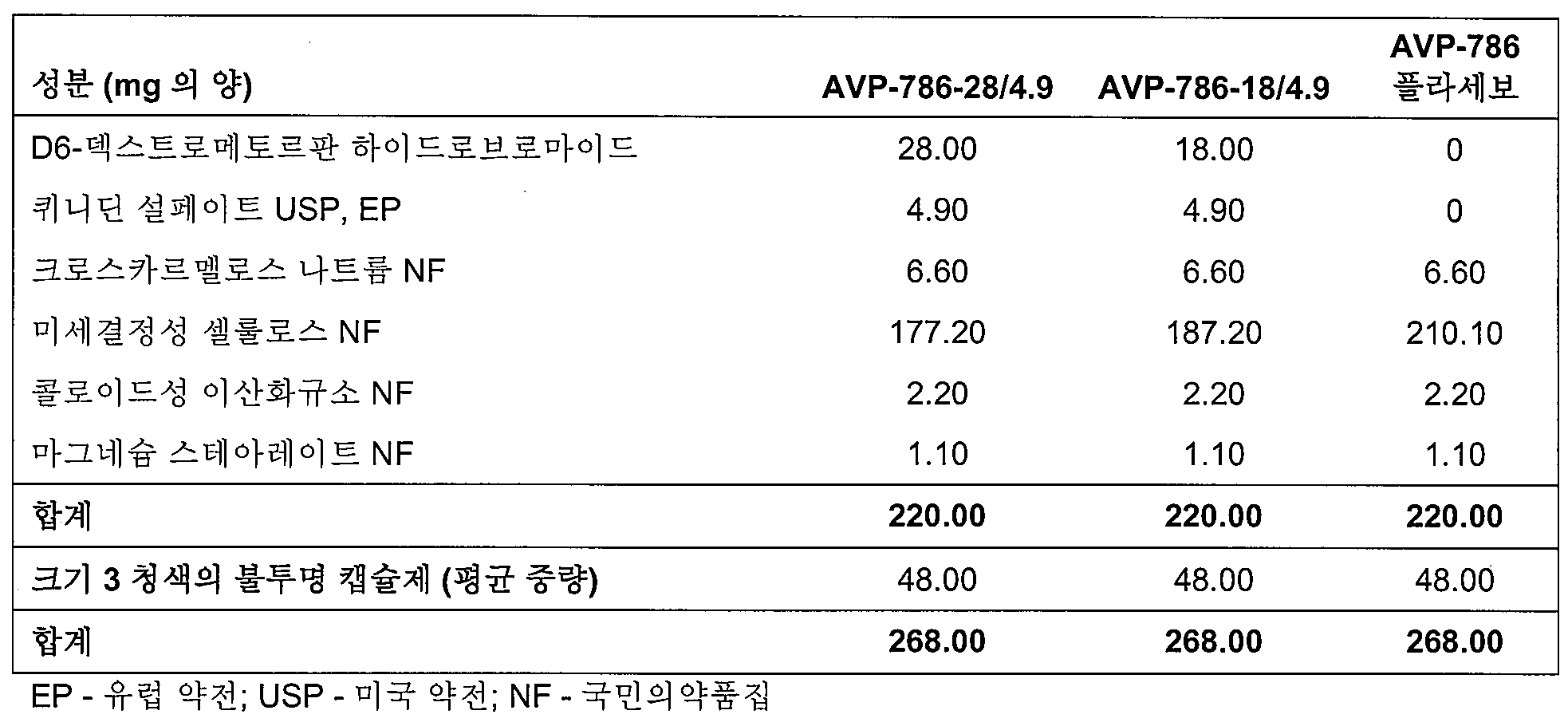
대조군: 연구 약품과 동일한 외관의 플라세보 캡슐제를 대조군으로서 사용할 것이다. Control: A placebo capsule of the same appearance as the study drug will be used as a control.
무작위화 /계층화: 적격 환자들은 AVP-786 또는 대응하는 플라세보 캡슐제를 투약받기 위한 연구에서 무작위화될 것이다. 무작위화는 신경정신병 인벤토리(NPI) 초조함/공격성 도메인 점수(≤6 대 >6), 낙상에 대한 위험성 평가(보통의/약간의 대 중간의/심각한), 및 항정신병 약품의 수반 사용(네 또는 아니오)에 의해 계층화될 것이다. Randomization / Tiering : Eligible patients will be randomized in a study to receive AVP-786 or the corresponding placebo capsules. Randomization was defined as the use of neuropsychiatric inventory (NPI) nervous / aggressive domain scores (≤6 vs.> 6), risk assessments for falls (moderate / moderate / severe) No).
용법 용량: 적격 환자들은 기준 방문에서 무작위로 배정되어 AVP-786 또는 대응하는 플라세보 캡슐제를 투약받을 것이다. 상기 연구에 걸쳐 연구 약품은 1일 2회 경구 투여될 것이다(1일 2회, 아침에 캡슐제 1개 및 대략 12시간이 지난 저녁에 캡슐제 1개). AVP-786을 투약받기 위해 무작위화된 환자는 당해 연구의 최초 7일 동안 아침에 1일 1회 AVP-786-18/4.9로 시작하여 저녁에는 플라세보를 투약받을 것이다. 8일차부터, 환자는 AVP-786-18/4.9를 14일 동안 1일 2회 투약받을 것이다. 22일차부터, 환자는 AVP-786-28/4.9D를 당해 연구의 나머지 9주 동안 1일 2회 투약받을 것이다. 연구자가 필요하다고 인정하는 경우, 3회차 방문 이후 5회차 방문까지(즉, 23 내지 64일차)에 AVP-786-18/4.9에 대한 1회 하향 용량 조절이 허용될 것이며, 상기 환자는 나머지 연구 기간 동안 더 낮은 용량의 연구 약품을 복용할 것이다. 용량 조절이 필요한 환자는 안전성 평가를 수행하기 위해 계획에 없는 방문을 가질 필요가 있을 것이다. 환자는 당해 연구 동안 몇몇 지점에서 AVP-786을 투약받는 적어도 50%의 가능성을 가질 것이다. DOSAGE CAPACITY : Eligible patients will be randomly assigned at baseline visit and receive AVP-786 or the corresponding placebo capsules. Throughout this study, the study drug will be administered orally twice daily (twice daily, first capsule in the morning and first capsule in the evening about 12 hours later). Patients randomized to receive AVP-786 will receive a placebo beginning with AVP-786-18 / 4.9 once a day in the morning for the first 7 days of the study and in the evening. From
평가 및 방문 Assessment and Visit
환자는 선별시, 기준일(1일차)에서, 그리고 8일차(1주차), 22일차(3주차), 43일차(6주차), 64일차(9주차), 및 85일차(12주차)에 클리닉을 방문할 것이다. 안전성 후속 전화 통화가 29일차(4주차) 및 71일차(10주차)에 이루어질 것이다. 평가 및 방문의 일정(표 10)에 요약된 바와 같이 각각의 방문시 연구 절차가 수행될 것이다. Patients were screened at the first day of the screening and at the clinic on the 8th day (1st week), 22nd day (3rd week), 43th day (6th week), 64th day (9th week), and 85th day (12th week) . Safety follow-up phone calls will be held on the 29th (4th) and 71st (10th). Each visit will carry out the research procedure as outlined in the evaluation and schedule of visits (Table 10).

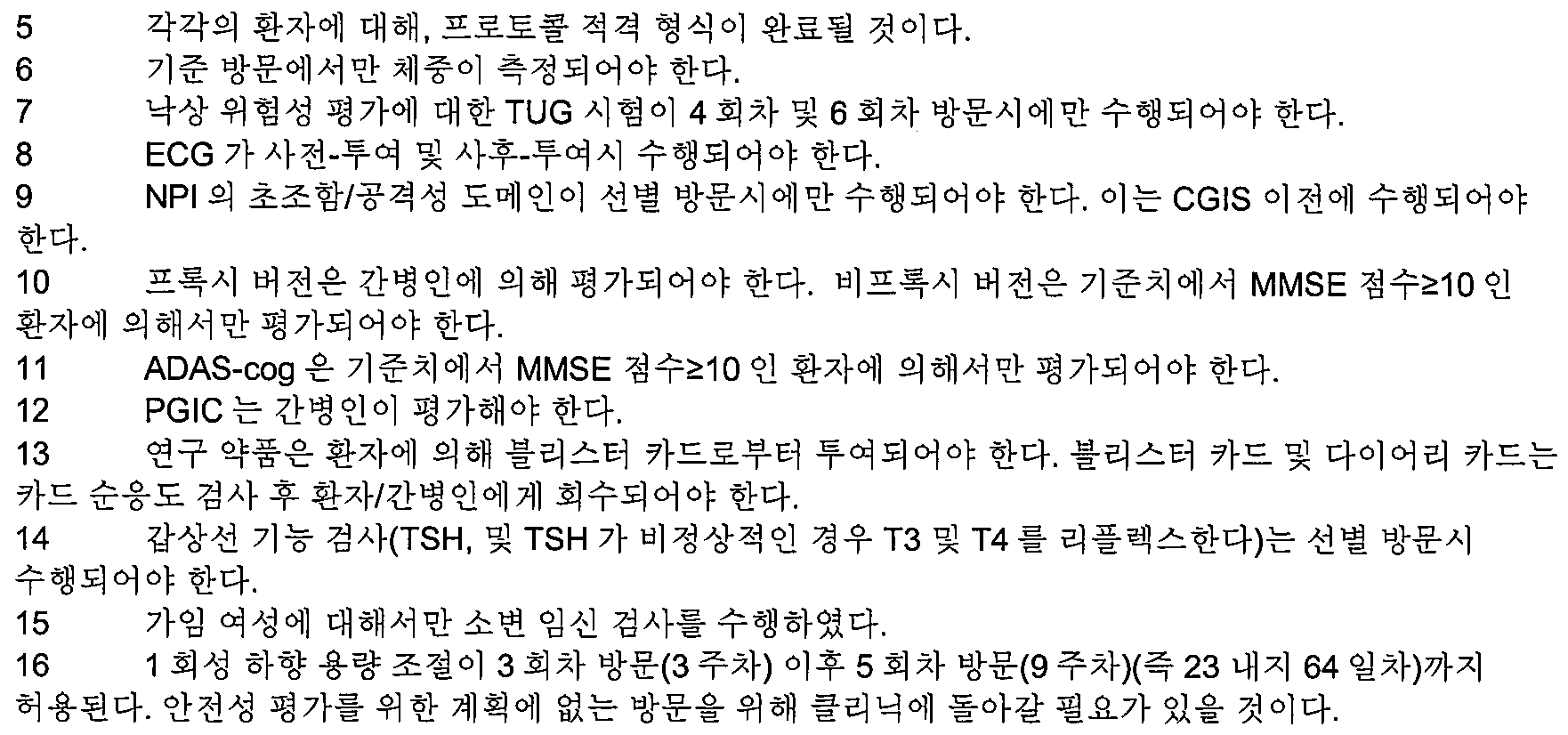
반응 측정Measure the response
효능 1차 측정: 1차 효능은 신경정신병 인벤토리(NPI)의 초조함/공격성 도메인을 사용하여 평가될 것이다. Efficacy Primary measures: Primary efficacy will be assessed using the nervous / aggressive domains of neuropsychiatric inventory (NPI).
효능 2차 측정: 2차 효능 측정은 전반적인 임상적 인상의 변화(CGIC) 초조함, NPI-초조함/공격성 도메인 간병인 고통 점수, NPI-비정상적 운동 행동 도메인, 자리트 부담 면담(ZBI), NPI-과민/불안정성 도메인, 전반적인 환자 인상의 변화(PGIC)(간병인이 평가함), 치매 삶의 질(DEMQOL), 치매에서의 우울에 대한 코넬 등급(CSDD), 치매에서의 자원 활용(RUD), 총 NPI, CGIS 초조함, 알츠하이머병 평가 등급-인지 서브등급(ADAS-cog), 일반 의료건강 등급(GMHR), 및 EuroQol 5-차원 5-수준(EQ-5D-5L)을 포함한다. Secondary measures: Secondary efficacy measures include general clinical impression change (CGIC) nervousness, NPI-nervous / aggressive domain caregiver pain score, NPI-abnormal motor behavior domain, ZBI, NPI- (NPD), depression in the elderly, disability domain, changes in overall patient impressions (PGIC) (assessed by caregivers), dementia quality of life (DEMQOL), connell ratings for dementia (CSDD), resource utilization in dementia (EQ-5D-5L), the CGIS nervousness, Alzheimer's disease grade rating - ADAS-cog, general health care grade (GMHR), and EuroQol 5-dimensional 5-level.
약동학: d6-DM, 이의 대사산물, 및 Q의 혈장 농도가 평가될 것이다. Pharmacokinetics: The plasma concentrations of d6-DM, its metabolites, and Q will be assessed.
안전성 및 내약성: AVP-786의 안전성 및 내약성은 보고된 부작용(AE), 신체 및 신경학적 검사, 생체 신호, 임상 실험실 평가, 비운동시 12-유도 심전도(ECG), 시한 자살시도 추적 등급(S-STS), 간이 정신상태 평가(MMSE), 및 일어나 걷기(TUG) 시험에 의해 평가될 것이다. 가임 여성에 대해서는 임신 검사를 수행할 것이다. SAFETY AND TREATMENT : The safety and tolerability of AVP-786 is based on reported adverse events (AE), physical and neurological tests, vital signs, clinical laboratory evaluations, 12-lead electrocardiogram (ECG) STS), simple mental status assessment (MMSE), and waking up (TUG) tests. Pregnant women will be tested for pregnant women.
일반적인 통계적 방법 및 분석 유형 Typical statistical methods and types of analysis
분석 인구: 3가지 분석 인구가 사용될 것이다; 수정된 의도-투약(mITT), 의도-투약(intent-to-treat)(ITT), 및 안전성. mITT 인구는 당해 연구에서 무작위화되고 적어도 하나의 사후 기준 효능 평가를 받는 모든 환자를 포함하며, 효능의 모든 분석에서 사용될 것이다. mITT 인구 내의 환자는 투약받는 치료와는 상관없이 무작위화된 치료 그룹 내에 포함될 것이다. ITT 인구는 당해 연구에서 무작위화된 모든 환자를 포함하며, 예비 효능 분석에서 사용될 것이다. 안전성 인구는 연구 치료를 투약받는 모든 환자를 포함하며, 안전성의 모든 분석에서 사용될 것이다. 환자는 투약받는 실제 치료를 근거로 하는 치료 그룹에 포함될 것이다. Analytical Population : Three analytical populations will be used; Modified intent-medication (mITT), intent-to-treat (ITT), and safety. The mITT population will be used in all analyzes of efficacy, including all patients randomized in the study and subject to at least one post-baseline efficacy assessment. Patients within the mITT population will be included in the randomized treatment group regardless of the treatment being treated. The ITT population will include all patients randomized in the study and will be used for preliminary efficacy analysis. The safety population will include all patients undergoing research therapy and will be used in all analyzes of safety. The patient will be included in a treatment group based on the actual therapy being received.
효능 분석: 1차 효능 평가항목은 기준일로부터 12주차(85일차)까지의 NPI 초조함/공격성 도메인 점수의 변화이다. 치료 비교는 선형 혼합 효과 모델 반복 측정(linear mixed effects model repeated measures)(MMRM)을 사용함으로써 수행될 것이다. 당해 모델은 치료에 대한, 방문에 대한, 방문치료 상호작용에 대한, 방문치료 상호작용에 대한, 그리고 기준 값과 기타 무작위화 계층화 인자를 포함하는 기준점 공변량에 대한 고정 효과를 포함할 것이다. 구조화되지 않은 공분산 모델이 사용될 것이다. 2차 효능 평가항목은 다음의 효능 측정치에 대한 기준일로부터 12주차(85일차)까지의 변화를 포함한다: CGIC 초조함, NPI-초조함/공격성 도메인 간병인 고통 점수, NPI-비정상적 운동 행동 도메인, ZBI, NPI-과민/불안정성 도메인, PGIC, DEMQOL, CSDD, RUD, 총 NPI, CGIS 초조함, ADAS-cog, GMHR, 및 EQ-5D-5L. Efficacy analysis : The primary efficacy endpoint is the change in NPI nervousness / aggression domain score from baseline to week 12 (day 85). Treatment comparisons will be performed using linear mixed effects model repeated measures (MMRM). The model will include fixed effects on treatment, on visit, on visit therapy interactions, on visit therapy interactions, and on reference point covariates including baseline and other randomization layering factors. An unstructured covariance model will be used. Secondary efficacy endpoints include changes from baseline day to day 12 (85th day) for the following efficacy measures: CGIC nervousness, NPI-nervous / aggressive domain caregiver pain score, NPI-abnormal motor behavior domain, ZBI, NPI - Hypersensitivity / instability domain, PGIC, DEMQOL, CSDD, RUD, Total NPI, CGIS nervousness, ADAS-cog, GMHR, and EQ-5D-5L.
안전성 분석: 안전성 분석은 생물학적 파라미터 및 AE에 대한 데이터 요약으로 이루어질 것이다. 안전성 분석은 치료에 의해 도표화될 것이다. Safety analysis : The safety analysis will consist of a summary of data on biological parameters and AE. The safety analysis will be tabulated by treatment.
표본 크기 계산: 검증력 계산을 수행하여, 1차 효능 평가항목에 대한 이변량 정규분포를 평가하였다. 완결된 2상 연구에서의 1차 효능 측정에 대해 관찰된 치료 효과 크기는 단계 1에서 -0.51이고 단계 2에서 -0.34였다. 당해 단일-단계 12주 연구에 있어서, 치료 효과 크기(AVP-786 대 플라세보)는 -0.40으로 추정된다. 325명 환자의 계획된 합계 표본 크기(~163/암(arm))는, 당해 연구 동안 20%의 탈락율을 고려하여, 2면 α = 0.05에서 1형 오류율에 대해 90%의 검증력을 가질 것이다. Sample Size Calculation : Verification power calculation was performed to evaluate the bivariate normal distribution for the primary efficacy endpoint. The observed therapeutic effect sizes for the first efficacy measurements in the completed two phase study were -0.51 in
실시예Example 5: 5: 알츠하이머형의Alzheimer's 치매를 보유한 환자의 초조함을 치료하기 위한 AVP-786(중수소화 [ AVP-786 (deuterated [< RTI ID = 0.0 > d6d6 ] ] 덱스트로메토르판Dextromethorphan 하이드로브로마이드Hydrobromide [ [ d6d6 -DM]/-DM] / 퀴니딘Quinidine 설페이트 [Q])의 안전성 및 효능의 3상, 다중-센터, 장기간, 확대 연구. 3-phase, multi-center, long-term, extended study of the safety and efficacy of sulfate [Q]).
당해 연구의 목적은, 알츠하이머형의 치매를 보유한 환자의 초조함을 치료하기 위한, AVP-786의 효능의 장기간 안전성 및 유지를 평가하기 위한 것이다. The aim of the present study was to evaluate the long-term safety and maintenance of the efficacy of AVP-786 for treating the nervousness of patients with Alzheimer's dementia.
연구 인구Research population
환자(명): 대략 550명의 환자들이 미국의 대략 110개 센터에 등록될 것이다 Patient (s) : Approximately 550 patients will be enrolled at approximately 110 centers in the United States
병태 /질환: 알츠하이머형 치매에 이차적인 초조함을 보유한 환자. 개연성이 있는 알츠하이머병의 진단은 국립 노화 연구소(NIA)-알츠하이머 협회(AA) 작업 그룹에서 발행한 "2011 알츠하이머병 진단 지침"을 기준으로 할 것이다(McKhann GM et al., Alzheimers Dement. 2011;7(3):263-269). 초조함의 진단은, 국제 노인 정신의학회(IPA) 초조함 정의 작업 그룹에서 개발한, 인지 장애 환자의 초조함의 잠정 합의 정의를 기준으로 할 것이다(Cummings J et al., Mintzer J, Brodaty H, et al. Agitation in cognitive disorders: International Psychogeriatric Association provisional consensus clinical and research definition. Int Psychogeriatr. 2014:1-11). Conditions / diseases: patients have the secondary anxiety in Alzheimer's disease. The diagnosis of plausible Alzheimer's disease will be based on the "2011 Alzheimer's Disease Guideline" issued by the National Aging Research Institute (NIA) - Alzheimer's Association (AA) Working Group (McKhann GM et al., Alzheimers Dement. (3): 263-269). The diagnosis of nervousness will be based on the definition of tentative agreement of impatient patients developed by the IPA Working Group on Nervousness (Cummings J et al., Mintzer J, Brodaty H, et al. Agitation in cognitive disorders: International Psychogeriatric Association provisional consensus clinical and research definition. Int Psychogeriatr. 2014: 1-11).
중요한 포함 기준: 연구 15-AVP-786-301, 15-AVP-786-302, 또는 12-AVR-131을 성공적으로 완결한 환자. 적격 환자들에게는, 연구 과정 동안 임의의 금지 약품을 투여하지 않는 것을 포함하여 연구 절차를 수락할 능력이 있고 수락할 의사가 있는 믿을만한 간병인이 있어야 한다. Critical inclusion criteria: Patients who successfully completed study 15-AVP-786-301, 15-AVP-786-302, or 12-AVR-131. Eligible patients should have a trusted caregiver who is willing to accept and accept the research protocol, including not administering any prohibited drugs during the course of the study.
중요한 배제 기준: 연구 15-AVP-786-301 및 15-AVP-786-302의 종료 후, 또는 연구 12-AVR-131로부터의 환자에 대한 기준일보다 30일 이내에, 다른 중재(약물 또는 장치) 임상 연구에 현재 참여중이거나 상기 연구에 참여하였던 환자. 당해 연구의 안전성 결과의 해석을 혼란스럽게 할 수 있는 공존하고(co-existent), 임상적으로 유의미하거나, 불안정한 전신 질환이 있는 환자. Critical Exclusion Criteria: Other interventional (drug or device) clinical trials were conducted after the end of Study 15-AVP-786-301 and 15-AVP-786-302, or within 30 days of the reference date for patients from Study 12-AVR- Patients currently participating in the study or participating in the study. Patients with co-existent, clinically significant, or unstable systemic disease that may confuse interpretation of the safety results of the study.
연구 설계 Research design
구조: 이는 3상 연구 15-AVP-786-301 및 15-AVP-786-302의 3상, 다중-센터, 장기간, 확대 연구이며, 이는 2상 연구 12-AVR-131로부터의 환자가 포함되는 것을 또한 허용한다. 연구 15-AVP-786-301 및 15-AVP-786-302로부터의 환자는 선행 연구에서의 마지막 방문(6회차 방문, 85일차)의 3일 이내에 현재의 연구에 등록할 것이다. 등록된 모든 환자는 AVP-786을 투약받을 것이지만, 할당된 치료 용량은 환자, 연구자, 연구 직원, 및 의뢰자에게는 감추어질 것이다. Structure: This is a three-phase, multi-center, long-term, magnified study of the three phase studies 15-AVP-786-301 and 15-AVP-786-302, It also allows things. Patients from Study 15-AVP-786-301 and 15-AVP-786-302 will enroll in the current study within 3 days of the last visit (6th visit, 85th day) in the previous study. All registered patients will receive AVP-786, but the allocated treatment capacity will be hidden from patients, researchers, research staff, and sponsors.
기간: 환자는 당해 연구에서 대략 52주 동안 등록될 것이다. Duration: The patient will be enrolled for approximately 52 weeks in the study.
연구 치료: 상기 시험 산물은 AVP-786(중수소화[d6]-덱스트로메토르판 하이드로브로마이드[d6-DM]/퀴니딘 설페이트[Q])이다. AVP-786의 2개 용량이 평가될 것이다: d6-DM 28mg/Q 4.9mg 및 d6-DM 18mg/Q 4.9mg (이후에 이들은 각각 AVP-786-28/4.9 및 AVP-786-18/4.9로 지칭된다). Research: The test product is AVP-786 (deuterated [d6] -dextromethorphan hydrobromide [d6-DM] / quinidine sulfate [Q]). Two doses of AVP-786 will be evaluated: 4.9 mg d6-DM 28 mg / Q and 4.9 mg d6-
AVP -786의 조성: 2개 용량의 IP의 정성 및 정량 조성이 아래 표 11에 열거된다. Composition of AVP- 786 : Qualitative and quantitative compositions of two doses of IP are listed in Table 11 below.

대조군: 없음 Control group: None
치료 과제: 적격 환자들은, 감추어진 방식으로, 선행 연구에서 투약받은 최종 치료(15-AVP-786-301 및 15-AVP-786-302) 및 용량 조절에 관한 연구자의 평가에 따라, AVP-786-28/4.9 또는 AVP-786-18/4.9 캡슐제를 투약받도록 할당될 것이다. 연구 약품은 양방향 웹 반응 시스템(interactive web response system)(IWRS)을 통해 할당될 것이다. Treatment Subjects: Eligible patients were randomly assigned to receive either AVP-786 (15-AVP-786-301 and 15-AVP-786-302) and AVP-786 -28 / 4.9 or AVP-786-18 / 4.9 capsules. The study drug will be assigned via an interactive web response system (IWRS).
선행 연구에서 플라세보를 투약받은 환자 및 연구 12-AVR-131로부터의 환자는 현행 연구에서 AVP-786-18/4.9에 할당될 것이다. 사전에 AVP-786-18/4.9를 투약받은 환자는 용량 조절이 불필요한 경우 동일한 용량으로 할당되거나, 연구자가 용량 증가를 필요로 하는 경우 AVP-786-28/4.9로 할당될 것이다. 사전에 AVP-786-28/4.9를 투약받은 환자는 AVP-786-28/4.9를 계속 투약받거나 연구자의 재량에 따라 더 낮은 용량 AVP-786-18/4.9에 할당될 것이다. Patients treated with placebo in the previous study and patients from study 12-AVR-131 will be assigned to AVP-786-18 / 4.9 in the current study. Patients previously dosed with AVP-786-18 / 4.9 will be assigned the same dose if dose control is unnecessary, or will be assigned to AVP-786-28 / 4.9 if the investigator needs to increase dose. Patients previously dosed with AVP-786-28 / 4.9 will continue to receive AVP-786-28 / 4.9 or will be assigned to the lower dose AVP-786-18 / 4.9 at the discretion of the investigator.
용법 용량: 상기 연구에 걸쳐 연구 약품은 1일 2회 경구 투여될 것이다(1일 2회, 아침에 캡슐제 1개 및 대략 12시간이 지난 저녁에 캡슐제 1개). 선행 연구에서 플라세보를 투약받은 환자 및 연구 12-AVR-131로부터의 환자에 있어서, 1 내지 7일차를 위한 저녁 용량은 AVP-786 플라세보 캡슐제일 것이고 22일차(3주차)부터는 용량 조절이 요구되지 않는 한 AVP-786-28/4.9를 1일 2회 투약받을 것이다. 연구자의 재량에 따라, 연구 약품의 용량은 안전성을 이유로 당해 연구 동안 언제든 다운 적정될 수 있다. DOSAGE AND ADMINISTRATION: Throughout the above studies, the study drug will be administered orally twice daily (twice daily, first capsule in the morning and first capsule in the evening after approximately 12 hours in the morning). In patients who received placebo in the prior study and patients from Study 12-AVR-131, the evening dose for
평가 및 방문 Assessment and Visit
당해 연구에는 8회의 예정된 방문이 존재한다. 환자는 기준일(1일차)에서, 그리고 15일차(2주차), 43일차(6주차), 85일차(12주차), 169일차(24주차), 253일차(36주차), 337일차(48주차), 및 365일차(52주차)에 클리닉을 방문할 것이다. 안전성 후속 전화 통화가 29일차(4주차), 127일차(18주차), 211일차(30주차), 및 295일차(42주차)에 이루어질 것이다. 용량 조절을 요하는 환자는 연구자의 재량에 따라 안정성 평가를 위해 예정되지 않은 방문을 해야 한다. 평가 및 방문의 일정(표 12)에 요약된 바와 같이 각각의 방문시 연구 절차가 수행될 것이다. There are eight scheduled visits in the study. Patients were evaluated on the baseline (Day 1) and on Day 15 (Day 2), Day 43 (Day 6), Day 85 (Day 12), Day 169 (Day 24), Day 253 ), And 365 days (52 weeks). The safety follow-up phone calls will be made on the 29th day (4th week), 127th day (18th week), 211th day (30th week), and 295th day (42th week). Patients in need of dose adjustment should make unscheduled visits to assess safety at the discretion of the investigator. Each visit will carry out the research procedure as outlined in the evaluation and schedule of visits (Table 12).
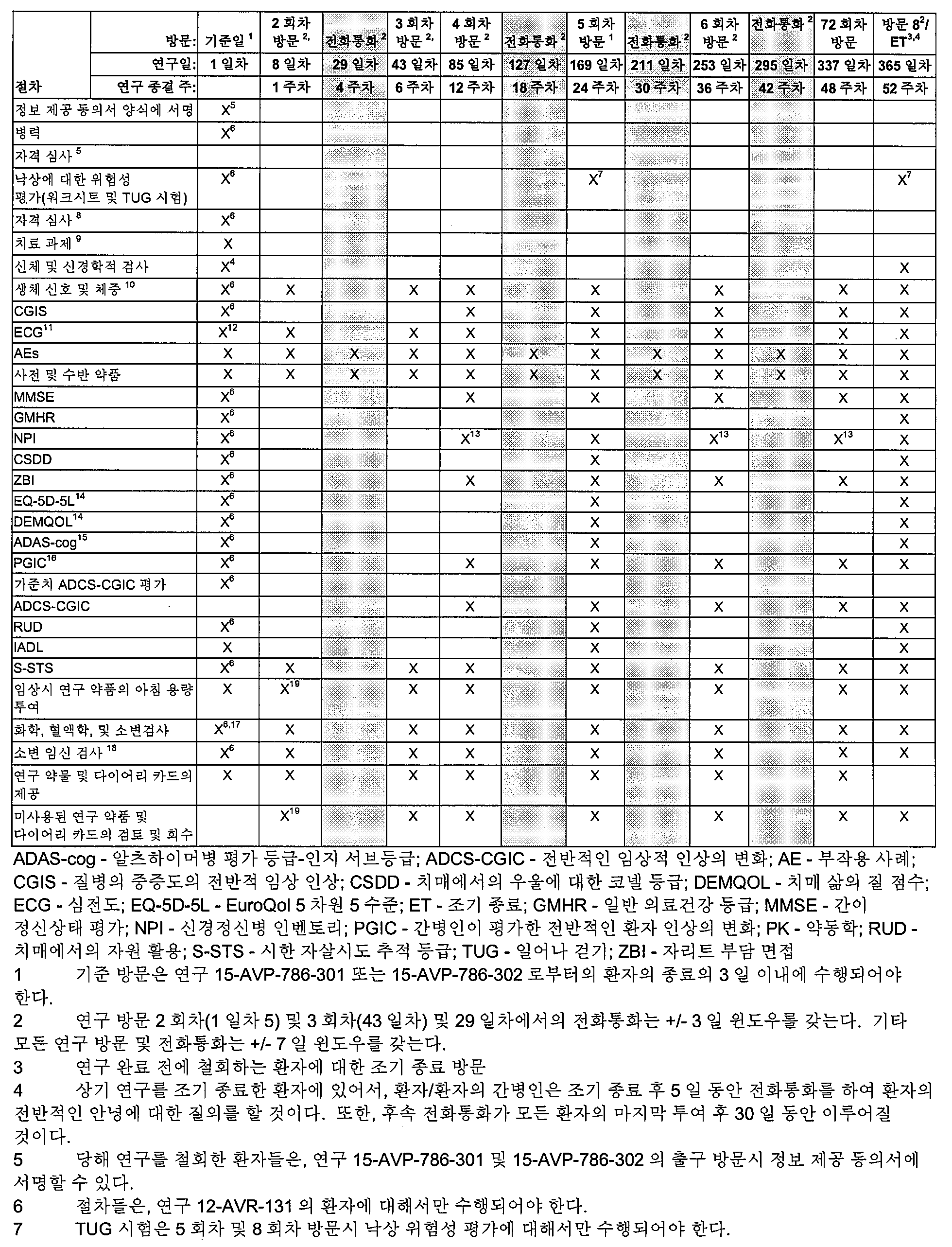

반응 측정Measure the response
안전성 및 내약성: AVP-786의 안전성 및 내약성은 보고된 부작용(AE), 신체 및 신경학적 검사, 생체 신호, 임상 실험실 평가, 비운동시 12-유도 심전도(ECG), 시한 자살시도 추적 등급(S-STS), 간이 정신상태 평가(MMSE), 알츠하이머병 평가 등급-인지 서브등급(ADAS-cog), 및 일어나 걷기(TUG) 시험에 의해 평가될 수 있다. 가임 여성에 대해서는 임신 검사를 수행할 것이다. SAFETY AND TREATMENT : The safety and tolerability of AVP-786 is based on reported adverse events (AE), physical and neurological tests, vital signs, clinical laboratory evaluations, 12-lead electrocardiogram (ECG) STS, MMSE, ADAS-cog, and Walking TUG test. The results of this study can be summarized as follows. Pregnant women will be tested for pregnant women.
효능: 효능은 신경정신병 인벤토리(NPI), 전반적인 임상적 인상의 변화(CGIC)-초조함, 질병 규모의 중증도의 전반적 임상 인상(CGIS)-초조함, 자리트 부담 면담(ZBI), 전반적인 환자 인상의 변화(PGIC)(간병인이 평가함), 치매 삶의 질(DEMQOL), 치매에서의 우울에 대한 코넬 등급(CSDD), 치매에서의 자원 활용(RUD), 일반 의료건강 등급(GMHR), EuroQol 5-차원 5-수준(EQ-5D-5L), 및 일상생활 수행 능력(IADL)을 사용하여 평가될 것이다. Efficacy : The efficacy was assessed using the following criteria: Neuropsychiatric Inventory (NPI), Overall Clinical Impression Change (CGIC) - Fretness, Overall Clinical Impression (CGIS) Severity of Disease Scale - Nervousness, ZBI, ), Dementia Quality of Life (DEMQOL), Connell Rating for Depression in Dementia (CSDD), Resource Utilization in Dementia (RUD), General Health Care Rating (GMHR), EuroQol 5-Dimensional 5 - level (EQ-5D-5L), and activities of daily living (IADL).
일반적인 통계적 방법 및 분석 유형 Typical statistical methods and types of analysis
분석 인구: 연구 치료를 투약받는 모든 환자를 포함하는 안전성 인구는 모든 효능 및 안전성 데이터 요약에 사용될 것이다. 3개 치료 그룹이 안전성 및 효능을 위해 존재할 것이다: AVP-786-28/4.9, AVP-786-18/4.9, 및 조합된 모든 환자. 치료 비교는 수행되지 않을 것이다.Analytical Population: The safety population, including all patients receiving study treatment, will be used to summarize all efficacy and safety data. Three treatment groups will exist for safety and efficacy: AVP-786-28 / 4.9, AVP-786-18 / 4.9, and all combined patients. Therapeutic comparisons will not be performed.
안전성 분석: 보고된 AE, 생체 신호, 임상 실험실 평가, 비운동시 12-유도 ECG, S-STS, MMSE, ADAS-cog, 및 TUG를 포함하는 안전성 및 내약성 측정치는 기술 통계학(descriptive statistics) 및/또는 빈도표를 사용하여 요약될 것이다. Safety analysis : Safety and tolerability measures, including reported AEs, vital signs, clinical laboratory evaluations, non-simultaneous 12-lead ECG, S-STS, MMSE, ADAS-cog and TUG, It will be summarized using frequency tables.
효능 분석: 요약 통계는 방문자에 의해 관찰된 효능 데이터에 대해 제공될 것이다. 관찰된 본래의 값(raw value) 및 기준치로부터의 변화는 적용가능한 경우 나타낼 것이다. Efficacy analysis : Summary statistics will be provided for the efficacy data observed by the visitor. The observed raw value and the change from the reference value will be indicated if applicable.
표본 크기 계산: 등록된 550명의 환자의 표본 크기는 규제 요구사항을 충족시키기 위해 적절한 연구 약품 노출을 제공할 것이다. Sample Size Calculation : The sample size of the 550 registered patients will provide appropriate study drug exposure to meet regulatory requirements.
실시예Example
6: 건강한 6: Healthy
피험자에서의In the subject
, ,
AVPAVP
-786(중수소화 [-786 (deuterated [
d6d6
] ]
덱스트로메토르판Dextromethorphan
하이드로브로마이드 [DM]/ Hydrobromide [DM] /
퀴니딘Quinidine
설페이트 [Q]) 및 Sulfate [Q]) and
파록세틴간Paroxetine liver
및 And
AVPAVP
-786 및 -786 and
듀록세틴간Between
당해 연구의 1차 목적은 건강한 피험자에서의 파록세틴의 정상-상태 약동학에서의 AVP-786(d6-DM/Q)의 효과를 밝혀내고, 건강한 피험자에서의 듀록세틴의 정상-상태 약동학에서의 AVP-786의 효과를 밝혀내고, 건강한 피험자에서의 AVP-786의 정상-상태 약동학에서의 파록세틴과 듀록세틴의 효과를 밝혀내는 것이었다. 당해 연구의 2차 목적은 건강한 피험자에게 AVP-786과 파록세틴과 듀록세틴을 동시 투여할 때의 안전성 및 내약성을 평가하는 것이었다. 파록세틴과 듀록세틴은 알츠하이머병 피험자에게 계획된 바에 따라 투여될 수 있는 항우울제이다.The primary objective of the study was to determine the effect of AVP-786 (d6-DM / Q) on the steady-state pharmacokinetics of paroxetine in healthy subjects and to determine the effect of AVP- 786 and to elucidate the effects of paroxetine and durocetin in normal-state pharmacokinetics of AVP-786 in healthy subjects. The secondary objective of the study was to assess the safety and tolerability of concurrent administration of AVP-786, paroxetine, and durocetin to healthy subjects. Paroxetine and durocetin are antidepressants that can be administered as planned to subjects with Alzheimer's disease.
d6-DM의 PK, 안전성, 및 내약성을 조사하는 2가지 연구가 완결되었다. 12-AVR-132는, 건강한 피험자에게 각종 경구 용량을 단독으로 또는 Q와 조합하여 투여한 후 혈장 내에서 AVP 786의 단일- 및 다중-용량 PK를 평가하기 위한, 1상 무작위화된, 이중맹검, 단일- 및 다중-용량 연구였다. 13-AVR-134는 건강한 지원자에서의 AVP-786의 약동학, 안전성 및 내약성을 평가하기 위한 1상, 단일-센터, 무작위화된, 오픈 라벨(open-label) 연구였다.Two studies investigating the PK, safety, and tolerability of d6-DM have been completed. 12-AVR-132 is a one-phase randomized, double-blind, randomized, double-blind, randomized, double-blind, randomized, placebo- , Single- and multi-dose studies. 13-AVR-134 was a one-phase, single-center, randomized, open-label study to evaluate the pharmacokinetics, safety and tolerability of AVP-786 in healthy volunteers.
방법론 methodology
당해 연구는 단일 센터에서 수행되었으며, 파록세틴과 듀록세틴의 PK에서의 AVP-786의 효과 및 AVP-786의 PK에서의 파록세틴과 듀록세틴의 효과를 밝혀내기 위한 오픈 라벨 순차 설계로 이루어졌다. 56명의 피험자가 4개 치료 그룹들 중의 하나로 등록되었다.The study was performed at a single center and was performed with an open label sequential design to investigate the effects of AVP-786 on PK of paroxetine and durocetin and the effects of paroxetine and duloxetine on PK of AVP-786. Fifty-six subjects were enrolled in one of four treatment groups.
그룹 1: n = 14Group 1: n = 14
ㆍ 파록세틴 20mg, 1일 1회 1 내지 20일차Paroxetine 20 mg, once daily for 1 to 20 days
ㆍ AVP-786-30/4.75 (d6-DM 30mg/Q 4.75mg), 1일 2회 13일차. 20일차의 아침까지.ㆍ AVP-786-30 / 4.75 (d6-DM 30mg / Q 4.75mg), twice daily 13 days difference. By the morning of the 20th day.
그룹 2: n = 14Group 2: n = 14
ㆍ AVP-786-30/4.75 (d6-DM 30mg/Q 4.75mg), 1일 2회 1일차. 20일차의 아침까지.ㆍ AVP-786-30 / 4.75 (d6-DM 30mg / Q 4.75mg), twice a day twice a day. By the morning of the 20th day.
ㆍ 파록세틴 20mg, 1일 1회 9 내지 20일차ㆍ Paroxetine 20mg, once a day 9-20 days
그룹 3: n = 14Group 3: n = 14
ㆍ 듀록세틴 20mg, 1일 2회 1일차. 13일차의 아침까지.ㆍ Durocetin 20mg, twice a day, 1st day difference. By the morning of the 13th day.
ㆍ AVP-786-30/4.75 (d6-DM 30mg/Q 4.75mg), 1일 2회 6일차. 13일차의 아침까지.AVP-786-30 / 4.75 (d6-DM 30mg / Q 4.75mg), twice daily for 6 days. By the morning of the 13th day.
그룹 4: n = 14Group 4: n = 14
ㆍ AVP-786-30/4.75 (d6-DM 30mg/Q 4.75mg), 1일 2회 1일차. 13일차의 아침까지.ㆍ AVP-786-30 / 4.75 (d6-DM 30mg / Q 4.75mg), twice a day twice a day. By the morning of the 13th day.
ㆍ 듀록세틴 20mg, 1일 2회 9일차. 13일차의 아침까지. ㆍ Durocetin 20mg twice daily for 9 days. By the morning of the 13th day.
피험자는 등록 전 14일 이내에 클리닉에서의 선별 방문에 응하였다(1일차). 적격인 경우, 당해 피험자는 1일차에 4개 그룹들 중의 하나에 등록하였다(1일차는 상이한 그룹들에서 상이한 날짜에 발생하여, 그 날짜에 해당하는 단위의 침대의 사용가능성(availability)이 보장되었다). 피험자는 (아침) PK 표본추출의 제2 일(당해 날짜는 치료 그룹들간에 상이했다)때까지 외래 투약을 위해 매일 클리닉에 돌아왔다. 제 2일(아침) PK 표본추출 이후, 피험자는 그날 밤에 진료소에 입원하고 다음날 (전체) PK 표본추출을 수행하였다. 피험자는 PK 표본추출의 마지막 날까지 입원하였다(시간 길이는, 정상 상태에 도달하기 위한 연구 약품을 위한 시간의 양을 기준으로 하여, 치료 그룹들간에 상이하였다).Subjects responded to a screening visit at the clinic within 14 days prior to enrollment (day 1). If eligible, the subjects were enrolled in one of four groups on day 1 (
연구 약품의 마지막 투여 이후 36시간까지의 PK 평가를 위해 표본을 수집하였다. 모든 표본은 적절한 경우 d6-DM, d3-덱스트로판(d3-DX), Q, 파록세틴, 및 듀록세틴에 대해 평가하였다.Specimens were collected for PK evaluation up to 36 hours after the last dose of study drug. All specimens were evaluated for d6-DM, d3-dextroplan (d3-DX), Q, paroxetine, and durocetin when appropriate.
안전성을 당해 연구에 걸처 모든 피험자에서 평가하였으며 부작용(AE) 보고, 심전도(ECG), 실험실 평가, 신체 검사, 및 생체 신호를 포함하였다. 컬럼비아-자살 중증도 평가 척도(Columbia-Suicide Severity Rating Scale)(C-SSRS)를 당해 연구에 걸쳐 자살 관념화 및 행동을 예측 평가하는데 사용하였다. Safety was assessed by all subjects throughout the study and included side effects (AE) reports, electrocardiograms (ECG), laboratory assessments, physical examinations, and vital signs. The Columbia-Suicide Severity Rating Scale (C-SSRS) was used to predict suicide ideation and behavior throughout the study.
피험자는 후속 안전성 방문을 위해 연구 약품의 마지막 투여 이후 7 내지 10일차에 재방문했다.The subject returned 7-10 days after the last dose of the study drug for a follow-up safety visit.
계획된 (및 분석된) 피험자의 수Number of planned (and analyzed) subjects
그룹 1: 계획된 피험자 n = 14; 등록된 피험자 n = 14 (안전성 인구); 분석된 피험자 n = 11 (PK 인구). 그룹 2: 계획된 피험자 n = 14; 등록된 피험자 n = 14 (안전성 인구); 분석된 피험자 n = 14 (PK 인구). 그룹 3: 계획된 피험자 n = 14; 등록된 피험자 n = 14 (안전성 인구); 분석된 피험자 n = 14 (PK 인구). 그룹 4: 계획된 피험자 n = 14; 등록된 피험자 n = 14 (안전성 인구); 분석된 피험자 n = 11 (PK 인구).Group 1: planned subjects n = 14; Registered subjects n = 14 (safety population); Analyzed subjects n = 11 (PK population). Group 2: planned subjects n = 14; Registered subjects n = 14 (safety population); Analyzed subjects n = 14 (PK population). Group 3: planned subjects n = 14; Registered subjects n = 14 (safety population); Analyzed subjects n = 14 (PK population). Group 4: planned subjects n = 14; Registered subjects n = 14 (safety population); Analyzed subjects n = 11 (PK population).
포함을 위한 진단 및 기준Diagnosis and criteria for inclusion
체질량지수(Body Mass Index)(BMI) 18 내지 300kg/㎡에 포함되며 광범위한 대사물 프로파일을 부여하는 CYP2D6 유전자형을 나타내는, 18 내지 50세의 건강한 성인 남성 및 여성 피험자.Healthy adult male and female subjects between 18 and 50 years of age, exhibiting the CYP2D6 genotype, which is included in the Body Mass Index (BMI) of 18 to 300 kg /
연구 치료Research therapy
시험 제품: AVP-786-30/4.75 (d6-DM 30mg/Q 4.75mg) 캡슐제. 파록세틴 20mg 정제. 듀록세틴 20mg 캡슐제. 피험자는 상기 방법론에서 제공된 연구 일정에 따라 연구 약품을 투약받았다.Test product: AVP-786-30 / 4.75 (d6-DM 30mg / Q 4.75mg) Capsules. Paroxetine 20 mg tablets. Duloxetine 20mg capsules. Subjects were dosed with the study drug according to the study schedule provided in the methodology.
(1개 캡슐제/정제로 이루어진) 각각의 용량이 240mL의 실온수(room temperature water)와 함께 경구 투여되었다. (물을 포함하지 않는) 음식으로부터의 밤새 단식(즉, 적어도 8시간) 후에 아침 용량을 투여하고 음식으로부터의 적어도 2시간 단식 후에 저녁 용량을 투여하였다. 모든 투여는, 적어도 2시간의 사후-투여(post-dose) 동안 (물을 포함하지 않는) 음식으로부터 단식이 뒤따랐다.Each dose (consisting of one capsule / tablet) was orally administered with 240 mL of room temperature water. After overnight fast (i.e., at least 8 hours) from food (not including water), the morning dose was administered and the evening dose was administered after at least 2 hours fasting from the food. All doses followed fasting from food (not containing water) for at least 2 hours post-dose.
평가 기준Evaluation standard
안전성: 안전성을 당해 연구에 걸처 모든 피험자에서 평가하였으며 부작용(AE) 보고, 심전도(ECG), 실험실 평가, 신체 검사, 및 생체 신호를 포함하였다. 컬럼비아-자살 중증도 평가 척도(C-SSRS)를, 안전성 평가의 일부로서, FDA 안내서 "자살 관념화와 행동: 임상 시험에서 발생 가능성에 대한 예측 평가(Suicidal Ideation and Behavior: Prospective Assessment of Occurrence in Clinical Trials)"에 따라, 당해 연구에 걸쳐 자살 관념화 및 행동을 예측 평가하는데 사용하였다. Safety : Safety was assessed by all subjects throughout the study and included side effects (AE) reports, electrocardiograms (ECG), laboratory assessments, physical examinations, and vital signs. As part of a safety assessment, the FDA's Guide to Suicide Ideaization and Behavior: A Prospective Assessment of Behavior in Clinical Trials (C-SSRS), the Columbia-Suicide Severity Rating Scale (C-SSRS) "Was used to predict and assess suicidal ideation and behavior throughout the study.
약동학: 혈장 d6-DM, d3-DX, Q, 파록세틴, 및 듀록세틴의 측정을 위한 혈액 표본(단일 용량에 대해서는 6mL, 병용 용량에 대해서는 12mL)을 다음과 같은 시간 지점에서 수집하였다: Pharmacokinetics: Blood samples (6 mL for single dose, 12 mL for combined dose) for the measurement of plasma d6-DM, d3-DX, Q, paroxetine, and durocetin were collected at the following time points:
사전-투여(pre-dose), 및 단일 약품 투여의 마지막 날의 아침 투여 후 0.5, 1, 2, 3, 4, 6, 8, 및 12시간. 그룹 1만을 위해, 파록세틴이 1일 1회 투여되기 때문에, 추가의 표본이, 단일 투약의 마지막 날 후(제1 병용 투여 이전에) 24시간에 취해졌다.Pre-dose, and 0.5, 1, 2, 3, 4, 6, 8, and 12 hours after morning dosing on the last day of single drug administration. For
사전-투여, 및 병용 투여의 마지막 날의 아침 투여 후 0.5, 1, 2, 3, 4, 6, 8, 12, 24, 및 36시간.Pre-administration, and 0.5, 1, 2, 3, 4, 6, 8, 12, 24, and 36 hours after morning dosing on the last day of co-administration.
(그룹 2 및 4만을 위해) 4일차 아침 투약 이전에, 그리고 단일 약품 투여의 마지막 날 및 병용 투여의 마지막 날의 각 2일 전에.(For
비구획형(non-compartmental) 방법을 사용하여 AUC0 -12, AUC0 -24, Cmax, Tmax, kel, t1 /2, Cmin, 및 Tmin을 포함하는 약동학적 파라미터를 측정하였다.By using a non-partitioned (non-compartmental) method to measure the pharmacokinetic parameters including the AUC 0 -12, AUC 0 -24, C max, T max, kel,
통계적 방법Statistical method
안전성: 부작용의 발생율, 생체 신호, ECG 파라미터, 및 임상 실험실 결과를 포함하는 안전성 변수들을 치료에 의해 요약하였다. C-SSRS 설문지에 대한 응답이 각 피험자별로 열거되었다. 개별 피험자 프로파일이 비정상적인 응답이 있는 임의의 질문에 제시되었다. Safety : Safety parameters including incidence of adverse events, vital signs, ECG parameters, and clinical laboratory results were summarized by treatment. The responses to the C-SSRS questionnaires were listed for each subject. Individual subject profiles were presented in any question with an abnormal response.
약동학: d6-DM, d3-DX, Q, 및 파록세틴 또는 듀록세틴(as applicable)의 혈장 농도에 대해, 기술 통계가 치료에 의해 각각의 시간 지점에서 도표화되었다. 평균 혈장 농도-시간 프로파일을 치료에 의해 선형 및 반-대수 스케일(linear and semi-logarithmic scale)로 도시하였다. 또한, 비구획형 PK 파라미터를 유도하였다. 조합 치료들 사이의 비교(그룹 1 대 그룹 2, AVP-786 및 파록세틴; 그룹 3 대 그룹 4, AVP-786 및 듀록세틴)를 90% 신뢰 구간을 갖는 Cmax 및 AUC0 -12(파록세틴에 대해 AUC0 -24)의 기하학적 평균 비로서 제시하였다. 점 추정치(point estimate) 및 신뢰성 한계를 로그 변환 데이터(log transformed data)를 사용하여 결정하고 이어서 본래의 스케일로 다시 변환시켰다. 분산 분석법을 사용하여 피험자 및 치료의 용어를 사용하여 분석을 수행하였다. Pharmacokinetics: For plasma concentrations of d6-DM, d3-DX, Q, and paroxetine or duloxetine, descriptive statistics were tabulated at each time point by treatment. The mean plasma concentration-time profile was plotted on a linear and semi-logarithmic scale by treatment. In addition, non-compartmental PK parameters were derived. Cmax and AUC 0 -12 with 90% confidence interval (
결과result
약동학: Pharmacokinetics:
파록세틴 및 AVP -786 상호작용: 각종 분석물의 치료 그룹에 의한 시간에 따른 평균 다중 용량 혈장 농도가 도 7 및 8에 도시되어 있다. 치료 및 분석물에 의한 평균(CV%)(Tmax에 대한 # 중간값(범위)) (표 13): Paroxetine and AVP- 786 Interactions: Average multi-dose plasma concentrations over time by treatment groups of various analytes are shown in Figures 7 and 8. Mean (CV%) by treatment and analyte (# median (range) for T max ) (Table 13):

로그-변환 ANOVA에 의한 병용 투여 대 단일 치료 투약의 비교 (표 14): Comparison of concurrent versus single treatment doses by log-transformed ANOVA (Table 14):

듀록세틴 및 AVP -786 상호작용: 각종 분석물의 치료 그룹에 의한 시간에 따른 평균 다중 용량 혈장 농도가 도 9 및 10에 도시되어 있다. 치료 및 분석물에 의한 평균(CV%)(Tmax에 대한 # 중간값(범위)) (표 15): Duroc paroxetine and AVP -786 interactions: the average multi-dose plasma concentration over time by various analytes treatment group is shown in Figs. 9 and 10. Mean (CV%) (median (range) for T max ) by treatment and analytes (Table 15):
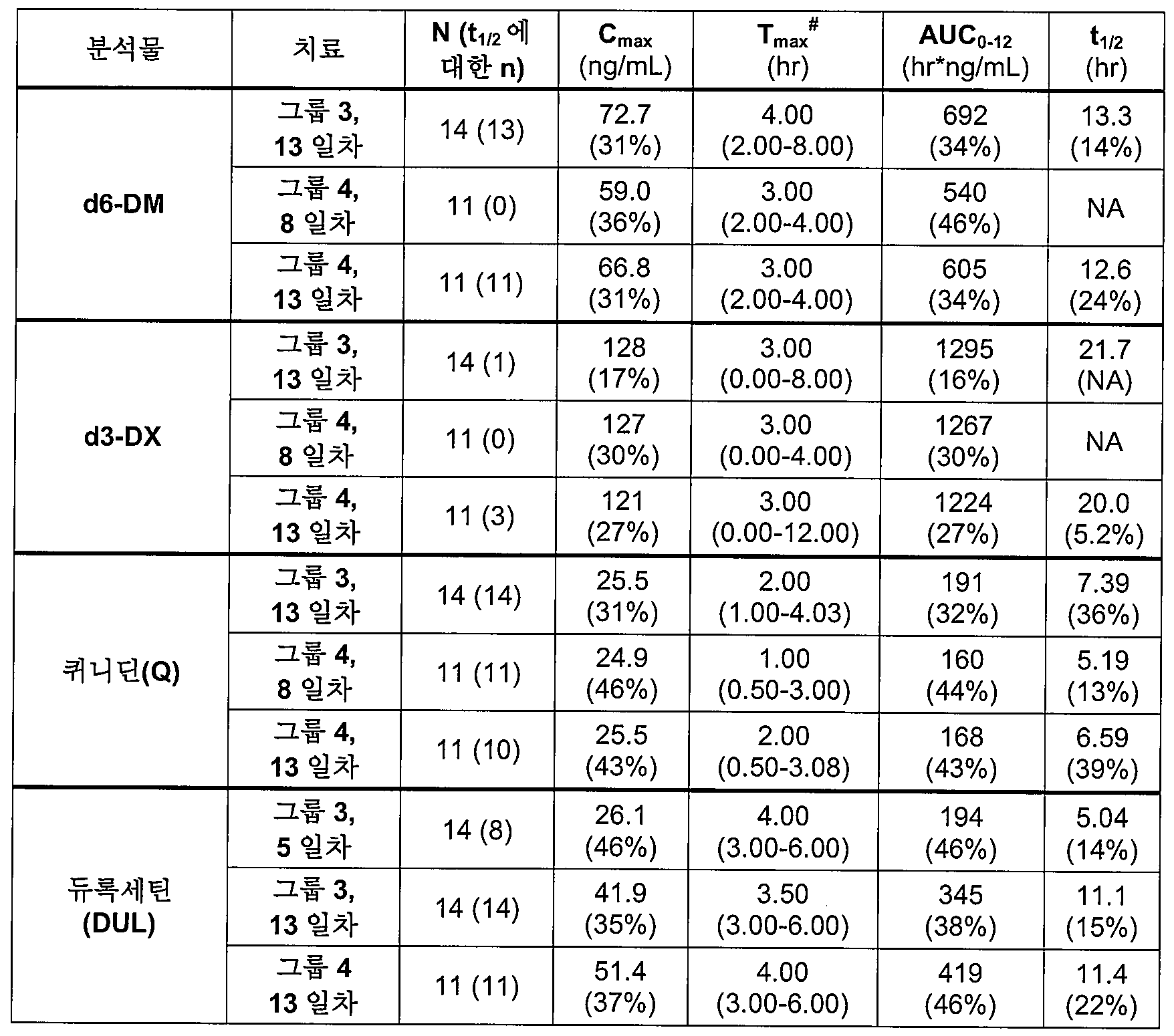
로그-변환 ANOVA에 의한 병용 투여 대 단일 치료 투약의 비교 (표 16): Comparison of concurrent versus single treatment doses by log-transformed ANOVA (Table 16):
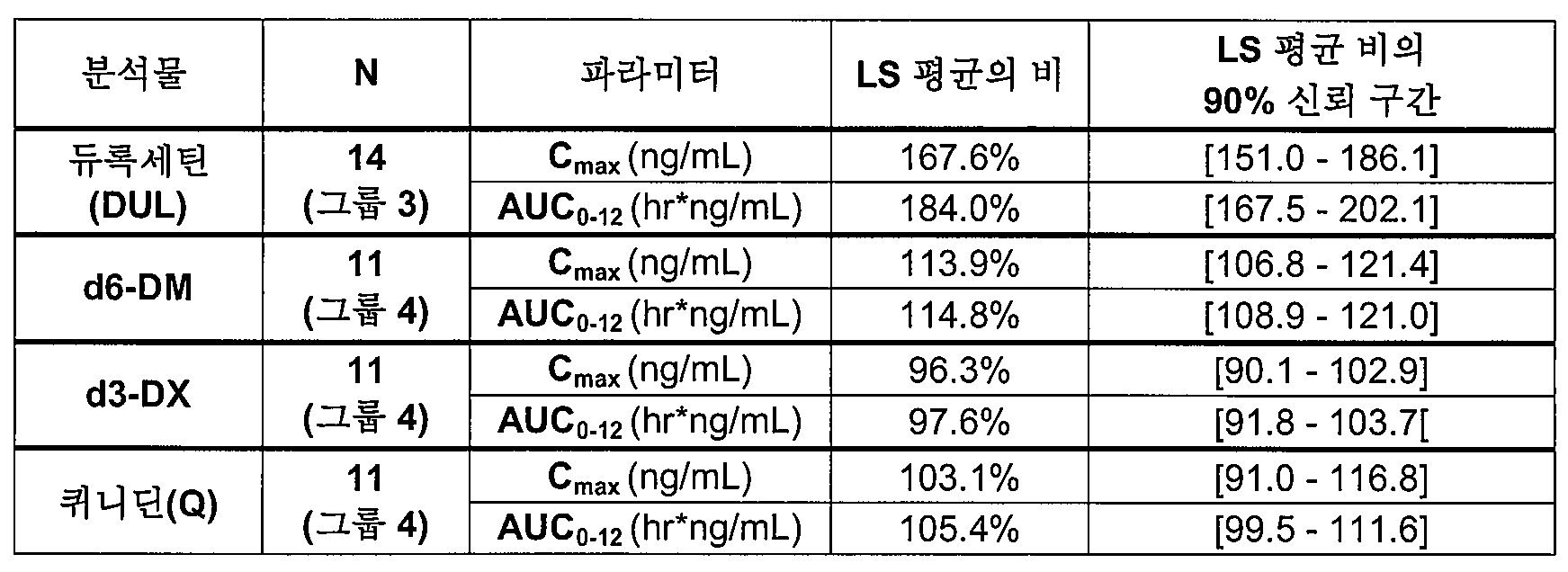
안전성: Safety :
사망은 없었다. 파록세틴 20mg QD(1 내지 16일차) 및 AVP-786-30/4.75(13 내지 16일차)를 1일 2회 투약받은 후, 저칼슘혈증(hypokalemia) 및 저염소혈증(hypochloremia)의 2가지 수반되는 심각한 부작용(SAE)을 겪는 1명의 피험자(피험자 R112, 파록세틴/AVP-786)가 존재하였다. 이들은 둘 다 중간의 중증도로 간주되었다. 현기증을 갖는 상기 피험자는 15일차에 기립성 저혈압(orthostatic hypotension)과 관련되었으며 16일차에는 저린 감각(tingling sensation)을 동반한 두 다리의 근력 저하(muscle weakness)와 관련되었다. 임상적 증상의 평가를 돕기 위한 17일차에 수득한 혈액 시험 및 ECG는, 저칼슘혈증, 대사성 알칼리혈증(metabolic alkalosis), 및 QTc의 연장, 유체 및 전해질 대체물로 완전히 해결되는 증상을 밝혀내었다. 이들 SAE의 상세한 사항에 대한 출원인의 의학적 검토, 및 숙련된 심장전문의의 독립적인 평가에 근거하여, 임상적 징후(clinical picture)는 파록세틴 또는 AVP-786의 공지된 약물 효과와 일치하지는 않았다.There was no death. After receiving doses of paroxetine 20 mg QD (1 to 16 days) and AVP-786-30 / 4.75 (13 to 16 days) twice daily, there are two concomitant doses of hypokalemia and hypochloremia One subject (subject R112, paroxetine / AVP-786) undergoing severe side effects (SAE) was present. Both of these were considered intermediate severity. The subject with dizziness was associated with orthostatic hypotension on
4명이, 자살 관념화(8 용량의 파록세틴을 투약받은 피험자 R107), 저칼슘혈증 및 저염소혈증(피험자 R112, 상기 참조), 요로감염(12 용량의 AVP-786을 투약받은 피험자 R411) 및 구토(9 용량의 AVP-786을 투약받은 피험자 R412)의 AE로 인해 철회하였다.4 patients were randomly assigned to receive either a suicidal ideation (subject R107 dosed with 8 doses of paroxetine), hypocalcemia and hypochloremia (subject R112, see above), urinary tract infection (subject R411 with 12 doses of AVP-786) 9 dose of AVP-786).
파록세틴 및 AVP-786 상호작용:Paroxetine and AVP-786 Interactions:
그룹 1 및 2에서, 치료-응급 AE가, 파록세틴을 투약받은 14명의 피험자 중 7명(50%)(12일의 투약 동안), AVP-786을 투약받은 14명의 피험자 중 9명(64%)(8일의 투약 동안), 파록세틴/AVP-786 배합물을 투약받은 12명의 피험자 중 10명(83%)(8일의 투약 동안), AVP-786/파록세틴 배합물을 투약받은 14명의 피험자 중 13명(93%)(12일의 투약 동안)에 대해 보고되었다.In
대부분의 AE(115개의 AE 중 104개, 90%)가 연구 치료에 (가능하게는 또는 아마도) 관련된 것으로 판단되었다. 가장 흔한 관련 부작용은 현기증 및 체위성 현기증, 두통, 설사, 구역질, 악몽, 및 주의력 장애였다. 악몽 및 주의력 장애의 부작용은 파록세틴 및 AVP-786의 배합물을 투약받은 피험자에서만 보고되었다. 현기증은, 파록세틴 또는 AVP-786의 단일 치료에 비해, 피험자가 조합된 치료요법을 투약받은 경우에 발생율이 더 높은 것으로 보고되었다. 두통 및 구역질은 파록세틴 또는 파록세틴과 AVP-786의 배합물을 투약받은 피험자에서 보고되었으며, AVP-786만을 투약받은 피험자에서는 보고되지 않았음이 주목된다.Most of the AEs (104 out of 115 AEs, 90%) were judged to be (possibly or perhaps) related to the study treatment. The most common related side effects were dizziness and somnolence dizziness, headache, diarrhea, nausea, nightmares, and attention deficit disorder. Side effects of nightmares and attention deficits have been reported only in subjects receiving a combination of paroxetine and AVP-786. Dizziness has been reported to be associated with a higher incidence rate when the subject is administered a combined therapy regimen, compared to a single treatment with paroxetine or AVP-786. Headache and nausea have been reported in subjects receiving a combination of paroxetine or paroxetine and AVP-786, and it has been noted that they have not been reported in subjects receiving AVP-786 alone.
대부분의 AE는 중증도에서 경증으로 분류되었고 중증으로 분류된 AE는 없었다. 연구 치료와 관련된 것으로 판단되는 중간 정도의 중등도의 부작용은 자살 관념화, 저칼슘혈증 및 저염소혈증, 및 우울이었다.Most of the AEs were classified as mild to moderate and no severe AEs. The moderate moderate side effects considered to be associated with study therapy were suicide ideation, hypocalcemia and hypochloremia, and depression.
듀록세틴Durocetin 및 And AVPAVP -786 상호작용:-786 Interaction:
그룹 3 및 4에서, 치료-응급 AE가, 듀록세틴을 투약받은 14명의 피험자 중 6명(43%)(5일의 투약 동안), AVP-786을 투약받은 14명의 피험자 중 7명(50%)(8일의 투약 동안), 듀록세틴/AVP-786 배합물을 투약받은 14명의 피험자 중 7명(50%)(8일의 투약 동안), AVP-786/듀록세틴 배합물을 투약받은 11명의 피험자 중 5명(45%)(5일의 투약 동안)에 대해 보고되었다.In
대부분의 AE(50개의 AE 중 40개, 80%)가 연구 치료에 (가능하게는 또는 아마도) 관련된 것으로 판단되었다. 가장 흔한 관련 부작용은 피로감 및 근육 압박감(muscle tightness)이었다. 듀록세틴 또는 AVP-786의 단일 치료와 비교하여, AVP-786과 듀록세틴의 조합 후 피험자에서 발생율이 더 높은 일반적인 AE는 없었다. 그룹 4에서 AVP-786만이 투여된 피험자에서는 피로감만이 보고되었지만 그룹 2에서 AVP-786이 투여된 피험자에서는 보고되지 않은 것으로 알려져 있다.Most AEs (40 out of 50 AEs, 80%) were judged to be (possibly or perhaps) related to research therapy. The most common side effects were fatigue and muscle tightness. Compared with a single treatment of durocetin or AVP-786, there was no general AE with a higher incidence in subjects after combination of AVP-786 and durocetin. In
대부분의 AE는 중증도에서 경증으로 분류되었고 하나의 AE는 중증으로 분류되었다. 중증 강도의 AE는 구토였으며(피험자 1명, AVP-786) 이는 아마도 연구 치료와 관련된 것으로 판단되었다. 연구 치료와 관련된 것으로 판단되는 중간의 중등도의 부작용은 구토, 식은땀, 두통, 현기증, 하복부 통증이었다.Most AEs were classified as mild to moderate, and one AE was classified as severe. Severe intensity AE was vomiting (1 subject, AVP-786) and was probably related to research therapy. Moderate moderate side effects that were considered to be related to study therapy were vomiting, cold sweating, headache, dizziness, and lower abdominal pain.
상기 그룹들 각각에 대한 중증도에 의한 AE의 요약은 치료들 사이에서 차이점을 나타내지 않았다. 치료들 사이에 있어서, 임상 실험실 시험, 생체 신호, 및 ECG 평가에 의해 평가된 안전성의 명백한 차이는 없었다.A summary of AE by severity for each of these groups did not show any differences between treatments. Between treatments, there was no apparent difference in safety assessed by clinical laboratory tests, vital signs, and ECG assessment.
결론conclusion
안전성 평가에서, 단일 치료의 다중 용량과 비교하여, AVP-786과 파록세틴과의 다중 용량 병용 또는 AVP-786과 듀록세틴과의 다중 용량 병용에 있어서의 임상적으로 유의미한 차이는 없었다.In the safety assessment, there were no clinically significant differences in multidose combination of AVP-786 and paroxetine or multidose combination of AVP-786 and durocetin in comparison to multiple doses of monotherapy.
파록세틴의 정상 상태 전신 노출은, AVP-786과 공동 투여되는 경우, 파록세틴 단독 투여에 비해 (대략 150%까지) 유의미하게 증가하였다. 파록세틴과 공동 투여되는 경우, AVP-786 단독 투여에 비해, AVP-786의 분석물의 정상 상태 전신 노출의 유의미한 변화가 있으며, d6-DM의 전신 노출의 대략 2배 증가 및 d3-DX의 실질적인 (대략 75%로의) 감소를 동반하였고, 이는, AVP-786이 파록세틴과 병용 투여되는 경우 d6-DM의 d3-DX로의 대사가 감소함을 의미한다. Q의 전신 노출이 중간의 정도로(대략 130%까지) 증가하였다.Steady-state systemic exposure of paroxetine significantly increased (up to approximately 150%) compared to paroxetine alone when co-administered with AVP-786. When co-administered with paroxetine, there is a significant change in steady state systemic exposure of the analyte of AVP-786 relative to AVP-786 alone, approximately a two-fold increase in systemic exposure of d6-DM and substantial (approximately 75%), which means that the metabolism of d6-DM to d3-DX is reduced when AVP-786 is co-administered with paroxetine. The systemic exposure of Q was moderate (up to approximately 130%).
듀록세틴의 정상 상태 전신 노출은, AVP-786과 공동 투여되는 경우, 듀록세틴 단독 투여에 비해 (대략 180%까지) 유의미하게 증가하였다. 듀록세틴과 공동 투여되는 경우, AVP-786 단독 투여에 비해, AVP-786의 분석물의 정상 상태 전신 노출의 유의미한 변화는 없었다.Steady-state systemic exposure of durocetin significantly increased (up to approximately 180%) compared to durocetin alone when co-administered with AVP-786. When co-administered with durocetin, there was no significant change in steady-state systemic exposure of the analyte of AVP-786 compared to AVP-786 alone.
Claims (72)
Applications Claiming Priority (35)
| Application Number | Priority Date | Filing Date | Title |
|---|---|---|---|
| US201462050170P | 2014-09-14 | 2014-09-14 | |
| US62/050,170 | 2014-09-14 | ||
| US201462061451P | 2014-10-08 | 2014-10-08 | |
| US62/061,451 | 2014-10-08 | ||
| US201462063122P | 2014-10-13 | 2014-10-13 | |
| US62/063,122 | 2014-10-13 | ||
| US201462063861P | 2014-10-14 | 2014-10-14 | |
| US62/063,861 | 2014-10-14 | ||
| US201462068742P | 2014-10-26 | 2014-10-26 | |
| US62/068,742 | 2014-10-26 | ||
| US201562111053P | 2015-02-02 | 2015-02-02 | |
| US62/111,053 | 2015-02-02 | ||
| US201562111590P | 2015-02-03 | 2015-02-03 | |
| US62/111,590 | 2015-02-03 | ||
| US201562128446P | 2015-03-04 | 2015-03-04 | |
| US62/128,446 | 2015-03-04 | ||
| US201562162140P | 2015-05-15 | 2015-05-15 | |
| US62/162,140 | 2015-05-15 | ||
| US201562165535P | 2015-05-22 | 2015-05-22 | |
| US62/165,535 | 2015-05-22 | ||
| US201562169997P | 2015-06-02 | 2015-06-02 | |
| US62/169,997 | 2015-06-02 | ||
| US201562180026P | 2015-06-15 | 2015-06-15 | |
| US62/180,026 | 2015-06-15 | ||
| US201562193347P | 2015-07-16 | 2015-07-16 | |
| US62/193,347 | 2015-07-16 | ||
| US201562205061P | 2015-08-14 | 2015-08-14 | |
| US62/205,061 | 2015-08-14 | ||
| US201562216636P | 2015-09-10 | 2015-09-10 | |
| US62/216,636 | 2015-09-10 | ||
| US201562217142P | 2015-09-11 | 2015-09-11 | |
| US201562217470P | 2015-09-11 | 2015-09-11 | |
| US62/217,470 | 2015-09-11 | ||
| US62/217,142 | 2015-09-11 | ||
| PCT/US2015/049934 WO2016040930A1 (en) | 2014-09-14 | 2015-09-14 | Pharmaceutical compositions comprising a dextromethorphan compound and quinidine for the treatment of agitation in dementia |
Publications (1)
| Publication Number | Publication Date |
|---|---|
| KR20170052684A true KR20170052684A (en) | 2017-05-12 |
Family
ID=55459653
Family Applications (1)
| Application Number | Title | Priority Date | Filing Date |
|---|---|---|---|
| KR1020177009991A Ceased KR20170052684A (en) | 2014-09-14 | 2015-09-14 | Pharmaceutical compositions comprising a dextromethorphan compound and quinidine for the treatment of agitation in dementia |
Country Status (15)
| Country | Link |
|---|---|
| US (3) | US20190111047A1 (en) |
| EP (4) | EP3193872A4 (en) |
| JP (4) | JP2017531033A (en) |
| KR (1) | KR20170052684A (en) |
| CN (3) | CN117427077A (en) |
| AU (3) | AU2015314710A1 (en) |
| CA (1) | CA2960031A1 (en) |
| IL (2) | IL250786A0 (en) |
| MX (3) | MX2017003066A (en) |
| MY (1) | MY198587A (en) |
| PH (1) | PH12017500444A1 (en) |
| RU (1) | RU2017112747A (en) |
| SG (2) | SG11201701645WA (en) |
| TW (3) | TW202106301A (en) |
| WO (1) | WO2016040930A1 (en) |
Cited By (2)
| Publication number | Priority date | Publication date | Assignee | Title |
|---|---|---|---|---|
| KR20250120917A (en) | 2024-02-02 | 2025-08-11 | 단국대학교 천안캠퍼스 산학협력단 | Pharmaceutical composition for preventing or treating neurological diseases comprising dextromethorphan as an active ingredient |
| KR20250129211A (en) | 2024-02-22 | 2025-08-29 | 단국대학교 천안캠퍼스 산학협력단 | Pharmaceutical composition for preventing or treating neurological diseases comprising degarelix as an active ingredient |
Families Citing this family (17)
| Publication number | Priority date | Publication date | Assignee | Title |
|---|---|---|---|---|
| EP2357183B1 (en) | 2007-05-01 | 2015-07-01 | Concert Pharmaceuticals Inc. | Morphinan compounds |
| CA2994153A1 (en) * | 2015-07-30 | 2017-02-02 | Concert Pharmaceuticals, Inc. | Deuterated morphinan compounds for use in treating agitation |
| WO2017020002A1 (en) * | 2015-07-30 | 2017-02-02 | Concert Pharmaceuticals, Inc. | Deuterated morphinan compounds for use in treating agitation |
| ES2925277T3 (en) * | 2016-07-04 | 2022-10-14 | Avanir Pharmaceuticals Inc | Methods for the synthesis of deuterated dextromethorphan |
| CN110831584B (en) * | 2017-05-04 | 2023-03-10 | 埃克塞瓦有限责任公司 | Targeted drug rescue with novel compositions, combinations and methods thereof |
| US11478467B2 (en) | 2017-05-04 | 2022-10-25 | Sreenivasarao Vepachedu | Targeted drug rescue with novel compositions, combinations, and methods thereof |
| AU2019269739B2 (en) | 2018-05-18 | 2025-12-18 | Anavex Life Sciences Corp. | Optimized sigma-1 agonist method of responder selection and treatment |
| SMT202600055T1 (en) * | 2019-01-07 | 2026-03-09 | Antecip Bioventures Ii Llc | Combination of dextromethorphan and bupropion for treating depression in asian patients |
| AU2020241611A1 (en) * | 2019-03-18 | 2021-11-04 | Avanir Pharmaceuticals, Inc. | Methods of treating negative symptoms of schizophrenia using deuterated dextromethorphan and quinidine |
| US20230270738A1 (en) * | 2020-04-27 | 2023-08-31 | Avanir Phrmaceuticals Inc. | Methods of treating agitation associated with alzheimer's disease |
| CN115245515A (en) * | 2021-04-27 | 2022-10-28 | 杭州剂泰医药科技有限责任公司 | Medicinal use of a composition |
| CN115322150B (en) * | 2021-05-11 | 2024-05-28 | 深圳信立泰药业股份有限公司 | Solid deuterated dextromethorphan hydrobromide, preparation method and medical use thereof |
| CN113209042A (en) * | 2021-05-28 | 2021-08-06 | 珠海润都制药股份有限公司 | Dextromethorphan hydrobromide quinidine sulfate capsule and preparation method thereof |
| IL312310A (en) * | 2021-10-27 | 2024-06-01 | Avanir Pharmaceuticals Inc | Methods of treating agitation associated with alzheimer's disease |
| CN116459255A (en) * | 2022-01-19 | 2023-07-21 | 深圳信立泰药业股份有限公司 | Use of deuterated dextromethorphan in combination with bupropion in the preparation of drugs for AD agitation |
| US11730706B1 (en) * | 2022-07-07 | 2023-08-22 | Antecip Bioventures Ii Llc | Treatment of depression in certain patient populations |
| CN117783322A (en) * | 2022-12-16 | 2024-03-29 | 杭州剂泰医药科技有限责任公司 | HPLC analysis method of dextromethorphan-quinidine composition |
Family Cites Families (28)
| Publication number | Priority date | Publication date | Assignee | Title |
|---|---|---|---|---|
| US3536809A (en) | 1969-02-17 | 1970-10-27 | Alza Corp | Medication method |
| US3598123A (en) | 1969-04-01 | 1971-08-10 | Alza Corp | Bandage for administering drugs |
| US3845770A (en) | 1972-06-05 | 1974-11-05 | Alza Corp | Osmatic dispensing device for releasing beneficial agent |
| US3916899A (en) | 1973-04-25 | 1975-11-04 | Alza Corp | Osmotic dispensing device with maximum and minimum sizes for the passageway |
| US4008719A (en) | 1976-02-02 | 1977-02-22 | Alza Corporation | Osmotic system having laminar arrangement for programming delivery of active agent |
| US5166207A (en) | 1991-06-17 | 1992-11-24 | Neurotherapeutics, Inc. | Method for enhancing the systemic delivery of dextromethorphan for the treatment of neurological disorders |
| US5206248A (en) | 1992-03-27 | 1993-04-27 | Smith Richard A | Method for reducing emotional lability |
| US5366980A (en) | 1991-06-17 | 1994-11-22 | Smith Richard A | Use of dextromethorphan and an oxidase inhibitor to treat dermatitis |
| US5350756A (en) | 1991-06-17 | 1994-09-27 | Smith Richard A | Use of a cytochrome oxidase inhibitor to increase the cough-suppressing activity of dextromorphan |
| TW264473B (en) * | 1993-01-06 | 1995-12-01 | Hoffmann La Roche | |
| JP4097285B2 (en) * | 1994-09-22 | 2008-06-11 | リチャード・アラン・スミス | Compositions useful in the manufacture of a medicament for the treatment of various stubborn diseases |
| US5874443A (en) | 1995-10-19 | 1999-02-23 | Trega Biosciences, Inc. | Isoquinoline derivatives and isoquinoline combinatorial libraries |
| US5886210A (en) | 1996-08-22 | 1999-03-23 | Rohm And Haas Company | Method for preparing aromatic compounds |
| US5922683A (en) | 1997-05-29 | 1999-07-13 | Abbott Laboratories | Multicyclic erythromycin derivatives |
| EP1032377B1 (en) | 1997-11-21 | 2010-11-17 | Purdue Neuroscience Company | Substituted 2-aminoacetamides and the use thereof |
| BR9909146A (en) | 1998-03-26 | 2000-12-05 | Shionogi & Co | Indole derivatives showing antiviral activity |
| US6509331B1 (en) | 1998-06-22 | 2003-01-21 | Elan Pharmaceuticals, Inc. | Deoxyamino acid compounds, pharmaceutical compositions comprising same, and methods for inhibiting β-amyloid peptide release and/or its synthesis by use of such compounds |
| FR2784988B1 (en) | 1998-10-23 | 2002-09-20 | Adir | NOVEL DIHYDRO AND TETRAHYDROQUINOLEINIC COMPOUNDS, PROCESS FOR THEIR PREPARATION AND THE PHARMACEUTICAL COMPOSITIONS CONTAINING THEM |
| TWI326214B (en) * | 2002-07-17 | 2010-06-21 | Avanir Pharmaceuticals Inc | Pharmaceutical compositions comprising dextromethorphan and quinidine for the treatment of neurological disorders |
| EP1986639A4 (en) * | 2006-02-03 | 2010-04-28 | Avanir Pharmaceuticals | Pharmaceutical compositions comprising dextromethorphan and quinidine for the treatment of depression, anxiety, and neurodegenerative disorders |
| WO2007103474A2 (en) * | 2006-03-07 | 2007-09-13 | University Of Florida Research Foundation, Inc. | Drug adherence monitoring system |
| WO2008097924A2 (en) * | 2007-02-05 | 2008-08-14 | Avanir Pharmaceuticals | Pharmaceutical compositions comprising dextromethorphan analogs for the treatment of neurological disorders |
| EP2357183B1 (en) * | 2007-05-01 | 2015-07-01 | Concert Pharmaceuticals Inc. | Morphinan compounds |
| MX370608B (en) * | 2007-05-01 | 2019-12-18 | Concert Pharmaceuticals Inc | Morphinan compounds. |
| DK2418211T3 (en) * | 2008-09-19 | 2016-06-27 | Concert Pharmaceuticals Inc | DEUTERATED MORPHINAN COMPOUNDS |
| US20120083487A1 (en) * | 2008-10-30 | 2012-04-05 | Amanda Thomas | Combination of morphinan compounds and antidepressant for the treatment of pseudobulbar affect, neurolgical diseases, intractable and chronic pain and brain injury |
| JP5647615B2 (en) * | 2008-11-14 | 2015-01-07 | コンサート ファーマシューティカルズ インコーポレイテッド | Substituted dioxopiperidinylphthalimide derivatives |
| MY179696A (en) * | 2013-11-05 | 2020-11-11 | Antecip Bioventures Ii Llc | Compositions and methods comprising bupropion or related compounds and dextromethorphan |
-
2015
- 2015-09-14 MY MYPI2017000321A patent/MY198587A/en unknown
- 2015-09-14 EP EP15840718.9A patent/EP3193872A4/en not_active Withdrawn
- 2015-09-14 AU AU2015314710A patent/AU2015314710A1/en not_active Abandoned
- 2015-09-14 CN CN202311175974.9A patent/CN117427077A/en active Pending
- 2015-09-14 SG SG11201701645WA patent/SG11201701645WA/en unknown
- 2015-09-14 CA CA2960031A patent/CA2960031A1/en active Pending
- 2015-09-14 TW TW109114123A patent/TW202106301A/en unknown
- 2015-09-14 TW TW110139834A patent/TWI869633B/en active
- 2015-09-14 JP JP2017533726A patent/JP2017531033A/en active Pending
- 2015-09-14 MX MX2017003066A patent/MX2017003066A/en unknown
- 2015-09-14 SG SG10201901242PA patent/SG10201901242PA/en unknown
- 2015-09-14 WO PCT/US2015/049934 patent/WO2016040930A1/en not_active Ceased
- 2015-09-14 CN CN201910903770.XA patent/CN110664801A/en active Pending
- 2015-09-14 US US15/510,498 patent/US20190111047A1/en not_active Abandoned
- 2015-09-14 EP EP21178170.3A patent/EP3932907A3/en not_active Withdrawn
- 2015-09-14 EP EP20159783.8A patent/EP3708168A3/en not_active Withdrawn
- 2015-09-14 EP EP22195837.4A patent/EP4166141A1/en not_active Withdrawn
- 2015-09-14 RU RU2017112747A patent/RU2017112747A/en not_active Application Discontinuation
- 2015-09-14 TW TW104130311A patent/TW201613591A/en unknown
- 2015-09-14 KR KR1020177009991A patent/KR20170052684A/en not_active Ceased
- 2015-09-14 CN CN201580049454.0A patent/CN107072990A/en active Pending
-
2017
- 2017-02-26 IL IL250786A patent/IL250786A0/en unknown
- 2017-03-08 MX MX2021010696A patent/MX2021010696A/en unknown
- 2017-03-08 MX MX2022008181A patent/MX2022008181A/en unknown
- 2017-03-09 PH PH12017500444A patent/PH12017500444A1/en unknown
-
2019
- 2019-10-08 US US16/596,236 patent/US20200289499A1/en not_active Abandoned
- 2019-11-06 JP JP2019201410A patent/JP2020019818A/en not_active Withdrawn
-
2020
- 2020-05-18 IL IL274742A patent/IL274742A/en unknown
- 2020-12-15 AU AU2020289733A patent/AU2020289733A1/en not_active Abandoned
-
2021
- 2021-03-08 JP JP2021036318A patent/JP7360409B2/en active Active
-
2022
- 2022-12-06 AU AU2022283671A patent/AU2022283671B2/en not_active Expired - Fee Related
-
2023
- 2023-04-24 US US18/305,589 patent/US20240082237A1/en not_active Abandoned
- 2023-06-12 JP JP2023096152A patent/JP2023105265A/en active Pending
Cited By (2)
| Publication number | Priority date | Publication date | Assignee | Title |
|---|---|---|---|---|
| KR20250120917A (en) | 2024-02-02 | 2025-08-11 | 단국대학교 천안캠퍼스 산학협력단 | Pharmaceutical composition for preventing or treating neurological diseases comprising dextromethorphan as an active ingredient |
| KR20250129211A (en) | 2024-02-22 | 2025-08-29 | 단국대학교 천안캠퍼스 산학협력단 | Pharmaceutical composition for preventing or treating neurological diseases comprising degarelix as an active ingredient |
Also Published As
Similar Documents
| Publication | Publication Date | Title |
|---|---|---|
| AU2022283671B2 (en) | Pharmaceutical compositions comprising a dextromethorphan compound and quinidine for the treatment of agitation in dementia | |
| US20220105084A1 (en) | Pharmaceutical compositions comprising dextromethorphan and quinidine for the treatment of agitation in dementia | |
| Silva et al. | Pharmacokinetics and pharmacodynamics of dextromethorphan: clinical and forensic aspects | |
| Dwoskin et al. | Review of the pharmacology and clinical profile of bupropion, an antidepressant and tobacco use cessation agent | |
| WO2012118562A1 (en) | Compositions and methods for treating depression, adhd and other central nervous system disorders employing novel bupropion compounds, and methods for production and use of novel bupropion compounds and formulations | |
| US20090068290A1 (en) | Bifeprunox doses for treating schizophrenia | |
| CN110167562A (en) | DMPC, DMPG, DMPC/DMPG, LYSOPG and LYSOPC are directed to the protective effect for causing the drug of ion channel disease | |
| US20190175525A1 (en) | Cyclobenzaprine treatment for agitation, psychosis and cognitive decline in dementia and neurodegenerative conditions | |
| HK Thanacoody | Thioridazine: the good and the bad | |
| Schweri et al. | Biochemical and behavioral characterization of novel methylphenidate analogs | |
| RU2838188C2 (en) | Pharmaceutical compositions containing dextromethorphan compound and quinidine for treatment of agitation in dementia | |
| HK40091857A (en) | Combinations of deuterated dextromethorphan and quinidine for the treatment of agitation and aggression in alzheimer's dementia | |
| HK40064052A (en) | Dextromethorphan analogs and combinations of deuterated dextromethorphan and nortriptyline for use in treating agitation and/or aggression | |
| Antia et al. | ‘Party pill’drugs—BZP and TFMPP | |
| HK40020899A (en) | Pharmaceutical compositions comprising a dextromethorphan compound and quinidine for the treatment of agitation in dementia | |
| HK1235689A1 (en) | Pharmaceutical compositions comprising a dextromethorphan compound and quinidine for the treatment of agitation in dementia | |
| Pope | AVP-923 as a novel treatment for pseudobulbar affect in ALS | |
| White et al. | Pipradrol and pipradrol derivatives | |
| Whitebread et al. | Side effects of marketed drugs: The utility and pitfalls of pharmacovigilance | |
| WO2004078177A1 (en) | Remedy for drug/substance dependence | |
| Meyer | Jonathan M. Meyer, MD | |
| Hysek et al. | Duloxetine Inhibits Effects of MDMA (‘‘Ecstasy’’) In Vitro and in Humans in a |
Legal Events
| Date | Code | Title | Description |
|---|---|---|---|
| PA0105 | International application |
St.27 status event code: A-0-1-A10-A15-nap-PA0105 |
|
| R18-X000 | Changes to party contact information recorded |
St.27 status event code: A-3-3-R10-R18-oth-X000 |
|
| P11-X000 | Amendment of application requested |
St.27 status event code: A-2-2-P10-P11-nap-X000 |
|
| P13-X000 | Application amended |
St.27 status event code: A-2-2-P10-P13-nap-X000 |
|
| PG1501 | Laying open of application |
St.27 status event code: A-1-1-Q10-Q12-nap-PG1501 |
|
| E13-X000 | Pre-grant limitation requested |
St.27 status event code: A-2-3-E10-E13-lim-X000 |
|
| P11-X000 | Amendment of application requested |
St.27 status event code: A-2-2-P10-P11-nap-X000 |
|
| P13-X000 | Application amended |
St.27 status event code: A-2-2-P10-P13-nap-X000 |
|
| A201 | Request for examination | ||
| PA0201 | Request for examination |
St.27 status event code: A-1-2-D10-D11-exm-PA0201 |
|
| R18-X000 | Changes to party contact information recorded |
St.27 status event code: A-3-3-R10-R18-oth-X000 |
|
| E902 | Notification of reason for refusal | ||
| PE0902 | Notice of grounds for rejection |
St.27 status event code: A-1-2-D10-D21-exm-PE0902 |
|
| T11-X000 | Administrative time limit extension requested |
St.27 status event code: U-3-3-T10-T11-oth-X000 |
|
| T11-X000 | Administrative time limit extension requested |
St.27 status event code: U-3-3-T10-T11-oth-X000 |
|
| P11-X000 | Amendment of application requested |
St.27 status event code: A-2-2-P10-P11-nap-X000 |
|
| P13-X000 | Application amended |
St.27 status event code: A-2-2-P10-P13-nap-X000 |
|
| E902 | Notification of reason for refusal | ||
| PE0902 | Notice of grounds for rejection |
St.27 status event code: A-1-2-D10-D21-exm-PE0902 |
|
| P11-X000 | Amendment of application requested |
St.27 status event code: A-2-2-P10-P11-nap-X000 |
|
| P13-X000 | Application amended |
St.27 status event code: A-2-2-P10-P13-nap-X000 |
|
| E601 | Decision to refuse application | ||
| PE0601 | Decision on rejection of patent |
St.27 status event code: N-2-6-B10-B15-exm-PE0601 |
|
| T11-X000 | Administrative time limit extension requested |
St.27 status event code: U-3-3-T10-T11-oth-X000 |
|
| T13-X000 | Administrative time limit extension granted |
St.27 status event code: U-3-3-T10-T13-oth-X000 |
|
| T13-X000 | Administrative time limit extension granted |
St.27 status event code: U-3-3-T10-T13-oth-X000 |
|
| P11-X000 | Amendment of application requested |
St.27 status event code: A-2-2-P10-P11-nap-X000 |
|
| P13-X000 | Application amended |
St.27 status event code: A-2-2-P10-P13-nap-X000 |
|
| PX0901 | Re-examination |
St.27 status event code: A-2-3-E10-E12-rex-PX0901 |
|
| PX0601 | Decision of rejection after re-examination |
St.27 status event code: N-2-6-B10-B17-rex-PX0601 |
|
| X601 | Decision of rejection after re-examination |