KR20170067775A - AMPEROMETRIC SOLID ELECTROLYTE SENSOR AND METHOD FOR DETECTING NH3 AND NOx - Google Patents
AMPEROMETRIC SOLID ELECTROLYTE SENSOR AND METHOD FOR DETECTING NH3 AND NOx Download PDFInfo
- Publication number
- KR20170067775A KR20170067775A KR1020177009990A KR20177009990A KR20170067775A KR 20170067775 A KR20170067775 A KR 20170067775A KR 1020177009990 A KR1020177009990 A KR 1020177009990A KR 20177009990 A KR20177009990 A KR 20177009990A KR 20170067775 A KR20170067775 A KR 20170067775A
- Authority
- KR
- South Korea
- Prior art keywords
- sensor
- active electrode
- layer
- electrode
- electrochemical cell
- Prior art date
- Legal status (The legal status is an assumption and is not a legal conclusion. Google has not performed a legal analysis and makes no representation as to the accuracy of the status listed.)
- Withdrawn
Links
- 238000000034 method Methods 0.000 title claims description 29
- 239000007784 solid electrolyte Substances 0.000 title 1
- 239000003792 electrolyte Substances 0.000 claims abstract description 103
- 238000006243 chemical reaction Methods 0.000 claims abstract description 39
- MEFBJEMVZONFCJ-UHFFFAOYSA-N molybdate Chemical compound [O-][Mo]([O-])(=O)=O MEFBJEMVZONFCJ-UHFFFAOYSA-N 0.000 claims abstract description 26
- 239000012528 membrane Substances 0.000 claims abstract description 22
- 230000004044 response Effects 0.000 claims abstract description 16
- BASFCYQUMIYNBI-UHFFFAOYSA-N platinum Substances [Pt] BASFCYQUMIYNBI-UHFFFAOYSA-N 0.000 claims description 96
- 239000000758 substrate Substances 0.000 claims description 63
- 239000000203 mixture Substances 0.000 claims description 44
- 229910052697 platinum Inorganic materials 0.000 claims description 43
- -1 tungstate compound Chemical class 0.000 claims description 38
- 239000010931 gold Substances 0.000 claims description 27
- 229910052751 metal Inorganic materials 0.000 claims description 25
- 239000002184 metal Substances 0.000 claims description 25
- 229910052737 gold Inorganic materials 0.000 claims description 19
- 229910021525 ceramic electrolyte Inorganic materials 0.000 claims description 17
- PCHJSUWPFVWCPO-UHFFFAOYSA-N gold Chemical compound [Au] PCHJSUWPFVWCPO-UHFFFAOYSA-N 0.000 claims description 15
- 239000002001 electrolyte material Substances 0.000 claims description 14
- 239000000919 ceramic Substances 0.000 claims description 13
- 239000011195 cermet Substances 0.000 claims description 13
- 229910052763 palladium Inorganic materials 0.000 claims description 11
- 239000000956 alloy Substances 0.000 claims description 10
- 229910045601 alloy Inorganic materials 0.000 claims description 10
- 229910052703 rhodium Inorganic materials 0.000 claims description 10
- 229910052707 ruthenium Inorganic materials 0.000 claims description 10
- 229910052741 iridium Inorganic materials 0.000 claims description 8
- 229910052791 calcium Inorganic materials 0.000 claims description 6
- 150000002739 metals Chemical class 0.000 claims description 6
- 229910052712 strontium Inorganic materials 0.000 claims description 6
- 239000011810 insulating material Substances 0.000 claims description 5
- 229910052749 magnesium Inorganic materials 0.000 claims description 5
- 229910052742 iron Inorganic materials 0.000 claims description 4
- 229910052725 zinc Inorganic materials 0.000 claims description 4
- 229910052788 barium Inorganic materials 0.000 claims description 3
- 229910052802 copper Inorganic materials 0.000 claims description 3
- 229910052745 lead Inorganic materials 0.000 claims description 3
- 229910052748 manganese Inorganic materials 0.000 claims description 3
- 229910052759 nickel Inorganic materials 0.000 claims description 3
- 239000000126 substance Substances 0.000 claims 1
- 239000007789 gas Substances 0.000 abstract description 88
- 239000007772 electrode material Substances 0.000 abstract description 22
- 238000001514 detection method Methods 0.000 abstract description 21
- PBYZMCDFOULPGH-UHFFFAOYSA-N tungstate Chemical compound [O-][W]([O-])(=O)=O PBYZMCDFOULPGH-UHFFFAOYSA-N 0.000 abstract description 11
- 229910021526 gadolinium-doped ceria Inorganic materials 0.000 description 43
- 230000035945 sensitivity Effects 0.000 description 39
- 238000012360 testing method Methods 0.000 description 30
- 229910052760 oxygen Inorganic materials 0.000 description 28
- 239000001301 oxygen Substances 0.000 description 27
- QGZKDVFQNNGYKY-UHFFFAOYSA-N Ammonia Chemical compound N QGZKDVFQNNGYKY-UHFFFAOYSA-N 0.000 description 22
- 239000000463 material Substances 0.000 description 22
- QVGXLLKOCUKJST-UHFFFAOYSA-N atomic oxygen Chemical compound [O] QVGXLLKOCUKJST-UHFFFAOYSA-N 0.000 description 14
- 238000005259 measurement Methods 0.000 description 14
- 239000012491 analyte Substances 0.000 description 12
- 239000000654 additive Substances 0.000 description 11
- 238000007254 oxidation reaction Methods 0.000 description 11
- TWNQGVIAIRXVLR-UHFFFAOYSA-N oxo(oxoalumanyloxy)alumane Chemical compound O=[Al]O[Al]=O TWNQGVIAIRXVLR-UHFFFAOYSA-N 0.000 description 11
- KDLHZDBZIXYQEI-UHFFFAOYSA-N Palladium Chemical compound [Pd] KDLHZDBZIXYQEI-UHFFFAOYSA-N 0.000 description 10
- 230000003197 catalytic effect Effects 0.000 description 10
- 230000008859 change Effects 0.000 description 10
- 238000004519 manufacturing process Methods 0.000 description 10
- 229910021529 ammonia Inorganic materials 0.000 description 9
- 239000000976 ink Substances 0.000 description 9
- 230000003647 oxidation Effects 0.000 description 9
- IJGRMHOSHXDMSA-UHFFFAOYSA-N Atomic nitrogen Chemical compound N#N IJGRMHOSHXDMSA-UHFFFAOYSA-N 0.000 description 8
- 230000000996 additive effect Effects 0.000 description 8
- 238000013459 approach Methods 0.000 description 8
- 238000002485 combustion reaction Methods 0.000 description 7
- 238000006722 reduction reaction Methods 0.000 description 7
- 238000009529 body temperature measurement Methods 0.000 description 6
- 239000003054 catalyst Substances 0.000 description 6
- 238000006555 catalytic reaction Methods 0.000 description 6
- 238000003487 electrochemical reaction Methods 0.000 description 6
- 238000005755 formation reaction Methods 0.000 description 6
- 229910052757 nitrogen Inorganic materials 0.000 description 6
- 230000009467 reduction Effects 0.000 description 6
- 239000010948 rhodium Substances 0.000 description 6
- 238000007650 screen-printing Methods 0.000 description 6
- 238000005245 sintering Methods 0.000 description 6
- 150000001875 compounds Chemical class 0.000 description 5
- 230000008569 process Effects 0.000 description 5
- 229910052709 silver Inorganic materials 0.000 description 5
- 229910052727 yttrium Inorganic materials 0.000 description 5
- MYMOFIZGZYHOMD-UHFFFAOYSA-N Dioxygen Chemical compound O=O MYMOFIZGZYHOMD-UHFFFAOYSA-N 0.000 description 4
- MCMNRKCIXSYSNV-UHFFFAOYSA-N Zirconium dioxide Chemical compound O=[Zr]=O MCMNRKCIXSYSNV-UHFFFAOYSA-N 0.000 description 4
- 230000008901 benefit Effects 0.000 description 4
- 230000015572 biosynthetic process Effects 0.000 description 4
- CETPSERCERDGAM-UHFFFAOYSA-N ceric oxide Chemical compound O=[Ce]=O CETPSERCERDGAM-UHFFFAOYSA-N 0.000 description 4
- 229910000422 cerium(IV) oxide Inorganic materials 0.000 description 4
- 239000002131 composite material Substances 0.000 description 4
- 230000002596 correlated effect Effects 0.000 description 4
- 238000013461 design Methods 0.000 description 4
- 229910001882 dioxygen Inorganic materials 0.000 description 4
- 230000009977 dual effect Effects 0.000 description 4
- 150000002500 ions Chemical class 0.000 description 4
- VNWKTOKETHGBQD-UHFFFAOYSA-N methane Chemical compound C VNWKTOKETHGBQD-UHFFFAOYSA-N 0.000 description 4
- 229910052706 scandium Inorganic materials 0.000 description 4
- 229910002076 stabilized zirconia Inorganic materials 0.000 description 4
- 229910052815 sulfur oxide Inorganic materials 0.000 description 4
- 229910010293 ceramic material Inorganic materials 0.000 description 3
- 238000010586 diagram Methods 0.000 description 3
- XEEYBQQBJWHFJM-UHFFFAOYSA-N iron Substances [Fe] XEEYBQQBJWHFJM-UHFFFAOYSA-N 0.000 description 3
- 230000007246 mechanism Effects 0.000 description 3
- RVTZCBVAJQQJTK-UHFFFAOYSA-N oxygen(2-);zirconium(4+) Chemical compound [O-2].[O-2].[Zr+4] RVTZCBVAJQQJTK-UHFFFAOYSA-N 0.000 description 3
- 239000000843 powder Substances 0.000 description 3
- 239000004332 silver Substances 0.000 description 3
- 239000000243 solution Substances 0.000 description 3
- 238000010345 tape casting Methods 0.000 description 3
- 229910001928 zirconium oxide Inorganic materials 0.000 description 3
- CURLTUGMZLYLDI-UHFFFAOYSA-N Carbon dioxide Chemical compound O=C=O CURLTUGMZLYLDI-UHFFFAOYSA-N 0.000 description 2
- 229910052692 Dysprosium Inorganic materials 0.000 description 2
- 229910052691 Erbium Inorganic materials 0.000 description 2
- 229910052693 Europium Inorganic materials 0.000 description 2
- 229910052688 Gadolinium Inorganic materials 0.000 description 2
- 229910052689 Holmium Inorganic materials 0.000 description 2
- UQSXHKLRYXJYBZ-UHFFFAOYSA-N Iron oxide Chemical compound [Fe]=O UQSXHKLRYXJYBZ-UHFFFAOYSA-N 0.000 description 2
- 229910052779 Neodymium Inorganic materials 0.000 description 2
- 229910052777 Praseodymium Inorganic materials 0.000 description 2
- KJTLSVCANCCWHF-UHFFFAOYSA-N Ruthenium Chemical compound [Ru] KJTLSVCANCCWHF-UHFFFAOYSA-N 0.000 description 2
- 229910052772 Samarium Inorganic materials 0.000 description 2
- BQCADISMDOOEFD-UHFFFAOYSA-N Silver Chemical compound [Ag] BQCADISMDOOEFD-UHFFFAOYSA-N 0.000 description 2
- 229910052771 Terbium Inorganic materials 0.000 description 2
- 229910052775 Thulium Inorganic materials 0.000 description 2
- 229910052769 Ytterbium Inorganic materials 0.000 description 2
- PNEYBMLMFCGWSK-UHFFFAOYSA-N aluminium oxide Inorganic materials [O-2].[O-2].[O-2].[Al+3].[Al+3] PNEYBMLMFCGWSK-UHFFFAOYSA-N 0.000 description 2
- 238000000137 annealing Methods 0.000 description 2
- 230000033228 biological regulation Effects 0.000 description 2
- 239000011575 calcium Substances 0.000 description 2
- 229910000420 cerium oxide Inorganic materials 0.000 description 2
- 238000004891 communication Methods 0.000 description 2
- 239000000356 contaminant Substances 0.000 description 2
- 239000010949 copper Substances 0.000 description 2
- 230000000694 effects Effects 0.000 description 2
- 238000005516 engineering process Methods 0.000 description 2
- 239000000446 fuel Substances 0.000 description 2
- 239000011521 glass Substances 0.000 description 2
- AMWRITDGCCNYAT-UHFFFAOYSA-L hydroxy(oxo)manganese;manganese Chemical compound [Mn].O[Mn]=O.O[Mn]=O AMWRITDGCCNYAT-UHFFFAOYSA-L 0.000 description 2
- GKOZUEZYRPOHIO-UHFFFAOYSA-N iridium atom Chemical compound [Ir] GKOZUEZYRPOHIO-UHFFFAOYSA-N 0.000 description 2
- 229910052747 lanthanoid Inorganic materials 0.000 description 2
- 150000002602 lanthanoids Chemical class 0.000 description 2
- 229910052746 lanthanum Inorganic materials 0.000 description 2
- 239000011572 manganese Substances 0.000 description 2
- 239000002905 metal composite material Substances 0.000 description 2
- 239000007769 metal material Substances 0.000 description 2
- 238000012986 modification Methods 0.000 description 2
- 230000004048 modification Effects 0.000 description 2
- 239000003345 natural gas Substances 0.000 description 2
- 229910000069 nitrogen hydride Inorganic materials 0.000 description 2
- BMMGVYCKOGBVEV-UHFFFAOYSA-N oxo(oxoceriooxy)cerium Chemical compound [Ce]=O.O=[Ce]=O BMMGVYCKOGBVEV-UHFFFAOYSA-N 0.000 description 2
- 238000011002 quantification Methods 0.000 description 2
- MHOVAHRLVXNVSD-UHFFFAOYSA-N rhodium atom Chemical compound [Rh] MHOVAHRLVXNVSD-UHFFFAOYSA-N 0.000 description 2
- 239000010944 silver (metal) Substances 0.000 description 2
- 238000006467 substitution reaction Methods 0.000 description 2
- 238000012546 transfer Methods 0.000 description 2
- VWQVUPCCIRVNHF-UHFFFAOYSA-N yttrium atom Chemical compound [Y] VWQVUPCCIRVNHF-UHFFFAOYSA-N 0.000 description 2
- 239000004215 Carbon black (E152) Substances 0.000 description 1
- 229910002484 Ce0.9Gd0.1O1.95 Inorganic materials 0.000 description 1
- 229910052684 Cerium Inorganic materials 0.000 description 1
- ZOKXTWBITQBERF-UHFFFAOYSA-N Molybdenum Chemical compound [Mo] ZOKXTWBITQBERF-UHFFFAOYSA-N 0.000 description 1
- GWEVSGVZZGPLCZ-UHFFFAOYSA-N Titan oxide Chemical compound O=[Ti]=O GWEVSGVZZGPLCZ-UHFFFAOYSA-N 0.000 description 1
- WGLPBDUCMAPZCE-UHFFFAOYSA-N Trioxochromium Chemical compound O=[Cr](=O)=O WGLPBDUCMAPZCE-UHFFFAOYSA-N 0.000 description 1
- 229910021536 Zeolite Inorganic materials 0.000 description 1
- XHCLAFWTIXFWPH-UHFFFAOYSA-N [O-2].[O-2].[O-2].[O-2].[O-2].[V+5].[V+5] Chemical compound [O-2].[O-2].[O-2].[O-2].[O-2].[V+5].[V+5] XHCLAFWTIXFWPH-UHFFFAOYSA-N 0.000 description 1
- 230000009471 action Effects 0.000 description 1
- 230000003213 activating effect Effects 0.000 description 1
- 238000007259 addition reaction Methods 0.000 description 1
- 230000002730 additional effect Effects 0.000 description 1
- 230000009286 beneficial effect Effects 0.000 description 1
- 229910002092 carbon dioxide Inorganic materials 0.000 description 1
- 239000001569 carbon dioxide Substances 0.000 description 1
- 229910002091 carbon monoxide Inorganic materials 0.000 description 1
- 238000004523 catalytic cracking Methods 0.000 description 1
- 238000010531 catalytic reduction reaction Methods 0.000 description 1
- 239000003985 ceramic capacitor Substances 0.000 description 1
- 238000005524 ceramic coating Methods 0.000 description 1
- ZMIGMASIKSOYAM-UHFFFAOYSA-N cerium Chemical compound [Ce][Ce][Ce][Ce][Ce][Ce][Ce][Ce][Ce][Ce][Ce][Ce][Ce][Ce][Ce][Ce][Ce][Ce][Ce][Ce][Ce][Ce][Ce][Ce][Ce][Ce][Ce][Ce][Ce][Ce][Ce][Ce][Ce][Ce][Ce][Ce][Ce][Ce] ZMIGMASIKSOYAM-UHFFFAOYSA-N 0.000 description 1
- 229910000423 chromium oxide Inorganic materials 0.000 description 1
- 229910000428 cobalt oxide Inorganic materials 0.000 description 1
- IVMYJDGYRUAWML-UHFFFAOYSA-N cobalt(ii) oxide Chemical compound [Co]=O IVMYJDGYRUAWML-UHFFFAOYSA-N 0.000 description 1
- 239000004020 conductor Substances 0.000 description 1
- 238000010276 construction Methods 0.000 description 1
- 230000007423 decrease Effects 0.000 description 1
- 238000000151 deposition Methods 0.000 description 1
- 238000011161 development Methods 0.000 description 1
- AJNVQOSZGJRYEI-UHFFFAOYSA-N digallium;oxygen(2-) Chemical compound [O-2].[O-2].[O-2].[Ga+3].[Ga+3] AJNVQOSZGJRYEI-UHFFFAOYSA-N 0.000 description 1
- HNPSIPDUKPIQMN-UHFFFAOYSA-N dioxosilane;oxo(oxoalumanyloxy)alumane Chemical compound O=[Si]=O.O=[Al]O[Al]=O HNPSIPDUKPIQMN-UHFFFAOYSA-N 0.000 description 1
- 230000005611 electricity Effects 0.000 description 1
- 230000005518 electrochemistry Effects 0.000 description 1
- 230000007613 environmental effect Effects 0.000 description 1
- 230000001747 exhibiting effect Effects 0.000 description 1
- 238000002474 experimental method Methods 0.000 description 1
- 238000010304 firing Methods 0.000 description 1
- 229910001195 gallium oxide Inorganic materials 0.000 description 1
- 229930195733 hydrocarbon Natural products 0.000 description 1
- 150000002430 hydrocarbons Chemical class 0.000 description 1
- 229910052739 hydrogen Inorganic materials 0.000 description 1
- 238000005470 impregnation Methods 0.000 description 1
- 229910003437 indium oxide Inorganic materials 0.000 description 1
- PJXISJQVUVHSOJ-UHFFFAOYSA-N indium(iii) oxide Chemical compound [O-2].[O-2].[O-2].[In+3].[In+3] PJXISJQVUVHSOJ-UHFFFAOYSA-N 0.000 description 1
- 238000003475 lamination Methods 0.000 description 1
- FZLIPJUXYLNCLC-UHFFFAOYSA-N lanthanum atom Chemical compound [La] FZLIPJUXYLNCLC-UHFFFAOYSA-N 0.000 description 1
- 238000003698 laser cutting Methods 0.000 description 1
- 238000002156 mixing Methods 0.000 description 1
- 229910052750 molybdenum Inorganic materials 0.000 description 1
- 239000011733 molybdenum Substances 0.000 description 1
- 238000012544 monitoring process Methods 0.000 description 1
- 229910000484 niobium oxide Inorganic materials 0.000 description 1
- URLJKFSTXLNXLG-UHFFFAOYSA-N niobium(5+);oxygen(2-) Chemical compound [O-2].[O-2].[O-2].[O-2].[O-2].[Nb+5].[Nb+5] URLJKFSTXLNXLG-UHFFFAOYSA-N 0.000 description 1
- BPUBBGLMJRNUCC-UHFFFAOYSA-N oxygen(2-);tantalum(5+) Chemical compound [O-2].[O-2].[O-2].[O-2].[O-2].[Ta+5].[Ta+5] BPUBBGLMJRNUCC-UHFFFAOYSA-N 0.000 description 1
- 230000037361 pathway Effects 0.000 description 1
- 239000011148 porous material Substances 0.000 description 1
- 238000005086 pumping Methods 0.000 description 1
- 229910052761 rare earth metal Inorganic materials 0.000 description 1
- 230000001105 regulatory effect Effects 0.000 description 1
- 238000011160 research Methods 0.000 description 1
- 229910001925 ruthenium oxide Inorganic materials 0.000 description 1
- WOCIAKWEIIZHES-UHFFFAOYSA-N ruthenium(iv) oxide Chemical compound O=[Ru]=O WOCIAKWEIIZHES-UHFFFAOYSA-N 0.000 description 1
- 150000003839 salts Chemical class 0.000 description 1
- SIXSYDAISGFNSX-UHFFFAOYSA-N scandium atom Chemical compound [Sc] SIXSYDAISGFNSX-UHFFFAOYSA-N 0.000 description 1
- 238000007873 sieving Methods 0.000 description 1
- 239000006104 solid solution Substances 0.000 description 1
- 238000001179 sorption measurement Methods 0.000 description 1
- 230000003068 static effect Effects 0.000 description 1
- XTQHKBHJIVJGKJ-UHFFFAOYSA-N sulfur monoxide Chemical class S=O XTQHKBHJIVJGKJ-UHFFFAOYSA-N 0.000 description 1
- 229910001936 tantalum oxide Inorganic materials 0.000 description 1
- 238000010998 test method Methods 0.000 description 1
- XOLBLPGZBRYERU-UHFFFAOYSA-N tin dioxide Chemical compound O=[Sn]=O XOLBLPGZBRYERU-UHFFFAOYSA-N 0.000 description 1
- 229910001887 tin oxide Inorganic materials 0.000 description 1
- OGIDPMRJRNCKJF-UHFFFAOYSA-N titanium oxide Inorganic materials [Ti]=O OGIDPMRJRNCKJF-UHFFFAOYSA-N 0.000 description 1
- 229910001935 vanadium oxide Inorganic materials 0.000 description 1
- XLYOFNOQVPJJNP-UHFFFAOYSA-N water Substances O XLYOFNOQVPJJNP-UHFFFAOYSA-N 0.000 description 1
- 239000010457 zeolite Substances 0.000 description 1
Images














Classifications
-
- G—PHYSICS
- G01—MEASURING; TESTING
- G01N—INVESTIGATING OR ANALYSING MATERIALS BY DETERMINING THEIR CHEMICAL OR PHYSICAL PROPERTIES
- G01N27/00—Investigating or analysing materials by the use of electric, electrochemical, or magnetic means
- G01N27/26—Investigating or analysing materials by the use of electric, electrochemical, or magnetic means by investigating electrochemical variables; by using electrolysis or electrophoresis
- G01N27/403—Cells and electrode assemblies
- G01N27/406—Cells and probes with solid electrolytes
- G01N27/407—Cells and probes with solid electrolytes for investigating or analysing gases
- G01N27/4075—Composition or fabrication of the electrodes and coatings thereon, e.g. catalysts
-
- B—PERFORMING OPERATIONS; TRANSPORTING
- B32—LAYERED PRODUCTS
- B32B—LAYERED PRODUCTS, i.e. PRODUCTS BUILT-UP OF STRATA OF FLAT OR NON-FLAT, e.g. CELLULAR OR HONEYCOMB, FORM
- B32B18/00—Layered products essentially comprising ceramics, e.g. refractory products
-
- C—CHEMISTRY; METALLURGY
- C04—CEMENTS; CONCRETE; ARTIFICIAL STONE; CERAMICS; REFRACTORIES
- C04B—LIME, MAGNESIA; SLAG; CEMENTS; COMPOSITIONS THEREOF, e.g. MORTARS, CONCRETE OR LIKE BUILDING MATERIALS; ARTIFICIAL STONE; CERAMICS; REFRACTORIES; TREATMENT OF NATURAL STONE
- C04B35/00—Shaped ceramic products characterised by their composition; Ceramics compositions; Processing powders of inorganic compounds preparatory to the manufacturing of ceramic products
-
- C—CHEMISTRY; METALLURGY
- C22—METALLURGY; FERROUS OR NON-FERROUS ALLOYS; TREATMENT OF ALLOYS OR NON-FERROUS METALS
- C22C—ALLOYS
- C22C29/00—Alloys based on carbides, oxides, nitrides, borides, or silicides, e.g. cermets, or other metal compounds, e.g. oxynitrides, sulfides
- C22C29/005—Alloys based on carbides, oxides, nitrides, borides, or silicides, e.g. cermets, or other metal compounds, e.g. oxynitrides, sulfides comprising a particular metallic binder
-
- C—CHEMISTRY; METALLURGY
- C22—METALLURGY; FERROUS OR NON-FERROUS ALLOYS; TREATMENT OF ALLOYS OR NON-FERROUS METALS
- C22C—ALLOYS
- C22C29/00—Alloys based on carbides, oxides, nitrides, borides, or silicides, e.g. cermets, or other metal compounds, e.g. oxynitrides, sulfides
- C22C29/12—Alloys based on carbides, oxides, nitrides, borides, or silicides, e.g. cermets, or other metal compounds, e.g. oxynitrides, sulfides based on oxides
-
- G—PHYSICS
- G01—MEASURING; TESTING
- G01N—INVESTIGATING OR ANALYSING MATERIALS BY DETERMINING THEIR CHEMICAL OR PHYSICAL PROPERTIES
- G01N27/00—Investigating or analysing materials by the use of electric, electrochemical, or magnetic means
- G01N27/26—Investigating or analysing materials by the use of electric, electrochemical, or magnetic means by investigating electrochemical variables; by using electrolysis or electrophoresis
- G01N27/403—Cells and electrode assemblies
- G01N27/406—Cells and probes with solid electrolytes
- G01N27/407—Cells and probes with solid electrolytes for investigating or analysing gases
- G01N27/4073—Composition or fabrication of the solid electrolyte
- G01N27/4074—Composition or fabrication of the solid electrolyte for detection of gases other than oxygen
-
- G—PHYSICS
- G01—MEASURING; TESTING
- G01N—INVESTIGATING OR ANALYSING MATERIALS BY DETERMINING THEIR CHEMICAL OR PHYSICAL PROPERTIES
- G01N27/00—Investigating or analysing materials by the use of electric, electrochemical, or magnetic means
- G01N27/26—Investigating or analysing materials by the use of electric, electrochemical, or magnetic means by investigating electrochemical variables; by using electrolysis or electrophoresis
- G01N27/416—Systems
- G01N27/417—Systems using cells, i.e. more than one cell and probes with solid electrolytes
-
- G—PHYSICS
- G01—MEASURING; TESTING
- G01N—INVESTIGATING OR ANALYSING MATERIALS BY DETERMINING THEIR CHEMICAL OR PHYSICAL PROPERTIES
- G01N33/00—Investigating or analysing materials by specific methods not covered by groups G01N1/00 - G01N31/00
- G01N33/0004—Gaseous mixtures, e.g. polluted air
- G01N33/0009—General constructional details of gas analysers, e.g. portable test equipment
- G01N33/0027—General constructional details of gas analysers, e.g. portable test equipment concerning the detector
- G01N33/0031—General constructional details of gas analysers, e.g. portable test equipment concerning the detector comprising two or more sensors, e.g. a sensor array
-
- G—PHYSICS
- G01—MEASURING; TESTING
- G01N—INVESTIGATING OR ANALYSING MATERIALS BY DETERMINING THEIR CHEMICAL OR PHYSICAL PROPERTIES
- G01N33/00—Investigating or analysing materials by specific methods not covered by groups G01N1/00 - G01N31/00
- G01N33/0004—Gaseous mixtures, e.g. polluted air
- G01N33/0009—General constructional details of gas analysers, e.g. portable test equipment
- G01N33/0027—General constructional details of gas analysers, e.g. portable test equipment concerning the detector
- G01N33/0036—General constructional details of gas analysers, e.g. portable test equipment concerning the detector specially adapted to detect a particular component
- G01N33/0037—NOx
-
- G—PHYSICS
- G01—MEASURING; TESTING
- G01N—INVESTIGATING OR ANALYSING MATERIALS BY DETERMINING THEIR CHEMICAL OR PHYSICAL PROPERTIES
- G01N33/00—Investigating or analysing materials by specific methods not covered by groups G01N1/00 - G01N31/00
- G01N33/0004—Gaseous mixtures, e.g. polluted air
- G01N33/0009—General constructional details of gas analysers, e.g. portable test equipment
- G01N33/0027—General constructional details of gas analysers, e.g. portable test equipment concerning the detector
- G01N33/0036—General constructional details of gas analysers, e.g. portable test equipment concerning the detector specially adapted to detect a particular component
- G01N33/0054—Ammonia
-
- C—CHEMISTRY; METALLURGY
- C04—CEMENTS; CONCRETE; ARTIFICIAL STONE; CERAMICS; REFRACTORIES
- C04B—LIME, MAGNESIA; SLAG; CEMENTS; COMPOSITIONS THEREOF, e.g. MORTARS, CONCRETE OR LIKE BUILDING MATERIALS; ARTIFICIAL STONE; CERAMICS; REFRACTORIES; TREATMENT OF NATURAL STONE
- C04B2237/00—Aspects relating to ceramic laminates or to joining of ceramic articles with other articles by heating
- C04B2237/30—Composition of layers of ceramic laminates or of ceramic or metallic articles to be joined by heating, e.g. Si substrates
- C04B2237/32—Ceramic
- C04B2237/34—Oxidic
- C04B2237/343—Alumina or aluminates
-
- C—CHEMISTRY; METALLURGY
- C04—CEMENTS; CONCRETE; ARTIFICIAL STONE; CERAMICS; REFRACTORIES
- C04B—LIME, MAGNESIA; SLAG; CEMENTS; COMPOSITIONS THEREOF, e.g. MORTARS, CONCRETE OR LIKE BUILDING MATERIALS; ARTIFICIAL STONE; CERAMICS; REFRACTORIES; TREATMENT OF NATURAL STONE
- C04B2237/00—Aspects relating to ceramic laminates or to joining of ceramic articles with other articles by heating
- C04B2237/50—Processing aspects relating to ceramic laminates or to the joining of ceramic articles with other articles by heating
- C04B2237/62—Forming laminates or joined articles comprising holes, channels or other types of openings
-
- C—CHEMISTRY; METALLURGY
- C04—CEMENTS; CONCRETE; ARTIFICIAL STONE; CERAMICS; REFRACTORIES
- C04B—LIME, MAGNESIA; SLAG; CEMENTS; COMPOSITIONS THEREOF, e.g. MORTARS, CONCRETE OR LIKE BUILDING MATERIALS; ARTIFICIAL STONE; CERAMICS; REFRACTORIES; TREATMENT OF NATURAL STONE
- C04B2237/00—Aspects relating to ceramic laminates or to joining of ceramic articles with other articles by heating
- C04B2237/50—Processing aspects relating to ceramic laminates or to the joining of ceramic articles with other articles by heating
- C04B2237/68—Forming laminates or joining articles wherein at least one substrate contains at least two different parts of macro-size, e.g. one ceramic substrate layer containing an embedded conductor or electrode
-
- Y—GENERAL TAGGING OF NEW TECHNOLOGICAL DEVELOPMENTS; GENERAL TAGGING OF CROSS-SECTIONAL TECHNOLOGIES SPANNING OVER SEVERAL SECTIONS OF THE IPC; TECHNICAL SUBJECTS COVERED BY FORMER USPC CROSS-REFERENCE ART COLLECTIONS [XRACs] AND DIGESTS
- Y02—TECHNOLOGIES OR APPLICATIONS FOR MITIGATION OR ADAPTATION AGAINST CLIMATE CHANGE
- Y02A—TECHNOLOGIES FOR ADAPTATION TO CLIMATE CHANGE
- Y02A50/00—TECHNOLOGIES FOR ADAPTATION TO CLIMATE CHANGE in human health protection, e.g. against extreme weather
- Y02A50/20—Air quality improvement or preservation, e.g. vehicle emission control or emission reduction by using catalytic converters
Landscapes
- Chemical & Material Sciences (AREA)
- Health & Medical Sciences (AREA)
- Life Sciences & Earth Sciences (AREA)
- Engineering & Computer Science (AREA)
- Pathology (AREA)
- Immunology (AREA)
- General Physics & Mathematics (AREA)
- General Health & Medical Sciences (AREA)
- Biochemistry (AREA)
- Analytical Chemistry (AREA)
- Physics & Mathematics (AREA)
- Chemical Kinetics & Catalysis (AREA)
- Electrochemistry (AREA)
- Molecular Biology (AREA)
- Organic Chemistry (AREA)
- Materials Engineering (AREA)
- Mechanical Engineering (AREA)
- Metallurgy (AREA)
- Ceramic Engineering (AREA)
- Combustion & Propulsion (AREA)
- Food Science & Technology (AREA)
- Medicinal Chemistry (AREA)
- Structural Engineering (AREA)
- Manufacturing & Machinery (AREA)
- Measuring Oxygen Concentration In Cells (AREA)
Abstract
가스 샘플 또는 가스 흐름에서 2종 이상의 목표 가스 종, 특히 NH3 및 NOx의 농도를 측정하기 위한 전류 측정 전기 화학 센서로서, 상기 센서는 각각의 제 1 및 제 2 활성 전극을 갖는 제 1 및 제 2 전기 화학 전지를 포함하며, 상기 전기 화학 전지는 전해질 멤브레인 및 상대 전극을 더욱 포함하고, 상기 제 1 전기 화학 전지는 상기 목표 가스 종 중 제 1 및 제 2 가스에 대하여 부가적인 반응을 보이며 상기 제 2 전기 화학 전지는 상기 제 2 목표 가스 종의 존재 하에 상기 제 1 목표 가스 종에 대하여 선택적인 반응을 보이므로, 상기 센서는 상기 제 1 및 제 2 목표 가스 종 각각의 농도를 측정할 수 있다. 상기 전극 재료는 NH3 및 NOx의 검출을 위한 텅스텐산염 또는 몰리브덴산염이다. 1. A current-measuring electrochemical sensor for measuring the concentration of two or more target gas species, in particular NH 3 and NO x , in a gas sample or gas stream, said sensor comprising first and second electrodes having respective first and second active electrodes, 2 electrochemical cell, wherein the electrochemical cell further comprises an electrolyte membrane and a counter electrode, wherein the first electrochemical cell exhibits an additional reaction to the first and second gases of the target gas species, 2 electrochemical cell exhibits a selective response to the first target gas species in the presence of the second target gas species so that the sensor can measure the concentration of each of the first and second target gas species. The electrode material is tungstate or molybdate for the detection of NH 3 and NO x .
Description
관련 출원에 대한 상호 참조Cross-reference to related application
본 출원은 전류 측정 전기 화학 센서, 센서 시스템 및 검출 방법(Amperometric Electrochemical Sensors, Sensor System and Detection Method)이라는 제목으로 2014년 9월 12일자로 출원된 미국 임시 특허 출원 제 62/049,977에 대하여 우선권을 주장한다. 앞서 언급한 임시 특허 출원의 전체 개시 내용은 이에 참증으로서 결부된다. This application claims priority to U.S. Provisional Patent Application No. 62 / 049,977 filed September 12, 2014 entitled Amperometric Electrochemical Sensors, Sensor System and Detection Method , do. The entire disclosure of the provisional patent application referred to above is incorporated herein by reference.
연방 후원 연구 또는 개발에 관한 진술Statement of Federal sponsorship research or development
본 발명은 미국 에너지부에 의하여 수여된 계약 DE-SC-0009258에 따라 부분적으로 정부 지원으로 이루어졌다. 정부는 본 발명에 특정 권리가 있다.The present invention was made in part with government support in accordance with the contract DE-SC-0009258 awarded by the US Department of Energy. The government has certain rights in the invention.
전 세계적으로 산업화가 진행되면서 연소 과정에서 발생하는 오염과 관련하여 우려가 커지고 있다. 특히, 차량 또는 기타 분산된 소스로부터의 배출이 우려된다. 새로운 환경 규제는 2010 EPA Tier 2 디젤 배기관 표준과 관련하여 가장 까다로운 과제인 디젤 연료 차량의 NOx (다양한 비율의 NO 및 NO2 혼합물) 배출량을 점차 낮추는 방향으로 이끌고 있다. As industrialization progresses globally, there is increasing concern about the pollution that occurs in the combustion process. In particular, emissions from vehicles or other dispersed sources are a concern. The new environmental regulations are leading to a gradual decline in NOx (various proportions of NO and NO 2 mixtures) emissions from diesel fueled vehicles, the most challenging task associated with the 2010 EPA
배기가스 배출 규제를 충족시키기 위해, 엔진 제조사는 선택적 촉매 환원(selective catalyst reduction SCR) 시스템 및 희박 질소 촉매(Lean NOx Trap LNT)와 같은 새로운 디젤 후-처리 기술을 개발해 왔다. 이들 기술은, 보통, 성능을 모니터링하기 위하여 그리고 배기가스 배출에 대한 온-보드 진단 요건을 충족시키기 위하여 다중 NOx 센서를 필요로 한다. 기타 오염 물질과 함께 NOx에 대해서도 생성 저감 기술이 개발되었으나, 이들 해결책은 폐회로 제어 없이 적용될 경우 연비를 감소시킬 수 있다. 더욱이, 제시된 해결책 중 일부는 부적절하게 통제되면 그 자체가 오염을 일으킬 수 있다 (예를 들면, NOx에 대한 선택적인 촉매 환원 시스템은 대기 중에 암모니아를 방출할 수 있다). 이들 저감 기술의 제어는 희박-연소 엔진 작동 조건으로부터 기인한 배기 흐름 같은 산소-함유 배기 흐름에서 작동이 가능한 NOx, NH3 및 기타 오염 물질용의 콤팩트하고 민감도 좋은 센서를 필요로 한다. To meet emission regulations, engine manufacturers have developed new diesel post-treatment technologies such as selective catalyst reduction (SCR) systems and lean NOx Trap LNT. These techniques usually require multiple NOx sensors to monitor performance and to meet on-board diagnostic requirements for exhaust emissions. Production abatement techniques have been developed for NOx along with other contaminants, but these solutions can reduce fuel consumption when applied without closed-loop control. Furthermore, some of the proposed solutions can cause pollution by itself if it is improperly controlled (eg, selective catalytic reduction systems for NOx can release ammonia in the atmosphere). Control of these abatement technologies requires compact and sensitive sensors for NOx, NH 3 and other contaminants that can operate in an oxygen-containing exhaust stream such as an exhaust stream resulting from lean-burn engine operating conditions.
NOx와 NH3의 농도를 측정하기 위한 많은 접근법이 개시되어 있다. 이들은 전기 화학, 전위차, 혼합 전위, 화학-저항, 전류 측정 및 임피던스 기반 방법을 포함한다. 본원에 참고로 인용되는 미국 특허 제 8,974,657 호에는 이들 접근법이 적절히 논의되어 있다. NOx 또는 기타 목표 가스 종을 정확하게 검출하기 위하여 다양한 장치 및 기술이 존재할 수 있으나, 본 발명자 이전에는 누구도 본원에 설명된 바와 같은 본 발명을 발명하거나 사용하지 않은 것으로 보인다. The many approaches to measuring the concentration of NOx and NH 3 are disclosed. These include electrochemistry, potential difference, mixed potential, chemical-resistance, current measurement, and impedance-based methods. These approaches are adequately discussed in U.S. Patent No. 8,974,657, which is incorporated herein by reference. While there may be a variety of devices and techniques to accurately detect NOx or other target gas species, it appears that no one invented or used the present invention as described herein before.
본원에 참고로 결부된 2013년 9월 12일자로 공개된 미국 특허 공보 제 2013-O233728 호(이하, "데이 등"(Day at al.)으로 칭함)는 전류 측정 센서를 개시하며, 상기 전류 측정 센서는 적어도 하나의 몰리브덴산염 또는 텅스텐산염 화합물로 이루어지는 전기 전도성 활성 전극을 포함한다. 데이 등에 기재된 상기 센서는 바람직한 온도(예를 들면, 500-600℃)에서 NOx 레벨에 매우 민감하며, 경우에 따라서는, NOx 및 NH3 모두에 대하여 매우 민감하다. 데이 등에 기재된 상기 몰리브덴산염 및 텅스텐산염 활성 전극 조성물은, 산소 이온(O2-) 전도성 전해질에 적용될 때, NOx 및 NH3의 존재 하에 O2 환원에 대하여 향상된 촉매 활성을 보인다. 데이 등의 센서는 촉매 효과를 통하여 NOx 및 NH3을 검출하고, 상기 촉매 효과에서 가스 샘플 또는 가스 흐름 내 산소 환원은 상기 활성 전극의 표면에서 NOx 및 NH3 종의 존재에 의하여 촉진된다. 데이 등의 센서는 또한 디젤 배기 흐름의 추가적인 구성 성분인 스팀, 이산화탄소 및 황산화물(SOx)의 존재 하에 NOx 및 NH3에 반응한다. 활성 전극에 사용된 몰리브덴산염 및/또는 텅스텐산염 화합물의 적절한 선택에 의하여, 및/또는 활성 전극에 대한 집전 장치의 적절한 선택에 의하여, 가스 샘플 내의 NOx 및 NH3 농도 모두를 (즉, NOx 및 NH3의 총량이 아닌 NOx의 양 및 NH3의 양) 결정하는 데에 사용할 수 있는 센서를 얻을 수 있다는 것을 발견하였다. U.S. Patent Publication No. 2013-O233728 (hereinafter referred to as "Day at al. &Quot;) published September 12, 2013, which is incorporated herein by reference, discloses a current measurement sensor, The sensor comprises an electrically conductive active electrode comprising at least one molybdate or tungstate compound. The sensor disclosed such data is a desired temperature in the (e. G., 500-600 ℃) is very sensitive to the NOx level, and, in some cases, it is very sensitive to both NOx and NH 3. The above-described molybdate and tungstate active electrode compositions described in De et al. Show improved catalytic activity for O 2 reduction in the presence of NO x and NH 3 when applied to oxygen ion (O 2- ) conductive electrolytes. Sensors of data, etc. is detected the NOx and NH 3 by the catalytic effect, and wherein the sample gas or the gas flow within the oxygen reduction in the catalytic activity is promoted by the presence of NOx and NH 3 species in the surface of the active electrode. Data such as the sensor must also react the NOx and NH 3 in the presence of steam, carbon dioxide and sulfur oxides (SOx) additional components of the diesel exhaust stream. A molybdate and / or both NOx and NH 3 concentration in the by appropriate selection, gas samples of the current collector on, and / or active electrode, by appropriate selection of the tungstate compound used in the active electrode (i.e., NOx and NH 3, the amount of NOx and the amount of NH3, not the total amount of 3 ).
본원에 설명된 전류 측정 전기 화학 센서, 센서 시스템 및 검출 방법은 가스 피분석물 샘플 또는 흐름에서 2종 이상의 목표 가스 종을 검출하도록 조정된다. 상기 센서는 적어도 2개의 전기 화학 전지를 포함하며, 그 중 하나는 관심 가스 종에 부가적인 반응을 보이고, 하나는 상기 가스 종 중 적어도 하나에 대하여 선택적인 반응을 보인다. 일부 실시 예에서, 상기 센서의 2개의 전기 화학 전지는 완전히 분리된 구조로 되는 한 편, 기타 실시 예에서는 상기 2개의 전기 화학 전지가 하나 이상 공통 구조를 공유한다 (예를 들면, 공통 전해질층 및/또는 공통 상대 전극층). 일반적으로, 각각의 전기 화학 전지는 전기 전도성 활성 전극, 전기 전도성 상대 전극 및 전해질층을 포함하며, 상기 활성 및 상대 전극은 서로 분리되는데, 상기 전해질층의 대향측에서 서로 분리되어 산소 이온이 상기 전해질층을 통하여 전도되도록 하거나 또는 상기 전해질층의 동일측에서 서로 분리되어 산소 이온으로 하여금 상기 전해질층의 표면을 가로질러 전도되도록 한다. 또한, 각각의 전기 화학 전지에는 일반적으로 집전 장치층이 포함되며, 상기 집전 장치층은 상기 활성 전극과 전기적으로 연통된다 (예를 들면, 접촉하여).The current measurement electrochemical sensors, sensor systems and detection methods described herein are adapted to detect two or more target gas species in a gaseous analyte sample or stream. The sensor comprises at least two electrochemical cells, one of which exhibits an additional response to the gas species of interest and one which exhibits a selective response to at least one of the gas species. In some embodiments, the two electrochemical cells of the sensor are of a completely discrete structure, while in other embodiments the two electrochemical cells share one or more common structures (e.g., the common electrolyte layer and / / Or a common counter electrode layer). Generally, each electrochemical cell comprises an electrically conductive active electrode, an electrically conductive counter electrode and an electrolyte layer, wherein the active and counter electrodes are separated from each other, wherein oxygen ions are separated from each other at opposite sides of the electrolyte layer, Layer or separate from each other on the same side of the electrolyte layer so that oxygen ions are conducted across the surface of the electrolyte layer. In addition, each electrochemical cell typically includes a current collector layer, which is in electrical communication with (e.g., in contact with) the active electrode.
예를 들어, 이들 전류 측정 센서, 시스템 및 방법은 연소된 탄화수소 연료 배출의 산소-함유 환경에서 적어도 부분적으로는 전기 촉매 효과를 이용함으로써 NOx 및/또는 NH3과 같은 목표 가스 종을 검출하기 위하여 사용될 수 있다. 구체적인 예로서, 상기 전류 측정 센서, 센서 시스템 및 검출 방법은 NOx 및 NH3 모두에 대하여 크게 향상된 민감도로 연소 배기 흐름(예를 들면, 차량의 디젤 엔진으로부터의) 내에서 작동가능하며, NOx 및 NH3 농도의 구별 및 수량화를 가능하게 하는 방식으로 구성될 수 있다. For example, these current measurement sensors, systems, and methods can be used to detect target gas species such as NOx and / or NH3, at least in part, in an oxygen-containing environment of burned hydrocarbon fuel emissions by utilizing the electrocatalytic effect have. As a specific example, the current measuring sensor, the sensor system and method for detecting a combustion exhaust stream to the greatly improved sensitivity for both NOx and NH 3 (for example, from a diesel engine vehicle), and can operate within, NOx and NH 3 concentration and quantification.
본원에 설명된 전기 화학 센서, 센서 시스템 및 방법은 전류 측정 장치/방법으로서 구성되며, 이는, 목표 가스(예를 들면, NOx)의 농도를 감지하기 위하여, 흡착된 가스 종의 분해(예를 들면, NOx의 촉매 분해)에 의존하기 보다는 흡착된 가스 종(예를 들면, NOx)이 상기 장치의 활성 전극에서 산소 환원 비율을 변경하게 될 때에 예측 가능한 방식으로 반응한다. 흡착된 NOx의 존재에 의하여 유발된 산소 환원 전류의 변화는 산소-함유 가스 흐름 내에서 NOx의 존재 및/또는 농도를 검출하기 위하여 이용된다. 이러한 메커니즘은 매우 빠르고, NOx 단독의 환원으로부터 가능한 것 보다 더 큰 전류를 생성한다. 더욱이, 이러한 촉매적 접근은 NH3에도 확장되는 것으로 입증되었다. The electrochemical sensor, sensor system, and method described herein are configured as a current measurement device / method that can be used to detect the concentration of a target gas (e.g., NOx) , Catalytic cracking of NOx), rather than relying on the adsorbed gas species (e.g., NOx) to change the oxygen reduction rate at the active electrode of the device. The change in oxygen reduction current caused by the presence of adsorbed NOx is used to detect the presence and / or concentration of NOx in the oxygen-containing gas stream. This mechanism is very fast and produces a larger current than is possible from the reduction of NOx alone. Moreover, this catalytic approach has proven to extend to NH 3 .
일부 실시 예에서, 상기 전류 측정 세라믹 전기 화학 센서의 각각의 전기 화학 전지는: 약 400 내지 700℃의 작동 온도에서 이온 전도성인 재료의 연속적인 네트워크로 이루어지는 전해질층; 약 400 내지 700℃의 작동 온도에서 전기 전도성인 상대 전극층; 및 약 400 내지 700℃의 작동 온도에서 전기 전도성인 활성 전극층으로 이루어지며, 상기 활성 전극층은 하나 이상 목표 가스 종의 존재 하에서 전하 이동의 변화를 나타내도록 작동 가능하고 몰리브덴산염 또는 텅스텐산염 화합물로 이루어진다. 상기 전해질층은 상기 상대 전극층과 상기 활성 전극층 사이의 물리적 접촉을 방지하고, 상기 전기 화학 전지는 약 400 내지 700℃의 작동 온도에서 산소 이온에 대한 전도성을 나타내도록 작동가능하다. 각각의 전기 화학 전지는, 산소-함유 가스 흐름 내에서, 산소 펌핑 전류가 없는 상태에서, 목표 가스 농도의 함수로서 전기적 신호를 발생하도록 작동가능하다. In some embodiments, each electrochemical cell of the current-measuring ceramic electrochemical sensor comprises: an electrolyte layer comprising a continuous network of materials that are ion conductive at an operating temperature of about 400 to 700 占 폚; A counter electrode layer that is electrically conductive at an operating temperature of about 400 to 700 < 0 >C; And an active electrode layer that is electrically conductive at an operating temperature of about 400 to 700 < 0 > C, wherein the active electrode layer is operable to exhibit a change in charge transfer in the presence of one or more target gas species and is comprised of a molybdate or tungstate compound. The electrolyte layer prevents physical contact between the counter electrode layer and the active electrode layer, and the electrochemical cell is operable to exhibit conductivity against oxygen ions at an operating temperature of about 400 to 700 < 0 > C. Each electrochemical cell is operable to generate an electrical signal in the oxygen-containing gas flow as a function of the target gas concentration, in the absence of oxygen pumping current.
일부 실시 예에서, 상기 전기 화학 전지 중 하나 또는 모두는 약 400 내지 700℃의 작동 온도에서 전기 전도성인 상대 전극층을 더욱 포함하며, 상기 상대 전극층은 상기 활성 전극층과 전기적으로 연통된다 (예를 들면, 그의 표면 상에 위치됨). 상기 집전 장치층은 특히 약 400 내지 700℃의 작동 온도에서 상기 활성 전극층보다 더욱 전기 전도성이며, 상기 집전 장치층의 용도는 상기 활성 전극의 전기적 전도성을 증가시키는 것이다. 구체적인 실시 예에서, 상기 집전 장치층은 또한 촉매적 및 전기적 화학 반응이 일어나도록 하여, 하나 이상의 관심 가스 종(예를 들면, NO, NO2 또는 NH3)에 대하여 감소되거나 또는 강화된 민감도를 달성하도록 한다. In some embodiments, one or both of the electrochemical cells further comprises a counter electrode layer that is electrically conductive at an operating temperature of about 400 to 700 DEG C, and the counter electrode layer is in electrical communication with the active electrode layer (e.g., Located on its surface). The current collector layer is more electrically conductive than the active electrode layer, especially at an operating temperature of about 400 to 700 DEG C, and the use of the current collector layer increases the electrical conductivity of the active electrode. In a specific embodiment, the current collector layer also allows catalytic and electrochemical reactions to occur to achieve a reduced or enhanced sensitivity to one or more gases of interest (e.g., NO, NO 2, or NH 3 ) .
본원에 설명된 센서는 3 ppm과 같은 낮은 레벨에서 NO, NO2 및 NH3을 검출할 수 있는 능력 및/또는 50 ms와 같이 빠른 반응 시간을 보일 수 있는 능력을 갖도록 제작될 수 있어서, 시스템 제어 또는 엔진 피드백 제어에도 더 우수하게 될 수 있다. 본원에 더욱 설명된 센서, 센서 시스템 및 검출 방법은 400 내지 700℃의 온도 범위에서 작동하도록 구성될 수 있다. 이러한 온도 범위에서 상기 NOx 및 NH3 반응은 다양한 배경 배기가스에 대한 감도보다 상당히 크다. The sensors described herein can be fabricated to have the ability to detect NO, NO 2, and NH 3 at low levels, such as 3 ppm, and / or the ability to show fast response times, such as 50 ms, Or engine feedback control. The sensors, sensor systems and detection methods described further herein can be configured to operate in a temperature range of 400 to 700 占 폚. This temperature range the NOx and NH 3 in the reaction is considerably greater than the sensitivity to a variety of background emissions.
본 명세서는 본 발명을 특별히 지적하고 명백하게 청구하는 특허 청구의 범위로 결론을 맺지만, 본 발명은 첨부된 도면과 결부된 구체적인 예에 대한 설명으로부터 더 잘 이해될 것이다. 도면 중, 동일한 도면 부호는 여러 도면에서 동일한 요소를 나타낸다.
도 1은 센서 시스템에 결합된 전기 화학 센서의 개략적인 횡단면도로서, 활성 전극은 전체 커버리지의 집전 장치층을 가지며 상대 전극은 매입된다 (전해질층의 반대편에 위치됨).
도 2는 본원에 설명된 센서 테스트 중 일부에 이용된 수정된 전기 화학 센서 설계의 전개도로서, 상기 센서는 기판, 상기 기판 내에 내장된 히터층, 상기 기판 일 표면 상의 저항 온도 검출기(resistance temperature detector RTD) 층, 및 상기 기판 대향 표면 상의 다중 순차층을 포함하며, 상기 기판 대향 표면 상의 다중 순차층은: 상대 전극층, 전해질 멤브레인층, 활성 전극층, 및 집전 장치층을 포함을 포함하고, 상기 집전 장치층은 상기 활성 전극층의 둘레만을 커버한다 (즉, 중앙 개구부를 가짐).
도 3은, 예를 들면 센서 테스트 목적 상, 본원에 설명된 센서와 함께 사용하기 위한 회로의 개략도로서, 전류계 기능은 션트 저항을 통한 전압 강하를 측정함으로써 제공된다 (상기 센서를 통하여 흐르는 전류에 비례하는 전압 강하로써).
도 4는 예 1 및 3의 활성 전극 재료에 대한 암모니아 산화 촉매 테스트 동안의 질소 선택성 대 온도를 나타낸 도표이다.
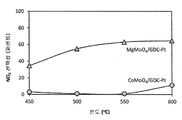
도 5는 예 1 및 3의 활성 전극 재료에 대한 암모니아 산화 촉매 테스트 동안의 NOx 선택성 대 온도를 나타낸 도표이다.
도 6은 예 1의 부가적인 전극 재료로 형성된 센서 및 예 3의 선택적인 전극 재료로 형성된 센서에 대하여 NO 및 암모니아(NH3)의 혼합물에 대한 525℃에서의 민감도를 비교한 도표로서, 두 센서에 200 mV의 정방향(정) 바이어스(forward(positive) bias)를 인가하여 비교한다.
도 7은 예 1의 부가적인 전극 재료로 형성된 센서 및 예 3의 선택적인 전극 재료로 형성된 센서에 대하여 NO 및 NO2의 혼합물에 대한 525℃에서의 민감도를 비교한 도표로서, 두 센서에 200 mV의 정방향(정) 바이어스를 인가하여 비교한다.
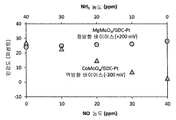
도 8은 예 1의 부가적인 전극 재료로 형성된 센서 및 예 3의 선택적인 전극 재료로 형성된 센서에 대하여 NO 및 NH3의 혼합물에 대한 525℃에서의 민감도를 비교한 도표로서, 예 1의 활성 전극을 갖는 센서에는 +200 mV의 정방향(정) 바이어스를 인가하고 예 3의 선택적인 전극을 갖는 센서에는 +200 mV의 역방향(부) 바이어스(reverse (negative) bias)를 인가하여 비교한다.
도 9는 예 3의 선택적인 전극 재료로 형성된 센서에 대하여 NO 및 NH3의 혼합물에 대한 525℃에서의 민감도를 비교한 도표로서, +400 mV 바이어스의 정방향(정) 바이어스 및 -400 mV 바이어스의 역방향(부) 바이어스를 상기 센서에 인가하여 테스트했을 때를 비교한 도표이다.
도 10은 2개의 전기 화학 전지로 이루어지는 대안적인 센서 시스템의 전개도로서, 상기 2개의 전기 화학 전지 중하나는 2종 이상의 목표 가스 종에 대하여 부가적인 반응을 보이고 나머지 하나는 상기 목표 가스 종 중 적어도 하나에 대하여 선택적인 반응을 보이고, 상기 센서 시스템은 기판, 상기 기판 내에 내장된 히터층, 상기 기판 일 표면 상의 RTD층, 및 상기 기판 대향 표면 상의 다중 순차층을 포함하며, 상기 기판 대향 표면 상의 다중 순차층은: 공통 상대 전극층, 공통 전해질 멤브레인층, 및 2세트의 활성 전극층 및 집전 장치층을 포함하고, 상기 집전 장치층은 그들 각각의 활성 전극을 완전히 커버한다.
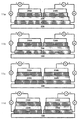
도 11은 2개의 전기 화학 전지로 이루어지는 센서 시스템에 대한 4가지 대안적인 실시 예를 나타낸 개략적인 단면도로서, 상기 2개의 전기 화학 전지 중 하나는 2종 이상의 목표 가스 종에 대하여 부가적인 반응을 보이고 나머지 하나는 상기 목표 가스 종 중 적어도 하나에 대하여 선택적인 반응을 보인다. 도 11a의 실시 예에서, 상기 2개의 전기 화학 전지는 공통 전해질층 및 상대 전극층을 갖는다. 도 11b에서 상기 2개의 전기 화학 전지는 분리된 상대-전극층 및 공통 전해질층을 갖는다. 도 11c에서, 상기 2개의 전기 화학 전지는 공통 상대-전극층 및 분리된 전해질층을 갖는다. 도 11d에서, 상기 2개의 전기 화학 전지는 분리된 상대-전극층 및 분리된 전해질층을 갖는다.
도 12는 예 8-15의 표면-전극 센서에 활성 감지층을 구성한 방법을 나타내는 개략적인 단면도로서, 이들 센서를 테스트한 방법을 나타내는 회로도이다.
도 13은 예 8의 센서에 대하여 시뮬레이션된 연소 배기 대기(기준 가스, 100 ppm의 NO 기준, 100 ppm의 NO2 기준 및 100 ppm의 NH3 기준)에서의 전류 신호를 비교하는 막대 그래프로서, 200 mV의 바이어스 전압을 인가하여 525℃에서 테스트하였다.
도 14는 예 9의 센서에 대하여 시뮬레이션된 연소 배기 대기(기준 가스, 100 ppm의 NO 기준, 100 ppm의 NO2 기준 및 100 ppm의 NH3 기준)에서의 전류 신호를 비교하는 막대 그래프로서, 200 mV의 바이어스 전압을 인가하여 525℃에서 테스트하였다.
도 15는 예 10의 센서에 대하여 시뮬레이션된 연소 배기 대기(기준 가스, 100 ppm의 NO 기준, 100 ppm의 NO2 기준 및 100 ppm의 NH3 기준)에서의 전류 신호를 비교하는 막대 그래프로서, 200 mV의 바이어스 전압을 인가하여 525℃에서 테스트하였다.
도 16은 예 11의 센서에 대하여 시뮬레이션된 연소 배기 대기(기준 가스, 100 ppm의 NO 기준, 100 ppm의 NO2 기준 및 100 ppm의 NH3 기준)에서의 전류 신호를 비교하는 막대 그래프로서, 200 mV의 바이어스 전압을 인가하여 525℃에서 테스트하였다.
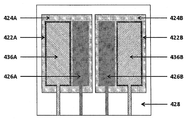
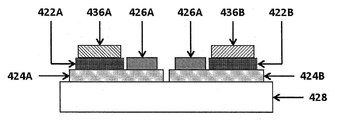
도 17a 및 도 17b는, 각각, 2개의 전기 화학 전지로 이루어지는 센서 시스템에 대하여 또 하나의 대안적인 실시 예를 나타낸 개략적인 평면도 및 단면도로서, 상기 2개의 전기 화학 전지는 공통 전해질층 및 상기 전해질층의 동일측에서 2개의 활성 전극층 사이에 위치되는 공통 상대-전극층을 갖는다 (표면 전극 센서로서 칭함).
도 17c 및 도 17d는, 각각, 2개의 전기 화학 전지로 이루어지는 표면 전극 센서 시스템에 대하여 또 하나의 대안적인 실시 예를 나타낸 개략적인 평면도 및 단면도로서, 상기 2개의 전기 화학 전지는 분리된 전해질층 및 2개의 활성 전극층 사이에 위치되는 공통 상대-전극층을 갖는다.
도 17e 및 도 17f는, 각각, 2개의 전기 화학 전지로 이루어지는 표면-전극 센서 시스템에 대하여 또 하나의 대안적인 실시 예를 나타낸 개략적인 평면도 및 단면도로서, 상기 2개의 전기 화학 전지는 분리된 전해질층 및 분리된 공통 상대-전극층을 갖는다.
도 17g 및 도 17h는, 각각, 분리된 전해질층 및 공통 상대-전극층을 갖는 표면-전극 센서 시스템에 대하여 또 하나의 대안적인 실시 예를 나타낸 개략적인 평면도 및 단면도로서, 상기 전극은 서로 맞물린 구조를 갖는다.
도면은 어떤 식으로든 제한하려는 의도로 제공된 것이 아니며, 본 발명의 다양한 실시 예는 기타 다양한 여러 방법으로 수행될 수 있고 도면에 도시된 것들을 반드시 포함할 필요는 없다. 본 명세서에 통합되어 그 일부를 구성하는 첨부 도면은 본 발명의 몇몇 양태를 도시하고, 명세서와 함께 본 발명의 원리를 설명하는 역할을 한다; 그러나, 본 발명은 도시된 정밀한 구성에 한정되지 않는다.BRIEF DESCRIPTION OF THE DRAWINGS While the specification concludes with claims particularly pointing out and distinctly claiming the invention, the invention will be better understood from the description of the specific examples that follow the appended drawings. In the drawings, like reference numerals designate like elements throughout the several views.
BRIEF DESCRIPTION OF THE DRAWINGS Figure 1 is a schematic cross-sectional view of an electrochemical sensor coupled to a sensor system in which the active electrode has a current collector layer of full coverage and the counter electrode is embedded (located on the opposite side of the electrolyte layer).
Figure 2 is an exploded view of a modified electrochemical sensor design used in some of the sensor tests described herein, the sensor comprising a substrate, a heater layer embedded within the substrate, a resistance temperature detector RTD ) Layer, and a multi-sequential layer on the substrate facing surface, wherein the multi-sequential layer on the substrate facing surface comprises: a counter electrode layer, an electrolyte membrane layer, an active electrode layer, and a current collector layer, Covers only the periphery of the active electrode layer (i.e., has a central opening).
3 is a schematic diagram of a circuit for use with the sensor described herein for sensor testing purposes, for example. The ammeter function is provided by measuring the voltage drop across the shunt resistor (proportional to the current flowing through the sensor) By voltage drop).
Figure 4 is a chart depicting the nitrogen selectivity versus temperature during the ammonia oxidation catalyst test for the active electrode materials of Examples 1 and 3;
5 is a graph showing the NOx selectivity versus temperature during the ammonia oxidation catalyst test for the active electrode materials of Examples 1 and 3. FIG.
As Figure 6 compares the sensitivity of the 525 ℃ for the mixture of NO and ammonia (NH 3) with respect to the sensor formed of the additional electrode selective electrode material of the material sensor and Example 3 formed of the Example 1 Figure, the two sensors (Positive bias) of 200 mV is applied to the gate electrode.
7 is a chart comparing the sensitivity of the 525 ℃ for the mixture of NO and NO 2 with respect to the sensor formed of the additional electrode selective electrode material of the material sensor and Example 3 formed of the example 1, 200 mV for both sensors (Positive) bias of the bias voltage.
As the Figure 8 compares the sensitivity at 525 ℃ for the mixture of NO and NH 3 with respect to the sensor formed of the additional electrode selective electrode material of the material sensor and Example 3 formed of the Example 1 diagram, the active electrode of Example 1 (Positive bias) of +200 mV is applied to a sensor having a positive electrode and a positive (positive) bias of +200 mV is applied to a sensor having an optional electrode of Example 3. [
9 is a graph comparing sensitivities of a mixture of NO and NH 3 at 525 캜 with respect to a sensor formed of the selective electrode material of Example 3, wherein the positive (positive) bias of +400 mV bias and the positive And the reverse (negative) bias is applied to the sensor.
10 is an exploded view of an alternative sensor system comprising two electrochemical cells wherein one of the two electrochemical cells exhibits an additional reaction for two or more target gas species and the other exhibits at least one of the target gas species Wherein the sensor system comprises a substrate, a heater layer embedded within the substrate, an RTD layer on the substrate surface, and a multi-sequential layer on the substrate facing surface, the multi-sequential layer on the substrate facing surface Includes: a common counter electrode layer, a common electrolyte membrane layer, and two sets of active electrode layers and current collector layers, which completely cover their respective active electrodes.
11 is a schematic cross-sectional view of four alternative embodiments of a sensor system comprising two electrochemical cells, one of which shows an additional reaction for two or more target gas species and the other One exhibiting a selective response to at least one of the target gas species. In the embodiment of Fig. 11A, the two electrochemical cells have a common electrolyte layer and a counter electrode layer. In Fig. 11B, the two electrochemical cells have a separated counter-electrode layer and a common electrolyte layer. In Fig. 11C, the two electrochemical cells have a common counter-electrode layer and a separate electrolyte layer. In Fig. 11d, the two electrochemical cells have a separated counter-electrode layer and a separate electrolyte layer.
12 is a schematic cross-sectional view of a method of constructing an active sensing layer in the surface-electrode sensor of Examples 8-15, which is a circuit diagram showing a method of testing these sensors.
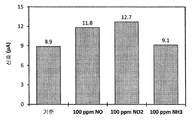
13 is a bar graph comparing the current signals at the simulated combustion exhaust atmosphere (reference gas, 100 ppm NO standard, 100 ppm NO 2 standard and 100 ppm NH 3 standard) for the sensor of Example 8, 200 mV bias voltage was applied and tested at 525 ° C.
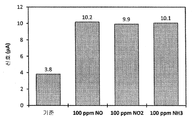
14 is a bar graph comparing the current signals at the simulated combustion exhaust atmosphere (reference gas, 100 ppm NO standard, 100 ppm NO 2 standard and 100 ppm NH 3 standard) for the sensor of Example 9, 200 mV bias voltage was applied and tested at 525 ° C.
15 is a bar graph comparing the current signals at the simulated combustion exhaust atmosphere (reference gas, 100 ppm NO standard, 100 ppm NO 2 standard and 100 ppm NH 3 standard) for the sensor of Example 10, 200 mV bias voltage was applied and tested at 525 ° C.
16 is a bar graph comparing the current signals at the simulated combustion exhaust atmosphere (reference gas, 100 ppm NO standard, 100 ppm NO 2 standard and 100 ppm NH 3 standard) for the sensor of Example 11, 200 mV bias voltage was applied and tested at 525 ° C.
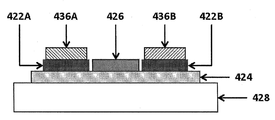
17A and 17B are a schematic plan view and a cross-sectional view, respectively, showing another alternative embodiment of a sensor system comprising two electrochemical cells, wherein the two electrochemical cells have a common electrolyte layer and the electrolyte layer (Referred to as a surface electrode sensor) located between two active electrode layers on the same side of the substrate.
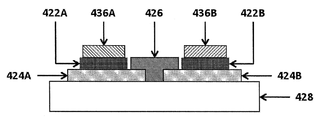
17C and 17D are schematic plan and cross-sectional views, respectively, showing a further alternative embodiment for a surface electrode sensor system comprising two electrochemical cells, wherein the two electrochemical cells comprise a separate electrolyte layer and And a common counter electrode layer positioned between the two active electrode layers.
17E and 17F are schematic plan and cross-sectional views, respectively, showing another alternative embodiment for a surface-electrode sensor system consisting of two electrochemical cells, the two electrochemical cells being separated from each other by a separate electrolyte layer And a separated common counter electrode layer.
17G and 17H are schematic plan and cross-sectional views, respectively, showing another alternative embodiment for a surface-electrode sensor system having a separate electrolyte layer and a common counter-electrode layer, .
The drawings are not intended to be limiting in any way, and various embodiments of the present invention may be performed in various other ways and need not necessarily include those shown in the drawings. BRIEF DESCRIPTION OF THE DRAWINGS The accompanying drawings, which are incorporated in and constitute a part of this specification, illustrate several aspects of the invention and together with the description serve to explain the principles of the invention; However, the present invention is not limited to the precise configuration shown.
하기 실시 예는 본 발명의 범위를 제한하기 위해 사용된 것은 아니다.The following examples are not intended to limit the scope of the present invention.
본원에 개시된 버전의 기타 특징, 양상 및 장점은 본 발명을 수행하기 위해 고려되는 최선의 모드 중 하나인, 설명을 위한, 다음의 설명으로부터 당업자에게 명백해질 것이다. 이해되는 바와 같이, 본원에 기재된 버전은 본 발명을 벗어나지 않는 한 기타 상이하고 자명한 양상을 나타낼 수 있다. 따라서, 도면 및 설명은 본질적으로 예시적인 것일 뿐 제한적이지 않은 것으로 간주되어야 한다. Other features, aspects, and advantages of the versions disclosed herein will become apparent to those skilled in the art from the following description, which is one of the best modes contemplated for carrying out the invention. As will be appreciated, the versions described herein may represent other different and obvious aspects without departing from the invention. Accordingly, the drawings and description are to be regarded as illustrative in nature, not as restrictive.
본원에 설명된 센서, 센서 시스템 및 검출 방법은, 대형 트럭 및 고정형 발전기에서 발견되는 배기 시스템을 포함하여, 디젤 배기 시스템에서 NOx의 검출에 대하여 적용가능성을 가지며, 또한 낮은 레벨의 NOx 및/또는 NH3에 대하여 급속한 반응이 발생되는 것이 바람직한 광범위한 기타 적용에도 유용하다. 예에는 디젤 발전기 세트, 대형 고정형 발전기, 터빈 엔진, 천연 가스 보일러 및 특정 기기도 포함된다 (예를 들면, 천연 가스 동력 노(natural gas powered furnace), 온수기, 스토브, 오븐 등). 상기 센서, 센서 시스템 및 검출 방법은 O2, CO2, SOx(SO 및/또는 SO2), H2O, 및 NH3과 같이 고정적인 또는 가변적인 농도의 기타 가스의 존재 하에서 낮은 레벨의 NOx를 감지하는 데에 특히 유용하다. 상기 다양한 전기 화학 센서, 센서 시스템 및 검출 방법은 특정 전해질 및 전극 조성물을 참고로 본원에 설명된다. 그러나, 본원에 설명된 전기 화학 센서, 센서 시스템 및 검출 방법은, 본원에 더욱 설명된 바와 같이, 이러한 광범위한 재료로 유익한 결과를 낼 것이다. 도면에 도시된 두께는 크게 과장된 것일 뿐이며 크기의 변경이 의도된 것은 아님은 이해될 것이다. 본문에 달리 기재되지 않는 한, 상기 용어 "검출하다", "검출", 및 "검출하는"은 목표 종의 존재에 대한 검출뿐만 아니라 상기 목표 종의 양 또는 농도에 대한 감지 또는 측정을 포괄한다. 본원에 더욱 설명된 센서, 센서 시스템 및 검출 방법에서, 제 1 전기 화학 전지의 활성 전극 및/또는 집전 장치층은 2종 이상의 목표 가스 종(예를 들면, NOx 및 NH3)에 노출되어 상기 제 1 전기 화학 전지 내에서 환원되는 산소의 양을 변화시킨다. 결과적으로, 가스 샘플 또는 흐름 내에서 상기 목표 가스 종의 전체 농도는 인가된 임의의 소정 전압 바이어스 및 센서 온도에서 상기 제 1 전기 화학 전지를 통과하는 산소 이온 전류와 상관이 있을 수 있다. 소정의 전압 바이어스 및 온도에서 측정된 전류가 상기 목표 가스 종(예를 들면, NOx 및 NH3)이 합해진 합계 농도와 상관이 있을 수 있다는 점에서, 상기 센서의 제 1 전기 화학 전지의 반응은 "부가적"이다. 상기 제 2 전기 화학 전지에서, 상기 제 2 전기 화학 전지의 활성 전극 및/또는 집전 장치층 또한 2종 이상의 목표 가스 종에 노출된다. 그러나, 상기 제 2 전기 화학 전지는 상기 목표 가스 종 중 제 1 목표 가스 종(예를 들면, NOx)이 상기 제 2 전지 내에서 환원되는 산소의 양을 측정가능하게 변화시키게 하고, 상기 목표 가스 종 중 제 2 목표 가스 종(예를 들면, NH3)은 상기 제 2 전지 내에서 환원되는 산소의 양에 대하여 더욱 현저히 작은 효과를 가지도록 구성 및/또는 작동된다. 따라서, 상기 제 2 전기 화학 전지를 통과하는 측정된 전류는 상기 제 1 목표 가스 종(예를 들면, NOx)의 농도에는 상관이 있을 수 있는 한 편 상기 제 2 목표 가스 종의 농도 변화는 상기 제 2 전기 화학 전지를 통과하는 상기 측정된 전류에 그다지 영향을 미치지 않는다는 점에서, 상기 제 2 전기 화학 전지는 상기 목표 가스 종 중 제 1 목표 가스 종(예를 들면, NOx)에 대하여 "선택적"이다. The sensors, sensor systems and methods described herein are applicable to the detection of NOx in diesel exhaust systems, including exhaust systems found in heavy trucks and stationary generators, and also include low levels of NOx and / or NH 3 < / RTI > for which a rapid reaction is desired. Examples include diesel generator sets, large stationary generators, turbine engines, natural gas boilers, and certain appliances (eg, natural gas powered furnaces, water heaters, stoves, ovens, etc.). The sensors, sensor systems and detection methods are O 2, CO 2, SOx (SO and / or SO 2), H 2 O, and low levels of NOx in the presence of a static, or other gas of varying concentrations as shown in the NH 3 Which is particularly advantageous for detecting. The various electrochemical sensors, sensor systems, and detection methods are described herein with reference to specific electrolytes and electrode compositions. However, the electrochemical sensors, sensor systems and detection methods described herein will yield beneficial results with such a wide range of materials, as further described herein. It will be appreciated that the thicknesses shown in the figures are largely exaggerated and that no change in size is intended. Unless otherwise stated in the text, the terms "detect "," detecting ", and "detecting" encompass detection or measurement of the amount or concentration of the target species as well as detection of the presence of the target species. In the sensor, sensor system and detection method described further herein, the active electrode and / or current collector layer of the first electrochemical cell are exposed to two or more target gas species (e.g., NOx and NH 3 ) 1 Change the amount of oxygen that is reduced in the electrochemical cell. As a result, the total concentration of the target gas species in the gas sample or stream may be correlated with the oxygen ion current passing through the first electrochemical cell at any given voltage bias and sensor temperature applied. The reaction of the first electrochemical cell of the sensor in terms of the current measured at a predetermined voltage bias and temperature may be correlated to the summed concentration of the target gas species (e.g., NOx and NH 3 ) Additive ". In the second electrochemical cell, the active electrode and / or current collector layer of the second electrochemical cell is also exposed to two or more target gas species. However, the second electrochemical cell may allow the first target gas species (e.g., NOx) of the target gas species to change measurably the amount of oxygen that is reduced in the second cell, Of the second target gas species (e.g., NH 3 ) is configured and / or operated to have a significantly lesser effect on the amount of oxygen that is reduced in the second cell. Accordingly, the measured current passing through the second electrochemical cell may be correlated to the concentration of the first target gas species (e.g., NOx), while the concentration change of the second target gas species The second electrochemical cell is "selective" with respect to the first target gas species (e.g., NOx) of the target gas species, in that it does not significantly affect the measured current passing through the electrochemical cell .
도 1은 하나의 전기 화학 전지(20)뿐만 아니라 바이어싱 소스(biasing source)(40) 및 전류 측정 장치(50)로 이루어지는 회로를 포함하는 예시적인 전류 측정 센서 시스템(10)을 도시한다. 본원에 설명되는 센서 시스템의 실시 예는 일반적으로 적어도 2개의 전기 화학 전지를 포함하며, 그러므로 도 1의 센서 시스템은 이러한 센서 시스템의 절반만을 도시하는 것임은 이해될 것이다. 도 11d는 일반적으로 도 1에 나타낸 개별적인 전지(20)와 유사한 2개의 전기 화학 전지로 이루어지는 센서 시스템을 도시하며, 상기 전지는 공통 기판(228) 상에 놓인다. 1 shows an exemplary current
도 1의 전류 측정 장치(50)는 전류계처럼 당업자에게 주지된 다양한 구조 및 장치로 이루어질 수 있다. 당업자에게 주지된 바와 같이, 전류계는 션트 저항 및 전압계의 조합으로 제공될 수 있다 (도 3의 실시 예에 나타낸 바와 같이). 전기 화학 전지(20)는 활성 전극(22), 상대 전극(26) 및 상기 전극(22, 26) 사이에 위치되는 산소-이온 전도성 전해질 멤브레인(24)을 포함한다. 상기 전기 전도성 활성 전극(22)은 적어도 하나의 몰리브덴산염 또는 텅스텐산염 화합물로 이루어진다. 기판(28)은 도시된 바와 같이 상기 상대 전극(26)을 지지한다. 바이어싱 소스(40)는 상기 2개의 전극(22, 26) 사이에 바이어스 전압을 인가하도록 구성되며, 전류 측정 장치(50)는 센서(20)를 통과하는 결과적인 전류를 측정하도록 구성된다. 바이어싱 소스(40)는 상기 활성 전극(22)과 상기 상대 전극(26) 사이에 바이어스를 인가하기에 적합한 다양한 전원 또는 기타 장치 중 임의의 것으로 이루어질 수 있다. The
본원에 설명된 센서의 실시 예는, 전술된 전기 화학 전지와의 조합으로, 기계적인 지지를 제공하고자 기판을 포함한다. 상기 기판은 임의의 적합한 절연 재료, 예를 들면, 절연 세라믹 재료 (예를 들면, 산화 알루미늄) 또는 절연 재료로 코팅된 금속 또는 서멧 재료로 이루어질 수 있다. 일 실시 예에서, 센서는 지르코니아 기판, 또는 더욱 구체적으로, 이트륨-안정화된 지르코니아(yttrium-stabilized zirconia YSZ) 기판을 포함한다. Embodiments of the sensors described herein include a substrate to provide mechanical support in combination with the electrochemical cell described above. The substrate can be made of any suitable insulating material, for example, an insulating ceramic material (e.g., aluminum oxide), or a metal or cermet material coated with an insulating material. In one embodiment, the sensor comprises a zirconia substrate, or, more specifically, a yttrium-stabilized zirconia YSZ substrate.
전기 화학 전지(20)가 작동 온도로 가열되어, 활성 전극(22)이 산소-함유 가스에 노출되고 전압 바이어스가 전극(22, 26) 사이에 인가될 때, 산소 분자는 상기 활성 전극(22)에서 환원된다. 생성된 산소 이온은 전해질 멤브레인(24)을 통해 상대 전극(26)으로 전도되고, 이 때 산소 이온은 산화되어 O2를 개질시키고 측정 가능한 전류를 생성한다. 도 1에 나타낸 실시 예에서, 전해질 멤브레인(24)은 충분히 다공성이므로, 상대 전극(26)에서 발생된 O2 분자는 다공성 전해질 멤브레인(24)을 통과하여 전지(20)로부터 이탈된다. 도시된 실시 예에서, 전해질 멤브레인(24)은 상대 전극(26)의 측부를 지나 연장되므로, 상대 전극(26)은 전해질 멤브레인(24)과 기판(28) 사이에서 완전히 캡슐화된다. 상기 기판(28)은 통상 고밀도로 되므로 (산소 가스의 배출을 허용하는 기공이 없음), 산소는 상기 상대 전극으로부터 상기 다공성 전해질을 통과하여 배출되지 않는다. When the
본원에 더욱 설명된 대안적인 실시 예에서, 각각의 전기 화학 전지의 활성 및 상대 전극은 전해질 멤브레인의 동일한 표면 상에서 서로 이격된 관계로 된다 (표면 전극 센서로도 칭함). In an alternative embodiment further described herein, the active and counter electrodes of each electrochemical cell are in a spaced relation to each other on the same surface of the electrolyte membrane (also referred to as surface electrode sensor).
다양한 몰리브덴산염 및/또는 텅스텐산염 화합물 중 임의의 것, 예를 들면, 식 AX(Mo(1-Z)WZ)YO(X+3Y)로 이루어지는화합물이 상기 활성 전극에 사용하기에 적합하며, 여기에서 X 및 Y는 1 내지 5에서 각각 독립적으로 선택된 정수이고, 0≤Z≤1, 그리고 A는 Mo 및/또는 W와 이원 화합물을 형성하는 하나 이상의 이온이다. 구체적인 예로서, A는 Mg, Zn, Ni, Co, Fe, Mn, Cu, Ca, Sr, Ba, 및 Pb 중 하나 이상이다. 일부 실시 예에서, X 및 Y는 모두 1이며, Z는 0이다. 이러한 몰리브덴산염 화합물의 구체적인 예에는: MgMoO4, ZnMoO4, NiMoO4, CoMoO4, FeMoO4, MnMoO4, CuMoO4, CaMoO4, SrMoO4, BaMoO4, 및 PbMoO4가 포함된다. 기타 실시 예에서, X 및 Y는 모두 1이고, Z는 1이다. 이러한 텅스텐산염 화합물의 구체적인 예에는: MgWO4, ZnWO4, NiWO4, CoWO4, FeWO4, MnWO4, CuWO4, CaWO4, SrWO4, BaWO4, 및 PbWO4가 포함된다. Various molybdenum to any of the salts and / or tungstate compound, for compound example, made of a type A X (Mo (1-Z ) W Z) Y O (X + 3Y) suitable for use with the active electrode Wherein X and Y are integers independently selected from 1 to 5, 0? Z? 1, and A is one or more ions forming a binary compound with Mo and / or W. As a specific example, A is at least one of Mg, Zn, Ni, Co, Fe, Mn, Cu, Ca, Sr, Ba and Pb. In some embodiments, X and Y are both 1 and Z is zero. Specific examples of such a molybdate compound include: MgMoO 4 , ZnMoO 4 , NiMoO 4 , CoMoO 4 , FeMoO 4 , MnMoO 4 , CuMoO 4 , CaMoO 4 , SrMoO 4 , BaMoO 4 , and PbMoO 4 . In other embodiments, X and Y are both 1 and Z is 1. Specific examples of such tungstate compounds include: MgWO 4 , ZnWO 4 , NiWO 4 , CoWO 4 , FeWO 4 , MnWO 4 , CuWO 4 , CaWO 4 , SrWO 4 , BaWO 4 and PbWO 4 .
적어도 하나의 몰리브덴산염 또는 텅스텐산염 화합물로 이루어지는 활성 전극은 다양한 특정 조성물을 가질 수 있고, 상기 조성물에는, 예를 들면, 다음이 포함된다: Active electrodes comprising at least one molybdate or tungstate compound can have a variety of specific compositions, including, for example, the following:
(a) 예를 들면, 상기 몰리브덴산염 또는 텅스텐산염 화합물의 30% 초과, 50% 초과, 80% 초과 또는 90% 초과하는(부피 기준) 활성 전극을 포함하는 몰리브덴산염 화합물(AX(MoYO(X+3Y)) 또는 텅스텐산염 화합물(AXWYO(X+3Y)); (a) a molybdate compound (A X (Mo Y O) containing an active electrode, for example greater than 30%, greater than 50%, greater than 80% or greater than 90% (by volume) of the molybdate or tungstate compound ( X + 3Y )) or a tungstate compound (A X W Y O ( X + 3Y ));
(b) 상기 식 AX(Mo(1-Z)WZ)YO(X+3Y)를 갖는 하나 이상 화합물, 여기에서 X 및 Y는 1 내지 5에서 각각 독립적으로 선택된 정수이고, 0<Z<1, 그리고 A는 Mg, Zn, Ni, Co, Fe, Mn, Cu, Ca, Sr, Ba, 및 Pb 중 하나 이상임;(b) at least one compound having the formula A X (Mo (1-Z) W Z ) Y O ( X + 3 Y ), wherein X and Y are integers independently selected from 1 to 5, 1, and A is at least one of Mg, Zn, Ni, Co, Fe, Mn, Cu, Ca, Sr, Ba, and Pb;
(c) 적어도 하나의 몰리브덴산염 화합물과 적어도 하나의 텅스텐산염 화합물의 복합 혼합물처럼, 몰리브덴산염 및 텅스텐산염 화합물로 이루어지는 군으로부터 선택되는 2개 이상의 화합물의 복합 혼합물; (c) a complex mixture of two or more compounds selected from the group consisting of molybdate and tungstate compounds, such as a complex mixture of at least one molybdate compound and at least one tungstate compound;
(d) 하나 이상 세라믹 전해질 재료 및 (a)-(c) 중 하나 이상의 복합 혼합물;(d) at least one ceramic electrolyte material and at least one complex mixture of (a) - (c);
(e) (a)-(d) 중 하나 이상으로 이루어지는 세라믹 상 및 금속 상(예를 들면, 은, 금, 백금, 팔라듐, 로듐, 루테늄, 이리듐 또는 이들의 합금 또는 혼합물)으로 형성되는 합성물; 또는 (e) a composition formed of a ceramic phase and a metal phase (for example, silver, gold, platinum, palladium, rhodium, ruthenium, iridium or alloys or mixtures thereof) of one or more of (a) - (d); or
(f) (a)-(e) 중 2개 이상의 혼합물.(f) a mixture of two or more of (a) - (e).
위 실시 예들 중 일부에서, 하나 이상의 첨가제 또는 기타 재료가 제조 중에 상기 활성 전극 조성물에 추가될 수 있으나, 기타의 실시 예에서는 그러한 첨가제가 포함되지 않는다. In some of the above embodiments, one or more additives or other materials may be added to the active electrode composition during manufacture, but such additives are not included in other embodiments.
상술한 바의 몰리브덴산염 및 텅스텐산염 화합물뿐만 아니라 상술한 바의 몰리브덴산염 및 텅스텐산염 화합물 고용체는 하나 이상 금속으로 도핑될 수 있다. 또한, 또는 대안적으로, 산화 망간, 산화철, 산화 코발트, 산화 바나듐, 산화 크롬, 산화 주석, 산화 니오븀, 산화 탄탈, 산화 루테늄, 산화 인듐, 산화 티탄 및 산화 지르코늄과 같은 1 종 이상의 산화물을 첨가 할 수 있다. 사용 시, 이들 산화물 첨가제는 활성 전극층에서 약 0.1 및 10 부피% 사이의 양으로, 또는 상기 활성 전극층에서 약 1 및 3 부피% 사이의 양으로 존재할 수 있다. The above molybdate and tungstate compound as well as the molybdate and tungstate compound solid solution described above can be doped with one or more metals. Alternatively or in addition, at least one oxide such as manganese oxide, iron oxide, cobalt oxide, vanadium oxide, chromium oxide, tin oxide, niobium oxide, tantalum oxide, ruthenium oxide, indium oxide, titanium oxide and zirconium oxide is added . In use, these oxide additives may be present in an amount between about 0.1 and 10% by volume in the active electrode layer, or between about 1 and 3% by volume in the active electrode layer.
전술한 바와 같이, 일부 실시 예에서, 상기 감지 전극은 다중-상 합성물로 이루어지며, 상기 다중-상 합성물은: (a) 몰리브덴산염 및/또는 텅스텐산염-함유 세라믹 상(예를 들면, 몰리브덴산염, 텅스텐산염, 몰리브덴산염 및 텅스텐산염의 고용체 또는 복합 혼합물, 또는 앞서 언급한 것들 중 1종 이상 및 전해질의 복합 혼합물); 및 (b) 금속 상(Ag, Au, Pt, Pd, Rh, Ru, Ir, 또는 그의 합금 또는 혼합물)을 포함한다. 그러한 합성물의 텅스텐산염/몰리브덴산염 세라믹 상 자체는, 하나 이상의 하나 이상 몰리브덴산염 및/또는 텅스텐산염 화합물과 전해질의 복합 혼합물과 같이, 하나 이상의 상을 포함 할 수 있음을 명심해야한다. As described above, in some embodiments, the sensing electrode is comprised of a multi-phase composite, the multi-phase composite comprising: (a) a molybdate and / or tungstate-containing ceramic phase (e.g., molybdate , Tungstate, molybdate and tungstate, or a complex mixture of one or more of the foregoing and an electrolyte); And (b) a metal phase (Ag, Au, Pt, Pd, Rh, Ru, Ir, or an alloy or mixture thereof). It should be borne in mind that the tungstate / molybdate ceramic phase of such a composite may comprise more than one phase, such as a complex mixture of one or more molybdates and / or tungstate compounds and an electrolyte.
전술한 다중-상 세라믹/금속 합성물 재료의 경우, 금속 상은 약 0.1 내지 10 중량% 또는 약 30 내지 70 부피%의 범위로 될 수 있다. 낮은 레벨의 금속 상(예를 들어, 약 0.1 중량% 내지 10 중량%, 또는 약 1 중량% 내지 5 중량%)을 갖는 다중-상 세라믹/금속 합성물에서는, Pt, Pd, Rh, Ru 또는 Ir(또는 그의 혼합물의 합금)이 특히 유용하다. 보다 높은 레벨의 금속 상(예를 들어, 약 30 부피% 내지 70 부피%, 또는 약 40 부피% 내지 60 부피%)의 경우에는, 전기 전도성을 향상시키기 위하여, Ag, Au, Pt, Pd, Rh, Ru, 또는 Ir(또는 이들의 합금 또는 혼합물)를 사용할 수 있다 (민감도는 다소 희생될 수 있음). In the case of the multi-phase ceramic / metal composite material described above, the metal phase may range from about 0.1 to 10% by weight or from about 30 to 70% by volume. In a multi-phase ceramic / metal composite having a low level of metal phase (e.g., from about 0.1 wt% to 10 wt%, or from about 1 wt% to 5 wt%), Pt, Pd, Rh, Ru, or Ir Or alloys thereof) are particularly useful. Au, Pt, Pd, Rh, or the like in order to improve the electrical conductivity in the case of a higher level metal phase (for example, from about 30 vol% to 70 vol%, or from about 40 vol% to 60 vol% , Ru, or Ir (or an alloy or a mixture thereof) may be used (the sensitivity may be somewhat sacrificed).
위에서 언급한 바와 같이, 일부 실시 예에서 상기 감지 전극은 복합 혼합물로 이루어지며, 상기 복합 혼합물은: (a) 하나 이상 세라믹 전해질 재료 (예를 들면, 가돌리늄-도핑된 세리아(gadolinium-doped ceria), "GDC" 또는 사마륨-도핑된 세리아(samarium-doped ceria), "SDC"; (b) 하나 이상 몰리브덴산염 및/또는 텅스텐산염 화합물; 및, 선택적으로, (c) 금속 상(예를 들면, 은, 금, 백금, 팔라듐, 로듐, 루테늄, 이리듐 또는 이들의 합금 또는 혼합물)을 포함 할 수 있다. 이들 실시 예에서, 상기 감지 전극(22) 내 세라믹 전해질 재료(들)는 전해질 멤브레인(24)에 대하여 후술하는 전해질 중 임의의 것으로 될 수 있거나, 또는 산소 이온의 전도를 통해 전기 전도성을 갖는 다른 세라믹 전해질 재료(즉, 전자 전도성보다는 이온 전도성)로 될 수 있다. 예를 들어, 상기 활성 전극에 이용하기에 적합한 세라믹 전해질은 다음을 포함한다:As noted above, in some embodiments, the sensing electrode is comprised of a complex mixture comprising: (a) at least one ceramic electrolyte material (e.g., gadolinium-doped ceria, (B) at least one molybdate and / or tungstate compound; and, optionally, (c) a metal phase (e. G., Silver The ceramic electrolyte material (s) in the sensing electrode 22 may be deposited on the
(a) Ca, Sr, Sc, Y, Pr, Nd, Pm, Sm, Eu, Gd, Tb, Dy, Ho, Er, Tm, Yb 또는 La 중 하나 이상으로 도핑된 산화 세륨; (a) cerium oxide doped with at least one of Ca, Sr, Sc, Y, Pr, Nd, Pm, Sm, Eu, Gd, Tb, Dy, Ho, Er, Tm, Yb or La;
(b) Ca, Mg, Sc, Y 또는 Ce 중 하나 이상으로 도핑된 산화 지르코늄; 및(b) zirconium oxide doped with at least one of Ca, Mg, Sc, Y, or Ce; And
(c) Sr, Mg, Zn, Co 또는 Fe 중 하나 이상으로 도핑된 란탄 갈륨 산화물. (c) Lanthanum gallium oxide doped with at least one of Sr, Mg, Zn, Co or Fe.
보다 구체적인 실시 예에서, 상기 감지 전극에 사용된 세라믹 전해질은 Ca, Sr, Sc, Y, Pr, Nd, Pm, Sm, Eu, Gd, Tb, Dy, Ho, Er, Tm, Yb, 또는 La 중 하나 이상으로 도핑된 산화 세륨을 포함한다 (예를 들면, GDC 또는 SDC).In a more specific embodiment, the ceramic electrolyte used in the sensing electrode is selected from the group consisting of Ca, Sr, Sc, Y, Pr, Nd, Pm, Sm, Eu, Gd, Tb, Dy, Ho, Er, Tm, Yb, (E. G., GDC or SDC). ≪ / RTI >
전 단락에 기술된 복합 혼합물에서 세라믹 전해질 및 하나 이상 몰리브덴산염/텅스텐산염 화합물의 상대적 양은 다른 것들 중에서도 응용의 성질(예를 들면, 상기 피분석물 가스 흐름/샘플 및 주변 환경), 상기 센서 및/또는 센서 시스템의 구조, 원하는 민감도, 목표 가스(들)의 특성 등에 따라 가변적일 수 있다. 일부 실시 예에서, 상기 활성 전극에서 세라믹 전해질(들) 대 몰리브덴산염/텅스텐산염 화합물(들)의 부피비는 약 1:9 및 9:1 사이이다. 기타 실시 예에서, 이 비율은 약 2.5:7.5 및 7.5:2.5 사이이거나, 또는 심지어 약 4:6 및 6:4 사이이다. 그리고, 또 다른 실시 예에서, 이러한 비율은 약 1:1이다. 전술한 부피비는 세라믹 전해질의 전체 부피 대 몰리브덴산염 및 텅스텐산염 화합물의 전체 부피의 비율에 기초함을 주지해야 한다. 이전 단락에 기술된 복합 혼합물이 금속 상을 포함 할 때, 상기 금속 상의 성질 및 양은 앞서 설명한 바의 다양한 금속 및 양 중 임의의 것일 수 있다. The relative amounts of the ceramic electrolyte and the at least one molybdate / tungstate compound in the complex mixture described in the preceding paragraph may vary among other things depending on the nature of the application (e.g. the analyte gas flow / sample and ambient environment), the sensor and / Or may be variable depending on the structure of the sensor system, the desired sensitivity, the characteristics of the target gas (s), and so on. In some embodiments, the volume ratio of ceramic electrolyte (s) to molybdate / tungstate compound (s) in the active electrode is between about 1: 9 and 9: 1. In other embodiments, the ratio is between about 2.5: 7.5 and 7.5: 2.5, or even between about 4: 6 and 6: 4. And, in another embodiment, this ratio is about 1: 1. It should be noted that the above-mentioned volume ratio is based on the ratio of the total volume of the ceramic electrolyte to the total volume of molybdate and tungstate compounds. When the complex mixture described in the preceding paragraph comprises a metal phase, the nature and amount of the metal phase may be any of the various metals and amounts as described above.
일부 실시 예에서, 집전 장치층은 상기 전기 화학 전지의 활성 전극층에 대하여 제공된다. 상기 집전 장치층은 상기 활성 전극층보다 더욱 전기 전도성이므로, 상기 활성 전극의 전기 전도성을 증가시켜 신호 강도를 증가시킨다. 그리고 구체적인 실시 예에서 상기 집전 장치층은 또한 촉매적 및 전기적 화학 반응을 일으켜 하나 이상 관심 가스 종(예를 들면, NO, NO2 또는 NH3)에 대하여 감소되거나 또는 강화된 민감도를 달성하도록 한다. In some embodiments, a current collector layer is provided for the active electrode layer of the electrochemical cell. The current collector layer is more electrically conductive than the active electrode layer, thereby increasing the electrical conductivity of the active electrode and increasing the signal strength. And in a specific embodiment, the current collector layer also causes catalytic and electrochemical reactions to achieve a reduced or enhanced sensitivity to one or more gases of interest (e.g., NO, NO 2, or NH 3 ).
예를 들면, 도 1의 전기 화학 전지(20)는 집전 장치층(36)을 포함한다. 활성 전극층(22)은 전해질 멤브레인(24)에 인접하는 한 편, 집전 장치층(36)은 활성 전극층(22) 위로 위치되며, 상기 집전 장치층(36)은 상기 활성 전극층(22)보다 높은 전기적 전도성을 갖는다. 이러한 구체적인 실시 예에서, 상기 집전 장치층은 상기 활성 전극층(22)의 상부 표면의 적어도 약 90%를 커버한다는 점에서 전체 커버리지 집전장치로서 구성된다.For example, the
대안적인 실시 예에서, 특히, 목표 가스 종에 대하여 민감도를 감소시키거나 강화시키기 위하여 촉매적 및 전기적 화학 반응을 일으키도록 구성되지 않는 집전 장치에서, 상기 집전장치는 상기 활성 전극 표면의 약 10-25%를 커버하도록 구성될 수 있다. 예를 들어, 집전 장치층(36)은 도 2의 집전장치(136)와 유사하게 구성될 수 있으므로, 상기 집전장치는 상기 활성 전극층의 둘레를 커버한다(즉, 중앙 개구부를 가짐). In an alternate embodiment, particularly in a current collecting device that is not configured to cause catalytic and electrochemical reactions to reduce or enhance sensitivity to target gas species, the current collecting device may have a current density of about 10-25 %. ≪ / RTI > For example, the
비-활성 집전장치에 대한 또 다른 대안으로서, 상기 집전 장치층(36)은 샘플링될 가스가 상기 활성 전극층(22)으로 통과할 수 있도록 다수개의 개구부를 제공하는 그리드 패턴 또는 메시(예를 들어, 상호 연결된 스트랜드)로 배열 될 수 있다. 이러한 배열에서, 상기 샘플링되는 가스는 상기 그리드 또는 메시의 개구부를 통과하여 상기 활성 전극층(22)에 도달하게 되므로, 상기 집전 장치층(36)을 형성하는 재료 자체는 고밀도(즉, 비-다공성)로 될 수 있다. 또한, 상기 활성 전극이 충분한 전기적 전도성을 갖는다면, 집전 장치층은 필요하지 않음을 주지해야 한다. As another alternative to the non-active current-collecting device, the current-collecting
상기 집전 장치층의 조성물에 있어서, 촉매적 및 전기적 화학 반응을 일으키기보다 상기 활성 전극의 전기 전도성을 증가시키기 위해 상기 집전장치가 사용되는 경우, 상기 집전 장치층은 금속재료(예를 들면, 백금 또는 금)로 이루어질 수 있다. 대안적으로, 상기 집전 장치층은 금속(예를 들면, 백금 또는 금) 및 세라믹 상(GDC, SDC, 지르코늄-도핑된 세리아(ZDC), 이트륨 안정화된 지르코니아(YSZ), 스칸듐 안정화된 지르코니아(ScSZ), 또는 상기 활성 전극에 사용하기에 적합한 것으로 언급된 나머지 전해질 중 하나)으로 이루어지는 서멧으로 구성될 수 있고, 상기 서멧의 금속 함량은 상기 집전 장치층의 전기적 전도성이 상기 활성 전극층(22A)의 전기적 전도성보다 높게 하는 데에 충분하다. 본원에서 더욱 논의되는 바와 같이, 이러한 서멧 집전장치는 상기 센서의 전기 화학 전지의 촉매적 및 전기적 화학 반응을 일으키는 데에 이용될 수 있다 (예를 들면, 하나 이상의 관심 가스 종에 대하여 감소되거나 강화된 민감도를 제공하기 위하여). 특히, 금 및 세라믹 전해질(예를 들면, GDC)로 이루어지는 서멧 집전장치는 NOx 및 NH3에 대하여 부가적 거동을 제공하는 한 편, 백금 및 세라믹 전해질(예를 들면, ScSz)로 이루어지는 서멧 집전장치는 NH3의 존재 하에 NOx에 대하여 선택적인 거동을 제공한다. In the composition of the current collector layer, when the current collector is used to increase the electrical conductivity of the active electrode rather than causing catalytic and electrochemical reactions, the current collector layer may be formed of a metallic material (e.g., platinum or Gold). Alternatively, the current collector layer may be formed of a metal (e.g., platinum or gold) and a ceramic (such as GDC, SDC, zirconium-doped ceria ZDC, yttrium stabilized zirconia YSZ, scandium stabilized zirconia ), Or one of the remaining electrolytes referred to as being suitable for use in the active electrode), and the metal content of the cermet is such that the electrical conductivity of the current collector layer is less than that of the active electrode layer 22A It is sufficient to make it higher than the conductivity. As discussed further herein, such a cermet current collector can be used to cause catalytic and electrochemical reactions of the electrochemical cell of the sensor (e. G., Reduced or enhanced for one or more gas species of interest To provide sensitivity). Particularly, a cermet current collector comprising gold and a ceramic electrolyte (for example, GDC) provides an additional behavior for NOx and NH 3 , while a cermet current collector made of platinum and a ceramic electrolyte (for example, ScSz) provides a selective action against NOx in the presence of NH 3.
본원에 설명된 센서의 전기 화학 전지의 상대 전극은 부분적으로는 상기 전기 화학 전지의 구조에 따라 임의의 다양한 재료로 이루어질 수 있다. 예를 들면, 상기 상대 전극은 상기 집전장치에 대하여 위에서 설명한 바의 조성물 중 임의의 것, 즉, 백금이나 금과 같은 금속재료, 또는 금속(예를 들면, 백금 또는 금)과 세라믹 상(GDC, SDC, ZDC, YSZ 또는 ScSZ)으로 이루어지는 서멧으로 이루어질 수 있다. 도 1의 전기 화학 전지(20)의 경우, 상대 전극(26)은 백금이다. 본원에 설명된 센서의 상대 전극에 적합한 기타의 재료는 다음을 포함한다: The counter electrode of the electrochemical cell of the sensor described herein may in part be made of any of a variety of materials depending on the structure of the electrochemical cell. For example, the counter electrode may be formed of any of the above-described compositions for the current collector, that is, a metal material such as platinum or gold, a metal (e.g., platinum or gold) and a ceramic (GDC, SDC, ZDC, YSZ or ScSZ). In the case of the
(a) Ag, Au, Pt, Pd, Rh, Ru 또는 Ir, 또는 앞서 언급한 것들 중 임의의 것의 합금, 혼합물 또는 서멧(예를 들면, 이들 금속, 특히, Pt, 및 YSZ, ScSZ, GDC 또는 SDC 중 하나 이상으로 이루어지는 서멧); 및 (a) Ag, Au, Pt, Pd, Rh, Ru or Ir, or alloys, mixtures or cermets of any of the foregoing, such as metals, in particular Pt and YSZ, ScSZ, GDC or SDC); And
(b) 센서 제작에 적합한 다양한 기타 전도성 재료, 특히 산소 이온의 분자 산소로의 재-산화를 촉매하는 재료.(b) a variety of other conductive materials suitable for sensor fabrication, particularly materials that catalyze re-oxidation of oxygen ions to molecular oxygen.
서멧 집전장치, 특히 상기 전기 화학 전지의 반응을 일으키기 위하여 이용되는 서멧 집전장치의 경우, 상기 집전장치는 약 40 내지 80 부피%, 또는 약 50 내지 70 부피%의 금속 상(예를 들면, Pt 또는 Au)과 그 나머지의 세라믹 전해질 상(예를 들면, GDC 또는 ScSz)으로 이루어진다.In the case of a cermet current collector, particularly a cermet current collector used to cause a reaction of the above electrochemical cell, the current collector may comprise about 40 to 80% by volume, or about 50 to 70% by volume of a metal phase (e.g. Pt or Au) and the rest of the ceramic electrolyte (for example, GDC or ScSz).
본원에 설명된 센서에 이용되는 전기 화학 전지의 이온-전도성 전해질 멤브레인에 있어서, 적합한 재료는 가돌리늄-도핑된 세리아(Ce1-XGdXO2-X/2, X는 약 0.05 내지 0.40의 범위임), 및 사마륨-도핑된 세리아(Ce1-XSmXO2-X/2, X는 약 0.05 내지 0.40의 범위임)를 포함한다. 더욱이, 상기 전해질 멤브레인(예를 들면, 도 1의 24)으로서 사용하기 위한 세라믹 전해질 재료는 이트륨-도핑된 세리아(YDC), 기타 란탄족 원소로 도핑된 산화 세륨, 및 2 이상의 란탄족 또는 희토류 원소로 도핑된 산화 세륨을 포함한다. 기타 적합한 전해질 재료는 다음을 포함한다: 전체적으로 또는 부분적으로 도핑된 지르코늄 산화물, 이트륨 안정화된 지르코니아(YSZ) 및 스칸듐 도핑된 지르코니아(ScSZ)를 포함하며, 이에 한정되지 않음; 산소 이온의 이송을 통해 주로 전기를 전도하는 기타 세라믹 물질; 혼합 전도성 세라믹 전해질 재료; 및 이들 중 2종 이상의 혼합물. 또한, GDC, SDC 또는 다른 적합한 전해질 재료의 계면층은 상기 전해질 멤브레인과 상기 활성 및 상대 전극 중 하나 또는 모두와의 사이에 제공될 수 있다. Ion of the electrochemical cell employed in the sensors described herein - in conducting electrolyte membrane, a suitable material is a gadolinium-doped ceria (Ce 1-X Gd X O 2-X / 2, X is in the range of about 0.05 to 0.40 Im), and samarium-and the ceria (Ce 1-X Sm X O 2-X / 2, X comprises a doping range Im) of about 0.05 to 0.40. Moreover, the ceramic electrolyte material for use as the electrolyte membrane (e.g., 24 in FIG. 1) may include yttrium-doped ceria (YDC), cerium oxide doped with other lanthanide elements, and at least two lanthanide or rare earth elements Lt; RTI ID = 0.0 > cerium < / RTI > Other suitable electrolyte materials include, but are not limited to, wholly or partially doped zirconium oxide, yttrium stabilized zirconia (YSZ), and scandium-doped zirconia (ScSZ). Other ceramic materials that conduct electricity primarily through the transfer of oxygen ions; Mixed conductive ceramic electrolyte materials; And mixtures of two or more thereof. In addition, an interface layer of GDC, SDC, or other suitable electrolyte material may be provided between the electrolyte membrane and one or both of the active and counter electrodes.
앞서 설명한 바와 같이, 본원에 설명된 센서 및 센서 시스템 실시 예는 일반적으로 적어도 2개의 전기 화학 전지로 이루어지며, 그 중 제 1 전지는 2종 이상의 관심 목표 가스 종(예를 들면, NOx 및 NH3)에 대하여 부가적인 반응을 제공하도록 구성(또는 작동)되고 제 2 전지는 상기 목표 가스 종 중 제 1 목표 가스 종에 대해서는 선택적인 반응을 제공하면서 상기 목표 가스 종 중 제 2 목표 가스 종에 대해서는 반응하지 않도록 구성(또는 작동)된다.다. NOx 및 NH3 감지에 있어서, 예를 들면, 상술한 바의 활성 전극 재료를 이용하여, 센서는 상이한 활성 전극을 갖는 2개의 전기 화학 전지로 구성될 수 있다: 하나는 NOx 및 NH3 모두에 대하여 민감성이며 하나는 NOx에 대해서만 민감성임 (NH3에 대해서는 민감도가 거의 없거나 전혀 없음). 전체 NOx 플러스 NH3 농도는 상기 제 1 전기 화학 전지에 바이어스를 인가할 때 전류를 측정함으로써 수량화될 수 있고, 상기 NOx 농도는 상기 제 2 전기 화학 전지에 바이어스를 인가할 때 전류를 측정함으로써 수량화될 수 있고, 상기 NH3 농도는 뺄셈으로써 수량화될 수 있다 (전체 NOx 플러스 NH3 농도 마이너스 NOx 농도). 따라서, NOx 및 NH3 모두는 단일의 센서로 측정될 수 있다. 상기 2개의 전기 화학 전지는 하나의 구조로 물리적으로 결합될 수 있거나, 또는 2개의 물리적으로 분리된 전기 화학 전지를 채용할 수 있다. As described above, embodiments of sensors and sensor systems described herein, for example, is generally at least 2 made of a single electrochemical cell, of which the first cell (for example two or more kinds of interest target gas species, NOx and NH 3 ) And the second cell is configured (or operated) to provide an optional response to the first target gas species of the target gas species while reacting to the second target gas species of the target gas species (Or acted on). In the NOx and NH 3 detects, for example, using an active electrode material in the above description, the sensor may be of a two electrochemical cells having different active electrodes: one is for both NOx and NH 3 sensitivity and one is only being sensitive to NOx (the sensitivity for the NH 3 little or not at all). Total NOx plus NH 3 concentration can be quantified by measuring the electric current when applying a bias to the first electrochemical cell, the NOx concentration is to be quantified by measuring the electric current when applying a bias to said second electrochemical cell, And the NH 3 concentration can be quantified by subtraction (total NO x plus NH 3 concentration minus NO x concentration). Thus, both NOx and NH 3 can be measured by a single sensor. The two electrochemical cells may be physically combined into one structure, or two physically separated electrochemical cells may be employed.
대안적으로, 센서는 집전장치 재료 및 동일하거나 또는 상이한 활성 전극 재료를 갖는 2개의 전기 화학 전지로 구성되어, 하나의 전지는 NOx 및 NH3 모두에 대하여 민감하고, 나머지 하나의 전지는 NOx에 대해서만 민감하도록 할 수 있다. 전체 NOx 플러스 NH3 농도는 상기 제 1 전기 화학 전지에 바이어스를 인가할 때 전류를 측정함으로써 수량화될 수 있고, 상기 NOx 농도는 상기 제 2 전기 화학 전지에 바이어스를 인가할 때 전류를 측정함으로써 수량화될 수 있고, 상기 NH3 농도는 뺄셈으로써 수량화될 수 있다. 따라서, NOx 및 NH3 모두는 단일의 센서로 측정될 수 있다. 앞에서와 마찬가지로, 상기 2개의 전기 화학 전지는 하나의 구조로 물리적으로 결합될 수 있거나, 또는 2개의 물리적으로 분리된 전기 화학 전지를 채용할 수 있다. Alternatively, the sensor consists of two electrochemical cell having a current collector material and the same or different active electrode material, a cell is sensitive to both NOx and NH 3, and the remaining one cell is only for NOx It can be sensitive. Total NOx plus NH 3 concentration can be quantified by measuring the electric current when applying a bias to the first electrochemical cell, the NOx concentration is to be quantified by measuring the electric current when applying a bias to said second electrochemical cell, And the NH 3 concentration can be quantified by subtraction. Thus, both NOx and NH 3 can be measured by a single sensor. As before, the two electrochemical cells may be physically bonded in one structure, or two physically separated electrochemical cells may be employed.
또 다른 대안적으로서, 센서는 동일하거나 또는 유사한 조성물로 형성되는 활성 전극을 갖는 2개의 전기 화학 전지로, 상기 동일하거나 또는 유사한 조성물의 관련 집전장치와 함께 또는 상기 집전장치 없이, 구성될 수 있고, 상기 센서는, NOx 플러스 NH3 전체를 검출 및 수량화하기 위하여, 하나의 전기 화학 전지에 인가되는 정방향 바이어스(즉, 활성 전극으로부터 상대-전극에로)로 작동될 수 있고, 또한, NOx 또는 NH3 중 하나를 검출 및 수량화하기 위하여 (나머지 하나의 농도는 뺄셈으로 계산됨), 상기 제 2 전기 화학 전지에 인가되는 역방향 바이어스(즉, 상대 전극으로부터 활성 전극에로)로 작동될 수 있다. 따라서, NOx 및 NH3 모두는 단일의 센서로 측정될 수 있다. 앞에서와 마찬가지로, 상기 2개의 전기 화학 전지는 하나의 구조로 물리적으로 결합될 수 있거나, 또는 2개의 물리적으로 분리된 전기 화학 전지를 채용할 수 있다. Alternatively, the sensor can be configured with two electrochemical cells having active electrodes formed of the same or similar composition, with or without an associated current collector of the same or similar composition, the sensor, to NOx plus NH 3 to detect and quantify a whole, a positive direction is applied to the electrochemical cell, a bias-can be operated (that is, from the active electrode relative to the electrode), and also, NOx or NH 3 (The remaining one concentration is calculated as a subtraction), and a reverse bias applied to the second electrochemical cell (i.e., from the counter electrode to the active electrode). Thus, both NOx and NH 3 can be measured by a single sensor. As before, the two electrochemical cells may be physically bonded in one structure, or two physically separated electrochemical cells may be employed.
또 하나의 대안적인 실시 예에서, 센서는 동일하거나 또는 상이한 조성물로 형성되는 활성 전극을 갖는 2개의 전기 화학 전지로, 상기 동일하거나 또는 유사한 조성물의 관련 집전장치와 함께 또는 상기 집전장치 없이, 구성될 수 있고, 상기 센서는, 하나의 전지는 NOx 전체를 검출 및 수량화하기 위하여 정방향 바이어스(즉, 활성 전극으로부터 상대-전극에로)로 작동되고, 상기 제 2 전지는 NH3을 검출 및 수량화하기 위하여 부 바이어스(즉, 상대 전극으로부터 활성 전극에로)로 작동되는 방식으로 작동될 수 있다. 이 경우, 하나의 전지는 NOx에 대하여 선택적이며 나머지 하나의 전지는 NH3에 대하여 선택적이다. 따라서, NOx 및 NH3 모두는 단일의 센서로 측정될 수 있다. 앞에서와 마찬가지로, 상기 2개의 전기 화학 전지는 하나의 구조로 물리적으로 결합될 수 있거나, 또는 2개의 물리적으로 분리된 전기 화학 전지를 채용할 수 있다. In another alternate embodiment, the sensor is two electrochemical cells with active electrodes formed of the same or different composition, with or without an associated current collector of the same or similar composition And the sensor is operated such that one cell is operated in a forward bias (i.e., from the active electrode to the counter-electrode) to detect and quantify the entire NOx, and the second cell is activated to detect and quantify NH 3 (I.e., from the counter electrode to the active electrode). In this case, one cell is selective with respect to the NOx remaining one cell is selective for NH 3. Thus, both NOx and NH 3 can be measured by a single sensor. As before, the two electrochemical cells may be physically bonded in one structure, or two physically separated electrochemical cells may be employed.
2개(또는 그 이상)의 전기 화학 전지로 이루어지는 센서에 대하여 상술한 바의 실시 예 중 임의의 것에 있어서, 상기 2개의 전지는 공통 기판 및, 경우에 따라, 공통 전해질층 및/또는 공통 상대 전극층을 공유하도록 구성될 수 있다. 도 10 및 도 11a-11d는 상기 상대 전극(226)이 매입된 센서 배열을 도시한다 (상기 활성 전극층으로부터 상기 전해질층의 대향측에 위치됨). 본원에 사용된 바, "매입된" 대향 전극은 전체 대향 전극이 (도 1에 도시된 바와 같이) 전해질 및 기판에 의해 커버되는 것을 반드시 의미하는 것은 아니다. 오히려, 이 용어는 상기 상대 전극이 상기 전해질의 동일한 표면에 위치되기 보다는 상기 활성 전극으로부터 상기 전해질의 대향측에 위치됨을 의미할 뿐이다. 도 10 및 도 11a-11d의 예시적인 구조에서, 상기 집전장치(236A, 236B)는 전체적으로 생략될 수 있고, 도 2에 도시된 것과 유사한 구조로 (또는 그리드, 메시 또는 기타 개방된 구조로) 될 수 있고, 또는 전체 커버리지 집전장치로서 구성될 수 있다 (도 10에 나타낸 바와 같이).In any of the embodiments described above with respect to a sensor comprising two (or more) electrochemical cells, the two cells may comprise a common substrate and, optionally, a common electrolyte layer and / As shown in FIG. FIGS. 10 and 11A-11D show the sensor arrangement in which the
도 10 및 11a에 도시된 예에서, 2개의 전기 화학 전지로 이루어지는 센서는 적절한 절연 기판(228) 상에 필요한 층: 단일의 공통 상대 전극(226); 상기 상대 전극 상에 증착되는 단일의 공통 전해질층(224); (제 1 전기 화학 전지를 한정하기 위하여) 상기 전해질층 표면의 일부에 증착되는 제 1 활성 전극층(222A); (제 2 전기 화학 전지를 한정하기 위하여) 상기 전해질층 표면의 상이한 일부에 증착되는 제 2 활성 전극층(222B); 및 (선택적으로) 상기 제 1 활성 전극층 상에 증착되는 제 1 집전 장치층(226A); 및 (선택적으로) 상기 제 2 활성 전극층 상에 증착되는 제 2 집전 장치층(226B)을 순차적으로 증착함으로써 제작된다. 도 10에 나타낸 실시 예에서, 상기 기판은 제 1 및 제 2 기판 층(228A, 228B)으로 이루어진다. 백금 저항성 히터(230)는 상기 기판 층 사이에 매입되고, 백금 RTD(232)는 상기 제 2 기판 층(228B)의 바닥 표면에 라미네이트된다. 상기 전극, 집전장치 및 기타 센서 성분에 대한 리드선(lead) 또한 도시된다. In the example shown in Figures 10 and 11a, the sensor consisting of two electrochemical cells comprises the necessary layers on a suitable insulating substrate 228: a single
도 11b에 도시된 예에서, 2개의 전기 화학 전지로 이루어지는 센서는 적절한 절연 기판(228) 상에 필요한 층: 상기 기판(228)의 일부에 증착되는 제 1 상대 전극층(226A); 상기 기판(228)의 상이한 일부에 증착되는 제 2 상대 전극층(226B); 상기 제 1 및 제 2 상대 전극 상에 증착되는 단일의 공통 전해질층(224); (제 1 전기 화학 전지를 한정하기 위하여) 상기 전해질층 표면의 일부에 증착되는 제 1 활성 전극층(222A); (제 2 전기 화학 전지를 한정하기 위하여) 상기 전해질층 표면의 상이한 일부에 증착되는 제 2 활성 전극층(222B); 및 (선택적으로) 상기 제 1 활성 전극층 상에 증착되는 제 1 집전 장치층(226A); 및 (선택적으로) 상기 제 2 활성 전극층 상에 증착되는 제 2 집전 장치층(226B)을 순차적으로 증착함으로써 제작된다. In the example shown in FIG. 11B, a sensor consisting of two electrochemical cells comprises a first counter electrode layer 226A deposited on a portion of the
도 11c에 도시된 바와 같은 또 다른 구체적인 예에서, 2개의 전기 화학 전지는 적절한 절연 기판(228) 상에 필요한 층: 단일의 공통 상대 전극(226); 상기 상대 전극의 하나의 영역 상에 증착되는 제 1 전해질층(224A); 상기 상대 전극의 제 2 영역 상에 증착되는 제 2 전해질층(224B); (제 1 전기 화학 전지를 한정하기 위하여) 상기 제 1 전해질층 상에 증착되는 제 1 활성 전극층(222A); (제 2 전기 화학 전지를 한정하기 위하여) 상기 제 2 전해질층 상에 증착되는 제 2 활성 전극층(222B); 및 (선택적으로) 상기 제 1 활성 전극층 상에 증착되는 제 1 집전 장치층(236A); 및 (선택적으로) 상기 제 2 활성 전극층 상에 증착되는 제 2 집전 장치층(236B)을 순차적으로 증착함으로써 제작된다. In another specific example, as shown in FIG. 11C, the two electrochemical cells include the necessary layers on a suitable insulating substrate 228: a single
도 11d에 도시된 바와 같은 또 다른 구체적인 예에서, 2개의 전기 화학 전지는 적절한 절연 기판(228) 상에 필요한 층: 상기 기판(228)의 일부에 증착되는 제 1 상대 전극층(226A); 상기 기판(228)의 상이한 일부에 증착되는 제 2 상대 전극층(226B); 상기 제 1 상대 전극층 상에 증착되는 제 1 전해질층(224A); 상기 제 2 상대 전극층 상에 증착되는 제 2 전해질층(224B); (제 1 전기 화학 전지를 한정하기 위하여) 상기 제 1 전해질층 상에 증착되는 제 1 활성 전극층(222A); (제 2 전기 화학 전지를 한정하기 위하여) 상기 제 2 전해질층 상에 증착되는 제 2 활성 전극층(222B); 및 (선택적으로) 상기 제 1 활성 전극층 상에 증착되는 제 1 집전 장치층(236A); 및 (선택적으로) 상기 제 2 활성 전극층 상에 증착되는 제 2 집전 장치층(236B)을 순차적으로 증착함으로써 제작된다. In another specific example, as shown in FIG. 11D, the two electrochemical cells include a layer on a suitable insulating substrate 228: a first counter electrode layer 226A deposited on a portion of the
대안적으로, 상기 전기 화학 전지에서 하나 이상 관심 가스 종(예를 들면, NO, NO2 또는 NH3)에 대하여 감소되거나 강화된 민감도를 달성하기 위하여 상기 집전 장치층이 촉매적 및 전기적 화학 반응을 일으키도록 조정된 실시 예에서, 각각의 전기 화학 전지에는 표면 전극 배열이 채용되며, 활성 전극 및 상대 전극은 상기 활성 전극층 위에 전체 커버리지 집전장치를 갖는 전해질의 동일한 표면 상에서 이격된 관계에 있다. 그럼에도 불구하고, 이들 실시 예에서, 상기 2개의 전지는 공통 기판 및, 경우에 따라, 공통 전해질층 및/또는 공통 상대 전극층을 공유하도록 구성될 수 있다. 도 17a-17h는 이러한 센서 배열을 도시한다. 그러나, 도 17a-17h에 도시된 배열 또한 활성 전극의 재료가 전기 화학 전지 거동을 제어하는 실시 예에 대해서도 이용될 수 있고, 이 경우 상기 집전 장치층은 생략될 수 있거나 (상기 활성 전극층이 충분히 전도성인 경우) 또는 상기 집전 장치층은 비-전체 커버리지 집전장치로서 (예를 들면, 도 2에 도시된 바와 유사하거나 또는 그리드 또는 메시와 같이) 구성될 수 있음을 이해해야 한다. Alternatively, the current collector layer may be subjected to catalytic and electrochemical reactions to achieve a reduced or enhanced sensitivity for one or more gas species of interest (e.g., NO, NO 2, or NH 3 ) in the electrochemical cell. In an embodiment adapted to cause each electrochemical cell to employ a surface electrode arrangement, the active electrode and the counter electrode are in spaced relation on the same surface of the electrolyte having the entire coverage current collector on the active electrode layer. Nevertheless, in these embodiments, the two cells may be configured to share a common substrate and, if desired, a common electrolyte layer and / or a common counter electrode layer. Figures 17A-17H illustrate this sensor arrangement. However, the arrangement shown in Figs. 17A-17H can also be used for embodiments in which the material of the active electrode controls electrochemical cell behavior, in which case the current collector layer can be omitted ) Or the current collector layer can be configured as a non-full coverage current collector (e.g., similar to that shown in FIG. 2 or as a grid or mesh).
도 17a 및 도 17b에 도시된 예에서, 2개의 전기 화학 전지로 이루어지는 센서는 적절한 절연 기판(428) 상에 필요한 층: 단일의 공통 전해질층(424); 상기 전해질층 표면의 일부에 증착되는 제 1 활성 전극층(422A); 상기 전해질층 표면의 상이한 일부에 증착되는 제 2 활성 전극층(422B); 상기 제 1 및 제 2 전극층에 가까운 상기 전해질층의 상이한 부분(예를 들면, 상기 제 1 및 제 2 활성 전극층 사이)에 증착되어 2개의 전기 화학 전지를 한정하는 단일의 공통 상대-전극층(426), 상기 제 1 활성 전극층 상에 증착되는 제 1 집전 장치층(436A); 및 상기 제 2 활성 전극층 상에 증착되는 제 2 집전 장치층(436B)을 순차적으로 증착함으로써 제작된다. In the example shown in Figs. 17A and 17B, the sensor consisting of two electrochemical cells comprises a necessary layer on the appropriate insulating substrate 428: a single
도 17e 및 도 17f에 도시된 예에서, 2개의 전기 화학 전지로 이루어지는 센서는 적절한 절연 기판(428) 상에 필요한 층: 상기 절연 기판의 하나의 영역 상에 증착되는 제 1 전해질층(424A); 상기 절연 기판의 제 2 영역 상에 증착되는 제 2 전해질층(424B); 상기 제 1 전해질층의 일부에 증착되는 제 1 활성 전극층(422A); 상기 제 2 전해질층의 일부에 증착되는 제 2 활성 전극층(422B); 상기 제 1 전극층에 가까운 상기 제 1 전해질층에 증착되는 (따라서 제 1 전기 화학 전지를 한정하는) 제 1 상대-전극층(426A); 상기 제 2 전극층에 가까운 상기 제 2 전해질층에 증착되는 (따라서 제 2 전기 화학 전지를 한정하는) 제 2 상대-전극층(426B); 상기 제 1 활성 전극층 상에 증착되는 제 1 집전 장치층(426A); 및 상기 제 2 활성 전극층 상에 증착되는 제 2 집전 장치층(436B)을 순차적으로 증착함으로써 제작된다. In the example shown in FIGS. 17E and 17F, the sensor consisting of two electrochemical cells comprises a necessary layer on an appropriate insulating substrate 428: a
도 17c 및 도 17d에 도시된 예에서, 2개의 전기 화학 전지로 이루어지는 센서는 적절한 절연 기판(428) 상에 필요한 층: 상기 절연 기판의 하나의 영역 상에 증착되는 제 1 전해질층(424A); 상기 절연 기판의 제 2 영역 상에 증착되는 제 2 전해질층(424B); 상기 제 1 전해질층의 일부에 증착되는 제 1 활성 전극층(422A); 상기 제 2 전해질층의 일부에 증착되는 제 2 활성 전극층(422B); 상기 제 1 및 제 2 전극층에 가까이에 상기 제 1 및 제 2 전극층 사이에서 상기 제 1 및 제 2 전해질층 모두에 (그리고 상기 제 1 및 제 2 전해질층 사이의 상기 절연 기판의 영역에) 증착되는 (따라서 2개의 전기 화학 전지를 한정하는) 단일의 공통 상대-전극층(426); 상기 제 1 활성 전극층 상에 증착되는 제 1 집전 장치층(436A); 및 상기 제 2 활성 전극층 상에 증착되는 제 2 집전 장치층(436B)을 순차적으로 증착함으로써 제작된다. In the example shown in FIGS. 17C and 17D, the sensor consisting of two electrochemical cells comprises a necessary layer on an appropriate insulating substrate 428: a
도 17g 및 도 17h에 도시된 예는 도 17c 및 도 17d의 예와 유사하다. 그러나, 도 17g 및 도 17h의 실시 예에서, 상기 활성 전극 및 상대 전극은 그들 사이에 최소의 전극 통로 길이를 유지하면서 서로 맞물려있다. The example shown in Figs. 17G and 17H is similar to the example of Figs. 17C and 17D. However, in the embodiment of Figs. 17G and 17H, the active electrode and the counter electrode are interdigitated while maintaining a minimum electrode path length therebetween.
본원의 센서 및 센서 시스템은 다양한 적용 환경에 양립할 수 있도록 구성될 수 있으며, 구조적 견고함을 제공하기 위하여 변형되고, 센서 온도를 제어하기 위하여 하나 이상의 히터가 추가되며, 및/또는 온도를 측정하기 위하여 그리고 온도 제어용 전자 제어기에 피드백을 제공하기 위하여 저항 온도 검출기("RTD"), 서미스터, 열전대(thermocouple) 또는 기타 장치가 추가되는 기판을 포함할 수 있다. 특정 주파수에서 전해질층의 임피던스의 사용에 기초한 대안적인 온도 측정 접근법 또한 사용될 수 있다; 이는 센서 장치 구조에 특정 구성의 추가를 필요로 할 수도 있다. 전반적인 센서 크기 및 형상, 상기 센서를 수용하고 보호하기 위한 외부 패키지 및 실드, 그리고 센서의 신호를 외부 장치 또는 응용장치에 전달하기 위한 적절한 리드선 및 배선에 대하여 수정을 가할 수도 있다. The sensor and sensor systems herein may be configured to be compatible with a variety of application environments and may be modified to provide structural robustness and one or more heaters may be added to control the sensor temperature and / ("RTD"), thermistor, thermocouple or other device to provide feedback to the temperature control electronics and to provide feedback to the temperature control electronic controller. An alternative temperature measurement approach based on the use of the impedance of the electrolyte layer at a particular frequency may also be used; This may require the addition of specific configurations to the sensor device structure. Modifications may be made to the overall sensor size and configuration, to the external package and shield to receive and protect the sensor, and to appropriate leads and wiring to transmit the sensor's signals to an external device or application.
앞서 언급한 바와 같이, 상대 전극이 매입되는 센서에서, 전해질 멤브레인은 다공성이어서 산소 가스가 상대 전극으로부터 배기가스 환경으로 환기될 수 있도록 한다. 예를 들면, 상기 전해질 멤브레인은 약 10 내지 70%의 다공성, 약 20 내지 60%의 다공성, 또는 약 30 내지 50%의 다공성을 가질 수 있다). 다공성 전해질의 사용은 기판 재료와 상이한 열팽창 계수를 갖는 전해질로 하여금 양호한 일체성으로 기판 상에 소결될 수 있도록 하는 추가적인 이점을 갖는다. 대안적으로, 상기 전해질은 사용 중에 상기 전해질을 통해 산소 가스가 배출되지 않도록 고밀도로 형성될 수 있다. 이러한 실시 예에서, 통기 경로는 예를 들면 상기 통기 경로를 통해 센서로부터 산소가 빠져 나가도록 상대 전극 아래에 추가된다. As mentioned above, in the sensor in which the counter electrode is embedded, the electrolyte membrane is porous so that oxygen gas can be vented from the counter electrode to the exhaust gas environment. For example, the electrolyte membrane may have about 10-70% porosity, about 20-60% porosity, or about 30-50% porosity). The use of a porous electrolyte has the additional advantage of allowing the electrolyte having a different thermal expansion coefficient to be sintered on the substrate with good integrity. Alternatively, the electrolyte may be formed at a high density so that oxygen gas is not discharged through the electrolyte during use. In this embodiment, the vent path is added below the counter electrode so that oxygen escapes from the sensor, for example, through the vent path.
본원에 설명된 센서의 실시 예는, 기계적 지지를 제공하기 위하여, 기술된 바의 전기 화학 전지와의 조합으로 기판을 포함한다. 상기 기판은 임의의 적합한 절연 재료, 예를 들면, 절연 세라믹 재료(예를 들면, 산화 알루미늄)를 포함 할 수 있다. 상기 센서는 전해질 및 전극과 전기적으로 절연된 히터를 선택적으로 포함할 수 있다. 일부 실시 예에서, 상기 히터는, 예를 들면, 백금, 팔라듐, 은 등과 같은, 그러나 이에 한정되지 않는, 전도성 금속으로 형성된 저항성 히터를 포함한다. 상기 히터는, 예를 들면, 상기 기판에 적용되거나 매입되거나, 또는 산화 알루미늄과 같은 다른 절연층을 통해 전지에 적용될 수 있다. 또 다른 실시 예에서, 온도 측정 메카니즘은 온도를 측정하고 이를 전자 제어기에 피드백하여 폐쇄-루프 온도 제어를 가능하게 하기 위하여 상기 센서에 적용된다. 온도 측정 메카니즘은, 예를 들면, 저항의 높은 온도 계수를 갖는 전도성 금속 또는 금속/세라믹 합성물(예를 들면, 백금 또는 백금계 서멧)로 형성된 저항 온도 장치이다. Embodiments of the sensors described herein include a substrate in combination with an electrochemical cell as described to provide mechanical support. The substrate may comprise any suitable insulating material, for example, an insulating ceramic material (e.g., aluminum oxide). The sensor may optionally include a heater electrically isolated from the electrolyte and the electrode. In some embodiments, the heater includes a resistive heater formed of a conductive metal, such as, but not limited to, platinum, palladium, silver, and the like. The heater can be applied to the battery, for example, by being applied to or embedded in the substrate, or through another insulating layer such as aluminum oxide. In another embodiment, the temperature measurement mechanism is applied to the sensor to measure the temperature and feed it back to the electronic controller to enable closed-loop temperature control. The temperature measurement mechanism is, for example, a resistance temperature device formed of a conductive metal or metal / ceramic composite (e.g., platinum or platinum-based cermet) having a high temperature coefficient of resistance.
도 2에 나타낸 바와 같은 구체적인 실시 예에서, 상기 전기 화학 센서는 다층 세라믹 커패시터 및 다층 세라믹 기판의 제작 중에 일반적으로 사용되는 테이프 캐스팅 및 스크린 인쇄 기술을 이용하여 제조된다. 이러한 공정의 제 1 부분은 알루미늄 산화물 시트(또는 테이프)의 테이프 캐스팅을 포함한다. 그린 상태에서, 매입된 히터 또는 기타 구조물로부터 접촉 패드까지 전기적 연결 통로를 제공하기 위하여, 레이저 커터 또는 펀치를 이용하여 세라믹 소자의 외부 표면에 비아 홀을 커팅한다. 백금(또는 백금계 재료)은 소결 후 히터를 제공하게 될 패턴으로 그린 알루미늄 산화물 테이프의 일 면에 스크린 인쇄된다. 또한, 그린 상태에서, 매입된 상대 전극 디자인의 경우에, (전술한 임의의 상기 조성물로 형성된) 상대 전극은 소결 후에 상대 전극을 제공하게 될 패턴으로 그린 산화 알루미늄 테이프의 일 면에 스크린 인쇄된다. 그리하여 그린 산화 알루미늄 테이프의 다중 층은 스크린-인쇄된 히터층이 중간에 위치되고 상대 전극층이 반대면 위치되도록 정렬되고 적층된다. 그리하여, 그린 알루미나 테이프의 적층 물은 다소간 상승된 온도에서 일축 압력의 적용에 의해 라미네이트된다. 상기 비아 홀은 백금과 같은 전도성 잉크로 충전되고 상기 적층물은 고온에서 소결되어 산화 알루미늄 기판을 압밀한다. 다공성 세리아-계 전해질(GDC 또는 SDC)(또는 기타 전해질 재료)층은 스크린 인쇄 및 소결에 의해 상기 기판의 상대 전극면에 도포된다. 백금(또는 백금 계 재료)은 소결 후에 온도 측정을 가능하게 하는 RTD를 제공히게 될 패턴으로 상기 소결된 요소의 외측면에 스크린 인쇄된다. 대안적으로, RTD용으로 적합한 또 하나의 재료는 상기 산화 알루미늄 기판의 소결 이전에 그린 상태로 적용되고 그와 함께 소결될 수 있다. 상기 적용에서 상기 RTD를 보호하기 위하여 유리층이 상기 RTD 위에 도포 및 경화될 수 있다. 대안적으로, 상기 히터층 및 RTD층은 모두 그린 상태에서 기판 내에 매입될 수 있고, 백금 비아(상술한 바와 같이)로 형성된 접속 또는 상기 백금 RTD만이 상기 기판 내에 매입될 수 있고, 상기 히터층은 외표면에 인쇄되어 유리층으로 보호될 수 있다. 대안적으로, 상기 RTD를 생략할 수 있으며, 온도 측정 및 제어용으로 다른 수단을 사용할 수 있다. In a specific embodiment as shown in Figure 2, the electrochemical sensor is fabricated using tape casting and screen printing techniques commonly used during the fabrication of multilayer ceramic capacitors and multilayer ceramic substrates. The first part of this process involves tape casting of an aluminum oxide sheet (or tape). In the green state, the via hole is cut into the outer surface of the ceramic element using a laser cutter or punch to provide an electrical connection path from the embedded heater or other structure to the contact pad. Platinum (or platinum-based material) is screen-printed on one side of a green aluminum oxide tape in a pattern that will provide a heater after sintering. Also, in the green state, in the case of embedded counter electrode designs, the counter electrode (formed with any of the aforementioned compositions) is screen printed on one side of the green aluminum oxide tape in a pattern that will provide the counter electrode after sintering. The multilayer of green aluminum oxide tape is thus aligned and laminated such that the screen-printed heater layer is positioned in the middle and the counter electrode layer is positioned on the opposite side. Thus, the laminate of green alumina tape is laminated by application of uniaxial pressure at a somewhat elevated temperature. The via hole is filled with a conductive ink such as platinum, and the laminate is sintered at a high temperature to consolidate the aluminum oxide substrate. A layer of porous ceria-based electrolyte (GDC or SDC) (or other electrolyte material) is applied to the counter electrode surface of the substrate by screen printing and sintering. Platinum (or platinum-based material) is screen printed on the outer surface of the sintered element in a pattern that will provide an RTD that allows temperature measurement after sintering. Alternatively, another material suitable for RTD may be applied in a green state prior to sintering of the aluminum oxide substrate and sintered therewith. A glass layer may be applied and cured over the RTD to protect the RTD in such applications. Alternatively, the heater layer and the RTD layer may all be embedded in the substrate in a green state, and only a connection formed with a platinum via (as described above) or the platinum RTD may be embedded within the substrate, Can be printed on the outer surface and protected with a glass layer. Alternatively, the RTD can be omitted and other means for temperature measurement and control can be used.
이후, 상기 전기 화학 전지 또는 센서 제조는 다공성 전해질층 상에 상기 활성 전극층(상술된 임의의 조성물로 형성된)을 스크린 인쇄하고 이어서 상기 활성 전극층을 소결시켜 접착을 촉진시킴으로써 완료된다. 집전 장치층은 상기 센서 패드에 전기적 전도성 경로를 제공하면서 배기가스가 상기 활성 전극층에 노출될 수 있도록 하도록 (다공성층 또는 패턴으로) 적용될 수 있다. 제올라이트 또는 감마 알루미나와 같은 다공성 세라믹 코팅은 적용시 상기 활성 전극을 보호하기 위하여 상기 활성 전극 위에 추가로 도포될 수 있고 접착력을 향상시키기 위해 소성될 수 있다. 다중 전기 화학 전지 또는 센서는 어레이 공정에 의해 상술한 공정과 동시에 제조될 수 있음을 주지해야 한다. The electrochemical cell or sensor fabrication is then completed by screen printing the active electrode layer (formed with any of the compositions described above) on the porous electrolyte layer and then sintering the active electrode layer to promote adhesion. A current collector layer may be applied (in a porous layer or pattern) to provide an electrically conductive path to the sensor pad while allowing exhaust gases to be exposed to the active electrode layer. A porous ceramic coating such as zeolite or gamma alumina may be further applied over the active electrode to protect the active electrode upon application and may be fired to improve adhesion. It should be noted that multiple electrochemical cells or sensors can be fabricated simultaneously with the processes described above by an array process.
센서 시스템은, 예를 들면, 바이어스 전압을 제어가능하게 인가하기 위하여 그리고 온도를 제어하기 위하여(예를 들면, 상기 제어기에 공급된 센서 온도 측정치에 기초하여 상기 히터에 대한 입력 전압의 펄스 폭 변조를 통하여) 구성된 하나 이상의 전자 제어기를 본원에 설명된 하나 이상의 센서에 결합함으로써 형성된다. 일부 실시 예에서, 상기 제어기는, 교정되거나 또는 선형화된 출력과 같이, 조절된 센서 출력을 제공하도록 구성된다.The sensor system may, for example, control the pulse width modulation of the input voltage to the heater based on sensor temperature measurements supplied to the controller, to controllably apply the bias voltage and to control the temperature Through one or more of the electronic controllers to one or more of the sensors described herein. In some embodiments, the controller is configured to provide a regulated sensor output, such as a calibrated or linearized output.
NOx 및/또는 NH3과 같은 하나 이상의 목표 가스 종의 농도를 검출, 감지 및/또는 모니터링하는 방법 또한 제공되는데, 이는 본원에 설명된 다양한 센서 및 센서 시스템 중 임의의 것을 채용한다. 이들 방법에서, 바이어스 전압이 상기 센서의 전기 화학 전지에 인가되고 그 결과 생성된 전류가 측정된다. 상기 측정된 전류는 이전에 컴파일된 센서 데이터를 기반으로 센서 온도에서 목표 가스 종과 상관 관계가 있다. 일반적으로, 상기 측정된 전류는 가스 샘플 또는 스트림에서 목표 가스 종의 농도가 증가함에 따라 변화된다. 임의의 주어진 센서 동작 온도 및 인가된 바이어스 전압에서, 소정의 센서 반응 데이터를 이용함으로써, 목표 가스 종은 상기 센서 전지를 통해 생성된 전류에 기초하여 결정될 수 있다. A method of detecting, sensing and / or monitoring the concentration of one or more target gas species such as NOx and / or NH 3 is also provided, which employs any of the various sensors and sensor systems described herein. In these methods, a bias voltage is applied to the electrochemical cell of the sensor and the resulting current is measured. The measured current correlates to the target gas species at the sensor temperature based on previously compiled sensor data. Generally, the measured current is varied as the concentration of the target gas species in the gas sample or stream increases. By using predetermined sensor response data at any given sensor operating temperature and applied bias voltage, the target gas species can be determined based on the current generated through the sensor cell.
상기 전류 측정 센서, 센서 시스템 및 방법의 다양한 추가적인 특징 및 이점은 후술되는 예에 설명된 바와 같이 얻어진 장치 및 결과로부터 명백해질 것이다. Various additional features and advantages of the current measurement sensor, sensor system, and method will become apparent from the devices and results obtained as described in the following examples.
이중 NOx/NHDouble NOx / NH 33 검출을 위한 매입 상대-전극 센서 Embedded relative-electrode sensor for detection
앞서 언급 한 바와 같이, NOx 농도 및 NH3 농도 모두를 측정하기 위하여, 센서는 2개의 상이한 전기 화학 전지를 효과적으로 제공하는 2개의 활성 전극으로 구성될 수 있다. 테스트 목적 상, 예시적인 센서는 단일의 전기 화학 전지로서 제조되고 다중 전기 화학 전지를 갖는 이중 NOx/NH3 센서의 설계를 가능하게 하는 조건 하에서 테스트하였다. 이 테스트를 통해, 본 출원인들은 NOx 및 NH3 농도 모두를 측정하기 위한 센서를 제조하기 위한 여러 접근법을 발견하였다. 이들 접근법은 일반적으로 하나의 전기 화학 전지를 제작하고 작동시켜 상기 전지가 NOx 및 NH3에 대하여 부가적인 반응(즉, 3가지 종 모두에 대해 동일한 반응)을 나타내도록 하고, 제 2 전기 화학 전지를 제작하고 작동시켜 상기 전지가 NH3 존재 하에서 NOx에 대하여 선택적인 반응(즉, NO 및 NO2에 대한 동일한 반응 및 NH3에 대한 반응 감소 또는 반응 없음)을 보이도록 한다.As noted earlier, in order to measure both NOx concentration and the NH 3 concentration, the sensor can be composed of two active electrodes to provide two different electrochemical cells effectively. For testing purposes, the exemplary sensor was fabricated as a single electrochemical cell and tested under conditions enabling the design of a dual NOx / NH 3 sensor with multiple electrochemical cells. This test, Applicants have discovered a number of approaches for the manufacture of a sensor to measure both NOx and NH 3 concentrations. These approaches are generally one to making an electrochemical cell is operating and the battery to indicate the additional reaction (i.e., the same response for all three types) with respect to the NOx and NH 3, the second electrochemical cell, to produce and to operate the cell so as to reveal the selective reaction (i.e., reduction reaction of the same reaction and NH 3 to NO and NO 2, or no reaction) with respect to NOx under the NH 3 present.
부가 반응은, 상기 전기 화학 전지에 의하여 제공되는 신호의 크기가 분석될 가스 샘플 또는 가스 흐름 내에서 피분석물(예를 들면, NO, NO2 및 NH3)을 합한 전체 농도에 비례함을, 의미한다. 따라서, 본원에 설명된 전류 측정 센서에서, NO, NO2 및 NH3에 대하여 부가적인 반응을 보이는 센서의 개별적인 전기 화학 전지는 NO, NO2 및 NH3을 합한 전체 농도에 비례하는 신호를 제공 할 것이다. 달리 말하자면, 상기 센서의 전기 화학 전지는 NO, NO2 및 NH3에 대하여 대략 동일한 반응을 보이므로 전기 화학 전지가 NO, NO2 및 NH3의 소정 농도에 노출될 때 대략 동일한 전류가 발생된다 (예를 들면, 상기 전기 화학 전지가 20 ppm의 NO, 20 ppm의 NO2 또는 20 ppm의 NH3에 노출될 때, 대략 동일한 전류가 발생된다). 특히, 센서의 개별적인 전기 화학 전지는, 2개 이상의 피분석물 종 각각에 대한 감도가 상기 가스 피분석물 종의 10-200ppm 범위 내에서 주어진 농도에 대해 ± 20%의 범위 이내로 될 때, 상기 2개 이상의 피분석물 종에 대하여 부가적인 것으로 간주된다. 본원에서 사용되는 바와 같이, 상기 민감도는 상기 피분석물 종의 부재시의 전류 신호에 비교한 전류 신호의 퍼센트 변화이다. 일부 실시 예에서, 부가적 전기 화학 전지의 2개 이상의 피분석물 종에 대한 민감도는 ± 10 % 또는 심지어 ± 5 %의 범위 이내로 된다. The addition reaction is characterized in that the magnitude of the signal provided by the electrochemical cell is proportional to the total concentration of the analyte (e.g. NO, NO 2 and NH 3 ) in the gas sample or gas stream to be analyzed, it means. Thus, in the current sensor described herein, NO, NO 2 and individual electrochemical cell of the sensor looks for additional reaction with respect to NH 3 is to provide a signal proportional to the total concentration of the sum of the NO, NO 2 and NH 3 will be. In other words, the electrochemical cell of the sensor is approximately the same current when the electrochemical cell is exposed to a predetermined concentration of NO, NO 2 and NH 3 generated because it appears substantially the same reaction with respect to NO, NO 2 and NH 3 ( For example, when the electrochemical cell is exposed to 20 ppm NO, 20 ppm NO 2, or 20 ppm NH 3 , approximately the same current is generated). In particular, the individual electrochemical cells of the sensor are characterized in that when the sensitivity for each of the two or more analyte species is within a range of 占 0% for a given concentration within the range of 10-200 ppm of the gas analyte species, Are considered to be additive to more than one analyte species. As used herein, the sensitivity is a percentage change in the current signal compared to the current signal in the absence of the analyte species. In some embodiments, the sensitivity of the additional electrochemical cell to two or more analyte species is within a range of +/- 10% or even +/- 5%.
상기 센서의 하나의 전기 화학 전지는 2종 이상의 목표 가스 종(예를 들면, NOx 및 NH3)에 대하여 부가적인 반응을 나타내는 반면, 상기 센서의 나머지 하나의 전기 화학 전지는 상기 목표 가스 종 중 하나의 목표 가스 종(예를 들면, NOx 또는 NH3)에 대하여 최소한으로 반응하거나 또는 비-반응하는-즉 선택적인 반응을 나타낸다. 선택성는 상기 제 2 전기 화학 전지의 구성(예를 들어, 활성 전극 재료 및/또는 전류 콜렉터의 선택) 및/또는 상기 제 2 전기 화학 전지의 작동 모드(예를 들어, 바이어스 방향)에 의해 제공된다. 센서의 전기 화학 전지는, 10-200 ppm의 범위 내의 주어진 농도에서 특정 피분석물에 대한 민감도가 나머지 관심 피분석물(들)에 대한 민감도의 20 % 미만일 때, 상기 특정 피분석물에 대하여 최소한으로 반응한다 (즉, 선택적으로 반응한다). 일부 실시 예에서, 하나의 피분석물에 대한 민감도는 나머지 피분석물(들)에 대한 민감도의 10 % 미만이거나 심지어는 5 % 미만이다. 하나의 특정 실시 예에서, 센서의 제 1 전기 화학 전지가 NOx 및 NH3에 대해 부가적이고 센서의 제 2 전기 화학 전지가 NOx에 대해 반응하지만 NH3에 대해 최소한으로 반응하거나 반응하지 않는 경우, 상기 제 2 전기 화학 전지는 NO 및 NO2에 대하여 부가적인 특성을 나타낸다.One electrochemical cell of the sensor exhibits an additive response to two or more target gas species (e.g., NOx and NH 3 ), while the other electrochemical cell of the sensor has one of the target gas species It shows a reaction that is selective - the reaction of the target gas species in the reaction, or at least with respect to the ratio (for example, NOx or NH 3). Selectivity is provided by the configuration of the second electrochemical cell (e.g., selection of the active electrode material and / or current collector) and / or the operating mode of the second electrochemical cell (e.g., biasing direction). The electrochemical cell of the sensor is capable of detecting a specific analyte at a given concentration within a range of 10-200 ppm when the sensitivity to a particular analyte is less than 20% (I. E., Selectively reacted). In some embodiments, the sensitivity to one analyte is less than 10%, or even less than 5%, of the sensitivity to the remaining analyte (s). If in a particular embodiment, a first electrochemical cell of the sensor unit for NOx and NH 3 and a second electrochemical cell of the sensor to respond to NOx, but do not respond or respond minimally to the NH 3, the The second electrochemical cell exhibits additional properties for NO and NO 2 .
본원에서 더욱 보고된 테스트에 의해 입증된 바와 같이, 본 출원인들은, 본원에 설명된 전류 측정 센서의 전기 화학 전지의 활성 전극에 MgMoO4 또는 MgWO4가 사용되는 경우, MgMoO4 또는 MgWO4는 가스 흐름(예를 들면, 연소 엔진 배기)에서 NO, NO2 및 NH에 대하여 부가적임을 발견하였다. NO, NO2 및 NH에 대하여 거의 동일한 반응(±20% 민감도)이 제공되어, MgMoO4 및/또는 MgWO4로 이루어지는 활성 전극을 갖는 전기 화학 전지로부터의 신호는 가스 흐름에서 NO, NO2 및 NH3의 합한 농도에 비례한다. 본 출원인들은 또한, CoMoO4 또는 CoWO4가 본원에 설명된 전류 측정 센서의 전기 화학 전지의 활성 전극에 사용될 때, CoMoO4 또는 CoWO4는 NO 및 NO2에 대하여 부가적이지만 가스 흐름에서 NH3에 대하여 최소한으로 반응한다는 것을 발견하였다 (즉, NOx에 대하여 상기 민감도의 20% 미만). 달리 말하자면, CoMoO4와 CoWO4는 NOx와 NH3을 모두 포함하는 가스 흐름에서 NOx에 대하여 선택적이다.As demonstrated by the further reported test herein, the Applicants have, when the MgMoO 4 or MgWO 4 used in the active electrode of the electrochemical cell of the current sensor described herein, MgMoO 4 or MgWO 4 is a gas flow an additional cut out was found with respect to NO, NO 2 and NH in (e.g., combustion engine exhaust). NO, NO 2 and is provided with substantially the same reaction (± 20% sensitivity) relative to NH, MgMoO 4, and / or a signal from an electrochemical cell having an active electrode made of MgWO 4 is NO, NO 2 and NH in the gas stream 3 < / RTI > Applicants have also found that when CoMoO 4 or CoWO 4 is used for the active electrode of an electrochemical cell of the current measurement sensor described herein, CoMoO 4 or CoWO 4 is added to NO and NO 2 but not to NH 3 (I. E. Less than 20% of the sensitivity for NOx). In other words, CoMoO 4 and CoWO 4 is optional with respect to NOx in a gas stream containing both NOx and NH 3.
이러한 발견은 MgMoO4 또는 MgWO4로 이루어지는 활성 전극을 갖는 제 1 전기 화학 전지 및 CoMoO4 또는 CoWO4로 이루어지는 활성 전극을 갖는 제 2 전기 화학 전지를 갖는 전류 측정 센서의 제조를 가능하게 한다. 상기 제 1 전기 화학 전지로부터의 신호는 이전에 컴파일된 센서 데이터에 기초하여 NO, NO2 및 NH3의 전체 농도와 상관 관계가 있다. 상기 제 2 전기 화학 전지로부터의 신호는 이전에 컴파일된 센서 데이터에 기초하여 NO 및 NO2전체(즉, NOx)의 농도와 상관관계가 있다. 그러므로, 상기 제 1 감지 전극으로부터의 신호를 이용하여 얻은 NO, NO2 및 NH3의 전체 농도로부터 상기 제 2 감지 전극으로부터의 신호를 이용하여 얻은 NOx 농도를 뺄셈하여 NH3의 농도를 결정한다.This finding enables the production of a current sensor having a second electrochemical cell having an active electrode made of the first electrochemical cell and CoMoO 4 or CoWO 4 with an active electrode made of a MgMoO 4 or MgWO 4. The signal from the first electrochemical cell correlates with the total concentration of NO, NO 2, and NH 3 based on previously compiled sensor data. Signals from the second electrochemical cell is correlated with the concentration of total (i. E., NOx) NO and NO 2 on the basis of the sensor data previously compiled. Therefore, the concentration of NH 3 is determined by subtracting the NO x concentration obtained by using the signal from the second sensing electrode from the total concentration of NO, NO 2, and NH 3 obtained by using the signal from the first sensing electrode.
도 2에 도시된 것과 유사한 다층 세라믹 센서를 예 1-8의 다양한 활성 전극 구성 및 작동 조건의 테스트에 사용하였다. 도 2의 센서는 활성 전극 (122), 집전 장치층(136), 전해질 멤브레인(124), 상대 전극(126) 및 제 1 및 제 2 기판 층(128A, 128B)을 포함한다. 매입된 백금 저항성 히터(130) 및 백금 RTD(132) 또한 포함된다. 유연한 그린 "테이프"의 얇은 (50 마이크론) 시트를 생성하기 위하여 테이프 캐스팅 공정을 이용하여 산화 알루미늄 기판 재료를 형성하였고, 목표 두께(각각 500 및 800 마이크론)의 그린 평면형 기판(128A, 128B)을 형성하기 위하여 다중 테이프 층을 압력 하에 라미네이트하고 가열하였다. 상기 상대 전극(126), 히터(130), RTD(132), 및 히터 접촉 패드(138A 및 138B)를 포함하는 백금 구성을 그들 각각의 기판층 상에 스크린 인쇄하였다. 상기 히터 접촉 패드(138A 및 138B)의 다중 인쇄를 수행하여 제 1 기판 층(128A)의 비아 홀들이 백금 잉크로 채워지도록 하였다. 제 2 라미네이션 단계에서 상기 층들을 하나의 모놀리식 요소에 압밀하였다. 그리하여, 레이저 커팅 공정을 이용하여 상기 요소를 적당한 크기로 커팅하고 이어서 1550℃에서 소결하여 기판 제작을 완료하였다. 상기 기판의 공칭 치수는 폭 8mm × 길이 50mm이었다.A multilayer ceramic sensor similar to that shown in Figure 2 was used for testing the various active electrode configurations and operating conditions of Examples 1-8. The sensor of Figure 2 includes an
다음으로, GDC 전해질층(124)을 상기 산화 알루미늄 기판(128)의 적절한 단부 및 면에서 상기 상대 전극(126) 상에 스크린 인쇄하였고, 다공성 GDC 전해질층(124)을 형성하기 위하여 상기 전해질층을 1400℃에서 소결하였다. 상기 다공성 GDC 전해질층(124)의 두께를 증가시키기 위해, 2개의 추가적인 GDC 층을 상기 제 1 GDC 층 상에 스크린 인쇄하였고 각각 1400℃에서 소결하였다. 상기 다공성 GDC 전해질 멤브레인층의 두께는 대략 45 마이크론이었다. 이후, 상기 활성 전극층(122)을 상기 GDC 전해질층(124) 상에 스크린 인쇄하였고, 이어서 어닐링 하였다. 상기 집전 장치층(136)을 스크린 인쇄하고 이어서 어닐링함으로써 센서 제작을 완료하였다. 도시된 바와 같이, 상기 집전장치(136)의 기하학적 구조는 상기 활성 전극(122)의 주변을 따라 상기 활성 전극(122)에만 접촉하도록 되었고, 따라서 대부분의 상기 활성 전극층(122)이 노출되지 않도록 구성되었다. 도시된 바와 같이, 상기 활성 전극(122) 및 집전장치(136) 모두는 도시된 바와 같이 상기 센서의 활성 영역으로부터 멀리 연장되는 긴 테일부를 갖는다(전기 접속이 가능하도록). Next, a
테스트를 위하여, 상기 센서를 관형 반응기(직경 2.5cm) 내에 배치하였고, 연료-희박 디젤 배기 조성물의 것을 시뮬레이션하는 기준 테스트 가스를 0.2 slpm의 비율로 상기 반응기에 유입시켰다. 상기 테스트 가스를 목표 온도, 일반적으로 525℃로 가열하였다 (상기 장치는 내부 히터 및 RTD로 제작되었으나, 이들 구성은 상기 예의 센서의 테스트에는 사용되지 않았다). 상기 테스트는 약 0.1 내지 0.3 볼트 범위의 일정한 바이어스 전압을 센서에 인가함으로써 수행하였다. 상기 모의 디젤 배기 분위기로 유입되는 다양한 가스(NOx, NH3, 및/또는 SOx)로 상기 센서를 통과하는 전류를 측정하기 위하여, 상기 센서와 직렬 연결된 션트 저항을 통해 전압을 측정하였다. 상기 션트 저항의 저항은 NOx 내에서 상기 션트 저항을 지나는 상기 측정된 전압이 0.1 내지 1 mV 범위에 있도록 설정되었다. 센서 테스트 구성은 도 3에 도시된다. For testing, the sensor was placed in a tubular reactor (2.5 cm diameter) and a reference test gas simulating the fuel-lean diesel exhaust composition was introduced into the reactor at a rate of 0.2 slpm. The test gas was heated to a target temperature, typically 525 ° C (the apparatus was built with internal heater and RTD, but these configurations were not used for testing the sensor of the example above). The test was performed by applying a constant bias voltage in the range of about 0.1 to 0.3 volts to the sensor. Various gases (NOx, NH 3, and / or SOx) voltage via a shunt resistor, connected in series with the sensor to measure the current through the sensor to the simulated diesel exhaust introduced into the atmosphere was measured. The resistance of the shunt resistor was set such that the measured voltage across the shunt resistor in the NOx was in the 0.1 to 1 mV range. The sensor test configuration is shown in FIG.
다수의 센서가 도 2에 도시된 요소 기하학적 구조 및 층 구조로 제작되었다. 아래에 보고된 예에서, 상기 활성 전극은, 표 1에 나타낸 바와 같이, 일반적으로 몰리브덴산염 또는 텅스텐산염(ABO4) 화합물, 가돌리늄 도핑된 세리아(Ce0.9Gd0.1O1.95) 및 백금의 혼합물을 각각 ~50-55/~43-48/~2 중량%로 포함하였다. 상기 GDC 분말의 표면적은 약 6m2/gram이었고, 상기 몰리브덴산염/텅스텐산염 화합물의 표면적은 1 내지 4m2/gram의 범위로 되었다. 백금은 초기 습윤 함침을 통해 GDC에 처음으로 첨가되었다. 이어서, 이 조합을 상기 몰리브덴산염/텅스텐산염 화합물과 혼합하였고 스크린 인쇄 잉크로 제형화 하였다. 상기 활성 전극을 전해질 층 상에 스크린 인쇄한 다음 1000℃에서 어닐링하였다. 금 기반의 집전장치 잉크는 우선 GDC 잉크를 만들고 (GDC 분말을 상업용 스크린 인쇄 잉크 비히클에 분산시킴) 상기 GDC 잉크를 상업용 금 잉크(헤라에우스(Heraeus)에 의하여 공급됨)와 혼합함으로써 제작되었고, 그 결과로 생성된 Au/GDC 잉크가 60 부피 퍼센트의 금을 갖도록 하였다. 집전장치는 상기 활성 전극층 위에 스크린 인쇄하였고 950℃에서 어닐링하였다. A number of sensors were fabricated with the elemental geometry and layer structure shown in FIG. In the example reported below, the active electrode comprises a mixture of molybdate or tungstate (ABO 4 ) compound, gadolinium doped ceria (Ce 0.9 Gd 0.1 O 1.95 ) and platinum, as shown in Table 1 To 50-55 / to 43-48 / to 2% by weight. The surface area of the GDC powder was about 6 m 2 / gram and the surface area of the molybdate / tungstate compound was in the range of 1 to 4 m 2 / gram. Platinum was first added to GDC through initial wet impregnation. This combination was then mixed with the molybdate / tungstate compound and formulated in a screen printing ink. The active electrode was screen printed on the electrolyte layer and then annealed at 1000 캜. The gold-based current collector ink was made by first making GDC inks (dispersing GDC powder in a commercial screen printing ink vehicle) and mixing the GDC inks with commercial gold ink (supplied by Heraeus) The resultant Au / GDC ink was made to have 60 volume percent of gold. A current collector was screen printed on the active electrode layer and annealed at 950 ° C.
테스트된 ABO4 재료의 조성물은: MgMoO4(예 1), MgWO4(예 2), CoMoO4(예 3), CoWO4(예 4), BaMoO4(예 5), BaWO4(예 6) 및 CaWO4(예 7)이었다. 이들 테스트에서, 작동 온도는 525℃이었고, 바이어스 전압은 200 mV이었고, 샘플링된 가스 흐름에서 NO, NO2 및 NH3의 총량은 40ppm이었다. NO+NO2(각각 20ppm) 및 NO+NH3(각각 20ppm)에 대한 반응과 함께 NO, NO2 및 NH3 각각의 40ppm에 대한 반응을 측정하였다. 아래의 표 2에 보고된 데이터의 경우, 신호 강도는 NO, NO2 및 NH3이 없는 경우에 인가된 200 mV의 바이어스 전압으로 생성되는 전류의 크기이며, 민감도는 상기 감지 요소가 40ppm(전체)의 NO, NO2 및/또는 NH에 노출될 때의 전류의 퍼센트 변화이다. The compositions of the tested ABO 4 materials were: MgMoO 4 (example 1), MgWO 4 (example 2), CoMoO 4 (example 3), CoWO 4 (example 4), BaMoO 4 (example 5), BaWO 4 (example 6) And CaWO 4 (Example 7). In these tests, the operating temperature was 525 ℃, bias voltage was 200 mV, was the total amount of NO, NO 2 and NH 3 in the sampled gas flow is 40ppm. The response to 40 ppm of NO, NO 2, and NH 3, respectively, was measured with reactions to NO + NO 2 (20 ppm each) and NO + NH 3 (20 ppm each). For the data reported in Table 2 below, the signal strength is the magnitude of the current generated by a 200 mV bias voltage applied in the absence of NO, NO 2, and NH 3 , the sensitivity being such that the sensing element is 40 ppm Of the current when exposed to NO, NO 2, and / or
테스트 결과는 표 2에 제시되어 있으며 아래에 요약된다. The test results are presented in Table 2 and are summarized below.

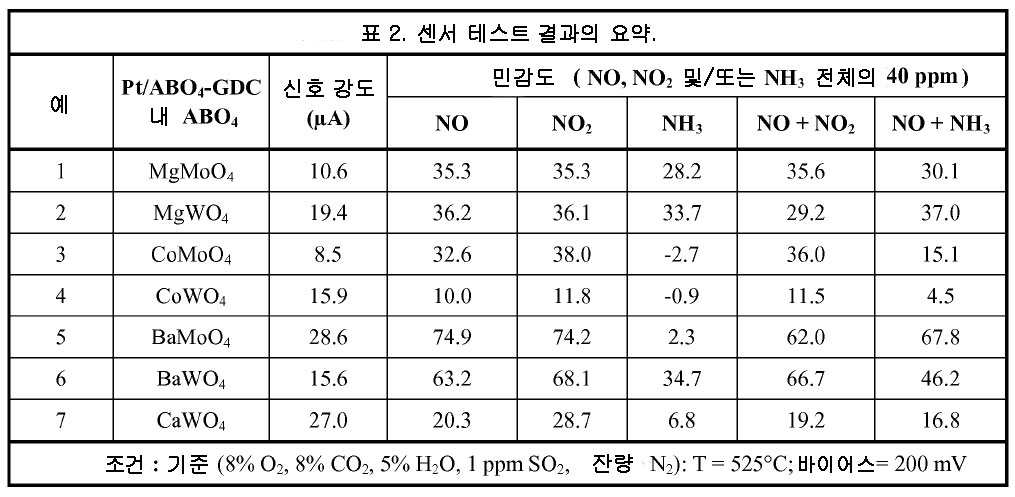
상기 표 2에 보고된 데이터에 의해 나타낸 바와 같이, MgMoO4 및 MgWO4 기반 활성 전극으로 제조된 센서 (각각, 예 1 및 2)는 NO, NO2, NH3, NO+NO2 및 NO+NH3의 40ppm 레벨에 대하여 거의 동일한 반응을 나타냈다. 따라서, 이들 전극 재료는 NO, NO2 및 NH에 대하여 "부가적"인 것으로 고려된다. CoMoO4 및 CoWO4 기반 활성 전극으로 제조된 센서 (각각, 예 3 및 4)는 NO, NO2 및 NO+NO2의 40ppm 레벨에 대하여 거의 동일한 반응을 나타냈고, 그러므로 NO 및 NO2에 대하여 부가적이다. 그러나, 이들 활성 전극 NH3에 대하여 (단독으로 또는 NO의 존재 하에) 최소한으로 반응하였다. 그러므로, 이들 전극 재료는 NH3을 포함하는 가스 흐름 내에서 NOx에 대하여 "선택적"인 것으로 고려된다. 마지막으로, BaMoO4, BaWO4, 및 CaWO4 기반 활성 전극으로 제조된 센서(각각 예 5, 6 및 7)는, 때때로, 부가적인 전극과 선택적인 전극의 중간인 일관되지 못한 거동을 나타냈다. As shown by the data reported in Table 2 above, the sensors (Examples 1 and 2, respectively) made with MgMoO 4 and MgWO 4 based active electrodes are NO, NO 2 , NH 3 , NO + NO 2 and NO + NH 3 at 40 ppm level. Therefore, these electrode materials are considered to be "additive" to NO, NO 2 and NH. CoMoO 4 and CoWO 4 based active electrode of the sensor made of a (each of Examples 3 and 4) are appended to the showed substantially the same reaction, and thus NO and NO 2 with respect to 40ppm level of NO, NO 2 and NO + NO 2 It is enemy. However, these active electrodes responded to a minimum with respect to the NH 3 (alone or in the presence of NO). Therefore, these electrode materials are considered to be "selective" with respect to NOx in a gas stream comprising NH 3. Finally, sensors made with BaMoO 4 , BaWO 4 , and CaWO 4 based active electrodes (Examples 5, 6, and 7, respectively) sometimes exhibited inconsistent behavior that is intermediate between the additional and optional electrodes.
NOx와 NH 모두에 대한 이중 보고에는 상당한 이점이 있다. 일 실시 예에서, 배기 흐름 내에서 NOx 및 NH3의 해결하기 위하여, NOx 및 NH3에 대하여 각각 상이한 반응특성을 갖는 2개의 상이한 활성 전극 재료를 최소한으로 사용한다. The double report on both NOx and NH has significant advantages. In one embodiment, in order to solve the NOx and NH 3 in the exhaust flow, the use of two different electrode active materials each having a different response characteristic with respect to NOx and NH 3 to a minimum.
하나의 해결책은 상이한 활성 전극을 갖는 2개의 전기 화학 전지를 갖는 센서를 제조하는 것이다: NO, NO2 및 NH3에 대하여 동일하게 반응하는 (즉, 부가적인) 활성 전극을 가지며, NOx 플러스 NH3의 전체 함량의 측정을 가능하게 하는 제 1 전지; 및 NO 및 NO2에 대하여 동일하게 반응하지만 NH3에 대하여 최소한으로 반응하는 (즉, NOx에 대하여 선택적인) 활성 전극을 가지며, NOx 함량의 측정을 가능하게 하는 제 2 전지. 따라서 NOx 및 NH3 함량은 상기 2개의 측정으로부터 정확하게 계산될 수 있다. One solution is to manufacture a sensor having two electrochemical cells with different active electrodes: having active electrodes that are equally reactive (i.e., additional) for NO, NO 2, and NH 3 , and NO x plus NH 3 A first battery which enables measurement of the entire content of the battery; And a second electrode that reacts identically for NO and NO 2 but has an active electrode that is minimally reactive to NH 3 (i.e., selective for NO x) and enables measurement of NO x content. Therefore, NOx and NH 3 content can be accurately calculated from the two measurements.
상기 두 가지 유형의 전극 재료를 살피는 또 다른 방법은 암모니아 산화 반응의 관점으로부터 이루어진다. 일반적으로, 암모니아의 산화는 NO 또는 N2의 형성을 초래하는 두 가지 주요 경로를 통해 진행될 수 있다:Another method of examining the two types of electrode materials is made from the viewpoint of the ammonia oxidation reaction. In general, the oxidation of ammonia can proceed through two main routes leading to the formation of NO or N 2 :
NO 형성 반응: 4NH3 + 5O2 → 4NO + 6H2O (ΔG = -956kJ/mol)NO formation reaction: 4NH 3 + 5O 2 ? 4NO + 6H 2 O (? G = -956 kJ / mol)
N2 형성 반응: 4NH3 + 3O2 → 2N2 + 6H2O (ΔG = -1306kJ/mol)N 2 formation reaction: 4NH 3 + 3O 2 ? 2N 2 + 6H 2 O (? G = -1306 kJ / mol)
따라서, 하나의 전극 재료는 NH3 산화를 통한 N2 형성에 촉매적으로 선택적이고 제 2 전극은 NH3 산화를 통해 NOx의 형성에 촉매적으로 선택적인 경우, 이중 NOx/NO3 센서가 가능하다. Thus, if one electrode material is catalytically selective for N 2 formation through NH 3 oxidation and the second electrode is catalytically selective for the formation of NO x through NH 3 oxidation, dual NO x / NO 3 sensors are possible .
MgMoO4 및 MgWO4 기반 전극(예 1 및 2)이 부가적이었고, CoMoO4 및 CoWO4 기반 전극(예 3 및 4)이 선택적이었던 이유를 암모니아 산화 촉매로서 이들 재료의 테스트하여 평가하였다. 촉매 테스트를 위한 샘플은 1000℃(전극 어닐링에 사용되는 온도)에서 상기 전극 재료를 소성시킨 다음, 소성된 분말을 35 내지 80 메쉬의 크기 범위로 체질(seiving)함으로써 준비하였다. (100ppm의 NH3, 5%의 O2, 8%의 H2O, 1ppm의 SO2, 잔량의 He)로 된 가스 조성물로 모의 배기에서 50,000 hr-1의 가스 시간당 공간 속도로 NH3 산화 반응을 위한 촉매로서의 상기 재료를 평가하였다. The reason why the MgMoO 4 and MgWO 4 based electrodes (Examples 1 and 2) were additive and the CoMoO 4 and CoWO 4 based electrodes (Examples 3 and 4) were optional was tested and evaluated for these materials as ammonia oxidation catalysts. Samples for catalyst testing were prepared by firing the electrode material at 1000 캜 (temperature used for electrode annealing) and then sieving the fired powder to a size range of 35 to 80 mesh. (100ppm of
450 내지 600℃의 온도 범위에서 NH3 전환율, 및 질소와 NOx 선택성을 측정하였다. 모든 온도에서 NH3 전환율 레벨은 98 퍼센트보다 높았으며, 이들 4가지 전극 물질 모두가 암모니아 산화 촉매로서 기능한다는 것을 확인하였다. 그러나, 상기 전극 재료에 대하여 상이한 선택성(즉, N2 또는 NOx인 질소-함유 생성물의 백분율)이 관찰되었다. 525℃의 공칭 센서 작동 온도에서 얻어진 데이터는 표 3, 및 표 4 및 표 5 에 요약되어 있으며, 이들 2개의 재료에 대한 N2 및 NO2 선택성을 온도의 함수로 비교한다. The NH 3 conversion rate, and nitrogen and NOx selectivity in the temperature range of 450 to 600 ℃ was measured. At all temperatures, the NH 3 conversion level was higher than 98 percent, confirming that all of these four electrode materials function as ammonia oxidation catalysts. However, a different selectivity relative to the electrode material-a (i.e., N 2 or a nitrogen percentage of NOx-containing product) was observed. Data obtained at nominal sensor operating temperature of 525 ° C are summarized in Table 3 and Table 4 and Table 5, comparing the N 2 and NO 2 selectivity for these two materials as a function of temperature.

표 3 및 표 4 및 표 5에 입증된 바와 같이, 상기 CoMoO4 및 CoWO4 기반 전극 재료는 NH3을 N2로 전환시키는 반응 경로를 크게 선호한다. 상기 센서는 N2에 대해 불활성이기 때문에, NH3이 센서 표면에서 N2로 변환 될 때, 센서 출력에는 변화가 발생되지 않는다. 반대로, 상기 MgMoO4 및 MgWO4 기반 전극 재료는 NH3을 우선적으로 NO2로 전환시킨다. 따라서, 상기 센서 표면 상의 NH3 흡착은 NOx 농도에 명백한 증가를 초래하여 보다 높은 센서 출력 신호 생성한다. 따라서, 이들 두 가지 상이한 반응 선호도를 갖는 전극 재료를 사용함으로써, NH3 및 NOx 레벨을 구별할 수 있다. As demonstrated in Tables 3 and 4 and Table 5, the CoMoO 4 and CoWO 4 based electrode materials greatly favor the reaction pathway to convert NH 3 to N 2 . The sensor because it is inert to the N 2, when the NH 3 conversion in the sensor surface by N 2, the sensor output does not generate a change. Conversely, the MgMoO 4 and MgWO 4 based electrode materials preferentially convert NH 3 to NO 2 . Thus, NH 3 adsorption on the sensor surface results in an apparent increase in NO x concentration, resulting in a higher sensor output signal. Thus, by using electrode materials having these two different reaction preferences, it is possible to distinguish NH 3 and NO x levels.
상기 결과에 기초하면, 이중 NOx/NH 센서에 대한 한 가지의 설계는 2개의-전기 화학 전지 센서이며, 상기 2개의-전기 화학 전지 센서 중 하나는 부가적(NOx + NH3 전체) 전극으로서 MgMoO4 및 MgWO4로 이루어지는 하나의 활성 전극을 가지며, 두 번째 것은 선택적인(NOx 단독) 전극으로서 CoMoO4 또는 CoWO4로 이루어지는 활성 전극을 갖는다. 상기 몰리브덴산염 또는 텅스텐산염 화합물, 전해질 재료(예를 들면, GDC 또는 SDC), 및 금속(예를 들면, 백금)의 3-상 복합 혼합물과 같이, 전술한 활성 전극 조성물 중 임의의 것을 사용할 수 있다. 하나의 특정 실시 예에서, MgMoO4/GDC-Pt 또는 MgWO4/GDC-Pt는 부가적(NOx+NH 전체) 활성 전극 재료이고, CoMoO4/GDC-Pt 또는 CoWO4/GDC-Pt는 선택적(NOx 단독) 전극 재료이다.Based on the results, double One design for the NOx / NH sensors 2 - and electrochemical cell sensor, and the two - one of the electrochemical cell sensor is additionally (NOx + NH 3 total) as an electrode MgMoO 4 and MgWO 4 , and the second electrode has an active electrode consisting of CoMoO 4 or CoWO 4 as an optional (NOx single) electrode. Any of the aforementioned active electrode compositions may be used, such as the molybdate or tungstate compound, an electrolyte material (e.g., GDC or SDC), and a three-phase complex mixture of metal (e.g., platinum) . In one particular embodiment, MgMoO 4 / GDC-Pt or MgWO 4 / GDC-Pt is an additive (NO x +
선택적 및 부가적 성능을 더욱 확인하기 위하여, 상술한 테스트 방법에 의하여 예 1(MgMoO4/GDC-Pt 활성 전극) 및 예 2(CoMoO4/GDC-Pt 활성 전극)의 이중 NOx 및 NH3 민감도를 평가하였다. NO와 NH3의 전체 농도를 40 ppm으로 유지하여 데이터를 수집하였고 또한 각 종의 농도를 전체의 0 내지 100 퍼센트로 변화시켜 데이터를 수집 하였다. 도 6에 나타낸 바와 같이, 예 1(MgMoO4/GDC-Pt 활성 전극)의 센서는 각각의 조건에 동일하게 반응한 반면, NO + NH3을 함유하는 배기가스의 NO 성분에 대해서는 예 2(CoMoO4/GDC-Pt 활성 전극)의 센서만이 반응하였다. NO와 NO2 사이에 선택성의 차이가 있는지를 평가하기 위하여, NH3을 NO2로 대체하여 동일한 접근법을 이용하여 2세트의 실험을 수행하였다. 도 7에 나타낸 바와 같이, 두 센서는 모두 각각의 조건에 동일하게 반응하여, NO 및 NO2에 대한 이들의 부가적 성질이 확인된다.To further confirm the selective and additive performance, the dual NOx and NH 3 sensitivity of Example 1 (MgMoO 4 / GDC-Pt active electrode) and Example 2 (CoMoO 4 / GDC-Pt active electrode) Respectively. Data were collected by maintaining the total concentration of NO and NH 3 at 40 ppm and data were collected by varying the concentration of each species from 0 to 100 percent of the total. 6, Example 1 (MgMoO 4 / GDC-Pt active electrode) sensors, on the other hand in the same manner in response to each condition, NO + NH for the NO component in the exhaust gas containing 3 Example 2 (CoMoO 4 / GDC-Pt active electrode). To assess whether there is a difference in selectivity between NO and NO 2 , two sets of experiments were performed using the same approach, replacing NH 3 with NO 2 . As shown in FIG. 7, both sensors respond equally to the respective conditions, confirming their additive nature to NO and NO 2 .
상술한 바와 같이, CoMoO4 및 CoWO4 기반 활성 전극으로 제조된 센서는 NH3의 존재 하에서 NOx에 대하여 선택적이다. 그러나, 본 출원인들은 또한 CoMoO4 또는 CoWO4를 포함하는 활성 전극에 인가된 바이어스의 극성을 반대로 함으로써, 상기 센서의 선택성이 NOx를 선호하는 것에서 NH3을 선호하는 것으로 전환된다는 것을 발견하였다. 이 경우, 질소 반응에 대한 암모니아 산화(산소 이온이 CoMoO4 기반 전극에로 펌핑된 산소 이온으로써)는 깁스 자유 에너지(Gibbs free energy)가 낮기 때문에 선호된다. 산소 이온은 이러한 전극으로 이동하고 전자는 상기 회로를 완성하기 위하여 제거되므로, 이 반응은 또한 르 샤틀리에의 원리(Le Chatelier's principle)에 의해 강력하게 지지된다. 따라서, 전극을 역방향으로 바이어스 할 때, 상기 반응은 NH3에 대하여 선택적이게 된다. 이 접근법은 테스트에 의하여 확인되었다 (도 8 참조). MgMoO4 기반 활성 전극을 갖는 센서는, 앞서 나타낸 바와 같이, 정상 방향(전방)으로 바이어스 되었을 때 NOx + NH3 조건 각각에 대하여 동일하게 반응하였다. 역방향 바이어스가 CoMoO4 기반 전극에 적용되었을 때, 상기 센서는 NH3에만 반응했다 (NO2에는 반응하지 않았다). As described above, sensors made with CoMoO 4 and CoWO 4 based active electrodes are selective for NO x in the presence of NH 3 . However, Applicants have also found that by reversing the polarity of the bias applied to the active electrode comprising CoMoO 4 or CoWO 4 , the selectivity of the sensor is switched from favoring NO x to preferring NH 3 . In this case, ammonia oxidation to the nitrogen reaction (oxygen ions pumped into the CoMoO 4 based electrode with oxygen ions) is preferred because of the low Gibbs free energy. Since oxygen ions migrate to these electrodes and electrons are removed to complete the circuit, this reaction is also strongly supported by Le Chatelier's principle. Thus, when biasing the electrode in the reverse direction, the reaction becomes selective for NH 3 . This approach was confirmed by testing (see FIG. 8). The sensor with a MgMoO 4 based active electrode reacted identically for each of the NO x + NH 3 conditions when biased in the normal direction (forward), as indicated above. When a reverse bias was applied to the CoMoO 4 -based electrode, the sensor responded only to NH 3 (not to NO 2 ).
또 다른 대안적인 실시 예로서, 바이어스 방향이 반전될 때 CoMoO4 및 CoWO4 기반 활성 전극의 선택성의 변화는 동일한(또는 유사한 형성의) 2개의 활성 전극을 사용하는 NOx/NH3센서를 제공하기 위하여, NOx와 NH3의 구별이 가능하도록 각각의 전극에 상이한 바이어스함으로써, 유리하게 사용될 수 있다. 이는, 위에서 설명한 바와 같이, 바이어스 방향을 전환하여 NOx 또는 NH3 종을 선호하는 화학 반응 순서를 조작함으로써 CoMoO4 또는 CoWO4 기반의 전극 재료로 달성될 수 있다. 2 개의 CoMoO4 또는 CoWO4 기반의 활성 전극을 반대 바이어스로 작동시킴으로써, 상기 센서는 2개의 선택적인 센서를 결합하여 NH3과 NOx의 함량을 모두 분석할 수 있다. 이 거동은 센서 테스트를 통해 확인되었으며, 그 결과는 도 9에 도시되고, 정역 바이어스 레벨은 400 mV이다. As another alternative embodiment, the change in selectivity of the CoMoO 4 and CoWO 4 -based active electrodes when the bias direction is reversed is used to provide a NO x / NH 3 sensor using two active electrodes of the same (or similar formation) , And different biases to the respective electrodes so that the distinction of NOx and NH 3 is possible. This can be achieved with CoMoO 4 or CoWO 4 based electrode materials by switching the bias direction to manipulate the chemical reaction sequence favoring NO x or NH 3 species, as described above. By activating two CoMoO 4 or CoWO 4 based active electrodes with opposite bias, the sensor can combine two optional sensors to analyze both NH 3 and NO x content. This behavior was confirmed by a sensor test, and the result is shown in Fig. 9, and the normal bias level is 400 mV.
앞서 언급한 테스트 결과에 기초하여, 2개의 전기 화학 전지를 갖는 이중 NOx/NH3 검출 센서가 용이하게 제조 될 수 있다. 이러한 센서는 함께 이중 NOx/NH3 센서를 제공하는 2개의 물리적으로 분리된 전기 화학 전지를 포함 할 수 있고, 또는 본원에 앞서 언급한 바와 같이 도 10 및 도 11에 나타낸 실시 예 중 하나에서 제공 될 수 있다. Based on the test results mentioned above, the double-NOx / NH 3 detection sensor has two electrochemical cells can be easily produced. These sensors with double NOx / NH 3 may include an electrochemical cell divided into two physically to provide a sensor, or be provided by one of the embodiments shown in Figs. 10 and 11 as noted above herein .
이중 NOx/NHDouble NOx / NH 33 검출용 표면-전극 센서 Surface-electrode sensor for detection
위에서 언급한 바와 같이, 목표 가스 종에 대하여 부가적이거나 (예를 들어, NO, NO2 및 NH3에 대한 동일한 반응), 또는 선택적인 (예를 들어 NO 및 NO2에 대한 동일한 반응 및 NH3에 대한 상이한 반응) 거동을 제공하도록 조정된 각각의 활성 전극을 갖는 2개의 전기 화학 전지로 이루어지는 센서를 제조 할 수 있고, 따라서 다중 목표 가스 종(예를 들면, 이중 NOx/NH3 검출)을 검출할 수 있다. 마찬가지로, 본 발명자들은 또한, (예를 들면, 이중 NOx/NH3 검출 및 수량화를 가능하게하기 위하여) 부가적 및 선택적 센서 반응을 제공하도록 하기 위하여, 2종 이상의 목표 가스 종에 대하여 부가적인 반응을 갖는 하나와 상기 목표 가스 종 중 적어도 하나의 목표 가스 종에 대하여 선택적인 반응을 갖는 하나로 된 2개의 전기 화학 전지를, 상기 2개의 전지의 집전장치를 조정함으로써, 제공할 수 있다는 것을 발견하였다. 이러한 발견은, 상기 집전장치가 활성 전극의 표면을 완전히 커버하는 (약 90% 커버리지) 장치를 제작함으로써, 그리고 상기 상대 및 활성 전극 모두를 전해질의 동일한 표면에 공간-이격된 관계로 증착하는 장치 구조를 활용함으로써, 달성되었다. 본원에서 더욱 보고된 테스트에 의하여 입증된 바와 같이, 본 발명자들은 전기 화학적 감지 반응이 이러한 대안적인 배열에서 상기 집전장치에 의해 제어되는 것을 발견하였다. 예를 들면, 상기 동일한 활성 전극(MgWO4 또는 BaWO4에 기반)을 갖는 전기 화학 전지에서, 부가적 센서 반응은 상기 활성 전극 위에 백금 기반 집전장치를 결합한 전지에서 달성되고, 선택적 반응은 상기 활성 전극 위로 금 기반 집전장치를 결합한 전지에서 달성된다. 이는 다음의 예에 의하여 더욱 명확해진다.As noted above, additional (for example, the same reaction for NO, NO 2, and NH 3 ) or selective (for example, the same reaction for NO and NO 2 and NH 3 different reaction) it is possible to manufacture a sensor consisting of two electrochemical cells each having an active electrode adjusted so as to provide the behavior, and therefore multi-target gas species (e.g., double-NOx / NH 3 detection) for the detection of the can do. Similarly, the present inventors have also, (for example, double-NOx / NH 3 detection and to enable the quantification) the additional and optional sensors to to provide a response, an additional reaction with respect to the target gas species of two or more Of the target gas species and at least one target gas species of the target gas species by adjusting the current collectors of the two cells. This finding is particularly noticeable in the case of a device structure (not shown) in which the current collector completely covers the surface of the active electrode (about 90% coverage) and by depositing both the counter electrode and the active electrode in a space- ≪ / RTI > As demonstrated by further reported tests herein, the inventors have found that the electrochemical sensing reaction is controlled by the current collector in this alternative arrangement. For example, in an electrochemical cell having the same active electrode (based on MgWO 4 or BaWO 4 ), an additional sensor reaction is achieved in a cell incorporating a platinum-based current collector on the active electrode, This is accomplished in a battery incorporating a gold-based current collector. This is further clarified by the following example.
다중 센서 장치를 도 12에 나타낸 표면 전극 구조로 제작하였다. 상기 공통 전해질층(324)은 GDC이고 (모든 이전 실시 예에서 설명한 바와 같음), 상기 활성 전극(322), 집전장치(336) 및 상대-전극(326) 층은 변경되었다 (표 4 참조). 상기 센서는 상기 집전장치(336)로부터 상기 상대 전극(326) 층에 인가된 정방향 바이어스(정바이어스)로 테스트하였다. 테스트 프로토콜은 상예 1-7에 대하여 설명한 것과 유사하였으며; 상기 센서는 525℃의 온도에서 200 mV의 바이어스 전압으로 테스트하였다. 기준 가스 분위기는 8 부피%의 CO2, 5 부피%의 H2O, 1 ppm의 SO2, 10 부피%의 O2, 77 부피%의 N2로 구성되었으며, 100 ppm의 NO, 100 ppm의 NO2, 또는 100 ppm의 NH3의 단일-성분 피분석물에 대한 노출에 대하여 센서 반응을 관찰하였다. 결과는 표 5에 요약되어 있으며 다음 단락에서 설명된다.Multiple sensor devices were fabricated with the surface electrode structure shown in Fig. The
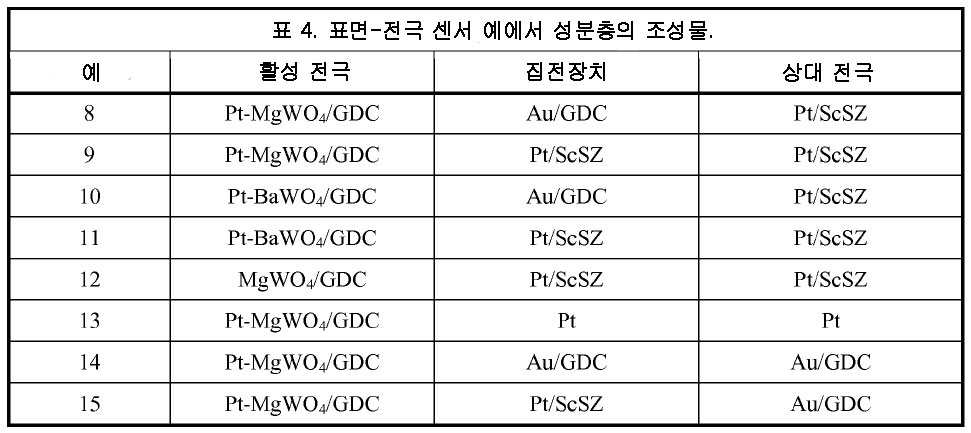
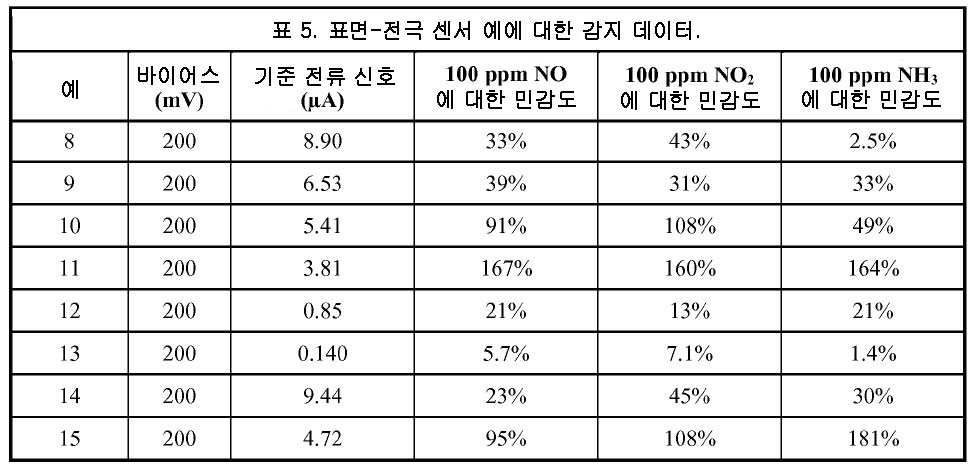
Pt-MgWO4/GDC 활성 전극, Au/GDC 집전장치 및 Pt/ScSZ 상대 전극을 갖는 예 8의 센서에 대하여 얻어진 테스트 데이터는 표 5 및 도 13에 제시된다. 525℃의 온도에서 200 mV의 바이어스가 인가되어, 상기 센서는 선택적인 감지 거동(각각 100 ppm의 NO 및 100 ppm의 NO2에 대하여 33 및 43 퍼센트 감도)과 100 ppm의 NH3에 대한 단 2 퍼센트의 민감도와 8.9 μA의 기준 전류 신호를 보였다. The test data obtained for the sensor of Example 8 with a Pt-MgWO 4 / GDC active electrode, an Au / GDC current collector and a Pt / ScSZ counter electrode is shown in Table 5 and FIG. Is at a temperature of 525 ℃ applying a bias of 200 mV, the sensor is a 2-for selective detection behavior (100 ppm of NO and 100 ppm with respect to the NO 2, 33 and 43% sensitivity, respectively) and 100 ppm of NH 3 Percent sensitivity and a reference current signal of 8.9 μA.
Pt-MgWO4/GDC 활성 전극, Pt/SCSZ 집전장치 및 Pt/ScSZ 상대 전극을 갖는 예 9의 센서에 대하여 얻어진 테스트 데이터는 표 5 및 도 14에 제시된다. 525℃의 온도에서 200 mV의 바이어스가 인가되어, 상기 센서는 부가적인 감지 거동(각각 100 ppm의 NO, 100 ppm의 NO2 및 100 ppm의 NH3에 대하여 각각 39, 31 및 33 퍼센트 민감도)과 6.5 μA의 기준 전류 신호를 보였다. The test data obtained for the sensor of Example 9 with a Pt-MgWO 4 / GDC active electrode, a Pt / SCSZ current collector and a Pt / ScSZ counter electrode is presented in Table 5 and FIG. Is at a temperature of 525 ℃ applying a bias of 200 mV, the sensor is an additional sensing behavior (respectively 39, 31 and 33 percent sensitivity relative to 100 ppm of NO, 100 ppm of NO 2 and 100 ppm of NH 3, respectively) and The reference current signal of 6.5 A was shown.
Pt-BaWO4/GDC 활성 전극, Au/GDC 집전장치 및 Pt/ScSZ 상대 전극을 갖는 예 10의 센서에 대하여 얻어진 테스트 데이터는 표 5 및 도 15에 제시된다. 525℃의 온도에서 200 mV의 바이어스가 인가되어, 상기 센서는 공칭 선택적인 감지 거동(100 ppm의 NO 및 100 ppm의 NO2에 대하여 각각 91 및 108 퍼센트 민감도, 및 100 ppm의 NH3에 대하여 49 퍼센트 민감도)과 5.4 μA의 기준 전류 신호를 보였다. 따라서, 이러한 선택적인 센서의 활성 전극에서 MgWO4를 BaWO4로 대체하는 것은 비록 NH3 반응 또한 크게 관찰되었으나, NOx 민감도를 실질적인 증가시킨다. 이러한 센서가 선택적인 NOx 검출에 유용하도록 하기 위해서는, 상기 활성 전극 및 집전 장치층의 두께를 조정하거나 또는 상기 집전 장치층의 조성물을 변경함으로써 상기 NH3 반응은 감소시킬 필요가 있다. The test data obtained for the sensor of Example 10 with a Pt-BaWO 4 / GDC active electrode, an Au / GDC current collector and a Pt / ScSZ counter electrode is shown in Table 5 and FIG. At a temperature of 525 ℃ is applied to the bias of 200 mV, the sensor has a nominal selective detection behavior (with respect to with respect to the NO 2 of 100 ppm of NO and 100 ppm, respectively 91 and 108% sensitivity and 100 ppm of NH 3 49 Percent Sensitivity) and a reference current signal of 5.4 μA. Therefore, substituting MgWO 4 with BaWO 4 in the active electrode of this selective sensor, although NH 3 reaction is also observed, substantially increases NO x sensitivity. In order to make such a sensor useful for selective NOx detection, it is necessary to reduce the NH 3 reaction by adjusting the thickness of the active electrode and current collector layer or by changing the composition of the current collector layer.
Pt-BaWO4/GDC 활성 전극, Pt/SCSZ 집전장치 및 Pt/ScSZ 상대 전극을 갖는 예 11의 센서에 대하여 얻어진 테스트 데이터는 표 5 및 도 16에 제시된다. 525℃의 온도에서 200 mV의 바이어스가 인가되어, 상기 센서는 부가적인 감지 거동(100 ppm의 NO, 100 ppm의 NO2 및 100 ppm의 NH3에 대하여 각각 167, 164 및 164 퍼센트 민감도)과 3.8 μA의 기준 전류 신호를 보였다. 따라서, 이러한 부가적인 센서의 활성 전극에서 MgWO4를 BaWO4로 대체하는 것은 NOx 및 NH3 민감도를 4-배 증가시킨다. The test data obtained for the sensor of Example 11 with a Pt-BaWO 4 / GDC active electrode, a Pt / SCSZ current collector and a Pt / ScSZ counter electrode is shown in Table 5 and FIG. Is at a temperature of 525 ℃ applying a bias of 200 mV, the sensor is an additional sensing behavior (with respect to 100 ppm of NO, 100 ppm of the NO 2 and 100 ppm NH 3, respectively 167, 164 and 164% sensitivity) and 3.8 μA reference current signal. Therefore, replacing MgWO 4 with BaWO 4 in active electrodes of these additional sensors increases the NOx and NH 3 sensitivity four-fold.
MgWO4/GDC 활성 전극(상기 활성 전극 내 백금이 없음), Pt/SCSZ 집전장치 및 Pt/ScSZ 상대 전극을 갖는 예 12의 센서에 대하여 얻어진 테스트 데이터는 표 5에 제시된다. 525℃의 온도에서 200 mV의 바이어스가 인가되어, 상기 센서는 비교적 낮고 비-완벽한 부가적 민감도(100 ppm의 NO, 100 ppm의 NO2 및 100 ppm의 NH3에 대하여 각각 21, 13 및 21 퍼센트 민감도)과 0.85 ㎂의 매우 낮은 기준 전류 신호를 보였다. 이들 데이터는 바람직한 NOx 및 NH3 감지 거동을 달성하기 위하여 상기 활성 전극 내에 백금을 포함하는 것의 중요성을 예시한다. The test data obtained for the sensor of Example 12 having a MgWO 4 / GDC active electrode (without platinum in the active electrode), a Pt / SCSZ current collector and a Pt / ScSZ counter electrode is shown in Table 5. Is at a temperature of 525 ℃ applying a bias of 200 mV, the sensor is relatively low and non-complete addition the sensitivity (relative to 100 ppm of NO, 100 ppm of NO 2 and 100 ppm of NH 3 were 21, 13 and 21 percent Sensitivity) and a very low reference current signal of 0.85 ㎂. These data illustrate the importance of including platinum in the active electrode to achieve the desired NOx and NH 3 sensing behavior.
Pt-MgWO4/GDC 활성 전극, 순수 백금 집전장치 및 순수 백금 상대 전극(상기 집전장치 또는 상대 전극에 ScSZ 또는 GDC가 없음)을 갖는 예 13의 센서에 대하여 얻어진 테스트 데이터는 표 5에 제시된다. 525℃의 온도에서 200 mV의 바이어스가 인가되어, 상기 센서는 100 ppm의 NO, 100 ppm의 NO2 및 100 ppm의 NH3에 대하여 각각 6, 7 및 1 퍼센트 민감도인 매우 낮은 민감도 및 0.14 ㎂의 크게 감소된 기준 전류 신호를 보였다. 이들 데이터는 상기 집전장치 및 상대 전극층 내에 전해질 재료(ScSZ 또는 GDC)를 포함하는 것의 중요성을 예시한다. The test data obtained for the sensor of Example 13 with a Pt-MgWO 4 / GDC active electrode, a pure platinum collector and a pure platinum counter electrode (without ScSZ or GDC on the collector or counter electrode) is shown in Table 5. A bias of 200 mV was applied at a temperature of 525 DEG C to provide a very low sensitivity of 0.1, and a sensitivity of 0.14 < RTI ID = 0.0 > pA < / RTI > for both 100 ppm NO, 100 ppm NO 2 and 100 ppm NH 3 , Showed a greatly reduced reference current signal. These data illustrate the importance of including an electrolyte material (ScSZ or GDC) in the current collector and the counter electrode layer.
Pt-MgWO4/GDC 활성 전극, Au/GDC 집전장치 및 Au/GDC 상대 전극을 갖는 예 14의 센서에 대하여 얻어진 테스트 데이터는 표 5에 제시된다. 525℃의 온도에서 200 mV의 바이어스가 인가되어, 상기 센서는 100 ppm의 NO, 100 ppm의 NO2 및 100 ppm의 NH3에 대하여 각각 23, 45 및 30 퍼센트 민감도 및 9.4 ㎂의 비교적 높은 기준 전류 신호를 보였다. 따라서, 상대 전극에서 Pt/ScSZ를 Au/GDC로 대체하는 것은 선택적인 거동의 상실을 초래하며, 상대 전극에는 백금(금이 아님) 존재하는 것이 바람직함을 확인한다. The test data obtained for the sensor of Example 14 with a Pt-MgWO 4 / GDC active electrode, an Au / GDC current collector and an Au / GDC counter electrode is shown in Table 5. It is at a temperature of 525 ℃ applying a bias of 200 mV, the sensor is 100 ppm of NO, 100 ppm of NO 2, and with respect to the 100 ppm of NH 3, respectively 23, 45 and 30% sensitivity and a relatively high reference current of 9.4 ㎂ Signal. Therefore, it is confirmed that the substitution of Pt / ScSZ with Au / GDC in the counter electrode results in the loss of selective behavior and the presence of platinum (not gold) in the counter electrode is desirable.
Pt-MgWO4/GDC 활성 전극, Pt/ScSZ 집전장치 및 Au/GDC 상대 전극을 갖는 예 15의 센서에 대하여 얻어진 테스트 데이터는 표 5에 제시된다. 525℃의 온도에서 200 mV의 바이어스가 인가되어, 상기 센서는 100 ppm의 NO, 100 ppm의 NO2 및 100 ppm의 NH3에 대하여 각각 95, 108 및 181 퍼센트 민감도 및 4.7 ㎂의 기준 전류 신호를 보였다. 따라서, 상대 전극에서 Pt/ScSZ를 Au/GDC로 대체하는 것은 부가적인 거동의 상실을 초래하며, 상대 전극에는 백금(금이 아님) 존재하는 것이 바람직함을 확인한다. The test data obtained for the sensor of Example 15 with a Pt-MgWO 4 / GDC active electrode, a Pt / ScSZ current collector and an Au / GDC counter electrode is shown in Table 5. At a temperature of 525 ℃ is applied to the bias of 200 mV, the sensor is 100 ppm of NO, 100 ppm of NO 2, and with respect to the 100 ppm of NH 3, respectively 95, the reference current signal 108 and 181% sensitivity and 4.7 ㎂ It looked. Therefore, it is confirmed that the substitution of Pt / ScSZ with Au / GDC in the counter electrode results in the loss of additional behavior and the presence of platinum (not gold) in the counter electrode is desirable.
전술한 바와 같이, 표면 전극을 갖는 이중 NOx/NH 검출을 위한 위 실시 예에는 2개의 물리적으로 분리된 전지로서 (예를 들면, 도 12에 나타낸 유형의 2개의 전지) 2개의 전기 화학 전지를 갖는 센서, 또는 상기 센서 기판의 표면 상에 형성되는 2개의 전기 화학 전지로 형성된 단일의 센서가 요구된다. 앞서 언급한 바와 같이, 도 17a-도 17h에 나타낸 바와 같이 표면-전극 장치에 상기 전기 화학 전지를 내장할 수 있는 방법에는 여러 가지가 있다. 상술한 바와 같이, 표면 전극 및 상이한 집전 장치층을 갖는 2개의 전기 화학 전지는 공통 기판 및, 경우에 따라, 공통 전해질층 및/또는 공통 상대 전극층을 공유하도록 구성될 수 있다. As described above, the above example for dual NOx / NH detection with surface electrodes has two physically separated cells (e.g., two cells of the type shown in Figure 12) with two electrochemical cells Sensor, or a single sensor formed of two electrochemical cells formed on the surface of the sensor substrate. As described above, there are various methods for embedding the electrochemical cell in the surface-electrode device as shown in Figs. 17A to 17H. As described above, two electrochemical cells having surface electrodes and different current collector layers can be configured to share a common substrate and, if desired, a common electrolyte layer and / or a common counter electrode layer.
이상에서는 여러 장치 및 그 구성 요소를 상세히 논의하였으나, 논의된 장치의 구성 요소, 특징, 구조 및 이용 방법은 위에 제공된 본문에 제한되지 않는다는 것을 이해해야한다. 특히, 장치 중 하나의 내용에서 설명된 구성 요소, 특징, 구조 및 이용 방법은 기타 임의의 장치에도 결합될 수 있다. 또한, 이하에서 제공되는 추가 설명에 한정됨 없이, 상기 장치의 추가적이며 대안적인 적절한 구성 요소, 특징, 구조 및 이용 방법 뿐만 아니라 본원의 개시 내용이 결합되고 상호 교환될 수 있는 다양한 방식들 또한 본원에 비추어 당업자에게 자명하다. While various devices and their components have been discussed in detail above, it should be understood that the components, features, structures, and methods of use of the devices discussed are not limited to the text provided above. In particular, the components, features, structures and methods of use described in the context of one of the devices may be combined with any other device. Further, without being limited to the further description provided below, various additional and alternative appropriate components, features, structures and methods of use of the apparatus, as well as various ways in which the disclosure may be combined and interchanged, Be apparent to those skilled in the art.
본 명세서에서 다양한 버전을 도시 및 기술하였으므로, 본원에 기재된 방법 및 시스템의 추가적인 조정은 본 발명의 범위를 벗어나지 않는 한 당업자에 의한 적절한 변형에 의해 달성될 수 있다. 이러한 잠재적 변형 중 몇 가지가 언급되었으며, 다른 것들은 당업자에게 명백할 것이다. 예를 들어, 이상에서 논의한 예, 버전, 기하학, 재료, 치수, 비율, 단계 등은 예시적인 것이며 필수적인 것은 아니다. 따라서, 본 발명의 범위는 다음의 특허 청구의 범위의 관점에서 고려되어야 하며, 명세서 및 도면에 도시되고 기술된 구조 및 동작의 세부 사항들로 제한되지 않는 것으로 이해된다. As various versions have been shown and described herein, further adjustments to the methods and systems described herein may be accomplished by appropriate modifications by those skilled in the art without departing from the scope of the present invention. Several of these potential variations have been mentioned, others will be apparent to those skilled in the art. For example, the examples, versions, geometries, materials, dimensions, ratios, steps and the like discussed above are illustrative and not essential. Accordingly, it is intended that the scope of the invention be considered in light of the following claims, and are not to be construed as limited to the details of construction and operation shown and described in the specification and drawings.
Claims (18)
A current measuring electrochemical sensor for measuring the concentration of two or more target gas species in a gas sample or gas stream, comprising: first and second electrochemical cells having respective first and second active electrodes, Wherein the chemical cell further comprises an electrolyte membrane and a counter electrode wherein the first electrochemical cell exhibits an additional reaction to the first and second target gas species of the target gas species, Characterized in that the sensor is capable of measuring the concentration of each of the first and second target gas species because it exhibits a selective response to the first target gas species in the presence of a second target gas species. A current measuring electrochemical sensor for measuring the concentration of two or more target gas species in a gas stream.
The sensor of claim 1, wherein each of the first and second active electrodes comprises at least one molybdate or tungstate compound.
The method of claim 1 or 2, wherein the at least one molybdate or tungstate compound comprises A X (Mo (1-Z) W Z ) Y O ( X + 3Y ) And A is at least one of Mg, Zn, Ni, Co, Fe, Mn, Cu, Ca, Sr, Ba, and Pb.
The sensor according to claim 3, wherein the first active electrode is made of MgMoO 4 or MgWO 4 , and the second active electrode is made of CoMoO 4 or CoWO 4 .
In any preceding claim, it further comprises about 0.1% to 10% by weight of Pt, Pd, Rh, Ru, Ir, or alloys or mixtures of any of the foregoing metals in the first and second active electrodes The sensor features.
In any of the preceding claims, the first and second active electrodes comprise: (a) at least one molybdate or tungstate compound; (b) at least one ceramic electrolyte material; And (c) at least one metal selected from the group consisting of Pt, Pd, Rh, Ru, Ir, and alloys or mixtures of any of the foregoing.
(a) MgMoO4 또는 MgWO4;
(b) GDC 및 SDC로 이루어지는 군으로부터 선택된 전해질; 및
(c) Pt, Pd, Rh, Ru, Ir, 또는 앞서 언급한 임의의 금속의 합금 또는 혼합물 약 0.1 중량% 내지 10 중량%;의 복합 혼합물로 이루어짐을 특징으로 하는 센서.
In any preceding claim, the first active electrode comprises:
(a) MgMoO 4 or MgWO 4;
(b) an electrolyte selected from the group consisting of GDC and SDC; And
(c) about 0.1 wt.% to about 10 wt.% of Pt, Pd, Rh, Ru, Ir, or alloys or mixtures of any of the foregoing metals.
(a) CoMoO4 또는 CoWO4;
(b) GDC 및 SDC로 이루어지는 군으로부터 선택된 전해질; 및
(c) Pt, Pd, Rh, Ru, Ir, 또는 앞서 언급한 임의의 금속의 합금 또는 혼합물 약 0.1 중량% 내지 10 중량%;의 복합 혼합물로 이루어짐을 특징으로 하는 센서.
In any preceding claim, said second active electrode comprises:
(a) CoMoO 4 CoWO or 4;
(b) an electrolyte selected from the group consisting of GDC and SDC; And
(c) about 0.1 wt.% to about 10 wt.% of Pt, Pd, Rh, Ru, Ir, or alloys or mixtures of any of the foregoing metals.
In any preceding claim, the active electrode of each electrochemical cell is located on the side of the electrolyte member opposite the counter electrode.
The sensor of claim 9, wherein the first and second electrochemical cells share at least one of a common electrolyte membrane and a common counter electrode.
The electrochemical cell according to claim 1, wherein each of the first and second electrochemical cells further includes first and second current collecting devices on the first and second active electrodes, respectively, Wherein the sensor is adapted to provide additional and optional response.
12. The sensor of claim 11, wherein the first current collector comprises platinum and a ceramic electrolyte material cermet, and the second current collector comprises a cermet of gold and a ceramic electrolyte material.
The sensor according to claim 11 or 12, wherein the first current collector comprises platinum and ScSz cermet, and the second current collector comprises gold and GDC cermet.
The sensor according to any one of claims 11 to 13, wherein the active electrode of each electrochemical cell is positioned on the electrolyte member side in the same manner as the counter electrode.
15. The sensor of claim 14, wherein the first and second electrochemical cells share at least one of a common electrolyte membrane and a common counter electrode.
Wherein the counter electrode is further comprised of a substrate on which the counter electrode is located, wherein the substrate is selected from the group consisting of: an insulating ceramic, a metal coated with an insulating material, and a cermet coated with an insulating material The sensor.
A current measuring electrochemical sensor for measuring the concentration of two or more target gas species in a gas sample or gas stream, comprising: first and second electrochemical cells having respective first and second active electrodes, wherein (a) the first active electrode exhibits an additional reaction to the first and second gas species of the target gas species, or when the first bias is applied to the first electrochemical cell, (B) said second active electrode is configured to selectively react with said first gas when said second bias is applied to said second electrochemical cell, said second bias being opposite in polarity to said first bias, Characterized in that it exhibits a selective reaction with respect to said second gas species in the presence of a species, Electrochemical sensors.
(a) 상기 전기 화학 전지가 상기 가스 샘플 또는 흐름에 노출되도록 임의의 선행 청구항의 센서를 위치시키고;
(b) 상기 전기 화학 전지에 바이어스를 인가하고;
(c) 상기 센서를 통하여 결과적인 전류를 측정하고; 및
(d) 상기 측정된 전류에 기초하여 NOx 및 NH3의 농도를 결정하는 단계로 이루어지는 가스 샘플 또는 흐름에서 NOx 및 NH3의 농도를 검출하기 위한 방법.
A method for detecting the concentration of NO x and NH 3 in a gas sample or stream, comprising:
(a) placing the sensor of any preceding claim so that the electrochemical cell is exposed to the gas sample or stream;
(b) applying a bias to the electrochemical cell;
(c) measuring the resulting current through the sensor; And
(d) a method for detecting the concentration of NO x and NH 3 in the gas sample or flow comprising a step of determining the concentration of NO x and NH 3 on the basis of the measured current.
Applications Claiming Priority (3)
| Application Number | Priority Date | Filing Date | Title |
|---|---|---|---|
| US201462049977P | 2014-09-12 | 2014-09-12 | |
| US62/049,977 | 2014-09-12 | ||
| PCT/US2015/050063 WO2016040963A1 (en) | 2014-09-12 | 2015-09-14 | Amperometric solid electrolyte sensor and method for detecting nh3 and nox |
Publications (1)
| Publication Number | Publication Date |
|---|---|
| KR20170067775A true KR20170067775A (en) | 2017-06-16 |
Family
ID=54337861
Family Applications (1)
| Application Number | Title | Priority Date | Filing Date |
|---|---|---|---|
| KR1020177009990A Withdrawn KR20170067775A (en) | 2014-09-12 | 2015-09-14 | AMPEROMETRIC SOLID ELECTROLYTE SENSOR AND METHOD FOR DETECTING NH3 AND NOx |
Country Status (5)
| Country | Link |
|---|---|
| US (1) | US20160077044A1 (en) |
| EP (1) | EP3191827A1 (en) |
| JP (1) | JP2017527814A (en) |
| KR (1) | KR20170067775A (en) |
| WO (1) | WO2016040963A1 (en) |
Cited By (4)
| Publication number | Priority date | Publication date | Assignee | Title |
|---|---|---|---|---|
| KR101851277B1 (en) * | 2017-09-19 | 2018-06-12 | 주식회사 코멧네트워크 | Nox sensor |
| KR101851281B1 (en) * | 2017-09-19 | 2018-06-12 | 주식회사 코멧네트워크 | Ammonia sensor |
| KR20220040634A (en) * | 2020-09-24 | 2022-03-31 | 황인성 | Integrated Gas Sensor Assembly and Its Manufacturing Method |
| US12253489B2 (en) * | 2018-10-26 | 2025-03-18 | National Chiao Tung University | Gas sensor |
Families Citing this family (11)
| Publication number | Priority date | Publication date | Assignee | Title |
|---|---|---|---|---|
| JP6941373B2 (en) | 2016-03-17 | 2021-09-29 | ネクスセリス イノベーション ホールディングス, エルエルシーNexceris Innovation Holdings, Llc | Amperometric electrochemical sensors, sensor systems and detection methods |
| WO2017165120A1 (en) | 2016-03-24 | 2017-09-28 | Kerdea Technologies, Inc. | Resistive based nox sensing method and apparatus |
| EP3438653A4 (en) * | 2016-03-30 | 2019-11-27 | Cometnetwork Co., Ltd. | Sensor for measuring concentration of nitrogen oxide and detecting ammonia slip |
| KR101902366B1 (en) | 2016-07-01 | 2018-10-01 | (주)포인트엔지니어링 | Micro multi-array heater and Micro multi-array sensor |
| KR101795702B1 (en) * | 2016-07-01 | 2017-11-09 | (주)포인트엔지니어링 | Micro multi-array sensor |
| JP6667192B2 (en) * | 2016-12-26 | 2020-03-18 | 株式会社Soken | Ammonia sensor element |
| JP7094804B2 (en) * | 2018-07-03 | 2022-07-04 | 東京エレクトロン株式会社 | Board processing equipment and board processing method |
| US10962517B1 (en) * | 2020-02-11 | 2021-03-30 | Honeywell International Inc. | Method and apparatus for fast-initialization gas concentration monitoring |
| US12480908B1 (en) * | 2021-01-21 | 2025-11-25 | Triad National Security, Llc | Solid state multi-electrode sensor array for real-time monitoring of multi-gas mixtures |
| WO2022208977A1 (en) * | 2021-03-30 | 2022-10-06 | 日本碍子株式会社 | Gas sensor, sensor element, and detection electrode of gas sensor |
| US12529606B2 (en) * | 2021-09-24 | 2026-01-20 | U.S. Department Of Energy | Stacked active thick film device |
Family Cites Families (5)
| Publication number | Priority date | Publication date | Assignee | Title |
|---|---|---|---|---|
| WO1997042495A1 (en) * | 1996-05-07 | 1997-11-13 | Sri International | Solid state electrochemical cell for measuring components of a gas mixture, and related measurement method |
| WO2009017485A2 (en) * | 2007-08-01 | 2009-02-05 | Los Alamos National Security, Llc | Ammonia and nitrogen oxide sensors |
| WO2009049091A2 (en) * | 2007-10-09 | 2009-04-16 | University Of Florida Research Foundation, Inc. | Multifunctional potentiometric gas sensor array with an integrated temperature control and temperature sensors |
| US8974657B2 (en) | 2010-09-03 | 2015-03-10 | Nextech Materials Ltd. | Amperometric electrochemical cells and sensors |
| US9304102B2 (en) | 2012-03-08 | 2016-04-05 | Nextech Materials, Ltd. | Amperometric electrochemical sensors, sensor systems and detection methods |
-
2015
- 2015-09-14 KR KR1020177009990A patent/KR20170067775A/en not_active Withdrawn
- 2015-09-14 JP JP2017513742A patent/JP2017527814A/en active Pending
- 2015-09-14 WO PCT/US2015/050063 patent/WO2016040963A1/en not_active Ceased
- 2015-09-14 EP EP15782103.4A patent/EP3191827A1/en not_active Withdrawn
- 2015-09-14 US US14/854,016 patent/US20160077044A1/en not_active Abandoned
Cited By (4)
| Publication number | Priority date | Publication date | Assignee | Title |
|---|---|---|---|---|
| KR101851277B1 (en) * | 2017-09-19 | 2018-06-12 | 주식회사 코멧네트워크 | Nox sensor |
| KR101851281B1 (en) * | 2017-09-19 | 2018-06-12 | 주식회사 코멧네트워크 | Ammonia sensor |
| US12253489B2 (en) * | 2018-10-26 | 2025-03-18 | National Chiao Tung University | Gas sensor |
| KR20220040634A (en) * | 2020-09-24 | 2022-03-31 | 황인성 | Integrated Gas Sensor Assembly and Its Manufacturing Method |
Also Published As
| Publication number | Publication date |
|---|---|
| US20160077044A1 (en) | 2016-03-17 |
| EP3191827A1 (en) | 2017-07-19 |
| WO2016040963A1 (en) | 2016-03-17 |
| JP2017527814A (en) | 2017-09-21 |
Similar Documents
| Publication | Publication Date | Title |
|---|---|---|
| US9304102B2 (en) | Amperometric electrochemical sensors, sensor systems and detection methods | |
| KR20170067775A (en) | AMPEROMETRIC SOLID ELECTROLYTE SENSOR AND METHOD FOR DETECTING NH3 AND NOx | |
| US8974657B2 (en) | Amperometric electrochemical cells and sensors | |
| US7153412B2 (en) | Electrodes, electrochemical elements, gas sensors, and gas measurement methods | |
| US20090218220A1 (en) | Amperometric Electrochemical Cells and Sensors | |
| US20070080074A1 (en) | Multicell ammonia sensor and method of use thereof | |
| JP2020512524A (en) | Ammonia sensor | |
| US11761923B2 (en) | Amperometric electrochemical sensors, sensor systems and detection methods | |
| JP3855771B2 (en) | Porous electrode, electrochemical element including the same, gas concentration detection sensor, oxygen partial pressure control method, and combustible gas detection method | |
| JP6941373B2 (en) | Amperometric electrochemical sensors, sensor systems and detection methods | |
| EP1041380B1 (en) | Hydrocarbon sensor and method of producing the same | |
| JP2002243692A (en) | Nitrogen oxide gas sensor | |
| JP5679436B2 (en) | Gas sensor and its use | |
| JP4153238B2 (en) | Electrochemical oxygen pump cell and nitrogen oxide detector using the same | |
| US20110210013A1 (en) | Selective gas sensor device and associated method | |
| JP2002005883A (en) | Nitrogen oxide gas sensor | |
| JP3463735B2 (en) | Method for detecting hydrocarbon gas component and detection sensor | |
| JP5057018B2 (en) | Electrochemical cell type gas sensor | |
| JP3546919B2 (en) | Nitrogen oxide and oxygen detection sensor | |
| JP2007256232A (en) | NOx sensor | |
| Jong-Won et al. | SOLID ELECTROLYTE NO, GAS SENSOR USING PEROVSKITE-TYPE OXIDE ELECTRODES |
Legal Events
| Date | Code | Title | Description |
|---|---|---|---|
| PA0105 | International application |
Patent event date: 20170412 Patent event code: PA01051R01D Comment text: International Patent Application |
|
| PG1501 | Laying open of application | ||
| PC1203 | Withdrawal of no request for examination |