KR20170073473A - Bimetallic metallocene compound, method for preparing the same, catalyst composition and method for preparing polyolefin using the same - Google Patents
Bimetallic metallocene compound, method for preparing the same, catalyst composition and method for preparing polyolefin using the same Download PDFInfo
- Publication number
- KR20170073473A KR20170073473A KR1020160138561A KR20160138561A KR20170073473A KR 20170073473 A KR20170073473 A KR 20170073473A KR 1020160138561 A KR1020160138561 A KR 1020160138561A KR 20160138561 A KR20160138561 A KR 20160138561A KR 20170073473 A KR20170073473 A KR 20170073473A
- Authority
- KR
- South Korea
- Prior art keywords
- carbon atoms
- formula
- same
- compound
- alkyl
- Prior art date
- Legal status (The legal status is an assumption and is not a legal conclusion. Google has not performed a legal analysis and makes no representation as to the accuracy of the status listed.)
- Granted
Links
Classifications
-
- C—CHEMISTRY; METALLURGY
- C07—ORGANIC CHEMISTRY
- C07F—ACYCLIC, CARBOCYCLIC OR HETEROCYCLIC COMPOUNDS CONTAINING ELEMENTS OTHER THAN CARBON, HYDROGEN, HALOGEN, OXYGEN, NITROGEN, SULFUR, SELENIUM OR TELLURIUM
- C07F17/00—Metallocenes
-
- C—CHEMISTRY; METALLURGY
- C07—ORGANIC CHEMISTRY
- C07F—ACYCLIC, CARBOCYCLIC OR HETEROCYCLIC COMPOUNDS CONTAINING ELEMENTS OTHER THAN CARBON, HYDROGEN, HALOGEN, OXYGEN, NITROGEN, SULFUR, SELENIUM OR TELLURIUM
- C07F7/00—Compounds containing elements of Groups 4 or 14 of the Periodic Table
- C07F7/003—Compounds containing elements of Groups 4 or 14 of the Periodic Table without C-Metal linkages
-
- C07F7/006—
-
- C—CHEMISTRY; METALLURGY
- C07—ORGANIC CHEMISTRY
- C07F—ACYCLIC, CARBOCYCLIC OR HETEROCYCLIC COMPOUNDS CONTAINING ELEMENTS OTHER THAN CARBON, HYDROGEN, HALOGEN, OXYGEN, NITROGEN, SULFUR, SELENIUM OR TELLURIUM
- C07F7/00—Compounds containing elements of Groups 4 or 14 of the Periodic Table
- C07F7/02—Silicon compounds
-
- C—CHEMISTRY; METALLURGY
- C08—ORGANIC MACROMOLECULAR COMPOUNDS; THEIR PREPARATION OR CHEMICAL WORKING-UP; COMPOSITIONS BASED THEREON
- C08F—MACROMOLECULAR COMPOUNDS OBTAINED BY REACTIONS ONLY INVOLVING CARBON-TO-CARBON UNSATURATED BONDS
- C08F10/00—Homopolymers and copolymers of unsaturated aliphatic hydrocarbons having only one carbon-to-carbon double bond
-
- C—CHEMISTRY; METALLURGY
- C08—ORGANIC MACROMOLECULAR COMPOUNDS; THEIR PREPARATION OR CHEMICAL WORKING-UP; COMPOSITIONS BASED THEREON
- C08F—MACROMOLECULAR COMPOUNDS OBTAINED BY REACTIONS ONLY INVOLVING CARBON-TO-CARBON UNSATURATED BONDS
- C08F4/00—Polymerisation catalysts
- C08F4/42—Metals; Metal hydrides; Metallo-organic compounds; Use thereof as catalyst precursors
- C08F4/44—Metals; Metal hydrides; Metallo-organic compounds; Use thereof as catalyst precursors selected from light metals, zinc, cadmium, mercury, copper, silver, gold, boron, gallium, indium, thallium, rare earths or actinides
- C08F4/60—Metals; Metal hydrides; Metallo-organic compounds; Use thereof as catalyst precursors selected from light metals, zinc, cadmium, mercury, copper, silver, gold, boron, gallium, indium, thallium, rare earths or actinides together with refractory metals, iron group metals, platinum group metals, manganese, rhenium technetium or compounds thereof
- C08F4/62—Refractory metals or compounds thereof
- C08F4/64—Titanium, zirconium, hafnium or compounds thereof
- C08F4/659—Component covered by group C08F4/64 containing a transition metal-carbon bond
- C08F4/6592—Component covered by group C08F4/64 containing a transition metal-carbon bond containing at least one cyclopentadienyl ring, condensed or not, e.g. an indenyl or a fluorenyl ring
- C08F4/65922—Component covered by group C08F4/64 containing a transition metal-carbon bond containing at least one cyclopentadienyl ring, condensed or not, e.g. an indenyl or a fluorenyl ring containing at least two cyclopentadienyl rings, fused or not
- C08F4/65927—Component covered by group C08F4/64 containing a transition metal-carbon bond containing at least one cyclopentadienyl ring, condensed or not, e.g. an indenyl or a fluorenyl ring containing at least two cyclopentadienyl rings, fused or not two cyclopentadienyl rings being mutually bridged
Landscapes
- Chemical & Material Sciences (AREA)
- Organic Chemistry (AREA)
- Health & Medical Sciences (AREA)
- Chemical Kinetics & Catalysis (AREA)
- Medicinal Chemistry (AREA)
- Polymers & Plastics (AREA)
- Engineering & Computer Science (AREA)
- Materials Engineering (AREA)
- Crystallography & Structural Chemistry (AREA)
- Transition And Organic Metals Composition Catalysts For Addition Polymerization (AREA)
- Addition Polymer Or Copolymer, Post-Treatments, Or Chemical Modifications (AREA)
Abstract
본 발명은 높은 장쇄 분지(long chain branch, LCB)의 함량을 갖는 폴리올레핀을 제조할 수 있는 신규한 구조의 바이메탈 메탈로센 화합물, 이의 제조방법, 촉매 조성물 및 이를 이용한 폴리올레핀의 제조방법에 관한 것이다.The present invention relates to a novel bimetallic metallocene compound capable of producing a polyolefin having a long chain branch (LCB) content, a process for producing the same, a catalyst composition and a process for producing a polyolefin using the same.
Description
본 발명은 바이메탈 메탈로센 화합물, 이의 제조방법, 촉매 조성물 및 이를 이용한 폴리올레핀의 제조방법에 관한 것이다. 보다 상세하게는, 높은 LCB(long chain branch) 함량을 갖는 폴리올레핀을 제조할 수 있는 신규한 구조의 바이메탈 메탈로센 화합물, 이의 제조방법, 촉매 조성물 및 이를 이용한 폴리올레핀의 제조방법에 관한 것이다.The present invention relates to a bimetallic metallocene compound, a process for producing the same, a catalyst composition and a process for producing a polyolefin using the same. More particularly, it relates to a bimetallic metallocene compound having a novel structure capable of producing a polyolefin having a high LCB (long chain branch) content, a process for producing the same, a catalyst composition and a process for producing a polyolefin using the same.
기존의 상업 프로세스에 널리 적용되는 지글러-나타 촉매는 다활성점 촉매이기 때문에 생성 고분자의 분자량 분포가 넓은 것이 특징이며 공단량체의 조성 분포가 균일하지 않아 원하는 물성 확보에 한계가 있다.Ziegler-Natta catalyst widely applied to existing commercial processes is characterized by a wide molecular weight distribution of the produced polymer because it is a multi-site catalyst and the composition distribution of the comonomer is not uniform.
반면, 메탈로센 촉매는 하나의 종류의 활성점을 가진 단일 활성점 촉매로 생성 중합체의 분자량 분포가 좁고 촉매와 리간드의 구조에 따라 분자량, 입체 규칙도, 결정화도, 특히 공단량체의 반응성을 대폭 조절할 수 있는 장점이 있다. 그러나, 메탈로센 촉매로 중합한 폴리올레핀은 분자량 분포가 좁아 일부 제품에 응용할 경우, 압출부하 등의 영향으로 생산성이 현저히 떨어지는 등 현장적용이 어려운 문제가 있어 이와 관련된 폴리올레핀의 분자량 분포를 조절하려는 노력을 많이 해왔다.On the other hand, the metallocene catalyst is a single active site catalyst having one kind of active site, and the molecular weight distribution of the produced polymer is narrow and the molecular weight, stereoregularity, crystallinity, and especially reactivity of the comonomer are largely controlled depending on the structure of the catalyst and the ligand There are advantages to be able to. However, the polyolefin polymerized with a metallocene catalyst has a narrow molecular weight distribution, and when applied to a part of products, there is a problem in that it is difficult to apply the polyolefin in a field, for example, productivity is remarkably decreased due to the influence of extrusion load. I have done a lot.
이를 위해, 단핵 메탈로센 화합물과 이핵 메탈로센 화합물을 이용한 방법이 알려져 있다.For this, a method using a mononuclear metallocene compound and a dinuclear metallocene compound is known.
단핵 메탈로센 화합물에 대한 예를 들면, 미국 특허 제5,032,562호에는 두 개의 상이한 전이금속 촉매를 한 개의 담지 촉매 상에 지지시켜 중합 촉매를 제조하는 방법이 기재되어 있다. 이는 고분자량을 생성하는 티타늄(Ti) 계열의 지글러-나타 촉매와 저분자량을 생성하는 지르코늄(Zr) 계열의 메탈로센 촉매를 하나의 지지체에 담지시켜 이정 분산(bimodal distribution) 고분자를 생성하는 방법으로써, 담지 과정이 복잡하고, 조촉매로 인해 중합체의 형상(morphology)이 나빠지는 단점이 있다.For example, U.S. Patent No. 5,032,562 discloses a method for preparing a polymerization catalyst by supporting two different transition metal catalysts on one supported catalyst. This is a method of producing a bimodal distribution polymer by supporting a Ziegler-Natta catalyst of a titanium (Ti) series which produces a high molecular weight and a zirconium (Zr) based metallocene catalyst which generates a low molecular weight on a support , The supporting process is complicated and the morphology of the polymer is deteriorated due to the co-catalyst.
또한, 이핵 메탈로센 화합물을 이용하여 공중합시 촉매의 공중합체 선택성, 활성 등을 변화시키고자 하는 연구가 보고되어 있으며, 일부 메탈로센 촉매의 경우 공단량체 혼입(incorporation) 및 활성이 높아지는 경우가 보고되어 있다.Further, studies have been made to change the copolymer selectivity and activity of the catalyst during copolymerization using a dinuclear metallocene compound, and in some metallocene catalysts, the incorporation and activity of comonomer are increased Reported.
예들 들어, 대한민국 특허출원 제2003-12308호에는 담체에 이중핵 메탈로센 촉매와 단일핵 메탈로센 촉매를 활성화제와 함께 담지하여 반응기 내 촉매의 조합을 변화시키며 중합함으로써 분자량 분포를 제어하는 방안을 개시하고 있다. 그러나, 이러한 방법은 각각의 촉매의 특성을 동시에 구현하기에 한계가 있으며, 또한 완성된 촉매의 담체 성분에서 메탈로센 촉매 부분이 유리되어 반응기에 파울링(fouling)을 유발하는 단점이 있다.For example, Korean Patent Application No. 2003-12308 discloses a method for controlling the molecular weight distribution by carrying a double-nucleated metallocene catalyst and a single nuclear metallocene catalyst together with an activator in a carrier to change the combination of catalysts in the reactor and to polymerize . However, this method has a limitation in simultaneously realizing the characteristics of the individual catalysts, and also disadvantageously causes fouling in the reactor due to liberation of the metallocene catalyst portion in the carrier component of the finished catalyst.
또한, 이전에 보고된 바이페닐렌 브릿지를 가지는 4족 금속 메탈로센 촉매의 경우 치환기의 첨가 및 구조의 변경에 문제가 있다. In addition, in the case of a previously reported group B metallocene catalyst having a biphenylene bridge, there is a problem in adding a substituent and changing the structure thereof.
대부분의 전이금속 화합물을 이용하여 중합되는 에틸렌과 알파올레핀의 공중합체의 경우, 기존의 고압 공정을 통하여 얻어지는 LPDE에 비하여 좁은 분자량 분포와 우수한 물성을 나타내나, 가공성이 떨어지는 측면이 있다. 이는 장쇄 분지를 포함하지 않거나, 상대적으로 적은 함량의 장쇄 분지를 포함하기 때문이다.The copolymers of ethylene and alpha olefins polymerized using most transition metal compounds exhibit a narrow molecular weight distribution and superior physical properties as compared with LPDE obtained through conventional high pressure processes, but have poor processability. This is because it does not include a long chain branch or it contains a relatively small amount of long chain branch.
최근에는 장쇄분지를 갖는 고분자 구조 및 다양한 특성을 갖는 폴리올레핀계 공중합체를 얻고자 하는 노력이 학계 및 산업계에서 활발히 이루어지고 있으나, 이를 위한 새로운 촉매 및 공정의 개발이 여전히 요구된다.Recently, efforts to obtain a polyolefin-based copolymer having a long-chain branching polymer structure and various properties have been actively carried out in academia and industry, but the development of new catalysts and processes therefor is still required.
상기와 같은 과제를 해결하고자, 본 발명은 새로운 구조의 바이메탈 메탈로센(Bimetallic metallocene) 화합물 및 이의 제조방법을 제공하는 것을 목적으로 한다.In order to solve the above problems, it is an object of the present invention to provide a bimetallic metallocene compound having a novel structure and a process for producing the same.
또한, 본 발명은 상기 바이메탈 메탈로센 화합물을 포함하는 촉매 조성물을 제공하는 것을 목적으로 한다.The present invention also provides a catalyst composition comprising the bimetallic metallocene compound.
또한, 본 발명은 상기 촉매 조성물을 이용한 폴리올레핀의 제조방법을 제공하고자 한다.The present invention also provides a process for producing a polyolefin using the catalyst composition.
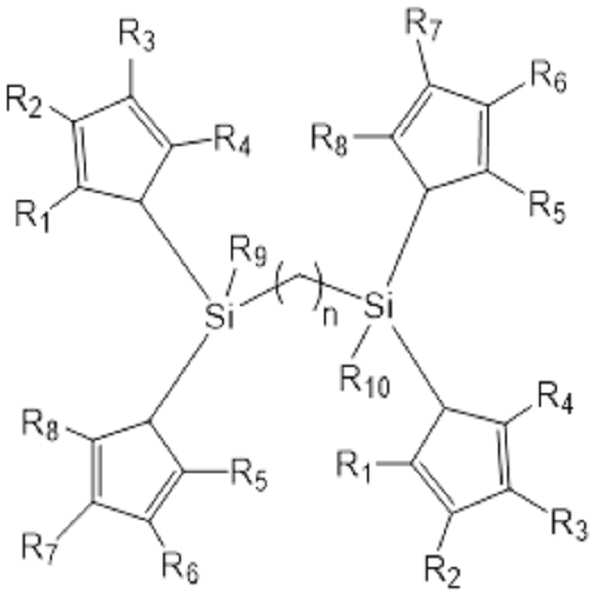
상기 목적을 달성하기 위한 본 발명의 일 측면은, 하기 화학식 1로 표시되는 바이메탈 메탈로센 화합물을 제공한다:According to one aspect of the present invention, there is provided a bimetallic metallocene compound represented by the following general formula (1): < EMI ID =
[화학식 1][Chemical Formula 1]

상기 화학식 1에서,In Formula 1,
M은 4족 전이금속이고; M is a Group 4 transition metal;
X1 및 X2는 서로 동일하거나 상이하고, 각각 독립적으로 할로겐 또는 탄소수 1 내지 20의 알킬이고;X 1 and X 2 are the same or different and are each independently halogen or alkyl of 1 to 20 carbon atoms;
R1 내지 R8은 서로 같거나 다를 수 있으며, 각각 독립적으로 수소, 탄소수 1 내지 20의 알킬, 탄소수 2 내지 20의 알케닐, 탄소수 6 내지 20의 아릴, 탄소수 7 내지 20의 알킬아릴, 또는 탄소수 7 내지 20의 아릴알킬이고, 상기 R1 내지 R8 중 인접하는 2개가 서로 연결되어 1개 이상의 지방족 고리, 또는 방향족 고리를 형성할 수 있고; R 1 to R 8 may be the same or different from each other and each independently represents hydrogen, an alkyl having 1 to 20 carbon atoms, an alkenyl having 2 to 20 carbon atoms, an aryl having 6 to 20 carbon atoms, an alkylaryl having 7 to 20 carbon atoms, 7 to 20, and two adjacent ones of R 1 to R 8 may be connected to each other to form at least one aliphatic ring or aromatic ring;
R9 및 R10은 서로 동일하거나 상이하고, 각각 독립적으로 수소, 탄소수 1 내지 20의 알킬, 또는 탄소수 1 내지 20의 알콕시이고;R 9 and R 10 are the same or different from each other, and are each independently hydrogen, alkyl of 1 to 20 carbon atoms, or alkoxy of 1 to 20 carbon atoms;
n은 1 내지 10의 정수이다.n is an integer of 1 to 10;
또한, 본 발명은 상기 바이메탈 메탈로센 화합물을 제조하는 방법을 제공한다.The present invention also provides a method for preparing the bimetallic metallocene compound.
또한, 본 발명은 상기 바이메탈 메탈로센 화합물을 포함하는 촉매 조성물을 제공한다.The present invention also provides a catalyst composition comprising the bimetallic metallocene compound.
또한, 본 발명은 상기 촉매 조성물의 존재 하에, 1종 이상의 올레핀계 단량체를 중합시키는 단계를 포함하는 폴리올레핀의 제조방법을 제공한다.The present invention also provides a process for preparing a polyolefin comprising polymerizing at least one olefinic monomer in the presence of the catalyst composition.
본 발명에 따른 바이메탈 메탈로센 화합물은 신규한 구조의 바이메탈성 메탈로센 화합물이며, 장쇄 분지(long chain branch, LCB)의 함량이 높은 폴리올레핀을 중합할 수 있다. The bimetallic metallocene compound according to the present invention is a bimetallic metallocene compound having a novel structure and can polymerize a polyolefin having a long chain branch (LCB) content.
또한, 본 발명은 상기 바이메탈 메탈로센 촉매를 포함하는 촉매 조성물을 이용하여 폴리올레핀 제조시 다른 균일계 촉매의 장점을 그대로 가지면서 높은 활성을 나타낼 수 있다. In addition, the present invention can exhibit high activity while maintaining the advantages of other homogeneous catalysts in the production of polyolefins by using the catalyst composition comprising the bimetallic metallocene catalyst.
또한, 본 발명의 촉매는 높은 LCB 함량을 갖고 생산성이 뛰어난 고품질의 폴리올레핀을 생산할 수 있다.In addition, the catalyst of the present invention can produce a high quality polyolefin having a high LCB content and excellent productivity.
본 발명에서, 제 1, 제 2 등의 용어는 다양한 구성요소들을 설명하는데 사용되며, 상기 용어들은 하나의 구성 요소를 다른 구성 요소로부터 구별하는 목적으로만 사용된다. In the present invention, the terms first, second, etc. are used to describe various components, and the terms are used only for the purpose of distinguishing one component from another.
또한, 본 명세서에서 사용되는 용어는 단지 예시적인 실시예들을 설명하기 위해 사용된 것으로, 본 발명을 한정하려는 의도는 아니다. 단수의 표현은 문맥상 명백하게 다르게 뜻하지 않는 한, 복수의 표현을 포함한다. 본 명세서에서, "포함하다", "구비하다" 또는 "가지다" 등의 용어는 실시된 특징, 숫자, 단계, 구성 요소 또는 이들을 조합한 것이 존재함을 지정하려는 것이지, 하나 또는 그 이상의 다른 특징들이나 숫자, 단계, 구성 요소, 또는 이들을 조합한 것들의 존재 또는 부가 가능성을 미리 배제하지 않는 것으로 이해되어야 한다.Moreover, the terminology used herein is for the purpose of describing exemplary embodiments only and is not intended to be limiting of the present invention. The singular expressions include plural expressions unless the context clearly dictates otherwise. In this specification, the terms "comprising," "comprising," or "having ", and the like are intended to specify the presence of stated features, But do not preclude the presence or addition of one or more other features, integers, steps, components, or combinations thereof.
본 발명은 다양한 변경을 가할 수 있고 여러 가지 형태를 가질 수 있는 바, 특정 실시예들을 예시하고 하기에서 상세하게 설명하고자 한다. 그러나, 이는 본 발명을 특정한 개시 형태에 대해 한정하려는 것이 아니며, 본 발명의 사상 및 기술 범위에 포함되는 모든 변경, 균등물 내지 대체물을 포함하는 것으로 이해되어야 한다.While the invention is susceptible to various modifications and alternative forms, specific embodiments thereof are shown by way of example in the drawings and will herein be described in detail. It should be understood, however, that the invention is not intended to be limited to the particular forms disclosed, but includes all modifications, equivalents, and alternatives falling within the spirit and scope of the invention.
이하에서 본 발명을 상세하게 설명한다.Hereinafter, the present invention will be described in detail.
본 발명의 일 구현예에 따르면, 하기 화학식 1로 표시되는 바이메탈 메탈로센 화합물을 제공한다.According to an embodiment of the present invention, there is provided a bimetallic metallocene compound represented by the following general formula (1).
[화학식 1] [Chemical Formula 1]
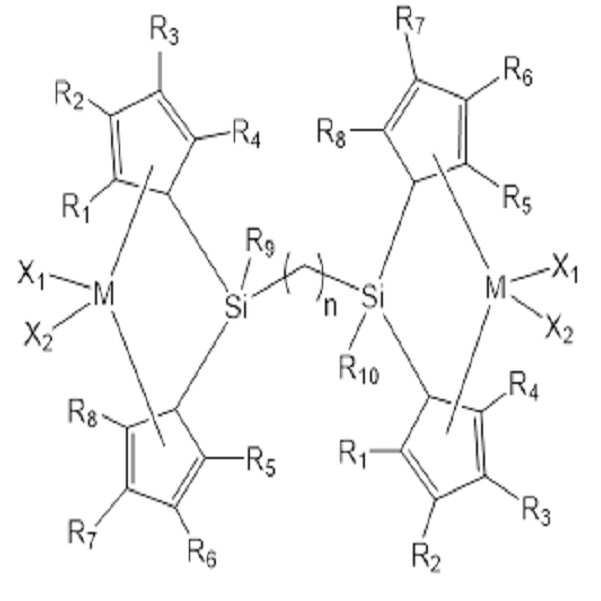
상기 화학식 1에서,In Formula 1,
M은 4족 전이금속이고; M is a Group 4 transition metal;
X1 및 X2는 서로 동일하거나 상이하고, 각각 독립적으로 할로겐 또는 탄소수 1 내지 20의 알킬이고;X 1 and X 2 are the same or different and are each independently halogen or alkyl of 1 to 20 carbon atoms;
R1 내지 R8은 서로 같거나 다를 수 있으며, 각각 독립적으로 수소, 탄소수 1 내지 20의 알킬, 탄소수 2 내지 20의 알케닐, 탄소수 6 내지 20의 아릴, 탄소수 7 내지 20의 알킬아릴, 또는 탄소수 7 내지 20의 아릴알킬이고, 상기 R1 내지 R8 중 인접하는 2개가 서로 연결되어 1개 이상의 지방족 고리, 또는 방향족 고리를 형성할 수 있고; R 1 to R 8 may be the same or different from each other and each independently represents hydrogen, an alkyl having 1 to 20 carbon atoms, an alkenyl having 2 to 20 carbon atoms, an aryl having 6 to 20 carbon atoms, an alkylaryl having 7 to 20 carbon atoms, 7 to 20, and two adjacent ones of R 1 to R 8 may be connected to each other to form at least one aliphatic ring or aromatic ring;
R9 및 R10은 서로 동일하거나 상이하고, 각각 독립적으로 수소, 탄소수 1 내지 20의 알킬, 또는 탄소수 1 내지 20의 알콕시이고;R 9 and R 10 are the same or different from each other, and are each independently hydrogen, alkyl of 1 to 20 carbon atoms, or alkoxy of 1 to 20 carbon atoms;
n은 1 내지 10의 정수이다.n is an integer of 1 to 10;
본 명세서에서 특별한 제한이 없는 한 다음 용어는 하기와 같이 정의될 수 있다. Unless defined otherwise herein, the following terms may be defined as follows.
할로겐(halogen)은 불소(F), 염소(Cl), 브롬(Br) 또는 요오드(I)일 수 있다.The halogen may be fluorine (F), chlorine (Cl), bromine (Br) or iodine (I).
탄소수 1 내지 20의 알킬은 직쇄, 분지쇄 또는 고리형 알킬일 수 있다. 구체적으로, 탄소수 1 내지 20의 알킬은 탄소수 1 내지 20의 직쇄 알킬; 탄소수 1 내지 10의 직쇄 알킬; 탄소수 1 내지 5의 직쇄 알킬; 탄소수 3 내지 20의 분지쇄 또는 고리형 알킬; 탄소수 3 내지 15의 분지쇄 또는 고리형 알킬; 또는 탄소수 3 내지 10의 분지쇄 또는 고리형 알킬일 수 있다. 보다 구체적으로, 탄소수 1 내지 20의 알킬은 메틸기, 에틸기, n-프로필기, iso-프로필기, n-부틸기, iso-부틸기, tert-부틸기, n-펜틸기, iso-펜틸기 또는 사이클로헥실기 등일 수 있다.The alkyl having 1 to 20 carbon atoms may be straight chain, branched chain or cyclic alkyl. Specifically, alkyl of 1 to 20 carbon atoms is straight chain alkyl of 1 to 20 carbon atoms; Straight chain alkyl having 1 to 10 carbon atoms; Straight chain alkyl of 1 to 5 carbon atoms; Branched or cyclic alkyl having 3 to 20 carbon atoms; Branched or cyclic alkyl having 3 to 15 carbon atoms; Or branched or cyclic alkyl having 3 to 10 carbon atoms. More specifically, the alkyl having 1 to 20 carbon atoms is preferably a methyl group, ethyl group, n-propyl group, isopropyl group, n-butyl group, isobutyl group, Cyclohexyl group and the like.
탄소수 2 내지 20의 알케닐은 직쇄, 분지쇄 또는 고리형 알케닐일 수 있다. 구체적으로, 탄소수 2 내지 20의 알케닐은 탄소수 2 내지 20의 직쇄 알케닐, 탄소수 2 내지 10의 직쇄 알케닐, 탄소수 2 내지 5의 직쇄 알케닐, 탄소수 3 내지 20의 분지쇄 알케닐, 탄소수 3 내지 15의 분지쇄 알케닐, 탄소수 3 내지 10의 분지쇄 알케닐, 탄소수 5 내지 20의 고리형 알케닐 또는 탄소수 5 내지 10의 고리형 알케닐일 수 있다. 보다 구체적으로, 탄소수 2 내지 20의 알케닐은 에테닐, 프로페닐, 부테닐, 펜테닐 또는 사이클로헥세닐 등일 수 있다.The alkenyl having 2 to 20 carbon atoms may be straight-chain, branched-chain or cyclic alkenyl. Specific examples of the alkenyl having 2 to 20 carbon atoms include straight chain alkenyl having 2 to 20 carbon atoms, straight chain alkenyl having 2 to 10 carbon atoms, straight chain alkenyl having 2 to 5 carbon atoms, branched alkenyl having 3 to 20 carbon atoms, Branched chain alkenyl having 3 to 10 carbon atoms, cyclic alkenyl having 5 to 20 carbon atoms, or cyclic alkenyl having 5 to 10 carbon atoms. More specifically, the alkenyl having 2 to 20 carbon atoms can be ethenyl, propenyl, butenyl, pentenyl or cyclohexenyl, and the like.
탄소수 7 내지 20의 아릴은 모노사이클릭, 바이사이클릭 또는 트라이사이클릭 방향족 탄화수소를 의미할 수 있다. 구체적으로, 탄소수 6 내지 20의 아릴은 페닐기, 나프틸기 또는 안트라세닐기 등일 수 있다.Aryl having 7 to 20 carbon atoms can mean monocyclic, bicyclic or tricyclic aromatic hydrocarbons. Specifically, aryl having 6 to 20 carbon atoms may be a phenyl group, a naphthyl group, or an anthracenyl group.
탄소수 7 내지 20의 알킬아릴은 아릴의 1 이상의 수소가 알킬에 의하여 치환된 치환기를 의미할 수 있다. 구체적으로, 탄소수 7 내지 20의 알킬아릴은 메틸페닐, 에틸페닐, n-프로필페닐, iso-프로필페닐, n-부틸페닐, iso-부틸페닐, tert-부틸페닐 또는 사이클로헥실페닐 등일 수 있다. Alkylaryl having 7 to 20 carbon atoms may mean a substituent wherein at least one hydrogen of the aryl is substituted by alkyl. Specifically, the alkylaryl having 7 to 20 carbon atoms may be methylphenyl, ethylphenyl, n-propylphenyl, isopropylphenyl, n-butylphenyl, iso-butylphenyl, tert-butylphenyl or cyclohexylphenyl.
탄소수 7 내지 20의 아릴알킬은 알킬의 1 이상의 수소가 아릴에 의하여 치환된 치환기를 의미할 수 있다. 구체적으로, 탄소수 7 내지 20의 아릴알킬은 벤질기, 페닐프로필 또는 페닐헥실 등일 수 있다.Arylalkyl having 7 to 20 carbon atoms can mean a substituent wherein at least one of the hydrogens of the alkyl is replaced by an aryl. Specifically, arylalkyl having 7 to 20 carbon atoms may be a benzyl group, phenylpropyl or phenylhexyl.
본 발명에서 상기 화학식 1의 바이메탈 메탈로센 화합물은, 전이 금속이 배위된 사이클로펜타디엔(Cp)계 리간드로 이루어진 단일 메탈로센 화합물 두 개가, 화학식 -Si(R9)-(CH2)n-Si(R10)-의 알킬렌 디실릴기(alkylene disilyl)로 결합되어 있는 구조의 화합물이다. 따라서, 상기 화학식 1의 바이메탈 메탈로센 화합물은, 두 개의 전이 금속 활성점이 적절한 거리에 위치하여, 한 활성점에서 생성된 vinyl-terminated macromer의 혼입이 용이하다. 또한, 각각의 메탈로센 화합물 사이에 실리콘 링커(Si linker)로 일정한 간격을 부여함으로써 두 개의 금속 간의 불필요한 상호 작용을 줄여 안정적인 촉매 활성을 나타낼 수 있다. In the present invention, the bimetallic metallocene compound represented by the above formula (1) is a bimetallic metallocene compound represented by the formula: -Si (R 9 ) - (CH 2 ) n -Si (R 10 ) - alkylene disilyl. Therefore, in the bimetallic metallocene compound of Formula 1, two transition metal active sites are located at appropriate distances, and it is easy to incorporate the vinyl-terminated macromer formed at one active site. In addition, by providing a silicon linker between the respective metallocene compounds at a constant interval, unnecessary interactions between the two metals can be reduced and stable catalytic activity can be exhibited.
이에 따라, 높은 LCB 함량을 갖고 생산성이 뛰어난 고품질의 폴리올레핀을 중합할 수 있다. 상기 LCB (long chain branch)는, 폴리올레핀의 주 사슬에 붙어 있는 탄소수 6개 이상의 곁가지로, 폴리올레핀 중합 공정시 사용하는 공단량체에 의해 만들어지거나, 에틸렌 중합 과정에서 생성된 중간체인, 말단에 vinyl기를 갖는 macromer로부터 만들어질 수 있다. Accordingly, High-quality polyolefins having high LCB content and excellent productivity can be polymerized. The LCB (long chain branch) is a branched side chain having 6 or more carbon atoms attached to the main chain of the polyolefin, and is produced by a comonomer used in the polyolefin polymerization process or an intermediate produced in the ethylene polymerization process, It can be made from macromer.
상기 LCB의 함량은 탄소수 6개 미만의 곁가지인 SCB (short chain branch) 보다 고분자의 물성에 더 큰 영향을 미칠 수 있다. 상기 LCB의 함량은 통상의 NMR 또는 FT-IR로는 명확한 측정이 어려우며, 고분자의 유변학적 거동을 이용하여 LCB 함량을 측정하여 비교할 수 있다. The LCB content may have a greater effect on the physical properties of the polymer than the short chain branch (SCB) having less than 6 carbon atoms. The content of the LCB can not be clearly measured by conventional NMR or FT-IR, and the LCB content can be measured and compared using the rheological behavior of the polymer.
예를 들어, 폴리올레핀이 LCB를 포함하는 경우, ARES(advanced rheometric expansion system)를 이용하여 측정하여 분석한 Van Gurp-Palmen plot에서 변곡점이 생기는데, 이러한 변곡점의 위치를 수치화한 plateau delta값(plateau 구간에서의 평균값)이다. 폴리올레핀 내 LCB 함량이 많을수록 변곡점이 아래에 위치하여 plateau delta이 작은 값을 나타낸다. For example, when a polyolefin contains LCB, an inflection point occurs in the Van Gurp-Palmen plot, which is measured and analyzed using ARES (advanced rheometric expansion system). The plateau delta value obtained by quantifying the position of the inflection point . The higher the LCB content in the polyolefin, the lower the inflection point and the smaller the plateau delta.
본 발명의 일 실시예에 따르면, 상기 화학식 1의 바이메탈 메탈로센 화합물에서, 상기 R1 내지 R8은 각각 독립적으로 수소, 탄소수 1 내지 20의 알킬기, 또는 탄소수 2 내지 20의 알케닐기이거나, 상기 R1 내지 R8 중 인접하는 2개가 서로 연결되어 1개 이상의 지방족 고리, 또는 방향족 고리를 형성할 수 있다. According to an embodiment of the present invention, in the bimetallic metallocene compound of Formula 1, each of R 1 to R 8 is independently hydrogen, an alkyl group having 1 to 20 carbon atoms, or an alkenyl group having 2 to 20 carbon atoms, Two adjacent ones of R 1 to R 8 may be connected to each other to form at least one aliphatic ring or aromatic ring.
바람직하게는, 상기 R1 내지 R8 중 서로 인접하는 2개가 서로 연결되어 지방족 고리, 또는 방향족 고리를 형성함으로써, 사이클로펜타디에닐기와 축합된 화합물, 예를 들어 치환되거나 치환되지 않은 인데닐, 4,5,6,7-테트라하이드로-1-인데닐, 또는 플루오레닐 등을 형성하고, 나머지 치환기는 각각 독립적으로 수소 또는 메틸일 수 있다. Preferably, two of the above-mentioned R 1 to R 8 are connected to each other to form an aliphatic ring or an aromatic ring, whereby a compound condensed with a cyclopentadienyl group such as a substituted or unsubstituted indenyl, 4 , 5,6,7-tetrahydro-1-indenyl, or fluorenyl, and the remaining substituents may each independently be hydrogen or methyl.
또한 바람직하게는, R9 및 R10은 각각 독립적으로 탄소수 1 내지 10의 알킬, 보다 바람직하게는 메틸 또는 에틸일 수 있다.Also preferably, R 9 and R 10 are each independently alkyl having 1 to 10 carbon atoms, more preferably methyl or ethyl.
또한 바람직하게는, M은 지르코늄(Zr)이고, X1 및 X2는 Cl일 수 있다.Also preferably, M is zirconium (Zr), and X 1 and X 2 may be Cl.
또한 바람직하게는, n은 2 내지 6의 정수, 보다 바람직하게는 2 내지 4의 정수일 수 있다. Also preferably, n may be an integer of 2 to 6, more preferably an integer of 2 to 4.
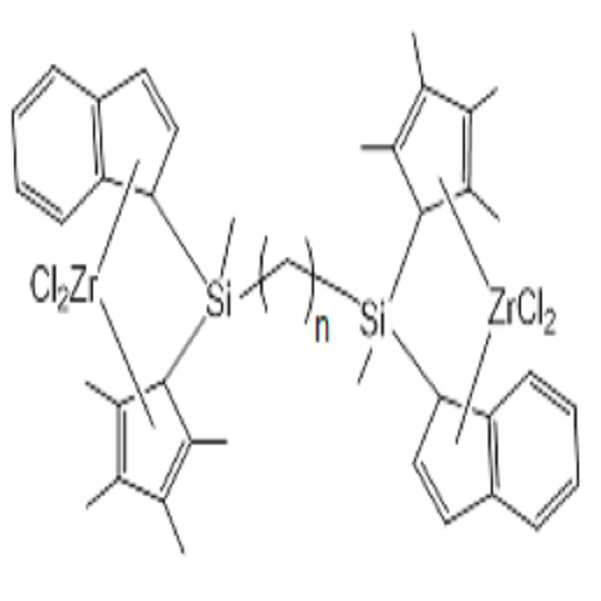
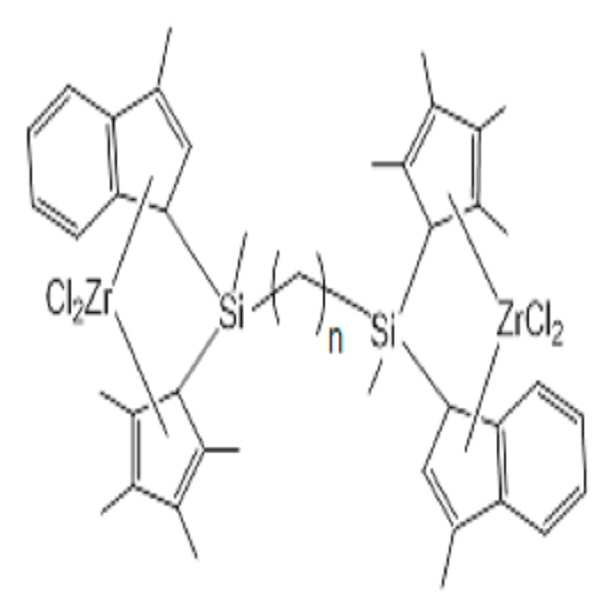
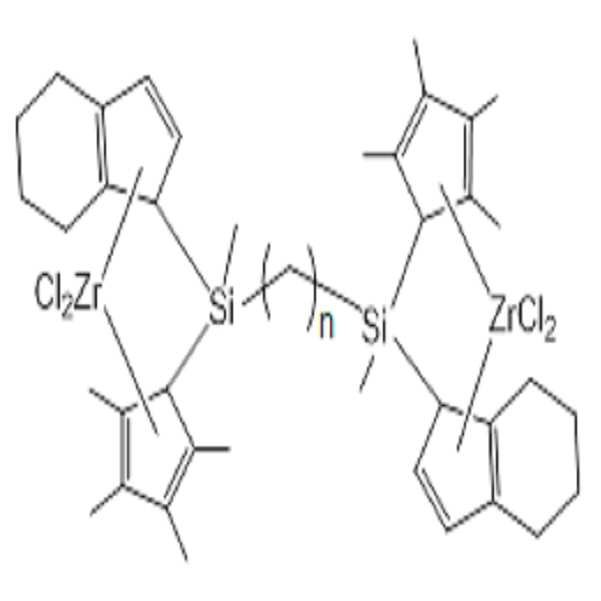
상기 화학식 1의 바이메탈 메탈로센 화합물은 하기 화학식 1a 내지 1d의 구조식들 중 하나로 표시될 수 있으나, 본 발명이 이에 제한되는 것은 아니다:The bimetallic metallocene compound of formula (1) may be represented by one of the following structural formulas (1a) to (1d), but the present invention is not limited thereto.
[화학식 1a][Formula 1a]
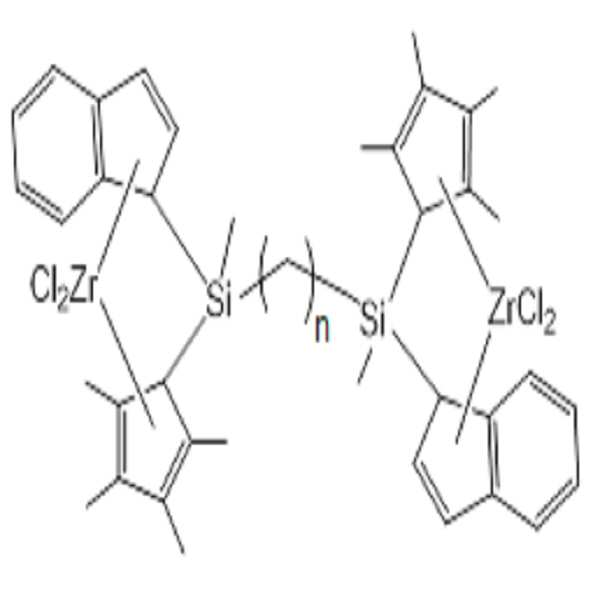
[화학식 1b][Chemical Formula 1b]

[화학식 1c][Chemical Formula 1c]
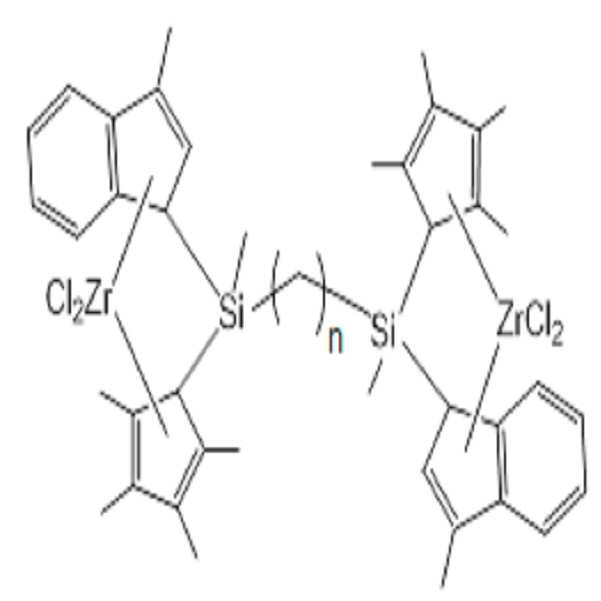
[화학식 1d]≪ RTI ID = 0.0 &

상기 화학식 1a 내지 1d에서, n은 1 내지 10의 정수이고, 바람직하게는, 2 내지 6의 정수, 보다 바람직하게는 2 내지 4의 정수이다.In the above formulas (1a) to (1d), n is an integer of 1 to 10, preferably an integer of 2 to 6, more preferably an integer of 2 to 4.
본 발명의 다른 일 구현예에 따르면, 하기 화학식 2의 리간드 화합물과, 하기 화학식 2-1의 화합물을 반응시켜 화학식 1의 화합물을 제조하는 단계를 포함하는, 하기 화학식 1로 표시되는 바이메탈 메탈로센 화합물의 제조방법을 제공한다.According to another embodiment of the present invention, there is provided a process for producing a bimetallic metallocene represented by the following formula (1), comprising the step of reacting a ligand compound of the following formula (2) with a compound of the following formula A method for producing the compound is provided.
[화학식 1] [Chemical Formula 1]
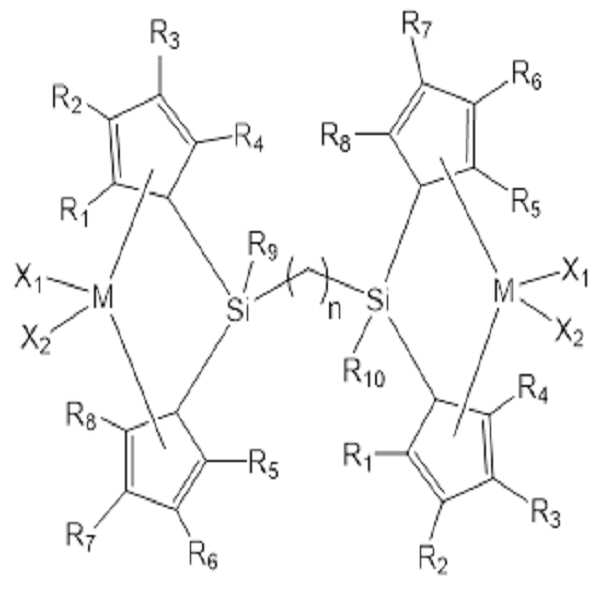
[화학식 2] (2)

[화학식 2-1][Formula 2-1]

상기 화학식 1, 2, 및 2-1에서, M, X1, X2, R1 내지 R10, 및 n은 상기 화학식 1에서 정의한 바와 같다.Wherein M, X 1 , X 2 , R 1 to R 10 , and n are as defined in Formula 1 above.
상기 화학식 2의 화합물과 화학식 2-1의 화합물을 반응시키는 단계에서 반응 온도는 약 -200 내지 약 0℃, 보다 바람직하게는 약 -150 내지 약 0℃일 수 있다. 또한, 용매로는 톨루엔, 에테르, THF, MTBE, 또는 헥산 등을 사용할 수 있다. 또한, 생성물에서 유기층을 분리한 후, 분리된 유기층을 진공 건조하고 과량의 반응물을 제거하는 단계를 더 수행할 수 있다.In the step of reacting the compound of Formula 2 with the compound of Formula 2-1, the reaction temperature may be about -200 to about 0 ° C, more preferably about -150 to about 0 ° C. As the solvent, toluene, ether, THF, MTBE, hexane and the like can be used. Further, after the organic layer is separated from the product, the separated organic layer may be vacuum dried and excess reactant may be removed.
한편, 상기 화학식 2의 리간드 화합물은, 하기 화학식 1-1의 화합물 또는 이의 리튬염을 하기 화학식 1-2와 반응시켜 하기 화학식 1-3의 화합물을 제조하는 단계, 및 하기 1-3의 화합물을 하기 화학식 1-4의 화합물 또는 이의 리튬염과 반응시켜 상기 화학식 2의 화합물을 제조하는 단계로 제조할 수 있으나, 본 발명이 이에 한정되는 것은 아니다. The ligand compound of Formula 2 may be prepared by reacting a compound of Formula 1-1 or a lithium salt thereof with a compound of Formula 1-2 below to prepare a compound of Formula 1-3, May be prepared by reacting a compound of the following general formula (1-4) or a lithium salt thereof to prepare a compound of the general formula (2), but the present invention is not limited thereto.
[화학식 1-1][Formula 1-1]

[화학식 1-2][Formula 1-2]

[화학식 1-3][Formula 1-3]

[화학식 1-4][Formula 1-4]
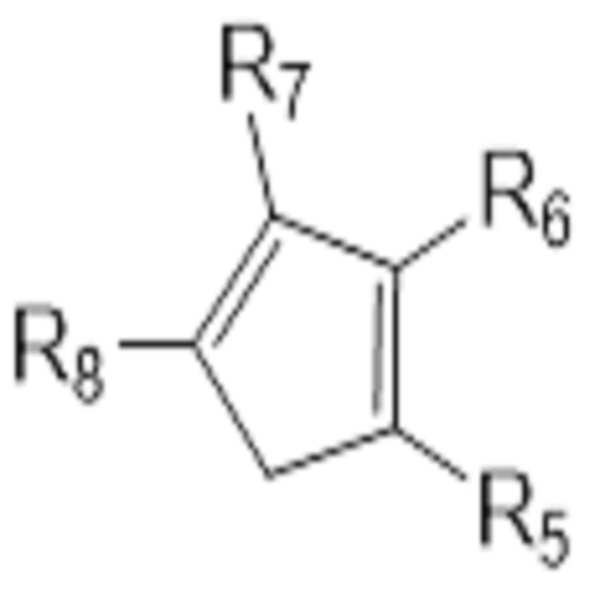
상기 화학식 1-1 내지 1-4에서, R1 내지 R10, 및 n은 상기 화학식 1에서 정의한 바와 같다. In Formulas 1-1 to 1-4, R 1 to R 10 , and n are the same as defined in Formula 1.
상기 1-3의 화합물을 제조하는 단계 및 상기 화학식 2의 화합물을 제조하는 단계에서, 반응 온도는 약 -200 내지 약 0℃, 보다 바람직하게는 약 -150 내지 약 0℃일 수 있다. 또한, 용매로는 톨루엔, 에테르, THF, 또는 헥산 등을 사용할 수 있다.In the step of preparing the compounds 1-3 and the step of preparing the compound of the formula 2, the reaction temperature may be about -200 to about 0 캜, more preferably about -150 to about 0 캜. As the solvent, toluene, ether, THF, hexane and the like can be used.
상기 화학식 1-1의 화합물 및 화학식 1-4의 화합물은 알킬리튬, 예를 들어, n-부틸리튬(n-BuLi)과 반응시켜 리튬염의 형태로 반응시킬 수 있다.The compound of Formula 1-1 and the compound of Formula 1-4 may be reacted with an alkyllithium such as n-butyllithium (n-BuLi) in the form of a lithium salt.
화학식 1의 바이메탈 메탈로센 화합물의 제조를 위한 기타 세부적인 반응은 이 기술 분야에 잘 알려진 통상의 유기 합성 방법을 사용할 수 있으므로, 그 조건이 특별히 한정되지 않으며, 후술하는 실시예에서 보다 구체화하여 설명한다. Other detailed reactions for the production of the bimetallic metallocene compound of formula (1) can be carried out using conventional organic synthesis methods well known in the art, and therefore the conditions are not particularly limited, do.
이러한 방법으로 제조된 화학식 1의 바이메탈 메탈로센 화합물은 신규한 구조를 가지며, 이에 포함된 두 개의 단일 메탈로센 화합물은 각각 사이클로펜타디에닐 또는 그 유도체 골격과 활성점인 전이 금속을 포함하며, 상기 두 개의 단일 메탈로센 화합물이 실리콘 링커를 중심으로 일정한 간격을 이루어 연결된 형태를 가진다. 이에, 실리콘 링커가 금속 사이의 불필요한 상호 작용을 줄이면서도 안정적인 바이메탈 메탈로센의 특성을 가지며 리간드 구조의 변형이 용이하고, 알파 올레핀 및 vinyl terminated macromer에 대한 접근성이 좋아 높은 LCB 함량을 갖는 폴리올레핀을 중합하는데 유용하게 사용될 수 있다.The bimetallic metallocene compound of formula (I) prepared by this method has a novel structure, and the two single metallocene compounds contained therein include cyclopentadienyl or a derivative skeleton thereof and a transition metal as an active site, The two single metallocene compounds are connected at regular intervals around the silicon linker. Thus, the silicone linker has a stable bimetallic metallocene characteristic while reducing unwanted interactions between metals, facilitates the modification of the ligand structure, has good accessibility to alpha olefins and vinyl terminated macromers, and can polymerize polyolefins having a high LCB content Can be used effectively.
이에 따라, 본 발명의 화학식 1의 바이메탈 메탈로센 화합물은, 높은 LCB 함량을 갖는 폴리올레핀을 중합할 수 있다.Accordingly, the bimetallic metallocene compound of Formula 1 of the present invention can polymerize a polyolefin having a high LCB content.
본 발명의 다른 일 구현예에 따르면, 상기 화학식 1의 바이메탈 메탈로센 화합물과 조촉매를 포함하는 촉매 조성물을 제공한다. 본 발명에서 촉매 조성물이라 함은 상기 화학식 1의 바이메탈 메탈로센 화합물 및 조촉매 성분이 동시에 또는 임의의 순서로 순차적으로, 임의의 적합한 용매의 존재 또는 부존재 하에서, 단량체의 존재 또는 부재 하에 함께 첨가되어 활성이 있는 조성물로 수득될 수 있는 상태의 것을 의미한다. According to another embodiment of the present invention, there is provided a catalyst composition comprising a bimetallic metallocene compound of Formula 1 and a cocatalyst. In the present invention, the term "catalyst composition" means that the bimetallic metallocene compound and the cocatalyst component of the above formula (1) are added simultaneously or in any order in the presence or absence of any suitable solvent, together with or without a monomer Quot; means a state that can be obtained with a composition having activity.
상기 촉매 조성물은 담체에 담지하지 않고 사용될 수 있으며, 또는 필요에 따라 담체에 담지되어 사용될 수도 있다.The catalyst composition may be used without being supported on the support, or may be supported on a support as required.
이러한 조촉매는 13족 금속을 포함하는 유기 금속 화합물로서, 일반적인 메탈로센 촉매 하에 올레핀을 중합할 때 사용될 수 있는 것이라면 특별히 한정되는 것은 아니다.Such a promoter is an organometallic compound containing a Group 13 metal, and is not particularly limited as long as it can be used in the polymerization of an olefin under a general metallocene catalyst.
바람직하게, 상기 조촉매는 하기 화학식 3, 화학식 4 및 화학식 5로 표시되는 화합물들로 이루어진 군에서 선택된 1종 이상을 사용할 수 있다.Preferably, the cocatalyst may be at least one selected from the group consisting of compounds represented by the following formulas (3), (4) and (5).
[화학식 3](3)
-[Al(R11)-O]c- - [Al (R 11) -O ] c-
상기 화학식 3에서, In Formula 3,
R11은 서로 동일하거나 상이하고, 각각 독립적으로 할로겐 라디칼, 탄소수 1 내지 20의 하이드로카빌 라디칼, 또는 할로겐으로 치환된 탄소수 1 내지 20의 하이드로카빌 라디칼이고, c는 2 이상의 정수이며,R 11 are the same or different from each other and each independently represents a halogen radical, a hydrocarbyl radical having 1 to 20 carbon atoms, or a hydrocarbyl radical having 1 to 20 carbon atoms substituted with halogen, c is an integer of 2 or more,
[화학식 4][Chemical Formula 4]
D(R12)3 D (R 12) 3
상기 화학식 4에서,In Formula 4,
D는 알루미늄 또는 보론이고, R12는 탄소수 1 내지 20의 하이드로카빌 또는 할로겐으로 치환된 탄소수 1 내지 20의 하이드로카빌이고,D is aluminum or boron, R < 12 > is hydrocarbyl having 1 to 20 carbon atoms or hydrocarbyl having 1 to 20 carbon atoms substituted with halogen,
[화학식 5][Chemical Formula 5]
[L-H]+[ZA4]- 또는 [L]+[ZA4]- [LH] + [ZA 4 ] - or [L] + [ZA 4 ] -
상기 화학식 5에서,In Formula 5,
L은 중성 또는 양이온성 루이스 염기이고, H는 수소 원자이며, Z는 13족 원소이고, A는 서로 동일하거나 다를 수 있으며, 각각 독립적으로 1 이상의 수소 원자가 할로겐, 탄소수 1 내지 20의 탄화수소, 알콕시 또는 페녹시로 치환 또는 비치환된 탄소수 6 내지 20의 아릴기 또는 탄소수 1 내지 20의 알킬기이다.L is a neutral or cationic Lewis base, H is a hydrogen atom, Z is a Group 13 element, A can be the same or different from each other, and each independently at least one hydrogen atom is replaced by halogen, a hydrocarbon having 1 to 20 carbon atoms, An aryl group having 6 to 20 carbon atoms or an alkyl group having 1 to 20 carbon atoms which is substituted or unsubstituted with phenoxy.
상기 화학식 3으로 표시되는 화합물로는, 예를 들어 메틸알루미녹산(MAO), 에틸알루미녹산, 이소부틸알루미녹산, 부틸알루미녹산 등이 될 수 있다.Examples of the compound represented by Formula 3 include methylaluminoxane (MAO), ethylaluminoxane, isobutylaluminoxane, butylaluminoxane, and the like.
상기 화학식 4로 표시되는 알킬 금속 화합물로는, 예를 들어 트리메틸알루미늄, 트리에틸알루미늄, 트리이소부틸알루미늄, 트리프로필알루미늄, 트리부틸알루미늄, 디메틸클로로알루미늄, 디메틸이소부틸알루미늄, 디메틸에틸알루미늄, 디에틸클로로알루미늄, 트리이소프로필알루미늄, 트리-s-부틸알루미늄, 트리씨클로펜틸알루미늄, 트리펜틸알루미늄, 트리이소펜틸알루미늄, 트리헥실알루미늄, 에틸디메틸알루미늄, 메틸디에틸알루미늄, 트리페닐알루미늄, 트리-p-톨릴알루미늄, 디메틸알루미늄메톡시드, 디메틸알루미늄에톡시드, 트리메틸보론, 트리에틸보론, 트리이소부틸보론, 트리프로필보론, 트리부틸보론 등일 수 있다.Examples of the alkyl metal compound represented by the general formula (4) include trimethylaluminum, triethylaluminum, triisobutylaluminum, tripropylaluminum, tributylaluminum, dimethylchloroaluminum, dimethylisobutylaluminum, dimethylethylaluminum, diethyl Tri-n-butylaluminum, tri-n-butylaluminum, tri-n-butylaluminum, tri-n-butylaluminum, Dimethylaluminum ethoxide, trimethylboron, triethylboron, triisobutylboron, tripropylboron, tributylboron, and the like can be used.
상기 화학식 5로 표시되는 화합물로는, 예를 들어 트리에틸암모니움테트라페닐보론, 트리부틸암모니움테트라페닐보론, 트리메틸암모니움테트라페닐보론, 트리프로필암모니움테트라페닐보론, 트리메틸암모니움테트라(p-톨릴)보론, 트리프로필암모니움테트라(p-톨릴)보론, 트리에틸암모니움테트라(o,p-디메틸페닐)보론, 트리메틸암모니움테트라(o,p-디메틸페닐)보론, 트리부틸암모니움테트라(p-트리플루오로메틸페닐)보론, 트리메틸암모니움테트라(p-트리플로로메틸페닐)보론, 트리부틸암모니움테트라펜타플루오로페닐보론, N,N-디에틸아닐리니움테트라페닐보론, N,N-디에틸아닐리니움테트라페닐보론, N,N-디에틸아닐리니움테트라펜타플루오로페닐보론, 디에틸암모니움테트라펜타플루오로페닐보론, 트리페닐포스포늄테트라페닐보론, 트리메틸포스포늄테트라페닐보론, 트리에틸암모니움테트라페닐알루미늄, 트리부틸암모니움테트라페닐알루미늄, 트리메틸암모니움테트라페닐알루미늄, 트리프로필암모니움테트라페닐알루미늄, 트리메틸암모니움테트라(p-톨릴)알루미늄, 트리프로필암모니움테트라(p-톨릴)알루미늄, 트리에틸암모니움테트라(o,p-디메틸페닐)알루미늄, 트리부틸암모니움테트라(p-트리플루오로메틸페닐)알루미늄, 트리메틸암모니움테트라(p-트리플루오로메틸페닐)알루미늄,트리부틸암모니움테트라펜타플루오로페닐알루미늄, N,N-디에틸아닐리니움테트라페닐알루미늄, N,N-디에틸아닐리니움테트라페닐알루미늄, N,N-디에틸아닐리니움테트라펜타플로로페닐알루미늄, 디에틸암모니움테트라펜타플루오로페닐알루미늄, 트리페닐포스포늄테트라페닐알루미늄, 트리메틸포스포늄테트라페닐알루미늄, 트리페닐카보니움테트라페닐보론, 트리페닐카보니움테트라페닐알루미늄, 트리페닐카보니움테트라(p-트리플로로메틸페닐)보론, 트리페닐카보니움테트라펜타플루오로페닐보론 등일 수 있다.Examples of the compound represented by Formula 5 include triethylammonium tetraphenylboron, tributylammonium tetraphenylboron, trimethylammonium tetraphenylboron, tripropylammonium tetraphenylboron, trimethylammonium tetra (p (O, p-dimethylphenyl) boron, triethylammoniumtetra (o, p-dimethylphenyl) boron, trimethylammoniumtetra (P-trifluoromethylphenyl) boron, tetra (p-trifluoromethylphenyl) boron, trimethylammoniumtetra (p -trifluoromethylphenyl) boron, tributylammonium tetrapentafluorophenylboron, N, N-diethylanilinium tetraphenylboron, N , N-diethylanilinium tetraphenylboron, N, N-diethylanilinium tetrapentafluorophenylboron, diethylammonium tetrapentafluorophenylboron, triphenylphosphonium tetraphenylboron, trimethylphosphor Tetramethylammonium tetraphenyl aluminum, trimethylammonium tetraphenyl aluminum, trimethylammonium tetraphenyl aluminum, tributylammonium tetraphenyl aluminum, trimethylammonium tetraphenyl aluminum, tripropylammonium tetraphenyl aluminum, trimethylammonium tetra (aluminum) (P-tolyl) aluminum, triethylammoniumtetra (o, p-dimethylphenyl) aluminum, tributylammoniumtetra (ptrifluoromethylphenyl) aluminum, trimethylammoniumtetra (ptrifluoromethylphenyl) Aluminum, tributylammonium tetrapentafluorophenyl aluminum, N, N-diethylanilinium tetraphenyl aluminum, N, N-diethylanilinium tetraphenyl aluminum, N, N-diethylanilinium tetrapenta Triphenyl aluminum, diethyl ammonium aluminum tetrapentafluorophenyl aluminum, triphenyl phosphonium tetraphenyl aluminum, trimethyl phosphonium tetraphenyl (P-trifluoromethylphenyl) boron, triphenylcarbonium tetrapentafluorophenylboron, and the like can be used in the present invention. have.
본 발명에 따른 촉매 조성물은, 첫 번째 방법으로서 1) 상기 화학식 1로 표시되는 바이메탈 메탈로센 화합물과 상기 화학식 3 또는 화학식 4로 표시되는 화합물을 접촉시켜 혼합물을 얻는 단계; 및 2) 상기 혼합물에 상기 화학식 5로 표시되는 화합물을 첨가하는 단계를 포함하는 방법으로 제조될 수 있다.The first aspect of the present invention provides a catalyst composition comprising: 1) contacting a bimetallic metallocene compound represented by Formula 1 with a compound represented by Formula 3 or Formula 4 to obtain a mixture; And 2) adding the compound represented by Formula 5 to the mixture.
또한, 본 발명에 따른 촉매 조성물은, 두 번째 방법으로서 상기 화학식 1로 표시되는 바이메탈 메탈로센 화합물과 상기 화학식 3으로 표시되는 화합물을 접촉시키는 방법으로 제조될 수 있다.The catalyst composition according to the present invention can be prepared by a method of contacting the bimetallic metallocene compound represented by Formula 1 and the compound represented by Formula 3 as a second method.
상기 촉매 조성물의 제조방법 중에서 첫 번째 방법의 경우에, 상기 화학식 1로 표시되는 바이메탈 메탈로센 화합물/상기 화학식 3 또는 화학식 4로 표시되는 화합물의 몰 비율은 1/5,000 ~ 1/2 이 바람직하고, 더욱 바람직하게는 1/1,000 ~ 1/10 이고, 가장 바람직하게는 1/500 ~ 1/20 이다. 상기 화학식 1로 표시되는 메탈로센 화합물/상기 화학식 3 또는 화학식 4로 표시되는 화합물의 몰 비율이 1/2을 초과하는 경우에는 알킬화제의 양이 매우 작아 금속 화합물의 알킬화가 완전히 진행되지 못하는 문제가 있고, 몰 비율이 1/5,000 미만인 경우에는 금속 화합물의 알킬화는 이루어지지만, 남아있는 과량의 알킬화제와 상기 화학식 5의 활성화제 간의 부반응으로 인하여 알킬화된 금속 화합물의 활성화가 완전히 이루어지지 못하는 문제가 있다.In the first method of the catalyst composition, the molar ratio of the bimetallic metallocene compound represented by Formula 1 to the compound represented by Formula 3 or Formula 4 is preferably 1 / 5,000 to 1/2, , More preferably from 1/1000 to 1/10, and most preferably from 1/500 to 1/20. When the molar ratio of the metallocene compound represented by the formula (1) / the compound represented by the formula (3) or the formula (4) is more than 1/2, the amount of the alkylating agent is so small that the alkylation of the metal compound can not proceed completely If the molar ratio is less than 1/5000, the alkylation of the metal compound is performed, but the alkylated metal compound is not fully activated due to the side reaction between the excess alkylating agent and the activating agent.
또한, 상기 화학식 1로 표시되는 바이메탈 메탈로센 화합물/상기 화학식 5로 표시되는 화합물의 몰 비율은 1/25 ~ 1이 바람직하고, 더욱 바람직하게는 1/10 ~ 1 이고, 가장 바람직하게는 1/5 ~ 1이다. 상기 화학식 1로 표시되는 바이메탈 메탈로센 화합물/상기 화학식 5로 표시되는 화합물의 몰 비율이 1을 초과하는 경우에는 활성화제의 양이 상대적으로 적어 금속 화합물의 활성화가 완전히 이루어지지 못해 생성되는 촉매 조성물의 활성도가 떨어지는 문제가 있고, 몰 비율이 1/25 미만인 경우에는 금속 화합물의 활성화가 완전히 이루어지지만, 남아 있는 과량의 활성화제로 촉매 조성물의 단가가 경제적이지 못하거나 생성되는 고분자의 순도가 떨어지는 문제가 있다.The molar ratio of the bimetallic metallocene compound represented by Formula 1 to the compound represented by Formula 5 is preferably 1/25 to 1, more preferably 1/10 to 1, and most preferably 1 / 5 ~ 1. When the molar ratio of the bimetallic metallocene compound represented by Formula 1 to the compound represented by Formula 5 is more than 1, the amount of the activator is relatively small, However, when the molar ratio is less than 1/25, the activation of the metal compound is completely performed. However, the problem is that the unit cost of the catalyst composition is not economical due to the excess activator remaining or the purity of the produced polymer is low have.
상기 촉매 조성물의 제조방법 중에서 두 번째 방법의 경우에, 상기 화학식 1로 표시되는 바이메탈 메탈로센 화합물/화학식 3으로 표시되는 화합물의 몰 비율은 1/10,000 ~ 1/10 이 바람직하며, 더욱 바람직하게는 1/5,000 ~ 1/100이고, 가장 바람직하게는 1/3,000 ~ 1/500이다. 상기 몰 비율이 1/10을 초과하는 경우에는 활성화제의 양이 상대적으로 적어 금속 화합물의 활성화가 완전히 이루어지지 못해 생성되는 촉매 조성물의 활성도가 떨어지는 문제가 있고, 1/10,000 미만인 경우에는 금속 화합물의 활성화가 완전히 이루어지지만, 남아 있는 과량의 활성화제로 촉매 조성물의 단가가 경제적이지 못하거나 생성되는 고분자의 순도가 떨어지는 문제가 있다.In the second method of preparing the catalyst composition, the molar ratio of the bimetallic metallocene compound represented by Formula 1 to the compound represented by Formula 3 is preferably 1 / 10,000 to 1/10, Is from 1/5000 to 1/100, and most preferably from 1/3,000 to 1/500. When the molar ratio exceeds 1/10, the amount of the activating agent is relatively small, and the activation of the metal compound is not completely achieved. Thus, there is a problem in that the activity of the catalyst composition is decreased. When the molar ratio is less than 1 / 10,000, Although the activation is completely performed, there is a problem that the unit cost of the catalyst composition is not economical due to the excess activator remaining or the purity of the produced polymer is low.
상기 촉매 조성물의 제조시에 반응 용매로서 펜탄, 헥산, 헵탄 등과 같은 탄화수소계 용매, 또는 벤젠, 톨루엔 등과 같은 방향족계 용매가 사용될 수 있다. 또한, 메탈로센 화합물과 조촉매 화합물은 실리카나 알루미나에 담지된 형태로도 이용할 수 있다.In the preparation of the catalyst composition, a hydrocarbon solvent such as pentane, hexane, heptane or the like, or an aromatic solvent such as benzene, toluene or the like may be used as a reaction solvent. In addition, the metallocene compound and the co-catalyst compound may be used in the form supported on silica or alumina.
또한, 본 발명의 다른 일 구현예에 따르면, 상기 촉매 조성물의 존재 하에서, 올레핀계 단량체를 중합시키는 단계를 포함하는 폴리올레핀의 제조방법을 제공한다.According to another embodiment of the present invention, there is provided a process for producing a polyolefin comprising polymerizing an olefin-based monomer in the presence of the catalyst composition.
본 발명에 따른 폴리올레핀의 제조방법에 있어서, 상기 올레핀계 단량체의 구체적인 예로는 에틸렌, 프로필렌, 1-부텐, 1-펜텐, 1-헥센, 4-메틸-1-펜텐, 1-옥텐, 1-데센, 1-도데센, 1-테트라데센, 1-헥사데센, 1-옥타데센, 1-에이코센 등이 있으며, 이들을 2종 이상 혼합하여 공중합할 수도 있다.In the process for producing a polyolefin according to the present invention, specific examples of the olefin monomer include ethylene, propylene, 1-butene, 1-pentene, 1-hexene, , 1-dodecene, 1-tetradecene, 1-hexadecene, 1-octadecene, 1-eicosene, and the like.
상기 폴리올레핀은 에틸렌 및 알파올레핀 공중합체인 것이 보다 바람직하나, 이에만 한정되는 것은 아니다. The polyolefin is more preferably an ethylene and alpha olefin copolymer, but is not limited thereto.
상기 폴리올레핀이 에틸렌과 알파올레핀 공중합체인 경우에 있어서, 상기 공단량체인 알파올레핀의 함량은 특별히 제한되는 것은 아니며, 폴리올레핀의 용도, 목적 등에 따라 적절하게 선택할 수 있다. 보다 구체적으로는 약 1 내지 약 40 중량%, 바람직하게는 약 10 내지 약 30 중량%일 수 있다. In the case where the polyolefin is a copolymer of ethylene and an alpha olefin, the content of the alpha-olefin as the comonomer is not particularly limited and may be appropriately selected depending on the use, purpose and the like of the polyolefin. More specifically from about 1 to about 40 weight percent, and preferably from about 10 to about 30 weight percent.
상기 중합 반응은 하나의 연속식 슬러리 중합 반응기, 루프 슬러리 반응기, 기상 반응기 또는 용액 반응기를 이용하여, 하나의 올레핀 단량체로 호모중합하거나 또는 2종 이상의 단량체로 공중합하여 진행할 수 있다.The polymerization reaction may be carried out by homopolymerization using one continuous slurry polymerization reactor, loop slurry reactor, gas phase reactor, or solution reactor, as an olefin monomer, or copolymerization with two or more monomers.
본 발명의 일 실시예에 따르면, 상기 폴리올레핀의 중합은 약 20 내지 약 110℃의 온도 및 약 20 내지 약 100 bar의 압력에서 약 10 분 내지 약 2 시간 동안 반응시켜 수행할 수 있다. 바람직하게는 약 80 내지 약 100℃의 온도 및 약 30 내지 약 60 bar의 압력에서 반응을 수행할 수 있다.According to one embodiment of the present invention, the polymerization of the polyolefin may be carried out by reacting at a temperature of about 20 to about 110 DEG C and a pressure of about 20 to about 100 bar for about 10 minutes to about 2 hours. Preferably at a temperature of about 80 to about 100 < 0 > C and a pressure of about 30 to about 60 bar.
이러한 본 발명의 제조 방법으로 제조된 상기 폴리올레핀은 중량 평균 분자량이 약 10,000 내지 약 300,000 g/mol이고, 바람직하게 약 50,000 내지 약 200,000 g/mol일 수 있다. 또한 상기 폴리올레핀의 분자량 분포(Mw/Mn)는 약 2 내지 약 8일 수 있다. The polyolefin produced by the process of the present invention may have a weight average molecular weight of about 10,000 to about 300,000 g / mol, and preferably about 50,000 to about 200,000 g / mol. The molecular weight distribution (Mw / Mn) of the polyolefin may be from about 2 to about 8.
이하, 발명의 구체적인 실시예를 통해, 발명의 작용 및 효과를 보다 상세히 상술하기로 한다. 다만, 이러한 실시예는 발명의 예시로 제시된 것에 불과하며, 이에 의해 발명의 권리범위가 정해지는 것은 아니다.Best Mode for Carrying Out the Invention Hereinafter, the function and effect of the present invention will be described in more detail through a specific embodiment of the present invention. It is to be understood, however, that these embodiments are merely illustrative of the invention and are not intended to limit the scope of the invention.
<실시예><Examples>
바이메탈 메탈로센 화합물의 합성Synthesis of Bimetallic Metallocene Compound
합성예 1Synthesis Example 1

TMCP (trimethyl cyclopentane)는 THF (0.3 M)에서 n-BuLi (1 당량)으로 Lithiation 후 필터하여 TMCP-Li salts로 준비하였다.TMCP (trimethyl cyclopentane) was prepared from TMCP-Li salts by filtering after THF (0.3 M) to n-BuLi (1 equivalent) after lithiation.
indene을 THF (0.5 M)에서 n-BuLi (1 당량)으로 Lithiation하고 헥센(hexane)으로 용매를 치환한 후에 필터하여 indene-Li salts로 준비하였다.indene was lithiated from THF (0.5 M) to n-BuLi (1 equivalent) and the solvent was replaced with hexane and then filtered to prepare indene-Li salts.
250 mL Schlenk flask에 아르곤(Ar) 하에서 TMCP-Li salts 50 mmol, THF 100 mL를 적가하고, -20℃에서 0.5 당량의 Cl2CH3Si(CH2)2SiCH3Cl2를 더하였다. 6시간 후 여기에 CuCN 3 mol%와 indene-Li salts (50 mmol, THF 1M solution)을 -20℃에서 더하고 12시간 동안 반응시켰다. 물층과, 헥센과 MTBE의 유기층으로 분리하여 리간드를 수득하였다. 50 mmol of TMCP-Li salts and 100 mL of THF were added dropwise to a 250 mL Schlenk flask under argon (Ar), and 0.5 equivalent of Cl 2 CH 3 Si (CH 2 ) 2 SiCH 3 Cl 2 was added at -20 ° C. After 6 hours, CuCN 3 mol% and indene-Li salts (50 mmol, THF 1M solution) were added at -20 ° C and reacted for 12 hours. The water layer was separated into an organic layer of hexane and MTBE to obtain a ligand.
합성한 리간드 23.4 mmol을 아르곤 하에서 THF 100 mL, toluene 94 mL에 녹이고 -20℃에서 2 당량의 n-BuLi를 적가하였다. 24시간 동안 반응 후 ZrCl4(THF)2 (46.8 mmol, toluene 0.515 M solution)에 리간드-Li 용액을 더하였다. 16시간 동안 반응 후 용매를 제거하고, toluene 50 mL와 MTBE 50 mL로 washing하여 필터하였다. 필터케이크(filtercake)를 MC로 녹여 LiCl이 제거된 전이금속 화합물을 수득하였다.23.4 mmol of the synthesized ligand was dissolved in 100 mL of THF and 94 mL of toluene under argon, and 2 equivalents of n-BuLi was added dropwise at -20 ° C. After the reaction for 24 hours, a ligand-Li solution was added to ZrCl 4 (THF) 2 (46.8 mmol, toluene 0.515 M solution). After 16 hours of reaction, the solvent was removed and the solution was filtered by washing with 50 mL of toluene and 50 mL of MTBE. The filter cake was dissolved in MC to obtain a transition metal compound from which LiCl was removed.
1H NMR (C6D6, δ7.15): 7.48 (2H, t), 7.29 (1H, dd), 7.18(1H, t), 7.13 (2H, m), 7.01 (1H, td), 6.94(1H, m), 6.89(1H, m), 6.81 (1H, m), 5.80 (1H, dd), 5.72(1H, dd), 1.76-1.70 (24H, 8s), 1.53-1.48 (4H, m), 1.083, 1.026 (3H,2s), 0.879, 0.826 (3H, 2s)(2H, m), 7.01 (1H, td), 6.94 (1H, d), 7.18 ), 6.89 (1 H, m), 6.81 (1 H, m), 5.81 (1 H, dd) 1.026 (3H, 2s), 0.879, 0.826 (3H, 2s)
합성예 2Synthesis Example 2

합성예 1에서, indene 대신 2-methyl indene을 사용한 것을 제외하고는 합성예 1과 동일한 방법으로 표제의 전이금속 화합물을 수득하였다.In Synthesis Example 1, the title transition metal compound was obtained in the same manner as in Synthesis Example 1, except that 2-methyl indene was used instead of indene.
1H NMR (C6D6, δ7.15): 7.46 (2H, t), 7.39 (1H, dd), 7.18(1H, t), 7.14 (2H, m), 7.01 (1H, td), 6.94(1H, m), 6.85(1H, dd), 6.77 (1H, dd), 2.07 (6H, 2s), 1.85-1.79 (24H, 8s), 1.55-1.50 (4H, m), 1.08, 1.04 (3H, 2s), 0.90, 0.83 (3H, 2s)(2H, m), 7.01 (1H, td), 6.94 (1H, m), 7.48 ), 6.85 (1H, dd), 6.77 (1H, dd), 2.07 (6H, 2s), 1.85-1.79 (24H, 8s), 1.55-1.50 (4H, m), 1.08, 1.04 0.90, 0.83 (3H, 2s)
합성예 3Synthesis Example 3
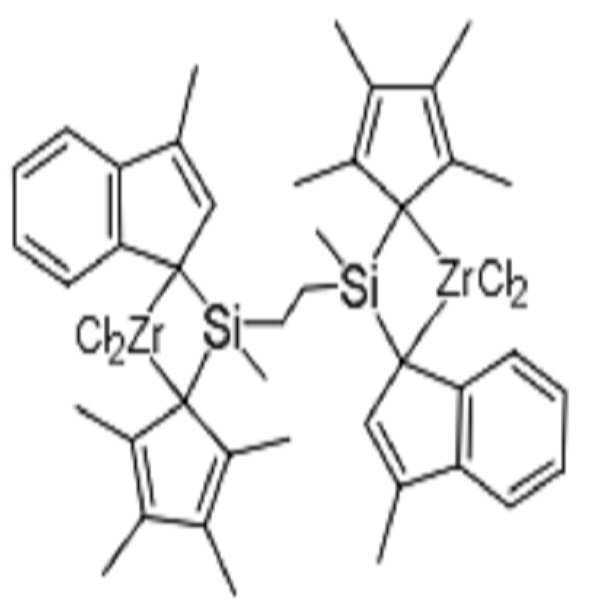
합성예 1에서, indene 대신 3-methyl indene을 사용한 것을 제외하고는 합성예 1과 동일한 방법으로 표제의 전이금속 화합물을 수득하였다.In Synthesis Example 1, the title transition metal compound was obtained in the same manner as in Synthesis Example 1, except that 3-methyl indene was used instead of indene.
1H NMR (C6D6, δ7.15): 7.52 (2H, t), 7.33 (1H, dd), 7.25(1H, t), 7.14 (2H, m), 6.96 (1H, td), 6.88(1H, m), 6.65(1H, dd), 6.57 (1H, dd), 2.27 (6H, 2s), 1.88-1.82 (24H, 8s), 1.52-1.45 (4H, m), 1.08, 1.06 (3H,2s), 0.89, 0.85 (3H, 2s)(2H, m), 6.96 (1H, td), 6.88 (1H, m) ), 6.65 (1H, dd), 6.57 (1H, dd), 2.27 (6H, 2s), 1.88-1.82 (24H, 8s), 1.52-1.45 (4H, m), 1.08, 1.06 0.89, 0.85 (3H, 2s)
합성예 4Synthesis Example 4
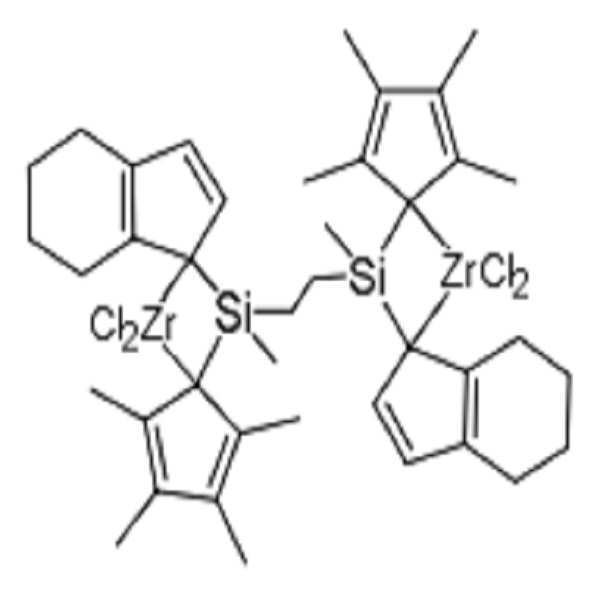
합성예 1의 전이금속 화합물 10mmol을 DCM 20mL에 녹여 아르곤 분위기 하에서 100 mL 용량의 고압 반응기(sus reactor)에 투입하고 5 mol%의 Pd/C를 DCM 10mL에 녹여 투입하였다. 수소 기체를 20 bar까지 채운 후 35℃에서 24시간 동안 교반하였다. 반응이 완결되면 반응 용액을 celite filtration하여 Pd/C를 제거한 후, 용매를 제거하여 표제의 전이금속 화합물을 수득하였다. 10 mmol of the transition metal compound of Synthesis Example 1 was dissolved in 20 ml of DCM and introduced into a 100-mL capacity high-pressure reactor under an argon atmosphere. 5 mol% of Pd / C was dissolved in 10 ml of DCM. The hydrogen gas was filled up to 20 bar and stirred at 35 DEG C for 24 hours. When the reaction was completed, the reaction solution was subjected to celite filtration to remove Pd / C, and then the solvent was removed to obtain the title transition metal compound.
1H NMR (C6D6, δ7.15): 6.33 (1H, d), 6.25 (1H, d), 5.27 (1H, d0), 5.19 (1H, d), 2.98 (4H, m), 2.71-2.58(8H, m), 2.42 (4H, m), 1.84-1.71 (24H, 8s), 1.43-1.32(4H, m), 0.95, 0.92 (3H, 2s), 0.85, 0.83 (3H, 2s)(1H, d), 5.19 (1H, d), 2.98 (4H, m), 2.71-2.58 (8H , 3.42 (4H, m), 2.42 (4H, m), 1.84-1.71 (24H, 8s), 1.43-1.32
합성예 5Synthesis Example 5

TMCP (trimethyl cyclopentane)는 THF (0.3 M)에서 n-BuLi (1 당량)으로 Lithiation 후 필터하여 TMCP-Li salts로 준비하였다.TMCP (trimethyl cyclopentane) was prepared from TMCP-Li salts by filtering after THF (0.3 M) to n-BuLi (1 equivalent) after lithiation.
indene을 THF (0.5 M)에서 n-BuLi (1 당량)으로 Lithiation하고 헥센(hexane)으로 용매를 치환한 후에 필터하여 indene-Li salts로 준비하였다.indene was lithiated from THF (0.5 M) to n-BuLi (1 equivalent) and the solvent was replaced with hexane and then filtered to prepare indene-Li salts.
250 mL Schlenk flask에 아르곤(Ar) 하에서 TMCP-Li salts 50 mmol, THF 100 mL를 적가하고, -20℃에서 1 당량의 dichlorodimethyl silane을 더하였다. 6시간 후 CuCN 3 mol%와 indene-Li salts (50 mmol, THF 1M solution)을 -20℃에서 더하고 12시간 동안 반응시켰다. 물층과, 헥센과 MTBE의 유기층으로 분리하여 리간드를 수득하였다. 50 mmol of TMCP-Li salts and 100 mL of THF were added dropwise to a 250 mL Schlenk flask under argon (Ar), and 1 equivalent of dichlorodimethyl silane was added at -20 ° C. After 6 hours, CuCN 3 mol% and indene-Li salts (50 mmol, THF 1M solution) were added at -20 ° C and reacted for 12 hours. The water layer was separated into an organic layer of hexane and MTBE to obtain a ligand.
합성한 리간드 50 mmol을 아르곤 하에서 THF 100 mL, toluene 94 mL에 녹이고 -20℃에서 2 당량의 n-BuLi를 적가하였다. 24시간 동안 반응 후 ZrCl4(THF)2 (1 당량, toluene 0.5 M solution)에 리간드-Li 용액을 더하였다. 16시간 동안 반응 후 용매를 제거하고, toluene 50 mL와 MTBE 50 mL로 washing하여 필터하였다. 필터케이크를 MC로 녹여 LiCl이 제거된 전이금속 화합물을 수득하였다.50 mmol of the synthesized ligand was dissolved in 100 mL of THF and 94 mL of toluene under argon, and 2 equivalents of n-BuLi was added dropwise at -20 ° C. After the reaction for 24 hours, and further the solution of the ligand -Li ZrCl 4 (THF) 2 (1 eq., 0.5 M toluene solution). After 16 hours of reaction, the solvent was removed and the solution was filtered by washing with 50 mL of toluene and 50 mL of MTBE. The filter cake was dissolved in MC to obtain a transition metal compound from which LiCl was removed.
1H NMR (CDCl3, δ7.26): 0.96 (3H, s), 1.16 (3H, s), 1.91 (3H, s), 1.93 (3H, s), 1.96(3H, s), 1.97 (3H, s), 5.98 (1H, d), 7.07 (1H, t), 7.23 (1H, d), 7.35 (1H, t), 7.49 (1H, d), 7.70 (1H, d). 1H NMR (CDCl 3, δ7.26) : 0.96 (3H, s), 1.16 (3H, s), 1.91 (3H, s), 1.93 (3H, s), 1.96 (3H, s), 1.97 (3H, (1H, d), 5.98 (1H, d), 7.07 (1H, t), 7.23 (1H, d), 7.35
합성예 6Synthesis Example 6

합성예 5에서, indene 대신 2-methyl indene을 사용하고, dichlorodimethyl silane 대신 dichlorodiethyl silane을 사용한 것을 제외하고는 합성예 5와 동일한 방법으로 표제의 전이금속 화합물을 수득하였다.In Synthesis Example 5, the title transition metal compound was obtained in the same manner as in Synthesis Example 5 except that 2-methyl indene was used instead of indene and dichlorodiethyl silane was used instead of dichlorodimethyl silane.
1H NMR (C6D6, δ7.15): 7.46 (1H, d), 7.37 (1H, d), 7.7 (1H, t), 6.84 (1H, s), 6.77(1H, t), 2.10(3H, s), 1.94 (3H, s), 1.90 (3H, s), 1.84 (3H, s),1.73(3H, s),1.44 (2H, m), 1.31(2H, q), 1.14 (3H, t), 1.10 (3H, t),(1H, s), 6.77 (1H, t), 2.10 (3H, s), 7.47 ), 1.94 (3H, s), 1.90 (3H, s), 1.84 (3H, s), 1.73 , 1.10 (3H, t),
합성예 7Synthesis Example 7
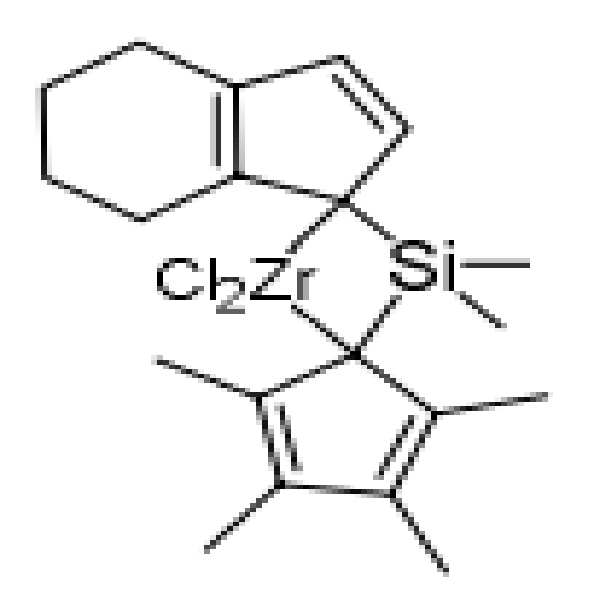
합성예 5의 전이금속 화합물 10 mmol을 아르곤 분위기 하에서 100 mL 용량의 고압 반응기(sus reactor)에 투입하고, 5 mol%의 Pd/C를 DCM 30mL에 녹여 투입하였다. 수소 기체를 20 bar까지 채운 후 35℃에서 24시간 동안 교반하였다. 반응이 완결되면 반응 용액을 celite filtration하여 Pd/C를 제거한 후, 용매를 제거하여 표제의 전이금속 화합물을 수득하였다. 10 mmol of the transition metal compound of Synthesis Example 5 was introduced into a 100-mL capacity high-pressure reactor under an argon atmosphere, and 5 mol% of Pd / C was dissolved in 30 mL of DCM. The hydrogen gas was filled up to 20 bar and stirred at 35 DEG C for 24 hours. When the reaction was completed, the reaction solution was subjected to celite filtration to remove Pd / C, and then the solvent was removed to obtain the title transition metal compound.
1H NMR (CDCl3, δ7.26): 0.82 (3H, s), 0.88 (3H, s), 1.92 (6H, s), 1.99 (3H, s), 2.05 (3H, s), 2.34 (2H, m), 2.54 (2H, m), 2.68 (2H, m), 3.03 (2H, m), 5.45(1H, s), 6.67 (1H, s) 1H NMR (CDCl 3, δ7.26) : 0.82 (3H, s), 0.88 (3H, s), 1.92 (6H, s), 1.99 (3H, s), 2.05 (3H, s), 2.34 (2H, m), 2.54 (2H, m), 2.68 (2H, m), 3.03
담지 촉매의 제조 실시예Preparation Example of Supported Catalyst
제조예 1Production Example 1
실리카(제조사: Grace Davision, 제품명: SP 952)를 600℃ 및 진공 하에서 12시간 동안 건조시켰다. Silica (manufacturer: Grace Davision, product name: SP 952) was dried at 600 캜 and under vacuum for 12 hours.
유리 반응기에 상기 건조된 실리카 20g을 넣었다. 이어서 톨루엔에 알루미늄이 13mmol로 함유되어 있는 메틸알루미녹산(MAO) 용액을 투입하고, 40℃에서 1시간 동안 교반하였다. 이후 교반을 중지하고 반응 생성물을 settling한 후 decantation하여 알루미늄 화합물을 제거하고, 충분한 양의 톨루엔으로 여러 번 세척하여 반응하지 않은 메틸알루미녹산을 제거하였다. 얻어진 반응 생성물을 50℃에서 감압 건조하여 남아있는 톨루엔을 제거함으로써 17wt%의 알루미늄을 포함하고 있는 조촉매 담지 담체(MAO/SiO2) 32g를 수득하였다A glass reactor was charged with 20 g of the dried silica. Subsequently, a methylaluminoxane (MAO) solution containing 13 mmol of aluminum was added to the toluene, and the mixture was stirred at 40 ° C for 1 hour. After stirring was stopped, the reaction product was settled, decanted to remove the aluminum compound, and washed with a sufficient amount of toluene several times to remove unreacted methylaluminoxane. The obtained reaction product was dried under reduced pressure at 50 캜 to remove remaining toluene, thereby obtaining 32 g of a catalyst-carrying carrier (MAO / SiO 2 ) containing 17 wt% of aluminum
상기 조촉매 담지 촉매 12g을 유리 반응기에 넣은 후 톨루엔 70mL를 주입하여 교반하였다. 그리고, 상기 합성예 1의 전이금속 화합물(1.3 mmol)이 용해된 톨루엔 용액을 상기 유리 반응기에 주입하고, 40℃에서 2시간 동안 교반하였다. 이후 반응 생성물을 충분한 양의 톨루엔으로 세척한 후 감압 건조하여 고체 분말 형태의 메탈로센 담지 촉매를 수득하였다. 12 g of the above-described catalyst-supporting catalyst was placed in a glass reactor, and then 70 mL of toluene was injected and stirred. Then, a toluene solution in which the transition metal compound (1.3 mmol) of Synthesis Example 1 was dissolved was injected into the glass reactor and stirred at 40 占 폚 for 2 hours. Thereafter, the reaction product was washed with a sufficient amount of toluene and then dried under reduced pressure to obtain a metallocene supported catalyst in the form of a solid powder.
제조예 2Production Example 2
합성예 1의 전이금속 화합물 대신 상기 합성예 2의 전이금속 화합물을 사용한 것을 제외하고는 제조예 1과 동일한 방법으로 메탈로센 담지 촉매를 제조하였다.A metallocene supported catalyst was prepared in the same manner as in Preparation Example 1, except that the transition metal compound of Synthesis Example 2 was used instead of the transition metal compound of Synthesis Example 1.
제조예 3Production Example 3
합성예 1의 전이금속 화합물 대신 상기 합성예 3의 전이금속 화합물을 사용한 것을 제외하고는 제조예 1과 동일한 방법으로 메탈로센 담지 촉매를 제조하였다.A metallocene supported catalyst was prepared in the same manner as in Preparation Example 1, except that the transition metal compound of Synthesis Example 3 was used instead of the transition metal compound of Synthesis Example 1.
제조예 4Production Example 4
합성예 1의 전이금속 화합물 대신 상기 합성예 4의 전이금속 화합물을 사용한 것을 제외하고는 제조예 1과 동일한 방법으로 메탈로센 담지 촉매를 제조하였다.A metallocene supported catalyst was prepared in the same manner as in Preparation Example 1, except that the transition metal compound of Synthesis Example 4 was used instead of the transition metal compound of Synthesis Example 1.
제조예 5Production Example 5
합성예 1의 전이금속 화합물 대신 상기 합성예 5의 전이금속 화합물을 사용한 것을 제외하고는 제조예 1과 동일한 방법으로 메탈로센 담지 촉매를 제조하였다.A metallocene supported catalyst was prepared in the same manner as in Preparation Example 1, except that the transition metal compound of Synthesis Example 5 was used instead of the transition metal compound of Synthesis Example 1.
제조예 6Production Example 6
합성예 1의 전이금속 화합물 대신 상기 합성예 6의 전이금속 화합물을 사용한 것을 제외하고는 제조예 1과 동일한 방법으로 메탈로센 담지 촉매를 제조하였다.A metallocene supported catalyst was prepared in the same manner as in Production Example 1 except that the transition metal compound of Synthesis Example 6 was used instead of the transition metal compound of Synthesis Example 1.
제조예 7Production Example 7
합성예 1의 전이금속 화합물 대신 상기 합성예 7의 전이금속 화합물을 사용한 것을 제외하고는 제조예 1과 동일한 방법으로 메탈로센 담지 촉매를 제조하였다.A metallocene supported catalyst was prepared in the same manner as in Production Example 1, except that the transition metal compound of Synthesis Example 7 was used instead of the transition metal compound of Synthesis Example 1.
폴리올레핀 중합 실시예Polyolefin Polymerization Example
실시예 1Example 1
600 mL Parr reactor 내부를 아르곤(Ar)으로 치환하고, TMA를 처방한 헥산 400 mL, TIBAL 0.2g, 상기 제조예 1에서 수득한 메탈로센 담지 촉매 10mg을 투입하였다. 반응기 내부의 아르곤을 벤트하고 온도를 80℃까지 올린 후, 에틸렌 밸브를 열어 내부 에틸렌 압력을 20 bar로 유지하였다. 에틸렌과 동시에 수소를 투입하였으며 1시간 동안 중합을 실시한 후, 에틸렌 공급을 중단하고 온도가 상온으로 떨어지면 에틸렌을 배기하였다. 반응물을 필터하여 용매를 제거한 후 80℃ 진공 오븐에서 3시간 동안 건조하여 에틸렌 중합체를 수득하였다. 400 mL of hexane prescribed in TMA, 0.2 g of TIBAL, and 10 mg of the metallocene supported catalyst obtained in Preparation Example 1 were placed in a 600 mL Parr reactor. After argon inside the reactor was vented and the temperature was raised to 80 DEG C, the ethylene valve was opened to maintain the internal ethylene pressure at 20 bar. Hydrogen was added at the same time as ethylene, polymerization was carried out for 1 hour, ethylene supply was stopped, and ethylene was exhausted when the temperature dropped to room temperature. The reaction product was filtered to remove the solvent and dried in a vacuum oven at 80 캜 for 3 hours to obtain an ethylene polymer.
실시예 2Example 2
상기 제조예 2에서 수득한 메탈로센 담지 촉매를 사용한 것을 제외하고는, 실시예 1과 동일한 방법으로 에틸렌 중합체를 제조하였다. An ethylene polymer was prepared in the same manner as in Example 1, except that the metallocene supported catalyst obtained in Preparation Example 2 was used.
실시예 3Example 3
상기 제조예 3에서 수득한 메탈로센 담지 촉매를 사용한 것을 제외하고는, 실시예 1과 동일한 방법으로 에틸렌 중합체를 제조하였다. An ethylene polymer was prepared in the same manner as in Example 1, except that the metallocene supported catalyst obtained in Preparation Example 3 was used.
실시예 4Example 4
상기 제조예 4에서 수득한 메탈로센 담지 촉매를 사용한 것을 제외하고는, 실시예 1과 동일한 방법으로 에틸렌 중합체를 제조하였다. An ethylene polymer was prepared in the same manner as in Example 1, except that the metallocene supported catalyst obtained in Preparation Example 4 was used.
비교예 1Comparative Example 1
상기 제조예 5에서 수득한 메탈로센 담지 촉매를 사용한 것을 제외하고는, 실시예 1과 동일한 방법으로 에틸렌 중합체를 제조하였다. An ethylene polymer was prepared in the same manner as in Example 1, except that the metallocene supported catalyst obtained in Preparation Example 5 was used.
비교예 2Comparative Example 2
상기 제조예 6에서 수득한 메탈로센 담지 촉매를 사용한 것을 제외하고는, 실시예 1과 동일한 방법으로 에틸렌 중합체를 제조하였다. An ethylene polymer was prepared in the same manner as in Example 1 except that the metallocene supported catalyst obtained in Preparation Example 6 was used.
비교예 3Comparative Example 3
상기 제조예 7에서 수득한 메탈로센 담지 촉매를 사용한 것을 제외하고는, 실시예 1과 동일한 방법으로 에틸렌 중합체를 제조하였다. An ethylene polymer was prepared in the same manner as in Example 1, except that the metallocene supported catalyst obtained in Preparation Example 7 was used.
<실험예><Experimental Example>
상기 실시예 및 비교예에서 촉매 활성 및 수득된 올레핀계 중합체의 물성을 하기 표 1에 나타내었다.The catalyst activity and the physical properties of the resulting olefinic polymer in the above Examples and Comparative Examples are shown in Table 1 below.
1) 촉매 활성: 단위 시간(h)을 기준으로 사용된 촉매 함량(촉매의 g)당 생성된 중합체의 무게(kg)의 비로 계산하였다.1) Catalytic activity: Calculated as the ratio of the weight of polymer produced per g of catalyst used (kg) based on unit time (h).
2) 중량 평균 분자량, 및 분자량분포: 측정 온도 160℃, 겔투과 크로마토그라피-에프티아이알(GPC-FTIR)을 이용하여 수 평균 분자량, 중량 평균분자량, Z 평균분자량을 측정하였다. 분자량 분포는 중량 평균분자량과 수 평균분자량의 비로 나타내었다.2) Weight average molecular weight and molecular weight distribution: The number average molecular weight, the weight average molecular weight and the Z average molecular weight were measured using a gel permeation chromatography-FTIR (GPC-FTIR) at a measurement temperature of 160 캜. The molecular weight distribution is represented by the ratio of the weight average molecular weight to the number average molecular weight.
3) Melt Flow Rate Ratio (MFRR21 .6/2.16): MFR21 .6을 MFR2 .16으로 나누어 계산하였으며, MFR21 .6은 ISO 1133에 따라 230℃의 온도 및 21.6kg의 하중 하에서 측정하였고, MFR2.16은 ISO 1133에 따라 230℃의 온도 및 2.16kg의 하중 하에서 측정하였다. 3) Melt Flow Rate Ratio (MFRR 21 .6 / 2.16): was calculated by dividing the MFR 21 .6 to MFR 2 .16, MFR 21 .6 was measured under a load of 21.6kg and the temperature of 230 ℃ according to ISO 1133 , MFR 2.16 was measured according to ISO 1133 at a temperature of 230 캜 and a load of 2.16 kg.
4) LCB (long chain branch): 주파수에 따른 복소점도를 TA instrument사의 ARES(advanced rheometric expansion system)를 이용하여 측정하여 Van Gurp-Palmen plot에서 plateau 구간에서의 평균값인 plateau delta값을 계산하였다. 4) LCB (long chain branch): The complex viscosity along the frequency was measured using TAES instrument's advanced rheometric expansion system (ARES) and the plateau delta value in the plateau section in the Van Gurp-Palmen plot was calculated.
측정 샘플은 190℃에서 직경 25.0mm의 parallet plates를 이용하여 gap이 2.0mm가 되도록 하였다. 측정은 dynamic strain frequency sweep 모드로 하여 strain은 5%, frequency는 0.05 rad/s에서 500 rad/s까지, 각 decade에 10 point씩 총 41point를 측정하였다. Power law 피팅은 측정 프로그램인 TA Orchestrator를 이용하여 피팅하였다.Measurement samples were made with parallet plates having a diameter of 25.0 mm at 190 캜 to have a gap of 2.0 mm. The dynamic strain frequency sweep mode was used to measure 41 points, with strain of 5%, frequency of 0.05 rad / s to 500 rad / s, and 10 points of each decade. The power law fitting was fitted using TA Orchestrator, a measuring program.
(단위: kgPE/gcat)Activity
(Unit: kgPE / gcat)
(Mw)
(단위: g/mol)Weight average molecular weight
(Mw)
(Unit: g / mol)
(PDI)Molecular weight distribution
(PDI)
(단위: g/10min)MFR 2.16
(Unit: g / 10 min)
표 1을 참조하면, 본 발명의 바이메탈 메탈로센 화합물을 이용하여 중합한 폴리올레핀은, 동일 또는 유사한 구조의 단일 메탈로센 화합물을 이용하여 중합한 폴리올레핀과 비교할 때, 더 작은 plateau delta값을 가져 LCB 함량이 더 높은 폴리올레핀을 중합할 수 있는 것으로 나타났다.Referring to Table 1, the polyolefin polymerized using the bimetallic metallocene compound of the present invention has a smaller plateau delta value than the polyolefin polymerized using a single metallocene compound having the same or similar structure, The polyolefin having a higher content can be polymerized.
Claims (11)
[화학식 1]

상기 화학식 1에서,
M은 4족 전이금속이고;
X1 및 X2는 서로 동일하거나 상이하고, 각각 독립적으로 할로겐 또는 탄소수 1 내지 20의 알킬이고;
R1 내지 R8은 서로 같거나 다를 수 있으며, 각각 독립적으로 수소, 탄소수 1 내지 20의 알킬, 탄소수 2 내지 20의 알케닐, 탄소수 6 내지 20의 아릴, 탄소수 7 내지 20의 알킬아릴, 또는 탄소수 7 내지 20의 아릴알킬이고, 상기 R1 내지 R8 중 인접하는 2개가 서로 연결되어 1개 이상의 지방족 고리, 또는 방향족 고리를 형성할 수 있고;
R9 및 R10은 서로 동일하거나 상이하고, 각각 독립적으로 수소, 탄소수 1 내지 20의 알킬, 또는 탄소수 1 내지 20의 알콕시이고;
n은 1 내지 10의 정수이다.
A bimetallic metallocene compound represented by the following formula (1): < EMI ID =
[Chemical Formula 1]
In Formula 1,
M is a Group 4 transition metal;
X 1 and X 2 are the same or different and are each independently halogen or alkyl of 1 to 20 carbon atoms;
R 1 to R 8 may be the same or different from each other and each independently represents hydrogen, an alkyl having 1 to 20 carbon atoms, an alkenyl having 2 to 20 carbon atoms, an aryl having 6 to 20 carbon atoms, an alkylaryl having 7 to 20 carbon atoms, 7 to 20, and two adjacent ones of R 1 to R 8 may be connected to each other to form at least one aliphatic ring or aromatic ring;
R 9 and R 10 are the same or different from each other, and are each independently hydrogen, alkyl of 1 to 20 carbon atoms, or alkoxy of 1 to 20 carbon atoms;
n is an integer of 1 to 10;
The compound according to claim 1, wherein each of R 1 to R 8 is independently hydrogen, an alkyl group having 1 to 20 carbon atoms, or an alkenyl group having 2 to 20 carbon atoms, or two adjacent ones of R 1 to R 8 are connected to each other to form 1 More than two aliphatic rings, or aromatic rings.
The bimetallic metallocene compound according to claim 1, wherein R 9 and R 10 are each independently an alkyl having 1 to 10 carbon atoms.
The bimetallic metallocene compound according to claim 1, wherein M is zirconium (Zr) and n is 2 to 6.
[화학식 1a]
[화학식 1b]

[화학식 1c]
[화학식 1d]
상기 화학식 1a 내지 1d에서, n은 1 내지 10의 정수이다.
The bimetallic metallocene compound according to claim 1, wherein the compound of formula (1) is represented by one of the following structural formulas (1a) to (1d):
[Formula 1a]
[Chemical Formula 1b]
[Chemical Formula 1c]
≪ RTI ID = 0.0 &
In the above formulas (1a) to (1d), n is an integer of 1 to 10.
[화학식 1]

[화학식 2]
[화학식 2-1]

상기 화학식 1, 2, 및 2-1에서,
M은 4족 전이금속이고;
X1 및 X2는 서로 동일하거나 상이하고, 각각 독립적으로 할로겐 또는 탄소수 1 내지 20의 알킬이고;
R1 내지 R8은 서로 같거나 다를 수 있으며, 각각 독립적으로 수소, 탄소수 1 내지 20의 알킬, 탄소수 2 내지 20의 알케닐, 탄소수 6 내지 20의 아릴, 탄소수 7 내지 20의 알킬아릴, 또는 탄소수 7 내지 20의 아릴알킬이고, 상기 R1 내지 R8 중 인접하는 2개가 서로 연결되어 1개 이상의 지방족 고리, 또는 방향족 고리를 형성할 수 있고;
R9 및 R10은 서로 동일하거나 상이하고, 각각 독립적으로 수소, 탄소수 1 내지 20의 알킬, 또는 탄소수 1 내지 20의 알콕시이고;
n은 1 내지 10의 정수이다.
A process for producing a bimetallic metallocene compound represented by the following formula (1), comprising reacting a ligand compound represented by the following formula (2) with a compound represented by the following formula
[Chemical Formula 1]
(2)
[Formula 2-1]
In the above formulas (1), (2) and (2-1)
M is a Group 4 transition metal;
X 1 and X 2 are the same or different and are each independently halogen or alkyl of 1 to 20 carbon atoms;
R 1 to R 8 may be the same or different from each other and each independently represents hydrogen, an alkyl having 1 to 20 carbon atoms, an alkenyl having 2 to 20 carbon atoms, an aryl having 6 to 20 carbon atoms, an alkylaryl having 7 to 20 carbon atoms, 7 to 20, and two adjacent ones of R 1 to R 8 may be connected to each other to form at least one aliphatic ring or aromatic ring;
R 9 and R 10 are the same or different from each other, and are each independently hydrogen, alkyl of 1 to 20 carbon atoms, or alkoxy of 1 to 20 carbon atoms;
n is an integer of 1 to 10;
[화학식 1-1]
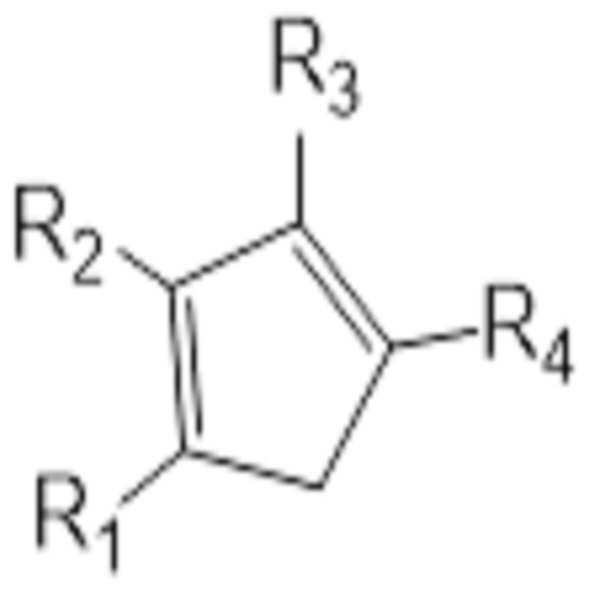
[화학식 1-2]

[화학식 1-3]

[화학식 1-4]
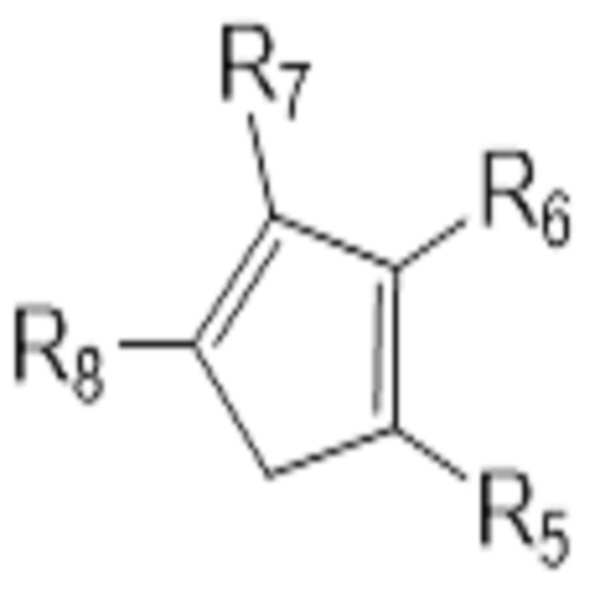
상기 화학식 1-1 내지 1-4에서,
R1 내지 R10, 및 n은 상기 화학식 1에서 정의한 바와 같다.
[7] The method of claim 6, wherein the ligand compound of Formula 2 is prepared by reacting a compound of Formula 1-1 or a lithium salt thereof with a compound represented by Formula 1-2 below: And reacting the compound of the following 1-3 with a compound of the following formula 1-4 or a lithium salt thereof:
[Formula 1-1]
[Formula 1-2]
[Formula 1-3]
[Formula 1-4]
In the above Formulas 1-1 to 1-4,
R 1 to R 10 , and n are the same as defined in the above formula (1).
하기 화학식 3, 화학식 4 및 화학식 5로 표시되는 화합물들로 이루어진 군에서 선택되는 1종 이상의 조촉매를 포함하는 촉매 조성물:
[화학식 3]
-[Al(R11)-O]c-
상기 화학식 3에서,
R11은 서로 동일하거나 상이하고, 각각 독립적으로 할로겐 라디칼, 탄소수 1 내지 20의 하이드로카빌 라디칼, 또는 할로겐으로 치환된 탄소수 1 내지 20의 하이드로카빌 라디칼이고, c는 2 이상의 정수이며,
[화학식 4]
D(R12)3
상기 화학식 4에서,
D는 알루미늄 또는 보론이고, R12는 탄소수 1 내지 20의 하이드로카빌 또는 할로겐으로 치환된 탄소수 1 내지 20의 하이드로카빌이고,
[화학식 5]
[L-H]+[ZA4]- 또는 [L]+[ZA4]-
상기 화학식 5에서,
L은 중성 또는 양이온성 루이스 염기이고, H는 수소 원자이며, Z는 13족 원소이고, A는 서로 동일하거나 다를 수 있으며, 각각 독립적으로 1 이상의 수소 원자가 할로겐, 탄소수 1 내지 20의 탄화수소, 알콕시 또는 페녹시로 치환 또는 비치환된 탄소수 6 내지 20의 아릴기 또는 탄소수 1 내지 20의 알킬기이다.
A bimetallic metallocene compound of claim 1; And
And at least one cocatalyst selected from the group consisting of compounds represented by the following formulas (3), (4) and (5):
(3)
- [Al (R 11) -O ] c-
In Formula 3,
R 11 are the same or different from each other and each independently represents a halogen radical, a hydrocarbyl radical having 1 to 20 carbon atoms, or a hydrocarbyl radical having 1 to 20 carbon atoms substituted with halogen, c is an integer of 2 or more,
[Chemical Formula 4]
D (R 12) 3
In Formula 4,
D is aluminum or boron, R < 12 > is hydrocarbyl having 1 to 20 carbon atoms or hydrocarbyl having 1 to 20 carbon atoms substituted with halogen,
[Chemical Formula 5]
[LH] + [ZA 4 ] - or [L] + [ZA 4 ] -
In Formula 5,
L is a neutral or cationic Lewis base, H is a hydrogen atom, Z is a Group 13 element, A can be the same or different from each other, and each independently at least one hydrogen atom is replaced by halogen, a hydrocarbon having 1 to 20 carbon atoms, An aryl group having 6 to 20 carbon atoms or an alkyl group having 1 to 20 carbon atoms which is substituted or unsubstituted with phenoxy.
The catalyst composition according to claim 8, which is supported on a carrier.
Polymerizing at least one olefin monomer in the presence of the catalyst composition according to claim 8.
Applications Claiming Priority (2)
| Application Number | Priority Date | Filing Date | Title |
|---|---|---|---|
| KR20150182238 | 2015-12-18 | ||
| KR1020150182238 | 2015-12-18 |
Publications (2)
| Publication Number | Publication Date |
|---|---|
| KR20170073473A true KR20170073473A (en) | 2017-06-28 |
| KR102230621B1 KR102230621B1 (en) | 2021-03-22 |
Family
ID=59280940
Family Applications (1)
| Application Number | Title | Priority Date | Filing Date |
|---|---|---|---|
| KR1020160138561A Active KR102230621B1 (en) | 2015-12-18 | 2016-10-24 | Bimetallic metallocene compound, method for preparing the same, catalyst composition and method for preparing polyolefin using the same |
Country Status (1)
| Country | Link |
|---|---|
| KR (1) | KR102230621B1 (en) |
-
2016
- 2016-10-24 KR KR1020160138561A patent/KR102230621B1/en active Active
Non-Patent Citations (2)
| Title |
|---|
| Gregory G. Hlatky, Coordination Chemistry Reviews, 1999, Vol. 181, pp. 243-296. * |
| 이동호 등, Korea Polymer Journal, 2001, Vol. 9, No. 2, pp. 71-83. * |
Also Published As
| Publication number | Publication date |
|---|---|
| KR102230621B1 (en) | 2021-03-22 |
Similar Documents
| Publication | Publication Date | Title |
|---|---|---|
| KR102107084B1 (en) | Method for preparing of supported hybrid metallocene catalyst, the supported hybrid metallocene catalyst prepared by the same method, and method for preparing polyolefin using the same | |
| KR102204960B1 (en) | Method for preparing of supported hybrid metallocene catalyst, the supported hybrid metallocene catalyst prepared by the same method, and method for preparing polyolefin using the same | |
| EP3348585B1 (en) | Supported hybrid metallocene catalyst and polyolefin preparation method using same | |
| KR101769097B1 (en) | Metallocene compound, catalyst composition comprising the same, and method for preparing polyolefin using the same | |
| EP3162820A1 (en) | Ethylene/alpha-olefin copolymer having excellent processability | |
| KR102064990B1 (en) | Supported hybrid catalyst system for ethylene slurry polymerization and method for preparing ethylene polymer with the catalyst system | |
| KR102301666B1 (en) | Method For Preparing Supported Hybrid Metallocene Catalyst, Supported Hybrid Metallocene Catalyst Prepared By The Same Method, And Method For Preparing Polyolefin Using The Same | |
| JP6440832B2 (en) | Metallocene compound, metallocene supported catalyst, and method for producing polyolefin using the same | |
| EP3255066B1 (en) | Method for producing metallocene-supported catalyst | |
| EP3184556B1 (en) | Metallocene-supported catalyst and method of preparing polyolefin using the same | |
| KR20180067939A (en) | Catalyst composition for preparing polyolefin having an excellent flexural modulus using the same | |
| KR20150057964A (en) | Metallocene compound, catalyst composition comprising the same, and method for preparation of olefin-based polymer using the same | |
| KR102412130B1 (en) | Method for preparing supported metallocene catalyst and method for preparing polypropylene using the supported metallocene catalyst | |
| KR20120028269A (en) | Bi-nuclear metallocene compound and the preparation method of polyoefine using the same | |
| KR101601935B1 (en) | Dinuclear metallocene compound, catalyst composition and method for preparing polyolefin using the same | |
| JP6453483B2 (en) | Metallocene supported catalyst and method for producing polyolefin using the same | |
| JP2018505124A (en) | Metallocene compound, catalyst composition containing the same, and method for producing olefin polymer using the same | |
| JP2022517077A (en) | Transition metal compounds, catalyst compositions and polypropylene production methods using them | |
| KR20130027316A (en) | Method for preparing supported metallocene catalyst, and supported metallocene catalyst using the same | |
| KR100958676B1 (en) | Synthesis Method of Homogeneous Catalyst with Binary Nucleus Constrained Array and Linear Alphaolefin Copolymer Prepared Using the Same | |
| KR102011927B1 (en) | Catalyst composition and method for preparing polyolefin using the same | |
| KR102418590B1 (en) | Method for preparing supported hybrid metallocene catalyst, and method for preparing polypropylene using supported hybrid metallocene catalyst | |
| KR20170075530A (en) | Metallocene supported catalyst and method for preparing polyolefin using the same | |
| EP3330296B1 (en) | Method for preparing supported metallocene catalyst | |
| KR102230621B1 (en) | Bimetallic metallocene compound, method for preparing the same, catalyst composition and method for preparing polyolefin using the same |
Legal Events
| Date | Code | Title | Description |
|---|---|---|---|
| PA0109 | Patent application |
St.27 status event code: A-0-1-A10-A12-nap-PA0109 |
|
| PG1501 | Laying open of application |
St.27 status event code: A-1-1-Q10-Q12-nap-PG1501 |
|
| R18-X000 | Changes to party contact information recorded |
St.27 status event code: A-3-3-R10-R18-oth-X000 |
|
| R18-X000 | Changes to party contact information recorded |
St.27 status event code: A-3-3-R10-R18-oth-X000 |
|
| A201 | Request for examination | ||
| PA0201 | Request for examination |
St.27 status event code: A-1-2-D10-D11-exm-PA0201 |
|
| R18-X000 | Changes to party contact information recorded |
St.27 status event code: A-3-3-R10-R18-oth-X000 |
|
| E902 | Notification of reason for refusal | ||
| PE0902 | Notice of grounds for rejection |
St.27 status event code: A-1-2-D10-D21-exm-PE0902 |
|
| E13-X000 | Pre-grant limitation requested |
St.27 status event code: A-2-3-E10-E13-lim-X000 |
|
| P11-X000 | Amendment of application requested |
St.27 status event code: A-2-2-P10-P11-nap-X000 |
|
| P13-X000 | Application amended |
St.27 status event code: A-2-2-P10-P13-nap-X000 |
|
| E701 | Decision to grant or registration of patent right | ||
| PE0701 | Decision of registration |
St.27 status event code: A-1-2-D10-D22-exm-PE0701 |
|
| GRNT | Written decision to grant | ||
| PR0701 | Registration of establishment |
St.27 status event code: A-2-4-F10-F11-exm-PR0701 |
|
| PR1002 | Payment of registration fee |
St.27 status event code: A-2-2-U10-U11-oth-PR1002 Fee payment year number: 1 |
|
| PG1601 | Publication of registration |
St.27 status event code: A-4-4-Q10-Q13-nap-PG1601 |
|
| PR1001 | Payment of annual fee |
St.27 status event code: A-4-4-U10-U11-oth-PR1001 Fee payment year number: 4 |
|
| PR1001 | Payment of annual fee |
St.27 status event code: A-4-4-U10-U11-oth-PR1001 Fee payment year number: 5 |
|
| PR1001 | Payment of annual fee |
St.27 status event code: A-4-4-U10-U11-oth-PR1001 Fee payment year number: 6 |
|
| U11 | Full renewal or maintenance fee paid |
Free format text: ST27 STATUS EVENT CODE: A-4-4-U10-U11-OTH-PR1001 (AS PROVIDED BY THE NATIONAL OFFICE) Year of fee payment: 6 |