KR20170077260A - Fiber bundle - Google Patents
Fiber bundle Download PDFInfo
- Publication number
- KR20170077260A KR20170077260A KR1020177017060A KR20177017060A KR20170077260A KR 20170077260 A KR20170077260 A KR 20170077260A KR 1020177017060 A KR1020177017060 A KR 1020177017060A KR 20177017060 A KR20177017060 A KR 20177017060A KR 20170077260 A KR20170077260 A KR 20170077260A
- Authority
- KR
- South Korea
- Prior art keywords
- fibers
- fiber bundle
- fiber
- additive
- polymer
- Prior art date
- Legal status (The legal status is an assumption and is not a legal conclusion. Google has not performed a legal analysis and makes no representation as to the accuracy of the status listed.)
- Ceased
Links
- 239000000835 fiber Substances 0.000 title claims abstract description 221
- 239000000654 additive Substances 0.000 claims abstract description 94
- 229920000642 polymer Polymers 0.000 claims abstract description 88
- 239000000203 mixture Substances 0.000 claims abstract description 86
- 230000000996 additive effect Effects 0.000 claims abstract description 80
- 229920000098 polyolefin Polymers 0.000 claims abstract description 61
- 229920001169 thermoplastic Polymers 0.000 claims abstract description 49
- 239000004416 thermosoftening plastic Substances 0.000 claims abstract description 48
- 239000011159 matrix material Substances 0.000 claims abstract description 44
- 239000002114 nanocomposite Substances 0.000 claims abstract description 20
- 238000000034 method Methods 0.000 claims description 47
- 239000000155 melt Substances 0.000 claims description 28
- 239000011148 porous material Substances 0.000 claims description 24
- 229920000647 polyepoxide Polymers 0.000 claims description 21
- 229920001577 copolymer Polymers 0.000 claims description 19
- 229920000747 poly(lactic acid) Polymers 0.000 claims description 16
- 239000004626 polylactic acid Substances 0.000 claims description 14
- 230000009477 glass transition Effects 0.000 claims description 12
- 239000003607 modifier Substances 0.000 claims description 11
- QQONPFPTGQHPMA-UHFFFAOYSA-N propylene Natural products CC=C QQONPFPTGQHPMA-UHFFFAOYSA-N 0.000 claims description 11
- 125000004805 propylene group Chemical group [H]C([H])([H])C([H])([*:1])C([H])([H])[*:2] 0.000 claims description 6
- 229920005629 polypropylene homopolymer Polymers 0.000 claims description 4
- 230000016507 interphase Effects 0.000 claims description 3
- 239000012815 thermoplastic material Substances 0.000 claims 1
- 230000002745 absorbent Effects 0.000 description 81
- 239000002250 absorbent Substances 0.000 description 81
- -1 dimethyl-substituted-1-decene Chemical class 0.000 description 58
- 239000010410 layer Substances 0.000 description 51
- 239000000463 material Substances 0.000 description 43
- 239000000178 monomer Substances 0.000 description 39
- 239000000306 component Substances 0.000 description 33
- VXNZUUAINFGPBY-UHFFFAOYSA-N 1-Butene Chemical compound CCC=C VXNZUUAINFGPBY-UHFFFAOYSA-N 0.000 description 28
- 238000012360 testing method Methods 0.000 description 28
- 239000012792 core layer Substances 0.000 description 22
- 239000012071 phase Substances 0.000 description 22
- 230000035882 stress Effects 0.000 description 21
- XLYOFNOQVPJJNP-UHFFFAOYSA-N water Substances O XLYOFNOQVPJJNP-UHFFFAOYSA-N 0.000 description 21
- 229920000728 polyester Polymers 0.000 description 20
- MTHSVFCYNBDYFN-UHFFFAOYSA-N diethylene glycol Chemical compound OCCOCCO MTHSVFCYNBDYFN-UHFFFAOYSA-N 0.000 description 19
- 239000007788 liquid Substances 0.000 description 16
- IAQRGUVFOMOMEM-UHFFFAOYSA-N butene Natural products CC=CC IAQRGUVFOMOMEM-UHFFFAOYSA-N 0.000 description 15
- 238000002844 melting Methods 0.000 description 14
- 230000008018 melting Effects 0.000 description 14
- 229910052799 carbon Inorganic materials 0.000 description 13
- 230000008569 process Effects 0.000 description 13
- 239000000523 sample Substances 0.000 description 13
- 239000004593 Epoxy Substances 0.000 description 12
- 125000001495 ethyl group Chemical group [H]C([H])([H])C([H])([H])* 0.000 description 12
- JVTAAEKCZFNVCJ-UHFFFAOYSA-N lactic acid Chemical compound CC(O)C(O)=O JVTAAEKCZFNVCJ-UHFFFAOYSA-N 0.000 description 12
- 125000002496 methyl group Chemical group [H]C([H])([H])* 0.000 description 12
- 239000000126 substance Substances 0.000 description 12
- 230000001681 protective effect Effects 0.000 description 11
- 239000007787 solid Substances 0.000 description 11
- YWAKXRMUMFPDSH-UHFFFAOYSA-N pentene Chemical compound CCCC=C YWAKXRMUMFPDSH-UHFFFAOYSA-N 0.000 description 10
- 125000001436 propyl group Chemical group [H]C([*])([H])C([H])([H])C([H])([H])[H] 0.000 description 10
- 230000005540 biological transmission Effects 0.000 description 9
- 229920001155 polypropylene Polymers 0.000 description 9
- LIKMAJRDDDTEIG-UHFFFAOYSA-N 1-hexene Chemical compound CCCCC=C LIKMAJRDDDTEIG-UHFFFAOYSA-N 0.000 description 8
- KWKAKUADMBZCLK-UHFFFAOYSA-N 1-octene Chemical compound CCCCCCC=C KWKAKUADMBZCLK-UHFFFAOYSA-N 0.000 description 8
- JVTAAEKCZFNVCJ-REOHCLBHSA-N L-lactic acid Chemical compound C[C@H](O)C(O)=O JVTAAEKCZFNVCJ-REOHCLBHSA-N 0.000 description 8
- 230000015572 biosynthetic process Effects 0.000 description 8
- 238000006243 chemical reaction Methods 0.000 description 8
- 239000007789 gas Substances 0.000 description 8
- 229920005989 resin Polymers 0.000 description 8
- 239000011347 resin Substances 0.000 description 8
- VGGSQFUCUMXWEO-UHFFFAOYSA-N Ethene Chemical compound C=C VGGSQFUCUMXWEO-UHFFFAOYSA-N 0.000 description 7
- 239000002131 composite material Substances 0.000 description 7
- 125000000524 functional group Chemical group 0.000 description 7
- 239000002655 kraft paper Substances 0.000 description 7
- 230000007246 mechanism Effects 0.000 description 7
- 238000002156 mixing Methods 0.000 description 7
- 239000000047 product Substances 0.000 description 7
- IJGRMHOSHXDMSA-UHFFFAOYSA-N Atomic nitrogen Chemical compound N#N IJGRMHOSHXDMSA-UHFFFAOYSA-N 0.000 description 6
- 239000005977 Ethylene Substances 0.000 description 6
- 239000004743 Polypropylene Substances 0.000 description 6
- 239000000853 adhesive Substances 0.000 description 6
- 230000001070 adhesive effect Effects 0.000 description 6
- 239000004927 clay Substances 0.000 description 6
- 238000010438 heat treatment Methods 0.000 description 6
- 229920001519 homopolymer Polymers 0.000 description 6
- 239000004310 lactic acid Substances 0.000 description 6
- 235000014655 lactic acid Nutrition 0.000 description 6
- FPYJFEHAWHCUMM-UHFFFAOYSA-N maleic anhydride Chemical compound O=C1OC(=O)C=C1 FPYJFEHAWHCUMM-UHFFFAOYSA-N 0.000 description 6
- JRZJOMJEPLMPRA-UHFFFAOYSA-N olefin Natural products CCCCCCCC=C JRZJOMJEPLMPRA-UHFFFAOYSA-N 0.000 description 6
- 229920001748 polybutylene Polymers 0.000 description 6
- 229920000573 polyethylene Polymers 0.000 description 6
- 239000011122 softwood Substances 0.000 description 6
- IMSODMZESSGVBE-UHFFFAOYSA-N 2-Oxazoline Chemical compound C1CN=CO1 IMSODMZESSGVBE-UHFFFAOYSA-N 0.000 description 5
- 239000004604 Blowing Agent Substances 0.000 description 5
- LYCAIKOWRPUZTN-UHFFFAOYSA-N Ethylene glycol Chemical compound OCCO LYCAIKOWRPUZTN-UHFFFAOYSA-N 0.000 description 5
- PPBRXRYQALVLMV-UHFFFAOYSA-N Styrene Chemical compound C=CC1=CC=CC=C1 PPBRXRYQALVLMV-UHFFFAOYSA-N 0.000 description 5
- 238000000113 differential scanning calorimetry Methods 0.000 description 5
- 238000010494 dissociation reaction Methods 0.000 description 5
- 230000005593 dissociations Effects 0.000 description 5
- 125000003700 epoxy group Chemical group 0.000 description 5
- 230000004048 modification Effects 0.000 description 5
- 238000012986 modification Methods 0.000 description 5
- 239000012802 nanoclay Substances 0.000 description 5
- 239000005020 polyethylene terephthalate Substances 0.000 description 5
- 229920000139 polyethylene terephthalate Polymers 0.000 description 5
- 238000010998 test method Methods 0.000 description 5
- ZGEGCLOFRBLKSE-UHFFFAOYSA-N 1-Heptene Chemical compound CCCCCC=C ZGEGCLOFRBLKSE-UHFFFAOYSA-N 0.000 description 4
- NLXLAEXVIDQMFP-UHFFFAOYSA-N Ammonia chloride Chemical compound [NH4+].[Cl-] NLXLAEXVIDQMFP-UHFFFAOYSA-N 0.000 description 4
- SOGAXMICEFXMKE-UHFFFAOYSA-N Butylmethacrylate Chemical compound CCCCOC(=O)C(C)=C SOGAXMICEFXMKE-UHFFFAOYSA-N 0.000 description 4
- VTYYLEPIZMXCLO-UHFFFAOYSA-L Calcium carbonate Chemical compound [Ca+2].[O-]C([O-])=O VTYYLEPIZMXCLO-UHFFFAOYSA-L 0.000 description 4
- CURLTUGMZLYLDI-UHFFFAOYSA-N Carbon dioxide Chemical compound O=C=O CURLTUGMZLYLDI-UHFFFAOYSA-N 0.000 description 4
- 229930182843 D-Lactic acid Natural products 0.000 description 4
- JVTAAEKCZFNVCJ-UWTATZPHSA-N D-lactic acid Chemical compound C[C@@H](O)C(O)=O JVTAAEKCZFNVCJ-UWTATZPHSA-N 0.000 description 4
- BAPJBEWLBFYGME-UHFFFAOYSA-N Methyl acrylate Chemical compound COC(=O)C=C BAPJBEWLBFYGME-UHFFFAOYSA-N 0.000 description 4
- 150000001336 alkenes Chemical class 0.000 description 4
- 238000004458 analytical method Methods 0.000 description 4
- 239000003054 catalyst Substances 0.000 description 4
- 229940022769 d- lactic acid Drugs 0.000 description 4
- GUJOJGAPFQRJSV-UHFFFAOYSA-N dialuminum;dioxosilane;oxygen(2-);hydrate Chemical compound O.[O-2].[O-2].[O-2].[Al+3].[Al+3].O=[Si]=O.O=[Si]=O.O=[Si]=O.O=[Si]=O GUJOJGAPFQRJSV-UHFFFAOYSA-N 0.000 description 4
- 210000000416 exudates and transudate Anatomy 0.000 description 4
- 238000012681 fiber drawing Methods 0.000 description 4
- 239000000945 filler Substances 0.000 description 4
- 230000002209 hydrophobic effect Effects 0.000 description 4
- 229920000092 linear low density polyethylene Polymers 0.000 description 4
- 239000004707 linear low-density polyethylene Substances 0.000 description 4
- 238000010128 melt processing Methods 0.000 description 4
- TVMXDCGIABBOFY-UHFFFAOYSA-N n-Octanol Natural products CCCCCCCC TVMXDCGIABBOFY-UHFFFAOYSA-N 0.000 description 4
- 210000003739 neck Anatomy 0.000 description 4
- 239000004810 polytetrafluoroethylene Substances 0.000 description 4
- 229920001343 polytetrafluoroethylene Polymers 0.000 description 4
- VZCYOOQTPOCHFL-UHFFFAOYSA-N trans-butenedioic acid Natural products OC(=O)C=CC(O)=O VZCYOOQTPOCHFL-UHFFFAOYSA-N 0.000 description 4
- 238000012546 transfer Methods 0.000 description 4
- 238000002834 transmittance Methods 0.000 description 4
- 239000001993 wax Substances 0.000 description 4
- 206010021639 Incontinence Diseases 0.000 description 3
- 235000008331 Pinus X rigitaeda Nutrition 0.000 description 3
- 235000011613 Pinus brutia Nutrition 0.000 description 3
- 241000018646 Pinus brutia Species 0.000 description 3
- 239000004952 Polyamide Substances 0.000 description 3
- 239000004698 Polyethylene Substances 0.000 description 3
- 239000004721 Polyphenylene oxide Substances 0.000 description 3
- 239000004372 Polyvinyl alcohol Substances 0.000 description 3
- OFOBLEOULBTSOW-UHFFFAOYSA-N Propanedioic acid Natural products OC(=O)CC(O)=O OFOBLEOULBTSOW-UHFFFAOYSA-N 0.000 description 3
- DNIAPMSPPWPWGF-UHFFFAOYSA-N Propylene glycol Chemical compound CC(O)CO DNIAPMSPPWPWGF-UHFFFAOYSA-N 0.000 description 3
- 125000003118 aryl group Chemical group 0.000 description 3
- CQEYYJKEWSMYFG-UHFFFAOYSA-N butyl acrylate Chemical compound CCCCOC(=O)C=C CQEYYJKEWSMYFG-UHFFFAOYSA-N 0.000 description 3
- 239000003795 chemical substances by application Substances 0.000 description 3
- 238000001816 cooling Methods 0.000 description 3
- 238000004132 cross linking Methods 0.000 description 3
- OIWOHHBRDFKZNC-UHFFFAOYSA-N cyclohexyl 2-methylprop-2-enoate Chemical compound CC(=C)C(=O)OC1CCCCC1 OIWOHHBRDFKZNC-UHFFFAOYSA-N 0.000 description 3
- 239000006185 dispersion Substances 0.000 description 3
- 238000009826 distribution Methods 0.000 description 3
- 238000001035 drying Methods 0.000 description 3
- 238000005187 foaming Methods 0.000 description 3
- VOZRXNHHFUQHIL-UHFFFAOYSA-N glycidyl methacrylate Chemical compound CC(=C)C(=O)OCC1CO1 VOZRXNHHFUQHIL-UHFFFAOYSA-N 0.000 description 3
- 230000001939 inductive effect Effects 0.000 description 3
- 239000004615 ingredient Substances 0.000 description 3
- 229910052500 inorganic mineral Inorganic materials 0.000 description 3
- VZCYOOQTPOCHFL-UPHRSURJSA-N maleic acid Chemical compound OC(=O)\C=C/C(O)=O VZCYOOQTPOCHFL-UPHRSURJSA-N 0.000 description 3
- 239000011976 maleic acid Substances 0.000 description 3
- 239000012968 metallocene catalyst Substances 0.000 description 3
- 229910052901 montmorillonite Inorganic materials 0.000 description 3
- 229910052757 nitrogen Inorganic materials 0.000 description 3
- 229920003023 plastic Polymers 0.000 description 3
- 239000004033 plastic Substances 0.000 description 3
- 229920002647 polyamide Polymers 0.000 description 3
- 229920001707 polybutylene terephthalate Polymers 0.000 description 3
- 229920000570 polyether Polymers 0.000 description 3
- 238000006116 polymerization reaction Methods 0.000 description 3
- 239000011118 polyvinyl acetate Substances 0.000 description 3
- 229920002689 polyvinyl acetate Polymers 0.000 description 3
- 229920002451 polyvinyl alcohol Polymers 0.000 description 3
- 239000004800 polyvinyl chloride Substances 0.000 description 3
- 238000012545 processing Methods 0.000 description 3
- 238000010791 quenching Methods 0.000 description 3
- 239000012756 surface treatment agent Substances 0.000 description 3
- 239000003760 tallow Substances 0.000 description 3
- 229920001897 terpolymer Polymers 0.000 description 3
- 238000012549 training Methods 0.000 description 3
- 239000011800 void material Substances 0.000 description 3
- 239000004711 α-olefin Substances 0.000 description 3
- CRSBERNSMYQZNG-UHFFFAOYSA-N 1 -dodecene Natural products CCCCCCCCCCC=C CRSBERNSMYQZNG-UHFFFAOYSA-N 0.000 description 2
- AFFLGGQVNFXPEV-UHFFFAOYSA-N 1-decene Chemical compound CCCCCCCCC=C AFFLGGQVNFXPEV-UHFFFAOYSA-N 0.000 description 2
- LPIQIQPLUVLISR-UHFFFAOYSA-N 2-prop-1-en-2-yl-4,5-dihydro-1,3-oxazole Chemical compound CC(=C)C1=NCCO1 LPIQIQPLUVLISR-UHFFFAOYSA-N 0.000 description 2
- PKXHXOTZMFCXSH-UHFFFAOYSA-N 3,3-dimethylbut-1-ene Chemical compound CC(C)(C)C=C PKXHXOTZMFCXSH-UHFFFAOYSA-N 0.000 description 2
- YHQXBTXEYZIYOV-UHFFFAOYSA-N 3-methylbut-1-ene Chemical compound CC(C)C=C YHQXBTXEYZIYOV-UHFFFAOYSA-N 0.000 description 2
- 239000004925 Acrylic resin Substances 0.000 description 2
- 229920000178 Acrylic resin Polymers 0.000 description 2
- 235000017166 Bambusa arundinacea Nutrition 0.000 description 2
- 235000017491 Bambusa tulda Nutrition 0.000 description 2
- OKTJSMMVPCPJKN-UHFFFAOYSA-N Carbon Chemical compound [C] OKTJSMMVPCPJKN-UHFFFAOYSA-N 0.000 description 2
- 229920000089 Cyclic olefin copolymer Polymers 0.000 description 2
- SNRUBQQJIBEYMU-UHFFFAOYSA-N Dodecane Natural products CCCCCCCCCCCC SNRUBQQJIBEYMU-UHFFFAOYSA-N 0.000 description 2
- 229920002943 EPDM rubber Polymers 0.000 description 2
- 244000166124 Eucalyptus globulus Species 0.000 description 2
- VZCYOOQTPOCHFL-OWOJBTEDSA-N Fumaric acid Chemical compound OC(=O)\C=C\C(O)=O VZCYOOQTPOCHFL-OWOJBTEDSA-N 0.000 description 2
- VQTUBCCKSQIDNK-UHFFFAOYSA-N Isobutene Chemical group CC(C)=C VQTUBCCKSQIDNK-UHFFFAOYSA-N 0.000 description 2
- 239000004677 Nylon Substances 0.000 description 2
- 244000082204 Phyllostachys viridis Species 0.000 description 2
- 235000015334 Phyllostachys viridis Nutrition 0.000 description 2
- 229920002266 Pluriol® Polymers 0.000 description 2
- 229920002319 Poly(methyl acrylate) Polymers 0.000 description 2
- 239000004793 Polystyrene Substances 0.000 description 2
- 229920001756 Polyvinyl chloride acetate Polymers 0.000 description 2
- 229920001328 Polyvinylidene chloride Polymers 0.000 description 2
- GWEVSGVZZGPLCZ-UHFFFAOYSA-N Titan oxide Chemical compound O=[Ti]=O GWEVSGVZZGPLCZ-UHFFFAOYSA-N 0.000 description 2
- 239000011358 absorbing material Substances 0.000 description 2
- 150000001252 acrylic acid derivatives Chemical class 0.000 description 2
- 238000004026 adhesive bonding Methods 0.000 description 2
- 239000002390 adhesive tape Substances 0.000 description 2
- 230000002411 adverse Effects 0.000 description 2
- 229910052782 aluminium Inorganic materials 0.000 description 2
- XAGFODPZIPBFFR-UHFFFAOYSA-N aluminium Chemical compound [Al] XAGFODPZIPBFFR-UHFFFAOYSA-N 0.000 description 2
- 229910000323 aluminium silicate Inorganic materials 0.000 description 2
- 235000019270 ammonium chloride Nutrition 0.000 description 2
- YZXBAPSDXZZRGB-DOFZRALJSA-N arachidonic acid Chemical compound CCCCC\C=C/C\C=C/C\C=C/C\C=C/CCCC(O)=O YZXBAPSDXZZRGB-DOFZRALJSA-N 0.000 description 2
- 239000011425 bamboo Substances 0.000 description 2
- 230000008901 benefit Effects 0.000 description 2
- 210000001124 body fluid Anatomy 0.000 description 2
- WERYXYBDKMZEQL-UHFFFAOYSA-N butane-1,4-diol Chemical compound OCCCCO WERYXYBDKMZEQL-UHFFFAOYSA-N 0.000 description 2
- 229910000019 calcium carbonate Inorganic materials 0.000 description 2
- 125000004432 carbon atom Chemical group C* 0.000 description 2
- 239000001569 carbon dioxide Substances 0.000 description 2
- 229910002092 carbon dioxide Inorganic materials 0.000 description 2
- 238000013329 compounding Methods 0.000 description 2
- 150000001875 compounds Chemical class 0.000 description 2
- 238000007796 conventional method Methods 0.000 description 2
- 239000012967 coordination catalyst Substances 0.000 description 2
- 235000014113 dietary fatty acids Nutrition 0.000 description 2
- XNMQEEKYCVKGBD-UHFFFAOYSA-N dimethylacetylene Natural products CC#CC XNMQEEKYCVKGBD-UHFFFAOYSA-N 0.000 description 2
- HNPSIPDUKPIQMN-UHFFFAOYSA-N dioxosilane;oxo(oxoalumanyloxy)alumane Chemical compound O=[Si]=O.O=[Al]O[Al]=O HNPSIPDUKPIQMN-UHFFFAOYSA-N 0.000 description 2
- 229940069096 dodecene Drugs 0.000 description 2
- 150000002148 esters Chemical class 0.000 description 2
- 229920001038 ethylene copolymer Polymers 0.000 description 2
- 239000000194 fatty acid Substances 0.000 description 2
- 229930195729 fatty acid Natural products 0.000 description 2
- 239000002657 fibrous material Substances 0.000 description 2
- 235000013305 food Nutrition 0.000 description 2
- 238000009472 formulation Methods 0.000 description 2
- 229920001112 grafted polyolefin Polymers 0.000 description 2
- 239000011121 hardwood Substances 0.000 description 2
- 229920001903 high density polyethylene Polymers 0.000 description 2
- 239000004700 high-density polyethylene Substances 0.000 description 2
- 230000002706 hydrostatic effect Effects 0.000 description 2
- 229910052738 indium Inorganic materials 0.000 description 2
- 229910052622 kaolinite Inorganic materials 0.000 description 2
- 229920001684 low density polyethylene Polymers 0.000 description 2
- 239000004702 low-density polyethylene Substances 0.000 description 2
- 238000010309 melting process Methods 0.000 description 2
- 239000011707 mineral Substances 0.000 description 2
- 229920001778 nylon Polymers 0.000 description 2
- LYRFLYHAGKPMFH-UHFFFAOYSA-N octadecanamide Chemical compound CCCCCCCCCCCCCCCCCC(N)=O LYRFLYHAGKPMFH-UHFFFAOYSA-N 0.000 description 2
- 150000002892 organic cations Chemical class 0.000 description 2
- 125000000466 oxiranyl group Chemical group 0.000 description 2
- SECPZKHBENQXJG-FPLPWBNLSA-N palmitoleic acid Chemical compound CCCCCC\C=C/CCCCCCCC(O)=O SECPZKHBENQXJG-FPLPWBNLSA-N 0.000 description 2
- 239000000123 paper Substances 0.000 description 2
- 239000002245 particle Substances 0.000 description 2
- 239000008188 pellet Substances 0.000 description 2
- 230000035515 penetration Effects 0.000 description 2
- CWEFIMQKSZFZNY-UHFFFAOYSA-N pentyl 2-[4-[[4-[4-[[4-[[4-(pentoxycarbonylamino)phenyl]methyl]phenyl]carbamoyloxy]butoxycarbonylamino]phenyl]methyl]phenyl]acetate Chemical compound C1=CC(CC(=O)OCCCCC)=CC=C1CC(C=C1)=CC=C1NC(=O)OCCCCOC(=O)NC(C=C1)=CC=C1CC1=CC=C(NC(=O)OCCCCC)C=C1 CWEFIMQKSZFZNY-UHFFFAOYSA-N 0.000 description 2
- 230000035699 permeability Effects 0.000 description 2
- 239000000049 pigment Substances 0.000 description 2
- 229920002493 poly(chlorotrifluoroethylene) Polymers 0.000 description 2
- 229920003229 poly(methyl methacrylate) Polymers 0.000 description 2
- 229920002037 poly(vinyl butyral) polymer Polymers 0.000 description 2
- 229920000058 polyacrylate Polymers 0.000 description 2
- 239000005023 polychlorotrifluoroethylene (PCTFE) polymer Substances 0.000 description 2
- 229920002959 polymer blend Polymers 0.000 description 2
- 239000004926 polymethyl methacrylate Substances 0.000 description 2
- 229920005862 polyol Polymers 0.000 description 2
- 150000003077 polyols Chemical class 0.000 description 2
- 229920002223 polystyrene Polymers 0.000 description 2
- 229920002635 polyurethane Polymers 0.000 description 2
- 239000004814 polyurethane Substances 0.000 description 2
- 229920000915 polyvinyl chloride Polymers 0.000 description 2
- 239000005033 polyvinylidene chloride Substances 0.000 description 2
- 239000002243 precursor Substances 0.000 description 2
- 230000009467 reduction Effects 0.000 description 2
- 238000002407 reforming Methods 0.000 description 2
- 238000001878 scanning electron micrograph Methods 0.000 description 2
- 239000002904 solvent Substances 0.000 description 2
- 239000007858 starting material Substances 0.000 description 2
- 238000003860 storage Methods 0.000 description 2
- 238000005482 strain hardening Methods 0.000 description 2
- 239000004094 surface-active agent Substances 0.000 description 2
- 229920002994 synthetic fiber Polymers 0.000 description 2
- 239000012209 synthetic fiber Substances 0.000 description 2
- 238000009864 tensile test Methods 0.000 description 2
- DNIAPMSPPWPWGF-VKHMYHEASA-N (+)-propylene glycol Chemical compound C[C@H](O)CO DNIAPMSPPWPWGF-VKHMYHEASA-N 0.000 description 1
- JWZZKOKVBUJMES-UHFFFAOYSA-N (+-)-Isoprenaline Chemical compound CC(C)NCC(O)C1=CC=C(O)C(O)=C1 JWZZKOKVBUJMES-UHFFFAOYSA-N 0.000 description 1
- LBHPSYROQDMVBS-UHFFFAOYSA-N (1-methylcyclohexyl) 2-methylprop-2-enoate Chemical compound CC(=C)C(=O)OC1(C)CCCCC1 LBHPSYROQDMVBS-UHFFFAOYSA-N 0.000 description 1
- LTVUCOSIZFEASK-MPXCPUAZSA-N (3ar,4s,7r,7as)-3a-methyl-3a,4,7,7a-tetrahydro-4,7-methano-2-benzofuran-1,3-dione Chemical compound C([C@H]1C=C2)[C@H]2[C@H]2[C@]1(C)C(=O)OC2=O LTVUCOSIZFEASK-MPXCPUAZSA-N 0.000 description 1
- JJTUDXZGHPGLLC-ZXZARUISSA-N (3r,6s)-3,6-dimethyl-1,4-dioxane-2,5-dione Chemical compound C[C@H]1OC(=O)[C@H](C)OC1=O JJTUDXZGHPGLLC-ZXZARUISSA-N 0.000 description 1
- PSGCQDPCAWOCSH-UHFFFAOYSA-N (4,7,7-trimethyl-3-bicyclo[2.2.1]heptanyl) prop-2-enoate Chemical compound C1CC2(C)C(OC(=O)C=C)CC1C2(C)C PSGCQDPCAWOCSH-UHFFFAOYSA-N 0.000 description 1
- OYHQOLUKZRVURQ-NTGFUMLPSA-N (9Z,12Z)-9,10,12,13-tetratritiooctadeca-9,12-dienoic acid Chemical compound C(CCCCCCC\C(=C(/C\C(=C(/CCCCC)\[3H])\[3H])\[3H])\[3H])(=O)O OYHQOLUKZRVURQ-NTGFUMLPSA-N 0.000 description 1
- WRIDQFICGBMAFQ-UHFFFAOYSA-N (E)-8-Octadecenoic acid Natural products CCCCCCCCCC=CCCCCCCC(O)=O WRIDQFICGBMAFQ-UHFFFAOYSA-N 0.000 description 1
- YPFDHNVEDLHUCE-UHFFFAOYSA-N 1,3-propanediol Substances OCCCO YPFDHNVEDLHUCE-UHFFFAOYSA-N 0.000 description 1
- FQXGHZNSUOHCLO-UHFFFAOYSA-N 2,2,4,4-tetramethyl-1,3-cyclobutanediol Chemical compound CC1(C)C(O)C(C)(C)C1O FQXGHZNSUOHCLO-UHFFFAOYSA-N 0.000 description 1
- GZZLQUBMUXEOBE-UHFFFAOYSA-N 2,2,4-trimethylhexane-1,6-diol Chemical compound OCCC(C)CC(C)(C)CO GZZLQUBMUXEOBE-UHFFFAOYSA-N 0.000 description 1
- ZEMPKEQAKRGZGQ-AAKVHIHISA-N 2,3-bis[[(z)-12-hydroxyoctadec-9-enoyl]oxy]propyl (z)-12-hydroxyoctadec-9-enoate Chemical compound CCCCCCC(O)C\C=C/CCCCCCCC(=O)OCC(OC(=O)CCCCCCC\C=C/CC(O)CCCCCC)COC(=O)CCCCCCC\C=C/CC(O)CCCCCC ZEMPKEQAKRGZGQ-AAKVHIHISA-N 0.000 description 1
- STMDPCBYJCIZOD-UHFFFAOYSA-N 2-(2,4-dinitroanilino)-4-methylpentanoic acid Chemical compound CC(C)CC(C(O)=O)NC1=CC=C([N+]([O-])=O)C=C1[N+]([O-])=O STMDPCBYJCIZOD-UHFFFAOYSA-N 0.000 description 1
- GOXQRTZXKQZDDN-UHFFFAOYSA-N 2-Ethylhexyl acrylate Chemical compound CCCCC(CC)COC(=O)C=C GOXQRTZXKQZDDN-UHFFFAOYSA-N 0.000 description 1
- BQBSIHIZDSHADD-UHFFFAOYSA-N 2-ethenyl-4,5-dihydro-1,3-oxazole Chemical compound C=CC1=NCCO1 BQBSIHIZDSHADD-UHFFFAOYSA-N 0.000 description 1
- JGRXEBOFWPLEAV-UHFFFAOYSA-N 2-ethylbutyl prop-2-enoate Chemical compound CCC(CC)COC(=O)C=C JGRXEBOFWPLEAV-UHFFFAOYSA-N 0.000 description 1
- WDQMWEYDKDCEHT-UHFFFAOYSA-N 2-ethylhexyl 2-methylprop-2-enoate Chemical compound CCCCC(CC)COC(=O)C(C)=C WDQMWEYDKDCEHT-UHFFFAOYSA-N 0.000 description 1
- VSKJLJHPAFKHBX-UHFFFAOYSA-N 2-methylbuta-1,3-diene;styrene Chemical compound CC(=C)C=C.C=CC1=CC=CC=C1.C=CC1=CC=CC=C1 VSKJLJHPAFKHBX-UHFFFAOYSA-N 0.000 description 1
- RUMACXVDVNRZJZ-UHFFFAOYSA-N 2-methylpropyl 2-methylprop-2-enoate Chemical compound CC(C)COC(=O)C(C)=C RUMACXVDVNRZJZ-UHFFFAOYSA-N 0.000 description 1
- 125000003504 2-oxazolinyl group Chemical group O1C(=NCC1)* 0.000 description 1
- OCSXKMIYKAIBCF-UHFFFAOYSA-N 2-undecyl-4,5-dihydro-1,3-oxazole Chemical compound CCCCCCCCCCCC1=NCCO1 OCSXKMIYKAIBCF-UHFFFAOYSA-N 0.000 description 1
- LQJBNNIYVWPHFW-UHFFFAOYSA-N 20:1omega9c fatty acid Natural products CCCCCCCCCCC=CCCCCCCCC(O)=O LQJBNNIYVWPHFW-UHFFFAOYSA-N 0.000 description 1
- AGULWIQIYWWFBJ-UHFFFAOYSA-N 3,4-dichlorofuran-2,5-dione Chemical compound ClC1=C(Cl)C(=O)OC1=O AGULWIQIYWWFBJ-UHFFFAOYSA-N 0.000 description 1
- NMSZFQAFWHFSPE-UHFFFAOYSA-N 3-(oxiran-2-ylmethoxycarbonyl)but-3-enoic acid Chemical compound OC(=O)CC(=C)C(=O)OCC1CO1 NMSZFQAFWHFSPE-UHFFFAOYSA-N 0.000 description 1
- REKYPYSUBKSCAT-UHFFFAOYSA-N 3-hydroxypentanoic acid Chemical compound CCC(O)CC(O)=O REKYPYSUBKSCAT-UHFFFAOYSA-N 0.000 description 1
- UZAAWTQDNCMMEX-UHFFFAOYSA-N 4,4-dimethyl-2-prop-1-en-2-yl-5h-1,3-oxazole Chemical compound CC(=C)C1=NC(C)(C)CO1 UZAAWTQDNCMMEX-UHFFFAOYSA-N 0.000 description 1
- JJTUDXZGHPGLLC-IMJSIDKUSA-N 4511-42-6 Chemical compound C[C@@H]1OC(=O)[C@H](C)OC1=O JJTUDXZGHPGLLC-IMJSIDKUSA-N 0.000 description 1
- RSPAIISXQHXRKX-UHFFFAOYSA-L 5-butylcyclopenta-1,3-diene;zirconium(4+);dichloride Chemical compound Cl[Zr+2]Cl.CCCCC1=CC=C[CH-]1.CCCCC1=CC=C[CH-]1 RSPAIISXQHXRKX-UHFFFAOYSA-L 0.000 description 1
- NSBZPLSMZORBHY-UHFFFAOYSA-L 5-methylcyclopenta-1,3-diene;titanium(4+);dichloride Chemical compound [Cl-].[Cl-].[Ti+4].C[C-]1C=CC=C1.C[C-]1C=CC=C1 NSBZPLSMZORBHY-UHFFFAOYSA-L 0.000 description 1
- RUZXDTHZHJTTRO-UHFFFAOYSA-N 7-amino-4h-1,4-benzoxazin-3-one Chemical compound N1C(=O)COC2=CC(N)=CC=C21 RUZXDTHZHJTTRO-UHFFFAOYSA-N 0.000 description 1
- QSBYPNXLFMSGKH-UHFFFAOYSA-N 9-Heptadecensaeure Natural products CCCCCCCC=CCCCCCCCC(O)=O QSBYPNXLFMSGKH-UHFFFAOYSA-N 0.000 description 1
- 244000283070 Abies balsamea Species 0.000 description 1
- 235000007173 Abies balsamea Nutrition 0.000 description 1
- 241000208140 Acer Species 0.000 description 1
- 235000018185 Betula X alpestris Nutrition 0.000 description 1
- 235000018212 Betula X uliginosa Nutrition 0.000 description 1
- DPUOLQHDNGRHBS-UHFFFAOYSA-N Brassidinsaeure Natural products CCCCCCCCC=CCCCCCCCCCCCC(O)=O DPUOLQHDNGRHBS-UHFFFAOYSA-N 0.000 description 1
- WULZVHPZVZDKHQ-UHFFFAOYSA-N C(C=C/C(=O)O)(=O)O.O1C=NCC1 Chemical compound C(C=C/C(=O)O)(=O)O.O1C=NCC1 WULZVHPZVZDKHQ-UHFFFAOYSA-N 0.000 description 1
- HIBWGGKDGCBPTA-UHFFFAOYSA-N C=CC1=CC=CC=C1.C=CC1=CC=CC=C1 Chemical compound C=CC1=CC=CC=C1.C=CC1=CC=CC=C1 HIBWGGKDGCBPTA-UHFFFAOYSA-N 0.000 description 1
- BVKZGUZCCUSVTD-UHFFFAOYSA-L Carbonate Chemical compound [O-]C([O-])=O BVKZGUZCCUSVTD-UHFFFAOYSA-L 0.000 description 1
- VEXZGXHMUGYJMC-UHFFFAOYSA-M Chloride anion Chemical compound [Cl-] VEXZGXHMUGYJMC-UHFFFAOYSA-M 0.000 description 1
- BGZIPDABODPYKI-UHFFFAOYSA-M Cl[Sc](C1C=CC=C1)C1C=CC=C1 Chemical compound Cl[Sc](C1C=CC=C1)C1C=CC=C1 BGZIPDABODPYKI-UHFFFAOYSA-M 0.000 description 1
- 229920000742 Cotton Polymers 0.000 description 1
- 235000014466 Douglas bleu Nutrition 0.000 description 1
- 229920003314 Elvaloy® Polymers 0.000 description 1
- UAUDZVJPLUQNMU-UHFFFAOYSA-N Erucasaeureamid Natural products CCCCCCCCC=CCCCCCCCCCCCC(N)=O UAUDZVJPLUQNMU-UHFFFAOYSA-N 0.000 description 1
- URXZXNYJPAJJOQ-UHFFFAOYSA-N Erucic acid Natural products CCCCCCC=CCCCCCCCCCCCC(O)=O URXZXNYJPAJJOQ-UHFFFAOYSA-N 0.000 description 1
- LFQSCWFLJHTTHZ-UHFFFAOYSA-N EtOH Substances CCO LFQSCWFLJHTTHZ-UHFFFAOYSA-N 0.000 description 1
- JIGUQPWFLRLWPJ-UHFFFAOYSA-N Ethyl acrylate Chemical compound CCOC(=O)C=C JIGUQPWFLRLWPJ-UHFFFAOYSA-N 0.000 description 1
- 229920003317 Fusabond® Polymers 0.000 description 1
- 239000004831 Hot glue Substances 0.000 description 1
- WOBHKFSMXKNTIM-UHFFFAOYSA-N Hydroxyethyl methacrylate Chemical compound CC(=C)C(=O)OCCO WOBHKFSMXKNTIM-UHFFFAOYSA-N 0.000 description 1
- 241000721662 Juniperus Species 0.000 description 1
- 235000014556 Juniperus scopulorum Nutrition 0.000 description 1
- 235000014560 Juniperus virginiana var silicicola Nutrition 0.000 description 1
- BGRDGMRNKXEXQD-UHFFFAOYSA-N Maleic hydrazide Chemical compound OC1=CC=C(O)N=N1 BGRDGMRNKXEXQD-UHFFFAOYSA-N 0.000 description 1
- PEEHTFAAVSWFBL-UHFFFAOYSA-N Maleimide Chemical compound O=C1NC(=O)C=C1 PEEHTFAAVSWFBL-UHFFFAOYSA-N 0.000 description 1
- 239000004594 Masterbatch (MB) Substances 0.000 description 1
- CERQOIWHTDAKMF-UHFFFAOYSA-M Methacrylate Chemical compound CC(=C)C([O-])=O CERQOIWHTDAKMF-UHFFFAOYSA-M 0.000 description 1
- VVQNEPGJFQJSBK-UHFFFAOYSA-N Methyl methacrylate Chemical compound COC(=O)C(C)=C VVQNEPGJFQJSBK-UHFFFAOYSA-N 0.000 description 1
- 239000005642 Oleic acid Substances 0.000 description 1
- ZQPPMHVWECSIRJ-UHFFFAOYSA-N Oleic acid Natural products CCCCCCCCC=CCCCCCCCC(O)=O ZQPPMHVWECSIRJ-UHFFFAOYSA-N 0.000 description 1
- 235000021319 Palmitoleic acid Nutrition 0.000 description 1
- ALQSHHUCVQOPAS-UHFFFAOYSA-N Pentane-1,5-diol Chemical compound OCCCCCO ALQSHHUCVQOPAS-UHFFFAOYSA-N 0.000 description 1
- 241000218657 Picea Species 0.000 description 1
- 240000009002 Picea mariana Species 0.000 description 1
- 235000017997 Picea mariana var. mariana Nutrition 0.000 description 1
- 235000018000 Picea mariana var. semiprostrata Nutrition 0.000 description 1
- 229920000954 Polyglycolide Polymers 0.000 description 1
- 229920000331 Polyhydroxybutyrate Polymers 0.000 description 1
- 229920002367 Polyisobutene Polymers 0.000 description 1
- 241000183024 Populus tremula Species 0.000 description 1
- 239000004820 Pressure-sensitive adhesive Substances 0.000 description 1
- 240000001416 Pseudotsuga menziesii Species 0.000 description 1
- 235000005386 Pseudotsuga menziesii var menziesii Nutrition 0.000 description 1
- 229920001131 Pulp (paper) Polymers 0.000 description 1
- 235000008691 Sabina virginiana Nutrition 0.000 description 1
- 239000004113 Sepiolite Substances 0.000 description 1
- QAOWNCQODCNURD-UHFFFAOYSA-L Sulfate Chemical compound [O-]S([O-])(=O)=O QAOWNCQODCNURD-UHFFFAOYSA-L 0.000 description 1
- UWHCKJMYHZGTIT-UHFFFAOYSA-N Tetraethylene glycol, Natural products OCCOCCOCCOCCO UWHCKJMYHZGTIT-UHFFFAOYSA-N 0.000 description 1
- 239000011954 Ziegler–Natta catalyst Substances 0.000 description 1
- IAXXETNIOYFMLW-COPLHBTASA-N [(1s,3s,4s)-4,7,7-trimethyl-3-bicyclo[2.2.1]heptanyl] 2-methylprop-2-enoate Chemical compound C1C[C@]2(C)[C@@H](OC(=O)C(=C)C)C[C@H]1C2(C)C IAXXETNIOYFMLW-COPLHBTASA-N 0.000 description 1
- OXOPJTLVRHRSDJ-SNAWJCMRSA-N [(e)-but-2-enyl] 2-methylprop-2-enoate Chemical compound C\C=C\COC(=O)C(C)=C OXOPJTLVRHRSDJ-SNAWJCMRSA-N 0.000 description 1
- LUSFFPXRDZKBMF-UHFFFAOYSA-N [3-(hydroxymethyl)cyclohexyl]methanol Chemical compound OCC1CCCC(CO)C1 LUSFFPXRDZKBMF-UHFFFAOYSA-N 0.000 description 1
- FNBLFENJPIGHHL-UHFFFAOYSA-L [Cl-].[Cl-].C1(C=CC=C1)C1=C(C=2CC3=CC=CC=C3C=2C=C1)[Zr+2] Chemical compound [Cl-].[Cl-].C1(C=CC=C1)C1=C(C=2CC3=CC=CC=C3C=2C=C1)[Zr+2] FNBLFENJPIGHHL-UHFFFAOYSA-L 0.000 description 1
- 239000002253 acid Substances 0.000 description 1
- 150000008065 acid anhydrides Chemical class 0.000 description 1
- NIXOWILDQLNWCW-UHFFFAOYSA-N acrylic acid group Chemical group C(C=C)(=O)O NIXOWILDQLNWCW-UHFFFAOYSA-N 0.000 description 1
- 125000001931 aliphatic group Chemical group 0.000 description 1
- 229920003232 aliphatic polyester Polymers 0.000 description 1
- 125000000217 alkyl group Chemical group 0.000 description 1
- 150000001408 amides Chemical class 0.000 description 1
- 150000001412 amines Chemical class 0.000 description 1
- 150000003863 ammonium salts Chemical class 0.000 description 1
- 150000008064 anhydrides Chemical class 0.000 description 1
- 238000000137 annealing Methods 0.000 description 1
- 239000003963 antioxidant agent Substances 0.000 description 1
- 238000013459 approach Methods 0.000 description 1
- 239000008346 aqueous phase Substances 0.000 description 1
- 229940114079 arachidonic acid Drugs 0.000 description 1
- 235000021342 arachidonic acid Nutrition 0.000 description 1
- 238000010420 art technique Methods 0.000 description 1
- 229940038553 attane Drugs 0.000 description 1
- 230000002238 attenuated effect Effects 0.000 description 1
- 230000004888 barrier function Effects 0.000 description 1
- 238000003287 bathing Methods 0.000 description 1
- 230000009286 beneficial effect Effects 0.000 description 1
- 229910000278 bentonite Inorganic materials 0.000 description 1
- 239000000440 bentonite Substances 0.000 description 1
- SVPXDRXYRYOSEX-UHFFFAOYSA-N bentoquatam Chemical compound O.O=[Si]=O.O=[Al]O[Al]=O SVPXDRXYRYOSEX-UHFFFAOYSA-N 0.000 description 1
- 229920001400 block copolymer Polymers 0.000 description 1
- 239000010839 body fluid Substances 0.000 description 1
- FACXGONDLDSNOE-UHFFFAOYSA-N buta-1,3-diene;styrene Chemical compound C=CC=C.C=CC1=CC=CC=C1.C=CC1=CC=CC=C1 FACXGONDLDSNOE-UHFFFAOYSA-N 0.000 description 1
- RNOOHTVUSNIPCJ-UHFFFAOYSA-N butan-2-yl prop-2-enoate Chemical compound CCC(C)OC(=O)C=C RNOOHTVUSNIPCJ-UHFFFAOYSA-N 0.000 description 1
- ZRRKYDDLNHKSMO-UHFFFAOYSA-N butyl 2-methylprop-2-enoate Chemical compound CCCCOC(=O)C(C)=C.CCCCOC(=O)C(C)=C ZRRKYDDLNHKSMO-UHFFFAOYSA-N 0.000 description 1
- CZQIDPLTQBOKMO-UHFFFAOYSA-L butylcyclopentane;dichlorotitanium Chemical compound Cl[Ti]Cl.CCCC[C]1[CH][CH][CH][CH]1.CCCC[C]1[CH][CH][CH][CH]1 CZQIDPLTQBOKMO-UHFFFAOYSA-L 0.000 description 1
- 239000006229 carbon black Substances 0.000 description 1
- 239000002134 carbon nanofiber Substances 0.000 description 1
- 239000002041 carbon nanotube Substances 0.000 description 1
- 229910021393 carbon nanotube Inorganic materials 0.000 description 1
- 125000003178 carboxy group Chemical group [H]OC(*)=O 0.000 description 1
- 238000009960 carding Methods 0.000 description 1
- 230000015556 catabolic process Effects 0.000 description 1
- 150000001768 cations Chemical class 0.000 description 1
- 230000008859 change Effects 0.000 description 1
- 239000002666 chemical blowing agent Substances 0.000 description 1
- 239000007795 chemical reaction product Substances 0.000 description 1
- SECPZKHBENQXJG-UHFFFAOYSA-N cis-palmitoleic acid Natural products CCCCCCC=CCCCCCCCC(O)=O SECPZKHBENQXJG-UHFFFAOYSA-N 0.000 description 1
- 230000001427 coherent effect Effects 0.000 description 1
- 238000010622 cold drawing Methods 0.000 description 1
- 238000007334 copolymerization reaction Methods 0.000 description 1
- 239000008358 core component Substances 0.000 description 1
- 238000012937 correction Methods 0.000 description 1
- 239000011557 critical solution Substances 0.000 description 1
- 238000005520 cutting process Methods 0.000 description 1
- 125000004122 cyclic group Chemical group 0.000 description 1
- VYZZYIJFEPWENJ-UHFFFAOYSA-N cyclopenta-1,3-diene niobium(2+) Chemical compound [Nb++].c1cc[cH-]c1.c1cc[cH-]c1 VYZZYIJFEPWENJ-UHFFFAOYSA-N 0.000 description 1
- MKNXBRLZBFVUPV-UHFFFAOYSA-L cyclopenta-1,3-diene;dichlorotitanium Chemical compound Cl[Ti]Cl.C=1C=C[CH-]C=1.C=1C=C[CH-]C=1 MKNXBRLZBFVUPV-UHFFFAOYSA-L 0.000 description 1
- CSEGCHWAMVIXSA-UHFFFAOYSA-L cyclopenta-1,3-diene;hafnium(4+);dichloride Chemical compound [Cl-].[Cl-].[Hf+4].C=1C=C[CH-]C=1.C=1C=C[CH-]C=1 CSEGCHWAMVIXSA-UHFFFAOYSA-L 0.000 description 1
- KZPXREABEBSAQM-UHFFFAOYSA-N cyclopenta-1,3-diene;nickel(2+) Chemical compound [Ni+2].C=1C=C[CH-]C=1.C=1C=C[CH-]C=1 KZPXREABEBSAQM-UHFFFAOYSA-N 0.000 description 1
- QOXHZZQZTIGPEV-UHFFFAOYSA-K cyclopenta-1,3-diene;titanium(4+);trichloride Chemical compound Cl[Ti+](Cl)Cl.C=1C=C[CH-]C=1 QOXHZZQZTIGPEV-UHFFFAOYSA-K 0.000 description 1
- IDASTKMEQGPVRR-UHFFFAOYSA-N cyclopenta-1,3-diene;zirconium(2+) Chemical compound [Zr+2].C=1C=C[CH-]C=1.C=1C=C[CH-]C=1 IDASTKMEQGPVRR-UHFFFAOYSA-N 0.000 description 1
- WRAABIJFUKKEJQ-UHFFFAOYSA-N cyclopentyl 2-methylprop-2-enoate Chemical compound CC(=C)C(=O)OC1CCCC1 WRAABIJFUKKEJQ-UHFFFAOYSA-N 0.000 description 1
- 238000006731 degradation reaction Methods 0.000 description 1
- 238000000151 deposition Methods 0.000 description 1
- 150000004985 diamines Chemical class 0.000 description 1
- LOKCKYUBKHNUCV-UHFFFAOYSA-L dichlorozirconium;methylcyclopentane Chemical compound Cl[Zr]Cl.C[C]1[CH][CH][CH][CH]1.C[C]1[CH][CH][CH][CH]1 LOKCKYUBKHNUCV-UHFFFAOYSA-L 0.000 description 1
- 229910001649 dickite Inorganic materials 0.000 description 1
- 238000009792 diffusion process Methods 0.000 description 1
- 125000005442 diisocyanate group Chemical group 0.000 description 1
- 125000006182 dimethyl benzyl group Chemical group 0.000 description 1
- 230000009977 dual effect Effects 0.000 description 1
- 210000005069 ears Anatomy 0.000 description 1
- 230000000694 effects Effects 0.000 description 1
- 229920001971 elastomer Polymers 0.000 description 1
- 238000010894 electron beam technology Methods 0.000 description 1
- 230000008030 elimination Effects 0.000 description 1
- 238000003379 elimination reaction Methods 0.000 description 1
- 230000002708 enhancing effect Effects 0.000 description 1
- 238000011067 equilibration Methods 0.000 description 1
- UAUDZVJPLUQNMU-KTKRTIGZSA-N erucamide Chemical compound CCCCCCCC\C=C/CCCCCCCCCCCC(N)=O UAUDZVJPLUQNMU-KTKRTIGZSA-N 0.000 description 1
- DPUOLQHDNGRHBS-KTKRTIGZSA-N erucic acid Chemical compound CCCCCCCC\C=C/CCCCCCCCCCCC(O)=O DPUOLQHDNGRHBS-KTKRTIGZSA-N 0.000 description 1
- 230000032050 esterification Effects 0.000 description 1
- 238000005886 esterification reaction Methods 0.000 description 1
- HDERJYVLTPVNRI-UHFFFAOYSA-N ethene;ethenyl acetate Chemical class C=C.CC(=O)OC=C HDERJYVLTPVNRI-UHFFFAOYSA-N 0.000 description 1
- QHZOMAXECYYXGP-UHFFFAOYSA-N ethene;prop-2-enoic acid Chemical class C=C.OC(=O)C=C QHZOMAXECYYXGP-UHFFFAOYSA-N 0.000 description 1
- 238000006266 etherification reaction Methods 0.000 description 1
- 229920006228 ethylene acrylate copolymer Polymers 0.000 description 1
- 238000002474 experimental method Methods 0.000 description 1
- 230000006355 external stress Effects 0.000 description 1
- 238000001125 extrusion Methods 0.000 description 1
- 150000004665 fatty acids Chemical class 0.000 description 1
- KTWOOEGAPBSYNW-UHFFFAOYSA-N ferrocene Chemical compound [Fe+2].C=1C=C[CH-]C=1.C=1C=C[CH-]C=1 KTWOOEGAPBSYNW-UHFFFAOYSA-N 0.000 description 1
- 239000012530 fluid Substances 0.000 description 1
- 229920002313 fluoropolymer Polymers 0.000 description 1
- 239000004811 fluoropolymer Substances 0.000 description 1
- 239000004088 foaming agent Substances 0.000 description 1
- 239000012634 fragment Substances 0.000 description 1
- 239000001530 fumaric acid Substances 0.000 description 1
- 230000004927 fusion Effects 0.000 description 1
- 229920000578 graft copolymer Polymers 0.000 description 1
- 229910052621 halloysite Inorganic materials 0.000 description 1
- XXMIOPMDWAUFGU-UHFFFAOYSA-N hexane-1,6-diol Chemical compound OCCCCCCO XXMIOPMDWAUFGU-UHFFFAOYSA-N 0.000 description 1
- LNCPIMCVTKXXOY-UHFFFAOYSA-N hexyl 2-methylprop-2-enoate Chemical compound CCCCCCOC(=O)C(C)=C LNCPIMCVTKXXOY-UHFFFAOYSA-N 0.000 description 1
- LNMQRPPRQDGUDR-UHFFFAOYSA-N hexyl prop-2-enoate Chemical compound CCCCCCOC(=O)C=C LNMQRPPRQDGUDR-UHFFFAOYSA-N 0.000 description 1
- 239000012510 hollow fiber Substances 0.000 description 1
- 229930195733 hydrocarbon Natural products 0.000 description 1
- 150000002430 hydrocarbons Chemical class 0.000 description 1
- XLYOFNOQVPJJNP-UHFFFAOYSA-M hydroxide Chemical compound [OH-] XLYOFNOQVPJJNP-UHFFFAOYSA-M 0.000 description 1
- 125000002887 hydroxy group Chemical group [H]O* 0.000 description 1
- WGCNASOHLSPBMP-UHFFFAOYSA-N hydroxyacetaldehyde Natural products OCC=O WGCNASOHLSPBMP-UHFFFAOYSA-N 0.000 description 1
- APFVFJFRJDLVQX-UHFFFAOYSA-N indium atom Chemical compound [In] APFVFJFRJDLVQX-UHFFFAOYSA-N 0.000 description 1
- 125000003010 ionic group Chemical group 0.000 description 1
- 229940119545 isobornyl methacrylate Drugs 0.000 description 1
- QXJSBBXBKPUZAA-UHFFFAOYSA-N isooleic acid Natural products CCCCCCCC=CCCCCCCCCC(O)=O QXJSBBXBKPUZAA-UHFFFAOYSA-N 0.000 description 1
- 125000001449 isopropyl group Chemical group [H]C([H])([H])C([H])(*)C([H])([H])[H] 0.000 description 1
- 238000005304 joining Methods 0.000 description 1
- CYPPCCJJKNISFK-UHFFFAOYSA-J kaolinite Chemical compound [OH-].[OH-].[OH-].[OH-].[Al+3].[Al+3].[O-][Si](=O)O[Si]([O-])=O CYPPCCJJKNISFK-UHFFFAOYSA-J 0.000 description 1
- JJTUDXZGHPGLLC-UHFFFAOYSA-N lactide Chemical compound CC1OC(=O)C(C)OC1=O JJTUDXZGHPGLLC-UHFFFAOYSA-N 0.000 description 1
- 230000000670 limiting effect Effects 0.000 description 1
- 239000011344 liquid material Substances 0.000 description 1
- 210000004185 liver Anatomy 0.000 description 1
- 230000014759 maintenance of location Effects 0.000 description 1
- FSQQTNAZHBEJLS-UPHRSURJSA-N maleamic acid Chemical compound NC(=O)\C=C/C(O)=O FSQQTNAZHBEJLS-UPHRSURJSA-N 0.000 description 1
- 239000000289 melt material Substances 0.000 description 1
- 238000002074 melt spinning Methods 0.000 description 1
- 229910052751 metal Inorganic materials 0.000 description 1
- 239000002184 metal Substances 0.000 description 1
- 229910000000 metal hydroxide Inorganic materials 0.000 description 1
- 229910021645 metal ion Inorganic materials 0.000 description 1
- 239000002082 metal nanoparticle Substances 0.000 description 1
- 125000005395 methacrylic acid group Chemical group 0.000 description 1
- VNWKTOKETHGBQD-UHFFFAOYSA-N methane Chemical class C VNWKTOKETHGBQD-UHFFFAOYSA-N 0.000 description 1
- 239000004200 microcrystalline wax Substances 0.000 description 1
- 235000019808 microcrystalline wax Nutrition 0.000 description 1
- 239000002480 mineral oil Substances 0.000 description 1
- 230000004001 molecular interaction Effects 0.000 description 1
- RSVIRMFSJVHWJV-UHFFFAOYSA-N n,n-dimethyloctan-1-amine oxide Chemical compound CCCCCCCC[N+](C)(C)[O-] RSVIRMFSJVHWJV-UHFFFAOYSA-N 0.000 description 1
- RKISUIUJZGSLEV-UHFFFAOYSA-N n-[2-(octadecanoylamino)ethyl]octadecanamide Chemical compound CCCCCCCCCCCCCCCCCC(=O)NCCNC(=O)CCCCCCCCCCCCCCCCC RKISUIUJZGSLEV-UHFFFAOYSA-N 0.000 description 1
- 239000002086 nanomaterial Substances 0.000 description 1
- 239000002105 nanoparticle Substances 0.000 description 1
- SLCVBVWXLSEKPL-UHFFFAOYSA-N neopentyl glycol Chemical compound OCC(C)(C)CO SLCVBVWXLSEKPL-UHFFFAOYSA-N 0.000 description 1
- 238000009828 non-uniform distribution Methods 0.000 description 1
- 239000002667 nucleating agent Substances 0.000 description 1
- 230000000269 nucleophilic effect Effects 0.000 description 1
- ZQPPMHVWECSIRJ-KTKRTIGZSA-N oleic acid Chemical compound CCCCCCCC\C=C/CCCCCCCC(O)=O ZQPPMHVWECSIRJ-KTKRTIGZSA-N 0.000 description 1
- 235000021313 oleic acid Nutrition 0.000 description 1
- 150000003867 organic ammonium compounds Chemical group 0.000 description 1
- RPQRDASANLAFCM-UHFFFAOYSA-N oxiran-2-ylmethyl prop-2-enoate Chemical compound C=CC(=O)OCC1CO1 RPQRDASANLAFCM-UHFFFAOYSA-N 0.000 description 1
- 230000036961 partial effect Effects 0.000 description 1
- ULDDEWDFUNBUCM-UHFFFAOYSA-N pentyl prop-2-enoate Chemical compound CCCCCOC(=O)C=C ULDDEWDFUNBUCM-UHFFFAOYSA-N 0.000 description 1
- PNJWIWWMYCMZRO-UHFFFAOYSA-N pent‐4‐en‐2‐one Natural products CC(=O)CC=C PNJWIWWMYCMZRO-UHFFFAOYSA-N 0.000 description 1
- 239000003348 petrochemical agent Substances 0.000 description 1
- 229910052615 phyllosilicate Inorganic materials 0.000 description 1
- 230000000704 physical effect Effects 0.000 description 1
- 239000004014 plasticizer Substances 0.000 description 1
- 229920000070 poly-3-hydroxybutyrate Polymers 0.000 description 1
- 229920001281 polyalkylene Polymers 0.000 description 1
- 229920001083 polybutene Polymers 0.000 description 1
- 229920002961 polybutylene succinate Polymers 0.000 description 1
- 239000004631 polybutylene succinate Substances 0.000 description 1
- 229920009537 polybutylene succinate adipate Polymers 0.000 description 1
- 239000004630 polybutylene succinate adipate Substances 0.000 description 1
- 229920001610 polycaprolactone Polymers 0.000 description 1
- 239000004632 polycaprolactone Substances 0.000 description 1
- 238000012643 polycondensation polymerization Methods 0.000 description 1
- 229920006149 polyester-amide block copolymer Polymers 0.000 description 1
- 239000004633 polyglycolic acid Substances 0.000 description 1
- 230000000379 polymerizing effect Effects 0.000 description 1
- 229920001451 polypropylene glycol Polymers 0.000 description 1
- 229920001296 polysiloxane Polymers 0.000 description 1
- 229920000166 polytrimethylene carbonate Polymers 0.000 description 1
- 230000036316 preload Effects 0.000 description 1
- BOQSSGDQNWEFSX-UHFFFAOYSA-N propan-2-yl 2-methylprop-2-enoate Chemical compound CC(C)OC(=O)C(C)=C BOQSSGDQNWEFSX-UHFFFAOYSA-N 0.000 description 1
- NHARPDSAXCBDDR-UHFFFAOYSA-N propyl 2-methylprop-2-enoate Chemical compound CCCOC(=O)C(C)=C NHARPDSAXCBDDR-UHFFFAOYSA-N 0.000 description 1
- PNXMTCDJUBJHQJ-UHFFFAOYSA-N propyl prop-2-enoate Chemical compound CCCOC(=O)C=C PNXMTCDJUBJHQJ-UHFFFAOYSA-N 0.000 description 1
- 229960004063 propylene glycol Drugs 0.000 description 1
- 235000013772 propylene glycol Nutrition 0.000 description 1
- 238000010526 radical polymerization reaction Methods 0.000 description 1
- 150000003254 radicals Chemical class 0.000 description 1
- 229920005604 random copolymer Polymers 0.000 description 1
- 230000009257 reactivity Effects 0.000 description 1
- 230000002829 reductive effect Effects 0.000 description 1
- 244000158448 redwood Species 0.000 description 1
- 235000003499 redwood Nutrition 0.000 description 1
- 230000000717 retained effect Effects 0.000 description 1
- 230000000979 retarding effect Effects 0.000 description 1
- 238000007151 ring opening polymerisation reaction Methods 0.000 description 1
- 238000007142 ring opening reaction Methods 0.000 description 1
- 239000005060 rubber Substances 0.000 description 1
- FZHCFNGSGGGXEH-UHFFFAOYSA-N ruthenocene Chemical compound [Ru+2].C=1C=C[CH-]C=1.C=1C=C[CH-]C=1 FZHCFNGSGGGXEH-UHFFFAOYSA-N 0.000 description 1
- 150000003839 salts Chemical class 0.000 description 1
- 229920006395 saturated elastomer Polymers 0.000 description 1
- 235000001520 savin Nutrition 0.000 description 1
- 239000012056 semi-solid material Substances 0.000 description 1
- 230000035945 sensitivity Effects 0.000 description 1
- 229910052624 sepiolite Inorganic materials 0.000 description 1
- 235000019355 sepiolite Nutrition 0.000 description 1
- 238000007086 side reaction Methods 0.000 description 1
- 229910021647 smectite Inorganic materials 0.000 description 1
- 241000894007 species Species 0.000 description 1
- 238000009987 spinning Methods 0.000 description 1
- 239000003381 stabilizer Substances 0.000 description 1
- 230000003068 static effect Effects 0.000 description 1
- 229940037312 stearamide Drugs 0.000 description 1
- 229920000468 styrene butadiene styrene block copolymer Polymers 0.000 description 1
- 229920001935 styrene-ethylene-butadiene-styrene Polymers 0.000 description 1
- 150000003440 styrenes Chemical class 0.000 description 1
- KDYFGRWQOYBRFD-UHFFFAOYSA-L succinate(2-) Chemical compound [O-]C(=O)CCC([O-])=O KDYFGRWQOYBRFD-UHFFFAOYSA-L 0.000 description 1
- 229910021653 sulphate ion Inorganic materials 0.000 description 1
- 238000004381 surface treatment Methods 0.000 description 1
- 238000010408 sweeping Methods 0.000 description 1
- 125000000383 tetramethylene group Chemical group [H]C([H])([*:1])C([H])([H])C([H])([H])C([H])([H])[*:2] 0.000 description 1
- 239000004753 textile Substances 0.000 description 1
- 230000000930 thermomechanical effect Effects 0.000 description 1
- 239000004408 titanium dioxide Substances 0.000 description 1
- 230000001052 transient effect Effects 0.000 description 1
- ZIBGPFATKBEMQZ-UHFFFAOYSA-N triethylene glycol Chemical compound OCCOCCOCCO ZIBGPFATKBEMQZ-UHFFFAOYSA-N 0.000 description 1
- 229920001862 ultra low molecular weight polyethylene Polymers 0.000 description 1
- 235000015112 vegetable and seed oil Nutrition 0.000 description 1
- 239000008158 vegetable oil Substances 0.000 description 1
- 238000013022 venting Methods 0.000 description 1
- 238000005303 weighing Methods 0.000 description 1
- 230000002087 whitening effect Effects 0.000 description 1
- 238000004804 winding Methods 0.000 description 1
- VPGLGRNSAYHXPY-UHFFFAOYSA-L zirconium(2+);dichloride Chemical compound Cl[Zr]Cl VPGLGRNSAYHXPY-UHFFFAOYSA-L 0.000 description 1
Images



Classifications
-
- D—TEXTILES; PAPER
- D04—BRAIDING; LACE-MAKING; KNITTING; TRIMMINGS; NON-WOVEN FABRICS
- D04H—MAKING TEXTILE FABRICS, e.g. FROM FIBRES OR FILAMENTARY MATERIAL; FABRICS MADE BY SUCH PROCESSES OR APPARATUS, e.g. FELTS, NON-WOVEN FABRICS; COTTON-WOOL; WADDING ; NON-WOVEN FABRICS FROM STAPLE FIBRES, FILAMENTS OR YARNS, BONDED WITH AT LEAST ONE WEB-LIKE MATERIAL DURING THEIR CONSOLIDATION
- D04H1/00—Non-woven fabrics formed wholly or mainly of staple fibres or like relatively short fibres
- D04H1/40—Non-woven fabrics formed wholly or mainly of staple fibres or like relatively short fibres from fleeces or layers composed of fibres without existing or potential cohesive properties
- D04H1/42—Non-woven fabrics formed wholly or mainly of staple fibres or like relatively short fibres from fleeces or layers composed of fibres without existing or potential cohesive properties characterised by the use of certain kinds of fibres insofar as this use has no preponderant influence on the consolidation of the fleece
- D04H1/4282—Addition polymers
- D04H1/4291—Olefin series
-
- D—TEXTILES; PAPER
- D04—BRAIDING; LACE-MAKING; KNITTING; TRIMMINGS; NON-WOVEN FABRICS
- D04H—MAKING TEXTILE FABRICS, e.g. FROM FIBRES OR FILAMENTARY MATERIAL; FABRICS MADE BY SUCH PROCESSES OR APPARATUS, e.g. FELTS, NON-WOVEN FABRICS; COTTON-WOOL; WADDING ; NON-WOVEN FABRICS FROM STAPLE FIBRES, FILAMENTS OR YARNS, BONDED WITH AT LEAST ONE WEB-LIKE MATERIAL DURING THEIR CONSOLIDATION
- D04H3/00—Non-woven fabrics formed wholly or mainly of yarns or like filamentary material of substantial length
- D04H3/005—Synthetic yarns or filaments
- D04H3/007—Addition polymers
-
- D—TEXTILES; PAPER
- D01—NATURAL OR MAN-MADE THREADS OR FIBRES; SPINNING
- D01F—CHEMICAL FEATURES IN THE MANUFACTURE OF ARTIFICIAL FILAMENTS, THREADS, FIBRES, BRISTLES OR RIBBONS; APPARATUS SPECIALLY ADAPTED FOR THE MANUFACTURE OF CARBON FILAMENTS
- D01F8/00—Conjugated, i.e. bi- or multicomponent, artificial filaments or the like; Manufacture thereof
- D01F8/04—Conjugated, i.e. bi- or multicomponent, artificial filaments or the like; Manufacture thereof from synthetic polymers
- D01F8/06—Conjugated, i.e. bi- or multicomponent, artificial filaments or the like; Manufacture thereof from synthetic polymers with at least one polyolefin as constituent
-
- A—HUMAN NECESSITIES
- A61—MEDICAL OR VETERINARY SCIENCE; HYGIENE
- A61F—FILTERS IMPLANTABLE INTO BLOOD VESSELS; PROSTHESES; DEVICES PROVIDING PATENCY TO, OR PREVENTING COLLAPSING OF, TUBULAR STRUCTURES OF THE BODY, e.g. STENTS; ORTHOPAEDIC, NURSING OR CONTRACEPTIVE DEVICES; FOMENTATION; TREATMENT OR PROTECTION OF EYES OR EARS; BANDAGES, DRESSINGS OR ABSORBENT PADS; FIRST-AID KITS
- A61F13/00—Bandages or dressings; Absorbent pads
- A61F13/15—Absorbent pads, e.g. sanitary towels, swabs or tampons for external or internal application to the body; Supporting or fastening means therefor; Tampon applicators
-
- A—HUMAN NECESSITIES
- A61—MEDICAL OR VETERINARY SCIENCE; HYGIENE
- A61F—FILTERS IMPLANTABLE INTO BLOOD VESSELS; PROSTHESES; DEVICES PROVIDING PATENCY TO, OR PREVENTING COLLAPSING OF, TUBULAR STRUCTURES OF THE BODY, e.g. STENTS; ORTHOPAEDIC, NURSING OR CONTRACEPTIVE DEVICES; FOMENTATION; TREATMENT OR PROTECTION OF EYES OR EARS; BANDAGES, DRESSINGS OR ABSORBENT PADS; FIRST-AID KITS
- A61F13/00—Bandages or dressings; Absorbent pads
- A61F13/15—Absorbent pads, e.g. sanitary towels, swabs or tampons for external or internal application to the body; Supporting or fastening means therefor; Tampon applicators
- A61F13/45—Absorbent pads, e.g. sanitary towels, swabs or tampons for external or internal application to the body; Supporting or fastening means therefor; Tampon applicators characterised by the shape
- A61F13/49—Absorbent pads, e.g. sanitary towels, swabs or tampons for external or internal application to the body; Supporting or fastening means therefor; Tampon applicators characterised by the shape specially adapted to be worn around the waist, e.g. diapers, nappies
-
- D—TEXTILES; PAPER
- D01—NATURAL OR MAN-MADE THREADS OR FIBRES; SPINNING
- D01D—MECHANICAL METHODS OR APPARATUS IN THE MANUFACTURE OF ARTIFICIAL FILAMENTS, THREADS, FIBRES, BRISTLES OR RIBBONS
- D01D4/00—Spinnerette packs; Cleaning thereof
- D01D4/02—Spinnerettes
-
- D—TEXTILES; PAPER
- D01—NATURAL OR MAN-MADE THREADS OR FIBRES; SPINNING
- D01D—MECHANICAL METHODS OR APPARATUS IN THE MANUFACTURE OF ARTIFICIAL FILAMENTS, THREADS, FIBRES, BRISTLES OR RIBBONS
- D01D5/00—Formation of filaments, threads, or the like
- D01D5/08—Melt spinning methods
- D01D5/098—Melt spinning methods with simultaneous stretching
-
- D—TEXTILES; PAPER
- D01—NATURAL OR MAN-MADE THREADS OR FIBRES; SPINNING
- D01F—CHEMICAL FEATURES IN THE MANUFACTURE OF ARTIFICIAL FILAMENTS, THREADS, FIBRES, BRISTLES OR RIBBONS; APPARATUS SPECIALLY ADAPTED FOR THE MANUFACTURE OF CARBON FILAMENTS
- D01F1/00—General methods for the manufacture of artificial filaments or the like
- D01F1/02—Addition of substances to the spinning solution or to the melt
- D01F1/10—Other agents for modifying properties
-
- D—TEXTILES; PAPER
- D04—BRAIDING; LACE-MAKING; KNITTING; TRIMMINGS; NON-WOVEN FABRICS
- D04H—MAKING TEXTILE FABRICS, e.g. FROM FIBRES OR FILAMENTARY MATERIAL; FABRICS MADE BY SUCH PROCESSES OR APPARATUS, e.g. FELTS, NON-WOVEN FABRICS; COTTON-WOOL; WADDING ; NON-WOVEN FABRICS FROM STAPLE FIBRES, FILAMENTS OR YARNS, BONDED WITH AT LEAST ONE WEB-LIKE MATERIAL DURING THEIR CONSOLIDATION
- D04H3/00—Non-woven fabrics formed wholly or mainly of yarns or like filamentary material of substantial length
- D04H3/005—Synthetic yarns or filaments
- D04H3/009—Condensation or reaction polymers
- D04H3/011—Polyesters
-
- D—TEXTILES; PAPER
- D04—BRAIDING; LACE-MAKING; KNITTING; TRIMMINGS; NON-WOVEN FABRICS
- D04H—MAKING TEXTILE FABRICS, e.g. FROM FIBRES OR FILAMENTARY MATERIAL; FABRICS MADE BY SUCH PROCESSES OR APPARATUS, e.g. FELTS, NON-WOVEN FABRICS; COTTON-WOOL; WADDING ; NON-WOVEN FABRICS FROM STAPLE FIBRES, FILAMENTS OR YARNS, BONDED WITH AT LEAST ONE WEB-LIKE MATERIAL DURING THEIR CONSOLIDATION
- D04H3/00—Non-woven fabrics formed wholly or mainly of yarns or like filamentary material of substantial length
- D04H3/08—Non-woven fabrics formed wholly or mainly of yarns or like filamentary material of substantial length characterised by the method of strengthening or consolidating
- D04H3/16—Non-woven fabrics formed wholly or mainly of yarns or like filamentary material of substantial length characterised by the method of strengthening or consolidating with bonds between thermoplastic filaments produced in association with filament formation, e.g. immediately following extrusion
-
- A—HUMAN NECESSITIES
- A61—MEDICAL OR VETERINARY SCIENCE; HYGIENE
- A61F—FILTERS IMPLANTABLE INTO BLOOD VESSELS; PROSTHESES; DEVICES PROVIDING PATENCY TO, OR PREVENTING COLLAPSING OF, TUBULAR STRUCTURES OF THE BODY, e.g. STENTS; ORTHOPAEDIC, NURSING OR CONTRACEPTIVE DEVICES; FOMENTATION; TREATMENT OR PROTECTION OF EYES OR EARS; BANDAGES, DRESSINGS OR ABSORBENT PADS; FIRST-AID KITS
- A61F13/00—Bandages or dressings; Absorbent pads
- A61F13/02—Adhesive bandages or dressings
-
- A—HUMAN NECESSITIES
- A61—MEDICAL OR VETERINARY SCIENCE; HYGIENE
- A61F—FILTERS IMPLANTABLE INTO BLOOD VESSELS; PROSTHESES; DEVICES PROVIDING PATENCY TO, OR PREVENTING COLLAPSING OF, TUBULAR STRUCTURES OF THE BODY, e.g. STENTS; ORTHOPAEDIC, NURSING OR CONTRACEPTIVE DEVICES; FOMENTATION; TREATMENT OR PROTECTION OF EYES OR EARS; BANDAGES, DRESSINGS OR ABSORBENT PADS; FIRST-AID KITS
- A61F13/00—Bandages or dressings; Absorbent pads
- A61F13/15—Absorbent pads, e.g. sanitary towels, swabs or tampons for external or internal application to the body; Supporting or fastening means therefor; Tampon applicators
- A61F13/45—Absorbent pads, e.g. sanitary towels, swabs or tampons for external or internal application to the body; Supporting or fastening means therefor; Tampon applicators characterised by the shape
- A61F13/47—Sanitary towels, incontinence pads or napkins
- A61F13/472—Sanitary towels, incontinence pads or napkins specially adapted for female use
-
- A—HUMAN NECESSITIES
- A61—MEDICAL OR VETERINARY SCIENCE; HYGIENE
- A61F—FILTERS IMPLANTABLE INTO BLOOD VESSELS; PROSTHESES; DEVICES PROVIDING PATENCY TO, OR PREVENTING COLLAPSING OF, TUBULAR STRUCTURES OF THE BODY, e.g. STENTS; ORTHOPAEDIC, NURSING OR CONTRACEPTIVE DEVICES; FOMENTATION; TREATMENT OR PROTECTION OF EYES OR EARS; BANDAGES, DRESSINGS OR ABSORBENT PADS; FIRST-AID KITS
- A61F13/00—Bandages or dressings; Absorbent pads
- A61F13/15—Absorbent pads, e.g. sanitary towels, swabs or tampons for external or internal application to the body; Supporting or fastening means therefor; Tampon applicators
- A61F13/51—Absorbent pads, e.g. sanitary towels, swabs or tampons for external or internal application to the body; Supporting or fastening means therefor; Tampon applicators characterised by the outer layers of the pads
- A61F13/514—Backsheet, i.e. the impermeable cover or layer furthest from the skin
- A61F13/51456—Backsheet, i.e. the impermeable cover or layer furthest from the skin characterised by its properties
- A61F13/51458—Backsheet, i.e. the impermeable cover or layer furthest from the skin characterised by its properties being air-pervious or breathable
-
- A—HUMAN NECESSITIES
- A61—MEDICAL OR VETERINARY SCIENCE; HYGIENE
- A61F—FILTERS IMPLANTABLE INTO BLOOD VESSELS; PROSTHESES; DEVICES PROVIDING PATENCY TO, OR PREVENTING COLLAPSING OF, TUBULAR STRUCTURES OF THE BODY, e.g. STENTS; ORTHOPAEDIC, NURSING OR CONTRACEPTIVE DEVICES; FOMENTATION; TREATMENT OR PROTECTION OF EYES OR EARS; BANDAGES, DRESSINGS OR ABSORBENT PADS; FIRST-AID KITS
- A61F13/00—Bandages or dressings; Absorbent pads
- A61F13/15—Absorbent pads, e.g. sanitary towels, swabs or tampons for external or internal application to the body; Supporting or fastening means therefor; Tampon applicators
- A61F13/15203—Properties of the article, e.g. stiffness or absorbency
- A61F2013/15284—Properties of the article, e.g. stiffness or absorbency characterized by quantifiable properties
- A61F2013/15447—Fibre dimension, e.g. denier or tex
-
- A—HUMAN NECESSITIES
- A61—MEDICAL OR VETERINARY SCIENCE; HYGIENE
- A61F—FILTERS IMPLANTABLE INTO BLOOD VESSELS; PROSTHESES; DEVICES PROVIDING PATENCY TO, OR PREVENTING COLLAPSING OF, TUBULAR STRUCTURES OF THE BODY, e.g. STENTS; ORTHOPAEDIC, NURSING OR CONTRACEPTIVE DEVICES; FOMENTATION; TREATMENT OR PROTECTION OF EYES OR EARS; BANDAGES, DRESSINGS OR ABSORBENT PADS; FIRST-AID KITS
- A61F13/00—Bandages or dressings; Absorbent pads
- A61F13/15—Absorbent pads, e.g. sanitary towels, swabs or tampons for external or internal application to the body; Supporting or fastening means therefor; Tampon applicators
- A61F2013/16—Sanitary towels; Means for supporting or fastening them
-
- A—HUMAN NECESSITIES
- A61—MEDICAL OR VETERINARY SCIENCE; HYGIENE
- A61F—FILTERS IMPLANTABLE INTO BLOOD VESSELS; PROSTHESES; DEVICES PROVIDING PATENCY TO, OR PREVENTING COLLAPSING OF, TUBULAR STRUCTURES OF THE BODY, e.g. STENTS; ORTHOPAEDIC, NURSING OR CONTRACEPTIVE DEVICES; FOMENTATION; TREATMENT OR PROTECTION OF EYES OR EARS; BANDAGES, DRESSINGS OR ABSORBENT PADS; FIRST-AID KITS
- A61F13/00—Bandages or dressings; Absorbent pads
- A61F13/15—Absorbent pads, e.g. sanitary towels, swabs or tampons for external or internal application to the body; Supporting or fastening means therefor; Tampon applicators
- A61F13/51—Absorbent pads, e.g. sanitary towels, swabs or tampons for external or internal application to the body; Supporting or fastening means therefor; Tampon applicators characterised by the outer layers of the pads
- A61F2013/51002—Absorbent pads, e.g. sanitary towels, swabs or tampons for external or internal application to the body; Supporting or fastening means therefor; Tampon applicators characterised by the outer layers of the pads with special fibres
- A61F2013/51023—Absorbent pads, e.g. sanitary towels, swabs or tampons for external or internal application to the body; Supporting or fastening means therefor; Tampon applicators characterised by the outer layers of the pads with special fibres being polymeric fibres
- A61F2013/51026—Absorbent pads, e.g. sanitary towels, swabs or tampons for external or internal application to the body; Supporting or fastening means therefor; Tampon applicators characterised by the outer layers of the pads with special fibres being polymeric fibres being in thermoplastic material
Landscapes
- Health & Medical Sciences (AREA)
- Engineering & Computer Science (AREA)
- Textile Engineering (AREA)
- Public Health (AREA)
- Biomedical Technology (AREA)
- Heart & Thoracic Surgery (AREA)
- Vascular Medicine (AREA)
- Life Sciences & Earth Sciences (AREA)
- Animal Behavior & Ethology (AREA)
- General Health & Medical Sciences (AREA)
- Epidemiology (AREA)
- Veterinary Medicine (AREA)
- Chemical & Material Sciences (AREA)
- Chemical Kinetics & Catalysis (AREA)
- Mechanical Engineering (AREA)
- General Chemical & Material Sciences (AREA)
- Manufacturing & Machinery (AREA)
- Compositions Of Macromolecular Compounds (AREA)
- Laminated Bodies (AREA)
- Nonwoven Fabrics (AREA)
- Artificial Filaments (AREA)
- Manufacture Of Porous Articles, And Recovery And Treatment Of Waste Products (AREA)
- Ropes Or Cables (AREA)
Abstract
길이방향 축을 중심으로 꼬여 있는 복수의 섬유를 포함하는 섬유 다발이 제공된다. 섬유들의 적어도 일부분은 폴리올레핀 매트릭스 중합체를 포함하는 연속상 및 상기 연속상 내에 이산 도메인의 형태로 분산된 나노내포 첨가제를 함유하는 열가소성 조성물로 형성된다. 포어 망은 복수의 나노포어를 포함하는 조성물에 정의된다.A fiber bundle is provided comprising a plurality of fibers twisted about a longitudinal axis. At least a portion of the fibers are formed of a thermoplastic composition containing a continuous phase comprising a polyolefin matrix polymer and a nanocomposite additive dispersed in the continuous phase in the form of a discrete domain. A fornetwork is defined in a composition comprising a plurality of nanopores.
Description
본 발명은 섬유 다발에 관한 것이다.The present invention relates to a fiber bundle.
최종 제품에서의 천연 자원의 사용 및 탄소 발자국의 감소를 개선하기 위한 저밀도 폴리올레핀 섬유를 제조하기 위하여 많은 노력이 기울여졌다. 저밀도 폴리올레핀 섬유를 제조하는 전형적인 접근법은 중합체의 대부분을 통해 가스 셀 (gas cells)을 생성하는 물리적 또는 화학적 발포제를 사용하여 중합체를 발포시키는 것에 의한다. 화학적 발포제는 중합체의 대부분을 통해 셀 구조를 생성하는 가스를 유리시키는 화학 반응을 진행하는 화합물이다. 물리적 발포제는 전형적으로 중합체에 분산되고 셀을 생성시키며 팽창되는 압축 기체이다. 그럼에도 불구하고, 전형적인 발포 공정은 중합체가 용융 상태에 있을 때 셀 형성이 일어나기 때문에 저분자 배향을 유도한다. 이것은 중합체가 변형 경화되는 것을 방지하는데, 그것은 전형적으로 중합체의 용융 온도 또는 유리 전이 온도보다 훨씬 높은 온도에서 일어나고, 낮은 기계적 강도를 가지는 제품을 생산한다. 나아가, 전형적인 발포 공정은 큰 셀 크기, 예컨대 100μm 보다 큰 셀을 생성한다. 이것은 용융 강도를 감소시키고, 그로써 방적 동안 섬유 파단(break)을 유도한다. Much effort has been devoted to producing low density polyolefin fibers to improve the use of natural resources and the reduction of carbon footprint in finished products. A typical approach to making low density polyolefin fibers is by foaming the polymer using physical or chemical blowing agents that produce gas cells through most of the polymer. A chemical foaming agent is a compound that undergoes a chemical reaction that liberates the gas that creates the cell structure through most of the polymer. A physical blowing agent is typically a compressed gas that is dispersed in a polymer and creates and expands cells. Nevertheless, a typical foaming process leads to low molecular orientation because cell formation occurs when the polymer is in a molten state. This prevents the polymer from undergoing strain hardening, which typically occurs at a temperature much higher than the melting temperature or glass transition temperature of the polymer and produces products with low mechanical strength. Furthermore, typical foaming processes produce cells of large cell size, e.g., greater than 100 microns. This reduces the melt strength, thereby inducing fiber break during spinning.
이와 같이, 현재 폴리올레핀 섬유에 다공성 구조를 형성해서 보다 낮은 밀도를 보유할 수 있게 하는 데 있어 개선된 기법에 대한 요구가 존재한다.Thus, there is now a need for improved techniques for forming porous structures on polyolefin fibers to retain lower densities.
본 발명의 일 실시예에 따르면, 길이방향 축을 중심으로 꼬여 있는 복수의 섬유를 포함하는 섬유 다발이 개시된다. 섬유들의 적어도 일부분은 폴리올레핀 매트릭스 중합체를 포함하는 연속상 및 상기 연속상 내에 이산 도메인의 형태로 분산된 나노내포 첨가제를 함유하는 열가소성 조성물로 형성된다. 포어 망은 복수의 나노포어를 포함하는 조성물에 정의된다. According to one embodiment of the present invention, a fiber bundle is disclosed that includes a plurality of fibers twisted about a longitudinal axis. At least a portion of the fibers are formed of a thermoplastic composition containing a continuous phase comprising a polyolefin matrix polymer and a nanocomposite additive dispersed in the continuous phase in the form of a discrete domain. A fornetwork is defined in a composition comprising a plurality of nanopores.
본 발명의 또 다른 실시예에 따르면, 상술한 바와 같은, 섬유 다발을 매트릭스 중합체의 용융 온도보다 낮은 온도에서 연신시켜서 복수의 나노포어를 포함하는 포어 망을 형성하는 단계를 포함하는 다공성 섬유를 형성하기 위한 방법이 개시된다. According to another embodiment of the present invention there is provided a method of forming a porous fiber comprising the steps of stretching a fiber bundle at a temperature lower than the melting temperature of the matrix polymer as described above to form a pore net comprising a plurality of nanopores / RTI >
본 발명의 다른 특징들과 측면들은 이하에서 더욱 상세히 설명한다. Other features and aspects of the invention are described in further detail below.
통상의 기술자를 위한 본 발명의 최상의 모드를 포함한 본 발명의 모든 가능한 개시 내용을, 첨부 도면이 참조되는 명세서의 나머지 부분에서 더욱 구체적으로 기재한다.
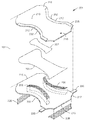
도 1은 본 발명의 섬유를 사용할 수 있는 흡수 용품의 일 실시예의 사시도이고;
도 2는 섬유를 형성하기 위해 본 발명의 일 실시예에서 사용될 수도 있는 공정의 개략도이고;
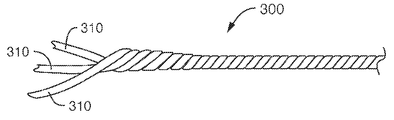
도 3은 본 발명의 일 실시예에 따라 연신될 수 있는 섬유 다발의 개략도이고; 그리고
도 4-5는 실시예 1의 섬유의 SEM 현미경사진이다.All possible disclosures of the invention including the best mode of the invention for a person of ordinary skill in the art are more specifically described in the remainder of the specification in which the accompanying drawings are referred to.
1 is a perspective view of one embodiment of an absorbent article using the fibers of the present invention;
Figure 2 is a schematic view of a process that may be used in one embodiment of the present invention to form fibers;
Figure 3 is a schematic view of a fiber bundle that can be drawn according to one embodiment of the present invention; And
4-5 are SEM micrographs of the fibers of Example 1;
이하, 하나 이상의 예가 후술되어 있는 본 발명의 다양한 실시예들을 상세히 설명한다. 각각의 예는 본 발명을 한정하는 것이 아니라, 본 발명의 설명을 위해서 제공된다. 실제로, 본 발명의 사상이나 범위로부터 벗어나지 않고 본 발명에 있어서 다양한 수정과 변형을 행할 수 있다는 점은 통상의 기술자에게 자명할 것이다. 예를 들어, 하나의 실시예에 일부로서 예시하거나 설명하는 특징들을 다른 하나의 실시예에 사용하여 추가적인 실시예를 얻을 수 있다. 따라서, 본 발명은 이러한 변형들 및 변경들을 첨부된 특허청구범위 및 그들의 등가물들의 범주 내로 포함시키고자 하는 것이다. Hereinafter, one or more examples will be described in detail with respect to various embodiments of the present invention described below. Each example is provided for the purpose of illustrating the invention rather than limiting the invention. In fact, it will be apparent to those skilled in the art that various modifications and variations can be made in the present invention without departing from the spirit or scope of the invention. For example, additional embodiments may be obtained using features illustrated or described as part of one embodiment in another embodiment. It is therefore intended that the present invention include all such modifications and variations as fall within the scope of the appended claims and their equivalents.
개략적으로 말하면, 본 발명은 복수의 섬유를 함유하는 섬유 다발에 관한 것이다. 섬유는 폴리올레핀 매트릭스 중합체를 포함하는 연속상, 및 폴리올레핀 매트릭스 중합체와 적어도 부분적으로 비상용성을 가짐으로써 연속상 내에서 이산 나노-규모 상 도메인들로서 분산되는 나노내포 첨가제를 함유하는 열가소성 조성물로 형성된다. 소정의 조건 하에서 연신되는 경우, 본 발명자들은 이들 나노 크기 상 도메인이 섬유의 내부 벽면에 포어 망을 형성하는 독특한 방식으로 상호 작용할 수 있다는 것을 발견했다. 즉, 연신 도중에 경험한 길이방향 변형이 물질의 비양립성(incompatibility)으로부터 발생하는 응력 집중의 결과로서 이산 상 도메인 근처에서 집중적인 국소화된 전단 지대 및/또는 응력 집중 지대(예컨대 정상 응력)를 개시할 수 있는 것으로 여겨진다. 이들 전단 및/또는 응력 집중 지대는 도메인들에 인접한 폴리올레핀 매트릭스에서 약간의 초기 해리(debonding)를 유발한다. 일단 초기 포어가 형성되면, 도메인들 사이에 위치한 매트릭스가 가소적으로 변형되어 국소적으로 좁고 (또는 넥(neck)) 변형-경화된 내부 연신 지역을 생성하게 된다. 이 공정은 신축되는 방향으로 성장하는 내부 벽면의 큰 부피를 통해 포어가 형성되는 것을 허용하고, 그로써 포어 망의 형성을 유도하는 한편 분자 배향은 기계적 강도를 증강시키는 변형-경화를 유도한다. Briefly, the present invention relates to a fiber bundle containing a plurality of fibers. The fibers are formed of a continuous phase comprising a polyolefin matrix polymer and a thermoplastic composition containing a nanocomposite additive that is at least partially incompatible with the polyolefin matrix polymer and dispersed as discrete nano-scale domains within the continuous phase. When stretched under certain conditions, the present inventors have found that these nanoscale domains can interact in a unique way to form a net on the inner wall of the fiber. That is, the longitudinal strain experienced during stretching initiates intensified localized shear zones and / or stress concentration zones (e.g., normal stress) near the discrete domain as a result of stress concentration resulting from incompatibility of the material . These shear and / or stress concentration zones cause some initial debonding in the polyolefin matrix adjacent to the domains. Once the initial pores are formed, the matrix located between the domains is slightly deformed to create a locally narrow (or neck) strain-hardened inner stretch zone. This process allows the pores to be formed through the large volume of the inner wall surface growing in the stretch direction, thereby inducing the formation of the pore net while the molecular orientation inducing strain-hardening to enhance the mechanical strength.
또한, 본 발명자들은 포어 망을 형성하는 동안 섬유의 파단 정도가 섬유 다발의 성질을 선택적으로 조절하여 최소화될 수 있음을 발견하였다. 예를 들어, 상기 다발은 통상적으로 약 5개 이상의 섬유, 일부 실시예에서는 약 50개 이상의 섬유, 일부 실시예에서는 약 100 내지 약 1000개의 섬유, 일부 실시예에서는 약 200 내지 약 800개의 섬유를 포함한다. 사용된 개수와 관계없이, 다발 내의 섬유는 실질적으로 길이방향 축을 따라 배향되고 길이방향 축을 중심으로 함께 꼬인다. 도 3을 참조하면, 예를 들면, 일 실시예에서 길이방향 축 "L"을 중심으로 함께 꼬인 3개의 개별 섬유(310)를 함유하는 다발(300)이 도시되어 있다. 꼬임의 성질은 원하는 대로 다양할 수도 있다. 소정의 실시예들에서, 예를 들어, 나선형 꼬임(예, 원추형 나선, 원형 나선 등)이 섬유 다발을 형성하는데 사용될 수도 있다. 사용될 때, 나선형 꼬임 각도는 약 0.1° 내지 약 20°, 일부 실시예에서는 약 0.2° 내지 약 10°, 일부 실시예에서는 약 0.5° 내지 약 5°로 다양할 수도 있다. 다발이 길이방향 축 주위로 완전한 회전을 이루도록 하는 선형 거리인, 피치는 마찬가지로 약 1 내지 약 300회전/m, 일부 실시예에서는 약 2 내지 약 200회전/m, 일부 실시예에서는 약 5 내지 약 100회전/m로 다양할 수도 있다. 다발의 총 섬유 데니어는 약 1 내지 약 30kg/9000m, 일부 실시예에서는 약 2 내지 약 20kg/9000m, 일부 실시예에서는 약 5 내지 약 15kg/9000m의 범위일 수도 있다. In addition, the present inventors have found that the degree of breakage of fibers during formation of a net net can be minimized by selectively controlling the properties of the fiber bundles. For example, the bundle typically comprises about 5 or more fibers, in some embodiments about 50 or more fibers, in some embodiments about 100 to about 1000 fibers, and in some embodiments about 200 to about 800 fibers do. Regardless of the number used, the fibers in the bundle are oriented substantially along the longitudinal axis and twist together about the longitudinal axis. Referring to FIG. 3, for example, in one embodiment, a
일단 형성되면, 섬유 다발은 그 후 섬유에서 안정적인 포어 망을 형성하기 위해 연신될 수도 있다. 예를 들면, 섬유의 소정의 단위 부피 내에서 포어들이 차지하는 평균 부피 퍼센트는, 섬유의 cm3 당 약 15% 내지 약 80%, 일부 실시예들에서는 약 20% 내지 약 70%, 일부 실시예들에서는 약 30% 내지 약 60%일 수 있다. 그런 포어 부피를 가지면, 섬유는 상대적으로 낮은 밀도, 예컨대 약 0.90g/cm3 이하, 일부 실시예에서는 약 0.85g/cm3 이하, 일부 실시예에서는 약 0.80g/cm3 이하, 일부 실시예에서는 약 0.10g/cm3 내지 약 0.75g/cm3 및 일부 실시예에서는 약 0.20g/cm3 내지 약 0.70g/cm3를 가질 수 있다. 포어 망의 포어 중 상당 부분은 또한 “나노-규모” 크기 (“나노포어(nanopore)”), 예컨대 평균 단면 치수가 약 800nm 이하, 일부 실시예에서는 약 5 내지 약 700nm, 및 일부 실시예에서는 약 10 내지 약 500nm인 것들의 것이다. 용어 “단면 치수”는 일반적으로 그것의 주축(예컨대 길이)에 대해 실질적으로 직각을 이루고 또한 전형적으로 연신 중에 인가된 응력의 방향에 대해 실질적으로 직각인 포어의 특징적인 치수(예컨대, 폭 또는 직경)를 말한다. 나노포어들은 또한 약 100 내지 약 5000nm, 일부 실시예에서는 약 50 내지 약 2000nm, 및 일부 실시예에서는 약 100 내지 약 1000nm의 범위 내에 있는 평균 축방향 치수를 가질 수 있다. “축방향 치수”는 전형적으로 연신 방향에 있는 주요 축(예, 길이)의 방향의 치수이다. 그러한 나노포어들은 예를 들면 섬유의 총 포어 부피의 약 15부피% 이상, 일부 실시예에서는 약 20부피% 이상, 일부 실시예에서는 약 30부피% 내지 100부피% 및 일부 실시예에서는 약 40부피% 내지 약 90부피%를 구성할 수도 있다. Once formed, the fiber bundle may then be stretched to form a stable pore net in the fibers. For example, the average volume percentage predetermined pores are occupied in the unit volume of the fiber is from about 15% to about 80% per the fiber cm 3,, in some embodiments from about 20% to about 70%, in some embodiments Lt; / RTI > to about 60%. Having such a pore volume, the fibers are relatively low density, such as about 0.90g / cm 3 or less, in some embodiments, from about 0.85g / cm 3 or less, in some embodiments, from about 0.80g / cm 3 or less, in some embodiments it is approximately 0.10g / cm 3 to about 0.75g / cm 3, and some embodiments may have from about 0.20g / cm 3 to about 0.70g / cm 3. (&Quot; nanopore "), e.g., having an average cross-sectional dimension of about 800 nm or less, in some embodiments about 5 to about 700 nm, and in some embodiments about 10 to about 500 nm. The term " cross-sectional dimension " generally refers to the characteristic dimension (e.g., width or diameter) of a pore that is substantially perpendicular to its major axis (e.g., length) and is typically substantially perpendicular to the direction of stress applied during drawing, . The nanopores may also have an average axial dimension within the range of from about 100 to about 5000 nm, in some embodiments from about 50 to about 2000 nm, and in some embodiments from about 100 to about 1000 nm. The " axial dimension " is typically the dimension in the direction of the major axis (e.g., length) in the stretching direction. Such nanopores may comprise, for example, at least about 15 vol%, in some embodiments at least about 20 vol%, in some embodiments at least about 30 vol% to about 100 vol%, and in some embodiments at least about 40 vol% To about 90% by volume.
본 발명의 다양한 실시예를 이제 보다 상세하게 설명하기로 한다. Various embodiments of the present invention will now be described in more detail.
I. 열가소성 조성물 I. Thermoplastic composition
A. 폴리올레핀 매트릭스 A. Polyolefin matrix
폴리올레핀은 통상적으로 열가소성 조성물의 약 60중량% 내지 약 99중량%, 일부 실시예들에서는 약 60중량% 내지 약 98중량%, 일부 실시예들에서는 약 80중량% 내지 약 95중량%를 구성하는 하나 이상의 매트릭스 중합체를 포함한다. 폴리올레핀은 약 100℃ 내지 약 220℃, 일부 실시예들에서는 약 120℃ 내지 약 200℃, 일부 실시예들에서는 약 140℃ 내지 약 180℃의 용융 온도를 가질 수 있다. 용융 온도는, ASTM D-3417에 따라 시차주사 열량측정("DSC")을 이용하여 결정될 수 있다. 적절한 폴리올레핀은, 예를 들어, 에틸렌 중합체(예를 들어, 저밀도 폴리에틸렌("LDPE"), 고밀도 폴리에틸렌("HDPE"), 선형 저밀도 폴리에틸렌("LLDPE") 등), 프로필렌 단독중합체(예를 들어, 교대배열, 혼성배열, 동일배열 등), 프로필렌 공중합체 등을 포함할 수 있다. 구체적인 일 실시예에서, 중합체는, 동종폴리프로필렌 또는 프로필렌 공중합체 등의 프로필렌 중합체다. 프로필렌 중합체는, 예를 들어, 실질적으로 동일배열 폴리프로필렌 단독중합체 또는 약 10중량% 이하의 다른 단량체, 즉, 적어도 약 90중량%의 프로필렌을 포함하는 공중합체로부터 형성될 수 있다. 이러한 단독중합체는 약 140℃ 내지 약 170℃의 용융점을 가질 수 있다. The polyolefin typically comprises from about 60% to about 99% by weight of the thermoplastic composition, in some embodiments from about 60% to about 98% by weight, in some embodiments from about 80% to about 95% Or more of the above matrix polymer. The polyolefin may have a melting temperature of from about 100 ° C to about 220 ° C, in some embodiments from about 120 ° C to about 200 ° C, and in some embodiments, from about 140 ° C to about 180 ° C. The melting temperature can be determined using differential scanning calorimetry ("DSC") in accordance with ASTM D-3417. Suitable polyolefins include, for example, ethylene polymers (e.g., low density polyethylene ("LDPE"), high density polyethylene ("HDPE"), linear low density polyethylene ("LLDPE" Alternating arrangement, hybrid arrangement, identical arrangement, etc.), propylene copolymer, and the like. In one specific embodiment, the polymer is a propylene polymer such as homopolypropylene or propylene copolymer. The propylene polymer may be formed from, for example, a copolymer comprising substantially the same sequence of polypropylene homopolymers or about 10% by weight or less of other monomers, i.e., at least about 90% by weight of propylene. Such a homopolymer may have a melting point of from about 140 캜 to about 170 캜.
물론, 다른 폴리올레핀도 본 발명의 조성물에 사용될 수도 있다. 일 실시예에서, 예를 들면, 폴리올레핀은 C3-C20 α-올레핀 또는 C3-C12α-올레핀 등의 다른 α-올레핀과 에틸렌 또는 프로필렌의 공중합체일 수 있다. 적합한 α-올레핀의 구체적인 예시로는 다음을 포함한다: 1-부텐; 3-메틸-1-부텐; 3,3-다이메틸-1-부텐; 1-펜텐; 하나 이상의 메틸, 에틸 또는 프로필 치환기를 가지는 1-펜텐; 하나 이상의 메틸, 에틸 또는 프로필 치환기를 가지는 1-헥센; 하나 이상의 메틸, 에틸 또는 프로필 치환기를 가지는 1-헵텐; 하나 이상의 메틸, 에틸 또는 프로필 치환기를 가지는 1-옥텐; 하나 이상의 메틸, 에틸 또는 프로필 치환기를 가지는 1-노넨; 에틸, 메틸 또는 다이메틸-치환된-1-데센; 1-도데센; 및 스티렌. 특히 바람직한 α-올레핀 공단량체는 1-부텐, 1-헥센 및 1-옥텐이다. 그런 공중합체의 에틸렌 또는 프로필렌 함량은 약 60 몰% 내지 약 99 몰%, 일부 실시예에서는 약 80 몰% 내지 약 98.5 몰% 및 일부 실시예에서는 약 87 몰% 내지 약 97.5 몰%일 수 있다. α-올레핀 함량은 마찬가지로 약 1 몰% 내지 약 40 몰%, 일부 실시예에서는 약 1.5 몰% 내지 약 15 몰% 및 일부 실시예에서는 약 2.5 몰% 내지 약 13 몰% 범위일 수 있다. Of course, other polyolefins may also be used in the compositions of the present invention. In one embodiment, for example, the polyolefin may be a copolymer of ethylene or propylene with another? -Olefin such as a C 3 -C 20 ? -Olefin or a C 3 -C 12 ? -Olefin. Specific examples of suitable? -Olefins include: 1-butene; 3-methyl-1-butene; 3,3-dimethyl-1-butene; 1-pentene; 1-pentene having at least one methyl, ethyl or propyl substituent; 1-hexene having at least one methyl, ethyl or propyl substituent; 1-heptene having at least one methyl, ethyl or propyl substituent; 1-octene having at least one methyl, ethyl or propyl substituent; 1-none having at least one methyl, ethyl or propyl substituent; Ethyl, methyl or dimethyl-substituted-1-decene; Dodecene; And styrene. Particularly preferred? -Olefin comonomers are 1-butene, 1-hexene and 1-octene. The ethylene or propylene content of such copolymers may be from about 60 mole percent to about 99 mole percent, in some embodiments from about 80 mole percent to about 98.5 mole percent, and in some embodiments from about 87 mole percent to about 97.5 mole percent. The? -olefin content may likewise range from about 1 mol% to about 40 mol%, in some embodiments from about 1.5 mol% to about 15 mol%, and in some embodiments from about 2.5 mol% to about 13 mol%.
본 발명에서 사용하기 위한 예시적인 올레핀 공중합체는, 미국 텍사스주 휴스턴에 소재하는 ExxonMobil Chemical Company에 의해 EXACT™라는 상품명으로 시판되는 에틸렌계 공중합체를 포함한다. 적합한 다른 에틸렌 공중합체는 미시간주 미드랜드 소재 Dow Chemical Company로부터 ENGAGE™, AFFINITY™, DOWLEX™ (LLDPE) 및 ATTANE™ (ULDPE)이란 명칭 하에 입수가능하다. 다른 적합한 에틸렌 중합체는 미국 특허 제4,937,299호(Ewen 등); 제5,218,071호(Tsutsui 등); 제5,272,236호(Lai 등); 및 제5,278,272호(Lai 등)에 기술되어 있다. 적합한 프로필렌 공중합체는 또한 텍사스주 휴스턴 소재 ExxonMobil Chemical Co.로부터 명칭 VISTAMAXX™; 벨기에 Feluy의 Atofina Chemicals로부터 FINA™(예컨대 8573); Mitsui Petrochemical Industries로부터 입수가능한 TAFMER™; 및 미시간주 미드랜드 소재 Dow Chemical Co.로부터 입수가능한 VERSIFY™ 하에 활용될 수 있다. 적절한 폴리프로필렌 단독중합체는, Exxon Mobil 3155 폴리프로필렌, Exxon Mobil Achieve™ 수지, 및 Total M3661 PP 수지를 포함할 수 있다. 다른 적합한 프로필렌 중합체의 예시들은 미국 특허 제6,500,563호(Datta 등); 제5,539,056호(Yang 등); 및 제5,596,052호(Resconi 등)에 기술되어 있다. Exemplary olefin copolymers for use in the present invention include ethylenic copolymers sold under the trade name EXACT TM by ExxonMobil Chemical Company of Houston, Tex., USA. Other suitable ethylene copolymers are available from Dow Chemical Company, Midland, MI under the names ENGAGE, AFFINITY, DOWLEX (TM) (LLDPE) and ATTANE (ULDPE). Other suitable ethylene polymers are disclosed in U.S. Patent No. 4,937,299 ( Ewen et al. ); 5,218, 071 ( Tsutsui et al. ); 5,272, 236 ( Lai et al. ); And 5,278, 272 ( Lai et al. ). Suitable propylene copolymers are also available from ExxonMobil Chemical Co., Houston, Texas under the designations VISTAMAXX ™; FINA ™ (eg 8573) from Atofina Chemicals of Feluy, Belgium; TAFMER 占 available from Mitsui Petrochemical Industries; And VERSIFY (TM) available from Dow Chemical Co. of Midland, Michigan. Suitable polypropylene homopolymers may include Exxon Mobil 3155 polypropylene, Exxon Mobil Achieve ™ resin, and Total M3661 PP resin. Examples of other suitable propylene polymers are disclosed in U.S. Patent No. 6,500,563 ( Datta et al. ); 5,539,056 ( Yang et al. ); And 5,596,052 ( Resconi et al. ).
다양하게 공지되어 있는 기법들 중 어느 것이든지 일반적으로 올레핀 공중합체를 형성하기 위해 사용될 수 있다. 예를 들어 올레핀 중합체는 유리 라디칼 또는 배위 촉매(예컨대 지글러-나타)를 사용하여 형성될 수 있다. 바람직하게는 올레핀 중합체는 단일-부위 배위 촉매, 예컨대 메탈로센 촉매로부터 형성된다. 그런 촉매 시스템은 코모노머가 분자 사슬 내에 무작위로 분포되고 상이한 분자량 단편들을 가로질러 균일하게 분포되는 에틸렌 공중합체를 유발한다. 메탈로센-촉매된 폴리올레핀은 예를 들면 미국 특허 제5,571,619호(McAlpin 등); 제5,322,728호(Davis 등); 제5,472,775호(Obijeski 등); 제5,272,236호(Lai 등); 및 제6,090,325호(Wheat 등)에 기술되어 있다. 메탈로센 촉매의 예시로는 비스(n-부틸사이클로펜타디에닐)티타늄 다이클로라이드, 비스(n-부틸사이클로펜타디에닐)지르코늄 다이클로라이드, 비스(사이클로펜타디에닐)스칸듐 클로라이드, 비스(인데닐)지르코늄 다이클로라이드, 비스(메틸사이크로펜타디에닐)티타늄 다이클로라이드, 비스(메틸사이클로펜타디에닐)지르코늄 다이클로라이드, 코발토센, 사이클로펜타디에닐티타늄 트라이클로라이드, 페로센, 하프노센 다이클로라이드, 아이소프로필(사이클로펜타디에닐-1-플루오레닐)지르코늄 다이클로라이드, 몰리브도센 다이클로라이드, 니켈로센, 니오보센 다이클로라이드, 루테노센, 티타노센 다이클로라이드, 지르코노센 클로라이드 하이드라이드, 지르코노센 다이클로라이드 등. 메탈로센 촉매를 사용하여 만들어진 중합체는 전형적으로 좁은 분자량 범위를 가진다. 예를 들어 메탈로센-촉매된 중합체는 4 아래의 다중분산성 수(Mw/Mn), 조절된 짧은 사슬 분지화 분포 및 조절된 동일배열성을 가질 수 있다. Any of a variety of techniques known in the art can generally be used to form olefin copolymers. For example, the olefin polymer can be formed using a free radical or a coordination catalyst (e.g., Ziegler-Natta). Preferably, the olefin polymer is formed from a single-site coordination catalyst, such as a metallocene catalyst. Such catalyst systems cause ethylene copolymers in which the comonomer is randomly distributed within the molecular chain and is evenly distributed across the different molecular weight fragments. Metallocene-catalyzed polyolefins are described, for example, in U.S. Patent No. 5,571,619 ( McAlpin et al. ); 5,322, 728 ( Davis et al. ); 5,472,775 ( Obijeski et al. ); 5,272, 236 ( Lai et al. ); And 6,090,325 ( Wheat et al. ). Examples of metallocene catalysts include bis (n-butylcyclopentadienyl) titanium dichloride, bis (n-butylcyclopentadienyl) zirconium dichloride, bis (cyclopentadienyl) scandium chloride, bis ) Zirconium dichloride, bis (methylcyclopentadienyl) titanium dichloride, bis (methylcyclopentadienyl) zirconium dichloride, cobaltosene, cyclopentadienyl titanium trichloride, ferrocene, hafnocene dichloride, iso (Cyclopentadienyl-1-fluorenyl) zirconium dichloride, molybdosecene dichloride, nickelocene, niobocene dichloride, ruthenocene, titanocene dichloride, zirconocene chloride hydride, Conocene dichloride and the like. Polymers made using metallocene catalysts typically have a narrow molecular weight range. For example, the metallocene-catalyzed polymer may have a polydispersity number (M w / M n ) of 4 or less, a controlled short-chain branching distribution, and a controlled ordered orientation.
B. 나노내포 첨가제 B. Nano-inclusion additive
여기에서 사용된, 용어 “나노내포 첨가제(nanoinclusion additive)”는 일반적으로 나노 크기의 이산 도메인들의 형태로 중합체 매트릭스 내에 분산되어 있을 수 있는 물질을 가리킨다. 예를 들면, 연신 이전에, 도메인들은 약 1 내지 약 1000nm, 일부 실시예에서는 약 5 내지 약 800nm, 일부 실시예에서는 약 10 내지 약 500nm, 일부 실시예에서는 약 20 내지 약 200nm의 평균 단면 치수를 가질 수도 있다. 도메인들은 다양한 상이한 형상들, 예를 들면, 타원형, 구형, 원통형, 판상형, 관형 등을 가질 수 있다. 일 실시예에서, 예를 들면 도메인들은 실질적으로 타원 형상을 갖는다. 나노내포 첨가제는 전형적으로 연속상 폴리올레핀 매트릭스의 중량을 기준으로, 열가소성 조성물의 약 0.05중량% 내지 약 20중량%, 일부 실시예에서는 약 0.1중량% 내지 약 10중량%, 및 일부 실시예에서는 약 0.5중량% 내지 약 5중량%의 양으로 사용될 수 있다. 전체 열가소성 조성물에서 나노내포 첨가제의 농도는 유사하게 열가소성 조성물의 약 0.01중량% 내지 약 15중량%, 일부 실시예에서는 약 0.05중량% 내지 약 10중량%, 및 일부 실시예에서는 약 0.3중량% 내지 약 6중량%로 구성될 수 있다. As used herein, the term " nanoinclusion additive " refers to a material that may be dispersed within the polymer matrix, typically in the form of nanoscale discrete domains. For example, prior to stretching, the domains may have an average cross-sectional dimension of from about 1 to about 1000 nm, in some embodiments from about 5 to about 800 nm, in some embodiments from about 10 to about 500 nm, and in some embodiments from about 20 to about 200 nm . Domains may have a variety of different shapes, e.g., elliptical, spherical, cylindrical, plate, tubular, and the like. In one embodiment, for example, the domains have a substantially elliptical shape. The nanocomposing additive typically comprises from about 0.05% to about 20%, in some embodiments from about 0.1% to about 10%, and in some embodiments, from about 0.5% to about 0.5%, by weight of the thermoplastic composition of the continuous phase polyolefin matrix % ≪ / RTI > by weight to about 5% by weight. The concentration of the nanocomposing additive in the overall thermoplastic composition is similarly from about 0.01% to about 15%, in some embodiments from about 0.05% to about 10%, and in some embodiments from about 0.3% to about 15% by weight of the thermoplastic composition 6% by weight.
나노내포 첨가제는 그것이 실질적으로 폴리올레핀 매트릭스 내에서 균질하게 분포될 수 있지만, 이산 도메인의 형태로 존재한다는 의미에서 부분적으로 폴리올레핀과 비양립성을 갖는다. 그런 부분적인 비양립성은 다양한 방법으로 이루어질 수 있다. 예를 들어 특정 실시예에서, 나노내포 첨가제는 폴리올레핀 매트릭스와 양립성을 갖고 그 안에 균질하게 분포되는 것을 허용하는 비극성 성분 (예컨대 올레핀)을 가질 수 있다. 그럼에도 불구하고, 첨가제는 또한 폴리올레핀 매트릭스와 비양립성을 가짐으로써 이산 도메인으로 합쳐지거나 분리되는 것을 허용하는 극성 성분을 포함할 수 있다. 그런 성분은 저분자량 또는 고분자량 극성 분자 부분 또는 블록, 이온기, 대전되거나 대전되지 않은 극성 도메인 및/또는 극성 분자 기를 포함할 수 있다. 다르게는, 첨가제는 전체적으로 본질상 비극성이지만, 그럼에도 이산 도메인이 형성되는 것을 허용하는 특정 물리적 특성을 가질 수 있다. 예를 들어, 특정 실시예에서, 나노내포 첨가제는 특정 온도 이상에서 폴리올레핀과 양립가능하거나 혼화할 수 있지만, 임계 용액 온도보다 낮은 온도에서는 상이 분리될 수 있다. 이런 방식으로, 나노내포 첨가제는 용융 상의 폴리올레핀과 안정한 배합물을 형성할 수 있지만, 온도가 내려감에 따라 연속상은 결정화되고 분리되어 나노내포 첨가제가 상분리되고, 합쳐지며, 별도의 나노-규모 도메인이 형성될 수 있다. The nanocomposite additive is partially incompatible with the polyolefin in the sense that it is present in the form of a discrete domain, although it may be substantially homogeneously distributed within the polyolefin matrix. Such partial incompatibility can be achieved in a variety of ways. For example, in certain embodiments, the nanocomposite additive may have a non-polar component (e.g., olefin) that is compatible with the polyolefin matrix and allows it to be homogeneously distributed therein. Nonetheless, the additive may also comprise a polar component which is incompatible with the polyolefin matrix, thereby allowing it to join or separate into the discrete domains. Such components may include low molecular weight or high molecular weight polar molecular moieties or blocks, ionic groups, charged or uncharged polar domains and / or polar molecular groups. Alternatively, the additive may be entirely nonpolar in nature, but still have certain physical properties that allow the discrete domain to be formed. For example, in certain embodiments, the nanocomposing additive may be compatible or compatible with the polyolefin above a certain temperature, but the phase may be separated at a temperature below the critical solution temperature. In this way, the nanocomposite additive can form a stable blend with the molten phase polyolefin, but as the temperature is lowered, the continuous phase crystallizes and separates so that the nanocomposite additive is phase separated, merged, and separate nano-scale domains are formed .
나노내포 첨가제의 특정한 상태나 형태는, 원하는 도메인이 형성될 수 있는 한 중요한 것이 아니다. 예를 들어, 일부 실시예들에서, 나노내포 첨가제는 실온(예를 들어, 25℃)에서 액체 또는 반고체의 형태일 수 있다. 이러한 액체는 준안정 분산액을 형성하도록 매트릭스에 쉽게 분산될 수 있고, 이어서 배합물의 온도를 감소시킴으로써 도메인 크기를 보존하도록 담금질될 수 있다. 그런 액체 또는 반-고체 물질의 동점도는 전형적으로 40℃에서 측정될 때 약 0.7 내지 약 200 센티스토크 (“cs”), 일부 실시예에서는 약 1 내지 약 100 cs 및 일부 실시예에서는 약 1.5 내지 약 80cs이다. 적당한 액체 또는 반-고체는 예를 들면 실리콘, 실리콘-폴리에테르 공중합체, 지방족 폴리에스테르, 방향족 폴리에스테르, 알킬렌 글리콜 (예컨대 에틸렌 글리콜, 다이에틸렌 글리콜, 트라이에틸렌 글리콜, 테트라에틸렌 글리콜, 프로필렌 글리콜, 폴리에틸렌 글리콜, 폴리프로필렌 글리콜, 폴리부틸렌 글리콜 등), 알칸 다이올 (예컨대 1,3-프로판다이올, 2,2-다이메틸-1,3-프로판다이올, 1,3-부탄다이올, 1,4-부탄다이올, 1,5-펜탄다이올, 1,6-헥산다이올, 2,2,4-트라이메틸-1,6-헥산다이올, 1,3-사이클로헥산다이메탄올, 1,4-사이클로헥산다이메탄올, 2,2,4,4-테트라메틸-1,3-사이클로부탄다이올 등), 아민 옥사이드 (예컨대 옥틸다이메틸아민 옥사이드), 지방산 에스테르, 지방산 아미드 (예컨대 올레아미드, 에루카미드, 스테아라미드, 에틸렌 비스(스테아라미드) 등), 미네랄 및 식물성 오일 등을 포함할 수 있다. 특히 적당한 한 가지 액체 또는 반-고체는, 예컨대 BASF Corp.로부터 상표명 Pluriol® WI로 상업적으로 입수가능한 폴리에테르 폴리올이다. The particular state or form of the nanocomposing additive is not critical as long as the desired domain can be formed. For example, in some embodiments, the nanocomposing additive may be in the form of a liquid or semi-solid at room temperature (e.g., 25 占 폚). These liquids can be readily dispersed in the matrix to form a metastable dispersion and then quenched to preserve the domain size by reducing the temperature of the formulation. The kinematic viscosity of such liquid or semi-solid materials typically ranges from about 0.7 to about 200 centistokes (" cs "), in some embodiments from about 1 to about 100 cs, and in some embodiments from about 1.5 to about 100 cs 80cs. Suitable liquids or semi-solids include, for example, silicones, silicone-polyether copolymers, aliphatic polyesters, aromatic polyesters, alkylene glycols such as ethylene glycol, diethyleneglycol, triethyleneglycol, tetraethyleneglycol, propyleneglycol, Polypropylene glycol, polybutylene glycol, etc.), alkanediols (e.g., 1,3-propanediol, 2,2-dimethyl-1,3-propanediol, 1,4-butanediol, 1,5-pentanediol, 1,6-hexanediol, 2,2,4-trimethyl-1,6-hexanediol, 1,3- Cyclohexanedimethanol, 2,2,4,4-tetramethyl-1,3-cyclobutanediol, etc.), amine oxides (such as octyldimethylamine oxide), fatty acid esters, fatty acid amides Amide, erucamide, stearamide, ethylenebis (stearamide), etc.), And the like mineral and vegetable oils. Particularly suitable liquids or semi-solids are, for example, polyether polyols commercially available from BASF Corp. under the tradename Pluriol WI.
다른 실시예들에서, 나노내포 첨가제는 무정형, 결정형, 또는 반결정형일 수 있는 고체의 형태이다. 예를 들어, 나노내포 첨가제는, 본래 중합체일 수 있으며, 비교적 큰 분자량을 가져서 열가소성 조성물의 안정성과 용융 강도를 개선하는 데 일조한다. 상기에서 표시된 것과 같이, 나노내포 첨가제는 부분적으로 폴리올레핀 매트릭스와 비양립성을 갖는다. 그런 첨가제의 한 실례는 미정질 폴리올레핀 왁스이고, 그것은 전형적으로 에틸렌 및/또는 C3-C10-알크-1-엔으로부터, 예컨대 프로필렌, 1-부텐, 1-펜텐, 1-헥센, 1-헵텐, 1-옥텐, 1-노넨 및 1-데센으로부터 유도된다. 미정질 왁스는 전형적으로 상대적으로 낮은 용융 온도, 예컨대 약 30℃ 내지 약 150℃, 일부 실시예에서는 약 50℃ 내지 약 140℃및 일부 실시예에서는 약 80℃ 내지 약 130℃의 용융 온도를 가진다. 그런 낮은 용융 온도에서, 왁스는 용융 상일 때에는 폴리올레핀과 혼화성 배합물을 형성할 수 있지만, 온도가 내려가고 중합체가 결정화되거나 고화되면 왁스는 분리되고 합쳐져서 별도의 나노-규모 도메인이 형성될 것이다. In other embodiments, the nanocomposite additive is in the form of a solid that can be amorphous, crystalline, or semi-crystalline. For example, the nanocomposite additive can be the original polymer and has a relatively high molecular weight to help improve the stability and melt strength of the thermoplastic composition. As indicated above, the nanocomposite additive is partially incompatible with the polyolefin matrix. One example of such an additive is a microcrystalline polyolefin wax which is typically obtained from ethylene and / or C 3 -C 10 -alk-1-enes such as propylene, 1-butene, 1-pentene, 1-hexene, , 1-octene, 1-nonene and 1-decene. The microcrystalline wax typically has a relatively low melting temperature, such as from about 30 캜 to about 150 캜, in some embodiments from about 50 캜 to about 140 캜, and in some embodiments, from about 80 캜 to about 130 캜. At such low melting temperatures, the wax can form a miscible blend with the polyolefin when it is in the molten phase, but when the temperature is lowered and the polymer crystallizes or solidifies, the wax will separate and aggregate to form separate nano-scale domains.
중합체 나노내포 첨가제의 다른 실례는 극성 및 비극성 성분을 함유하는 관능화된 폴리올레핀이다. 극성 성분은, 예를 들어, 하나 이상의 관능기에 의해 제공될 수 있고, 무극성 성분은 올레핀에 의해 제공될 수 있다. 나노내포 첨가제의 올레핀 성분은, 일반적으로, 상술한 바와 같이 임의의 선형 또는 브랜치형 α-올레핀 단량체, 올리고머, 또는 올레핀 단량체로부터 유도되는 중합체(공중합체를 포함함)로부터 형성될 수 있다. 나노내포 첨가제의 관능기는, 분자에 극성 성분을 제공하며 폴리올레핀 매트릭스 중합체와 상용할 수 없는 임의의 기, 분자 세그먼트, 및/또는 블록일 수 있다. 폴리올레핀과 비상용성인 분자 세그먼트 및/또는 블록의 예는 아크릴레이트, 스티레닉, 폴리에스테르, 폴리아미드 등을 포함할 수 있다. 관능기는 이온 성질을 가질 수 있고 대전된 금속 이온을 포함할 수 있다. 특히 적절한 관능기는, 말레 무수물, 말레산, 푸마르산, 말레이미드, 말레산 하이드라지드, 말레산 무수물과 디아민의 반응 산물, 메틸나딕 무수물, 디클로로말레산 무수물, 말레산 아미드 등이다. 말레산 무수물 개질된 폴리올레핀이 본 발명에서 사용하는 데 특히 적절하다. 이러한 개질된 폴리올레핀은, 통상적으로, 말레산 무수물을 중합체 골격 물질 상에 그래프트함으로써 형성된다. 이러한 말레산화 폴리올레핀은, E. I. du Pont de Nemours and Company에 의해 Fusabond®라는 상품명으로 시판되고 있으며, 예를 들어, P 시리즈(화학적 개질된 폴리프로필렌), E 시리즈(화학적 개질된 폴리에틸렌), C 시리즈(화학적 개질된 에틸렌 비닐 아세테이트), A 시리즈(화학적 개질된 에틸렌 아크릴레이트 공중합체 또는 테르중합체), 또는 N 시리즈(화학적 개질된 에틸렌-프로필렌, 에틸렌-프로필렌 디엔 단량체("EPDM") 또는 에틸렌-옥텐)이 있다. 대안적으로, 말레산화 폴리올레핀도, Chemtura Corp.에 의해 Polybond® 라는 상품명으로 그리고 Eastman Chemical Company에 의해 Eastman G series라는 상품명으로 그리고 Arkema로부터 Orevac®이란 상품명으로 시판되고 있다. Another example of a polymeric nanocomposite additive is a functionalized polyolefin containing polar and nonpolar components. The polar component may be provided by, for example, one or more functional groups, and the non-polar component may be provided by the olefin. The olefin component of the nanocomposing additive can generally be formed from a polymer (including a copolymer) derived from any linear or branched alpha-olefin monomer, oligomer, or olefin monomer as described above. The functional group of the nanocomposing additive may be any group, molecular segment, and / or block that provides a polar component to the molecule and is incompatible with the polyolefin matrix polymer. Examples of polyolefin and non-compatible molecular segments and / or blocks may include acrylates, styrenes, polyesters, polyamides, and the like. The functional groups may have ionic properties and may include charged metal ions. Particularly suitable functional groups are the reaction products of maleic anhydride, maleic acid, fumaric acid, maleimide, maleic acid hydrazide, maleic anhydride and diamine, methylnadic anhydride, dichloromaleic anhydride, maleic acid amide and the like. Maleic anhydride modified polyolefins are particularly suitable for use in the present invention. These modified polyolefins are typically formed by grafting maleic anhydride onto the polymer backbone material. Such maleic acid polyolefins are commercially available under the trade name Fusabond® by EI du Pont de Nemours and Company and include, for example, P series (chemically modified polypropylene), E series (chemically modified polyethylene), C series (Chemically modified ethylene vinyl acetate), A series (chemically modified ethylene acrylate copolymer or terpolymer) or N series (chemically modified ethylene-propylene, ethylene-propylene diene monomer ("EPDM") or ethylene- . Alternatively, the maleic acid polyolefin is also marketed by Chemtura Corp. under the trade name Polybond® and by Eastman Chemical Company under the trade name Eastman G series and from Arkema under the trade name Orevac®.
소정의 실시예들에서, 중합체 나노내포 첨가제도 반응성일 수 있다. 이러한 반응성 나노내포 첨가제의 일례는, 평균적으로 분자당 적어도 두 개의 옥시란(oxirane) 고리를 포함하는 폴리에폭시드이다. 이론에 제한되고자 의도하지 않고, 이러한 폴리에폭시드 분자는 조성물의 특정 성분과 반응(예를 들어, 사슬 연장, 측쇄 분지화, 그래프트화, 공중합체 형성 등)을 거쳐 유리 전이 온도를 실질적으로 감소시키지 않고 용융 강도를 향상시킬 수 있는 것으로 여겨진다. 반응성 첨가제는 또한 폴리올레핀과 극성이 더 큰 다른 첨가제, 예컨대 마이크로내포 첨가제 사이의 양립화(compatibilization)를 제공할 수 있고, 분산의 균질성을 개선시킬 수 있으며 마이크로내포 첨가제의 크기를 감소시킬 수 있다. 예를 들어 아래에서 더욱 상세하게 기술될 것처럼, 본 발명의 소정의 실시예들은 마이크로내포 첨가제로서 폴리에스테르를 사용할 수 있다. 그런 실시예에서, 반응성 나노내포 첨가제는 폴리에스테르의 카르복실 말단기를 통해 (에스테르화) 또는 하이드록실기를 통해 (에테르화) 친핵성 고리-개방 반응을 가능하게 할 수 있다. 옥사졸린 측 반응도 마찬가지로 발생하여 에스테르아미드 부분을 형성할 수 있다. 그런 반응들을 통해서, 폴리에스테르 마이크로내포 첨가제의 분자량은 때로 용융 공정 중에 관찰된 분해에 대응하기 위하여 증가될 수 있다. 본 발명자들은, 과다한 반응으로 인해 중합체 기본골격들 간의 가교결합이 발생할 수 있음을 발견하였다. 이러한 가교결합이 상당한 정도로 진행될 정도로 허용된다면, 그 결과로 형성되는 중합체 배합물이 매우 취약해져 원하는 강도와 세장 특성을 갖는 섬유로 가공되는 것이 어려울 수 있다. In certain embodiments, the polymeric nanocomposite additive may also be reactive. An example of such a reactive nanocomposing additive is a polyepoxide having an average of at least two oxirane rings per molecule. Without wishing to be bound by theory, it is believed that such a polyepoxide molecule substantially reduces the glass transition temperature through reaction with certain components of the composition (e.g., chain extension, side chain branching, grafting, copolymerization, etc.) And the melt strength can be improved. The reactive additive may also provide compatibilization between the polyolefin and other additives with a higher polarity, such as microencapsulated additives, which may improve the homogeneity of the dispersion and reduce the size of the microencapsulated additive. For example, as will be described in more detail below, certain embodiments of the present invention may use polyesters as micro-inclusion additives. In such embodiments, the reactive nanocomposing additive may enable a nucleophilic ring-opening reaction through the carboxyl end group of the polyester (esterification) or through a hydroxyl group (etherification). The oxazoline side reaction may likewise occur to form the ester amide moiety. Through such reactions, the molecular weight of the polyester micro-containment additive can sometimes be increased to accommodate the degradation observed during the melting process. The present inventors have found that cross-linking between polymeric frameworks can occur due to excessive reaction. If such cross-linking is allowed to proceed to a significant extent, the resulting polymer blend becomes very fragile and may be difficult to process into fibers having the desired strength and elongation properties.
이와 관련하여, 본 발명자들은, 비교적 낮은 에폭시 관능을 갖는 폴리에폭시드가 특히 효과적일 수도 있다는 점을 발견하였는데, 이는 "에폭시 등가 중량"으로 정량화될 수 있다. 에폭시 등가 중량은, 에폭시기의 하나의 분자를 포함하는 수지의 양을 반영하며, 개질제의 수평균 분자량을 분자의 에폭시기의 수로 나눔으로써 산출될 수 있다. 본 발명의 폴리에폭시드는, 통상적으로, 2.5 내지 7의 다중분산 지수와 함께, 통상적으로, 약 7,500 내지 약 250,000그램/몰, 일부 실시예들에서는 약 15,000 내지 약 150,000그램/몰, 일부 실시예들에서는, 약 20,000 내지 약 100,000그램/몰의 수평균 분자량을 갖는다. 폴리에폭시드는, 50 미만, 일부 실시예들에서는 5 내지 45, 일부 실시예들에서는 15 내지 40개의 에폭시기를 포함할 수 있다. 이어서, 에폭시 등가 중량은, 약 15,000그램/몰 미만, 일부 실시예들에서는 약 200 내지 약 10,000그램/몰, 일부 실시예들에서는 약 500 내지 약 7,000그램/몰일 수 있다. In this regard, the inventors have found that polyepoxides with relatively low epoxy functionality may be particularly effective, which can be quantified as "epoxy equivalent weight ". The epoxy equivalent weight reflects the amount of the resin containing one molecule of the epoxy group and can be calculated by dividing the number average molecular weight of the modifier by the number of epoxy groups of the molecule. The polyepoxides of the present invention typically have a polydispersity index from 2.5 to 7, typically from about 7,500 to about 250,000 grams / mole, in some embodiments from about 15,000 to about 150,000 grams / mole, Has a number average molecular weight of from about 20,000 to about 100,000 grams / mole. The polyepoxide may comprise less than 50, in some embodiments 5 to 45, and in some embodiments 15 to 40 epoxy groups. The epoxy equivalent weight may then be less than about 15,000 grams / mole, in some embodiments from about 200 to about 10,000 grams / mole, and in some embodiments from about 500 to about 7,000 grams / mole.
폴리에폭시드는 말단 에폭시기, 골격 옥시란 단위, 및/또는 펜던트 에폭시기를 함유하는 선형 또는 분지형, 단독중합체 또는 공중합체(예컨대, 랜덤, 그래프트, 블록 등)일 수도 있다. 이러한 폴리에폭시드를 형성하는 데 사용되는 단량체는 가변적일 수 있다. 구체적인 일 실시예에서, 예를 들어, 폴리에폭시드는 적어도 하나의 에폭시-관능 (메타)크릴 단량체 성분을 포함한다. 본 명세서에서 사용되는 바와 같이, "(메타)크릴"이라는 용어는, 아크릴 및 메타크릴 단량체, 뿐만 아니라 이들의 염 또는 에스테르, 예컨대, 아크릴레이트와 메타크릴레이트 단량체를 포함한다. 예를 들어, 적절한 에폭시-관능 (메타)크릴 단량체는, 1,2-에폭시기를 포함하는 것, 예를 들어, 글리시딜 아크릴레이트 및 글리시딜 메타크릴레이트를 포함할 수 있지만, 이에 한정되지 않는다. 다른 적절한 에폭시-관능 단량체는, 알릴 글리시딜 에테르, 글리시딜 에타크릴레이트, 및 글리시딜 이토코네이트를 포함한다. The polyepoxide may be a linear or branched, homopolymer or copolymer (e.g., random, graft, block, etc.) containing a terminal epoxy group, a backbone oxirane unit, and / or a pendant epoxy group. The monomers used to form such polyepoxides may be variable. In one specific embodiment, for example, the polyepoxide comprises at least one epoxy-functional (meth) acryl monomer component. As used herein, the term "(meth) acryl" includes acrylic and methacrylic monomers, as well as their salts or esters, such as acrylates and methacrylate monomers. For example, suitable epoxy-functional (meth) acryl monomers can include, but are not limited to, those containing 1,2-epoxy groups, such as glycidyl acrylate and glycidyl methacrylate Do not. Other suitable epoxy-functional monomers include allyl glycidyl ether, glycidyl ethacrylate, and glycidyl itaconate.
폴리에폭시드는, 상술한 바와 같이, 통상적으로, 비교적 큰 분자량을 갖고, 이에 따라, 사슬 연장을 야기할 수 있고 또한 원하는 배합물 형태(morphology)를 달성하는 데 일조할 수 있다. 따라서, 생성되는 중합체의 용융 유속은, 2160그램의 하중과 190℃온도에서 결정되는 바와 같이, 통상적으로, 약 10 내지 약 200그램/10분, 일부 실시예들에서는 약 40 내지 약 150그램/10분, 일부 실시예들에서는 약 60 내지 약 120그램/10분일 수 있다. Polyepoxides, as described above, typically have a relatively high molecular weight, and thus can cause chain extension and can also help to achieve the desired morphology. Thus, the melt flow rate of the resulting polymer is typically from about 10 to about 200 grams / 10 minutes, and in some embodiments from about 40 to about 150 grams / 10 minutes, as determined at 190 DEG C and a load of 2160 grams Min, in some embodiments from about 60 to about 120 grams per 10 minutes.
또한 폴리에폭시드는, 적어도 하나의 선형 또는 분지형 α-올레핀 단량체를 포함하며, 예컨대, 2 내지 20개의 탄소 원자, 바람직하게는 2 내지 8개의 탄소 원자를 갖는 것을 포함한다. 구체적인 예는, 에틸렌, 프로필렌, 1-부텐; 3-메틸-1-부텐; 3,3-디메틸-1-부텐; 1-펜텐; 하나 이상의 메틸, 에틸, 또는 프로필 치환기를 갖는 1-펜텐; 하나 이상의 메틸, 에틸, 또는 프로필 치환기를 갖는 1-헥센; 하나 이상의 메틸, 에틸, 또는 프로필 치환기를 갖는 1-헵텐; 하나 이상의 메틸, 에틸, 또는 프로필 치환기를 갖는 1-옥텐; 하나 이상의 메틸, 에틸, 또는 프로필 치환기를 갖는 1-노넨; 에틸, 메틸 또는 디메틸-치환된 1-데센; 1-도데센; 및 스티렌을 포함한다. 특히 바람직한 α-올레핀 공단량체는 에틸렌 및 프로필렌이다. 또 다른 적절한 단량체는, 에폭시-관능이 아닌 (메타)크릴 단량체를 포함할 수 있다. 이러한 (메타)크릴 단량체의 예는, 메틸 아크릴레이트, 에틸 아크릴레이트, n-프로필 아크릴레이트, i-프로필 아크릴레이트, n-부틸 아크릴레이트, s-부틸 아크릴레이트, i-부틸 아크릴레이트, t-부틸 아크릴레이트, n-아밀 아크릴레이트, i-아밀 아크릴레이트, 이소보르닐 아크릴레이트, n-헥실 아크릴레이트, 2-에틸부틸 아크릴레이트, 2-에틸헥실 아크릴레이트, n-옥틸 아크릴레이트, n-데실 아크릴레이트, 메틸시클로헥실 아크릴레이트, 시클로펜틸 아크릴레이트, 시클로헥실 아크릴레이트, 메틸 메타크릴레이트, 에틸 메타크릴레이트, 2-하이드록시에틸 메타크릴레이트, n-프로필 메타크릴레이트, n-부틸 메타크릴레이트, i-프로필 메타크릴레이트, i-부틸 메타크릴레이트, n-아밀 메타크릴레이트, n-헥실 메타크릴레이트, i-아밀 메타크릴레이트, s-부틸-메타크릴레이트, t-부틸 메타크릴레이트, 2-에틸부틸 메타크릴레이트, 메틸시클로헥실 메타크릴레이트, 시나밀 메타크릴레이트, 크로틸 메타크릴레이트, 시클로헥실 메타크릴레이트, 시클로펜틸 메타크릴레이트, 2-에톡시에틸 메타크릴레이트, 이소보르닐 메타크릴레이트 등, 및 이들의 조합을 포함할 수 있다. The polyepoxide also includes at least one linear or branched alpha-olefin monomer, for example, having from 2 to 20 carbon atoms, preferably from 2 to 8 carbon atoms. Specific examples include ethylene, propylene, 1-butene; 3-methyl-1-butene; 3,3-dimethyl-1-butene; 1-pentene; 1-pentene having at least one methyl, ethyl, or propyl substituent; 1-hexene having at least one methyl, ethyl, or propyl substituent; 1-heptene having at least one methyl, ethyl, or propyl substituent; 1-octene having at least one methyl, ethyl, or propyl substituent; 1-none having at least one methyl, ethyl, or propyl substituent; Ethyl, methyl or dimethyl-substituted 1-decene; Dodecene; And styrene. Particularly preferred? -Olefin comonomers are ethylene and propylene. Other suitable monomers may include (meth) acryl monomer that is not epoxy-functional. Examples of such (meth) acryl monomers are methyl acrylate, ethyl acrylate, n-propyl acrylate, i-propyl acrylate, n-butyl acrylate, s-butyl acrylate, Butyl acrylate, n-amyl acrylate, i-amyl acrylate, isobornyl acrylate, n-hexyl acrylate, 2-ethylbutyl acrylate, 2-ethylhexyl acrylate, Methyl methacrylate, 2-hydroxyethyl methacrylate, n-propyl methacrylate, n-butyl methacrylate, n-butyl methacrylate, n-butyl methacrylate Butyl methacrylate, n-hexyl methacrylate, i-amyl methacrylate, i-butyl methacrylate, isopropyl methacrylate, Cyclohexyl methacrylate, cyclopentyl methacrylate, 2-ethylhexyl methacrylate, methylcyclohexyl methacrylate, cinnamyl methacrylate, crotyl methacrylate, cyclohexyl methacrylate, cyclohexyl methacrylate, -Ethoxyethyl methacrylate, isobornyl methacrylate, and the like, and combinations thereof.
본 발명의 특히 바람직한 일 실시예에서, 폴리에폭시드는, 에폭시-관능 (메타)크릴 단량체 성분, α-올레핀 단량체 성분, 및 비-에폭시 관능 (메타)크릴 단량체 성분으로부터 형성되는 테르중합체다. 예를 들어, 폴리에폭시드는, 다음과 같은 구조를 갖는 폴리(에틸렌-코-메틸아크릴레이트-코-글리시딜 메타크릴레이트)일 수 있다:In one particularly preferred embodiment of the invention, the polyepoxide is a terpolymer formed from an epoxy-functional (meth) acryl monomer component, an alpha -olefin monomer component, and a non-epoxy functional (meth) acryl monomer component. For example, the polyepoxide may be poly (ethylene- co -methyl acrylate- co -glycidyl methacrylate) having the following structure:
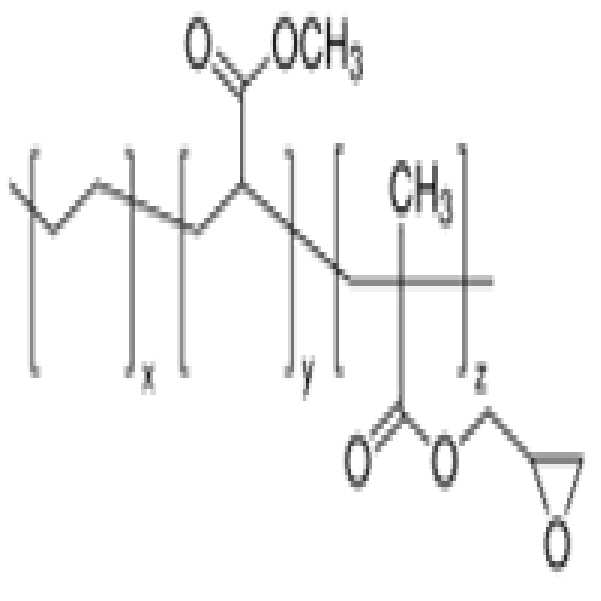
여기서, x, y, z는 1 이상이다. Here, x, y, and z are one or more.
에폭시 관능 단량체는, 알려져 있는 다양한 기술들을 이용하여 중합체로 형성될 수 있다. 예를 들어, 극성 관능기를 포함하는 단량체는 중합체 기본골격에 그래프트되어 그래프트 공중합체를 형성할 수 있다. 이러한 그래프트 기술들은 당업계에 공지되어 있으며, 예를 들어, 미국 특허 제5,179,164호에 개시되어 있다. 다른 실시예들에서, 에폭시 관능기를 포함하는 단량체는, 고압 반응, 지글러-나타 촉매 반응 시스템, 단일 사이트 촉매(예를 들어, 메탈로센) 반응 시스템 등의 공지된 자유 라디칼 중합체화 기술들을 이용하여, 단량체와 함께 공중합체화되어 블록 또는 랜덤공중합체를 형성할 수 있다. Epoxy functional monomers can be formed into polymers using a variety of known techniques. For example, monomers containing polar functional groups may be grafted to the polymeric backbone to form graft copolymers. Such graft techniques are well known in the art and are disclosed, for example, in U.S. Patent No. 5,179,164. In other embodiments, the monomers comprising epoxy functional groups can be prepared using known free radical polymerization techniques such as high pressure reaction, Ziegler-Natta catalyst reaction system, single site catalyst (e.g., metallocene) , May be copolymerized with the monomers to form block or random copolymers.
단량체 성분(들)의 관련 부분은, 에폭시-반응과 용융 유속 간의 균형을 달성하도록 선택될 수 있다. 더욱 구체적으로, 고 에폭시 단량체 함량은, 양호한 반응성을 초래할 수 있지만, 그 함량이 너무 높으면, 폴리에폭시드가 중합체 배합물의 용융 강도에 악영향을 끼치는 정도로 용융 유속이 감소될 수 있다. 따라서, 대부분의 실시예들에서, 에폭시-관능 (메타)크릴 단량체(들)는, 공중합체의 약 1중량% 내지 약 25중량%, 일부 실시예들에서는 약 2중량%내지 약20중량%, 일부 실시예들에서는 약 4중량% 내지 약 15중량%를 구성한다. α-올레핀 단량체(들)는, 마찬가지로, 공중합체의 약 55중량% 내지 약 95중량%, 일부 실시예들에서는 약 60중량% 내지 약 90중량%, 일부 실시예들에서는 약 65중량% 내지 약 85중량%일 수 있다. 다른 단량체 성분들(예를 들어, 비-에폭시 관능 (메타)크릴 단량체)은, 사용시, 공중합체의 약 5중량% 내지 약 35중량%, 일부 실시예들에서는 약 8중량% 내지 약 30중량%, 일부 실시예들에서는 약 10중량% 내지 약 25중량%를 구성할 수 있다. 본 발명에 사용될 수 있는 적절한 폴리에폭시드의 한 가지 특정한 예는, LOTADER® AX8950 또는 AX8900라는 상품명으로 Arkema에 의해 시판되고 있다. LOTADER® AX8950은, 예를 들어, 70 내지 100g/10분의 용융 유속을 갖고, 글리시딜 메타크릴레이트 단량체 함량 7중량% 내지 11중량%, 메틸 아크릴레이트 단량체 함량 13중량% 내지 17중량%, 및 에틸렌 단량체 함량 72중량% 내지 80중량%를 갖는다. 다른 적절한 폴리에폭시드는, 에틸렌, 부틸 아크릴레이트, 및 글리시딜 메타크릴레이트의 테르중합체로, 12g/10분의 용융 속도를 갖는 ELVALOY® PTW라는 상품명으로 Dupont에 의해 시판되고 있다. The relevant portion of the monomer component (s) may be selected to achieve a balance between the epoxy-reaction and the melt flow rate. More specifically, the high epoxy monomer content can lead to good reactivity, but if the content is too high, the melt flow rate can be reduced to such an extent that the polyepoxide has an adverse effect on the melt strength of the polymer blend. Thus, in most embodiments, the epoxy-functional (meth) acryl monomer (s) is present in an amount from about 1% to about 25% by weight of the copolymer, in some embodiments from about 2% to about 20% And from about 4% to about 15% by weight in some embodiments. The? -olefin monomer (s) may likewise be present in an amount of from about 55% to about 95% by weight of the copolymer, in some embodiments from about 60% to about 90% by weight, in some embodiments from about 65% 85% by weight. Other monomer components (e. G., Non-epoxy functional (meth) acryl monomer), when used, may range from about 5 weight percent to about 35 weight percent, in some embodiments from about 8 weight percent to about 30 weight percent, , In some embodiments from about 10% to about 25% by weight. One specific example of a suitable polyepoxide that may be used in the present invention is commercially available from Arkema under the trade name LOTADER® AX8950 or AX8900. LOTADER® AX8950 has a melt flow rate of, for example, 70-100 g / 10 min and has a glycidyl methacrylate monomer content of 7 wt% to 11 wt%, a methyl acrylate monomer content of 13 wt% to 17 wt% And an ethylene monomer content of 72% to 80% by weight. Another suitable polyepoxide is a terpolymer of ethylene, butyl acrylate, and glycidyl methacrylate, and is sold by Dupont under the trade name ELVALOY® PTW with a melt rate of 12 g / 10 min.
폴리에폭시드를 형성하는 데 사용되는 단량체의 유형과 상대적 함량을 제어하는 것에 더하여, 원하는 이점을 달성하도록 전체 중량 퍼센트도 제어될 수 있다. 예를 들어, 개질 레벨이 너무 낮으면, 용융 강도와 원하는 기계적 특성의 증가를 달성하지 못할 수 있다. 그러나, 본 발명자들은, 또한, 개질 레벨이 너무 높으면, 에폭시 관능기에 의한 물리적 망 형성과 강력한 분자 상호작용(예를 들어, 가교결합)으로 인해 처리가 제한될 수 있다는 점을 발견하였다. 따라서, 폴리에폭시드는, 통상적으로 조성물에 사용되는 폴리올레핀의 중량에 기초하여 약 0.05중량% 내지 약 10중량%, 일부 실시예들에서는 약 0.1중량% 내지 약 8중량%, 일부 실시예들에서는 약 0.5중량% 내지 약 5중량%, 일부 실시예들에서는 약 1중량% 내지 약 3중량%의 양으로 사용된다. 또한, 폴리에폭시드는, 조성물의 총 중량에 기초하여 약 0.05중량% 내지 약 10중량%, 일부 실시예들에서는 약 0.05중량% 내지 약 8중량%, 일부 실시예들에서는 약 0.1중량% 내지 약 5중량%, 일부 실시예들에서는 약 0.5중량% 내지 약 3중량%를 구성할 수 있다. In addition to controlling the type and relative content of the monomers used to form the polyepoxides, the total weight percent can also be controlled to achieve the desired benefit. For example, if the reforming level is too low, an increase in melt strength and desired mechanical properties may not be achieved. However, the present inventors have also found that, if the modification level is too high, the treatment may be limited due to physical network formation by the epoxy functional group and strong molecular interaction (for example, crosslinking). Thus, the polyepoxide is typically present at a level of from about 0.05% to about 10% by weight, in some embodiments from about 0.1% to about 8% by weight, and in some embodiments, from about 0.5% By weight to about 5% by weight, and in some embodiments from about 1% to about 3% by weight. The polyepoxide may also be present in an amount of from about 0.05% to about 10% by weight, in some embodiments from about 0.05% to about 8% by weight, in some embodiments from about 0.1% to about 5% By weight, and in some embodiments from about 0.5% to about 3% by weight.
다른 반응성 나노내포 첨가제도 본 발명에서 사용될 수 있는데, 예를 들어, 옥사졸린-관능화된 중합체, 시아나이드-관능화된 중합체 등이 있다. 이러한 반응성 나노내포 첨가제는, 사용시, 폴리에폭시드에 대하여 상술한 농도 내에서 사용될 수 있다. 구체적인 일 실시예에서는, 옥사졸린 고리를 포함하는 단량체와 그래프트된 폴리올레핀인 옥사졸린-그래프트된 폴리올레핀이 사용될 수 있다. 옥사졸린은, 2-옥사졸린을 포함할 수 있는데, 예를 들어, 2-비닐-2-옥사졸린(예를 들어, 2-이소프로페닐-2-옥사졸린), 2-패티-알킬-2-옥사졸린(예를 들어, 올레산, 리놀레산, 팔미톨레산, 가돌레산, 에루스산, 및/또는 아라키돈산의 에탄올아미드로부터 얻을 수 있음), 및 이들의 조합을 포함할 수 있다. 다른 일 실시예에서, 옥사졸린은, 예를 들어, 리시놀옥사졸린 말레이네이트, 운데실-2-옥사졸린, 소야-2-옥사졸린, 리시너스-2-옥사졸린 및 이들의 조합으로부터 선택될 수 있다. 또 다른 일 실시예에서, 옥사졸린은, 2-이소프로페닐-2-옥사졸린, 2-이소프로페닐-4,4-디메틸-2-옥사졸린, 및 이들의 조합으로부터 선택된다. Other reactive nanocomposing additives may also be used in the present invention, for example, oxazoline-functionalized polymers, cyanide-functionalized polymers, and the like. Such a reactive nanocomposing additive can be used, when in use, within the abovementioned concentrations for the polyepoxide. In one specific embodiment, an oxazoline-grafted polyolefin, which is a grafted polyolefin with a monomer comprising an oxazoline ring, can be used. The oxazoline can include 2-oxazoline, for example, 2-vinyl-2-oxazoline (e.g., 2-isopropenyl-2-oxazoline) - oxazolines (which may be obtained, for example, from oleic acid, linoleic acid, palmitoleic acid, valoleic acid, erucic acid, and / or ethanol amide of arachidonic acid), and combinations thereof. In another embodiment, the oxazoline is selected from, for example, ricinol oxazoline maleate, undecyl-2-oxazoline, soya-2-oxazoline, ricinus-2-oxazoline and combinations thereof . In another embodiment, the oxazoline is selected from 2-isopropenyl-2-oxazoline, 2-isopropenyl-4,4-dimethyl-2-oxazoline, and combinations thereof.
본 발명의 특정 실시예에서, 다수의 나노내포 첨가제는 조합하여 사용될 수 있다. 예를 들면, 제1 나노내포 첨가제(예, 폴리에폭시드)는 약 50 내지 약 500nm, 일부 실시예에서는 약 60 내지 약 400nm, 및 일부 실시예에서는 약 80 내지 약 300nm의 평균 단면 치수를 갖는 도메인들의 형태로 분산될 수 있다. 제2 나노내포 첨가제는 또한 약 1 내지 약 50nm, 일부 실시예에서는 약 2 내지 약 45nm, 및 일부 실시예에서는 약 5 내지 약 40nm의 평균 단면 치수를 갖는 것과 같이, 제1 나노내포 첨가제보다 더 작은 도메인들의 형태로 분산될 수 있다. 사용 시에, 제1 및/또는 제2 나노내포 첨가제는 전형적으로, 연속상(매트릭스 중합체(들))의 중량을 기준으로, 열가소성 조성물의 약 0.05중량% 내지 약 20중량%, 일부 실시예에서는 약 0.1중량% 내지 약 10중량%, 및 일부 실시예에서는 약 0.5중량% 내지 약 5중량%을 구성한다. 전체 열가소성 조성물에서 제1 및/또는 제2 나노내포 첨가제의 농도는 비슷하게 열가소성 조성물의 약 0.01중량% 내지 약 15중량%, 일부 실시예에서는 약 0.05중량% 내지 약 10중량%, 및 일부 실시예에서는 약 0.1중량% 내지 약 8중량%을 구성한다. In certain embodiments of the present invention, a plurality of nanocomposing additives may be used in combination. For example, a first nanocomposing additive (e.g., a polyepoxide) may have a domain having an average cross-sectional dimension of from about 50 to about 500 nm, in some embodiments from about 60 to about 400 nm, and in some embodiments from about 80 to about 300 nm As shown in FIG. The second nanocomposing additive is also smaller than the first nanocontainer additive, such as having an average cross-sectional dimension of from about 1 to about 50 nm, in some embodiments from about 2 to about 45 nm, and in some embodiments from about 5 to about 40 nm And may be distributed in the form of domains. In use, the first and / or second nanocomposing additive typically comprises from about 0.05% to about 20% by weight of the thermoplastic composition, based on the weight of the continuous phase (matrix polymer (s)), From about 0.1 wt% to about 10 wt%, and in some embodiments from about 0.5 wt% to about 5 wt%. The concentration of the first and / or second nanocomposing additive in the overall thermoplastic composition is from about 0.01% to about 15% by weight, in some embodiments from about 0.05% to about 10% by weight of the thermoplastic composition, and in some embodiments, From about 0.1% to about 8% by weight.
나노필러가 임의로 제 2 나노내포 첨가제에 대해 사용될 수 있는데, 그것의 실례는 카본 블랙, 카본 나노튜브, 카본 나노섬유, 나노클레이, 금속 나노입자, 나노실리카, 나노알루미나 등을 포함할 수 있다. 나노클레이는 특히 적절하다. "나노클레이(nanoclay)"라는 용어는, 일반적으로, 통상적으로 판상체 구조를 갖는 클레이 물질(천연 발생 미네랄, 유기적으로 개질된 미네랄, 또는 합성 나노물질)의 나노입자를 가리킨다. 나노클레이의 예는, 예를 들어, 몬트모릴로나이트(2:1 계층 스멕타이트 클레이 구조), 벤토나이트(주로 몬트모릴로나이트로 형성된 알루미늄 필로실리케이트), 카올리나이트(1:1 판 구조 및 Al2Si2O5(OH)4라는 실험식을 갖는 알루미노실리케이트), 할로이사이트(1:1 관형 구조 및 Al2Si2O5(OH)4라는 실험식을 갖는 알루미노실리케이트)를 포함한다. 적절한 나노클레이의 일례는, Southern Clay Products, Inc.에 의해 시판되고 있는 몬트모릴로나이트 나노클레이인 Cloisite®이다. 합성 나노클레이의 다른 예는, 혼합된-금속 하이드록시드 나노클레이, 계층화된 이중 하이드록시드 나노클레이(예를 들어, 세피오사이트), 라포나이트, 헥토라이트, 사포나이트, 인도나이트 등을 포함하지만, 이에 한정되지 않는다. Nanofillers may optionally be used for the second nanocomposite additive, examples of which may include carbon black, carbon nanotubes, carbon nanofibers, nanoclays, metal nanoparticles, nanosilica, nanoalumina, and the like. Nanoclays are particularly suitable. The term "nanoclay" generally refers to nanoparticles of clay materials (naturally occurring minerals, organically modified minerals, or synthetic nanomaterials) that typically have a plateau structure. Examples of nano-clay is, for example, montmorillonite (2: 1 layer smectite clay structure), bentonite (an aluminum phyllosilicate mainly formed of montmorillonite), kaolinite (1: 1 plate structure and Al 2 Si 2 (Alumino silicate having the empirical formula O 5 (OH) 4 ), haloisite (aluminosilicate having the 1: 1 tubular structure and the formula Al 2 Si 2 O 5 (OH) 4 ). An example of a suitable nanoclay is Cloisite (R), a montmorillonite nano-clay sold by Southern Clay Products, Inc. Other examples of synthetic nanoclays include mixed-metal hydroxide nanoclays, layered dual hydroxide nanoclays (e.g., sepiolite), laponites, hectorites, saponites, indanites, etc. However, it is not limited thereto.
원하는 경우, 나노클레이는, 매트릭스 중합체(예를 들어, 폴리에스테르)와의 상용성을 개선하는 데 일조하도록 표면 처리제를 포함할 수 있다. 표면 처리제는, 유기성 또는 무기성일 수 있다. 일 실시예에서는, 유기 양이온을 클레이와 반응시킴으로써 얻어지는 유기 표면 처리제가 사용된다. 적절한 유기 양이온은, 예를 들어, 양이온을 클레이와 교환할 수 있는 4차 유기 암모늄 화합물, 예컨대, 디메틸 비스[수소화 우지] 암모늄 클로라이드(2M2HT), 메틸 벤질 비스[수소화 우지] 암모늄 클로라이드(MB2HT), 메틸 트리스[수소화 우지 알킬] 클로라이드(M3HT) 등을 포함할 수 있다. 시판되고 있는 유기 나노클레이의 예는, 예를 들어, 디메틸 벤질 수소화 우지 암모늄 염으로 개질된 몬트모릴로나이트 클레이인 Dellite® 43B(이탈리아 리보르노에 소재하는 Laviosa Chimica)를 포함할 수 있다. 다른 예는, Cloisite® 25A 및 Cloisite® 30B(Southern Clay Products) 및 Nanofil 919 (
사용된 물질과 관계 없이, 나노내포 첨가제는 전형적으로 이산 도메인들과 결과적으로 형성된 포어들이 적당히 유지될 수 있는 것을 보장하기 위해 특정 점도 (또는 용융 유속)를 가지도록 선택된다. 예를 들어 만약 나노내포 첨가제의 점도가 너무 낮으면 (또는 용융 유속이 너무 높으면), 첨가제는 연속상을 통해 조절불가능하게 흐르고 분산되는 경향이 있다. 이에 따라, 유지하기 어려우며 또한 이르게 파단될 가능성이 있는 박층 판형 도메인 또는 공동 연속상 구조가 발생한다. 역으로, 점도가 너무 높으면 (또는 용융 유속이 너무 느리면), 함께 모아져서 혼합 중에 분산이 어려운 매우 큰 타원형 도메인들이 형성된다. 이것은 전체 연속상을 통한 나노내포 첨가제의 균일하지 않은 분포를 유발할 수 있다. 예를 들어, 폴리올레핀의 용융 유속 대 중합체 나노내포 첨가제의 용융 유속의 비율은, 예를 들어 약 0.2 내지 약 8, 일부 실시예에서는 약 0.5 내지 약 6 및 일부 실시예에서는 약 1 내지 약 5일 수 있다. 나노내포 첨가제는 예를 들면, ASTM D1238에 따라 2160 그램의 하중 및 용융 온도(예컨대 190℃) 보다 적어도 약 40℃ 위의 온도에서 측정된, 약 0.1 내지 약 100 그램/10분, 일부 실시예에서는 약 0.5 내지 약 50 그램/10분 및 일부 실시예에서는 약 5 내지 약 15 그램/10분의 용융 유속(건조 기준으로)을 가질 수 있다. 마찬가지로 폴리올레핀은 ASTM D1238에 따라 2160 그램의 하중 및 용융 온도(예컨대 230℃) 보다 적어도 약 40℃ 위의 온도에서 측정된, 약 0.5 내지 약 80 그램/10분, 일부 실시예에서는 약 1 내지 약 40 그램/10분 및 일부 실시예에서는 약 5 내지 약 20 그램/10분의 용융 유속(건조 기준으로)을 가질 수 있다. Regardless of the material used, the nanocomposite additive is typically selected to have a specific viscosity (or melt flow rate) to ensure that the discrete domains and resulting pores can be properly retained. For example, if the viscosity of the nanocomposing additive is too low (or the melt flow rate is too high), the additive tends to flow and disperse uncontrollably through the continuous phase. This results in a lamellar domain or co-continuous phase structure that is difficult to maintain and is likely to break prematurely. Conversely, if the viscosity is too high (or if the melt flow rate is too slow), very large elliptical domains are gathered together which are difficult to disperse during mixing. This can lead to an uneven distribution of the nanocomposite additive throughout the entire continuous phase. For example, the ratio of the melt flow rate of the polyolefin to the melt flow rate of the polymeric nanocomposite additive can range, for example, from about 0.2 to about 8, in some embodiments from about 0.5 to about 6, and in some embodiments from about 1 to about 5 days have. The nano-encapsulating additive may be present in an amount of from about 0.1 to about 100 grams / 10 minutes, measured, for example, at a temperature of at least about 40 DEG C above a load of 2160 grams and a melt temperature (e.g., 190 DEG C) in accordance with ASTM D1238, A melt flow rate (on a dry basis) of from about 0.5 to about 50 grams / 10 minutes and in some embodiments from about 5 to about 15 grams / 10 minutes. Likewise, the polyolefin may have a weight of from about 0.5 to about 80 grams / 10 minutes, in some embodiments from about 1 to about 40 grams / 10 minutes, measured at a temperature of at least about 40 degrees Celsius above a load of 2160 grams and a melting temperature G / 10 min and, in some embodiments, from about 5 to about 20 grams / 10 min (on a dry basis).
C. 마이크로내포 첨가제 C. Micro-inclusion additive
필요한 것은 아니지만, 본 발명의 조성물은 또한 마이크로내포 첨가제를 사용할 수 있다. 여기에서 사용된 바, 용어 “마이크로내포 첨가제”는 일반적으로 중합체 매트릭스 내에 마이크로 크기의 이산 도메인들의 형태로 분산될 수 있는 임의의 물질을 가리킨다. 예를 들어 연신 전에, 도메인들은 약 0.1μm 내지 약 25μm, 일부 실시예에서는 약 0.5μm 내지 약 20μm 및 일부 실시예에서는 약 1μm 내지 약 10μm의 평균 단면 치수를 가질 수 있다. 사용될 때, 본 발명자들은 마이크로-규모 및 나노-규모 상 도메인들이 변형 및 신장성 변형(예컨대 연신)이 수행될 때 독특한 방식으로 상호작용하여 포어의 망을 형성할 수 있음을 발견하였다. 즉, 신장 변형은, 물질들의 비친화성 때문에 발생하는 응력 집중의 결과로서, 마이크로 크기의 분리 상 도메인들 근처에서 집중적인 국부 전단 지대 및/또는 응력 집중(intensity) 지대(예, 평균 응력들)을 개시할 수 있을 것으로 여겨진다. 이들 전단 및/또는 응력 집중 지대는 마이크로-규모 도메인들에 인접한 폴리올레핀 매트릭스에서 약간의 초기 해리를 유발한다. 그러나, 특히, 나노-규모 이산 상 도메인들 근처에서 생성된 국소화된 전단 및/또는 응력 집중 지대는 마이크로-규모 지대와 중복되어 중합체 매트릭스에서 추가의 해리가 일어나는 것을 유발시키고, 그로써 나노-규모 도메인들 및/또는 마이크로-규모 도메인들에 인접하여 상당수의 나노포어를 생성할 수 있다. Although not required, the compositions of the present invention may also employ microinclusion additives. As used herein, the term " microencapsulated additive " refers generally to any material that can be dispersed in the polymer matrix in the form of micro-sized discrete domains. For example, prior to stretching, the domains may have an average cross-sectional dimension of from about 0.1 占 퐉 to about 25 占 퐉, in some embodiments from about 0.5 占 퐉 to about 20 占 퐉, and in some embodiments, from about 1 占 퐉 to about 10 占 퐉. When used, the inventors have found that micro-scale and nano-scale domains can interact in a unique way when forming strains and extensible strains (e.g., stretches) to form a network of pores. In other words, the elongational strain can cause intense local shear zones and / or stress zones (e.g., average stresses) near the micro-sized segregated domains as a result of stress concentration resulting from the non- It is considered to be possible to start. These shear and / or stress concentration zones cause some initial dissociation in the polyolefin matrix adjacent to the micro-scale domains. However, in particular, the localized shear and / or stress concentration zones generated near the nano-scale discrete phase domains can overlap with the micro-scale zone, causing additional dissociation in the polymer matrix to occur, And / or to generate a large number of nanopores adjacent to micro-scale domains.
마이크로내포 첨가제의 특정 성질은 중요하지 않으며, 액체, 반-고체 또는 고체(예컨대 비정질, 결정 또는 반-결정)를 포함할 수 있다. 특정 실시예에서, 마이크로내포 첨가제는 본래 중합체며, 비교적 높은 분자량을 가져서 열가소성 조성물의 안정성과 용융 강도를 개선하는 데 일조한다. 전형적으로 마이크로내포 첨가제 중합체는 매트릭스 중합체와 대략 양립가능하지 않을 수도 있다. 이러한 식으로, 첨가제는 매트릭스 중합체의 연속상 내에서 이산 위상 도메인들로서 더욱 양호하게 분산될 수 있다. 이산 도메인들은 외부 힘에서 발생한 에너지를 흡수할 수 있고, 그것은 최종 섬유의 전체 터프니스 및 강도를 증가시킨다. 도메인들은 다양한 상이한 형상들, 예를 들면, 타원형, 구형, 원통형, 판상형, 관형 등을 가질 수 있다. 일 실시예에서, 예를 들면 도메인들은 실질적으로 타원 형상을 갖는다. 개별적인 도메인의 물리적 치수는 전형적으로 외부 응력이 적용될 때 섬유를 통해 파단의 전파를 최소화하기에 충분히 작지만, 입자 함유물에서 및 그 주변에서 미세한 소성 변형을 개시하고 전단 지대를 허용하기에 충분히 크다. The particular nature of the micro-inclusion additive is not critical and may include liquid, semi-solid or solid (e.g., amorphous, crystalline or semi-crystalline). In certain embodiments, the microencapsulated additive is an intrinsic polymer and has a relatively high molecular weight to help improve the stability and melt strength of the thermoplastic composition. Typically, the micro-inclusion additive polymer may not be compatible with the matrix polymer. In this way, the additive can be better dispersed as discrete phase domains within the continuous phase of the matrix polymer. Discrete domains can absorb energy generated from external forces, which increases the overall toughness and strength of the finished fiber. Domains may have a variety of different shapes, e.g., elliptical, spherical, cylindrical, plate, tubular, and the like. In one embodiment, for example, the domains have a substantially elliptical shape. The physical dimensions of the individual domains are typically small enough to minimize propagation of fracture through the fibers when external stresses are applied, but large enough to initiate fine plastic deformation at and around the particle content and allow shear zones.
마이크로내포 첨가제는 이산 도메인들과 그 결과의 포어들이 적절하게 유지되는 것을 보장하기 위하여 특정 용융 유속(또는 점도)을 가질 수 있다. 예를 들어, 첨가제의 용융 유속이 너무 빠르면, 첨가제가 연속상을 통해 제어되지 않고 흐르고 분산되는 경향이 있다. 이에 따라, 유지하기 어려우며 또한 이르게 파단될 가능성이 있는 박층 판형 도메인 또는 공동 연속상 구조가 발생한다. 역으로, 첨가제의 용융 유속이 너무 느리면, 첨가제가 함께 모여서, 배합 동안 분산되기 어려운 매우 큰 타원 도메인을 형성하는 경향이 있다. 이에 따라, 연속상 전체에 걸쳐 첨가제의 불균일한 분포가 발생할 수 있다. 이런 견지에서, 본 발명자들은 마이크로내포 첨가제의 용융 유속 대 매트릭스 중합체의 용융 유속의 비율은 전형적으로 약 0.5 내지 약 10, 일부 실시예에서는 약 1 내지 약 8 및 일부 실시예에서는 약 2 내지 약 6임을 발견하였다. 마이크로내포 첨가제는 예를 들면, 2160 그램의 하중 및 첨가제의 용융 온도(예컨대 210℃) 보다 적어도 약 40℃ 위의 온도에서 측정된, 약 5 내지 약 200 그램/10분, 일부 실시예에서는 약 20 내지 약 150 그램/10분 및 일부 실시예에서는 약 40 내지 약 100 그램/10분의 용융 유속을 가질 수 있다. The micro-inclusion additive may have a specific melt flow rate (or viscosity) to ensure that the discrete domains and the resulting pores are properly maintained. For example, if the melt flow rate of the additive is too high, the additive tends to flow and disperse uncontrolled through the continuous phase. This results in a lamellar domain or co-continuous phase structure that is difficult to maintain and is likely to break prematurely. Conversely, if the melt flow rate of the additives is too low, the additives tend to aggregate together to form very large elliptical domains that are difficult to disperse during compounding. This can result in non-uniform distribution of the additive throughout the continuous phase. In this regard, the inventors have found that the ratio of melt flow rate of the micro-inclusion additive to the melt flow rate of the matrix polymer is typically from about 0.5 to about 10, in some embodiments from about 1 to about 8, and in some embodiments from about 2 to about 6 Respectively. The micro-inclusion additive may be present in an amount of from about 5 to about 200 grams / 10 minutes, in some embodiments about 20 grams / 10 minutes, measured at a temperature of at least about 40 degrees Celsius above the melting point of the additive, To about 150 grams / 10 minutes and in some embodiments from about 40 to about 100 grams / 10 minutes.
상술한 특성들에 더하여, 원하는 다공성 망을 달성하도록 마이크로내포 첨가제의 기계적 특징들도 선택될 수 있다. 예를 들어 외부 힘과 함께 적용된 응력 집중(예컨대 정상 또는 전단 응력을 포함함) 및 전단 및/또는 소성 항복 지대는 첨가제 및 매트릭스 중합체의 탄성률의 차이로부터 발생하는 응력 집중의 결과로서 이산 상 도메인들에서 및 그 주변에서 개시될 수 있다. 응력 집중이 클수록 도메인에서의 국부적 플라스틱 흐름이 더욱 강화되는데, 이는 응력이 부여되는 경우 도메인이 상당히 세장될 수 있게 한다. 이들 신장된 도메인들은 조성물이 보다 유연하고 더 부드러운 행동을 나타내는 것을 허용할 수 있다. 응력 집중을 증강시키기 위하여, 마이크로내포 첨가제는 폴리올레핀 매트릭스에 비교하여 상대적으로 높은 영의 탄성률을 가지도록 선택될 수 있다. 예를 들어 첨가제의 탄성률 대 폴리올레핀 매트릭스의 탄성률의 비율은 전형적으로 약 1 내지 약 250, 일부 실시예에서는 약 2 내지 약 100 및 일부 실시예에서는 약 2 내지 약 50이다. 마이크로내포 첨가제의 탄성률은, 예를 들면 약 200 내지 약 3,500 메가파스칼(MPa), 일부 실시예에서는 약 300 내지 약 2,000MPa 및 일부 실시예에서는 약 400 내지 약 1,500MPa의 범위일 수 있다. 반대로, 폴리올레핀의 탄성률은 예를 들면, 약 100 내지 1,500MPa 및 일부 실시예에서는 약 200 내지 약 1000MPa의 범위일 수 있다. 다르게는, 마이크로내포 첨가제의 탄성률은 폴리올레핀 매트릭스의 탄성률보다 낮을 수 있다. 탄성률은 예를 들면, 약 10MPa 내지 약 100MPa 및 임의로, 약 20MPa 내지 약 80MPa의 범위일 수 있다. In addition to the properties described above, the mechanical properties of the microencapsulated additive can also be selected to achieve the desired porous network. For example, stress concentrations (including normal or shear stresses) applied along with external forces and shear and / or plastic yield zones can cause stress concentrations in the discrete domains as a result of stress concentration resulting from the difference in modulus of elasticity of the additive and matrix polymer And its surroundings. The larger the stress concentration, the stronger the local plastic flow in the domain, which allows the domain to be considerably elongated if stress is applied. These elongated domains may allow the composition to exhibit more flexible and softer behavior. In order to enhance the stress concentration, the micro-inclusion additive can be chosen to have a relatively high Young's modulus as compared to the polyolefin matrix. For example, the ratio of the modulus of the additive to the modulus of the polyolefin matrix is typically from about 1 to about 250, in some embodiments from about 2 to about 100, and in some embodiments from about 2 to about 50. The modulus of elasticity of the microencapsulated additive may range, for example, from about 200 to about 3,500 megapascals (MPa), in some embodiments from about 300 to about 2,000 MPa, and in some embodiments from about 400 to about 1,500 MPa. Conversely, the modulus of elasticity of the polyolefin may range, for example, from about 100 to 1,500 MPa and in some embodiments from about 200 to about 1000 MPa. Alternatively, the modulus of elasticity of the micro-inclusion additive may be lower than that of the polyolefin matrix. The modulus of elasticity can range, for example, from about 10 MPa to about 100 MPa and, optionally, from about 20 MPa to about 80 MPa.
상기에서 확인된 특성들을 가지는 광범위한 마이크로내포 첨가제가 사용될 수 있는 한편, 그런 첨가제의 특히 적당한 실례는 스티렌 공중합체 (예컨대 스티렌-부타다이엔-스티렌, 스티렌-아이소프렌-스티렌, 스티렌-에틸렌-프로필렌-스티렌, 스티렌-에틸렌-부타다이엔-스티렌 등); 플루오로중합체, 예컨대 폴리비닐 클로라이드 (PVC), 폴리테트라플루오로에틸렌 (PTFE), 폴리클로로트라이플루오로에틸렌 (PCTFE) 등; 폴리비닐 알코올; 폴리비닐 아세테이트; 폴리에스테르, 예컨대 지방족 폴리에스테르, 예컨대 폴리카프로락톤, 폴리에스테르아미드, 폴리락트산 (PLA) 및 그것의 공중합체, 폴리글리콜산, 폴리알킬렌 카보네이트 (예컨대 폴리에틸렌 카보네이트), 폴리-3-하이드록시부티레이트 (PHB), 폴리-3-하이드록시발레레이트 (PHV), 폴리-3-하이드록시부티레이트-코-4-하이드로부티레이트, 폴리-3-하이드록시부티레이트-코-3-하이드록시발레레이트 공중합체 (PHBV), 폴리-3-하이드록시부티레이트-코-3-하이드록시헥사노에이트, 폴리-3-하이드록시부티레이트-코-3-하이드록시옥타노에이트, 폴리-3-하이드록시부티레이트-코-3-하이드록시데카노에이트, 폴리-3-하이드록시부티레이트-코-3-하이드록시옥타데카노에이트 및 석시네이트-기초 지방족 중합체 (예컨대 폴리부틸렌 석시네이트, 폴리부틸렌 석시네이트 아디페이트, 폴리에틸렌 석시네이트 등), 지방족-방향족 코폴리에스테르 (예컨대 폴리부틸렌 아디페이트 테레프탈레이트, 폴리에틸렌 아디페이트 테레프탈레이트, 폴리에틸렌 아디페이트 아이소프탈레이트, 폴리부틸렌 아디페이트 아이소프탈레이트 등), 방향족 폴리에스테르 (예컨대 폴리에틸렌 테레프탈레이트, 폴리부틸렌 테레프탈레이트 등); 등을 포함할 수 있다. While a wide variety of microencapsulated additives with the properties identified above can be used, particularly suitable examples of such additives include styrene copolymers (such as styrene-butadiene-styrene, styrene-isoprene-styrene, styrene- Styrene, styrene-ethylene-butadiene-styrene, etc.); Fluoropolymers such as polyvinyl chloride (PVC), polytetrafluoroethylene (PTFE), polychlorotrifluoroethylene (PCTFE) and the like; Polyvinyl alcohol; Polyvinyl acetate; Polyesters such as polycaprolactone, polyester amide, polylactic acid (PLA) and copolymers thereof, polyglycolic acid, polyalkylene carbonate (such as polyethylene carbonate), poly-3-hydroxybutyrate PHB), poly-3-hydroxyvalerate (PHV), poly-3-hydroxybutyrate-co-4-hydrobutyrate, poly-3-hydroxybutyrate- 3-hydroxybutyrate-co-3-hydroxyhexanoate, poly-3-hydroxybutyrate-co-3-hydroxyoctanoate, poly- Hydroxybutyrate-co-3-hydroxyoctadecanoate, and succinate-based aliphatic polymers such as polybutylene succinate, polybutylene succinate adipate, Aromatic polyesters such as polybutylene terephthalate, polyethylene adipate terephthalate, polyethylene adipate isophthalate, polybutylene adipate isophthalate and the like), aromatic polyesters (such as polyethylene terephthalate, Such as polyethylene terephthalate, polybutylene terephthalate, and the like); And the like.
특히 적당한 것은 대체로 첨가제가 상대적으로 높은 유리 전이 온도를 가지는 정도로 본질상 단단한 마이크로내포 첨가제이다. 예를 들어, 유리 전이 온도(“Tg”)는, 약 0℃ 이상, 일부 실시예들에서는 약 5℃ 내지 약 100℃, 일부 실시예들에서는 약 30℃ 내지 약 80℃, 일부 실시예들에서는 약 50℃ 내지 약 75℃ 일 수 있다. 유리 전이 온도는, ASTM E1640-09에 따라 동적 기계적 분석에 의해 결정될 수도 있다. Particularly suitable are micro-inclusion additives which are essentially rigid to the extent that the additive has a relatively high glass transition temperature. For example, the glass transition temperature (" T g ") may be greater than about 0 ° C, in some embodiments from about 5 ° C to about 100 ° C, in some embodiments from about 30 ° C to about 80 ° C, Lt; 0 > C to about 75 < 0 > C. The glass transition temperature may be determined by dynamic mechanical analysis according to ASTM E1640-09.
한 가지 구체적인 적절한 강성 폴리에스테르는 폴리락트산으로, 일반적으로 락트산의 임의의 이성질체의 단량체 단위, 예컨대 좌회전성-락트산("L-락트산"), 우회전성-락트산("D-락트산"), 메소-락트산, 또는 이들의 혼합물로부터 유도될 수도 있다. 단량체 단위는 또한 락트산의 임의의 이성질체, 이를테면 L-락타이드, D-락타이드, 메조-락타이드 또는 그것들의 혼합물의 무수물로부터도 형성될 수 있다. 그런 락트산 및/또는 락타이드의 고리형 이량체 또한 사용될 수 있다. 임의의 공지된 중합법, 예컨대 중축합 또는 고리-개방 중합이 락트산을 중합하기 위하여 사용될 수 있다. 소량의 사슬-확장제(예컨대 다이이소시아네이트 화합물, 에폭시 화합물 또는 산 무수물)가 또한 사용될 수 있다. 폴리락트산은 단독중합체거나 공중합체, 예컨대 L-락트산으로부터 유도된 단량체 단위 및 D-락트산으로부터 유도된 단량체 단위를 함유하는 것일 수 있다. 요구되지는 않지만, L-락트산으로부터 유도된 단량체 단위와 D-락트산으로부터 유도된 단량체 단위 중 하나의 함량 비율은 바람직하게는 약 85 몰% 이상, 일부 실시예에서는 약 90 몰% 이상, 및 일부 실시예에서는 약 95 몰% 이상이다. 각각이 L-락트산으로부터 유도된 단량체 단위와 D-락트산으로부터 유도된 단량체 단위 사이에 상이한 비율을 가지는 다중 폴리락트산은 임의의 백분율로 혼합될 수 있다. 물론, 폴리락트산은 다른 유형의 중합체(예를 들어, 폴리올레핀, 폴리에스테르 등)와 함께 배합될 수도 있다. One specific suitable rigid polyester is a polylactic acid, generally a monomer unit of any isomer of lactic acid, such as a left turnable lactic acid ("L-lactic acid"), a right turnable lactic acid ("D- Lactic acid, or a mixture thereof. The monomeric units may also be formed from any isomer of lactic acid, such as an anhydride of L-lactide, D-lactide, meso-lactide, or mixtures thereof. Such cyclic dimers of lactic acid and / or lactide may also be used. Any known polymerization method, such as polycondensation or ring-opening polymerization, may be used to polymerize the lactic acid. Small amounts of chain-extending agents (such as diisocyanate compounds, epoxy compounds or acid anhydrides) may also be used. The polylactic acid may be a homopolymer or a copolymer such as a monomer unit derived from L-lactic acid and a monomer unit derived from D-lactic acid. Although not required, the ratio of the content of monomer units derived from L-lactic acid to one of monomer units derived from D-lactic acid is preferably at least about 85 mole%, in some embodiments at least about 90 mole% In the example, it is at least about 95 mol%. Multiple polylactic acids, each having a different ratio between monomer units derived from L-lactic acid and monomer units derived from D-lactic acid, may be mixed in any percentage. Of course, polylactic acid may be blended with other types of polymers (e.g., polyolefins, polyesters, etc.).
구체적인 일 실시예에서, 폴리락트산은 다음과 같은 일반 구조를 갖는다:In one specific embodiment, the polylactic acid has the following general structure:
본 발명에서 사용될 수 있는 적절한 폴리락트산 중합체의 특정한 일례는, BIOMER™ L9000이라는 상품명으로 독일 Krailling에 소재하는 Biomer, Inc.에 의해 시판되고 있다. 다른 적절한 폴리락트산 중합체는, 미국 미네소타주 미네통카에 소재하는 Natureworks LLC에 의해 (NATUREWORKS®) 또는 Mitsui Chemical (LACEA™)에서 시판되고 있다. 또 다른 적당한 폴리락트산은 미국 특허 제 4,797,468호; 제5,470,944호; 제5,770,682호; 제5,821,327호; 제5,880,254호; 및 제6,326,458호에서 기술될 수 있고, 그것들은 모든 목적에 대해 참조로 그것의 전체 내용이 본원에 포함된다. A specific example of a suitable polylactic acid polymer that may be used in the present invention is commercially available from Biomer, Inc. of Krailling, Germany under the trade name BIOMER (TM) L9000. Other suitable polylactic acid polymers are commercially available from NATUREWORKS (R) or Mitsui Chemical (LACEA (TM)), Minneapolis, Minn. Another suitable polylactic acid is disclosed in U.S. Patent Nos. 4,797,468; 5,470,944; 5,770,682; 5,821, 327; 5,880,254; And 6,326, 458, which are incorporated herein by reference in their entirety for all purposes.
폴리락트산은, 통상적으로, 약 40,000 내지 약 180,000그램/몰, 일부 실시예들에서는 약 50,000 내지 약 160,000그램/몰, 일부 실시예들에서는 약 80,000 내지 약 120,000그램/몰의 수평균 분자량(“Mn”)을 갖는다. 마찬가지로, 중합체는, 또한, 통상적으로, 약 80,000 내지 약 250,000그램/몰, 일부 실시예들에서는 약 100,000 내지 약 200,000그램/몰, 일부 실시예들에서는, 약 110,000 내지 약 160,000그램/몰의 중량 평균 분자량(“Mw”)을 갖는다. 중량 평균 분자량 대 수평균 분자량의 비(“Mw/Mn”), 즉, "다중분산 지수(polydispersity index)"도 비교적 낮다. 예를 들어, 다중분산 지수는, 통상적으로, 약 1.0 내지 약 3.0, 일부 실시예들에서는 약 1.1 내지 약 2.0, 일부 실시예들에서는 약 1.2 내지 약 1.8일 수 있다. 중량 평균 분자량과 수 평균 분자량은 본 기술분야의 숙련자에게 알려져 있는 방법에 의해 결정될 수 있다. The polylactic acid typically has a number average molecular weight ("M") of from about 40,000 to about 180,000 grams / mole, in some embodiments from about 50,000 to about 160,000 grams / mole, in some embodiments from about 80,000 to about 120,000 grams / n "). Likewise, the polymer will also typically have a weight average of from about 80,000 to about 250,000 grams / mole, in some embodiments from about 100,000 to about 200,000 grams / mole, in some embodiments from about 110,000 to about 160,000 grams / Molecular weight (" M w "). (&Quot; M w / M n "), i.e., the "polydispersity index ", of the weight average molecular weight to the number average molecular weight is relatively low. For example, the polydispersity index may typically be from about 1.0 to about 3.0, in some embodiments from about 1.1 to about 2.0, and in some embodiments from about 1.2 to about 1.8. The weight average molecular weight and number average molecular weight can be determined by methods known to those skilled in the art.
순수 폴리에스테르의 일부 유형(예를 들어, 폴리락트산)은, 출발물질 폴리락트산의 건조 중량에 기초하여 약 500 내지 600ppm 이상의 습기 함량을 갖도록 주변 환경으로부터 물을 흡수할 수 있다. 습기 함량은, 후술하는 바와 같이 ASTM D 7191-05에 따라, 당업계에 알려져 있듯이 다양한 방식으로 결정될 수 있다. 용융 가공 동안 물이 존재함으로써 폴리에스테르를 가수분해적으로 분해시킬 수 있고 그 분자량을 감소시킬 수 있기 때문에, 때로는 배합 전에 폴리에스테르를 건조시키는 것이 바람직하다. 예를 들어 대부분의 실시예에서, 재생가능한 폴리에스테르는 마이크로내포 첨가제와 혼합하기 전에 약 300ppm 이하, 일부 실시예에서 약 200ppm 이하, 일부 실시예에서 약 1 내지 약 100ppm의 습기 함량을 가지는 것이 바람직하다. 폴리에스테르의 건조는, 예를 들면 약 50℃ 내지 약 100℃, 및 일부 실시예에서는 약 70℃ 내지 약 80℃에서 실시될 수 있다. Some types of pure polyester (e.g., polylactic acid) can absorb water from the environment to have a moisture content of about 500 to 600 ppm or more based on the dry weight of the starting material polylactic acid. The moisture content can be determined in a variety of ways, as is known in the art, according to ASTM D 7191-05, as described below. It is sometimes desirable to dry the polyester prior to compounding, since the presence of water during the melt process can hydrolyse the polyester and reduce its molecular weight. For example, in most embodiments, the regenerable polyester preferably has a moisture content of less than or equal to about 300 ppm, in some embodiments less than or equal to about 200 ppm, and in some embodiments, from about 1 to about 100 ppm, prior to mixing with the micro- . Drying of the polyester can be carried out, for example, at about 50 ° C to about 100 ° C, and in some embodiments at about 70 ° C to about 80 ° C.
사용된 물질과 관계없이, 열가소성 조성물 중의 마이크로내포 첨가제의 상대적인 백분율은 결과의 조성물에 유의미하게 영향을 주지 않으면서 바람직한 특성들을 이루기 위해 선택된다. 예를 들어, 마이크로내포 첨가제는 통상적으로 조성물에 사용된 폴리올레핀 매트릭스의 중량에 기초하여, 열가소성 조성물의 약 1중량% 내지 약 30중량%, 일부 실시예에서 약 2중량% 내지 약 25중량% 및 일부 실시예에서 약 5중량% 내지 약 20중량%의 양으로 사용된다. 전체 열가소성 조성물 내의 마이크로내포 첨가제의 농도는, 마찬가지로, 약 0.1중량% 내지 약 30중량%, 일부 실시예들에서는 약 0.5중량% 내지 약 25중량%, 일부 실시예들에서는 약 1중량% 내지 약 20중량%일 수 있다. Regardless of the material used, the relative percentage of micro-inclusion additive in the thermoplastic composition is selected to achieve the desired properties without significantly affecting the resulting composition. For example, the microencapsulated additive typically comprises from about 1% to about 30% by weight, in some embodiments from about 2% to about 25% by weight of the thermoplastic composition, and from about 1% to about 25% by weight of the thermoplastic composition, based on the weight of the polyolefin matrix used in the composition In embodiments from about 5% to about 20% by weight. The concentration of micro-inclusion additive in the overall thermoplastic composition may likewise be from about 0.1% to about 30% by weight, in some embodiments from about 0.5% to about 25% by weight, in some embodiments from about 1% to about 20% % ≪ / RTI >
D. 다른 성분들 D. Other Ingredients
서로 다른 다양한 이유 때문에 조성물을 위한 다양한 성분들을 사용할 수 있다. 예를 들어 한 특정 실시예에서, 나노내포 및/또는 마이크로내포 첨가제와 폴리올레핀 매트릭스 사이의 마찰 및 연결 정도를 감소시키는 것을 돕고, 그로써 해리의 정도와 균일성을 증강시키기 위해 열가소성 조성물에 간기 개질제가 사용될 수 있다. 이러한 식으로, 포어들은 조성물 전체에 걸쳐 더욱 균질한 방식으로 분포될 수 있다. 개질제는 실온(예를 들어, 25℃)에서 액체 또는 반고체 형태이어서, 비교적 낮은 점성도를 보유하여 열가소성 조성물 내에 더욱 쉽게 통합되고 중합체 표면으로 쉽게 이동할 수 있다. 폴리올레핀 매트릭스와 첨가제의 계면에서 물리적 힘을 감소시킴으로써, 개질제의 저점도, 소수성 성질은 해리를 촉진하는 것을 도울 수 있는 것으로 여겨진다. 본 명세서에서 사용되는 바와 같이, "소수성"이라는 용어는, 통상적으로, 약 40° 이상, 일부 경우엔 약 60° 이상의 공기 중의 수 접촉각을 갖는 물질을 가리킨다. 대조적으로, "친수성"이라는 용어는, 통상적으로, 약 40° 미만의 공기 중의 수 접촉각을 갖는 물질을 가리킨다. 접촉각을 측정하기 위한 한 가지 적절한 시험은 ASTM D5725-99 (2008)이다. Various ingredients for the composition can be used for a variety of different reasons. For example, in one particular embodiment, an intervening modifier is used in the thermoplastic composition to assist in reducing the friction and the degree of connection between the nanocomposite and / or microencapsulated additive and the polyolefin matrix, thereby enhancing the degree and uniformity of dissociation . In this way, pores can be distributed in a more homogeneous manner throughout the composition. The modifier may be in a liquid or semi-solid form at room temperature (e. G., 25 DEG C), and may have a relatively low viscosity to more readily integrate into the thermoplastic composition and readily migrate to the polymer surface. By reducing the physical force at the interface of the polyolefin matrix and the additive, it is believed that the low viscosity, hydrophobic nature of the modifier can help to promote dissociation. As used herein, the term "hydrophobic" refers to a material that typically has a water contact angle in air of at least about 40 degrees, in some instances at least about 60 degrees. In contrast, the term "hydrophilic" refers to a material that typically has a water contact angle in air of less than about 40 degrees. One suitable test for measuring the contact angle is ASTM D5725-99 (2008).
필요한 것은 아니지만, 마이크로내포 첨가제가 사용되고 나노내포 첨가제가 고체(예컨대 중합체 물질)인 실시예에서 간기 개질제가 특히 적당할 수 있다. 적당한 소수성의 저점도 간기 개질제는 예를 들면 상기에서 참조된 액체 및/또는 반-고체를 포함할 수 있다. 하나의 특히 적절한 간기 개질제는 예를 들어, BASF Corp.에 의해 PLURIOL® WI라는 상품명으로 시판되고 있는 폴리에테르 폴리올이다. 다른 적절한 개질제는, 예를 들어, Hallstar에 의해 HALLGREEN® IM라는 상품명으로 시판되고 있는 부분적으로 재생가능한 에스테르이다. Although not required, the instant modifier may be particularly suitable in embodiments where microencapsulated additives are used and the nanocomposing additive is a solid (e.g., a polymeric material). Suitable hydrophobic low viscosity aqueous phase modifiers may include, for example, the liquids and / or semi-solids referred to above. One particularly suitable transient modifier is, for example, a polyether polyol marketed by BASF Corp. under the trade name PLURIOL WI. Another suitable modifier is, for example, a partially regenerable ester sold under the trade name HALLGREEN (R) IM by Hallstar.
간기 개질제는, 사용시, 연속상 폴리올레핀 매트릭스의 중량에 기초하여 열가소성 조성물의 약 0.1중량% 내지 약 20중량%, 일부 실시예들에서는 약 0.5중량% 내지 약 15중량%, 일부 실시예들에서는 약 1중량% 내지 약 10중량%를 구성할 수 있다. 전체 열가소성 조성물 내의 간기 개질제의 농도는, 마찬가지로, 약 0.05중량% 내지 약 20중량%, 일부 실시예들에서는 약 0.1중량% 내지 약 15중량%, 일부 실시예들에서는 약 0.5중량% 내지 약 10중량%를 구성할 수 있다. 상기에서 언급된 양에서, 간기 개질제는, 열가소성 조성물의 전체적인 용융 특성을 방해하지 않고 중합체의 계면으로 쉽게 이동할 수 있으며 해리를 용이하게 하는 특징을 갖는다. 예를 들어, 열가소성 조성물의 용융 유속은 또한 폴리올레핀 매트릭스의 용융 유속과 유사할 수 있다. 예를 들어 조성물의 용융 유속(건조 기준)은 ASTM D1238에 따라 2160 그램의 하중 및 190℃에서 측정된, 약 0.1 내지 약 250 그램/10분, 일부 실시예에서 약 0.5 내지 약 200 그램/10분 및 일부 실시예에서 약 5 내지 약 150 그램/10분일 수 있다. The interphase modifier may, in use, comprise from about 0.1 wt% to about 20 wt%, in some embodiments from about 0.5 wt% to about 15 wt%, of the thermoplastic composition based on the weight of the continuous phase polyolefin matrix, and in some embodiments from about 1 wt% By weight to about 10% by weight. The concentration of the liver reforming agent in the overall thermoplastic composition may likewise be from about 0.05% to about 20% by weight, in some embodiments from about 0.1% to about 15% by weight, in some embodiments from about 0.5% to about 10% % Can be configured. In the amounts mentioned above, the interphase modifier has the characteristic that it can easily migrate to the interface of the polymer without disturbing the overall melting characteristics of the thermoplastic composition and facilitates dissociation. For example, the melt flow rate of the thermoplastic composition may also be similar to the melt flow rate of the polyolefin matrix. For example, the melt flow rate (dry basis) of the composition may range from about 0.1 to about 250 grams / 10 minutes, in some embodiments from about 0.5 to about 200 grams / 10 minutes, measured at 190 ° C and a load of 2160 grams in accordance with ASTM D1238 And in some embodiments from about 5 to about 150 grams per 10 minutes.
계면 부착을 개선하고 도메인과 매트릭스 간의 계면 장력을 감소시키고 이에 따라 혼합 동안 더욱 작은 도메인들의 형성을 가능하게 하는 상용화제도 사용될 수 있다. 적절한 상용화제의 예는, 예를 들어, 에폭시 또는 말레산 무수물 화학적 부분으로 관능화된 공중합체를 포함할 수 있다. 말레산 무수물 상용화제의 일례는, 폴리프로필렌-그래프트된-말레산 무수물이며, 이것은 Orevac™ 18750 및 Orevac™ CA 100라는 상품명으로 Arkema에 의해 시판되고 있다. 상용화제는, 사용시, 연속상 매트릭스의 중량에 기초하여 열가소성 조성물의 약 0.05중량% 내지 약 10중량%, 일부 실시예들에서는 약 0.1중량% 내지 약 8중량%, 일부 실시예들에서는 약 0.5중량% 내지 약 5중량%를 구성할 수 있다. A commercialization scheme may be used that improves interfacial adhesion and reduces the interfacial tension between the domains and matrix, thereby allowing the formation of smaller domains during mixing. Examples of suitable compatibilizers may include, for example, copolymers that are functionalized with an epoxy or maleic anhydride chemical moiety. An example of a maleic anhydride compatibilizer is polypropylene-grafted-maleic anhydride, which is marketed by Arkema under the trade name Orevac ™ 18750 and Orevac ™ CA 100. The compatibilizing agent may, in use, contain from about 0.05% to about 10% by weight, in some embodiments from about 0.1% to about 8% by weight of the thermoplastic composition, in some embodiments from about 0.5% % To about 5% by weight.
원하는 경우, 폴리올레핀 매트릭스의 가소제로서 작용할 수 있는 부텐 중합체(단독중합체 또는 공중합체)가 또한 사용될 수 있으며, 그로 인해 유동성 및 연성이 향상되고, 그 결과, 실질적인 정도의 파단 없이 비교적 고속으로 처리될 수 있는 능력이 향상된다. 사용되는 경우, 이러한 부텐 중합체는 통상적으로 연속상(매트릭스 중합체(들))의 중량에 기초하여 약 0.01중량% 내지 약 15중량%, 일부 실시예들에서는 약 0.1중량% 내지 약 12중량%, 일부 실시예들에서는 약 0.5중량% 내지 약 10중량%를 구성한다. 부텐 중합체는 또한 조성물의 총 중량에 기초하여 약 0.01중량% 내지 약 15중량%, 일부 실시예들에서는 약 0.1중량% 내지 약 12중량%, 일부 실시예들에서는 약 0.5중량% 내지 약 10중량%의 양으로 사용될 수도 있다. If desired, butene polymers (homopolymers or copolymers) which can act as plasticizers of the polyolefin matrix can also be used, thereby improving fluidity and ductility and, as a result, can be processed at relatively high speeds without substantial breakage The ability is improved. If used, such butene polymers will typically contain from about 0.01 wt% to about 15 wt%, in some embodiments from about 0.1 wt% to about 12 wt%, based on the weight of the continuous phase (matrix polymer (s)), In embodiments from about 0.5% to about 10% by weight. The butene polymer may also be present in an amount of from about 0.01 wt% to about 15 wt%, in some embodiments from about 0.1 wt% to about 12 wt%, and in some embodiments from about 0.5 wt% to about 10 wt%, based on the total weight of the composition, Of the total weight of the composition.
일반적으로, 용어 "부텐 중합체"는 1-부텐 (α-부틸렌), 2-부텐 (시스-β-부틸렌 또는 트랜스-β-부틸렌), 2-메틸프로펜 (이소부틸렌), 시클로부텐 및 이들의 조합을 포함하여, 4개의 탄소 원자를 갖는 알켄 단량체의 단일중합체 또는 공중합체를 의미한다. 부텐 중합체는 또한 프로펜과 같은, 다른 단량체를 함유할 수도 있다. 일 실시예에서, 예를 들어, 부텐 중합체는 부텐-1 ("폴리부틸렌"으로 지칭됨)의 단일중합체일 수도 있다. 다른 적합한 중합체는 이소부틸렌의 단일중합체 ("폴리이소부틸렌"으로 지칭됨) 및 1-부텐, 2-부텐 및/또는 이소부틸렌의 공중합체 ("폴리부텐"으로 지칭됨)를 포함할 수도 있다. 하나의 특정 실시예에서, 예를 들어, 부텐 중합체는 폴리부틸렌 (폴리-1-부텐으로도 공지됨)일 수도 있다. 폴리부틸렌은 1-부텐의 지글러-나타 저압 중합 반응을 통해서, 예컨대 1-부텐을 TiCl3, TiCl3AlCl3, 및/또는 Al(C2H5)2Cl의 촉매로 중합하여 만들 수 있다. 부텐 중합체의 분자량은 중합체의 유형 및 중합도에 따라 변할 수도 있지만, 일반적으로 부텐 중합체는 비교적 낮은 분자량, 예컨대 약 10,000g/몰 이하, 일부 실시예들에서는 약 5,000g/몰 이하, 일부 실시예들에서는 약 2,000g/몰 이하, 일부 실시예들에서는 약 100 내지 약 1,000g/몰의 수 평균 분자량을 갖는 것이 바람직하다. 물론, 보다 높은 분자량 중합체, 예컨대 약 10,000 내지 약 250,000g/몰의 수 평균 분자량을 갖는 것 또한 사용될 수 있음을 이해해야 한다. 또한, 부텐 중합체의 밀도는 ASTM D4052-11에 따라 결정되는 바와 같이, 일반적으로 약 0.910g/㎤ 이하, 일부 실시예에서는 약 0.900g/㎤ 이하, 일부 실시예에서는 약 0.810 내지 약 0.890g/㎤이다. 마찬가지로 부텐 중합체의 동점도는 ASTM D445-14e2에 따라 40℃에서 결정되는 바와 같이, 약 50 내지 약 2,000 센티스토크("cs"), 일부 실시예에서는 약 100 내지 약 1,500cs, 일부 실시예에서는 약 200 내지 약 1,000cs의 범위일 수도 있다. In general, the term "butene polymer" refers to a copolymer of 1-butene (? -Butylene), 2-butene (cis-? -Butylene or trans-? ≪ / RTI > butene and combinations thereof, including but not limited to ethylene, propylene, butene, and combinations thereof. The butene polymer may also contain other monomers, such as propene. In one embodiment, for example, the butene polymer may be a homopolymer of butene-1 (referred to as "polybutylene"). Other suitable polymers include homopolymers of isobutylene (referred to as "polyisobutylene") and copolymers of 1-butene, 2-butene and / or isobutylene (referred to as "polybutene" It is possible. In one particular embodiment, for example, the butene polymer may be polybutylene (also known as poly-1-butene). Polybutylene can be made by the Ziegler-Nat low pressure polymerization of 1-butene, for example by polymerizing 1-butene with a catalyst of TiCl 3 , TiCl 3 AlCl 3 , and / or Al (C 2 H 5 ) 2 Cl . The molecular weight of the butene polymer may vary depending on the type and degree of polymerization of the polymer, but generally the butene polymer has a relatively low molecular weight, such as less than about 10,000 g / mole, in some embodiments less than about 5,000 g / mole, It is preferred to have a number average molecular weight of less than about 2,000 g / mole, in some embodiments from about 100 to about 1,000 g / mole. Of course, it should be understood that higher molecular weight polymers, such as those having a number average molecular weight of from about 10,000 to about 250,000 g / mole, may also be used. The density of the butene polymer is generally less than or equal to about 0.910 g / cm3, in some embodiments less than or equal to about 0.900 g / cm3, and in some embodiments, from about 0.810 to about 0.890 g / cm3, as determined in accordance with ASTM D4052-11 to be. Likewise, the butenes have a kinematic viscosity ranging from about 50 to about 2,000 centistokes ("cs"), in some embodiments from about 100 to about 1,500 cs, and in some embodiments from about 200 To about 1,000 cs.
다른 적당한 물질, 예컨대 촉매, 항산화제, 안정화제, 계면활성제, 왁스, 고체 용매, 핵화제, 미립자, 나노필러 및 열가소성 조성물의 가공성 및 기계적 특성들을 증강시키기 위해 첨가된 다른 물질들이 또한 열가소성 조성물에 사용될 수 있다. 그러나, 본 발명의 한 가지 유익한 측면은, 발포제(예를 들어, 클로로플루오로카본, 하이드로클로로플루오로카본, 하이드로카본, 이산화탄소, 초임계 이산화탄소, 질소 등) 및 포어-개시 필러(예를 들어, 탄산칼슘) 같은 다양한 기존의 첨가제를 필요로 하지 않고 양호한 성능이 제공될 수도 있다는 점이다. 실제로, 열가소성 조성물은 일반적으로 발포제 및/또는 포어-개시 필러를 포함하지 않을 수 있다. 예를 들어 그런 발포제 및/또는 필러는 열가소성 조성물의 약 1중량%이하, 일부 실시예에서 약 0.5중량% 이하 및 일부 실시예에서 약 0.001중량% 내지 약 0.2중량%의 양으로 존재할 수 있다. 또한, 응력 백화 특성으로 인해, 더욱 상세히 후술하는 바와 같이, 형성되는 조성물은, 이산화 티타늄 등의 종래의 안료를 필요로 하지 않고 불투명한 색(예를 들어, 백색)을 달성할 수 있다. 소정의 실시예들에서, 예를 들어, 안료는, 열가소성 조성물의 약 1중량% 이하, 일부 실시예들에서는 약 0.5중량% 이하, 일부 실시예들에서는 약 0.001중량% 내지 약 0.2중량%의 양으로 존재할 수 있다. Other materials added to enhance the processability and mechanical properties of other suitable materials such as catalysts, antioxidants, stabilizers, surfactants, waxes, solid solvents, nucleating agents, particulates, nanofillers and thermoplastic compositions may also be used in thermoplastic compositions . One beneficial aspect of the present invention, however, is that it is possible to use a blowing agent (e.g., chlorofluorocarbons, hydrochlorofluorocarbons, hydrocarbons, carbon dioxide, supercritical carbon dioxide, Calcium carbonate), and good performance may be provided. Indeed, the thermoplastic composition may generally not contain a blowing agent and / or a pore-initiating filler. For example, such blowing agents and / or fillers may be present in amounts up to about 1 weight percent, in some embodiments up to about 0.5 weight percent, and in some embodiments, from about 0.001 weight percent to about 0.2 weight percent of the thermoplastic composition. Also, due to the stress whitening properties, the composition to be formed, as described in more detail below, can achieve an opaque color (e.g., white) without the need for conventional pigments such as titanium dioxide. In certain embodiments, for example, the pigment is present in an amount of up to about 1 percent by weight, in some embodiments up to about 0.5 percent by weight, and in some embodiments from about 0.001 percent by weight to about 0.2 percent by weight of the thermoplastic composition Lt; / RTI >
II. 배합 II. combination
열가소성 조성물을 형성하기 위해, 성분들은 통상적으로, 알려져 있는 다양한 기술들 중 임의의 기술을 이용하여 함께 배합된다. 예를 들어 일 실시예에서, 성분들은 별도로 또는 조합되어 공급될 수 있다. 예를 들어 성분들은 먼저 함께 건조 혼합되어 본질적으로 균질한 건조 혼합물을 형성하고, 그것들은 마찬가지로 동시에 또는 순서대로 물질들을 분산적으로 배합하는 용융 가공 장치에 공급될 수 있다. 배치식 및/또는 연속식 용융 가공 기법이 사용될 수 있다. 예를 들어 믹서/반죽기, Banbury 믹서, Farrel 연속식 믹서, 단일-스크류 압출기, 트윈-스크류 압출기, 롤 밀 등이 물질을 혼합하고 용융 가공하기 위해 활용될 수 있다. 특히 적합한 용융 가공 장치는 공-회전하는, 트윈-스크류 압출기이다(예컨대 Werner & Pfleiderer Corporation (뉴저지주 램지)으로부터 입수가능한 ZSK-30 압출기 또는 Thermo Electron Corp.(잉글랜드 스톤)으로부터 활용활 수 있는 Thermo Prism™ USALAB 16 압출기). 그런 압출기들은 송급 및 환기 포트를 포함할 수 있고 고강도의 분배적이고 분산적인 혼합을 제공한다. 예를 들어 성분들은 트윈-스크류 압출기의 동일하거나 상이한 송급 포트에 송급되고 용융 혼합되어 실질적으로 균질한 용융된 혼합물이 형성된다. 바람직하다면, 다른 첨가제들이 또한 중합체 용융물에 주입되거나 및/또는 별도로 압출기의 길이를 따라 다른 지점에서 압출기에 송급될 수 있다. To form the thermoplastic composition, the ingredients are conventionally formulated together using any of a variety of known techniques. For example, in one embodiment, the components may be supplied separately or in combination. For example, the components may be firstly dry mixed together to form an essentially homogeneous dry mixture, which may likewise be fed to a melt-processing apparatus that disperses the materials simultaneously or sequentially. Batch and / or continuous melt processing techniques may be used. For example, mixers / kneaders, Banbury mixers, Farrel continuous mixers, single-screw extruders, twin-screw extruders, roll mills and the like can be utilized to mix and melt materials. A particularly suitable melt processing apparatus is a co-rotating, twin-screw extruder (for example the ZSK-30 extruder available from Werner & Pfleiderer Corporation of Ramsey, NJ or Thermo Prism Lt; / RTI > USALAB 16 extruder). Such extruders can include feed and vent ports and provide a high intensity, distributive and dispersive mixing. For example, the components are fed to the same or different feed ports of a twin-screw extruder and melt mixed to form a substantially homogeneous molten mixture. If desired, other additives may also be injected into the polymer melt and / or fed separately to the extruder at different points along the length of the extruder.
선택된 특정 가공 기술에 상관없이, 최종 용융 배합된 조성물은 전형적으로 나노내포 첨가제의 나노 크기의 도메인들과 선택적으로 마이크로내포 첨가제의 마이크로 크기의 도메인들을 함유한다. 전단/압력과 열의 정도는, 충분한 분산을 보장하지만 오히려 도메인들이 원하는 특성을 달성할 수 없을 정도로 도메인의 크기를 감소시키지 않게끔 높게 제어될 수 있다. 예를 들어, 배합은, 통상적으로, 약 180℃ 내지 약 300℃의 온도, 일부 실시예들에서는 약 185℃ 내지 약 250℃의 온도, 일부 실시예들에서는 약 190℃ 내지 약 240℃의 온도에서 발생한다. 마찬가지로 용융 공정 중에 외관상 전단속도는 약 10 초-1 내지 약 3000 초-1의 범위, 일부 실시예에서는 약 50 초-1 내지 약 2000 초-1, 및 일부 실시예에서는 약 100 초-1 내지 약 1200 초-1의 범위일 수 있다. 외관상 전단 속도는 4Q/R 3 과 같을 수도 있는데, 이때 Q는 중합체 용융물의 부피 유속(“m3/s”)이고, R은 그것을 통해 용융된 중합체가 흘러가는 모세관(예컨대 압출기 다이)의 반경(“m”)이다. 물론 다른 변수, 예컨대 작업처리율과 역비례하는, 용융 공정 중의 거주 시간도 또한 원하는 균질성 정도를 이루기 위해 조절될 수 있다. Regardless of the particular processing technique chosen, the final melt compounded compositions typically contain nanoscale domains of the nanocomposite additive and optionally micro-sized domains of micro-inclusion additive. The degree of shear / pressure and heat can be highly controlled so as not to reduce the size of the domains to such an extent that they ensure sufficient dispersion but rather that the domains can not achieve the desired properties. For example, the blend is typically conducted at a temperature of from about 180 DEG C to about 300 DEG C, in some embodiments from about 185 DEG C to about 250 DEG C, and in some embodiments from about 190 DEG C to about 240 DEG C Occurs. Likewise, during the fusing process, apparent shear rates range from about 10 sec -1 to about 3000 sec -1 , in some embodiments from about 50 sec -1 to about 2000 sec -1 , and in some embodiments from about 100 sec -1 to about 100 sec -1 of 1200 seconds -1 it may be a range. The apparent shear rate may be equal to 4Q / R 3 where Q is the volume flow rate of the polymer melt ("m 3 / s") and R is the radius of the capillary (eg, extruder die) through which the molten polymer flows Quot; m "). Of course, other parameters, such as the residence time during the melting process, which is inversely proportional to the throughput, can also be adjusted to achieve the desired degree of homogeneity.
원하는 전단 조건(예컨대 속도, 체류 시간, 전단속도, 용융 가공 온도 등)을 이루기 위하여, 압출기 스크류(들)의 속도는 특정 범위로 선택될 수 있다. 일반적으로, 생성물 온도의 증가는 시스템 안으로의 추가의 기계 에너지 유입으로 인한 스크류 속도가 증가하면서 관찰된다. 예를 들어 스크류 속도는 약 50 내지 약 600rpm일 수 있고, 일부 실시예에서 약 70 내지 약 500rpm, 및 일부 실시예에서는 약 100 내지 약 300rpm일 수 있다. 이 결과, 생성되는 도메인의 크기에 악영향을 끼치지 않고 나노내포 첨가제를 분산시키기에 충분히 높은 온도가 발생할 수 있다. 용융 전단 속도 및, 이어서 첨가제들이 분산되는 정도는 또한 압출기의 혼합 구역 내에서 하나 이상의 분포성 및/또는 분산성 혼합 요소들을 사용함으로써 증가될 수 있다. 단일 스크류 압출기에 적합한 분포성 믹서는 예를 들면 Saxon, Dulmage, Cavity Transfer 믹서 등을 포함할 수 있다. 마찬가지로 적합한 분산성 믹서는 Blister 고리, Leroy/Maddock, CRD 믹서 등을 포함할 수 있다. 해당 기술분야에 잘 알려져 있는 것과 같이, 혼합은 중합체 용융물의 접힘과 재배향을 생성하는 배럴의 핀, 예컨대 Buss 반죽기 압출기, Cavity Transfer 믹서 및 Vortex Intermeshing Pin(VIP) 믹서를 사용함으로써 추가로 개선될 수 있다. In order to achieve the desired shear conditions (e.g., speed, residence time, shear rate, melt processing temperature, etc.), the speed of the extruder screw (s) may be selected to a specific range. In general, an increase in the product temperature is observed as the screw speed increases due to additional mechanical energy input into the system. For example, the screw speed may be from about 50 to about 600 rpm, in some embodiments from about 70 to about 500 rpm, and in some embodiments from about 100 to about 300 rpm. As a result, a sufficiently high temperature can be generated to disperse the nanocomposite additive without adversely affecting the size of the domain produced. The melt shear rate and the extent to which the additives are subsequently dispersed can also be increased by using one or more distributable and / or dispersible blending elements within the blending zone of the extruder. Suitable distributive mixers for single screw extruders may include, for example, Saxon, Dulmage, Cavity Transfer mixers, and the like. Likewise suitable dispersing mixers may include Blister rings, Leroy / Maddock, CRD mixers, and the like. As is well known in the art, mixing can be further improved by using pins of a barrel, such as a Buss kneader extruder, a Cavity Transfer mixer, and a Vortex Intermeshing Pin (VIP) mixer, which produce a folding and reorientation of the polymer melt have.
III. 섬유 형성 III. Fiber formation
본원에서 사용되는 것과 같이, 용어 “섬유”는 중합체를 다이와 같은 성형 오리피스를 통과시킴으로써 형성된 신장된 압출물을 말한다. 달리 언급되지 않는 한, 용어 “섬유”는 유한한 길이를 가지는 불연속적인 섬유 및 실질적으로 연속적인 필라멘트를 둘 다 포함한다. 실질적으로 필라멘트는 예를 들면 그것의 직경보다 훨씬 더 큰 길이, 예컨대 약 15,000 대 1보다 큰, 특정한 경우에는 약 50,000 대 1의 길이 대 직경 비율(“종횡비”)을 가질 수 있다. 원하는 경우, 섬유는 길이방향으로 섬유의 적어도 일부분을 따라 연장되는 중공형 공동을 포함하는 정도로 "중공"일 수도 있다. 일부 경우에, 공동은 섬유의 전체 길이를 따라 연장될 수도 있다. As used herein, the term " fiber " refers to an elongated extrudate formed by passing a polymer through a forming orifice, such as a die. Unless otherwise stated, the term " fiber " includes both discrete fibers having a finite length and substantially continuous filaments. Substantially the filaments may have a length to diameter ratio (" aspect ratio ") of, for example, greater than their diameter, for example greater than about 15,000 to 1, in certain cases about 50,000 to 1. If desired, the fibers may be "hollow" to the extent that they include hollow cavities extending along at least a portion of the fibers longitudinally. In some cases, the cavity may extend along the entire length of the fiber.
열가소성 조성물로부터 형성된 섬유들은, 일반적으로, 단성분 및 다성분(예를 들어, 시스-코어(sheath-core) 구성, 나란한 구성, 세그먼트화 파이 구성, 바다 속 섬(island-in-the-sea) 구성 등)을 포함하는 임의의 원하는 구성을 가질 수 있다. Carter 등의 미국 특허 제6,642,429호에 기술된 바와 같은, 중공 섬유(단일성분 및/또는 복수성분)를 사용할 수도 있다. 일부 실시예들에서는, 섬유들은, 강도 및 기타 기계적 특성을 더욱 향상시키도록 하나 이상의 추가 중합체를 성분(예를 들어, 이성분) 또는 구성요소(예를 들어, 이구성요소(biconstituent))로서 포함할 수 있다. 예를 들어, 열가소성 조성물은 시스/코어 이성분 섬유의 시스 성분을 형성할 수 있는 한편, 추가 중합체는 코어 성분을 형성할 수 있고, 그 반대의 경우도 가능하다. 추가 중합체는, 열가소성 중합체일 수 있는데, 예컨대, 폴리에스테르, 예를 들어, 폴리락트산, 폴리에틸렌 테레프탈레이트, 폴리부틸렌 테레프탈레이트 등; 폴리올레핀, 예를 들어, 폴리에틸렌, 폴리프로필렌, 폴리부틸렌 등; 폴리테트라플루오로에틸렌; 폴리비닐 아세테이트; 폴리비닐 클로라이드 아세테이트; 폴리비닐 부티랄; 아크릴 수지, 예를 들어, 폴리아크릴레이트, 폴리메틸아크릴레이트, 폴리메틸메타크릴레이트 등; 폴리아미드, 예를 들어, 나일론; 폴리비닐 클로라이드; 폴리비닐리덴 클로라이드; 폴리스티렌; 폴리비닐 알코올; 및 폴리우레탄이 있다. The fibers formed from the thermoplastic composition generally have a single component and a multi-component (e.g., a sheath-core configuration, a side-by-side configuration, a segmented pie configuration, an island- Configuration, etc.). ≪ / RTI > Hollow fibers (single component and / or multiple components), such as those described in U.S. Patent No. 6,642,429 to Carter et al . In some embodiments, the fibers may include one or more additional polymers as a component (e.g., bicomponent) or a component (e.g., a biconstituent) to further enhance strength and other mechanical properties . For example, the thermoplastic composition may form the sheath component of the sheath / core bicomponent fiber while the additional polymer may form the core component, and vice versa . The additional polymer may be a thermoplastic polymer, such as a polyester, for example, polylactic acid, polyethylene terephthalate, polybutylene terephthalate, and the like; Polyolefins such as polyethylene, polypropylene, polybutylene and the like; Polytetrafluoroethylene; Polyvinyl acetate; Polyvinyl chloride acetate; Polyvinyl butyral; Acrylic resins such as polyacrylate, polymethyl acrylate, polymethyl methacrylate and the like; Polyamides such as nylon; Polyvinyl chloride; Polyvinylidene chloride; polystyrene; Polyvinyl alcohol; And polyurethanes.
그들의 특정 구성에 관계없이, 임의의 다양한 공정이 본 발명의 섬유를 형성하기 위해 사용될 수도 있다. 예를 들어, 섬유는 열가소성 조성물이 다이 시스템 (또는 방사구)을 통해 압출되는 공정을 사용하여 형성될 수도 있으며, 상기 다이 시스템은 서로의 상단에 하나가 적층된 복수의 판을 가지고 열가소성 조성물을 유도하기 위한 유동 경로를 생성하도록 배열된 모세관의 패턴을 가지는 스핀 팩을 포함하는 하우징을 포함할 수도 있다. 예를 들어 도 2를 참조하면, 섬유를 형성하기 위한 방법의 한 가지 실시예가 보다 상세하게 도시되어 있다. 이 특정 실시예에서, 본 발명의 열가소성 조성물은 호퍼(14)로부터 압출기(12) 안으로 송급될 수도 있다. 배합물이 임의의 종래 기법을 사용하여 호퍼(14)에 제공될 수도 있다. 압출기(12)가 용융된 중합체를 압출하기에 충분한 온도로 가열된다. 조성물은 통상적으로 약 180℃ 내지 약 300℃, 일부 실시예에서는 약 200℃ 내지 약 260℃, 일부 실시예에서는 약 210℃ 내지 약 250℃의 온도에서 용융 방사된다. Regardless of their specific configuration, any of a variety of processes may be used to form the fibers of the present invention. For example, the fibers may be formed using a process in which the thermoplastic composition is extruded through a die system (or spinneret), the die system having a plurality of plates laminated one on top of the other, And a spin pack having a pattern of capillaries arranged to create a flow path for the capillary flow. For example, referring to FIG. 2, one embodiment of a method for forming fibers is shown in greater detail. In this particular embodiment, the thermoplastic composition of the present invention may be fed into the
그리고 나서 압출된 조성물은 중합체 도관(16)을 통해 방사구(18)로 통과하게 된다. 개구부들은 중합체가 거기를 통해 압출될 때 아래쪽으로 압출하는 필라멘트 커튼을 형성할 수도 있다. 공정(10)은 또한 방사구(18)로부터 뻗어나오는 섬유 커튼에 인접하여 배치된 퀀치 송풍기(quench blower, 20)를 사용할 수도 있다. 퀀치 공기 송풍기(20)로부터의 공기가 방사구(18)로부터 뻗어나오는 섬유를 켄칭한다. 퀀치 공기는 도 2에 도시된 것과 같이 섬유 커튼의 한 쪽으로부터 유도될 수도 있고 섬유 커튼의 양 쪽 모두로부터 유도될 수도 있다. 원하는 길이를 가지는 섬유를 형성하기 위하여, 퀀칭된 섬유는 보통 도 2에 도시된 것과 같이 섬유 연신 장치(22)를 사용하여 용융 연신된다. 용융 방사 중합체에 사용하기 위한 섬유 인출 장치 또는 흡인기는 해당 기술 분야에 잘 알려져 있다. 본 발명의 공정에 사용하기에 적합한 섬유 연신 장치는 미국 특허 제3,802,817호 및 제3,423,255호에 도시된 유형의 선형 섬유 흡인기를 포함한다. 섬유 연신 장치(22)는 일반적으로 그곳을 통해 섬유들이 통로의 측면들로부터 유입되고 통로를 통해 아래쪽으로 흐르는 공기를 흡인함으로써 연신되는 세장형 수직 통로를 포함한다. 히터 또는 송풍기(24)는 섬유 연신 장치(22)에 흡인 공기를 공급한다. 흡인 공기는 섬유 연신 장치(22)를 통해 섬유 및 주변 공기를 흡인한다. 가스의 흐름은 섬유가 연신되거나 감쇄되도록 유발하고, 그것은 섬유를 형성하는 중합체의 분자 배향 또는 결정성을 증가시킨다. 섬유 연신 장치를 사용할 때, “연신 다운(draw down)” 비율은 원하는 섬유 길이를 달성하는 것을 일조하도록 선택될 수도 있다. “연신 다운(draw down)” 비율은 압출 수 섬유의 선형 속도로 나눈 연신 후 섬유의 선형 속도(linear speed)(예, 고데 롤(godet roll, 42) 또는 구멍난 표면(미도시됨)의 선형 속도)이다. 예를 들면, 용융 연신 동안 연신 다운 비율은 다음과 같이 산출될 수도 있다:The extruded composition is then passed through the
연신 다운 비율 = A/B Stretching down ratio = A / B
여기서, here,
A는 용융 연신 후 섬유의 선형 속도(예, 고데 롤)이고 직접 측정되고; 그리고 A is the linear velocity of the fiber after melt drawing (e. And
B는 압출된 섬유의 선형 속도이고 다음과 같이 산출될 수 있다: B is the linear velocity of the extruded fiber and can be calculated as:
압출기 선형 섬유 속도 = C/(25*π*D*E 2 ) Extruder linear fiber speed = C / (25 *? * D * E 2 )
여기서, here,
C는 단일 홀을 통한 처리량(g/분)이고; C is the throughput (g / min) through a single hole;
D는 중합체의 용융 밀도(g/cm3)이고; 그리고 D is the melt density (g / cm < 3 >) of the polymer; And
E는 섬유가 압출되는 오리피스의 직경(cm)이다. 소정의 실시예들에서, 연신 다운 비율은 약 5:1 내지 약 4000:1, 일부 실시예에서는 약 10:1 내지 약 2000:1, 및 일부 실시예에서는 약 15:1 내지 약 1000:1 및 일부 실시예에서는 약 20:1 내지 약 800:1일 수도 있다. E is the diameter (cm) of the orifice through which the fibers are extruded. In some embodiments, the stretch down ratio is from about 5: 1 to about 4000: 1, in some embodiments from about 10: 1 to about 2000: 1, and in some embodiments from about 15: 1 to about 1000: In some embodiments from about 20: 1 to about 800: 1.
섬유는 일단 형성되면 섬유 연신 장치(22)의 출구 개구부를 통해 고데 롤(godet roll, 42) 위에 피착될 수도 있다. 원하는 경우, 고데 롤(42)위에 수집된 섬유들은 해당 기술분야의 숙련자들에게 이해될 것처럼, 임의로 추가의 인라인 처리 및/또는 변환 단계(도시되지 않음)가 수행될 수도 있다. 예를 들어 섬유는 수집된 후 압착되고, 질감화되며, 및/또는 약 3 내지 약 80mm, 일부 실시예에서는 약 4 내지 약 65mm 및 일부 실시예에서는 약 5 내지 약 50mm 범위의 평균 섬유 길이로 절단되어 짧은 섬유(staple fiber)가 형성될 수 있다. Once formed, the fibers may be deposited on the
IV. 연신 IV. Stretching
일단 형성되면, 복수의 섬유가 다발로 함께 꼬인다. 전부는 아니더라도, 다발 내의 적어도 일부분은 본 발명의 열가소성 조성물로부터 형성된다. 다양한 상이한 기법들 중 어느 것이든지 일반적으로 섬유를 꼬기 위해 사용될 수도 있다. 일 실시예에서, 예를 들어, 당업계에 공지된 바와 같이, 오버-엔드(over-end)로 보빈으로부터 섬유를 풀어서 꼬임이 생성될 수 있다. 또한, 멀티필라멘트 사를 꼬기 위해 본 기술분야에 공지된 다른 기술들, 예를 들어, 플라이(pllying), 인터레이싱(interlacing) 등과 같은 다른 기술도 사용될 수 있다. Once formed, the plurality of fibers are twisted together into bundles. At least a portion of the bundle, if not all, is formed from the thermoplastic composition of the present invention. Any of a variety of different techniques may generally be used to twine fibers. In one embodiment, for example, twisting may be created by unwinding the fibers from the bobbin over-end, as is known in the art. Other techniques known in the art for twisting multifilament yarns may also be used, such as, for example, pllying, interlacing, and the like.
사용된 기술에 관계없이, 결과적인 꼬인 섬유 다발이 연신되어 원하는 포어 망을 형성한다. 다발은 통상적으로 섬유의 열가소성 조성물이 폴리올레핀 매트릭스 중합체의 용융 온도 아래의 온도로 유지된다는 점에서 "고체 상태"로 연신된다. 다른 것들 중에서도, 이것은 포어 망이 불안정하게 되는 그런 정도로 중합체 사슬이 변경되지 않는 것을 보장하는 것을 돕는다. 예를 들어, 다발은 약 -50℃ 내지 약 150℃, 일부 실시예에서 약 -40℃ 내지 약 100℃, 일부 실시예에서 약 -20℃ 내지 약 50℃, 일부 실시예에서 약 20℃ 내지 약 50℃의 온도에서 연신될 수 있다. 이는 선택적으로 가장 높은 유리 전이 온도를 가지는 성분(예컨대 마이크로내포 첨가제)의 유리 전이 온도보다 적어도 약 10℃ 아래, 일부 실시예에서 적어도 약 20℃ 아래 및 일부 실시예에서 적어도 약 30℃ 아래일 수 있다. 연신 온도는 섬유 다발을 공기, 물 (예, 수조) 등과 원하는 온도에서 접촉시키는 것과 같이, 다양한 방식으로 달성될 수 있다. Regardless of the technique used, the resulting twisted fiber bundle is stretched to form the desired net web. The bundles are typically drawn in a "solid state" in that the thermoplastic composition of the fibers is maintained at a temperature below the melting temperature of the polyolefin matrix polymer. Among other things, this helps ensure that the polymer chain is not altered to such an extent that the net network becomes unstable. For example, the tuft may be about -50 ° C to about 150 ° C, in some embodiments about -40 ° C to about 100 ° C, in some embodiments about -20 ° C to about 50 ° C, and in some embodiments about 20 ° C to about 50 ° C Lt; RTI ID = 0.0 > 50 C. < / RTI > Which may optionally be at least about 10 占 폚 below the glass transition temperature of the component having the highest glass transition temperature (e.g., a micro-inclusion additive), in some embodiments at least about 20 占 폚 and in some embodiments at least about 30 占 폚 . The stretching temperature can be achieved in a variety of ways, such as by contacting the fiber bundle with air, water (e.g., aquarium), etc. at a desired temperature.
다양한 연신 기법들, 예컨대 흡인 (예컨대 섬유 연신 장치), 장력 프레임 연신, 2축 연신, 다중-축 연신, 프로필 연신, S-랩 연신, 진공 연신 등이 사용될 수 있다. 일 실시예에서, 예를 들어, 다발은 S-자 형상 (예, S-랩)으로 다발을 연신할 수 있는 일련의 롤러를 통해 가로지를 수도 있다. 사용되는 특정한 기술에 상관없이, 섬유 다발은 통상적으로, 약 1.1 내지 약 25, 일부 실시예들에서는 약 1.5 내지 약 15, 일부 실시예들에서는 약 2 내지 약 10의 연신 비율로 (예를 들어, 기계 방향으로) 신축된다. 연신 비율은 섬유 다발의 길이를 연신 전의 물질의 길이로 나눔으로써 측정될 수 있다. 또한, 연신 비율은, 원하는 특성들을 달성하는 데 일조하도록 가변될 수 있는데, 예를 들어, 약 5% 내지 약 1500%/분의 변형, 일부 실시예들에서는 약 20% 내지 약 1000%/분의 변형, 일부 실시예들에서는 약 25% 내지 약 850%/분의 변형이 가능하다. 비록 조성물은 전형적으로 외부 열(예컨대 가열된 롤)의 적용 없이 연신되지만, 그런 열은 임의로 가공성을 개선하고, 연신 하중을 감소시키며, 연신 속도를 증가시키고, 섬유 균질성을 개선하기 위해 사용될 수 있다. Various drawing techniques can be used, such as drawing (e.g., fiber drawing), stretching frame drawing, biaxial drawing, multi-axis drawing, profile drawing, S-wrap drawing, vacuum drawing and the like. In one embodiment, for example, the bundle may be traversed through a series of rollers capable of stretching the bundle into an S-shape (e.g., S-wrap). Regardless of the particular technique employed, the fiber bundles typically have a draw ratio of from about 1.1 to about 25, in some embodiments from about 1.5 to about 15, in some embodiments from about 2 to about 10 (for example, Machine direction). The stretching ratio can be measured by dividing the length of the fiber bundle by the length of the material before stretching. In addition, the elongation ratio can be varied to help achieve the desired properties, for example, from about 5% to about 1500% / minute of modification, in some embodiments from about 20% to about 1000% And in some embodiments from about 25% to about 850% / minute. Although the composition is typically stretched without application of external heat (such as a heated roll), such heat may optionally be used to improve processability, reduce stretch load, increase stretch rate, and improve fiber homogeneity.
상기에서 기술된 방식의 연신은 섬유에서 실질적인 정도의 파단 없이 안정적인 포어 망이 형성될 수 있다. 상기 망 속의 포어들은 “나노-규모” 치수(“나노포어”), 예컨대 약 800nm 이하, 일부 실시예에서 약 5 내지 약 700nm 및 일부 실시예에서 약 10 내지 약 500nm의 평균 단면 치수를 가질 수도 있다. 나노포어는 또한 약 100 내지 약 5000nm, 일부 실시예에서 약 50 내지 약 2000nm 및 일부 실시예에서 약 100 내지 약 1000nm의 평균 축방향 치수(예컨대 길이)를 가질 수 있다. 또한 약 0.2μm 이상, 일부 실시예에서 약 0.5μm 이상 및 일부 실시예에서 약 0.5μm 내지 약 5μm의 평균 단면 치수를 가지는 마이크로포어가 연신 중에 형성될 수 있다. 어떤 경우에, 마이크로포어 및/또는 나노포어의 축방향 치수는 단면 치수보다 클 수 있어서, 종횡비 (축방향 치수 대 단면 치수의 비)는 약 1 내지 약 30, 일부 실시예에서 약 1.1 내지 약 15 및 일부 실시예에서 약 1.2 내지 약 5이다. 예를 들어, 마이크로포어의 축방향 치수는 1μm 이상, 일부 실시예에서 약 1.5μm 이상 및 일부 실시예에서 약 2 내지 약 30μm일 수 있다. Stretching in the manner described above can form a stable pore net without substantial breakage of the fibers. The pores in the net may have an average cross-sectional dimension of "nanoscale" dimension ("nanopore"), eg, about 800 nm or less, in some embodiments from about 5 to about 700 nm and in some embodiments from about 10 to about 500 nm . The nanopore may also have an average axial dimension (e.g., length) of from about 100 to about 5000 nm, in some embodiments from about 50 to about 2000 nm, and in some embodiments from about 100 to about 1000 nm. Micropores having an average cross-sectional dimension of at least about 0.2 占 퐉, in some embodiments at least about 0.5 占 퐉, and in some embodiments, from about 0.5 占 퐉 to about 5 占 퐉, may be formed during stretching. In some cases, the axial dimension of the micropore and / or nanopore may be greater than the cross-sectional dimension such that the aspect ratio (ratio of axial dimension to cross-sectional dimension) is from about 1 to about 30, in some embodiments from about 1.1 to about 15 And in some embodiments from about 1.2 to about 5. For example, the axial dimension of the micropore may be at least 1 micrometer, in some embodiments at least about 1.5 micrometers, and in some embodiments from about 2 micrometers to about 30 micrometers.
포어의 특정 크기와 관계 없이, 본 발명자들은 포어들(예컨대 나노포어, 마이크로포어 또는 둘 다)이 조성물 전체를 통해 실질적으로 균질한 방식으로 분포될 수 있음을 발견하였다. 예를 들어, 포어들은 응력이 가해지는 방향에 대략 수직하는 방향으로 배향되는 컬럼들로 분포될 수 있다. 이들 칼럼은 보통 조성물의 폭을 가로질러 상호 평행할 수 있다. 이론에 의해 제한되는 것을 의도하지 않지만, 그러한 균질하게 분포된 포어 망의 존재는 양호한 기계적 특성(예컨대 하중 하의 에너지 손실 및 충격 강도)을 초래할 수 있는 것으로 여겨진다. 이는, 발포제의 사용을 연관되는 포어를 생성하고 이에 따라 포어 분포가 제어되지 못하고 기계적 특성이 불량한 경향이 있는 종래의 기술들과 극명하게 대조된다. Regardless of the particular size of the pores, the inventors have found that pores (e.g., nanopores, micropores, or both) can be distributed throughout the composition in a substantially homogeneous manner. For example, the pores may be distributed in columns oriented in a direction generally perpendicular to the direction in which stress is applied. These columns can usually be mutually parallel across the width of the composition. While not intending to be limited by theory, it is believed that the presence of such a homogeneously distributed net network may result in good mechanical properties (e.g., energy loss and impact strength under load). This is in sharp contrast to prior art techniques which tend to produce pores associated with the use of blowing agents and thus poor pore distribution and poor mechanical properties.
포어 망을 형성하는 것 외에, 연신은 또한 특정 이산 도메인들의 축방향 치수를 상당히 증가시킬 수 있어서 도메인들이 대체로 선형의 신장된 형상을 가질 수 있다. 예를 들면, 세장형 마이크로 크기의 도메인들은 연신 이전의 도메인들의 축방향 치수보다, 약 10% 이상, 일부 실시예에서는 약 20 내지 약 500%, 및 일부 실시예에서는 약 50% 내지 약 250% 더 큰 축방향 치수를 가질 수 있다. 연신 후의 축방향 치수(예컨대 길이)는 예를 들면, 약 1μm 내지 약 400μm, 일부 실시예에서 약 5μm 내지 약 200μm 및 일부 실시예에서 약 10μm 내지 약 150μm의 범위일 수 있다. 마이크로-규모의 도메인들은 또한 상대적으로 얇고 그로써 작은 단면 치수, 예컨대 약 0.02 내지 약 20μm, 일부 실시예에서 약 0.1 내지 약 10μm 및 일부 실시예에서 0.4 내지 약 5μm의 치수를 가질 수 있다. 이것은 약 2 내지 약 150, 일부 실시예에서 약 3 내지 약 100, 및 일부 실시예에서 약 4 내지 약 50의 도메인들에 대한 종횡비(축방향 치수 대 축방향 치수에 대해 직각의 치수의 비율)를 초래할 수 있다. 그것의 작은 크기로 인해, 나노-규모의 도메인들은 전형적으로 마이크로-규모의 도메인들과 동일한 방식으로 신장되지 않는다. 그러므로, 나노-규모의 도메인들은 약 1 내지 약 1000nm, 일부 실시예에서 약 5 내지 약 800nm, 일부 실시예에서 약 10 내지 약 500nm 및 일부 실시예에서 약 20 내지 약 200nm의 평균 축방향 치수(예컨대 길이)를 보유할 수 있다. In addition to forming a pore network, the stretching can also significantly increase the axial dimension of certain discrete domains so that the domains can have a generally linear elongated shape. For example, the elongated microsized domains can be about 10% or more, in some embodiments about 20 to about 500%, and in some embodiments about 50% to about 250% more It can have a large axial dimension. The axial dimension (e.g., length) after stretching may range from, for example, from about 1 micrometer to about 400 micrometers, in some embodiments from about 5 micrometers to about 200 micrometers, and in some embodiments from about 10 micrometers to about 150 micrometers. The micro-scale domains may also be relatively thin and thereby have dimensions in small cross-sectional dimensions, such as from about 0.02 to about 20 μm, in some embodiments from about 0.1 to about 10 μm, and in some embodiments from 0.4 to about 5 μm. Which is an aspect ratio (a ratio of the dimension perpendicular to the axial dimension to the axial dimension) for the domains of from about 2 to about 150, in some embodiments from about 3 to about 100, and in some embodiments from about 4 to about 50 . Because of its small size, nano-scale domains typically do not extend in the same way as micro-scale domains. Thus, the nano-scale domains have an average axial dimension of from about 1 to about 1000 nm, in some embodiments from about 5 to about 800 nm, in some embodiments from about 10 to about 500 nm, and in some embodiments from about 20 to about 200 nm Length).
연신은 넥킹되지 않은(unnecked) 영역들 사이에 이격된, 섬유의 길이방향을 따라 하나 이상의 국지적인 넥킹된(necked) 영역들을 만들 수도 있다. 넥킹된 섬유는 또한 증가된 표면적 등과 같은, 다양한 상이한 이점을 제공할 수 있는, 길이방향을 따른 불균일한, 단면 직경을 가질 수도 있다. 넥킹된 영역의 수는 일반적으로 다양할 수도 있으며 선택한 신축 율에 기초하여 제어될 수도 있다. 그러나, 일반적으로 넥킹된 영역의 수는 cm 당 약 1 내지 약 400개 넥, 일부 실시예에서 cm 당 약 2 내지 약 200개 넥, 일부 실시예에서 cm 당 약 5 내지 약 50개 넥의 범위일 수도 있다. 넥킹된 영역의 수는 다음 식에 따라 결정될 수도 있다:Stretching may create one or more localized necked areas along the length of the fibers, spaced between unnecked areas. The necked fibers may also have non-uniform cross-sectional diameters along their length, which may provide a variety of different advantages, such as increased surface area and the like. The number of necked regions may generally vary and may be controlled based on the selected stretch ratio. However, in general, the number of necked regions may range from about 1 to about 400 necks per cm, in some embodiments from about 2 to about 200 necks, in some embodiments from about 5 to about 50 necks per cm It is possible. The number of necked regions may be determined according to the following equation:
N = (1 - LN = (1 - L 22 )/(L) / (L 1One +L+ L 22 ))
여기서, N은 넥킹된 영역의 수, L1은 넥킹된 영역의 평균 길이, 그리고 L2은 넥킹되지 않은 영역의 평균 길이 (넥킹된 영역에서 넥킹되지 않은 영역으로 변경 포함). Where N is the number of necked areas, L 1 is the average length of the necked area, and L 2 is the average length of the non-necked area, including changing to a non-necked area in the necked area.
본 발명에 의해 달성되는 매우 낮은 밀도에서조차, 생성된 섬유는 취성이 아니며 이에 따라 변형(strain)의 인가시 파열되기 보다는, 변형(deform)될 수 있다. 따라서, 섬유들은, 섬유가 상당한 세장을 나타낸 후에도 하중 지지 부재로서 계속 기능할 수 있다. 이러한 점에서, 본 발명의 섬유들은, 개선된 "피크 세장 특성", 즉, 피크 하중에서의 섬유의 세장 백분율을 나타낼 수 있다. 예를 들어, 본 발명의 섬유들은, 23℃에서 ASTM D638-10에 따라 결정되는 바와 같이, 약 50% 이상, 일부 실시예들에서는 약 100% 이상, 일부 실시예들에서는 약 200% 내지 약 1500%, 일부 실시예들에서는 약 400% 내지 약 800%의 피크 세장을 나타낼 수 있다. 이러한 세장은, 약 0.1 내지 약 50μm, 일부 실시예들에서는 약 1 내지 약 40μm, 일부 실시예들에서는 약 2 내지 약 25μm, 일부 실시예들에서는 약 5 내지 약 15μm 등의 다양한 평균 직경을 갖는 섬유들에 대하여 달성될 수 있다. Even at very low densities achieved by the present invention, the resulting fibers are not brittle and therefore deformed rather than ruptured upon application of strain. Thus, the fibers can continue to function as load bearing members even after the fibers have exhibited considerable elongation. In this regard, the fibers of the present invention may exhibit improved "peak elongation properties ", i.e., the elongation percentage of fibers at peak load. For example, the fibers of the present invention may have a tensile strength of at least about 50%, in some embodiments at least about 100%, and in some embodiments from about 200% to about 1500%, as determined in accordance with ASTM D638-10 at 23 & %, And in some embodiments from about 400% to about 800%. Such a truncated filament may have a fiber having a variety of average diameters, such as from about 0.1 to about 50 占 퐉, in some embodiments from about 1 to about 40 占 퐉, in some embodiments from about 2 to about 25 占 퐉, and in some embodiments, from about 5 to about 15 占 퐉, Lt; / RTI >
본 발명의 섬유들은, 변형 하에서 연장되는 능력을 갖고 있으면서, 또한, 비교적 강하게 유지될 수 있다. 예를 들어, 섬유들은, 23℃에서 ASTM D638-10에 따라 결정되는 바와 같이, 약 25 내지 약 600메가파스칼("MPa"), 일부 실시예들에서는 약 50 내지 약 450MPa, 일부 실시예들에서는 약 60 내지 약 350MPa의 피크 인장 응력을 나타낼 수 있다. 본 발명의 섬유들의 상대적 강도를 나타내는 또 다른 파라미터는, 단위 선형 밀도당 힘으로서 표현되는 섬유의 인장 강도를 나타내는 "인성"이다. 예를 들어, 본 발명의 섬유들은, 데니어당 약 0.75 내지 약 7.0그램 힘(“gf”), 일부 실시예들에서는 데니어당 약 1.0 내지 약 6.0gf, 일부 실시예들에서는 데니어당 약 1.5 내지 약 5.0gf의 인성을 가질 수 있다. 섬유들의 데니어는 원하는 응용 분야에 따라 가변될 수 있다. 통상적으로, 섬유들은, 약 15 미만, 일부 실시예들에서는 약 12 미만, 일부 실시예들에서는 약 0.5 내지 약 6의 필라멘트당 데니어(즉, 섬유의 9000미터당 그램 질량과 같은 선형 밀도의 단위)를 갖도록 형성된다. The fibers of the present invention, while having the ability to extend under strain, can also be kept relatively strong. For example, the fibers may have a thickness of from about 25 to about 600 megapascals ("MPa"), in some embodiments from about 50 to about 450 MPa, as determined in accordance with ASTM D638-10 at 23 [ And may exhibit peak tensile stresses of from about 60 to about 350 MPa. Another parameter indicative of the relative strength of the fibers of the present invention is "toughness" which represents the tensile strength of the fibers expressed as force per unit linear density. For example, the fiber of the invention, from about 0.75 to about 7.0 grams per denier force ( "g f"), in some embodiments of from about 1.0 to about 6.0g f, for example, some implementations per denier of about 1.5 denier per ≪ / RTI > to about 5.0 g f . The denier of the fibers can vary depending on the desired application. Typically, the fibers will have a denier per filament of less than about 15, in some embodiments less than about 12, and in some embodiments in the range of about 0.5 to about 6 (i.e., a unit of linear density such as 9000 meters of gram weight of fiber) .
V. 섬유상 물질 V. Fibrous material
연신 후, 섬유 다발은 풀려서 개별 섬유들이 다양한 응용예에 사용될 수 있다. 대안적으로, 섬유 다발 자체가 원하는 응용예에 사용될 수도 있다. 섬유 및/또는 섬유 다발은 단독으로 사용되거나 또는 직포, 편직물, 부직포 웹 등과 같은 섬유상 물질에 혼입될 수도 있다. 예를 들어 연신된 섬유 다발로부터 유래한 개별 섬유들은 섬유를 성형면 위에 (임의로 진공의 도움으로) 무작위로 피착시킨 후 그 결과의 웹을 임의의 공지된 기법을 사용하여 접합시킴으로써 응집성 부직포 웹 구조로 형성될 수 있다. After stretching, the fiber bundles are unwound and individual fibers can be used in a variety of applications. Alternatively, the fiber bundle itself may be used in the desired application. The fiber and / or fiber bundles may be used alone or incorporated into fibrous materials such as wovens, knits, nonwoven webs, and the like. For example, individual fibers derived from a stretched fiber bundle may be formed by randomly depositing fibers onto a forming surface (optionally with the aid of a vacuum) and then joining the resulting web using any known technique to form a coherent nonwoven web structure .
부직포 웹은 임의의 종래 기법을 사용하여, 예컨대 접착제 또는 자가(예컨대 외부 접착제의 적용 없이 섬유의 융합 및/또는 자체-접착) 접합될 수 있다. 예를 들면 자가 접합은 반-용융 상태거나 점착성인 섬유들의 접촉을 통해 이루어지거나, 또는 단순히 점착부여 수지 및/또는 용매를 사용된 중합체와 배합하여 섬유를 형성함으로써 간단하게 이루어질 수 있다. 적합한 자가 접합 기법은 초음파 접합, 열 접합, 통기 접합, 캘린더 접합 등을 포함할 수 있다. 예를 들어 웹은 추가로 접합되거나 웹이 가열된 매끄러운 모루 롤과 가열된 패턴 롤 사이를 통과하게 되는 열기계식 공정에 의해 패턴으로 엠보싱될 수 있다. 패턴 롤은 원하는 웹 특성 또는 외관을 제공하는 임의의 양각 패턴을 가질 수 있다. 바람직하게는, 패턴 롤은 롤의 총 면적의 약 2% 내지 약 30%의 접합 면적을 규정하는 다수의 접합 위치를 규정하는 양각 패턴을 규정한다. 예시적인 접합 패턴은, 예를 들면 미국 특허 제3,855,046호(Hansen 등), 제5,620,779호(Levy 등), 제5,962,112호(Haynes 등), 제6,093,665호(Sayovitz 등)뿐 아니라, 미국 디자인 특허 제428,267호(Romano 등), 제390,708호(Brown); 제418,305호(Zander 등); 제384,508호(Zander 등); 제384,819호(Zander 등); 제358,035호(Zander 등); 및 제315,990호(Blenke 등)에 기술되어 있는 것들을 포함한다. 롤 사이의 압력은 약 5 내지 약 2000lb/직선inch일 수 있다. 롤 사이의 압력 및 롤의 온도는 원하는 웹 특성 또는 외관을 얻는 한편 의류 유사 특성을 유지하기 위해 균형이 맞춰진다. 해당 기술분야의 숙련자들에게 잘 알려져 있는 것과 같이, 필요한 온도 및 압력은 많은 요인, 이를테면 그것들에 한정되는 것은 아니지만 패턴 접합 면적, 중합체 특성, 섬유 특성 및 부직포 특성에 따라 다를 수 있다. The nonwoven web can be bonded using any conventional technique, for example, an adhesive or self (e.g., fusion of the fibers and / or self-bonding of the fibers without application of an external adhesive). For example, self-bonding may be accomplished through contact of semi-molten or tacky fibers, or simply by combining the tackifying resin and / or solvent with the polymer used to form the fibers. Suitable self-bonding techniques may include ultrasonic bonding, thermal bonding, venting bonding, calendar bonding, and the like. For example, the web may be embossed in a pattern by a thermomechanical process in which the web is further passed or passed between the heated pattern roll and the smooth morello roll heated by the web. The pattern roll may have any embossed pattern that provides the desired web properties or appearance. Preferably, the pattern roll defines a relief pattern defining a plurality of bond locations defining a bond area of between about 2% and about 30% of the total area of the roll. Exemplary bonding patterns are disclosed in U.S. Patent Nos. 3,855,046 ( Hansen et al ), 5,620,779 ( Levy et al. ), 5,962,112 ( Haynes et al. ), 6,093,665 ( Sayovitz et al. ( Romano et al. ), 390,708 ( Brown ); 418,305 ( Zander et al. ); 384,508 ( Zander et al. ); 384,819 ( Zander et al. ); 358,035 ( Zander et al. ); And 315,990 ( Blenke et al. ). The pressure between the rolls can be from about 5 to about 2000 lbs / line inches. The pressure between the rolls and the temperature of the rolls are balanced to maintain the garment-like properties whilst obtaining the desired web properties or appearance. As is well known to those skilled in the art, the required temperature and pressure may vary depending on a number of factors, such as, but not limited to, pattern bonding area, polymer properties, fiber properties, and nonwoven properties.
스펀본드 웹 외에, 다양한 다른 부직포 웹, 예컨대 용융취입 웹, 본디드 카디드 웹, 습식-레이드 웹, 에어레이드 웹, 코폼 웹, 수력학적으로 엉켜있는 웹 등이 또한 본 발명에 따르는 열가소성 조성물로부터 형성될 수 있다. 예를 들어 열가소성 조성물은 다수의 미세한 다이 모세관을 통해 섬유를 감쇄시켜 그것의 직경을 감소시키는 수렴하는 고속 가스(예컨대 공기) 스트림으로 압출될 수 있다. 그런 다음 멜트블로운 섬유는 고속 가스 스트림에 의해 운반되고 수집 표면 위에 쌓여서 무작위 분산된 멜트블로운 섬유 웹이 형성된다. 대안적으로, 중합체는 열가소성 조성물로부터 형성된 섬유 꾸러미를 섬유를 분리시키는 피커(picker) 안으로 넣음으로써 카디드 웹으로 형성될 수 있다. 다음에 섬유는 추가로 섬유를 부서뜨려서 기계 방향으로 정렬시켜서 기계 방향-배향된 섬유상 부직포 웹을 형성하는 빗질 또는 카딩 장치를 통해 이송된다. 일단 형성되면 부직포 웹은 전형적으로 상술한 바와 같은 하나 이상의 공지된 접합 기술에 의해 안정화되어서 본디드 카디드 웹을 형성하게 된다. In addition to the spunbond webs, a variety of other nonwoven webs may also be formed from the thermoplastic compositions according to the present invention, such as meltblown webs, bonded carded webs, wet-laid webs, airlaid webs, . For example, the thermoplastic composition can be extruded into a converging high velocity gas (e. G., Air) stream that attenuates the fiber through a number of fine < RTI ID = 0.0 > die capillaries < / RTI > The meltblown fibers are then carried by a high velocity gas stream and deposited on a collection surface to form a randomly dispersed meltblown fibrous web. Alternatively, the polymer can be formed into a carded web by inserting a fiber package formed from the thermoplastic composition into a picker that separates the fibers. The fibers are then transported through a combing or carding device that further breaks the fibers and aligns them in the machine direction to form a machine direction-oriented fibrous nonwoven web. Once formed, the nonwoven web is typically stabilized by one or more of the known bonding techniques as described above to form the bonded carded web.
원하는 경우, 부직포 웹은 또한 본 발명의 섬유들과 기타 유형의 섬유(예컨대 짧은 섬유, 필라멘트 등)의 조합을 함유하는 혼성물일 수 있다. 예를 들어 추가적인 합성 섬유, 예컨대 폴리올레핀, 예컨대, 폴리에틸렌, 폴리프로필렌, 폴리부틸렌 등; 폴리테트라플루오로에틸렌; 폴리에스테르, 예컨대, 폴리에틸렌 테레프탈레이트 등; 폴리비닐 아세테이트; 폴리비닐 클로라이드 아세테이트; 폴리비닐 부티랄; 아크릴 수지, 예컨대, 폴리아크릴레이트, 폴리메틸아크릴레이트, 폴리메틸메타크릴레이트 등; 폴리아미드, 예컨대, 나일론; 폴리비닐 클로라이드; 폴리비닐리덴 클로라이드; 폴리스티렌; 폴리비닐 알코올; 폴리우레탄; 폴리락트산 등으로부터 형성된 것들이 활용될 수 있다. 원하는 경우, 재생 가능한 중합체들이 또한 사용될 수도 있다. 공지된 합성 섬유의 일부 예시로는 노스캐롤라이나주 카롤리나 소재의 KoSa Inc.로부터 T-255 및 T-256 명칭 하에 입수 가능한, 폴리올레핀 시스를 사용하는 시스-코어(sheath-core) 2성분 섬유 또는 저융점 코-폴리에스테르 시스를 가지는 T-254를 들 수 있다. 사용될 수 있는 또 다른 공지된 2성분 섬유는 일본 모리야마 소재의 Chisso Corporation 또는 델라웨어주 윌밍턴 소재의 Fibervisions LLC로부터 활용될 수 있는 것들을 포함한다. 폴리락트산 짧은 섬유, 예컨대 대만의 Far Eastern Textile, Ltd.로부터 활용될 수 있는 것들이 또한 사용될 수 있다. If desired, the nonwoven web can also be a blend containing a combination of the fibers of the present invention with other types of fibers (e.g., short fibers, filaments, etc.). For example, additional synthetic fibers such as polyolefins such as polyethylene, polypropylene, polybutylene and the like; Polytetrafluoroethylene; Polyesters such as polyethylene terephthalate; Polyvinyl acetate; Polyvinyl chloride acetate; Polyvinyl butyral; Acrylic resins such as polyacrylate, polymethyl acrylate, polymethyl methacrylate and the like; Polyamides such as nylon; Polyvinyl chloride; Polyvinylidene chloride; polystyrene; Polyvinyl alcohol; Polyurethane; Polylactic acid and the like may be utilized. If desired, renewable polymers may also be used. Some examples of known synthetic fibers include sheath-core bicomponent fibers using a polyolefin sheath, available under the designations T-255 and T-256 from KoSa Inc. of Carrollton, NC, And T-254 having a co-polyester sheath. Another known bicomponent fiber that may be used includes those available from Chisso Corporation of Moriyama, Japan or Fibervisions LLC of Wilmington, Del. Polylactic acid short fibers such as those available from Far Eastern Textile, Ltd. of Taiwan may also be used.
복합재는 또한 펄프 섬유, 예컨대 고-평균 섬유 길이 펄프, 저-평균 섬유 길이 펄프 또는 그것들의 혼합물을 함유할 수 있다. 적절한 고-평균 길이 플러프 펄프 섬유의 일례는, 침엽수 크라프트 펄프 섬유를 포함한다. 침엽수 크라프트 펄프 섬유는 침엽수 나무로부터 유래하며, 삼목(red wood), 연필 향나무(red cedar), 솔송나무(hemlock), 더글라스 전나무(Douglas fir), 전나무(true firs), 소나무(예를 들어, 남부 소나무), 가문비나무(예를 들어, 검은 가문비나무), 대나무, 이들의 조합 등의 북부, 서부, 남부 침엽수 종을 포함하지만, 이에 한정되지 않는다. 북부 침엽수 크라프트 펄프 섬유가 본 발명에 사용될 수도 있다. 본 발명에 사용하기에 적절한 시판 중인 남부 침엽수 크라프트 펄프 섬유의 일례는 상표명 “NF-405”로 워싱턴, 페더럴 웨이에 사무소를 둔 Weyerhaeuser Company에서 시판 중인 것을 포함한다. 본 발명에 사용하기에 적절한 또 다른 펄프는 상표명 CoosAbsorb S 펄프로 사우스 캐롤라이나, 그린빌에 사무소를 둔 Bowater Corp.에서 시판 중인 주로 연질목 섬유를 함유하는 표백된, 황산염 목재 펄프이다. 저-평균 길이 섬유도 본 발명에 사용될 수도 있다. 적절한 저-평균 길이 펄프 섬유의 일례는, 활엽수 크라프트 펄프 섬유이다. 경질목 크라프트 펄프 섬유는 활엽수로부터 유래하며, 유칼립투스, 단풍나무, 자작나무, 사시나무 등과 같은 펄프 섬유를 포함하지만, 이에 한정되지 않는다. 유연도를 증가시키고, 휘도를 향상시키고, 불투명도를 증가시키고, 시트의 포어 구조를 변경해서 심지 능력을 증가시키기 위해 유칼립투스 크라프트 펄프 섬유가 특히 바람직할 수도 있다. 대나무 또는 면 섬유가 사용될 수도 있다. The composite may also contain pulp fibers, such as high-average fiber length pulp, low-average fiber length pulp, or mixtures thereof. One example of a suitable high-average length fluff pulp fiber includes softwood kraft pulp fibers. The softwood kraft pulp fibers originate from coniferous trees and are composed of red wood, red cedar, hemlock, Douglas fir, true firs, pine (for example, But are not limited to, northern, western, and southern softwood species such as pine (eg, pine), spruce (eg, black spruce), bamboo, Northern softwood kraft pulp fibers may also be used in the present invention. An example of a commercially available southern softwood kraft pulp fiber suitable for use in the present invention includes those commercially available under the trade designation " NF-405 " from Weyerhaeuser Company with offices in Federal Way, Washington. Another pulp suitable for use in the present invention is bleached sulphate wood pulp containing predominantly softwood fibers commercially available from Bowter Corp. of Greenville, South Carolina, under the tradename CoosAbsorb S pulp. Low-average length fibers may also be used in the present invention. An example of a suitable low-average-length pulp fiber is hardwood kraft pulp fibers. The hardwood kraft pulp fibers are derived from broad-leaved trees and include, but are not limited to, pulp fibers such as eucalyptus, maple, birch, aspen and the like. Eucalyptus kraft pulp fibers may be particularly desirable to increase flexibility, increase brightness, increase opacity, and modify the pore structure of the sheet to increase wicking capabilities. Bamboo or cotton fibers may be used.
부직포 복합재는 다양한 공지 기법들을 사용하여 형성될 수 있다. 예를 들어 부직포 혼성물은 열가소성 조성물 섬유와 흡수 물질의 혼합물 또는 안정화된 매트릭스를 함유하는 “코폼 물질”일 수 있다. 예시를 들면 코폼 물질은 적어도 하나의 멜트블로운 다이 헤드가 활송 장치 가까이에 배열되어 그것을 통해 흡수 물질이 웹에 첨가되면서 웹이 형성되는 공정에 의해 제조될 수 있다. 그런 흡수 물질은 그것들에 한정되는 것은 아니지만, 펄프 섬유, 초흡수성 입자, 무기 및/또는 유기 흡수성 물질, 처리된 중합체 짧은 섬유 등을 포함할 수 있다. 흡수 물질의 상대적인 백분율은 부직포 복합재의 원하는 특성에 따라 광범위하게 달라질 수 있다. 예를 들어 부직포 복합재는 약 1중량% 내지 약 60중량%, 일부 실시예에서는 5중량% 내지 약 50중량% 및 일부 실시예에서는 약 10중량% 내지 약 40중량%의 열가소성 조성물 섬유를 함유할 수 있다. 마찬가지로 부직포 복합재는 약 40중량% 내지 약 99중량%, 일부 실시예에서는 50중량% 내지 약 95중량% 및 일부 실시예에서는 약 60중량% 내지 약 90중량%의 흡수 물질을 함유할 수 있다. 그런 코폼 물질의 일부 예시가 미국 특허 제4,100,324호(Anderson 등); 제5,284,703호(Everhart 등); 및 제5,350,624호(Georger 등)에 개시되어 있다. Nonwoven composites can be formed using a variety of known techniques. For example, the nonwoven composite may be a " coform material " containing a mixture of thermoplastic composition fibers and an absorbing material or a stabilized matrix. For example, the coform material may be produced by a process in which at least one meltblown die head is arranged near the chute device through which the absorbent material is added to the web to form the web. Such absorbent materials may include, but are not limited to, pulp fibers, superabsorbent particles, inorganic and / or organic absorbent materials, treated polymeric short fibers, and the like. The relative percentage of absorbent material can vary widely depending on the desired properties of the nonwoven composite. For example, the nonwoven composite may contain from about 1 wt% to about 60 wt%, in some embodiments from 5 wt% to about 50 wt%, and in some embodiments from about 10 wt% to about 40 wt% of thermoplastic composition fibers have. Similarly, the nonwoven composite may contain from about 40 wt% to about 99 wt%, in some embodiments from 50 wt% to about 95 wt%, and in some embodiments from about 60 wt% to about 90 wt% of the absorbing material. Some examples of such coform materials are described in U.S. Patent No. 4,100,324 ( Anderson et al.); 5,284,703 ( Everhart et al. ); And 5,350, 624 ( Georger et al. ).
열가소성 조성물로부터 하나 이상의 층이 형성되는 부직포 적층체 또한 본 발명에서 형성될 수도 있다. 예를 들어, 한 층의 부직포 웹은 열가소성 조성물을 함유하는 스펀본드일 수 있는 한편, 다른 층의 부직포 웹은 열가소성 조성물, 다른 재생 가능 중합체(들), 및/또는 임의의 다른 중합체(예, 폴리올레핀)를 함유한다. 일 실시예에서, 부직포 적층체는 두 가지 스펀본드 층 사이에 위치한 멜트블로운 층을 함유하여 스펀본드/멜트블로운/스펀본드(“SMS”) 적층체를 형성한다. 원하는 경우, 스펀본드 층(들)은 열가소성 조성물로부터 형성될 수 있다. 멜트블로운 층은 열가소성 조성물, 다른 재생 가능 중합체(들), 및/또는 임의의 다른 중합체(예, 폴리올레핀)로부터 형성될 수도 있다. SMS 적층체를 형성하기 위한 다양한 기법이 미국 특허 제4,041,203호(Brock 등); 제5,213,881호(Timmons 등); 제5,464,688호(Timmons 등); 제4,374,888호(Bornslaeger); 제5,169,706호(Collier, IV 등); 및 제4,766,029호(Brock 등)뿐 아니라 미국 특허 출원 공개 번호 2004/0002273 (Fitting 등)에 기술되어 있다. 물론, 부직포 적층체는 다른 형태를 취할 수 있고 임의의 바람직한 용융취입 층 및 스펀본드 층 수를 가질 수 있는데, 예컨대 스펀본드/용용취입/용융취입/스펀본드 적층체(“SMMS”), 스펀본드/용융취입 적층체(“SM”) 등일 수 있다. 비록 부직포 적층체의 평량이 원하는 용도로 조정될 수 있지만, 일반적으로는 약 10 내지 약 300gsm, 일부 실시예에서는 약 25 내지 약 200gsm 및 일부 실시예에서는 약 40 내지 약 150gsm의 범위이다. A nonwoven laminate in which one or more layers are formed from a thermoplastic composition may also be formed in the present invention. For example, one layer of the nonwoven web may be a spunbond containing a thermoplastic composition while the other layer of nonwoven web may comprise a thermoplastic composition, another regenerable polymer (s), and / or any other polymer (e.g., a polyolefin ). In one embodiment, the nonwoven laminate contains a meltblown layer positioned between two spunbond layers to form a spunbond / meltblown / spunbond (" SMS ") laminate. If desired, the spunbond layer (s) can be formed from a thermoplastic composition. The meltblown layer may be formed from a thermoplastic composition, other regenerable polymer (s), and / or any other polymer (e.g., a polyolefin). Various techniques for forming SMS stacks are described in U.S. Patent No. 4,041,203 ( Brock et al. ); 5,213,881 ( Timmons et al. ); 5,464,688 ( Timmons et al. ); 4,374, 888 ( Bornslaeger ); 5,169,706 ( Collier, IV et al. ); And 4,766,029 ( Brock et al. ) As well as in U.S. Patent Application Publication No. 2004/0002273 ( Fitting et al . ). Of course, the nonwoven laminate may take other forms and may have any desired meltblown layer and spunbond layer count, such as spunbond / meltblown / meltblown / spunbond laminate (" SMMS "), / Melt blown laminate (" SM ") or the like. Although the basis weight of the nonwoven laminate can be adjusted for the intended use, it is generally in the range of from about 10 to about 300 gsm, in some embodiments from about 25 to about 200 gsm, and in some embodiments from about 40 to about 150 gsm.
부직포-필름 적층체도 형성될 수도 있다. 그러한 실시예들에서, 필름은 전형적으로 액체 불투과성이고, 증기-투과성 혹은 증기-불투과성이다. 액체 불투과성이고 증기-투과성인 필름은 종종 “통기성”인 것으로 지칭되며 일반적으로 약 100g/m2/24시간 이상, 일부 실시예들에서는 약 500 내지 약 20,000g/m2/24시간, 일부 실시예들에서는 약 1,000 내지 약 15,000g/m2/24시간의 수증기 투과율(water vapor transmission rate)(“WVTR”)을 갖는다. 상기 통기성 필름은 또한 마이크로포어(microporous) 또는 단일체(monolithic) 필름일 수도 있다. 마이크로포어 필름은 일반적으로 필러(예, 칼슘 카르보네이트)를 중합체 매트릭스 내에 혼입한 다음, 필름을 신축해서 포어를 형성함으로써 형성된다. 그러한 필름의 예시들은, 예를 들면 McCormack에 의한 미국 특허 제5,843,057호; McCormack에 의한 미국 특허 제5,855,999호; Morman 등에 의한 미국 특허 제5,932,497호; McCormack 등에 의한 미국 특허 제5,997,981호; Kobylivker 등에 의한 미국 특허 제6,002,064호; McCormack 등에 의한 미국 특허 제6,015,764호; Mathis 등에 의한 미국 특허 제6,037,281호; McCormack 등에 의한 미국 특허 제6,111,163호; Taylor 등에 의한 미국 특허 제6,461,457호에 설명되어 있다. A nonwoven-film laminate may also be formed. In such embodiments, the film is typically liquid impermeable and is vapor-permeable or vapor-impermeable. Liquid-impermeable and vapor-permeable film is often referred to as "air-permeable" is referred to as being generally from about 100g / m 2/24 hours or more, and some embodiments in the from about 500 to about 20,000g / m 2/24 hours, some embodiments in the examples has about 1000 to about 15,000g / m and water vapor permeability of 2/24 hours (water vapor transmission rate) ( "WVTR"). The breathable film may also be a microporous or monolithic film. Microporous films are generally formed by incorporating a filler (e.g., calcium carbonate) into the polymer matrix and then stretching the film to form pores. Examples of such films are described, for example, in U.S. Patent No. 5,843,057 by McCormack ; U.S. Patent No. 5,855,999 by McCormack ; U.S. Patent No. 5,932,497 to Morman et al .; U. S. Patent No. 5,997, 981 to McCormack et al .; U.S. Patent No. 6,002,064 by Kobylivker et al .; U.S. Patent No. 6,015,764 by McCormack et al ; U. S. Patent No. 6,037, 281 to Mathis et al .; U.S. Patent No. 6,111,163 to McCormack et al .; U.S. Patent No. 6,461,457 to Taylor et al .
원하는 경우, 섬유, 부직포 웹 등은 또한 원하는 모양을 보유하는 것을 보장하기 위하여 소둔될 수 있다. 소둔(annealing)은, 통상적으로, 약 40℃ 내지 약 120℃, 일부 실시예들에서는 약 50℃ 내지 약 110℃, 및 일부 실시예들에서는 약 80℃ 내지 약 100℃의 온도에서 일어난다. 섬유는 또한, 섬유의 특성들을 개선하도록 알려져 있는 다양한 기술들 중 임의의 것을 이용하여 표면 처리될 수 있다. 예를 들어, 고 에너지 빔(예, 플라즈마, x-선, 전자-빔 등)을 사용하여 섬유에 형성되는 임의의 스킨 층을 제거하거나 줄이거나, 표면 극성을 변경하거나, 표면층을 부식시키는 것 등을 할 수도 있다. 원하는 경우, 그런 표면 처리는 웹의 형성 전 및/또는 후 뿐 아니라 섬유의 냉간 연신 전 및/또는 후에 사용될 수 있다. If desired, fibers, nonwoven webs, etc. may also be annealed to ensure that they retain the desired shape. Annealing typically occurs at a temperature of from about 40 ° C to about 120 ° C, in some embodiments from about 50 ° C to about 110 ° C, and in some embodiments, from about 80 ° C to about 100 ° C. The fibers may also be surface treated using any of a variety of techniques known to improve the properties of the fibers. For example, using any high energy beam (e.g., plasma, x-ray, electron-beam, etc.) may be used to remove or reduce any skin layers formed on the fiber, alter the surface polarity, . If desired, such surface treatment may be used before and / or after the formation of the web, but also before and / or after cold drawing of the fibers.
VI. 용품 VI. goods
본 발명의 섬유는 광범위한 상이한 용품에 사용될 수도 있다. 일 실시예에서, 예를 들어, 섬유는 흡수 용품에 사용될 수도 있다. 흡수 용품은 물 또는 다른 유체를 흡수할 수 있다. 일부 흡수 용품의 예는, 개인 위생 흡수 용품, 예컨대 기저귀, 훈련용 팬티, 흡수성 팬티, 성인 실금 용품, 여성 위생 제품(예를 들어, 생리대), 수영복, 유아용 닦개, 미트 닦개(mitt wipe) 등; 의료용 흡수 용품, 예컨대 의복, 천공술 재료(fenestration materials), 언더패드, 붕대, 흡수성 드레이프(absorbent drapes), 및 의료용 닦개; 식품 서비스 닦개; 의류 용품 등을 포함하지만, 이들에 한정되지 않는다. 의도된 응용분야에 상관없이, 흡수 용품은 통상적으로 배면시트와 상면시트 사이에 위치하는 흡수 부재(예를 들면, 코어층, 서지(surge)층, 전달 지연층, 랩시트, 통기층 등)을 포함한다. 특히, 흡수 부재, 배면시트 및/또는 상면시트 뿐만 아니라 흡수 용품의 하나 이상의 다른 구성요소(예를 들어, 귀, 샘방지 플랩, 측면 패널, 허리 또는 다리 밴드 등)는 본 발명의 섬유를, 단독으로 또는 이러한 섬유를 함유하는 부직포 웹 형태로 포함할 수도 있다. The fibers of the present invention may be used in a wide variety of different articles. In one embodiment, for example, the fibers may be used in an absorbent article. The absorbent article can absorb water or other fluids. Examples of some absorbent articles include personal hygiene absorbent Such as diapers, training pants, absorbent panties, adult incontinence products, feminine hygiene products (e.g., sanitary napkins), bathing suits, infant wipes, mitt wipes, etc.; Medical absorbent articles such as clothing, fenestration materials, underpads, bandages, absorbent drapes, and medical wipes; Food service wipe; Clothing articles, and the like. Regardless of the intended application, the absorbent article typically includes an absorbent member (e.g., a core layer, a surge layer, a transfer retardation layer, a wrap sheet, a breathable layer, etc.) positioned between the backsheet and the topsheet . In particular, the absorbent member, the backsheet and / or the topsheet as well as one or more other components of the absorbent article (e.g., ear, leak-barrier flaps, side panels, waist or leg bands, etc.) Or in the form of a nonwoven web containing such fibers.
이와 관련하여, 흡수 용품의 다양한 예시적인 실시예가 설명될 것이다. 도 1을 참조하면, 예를 들면, 흡수 용품(201)의 하나의 특정 실시예가 기저귀의 형태로 도시되어 있다. 그러나, 상기한 바와 같이, 본 발명은 다른 유형의 흡수 용품, 예를 들어 실금 용품, 생리대, 기저귀 팬티, 여성용 냅킨, 훈련용 팬티 등으로 구현될 수 있다. 도시된 실시예에서, 흡수 용품(201)은 체결되지 않은 구성에서 모래시계 형상을 갖는 것으로 도시되어 있다. 그러나, 다른 형상, 예를 들어 일반적으로 직사각형, T자형, 또는 I자형이 사용될 수 있음은 물론이다. 나타낸 바와 같이, 흡수 용품(201)은 배면시트(217), 상면시트(205), 및 흡수 코어층(203)과 서지층(207)을 포함하는 흡수 부재를 포함하는 다양한 구성요소에 의해 형성된 섀시(202)를 포함한다. 그러나, 다른 층이 또한 본 발명에서 사용될 수 있음이 이해되어야 한다. 마찬가지로, 도 1에 인용된 층들 중 하나 이상의 층이 본 발명의 소정의 실시예에서는 제거될 수도 있다. In this regard, various exemplary embodiments of absorbent articles will be described. Referring to Figure 1, for example, one particular embodiment of the
상기에서 나타낸 바와 같이, 배면시트(217)는 선택적으로 부직포 웹의 형태로, 본 발명의 섬유를 포함할 수 있다. 예를 들면, 부직포 웹은 흡수 용품(201)의 의복-대향면(333)을 정의하도록 위치할 수 있다. 흡수 용품(201)은 상면시트(205)를 또한 포함한다. 상면시트(205)는 일반적으로 사용자의 신체와 접촉하도록 디자인되며, 액체 투과성이다. 예를 들면, 상면시트(205)는 통상적으로 착용자의 피부에 부합하는 부드러운 느낌의 비자극적인 신체-대향면(218)을 정의할 수 있다. 필요에 따라, 상면시트(205)는 선택적으로 부직포 웹의 형태로, 본 발명의 섬유를 포함할 수 있다. 예를 들면, 부직포 웹은 필요에 따라 신체-대향면(218)을 정의하도록 위치할 수 있다. 상면시트는 흡수 코어층(203)을 둘러싸서 흡수 용품을 완전히 감쌀 수 있다. 대안적으로, 상면시트(205) 및 배면시트(217)는 흡수 부재를 넘어서 연장될 수 있고, 공지된 기술, 예를 들어 접착제 접합, 초음파 접합 등을 이용하여 전체적으로 또는 부분적으로 주위에 함께 결합될 수 있다. 상기에서 나타낸 바와 같이, 상면시트(205)는 본 발명에 따라 형성된 부직포 웹을 포함할 수 있다. 상면시트(205)는 또한 기존의 부직포 웹(예, 스펀본드 웹, 멜트블로운 웹, 또는 본디드 카디드 웹)을 포함할 수 있다. 부직포 웹을 포함하는 다른 예시적인 상면시트 구성은 미국 특허 제5,192,606호; 제5,702,377호; 제5,931,823호; 제6,060,638호; 및 제6,150,002호 뿐만 아니라, 미국 특허 출원 공개 제2004/0102750호, 제2005/0054255호, 및 제2005/0059941호에 설명되어 있다. 상면시트(205)는 체액이 흡수 코어층(203) 내로 더욱 용이하게 전달될 수 있게 형성된 복수의 천공을 또한 포함할 수 있다. 천공은 상면시트(205) 전반에 걸쳐서 무작위로 또는 균일하게 배열될 수 있거나, 또는 흡수 용품의 길이방향 축을 따라 배열된 좁은 길이방향 밴드 또는 스트립 내에 배치될 수 있다. 천공은 체액이 흡수 부재 안으로 신속하게 침투할 수 있게 한다. 천공들의 크기, 형상, 직경 및 수는 사람의 특정 요구를 맞추기 위해 달라질 수 있다. As indicated above, the
흡수 용품은 상면시트와 배면시트 사이에 위치하는 흡수 부재를 또한 포함한다. 흡수 부재는 단일 흡수층 또는 별도 및 별개의 흡수층을 포함하는 복합물로부터 형성될 수 있다. 그러나, 임의의 수의 흡수층이 본 발명에서 사용될 수 있음이 이해되어야 한다. 도 1에서, 예를 들면, 흡수 부재는 흡수 코어층(203), 및 이 흡수 코어층(203) 내로 신속하게 도입될 수 있는 액체의 서지 또는 분출을 감속하고 확산시키는 것을 돕는 서지층(207)을 포함한다. 바람직하게는, 서지층(207)은 일반적으로 흡수 코어층(203)의 보관 또는 보유부 내로 액체를 방출하기 전에 액체를 신속하게 수용하고 일시적으로 보유한다. 도시된 실시예에서, 예를 들면, 서지층(207)은 상면시트(205)의 내향 대향면(216)과 흡수 코어층(203) 사이에 개재된다. 대안적으로, 서지층(207)은 상면시트(205)의 외측 대향면(218) 상에 배치될 수 있다. 서지층(207)은 통상적으로 고도의 액체 투과성 물질로 구성된다. 적합한 물질은 다공성 직조 물질, 다공성 부직포 물질, 및 천공된 필름을 포함할 수 있다. 일 실시예에서, 서지층(207)은 선택적으로 부직포 웹의 형태로, 본 발명의 섬유를 포함할 수 있다. 적합한 서지층의 다른 예는 Ellis 등에 의한 미국 특허 제5,486,166호 및 Ellis 등에 의한 미국 특허 제5,490,846호에 설명되어 있다. The absorbent article also includes an absorbent member located between the top sheet and the back sheet. The absorbent member can be formed from a single absorbent layer or a composite comprising separate and separate absorbent layers. However, it should be understood that any number of absorbent layers may be used in the present invention. In Figure 1, for example, the absorbent member comprises an
필요하다면 흡수 부재는 서지층 아래에 수직으로 배치된 전달 지연층을 포함할 수도 있다. 전달 지연층은 다른 흡수성 층보다 덜 친수성인 물질을 함유할 수 있고, 일반적으로 실질적으로 소수성인 것을 특징으로 할 수도 있다. 예를 들면, 전달 지연층은 본 발명의 섬유로 형성된 부직포 웹(예, 스펀본드 웹)일 수도 있다. 상기 섬유는 둥글고, 횡단 형상이 삼엽 또는 다엽일 수 있으며, 중공 구조이거나 속이 꽉 찬 구조일 수도 있다. 전형적으로 웹은 예컨대 열적 접합에 의해, 웹 영역의 약 3% 내지 약 30%에 걸쳐 접합된다. 전달 지연층에 대해 사용될 수 있는 적당한 물질의 다른 실례는 미국 특허 제 4,798,603호 (Meyer 등 )및 제 5,248,309호 (Serbiak 등)에 기술되어 있다. 발명의 성능을 조정하기 위하여, 전달 지연층은 또한 그것의 초기 습윤성을 증가시키기 위해 선택된 양의 계면활성제로 처리될 수 있다. If desired, the absorptive member may comprise a propagation retarding layer disposed vertically below the surge layer. The transmission delay layer may contain a substance that is less hydrophilic than other absorbent layers and may be characterized as being generally hydrophobic in nature. For example, the transmission delay layer may be a nonwoven web (e.g., a spunbond web) formed from the fibers of the present invention. The fibers may be round, cross-shaped, triple-branched or multi-branched, and may be hollow or filled. Typically, the web is bonded, for example, by thermal bonding, between about 3% and about 30% of the web area. Other examples of suitable materials that can be used for the transmission delay layer are described in U.S. Patent Nos. 4,798,603 ( Meyer et al. ) And 5,248,309 ( Serbiak et al. ). To adjust the performance of the invention, the delivery delay layer may also be treated with a selected amount of surfactant to increase its initial wettability.
전달 지연층은 일반적으로 어떠한 크기, 예컨대 약 150mm 내지 약 300mm의 길이를 가질 수 있다. 전형적으로, 전달 지연층의 길이는 흡수 용품의 길이와 대략 같다. 전달 지연층은 또한 서지층과 폭이 같을 수 있지만, 일반적으로는 더 넓다. 예를 들어 전달 지연층의 폭은 약 50mm 내지 약 75mm, 특히 약 48mm일 수 있다. 전달 지연층은 전형적으로 다른 흡수 부재의 평량보다 적은 평량을 가진다. 예를 들어 전달 지연층의 평량은 전형적으로 약 150gsm 미만이고 일부 실시예에서는 약 10gsm 내지 약 100gsm이다. 필요에 따라, 전달 지연층은 선택적으로 부직포 웹의 형태로, 본 발명의 섬유를 포함할 수 있다. The transmission delay layer can generally have any size, for example, a length of from about 150 mm to about 300 mm. Typically, the length of the transmission delay layer is approximately equal to the length of the absorbent article. The propagation delay layer may also be the same width as the surge layer, but is generally wider. For example, the width of the retardation layer may be from about 50 mm to about 75 mm, especially about 48 mm. The transfer delay layer typically has a basis weight less than the basis weight of the other absorbent member. For example, the basis weight of the delivery delay layer is typically less than about 150 gsm, and in some embodiments, from about 10 gsm to about 100 gsm. Optionally, the transmission delay layer may optionally comprise the fibers of the present invention in the form of a nonwoven web.
상기한 구성요소 이외에, 흡수 용품(201)은 당 기술분야에 공지된 바와 같이 다양한 다른 구성요소를 또한 포함할 수 있다. 예를 들면, 흡수 용품(201)은 흡수 코어층(203)의 섬유상 구조의 무결성을 유지하는 것을 돕는 실질적으로 친수성 랩시트(도시되지 않음)를 또한 포함할 수 있다. 랩시트는 통상적으로 그의 적어도 2개의 주요 대향면 위에서 흡수 코어층(203) 주위에 배치되며, 흡수성 셀룰로오스 물질, 예를 들어 크레이핑된 충전재 또는 고 습윤-강도 티슈로 구성된다. 랩시트는 흡수 코어층(203)의 흡수성 섬유 덩어리 위에 액체를 신속하게 분포시키는 것을 돕는 심지층(wicking layer)을 제공하도록 구성될 수 있다. 흡수성 섬유상 덩어리의 일측면 상의 랩시트 물질은 그 섬유상 덩어리의 대향하는 측면 상에 배치된 랩시트에 결합되어 흡수 코어층(203)을 효율적으로 구속할 수 있다. 또한, 흡수 용품(201)은 흡수 코어층(203)과 배면시트(217) 사이에 위치하는 통기층(도시되지 않음)을 또한 포함할 수 있다. 통기층이 사용되는 경우, 통기층은 흡수 코어층(203)으로부터 배면시트(217)를 격리하는 것을 도와서, 배면시트(217) 내의 축축함(dampness)을 감소시킬 수 있다. 이러한 통기층의 예는, 예를 들어 Blaney 등에 의한 미국 특허 제6,663,611호에 설명되어 있는, 통기성 필름에 적층된 부직포 웹을 포함할 수 있다. 필요에 따라, 랩시트 및/또는 통기층은 선택적으로 부직포 웹의 형태로, 본 발명의 섬유를 포함할 수 있다. In addition to the components described above, the
일부 실시예에서, 흡수 용품(201)은 허리 영역들 중 하나 내에 흡수 용품(201)의 측면 에지(232)로부터 연장되는 한 쌍의 귀(도시되지 않음)를 또한 포함할 수 있다. 귀는 선택된 기저귀 구성요소와 일체적으로 형성될 수 있다. 예를 들면, 귀는 배면시트(217)와 일체로 형성될 수도 있고, 또는 선택적으로 부직포 웹의 형태로, 본 발명의 섬유를 포함할 수도 있는, 상면을 제공하도록 사용되는 물질로 형성될 수도 있다. 대안적인 구성에서, 귀는 배면시트(217)에, 상면에, 배면시트(217)와 상면 사이에, 또는 다양한 다른 구성으로 연결되고 조립된 부재에 의해 제공될 수 있다. 상기에서 나타낸 바와 같이, 귀는 선택적으로 부직포 웹의 형태로, 본 발명의 섬유를 포함할 수 있다. In some embodiments,
도 1에 대표적으로 도시된 바와 같이, 흡수 용품(201)은 배리어를 제공하고 신체 삼출물의 측방향 흐름을 수용하도록 구성되는 한 쌍의 샘방지 플랩(212)을 또한 포함할 수 있다. 샘방지 플랩(212)은 흡수 코어층(203)의 측면 에지에 인접한 상면시트(205)의 측방향으로 대향하는 측면 에지(232)를 따라 배치될 수 있다. 샘방지 플랩(212)은 흡수 코어층(203)의 전체 길이를 따라 길이방향으로 연장될 수 있거나, 또는 흡수 코어층(203)의 길이를 따라 부분적으로만 연장될 수 있다. 샘방지 플랩(212)은, 흡수 코어층(203)보다도 길이가 짧은 경우에는, 가랑이 영역(210) 내의 흡수 용품(201)의 측면 에지(232)를 따라 선택적으로 어느 곳에나 위치할 수 있다. 일 실시예에서, 샘방지 플랩(212)은 흡수 코어층(203)의 전체 길이를 따라 연장되어 신체 삼출물을 더욱 양호하게 수용한다. 이러한 샘방지 플랩(212)은 일반적으로 당업자에게 널리 공지되어 있다. 예를 들면, 샘방지 플랩(212)을 위한 적절한 구성 및 배열은 Enloe에 의한 미국 특허 제4,704,116호에 설명되어 있다. 필요에 따라, 샘방지 플랩은 선택적으로 부직포 웹의 형태로, 본 발명의 섬유를 포함할 수 있다. 1, the
흡수 용품(201)은 신체 삼출물의 누출을 더욱 방지하고 흡수 코어층(203)을 지지하기 위해서 측면 에지(232)에 부착된 한 쌍의 다리 탄성 부재(206)와 같은 다양한 탄성 또는 신축 가능한 물질을 포함할 수 있다. 또한, 한 쌍의 허리 탄성 부재(208)가 흡수 용품(201)의 길이방향으로 대향하는 허리 에지(215)에 부착될 수 있다. 다리 탄성 부재(206) 및 허리 탄성 부재(208)는 일반적으로 사용시 착용자의 다리 및 허리에 대해 밀접하게 끼워 맞춰서 착용자와의 긍정적인 접촉 관계를 유지하고 흡수 용품(201)으로부터의 신체 삼출물의 누출을 효율적으로 감소시키거나 없애는 데에 적합하다. 흡수 용품(201)은 하나 이상의 체결기구(fastener)(230)를 또한 포함할 수 있다. 예를 들면, 착용자에 대하여 허리 개구부 및 한 쌍의 다리 개구부를 생성하도록 허리 영역의 대향하는 측면 에지 상에 있는 2개의 가요성 체결기구(130)가 도 1에 도시되어 있다. 체결기구(230)의 형상은 일반적으로 가변될 수 있지만, 예를 들면 일반적으로 직사각형, 정사각형, 원형, 삼각형, 타원형, 선형 등을 포함할 수 있다. 체결기구는, 예를 들면 후크 물질을 포함할 수 있다. 하나의 특정 실시예에서, 각 체결기구(230)는 가요성 배면의 내측 표면에 부착된 후크 물질의 별도의 조각을 포함한다. 탄성 부재(예, 다리, 허리 등) 및/또는 체결기구는 필요에 따라, 선택적으로 부직포 웹의 형태로, 본 발명의 섬유를 포함할 수 있다. The
흡수 용품(201)의 다양한 영역 및/또는 구성요소는 임의의 공지된 부착 메커니즘, 예를 들어 접착제 접합, 초음파 접합, 열 접합 등을 이용하여 함께 조립될 수 있다. 적합한 접착제는, 예를 들면 핫 멜트(hot melt) 접착제, 감압(pressure-sensitive) 접착제 등을 포함할 수 있다. 접착제가 사용된 경우, 접착제는 균일한 층, 패터닝된 층, 분무된 패턴, 또는 별도의 라인, 스월(swirl) 또는 도트(dot)로서 도포될 수 있다. 도시된 실시예에서, 예를 들면, 배면시트(217) 및 상면시트(205)는 접착제를 사용하여 서로 그리고 흡수 코어층(203)에 조립된다. 대안적으로, 흡수 코어층(203)은 통상의 체결기구, 예를 들어 단추, 후크 및 루프 유형 체결기구, 접착 테이프 체결기구 등을 사용하여 배면시트(217)에 연결될 수 있다. 마찬가지로, 다른 기저귀 구성요소, 예를 들어 다리 탄성 부재(206), 허리 탄성 부재(208) 및 체결기구(230)도 또한 임의의 부착 메커니즘을 사용하여 흡수 용품(201) 내에 조립될 수 있다. The various areas and / or components of the
기저귀의 다양한 구성이 상기에서 설명되어 있지만, 다른 기저귀 및 흡수 용품 구성이 본 발명의 범주 내에 또한 포함되는 것이 이해되어야 한다. 또한, 본 발명은 결코 기저귀에 한정되는 것이 아니다. 실제로, 다른 개인 위생 흡수 용품, 예를 들어 훈련용 팬티, 흡수성 팬티, 성인 실금 제품, 여성 위생 제품(예를 들어, 생리대), 수영복, 유아용 닦개 등; 의료용 흡수 용품, 예를 들어 의복, 천공술 재료, 언더패드, 붕대, 흡수성 드레이프, 및 의료용 닦개; 식품 서비스 닦개; 의류 용품 등을 포함하지만 이들에 한정되지 않는, 임의의 다른 흡수 용품이 본 발명에 따라 형성될 수 있다. Although various configurations of diapers have been described above, it should be understood that other diaper and absorbent article configurations are also included within the scope of the present invention. Further, the present invention is not limited to diapers. In fact, other personal hygiene absorbent articles such as training pants, absorbent panties, adult incontinence articles, feminine hygiene articles (e.g., sanitary napkins), swimwear, infant wipes, etc; Medical absorbent articles such as garments, perforation materials, underpads, bandages, absorbent drapes, and medical wipes; Food service wipe; Any other absorbent article may be formed in accordance with the present invention, including, but not limited to, clothing articles and the like.
본 발명은 다음의 실시예를 참조하여 더 잘 이해될 수 있다. The invention can be better understood with reference to the following examples.
시험 방법Test Methods
용융 유속:Melting flow rate:
용융 유속("MFR")은, 통상적으로 190℃, 210℃, 또는 230℃에서 10분 동안 2160그램의 하중을 받는 압출 유동계 오리피스(0.0825-인치 직경)를 통해 흐르는 중합체의 중량(gram)이다. 달리 언급하지 않는 한, 용융 유속은 Tinius Olsen Extrusion Plastometer를 이용한 ASTM Test Method D1238에 따라 측정된다. The melt flow rate ("MFR") is the weight of polymer flowing through an extruded flow orifice (0.0825-inch diameter) that is subjected to a load of 2160 grams at 190 占 폚, 210 占 폚, or 230 占 폚 for 10 minutes . Unless otherwise stated, the melt flow rate is measured according to ASTM Test Method D1238 using a Tinius Olsen Extrusion Plastometer.
열적 특성:Thermal properties:
유리 전이 온도(Tg)는, ASTM E1640-09에 따라 동적 기계적 분석(DMA)에 의해 결정될 수 있다. TA Instruments의 Q800 기구를 사용할 수 있다. 인장/인장 기하학적 구조에서, 그리고 가열속도가 3℃/분인 -120℃ 내지 150℃ 범위의 온도 스위프(sweep) 모드에서, 실험을 실행할 수 있다. 변형 진폭 주파수는 시험 동안 일정하게(2Hz) 유지될 수 있다. 3개의 독립적 샘플을 시험하여 평균 유리 전이 온도를 구할 수 있는데, 이는 탄젠트 δ곡선의 피크 값에 의해 정의되며, 여기서 탄젠트 δ는 손실 탄성율 대 저장 탄성율의 비로 정의된다(tan δ= E”/E’). The glass transition temperature (T g ) can be determined by dynamic mechanical analysis (DMA) according to ASTM E1640-09. TA Instruments' Q800 instrument is available. In a tensile / tensile geometry, and in a temperature sweep mode ranging from -120 ° C to 150 ° C with a heating rate of 3 ° C / min, experiments can be run. The deformation amplitude frequency can be kept constant (2 Hz) during the test. Three independent samples can be tested to determine the average glass transition temperature, which is defined by the peak value of the tangent δ curve, where the tangent δ is defined as the ratio of the loss modulus to the storage modulus (tan δ = E "/ E ' ).
용융 온도는 시차주사 열량측정(DSC)에 의해 결정될 수 있다. 시차주사 열량측정계는, 액체 질소 냉각 액세서리 및 UNIVERSAL ANALYSIS 2000 (version 4.6.6) 분석 소프트웨어 프로그램이 갖춰진 DSC Q100 Differential Scanning Calorimeter일 수 있으며, 이러한 액세서리와 프로그램 모두는 미국 델라웨어주 뉴캐슬에 소재하는 T.A. Instruments에 의해 시판되고 있다. 샘플을 직접 다루는 것을 피하도록, 트위저(tweezer) 또는 기타 도구를 사용한다. 샘플들은, 알루미늄 팬 내에 두고 분석 저울 상에서 0.01mg의 정밀도로 계량한다. 뚜껑을 팬 위로 물질 샘플 위로 구부린다. 통상적으로, 수지 펠릿들은 칭량통에 직접 둔다. The melting temperature can be determined by differential scanning calorimetry (DSC). The differential scanning calorimeter may be a DSC Q100 Differential Scanning Calorimeter equipped with a liquid nitrogen cooling accessory and a UNIVERSAL ANALYSIS 2000 (version 4.6.6) analysis software program, all of which are available from T.A., Inc. of Newcastle, Delaware, USA. Instruments. Use a tweezer or other tool to avoid handling the sample directly. Samples are placed in an aluminum pan and weighed to an accuracy of 0.01 mg on the analytical balance. Bend the lid over the material sample over the pan. Typically, the resin pellets are placed directly in a weighing barrel.
시차주사 열량측정계를 위한 조작 매뉴얼에 설명되어 있는 바와 같이, 시차주사 열량측정계는 인듐 금속 표준을 사용하여 교정하고 베이스라인 보정을 수행한다. 물질 샘플은 시험을 위해 차등 주사 비색계의 시험 챔버 안에 놓이고 비어 있는 팬이 참조로서 사용된다. 모든 시험은 55-입방 센티미터/분로 작동되고 시험 챔버에 대해서는 질소 (산업용 등급)가 퍼지된다. 수지 펠릿 샘플에 대하여, 가열 및 냉각 프로그램은, -30℃로의 챔버의 평형으로 시작되어, 10℃/분의 가열 속도로 200℃까지의 제1 가열 기간, 3분 동안 200℃에서의 샘플의 평형, 10℃/분의 냉각 속도로 -30℃까지의 제1 냉각 기간, 3분 동안 -30℃에서의 평형, 10℃/분의 가열 속도로 200℃까지의 제2 가열 기간이 이어지는 2-사이클 시험이다. 모든 시험은 55-입방 센티미터/분로 작동되고 시험 챔버에 대해서는 질소 (산업용 등급)가 퍼지된다. As described in the operating manual for the differential scanning calorimeter, the differential scanning calorimeter calibrates using indium metal standards and performs baseline corrections. The material sample is placed in the test chamber of the differential scanning colorimeter for testing and an empty pan is used as a reference. All tests are run at 55-cubic centimeters per minute and nitrogen (industrial grade) is purged for the test chamber. For the resin pellet sample, the heating and cooling program started with the equilibration of the chamber to -30 占 폚, and the first heating period to 200 占 폚 at a heating rate of 10 占 폚 / min, the equilibrium of the sample at 200 占 폚 for 3 minutes , A first cooling period up to -30 占 폚 at a cooling rate of 10 占 폚 / min, an equilibrium at -30 占 폚 for 3 minutes, a second heating period up to 200 占 폚 at a heating rate of 10 占 폚 / It is a test. All tests are run at 55-cubic centimeters per minute and nitrogen (industrial grade) is purged for the test chamber.
그 결과는 UNIVERSAL ANALYSIS 2000 분석 소프트웨어 프로그램을 사용하여 평가되고, 그 프로그램은 변곡의 유리 전이 온도 (Tg), 흡열 및 발열 피크 및 DSC 도표 상의 피크 아래 면적을 확인하고 정량한다. 유리 전이 온도는 기울기의 분명한 변화가 일어난 플롯-라인 상의 영역으로서 확인되고, 용융 온도는 자동 변곡 계산을 사용하여 측정된다. The results are evaluated using a UNIVERSAL ANALYSIS 2000 analysis software program, which identifies and quantifies the glass transition temperature (T g ), endothermic and exothermic peaks of the inflection, and peak area under the DSC chart. The glass transition temperature is identified as the area on the plot-line where a clear change in slope has occurred and the melting temperature is measured using automatic curve calculation.
인장 특성:Tensile Properties:
인장 특성들은 23℃에서 ASTM 638-10에 따라 결정될 수 있다. 예를 들어, 개별적인 섬유 견본들은 초기에 (예를 들어, 가위로 절단되어) 38mm 길이로 짧아질 수 있고, 블랙 벨벳 옷 상에 개별적으로 놓일 수 있다. 10 내지 15개의 섬유 견본들이 이러한 식으로 수집될 수 있다. 이어서, 섬유 견본들은, 실질적으로 직선 상태로 51mm x 51mm의 외부 치수와 25mm x 25mm의 내측 치수를 갖는 직사각형 종이 프레임 상에 장착될 수 있다. 각 섬유 견본의 단부들은, 섬유 단부들을 접착 테이프로 프레임의 측면들에 신중하게 고정함으로써 프레임에 동작가능하게 부착될 수 있다. 각 섬유 견본은, 40X 배율로 적절히 교정 및 설정될 수 있는 종래의 연구실 현미경을 사용하여, 외측 치수, 비교적 짧은 치수, 교차 섬유 치수에 대하여 측정될 수 있다. 이 교차 섬유 치수는 개별적인 섬유 견본의 직경으로서 기록될 수 있다. 프레임은, 섬유 견본들에 대한 과도한 손상을 피하는 방식으로 연장형 인장 시험기의 일정한 비율의 상측 그립과 하측 그립에서 샘플 섬유 견본들의 단부들을 장착하는 데 일조한다. Tensile properties can be determined according to ASTM 638-10 at < RTI ID = 0.0 > 23 C. < / RTI > For example, individual fiber specimens may be shortened to 38 mm length initially (e.g., cut with scissors) and placed individually on a black velvet garment. Ten to fifteen fiber specimens can be collected in this manner. The fiber specimens can then be mounted on a rectangular paper frame having an outer dimension of 51 mm x 51 mm and an inner dimension of 25 mm x 25 mm in a substantially straight line. The ends of each fiber specimen can be operably attached to the frame by carefully securing the fiber ends to the sides of the frame with adhesive tape. Each fiber sample can be measured for external dimensions, relatively short dimensions, and crossed fiber dimensions using a conventional laboratory microscope that can be properly calibrated and set at 40X magnification. This cross-sectional fiber size can be recorded as the diameter of the individual fiber sample. The frame serves to mount the ends of the sample fiber specimens in the upper grip and lower grips of a certain percentage of the elongate tensile testing machine in a manner that avoids undue damage to the fiber specimens.
시험을 위해 연장형 인장 시험기의 일정한 비율과 적절한 하중 셀을 사용할 수 있다. 하중 셀은, 시험 값이 전체 스케일 하중의 10 내지 90% 내에 속하도록 선택될 수 있다(예를 들어, 10N). 인장 시험기(즉, MTS SYNERGY 200) 및 하중 셀은, 미국 미시간주 에덴 프레리에 소재하는 MTS Systems Corporation에 의해 얻을 수 있다. 이어서, 프레임 조립체의 섬유 견본들은, 섬유들의 단부들이 인장 시험기의 그립들에 의해 동작가능하게 유지되도록 인장 시험기의 그립들 사이에 장착될 수 있다. 이어서, 섬유 길이에 평행하게 연장되는 종이 프레임의 측면들은, 인장 시험기가 시험 힘만을 섬유들에 인가하도록 절단되거나 분리될 수 있다. 섬유들은, 12인치/분의 그립 속도와 인상율로 인상 시험을 받을 수 있다. 그 결과 데이터는, 다음에 따르는 시험 설정과 함께 MTS Corporation의 TESTWORKS 4 소프트웨어 프로그램을 이용하여 분석될 수 있다. For testing, a certain percentage of the elongated tensile testing machine and the appropriate load cell can be used. The load cell may be selected such that the test value falls within 10 to 90% of the full scale load (e.g., 10 N). The tensile tester (i.e., MTS SYNERGY 200) and load cells are available from MTS Systems Corporation, Eden Prairie, Mich., USA. The fiber samples of the frame assembly may then be mounted between the grips of the tensile tester such that the ends of the fibers are operably held by the grips of the tensile tester. The sides of the paper frame which extend parallel to the fiber length can then be cut or separated so that the tensile tester applies only the test force to the fibers. The fibers may be subjected to an impression test at a grip speed of 12 inches / minute and an impression rate. The resulting data can then be analyzed using the TESTWORKS 4 software program from MTS Corporation, along with the following test setups.
인성값들은 그램-힘/데니어로 표현될 수 있다. 피크 세장(파단시 %변형)과 피크 응력도 측정될 수 있다. Toughness values can be expressed in gram-force / denier. Peak elongation (% strain at break) and peak stress can also be measured.
웹의 피크 하중은 길이 방향(MD) 및 폭 방향(CD)을 따라 절단된 2”×6” 스트립을 사용하여 측정될 수 있다. 시험은 두 개의 1”×3” 고무 코팅된 그립이 장착되어 있는 일반적인 인장 시험기로 수행될 수 있다. 게이지 길이는 76±1mm(3±0.04”)일 수 있다. The peak load of the web can be measured using a 2 " x 6 " strip cut along the longitudinal direction (MD) and the width direction (CD). The test can be performed with a general tensile tester equipped with two 1 "x 3" rubber coated grips. The gage length may be 76 +/- 1 mm (3 +/- 0.04 ").
밀도 및 퍼센트 공극 부피Density and percent void volume
밀도 및 퍼센트 공극 부피를 측정하기 위하여, 시편의 폭 (Wi)과 두께 (Ti)가 연신 전에 초기에 측정될 수 있다. 시편의 표면 상의 두 개의 마킹 사이의 거리를 측정함으로써 연신 전의 길이(Li)도 결정될 수 있다. 그런 다음, 시편은 포어 형성을 개시하기 위해 연신될 수 있다. 이어서, 시편의 폭(Wf), 두께(Tf), 및 길이(Lf)는, Digimatic Caliper(Mitutoyo Corporation)를 이용하여 최근접 0.01mm까지 측정될 수 있다. 연신 전의 부피(Vi)는 Wi x Ti x Li = Vi에 의해 산출될 수 있다. 연신 후의 부피(Vf)도 Wf x Tf x Lf = Vf에 의해 산출되었다. 밀도 (Ρf)는 Ρf = Ρi/Φ에 의해 계산될 수 있고, 이때 Ρi는 전구체 물질의 밀도이고 퍼센트 공극 부피 (% Vv)는 %Vv = (1 - 1/ Φ) x 100에 의해 산출될 수 있다. To measure the density and percent void volume, the width (W i ) and thickness (T i ) of the specimen can be measured initially before stretching. The length L i before stretching can also be determined by measuring the distance between the two markings on the surface of the specimen. The specimen may then be stretched to initiate pore formation. The width (W f ), thickness (T f ), and length (L f ) of the specimen can then be measured to the nearest 0.01 mm using a Digimatic Caliper (Mitutoyo Corporation). The volume V i before stretching can be calculated by W i x T i x L i = V i . The volume after stretching (V f ) was also calculated by W f x T f x L f = V f . The density (P f ) can be calculated by P f = P i / Φ, where P i is the density of the precursor material and the percent void volume (% V v ) is% V v = (1 - 1 / 100 < / RTI >
정수압 시험 (“수두 (hydrohead)”):Hydrostatic test (" hydrohead "):
정수압 시험은 정지 압력 하에서 액체인 물에 의한 침투에 대한 물질의 저항의 척도이고 AATCC 시험 방법 127-2008에 따라 수행된다. 각 시편에 대한 결과의 평균을 구하여 센티미터 (cm)로 기록될 수 있다. 더 높은 값은 물 침투에 대한 더 큰 저항을 가리킨다. The hydrostatic pressure test is a measure of the resistance of the material to penetration by water, which is liquid under static pressure, and is performed in accordance with AATCC Test Method 127-2008. The results for each specimen can be averaged and recorded in centimeters (cm). Higher values indicate greater resistance to water penetration.
수증기 투과율 (“WVTR”):Water vapor transmission rate (" WVTR "):
물질의 WVTR을 측정하기 위해 사용된 시험은 물질의 본질을 기초로 달라질 수 있다. WVTR 값을 측정하기 위한 한 가지 기법은 ASTM E96/96M-12, 절차 B이다. 다른 방법은 INDA 시험 절차 IST-70.4 (01)을 포함하는 것이다. INDA 시험 절차는 다음과 같이 요약된다. 건조 챔버를 온도와 습도를 알고 있는 습식 챔버로부터 영구적인 보호 필름 및 시험하고자 하는 샘플 물질에 의해 분리시킨다. 보호 필름의 목적은 뚜렷한 공기 간극을 정의하고 그 공기를 공기 간극에 잡아두거나 진정시키는 것이고 한편 공기 간극은 특성화된다. 건조 챔버, 보호 필름 및 습식 챔버는 확산 셀을 구성하고 그 안에서 시험 필름이 밀봉된다. 샘플 홀더는 Mocon/Modem Controls, Inc. (Minneapolis, Minnesota)에 의해 제조된 Permatran-W 모델 100K로서 알려져 있다. 제1 시험은 100% 상대 습도를 생성하는 증발기 어셈블리 사이의 공기 간극과 보호 필름의 WVTR로 이루어진다. 수증기는 공기 갭과 보호 필름을 통해 확산된 후 수증기 농도에 비례하는 건조 가스 흐름과 섞인다. 처리를 위해 컴퓨터에 전기 신호가 발송된다. 컴퓨터는 공기 간극과 보호 필름의 투과율을 계산하고 그 값을 나중에 사용하기 위해 저장한다. The test used to measure the WVTR of a substance may vary based on the nature of the substance. One technique for measuring the WVTR value is ASTM E96 / 96M-12, Procedure B. Other methods include INDA test procedure IST-70.4 (01). The INDA test procedure is summarized as follows. The drying chamber is separated from the wet chamber with known temperature and humidity by a permanent protective film and the sample material to be tested. The purpose of the protective film is to define a clear air gap and to hold or calm the air in the air gap while the air gap is characterized. The drying chamber, the protective film and the wet chamber constitute a diffusion cell in which the test film is sealed. The sample holder is Mocon / Modem Controls, Inc. Lt; / RTI > model 100K, manufactured by Minneapolis, Minnesota. The first test consisted of the air gap between the evaporator assembly producing 100% relative humidity and the WVTR of the protective film. The water vapor diffuses through the air gap and the protective film and then mixes with the dry gas stream proportional to the water vapor concentration. An electrical signal is sent to the computer for processing. The computer calculates the air gap and the transmittance of the protective film and stores the value for later use.
보호 필름과 공기 갭의 투과율은 컴퓨터에 CalC로서 저장된다. 그런 다음 샘플 물질은 시험 셀에 밀봉된다. 다시 수증기가 공기 간극을 통해 보호 필름 및 시험 물질로 확산되고, 그런 다음 시험 물질을 스위핑하는 건조 가스 흐름과 섞인다. 또한, 다시 이 혼합물은 증기 센서에 운반된다. 그러면 컴퓨터가 공기 갭, 보호 필름 및 시험 물질의 조합의 투과율을 계산한다. 그런 다음 이 정보는 습기가 시험 물질을 통해 투과되는 투과율이 다음 방정식을 따라 계산하는 데 사용된다:The transmittance of the protective film and air gap is stored in the computer as CalC. The sample material is then sealed in the test cell. Again, water vapor is diffused through the air gap into the protective film and the test material, and then mixed with the dry gas stream sweeping the test material. Again, this mixture is conveyed to the vapor sensor. The computer then calculates the transmittance of the air gap, the protective film, and the combination of test materials. This information is then used to calculate the transmittance of moisture through the test material according to the following equation:
TR TR -- 1시험 물질 1 Test substance = TR= TR -- 1시험 물질, 보호 필름, 공기 갭 1 Test material, protective film, air gap TR TR -1-One 보호필름, 공기 갭Protective film, air gap
그런 다음 수증기 투과율(“WVTR”)은 다음과 같이 계산된다: The water vapor transmission rate (" WVTR ") is then calculated as:

여기서, here,
F = 분당 cm3의 수증기의 흐름; F = flow of water vapor of cm 3 per minute;
ρsat(T) = 온도 T에서 포화된 공기 중의 물의 밀도; sat (T) = density of water in air saturated at temperature T;
RH = 셀의 명시된 위치에서의 상대습도; RH = Relative humidity at the specified location of the cell;
A = 셀의 단면적; 및 A = cross-sectional area of the cell; And
Psat(T) = 온도 T에서 수증기의 포화 증기압. P sat (T) = saturation vapor pressure of water vapor at temperature T;
프레이저 다공성:Fraser porosity:
프레이저 다공성은 Frazier® 저차등 압력 공기 투과성 시험기 (FAP-LP)에서 샘플의 8” 스트립(기계 방향을 따라 측정됨)을 절단하고 6개의 층이 얻어지도록 샘플을 아코디언 스타일로 (교차 방향으로) 접음으로써 측정된다. The fraser porosity is obtained by cutting the sample's 8 "strip (measured along the machine direction) from a Frazier® low-pressure pressure air permeability tester (FAP-LP) and folding the sample in an accordion style (cross direction) to obtain 6 layers .
실시예 1Example 1
동일배열 폴리프로필렌 93 중량% (M3661, 230℃에서 용융 유속 14 g/10, 용융 온도 150℃, Total Petrochemicals) 및 LOTADER® AX8900 7 중량% (Arkema)의 배합물로부터 형성된 코어 및, ASPUN TM 6835A 100 중량% (LLDPE, Dow Chemical)로 형성된 시스를 함유한 이성분 섬유를 형성하였다. 코어는 섬유의 70 부피%이었으며 시스는 30 부피%였다. 섬유 중 288개를 함유한 다발을 형성하였다. 총 다발 데니어는 대략 11kg/9000m이었다. 섬유의 전구체 다발을 함유하는 보빈을 오버-엔드로 풀어서 약 1 내지 2회전/m의 약간의 꼬임을 다발에 제공하였다. 다발을 14m/분의 속도로 5개 롤러 세트(퀸텟)를 사용하여 권취했다. 그런 다음 다발을 수조 (40℃)에 담그고 섬유 이동 방향에 수직으로 위치한 두 개의 핀으로 연신시켰다. 각 핀의 지름은 12.5mm이었다. 연신 핀을 서로 평행하게 세팅하고 8mm의 간격으로 이격되어 배치했다. 이 구성은 수조를 나가기 전에 다발이 두 번의 180도 회전 (s-랩)을 수행하게 했다. 수조에서 나온 후, 다발을 두 개의 퀸텟으로 권취하였고, 이들 모두는 84m/분의 속도로 달려서 6인 경우 총 연신 비율을 제공했다. 생성된 다발의 SEM 현미경사진은 도 4-5에 도시한다.A core formed from a blend of 93 wt% polypropylene (M3661, melt flow rate 14 g / 10 at 230 캜, melt temperature 150 캜, Total Petrochemicals) and LOTADER AX8900 7 wt% (Arkema) and ASPUN TM 6835A 100 wt % (LLDPE, Dow Chemical). The core was 70% by volume of the fibers and the sheath was 30% by volume. A bundle containing 288 fibers was formed. The total bundle denier was approximately 11 kg / 9000 m. The bobbin containing the precursor bundles of fibers was unwound over-end to provide a bundle with a slight twist of about 1-2 rotations / m. The bundle was wound using a set of five rollers (quintet) at a speed of 14 m / min. The bundles were then soaked in a water bath (40 ° C) and stretched with two fins positioned perpendicular to the direction of fiber movement. The diameter of each pin was 12.5 mm. The stretching pins were set parallel to each other and spaced apart at intervals of 8 mm. This configuration allowed the bundle to perform two 180-degree rotations (s-rap) before leaving the tank. After leaving the aquarium, the bundles were wound into two quintets, all running at a speed of 84 m / min and providing a total draw ratio of 6. SEM micrographs of the resulting bundles are shown in Figures 4-5.
실시예 2Example 2
보빈을 꼬임이 없는 풀린 크릴(creel)을 사용하여 푼 것을 제외하고는, 섬유 다발을 실시예 1에서 기술한 바와 같이 연신시켰다. 권취 퀸텟 속도는 4m/분이었고 마지막 두 퀸텟 속도는 24m/분이었으며 6의 연신 비율을 제공하였다. 수조를 44℃로 설정하였다. The fiber bundles were stretched as described in Example 1, except that the bobbins were loosened using a untwisted unrolled creel. The winding quintet speed was 4 m / min and the last two quintet speed was 24 m / min and provided a draw ratio of 6. The water bath was set at 44 ° C.
실시예 3Example 3
다발을 고데-기반 연신 장치로 연신시킨 것을 제외하고는, 섬유 다발을 실시예 1에서 기술한 바와 같이 연신시켰다. 다발을 실시예 1에서 기술한 바와 같이 오버-엔드로 풀어서 약간의 꼬임을 섬유에 제공하였다. 송급 롤 속도는 48m/분이었고, 제1 연신 롤 속도는 50m/분이었고 제2 연신 롤 속도는 100m/분이었고, 제3 및 제4 연신 롤 속도는 250m/분이었고, 릴랙스 롤 속도는 245m/분이었다. 생성된 연신 비율은 5.2였다. 제1, 제2, 제3 및 제4 연신 롤의 온도를 40℃로 설정하였다. The fiber bundles were stretched as described in Example 1, except that the bundles were stretched with a cordieres-based stretching device. The bundle was unwound as an over-end as described in Example 1 to provide a slight twist to the fibers. Min., The third and fourth stretching roll speeds were 250 m / min, the relax roll speed was 245 m / min, the second roll speed was 50 m / Min. The resulting stretching ratio was 5.2. The temperature of the first, second, third and fourth stretching rolls was set at 40 캜.
본 발명을 본 발명의 특정 실시예들에 관하여 상세히 설명하였지만, 통상의 기술자라면, 전술한 바를 이해함에 따라, 이러한 실시예들에 대한 대체예, 변형예, 균등예를 쉽게 구상할 수 있다는 점을 알 것이다. 이에 따라, 본 발명의 범위는 청구범위 및 그 균등물로서 평가되어야 한다.Although the present invention has been described in detail with respect to specific embodiments thereof, those skilled in the art will readily appreciate that many alternatives, modifications, and equivalents to these embodiments are possible, I will know. Accordingly, the scope of the present invention should be evaluated as a claim and its equivalents.
Claims (22)
제1항 내지 제17항 중 어느 한 항의 섬유 다발을 상기 매트릭스 중합체의 용융 온도 보다 낮은 온도에서 연신시켜서, 복수의 나노포어를 포함하는 포어 망을 형성하는 단계를 포함하는, 방법.A method for forming a porous fiber, the method comprising:
17. A method comprising: stretching a fiber bundle of any one of claims 1 to 17 below a melt temperature of the matrix polymer to form a pore net comprising a plurality of nanopores.
Applications Claiming Priority (3)
| Application Number | Priority Date | Filing Date | Title |
|---|---|---|---|
| US201462090442P | 2014-12-11 | 2014-12-11 | |
| US62/090,442 | 2014-12-11 | ||
| PCT/US2015/065210 WO2016094779A1 (en) | 2014-12-11 | 2015-12-11 | Fiber bundle |
Publications (1)
| Publication Number | Publication Date |
|---|---|
| KR20170077260A true KR20170077260A (en) | 2017-07-05 |
Family
ID=56108249
Family Applications (1)
| Application Number | Title | Priority Date | Filing Date |
|---|---|---|---|
| KR1020177017060A Ceased KR20170077260A (en) | 2014-12-11 | 2015-12-11 | Fiber bundle |
Country Status (8)
| Country | Link |
|---|---|
| US (1) | US20170362757A1 (en) |
| EP (1) | EP3230512A1 (en) |
| KR (1) | KR20170077260A (en) |
| CN (1) | CN107002303A (en) |
| AU (1) | AU2015360318A1 (en) |
| BR (1) | BR112017010579A2 (en) |
| MX (1) | MX2017006621A (en) |
| WO (1) | WO2016094779A1 (en) |
Families Citing this family (4)
| Publication number | Priority date | Publication date | Assignee | Title |
|---|---|---|---|---|
| CN108368656B (en) | 2015-12-11 | 2022-08-12 | 金伯利-克拉克环球有限公司 | Method for forming porous fibers |
| ES2746375T3 (en) | 2016-08-02 | 2020-03-05 | Fitesa Germany Gmbh | System and process for the preparation of polylactic acid nonwoven fabrics |
| US11441251B2 (en) | 2016-08-16 | 2022-09-13 | Fitesa Germany Gmbh | Nonwoven fabrics comprising polylactic acid having improved strength and toughness |
| WO2021220984A1 (en) * | 2020-04-27 | 2021-11-04 | 住友精化株式会社 | Absorbent article |
Family Cites Families (5)
| Publication number | Priority date | Publication date | Assignee | Title |
|---|---|---|---|---|
| EP0246752B1 (en) * | 1986-05-16 | 1992-03-11 | Imperial Chemical Industries Plc | Fibres and hollow fibrous tubes |
| AU2003280449A1 (en) * | 2002-06-28 | 2004-01-19 | Mosaic Systems Bv | Functional porous fibres |
| KR101029515B1 (en) * | 2002-08-05 | 2011-04-18 | 도레이 카부시키가이샤 | Porous fiber |
| EP1564315B1 (en) * | 2002-10-23 | 2011-12-07 | Toray Industries, Inc. | Nanofiber aggregate, polymer alloy fiber, hybrid fiber, fibrous structures, and processes for production of them |
| US10858762B2 (en) * | 2012-02-10 | 2020-12-08 | Kimberly-Clark Worldwide, Inc. | Renewable polyester fibers having a low density |
-
2015
- 2015-12-11 CN CN201580062879.5A patent/CN107002303A/en active Pending
- 2015-12-11 KR KR1020177017060A patent/KR20170077260A/en not_active Ceased
- 2015-12-11 MX MX2017006621A patent/MX2017006621A/en unknown
- 2015-12-11 AU AU2015360318A patent/AU2015360318A1/en not_active Abandoned
- 2015-12-11 WO PCT/US2015/065210 patent/WO2016094779A1/en not_active Ceased
- 2015-12-11 EP EP15867816.9A patent/EP3230512A1/en not_active Withdrawn
- 2015-12-11 BR BR112017010579A patent/BR112017010579A2/en not_active IP Right Cessation
- 2015-12-11 US US15/519,938 patent/US20170362757A1/en not_active Abandoned
Also Published As
| Publication number | Publication date |
|---|---|
| BR112017010579A2 (en) | 2018-02-14 |
| EP3230512A1 (en) | 2017-10-18 |
| CN107002303A (en) | 2017-08-01 |
| US20170362757A1 (en) | 2017-12-21 |
| WO2016094779A1 (en) | 2016-06-16 |
| MX2017006621A (en) | 2017-08-10 |
| AU2015360318A1 (en) | 2017-06-29 |
Similar Documents
| Publication | Publication Date | Title |
|---|---|---|
| US11767615B2 (en) | Hollow porous fibers | |
| EP3152348B1 (en) | Hollow porous fibers | |
| KR102587469B1 (en) | Multi-step stretching technology to form porous fibers | |
| KR101960236B1 (en) | Method for forming porous fibers | |
| KR20170077260A (en) | Fiber bundle | |
| KR20170069293A (en) | Porous polyolefin material | |
| KR20170088877A (en) | Porous polyolefin material containing a butene polymer |
Legal Events
| Date | Code | Title | Description |
|---|---|---|---|
| PA0105 | International application |
Patent event date: 20170621 Patent event code: PA01051R01D Comment text: International Patent Application |
|
| A201 | Request for examination | ||
| A302 | Request for accelerated examination | ||
| PA0201 | Request for examination |
Patent event code: PA02012R01D Patent event date: 20170622 Comment text: Request for Examination of Application |
|
| PA0302 | Request for accelerated examination |
Patent event date: 20170622 Patent event code: PA03022R01D Comment text: Request for Accelerated Examination |
|
| PG1501 | Laying open of application | ||
| E902 | Notification of reason for refusal | ||
| PE0902 | Notice of grounds for rejection |
Comment text: Notification of reason for refusal Patent event date: 20171102 Patent event code: PE09021S01D |
|
| E601 | Decision to refuse application | ||
| PE0601 | Decision on rejection of patent |
Patent event date: 20180125 Comment text: Decision to Refuse Application Patent event code: PE06012S01D Patent event date: 20171102 Comment text: Notification of reason for refusal Patent event code: PE06011S01I |