KR20170077485A - Method of preparing catalyst for the polymerization of conjugated diene and method of preparing conjugated diene polymer using the same - Google Patents
Method of preparing catalyst for the polymerization of conjugated diene and method of preparing conjugated diene polymer using the same Download PDFInfo
- Publication number
- KR20170077485A KR20170077485A KR1020150187408A KR20150187408A KR20170077485A KR 20170077485 A KR20170077485 A KR 20170077485A KR 1020150187408 A KR1020150187408 A KR 1020150187408A KR 20150187408 A KR20150187408 A KR 20150187408A KR 20170077485 A KR20170077485 A KR 20170077485A
- Authority
- KR
- South Korea
- Prior art keywords
- catalyst
- decanoate
- compound
- conjugated diene
- mixture
- Prior art date
- Legal status (The legal status is an assumption and is not a legal conclusion. Google has not performed a legal analysis and makes no representation as to the accuracy of the status listed.)
- Granted
Links
Images
Classifications
-
- C—CHEMISTRY; METALLURGY
- C08—ORGANIC MACROMOLECULAR COMPOUNDS; THEIR PREPARATION OR CHEMICAL WORKING-UP; COMPOSITIONS BASED THEREON
- C08F—MACROMOLECULAR COMPOUNDS OBTAINED BY REACTIONS ONLY INVOLVING CARBON-TO-CARBON UNSATURATED BONDS
- C08F4/00—Polymerisation catalysts
- C08F4/42—Metals; Metal hydrides; Metallo-organic compounds; Use thereof as catalyst precursors
- C08F4/44—Metals; Metal hydrides; Metallo-organic compounds; Use thereof as catalyst precursors selected from light metals, zinc, cadmium, mercury, copper, silver, gold, boron, gallium, indium, thallium, rare earths or actinides
- C08F4/54—Metals; Metal hydrides; Metallo-organic compounds; Use thereof as catalyst precursors selected from light metals, zinc, cadmium, mercury, copper, silver, gold, boron, gallium, indium, thallium, rare earths or actinides together with other compounds thereof
- C08F4/545—Metals; Metal hydrides; Metallo-organic compounds; Use thereof as catalyst precursors selected from light metals, zinc, cadmium, mercury, copper, silver, gold, boron, gallium, indium, thallium, rare earths or actinides together with other compounds thereof rare earths being present, e.g. triethylaluminium + neodymium octanoate
-
- C—CHEMISTRY; METALLURGY
- C08—ORGANIC MACROMOLECULAR COMPOUNDS; THEIR PREPARATION OR CHEMICAL WORKING-UP; COMPOSITIONS BASED THEREON
- C08F—MACROMOLECULAR COMPOUNDS OBTAINED BY REACTIONS ONLY INVOLVING CARBON-TO-CARBON UNSATURATED BONDS
- C08F36/00—Homopolymers and copolymers of compounds having one or more unsaturated aliphatic radicals, at least one having two or more carbon-to-carbon double bonds
- C08F36/02—Homopolymers and copolymers of compounds having one or more unsaturated aliphatic radicals, at least one having two or more carbon-to-carbon double bonds the radical having only two carbon-to-carbon double bonds
- C08F36/04—Homopolymers and copolymers of compounds having one or more unsaturated aliphatic radicals, at least one having two or more carbon-to-carbon double bonds the radical having only two carbon-to-carbon double bonds conjugated
- C08F36/06—Butadiene
-
- C—CHEMISTRY; METALLURGY
- C08—ORGANIC MACROMOLECULAR COMPOUNDS; THEIR PREPARATION OR CHEMICAL WORKING-UP; COMPOSITIONS BASED THEREON
- C08F—MACROMOLECULAR COMPOUNDS OBTAINED BY REACTIONS ONLY INVOLVING CARBON-TO-CARBON UNSATURATED BONDS
- C08F4/00—Polymerisation catalysts
- C08F4/42—Metals; Metal hydrides; Metallo-organic compounds; Use thereof as catalyst precursors
- C08F4/44—Metals; Metal hydrides; Metallo-organic compounds; Use thereof as catalyst precursors selected from light metals, zinc, cadmium, mercury, copper, silver, gold, boron, gallium, indium, thallium, rare earths or actinides
- C08F4/60—Metals; Metal hydrides; Metallo-organic compounds; Use thereof as catalyst precursors selected from light metals, zinc, cadmium, mercury, copper, silver, gold, boron, gallium, indium, thallium, rare earths or actinides together with refractory metals, iron group metals, platinum group metals, manganese, rhenium technetium or compounds thereof
- C08F4/62—Refractory metals or compounds thereof
- C08F4/64—Titanium, zirconium, hafnium or compounds thereof
- C08F4/642—Component covered by group C08F4/64 with an organo-aluminium compound
-
- C—CHEMISTRY; METALLURGY
- C08—ORGANIC MACROMOLECULAR COMPOUNDS; THEIR PREPARATION OR CHEMICAL WORKING-UP; COMPOSITIONS BASED THEREON
- C08F—MACROMOLECULAR COMPOUNDS OBTAINED BY REACTIONS ONLY INVOLVING CARBON-TO-CARBON UNSATURATED BONDS
- C08F4/00—Polymerisation catalysts
- C08F4/42—Metals; Metal hydrides; Metallo-organic compounds; Use thereof as catalyst precursors
- C08F4/44—Metals; Metal hydrides; Metallo-organic compounds; Use thereof as catalyst precursors selected from light metals, zinc, cadmium, mercury, copper, silver, gold, boron, gallium, indium, thallium, rare earths or actinides
- C08F4/60—Metals; Metal hydrides; Metallo-organic compounds; Use thereof as catalyst precursors selected from light metals, zinc, cadmium, mercury, copper, silver, gold, boron, gallium, indium, thallium, rare earths or actinides together with refractory metals, iron group metals, platinum group metals, manganese, rhenium technetium or compounds thereof
- C08F4/62—Refractory metals or compounds thereof
- C08F4/64—Titanium, zirconium, hafnium or compounds thereof
- C08F4/643—Component covered by group C08F4/64 with a metal or compound covered by group C08F4/44 other than an organo-aluminium compound
Landscapes
- Chemical & Material Sciences (AREA)
- Health & Medical Sciences (AREA)
- Chemical Kinetics & Catalysis (AREA)
- Medicinal Chemistry (AREA)
- Polymers & Plastics (AREA)
- Organic Chemistry (AREA)
- Engineering & Computer Science (AREA)
- Materials Engineering (AREA)
- Transition And Organic Metals Composition Catalysts For Addition Polymerization (AREA)
Abstract
본 발명은 네오디뮴 화합물, 트리알킬알루미늄 화합물 및 용매를 예비혼합(premix)하고, 상기 예비혼합물을 1 내지 24시간 동안 방치(stock)하는 단계를 포함하는 촉매의 제조방법, 이의 의해 제조된 촉매 및 이를 이용한 공액 디엔계 중합체의 제조방법을 제공할 수 있다.
본 발명의 촉매의 제조방법에 따르면, 적은 양의 촉매를 사용하면서, 촉매 활성을 향상시킬 수 있으며, 특히 촉매 활성종을 생성하는데 높은 활성을 유지하는 시간을 증대시킬 수 있다.
또한, 상기 촉매를 이용함으로써, 디엔 중합 공정의 생산 효율을 크게 향상시킬 수 있다.The present invention relates to a process for preparing a catalyst comprising premixing a neodymium compound, a trialkylaluminum compound and a solvent, and allowing the preliminary mixture to stand for 1 to 24 hours, a catalyst produced thereby, A method for producing the conjugated diene polymer can be provided.
According to the process for producing a catalyst of the present invention, the catalyst activity can be improved while using a small amount of catalyst, and in particular, the time for maintaining a high activity for producing a catalytically active species can be increased.
Further, by using the catalyst, the production efficiency of the diene polymerization process can be greatly improved.
Description
본 발명은 공액 디엔의 중합용 촉매의 제조방법, 이에 의해 제조된 촉매 및 이를 이용한 공액 디엔계 중합체의 제조방법에 관한 것이다.The present invention relates to a process for preparing a catalyst for polymerization of conjugated diene, a catalyst produced thereby, and a process for producing a conjugated diene polymer using the same.
타이어, 내충격 폴리스티렌, 구두 밑창, 및 골프공 등 여러 가지 제조 분야에서 고무 혼합물의 수요가 점차 증가함에 따라, 생산량이 부족한 천연고무의 대체 물질로서 석유화학 제품의 중간체인 부타디엔 고무의 가치가 높아지고 있다.The demand for rubber mixtures in various manufacturing sectors such as tires, impact resistant polystyrene, shoe soles, and golf balls is increasing, and the value of butadiene rubber, an intermediate in petrochemical products, is increasing as a substitute for natural rubber, which lacks production.
하지만, 최근 고유가 상황으로 인한 부타디엔 고무의 주원료 가격이 상승하면서, 합성고무의 원가 상승에 대한 부담이 가중되고 있다.However, as the price of butadiene rubber has risen due to the recent high oil price situation, the burden of rising costs for synthetic rubber is mounting.
이에, 부타디엔 고무의 생산원가를 절감하기 위해, 부타디엔 고무 생산 공장의 증설과 함께 부타디엔 고무의 공정 기술 개발이 요구되고 있다.Accordingly, in order to reduce the production cost of butadiene rubber, it is required to expand the butadiene rubber production plant and develop the butadiene rubber process technology.
상기 부타디엔 고무는 희토류 금속 함유 촉매를 이용한 중합 시스템에 의해 제조되는 것으로 알려져 있다. 특히, 상기 희토류계 금속 함유 촉매 중에서도 네오디뮴 화합물(Nd(OOCR)3, 이때 R=알킬기)이 특히 효과적인 것으로 입증되고 있다(특허문헌 1 참조).The butadiene rubber is known to be produced by a polymerization system using a rare earth metal containing catalyst. Particularly, neodymium compounds (Nd (OOCR) 3 , where R = alkyl group) are proved to be particularly effective among the rare earth metal-containing catalysts (see Patent Document 1).
또한, 네오디뮴 화합물과 알루미녹산계에 유기 알루미늄 화합물 및/또는 루이스산을 더욱 더한 촉매계는 중합 활성이 높고, 분자량 분포가 좁은 공액 디엔계 중합체를 얻을 수 있다는 보고도 있다.It has also been reported that a catalyst system in which a neodymium compound and an organoaluminum compound and / or a Lewis acid is added to an aluminoxane-based system can obtain a conjugated diene-based polymer having a high polymerization activity and a narrow molecular weight distribution.
그러나, 이들의 촉매를 이용했을 경우, 일반적으로, 얻을 수 있는 중합체는 분기 구조가 적은 직쇄형이기 때문에, 고무 등의 다른 고분자 재료, 혹은 각종 충전재와 섞이기 어렵고, 부타디엔 예비중합(preforming)으로 인한 고분자 생성으로 인해 중합 반응기의 촉매 투입라인의 막힘 현상 또는 분자량 조절의 어려움 등의 문제가 있다.However, when these catalysts are used, it is generally difficult to mix them with other polymer materials such as rubber or various fillers because of the linear structure in which the branched structure is small, and the polymer obtained by the butadiene preforming There is a problem such as clogging of the catalyst input line of the polymerization reactor or difficulty in controlling the molecular weight due to the generation of the polymer.
이에, 네오디뮴 화합물을 이용함으로써, 종래의 문제를 해결하여 가공성을 향상시키면서, 균일한 촉매 활성종 균일화, 높은 활성 및 활성 유지시간을 갖는 촉매의 제조방법 및 이를 이용한 공액 디엔계 중합체의 개발을 필요로 하고 있는 실정이다.Thus, by using a neodymium compound, there is a need for a process for preparing a catalyst having uniform catalytic active species homogeneity, high activity and activity retention time, and a conjugated diene polymer using the same, while solving the conventional problems and improving processability .
상기와 같은 문제점을 해결하기 위하여 본 발명은 적은 양의 촉매를 사용하면서, 촉매 활성을 향상시킬 수 있는 촉매의 제조방법을 제공하는 것이다. In order to solve the above problems, the present invention provides a method for producing a catalyst capable of improving catalytic activity while using a small amount of catalyst.
또한, 본 발명은 상기 제조방법에 의해 제조된 촉매를 제공하는 것이다.The present invention also provides a catalyst produced by the above production method.
또한, 상기 촉매를 이용하여 생산 효율을 향상시킬 수 있는 공액 디엔계 중합체의 제조방법을 제공하는 것이다. It is another object of the present invention to provide a method for producing a conjugated diene polymer capable of improving the production efficiency using the catalyst.
나아가, 본 발명은 상기 제조방법에 의해 제조된 공액 디엔계 중합체를 제공하는 것이다.Furthermore, the present invention provides a conjugated diene polymer produced by the above production method.
상기 과제를 해결하기 위하여, 본 발명은 네오디뮴 화합물, 트리알킬알루미늄 화합물 및 용매를 예비혼합(premix)하고, 상기 예비혼합물을 1 내지 24시간 동안 방치(stock)하는 단계를 포함하는 촉매의 제조방법을 제공한다.In order to solve the above problems, the present invention provides a process for producing a catalyst, comprising premixing a neodymium compound, a trialkylaluminum compound and a solvent, and allowing the preliminary mixture to stand for 1 to 24 hours to provide.
또한, 본 발명은 상기 제조방법에 의해 제조된 촉매를 제공한다.In addition, the present invention provides a catalyst produced by the above production method.
또한, 본 발명은 분자량 조절제 및 공액 디엔계 단량체의 혼합물을 준비하는 단계; 및 상기 혼합물을 상기 촉매와 혼합한 후, 중합 반응하는 단계를 포함하는 공액 디엔계 중합체의 제조방법을 제공한다.The present invention also relates to a method for preparing a copolymer comprising the steps of: preparing a mixture of a molecular weight modifier and a conjugated diene monomer; And mixing the mixture with the catalyst, followed by a polymerization reaction. The present invention also provides a method for producing a conjugated diene-based polymer.
나아가, 본 발명은 상기 제조방법에 의해 제조된 공액 디엔계 중합체를 제공한다.Further, the present invention provides the conjugated diene polymer produced by the above production method.
본 발명의 촉매의 제조방법에 따르면, 적은 양의 촉매를 사용하면서 촉매 활성을 향상시킬 수 있고, 특히 촉매 활성종을 생성하는데 높은 활성을 유지하는 시간을 증대시킬 수 있다.According to the process for preparing a catalyst of the present invention, the catalyst activity can be improved while using a small amount of catalyst, and in particular, it is possible to increase the time for maintaining high activity in producing catalytically active species.
또한, 상기 촉매를 이용함으로써, 디엔 중합 공정의 생산 효율을 크게 향상시킬 수 있다.Further, by using the catalyst, the production efficiency of the diene polymerization process can be greatly improved.
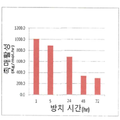
도 1은 실시예 1 내지 5의 방치 시간 변화에 따른 촉매활성을 나타낸 것이다.Fig. 1 shows the catalytic activity according to the change of the standing time in Examples 1 to 5. Fig.
이하, 본 발명에 대한 이해를 돕기 위해 본 발명을 더욱 상세하게 설명한다.Hereinafter, the present invention will be described in detail in order to facilitate understanding of the present invention.
본 명세서 및 청구범위에 사용된 용어나 단어는 통상적이거나 사전적인 의미로 한정해서 해석되어서는 아니 되며, 발명자는 그 자신의 발명을 가장 최선의 방법으로 설명하기 위해 용어의 개념을 적절하게 정의할 수 있다는 원칙에 입각하여 본 발명의 기술적 사상에 부합하는 의미와 개념으로 해석되어야만 한다.The terms and words used in the present specification and claims should not be construed as limited to ordinary or dictionary terms and the inventor may appropriately define the concept of the term in order to best describe its invention It should be construed as meaning and concept consistent with the technical idea of the present invention.
본 발명의 일 실시예에 따른 촉매의 제조방법은 네오디뮴 화합물, 트리알킬알루미늄 화합물 및 용매를 예비혼합(premix)하고, 상기 예비혼합물을 1 내지 24시간 동안 방치(stock)하는 단계를 포함하는 것을 특징으로 한다.A method of preparing a catalyst according to an embodiment of the present invention includes premixing a neodymium compound, a trialkylaluminum compound, and a solvent, and allowing the preliminary mixture to stand for 1 to 24 hours .
종래 공액 디엔계 중합체의 제조를 위한 촉매 시스템은 네오디뮴 화합물, 디이소부틸 알루미늄 하이드라이드[이하, DIBAH(diisobutyl aluminum hydride)라 칭함] 등의 알루미늄 화합물, 할로겐 화합물 및 부타디엔을 포함하는 촉매 조성물을 이용하여 예비중합(preforming)을 수행하는 단계를 포함하며, 상기 촉매 조성물 유래의 촉매를 이용하여 공액 디엔계 단량체를 중합 반응시키는 단계를 포함한다.Conventional catalyst systems for the production of conjugated diene-based polymers include neodymium compounds, diisobutylaluminum hydride [hereinafter referred to as DIBAH (diisobutyl (hereinafter referred to as " aluminum hydride "), a halogen compound, and butadiene, and the step of preforming the conjugated diene-based monomer using a catalyst derived from the catalyst composition Followed by a polymerization reaction.
그러나, 종래의 공액 디엔계 중합체의 제조방법에 따르면, 첫째, 촉매 조성물에 알킬화 및 분자량 조절 기능을 동시에 수행할 수 있는 DIBAH 등의 알루미늄 화합물을 포함함으로써 공정상 문제점이 발생할 수 있으며, 둘째, DIBAH 등을 이용한 알킬화(Alkylation) 단계에서 다양한 촉매 활성종 생성 가능성을 줄이기 위해 부타디엔을 소량 첨가하여 예비중합을 실시하는데, 부타디엔 예비중합으로 인한 고분자 생성으로 인해 중합 반응기의 촉매 투입 라인이 막히는 문제가 발생할 수 있다. 뿐만 아니라, 셋째, 분자량 조절이 용이하지 않고, 분자량 조절 변화를 확인하는 시점까지 걸리는 시간이 긴 단점이 있을 수 있다. 또한, 넷째, 촉매 활성종을 만들고 높은 활성을 유지하는 시간이 매우 짧기 때문에 연속적인 촉매 공정이 불가피하다.However, according to the conventional method for producing a conjugated diene-based polymer, a problem may arise in the process due to the inclusion of an aluminum compound such as DIBAH capable of simultaneously performing the alkylation and the molecular weight regulating function on the catalyst composition. Second, A small amount of butadiene is added in order to reduce the possibility of generating various catalytic active species in the alkylation step using the catalyst. However, the production of the polymer due to the butadiene prepolymerization may cause a problem that the catalyst input line of the polymerization reactor is clogged . Thirdly, there may be a disadvantage that the time required for confirming the molecular weight control change is long and the molecular weight is not easily controlled. Fourth, continuous catalytic processes are inevitable because the time required to make catalytically active species and maintain high activity is very short.
이에, 본 발명에서는 일 실시예에 따라, 균일한 촉매 활성종 생성, 높은 촉매 활성 및 높은 촉매 활성 유지시간을 향상시키기 위해, (1) DIBAH 대신 트리알킬알루미늄 사용, (2) 예비혼합, 및 (3) 예비혼합 후 방치 단계를 수행함으로써 종래의 생산성 및 공정상 문제를 해결하면서, 본 발명의 목적을 달성하였다. 또한, 더욱 바람직하게는 상기 (1) 내지 (3) 이외에, (4) 할로겐 화합물 투입 후 에이징 단계 수행함으로써 촉매 활성 및 중합체의 전환율 등의 물성 효과를 더욱 향상시킬 수 있다. Thus, in accordance with one embodiment of the present invention, in order to improve the production of uniform catalytically active species, high catalytic activity, and high catalyst activity retention time, the present invention uses (1) trialkyl aluminum instead of DIBAH, (2) premix, and 3) The objective of the present invention was achieved while solving the conventional productivity and process problems by performing the post-mixing and post-mixing step. More preferably, in addition to the above (1) to (3), (4) the aging step after the introduction of the halogen compound can further improve the physical properties such as catalytic activity and conversion of the polymer.
본 발명의 일 실시예에 따른 촉매의 제조방법을 살펴보면 다음과 같다.A method for producing a catalyst according to an embodiment of the present invention will be described below.
상기 촉매의 제조방법은 (i) 네오디뮴 화합물, 트리알킬알루미늄 화합물 및 용매를 예비혼합(premix)하고(단계 (i)), 상기 예비혼합물을 1 내지 24시간 동안 방치(stock)하는 단계(단계 (ii))를 포함할 수 있다.The process for preparing the catalyst comprises the steps of (i) premixing a neodymium compound, a trialkylaluminum compound and a solvent (step (i)), and leaving the preliminary mixture for 1 to 24 hours (step ii)).
구체적으로, 상기 단계 (i)은 촉매 활성종을 생성하는 단계로서, 네오디뮴 화합물, 트리알킬알루미늄 화합물 및 용매를 예비혼합하는 단계이다.Specifically, the step (i) is a step of producing a catalytically active species by premixing a neodymium compound, a trialkylaluminum compound and a solvent.
본 발명은 DIBAH 대신 트리알킬알루미늄 화합물을 사용함으로써, 예비중합이 아닌 예비혼합(premix)을 수행할 수 있으므로, 공정상 매우 유리할 뿐만 아니라, 촉매 활성시간을 증대시킬 수 있다. By using a trialkylaluminum compound instead of DIBAH, the present invention can perform premixing instead of preliminary polymerization, so that it is very advantageous in the process and can increase the catalyst activation time.
본 명세서에서 사용되는 용어 “예비중합(preforming)”이란, 네오디뮴 화합물, DIBAH 등의 알루미늄 화합물 및 할로겐 화합물을 포함하는 촉매 시스템에 있어서, DIBAH 등을 포함하는 경우 이와 함께 다양한 촉매 활성종 생성 가능성을 줄이기 위해 부타디엔 등의 단량체를 소량 첨가하게 되며, 부타디엔 첨가와 함께 촉매 시스템 내에서 전(pre) 중합이 이루어짐을 의미할 수 있다.As used herein, the term " preforming " refers to a catalyst system comprising a neodymium compound, an aluminum compound such as DIBAH, and a halogen compound. When DIBAH or the like is included, A small amount of monomers such as butadiene and the like may be added, which may mean that pre-polymerization is carried out in the catalyst system together with butadiene addition.
또한 용어 "예비혼합(premix)"이란 촉매 시스템에서 중합이 이루어지지 않고 각 화합물들이 균일하게 혼합된 상태를 의미할 수 있다. The term "premix" can also mean a state in which the polymerization is not carried out in the catalyst system and each compound is uniformly mixed.
상기 예비혼합은 10℃ 내지 60℃의 온도 범위에서 수행될 수 있으며, 구체적으로는 20℃ 내지 50℃의 온도 범위에서 약 1 시간 내지 24 시간 동안 수행될 수 있다. 상기 온도 및 시간 범위에서 예비혼합을 수행하는 경우 최적의 촉매의 활성을 유지할 수 있다.The premixing may be carried out at a temperature ranging from 10 캜 to 60 캜, specifically from 20 캜 to 50 캜 for about 1 to 24 hours. When premixing is performed in the temperature and time ranges, the optimum catalyst activity can be maintained.
또한, 상기 단계 (ii)는 촉매활성을 증대시키고, 생산 공정을 단순화 할 수 있는 단계로서, 상기 예비혼합물을 1 시간 내지 24 시간 동안 방치(stock)하는 단계이다.The step (ii) is a step of increasing the catalytic activity and simplifying the production process, and is a step of stocking the preliminary mixture for 1 to 24 hours.
본 발명의 일 실시예에 따르면, 상기 방치는 10℃ 내지 60℃의 온도 범위에서 1 시간 내지 24 시간 동안, 구체적으로 20℃ 내지 45℃의 온도 범위에서, 더욱 구체적으로 실온에서 수행할 수 있으며, 방치 시간은 구체적으로 1 시간 내지 10 시간, 더욱 구체적으로는 1 내지 5 시간 동안 수행하는 것이 바람직할 수 있다. 상기 방치 온도 및 시간에서 중합체의 전환율 및 활성을 최적화할 수 있으며, 방치 시간이 길어짐에 따라 활성이 감소할 수 있으나, 24시간 동안은 방치를 하지 않은 경우에 비해 높은 활성을 유지할 수 있다.According to one embodiment of the present invention, the setting can be carried out at a temperature ranging from 10 ° C to 60 ° C for a time ranging from 1 hour to 24 hours, more specifically from 20 ° C to 45 ° C, more specifically at room temperature, The leaving time may be preferably performed for 1 hour to 10 hours, more specifically 1 to 5 hours. The conversion and activity of the polymer can be optimized at the above-mentioned incubation temperature and time, and the activity can be decreased as the settling time becomes longer, but the activity can be maintained higher than that in the case of not being left for 24 hours.
만일, 상기 트리알킬알루미늄 대신 DIBAH를 사용하는 경우, 짧은 활성 시간 및 공정상 문제로 방치 단계의 수행이 불가능하며, 수행을 한다고 하더라도 낮은 활성을 나타내기 때문에 방치 단계를 수행하는 것이 바람직하지 않다. 이에 반해, 트리알킬알루미늄을 사용하는 경우 높은 활성을 장시간 동안 확보할 수 있으므로 촉매 활성을 더욱 향상시키며 촉매 공정을 단순화 할 수 있다If DIBAH is used instead of trialkylaluminum, it is impossible to carry out the negation step due to short activation time and process problems, and it is not preferable to perform the neglecting step because it shows low activity even if it is performed. On the other hand, when trialkylaluminum is used, high activity can be secured for a long time, so that the catalytic activity can be further improved and the catalytic process can be simplified
또한, 본 발명의 일 실시예에 따른 촉매의 제조방법에 따르면, 할로겐 화합물을 투입하여 염화반응(chlorination reaction)을 수행하는 단계를 더 포함할 수 있다. 상기 할로겐 화합물의 투입 단계는 예를 들면, 예비혼합 이전, 예비혼합 및 방치 단계 사이, 즉 상기 방치 단계 이전에 예비혼합을 수행 하자마자(예비혼합 직후), 또는 상기 방치 단계 이후에 이루어질 수 있다. 바람직하게는 상기 예비혼합 및 방치 단계 사이에 할로겐 화합물을 투입하여 반응시키거나, 또는 방치 단계 이후에 투입하여 반응시키는 것이 유리할 수 있다.According to the method of preparing a catalyst according to an embodiment of the present invention, a step of introducing a halogen compound and performing a chlorination reaction may be further included. The step of introducing the halogen compound can be carried out, for example, immediately before premixing, immediately after premixing (premixing), or between the premixing and the leaving step, that is, before the leaving step, or after the leaving step. It may be advantageous to introduce a halogen compound between the preliminary mixing and the neutralization step and to react them, or to introduce them after the neutralization step.
상기 혼합물과 할로겐 화합물과의 반응은 0℃ 내지 60℃의 온도 범위에서 1분 내지 5시간, 구체적으로는 10℃ 내지 50℃의 온도 범위에서 5분 내지 1시간, 더욱 구체적으로 10℃ 내지 45℃의 온도범위에서 20분 내지 1시간 동안 수행될 수 있다.The reaction of the mixture with the halogen compound is carried out at a temperature of 0 ° C to 60 ° C for 1 minute to 5 hours, in particular at a temperature of 10 ° C to 50 ° C for 5 minutes to 1 hour, more specifically 10 ° C to 45 ° C RTI ID = 0.0 > 20 minutes < / RTI > to 1 hour.
또한, 본 발명의 일 실시예에 따르면, 상기 할로겐 화합물을 투입하여 반응시킨 후, 에이징(aging)하는 단계를 더 포함할 수 있다.According to an embodiment of the present invention, the method may further include a step of charging the halogen compound, reacting the halogen compound, and aging the halogen compound.
예를 들어 할로겐 화합물을 예비혼합 및 방치 단계 사이에 투입하는 경우, 상기 에이징 단계는 방치 단계 이전 또는 방치 단계 이후에 수행될 수 있고, 상기 할로겐 화합물을 방치 단계 이후에 투입하는 경우, 상기 에이징 단계는 방치 단계 이후에 수행될 수 있다.For example, when the halogen compound is put in between the preliminary mixing and the leaving step, the aging step may be performed before or after the leaving step, and when the halogen compound is put after the neglecting step, the aging step Can be performed after the neglecting step.
상기 에이징 단계는 0℃ 내지 60℃의 온도 범위에서 1분 내지 240분 동안, 구체적으로 30분 내지 240분, 더욱 구체적으로 30분 내지 60분 동안 수행될 수 있다. 본 발명의 촉매는 상기 에이징 단계를 포함함으로써, 중합체의 전환율을 더욱 향상시킬 수 있으며, 상기 에이징을 30분 이상 수행하는 경우 90% 이상의 중합체 전환율을 확보할 수 있다.The aging step may be performed at a temperature ranging from 0 캜 to 60 캜 for 1 minute to 240 minutes, specifically 30 minutes to 240 minutes, more specifically, 30 minutes to 60 minutes. The catalyst of the present invention can further improve the conversion rate of the polymer by including the aging step. When the aging is performed for 30 minutes or more, the conversion of the polymer can be ensured to 90% or more.
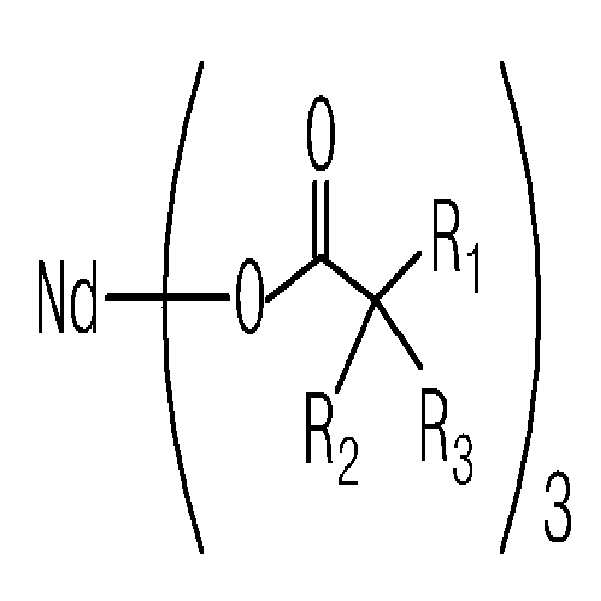
본 발명의 일 실시예에 따라 사용 가능한 상기 네오디뮴 화합물은 하기 화학식 1의 화합물을 포함할 수 있다:The neodymium compound usable according to one embodiment of the present invention may comprise a compound of formula 1:
[화학식 1][Chemical Formula 1]
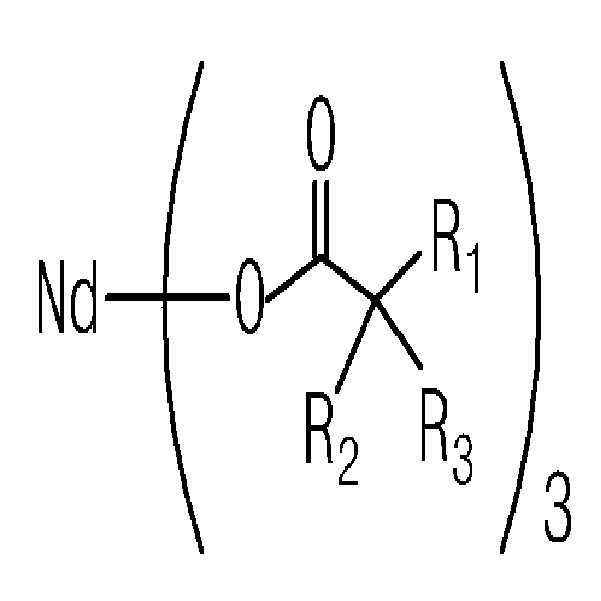
상기 식에서,In this formula,
R1 내지 R3은 서로 독립적으로 수소, 또는 탄소수 1 내지 12의 선형 또는 분지형 알킬기이다.R 1 to R 3 independently of one another are hydrogen or a linear or branched alkyl group having 1 to 12 carbon atoms.
구체적으로, 상기 식에서, R1은 탄소수 6 내지 10의 선형 또는 분지형 알킬기이며, R2 및 R3는 서로 독립적으로 수소, 또는 탄소수 1 내지 8의 선형 또는 분지형 알킬기이다.Specifically, R 1 is a linear or branched alkyl group having 6 to 10 carbon atoms, and R 2 and R 3 are each independently hydrogen or a linear or branched alkyl group having 1 to 8 carbon atoms.
상기 네오디뮴 화합물은 구체적으로, Nd(2-에틸헥사노에이트)3, Nd(네오데카노에이트)3, Nd(2,2-디에틸 데카노에이트)3, Nd(2,2-디프로필 데카노에이트)3, Nd(2,2-디부틸 데카노에이트)3, Nd(2,2-디헥실 데카노에이트)3, Nd(2,2-디옥틸 데카노에이트)3, Nd(2-에틸-2-프로필 데카노에이트)3, Nd(2-에틸-2-부틸 데카노에이트)3, Nd(2-에틸-2-헥실 데카노에이트)3, Nd(2-프로필-2-부틸 데카노에이트)3, Nd(2-프로필-2-헥실 데카노에이트)3, Nd(2-프로필-2-이소프로필 데카노에이트)3, Nd(2-부틸-2-헥실 데카노에이트)3, Nd(2-헥실-2-옥틸 데카노에이트)3, Nd(2-t-부틸 데카노에이트)3, Nd(2,2-디에틸 옥타노에이트)3, Nd(2,2-디프로필 옥타노에이트)3, Nd(2,2-디부틸 옥타노에이트)3, Nd(2,2-디헥실 옥타노에이트)3, Nd(2-에틸-2-프로필 옥타노에이트)3, Nd(2-에틸-2-헥실 옥타노에이트)3, Nd(2,2-디에틸 노나노에티트)3, Nd(2,2-디프로필 노나노에이트)3, Nd(2,2-디부틸 노나노에이트)3, Nd(2,2-디헥실 노나노에이트)3, Nd(2-에틸-2-프로필 노나노에이트)3 및 Nd(2-에틸-2-헥실 노나노에이트)3로 이루어진 군으로부터 선택된 어느 하나 또는 이들 중 2종 이상의 혼합물일 수 있다.Specifically, the neodymium compound may include Nd (2-ethylhexanoate) 3 , Nd (neodecanoate) 3 , Nd (2,2-diethyldecanoate) 3 , Nd decanoate) 3, Nd (2,2- di-butyl decanoate) 3, Nd (2,2- di-hexyl decanoate) 3, Nd (2,2- dioctyl decanoate) 3, Nd (2 -ethyl-2-propyl decanoate) 3, Nd (2- ethyl-2-butyl decanoate) 3, Nd (2- ethyl-2-hexyl decanoate) 3, Nd (2- propyl-2 butyl decanoate) 3, Nd (2- propyl-2-hexyl decanoate) 3, Nd (2- propyl-2-isopropyl decanoate) 3, Nd (2- butyl-2-hexyl decanoate ) 3, Nd (2- cyclohexyl-2-octyl decanoate) 3, Nd (2-t- butyl decanoate) 3, Nd (2,2- diethyl octanoate) 3, Nd (2,2 - dipropyl octanoate) 3, Nd (2,2- dibutyltin octanoate) 3, Nd (2,2- dihexyl octanoate) 3, Nd (2- ethyl-2-propyl-octanoate) 3 , Nd (2-ethyl-2-hexyl octanoate) 3, Nd (2,2- di titeu ethyl furnace nm) 3, Nd (2,2- dipropyl no nano-benzoate) 3, Nd (2,2- dibutyl no nano-benzoate) 3, Nd (2,2 - dihexyl no nano-benzoate) 3, Nd (2- ethyl-2-propyl-no nano-benzoate) 3 and Nd (2- ethyl-2-hexyl-no nano-benzoate), two of these, or any one selected from the group consisting of 3 Or more.
본 발명의 일 실시예에 따르면, 상기 네오디뮴 화합물은 Nd(2-에틸헥사노에이트)3, Nd(네오데카노에이트)3 또는 이들의 혼합물일 수 있다.According to an embodiment of the present invention, the neodymium compound may be Nd (2-ethylhexanoate) 3 , Nd (neodecanoate) 3 or a mixture thereof.
상기 화학식 1로 표시되는 네오디뮴 화합물의 중량 평균 분자량은 800 내지 1400 일 수 있다.The neodymium compound represented by
또한, 상기 화학식 1로 표시되는 네오디뮴 화합물의 용해도는 탁한 현상 없이 맑게 용해되는 정도를 의미하는 것으로, 상온에서 비극성 용매 6g 당 약 4g의 네오디뮴 화합물이 용해되는 것이 바람직할 수 있다.The solubility of the neodymium compound represented by the formula (1) means a degree of dissolution without cloudy phenomenon. It is preferable that about 4 g of the neodymium compound is dissolved per 6 g of the nonpolar solvent at room temperature.
상기와 같은 본 발명의 네오디뮴 화합물은 다양한 길이의 알킬기를 치환기로 함유한 카르복실레이트 리간드를 포함함으로써, 네오디뮴 중심 금속 주위에 입체적인 변화를 유도하여 화합물 간의 엉김 현상을 방해할 수 있다. 따라서, 종래 네오디뮴 화합물의 문제점이었던 올리고머화를 억제시킬 수 있다. 이에 따라, 중합 용매에 대한 높은 용해도를 확보할 수 있으므로, 높은 활성을 필요로 하는 디엔 중합용 촉매로 사용할 수 있다.The neodymium compound of the present invention as described above contains a carboxylate ligand containing an alkyl group of various lengths as a substituent, thereby inducing a three-dimensional change around the neodymium center metal, thereby hindering entanglement of the compounds. Therefore, oligomerization, which has been a problem of the neodymium compound in the prior art, can be suppressed. As a result, a high solubility in a polymerization solvent can be secured, and therefore, it can be used as a catalyst for diene polymerization requiring high activity.
또한, 본 발명의 일 실시예에 따르면, 상기 트리알킬알루미늄 화합물은 예를 들어 트리이소부틸알루미늄, 트리에틸알루미늄, 트리헥실알루미늄 및 트리옥틸알루미늄으로 이루어진 군으로부터 선택된 어느 하나 또는 이들 중 2종 이상의 혼합물을 포함할 수 있다. 본 발명의 일 실시예에 따르면, 상기 트리알킬알루미늄을 사용함으로써 예비혼합이 가능하며, 촉매의 활성을 향상시킬 수 있고, 높은 활성을 오랫동안 유지할 수 있다.According to an embodiment of the present invention, the trialkylaluminum compound may be any one selected from the group consisting of triisobutylaluminum, triethylaluminum, trihexylaluminum and trioctylaluminum, or a mixture of two or more thereof . ≪ / RTI > According to one embodiment of the present invention, by using the trialkylaluminum, preliminary mixing is possible, the activity of the catalyst can be improved, and the high activity can be maintained for a long time.
또한, 본 발명의 일 실시예에 따르면, 상기 용매는 지방족탄화수소계 용매, 시클로지방족탄화수소계 용매 및 방향족 탄화수소계 용매로 이루어진 군으로부터 선택된 어느 하나 또는 이들 중 2종 이상의 혼합물일 수 있다. 상기 용매의 예로는 구체적으로 벤젠, 톨루엔, 펜탄, n- 헥산, 이소헥산, 헵탄 및 시클로헥산 등을 사용할 수 있으나, 이에 제한되는 것은 아니다.According to an embodiment of the present invention, the solvent may be any one selected from the group consisting of an aliphatic hydrocarbon solvent, a cycloaliphatic hydrocarbon solvent, and an aromatic hydrocarbon solvent, or a mixture of two or more thereof. Examples of the solvent include benzene, toluene, pentane, n-hexane, isohexane, heptane and cyclohexane, but are not limited thereto.
또한, 본 발명의 일 실시예에 따르면, 상기 할로겐 화합물은 원소 할로겐, 혼합 할로겐, 할로겐화수소, 유기 할라이드, 무기 할라이드, 금속 할라이드 및 유기금속 할라이드로 이루어진 군으로부터 선택된 어느 하나 또는 이들 중 2종 이상의 혼합물을 포함할 수 있으며, 이에 제한되는 것은 아니다.According to an embodiment of the present invention, the halogen compound may be any one selected from the group consisting of an elemental halogen, a mixed halogen, a hydrogen halide, an organic halide, an inorganic halide, a metal halide and an organometallic halide or a mixture of two or more thereof But is not limited thereto.
본 발명의 일 실시예에 따르면, 구체적으로는 유기 할라이드, 금속 할라이드 및 유기금속 할라이드로 이루어진 군으로부터 선택된 어느 하나 또는 이들 중 2종 이상의 혼합물을 포함할 수 있다.According to one embodiment of the present invention, specifically, any one selected from the group consisting of an organic halide, a metal halide, and an organometallic halide or a mixture of two or more thereof may be included.
적합한 원소 할로겐으로는 불소, 염소, 브롬 및 요오드가 포함될 수 있다. 적합한 혼합 할로겐으로는 요오드 모노클로라이드, 요오드 모노브로마이드, 요오드 트리클로라이드, 요오드 펜타플루오라이드, 요오드 모노플루오라이드 및 요오드 트리플루오라이드가 포함될 수 있다. Suitable elemental halogens may include fluorine, chlorine, bromine and iodine. Suitable mixed halogens may include iodine monochloride, iodine monobromide, iodine trichloride, iodopentafluoride, iodine monofluoride, and iodotrifluoride.
적합한 할로겐화수소로는 불화수소, 염화수소, 브롬화수소 및 요오드화수소가 포함될 수 있다.Suitable hydrogen halides include hydrogen fluoride, hydrogen chloride, hydrogen bromide, and hydrogen iodide.
적합한 유기 할라이드로는 t-아밀클로라이드, t-부틸 클로라이드, t-부틸 브로마이드, 알릴 클로라이드, 알릴 브로마이드, 벤질 클로라이드, 벤질 브로마이드, 클로로-디-페닐메탄, 브로모-디-페닐메탄, 트리페닐메틸 클로라이드, 트리페닐메틸 브로마이드, 벤질리덴 클로라이드, 벤질리덴 브로마이드, 메틸트리클로로실란, 페닐트리클로로실란, 디메틸디클로로실란, 디페닐디클로로실란, 트리메틸클로로실란, 벤조일 클로라이드, 벤조일 브로마이드, 프로피오닐 클로라이드, 프로피오닐 브로마이드, 메틸 클로로포르메이트, 메틸 브로모포르메이트, 요오도메탄, 디요오도메탄, 트리요오도메탄 (요오도포름으로도 불리움), 테트라요오도메탄, 1-요오도프로판, 2-요오도프로판, 1,3-디요오도프로판, t-부틸 요오다이드, 2,2-디메틸-1-요오도프로판 (네오펜틸 요오다이드로도 불리움), 알릴 요오다이드, 요오도벤젠, 벤질 요오다이드, 디페닐메틸 요오다이드, 트리페닐메틸 요오다이드, 벤질리덴 요오다이드 (벤잘 요오다이드로도 불리움), 트리메틸실릴 요오다이드, 트리에틸실릴 요오다이드, 트리페닐실릴 요오다이드, 디메틸디요오도실란, 디에틸디요오도실란, 디페닐디요오도실란, 메틸트리요오도실란, 에틸트리요오도실란, 페닐트리요오도실란, 벤조일 요오다이드, 프로피오닐 요오다이드 및 메틸 요오도포르메이트가 포함될 수 있다.Suitable organic halides include t-amyl chloride, t-butyl chloride, t-butyl bromide, allyl chloride, allyl bromide, benzyl chloride, benzyl bromide, chloro-di-phenyl methane, bromo- And examples of the organic solvent include chlorine, bromine, bromine, bromine, bromine, chlorine, bromine, chlorine, triphenylmethylbromide, benzylidene chloride, benzylidenebromide, methyltrichlorosilane, phenyltrichlorosilane, dimethyldichlorosilane, diphenyldichlorosilane, (Also referred to as iodoform), tetraiodomethane, 1-iodopropane, 2-iodo-2-iodo-2-iodo Propane, 1,3-diiodopropane, t-butyl iodide, 2,2-dimethyl-1-iodopropane (neopentyl Benzylidene iodide (also referred to as benzyl iodide), trimethylsilyl (also referred to as benzyl iodide), allyl iodide, iodobenzene, benzyl iodide, diphenylmethyl iodide, triphenylmethyl iodide, But are not limited to, iodide, triethylsilyl iodide, triphenylsilyl iodide, dimethyldiiodosilane, diethyldiiodosilane, diphenyldiiodosilane, methyltriiodosilane, ethyltriiodosilane, Phenyl triiodosilane, benzoyl iodide, propionyl iodide, and methyl iodoformate.
적합한 무기 할라이드로는 삼염화인, 삼브롬화인, 오염화인, 옥시염화인, 옥시브롬화인, 삼불화붕소, 삼염화붕소, 삼브롬화붕소, 사불화규소, 사염화규소, 사브롬화규소, 삼염화비소, 삼브롬화비소, 사염화셀레늄, 사브롬화셀레늄, 사염화텔루르, 사브롬화텔루르, 사요오드화규소, 삼요오드화비소, 사요오드화텔루르, 삼요오드화붕소, 삼요오드화인, 옥시요오드화인 및 사요오드화셀레늄이 포함될 수 있다.Suitable inorganic halides include phosphorus trichloride, phosphorus tribromide, phosphorus pentachloride, phosphorus oxychloride, phosphorus oxybromide, boron trifluoride, boron trichloride, boron tribromide, silicon tetrafluoride, silicon tetrachloride, arsenic trichloride, tribromide Arsenic chloride, arsenic chloride, selenium tetrachloride, selenium tetrabromide, tellurium tetrachloride, tellurium tetrabromide, silicon tetrabromide, silicon tetrabromide, arsenic triiodide, tellurium tetraiodide, boron triiodide, phosphorous iodide and selenium iodide.
적합한 금속 할라이드로는 사염화주석, 사브롬화주석, 삼염화알루미늄, 삼브롬화알루미늄, 삼염화안티몬, 오염화안티몬, 삼브롬화안티몬, 삼불화알루미늄, 삼염화갈륨, 삼브롬화갈륨, 삼불화갈륨, 삼염화인듐, 삼브롬화인듐, 삼불화인듐, 사염화티타늄, 사브롬화티타늄, 이염화아연, 이브롬화아연, 이불화아연, 삼요오드화알루미늄, 삼요오드화갈륨, 삼요오드화인듐, 사요오드화티타늄, 이요오드화아연, 사요오드화게르마늄, 사요오드화주석, 이요오드화주석, 삼요오드화안티몬 및 이요오드화마그네슘이 포함될 수 있다.Suitable metal halides include tin tetrachloride, tin tetrabromide, aluminum trichloride, aluminum tribromide, antimony trichloride, antimony tritiated, antimony tribromide, aluminum trifluoride, gallium trichloride, gallium tribromide, gallium trifluoride, indium trichloride, A metal halide such as indium, indium trifluoride, titanium tetrachloride, titanium tetrabromide, zinc dichloride, zinc bromide, zinc fluoride, aluminum triiodide, gallium triiodide, indium triiodide, titaniumiodide, zinc iodide, germanium tetraiodide, Tin sodium iodide, tin iodide, antimony triiodide, and magnesium iodide.
적합한 유기금속 할라이드로는 디메틸알루미늄 클로라이드, 디에틸알루미늄 클로라이드, 디메틸알루미늄 브로마이드, 디에틸알루미늄 브로마이드, 디메틸알루미늄 플루오라이드, 디에틸알루미늄 플루오라이드, 메틸알루미늄 디클로라이드, 에틸알루미늄 디클로라이드, 메틸알루미늄 디브로마이드, 에틸알루미늄 디브로마이드, 메틸알루미늄 디플루오라이드, 에틸알루미늄 디플루오라이드, 메틸알루미늄 세스퀴클로라이드, 에틸알루미늄 세스퀴클로라이드, 이소부틸알루미늄 세스퀴클로라이드, 메틸마그네슘 클로라이드, 메틸마그네슘 브로마이드, 에틸마그네슘 클로라이드, 에틸마그네슘 브로마이드, n-부틸마그네슘 클로라이드, n-부틸마그네슘 브로마이드, 페닐마그네슘 클로라이드, 페닐마그네슘 브로마이드, 벤질마그네슘 클로라이드, 트리메틸주석 클로라이드, 트리메틸주석 브로마이드, 트리에틸주석 클로라이드, 트리에틸주석 브로마이드, 디-t-부틸주석 디클로라이드, 디-t-부틸주석 디브로마이드, 디-n-부틸주석 디클로라이드, 디-n-부틸주석 디브로마이드, 트리-n-부틸주석 클로라이드, 트리-n-부틸주석 브로마이드, 메틸마그네슘 요오다이드, 디메틸알루미늄 요오다이드, 디에틸알루미늄 요오다이드, 디-n-부틸알루미늄 요오다이드, 디이소부틸알루미늄 요오다이드, 디-n-옥틸알루미늄 요오다이드, 메틸알루미늄 디요오다이드, 에틸알루미늄 디요오다이드, n-부틸알루미늄 디요오다이드, 이소부틸알루미늄 디요오다이드, 메틸알루미늄 세스퀴요오다이드, 에틸알루미늄 세스퀴요오다이드, 이소부틸알루미늄 세스퀴요오다이드, 에틸마그네슘 요오다이드, n-부틸마그네슘 요오다이드, 이소부틸마그네슘 요오다이드, 페닐마그네슘 요오다이드, 벤질마그네슘 요오다이드, 트리메틸주석 요오다이드, 트리에틸주석 요오다이드, 트리-n-부틸주석 요오다이드, 디-n-부틸주석 디요오다이드 및 디-t-부틸주석 디요오다이드가 포함될 수 있다.Suitable organometallic halides include dimethyl aluminum chloride, diethyl aluminum chloride, dimethyl aluminum bromide, diethyl aluminum bromide, dimethyl aluminum fluoride, diethyl aluminum fluoride, methyl aluminum dichloride, ethyl aluminum dichloride, methyl aluminum dibromide, But are not limited to, ethylaluminum dibromide, methylaluminum difluoride, ethylaluminum difluoride, methylaluminum sesquichloride, ethylaluminum sesquichloride, isobutylaluminum sesquichloride, methylmagnesium chloride, methylmagnesium bromide, ethylmagnesium chloride, ethylmagnesium Bromide, n-butylmagnesium chloride, n-butylmagnesium bromide, phenylmagnesium chloride, phenylmagnesium bromide, benzylmagnesium chloride, Butyltin dichloride, di-t-butyltin dibromide, di-n-butyltin dichloride, di-n-butyl Tin dibromide, tri-n-butyltin chloride, tri-n-butyltinbromide, methylmagnesium iodide, dimethyl aluminum iodide, diethyl aluminum iodide, di- For example, isobutylaluminum iodide, di-n-octylaluminum iodide, methylaluminum iodide, ethylaluminum iodide, n-butylaluminum iodide, isobutylaluminum iodide, methylaluminum sesquioiodide , Ethyl aluminum sesquioiodide, isobutyl aluminum sesquioiodide, ethyl magnesium iodide, n-butyl magnesium iodide, isobutyl aluminum sesquioiodide, Butylmagnesium iodide, phenylmagnesium iodide, benzylmagnesium iodide, trimethyltin iodide, triethyltin iodide, tri-n-butyltin iodide, di-n-butyltin iodide And di-t-butyltin iodide.
본 발명의 일 실시예에 따른 상기 할로겐 화합물은 구체적으로 t-아밀클로라이드, t-부틸클로라이드, 실리콘 테트라클로라이드 및 틴 테트라클로라이드로 이루어진 군으로부터 선택된 어느 하나 또는 이들 중 2종 이상의 혼합물일 수 있다. 상기 할로겐 화합물은 DEAC(Diethylaluminum chloride)나 EASC(Ethylaluminum Sesquichloride)와 달리 알루미늄-클로라이드 결합이 존재하지 않기 대문에 부가적인 반응 없이 촉매의 활성을 더욱 오래 유지시킬 수 있다.The halogen compound according to an embodiment of the present invention may specifically be any one selected from the group consisting of t-amyl chloride, t-butyl chloride, silicon tetrachloride, and tin tetrachloride, or a mixture of two or more thereof. Unlike DEAC (Diethylaluminum chloride) or EASC (Ethylaluminum sesquichloride), the halogen compound does not have an aluminum-chloride bond, so that the activity of the catalyst can be maintained longer without any additional reaction.
본 발명의 일 실시예에 따른 촉매의 제조방법은 상기 네오디뮴 화합물; 트리알킬알루미늄; 및 용매를 투입하여 10℃ 내지 60℃의 온도 범위에서 예비혼합을 수행하고, 상기 얻은 예비혼합물에 할로겐 화합물을 투입하여 0℃ 내지 60℃의 온도 범위에서 반응시킨 후, 상기 반응에서 얻은 생성물을 방치시키는 단계를 포함할 수 있다.A method of preparing a catalyst according to an embodiment of the present invention includes: preparing a mixture of the neodymium compound; Trialkylaluminum; And a solvent are added to the reaction mixture to perform premixing in a temperature range of 10 to 60 ° C. A halogen compound is added to the obtained preliminary mixture, and the mixture is allowed to react at a temperature ranging from 0 ° C to 60 ° C. . ≪ / RTI >
본 발명의 또 다른 실시예에 따른 촉매의 제조방법은 상기 네오디뮴 화합물; 트리알킬알루미늄; 및 용매를 투입하여 10℃ 내지 60℃의 온도 범위에서 예비혼합을 수행하고, 1 내지 24시간 동안 방치시킨 후, 상기 혼합물에 할로겐 화합물을 투입하여 반응시킨 후, 이를 에이징하는 단계를 포함할 수 있다.A method of preparing a catalyst according to another embodiment of the present invention includes: Trialkylaluminum; And a solvent are mixed to perform premixing in a temperature range of 10 ° C to 60 ° C and allowed to stand for 1 to 24 hours and then a halogen compound is added to the mixture to react and then aged .
또한, 상기 네오디뮴 화합물: 트리알킬알루미늄 화합물의 혼합비는 몰비로서 1.0 : 5.0 내지 200, 구체적으로는 1.0 : 5.0 내지 100 몰비일 수 있다.The mixing ratio of the neodymium compound: trialkyl aluminum compound may be 1.0: 5.0 to 200, and more preferably 1.0: 5.0 to 100.
본 발명의 일 실시예에 따르면, 네오디뮴 화합물 : 트리알킬알루미늄 : 용매를 0.01 내지 0.25 : 0.05 내지 50.0 : 10 내지 200 몰비의 양으로 사용할 수 있다.According to one embodiment of the present invention, neodymium compound: trialkylaluminum: solvent may be used in an amount of 0.01 to 0.25: 0.05 to 50.0: 10 to 200 molar ratio.
한편, 본 발명은 상기 촉매의 제조방법에 의해 제조된 촉매를 제공할 수 있다.Meanwhile, the present invention can provide a catalyst prepared by the method for producing the catalyst.
나아가, 본 발명은 상기 촉매를 이용한 공액 디엔계 중합체의 제조방법을 제공할 수 있다. Further, the present invention can provide a method for producing a conjugated diene-based polymer using the catalyst.
상기 공액 디엔계 중합체의 제조방법은 분자량 조절제 및 공액 디엔계 단량체의 혼합물을 준비하는 단계(단계 (1)); 및 상기 혼합물을 네오디뮴 화합물, 트리알킬알루미늄 화합물 및 용매를 예비혼합(premix)하고, 상기 예비혼합물을 1 내지 24시간 동안 방치(stock)하는 단계를 포함하여 수행하여 얻은 본 발명의 촉매와 혼합한 후, 중합 반응하는 단계(단계 (2))를 포함할 수 있다.The method for producing the conjugated diene-based polymer includes the steps of preparing a mixture of the molecular weight modifier and the conjugated diene-based monomer (step (1)); And mixing the mixture with a catalyst of the present invention obtained by preliminarily mixing the neodymium compound, the trialkylaluminum compound and the solvent and allowing the preliminary mixture to stand for 1 to 24 hours, , And a polymerization step (step (2)).
본 발명의 일 실시예에 따르면, 상기 네오디뮴 화합물은 공액 디엔계 단량체 100 g을 기준으로 0.01 내지 0.25 mmol, 구체적으로는 0.02 내지 0.12 mmol, 더욱 구체적으로는 0.02 내지 0.08 mmol을 사용할 수 있다. According to one embodiment of the present invention, the neodymium compound may be used in an amount of 0.01 to 0.25 mmol, specifically 0.02 to 0.12 mmol, more specifically 0.02 to 0.08 mmol, based on 100 g of the conjugated diene monomer.
구체적으로, 본 발명의 일 실시예에 따르면, 예를 들어, 공액 디엔계 단량체 100 g 에 대해 네오디뮴 화합물 0.01 내지 0.25 mmol, 트리알킬알루미늄 은 0.05 내지 50.0 mmol 및 용매는 10 내지 200 mmol의 양으로 포함할 수 있다. Specifically, according to one embodiment of the present invention, for example, 0.01 to 0.25 mmol of neodymium compound, 0.05 to 50.0 mmol of trialkylaluminum and 10 to 200 mmol of a solvent are contained in 100 g of the conjugated diene monomer can do.
또한, 상기 공액 디엔계 단량체 250g에 대해 촉매는 0.5g 내지 5.0g의 양으로 사용될 수 있다.The catalyst may be used in an amount of 0.5 g to 5.0 g per 250 g of the conjugated diene monomer.
본 발명의 공액 디엔계 중합체의 제조방법에 따르면, 신속하고 용이한 분자량 조절이 가능하고, 촉매 활성이 매우 높아서 저온에서도 중합이 잘 진행되며, 적은 양의 주촉매 사용량으로 중합 반응시간을 감소시킬 수 있다.According to the method for producing a conjugated diene polymer of the present invention, it is possible to control the molecular weight quickly and easily, and the polymerization activity can be progressed well even at a low temperature since the catalytic activity is very high, have.
구체적으로 살펴보면, 본 발명의 일 실시예에 따른 공액 디엔계 중합체의 제조방법은 분자량 조절제 및 공액 디엔계 단량체의 혼합물을 준비하는 단계를 포함할 수 있다(단계 (1)).Specifically, the method for producing a conjugated diene-based polymer according to an embodiment of the present invention may include preparing a mixture of a molecular weight modifier and a conjugated diene-based monomer (step (1)).
본 발명의 일 실시예에 따른 공액 디엔계 중합체의 제조방법에 따르면, 상기 분자량 조절제는 촉매 제조시 투입되는 것이 아니라, 공액 디엔계 단량체와 함께 별도로 투입됨으로써, 생산 공정에서 신속한 분자량 조절이 가능하며 공정성을 개선시킬 수 있다.According to the method for producing a conjugated diene-based polymer according to an embodiment of the present invention, the molecular weight modifier is not added during the preparation of the catalyst but is separately introduced together with the conjugated diene-based monomer, whereby the molecular weight can be controlled quickly in the production process, Can be improved.
본 발명의 일 실시예에 따른 제조방법에 있어서, 상기 분자량 조절제는 유기 알루미늄 화합물로서, 디메틸 알루미늄 하이드라이드, 디에틸 알루미늄 하이드라이드, 디n-프로필 알루미늄 하이드라이드, 디이소프로필 알루미늄 하이드라이드, 디n-부틸 알루미늄 하이드라이드, 디이소부틸알루미늄 하이드라이드(DIBAH), 디t-부틸 알루미늄 하이드라이드, 디펜틸알루미늄하이드라이드, 디헥실알루미늄하이드라이드, 디사이클로헥실 알루미늄 하이드라이드 및 디옥틸 알루미늄 하이드라이드로 이루어진 군으로부터 선택된 어느 하나 또는 이들 중 2종 이상의 혼합물 등을 들 수 있다. 이들의 유기 알루미늄 화합물 중에서는, 디에틸 알루미늄 하이드라이드, 디이소부틸알루미늄 하이드라이드 또는 이들의 혼합물 등이 바람직하다.In the production method according to an embodiment of the present invention, the molecular weight modifier is an organoaluminum compound, which is selected from the group consisting of dimethyl aluminum hydride, diethyl aluminum hydride, di-n-propyl aluminum hydride, diisopropyl aluminum hydride, -Butyl aluminum hydride, diisobutyl aluminum hydride (DIBAH), dit-butyl aluminum hydride, dipentyl aluminum hydride, dihexyl aluminum hydride, dicyclohexyl aluminum hydride and dioctyl aluminum hydride. Or a mixture of two or more thereof. Among these organoaluminum compounds, diethylaluminum hydride, diisobutylaluminum hydride or a mixture thereof is preferable.
또한, 분자량 조정제로서, 수소 및 트리메틸실란, 트리에틸실란, 트리부틸 실란, 트리헥실 실란, 디메틸실란, 디에틸 실란, 디부틸 실란 및 디헥실시란등의 실란 화합물 등을 들 수도 있다. 이들의 유기 알루미늄 화합물 혹은 실란 화합물은, 1종 만을 사용하거나, 2종 이상을 병용 할 수도 있다. 또한, 유기 알루미늄 화합물과 실란 화합물을 동시에 사용할 수도 있다. Examples of the molecular weight regulator include hydrogen and silane compounds such as trimethylsilane, triethylsilane, tributylsilane, trihexylsilane, dimethylsilane, diethylsilane, dibutylsilane and dioctylsilane. These organoaluminum compounds or silane compounds may be used alone or in combination of two or more. The organoaluminum compound and the silane compound may be used at the same time.
본 발명의 일 실시예에 따른 제조방법에 있어서, 상기 공액 디엔계 단량체는 1,3-부타디엔, 이소프렌, 2,3-디메틸-1,3-부타디엔, 2-에틸-1,3-부타디엔, 2-메틸-1,3-펜타디엔, 1,3-펜타디엔, 3-메틸-1,3-펜타디엔, 4-메틸-1,3-펜타디엔, 1,3-헥사디엔 및 2,4-헥사디엔으로 이루어진 군으로부터 선택된 어느 하나 또는 이들 중 2종 이상의 혼합물이 포함될 수 있다. In the production method according to an embodiment of the present invention, the conjugated diene monomer may be 1,3-butadiene, isoprene, 2,3-dimethyl-1,3-butadiene, Methyl-1,3-pentadiene, 1,3-pentadiene, 3-methyl-1,3-pentadiene, Hexadiene, or a mixture of two or more thereof.
본 발명의 일 실시예에 따르면, 상기 분자량 조절제는 분자량 조절뿐만 아니라, 스캐빈저 역할도 가능하므로, 분자량 조절제의 사용량은 불순물의 양, 및 수분 양에 따라 달라질 수 있으며, 이에 제한되는 것은 아니다. According to one embodiment of the present invention, since the molecular weight modifier can act not only as a molecular weight modifier but also as a scavenger, the amount of the molecular weight modifier may vary depending on the amount of impurities and the amount of water, but is not limited thereto.
본 발명의 일 실시예에 따른 제조방법에 있어서, 상기 단계 (1)에서 사용한 분자량 조절제는 주촉매인 네오디뮴 화합물 대비 1 내지 50 당량의 양으로 사용하는 것이 좋다. In the production method according to one embodiment of the present invention, the molecular weight modifier used in step (1) is preferably used in an amount of 1 to 50 equivalents relative to the neodymium compound as the main catalyst.
본 발명의 일 실시예에 따른 공액 디엔계 중합체의 제조방법은 네오디뮴 화합물, 트리알킬알루미늄 화합물 및 용매를 예비혼합하고, 상기 예비혼합물을 1 내지 24시간 동안 방치하는 단계를 포함하여 제조된 본 발명의 촉매와 혼합한 후, 중합 반응하는 단계 (단계 (2))를 포함할 수 있다.The method for producing a conjugated diene-based polymer according to an embodiment of the present invention comprises the steps of premixing a neodymium compound, a trialkylaluminum compound and a solvent, and allowing the preliminary mixture to stand for 1 to 24 hours, (2), after mixing with a catalyst, followed by a polymerization reaction.
본 발명의 일 실시예에 따른 제조방법에 있어서, 상기 중합 반응은 30℃ 내지 80℃의 온도 범위에서 수행될 수 있다.In the production method according to an embodiment of the present invention, the polymerization reaction may be carried out at a temperature ranging from 30 ° C to 80 ° C.
본 발명은 상기 중합체의 제조방법에 의해 제조된 공액디엔계 중합체를 제공할 수 있다. The present invention can provide the conjugated diene-based polymer produced by the process for producing the polymer.
본 발명의 일 실시예에 따른 상기 공액 디엔계 중합체는 100℃에서의 무니점도(mooney viscosity)가 35 내지 75일 수 있다.The conjugated diene polymer according to an embodiment of the present invention may have a Mooney viscosity at 100 DEG C of from 35 to 75. [
본 발명의 일 실시예에 따르면, 상기 무니점도는 예를 들어, Monsanto사 MV2000E로 100℃에서 Rotor Speed 2±0.02rpm, Large Rotor를 사용하여 측정할 수 있다. 이 때 사용된 시료는 실온(23±3℃)에서 30분 이상 방치한 후 27±3g을 채취하여 다이 캐비티 내부에 채워 놓고 Platen을 작동시켜 측정할 수 있다.According to one embodiment of the present invention, the Mooney viscosity can be measured using, for example, Monsanto MV2000E at 100 ° C using Rotor Speed 2 0.02 rpm, Large Rotor. The sample used is allowed to stand at room temperature (23 ± 3 ° C) for more than 30 minutes, and 27 ± 3 g can be collected, filled in the die cavity, and the platen can be measured.
또한, 본 발명의 일 실시예에 따른 상기 공액 디엔계 중합체는 시스-1,4-결합 함량이 90% 이상, 구체적으로는 95% 이상인 디엔계 중합체일 수 있다. In addition, the conjugated diene polymer according to an embodiment of the present invention may be a diene polymer having a cis-1,4-bond content of 90% or more, specifically 95% or more.
또한, 본 발명의 일 실시예에 따른 상기 공액 디엔계 중합체는 중량 평균 분자량(Mw)과 수평균 분자량(Mn)과의 비(Mw/Mn)인 다분산도(PDI; Polydispersity)가 3.7 이하일 수 있으며, 구체적으로는 1.5 내지 3.66일 수 있다. 만일 상기 PDI가 상기 범위를 초과하는 경우 중합체의 내마모성 등이 저하될 수 있다.The conjugated diene polymer according to an embodiment of the present invention may have a PDI (Polydispersity) of 3.7 or less which is a ratio (Mw / Mn) of a weight average molecular weight (Mw) to a number average molecular weight (Mn) Specifically, 1.5 to 3.66. If the PDI exceeds the above range, the abrasion resistance of the polymer may be deteriorated.
본 발명의 일 실시예에 따라 얻어지는 공액 디엔계 중합체는, 이 중합체를 단독으로 또는 다른 합성고무 혹은 천연 고무에 배합하고, 필요에 따라, 기타 첨가제를 첨가하여 승용차, 트럭(트랙), 버스용의 타이어 및 스터드리스 타이어 등의 동계용 타이어의 트레드, 사이드 월등으로 해서 사용할 수 있다. 또한, 그 외의 각종 부재, 호스, 벨트, 방진 고무 등, 각종 공업용품 등, 내마모성등의 기계적 특성이 요구되는 광범위한 용도에 있어서 사용할 수 있다. 또한, 천연 고무 이외의, 유화 중합 SBR(Stylene Butadien Rubber), 용액 중합 SBR, 폴리 이소프렌, EPM(Ethylene propylene rubber), EPDM(Ethylene propylene diene rubber), 부틸 고무, 수소 첨가 BR, 수소 첨가 SBR등에 배합하여 다수의 용도에 유리하게 적용될 수 있다. The conjugated diene polymer obtained according to one embodiment of the present invention can be obtained by blending the polymer alone or in another synthetic rubber or a natural rubber and adding other additives as required to prepare a conjugated diene polymer for passenger cars, Treads and sidewalls of winter tires such as tires and studless tires. In addition, it can be used in a wide variety of applications requiring mechanical properties such as abrasion resistance, such as various other members, hoses, belts, vibration damping rubbers, and various industrial products. In addition to natural rubber, it is formulated into emulsion polymerized SBR (Styrene Butadiene Rubber), solution polymerization SBR, polyisoprene, ethylene propylene rubber (EPM), ethylene propylene diene rubber (EPDM), butyl rubber, hydrogenated BR, And can be advantageously applied to many applications.
예를 들어, 상기 시스-1,4-폴리부타디엔은 각종 타이어 성분 (타이어 트레드, 사이드월, 서브트레드 및 비드 충전재가 포함될 수 있으나, 이에 제한되지 않음)의 제조에 특히 유용할 수 있다. 상기 시스-1,4-폴리부타디엔은 타이어 스톡의 모든 또는 일부분의 탄성 부품, 또는 타이어 또는 그의 부품의 제조에 유용한 고무 조성물로서 사용될 수 있다. For example, the cis-1,4-polybutadiene may be particularly useful in the manufacture of various tire components (including, but not limited to, tire treads, sidewalls, sub treads and bead fillers). The cis-1,4-polybutadiene can be used as a rubber composition useful in the production of all or part of an elastic part of a tire stock, or a tire or parts thereof.
또한, 본 발명의 일 실시예에 따르면, 상기 시스-1,4-폴리부타디엔이 다른 고무와 병용되어 타이어 스톡의 탄성 부품을 형성할 경우, 이러한 다른 고무는 천연 고무, 합성 고무 및 그의 혼합물일 수 있다. According to one embodiment of the present invention, when the cis-1,4-polybutadiene is used in combination with another rubber to form an elastic part of the tire stock, the other rubber may be natural rubber, synthetic rubber, have.
본 발명의 일 실시예에 따른 상기 합성 고무의 예로는 폴리이소프렌, 폴리(스티렌-코-부타디엔), 낮은 시스-1,4-결합 함량을 갖는 폴리부타디엔, 폴리(스티렌-코-부타디엔-코-이소프렌) 및 그의 혼합물이 포함될 수 있다. Examples of the synthetic rubber according to an embodiment of the present invention include polyisoprene, poly (styrene-co-butadiene), polybutadiene having a low cis-1,4-bond content, poly (styrene-co-butadiene- Isoprene) and mixtures thereof.
또한, 상기 시스-1,4-폴리부타디엔은 호스, 벨트, 신발창, 창 밀봉재(window seal) 및 그 밖의 산업용 제품의 제조에 사용될 수 있다.The cis-1,4-polybutadiene can also be used in the manufacture of hoses, belts, sole windows, window seals and other industrial products.
상기 고무 조성물은 충전재, 예컨대 무기 및 유기 충전재를 포함할 수 있다. 유기 충전재로는 카본 블랙 및 전분이 포함될 수 있다. The rubber composition may comprise fillers, such as inorganic and organic fillers. The organic filler may include carbon black and starch.
상기 무기 충전재로는 실리카, 알루미늄 히드록시드, 마그네슘 히드록시드, 점토 (수화 알루미늄 실리케이트) 및 그의 혼합물이 포함될 수 있다.The inorganic filler may include silica, aluminum hydroxide, magnesium hydroxide, clay (hydrated aluminum silicate), and mixtures thereof.
이하, 본 발명을 구체적으로 설명하기 위해 실시예를 들어 상세하게 설명하기로 한다. 그러나, 본 발명에 따른 실시예는 여러 가지 다른 형태로 변형될 수 있으며, 본 발명의 범위가 아래에서 상술하는 실시예에 한정되는 것으로 해석되어서는 안 된다. 본 발명의 실시예는 당업계에서 평균적인 지식을 가진 자에게 본 발명을 보다 완전하게 설명하기 위해서 제공되는 것이다.BEST MODE FOR CARRYING OUT THE INVENTION Hereinafter, the present invention will be described in detail with reference to examples. However, the embodiments according to the present invention can be modified into various other forms, and the scope of the present invention should not be construed as being limited to the embodiments described below. The embodiments of the present invention are provided to enable those skilled in the art to more fully understand the present invention.
실시예Example
제조예 1: Nd(neodecanoate)3의 합성Production Example 1: Synthesis of Nd (neodecanoate) 3
네오데칸산 4.32 g(25 mmol)이 들어있는 100 ml 둥근 플라스크에 100 ml 에탄올을 첨가하고, 상온에서 10분 동안 교반하였다. 이 용액에 25 ml의 1.0M 수산화나트륨 수용액 (25 mmol)을 첨가하고, 상온에서 1 시간 교반하여 제1 혼합 용액을 제조하였다.100 ml of a round-bottomed flask containing 4.32 g (25 mmol) of neodecanoic acid was added 100 ml of ethanol, and the mixture was stirred at room temperature for 10 minutes. 25 ml of a 1.0 M sodium hydroxide aqueous solution (25 mmol) was added to the solution, and the mixture was stirred at room temperature for 1 hour to prepare a first mixed solution.
500 ml 둥근 플라스크에 염화 네오디뮴 수화물 3.0 g(8.3 mmol)을 넣고, 150 ml 헥산과 100 ml 에탄올을 첨가하여 용해시켜 제2 혼합 용액을 제조하였다. 3.0 g (8.3 mmol) of neodymium chloride hydrate was added to a 500 ml round-bottomed flask, and 150 ml of hexane and 100 ml of ethanol were added and dissolved to prepare a second mixed solution.
상기 제1 혼합 용액을 적하 깔때기에 넣고, 상온에서 상기 2 혼합 용액으로 적하하여 제3 혼합 용액을 제조하였다. 첨가 완결 후, 상온에서 15 시간 교반하였다.The first mixed solution was put into a dropping funnel and dropped into the two mixed solutions at room temperature to prepare a third mixed solution. After completion of the addition, the mixture was stirred at room temperature for 15 hours.
상기 제3 혼합 용액을 감압 증류하여 용매를 모두 제거하고, 상기 제3 혼합 용액에 100 ml 헥산과 100 ml의 증류수를 첨가하고, 분별 깔때기에 넣은 후, 3회 반복하여 유기층을 추출하였다. 모아진 유기층에 황산 나트륨을 첨가하고, 상온에서 10분 동안 교반한 다음, 여과하여 얻어진 용액을 감압 증류하여 제거하였다. 그 결과, 헥산에 용해되는 현재 상용되고 있는 보라색 고체의 하기 화학식으로 표시되는 표제 화합물 5.3 g(수율: 96%) 를 얻었다.The third mixed solution was distilled under reduced pressure to remove all of the solvent. 100 ml of hexane and 100 ml of distilled water were added to the third mixed solution, and the mixture was put in a separating funnel. Sodium sulfate was added to the collected organic layer, and the mixture was stirred at room temperature for 10 minutes and then filtered to remove the solution by distillation under reduced pressure. As a result, 5.3 g (yield: 96%) of the title compound of the presently used purple solid dissolved in hexane was obtained.
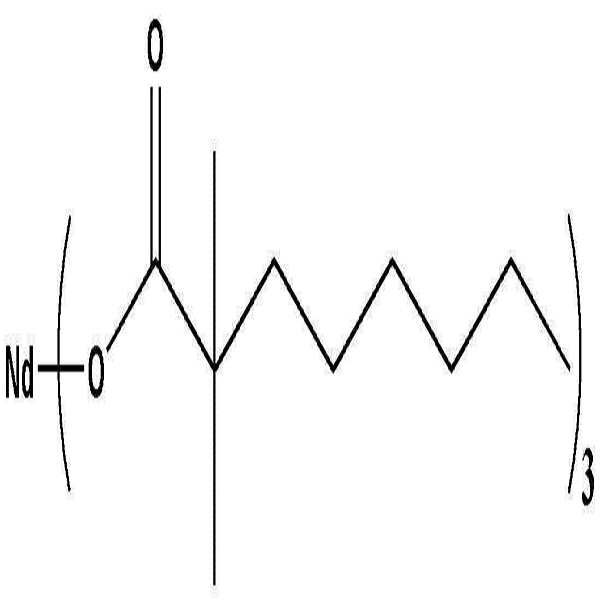
FT-IR: υ2956, 2926, 2872, 1512, 1462, 1411, 1375, 1181, 641 cm-1 FT-IR: ν 2,956, 2926, 2872, 1512, 1462, 1411, 1375, 1181, 641 cm -1
공액 디엔계 중합체의 제조Preparation of conjugated diene polymer
실시예 1 Example 1
단계 (1): 분자량 조절제 및 공액 디엔계 단량체의 혼합물을 준비하는 단계 Step (1): preparing a mixture of a molecular weight modifier and a conjugated diene monomer
완전히 건조시킨 유기 반응기에 진공과 질소를 교대로 가한 뒤, 진공 상태의 유리 반응기에 12 wt%의 1,3-부탄디엔(0.3328 mol)/헥산 혼합 용액을 첨가하고, 약 50℃의 온도 범위에서 약 10분 반응시켜 반응 혼합물을 제조하였다.After vacuum and nitrogen were added alternately to the fully dried organic reactor, 12
단계 (2): 중합 반응하는 단계Step (2): Step of polymerization
하기 표 1에 기재된 사용량으로 상기 제조예 1의 네오디뮴 화합물과 트리이소부틸알루미늄(TIBA), 및 헥산 7.6 mmol을 약 40℃의 온도 범위에서 약 24 시간 동안 예비혼합하고, 이 예비혼합물을 상온에서 약 1시간 동안 방치하였다. 그 후, t-아밀클로라이드를 첨가하여 약 40℃의 온도 범위에서 약 30분 동안 반응하였고, 동일 온도에서 30 분간 에이징하였다.The neodymium compound of Preparation Example 1 and triisobutylaluminum (TIBA) and 7.6 mmol of hexane were premixed at a temperature of about 40 DEG C for about 24 hours at the amounts shown in Table 1 below, And allowed to stand for 1 hour. After that, t-amyl chloride was added and reacted in a temperature range of about 40 캜 for about 30 minutes and aging at the same temperature for 30 minutes.
상기 단계 (2)에서 제조된 반응 혼합물에 상기 촉매를 주입하고, 70에서 약 10분 동안 중합 반응을 실시하여 공액 디엔계 중합체를 얻었다.The catalyst was poured into the reaction mixture prepared in the step (2), and polymerization reaction was carried out at 70 for about 10 minutes to obtain a conjugated diene polymer.
반응 완료 후 반응 용액의 일부를 취해 전환율을 측정하고, 이를 기반으로 촉매 활성을 계산하여, 그 결과를 하기 표 1 및 표 2에 나타내었다.After completion of the reaction, a portion of the reaction solution was taken to measure the conversion rate, and the catalyst activity was calculated based on the conversion. The results are shown in Tables 1 and 2 below.
실시예 2 Example 2
상기 단계 (2)에서, 예비혼합 후, 약 5시간 동안 방치한 것을 제외하고는, 실시예 1과 동일한 방법으로 공액 디엔계 중합체를 얻었다.The conjugated diene polymer was obtained in the same manner as in Example 1, except that the mixture was allowed to stand for about 5 hours after the premixing in the above step (2).
실시예 3 Example 3
상기 단계 (2)에서, 예비혼합 후, 약 24시간 동안 방치한 것을 제외하고는, 실시예 1과 동일한 방법으로 공액 디엔계 중합체를 얻었다.The conjugated diene polymer was obtained in the same manner as in Example 1, except that the mixture was allowed to stand for about 24 hours after the premixing in the step (2).
실시예 4Example 4
상기 단계 (2)에서, 예비혼합 후, 약 48시간 동안 방치한 것을 제외하고는, 실시예 1과 동일한 방법으로 공액 디엔계 중합체를 얻었다.The conjugated diene polymer was obtained in the same manner as in Example 1, except that the mixture was allowed to stand for about 48 hours after the premixing in the above step (2).
실시예 5 Example 5
상기 단계 (2)에서, 예비혼합 후, 약 72시간 동안 방치한 것을 제외하고는, 실시예 1과 동일한 방법으로 공액 디엔계 중합체를 얻었다.A conjugated diene polymer was obtained in the same manner as in Example 1, except that the mixture was allowed to stand for about 72 hours after the premixing in the above step (2).
실시예 6 Example 6
상기 단계 (2)에서, 에이징을 1분 동안 수행한 것을 제외하고는, 실시예 1과 동일한 방법으로 공액 디엔계 중합체를 얻었다.The conjugated diene polymer was obtained in the same manner as in Example 1 except that the aging was carried out for one minute in the above step (2).
실시예 7 Example 7
상기 단계 (2)에서, 에이징을 5분 동안 수행한 것을 제외하고는, 실시예 1과 동일한 방법으로 공액 디엔계 중합체를 얻었다.The conjugated diene polymer was obtained in the same manner as in Example 1 except that the aging was carried out for 5 minutes in the above step (2).
실시예 8 Example 8
상기 단계 (2)에서, 에이징을 60분 동안 수행한 것을 제외하고는, 실시예 1과 동일한 방법으로 공액 디엔계 중합체를 얻었다.The conjugated diene polymer was obtained in the same manner as in Example 1 except that the aging was carried out for 60 minutes in the above step (2).
실시예 9Example 9
상기 단계 (2)에서, 예비혼합 후 약 8시간 동안 방치한 것을 제외하고는, 실시예 1과 동일한 방법으로 공액 디엔계 중합체를 얻었다.A conjugated diene polymer was obtained in the same manner as in Example 1, except that the mixture was allowed to stand for about 8 hours in the step (2) after premixing.
실시예 10Example 10
상기 단계 (2)에서, 예비혼합 후 약 8시간 동안 방치하고, t-아밀클로라이드 대신 t-부틸클로라이드를 사용한 것을 제외하고는, 실시예 1과 동일한 방법으로 공액 디엔계 중합체를 얻었다.In the step (2), the conjugated diene polymer was obtained in the same manner as in Example 1, except that t-butyl chloride was used instead of t-amyl chloride after being premixed for about 8 hours.
실시예 11 Example 11
상기 단계 (2)에서, 예비혼합 후 약 8시간 동안 방치하고, t-아밀클로라이드 대신 염화디에틸알루미늄(DEAC)을 사용한 것을 제외하고는, 실시예 1과 동일한 방법으로 공액 디엔계 중합체를 얻었다.The conjugated diene polymer was obtained in the same manner as in Example 1, except that diethylaluminum chloride (DEAC) was used instead of t-amyl chloride in the step (2), and the mixture was allowed to stand for about 8 hours after premixing.
실시예 12 Example 12
상기 단계 (2)에서, t-아밀클로라이드 대신 DEAC을 사용하고, 에이징을 수행하지 않은 것을 제외하고는, 실시예 1과 동일한 방법으로 공액 디엔계 중합체를 얻었다.In the above step (2), a conjugated diene polymer was obtained in the same manner as in Example 1 except that DEAC was used instead of t-amyl chloride and aging was not performed.
실시예 13 Example 13
상기 단계 (2)에서, t-아밀클로라이드 대신 DEAC을 사용하고, t-아밀 클로라이드를 예비혼합 직후에 첨가하고, 에이징을 수행하지 않은 것을 제외하고는, 실시예 1과 동일한 방법으로 공액 디엔계 중합체를 얻었다.In the same manner as in Example 1 except that DEAC was used instead of t-amyl chloride, t-amyl chloride was added immediately after the premixing, and the aging was not performed in the step (2), the conjugated diene polymer .
비교예 1Comparative Example 1
완전히 건조시킨 유기 반응기에 진공과 질소를 교대로 가한 뒤, 진공 상태의 유리 반응기에 12 wt%의 1,3-부탄디엔(0.3328 mol)/헥산 혼합 용액을 150 g 첨가하였다. 이 유리 반응기에 하기 표 1에 기재된 양으로 상기 제조예 1의 네오디뮴 화합물, 1,3-부탄디엔, DIBAH 및 DEAC가 혼합된 용액을 첨가하고 70에서 30분 동안 중합 반응을 실시하여, 공액 디엔계 중합체를 얻었다.Vacuum and nitrogen were alternately added to the completely dried organic reactor, and 150 g of a 12
비교예 2 Comparative Example 2
하기 표 1에 기재된 사용량으로 상기 제조예 1의 네오디뮴 화합물, 1,3-부탄디엔, DIBAH 및 헥산 7.6 mmol을 약 70℃의 온도 범위에서 약 24 시간 동안 예비중합하고, 이 예비중합된 생성물을 약 1시간 동안 방치하였다. 그 후, DEAC를 첨가하여 약 40℃의 온도 범위에서 약 30분 동안 반응시켜 얻은 촉매를 사용한 것을 제외하고는, 실시예 1과 동일한 방법으로 공액 디엔계 중합체를 얻었다.The neodymium compound of Preparation Example 1, 1,3-butane diene, DIBAH and hexane 7.6 mmol was preliminarily polymerized at a temperature of about 70 캜 for about 24 hours at the amount shown in Table 1 below, And allowed to stand for 1 hour. Thereafter, the conjugated diene polymer was obtained in the same manner as in Example 1, except that DEAC was added and the catalyst obtained was reacted in a temperature range of about 40 캜 for about 30 minutes.
비교예 3 Comparative Example 3
하기 표 1에 기재된 사용량으로 상기 제조예 1의 네오디뮴 화합물, 1,3-부탄디엔, DIBAH 및 헥산을 약 70℃의 온도 범위에서 약 24 시간 동안 예비중합하고, 예비중합 직후 DEAC를 첨가하여 약 1시간 동안 방치한 촉매를 사용한 것을 제외하고는, 실시예 1과 동일한 방법으로 공액 디엔계 중합체를 얻었다.The neodymium compound, 1,3-butane diene, DIBAH and hexane of Preparation Example 1 were preliminarily polymerized at a temperature in the range of about 70 DEG C for about 24 hours at the amount shown in Table 1 below, and DEAC was added immediately after the prepolymerization to give about 1 Of the catalyst was used in place of the catalyst used in Example 1 to obtain a conjugated diene polymer.
실험예 1: 분자량 측정 및 PDI 측정Experimental Example 1: Molecular weight measurement and PDI measurement
중량평균분자량 및 수 평균 분자량- 중합체(Polymer)의 분자량 및 분자량 분포를 알기 위해 40℃ 조건하에서 THF에 30분간 녹인 후 겔 투과 크로마토 그래피(GPC: gel permeation chromatography)에 적재하여 흘려주었다. Weight-Average Molecular Weight and Number-Average Molecular Weight-In order to know the molecular weight and molecular weight distribution of the polymer, the polymer was dissolved in THF at 40 ° C for 30 minutes and then loaded on gel permeation chromatography (GPC).
칼럼은 폴리머 라보레토리즈사(Polymer Laboratories)의 상품명 PLgel Olexis) 칼럼 두 자루와 PLgel mixed-C 칼럼 한 자루를 조합하였다. 새로 교체한 칼럼은 모두 혼합상(mixed bed) 타입의 칼럼을 사용하였다. 분자량 계산 시 겔투과크로마토그래피 표준 물질(GPC Standard material)로서 폴리스티렌(Polystyrene)을 사용하였으며, 분석 결과 수 평균 분자량 (Mn), 중량 평균 분자량 (Mw) 및 다분산도(PDI; Polydispersity)를 확인하였다.The column was a PLgel Olexis (Polymer Laboratories) column and two PLgel mixed-C columns were combined. All of the new columns were of mixed bed type. Polystyrene was used as a gel permeation chromatography (GPC) standard material in the calculation of the molecular weight, and number average molecular weight (Mn), weight average molecular weight (Mw) and polydispersity (PDI) .
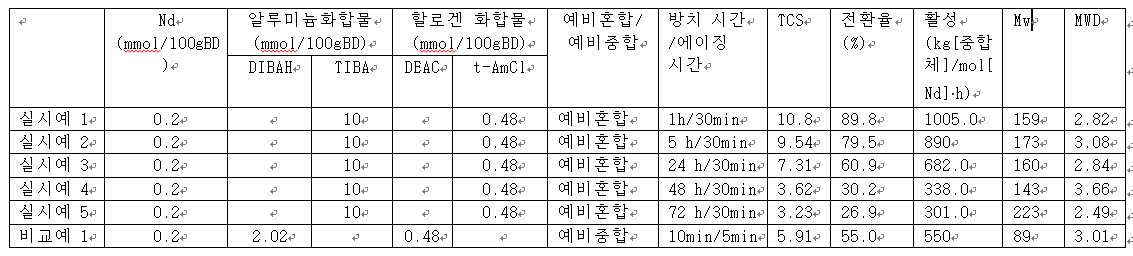
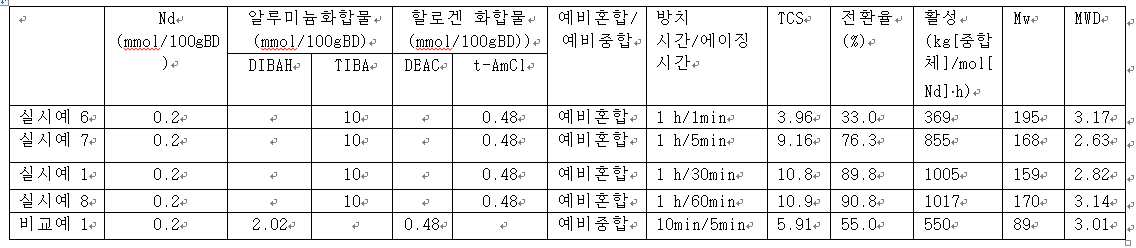
상기 표 1 및 도 1은 실시예 1 내지 5 및, 비교예 1의 방치 시간 변화에 따른 중합체의 전환율, 활성, 분자량 및 분자량 분포를 비교한 것이다.Table 1 and FIG. 1 compares the conversion rate, activity, molecular weight and molecular weight distribution of the polymer with respect to the change of the standing time in Examples 1 to 5 and Comparative Example 1.
상기 방치 시간은 1시간, 5시간, 24시간, 48시간, 72시간 및 0시간(비교예 1)로 하여 실험하였다.The incubation time was 1 hour, 5 hours, 24 hours, 48 hours, 72 hours and 0 hours (Comparative Example 1).
우선, 표 1 및 도 1에서 알 수 있는 바와 같이, 방치 시간이 길어짐에 따라 중합체의 전환율 및 활성이 점차 감소함을 알 수 있다. 구체적으로 살펴보면, 실시예 1 내지 실시예 3과 같이 알킬화 반응 후 방치를 1시간 내지 24시간 동안 수행한 경우 활성이 682kg/mol.hr 이상이었고, 실시예 1과 같이 1시간을 한 경우 1005.0 kg/mol.hr로 비교예 1에 비해 약 2배 정도 향상됨을 확인하였다.First, as can be seen from Table 1 and FIG. 1, it can be seen that the conversion and activity of the polymer gradually decrease with an increase in the standing time. Specifically, the activity was 682 kg / mol.hr or more when the sample was allowed to stand for 1 hour to 24 hours after the alkylation reaction as in Examples 1 to 3. The activity was 1005.0 kg / mol. hr, which is about twice as high as that of Comparative Example 1.
상기 표 2는 할로겐 화합물을 첨가하여 반응 후, 에이징 시간 변화에 따른 중합체의 전환율, 활성, 분자량 및 분자량 분포를 비교한 것이다.Table 2 compares the conversion, activity, molecular weight, and molecular weight distribution of the polymer after the reaction with the addition of the halogen compound, with the aging time.
상기 에이징 시간은 1분, 5분, 30분, 60분 및 0시간(비교예 1)로 하여 실험하였다.The aging time was 1 minute, 5 minutes, 30 minutes, 60 minutes, and 0 hours (Comparative Example 1).
우선, 표 2에서 알 수 있는 바와 같이, 에이징 시간이 길어짐에 따라 중합체의 전환율 및 활성이 점차 증가함을 알 수 있다. 구체적으로 살펴보면, 실시예 1, 7 및 8과 같이 할로겐 화합물을 첨가하여 반응시킨 후, 에이징을 5분, 30분 및 60분을 수행한 경우, 에이징을 수행하지 않은 비교예 1에 비해 활성이 1.5배 내지 2배 이상 증가하였다. 또한, 에이징 시간이 30분 이상인 경우 90% 이상의 중합체 전환율을 보임을 확인하였다.First, as can be seen from Table 2, the conversion and activity of the polymer gradually increase as the aging time becomes longer. Specifically, when aging was performed for 5 minutes, 30 minutes, and 60 minutes after adding a halogen compound as in Examples 1, 7, and 8, the activity was 1.5 Fold or more. Further, it was confirmed that the polymer conversion was 90% or more when the aging time was 30 minutes or more.
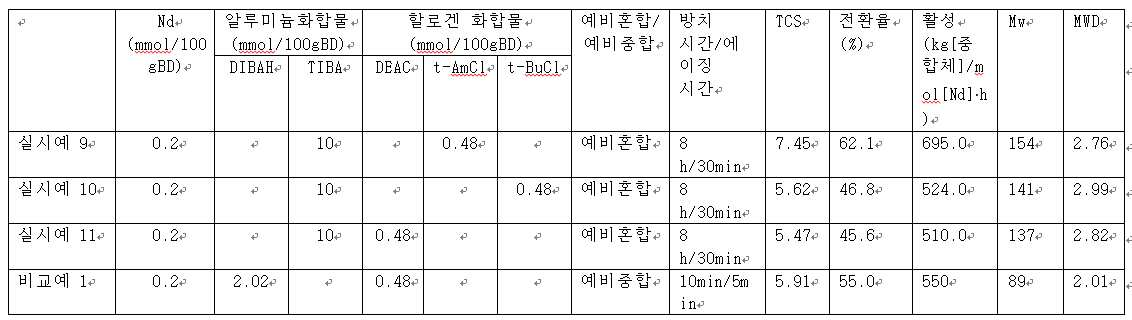
상기 표 3은 할로겐 화합물의 종류에 따른 중합체의 전환율, 활성, 분자량 및 분자량 분포를 비교한 것이다.Table 3 above compares the conversion rate, activity, molecular weight and molecular weight distribution of the polymer according to the kind of the halogen compound.
상기 할로겐 화합물은 각각 t-아밀클로라이드(t-AmCl), t-부틸클로라이드(t-BuCl) 및 염화디에틸알루미늄(DEAC)을 각각 사용하였다. The halogen compounds used were t-amyl chloride (t-AmCl), t-butyl chloride (t-BuCl) and diethyl aluminum chloride (DEAC), respectively.
우선, 표 3에서 알 수 있는 바와 같이, 할로겐 화합물로서 t-아밀클로라이드를 사용하는 경우, 중합체의 전환율 및 활성이 점차 증가함을 알 수 있다. 구체적으로 살펴보면, 실시예 9와 같이 할로겐 화합물로서 t-아밀클로라이드를 사용하는 경우 t-부틸클로라이드를 사용한 실시예 10 및 염화디에틸알루미늄을 사용한 실시예 11에 비해 중합체의 전환율이 약 50%정도 향상되었고, 촉매의 활성도 약 20% 이상 향상되었다. First, as can be seen from Table 3, when t-amyl chloride is used as the halogen compound, the conversion and activity of the polymer gradually increase. Specifically, when t-amyl chloride is used as the halogen compound as in Example 9, the conversion of the polymer is improved by about 50% as compared with Example 10 using t-butyl chloride and Example 11 using diethylaluminum chloride And the activity of the catalyst was improved by about 20% or more.
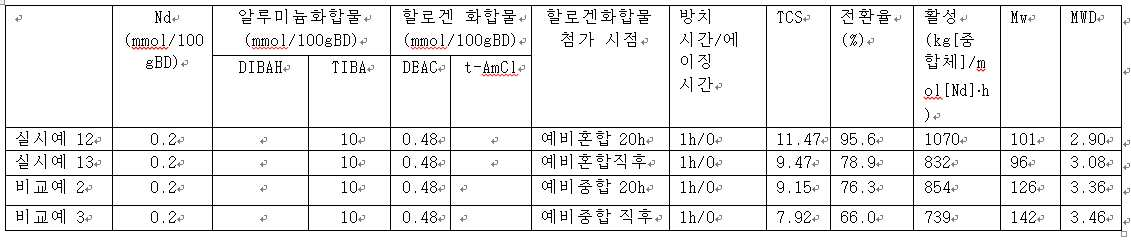
상기 표 4는 촉매 제조시 예비중합과 예비혼합 및 할로겐 화합물의 첨가 시점에 따른 중합체의 전환율, 활성, 분자량 및 분자량 분포를 비교한 것이다.Table 4 above compares conversion rate, activity, molecular weight and molecular weight distribution of the polymer according to the time of preliminary polymerization and preliminary mixing and halogen compound addition at the time of catalyst preparation.
우선, 표 4에서 알 수 있는 바와 같이, 실시예 12 및 실시예 13과 같이 촉매의 제조시 부타디엔을 첨가하지 않고 예비혼합을 하는 경우, 비교예 2 및 3과 같이 부타디엔과 함께 예비중합을 한 경우에 비해 중합체의 전환율 및 활성이 약 40% 이상 향상되었음을 알 수 있다.First, as shown in Table 4, in the case of preliminarily mixing butadiene in the preparation of the catalyst as in Example 12 and Example 13, in the case of preliminary polymerization with butadiene as in Comparative Examples 2 and 3 The conversion and activity of the polymer were improved by about 40% or more.
또한, 예비혼합을 20시간 동안 수행한 후 할로겐 화합물을 첨가한 실시예 12의 경우 중합체의 전환율이 약 95% 이상으로서, 할로겐 화합물을 예비혼합 직후 첨가한 실시예 13에 비해 약 20% 이상 증가하였으며, 활성이 1070 kg/mol.hr으로 현저히 향상됨을 확인하였다. In addition, in Example 12 in which the halogen compound was added after the preliminary mixing for 20 hours, the conversion of the polymer was about 95% or more, and the halogen compound was increased by about 20% or more as compared with Example 13 added immediately after preliminary mixing , And the activity was remarkably improved to 1070 kg / mol.hr.
이에 반해, 예비중합을 실시한 후 할로겐 화합을 첨가한 비교예 2와 3의 경우 중합체의 전환율이 약 60% 내지 80% 이내임을 알 수 있다.In contrast, in Comparative Examples 2 and 3 in which halogenation was added after the prepolymerization, the conversion of the polymer was found to be within about 60% to 80%.
Claims (24)
Pre-mixing a neodymium compound, a trialkylaluminum compound and a solvent, and allowing the preliminary mixture to stand for 1 to 24 hours.
상기 방치는 10℃ 내지 60℃의 온도 범위에서 수행되는 것을 특징으로 하는 촉매의 제조방법.
The method according to claim 1,
Wherein said leaving is carried out in a temperature range of 10 ° C to 60 ° C.
상기 예비혼합은 10℃ 내지 60℃의 온도 범위에서 수행되는 것을 특징으로 하는 촉매의 제조방법.
The method according to claim 1,
Wherein the premixing is carried out at a temperature in the range of 10 < 0 > C to 60 < 0 > C.
상기 방치 단계 이후 할로겐 화합물을 투입하여 반응시키는 단계를 더 포함하는 것을 특징으로 하는 촉매의 제조방법.
The method according to claim 1,
Further comprising the step of introducing a halogen compound after the step of allowing the catalyst to react.
상기 반응은 0℃ 내지 60℃의 온도 범위에서 수행되는 것을 특징으로 하는 촉매의 제조방법.
The method of claim 4,
Wherein the reaction is carried out at a temperature ranging from 0 ° C to 60 ° C.
상기 반응 후, 에이징(aging)하는 단계를 더 포함하는 것을 특징으로 하는 촉매의 제조방법.
The method of claim 4,
Further comprising the step of aging the catalyst after the reaction.
상기 예비혼합 및 방치 단계 사이에 할로겐 화합물을 투입하는 단계를 더 포함하는 것을 특징으로 하는 촉매의 제조방법.
The method according to claim 1,
Further comprising introducing a halogen compound between the preliminary mixing and the leaving step.
상기 방치 단계후, 에이징(aging)하는 단계를 더 포함하는 것을 특징으로 하는 촉매의 제조방법.
The method according to claim 1,
Further comprising the step of aging after the step of neglecting.
상기 에이징은 0℃ 내지 60℃의 온도 범위에서 1분 내지 240분 동안 수행되는 것을 특징으로 하는 촉매의 제조방법.
The method of claim 6 or claim 8,
Wherein the aging is carried out at a temperature ranging from 0 ° C to 60 ° C for 1 minute to 240 minutes.
상기 트리알킬알루미늄 화합물은 트리이소부틸알루미늄, 트리에틸알루미늄, 트리헥실알루미늄 및 트리옥틸알루미늄으로 이루어진 군으로부터 선택된 어느 하나 또는 이들 중 2종 이상의 혼합물인 것을 특징으로 하는 촉매의 제조방법.
The method according to claim 1,
Wherein the trialkylaluminum compound is any one selected from the group consisting of triisobutylaluminum, triethylaluminum, trihexylaluminum and trioctylaluminum, or a mixture of two or more thereof.
상기 할로겐 화합물은 원소 할로겐, 혼합 할로겐, 할로겐화수소, 유기 할라이드, 무기 할라이드, 금속 할라이드 및 유기금속 할라이드로 이루어진 군으로부터 선택된 어느 하나 또는 이들 중 2종 이상의 혼합물인 것을 특징으로 하는 촉매의 제조방법.
The method of claim 4,
Wherein the halogen compound is any one selected from the group consisting of an elemental halogen, a mixed halogen, a hydrogen halide, an organic halide, an inorganic halide, a metal halide and an organic metal halide or a mixture of two or more thereof.
상기 할로겐 화합물은 t-아밀클로라이드, t-부틸클로라이드, 실리콘 테트라클로라이드 및 틴 테트라클로라이드로 이루어진 군으로부터 선택된 어느 하나 또는 이들 중 2종 이상의 혼합물인 것을 특징으로 하는 촉매의 제조방법.
The method of claim 11,
Wherein the halogen compound is any one selected from the group consisting of t-amyl chloride, t-butyl chloride, silicon tetrachloride, and tin tetrachloride, or a mixture of two or more thereof.
상기 네오디뮴 화합물 : 트리알킬알루미늄의 혼합비는 몰비로서 1.0 : 5.0 내지 200의 양인 것을 특징으로 하는 촉매의 제조방법.
The method according to claim 1,
Wherein the mixing ratio of the neodymium compound: trialkyl aluminum is in a molar ratio of 1.0: 5.0 to 200.
상기 네오디뮴 화합물은 하기 화학식 1의 화합물을 포함하는 것을 특징으로 하는 촉매의 제조방법:
[화학식 1]
상기 식에서,
R1 내지 R3은 서로 독립적으로 수소, 또는 탄소수 1 내지 12의 선형 또는 분지형 알킬기이다.
The method according to claim 1,
Wherein the neodymium compound comprises a compound represented by the following formula (1): < EMI ID =
[Chemical Formula 1]
In this formula,
R 1 to R 3 independently of one another are hydrogen or a linear or branched alkyl group having 1 to 12 carbon atoms.
상기 네오디뮴 화합물은 Nd(2-에틸헥사노에이트)3, Nd(네오데카노에이트)3, Nd(2,2-디에틸 데카노에이트)3, Nd(2,2-디프로필 데카노에이트)3, Nd(2,2-디부틸 데카노에이트)3, Nd(2,2-디헥실 데카노에이트)3, Nd(2,2-디옥틸 데카노에이트)3, Nd(2-에틸-2-프로필 데카노에이트)3, Nd(2-에틸-2-부틸 데카노에이트)3, Nd(2-에틸-2-헥실 데카노에이트)3, Nd(2-프로필-2-부틸 데카노에이트)3, Nd(2-프로필-2-헥실 데카노에이트)3, Nd(2-프로필-2-이소프로필 데카노에이트)3, Nd(2-부틸-2-헥실 데카노에이트)3, Nd(2-헥실-2-옥틸 데카노에이트)3, Nd(2-t-부틸 데카노에이트)3, Nd(2,2-디에틸 옥타노에이트)3, Nd(2,2-디프로필 옥타노에이트)3, Nd(2,2-디부틸 옥타노에이트)3, Nd(2,2-디헥실 옥타노에이트)3, Nd(2-에틸-2-프로필 옥타노에이트)3, Nd(2-에틸-2-헥실 옥타노에이트)3, Nd(2,2-디에틸 노나노에티트)3, Nd(2,2-디프로필 노나노에이트)3, Nd(2,2-디부틸 노나노에이트)3, Nd(2,2-디헥실 노나노에이트)3, Nd(2-에틸-2-프로필 노나노에이트)3 및 Nd(2-에틸-2-헥실 노나노에이트)3로 이루어진 군으로부터 선택된 어느 하나 또는 이들 중 2종 이상의 혼합물인 것을 특징으로 하는 촉매의 제조방법.
15. The method of claim 14,
The neodymium compound is Nd (2- ethylhexanoate) 3, Nd (neodecanoate) 3, Nd (2,2- diethyl decanoate) 3, Nd (2,2- dipropyl decanoate) 3, Nd (2,2- di-butyl decanoate) 3, Nd (2,2- di-hexyl decanoate) 3, Nd (2,2- dioctyl decanoate) 3, Nd (2- ethyl- 2-propyl decanoate) 3, Nd (2-ethyl-2-butyl decanoate) 3, Nd (2-ethyl-2-hexyl decanoate) 3, Nd (2-propyl-2-butyl to Kano Eight) 3, Nd (2- propyl-2-hexyl decanoate) 3, Nd (2- propyl-2-isopropyl decanoate) 3, Nd (2- butyl-2-hexyl decanoate) 3, Nd (2- cyclohexyl-2-octyl decanoate) 3, Nd (2-t- butyl decanoate) 3, Nd (2,2- diethyl octanoate) 3, Nd (2,2- dipropyl octanoate) 3, Nd (2,2- dibutyltin octanoate) 3, Nd (2,2- dihexyl octanoate) 3, Nd (2- ethyl-2-propyl-octanoate) 3, Nd (2-ethyl-2-hexyl octanoate) 3, Nd (2,2- di Till the furnace nano titeu) 3, Nd (2,2- dipropyl no nano-benzoate) 3, Nd (2,2- dibutyl no nano-benzoate) 3, Nd (2,2- dihexyl no nano-benzoate) 3, Nd (2-ethyl-2-propynonanoate) 3 and Nd (2-ethyl-2-hexylnonanoate) 3 or a mixture of two or more thereof. Gt;
상기 촉매는 디이소부틸알루미늄 하이드라이드(DIBAH)를 포함하지 않는 것을 특징으로 하는 촉매의 제조방법.
The method according to claim 1,
Wherein the catalyst does not comprise diisobutyl aluminum hydride (DIBAH).
상기 용매는 지방족탄화수소계 용매, 시클로지방족탄화수소계 용매 및 방향족 탄화수소계 용매로 이루어진 군으로부터 선택된 어느 하나 또는 이들 중 2종 이상의 혼합물인 것을 특징으로 하는 촉매의 제조방법.
The method according to claim 1,
Wherein the solvent is any one selected from the group consisting of an aliphatic hydrocarbon solvent, a cycloaliphatic hydrocarbon solvent, and an aromatic hydrocarbon solvent, or a mixture of two or more thereof.
A catalyst produced by the process of claim 1.
상기 혼합물을 청구항 18의 촉매와 혼합한 후, 중합 반응하는 단계를 포함하는 것을 특징으로 하는 공액 디엔계 중합체의 제조방법.
Preparing a mixture of a molecular weight modifier and a conjugated diene monomer, and
And mixing the mixture with the catalyst of claim 18, followed by a polymerization reaction.
상기 공액 디엔계 단량체 100g에 대해 촉매는 0.5g 내지 5g의 양으로 사용되는 것을 특징으로 하는 공액 디엔계 중합체의 제조방법.
The method of claim 19,
Wherein the catalyst is used in an amount of 0.5 g to 5 g per 100 g of the conjugated diene monomer.
상기 분자량 조절제는 상기 네오디뮴 화합물 대비 1 내지 50 당량의 양으로 사용되는 것을 특징으로 하는 공액 디엔계 중합체의 제조방법.
The method of claim 19,
Wherein the molecular weight modifier is used in an amount of 1 to 50 equivalents relative to the neodymium compound.
상기 중합 반응은 30℃ 내지 80℃의 온도 범위에서 수행되는 것을 특징으로 하는 공액 디엔계 중합체의 제조방법.
The method of claim 19,
Wherein the polymerization reaction is carried out at a temperature in the range of 30 to 80 占 폚.
상기 공액 디엔계 단량체 100 g 에 대해 네오디뮴 화합물 0.01 내지 0.25 mmol, 트리알킬알루미늄 0.05 내지 50.0 mmol 및 용매는 10 내지 200 mmol의 양으로 사용하는 것을 특징으로 하는 공액 디엔계 중합체의 제조방법.
The method of claim 19,
Wherein 0.01 to 0.25 mmol of neodymium compound, 0.05 to 50.0 mmol of trialkylaluminum, and solvent are used in an amount of 10 to 200 mmol based on 100 g of the conjugated diene-based monomer.
Priority Applications (1)
| Application Number | Priority Date | Filing Date | Title |
|---|---|---|---|
| KR1020150187408A KR102047975B1 (en) | 2015-12-28 | 2015-12-28 | Method of preparing catalyst for the polymerization of conjugated diene and method of preparing conjugated diene polymer using the same |
Applications Claiming Priority (1)
| Application Number | Priority Date | Filing Date | Title |
|---|---|---|---|
| KR1020150187408A KR102047975B1 (en) | 2015-12-28 | 2015-12-28 | Method of preparing catalyst for the polymerization of conjugated diene and method of preparing conjugated diene polymer using the same |
Publications (2)
| Publication Number | Publication Date |
|---|---|
| KR20170077485A true KR20170077485A (en) | 2017-07-06 |
| KR102047975B1 KR102047975B1 (en) | 2019-11-25 |
Family
ID=59354208
Family Applications (1)
| Application Number | Title | Priority Date | Filing Date |
|---|---|---|---|
| KR1020150187408A Active KR102047975B1 (en) | 2015-12-28 | 2015-12-28 | Method of preparing catalyst for the polymerization of conjugated diene and method of preparing conjugated diene polymer using the same |
Country Status (1)
| Country | Link |
|---|---|
| KR (1) | KR102047975B1 (en) |
Cited By (2)
| Publication number | Priority date | Publication date | Assignee | Title |
|---|---|---|---|---|
| KR20210124629A (en) | 2020-04-07 | 2021-10-15 | 주식회사 엘지화학 | Catalyst composition, cleaning solution composition comprising the catalyst composition and method for cleaning polymerization device using by the cleaning solution composition |
| US12617879B2 (en) | 2020-09-25 | 2026-05-05 | Lg Chem, Ltd. | Neodymium-catalyzed conjugated diene-based polymer and rubber composition comprising same |
Citations (4)
| Publication number | Priority date | Publication date | Assignee | Title |
|---|---|---|---|---|
| EP1055659A1 (en) | 1999-05-27 | 2000-11-29 | Petroflex Industria e Comercio S/A | Process for the preparation of neodymium neodecanoate and use thereof as catalytic component for the solution polymerisation of butadiene |
| KR20080063191A (en) * | 2006-12-28 | 2008-07-03 | 가부시키가이샤 브리지스톤 | Process for producing functionalized cis-1,4-polydiene with high cis-1,4-bond content and high functionality |
| KR20150037307A (en) * | 2013-09-30 | 2015-04-08 | 주식회사 엘지화학 | Novel neodymium compound and catalysts for polymerizing diene comprising the same |
| JP2015127432A (en) * | 2015-04-09 | 2015-07-09 | 株式会社ブリヂストン | Polybutadiene and method for producing the same, and rubber composition and tire |
-
2015
- 2015-12-28 KR KR1020150187408A patent/KR102047975B1/en active Active
Patent Citations (5)
| Publication number | Priority date | Publication date | Assignee | Title |
|---|---|---|---|---|
| EP1055659A1 (en) | 1999-05-27 | 2000-11-29 | Petroflex Industria e Comercio S/A | Process for the preparation of neodymium neodecanoate and use thereof as catalytic component for the solution polymerisation of butadiene |
| US6482906B1 (en) * | 1999-05-27 | 2002-11-19 | Petroflex Industria E Comércio | Process for preparing and using neodymium neodecanoate |
| KR20080063191A (en) * | 2006-12-28 | 2008-07-03 | 가부시키가이샤 브리지스톤 | Process for producing functionalized cis-1,4-polydiene with high cis-1,4-bond content and high functionality |
| KR20150037307A (en) * | 2013-09-30 | 2015-04-08 | 주식회사 엘지화학 | Novel neodymium compound and catalysts for polymerizing diene comprising the same |
| JP2015127432A (en) * | 2015-04-09 | 2015-07-09 | 株式会社ブリヂストン | Polybutadiene and method for producing the same, and rubber composition and tire |
Cited By (3)
| Publication number | Priority date | Publication date | Assignee | Title |
|---|---|---|---|---|
| KR20210124629A (en) | 2020-04-07 | 2021-10-15 | 주식회사 엘지화학 | Catalyst composition, cleaning solution composition comprising the catalyst composition and method for cleaning polymerization device using by the cleaning solution composition |
| US11912811B2 (en) | 2020-04-07 | 2024-02-27 | Lg Chem, Ltd. | Catalyst composition, cleaning liquid composition containing the same, and method of cleaning polymerization apparatus using the cleaning liquid composition |
| US12617879B2 (en) | 2020-09-25 | 2026-05-05 | Lg Chem, Ltd. | Neodymium-catalyzed conjugated diene-based polymer and rubber composition comprising same |
Also Published As
| Publication number | Publication date |
|---|---|
| KR102047975B1 (en) | 2019-11-25 |
Similar Documents
| Publication | Publication Date | Title |
|---|---|---|
| KR101786364B1 (en) | A method for producing functionalized cis-1,4-polydienes having high cis-1,4-linkage content and high functionality | |
| JP6467068B2 (en) | Catalyst composition for producing conjugated diene polymer and conjugated diene polymer produced using the same | |
| KR101781699B1 (en) | Catalytic composition for the polymerization of conjugated diene | |
| KR101796360B1 (en) | Method of preparing conjugated diene polymer | |
| CN112955332B (en) | Aminosilyl-functionalized conjugated dienes, their preparation and application in rubber manufacture | |
| EP3222639B1 (en) | Conjugated diene-based polymer | |
| KR102047975B1 (en) | Method of preparing catalyst for the polymerization of conjugated diene and method of preparing conjugated diene polymer using the same | |
| KR20200073166A (en) | Catalyst composition, method for preparing the composition, method for preparing conjugated diene polymer by using the composition and conjugated diene polymer produced by the preparation method of the polymer | |
| CN114174354B (en) | Preparation method of modified conjugated diene polymer | |
| JP5513338B2 (en) | Butadiene polymer, process for producing the same, rubber composition and tire | |
| CN107001522A (en) | Polymerization catalyst composition and method using polymerization catalyst composition | |
| CN113348185B (en) | Modified conjugated diene polymer, production method thereof, and rubber composition containing the modified conjugated diene polymer | |
| KR102757739B1 (en) | Modified conjugated diene polymer, preparation method thereof and rubber composition comprising the same | |
| KR102733420B1 (en) | Modified conjugated diene polymer, preparation method thereof and rubber composition comprising the same | |
| KR102794259B1 (en) | Conjugated diene polymer composition, method for preparing the polymer composition and rubber composition comprising the polymer composition | |
| KR102824357B1 (en) | Modified conjugated diene polymer, preparation method thereof and rubber composition comprising the same | |
| JP2025506669A (en) | Method for producing catalyst composition and method for producing conjugated diene polymer | |
| JP2025506668A (en) | Method for producing catalyst composition and method for producing conjugated diene polymer | |
| KR20250063775A (en) | Conjugated-diene based polymer and rubber composition | |
| JP2025506670A (en) | Method for producing catalyst composition and method for producing conjugated diene polymer | |
| KR20250063774A (en) | Conjugated-diene based polymer and rubber composition | |
| JP2025506130A (en) | Method for producing catalyst composition and method for producing conjugated diene polymer |
Legal Events
| Date | Code | Title | Description |
|---|---|---|---|
| PA0109 | Patent application |
Patent event code: PA01091R01D Comment text: Patent Application Patent event date: 20151228 |
|
| PG1501 | Laying open of application | ||
| A201 | Request for examination | ||
| PA0201 | Request for examination |
Patent event code: PA02012R01D Patent event date: 20180418 Comment text: Request for Examination of Application Patent event code: PA02011R01I Patent event date: 20151228 Comment text: Patent Application |
|
| E902 | Notification of reason for refusal | ||
| PE0902 | Notice of grounds for rejection |
Comment text: Notification of reason for refusal Patent event date: 20190612 Patent event code: PE09021S01D |
|
| E701 | Decision to grant or registration of patent right | ||
| PE0701 | Decision of registration |
Patent event code: PE07011S01D Comment text: Decision to Grant Registration Patent event date: 20191111 |
|
| GRNT | Written decision to grant | ||
| PR0701 | Registration of establishment |
Comment text: Registration of Establishment Patent event date: 20191118 Patent event code: PR07011E01D |
|
| PR1002 | Payment of registration fee |
Payment date: 20191119 End annual number: 3 Start annual number: 1 |
|
| PG1601 | Publication of registration | ||
| FPAY | Annual fee payment |
Payment date: 20220926 Year of fee payment: 4 |
|
| PR1001 | Payment of annual fee |
Payment date: 20220926 Start annual number: 4 End annual number: 4 |