KR20170077774A - Polymer, organic light-emitting device material including the same, and organic light-emitting device including the same - Google Patents
Polymer, organic light-emitting device material including the same, and organic light-emitting device including the same Download PDFInfo
- Publication number
- KR20170077774A KR20170077774A KR1020160146910A KR20160146910A KR20170077774A KR 20170077774 A KR20170077774 A KR 20170077774A KR 1020160146910 A KR1020160146910 A KR 1020160146910A KR 20160146910 A KR20160146910 A KR 20160146910A KR 20170077774 A KR20170077774 A KR 20170077774A
- Authority
- KR
- South Korea
- Prior art keywords
- group
- substituted
- unsubstituted
- carbon atoms
- polymer
- Prior art date
- Legal status (The legal status is an assumption and is not a legal conclusion. Google has not performed a legal analysis and makes no representation as to the accuracy of the status listed.)
- Granted
Links
Images

Classifications
-
- C—CHEMISTRY; METALLURGY
- C08—ORGANIC MACROMOLECULAR COMPOUNDS; THEIR PREPARATION OR CHEMICAL WORKING-UP; COMPOSITIONS BASED THEREON
- C08F—MACROMOLECULAR COMPOUNDS OBTAINED BY REACTIONS ONLY INVOLVING CARBON-TO-CARBON UNSATURATED BONDS
- C08F12/00—Homopolymers and copolymers of compounds having one or more unsaturated aliphatic radicals, each having only one carbon-to-carbon double bond, and at least one being terminated by an aromatic carbocyclic ring
- C08F12/02—Monomers containing only one unsaturated aliphatic radical
- C08F12/04—Monomers containing only one unsaturated aliphatic radical containing one ring
- C08F12/14—Monomers containing only one unsaturated aliphatic radical containing one ring substituted by hetero atoms or groups containing heteroatoms
-
- C—CHEMISTRY; METALLURGY
- C08—ORGANIC MACROMOLECULAR COMPOUNDS; THEIR PREPARATION OR CHEMICAL WORKING-UP; COMPOSITIONS BASED THEREON
- C08F—MACROMOLECULAR COMPOUNDS OBTAINED BY REACTIONS ONLY INVOLVING CARBON-TO-CARBON UNSATURATED BONDS
- C08F12/00—Homopolymers and copolymers of compounds having one or more unsaturated aliphatic radicals, each having only one carbon-to-carbon double bond, and at least one being terminated by an aromatic carbocyclic ring
- C08F12/02—Monomers containing only one unsaturated aliphatic radical
- C08F12/04—Monomers containing only one unsaturated aliphatic radical containing one ring
- C08F12/14—Monomers containing only one unsaturated aliphatic radical containing one ring substituted by hetero atoms or groups containing heteroatoms
- C08F12/26—Nitrogen
-
- C—CHEMISTRY; METALLURGY
- C08—ORGANIC MACROMOLECULAR COMPOUNDS; THEIR PREPARATION OR CHEMICAL WORKING-UP; COMPOSITIONS BASED THEREON
- C08F—MACROMOLECULAR COMPOUNDS OBTAINED BY REACTIONS ONLY INVOLVING CARBON-TO-CARBON UNSATURATED BONDS
- C08F12/00—Homopolymers and copolymers of compounds having one or more unsaturated aliphatic radicals, each having only one carbon-to-carbon double bond, and at least one being terminated by an aromatic carbocyclic ring
- C08F12/02—Monomers containing only one unsaturated aliphatic radical
- C08F12/32—Monomers containing only one unsaturated aliphatic radical containing two or more rings
-
- H01L51/0043—
-
- H01L51/5016—
-
- H01L51/5056—
-
- H—ELECTRICITY
- H10—SEMICONDUCTOR DEVICES; ELECTRIC SOLID-STATE DEVICES NOT OTHERWISE PROVIDED FOR
- H10K—ORGANIC ELECTRIC SOLID-STATE DEVICES
- H10K50/00—Organic light-emitting devices
- H10K50/10—OLEDs or polymer light-emitting diodes [PLED]
- H10K50/11—OLEDs or polymer light-emitting diodes [PLED] characterised by the electroluminescent [EL] layers
-
- H—ELECTRICITY
- H10—SEMICONDUCTOR DEVICES; ELECTRIC SOLID-STATE DEVICES NOT OTHERWISE PROVIDED FOR
- H10K—ORGANIC ELECTRIC SOLID-STATE DEVICES
- H10K50/00—Organic light-emitting devices
- H10K50/10—OLEDs or polymer light-emitting diodes [PLED]
- H10K50/14—Carrier transporting layers
- H10K50/15—Hole transporting layers
-
- H—ELECTRICITY
- H10—SEMICONDUCTOR DEVICES; ELECTRIC SOLID-STATE DEVICES NOT OTHERWISE PROVIDED FOR
- H10K—ORGANIC ELECTRIC SOLID-STATE DEVICES
- H10K85/00—Organic materials used in the body or electrodes of devices covered by this subclass
- H10K85/10—Organic polymers or oligomers
- H10K85/151—Copolymers
Landscapes
- Chemical & Material Sciences (AREA)
- Organic Chemistry (AREA)
- Health & Medical Sciences (AREA)
- Chemical Kinetics & Catalysis (AREA)
- Medicinal Chemistry (AREA)
- Polymers & Plastics (AREA)
- Optics & Photonics (AREA)
- Physics & Mathematics (AREA)
- Engineering & Computer Science (AREA)
- Materials Engineering (AREA)
- Electroluminescent Light Sources (AREA)
- Nitrogen Condensed Heterocyclic Rings (AREA)
- Nitrogen And Oxygen Or Sulfur-Condensed Heterocyclic Ring Systems (AREA)
- Addition Polymer Or Copolymer, Post-Treatments, Or Chemical Modifications (AREA)
Abstract
중합체, 이를 포함하는 유기 발광 소자 재료, 및 이를 포함하는 유기 발광 소자가 기재된다.Polymers, organic light emitting device materials containing them, and organic light emitting devices comprising the same are described.
Description
중합체, 이를 포함하는 유기 발광 소자 재료 및 이를 포함하는 유기 발광 소자에 관한 것이다.Polymer, a material for an organic light emitting diode including the same, and an organic light emitting device including the same.
최근 자발광형 발광 소자인 유기 발광 소자 재료, 유기 발광 소자(organic light-emitting device)를 사용한 표시 장치 및 조명 기구의 개발이 활발히 이루어지고 있다.BACKGROUND ART [0002] Recently, organic light-emitting device materials, organic light-emitting devices, and display devices and lighting devices have been actively developed.
이러한 유기 발광 소자에 있어서, 더 낮은 비용으로 대면적의 소자를 제조하기 위하여, 진공 증착을 대신하여 용액 도포법을 이용하는 것이 검토되고 있다. 용액 도포법은, 진공 증착법과 비교하여 재료의 이용 효율이 높고, 쉽게 대면적을 성막할 수 있어, 고가의 진공 증착이 불필요하게 되므로, 보다 효율적인 유기 발광 소자의 제조 방법으로서 기대를 받고 있다.In such an organic luminescent device, in order to manufacture a device having a large area at a lower cost, it has been studied to use a solution coating method instead of the vacuum vapor deposition. The solution coating method has a higher utilization efficiency of a material than a vacuum evaporation method and can be easily formed into a large area, and expensive vacuum evaporation becomes unnecessary, and thus it has been expected as a more efficient method of manufacturing an organic light emitting device.
유기 발광 소자의 발광 효율 및 발광 수명을 향상시킬 수 있는 신규한 구조의 중합체를 포함하는 유기 발광 소자 재료, 및 그러한 유기 발광 소자 재료를 이용한 유기 발광 소자를 제공하고자 한다.An organic light emitting device material including a polymer having a novel structure capable of improving the light emitting efficiency and the light emission lifetime of the organic light emitting device, and an organic light emitting device using such an organic light emitting device material.
일 측면에 따르면, 하기 화학식 1로 표시되는 반복 단위를 포함하는 중합체가 제공된다:According to one aspect, there is provided a polymer comprising a repeating unit represented by the following formula (1): < EMI ID =
<화학식 1>≪ Formula 1 >

상기 화학식 1 중,In Formula 1,
R1, R2 및 R3은 서로 독립적으로, 수소, 중수소, 불소; 탄소수 1 내지 10의 알킬실릴기; 탄소수 6 내지 30의 아릴실릴기; 치환 또는 비치환된 탄소수 1 내지 10의 알킬기; 치환 또는 비치환된 탄소수 6 내지 30의 아릴기; 및 치환 또는 비치환된 탄소수 1 내지 30의 헤테로아릴기 중에서 선택되고,R 1 , R 2 and R 3 are, independently of each other, hydrogen, deuterium, fluorine; An alkylsilyl group having 1 to 10 carbon atoms; An arylsilyl group having 6 to 30 carbon atoms; A substituted or unsubstituted alkyl group having 1 to 10 carbon atoms; A substituted or unsubstituted C6 to C30 aryl; And a substituted or unsubstituted C1 to C30 heteroaryl group,
L은 단일 결합; 치환 또는 비치환된 탄소수 1 내지 10의 알킬렌기; 치환 또는 비치환된 탄소수 5 내지 30의 시클로알킬렌기; 치환 또는 비치환된 탄소수 6 내지 30의 아릴렌기; 및 치환 또는 비치환된 탄소수 1 내지 30의 헤테로아릴렌기 중에서 선택되되, 치환 또는 비치환된 카바졸릴렌기가 아니고,L is a single bond; A substituted or unsubstituted alkylene group having 1 to 10 carbon atoms; A substituted or unsubstituted cycloalkylene group having 5 to 30 carbon atoms; A substituted or unsubstituted arylene group having 6 to 30 carbon atoms; And a substituted or unsubstituted heteroarylene group having 1 to 30 carbon atoms, provided that it is not a substituted or unsubstituted carbazolylene group,
A1 및 A2는 서로 독립적으로, 단일 결합; 산소 원자; 황 원자; 치환 또는 비치환된 탄소수 1 내지 10의 알킬렌기; 치환 또는 비치환된 탄소수 6 내지 30의 아릴렌기; 및 치환 또는 비치환된 탄소수 1 내지 30의 헤테로아릴렌기 중에서 선택되고,A 1 and A 2 are, independently of each other, a single bond; Oxygen atom; Sulfur atom; A substituted or unsubstituted alkylene group having 1 to 10 carbon atoms; A substituted or unsubstituted arylene group having 6 to 30 carbon atoms; And a substituted or unsubstituted heteroarylene group having 1 to 30 carbon atoms,
A3는 치환 또는 비치환된 탄소수 1 내지 10의 3가의 알킬기; 치환 또는 비치환된 탄소수 6 내지 30의 3가의 아릴기; 및 치환 또는 비치환된 탄소수 1 내지 30의 3가의 헤테로아릴기 중에서 선택되고,A 3 is a substituted or unsubstituted, tricyclic alkyl group having 1 to 10 carbon atoms; A substituted or unsubstituted tricyclic aryl group having 6 to 30 carbon atoms; And a substituted or unsubstituted trivalent heteroaryl group having 1 to 30 carbon atoms,
A4 및 A5는 서로 독립적으로, 치환 또는 비치환된 탄소수 1 내지 10의 알킬렌기; 치환 또는 비치환된 탄소수 6 내지 30의 아릴렌기; 및 치환 또는 비치환된 탄소수 1 내지 30의 헤테로아릴렌기 중에서 선택되고,A 4 and A 5 independently represent a substituted or unsubstituted alkylene group having 1 to 10 carbon atoms; A substituted or unsubstituted arylene group having 6 to 30 carbon atoms; And a substituted or unsubstituted heteroarylene group having 1 to 30 carbon atoms,
m은 1 내지 10의 정수이다.m is an integer of 1 to 10;
이러한 측면에 의하여, 유기 발광 소자의 발광 효율 및 발광 수명을 향상시킬 수 있다.By this aspect, the luminous efficiency and the luminescent lifetime of the organic light emitting device can be improved.
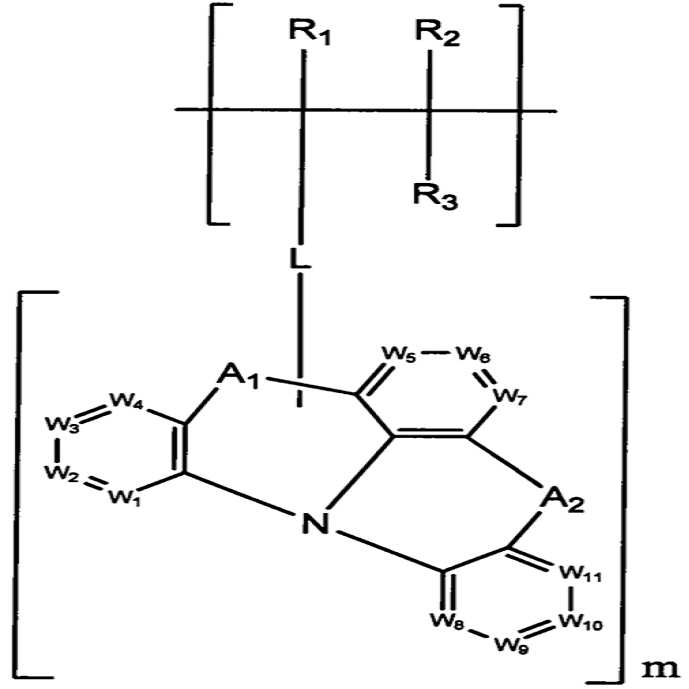
다른 측면에 있어서, 상기 중합체는 하기 화학식 2로 표시되는 반복 단위를 포함할 수 있다.In another aspect, the polymer may include a repeating unit represented by the following formula (2).
<화학식 2>(2)
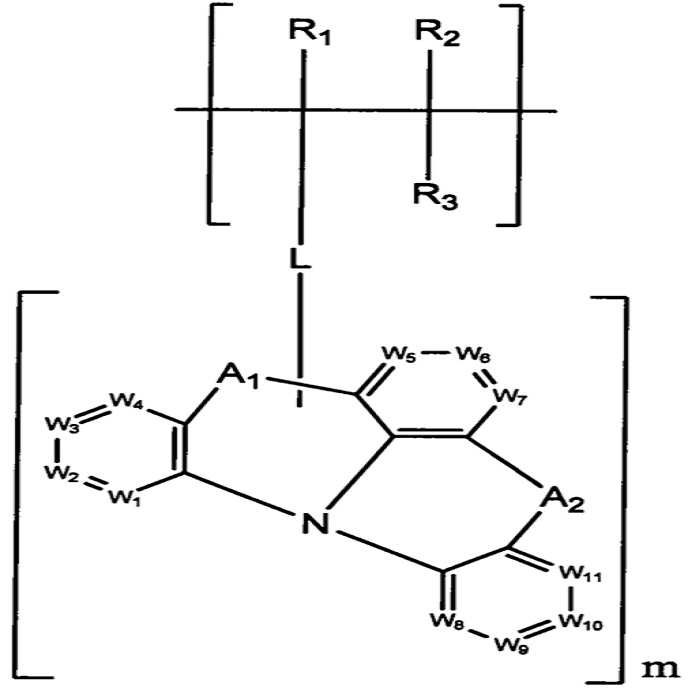
상기 화학식 2 중,In Formula 2,
R1, R2, R3, L, A1, A2 및 m은 제1항에서 정의된 바와 같고,R 1 , R 2 , R 3 , L, A 1 , A 2 and m are as defined in claim 1,
W1 내지 W11은 서로 독립적으로, N 또는 CX이고,W 1 to W 11 are, independently of each other, N or CX,
X는 수소; 중수소; 탄소수 1 내지 10의 알킬실릴기; 탄소수 6 내지 30의 아릴실릴기; 탄소수 1 내지 10의 알킬아미노기; 탄소수 6 내지 60의 아릴아미노기; 치환 또는 비치환된 탄소수 1 내지 10의 알킬기; 치환 또는 비치환된 탄소수 6 내지 30의 아릴기; 및 치환 또는 비치환된 탄소수 1 내지 30의 헤테로아릴기 중에서 선택될 수 있다.X is hydrogen; heavy hydrogen; An alkylsilyl group having 1 to 10 carbon atoms; An arylsilyl group having 6 to 30 carbon atoms; An alkylamino group having 1 to 10 carbon atoms; An arylamino group having 6 to 60 carbon atoms; A substituted or unsubstituted alkyl group having 1 to 10 carbon atoms; A substituted or unsubstituted C6 to C30 aryl; And a substituted or unsubstituted heteroaryl group having 1 to 30 carbon atoms.
이러한 측면에 의하여, 유기 발광 소자의 발광 효율 및 발광 수명을 향상시킬 수 있다.By this aspect, the luminous efficiency and the luminescent lifetime of the organic light emitting device can be improved.
일 측면에 있어서, 상기 L은 단일 결합; 치환 또는 비치환된 탄소수 6 내지 15의 아릴렌기; 및 치환 또는 비치환된 탄소수 5 내지 15의 헤테로아릴렌기 중에서 선택될 수 있고, 다만 치환 또는 비치환된 카바졸릴렌기가 아니다.In one aspect, L is a single bond; A substituted or unsubstituted arylene group having 6 to 15 carbon atoms; And a substituted or unsubstituted heteroarylene group having 5 to 15 carbon atoms, and is not a substituted or unsubstituted carbazolylene group.
다른 측면에 있어서, 상기 A1 및 A2는 서로 독립적으로, 단일 결합; 산소 원자; 및 황 원자 중에서 선택될 수 있다.In another aspect, A 1 and A 2 independently of each other are a single bond; Oxygen atom; And sulfur atoms.
일 측면에 있어서, 상기 W1 내지 W11은 각각 CX일 수 있다.In one aspect, W 1 to W 11 may be CX, respectively.
또 다른 측면에 있어서, 상기 X는 서로 독립적으로, 수소; 치환 또는 비치환된 탄소수 1 내지 10의 알킬기; 치환 또는 비치환된 탄소수 6 내지 30의 아릴아미노기; 및 치환 또는 비치환된 탄소수 6 내지 15의 아릴기 중에서 선택될 수 있다.In yet another aspect, X is independently from each other hydrogen; A substituted or unsubstituted alkyl group having 1 to 10 carbon atoms; A substituted or unsubstituted arylamino group having 6 to 30 carbon atoms; And a substituted or unsubstituted C6 to C15 aryl group.
이러한 측면에 의하여, 유기 발광 소자의 발광 효율 및 발광 수명을 향상시킬 수 있다.By this aspect, the luminous efficiency and the luminescent lifetime of the organic light emitting device can be improved.
일 측면에 있어서, 상기 중합체는 가교기를 더 포함할 수 있다.In one aspect, the polymer may further comprise a crosslinking group.
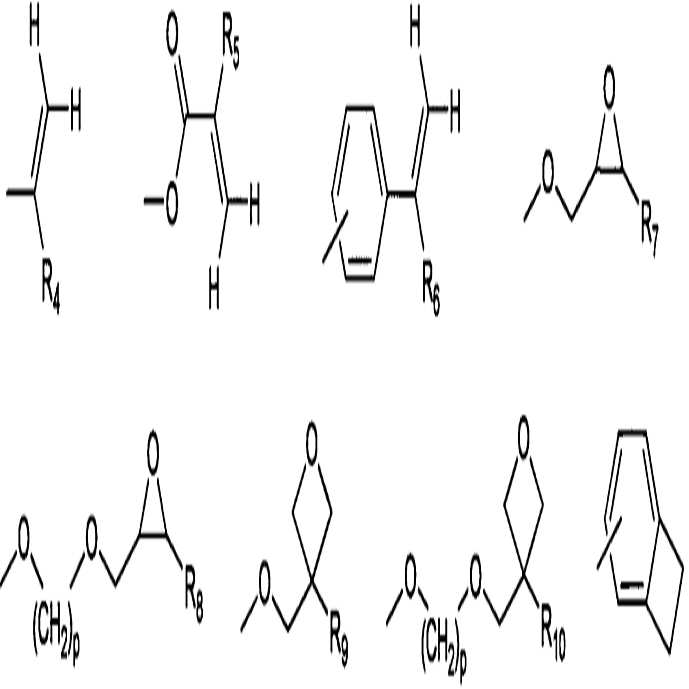
다른 측면에 있어서, 상기 가교기는 하기 구조들 중에서 선택될 수 있다.In another aspect, the crosslinker may be selected from the following structures.
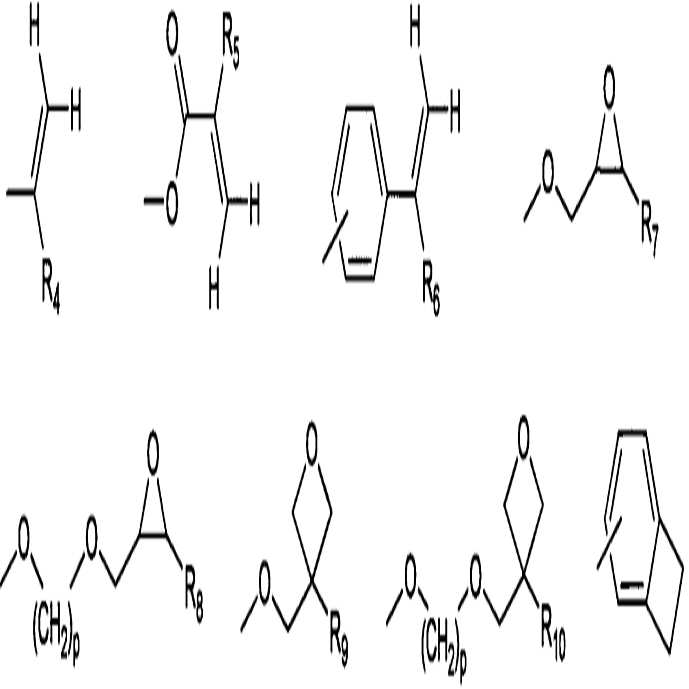
상기 구조들 중,Among these structures,
R4 내지 R10은 수소; 또는 치환 또는 비치환된 탄소수 1 내지 10의 알킬기이고,R 4 to R 10 are hydrogen; Or a substituted or unsubstituted alkyl group having 1 to 10 carbon atoms,
p는 1 내지 10의 정수이다.p is an integer of 1 to 10;
이러한 측면에 의하여, 유기 발광 소자의 발광 효율 및 발광 수명을 향상시킬 수 있다.By this aspect, the luminous efficiency and the luminescent lifetime of the organic light emitting device can be improved.
또한, 상기 과제를 해결하기 위한 또 하나의 측면에 있어서, 전술한 중합체 및 용액을 포함하는, 유기 발광 소자 재료가 제공된다.Further, in another aspect for solving the above-mentioned problems, there is provided an organic light emitting device material comprising the above-described polymer and a solution.
다른 측면에 따르면, 제1전극; 제2전극; 및 상기 제1전극 및 상기 제2전극 사이에 개재된 유기층을 포함하고;According to another aspect, there is provided a liquid crystal display comprising: a first electrode; A second electrode; And an organic layer interposed between the first electrode and the second electrode;
상기 유기층은 전술한 중합체를 포함하는, 유기 발광 소자가 제공된다. Wherein the organic layer comprises the above-mentioned polymer.
상기 중합체를 포함하는 유기 발광 소자는 발광 효율 및 발광 수명이 향상된다.The organic light emitting device including the polymer has improved luminous efficiency and luminescent lifetime.
도 1은 일 구현예에 따른 유기 발광 소자를 모식적으로 나타낸 것이다.FIG. 1 schematically shows an organic light emitting device according to one embodiment.
용액 도포법을 이용한 유기 발광 소자 재료로서, 예를 들어, 저분자 재료와 고분자 재료가 검토되고 있다. 이 중, 고분자 재료는 도포균일성이 높아, 적층 형성이 용이하기 때문에 활발히 개발되고 있다. 특히, 디스플레이나 조명 장치에 이용될 수 있어, 고분자계 정공 수송 재료의 개발이 전망된다.As an organic light emitting element material using a solution coating method, for example, a low molecular material and a high molecular material have been studied. Among them, the polymer material is highly developed because it has high coating uniformity and is easy to form a laminate. In particular, it can be used in displays and lighting devices, and the development of polymeric hole transport materials is expected.
예를 들어, 하기의 특허문헌에는, 저분자 재료의 일부를 비닐기로 치환하여 중합시켜 고분자화한 유기 발광 소자 재료가 개시되어 있다.For example, the following patent documents disclose an organic light-emitting device material in which a part of a low-molecular material is substituted with a vinyl group and polymerized to polymerize.
일본 특허 공개 공보 제1995-090255호Japanese Patent Application Laid-Open No. 1995-090255
일본 특허 공개 공보 제1996-054833호Japanese Patent Application Laid-Open No. 1996-054833
일본 특허 공개 공보 제1996-269133호Japanese Patent Application Laid-Open No. 1996-269133
일본 특허 공개 공보 제2001-098023호Japanese Patent Application Laid-Open No. 2001-098023
일본 특허 공개 공보 제2002-110359호Japanese Patent Application Laid-Open No. 2002-110359
일본 특허 공개 공보 제2003-313240호Japanese Patent Application Laid-Open No. 2003-313240
일본 특허 공개 공보 제2004-059743호Japanese Patent Application Laid-Open No. 2004-059743
일본 특허 공개 공보 제2006-237592호Japanese Patent Application Laid-Open No. 2006-237592
일본 특허 공개 공보 제2008-198989호Japanese Patent Application Laid-Open No. 2008-198989
일본 특허 공개 공보 제2008-218983호Japanese Patent Application Laid-Open No. 2008-218983
그러나, 상기 특허 문헌에 기재된 유기 발광 소자 재료를 이용하여 용액 도포법에 의하여 제조한 유기 발광 소자는 발광 수명이 충분하지 않은 문제가 있다.However, the organic light-emitting device manufactured by the solution coating method using the organic light-emitting element material described in the patent document has a problem that the light emission lifetime is not sufficient.
따라서, 상기 문제점에 비추어, 유기 발광 소자의 발광 효율 및 발광 수명을 향상시킬 수 있는 신규한 구조의 중합체를 포함하는 유기 발광 소자 재료 및 그러한 유기 발광 소자 재료를 이용한 유기 발광 소자를 제공하고자 한다.이하, 첨부된 도면을 참조하여 일 구현예에 따른 중합체, 이를 포함하는 유기 발광 소자 재료 및 이를 포함한 유기 발광 소자를 상세히 설명한다. 다만, 이하의 실시의 형태에만 한정되는 것은 아니다.Accordingly, in view of the above problems, it is an object of the present invention to provide an organic light emitting device material including a polymer having a novel structure capable of improving the light emitting efficiency and the light emission lifetime of the organic light emitting device, and an organic light emitting device using such an organic light emitting device material. A polymer according to an embodiment, an organic light emitting device material including the same, and an organic light emitting device including the same will be described in detail with reference to the accompanying drawings. However, the present invention is not limited to the following embodiments.
중합체polymer
종래의 유기 발광 소자의 발광 효율이 낮은 원인으로서 발광층으로부터 정공 수송층에 엑시톤이 누설되는 현상이 있음에 착안하여 유기 발광 소자의 발광 효율을 향상시키는 것이 가능한 유기 발광 소자 재료를 연구한 결과, 중합체(polymer)의 측쇄에 특정한 축합 고리 구조를 함유하는 중합성 단량체를 중합시킨 중합체를 유기층, 예를 들어 정공 수송층에 포함시킴으로써 정공 수송층의 삼중항 여기 상태(T1)의 에너지가 높아지는 것을 알아내었다. 이에, 이러한 중합체를 이용함으로써 발광층 내의 엑시톤이 정공 수송층으로 누설되는 것을 억제하여, 발광층에 엑시톤이 갇히게 할 수 있고, 이에 따라 유기 발광 소자의 발광 효율을 향상시키고, 나아가 발광 수명을 향상시키는 것을 알아내었다.As a result of studying an organic light emitting device material capable of improving the luminous efficiency of an organic light emitting device due to a phenomenon that a light emitting efficiency of a conventional organic light emitting device is low, there is a phenomenon that an exciton leaks from the light emitting layer to a hole transporting layer. (T 1 ) of the hole transport layer is increased by incorporating a polymer obtained by polymerizing a polymerizable monomer containing a specific condensed ring structure in the side chain of the hole transporting layer, for example, a hole transporting layer. By using such a polymer, it has been found that the exciton in the light emitting layer can be prevented from leaking to the hole transporting layer, and the exciton can be trapped in the light emitting layer, thereby improving the light emitting efficiency of the organic light emitting device and further improving the light emitting lifetime .
일 구현예에 있어서, 중합체의 측쇄에 특정한 축합 고리 구조를 함유하는 중합성 단량체를 중합시킨 중합체가 제공된다. 이러한 중합체는, 높은 용해성 및 도포안정성을 가져, 유기 발광 소자의 발광 효율 및 발광 수명을 향상시킬 수 있다.In one embodiment, there is provided a polymer obtained by polymerizing a polymerizable monomer containing a specific condensed ring structure in the side chain of the polymer. Such a polymer has high solubility and coating stability, and can improve the luminous efficiency and the luminescent lifetime of the organic light emitting device.
일 구현예에 있어서, 중합성 모노머를 중합시킴으로써 형성되는 중합체 화합물은, 하기 화학식 1로 표시되는 반복 단위를 포함한다.In one embodiment, the polymer compound formed by polymerizing the polymerizable monomer includes a repeating unit represented by the following formula (1).
<화학식 1>≪ Formula 1 >
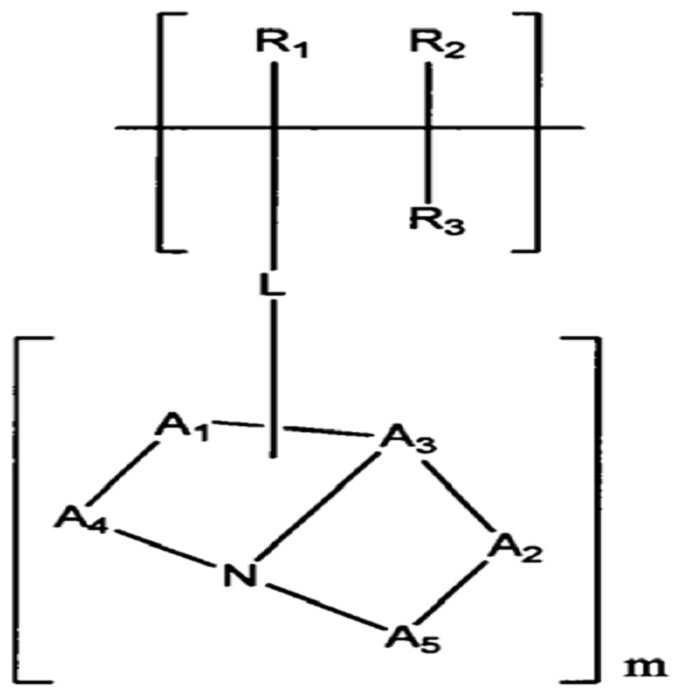
상기 화학식 1 중,In Formula 1,
R1, R2 및 R3은 서로 독립적으로, 수소, 중수소, 불소; 탄소수 1 내지 10의 알킬실릴기; 탄소수 6 내지 30의 아릴실릴기; 치환 또는 비치환된 탄소수 1 내지 10의 알킬기; 치환 또는 비치환된 탄소수 6 내지 30의 아릴기; 및 치환 또는 비치환된 탄소수 1 내지 30의 헤테로아릴기 중에서 선택되고,R 1 , R 2 and R 3 are, independently of each other, hydrogen, deuterium, fluorine; An alkylsilyl group having 1 to 10 carbon atoms; An arylsilyl group having 6 to 30 carbon atoms; A substituted or unsubstituted alkyl group having 1 to 10 carbon atoms; A substituted or unsubstituted C6 to C30 aryl; And a substituted or unsubstituted C1 to C30 heteroaryl group,
L은 단일 결합; 치환 또는 비치환된 탄소수 1 내지 10의 알킬렌기; 치환 또는 비치환된 탄소수 5 내지 30의 시클로알킬렌기; 치환 또는 비치환된 탄소수 6 내지 30의 아릴렌기; 및 치환 또는 비치환된 탄소수 1 내지 30의 헤테로아릴렌기 중에서 선택되고,L is a single bond; A substituted or unsubstituted alkylene group having 1 to 10 carbon atoms; A substituted or unsubstituted cycloalkylene group having 5 to 30 carbon atoms; A substituted or unsubstituted arylene group having 6 to 30 carbon atoms; And a substituted or unsubstituted heteroarylene group having 1 to 30 carbon atoms,
A1 및 A2는 서로 독립적으로, 단일 결합; 산소 원자; 황 원자; 치환 또는 비치환된 탄소수 1 내지 10의 알킬렌기; 치환 또는 비치환된 탄소수 6 내지 30의 아릴렌기; 및 치환 또는 비치환된 탄소수 1 내지 30의 헤테로아릴렌기 중에서 선택되고,A 1 and A 2 are, independently of each other, a single bond; Oxygen atom; Sulfur atom; A substituted or unsubstituted alkylene group having 1 to 10 carbon atoms; A substituted or unsubstituted arylene group having 6 to 30 carbon atoms; And a substituted or unsubstituted heteroarylene group having 1 to 30 carbon atoms,
A3는 치환 또는 비치환된 탄소수 1 내지 10의 3가의 알킬기; 치환 또는 비치환된 탄소수 6 내지 30의 3가의 아릴기; 및 치환 또는 비치환된 탄소수 1 내지 30의 헤테로아릴기 중에서 선택되고,A 3 is a substituted or unsubstituted, tricyclic alkyl group having 1 to 10 carbon atoms; A substituted or unsubstituted tricyclic aryl group having 6 to 30 carbon atoms; And a substituted or unsubstituted C1 to C30 heteroaryl group,
A4 및 A5는 서로 독립적으로, 치환 또는 비치환된 탄소수 1 내지 10의 알킬렌기; 치환 또는 비치환된 탄소수 6 내지 30의 아릴렌기; 및 치환 또는 비치환된 탄소수 1 내지 30의 헤테로아릴렌기 중에서 선택되고,A 4 and A 5 independently represent a substituted or unsubstituted alkylene group having 1 to 10 carbon atoms; A substituted or unsubstituted arylene group having 6 to 30 carbon atoms; And a substituted or unsubstituted heteroarylene group having 1 to 30 carbon atoms,
m은 1 내지 10의 정수이다.m is an integer of 1 to 10;
또한, 상기 화학식 1로 표시되는 반복 단위는, 하기 화학식 2로 표시될 수 있다. The repeating unit represented by the formula (1) may be represented by the following formula (2).
<화학식 2>(2)

상기 화학식 2 중,In Formula 2,
R1, R2, R3, L, A1, A2 및 m은 제1항에서 정의된 바와 같고,R 1 , R 2 , R 3 , L, A 1 , A 2 and m are as defined in claim 1,
W1 내지 W11은 서로 독립적으로, N 또는 CX이고,W 1 to W 11 are, independently of each other, N or CX,
X는 수소; 중수소; 탄소수 1 내지 10의 알킬실릴기; 탄소수 6 내지 30의 아릴실릴기; 탄소수 1 내지 10의 알킬아미노기; 탄소수 6 내지 60의 아릴아미노기; 치환 또는 비치환된 탄소수 1 내지 10의 알킬기; 치환 또는 비치환된 탄소수 6 내지 30의 아릴기; 및 치환 또는 비치환된 탄소수 1 내지 30의 헤테로아릴기 중에서 선택된다.X is hydrogen; heavy hydrogen; An alkylsilyl group having 1 to 10 carbon atoms; An arylsilyl group having 6 to 30 carbon atoms; An alkylamino group having 1 to 10 carbon atoms; An arylamino group having 6 to 60 carbon atoms; A substituted or unsubstituted alkyl group having 1 to 10 carbon atoms; A substituted or unsubstituted C6 to C30 aryl; And a substituted or unsubstituted heteroaryl group having 1 to 30 carbon atoms.
일 구현예에 있어서, 상기 중합체는 상기 화학식 1로 표시되는 제1 단위 및 상기 화학식 1로 표시되는 제2 단위를 포함하고, 상기 제1 단위와 상기 제2 단위의 구조는 서로 상이할 수 있다. 일 구현예에 있어서, 상기 L은 단일 결합; 치환 또는 비치환된 탄소수 6 내지 15의 아릴렌기; 및 치환 또는 비치환된 탄소수 1 내지 15의 헤테로아릴렌기 중에서 선택될 수 있고, 다만 치환 또는 비치환된 카바졸릴렌기가 아니다.In one embodiment, the polymer comprises a first unit represented by Formula 1 and a second unit represented by Formula 1, and the structures of the first unit and the second unit may be different from each other. In one embodiment, L is a single bond; A substituted or unsubstituted arylene group having 6 to 15 carbon atoms; And a substituted or unsubstituted heteroarylene group having 1 to 15 carbon atoms, and is not a substituted or unsubstituted carbazolylene group.
다른 구현예에 있어서, 상기 L은 단일 결합 및 치환 또는 비치환된 탄소수 6 내지 15의 아릴렌기 중에서 선택될 수 있다.In another embodiment, L may be selected from a single bond and a substituted or unsubstituted arylene group having 6 to 15 carbon atoms.
예를 들어, 상기 L은 단일 결합; 치환 또는 비치환된 페닐렌기; 치환 또는 비치환된 나프틸렌기; 치환 또는 비치환된 안트라세닐렌기; 치환 또는 비치환된 바이페닐릴렌기; 치환 또는 비치환된 터페닐렌기; 및 치환 또는 비치환된 플루오레닐렌기 중에서 선택될 수 있다.For example, L is a single bond; A substituted or unsubstituted phenylene group; A substituted or unsubstituted naphthylene group; A substituted or unsubstituted anthracenylene group; A substituted or unsubstituted biphenylene group; A substituted or unsubstituted terphenylene group; And a substituted or unsubstituted fluorenylene group.
또 다른 구현예에 있어서, 상기 L은 단일 결합; 치환 또는 비치환된 페닐렌기; 치환 또는 비치환된 나프틸렌기; 및 치환 또는 비치환된 플루오레닐기 중에서 선택될 수 있다.In yet another embodiment, L is a single bond; A substituted or unsubstituted phenylene group; A substituted or unsubstituted naphthylene group; And a substituted or unsubstituted fluorenyl group.
예를 들어, 상기 L은 단일 결합; 페닐렌기; 나프틸렌기; 및 알킬기로 치환된 플루오레닐기 중에서 선택될 수 있다.For example, L is a single bond; A phenylene group; Naphthylene group; And a fluorenyl group substituted with an alkyl group.
일 구현예에 있어서, 상기 m은 1, 2 또는 3일 수 있다. 예를 들어, 상기 m은 1 또는 2일 수 있다.In one embodiment, m may be 1, 2, or 3. For example, m may be 1 or 2.
다른 구현예에 있어서, 상기 A1 및 A2는 서로 독립적으로, 단일 결합; 산소 원자; 및 황 원자 중에서 선택될 수 있다.In another embodiment, A 1 and A 2 are independently of each other a single bond; Oxygen atom; And sulfur atoms.
일 구현예에 있어서, 상기 W1 내지 W11은 각각 CX일 수 있다. 즉, 상기 W1 내지 W11은 각각 X로 치환된 탄소 원자일 수 있다.In one embodiment, W 1 through W 11 may each be CX. That is, W 1 to W 11 each may be a carbon atom substituted with X.
일 구현예에 있어서, 상기 X는 수소 원자; 치환 또는 비치환된 탄소수 1 내지 10의 알킬기; 치환 또는 비치환된 탄소수 6 내지 30의 아릴아미노기; 및 치환 또는 비치환된 탄소수 6 내지 15의 아릴기 중에서 선택될 수 있다. 예를 들어, 상기 X는 수소 원자; 아릴아미노기; 페닐기; 나프틸기; 페난트릴기; 바이페닐릴기; 터페닐기; 및 플루오레닐기 중에서 선택될 수 있다.In one embodiment, X is a hydrogen atom; A substituted or unsubstituted alkyl group having 1 to 10 carbon atoms; A substituted or unsubstituted arylamino group having 6 to 30 carbon atoms; And a substituted or unsubstituted C6 to C15 aryl group. For example, X is a hydrogen atom; An arylamino group; A phenyl group; Naphthyl group; A phenanthryl group; A biphenylyl group; A terphenyl group; And a fluorenyl group.
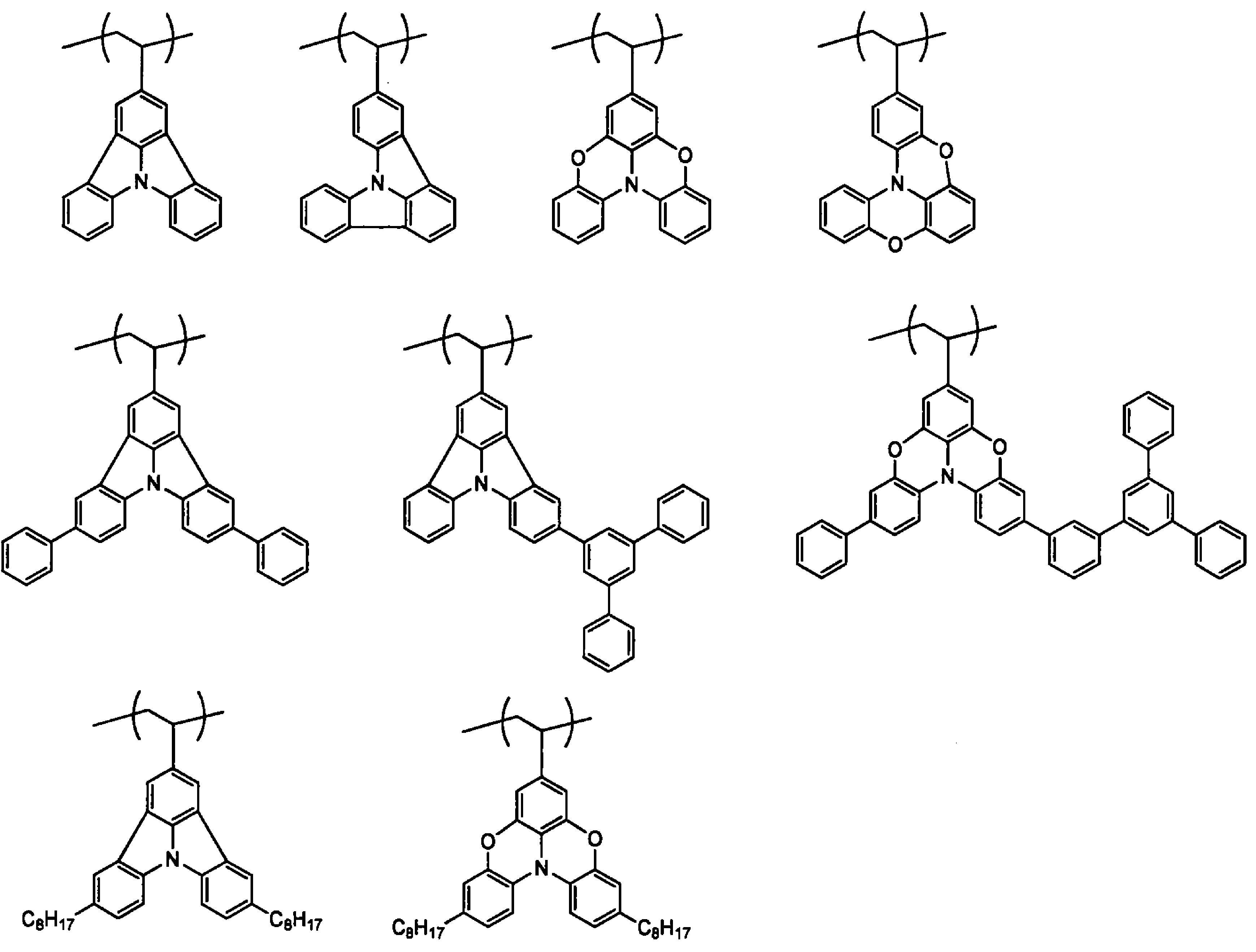
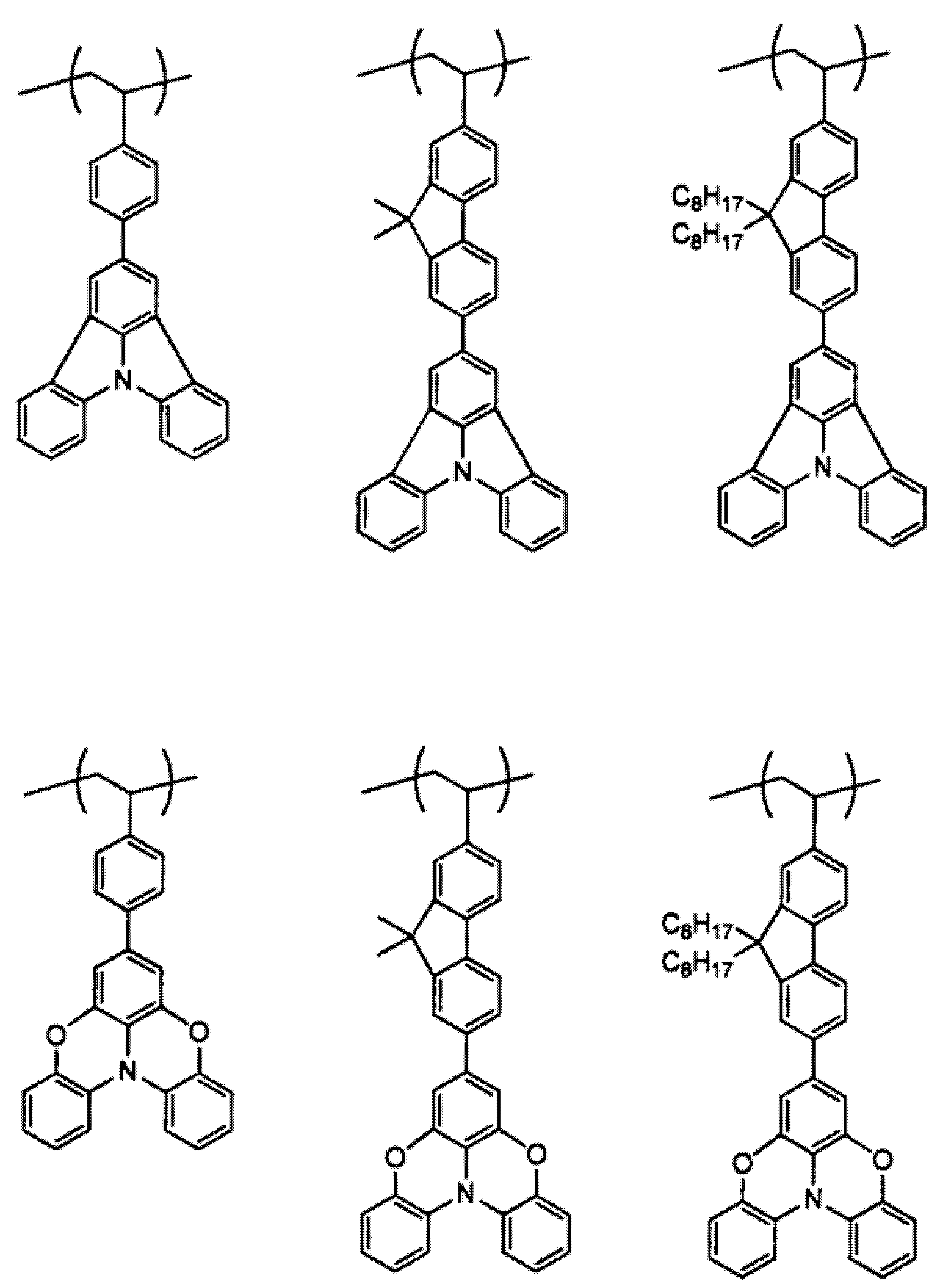
일 구현예에 있어서, 상기 화학식 1 또는 상기 화학식 2로 표시되는 반복 단위는 L을 통하여 중합체의 측쇄에 결합하는 질소 함유 축합 고리 구조로서, 하기 구조들 중에서 선택될 수 있고, 다만 하기 구조들로 한정되는 것은 아니다. 또한, 질소 함유 축합 고리 구조가 중합체의 주쇄에 연결되는 위치는 임의의 결합 부위일 수 있다. In one embodiment, the repeating unit represented by the formula (1) or (2) is a nitrogen-containing condensed ring structure bonded to the side chain of the polymer through L, and may be selected from the following structures, It is not. The position at which the nitrogen-containing condensed ring structure is connected to the main chain of the polymer may be any bonding site.

또한, 상기 L을 통하여 복수의 질소 함유 축합 고리 구조가 중합체의 측쇄에 연결될 수 있다. 예를 들어, 하기의 구조들과 같이 질소 함유 축합 고리 구조가 2개 연결될 수 있고, 이 경우에 상기 m이 2이며, 다만 이에 한정되는 것은 아니다.Further, a plurality of nitrogen-containing condensed-ring structures may be connected to the side chain of the polymer via L. For example, two nitrogen-containing condensed ring structures may be connected as in the following structures, in which case m is 2, but is not limited thereto.
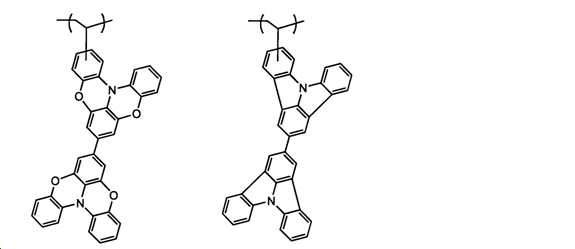
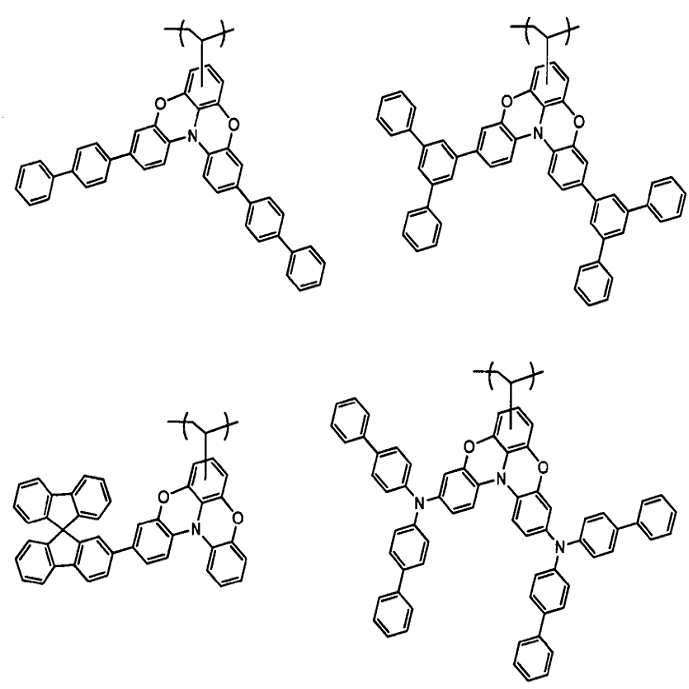
또 하나의 구현예에 있어서, 전술한 질소 함유 축합 고리는, 적어도 1 이상의 치환기로 치환될 수 있다. 예를 들어, 상기 화학식 1로 표시되는 반복 단위는 하기 구조들 중에서 선택될 수 있고, 다만 이에 한정되지 않는다.In another embodiment, the aforementioned nitrogen-containing condensed ring may be substituted with at least one or more substituents. For example, the repeating unit represented by the formula (1) may be selected from the following structures, but is not limited thereto.


일 구현예에 있어서, 상기 중합체는 가교기를 더 포함할 수 있다. 예를 들어, 상기 가교기는 하기 구조들 중에서 선택될 수 있고, 다만 이에 한정되는 것은 아니다.In one embodiment, the polymer may further comprise a crosslinker. For example, the crosslinking group may be selected from the following structures, but is not limited thereto.
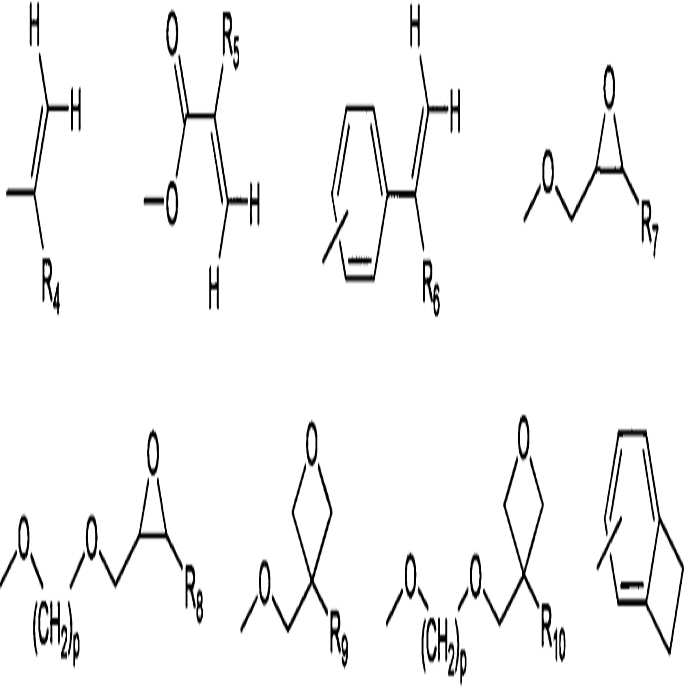
상기 구조들 중,Among these structures,
R4 내지 R10은 수소; 또는 치환 또는 비치환된 탄소수 1 내지 10의 알킬기이고,R 4 to R 10 are hydrogen; Or a substituted or unsubstituted alkyl group having 1 to 10 carbon atoms,
p는 1 내지 10의 정수이다.p is an integer of 1 to 10;
일 구현예에 있어서, 상기 화학식 1 또는 화학식 2로 표시되는 단위 및 가교기를 포함하는 중합성 모노머는 하기 구조들 중에서 선택될 수 있고, 다만 이에 한정되지 않는다.In one embodiment, the polymerizable monomer comprising the unit represented by Chemical Formula 1 or Chemical Formula 2 and the crosslinking group may be selected from the following structures, but is not limited thereto.


일 구현예에 있어서, 상기 중합체는 상기 화학식 1 또는 화학식 2로 표시되는 반복 단위를 포함하는 중합성 모노머를 단독으로 중합한 중합체일 수 있다. 다른 구현예에 있어서, 상기 중합체는 상기 화학식 1 또는 화학식 2로 표시되는 반복 단위를 포함하는 중합성 모노머 및 다른 중합성 모노머를 공중합한 공중합체일 수 있다. 즉, 일 구현예에 있어서, 상기 중합체는 상기 화학식 1 또는 화학식 2로 표시되는 반복 단위를 포함하는 것이면 족하다.In one embodiment, the polymer may be a polymer obtained by polymerizing a polymerizable monomer containing a repeating unit represented by the general formula (1) or (2) alone. In another embodiment, the polymer may be a copolymer obtained by copolymerizing a polymerizable monomer containing a repeating unit represented by the formula (1) or (2) and another polymerizable monomer. That is, in one embodiment, the polymer may contain repeating units represented by the above-described formula (1) or (2).
전술한 바와 같이, 일 구현예에 따른 중합체는, 측쇄 부분에 특정한 축합 고리 구조를 포함한다. 이러한 특정의 축합 고리 구조를 포함하는 중합체는, 삼중항 여기상태(T1)의 에너지가 높기 때문에, 예를 들어 정공 수송층에 이용됨으로써 발광층 중의 엑시톤이 정공 수송층으로 누설되는 것을 억제하여, 발광층에 엑시톤이 갇히게 할 수 있고, 이에 따라 유기 발광 소자의 발광 효율을 향상시키고, 나아가 발광 수명을 향상시킬 수 있다. As described above, the polymer according to one embodiment includes a specific condensed ring structure in the side chain portion. Since the polymer having such a specific condensed ring structure has a high energy of the triplet excited state (T 1 ), for example, it is used in the hole transporting layer to suppress leakage of the exciton in the light emitting layer into the hole transporting layer, The light emitting efficiency of the organic light emitting device can be improved, and the life of the light emitting device can be further improved.
일 구현예에 있어서, 상기 중합체의 수평균 분자량은 예를 들어 10,000 내지 100,000, 또는 10,000 이상 100,000 이하일 수 있다. 또 하나의 구현예에 있어서, 상기 중합체의 분산도, 즉 중량평균 분자량을 수평균 분자량으로 나눈 값은 예를 들어 1.5 내지 2.5, 또는 1.5 이상 2.5 이하일 수 있다.In one embodiment, the number average molecular weight of the polymer can be, for example, from 10,000 to 100,000, or from 10,000 to 100,000. In another embodiment, the degree of dispersion of the polymer, i. E. The weight average molecular weight divided by the number average molecular weight, can be, for example, from 1.5 to 2.5, or from 1.5 to 2.5.
이상에서 설명한 바와 같이, 일 구현예에 따른 중합체는 용액 도포법에 의하여 성막이 가능하고, 유기 발광 소자의 발광 효율 및 발광 수명을 향상시킬 수 있다. 또한, 일 구현예에 따른 중합체는 가교기를 포함하는 경우에, 도포 후의 가교에 의하여 도포 안정성을 높일 수 있기 때문에, 상기 중합체를 이용하여 유기 발광 소자의 적층 구조를 형성하는 경우에 발광 특성 및 안정성을 향상시킬 수 있다.As described above, the polymer according to one embodiment can form a film by the solution coating method, and the luminous efficiency and the luminescent lifetime of the organic light emitting device can be improved. In addition, when the polymer according to one embodiment includes a crosslinking group, the coating stability can be improved by crosslinking after coating. Therefore, when the laminated structure of the organic light emitting device is formed using the polymer, the light emitting property and stability Can be improved.
일 구현예에 있어서, 상기 중합체는 공지의 유기 합성 방법을 이용하여 합성하는 것이 가능하다. 일 구현예에 있어서, 상기 중합체의 구체적인 합성법은 후술하는 실시예를 참조하여 본 기술분야의 통상의 기술자가 용이하게 이해하고 실시할 수 있다.In one embodiment, the polymer can be synthesized using known organic synthesis methods. In one embodiment, a specific synthesis method of the polymer can be easily understood and practiced by those skilled in the art with reference to the following embodiments.
"알킬기"는 예를 들어 메틸기, 에틸기, 프로필기, 이소프로필기, n-부틸기, s-부틸기, 이소부틸기, t-부틸기, n-펜틸기, n-헥실기, n-헵틸기, n-옥틸기일 수 있다."Alkyl group" includes, for example, a methyl group, an ethyl group, a propyl group, an isopropyl group, an n-butyl group, a s-butyl group, an isobutyl group, N-octyl group.
"시클로알킬기"는 예를 들어 시클로프로필기, 시클로부틸기, 시클로펜틸기, 시클로헥실기, 아다만틸기, l-노보닐(l-norbonyl)기일 수 있다.The "cycloalkyl group" may be, for example, a cyclopropyl group, a cyclobutyl group, a cyclopentyl group, a cyclohexyl group, an adamantyl group, or a 1-norbonyl group.
"아릴기"는 예를 들어 페닐기, 나프틸기, 안트라세닐기, 페난트레닐기, 바이페닐릴기, 터페닐기, 톨릴(tolyl)기, 플루오란테닐기(fluoranthenyl)기, 플루오레닐기일 수 있다.The "aryl group" may be, for example, a phenyl group, a naphthyl group, an anthracenyl group, a phenanthrenyl group, a biphenylyl group, a terphenyl group, a tolyl group, a fluoranthenyl group or a fluorenyl group.
"헤테로아릴기"는 예를 들어 피롤릴기, 피라지닐기, 피리디닐기, 인돌릴기, 이소인돌릴기, 퓨릴기, 벤조퓨라닐기, 이소벤조퓨라닐기, 퀴놀릴기, 이소퀴놀릴기, 퀴녹살리닐기, 카바졸릴기, 페난트리디닐기, 아크리디닐기, 페나지닐기 페노티아지닐기, 페녹사지닐기, 옥사졸릴기, 옥사디아졸릴기, 퓨라자닐기, 티에닐기일 수 있다.The "heteroaryl group" includes, for example, a pyrrolyl group, a pyridinyl group, a pyridinyl group, an indolyl group, an isoindolyl group, a furyl group, a benzofuranyl group, an isobenzofuranyl group, a quinolyl group, an isoquinolyl group, A phenanthridinyl group, a phenoxazinyl group, an oxazolyl group, an oxadiazolyl group, a furazanyl group, and a thienyl group.
또한, 알킬렌기, 시클로알킬렌기, 아릴렌기 및 헤테로아릴렌기는, 상기 예시된 알킬기, 아릴기, 및 헤테로아릴기의 각각으로부터 수소가 1개씩 제거된 2가 기를 의미한다.Further, the alkylene group, cycloalkylene group, arylene group and heteroarylene group means a divalent group in which one hydrogen is removed from each of the above-exemplified alkyl group, aryl group, and heteroaryl group.
"알킬실릴기"는 상기 알킬기로 치환된 1가 내지 3가의 규소(Si) 원자를 의미하고, "아릴실릴기"는 상기 아릴기로 치환된 1가 내지 3가의 규소(Si) 원자를 으미한다. 또한, "알킬아미노기"는 상기 알킬기로 치환된 1가 내지 3가의 질소 원자를 의미하며, "아릴아미노기"는 상기 아릴기로 치환된 1가 내지 3가의 질소 원자를 의미한다.The "alkylsilyl group" means a monovalent to trivalent silicon (Si) atom substituted with the alkyl group, and the "arylsilyl group" has a monovalent to trivalent silicon (Si) atom substituted with the aryl group. The "alkylamino group" means a monovalent to trivalent nitrogen atom substituted with the alkyl group, and the "arylamino group" means a monovalent to trivalent nitrogen atom substituted with an aryl group.
또한, 본 명세서에서, "치환된"의 의미는, 임의의 치환기로 치환된 것을 의미하며, 구체적으로는 전술한 알킬기, 아릴기, 및 헤테로아릴기 중의 어느 것으로 치환된 것을 의미한다.Also, in the present specification, the meaning of "substituted" means that it is substituted with any substituent, and specifically means substituted with any of the above-mentioned alkyl group, aryl group, and heteroaryl group.
유기 발광 소자 재료Organic light emitting device material
일 구현예에 있어서, 전술한 중합체를 포함하는 유기 발광 소자 재료가 제공된다. 상기 중합체는, 유기 발광 소자 재료로서 적용이 가능하다. 또한, 상기 중합체는 정공 수송 및 정공 주입 능력을 가진다. 따라서, 일 구현예에 따른 유기 발광 소자 재료는 예를 들어 정공 수송층, 정공 주입층 및 발광층의 재료로서 사용할 수 있다.In one embodiment, there is provided an organic light emitting device material comprising the above polymer. The polymer is applicable as an organic light emitting device material. In addition, the polymer has hole transport and hole injection capability. Accordingly, the organic light emitting device material according to one embodiment can be used, for example, as a material for a hole transporting layer, a hole injecting layer, and a light emitting layer.
다른 구현예에 있어서, 유기 발광 소자 재료는 발광층의 재료일 수 있고, 전술한 중합체가 호스트 재료로서 이용될 수 있다. 이 경우에, 일 구현예에 따른 유기 발광 소자 재료는 정공 수송 능력을 갖는 화합물을 더 포함할 수 있다. In another embodiment, the organic luminescent material may be the material of the luminescent layer, and the above-mentioned polymer may be used as the host material. In this case, the organic light emitting device material according to one embodiment may further include a compound having a hole transporting ability.
이러한 정공 수송 능력을 갖는 화합물은 특별히 제한되지 않으며, 후술하는 공지의 정공 주입재료, 정공 수송 재료, 호스트 재료를 사용할 수 있다.The compound having such a hole transporting ability is not particularly limited, and known hole injecting materials, hole transporting materials and host materials described later can be used.
일 구현예에 있어서, 유기 발광 소자 재료가 발광층의 재료이고, 상기 유기 발광 소자 재료는 발광 재료를 더 포함할 수 있다. 이러한 발광 재료로서, 후술하는 발광 재료를 사용할 수 있다.In one embodiment, the organic luminescent material is a material of the luminescent layer, and the organic luminescent material may further include a luminescent material. As such a light emitting material, a light emitting material described later can be used.
일 구현예에 있어서, 전술한 중합체 및 용매를 포함하는 유기 발광 소자 재료가 제공된다. 일 구현예에 있어서, 상기 유기 발광 소자 재료는 예를 들어 유기 발광 소자의 각 층을 용액 도포법에 의하여 형성하기 위한 용도로 사용될 수 있다.In one embodiment, there is provided an organic light emitting device material comprising a polymer and a solvent as described above. In one embodiment, the organic light emitting device material may be used, for example, to form each layer of the organic light emitting device by a solution coating method.
상기 용매는 전술한 유기 발광 소자 재료를 용해시킬 수 있는 것을 사용할 수 있으며, 다만 이에 한정되지 않는다.As the solvent, those capable of dissolving the above-described organic light emitting element material may be used, but the present invention is not limited thereto.
일 구현예에 있어서, 상기 용매는 예를 들어 톨루엔, 자일렌, 에틸벤젠, 디에틸벤젠, 메시틸렌(mesitylene), 프로필벤젠, 시클로헥실벤젠, 디메톡시벤젠, 아니솔, 에톡시톨루엔, 페녹시톨루엔, 이소프로필비페닐, 디메틸아니솔, 페닐 아세테이트, 페닐 프로피오네이트, 메틸 벤조에이트, 에틸 벤조에이트 등 방향족계 용매를 사용할 수 있으며, 다만 이에 한정되지 않는다.In one embodiment, the solvent is selected from the group consisting of toluene, xylene, ethylbenzene, diethylbenzene, mesitylene, propylbenzene, cyclohexylbenzene, dimethoxybenzene, anisole, ethoxytoluene, phenoxy Aromatic solvents such as toluene, isopropyl biphenyl, dimethyl anisole, phenylacetate, phenyl propionate, methyl benzoate, and ethyl benzoate may be used, but are not limited thereto.
유기 발광 소자Organic light emitting device
이하에서 도 1을 참조하여, 본 발명의 일 실시예에 관한 유기 발광 소자에 대해 설명한다.Hereinafter, an organic light emitting device according to an embodiment of the present invention will be described with reference to FIG.
유기 발광 소자(100)는 기판(110), 기판(110) 상에 배치된 제1전극(120), 제1전극(120) 상에 배치된 정공 주입층(130), 정공 주입층(130) 상에 배치된 정공 수송층(140), 정공 수송층(140) 상에 배치된 발광층(150), 발광층(150) 상에 배치된 전자 수송층(160), 전자 수송층(160) 상에 배치된 전자 주입층(170) 및 전자 주입층(170) 상에 배치된 제2전극(180)를 포함한다.The organic
기판(110)은 통상적인 유기 발광 소자로 사용되는 기판을 사용할 수 있다. 예를 들어, 기판(110)은 유리(glass)기판, 실리콘(silicon) 기판 또는 투명한 플라스틱(plastic) 기판일 수 있다.The
기판(110) 상에는 제1 전극(120)이 형성될 수 있다. 제1 전극(12)은 예를 들어 애노드이고, 금속, 합금 또는 전도성 화합물 등의 일함수가 높은 것을 사용하여 형성할 될 있다. 예를 들어, 제1 전극(120)은, 투명성 및 전도성이 뛰어난 산화 인듐 주석(ITO), 산화 인듐 아연(IZO), 산화 주석(SnO2), 산화 아연(ZnO) 등에서 형성될 수 있다. 또한, 제1전극(120)은 마그네슘(Mg), 알루미늄(Al) 등을 사용하여 반사형 전극으로서 형성될 수 있다.The
제1 전극(120) 상에 정공 주입층(130)이 형성될 수 있다. 정공 주입층(130)은 제1전극(120)으로부터의 정공의 주입을 용이하게 하는 기능을 갖춘 층이며, 예를 들어 약 10 nm 내지 1000 nm, 또는 약 10 nm 내지 100 nm의 두께로 형성될 수 있다. A
정공 주입층(130)은, 공지의 정공 주입 재료를 사용하여 형성할 수 있다. 예를 들어, 트리페닐아민 함유 폴리에테르케톤(poly(ether ketone)-containing triphenylamine:TPAPEK), 4-이소프로필-4'-메틸디페닐아이오도늄 테트라키스(펜타플루오로페닐) 보레이트(PPBI), N,N'-디페닐-N,N'-디페닐-N,N'-비스-[4-(페닐-m-톨릴-아미노)-페닐]-비페닐-4,4'-디아민(DNTPD), 구리 프탈로시아닌(copper phthalocyanine), 4,4',4"-트리스(3-메틸페닐페닐아미노)트리페닐아민(m-MTDATA), N,N'-디(1-나프틸)-N,N'-디페닐아민(NPB), 4,4',4"-트리스(N,N'-2-나프틸페닐아미노) 트리페닐아민(2-TNATA), 폴리아닐린/도데실벤젠설폰산, 폴리(3,4-에틸렌디옥시티오펜)/폴리(4-스티렌설포네이트)), 또는 폴리아닐린/10-캠포설폰산 등이 있다.The
정공 주입층(130) 상에는, 정공 수송층(140)이 형성된다. 정공 수송층(140)은 정공을 수송하는 기능을 가지는 정공 수송 재료를 포함하는 층이고, 예를 들어 약 10 nm 내지 약 150 nm의 두께로 형성될 수 있다. 정공 수송층(140)은 일 구현예에 따른 중합체를 이용하여 용액 도포법에 의하여 성막할 수 있다. 상기 방법에 의하면, 유기 발광 소자(100)의 발광 수명을 향상시키는 것이 가능하고, 대면적을 성막하는 것이 용이하다. On the
정공 수송층(140) 상에는 발광층(150)이 형성될 수 있다. 발광층(150)은 형광, 인광 등의 광을 방출하는 층으로서, 진공 증착법, 스핀 코팅법, 잉크젯법 등을 이용하여 형성될 수 있다. 발광층(150)은 예를 들어 약 10 nm 내지 60 nm의 두께로 형성될 수 있다.The
발광층(150)의 발광 재료로서, 공지의 발광 재료를 이용할 수 있다. 일 구현예에 있어서, 발광층(150)에 포함되는 발광 재료는, 삼중항 엑시톤으로부터 발광, 즉 인광을 방출하는 것이 가능한 발광 재료일 수 있다. 이러한 경우에, 유기 발광 소자(100)의 발광 수명이 향상될 수 있다.As the light emitting material of the
발광층(150)의 호스트 재료로서 예를 들어, 트리스(8-퀴놀리나토) 알루미늄(Alq3), 4,4'-N,N'-디카바졸-비페닐(CBP), 폴리(n-비닐카바졸)(PVK), 9,10-디(나프탈렌-2-일)안트라센)(ADN), 4,4',4"-트리스(N-카바졸) 트리페닐렌(TCTA), 1,3,5-트리스(N-페닐-벤즈이미다졸-2-일)벤젠(TBPI), 3-tert-부틸-9,10-디(나프트-2-일) 안트라센(TBADN), 디스티릴아릴렌(DSA), 4.4'-비스(9-카바졸)-2,2'-디메틸비페닐(dmCBP) 등을 포함할 수 있다.As the host material of the
또한, 발광층(150)의 도펀트 재료로서는, 예를 들어 페릴렌 및 그 유도체, 루브렌 및 그 유도체, 쿠마린 및 그 유도체, 4-(디시아노메틸렌)-2-메틸-6-[p-(디메틸아미노)스티릴]-4H-피란)(DCM) 및 그 유도체, 비스[2-(4,6-디플루오로 페닐) 피리디네이트]피콜리네이트이리듐(III)(FIrpic), 비스(1-페닐이소퀴놀린)(아세틸아세토나토)이리듐(III)[Ir(piq)2(acac)], 트리스(2-페닐 피리딘) 이리듐(III)[Ir(ppy)3] 등의 이리듐 착체, 오스뮴(Os) 착체, 백금 착체를 포함할 수 있다.Examples of the dopant material of the
발광층(150) 상에는 전자 수송층(160)이 형성될 수 있다. 전자 수송층(160)은, 전자를 수송하는 기능을 갖는 층으로, 진공 증착법, 스핀 코팅법, 잉크젯법 등을 이용하여 형성될 수 있다. 전자 수송층(160)은 예를 들어, 약 15 nm 내지 약 50 nm의 두께로 형성될 수 있다.The
전자 수송층(160)은, 공지의 전자 수송 재료를 사용할 수 있다. 공지의 전자 수송 재료로는, 예를 들어, 트리스(8-퀴놀리나토) 알루미늄(Alq3) 및 함질소 방향족 고리를 포함하는 화합물 등을 이용할 수 있다. 함질소 방향족 고리 화합물을 예를 들어, (1,3,5-트리[(3-피리딜)-페닐-3-일]벤젠)과 같은 피리딘 고리를 포함하는 화합물, 2,4,6-트리스(3'-(피리딘-3-일)) 바이페닐-3-일)-1,3,5-트리아진)과 같은 트리아진 고리를 포함하는 화합물, 2-(4-(N-페닐벤젠이미다졸일-1-일-페닐)-9,10-디나프틸안트라센)과 같은 이미다졸 고리를 포함하는 화합물 등이 있다. 또는, 전자 수송 재료로서, 시판품을 사용할 수 있는데, 시판품의 예로는 KLET-01, KLET-02, KLET-03, KLET-10, KLET-M1(이상, Chemipro Kasei로부터 입수 가능) 등이 있을 수 있다. As the
전자 수송층(160) 상에는 전자 주입층(170)이 형성될 수 있다. 전자 주입층(170)은 제2전극(180)으로부터의 전자의 주입을 용이하게 하는 기능을 갖춘 층이며, 진공 증착법 등을 사용하여 전자 수송층(160) 상에 형성될 수 있다.The
전자 주입층(170)은 구체적으로는 약 0.3 nm 내지 약 9 nm 의 두께로 형성될 수 있다.The
전자 주입층(170)은 공지의 전자 주입 재료를 사용하여 형성할 수 있다. 예를 들어, (8-퀴놀리나토) 리튬(Liq) 및 불화 리튬(LiF), 염화 나트륨(NaCl), 불화 세슘(CsF), 산화 리튬(Li2O), 산화 바륨(BaO) 등을 이용하여 형성할 수 있다. The
전자 주입층(170) 상에는 제2 전극(180)이 형성될 수 있다. 제2전극(180)은 예를 들어, 캐소드일 수 있고, 금속, 합금, 또는 전도성 화합물 중 일함수가 작은 것을 이용하여 형성될 수 있다. 예를 들어, 리튬(Li), 마그네슘(Mg), 알루미늄(Al), 칼슘(Ca), 알루미늄-리튬(Al-Li), 마그네슘-인듐(Mg-In), 마그네슘-은(Mg-Ag) 등에서 형성될 수 있다. 또한, 산화 인듐 주석(ITO), 산화 인듐 아연(IZO) 등을 사용하여 투과형 전극으로서 형성될 수 있다.A
이상에서, 본 발명의 일실시 형태와 관련되는 유기 발광 소자(100)의 구조의 일 예를 설명하였다. 일 구현예에 따른 유기 발광 소자(100)는 전술한 중합체를 유기층에 포함함으로써, 발광 수명이 향상될 수 있다.An example of the structure of the organic
본 발명의 일 실시 형태와 관련된 유기 발광 소자(100)의 구조는 상기 예시로 한정되지 않는다. 본 발명의 일 실시 형태와 관련되는 유기 발광 소자(100)은 공지의 다른 여러가지 유기 발광 소자의 구조를 사용하여 형성될 수 있다. 예를 들면, 유기 발광 소자(100)은 정공 주입층(130), 정공 수송층(140), 전자 수송층(160), 및 전자 주입층(170) 중 1층 이상을 갖지 않을 수 있다. 또한, 유기 발광 소자(100)의 각층은 단층으로 형성될 수도 있고, 복수층으로 형성될 수도 있다.The structure of the organic
유기 발광 소자(100)는 삼중항 여기자 또는 정공이 전자 수송층(160)에 확산하는 현상을 방지하기 위하여 정공 수송층(140)과 발광층(150)의 사이에 정공 저지층을 포함할 수 있다. 정공 저지층은 예를 들면, 옥사디아졸(oxadiazole) 유도체, 트리아졸(triazole) 유도체, 또는 페난트롤린(phenanthroline) 유도체 등에 의하여 형성할 수 있다.The organic
이하, 합성예 및 실시예를 들어, 본 발명의 일 실시예를 따르는 중합체, 유기 발광 소자 재료, 유기 발광 소자 제조용 조성물 및 유기 발광 소자에 대하여 보다 구체적으로 설명하나, 본 발명이 하기의 합성예 및 실시예로 한정되는 것은 아니다.Hereinafter, polymers, organic light emitting device materials, compositions for preparing organic light emitting devices, and organic light emitting devices according to an embodiment of the present invention will be described in more detail with reference to the following Synthesis Examples and Examples, But is not limited to the examples.
[[ 실시예Example ]]
중합체 A의 합성Synthesis of Polymer A
일 구현예에 따른 중합체의 합성 방법에 관하여, 하기의 중합체 A의 합성 방법을 예시로 하여 구체적으로 설명한다. 또한, 하기에 서술되는 합성 방법은 어디까지나 하나의 예시이고, 상기 중합체의 합성 방법은 하기의 예시에 의하여 한정되지 않는다.As a method of synthesizing the polymer according to one embodiment, the following synthesis method of the polymer A will be specifically described. In addition, the synthesis method described below is only an example, and the method of synthesizing the polymer is not limited to the following examples.
먼저 하기의 반응식 1에 따라, 화합물 3을 합성하였다.First, Compound 3 was synthesized according to Reaction Scheme 1 below.
<반응식 1><Reaction Scheme 1>

아르곤 분위기 하에서 2L의 4구 플라스크에 2-아이오도아니솔(2-iodoanisole)(40.0 g, 192.3 mmol), 4-브로모-2,6-디플루오로아닐린(100.0 g, 427.3 mmol), 탄산칼륨(K2CO3)(111.0 g, 803.2 mmol), 구리(15.6 g, 246.0 mmol), o-디클로로벤젠 520ml를 더하고, 180℃에서 80시간 동안 혼합물을 교반하였다. 반응 종료후, 혼합물을 실온으로 식히고, 셀라이트(celite)(등록상표)를 이용하여 불순물을 분리하였다. 용매를 제거한 뒤, 헥산 300 ml로 3회 세정하여 백색 분말의 화합물 1을 얻었다. (48.0 g, 114.2 mmol, 수율 26.7%)Under argon atmosphere, 2-iodoanisole (40.0 g, 192.3 mmol), 4-bromo-2,6-difluoroaniline (100.0 g, 427.3 mmol) and carbonic acid Potassium K 2 CO 3 (111.0 g, 803.2 mmol), copper (15.6 g, 246.0 mmol) and 520 ml of o-dichlorobenzene were added and the mixture was stirred at 180 ° C. for 80 hours. After the reaction was completed, the mixture was cooled to room temperature and impurities were separated using celite (R). After removing the solvent, the solution was washed three times with 300 ml of hexane to obtain Compound 1 as a white powder. (48.0 g, 114.2 mmol, yield 26.7%).
다음으로, 아르곤 분위기 하에서 3L의 4구 플라스크에, 화합물 1(47.00 g, 111.84 mmol), 탈수 디클로로메탄(1800mL)를 더하여, -75℃에서 15분 동안 교반하였다. 그 후, 1.0M의 트리브로모보론산 디클로로메탄 용액)을 230 ml 적하하고, 천천히 실온으로 승온시킨 뒤, 5시간 동안 교반하였다. 그 후, 반응 용액에 1000 ml의 물을 더하고, 디클로로메탄으로 3회 추출하였다. 유기층을 농축하고, 칼럼 크로마토그래피를 이용하여 정제하여, 화합물 2를 얻었다. (38.0 g, 96.9 mmol, 수율 86.6%)Then, Compound 1 (47.00 g, 111.84 mmol) and dehydrated dichloromethane (1800 mL) were added to a 3 L four-necked flask under an argon atmosphere, and the mixture was stirred at -75 캜 for 15 minutes. Then, 230 ml of a 1.0 M solution of tribromoboronic acid in dichloromethane) was added dropwise, the temperature was slowly raised to room temperature, and the mixture was stirred for 5 hours. Then, 1000 ml of water was added to the reaction solution and extracted three times with dichloromethane. The organic layer was concentrated, and purified by column chromatography to obtain Compound (2). (38.0 g, 96.9 mmol, 86.6% yield)
계속해서, 아르곤 분위기 하에서 2L의 4구 플라스크에 화합물 2(37.0 g, 94.35 mmol), 탄산 칼륨(39.00 g, 283.00 mmol), 디메틸포름아마이드 500 ml를 더하여, 100℃에서 10시간 동안 교반하였다. 혼합물을 실온으로 식히고, 1000 ml의 물을 가하여 백색 고체를 추출하였다. 얻어진 고체를 클로로포름 및 헥산의 혼합 용매를 이용하여 재결정에 의하여 정제하여, 화합물 3을 얻었다. (26.3 g, 74.7 mmol, 수율 79.1%)Subsequently, Compound 2 (37.0 g, 94.35 mmol), potassium carbonate (39.00 g, 283.00 mmol) and dimethylformamide (500 ml) were added to a 2 L four-necked flask under an argon atmosphere, and the mixture was stirred at 100 ° C for 10 hours. The mixture was cooled to room temperature and 1000 ml of water was added to extract the white solid. The resulting solid was purified by recrystallization using a mixed solvent of chloroform and hexane to obtain Compound (3). (26.3 g, 74.7 mmol, yield 79.1%).
다음으로, 하기 반응식 2에 따라, 단량체 A를 합성하였다.Next, monomer A was synthesized according to the following Reaction Scheme 2.
<반응식 2><Reaction Scheme 2>

아르곤 분위기 하에서 100mL 3구 플라스크에 화합물 3(2.00 g, 5.68 mmol), 비닐페닐 보론산(0.92 g, 6.25 mmol), 테트라키스(트리페닐포스핀) 팔라듐(0.20 g, 0.17 mmol), 1,2-디메톡시에탄 30ml, 2M 탄산타트륨수용액(Na2CO3 aq) 4.3 ml를 더하여, 80℃에서 7시간 동안 혼합물을 교반하였다. 혼합물을 실온으로 식힌 후, 톨루엔/수계에 의하여 3회 추출하고, 유기층을 농축한 후, 컬럼 크로마토그래피를 이용하여 정제하여 단량체 A(1.97 g, 수율 92.6%)를 얻었다. 또한, 단량체 A를 LC-MS(liquid chromatography mass spectrometry)를 이용하여 구조를 확인하였다.Compound (3) (2.00 g, 5.68 mmol), vinylphenylboronic acid (0.92 g, 6.25 mmol), tetrakis (triphenylphosphine) palladium (0.20 g, 0.17 mmol), 1,2 -Dimethoxyethane and 4.3 ml of a 2M aqueous solution of sodium carbonate (Na 2 CO 3 aq) were added, and the mixture was stirred at 80 ° C for 7 hours. The mixture was cooled to room temperature and extracted three times with toluene / water. The organic layer was concentrated and purified by column chromatography to obtain monomer A (1.97 g, yield 92.6%). The structure of monomer A was confirmed by liquid chromatography mass spectrometry (LC-MS).
계속해서, 아르곤 분위기 하에서 3구 플라스크에 단량체 A(1.00 g, 2.66 mmol), 아조비스이소부틸로니트릴(AIBN)(0.005 g, 0.0305 mmol), 탈수 톨루엔 10 ml를 더하고, 아르곤 흐름 하에서 80℃에서 8시간 동안 혼합물을 교반하였다. 혼합물을 실온으로 식힌 후, 메탄올을 첨가하여 추출한 뒤 추출물을 여과하였다. 얻어진 고체를 테트라히드로퓨란(THF)에 용해시켜, 아세톤을 이용하여 재침전 처리에 의하여 정제하고, 하기의 구조를 나타내는 중합체 A 0.5 g을 얻었다. 또한, GPC(gel permeation chromatocraphy)를 이용하여, 중합체 A의 수평균 분자량 Mn 및 중량 평균 분자량 Mw를 측정하였더니, Mn은 21200이었고, Mw는 4840이었다.Subsequently, monomer A (1.00 g, 2.66 mmol), azobisisobutyronitrile (AIBN) (0.005 g, 0.0305 mmol) and 10 ml of dehydrated toluene were added to a three-necked flask under an argon atmosphere, The mixture was stirred for 8 hours. After the mixture was cooled to room temperature, methanol was added to extract the extract, and the extract was filtered. The obtained solid was dissolved in tetrahydrofuran (THF) and refined by reprecipitation treatment using acetone to obtain 0.5 g of polymer A having the following structure. Further, the number-average molecular weight Mn and the weight-average molecular weight Mw of the polymer A were measured using GPC (gel permeation chromatography), and the Mn was 21200 and the Mw was 4840.
<중합체 A><Polymer A>

유기 발광 소자의 제조Manufacture of organic light emitting device
하기 공정에 의하여 전술한 중합체를 포함하는 유기 발광 소자를 제조하였다.An organic light emitting device including the above-mentioned polymer was prepared by the following process.
먼저, 제1 전극(애노드)로서, 스트라이프형 ITO 부착 유리기판 상에, PEDOT/PSS/폴리(4-스티렌 설포네이트)(Sigma-Aldrich사 제조)를 건조 후 막 두께가 30nm가 되도록 스핀 코팅법으로 도포하여 정공 주입층을 형성하였다.First, PEDOT / PSS / poly (4-styrene sulfonate) (manufactured by Sigma-Aldrich) was dried on a striped ITO glass substrate as a first electrode (anode) To form a hole injection layer.
다음으로, 상기 합성한 중합체 A를 자일렌에 1질량%로 용해시켜 정공 수송층 도포액을 제조하였다. 정공 주입층 상에, 정공 수송층 도포액을 건조 후 막 두께가 30nm가 되도록 스핀 코팅법으로 도포하여, 230℃에서 1시간 동안 가열하여, 정공 수송층을 형성하였다.Next, the synthesized polymer A was dissolved in xylene at 1% by mass to prepare a positive hole transport layer coating liquid. On the hole injection layer, the hole transport layer coating liquid was applied by spin coating so as to have a film thickness of 30 nm after drying, and heated at 230 DEG C for 1 hour to form a hole transport layer.
다음으로, 정공 수송층 상에, 호스트 재료로서 트리페닐레닐실릴 3,6-비스카바졸벤젠(SimCP) 및 4,4'-비스(카바졸-9-일)비페닐(CBP), 도펀트 재료로서 트리스(2-(3-자일릴)페닐피리딘 이리듐(III)(TEG)을 진공 증착 장치로 공증착하여, 30 nm 두께의 발광층을 형성하였다. Next, on the hole transporting layer, triphenylenylsilyl 3,6-biscarbazole benzene (SimCP) and 4,4'-bis (carbazol-9-yl) biphenyl (CBP) Tris (2- (3-xylyl) phenylpyridine iridium (III) (TEG) was co-deposited with a vacuum deposition apparatus to form a light emitting layer with a thickness of 30 nm.
SimCP 및 CBP의 비율은, SimCP:CBP = 7:3의 질량비로, 트리스(2-3-자일릴)페닐피리딘 이리듐(III)의 도핑량은 10질량%로 하였다. 또한, 트리스(2-(3-p-자일릴)페닐피리딘 이리듐(III)은 삼중항 엑시톤으로부터 발광, 즉 인광 발광이 가능한 발광 재료이다.The proportion of SimCP and CBP was set at a mass ratio of SimCP: CBP = 7: 3, and the doping amount of tris (2-3-xylyl) phenylpyridine iridium (III) was 10 mass%. In addition, tris (2- (3-p-xylyl) phenylpyridine iridium (III) is a luminescent material capable of emitting light from a triplet exciton, that is, phosphorescent light emission.
다음으로, 발광층 상에, (8-퀴놀리놀라토) 리튬(Liq) 및 KLET-03(Chemipro Kasei사 제조)를 진공 증착 장치로 공증착하여, 50nm 두께의 전자 수송층을 형성하였다. 또한, 전자 수송층 상에 플루오르화리튬(LiF)을 진공 증착 장치로 증착하여, 1nm 두께의 전자 주입층을 형성하였다. 또한, 전자 주입층 상에, 알루미늄을 진공 증착 장치로 증착하여, 100nm의 제2 전극(캐소드)를 형성하였다. 이상의 방법에 의하여 유기 발광 소자를 제작하였다.Next, (8-quinolinolato) lithium (Liq) and KLET-03 (manufactured by Chemipro Kasei) were co-deposited on the light emitting layer with a vacuum vapor deposition apparatus to form an electron transporting layer having a thickness of 50 nm. Further, lithium fluoride (LiF) was vapor deposited on the electron transporting layer using a vacuum deposition apparatus to form an electron injection layer with a thickness of 1 nm. On the electron injecting layer, aluminum was vapor-deposited by a vacuum evaporator to form a second electrode (cathode) of 100 nm. The organic light emitting device was fabricated by the above method.
실시예Example 2 내지 6 및 2 to 6 and 비교예Comparative Example 1 One
정공 수송층을 하기 표 1의 중합체를 이용하여 형성한 것 이외에는 실시예 1과 동일한 방법으로 소자를 제작하여 평가하였다.A device was manufactured and evaluated in the same manner as in Example 1 except that the hole transport layer was formed using the polymer shown in Table 1 below.
<중합체 B><Polymer B>

<중합체 C><Polymer C>

<중합체 D><Polymer D>

<중합체 E><Polymer E>
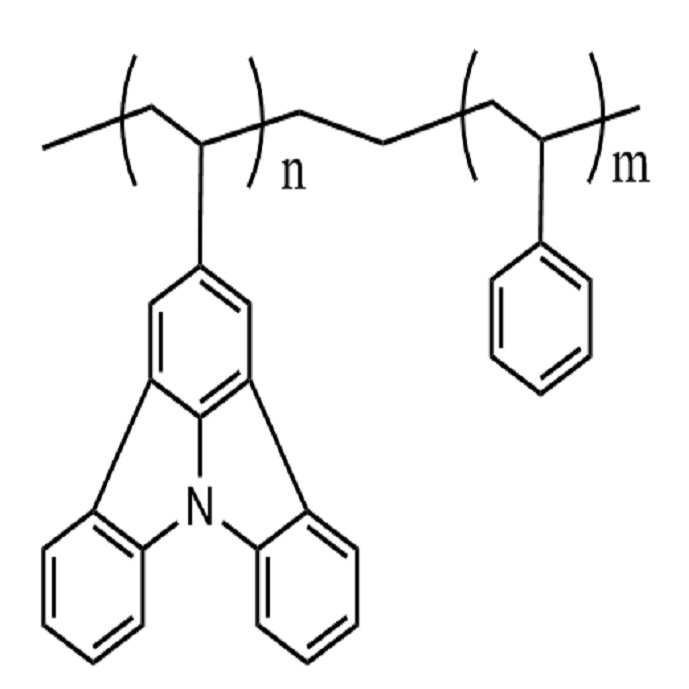
<중합체 F><Polymer F>

<중합체 a><Polymer a>
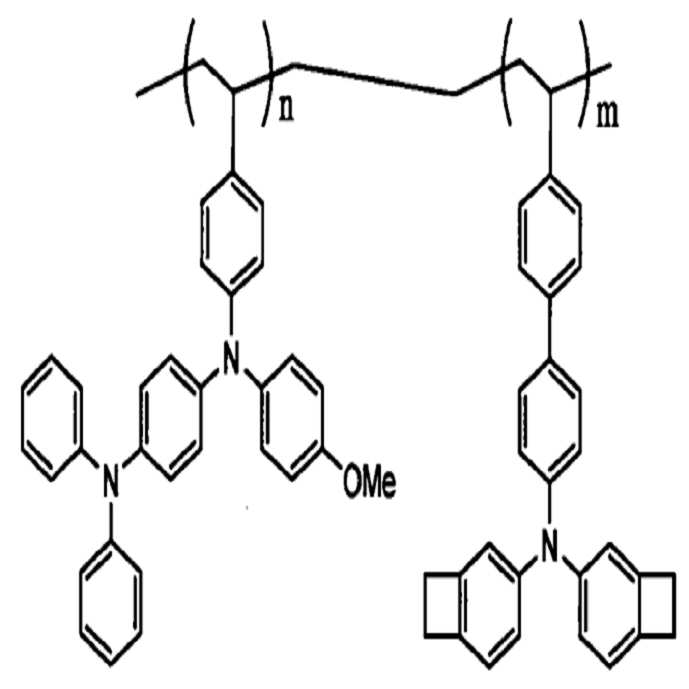
유기 발광 소자의 평가Evaluation of organic light emitting device
상기 제작한 유기 발광 소자의 전류 효율 및 발광 수명을 하기의 방법에 따라 평가하였다.The current efficiency and the luminescent lifetime of the thus fabricated organic luminescent device were evaluated according to the following methods.
직류 정전압 전원[소스 미터(source meter), KEYENCE사 제조]을 이용하여, 각 유기 발광 소자에 대하여 소정의 전압을 가하고, 유기 발광 소자를 발광시켰다. 유기 발광 소자의 발광을 휘도 측정 장치(SR-3, Topcom사 제조)에 의하여 측정하면서, 천천히 전류를 증가시켜 휘도가 3000 cd/m2이 되면 전류 밀도를 측정하여, 전류를 일정하게 유지하였다. 얻어진 전류 밀도로부터 전류 효율을 계산하였다.A predetermined voltage was applied to each of the organic light emitting elements using a DC constant voltage power source (source meter, manufactured by KEYENCE) to emit the organic light emitting element. While measuring the luminescence of the organic light emitting device by means of a luminance measuring device (SR-3, Topcom), the current density was slowly measured and the current was kept constant when the luminance was increased to 3000 cd / m 2 . The current efficiency was calculated from the obtained current density.
또한, 휘도 측정 장치로 측정한 휘도의 값이 천천히 낮아져 초기 휘도의 80%가 될 때까지의 시간을 발광 수명이라고 하였다.Further, the time until the value of the luminance measured by the luminance measuring device gradually lowers to 80% of the initial luminance is called the luminescence lifetime.
평가 결과를 하기 표 1에 나타내었다. 또한, 표 1에서, 전류 효율 및 발광 휘도는 비교예 1의 측정값을 100으로 하였을 때의 상대값으로 나타내었다.The evaluation results are shown in Table 1 below. In Table 1, the current efficiency and the light emission luminance are represented by relative values when the measured value of Comparative Example 1 is taken as 100.
그 결과를 표 1에 나타내었다.The results are shown in Table 1.
상기 표 1의 결과를 참조하면, 일 구현예에 따른 중합체를 정공 수송층의 재료로서 이용한 실시예 1 내지 6은, 비교예 1에 비하여 유기 발광 소자의 발광 효율 및 발광 수명이 향상된 것을 알 수 있다. Referring to the results of Table 1, it can be seen that Examples 1 to 6 using the polymer according to one embodiment as a material of the hole transport layer have improved luminous efficiency and luminescence lifetime of the organic light emitting device as compared with Comparative Example 1.
이상의 결과로부터 알 수 있는 바와 같이, 일 구현예에 따른 중합체는 용액 도포법에 의하여 효율적으로 성막하는 것이 가능하여, 유기 발광 소자의 발광 효율 및 발광 수명을 향상시킬 수 있다.As can be seen from the above results, the polymer according to one embodiment can be efficiently formed by the solution coating method, and the luminous efficiency and the luminescence lifetime of the organic light emitting device can be improved.
전술한 바와 같이, 특정한 축합 고리 구조를 포함하는 중합성 단량체가 반복되는 반복 단위를 포함하는 중합체를 제공하는 것이 가능하다. 이러한 중합체는 정공 주입 및 수송 재료로서 유용하고, 용액 처리에 적합한 우수한 용해도, 높은 열 안정성 및 높은 필름 균일성을 갖는다. 일 구현예에 따른 중합체를 이용하여 유기층을 형성할 경우에, 발광 효율과 발광 수명뿐 아니라 소자 특성이 우수하여, 도포법에 의하여 적층이 가능한 도포형 유기 발광 소자 재료로서 제공될 수 있다.As described above, it is possible to provide a polymer in which a polymerizable monomer containing a specific condensed ring structure contains repeating repeating units. Such polymers are useful as hole injecting and transporting materials, and have excellent solubility, high thermal stability, and high film uniformity suitable for solution processing. When the organic layer is formed using the polymer according to one embodiment, it can be provided as a coating type organic light emitting device material which is excellent in light emitting efficiency, light emission life time, and device characteristics and can be laminated by a coating method.
또한, 일 구현예에 따른 중합체는, 라디칼 중합에 의하여 합성이 가능하기 때문에, 축합 중합을 이용하는 유기 발광 소자 재료에 비하여 용이하게 제조가 가능하다. 또한, 본 발명의 중합체의 적용 범위는 유기 발광 소자의 분야에 한정되지 않으며, 전하 수송층으로서 사용 가능한 광범위한 분야에 사용될 수 있다.Further, since the polymer according to one embodiment can be synthesized by radical polymerization, the polymer can be easily produced compared with the organic light emitting element material using condensation polymerization. Further, the application range of the polymer of the present invention is not limited to the field of organic light emitting devices, and can be used in a wide range of fields that can be used as a charge transport layer.
이상, 첨부된 도면을 참조하여 본 발명의 바람직한 실시 형태를 상세히 설명하였으나, 본 발명의 범위는 전술한 예시에 의하여 한정되지 않는다. 본 발명이 속하는 기술 분야의 통상의 기술자라면 특허청구범위에 기재된 기술적 사상의 범위 내에서, 다양한 변경 및 수정을 생각해낼 수 있으며, 이에 대하여서도 당연히 본 발명의 기술적 범위 내에 속하는 것으로 이해되어야 한다.While the preferred embodiments of the present invention have been described in detail with reference to the accompanying drawings, it is to be understood that the scope of the present invention is not limited to the above embodiments. It will be understood by those skilled in the art that various changes and modifications may be made without departing from the spirit and scope of the invention as defined in the appended claims.
100: 유기 발광 소자
110: 기판
120: 제1전극
130: 정공 주입층
140: 정공 수송층
150: 발광층
160: 전자 수송층
170: 전자 주입층
180: 제2전극100: Organic light emitting device
110: substrate
120: first electrode
130: Hole injection layer
140: hole transport layer
150: light emitting layer
160: electron transport layer
170: electron injection layer
180: second electrode
Claims (20)
<화학식 1>

상기 화학식 1 중,
R1, R2 및 R3은 서로 독립적으로, 수소, 중수소, 불소; 탄소수 1 내지 10의 알킬실릴기; 탄소수 6 내지 30의 아릴실릴기; 치환 또는 비치환된 탄소수 1 내지 10의 알킬기; 치환 또는 비치환된 탄소수 6 내지 30의 아릴기; 및 치환 또는 비치환된 탄소수 1 내지 30의 헤테로아릴기 중에서 선택되고,
L은 단일 결합; 치환 또는 비치환된 탄소수 1 내지 10의 알킬렌기; 치환 또는 비치환된 탄소수 5 내지 30의 시클로알킬렌기; 치환 또는 비치환된 탄소수 6 내지 30의 아릴렌기; 및 치환 또는 비치환된 탄소수 1 내지 30의 헤테로아릴렌기 중에서 선택되되, 치환 또는 비치환된 카바졸릴렌기가 아니고,
A1 및 A2는 서로 독립적으로, 단일 결합; 산소 원자; 황 원자; 치환 또는 비치환된 탄소수 1 내지 10의 알킬렌기; 치환 또는 비치환된 탄소수 6 내지 30의 아릴렌기; 및 치환 또는 비치환된 탄소수 1 내지 30의 헤테로아릴렌기 중에서 선택되고,
A3는 치환 또는 비치환된 탄소수 1 내지 10의 3가의 알킬기; 치환 또는 비치환된 탄소수 6 내지 30의 3가의 아릴기; 및 치환 또는 비치환된 탄소수 1 내지 30의 3가의 헤테로아릴기 중에서 선택되고,
A4 및 A5는 서로 독립적으로, 치환 또는 비치환된 탄소수 1 내지 10의 알킬렌기; 치환 또는 비치환된 탄소수 6 내지 30의 아릴렌기; 및 치환 또는 비치환된 탄소수 1 내지 30의 헤테로아릴렌기 중에서 선택되고,
m은 1 내지 10의 정수이다.1. A polymer comprising a repeating unit represented by the following formula (1): < EMI ID =
≪ Formula 1 >
In Formula 1,
R 1 , R 2 and R 3 are, independently of each other, hydrogen, deuterium, fluorine; An alkylsilyl group having 1 to 10 carbon atoms; An arylsilyl group having 6 to 30 carbon atoms; A substituted or unsubstituted alkyl group having 1 to 10 carbon atoms; A substituted or unsubstituted C6 to C30 aryl; And a substituted or unsubstituted C1 to C30 heteroaryl group,
L is a single bond; A substituted or unsubstituted alkylene group having 1 to 10 carbon atoms; A substituted or unsubstituted cycloalkylene group having 5 to 30 carbon atoms; A substituted or unsubstituted arylene group having 6 to 30 carbon atoms; And a substituted or unsubstituted heteroarylene group having 1 to 30 carbon atoms, provided that it is not a substituted or unsubstituted carbazolylene group,
A 1 and A 2 are, independently of each other, a single bond; Oxygen atom; Sulfur atom; A substituted or unsubstituted alkylene group having 1 to 10 carbon atoms; A substituted or unsubstituted arylene group having 6 to 30 carbon atoms; And a substituted or unsubstituted heteroarylene group having 1 to 30 carbon atoms,
A 3 is a substituted or unsubstituted, tricyclic alkyl group having 1 to 10 carbon atoms; A substituted or unsubstituted tricyclic aryl group having 6 to 30 carbon atoms; And a substituted or unsubstituted trivalent heteroaryl group having 1 to 30 carbon atoms,
A 4 and A 5 independently represent a substituted or unsubstituted alkylene group having 1 to 10 carbon atoms; A substituted or unsubstituted arylene group having 6 to 30 carbon atoms; And a substituted or unsubstituted heteroarylene group having 1 to 30 carbon atoms,
m is an integer of 1 to 10;
<화학식 2>
상기 화학식 2 중,
R1, R2, R3, L, A1, A2 및 m은 제1항에서 정의된 바와 같고,
W1 내지 W11은 서로 독립적으로, N 또는 CX이고,
X는 수소; 중수소; 탄소수 1 내지 10의 알킬실릴기; 탄소수 6 내지 30의 아릴실릴기; 탄소수 1 내지 10의 알킬아미노기; 탄소수 6 내지 60의 아릴아미노기; 치환 또는 비치환된 탄소수 1 내지 10의 알킬기; 치환 또는 비치환된 탄소수 6 내지 30의 아릴기; 및 치환 또는 비치환된 탄소수 1 내지 30의 헤테로아릴기 중에서 선택된다.The polymer according to claim 1, wherein the repeating unit represented by the formula (1) is represented by the following formula (2):
(2)
In Formula 2,
R 1 , R 2 , R 3 , L, A 1 , A 2 and m are as defined in claim 1,
W 1 to W 11 are, independently of each other, N or CX,
X is hydrogen; heavy hydrogen; An alkylsilyl group having 1 to 10 carbon atoms; An arylsilyl group having 6 to 30 carbon atoms; An alkylamino group having 1 to 10 carbon atoms; An arylamino group having 6 to 60 carbon atoms; A substituted or unsubstituted alkyl group having 1 to 10 carbon atoms; A substituted or unsubstituted C6 to C30 aryl; And a substituted or unsubstituted heteroaryl group having 1 to 30 carbon atoms.
상기 제1 단위와 상기 제2 단위의 구조는 서로 상이한, 중합체.The polymer of claim 1, wherein the polymer comprises a first unit represented by Formula 1 and a second unit represented by Formula 1,
Wherein the structure of the first unit and the structure of the second unit are different from each other.
상기 구조들 중,
R4 내지 R10은 수소; 또는 치환 또는 비치환된 탄소수 1 내지 10의 알킬기이고,
p는 1 내지 10의 정수이다.12. The polymer of claim 11, wherein the crosslinker is selected from the group consisting of:
Among these structures,
R 4 to R 10 are hydrogen; Or a substituted or unsubstituted alkyl group having 1 to 10 carbon atoms,
p is an integer of 1 to 10;
상기 유기층은 제1항 내지 제15항 중 어느 한 항의 중합체를 포함하는, 유기 발광 소자.A first electrode; A second electrode; And an organic layer interposed between the first electrode and the second electrode;
Wherein the organic layer comprises the polymer of any one of claims 1 to 15.
Priority Applications (1)
| Application Number | Priority Date | Filing Date | Title |
|---|---|---|---|
| US15/391,959 US10050205B2 (en) | 2015-12-28 | 2016-12-28 | Polymer, organic light-emitting device material including the same, and organic light-emitting device including the organic light-emitting device material |
Applications Claiming Priority (2)
| Application Number | Priority Date | Filing Date | Title |
|---|---|---|---|
| JPJP-P-2015-257208 | 2015-12-28 | ||
| JP2015257208A JP6620015B2 (en) | 2015-12-28 | 2015-12-28 | Polymer, material for organic electroluminescence device, and organic electroluminescence device |
Publications (2)
| Publication Number | Publication Date |
|---|---|
| KR20170077774A true KR20170077774A (en) | 2017-07-06 |
| KR102912590B1 KR102912590B1 (en) | 2026-01-13 |
Family
ID=59271928
Family Applications (1)
| Application Number | Title | Priority Date | Filing Date |
|---|---|---|---|
| KR1020160146910A Active KR102912590B1 (en) | 2015-12-28 | 2016-11-04 | Polymer, organic light-emitting device material including the same, and organic light-emitting device including the same |
Country Status (2)
| Country | Link |
|---|---|
| JP (1) | JP6620015B2 (en) |
| KR (1) | KR102912590B1 (en) |
Cited By (3)
| Publication number | Priority date | Publication date | Assignee | Title |
|---|---|---|---|---|
| WO2020027589A1 (en) * | 2018-07-31 | 2020-02-06 | 주식회사 엘지화학 | Novel polymer and organic light-emitting device comprising same |
| US12054565B2 (en) | 2018-07-31 | 2024-08-06 | Lg Chem, Ltd. | Polymer and organic light emitting device comprising the same |
| US12071508B2 (en) | 2018-08-16 | 2024-08-27 | Lg Chem, Ltd. | Polymers, use thereof as hole transport material, and organic electronic devices comprising same |
Families Citing this family (1)
| Publication number | Priority date | Publication date | Assignee | Title |
|---|---|---|---|---|
| JP7651296B2 (en) | 2020-12-22 | 2025-03-26 | 三星電子株式会社 | Copolymer, and electroluminescent device material and electroluminescent device using said copolymer |
Citations (3)
| Publication number | Priority date | Publication date | Assignee | Title |
|---|---|---|---|---|
| JP2006086235A (en) * | 2004-09-14 | 2006-03-30 | Fuji Photo Film Co Ltd | ORGANIC ELECTROLUMINESCENT ELEMENT, AZEPINE COMPOUND AND METHOD FOR PRODUCING SAME |
| KR20120129922A (en) * | 2010-01-25 | 2012-11-28 | 메르크 파텐트 게엠베하 | Compounds for electronic devices |
| KR20140020975A (en) * | 2011-03-31 | 2014-02-19 | 신닛테츠 수미킨 가가쿠 가부시키가이샤 | Polymer for organic electroluminescent elements, and organic electroluminescent element using cured product of same |
-
2015
- 2015-12-28 JP JP2015257208A patent/JP6620015B2/en active Active
-
2016
- 2016-11-04 KR KR1020160146910A patent/KR102912590B1/en active Active
Patent Citations (3)
| Publication number | Priority date | Publication date | Assignee | Title |
|---|---|---|---|---|
| JP2006086235A (en) * | 2004-09-14 | 2006-03-30 | Fuji Photo Film Co Ltd | ORGANIC ELECTROLUMINESCENT ELEMENT, AZEPINE COMPOUND AND METHOD FOR PRODUCING SAME |
| KR20120129922A (en) * | 2010-01-25 | 2012-11-28 | 메르크 파텐트 게엠베하 | Compounds for electronic devices |
| KR20140020975A (en) * | 2011-03-31 | 2014-02-19 | 신닛테츠 수미킨 가가쿠 가부시키가이샤 | Polymer for organic electroluminescent elements, and organic electroluminescent element using cured product of same |
Cited By (3)
| Publication number | Priority date | Publication date | Assignee | Title |
|---|---|---|---|---|
| WO2020027589A1 (en) * | 2018-07-31 | 2020-02-06 | 주식회사 엘지화학 | Novel polymer and organic light-emitting device comprising same |
| US12054565B2 (en) | 2018-07-31 | 2024-08-06 | Lg Chem, Ltd. | Polymer and organic light emitting device comprising the same |
| US12071508B2 (en) | 2018-08-16 | 2024-08-27 | Lg Chem, Ltd. | Polymers, use thereof as hole transport material, and organic electronic devices comprising same |
Also Published As
| Publication number | Publication date |
|---|---|
| KR102912590B1 (en) | 2026-01-13 |
| JP2017119785A (en) | 2017-07-06 |
| JP6620015B2 (en) | 2019-12-11 |
Similar Documents
| Publication | Publication Date | Title |
|---|---|---|
| KR102132591B1 (en) | Iridium complex compound, composition containing iridium complex compound, organic electroluminescent element, display device and lighting device | |
| JP7367574B2 (en) | aromatic compounds | |
| KR102703711B1 (en) | Copolymer, organic light-emitting device material including the same, and organic light-emitting device including the same | |
| US10336772B2 (en) | Bicarbazole compound, material for organic light-emitting device including bicarbazole compound, and organic light-emitting device including bicarbazole compound | |
| JP2016119340A (en) | Material for organic electroluminescent element | |
| KR102792548B1 (en) | Bicarbazole compound, material for organic light-emitting device including the same and organic light-emitting device including the same | |
| JP7260187B2 (en) | Heterocyclic compound and organic light-emitting device containing the same | |
| JP7513022B2 (en) | Organic electroluminescent device and display device | |
| JP6652351B2 (en) | Aminofluorene polymer, material for organic electroluminescence device, and organic electroluminescence device | |
| JPWO2019177175A1 (en) | Polymers, compositions for organic electroluminescent devices, organic electroluminescent devices, organic EL display devices, organic EL lighting, and methods for manufacturing organic electroluminescent devices. | |
| JPWO2020171190A1 (en) | Polymers, organic electroluminescent devices, organic EL display devices and organic EL lighting | |
| JP6866576B2 (en) | Polymers, compositions for organic electroluminescent devices, organic electroluminescent devices, organic EL display devices and organic EL lighting | |
| US10193069B2 (en) | Polymer for use in organic electroluminescent element and organic electroluminescent element employing same | |
| KR102912590B1 (en) | Polymer, organic light-emitting device material including the same, and organic light-emitting device including the same | |
| KR20160091806A (en) | Amine derivatives, material for organic electroluminescent device comprising the same and organic electroluminescent device using the same | |
| US10050205B2 (en) | Polymer, organic light-emitting device material including the same, and organic light-emitting device including the organic light-emitting device material | |
| KR102443233B1 (en) | Heterocyclic compound and organic light emitting device comprising the same | |
| KR102371109B1 (en) | Copolymer and organic light emitting device comprising the same | |
| EP3138858B1 (en) | Amino fluorene polymer and organic light-emitting device including the same | |
| KR20160091805A (en) | Amine derivatives, material for organic electroluminescent device comprising the same and organic electroluminescent device using the same | |
| JP2018109088A (en) | Vinyl amino arylene polymer, and material for organic electroluminescent element and organic electroluminescent element prepared therewith | |
| US10040887B2 (en) | Copolymer, organic light-emitting device material including the same, and organic light-emitting device including the organic light-emitting device material | |
| JP2025128136A (en) | Composition for organic electroluminescent device, organic electroluminescent device, display device and lighting device | |
| WO2021166900A1 (en) | Organic electroluminescent element, organic el display device, and organic el lighting | |
| KR102706857B1 (en) | Novel polymer and organic light emitting device comprising the same |
Legal Events
| Date | Code | Title | Description |
|---|---|---|---|
| PA0109 | Patent application |
St.27 status event code: A-0-1-A10-A12-nap-PA0109 |
|
| PG1501 | Laying open of application |
St.27 status event code: A-1-1-Q10-Q12-nap-PG1501 |
|
| A201 | Request for examination | ||
| PA0201 | Request for examination |
St.27 status event code: A-1-2-D10-D11-exm-PA0201 |
|
| P22-X000 | Classification modified |
St.27 status event code: A-2-2-P10-P22-nap-X000 |
|
| P22-X000 | Classification modified |
St.27 status event code: A-2-2-P10-P22-nap-X000 |
|
| PE0902 | Notice of grounds for rejection |
St.27 status event code: A-1-2-D10-D21-exm-PE0902 |
|
| E13-X000 | Pre-grant limitation requested |
St.27 status event code: A-2-3-E10-E13-lim-X000 |
|
| P11-X000 | Amendment of application requested |
St.27 status event code: A-2-2-P10-P11-nap-X000 |
|
| P13-X000 | Application amended |
St.27 status event code: A-2-2-P10-P13-nap-X000 |
|
| E902 | Notification of reason for refusal | ||
| PE0902 | Notice of grounds for rejection |
St.27 status event code: A-1-2-D10-D21-exm-PE0902 |
|
| P11-X000 | Amendment of application requested |
St.27 status event code: A-2-2-P10-P11-nap-X000 |
|
| D22 | Grant of ip right intended |
Free format text: ST27 STATUS EVENT CODE: A-1-2-D10-D22-EXM-PE0701 (AS PROVIDED BY THE NATIONAL OFFICE) |
|
| PE0701 | Decision of registration |
St.27 status event code: A-1-2-D10-D22-exm-PE0701 |
|
| F11 | Ip right granted following substantive examination |
Free format text: ST27 STATUS EVENT CODE: A-2-4-F10-F11-EXM-PR0701 (AS PROVIDED BY THE NATIONAL OFFICE) |
|
| PR0701 | Registration of establishment |
St.27 status event code: A-2-4-F10-F11-exm-PR0701 |
|
| PR1002 | Payment of registration fee |
St.27 status event code: A-2-2-U10-U11-oth-PR1002 Fee payment year number: 1 |
|
| U11 | Full renewal or maintenance fee paid |
Free format text: ST27 STATUS EVENT CODE: A-2-2-U10-U11-OTH-PR1002 (AS PROVIDED BY THE NATIONAL OFFICE) Year of fee payment: 1 |
|
| PG1601 | Publication of registration |
St.27 status event code: A-4-4-Q10-Q13-nap-PG1601 |
|
| Q13 | Ip right document published |
Free format text: ST27 STATUS EVENT CODE: A-4-4-Q10-Q13-NAP-PG1601 (AS PROVIDED BY THE NATIONAL OFFICE) |