KR20170077886A - High-strength and low-density aluminum-lithium alloy and Preparation method of alloy wrought products using the same - Google Patents
High-strength and low-density aluminum-lithium alloy and Preparation method of alloy wrought products using the same Download PDFInfo
- Publication number
- KR20170077886A KR20170077886A KR1020150187254A KR20150187254A KR20170077886A KR 20170077886 A KR20170077886 A KR 20170077886A KR 1020150187254 A KR1020150187254 A KR 1020150187254A KR 20150187254 A KR20150187254 A KR 20150187254A KR 20170077886 A KR20170077886 A KR 20170077886A
- Authority
- KR
- South Korea
- Prior art keywords
- aluminum
- lithium alloy
- lithium
- alloy
- strength
- Prior art date
- Legal status (The legal status is an assumption and is not a legal conclusion. Google has not performed a legal analysis and makes no representation as to the accuracy of the status listed.)
- Withdrawn
Links
Images


Classifications
-
- C—CHEMISTRY; METALLURGY
- C22—METALLURGY; FERROUS OR NON-FERROUS ALLOYS; TREATMENT OF ALLOYS OR NON-FERROUS METALS
- C22C—ALLOYS
- C22C21/00—Alloys based on aluminium
- C22C21/06—Alloys based on aluminium with magnesium as the next major constituent
-
- B—PERFORMING OPERATIONS; TRANSPORTING
- B21—MECHANICAL METAL-WORKING WITHOUT ESSENTIALLY REMOVING MATERIAL; PUNCHING METAL
- B21B—ROLLING OF METAL
- B21B1/00—Metal-rolling methods or mills for making semi-finished products of solid or profiled cross-section; Sequence of operations in milling trains; Layout of rolling-mill plant, e.g. grouping of stands; Succession of passes or of sectional pass alternations
- B21B1/22—Metal-rolling methods or mills for making semi-finished products of solid or profiled cross-section; Sequence of operations in milling trains; Layout of rolling-mill plant, e.g. grouping of stands; Succession of passes or of sectional pass alternations for rolling plates, strips, bands or sheets of indefinite length
-
- B—PERFORMING OPERATIONS; TRANSPORTING
- B21—MECHANICAL METAL-WORKING WITHOUT ESSENTIALLY REMOVING MATERIAL; PUNCHING METAL
- B21C—MANUFACTURE OF METAL SHEETS, WIRE, RODS, TUBES, PROFILES OR LIKE SEMI-MANUFACTURED PRODUCTS OTHERWISE THAN BY ROLLING; AUXILIARY OPERATIONS USED IN CONNECTION WITH METAL-WORKING WITHOUT ESSENTIALLY REMOVING MATERIAL
- B21C23/00—Extruding metal; Impact extrusion
-
- B—PERFORMING OPERATIONS; TRANSPORTING
- B22—CASTING; POWDER METALLURGY
- B22D—CASTING OF METALS; CASTING OF OTHER SUBSTANCES BY THE SAME PROCESSES OR DEVICES
- B22D7/00—Casting ingots, e.g. from ferrous metals
- B22D7/005—Casting ingots, e.g. from ferrous metals from non-ferrous metals
-
- C—CHEMISTRY; METALLURGY
- C22—METALLURGY; FERROUS OR NON-FERROUS ALLOYS; TREATMENT OF ALLOYS OR NON-FERROUS METALS
- C22C—ALLOYS
- C22C1/00—Making non-ferrous alloys
- C22C1/02—Making non-ferrous alloys by melting
-
- C—CHEMISTRY; METALLURGY
- C22—METALLURGY; FERROUS OR NON-FERROUS ALLOYS; TREATMENT OF ALLOYS OR NON-FERROUS METALS
- C22F—CHANGING THE PHYSICAL STRUCTURE OF NON-FERROUS METALS AND NON-FERROUS ALLOYS
- C22F1/00—Changing the physical structure of non-ferrous metals or alloys by heat treatment or by hot or cold working
- C22F1/02—Changing the physical structure of non-ferrous metals or alloys by heat treatment or by hot or cold working in inert or controlled atmosphere or vacuum
-
- C—CHEMISTRY; METALLURGY
- C22—METALLURGY; FERROUS OR NON-FERROUS ALLOYS; TREATMENT OF ALLOYS OR NON-FERROUS METALS
- C22F—CHANGING THE PHYSICAL STRUCTURE OF NON-FERROUS METALS AND NON-FERROUS ALLOYS
- C22F1/00—Changing the physical structure of non-ferrous metals or alloys by heat treatment or by hot or cold working
- C22F1/04—Changing the physical structure of non-ferrous metals or alloys by heat treatment or by hot or cold working of aluminium or alloys based thereon
-
- C—CHEMISTRY; METALLURGY
- C22—METALLURGY; FERROUS OR NON-FERROUS ALLOYS; TREATMENT OF ALLOYS OR NON-FERROUS METALS
- C22F—CHANGING THE PHYSICAL STRUCTURE OF NON-FERROUS METALS AND NON-FERROUS ALLOYS
- C22F1/00—Changing the physical structure of non-ferrous metals or alloys by heat treatment or by hot or cold working
- C22F1/04—Changing the physical structure of non-ferrous metals or alloys by heat treatment or by hot or cold working of aluminium or alloys based thereon
- C22F1/047—Changing the physical structure of non-ferrous metals or alloys by heat treatment or by hot or cold working of aluminium or alloys based thereon of alloys with magnesium as the next major constituent
Landscapes
- Chemical & Material Sciences (AREA)
- Engineering & Computer Science (AREA)
- Mechanical Engineering (AREA)
- Materials Engineering (AREA)
- Metallurgy (AREA)
- Organic Chemistry (AREA)
- Physics & Mathematics (AREA)
- Thermal Sciences (AREA)
- Crystallography & Structural Chemistry (AREA)
- Continuous Casting (AREA)
Abstract
본 발명은 고강도 저밀도 알루미늄-리튬 합금 및 이를 이용한 알루미늄-리튬 합금 가공품 제조방법에 관한 것이다. 상세하게는, 총 합금 중량에 대하여 마그네슘 7 내지 9 중량% 및 리튬 1.5 내지 2.5 중량%를 포함하는 고강도 저밀도 알루미늄-리튬 합금 및 상기 알루미늄-리튬 합금을 용해 및 주조하는 단계(단계 1); 상기 용해 및 주조된 알루미늄-리튬 합금 용탕으로부터 알루미늄-리튬 합금 잉곳을 제조하는 단계(단계 2); 상기 알루미늄-리튬 합금 잉곳을 균질화 열처리하는 단계(단계 3); 및 상기 균질화 열처리된 알루미늄-리튬 합금 잉곳으로부터 가공품을 제조하는 단계(단계 4);를 포함하는 고강도 저밀도 알루미늄-리튬 합금 가공품의 제조방법에 관한 것이다.
또한 본 발명은 상기 제조방법으로 제조되며, 550 MPa 내지 580 MPa의 인장강도 및 2.46 내지 2.40 g/cm3의 밀도를 갖는 것을 특징으로 하는 고강도 저밀도 알루미늄-리튬 합금 가공품에 관한 것으로, 종래의 알루미늄-리튬 합금의 비하여 강도는 유지 또는 향상되면서 무게가 매우 가벼운 특징을 나타내므로, 자동차, 항공기, 기차, 선박, 휴대폰, 노트북 등에 상기 알루미늄-리튬 합금 가공품을 사용할 경우, 제품의 무게를 획기적으로 감소시킬 수 있는 장점이 있다.The present invention relates to a high-strength and low-density aluminum-lithium alloy and a method for manufacturing an aluminum-lithium alloy processed product using the same. In detail, a high-strength low-density aluminum-lithium alloy containing 7 to 9 wt% of magnesium and 1.5 to 2.5 wt% of lithium relative to the total alloy weight and a step (step 1) of dissolving and casting the aluminum-lithium alloy; Preparing an aluminum-lithium alloy ingot from the molten and cast aluminum-lithium alloy melt (step 2); A step (step 3) of subjecting the aluminum-lithium alloy ingot to homogenization heat treatment; And a step (step 4) of producing a work piece from the homogenized heat-treated aluminum-lithium alloy ingot. The present invention also relates to a method of manufacturing a high-strength low-density aluminum-lithium alloy workpiece.
The present invention also relates to a high-strength and low-density aluminum-lithium alloy manufactured by the above-described method and having a tensile strength of 550 MPa to 580 MPa and a density of 2.46 to 2.40 g / cm 3 . The weight of the product can be significantly reduced when the aluminum-lithium alloy processed product is used in automobiles, airplanes, trains, ships, mobile phones, notebooks, etc. since the strength of the lithium alloy is maintained or improved. There is an advantage.
Description
본 발명은 고강도 저밀도 알루미늄-리튬 합금 및 이를 이용한 알루미늄-리튬 합금 가공품 제조방법에 관한 것이다.The present invention relates to a high-strength and low-density aluminum-lithium alloy and a method for manufacturing an aluminum-lithium alloy processed product using the same.
최근 수송기기 부품의 경량화를 통하여 연료를 절감시키고자 하는 추세에 따라서 고비강도 소재에 대한 요구가 증가하고 있다. 특히 항공기는 무게 감소에 따른 연료 절감 효과가 매우 커서 고비강도 소재에 대한 요구가 꾸준히 요구되어 왔다. 항공기의 무게 감소는 대부분 동체와 날개와 같이 구조체의 무게 감소에 의해서 가능하므로 구조체에 사용되는 소재에 대한 경량화는 필수적이다. 알루미늄합금은 낮은 밀도와 우수한 기계적 성질로 인하여 예로부터 항공기 구조용 소재로 가장 널리 사용되어 왔지만 최근 항공기 무게의 추가적인 감소를 위해서는 비강도가 향상된 새로운 합금이 개발되어야 하는 상황이다. Recently, there is an increasing demand for high-strength materials in accordance with the tendency to reduce fuel through lightening of transportation device parts. In particular, the aircraft has a very high fuel saving effect due to the weight reduction, so there has been a constant demand for high strength materials. The weight reduction of an aircraft can be made by reducing the weight of a structure such as a fuselage and a wing, so weight reduction of the material used in the structure is essential. Aluminum alloys have been used extensively as structural materials for aircraft due to their low density and excellent mechanical properties. Recently, however, new alloys with improved non-strength have been developed to further reduce aircraft weight.
최근 주목을 받고 있는 경량금속재료에 대한 것으로, 주 대상 재료는 알루미늄(Al), 마그네슘(Mg) 및 티타늄(Ti) 등이다. 밀도가 철강의 몇 분의 일밖에 안되는 경량금속 및 그 합금들은 비강도(인장강도/밀도)가 크게 요구되는 항공기 및 육상 운송장비용 신재료로서 그 용도가 크게 증대되고 있는 실정이다. Aluminum (Al), magnesium (Mg), titanium (Ti), and the like are mainly used for lightweight metal materials which have recently attracted attention. Lightweight metals and their alloys whose density is only a fraction of that of steel are new materials for aircraft and land transportation equipment that require high strength (tensile strength / density).
알루미늄은 낮은 밀도에도 불구하고 비강도가 높고, 특히 다양한 합금가능성을 갖고 있어 일부 합금은 다소 높은 온도에까지 사용할 수 있으며, 소성가공성이 좋고 전기전도도도 우수하여 구조 및 기능금속으로서 그 수요가 앞으로도 계속 증가할 대표적인 비철재료이다. 이에, 알루미늄을 기재로 하여 경량화하고, 이에 다른 원소를 첨가하여 비강도 값이 높은 합금을 제조하기 위한 노력이 지속되고 있다.Aluminum has a high specific strength in spite of its low density, and it has a wide variety of alloying possibilities. Some alloys can be used at a rather high temperature, and they have good plastic workability and excellent electrical conductivity. It is a representative non-ferrous material. Accordingly, efforts have been made to manufacture an alloy having a high non-strength value by reducing the weight of aluminum as a base material and adding other elements thereto.
그 중 알루미늄-리튬 합금은 대표적인 항공기 구조용 소재로서 강도, 피로수명이 우수할 뿐 아니라 다른 알루미늄합금에 비하여 밀도가 낮은 장점이 있다. 알루미늄-리튬 합금의 총 중량대비 리튬을 약1 중량% 첨가하면 밀도가 약 3% 감소한다. 이러한 낮은 밀도는 다른 알루미늄 합금이 갖지 않는 알루미늄-리튬 합금만의 특징이다. 이에, 항공기 경량화를 위해서는 소재 밀도 감소가 가장 효과적임을 감안할 때 알루미늄-리튬 합금은 항공기용 소재로서 최적이라 할 수 있다. 또한, 알루미늄-리튬 합금은 리튬과 함께 구리, 마그네슘 등의 합금원소를 첨가함으로써 우수한 강도를 얻을 수 있다. Among them, aluminum-lithium alloy is a typical structural material for aircraft, and has excellent strength and fatigue life, and has a lower density than other aluminum alloys. The addition of about 1% by weight of lithium relative to the total weight of the aluminum-lithium alloy reduces the density by about 3%. This low density is characteristic of aluminum-lithium alloys that do not have other aluminum alloys. Therefore, considering that material density reduction is most effective for lighter aircraft, aluminum-lithium alloy is the best material for aircraft. In addition, an aluminum-lithium alloy can obtain excellent strength by adding alloying elements such as copper and magnesium together with lithium.
지금까지 많은 종류의 알루미늄-리튬 합금이 개발되었으며 현재 항공기용으로 사용되고 있는 알루미늄-리튬 합금은 인장강도 약 500 MPa 내외, 밀도 약2.6 g/cm3 내외의 값을 갖고 있다. A number of aluminum-lithium alloys have been developed and aluminum-lithium alloys currently used in aircraft have a tensile strength of about 500 MPa and a density of about 2.6 g / cm 3 .
이와 관련하여 고강도 저밀도 알루미늄-리튬 합금을 제조한 일례로써 종래의 기술을 살펴보면, 대한민국 공개특허 제10-2003-7001508호에서는 고강도 저밀도를 갖는 알루미늄-구리-리튬 합금이 개시된 바 있다. 상세하게는 구리, 리튬, 지르코늄, 스칸듐, 철과 마그네슘 및 망간으로 이루어진 군으로부터 선택된 원소를 포함한 알루미늄 합금에 실리콘, 베릴륨, 마그네슘, 망간, 아연, 게르마늄, 이트륨, 세륨 및 티타늄으로 이루어진 군으로부터 선택된 적어도 하나의 원소를 포함하고 Cu/Li 비율은 1.9-2.3인 합금을 개시한 바 있으며, JOURNAL OF MATERIALS SCIENCE, Vol.29, 5826-5832(1994)에서는 밀도 약 543 MPa 및 인장강도 약 2.51 g/cm3을 나타내는 알루미늄-마그네슘-리튬 합금을 개시한 바 있다. In this connection, as an example of manufacturing a high-strength low-density aluminum-lithium alloy, Korean Patent Laid-Open No. 10-2003-7001508 discloses an aluminum-copper-lithium alloy having a high strength and a low density. And at least one selected from the group consisting of silicon, beryllium, magnesium, manganese, zinc, germanium, yttrium, cerium and titanium is added to an aluminum alloy containing elements selected from the group consisting of copper, lithium, zirconium, scandium, iron, magnesium and manganese. JOURNAL OF MATERIALS SCIENCE, Vol. 29, 5826-5832 (1994) discloses an alloy having a density of about 543 MPa and a tensile strength of about 2.51 g / cm 3 < / RTI >
그러나 앞서 언급한 바와 같이, 항공기 경량화를 위해서는 고강도를 유지하면서 밀도를 감소시키는 것이 가장 효과적인 방법이므로 초저밀도의 알루미늄-리튬 합금이 개발되면 항공기의 추가적인 경량화가 가능하다. 이에, 최근 항공기 경량화 추세를 만족시키기 위하여 밀도가 더욱 감소되고 강도가 향상된 새로운 합금이 개발할 필요가 있다. However, as mentioned above, reducing the density while maintaining high strength is the most effective way to lighten the aircraft. Therefore, it is possible to further reduce the weight of the aircraft when ultra-low density aluminum-lithium alloy is developed. Therefore, it is necessary to develop a new alloy having a reduced density and improved strength in order to satisfy the trend of light weight of aircraft in recent years.
이에 본 발명자들은 인장강도 550 내지 580 MPa 및 밀도 2.4 내지 2.46 g/cm3를 갖는 알루미늄, 마그네슘, 리튬, 망간, 지르코늄 및 베릴륨을 포함하는 알루미늄-리튬 합금 및 상기 제조된 합금을 이용하여 고강도 저밀도 합금 가공품을 제조하는 방법을 개발하고 본 발명을 완성하였다. The present inventors have found that the aluminum containing aluminum, magnesium, lithium, manganese, zirconium and beryllium having a tensile strength of 550 to 580 MPa and a density of 2.4 to 2.46 g / cm 3 - High-strength low-density alloy with a lithium alloy and the produced alloy The present inventors have developed a method for manufacturing a processed product and completed the present invention.
본 발명의 목적은 고강도 저밀도 알루미늄-리튬 합금 및 이를 이용한 알루미늄-리튬 합금 가공품 제조방법을 제공하는 데 있다.It is an object of the present invention to provide a high-strength and low-density aluminum-lithium alloy and a method of manufacturing an aluminum-lithium alloy processed product using the same.
상기 목적을 달성하기 위하여, 본 발명은In order to achieve the above object,
총 합금 중량에 대하여 마그네슘 7 내지 9 중량% 및 리튬 1.5 내지 2.5 중량%를 포함하는 고강도 저밀도 알루미늄-리튬 합금을 제공한다.A high-strength low-density aluminum-lithium alloy including 7 to 9 wt% of magnesium and 1.5 to 2.5 wt% of lithium based on the total alloy weight.
또한, 본 발명은In addition,
상기 알루미늄-리튬 합금을 용해 및 주조하는 단계(단계 1);Melting and casting the aluminum-lithium alloy (step 1);
상기 용해 및 주조된 알루미늄-리튬 합금 용탕으로부터 알루미늄-리튬 합금 잉곳을 제조하는 단계(단계 2);Preparing an aluminum-lithium alloy ingot from the molten and cast aluminum-lithium alloy melt (step 2);
상기 알루미늄-리튬 합금 잉곳을 균질화 열처리하는 단계(단계 3); 및A step (step 3) of subjecting the aluminum-lithium alloy ingot to homogenization heat treatment; And
상기 균질화 열처리된 알루미늄-리튬 합금 잉곳으로부터 가공품을 제조하는 단계(단계 4);를 포함하는 고강도 저밀도 알루미늄-리튬 합금 가공품의 제조방법을 제공한다. And a step (step 4) of producing a work piece from the homogenized heat-treated aluminum-lithium alloy ingot. The present invention also provides a method of manufacturing a high-strength low-density aluminum-lithium alloy workpiece.
나아가, 본 발명은Further,
상기 제조방법으로 제조되며, 550 MPa 내지 580 MPa의 인장강도 및 2.46 내지 2.40 g/cm3의 밀도를 갖는 것을 특징으로 하는 고강도 저밀도 알루미늄-리튬 합금 가공품을 제공한다.A high-strength, low-density aluminum-lithium alloy manufactured by the above-described method has a tensile strength of 550 MPa to 580 MPa and a density of 2.46 to 2.40 g / cm 3 .
더 나아가, 본 발명은Further,
상기 고강도 저밀도 알루미늄-리튬 합금 가공품을 포함하는 수송기기 부품을 제공한다.And a high-strength and low-density aluminum-lithium alloy processed product.
본 발명의 알루미늄-리튬 합금은, 종래의 알루미늄-리튬 합금의 비하여 강도는 유지 또는 향상되면서 무게가 매우 가벼운 특징을 나타내므로, 자동차, 항공기, 기차, 선박, 휴대폰, 노트북 등에 상기 알루미늄-리튬 합금을 사용할 경우, 제품의 무게를 획기적으로 감소시킬 수 있는 장점이 있다.The aluminum-lithium alloy of the present invention exhibits a very light weight feature as the strength of the aluminum-lithium alloy is maintained or improved as compared with the conventional aluminum-lithium alloy. Therefore, the aluminum-lithium alloy of the present invention can be used for automobiles, aircraft, trains, ships, When used, there is an advantage that the weight of the product can be drastically reduced.
도 1은 본 발명에 따른 실시예 1, 비교예 1 내지 3 및 종래의 알루미늄-리튬 합금 압출봉의 마그네슘 및 리튬 함량을 나타낸 그래프이고,
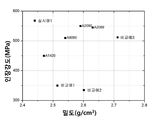
도 2는 본 발명에 따른 실시예 1, 비교예 1 내지 3 및 종래의 알루미늄-리튬 합금 압출봉의 밀도 및 인장강도를 나타낸 그래프이고,
도 3은 본 발명에 따른 실시예 1의 알루미늄-리튬 합금 압출봉의 미세조직 사진이다.1 is a graph showing magnesium and lithium contents of Example 1, Comparative Examples 1 to 3 and a conventional aluminum-lithium alloy extrusion rod according to the present invention,
FIG. 2 is a graph showing the density and tensile strength of Example 1, Comparative Examples 1 to 3 and conventional aluminum-lithium alloy extruded rods according to the present invention,
3 is a microstructure photograph of an aluminum-lithium alloy extrusion rod according to Example 1 of the present invention.
본 발명은,According to the present invention,
총 합금 중량에 대하여 마그네슘 7 내지 9 중량% 및 리튬 1.5 내지 2.5 중량%를 포함하는 고강도 저밀도 알루미늄-리튬 합금을 제공한다.A high-strength low-density aluminum-lithium alloy including 7 to 9 wt% of magnesium and 1.5 to 2.5 wt% of lithium based on the total alloy weight.
이하, 본 발명의 알루미늄-리튬 합금을 상세히 설명한다.Hereinafter, the aluminum-lithium alloy of the present invention will be described in detail.
상기 알루미늄-리튬 합금은 총 합금 중량에 대하여 마그네슘을 7 내지 9 중량%를 포함하는 것이 바람직하다.The aluminum-lithium alloy preferably contains magnesium in an amount of 7 to 9 wt% based on the total weight of the alloy.
상기 마그네슘은 첨가량이 증가함에 따라서 재료의 강도를 지속적으로 증가시킬 수 있다. 한편, 우수한 강도를 얻기 위해서는 고용강화 및 석출강화에 의한 강도 향상이 필요하다. 그러나 상기 마그네슘이 7 중량% 미만 첨가될 경우, 고용강화가 일어날 수는 있으나, 석출 강화가 발생하지 않을 수 있다. 한편, 상기 마그네슘 함량이 9 중량%를 초과하여 첨가될 경우, 상기 합금을 용해 및 주조하는 과정 에서 편석이 발생하기 쉽고 열간 가공성이 떨어질 수 있어, 마그네슘을 7 내지 9 중량%로 포함하는 것이 바람직하다.The magnesium can continuously increase the strength of the material as the added amount increases. On the other hand, in order to obtain excellent strength, it is necessary to improve strength by solid solution strengthening and precipitation strengthening. However, when magnesium is added in an amount of less than 7% by weight, solid solution strengthening may occur but precipitation strengthening may not occur. On the other hand, when the magnesium content is more than 9% by weight, segregation may easily occur and hot workability may be deteriorated in the process of dissolving and casting the alloy, and magnesium is preferably contained in an amount of 7 to 9% by weight .
또한, 상기 알루미늄-리튬 합금은 총 합금 중량에 대하여 리튬을 1.5 내지 2.5 중량%로 포함하는 것이 바람직하다.The aluminum-lithium alloy preferably contains 1.5 to 2.5% by weight of lithium relative to the total weight of the alloy.
상기 리튬은 합금의 밀도를 낮추고 탄성계수는 증가시키는 효과가 나타날 수 있다. 그러나 리튬 함량이 1 중량% 미만일 경우, 밀도 감소 및 물성 향상의 효과가 미미할 수 있고 또한, 리튬 함량이 2.5 중량%를 초과할 경우, 리튬의 반응성으로 인하여 용해 및 주조가 어려울 수 있다. 이에, 리튬을 1.0 내지 2.5 중량%로 포함하는 것이 바람직하다.The lithium may lower the density of the alloy and increase the modulus of elasticity. However, when the lithium content is less than 1% by weight, the effect of reducing the density and improving the physical properties may be insignificant. When the lithium content exceeds 2.5% by weight, dissolution and casting may be difficult due to the reactivity of lithium. Therefore, lithium is preferably contained in an amount of 1.0 to 2.5% by weight.
또한, 상기 알루미늄-리튬 합금은 총 합금 중량에 대하여 망간을 0.2 내지 0.35 중량% 더 포함할 수 있다.The aluminum-lithium alloy may further contain 0.2 to 0.35 wt% of manganese based on the total weight of the alloy.
상기 망간은 합금의 강도를 증가시키고 결정립 구조를 제어시킬 수 있다. 특히, 마그네슘을 포함하는 상기 알루미늄-리튬 합금에 상기 망간을 첨가할 경우, 합금의 강도를 더욱 향상시킬 수 있다. 이에, 상기 망간을 상기 알루미늄-리튬 합금에 첨가함으로써 합금의 결정립 크기를 제어할 수 있고, 강도를 향상시킬 수 있다. 그러나 상기 망간을 0.2 중량% 미만 첨가할 경우, 상기 효과가 미미할 수 있고 또한, 상기 망간의 함량이 0.35 중량%를 초과할 경우, 성형성이 저하될 수 있다. 이에, 상기 망간을 0.2 내지 0.35 중량%를 포함하는 것이 바람직하다. The manganese can increase the strength of the alloy and control the grain structure. In particular, when manganese is added to the aluminum-lithium alloy containing magnesium, the strength of the alloy can be further improved. By adding the manganese to the aluminum-lithium alloy, the grain size of the alloy can be controlled and the strength can be improved. However, when the content of manganese is less than 0.2 wt%, the effect may be insignificant. When the content of manganese exceeds 0.35 wt%, the moldability may be deteriorated. It is preferable that the manganese is contained in an amount of 0.2 to 0.35% by weight.
또한, 상기 알루미늄-리튬 합금은 총 합금 중량에 대하여 지르코늄을 0.05 내지 0.15 중량% 더 포함할 수 있다.The aluminum-lithium alloy may further include 0.05 to 0.15% by weight of zirconium based on the total weight of the alloy.
상기 지르코늄은 결정립 구조를 제어시킬 수 있다. 상기 지르코늄을 상기 알루미늄-리튬 합금에 첨가할 경우, Al-Zr 금속간화합물이 생성될 수 있고, 상기 생성된 Al-Zr 금속간화합물이 재결정을 억제하고 결정립의 성장을 방해해, 결정립을 미세화 시키는 역할을 할 수 있다. 그러나 상기 지르코늄을 0.05 중량% 미만 첨가할 경우, 결정립 구조를 제어하는 효과가 미미할 수 있고, 상기 지르코늄의 함량이 0.15 중량%를 초과할 경우, 더이상 결정립 미세화 효과 증가가 발생하지 않을 수 있다. 이에, 상기 지르코늄을 0.05 내지 0.15 중량%를 포함하는 것이 바람직하다. The zirconium can control the grain structure. When the zirconium is added to the aluminum-lithium alloy, an Al-Zr intermetallic compound may be generated, and the resulting Al-Zr intermetallic compound may inhibit recrystallization and interfere with the growth of the crystal grains, Can play a role. However, when zirconium is added in an amount of less than 0.05% by weight, the effect of controlling the grain structure may be insignificant. When the content of zirconium exceeds 0.15% by weight, grain refinement may not be further increased. It is preferable that zirconium is contained in an amount of 0.05 to 0.15% by weight.
또한, 상기 알루미늄-리튬 합금은 총 합금 중량에 대하여 베릴륨을 0.002 내지 0.005 중량% 더 포함할 수 있다.The aluminum-lithium alloy may further include 0.002 to 0.005% by weight of beryllium based on the total weight of the alloy.
상기 베릴륨은 반응성이 큰 마그네슘 및 리튬 원소를 다량 포함하는 알루미늄-마그네슘-리튬계 합금을 용해할 때, 합금 원소의 산화를 방지하고 수소 흡수에 의하여 생기는 주물표면의 기포의 발생을 억제시킬 수 있다. 또한, 합금의 고온산화 및 고온 취성을 억제하는 효과가 있을 수 있다. 그러나 상기 베릴륨을 0.002% 미만 첨가할 경우, 상기 함금 원소의 상기 효과가 미미해질 수 있으며, 상기 베릴륨의 함량이 0.005 중량%를 초과할 경우, 인체에 유해할 가능성이 생길 수 있다. 이에, 상기 베릴륨을 0.002 내지 0.005 중량%를 포함하는 것이 바람직하다.When beryllium dissolves an aluminum-magnesium-lithium alloy containing a large amount of reactive magnesium and a large amount of lithium element, oxidation of the alloy element can be prevented and generation of bubbles on the casting surface caused by hydrogen absorption can be suppressed. Further, there may be an effect of suppressing high temperature oxidation and high temperature brittleness of the alloy. However, if the content of beryllium is less than 0.002%, the effect of the binding element may be insignificant, and if the content of beryllium exceeds 0.005% by weight, it may be harmful to the human body. Accordingly, it is preferable that the beryllium is contained in an amount of 0.002 to 0.005% by weight.
상기 제조된 알루미늄-리튬 합금은, 마그네슘 및 리튬을 포함하고, 망간, 지르코늄 및 베릴륨으로 이루어진 군으로부터 선택되는 1종 이상의 원소를 포함함으로써 종래의 알루미늄-리튬 합금의 비하여 강도는 향상되면서 무게가 매우 가벼운 고강도 저밀도의 특징을 나타내므로, 고강도 및 저밀도를 동시에 필요로 하는 자동차, 항공기, 기차, 선박, 휴대폰, 노트북 등에 상기 알루미늄-리튬 합금을 사용할 경우, 제품의 무게를 획기적으로 감소시킬 수 있는 장점이 있다.The produced aluminum-lithium alloy includes magnesium and lithium, and contains at least one element selected from the group consisting of manganese, zirconium, and beryllium. Thus, the strength of the aluminum-lithium alloy is improved and the weight is very light It is advantageous in that the weight of the product can be drastically reduced when the above-described aluminum-lithium alloy is used in automobiles, airplanes, trains, ships, mobile phones, notebooks and the like requiring high strength and low density simultaneously .
한편, 본 발명은On the other hand,
상기 알루미늄-리튬 합금을 용해 및 주조하는 단계(단계 1);Melting and casting the aluminum-lithium alloy (step 1);
상기 용해 및 주조된 알루미늄-리튬 합금 용탕으로부터 알루미늄-리튬 합금 잉곳을 제조하는 단계(단계 2);Preparing an aluminum-lithium alloy ingot from the molten and cast aluminum-lithium alloy melt (step 2);
상기 알루미늄-리튬 합금 잉곳을 균질화 열처리하는 단계(단계 3); 및A step (step 3) of subjecting the aluminum-lithium alloy ingot to homogenization heat treatment; And
상기 균질화 열처리된 알루미늄-리튬 합금 잉곳으로부터 가공품을 제조하는 단계(단계 4);를 포함하는 고강도 저밀도 알루미늄-리튬 합금 가공품의 제조방법을 제공한다.And a step (step 4) of producing a work piece from the homogenized heat-treated aluminum-lithium alloy ingot. The present invention also provides a method of manufacturing a high-strength low-density aluminum-lithium alloy workpiece.
이하, 본 발명의 고강도 저밀도 알루미늄-리튬 합금 가공품의 제조방법을 각 단계별로 상세히 설명한다.Hereinafter, the method for producing a high-strength and low-density aluminum-lithium alloy processed product of the present invention will be described in detail for each step.
본 발명의 고강도 저밀도 알루미늄-리튬 합금 가공품의 제조방법에 있어서, 단계 1은 상기 알루미늄-리튬 합금을 용해 및 주조하는 단계이다.In the method for producing a high-strength and low-density aluminum-lithium alloy processed product of the present invention, step 1 is a step of dissolving and casting the aluminum-lithium alloy.
이때, 상기 단계 1의 용해 및 주조는 진공 또는 불활성 분위기에서 수행될 수 있다. 이로 인해 상기 알루미늄-리튬 합금에 포함되어 있는 리튬에 의한 강한 산화반응을 억제할 수 있다. At this time, the dissolving and casting of the step 1 may be performed in a vacuum or an inert atmosphere. Therefore, a strong oxidation reaction by lithium contained in the aluminum-lithium alloy can be suppressed.
상기 리튬은 매우 강한 반응성으로 인하여 용해 및 주조 시 산소 및 물과 접촉하여 강한 산화반응을 일으킬 수 있다. 이에, 진공 또는 불활성 가스 분위기에서 상기 알루미늄-리튬 합금을 용해 및 주조함으로써 상기 산소 및 물과의 접촉을 제한할 수 있어, 이로 인한 강한 산화반응을 억제시킬 수 있다. 또한, 상기 진공 또는 불활성 가스 분위기에서 용해 및 주조할 경우, 상기 알루미늄-리튬 합금에 포함되어 있는 마그네슘의 산화를 방지할 수 있다. Due to the very strong reactivity of lithium, lithium may contact with oxygen and water during dissolution and casting to cause a strong oxidation reaction. Accordingly, by dissolving and casting the aluminum-lithium alloy in a vacuum or inert gas atmosphere, the contact with oxygen and water can be restricted, and a strong oxidation reaction caused thereby can be suppressed. Also, in the case of dissolving and casting in the vacuum or inert gas atmosphere, oxidation of magnesium contained in the aluminum-lithium alloy can be prevented.
그러나 상기 단계 1의 용해 및 주조할 때의 분위기가 이에 제한되는 것은 아니며, 상기 리튬 및 마그네슘의 산화를 방지할 수 있는 적절한 방법 및 조건으로 수행될 수 있다.However, the atmosphere during the dissolving and casting in step 1 is not limited thereto, and may be carried out by appropriate methods and conditions to prevent the oxidation of lithium and magnesium.
본 발명의 고강도 저밀도 알루미늄-리튬 합금 가공품의 제조방법에 있어서, 단계 2는 상기 용해 및 주조된 알루미늄-리튬 합금 용탕으로부터 알루미늄-리튬 합금 잉곳을 제조하는 단계이다.In the method for producing a high-strength low-density aluminum-lithium alloy processed product of the present invention,
단계 2에서는 단계 1의 합금 용탕으로부터 알루미늄-리튬 합금 잉곳을 제조하는 단계로써, 단계 2의 잉곳은 합금 용탕을 680 내지 740 ℃의 온도로 유지하며, 150 내지 250 ℃의 금속 몰드에 주입하여 제조될 수 있다.In
만약 잉곳 제조시 용탕의 온도가 680 ℃ 미만인 경우에는 용탕의 유동도가 낮아 잉곳의 제조가 어려운 문제가 있으며, 용탕의 온도가 740 ℃를 초과하는 경우에는 용탕이 산화됨에 따라 원하는 합금조성으로 잉곳을 제조할 수 없을 뿐만 아니라, 생성된 산화물이 잉곳 내부에 혼입될 수 있다.If the temperature of the molten metal is lower than 680 ° C., the flowability of the molten metal is low and the ingot is difficult to manufacture. If the temperature of the molten metal exceeds 740 ° C., the molten metal is oxidized, Not only can not be produced, but also the resulting oxide can be incorporated into the ingot.
또한, 상기 금속 몰드의 온도는 150 내지 250 ℃로 유지되는 것이 바람직하며, 만약 몰드의 온도가 150 ℃ 미만인 경우에는 몰드 내부의 습기를 효과적으로 제거하기 힘들고, 몰드의 온도가 250 ℃를 초과하는 경우에는 예열 및 주조에 소요되는 에너지 및 시간이 길어 경제성 측면에서 손실이 발생할 수 있다.If the temperature of the mold is lower than 150 ° C., it is difficult to effectively remove moisture from the inside of the mold. If the temperature of the mold is higher than 250 ° C. The energy and time required for preheating and casting may be long, resulting in a loss in economy.
그러나, 상기 단계 2의 잉곳 제조가 이에 제한되는 것은 아니며, 용탕으로부터 원하는 조성의 잉곳을 제조할 수 있는 적절한 방법 및 조건으로 수행될 수 있다.However, the production of the ingot in the
본 발명의 고강도 저밀도 알루미늄-리튬 합금 가공품의 제조방법에 있어서, 단계 3은 상기 알루미늄-리튬 합금 잉곳을 균질화 열처리하는 단계이다.In the method for producing a high-strength and low-density aluminum-lithium alloy processed product of the present invention,
상기 단계 3의 균질화 처리는 잉곳의 제조 시 발생하는 합금원소의 편석으로 인한 불균질한 조직을 개선하고 합금의 압출성 및 기계적 특성을 향상시키기 위한 것일 수 있다. The homogenization treatment in
이때, 상기 균질화 열처리는 430 내지 450 ℃의 온도 조건에서 0.5 내지 30시간 동안 수행될 수 있다. At this time, the homogenization heat treatment may be performed at a temperature of 430 to 450 ° C. for 0.5 to 30 hours.
상기 균질화 처리가 430 ℃ 미만의 온도에서 수행될 경우, 균질화 과정에서 기지에 용해되는 마그네슘과 리튬의 함량이 낮아 편석이 충분히 제거되지 않을 수 있어, 이에 따라 최종 합금 가공품의 물성이 저하되는 문제가 발생할 수 있다. 또한, 균질화 처리가 450 ℃를 초과하는 온도에서 수행될 경우, 상기 알루미늄-리튬 합금의 고상선 온도에 비해 열처리 온도가 높아 잉곳의 일부가 용해될 수 있다.If the homogenization treatment is carried out at a temperature of less than 430 ° C., the content of magnesium and lithium dissolved in the matrix in the homogenization process may be low, so that the segregation may not be sufficiently removed, . Further, when the homogenization treatment is performed at a temperature exceeding 450 캜, the heat treatment temperature is higher than the solidus temperature of the aluminum-lithium alloy, so that a part of the ingot may be dissolved.
또한, 상기 균질화 열처리가 0.5 시간 미만에서 수행될 경우, 용해되는 마그네슘과 리튬의 함량이 낮아 균질화 열처리 효과가 충분하지 않을 수 있고, 30시간을 초과하는 경우, 결정립이 크게 성장하여 열간가공성을 저해시킬 뿐만 아니라, 효과에 비해 경제적 측면에서 바람직하지 않을 수 있다.When the homogenization heat treatment is performed for less than 0.5 hour, the effect of the homogenization heat treatment may not be sufficient due to a low content of dissolved magnesium and lithium. When the homogenization heat treatment is performed for more than 30 hours, the crystal grains are greatly grown to inhibit hot workability In addition, it may be undesirable from the economic point of view as compared with the effect.
본 발명의 고강도 저밀도 알루미늄-리튬 합금 가공품의 제조방법에 있어서, 단계 4는 상기 균질화 열처리된 알루미늄-리튬 합금 잉곳으로부터 가공품을 제조하는 단계이다.In the method for producing a high-strength low-density aluminum-lithium alloy processed product of the present invention,
이때, 상기 가공품은 압연공정을 통해 제조될 수 있다.At this time, the workpiece can be manufactured through a rolling process.
상기 압연공정은 열간압연 또는 냉간압연으로 수행될 수 있으며, 일례로 상기 열간압연과 냉간압연을 병행하여 수행될 수 있으나, 이에 제한된 것은 아니며, 적절한 압연공정을 선택하여 사용할 수 있다.The rolling process may be performed by hot rolling or cold rolling. For example, the hot rolling and cold rolling may be performed in parallel, but the present invention is not limited thereto, and an appropriate rolling process can be selected and used.
예를 들어, 상기 가공품은 판재일 수 있으며, 상기 판재는 상기 균질화 처리가 완료된 잉곳을 300 내지 400 ℃에서 열간압연을 수행한 후 냉간압연을 수행하여 제조될 수 있다. 이때, 상기 열간압연의 온도가 300 ℃ 미만일 경우, 압연 하중이 증가하여 압연롤의 수명이 단축되고 압연 판재의 결함이 발생할 수 있으며, 상기 열간압연의 온도가 400 ℃를 초과할 경우, 상기 열간압연 중에 합금 내부의 상들이 용융되어 균열이 발생할 수 있다. For example, the workpiece may be a plate, and the plate may be manufactured by subjecting the ingot after completion of the homogenization treatment to hot rolling at 300 to 400 캜, followed by cold rolling. If the temperature of the hot rolling is less than 300 ° C, the rolling load is increased to shorten the lifetime of the rolling roll and cause defects of the rolled plate. If the temperature of the hot rolling exceeds 400 ° C, The phases inside the alloy may melt and cracks may occur.
또한, 상기 가공품은 압출공정을 통해 제조될 수 있다.In addition, the processed product can be produced through an extrusion process.
상기 압출은 간접압출법(indicrect extrusion process), 직접압출법(direct extrusion process), 정수압압출법(hydrostatic extrusion process), 측면압출법(lateral or side extrusion process), 충격압출법(impact extrusion process) 등의 압출공정을 통해 수행될 수 있으며, 일례로 간접압출법을 통해 수행될 수 있으나, 이에 제한되는 것은 아니며 적절한 압출공정을 선택하여 수행될 수 있다.The extrusion may be carried out by using an extruding process such as an indicative extrusion process, a direct extrusion process, a hydrostatic extrusion process, a lateral or side extrusion process, an impact extrusion process, etc. And may be performed by, for example, indirect extrusion. However, the present invention is not limited thereto and may be performed by selecting an appropriate extrusion process.
이때, 상기 압출공정을 통하여 제조된 가공품은 예를 들어 봉 형태일 수 있으며, 상기 균질화 처리가 완료된 잉곳을 300 내지 400 ℃에서 예열한 후 출구속도가 300 내지 3000 mm/min인 조건에서 압출을 수행하여 제조될 수 있다. 이때, 상기 압출을 위해 예열하는 온도가 300 ℃ 미만일 경우, 압출 하중이 증가하여 압출 다이의 수명이 단축될 수 있고, 또한 가공품에 결함이 발생할 수 있다. 또한, 상기 예열온도가 400 ℃를 초과하는 경우, 상기 압출 중에 합금 내부의 상들이 용융되어 균열이 발생할 수 있다. At this time, the workpiece manufactured through the extrusion process may be, for example, in the form of a rod. After the homogenized ingot is preheated at 300 to 400 ° C, extrusion is carried out at an outlet speed of 300 to 3000 mm / min . At this time, if the preheating temperature for the extrusion is less than 300 ° C, the extrusion load is increased to shorten the life of the extrusion die, and furthermore, defects may occur in the workpieces. If the preheating temperature is higher than 400 ° C, the phases in the alloy may melt during the extrusion and cracks may occur.
또한, 상기 출구속도가 300 mm/min 미만일 경우, 생산성이 현저히 저하될 수 있고, 상기 출구속도가 3000 mm/min를 초과하는 경우, 과도한 압출하중 및 가공열 발생으로 인하여 압출이 원활히 수행되지 않을 수 있고, 또한, 압출 가공품의 표면 품질이 저하될 수 있다. If the outlet speed is less than 300 mm / min, the productivity may be significantly lowered. If the outlet speed exceeds 3000 mm / min, the extrusion may not be performed smoothly due to excessive extrusion load and machining heat generation. And the surface quality of the extruded product may be deteriorated.
한편, 본 발명의 고강도 저밀도 알루미늄-리튬 합금 가공품의 제조방법에 있어서, 상기 단계 4의 가공품을 제조하는 단계 이후, 상기 가공품을 용체화 열처리 및 시효 열처리하는 단계를 더 포함할 수 있다. On the other hand, in the method for manufacturing a high-strength and low-density aluminum-lithium alloy processed product of the present invention, after the step of manufacturing the processed product of
상기 용체화 열처리 및 시효 열처리는 수행할 경우, Al-Mg-Li 형태의 미세한 석출상이 생성될 수 있으며, 상기 생성된 석출상으로 인해 상기 가공품의 강도를 향상시킬 수 있다. When the solution heat treatment and the aging heat treatment are performed, a fine precipitate phase in the form of Al-Mg-Li can be produced and the strength of the workpiece can be improved due to the precipitated phase.
이때, 상기 용체화 열처리는 430 내지 450 ℃의 온도에서 수행하는 것이 바람직하다. 만약 상기 용체화 열처리를 430℃ 미만의 온도에서 수행할 경우, 마그네슘 또는 리튬이 충분히 기지 내부로 용해되지 않을 수 있고, 또한 450 ℃를 초과하는 온도에서 수행할 경우, 상기 가공품 내부에 포함되어 있는 저융점 상의 용융현상으로 인하여 재료의 균열이 발생될 수 있다. At this time, it is preferable that the solution heat treatment is performed at a temperature of 430 to 450 ° C. If the solution heat treatment is carried out at a temperature of less than 430 캜, magnesium or lithium may not sufficiently dissolve in the matrix, and if carried out at a temperature exceeding 450 캜, Cracking of the material may occur due to melting phenomenon on the melting point.
또한, 상기 시효 열처리는 120 내지 170 ℃의 온도에서 수행하는 것이 바람직하다. 만약 상기 시효 열처리를 120℃ 미만의 온도에서 수행할 경우, 석출상의 생성이 상기 가공품의 강도를 향상시키기에 충분하지 않을 수 있고, 또한 170℃를 초과하는 온도에서 수행할 경우, 석출상의 크기가 커져서 강화효과가 감소될 수 있다.The aging heat treatment is preferably performed at a temperature of 120 to 170 ° C. If the aging heat treatment is carried out at a temperature of less than 120 ° C, the formation of precipitate phase may not be sufficient to improve the strength of the workpiece, and if carried out at a temperature in excess of 170 ° C, The strengthening effect can be reduced.
한편, 본 발명은On the other hand,
상기 제조방법으로 제조되며, 550 MPa 내지 580 MPa의 인장강도 및 2.46 내지 2.40 g/cm3의 밀도를 갖는 고강도 저밀도 알루미늄-리튬 합금 가공품을 제공한다. A high strength, low density aluminum-lithium alloy manufactured by the above method and having a tensile strength of 550 MPa to 580 MPa and a density of 2.46 to 2.40 g / cm 3 is provided.
앞서 언급한 바와 같이, 수송기기 부품의 경량화를 통한 연비 효율 향상을 위하여, 알루미늄-리튬 합금과 같은 경량소재가 주목받고 있다. 하기 표 1은 지금까지 개발된 대표적인 저밀도 알루미늄 합금을 나타낸 것으로, 표1에 나타낸 바와 같이, 현재까지 개발된 상용 알루미늄-리튬 합금의 경우, 밀도가 가장 낮은 합금은 1420으로서 밀도가 약 2.47 g/cm3이며, 인장강도는 다소 낮은 450 MPa를 나타내고 있다.As mentioned above, a lightweight material such as an aluminum-lithium alloy has been attracting attention in order to improve the fuel efficiency by reducing the weight of the transportation device parts. As shown in Table 1, in the commercial aluminum-lithium alloy developed to date, the lowest density alloy 1420 has a density of about 2.47 g / cm < 2 > 3 , and the tensile strength is somewhat lower than 450 MPa.
종류
Kinds
조성(중량%)
Composition (% by weight)
밀도
(g/cm3)
density
(g / cm 3)
인장강도
(MPa)
The tensile strength
(MPa)
비강도
(인장강도/밀도)
Nasal cavity
(Tensile strength / density)
Mg
Mg
Li
Li
Cu
Cu
Mn
Mn
Zr
Zr
Zn
Zn
~6.04.5
~ 6.0
~2.21.8
~ 2.2
~0.150.08
~ 0.15
2.47
2.47
450
450
182.2
182.2
~1.30.6
~ 1.3
~2.72.2
~ 2.7
~1.61.0
~ 1.6
~0.160.04
~ 0.16
<0.15
<0.15
2.54
2.54
510
510
300.8
300.8
2090
<0.25
<0.25
1.9~
1.9 ~
2.4
2.4
<0.05
≪ 0.05
0.08~
0.08 ~
<0.1
≪ 0.1
2.59
2.59
550
550
212.4
212.4
2099
~0.50.1
~ 0.5
~2.01.6
~ 2.0
~3.02.4
~ 3.0
~0.50.1
~ 0.5
~0.120.05
~ 0.12
~1.00.4
~ 1.0
2.63
2.63
545
545
207.2
207.2
그러나 항공기 경량화를 위해서는 고강도를 유지하면서 밀도를 감소시키는 것이 가장 효과적인 방법이므로 초저밀도의 알루미늄-리튬 합금이 개발되면 항공기의 추가적인 경량화가 가능하다. 이에, 본 발명에서는 종래의 알루미늄-리튬의 밀도 및 인장강도 특성을 좀 더 향상시키기 위한 고강도 저밀도 알루미늄-리튬 합금을 제조하였으며, 상기 합금을 이용하여 제조한 본 발명의 알루미늄-리튬 합금 가공품은 550 MPa 내지 580 MPa의 인장강도 및 2.46 내지 2.40 g/cm3의 밀도를 나타내어, 항공기 경량화를 위한 소재로 대체하여 사용할 수 있다. However, it is the most effective way to reduce the density while maintaining high strength for the light weight of the aircraft. Therefore, when the ultra-low density aluminum-lithium alloy is developed, it is possible to further reduce the weight of the aircraft. Accordingly, in the present invention, a high-strength and low-density aluminum-lithium alloy for improving the density and tensile strength characteristics of the conventional aluminum-lithium was prepared. The aluminum-lithium alloy processed product of the present invention manufactured using the alloy had 550 MPa A tensile strength of 580 MPa and a density of 2.46 to 2.40 g / cm < 3 > and can be used in place of a material for airplane weight reduction.
또한, 본 발명은In addition,
상기 고강도 저밀도 알루미늄-리튬 합금 가공품을 포함하는 수송기기 부품을 제공한다. And a high-strength and low-density aluminum-lithium alloy processed product.
앞서 언급한 바와 같이, 수송기기 부품, 예를 들어 자동차에 적용되는 부품의 경우 고강도의 기계적 특성이 요구되나, 최근 경량화를 통한 연비 효율 향상이 요구되는 분위기로 인하여, 고강도의 기계적 특성뿐만 아니라, 경량화에 대한 요구가 크게 증가하고 있다.As described above, although the mechanical characteristics of high strength are required for the parts of transportation equipment, for example, parts for automobiles, it is necessary to improve the fuel efficiency by weight reduction. In addition to high mechanical strength, Is increasing significantly.
이때, 본 발명의 상기 알루미늄-리튬 합금 가공품은 경량소재로써 고강도 및 저밀도의 특징을 나타낼 수 있는바, 이를 포함하는 본 발명의 수송기기 부품 역시 고강도 특성을 나타내면서 최근의 경량화 분위기에 부합하는 장점이 있다. At this time, the aluminum-lithium alloy processed product of the present invention can exhibit characteristics of high strength and low density as a lightweight material, and the transportation equipment parts of the present invention including the same also have an advantage of meeting the recent lightweight atmosphere while exhibiting high strength characteristics .
이때, 상기 수송기기 부품으로는 자동차 프레임, 철도차량 차체 등이 있으나, 본 발명의 수송기기 부품이 이에 제한되는 것은 아니다.At this time, the transportation device parts include a car frame, a railway car body, and the like, but the transportation device parts of the present invention are not limited thereto.
이하, 실시예를 통하여 본 발명을 상세하게 설명한다. 단, 하기 실시예는 본 발명을 예시하는 것일 뿐, 본 발명의 내용이 하기의 실시예에 의해 한정되는 것은 아니다.Hereinafter, the present invention will be described in detail by way of examples. However, the following examples are illustrative of the present invention, and the contents of the present invention are not limited by the following examples.
<실시예 1> 알루미늄-리튬 합금 가공품 제조(1)≪ Example 1 > Preparation of aluminum-lithium alloy processed product (1)
본 발명의 알루미늄-리튬 합금 가공품을 제조하기 위하여, 다음과 같은 단계를 통해 알루미늄-합금 압출재를 제조하였다.In order to produce the aluminum-lithium alloy processed product of the present invention, an aluminum-alloy extruded material was produced through the following steps.
단계 1: 순 알루미늄 (99.8%), 순 마그네슘(99.8%), 순 리튬 (99.95%), 알루미늄-15중량% 망간 합금, 알루미늄-10중량% 지르코늄 합금, 알루미늄-2.5중량% 베릴륨 합금을 용해 및 주조를 실시하였다. 이때, 상기 용해 및 주조된 용탕의 산화를 방지하기 위하여 아르곤(Ar) 가스를 용탕 상부에 도포하여 대기와의 접촉을 차단하였다. Step 1: Dissolve and dissolve pure aluminum (99.8%), pure magnesium (99.8%), pure lithium (99.95%), aluminum-15 wt.% Manganese alloy, aluminum-10 wt.% Zirconium alloy, Casting. At this time, argon (Ar) gas was applied to the top of the molten metal in order to prevent oxidation and melting of the molten and cast molten metal.
단계 2: 상기 용해 및 주조된 용탕을 700 ℃의 온도로 유지한 후, 200 ℃로 예열된 스틸 몰드를 이용해 알루미늄-마그네슘-리튬-망간-지르코늄-베릴륨 합금 잉곳을 제조하였다. Step 2: The molten and cast molten metal was maintained at a temperature of 700 캜, and an aluminum-magnesium-lithium-manganese-zirconium-beryllium alloy ingot was prepared using a steel mold preheated to 200 캜.
단계 3: 상기 잉곳을 440 ℃에서 24시간 동안 균질화 열처리한 후 공랭시켰다.Step 3: The ingot was homogenized at 440 캜 for 24 hours and then air-cooled.
단계 4: 상기 균질화 열처리된 알루미늄-리튬 합금 잉곳을 최대 압출력 500 tonf을 나타내는 간접 압출기를 이용하여 압출하였다. 이때, 압출조건은 초기 잉곳온도 350℃, 압출비 16:1, 램속도 1.0mm/sec 이었으며 지름 20mm인 봉상으로 압출하였다.Step 4: The homogenized heat-treated aluminum-lithium alloy ingot was extruded using an indirect extruder having a maximum pressure output of 500 tonf. The extrusion conditions were an initial ingot temperature of 350 ° C, an extrusion ratio of 16: 1, and a ram speed of 1.0 mm / sec, and extruded into a rod having a diameter of 20 mm.
단계 5: 상기 압출된 압출재를 440 ℃에서 1시간 동안 용체화 열처리를 수행하였으며, 이후 수랭한 후 150 ℃에서 8시간 동안 시효 열처리를 수행하였다. Step 5: The extruded extruded material was subjected to solution heat treatment at 440 ° C for 1 hour, then cooled, and aged heat treatment was performed at 150 ° C for 8 hours.
<실시예 2> 알루미늄-리튬 합금 가공품 제조(2)Example 2 Preparation of Aluminum-Lithium Alloy Finished Product (2)
본 발명에 따른 알루미늄-리튬 합금 가공품을 제조하기 위하여, 상기 실시예 1에서 단계 5를 수행하지 않은 것을 제외하는 것을 뺀 나머지를 동일한 방법으로 수행하여 알루미늄-리튬 합금 압출재를 제조하였다.In order to produce the aluminum-lithium alloy processed product according to the present invention, the aluminum-lithium alloy extruded material was produced by the same method except that the step 5 was not carried out in the above-mentioned Example 1.
<비교예 1> 알루미늄-리튬 합금 가공품 제조 ≪ Comparative Example 1 > Manufacture of aluminum-lithium alloy processed product
본 발명과 마그네슘 함량을 달리한 알루미늄-리튬 합금을 제조하기 위하여, 순 알루미늄 (99.8%), 순 마그네슘(99.8%), 순 리튬 (99.95%), 알루미늄-10중량% 지르코늄 합금을 사용하여 알루미늄-리튬 합금을 제조한 후, 실시예 1과 동일한 방법을 통해 압출재를 제조하였다.In order to manufacture an aluminum-lithium alloy having different magnesium contents according to the present invention, aluminum-lithium alloy was produced by using pure aluminum (99.8%), pure magnesium (99.8%), pure lithium (99.95% After the lithium alloy was produced, an extruded material was produced in the same manner as in Example 1.
<비교예 2> 알루미늄-마그네슘 합금 가공품 제조≪ Comparative Example 2 > Manufacture of aluminum-magnesium alloy processed product
본 발명과 마그네슘 함량이 동일하며, 그외 다른 성분을 포함하고 있지 않은 알루미늄-마그네슘 합금을 제조하기 위하여, 순 알루미늄 (99.8%), 순 마그네슘(99.8%)을 사용하여 마그네슘 함량 7.8%를 포함하는 알루미늄-마그네슘 합금을 제조한 후, 실시예 1과 동일한 방법을 통해 압출재를 제조하였다.In order to produce an aluminum-magnesium alloy having the same magnesium content and no other components, pure aluminum (99.8%) and pure magnesium (99.8%) were used, and aluminum containing 7.8% magnesium -Magnesium alloy, an extruded material was prepared in the same manner as in Example 1. [
<비교예 3> 알루미늄-구리-리튬 합금 가공품 제조≪ Comparative Example 3 > Manufacture of aluminum-copper-lithium alloy processed product
종래의 알루미늄-구리-리튬합금을 제조하기 위하여, 순 알루미늄 (99.8%), 순 마그네슘(99.8%), 순 리튬 (99.95%), 알루미늄-39.5중량% 구리 합금, 순은 (99%), 알루미늄-10중량% 지르코늄 합금을 사용하여 알루미늄-구리-리튬-마그네슘-은-지르코늄 합금을 제조한 후, 실시예 1과 동일한 방법을 통해 압출재를 제조하였다.(99.8%), pure magnesium (99.8%), pure lithium (99.95%), aluminum-39.5 wt% copper alloy, pure silver (99%), aluminum- After the aluminum-copper-lithium-magnesium-silver-zirconium alloy was prepared using a 10 wt% zirconium alloy, an extruded material was prepared in the same manner as in Example 1.
<실험예 1> <Experimental Example 1>
본 발명에 따라 제조된 알루미늄-리튬 합금 및 비교를 위해 제조된 알루미늄 합금의 조성을 확인하기 위하여, 실시예 1에 의하여 제조된 알루미늄-리튬 합금 압출재 및 비교예 1 내지 3에 의하여 제조된 알루미늄 합금 압출재에 대하여, 이하와 같은 실험을 수행하였다.In order to confirm the composition of the aluminum-lithium alloy produced in accordance with the present invention and the aluminum alloy prepared for comparison, the aluminum-lithium alloy extruded material produced in Example 1 and the aluminum alloy extruded material prepared in Comparative Examples 1 to 3 , The following experiment was conducted.
실시예 1 및 비교예 1 내지 3에 의해 제조된 압출재에 대하여 유도 결합 플라즈마 질량 분석기(ICP, Inductively Coupled Plasma)를 이용하여 조성 분석을 하였으며, 그 결과를 하기 표 2 및 도 1에 나타내었다.The composition of the extruded material prepared in Example 1 and Comparative Examples 1 to 3 was analyzed using an inductively coupled plasma mass spectrometer (ICP, Inductively Coupled Plasma). The results are shown in Table 2 and FIG.
(중량%)Furtherance
(weight%)
(g/cm3)density
(g / cm 3)
(MPa)The tensile strength
(MPa)
/밀도)(The tensile strength
/density)
실시예 1
Example 1
8.12
8.12
2.20
2.20
0.005
0.005
0.25
0.25
0.12
0.12
-
-
0.003
0.003
2.440
2.440
568
568
232.8
232.8
비교예 1
Comparative Example 1
5.01
5.01
1.61
1.61
0.03
0.03
0.002
0.002
0.13
0.13
-
-
-
-
2.514
2.514
350
350
139.2
139.2
비교예 2
Comparative Example 2
7.8
7.8
-
-
-
-
-
-
-
-
-
-
-
-
2.601
2.601
335
335
128.8
128.8
비교예 3
Comparative Example 3
0.42
0.42
0.98
0.98
3.8
3.8
0.002
0.002
0.13
0.13
0.41
0.41
-
-
2.712
2.712
512
512
188.8
188.8
상기 표 2 및 도 1에 나타난 바와 같이, 실시예 1에 의해 제조된 알루미늄-리튬 합금 압출재의 경우, 총 합금 중량에 대하여 마그네슘 함량이 8.12 중량%이고, 리튬 함량이 2.2 중량%인 것을 알 수 있으며, 비교예 1의 경우, 마그네슘 함량이 5.01 중량%이고, 리튬 함량이 1.61 중량%로, 본 발명의 마그네슘 함량 및 리튬 함량범위를 벗어난 것을 알 수 있다. 또한, 비교예 2의 경우, 마그네슘만 7.8 중량% 함유하고 있는 알루미늄-마그네슘 합금이며, 비교예 3의 경우, 구리 함량이 3.8 중량%이 포함된 알루미늄-구리-리튬 합금임을 알 수 있다. As shown in Table 2 and FIG. 1, it can be seen that the aluminum-lithium alloy extruded material produced by Example 1 had a magnesium content of 8.12 wt% and a lithium content of 2.2 wt% based on the total alloy weight , And in the case of Comparative Example 1, the magnesium content was 5.01% by weight and the lithium content was 1.61% by weight, which is outside the magnesium content and lithium content range of the present invention. In the case of Comparative Example 2, it is understood that the aluminum-magnesium alloy contains 7.8% by weight of magnesium, and in Comparative Example 3, the aluminum-copper-lithium alloy contains 3.8% by weight of copper.
<실험예 2><Experimental Example 2>
본 발명에 따라 제조된 알루미늄-리튬 합금의 미세조직을 확인하기 위하여, 실시예 1에 의하여 제조된 알루미늄-리튬 합금 압출재에 대하여, 이하와 같은 실험을 수행하였다.In order to confirm the microstructure of the aluminum-lithium alloy produced according to the present invention, the following experiment was conducted on the aluminum-lithium alloy extruded material produced by Example 1.
실시예 1에 의해 제조된 압출재에 대하여 주사전자현미경(Scanning electron microscopy)을 이용하여 미세조직을 관찰하였으며, 그 결과를 도 3에 나타내었다.The microstructure of the extruded material prepared in Example 1 was observed by scanning electron microscopy and the results are shown in FIG.
도 3에 나타낸 바와 같이, 본 발명의 실시예 1에 따라 제조된 알루미늄-리튬 합금 압출재의 표면을 관찰한 경과, 결정립이 미세화 되었으며, 이방성이 나타나지 않음을 알 수 있다. 이를 통해, 상기 실시예 1에 따라 제조된 알루미늄-리튬 합금 압출재의 강도가 높은 값을 나타낼 것으로 예상해볼 수 있다. As shown in FIG. 3, the surface of the aluminum-lithium alloy extruded material produced according to Example 1 of the present invention was observed to be fine and the crystal grains were miniaturized and no anisotropy was observed. As a result, it can be expected that the strength of the aluminum-lithium alloy extruded material produced according to Example 1 is high.
<실험예 3> <Experimental Example 3>
본 발명에 따라 제조된 알루미늄-리튬 합금과 종래의 알루미늄 합금의 밀도를 비교하기 위하여, 실시예 1에 의하여 제조된 알루미늄-리튬 합금 압출재 및 비교예 1 내지 3에 의하여 제조된 알루미늄 합금 압출재에 대하여, 이하와 같은 실험을 수행하였다.In order to compare the density of the aluminum-lithium alloy manufactured according to the present invention with that of the conventional aluminum alloy, the aluminum-lithium alloy extruded material produced in Example 1 and the aluminum alloy extruded material produced in Comparative Examples 1 to 3 The following experiment was carried out.
실시예 1 및 비교예 1 내지 3에 의해 제조된 압출재에 대하여 아르키메데스 법을 이용하여 밀도를 측정하였으며, 그 결과를 상기 표 2에 나타내었다.The density of the extruded material prepared in Example 1 and Comparative Examples 1 to 3 was measured using the Archimedes method. The results are shown in Table 2 above.
상기 표 2에 나타난 바와 같이, 본 발명의 실시예 1에 따라 제조된 알루미늄-리튬 합금은 2.440 g/cm3로 매우 낮은 밀도를 나타내고 있음을 알 수 있다. 이는 종래의 알루미늄-리튬 합금보다 낮은 밀도값을 나타냄을 알 수 있다. As shown in Table 2, the aluminum-lithium alloy prepared according to Example 1 of the present invention has a very low density of 2.440 g / cm < 3 >. It can be seen that this shows a lower density value than the conventional aluminum-lithium alloy.
<실험예 4> <Experimental Example 4>
본 발명에 따라 제조된 알루미늄-리튬 합금과 종래의 알루미늄 합금의 인장강도를 비교하기 위하여, 실시예 1에 의하여 제조된 알루미늄-리튬 합금 압출재 및 비교예 1 내지 3에 의하여 제조된 알루미늄 합금 압출재에 대하여, 이하와 같은 실험을 수행하였다.In order to compare the tensile strengths of the aluminum-lithium alloy produced in accordance with the present invention and the conventional aluminum alloy, the aluminum-lithium alloy extruded material produced in Example 1 and the aluminum alloy extruded material produced in Comparative Examples 1 to 3 , The following experiment was conducted.
실시예 1 및 비교예 1 내지 3에 의해 제조된 압출재의 인장강도를 측정하기 위하여, 게이지 길이 25 mm, 게이지 직경 6 mm인 봉상 인장 시편을 제작하고, 이를 1.5 mm/min의 크로스헤드 스피드로 인장 시험을 수행하였다. 이때, 각 합금에 대하여 3회의 인장시험을 수행하였으며, 그 결과는 상기 표 2 및 도 2에 나타내었다.In order to measure the tensile strength of the extruded material produced in Example 1 and Comparative Examples 1 to 3, a rod-like tensile specimen having a gauge length of 25 mm and a gauge diameter of 6 mm was prepared and subjected to a tensile test at a crosshead speed of 1.5 mm / The test was performed. At this time, three tensile tests were performed on each alloy, and the results are shown in Table 2 and FIG.
상기 표 2에 나타난 바와 같이, 본 발명의 실시예 1에 따라 제조된 알루미늄-리튬 합금의 인장강도는 568MPa로 매우 높은 강도값을 가지며, 비강도(인장강도/밀도)값 또한 232.8 MPa로, 매우 높은값을 나타내고 있음을 알 수 있다. 이는 비교예 1 내지 3과 비교하였을 때 상대적으로 우수한 강도특성을 나타냄을 알 수 있다. As shown in Table 2, the aluminum-lithium alloy produced according to Example 1 of the present invention had a very high tensile strength of 568 MPa and a non-strength (tensile strength / density) of 232.8 MPa. It is understood that the value is high. It can be seen that this shows relatively excellent strength characteristics as compared with Comparative Examples 1 to 3.
또한, 도 2에 나타낸 바와 같이, 본 발명의 실시예 1에 따라 제조된 알루미늄-리튬 합금 압출재는 종래의 알루미늄-리튬 합금 및 비교예 1 내지 3보다 인장강도/밀도값으로 매우 높은 값을 갖는다는 것을 알 수 있다. 이를 통해, 본 발명의 알루미늄-리튬 합금이 종래의 알루미늄-리튬 합금의 비하여 강도는 향상되면서 무게가 매우 가벼운 특징을 나타내므로, 자동차, 항공기, 기차, 선박, 휴대폰, 노트북 등에 상기 알루미늄-리튬 합금 가공품을 사용할 경우, 제품의 무게를 획기적으로 감소시킬 수 있다.2, the aluminum-lithium alloy extruded material produced according to Example 1 of the present invention had a very high tensile strength / density value as compared with the conventional aluminum-lithium alloy and Comparative Examples 1 to 3 . As a result, the strength of the aluminum-lithium alloy of the present invention is improved compared with that of the conventional aluminum-lithium alloy, so that the weight of the aluminum-lithium alloy is remarkably light. The weight of the product can be drastically reduced.
Claims (15)
A high strength, low density aluminum-lithium alloy comprising 7 to 9 wt% magnesium and 1.5 to 2.5 wt% lithium relative to the total alloy weight.
The aluminum-lithium alloy according to claim 1, wherein the aluminum-lithium alloy further comprises 0.2 to 0.35% by weight of manganese.
The aluminum-lithium alloy according to claim 1, wherein the aluminum-lithium alloy further comprises 0.05 to 0.15% by weight of zirconium.
The aluminum-lithium alloy according to claim 1, wherein the aluminum-lithium alloy further comprises 0.002 to 0.005% by weight of beryllium.
상기 용해 및 주조된 알루미늄-리튬 합금 용탕으로부터 알루미늄-리튬 합금 잉곳을 제조하는 단계(단계 2);
상기 알루미늄-리튬 합금 잉곳을 균질화 열처리하는 단계(단계 3); 및
상기 균질화 열처리된 알루미늄-리튬 합금 잉곳으로부터 가공품을 제조하는 단계(단계 4);를 포함하는 고강도 저밀도 알루미늄-리튬 합금 가공품의 제조방법.
Dissolving and casting the aluminum-lithium alloy of claim 1 (step 1);
Preparing an aluminum-lithium alloy ingot from the molten and cast aluminum-lithium alloy melt (step 2);
A step (step 3) of subjecting the aluminum-lithium alloy ingot to homogenization heat treatment; And
And a step (step 4) of producing a work piece from the homogenized heat-treated aluminum-lithium alloy ingot.
6. The method of claim 5, wherein the dissolving and casting of step 1 is performed in a vacuum or inert atmosphere.
6. The method of claim 5, wherein the homogenizing heat treatment in step 3 is performed at 430 to 450 DEG C for 0.5 to 30 hours.
6. The method of claim 5, wherein the workpiece of step 4 is manufactured by a rolling or extrusion process.
9. The method of claim 8, wherein the rolling is performed by cold rolling after hot rolling at 300 to 400 占 폚.
9. The method of claim 8, wherein the extrusion is performed at an outlet speed of 300 to 3000 mm / min after preheating at 300 to 400 < 0 > C.
6. The method of claim 5, further comprising the step of performing a solution heat treatment and an aging heat treatment on the workpiece after step (4).
12. The method of claim 11, wherein the solution heat treatment is performed at a temperature of 430 to 450 < 0 > C.
12. The method of claim 11, wherein the aging heat treatment is performed at a temperature of 120-170 < 0 > C.
5. A high strength, low density aluminum-lithium alloy article produced by the method of claim 5 and having a tensile strength of 550 MPa to 580 MPa and a density of 2.46 to 2.40 g / cm < 3 >.
Priority Applications (1)
| Application Number | Priority Date | Filing Date | Title |
|---|---|---|---|
| KR1020150187254A KR20170077886A (en) | 2015-12-28 | 2015-12-28 | High-strength and low-density aluminum-lithium alloy and Preparation method of alloy wrought products using the same |
Applications Claiming Priority (1)
| Application Number | Priority Date | Filing Date | Title |
|---|---|---|---|
| KR1020150187254A KR20170077886A (en) | 2015-12-28 | 2015-12-28 | High-strength and low-density aluminum-lithium alloy and Preparation method of alloy wrought products using the same |
Publications (1)
| Publication Number | Publication Date |
|---|---|
| KR20170077886A true KR20170077886A (en) | 2017-07-07 |
Family
ID=59353707
Family Applications (1)
| Application Number | Title | Priority Date | Filing Date |
|---|---|---|---|
| KR1020150187254A Withdrawn KR20170077886A (en) | 2015-12-28 | 2015-12-28 | High-strength and low-density aluminum-lithium alloy and Preparation method of alloy wrought products using the same |
Country Status (1)
| Country | Link |
|---|---|
| KR (1) | KR20170077886A (en) |
Cited By (6)
| Publication number | Priority date | Publication date | Assignee | Title |
|---|---|---|---|---|
| CN112853172A (en) * | 2020-12-28 | 2021-05-28 | 郑州轻研合金科技有限公司 | Ultralow-density aluminum-lithium alloy and preparation method thereof |
| CN113981341A (en) * | 2021-11-05 | 2022-01-28 | 西南铝业(集团)有限责任公司 | High-strength high-toughness corrosion-resistant 2196-T8511 aluminum lithium alloy extruded section and production process thereof |
| KR102494830B1 (en) | 2022-03-22 | 2023-02-06 | 국방과학연구소 | Fabrication Method of Al-Li Alloy Using Multi-Stage Aging Treatment |
| CN117626069A (en) * | 2023-12-05 | 2024-03-01 | 昆明理工大学 | Preparation process of a high-strength and corrosion-resistant cluster structure aluminum-lithium alloy material |
| CN119614259A (en) * | 2024-11-15 | 2025-03-14 | 华中科技大学 | Aluminum-lithium alloy powder fuel and preparation method thereof |
| CN119956145A (en) * | 2025-02-13 | 2025-05-09 | 中南大学 | Aluminum-copper-lithium alloy and preparation method thereof and recrystallization control method |
-
2015
- 2015-12-28 KR KR1020150187254A patent/KR20170077886A/en not_active Withdrawn
Cited By (7)
| Publication number | Priority date | Publication date | Assignee | Title |
|---|---|---|---|---|
| CN112853172A (en) * | 2020-12-28 | 2021-05-28 | 郑州轻研合金科技有限公司 | Ultralow-density aluminum-lithium alloy and preparation method thereof |
| CN113981341A (en) * | 2021-11-05 | 2022-01-28 | 西南铝业(集团)有限责任公司 | High-strength high-toughness corrosion-resistant 2196-T8511 aluminum lithium alloy extruded section and production process thereof |
| CN113981341B (en) * | 2021-11-05 | 2022-04-26 | 西南铝业(集团)有限责任公司 | High-strength high-toughness corrosion-resistant 2196-T8511 aluminum lithium alloy extruded section and production process thereof |
| KR102494830B1 (en) | 2022-03-22 | 2023-02-06 | 국방과학연구소 | Fabrication Method of Al-Li Alloy Using Multi-Stage Aging Treatment |
| CN117626069A (en) * | 2023-12-05 | 2024-03-01 | 昆明理工大学 | Preparation process of a high-strength and corrosion-resistant cluster structure aluminum-lithium alloy material |
| CN119614259A (en) * | 2024-11-15 | 2025-03-14 | 华中科技大学 | Aluminum-lithium alloy powder fuel and preparation method thereof |
| CN119956145A (en) * | 2025-02-13 | 2025-05-09 | 中南大学 | Aluminum-copper-lithium alloy and preparation method thereof and recrystallization control method |
Similar Documents
| Publication | Publication Date | Title |
|---|---|---|
| JP5678099B2 (en) | Aluminum alloy product for manufacturing structural member and method for manufacturing the same | |
| EP3616810A1 (en) | High-strength aluminum alloy laminated molding and production method therefor | |
| KR100994812B1 (en) | High-strength high-ductility magnesium alloy extrudate and manufacturing method thereof | |
| KR101931672B1 (en) | High speed extrudable non-flammability magnesium alloys and method for manufacturing magnesium alloy extrusion using the same | |
| EP2121997B2 (en) | Ai-cu alloy product suitable for aerospace application | |
| KR100993840B1 (en) | High strength magnesium alloy sheet and its manufacturing method | |
| EP2274454B1 (en) | Alloy composition and preparation thereof | |
| KR101277297B1 (en) | High-strength high-ductility magnesium alloy extrusions with low anisotropy and manufacturing method thereof | |
| KR20170077886A (en) | High-strength and low-density aluminum-lithium alloy and Preparation method of alloy wrought products using the same | |
| CN103266246A (en) | Al-Cu-Li alloy product suitable for aerospace application | |
| CN111926225A (en) | Corrosion-resistant aviation aluminum alloy plate and preparation method thereof | |
| KR20210130455A (en) | Wrought magnesium alloys with high mechanical properties and method for preparing the same | |
| KR101909152B1 (en) | Heat resistant aluminium base alloy and fabrication method | |
| JP2008280565A (en) | Magnesium alloy and method for producing the same | |
| KR20170049084A (en) | Mg alloy having High extrusion and extrusion method of Mg alloy | |
| CN104975214B (en) | High-plasticity magnesium alloy and preparation method thereof | |
| KR101400140B1 (en) | METHOD FOR MANUFACTURING MAGNESIUM ALLOYED EXTRUSION MATERIAL AND MAGNESIUM ALLOYED EXTRUSION MATERIAL PRODUCED THEREFROM | |
| KR102407828B1 (en) | Wrought magnesium alloys with high mechanical properties and method for preparing the same | |
| KR102441441B1 (en) | Magnesium alloy for high-speed extrusion and manufacturing method of magnesium alloy extruded material using the same | |
| KR20180097509A (en) | High strength aluminum-based alloys and methods for producing articles therefrom | |
| KR101858856B1 (en) | High strength magnesium alloy having excellent fire-retardant, and method for manufacturing the same | |
| CN113621854B (en) | A high-strength aluminum alloy with low density and high modulus and its preparation method | |
| JP2023138178A (en) | Aluminum alloy extrusion billet, aluminum alloy extrusion shape and manufacturing method thereof | |
| EP1826284A1 (en) | Case made of magnesium alloy | |
| KR102671205B1 (en) | Manufacturing method of high-performance extruded magnesium alloy materials by controlling the shape of a billet for extrusion and extruded magnesium alloy materials manufactured thereby |
Legal Events
| Date | Code | Title | Description |
|---|---|---|---|
| PA0109 | Patent application |
Patent event code: PA01091R01D Comment text: Patent Application Patent event date: 20151228 |
|
| PG1501 | Laying open of application | ||
| PC1203 | Withdrawal of no request for examination |