KR20190008564A - A method for depleting volatile components in a mixture using a crosslinked elastomer sorbent and a device for carrying out the method - Google Patents
A method for depleting volatile components in a mixture using a crosslinked elastomer sorbent and a device for carrying out the method Download PDFInfo
- Publication number
- KR20190008564A KR20190008564A KR1020187036487A KR20187036487A KR20190008564A KR 20190008564 A KR20190008564 A KR 20190008564A KR 1020187036487 A KR1020187036487 A KR 1020187036487A KR 20187036487 A KR20187036487 A KR 20187036487A KR 20190008564 A KR20190008564 A KR 20190008564A
- Authority
- KR
- South Korea
- Prior art keywords
- elastomer
- volatile
- mixture
- component
- group
- Prior art date
- Legal status (The legal status is an assumption and is not a legal conclusion. Google has not performed a legal analysis and makes no representation as to the accuracy of the status listed.)
- Granted
Links
Images
Classifications
-
- B—PERFORMING OPERATIONS; TRANSPORTING
- B01—PHYSICAL OR CHEMICAL PROCESSES OR APPARATUS IN GENERAL
- B01D—SEPARATION
- B01D53/00—Separation of gases or vapours; Recovering vapours of volatile solvents from gases; Chemical or biological purification of waste gases, e.g. engine exhaust gases, smoke, fumes, flue gases, aerosols
- B01D53/02—Separation of gases or vapours; Recovering vapours of volatile solvents from gases; Chemical or biological purification of waste gases, e.g. engine exhaust gases, smoke, fumes, flue gases, aerosols by adsorption, e.g. preparative gas chromatography
- B01D53/04—Separation of gases or vapours; Recovering vapours of volatile solvents from gases; Chemical or biological purification of waste gases, e.g. engine exhaust gases, smoke, fumes, flue gases, aerosols by adsorption, e.g. preparative gas chromatography with stationary adsorbents
- B01D53/0407—Constructional details of adsorbing systems
- B01D53/0423—Beds in columns
-
- B—PERFORMING OPERATIONS; TRANSPORTING
- B01—PHYSICAL OR CHEMICAL PROCESSES OR APPARATUS IN GENERAL
- B01D—SEPARATION
- B01D53/00—Separation of gases or vapours; Recovering vapours of volatile solvents from gases; Chemical or biological purification of waste gases, e.g. engine exhaust gases, smoke, fumes, flue gases, aerosols
- B01D53/02—Separation of gases or vapours; Recovering vapours of volatile solvents from gases; Chemical or biological purification of waste gases, e.g. engine exhaust gases, smoke, fumes, flue gases, aerosols by adsorption, e.g. preparative gas chromatography
-
- B—PERFORMING OPERATIONS; TRANSPORTING
- B01—PHYSICAL OR CHEMICAL PROCESSES OR APPARATUS IN GENERAL
- B01D—SEPARATION
- B01D53/00—Separation of gases or vapours; Recovering vapours of volatile solvents from gases; Chemical or biological purification of waste gases, e.g. engine exhaust gases, smoke, fumes, flue gases, aerosols
- B01D53/02—Separation of gases or vapours; Recovering vapours of volatile solvents from gases; Chemical or biological purification of waste gases, e.g. engine exhaust gases, smoke, fumes, flue gases, aerosols by adsorption, e.g. preparative gas chromatography
- B01D53/04—Separation of gases or vapours; Recovering vapours of volatile solvents from gases; Chemical or biological purification of waste gases, e.g. engine exhaust gases, smoke, fumes, flue gases, aerosols by adsorption, e.g. preparative gas chromatography with stationary adsorbents
- B01D53/0407—Constructional details of adsorbing systems
-
- B—PERFORMING OPERATIONS; TRANSPORTING
- B01—PHYSICAL OR CHEMICAL PROCESSES OR APPARATUS IN GENERAL
- B01D—SEPARATION
- B01D53/00—Separation of gases or vapours; Recovering vapours of volatile solvents from gases; Chemical or biological purification of waste gases, e.g. engine exhaust gases, smoke, fumes, flue gases, aerosols
- B01D53/02—Separation of gases or vapours; Recovering vapours of volatile solvents from gases; Chemical or biological purification of waste gases, e.g. engine exhaust gases, smoke, fumes, flue gases, aerosols by adsorption, e.g. preparative gas chromatography
- B01D53/04—Separation of gases or vapours; Recovering vapours of volatile solvents from gases; Chemical or biological purification of waste gases, e.g. engine exhaust gases, smoke, fumes, flue gases, aerosols by adsorption, e.g. preparative gas chromatography with stationary adsorbents
- B01D53/0454—Controlling adsorption
-
- B—PERFORMING OPERATIONS; TRANSPORTING
- B01—PHYSICAL OR CHEMICAL PROCESSES OR APPARATUS IN GENERAL
- B01D—SEPARATION
- B01D53/00—Separation of gases or vapours; Recovering vapours of volatile solvents from gases; Chemical or biological purification of waste gases, e.g. engine exhaust gases, smoke, fumes, flue gases, aerosols
- B01D53/02—Separation of gases or vapours; Recovering vapours of volatile solvents from gases; Chemical or biological purification of waste gases, e.g. engine exhaust gases, smoke, fumes, flue gases, aerosols by adsorption, e.g. preparative gas chromatography
- B01D53/04—Separation of gases or vapours; Recovering vapours of volatile solvents from gases; Chemical or biological purification of waste gases, e.g. engine exhaust gases, smoke, fumes, flue gases, aerosols by adsorption, e.g. preparative gas chromatography with stationary adsorbents
- B01D53/0462—Temperature swing adsorption
-
- B—PERFORMING OPERATIONS; TRANSPORTING
- B01—PHYSICAL OR CHEMICAL PROCESSES OR APPARATUS IN GENERAL
- B01D—SEPARATION
- B01D53/00—Separation of gases or vapours; Recovering vapours of volatile solvents from gases; Chemical or biological purification of waste gases, e.g. engine exhaust gases, smoke, fumes, flue gases, aerosols
- B01D53/02—Separation of gases or vapours; Recovering vapours of volatile solvents from gases; Chemical or biological purification of waste gases, e.g. engine exhaust gases, smoke, fumes, flue gases, aerosols by adsorption, e.g. preparative gas chromatography
- B01D53/04—Separation of gases or vapours; Recovering vapours of volatile solvents from gases; Chemical or biological purification of waste gases, e.g. engine exhaust gases, smoke, fumes, flue gases, aerosols by adsorption, e.g. preparative gas chromatography with stationary adsorbents
- B01D53/047—Pressure swing adsorption
-
- B—PERFORMING OPERATIONS; TRANSPORTING
- B01—PHYSICAL OR CHEMICAL PROCESSES OR APPARATUS IN GENERAL
- B01J—CHEMICAL OR PHYSICAL PROCESSES, e.g. CATALYSIS OR COLLOID CHEMISTRY; THEIR RELEVANT APPARATUS
- B01J20/00—Solid sorbent compositions or filter aid compositions; Sorbents for chromatography; Processes for preparing, regenerating or reactivating thereof
- B01J20/22—Solid sorbent compositions or filter aid compositions; Sorbents for chromatography; Processes for preparing, regenerating or reactivating thereof comprising organic material
- B01J20/223—Solid sorbent compositions or filter aid compositions; Sorbents for chromatography; Processes for preparing, regenerating or reactivating thereof comprising organic material containing metals, e.g. organo-metallic compounds, coordination complexes
-
- B—PERFORMING OPERATIONS; TRANSPORTING
- B01—PHYSICAL OR CHEMICAL PROCESSES OR APPARATUS IN GENERAL
- B01J—CHEMICAL OR PHYSICAL PROCESSES, e.g. CATALYSIS OR COLLOID CHEMISTRY; THEIR RELEVANT APPARATUS
- B01J20/00—Solid sorbent compositions or filter aid compositions; Sorbents for chromatography; Processes for preparing, regenerating or reactivating thereof
- B01J20/22—Solid sorbent compositions or filter aid compositions; Sorbents for chromatography; Processes for preparing, regenerating or reactivating thereof comprising organic material
- B01J20/26—Synthetic macromolecular compounds
- B01J20/262—Synthetic macromolecular compounds obtained otherwise than by reactions only involving carbon to carbon unsaturated bonds, e.g. obtained by polycondensation
-
- B—PERFORMING OPERATIONS; TRANSPORTING
- B01—PHYSICAL OR CHEMICAL PROCESSES OR APPARATUS IN GENERAL
- B01J—CHEMICAL OR PHYSICAL PROCESSES, e.g. CATALYSIS OR COLLOID CHEMISTRY; THEIR RELEVANT APPARATUS
- B01J20/00—Solid sorbent compositions or filter aid compositions; Sorbents for chromatography; Processes for preparing, regenerating or reactivating thereof
- B01J20/22—Solid sorbent compositions or filter aid compositions; Sorbents for chromatography; Processes for preparing, regenerating or reactivating thereof comprising organic material
- B01J20/26—Synthetic macromolecular compounds
- B01J20/265—Synthetic macromolecular compounds modified or post-treated polymers
- B01J20/267—Cross-linked polymers
-
- B—PERFORMING OPERATIONS; TRANSPORTING
- B01—PHYSICAL OR CHEMICAL PROCESSES OR APPARATUS IN GENERAL
- B01J—CHEMICAL OR PHYSICAL PROCESSES, e.g. CATALYSIS OR COLLOID CHEMISTRY; THEIR RELEVANT APPARATUS
- B01J20/00—Solid sorbent compositions or filter aid compositions; Sorbents for chromatography; Processes for preparing, regenerating or reactivating thereof
- B01J20/30—Processes for preparing, regenerating, or reactivating
- B01J20/34—Regenerating or reactivating
- B01J20/3425—Regenerating or reactivating of sorbents or filter aids comprising organic materials
-
- B—PERFORMING OPERATIONS; TRANSPORTING
- B01—PHYSICAL OR CHEMICAL PROCESSES OR APPARATUS IN GENERAL
- B01J—CHEMICAL OR PHYSICAL PROCESSES, e.g. CATALYSIS OR COLLOID CHEMISTRY; THEIR RELEVANT APPARATUS
- B01J20/00—Solid sorbent compositions or filter aid compositions; Sorbents for chromatography; Processes for preparing, regenerating or reactivating thereof
- B01J20/30—Processes for preparing, regenerating, or reactivating
- B01J20/34—Regenerating or reactivating
- B01J20/345—Regenerating or reactivating using a particular desorbing compound or mixture
- B01J20/3458—Regenerating or reactivating using a particular desorbing compound or mixture in the gas phase
-
- B—PERFORMING OPERATIONS; TRANSPORTING
- B01—PHYSICAL OR CHEMICAL PROCESSES OR APPARATUS IN GENERAL
- B01J—CHEMICAL OR PHYSICAL PROCESSES, e.g. CATALYSIS OR COLLOID CHEMISTRY; THEIR RELEVANT APPARATUS
- B01J20/00—Solid sorbent compositions or filter aid compositions; Sorbents for chromatography; Processes for preparing, regenerating or reactivating thereof
- B01J20/30—Processes for preparing, regenerating, or reactivating
- B01J20/34—Regenerating or reactivating
- B01J20/345—Regenerating or reactivating using a particular desorbing compound or mixture
- B01J20/3475—Regenerating or reactivating using a particular desorbing compound or mixture in the liquid phase
-
- B—PERFORMING OPERATIONS; TRANSPORTING
- B01—PHYSICAL OR CHEMICAL PROCESSES OR APPARATUS IN GENERAL
- B01J—CHEMICAL OR PHYSICAL PROCESSES, e.g. CATALYSIS OR COLLOID CHEMISTRY; THEIR RELEVANT APPARATUS
- B01J20/00—Solid sorbent compositions or filter aid compositions; Sorbents for chromatography; Processes for preparing, regenerating or reactivating thereof
- B01J20/30—Processes for preparing, regenerating, or reactivating
- B01J20/34—Regenerating or reactivating
- B01J20/3491—Regenerating or reactivating by pressure treatment
-
- C—CHEMISTRY; METALLURGY
- C02—TREATMENT OF WATER, WASTE WATER, SEWAGE, OR SLUDGE
- C02F—TREATMENT OF WATER, WASTE WATER, SEWAGE, OR SLUDGE
- C02F1/00—Treatment of water, waste water, or sewage
- C02F1/28—Treatment of water, waste water, or sewage by sorption
- C02F1/285—Treatment of water, waste water, or sewage by sorption using synthetic organic sorbents
-
- B—PERFORMING OPERATIONS; TRANSPORTING
- B01—PHYSICAL OR CHEMICAL PROCESSES OR APPARATUS IN GENERAL
- B01D—SEPARATION
- B01D2253/00—Adsorbents used in seperation treatment of gases and vapours
- B01D2253/20—Organic adsorbents
- B01D2253/202—Polymeric adsorbents
-
- B—PERFORMING OPERATIONS; TRANSPORTING
- B01—PHYSICAL OR CHEMICAL PROCESSES OR APPARATUS IN GENERAL
- B01D—SEPARATION
- B01D2257/00—Components to be removed
- B01D2257/30—Sulfur compounds
- B01D2257/302—Sulfur oxides
-
- B—PERFORMING OPERATIONS; TRANSPORTING
- B01—PHYSICAL OR CHEMICAL PROCESSES OR APPARATUS IN GENERAL
- B01D—SEPARATION
- B01D2257/00—Components to be removed
- B01D2257/30—Sulfur compounds
- B01D2257/304—Hydrogen sulfide
-
- B—PERFORMING OPERATIONS; TRANSPORTING
- B01—PHYSICAL OR CHEMICAL PROCESSES OR APPARATUS IN GENERAL
- B01D—SEPARATION
- B01D2257/00—Components to be removed
- B01D2257/30—Sulfur compounds
- B01D2257/306—Organic sulfur compounds, e.g. mercaptans
-
- B—PERFORMING OPERATIONS; TRANSPORTING
- B01—PHYSICAL OR CHEMICAL PROCESSES OR APPARATUS IN GENERAL
- B01D—SEPARATION
- B01D2257/00—Components to be removed
- B01D2257/40—Nitrogen compounds
- B01D2257/404—Nitrogen oxides other than dinitrogen oxide
-
- B—PERFORMING OPERATIONS; TRANSPORTING
- B01—PHYSICAL OR CHEMICAL PROCESSES OR APPARATUS IN GENERAL
- B01D—SEPARATION
- B01D2257/00—Components to be removed
- B01D2257/50—Carbon oxides
- B01D2257/504—Carbon dioxide
-
- B—PERFORMING OPERATIONS; TRANSPORTING
- B01—PHYSICAL OR CHEMICAL PROCESSES OR APPARATUS IN GENERAL
- B01D—SEPARATION
- B01D2257/00—Components to be removed
- B01D2257/55—Compounds of silicon, phosphorus, germanium or arsenic
- B01D2257/556—Organic compounds
-
- B—PERFORMING OPERATIONS; TRANSPORTING
- B01—PHYSICAL OR CHEMICAL PROCESSES OR APPARATUS IN GENERAL
- B01D—SEPARATION
- B01D2257/00—Components to be removed
- B01D2257/70—Organic compounds not provided for in groups B01D2257/00 - B01D2257/602
- B01D2257/702—Hydrocarbons
-
- B—PERFORMING OPERATIONS; TRANSPORTING
- B01—PHYSICAL OR CHEMICAL PROCESSES OR APPARATUS IN GENERAL
- B01D—SEPARATION
- B01D2257/00—Components to be removed
- B01D2257/70—Organic compounds not provided for in groups B01D2257/00 - B01D2257/602
- B01D2257/706—Organometallic compounds
-
- B—PERFORMING OPERATIONS; TRANSPORTING
- B01—PHYSICAL OR CHEMICAL PROCESSES OR APPARATUS IN GENERAL
- B01D—SEPARATION
- B01D2257/00—Components to be removed
- B01D2257/70—Organic compounds not provided for in groups B01D2257/00 - B01D2257/602
- B01D2257/708—Volatile organic compounds V.O.C.'s
-
- B—PERFORMING OPERATIONS; TRANSPORTING
- B01—PHYSICAL OR CHEMICAL PROCESSES OR APPARATUS IN GENERAL
- B01D—SEPARATION
- B01D2257/00—Components to be removed
- B01D2257/80—Water
-
- C—CHEMISTRY; METALLURGY
- C02—TREATMENT OF WATER, WASTE WATER, SEWAGE, OR SLUDGE
- C02F—TREATMENT OF WATER, WASTE WATER, SEWAGE, OR SLUDGE
- C02F2101/00—Nature of the contaminant
- C02F2101/30—Organic compounds
- C02F2101/32—Hydrocarbons, e.g. oil
- C02F2101/322—Volatile compounds, e.g. benzene
-
- C—CHEMISTRY; METALLURGY
- C02—TREATMENT OF WATER, WASTE WATER, SEWAGE, OR SLUDGE
- C02F—TREATMENT OF WATER, WASTE WATER, SEWAGE, OR SLUDGE
- C02F2303/00—Specific treatment goals
- C02F2303/16—Regeneration of sorbents, filters
-
- Y—GENERAL TAGGING OF NEW TECHNOLOGICAL DEVELOPMENTS; GENERAL TAGGING OF CROSS-SECTIONAL TECHNOLOGIES SPANNING OVER SEVERAL SECTIONS OF THE IPC; TECHNICAL SUBJECTS COVERED BY FORMER USPC CROSS-REFERENCE ART COLLECTIONS [XRACs] AND DIGESTS
- Y02—TECHNOLOGIES OR APPLICATIONS FOR MITIGATION OR ADAPTATION AGAINST CLIMATE CHANGE
- Y02C—CAPTURE, STORAGE, SEQUESTRATION OR DISPOSAL OF GREENHOUSE GASES [GHG]
- Y02C20/00—Capture or disposal of greenhouse gases
- Y02C20/40—Capture or disposal of greenhouse gases of CO2
Landscapes
- Chemical & Material Sciences (AREA)
- Analytical Chemistry (AREA)
- Chemical Kinetics & Catalysis (AREA)
- Organic Chemistry (AREA)
- Engineering & Computer Science (AREA)
- General Chemical & Material Sciences (AREA)
- Oil, Petroleum & Natural Gas (AREA)
- Hydrology & Water Resources (AREA)
- Life Sciences & Earth Sciences (AREA)
- Environmental & Geological Engineering (AREA)
- Water Supply & Treatment (AREA)
- Inorganic Chemistry (AREA)
- Compositions Of Macromolecular Compounds (AREA)
- Solid-Sorbent Or Filter-Aiding Compositions (AREA)
- Separation Of Gases By Adsorption (AREA)
- Silicon Polymers (AREA)
- Separation Using Semi-Permeable Membranes (AREA)
Abstract
혼합물로부터 휘발성 성분을 제거하기 위한 방법 및 장치가 개시된다. 상기 방법 및 장치는 수착제로서 유리 전이 온도가 25℃ 이하인 가교결합된 탄성중합체를 사용한다.A method and apparatus for removing volatile components from a mixture are disclosed. The method and apparatus use a crosslinked elastomer having a glass transition temperature of 25 占 폚 or less as the sorptive agent.
Description
관련 출원과의 상호 참조Cross reference to related application
본 출원은 35 U.S.C. §119 (e) 하에 2016년 5월 31일자로 출원된 미국 가특허 출원 제62/343254호의 이득을 주장한다. 미국 가특허 출원 제62/343254호는 본 명세서에 참고로 포함된다.This application claims the benefit of 35 U.S.C. U.S. Provisional Patent Application No. 62/343254, filed May 31, 2016, under §119 (e). U.S. Provisional Patent Application No. 62/343254 is incorporated herein by reference.
휘발성 폴리다이유기실록산 (예를 들어, 환형 폴리다이알킬실록산 및/또는 선형 폴리다이알킬실록산) 및/또는 휘발성 유기 화합물(VOC)과 같은 휘발성 화학종의 감소는 화학 제조에서뿐만 아니라, 유출 공정 가스 또는 폐수 스트림의 처리에서 종종 고비용 단계이다. 다공성 고체 흡착제, 예컨대 활성탄 또는 분자체가 그러한 목적에 사용되어 왔다. 그러나, 그러한 고체 흡착제는 기공 내로의 흡착에 의존하기 때문에, 이것은 물질 전달 제한을 받고/받거나, 탈착에 의한 재생에 상당한 에너지 입력을 필요로 하고/하거나, 부착오염(fouling) 및 모세관 응축이 일어나기 쉽다는 결점으로 인해 문제가 있을 수 있다.The reduction of volatile species such as volatile polydialkylorganosiloxanes (e.g., cyclic polydialkylsiloxanes and / or linear polydialkylsiloxanes) and / or volatile organic compounds (VOCs) can be used not only in chemical manufacturing, It is often a costly step in the treatment of wastewater streams. Porous solid adsorbents such as activated carbon or molecular sieves have been used for such purposes. However, because such solid adsorbents rely on adsorption into the pores, this is subject to mass transfer limitations, requires significant energy input to regeneration by desorption, and / or is susceptible to adhesion fouling and capillary condensation Can be a problem due to defects.
실리콘 액체가 또한 휘발성 화학종의 제거에 사용되어 왔는데, 이것은 더 용이하게 재생될 수 있고/있거나, 더 신속한 동적 특성을 특징으로 할 수 있고/있거나, 다공성 고체 흡착제보다 부착오염이 덜 일어나기 쉽기 때문이다. 그러나, 처리하려는 공급 혼합물이 실리콘 액체와 직접 접촉되는, 실리콘 액체를 사용하는 기존의 방법은, 어떠한 실리콘 액체도 공급 혼합물 내로 혼입 또는 이전되거나 또는 그 반대의 경우, 추가적인 액체 분리 단계를 필요로 할 수 있다. 그러한 문제를 피하기 위하여, 막 분리기(membrane separator)를 사용하는 방법이 사용되어 왔다. 그러나, 막 분리기는 그것이 장비 비용을 추가시킬 수 있고 부착오염이 일어나기 쉬울 수 있다는 결점으로 인해 문제가 있다.Silicone liquids have also been used to remove volatile species, which can be regenerated more readily and / or characterized by faster dynamic properties and / or less susceptible to adhesion contamination than porous solid sorbents . However, existing methods of using a silicon liquid, in which the feed mixture to be treated is in direct contact with the silicon liquid, may require additional liquid separation steps if any silicon liquid is incorporated or transferred into the feed mixture or vice versa have. In order to avoid such a problem, a method using a membrane separator has been used. However, the membrane separator is problematic due to the drawback that it can add equipment costs and can be susceptible to adhesion contamination.
생성물, 유출 공정 가스 및/또는 폐수 스트림으로부터 휘발성 폴리유기실록산 및/또는 VOC를 제거하기 위한 방법에 대한 산업적 필요성이 있으며, 그러한 방법 및 장치는 기존 방법 및 장치보다 용이하게 재생될 수 있고/있거나, 부착오염이 덜 일어나기 쉽고/쉽거나, 더 적은 물질 전달 제한을 갖는다.There is an industrial need for a process for removing volatile polyorganosiloxanes and / or VOCs from products, effluent process gases and / or wastewater streams, such processes and apparatus being easier to regenerate and / Attachment fouling is less likely to occur and / or has less mass transfer limitations.
발명의 간단한 요약A brief summary of the invention
혼합물 내의 휘발성 성분을 고갈시키기 위한 방법은 휘발성 성분의 적어도 일부를 유리 전이 온도가 25℃ 이하인 비다공성 가교결합된 탄성중합체의 벌크 내로 수착시킴으로써, 휘발성 성분 내에 비다공성 가교결합된 탄성중합체를 풍부화하는 단계 및 휘발성 성분 내의 혼합물을 고갈시키는 단계를 포함한다.A method for depleting volatile components in a mixture comprises enriching a non-porous cross-linked elastomer within a volatile component by sorbing at least a portion of the volatile component into a bulk of a non-porous cross-linked elastomer having a glass transition temperature And depleting the mixture in the volatile component.
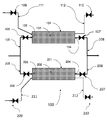
도 1은 본 명세서에 기재된 방법을 실시하는 데 사용될 수 있는 장치의 한 예이다.Figure 1 is an example of an apparatus that can be used to practice the methods described herein.
방법 단계Method steps
휘발성 성분 및 적어도 하나의 다른 성분을 포함하는 혼합물 내의 휘발성 성분을 고갈시키기 위한 방법은 고갈된 혼합물을 형성하는데, 고갈된 혼합물은 상기 방법을 실시하기 전의 혼합물보다 더 적은 휘발성 성분을 함유한다. 본 방법은A method for depleting volatile components in a mixture comprising a volatile component and at least one other component forms a depleted mixture wherein the depleted mixture contains less volatile components than the mixture before the method is carried out. The method
1) 휘발성 성분의 적어도 일부를 유리 전이 온도가 25℃ 이하인 비다공성 가교결합된 탄성중합체의 벌크 내로 수착시킴으로써, 고갈된 혼합물을 형성하고, 비다공성 가교결합된 탄성중합체를 수착된 휘발성 성분으로 풍부화함으로써 풍부화된 가교결합된 탄성중합체를 형성하는 단계로서, 단계 1) 동안, 휘발성 성분의 적어도 일부는 가스상(gas phase)으로 존재하는, 상기 단계,1) sorption of at least a portion of the volatile components into the bulk of a non-porous cross-linked elastomer having a glass transition temperature of 25 캜 or less to form a depleted mixture and enriching the non-porous cross-linked elastomer with sorbed volatile components Forming an enriched crosslinked elastomer, wherein during step 1) at least a portion of the volatile component is in a gas phase,
2) 풍부화된 가교결합된 탄성중합체로부터 휘발성 성분의 적어도 일부를 탈착시킴으로써, 탈착된 휘발성 성분 및 재생된 탄성중합체를 형성하는 단계,2) forming a desorbed volatile component and a regenerated elastomer by desorbing at least a portion of the volatile component from the enriched crosslinked elastomer,
3) 단계 1)을 반복 시에 비다공성 가교결합된 탄성중합체의 전부 또는 일부로서 재생된 탄성중합체를 사용하는 단계, 및3) using the recycled elastomer as all or part of the non-porous cross-linked elastomer in repeating step 1), and
4) 단계 1) 후의 고갈된 혼합물 및 단계 2) 후의 탈착된 휘발성 성분 중 하나 또는 둘 모두를 원하는 위치로 안내하는 단계를 포함한다.4) guiding one or both of the depleted mixture after step 1) and the desorbed volatile components after step 2) to the desired location.
본 방법의 단계 1)에서, 방법 조건 (예컨대, 압력 및 온도)은 휘발성 성분의 적어도 일부가 가스상으로 존재하도록 하는 것이다. 상기 조건은 혼합물이 가열되도록 하는 것일 수 있다. 가열을 위한 온도는 휘발성 성분의 비점보다 높은 온도일 수 있다. 대안적으로, 온도는 휘발성 성분의 적어도 일부 (대안적으로, 전부)가 가스상으로 존재하도록 선택된다. 대안적으로, 본 방법은 단계 1) 전에 혼합물을 기화시키는 단계를 추가로 포함할 수 있다. 혼합물은, 예를 들어 혼합물의 비등 온도보다 높은 온도에서의 가열과 같은 임의의 편리한 수단에 의해 기화될 수 있다. 이론에 의해 구애되고자 함이 없이, 혼합물 내의 휘발성 성분의 부분 압력이 비다공성 가교결합된 탄성중합체 내의 휘발성 성분의 부분 압력을 초과하는 한, 비다공성 가교결합된 탄성중합체의 벌크 내로의 휘발성 성분의 물질 전달을 위한 충분한 구동력이 있을 것으로 여겨진다.In step 1) of the method, the process conditions (e.g., pressure and temperature) are such that at least a portion of the volatile component is present in the gaseous phase. The conditions may be such that the mixture is heated. The temperature for heating may be higher than the boiling point of the volatile component. Alternatively, the temperature is selected such that at least a portion (alternatively, all) of the volatile component is present in the gas phase. Alternatively, the method may further comprise vaporizing the mixture prior to step 1). The mixture may be vaporized by any convenient means such as, for example, heating at a temperature above the boiling temperature of the mixture. Without wishing to be bound by theory, as long as the partial pressure of the volatile component in the mixture exceeds the partial pressure of the volatile component in the non-porous cross-linked elastomer, the material of the volatile component into the bulk of the non-porous cross- It is believed to have sufficient driving force for transmission.
혼합물은 유리 전이 온도가 25℃ 이하인 비다공성 가교결합된 탄성중합체 ("탄성중합체")와, 상기 탄성중합체가 혼합물로부터의 휘발성 성분의 적어도 일부를 탄성중합체의 벌크 내로 수착되게 하기에 충분한 시간 동안 접촉될 수 있다. 혼합물은 단계 1)에서 탄성중합체와 직접, 즉 막의 사용 없이 접촉될 수 있다. 혼합물은 액체일 수 있으며, 휘발성 성분의 적어도 일부는 가스상으로 존재한다. 대안적으로, 혼합물은 단계 1) 동안 가스상으로 존재할 수 있다.The mixture comprises a non-porous cross-linked elastomer ("elastomer") having a glass transition temperature of 25 ° C or lower and a polymeric elastomer having a glass transition temperature of 25 ° C or lower, wherein the elastomer is contacted for a time sufficient to allow sorption of the volatile components from the mixture into the bulk of the elastomer . The mixture can be contacted directly with the elastomer in step 1), i.e. without the use of a membrane. The mixture may be a liquid and at least a portion of the volatile component is present in the gaseous phase. Alternatively, the mixture may be in gaseous phase during step 1).
본 방법의 단계 2)는 탄성중합체를 재생하도록 수행될 수 있다. 탄성중합체가 휘발성 성분을 수착시킴에 따라, 수착 속도가 감소될 수 있고/있거나 탄성중합체는 팽윤될 수 있다. 탄성중합체가 재생 및 재사용될 수 있도록 탄성중합체의 벌크로부터 휘발성 성분의 적어도 일부를 탈착시키는 것이 바람직하다. 단계 2) 동안 그리고/또는 후에, 휘발성 성분은 선택적으로 회수될 수 있다. 탄성중합체의 재생은 본 방법의 단계 1)을 정지하고 탄성중합체를 재생시키고, 이어서 단계 2) 후에 단계 1)을 반복함으로써 수행될 수 있다. 대안적으로, 혼합물은, 풍부화된 가교결합된 탄성중합체에 대해 단계 2)를 수행하면서, 단계 1)을 계속하도록 경로-재설정될(re-routed) 수 있다. 이러한 방법의 한 예가 하기 도 1에 도시되어 있다.Step 2) of the method can be performed to regenerate the elastomer. As the elastomer sorbs the volatile components, the sorption rate can be reduced and / or the elastomer can be swollen. It is desirable to desorb at least a portion of the volatile component from the bulk of the elastomer so that the elastomer can be regenerated and reused. During and / or after step 2), volatile components can be selectively recovered. Regeneration of the elastomer can be carried out by stopping step 1) of the method and regenerating the elastomer, and then repeating step 1) after step 2). Alternatively, the mixture may be re-routed to continue step 1) while performing step 2) for the enriched crosslinked elastomer. One example of such a method is shown in FIG.
풍부화된 가교결합된 탄성중합체의 재생은 임의의 편리한 수단, 예컨대 가열에 의해 수행될 수 있는데, 이때 가열은, 선택적으로, 풍부화된 가교결합된 탄성중합체와 접촉 상태로 건조 공기 가스 스트림 또는 불활성 가스 스트림에 의한 스위핑과 함께 행해진다. 또한, 풍부화된 가교결합된 탄성중합체를 감압 (예를 들어, 대기압 미만)에 노출시킴으로써 그리고/또는 풍부화된 가교결합된 탄성중합체를 휘발성 성분 고갈된 스위프 스트림과 접촉시킴으로써 더 낮은 온도 (예를 들어, 25℃의 실온 또는 그 이하)에서 탈착시키는 것이 가능하다. 대안적으로, 풍부화된 가교결합된 탄성중합체를 팽윤시키거나 팽윤시키지 않으면서 용매에 대한 풍부화된 가교결합된 탄성중합체의 노출이 또한 풍부화된 가교결합된 탄성중합체를 재생시키는 데 사용될 수 있다. 대안적으로, 액체 추출, 예를 들어 용매 또는 초임계 유체 추출이 풍부화된 가교결합된 탄성중합체를 재생시키는 데 사용될 수 있다. 본 방법은 단계 3)을 추가로 포함하며, 이 단계에서는 단계 1)을 반복하기 위하여, 재생된 탄성중합체가 재사용될 수 있다. 단계 1)을 반복하는 데 사용되는 비다공성 가교결합된 탄성중합체는 전부 재생된 탄성중합체일 수 있으며, 대안적으로는, 단계 1)을 반복하는 데 사용되는 비다공성 가교결합된 탄성중합체의 일부는 재생된 탄성중합체일 수 있고, 나머지는 새로운 비다공성 가교결합된 탄성중합체이다.Regeneration of the enriched crosslinked elastomer can be carried out by any convenient means, such as heating, wherein the heating is optionally carried out in the presence of an enriched crosslinked elastomer in a dry air gas stream or an inert gas stream Is performed together with sweeping. Also, by exposing the enriched crosslinked elastomer to a reduced pressure (e.g., below atmospheric pressure) and / or by contacting the enriched crosslinked elastomer with a volatile component depleted swept stream, a lower temperature (e.g., Lt; 0 > C or room temperature at 25 [deg.] C or lower). Alternatively, exposure of the enriched crosslinked elastomer to the solvent without swelling or swelling the enriched crosslinked elastomer can also be used to regenerate the enriched crosslinked elastomer. Alternatively, liquid extraction, such as solvent or supercritical fluid extraction, may be used to regenerate the enriched crosslinked elastomer. The method further comprises step 3), wherein the recycled elastomer can be reused to repeat step 1). The non-porous cross-linked elastomer used to repeat step 1) may be a fully regenerated elastomer and, alternatively, some of the non-porous cross-linked elastomer used to repeat step 1) May be recycled elastomers, and the remainder are new non-porous cross-linked elastomers.
본 방법은 단계 1) 동안 그리고/또는 후의 고갈된 혼합물 및 단계 2) 동안 그리고/또는 후의 탈착된 휘발성 성분 중 하나 또는 둘 모두를 원하는 위치로 안내하는 단계를 추가로 포함한다. 안내하는 단계는 임의의 편리한 수단에 의해, 예컨대 고갈된 혼합물을 채널, 예컨대 파이프, 덕트, 또는 다른 도관을 통해 원하는 위치(예컨대, 회수 작업)에 공급함으로써 수행될 수 있다. 회수 작업은 냉각 장치, 예컨대 열 교환기 또는 응축기를 포함할 수 있다. 회수 작업은 고갈된 혼합물을 저장하기 위한 수집 장치, 예컨대 탱크, 저장소, 또는 다른 용기 및/또는 휘발성 성분을 저장하기 위한 탱크를 포함할 수 있다. 대안적으로, 고갈된 혼합물은 상이한 작업으로 안내될 수 있는데, 예컨대 고갈된 혼합물이 반응물로서 사용될 때 그러하다. 대안적으로, 휘발성 성분은 상이한 작업으로 안내될 수 있는데, 예컨대 휘발성 성분이 반응물로서 사용될 때 그러하다. 대안적으로, 고갈된 혼합물 및 휘발성 오염물 중 하나 또는 둘 모두는 수집 용기로 안내될 수 있다.The method further comprises the step of guiding one or both of the depleted mixture during and / or after step 1) and / or the desorbed volatile component during and / or after step 2) to the desired location. The guiding step can be performed by any convenient means, for example, by supplying the depleted mixture to a desired location (e.g., a recovery operation) through a channel, such as a pipe, duct, or other conduit. The recovery operation may include a cooling device, such as a heat exchanger or a condenser. The recovery operation may include a collection device for storing the depleted mixture, such as a tank, reservoir, or other container and / or a tank for storing volatile components. Alternatively, the depleted mixture can be directed to a different operation, such as when the depleted mixture is used as a reactant. Alternatively, the volatile component can be guided to a different operation, such as when a volatile component is used as the reactant. Alternatively, one or both of the depleted mixture and volatile contaminants may be directed to the collection vessel.
예를 들어, 본 방법이 혼합물 또는 휘발성 성분을 정제하는 데 사용될 때 그러하다. 고갈된 혼합물은, 혼합물이 가열되고/되거나 가스상으로 존재할 때, 임의의 편리한 수단에 의해, 예컨대 고갈된 혼합물을 채널, 예컨대 파이프, 덕트, 또는 다른 도관을 통해 열 교환기 또는 응축기에 공급하고 거기서 냉각시킴으로써 회수 및/또는 안내될 수 있는 정제된 혼합물이다.For example, when the process is used to purify mixtures or volatile components. The depleted mixture may be supplied to the heat exchanger or condenser through a channel, such as a pipe, duct, or other conduit, for example by supplying the depleted mixture by any convenient means when the mixture is heated and / Recovered and / or guided.
대안적으로, 정제된 혼합물의 회수는, 응축기로부터의 정제된 혼합물 (전술됨)을, 정제된 혼합물이 반응물 또는 용매로서 사용되는 상이한 반응기에 공급하는 것을 포함할 수 있다. 대안적으로, 정제된 혼합물이 폴리유기실록산을 포함하는 경우 (환형 폴리유기실록산 휘발성 오염물이 없음), 정제된 혼합물은 시험, 포장 및/또는 판매되기 위하여 수집 용기로 안내될 수 있거나, 또는 정제된 혼합물은 상이한 공정으로 안내되고 폴리유기실록산 함유 생성물을 제조하는 데 반응물 또는 다른 성분으로서 사용될 수 있다.Alternatively, the recovery of the purified mixture may comprise feeding the purified mixture from the condenser (described above) to a different reactor in which the purified mixture is used as a reactant or as a solvent. Alternatively, if the purified mixture comprises a polyorganosiloxane (without cyclic polyorganosiloxane volatile contaminants), the purified mixture may be directed to a collection vessel for testing, packaging and / or sale, The mixture can be directed to a different process and used as a reactant or other component in preparing the polyorganosiloxane containing product.
대안적으로, 혼합물이 폐수이고, 고갈된 혼합물이 정제수인 경우, 정제수는 정제수를 시험을 위한 공정으로, 또는 환경으로 공급함으로써 (예를 들어, 펌핑함으로써) 안내될 수 있다. 대안적으로, 혼합물이 공기이고, 고갈된 혼합물이 정제된 공기 (예컨대, 제습 공기)인 경우, 정제된 공기는 배관을 통해 공기 취급 시스템 또는 환기 시스템 내로 블로잉 또는 펌핑하여 안내될 수 있다. 단계 1) 동안 그리고/또는 후의 고갈된 혼합물 및 단계 2) 동안 그리고/또는 후의 탈착된 휘발성 성분 중 하나 또는 둘 모두를 안내하는 도관은 또한, 펌프, 팬, 송풍기, 압출기, 컴파운더, 및 밸브와 같은 이송 장비와 함께, 인라인 모니터링 시험 장비, 예컨대 게이지, 미터기 및 센서를 수용할 수 있음이 이해된다.Alternatively, if the mixture is wastewater and the depleted mixture is purified water, purified water can be directed to the process for testing, or to the environment (e.g., by pumping) the purified water. Alternatively, if the mixture is air and the depleted mixture is purified air (e. G., Dehumidified air), purified air can be directed through the tubing by blowing or pumping into an air handling system or ventilation system. Conduits that guide one or both of the depleted mixture during and / or after step 1) and / or the desorbed volatile components during and / or after step 2) may also be used as pumps, fans, blowers, extruders, It is understood that with the same transport equipment, it is possible to accommodate inline monitoring test equipment such as gauges, meters and sensors.
휘발성 성분은 임의의 편리한 수단에 의해 회수될 수 있다. 예를 들어, 풍부화된 가교결합된 탄성중합체가 전술된 바와 같이 건조 가스 스트림으로 스위핑함으로써 재생되는 경우, 휘발성 성분을 함유하는 가스 스트림은 휘발성 성분을 회수하도록 응축기를 통해 안내될 수 있다. 대안적으로, 풍부화된 가교결합된 탄성중합체를 재생하기 위해 용매가 사용되는 경우, 휘발성 성분은 용매를 스트립핑, 추출, 또는 증류하기 위한 장치로 안내될 수 있다. 대안적으로, 휘발성 성분의 안내는 응축기로부터의 휘발성 성분 (전술됨), 또는 휘발성 성분을 함유하는 용매를, 휘발성 성분이 반응물로서 사용되는 상이한 반응기에 공급하는 것을 포함할 수 있다.The volatile components can be recovered by any convenient means. For example, when an enriched crosslinked elastomer is regenerated by sweeping into a dry gas stream as described above, a gas stream containing volatile components can be directed through the condenser to recover the volatile components. Alternatively, when a solvent is used to regenerate the enriched crosslinked elastomer, the volatile component may be directed to an apparatus for stripping, extracting, or distilling the solvent. Alternatively, the guidance of the volatile component may include supplying a volatile component (as described above) from the condenser, or a solvent containing a volatile component, to a different reactor where the volatile component is used as the reactant.
휘발성 성분Volatile component
휘발성 성분은 혼합물로부터 제거되는 것이 바람직한 임의의 화학종일 수 있다. 본 명세서에 기재된 방법에서, 휘발성 성분은 증기압이 70℃에서 0.1 mmHg 내지 70℃에서 760 mmHg, 대안적으로 70℃에서 1 mmHg 내지 70℃에서 100 mmHg, 대안적으로 70℃에서 4 mmHg 내지 70℃에서 82 mmHg, 그리고 대안적으로 70℃에서 17 mmHg 내지 70℃에서 82 mmHg일 수 있다. 본 방법의 단계 1)에 의해 형성된 생성물은 고갈된 혼합물이며, 상기 고갈된 혼합물에는 휘발성 성분이 없거나, 단계 1) 전의 혼합물보다 더 적은 휘발성 성분을 함유한다. "~이 없는"은 고갈된 혼합물이 어떠한 휘발성 성분도 함유하지 않거나 GC 분석에 의해 검출 불가능한 휘발성 성분의 양을 함유함을 의미한다.The volatile component may be any chemical species desired to be removed from the mixture. In the process described herein, the volatile component is vaporized at a vapor pressure of 7 mmHg at 70 DEG C to 760 mmHg at 70 DEG C, alternatively 100 mmHg at 1 mmHg to 70 DEG C at 70 DEG C, alternatively from 4 mmHg to 70 DEG C at 70 DEG C , And alternatively from 70 mmHg to 70 mmHg at 70 to < RTI ID = 0.0 > 70 C. < / RTI > The product formed by step 1) of the process is a depleted mixture and the depleted mixture has no volatile components or contains less volatile components than the mixture before step 1). Means that the depleted mixture either contains no volatile components or contains volatile components that are not detectable by GC analysis.
휘발성 성분은 중합도 ("DP")가 3 내지 12인 환형 폴리유기실록산일 수 있으며, 대안적으로 휘발성 성분은 평균 DP가 4인 환형 폴리다이알킬실록산일 수 있다. 환형 폴리유기실록산은 화학식 (R11R12SiO2/2)k를 가질 수 있으며, 여기서 하첨자 k는 3 내지 12이고, 각각의 R11은 독립적으로 1가 탄화수소 기 또는 1가 할로겐화 탄화수소 기이고, 각각의 R12는 독립적으로 R11, OH, 또는 H이다. 적합한 1가 탄화수소 기는 알킬, 알케닐, 알키닐, 아릴, 아르알킬, 및 카르보사이클릭 기를 포함한다. 알킬 기는 분지형 또는 비분지형, 포화 1가 탄화수소 기를 포함하며, 이는 메틸, 에틸, 프로필 (예를 들어, 아이소-프로필 및/또는 n-프로필), 부틸 (예를 들어, 아이소부틸, n-부틸, tert-부틸, 및/또는 sec-부틸), 펜틸 (예를 들어, 아이소펜틸, 네오펜틸, 및/또는 tert-펜틸), 헥실, 헵틸, 옥틸, 노닐, 및 데실뿐만 아니라 6개 이상의 탄소 원자의 분지형 포화 1가 탄화수소 기로 예시되지만 이로 한정되지 않는다. 알케닐 기는 이중 결합을 함유하는 1가 탄화수소 기이다. R11에 적합한 알케닐 기는 에테닐, 프로페닐 (예를 들어, 아이소-프로페닐 및/또는 n-프로페닐), 부테닐 (예를 들어, 아이소부테닐, n-부테닐, tert-부테닐, 및/또는 sec-부테닐), 펜테닐 (예를 들어, 아이소펜테닐, n-펜테닐, 및/또는 tert-펜테닐), 헥세닐, 헵테닐, 옥테닐, 노네닐, 및 데세닐뿐만 아니라 6개 이상의 탄소 원자의 그러한 분지형 기로 예시되지만 이로 한정되지 않는다. 알키닐 기는 삼중 결합을 함유하는 1가 탄화수소 기이다. R11에 적합한 알키닐 기는 에티닐, 프로피닐 (예를 들어, 아이소-프로피닐 및/또는 n-프로피닐), 부티닐 (예를 들어, 아이소부티닐, n-부티닐, tert-부티닐, 및/또는 sec-부티닐), 펜티닐 (예를 들어, 아이소펜티닐, n-펜티닐, 및/또는 tert-펜티닐), 헥시닐, 헵티닐, 옥티닐, 노니닐, 및 데시닐뿐만 아니라 6개 이상의 탄소 원자의 그러한 분지형 기로 예시되지만 이로 한정되지 않는다. 아릴 기는 사이클릭, 완전 불포화, 탄화수소 기를 포함하며, 이는 사이클로펜타다이에닐, 페닐, 안트라세닐, 및 나프틸로 예시되지만 이로 한정되지 않는다. 모노사이클릭 아릴 기는 5 내지 9개의 탄소 원자, 대안적으로 6개 또는 7개의 탄소 원자, 및 대안적으로 5개 또는 6개의 탄소 원자를 가질 수 있다. 폴리사이클릭 아릴 기는 10 내지 17개의 탄소 원자, 대안적으로 10 내지 14개의 탄소 원자, 그리고 대안적으로 12 내지 14개의 탄소 원자를 가질 수 있다. 아르알킬 기는 펜던트 및/또는 말단 아릴 기를 갖는 알킬 기 또는 펜던트 알킬 기를 갖는 아릴 기를 의미한다. 예시적인 아르알킬 기는 톨릴, 자일릴, 벤질, 페닐에틸, 페닐 프로필, 및 페닐 부틸을 포함한다. 카르보사이클릭 기는 탄화수소 고리이다. 카르보사이클릭 기는 모노사이클릭 고리일 수 있거나 또는 대안적으로 융합, 가교, 또는 스피로 폴리사이클릭 고리를 가질 수 있다. 모노사이클릭 카르보사이클릭 기는 3 내지 9개의 탄소 원자, 대안적으로 4 내지 7개의 탄소 원자, 그리고 대안적으로 5개 또는 6개의 탄소 원자를 가질 수 있다. 폴리사이클릭 카르보사이클릭 기는 7 내지 17개의 탄소 원자, 대안적으로 7 내지 14개의 탄소 원자, 그리고 대안적으로 9개 또는 10개의 탄소 원자를 가질 수 있다. 카르보사이클은 포화 또는 부분 불포화될 수 있다. 카르보사이클릭 기는 포화된 사이클로알킬 기일 수 있다. 적합한 모노사이클릭 사이클로알킬 기는 사이클로부틸, 사이클로펜틸, 및 사이클로헥실로 예시된다. 적합한 1가 할로겐화 탄화수소 기는 탄소 원자에 결합된 하나 이상의 수소 원자가 할로겐 원자로 형식상 대체된 1가 탄화수소 기를 지칭한다. 할로겐화 탄화수소 기는 할로알킬 기, 할로겐화 카르보사이클릭 기, 및 할로알케닐 기를 포함한다. 할로알킬 기는 플루오르화 알킬 기, 예를 들어 트라이플루오로메틸 (CF3), 플루오로메틸, 트라이플루오로에틸, 2-플루오로프로필, 3,3,3-트라이플루오로프로필, 4,4,4-트라이플루오로부틸, 4,4,4,3,3-펜타플루오로부틸, 5,5,5,4,4,3,3-헵타플루오로펜틸, 6,6,6,5,5,4,4,3,3-노나플루오로헥실, 및 8,8,8,7,7-펜타플루오로옥틸; 및 염소화 알킬 기, 예컨대 클로로메틸 및 3-클로로프로필을 포함한다. 할로겐화 카르보사이클릭 기는 플루오르화 사이클로알킬 기, 예를 들어 2,2-다이플루오로사이클로프로필, 2,3-다이플루오로사이클로부틸, 3,4-다이플루오로사이클로헥실, 및 3,4-다이플루오로-5-메틸사이클로헵틸; 및 염소화 사이클로알킬 기, 예컨대 2,2-다이클로로사이클로프로필, 2,3-다이클로로사이클로펜틸을 포함한다. 할로알케닐 기는 클로로알릴을 포함한다. 대안적으로, 휘발성 성분은 사이클릭 폴리다이유기수소실록산일 수 있다. 휘발성 성분은 (i) 헥사메틸사이클로트라이실록산 (D3), (ii) 옥타메틸사이클로테트라실록산 (D4), (iii) 테트라메틸사이클로테트라실록산 (D4 H), (iv) 테트라메틸테트라비닐 사이클로테트라실록산 (D4 Vi), (v) 테트라메틸테트라페닐사이클로테트라실록산 (D4 Ph), (vi) 데카메틸사이클로펜타실록산 (D5), (vii) 펜타메틸사이클로펜타실록산 (D5 H), (viii) 펜타메틸펜타비닐사이클로펜타실록산 (D5 Vi), (ix) 펜타메틸펜타페닐사이클로펜타실록산 (D5 Ph), (x) 도데카메틸사이클로헥사실록산 (D6), (xi) 헥사메틸사이클로헥사실록산 (D6 H), (xii) 헥사메틸헥사비닐사이클로헥사실록산 (D6 Vi), (xiii) 헥사메틸헥사페닐사이클로헥사실록산 (D6 Ph), 또는 (xiv) (i), (ii), (iii), (iv), (v), (vi), (vii), (viii), (ix), (x), (xi), (xii), 및 (xiii)의 둘 이상의 조합을 포함할 수 있다. 대안적으로, 휘발성 성분은 D3, D4, D5, D6, 및 D3, D4, D5, 및 D6의 둘 이상의 조합으로부터 선택될 수 있다. 대안적으로, 휘발성 성분은 D4일 수 있다.The volatile component may be a cyclic polyorganosiloxane having a degree of polymerization (" DP ") of 3 to 12, and alternatively the volatile component may be a cyclic polydialkylsiloxane having an average DP of 4. The cyclic polyorganosiloxane may have the formula (R 11 R 12 SiO 2/2 ) k , wherein the subscript k is from 3 to 12, and each R 11 is independently a monovalent hydrocarbon group or monovalent halogenated hydrocarbon group , Each R 12 is independently R 11 , OH, or H. Suitable monovalent hydrocarbon groups include alkyl, alkenyl, alkynyl, aryl, aralkyl, and carbocyclic groups. Alkyl groups include branched or unbranched, saturated monovalent hydrocarbon groups, which include methyl, ethyl, propyl (e.g. isopropyl and / or n-propyl), butyl (e.g. isobutyl, butyl, and / or sec-butyl), pentyl (e.g., isopentyl, neopentyl, and / or tert-pentyl), hexyl, heptyl, octyl, nonyl, and decyl, But are not limited to, branched saturated monovalent hydrocarbon groups. The alkenyl group is a monovalent hydrocarbon group containing a double bond. Suitable alkenyl groups for R < 11 > include but are not limited to ethenyl, propenyl (e.g., iso-propenyl and / or n-propenyl), butenyl (e.g. isobutenyl, , And / or sec-butenyl), pentenyl (e.g., isopentenyl, n-pentenyl, and / or tert- pentenyl), hexenyl, heptenyl, octenyl, But are not limited to, such branched groups of 6 or more carbon atoms. The alkynyl group is a monovalent hydrocarbon group containing a triple bond. Suitable alkynyl groups for R 11 include, but are not limited to, ethynyl, propynyl (e.g., iso-propynyl and / or n-propynyl), butynyl (for example, isobutynyl, n-butynyl, tert- , And / or sec-butynyl), pentynyl (e.g., isopentinyl, n-pentynyl, and / or tert-pentynyl), hexynyl, heptynyl, octynyl, nonynyl, But are not limited to, such branched groups of 6 or more carbon atoms. The aryl group includes cyclic, fully unsaturated, hydrocarbon groups, including, but not limited to, cyclopentadienyl, phenyl, anthracenyl, and naphthyl. The monocyclic aryl group may have 5 to 9 carbon atoms, alternatively 6 or 7 carbon atoms, and alternatively 5 or 6 carbon atoms. The polycyclic aryl group may have from 10 to 17 carbon atoms, alternatively from 10 to 14 carbon atoms, and alternatively from 12 to 14 carbon atoms. Aralkyl groups mean an aryl group having a pendant and / or a terminal aryl group or an alkyl group having a pendant alkyl group. Exemplary aralkyl groups include tolyl, xylyl, benzyl, phenylethyl, phenylpropyl, and phenylbutyl. The carbocyclic group is a hydrocarbon ring. The carbocyclic group may be a monocyclic ring or alternatively may have a fused, bridged, or spirocyclic ring. The monocyclic carbocyclic group may have from 3 to 9 carbon atoms, alternatively from 4 to 7 carbon atoms, and alternatively from 5 or 6 carbon atoms. The polycyclic carbocyclic group may have 7 to 17 carbon atoms, alternatively 7 to 14 carbon atoms, and alternatively 9 or 10 carbon atoms. Carbocycles can be saturated or partially unsaturated. The carbocyclic group may be a saturated cycloalkyl group. Suitable monocyclic cycloalkyl groups are exemplified by cyclobutyl, cyclopentyl, and cyclohexyl. Suitable monovalent halogenated hydrocarbon groups refer to monovalent hydrocarbon groups in which one or more hydrogen atoms bonded to a carbon atom are formally replaced with a halogen atom. The halogenated hydrocarbon group includes a haloalkyl group, a halogenated carbocyclic group, and a haloalkenyl group. Haloalkyl groups are fluorinated alkyl groups such as trifluoromethyl (CF 3), by a methyl, trifluoromethyl, ethyl 2-fluoro-fluoro-propyl, 3,3,3-trifluoro-propyl, 4,4, Tetrafluorobutyl, 4,4,4,3,3-pentafluorobutyl, 5,5,5,4,4,3,3-heptafluoropentyl, 6,6,6,5,5 , 4,4,3,3-nonafluorohexyl, and 8,8,8,7,7-pentafluorooctyl; And chlorinated alkyl groups such as chloromethyl and 3-chloropropyl. Halogenated carbocyclic groups include fluorinated cycloalkyl groups such as 2,2-difluorocyclopropyl, 2,3-difluorocyclobutyl, 3,4-difluorocyclohexyl, and 3,4-di Fluoro-5-methylcycloheptyl; And chlorinated cycloalkyl groups such as 2,2-dichlorocyclopropyl, 2,3-dichlorocyclopentyl. The haloalkenyl group includes chloroallyl. Alternatively, the volatile component may be a cyclic poly-diorganohydrogen siloxane. The volatile component is selected from the group consisting of (i) hexamethylcyclotrisiloxane (D 3 ), (ii) octamethylcyclotetrasiloxane (D 4 ), (iii) tetramethylcyclotetrasiloxane (D 4 H ) cyclotetrasiloxane (D 4 Vi), (v ) tetramethyl-tetraphenyl-cyclotetrasiloxane (D 4 Ph), (vi ) decamethylcyclopentasiloxane (D 5), (vii) pentamethyl cyclopenta siloxane (D 5 H ), (viii) pentamethyl cyclopenta vinyl cyclopenta siloxane (D 5 Vi), (ix ) pentamethyl cyclopenta phenyl cyclopenta siloxane (D 5 Ph), (x ) dodeca-methyl cyclohexanone siloxane (D 6), (xi ) Hexamethylcyclohexasiloxane (D 6 H ), (xii) hexamethylhexavinyl cyclohexasiloxane (D 6 Vi ), (xiii) hexamethylhexaphenylcyclohexasiloxane (D 6 Ph ) ), (ii), (iii), (iv), (v), (vi), (vii), (viii) Or a combination of two or more of these. Alternatively, the volatile component may be selected from a combination of two or more of D 3 , D 4 , D 5 , D 6 , and D 3 , D 4 , D 5 , and D 6 . Alternatively, the volatile component may be D 4 .
대안적으로, 휘발성 성분은 DP가 1 내지 14인 유기실란 또는 폴리유기실록산일 수 있다. 유기실란은 화학식 R1 vSiR2 (4-v)를 가질 수 있으며, 여기서 각각의 R1은 독립적으로 1가 탄화수소 기 또는 1가 할로겐화 탄화수소 기이고, 각각의 R2는 독립적으로 수소 원자, 할로겐 원자, 하이드로카르보노옥시 기, 예컨대 알콕시, 아미노 작용기, 아실옥시 기, 예컨대 아세톡시, 에폭시-작용기, 메타크릴레이트 작용기, 옥시모 작용기, 예컨대 케톡심, 아크릴레이트 작용기, 폴리올 작용기, 예컨대 폴리에테르, 티올 작용기이고; 하첨자 v는 0 내지 4, 대안적으로 0 내지 3이다.Alternatively, the volatile component may be an organosilane or a polyorganosiloxane having a DP of 1 to 14. The organosilane may have the formula R 1 v SiR 2 (4-v) wherein each R 1 is independently a monovalent hydrocarbon group or a monovalent halogenated hydrocarbon group, each R 2 is independently a hydrogen atom, a halogen An alkoxy, an amino functional group, an acyloxy group such as an acetoxy, an epoxy-functional group, a methacrylate functional group, an oximo functional group such as a ketoxime, an acrylate functional group, a polyol functional group such as a polyether, A thiol functional group; The subscript v is 0 to 4, alternatively 0 to 3.
R1에 적합한 1가 탄화수소 기는 알킬, 알케닐, 알키닐, 아릴, 아르알킬, 및 카르보사이클릭 기를 포함한다. 알킬 기는 분지형 또는 비분지형, 포화 1가 탄화수소 기를 포함하며, 이는 메틸, 에틸, 프로필 (예를 들어, 아이소-프로필 및/또는 n-프로필), 부틸 (예를 들어, 아이소부틸, n-부틸, tert-부틸, 및/또는 sec-부틸), 펜틸 (예를 들어, 아이소펜틸, 네오펜틸, 및/또는 tert-펜틸), 헥실, 헵틸, 옥틸, 노닐, 및 데실뿐만 아니라 6개 이상의 탄소 원자의 분지형 포화 1가 탄화수소 기로 예시되지만 이로 한정되지 않는다. 알케닐 기는 이중 결합을 함유하는 1가 탄화수소 기이다. R1에 적합한 알케닐 기는 에테닐, 프로페닐 (예를 들어, 아이소-프로페닐 및/또는 n-프로페닐), 부테닐 (예를 들어, 아이소부테닐, n-부테닐, tert-부테닐, 및/또는 sec-부테닐), 펜테닐 (예를 들어, 아이소펜테닐, n-펜테닐, 및/또는 tert-펜테닐), 헥세닐, 헵테닐, 옥테닐, 노네닐, 및 데세닐뿐만 아니라 6개 이상의 탄소 원자의 그러한 분지형 기로 예시되지만 이로 한정되지 않는다. 알키닐 기는 삼중 결합을 함유하는 1가 탄화수소 기이다. R1에 적합한 알키닐 기는 에티닐, 프로피닐 (예를 들어, 아이소-프로피닐 및/또는 n-프로피닐), 부티닐 (예를 들어, 아이소부티닐, n-부티닐, tert-부티닐, 및/또는 sec-부티닐), 펜티닐 (예를 들어, 아이소펜티닐, n-펜티닐, 및/또는 tert-펜티닐), 헥시닐, 헵티닐, 옥티닐, 노니닐, 및 데시닐뿐만 아니라 6개 이상의 탄소 원자의 그러한 분지형 기로 예시되지만 이로 한정되지 않는다. 아릴 기는 사이클릭, 완전 불포화, 탄화수소 기를 포함하며, 이는 사이클로펜타다이에닐, 페닐, 안트라세닐, 및 나프틸로 예시되지만 이로 한정되지 않는다. 모노사이클릭 아릴 기는 5 내지 9개의 탄소 원자, 대안적으로 6개 또는 7개의 탄소 원자, 및 대안적으로 5개 또는 6개의 탄소 원자를 가질 수 있다. 폴리사이클릭 아릴 기는 10 내지 17개의 탄소 원자, 대안적으로 10 내지 14개의 탄소 원자, 그리고 대안적으로 12 내지 14개의 탄소 원자를 가질 수 있다. 아르알킬 기는 펜던트 및/또는 말단 아릴 기를 갖는 알킬 기 또는 펜던트 알킬 기를 갖는 아릴 기를 의미한다. 예시적인 아르알킬 기는 톨릴, 자일릴, 벤질, 페닐에틸, 페닐 프로필, 및 페닐 부틸을 포함한다. 카르보사이클릭 기는 탄화수소 고리이다. 카르보사이클릭 기는 모노사이클릭 고리일 수 있거나 또는 대안적으로 융합, 가교, 또는 스피로 폴리사이클릭 고리를 가질 수 있다. 모노사이클릭 카르보사이클릭 기는 3 내지 9개의 탄소 원자, 대안적으로 4 내지 7개의 탄소 원자, 그리고 대안적으로 5개 또는 6개의 탄소 원자를 가질 수 있다. 폴리사이클릭 카르보사이클릭 기는 7 내지 17개의 탄소 원자, 대안적으로 7 내지 14개의 탄소 원자, 그리고 대안적으로 9개 또는 10개의 탄소 원자를 가질 수 있다. 카르보사이클은 포화 또는 부분 불포화될 수 있다. 카르보사이클릭 기는 포화된 사이클로알킬 기일 수 있다. 적합한 모노사이클릭 사이클로알킬 기는 사이클로부틸, 사이클로펜틸, 및 사이클로헥실로 예시된다. 적합한 1가 할로겐화 탄화수소 기는 탄소 원자에 결합된 하나 이상의 수소 원자가 할로겐 원자로 형식상 대체된 1가 탄화수소 기를 지칭한다. 할로겐화 탄화수소 기는 할로알킬 기, 할로겐화 카르보사이클릭 기, 및 할로알케닐 기를 포함한다. 할로알킬 기는 플루오르화 알킬 기, 예를 들어 트라이플루오로메틸 (CF3), 플루오로메틸, 트라이플루오로에틸, 2-플루오로프로필, 3,3,3-트라이플루오로프로필, 4,4,4-트라이플루오로부틸, 4,4,4,3,3-펜타플루오로부틸, 5,5,5,4,4,3,3-헵타플루오로펜틸, 6,6,6,5,5,4,4,3,3-노나플루오로헥실, 및 8,8,8,7,7-펜타플루오로옥틸; 및 염소화 알킬 기, 예컨대 클로로메틸 및 3-클로로프로필을 포함한다. 할로겐화 카르보사이클릭 기는 플루오르화 사이클로알킬 기, 예를 들어 2,2-다이플루오로사이클로프로필, 2,3-다이플루오로사이클로부틸, 3,4-다이플루오로사이클로헥실, 및 3,4-다이플루오로-5-메틸사이클로헵틸; 및 염소화 사이클로알킬 기, 예컨대 2,2-다이클로로사이클로프로필, 2,3-다이클로로사이클로펜틸을 포함한다. 할로알케닐 기는 클로로알릴을 포함한다.Suitable monovalent hydrocarbon groups for R < 1 > include alkyl, alkenyl, alkynyl, aryl, aralkyl, and carbocyclic groups. Alkyl groups include branched or unbranched, saturated monovalent hydrocarbon groups, which include methyl, ethyl, propyl (e.g. isopropyl and / or n-propyl), butyl (e.g. isobutyl, butyl, and / or sec-butyl), pentyl (e.g., isopentyl, neopentyl, and / or tert-pentyl), hexyl, heptyl, octyl, nonyl, and decyl, But are not limited to, branched saturated monovalent hydrocarbon groups. The alkenyl group is a monovalent hydrocarbon group containing a double bond. Suitable alkenyl groups for R < 1 > include but are not limited to ethenyl, propenyl (for example iso-propenyl and / or n-propenyl), butenyl (for example isobutenyl, , And / or sec-butenyl), pentenyl (e.g., isopentenyl, n-pentenyl, and / or tert- pentenyl), hexenyl, heptenyl, octenyl, But are not limited to, such branched groups of 6 or more carbon atoms. The alkynyl group is a monovalent hydrocarbon group containing a triple bond. Suitable alkynyl groups for R < 1 > are ethynyl, propynyl (for example isopropenyl and / or n-propynyl), butynyl (for example isobutynyl, n-butynyl, tert- , And / or sec-butynyl), pentynyl (e.g., isopentinyl, n-pentynyl, and / or tert-pentynyl), hexynyl, heptynyl, octynyl, nonynyl, But are not limited to, such branched groups of 6 or more carbon atoms. The aryl group includes cyclic, fully unsaturated, hydrocarbon groups, including, but not limited to, cyclopentadienyl, phenyl, anthracenyl, and naphthyl. The monocyclic aryl group may have 5 to 9 carbon atoms, alternatively 6 or 7 carbon atoms, and alternatively 5 or 6 carbon atoms. The polycyclic aryl group may have from 10 to 17 carbon atoms, alternatively from 10 to 14 carbon atoms, and alternatively from 12 to 14 carbon atoms. Aralkyl groups mean an aryl group having a pendant and / or a terminal aryl group or an alkyl group having a pendant alkyl group. Exemplary aralkyl groups include tolyl, xylyl, benzyl, phenylethyl, phenylpropyl, and phenylbutyl. The carbocyclic group is a hydrocarbon ring. The carbocyclic group may be a monocyclic ring or alternatively may have a fused, bridged, or spirocyclic ring. The monocyclic carbocyclic group may have from 3 to 9 carbon atoms, alternatively from 4 to 7 carbon atoms, and alternatively from 5 or 6 carbon atoms. The polycyclic carbocyclic group may have 7 to 17 carbon atoms, alternatively 7 to 14 carbon atoms, and alternatively 9 or 10 carbon atoms. Carbocycles can be saturated or partially unsaturated. The carbocyclic group may be a saturated cycloalkyl group. Suitable monocyclic cycloalkyl groups are exemplified by cyclobutyl, cyclopentyl, and cyclohexyl. Suitable monovalent halogenated hydrocarbon groups refer to monovalent hydrocarbon groups in which one or more hydrogen atoms bonded to a carbon atom are formally replaced with a halogen atom. The halogenated hydrocarbon group includes a haloalkyl group, a halogenated carbocyclic group, and a haloalkenyl group. Haloalkyl groups are fluorinated alkyl groups such as trifluoromethyl (CF 3), by a methyl, trifluoromethyl, ethyl 2-fluoro-fluoro-propyl, 3,3,3-trifluoro-propyl, 4,4, Tetrafluorobutyl, 4,4,4,3,3-pentafluorobutyl, 5,5,5,4,4,3,3-heptafluoropentyl, 6,6,6,5,5 , 4,4,3,3-nonafluorohexyl, and 8,8,8,7,7-pentafluorooctyl; And chlorinated alkyl groups such as chloromethyl and 3-chloropropyl. Halogenated carbocyclic groups include fluorinated cycloalkyl groups such as 2,2-difluorocyclopropyl, 2,3-difluorocyclobutyl, 3,4-difluorocyclohexyl, and 3,4-di Fluoro-5-methylcycloheptyl; And chlorinated cycloalkyl groups such as 2,2-dichlorocyclopropyl, 2,3-dichlorocyclopentyl. The haloalkenyl group includes chloroallyl.
R2에 적합한 할로겐 원자는 F, Cl, Br, 또는 I; 대안적으로 F, Cl, 또는 Br; 대안적으로 Cl 또는 Br; 대안적으로 Cl; 대안적으로 Br을 포함한다. R2에 적합한 하이드로카르보노옥시 기는 화학식 OR3을 가지며, 여기서 R3은 R1에 대해 상기에 정의된 바와 같은 1가 탄화수소 기이다. 하첨자 v는 1 내지 4, 대안적으로 1 내지 3, 그리고 대안적으로 1 내지 2이다. 예시적인 유기실란은 트라이메틸실란, 비닐트라이메틸실란, 알릴트라이메틸실란, 다이메틸다이메톡시실란, 및/또는 메틸트라이메톡시실란을 포함한다.Suitable halogen atoms for R < 2 > are F, Cl, Br, or I; Alternatively F, Cl, or Br; Alternatively Cl or Br; Cl < / RTI > Or alternatively Br. Suitable hydrocarbonoxy groups for R 2 have the formula OR 3 , wherein R 3 is a monovalent hydrocarbon group as defined above for R 1 . Subscript v is 1 to 4, alternatively 1 to 3, and alternatively 1 to 2. Exemplary organosilanes include trimethylsilane, vinyltrimethylsilane, allyltrimethylsilane, dimethyldimethoxysilane, and / or methyltrimethoxysilane.
휘발성 폴리유기실록산은 선형 또는 분지형일 수 있다. 예에는 폴리다이메틸실록산 올리고머 및 중합체가 포함된다. 휘발성 폴리유기실록산은 단위식 (R4 3SiO1/2)w(R4 2SiO2/2)x(R4SiO3/2)y(SiO4/2)z를 가질 수 있으며, 여기서 R4는 수소 원자, OH, 또는 전술된 바와 같은 R1이고, 하첨자 w는 > 0이고, 하첨자 x는 ≥ 0이고, 하첨자 y는 ≥ 0이고, 하첨자 z는 ≥ 0이되, 단 합계 (w + x + y + z)는 ≤ 14이다. 대안적으로, y는 0일 수 있다. 대안적으로, z는 0일 수 있다. 대안적으로, w는 2일 수 있고, x는 0 내지 12, 대안적으로 0 내지 2일 수 있다. 예시적인 휘발성 폴리유기실록산은 하기 화학식의 것들일 수 있다: (R4 3SiO1/2)2(R4 2SiO2/2)2, (R4 3SiO1/2)2(R4 2SiO2/2)1, (R4 3SiO1/2)2, 및/또는 (R4 3SiO1/2)4(SiO4/2)1. 대안적으로, 각각의 R4는 독립적으로 수소 원자, 메틸 기, 비닐 기, 또는 페닐 기일 수 있다. 대안적으로, 각각의 R4는 메틸일 수 있다. 그러한 휘발성 폴리유기실록산은 헥사메틸다이실록산, 옥타메틸트라이실록산, 헥사메틸사이클로트라이실록산, 및 다른 저분자량 폴리유기실록산, 예컨대 미국 미시간주 미들랜드 소재의 다우 코닝 코포레이션(Dow Corning Corporation)으로부터 구매가능한, 0.5 내지 1.5 cSt 다우 코닝® 200 플루이즈(Fluids) 및 다우 코닝® OS 플루이즈를 포함한다.The volatile polyorganosiloxanes may be linear or branched. Examples include polydimethylsiloxane oligomers and polymers. The volatile polyorganosiloxane may have the unit formula (R 4 3 SiO 1/2 ) w (R 4 2 SiO 2/2 ) x (R 4 SiO 3/2 ) y (SiO 4/2 ) z where R 4 is a hydrogen atom, OH, or R 1 as described above, the subscript w is> 0, the subscript x is ≥ 0, the subscript y is ≥ 0, the subscript z is ≥ 0, (w + x + y + z) is? 14. Alternatively, y can be zero. Alternatively, z may be zero. Alternatively, w may be 2, and x may be from 0 to 12, alternatively from 0 to 2. Exemplary volatile polyorganosiloxanes may be of the formula: (R 4 3 SiO 1/2 ) 2 (R 4 2 SiO 2/2 ) 2, (R 4 3 SiO 1/2 ) 2 (R 4 2 SiO 2/2) 1, (R 4 3 SiO 1/2) 2, and / or (R 4 3 SiO 1/2) 4 (SiO 4/2) 1. Alternatively, each R < 4 > may independently be a hydrogen atom, a methyl group, a vinyl group, or a phenyl group. Alternatively, each R < 4 > may be methyl. Such volatile polyorganosiloxanes include, but are not limited to, hexamethyldisiloxane, octamethyltrisiloxane, hexamethylcyclotrisiloxane, and other low molecular weight polyorganosiloxanes, such as 0.5 < RTI ID = 0.0 > To 1.5 cSt Dow Corning® 200 Fluids and Dow Corning® OS Fluise.
대안적으로, 휘발성 성분은 휘발성 유기 화합물 (VOC)일 수 있다. VOC는 (i) 알데하이드, 예컨대 포름알데하이드 또는 아세트알데하이드, (ii) 방향족 화합물, (iii) 알칸 또는 사이클로알칸, (iv) 알켄, (v) 알킨, 또는 (i), (ii), (iii), (iv), 및 (v)의 둘 이상의 조합일 수 있다. 방향족 화합물의 예에는 방향족 탄화수소, 예컨대 톨루엔, 벤젠, 및/또는 자일렌이 포함된다. 알칸의 예에는 메탄, 에탄, 프로판, 부탄, 펜탄, 헥산, 헵탄, 옥탄, 및/또는 이들의 이성질체, 사이클로헥산, 및/또는 이들의 조합이 포함된다. 알켄의 예에는 에틸렌, 프로펜, 부텐, 펜텐 및/또는 이들의 이성질체 및/또는 이들의 조합이 포함된다.Alternatively, the volatile component may be a volatile organic compound (VOC). VOCs can be prepared by reacting (i) an aldehyde such as formaldehyde or acetaldehyde, (ii) an aromatic compound, (iii) an alkane or cycloalkane, (iv) an alkene, , (iv), and (v). Examples of aromatic compounds include aromatic hydrocarbons such as toluene, benzene, and / or xylene. Examples of alkanes include methane, ethane, propane, butane, pentane, hexane, heptane, octane, and / or isomers thereof, cyclohexane, and / or combinations thereof. Examples of alkenes include ethylene, propene, butene, pentene and / or isomers thereof and / or combinations thereof.
대안적으로, VOC는 유기 용매일 수 있다. 유기 용매는 알코올, 예컨대 메탄올, 에탄올, 아이소프로판올, 부탄올, 또는 n-프로판올; 케톤, 예컨대 아세톤, 메틸에틸 케톤, 또는 메틸아이소부틸 케톤; 방향족 탄화수소, 예컨대 벤젠, 톨루엔, 또는 자일렌; 에테르, 예컨대 다이에틸 에테르, 글리콜 에테르, 예컨대 프로필렌 글리콜 메틸 에테르, 다이프로필렌 글리콜 메틸 에테르, 프로필렌 글리콜 n-부틸 에테르, 프로필렌 글리콜 n-프로필 에테르, 또는 에틸렌 글리콜 n-부틸 에테르, 할로겐화 탄화수소, 예컨대 다이클로로메탄, 1,1,1-트라이클로로에탄 또는 메틸렌 클로라이드; 클로로포름; 다이메틸 설폭사이드; 다이메틸 포름아미드, 아세토니트릴; 테트라하이드로푸란; 화이트 스피릿(white spirit); 미네랄 스피릿(mineral spirit); 나프타; n-메틸 피롤리돈; 할로겐화 휘발성 유기 화합물, 예컨대 할로겐화 탄화수소, 예를 들어 클로로플루오로카본, 예컨대 프레온(Freon), 또는 이들의 둘 이상의 조합일 수 있다.Alternatively, VOCs can be organic daily. The organic solvent may be an alcohol such as methanol, ethanol, isopropanol, butanol, or n-propanol; Ketones such as acetone, methyl ethyl ketone, or methyl isobutyl ketone; Aromatic hydrocarbons such as benzene, toluene, or xylene; Ethers such as diethyl ether, glycol ethers such as propylene glycol methyl ether, dipropylene glycol methyl ether, propylene glycol n-butyl ether, propylene glycol n-propyl ether or ethylene glycol n-butyl ether, halogenated hydrocarbons such as dichloro Methane, 1,1,1-trichloroethane or methylene chloride; chloroform; Dimethyl sulfoxide; Dimethylformamide, acetonitrile; Tetrahydrofuran; White spirit; Mineral spirits; naphtha; n-methyl pyrrolidone; Halogenated volatile organic compounds such as halogenated hydrocarbons such as chlorofluorocarbons such as Freon, or a combination of two or more thereof.
대안적으로, VOC는 중합 또는 가교결합에 사용되는 유기 단량체, 예컨대 에틸렌, 프로필렌, 부텐, 아이소부텐, 1,3-부타디엔, 아이소프렌, 비닐 클로라이드, 비닐 아세테이트, 비닐 플루오라이드, 스티렌, 아크릴로니트릴, 에틸렌 옥사이드, 프로필렌 옥사이드, 아크릴레이트 및 메타크릴레이트 단량체, 예컨대 아크릴산, 메타크릴산, 메틸 아크릴레이트, 메틸 메타크릴레이트, 부틸 아크릴레이트, 2-에틸헥실 아크릴레이트, 시아노아크릴레이트, 아이소보르닐 아크릴레이트, 테트라플루오로에틸렌, 글리시딜 메타크릴레이트, 테트라하이드로푸르푸릴 메타크릴레이트, 아이소시아네이트, 예컨대 메틸렌 다이페닐 다이아이소시아네이트, 톨루엔 다이아이소시아네이트, 포스겐, 아민 화합물, 예컨대 에틸렌 다이아민, 에폭시 화합물, 예컨대 올리고머 액체 에폭시 수지일 수 있다. VOC는 또한 석유-유래 연료 또는 연료 혼합물, 예컨대 디젤 연료, 제트 연료 또는 가솔린일 수 있다. 대안적으로, VOC는 유해하거나 냄새 유발성인 유기 화합물, 예컨대 유기황 화합물일 수 있다. 대안적으로, 휘발성 성분은 CO2일 수 있다.Alternatively, the VOC may be an organic monomer used in polymerization or crosslinking, such as ethylene, propylene, butene, isobutene, 1,3-butadiene, isoprene, vinyl chloride, vinyl acetate, vinyl fluoride, styrene, Acrylate and methacrylate monomers such as acrylic acid, methacrylic acid, methyl acrylate, methyl methacrylate, butyl acrylate, 2-ethylhexyl acrylate, cyanoacrylate, isoboron Methylene diphenyl diisocyanate, toluene diisocyanate, phosgene, amine compounds such as ethylenediamine, epoxy compounds such as ethylenediamine, ethylenediamine, diethylenetriamine, triethylenetetramine, , Such as in an oligomeric liquid When can one resin. The VOC may also be a petroleum-derived fuel or fuel mixture, such as diesel fuel, jet fuel or gasoline. Alternatively, the VOC can be a harmful or odor-inducing organic compound, such as an organic sulfur compound. Alternatively, the volatile component may be CO 2 .
대안적으로, 휘발성 성분은 무기 화합물일 수 있다. 예를 들어, 휘발성 성분은 본 명세서에 기재된 방법이 혼합물을 건조시키는 데 사용되는 경우 수증기일 수 있다. 대안적으로, 무기 화합물은 (i) 클로라민, (ii) H2S, (iii) SOx, (iv) NOx, 및 (i), (ii), (iii), 및 (iv)의 둘 이상의 조합일 수 있다.Alternatively, the volatile component may be an inorganic compound. For example, the volatile component may be water vapor when the process described herein is used to dry the mixture. Alternatively, the inorganic compound may be selected from the group consisting of (i) chloramine, (ii) H 2 S, (iii) SO x , (iv) NO x , Or more.
혼합물mixture
혼합물은 전술된 바와 같은 휘발성 성분의 일부 또는 전부를 제거하는 것이 바람직한 임의의 혼합물일 수 있다. 혼합물은 휘발성 성분 및 적어도 하나의 다른 성분을 포함한다. 휘발성 성분은 증기압이 혼합물 내의 적어도 하나의 다른 성분의 증기압보다 더 작을 수 있다. 소정 실시 형태에서, 휘발성 성분은 비다공성 가교결합된 탄성중합체 중에서의 휘발성 성분의 용해도와 적어도 하나의 다른 성분의 용해도의 차이 또는 상대 증기압에 의해 혼합물 내의 적어도 하나의 다른 성분과 구별될 수 있다. 예를 들어, 일 실시 형태에서, 선형 폴리다이메틸실록산과 같은 화학종이 휘발성 성분일 수 있는데, 이는 혼합물 내의 다른 성분이 선형 폴리다이메틸실록산보다 더 낮은 증기압을 갖는 경우이다. 대안적으로, 동일한 선형 폴리다이메틸실록산이 혼합물 내의 다른 성분일 수 있는데, 이는 휘발성 성분이, 예를 들어 선형 폴리다이메틸실록산의 증기압보다 더 높은 증기압을 갖는 유기 용매인 경우이다. 이론에 의해 구애되고자 함이 없이, 비다공성 가교결합된 탄성중합체 중에서의 휘발성 성분의 용해도와 적어도 하나의 다른 성분의 용해도의 차이 또는 (휘발성 성분이 혼합물 내의 적어도 하나의 다른 성분보다 더 높은 증기압을 갖는 경우) 증기압의 차이가, 증기상 휘발성 성분이 혼합물로부터 우선적으로 제거되게 하고 비다공성 가교결합된 탄성중합체 내로 수착될 수 있게 하는 것으로 여겨진다.The mixture may be any mixture in which it is desired to remove some or all of the volatile components as described above. The mixture comprises a volatile component and at least one other component. The volatile component may have a vapor pressure that is less than the vapor pressure of at least one other component in the mixture. In certain embodiments, the volatile component can be distinguished from at least one other component in the mixture by the difference in solubility of the volatile component in the non-porous cross-linked elastomer and the solubility of the at least one other component, or the relative vapor pressure. For example, in one embodiment, a chemical species such as a linear polydimethylsiloxane can be a volatile component, as is the case where the other components in the mixture have lower vapor pressures than linear polydimethylsiloxanes. Alternatively, the same linear polydimethylsiloxane may be another component in the mixture, for example, when the volatile component is an organic solvent having a higher vapor pressure than the vapor pressure of the linear polydimethylsiloxane, for example. Without wishing to be bound by theory, it is believed that the difference between the solubility of the volatile component in the non-porous cross-linked elastomer and the solubility of the at least one other component, or (the volatile component having a higher vapor pressure than the at least one other component in the mixture , It is believed that the difference in vapor pressure allows the vapor phase volatile component to be preferentially removed from the mixture and sorbed into the non-porous cross-linked elastomer.
적어도 하나의 다른 성분은 비교적 비휘발성인 폴리유기실록산 (예를 들어, 휘발성 성분에 대해 전술된 폴리유기실록산보다 덜 휘발성임)일 수 있다. 비휘발성 폴리유기실록산은 단위식 (R4 3SiO1/2)p(R4 2SiD2/2)q(R4SiO3/2)r(SiO4/2)s를 가질 수 있으며, 여기서 R4는 전술된 바와 같으며, D는 산소 원자 또는 2가 탄화수소 기이고, 하첨자 p는 > 0이고, 하첨자 q는 > 0이고, 하첨자 r은 ≥ 0이고, 하첨자 s는 ≥ 0이되, 단 합계 (p + q + r + s)는 > 14이다. 각각의 D는 하나의 단위의 규소 원자를 다른 단위 내의 다른 규소 원자와 연결시키는 산소 원자 또는 2가 기이다. D가 2가 연결기인 경우, D는 독립적으로 2 내지 30개의 탄소 원자를 함유하는 2가 탄화수소 기, 2 내지 30개의 탄소 원자를 함유하는 2가 아크릴레이트 작용성 탄화수소 기, 및/또는 2 내지 30개의 탄소 원자를 함유하는 2가 메타크릴레이트 작용성 탄화수소 기로부터 선택될 수 있다. 적합한 2가 탄화수소 기의 대표적인 비제한적인 예에는 알킬렌 기, 예컨대 에틸렌, 프로필렌 (아이소프로필렌 및 n-프로필렌을 포함함), 및 부틸렌 (n-부틸렌, t-부틸렌 및 아이소부틸렌을 포함함); 및 펜틸렌, 헥실렌, 헵틸렌, 옥틸렌, 및 이들의 분지형 및 선형 이성질체; 아릴렌 기, 예컨대 페닐렌; 및 알킬아르알킬렌 기, 예컨대 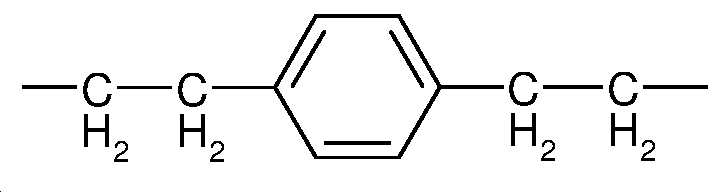

그러한 2가 유기작용성 탄화수소 기의 대표적인 비제한적인 예에는 2가 비스페놀 A 유도체, 아크릴레이트-작용성 알킬렌 기 및 메타크릴레이트-작용성 알킬렌 기가 포함된다. 대안적으로, 각각의 기 D는 에틸렌, 프로필렌, 부틸렌 또는 헥실렌일 수 있다. 대안적으로, 기 D의 각각의 경우는 에틸렌 또는 프로필렌일 수 있다. 비휘발성 폴리유기실록산은 당업계에 공지되어 있으며 구매가능하다. 적합한 비휘발성 폴리유기실록산은 비휘발성 폴리다이메틸실록산으로 예시되지만 이로 한정되지 않는다. 그러한 비휘발성 폴리다이메틸실록산은 다우 코닝® 200 플루이즈를 포함하며, 이는 미국 미시간주 미들랜드 소재의 다우 코닝 코포레이션으로부터 구매가능하고, 점도가 10 cSt 내지 100,000 cSt, 대안적으로 20 cSt 내지 50,000 cSt, 대안적으로 50 cSt 내지 100,000 cSt, 대안적으로 50 cSt 내지 50,000 cSt, 그리고 대안적으로 12,500 내지 60,000 cSt의 범위일 수 있다. 본 명세서에 기재된 방법이 비휘발성 폴리유기실록산으로부터 휘발성 폴리유기실록산을 제거하는 데 사용되는 경우, 휘발성 폴리유기실록산은 증기압이 동일한 온도에서의 비휘발성 폴리유기실록산의 증기압보다 더 낮다. 비휘발성 폴리유기실록산과 휘발성 폴리유기실록산은 분자량, 중합도, 및 R4 기에 대한 선택과 같은 적어도 하나의 특성이 서로 상이할 것이다.Representative, non-limiting examples of such divalent organic functional hydrocarbon groups include divalent bisphenol A derivatives, acrylate-functional alkylene groups and methacrylate-functional alkylene groups. Alternatively, each group D may be ethylene, propylene, butylene or hexylene. Alternatively, each instance of group D may be ethylene or propylene. Nonvolatile polyorganosiloxanes are known in the art and are commercially available. Suitable nonvolatile polyorganosiloxanes include, but are not limited to, nonvolatile polydimethylsiloxanes. Such non-volatile polydimethylsiloxanes include Dow Corning® 200 fluids, available from Dow Corning Corporation of Midland, Mich., Having a viscosity of from 10 cSt to 100,000 cSt, alternatively from 20 cSt to 50,000 cSt, Alternatively from 50 cSt to 100,000 cSt, alternatively from 50 cSt to 50,000 cSt, and alternatively from 12,500 to 60,000 cSt. When the method described herein is used to remove volatile polyorganosiloxanes from non-volatile polyorganosiloxanes, the volatile polyorganosiloxanes have a lower vapor pressure than the vapor pressure of the non-volatile polyorganosiloxanes at the same temperature. The nonvolatile polyorganosiloxane and the volatile polyorganosiloxane will differ from each other in at least one characteristic such as molecular weight, degree of polymerization, and selection for R 4 groups.
비휘발성 폴리유기실록산은 비환형 폴리유기실록산 중합체 및/또는 공중합체일 수 있다. 본 방법은 폴리유기실록산 중간체 및 생성물, 예컨대 선형 및/또는 분지형 폴리다이유기실록산 중합체 및/또는 공중합체를 정제하는 데 사용될 수 있다. 소정 응용에서는, 환형 폴리다이알킬실록산의 낮거나 검출 불가능한 (GC에 의함) 함량이, 특히 미용 및 건강관리 산업에서 소비자에 의해 요구된다. 그러한 폴리다이유기실록산 중합체 및 공중합체의 예는 하기 화학식 (I) 또는 화학식 (II):The non-volatile polyorganosiloxanes may be non-cyclic polyorganosiloxane polymers and / or copolymers. The process can be used to purify polyorganosiloxane intermediates and products, such as linear and / or branched polydiuosiloxane polymers and / or copolymers. In certain applications, the low or undetectable (by GC) content of the cyclic polydialkylsiloxane is required by the consumer, particularly in the cosmetic and health care industry. Examples of such polydi organosiloxane polymers and copolymers are those of the formula ( I ) or ( II ): <
화학식 (I): R6 3SiO(R6 2SiO)k(R6HSiO)mSiR6 3,???????? R 6 3 SiO (R 6 2 SiO) k (R 6 HSiO) m SiR 6 3 ????? ( I )
화학식 (II): R6 2HSiO(R6 2SiO)n(R6HSiO)oSiR6 2H, 또는Formula (II): R 6 2 HSiO (R 6 2 SiO) n (R 6 HSiO) o SiR 6 2 H, or
이들의 조합을 가질 수 있다.And combinations of these.
상기 화학식 (I) 및 화학식 (II)에서, 하첨자 k는 1 내지 2000 범위의 평균값을 가지고, 하첨자 m은 0 내지 2000 범위의 평균값을 가지고, 하첨자 n은 1 내지 2000 범위의 평균값을 가지고, 하첨자 o는 0 내지 2000 범위의 평균값을 갖는다. 각각의 R6은 독립적으로 1가 유기 기이다. 1가 유기 기는 1가 탄화수소 기 또는 1가 할로겐화 탄화수소 기일 수 있다. 1가 탄화수소 기는 알킬, 알케닐, 알키닐, 아릴, 아르알킬, 및 카르보사이클릭 기를 포함한다. 알킬 기는 분지형 또는 비분지형, 포화 1가 탄화수소 기를 포함하며, 이는 메틸, 에틸, 프로필 (예를 들어, 아이소-프로필 및/또는 n-프로필), 부틸 (예를 들어, 아이소부틸, n-부틸, tert-부틸, 및/또는 sec-부틸), 펜틸 (예를 들어, 아이소펜틸, 네오펜틸, 및/또는 tert-펜틸), 헥실, 헵틸, 옥틸, 노닐, 및 데실뿐만 아니라 6개 이상의 탄소 원자의 분지형 포화 1가 탄화수소 기로 예시되지만 이에 한정되지 않는다. 아릴 기는 사이클릭, 완전 불포화, 탄화수소 기를 포함하며, 이는 사이클로펜타다이에닐, 페닐, 안트라세닐, 및 나프틸로 예시되지만 이로 한정되지 않는다. 모노사이클릭 아릴 기는 5 내지 9개의 탄소 원자, 대안적으로 6개 또는 7개의 탄소 원자, 및 대안적으로 5개 또는 6개의 탄소 원자를 가질 수 있다. 폴리사이클릭 아릴 기는 10 내지 17개의 탄소 원자, 대안적으로 10 내지 14개의 탄소 원자, 그리고 대안적으로 12 내지 14개의 탄소 원자를 가질 수 있다. 아르알킬 기는 펜던트 및/또는 말단 아릴 기를 갖는 알킬 기 또는 펜던트 알킬 기를 갖는 아릴 기를 의미한다. 예시적인 아르알킬 기는 톨릴, 자일릴, 벤질, 페닐에틸, 페닐 프로필, 및 페닐 부틸을 포함한다. 카르보사이클릭 기는 탄화수소 고리이다. 카르보사이클릭 기는 모노사이클릭 고리일 수 있거나 또는 대안적으로 융합, 가교, 또는 스피로 폴리사이클릭 고리를 가질 수 있다. 모노사이클릭 카르보사이클릭 기는 3 내지 9개의 탄소 원자, 대안적으로 4 내지 7개의 탄소 원자, 그리고 대안적으로 5개 또는 6개의 탄소 원자를 가질 수 있다. 폴리사이클릭 카르보사이클릭 기는 7 내지 17개의 탄소 원자, 대안적으로 7 내지 14개의 탄소 원자, 그리고 대안적으로 9개 또는 10개의 탄소 원자를 가질 수 있다. 카르보사이클은 포화 또는 부분 불포화될 수 있다. 카르보사이클릭 기는 포화된 사이클로알킬 기일 수 있다. 적합한 모노사이클릭 사이클로알킬 기는 사이클로부틸, 사이클로펜틸, 및 사이클로헥실로 예시된다. 적합한 1가 할로겐화 탄화수소 기는 탄소 원자에 결합된 하나 이상의 수소 원자가 할로겐 원자로 형식상 대체된 1가 탄화수소 기를 지칭한다. 할로겐화 탄화수소 기는 할로알킬 기, 할로겐화 카르보사이클릭 기, 및 할로알케닐 기를 포함한다. 할로알킬 기는 플루오르화 알킬 기, 예를 들어 트라이플루오로메틸 (CF3), 플루오로메틸, 트라이플루오로에틸, 2-플루오로프로필, 3,3,3-트라이플루오로프로필, 4,4,4-트라이플루오로부틸, 4,4,4,3,3-펜타플루오로부틸, 5,5,5,4,4,3,3-헵타플루오로펜틸, 6,6,6,5,5,4,4,3,3-노나플루오로헥실, 및 8,8,8,7,7-펜타플루오로옥틸; 및 염소화 알킬 기, 예컨대 클로로메틸 및 3-클로로프로필을 포함한다. 할로겐화 카르보사이클릭 기는 플루오르화 사이클로알킬 기, 예를 들어 2,2-다이플루오로사이클로프로필, 2,3-다이플루오로사이클로부틸, 3,4-다이플루오로사이클로헥실, 및 3,4-다이플루오로-5-메틸사이클로헵틸; 및 염소화 사이클로알킬 기, 예컨대 2,2-다이클로로사이클로프로필, 2,3-다이클로로사이클로펜틸을 포함한다. 할로알케닐 기는 클로로알릴을 포함한다.In the above formulas ( I ) and ( II ), the subscript k has an average value ranging from 1 to 2000, the subscript m has an average value ranging from 0 to 2000, and the subscript n has an average value ranging from 1 to 2000 , And the subscript o has an average value in the range of 0 to 2000. Each R < 6 > is independently a monovalent organic group. The monovalent organic group may be a monovalent hydrocarbon group or a monovalent halogenated hydrocarbon group. Monovalent hydrocarbon groups include alkyl, alkenyl, alkynyl, aryl, aralkyl, and carbocyclic groups. Alkyl groups include branched or unbranched, saturated monovalent hydrocarbon groups, which include methyl, ethyl, propyl (e.g. isopropyl and / or n-propyl), butyl (e.g. isobutyl, butyl, and / or sec-butyl), pentyl (e.g., isopentyl, neopentyl, and / or tert-pentyl), hexyl, heptyl, octyl, nonyl, and decyl, But are not limited to, branched saturated monovalent hydrocarbon groups. The aryl group includes cyclic, fully unsaturated, hydrocarbon groups, including, but not limited to, cyclopentadienyl, phenyl, anthracenyl, and naphthyl. The monocyclic aryl group may have 5 to 9 carbon atoms, alternatively 6 or 7 carbon atoms, and alternatively 5 or 6 carbon atoms. The polycyclic aryl group may have from 10 to 17 carbon atoms, alternatively from 10 to 14 carbon atoms, and alternatively from 12 to 14 carbon atoms. Aralkyl groups mean an aryl group having a pendant and / or a terminal aryl group or an alkyl group having a pendant alkyl group. Exemplary aralkyl groups include tolyl, xylyl, benzyl, phenylethyl, phenylpropyl, and phenylbutyl. The carbocyclic group is a hydrocarbon ring. The carbocyclic group may be a monocyclic ring or alternatively may have a fused, bridged, or spirocyclic ring. The monocyclic carbocyclic group may have from 3 to 9 carbon atoms, alternatively from 4 to 7 carbon atoms, and alternatively from 5 or 6 carbon atoms. The polycyclic carbocyclic group may have 7 to 17 carbon atoms, alternatively 7 to 14 carbon atoms, and alternatively 9 or 10 carbon atoms. Carbocycles can be saturated or partially unsaturated. The carbocyclic group may be a saturated cycloalkyl group. Suitable monocyclic cycloalkyl groups are exemplified by cyclobutyl, cyclopentyl, and cyclohexyl. Suitable monovalent halogenated hydrocarbon groups refer to monovalent hydrocarbon groups in which one or more hydrogen atoms bonded to a carbon atom are formally replaced with a halogen atom. The halogenated hydrocarbon group includes a haloalkyl group, a halogenated carbocyclic group, and a haloalkenyl group. Haloalkyl groups are fluorinated alkyl groups such as trifluoromethyl (CF 3), by a methyl, trifluoromethyl, ethyl 2-fluoro-fluoro-propyl, 3,3,3-trifluoro-propyl, 4,4, Tetrafluorobutyl, 4,4,4,3,3-pentafluorobutyl, 5,5,5,4,4,3,3-heptafluoropentyl, 6,6,6,5,5 , 4,4,3,3-nonafluorohexyl, and 8,8,8,7,7-pentafluorooctyl; And chlorinated alkyl groups such as chloromethyl and 3-chloropropyl. Halogenated carbocyclic groups include fluorinated cycloalkyl groups such as 2,2-difluorocyclopropyl, 2,3-difluorocyclobutyl, 3,4-difluorocyclohexyl, and 3,4-di Fluoro-5-methylcycloheptyl; And chlorinated cycloalkyl groups such as 2,2-dichlorocyclopropyl, 2,3-dichlorocyclopentyl. The haloalkenyl group includes chloroallyl.
대안적으로, 1가 유기 기는 산소-원자로 치환된 탄화수소 기, 예컨대 알콕시 기, 아릴옥시 기, 아르알킬옥시 기, 옥소(카르보닐) 기, 카르복실 기 - 카르복실산, 카르복실레이트, 및 카르복실레이트 에스테르를 포함함 - 일 수 있다. 대안적으로, 1가 유기 기는 황 원자로 치환된 탄화수소 기, 예컨대 티올-작용기, 알킬 및 아릴 설파이드 기, 설폭사이드-작용기, 설폰 작용기, 설포닐 작용기, 및 설폰아미드 작용기일 수 있다. 대안적으로, 1가 유기 기는 질소 원자로 치환된 탄화수소 기, 예컨대 아민, 하이드록실아민, 니트릴, 니트로 기, N-옥사이드, 하이드라지드, 아지드, 및 에나민일 수 있다. 대안적으로, 1가 유기 기는 다른 헤테로원자-함유 기로 치환된 탄화수소 기일 수 있다. 1가 탄화수소 기 상에서 치환되어 1가 유기 기를 형성하는 원자 및 기의 비제한적인 예에는 F, Cl, Br, I, OR', OC(O)N(R')2, CN, NO, NO2, ONO2, 아지도, CF3, OCF3, R', O (옥소), S (티오노), C(O), S(O), 메틸렌다이옥시, 에틸렌다이옥시, N(R')2, SR', SOR', SO2R', SO2N(R')2, SO3R', C(O)R', C(O)C(O)R', C(O)CH2C(O)R', C(S)R', C(O)OR', OC(O)R', C(O)N(R')2, OC(O)N(R')2, C(S)N(R')2, (CH2)0-2N(R')C(O)R', (CH2)0-2N(R')N(R')2, N(R')N(R')C(O)R', N(R')N(R')C(O)OR', N(R')N(R')CON(R')2, N(R')SO2R', N(R')SO2N(R')2, N(R')C(O)OR', N(R')C(O)R', N(R')C(S)R', N(R')C(O)N(R')2, N(R')C(S)N(R')2, N(COR')COR', N(OR')R', C(=NH)N(R')2, C(O)N(OR')R', 또는 C(=NOR')R'이 포함되며, 여기서 R'은 수소 또는 탄소계 모이어티(moiety)일 수 있고, 탄소계 모이어티는 그 자체가 추가로 치환될 수 있고, 예를 들어, R'은 수소, 알킬, 아실, 사이클로알킬, 아릴, 아르알킬, 헤테로사이클릴, 헤테로아릴 또는 헤테로아릴알킬일 수 있고, 임의의 알킬, 아실, 사이클로알킬, 아릴, 아르알킬, 헤테로사이클릴, 헤테로아릴 또는 헤테로아릴알킬 또는 R'은 독립적으로 일치환 또는 다치환될 수 있거나; 또는 질소 원자 또는 인접한 질소 원자에 결합된 2개의 R' 기는 질소 원자 또는 원자들과 함께 헤테로사이클릴을 형성할 수 있고, 이는 독립적으로 일치환 또는 다치환될 수 있다. 유기 기의 예에는 선형 및/또는 분지형 기, 예컨대 알킬 기, 완전 또는 부분 할로겐-치환된 할로알킬 기, 알케닐 기, 알키닐 기, 방향족 기, 아크릴레이트 작용기, 및 메타크릴레이트 작용기; 및 다른 유기 작용기, 예컨대 에테르 기, 시아네이트 에스테르 기, 에스테르 기, 카르복실레이트 염 기, 메르캅토 기, 설파이드 기, 아지드 기, 포스포네이트 기, 포스핀 기, 마스킹된 아이소시아노 기, 및 하이드록실 기가 포함된다. 유기 기의 예에는 하기가 포함되지만 이로 한정되지 않는다: 알킬 기, 예컨대 메틸, 에틸, 프로필, 아이소프로필, n-부틸, s-부틸, 및 t-부틸 기, 아크릴레이트 작용기, 예컨대 아크릴로일옥시프로필 기 및 메타크릴로일옥시프로필 기; 알케닐 기, 예컨대 비닐, 알릴, 및 부테닐 기; 알키닐 기, 예컨대 에티닐 및 프로피닐 기; 방향족 기, 예컨대 페닐, 톨릴, 및 자일릴 기; 시아노알킬 기, 예컨대 시아노에틸 및 시아노프로필 기; 할로겐화 탄화수소 기, 예컨대 3,3,3-트라이플루오로프로필, 3-클로로프로필, 다이클로로페닐, 및 6,6,6,5,5,4,4,3,3-노나플루오로헥실 기; 알케닐옥시폴리(옥시알킬렌) 기, 예컨대 알릴옥시(폴리옥시에틸렌), 알릴옥시폴리(옥시프로필렌), 및 알릴옥시-폴리(옥시프로필렌)-코-폴리(옥시에틸렌) 기; 알킬옥시폴리(옥시알킬렌) 기, 예컨대 프로필옥시(폴리옥시에틸렌), 프로필옥시폴리(옥시프로필렌) 및 프로필옥시-폴리(옥시프로필렌)-코-폴리(옥시에틸렌) 기; 할로겐 치환된 알킬옥시폴리(옥시알킬렌) 기, 예컨대 퍼플루오로프로필옥시(폴리옥시에틸렌), 퍼플루오로프로필옥시폴리(옥시프로필렌), 및 퍼플루오로프로필옥시-폴리(옥시프로필렌)-코-폴리(옥시에틸렌) 기; 알콕시 기, 예컨대 메톡시, 에톡시, n-프로폭시, 아이소프로폭시, n-부톡시, 및 에틸헥실옥시 기; 아미노알킬 기, 예컨대 3-아미노프로필, 6-아미노헥실, 11-아미노운데실, 3-(N-알릴아미노)프로필, N-(2-아미노에틸)-3-아미노프로필, N-(2-아미노에틸)-3-아미노아이소부틸, p-아미노페닐, 2-에틸피리딘, 및 3-프로필피롤 기; 에폭시알킬 기, 예컨대 3-글리시독시프로필, 2-(3,4-에폭시사이클로헥실)에틸, 및 5,6-에폭시헥실 기; 에스테르 작용기, 예컨대 아세톡시에틸 및 벤조일옥시프로필 기; 하이드록시 작용기, 예컨대 하이드록시에틸 및 2-하이드록시에틸 기; 마스킹된 아이소시아네이트 작용기, 예컨대 프로필-t-부틸카르바메이트, 및 프로필에틸카르바메이트 기; 알데하이드 작용기, 예컨대 운데카날 및 부티르알데하이드 기; 무수물 작용기, 예컨대 3-프로필 석신산 무수물 및 3-프로필 말레산 무수물 기; 및 카르복실산의 금속 염, 예컨대 3-카르복시프로필 및 2-카르복시에틸의 아연, 나트륨, 또는 칼륨 염.Alternatively, the monovalent organic group may be an oxygen-atom-substituted hydrocarbon group such as an alkoxy group, an aryloxy group, an aralkyloxy group, an oxo (carbonyl) group, a carboxylic group- - < / RTI > Alternatively, the monovalent organic group may be a hydrocarbon group substituted with a sulfur atom, such as a thiol-functional group, an alkyl and aryl sulfide group, a sulfoxide-functional group, a sulfon functional group, a sulfonyl functional group, and a sulfonamide functional group. Alternatively, the monovalent organic group may be a hydrocarbon group substituted with a nitrogen atom, such as an amine, hydroxylamine, nitrile, nitro group, N-oxide, hydrazide, azide, and enamine. Alternatively, the monovalent organic group may be a hydrocarbon group substituted with another heteroatom-containing group. 1 is a non-limiting example of substitution is atomic and group of 1 to form an organic group on the hydrocarbon groups include, but are not limited to F, Cl, Br, I, OR ', OC (O) N (R') 2, CN, NO, NO 2 (O), ONO 2 , azido, CF 3 , OCF 3 , R ', O (oxo), S (thio), C (O), S (O), methylenedioxy, ethylene dioxy, 2 , SR ', SOR', SO 2 R ', SO 2 N (R') 2 , SO 3 R ', C (O) R', C (O) 2 C (O) R ', C (S) R', C (O) OR ', OC (O) R', C (O) N (R ') 2, OC (O) N (R') 2 , C (S) N (R ') 2, (CH 2) 0-2 N (R') C (O) R ', (CH 2) 0-2 N (R') N (R ') 2, N (R ') N (R ') C (O) R ', N (R') N (R ') C (O) OR', N (R ') N (R') CON (R ') 2 , N (R ') SO 2 R', N (R ') SO 2 N (R') 2, N (R ') C (O) OR', N (R ') C (O) R', N (R ') C (S) R', N (R ') C (O) N (R') 2, N (R ') C (S) N (R') 2, N (COR ') COR' , N (OR ') R', C (= NH) N (R ') 2 , C Hydrogen or a carbon-based moiety and the carbon-based moiety may itself be further substituted, for example, R 'is hydrogen, alkyl, acyl, cycloalkyl, aryl, aralkyl, Heterocyclyl, heteroaryl or heteroarylalkyl, or R < 1 > is independently mono- or poly-substituted, wherein the alkyl, acyl, cycloalkyl, aryl, aralkyl, Or; Or two R 'groups bonded to a nitrogen atom or adjacent nitrogen atom may form a heterocyclyl together with the nitrogen atom or the atoms, which may be independently monosubstituted or polysubstituted. Examples of organic groups include linear and / or branched groups such as alkyl groups, fully or partially halogen-substituted haloalkyl groups, alkenyl groups, alkynyl groups, aromatic groups, acrylate functional groups, and methacrylate functional groups; And other organic functional groups such as an ether group, a cyanate ester group, an ester group, a carboxylate salt group, a mercapto group, a sulfide group, an azide group, a phosphonate group, a phosphine group, a masked isocyanate group, And hydroxyl groups. Examples of organic groups include, but are not limited to, alkyl groups such as methyl, ethyl, propyl, isopropyl, n-butyl, s-butyl and t- butyl groups, acrylate functional groups such as acryloyloxy Propyl group and methacryloyloxypropyl group; Alkenyl groups such as vinyl, allyl, and butenyl groups; Alkynyl groups such as ethynyl and propynyl groups; Aromatic groups such as phenyl, tolyl, and xylyl groups; Cyanoalkyl groups such as cyanoethyl and cyanopropyl groups; Halogenated hydrocarbon groups such as 3,3,3-trifluoropropyl, 3-chloropropyl, dichlorophenyl, and 6,6,6,5,5,4,4,3,3-nonafluorohexyl groups; Alkoxypoly (oxyalkylene) groups such as allyloxy (polyoxyethylene), allyloxypoly (oxypropylene), and allyloxy-poly (oxypropylene) -co-poly (oxyethylene) groups; Alkyloxypoly (oxyalkylene) groups such as propyloxy (polyoxyethylene), propyloxypoly (oxypropylene) and propyloxy-poly (oxypropylene) -co-poly (oxyethylene) groups; Halogen substituted alkyloxypoly (oxyalkylene) groups such as perfluoropropyloxy (polyoxyethylene), perfluoropropyloxypoly (oxypropylene), and perfluoropropyloxy-poly (oxypropylene) -co A poly (oxyethylene) group; Alkoxy groups such as methoxy, ethoxy, n-propoxy, isopropoxy, n-butoxy, and ethylhexyloxy groups; Aminoalkyl groups such as 3-aminopropyl, 6-aminohexyl, 11-aminoundecyl, 3- (N-allylamino) Aminoethyl) -3-aminoisobutyl, p-aminophenyl, 2-ethylpyridine, and 3-propylpyrrole groups; Epoxy alkyl groups such as 3-glycidoxypropyl, 2- (3,4-epoxycyclohexyl) ethyl, and 5,6-epoxyhexyl groups; Ester functional groups such as acetoxyethyl and benzoyloxypropyl groups; Hydroxy functional groups such as hydroxyethyl and 2-hydroxyethyl groups; Masked isocyanate functional groups such as propyl-t-butyl carbamate, and propyl ethyl carbamate groups; Aldehyde functional groups such as undecanal and butyraldehyde groups; Anhydride functional groups such as 3-propyl succinic anhydride and 3-propyl maleic anhydride groups; And metal salts of carboxylic acids such as zinc, sodium, or potassium salts of 3-carboxypropyl and 2-carboxyethyl.
정제하려는 혼합물 내의 폴리유기실록산은 하기로 예시된다:The polyorganosiloxanes in the mixture to be purified are exemplified by:
a) 트라이메틸실록시-말단화된 폴리다이메틸실록산,a) trimethylsiloxy-terminated polydimethylsiloxane,
b) 트라이메틸실록시-말단화된 폴리(다이메틸실록산/메틸페닐실록산),b) trimethylsiloxy-terminated poly (dimethylsiloxane / methylphenylsiloxane),
c) 다이메틸수소실록시-말단화된 폴리다이메틸실록산,c) dimethylhydrogensiloxy-terminated polydimethylsiloxane,
d) 다이메틸수소실록시-말단화된 폴리(다이메틸실록산/메틸수소실록산),d) dimethylhydrogensiloxy-terminated poly (dimethylsiloxane / methylhydrogensiloxane),
e) 다이메틸수소실록시-말단화된 폴리메틸수소실록산,e) dimethyl hydrogen siloxy-terminated polymethyl hydrogen siloxane,
f) 트라이메틸실록시-말단화된 폴리(다이메틸실록산/메틸수소실록산),f) trimethylsiloxy-terminated poly (dimethylsiloxane / methylhydrogensiloxane),
g) 트라이메틸실록시-말단화된 폴리메틸수소실록산,g) trimethylsiloxy-terminated polymethylhydrogen siloxane,
하이드록시-말단화된 폴리다이메틸실록산,Hydroxy-terminated polydimethylsiloxane,
하이드록시-말단화된 폴리(다이메틸실록산/메틸비닐실록산),Hydroxy-terminated poly (dimethyl siloxane / methyl vinyl siloxane),
하이드록시-말단화된 폴리(다이메틸실록산/메틸페닐실록산),Hydroxy-terminated poly (dimethylsiloxane / methylphenylsiloxane),
h) a), b), c), d), e), f), 및 g)의 둘 이상의 조합.h) a combination of two or more of a), b), c), d), e), f), and g).
대안적으로, 혼합물은 공정 가스 또는 증기 스트림일 수 있다. 예에는 폴리유기실록산을 중합 또는 작용화하는 데 사용되는 것들과 같은 반응기로부터의 혼합된 오버헤드 증기 스트림뿐만 아니라, 잔류 휘발성 실록산, 예컨대 매립지 가스를 함유하는 배기 스트림 및 공기 스트림이 포함된다. 반응의 유형의 예에는 가수분해, 응축, 하이드로실릴화, 에폭시화, 알콕실화, 에스테르 교환, 트랜스-가알코올분해, 라디칼 중합, 음이온성 또는 양이온성 중합이 포함된다. 공정 가스 스트림의 다른 예에는 발전소, 엔진, 히터 및 퍼니스(furnace)로부터의 연소 배기가스가 포함된다.Alternatively, the mixture may be a process gas or a vapor stream. Examples include mixed overhead vapor streams from reactors such as those used to polymerize or functionalize polyorganosiloxanes, as well as exhaust streams and air streams containing residual volatile siloxanes such as landfill gas. Examples of types of reactions include hydrolysis, condensation, hydrosilylation, epoxidation, alkoxylation, ester exchange, trans-alcoholysis, radical polymerization, anionic or cationic polymerization. Other examples of process gas streams include combustion exhaust gases from power plants, engines, heaters, and furnaces.
대안적으로, 혼합물은 공정 액체 스트림일 수 있다. 예에는 VOC-함유 폐수 또는 에멀젼, 예컨대 잔류 단량체를 함유하는 라텍스 페인트 또는 잔류 휘발성 실록산을 함유하는 실리콘 에멀젼이 포함된다.Alternatively, the mixture may be a process liquid stream. Examples include VOC-containing wastewater or emulsions, such as latex paint containing residual monomers or silicone emulsions containing residual volatile siloxanes.
방법의 응용/용도Application / Use of Method
본 방법은, 예를 들어 공정 증기 스트림으로부터 무기 화합물을 제거하고/하거나 VOC를 건조 및/또는 제거하기 위한 다양한 응용에 사용될 수 있다.The process can be used in a variety of applications, for example to remove inorganic compounds from the process vapor stream and / or to dry and / or remove VOCs.
대안적으로, 본 명세서에 기재된 방법은 혼합물, 예컨대 비휘발성 폴리유기실록산 (전술된 바와 같음), 예컨대 비환형 폴리다이유기실록산, 공정 가스 유출물, 및 공정 폐수 내의 환형 폴리다이유기실록산 (전술된 바와 같음), 예를 들어 폴리다이알킬실록산의 양을 감소시키는 데 사용될 수 있다.Alternatively, the process described herein may be carried out using a mixture, such as a non-volatile polyorganosiloxane (as described above), such as a non-cyclic polydialkylorganosiloxane, a process gas effluent, ), For example, to reduce the amount of polydialkylsiloxane.
일부 실시 형태에서, 본 명세서에 기재된 방법은 고갈된 혼합물 내에 원하는 휘발성 성분을 남기면서 소정의 휘발성 성분을 선택적으로 제거하는 데 사용될 수 있다. 이러한 실시 형태에서, 비다공성 가교결합된 탄성중합체 중에서의 하나의 휘발성 성분의 용해도는 더 높은 증기압을 갖는 제2 휘발성 성분의 용해도보다 더 높을 수 있다.In some embodiments, the methods described herein can be used to selectively remove certain volatile components while leaving the desired volatile components in the depleted mixture. In such embodiments, the solubility of one volatile component in the non-porous cross-linked elastomer may be higher than the solubility of the second volatile component having a higher vapor pressure.
예를 들어, 수증기 및 환형 폴리유기실록산, 예컨대 D4 및 D5를 함유하는 실리콘 에멀젼의 경우에, 환형 폴리유기실록산을 제거하고 에멀젼 중에 수증기를 남기는 것이 바람직할 수 있다.For example, in the case of silicone emulsions containing water vapor and cyclic polyorganosiloxanes, such as D 4 and D 5 , it may be desirable to remove the cyclic polyorganosiloxane and leave water vapor in the emulsion.
일 실시 형태에서, 본 명세서에 기재된 방법은 휘발성 성분 및 적어도 하나의 비휘발성 성분을 포함하는 혼합물로부터 휘발성 성분을 제거하는 데 사용될 수 있다. 본 방법은 하기 단계들을 포함한다:In one embodiment, the methods described herein can be used to remove volatile components from a mixture comprising a volatile component and at least one non-volatile component. The method includes the following steps:
1) 증기상 혼합물을 유리 전이 온도가 25℃ 이하인 비다공성 가교결합된 탄성중합체와 직접 접촉시킴으로써, 수착 전의 혼합물보다 더 적은 휘발성 성분을 함유하는 고갈된 혼합물을 형성하고, 비다공성 가교결합된 탄성중합체를 수착된 휘발성 성분으로 풍부화함으로써 풍부화된 가교결합된 탄성중합체를 형성하는 단계,1) forming a depleted mixture containing less volatile components than the mixture prior to sorption by direct contact of the vapor phase mixture with a non-porous cross-linked elastomer having a glass transition temperature of 25 캜 or less, and a non-porous cross-linked elastomer To form an enriched crosslinked elastomer by enriching with a sorbed volatile component,
2) 단계 1) 동안 그리고/또는 후에 고갈된 혼합물을 회수하는 단계,2) recovering the depleted mixture during and / or after step 1)
3) 풍부화된 가교결합된 탄성중합체로부터 수착된 휘발성 성분의 적어도 일부를 탈착시킴으로써, 탈착된 휘발성 성분 및 탈착 전의 풍부화된 가교결합된 탄성중합체보다 더 적은 수착된 휘발성 성분을 함유하는 재생된 탄성중합체를 형성하는 단계,3) By desorbing at least a portion of the volatile components sorbed from the enriched crosslinked elastomer, a regenerated elastomer containing less desorbed volatile components and fewer sorbed volatile components than the enriched crosslinked elastomer prior to desorption Forming step,
4) 단계 1)을 반복 시에 비다공성 가교결합된 탄성중합체의 전부 또는 일부로서 재생된 탄성중합체를 사용하는 단계, 및4) using the recycled elastomer as all or part of the non-porous cross-linked elastomer in repeating step 1), and
선택적으로 5) 단계 2) 동안 그리고/또는 후에 탈착된 휘발성 성분을 회수하는 단계. 이러한 실시 형태에서, 휘발성 성분은 휘발성 오염물일 수 있다. 휘발성 오염물은 전술된 바와 같이 중합도가 3 내지 12인 환형 폴리유기실록산을 포함할 수 있다. 혼합물 내의 적어도 하나의 비휘발성 성분은 선형 폴리유기실록산을 포함할 수 있다. 비다공성 가교결합된 탄성중합체는 비다공성 가교결합된 폴리유기실록산 탄성중합체일 수 있다. 본 방법의 이러한 실시 형태는 선형 폴리유기실록산을 포함하지만 이로 한정되지 않는 다양한 혼합물로부터 D4를 제거하는 데 사용될 수 있다.Optionally 5) recovering the volatile components desorbed during and / or after step 2). In this embodiment, the volatile component may be a volatile contaminant. The volatile contaminants may comprise cyclic polyorganosiloxanes having a degree of polymerization of 3 to 12 as described above. The at least one non-volatile component in the mixture may comprise a linear polyorganosiloxane. The non-porous cross-linked elastomer may be a non-porous cross-linked polyorganosiloxane elastomer. This embodiment of the method can be used to remove D 4 from a variety of mixtures including, but not limited to, linear polyorganosiloxanes.
Tg가 25℃ 이하인 비다공성 가교결합된 탄성중합체A non-porous cross-linked elastomer having a Tg of 25 占 폚 or less
비다공성 가교결합된 탄성중합체는 Tg가 +25℃ 이하이다. 이것은 유기 탄성중합체 또는 폴리유기실록산 탄성중합체일 수 있다. Tg는 -225℃ 내지 +25℃의 범위일 수 있다. 대안적으로, Tg는 -200℃ 내지 + 25℃의 범위일 수 있다. 본 방법에 사용하기에 적합한 유기 탄성중합체의 예에는 폴리부타디엔, 폴리아이소부틸렌, 폴리아이소프렌, 어택틱(atactic) 폴리프로필렌 및 에틸렌-프로필렌 탄성중합체, 에틸렌-프로필렌-다이엔 (EPDM), 스티렌-부타디엔 고무, 니트릴 고무, 수소화 니트릴 고무, 할로겐화 고무, 플루오로탄성중합체 (예를 들어, 비톤(Viton)™), 폴리에테르 블록 아미드, 에틸렌 비닐 아세테이트 (EVA), 에피클로로하이드린 고무, 아크릴 고무, 퍼플루오로탄성중합체 (예를 들어, 칼레즈(Kalrez)™), 폴리스티렌, 폴리아크릴레이트, 및 폴리우레탄 고무가 포함된다. 이론에 의해 구애되고자 함이 없이, Tg가 +25℃ 초과인 유리질 유기 중합체는 더 낮은 Tg 재료보다 더 적은 자유 부피를 가지며, 자유 부피는 더 높은 Tg를 갖는 재료보다 탄성중합체의 벌크 내로의 더 많은 수착을 가능하게 하는 것으로 여겨진다. 본 발명에 사용되는 탄성중합체는 tan 델타가 > 0, 대안적으로 > 0 내지 2일 수 있다. tan 델타는 탄성 손실 모듈러스 대 탄성 저장 모듈러스의 비를 의미한다.The non-porous cross-linked elastomer has a Tg of + 25 占 폚 or less. It may be an organic elastomer or a polyorganosiloxane elastomer. The Tg may range from -225 ° C to + 25 ° C. Alternatively, the Tg may range from -200 ° C to + 25 ° C. Examples of organic elastomers suitable for use in the present process include polybutadiene, polyisobutylene, polyisoprene, atactic polypropylene and ethylene-propylene elastomers, ethylene-propylene-diene (EPDM) Butadiene rubber, nitrile rubber, hydrogenated nitrile rubber, halogenated rubber, fluoroelastomer (for example, Viton ™), polyether block amide, ethylene vinyl acetate (EVA), epichlorohydrin rubber, Perfluoroelastomers (e.g., Kalrez (TM)), polystyrene, polyacrylates, and polyurethane rubbers. Without wishing to be bound by theory, it is believed that the glassy organic polymer having a Tg of greater than + 25 ° C has less free volume than the lower Tg material, and the free volume has a higher Tg than the material having a higher Tg It is believed to enable sorption. The elastomer used in the present invention may have tan delta> 0, alternatively> 0 to 2. tan delta means the ratio of elastic loss modulus to elastic storage modulus.
Tg가 25℃ 이하인 비다공성 가교결합된 탄성중합체가, Tg가 25℃ 이하인 비다공성 가교결합된 폴리유기실록산 탄성중합체인 경우, 상기 비다공성 가교결합된 폴리유기실록산 탄성중합체는 하기 단계들을 포함하는 방법에 의해 제조될 수 있다:When the non-porous crosslinked elastomer having a Tg of 25 DEG C or lower is a non-porous crosslinked polyorganosiloxane elastomer having a Tg of 25 DEG C or lower, the non-porous crosslinked polyorganosiloxane elastomer is obtained by a method Can be prepared by:
i) 성분들을 배합하여i) combining the components
(A) 하이드로실릴화 촉매, (A) a hydrosilylation catalyst,
(B) 분자당 평균 2개 이상의 규소 결합된 지방족 불포화 탄화수소 기를 갖는 폴리유기실록산, (B) a polyorganosiloxane having an average of at least two silicon-bonded aliphatic unsaturated hydrocarbon groups per molecule,
(C) 분자당 평균 2개 초과의 규소 결합된 수소 원자를 갖는 가교결합제, (C) a cross-linking agent having an average of more than two silicon-bonded hydrogen atoms per molecule,
선택적으로, (D) 억제제, 및 Optionally, (D) an inhibitor, and
선택적으로, (E) 용매를 포함하는 조성물을 제조하는 단계; 및 Optionally, (E) preparing a composition comprising a solvent; And
ii) 조성물을 가열함으로써,ii) heating the composition,
가교결합된 폴리유기실록산 탄성중합체를 형성하는 단계. 이론에 의해 구애되고자 함이 없이, Tg는 성분 (B)의 적절한 선택, 성분 (B)의 중합도 (DP) 및 분자량 및 가교결합 밀도에 의해 제어될 수 있다. 성분 (B)가 폴리다이메틸실록산인 경우, DP는 10 이상이어서 Tg가 25℃ 이하인 비다공성 가교결합된 탄성중합체를 형성할 수 있다. 당업자는 Tg가 25℃ 이하인 비다공성 가교결합된 탄성중합체를 형성하기 위하여 성분 (A) 및 성분 (B)를 선택하는 방법을 알 것이다.To form a crosslinked polyorganosiloxane elastomer. Without wishing to be bound by theory, Tg can be controlled by the appropriate choice of component (B), the degree of polymerization (DP) of component (B), and the molecular weight and cross-linking density. When component (B) is a polydimethylsiloxane, the DP can be 10 or more to form a non-porous crosslinked elastomer having a Tg of 25 占 폚 or less. Those skilled in the art will know how to select component (A) and component (B) to form a non-porous cross-linked elastomer having a Tg of 25 占 폚 or less.
성분 (A)에 적합한 하이드로실릴화 촉매는 당업계에 공지되어 있으며 구매가능하다. 그러한 하이드로실릴화 촉매는 백금, 로듐, 루테늄, 팔라듐, 오스뮴, 및 이리듐으로부터 선택되는 금속을 포함할 수 있다. 대안적으로, 하이드로실릴화 촉매는 그러한 금속의 화합물, 예를 들어 클로로백금산, 클로로백금산 6수화물, 이염화백금, 및 상기 화합물들과 저분자량 유기폴리실록산의 착물, 또는 매트릭스 또는 코어/셸(core/shell) 유형 구조 내에 마이크로캡슐화된 백금 화합물일 수 있다. 백금과 저분자량 유기폴리실록산의 착물에는 백금과의 1,3-다이에테닐-1,1,3,3-테트라메틸다이실록산 착물이 포함된다. 이러한 착물은 수지 매트릭스 내에 마이크로캡슐화될 수 있다. 예시적인 하이드로실릴화 촉매가 미국 특허 제3,159,601호; 제3,220,972호; 제3,296,291호; 제3,419,593호; 제3,516,946호; 제3,814,730호; 제3,989,668호; 제4,784,879호; 제5,036,117호; 및 제5,175,325호와 유럽 특허 제0 347 895 B호에 기재되어 있다. 마이크로캡슐화된 하이드로실릴화 촉매 및 그의 제조 방법은 미국 특허 제4,766,176호 및 제5,017,654호에 예시되어 있다.Suitable hydrosilylation catalysts for component (A) are known in the art and are commercially available. Such hydrosilylation catalysts may include metals selected from platinum, rhodium, ruthenium, palladium, osmium, and iridium. Alternatively, the hydrosilylation catalyst may be a compound of such a metal, such as chloroplatinic acid, chloroplatinic acid hexahydrate, platinum dichloride, and complexes of such compounds with a low molecular weight organopolysiloxane, or a matrix or core / shell < / RTI > type structure. Complexes of platinum with low molecular weight organopolysiloxanes include 1,3-diethenyl-1,1,3,3-tetramethyldisiloxane complexes with platinum. Such complexes can be microencapsulated within the resin matrix. Exemplary hydrosilylation catalysts are described in U.S. Patent Nos. 3,159,601; 3,220,972; 3,296, 291; 3,419,593; 3,516,946; 3,814, 730; 3,989,668; 4,784,879; 5,036,117; And 5,175,325 and EP 0 347 895 B, which are incorporated herein by reference. Microencapsulated hydrosilylation catalysts and methods for their preparation are illustrated in U.S. Patent Nos. 4,766,176 and 5,017,654.
성분 (B)는 하이드로실릴화 반응을 겪을 수 있는, 분자당 평균 2개 이상의 규소 결합된 지방족 불포화 탄화수소 기를 갖는 폴리유기실록산이다. 성분 (B)는 선형 및/또는 분지형 구조를 가질 수 있다. 성분 (B)는 단일중합체 또는 공중합체일 수 있다. 성분 (B)는 하나의 폴리유기실록산일 수 있다. 대안적으로, 성분 (B)는 하기 특성들 중 적어도 하나가 상이한 둘 이상의 폴리유기실록산을 포함할 수 있다: 구조, 점도, 평균 분자량, 실록산 단위, 및 배열(sequence). 성분 (B) 내의 지방족 불포화 탄화수소 기는 말단 위치, 펜던트 위치, 또는 말단 위치와 펜던트 위치 둘 모두에 위치될 수 있다. 지방족 불포화 탄화수소 기는 알케닐 기, 예컨대 비닐, 알릴, 프로페닐, 또는 헥세닐; 또는 알케닐 기, 예컨대 에티닐 및 프로피닐일 수 있다.Component (B) is a polyorganosiloxane having an average of at least two silicon-bonded aliphatic unsaturated hydrocarbon groups per molecule, which may undergo a hydrosilylation reaction. Component (B) may have a linear and / or branched structure. Component (B) may be a homopolymer or a copolymer. Component (B) may be one polyorganosiloxane. Alternatively, component (B) may comprise two or more polyorganosiloxanes of which at least one of the following characteristics is different: structure, viscosity, average molecular weight, siloxane unit, and sequence. The aliphatic unsaturated hydrocarbon group in component (B) may be located at the terminal position, the pendant position, or both the terminal position and the pendant position. Aliphatic unsaturated hydrocarbon groups include alkenyl groups such as vinyl, allyl, propenyl, or hexenyl; Or an alkenyl group such as ethynyl and propynyl.
성분 (B)에 대한 폴리유기실록산 내의 나머지 규소-결합된 유기 기는 지방족 불포화체가 없는 1가 유기 기일 수 있다. 1가 탄화수소 기의 예에는 R1에 대해 전술된 바와 같은 알킬, 사이클로알킬, 아릴, 아르알킬, 및 카르보사이클릭 기가 포함되지만 이로 한정되지 않는다. 1가 할로겐화 탄화수소 기의 예에는 R1에 대해 전술된 할로알킬 기 및 할로겐화 사이클로알킬 기가 포함된다. 다른 1가 유기 기의 예는 상기에 정의된 바와 같으며, 이에는 산소 원자로 치환된 탄화수소 기, 예를 들어 글리시독시알킬, 아크릴옥시알킬, 메타크릴옥시알킬, 및 알콕시 또는 폴리에테르 기 (에틸렌 글리콜 및 프로필렌 글리콜 및 이들의 공중합체), 및 질소 원자로 치환된 탄화수소 기, 예를 들어 아미노알킬, 및 시아노-작용기, 예를 들어 시아노에틸 및 시아노프로필이 포함되지만 이로 한정되지 않는다.The remaining silicon-bonded organic groups in the polyorganosiloxane for component (B) may be monovalent organic groups without aliphatic unsaturation. Examples of monovalent hydrocarbon groups include, but are not limited to, alkyl, cycloalkyl, aryl, aralkyl, and carbocyclic groups as described above for R < 1 >. Examples of monovalent halogenated hydrocarbon groups include haloalkyl groups and halogenated cycloalkyl groups as described above for R < 1 >. Examples of other monovalent organic groups are as defined above, including hydrocarbon groups substituted with oxygen atoms, such as glycidoxyalkyl, acryloxyalkyl, methacryloxyalkyl, and alkoxy or polyether groups such as ethylene Glycols and propylene glycols and copolymers thereof), and hydrocarbon groups substituted with a nitrogen atom, such as aminoalkyl, and cyano-functional groups such as cyanoethyl and cyanopropyl.
성분 (B)는 하기 화학식 (I) 또는 화학식 (II)의 폴리다이유기실록산:Component (B) is a polydi organosiloxane of the formula (I) or (II)
화학식 (I): R7 2R8SiO(R7 2SiO)a(R7R8SiO)bSiR7 2R8,R 7 2 R 8 SiO (R 7 2 SiO) a (R 7 R 8 SiO) b SiR 7 2 R 8 ,
화학식 (II): R7 3SiO(R7 2SiO)c(R7R8SiO)dSiR7 3,Formula (II): R 7 3 SiO (R 7 2 SiO) c (R 7 R 8 SiO) d SiR 7 3,
또는 이들의 조합을 포함할 수 있다.Or a combination thereof.
화학식 (I) 및 화학식 (II)에서, 각각의 R7은 독립적으로 수소 원자, 또는 지방족 불포화체가 없는 1가 유기 기이고, 각각의 R8은 독립적으로 알케닐 기 또는 알키닐 기이다. 하첨자 a는 0 또는 양수일 수 있다. 대안적으로, 하첨자 a는 적어도 2의 평균값을 갖는다. 대안적으로, 하첨자 a는 2 내지 2000 범위의 값을 가질 수 있다. 하첨자 b는 0 또는 양수일 수 있다. 대안적으로, 하첨자 b는 0 내지 2000 범위의 평균값을 가질 수 있다. 합계 (a + b)는 적어도 10, 대안적으로 100 내지 4000일 수 있다. 하첨자 c는 0 또는 양수일 수 있다. 대안적으로, 하첨자 c는 0 내지 2000 범위의 평균값을 가질 수 있다. 하첨자 d는 적어도 2의 평균값을 갖는다. 대안적으로, 하첨자 d는 2 내지 2000 범위의 평균값을 가질 수 있다. 합계 c + d는 적어도 10, 대안적으로 100 내지 4000일 수 있다. R7에 적합한 1가 유기 기는 전술된 바와 같은 1가 탄화수소 기 및 1가 할로겐화 탄화수소 기이다. 대안적으로, 각각의 R7은 메틸과 같은 알킬 및 페닐과 같은 아릴로 예시되는 1가 탄화수소 기이다. 각각의 R8은 독립적으로 알케닐 기 또는 알키닐 기이다. R8은 알케닐 기, 예를 들어 비닐, 알릴, 부테닐, 및 헥세닐; 및 알키닐 기, 예를 들어 에티닐 및 프로피닐로 예시된다.In the formulas (I) and (II), each R 7 is independently a hydrogen atom or a monovalent organic group having no aliphatic unsaturation, and each R 8 is independently an alkenyl group or an alkynyl group. The subscript a can be 0 or a positive number. Alternatively, the subscript a has an average value of at least two. Alternatively, the subscript a may have a value in the range of 2 to 2000. The subscript b can be 0 or a positive number. Alternatively, the subscript b may have an average value ranging from 0 to 2000. The sum (a + b) may be at least 10, alternatively from 100 to 4000. The subscript c can be zero or a positive number. Alternatively, the subscript c may have an average value in the range of 0-2000. The subscript d has an average value of at least two. Alternatively, the subscript d may have an average value in the range of 2 to 2000. The sum c + d may be at least 10, alternatively from 100 to 4000. The monovalent organic group suitable for R 7 is a monovalent hydrocarbon group and a monovalent halogenated hydrocarbon group as described above. Alternatively, each R < 7 > is a monovalent hydrocarbon group, such as alkyl, such as methyl, and aryl, such as phenyl. Each R 8 is independently an alkenyl group or an alkynyl group. R 8 is an alkenyl group such as vinyl, allyl, butenyl, and hexenyl; And alkynyl groups such as ethynyl and propynyl.
성분 (B)는 하기와 같은 폴리다이유기실록산을 포함할 수 있다:Component (B) may comprise a polydi organosiloxane as follows:
i) 다이메틸비닐실록시-말단화된 폴리다이메틸실록산,i) dimethylvinylsiloxy-terminated polydimethylsiloxane,
ii) 다이메틸비닐실록시-말단화된 폴리(다이메틸실록산/메틸비닐실록산),ii) dimethylvinylsiloxy-terminated poly (dimethylsiloxane / methylvinylsiloxane),
iii) 다이메틸비닐실록시-말단화된 폴리메틸비닐실록산,iii) dimethylvinylsiloxy-terminated polymethylvinylsiloxane,
iv) 트라이메틸실록시-말단화된 폴리(다이메틸실록산/메틸비닐실록산),iv) trimethylsiloxy-terminated poly (dimethylsiloxane / methylvinylsiloxane),
v) 트라이메틸실록시-말단화된 폴리메틸비닐실록산,v) trimethylsiloxy-terminated polymethylvinylsiloxanes,
vi) 다이메틸비닐실록시-말단화된 폴리(다이메틸실록산/메틸비닐실록산),vi) dimethylvinylsiloxy-terminated poly (dimethylsiloxane / methylvinylsiloxane),
vii) 다이메틸비닐실록시-말단화된 폴리(다이메틸실록산/메틸페닐실록산),vii) dimethylvinylsiloxy-terminated poly (dimethylsiloxane / methylphenylsiloxane),
viii) 다이메틸비닐실록시-말단화된 폴리(다이메틸실록산/다이페닐실록산),viii) dimethylvinylsiloxy-terminated poly (dimethylsiloxane / diphenylsiloxane),
ix) 페닐,메틸,비닐-실록시-말단화된 폴리다이메틸실록산,ix) phenyl, methyl, vinyl-siloxy-terminated polydimethylsiloxane,
x) 다이메틸헥세닐실록시-말단화된 폴리다이메틸실록산,x) dimethylhexenylsiloxy-terminated polydimethylsiloxane,
xi) 다이메틸헥세닐실록시-말단화된 폴리(다이메틸실록산/메틸헥세닐실록산),xi) dimethylhexenylsiloxy-terminated poly (dimethylsiloxane / methylhexenylsiloxane),
xii) 다이메틸헥세닐실록시-말단화된 폴리메틸헥세닐실록산,xii) dimethylhexenylsiloxy-terminated polymethylhexenylsiloxane,
xiii) 트라이메틸실록시-말단화된 폴리(다이메틸실록산/메틸헥세닐실록산),xiii) trimethylsiloxy-terminated poly (dimethylsiloxane / methylhexenylsiloxane),
xiv) 트라이메틸실록시-말단화된 폴리메틸헥세닐실록산xiv) Trimethylsiloxy-terminated polymethylhexenylsiloxane
xv) 다이메틸헥세닐-실록시 말단화된 폴리(다이메틸실록산/메틸헥세닐실록산),xv) dimethylhexenyl-siloxylated poly (dimethylsiloxane / methylhexenylsiloxane),
xvi) 다이메틸비닐실록시-말단화된 폴리(다이메틸실록산/메틸헥세닐실록산),xvi) dimethylvinylsiloxy-terminated poly (dimethylsiloxane / methylhexenylsiloxane),
xvii) i), ii), iii), iv), v), vi), vii), viii), ix), x), xi), xii), xiii), xiv), xv), 및 xvi)의 둘 이상의 조합.xvi), xii), xiii), xiv), xv), and xvi), xii), iii), ii) A combination of two or more of.
성분 (B)로서 사용하기에 적합한 폴리다이유기실록산 유체를 제조하는 방법, 예를 들어, 상응하는 유기할로실란의 가수분해 및 축합, 또는 환형 폴리다이유기실록산의 평형화가 당업계에 알려져 있다.Methods of making polyde organosiloxane fluids suitable for use as component (B), for example, hydrolysis and condensation of corresponding organohalosilanes, or equilibration of cyclic polydialkyl siloxanes, are known in the art.
조성물 내의 성분 (B)의 양은 성분 (B)의 지방족 불포화 기의 양 및 하이드로실릴화 반응성, 성분 (A)의 유형 및 양, 및 성분 (B) 및/또는 성분 (C)의 규소 결합된 수소 원자의 함량을 포함한 다양한 인자에 좌우된다. 그러나, 성분 (B)의 양은 조성물 내의 모든 성분들의 중량을 기준으로 0.1% 내지 99.9%의 범위일 수 있다.The amount of component (B) in the composition depends on the amount of aliphatic unsaturation of the component (B) and the hydrosilylation reactivity, the type and amount of component (A), and the amount of silicon bonded hydrogen of component (B) and / It depends on various factors including the content of atoms. However, the amount of component (B) may range from 0.1% to 99.9% based on the weight of all components in the composition.
조성물 내의 성분 (C)는 SiH 작용성 화합물, 즉 분자당 평균 2개 초과의 규소 결합된 수소 원자를 갖는 화합물이다. 성분 (C)는 실란 및/또는 유기수소규소 화합물을 포함할 수 있다. 조성물 내의 성분 (C)의 양은 성분 (C)의 SiH 함량, 및 성분 (B)의 지방족 불포화 기 함량을 포함한 다양한 인자에 따라 좌우되지만, 성분 (C)의 양은 성분 (C) 내의 SiH 기 대 성분 (B) 내의 지방족 불포화 유기 기의 몰비 (SiH:Vi 비로 통상 지칭됨)를 0.3:1 내지 5:1, 대안적으로 0.1:10 내지 10:1 범위로 제공하기에 충분할 수 있다. 성분 (C)는 단량체 구조 또는 중합체 구조를 가질 수 있다. 성분 (C)가 중합체 구조를 갖는 경우, 중합체 구조는 선형 또는 분지형일 수 있다. 성분 (C)가 중합체인 경우, 성분 (C)는 단일중합체 또는 공중합체일 수 있다. 성분 (C) 내의 규소 결합된 수소 원자는 말단 위치, 펜던트 위치, 또는 말단 위치와 펜던트 위치 둘 모두에 위치될 수 있다. 성분 (C)는 하나의 SiH 작용성 화합물일 수 있다. 대안적으로, 성분 (C)는 둘 이상의 SiH 작용성 화합물의 조합을 포함할 수 있다. 성분 (C)는 하기 특성들 중 적어도 하나가 상이한 둘 이상의 유기수소폴리실록산일 수 있다: 구조, 평균 분자량, 점도, 실록산 단위, 및 배열.Component (C) in the composition is a SiH functional compound, i.e., a compound having an average of more than two silicon-bonded hydrogen atoms per molecule. Component (C) may comprise a silane and / or organohydrogensilicon compound. The amount of component (C) in the composition depends on various factors including the SiH content of component (C) and the aliphatic unsaturation content of component (B), while the amount of component (C) (Generally referred to as SiH: Vi ratio) in the range of from 0.3: 1 to 5: 1, alternatively from 0.1: 10 to 10: 1, in the aliphatic unsaturated organic group (B). Component (C) may have a monomeric or polymeric structure. When component (C) has a polymer structure, the polymer structure may be linear or branched. When component (C) is a polymer, component (C) may be a homopolymer or a copolymer. The silicon-bonded hydrogen atoms in component (C) may be located at the terminal position, the pendant position, or both the terminal position and the pendant position. Component (C) may be one SiH functional compound. Alternatively, component (C) may comprise a combination of two or more SiH functional compounds. Component (C) can be at least two organohydrogenpolysiloxanes wherein at least one of the following characteristics is different: structure, average molecular weight, viscosity, siloxane unit, and arrangement.
성분 (C)는 화학식 R9 eSiHf의 실란을 포함할 수 있으며, 여기서 하첨자 e는 0, 1, 2, 또는 3이고; 하첨자 f는 1, 2, 3, 또는 4이되, 단 (e + f)의 합은 4이다. 각각의 R9는 독립적으로 할로겐 원자 또는 1가 유기 기이다. R9에 적합한 할로겐 원자는 염소, 불소, 브롬, 및 요오드; 대안적으로 염소로 예시된다. R9에 적합한 1가 유기 기는 전술된 1가 탄화수소 및 1가 할로겐화 탄화수소 기를 포함하지만 이로 한정되지 않는다.성분 (C)에 적합한 실란의 예는 트라이클로로실란 (HSiCl3), Me2HSiCl, 또는 MeHSi(OMe)2로 예시된다.Component (C) may comprise a silane of the formula R 9 e SiH f , wherein the subscript e is 0, 1, 2, or 3; The subscript f is 1, 2, 3, or 4, with the sum of (e + f) being 4. Each R 9 is independently a halogen atom or a monovalent organic group. Suitable halogen atoms for R 9 include chlorine, fluorine, bromine, and iodine; Alternatively, it is exemplified by chlorine. Suitable monovalent organic groups for R 9 include, but are not limited to, the monovalent hydrocarbon and monovalent halogenated hydrocarbon groups described above. Examples of suitable silanes for component (C) include trichlorosilane (HSiCl 3 ), Me 2 HSiCl, or MeHSi (OMe) < / RTI > 2 .
대안적으로, 성분 (C)의 유기수소규소 화합물은, HR10 2SiO1/2, R10 3SiO1/2, HR10SiO2/2, R10 2SiO2/2, R10SiO3/2, HSiO3/2 및 SiO4/2 단위를 포함하지만 이로 한정되지 않는 실록산 단위를 포함하는 폴리유기수소실록산을 포함할 수 있다. 상기 화학식들에서, 각각의 R10은 독립적으로 전술된 지방족 불포화체가 없는 1가 유기 기로부터 선택된다.Alternatively, the organohydrogensilicon compound of component (C) may be selected from the group consisting of HR 10 2 SiO 1/2 , R 10 3 SiO 1/2 , HR 10 SiO 2/2 , R 10 2 SiO 2/2 , R 10 SiO 3 / 2 , HSiO 3/2 and SiO 4/2 units, including but not limited to siloxane units. In the above formulas, each R < 10 > is independently selected from monovalent organic groups that do not have the aliphatic unsaturation described above.
성분 (C)는 하기 화학식 (III) 또는 화학식 (IV)의 폴리유기수소실록산:Component (C) is a polyorganohydrogen siloxane of formula (III) or formula (IV)
화학식 (III): R10 3SiO(R10 2SiO)g(R10HSiO)hSiR10 3,Formula (III): R 10 3 SiO (R 10 2 SiO) g (R 10 HSiO) h SiR 10 3,
화학식 (IV): R10 2HSiO(R10 2SiO)i(R10HSiO)jSiR10 2H, 또는???????? R 10 2 HSiO (R 10 2 SiO) i (R 10 HSiO) j SiR 10 2 H ????? (IV)
이들의 조합을 포함할 수 있다.And combinations of these.
상기 화학식 (III) 및 화학식 (IV)에서, 하첨자 g는 0 내지 2000 범위의 평균값을 가지고, 하첨자 h는 2 내지 2000 범위의 평균값을 가지고, 하첨자 i는 0 내지 2000 범위의 평균값을 가지고, 하첨자 j는 0 내지 2000 범위의 평균값을 갖는다. 각각의 R10은 독립적으로, 전술된 바와 같은 1가 탄화수소 기 또는 1가 할로겐화 탄화수소 기이다.In the above formulas (III) and (IV), the subscript g has an average value ranging from 0 to 2000, the subscript h has an average value ranging from 2 to 2000, and the subscript i has an average value ranging from 0 to 2000 , And the subscript j has an average value in the range of 0 to 2,000. Each R 10 is, independently, a monovalent hydrocarbon group or a monovalent halogenated hydrocarbon group as described above.
성분 (C)에 대한 폴리유기수소실록산은 하기로 예시된다:The polyorganohydrogen siloxane for component (C) is exemplified by:
a) 다이메틸하이드로겐실록시-말단화된 폴리다이메틸실록산,a) a dimethylhydrogensiloxy-terminated polydimethylsiloxane,
b) 다이메틸하이드로겐실록시-말단화된 폴리(다이메틸실록산/메틸하이드로겐실록산),b) dimethylhydrogensiloxy-terminated poly (dimethylsiloxane / methylhydrogensiloxane),
c) 다이메틸하이드로겐실록시-말단화된 폴리메틸하이드로겐실록산,c) dimethylhydrogensiloxy-terminated polymethylhydrogen siloxane,
d) 트라이메틸실록시-말단화된 폴리(다이메틸실록산/메틸하이드로겐실록산),d) trimethylsiloxy-terminated poly (dimethylsiloxane / methylhydrogensiloxane),
e) 트라이메틸실록시-말단화된 폴리메틸하이드로겐실록산,e) trimethylsiloxy-terminated polymethylhydrogensiloxane,
f) a), b), c), d) 및 e)의 둘 이상의 조합.f) a combination of two or more of a), b), c), d) and e).
성분 (C)로서 사용하기에 적합한 선형 및 분지형 유기수소폴리실록산을 제조하는 방법, 예를 들어 유기할로실란의 가수분해 및 축합이 당업계에 알려져 있다.Methods of making linear and branched organohydrogenpolysiloxanes suitable for use as component (C), such as hydrolysis and condensation of organohalosilanes, are known in the art.
성분 (D)는, 동일한 성분들을 함유하지만 억제제가 생략된 조성물에 비하여, 조성물의 반응 속도를 변경시키는 데 사용될 수 있는 억제제이다. 하이드로실릴화 경화성 조성물을 위한 억제제는 아세틸렌 알코올, 예를 들어 메틸 부틴올, 에티닐 사이클로헥산올, 다이메틸 헥신올, 및 3,5-다이메틸-1-헥신-3-올, 1-부틴-3-올, 1-프로핀-3-올, 2-메틸-3-부틴-2-올, 3-메틸-1-부틴-3-올, 3-메틸-1-펜틴-3-올, 3-페닐-1-부틴-3-올, 4-에틸-1-옥틴-3-올, 3,5-다이메틸-1-헥신-3-올, 및 1-에티닐-1-사이클로헥산올, 및 이들의 조합; 사이클로알케닐실록산, 예를 들어 1,3,5,7-테트라메틸-1,3,5,7-테트라비닐사이클로테트라실록산, 1,3,5,7-테트라메틸-1,3,5,7-테트라헥세닐사이클로테트라실록산, 및 이들의 조합으로 예시되는 메틸비닐사이클로실록산; 엔-인(ene-yne) 화합물, 예를 들어 3-메틸-3-펜텐-1-인, 3,5-다이메틸-3-헥센-1-인; 트라이아졸, 예를 들어 벤조트라이아졸; 포스핀; 메르캅탄; 하이드라진; 아민, 예를 들어 테트라메틸 에틸렌다이아민, 다이알킬 푸마레이트, 다이알케닐 푸마레이트, 다이알콕시알킬 푸마레이트, 말레에이트, 예를 들어 다이알릴 말레에이트; 니트릴; 에테르; 일산화탄소; 알켄, 예를 들어 사이클로옥타다이엔, 다이비닐테트라메틸다이실록산; 알코올, 예를 들어 벤질 알코올; 및 이들의 조합으로 예시된다.Component (D) is an inhibitor that can be used to modify the rate of reaction of the composition, as compared to a composition containing the same components but without the inhibitor. Inhibitors for the hydrosilylation-curable compositions include acetylenic alcohols such as methylbutynol, ethynylcyclohexanol, dimethylhexynol, and 3,5-dimethyl-1-hexyn- 3-ol, 1-propyne-3-ol, 3-methyl-1-butyne- 3-ol, 3,5-dimethyl-1-hexyn-3-ol, and 1-ethynyl-1-cyclohexanol, And combinations thereof; Cycloalkenylsiloxanes such as 1,3,5,7-tetramethyl-1,3,5,7-tetravinylcyclotetrasiloxane, 1,3,5,7-tetramethyl-1,3,5, 7-tetrahexenylcyclotetrasiloxane, and methylvinylcyclosiloxane exemplified by a combination thereof; Ene-yne compounds, such as 3-methyl-3-pentene-1-in, 3,5-dimethyl-3-hexene-1-yl; Triazole, such as benzotriazole; Phosphine; Mercaptans; Hydrazine; Amines such as tetramethylethylenediamine, dialkyl fumarate, dialkenyl fumarate, dialkoxy alkyl fumarate, maleate such as diallyl maleate; Nitrile; ether; carbon monoxide; Alkenes such as cyclooctadiene, divinyltetramethyldisiloxane; Alcohols such as benzyl alcohol; And combinations thereof.
대안적으로, 조성물 내의 성분 (D)는 실릴화 아세틸렌 화합물일 수 있다. 이론에 의해 구애되고자 함이 없이, 실릴화 아세틸렌 화합물을 함유하지 않거나 또는 상기한 바와 같은 유기 아세틸렌 알코올 억제제를 함유하는 조성물의 하이드로실릴화로부터의 반응 생성물에 비하여, 실릴화 아세틸렌 화합물의 첨가는 조성물의 하이드로실릴화 반응으로부터 제조되는 반응 생성물의 황변(yellowing)을 감소시키는 것으로 여겨진다.Alternatively, component (D) in the composition may be a silylated acetylene compound. Without wishing to be bound by theory, the addition of the silylated acetylene compound, compared to the reaction product from the hydrosilylation of a composition that does not contain a silylated acetylenic compound or that contains an organic acetylenic alcohol inhibitor as described above, Is believed to reduce the yellowing of the reaction products produced from the hydrosilylation reaction.
실릴화 아세틸렌 화합물은 (3-메틸-1-부틴-3-옥시)트라이메틸실란, ((1,1-다이메틸-2-프로피닐)옥시)트라이메틸실란, 비스(3-메틸-1-부틴-3-옥시)다이메틸실란, 비스(3-메틸-1-부틴-3-옥시)실란메틸비닐실란, 비스((1,1-다이메틸-2-프로피닐)옥시)다이메틸실란, 메틸(트리스(1,1-다이메틸-2-프로피닐옥시))실란, 메틸(트리스(3-메틸-1-부틴-3-옥시))실란, (3-메틸-1-부틴-3-옥시)다이메틸페닐실란, (3-메틸-1-부틴-3-옥시)다이메틸헥세닐실란, (3-메틸-1-부틴-3-옥시)트라이에틸실란, 비스(3-메틸-1-부틴-3-옥시)메틸트라이플루오로프로필실란, (3,5-다이메틸-1-헥신-3-옥시)트라이메틸실란, (3-페닐-1-부틴-3-옥시)다이페닐메틸실란, (3-페닐-1-부틴-3-옥시)다이메틸페닐실란, (3-페닐-1-부틴-3-옥시)다이메틸비닐실란, (3-페닐-1-부틴-3-옥시)다이메틸헥세닐실란, (사이클로헥실-1-에틴-1-옥시)다이메틸헥세닐실란, (사이클로헥실-1-에틴-1-옥시)다이메틸비닐실란, (사이클로헥실-1-에틴-1-옥시)다이페닐메틸실란, (사이클로헥실-1-에틴-1-옥시)트라이메틸실란, 및 이들의 조합으로 예시된다. 대안적으로, 성분 (D)는 메틸(트리스(1,1-다이메틸-2-프로피닐옥시))실란, ((1,1-다이메틸-2-프로피닐)옥시)트라이메틸실란, 또는 이들의 조합으로 예시된다. 성분 (D)로서 유용한 실릴화 아세틸렌 화합물은, 전술된 아세틸렌 알코올을 산 수용체의 존재 하에서 클로로실란과 반응시켜 실릴화하는 것과 같은, 당업계에 공지된 방법에 의해 제조될 수 있다.The silylated acetylene compound is preferably selected from the group consisting of (3-methyl-1-butyne-3-oxy) trimethylsilane, ((1,1- Bis ((1,1-dimethyl-2-propynyl) oxy) dimethylsilane, bis (3-methyl-1-butyne-3-oxy) Methyl (tris (1,1-dimethyl-2-propynyloxy)) silane, methyl (tris (3-methyl-1-butyne-3-oxy) triethylsilane, bis (3-methyl- (3,5-dimethyl-1-hexyne-3-oxy) trimethylsilane, (3-phenyl-1-butyne-3-oxy) diphenylmethylsilane (3-phenyl-1-butyn-3-oxy) dimethylphenylsilane, (3-phenyl- Methylhexenylsilane, (cyclohexyl-1-ethyn-1- (Cyclohexyl-1-ethyne-1-oxy) dimethylvinylsilane, (cyclohexyl-1-ethyn- 1-oxy) trimethylsilane, and combinations thereof. Alternatively, the component (D) may be selected from the group consisting of methyl (tris (1,1-dimethyl-2-propynyloxy)) silane, ((1,1-dimethyl- 2- propynyl) oxy) And combinations thereof. The silylated acetylene compounds useful as component (D) can be prepared by methods known in the art, such as the silylation of acetylenic alcohols described above by reaction with chlorosilanes in the presence of an acid acceptor.
조성물에 첨가되는 억제제의 양은 조성물의 원하는 가사 시간(pot life), 조성물이 1 파트 조성물일지 아니면 다중 파트 조성물일지의 여부, 사용되는 특정 억제제, 및 존재하는 경우, 성분 (C)의 선택 및 양을 포함하는 다양한 인자들에 좌우될 것이다. 그러나, 존재하는 경우, 억제제의 양은 조성물 내의 모든 성분들의 중량을 기준으로 0% 내지 1%, 대안적으로 0% 내지 5%, 대안적으로 0.001% 내지 1%, 대안적으로 0.01% 내지 0.5%, 그리고 대안적으로 0.0025% 내지 0.025%의 범위일 수 있다.The amount of inhibitor added to the composition will depend on the desired pot life of the composition, whether the composition is a one-part or multi-part composition, the particular inhibitor used, and, if present, the selection and amount of component (C) And will depend on a variety of factors including. However, if present, the amount of inhibitor may range from 0% to 1%, alternatively from 0% to 5%, alternatively from 0.001% to 1%, alternatively from 0.01% to 0.5%, based on the weight of all components in the composition. , And alternatively from 0.0025% to 0.025%.
조성물은 주위 온도 또는 승온에서 혼합하는 것과 같은 임의의 편리한 수단에 의해 모든 성분들을 배합하는 것을 포함하는 방법에 의해 제조될 수 있다. 예를 들어, 승온에서 조성물을 제조할 경우, 그리고/또는 조성물을 1 파트 조성물로서 제조할 경우, 존재하는 경우 성분 (D)는 성분 (A) 전에 첨가될 수 있다.The composition may be prepared by a process comprising blending all ingredients by any convenient means, such as mixing at ambient temperature or elevated temperature. For example, when preparing the composition at elevated temperatures and / or when preparing the composition as a one-part composition, component (D), if present, may be added prior to component (A).
대안적으로, 예를 들어, 성분 (I)가 부재하는 경우, 또는 조성물이 사용 전에 장기간 동안 보관될 경우, 조성물은 다중 파트 조성물로서 제조될 수 있다. 다중 파트 조성물에서, 성분 (A)는 규소 결합된 수소 원자를 갖는 임의의 성분, 예를 들어 성분 (C)와는 별개의 파트에 저장되며, 파트들은 조성물의 사용 직전에 배합된다. 예를 들어, (A) 및 (B)를 포함하는 성분들을 혼합과 같은 임의의 편리한 수단에 의해 배합함으로써 2 파트 조성물이 제조될 수 있다. (B) 및 (C)를 포함하는 성분들을 혼합과 같은 임의의 편리한 수단에 의해 배합함으로써 경화제가 제조될 수 있다. 성분들은 주위 온도 또는 승온에서 배합될 수 있다 2 파트 조성물이 사용되는 경우, 기재(base)의 양 대 경화제의 양의 중량비는 1:1 내지 10:1의 범위일 수 있다. 조성물은 하이드로실릴화 반응을 통해 반응하여 반응 생성물을 형성할 것이다.Alternatively, for example, when component (I) is absent, or when the composition is stored for a long period of time prior to use, the composition may be prepared as a multi-part composition. In a multi-part composition, component (A) is stored in a separate component from any component having a silicon-bonded hydrogen atom, e.g., component (C), and the components are combined immediately prior to use of the composition. For example, a two part composition can be prepared by combining the ingredients including (A) and (B) by any convenient means such as mixing. The curing agent can be prepared by blending the components including (B) and (C) by any convenient means such as mixing. The components can be blended at ambient temperature or elevated temperature. When a two part composition is used, the weight ratio of the amount of base to the amount of curing agent may range from 1: 1 to 10: 1. The composition will react through the hydrosilylation reaction to form the reaction product.
조성물의 가열은 가교결합된 폴리유기실록산 탄성중합체를 형성하기에 충분한 시간 동안 30℃ 내지 100℃, 대안적으로 50℃ 내지 85℃의 온도에서 수행될 수 있다. 성분들, 이들의 양, 및 가열 조건은 생성되는 가교결합된 폴리유기실록산 탄성중합체가 1 기압 및 25℃의 조건 하에서 고체가 되도록 선택된다. 가교결합된 폴리유기실록산은 유리 전이 온도 (Tg)가 25℃ 미만이다. 전술된 조성물에는 충전제 및 성분 (A), 성분 (B), 성분 (C) 및 성분 (D)로서 전술된 것들 이외의 성분이 없을 수 있다. 탄성중합체는 용매 (E)의 존재 하에서 제조되고 (가교결합되고), 이어서 건조될 수 있다. 대안적으로, Tg가 25℃ 이하인 비다공성 가교결합된 탄성중합체는 다른 가교결합 방식에 의해, 예컨대 라디칼 경화, 축합 경화, 광경화, 및 에폭시-아민 경화에 의해 제조될 수 있다.Heating of the composition may be carried out at a temperature of from 30 DEG C to 100 DEG C, alternatively from 50 DEG C to 85 DEG C, for a time sufficient to form the crosslinked polyorganosiloxane elastomer. The components, their amounts, and the heating conditions are selected so that the resulting crosslinked polyorganosiloxane elastomer is a solid under the conditions of 1 atm and 25 캜. The crosslinked polyorganosiloxane has a glass transition temperature (Tg) of less than 25 占 폚. The above-mentioned composition may contain no filler and no components other than those mentioned above as component (A), component (B), component (C) and component (D). The elastomer may be prepared (crosslinked) in the presence of solvent (E) and subsequently dried. Alternatively, the non-porous crosslinked elastomer having a Tg of 25 占 폚 or lower can be prepared by other crosslinking methods, for example by radical curing, condensation curing, photo-curing, and epoxy-amine curing.
이론에 의해 구애되고자 함이 없이, 비다공성 가교결합된 탄성중합체는 제거되는 휘발성 성분 및 형성되는 고갈된 혼합물을 포함한 다양한 인자들에 따라 본 방법에 사용하는 데 선택될 수 있는 것으로 여겨진다. 예를 들어, 휘발성 성분이 물인 경우, 비다공성 가교결합된 탄성중합체는 폴리옥시알킬렌 기를 함유하는 폴리유기실록산 탄성중합체일 수 있다. 휘발성 성분이 환형 폴리유기실록산인 경우, 비다공성 가교결합된 탄성중합체는 알킬 기를 갖는 폴리유기실록산 탄성중합체일 수 있다.Without wishing to be bound by theory, it is believed that the non-porous cross-linked elastomer can be selected for use in the present process depending on a variety of factors including the volatile component being removed and the depleted mixture being formed. For example, where the volatile component is water, the non-porous cross-linked elastomer may be a polyorganosiloxane elastomer containing polyoxyalkylene groups. When the volatile component is a cyclic polyorganosiloxane, the non-porous cross-linked elastomer may be a polyorganosiloxane elastomer having an alkyl group.
시스템/장치System / Device
도 1은 본 발명의 방법을 실시하는 데 사용될 수 있는 장치(100)의 한 예이다. 제1 접촉기(101)는 유리 전이 온도가 25℃ 이하인 비다공성 가교결합된 탄성중합체의 입자(102)의 제1 충전층(packed bed)을 함유한다. 제1 접촉기(101)는 제1 입구(103) 및 제1 출구(104)를 갖는다. 전술된 혼합물을 입구 밸브(106)를 통해 제1 입구(103) 내로 제1 접촉기(101) 내로 공급하기 위하여 공급 라인(105)이 사용될 수 있다. 혼합물이 제1 접촉기(101)를 통과함에 따라, 휘발성 성분은 입자(102) 내로 수착된다. 고갈된 혼합물이 제1 출구(104)를 통해 제1 접촉기(101)를 빠져나가서, 출구 밸브(107)를 통해, 그리고 출구 라인(108)을 통해 외부로 빠져나간다. 고갈된 혼합물은 정제된 생성물이며, 이는 수집 용기(도시되지 않음) 내에 저장될 수 있다.Figure 1 is an example of an
장치(100)는 유리 전이 온도가 25℃ 이하인 비다공성 가교결합된 탄성중합체의 입자(202)의 제2 충전층을 함유하는 제2 접촉기(201)를 추가로 포함할 수 있다. 입자(202)는 제1 접촉기(101) 내의 입자(102)와 동일하거나 상이할 수 있다. 제2 접촉기(201)는 제2 입구(203) 및 제2 출구(204)를 갖는다. 요구되는 경우, 예컨대 제1 충전층 내의 입자(102)가 휘발성 성분을 수착함에 따라 팽윤되어 충전층을 통한 압력 강하의 바람직하지 않은 증가를 야기하는 경우, 그리고/또는 입자(102)가 더 많은 휘발성 성분을 수착함에 따라, 입자가 휘발성 성분을 수착할 수 있는 속도가 원치 않는 속도까지 느려지는 경우, 밸브(106, 107)는 폐쇄될 수 있고 공급 밸브(206) 및 출구 밸브(207)가 개방될 수 있다. 이것은 공급 라인(205)을 통해 입구 밸브(206)를 통해 제2 입구(203) 내로 제2 접촉기(201) 내로 유입되도록 혼합물을 경로-재설정시킬 것이다. 혼합물이 제2 접촉기(201)를 통과함에 따라, 휘발성 성분은 입자(202) 내로 수착된다. 고갈된 혼합물이 제2 출구(204)를 통해 제2 접촉기(201)를 빠져나가서, 출구 밸브(207)를 통해, 그리고 출구 라인(208)을 통해 외부로 빠져나간다. 고갈된 혼합물은 정제된 생성물이며, 이는 동일하거나 상이한 수집 용기(도시되지 않음) 내에 저장될 수 있다.The
혼합물이 제1 접촉기(101)를 통한 유동을 멈춘 후에, 접촉기(101) 내의 입자(102)는 재생될 수 있다. 예를 들어, 퍼지 밸브(109, 110)가 개방되고, 스위프 가스 (예컨대, 공기 또는 불활성 가스)가 라인(111, 112)을 통해 제1 접촉기(101)를 통과할 수 있다. 제1 접촉기(101)는 선택적으로 가열될 수 있고/있거나, 스위프 가스는 선택적으로 가열될 수 있다. 제1 접촉기(101) 내의 입자(102)가 재생된 후에, 밸브(206, 207)는 폐쇄되고, 혼합물은 제1 접촉기(101)를 통해 다시 경로-재설정될 수 있다. 입자(202)는 밸브 및 라인 (도시되지 않음)을 통해 제1 접촉기(101)에서와 유사하게 재생될 수 있다. 상기 방법은 장치(100)를 사용하여 반복될 수 있다. 제2 접촉기(201) 내의 입자(202)는 퍼지 밸브(209, 210)를 개방하고, 스위프 가스 (예컨대, 공기 또는 불활성 가스)가 라인(211, 212)을 통해 제2 접촉기(201)를 통과함으로써 재생될 수 있다. 제2 접촉기(201)는 선택적으로 가열될 수 있고/있거나, 스위프 가스는 선택적으로 가열될 수 있다.After the mixture stops flowing through the
도 1은 당업자에게 본 발명을 입증하기 위하여 포함된다. 그러나, 당업자라면, 본 발명의 개시내용을 고려하여, 개시된 구체적인 실시 형태에서 많은 변화가 이루어질 수 있으며, 이는 청구범위에 기재된 본 발명의 사상 및 범주에서 벗어나지 않고서 동일하거나 유사한 결과를 여전히 얻을 수 있음을 알아야 한다. 예를 들어, 유리 전이 온도가 25℃ 이하인 비다공성 가교결합된 탄성중합체는 입자(102, 202)에 더하여 또는 그 대신에 다양한 형태를 가질 수 있으며, 예를 들어, 상기 탄성중합체는 박막, 코팅된 지지 재료 (예를 들어, 패킹, 트레이, 플레이트, 메시), 나노로드(nanorod), 미립자, 및/또는 섬유 (중공 및 비중공)의 형태일 수 있다. 접촉기(101, 201)는 수직으로 배향되거나, 도시된 바와 같이 수평으로 배향될 수 있다. 접촉기(101, 201)는 유리 전이 온도가 25℃ 이하인 비다공성 가교결합된 탄성중합체로 코팅된 충전층, 유동층, 타워 함유 플레이트, 트레이 또는 디스크일 수 있다. 대안적으로, 접촉기(101, 201)는 수착성 휠, 예컨대 건조성 휠, 또는 다른 회전 디스크 또는 휠 장치일 수 있으며, 여기서는 유리 전이 온도가 25℃ 이하인 비다공성 가교결합된 탄성중합체가 휠의 표면의 전부 또는 일부 상에 코팅된다. 대안적으로, 추가적인 접촉기 (도시되지 않음)가 접촉기(101, 201)와 병렬 또는 직렬 구성으로 구성될 수 있다. 선택적으로, 접촉기가 수착성 휠 또는 디스크인 경우, 휠은 재생이 일어나는 섹터 또는 구역을 통해 회전되어 단일 디바이스 내에서 연속 수착 및 재생을 가능하게 할 수 있다.Figure 1 is included to demonstrate the invention to those skilled in the art. It will be apparent, however, to one skilled in the art, that many changes may be made in the specific embodiments disclosed, bearing in mind the teachings of the invention, which will still yield the same or similar results without departing from the spirit and scope of the invention as set forth in the claims. You should know. For example, a non-porous cross-linked elastomer having a glass transition temperature of 25 占 폚 or less may have various forms in addition to or instead of the
실시예Example
이들 실시예는 본 발명의 일부 실시 형태를 예시하고자 하는 것이며 청구범위에 기재된 본 발명의 범주를 제한하는 것으로 해석되어서는 안 된다. 하기의 성분들을 실시예에서 사용하였다.These embodiments are intended to illustrate some embodiments of the invention and should not be construed as limiting the scope of the invention as set forth in the claims. The following components were used in the examples.
비교예 1: 비휘발성 실리콘 유체 중에서의 D4 증기 수착. 30 밀리그램 (mg)의 비휘발성 실리콘 유체 1 (다우 코닝® 50 cSt 200 플루이드)을 증기 수착 분석기 기기 (티에이 인스트루먼츠(TA Instruments) VTI-SA+) 내의 미량천칭 상에 로딩하고, 주어진 온도에서 포화에 대한 다양한 부분 압력의 D4 증기에 노출시켰다. 실리콘 유체 1은 비휘발성이다. 증기 수착 분석기 상의 유기 증기 셀(cell)의 저장소를 옥타메틸사이클로테트라실록산 (D4, 미국 미시간주 미들랜드 소재의 다우 코닝 코포레이션으로부터 입수가능함)으로 충전하였다. 온도 및 상대 압력의 각각의 조합에서, 실리콘 유체/ D4 증기 시스템은 열역학 평형에 도달하였으며, 실리콘 유체 및 수착된 D4 증기의 최종 질량을 기록하였다. 각각의 등온 전에는, 실리콘 유체 1을 60℃에서 2시간의 건조를 거치게 하여 어떠한 우연히 수착된 질량도 제거됨을 보장하고 초기 '건조' 질량을 확립하였다. 온도 및 압력의 각각의 조합에서, 실리콘 유체 1의 평형 수착 용량을 실리콘 유체 1의 그램 (g)당 수착된 D4 증기의 mg의 단위 (mg/g)로 기록하였다. 실리콘 유체 1에 대한 수착 용량이 표 1에 포함되어 있다. Comparative Example 1 : D 4 Vapor Sorption in a Nonvolatile Silicone Fluid. 30 milligrams (mg) of a nonvolatile silicone fluid 1 (Dow Corning® 50 cSt 200 fluids) was loaded on a microbalance in a vapor sorption analyzer instrument (TA Instruments VTI-SA +) and analyzed for saturation at a given temperature Were exposed to various partial pressure D 4 vapors. Silicone fluid 1 is non-volatile. The reservoir of the organic vapor cell on the vapor sorption analyzer was filled with octamethylcyclotetrasiloxane (D 4 , available from Dow Corning Corporation, Midland, Mich.). At each combination of temperature and relative pressure, the silicon fluid / D 4 vapor system reached thermodynamic equilibrium and the final mass of the silicon fluid and sorbed D 4 vapor was recorded. Prior to each isothermal, Silicone Fluid 1 was subjected to 2 hours of drying at 60 ° C to ensure that any incident sorbed mass was removed and an initial 'dry' mass was established. In each combination of temperature and pressure, the equilibrium sorption capacity of Silicone Fluid 1 was reported in units of mg of sorbed D 4 vapor per gram (g) of Silicone Fluid 1 (mg / g). The sorption capacity for Silicone Fluid 1 is included in Table 1.
비교예 2: 다공성 고체 수착제 중에서의 D4 증기 수착. 12 mg의 과립 활성탄 (다르코(Darco) 20-40 활성 차콜 메시 입자 크기, 시그마-알드리치(Sigma-Aldrich))을 증기 수착 분석기 기기 (티에이 인스트루먼츠(TA Instruments) VTI-SA+) 내의 미량천칭 상에 로딩하고, 20℃에서 포화에 대한 다양한 부분 압력의 D4 증기에 노출시켰다. 제2 실험에서는, 증기 수착 분석기 상의 유기 증기 셀의 저장소를 D4로 충전하였다. 온도 및 상대 압력의 각각의 조합에서, 활성탄 / D4 증기 시스템은 열역학 평형에 도달하였으며, 활성탄 및 수착된 D4 증기의 최종 질량을 기록하였다. 각각의 등온 전에는, 활성탄을 60℃에서 2시간의 건조를 거치게 하여 어떠한 우연히 수착된 질량도 제거됨을 보장하고 초기 '건조' 질량을 확립하였다. 온도 및 압력의 각각의 조합에서, 활성탄의 평형 수착 용량을 활성탄의 g당 수착된 D4 증기의 mg의 단위 (mg/g)로 기록하였다. 활성탄에 대한 수착 용량이 표 1에 포함되어 있다. Comparative Example 2 : D 4 vapor sorption in a porous solid sorbent. 12 mg of granular activated carbon (Darco 20-40 activated charcoal mesh particle size, Sigma-Aldrich) was placed on a microbalance in a vapor sorption analyzer instrument (TA Instruments VTI-SA +) And exposed to D 4 vapors at various partial pressures for saturation at 20 ° C. In the second experiment, the reservoir of the organic vapor cell on the vapor sorption analyzer was filled with D 4 . In each combination of temperature and relative pressure, the activated carbon / D 4 vapor system reached thermodynamic equilibrium and recorded the final mass of activated carbon and sorbed D 4 vapor. Prior to each isothermal, the activated carbon was subjected to 2 hours of drying at 60 ° C to ensure that any incidental mass was removed and an initial 'dry' mass was established. In each combination of temperature and pressure, the equilibrium sorption capacity of activated carbon was reported in units of mg of sorbed D 4 vapor per g of activated carbon (mg / g). The sorption capacity for activated carbon is included in Table 1.
실시예 1: 가교결합된 폴리유기실록산 탄성중합체 1. 파트 A 및 파트 B를 포함하는 2-파트 조성물을 혼합함으로써 가교결합된 폴리유기실록산 탄성중합체를 제조하였다. 25℃에서의 점도가 55 Pa·s인 α,ω-다이메틸비닐실록시-말단화된 폴리다이메틸실록산 (Vi-PDMS 1) 99.61 부를 0.39 부의 카스테트(Karstedt) Pt 촉매 분산물과 혼합함으로써 파트 A를 제조하였는데, 이때 상기 Pt 촉매 분산물은 등량의 파트 A와 파트 B를 배합할 때 10 ppm (중량 기준)의 전체 Pt 농도를 제공하도록 하였다. 98.54 부의 Vi-PDMS1을 25℃에서의 평균 점도가 0.03 Pa·s이고 SiH 형태의 H를 1% 포함하는 폴리다이메틸실록산-폴리하이드리도메틸실록산 공중합체 (가교결합제 1) 1.26 부와 0.20 부의 메틸부틴올을 배합함으로써 파트 B를 제조하였다. 파트 A 및 파트 B를 각각 독립적으로 3000 rpm으로 회전 믹서 상에서 2회의 20초 사이클 동안 혼합하였다. 이어서, 5.06 g의 파트 A와 5.06 g의 파트 B를 배합하고, 2회의 20초 혼합 사이클 동안 혼합하고, 이어서 진공 챔버 내에 넣어서 진공 중에서 2분 동안 탈기한 후, 혼합물을 강제 공기 대류식 오븐으로 이동하여 85℃에서 3시간 동안 경화시켰다. 생성된 샘플은 투명하고 건성이며 비유동성인 탄성중합체였으며, 이하 이를 가교결합된 폴리유기실록산 탄성중합체 1로 지칭하였다. Example 1 : Crosslinked polyorganosiloxane elastomer 1. Crosslinked polyorganosiloxane elastomer was prepared by mixing a two-part composition comprising Part A and Part B. 99.61 parts of an?,? - dimethylvinylsiloxy-terminated polydimethylsiloxane (Vi-PDMS 1) having a viscosity of 55 Pa · s at 25 ° C was mixed with 0.39 part of a Karstedt Pt catalyst dispersion Part A was prepared wherein the Pt catalyst dispersion provided an overall Pt concentration of 10 ppm (by weight) when combining equal parts of Part A and Part B. 98.54 parts of Vi-PDMS1 were mixed with 1.26 parts of a polydimethylsiloxane-polyhydridomethylsiloxane copolymer (crosslinking agent 1) having an average viscosity of 0.03 Pa 占 퐏 at 25 占 폚 and 1% of SiH form H and 0.20 parts of methyl Part B was prepared by combining butinole. Part A and Part B were each independently mixed on a rotating mixer at 3000 rpm for two 20 second cycles. Then 5.06 g of Part A and 5.06 g of Part B were combined and mixed for two 20 second mixing cycles and then placed in a vacuum chamber and degassed in vacuum for 2 minutes before transferring the mixture to a forced air convection oven Lt; RTI ID = 0.0 > 85 C < / RTI > for 3 hours. The resulting sample was a clear, dry, and non-flowable elastomer, hereinafter referred to as crosslinked polyorganosiloxane elastomer 1.
실시예 2: 가교결합된 폴리유기실록산 탄성중합체 2. 과량의 양용매(good solvent), 데카메틸사이클로펜타실록산 (D5)의 존재 하에서 파트 A 및 파트 B를 포함하는 2-파트 조성물을 혼합함으로써, 팽윤된 가교결합된 폴리유기실록산 탄성중합체를 제조하였다. 폴리프로필렌 혼합 컵 내에서 99.61 부의 Vi-PDMS 1을 0.39 부의 카스테트 Pt 촉매 분산물과 혼합함으로써 파트 A를 제조하였는데, 이때 상기 Pt 촉매 분산물은 등량의 파트 A와 파트 B를 배합할 때 10 ppm의 전체 Pt 농도를 제공하도록 하였다. 98.54 부의 Vi-PDMS1을 1.26 부의 가교결합제 1과 배합함으로써 파트 B를 제조하였다. 파트 A 및 파트 B를 각각 독립적으로, 대략 3000 rpm으로 하우쉴트(Hauschild) 회전 믹서 상에서 2회의 20초 사이클 동안 혼합하였다. 0.625 g의 파트 A를 4.375 g의 D5와 배합하고, 2회의 20초 혼합 사이클 동안 혼합하였다. 0.625 g의 파트 B를 4.375 g의 D5와 배합하고, 2회의 20초 혼합 사이클 동안 혼합하였다. 마지막으로, 4.42 g의 D5 함유 파트 A와 4.42 g의 D5 함유 파트 B를 배합하고, 2회의 20 혼합 사이클 동안 혼합하였다. 이어서, 샘플을 강제 공기 대류식 오븐으로 이동하여 85℃에서 3시간 동안 경화시켰다. 이어서, 생성된 팽윤된 가교결합된 폴리유기실록산 탄성중합체를 1 inHg의 감압 하에서 150℃에서 24시간 동안 진공 오븐 내에 넣어두었다. 이어서, 생성된 재생된 탄성중합체를 재칭량하고 잔류 D5가 완전히 없음을 확인하여, 재생된 탄성중합체를 얻었으며, 이하, 이를 가교결합된 폴리유기실록산 탄성중합체 2로 지칭하였다. 생성된 샘플은 투명하고 건성이며 비유동성인 고체였다. 이 실시예는 본 명세서에 기재된 방법을 사용하여 탄성중합체가 재생될 수 있음을 입증하였다. Example 2 : Crosslinked polyorganosiloxane elastomer 2. Mixing a two-part composition comprising Part A and Part B in the presence of an excess of good solvent decamethylcyclopentasiloxane (D 5 ) To prepare a swollen crosslinked polyorganosiloxane elastomer. Part A was prepared by mixing 99.61 parts of Vi-PDMS 1 with 0.39 parts of cast Pt catalyst dispersion in a polypropylene mixed cup, where the Pt catalyst dispersion contained 10 ppm Of the total Pt concentration. Part B was prepared by combining 98.54 parts of Vi-PDMS1 with 1.26 parts of crosslinking agent 1. Part A and Part B were each independently mixed at approximately 3000 rpm on a Hauschild rotary mixer for two 20 second cycles. 0.625 g of Part A was combined with 4.375 g of D 5 and mixed for two 20 second mixing cycles. 0.625 g of Part B was combined with 4.375 g of D 5 and mixed for two 20 second mixing cycles. Finally, 4.42 g of D 5 -containing Part A and 4.42 g of D 5 -containing Part B were combined and mixed for 20 cycles of 2 mixing cycles. The sample was then transferred to a forced air convection oven and cured at 85 DEG C for 3 hours. The resulting swollen crosslinked polyorganosiloxane elastomer was then placed in a vacuum oven at 150 < 0 > C for 24 hours under a reduced pressure of 1 inHg. The resulting regenerated elastomer was then reweighed and confirmed to be completely free of residual D 5 to obtain a regenerated elastomer, hereinafter referred to as cross-linked polyorganosiloxane elastomer 2. The resulting sample was clear, dry, and non-flowable solid. This example demonstrates that an elastomer can be regenerated using the methods described herein.
실시예 3: 가교결합된 폴리유기실록산 탄성중합체 1 중에서의 D4 증기 수착. 실시예 1에 기재된 샘플로부터 절단된 2 mg 조각의 가교결합된 폴리유기실록산 탄성중합체 1을 증기 수착 분석기 기기 (티에이 인스트루먼츠 VTI-SA+) 내의 미량천칭 상에 로딩하고, 주어진 온도에서 포화에 대한 다양한 부분 압력의 D4 증기에 노출시켰다. 증기 수착 분석기 상의 유기 증기 셀의 저장소를 옥타메틸사이클로테트라실록산 (D4)으로 충전하였다. 온도 및 상대 압력의 각각의 조합에서, 가교결합된 폴리유기실록산 탄성중합체 / D4 증기 시스템은 열역학 평형에 도달하였으며, 가교결합된 폴리유기실록산 탄성중합체 및 수착된 D4 증기의 최종 질량을 기록하였다. 각각의 등온 전에는, 가교결합된 폴리유기실록산 탄성중합체를 60℃에서 2시간의 건조를 거치게 하여 어떠한 우연히 수착된 질량도 제거됨을 보장하고 초기 '건조' 질량을 확립하였다. 온도 및 압력의 각각의 조합에서, 수착제의 평형 수착 용량을 기압당 가교결합된 폴리유기실록산 탄성중합체의 g당 수착된 D4 증기의 mg의 단위 (mg/g)로 기록하였다. 가교결합된 폴리유기실록산 탄성중합체 1에 대한 수착 용량이 표 1에 포함되어 있다. 높은 상대 압력에서는, 40℃에서 높은 상대 압력 0.8로부터 0.02 상대 D4 압력으로 탈착 시에 평형 프로파일이 1000분에 걸쳐 나타날지라도, 샘플은 훨씬 더 짧은 기간에 걸쳐 수착된 D4의 가파르고 단조로운 하락을 나타내었으며, 이에 따라 이 실시예에서 시험된 조건 하에서의 탈착의 용이성을 입증하였으며, 이는 본 명세서에 기재된 방법에서의 사용에 대한 적합성을 나타낸다. Example 3 : D 4 Vapor Sorption in Crosslinked Polyorganosiloxane Elastomer 1. A 2 mg piece of cross-linked polyorganosiloxane elastomer 1 cut from the sample described in Example 1 was loaded on a microbalance in a vapor sorption analyzer instrument (TiE Instruments VTI-SA +), and various parts for saturation at a given temperature Pressure D 4 vapor. The reservoir of the organic vapor cell on the vapor sorption analyzer was filled with octamethylcyclotetrasiloxane (D 4 ). In each combination of temperature and relative pressure, the crosslinked polyorganosiloxane elastomer / D 4 vapor system reached thermodynamic equilibrium and the final mass of cross-linked polyorganosiloxane elastomer and sorbed D 4 vapor was recorded . Prior to each isothermal, the crosslinked polyorganosiloxane elastomer was subjected to 2 hours of drying at 60 < 0 > C to ensure that any incident sorbed mass was removed and an initial 'dry' mass was established. In each combination of temperature and pressure, the equilibrium sorption capacity of the sorbent was reported in units of mg of sorbed D 4 vapor per gram of crosslinked polyorganosiloxane elastomer per bar (mg / g). The sorption capacity for the crosslinked polyorganosiloxane elastomer 1 is included in Table 1. At high relative pressures, the sample exhibits a steep, monotonous drop in sorbed D 4 over a much shorter period of time, even though the equilibrium profile appears over 1000 minutes upon desorption from a high relative pressure of 0.8 to a relative D 4 pressure of 0.02 at 40 ° C , Thus demonstrating the ease of desorption under the conditions tested in this example, indicating suitability for use in the methods described herein.
실시예 4: 가교결합된 폴리유기실록산 탄성중합체 2 중에서의 D4 증기 수착. 실시예 2에 기재된 경화된 샘플로부터 절단된 34 mg 조각의 가교결합된 폴리유기실록산 탄성중합체 2를 증기 수착 분석기 기기 (티에이 인스트루먼츠 VTI-SA+) 내의 미량천칭 상에 로딩하고, 주어진 온도에서 포화에 대한 다양한 부분 압력의 D4 증기에 노출시켰다. 증기 수착 분석기 상의 유기 증기 셀의 저장소를 D4로 충전하였다. 온도 및 상대 압력의 각각의 조합에서, 가교결합된 폴리유기실록산 탄성중합체 / D4 증기 시스템은 열역학 평형에 도달하였으며, 가교결합된 폴리유기실록산 탄성중합체 및 수착된 D4 증기의 최종 질량을 기록하였다. 각각의 등온 전에는, 가교결합된 폴리유기실록산 탄성중합체 2 샘플을 60℃에서 2시간의 건조를 거치게 하여 어떠한 우연히 수착된 질량도 제거됨을 보장하고 초기 '건조' 질량을 확립하였다. 온도 및 압력의 각각의 조합에서, 가교결합된 폴리유기실록산 탄성중합체 2의 평형 수착 용량을 기압당 가교결합된 폴리유기실록산 탄성중합체 2의 g당 수착된 D4 증기의 mg의 단위 (mg/g)로 기록하였다. 가교결합된 폴리유기실록산 탄성중합체 2에 대한 수착 용량이 표 1에 포함되어 있다. 높은 상대 압력에서는, 40℃에서 높은 상대 압력 0.8로부터 0.02 상대 D4 압력으로 탈착 시에 평형 프로파일이 1000분에 걸쳐 나타날지라도, 샘플은 훨씬 더 짧은 기간에 걸쳐 수착된 D4의 가파르고 단조로운 하락을 나타내며, 이는 그들의 탈착 용이성을 확인해 준다. Example 4 : D 4 Vapor Sorption in Crosslinked Polyorganosiloxane Elastomer 2. 34 mg of the cross-linked polyorganosiloxane elastomer 2 cut from the cured sample described in Example 2 was loaded on a microbalance in a vapor sorption analyzer instrument (TiE Instruments VTI-SA +) and analyzed for saturation at a given temperature Were exposed to various partial pressure D 4 vapors. The reservoir of the organic vapor cell on the vapor sorption analyzer was filled with D 4 . In each combination of temperature and relative pressure, the crosslinked polyorganosiloxane elastomer / D 4 vapor system reached thermodynamic equilibrium and the final mass of cross-linked polyorganosiloxane elastomer and sorbed D 4 vapor was recorded . Prior to each isothermal, 2 samples of crosslinked polyorganosiloxane elastomer 2 were subjected to a 2 hour drying at 60 ° C to ensure that any incident sorbed mass was removed and an initial 'dry' mass was established. In each combination of temperature and pressure, the equilibrium sorption capacity of the crosslinked polyorganosiloxane elastomer 2 is expressed in units of mg (mg / g) of sorbed D 4 vapor per g of crosslinked polyorganosiloxane elastomer 2 per atmosphere pressure ). The sorption capacities for the crosslinked polyorganosiloxane elastomer 2 are included in Table 1. At high relative pressures, the sample exhibits a steep, monotonous drop in D 4 sorbed over a much shorter period of time, even though the equilibrium profile appears over 1000 minutes upon desorption from a high relative pressure of 0.8 to a relative D 4 pressure of 0.02 at 40 ° C , Which confirms their ease of removal.
실시예 5: 가교결합된 폴리유기실록산 탄성중합체 3. 파트 A 및 파트 B를 포함하는 2-파트 조성물을 혼합함으로써 가교결합된 폴리유기실록산 탄성중합체를 제조하였다. 25℃에서의 점도가 12 Pa·s인 α,ω-다이메틸비닐실록시-말단화된 폴리다이메틸실록산 (Vi-PDMS 2) 99.61 부를 0.39 부의 카스테트 Pt 촉매 분산물과 혼합함으로써 파트 A를 제조하였는데, 이때 상기 Pt 촉매 분산물은 등량의 파트 A와 파트 B를 배합할 때 10 ppm의 전체 Pt 농도를 제공하도록 하였다. 91.74 부의 Vi-PDMS2를 25℃에서의 평균 점도가 0.005 Pa·s이고 SiH 형태의 H를 0.8 중량% 포함하는 폴리다이메틸실록산-폴리하이드리도메틸실록산 공중합체의 트라이메틸실록시 말단화된 공중합체 (가교결합제 2) 8.15 부와 0.10 부의 메틸부틴올을 배합함으로써 파트 B를 제조하였다. 파트 A 및 파트 B를 각각 독립적으로 3000 rpm으로 회전 믹서 상에서 2회의 20초 사이클 동안 혼합하였다. 이어서, 5.00 g의 파트 A와 5.01 g의 파트 B를 배합하고, 2회의 20초 혼합 사이클 동안 혼합하고, 이어서 진공 챔버 내에 넣어서 진공 중에서 2분 동안 탈기한 후, 혼합물을 강제 공기 대류식 오븐으로 이동하여 85℃에서 3시간 동안 경화시켰다. 생성된 샘플은 투명하고 건성이며 비유동성인 탄성중합체였으며, 이하 본 명세서에서는 이를 가교결합된 폴리유기실록산 탄성중합체 3으로 지칭하였다. Example 5 : Crosslinked polyorganosiloxane elastomer 3. Crosslinked polyorganosiloxane elastomer was prepared by mixing a two-part composition comprising Part A and Part B. 99.61 parts of an?,? - dimethylvinylsiloxy-terminated polydimethylsiloxane (Vi-PDMS 2) having a viscosity of 12 Pa · s at 25 ° C was mixed with 0.39 part of cast Pt catalyst dispersion to obtain Part A , Where the Pt catalyst dispersion was provided to provide a total Pt concentration of 10 ppm when combining equal parts of Part A and Part B. 91.74 parts of Vi-PDMS2 was mixed with a trimethylsiloxane-terminated copolymer of a polydimethylsiloxane-polyhydridomethylsiloxane copolymer having an average viscosity at 25 占 폚 of 0.005 Pa 占 퐏 and 0.8% by weight of SiH form H (Crosslinking Agent 2) and 0.10 parts of methyl buthtinol. Part A and Part B were each independently mixed on a rotating mixer at 3000 rpm for two 20 second cycles. Then 5.00 g of Part A and 5.01 g of Part B were combined and mixed for two 20 second mixing cycles and then placed in a vacuum chamber and degassed in vacuum for 2 minutes before transferring the mixture to a forced air convection oven Lt; RTI ID = 0.0 > 85 C < / RTI > for 3 hours. The resulting sample was a clear, dry, and non-flowable elastomer, hereinafter referred to as crosslinked polyorganosiloxane elastomer 3.
실시예 6: 가교결합된 폴리유기실록산 탄성중합체 4. 과량의 양용매, 데카메틸사이클로펜타실록산 (D5)의 존재 하에서 파트 A 및 파트 B를 포함하는 2-파트 조성물을 혼합함으로써, 팽윤된 가교결합된 폴리유기실록산 탄성중합체를 제조하였다. 폴리프로필렌 혼합 컵 내에서 99.61 부의 Vi-PDMS 2를 0.39 부의 카스테트 Pt 촉매 분산물과 혼합함으로써 파트 A를 제조하였는데, 이때 상기 Pt 촉매 분산물은 등량의 파트 A와 파트 B를 배합할 때 10 ppm의 전체 Pt 농도를 제공하도록 하였다. 91.47 부의 Vi-PDMS1을 8.13 부의 가교결합제 2와 배합함으로써 파트 B를 제조하였다. 파트 A 및 파트 B를 각각 독립적으로 3000 rpm으로 하우쉴트 회전 믹서 상에서 2회의 20초 사이클 동안 혼합하였다. 0.624 g의 파트 A를 4.377 g의 D5와 배합하고, 2회의 20초 혼합 사이클 동안 혼합하였다. 0.622 g의 파트 B를 4.376 g의 D5와 배합하고, 2회의 20초 혼합 사이클 동안 혼합하였다. 마지막으로, 4.95 g의 D5 함유 파트 A와 4.95 g의 D5 함유 파트 B를 배합하고, 2회의 20 혼합 사이클 동안 혼합하였다. 샘플은 실온에서 1시간 이내에 가교결합된 연질 겔을 형성하였다. 이어서, 생성된 팽윤된 가교결합된 폴리유기실록산 탄성중합체를 1 inHg의 감압 하에서 150℃에서 24시간 동안 진공 오븐 내에 넣어두었다. 이어서, 생성된 재생된 탄성중합체를 재칭량하고 잔류 D5가 완전히 없음을 확인하여, 재생된 탄성중합체를 얻었으며, 이하, 이를 가교결합된 폴리유기실록산 탄성중합체 4로 지칭하였다. 생성된 샘플은 투명하고 건성이며 비유동성인 고체였다. 이 실시예는 본 명세서에 기재된 방법을 사용하여 탄성중합체가 재생될 수 있음을 입증하였다. Example 6 Crosslinked Polyorganosiloxane Elastomer 4. By mixing a two-part composition comprising Part A and Part B in the presence of an excess of good solvent decamethylcyclopentasiloxane (D 5 ), the swollen crosslinked A bonded polyorganosiloxane elastomer was prepared. Part A was prepared by mixing 99.61 parts of Vi-PDMS 2 with 0.39 parts of cast Pt catalyst dispersion in a polypropylene mixed cup, where the Pt catalyst dispersion contained 10 ppm Of the total Pt concentration. Part B was prepared by blending 91.47 parts of Vi-PDMS1 with 8.13 parts of crosslinking agent 2. Part A and Part B were each independently mixed at 3000 rpm on a high shear rotating mixer for two 20 second cycles. 0.624 g of Part A was combined with 4.377 g of D 5 and mixed for two 20 second mixing cycles. 0.622 g of Part B was combined with 4.376 g of D 5 and mixed for two 20 second mixing cycles. Finally, 4.95 g of D 5 -containing Part A and 4.95 g of D 5 -containing Part B were combined and mixed for 20 cycles of 2 mixing cycles. The sample formed a crosslinked soft gel within 1 hour at room temperature. The resulting swollen crosslinked polyorganosiloxane elastomer was then placed in a vacuum oven at 150 < 0 > C for 24 hours under a reduced pressure of 1 inHg. The resulting regenerated elastomer was then reweighed and confirmed to be completely free of residual D 5 to obtain a regenerated elastomer, hereinafter referred to as cross-linked polyorganosiloxane elastomer 4. The resulting sample was clear, dry, and non-flowable solid. This example demonstrates that an elastomer can be regenerated using the methods described herein.
실시예 7: 가교결합된 폴리유기실록산 탄성중합체 3 중에서의 D4 증기 수착. 실시예 5에 기재된 샘플로부터 절단된 12 mg 조각의 가교결합된 폴리유기실록산 탄성중합체 3을 증기 수착 분석기 기기 (티에이 인스트루먼츠 VTI-SA+) 내의 미량천칭 상에 로딩하고, 주어진 온도에서 포화에 대한 다양한 부분 압력의 D4 증기에 노출시켰다. 증기 수착 분석기 상의 유기 증기 셀의 저장소를 옥타메틸사이클로테트라실록산 (D4)으로 충전하였다. 온도 및 상대 압력의 각각의 조합에서, 가교결합된 폴리유기실록산 탄성중합체 / D4 증기 시스템은 열역학 평형에 도달하였으며, 가교결합된 폴리유기실록산 탄성중합체 및 수착된 D4 증기의 최종 질량을 기록하였다. 각각의 등온 전에는, 가교결합된 폴리유기실록산 탄성중합체를 60℃에서 2시간의 건조를 거치게 하여 어떠한 우연히 수착된 질량도 제거됨을 보장하고 초기 '건조' 질량을 확립하였다. 온도 및 압력의 각각의 조합에서, 수착제의 평형 수착 용량을 기압당 가교결합된 폴리유기실록산 탄성중합체의 g당 수착된 D4 증기의 mg의 단위 (mg/g)로 기록하였다. 가교결합된 폴리유기실록산 탄성중합체 3에 대한 수착 용량이 표 1에 포함되어 있다. 이 샘플은 비가교결합된 액체 (비교예 1)와 비견되는 낮은 상대 압력에서의 D4 증기에 대한 수착 용량을 보여주는데, 이는 D4 증기에 대한 수착제로서의 유용성을 입증한다. Example 7 : D 4 Vapor Sorption in Crosslinked Polyorganosiloxane Elastomer 3. 12 mg of cross-linked polyorganosiloxane elastomer 3 cut from the sample described in Example 5 was loaded on a microbalance in a vapor sorption analyzer instrument (TiE Instruments VTI-SA +) and the various parts for saturation at a given temperature Pressure D 4 vapor. The reservoir of the organic vapor cell on the vapor sorption analyzer was filled with octamethylcyclotetrasiloxane (D 4 ). In each combination of temperature and relative pressure, the crosslinked polyorganosiloxane elastomer / D 4 vapor system reached thermodynamic equilibrium and the final mass of cross-linked polyorganosiloxane elastomer and sorbed D 4 vapor was recorded . Prior to each isothermal, the crosslinked polyorganosiloxane elastomer was subjected to 2 hours of drying at 60 < 0 > C to ensure that any incident sorbed mass was removed and an initial 'dry' mass was established. In each combination of temperature and pressure, the equilibrium sorption capacity of the sorbent was reported in units of mg of sorbed D 4 vapor per gram of crosslinked polyorganosiloxane elastomer per bar (mg / g). The sorption capacity for the crosslinked polyorganosiloxane elastomer 3 is included in Table 1. This sample shows sorption capacity for D 4 vapor at low relative pressures comparable to non-crosslinked liquid (Comparative Example 1), demonstrating its usefulness as sorbent for D 4 vapor.
실시예 8: 가교결합된 폴리유기실록산 탄성중합체 4 중에서의 D4 증기 수착. 실시예 5에 기재된 샘플로부터 절단된 15 mg 조각의 가교결합된 폴리유기실록산 탄성중합체 4를 증기 수착 분석기 기기 (티에이 인스트루먼츠 VTI-SA+) 내의 미량천칭 상에 로딩하고, 주어진 온도에서 포화에 대한 다양한 부분 압력의 D4 증기에 노출시켰다. 증기 수착 분석기 상의 유기 증기 셀의 저장소를 옥타메틸사이클로테트라실록산 (D4)으로 충전하였다. 온도 및 상대 압력의 각각의 조합에서, 가교결합된 폴리유기실록산 탄성중합체 / D4 증기 시스템은 열역학 평형에 도달하였으며, 가교결합된 폴리유기실록산 탄성중합체 및 수착된 D4 증기의 최종 질량을 기록하였다. 각각의 등온 전에는, 가교결합된 폴리유기실록산 탄성중합체를 60℃에서 2시간의 건조를 거치게 하여 어떠한 우연히 수착된 질량도 제거됨을 보장하고 초기 '건조' 질량을 확립하였다. 온도 및 압력의 각각의 조합에서, 수착제의 평형 수착 용량을 기압당 가교결합된 폴리유기실록산 탄성중합체의 g당 수착된 D4 증기의 mg의 단위 (mg/g)로 기록하였다. 가교결합된 폴리유기실록산 탄성중합체 4에 대한 수착 용량이 표 1에 포함되어 있다. 이 샘플은 비가교결합된 액체 (비교예 1)와 비견되는 낮은 상대 압력에서의 D4 증기에 대한 수착 용량을 보여주는데, 이는 D4 증기에 대한 수착제로서의 유용성을 입증한다. Example 8 : D 4 Vapor Sorption in Crosslinked Polyorganosiloxane Elastomer 4. A 15 mg piece of cross-linked polyorganosiloxane elastomer 4 cut from the sample described in Example 5 was loaded on a microbalance in a vapor sorption analyzer instrument (TiE Instruments VTI-SA +) and the various parts for saturation at a given temperature Pressure D 4 vapor. The reservoir of the organic vapor cell on the vapor sorption analyzer was filled with octamethylcyclotetrasiloxane (D 4 ). In each combination of temperature and relative pressure, the crosslinked polyorganosiloxane elastomer / D 4 vapor system reached thermodynamic equilibrium and the final mass of cross-linked polyorganosiloxane elastomer and sorbed D 4 vapor was recorded . Prior to each isothermal, the crosslinked polyorganosiloxane elastomer was subjected to 2 hours of drying at 60 < 0 > C to ensure that any incident sorbed mass was removed and an initial 'dry' mass was established. In each combination of temperature and pressure, the equilibrium sorption capacity of the sorbent was reported in units of mg of sorbed D 4 vapor per gram of crosslinked polyorganosiloxane elastomer per bar (mg / g). The sorption capacity for the crosslinked polyorganosiloxane elastomer 4 is included in Table 1. This sample shows sorption capacity for D 4 vapor at low relative pressures comparable to non-crosslinked liquid (Comparative Example 1), demonstrating its usefulness as sorbent for D 4 vapor.
[표 1][Table 1]
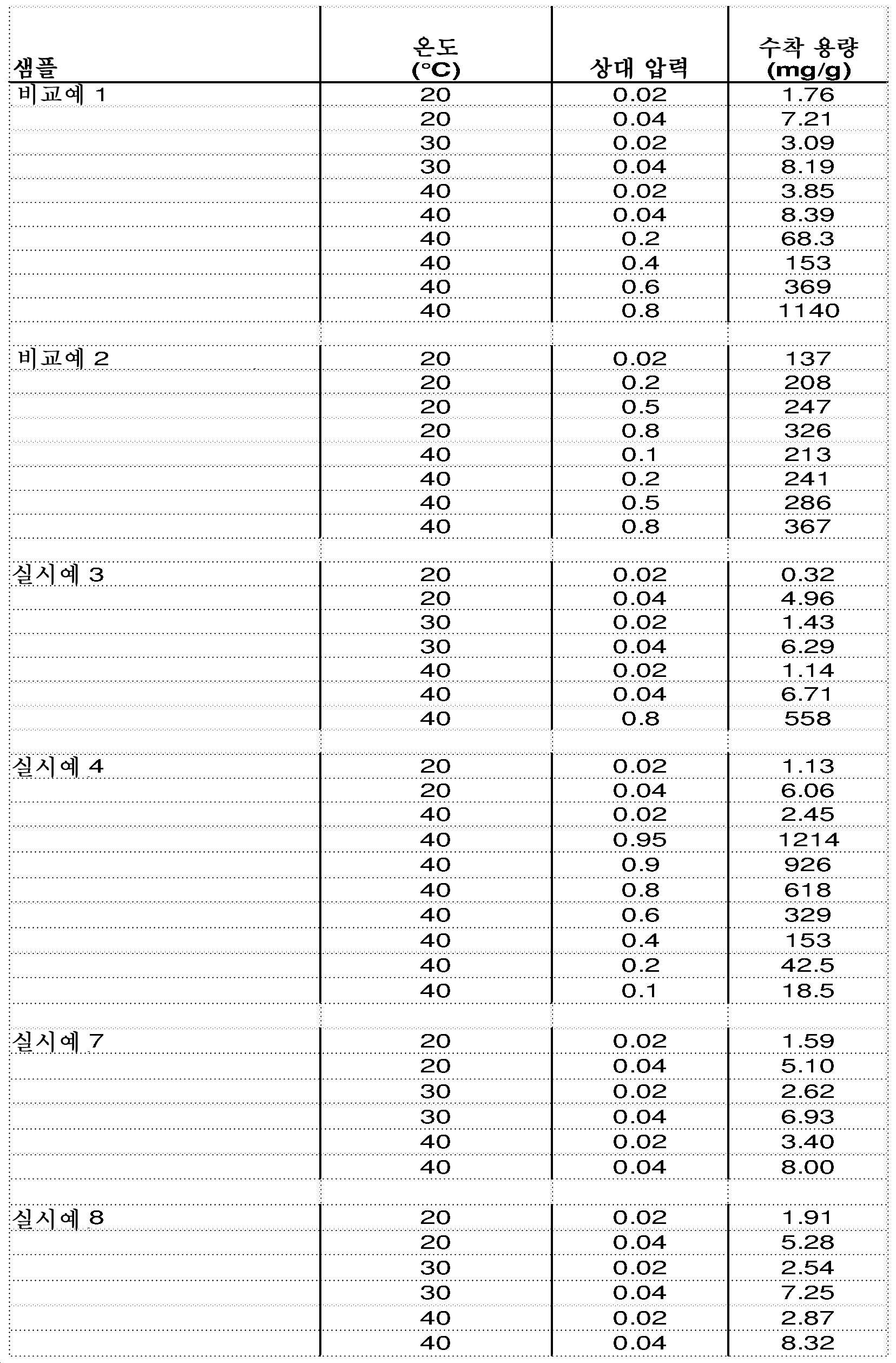
비교예 3: 비휘발성 실리콘 유체 중에서의 톨루엔 증기 수착. 30 mg의 비휘발성 실리콘 유체 2 (다우 코닝® 350 cSt 200 플루이드)를 증기 수착 분석기 기기 (티에이 인스트루먼츠 VTI-SA+) 내의 미량천칭 상에 로딩하고, 주어진 온도에서 포화에 대한 다양한 부분 압력의 톨루엔 증기에 노출시켰다. 실리콘 유체 1은 비휘발성이다. 증기 수착 분석기 상의 유기 증기 셀의 저장소를 톨루엔 (보증된 ACS 등급, 피셔 사이언티픽(Fisher Scientific))으로 충전하였다. 온도 및 상대 압력의 각각의 조합에서, 실리콘 유체/ 톨루엔 증기 시스템은 열역학 평형에 도달하였으며, 실리콘 유체 및 수착된 톨루엔 증기의 최종 질량을 기록하였다. 각각의 등온 전에는, 실리콘 유체 2를 60℃에서 2시간의 건조를 거치게 하여 어떠한 우연히 수착된 질량도 제거됨을 보장하고 초기 '건조' 질량을 확립하였다. 온도 및 압력의 각각의 조합에서, 실리콘 유체 2의 평형 수착 용량을 실리콘 유체 2의 g당 수착된 톨루엔 증기의 mg의 단위 (mg/g)로 기록하였다. 실리콘 유체 2에 대한 수착 용량이 표 2에 포함되어 있다. Comparative Example 3 : Toluene vapor sorption in a nonvolatile silicone fluid. 30 mg of nonvolatile silicone fluid 2 (Dow Corning® 350 cSt 200 Fluid) was loaded onto the microbalance in a vapor sorption analyzer instrument (TI Instruments VTI-SA +) and loaded onto the toluene vapors at various partial pressures for saturation at a given temperature Exposed. Silicone fluid 1 is non-volatile. The reservoir of the organic vapor cell on the vapor sorption analyzer was filled with toluene (certified ACS grade, Fisher Scientific). At each combination of temperature and relative pressure, the silicon fluid / toluene vapor system reached thermodynamic equilibrium, and the final mass of the silicon fluid and sorbed toluene vapor was recorded. Prior to each isothermal, Silicone Fluid 2 was subjected to 2 hours of drying at 60 ° C to ensure that any incident sorbed mass was removed and an initial 'dry' mass was established. In each combination of temperature and pressure, the equilibrium sorption capacity of silicone fluid 2 was reported in units of mg of sorbed toluene vapor per gram of silicone fluid 2 (mg / g). The sorption capacity for silicone fluid 2 is included in Table 2.
실시예 9: 가교결합된 폴리유기실록산 탄성중합체 5 중에서의 톨루엔 증기 수착. 기재 대 경화제의 규정된 10:1 혼합비로 혼합한 후 85℃에서 3시간 동안 경화된 블록으로부터 절단된 실가드(Sylgard)® 184 탄성중합체 (다우 코닝 코포레이션) (가교결합된 폴리유기실록산 탄성중합체 5)의 42 mg 샘플을 증기 수착 분석기 기기 (티에이 인스트루먼츠 VTI-SA+) 내의 미량천칭 상에 로딩하고, 주어진 온도에서 포화에 대한 다양한 부분 압력의 톨루엔 증기에 노출시켰다. 증기 수착 분석기 상의 유기 증기 셀의 저장소를 톨루엔 (보증된 ACS 등급, 피셔 사이언티픽)으로 충전하였다. 온도 및 상대 압력의 각각의 조합에서, 가교결합된 폴리유기실록산 탄성중합체 / 톨루엔 증기 시스템은 열역학 평형에 도달하였으며, 가교결합된 폴리유기실록산 탄성중합체 및 수착된 톨루엔 증기의 최종 질량을 기록하였다. 각각의 등온 전에는, 가교결합된 폴리유기실록산 탄성중합체를 60℃에서 3시간의 건조를 거치게 하여 어떠한 휘발성 화학종 또는 우연히 수착된 질량도 제거됨을 보장하고 초기 '건조' 질량을 확립하였다. 온도 및 압력의 각각의 조합에서, 수착제의 평형 수착 용량을 기압당 가교결합된 폴리유기실록산 탄성중합체의 g당 수착된 톨루엔 증기의 mg의 단위 (mg/g)로 기록하였다. 가교결합된 폴리유기실록산 탄성중합체 5에 대한 수착 용량이 표 2에 포함되어 있다. 이 샘플은 비가교결합된 실리콘 유체 2 (비교예 3)와 비견되는 낮은 상대 압력에서의 D4 증기에 대한 수착 용량을 보여주는데, 이는 D4 증기에 대한 수착제로서의 유용성을 입증한다. Example 9 : Toluene vapor sorption in cross-linked polyorganosiloxane elastomer 5. (Sylgard) 184 elastomer (Dow Corning Corp.) (crosslinked polyorganosiloxane elastomer 5, manufactured by Dow Corning Incorporated), cut from a cured block at a specified 10: 1 blend ratio of substrate to curing agent for 3 hours at 85 & ) Was loaded on a microbalance in a vapor sorption analyzer instrument (TA Instruments VTI-SA +) and exposed to toluene vapors at various partial pressures for saturation at a given temperature. The reservoir of the organic vapor cell on the vapor sorption analyzer was filled with toluene (certified ACS grade, Fisher Scientific). In each combination of temperature and relative pressure, the crosslinked polyorganosiloxane elastomer / toluene vapor system reached thermodynamic equilibrium, and the final mass of the crosslinked polyorganosiloxane elastomer and sorbed toluene vapor was recorded. Prior to each isothermal, the crosslinked polyorganosiloxane elastomer was subjected to a drying at 60 ° C for 3 hours to ensure that any volatile species or accidentally sorbed mass were removed and an initial 'dry' mass was established. In each combination of temperature and pressure, the equilibrium sorption capacity of the sorbent was reported in units of mg (mg / g) of sorbed toluene vapor per gram of crosslinked polyorganosiloxane elastomer per bar. The sorption capacity for the crosslinked polyorganosiloxane elastomer 5 is included in Table 2. This sample shows sorption capacity for D 4 vapor at low relative pressures comparable to unbonded Silicone Fluid 2 (Comparative Example 3), demonstrating its usefulness as sorbent for D 4 vapor.
[표 2][Table 2]
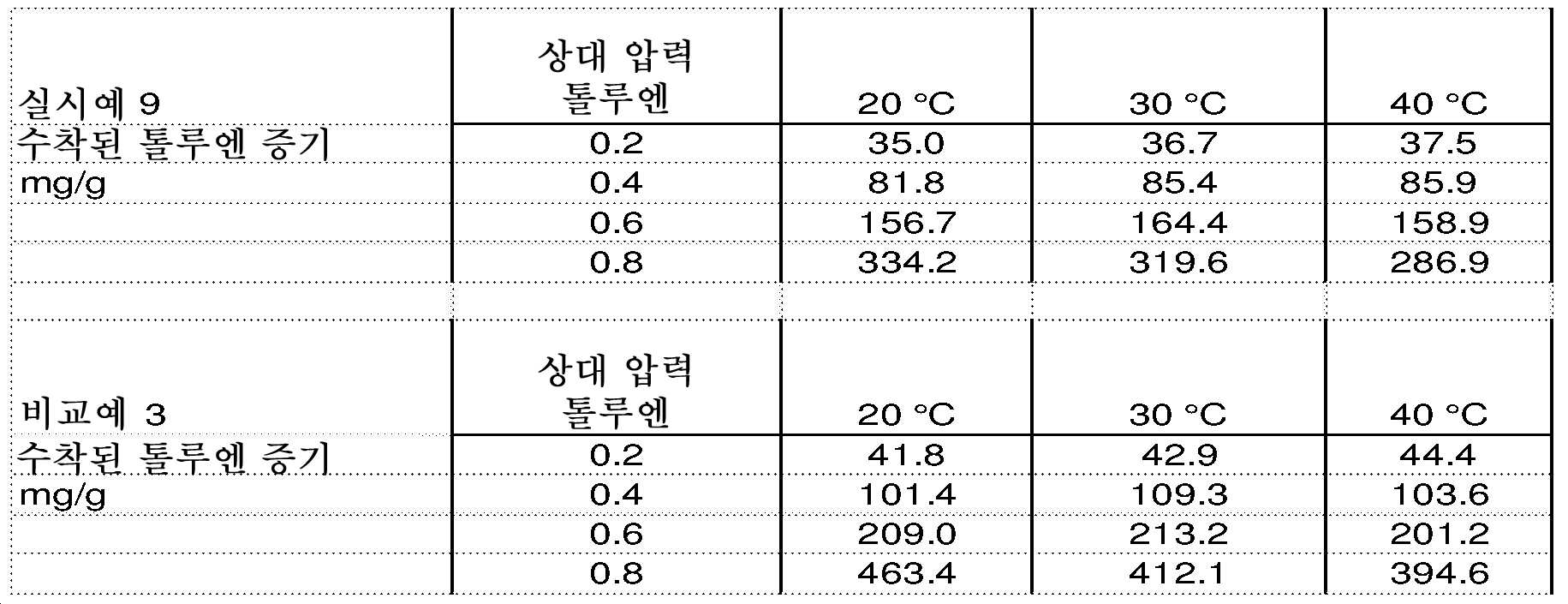
이들 결과는, 본 발명에 사용되는 가교결합된 폴리유기실록산 탄성중합체가 비다공성이고 비유동성인 가교결합된 고체일지라도, 이것이, 온도에 따라 증가하는, 증기에 대한 매우 높은 수착 용량을 보유하고 더 낮은 상대 압력에 대한 노출 시에 용이하게 탈착됨을 입증한다.These results show that even though the crosslinked polyorganosiloxane elastomer used in the present invention is a non-porous, crosslinked, crosslinked solid, it possesses a very high sorption capacity for the vapor, which increases with temperature, It is easily detached upon exposure to pressure.
비교예 4: 활성 차콜 흡착제를 갖는 충전층. 0.49의 상대 압력의 옥타메틸사이클로테트라실록산 (D4) 증기 및 0.04의 상대 압력의 헥사메틸다이실록산 (L2) 증기를 함유하는 125 표준 입방 센티미터 (sccm)의 질소 가스를 다르코 20-40 메시 입자 크기의 과립 활성 차콜 입자의 충전층에 도입하였다. 충전층의 입구에서의 배합된 가스/증기 스트림의 온도는 23℃였다. 충전층을 하우징한 스테인리스 강 튜빙의 내경 및 길이는 각각 0.46 센티미터 (cm) 및 7.0 cm였다. 충전층을 구성하는 활성 차콜의 질량은 472 밀리그램 (mg)이었다. 시간-평균 충전층 입구 및 출구 압력은 각각 2.78 및 1.88 파운드/제곱인치 게이지 (psig)였다. 0.5 마이크로미터 (μm) 필터를 충전층 출구에 배치하여 입자가 하류로 유입하는 것을 방지하였다. 충전층 유출 D4 증기 및 L2 증기 농도를 가스 크로마토그래프에 대한 가스/증기 자동화 주입을 사용하여 시간의 함수로서 측정하였다. 이 데이터로부터, 충전층 용량은 활성 차콜 그램당 275 mg의 D4 증기 및 활성 차콜 그램당 63 mg의 L2 증기인 것으로 계산되었다. 흡착된 상 및 증기상에서의 D4 몰분율과 L2 몰분율의 상대비로서 정의된 D4/L2 분리 계수는 8.1이었다. Comparative Example 4: Packed bed with activated charcoal adsorbent. A nitrogen gas of 125 standard cubic centimeters (sccm) containing hexamethyldisiloxane (L 2 ) vapor of octamethylcyclotetrasiloxane (D 4 ) vapor at a relative pressure of 0.49 and a relative pressure of 0.04 was charged into a Dulko 20-40 mesh Particle size granular activated charcoal particles. The temperature of the combined gas / vapor stream at the inlet of the packed bed was 23 ° C. The inner diameter and length of the stainless steel tubing housing the packed bed were 0.46 centimeter (cm) and 7.0 cm, respectively. The mass of active charcoal constituting the packed bed was 472 milligrams (mg). The time-average packed bed inlet and outlet pressures were 2.78 and 1.88 pounds per square inch gauge (psig), respectively. A 0.5 micrometer ( mu m) filter was placed at the packed bed exit to prevent particles from flowing downstream. The packed bed effluent D 4 vapor and L 2 vapor concentrations were measured as a function of time using gas / steam automated injection on the gas chromatograph. From this data, the loading volume was calculated to be 275 mg of D 4 vapor per gram of active charcoal and 63 mg of L 2 vapor per gram of active charcoal. The D 4 / L 2 separation factor, defined as the ratio of the D 4 mole fraction to the L 2 mole fraction on the adsorbed phase and vapor, was 8.1.
실시예 9: 비다공성 가교결합된 폴리유기실록산 탄성중합체 입자를 갖는 충전층. 0.49의 상대 압력의 옥타메틸사이클로테트라실록산 (D4) 증기 및 0.04의 상대 압력의 헥사메틸다이실록산 (L2) 증기를 함유하는 125 sccm의 질소 가스를 비다공성 폴리유기실록산 탄성중합체 입자의 충전층에 도입하였다. 충전층의 입구에서의 배합된 가스/증기 스트림의 온도는 23℃였다. 충전층을 하우징한 스테인리스 강 튜빙의 내경 및 길이는 각각 0.46 cm 및 7.0 cm였다. 충전층을 구성하는 비다공성 폴리유기실록산 탄성중합체 입자의 질량은 304 mg이었다. 시간-평균 충전층 입구 및 출구 압력은 각각 3.10 및 1.88 psig였다. 0.5 μm 필터를 충전층 출구에 배치하여 입자가 하류로 유입하는 것을 방지하였다. 충전층 유출 D4 증기 및 L2 증기 농도를 가스 크로마토그래프에 대한 가스/증기 자동화 주입을 사용하여 시간의 함수로서 측정하였다. 이 데이터로부터, 충전층 용량은 비다공성 실리콘 탄성중합체 입자 그램당 205 mg의 D4 증기 및 비다공성 실리콘 탄성중합체 입자 그램당 24 mg의 L2 증기인 것으로 계산되었다. 흡착된 상 및 증기상에서의 D4 몰분율과 L2 몰분율의 상대비로서 정의된 D4/L2 분리 계수는 16.6이었다. 비교예 4와 실시예 9는, 실시예 9에 기재된 방법이 활성 차콜을 사용하는 방법보다 더 우수하게 L2로부터 D4를 선택적으로 제거할 수 있음을 보여준다. Example 9: Packed bed with non-porous cross-linked polyorganosiloxane elastomer particles . A 125 sccm nitrogen gas containing octamethylcyclotetrasiloxane (D 4 ) vapor at a relative pressure of 0.49 and a hexamethyldisiloxane (L 2 ) vapor at a relative pressure of 0.04 was introduced into the packed bed of nonporous polyorganosiloxane elastomer particles . The temperature of the combined gas / vapor stream at the inlet of the packed bed was 23 ° C. The inner diameter and length of the stainless steel tubing housing the packed bed were 0.46 cm and 7.0 cm, respectively. The mass of the non-porous polyorganosiloxane elastomer particles constituting the packed bed was 304 mg. The time-average packed bed inlet and outlet pressures were 3.10 and 1.88 psig, respectively. A 0.5 mu m filter was placed at the outlet of the packed bed to prevent particles from flowing downstream. The packed bed effluent D 4 vapor and L 2 vapor concentrations were measured as a function of time using gas / steam automated injection on the gas chromatograph. From this data, the fill layer capacity was calculated to be 205 mg of D 4 vapor per gram of nonporous silicone elastomer particle and 24 mg of L 2 vapor per gram of nonporous silicone elastomer particle. The D 4 / L 2 separation factor, defined as the ratio of the D 4 mole fraction to the L 2 mole fraction on the adsorbed phase and vapor, was 16.6. Comparative Example 4 and Example 9 shows that it is possible to selectively remove the D 4 from the more excellently than L 2 how the method described in Example 9 using the active charcoal.
산업상 이용가능성Industrial availability
본 명세서에 기재된 방법은 적어도 하나의 증기상 휘발성 성분을 포함하는 혼합물 (예를 들어, 환형 물질이 많이 함유된 실리콘 유체 또는 D4-함유 공정 가스 스트림)을 유리 전이 온도가 +25℃ 이하인 비다공성 가교결합된 탄성중합체를 포함하는 수착제와 접촉시킴으로써 상기 혼합물로부터 가스 또는 증기 (예를 들어, D4, D5)를 분리하는 데 특히 유용하다. 선택적으로, 탄성중합체는 용매의 존재 하에서 가교결합될 수 있으며, 이어서 용매는 후속으로 실질적으로 제거된다. 생성된 비다공성 가교결합된 탄성중합체는 D4 및 VOC와 같은 증기를 흡착하는 데 매우 높은 용량을 나타내며, 이때 낮은 온도와는 대조적으로, 더 높은 온도에서 용량이 상당히 증가되고, 낮은 온도에서 매우 용이하게 탈착되는 특유의 유리한 열 프로파일을 갖는다. 휘발성 물질을 차가운 수착 재료와 접촉시킴으로써 열 손실 없이 이미 가온한 스트림으로부터 그것을 분리하는 데 있어서의 이용가능성 및 때때로 그러한 필요성뿐만 아니라, 가열되지 않은 공기 및/또는 불활성 가스 스트림을 사용하여 수착제를 재생할 수 있는 에너지 및 비용 절약으로 인해, 비다공성 가교결합된 탄성중합체를 사용하는 본 명세서에 기재된 방법은 전통적인 가스 분리에서 에너지 및 비용-효율 이득에 있어서 상당히 잠재적인 중요성을 갖는다. 또한, 그러한 매체를 포함하는 접촉 장치 및 그러한 접촉 공정에 의해 정제된 생성물 - 실리콘 생성물 및 중간체를 포함함 - 이 개시되어 있다. 통상적인 고체 흡착제 매체 또는 다공성 유기, 중합체 또는 유기금속 구조물에 비하여, 비다공성 가교결합된 폴리유기실록산 탄성중합체는 부착오염 및 물질 전달 제한이 덜 일어나기 쉬울 수 있다.The process described herein is a process for preparing a mixture comprising at least one vapor phase volatile component (e.g., a silicone fluid rich in cyclic material or a D 4 -containing process gas stream) with a non-porous Is particularly useful for separating gases or vapors (e.g., D 4 , D 5 ) from the mixture by contacting it with a sorbent comprising a crosslinked elastomer. Optionally, the elastomer can be crosslinked in the presence of a solvent, and then the solvent is subsequently substantially removed. The resulting non-porous cross-linked elastomer exhibits a very high capacity to adsorb vapors such as D 4 and VOC, where the capacity is significantly increased at higher temperatures, as opposed to low temperatures, Lt; RTI ID = 0.0 > and / or < / RTI > It is possible to regenerate the sorbent using the unheated air and / or inert gas stream, as well as the availability and sometimes the need to separate the volatile material from the already heated stream without contact with the cold sorbent material Due to the energy and cost savings available, the process described herein using non-porous cross-linked elastomers has significant potential for energy and cost-effectiveness gains in conventional gas separation. Also disclosed are contact devices comprising such media and product-silicon products and intermediates purified by such contact processes. Compared to conventional solid sorbent media or porous organic, polymeric, or organometallic structures, nonporous crosslinked polyorganosiloxane elastomers can be prone to adhesion pollution and mass transfer limitations.
용어의 정의 및 용법Definition and Usage of Terms
모든 양, 비율 및 백분율은, 달리 표시되지 않는 한, 중량 기준이다. 관사("a", "an", 및 "the")는 각각, 본 명세서의 문맥에 의해 달리 지시되지 않는다면, 하나 이상을 말한다. 범위의 개시는 그 범위 자체, 그리고 또한 그 안에 포함되는 임의의 것뿐만 아니라 종점도 포함한다. 예를 들어, 2.0 내지 4.0의 범위의 개시는 2.0 내지 4.0의 범위뿐만 아니라, 2.1, 2.3, 3.4, 3.5, 및 4.0도 개별적으로 포함하며, 또한 그 범위 내에 포함되는 임의의 다른 숫자도 포함한다. 더욱이, 예를 들어 2.0 내지 4.0의 범위의 개시는, 예를 들어 2.1 내지 3.5, 2.3 내지 3.4, 2.6 내지 3.7, 및 3.8 내지 4.0의 하위세트뿐만 아니라, 그 범위 내에 포함되는 임의의 다른 하위세트도 포함한다. 유사하게, 마쿠쉬 군의 개시는 전체 군, 그리고 또한 임의의 개별 구성원 및 그 안에 포함되는 하위군도 포함한다. 예를 들어, 마쿠쉬 군의 개시에서 수소 원자, 알킬 기, 아릴 기, 또는 아르알킬 기는 개별적으로 구성원 알킬; 하위군 알킬 및 아릴; 및 임의의 다른 개별 구성원 및 그 안에 포함되는 하위군을 포함한다.All amounts, ratios and percentages are by weight unless otherwise indicated. The articles ("a", "an", and "the") refer to one or more, respectively, unless otherwise indicated by context. The opening of the range includes the range itself as well as any included therein, as well as the endpoint. For example, the disclosure in the range of 2.0 to 4.0 includes not only the range of 2.0 to 4.0 but also 2.1, 2.3, 3.4, 3.5, and 4.0 separately, and also includes any other number included within the range. Moreover, for example, a start in the range of 2.0 to 4.0 may be used to set a subset of the subset, for example 2.1 to 3.5, 2.3 to 3.4, 2.6 to 3.7, and 3.8 to 4.0, . Similarly, the disclosure of the Makish group also includes the entire group, and also any individual members and subgroups contained therein. For example, the hydrogen atom, alkyl group, aryl group, or aralkyl group at the initiation of the Makhush group are individually a member alkyl; Lower alkyl and aryl; And any other individual members and subgroups contained therein.
본 명세서에서 사용되는 약어는 다음과 같이 정의된다: 약어 "cSt"는 센티스토크를 의미한다. "DP"는 중합도를 의미한다. "GC"는 가스 크로마토그래피를 의미한다. "Pa·s"는 파스칼 초를 의미하고, "ppm"은 백만분율을 의미한다. "Tg"는 유리 전이 온도를 의미한다.Abbreviations used herein are defined as follows: The abbreviation " cSt " means centistoke. &Quot; DP " means degree of polymerization. &Quot; GC " means gas chromatography. "Pa · s" means Pascal second, and "ppm" means million parts. &Quot; Tg " means the glass transition temperature.
용어 "고갈된" 및 그의 파생어는 각각 단계 1) 전의 혼합물 내의 휘발성 성분의 양이 본 명세서에 기재된 방법의 단계 1)을 실시한 후에 더 낮은 양으로 감소됨을 의미한다.The term " depleted " and its derivatives means that the amount of volatile components in the mixture before step 1), respectively, is reduced to a lower amount after carrying out step 1) of the process described herein.
용어 "풍부화된" 및 그의 파생어는 가교결합된 탄성중합체 내의 휘발성 성분의 양이 본 명세서에 기재된 방법의 단계 1)을 실시하기 전보다 단계 1)을 실시하는 동안 그리고 실시한 후에 더 큼을 의미한다.The term " enriched " and its derivatives means that the amount of volatile components in the crosslinked elastomer is greater during and after step 1) than before performing step 1) of the process described herein.
가교결합된 탄성중합체에 관하여 본 명세서에 사용되는 바와 같이, 용어 "비다공성" 및 그의 파생어는 상기 탄성중합체가 100 마이크로미터 (um) 미만의 직경 (또는 불규칙한 형상을 갖는 기공의 경우에는 평균 단면-폭 치수)을 갖는 기공 (즉, 구멍, 슬릿, 공극 부피의 임의의 형상)을 실질적으로 갖지 않음을 의미한다. 상기 탄성중합체의 어떠한 주어진 연속 조각도 본질적으로 비다공성이며, 상기 탄성중합체는 연속 입자들, 섬유들 또는 시트들 사이의 공간이 상당한 표면적을 생성할 수 있도록 임의의 크기 및 형상의 입자들, 섬유들 또는 시트들을 포함할 수 있음에 유의해야 한다. 상기 탄성중합체의 조각은 공동(cavity)을 함유할 수 있는데, 이는 적어도 100 um의 직경 (또는 불규칙한 형상을 갖는 기공의 경우에는 평균 단면-폭 치수)을 가짐으로써 기공과 구별되는 것으로, 예컨대 유체 압력을 최소화하면서 유체 유동을 최대화하기 위하여 연속 탄성중합체 조각 내에 성형되거나, 드릴링되거나, 절단되거나 또는 달리 형성된 더 큰 구멍 또는 공동이다. 용어 비다공성은 반투과성 재료를 포함하는데, 여기서는 휘발성 성분은 수착되지만, 더 작은 분자 (예를 들어, 질소 가스)는 통과할 수 있다.As used herein with respect to crosslinked elastomers, the term " non-porous " and its derivatives means that the elastomer has a diameter of less than 100 micrometers (um) (or, in the case of pores with irregular shapes, (I. E., Any shape of holes, slits, void volume) having a width dimension (e. G., A width dimension). Any given continuous piece of the elastomer is inherently non-porous, and the elastomer may be any particles or fibers of any size and shape, such that the space between continuous particles, fibers or sheets can create a significant surface area, Sheets. ≪ RTI ID = 0.0 > The pieces of the elastomer may contain cavities, which are distinguished from pores by having a diameter of at least 100 um (or an average cross-sectional dimension in the case of pores with irregular shapes) Drilled, cut, or otherwise formed into a continuous elastomeric piece to maximize fluid flow while minimizing the fluid flow. The term non-porosity includes a semi-permeable material, where volatile components are sorbed, but smaller molecules (e.g., nitrogen gas) can pass through.
용어 "수착" 및 그의 파생어는 흡수 및/또는 흡착하는 것; 대안적으로 흡착하는 것, 및 대안적으로 흡수하는 것을 의미한다. 대안적으로, 수착은 흡수 및 흡착 둘 모두를 포함할 수 있다.The term " sorption " and its derivatives are intended to absorb and / or adsorb; Alternatively adsorbs, and, alternatively, absorbs. Alternatively, the sorption can include both absorption and adsorption.
본 명세서에 사용되는 바와 같이, 용어 "치환된"은, 1가 탄화수소 기 (예를 들어, 알킬, 알케닐, 알키닐, 또는 아릴)에 있어서, 그 안에 함유된 수소 원자에 대한 하나 이상의 결합이 비수소 원자에 대한 하나 이상의 결합에 의해 대체되고/되거나 하나 이상의 탄소 원자가 헤테로원자 (예를 들어, 할로겐, N, O, 또는 S)로 대체되는 것을 지칭한다.As used herein, the term "substituted" refers to a monovalent hydrocarbon group (eg, alkyl, alkenyl, alkynyl, or aryl) in which one or more bonds to the hydrogen atoms contained therein Refers to being replaced by one or more bonds to a non-hydrogen atom and / or wherein one or more carbon atoms are replaced by a heteroatom (e.g., halogen, N, O, or S).
용어 "휘발성" 및 그의 파생어는 하나의 성분이 다른 하나의 성분보다 더 높은 증기압을 가질 수 있음을 의미한다. 소정 실시 형태에서, 휘발성 성분은 상대 증기압에 의해 혼합물 내의 적어도 하나의 다른 성분과 구별될 수 있다. 휘발성 성분은 증기압이 혼합물 내의 적어도 다른 성분의 증기압보다 더 높을 수 있다. 휘발성 성분은 70℃에서의 순수 성분 증기압이 적어도 0.1 mmHg일 수 있다. 혼합물 내의 적어도 하나의 다른 성분은 70℃에서의 증기압이 0.1 mmHg 미만인 비휘발성 성분일 수 있다. (휘발성은 기화하려는 물질의 경향을 지칭한다. 휘발성은 물질의 증기압과 직접 관련되어 있다. 주어진 온도에서, 더 높은 증기압을 갖는 물질은 더 낮은 증기압을 갖는 물질보다 더 용이하게 기화된다.) 다른 실시 형태에서, 휘발성 성분은 혼합물 내의 적어도 하나의 다른 성분의 증기압보다 더 낮은 증기압을 가질 수 있는데, 이는, 비다공성 가교결합된 탄성중합체 중에서의 휘발성 성분의 용해도가 비다공성 가교결합된 탄성중합체 중에서의 적어도 하나의 다른 성분의 용해도보다 더 높은 경우이다.The term " volatile " and its derivatives means that one component may have a higher vapor pressure than the other component. In certain embodiments, the volatile component can be distinguished from at least one other component in the mixture by a relative vapor pressure. The volatile component may have a higher vapor pressure than the vapor pressure of at least another component in the mixture. The volatile component may have a net component vapor pressure at 70 ° C of at least 0.1 mmHg. At least one other component in the mixture may be a non-volatile component having a vapor pressure at 70 캜 of less than 0.1 mm Hg. (Volatility refers to the tendency of a substance to be vaporized.) Volatility is directly related to the vapor pressure of a substance. At a given temperature, a substance with a higher vapor pressure is more easily vaporized than a substance with a lower vapor pressure. , The volatile component may have a lower vapor pressure than the vapor pressure of at least one other component in the mixture because the solubility of the volatile component in the non-porous cross-linked elastomer is at least Is higher than the solubility of one other component.
Claims (15)
1) 상기 휘발성 성분의 적어도 일부를 유리 전이 온도가 +25℃ 이하인 비다공성 가교결합된 탄성중합체의 벌크 내로 수착시킴으로써, 수착 전의 상기 혼합물보다 더 적은 상기 휘발성 성분을 함유하는 고갈된 혼합물을 형성하고, 상기 비다공성 가교결합된 탄성중합체를 수착된 휘발성 성분으로 풍부화함으로써 풍부화된 가교결합된 탄성중합체를 형성하는 단계로서, 단계 1) 동안, 상기 휘발성 성분의 적어도 일부는 가스상(gas phase)으로 존재하는, 상기 단계,
2) 상기 풍부화된 가교결합된 탄성중합체로부터 상기 수착된 휘발성 성분의 적어도 일부를 탈착시킴으로써, 탈착된 휘발성 성분 및 탈착 전의 상기 풍부화된 가교결합된 탄성중합체보다 더 적은 상기 수착된 휘발성 성분을 함유하는 재생된 탄성중합체를 형성하는 단계, 및
3) 단계 1)을 반복 시에 상기 비다공성 가교결합된 탄성중합체의 전부 또는 일부로서 상기 재생된 탄성중합체를 사용하는 단계, 및
4) 단계 1) 동안 그리고/또는 후의 상기 고갈된 혼합물 및 단계 2) 동안 그리고/또는 후의 상기 탈착된 휘발성 성분 중 하나 또는 둘 모두를 안내하는 단계를 포함하는, 방법.CLAIMS 1. A method for depleting volatile components in a mixture comprising a volatile component and at least one other component,
1) adsorbing at least a portion of the volatile component into the bulk of a non-porous cross-linked elastomer having a glass transition temperature of + 25 占 폚 to form a depleted mixture containing less volatile components than the mixture prior to sorption, Forming an enriched crosslinked elastomer by enriching the non-porous cross-linked elastomer with sorbed volatile components, wherein during step 1) at least a portion of the volatile components are present in a gas phase, Wherein said step,
2) By desorbing at least a portion of the sorbed volatile component from the enriched crosslinked elastomer, the recycled volatile component and the regeneration containing less of the sorbed volatile component than the enriched crosslinked elastomer prior to desorption To form an elastomer; and
3) using the recycled elastomer as all or part of the non-porous cross-linked elastomer in repeating step 1), and
4) guiding the depleted mixture during and / or after step 1) and / or one or both of the desorbed volatile components during and / or after step 2).
1) 용매의 존재 하에서 성분들을 배합하고 가교결합시켜 상기 비다공성 가교결합된 탄성중합체를 형성하는 단계, 및
2) 이후에 상기 용매를 제거하는 단계를 포함하는 방법에 의해 제조되는, 방법.11. A composition according to any one of the preceding claims, wherein the non-porous cross-linked elastomer
1) combining and crosslinking the components in the presence of a solvent to form said non-porous cross-linked elastomer; and
2) subsequently removing said solvent.
(A) 하이드로실릴화 촉매,
(B) 분자당 평균 2개 이상의 규소 결합된 지방족 불포화 탄화수소 기를 갖는 폴리유기실록산,
(C) 분자당 평균 2개 초과의 규소 결합된 수소 원자를 갖는 가교결합제,
선택적으로, (D) 억제제, 및
(E) 상기 용매를 포함하며,
단계 2)는 상기 조성물을 가열함으로써 수행되는, 방법.12. The process according to claim 11, wherein said components in step 1)
(A) a hydrosilylation catalyst,
(B) a polyorganosiloxane having an average of at least two silicon-bonded aliphatic unsaturated hydrocarbon groups per molecule,
(C) a cross-linking agent having an average of more than two silicon-bonded hydrogen atoms per molecule,
Optionally, (D) an inhibitor, and
(E) said solvent,
Wherein step 2) is carried out by heating said composition.
a) 내부 부피 공간을 한정하고, 입구, 및 상기 내부 부피 공간을 통해 상기 입구와 유체 연통(fluid communication) 상태에 있는 출구를 갖는 접촉기로서, 상기 접촉기의 상기 내부 부피 공간은 유리 전이 온도가 25℃ 이하인 비다공성 가교결합된 탄성중합체를 함유하고, 상기 장치의 작동 동안 휘발성 성분 및 적어도 하나의 비휘발성 성분을 포함하는 혼합물이 상기 입구를 통해 상기 접촉기에 들어가고, 상기 비다공성 가교결합된 탄성중합체와 접촉하여 상기 휘발성 성분의 적어도 일부가 상기 비다공성 탄성중합체에 의해 수착되게 하고, 고갈된 혼합물이 상기 출구를 통해 상기 접촉기를 빠져나가는, 상기 접촉기,
선택적으로, b) 상기 접촉기의 출구와 유체 연통 상태에 있고, 상기 고갈된 혼합물을 수집하도록 구성된 수집기, 및
선택적으로, c) 상기 탄성중합체와 유체 연통 상태에 있고, 상기 비다공성 가교결합된 탄성중합체로부터 탈착된 휘발성 성분을 수집하도록 구성된 회수 장치를 포함하는, 장치.An apparatus for depleting volatile components in a mixture, the apparatus comprising:
a) a contactor defining an internal volume space and having an inlet and an outlet in fluid communication with the inlet through the internal volume space, the internal volume of the contactor having a glass transition temperature of 25 DEG C Of the non-porous cross-linked elastomer, wherein during operation of the device, a mixture comprising a volatile component and at least one non-volatile component enters the contactor through the inlet and contacts the non-porous cross-linked elastomer Wherein at least a portion of said volatile component is sorbed by said non-porous elastomer and a depleted mixture exits said contactor through said outlet,
Optionally, b) a collector in fluid communication with the outlet of the contactor, configured to collect the depleted mixture, and
Optionally, c) a collection device in fluid communication with the elastomer and configured to collect volatile components desorbed from the non-porous cross-linked elastomer.
Applications Claiming Priority (3)
| Application Number | Priority Date | Filing Date | Title |
|---|---|---|---|
| US201662343254P | 2016-05-31 | 2016-05-31 | |
| US62/343,254 | 2016-05-31 | ||
| PCT/US2017/027854 WO2017209846A1 (en) | 2016-05-31 | 2017-04-17 | Method of depleting a volatile component in a mixture using a crosslinked elastomer sorbent and apparatus for practicing the method |
Publications (2)
| Publication Number | Publication Date |
|---|---|
| KR20190008564A true KR20190008564A (en) | 2019-01-24 |
| KR102186340B1 KR102186340B1 (en) | 2020-12-04 |
Family
ID=59153258
Family Applications (1)
| Application Number | Title | Priority Date | Filing Date |
|---|---|---|---|
| KR1020187036487A Active KR102186340B1 (en) | 2016-05-31 | 2017-04-17 | A method for depleting volatile components in a mixture using a crosslinked elastomer sorbent and an apparatus for carrying out the method |
Country Status (6)
| Country | Link |
|---|---|
| US (1) | US11148121B2 (en) |
| EP (1) | EP3463618B1 (en) |
| JP (1) | JP6755968B2 (en) |
| KR (1) | KR102186340B1 (en) |
| CN (1) | CN109152978B (en) |
| WO (1) | WO2017209846A1 (en) |
Families Citing this family (6)
| Publication number | Priority date | Publication date | Assignee | Title |
|---|---|---|---|---|
| WO2018017795A1 (en) * | 2016-07-20 | 2018-01-25 | Abs Materials, Inc. | Treatment and regeneration system and method for extracting organic solutes from-water |
| CN110382083B (en) | 2017-03-14 | 2022-03-29 | 美国陶氏有机硅公司 | Method for depleting organosilicon components in mixtures using adsorbent copolymers and device for carrying out said method |
| WO2019209476A1 (en) * | 2018-04-26 | 2019-10-31 | Dow Silicones Corporation | Method of depleting a volatile component in a mixture using a sorbent copolymer and apparatus for practicing the method |
| CN112439391A (en) * | 2019-08-27 | 2021-03-05 | 固品塑胶工业股份有限公司 | Composition for adsorbing volatile organic compounds and textile for adsorbing volatile organic compounds |
| JP7456085B2 (en) * | 2020-03-02 | 2024-03-27 | 国立大学法人 東京大学 | Method for separating or purifying a cyclic compound, method for producing a cyclic compound, separation material, and separation device |
| KR20260003670A (en) | 2023-04-20 | 2026-01-07 | 바스프 에스이 | Uses of amine polymers in carbon capture |
Citations (3)
| Publication number | Priority date | Publication date | Assignee | Title |
|---|---|---|---|---|
| DE3802543A1 (en) * | 1988-01-28 | 1989-08-10 | Wacker Chemie Gmbh | Use of silicone elastomers for the absorption or adsorption of organic compounds |
| JPH10277341A (en) * | 1997-04-11 | 1998-10-20 | Dow Corning Corp | Method for removing volatile organopolysiloxanes from fluid streams |
| US20080202336A1 (en) * | 2004-12-30 | 2008-08-28 | Hans Hofer | Flexible Adsorbent Bodies |
Family Cites Families (25)
| Publication number | Priority date | Publication date | Assignee | Title |
|---|---|---|---|---|
| US3159601A (en) | 1962-07-02 | 1964-12-01 | Gen Electric | Platinum-olefin complex catalyzed addition of hydrogen- and alkenyl-substituted siloxanes |
| US3296291A (en) | 1962-07-02 | 1967-01-03 | Gen Electric | Reaction of silanes with unsaturated olefinic compounds |
| US3220972A (en) | 1962-07-02 | 1965-11-30 | Gen Electric | Organosilicon process using a chloroplatinic acid reaction product as the catalyst |
| NL131800C (en) | 1965-05-17 | |||
| US3516946A (en) | 1967-09-29 | 1970-06-23 | Gen Electric | Platinum catalyst composition for hydrosilation reactions |
| US3814730A (en) | 1970-08-06 | 1974-06-04 | Gen Electric | Platinum complexes of unsaturated siloxanes and platinum containing organopolysiloxanes |
| US3989668A (en) | 1975-07-14 | 1976-11-02 | Dow Corning Corporation | Method of making a silicone elastomer and the elastomer prepared thereby |
| JPS61200854A (en) * | 1985-03-01 | 1986-09-05 | Agency Of Ind Science & Technol | Polymer material having oxygen adsorbing capacity |
| US4784879A (en) | 1987-07-20 | 1988-11-15 | Dow Corning Corporation | Method for preparing a microencapsulated compound of a platinum group metal |
| US4766176A (en) | 1987-07-20 | 1988-08-23 | Dow Corning Corporation | Storage stable heat curable organosiloxane compositions containing microencapsulated platinum-containing catalysts |
| JP2630993B2 (en) | 1988-06-23 | 1997-07-16 | 東レ・ダウコーニング・シリコーン株式会社 | Granules containing platinum-based catalyst for hydrosilylation reaction and method for producing the same |
| JPH0214244A (en) | 1988-06-30 | 1990-01-18 | Toray Dow Corning Silicone Co Ltd | Thermosetting organopolysiloxane composition |
| US5036117A (en) | 1989-11-03 | 1991-07-30 | Dow Corning Corporation | Heat-curable silicone compositions having improved bath life |
| GB9103191D0 (en) | 1991-02-14 | 1991-04-03 | Dow Corning | Platinum complexes and use thereof |
| US5466767A (en) | 1992-08-06 | 1995-11-14 | Degussa Aktiengesellschaft | Shaped organosiloxane polycondensates, process for their preparation and use |
| DE4225978C1 (en) * | 1992-08-06 | 1994-04-07 | Degussa | Shaped organosiloxane polycondensates, process for their preparation and use |
| US5472613A (en) | 1993-04-19 | 1995-12-05 | Envirosep Inc. | Removing volatile and non-volatile organic in a thick film equilibrium process and device |
| ID22906A (en) * | 1997-04-18 | 1999-12-16 | Corning Inc | PROCESS FOR PURIFICATION OF SILOCANA |
| US6432181B1 (en) * | 2000-03-03 | 2002-08-13 | Resource Development, L.L.C. | Silicone compositions, methods of making and using VOC free, non-flammable creams, pastes and powders to render nonporous surfaces water, soil and stain repellent |
| CN1191328C (en) * | 2002-08-29 | 2005-03-02 | 中国石油化工股份有限公司 | Method of removing organic silicon compound from distillate oil |
| DE502005008514D1 (en) * | 2004-05-27 | 2009-12-31 | Gerstel Systemtechnik Gmbh | Sorbent collector based on polyorganosiloxane |
| CN100345628C (en) * | 2004-11-17 | 2007-10-31 | 中国科学院过程工程研究所 | Regeneration of desulfurizing adsorbent |
| US9144784B2 (en) * | 2005-09-30 | 2015-09-29 | Abs Materials | Sorbent material and method for using the same |
| JP5242289B2 (en) | 2007-08-15 | 2013-07-24 | 地方独立行政法人 東京都立産業技術研究センター | Volatile organic absorbent and method for producing the same |
| JP6262662B2 (en) * | 2012-11-07 | 2018-01-17 | 東レ・ダウコーニング株式会社 | Phenol-modified polyorganosiloxane with reduced platinum content, method for producing the same, and organic resin modifier containing the same |
-
2017
- 2017-04-17 EP EP17732623.8A patent/EP3463618B1/en active Active
- 2017-04-17 JP JP2018559307A patent/JP6755968B2/en active Active
- 2017-04-17 WO PCT/US2017/027854 patent/WO2017209846A1/en not_active Ceased
- 2017-04-17 CN CN201780029629.0A patent/CN109152978B/en active Active
- 2017-04-17 US US16/081,314 patent/US11148121B2/en active Active
- 2017-04-17 KR KR1020187036487A patent/KR102186340B1/en active Active
Patent Citations (3)
| Publication number | Priority date | Publication date | Assignee | Title |
|---|---|---|---|---|
| DE3802543A1 (en) * | 1988-01-28 | 1989-08-10 | Wacker Chemie Gmbh | Use of silicone elastomers for the absorption or adsorption of organic compounds |
| JPH10277341A (en) * | 1997-04-11 | 1998-10-20 | Dow Corning Corp | Method for removing volatile organopolysiloxanes from fluid streams |
| US20080202336A1 (en) * | 2004-12-30 | 2008-08-28 | Hans Hofer | Flexible Adsorbent Bodies |
Also Published As
| Publication number | Publication date |
|---|---|
| JP2019515787A (en) | 2019-06-13 |
| US20190076820A1 (en) | 2019-03-14 |
| CN109152978B (en) | 2021-05-07 |
| WO2017209846A1 (en) | 2017-12-07 |
| EP3463618B1 (en) | 2022-01-12 |
| US11148121B2 (en) | 2021-10-19 |
| JP6755968B2 (en) | 2020-09-16 |
| CN109152978A (en) | 2019-01-04 |
| EP3463618A1 (en) | 2019-04-10 |
| KR102186340B1 (en) | 2020-12-04 |
Similar Documents
| Publication | Publication Date | Title |
|---|---|---|
| KR102186340B1 (en) | A method for depleting volatile components in a mixture using a crosslinked elastomer sorbent and an apparatus for carrying out the method | |
| EP2900354B1 (en) | Method of separating a gas using at least one membrane in contact with an organosilicon fluid | |
| CN104169334A (en) | Organopolysiloxanes including silicon-bonded trialkylsilyl-substituted organic groups | |
| US9169369B2 (en) | Vinylepoxide-amine acid gas adsorption-desorption polymers and oligomers, processes for preparing same, and uses thereof | |
| JP7091351B2 (en) | Modified siloxane composite membrane for recovery of heavy hydrocarbons | |
| CN108136334B (en) | Method for removing volatile compounds from emulsions | |
| JP2012508305A5 (en) | ||
| KR102436088B1 (en) | Method for depleting the organosilicon component in a mixture using a sorbent copolymer and apparatus for carrying out the method | |
| JP7627060B2 (en) | Combustible gas recovery method | |
| CN106132512B (en) | Process for Separating Volatile Siloxanes from Feed Mixtures | |
| WO2019209476A1 (en) | Method of depleting a volatile component in a mixture using a sorbent copolymer and apparatus for practicing the method | |
| US10589228B2 (en) | Di-substituted siloxane solvents for gas capture | |
| KR100943885B1 (en) | Modified Silica / Polydimethylsiloxane Nanocomposite Membranes | |
| Zhao et al. | High-Performance Octyl Modified Silicone Rubber Membranes for Voc/N2 Separation: A New Crosslinking Strategy Via Octyl Grafted Poly (Hydromethylsiloxane) | |
| JP2005046755A (en) | Gas purification method and gas purification apparatus |
Legal Events
| Date | Code | Title | Description |
|---|---|---|---|
| A201 | Request for examination | ||
| E13-X000 | Pre-grant limitation requested |
St.27 status event code: A-2-3-E10-E13-lim-X000 |
|
| P11-X000 | Amendment of application requested |
St.27 status event code: A-2-2-P10-P11-nap-X000 |
|
| P13-X000 | Application amended |
St.27 status event code: A-2-2-P10-P13-nap-X000 |
|
| PA0105 | International application |
St.27 status event code: A-0-1-A10-A15-nap-PA0105 |
|
| PA0201 | Request for examination |
St.27 status event code: A-1-2-D10-D11-exm-PA0201 |
|
| R17-X000 | Change to representative recorded |
St.27 status event code: A-3-3-R10-R17-oth-X000 |
|
| PG1501 | Laying open of application |
St.27 status event code: A-1-1-Q10-Q12-nap-PG1501 |
|
| D13-X000 | Search requested |
St.27 status event code: A-1-2-D10-D13-srh-X000 |
|
| D14-X000 | Search report completed |
St.27 status event code: A-1-2-D10-D14-srh-X000 |
|
| E902 | Notification of reason for refusal | ||
| PE0902 | Notice of grounds for rejection |
St.27 status event code: A-1-2-D10-D21-exm-PE0902 |
|
| P11-X000 | Amendment of application requested |
St.27 status event code: A-2-2-P10-P11-nap-X000 |
|
| P13-X000 | Application amended |
St.27 status event code: A-2-2-P10-P13-nap-X000 |
|
| P22-X000 | Classification modified |
St.27 status event code: A-2-2-P10-P22-nap-X000 |
|
| E701 | Decision to grant or registration of patent right | ||
| PE0701 | Decision of registration |
St.27 status event code: A-1-2-D10-D22-exm-PE0701 |
|
| GRNT | Written decision to grant | ||
| PR0701 | Registration of establishment |
St.27 status event code: A-2-4-F10-F11-exm-PR0701 |
|
| PR1002 | Payment of registration fee |
St.27 status event code: A-2-2-U10-U12-oth-PR1002 Fee payment year number: 1 |
|
| PG1601 | Publication of registration |
St.27 status event code: A-4-4-Q10-Q13-nap-PG1601 |
|
| PR1001 | Payment of annual fee |
St.27 status event code: A-4-4-U10-U11-oth-PR1001 Fee payment year number: 4 |
|
| PR1001 | Payment of annual fee |
St.27 status event code: A-4-4-U10-U11-oth-PR1001 Fee payment year number: 5 |
|
| R18 | Changes to party contact information recorded |
Free format text: ST27 STATUS EVENT CODE: A-5-5-R10-R18-OTH-X000 (AS PROVIDED BY THE NATIONAL OFFICE) |
|
| R18-X000 | Changes to party contact information recorded |
St.27 status event code: A-5-5-R10-R18-oth-X000 |