KR20200029671A - Apparatus and method of directional LBT configuration in NR-Unlicensed - Google Patents
Apparatus and method of directional LBT configuration in NR-Unlicensed Download PDFInfo
- Publication number
- KR20200029671A KR20200029671A KR1020180107580A KR20180107580A KR20200029671A KR 20200029671 A KR20200029671 A KR 20200029671A KR 1020180107580 A KR1020180107580 A KR 1020180107580A KR 20180107580 A KR20180107580 A KR 20180107580A KR 20200029671 A KR20200029671 A KR 20200029671A
- Authority
- KR
- South Korea
- Prior art keywords
- lbt
- terminal
- directional
- directional lbt
- transmission
- Prior art date
- Legal status (The legal status is an assumption and is not a legal conclusion. Google has not performed a legal analysis and makes no representation as to the accuracy of the status listed.)
- Withdrawn
Links
Images




Classifications
-
- H—ELECTRICITY
- H04—ELECTRIC COMMUNICATION TECHNIQUE
- H04W—WIRELESS COMMUNICATION NETWORKS
- H04W74/00—Wireless channel access
- H04W74/08—Non-scheduled access, e.g. ALOHA
- H04W74/0808—Non-scheduled access, e.g. ALOHA using carrier sensing, e.g. carrier sense multiple access [CSMA]
-
- H—ELECTRICITY
- H04—ELECTRIC COMMUNICATION TECHNIQUE
- H04W—WIRELESS COMMUNICATION NETWORKS
- H04W16/00—Network planning, e.g. coverage or traffic planning tools; Network deployment, e.g. resource partitioning or cells structures
- H04W16/24—Cell structures
- H04W16/28—Cell structures using beam steering
-
- Y—GENERAL TAGGING OF NEW TECHNOLOGICAL DEVELOPMENTS; GENERAL TAGGING OF CROSS-SECTIONAL TECHNOLOGIES SPANNING OVER SEVERAL SECTIONS OF THE IPC; TECHNICAL SUBJECTS COVERED BY FORMER USPC CROSS-REFERENCE ART COLLECTIONS [XRACs] AND DIGESTS
- Y02—TECHNOLOGIES OR APPLICATIONS FOR MITIGATION OR ADAPTATION AGAINST CLIMATE CHANGE
- Y02D—CLIMATE CHANGE MITIGATION TECHNOLOGIES IN INFORMATION AND COMMUNICATION TECHNOLOGIES [ICT], I.E. INFORMATION AND COMMUNICATION TECHNOLOGIES AIMING AT THE REDUCTION OF THEIR OWN ENERGY USE
- Y02D30/00—Reducing energy consumption in communication networks
- Y02D30/70—Reducing energy consumption in communication networks in wireless communication networks
Landscapes
- Engineering & Computer Science (AREA)
- Computer Networks & Wireless Communication (AREA)
- Signal Processing (AREA)
- Mobile Radio Communication Systems (AREA)
Abstract
Description
본 발명은 차세대/5G 무선 액세스망(이하 본 발명에서는 NR[New Radio]라 지칭하도록 함.)에서 비면허 대역 접속을 위한 지향성 LBT 설정 방법을 제안한다. 구체적으로 지향성 수신 빔포밍 기반 LBT의 구체적인 운용 방법과 자원 할당 방법에 대해서 기술한다.The present invention proposes a directional LBT setting method for unlicensed band access in a next generation / 5G wireless access network (hereinafter referred to as NR [New Radio] in the present invention). Specifically, a specific operation method and resource allocation method of directional reception beamforming based LBT will be described.
일 실시예는 차세대 무선망에서 비면허 대역에 대한 지향성 LBT를 설정하는 방법에 있어서, 단말의 지향성 LBT에 대한 설정 정보는 SSB 수신 빔을 기준으로 결정되는 것을 특징으로 하는 방법을 제공한다.One embodiment provides a method for setting directional LBT for an unlicensed band in a next-generation wireless network, wherein configuration information for directional LBT of a terminal is determined based on an SSB reception beam.
도 1은 Example of symbol level alignment among different SCS를 도시한 도면이다.
도 2는 NR time domain structure depending on subcarrier-spacing를 도시한 도면이다.
도 3은 NR PSS/SS/PBCH Block를 도시한 도면이다.
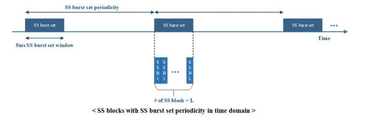
도 4는 SSB burst periodicity의 개념도이다.
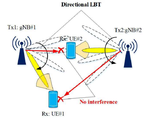
도 5는 지향성 LBT의 개념도이다.
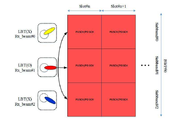
도 6은 Subband 기반 directional LBT에 따른 스케줄링 개념도(방안 3-1)이다.
도 7은 Subband 기반 directional LBT에 따른 스케줄링 개념도(방안 3-2)이다.
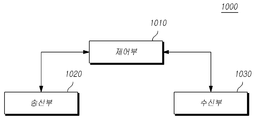
도 8은 또 다른 실시예에 의한 기지국의 구성을 보여주는 도면이다.
도 9는 또 다른 실시예에 의한 사용자 단말의 구성을 보여주는 도면이다.1 is a view showing an example of symbol level alignment among different SCS.
2 is a diagram illustrating NR time domain structure depending on subcarrier-spacing.
3 is a view showing an NR PSS / SS / PBCH block.
4 is a conceptual diagram of SSB burst periodicity.
5 is a conceptual diagram of directional LBT.
6 is a conceptual diagram (Scheme 3-1) of scheduling according to a subband-based directional LBT.
7 is a conceptual diagram (Scheme 3-2) of scheduling according to a subband-based directional LBT.
8 is a diagram showing the configuration of a base station according to another embodiment.
9 is a view showing the configuration of a user terminal according to another embodiment.
이하, 본 발명의 일부 실시예들을 예시적인 도면을 통해 상세하게 설명한다. 각 도면의 구성요소들에 참조부호를 부가함에 있어서, 동일한 구성요소들에 대해서는 비록 다른 도면상에 표시되더라도 가능한 한 동일한 부호를 가지도록 하고 있음에 유의해야 한다. 또한, 본 발명을 설명함에 있어, 관련된 공지 구성 또는 기능에 대한 구체적인 설명이 본 발명의 요지를 흐릴 수 있다고 판단되는 경우에는 그 상세한 설명은 생략한다.Hereinafter, some embodiments of the present invention will be described in detail through exemplary drawings. It should be noted that in adding reference numerals to the components of each drawing, the same components have the same reference numerals as possible even though they are displayed on different drawings. In addition, in describing the present invention, when it is determined that detailed descriptions of related well-known configurations or functions may obscure the subject matter of the present invention, detailed descriptions thereof will be omitted.
본 명세서에서 무선 통신 시스템은 음성, 패킷 데이터 등과 같은 다양한 통신 서비스를 제공하기 위한 시스템을 의미한다. 무선 통신 시스템은 사용자 단말(User Equipment, UE) 및 기지국(Base Station, BS)을 포함한다.In the present specification, a wireless communication system means a system for providing various communication services such as voice and packet data. The wireless communication system includes a user equipment (UE) and a base station (BS).
사용자 단말은 무선 통신에서의 단말을 의미하는 포괄적 개념으로서, WCDMA, LTE, HSPA 및 IMT-2020(5G 또는 New Radio) 등에서의 UE(User Equipment)는 물론, GSM에서의 MS(Mobile Station), UT(User Terminal), SS(Subscriber Station), 무선 기기(wireless device) 등을 모두 포함하는 개념으로 해석되어야 할 것이다.The user terminal is a comprehensive concept that refers to a terminal in wireless communication, user equipment (UE) in WCDMA, LTE, HSPA and IMT-2020 (5G or New Radio), as well as MS (Mobile Station) in GSM, UT It should be interpreted as a concept including (User Terminal), SS (Subscriber Station), and wireless device.
기지국 또는 셀(Cell)은 일반적으로 사용자 단말과 통신하는 지점(station)을 말하며, 노드-B(Node-B), eNB(evolved Node-B), gNB(gNode-B), LPN(Low Power Node), 섹터(Sector), 싸이트(Site), 다양한 형태의 안테나, BTS(Base Transceiver System), 액세스 포인트(Access Point), 포인트(예를 들어, 송신포인트, 수신포인트, 송수신포인트), 릴레이 노드(Relay Node), 메가 셀, 매크로 셀, 마이크로 셀, 피코 셀, 펨토 셀, RRH(Remote Radio Head), RU(Radio Unit), 스몰 셀(small cell) 등 다양한 커버리지 영역을 모두 포괄하는 의미이다.Base station or cell (Cell) generally refers to a station (station) to communicate with the user terminal, Node-B (Node-B), eNB (evolved Node-B), gNB (gNode-B), LPN (Low Power Node) ), Sector, Site, Antennas of various types, Base Transceiver System (BTS), Access Point, Point (e.g., transmit point, receive point, transmit / receive point), relay node ( Relay Node), mega cell, macro cell, micro cell, pico cell, femto cell, remote radio head (RRH), radio unit (RU), and small cell (small cell).
앞서 나열된 다양한 셀은 각 셀을 제어하는 기지국이 존재하므로 기지국은 두 가지 의미로 해석될 수 있다. 1) 무선 영역과 관련하여 메가 셀, 매크로 셀, 마이크로 셀, 피코 셀, 펨토 셀, 스몰 셀(small cell)을 제공하는 장치 그 자체이거나, 2) 무선 영역 그 자체를 지시할 수 있다. 1)에서 소정의 무선 영역을 제공하는 장치들이 동일한 개체에 의해 제어되거나 무선 영역을 협업으로 구성하도록 상호 작용하는 모든 장치들을 모두 기지국으로 지시한다. 무선 영역의 구성 방식에 따라 포인트, 송수신 포인트, 송신 포인트, 수신 포인트 등은 기지국의 일 실시예가 된다. 2)에서 사용자 단말의 관점 또는 이웃하는 기지국의 입장에서 신호를 수신하거나 송신하게 되는 무선 영역 그 자체를 기지국으로 지시할 수 있다.Since the various cells listed above have a base station that controls each cell, the base station can be interpreted in two ways. 1) a device that provides a mega cell, a macro cell, a micro cell, a pico cell, a femto cell, or a small cell in relation to the wireless area, or 2) the wireless area itself. In 1), all devices that provide a predetermined wireless area are controlled by the same entity or interact to configure the wireless area in a collaborative manner. Points, transmission / reception points, transmission points, reception points, and the like, according to a configuration method of a wireless area, are examples of a base station. In 2), the radio area itself, which receives or transmits a signal from the viewpoint of the user terminal or the neighboring base station, may be directed to the base station.
본 명세서에서 셀(Cell)은 송수신 포인트로부터 전송되는 신호의 커버리지 또는 송수신 포인트(transmission point 또는 transmission/reception point)로부터 전송되는 신호의 커버리지를 가지는 요소 반송파(component carrier), 그 송수신 포인트 자체를 의미할 수 있다.In this specification, a cell is a component carrier having a coverage of a signal transmitted from a transmission / reception point or a signal transmitted from a transmission / reception point, or a transmission / reception point itself. You can.
본 명세서에서 사용자 단말과 기지국은, 본 발명에서 기술되는 기술 또는 기술적 사상을 구현하는데 사용되는 두 가지(Uplink 또는 Downlink) 송수신 주체로 포괄적인 의미로 사용되며 특정하게 지칭되는 용어 또는 단어에 의해 한정되지 않는다.In this specification, the user terminal and the base station are two (Uplink or Downlink) transmitting and receiving subjects used to implement the technology or technical idea described in the present invention, and are used in a comprehensive sense and are not limited by terms or words specifically referred to. Does not.
여기서, 상향링크(Uplink, UL, 또는 업링크)는 사용자 단말에 의해 기지국으로 데이터를 송수신하는 방식을 의미하며, 하향링크(Downlink, DL, 또는 다운링크)는 기지국에 의해 사용자 단말로 데이터를 송수신하는 방식을 의미한다.Here, the uplink (Uplink, UL, or uplink) means a method of transmitting and receiving data to the base station by the user terminal, the downlink (Downlink, DL, or downlink) transmits and receives data to the user terminal by the base station Means the way.
상향링크 전송 및 하향링크 전송은 서로 다른 시간을 사용하여 전송되는 TDD(Time Division Duplex) 방식이 사용될 수 있고, 서로 다른 주파수를 사용하여 전송되는 FDD(Frequency Division Duplex) 방식, TDD 방식과 FDD 방식의 혼용 방식이 사용될 수 있다.For uplink transmission and downlink transmission, a time division duplex (TDD) method transmitted using different times may be used, and a frequency division duplex (FDD) method, TDD method, and FDD method transmitted using different frequencies may be used. Mixing methods can be used.
또한, 무선 통신 시스템에서는 하나의 반송파 또는 반송파 쌍을 기준으로 상향링크와 하향링크를 구성하여 규격을 구성한다.In addition, in a wireless communication system, an uplink and a downlink are configured based on one carrier or a pair of carriers to configure a standard.
상향링크와 하향링크는, PDCCH(Physical Downlink Control CHannel), PUCCH(Physical Uplink Control CHannel) 등과 같은 제어 채널을 통하여 제어 정보를 전송하고, PDSCH(Physical Downlink Shared CHannel), PUSCH(Physical Uplink Shared CHannel) 등과 같은 데이터 채널로 구성되어 데이터를 전송한다.Uplink and downlink transmit control information through control channels such as PDCCH (Physical Downlink Control CHannel), PUCCH (Physical Uplink Control CHannel), and PDSCH (Physical Downlink Shared CHannel), PUSCH (Physical Uplink Shared CHannel), etc. It consists of the same data channel and transmits data.
하향링크(downlink)는 다중 송수신 포인트에서 단말로의 통신 또는 통신 경로를 의미할 수 있으며, 상향링크(uplink)는 단말에서 다중 송수신 포인트로의 통신 또는 통신 경로를 의미할 수 있다. 이때, 하향링크에서 송신기는 다중 송수신 포인트의 일부분일 수 있고, 수신기는 단말의 일부분일 수 있다. 또한, 상향링크에서 송신기는 단말의 일부분일 수 있고, 수신기는 다중 송수신 포인트의 일부분일 수 있다.Downlink (downlink) may mean a communication or communication path from a multiple transmit and receive point to a terminal, and uplink (uplink) may mean a communication or communication path from a terminal to a multiple transmit and receive point. At this time, in the downlink, the transmitter may be a part of multiple transmission / reception points, and the receiver may be a part of the terminal. In addition, in the uplink, the transmitter may be a part of the terminal, and the receiver may be a part of multiple transmission / reception points.
이하에서는 PUCCH, PUSCH, PDCCH 및 PDSCH 등과 같은 채널을 통해 신호가 송수신되는 상황을 'PUCCH, PUSCH, PDCCH 및 PDSCH를 전송, 수신한다'는 형태로 표기하기도 한다.Hereinafter, a situation in which signals are transmitted / received through channels such as PUCCH, PUSCH, PDCCH and PDSCH is also described in the form of 'transmit and receive PUCCH, PUSCH, PDCCH and PDSCH'.
한편, 이하에서 기재하는 상위계층 시그널링(High Layer Signaling)은 RRC 파라미터를 포함하는 RRC 정보를 전송하는 RRC 시그널링을 포함한다.Meanwhile, the High Layer Signaling described below includes RRC signaling for transmitting RRC information including RRC parameters.
기지국은 단말들로 하향링크 전송을 수행한다. 기지국은 유니캐스트 전송(unicast transmission)을 위한 주 물리 채널인 하향링크 데이터 채널의 수신에 필요한 스케줄링 등의 하향링크 제어 정보 및 상향링크 데이터 채널에서의 전송을 위한 스케줄링 승인 정보를 전송하기 위한 물리 하향링크 제어 채널을 전송할 수 있다. 이하에서는, 각 채널을 통해 신호가 송수신 되는 것을 해당 채널이 송수신되는 형태로 기재하기로 한다.The base station performs downlink transmission to the terminals. The base station is a physical downlink for transmitting downlink control information such as scheduling required for reception of a downlink data channel, which is a main physical channel for unicast transmission, and scheduling grant information for transmission in an uplink data channel. The control channel can be transmitted. Hereinafter, the transmission and reception of signals through each channel will be described as a form in which the corresponding channel is transmitted and received.
무선 통신 시스템에서 적용되는 다중 접속 기법에는 제한이 없다. TDMA(Time Division Multiple Access), FDMA(Frequency Division Multiple Access), CDMA(Code Division Multiple Access), OFDMA(Orthogonal Frequency Division Multiple Access), NOMA(Non-Orthogonal Multiple Access), OFDM-TDMA, OFDM-FDMA, OFDM-CDMA와 같은 다양한 다중 접속 기법을 사용할 수 있다. 여기서, NOMA는 SCMA(Sparse Code Multiple Access)와 LDS(Low Density Spreading) 등을 포함한다.There are no restrictions on the multiple access technique applied in a wireless communication system. Time Division Multiple Access (TDMA), Frequency Division Multiple Access (FDMA), Code Division Multiple Access (CDMA), Orthogonal Frequency Division Multiple Access (OFDMA), Non-Orthogonal Multiple Access (NOMA), OFDM-TDMA, OFDM-FDMA, Various multiple access techniques such as OFDM-CDMA can be used. Here, NOMA includes SCMA (Sparse Code Multiple Access) and LDS (Low Density Spreading).
본 발명의 일 실시예는 GSM, WCDMA, HSPA를 거쳐 LTE/LTE-Advanced, IMT-2020으로 진화하는 비동기 무선 통신과, CDMA, CDMA-2000 및 UMB로 진화하는 동기식 무선 통신 분야 등의 자원 할당에 적용될 수 있다.One embodiment of the present invention is to allocate resources such as asynchronous wireless communication evolving to LTE / LTE-Advanced, IMT-2020 via GSM, WCDMA, HSPA, and synchronous wireless communication evolving to CDMA, CDMA-2000 and UMB. Can be applied.
본 명세서에서 MTC(Machine Type Communication) 단말은 low cost(또는 low complexity)를 지원하는 단말 또는 coverage enhancement를 지원하는 단말 등을 의미할 수 있다. 또는 본 명세서에서 MTC 단말은 low cost(또는 low complexity) 및/또는 coverage enhancement를 지원하기 위한 특정 카테고리로 정의된 단말을 의미할 수 있다.In this specification, a Machine Type Communication (MTC) terminal may mean a terminal supporting low cost (or low complexity) or a terminal supporting coverage enhancement. Or, in this specification, the MTC terminal may mean a terminal defined as a specific category for supporting low cost (or low complexity) and / or coverage enhancement.
다시 말해 본 명세서에서 MTC 단말은 LTE 기반의 MTC 관련 동작을 수행하는 새롭게 정의된 3GPP Release-13 low cost(또는 low complexity) UE category/type을 의미할 수 있다. 또는 본 명세서에서 MTC 단말은 기존의 LTE coverage 대비 향상된 coverage를 지원하거나, 혹은 저전력 소모를 지원하는 기존의 3GPP Release-12 이하에서 정의된 UE category/type, 혹은 새롭게 정의된 Release-13 low cost(또는 low complexity) UE category/type을 의미할 수 있다. 또는, Release-14에서 정의된 further Enhanced MTC 단말을 의미할 수도 있다.In other words, in this specification, the MTC terminal may mean a newly defined 3GPP Release-13 low cost (or low complexity) UE category / type that performs LTE-based MTC-related operations. Alternatively, in this specification, the MTC terminal supports enhanced coverage compared to the existing LTE coverage, or UE category / type defined under the existing 3GPP Release-12 or lower supporting low power consumption, or the newly defined Release-13 low cost (or low complexity) UE category / type. Or, it may mean a further enhanced MTC terminal defined in Release-14.
본 명세서에서 NB-IoT(NarrowBand Internet of Things) 단말은 셀룰러 IoT를 위한 무선 액세스를 지원하는 단말을 의미한다. NB-IoT 기술의 목적은 향상된 인도어(Indoor) 커버리지, 대규모의 저속 단말에 대한 지원, 저지연민감도, 초저가 단말 비용, 낮은 전력 소모, 그리고 최적화된 네트워크 구조를 포함한다.In this specification, the NB-IoT (NarrowBand Internet of Things) terminal means a terminal supporting wireless access for cellular IoT. The objectives of the NB-IoT technology include improved indoor coverage, support for large-scale low-speed terminals, low sensitivity, ultra-low-cost terminal costs, low power consumption, and optimized network architecture.
3GPP에서 최근 논의 중인 NR(New Radio)에서 대표적인 사용 시나리오(usage scenario)로서, eMBB(enhanced Mobile BroadBand), mMTC(massive Machine Type Communication), URLLC(Ultra Reliable and Low Latency Communication)가 제기되고 있다.As a representative usage scenario in NR (New Radio), which is currently being discussed in 3GPP, enhanced Mobile BroadBand (eMBB), Massive Machine Type Communication (mMTC), and Ultra Reliable and Low Latency Communication (URLLC) have been proposed.
본 명세서에서 NR(New Radio)과 관련한 주파수, 프레임, 서브프레임, 자원, 자원블럭, 영역(region), 밴드, 서브밴드, 제어채널, 데이터채널, 동기신호, 각종 참조신호, 각종 신호, 각종 메시지는 과거 또는 현재 사용되는 의미 또는 장래 사용되는 다양한 의미로 해석될 수 있다.In this specification, frequency, frame, subframe, resource, resource block, region, band, subband, control channel, data channel, synchronization signal, various reference signals, various signals, various messages related to NR (New Radio) Can be interpreted as meaning used in the past or present or various meanings used in the future.
한편, 이하 본 명세서에서는 단말과 기지국 두 가지 노드를 기준으로 기술적 사상에 대해서 설명하나, 이는 이해의 편의를 위한 것일 뿐, 단말과 단말 간에도 동일한 기술적 사상이 적용될 수 있다. 예를 들어, 아래에서 설명하는 기지국은 단말과 통신을 수행하는 하나의 노드를 예시적으로 개시하여 설명한 것으로, 필요에 따라 단말과 통신을 수행하는 타 단말 또는 인프라 장치 등으로 대체될 수 있다.Meanwhile, in the following description, a technical idea is described based on two nodes, a terminal and a base station, but this is only for convenience of understanding, and the same technical idea may be applied between the terminal and the terminal. For example, the base station described below is described by exemplarily describing one node that communicates with the terminal, and may be replaced with another terminal or infrastructure device that performs communication with the terminal, if necessary.
즉, 본 기술적 사상은 단말과 기지국 간의 통신 뿐만 아니라, 단말 간 통신(Device to Device), 사이드 링크 통신(Sidelink), 차량 통신(V2X) 등에 적용될 수도 있다. 특히, 차세대 무선 액세스 기술에서의 단말 간 통신에도 적용될 수 있으며, 본 명세서의 신호, 채널 등의 용어는 단말 간 통신 종류에 따라 다양하게 변형되어 적용될 수 있다. That is, the present technical idea may be applied not only to communication between a terminal and a base station, but also to communication between terminals (Device to Device), side link communication (Sidelink), and vehicle communication (V2X). In particular, it can also be applied to communication between terminals in a next-generation radio access technology, and terms such as a signal and a channel of the present specification can be variously modified and applied according to the type of communication between terminals.
예를 들어, PSS 및 SSS는 각각 단말 간 통신에서 PSSS(Primary D2D Synchronization Signal) 및 SSSS(Secondary D2D Synchronization Signal)로 용어가 변경되어 적용될 수 있다. 또한, 전술한 PBCH와 같이 브로드캐스트 정보를 전달하는 채널은 PSBCH로, PUSCH 및 PDSCH와 같이 사이드링크에서 데이터를 전달하는 채널은 PSSCH로, PDCCH 및 PUCCH와 같이 제어정보를 전달하는 채널은 PSCCH로 변경되어 적용될 수 있다. 한편, 단말 간 통신에서는 디스커버리 신호가 필요하며, 이는 PSDCH를 통해서 송수신된다. 다만, 이러한 용어에 한정되는 것은 아니다. For example, the terms PSS and SSS may be changed and applied to primary D2D Synchronization Signal (PSSS) and Secondary D2D Synchronization Signal (SSSS) in communication between terminals. In addition, the channel for transmitting broadcast information such as PBCH described above is changed to PSBCH, the channel for transmitting data in the sidelink such as PUSCH and PDSCH is changed to PSSCH, and the channel for transmitting control information such as PDCCH and PUCCH is changed to PSCCH. Can be applied. Meanwhile, a discovery signal is required in communication between terminals, which is transmitted and received through PSDCH. However, it is not limited to these terms.
이하, 본 명세서에서는 기술적 사상을 단말과 기지국 간의 통신을 예시적 기준으로 설명하되, 필요에 따라 기지국 노드가 타 단말로 대체되어 본 기술적 사상이 적용될 수 있다.Hereinafter, in this specification, the technical idea will be described based on exemplary communication between the terminal and the base station, but the base station node may be replaced with another terminal as necessary to apply the technical idea.
[5G NR(New Rat)][5G NR (New Rat)]
3GPP는 NR의 Frame structure에서는 multiple subcarrier 기반의 프레임 구조를 지원한다. 3GPP supports multiple subcarrier-based frame structures in the NR frame structure.
여기에서 기본 SCS는 15kHz가 되며, 15kHz X 2μ으로 총 5 가지 SCS 종류를 지원한다. μ값에 따른 SCS 값은 아래 표 1와 같다.Here, the basic SCS is 15 kHz, and a total of 5 SCS types are supported at 15

아래 도 1과 같이 Slot 길이는 numerology에 따라 달라짐을 알 수 있다. 즉 Slot 길이가 짧아질수록 SCS가 커짐을 알 수 있다. 또한 NR에서 정의한 슬롯은 14 OFDM 심볼을 기반으로 정의되어 있다. As shown in Figure 1 below, it can be seen that the slot length varies depending on the numerology. That is, it can be seen that the shorter the slot length, the larger the SCS. Also, the slot defined in NR is defined based on 14 OFDM symbols.
- NR Time domain structure- NR Time domain structure
NR에서는 시간 축에서 아래와 같이 구조를 지원한다. 여기에서 기존 LTE와 다른 점은 NR에서는 기본 스케줄링 유닛이 슬롯으로 변경되었다. 또한 subcarrier-spacing에 관계 없이 그림 2와 같이 슬롯은 14개 OFDM심볼로 되어 있다. 반면에 보다 작은 스케줄링 유닛인 2,4,7 OFDM 심볼로 구성된 non-slot 구조를 지원한다. Non-slot 구조는 URLLC 서비스를 위한 스케줄링 유닛으로 활용될 수 있다.NR supports the following structures on the time axis. Here, the difference from the existing LTE is that the basic scheduling unit has been changed to a slot in NR. Also, regardless of subcarrier-spacing, as shown in Figure 2, the slot is composed of 14 OFDM symbols. On the other hand, it supports a non-slot structure composed of 2,4,7 OFDM symbols, which are smaller scheduling units. The non-slot structure can be used as a scheduling unit for URLLC services.
■ Radio frame: Fixed 10ms regardless of numerology■ Radio frame: Fixed 10ms regardless of numerology
■ Subframe: Fixed 1ms as a reference for time duration■ Subframe: Fixed 1ms as a reference for time duration
◆ Do not use for data/control scheduling unit ◆ Do not use for data / control scheduling unit
■ Slot: Mainly for eMBB■ Slot: Mainly for eMBB
◆ Include 14 OFDM symbols ◆ Include 14 OFDM symbols
■ Non-slot (i.e. mini-slot)■ Non-slot (i.e. mini-slot)
◆ Mainly for URLLC, but not limited to URLLC only ◆ Mainly for URLLC, but not limited to URLLC only
◆ Include 2, 4, or 7 OFDM symbols ◆ Include 2, 4, or 7 OFDM symbols
■ One TTI duration■ One TTI duration
◆ A Time duration for data/control channel transmission ◆ A Time duration for data / control channel transmission
◆ A number of OFDM symbols per a slot/non-slot in the time main ◆ A number of OFDM symbols per a slot / non-slot in the time main
[ [ NRNR SSB] SSB]
NR SSB(Synchronization Signal Block)는 LTE와 달리 여러 subcarrier-spacing에서 전송될 수 있으며, 항상 PBCH와 같이 전송된다. 또한 subcarrier-spacing별로 최소 요구 전송 대역이 정의되어 있다.Unlike LTE, NR SSB (Synchronization Signal Block) can be transmitted in several subcarrier-spacing, and is always transmitted with PBCH. Also, a minimum required transmission band is defined for each subcarrier-spacing.
- Below 6GHz- Below 6GHz
■ "15kHz SCS and 5MHz" (except some specific band (e.g. band n41, n77 and n78 have 30SCS and 10MHz) ■ "15kHz SCS and 5MHz" (except some specific band (e.g. band n41, n77 and n78 have 30SCS and 10MHz)
- Above 6GHz- Above 6GHz
■ "120kHz SCS and 10MHz" ■ "120kHz SCS and 10MHz"
또한 주파수 대역별로 지원되는 subcarrier-spacing이 다르다. Also, subcarrier-spacing supported by frequency bands is different.
- SCS supported for bands below 1 GHz- SCS supported for bands below 1 GHz
■ 15kHz, 30kHz and 60kHz ■ 15kHz, 30kHz and 60kHz
- SCS supported for bands between 1GHz and 6GHz- SCS supported for bands between 1GHz and 6GHz
■ 15kHz, 30kHz, 60kHz ■ 15kHz, 30kHz, 60kHz
- SCS supported for bands above 24GHz and below 52.6GHz- SCS supported for bands above 24GHz and below 52.6GHz
■ 60 kHz, 120kHz ■ 60 kHz, 120 kHz
■ 240kHz is not applicable for data ■ 240 kHz is not applicable for data
SSB는 단일 형태가 아닌 SSB burst set을 정의되어 전송된다. 기본적으로 SSB burst set은 numerology에 관계없이 5ms가 되며, set내에 전송될 수 있는 SSB block의 최대 수 L은 아래와 같다.The SSB is transmitted by defining an SSB burst set rather than a single type. Basically, the SSB burst set is 5ms regardless of numerology, and the maximum number L of SSB blocks that can be transmitted in the set is as follows.
- For frequency range up to 3 GHz, L is 4- For frequency range up to 3 GHz, L is 4
- For frequency range from 3 GHz to 6 GHz, L is 8- For frequency range from 3 GHz to 6 GHz, L is 8
- For frequency range from 6 GHz to 52.6 GHz, L is 64- For frequency range from 6 GHz to 52.6 GHz, L is 64
또한 이렇게 정의된 SSB burst set이 전송되는 주기를 추가로 RRC로 설정하여 단말에게 indication하게 된다. In addition, the period in which the SSB burst set defined in this way is transmitted is additionally set to RRC to be indicated to the UE.
Initial access를 수행하는 단말은 default=20ms 주기를 가정하고 동기획득 후 시스템 정보 업데이트를 수행한다. 이후 SSB burst periodicity 값은 gNB에 의해 최종 업데이트된다.The terminal performing the initial access assumes a default = 20ms period and performs system information update after obtaining synchronization. Thereafter, the SSB burst periodicity value is finally updated by the gNB.
현재 NR-U 에서는 비면허 대역에 대한 stand-alone 설계를 고려하고 있다. 또한 NR-U에서는 7GHz 이상의 고주파 대역을 추가로 고려하고 있다. 이때 기본적으로 빔 기반 운용이 적용되기 때문에 LBT 역시 환경을 고려하여 directional LBT 도입이 필요하다. Currently, NR-U is considering stand-alone design for unlicensed bands. In addition, NR-U considers a high frequency band of 7 GHz or higher. At this time, since beam-based operation is basically applied, it is necessary to introduce directional LBT in consideration of the environment.
본 발명은 차세대/5G 무선 액세스망(이하 본 발명에서는 NR[New Radio]라 지칭하도록 함.)에서 비면허 대역 접속을 위한 지향성 LBT 설정 방법을 제안한다. 구체적으로 지향성 수신 빔포밍 기반 LBT의 구체적인 운용 방법과 자원 할당 방법에 대해서 기술한다.The present invention proposes a directional LBT setting method for unlicensed band access in a next generation / 5G wireless access network (hereinafter referred to as NR [New Radio] in the present invention). Specifically, a specific operation method and resource allocation method of directional reception beamforming based LBT will be described.
현재 NR에서는 비면허 대역 접속을 위한 'NR-based Access to Unlicensed Spectrum'이라는 Rel-16 Study Item을 진행하고 있다. NR-U를 위한 LBT 관련 agreement는 아래와 같다. (RAN1#94 Chairman's notes)Currently, NR is conducting an Rel-16 Study Item called 'NR-based Access to Unlicensed Spectrum' for unlicensed band access. The LBT-related agreement for NR-U is as follows. (RAN1 # 94 Chairman's notes)
Agreement:Agreement:
● It is recommended to define a mechanism to transmit SSBs dropped due to LBT failure ● It is recommended to define a mechanism to transmit SSBs dropped due to LBT failure
● Following are examples of candidate mechanisms for further consideration with enhancements or modifications not precluded:● Following are examples of candidate mechanisms for further consideration with enhancements or modifications not precluded:
o Alt-1: Shift SSB(s) in time to the next transmission instance o Alt-1: Shift SSB (s) in time to the next transmission instance
o Alt-2: Cyclically wrap the SSBs dropped due to LBT failure around to the end of the burst set transmissiono Alt-2: Cyclically wrap the SSBs dropped due to LBT failure around to the end of the burst set transmission
o Alt-3: Network to flexibly position SSB index and indicate the timing informationo Alt-3: Network to flexibly position SSB index and indicate the timing information
o Other alternatives are not precludedo Other alternatives are not precluded
● It is recommended to define a mechanism for UE(s) to determine the timing and QCL assumptions from the detected SSB● It is recommended to define a mechanism for UE (s) to determine the timing and QCL assumptions from the detected SSB
Agreement: Agreement:
If preamble transmissions are dropped due to LBT failure, thenIf preamble transmissions are dropped due to LBT failure, then
o From a RAN1 perspective, it is recommended that preamble power ramping is not performed and that the preamble transmission counter is not incrementedo From a RAN1 perspective, it is recommended that preamble power ramping is not performed and that the preamble transmission counter is not incremented
Agreement:Agreement:
o In some scenarios it is beneficial for the maximum RAR window size to be extended beyond 10 ms to increase robustness to DL LBT failureo In some scenarios it is beneficial for the maximum RAR window size to be extended beyond 10 ms to increase robustness to DL LBT failure
o FFS: Value of maximum RAR window sizeo FFS: Value of maximum RAR window size
본 발명에서는 지향성 LBT 도입을 전제로 그 운용 방법에 대해서 기술한다. 도 5와 같이 중심 주파수 높은 대역에서는 기본적으로 빔 기반 운용을 수행하며, 해당 데이터/제어 채널 모두 빔포밍이 적용된 형태로 전송된다. 따라서 그 LBT 역시 빔포밍 특성을 이용하여 운용해야 하며, In the present invention, the operation method is described on the premise of the introduction of directional LBT. As shown in FIG. 5, beam-based operation is basically performed in a high center frequency band, and all corresponding data / control channels are transmitted in the form of beamforming. Therefore, the LBT must also be operated using beamforming characteristics,
도 5와 같이 특정 방향으로 정렬된 빔에 의해서 서로 간섭을 주지 않고 동시 전송이 가능하다. 즉 Omni 빔 기반 전송에서는 단말 #1, #2가 동시에 데이터 전송이 불가능한 상황이지만, 지향성 빔 기반 LBT 적용 시에는 경우에 따라 서로 간섭을 유발하지 않는 빔이 적용된 단말들 사이에는 LBT 성공 확률이 증가하여 결과적으로 주파수 효율을 높일 수 있다.5, simultaneous transmission is possible without interfering with each other by beams aligned in a specific direction. That is, in Omni beam-based transmission,
방안 1. 지향성 LBT에 대한 수행 설정 정보를 단말에게 설정한다.
gNB는 단말에게 지향성 LBT를 수행함에 있어 LBT 방향에 대한 설정 정보를 전달해야 한다. 일단 단말이 지향성 LBT를 수행함에 있어서 어떤 reference 빔을 기준으로 수행할지에 대해서는 아래와 같이 여러 TCI 의 Reference RS들을 기준으로 설정할 수 있다. 즉 단말은 상위 레이어 설정 정보를 통해서 directional LBT의 설정 Information element에 대해서 특정 RS를 선택할 수 있는 information 필드를 설정할 수 있다.In performing directional LBT to the UE, the gNB must transmit configuration information for the LBT direction. First, when the UE performs directional LBT, reference TRSs of various TCIs can be set based on which reference beam is used. That is, the terminal may set an information field capable of selecting a specific RS for a configuration information element of directional LBT through higher layer configuration information.
방안 1-1. 단말의 지향성 LBT에 대한 수행 정보는 SSB 수신 빔을 기준으로 수행한다.Option 1-1. The performance information on the directional LBT of the UE is performed based on the SSB reception beam.
단말의 지향성 LBT 설정에 대한 기준 정보가 SSB 수신 빔을 기반으로 설정됨을 가정한다. 즉 단말은 최초 SSB를 수신하기 위해 설정한 RX 빔 정보를 가지고 있다. 이때 gNB는 단말의 N개 SSB 들에 대해서 수신 빔 기반 LBT를 수행하도록 설정할 수 있다. 즉 단말은 gNB 지칭한 SSB index 정보에 따라 해당 SSB를 수신한 RX 빔을 이용하여 LBT를 수행한다. 이때 지향성 LBT는 특정 한개 방향에 대해서 수행할 수도 있고, 설정한 N개 방향에 대해서 모두 수행할 수 있도록 설정할 수 있다.It is assumed that the reference information for the directional LBT setting of the terminal is set based on the SSB reception beam. That is, the terminal has RX beam information set to receive the first SSB. At this time, the gNB may be configured to perform reception beam-based LBT on the N SSBs of the terminal. That is, the terminal performs LBT using the RX beam receiving the corresponding SSB according to the SSB index information referred to as gNB. In this case, the directional LBT may be performed in one specific direction, or may be set to be performed in all the N directions.
방안 1-2. 단말의 지향성 LBT 수행을 위한 수행 정보는 multiple CSI-RS configuration을 통한 수신 빔을 기준으로 수행한다.Option 1-2. The performance information for performing the directional LBT of the UE is performed based on the received beam through multiple CSI-RS configuration.
gNB는 단말에게 다중 CSI-RS 자원을 설정한다. 이때 지향성 LBT를 수행하는 방법은 CSI-RS resource index들을 지칭함으로써 수행할 수 있다. 기본적으로는 단말에게 설정된 CSI-RS resource set들을 기준으로 지향성 LBT를 시행하게 된다. 예를 들어 아래 표 2와 같이 적용할 수 있다. 각 CSI-RS resource를 기반으로 빔 추정을 할 경우 단말은 이때 CSI-RS를 최적의 품질로 수신할 수 있는 Rx_beam을 선택하게 된다. 단 이 정보는 gNB에게 전송되지 않는다. 다음으로 현재 설정된 모든 CSI-RS resource들에 대해서 이러한 동작을 수행할 경우, CSI-RS resource별로 설정된 Tx_beam들에 적합한 Rx_beam 들이 각각 pairing 되는 것을 알 수 있다. 이때 gNB가 설정한 LBT 설정 정보에는 이러한 CSI-RS 기반 수신 빔포밍을 실제 단말의 상향 데이터 전송을 위한 지향성 LBT 후보들로 설정할 수 있다. 아래 표 2와 같이 gNB는 전체 빔들 중 전체 또는 일부만을 선택하여 지향성 LBT를 수행하도록 설정할 수 있다.The gNB configures multiple CSI-RS resources to the terminal. In this case, a method of performing directional LBT can be performed by referring to CSI-RS resource indexes. Basically, directional LBT is performed based on CSI-RS resource sets set for the UE. For example, it can be applied as shown in Table 2 below. When performing beam estimation based on each CSI-RS resource, the UE selects Rx_beam capable of receiving the CSI-RS in an optimal quality at this time. However, this information is not transmitted to the gNB. Next, when performing this operation for all currently set CSI-RS resources, it can be seen that Rx_beams suitable for Tx_beams set for each CSI-RS resource are paired. At this time, in the LBT configuration information set by the gNB, such CSI-RS-based reception beamforming may be set as directional LBT candidates for uplink data transmission of an actual terminal. As shown in Table 2 below, the gNB may be set to perform directional LBT by selecting all or a portion of all beams.

방안 1-3. 단말의 지향성 LBT 수행 정보는 Multiple RACH 전송 빔을 기준으로 수행한다.Scheme 1-3. The UE's directional LBT performance information is performed based on a multiple RACH transmission beam.
본 제안에서는 앞서 언급한 방안 1,2와 달리 상향 채널을 기준으로 단말의 LBT를 수행하는 내용을 기술한다. 즉 단말은 기존 beam management 과정을 통해서 상향링크 RACH에 대한 다중 자원 설정을 수행할 수 있으며, 이때 각 RACH resource별로 적합한 Tx_beam을 pairing할 수 있다. 따라서 단말이 상향링크 데이터 또는 제어 채널의 전송 전 지향성 LBT를 수행함에 있어 이러한 RACH의 설정 정보를 기반으로 해당 방향으로 LBT를 수행한다. 즉 단말이 RACH를 전송하기 위한 설정된 Tx 빔 정보를 Rx 기반 지향성 LBT 프로세스에 그대로 이용하는 것을 의미한다. 해당 내용은 상기 방안 1-2와 같이 설정된 multiple RACH resource 중 전체 또는 일부만을 선택하여 지향성 LBT 에 적용하도록 설정할 수 있다.In this proposal, unlike the

방안 1-4. 단말의 지향성 LBT 수행 정보는 Multiple SRS/PUCCH 전송 빔을 기준으로 수행한다.Option 1-4. The UE's directional LBT performance information is performed based on a multiple SRS / PUCCH transmission beam.
본 제안에서는 앞서 제안한 방안 1-3과 같이 상향링크 채널 또는 신호를 기준으로 LBT 셋을 설정하는 원리가 동일하다. 다만 다중 SRS 또는 PUCCH들을 이용하여 설정된 단말의 Tx 빔 정보를 기반으로 단말이 지향성 LBT를 수행함을 의미한다. 이하 동작은 동일하다.In this proposal, the principle of setting the LBT set based on the uplink channel or the signal is the same as the previously proposed methods 1-3. However, it means that the UE performs directional LBT based on Tx beam information of the UE configured using multiple SRS or PUCCHs. The following operation is the same.
방안 2. 지향성 LBT에 수신 결과에 대한 해석을 선택적으로 수행할 수 있다.
gNB 또는 단말은 지향성 LBT를 수행함에 있어 아래와 같이 크게 두 가지 procedure 도출할 수 있다. 이러한 LBT결과의 해석은 gNB/UE 입장에서 모두 적용되며, 미리 결정하거나 상위 레이어 시그널링을 통해서 모드 설정 정보 형태로 부여할 수 있다. In performing the directional LBT, the gNB or the UE can derive two procedures as follows. The interpretation of the LBT result is applied from the gNB / UE point of view, and may be determined in advance or given in the form of mode setting information through higher layer signaling.
- Alt.1: directional LBT 결과 중 한 개 방향이라도 기준 이상의 전력/에너지가 검출되면, 다음 time으로 이동 또는 backoff한다. -Alt.1: If power / energy above the standard is detected even in one of the directional LBT results, it moves or backoffs to the next time.
여기에서는 LBT를 통해서 특정한 한 개 방향에서 Energy detection/power detection이 threshold 값을 넘을 경우 LBT 자체가 실패한 것으로 판단한다. 즉 기존의 동작과 일치하나, 특정 사이클에 대한 LBT가 그대로 유지된다. 즉 N개 방향에 대한 지향성 LBT가 적용되며, CCA 구간의 N개 단위 지향성 LBT basic unit을 구성하거나, subband N개로 N LBT basic unit 구간을 설정할 수 있다. Here, if energy detection / power detection exceeds a threshold value in one specific direction through LBT, it is determined that the LBT itself has failed. That is, it matches the existing operation, but the LBT for a specific cycle is maintained. That is, directional LBT for N directions is applied, and N unit directional LBT basic units of the CCA section may be configured, or N LBT basic unit sections may be set with N subbands.
- Alt.2: directional LBT 결과 중 한 개 방향이라도 기준 이하의 전력/에너지가 검출되면, 해당 방향으로 데이터 전송 수행 -Alt.2: If power / energy below the standard is detected even in one of the directional LBT results, data transmission is performed in that direction
여기에서는 LBT를 통해서 특정 한 방향 이상에서 Energy detection/power detection이 threshold 값을 넘지 않는 경우 LBT 자체가 성공한 것으로 판단한다. 즉 기존의 동작과 상이하다. 지향상 LBT들 통해서 에너지 검출이 되지 않은 방향에 대해서 gNB/UE는 해당 방향에 대해서는 LBT가 성공했다고 가정한다. 따라서 지향성 LBT에 성공한 방향으로만 gNB/UE는 신호/데이터를 송신할 수 있다.Here, if energy detection / power detection does not exceed a threshold value in a specific direction through LBT, it is determined that LBT itself is successful. That is, it is different from the existing operation. For the direction in which no energy was detected through the directional LBTs, the gNB / UE assumes that the LBT is successful for the direction. Therefore, only in the direction in which the directional LBT is successful, the gNB / UE can transmit signals / data.
본 방안에서는 gNB는 subband(20MHz basic unit) 단위로 지향성 LBT 프로세스를 적용할 수 있다. 이때 gNB는 subband 기반 지향성 LBT 설정을 위해서 단말에게 지향성 LBT를 수행하기 위한 Subband별 LBT 방향 설정 정보를 전달해야 한다. 일단 단말이 지향성 LBT를 수행함에 있어서 어떤 reference 빔을 기준으로 수행할지에 대해서는 여러 TCI 의 Reference RS들을 기준으로 설정할 수 있다. 즉 단말은 상위 레이어 설정 정보를 통해서 directional LBT의 설정 Information element에 대해서 특정 RS를 선택할 수 있는 information 필드를 설정할 수 있다. 구체적인 상/하향 신호/채널 이용 및 설정 방법은 '방안 1,1-1,1-2,1-3,1-4' 를 따른다.In this method, the gNB can apply a directional LBT process in a subband (20 MHz basic unit) unit. At this time, in order to set the subband based directional LBT, the gNB needs to transmit LBT direction setting information for each subband to perform directional LBT to the UE. First, when a UE performs directional LBT, reference RSs of various TCIs can be set based on which reference beam is used. That is, the terminal may set an information field capable of selecting a specific RS for a configuration information element of directional LBT through higher layer configuration information. The specific method of using and setting up / down signals / channels follows '
방안 3. 지향성 LBT에 성공에 따른 스케줄링을 선택적으로 적용할 수 있다.
본 제안에서는 지향성 LBT 성공에 따른 구체적인 스케줄링 방법에 대해서 논의한다. 앞서 언급한 바와 같이 지향성 LBT는 특정 방향에 대한 energy detection을 통해서 채널의 busy 여부를 판단한다. 즉 energy detection을 통해서 기준 값 이하의 에너지가 검출되는 방향에 대해서는 채널이 비어있다고 가정할 수도 있다. 따라서 본 제안은 이러한 지향성 LBT의 해석 방법에 따른 구체적인 스케줄링 방법을 제안한다.In this proposal, a specific scheduling method according to directional LBT success is discussed. As mentioned above, the directional LBT determines whether a channel is busy through energy detection in a specific direction. That is, it may be assumed that the channel is empty in a direction in which energy below a reference value is detected through energy detection. Therefore, this proposal proposes a specific scheduling method according to the interpretation method of the directional LBT.
방안 3-1. 지향성 LBT가 성공한 빔 방향에 대해서는 전체 전송 대역을 스케줄링을 할 수 있다.Option 3-1. For the beam direction in which the directional LBT is successful, the entire transmission band can be scheduled.
gNB/단말은 특정 방향에 대한 LBT들 수행한다. LBT를 수행하는 방법은 크게 아래와 같이 두 가지로 나눌 수 있다.The gNB / terminal performs LBTs for a specific direction. There are two ways to perform LBT.
- Alt.1: time domain LBT- Alt.1: time domain LBT
- Alt.2: Subband-based LBT(=Frequency domain LBT)- Alt.2: Subband-based LBT (= Frequency domain LBT)
여기에서 본 제안에 따르면 전체 할당된 대역 또는 BWP내에 모든 자원을 이용하여 스케줄링을 하는 것을 의미한다. 예를 들어 도 6와 같이 Subband 별 LBT를 수행한 결과 Rx_beam#1을 사용한 Subband#1에서 directional LBT를 성공했다고 가정한다. 본 제안에 따르면 이러한 경우 BWP내에 있는 전체 Subband들에 대한 스케줄링 수행할 수 있다. 비록 Subband#0, Subband#2에서 LBT에 실패했더라도 gNB는 모든 대역에 대해서 DL 자원을 할당할 수 있으며, 단말 역시 전체 Subband들을 사용하여 PUSCH/PUCCH 등의 상향 신호/채널을 전송할 수 있다. 다만 여기에는 한 가지 제약이 따른다. 예를 들어 그림 6와 같이 Rx_beam#1을 통해서 LBT에 성공한 경우, 해당 빔에 상응하는 Tx 빔으로 신호/채널을 전송해야 한다. 즉 Tx-RX beam reciprocity 특성을 적용해야 한다. 즉 전송단이 되는 gNB/UE 입장에서는 해당 방향으로만 채널이 비어 있음을 확인하였기 때문에 전송 역시 채널이 비어있는 방향으로만 수행하게 된다. Here, according to the present proposal, it means scheduling using all resources in the allotted band or BWP. For example, as a result of performing LBT for each subband as shown in FIG. 6, it is assumed that directional LBT is successful in
만약 다수의 'Subband' 또는 '시간 구간'에서 지향성 LBT들이 성공한다면, 아래와 같은 조합으로 전송 빔 설정이 가능하다.If the directional LBTs succeed in multiple 'subbands' or 'time periods', the transmission beam can be set by the following combination.
- Alt.1: LBT에 성공한 Rx_beam 들 중 무작위로(Random method) 한 개를 선택하고, 해당 빔을 기준으로 전송 빔을 설정한다.- Alt.1: Randomly select one of Rx_beams that succeeded in LBT (Random method) and set the transmission beam based on the beam.
- Alt.2: LBT에 성공한 Rx_beam 들 중 Energy detection 값이 가장 작은 한 개를 선택하고, 해당 빔을 기준으로 전송 빔을 설정한다.- Alt.2: Among the Rx_beams that succeeded in LBT, one with the lowest energy detection value is selected, and a transmission beam is set based on the corresponding beam.
- Alt.3: LBT에 성공한 Rx_beam 들 가장 먼저 LBT에 성공한 빔을 선택하고, 해당 빔을 기준으로 전송 빔을 설정한다.- Alt.3: Rx_beams that succeed in LBT First, the beam that successfully succeeds in LBT is selected, and a transmission beam is set based on the beam.
- Alt.4: LBT에 성공한 Rx_beam 들에 대한 합성 빔 형태로 전송 빔을 설정한다.- Alt.4: Set the transmission beam in the form of a composite beam for Rx_beams that succeeded in LBT.
방안 3-2. 지향성 LBT가 성공한 대역에 대해서만 스케줄링을 할 수 있다.Option 3-2. Scheduling can be performed only for a band in which the directional LBT is successful.
본 방안은 앞서 기술한 방안 3-1과 동일하며, 다만 스케줄링에 참여하는 대역에 대한 설정이 다를 수 있다. This method is the same as the above-described method 3-1, but the setting for the band participating in the scheduling may be different.
기본적으로 LBT에 성공한 Rx_beam을 기준으로 전송 빔을 선택하는 과정은 동일하다. 다만 Subband 기반 지향성 LBT를 수행하는 경우, 지향성 LBT가 성공한 Subband만을 이용하여 스케줄링하는 추가 제약이 존재한다. 예를 들어 도 7과 같이 지향성 LBT에 성공한 Subband#1에서만 Rx_beam#1을 기준으로 설정된 전송 빔을 사용하여 상/하향 자원 할당 및 스케줄링 가능하게 된다. Basically, the process of selecting a transmission beam based on Rx_beam that succeeded in LBT is the same. However, in the case of performing subband-based directional LBT, there is an additional limitation of scheduling using only the subband in which the directional LBT is successful. For example, as shown in FIG. 7, uplink / downlink resource allocation and scheduling are possible using a transmission beam set based on
본 발명은 차세대/5G 무선 액세스망(이하 본 발명에서는 NR[New Radio]라 지칭하도록 함.)에서 비면허 대역 접속을 위한 지향성 LBT 설정 방법을 제안한다. 구체적으로 지향성 수신 빔포밍 기반 LBT의 구체적인 운용 방법과 자원 할당 방법에 대해서 기술한다.The present invention proposes a directional LBT setting method for unlicensed band access in a next generation / 5G wireless access network (hereinafter referred to as NR [New Radio] in the present invention). Specifically, a specific operation method and resource allocation method of directional reception beamforming based LBT will be described.
도 8은 또 다른 실시예에 의한 기지국(1000)의 구성을 보여주는 도면이다.8 is a diagram showing the configuration of a
도 8을 참조하면, 또 다른 실시예에 의한 기지국(1000)은 제어부(1010)과 송신부(1020), 수신부(1030)를 포함한다.Referring to FIG. 8, the
제어부(1010)는 전술한 본 발명을 수행하기에 필요한 차세대 무선망에서 비면허 대역에 대한 지향성 LBT를 설정하는 방법에 있어서, 단말의 지향성 LBT에 대한 설정 정보는 SSB 수신 빔을 기준으로 결정되는 것을 특징으로 하는 방법에 따른 전반적인 기지국(1000)의 동작을 제어한다.In the method of setting the directional LBT for the unlicensed band in the next generation wireless network required to perform the present invention, the
송신부(1020)와 수신부(1030)는 전술한 본 발명을 수행하기에 필요한 신호나 메시지, 데이터를 단말과 송수신하는데 사용된다. The
도 9는 또 다른 실시예에 의한 사용자 단말(1100)의 구성을 보여주는 도면이다.9 is a diagram showing the configuration of a
도 9를 참조하면, 또 다른 실시예에 의한 사용자 단말(1100)은 수신부(1110) 및 제어부(1120), 송신부(1130)를 포함한다.Referring to FIG. 9, the
수신부(1110)는 기지국으로부터 하향링크 제어 정보 및 데이터, 메시지를 해당 채널을 통해 수신한다.The
또한 제어부(1120)는 전술한 본 발명을 수행하기에 필요한 차세대 무선망에서 비면허 대역에 대한 지향성 LBT를 설정하는 방법에 있어서, 단말의 지향성 LBT에 대한 설정 정보는 SSB 수신 빔을 기준으로 결정되는 것을 특징으로 하는 방법에 따른 전반적인 사용자 단말(1100)의 동작을 제어한다.In addition, the
송신부(1130)는 기지국에 상향링크 제어 정보 및 데이터, 메시지를 해당 채널을 통해 전송한다.The
또한, "시스템", "프로세서", "컨트롤러", "컴포넌트", "모듈", "인터페이스", "모델", "유닛" 등의 용어는 일반적으로 컴퓨터 관련 엔티티 하드웨어, 하드웨어와 소프트웨어의 조합, 소프트웨어 또는 실행 중인 소프트웨어를 의미할 수 있다. 예를 들어, 전술한 구성요소는 프로세서에 의해서 구동되는 프로세스, 프로세서, 컨트롤러, 제어 프로세서, 개체, 실행 스레드, 프로그램 및/또는 컴퓨터일 수 있지만 이에 국한되지 않는다. 예를 들어, 컨트롤러 또는 프로세서에서 실행 중인 애플리케이션과 컨트롤러 또는 프로세서가 모두 구성 요소가 될 수 있습니다. 하나 이상의 구성 요소가 프로세스 및/또는 실행 스레드 내에 있을 수 있으며 구성 요소는 한 시스템에 위치하거나 두 대 이상의 시스템에 배포될 수 있습니다.In addition, the terms "system", "processor", "controller", "component", "module", "interface", "model", "unit", etc. are generally related to computer-related entity hardware, a combination of hardware and software, It can mean software or running software. For example, the components described above may be, but are not limited to, processes, processors, controllers, control processors, entities, threads of execution, programs and / or computers driven by a processor. For example, both an application running on a controller or processor and a controller or processor can be a component. One or more components can be in a process and / or thread of execution, and the components can be located on one system or deployed to more than one system.
전술한 실시예에서 언급한 표준내용 또는 표준문서들은 명세서의 설명을 간략하게 하기 위해 생략한 것으로 본 명세서의 일부를 구성한다. 따라서, 위 표준내용 및 표준문서들의 일부의 내용을 본 명세서에 추가하거나 청구범위에 기재하는 것은 본 발명의 범위에 해당하는 것으로 해석되어야 한다.The standard contents or standard documents mentioned in the above-described embodiments are omitted to simplify the description of the specification and constitute a part of the specification. Therefore, it should be construed that adding the contents of the above standard contents and a part of the standard documents to the present specification or in the claims falls within the scope of the present invention.
이상의 설명은 본 발명의 기술 사상을 예시적으로 설명한 것에 불과한 것으로서, 본 발명이 속하는 기술 분야에서 통상의 지식을 가진 자라면 본 발명의 본질적인 특성에서 벗어나지 않는 범위에서 다양한 수정 및 변형이 가능할 것이다. 따라서, 본 발명에 개시된 실시예들은 본 발명의 기술 사상을 한정하기 위한 것이 아니라 설명하기 위한 것이고, 이러한 실시예에 의하여 본 발명의 기술사상의 범위가 한정되는 것은 아니다. 본 발명의 보호 범위는 아래의 청구범위에 의하여 해석되어야 하며, 그와 동등한 범위 내에 있는 모든 기술 사상은 본 발명의 권리범위에 포함되는 것으로 해석되어야 할 것이다.The above description is merely illustrative of the technical idea of the present invention, and those skilled in the art to which the present invention pertains may make various modifications and variations without departing from the essential characteristics of the present invention. Therefore, the embodiments disclosed in the present invention are not intended to limit the technical spirit of the present invention, but to explain them, and the scope of the technical idea of the present invention is not limited by these embodiments. The scope of protection of the present invention should be interpreted by the claims below, and all technical spirits within the scope equivalent thereto should be interpreted as being included in the scope of the present invention.
Claims (1)
단말의 지향성 LBT에 대한 설정 정보는 SSB 수신 빔을 기준으로 결정되는 것을 특징으로 하는 방법.
In the method of setting the directional LBT for the unlicensed band in the next generation wireless network,
Method for setting the information on the directional LBT of the terminal is determined based on the SSB reception beam.
Priority Applications (1)
| Application Number | Priority Date | Filing Date | Title |
|---|---|---|---|
| KR1020180107580A KR20200029671A (en) | 2018-09-10 | 2018-09-10 | Apparatus and method of directional LBT configuration in NR-Unlicensed |
Applications Claiming Priority (1)
| Application Number | Priority Date | Filing Date | Title |
|---|---|---|---|
| KR1020180107580A KR20200029671A (en) | 2018-09-10 | 2018-09-10 | Apparatus and method of directional LBT configuration in NR-Unlicensed |
Publications (1)
| Publication Number | Publication Date |
|---|---|
| KR20200029671A true KR20200029671A (en) | 2020-03-19 |
Family
ID=69957026
Family Applications (1)
| Application Number | Title | Priority Date | Filing Date |
|---|---|---|---|
| KR1020180107580A Withdrawn KR20200029671A (en) | 2018-09-10 | 2018-09-10 | Apparatus and method of directional LBT configuration in NR-Unlicensed |
Country Status (1)
| Country | Link |
|---|---|
| KR (1) | KR20200029671A (en) |
Cited By (7)
| Publication number | Priority date | Publication date | Assignee | Title |
|---|---|---|---|---|
| CN113473598A (en) * | 2020-03-30 | 2021-10-01 | 上海朗帛通信技术有限公司 | Method and apparatus in a node used for wireless communication |
| WO2021206409A1 (en) * | 2020-04-08 | 2021-10-14 | 엘지전자 주식회사 | Method for performing channel access procedure and device therefor |
| US20220124806A1 (en) * | 2020-10-16 | 2022-04-21 | Samsung Electronics Co., Ltd. | Receiver-assisted listen before talk for new radio unlicensed spectrum |
| KR20220103938A (en) * | 2021-01-15 | 2022-07-25 | 엘지전자 주식회사 | Method for performing channel access procedure and apparatus therefor |
| WO2022165715A1 (en) * | 2021-02-04 | 2022-08-11 | 北京小米移动软件有限公司 | Unlicensed channel assessment method, apparatus, device, and storage medium |
| EP4096323A4 (en) * | 2020-06-12 | 2023-01-25 | Guangdong Oppo Mobile Telecommunications Corp., Ltd. | WIRELESS COMMUNICATION METHOD AND DEVICE |
| US12075478B2 (en) | 2021-01-15 | 2024-08-27 | Lg Electronics Inc. | Method of performing channel access procedure and apparatus therefor |
-
2018
- 2018-09-10 KR KR1020180107580A patent/KR20200029671A/en not_active Withdrawn
Cited By (13)
| Publication number | Priority date | Publication date | Assignee | Title |
|---|---|---|---|---|
| CN113473598A (en) * | 2020-03-30 | 2021-10-01 | 上海朗帛通信技术有限公司 | Method and apparatus in a node used for wireless communication |
| CN113473598B (en) * | 2020-03-30 | 2022-12-06 | 上海朗帛通信技术有限公司 | Method and apparatus in a node used for wireless communication |
| WO2021206409A1 (en) * | 2020-04-08 | 2021-10-14 | 엘지전자 주식회사 | Method for performing channel access procedure and device therefor |
| CN115835406B (en) * | 2020-06-12 | 2024-10-18 | Oppo广东移动通信有限公司 | Wireless communication method and device |
| US12231916B2 (en) | 2020-06-12 | 2025-02-18 | Guangdong Oppo Mobile Telecommunications Corp., Ltd. | Wireless communication method and device |
| EP4096323A4 (en) * | 2020-06-12 | 2023-01-25 | Guangdong Oppo Mobile Telecommunications Corp., Ltd. | WIRELESS COMMUNICATION METHOD AND DEVICE |
| CN115835406A (en) * | 2020-06-12 | 2023-03-21 | Oppo广东移动通信有限公司 | Method and apparatus for wireless communication |
| US20220124806A1 (en) * | 2020-10-16 | 2022-04-21 | Samsung Electronics Co., Ltd. | Receiver-assisted listen before talk for new radio unlicensed spectrum |
| US11627606B2 (en) * | 2020-10-16 | 2023-04-11 | Samsung Electronics Co., Ltd | Receiver-assisted listen before talk for new radio unlicensed spectrum |
| KR20220103938A (en) * | 2021-01-15 | 2022-07-25 | 엘지전자 주식회사 | Method for performing channel access procedure and apparatus therefor |
| US12075478B2 (en) | 2021-01-15 | 2024-08-27 | Lg Electronics Inc. | Method of performing channel access procedure and apparatus therefor |
| US12250718B2 (en) | 2021-01-15 | 2025-03-11 | Lg Electronics Inc. | Method of performing channel access procedure and apparatus therefor |
| WO2022165715A1 (en) * | 2021-02-04 | 2022-08-11 | 北京小米移动软件有限公司 | Unlicensed channel assessment method, apparatus, device, and storage medium |
Similar Documents
| Publication | Publication Date | Title |
|---|---|---|
| US11968708B2 (en) | Method and apparatus for frame based equipment operation of NR unlicensed | |
| US11497026B2 (en) | Channel reception or transmission in a coreset based on an RSRP threshold | |
| US11902075B2 (en) | Method and apparatus of NR RMSI coreset configuration in MIB | |
| US11013036B2 (en) | Method and apparatus on enhancements of NR random access for unlicensed operations | |
| EP3192197B1 (en) | Cell detection, synchronization and measurement on unlicensed spectrum | |
| EP3593575B1 (en) | Apparatus and method for enhanced synchronization signals for coverage enhancements of low cost user equipment | |
| CN111434072B (en) | Methods and apparatus for avoiding collisions on uplink data channels and control channels | |
| CN110832939B (en) | Techniques and apparatus for supplementing uplink random access configuration | |
| US11018929B2 (en) | Method and apparatus for transmitting uplink channel in unlicensed band | |
| CN114667705B (en) | System and method for physical uplink shared channel (PUSCH) opportunity verification for two-step random access channel (RACH) | |
| KR20200029671A (en) | Apparatus and method of directional LBT configuration in NR-Unlicensed | |
| CN111183683A (en) | Apparatus and method for synchronization signal block time location and synchronization signal burst set composition for unlicensed new radio spectrum | |
| KR20180063159A (en) | Method, apparatus and system for channel access in a license-exempt band | |
| RU2742045C1 (en) | Terminal, a radio communication method and a base station | |
| KR20180057631A (en) | A downlink signal reception method and a user equipment, a downlink signal transmission method, and a base station | |
| KR20180066117A (en) | Method, apparatus and system for signal transmission in unlicensed band | |
| US11234134B2 (en) | Initial network access for licensed supplemental downlink paired with unlicensed primary component carrier | |
| KR102057127B1 (en) | Method for scheduling PUCCH for new radio and Apparatuses thereof | |
| KR20200032795A (en) | Apparatus and method of subband-based CBG configuration in NR-Unlicensed | |
| KR20200009928A (en) | Apparatus and method of multiple subbands operation in NR | |
| HK40045935B (en) | Techniques and apparatuses for supplementary uplink random access configuration | |
| HK40045935A (en) | Techniques and apparatuses for supplementary uplink random access configuration | |
| KR20200026414A (en) | Apparatus and method of Sub-PRB based interlacing and resource allocation in NR-Unlicensed |
Legal Events
| Date | Code | Title | Description |
|---|---|---|---|
| PA0109 | Patent application |
Patent event code: PA01091R01D Comment text: Patent Application Patent event date: 20180910 |
|
| PG1501 | Laying open of application | ||
| PC1203 | Withdrawal of no request for examination | ||
| WITN | Application deemed withdrawn, e.g. because no request for examination was filed or no examination fee was paid |