KR20200043155A - Fuel cell electrode with organic compound having phosphonic acid group and manufacturing method thereof - Google Patents
Fuel cell electrode with organic compound having phosphonic acid group and manufacturing method thereof Download PDFInfo
- Publication number
- KR20200043155A KR20200043155A KR1020180123894A KR20180123894A KR20200043155A KR 20200043155 A KR20200043155 A KR 20200043155A KR 1020180123894 A KR1020180123894 A KR 1020180123894A KR 20180123894 A KR20180123894 A KR 20180123894A KR 20200043155 A KR20200043155 A KR 20200043155A
- Authority
- KR
- South Korea
- Prior art keywords
- fuel cell
- electrode
- phosphonic acid
- temperature polymer
- polymer fuel
- Prior art date
- Legal status (The legal status is an assumption and is not a legal conclusion. Google has not performed a legal analysis and makes no representation as to the accuracy of the status listed.)
- Ceased
Links
Images



Classifications
-
- H—ELECTRICITY
- H01—ELECTRIC ELEMENTS
- H01M—PROCESSES OR MEANS, e.g. BATTERIES, FOR THE DIRECT CONVERSION OF CHEMICAL ENERGY INTO ELECTRICAL ENERGY
- H01M4/00—Electrodes
- H01M4/86—Inert electrodes with catalytic activity, e.g. for fuel cells
- H01M4/8636—Inert electrodes with catalytic activity, e.g. for fuel cells with a gradient in another property than porosity
- H01M4/8642—Gradient in composition
-
- H—ELECTRICITY
- H01—ELECTRIC ELEMENTS
- H01M—PROCESSES OR MEANS, e.g. BATTERIES, FOR THE DIRECT CONVERSION OF CHEMICAL ENERGY INTO ELECTRICAL ENERGY
- H01M4/00—Electrodes
- H01M4/86—Inert electrodes with catalytic activity, e.g. for fuel cells
- H01M4/8663—Selection of inactive substances as ingredients for catalytic active masses, e.g. binders, fillers
-
- H—ELECTRICITY
- H01—ELECTRIC ELEMENTS
- H01M—PROCESSES OR MEANS, e.g. BATTERIES, FOR THE DIRECT CONVERSION OF CHEMICAL ENERGY INTO ELECTRICAL ENERGY
- H01M4/00—Electrodes
- H01M4/86—Inert electrodes with catalytic activity, e.g. for fuel cells
- H01M4/8663—Selection of inactive substances as ingredients for catalytic active masses, e.g. binders, fillers
- H01M4/8668—Binders
-
- H—ELECTRICITY
- H01—ELECTRIC ELEMENTS
- H01M—PROCESSES OR MEANS, e.g. BATTERIES, FOR THE DIRECT CONVERSION OF CHEMICAL ENERGY INTO ELECTRICAL ENERGY
- H01M4/00—Electrodes
- H01M4/86—Inert electrodes with catalytic activity, e.g. for fuel cells
- H01M4/88—Processes of manufacture
- H01M4/8803—Supports for the deposition of the catalytic active composition
- H01M4/8807—Gas diffusion layers
-
- H—ELECTRICITY
- H01—ELECTRIC ELEMENTS
- H01M—PROCESSES OR MEANS, e.g. BATTERIES, FOR THE DIRECT CONVERSION OF CHEMICAL ENERGY INTO ELECTRICAL ENERGY
- H01M4/00—Electrodes
- H01M4/86—Inert electrodes with catalytic activity, e.g. for fuel cells
- H01M4/88—Processes of manufacture
- H01M4/8825—Methods for deposition of the catalytic active composition
- H01M4/8828—Coating with slurry or ink
-
- H—ELECTRICITY
- H01—ELECTRIC ELEMENTS
- H01M—PROCESSES OR MEANS, e.g. BATTERIES, FOR THE DIRECT CONVERSION OF CHEMICAL ENERGY INTO ELECTRICAL ENERGY
- H01M4/00—Electrodes
- H01M4/86—Inert electrodes with catalytic activity, e.g. for fuel cells
- H01M4/90—Selection of catalytic material
- H01M4/92—Metals of platinum group
- H01M4/921—Alloys or mixtures with metallic elements
-
- H—ELECTRICITY
- H01—ELECTRIC ELEMENTS
- H01M—PROCESSES OR MEANS, e.g. BATTERIES, FOR THE DIRECT CONVERSION OF CHEMICAL ENERGY INTO ELECTRICAL ENERGY
- H01M4/00—Electrodes
- H01M4/86—Inert electrodes with catalytic activity, e.g. for fuel cells
- H01M4/90—Selection of catalytic material
- H01M4/92—Metals of platinum group
- H01M4/925—Metals of platinum group supported on carriers, e.g. powder carriers
- H01M4/926—Metals of platinum group supported on carriers, e.g. powder carriers on carbon or graphite
-
- H—ELECTRICITY
- H01—ELECTRIC ELEMENTS
- H01M—PROCESSES OR MEANS, e.g. BATTERIES, FOR THE DIRECT CONVERSION OF CHEMICAL ENERGY INTO ELECTRICAL ENERGY
- H01M8/00—Fuel cells; Manufacture thereof
- H01M8/10—Fuel cells with solid electrolytes
- H01M8/1004—Fuel cells with solid electrolytes characterised by membrane-electrode assemblies [MEA]
-
- H—ELECTRICITY
- H01—ELECTRIC ELEMENTS
- H01M—PROCESSES OR MEANS, e.g. BATTERIES, FOR THE DIRECT CONVERSION OF CHEMICAL ENERGY INTO ELECTRICAL ENERGY
- H01M8/00—Fuel cells; Manufacture thereof
- H01M8/10—Fuel cells with solid electrolytes
- H01M2008/1095—Fuel cells with polymeric electrolytes
-
- Y—GENERAL TAGGING OF NEW TECHNOLOGICAL DEVELOPMENTS; GENERAL TAGGING OF CROSS-SECTIONAL TECHNOLOGIES SPANNING OVER SEVERAL SECTIONS OF THE IPC; TECHNICAL SUBJECTS COVERED BY FORMER USPC CROSS-REFERENCE ART COLLECTIONS [XRACs] AND DIGESTS
- Y02—TECHNOLOGIES OR APPLICATIONS FOR MITIGATION OR ADAPTATION AGAINST CLIMATE CHANGE
- Y02E—REDUCTION OF GREENHOUSE GAS [GHG] EMISSIONS, RELATED TO ENERGY GENERATION, TRANSMISSION OR DISTRIBUTION
- Y02E60/00—Enabling technologies; Technologies with a potential or indirect contribution to GHG emissions mitigation
- Y02E60/30—Hydrogen technology
- Y02E60/50—Fuel cells
-
- Y—GENERAL TAGGING OF NEW TECHNOLOGICAL DEVELOPMENTS; GENERAL TAGGING OF CROSS-SECTIONAL TECHNOLOGIES SPANNING OVER SEVERAL SECTIONS OF THE IPC; TECHNICAL SUBJECTS COVERED BY FORMER USPC CROSS-REFERENCE ART COLLECTIONS [XRACs] AND DIGESTS
- Y02—TECHNOLOGIES OR APPLICATIONS FOR MITIGATION OR ADAPTATION AGAINST CLIMATE CHANGE
- Y02P—CLIMATE CHANGE MITIGATION TECHNOLOGIES IN THE PRODUCTION OR PROCESSING OF GOODS
- Y02P70/00—Climate change mitigation technologies in the production process for final industrial or consumer products
- Y02P70/50—Manufacturing or production processes characterised by the final manufactured product
Landscapes
- Chemical & Material Sciences (AREA)
- Chemical Kinetics & Catalysis (AREA)
- Electrochemistry (AREA)
- General Chemical & Material Sciences (AREA)
- Engineering & Computer Science (AREA)
- Manufacturing & Machinery (AREA)
- Materials Engineering (AREA)
- Life Sciences & Earth Sciences (AREA)
- Sustainable Development (AREA)
- Sustainable Energy (AREA)
- Inert Electrodes (AREA)
Abstract
Description
본 발명은 연료전지용 전극 및 그 제조방법에 관한 것으로, 더욱 상세하게는 고온형 고분자 연료전지용 전극 및 그 제조방법에 관한 것이다.The present invention relates to a fuel cell electrode and a method for manufacturing the same, and more particularly, to a high temperature polymer fuel cell electrode and a method for manufacturing the same.
고분자전해질 연료전지는 수소이온교환 특성을 갖는 고분자막을 전해질로 사용하는 연료전지로서 solid polymer electrolyte fuel cell (SPEFC), solid polymer fuel cell (SPFC), polymer electrolyte fuel cell (PEFC), 또는 proton-exchange membrane fuel cell (PEMFC) 등의 다양한 이름으로 불리고 있다. 이러한 고분자전해질 연료전지는 형태의 연료전지에 비하여 효율이 높고 전류밀도 및 출력밀도가 크며 디자인이 간단하고 제작이 쉬운 장점이 있다. 이러한 특성으로 인해 고분자전해질 연료전지는 무공해 차량의 동력원, 현지설치형 발전, 우주선용 전원, 이동용 전원, 군사용 전원 등 매우 다양한 분야에 응용될 수 있다.A polymer electrolyte fuel cell is a fuel cell that uses a polymer membrane having hydrogen ion exchange properties as an electrolyte, a solid polymer electrolyte fuel cell (SPEFC), a solid polymer fuel cell (SPFC), a polymer electrolyte fuel cell (PEFC), or a proton-exchange membrane. It is called by various names such as fuel cell (PEMFC). The polymer electrolyte fuel cell has advantages such as high efficiency, high current density and output density, simple design and easy manufacturing compared to the fuel cell of the type. Due to these characteristics, the polymer electrolyte fuel cell can be applied to a wide variety of fields, such as power sources for pollution-free vehicles, local installation power generation, spacecraft power, mobile power, and military power.
고분자전해질 연료전지는 저온형과 100°C 이상에서 운전되는 고온형으로 구분될 수 있으며, 고온형 고분자전해질 연료전지는 저온형에 비해 여러 가지 장점을 갖는다. 예를 들어, 고온형 고분자전해질 연료전지는 양성자 전도 메커니즘이 물에 의존하지 않으므로 기존 저온형에서는 반드시 필요했던 가습기를 필요로 하지 않으며, 저온형에서 발생할 수 있는 flooding 현상과 같은 응축수로 인한 여러 가지 문제를 갖지 않아 스택의 설계가 수월한 장점이 있다. 이외에도 높은 운전 온도로 인해 연료전지의 전기화학 반응을 향상시킬 수 있으며, 물질전달 저항도 줄어들어 농도 분극 또한 감소시킬 수 있다. 이와 같이 다양한 장점을 갖는 고온형 고분자전해질 연료전지를 개발하기 위한 연구가 활발히 진행되고 있다.The polymer electrolyte fuel cell can be divided into a low temperature type and a high temperature type operated at 100 ° C or higher, and the high temperature polymer electrolyte fuel cell has several advantages over a low temperature type. For example, the high-temperature polymer electrolyte fuel cell does not require a humidifier, which is necessary in the existing low-temperature type, because the proton conduction mechanism does not depend on water, and various problems caused by condensate such as flooding that can occur in the low-temperature type It does not have the advantage of easy stack design. In addition, due to the high operating temperature, the electrochemical reaction of the fuel cell can be improved, and the mass transfer resistance is also reduced, so that concentration polarization can also be reduced. Research into developing a high-temperature polymer electrolyte fuel cell having various advantages as described above has been actively conducted.
본 발명이 이루고자 하는 기술적 과제는 포스폰산기를 갖는 유기화합물이 도포된 고온형 고분자 연료전지용 전극을 제공하는 것이다. 상기 포스폰산기를 갖는 유기화합물을 전극에 도포함으로써 고온 환경에서도 높은 양성자 전도성을 제공할 수 있고 따라서 이를 사용하여 제조된 연료전지의 성능을 향상시킬 수 있다.Technical problem to be achieved by the present invention is to provide an electrode for a high-temperature polymer fuel cell coated with an organic compound having a phosphonic acid group. By applying the organic compound having the phosphonic acid group to the electrode, it is possible to provide high proton conductivity even in a high temperature environment, thus improving performance of a fuel cell manufactured using the same.
또한, 상기 포스폰산기를 갖는 유기화합물이 도포된 고온형 고분자 연료전지용 전극을 포함하는 막전극 접합체를 제공하는 것이다.In addition, to provide a membrane electrode assembly comprising an electrode for a high-temperature polymer fuel cell coated with an organic compound having the phosphonic acid group.
또한, 상기 포스폰산기를 갖는 유기화합물이 도포된 고온형 고분자 연료전지용 전극을 포함하는 고온형 고분자 연료전지를 제공하는 것이다.In addition, to provide a high-temperature polymer fuel cell comprising an electrode for a high-temperature polymer fuel cell coated with the organic compound having the phosphonic acid group.
또한, 상기 포스폰산기를 갖는 유기화합물이 도포된 고온형 고분자 연료전지의 제조방법을 제공하는 것이다.In addition, to provide a method for producing a high-temperature polymer fuel cell coated with an organic compound having a phosphonic acid group.
본 발명이 이루고자 하는 기술적 과제는 이상에서 언급한 기술적 과제로 제한되지 않으며, 언급되지 않은 또 다른 기술적 과제들은 아래의 기재로부터 본 발명이 속하는 기술 분야에서 통상의 지식을 가진 자에게 명확하게 이해될 수 있을 것이다.The technical problem to be achieved by the present invention is not limited to the technical problem mentioned above, and other technical problems not mentioned can be clearly understood by a person having ordinary knowledge in the technical field to which the present invention belongs from the following description. There will be.
상기 기술적 과제를 달성하기 위하여, 본 발명의 일 실시예는 고온형 고분자 연료전지용 전극을 제공할 수 있다. 상기 고온형 고분자 연료전지용 전극은 기체 확산층, 상기 기체 확산층 상에 형성된 촉매층 및 상기 촉매층 상에 도포된 포스폰산기를 갖는 유기화합물을 포함할 수 있다.In order to achieve the above technical problem, an embodiment of the present invention can provide an electrode for a high-temperature polymer fuel cell. The high temperature polymer fuel cell electrode may include a gas diffusion layer, a catalyst layer formed on the gas diffusion layer, and an organic compound having a phosphonic acid group applied on the catalyst layer.
또한, 상기 포스폰산기를 갖는 유기화합물은 포스폰산기를 갖는 단일분자; 단량체; 또는 주쇄 및/또는 측쇄에 포스폰산기를 갖는 고분자 화합물을 포함하는 것을 특징으로 한다.In addition, the organic compound having a phosphonic acid group is a single molecule having a phosphonic acid group; Monomer; Or it characterized in that it comprises a polymer compound having a phosphonic acid group in the main chain and / or side chains.
또한, 상기 포스폰산기를 갖는 유기화합물은 비닐포스폰산(vinylphosphonic acid), 아이소프로페닐포스폰산(isopropenylphosphonic acid), 1-페닐비닐포스폰산(1-phenylvinyl phosphonic acid), 메틸렌포스폰산(N,N,N',N'-ethylenediamine tetrakis), 1-하이드록시에테인-1,1-다이포스폰산(1-Hydroxyethane-1,1-diphosphonic acid), 알렌드론산(alendronic acid), 2-아미노에틸포스폰산(2-Aminoethylphosphonic acid), 메틸포스폰산(methylphosphonic acid) 및 p-하이드록시페닐포스폰산(p-hydroxypheny phosphonic acid) 중에서 선택되는 1 종 이상의 화합물을 포함하는 것을 특징으로 한다.In addition, the organic compound having a phosphonic acid group is vinylphosphonic acid, isopropenylphosphonic acid, 1-phenylvinyl phosphonic acid, methylenephosphonic acid (N, N , N ', N'-ethylenediamine tetrakis), 1-Hydroxyethane-1,1-diphosphonic acid, alendronic acid, 2-aminoethylphos Characterized in that it comprises at least one compound selected from phosphonic acid (2-Aminoethylphosphonic acid), methylphosphonic acid (methylphosphonic acid) and p-hydroxyphenyl phosphonic acid (p-hydroxypheny phosphonic acid).
또한, 상기 촉매층의 두께는 5 μm 내지 120 μm인 것을 특징으로 한다.In addition, the thickness of the catalyst layer is characterized in that 5 μm to 120 μm.
또한, 상기 촉매층 상에 도포된 상기 포스폰산기를 갖는 유기화합물의 단위면적당 중량(M/A)은 0.1 mg/cm2 내지 15 mg/cm2 인 것을 특징으로 한다.In addition, the weight per unit area (M / A) of the organic compound having the phosphonic acid group applied on the catalyst layer is 0.1 mg / cm 2 to 15 mg / cm 2 .
또한, 상기 촉매층은 폴리비닐리덴 플루오라이드(polyvinylidene fluoride), 폴리테트라플로오로 에틸렌(Polytetrafluoroethylene), 테트라플루오로에틸렌-헥사플루오로에틸렌 공중합체, 퍼플루오로에틸렌 프로필렌 공중합체 및 폴리페닐렌옥사이드-메틸포스폰산 공중합체로 이루어진 군에서 선택되는 1종 이상의 화합물로 형성된 바인더를 포함할 수 있다.In addition, the catalyst layer is polyvinylidene fluoride (polyvinylidene fluoride), polytetrafluoro ethylene (Polytetrafluoroethylene), tetrafluoroethylene-hexafluoroethylene copolymer, perfluoroethylene propylene copolymer and polyphenylene oxide-methyl It may include a binder formed of one or more compounds selected from the group consisting of phosphonic acid copolymers.
또한, 상기 촉매층은 금속 촉매를 포함할 수 있으며, 이때 상기 금속 촉매는 수소의 산화반응 및 산소의 산화반응을 활성화 할 수 있다.In addition, the catalyst layer may include a metal catalyst, wherein the metal catalyst can activate the oxidation reaction of hydrogen and the oxidation reaction of oxygen.
또한, 상기 촉매층은 백금; 팔라듐; 팔라듐 합금; 또는 코발트, 금, 루테늄, 주석, 몰리브테늄, 팔라듐, 로듐, 이리듐, 비스무트, 구리, 이트륨 및 크롬으로 이루어진 군에서 선택되는 1종 이상의 금속과 백금의 합금으로 형성된 금속 촉매를 포함할 수 있다.In addition, the catalyst layer is platinum; Palladium; Palladium alloy; Or a metal catalyst formed of an alloy of platinum and one or more metals selected from the group consisting of cobalt, gold, ruthenium, tin, molybdenum, palladium, rhodium, iridium, bismuth, copper, yttrium and chromium.
또한, 상기 고온형 고분자 연료전지용 전극은 FT-IR 측정시1620, 1240, 1070, 960 및 751 cm-1에서 peak를 나타내며, 각 피크의 오차범위는 ± 5 cm-1인 것을 특징으로 한다.In addition, the electrode for the high-temperature polymer fuel cell exhibits peaks at 1620, 1240, 1070, 960 and 751 cm -1 when measured by FT-IR, and the error range of each peak is ± 5 cm -1 .
본 발명의 다른 실시예는 고온형 고분자 연료전지용 막전극 접합체를 제공할 수 있다. 이때, 상기 고온형 고분자 연료전지용 막전극 접합체는 본 발명의 일 실시예에 따른 고온형 고분자 연료전지용 전극을 포함할 수 있다.Another embodiment of the present invention can provide a membrane electrode assembly for a high-temperature polymer fuel cell. In this case, the membrane electrode assembly for a high-temperature polymer fuel cell may include an electrode for a high-temperature polymer fuel cell according to an embodiment of the present invention.
본 발명의 또 다른 실시예는 고온형 고분자 연료전지를 제공할 수 있다. 이때, 상기 고온형 고분자 연료전지는 본 발명의 일 실시예에 따른 고온형 고분자 연료전지용 전극을 포함할 수 있다.Another embodiment of the present invention can provide a high-temperature polymer fuel cell. In this case, the high-temperature polymer fuel cell may include an electrode for a high-temperature polymer fuel cell according to an embodiment of the present invention.
본 발명의 또 다른 실시예는 고온형 고분자 연료전지용 전극의 제조방법을 제공할 수 있다. 이때, 상기 고온형 고분자 연료전지용 전극의 제조방법은 포스폰산기를 갖는 유기화합물을 포함하는 조성물을 준비하는 단계 및 상기 조성물을 연료전지용 전극의 촉매층 상에 도포하는 단계를 포함할 수 있다.Another embodiment of the present invention can provide a method of manufacturing an electrode for a high-temperature polymer fuel cell. At this time, the method for manufacturing the electrode for a high-temperature polymer fuel cell may include preparing a composition containing an organic compound having a phosphonic acid group and applying the composition on the catalyst layer of the electrode for a fuel cell.
또한, 상기 연료전지용 전극은, 바인더 물질을 용매에 혼합하여 바인더 용액을 제조하는 단계, 탄소지지체에 담지된 금속 촉매를 상기 바인더 용액에 첨가하여 바인더-촉매 혼합용액을 제조하는 단계 및 상기 혼합 용액을 기체 확산층 상에 코팅하여 촉매층을 형성하는 단계를 통해 준비될 수 있다.In addition, the electrode for the fuel cell, the step of preparing a binder solution by mixing a binder material in a solvent, adding a metal catalyst supported on a carbon support to the binder solution to prepare a binder-catalyst mixture solution and the mixed solution It may be prepared through the step of forming a catalyst layer by coating on the gas diffusion layer.
또한, 상기 포스폰산기를 갖는 유기화합물은 포스폰산기를 갖는 단일분자; 단량체; 또는 주쇄 및/또는 측쇄에 포스폰산기를 갖는 고분자 화합물을 포함할 수 있다.In addition, the organic compound having a phosphonic acid group is a single molecule having a phosphonic acid group; Monomer; Or it may include a polymer compound having a phosphonic acid group in the main chain and / or side chains.
또한, 상기 포스폰산기를 갖는 유기화합물은 비닐포스폰산(vinyl phosphonic acid), 아이소프로페닐포스폰산(isopropenyl phosphonic acid), 1-페닐비닐포스폰산(1-phenylvinyl phosphonic acid), 메틸렌포스폰산(N,N,N',N'-ethylenediamine tetrakis), 1-하이드록시에테인-1,1-다이포스폰산(1-Hydroxyethane-1,1-diphosphonic acid), 알렌드론산(alendronic acid), 2-아미노에틸포스폰산(2-Aminoethylphosphonic acid), 메틸포스폰산(methylphosphonic acid) 및 p-하이드록시페닐포스폰산(p-hydroxypheny phosphonic acid) 중에서 선택되는 1종 이상의 화합물을 포함할 수 있다.In addition, the organic compound having a phosphonic acid group is vinyl phosphonic acid, isopropenyl phosphonic acid, 1-phenylvinyl phosphonic acid, methylenephosphonic acid (N , N, N ', N'-ethylenediamine tetrakis), 1-Hydroxyethane-1,1-diphosphonic acid, alendronic acid, 2-amino It may include at least one compound selected from ethyl phosphonic acid (2-Aminoethylphosphonic acid), methyl phosphonic acid (methylphosphonic acid) and p-hydroxyphenyl phosphonic acid (p-hydroxypheny phosphonic acid).
또한, 상기 조성물을 연료전지용 전극에 도포하는 단계에 있어서, 상기 촉매층 상에 도포된 상기 포스폰산기를 갖는 유기화합물의 단위면적당 중량(M/A)은 0.1 mg/cm2 내지 15 mg/cm2 인 것을 특징으로 한다.In addition, in the step of applying the composition to the electrode for a fuel cell, the weight per unit area (M / A) of the organic compound having the phosphonic acid group applied on the catalyst layer is 0.1 mg / cm 2 to 15 mg / cm 2 It is characterized by being.
본 발명의 실시예에 따르면, 고온형 고분자 연료전지용 전극에 포스폰산기를 포함하는 유기화합물을 도포하여 연료전지의 성능을 향상시킬 수 있다. 이때, 상기 포스폰산기를 포함하는 유기화합물을 전극에 도포함으로써 고온에서도 높은 양성자 전도성을 제공할 수 있으며, 따라서 기존의 바인더 물질만을 사용한 경우에 비하여 동일한 전류밀도, 동일한 촉매 함유량에서 더 높은 전압 및 전력을 제공할 수 있다.According to an embodiment of the present invention, the performance of a fuel cell can be improved by applying an organic compound containing a phosphonic acid group to an electrode for a high-temperature polymer fuel cell. At this time, the organic compound containing the phosphonic acid group can be applied to the electrode to provide high proton conductivity even at high temperatures, and thus, higher voltage and power at the same current density and at the same catalyst content than when using only a conventional binder material. Can provide
본 발명의 효과는 상기한 효과로 한정되는 것은 아니며, 본 발명의 상세한 설명 또는 특허청구범위에 기재된 발명의 구성으로부터 추론 가능한 모든 효과를 포함하는 것으로 이해되어야 한다.It should be understood that the effects of the present invention are not limited to the above-described effects, and include all effects that can be deduced from the configuration of the invention described in the detailed description or claims of the present invention.
도 1은 고온형 고분자 연료전지용 전극 내 존재하는 비닐포스폰산(vinyl phosphonic acid)의 P-31 NMR 측정 결과를 도시한 그래프이다.
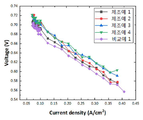
도 2는 제조예 1내지 4 및 비교예 1에 따른 경우 연료전지의 전류 밀도(A/cm2)에 따른 전압을 측정한 그래프이다.
도 3은 도 2의 측정된 결과를 백금(Pt) 로딩량에 따라 normalizing하여 나타낸 그래프이다.
도 4는 제조예 5 내지 7 및 비교에 2에 따른 경우 연료전지의 전류 밀도(A/cm2)에 따른 전압 및 전력 값을 측정한 그래프이다.
도 5 (a)는 제조예 2에 따른 Cathode 전극의 FT-IR 측정 결과를 나타낸 그래프이다.
도 5 (b)는 제조예 6에 따른 Cathode 전극의 FT-IR 측정 결과는 나타낸 그래프이다.1 is a graph showing the results of P-31 NMR measurement of vinyl phosphonic acid present in an electrode for a high-temperature polymer fuel cell.
2 is a graph of measuring voltages according to the current density (A / cm 2 ) of a fuel cell according to Preparation Examples 1 to 4 and Comparative Example 1.
3 is a graph showing normalized results of FIG. 2 according to the platinum (Pt) loading amount.
4 is a graph measuring voltage and power values according to current densities (A / cm 2 ) of a fuel cell according to Preparation Examples 5 to 7 and Comparative Example 2 .
Figure 5 (a) is a graph showing the FT-IR measurement results of the Cathode electrode according to Preparation Example 2.
Figure 5 (b) is a graph showing the results of FT-IR measurement of the Cathode electrode according to Preparation Example 6.
이하에서는 첨부한 도면을 참조하여 본 발명을 설명하기로 한다. 그러나 본 발명은 여러 가지 상이한 형태로 구현될 수 있으며, 따라서 여기에서 설명하는 실시예로 한정되는 것은 아니다. 그리고 도면에서 본 발명을 명확하게 설명하기 위해서 설명과 관계없는 부분은 생략하였으며, 명세서 전체를 통하여 유사한 부분에 대해서는 유사한 도면 부호를 붙였다.Hereinafter, the present invention will be described with reference to the accompanying drawings. However, the present invention may be implemented in various different forms, and thus is not limited to the embodiments described herein. In addition, in order to clearly describe the present invention in the drawings, parts irrelevant to the description are omitted, and like reference numerals are assigned to similar parts throughout the specification.
명세서 전체에서, 어떤 부분이 다른 부분과 "연결(접속, 접촉, 결합)"되어 있다고 할 때, 이는 "직접적으로 연결"되어 있는 경우뿐 아니라, 그 중간에 다른 부재를 사이에 두고 "간접적으로 연결"되어 있는 경우도 포함한다. 또한 어떤 부분이 어떤 구성요소를 "포함"한다고 할 때, 이는 특별히 반대되는 기재가 없는 한 다른 구성요소를 제외하는 것이 아니라 다른 구성요소를 더 구비할 수 있다는 것을 의미한다.Throughout the specification, when a part is "connected (connected, contacted, coupled)" to another part, this is not only when it is "directly connected", but also "indirectly" with another member in between. "It also includes the case where it is. Also, when a part is said to “include” a certain component, this means that other components may be further provided instead of excluding the other component unless otherwise stated.
본 명세서에서 사용한 용어는 단지 특정한 실시예를 설명하기 위해 사용된 것으로, 본 발명을 한정하려는 의도가 아니다. 단수의 표현은 문맥상 명백하게 다르게 뜻하지 않는 한, 복수의 표현을 포함한다. 본 명세서에서, "포함하다" 또는 "가지다" 등의 용어는 명세서상에 기재된 특징, 숫자, 단계, 동작, 구성요소, 부품 또는 이들을 조합한 것이 존재함을 지정하려는 것이지, 하나 또는 그 이상의 다른 특징들이나 숫자, 단계, 동작, 구성요소, 부품 또는 이들을 조합한 것들의 존재 또는 부가 가능성을 미리 배제하지 않는 것으로 이해되어야 한다.The terms used in this specification are only used to describe specific embodiments, and are not intended to limit the present invention. Singular expressions include plural expressions unless the context clearly indicates otherwise. In this specification, terms such as “include” or “have” are intended to indicate that a feature, number, step, operation, component, part, or combination thereof described in the specification exists, and that one or more other features are present. It should be understood that the existence or addition possibilities of fields or numbers, steps, operations, components, parts or combinations thereof are not excluded in advance.
이하 첨부된 도면을 참고하여 본 발명의 실시예를 상세히 설명하기로 한다.Hereinafter, embodiments of the present invention will be described in detail with reference to the accompanying drawings.
본 발명의 일 실시예에 따른 고온형 고분자 연료전지용 전극에 대해 설명한다.An electrode for a high-temperature polymer fuel cell according to an embodiment of the present invention will be described.
본 발명의 일 실시예에 따른 고온형 고분자 연료전지용 전극은 기체 확산층, 상기 기체 확산층 상에 형성된 촉매층 및 상기 촉매층 상에 도포된 포스폰산기를 갖는 유기화합물을 포함할 수 있다.The electrode for a high-temperature polymer fuel cell according to an embodiment of the present invention may include a gas diffusion layer, a catalyst layer formed on the gas diffusion layer, and an organic compound having a phosphonic acid group applied on the catalyst layer.
종래의 고온형 고분자 연료전지는 100°C 이상의 고온에서 작동되어 나피온(nafion)을 이오노머로 사용할 수 없는 문제가 있다. 이에 따라 우수한 열적, 기계적 안정성을 갖는 바인더 물질을 지지체로서 첨가하고, 양성자 전도체로서 인산을 함침하여 사용하고 있다.Conventional high-temperature polymer fuel cells operate at a high temperature of 100 ° C. or higher, and there is a problem that nafion cannot be used as an ionomer. Accordingly, a binder material having excellent thermal and mechanical stability is added as a support, and phosphoric acid is impregnated as a proton conductor.
본 발명의 일 실시예에 따른 고온형 고분자 연료전지용 전극은 포스폰산기를 포함하는 유기화합물을 상기 촉매층 상에 도포하여 고온에서도 높은 양성자 전도성을 제공할 수 있다. 기존의 바인더 물질만을 사용한 경우에 비하여 동일한 전류밀도, 동일한 촉매 함유량에서 더 높은 전압을 제공할 수 있으며 따라서 연료전지의 성능을 향상시킬 수 있다.The electrode for a high-temperature polymer fuel cell according to an embodiment of the present invention can provide a high proton conductivity even at high temperatures by applying an organic compound containing a phosphonic acid group on the catalyst layer. It is possible to provide a higher voltage at the same current density and the same catalyst content as compared to the case where only the existing binder material is used, thus improving the performance of the fuel cell.
상기 포스폰산기를 갖는 유기화합물은 포스폰산기를 갖는 단일분자; 단량체; 또는 주쇄 및/또는 측쇄에 포스폰산기를 갖는 고분자 화합물을 포함할 수 있다. The organic compound having a phosphonic acid group is a single molecule having a phosphonic acid group; Monomer; Or it may include a polymer compound having a phosphonic acid group in the main chain and / or side chains.
예를 들어, 상기 포스폰산기를 갖는 유기화합물은 비닐포스폰산(vinyl phosphonic acid), 아이소프로페닐포스폰산(isopropenyl phosphonic acid), 1-페닐비닐포스폰산(1-phenylvinyl phosphonic acid), 메틸렌포스폰산(N,N,N',N'-ethylenediamine tetrakis), 1-하이드록시에테인-1,1-다이포스폰산(1-Hydroxyethane-1,1-diphosphonic acid), 알렌드론산(alendronic acid), 2-아미노에틸포스폰산(2-Aminoethylphosphonic acid), 메틸포스폰산(methylphosphonic acid) 및 p-하이드록시페닐포스폰산(p-hydroxypheny phosphonic acid) 중에서 선택되는 1 종 이상의 화합물을 포함할 수 있다.For example, the organic compound having a phosphonic acid group is vinyl phosphonic acid, isopropenyl phosphonic acid, 1-phenylvinyl phosphonic acid, methylenephosphonic acid (N, N, N ', N'-ethylenediamine tetrakis), 1-hydroxyethane-1,1-diphosphonic acid (1-Hydroxyethane-1,1-diphosphonic acid), alendronic acid, 2 -Aminoethyl phosphonic acid (2-Aminoethylphosphonic acid), methyl phosphonic acid (methylphosphonic acid) and p-hydroxyphenyl phosphonic acid (p-hydroxypheny phosphonic acid) may include one or more compounds selected from.
상기 촉매층 상에 도포된 상기 포스폰산기를 갖는 유기화합물의 단위면적당 중량(M/A)은 0.1 mg/cm2 내지 15 mg/cm2 인 것을 특징으로 한다. 상기 포스폰산기를 갖는 유기화합물의 단위면적당 중량(M/A)이 0.1 mg/cm2 미만인 경우, 양성자 전도성 향상 효과를 충분히 제공할 수 없어 바람직하지 않다. 상기 포스폰산기를 갖는 유기화합물의 단위면적당 중량(M/A)이 15 mg/cm2 초과인 경우, 상기 포스폰산기를 갖는 유기화합물이 금속 촉매를 스크린 하여 촉매층의 활성을 저하시킬 수 있으므로 바람직하지 않다.The weight per unit area (M / A) of the organic compound having the phosphonic acid group applied on the catalyst layer is 0.1 mg / cm 2 to 15 mg / cm 2 . When the weight per unit area (M / A) of the organic compound having a phosphonic acid group is less than 0.1 mg / cm 2 , it is not preferable because it cannot sufficiently provide a proton conductivity improving effect. When the weight per unit area of the organic compound having the phosphonic acid group (M / A) is more than 15 mg / cm 2 , the organic compound having the phosphonic acid group can screen the metal catalyst and lower the activity of the catalyst layer. Do not.
상기 촉매층은 포스폰산기를 갖는 유기화합물을 포함하므로, 상기 고온형 고분자 연료전지용 전극에 대한 FT-IR 측정할 경우 포스폰산기에 해당되는 적외선(IR) 스펙트럼을 얻을 수 있다. 예를 들어, 1620 cm-1, 1240 cm-1, 1070 cm-1, 960 cm-1, 751 cm-1의 부근에서 각각 P-O-H 결합의 stretching vibration, P=O 결합의 stretching vibration, P-O 결합의 stretching vibration, P-O 결합의 stretching vibration, P-O-H 결합의 bending vibration에 해당되는 peak를 얻을 수 있으며, 이때 각 peak의 오차범위는 ± 5cm-1일 수 있다.Since the catalyst layer contains an organic compound having a phosphonic acid group, an infrared (IR) spectrum corresponding to the phosphonic acid group can be obtained when FT-IR measurement of the electrode for the high-temperature polymer fuel cell is performed. For example, in the vicinity of 1620 cm -1 , 1240 cm -1 , 1070 cm -1 , 960 cm -1 , and 751 cm -1 , the stretching vibration of POH bond, the stretching vibration of P = O bond, and the stretching of PO bond, respectively. Peaks corresponding to vibration, stretching vibration of PO bond, and bending vibration of POH bond can be obtained, and the error range of each peak may be ± 5 cm -1 .
상기 촉매층은 탄소 지지체에 담지된 금속 촉매를 포함할 수 있다. The catalyst layer may include a metal catalyst supported on a carbon support.
상기 금속 촉매는 수소의 산화 및 산소의 환원반응을 활성화 하기에 적합한 것이라면 제한 없이 사용될 수 있다.The metal catalyst can be used without limitation as long as it is suitable for activating the oxidation reaction of hydrogen and the reduction reaction of oxygen.
예를 들어, 상기 금속 촉매는 백금(Pt), 팔라듐(Pd), 백금(Pt) 합금 또는 팔라듐(Pd) 합금으로 형성된 금속 촉매를 포함할 수 있으며, 바람직하게는 백금(Pt) 또는 백금(Pt) 합금으로 형성된 금속 촉매를 포함할 수 있다.For example, the metal catalyst may include a metal catalyst formed of platinum (Pt), palladium (Pd), platinum (Pt) alloy or palladium (Pd) alloy, preferably platinum (Pt) or platinum (Pt) ) It may include a metal catalyst formed of an alloy.
이때, 상기 백금(Pt) 합금은 코발트(Co), 금(Au), 루테늄(Ru), 주석(Sn), 몰리브테늄(Mo), 팔라듐(Pd), 로듐(Rh), 이리듐(Ir), 비스무트(Bi), 구리(Cu), 이트륨(Y) 및 크롬(Cr)으로 이루어진 군에서 선택되는 1종 이상의 금속과 백금(Pt)의 합금으로 형성된 금속 촉매를 포함할 수 있다.At this time, the platinum (Pt) alloy is cobalt (Co), gold (Au), ruthenium (Ru), tin (Sn), molybdenum (Mo), palladium (Pd), rhodium (Rh), iridium (Ir) , Bismuth (Bi), copper (Cu), yttrium (Y) and chromium (Cr) may include a metal catalyst formed of an alloy of at least one metal and platinum (Pt) selected from the group consisting of.
상기 금속 촉매는 이에 한정되지 않으며, 고온 고분자 연료전지에 사용되어 성능을 향상시킬 수 있는 것이라면 충분할 것이다. 예를 들어, 상기 금속 촉매는 팔라듐, 루테늄, 비스무트(Bi), 주석(Sn) 또는 몰리브데넘(Mo)과 같은 금속물질을 백금(Pt) 상에 전기 증착시킨 것일 수 있다.The metal catalyst is not limited thereto, and it will be sufficient if it is used in a high temperature polymer fuel cell to improve performance. For example, the metal catalyst may be a metal material such as palladium, ruthenium, bismuth (Bi), tin (Sn) or molybdenum (Mo) deposited on platinum (Pt).
이때, 상기 금속 촉매의 유효 표면적을 늘리기 위해 상기 금속 촉매를 탄소 지지체에 담지한 형태로 사용될 수 있다.At this time, in order to increase the effective surface area of the metal catalyst, the metal catalyst may be used in a form supported on a carbon support.
예를 들어, 1~ 5 nm 크기의 백금(Pt) 입자를 20 ~ 40 nm 크기의 미세한 카본블랙 (carbon black) 입자 표면에 담지한 Pt/C 촉매의 형태로 사용될 수 있다.For example, it may be used in the form of a Pt / C catalyst in which platinum (Pt) particles having a size of 1 to 5 nm are supported on the surface of fine carbon black particles having a size of 20 to 40 nm.
상기 촉매층은 바인더를 포함할 수 있으며, 상기 바인더는 탄소 지지체에 담지된 금속 촉매를 고정시켜 구조적 안정성을 제공할 수 있다.The catalyst layer may include a binder, and the binder may provide structural stability by fixing a metal catalyst supported on a carbon support.
이때, 상기 바인더는 연료전지 환경하에서 화학적 및 기계적으로 안정하고 수소, 산소 및 물의 물질 전달에 문제가 없는 것이면 충분할 것이다.In this case, the binder will be sufficient if it is chemically and mechanically stable in a fuel cell environment and there is no problem in mass transfer of hydrogen, oxygen, and water.
예를 들어, 상기 바인더는 폴리비닐리덴 플루오라이드(polyvinylidene fluoride), 폴리테트라플로오로 에틸렌(Polytetrafluoroethylene), 테트라플루오로에틸렌-헥사플루오로에틸렌 공중합체, 퍼플루오로에틸렌 프로필렌 공중합체 및 폴리페닐렌옥사이드-메틸포스폰산 공중합체로 이루어진 군에서 선택되는 1종 이상의 화합물로 형성된 바인더를 포함할 수 있다.For example, the binder is polyvinylidene fluoride, polytetrafluoroethylene, tetrafluoroethylene-hexafluoroethylene copolymer, perfluoroethylene propylene copolymer and polyphenylene oxide -Methyl phosphonic acid copolymer may include a binder formed of at least one compound selected from the group consisting of.
본 발명의 일 실시예에 따른 고온형 고분자 연료전지용 전극의 촉매층의 두께는 5 μm 내지 120 μm인 것을 특징으로 한다. 상기 촉매층의 두께가5 μm 미만인 경우, 전극의 기계적 안정성이 저하될 수 있어 바람직하지 않다. 상기 촉매층의 두께가 120 μm 초과인 경우, 양성자 전도도가 감소하여 연료전지의 성능이 저하될 수 있어 바람직하지 않다.The thickness of the catalyst layer of the electrode for a high-temperature polymer fuel cell according to an embodiment of the present invention is characterized in that it is 5 μm to 120 μm. When the thickness of the catalyst layer is less than 5 μm, mechanical stability of the electrode may deteriorate, which is not preferable. When the thickness of the catalyst layer is more than 120 μm, the proton conductivity decreases, which may degrade the performance of the fuel cell, which is undesirable.
본 발명의 다른 실시예에 따른 고온형 고분자 연료전지용 막전극 접합체에 대해 설명한다.A membrane electrode assembly for a high-temperature polymer fuel cell according to another embodiment of the present invention will be described.
본 발명의 다른 실시예에 따른 고온형 고분자 연료전지용 막전극 접합체는 상기 본 발명의 일 실시예에 따른 고온형 고분자 연료전지용 전극을 포함할 수 있다.The membrane electrode assembly for a high temperature polymer fuel cell according to another embodiment of the present invention may include an electrode for a high temperature polymer fuel cell according to an embodiment of the present invention.
본 발명의 또 다른 실시예에 따른 고온형 고분자 연료전지에 대해 설명한다.A high temperature polymer fuel cell according to another embodiment of the present invention will be described.
본 발명의 또 다른 실시예에 따른 고온형 고분자 연료전지는 상기 본 발명의 일 실시예에 따른 고온형 고분자 연료전지용 전극을 포함할 수 있다.The high temperature polymer fuel cell according to another embodiment of the present invention may include an electrode for a high temperature polymer fuel cell according to an embodiment of the present invention.
다음으로 본 발명의 또 다른 실시예에 따른 고온형 연료전지용 전극의 제조방법에 대해 설명한다.Next, a method of manufacturing an electrode for a high-temperature fuel cell according to another embodiment of the present invention will be described.
상기 고온형 고분자 연료전지용 전극의 제조방법은 포스폰산기를 갖는 유기화합물을 포함하는 조성물을 준비하는 단계 및 상기 조성물을 연료전지용 전극의 촉매층 상에 도포하는 단계를 포함할 수 있다.The manufacturing method of the electrode for a high-temperature polymer fuel cell may include preparing a composition containing an organic compound having a phosphonic acid group and applying the composition on the catalyst layer of the electrode for a fuel cell.
이때, 상기 연료전지용 전극은, 바인더 물질을 용매에 혼합하여 바인더 용액을 제조하는 단계, 탄소 지지체에 담지된 금속 촉매를 상기 바인더 용액에 첨가하여 바인더-촉매 혼합용액을 제조하는 단계 및 상기 혼합용액을 기체 확산층 상에 코팅하여 촉매층을 형성하는 단계를 통해 준비될 수 있다.At this time, the electrode for the fuel cell, mixing a binder material in a solvent to prepare a binder solution, adding a metal catalyst supported on a carbon support to the binder solution to prepare a binder-catalyst mixed solution and the mixed solution It may be prepared through the step of forming a catalyst layer by coating on the gas diffusion layer.
이때, 상기 포스폰산기를 갖는 유기화합물은 포스폰산기를 갖는 단일분자; 단량체; 또는 주쇄 및/또는 측쇄에 포스폰산기를 갖는 고분자 화합물을 포함할 수 있다. At this time, the organic compound having a phosphonic acid group is a single molecule having a phosphonic acid group; Monomer; Or it may include a polymer compound having a phosphonic acid group in the main chain and / or side chains.
예를 들어, 상기 포스폰산기를 갖는 유기화합물은 비닐포스폰산(vinyl phosphonic acid), 아이소프로페닐포스폰산(isopropenyl phosphonic acid), 1-페닐비닐포스폰산(1-phenylvinyl phosphonic acid), 메틸렌포스폰산(N,N,N',N'-ethylenediamine tetrakis), 1-하이드록시에테인-1,1-다이포스폰산(1-Hydroxyethane-1,1-diphosphonic acid), 알렌드론산(alendronic acid), 2-아미노에틸포스폰산(2-Aminoethylphosphonic acid), 메틸포스폰산(methylphosphonic acid) 및 p-하이드록시페닐포스폰산(p-hydroxypheny phosphonic acid) 중에서 선택되는 1 종 이상의 화합물을 포함할 수 있다.For example, the organic compound having a phosphonic acid group is vinyl phosphonic acid, isopropenyl phosphonic acid, 1-phenylvinyl phosphonic acid, methylenephosphonic acid (N, N, N ', N'-ethylenediamine tetrakis), 1-hydroxyethane-1,1-diphosphonic acid (1-Hydroxyethane-1,1-diphosphonic acid), alendronic acid, 2 -Aminoethyl phosphonic acid (2-Aminoethylphosphonic acid), methyl phosphonic acid (methylphosphonic acid) and p-hydroxyphenyl phosphonic acid (p-hydroxypheny phosphonic acid) may include one or more compounds selected from.
또한, 상기 조성물을 연료전지용 전극에 도포하는 단계에 있어서, 상기 연료전지용 전극의 촉매층 상에 도포된 상기 포스폰산기를 갖는 유기화합물의 단위면적당 중량(M/A)은 0.1 mg/cm2 내지 15 mg/cm2 인 것을 특징으로 한다.In addition, in the step of applying the composition to the electrode for a fuel cell, the weight per unit area (M / A) of the organic compound having the phosphonic acid group applied on the catalyst layer of the electrode for the fuel cell is 0.1 mg / cm 2 to 15 It is characterized by being mg / cm 2 .
상기 포스폰산기를 갖는 유기화합물의 단위면적당 중량(M/A)이 0.1 mg/cm2 미만인 경우, 양성자 전도성 향상 효과를 충분히 제공할 수 없어 바람직하지 않다.When the weight per unit area (M / A) of the organic compound having a phosphonic acid group is less than 0.1 mg / cm 2 , it is not preferable because it cannot sufficiently provide a proton conductivity improving effect.
상기 포스폰산기를 갖는 유기화합물의 단위면적당 중량(M/A)이 15 mg/cm2 초과인 경우, 상기 포스폰산기를 갖는 유기화합물이 금속 촉매를 스크린 하여 촉매층의 활성을 저하시킬 수 있으므로 바람직하지 않다.When the weight per unit area of the organic compound having the phosphonic acid group (M / A) is more than 15 mg / cm 2 , the organic compound having the phosphonic acid group can screen the metal catalyst and lower the activity of the catalyst layer. Do not.
이하에서는 제조예, 비교예 및 실험예를 통해 본 발명에 대해 더욱 상세하게 설명한다. 하지만 본 발명이 하기 제조예 및 실험예에 한정되는 것은 아니다.Hereinafter, the present invention will be described in more detail through preparation examples, comparative examples, and experimental examples. However, the present invention is not limited to the following manufacturing examples and experimental examples.
<제조예 1: 포스폰산을 포함하는 유기화합물이 촉매층 상에 도포된 막전극 접합체 제조><Production Example 1: Preparation of a membrane electrode assembly in which an organic compound containing phosphonic acid is applied on a catalyst layer>
바인더 물질인 폴리비닐리덴플루오라이드(PVDF)을 유기용매인 N-methyl-2-pyrrolidone (NMP)에 혼합하여 바인더 용액을 제조하였다. 상기 바인더 용액에 점도 증가제를 첨가한 후 추가로 혼합하였다. 이후 상기 점도 증가제가 첨가된 바인더 용액에 PtCo/C (50 wt%, TKK corp.) 촉매를 첨가하여 바인더-촉매 혼합용액을 제조하였다. 이때, 바인더-촉매 혼합용액 내 촉매 : 바인더의 조성비(질량비)는 4 : 1이 되도록 제조하였다. 상기 바인더-촉매 혼합용액을 볼밀(250 rpm)로 1시간 동안 혼합한 후 회전을 통해 거품을 제거하였다. 상기 거품이 제거된 바인더-촉매 혼합용액을 기체 확산층(GDL, 3.2 x 3.2 cm2, 320 nm thickness) 상에 바-코팅(bar-coating) 하여 촉매층을 형성하였다. 이후 진공 건조기(vacuum oven)를 이용하여 약 60 °C로 건조하여 연료전지용 전극을 제조하였다. 비닐포스폰산(vinylphosphonic acid)을 물 용매에 혼합하여 도포용액을 제조하였다. 이때, 도포 용액 내 비닐포스폰산(vinylphosphonic acid)의 농도는 20 wt%가 되도록 제조하였다. 상기 도포용액 0.145 ml를 상기 연료전지용 전극의 촉매층 상에 도포하였으며, 이때 비닐포스폰산(vinylphosphonic acid)의 단위면적당 중량(M/A)이 3.1 mg/cm2으로 형성되었다. 이후 약 80 °C로 건조시켜 고온형 고분자 연료전지용 Cathode전극을 제조하였다. 상기 Cathode 전극 외에 PtRu/C 금속촉매를 포함하는Anode 전극, Celtec® 전해질막을 사용하여 막전극 접합체를 제조하였다.A binder solution was prepared by mixing polyvinylidene fluoride (PVDF), a binder material, with N-methyl-2-pyrrolidone (NMP), an organic solvent. The viscosity increasing agent was added to the binder solution, followed by further mixing. Then, a binder-catalyst mixture solution was prepared by adding a PtCo / C (50 wt%, TKK corp.) Catalyst to the binder solution to which the viscosity increasing agent was added. At this time, the composition ratio (mass ratio) of the catalyst: binder in the binder-catalyst mixed solution was prepared to be 4: 1. The binder-catalyst mixture solution was mixed with a ball mill (250 rpm) for 1 hour, and then bubbles were removed through rotation. The bubble-removed binder-catalyst mixture solution was bar-coated on a gas diffusion layer (GDL, 3.2 x 3.2 cm 2 , 320 nm thickness) to form a catalyst layer. Then, using a vacuum oven (vacuum oven) to dry at about 60 ° C to prepare an electrode for a fuel cell. A coating solution was prepared by mixing vinylphosphonic acid in a water solvent. At this time, the concentration of vinylphosphonic acid (vinylphosphonic acid) in the coating solution was prepared to be 20 wt%. 0.145 ml of the coating solution was applied on the catalyst layer of the electrode for the fuel cell, wherein the weight per unit area (M / A) of vinylphosphonic acid was 3.1 mg / cm 2 . Then, it was dried at about 80 ° C to prepare a cathode electrode for a high-temperature polymer fuel cell. In addition to the cathode electrode, an anode electrode containing a PtRu / C metal catalyst and a Celtec® electrolyte membrane were used to prepare a membrane electrode assembly.
<제조예 2 내지 4><Production Examples 2 to 4>
상기 제조예 1에 있어서, 상기 도포용액의 도포량을 다르게 한 것을 제외하고는 상기 제조예 1과 같은 과정으로 막전극 접합체를 제조하였다. 이때, 제조예 2 내지 4에서 도포용액의 도포량은 각각 0.29 ml, 0.387 ml, 0.483 ml가 되도록 제조하였다. 이때, 제조예 2 내지 4에서의 비닐포스폰산(vinylphosphonic acid)의 단위면적당 중량(M/A)는 각각 6.3 mg/cm2, 8.6 mg/cm2, 10.5 mg/cm2으로 형성되었다.In Preparation Example 1, a membrane electrode assembly was manufactured in the same manner as in Production Example 1, except that the coating amount of the coating solution was changed. At this time, in Production Examples 2 to 4, the coating amounts of the coating solutions were prepared to be 0.29 ml, 0.387 ml, and 0.483 ml, respectively. At this time, the weight per unit area (M / A) of vinylphosphonic acid in Preparation Examples 2 to 4 was 6.3 mg / cm 2 , 8.6 mg / cm 2 , and 10.5 mg / cm 2 , respectively.
<비교예 1><Comparative Example 1>
상기 제조예 1에 있어서, 상기 도포용액을 도포하지 않은 것을 제외하고는 상기 제조예 1과 같은 과정으로 막전극 접합체를 제조하였다.In Preparation Example 1, a membrane electrode assembly was manufactured in the same manner as in Production Example 1, except that the coating solution was not applied.
<제조예 5: 포스폰산을 포함하는 유기화합물이 전극에 도포된 막전극 접합체 제조 ><Production Example 5: Preparation of a membrane electrode assembly in which an organic compound containing phosphonic acid is applied to an electrode>
바인더 물질인 폴리페닐렌옥사이드-메틸포스폰산 공중합체(PPO-MPA)을 N-methyl-2-pyrrolidone (NMP) 및 Dimethyl Sulfoxide (DMSO)가 혼합된 용매에 첨가하여 바인더 용액을 제조하였다. 상기 바인더 용액에 점도 증가제를 첨가한 후 추가로 혼합하였다. 이후 상기 점도 증가제가 첨가된 바인더 용액에 Pt/C (50 wt.%, RTX corp.) 촉매를 첨가하여 바인더-촉매 혼합용액을 제조하였다. 이때, 바인더-촉매 혼합용액 내 촉매 : 바인더의 조성비(질량비)는 4 : 1이 되도록 제조하였다. 상기 바인더-촉매 혼합용액을 볼밀(250 rpm)로 1시간 동안 혼합 후 회전을 통해 거품을 제거하였다. 상기 거품이 제거된 바인더-촉매 혼합용액을 기체 확산층(GDL, 3.2 x 3.2 cm2, 320 nm thickness) 상에 바-코팅(bar-coating) 하여 촉매층을 형성하였다. 이후 진공 건조기(vacuum oven)를 이용하여 약 60 °C로 건조하여 연료전지용 전극을 제조하였다. 비닐포스폰산(vinylphosphonic acid)을 물 용매에 혼합하여 도포용액을 제조하였다. 이때, 도포용액 내 비닐포스폰산(vinylphosphonic acid)의 농도는 20 wt.%가 되도록 제조하였다. 상기 도포용액 0.058 ml를 상기 연료전지용 전극의 촉매층 상에 도포하였으며, 이때 비닐포스폰산(vinylphosphonic acid)의 단위면적당 중량(M/A)이 1.03 mg/cm2으로 형성되었다. 이후 약 80 °C로 건조시켜 고온형 고분자 연료전지용 Cathode 전극을 제조하였다. 상기 Cathode 전극 외에 PtRu/C 금속촉매를 포함하는Anode 전극, Celtec® 전해질막을 사용하여 막전극 접합체를 제조하였다.A binder solution was prepared by adding polyphenylene oxide-methylphosphonic acid copolymer (PPO-MPA) as a binder material to a solvent in which N-methyl-2-pyrrolidone (NMP) and Dimethyl Sulfoxide (DMSO) were mixed. The viscosity increasing agent was added to the binder solution, followed by further mixing. Then, a binder-catalyst mixture solution was prepared by adding a Pt / C (50 wt.%, RTX corp.) Catalyst to the binder solution to which the viscosity increasing agent was added. At this time, the composition ratio (mass ratio) of the catalyst: binder in the binder-catalyst mixed solution was prepared to be 4: 1. The binder-catalyst mixture solution was mixed with a ball mill (250 rpm) for 1 hour, and then bubbles were removed through rotation. The bubble-removed binder-catalyst mixture solution was bar-coated on a gas diffusion layer (GDL, 3.2 x 3.2 cm 2 , 320 nm thickness) to form a catalyst layer. Then, using a vacuum oven (vacuum oven) to dry at about 60 ° C to prepare an electrode for a fuel cell. A coating solution was prepared by mixing vinylphosphonic acid in a water solvent. At this time, the concentration of vinylphosphonic acid (vinylphosphonic acid) in the coating solution was prepared to be 20 wt.%. 0.058 ml of the coating solution was applied on the catalyst layer of the electrode for the fuel cell, wherein the weight per unit area (M / A) of vinylphosphonic acid was 1.03 mg / cm 2 . Then, it was dried at about 80 ° C to prepare a cathode electrode for a high-temperature polymer fuel cell. In addition to the cathode electrode, an anode electrode containing a PtRu / C metal catalyst and a Celtec® electrolyte membrane were used to prepare a membrane electrode assembly.
<제조예 6 및 제조예 7><Production Example 6 and Production Example 7>
상기 제조예 5에 있어서, 상기 도포용액의 도포량을 다르게 한 것을 제외하고는 상기 제조예 5와 같은 과정으로 막전극 접합체를 제조하였다. 이때, 상기 제조예 6 및 제조예 7의 도포용액의 도포량은 각각 0.29 ml, 0.386 ml가 되도록 제조하였다. 이때, 제조예 5 및 7에서의 비닐포스폰산(vinylphosphonic acid)의 단위면적당 중량(M/A)이 각각 5.75 mg/cm2, 9.45 mg/cm2으로 형성되었다.In Preparation Example 5, a membrane electrode assembly was prepared in the same manner as in Production Example 5, except that the coating amount of the coating solution was changed. At this time, the coating amounts of the coating solutions of Preparation Examples 6 and 7 were prepared to be 0.29 ml and 0.386 ml, respectively. At this time, the weight per unit area (M / A) of vinylphosphonic acid in Preparation Examples 5 and 7 was 5.75 mg / cm 2 and 9.45 mg / cm 2 , respectively.
<비교예 2><Comparative Example 2>
상기 제조예 5에 있어서, 상기 도포용액을 도포하지 않은 것을 제외하고는 상기 제조예 5와 같은 과정으로 막전극 접합체를 제조하였다.In Preparation Example 5, a membrane electrode assembly was manufactured in the same manner as in Preparation Example 5, except that the coating solution was not applied.
<실험예 1><Experimental Example 1>
포스폰산을 포함하는 유기화합물의 전극 내 존재 여부를 확인하는 실험을 진행하였다. 이를 위해 상기 제조예 1에 따라 제조된 Cathode 전극을 P-31 NMR 측정하여 전극 내 비닐포스폰산(vinylphosphonic acid)이 존재하는지 여부를 확인하였다. 이때, 상기 Cathode 전극을 DMSO-D6에 녹인 후 필터를 통해 담지 촉매를 거른 다음 P-31 NMR 측정하였다. An experiment was conducted to confirm the presence of the organic compound containing phosphonic acid in the electrode. To this end, the Cathode electrode prepared according to Preparation Example 1 was measured by P-31 NMR to confirm whether vinylphosphonic acid was present in the electrode. At this time, the Cathode electrode was dissolved in DMSO-D6, the supported catalyst was filtered through a filter, and then P-31 NMR was measured.
도 1의 (a)는 상기 제조예 1에 따라 제조된 Cathode 전극의 P-31 NMR 측정 결과를 나타낸 그래프이다. Figure 1 (a) is a graph showing the P-31 NMR measurement results of the Cathode electrode prepared according to Preparation Example 1.
도 1의 (b)는 비닐포스폰산(vinylphosphonic acid)을 DMSO-D6에 녹인 샘플의 NMR peak를 나타낸 그래프이다.1 (b) is a graph showing the NMR peak of a sample in which vinylphosphonic acid is dissolved in DMSO-D6.
도 1의 (a), (b)를 참조하면, 본 발명에 따른 고온형 고분자 연료전지용 전극의 NMR peak는 도 1의 (b)에 도시된 비닐포스폰산(vinylphosphonic acid)의 NMR peak와 일치하는 것을 확인할 수 있으며, 따라서 전극 내에 비닐포스폰산(vinylphosphonic acid)이 존재하는 것을 알 수 있다. 1 (a) and (b), the NMR peak of the electrode for a high-temperature polymer fuel cell according to the present invention corresponds to the NMR peak of the vinylphosphonic acid (vinylphosphonic acid) shown in FIG. 1 (b) It can be confirmed that the vinyl phosphonic acid (vinylphosphonic acid) is present in the electrode.
<실험예 2><Experimental Example 2>
포스폰산을 포함하는 유기화합물의 도포 여부에 따른 막전극 접합체의 성능을 비교하는 실험을 진행하였다. 이를 위해 제조예 1 내지 4 및 비교예 1에 따라 제조된 막전극 접합체를 사용하여 고온형 고분자 연료전지를 제조하였으며, 이의 성능을 비교하는 실험을 진행하였다.An experiment was conducted to compare the performance of the membrane electrode assembly according to whether or not an organic compound containing phosphonic acid was applied. To this end, a high-temperature polymer fuel cell was manufactured using the membrane electrode assemblies prepared according to Preparation Examples 1 to 4 and Comparative Example 1, and experiments were conducted to compare their performance.
도 2는 제조예 1 내지 4 및 비교예 1에 따른 막전극 접합체를 사용한 고온형 고분자 연료전지의 전류 밀도(A/cm2)에 따른 전압을 측정한 그래프이다2 is a graph of measuring voltages according to current density (A / cm 2 ) of a high-temperature polymer fuel cell using membrane electrode assemblies according to Preparation Examples 1 to 4 and Comparative Example 1;
도 3은 도 2에 따라 측정된 결과를 백금(Pt) 로딩량에 따라 normalizaing하여 나타낸 그래프이다.3 is a graph showing normalizaing the results measured according to FIG. 2 according to the platinum (Pt) loading amount.
하기 표 1은 실험예 2에 따라 측정된 결과를 정리한 표이다.Table 1 below summarizes the results measured according to Experimental Example 2.
(mg/cm2)VPA loading
(mg / cm 2 )
(mg/cm2)Pt loading
(mg / cm 2 )
(V)Voltage at 0.2 A / cm 2
(V)
(V)Voltage at 0.2 A / mg pt
(V)
도 2 및 도3을 참조하면, 비닐포스폰산(vinylphosphonic acid, VPA)이 전극에 도포되지 않은 비교예 1에 비해 비닐포스폰산(vinylphosphonic acid, VPA)이 도포된 제조예 1 내지 4의 경우 동일한 전류 밀도(A/cm2)에서 전압 및 전력 값이 높은 것을 확인할 수 있다.2 and 3, compared to Comparative Example 1 in which vinylphosphonic acid (vinylphosphonic acid, VPA) was not applied to the electrode, the same currents in Preparation Examples 1 to 4 in which vinylphosphonic acid (VPA) was applied It can be seen that the voltage and power values are high at the density (A / cm 2 ).
구체적으로, 표 1을 참조하면, 비닐포스폰산(vinylphosphonic acid, VPA)이 촉매층 상에 도포되지 않은 비교예 1의 경우 0.2 A/cm2에서 전압은 0.636 V을 보이고, 0.2 A/mgpt 에서 0.636 V의 값을 보이는 것으로 확인할 수 있다. 반면, 제조예 1 내지 4의 경우 VPA 로딩량은 각각 6.3 mg/cm2, 8.6 mg/cm2, 10.5 mg/cm2 의 값을 보였다. 또한, 제조예 1 내지 4의 전압은 0.2 A/cm2에서 각각 0.645, 0.656, 0.660 V의 값을 보이고, 0.2 A/mgpt 에서 각각 0.650 V, 0.656 V, 0.652 V, 0.648V 의 값을 보이는 것을 확인할 수 있다. 이러한 결과를 통해 촉매층 상에 비닐포스폰산(vinylphosphonic acid, VPA)이 도포된 연료전지의 경우 비닐포스폰산(vinylphosphonic acid, VPA)이 도포되지 않은 경우에 비해 동일한 전류 밀도(A/cm2), 동일한 Pt 로딩량에서 측정되는 전압 및 전력 값이 큰 것을 확인할 수 있으며, 따라서 연료전지의 성능이 우수함을 알 수 있다.Specifically, referring to Table 1, in the case of Comparative Example 1 in which vinylphosphonic acid (VPA) was not applied on the catalyst layer, the voltage was 0.636 V at 0.2 A / cm 2 and 0.636 at 0.2 A / mg pt . It can be confirmed that the value of V is shown. On the other hand, in the case of Preparation Examples 1 to 4, the VPA loadings were 6.3 mg / cm 2 , 8.6 mg / cm 2 , and 10.5 mg / cm 2 , respectively. In addition, voltages of Preparation Examples 1 to 4 show values of 0.645, 0.656, and 0.660 V, respectively, at 0.2 A / cm 2 , and values of 0.650 V, 0.656 V, 0.652 V, and 0.648 V, respectively, at 0.2 A / mg pt . You can confirm that. Through these results, in the case of a fuel cell coated with vinylphosphonic acid (VPA) on the catalyst layer, the same current density (A / cm 2 ), the same as compared with the case where the vinylphosphonic acid (VPA) is not applied It can be seen that the voltage and power values measured at the Pt loading amount are large, and thus it can be seen that the performance of the fuel cell is excellent.
이때, 상기 연료전지의 전압 및 전력 값은 비닐포스폰산(vinylphosphonic acid, VPA)의 단위면적당 중량(M/A)이 증가할수록 같이 증가하다 다시 감소하는 경향을 보였으며, 이는 VPA를 과도하게 도포한 경우 금속 촉매를 스크린하여 촉매 활성을 저하시키기 때문인 것으로 판단된다. 이때, 0.2 A/cm2 에서 전압 값은 비닐포스폰산(vinylphosphonic acid, VPA)의 단위면적당 중량(M/A)이8.6 mg/cm2인 경우에 가장 우수하고, 0.2 A/mgpt 에서 전압 값은 비닐포스폰산(vinylphosphonic acid, VPA)의 단위면적당 중량(M/A)이 6.3 mg/cm2인 경우 가장 우수한 것을 확인할 수 있다.At this time, the voltage and power values of the fuel cell tended to increase and decrease again as the weight (M / A) per unit area of vinylphosphonic acid (VPA) increased, which was excessively applied to VPA. In this case, it is considered that the catalyst activity is lowered by screening the metal catalyst. At this time, the voltage value at 0.2 A / cm 2 is the best when the weight per unit area of vinylphosphonic acid (VPA) is 8.6 mg / cm 2 , and the voltage value at 0.2 A / mg pt Silver vinyl phosphonic acid (vinylphosphonic acid, VPA) weight per unit area (M / A) of 6.3 mg / cm 2 It can be seen that the best.
<실험예 3><Experimental Example 3>
포스폰산을 포함하는 유기화합물의 도포 여부에 따른 폴리페닐렌옥사이드-메틸포스폰산 공중합체(PPO-MPA) 바인더를 적용한 막전극 접합체의 성능을 비교하는 실험을 진행하였다. 이를 위해 제조예 5 내지 7 및 비교예 2에 따라 제조된 막전극 접합체를 사용하여 고온형 고분자 연료전지를 제조하였으며, 이의 성능을 비교하는 실험을 진행하였다.An experiment was conducted to compare the performance of a membrane electrode assembly to which a polyphenylene oxide-methylphosphonic acid copolymer (PPO-MPA) binder was applied depending on whether an organic compound containing phosphonic acid was applied. To this end, high-temperature polymer fuel cells were prepared using membrane electrode assemblies prepared according to Preparation Examples 5 to 7 and Comparative Example 2, and experiments were conducted to compare their performance.
도 4는 제조예 5 내지 7 및 비교에 2에 따른 막전극 접합체를 사용한 고온형 고분자 연료전지의 전류 밀도(A/cm2)에 따른 전압 및 전력을 측정한 그래프이다.4 is a graph measuring voltage and power according to current density (A / cm 2 ) of a high-temperature polymer fuel cell using a membrane electrode assembly according to Preparation Examples 5 to 7 and Comparative Example 2 .
하기 표 2는 상기 실험예 3에 따라 측정된 결과를 정리한 표이다.Table 2 below is a table summarizing the results measured according to Experimental Example 3.
(mg/cm2)VPA loading
(mg / cm 2 )
(mg/cm2)Pt loading
(mg / cm 2 )
(V)Voltage at 0.2 A / cm 2
(V)
도 5를 참조하면, 비닐포스폰산(vinylphosphonic acid, VPA)이 전극에 도포되지 않은 비교예 1의 경우에 비해 비닐포스폰산(vinylphosphonic acid, VPA)이 전극에 도포된 제조예 5 내지 7에서의 전압 및 전력 값이 높은 것을 확인할 수 있다.5, compared to the case of Comparative Example 1 in which vinylphosphonic acid (vinylphosphonic acid, VPA) was not applied to the electrode, the voltage in Preparation Examples 5 to 7 in which vinylphosphonic acid (VPA) was applied to the electrode And it can be seen that the power value is high.
구체적으로, 표 2를 참조하면, 비닐포스폰산(vinylphosphonic acid, VPA)이 도포되지 않은 비교예 1의 경우 0.2 A/cm2 에서의 전압(V)은 측정 범위(약 0.3 V 이상) 이하의 값을 보였으며, 전력(W)은 0.322 W 로 측정되었다. 이에 반해, 비닐포스폰산(vinylphosphonic acid, VPA)이 도포된 제조예 5 내지 7의 경우 0.2 A/cm2 에서 전압(V)은 각각 0.393 V, 0.498 V, 0.439 V로 측정되었으며, 전력(W)은 각각 0.636 W, 0.825 W, 0.692 W로 측정되었다. 이러한 결과를 통해 비닐포스폰산(vinylphosphonic acid, VPA)이 촉매층 상에 도포되지 않은 경우에 비해 촉매층 상에 비닐포스폰산(vinylphosphonic acid, VPA)이 도포된 경우 동일한 전류 밀도(A/cm2), 동일한 Pt 로딩량에서 측정되는 전압 및 전력 값이 큰 것을 확인할 수 있으며, 따라서 연료전지의 성능이 우수한 것을 알 수 있다.Specifically, referring to Table 2, in the case of Comparative Example 1 in which vinylphosphonic acid (VPA) was not applied, the voltage (V) at 0.2 A / cm 2 is a value less than or equal to the measurement range (about 0.3 V or more). And the power (W) was measured to be 0.322 W. In contrast, in the case of Preparation Examples 5 to 7 in which vinylphosphonic acid (VPA) was applied, the voltage (V) at 0.2 A / cm 2 was measured to be 0.393 V, 0.498 V, and 0.439 V, respectively, and power (W). Was measured as 0.636 W, 0.825 W, and 0.692 W, respectively. Through these results, when vinyl phosphonic acid (vinylphosphonic acid, VPA) is applied on the catalyst layer compared to when vinyl phosphonic acid (vinylphosphonic acid, VPA) is not applied on the catalyst layer, the same current density (A / cm 2 ), the same It can be seen that the voltage and power values measured at the Pt loading amount are large, and thus it can be seen that the performance of the fuel cell is excellent.
이때, 상기 연료전지의 전압 및 전력 값은 비닐포스폰산(vinylphosphonic acid, VPA)의 단위면적당 중량(M/A)이 증가할수록 같이 증가하다 다시 감소하는 경향을 보였는데, 이는 비닐포스폰산(vinylphosphonic acid, VPA)을 과도하게 도포한 경우 금속 촉매를 스크린하여 촉매 활성을 저하시키기 때문인 것으로 판단된다. 이때, 비닐포스폰산(vinylphosphonic acid, VPA)의 단위면적당 중량(M/A)이 5.75 mg/cm2인 경우 전압 및 전력이 가장 우수한 것을 확인할 수 있다.At this time, the voltage and power values of the fuel cell tended to increase and decrease again as the weight per unit area of vinylphosphonic acid (VPA) increased (M / A), and this tended to decrease again. , VPA) is excessively applied, and it is considered that the catalyst activity is lowered by screening the metal catalyst. At this time, when the weight per unit area of vinylphosphonic acid (VPA) (M / A) is 5.75 mg / cm 2 , it can be seen that voltage and power are the best.
<실험예 4><Experimental Example 4>
포스폰산을 함유하는 유기화합물의 전극내 존재 여부를 확인하는 실험을 진행하였다. 이를 위해 상기 제조예 2 에 따른 Cathode 전극을 2개 제조하였다. 상기 제조된 2개의 Cathode 전극 중 하나는 80℃ 온도로 약 1시간 동안 열처리하였고, 다른 하나의 전극은 150℃ 온도로 약 1시간 동안 열처리하였다. 이후 상기 2개의 Cathode 전극에 대한 FT-IR 측정을 진행하였다. 이에 별개로 제조예 6에 따른 Cathode 전극을 2개 제조하였고, 이 중 하나의 전극은 80℃ 온도로 약 1시간 동안 열처리하였고, 다른 하나의 전극은 150℃ 온도로 약 1시간 동안 열처리하였다. 이후 상기 2개의 Cathode 전극에 대한 FT-IR 측정을 진행하였다. 이때, 비닐포스폰산(vinylphosphonic acid, VPA)을 도포하기 전의 Cathode 전극을 FT-IR background로 설정하여 실험을 진행하였다.An experiment was conducted to confirm the presence of the organic compound containing phosphonic acid in the electrode. To this end, two Cathode electrodes according to Preparation Example 2 were prepared. One of the two Cathode electrodes prepared above was heat treated at 80 ° C. for about 1 hour, and the other electrode was heat treated at 150 ° C. for about 1 hour. Thereafter, FT-IR measurement was performed on the two cathode electrodes. Separately, two Cathode electrodes according to Preparation Example 6 were prepared, one of which was heat treated at 80 ° C for about 1 hour, and the other electrode was heat treated at 150 ° C for about 1 hour. Thereafter, FT-IR measurement was performed on the two cathode electrodes. At this time, the experiment was performed by setting the Cathode electrode before applying the vinylphosphonic acid (VPA) as an FT-IR background.
도 5의 (a)는 제조예 2에 따라 제조된 Cathode 전극의 FT-IR 측정 결과를 나타낸 그래프이다.5 (a) is a graph showing the FT-IR measurement results of the Cathode electrode prepared according to Preparation Example 2.
도 5의 (b)는 제조예 6에 따라 제조된 Cathode 전극의 FT-IR 측정 결과를 나타낸 그래프이다.5 (b) is a graph showing the results of FT-IR measurement of the Cathode electrode prepared according to Preparation Example 6.
도 5의 (a) 및 (b)를 참조하면, 1621 cm-1, 1415 cm-1, 1240 cm-1, 1070 cm-1, 960 cm-1, 751 cm-1, 620 cm-1 의 부근에서 각각 P-O-H 결합의 stretching vibration, C=C-H 결합의 Scissoring vibration, P=O 결합의 stretching vibration, P-O 결합의 stretching vibration, P-O 결합의 stretching vibration, P-O-H 결합의 bending vibration, C-P 결합의 stretching vibration에 해당되는 peak들이 관찰되었으며, 이로부터 상기 제조예2 및 상기 제조예 6에 따른 Cathode 전극 내에 비닐포스폰산(vinylphosphonic acid, VPA)을 함유하는 것을 알 수 있다.5 (a) and (b), 1621 cm -1 , 1415 cm -1 , 1240 cm -1 , 1070 cm -1 , 960 cm -1 , 751 cm -1 , 620 cm -1 vicinity Corresponding to the stretching vibration of POH bond, Scissoring vibration of C = CH bond, stretching vibration of P = O bond, stretching vibration of PO bond, stretching vibration of POH bond, bending vibration of CP bond, respectively Peaks were observed, from which it can be seen that the cathode electrode according to Preparation Example 2 and Preparation Example 6 contains vinylphosphonic acid (VPA).
단, 도 5의 (b)를 참조하면, 150℃ 온도 조건의 경우P=O stretching vibration에 해당되는 1240 cm-1 부근의 peak에 변화가 관찰되었는데, 이는 상기 제조예 6의 바인더로 사용되는 PPO-MPA가 고온 조건에서 비닐포스폰산(vinylphosphonic acid, VPA)와 반응하여 나타나는 현상으로 판단된다.However, referring to (b) of FIG. 5, in the case of a temperature condition of 150 ° C., a change was observed at a peak around 1240 cm −1 corresponding to P = O stretching vibration, which is a PPO used as a binder in Preparation Example 6 -It is judged that MPA reacts with vinylphosphonic acid (VPA) at high temperature.
전술한 본 발명의 설명은 예시를 위한 것이며, 본 발명이 속하는 기술분야의 통상의 지식을 가진 자는 본 발명의 기술적 사상이나 필수적인 특징을 변경하지 않고서 다른 구체적인 형태로 쉽게 변형이 가능하다는 것을 이해할 수 있을 것이다. 그러므로 이상에서 기술한 실시예들은 모든 면에서 예시적인 것이며 한정적이 아닌 것으로 이해해야만 한다. 예를 들어, 단일형으로 설명되어 있는 각 구성 요소는 분산되어 실시될 수도 있으며, 마찬가지로 분산된 것으로 설명되어 있는 구성 요소들도 결합된 형태로 실시될 수 있다.The above description of the present invention is for illustration only, and a person having ordinary knowledge in the technical field to which the present invention pertains can understand that it can be easily modified into other specific forms without changing the technical spirit or essential features of the present invention. will be. Therefore, it should be understood that the embodiments described above are illustrative in all respects and not restrictive. For example, each component described as a single type may be implemented in a distributed manner, and similarly, components described as distributed may be implemented in a combined form.
본 발명의 범위는 후술하는 특허청구범위에 의하여 나타내어지며, 특허청구범위의 의미 및 범위 그리고 그 균등 개념으로부터 도출되는 모든 변경 또는 변형된 형태가 본 발명의 범위에 포함되는 것으로 해석되어야 한다.The scope of the present invention is indicated by the following claims, and all changes or modifications derived from the meaning and scope of the claims and equivalent concepts should be interpreted to be included in the scope of the present invention.
Claims (16)
상기 기체확산층 상에 형성된 촉매층; 및
상기 촉매층 상에 도포된 포스폰산기를 갖는 유기화합물을 포함하는 것을 특징으로 하는 고온형 고분자 연료전지용 전극.Gas diffusion layer;
A catalyst layer formed on the gas diffusion layer; And
An electrode for a high-temperature polymer fuel cell comprising an organic compound having a phosphonic acid group applied on the catalyst layer.
상기 포스폰산기를 갖는 유기화합물은 포스폰산기를 갖는 단일분자; 단량체; 또는 주쇄 및/또는 측쇄에 포스폰산기를 갖는 고분자 화합물을 포함하는 것을 특징으로 하는 고온형 고분자 연료전지용 전극.According to claim 1,
The organic compound having a phosphonic acid group is a single molecule having a phosphonic acid group; Monomer; Or a high-temperature polymer fuel cell electrode comprising a polymer compound having a phosphonic acid group in the main chain and / or side chain.
상기 포스폰산기를 갖는 유기화합물은 비닐포스폰산(vinylphosphonic acid), 아이소프로페닐포스폰산(isopropenylphosphonic acid), 1-페닐비닐포스폰산(1-phenylvinyl phosphonic acid), 메틸렌포스폰산(N,N,N',N'-ethylenediamine tetrakis), 1-하이드록시에테인-1,1-다이포스폰산(1-Hydroxyethane-1,1-diphosphonic acid), 알렌드론산(alendronic acid), 2-아미노에틸포스폰산(2-Aminoethylphosphonic acid), 메틸포스폰산(methylphosphonic acid) 및 p-하이드록시페닐포스폰산(p-hydroxypheny phosphonic acid) 중에서 선택되는 1 종 이상의 화합물을 포함하는 것을 특징으로 하는 고온형 고분자 연료전지용 전극.According to claim 1,
The organic compound having a phosphonic acid group is vinylphosphonic acid, isopropenylphosphonic acid, 1-phenylvinyl phosphonic acid, methylenephosphonic acid (N, N, N ', N'-ethylenediamine tetrakis), 1-Hydroxyethane-1,1-diphosphonic acid, alendronic acid, 2-aminoethylphosphonic acid ( An electrode for a high-temperature polymer fuel cell comprising at least one compound selected from 2-Aminoethylphosphonic acid, methylphosphonic acid, and p-hydroxypheny phosphonic acid.
상기 촉매층의 두께는 5 μm 내지 120 μm인 것을 특징으로 하는 고온형 고분자 연료전지용 전극.According to claim 1,
The catalyst layer has a thickness of 5 μm to 120 μm, characterized in that the high-temperature polymer fuel cell electrode.
상기 촉매층 상에 도포된 상기 포스폰산기를 갖는 유기화합물의 단위면적당 중량(M/A)은 0.1 mg/cm2 내지 15 mg/cm2 인 것을 특징으로 하는 고온형 고분자 연료전지용 전극.According to claim 1,
The electrode for a high-temperature polymer fuel cell, characterized in that the weight per unit area (M / A) of the organic compound having the phosphonic acid group applied on the catalyst layer is 0.1 mg / cm 2 to 15 mg / cm 2 .
상기 촉매층은 폴리비닐리덴 플루오라이드(polyvinylidene fluoride), 폴리테트라플로오로 에틸렌(Polytetrafluoroethylene), 테트라플루오로에틸렌-헥사플루오로에틸렌 공중합체, 퍼플루오로에틸렌 프로필렌 공중합체 및 폴리페닐렌옥사이드-메틸포스폰산 공중합체로 이루어진 군에서 선택되는 1종 이상의 화합물로 형성된 바인더를 포함하는 것을 특징으로 하는 고온형 고분자 연료전지용 전극.According to claim 1,
The catalyst layer is polyvinylidene fluoride, polytetrafluoroethylene, tetrafluoroethylene-hexafluoroethylene copolymer, perfluoroethylene propylene copolymer and polyphenylene oxide-methylphosphonic acid High temperature polymer fuel cell electrode comprising a binder formed of at least one compound selected from the group consisting of copolymers.
상기 촉매층은 금속 촉매를 포함하고,
상기 금속 촉매는 수소의 산화반응 및 산소의 환원반응을 활성화 하는 것을 특징으로 하는 고온형 고분자 연료전지용 전극.According to claim 1,
The catalyst layer includes a metal catalyst,
The metal catalyst is an electrode for a high-temperature polymer fuel cell, characterized in that it activates the oxidation reaction of hydrogen and the reduction reaction of oxygen.
상기 촉매층은 백금; 팔라듐; 코발트, 금, 루테늄, 주석, 몰리브테늄, 팔라듐, 로듐, 이리듐, 비스무트, 구리, 이트륨 및 크롬으로 이루어진 군에서 선택되는 1종 이상의 금속과 백금의 합금; 또는 팔라듐의 합금으로 형성된 금속 촉매를 포함하는 것을 특징으로 하는 고온형 고분자 연료전지용 전극.According to claim 1,
The catalyst layer is platinum; Palladium; An alloy of platinum and one or more metals selected from the group consisting of cobalt, gold, ruthenium, tin, molybdenum, palladium, rhodium, iridium, bismuth, copper, yttrium and chromium; Or an electrode for a high-temperature polymer fuel cell comprising a metal catalyst formed of an alloy of palladium.
상기 고온형 고분자 연료전지용 전극은 FT-IR 측정시1620, 1240, 1070, 960 및 751 cm-1에서 peak를 나타내며, 각 peak의 오차범위는 ± 5 cm-1인 것을 특징으로 하는 고온형 고분자 연료전지용 전극.According to claim 1,
The high-temperature polymer fuel cell electrode exhibits peaks at 1620, 1240, 1070, 960 and 751 cm -1 when measured by FT-IR, and the error range of each peak is ± 5 cm -1 . Battery electrode.
상기 조성물을 연료전지용 전극의 촉매층 상에 도포하는 단계를 포함하는 것을 특징으로 하는 고온형 고분자 연료전지용 전극의 제조방법.Preparing a composition comprising an organic compound having a phosphonic acid group; And
Method for manufacturing a high temperature polymer fuel cell electrode comprising the step of applying the composition on the catalyst layer of the electrode for a fuel cell.
상기 연료전지용 전극은, 바인더 물질을 용매에 혼합하여 바인더 용액을 제조하는 단계;
탄소지지체에 담지된 금속 촉매를 상기 바인더 용액에 첨가하여 바인더-촉매 혼합용액을 제조하는 단계; 및
상기 혼합용액을 기체확산층 상에 코팅하여 촉매층을 형성하는 단계를 통해 준비되는 것을 특징으로 하는 고온형 고분자 연료전지용 전극의 제조방법.The method of claim 12,
The electrode for the fuel cell, preparing a binder solution by mixing a binder material in a solvent;
Preparing a binder-catalyst mixed solution by adding a metal catalyst supported on a carbon support to the binder solution; And
Method for manufacturing an electrode for a high-temperature polymer fuel cell, characterized in that it is prepared through the step of forming a catalyst layer by coating the mixed solution on a gas diffusion layer.
상기 포스폰산기를 갖는 유기화합물은 포스폰산기를 갖는 단일분자; 단량체; 또는 주쇄 및/또는 측쇄에 포스폰산기를 갖는 고분자 화합물을 포함하는 것을 특징으로 하는 고온형 고분자 연료전지용 전극의 제조방법.The method of claim 12,
The organic compound having a phosphonic acid group is a single molecule having a phosphonic acid group; Monomer; Or a method of manufacturing an electrode for a high-temperature polymer fuel cell, comprising a polymer compound having a phosphonic acid group in the main chain and / or side chain.
상기 포스폰산기를 갖는 유기화합물은 비닐포스폰산(vinyl phosphonic acid), 아이소프로페닐포스폰산(isopropenyl phosphonic acid), 1-페닐비닐포스폰산(1-phenylvinyl phosphonic acid), 메틸렌포스폰산(N,N,N',N'-ethylenediamine tetrakis), 1-하이드록시에테인-1,1-다이포스폰산(1-Hydroxyethane-1,1-diphosphonic acid), 알렌드론산(alendronic acid), 2-아미노에틸포스폰산(2-Aminoethylphosphonic acid), 메틸포스폰산(methylphosphonic acid) 및 p-하이드록시페닐포스폰산(p-hydroxypheny phosphonic acid) 중에서 선택되는 1종 이상의 화합물을 포함하는 것을 특징으로 하는 고온형 고분자 연료전지용 전극의 제조방법.The method of claim 12,
The organic compound having the phosphonic acid group is vinyl phosphonic acid, isopropenyl phosphonic acid, 1-phenylvinyl phosphonic acid, methylenephosphonic acid (N, N , N ', N'-ethylenediamine tetrakis), 1-Hydroxyethane-1,1-diphosphonic acid, alendronic acid, 2-aminoethylphos Electrode for a high-temperature polymer fuel cell comprising at least one compound selected from phosphonic acid (2-Aminoethylphosphonic acid), methylphosphonic acid (methylphosphonic acid) and p-hydroxyphenyl phosphonic acid (p-hydroxypheny phosphonic acid) Method of manufacturing.
상기 조성물을 연료전지용 전극의 촉매층 상에 도포하는 단계에 있어서, 상기 촉매층 상에 도포된 상기 포스폰산기를 갖는 유기화합물의 단위면적당 중량(M/A)은 0.1 mg/cm2 내지 15 mg/cm2 인 것을 특징으로 하는 고온형 고분자 연료전지용 전극의 제조방법.The method of claim 12,
In the step of applying the composition on the catalyst layer of the electrode for a fuel cell, the weight per unit area (M / A) of the organic compound having the phosphonic acid group applied on the catalyst layer is 0.1 mg / cm 2 to 15 mg / cm Method of manufacturing an electrode for a high-temperature polymer fuel cell, characterized in that 2 .
Priority Applications (1)
| Application Number | Priority Date | Filing Date | Title |
|---|---|---|---|
| KR1020180123894A KR20200043155A (en) | 2018-10-17 | 2018-10-17 | Fuel cell electrode with organic compound having phosphonic acid group and manufacturing method thereof |
Applications Claiming Priority (1)
| Application Number | Priority Date | Filing Date | Title |
|---|---|---|---|
| KR1020180123894A KR20200043155A (en) | 2018-10-17 | 2018-10-17 | Fuel cell electrode with organic compound having phosphonic acid group and manufacturing method thereof |
Publications (1)
| Publication Number | Publication Date |
|---|---|
| KR20200043155A true KR20200043155A (en) | 2020-04-27 |
Family
ID=70467626
Family Applications (1)
| Application Number | Title | Priority Date | Filing Date |
|---|---|---|---|
| KR1020180123894A Ceased KR20200043155A (en) | 2018-10-17 | 2018-10-17 | Fuel cell electrode with organic compound having phosphonic acid group and manufacturing method thereof |
Country Status (1)
| Country | Link |
|---|---|
| KR (1) | KR20200043155A (en) |
Citations (1)
| Publication number | Priority date | Publication date | Assignee | Title |
|---|---|---|---|---|
| KR101101497B1 (en) | 2009-02-20 | 2012-01-03 | 서울대학교산학협력단 | Manufacturing method of high temperature fuel cell electrode and membrane electrode assembly manufactured by the method |
-
2018
- 2018-10-17 KR KR1020180123894A patent/KR20200043155A/en not_active Ceased
Patent Citations (1)
| Publication number | Priority date | Publication date | Assignee | Title |
|---|---|---|---|---|
| KR101101497B1 (en) | 2009-02-20 | 2012-01-03 | 서울대학교산학협력단 | Manufacturing method of high temperature fuel cell electrode and membrane electrode assembly manufactured by the method |
Similar Documents
| Publication | Publication Date | Title |
|---|---|---|
| US7662194B2 (en) | Binder composition for fuel cell, membrane-electrode assembly for fuel cell, and method for preparing the membrane-electrode assembly | |
| US8679705B2 (en) | Electrode for fuel cell and fuel cell employing the electrode | |
| EP2908373A1 (en) | Polymer electrolyte membrane, membrane electrode assembly and fuel cell including the same | |
| US9537156B2 (en) | Method for making membrane-electrode assembly for fuel cell and method for making fuel cell system comprising the same | |
| US20090291202A1 (en) | Electrode substrate for a fuel cell, a method for preparing the same, and a membrane-electrode assembly comprising the same | |
| JP2006147563A (en) | Metal catalyst and manufacturing method thereof, electrode manufacturing method, and fuel cell | |
| EP1916728B1 (en) | Electrode for fuel cell, and membrane-electrode assembly and fuel cell system including the same | |
| EP1772922A1 (en) | Catalyst layer for a membrane-electrode assembly of a fuel cell, a compound for forming the catalyst layer, a method of preparing the catalyst layer, and a membrane-electrode assembly including the catalyst layer | |
| US8512915B2 (en) | Catalyst composite material fuel cell, method for preparing the same, membrane-electrode assembly comprising the same, and fuel cell system comprising the same | |
| US7955756B2 (en) | Catalyst for a fuel cell, a method of preparing the same, and a membrane-electrode assembly for a fuel cell and a fuel cell system including the same | |
| US8057961B2 (en) | Catalyst for a fuel cell, a method for preparing the same, and a membrane-electrode assembly for a fuel cell and a fuel cell system including the same | |
| KR20240142360A (en) | Catalyst for Fuel Cell, Method for Manufacturing The Same, and Membrane-Electrode Assembly Comprising The Same | |
| US9843050B2 (en) | Formulation of an active layer having improved performances | |
| US7732087B2 (en) | Catalyst for fuel cell, and membrane-electrode assembly for fuel cell and fuel cell system including same | |
| EP2031685A1 (en) | Cathode Catalyst, Method for Preparing the Same, Membrane-Electrode Assembly and Fuel Cell System Including the Same | |
| US8846272B2 (en) | Anode for fuel cell, membrane-electrode assembly for fuel cell including same, and fuel cell system including same | |
| US20160226075A1 (en) | Catalyst for fuel cell, method of preparing same, and membrane-electrode assembly for fuel cell including same | |
| EP2128185B1 (en) | Polymer and membrane-electrode assembly for fuel cell, and fuel cell system including the same | |
| US20100151298A1 (en) | Proton conductor for fuel cell, electrode for fuel cell including the proton conductor, and fuel cell including the electrode | |
| KR20200043155A (en) | Fuel cell electrode with organic compound having phosphonic acid group and manufacturing method thereof | |
| WO2020217845A1 (en) | Membrane-electrode assembly and fuel battery using same | |
| US8039172B2 (en) | Cathode catalyst for a fuel cell, and a membrane-electrode assembly for a fuel cell and a fuel cell system comprising the same | |
| JP7417358B2 (en) | Method for manufacturing membrane electrode assembly | |
| US20110256467A1 (en) | Cobalt(II) Tetramethoxyphenylporphyrin (CoTMPP) Ionomer Stabilization to Prevent Electrode Degradation | |
| KR100759450B1 (en) | Cathode catalyst for fuel cell, fuel cell membrane-electrode assembly and fuel cell system comprising same |
Legal Events
| Date | Code | Title | Description |
|---|---|---|---|
| PA0109 | Patent application |
Patent event code: PA01091R01D Comment text: Patent Application Patent event date: 20181017 |
|
| PA0201 | Request for examination | ||
| PE0902 | Notice of grounds for rejection |
Comment text: Notification of reason for refusal Patent event date: 20200131 Patent event code: PE09021S01D |
|
| AMND | Amendment | ||
| PG1501 | Laying open of application | ||
| E601 | Decision to refuse application | ||
| PE0601 | Decision on rejection of patent |
Patent event date: 20201027 Comment text: Decision to Refuse Application Patent event code: PE06012S01D Patent event date: 20200131 Comment text: Notification of reason for refusal Patent event code: PE06011S01I |
|
| X091 | Application refused [patent] | ||
| AMND | Amendment | ||
| PX0901 | Re-examination |
Patent event code: PX09011S01I Patent event date: 20201027 Comment text: Decision to Refuse Application Patent event code: PX09012R01I Patent event date: 20200326 Comment text: Amendment to Specification, etc. |
|
| PX0601 | Decision of rejection after re-examination |
Comment text: Decision to Refuse Application Patent event code: PX06014S01D Patent event date: 20210122 Comment text: Amendment to Specification, etc. Patent event code: PX06012R01I Patent event date: 20201222 Comment text: Decision to Refuse Application Patent event code: PX06011S01I Patent event date: 20201027 Comment text: Amendment to Specification, etc. Patent event code: PX06012R01I Patent event date: 20200326 Comment text: Notification of reason for refusal Patent event code: PX06013S01I Patent event date: 20200131 |
|
| X601 | Decision of rejection after re-examination |