KR20200068737A - Polycarbonate-polydioorganosiloxane copolymer, resin composition thereof, and method for manufacturing same - Google Patents
Polycarbonate-polydioorganosiloxane copolymer, resin composition thereof, and method for manufacturing same Download PDFInfo
- Publication number
- KR20200068737A KR20200068737A KR1020207015107A KR20207015107A KR20200068737A KR 20200068737 A KR20200068737 A KR 20200068737A KR 1020207015107 A KR1020207015107 A KR 1020207015107A KR 20207015107 A KR20207015107 A KR 20207015107A KR 20200068737 A KR20200068737 A KR 20200068737A
- Authority
- KR
- South Korea
- Prior art keywords
- group
- carbon atoms
- copolymer
- resin composition
- polydiorganosiloxane
- Prior art date
- Legal status (The legal status is an assumption and is not a legal conclusion. Google has not performed a legal analysis and makes no representation as to the accuracy of the status listed.)
- Granted
Links
- MFJPXKDLDGQYEH-UHFFFAOYSA-N CC([I]=CC=C1)=C1SC1=C[I]=CC=C1 Chemical compound CC([I]=CC=C1)=C1SC1=C[I]=CC=C1 MFJPXKDLDGQYEH-UHFFFAOYSA-N 0.000 description 1
Images


Classifications
-
- C—CHEMISTRY; METALLURGY
- C08—ORGANIC MACROMOLECULAR COMPOUNDS; THEIR PREPARATION OR CHEMICAL WORKING-UP; COMPOSITIONS BASED THEREON
- C08G—MACROMOLECULAR COMPOUNDS OBTAINED OTHERWISE THAN BY REACTIONS ONLY INVOLVING UNSATURATED CARBON-TO-CARBON BONDS
- C08G64/00—Macromolecular compounds obtained by reactions forming a carbonic ester link in the main chain of the macromolecule
- C08G64/18—Block or graft polymers
- C08G64/186—Block or graft polymers containing polysiloxane sequences
-
- C—CHEMISTRY; METALLURGY
- C08—ORGANIC MACROMOLECULAR COMPOUNDS; THEIR PREPARATION OR CHEMICAL WORKING-UP; COMPOSITIONS BASED THEREON
- C08L—COMPOSITIONS OF MACROMOLECULAR COMPOUNDS
- C08L69/00—Compositions of polycarbonates; Compositions of derivatives of polycarbonates
-
- C—CHEMISTRY; METALLURGY
- C08—ORGANIC MACROMOLECULAR COMPOUNDS; THEIR PREPARATION OR CHEMICAL WORKING-UP; COMPOSITIONS BASED THEREON
- C08G—MACROMOLECULAR COMPOUNDS OBTAINED OTHERWISE THAN BY REACTIONS ONLY INVOLVING UNSATURATED CARBON-TO-CARBON BONDS
- C08G77/00—Macromolecular compounds obtained by reactions forming a linkage containing silicon with or without sulfur, nitrogen, oxygen or carbon in the main chain of the macromolecule
- C08G77/42—Block-or graft-polymers containing polysiloxane sequences
- C08G77/448—Block-or graft-polymers containing polysiloxane sequences containing polycarbonate sequences
-
- C—CHEMISTRY; METALLURGY
- C08—ORGANIC MACROMOLECULAR COMPOUNDS; THEIR PREPARATION OR CHEMICAL WORKING-UP; COMPOSITIONS BASED THEREON
- C08F—MACROMOLECULAR COMPOUNDS OBTAINED BY REACTIONS ONLY INVOLVING CARBON-TO-CARBON UNSATURATED BONDS
- C08F2/00—Processes of polymerisation
- C08F2/12—Polymerisation in non-solvents
- C08F2/14—Organic medium
-
- C—CHEMISTRY; METALLURGY
- C08—ORGANIC MACROMOLECULAR COMPOUNDS; THEIR PREPARATION OR CHEMICAL WORKING-UP; COMPOSITIONS BASED THEREON
- C08K—Use of inorganic or non-macromolecular organic substances as compounding ingredients
- C08K3/00—Use of inorganic substances as compounding ingredients
- C08K3/01—Use of inorganic substances as compounding ingredients characterized by their specific function
- C08K3/016—Flame-proofing or flame-retarding additives
-
- C—CHEMISTRY; METALLURGY
- C08—ORGANIC MACROMOLECULAR COMPOUNDS; THEIR PREPARATION OR CHEMICAL WORKING-UP; COMPOSITIONS BASED THEREON
- C08K—Use of inorganic or non-macromolecular organic substances as compounding ingredients
- C08K3/00—Use of inorganic substances as compounding ingredients
- C08K3/02—Elements
- C08K3/08—Metals
-
- C—CHEMISTRY; METALLURGY
- C08—ORGANIC MACROMOLECULAR COMPOUNDS; THEIR PREPARATION OR CHEMICAL WORKING-UP; COMPOSITIONS BASED THEREON
- C08K—Use of inorganic or non-macromolecular organic substances as compounding ingredients
- C08K5/00—Use of organic ingredients
- C08K5/0008—Organic ingredients according to more than one of the "one dot" groups of C08K5/01 - C08K5/59
- C08K5/005—Stabilisers against oxidation, heat, light, ozone
-
- C—CHEMISTRY; METALLURGY
- C08—ORGANIC MACROMOLECULAR COMPOUNDS; THEIR PREPARATION OR CHEMICAL WORKING-UP; COMPOSITIONS BASED THEREON
- C08K—Use of inorganic or non-macromolecular organic substances as compounding ingredients
- C08K5/00—Use of organic ingredients
- C08K5/0008—Organic ingredients according to more than one of the "one dot" groups of C08K5/01 - C08K5/59
- C08K5/0066—Flame-proofing or flame-retarding additives
-
- C—CHEMISTRY; METALLURGY
- C08—ORGANIC MACROMOLECULAR COMPOUNDS; THEIR PREPARATION OR CHEMICAL WORKING-UP; COMPOSITIONS BASED THEREON
- C08K—Use of inorganic or non-macromolecular organic substances as compounding ingredients
- C08K5/00—Use of organic ingredients
- C08K5/36—Sulfur-, selenium-, or tellurium-containing compounds
- C08K5/41—Compounds containing sulfur bound to oxygen
- C08K5/42—Sulfonic acids; Derivatives thereof
-
- C—CHEMISTRY; METALLURGY
- C08—ORGANIC MACROMOLECULAR COMPOUNDS; THEIR PREPARATION OR CHEMICAL WORKING-UP; COMPOSITIONS BASED THEREON
- C08K—Use of inorganic or non-macromolecular organic substances as compounding ingredients
- C08K5/00—Use of organic ingredients
- C08K5/49—Phosphorus-containing compounds
-
- C—CHEMISTRY; METALLURGY
- C08—ORGANIC MACROMOLECULAR COMPOUNDS; THEIR PREPARATION OR CHEMICAL WORKING-UP; COMPOSITIONS BASED THEREON
- C08L—COMPOSITIONS OF MACROMOLECULAR COMPOUNDS
- C08L83/00—Compositions of macromolecular compounds obtained by reactions forming in the main chain of the macromolecule a linkage containing silicon with or without sulfur, nitrogen, oxygen or carbon only; Compositions of derivatives of such polymers
- C08L83/10—Block- or graft-copolymers containing polysiloxane sequences
-
- C—CHEMISTRY; METALLURGY
- C09—DYES; PAINTS; POLISHES; NATURAL RESINS; ADHESIVES; COMPOSITIONS NOT OTHERWISE PROVIDED FOR; APPLICATIONS OF MATERIALS NOT OTHERWISE PROVIDED FOR
- C09D—COATING COMPOSITIONS, e.g. PAINTS, VARNISHES OR LACQUERS; FILLING PASTES; CHEMICAL PAINT OR INK REMOVERS; INKS; CORRECTING FLUIDS; WOODSTAINS; PASTES OR SOLIDS FOR COLOURING OR PRINTING; USE OF MATERIALS THEREFOR
- C09D183/00—Coating compositions based on macromolecular compounds obtained by reactions forming in the main chain of the macromolecule a linkage containing silicon, with or without sulfur, nitrogen, oxygen, or carbon only; Coating compositions based on derivatives of such polymers
- C09D183/10—Block or graft copolymers containing polysiloxane sequences
-
- C—CHEMISTRY; METALLURGY
- C08—ORGANIC MACROMOLECULAR COMPOUNDS; THEIR PREPARATION OR CHEMICAL WORKING-UP; COMPOSITIONS BASED THEREON
- C08G—MACROMOLECULAR COMPOUNDS OBTAINED OTHERWISE THAN BY REACTIONS ONLY INVOLVING UNSATURATED CARBON-TO-CARBON BONDS
- C08G77/00—Macromolecular compounds obtained by reactions forming a linkage containing silicon with or without sulfur, nitrogen, oxygen or carbon in the main chain of the macromolecule
- C08G77/04—Polysiloxanes
Landscapes
- Chemical & Material Sciences (AREA)
- Chemical Kinetics & Catalysis (AREA)
- Organic Chemistry (AREA)
- Health & Medical Sciences (AREA)
- Medicinal Chemistry (AREA)
- Polymers & Plastics (AREA)
- Life Sciences & Earth Sciences (AREA)
- Engineering & Computer Science (AREA)
- Materials Engineering (AREA)
- Wood Science & Technology (AREA)
- Polyesters Or Polycarbonates (AREA)
- Compositions Of Macromolecular Compounds (AREA)
- Silicon Polymers (AREA)
Abstract
본 발명의 목적은, 우수한 내충격성, 특히 극저온하에서의 내충격성과, 내약품성을 양립시킨 폴리카보네이트-폴리디오르가노실록산 공중합체 또는 그 수지 조성물 및 그 제조 방법을 제공하는 것에 있다. 본 발명의 공중합체 또는 그 수지 조성물은, 폴리카보네이트-폴리디오르가노실록산 공중합체와, 수의의 폴리카보네이트 수지를 포함하는 상기 공중합체 또는 그 수지 조성물로서, 상기 공중합체가, (A-1) 폴리카보네이트 블록, 및 (A-2) 폴리디오르가노실록산 블록을 포함하고, 상기 (A-2) 폴리디오르가노실록산 블록이, 상기 공중합체 또는 그 수지 조성물 중에, 2.5 ∼ 8.0 중량% 로 함유되어 있고, 또한 이하의 (i) 및 (ii) 를 만족시키는, 상기 공중합체 또는 그 수지 조성물 : (i) 상기 공중합체 또는 그 수지 조성물의 전자선 현미경을 사용한 단면 관찰 이미지에 있어서, 850 ㎚ 사방 (722,500 ㎚2) 의 영역에 최대 장경이 80 ㎚ 이상인 도메인이 1 ∼ 20 개 존재하는 것 ; 및 (ii) 평균 도메인 사이즈가 30 ∼ 100 ㎚ 인 것.An object of the present invention is to provide a polycarbonate-polydioorganosiloxane copolymer or a resin composition thereof having excellent impact resistance, particularly impact resistance at cryogenic temperatures, and chemical resistance, and a method for producing the same. The copolymer or the resin composition of the present invention is a copolymer or a resin composition comprising a polycarbonate-polydioorganosiloxane copolymer and a veterinary polycarbonate resin, wherein the copolymer is (A-1) poly A carbonate block and (A-2) polydiorganosiloxane block are included, and the (A-2) polydiorganosiloxane block is contained in the copolymer or its resin composition at 2.5 to 8.0% by weight, The copolymer or its resin composition satisfying the following (i) and (ii): (i) In a cross-sectional observation image using an electron beam microscope of the copolymer or its resin composition, 850 nm square (722,500 nm 2 1) to 20 domains having a maximum long diameter of 80 nm or more in the region of ); And (ii) an average domain size of 30 to 100 nm.
Description
본 발명은, 폴리카보네이트-폴리디오르가노실록산 공중합체 (이하 「PC-POS 공중합체」 라고 약칭하는 경우가 있다) 또는 수지 조성물, 및 그 수지 조성물의 제조 방법에 관한 것이다. 더욱 상세하게는, 우수한 내충격성, 특히 극저온하에서의 내충격성 및 내약품성을 구비하는 PC-POS 공중합체 또는 수지 조성물, 및 그 수지 조성물의 제조 방법에 관한 것이다.The present invention relates to a polycarbonate-polydioorganosiloxane copolymer (hereinafter sometimes referred to as "PC-POS copolymer") or a resin composition, and a method for producing the resin composition. More specifically, it relates to a PC-POS copolymer or resin composition having excellent impact resistance, particularly impact resistance and chemical resistance at cryogenic temperatures, and a method for manufacturing the resin composition.
폴리카보네이트는, 내충격성이 우수하고, 높은 내열성을 가지므로, 광학 부품, 전기·전자 기기 분야, 자동차 분야에 있어서 폭넓게 사용되고 있다. 또한, 요즈음의 용도 분야 확대에 대응하기 위해, 비스페놀 A (이하 BPA 라고 약칭) 등의 일반적인 모노머 원료에 각종 공중합 모노머 단위를 도입한 공중합 폴리카보네이트의 개발이 진행되고 있다. 그 중에서도, BPA 와 폴리디오르가노실록산 코모노머로 이루어지는 PC-POS 공중합체는 난연성이나 내충격성이 우수하다는 것이 알려져 있고, 많은 문헌이 개시되어 있다 (특허문헌 1 ∼ 3).Since polycarbonate has excellent impact resistance and high heat resistance, it is widely used in optical components, electrical and electronic equipment fields, and automotive fields. In addition, in order to cope with the expansion of the field of use these days, the development of a copolymerized polycarbonate in which various copolymerized monomer units are introduced into a common monomer raw material such as bisphenol A (hereinafter abbreviated as BPA) is progressing. Among them, the PC-POS copolymer composed of BPA and polydiorganosiloxane comonomer is known to have excellent flame retardancy and impact resistance, and many documents have been disclosed (
PC-POS 공중합체의 내충격성, 특히 저온하에서의 내충격성을 개선하는 방법으로서, 사용하는 폴리디오르가노실록산 구조 중의 사슬 길이에 주목하여, 사슬 길이가 긴 폴리디오르가노실록산을 사용하는 방법이 개시되어 있다 (특허문헌 4 ∼ 5).As a method for improving the impact resistance of the PC-POS copolymer, particularly under low temperature, a method of using a polydiorganosiloxane having a long chain length is disclosed by paying attention to the chain length in the polydiorganosiloxane structure used. (Patent Documents 4 to 5).
또, 특허문헌 6 에는, 성형품 중에서 형성되는 실록산 도메인 사이즈에 주목하여, 광선 투과율이 상이한 2 종류의 PC-POS 공중합체를 적당하게 배합함으로써 일정한 투명성과 내충격성을 양립하는 방법이 개시되어 있다.In addition, Patent Document 6 discloses a method of achieving both constant transparency and impact resistance by appropriately blending two types of PC-POS copolymers having different light transmittances, paying attention to the siloxane domain size formed in a molded article.
특허문헌 7 에는, 사슬 길이가 긴 폴리디오르가노실록산 및 사슬 길이가 짧은 폴리디오르가노실록산을 원료로 한 PC-POS 공중합체를 포함하는 수지 조성물의 제조 방법이 개시되고, 동일하게 일정한 투명성과 내충격성을 양립한 예가 나타나 있다.Patent Document 7 discloses a method for producing a resin composition comprising a poly-diorganosiloxane having a long chain length and a poly-diorganosiloxane having a short chain length as a raw material, and the same uniform transparency and impact resistance. An example compatible with is shown.
그러나, 지금까지의 PC-POS 공중합체 혹은 PC-POS 공중합체를 포함하는 수지 조성물은, 모두 내충격성, 특히 고위도권이나 산악부 등의 고소지 (高所地) 까지 상정한 극저온하에서의 내충격성에 있어서의 성능은 불충분하고, 또한 높은 내약품성, 도장 내구성까지 양립시킨 PC-POS 공중합체 혹은 PC-POS 공중합체를 포함하는 수지 조성물은 얻을 수 없었다.However, all of the resin compositions containing the PC-POS copolymers or PC-POS copolymers so far have impact resistance, especially in the impact resistance at cryogenic temperatures assumed to high grounds such as high-rise areas and mountainous areas. The performance was insufficient, and a resin composition containing a PC-POS copolymer or a PC-POS copolymer having both high chemical resistance and paint durability was not obtained.
또, PC-POS 공중합체 단체에서는, UL 규격 94 에 기초하는 V-0 와 같은 고도의 난연성을 얻을 수 없다. 그래서 높은 난연성을 얻기 위해 이 PC-POS 공중합체에 난연제를 배합하는 방법이 있다 (특허문헌 2 및 8). 그러나, 이들 방법에서는 박육 난연성은 충분하다고는 할 수 없다. 한편, 폴리테트라플루오로에틸렌 입자와 난연제를 폴리카보네이트에 첨가하는 방법이 알려져 있다 (특허문헌 9 및 10). 그러나 이들 문헌에는, 폴리카보네이트 수지로서 특정한 PC-POS 공중합체를 선택함으로써, 매우 높은 난연성과 저온 충격 특성이 얻어지는 것에 대해서는 기재되어 있지 않다.In addition, in the group of PC-POS copolymers, high flame retardancy such as V-0 based on UL standard 94 cannot be obtained. Therefore, there is a method of blending a flame retardant in this PC-POS copolymer to obtain high flame retardancy (
본 발명의 목적은, 우수한 내충격성, 특히 극저온하에서의 내충격성 및 내약품성을 구비하는 폴리카보네이트-폴리디오르가노실록산 공중합 또는 그 수지 조성물을 제공하는 것에 있다.An object of the present invention is to provide a polycarbonate-polydioorganosiloxane copolymer or a resin composition thereof having excellent impact resistance, particularly impact resistance and chemical resistance at cryogenic temperatures.
본 발명자들은 이 목적을 달성하고자 하여 예의 연구를 거듭한 결과, 하기 구성에 의해, 상기 과제를 해결할 수 있는 것을 알아내어 본 발명에 도달하였다.As a result of repeated earnest studies to achieve this object, the present inventors have found out that the above-described problems can be solved by the following configuration, and have reached the present invention.
《구성 1》《
폴리카보네이트-폴리디오르가노실록산 공중합체와, 수의 (隨意) 의 폴리카보네이트 수지를 포함하는 상기 공중합체 또는 그 수지 조성물로서,A polycarbonate-polydiorganosiloxane copolymer and the above-mentioned copolymer or a resin composition comprising a veterinary polycarbonate resin,
상기 공중합체가, (A-1) 폴리카보네이트 블록, 및 (A-2) 폴리디오르가노실록산 블록을 포함하고,The copolymer comprises (A-1) a polycarbonate block, and (A-2) a polydiorganosiloxane block,
상기 (A-2) 폴리디오르가노실록산 블록이, 상기 공중합체 또는 그 수지 조성물 중에, 2.5 ∼ 8.0 중량% 로 함유되어 있고, 또한The (A-2) polydiorganosiloxane block is contained in the copolymer or its resin composition at 2.5 to 8.0% by weight, and
이하의 (i) 및 (ii) 를 만족시키는, 상기 공중합체 또는 그 수지 조성물 :The copolymer or its resin composition satisfying the following (i) and (ii):
(i) 상기 공중합체 또는 그 수지 조성물의 전자선 현미경을 사용한 단면 관찰 이미지에 있어서, 850 ㎚ 사방 (722,500 ㎚2) 의 영역에 최대 장경이 80 ㎚ 이상인 도메인이 1 ∼ 20 개 존재하는 것 ; 및(i) In the cross-sectional observation image using an electron beam microscope of the copolymer or its resin composition, 1 to 20 domains having a maximum long diameter of 80 nm or more are present in a region of 850 nm square (722,500 nm 2 ); And
(ii) 평균 도메인 사이즈가 30 ∼ 100 ㎚ 인 것.(ii) The average domain size is 30 to 100 nm.
《구성 2》《
상기 (A-1) 폴리카보네이트 블록이, 하기 일반식 [1] 로 나타내는, 구성 1 에 기재된 공중합체 또는 그 수지 조성물 :The copolymer (A-1) or the resin composition according to
[화학식 1][Formula 1]

[(상기 일반식 [1] 에 있어서, R1 및 R2 는 각각 독립적으로 수소 원자, 할로겐 원자, 탄소 원자수 1 ∼ 18 의 알킬기, 탄소 원자수 1 ∼ 18 의 알콕시기, 탄소 원자수 6 ∼ 20 의 시클로알킬기, 탄소 원자수 6 ∼ 20 의 시클로알콕시기, 탄소 원자수 2 ∼ 10 의 알케닐기, 탄소 원자수 3 ∼ 14 의 아릴기, 탄소 원자수 3 ∼ 14 의 아릴옥시기, 탄소 원자수 7 ∼ 20 의 아르알킬기, 탄소 원자수 7 ∼ 20 의 아르알킬옥시기, 니트로기, 알데히드기, 시아노기 및 카르복실기로 이루어지는 군에서 선택되는 기를 나타내고, 각각 복수 있는 경우에는 그것들은 동일해도 되고 상이해도 되고, e 및 f 는 각각 1 ∼ 4 의 정수 (整數) 이고, W 는 단결합 혹은 하기 일반식 [2] 로 나타내는 기로 이루어지는 군에서 선택되는 적어도 하나의 기이다.)[(In the above general formula [1], R 1 and R 2 are each independently a hydrogen atom, a halogen atom, an alkyl group having 1 to 18 carbon atoms, an alkoxy group having 1 to 18 carbon atoms, or 6 to 6 carbon atoms. A cycloalkyl group of 20, a cycloalkoxy group of 6 to 20 carbon atoms, an alkenyl group of 2 to 10 carbon atoms, an aryl group of 3 to 14 carbon atoms, an aryloxy group of 3 to 14 carbon atoms, and a number of carbon atoms A group selected from the group consisting of an aralkyl group having 7 to 20, an aralkyloxy group having 7 to 20 carbon atoms, a nitro group, an aldehyde group, a cyano group, and a carboxyl group, and when they are plural, they may be the same or different. , e and f are each an integer of 1 to 4, and W is at least one group selected from the group consisting of a single bond or a group represented by the following general formula [2].)
[화학식 2][Formula 2]

(상기 일반식 [2] 에 있어서 R11, R12, R13, R14, R15, R16, R17 및 R18 은 각각 독립적으로 수소 원자, 탄소 원자수 1 ∼ 18 의 알킬기, 탄소 원자수 3 ∼ 14 의 아릴기 및 탄소 원자수 7 ∼ 20 의 아르알킬기로 이루어지는 군에서 선택되는 기를 나타내고, R19 및 R20 은 각각 독립적으로 수소 원자, 할로겐 원자, 탄소 원자수 1 ∼ 18 의 알킬기, 탄소 원자수 1 ∼ 10 의 알콕시기, 탄소 원자수 6 ∼ 20 의 시클로알킬기, 탄소 원자수 6 ∼ 20 의 시클로알콕시기, 탄소 원자수 2 ∼ 10 의 알케닐기, 탄소 원자수 3 ∼ 14 의 아릴기, 탄소 원자수 6 ∼ 10 의 아릴옥시기, 탄소 원자수 7 ∼ 20 의 아르알킬기, 탄소 원자수 7 ∼ 20 의 아르알킬옥시기, 니트로기, 알데히드기, 시아노기 및 카르복실기로 이루어지는 군에서 선택되는 기를 나타내고, 복수 있는 경우에는 그것들은 동일해도 되고 상이해도 되고, g 는 1 ∼ 10 의 정수, h 는 4 ∼ 7 의 정수이다.)].(In the general formula [2], R 11 , R 12 , R 13 , R 14 , R 15 , R 16 , R 17 and R 18 are each independently a hydrogen atom, an alkyl group having 1 to 18 carbon atoms, a carbon atom Represents a group selected from the group consisting of an aryl group having 3 to 14 and an aralkyl group having 7 to 20 carbon atoms, and R 19 and R 20 are each independently a hydrogen atom, a halogen atom, or an alkyl group having 1 to 18 carbon atoms, Alkyl group having 1 to 10 carbon atoms, cycloalkyl group having 6 to 20 carbon atoms, cycloalkoxy group having 6 to 20 carbon atoms, alkenyl group having 2 to 10 carbon atoms, aryl group having 3 to 14 carbon atoms , A group selected from the group consisting of an aryloxy group having 6 to 10 carbon atoms, an aralkyl group having 7 to 20 carbon atoms, an aralkyloxy group having 7 to 20 carbon atoms, a nitro group, an aldehyde group, a cyano group, and a carboxyl group , And when there are plural, they may be the same or different, g is an integer from 1 to 10, and h is an integer from 4 to 7.)].
《구성 3》《
상기 (A-2) 폴리디오르가노실록산 블록이, 하기 일반식 [3] 으로 나타내는, 구성 2 에 기재된 공중합체 또는 그 수지 조성물 :The copolymer (A-2) or the resin composition thereof according to the
[화학식 3][Formula 3]

(상기 일반식 [3] 에 있어서, R3, R4, R5, R6, R7 및 R8 은, 각각 독립적으로 수소 원자, 탄소수 1 ∼ 12 의 알킬기 또는 탄소수 6 ∼ 12 의 치환 혹은 무치환의 아릴기이고, R9 및 R10 은 각각 독립적으로 수소 원자, 할로겐 원자, 탄소 원자수 1 ∼ 10 의 알킬기, 탄소 원자수 1 ∼ 10 의 알콕시기이고, p 는 자연수이고, q 는 0 또는 자연수이고, 평균 사슬 길이 p + q 는 30 ∼ 100 의 자연수이다. X 는 C2 ∼ C8 의 2 가 지방족기이다.).(In the above general formula [3], R 3 , R 4 , R 5 , R 6 , R 7 and R 8 are each independently a hydrogen atom, an alkyl group having 1 to 12 carbon atoms, or a substituted or unsubstituted carbon atom having 6 to 12 carbon atoms. Is a substituted aryl group, R 9 and R 10 are each independently a hydrogen atom, a halogen atom, an alkyl group having 1 to 10 carbon atoms, an alkoxy group having 1 to 10 carbon atoms, p is a natural number, and q is 0 or It is a natural number, and the average chain length p + q is a natural number of 30 to 100. X is a divalent aliphatic group of C2 to C8.).
《구성 4》《Configuration 4》
또한 이하의 (iii) 을 만족시키는 구성 1 ∼ 3 중 어느 한 항에 기재된 공중합체 또는 그 수지 조성물 :In addition, the copolymer or the resin composition according to any one of
(iii) 상기 공중합체 또는 그 수지 조성물의 전자선 현미경을 사용한 단면 관찰 이미지에 있어서, 5 장의 시료 절편의 어느 것에도, 850 ㎚ 사방 (722,500 ㎚2) 의 영역에 최대 장경이 400 ㎚ 이상인 도메인이 존재하지 않는 것.(iii) In a cross-sectional observation image using an electron beam microscope of the copolymer or its resin composition, in any of the five sample sections, a domain having a maximum long diameter of 400 nm or more is present in an area of 850 nm square (722,500 nm 2 ). Do not.
《구성 5》《Configuration 5》
점도 평균 분자량이 11,000 ∼ 30,000 인, 구성 1 ∼ 4 중 어느 한 항에 기재된 공중합체 또는 그 수지 조성물.The copolymer according to any one of
《구성 6》《Configuration 6》
상기 (A-1) 폴리카보네이트 블록이, 2,2-비스(4-하이드록시페닐)프로판으로부터 유도되어 있고, 또한The (A-1) polycarbonate block is derived from 2,2-bis(4-hydroxyphenyl)propane, and
상기 (A-2) 폴리디오르가노실록산 블록이, (2-알릴페놀) 말단 폴리디오르가노실록산, 또는 (2-메톡시-4-알릴페놀) 말단 폴리디오르가노실록산으로부터 유도되어 있는,The (A-2) polydiorganosiloxane block is derived from a (2-allylphenol) terminal polydioorganosiloxane or (2-methoxy-4-allylphenol) terminal polydioorganosiloxane,
구성 1 ∼ 5 중 어느 한 항에 기재된 공중합체 또는 그 수지 조성물.The copolymer according to any one of
《구성 7》《Configuration 7》
100 ∼ 1 중량% 의 상기 공중합체와, 0 ∼ 99 중량% 의 상기 폴리카보네이트 수지를 포함하는, 구성 1 ∼ 6 중 어느 한 항에 기재된 공중합체 또는 그 수지 조성물.The copolymer or the resin composition according to any one of
《구성 8》《Configuration 8》
상기 폴리카보네이트 수지가 하기 일반식 [1] 로 나타내는, 구성 7 에 기재된 수지 조성물 :The resin composition according to composition 7, wherein the polycarbonate resin is represented by the following general formula [1]:
[화학식 4][Formula 4]

[(상기 일반식 [1] 에 있어서, R1 및 R2 는 각각 독립적으로 수소 원자, 할로겐 원자, 탄소 원자수 1 ∼ 18 의 알킬기, 탄소 원자수 1 ∼ 18 의 알콕시기, 탄소 원자수 6 ∼ 20 의 시클로알킬기, 탄소 원자수 6 ∼ 20 의 시클로알콕시기, 탄소 원자수 2 ∼ 10 의 알케닐기, 탄소 원자수 3 ∼ 14 의 아릴기, 탄소 원자수 3 ∼ 14 의 아릴옥시기, 탄소 원자수 7 ∼ 20 의 아르알킬기, 탄소 원자수 7 ∼ 20 의 아르알킬옥시기, 니트로기, 알데히드기, 시아노기 및 카르복실기로 이루어지는 군에서 선택되는 기를 나타내고, 각각 복수 있는 경우에는 그것들은 동일해도 되고 상이해도 되고, e 및 f 는 각각 1 ∼ 4 의 정수이고, W 는 단결합 혹은 하기 일반식 [2] 로 나타내는 기로 이루어지는 군에서 선택되는 적어도 하나의 기이다.)[(In the above general formula [1], R 1 and R 2 are each independently a hydrogen atom, a halogen atom, an alkyl group having 1 to 18 carbon atoms, an alkoxy group having 1 to 18 carbon atoms, or 6 to 6 carbon atoms. A cycloalkyl group of 20, a cycloalkoxy group of 6 to 20 carbon atoms, an alkenyl group of 2 to 10 carbon atoms, an aryl group of 3 to 14 carbon atoms, an aryloxy group of 3 to 14 carbon atoms, and a number of carbon atoms A group selected from the group consisting of an aralkyl group having 7 to 20, an aralkyloxy group having 7 to 20 carbon atoms, a nitro group, an aldehyde group, a cyano group, and a carboxyl group, and when they are plural, they may be the same or different. , e and f are each an integer of 1 to 4, and W is at least one group selected from the group consisting of a single bond or a group represented by the following general formula [2].)
[화학식 5][Formula 5]

(상기 일반식 [2] 에 있어서 R11, R12, R13, R14, R15, R16, R17 및 R18 은 각각 독립적으로 수소 원자, 탄소 원자수 1 ∼ 18 의 알킬기, 탄소 원자수 3 ∼ 14 의 아릴기 및 탄소 원자수 7 ∼ 20 의 아르알킬기로 이루어지는 군에서 선택되는 기를 나타내고, R19 및 R20 은 각각 독립적으로 수소 원자, 할로겐 원자, 탄소 원자수 1 ∼ 18 의 알킬기, 탄소 원자수 1 ∼ 10 의 알콕시기, 탄소 원자수 6 ∼ 20 의 시클로알킬기, 탄소 원자수 6 ∼ 20 의 시클로알콕시기, 탄소 원자수 2 ∼ 10 의 알케닐기, 탄소 원자수 3 ∼ 14 의 아릴기, 탄소 원자수 6 ∼ 10 의 아릴옥시기, 탄소 원자수 7 ∼ 20 의 아르알킬기, 탄소 원자수 7 ∼ 20 의 아르알킬옥시기, 니트로기, 알데히드기, 시아노기 및 카르복실기로 이루어지는 군에서 선택되는 기를 나타내고, 복수 있는 경우에는 그것들은 동일해도 되고 상이해도 되고, g 는 1 ∼ 10 의 정수, h 는 4 ∼ 7 의 정수이다.)].(In the general formula [2], R 11 , R 12 , R 13 , R 14 , R 15 , R 16 , R 17 and R 18 are each independently a hydrogen atom, an alkyl group having 1 to 18 carbon atoms, a carbon atom Represents a group selected from the group consisting of an aryl group having 3 to 14 and an aralkyl group having 7 to 20 carbon atoms, and R 19 and R 20 are each independently a hydrogen atom, a halogen atom, or an alkyl group having 1 to 18 carbon atoms, Alkyl group having 1 to 10 carbon atoms, cycloalkyl group having 6 to 20 carbon atoms, cycloalkoxy group having 6 to 20 carbon atoms, alkenyl group having 2 to 10 carbon atoms, aryl group having 3 to 14 carbon atoms , A group selected from the group consisting of an aryloxy group having 6 to 10 carbon atoms, an aralkyl group having 7 to 20 carbon atoms, an aralkyloxy group having 7 to 20 carbon atoms, a nitro group, an aldehyde group, a cyano group, and a carboxyl group , And when there are plural, they may be the same or different, g is an integer from 1 to 10, and h is an integer from 4 to 7.)].
《구성 9》《Configuration 9》
구성 1 ∼ 8 중 어느 한 항에 기재된 공중합체 또는 그 수지 조성물과, 상기 공중합체 또는 그 수지 조성물 100 질량부에 대하여, 0.001 ∼ 20 중량부의 (B) 난연제를 함유하는, 수지 조성물.The resin composition containing the copolymer of any one of the structures 1-8, or its resin composition, and 0.001-20 weight part (B) flame retardant with respect to 100 mass parts of the said copolymer or its resin composition.
《구성 10》《Configuration 10》
상기 (B) 난연제가, 금속염계 난연제 및/또는 유기 인계 난연제인, 구성 9 에 기재된 수지 조성물.The resin composition according to Configuration 9, wherein the flame retardant (B) is a metal salt flame retardant and/or an organophosphorus flame retardant.
《구성 11》《Configuration 11》
(C) 함불소 적하 방지제 및/또는 (D) 자외선 흡수제를 추가로 포함하는, 구성 9 또는 10 에 기재된 수지 조성물.(C) The resin composition according to configuration 9 or 10, further comprising a fluorine-containing dripping inhibitor and/or (D) an ultraviolet absorber.
《구성 12》《Configuration 12》
구성 1 ∼ 7 중 어느 한 항에 기재된 공중합체 또는 그 수지 조성물, 또는 구성 8 ∼ 11 에 기재된 수지 조성물로 형성된, 성형품.A molded article formed of the copolymer according to any one of
《구성 13》《Configuration 13》
ASTM D1003 (ISO13468) 에 기초하여 측정된 두께 2 ㎜ 의 성형품의 전광선 투과율이 80 % 이하인, 구성 12 에 기재된 성형품.The molded article according to Configuration 12, wherein the molded article having a thickness of 2 mm measured according to ASTM D1003 (ISO13468) has a total light transmittance of 80% or less.
《구성 14》《Configuration 14》
이하의 공정 (a) 및 (b) 를 포함하는, 구성 3 에 기재된 공중합체 또는 수지 조성물의 제조 방법 :Method for producing the copolymer or resin composition according to
(a) 물에 불용성의 유기 용매와 알칼리 수용액의 혼합액 중에 있어서, 하기 식 [4] 로 나타내는 2 가 페놀 (I) 과 포스겐을 반응시켜, 말단 클로로포르메이트기를 갖는 카보네이트 올리고머를 함유하는 용액을 조제하는 것(a) In a mixed solution of an insoluble organic solvent and an aqueous alkali solution in water, a divalent phenol (I) represented by the following formula [4] is reacted with phosgene to prepare a solution containing a carbonate oligomer having a terminal chloroformate group. Doing
[화학식 6][Formula 6]
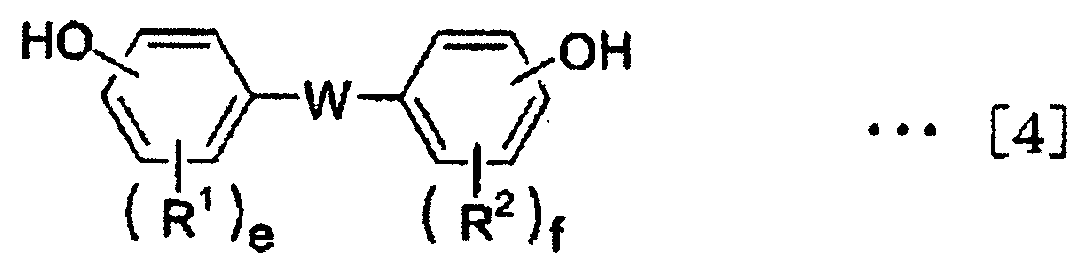
(식 중, R1, R2, e, f 및 W 는 상기와 동일하다.) ; 및(In the formula, R 1 , R 2 , e, f and W are the same as above.); And
(b) 이어서, 그 용액을 교반하면서, 하기 식 [5] 로 나타내는 하이드록시아릴 말단 폴리디오르가노실록산 (II) 를 첨가하여, 하이드록시아릴 말단 폴리디오르가노실록산 (II) 와 카보네이트 올리고머를 계면 중합시키는 것(b) Subsequently, while stirring the solution, hydroxyaryl-terminated polydiorganosiloxane (II) represented by the following formula [5] was added to interfacial polymerization of hydroxyaryl-terminated polydiorganosiloxane (II) and carbonate oligomer. Order
[화학식 7][Formula 7]

(식 중, R3, R4, R5, R6, R7, R8, R9, R10, p, q 및 X 는 상기와 동일하다.),(In the formula, R 3 , R 4 , R 5 , R 6 , R 7 , R 8 , R 9 , R 10 , p, q and X are the same as above.),
여기서, 식 [4] 및 식 [5] 로 나타내는 2 가 페놀 총량 1 몰당, 물에 불용성의 유기 용매를, 8 몰 이상 11 몰 미만으로 사용하는 것.Here, using 8 mol or more and less than 11 mol of the organic solvent insoluble in water per 1 mol of divalent phenol represented by Formula [4] and Formula [5].
《구성 15》《Configuration 15》
식 [4] 및 식 [5] 로 나타내는 2 가 페놀의 총량 1 몰당, 물에 불용성의 유기 용매를 8 몰 이상 9.5 몰 미만으로 하여 계면 중축합 반응을 개시한 후, 추가로 물에 불용성의 유기 용매를 식 [4] 및 식 [5] 로 나타내는 2 가 페놀의 총량 1 몰당 2 몰 이상 첨가하는, 구성 14 에 기재된 제조 방법.After initiating the interfacial polycondensation reaction with 8 mol or more and less than 9.5 mol of an insoluble organic solvent in water per 1 mol of the total amount of divalent phenols represented by the formulas [4] and [5], the organics are insoluble in water. The production method according to constitution 14, wherein a solvent is added in an amount of 2 mol or more per 1 mol of the total amount of divalent phenol represented by formulas [4] and [5].
본 발명의 PC-POS 공중합체 또는 그 수지 조성물은, 우수한 내충격성, 특히 극저온하에서의 내충격성 및 내약품성을 구비하고, 또한 높은 도장 내구성도 구비하기 때문에 그 발휘하는 산업상의 효과는 각별하다.The PC-POS copolymer of the present invention or the resin composition thereof has excellent impact resistance, particularly impact resistance and chemical resistance at cryogenic temperatures, and also has high paint durability, so the industrial effect exhibited is exceptional.
도 1 은, 실시예 4 에서 관찰한 폭 10 ㎜, 길이 80 ㎜, 두께가 4.0 ㎜ 인 성형편의 게이트로부터 15 ㎜, 측단부로부터 5 ㎜ 의 교점의 깊이 2 ㎜ 의 부분에 있어서의 투과형 전자 현미경 관찰 이미지이다 (20,000 배).
도 2 는, 비교예 7 에서 관찰한 폭 10 ㎜, 길이 80 ㎜, 두께가 4.0 ㎜ 인 성형편의 게이트로부터 15 ㎜, 측단부로부터 5 ㎜ 의 교점의 깊이 2 ㎜ 의 부분에 있어서의 투과형 전자 현미경 관찰 이미지이다 (20,000 배).
도 3 은, 3 점 굽힘 내약품성 평가 지그의 도면이다.1 is a transmission electron microscope observation in a portion of a depth of 2 mm at an intersection of 15 mm from a gate of a molded piece having a width of 10 mm, a length of 80 mm, and a thickness of 4.0 mm observed in Example 4, and 5 mm from the side end. It is an image (20,000 times).
FIG. 2 is a transmission electron microscope observation in a portion of a depth of 2 mm at an intersection of 15 mm from a gate of a molded piece having a width of 10 mm, a length of 80 mm, and a thickness of 4.0 mm observed in Comparative Example 7 and 5 mm from the side end. It is an image (20,000 times).
3 is a diagram of a three-point bending chemical resistance evaluation jig.
이하, 본 발명을 더욱 상세하게 설명한다.Hereinafter, the present invention will be described in more detail.
《폴리카보네이트 공중합체 또는 수지 조성물》<< polycarbonate copolymer or resin composition >>
본 발명의 PC-POS 공중합체는, (A-1) 폴리카보네이트 블록과, (A-2) 폴리디오르가노실록산 블록을 포함한다. 또, 본 발명의 수지 조성물은, 상기의 공중합체를 포함하는 수지 조성물이고, 바람직하게는 PC-POS 공중합체 100 ∼ 1 중량% 와 폴리카보네이트 수지 0 ∼ 99 중량% 로 이루어진다. 여기서, 본 발명의 공중합체 또는 그 수지 조성물은, (A-2) 폴리디오르가노실록산 블록의 함유량이, 2.5 ∼ 8.0 중량% 이고, 이하의 (i) 및 (ii) 를 만족시킨다 :The PC-POS copolymer of the present invention includes a polycarbonate block (A-1) and a polydiorganosiloxane block (A-2). Moreover, the resin composition of this invention is a resin composition containing the said copolymer, Preferably it consists of 100 to 1 weight% of PC-POS copolymer, and 0 to 99 weight% of polycarbonate resin. Here, the copolymer or the resin composition of the present invention has a content of (A-2) polydiorganosiloxane block of 2.5 to 8.0% by weight, and satisfies the following (i) and (ii):
(i) 전자선 현미경을 사용한 수지 조성물 단면 관찰 이미지에 있어서, 850 ㎚ 사방 (722,500 ㎚2) 의 영역에 최대 장경이 80 ㎚ 이상인 도메인이 1 ∼ 20 개 존재하는 것 ; 및(i) In a cross-sectional observation image of a resin composition using an electron beam microscope, 1 to 20 domains having a maximum long diameter of 80 nm or more exist in a region of 850 nm square (722,500 nm 2 ); And
(ii) 평균 도메인 사이즈가 30 ∼ 100 ㎚ 인 것.(ii) The average domain size is 30 to 100 nm.
본 발명자들은, 폴리디오르가노실록산과, 말단 클로로포르메이트기를 갖는 카보네이트 올리고머를, 종래에 실시되지 않은 매우 높은 농도에서 용매 중에서 반응시킴으로써, PC-POS 공중합체에, 특정한 평균 사이즈의 도메인을 형성하면서, 80 ㎚ 이상의 조대 (粗大) 도메인을 형성시킬 수 있는 것을 알아내고, 또 이와 같은 도메인의 분산 상태가, PC-POS 공중합체의 내충격성 (특히 극저온하에서의 내충격성) 등에 매우 유리해지는 것을 알아내었다.The present inventors, while reacting a polydiorganosiloxane and a carbonate oligomer having a terminal chloroformate group in a solvent at a very high concentration not previously performed, form a domain of a specific average size in the PC-POS copolymer, It has been found that a coarse domain of 80 nm or more can be formed, and it has been found that the dispersion state of such a domain is very advantageous for the impact resistance of PC-POS copolymers (especially impact resistance at cryogenic temperatures).
또한, 본 명세서에 있어서는, PC-POS 공중합체와, 폴리카보네이트 수지의 조합을, A 성분이라고 약칭하는 경우가 있다.In addition, in this specification, the combination of PC-POS copolymer and polycarbonate resin may be abbreviated as A component.
<폴리카보네이트-폴리디오르가노실록산 (PC-POS) 공중합체><Polycarbonate-polydioorganosiloxane (PC-POS) copolymer>
본 발명에 있어서, PC-POS 공중합체는, (A-1) 폴리카보네이트 블록과, (A-2) 폴리디오르가노실록산 블록을 포함하고, 바람직하게는 식 [1] 의 (A-1) 폴리카보네이트 블록 및 식 [3] 의 (A-2) 폴리디오르가노실록산 블록을 함유한다.In the present invention, the PC-POS copolymer includes (A-1) a polycarbonate block and (A-2) a polydiorganosiloxane block, preferably (A-1) poly of the formula [1]. It contains a carbonate block and the polydiorganosiloxane block of (A-2) of Formula [3].
<PC-POS 공중합체-(A-1) 폴리카보네이트 블록><PC-POS copolymer-(A-1) polycarbonate block>
본 발명에 있어서, (A-1) 폴리카보네이트 블록은, PC-POS 공중합체에 있어서 포함되는 폴리카보네이트계의 부분이고, 특별히 그 종류는 한정되지 않는다. 예를 들어, 그러한 폴리카보네이트계의 부분은, 방향족 폴리카보네이트계의 부분이어도 된다.In the present invention, the polycarbonate block (A-1) is a polycarbonate-based part included in the PC-POS copolymer, and its kind is not particularly limited. For example, such a polycarbonate-based portion may be an aromatic polycarbonate-based portion.
예를 들어, (A-1) 폴리카보네이트 블록은, 하기 식 [1] 로 나타낸다.For example, the polycarbonate block (A-1) is represented by the following formula [1].
[화학식 8][Formula 8]

[(상기 식 [1] 에 있어서, R1 및 R2 는 각각 독립적으로 수소 원자, 할로겐 원자, 탄소 원자수 1 ∼ 18 의 알킬기, 탄소 원자수 1 ∼ 18 의 알콕시기, 탄소 원자수 6 ∼ 20 의 시클로알킬기, 탄소 원자수 6 ∼ 20 의 시클로알콕시기, 탄소 원자수 2 ∼ 10 의 알케닐기, 탄소 원자수 6 ∼ 14 의 아릴기, 탄소 원자수 6 ∼ 14 의 아릴옥시기, 탄소 원자수 7 ∼ 20 의 아르알킬기, 탄소 원자수 7 ∼ 20 의 아르알킬옥시기, 니트로기, 알데히드기, 시아노기 및 카르복실기로 이루어지는 군에서 선택되는 기를 나타낸다. R1 및 R2 가 각각 복수 있는 경우에는, 그것들은 동일해도 되고 상이해도 된다.[(In the formula [1], R 1 and R 2 are each independently a hydrogen atom, a halogen atom, an alkyl group having 1 to 18 carbon atoms, an alkoxy group having 1 to 18 carbon atoms, or 6 to 20 carbon atoms. Cycloalkyl group of 6-20 carbon atoms, alkenyl group of 2-10 carbon atoms, aryl group of 6-14 carbon atoms, aryloxy group of 6-14 carbon atoms, 7 carbon atoms It represents a group selected from the group consisting of an aralkyl group having 20 to 20, an aralkyloxy group having 7 to 20 carbon atoms, a nitro group, an aldehyde group, a cyano group, and a carboxyl group.When there are a plurality of R 1 and R 2 , they are It may be the same or different.
할로겐 원자로서, 불소 원자, 염소 원자, 브롬 원자 등을 들 수 있다. 탄소 원자수 1 ∼ 18 의 알킬기로서, 메틸기, 에틸기, 프로필기, 부틸기, 펜틸기, 헥실기, 헵틸기, 옥틸기, 노닐기, 데실기, 도데실기, 테트라데실기 등을 들 수 있다. 바람직하게는 탄소 원자수 1 ∼ 6 의 알킬기이다. 탄소 원자수 1 ∼ 18 의 알콕시기로서, 메톡시기, 에톡시기, 프로폭시기, 부톡시기, 펜톡시기, 헥톡시기, 옥톡시기 등을 들 수 있다. 탄소 원자수 1 ∼ 6 의 알킬기가 바람직하다.Examples of the halogen atom include a fluorine atom, a chlorine atom, and a bromine atom. Examples of the alkyl group having 1 to 18 carbon atoms include methyl group, ethyl group, propyl group, butyl group, pentyl group, hexyl group, heptyl group, octyl group, nonyl group, decyl group, dodecyl group and tetradecyl group. Preferably it is a C1-C6 alkyl group. Examples of the alkoxy group having 1 to 18 carbon atoms include methoxy group, ethoxy group, propoxy group, butoxy group, pentoxy group, hexoxy group and octoxy group. An alkyl group having 1 to 6 carbon atoms is preferred.
탄소 원자수 6 ∼ 20 의 시클로알킬기로서, 시클로헥실기, 시클로옥틸기 등을 들 수 있다. 탄소 원자수 6 ∼ 12 의 시클로알킬기가 바람직하다. 탄소 원자수 6 ∼ 20 의 시클로알콕시기로서, 바람직하게는 시클로헥실옥시기, 시클로옥틸옥시기 등을 들 수 있다. 탄소 원자수 6 ∼ 12 의 시클로알킬기가 바람직하다.Examples of the cycloalkyl group having 6 to 20 carbon atoms include a cyclohexyl group and a cyclooctyl group. A cycloalkyl group having 6 to 12 carbon atoms is preferred. As a cycloalkoxy group having 6 to 20 carbon atoms, preferably, a cyclohexyloxy group, a cyclooctyloxy group, and the like are mentioned. A cycloalkyl group having 6 to 12 carbon atoms is preferred.
탄소 원자수 2 ∼ 10 의 알케닐기로서, 메테닐기, 에테닐기, 프로페닐기, 부테닐기, 펜테닐기 등을 들 수 있다. 탄소 원자수 1 ∼ 6 의 알킬기가 바람직하다.Examples of the alkenyl group having 2 to 10 carbon atoms include a methenyl group, an ethenyl group, a propenyl group, a butenyl group, and a pentenyl group. An alkyl group having 1 to 6 carbon atoms is preferred.
탄소 원자수 6 ∼ 14 의 아릴기로서, 페닐기, 나프틸기 등을 들 수 있다. 탄소 원자수 6 ∼ 14 의 아릴옥시기로서, 페닐옥시기, 나프틸옥시기 등을 들 수 있다. 탄소 원자수 7 ∼ 20 의 아르알킬기로서, 벤질기, 페닐에틸기 등을 들 수 있다. 탄소 원자수 7 ∼ 20 의 아르알킬옥시기로서, 벤질옥시기, 페닐에틸옥시기 등을 들 수 있다.As a C6-C14 aryl group, a phenyl group, a naphthyl group, etc. are mentioned. As a C6-C14 aryloxy group, a phenyloxy group, a naphthyloxy group, etc. are mentioned. Examples of the aralkyl group having 7 to 20 carbon atoms include a benzyl group and a phenylethyl group. Examples of the aralkyloxy group having 7 to 20 carbon atoms include a benzyloxy group and a phenylethyloxy group.
e 및 f 는 각각 독립적으로 1 ∼ 4 의 정수이다.e and f are each independently an integer of 1-4.
W 는, 단결합 혹은 하기 식 [2] 로 나타내는 기로 이루어지는 군에서 선택되는 적어도 하나의 기이다.)W is at least one group selected from the group consisting of a single bond or a group represented by the following formula [2].)
[화학식 9][Formula 9]

(상기 식 [2] 에 있어서 R11, R12, R13, R14, R15, R16, R17 및 R18 은 각각 독립적으로, 수소 원자, 탄소 원자수 1 ∼ 18 의 알킬기, 탄소 원자수 3 ∼ 14 의 아릴기 및 탄소 원자수 7 ∼ 20 의 아르알킬기로 이루어지는 군에서 선택되는 기를 나타낸다.)(In the formula [2], R 11 , R 12 , R 13 , R 14 , R 15 , R 16 , R 17 and R 18 are each independently a hydrogen atom, an alkyl group having 1 to 18 carbon atoms, a carbon atom It represents a group selected from the group consisting of an aryl group having 3 to 14 and an aralkyl group having 7 to 20 carbon atoms.)
탄소 원자수 1 ∼ 18 의 알킬기로서, 메틸기, 에틸기, 프로필기, 부틸기, 펜틸기, 헥실기, 헵틸기, 옥틸기, 노닐기, 데실기, 도데실기 등을 들 수 있다. 바람직하게는 탄소 원자수 1 ∼ 6 의 알킬기이다.Examples of the alkyl group having 1 to 18 carbon atoms include methyl group, ethyl group, propyl group, butyl group, pentyl group, hexyl group, heptyl group, octyl group, nonyl group, decyl group, and dodecyl group. Preferably it is a C1-C6 alkyl group.
탄소 원자수 6 ∼ 14 의 아릴기로서, 페닐기, 나프틸기 등을 들 수 있다. 이들은 치환되어 있어도 된다. 치환기로서, 메틸기, 에틸기, 프로필기, 부틸기 등의 탄소 원자수 1 ∼ 6 의 알킬기를 들 수 있다. 탄소 원자수 7 ∼ 20 의 아르알킬기로서, 벤질기, 페닐에틸기 등을 들 수 있다.As a C6-C14 aryl group, a phenyl group, a naphthyl group, etc. are mentioned. These may be substituted. Examples of the substituent include alkyl groups having 1 to 6 carbon atoms such as methyl group, ethyl group, propyl group and butyl group. Examples of the aralkyl group having 7 to 20 carbon atoms include a benzyl group and a phenylethyl group.
R19 및 R20 은 각각 독립적으로, 수소 원자, 할로겐 원자, 탄소 원자수 1 ∼ 18 의 알킬기, 탄소 원자수 1 ∼ 10 의 알콕시기, 탄소 원자수 6 ∼ 20 의 시클로알킬기, 탄소 원자수 6 ∼ 20 의 시클로알콕시기, 탄소 원자수 2 ∼ 10 의 알케닐기, 탄소 원자수 6 ∼ 14 의 아릴기, 탄소 원자수 6 ∼ 10 의 아릴옥시기, 탄소 원자수 7 ∼ 20 의 아르알킬기, 탄소 원자수 7 ∼ 20 의 아르알킬옥시기, 니트로기, 알데히드기, 시아노기 및 카르복실기로 이루어지는 군에서 선택되는 기를 나타낸다. 복수 있는 경우에는 그것들은 동일해도 되고 상이해도 된다.R 19 and R 20 are each independently a hydrogen atom, a halogen atom, an alkyl group having 1 to 18 carbon atoms, an alkoxy group having 1 to 10 carbon atoms, a cycloalkyl group having 6 to 20 carbon atoms, or 6 to 6 carbon atoms. Cycloalkoxy group of 20, alkenyl group having 2 to 10 carbon atoms, aryl group having 6 to 14 carbon atoms, aryloxy group having 6 to 10 carbon atoms, aralkyl group having 7 to 20 carbon atoms, number of carbon atoms A group selected from the group consisting of 7 to 20 aralkyloxy groups, nitro groups, aldehyde groups, cyano groups and carboxyl groups. When there are multiple, they may be the same or different.
할로겐 원자로서, 불소 원자, 염소 원자, 브롬 원자 등을 들 수 있다. 탄소 원자수 1 ∼ 18 의 알킬기로서, 메틸기, 에틸기, 프로필기, 부틸기, 펜틸기, 헥실기, 헵틸기, 옥틸기, 노닐기, 데실기, 도데실기, 테트라데실기 등을 들 수 있다. 바람직하게는 탄소 원자수 1 ∼ 6 의 알킬기이다. 탄소 원자수 1 ∼ 10 의 알콕시기로서, 메톡시기, 에톡시기, 프로폭시기, 부톡시기, 펜톡시기 등을 들 수 있다. 탄소 원자수 1 ∼ 6 의 알킬기가 바람직하다.Examples of the halogen atom include a fluorine atom, a chlorine atom, and a bromine atom. Examples of the alkyl group having 1 to 18 carbon atoms include methyl group, ethyl group, propyl group, butyl group, pentyl group, hexyl group, heptyl group, octyl group, nonyl group, decyl group, dodecyl group and tetradecyl group. Preferably it is a C1-C6 alkyl group. Examples of the alkoxy group having 1 to 10 carbon atoms include methoxy group, ethoxy group, propoxy group, butoxy group, and pentoxy group. An alkyl group having 1 to 6 carbon atoms is preferred.
탄소 원자수 6 ∼ 20 의 시클로알킬기로서, 시클로헥실기, 시클로옥틸기 등을 들 수 있다. 탄소 원자수 6 ∼ 12 의 시클로알킬기가 바람직하다. 탄소 원자수 6 ∼ 20 의 시클로알콕시기로서, 시클로헥실옥시기, 시클로옥틸기 등을 들 수 있다. 탄소 원자수 6 ∼ 12 의 시클로알킬기가 바람직하다.Examples of the cycloalkyl group having 6 to 20 carbon atoms include a cyclohexyl group and a cyclooctyl group. A cycloalkyl group having 6 to 12 carbon atoms is preferred. Examples of the cycloalkoxy group having 6 to 20 carbon atoms include cyclohexyloxy group and cyclooctyl group. A cycloalkyl group having 6 to 12 carbon atoms is preferred.
탄소 원자수 2 ∼ 10 의 알케닐기로서, 메테닐기, 에테닐기, 프로페닐기, 부테닐기, 펜테닐기 등을 들 수 있다. 탄소 원자수 1 ∼ 6 의 알킬기가 바람직하다.Examples of the alkenyl group having 2 to 10 carbon atoms include a methenyl group, an ethenyl group, a propenyl group, a butenyl group, and a pentenyl group. An alkyl group having 1 to 6 carbon atoms is preferred.
탄소 원자수 6 ∼ 14 의 아릴기로서, 페닐기, 나프틸기 등을 들 수 있다. 탄소 원자수 6 ∼ 14 의 아릴옥시기로서, 페닐옥시기, 나프틸옥시기 등을 들 수 있다. 탄소 원자수 7 ∼ 20 의 아르알킬기로서, 벤질기, 페닐에틸기 등을 들 수 있다. 탄소 원자수 7 ∼ 20 의 아르알킬옥시기로서, 벤질옥시기, 페닐에틸옥시기 등을 들 수 있다.As a C6-C14 aryl group, a phenyl group, a naphthyl group, etc. are mentioned. As a C6-C14 aryloxy group, a phenyloxy group, a naphthyloxy group, etc. are mentioned. Examples of the aralkyl group having 7 to 20 carbon atoms include a benzyl group and a phenylethyl group. Examples of the aralkyloxy group having 7 to 20 carbon atoms include a benzyloxy group and a phenylethyloxy group.
g 는 1 ∼ 10 의 정수, 바람직하게는 1 ∼ 6 의 정수이다. h 는 4 ∼ 7 의 정수, 바람직하게는 4 ∼ 5 의 정수이다.g is an integer of 1-10, Preferably it is an integer of 1-6. h is an integer of 4-7, Preferably it is an integer of 4-5.
식 [1] 로 나타내는 폴리카보네이트 블록은, 2,2-비스(4-하이드록시페닐)프로판으로부터 유도된 블록인 것이 바람직하다.It is preferable that the polycarbonate block represented by Formula [1] is a block derived from 2,2-bis(4-hydroxyphenyl)propane.
폴리카보네이트 블록의 길이는, 식 [1] 의 반복 단위의 평균수로, 바람직하게는 10 ∼ 100, 보다 바람직하게는 30 ∼ 100, 더욱 바람직하게는 50 ∼ 70 이다.The length of the polycarbonate block is an average number of repeating units of formula [1], preferably 10 to 100, more preferably 30 to 100, further preferably 50 to 70.
폴리카보네이트 블록의 함유량, 특히 식 [1] 로 나타내는 폴리카보네이트 블록의 함유량은, 공중합체의 전체 중량을 기준으로 하여, 바람직하게는 50 ∼ 99.9 중량%, 보다 바람직하게는 70 ∼ 99.5 중량%, 더욱 바람직하게는 80 ∼ 99.0 중량% 이다.The content of the polycarbonate block, particularly the content of the polycarbonate block represented by formula [1], is preferably 50 to 99.9 wt%, more preferably 70 to 99.5 wt%, further based on the total weight of the copolymer. Preferably it is 80-99.0 weight%.
<PC-POS 공중합체-(A-2) 폴리디오르가노실록산 블록><PC-POS copolymer-(A-2) polydiorganosiloxane block>
본 발명의 공중합체는, 폴리디오르가노실록산 블록을 포함하고, 그 공중합체 또는 수지 조성물 중에서의 폴리디오르가노실록산 블록의 함유량은, 2.5 ∼ 8.0 중량% 이다.The copolymer of the present invention contains a polydiorganosiloxane block, and the content of the polydiorganosiloxane block in the copolymer or resin composition is 2.5 to 8.0% by weight.
예를 들어, 폴리디오르가노실록산 블록은, 하기 식 [3] 으로 나타낸다.For example, the polydiorganosiloxane block is represented by the following formula [3].
[화학식 10][Formula 10]

(상기 식 [3] 에 있어서, R3, R4, R5, R6, R7 및 R8 은 각각 독립적으로, 수소 원자, 탄소수 1 ∼ 12 의 알킬기 또는 탄소수 6 ∼ 12 의 치환 혹은 무치환의 아릴기이다.)(In the formula [3], R 3 , R 4 , R 5 , R 6 , R 7 and R 8 are each independently a hydrogen atom, an alkyl group having 1 to 12 carbon atoms, or a substituted or unsubstituted carbon group having 6 to 12 carbon atoms. Is an aryl group.)
탄소수 1 ∼ 12 의 알킬기로서, 메틸기, 에틸기, 프로필기, 부틸기, 펜틸기, 헥실기, 헵틸기, 옥틸기, 노닐기, 데실기, 도데실기 등을 들 수 있다. 바람직하게는 탄소 원자수 1 ∼ 6 의 알킬기이다. 탄소수 6 ∼ 12 의 치환 혹은 무치환의 아릴기로서, 페닐기, 나프틸기 등을 들 수 있다. 치환기로서, 메틸기, 에틸기, 프로필기, 부틸기, 펜틸기, 헥실기 등의 탄소수 1 ∼ 12 의 알킬기를 들 수 있다. R3, R4, R5, R6, R7, R8 이 메틸기인 것이 바람직하다.Examples of the alkyl group having 1 to 12 carbon atoms include methyl group, ethyl group, propyl group, butyl group, pentyl group, hexyl group, heptyl group, octyl group, nonyl group, decyl group, and dodecyl group. Preferably it is a C1-C6 alkyl group. A phenyl group, a naphthyl group, etc. are mentioned as a C6-C12 substituted or unsubstituted aryl group. Examples of the substituent include alkyl groups having 1 to 12 carbon atoms such as methyl group, ethyl group, propyl group, butyl group, pentyl group and hexyl group. It is preferred that R 3 , R 4 , R 5 , R 6 , R 7 and R 8 are methyl groups.
R9 및 R10 은 각각 독립적으로, 수소 원자, 할로겐 원자, 탄소 원자수 1 ∼ 10 의 알킬기, 탄소 원자수 1 ∼ 10 의 알콕시기이다.R 9 and R 10 are each independently a hydrogen atom, a halogen atom, an alkyl group having 1 to 10 carbon atoms, or an alkoxy group having 1 to 10 carbon atoms.
할로겐 원자로서, 불소 원자, 염소 원자, 브롬 원자 등을 들 수 있다. 탄소 원자수 1 ∼ 10 의 알킬기로서, 메틸기, 에틸기, 프로필기, 부틸기, 펜틸기, 헥실기, 헵틸기, 옥틸기, 노닐기, 데실기, 도데실기 등을 들 수 있다. 바람직하게는 탄소 원자수 1 ∼ 6 의 알킬기이다. 탄소 원자수 1 ∼ 10 의 알콕시기로서, 메톡시기, 에톡시기, 프로폭시기, 부톡시기, 펜톡시기, 헥속시기, 헵톡시기, 옥톡시기 등을 들 수 있다. 바람직하게는 탄소 원자수 1 ∼ 6 의 알킬기이다.Examples of the halogen atom include a fluorine atom, a chlorine atom, and a bromine atom. Examples of the alkyl group having 1 to 10 carbon atoms include methyl group, ethyl group, propyl group, butyl group, pentyl group, hexyl group, heptyl group, octyl group, nonyl group, decyl group, and dodecyl group. Preferably it is a C1-C6 alkyl group. Examples of the alkoxy group having 1 to 10 carbon atoms include methoxy group, ethoxy group, propoxy group, butoxy group, pentoxy group, hexoxy group, heptoxy group, octoxy group and the like. Preferably it is a C1-C6 alkyl group.
p 는 자연수이고, q 는 0 또는 자연수이고, 평균 사슬 길이 p + q 는 30 ∼ 100 의 자연수이다. 평균 사슬 길이 p + q 는, 바람직하게는 35 ∼ 90, 보다 바람직하게는 50 ∼ 70 이다. p 는 바람직하게는 35 ∼ 90, 보다 바람직하게는 50 ∼ 70 이다.p is a natural number, q is 0 or a natural number, and the average chain length p + q is a natural number of 30-100. The average chain length p + q is preferably 35 to 90, more preferably 50 to 70. p is preferably 35 to 90, more preferably 50 to 70.
q 는 바람직하게는 0 ∼ 80, 보다 바람직하게는 0 ∼ 50 이다.q is preferably 0 to 80, more preferably 0 to 50.
평균 사슬 길이 p + q 가 30 ∼ 100 이면, 저온에 있어서의 내충격성과 내약품성이 충분히 얻어지고, 하한보다 작은 경우에는 충분한 극저온 내충격성이 발현되지 않고, 또, 상한보다 큰 경우에는, 외관 (색 불균일, 박리 불량) 이 악화된다.When the average chain length p + q is 30 to 100, sufficient impact resistance and chemical resistance at low temperatures are obtained, and if it is smaller than the lower limit, sufficient cryogenic impact resistance is not exhibited, and when it is larger than the upper limit, the appearance (color Non-uniformity, poor peeling) deteriorates.
X 는, 탄소수 2 ∼ 8 의 2 가 지방족기이다. 2 가 지방족기로서, 탄소수 2 ∼ 8 의 알킬렌기를 들 수 있다. 알킬렌기로서 에틸렌기, 트리메틸렌기, 테트라메틸렌기 등을 들 수 있다.X is a divalent aliphatic group having 2 to 8 carbon atoms. Examples of the divalent aliphatic group include an alkylene group having 2 to 8 carbon atoms. Examples of the alkylene group include an ethylene group, a trimethylene group, and a tetramethylene group.
상기 식 [3] 으로 나타내는 폴리디오르가노실록산 블록이 (2-알릴페놀) 말단 폴리디오르가노실록산, 혹은 (2-메톡시-4-알릴페놀) 말단 폴리디오르가노실록산으로부터 유도된 블록인 것이 바람직하다. 즉, 식 [3] 에 있어서 X 가 트리메틸렌기이고 R9 및 R10 이 수소 원자이거나, 혹은 X 가 트리메틸렌기이고 R9 및 R10 이 메톡시기인 것이 바람직하다.It is preferable that the polydiorganosiloxane block represented by the formula [3] is a block derived from a (2-allylphenol) terminal polydiorganosiloxane or a (2-methoxy-4-allylphenol) terminal polydiorganosiloxane. . That is, in Formula [3], it is preferable that X is a trimethylene group, R 9 and R 10 are hydrogen atoms, or X is a trimethylene group and R 9 and R 10 are methoxy groups.
상기 서술한 바와 같이, 본 발명의 공중합체 또는 수지 조성물 중에서의 폴리디오르가노실록산 블록의 함유량은, 2.5 ∼ 8.0 중량% 이지만, PC-POS 공중합체가 본 발명의 수지 조성물에 함유되는 경우에, 그 PC-POS 공중합체에는, 이 범위와는 상이한 함유량으로 폴리디오르가노실록산 블록을 가지고 있을 수 있다. 폴리디오르가노실록산 블록의 함유량, 특히 상기 [3] 으로 나타내는 폴리디오르가노실록산 블록의 함유량은, PC-POS 공중합체의 전체 중량을 기준으로 하여, 예를 들어, 3.0 ∼ 30.0 중량%, 3.5 ∼ 20.0 중량%, 또는 4.0 ∼ 15.0 중량% 이어도 된다. 또한 PC-POS 공중합체가 본 발명의 수지 조성물에 함유되는 경우에, PC-POS 공중합체를, 4.0 ∼ 70.0 중량%, 8.0 ∼ 60.0 중량%, 10.0 ∼ 30.0 중량%, 또는 12.0 ∼ 25.0 중량% 이어도 된다. 이와 같은 범위이면, 극대인 도메인 형성이 가능하고 저온 내충격을 발현할 수 있고, 또, 유화 상태를 형성할 수 있기 때문에 중합 반응을 실시할 수 있고, 또한 유리 전이 온도가 적절하기 때문에 조립 (造粒) 이 가능 등, 제조면에서의 이점을 갖는다.As described above, the content of the polydiorganosiloxane block in the copolymer or resin composition of the present invention is 2.5 to 8.0% by weight, but when the PC-POS copolymer is contained in the resin composition of the present invention, its The PC-POS copolymer may have a polydiorganosiloxane block at a content different from this range. The content of the polydiorganosiloxane block, particularly the content of the polydiorganosiloxane block represented by the above [3], is based on the total weight of the PC-POS copolymer, for example, 3.0 to 30.0% by weight, 3.5 to 20.0 It may be weight% or 4.0 to 15.0 weight%. Further, when the PC-POS copolymer is contained in the resin composition of the present invention, the PC-POS copolymer may be 4.0 to 70.0 wt%, 8.0 to 60.0 wt%, 10.0 to 30.0 wt%, or 12.0 to 25.0 wt% do. If it is such a range, it is possible to form a domain because it can form a large-scale domain, can express a low-temperature impact resistance, and also can form an emulsified state, and can carry out a polymerization reaction, and also has an appropriate glass transition temperature. ) This has the advantage in terms of manufacturing and the like.
공중합체의 점도 평균 분자량은, 바람직하게는 5.0 × 10³ ∼ 3.5 × 10⁴, 보다 바람직하게는 1.0 × 10⁴ ∼ 2.5 × 10⁴, 더욱 바람직하게는 1.2 × 10⁴ ∼ 2.0 × 10⁴, 특히 바람직하게는 1.5 × 10⁴ ∼ 1.8 × 10⁴ 이다. 공중합체의 점도 평균 분자량이, 하한 미만에서는, 많은 분야에 있어서 실용상의 기계적 강도가 잘 얻어지지 않고, 또 혼합하는 폴리카보네이트 수지 등과의 용융 점도차가 크기 때문에 혼련성이 악화되고, 상한을 초과하면, 용융 점도가 높고, 대체로 높은 성형 가공 온도를 필요로 하기 때문에, 수지의 열열화 등의 문제나 제조시의 수세 공정에 있어서의 분리 불량에 의한 생산성 저하를 초래하기 쉽다.The viscosity average molecular weight of the copolymer is preferably 5.0 × 10 3 to 3.5 × 10 4 , more preferably 1.0 × 10 4 to 2.5 × 10 4 , further preferably 1.2 × 10 4 to 2.0 × 10 4 , particularly It is preferably 1.5×10 4 to 1.8×10 4 . When the viscosity average molecular weight of the copolymer is less than the lower limit, in many fields, practical mechanical strength is not easily obtained, and since the difference in melt viscosity with the polycarbonate resin to be mixed is large, the kneading property deteriorates, and if it exceeds the upper limit, Since the melt viscosity is high and requires a generally high molding process temperature, it is easy to cause problems such as thermal deterioration of the resin and productivity deterioration due to poor separation in the water washing process during production.
<폴리카보네이트 수지><Polycarbonate resin>
본 발명의 수지 조성물에 있어서 수의로 함유되는 폴리카보네이트 수지는, 본 발명의 유리한 효과를 부여할 수 있으면 그 종류는 특별히 한정되지 않는다. 폴리카보네이트 수지는, 예를 들어 상기 서술한 바와 같은 (A-2) 폴리디오르가노실록산 블록을 포함하지 않고, (A-1) 폴리카보네이트 블록으로 이루어지는 폴리카보네이트이어도 되고, 또, 폴리카보네이트 수지는, 하기 일반식 [4] 로 나타내는 2 가 페놀 (I) 로부터 유도되어도 된다. 예를 들어, 그 2 가 페놀로서 예를 들어, 4,4'-디하이드록시비페닐, 비스(4-하이드록시페닐)메탄, 1,1-비스(4-하이드록시페닐)에탄, 1,1-비스(4-하이드록시페닐)-1-페닐에탄, 2,2-비스(4-하이드록시페닐)프로판, 2,2-비스(4-하이드록시-3-메틸페닐)프로판, 1,1-비스(4-하이드록시페닐)-3,3,5-트리메틸시클로헥산, 2,2-비스(4-하이드록시-3,3'-비페닐)프로판, 2,2-비스(4-하이드록시-3-이소프로필페닐)프로판, 2,2-비스(3-t-부틸-4-하이드록시페닐)프로판, 2,2-비스(4-하이드록시페닐)부탄, 2,2-비스(4-하이드록시페닐)옥탄, 2,2-비스(3-브로모-4-하이드록시페닐)프로판, 2,2-비스(3,5-디메틸-4-하이드록시페닐)프로판, 2,2-비스(3-시클로헥실-4-하이드록시페닐)프로판, 1,1-비스(3-시클로헥실-4-하이드록시페닐)시클로헥산, 비스(4-하이드록시페닐)디페닐메탄, 9,9-비스(4-하이드록시페닐)플루오렌, 9,9-비스(4-하이드록시-3-메틸페닐)플루오렌, 1,1-비스(4-하이드록시페닐)시클로헥산, 1,1-비스(4-하이드록시페닐)시클로펜탄, 4,4'-디하이드록시디페닐에테르, 4,4'-디하이드록시-3,3'-디메틸디페닐에테르, 4,4'-술포닐디페놀, 4,4'-디하이드록시디페닐술폭사이드, 4,4'-디하이드록시디페닐술파이드, 2,2'-디메틸-4,4'-술포닐디페놀, 4,4'-디하이드록시-3,3'-디메틸디페닐술폭사이드, 4,4'-디하이드록시-3,3'-디메틸디페닐술파이드, 2,2'-디페닐-4,4'-술포닐디페놀, 4,4'-디하이드록시-3,3'-디페닐디페닐술폭사이드, 4,4'-디하이드록시-3,3'-디페닐디페닐술파이드, 1,3-비스{2-(4-하이드록시페닐)프로필}벤젠, 1,4-비스{2-(4-하이드록시페닐)프로필}벤젠, 1,4-비스(4-하이드록시페닐)시클로헥산, 1,3-비스(4-하이드록시페닐)시클로헥산, 4,8-비스(4-하이드록시페닐)트리시클로[5.2.1.02,6]데칸, 4,4'-(1,3-아다만탄디일)디페놀, 1,3-비스(4-하이드록시페닐)-5,7-디메틸아다만탄 등을 들 수 있다.In the resin composition of the present invention, the type of the polycarbonate resin contained in the veterinary is not particularly limited as long as the advantageous effect of the present invention can be provided. The polycarbonate resin does not include, for example, the (A-2) polydiorganosiloxane block as described above, and may be a polycarbonate composed of the (A-1) polycarbonate block, and the polycarbonate resin may be The divalent represented by the following general formula [4] may be derived from phenol (I). For example, as the divalent phenol, for example, 4,4'-dihydroxybiphenyl, bis(4-hydroxyphenyl)methane, 1,1-bis(4-hydroxyphenyl)ethane, 1, 1-bis(4-hydroxyphenyl)-1-phenylethane, 2,2-bis(4-hydroxyphenyl)propane, 2,2-bis(4-hydroxy-3-methylphenyl)propane, 1,1 -Bis(4-hydroxyphenyl)-3,3,5-trimethylcyclohexane, 2,2-bis(4-hydroxy-3,3'-biphenyl)propane, 2,2-bis(4-hydroxy Hydroxy-3-isopropylphenyl)propane, 2,2-bis(3-t-butyl-4-hydroxyphenyl)propane, 2,2-bis(4-hydroxyphenyl)butane, 2,2-bis( 4-hydroxyphenyl)octane, 2,2-bis(3-bromo-4-hydroxyphenyl)propane, 2,2-bis(3,5-dimethyl-4-hydroxyphenyl)propane, 2,2 -Bis(3-cyclohexyl-4-hydroxyphenyl)propane, 1,1-bis(3-cyclohexyl-4-hydroxyphenyl)cyclohexane, bis(4-hydroxyphenyl)diphenylmethane, 9, 9-bis(4-hydroxyphenyl)fluorene, 9,9-bis(4-hydroxy-3-methylphenyl)fluorene, 1,1-bis(4-hydroxyphenyl)cyclohexane, 1,1- Bis(4-hydroxyphenyl)cyclopentane, 4,4'-dihydroxydiphenyl ether, 4,4'-dihydroxy-3,3'-dimethyldiphenyl ether, 4,4'-sulfonyl diphenol , 4,4'-dihydroxydiphenylsulfoxide, 4,4'-dihydroxydiphenylsulfide, 2,2'-dimethyl-4,4'-sulfonyldiphenol, 4,4'-dihydrate Hydroxy-3,3'-dimethyldiphenylsulfoxide, 4,4'-dihydroxy-3,3'-dimethyldiphenylsulfide, 2,2'-diphenyl-4,4'-sulfonyldiphenol, 4,4'-dihydroxy-3,3'-diphenyldiphenylsulfoxide, 4,4'-dihydroxy-3,3'-diphenyldiphenylsulfide, 1,3-bis{2- (4-hydroxyphenyl)propyl}benzene, 1,4-bis{2-(4-hydroxyphenyl)propyl}benzene, 1,4-bis(4-hydroxyphenyl)cyclohexane, 1,3-bis (4-hydroxyphenyl)cyclohexane, 4,8-bis(4-hydroxyphenyl)tricyclo[5.2.1.02,6]decane, 4,4'-(1,3-adamantanediyl)diphenol , 1,3-bis(4-hydroxyfe And Neil)-5,7-dimethyl adamantane.
그 중에서도, 1,1-비스(4-하이드록시페닐)-1-페닐에탄, 2,2-비스(4-하이드록시페닐)프로판, 2,2-비스(4-하이드록시-3-메틸페닐)프로판, 1,1-비스(4-하이드록시페닐)시클로헥산, 1,1-비스(4-하이드록시페닐)-3,3,5-트리메틸시클로헥산, 4,4'-술포닐디페놀, 2,2'-디메틸-4,4'-술포닐디페놀, 9,9-비스(4-하이드록시-3-메틸페닐)플루오렌, 1,3-비스{2-(4-하이드록시페닐)프로필}벤젠, 1,4-비스{2-(4-하이드록시페닐)프로필}벤젠이 바람직하고, 특히 2,2-비스(4-하이드록시페닐)프로판, 1,1-비스(4-하이드록시페닐)시클로헥산 (BPZ), 4,4'-술포닐디페놀, 9,9-비스(4-하이드록시-3-메틸페닐)플루오렌이 바람직하다. 그 중에서도 강도가 우수하고, 양호한 내구성을 갖는 2,2-비스(4-하이드록시페닐)프로판이 가장 바람직하다. 또, 이들은 단독 또는 2 종 이상 조합하여 사용해도 된다.Among them, 1,1-bis(4-hydroxyphenyl)-1-phenylethane, 2,2-bis(4-hydroxyphenyl)propane, 2,2-bis(4-hydroxy-3-methylphenyl) Propane, 1,1-bis(4-hydroxyphenyl)cyclohexane, 1,1-bis(4-hydroxyphenyl)-3,3,5-trimethylcyclohexane, 4,4'-sulfonyldiphenol, 2 ,2'-dimethyl-4,4'-sulfonyldiphenol, 9,9-bis(4-hydroxy-3-methylphenyl)fluorene, 1,3-bis{2-(4-hydroxyphenyl)propyl} Benzene, 1,4-bis{2-(4-hydroxyphenyl)propyl}benzene is preferred, and especially 2,2-bis(4-hydroxyphenyl)propane, 1,1-bis(4-hydroxyphenyl) )Cyclohexane (BPZ), 4,4'-sulfonyldiphenol, 9,9-bis(4-hydroxy-3-methylphenyl)fluorene is preferred. Among them, 2,2-bis(4-hydroxyphenyl)propane having excellent strength and good durability is most preferred. Moreover, you may use these individually or in combination of 2 or more types.
<공중합체 및 수지 조성물의 조성><Composition of copolymer and resin composition>
본 발명의 공중합체 및 수지 조성물은, PC-POS 공중합체 100 ∼ 1 중량% 와 폴리카보네이트 0 ∼ 99 중량% 로 이루어진다.The copolymer and resin composition of the present invention comprises 100 to 1% by weight of PC-POS copolymer and 0 to 99% by weight of polycarbonate.
본 발명에 있어서의 폴리디오르가노실록산 블록의 함유량은, 수지 조성물 (특히, 수지 조성물의 수지 중량만) 을 기준으로 하여, 2.5 ∼ 8.0 wt% 이고, 3.0 ∼ 7.0 wt% 가 바람직하고, 3.5 ∼ 6.5 wt% 가 보다 바람직하다. 하한보다 적은 경우에는, 충분한 극저온 내충격성이 발현되지 않고, 또, 상한보다 많은 경우에는, 외관 (색 불균일, 박리 불량) 의 악화, 강성 저하, 유리 전이 온도 저하, 열 굽힘 내성 저하 등 물성면에서 떨어진다.The content of the polydiorganosiloxane block in the present invention is 2.5 to 8.0 wt%, preferably 3.0 to 7.0 wt%, and 3.5 to 6.5, based on the resin composition (in particular, only the resin weight of the resin composition). wt% is more preferable. When it is less than the lower limit, sufficient cryogenic impact resistance is not exhibited, and when it is more than the upper limit, physical properties such as deterioration of appearance (color non-uniformity, poor peeling), deterioration of stiffness, lowering of glass transition temperature, lowering of thermal bending resistance, etc. Falls.
상기의 수지 조성물의 점도 평균 분자량은, 11,000 ∼ 30,000 이 바람직하고, 12,000 ∼ 25,000 이 보다 바람직하다. 11,000 보다 작은 경우에는, 충분한 저온 내충격성이 발현되지 않고, 또, 상한값보다 큰 경우에는, 용액 점도 증가에 의한 생산성 저하나 성형 유동성 부족 등이 생긴다.The viscosity average molecular weight of the above resin composition is preferably 11,000 to 30,000, and more preferably 12,000 to 25,000. When it is smaller than 11,000, sufficient low-temperature impact resistance is not exhibited, and when it is larger than the upper limit, productivity decrease due to increase in solution viscosity or insufficient molding fluidity occurs.
<폴리디오르가노실록산의 도메인 사이즈><Domain size of polydiorganosiloxane>
본 발명에 있어서의 PC-POS 공중합체는, 폴리카보네이트 폴리머의 매트릭스 중에 폴리디오르가노실록산 도메인이 분산된 응집 구조를 갖는다.The PC-POS copolymer in the present invention has an agglomerated structure in which polydiorganosiloxane domains are dispersed in a matrix of polycarbonate polymer.
또한, 본 발명에 있어서의 폴리디오르가노실록산 도메인이란, 폴리카보네이트의 매트릭스 중에 분산된 폴리디오르가노실록산을 주성분으로 하는 도메인을 말하고, 다른 성분을 포함해도 된다. 상기 서술한 바와 같이, 폴리디오르가노실록산 도메인은, 매트릭스인 폴리카보네이트와의 상분리에 의해 구조가 형성되므로, 반드시 단일 성분으로 구성되는 것은 아니다.In addition, the polydiorganosiloxane domain in this invention means the domain which has as a main component the polydiorganosiloxane dispersed in the matrix of polycarbonate, and may contain other components. As described above, the polydiorganosiloxane domain is not necessarily composed of a single component because the structure is formed by phase separation from the polycarbonate matrix.
본 발명에 있어서, 전자선 현미경 (이하 TEM 이라고 칭하는 경우가 있다) 을 사용한 공중합체 또는 그 수지 조성물의 단면 관찰 이미지에 있어서, 850 ㎚ 사방 (722,500 ㎚2) 의 영역에 최대 장경이 80 ㎚ 이상 폴리디오르가노실록산 도메인이 1 ∼ 20 개 존재하고, 바람직하게는 2 ∼ 20, 더욱 바람직하게는 4 ∼ 20, 가장 바람직하게는 5 ∼ 20 개 존재하는 것이다. 최대 장경이 80 ㎚ 이상 폴리디오르가노실록산 도메인이 1 개도 없는 경우에는 충분한 극저온 내충격성이 발현되지 않고, 20 개 이상 있는 경우에는, 외관이 악화되고 (색 불균일, 박리 불량), 또 극저온 충격성도 저하된다. 또한 본 발명에 있어서, 최대 장경이 400 ㎚ 이상 폴리디오르가노실록산 도메인이, 5 장의 시료 절편 중 어느 것에도, 850 ㎚ 사방 (722,500 ㎚2) 의 영역에 1 개도 존재하지 않는 것이 바람직하다. 도메인의 평균 사이즈가 30 ∼ 100 ㎚ 의 범위인 경우에는, 최대 장경이 400 ㎚ 이상 폴리디오르가노실록산 도메인은 존재하지 않지만, 이것이 1 개 이상 존재하는 경우에는, 외관 (색 불균일, 박리 불량) 과 내약품성의 양방이 저하되는 경향이 있다. 또, 이들 범위 외인 경우에는, 난연성에 대해서도 악화되는 경우가 있다.In the present invention, in a cross-sectional observation image of a copolymer or its resin composition using an electron beam microscope (sometimes referred to as TEM hereinafter), a maximum length of 80 nm or more polydiode in a region of 850 nm square (722,500 nm 2 ) There are 1 to 20 ganosiloxane domains, preferably 2 to 20, more preferably 4 to 20, and most preferably 5 to 20. When the maximum long diameter is 80 nm or more and no polydiorganosiloxane domain is present, sufficient cryogenic impact resistance is not exhibited, and when 20 or more are present, the appearance is deteriorated (color non-uniformity, poor peeling), and cryogenic impact resistance is also deteriorated. do. Further, in the present invention, it is preferable that no polydiorganosiloxane domain having a maximum long diameter of 400 nm or more is present in any one of the five sample sections in the region of 850 nm square (722,500 nm 2 ). When the average size of the domains is in the range of 30 to 100 nm, there is no polydiorganosiloxane domain having a maximum long diameter of 400 nm or more, but when more than one is present, appearance (color non-uniformity, poor peeling) and inner There is a tendency that both of the chemical properties are lowered. Moreover, when it is outside these ranges, flame retardance may worsen.
또, 본 발명에 있어서의 폴리디오르가노실록산 도메인의 평균 사이즈는, 30 ∼ 100 ㎚ 또는 45 ㎚ 초과 100 ㎚ 이하이고, 바람직하게는 40 ∼ 80 ㎚, 보다 바람직하게는 50 ∼ 70 ㎚ 이다.Moreover, the average size of the polydiorganosiloxane domain in this invention is 30-100 nm or more than 45 nm, 100 nm or less, Preferably it is 40-80 nm, More preferably, it is 50-70 nm.
이러한 평균 사이즈의 하한은, 바람직하게는 30 ㎚ 이고, 보다 바람직하게는 40 ㎚ 이고, 특히 바람직하게는 50 ㎚ 이다. 이러한 평균 사이즈의 상한은, 바람직하게는 100 ㎚, 보다 바람직하게는 80 ㎚, 특히 바람직하게는 70 ㎚ 이다. 이러한 범위의 하한 미만에서는, 내충격성이나 내약품성이 충분히 발휘되지 않고, 이러한 범위의 상한을 초과하면 외관이 악화되고 (색 불균일, 박리 불량), 내약품성도 저하된다.The lower limit of this average size is preferably 30 nm, more preferably 40 nm, and particularly preferably 50 nm. The upper limit of this average size is preferably 100 nm, more preferably 80 nm, particularly preferably 70 nm. Below the lower limit of this range, impact resistance and chemical resistance are not sufficiently exhibited, and when the upper limit of this range is exceeded, the appearance deteriorates (color non-uniformity, poor peeling), and the chemical resistance also decreases.
본 발명에 있어서의 공중합체 성형품의 폴리디오르가노실록산 도메인의 최대 장경은, 전자선 현미경을 사용한 850 ㎚ 사방 (722,500 ㎚2) 의 수지 조성물 단면 관찰 이미지에 있어서 평가된다.The maximum long diameter of the polydiorganosiloxane domain of the copolymer molded article in the present invention is evaluated in a cross-sectional observation image of a resin composition at 850 nm square (722,500 nm 2 ) using an electron beam microscope.
본 발명에 있어서의 공중합체 성형품의 폴리디오르가노실록산 도메인의 평균 도메인 사이즈란, 개개의 도메인 사이즈의 수평균을 의미한다.The average domain size of the polydiorganosiloxane domain of the copolymer molded article in the present invention means the number average of individual domain sizes.
본 발명에 있어서, 사용하는 용어 「도메인의 최대 장경」, 「평균 도메인 사이즈」 는 사출 성형에 의해 형성되는 두께 4.0 ㎜ 의 성형편으로부터 박편 절편을 잘라내고, TEM 에 의해 관찰한 측정값을 나타낸다.In the present invention, the terms "maximum longest diameter of the domain" and "average domain size" used refer to measurement values observed by TEM by cutting flake sections from molded pieces having a thickness of 4.0 mm formed by injection molding.
구체적으로는, 사출 성형에 의해 제조한 폭 10 ㎜, 길이 80 ㎜, 두께 4.0 ㎜ 의 성형편을 사용하여 성형편의 게이트로부터 15 ㎜ 의 지점을 미크로톰을 사용하여 실온에서 박편 절편을 잘라내고, TEM 에 의해 배율 20,000 배로 관찰을 실시하고, 얻어진 TEM 사진을 화상 해석 소프트 Win ROOF Ver.6.6 (미타니 상사 (주)) 을 사용하여 입자 해석을 실시하고, 시료 박편 중의 폴리디오르가노실록산 도메인의 평균 사이즈 및 입경 분포 (빈도 분포) 를 얻었다. 여기서 각 도메인의 사이즈로서 최대 장경 (입자의 외측 윤곽선 상의 임의의 2 점을, 그 사이의 길이가 최대가 되도록 선택했을 때의 길이) 을 이용하였다. 5 장의 시료 절편으로 동일한 해석을 실시하고, 그 평균값을 각 시료의 값으로 한 것이다.Specifically, using a molded piece having a width of 10 mm, a length of 80 mm, and a thickness of 4.0 mm prepared by injection molding, a 15 mm point was cut from the gate of the molded piece at room temperature using a microtome, and the flake section was cut into a TEM The observation was performed at a magnification of 20,000 times, and the obtained TEM photograph was subjected to particle analysis using the image analysis software Win ROOF Ver.6.6 (Mitani Corporation), and the average size and particle size of the polydiorganosiloxane domain in the sample flakes. Distribution (frequency distribution) was obtained. Here, as the size of each domain, the maximum long diameter (the length when any two points on the outer contour of the particle is selected so that the length between them is maximum) was used. The same analysis was performed with five sample sections, and the average value was taken as the value of each sample.
(폴리디오르가노실록산)(Polydiorganosiloxane)
본 발명에 있어서는, 특정한 평균 사슬 길이의 폴리디오르가노실록산을 원료로서 사용한다. 즉, 하기 일반식 [5] 로 나타내는 하이드록시아릴 말단 폴리디오르가노실록산 (II) 로 나타내고, 또한, 평균 사슬 길이 p + q 는, 30 ∼ 100 이고, 35 ∼ 90 이 바람직하고, 50 ∼ 70 이 보다 바람직하다.In the present invention, a polydiorganosiloxane having a specific average chain length is used as a raw material. That is, it is represented by the hydroxyaryl terminal polydiorganosiloxane (II) represented by the following general formula [5], and the average chain length p + q is 30 to 100, preferably 35 to 90, and 50 to 70 It is more preferable.
[화학식 11][Formula 11]

(식 중, R3, R4, R5, R6, R7, R8, R9, R10, p, q 및 X 는 상기 1 과 동일하다.)(In the formula, R 3 , R 4 , R 5 , R 6 , R 7 , R 8 , R 9 , R 10 , p, q and X are the same as 1 above.)
평균 사슬 길이 p + q 가 30 보다 작은 경우에는, 충분한 극저온 내충격성이 발현되지 않고, 또, 상한값보다 큰 경우에는, 외관이 악화된다 (색 불균일, 박리 불량). 또, 이러한 특정한 사슬 길이 범위를 만족시키기 위해서 상이한 2 종류 또는 그 이상의, 평균 사슬 길이 p + q 를 갖는 하이드록시아릴 말단 폴리디오르가노실록산 (II) 원료를 혼합하여 조제해도 된다. 그 경우, 평균 사슬 길이 p + q 가 1 이상 60 미만인 폴리디오르가노실록산 (X-1), 또한 평균 사슬 길이 p + q 가 60 이상 200 이하인 폴리디오르가노실록산 (X-2) 를 원료로서 사용한다. 폴리디오르가노실록산 원료의 혼합 조제의 방법으로는, 말단을 하이드록시아릴 변성시킨 적당한 폴리디오르가노실록산 원료끼리를 혼합하는 방법이어도 되고, 말단을 하이드록시아릴 변성시키기 전의 적당한 평균 사슬 길이를 갖는 폴리디오르가노실록산 전구체끼리를 미리 혼합한 후에, 말단을 하이드록시아릴 변성시키는 방법 중 어느 것이어도 된다. 그 폴리디오르가노실록산 원료와, 2 가 페놀 및 폴리카보네이트 전구체를 반응시켜 얻어지는 PC-POS 공중합체에 있어서의 폴리디오르가노실록산 블록의 평균 사슬 길이 p + q 는, 상기한 바와 같이 바람직하게는 30 ∼ 100, 보다 바람직하게는 35 ∼ 90, 더욱 바람직하게는 50 ∼ 70 이 된다. 그 평균 사슬 길이 p + q 는 핵자기 공명 (NMR) 측정에 의해 산출된다.When the average chain length p + q is less than 30, sufficient cryogenic impact resistance is not exhibited, and when it is larger than the upper limit, the appearance is deteriorated (color non-uniformity, poor peeling). Moreover, in order to satisfy this specific chain length range, you may prepare by mixing two or more different types of hydroxyaryl terminal polydiorganosiloxane (II) raw materials having an average chain length p + q. In that case, polydiorganosiloxane (X-1) having an average chain length p+q of 1 or more and less than 60 is used as a raw material, and polydiorganosiloxane (X-2) having an average chain length p+q of 60 or more and 200 or less. . As a method of mixing and preparing a polydiorganosiloxane raw material, a method of mixing suitable polydiorganosiloxane raw materials whose terminals are hydroxyaryl-modified may be mixed, or polydioirs having a suitable average chain length before the terminal is hydroxyaryl-modified. After mixing the ganosiloxane precursors in advance, any of methods for modifying the terminal to hydroxyaryl may be used. The average chain length p + q of the polydiorganosiloxane block in the PC-POS copolymer obtained by reacting the polydiorganosiloxane raw material with a divalent phenol and polycarbonate precursor is preferably 30 to 30 as described above. It becomes 100, More preferably, it is 35-90, More preferably, it is 50-70. The average chain length p + q is calculated by nuclear magnetic resonance (NMR) measurement.
상기 폴리디오르가노실록산 (X-1) 과 폴리디오르가노실록산 (X-2) 를 혼합하는 경우에는, (X-1) : (X-2) 질량비 = 1 : 99 ∼ 99 : 1 의 비율로 사용하는 것이 바람직하고, 보다 바람직하게는 10 : 90 ∼ 90 : 10 의 비율로 사용한다.When mixing the polydiorganosiloxane (X-1) and the polydiorganosiloxane (X-2), the ratio of (X-1): (X-2) mass ratio = 1:99 to 99:1 is used. It is preferable to use, and more preferably, it is used at a ratio of 10:90 to 90:10.
폴리디오르가노실록산 원료로서, 상기 폴리디오르가노실록산 (X-1) 과 (X-2) 를 미리 배합하여 얻어지는 폴리디오르가노실록산 (X) 를 사용하는 것이 보다 바람직하고, 이 배합비는, 상기 서술한 (X-1) : (X-2) 질량비와 동일하게, 바람직하게는 질량비 1 : 99 ∼ 99 : 1 이고, 보다 바람직하게는 10 : 90 ∼ 90 : 10 이다.It is more preferable to use a polydiorganosiloxane (X) obtained by preliminarily blending the polydiorganosiloxane (X-1) and (X-2) as the polydiorganosiloxane raw material, and the blending ratio is as described above. (X-1): (X-2) In the same manner as the mass ratio, the mass ratio is preferably 1:99 to 99:1, and more preferably 10:90 to 90:10.
미리 배합하는 경우에는, 상기 폴리디오르가노실록산 (X-1) 의 평균 사슬 길이 p + q 의 하한은, 바람직하게는 1 이상이고, 보다 바람직하게는 20 이상이고, 더욱 바람직하게는 30 이상이고, 상한은, 바람직하게는 60 미만이고, 보다 바람직하게는 50 미만이고, 더욱 바람직하게는 45 미만이다. 상기 폴리디오르가노실록산 (X-2) 의 평균 사슬 길이 p + q 의 하한은, 바람직하게는 60 이상이고, 보다 바람직하게는 70 이상이고, 더욱 바람직하게는 90 이상이고, 상한은, 바람직하게는 200 이하이고, 보다 바람직하게는 100 이하이다. 일반식 [5] 로 나타내는 하이드록시아릴 말단 폴리디오르가노실록산 (II) 로는, 예를 들어 다음에 나타내는 바와 같은 화합물이 바람직하게 사용된다.When blending in advance, the lower limit of the average chain length p + q of the polydiorganosiloxane (X-1) is preferably 1 or more, more preferably 20 or more, still more preferably 30 or more, The upper limit is preferably less than 60, more preferably less than 50, and even more preferably less than 45. The lower limit of the average chain length p + q of the polydiorganosiloxane (X-2) is preferably 60 or more, more preferably 70 or more, still more preferably 90 or more, and the upper limit, preferably 200 or less, more preferably 100 or less. As the hydroxyaryl-terminated polydiorganosiloxane (II) represented by the general formula [5], for example, a compound as shown below is preferably used.
[화학식 12][Formula 12]

하이드록시아릴 말단 폴리디오르가노실록산 (II) 는, 올레핀성의 불포화 탄소-탄소 결합을 갖는 페놀류이고, 바람직하게는 비닐페놀, 2-알릴페놀, 이소프로페닐페놀, 2-메톡시-4-알릴페놀을 소정의 중합도를 갖는 폴리실록산 사슬의 말단에, 하이드로실릴레이션 반응시킴으로써 용이하게 제조된다. 그 중에서도, (2-알릴페놀) 말단 폴리디오르가노실록산, (2-메톡시-4-알릴페놀) 말단 폴리디오르가노실록산이 바람직하고, 특히 (2-알릴페놀) 말단 폴리디메틸실록산, (2-메톡시-4-알릴페놀) 말단 폴리디메틸실록산이 바람직하다.The hydroxyaryl terminal polydiorganosiloxane (II) is a phenol having an olefinic unsaturated carbon-carbon bond, preferably vinylphenol, 2-allylphenol, isopropenylphenol, 2-methoxy-4-allylphenol Is easily produced by subjecting a polysiloxane chain having a predetermined degree of polymerization to a hydrosilylation reaction. Among them, (2-allylphenol) terminal polydiorganosiloxane, (2-methoxy-4-allylphenol) terminal polydiorganosiloxane is preferred, and (2-allylphenol) terminal polydimethylsiloxane, (2- Methoxy-4-allylphenol) terminal polydimethylsiloxane is preferred.
《PC-POS 공중합체의 제조 방법》<< Method of manufacturing PC-POS copolymer >>
본 발명에 있어서의 PC-POS 공중합체는, 공정 (a) 및 공정 (b) 에 의해 제조할 수 있다.The PC-POS copolymer in the present invention can be produced by steps (a) and (b).
또한, 본 명세서에 있어서, 「2 가 페놀 (I)」 등은, 폴리카보네이트 블록을 가져올 수 있는 전구체이고, 「2 가 페놀 (II)」 등은, 폴리디오르가노실록산 블록을 가져올 수 있는 전구체이다.In addition, in this specification, "divalent phenol (I)" etc. are precursors which can bring a polycarbonate block, "Divalent phenol (II)" etc. are precursors which can bring a polydiorganosiloxane block. .
<공정 (a)><Process (a)>
공정 (a) 는, 물에 불용성의 유기 용매와 알칼리 수용액의 혼합액 중에 있어서, 하기 식 [4] 로 나타내는 2 가 페놀 (I) 과 포스겐을 반응시켜, 말단 클로로포르메이트기를 갖는 카보네이트 올리고머를 함유하는 용액을 조제하는 공정이다.In the step (a), in a mixed solution of an insoluble organic solvent and an aqueous alkali solution in water, divalent phenol (I) represented by the following formula [4] is reacted with phosgene to contain a carbonate oligomer having a terminal chloroformate group. This is a process for preparing a solution.
[화학식 13][Formula 13]
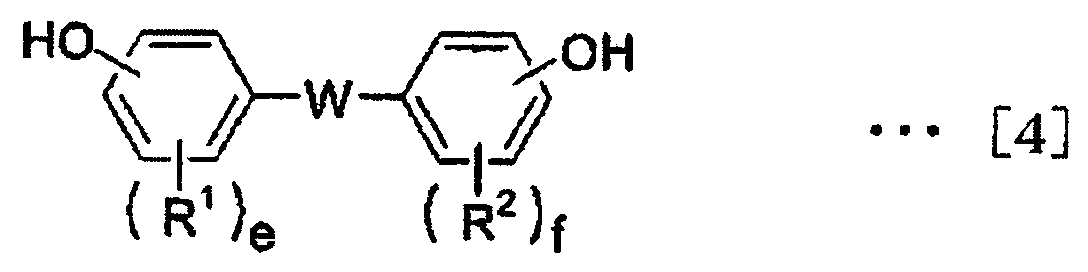
(식 중, R1, R2, e, f 및 W 는 상기와 동일하다.)(Wherein, R 1 , R 2 , e, f and W are the same as above.)
식 [4] 로 나타내는 2 가 페놀 (I) 로는, 예를 들어, 1,1-비스(4-하이드록시페닐)-1-페닐에탄, 2,2-비스(4-하이드록시페닐)프로판, 2,2-비스(4-하이드록시-3-메틸페닐)프로판, 1,1-비스(4-하이드록시페닐)시클로헥산, 1,1-비스(4-하이드록시페닐)-3,3,5-트리메틸시클로헥산, 4,4'-술포닐디페놀, 2,2'-디메틸-4,4'-술포닐디페놀, 9,9-비스(4-하이드록시-3-메틸페닐)플루오렌, 1,3-비스{2-(4-하이드록시페닐)프로필}벤젠, 및 1,4-비스{2-(4-하이드록시페닐)프로필}벤젠이 바람직하다.As divalent phenol (I) represented by Formula [4], for example, 1,1-bis(4-hydroxyphenyl)-1-phenylethane, 2,2-bis(4-hydroxyphenyl)propane, 2,2-bis(4-hydroxy-3-methylphenyl)propane, 1,1-bis(4-hydroxyphenyl)cyclohexane, 1,1-bis(4-hydroxyphenyl)-3,3,5 -Trimethylcyclohexane, 4,4'-sulfonyldiphenol, 2,2'-dimethyl-4,4'-sulfonyldiphenol, 9,9-bis(4-hydroxy-3-methylphenyl)fluorene, 1, 3-bis{2-(4-hydroxyphenyl)propyl}benzene and 1,4-bis{2-(4-hydroxyphenyl)propyl}benzene are preferred.
특히 2,2-비스(4-하이드록시페닐)프로판, 1,1-비스(4-하이드록시페닐)시클로헥산 (BPZ), 4,4'-술포닐디페놀, 및 9,9-비스(4-하이드록시-3-메틸페닐)플루오렌이 바람직하다. 그 중에서도 강도가 우수하고, 양호한 내구성을 갖는 2,2-비스(4-하이드록시페닐)프로판이 가장 바람직하다. 또, 이들은 단독 또는 2 종 이상 조합하여 사용해도 된다.In particular, 2,2-bis(4-hydroxyphenyl)propane, 1,1-bis(4-hydroxyphenyl)cyclohexane (BPZ), 4,4'-sulfonyldiphenol, and 9,9-bis(4 -Hydroxy-3-methylphenyl)fluorene is preferred. Among them, 2,2-bis(4-hydroxyphenyl)propane having excellent strength and good durability is most preferred. Moreover, you may use these individually or in combination of 2 or more types.
본 발명의 PC-POS 공중합체의 제조 방법으로는, 80 ㎚ 이상의 조대 도메인을 형성시키기 위해서 폴리디오르가노실록산을 고농도로, 말단 클로로포르메이트기를 갖는 카보네이트 올리고머와 반응시키는 것이 효과적이고, 그에 따라 실록산 블록의 함유량이 적은 영역에서 종래에 없는 분산 상태를 발현시킬 수 있다.As a method for producing the PC-POS copolymer of the present invention, it is effective to react polydiorganosiloxane with a carbonate oligomer having a terminal chloroformate group at a high concentration in order to form a coarse domain of 80 nm or more, and accordingly a siloxane block In a region having a small content of, it is possible to develop a dispersion state that is not conventional.
또한 상기 서술한 바와 같이, 특정한 평균 사슬 길이의 폴리디오르가노실록산을 원료로서 사용하고, 하이드록시아릴 말단 폴리디오르가노실록산 (II) 는 1 종만을 사용해도 되고, 또, 2 종 이상을 사용해도 된다.In addition, as described above, a polydiorganosiloxane having a specific average chain length is used as a raw material, and only one type of hydroxyaryl-terminated polydiorganosiloxane (II) may be used, or two or more types may be used. .
구체적으로는, 하기 일반식 [5] 로 나타내는 하이드록시아릴 말단 폴리디오르가노실록산 (II) 로 나타내고, 또한, 평균 사슬 길이 p + q 가 30 ∼ 100 이 되는 원료를 사용한다. 또, 이러한 특정한 사슬 길이 범위를 만족시키기 위해서 상이한 2 종류 또는 그 이상의, 평균 사슬 길이 p + q 를 갖는 하이드록시아릴 말단 폴리디오르가노실록산 (II) 원료를 혼합하여 사용해도 된다.Specifically, a raw material having a hydroxyaryl-terminated polydiorganosiloxane (II) represented by the following general formula [5] and having an average chain length p + q of 30 to 100 is used. Moreover, in order to satisfy such a specific chain length range, you may mix and use two or more types of hydroxyaryl terminal polydiorganosiloxane (II) raw materials which have an average chain length p+q.
그 경우에는, 평균 사슬 길이 p + q 가 1 이상 60 미만인 폴리디오르가노실록산 (X-1) 과, 평균 사슬 길이 p + q 가 60 이상 200 이하인 폴리디오르가노실록산 (X-2) 를 원료로서 사용하는 것, 혹은, 말단을 하이드록시아릴 변성시키기 전의 적당한 평균 사슬 길이를 갖는 폴리디오르가노실록산 전구체끼리를 미리 혼합한 후에, 말단을 하이드록시아릴 변성시켜 얻어진 원료를 사용하는 것이 바람직하다.In that case, polydiorganosiloxane (X-1) having an average chain length p + q of 1 or more and less than 60 and polydiorganosiloxane (X-2) having an average chain length p + q of 60 or more and 200 or less are used as raw materials. It is preferable to use a raw material obtained by hydroxyaryl-modifying the terminal after mixing the polydiorganosiloxane precursors having a suitable average chain length before hydroxyaryl-modifying the terminal in advance.
또한 카보네이트 전구체 및 2 가 페놀과 반응시키기 전에, 상기 폴리디오르가노실록산 (X-1) 과 상기 폴리디오르가노실록산 (X-2) 를 미리 배합해도 되고, 미리 배합하지 않고 병행하여 반응 용액에 투입, 또는 (X-1) 및 (X-2) 를 분할하여 축차적으로 반응 용액에 투입하여 카보네이트 전구체 및 2 가 페놀과 반응시켜도 된다.Further, before reacting the carbonate precursor and the divalent phenol, the polydiorganosiloxane (X-1) and the polydiorganosiloxane (X-2) may be blended in advance, or may be added in parallel to the reaction solution without prior blending. Alternatively, (X-1) and (X-2) may be divided and sequentially introduced into a reaction solution to react with a carbonate precursor and a divalent phenol.
보다 바람직하게는, 상기 폴리디오르가노실록산 (X-1) 을 반응 용액에 투입한 후, 상기 폴리디오르가노실록산 (X-2) 를 반응 용액에 투입하고, 카보네이트 전구체 및 2 가 페놀과 반응시키는 것이, 제조 공정 설비 간략화에 의한 효율화·비용 효과, 및 내충격성 향상에 기여하는 80 ㎚ 이상의 도메인 형성에 유리한 면에서 바람직하다.More preferably, after the polydiorganosiloxane (X-1) is introduced into the reaction solution, the polydiorganosiloxane (X-2) is introduced into the reaction solution and reacted with a carbonate precursor and a divalent phenol. It is preferable in terms of advantageous for formation of a domain of 80 nm or more that contributes to efficiency, cost effectiveness, and impact resistance improvement by simplifying manufacturing process equipment.
상기 폴리디오르가노실록산 (X-2) 를 마지막으로 단독으로 넣음으로써, 폴리머 사슬에 대한 평균 사슬 길이가 큰 폴리디오르가노실록산 블록의 국소 도입이 진행되기 쉽고, 80 ㎚ 이상의 도메인 형성에 유리하게 작용하는 것으로 생각된다. 어느 경우에 있어서도, 하이드록시아릴 말단 폴리디오르가노실록산 (II) 는 가능한 한 시간을 들이지 않고 반응 용액에 투입하는 것이 바람직하고, 한 번에 투입하는 것이 바람직하다.By finally adding the polydiorganosiloxane (X-2) alone, local introduction of the polydiorganosiloxane block having a large average chain length to the polymer chain is likely to proceed, and advantageously acts to form a domain of 80 nm or more. I think that. In either case, the hydroxyaryl-terminated polydiorganosiloxane (II) is preferably added to the reaction solution without spending as much time as possible, and is preferably added at once.
하이드록시아릴 말단 폴리디오르가노실록산 (II) 를 보다 고농도 상태에서 반응시킴으로써 폴리머 사슬에 대한 평균 사슬 길이가 큰 폴리디오르가노실록산 블록의 국소 도입이 진행되기 쉽고, 80 ㎚ 이상의 도메인 형성에 유리하게 작용하는 것으로 생각된다. 원료로서 사용하는 폴리디오르가노실록산 (X-1) 과 (X-2) 의 질량비는 상기 서술한 바와 같고, 카보네이트 전구체 및 2 가 페놀에 대해서는 후술한다.By reacting the hydroxyaryl-terminated polydiorganosiloxane (II) at a higher concentration, local introduction of the polydiorganosiloxane block having a large average chain length to the polymer chain is likely to proceed, and advantageously acts to form a domain of 80 nm or more. I think that. The mass ratio of polydiorganosiloxane (X-1) and (X-2) used as a raw material is as described above, and the carbonate precursor and divalent phenol will be described later.
그리고, 80 ㎚ 이상의 조대 도메인을 형성시키기 위해서는, 본 발명의 PC-POS 공중합체를 얻는 계면 중축합법에 있어서, [4] 및 식 [5] 로 나타내는 2 가 페놀의 총량 1 몰당 물에 불용성의 유기 용매는, 8 몰 이상 11 몰 미만이 바람직하고, 8 ∼ 9.5 몰이 보다 바람직하다.Then, in order to form a coarse domain of 80 nm or more, in the interfacial polycondensation method of obtaining the PC-POS copolymer of the present invention, organic insoluble in water per mole of the total amount of divalent phenol represented by [4] and formula [5] The solvent is preferably 8 mol or more and less than 11 mol, and more preferably 8 to 9.5 mol.
여기서, 그 2 가 페놀의 총량이란, 폴리카보네이트의 원료인 비스페놀과 폴리디오르가노실록산 모노머의 합계량을 의미한다.Here, the total amount of the divalent phenol means the total amount of bisphenol and polydiorganosiloxane monomer, which are raw materials for polycarbonate.
또, 그 불용성의 유기 용매량이란, 촉매를 첨가하여 중축합 반응을 개시한 시점까지 사용한 합계량이고, 폴리카보네이트 올리고머의 제조시에 사용한 양, 폴리디오르가노실록산 모노머 및 말단 정지제의 용해에 사용한 양, 계면 중축합 반응시의 유화 상태를 조정하기 위해 추가하는 양의 합계량이다.In addition, the amount of the insoluble organic solvent is the total amount used up to the time when the polycondensation reaction is started by adding a catalyst, and the amount used for the production of the polycarbonate oligomer, the amount used for dissolving the polydiorganosiloxane monomer and the terminal stopper. , It is the total amount of the amount added to adjust the emulsification state at the time of interfacial polycondensation reaction.
본 발명의 PC-POS 공중합체를 얻는 계면 중축합법에 있어서, [4] 및 식 [5] 로 나타내는 2 가 페놀의 총량 1 몰당 물에 불용성의 유기 용매가, 하한 미만인 경우에는 중합시의 유화 상태 악화에 의해 폴리머 품질이 저하되고, 또 용액 점도가 지나치게 높기 때문에 생산성도 저하되고, 상한을 초과한 경우에는, 80 ㎚ 이상의 도메인 형성이 불충분하여 극저온 내충격성이 발현되지 않는다. 또한 이러한 카보네이트 전구체 및 2 가 페놀과 폴리디오르가노실록산의 반응 진행 후, 바로 물에 불용성의 유기 용매를 첨가해도 된다. 구체적으로는 사용한 폴리디오르가노실록산 중, 반응 용액 중의 미반응의 폴리디오르가노실록산의 비율이 10 % 이하가 된 시점에서, 물에 불용성의 유기 용매를 식 [4] 및 식 [5] 로 나타내는 2 가 페놀의 총량 1 몰당 2 몰 이상 첨가하는 것이 바람직하다. 이로써, 충분한 반응 진행도를 확보하면서, 고농도화에 의한 폴리머 성분의 석출 리스크도 억제하는 것이 가능하다.In the interfacial polycondensation method for obtaining the PC-POS copolymer of the present invention, when the organic solvent insoluble in water per mole of the total amount of divalent phenol represented by [4] and formula [5] is less than the lower limit, the emulsification state during polymerization When the polymer quality decreases due to deterioration and the solution viscosity is too high, productivity also decreases. When the upper limit is exceeded, formation of a domain of 80 nm or more is insufficient and cryogenic impact resistance is not exhibited. In addition, an insoluble organic solvent may be added to water immediately after the reaction of the carbonate precursor and the divalent phenol and the polydiorganosiloxane. Specifically, when the proportion of unreacted polydiorganosiloxane in the reaction solution in the used polydiorganosiloxane became 10% or less, the organic solvent insoluble in water was represented by formulas [4] and [5]. It is preferable to add 2 mol or more per 1 mol of the total amount of phenol. Thereby, it is possible to suppress the risk of precipitation of the polymer component due to high concentration while ensuring sufficient progress of the reaction.
또, 본 발명의 제조 방법의 방해가 되지 않는 범위에서, 상기 2 가 페놀 (I), 하이드록시아릴 말단 폴리디오르가노실록산 (II) 이외의 다른 코모노머를 공중합체의 전체 중량에 대하여 10 중량% 이하의 범위에서 병용할 수도 있다.In addition, within a range that does not interfere with the production method of the present invention, other comonomers other than the above-mentioned divalent phenol (I) and hydroxyaryl terminal polydiorganosiloxane (II) are 10% by weight based on the total weight of the copolymer. It can also be used in the following range.
본 발명의 제조 방법에 있어서는, 미리 물에 불용성의 유기 용매와 알칼리 수용액의 혼합액 중에 있어서의 2 가 페놀 (I) 과 탄산에스테르 형성성 화합물의 반응에 의해 말단 클로로포르메이트기를 갖는 올리고머를 포함하는 혼합 용액을 조제한다.In the production method of the present invention, a mixture containing an oligomer having a terminal chloroformate group by reaction of a divalent phenol (I) and a carbonic acid ester-forming compound in a mixture of an insoluble organic solvent and an aqueous alkali solution in advance in water. Prepare the solution.
2 가 페놀 (I) 의 올리고머를 생성함에 있어서, 본 발명의 방법에 사용되는 2 가 페놀 (I) 의 전체량을 한 번에 올리고머로 해도 되고, 또는 그 일부를 후첨가 모노머로 하여 후단의 계면 중축합 반응에 반응 원료로서 첨가해도 된다. 후첨가 모노머란, 후단의 중축합 반응을 신속하게 진행시키기 위해서 첨가하는 것이고, 필요가 없는 경우에는 굳이 첨가할 필요는 없다.In producing the oligomer of the divalent phenol (I), the total amount of the divalent phenol (I) used in the method of the present invention may be used as an oligomer at a time, or a part thereof may be used as a post-added monomer to the rear interface. You may add it as a reaction raw material to a polycondensation reaction. The post-added monomer is added in order to rapidly advance the polycondensation reaction in the subsequent stage, and is not necessarily added if not necessary.
이 올리고머 생성 반응의 방식은 특별히 한정되지는 않지만, 통상, 산 결합제의 존재하, 용매 중에서 실시하는 방식이 바람직하다.Although the method of this oligomer-forming reaction is not specifically limited, Usually, the method of carrying out in a solvent in presence of an acid binder is preferable.
탄산에스테르 형성성 화합물의 사용 비율은, 반응의 화학량론비 (당량) 를 고려하여 적절히 조정하면 된다. 또, 포스겐 등의 가스상의 탄산에스테르 형성성 화합물을 사용하는 경우, 이것을 반응계에 불어넣는 방법을 바람직하게 채용할 수 있다.The proportion of the carbonate ester-forming compound used may be appropriately adjusted in consideration of the stoichiometric ratio (equivalent) of the reaction. Moreover, when a gaseous carbonic acid ester-forming compound such as phosgene is used, a method of blowing it into the reaction system can be preferably employed.
상기 산 결합제로는, 예를 들어, 수산화나트륨, 수산화칼륨 등의 알칼리 금속 수산화물, 탄산나트륨, 탄산칼륨 등의 알칼리 금속 탄산염, 피리딘 등의 유기 염기 혹은 이들의 혼합물 등이 사용된다.Examples of the acid binder include alkali metal hydroxides such as sodium hydroxide and potassium hydroxide, alkali metal carbonates such as sodium carbonate and potassium carbonate, organic bases such as pyridine, and mixtures thereof.
산 결합제의 사용 비율도, 상기 동일하게, 반응의 화학량론비 (당량) 를 고려하여 적절히 정하면 된다. 구체적으로는, 올리고머의 형성에 사용하는 2 가 페놀 (I) 의 몰수 (통상 1 몰은 2 당량에 상당) 에 대해 2 당량 혹은 이것보다 약간 과잉량의 산 결합제를 사용하는 것이 바람직하다.The use ratio of the acid binder may be appropriately determined in consideration of the stoichiometric ratio (equivalent) of the reaction. Specifically, it is preferable to use 2 equivalents or a slightly excess amount of the acid binder for the number of moles of divalent phenol (I) used for the formation of the oligomer (normally 1 mole corresponds to 2 equivalents).
상기 용매로는, 공지된 폴리카보네이트의 제조에 사용되는 것 등 각종 반응에 불활성인 용매를 1 종 단독으로 혹은 혼합 용매로서 사용하면 된다. 대표적인 예로는, 예를 들어, 자일렌 등의 탄화수소 용매, 염화메틸렌, 클로로벤젠을 비롯한 할로겐화 탄화수소 용매 등을 들 수 있다. 특히 염화메틸렌 등의 할로겐화 탄화수소 용매가 바람직하게 사용된다.As the solvent, a solvent that is inert to various reactions such as those used in the production of known polycarbonates may be used alone or as a mixed solvent. Representative examples include, for example, hydrocarbon solvents such as xylene, halogenated hydrocarbon solvents such as methylene chloride and chlorobenzene, and the like. In particular, halogenated hydrocarbon solvents such as methylene chloride are preferably used.
올리고머 생성의 반응 압력은 특별히 제한은 없고, 상압, 가압, 감압 중 어느 것이어도 되지만, 통상 상압하에서 반응을 실시하는 것이 유리하다. 반응 온도는 -20 ∼ 50 ℃ 의 범위에서 선택되고, 많은 경우, 중합에 수반하여 발열하므로, 수랭 또는 빙랭하는 것이 바람직하다. 반응 시간은 다른 조건에 좌우되어 일괄적으로 규정할 수 없지만, 통상, 0.2 ∼ 10 시간 동안 실시된다.The reaction pressure of oligomer formation is not particularly limited, and any of normal pressure, pressurization, and reduced pressure may be used, but it is usually advantageous to carry out the reaction under normal pressure. The reaction temperature is selected in the range of -20 to 50°C, and in many cases, it is preferable to perform water cooling or ice cooling because it generates heat with polymerization. Although the reaction time cannot be collectively defined depending on other conditions, it is usually carried out for 0.2 to 10 hours.
올리고머 생성 반응의 pH 범위는, 공지된 계면 반응 조건과 동일하고, pH 는 항상 10 이상으로 조제된다.The pH range of the oligomer-forming reaction is the same as the known interface reaction conditions, and the pH is always adjusted to 10 or more.
본 발명은 이와 같이 하여, 말단 클로로포르메이트기를 갖는 2 가 페놀 (I) 의 올리고머를 포함하는 혼합 용액을 얻은 후, 그 혼합 용액을 교반하면서 상기 하이드록시아릴 말단 폴리디오르가노실록산 (II) 를 2 가 페놀 (I) 에 첨가하고, 그 하이드록시아릴 말단 폴리디오르가노실록산 (II) 와 그 올리고머를 계면 중축합시킴으로써 PC-POS 공중합체를 얻는다.The present invention thus obtained, after obtaining a mixed solution containing an oligomer of a divalent phenol (I) having a terminal chloroformate group, while stirring the mixed solution, the hydroxyaryl terminated polydiorganosiloxane (II) 2 Is added to phenol (I), and the hydroxyaryl-terminated polydiorganosiloxane (II) and its oligomer are subjected to interfacial polycondensation to obtain a PC-POS copolymer.
계면 중축합 반응을 실시함에 있어서, 산 결합제를 반응의 화학량론비 (당량) 를 고려하여 적절히 추가해도 된다. 산 결합제로는, 예를 들어, 수산화나트륨, 수산화칼륨 등의 알칼리 금속 수산화물, 탄산나트륨, 탄산칼륨 등의 알칼리 금속 탄산염, 피리딘 등의 유기 염기 혹은 이들의 혼합물 등이 사용된다. 구체적으로는, 사용하는 하이드록시아릴 말단 폴리디오르가노실록산 (II), 또는 상기와 같이 2 가 페놀 (I) 의 일부를 후첨가 모노머로 하여 이 반응 단계에 첨가하는 경우에는, 후첨가분의 2 가 페놀 (I) 과 하이드록시아릴 말단 폴리디오르가노실록산 (II) 의 합계 몰수 (통상 1 몰은 2 당량에 상당) 에 대해 2 당량 혹은 이것보다 과잉량의 알칼리를 사용하는 것이 바람직하다.In performing the interfacial polycondensation reaction, an acid binder may be appropriately added in consideration of the stoichiometric ratio (equivalent) of the reaction. As the acid binder, for example, alkali metal hydroxides such as sodium hydroxide and potassium hydroxide, alkali metal carbonates such as sodium carbonate and potassium carbonate, organic bases such as pyridine, and mixtures thereof are used. Specifically, when a part of the hydroxyaryl-terminated polydiorganosiloxane (II) to be used or a divalent phenol (I) as described above is added as a post-addition monomer to this reaction step, it is 2 of post-addition. It is preferable to use 2 equivalents or an excess of alkali with respect to the total number of moles of the phenol (I) and the hydroxyaryl-terminated polydiorganosiloxane (II) (normally 1 mole corresponds to 2 equivalents).
2 가 페놀 (I) 의 올리고머와 하이드록시아릴 말단 폴리디오르가노실록산 (II) 의 계면 중축합 반응에 의한 중축합은, 상기 혼합액을 격렬하게 교반함으로써 실시된다.Polycondensation by the interfacial polycondensation reaction of the oligomer of divalent phenol (I) and hydroxyaryl-terminated polydiorganosiloxane (II) is carried out by vigorously stirring the mixture.
이러한 중합 반응에 있어서는, 말단 정지제 혹은 분자량 조절제가 통상 사용된다. 말단 정지제로는 1 가의 페놀성 수산기를 갖는 화합물을 들 수 있고, 통상적인 페놀, p-tert-부틸페놀, p-쿠밀페놀, 트리브로모페놀 등 외에, 장사슬 알킬페놀, 지방족 카르복실산 클로라이드, 지방족 카르복실산, 하이드록시벤조산알킬에스테르, 하이드록시페닐알킬산에스테르, 알킬에테르페놀 등이 예시된다. 그 사용량은 사용하는 모든 2 가 페놀계 화합물 100 몰에 대하여, 100 ∼ 0.5 몰, 바람직하게는 50 ∼ 2 몰의 범위이고, 2 종 이상의 화합물을 병용하는 것도 당연히 가능하다.In such a polymerization reaction, a terminal terminator or a molecular weight modifier is usually used. Examples of the terminal stopper include compounds having a monovalent phenolic hydroxyl group, and in addition to conventional phenol, p-tert-butylphenol, p-cumylphenol, tribromophenol, etc., long-chain alkylphenols, aliphatic carboxylic acid chlorides , Aliphatic carboxylic acids, hydroxybenzoic acid alkyl esters, hydroxyphenylalkyl acid esters, alkyl ether phenols, and the like. The amount used is in the range of 100 to 0.5 mol, preferably 50 to 2 mol, with respect to 100 mol of all the divalent phenolic compounds to be used, and it is naturally possible to use two or more types of compounds in combination.
중축합 반응을 촉진하기 위해, 트리에틸아민과 같은 제 3 급 아민 또는 제 4 급 암모늄염 등의 촉매를 첨가해도 된다.In order to promote the polycondensation reaction, a catalyst such as a tertiary amine such as triethylamine or a quaternary ammonium salt may be added.
이러한 중합 반응의 반응 시간은, 미반응 폴리디오르가노실록산 성분을 저감시키기 위해서는 비교적 길게 할 필요가 있다. 바람직하게는 30 분 이상, 더욱 바람직하게는 50 분 이상이다. 한편, 장시간의 반응 용액의 교반에 의해 폴리머의 석출이 발생할 수 있기 때문에, 바람직하게는 180 분 이하, 더욱 바람직하게는 90 분 이하이다.The reaction time of such a polymerization reaction needs to be relatively long in order to reduce the unreacted polydiorganosiloxane component. Preferably it is 30 minutes or more, More preferably, it is 50 minutes or more. On the other hand, since precipitation of the polymer may occur by stirring the reaction solution for a long time, it is preferably 180 minutes or less, more preferably 90 minutes or less.
원하는 바에 따라, 아황산나트륨, 하이드로술파이드 등의 산화 방지제를 소량 첨가해도 된다.If desired, a small amount of an antioxidant such as sodium sulfite or hydrosulfide may be added.
또, 본 발명의 공중합체는, 분기화제를 상기의 2 가 페놀계 화합물과 병용하여 분기화 공중합체로 할 수 있다. 이러한 분기 공중합체에 사용되는 3 관능 이상의 다관능성 방향족 화합물로는, 플로로글루신, 플로로글루시드, 또는 4,6-디메틸-2,4,6-트리스(4-하이드로디페닐)헵텐-2,2,4,6-트리메틸-2,4,6-트리스(4-하이드록시페닐)헵탄, 1,3,5-트리스(4-하이드록시페닐)벤젠, 1,1,1-트리스(4-하이드록시페닐)에탄, 1,1,1-트리스(3,5-디메틸-4-하이드록시페닐)에탄, 2,6-비스(2-하이드록시-5-메틸벤질)-4-메틸페놀, 4-{4-[1,1-비스(4-하이드록시페닐)에틸]벤젠}-α,α-디메틸벤질페놀 등의 트리스페놀, 테트라(4-하이드록시페닐)메탄, 비스(2,4-디하이드록시페닐)케톤, 1,4-비스(4,4-디하이드록시트리페닐메틸)벤젠, 또는 트리멜리트산, 피로멜리트산, 벤조페논테트라카르복실산 및 이들의 산 클로라이드 등을 들 수 있고, 그 중에서도 1,1,1-트리스(4-하이드록시페닐)에탄, 1,1,1-트리스(3,5-디메틸-4-하이드록시페닐)에탄이 바람직하고, 특히 1,1,1-트리스(4-하이드록시페닐)에탄이 바람직하다.Moreover, the copolymer of this invention can make a branching copolymer by using a branching agent together with the said divalent phenol type compound. As a polyfunctional aromatic compound having a trifunctional or higher function used in such a branched copolymer, fluoroglucin, fluorogluside, or 4,6-dimethyl-2,4,6-tris(4-hydrodiphenyl)heptene- 2,2,4,6-trimethyl-2,4,6-tris(4-hydroxyphenyl)heptane, 1,3,5-tris(4-hydroxyphenyl)benzene, 1,1,1-tris( 4-hydroxyphenyl)ethane, 1,1,1-tris(3,5-dimethyl-4-hydroxyphenyl)ethane, 2,6-bis(2-hydroxy-5-methylbenzyl)-4-methyl Phenol, trisphenol such as 4-{4-[1,1-bis(4-hydroxyphenyl)ethyl]benzene}-α,α-dimethylbenzylphenol, tetra(4-hydroxyphenyl)methane, bis(2 ,4-dihydroxyphenyl)ketone, 1,4-bis(4,4-dihydroxytriphenylmethyl)benzene, or trimellitic acid, pyromellitic acid, benzophenonetetracarboxylic acid and acid chlorides thereof Among them, 1,1,1-tris(4-hydroxyphenyl)ethane and 1,1,1-tris(3,5-dimethyl-4-hydroxyphenyl)ethane are particularly preferable, and 1 ,1,1-tris(4-hydroxyphenyl)ethane is preferred.
반응 압력은, 감압, 상압, 가압 중 어느 것이어도 가능하지만, 통상은, 상압 혹은 반응계의 자압 (自壓) 정도로 바람직하게 실시할 수 있다. 반응 온도는 -20 ∼ 50 ℃ 의 범위에서 선택되고, 많은 경우, 중합에 수반하여 발열하므로, 수랭 또는 빙랭하는 것이 바람직하다. 반응 시간은 반응 온도 등의 다른 조건에 따라 상이하므로 일괄적으로 규정할 수는 없지만, 통상, 0.5 ∼ 10 시간 동안 실시된다.The reaction pressure may be any of reduced pressure, normal pressure, and pressurization, but usually, it can be preferably carried out at normal pressure or about the self-pressure of the reaction system. The reaction temperature is selected in the range of -20 to 50°C, and in many cases, it is preferable to perform water cooling or ice cooling because it generates heat with polymerization. Although the reaction time is different depending on other conditions such as the reaction temperature, it cannot be collectively specified, but is usually carried out for 0.5 to 10 hours.
경우에 따라, 얻어진 폴리카보네이트 공중합체에 적절히 물리적 처리 (혼합, 분획 등) 및/또는 화학적 처리 (폴리머 반응, 가교 처리, 부분 분해 처리 등) 를 실시하여 원하는 환원 점도 [ηSP/c] 의 폴리카보네이트 공중합체로서 취득할 수도 있다.In some cases, the resulting polycarbonate copolymer is subjected to physical treatment (mixing, fractionation, etc.) and/or chemical treatment (polymer reaction, crosslinking treatment, partial decomposition treatment, etc.) as appropriate to obtain a desired reduced viscosity [η SP /c] poly It can also be obtained as a carbonate copolymer.
얻어진 반응 생성물 (미정제 생성물) 은 공지된 분리 정제법 등의 각종 후처리를 실시하여, 원하는 순도 (정제도) 의 PC-POS 공중합체로서 회수할 수 있다.The obtained reaction product (crude product) can be recovered as a PC-POS copolymer having a desired purity (purification) by performing various post-treatments such as a known separation and purification method.
또, 본 발명의 PC-POS 공중합체는, 본 발명의 효과를 저해하지 않는 범위에서 통상적인 폴리카보네이트 수지 조성물에 배합되는 각종 난연제, 강화 충전재, 첨가제를 배합할 수 있다.In addition, the PC-POS copolymer of the present invention can be blended with various flame retardants, reinforcing fillers, and additives blended in a conventional polycarbonate resin composition within a range that does not impair the effects of the present invention.
<B 성분 : 난연제><Component B: Flame retardant>
본 발명의 B 성분으로서 사용되는 난연제로는 종래, 열가소성 수지, 특히 방향족 폴리카보네이트 수지의 난연제로서 알려진 각종 화합물을 적용할 수 있지만, 보다 바람직하게는, (b1) 유기 금속염계 난연제 (예를 들어 유기 술폰산알칼리 (토류) 금속염, 붕산 금속염계 난연제, 및 주석산 금속염계 난연제 등, (b2) 유기 인계 난연제 (예를 들어, 모노포스페이트 화합물, 포스페이트 올리고머 화합물 포스포네이트 올리고머 화합물, 포스포니트릴 올리고머 화합물, 및 포스폰산아미드 화합물 등), (b3) 실리콘 화합물로 이루어지는 실리콘계 난연제이다. 또한, 난연제로서 사용되는 화합물의 배합은 난연성의 향상뿐만 아니라, 각 화합물의 성질에 기초하여, 예를 들어 대전 방지성, 유동성, 강성, 및 열안정성의 향상 등이 초래된다.As the flame retardant used as the component B of the present invention, various compounds known as flame retardants of thermoplastic resins, especially aromatic polycarbonate resins, can be used, but more preferably, (b1) an organic metal salt-based flame retardant (for example, organic (B2) organophosphorous flame retardants (e.g., monophosphate compounds, phosphate oligomer compounds, phosphonate oligomer compounds, phosphonitrile oligomer compounds, etc.), such as alkali sulfonate (earth) metal salts, boric acid metal salt flame retardants, and tartrate metal salt flame retardants Phosphonic acid amide compounds, etc.) and (b3) silicone-based flame retardants composed of silicone compounds.In addition, compounding of the compounds used as flame retardants not only improves flame retardancy, but also based on the properties of each compound, for example, antistatic properties and fluidity. , Stiffness, and thermal stability.
B 성분의 함유량은 A 성분 100 중량부에 대하여, 0.001 ∼ 20 중량부이고, 바람직하게는 0.01 ∼ 15 중량부, 보다 바람직하게는 0.05 ∼ 10 중량부이다. B 성분의 함유량이 0.001 중량부 미만인 경우, 난연성을 유지할 수 없고, 20 중량부를 초과했을 경우, 내충격성 및 난연성을 만족시킬 수 없다.The content of component B is 0.001 to 20 parts by weight with respect to 100 parts by weight of component A, preferably 0.01 to 15 parts by weight, and more preferably 0.05 to 10 parts by weight. When the content of component B is less than 0.001 part by weight, flame retardancy cannot be maintained, and when it exceeds 20 parts by weight, impact resistance and flame retardancy cannot be satisfied.
<난연제-유기 금속염계 난연제><Flame retardant-organic metal salt flame retardant>
유기 금속염계 난연제는, 내열성이 거의 유지되는 점에서 유리하다. 본 발명에 있어서 가장 유리하게 사용되는 유기 금속염계 난연제는, 술폰산알칼리 (토류) 금속염이다. 그 중에서도 바람직한 것은 불소 치환 유기 술폰산의 알칼리 (토류) 금속염이고, 특히 바람직한 것은 퍼플루오로알킬기를 갖는 술폰산의 알칼리 (토류) 금속염이다. 여기서 퍼플루오로알킬기의 탄소수는, 1 ∼ 18 의 범위가 바람직하고, 1 ∼ 10 의 범위가 보다 바람직하고, 더욱 바람직하게는 1 ∼ 8 의 범위이다.The organometallic salt-based flame retardant is advantageous in that heat resistance is almost maintained. The organometallic salt-based flame retardant most advantageously used in the present invention is an alkali sulfonate (earth) metal salt. Especially preferred are alkali (earth) metal salts of fluorine-substituted organic sulfonic acids, and particularly preferred are alkali (earth) metal salts of sulfonic acids having perfluoroalkyl groups. Here, the carbon number of the perfluoroalkyl group is preferably in the range of 1 to 18, more preferably in the range of 1 to 10, and more preferably in the range of 1 to 8.
불소 치환 유기 술폰산알칼리 (토류) 금속염의 금속 이온을 구성하는 금속은, 알칼리 금속 혹은 알칼리 토금속이고, 알칼리 금속으로는 리튬, 나트륨, 칼륨, 루비듐 및 세슘을 들 수 있고, 알칼리 토금속으로는, 베릴륨, 마그네슘, 칼슘, 스트론튬 및 바륨을 들 수 있다. 보다 바람직하게는 알칼리 금속이다. 따라서 바람직한 유기 금속염계 난연제는, 퍼플루오로알킬술폰산알칼리 금속염이다. 이러한 알칼리 금속 중에서도, 투명성의 요구가 보다 높은 경우에는 루비듐 및 세슘이 바람직한 한편, 이들은 범용적이지 않고 또 정제도 하기 어려우므로, 결과적으로 비용의 점에서 불리해지는 경우가 있다. 한편, 비용이나 난연성의 점에서 유리하지만 리튬 및 나트륨은 반대로 투명성의 점에서 불리한 경우가 있다. 이들을 감안하여 퍼플루오로알킬술폰산알칼리 금속염 중의 알칼리 금속을 구분하여 사용할 수 있지만, 어느 점에 있어서도 특성의 밸런스가 우수한 퍼플루오로알킬술폰산칼륨염이 가장 바람직하다. 이러한 칼륨염과 다른 알칼리 금속으로 이루어지는 퍼플루오로알킬술폰산알칼리 금속염을 병용할 수도 있다.The metal constituting the metal ion of the fluorine-substituted organic alkali sulfonate (earth) metal salt is an alkali metal or an alkaline earth metal, and examples of the alkali metal include lithium, sodium, potassium, rubidium and cesium, and as the alkaline earth metal, beryllium, Magnesium, calcium, strontium and barium. It is more preferably an alkali metal. Therefore, a preferable organic metal salt-based flame retardant is an alkali metal salt of perfluoroalkylsulfonic acid. Among these alkali metals, rubidium and cesium are preferred when the demand for transparency is higher, whereas these are not universal and difficult to purify, and consequently may be disadvantageous in terms of cost. On the other hand, although it is advantageous in terms of cost and flame retardancy, lithium and sodium, on the contrary, sometimes have disadvantages in terms of transparency. In view of these, alkali metals in the alkali metal salts of perfluoroalkylsulfonic acids can be used separately, but potassium perfluoroalkylsulfonic acid salts having excellent balance of properties are most preferred in any respect. Alkali metal salts of perfluoroalkylsulfonic acid composed of potassium salts and other alkali metals can also be used in combination.
이러한 퍼플루오로알킬술폰산알칼리 금속염으로는, 트리플루오로메탄술폰산칼륨, 퍼플루오로부탄술폰산칼륨, 퍼플루오로헥산술폰산칼륨, 퍼플루오로옥탄술폰산칼륨, 펜타플루오로에탄술폰산나트륨, 퍼플루오로부탄술폰산나트륨, 퍼플루오로옥탄술폰산나트륨, 트리플루오로메탄술폰산리튬, 퍼플루오로부탄술폰산리튬, 퍼플루오로헵탄술폰산리튬, 트리플루오로메탄술폰산세슘, 퍼플루오로부탄술폰산세슘, 퍼플루오로옥탄술폰산세슘, 퍼플루오로헥산술폰산세슘, 퍼플루오로부탄술폰산루비듐, 및 퍼플루오로헥산술폰산루비듐 등을 들 수 있고, 이들은 1 종 혹은 2 종 이상을 병용하여 사용할 수 있다. 이들 중에서 특히 퍼플루오로부탄술폰산칼륨이 바람직하다.Examples of the alkali metal salt of perfluoroalkyl sulfonate include potassium trifluoromethanesulfonate, potassium perfluorobutanesulfonate, potassium perfluorohexanesulfonate, potassium perfluorooctanesulfonate, sodium pentafluoroethanesulfonate, and perfluorobutane Sodium sulfonate, sodium perfluorooctanesulfonate, lithium trifluoromethanesulfonate, lithium perfluorobutanesulfonate, lithium perfluoroheptanesulfonate, cesium trifluoromethanesulfonate, cesium perfluorobutanesulfonate, cesium perfluorooctanesulfonate Cesium, cesium perfluorohexanesulfonate, rubidium perfluorobutanesulfonic acid, and rubidium perfluorohexanesulfonic acid, and the like. These may be used alone or in combination of two or more. Of these, potassium perfluorobutanesulfonate is particularly preferred.
상기의 유기 금속염계 난연제는 이온 크로마토그래피법에 의해 측정한 불화물 이온의 함유량이 바람직하게는 50 ppm 이하, 보다 바람직하게는 20 ppm 이하, 더욱 바람직하게는 10 ppm 이하이다. 불화물 이온의 함유량이 낮을수록, 난연성이나 내광성이 양호해진다. 불화물 이온의 함유량의 하한은 실질적으로 0 으로 할 수도 있지만, 정제 공정수와 효과의 균형에서 실용적으로는 0.2 ppm 정도가 바람직하다. 이러한 불화물 이온의 함유량의 퍼플루오로알킬술폰산알칼리 금속염은 예를 들어 다음과 같이 정제된다. 퍼플루오로알킬술폰산알칼리 금속염을, 그 금속염의 2 ∼ 10 중량배의 이온 교환수에, 40 ∼ 90 ℃ (보다 바람직하게는 60 ∼ 85 ℃) 의 범위에 있어서 용해시킨다. 그 퍼플루오로알킬술폰산알칼리 금속염은, 퍼플루오로알킬술폰산을 알칼리 금속의 탄산염 또는 수산화물로 중화시키는 방법, 혹은 퍼플루오로알킬술포닐플루오라이드를 알칼리 금속의 탄산염 또는 수산화물로 중화시키는 방법에 의해 (보다 바람직하게는 후자의 방법에 의해) 생성된다. 또 그 이온 교환수는, 특히 바람직하게는 전기 저항값이 18 MΩ·㎝ 이상인 물이다. 금속염을 용해시킨 액을 상기 온도하에서 0.1 ∼ 3 시간, 보다 바람직하게는 0.5 ∼ 2.5 시간 교반한다. 그 후 그 액을 0 ∼ 40 ℃, 보다 바람직하게는 10 ∼ 35 ℃ 의 범위로 냉각시킨다. 냉각에 의해 결정이 석출된다. 석출된 결정을 여과에 의해 취출한다. 이로써 바람직한 정제된 퍼플루오로알킬술폰산알칼리 금속염이 제조된다.The content of the organometallic salt-based flame retardant is preferably 50 ppm or less, more preferably 20 ppm or less, and even more preferably 10 ppm or less, as measured by ion chromatography. The lower the content of fluoride ions, the better the flame retardancy and light resistance. Although the lower limit of the content of the fluoride ion may be substantially 0, practically, about 0.2 ppm is preferable from the balance between the number of purification processes and the effect. The alkali metal perfluoroalkylsulfonic acid content of such fluoride ions is purified, for example, as follows. The alkali metal salt of perfluoroalkylsulfonic acid is dissolved in ion exchanged water of 2 to 10 times the weight of the metal salt in the range of 40 to 90°C (more preferably 60 to 85°C). The alkali metal salt of perfluoroalkylsulfonic acid is prepared by a method of neutralizing perfluoroalkylsulfonic acid with an alkali metal carbonate or hydroxide, or by a method of neutralizing perfluoroalkylsulfonylfluoride with an alkali metal carbonate or hydroxide ( More preferably). The ion-exchanged water is particularly preferably water having an electrical resistance value of 18 MΩ·cm or more. The solution in which the metal salt is dissolved is stirred at the above temperature for 0.1 to 3 hours, more preferably 0.5 to 2.5 hours. Thereafter, the solution is cooled to 0 to 40°C, more preferably 10 to 35°C. Crystals precipitate by cooling. The precipitated crystal is taken out by filtration. This produces a preferred purified perfluoroalkylsulfonic acid alkali metal salt.
난연제로서 불소 치환 유기 술폰산알칼리 (토류) 금속염을 사용하는 경우, 그 배합량은, A 성분 100 중량부에 대하여, 바람직하게는 0.01 ∼ 1.0 중량부, 보다 바람직하게는 0.05 ∼ 0.8 중량부, 더욱 바람직하게는 0.08 ∼ 0.6 중량부이다. 이러한 바람직한 범위일수록 불소 치환 유기 술폰산알칼리 (토류) 금속염의 배합에 의해 기대되는 효과 (예를 들어 난연성이나 대전 방지성 등) 가 발휘된다.When a fluorine-substituted organic alkali sulfonate (earth) metal salt is used as the flame retardant, the blending amount thereof is preferably 0.01 to 1.0 parts by weight, more preferably 0.05 to 0.8 parts by weight, further preferably 100 parts by weight of component A Is 0.08 to 0.6 parts by weight. The desired effect (for example, flame retardancy, antistatic property, etc.) is exhibited by the blending of the fluorine-substituted organic alkali sulfonate (earth) metal salt in the preferred range.
불소 치환 유기 술폰산알칼리 (토류) 금속염 이외의 유기 금속염계 난연제로는, 불소 원자를 함유하지 않는 유기 술폰산의 금속염이 바람직하다. 그 금속염으로는, 예를 들어 지방족 술폰산의 알칼리 금속염, 지방족 술폰산의 알칼리 토금속염, 방향족 술폰산의 알칼리 금속염, 및 방향족 술폰산의 알칼리 토금속염 등 (모두 불소 원자를 함유하지 않는다) 을 들 수 있다.As the organic metal salt-based flame retardant other than the fluorine-substituted organic sulfonate alkali (earth) metal salt, a metal salt of an organic sulfonic acid containing no fluorine atom is preferable. Examples of the metal salt include alkali metal salts of aliphatic sulfonic acids, alkaline earth metal salts of aliphatic sulfonic acids, alkali metal salts of aromatic sulfonic acids, and alkaline earth metal salts of aromatic sulfonic acids (all of which do not contain fluorine atoms).
지방족 술폰산 금속염의 바람직한 예로는, 알킬술폰산알칼리 (토류) 금속염을 들 수 있고, 이들은 1 종 혹은 2 종 이상을 병용하여 사용할 수 있다 (여기서, 알칼리 (토류) 금속염의 표기는, 알칼리 금속염, 알칼리 토금속염 모두 포함하는 의미로 사용한다). 이러한 알킬술폰산알칼리 (토류) 금속염에 사용하는 알칸술폰산의 바람직한 예로는, 메탄술폰산, 에탄술폰산, 프로판술폰산, 부탄술폰산, 메틸부탄술폰산, 헥산술폰산, 헵타술폰산, 옥탄술폰산 등을 들 수 있고, 이들은 1 종 혹은 2 종 이상을 병용하여 사용할 수 있다.Preferred examples of the aliphatic sulfonic acid metal salts include alkyl sulfonic acid alkali (earth) metal salts, which can be used in combination of one or two or more (here, the notation of alkali (earth) metal salts is alkali metal salts or alkaline earth salts). It is used in a sense that includes all metal salts). Preferred examples of the alkanesulfonic acid used for the alkali (earth) metal salt of alkylsulfonic acid include methanesulfonic acid, ethanesulfonic acid, propanesulfonic acid, butanesulfonic acid, methylbutanesulfonic acid, hexanesulfonic acid, heptasulfonic acid, octanesulfonic acid, and the like. It can be used in combination of two or more species.
방향족 술폰산알칼리 (토류) 금속염에 사용하는 방향족 술폰산으로는, 모노머상 또는 폴리머상의 방향족 술파이드의 술폰산, 방향족 카르복실산 및 에스테르의 술폰산, 모노머상 또는 폴리머상의 방향족 에테르의 술폰산, 방향족 술포네이트의 술폰산, 모노머상 또는 폴리머상의 방향족 술폰산, 모노머상 또는 폴리머상의 방향족 술폰술폰산, 방향족 케톤의 술폰산, 복소 고리형 술폰산, 방향족 술폭사이드의 술폰산, 방향족 술폰산의 메틸렌형 결합에 의한 축합체로 이루어지는 군에서 선택된 적어도 1 종의 산을 들 수 있고, 이들은 1 종 혹은 2 종 이상을 병용하여 사용할 수 있다.As an aromatic sulfonic acid used for the alkali (earth) metal salt of aromatic sulfonic acid, sulfonic acid of a monomeric or polymeric aromatic sulfide, sulfonic acid of an aromatic carboxylic acid and ester, sulfonic acid of a monomeric or polymeric aromatic ether, sulfonic acid of an aromatic sulfonate , At least 1 selected from the group consisting of a monomeric or polymeric aromatic sulfonic acid, a monomeric or polymeric aromatic sulfonic sulfonic acid, an aromatic ketone sulfonic acid, a heterocyclic sulfonic acid, an aromatic sulfoxide sulfonic acid, and an aromatic sulfonic acid methylene bond. The acid of a species is mentioned, These can be used combining 1 type or 2 or more types.
방향족 술폰산알칼리 (토류) 금속염의 구체예로는, 예를 들어 디페닐술파이드-4,4'-디술폰산디나트륨, 디페닐술파이드-4,4'-디술폰산디칼륨, 5-술포이소프탈산칼륨, 5-술포이소프탈산나트륨, 폴리에틸렌테레프탈산폴리술폰산폴리나트륨, 1-메톡시나프탈렌-4-술폰산칼슘, 4-도데실페닐에테르디술폰산디나트륨, 폴리(2,6-디메틸페닐렌옥사이드)폴리술폰산폴리나트륨, 폴리(1,3-페닐렌옥사이드)폴리술폰산폴리나트륨, 폴리(1,4-페닐렌옥사이드)폴리술폰산폴리나트륨, 폴리(2,6-디페닐페닐렌옥사이드)폴리술폰산폴리칼륨, 폴리(2-플루오로-6-부틸페닐렌옥사이드)폴리술폰산리튬, 벤젠술포네이트의 술폰산칼륨, 벤젠술폰산나트륨, 벤젠술폰산스트론튬, 벤젠술폰산마그네슘, p-벤젠디술폰산디칼륨, 나프탈렌-2,6-디술폰산디칼륨, 비페닐-3,3'-디술폰산칼슘, 디페닐술폰-3-술폰산나트륨, 디페닐술폰-3-술폰산칼륨, 디페닐술폰-3,3'-디술폰산디칼륨, 디페닐술폰-3,4'-디술폰산디칼륨인, α,α,α-트리플루오로아세토페논-4-술폰산나트륨, 벤조페논-3,3'-디술폰산디칼륨, 티오펜-2,5-디술폰산디나트륨, 티오펜-2,5-디술폰산디칼륨, 티오펜-2,5-디술폰산칼슘, 벤조티오펜술폰산나트륨, 디페닐술폭사이드-4-술폰산칼륨, 나프탈렌술폰산나트륨의 포르말린 축합물, 및 안트라센술폰산나트륨의 포르말린 축합물 등을 들 수 있다.Specific examples of the aromatic sulfonic acid alkali (earth) metal salt include, for example, diphenyl sulfide-4,4'-disodium disulfonate, diphenyl sulfide-4,4'-dipotassium disulfate, 5-sulfoyi Potassium phthalate, sodium 5-sulfoisophthalate, polysodium polyethylene terephthalate polysulfate, calcium 1-methoxynaphthalene-4-sulfonate, disodium 4-dodecylphenyletherdisulfonate, poly(2,6-dimethylphenylene Oxide) polysulfonic acid polysodium, poly(1,3-phenylene oxide) polysulfonic acid polysodium, poly(1,4-phenylene oxide) polysulfonic acid polysodium, poly(2,6-diphenylphenylene oxide) poly Polypotassium sulfonate, poly(2-fluoro-6-butylphenylene oxide) lithium polysulfonate, potassium sulfonate of benzenesulfonate, sodium benzenesulfonate, strontium benzenesulfonate, magnesium benzenesulfonate, dipotassium p-benzenedisulfonate, naphthalene -2,6-disulfonic acid dipotassium, biphenyl-3,3'-calcium disulfonate, diphenylsulfone-3-sulfonic acid sodium, diphenylsulfone-3-sulfonic acid potassium, diphenylsulfone-3,3'-di Dipotassium sulfonate, diphenylsulfone-3,4'-dipotassium disulfate, α,α,α-trifluoroacetophenone-4-sodium sulfonate, benzophenone-3,3'-dipotassium dipotassiate, t Offen-2,5-disulfonate disodium, thiophene-2,5-disulfonate dipotassium, thiophene-2,5-disulfonate calcium, benzothiophenesulfonate sodium, diphenylsulfoxide-4-sulfonic acid potassium, And formalin condensates of sodium naphthalenesulfonate, and formalin condensates of sodium anthracenesulfonate.
불소 원자를 함유하지 않는 유기 술폰산의 금속염 중에서도, 방향족 술폰산알칼리 (토류) 금속염이 바람직하고, 특히 칼륨염이 바람직하다. 난연제로서 이러한 방향족 술폰산알칼리 (토류) 금속염을 배합하는 경우, 그 함유량은, A 성분 100 중량부에 대하여, 바람직하게는 0.01 ∼ 1 중량부이고, 보다 바람직하게는 0.05 ∼ 0.8 중량부, 더욱 바람직하게는 0.08 ∼ 0.6 중량부이다.Among the metal salts of organic sulfonic acids that do not contain fluorine atoms, aromatic sulfonic acid alkali (earth) metal salts are preferred, and potassium salts are particularly preferred. When such an aromatic alkali sulfonate (earth) metal salt is blended as a flame retardant, the content is preferably 0.01 to 1 part by weight, more preferably 0.05 to 0.8 part by weight, and more preferably 100 parts by weight of the component A. Is 0.08 to 0.6 parts by weight.
<난연제-유기 인계 난연제><Flame retardant-organic phosphorus flame retardant>
본 발명의 유기 인계 난연제로는, 포스페이트 화합물, 특히 아릴포스페이트 화합물이 바람직하다. 이러한 포스페이트 화합물은 난연성의 향상에 효과적이고, 또한 포스페이트 화합물은 가소화 효과가 있기 때문에, 내열성의 저하는 있지만, 본 발명의 수지 조성물의 성형 가공성을 높일 수 있는 점에서 유리하다. 이러한 포스페이트 화합물은, 종래 난연제로서 공지된 각종 포스페이트 화합물을 사용할 수 있지만, 보다 바람직하게는 특히 하기 일반식 [6] 으로 나타내는 1 종 또는 2 종 이상의 포스페이트 화합물을 들 수 있다.As the organophosphorus flame retardant of the present invention, phosphate compounds, particularly aryl phosphate compounds, are preferred. Such a phosphate compound is effective in improving flame retardancy, and since the phosphate compound has a plasticizing effect, there is a decrease in heat resistance, but it is advantageous in that the moldability of the resin composition of the present invention can be improved. As such a phosphate compound, although various phosphate compounds known as a conventional flame retardant can be used, more preferably, one or two or more phosphate compounds represented by the following general formula [6] can be mentioned.
[화학식 14][Formula 14]

(식 중의 Y 는, 하이드로퀴논, 레조르시놀, 비스(4-하이드록시디페닐)메탄, 비스페놀 A, 1,1-비스(4-하이드록시페닐)-3,3,5-트리메틸시클로헥산, 1,1-비스(4-하이드록시페닐)시클로헥산, 1,1-비스(4-하이드록시페닐)-3-메틸시클로헥산, 디하이드록시디페닐, 디하이드록시나프탈렌, 비스(4-하이드록시페닐)술폰, 비스(4-하이드록시페닐)케톤, 및 비스(4-하이드록시페닐)술파이드로 이루어지는 군에서 선택되는 디하이드록시 화합물로부터 유도되는 2 가 페놀 잔기이고, g, h, i 및 j 는 각각 독립적으로 0 또는 1 이고, n 은 0 ∼ 5 의 정수, 또는 n 수가 상이한 인산에스테르의 혼합물인 경우에는 그들의 평균값이고, R21, R22, R23, 및 R24 는 각각 독립된 페놀, 크레졸, 자일레놀, 이소프로필페놀, 부틸페놀, 및 p-쿠밀페놀로 이루어지는 군에서 선택되는 아릴기로부터 유도되는 1 가 페놀 잔기이다.)(Y in the formula is hydroquinone, resorcinol, bis(4-hydroxydiphenyl)methane, bisphenol A, 1,1-bis(4-hydroxyphenyl)-3,3,5-trimethylcyclohexane, 1,1-bis(4-hydroxyphenyl)cyclohexane, 1,1-bis(4-hydroxyphenyl)-3-methylcyclohexane, dihydroxydiphenyl, dihydroxynaphthalene, bis(4-hydroxy Divalent phenol residues derived from dihydroxy compounds selected from the group consisting of hydroxyphenyl)sulfones, bis(4-hydroxyphenyl)ketones, and bis(4-hydroxyphenyl)sulfides, g, h, i And j are each independently 0 or 1, n is an integer of 0 to 5, or an average value when n is a mixture of different phosphate esters, R 21 , R 22 , R 23 , and R 24 are each independently phenol. , A monovalent phenol residue derived from an aryl group selected from the group consisting of cresol, xylenol, isopropylphenol, butylphenol, and p-cumylphenol.)
상기 식 [6] 의 포스페이트 화합물은, 상이한 n 수를 갖는 화합물의 혼합물이어도 되고, 이러한 혼합물의 경우, 평균의 n 수는 바람직하게는 0.5 ∼ 1.5, 보다 바람직하게는 0.8 ∼ 1.2, 더욱 바람직하게는 0.95 ∼ 1.15, 특히 바람직하게는 1 ∼ 1.14 의 범위이다.The phosphate compound of the formula [6] may be a mixture of compounds having different n numbers, and in the case of such a mixture, the average number of n is preferably 0.5 to 1.5, more preferably 0.8 to 1.2, further preferably 0.95 to 1.15, particularly preferably 1 to 1.14.
상기 식 [6] 의 Y 를 유도하는 2 가 페놀의 바람직한 구체예로는, 레조르시놀, 비스페놀 A, 및 디하이드록시디페닐이고, 그 중에서도 바람직하게는 레조르시놀, 비스페놀 A 이다.Preferable specific examples of the divalent phenol which induces Y in the above formula [6] are resorcinol, bisphenol A, and dihydroxydiphenyl, and particularly, resorcinol and bisphenol A.
상기 식 [6] 의 R21, R22, R23, 및 R24 를 유도하는 1 가 페놀의 바람직한 구체예로는, 페놀, 크레졸, 자일레놀, 2,6-디메틸페놀이고, 그 중에서도 바람직하게는 페놀, 및 2,6-디메틸페놀이다.Preferred specific examples of the monovalent phenol which induces R 21 , R 22 , R 23 , and R 24 of the formula [6] are phenol, cresol, xylenol, 2,6-dimethylphenol, and particularly preferred. Phenol, and 2,6-dimethylphenol.
상기 식 [6] 의 포스페이트 화합물의 구체예로는, 트리페닐포스테이트 및 트리(2,6-자일릴)포스페이트 등의 모노포스페이트 화합물, 그리고 레조르시놀비스디(2,6-자일릴)포스페이트) 를 주체로 하는 포스페이트 올리고머, 4,4-디하이드록시디페닐비스(디페닐포스페이트) 를 주체로 하는 포스페이트 올리고머, 및 비스페놀 A 비스(디페닐포스페이트) 를 주체로 하는 인산에스테르 올리고머가 바람직하고, 그 중에서도 레조르시놀비스디(2,6-자일릴)포스페이트) 를 주체로 하는 포스페이트 올리고머, 4,4-디하이드록시디페닐비스(디페닐포스페이트) 를 주체로 하는 포스페이트 올리고머, 및 비스페놀 A 비스(디페닐포스페이트) 를 주체로 하는 인산에스테르 올리고머가 바람직하다.As specific examples of the phosphate compound of the formula [6], monophosphate compounds such as triphenyl phosphate and tri(2,6-xylyl) phosphate, and resorcinol bisdi(2,6-xylyl) phosphate Phosphate oligomers mainly based on ), phosphate oligomers mainly based on 4,4-dihydroxydiphenylbis(diphenylphosphate), and phosphate oligomers mainly based on bisphenol A bis(diphenylphosphate), Among them, phosphate oligomers mainly composed of resorcinol bisdi(2,6-xylyl)phosphate), phosphate oligomers mainly composed of 4,4-dihydroxydiphenylbis(diphenylphosphate), and bisphenol A bis Phosphoric acid ester oligomers based on (diphenyl phosphate) are preferred.
다른 유기 인계 난연제로는 포스파젠을 들 수 있다. 포스파젠은 분자 중에 인 원자와 질소 원자를 함유함으로써, 수지 조성물에 난연성을 부여할 수 있다. 포스파젠은, 할로겐 원자를 포함하지 않고, 분자 중에 포스파젠 구조를 갖는 화합물이면 특별히 한정되지 않는다. 여기서 말하는 포스파젠 구조란, 식 : -P(R)=N- [식 중, R 은 유기기] 으로 나타내는 구조를 나타낸다. 포스파젠 화합물은 일반식 [7], [8] 로 나타낸다.Another organophosphorous flame retardant is phosphazene. The phosphazene can impart flame retardancy to the resin composition by containing a phosphorus atom and a nitrogen atom in the molecule. The phosphazene is not particularly limited as long as it does not contain a halogen atom and is a compound having a phosphazene structure in the molecule. The phosphazene structure here refers to a structure represented by the formula: -P(R) = N- [wherein, R is an organic group]. The phosphazene compounds are represented by the general formulas [7] and [8].
[화학식 15][Formula 15]
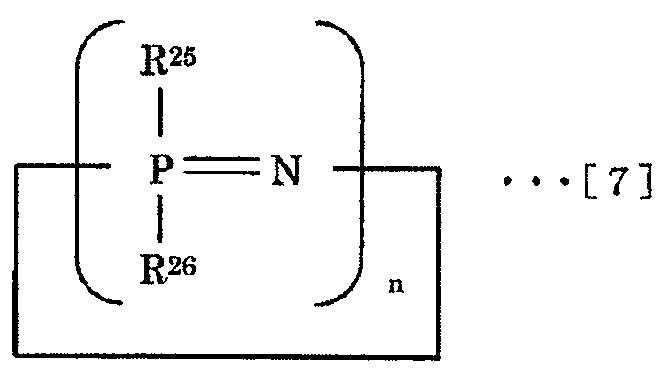
[화학식 16][Formula 16]

(식 중, R25, R26, R27, 및 R28 은, 수소, 수산기, 아미노기, 또는 할로겐 원자를 포함하지 않는 유기기를 나타낸다. 또, n 은 3 ∼ 10 의 정수를 나타낸다.)(In the formula, R 25 , R 26 , R 27 , and R 28 represent hydrogen, a hydroxyl group, an amino group, or an organic group not containing a halogen atom. In addition, n represents an integer of 3 to 10.)
상기 식 [7], [8] 중, R25, R26, R27, 및 R28 로 나타내는 할로겐 원자를 포함하지 않는 유기기로는, 예를 들어, 알콕시기, 페닐기, 아미노기, 알릴기 등을 들 수 있다.In the formulas [7] and [8], examples of the organic group not containing a halogen atom represented by R 25 , R 26 , R 27 , and R 28 include, for example, an alkoxy group, a phenyl group, an amino group, an allyl group, and the like. Can be lifted.
그 중에서도, 하기 일반식 [9] 로 나타내는 고리형 페녹시포스파젠이 바람직하다.Especially, the cyclic phenoxyphosphazene represented by the following general formula [9] is preferable.
[화학식 17][Formula 17]

난연제로서 유기 인계 난연제를 사용하는 경우, 그 배합량은, A 성분 100 중량부에 대하여, 1 ∼ 20 중량부가 바람직하고, 보다 바람직하게는 2 ∼ 15 중량부, 더욱 바람직하게는 3 ∼ 10 중량부이다. 이러한 바람직한 범위일수록 유기 인계 난연제의 배합에 의해 기대되는 효과 (예를 들어 난연성 등) 가 발휘된다.When an organic phosphorus-based flame retardant is used as the flame retardant, the blending amount is preferably 1 to 20 parts by weight, more preferably 2 to 15 parts by weight, and still more preferably 3 to 10 parts by weight with respect to 100 parts by weight of the component A. . The desired effect (for example, flame retardance, etc.) is exhibited by the compounding of the organic phosphorus-based flame retardant in the preferred range.
<난연제-실리콘계 난연제><Flame retardant-silicone flame retardant>
본 발명의 실리콘 화합물은 본 발명의 목적인 난연성이나 투명성을 얻을 수 있으면 특별히 한정되지 않지만, 방향족기를 갖는 실리콘 화합물이 바람직하고, 또한 25 ℃ 에 있어서의 점도가 300 cSt 이하인 것이 바람직하다. 점도가 높아지면 성형품의 투명성이 저하되는 경우가 있다. 또한 실리콘 화합물이 효율적으로 난연 효과를 발휘하기 위해서는, 연소 과정에 있어서의 분산 상태가 중요하다. 이러한 분산 상태를 결정하는 중요한 인자로서 점도를 들 수 있다. 이것은, 연소 과정에 있어서 실리콘 화합물이 너무나도 휘발되기 쉬운 경우, 즉, 점도가 지나치게 낮은 실리콘 화합물의 경우에는, 연소시에 계 내에 남아 있는 실리콘이 희박하기 때문에, 연소시에 균일한 실리콘의 스트럭처를 형성하는 것이 곤란해지기 때문이라고 생각된다. 이러한 관점에서, 25 ℃ 에 있어서의 점도는 10 ∼ 300 cSt 가 보다 바람직하고, 더욱 바람직하게는 15 ∼ 200 cSt, 가장 바람직하게는 20 ∼ 170 cSt 이다.The silicone compound of the present invention is not particularly limited as long as it can obtain the flame retardancy or transparency that is the object of the present invention, but a silicone compound having an aromatic group is preferred, and the viscosity at 25°C is preferably 300 cSt or less. When the viscosity increases, the transparency of the molded article may decrease. In addition, in order for the silicone compound to effectively exhibit a flame retardant effect, the dispersion state in the combustion process is important. Viscosity is an important factor in determining the dispersion state. This is because when the silicon compound is too volatile in the combustion process, that is, in the case of a silicon compound having an excessively low viscosity, the silicon remaining in the system at the time of combustion is rare, thereby forming a uniform structure of silicon during combustion. I think it is because it becomes difficult to do. From this viewpoint, the viscosity at 25° C. is more preferably 10 to 300 cSt, still more preferably 15 to 200 cSt, and most preferably 20 to 170 cSt.
실리콘 화합물이 갖는 방향족기는 실리콘 원자에 결합하고 있는 것이고, 폴리카보네이트와의 상용성 향상이나 투명성 유지에 기여하고 있고, 연소시의 탄화 피막 형성에도 유리하므로 난연 효과의 발현에도 기여하고 있다. 방향족기를 갖지 않는 경우에는 성형품의 투명성이 잘 얻어지지 않고, 고도의 난연성을 얻는 것도 곤란해지는 경향이 있다.The aromatic group of the silicon compound is bound to a silicon atom, and it contributes to improving compatibility with polycarbonate and maintaining transparency, and is also advantageous for forming a carbonized film during combustion, thus contributing to the expression of a flame retardant effect. When it does not have an aromatic group, transparency of the molded article is not easily obtained, and it is also difficult to obtain high flame retardancy.
본 발명의 실리콘 화합물은 바람직하게는 Si-H 기를 함유하는 실리콘 화합물인 것이 바람직하다. 특히, 분자 중에 Si-H 기 및 방향족기를 함유하는 실리콘 화합물로서,It is preferable that the silicon compound of the present invention is preferably a silicon compound containing a Si-H group. In particular, as a silicon compound containing a Si-H group and an aromatic group in the molecule,
(1) Si-H 기가 포함되는 양 (Si-H 량) 이 0.1 ∼ 1.2 ㏖/100 g(1) The amount of Si-H group (the amount of Si-H) is 0.1 to 1.2 mol/100 g
(2) 하기 일반식 [10] 으로 나타내는 방향족기가 포함되는 비율 (방향족기량) 이 10 ∼ 70 중량%, 또한(2) The proportion (aromatic group amount) of the aromatic group represented by the following general formula [10] is 10 to 70% by weight, and
[화학식 18][Formula 18]

(식 [10] 중, X 는 각각 독립적으로 OH 기, 헤테로 원자 함유 관능기를 가져도 되는 탄소수 1 ∼ 20 의 탄화수소기를 나타낸다. m1 은 0 ∼ 5 의 정수를 나타낸다. 또한 식 [10] 중에 있어서 m1 이 2 이상인 경우에는 각각 서로 상이한 종류의 X 를 취할 수 있다.)(In formula [10], X each independently represents an OH group and a hydrocarbon group having 1 to 20 carbon atoms which may have a hetero atom-containing functional group. m1 represents an integer of 0 to 5. Moreover, m1 in formula [10] In the case of 2 or more, X of different types may be taken respectively.)
(3) 평균 중합도가 3 ∼ 150(3) Average polymerization degree is 3 to 150
인 실리콘 화합물 중에서 선택되는 적어도 1 종 이상의 실리콘 화합물인 것이 보다 바람직하다.It is more preferable that it is at least one or more silicone compounds selected from phosphorus silicone compounds.
더욱 바람직하게는, Si-H 기 함유 단위로서, 하기 일반식 [11] 및 [12] 로 나타내는 구성 단위 중, 적어도 1 종 이상의 식으로 나타내는 구성 단위를 포함하는 실리콘 화합물 중에서 선택되는 적어도 1 종 이상의 실리콘 화합물이다.More preferably, as a Si-H group-containing unit, at least one or more selected from silicone compounds containing a structural unit represented by at least one of the structural units represented by the following general formulas [11] and [12] It is a silicone compound.
[화학식 19][Formula 19]

[화학식 20][Formula 20]

(식 [11] 및 식 [12] 중, Z1 ∼ Z3 은 각각 독립적으로 수소 원자, 헤테로 원자 함유 관능기를 가져도 되는 탄소수 1 ∼ 20 의 탄화수소기, 또는 하기 일반식 [13] 으로 나타내는 화합물을 나타낸다. α1 ∼ α3 은 각각 독립적으로 0 또는 1 을 나타낸다. m2 는 0 혹은 1 이상의 정수를 나타낸다. 또한 식 [11] 중에 있어서 m2 가 2 이상인 경우의 반복 단위는 각각 서로 상이한 복수의 반복 단위를 취할 수 있다.)(In Formula [11] and Formula [12], Z 1 to Z 3 are each independently a hydrogen atom or a hydrocarbon group having 1 to 20 carbon atoms which may have a hetero atom-containing functional group, or a compound represented by the following general formula [13] Α1 to α3 each independently represent 0 or 1. m2 represents 0 or an integer greater than or equal to 1. In formula [11], the repeating units when m2 is 2 or more each represent a plurality of repeating units different from each other. You can take it.)
[화학식 21][Formula 21]

(식 [13] 중, Z4 ∼ Z8 은 각각 독립적으로 수소 원자, 헤테로 원자 함유 관능기를 가져도 되는 탄소수 1 ∼ 20 의 탄화수소기를 나타낸다. α4 ∼ α8 은 각각 독립적으로 0 또는 1 을 나타낸다. m3 은 0 혹은 1 이상의 정수를 나타낸다. 또한 식 [13] 중에 있어서 m3 이 2 이상인 경우의 반복 단위는 각각 서로 상이한 복수의 반복 단위를 취할 수 있다.)(In the formula [13], Z 4 to Z 8 each independently represents a hydrogen atom or a hydrocarbon group having 1 to 20 carbon atoms which may have a hetero atom-containing functional group. α4 to α8 each independently represent 0 or 1 m3. Represents 0 or an integer greater than or equal to 1. In addition, in formula [13], when m3 is 2 or more, the repeating units may each take a plurality of different repeating units.)
보다 바람직하게는, M 을 1 관능성 실록산 단위, D 를 2 관능성 실록산 단위, T 를 3 관능성 실록산 단위로 할 때, MD 단위 또는 MDT 단위로 이루어지는 실리콘 화합물이다.More preferably, when M is a monofunctional siloxane unit, D is a bifunctional siloxane unit, and T is a trifunctional siloxane unit, it is a silicone compound composed of MD units or MDT units.
상기 일반식 [11], [12] 및 [13] 으로 나타내는 구성 단위의 Z1 ∼ Z8, 및 일반식 [10] 의 X 에 있어서의 헤테로 원자 함유 관능기를 가져도 되는 탄소수 1 ∼ 20 의 탄화수소기로는, 메틸기, 에틸기, 프로필기, 부틸기, 헥실기, 데실기 등의 알킬기, 시클로헥실기 등의 시클로알킬기, 비닐기, 알릴기 등의 알케닐기, 페닐기, 톨릴기 등의 아릴기 및 아르알킬기를 들 수 있고, 또한 이들 기는 에폭시기, 카르복실기, 무수 카르복실산기, 아미노기, 및 메르캅토기 등의 각종 관능기를 포함하는 것이어도 된다. 더욱 바람직하게는 탄소수 1 ∼ 8 의 알킬기, 알케닐기 또는 아릴기이고, 특히 메틸기, 에틸기, 프로필기 등의 탄소수 1 ∼ 4 의 알킬기, 비닐기, 또는 페닐기가 바람직하다.The general formula [11], [12] and the structural units represented by [13] Z 1 ~ Z 8 , and the formula hydrocarbon. [10] 1 to 20 carbon atoms which may have a heteroatom-containing functional group in X of As the group, alkyl groups such as methyl group, ethyl group, propyl group, butyl group, hexyl group and decyl group, cycloalkyl groups such as cyclohexyl group, alkenyl groups such as vinyl group and allyl group, aryl groups such as phenyl group and tolyl group, and are An alkyl group is mentioned, and these groups may contain various functional groups, such as an epoxy group, a carboxyl group, an carboxylic acid anhydride group, an amino group, and a mercapto group. More preferably, it is a C1-C8 alkyl group, an alkenyl group, or an aryl group, Especially, a C1-C4 alkyl group, such as a methyl group, an ethyl group, a propyl group, a vinyl group, or a phenyl group is preferable.
상기 일반식 [11] 및 [12] 로 나타내는 구성 단위 중, 적어도 1 종 이상의 식으로 나타내는 구성 단위를 포함하는 실리콘 화합물에 있어서, 복수의 실록산 결합의 반복 단위를 갖는 경우에는, 그것들은 랜덤 공중합, 블록 공중합, 테이퍼드 공중합 중 어느 형태를 취하는 것도 가능하다.Among the structural units represented by the general formulas [11] and [12], in the case of a silicone compound containing structural units represented by at least one or more formulas, when they have a plurality of repeating units of siloxane bonds, they are randomly copolymerized, It is also possible to take any form of block copolymerization or tapered copolymerization.
본 발명에 있어서는, 바람직한 Si-H 기를 함유하는 실리콘 화합물에 대해서는, 실리콘 화합물 중의 Si-H 량을 0.1 ∼ 1.2 ㏖/100 g 의 범위로 하는 것이 바람직하다. Si-H 량이 0.1 ∼ 1.2 ㏖/100 g 의 범위에 있음으로써, 연소시에 실리콘의 스트럭처의 형성이 용이해진다. 더욱 바람직하게는 Si-H 량이 0.1 ∼ 1.0 ㏖/100 g 의 범위, 가장 바람직하게는 0.2 ∼ 0.6 ㏖/100 g 의 범위에 있는 실리콘 화합물이다. Si-H 량이 적으면 실리콘의 스트럭처 형성이 곤란해지고, Si-H 량이 많으면 조성물의 열안정성이 저하된다. 또한, 여기서 실리콘의 스트럭처란, 실리콘 화합물 상호의 반응, 또는 수지와 실리콘의 반응에 의해 생성되는 망상 구조를 가리킨다.In the present invention, it is preferable that the amount of Si-H in the silicon compound is in the range of 0.1 to 1.2 mol/100 g for the silicon compound containing a preferable Si-H group. When the Si-H content is in the range of 0.1 to 1.2 mol/100 g, formation of a silicon structure during combustion becomes easy. More preferably, the Si-H content is a silicone compound in the range of 0.1 to 1.0 mol/100 g, most preferably in the range of 0.2 to 0.6 mol/100 g. When the amount of Si-H is small, it is difficult to form a structure of silicon, and when the amount of Si-H is large, the thermal stability of the composition decreases. In addition, the structure of a silicon here refers to the network structure produced by reaction of a silicone compound, or reaction of resin and silicone.
또, 여기서 말하는 Si-H 기량이란, 실리콘 화합물 100 g 당에 포함되는 Si-H 구조의 몰수를 말하지만, 이것은 알칼리 분해법에 의해, 실리콘 화합물의 단위 중량당 발생한 수소 가스의 체적을 측정함으로써 구할 수 있다. 예를 들어, 25 ℃ 에 있어서 실리콘 화합물 1 g 당 122 ㎖ 의 수소 가스가 발생했을 경우, 하기 계산식에 의해, Si-H 량은 0.5 ㏖/100 g 이 된다.The Si-H content referred to herein refers to the number of moles of the Si-H structure contained in 100 g of the silicon compound, but this can be obtained by measuring the volume of hydrogen gas generated per unit weight of the silicon compound by an alkali decomposition method. . For example, when 122 ml of hydrogen gas is generated per gram of the silicon compound at 25°C, the Si-H content is 0.5 mol/100 g by the following calculation formula.
122 × 273/(273 + 25) ÷ 22400 × 100 ≒ 0.5122 × 273/(273 + 25) ÷ 22400 × 100 ≒ 0.5
본 발명의 실리콘 화합물로는, 실리콘 화합물 중의 방향족기량은 10 ∼ 70 중량% 인 것이 바람직하다. 더욱 바람직하게는 방향족기량이 15 ∼ 60 중량% 의 범위, 가장 바람직하게는 25 ∼ 55 중량% 의 범위에 있는 실리콘 화합물이다. 실리콘 화합물 중의 방향족기량이 10 중량% 보다 적으면 실리콘 화합물이 편재되어 분산 불량이 되고, 외관 불량이 되는 경우가 있다. 방향족기량이 70 중량% 보다 많으면 실리콘 화합물 자체의 분자의 강직성이 높아지기 때문에 역시 편재되어 분산 불량이 되고, 외관 불량이 되는 경우가 있다.As a silicone compound of this invention, it is preferable that the aromatic group content in a silicone compound is 10-70 weight%. More preferably, it is a silicone compound in which the aromatic group content is in the range of 15 to 60% by weight, most preferably in the range of 25 to 55% by weight. When the amount of the aromatic group in the silicone compound is less than 10% by weight, the silicone compound is unevenly distributed, resulting in poor dispersion and sometimes poor appearance. If the aromatic group content is more than 70% by weight, the stiffness of the molecules of the silicone compound itself increases, which is also localized, resulting in poor dispersion and poor appearance.
또한, 여기서 방향족기량이란, 실리콘 화합물에 있어서, 전술한 일반식 [10] 으로 나타내는 방향족기가 포함되는 비율을 말하고, 하기 계산식에 의해 구할 수 있다.In addition, an aromatic group amount here means the ratio in which the aromatic group represented by the above-mentioned general formula [10] is contained in a silicone compound, and can be calculated|required by the following calculation formula.
방향족기량 = [A/M] × 100 (중량%)Aromatic amount = [A/M] × 100 (% by weight)
여기서, 상기 식에 있어서의 A, M 은 각각 이하의 수치를 나타낸다.Here, A and M in the said formula show the following numerical values, respectively.
A = 실리콘 화합물 1 분자 중에 포함되는, 모든 일반식 [10] 으로 나타내는 방향족기 부분의 합계 분자량A = total molecular weight of the aromatic group moiety represented by all the general formulas [10] contained in one molecule of the silicone compound
M = 실리콘 화합물의 분자량M = molecular weight of the silicone compound
또한 본 발명에 사용되는 실리콘 화합물은, 25 ℃ 에 있어서의 굴절률이 1.40 ∼ 1.60 의 범위에 있는 것이 바람직하다. 더욱 바람직하게는 굴절률이 1.42 ∼ 1.59 의 범위이고, 가장 바람직하게는, 1.44 ∼ 1.59 의 범위에 있는 실리콘 화합물이다. 굴절률이 상기 범위 내에 있는 경우, 방향족 폴리카보네이트 중에 실리콘 화합물이 미분산됨으로써, 보다 백탁이 적은 염색성이 양호한 수지 조성물이 제공된다.Moreover, it is preferable that the refractive index in 25 degreeC of the silicone compound used for this invention exists in the range of 1.40-1.60. More preferably, the refractive index is in the range of 1.42 to 1.59, and most preferably, it is a silicone compound in the range of 1.44 to 1.59. When the refractive index is within the above range, the silicone compound is finely dispersed in the aromatic polycarbonate, whereby a resin composition having better dyeability with less cloudiness is provided.
또한 본 발명에 사용되는 실리콘 화합물은, 105 ℃/3 시간에 있어서의 가열 감량법에 의한 휘발량이 18 % 이하인 것이 바람직하다. 더욱 바람직하게는 휘발량이 10 % 이하인 실리콘 화합물이다. 휘발량이 18 % 보다 크면 본 발명의 수지 조성물을 압출하여 펠릿화를 실시할 때, 수지로부터의 휘발물의 양이 많아지는 문제가 생기고, 또한 성형품 중에 발생하는 기포가 많아지기 쉽다는 문제가 있다.Moreover, it is preferable that the volatilization amount of the silicone compound used by this invention by the heating loss method at 105 degreeC/3 hours is 18% or less. More preferably, it is a silicone compound having a volatilization amount of 10% or less. When the volatilization amount is greater than 18%, when extruding and extruding the resin composition of the present invention, there is a problem that the amount of volatiles from the resin increases, and there is a problem that the bubbles generated in the molded article tend to increase.
사용되는 실리콘 화합물로는, 상기의 조건을 만족시키는 것이면 직사슬형이어도 되고 분기 구조를 갖는 것이어도 되고, Si-H 기를 분자 구조 중의 측사슬, 말단, 분기점 중 어느 것, 또는 복수의 부위에 갖는 각종 화합물을 사용하는 것이 가능하다.As a silicone compound used, if it satisfies the above conditions, it may be either a straight chain type or a branched structure, and the Si-H group may be present at any of side chains, terminals, branching points, or a plurality of sites in the molecular structure. It is possible to use various compounds.
일반적으로 분자 중에 Si-H 기를 함유하는 실리콘 화합물의 구조는, 이하에 나타내는 4 종류의 실록산 단위를 임의로 조합함으로써 구성된다.In general, the structure of a silicone compound containing a Si-H group in a molecule is constituted by arbitrarily combining four types of siloxane units shown below.
M 단위 : (CH3)3SiO1/2, H(CH3)2SiO1/2, H2(CH3)SiO1/2, (CH3)2(CH2=CH)SiO1/2, (CH3)2(C6H5)SiO1/2, (CH3)(C6H5)(CH2=CH)SiO1/2 등의 1 관능성 실록산 단위M unit: (CH 3 ) 3 SiO 1/2 , H(CH 3 ) 2 SiO 1/2 , H 2 (CH 3 )SiO 1/2 , (CH 3 ) 2 (CH 2 =CH)SiO 1/2 , (CH 3 ) 2 (C 6 H 5 )SiO 1/2 , (CH 3 )(C 6 H 5 )(CH 2 =CH)SiO 1 Monofunctional siloxane units such as /2
D 단위 : (CH3)2SiO, H(CH3)SiO, H2SiO, H(C6H5)SiO, (CH3)(CH2=CH)SiO, (C6H5)2SiO 등의 2 관능성 실록산 단위D unit: (CH 3 ) 2 SiO, H(CH 3 )SiO, H 2 SiO, H(C 6 H 5 )SiO, (CH 3 )(CH 2 =CH)SiO, (C 6 H 5 ) 2 SiO Difunctional siloxane units such as
T 단위 : (CH3)SiO3/2, (C3H7)SiO3/2, HSiO3/2, (CH2=CH)SiO3/2, (C6H5)SiO3/2 등의 3 관능성 실록산 단위T unit: (CH 3 )SiO 3/2 , (C 3 H 7 )SiO 3/2 , HSiO 3/2 , (CH 2 =CH)SiO 3/2 , (C 6 H 5 )SiO 3/2, etc. Trifunctional siloxane units
Q 단위 : SiO2 로 나타내는 4 관능성 실록산 단위Q unit: tetrafunctional siloxane unit represented by SiO 2
본 발명에 있어서 사용되는 Si-H 기를 함유하는 실리콘 화합물의 구조는, 구체적으로는, 시성식 (示性式) 으로서 Dn, Tp, MmDn, MmTp, MmQq, MmDnTp, MmDnQq, MmTpQq, MmDnTpQq, DnTp, DnQq, DnTpQq 를 들 수 있다. 이 중에서 바람직한 실리콘 화합물의 구조는, MmDn, MmTp, MmDnTp, MmDnQq 이고, 더욱 바람직한 구조는, MmDn 또는 MmDnTp 이다.The structure of the silicon compound containing a Si-H group used in the present invention is specifically, D n , T p , M m D n , M m T p , M m Q q , as a chemical formula. M m D n T p , M m D n Q q , M m T p Q q , M m D n T p Q q , D n T p , D n Q q , D n T p Q q . Among these, preferred structures of the silicone compound are M m D n , M m T p , M m D n T p , and M m D n Q q , and more preferable structures are M m D n or M m D n T p. to be.
(상기 시성식 중의 계수 m, n, p, q 는 각 실록산 단위의 중합도를 나타내는 정수이다. 또 m, n, p, q 중 어느 것이 2 이상의 수치인 경우, 그 계수가 부여된 실록산 단위는, 결합하는 수소 원자나 헤테로 원자 함유 관능기를 가져도 되는 탄소수 1 ∼ 20 의 탄화수소기가 상이한 2 종 이상의 실록산 단위로 할 수 있다.)(Coefficients m, n, p, and q in the above-mentioned formula are integers indicating the degree of polymerization of each siloxane unit. In addition, when any one of m, n, p, and q is a numerical value of 2 or more, the siloxane units to which the coefficient is assigned are bonded. It can be made into two or more types of siloxane units having different hydrocarbon groups having 1 to 20 carbon atoms which may have a hydrogen atom or a hetero atom-containing functional group.)
여기서, 각 시성식에 있어서의 계수의 합계가 실리콘 화합물의 평균 중합도가 된다. 본 발명에 있어서는, 이 평균 중합도를 3 ∼ 150 의 범위로 하는 것이 바람직하고, 보다 바람직하게는 4 ∼ 80 의 범위, 더욱 바람직하게는 5 ∼ 60 의 범위이다. 중합도가 3 보다 작은 경우, 실리콘 화합물 자체의 휘발성이 높아지기 때문에, 이 실리콘 화합물을 배합한 수지 조성물의 가공시에 있어서 수지로부터의 휘발분이 많아지기 쉽다는 문제가 있다. 중합도가 150 보다 큰 경우, 이 실리콘 화합물을 배합한 수지 조성물에 있어서의 난연성이나 투명성이 불충분해지기 쉽다. 또한, 상기의 실리콘 화합물은, 각각 단독으로 사용해도 되고, 2 종 이상을 조합하여 사용해도 된다.Here, the sum of the coefficients in each formula is the average degree of polymerization of the silicone compound. In this invention, it is preferable to make this average degree of polymerization into the range of 3 to 150, More preferably, it is the range of 4 to 80, More preferably, it is the range of 5 to 60. When the degree of polymerization is less than 3, since the volatility of the silicone compound itself increases, there is a problem that the volatile content from the resin tends to increase during processing of the resin composition containing the silicone compound. When the degree of polymerization is greater than 150, flame retardancy and transparency in the resin composition containing this silicone compound are likely to be insufficient. Moreover, the said silicone compound may be used individually respectively, and may be used in combination of 2 or more type.
이와 같은 Si-H 결합을 갖는 실리콘 화합물은, 그 자체 종래 공지된 방법에 의해 제조할 수 있다. 예를 들어, 목적으로 하는 실리콘 화합물의 구조에 따라, 상당하는 오르가노클로로실란류를 공가수분해하여, 부생하는 염산이나 저비분을 제거함으로써 목적물을 얻을 수 있다. 또, 분자 중에 Si-H 결합이나 일반식 [10] 으로 나타내는 방향족기, 그 밖의 헤테로 원자 함유 관능기를 가져도 되는 탄소수 1 ∼ 20 의 탄화수소기를 갖는 실리콘 오일, 고리형 실록산이나 알콕시실란류를 출발 원료로 하는 경우에는, 염산, 황산, 메탄술폰산 등의 산촉매를 사용하고, 경우에 따라 가수분해를 위한 물을 첨가하고, 중합 반응을 진행시킨 후, 사용한 산 촉매나 저비분을 동일하게 제거함으로써, 목적으로 하는 실리콘 화합물을 얻을 수 있다.The silicon compound having such a Si-H bond can be produced by a method known per se. For example, depending on the structure of the target silicon compound, the target product can be obtained by co-hydrolysis of corresponding organochlorosilanes to remove by-product hydrochloric acid or low secretion. Also, starting materials are silicone oils having cyclic hydrocarbon groups having 1 to 20 carbon atoms which may have Si-H bonds, aromatic groups represented by the general formula [10], and other hetero atom-containing functional groups in the molecule, starting materials for cyclic siloxanes or alkoxysilanes. In the case of, an acid catalyst such as hydrochloric acid, sulfuric acid, or methanesulfonic acid is used, and if necessary, water for hydrolysis is added, and after the polymerization reaction proceeds, the used acid catalyst or low secretion is removed in the same way. The silicone compound to be obtained can be obtained.
또한, Si-H 기를 함유하는 실리콘 화합물이 하기의 구조식으로 나타내는 실록산 단위 M, MH, D, DH, Dφ2, T, Tφ (단 M : (CH3)3SiO1/2MH : H(CH3)2SiO1/2D : (CH3)2SiODH : H(CH3)SiODφ2 : (C6H5)2SiT : (CH3)SiO3/2Tφ : (C6H5)SiO3/2) 를 가지고 있고, 1 분자당에 갖는 각 실록산 단위의 평균수를 각각 m, mh, d, dh, dp2,t, tp 로 했을 경우, 하기 관계식 모두를 만족시키는 것이 바람직하다.In addition, the siloxane units M, M H , D, D H , D φ 2 , T, and T φ (however M: (CH 3 ) 3 SiO 1/2 M H ) in which the silicon compound containing a Si-H group is represented by the following structural formula : H(CH 3 ) 2 SiO 1/2 D: (CH 3 ) 2 SiOD H : H(CH 3 )SiOd φ2 : (C 6 H 5 ) 2 SiT: (CH 3 )SiO 3/2 T φ : ( C 6 H 5 )SiO 3/2 ), and the average number of each siloxane unit per molecule is m, m h , d, d h , d p2, t, t p . It is preferable to satisfy.
2 ≤ m + mh ≤ 402 ≤ m + m h ≤ 40
0.35 ≤ d + dh + dp2 ≤ 1480.35 ≤ d + d h + d p2 ≤ 148
0 ≤ t + tp ≤ 380 ≤ t + t p ≤ 38
0.35 ≤ mh + dh ≤ 1100.35 ≤ m h + d h ≤ 110
이 범위를 벗어나면 본 발명의 수지 조성물에 있어서 양호한 난연성과 우수한 투명성을 동시에 달성하는 것이 곤란해지고, 경우에 따라서는 Si-H 기를 함유하는 실리콘 화합물의 제조가 곤란해진다.Outside of this range, it is difficult to simultaneously achieve good flame retardancy and excellent transparency in the resin composition of the present invention, and in some cases, it is difficult to manufacture a silicone compound containing a Si-H group.
본 발명에서 사용되는 실리콘 화합물의 함유량은 A 성분 100 중량부에 대하여 바람직하게는 0.1 ∼ 7 중량부이고, 보다 바람직하게는 0.1 ∼ 4 중량부, 더욱 바람직하게는 0.1 ∼ 2 중량부, 가장 바람직하게는 0.1 ∼ 1 중량부이다. 함유량이 지나치게 많으면 수지의 내열성이 저하되고, 가공시에 가스가 발생하기 쉬워진다는 문제 있고, 지나치게 적으면 난연성이 발휘되지 않는다는 문제가 있다.The content of the silicone compound used in the present invention is preferably 0.1 to 7 parts by weight, more preferably 0.1 to 4 parts by weight, still more preferably 0.1 to 2 parts by weight, most preferably 100 parts by weight of component A Is 0.1 to 1 part by weight. If the content is too large, there is a problem that the heat resistance of the resin decreases, and gas is easily generated during processing. If the content is too small, there is a problem that flame retardancy is not exhibited.
<C 성분 : 함불소 적하 방지제><Component C: Fluorine-free dripping inhibitor>
본 발명의 수지 조성물은, 함불소 적하 방지제 (C 성분) 를 함유하고 있는 것이 바람직하다. 이 함불소 적하 방지제의 함유에 의해, 성형품의 물성을 저해하는 일 없이, 양호한 난연성을 달성할 수 있다.It is preferable that the resin composition of this invention contains a fluorine-containing dripping prevention agent (component C). By containing this fluorine-containing dropping inhibitor, good flame retardancy can be achieved without impairing the physical properties of the molded article.
함불소 적하 방지제로는, 피브릴 형성능을 갖는 함불소 폴리머를 들 수 있고, 이러한 폴리머로는 폴리테트라플루오로에틸렌, 테트라플루오로에틸렌계 공중합체 (예를 들어, 테트라플루오로에틸렌/헥사플루오로프로필렌 공중합체 등), 미국 특허 제4379910호에 나타내는 바와 같은 부분 불소화 폴리머, 불소화 디페놀로부터 제조되는 폴리카보네이트 수지 등을 들 수 있다. 그 중에서도 바람직하게는 폴리테트라플루오로에틸렌 (이하 PTFE 라고 칭하는 경우가 있다) 이다.Examples of the fluorine-containing dropping inhibitor include a fluorine-containing polymer having a fibril-forming ability, and such polymers include polytetrafluoroethylene and tetrafluoroethylene-based copolymers (for example, tetrafluoroethylene/hexafluoro) Propylene copolymers, etc.), partially fluorinated polymers as shown in U.S. Patent No. 4379910, polycarbonate resins produced from fluorinated diphenols, and the like. Especially, it is polytetrafluoroethylene (it may be called PTFE hereafter).
피브릴 형성능을 갖는 PTFE 의 분자량은 매우 높은 분자량을 갖고, 전단력 등의 외적 작용에 의해 PTFE 끼리를 결합하여 섬유상이 되는 경향을 나타내는 것이다. 그 분자량은, 표준 비중으로부터 구해지는 수평균 분자량에 있어서 100 만 ∼ 1000 만, 보다 바람직하게는 200 만 ∼ 900 만이다. 이러한 PTFE 는, 고체 형상 외에, 수성 분산액 형태의 것도 사용 가능하다. 또 이러한 피브릴 형성능을 갖는 PTFE 는 수지 중에서의 분산성을 향상시키고, 또한 양호한 난연성 및 기계적 특성을 얻기 위해서 다른 수지와의 혼합 형태의 PTFE 혼합물을 사용할 수도 있다.The molecular weight of PTFE having a fibril-forming ability has a very high molecular weight and exhibits a tendency to form a fibrous form by bonding PTFE to each other by external action such as shear force. The molecular weight is 1 to 10 million, more preferably 2 to 9 million in the number average molecular weight obtained from the standard specific gravity. In addition to the solid form, such PTFE can also be used in the form of an aqueous dispersion. In addition, the PTFE having the ability to form fibrils improves dispersibility in the resin, and may also use a PTFE mixture in a mixed form with other resins in order to obtain good flame retardancy and mechanical properties.
이러한 피브릴 형성능을 갖는 PTFE 의 시판품으로는 예를 들어 미츠이·듀퐁 플로로 케미컬 (주) 의 테플론 (등록상표) 6J, 다이킨 공업 (주) 의 폴리프론 MPA FA500 및 F-201L 등을 들 수 있다. PTFE 의 수성 분산액의 시판품으로는, 아사히 아이시아이 플로로폴리머즈 (주) 제조의 플루온 AD-1, AD-936, 다이킨 공업 (주) 제조의 플루온 D-1 및 D-2, 미츠이·듀퐁 플로로 케미컬 (주) 제조의 테플론 (등록상표) 30J 등을 대표로 하여 들 수 있다.Commercially available products of PTFE having such a fibril-forming ability include, for example, Teflon (registered trademark) 6J of Mitsui DuPont Chemical Co., Ltd., Polyjlon MPA FA500 and F-201L of Daikin Industries, Ltd. have. As commercially available products of the aqueous dispersion of PTFE, fluon AD-1, AD-936 manufactured by Asahi Aisia Floropolymers Co., Ltd., fluon D-1 and D-2 manufactured by Daikin Industries, Mitsui And Teflon (registered trademark) 30J manufactured by DuPont Floro Chemical Co., Ltd. as representatives.
혼합 형태의 PTFE 로는, (1) PTFE 의 수성 분산액과 유기 중합체의 수성 분산액 또는 용액을 혼합하여 공침전을 실시하여 공응집 혼합물을 얻는 방법 (일본 공개특허공보 소60-258263호, 일본 공개특허공보 소63-154744호 등에 기재된 방법), (2) PTFE 의 수성 분산액과 건조시킨 유기 중합체 입자를 혼합하는 방법 (일본 공개특허공보 평4-272957호에 기재된 방법), (3) PTFE 의 수성 분산액과 유기 중합체 입자 용액을 균일하게 혼합하고, 이러한 혼합물로부터 각각의 매체를 동시에 제거하는 방법 (일본 공개특허공보 평06-220210호, 일본 공개특허공보 평08-188653호 등에 기재된 방법), (4) PTFE 의 수성 분산액 중에서 유기 중합체를 형성하는 단량체를 중합하는 방법 (일본 공개특허공보 평9-95583호에 기재된 방법), 및 (5) PTFE 의 수성 분산액과 유기 중합체 분산액을 균일하게 혼합 후, 추가로 그 혼합 분산액 중에서 비닐계 단량체를 중합하고, 그 후 혼합물을 얻는 방법 (일본 공개특허공보 평11-29679호 등에 기재된 방법) 에 의해 얻어진 것을 사용할 수 있다. 이들 혼합 형태의 PTFE 의 시판품으로는, 미츠비시 레이욘 (주) 의 「메타브렌 A3800」 (상품명), 및 GE 스페셜리티 케미컬즈사 제조 「BLENDEX B449」 (상품명) 등을 들 수 있다.As a mixed-type PTFE, (1) a method of mixing the aqueous dispersion of PTFE and an aqueous dispersion or solution of an organic polymer to perform coprecipitation to obtain a coagulation mixture (Japanese Patent Publication No. 60-258263, Japanese Patent Publication) Method described in sub-63-154744, etc.), (2) a method of mixing an aqueous dispersion of PTFE with dried organic polymer particles (method described in JP-A-4-272957), (3) an aqueous dispersion of PTFE and A method of uniformly mixing the organic polymer particle solution and simultaneously removing each medium from the mixture (method described in JP-A-06-220210, JP-A-08-188653, etc.), (4) PTFE A method for polymerizing a monomer forming an organic polymer in an aqueous dispersion of (method described in Japanese Patent Application Laid-open No. Hei 9-95583), and (5) after uniformly mixing the aqueous dispersion of PTFE and the organic polymer dispersion, further What was obtained by the method (polymerization method of Unexamined-Japanese-Patent No. 11-29679 etc.) obtained by superposing|polymerizing a vinylic monomer in a mixed dispersion liquid and then obtaining a mixture can be used. Examples of commercially available products of these mixed types of PTFE include "Metabreen A3800" (trade name) manufactured by Mitsubishi Rayon Co., Ltd., and "BLENDEX B449" (trade name) manufactured by GE Specialty Chemicals.
혼합 형태에 있어서의 PTFE 의 비율로는, PTFE 혼합물 100 중량% 중, PTFE 가 1 ∼ 60 중량% 가 바람직하고, 보다 바람직하게는 5 ∼ 55 중량% 이다. PTFE 의 비율이 이러한 범위에 있는 경우에는, PTFE 의 양호한 분산성을 달성할 수 있다. 또한, 상기 C 성분의 비율은 정미 (正味) 의 적하 방지제의 양을 나타내고, 혼합 형태의 PTFE 의 경우에는, 정미의 PTFE 량을 나타낸다.The proportion of PTFE in the mixed form is preferably 1 to 60% by weight, more preferably 5 to 55% by weight, of 100% by weight of the PTFE mixture. When the proportion of PTFE is in this range, good dispersibility of PTFE can be achieved. In addition, the ratio of the above-mentioned C component represents the amount of the net dripping prevention agent, and in the case of the mixed type PTFE, the amount of the net PTFE.
C 성분의 함유량은, A 성분 100 중량부에 대하여, 바람직하게는 0.01 ∼ 5 중량부, 보다 바람직하게는 0.05 ∼ 1.5 중량부, 더욱 바람직하게는 0.1 ∼ 1 중량부이다. 적하 방지제가 상기 범위를 초과하여 지나치게 적은 경우에는 난연성이 불충분해지는 경우가 있다. 한편, 적하 방지제가 상기 범위를 초과하여 지나치게 많은 경우에는 PTFE 가 성형품 표면에 석출되어 외관 불량이 되는 경우가 있을 뿐만 아니라, 수지 조성물의 비용 상승으로 연결되어 바람직하지 않다.The content of the C component is preferably 0.01 to 5 parts by weight, more preferably 0.05 to 1.5 parts by weight, and even more preferably 0.1 to 1 part by weight with respect to 100 parts by weight of the A component. When the dripping inhibitor exceeds the above range and is too small, the flame retardancy may be insufficient. On the other hand, when there are too many dripping inhibitors in excess of the above range, PTFE may precipitate on the surface of the molded article, resulting in poor appearance, and it is not preferable because it leads to an increase in the cost of the resin composition.
<D 성분 : 자외선 흡수제><Component D: UV absorber>
본 발명의 D 성분으로서 사용되는 자외선 흡수제로는, 구체적으로는 벤조페논계에서는, 예를 들어, 2,4-디하이드록시벤조페논, 2-하이드록시-4-메톡시벤조페논, 2-하이드록시-4-옥톡시벤조페논, 2-하이드록시-4-벤질옥시벤조페논, 2-하이드록시-4-메톡시-5-술폭시벤조페논, 2,2'-디하이드록시-4-메톡시벤조페논, 2,2',4,4'-테트라하이드록시벤조페논, 2,2'-디하이드록시-4,4'-디메톡시벤조페논, 2,2'-디하이드록시-4,4'-디메톡시-5-소듐술폭시벤조페논, 비스(5-벤조일-4-하이드록시-2-메톡시페닐)메탄, 2-하이드록시-4-n-도데실옥시벤조페논, 및 2-하이드록시-4-메톡시-2'-카르복시벤조페논 등이 예시된다. 자외선 흡수제로는, 구체적으로, 벤조트리아졸계에서는, 예를 들어, 2-(2-하이드록시-5-메틸페닐)벤조트리아졸, 2-(2-하이드록시-5-tert-옥틸페닐)벤조트리아졸, 2-(2-하이드록시-3,5-디쿠밀페닐)페닐벤조트리아졸, 2-(2-하이드록시-3-tert-부틸-5-메틸페닐)-5-클로로벤조트리아졸, 2,2'-메틸렌비스[4-(1,1,3,3-테트라메틸부틸)-6-(2H-벤조트리아졸-2-일)페놀], 2-(2-하이드록시-3,5-디-tert-부틸페닐)벤조트리아졸, 2-(2-하이드록시-3,5-디-tert-부틸페닐)-5-클로로벤조트리아졸, 2-(2-하이드록시-3,5-디-tert-아밀페닐)벤조트리아졸, 2-(2-하이드록시-5-tert-옥틸페닐)벤조트리아졸, 2-(2-하이드록시-5-tert-부틸페닐)벤조트리아졸, 2-(2-하이드록시-4-옥톡시페닐)벤조트리아졸, 2,2'-메틸렌비스(4-쿠밀-6-벤조트리아졸페닐), 2,2'-p-페닐렌비스(1,3-벤조옥사진-4-온), 및 2-[2-하이드록시-3-(3,4,5,6-테트라하이드로프탈이미드메틸)-5-메틸페닐]벤조트리아졸, 그리고 2-(2'-하이드록시-5-메타크릴옥시에틸페닐)-2H-벤조트리아졸과 그 모노머와 공중합 가능한 비닐계 모노머의 공중합체나 2-(2'-하이드록시-5-아크릴옥시에틸페닐)-2H-벤조트리아졸과 그 모노머와 공중합 가능한 비닐계 모노머의 공중합체 등의 2-하이드록시페닐-2H-벤조트리아졸 골격을 갖는 중합체 등이 예시된다. 자외선 흡수제는, 구체적으로, 하이드록시페닐트리아진계에서는, 예를 들어, 2-(4,6-디페닐-1,3,5-트리아진-2-일)-5-헥실옥시페놀, 2-(4,6-디페닐-1,3,5-트리아진-2-일)-5-메틸옥시페놀, 2-(4,6-디페닐-1,3,5-트리아진-2-일)-5-에틸옥시페놀, 2-(4,6-디페닐-1,3,5-트리아진-2-일)-5-프로필옥시페놀, 및 2-(4,6-디페닐-1,3,5-트리아진-2-일)-5-부틸옥시페놀 등이 예시된다. 또한 2-(4,6-비스(2,4-디메틸페닐)1,3,5-트리아진-2-일)-5-헥실옥시페놀 등, 상기 예시 화합물의 페닐기가 2,4-디메틸페닐기가 된 화합물이 예시된다. 자외선 흡수제는, 구체적으로 고리형 이미노에스테르계에서는, 예를 들어 2,2'-p-페닐렌비스(3,1-벤조옥사진-4-온), 2,2'-m-페닐렌비스(3,1-벤조옥사진-4-온), 및 2,2'-p,p'-디페닐렌비스(3,1-벤조옥사진-4-온) 등이 예시된다. 또 자외선 흡수제로는, 구체적으로 시아노아크릴레이트계에서는, 예를 들어 1,3-비스-[(2'-시아노-3',3'-디페닐아크릴로일)옥시]-2,2-비스[(2-시아노-3,3-디페닐아크릴로일)옥시]메틸)프로판, 및 1,3-비스-[(2-시아노-3,3-디페닐아크릴로일)옥시]벤젠 등이 예시된다. 또한 상기 자외선 흡수제는, 라디칼 중합이 가능한 단량체 화합물의 구조를 취함으로써, 이러한 자외선 흡수성 단량체 및/또는 광 안정성 단량체와, 알킬(메트)아크릴레이트 등의 단량체를 공중합한 폴리머형의 자외선 흡수제이어도 된다. 상기 자외선 흡수성 단량체로는, (메트)아크릴산에스테르의 에스테르 치환기 중에 벤조트리아졸 골격, 벤조페논 골격, 트리아진 골격, 고리형 이미노에스테르 골격, 및 시아노아크릴레이트 골격을 함유하는 화합물이 바람직하게 예시된다. 상기 중에서도 자외선 흡수능의 점에 있어서는 벤조트리아졸계 및 하이드록시페닐트리아진계가 바람직하고, 내열성이나 색상의 점에서는, 고리형 이미노에스테르계 및 시아노아크릴레이트계가 바람직하다. 구체적으로는 예를 들어 케미프로 화성 (주) 「케미소브 79」, BASF 재팬 (주) 「티누빈 234」 등을 들 수 있다. 상기 자외선 흡수제는 단독으로 혹은 2 종 이상의 혼합물로 사용해도 된다.As the ultraviolet absorber used as the D component of the present invention, specifically, in the benzophenone system, for example, 2,4-dihydroxybenzophenone, 2-hydroxy-4-methoxybenzophenone, 2-hydroxy Hydroxy-4-octoxybenzophenone, 2-hydroxy-4-benzyloxybenzophenone, 2-hydroxy-4-methoxy-5-sulfoxybenzophenone, 2,2'-dihydroxy-4-me Methoxybenzophenone, 2,2',4,4'-tetrahydroxybenzophenone, 2,2'-dihydroxy-4,4'-dimethoxybenzophenone, 2,2'-dihydroxy-4, 4'-dimethoxy-5-sodium sulfoxybenzophenone, bis(5-benzoyl-4-hydroxy-2-methoxyphenyl)methane, 2-hydroxy-4-n-dodecyloxybenzophenone, and 2 -Hydroxy-4-methoxy-2'-carboxybenzophenone etc. are illustrated. Specifically as a UV absorber, in a benzotriazole system, for example, 2-(2-hydroxy-5-methylphenyl)benzotriazole, 2-(2-hydroxy-5-tert-octylphenyl)benzotria Sol, 2-(2-hydroxy-3,5-dicumylphenyl)phenylbenzotriazole, 2-(2-hydroxy-3-tert-butyl-5-methylphenyl)-5-chlorobenzotriazole, 2 ,2'-methylenebis[4-(1,1,3,3-tetramethylbutyl)-6-(2H-benzotriazol-2-yl)phenol], 2-(2-hydroxy-3,5 -Di-tert-butylphenyl)benzotriazole, 2-(2-hydroxy-3,5-di-tert-butylphenyl)-5-chlorobenzotriazole, 2-(2-hydroxy-3,5 -Di-tert-amylphenyl)benzotriazole, 2-(2-hydroxy-5-tert-octylphenyl)benzotriazole, 2-(2-hydroxy-5-tert-butylphenyl)benzotriazole, 2-(2-hydroxy-4-octoxyphenyl)benzotriazole, 2,2'-methylenebis(4-cumyl-6-benzotriazolephenyl), 2,2'-p-phenylenebis(1 ,3-benzooxazin-4-one), and 2-[2-hydroxy-3-(3,4,5,6-tetrahydrophthalimidemethyl)-5-methylphenyl]benzotriazole, and Copolymer of 2-(2'-hydroxy-5-methacryloxyethylphenyl)-2H-benzotriazole and vinyl monomer copolymerizable with the monomer or 2-(2'-hydroxy-5-acryloxyethyl And polymers having a 2-hydroxyphenyl-2H-benzotriazole skeleton such as a copolymer of phenyl)-2H-benzotriazole and a vinyl monomer copolymerizable with the monomer. The ultraviolet absorber, specifically, in the hydroxyphenyltriazine system, 2-(4,6-diphenyl-1,3,5-triazin-2-yl)-5-hexyloxyphenol, 2- (4,6-diphenyl-1,3,5-triazin-2-yl)-5-methyloxyphenol, 2-(4,6-diphenyl-1,3,5-triazin-2-yl )-5-ethyloxyphenol, 2-(4,6-diphenyl-1,3,5-triazin-2-yl)-5-propyloxyphenol, and 2-(4,6-diphenyl-1 ,3,5-triazin-2-yl)-5-butyloxyphenol, and the like. In addition, the phenyl group of the above exemplary compounds such as 2-(4,6-bis(2,4-dimethylphenyl)1,3,5-triazin-2-yl)-5-hexyloxyphenol is a 2,4-dimethylphenyl group. The compound that has been exemplified. The ultraviolet absorber, specifically, in the cyclic imino ester system, for example, 2,2'-p-phenylenebis(3,1-benzooxazin-4-one), 2,2'-m-phenylene Bis(3,1-benzooxazin-4-one), and 2,2'-p,p'-diphenylenebis(3,1-benzooxazin-4-one) and the like are exemplified. Moreover, as a ultraviolet absorber, specifically, in a cyanoacrylate system, for example, 1,3-bis-[(2'-cyano-3',3'-diphenylacryloyl)oxy]-2,2 -Bis[(2-cyano-3,3-diphenylacryloyl)oxy]methyl)propane, and 1,3-bis-[(2-cyano-3,3-diphenylacryloyl)oxy ]Benzene etc. are illustrated. In addition, the ultraviolet absorber may be a polymer type ultraviolet absorber obtained by copolymerizing monomers such as an alkyl (meth)acrylate and a light-stable monomer and/or a light-stabilizing monomer by taking the structure of a monomer compound capable of radical polymerization. As the ultraviolet absorbing monomer, a compound containing a benzotriazole skeleton, a benzophenone skeleton, a triazine skeleton, a cyclic iminoester skeleton, and a cyanoacrylate skeleton among ester substituents of the (meth)acrylic acid ester is preferably exemplified. do. Among the above, benzotriazole-based and hydroxyphenyltriazine-based are preferred in terms of ultraviolet absorbing ability, and from the viewpoint of heat resistance and color, cyclic iminoester-based and cyanoacrylate-based are preferred. Specifically, for example, Chemical Industry Co., Ltd. "Chemisov 79", BASF Japan Co., Ltd. "Tinuvin 234", etc. are mentioned. You may use the said ultraviolet absorber individually or in mixture of 2 or more types.
D 성분의 함유량은, 수지 성분 100 중량부에 대하여, 바람직하게는 0.01 ∼ 3 중량부, 보다 바람직하게는 0.01 ∼ 1 중량부, 더욱 바람직하게는 0.05 ∼ 1 중량부, 특히 바람직하게는 0.05 ∼ 0.5 중량부이다. 함유량이 0.01 중량부 미만인 경우에는 내후성이 충분하지 않고, 3 중량부를 초과하면 난연성이 충분해지지 않게 되는 경우가 있다.The content of the D component is preferably 0.01 to 3 parts by weight, more preferably 0.01 to 1 part by weight, further preferably 0.05 to 1 part by weight, particularly preferably 0.05 to 0.5 based on 100 parts by weight of the resin component. Parts by weight. When the content is less than 0.01 part by weight, the weather resistance is insufficient, and when it exceeds 3 parts by weight, the flame retardancy may not be sufficient.
<E 성분 : 그 밖의 첨가제><Component E: Other additives>
(e1) 인계 안정제(e1) phosphorus stabilizer
인계 안정제로는, 아인산, 인산, 아포스폰산, 포스폰산 및 이들의 에스테르, 그리고 제 3 급 포스핀 등이 예시된다.Examples of the phosphorus-based stabilizer include phosphorous acid, phosphoric acid, aphosphonic acid, phosphonic acid and esters thereof, and tertiary phosphine.
구체적으로는 포스파이트 화합물로는, 예를 들어, 트리페닐포스파이트, 트리스(노닐페닐)포스파이트, 트리데실포스파이트, 트리옥틸포스파이트, 트리옥타데실포스파이트, 디데실모노페닐포스파이트, 디옥틸모노페닐포스파이트, 디이소프로필모노페닐포스파이트, 모노부틸디페닐포스파이트, 모노데실디페닐포스파이트, 모노옥틸디페닐포스파이트, 트리스(디에틸페닐)포스파이트, 트리스(디-iso-프로필페닐)포스파이트, 트리스(디-n-부틸페닐)포스파이트, 트리스(2,4-디-tert-부틸페닐)포스파이트, 트리스(2,6-디-tert-부틸페닐)포스파이트, 디스테아릴펜타에리트리톨디포스파이트, 비스(2,4-디-tert-부틸페닐)펜타에리트리톨디포스파이트, 비스(2,6-디-tert-부틸-4-메틸페닐)펜타에리트리톨디포스파이트, 비스(2,6-디-tert-부틸-4-에틸페닐)펜타에리트리톨디포스파이트, 비스{2,4-비스(1-메틸-1-페닐에틸)페닐}펜타에리트리톨디포스파이트, 페닐비스페놀 A 펜타에리트리톨디포스파이트, 비스(노닐페닐)펜타에리트리톨디포스파이트, 및 디시클로헥실펜타에리트리톨디포스파이트 등을 들 수 있다.Specifically, as the phosphite compound, for example, triphenylphosphite, tris(nonylphenyl)phosphite, tridecylphosphite, trioctylphosphite, trioctadecylphosphite, didecylmonophenylphosphite, di Octylmonophenylphosphite, diisopropylmonophenylphosphite, monobutyldiphenylphosphite, monodecyldiphenylphosphite, monooctyldiphenylphosphite, tris(diethylphenyl)phosphite, tris(di-iso- Propylphenyl)phosphite, tris(di-n-butylphenyl)phosphite, tris(2,4-di-tert-butylphenyl)phosphite, tris(2,6-di-tert-butylphenyl)phosphite, Distearylpentaerythritol diphosphite, bis(2,4-di-tert-butylphenyl)pentaerythritol diphosphite, bis(2,6-di-tert-butyl-4-methylphenyl)pentaerythritol diphosphite, Bis(2,6-di-tert-butyl-4-ethylphenyl)pentaerythritol diphosphite, bis{2,4-bis(1-methyl-1-phenylethyl)phenyl}pentaerythritol diphosphite, phenylbisphenol A pentaerythritol diphosphite, bis(nonylphenyl)pentaerythritol diphosphite, dicyclohexylpentaerythritol diphosphite, etc. are mentioned.
또한 다른 포스파이트 화합물로는 2 가 페놀류와 반응하여 고리형 구조를 갖는 것도 사용할 수 있다. 예를 들어, 2,2'-메틸렌비스(4,6-디-tert-부틸페닐)(2,4-디-tert-부틸페닐)포스파이트, 2,2'-메틸렌비스(4,6-디-tert-부틸페닐)(2-tert-부틸-4-메틸페닐)포스파이트, 및 2,2-메틸렌비스(4,6-디-tert-부틸페닐)옥틸포스파이트 등이 예시된다.Further, other phosphite compounds may also be used having a cyclic structure by reacting with divalent phenols. For example, 2,2'-methylenebis(4,6-di-tert-butylphenyl)(2,4-di-tert-butylphenyl)phosphite, 2,2'-methylenebis(4,6- Di-tert-butylphenyl)(2-tert-butyl-4-methylphenyl)phosphite, and 2,2-methylenebis(4,6-di-tert-butylphenyl)octylphosphite, and the like.
포스페이트 화합물로는, 트리부틸포스페이트, 트리메틸포스페이트, 트리크레실포스페이트, 트리페닐포스테이트, 트리클로르페닐포스페이트, 트리에틸포스페이트, 디페닐크레실포스페이트, 디페닐모노오르토크세닐포스페이트, 트리부톡시에틸포스페이트, 디부틸포스페이트, 디옥틸포스페이트, 디이소프로필포스페이트 등을 들 수 있고, 바람직하게는 트리페닐포스테이트, 트리메틸포스페이트이다.As the phosphate compound, tributyl phosphate, trimethyl phosphate, tricresyl phosphate, triphenyl phosphate, trichlorphenyl phosphate, triethyl phosphate, diphenyl cresyl phosphate, diphenyl monoorthoxenyl phosphate, tributoxyethyl phosphate , Dibutyl phosphate, dioctyl phosphate, diisopropyl phosphate, and the like, preferably triphenyl phosphate and trimethyl phosphate.
포스포나이트 화합물로는, 테트라키스(2,4-디-tert-부틸페닐)-4,4'-비페닐렌디포스포나이트, 테트라키스(2,4-디-tert-부틸페닐)-4,3'-비페닐렌디포스포나이트, 테트라키스(2,4-디-tert-부틸페닐)-3,3'-비페닐렌디포스포나이트, 테트라키스(2,6-디-tert-부틸페닐)-4,4'-비페닐렌디포스포나이트, 테트라키스(2,6-디-tert-부틸페닐)-4,3'-비페닐렌디포스포나이트, 테트라키스(2,6-디-tert-부틸페닐)-3,3'-비페닐렌디포스포나이트, 비스(2,4-디-tert-부틸페닐)-4-페닐-페닐포스포나이트, 비스(2,4-디-tert-부틸페닐)-3-페닐-페닐포스포나이트, 비스(2,6-디-n-부틸페닐)-3-페닐-페닐포스포나이트, 비스(2,6-디-tert-부틸페닐)-4-페닐-페닐포스포나이트, 비스(2,6-디-tert-부틸페닐)-3-페닐-페닐포스포나이트 등을 들 수 있고, 테트라키스(디-tert-부틸페닐)-비페닐렌디포스포나이트, 비스(디-tert-부틸페닐)-페닐-페닐포스포나이트가 바람직하고, 테트라키스(2,4-디-tert-부틸페닐)-비페닐렌디포스포나이트, 비스(2,4-디-tert-부틸페닐)-페닐-페닐포스포나이트가 보다 바람직하다. 이러한 포스포나이트 화합물은 상기 알킬기가 2 이상 치환된 아릴기를 갖는 포스파이트 화합물과의 병용이 가능하여 바람직하다.As the phosphonite compound, tetrakis(2,4-di-tert-butylphenyl)-4,4'-biphenylenediphosphonite, tetrakis(2,4-di-tert-butylphenyl)-4 ,3'-biphenylenediphosphonite, tetrakis(2,4-di-tert-butylphenyl)-3,3'-biphenylenediphosphonite, tetrakis(2,6-di-tert-butyl Phenyl)-4,4'-biphenylenediphosphonite, tetrakis(2,6-di-tert-butylphenyl)-4,3'-biphenylenediphosphonite, tetrakis(2,6-di -tert-butylphenyl)-3,3'-biphenylenediphosphonite, bis(2,4-di-tert-butylphenyl)-4-phenyl-phenylphosphonite, bis(2,4-di- tert-butylphenyl)-3-phenyl-phenylphosphonite, bis(2,6-di-n-butylphenyl)-3-phenyl-phenylphosphonite, bis(2,6-di-tert-butylphenyl )-4-phenyl-phenylphosphonite, bis(2,6-di-tert-butylphenyl)-3-phenyl-phenylphosphonite, etc., and tetrakis(di-tert-butylphenyl)- Biphenylenediphosphonite, bis(di-tert-butylphenyl)-phenyl-phenylphosphonite is preferred, tetrakis(2,4-di-tert-butylphenyl)-biphenylenediphosphonite, bis (2,4-Di-tert-butylphenyl)-phenyl-phenylphosphonite is more preferable. Such a phosphonite compound is preferable because it can be used in combination with a phosphite compound having an aryl group in which the alkyl group is substituted by two or more.
포스포네이트 화합물로는, 벤젠포스폰산디메틸, 벤젠포스폰산디에틸, 및 벤젠포스폰산디프로필 등을 들 수 있다.Examples of the phosphonate compound include dimethyl benzenephosphonate, diethyl benzenephosphonate, and dipropyl benzenephosphonate.
제 3 급 포스핀으로는, 트리에틸포스핀, 트리프로필포스핀, 트리부틸포스핀, 트리옥틸포스핀, 트리아밀포스핀, 디메틸페닐포스핀, 디부틸페닐포스핀, 디페닐메틸포스핀, 디페닐옥틸포스핀, 트리페닐포스핀, 트리-p-톨릴포스핀, 트리나프틸포스핀, 및 디페닐벤질포스핀 등이 예시된다. 특히 바람직한 제 3 급 포스핀은, 트리페닐포스핀이다.As the tertiary phosphine, triethylphosphine, tripropylphosphine, tributylphosphine, trioctylphosphine, triamylphosphine, dimethylphenylphosphine, dibutylphenylphosphine, diphenylmethylphosphine, Diphenyloctylphosphine, triphenylphosphine, tri-p-tolylphosphine, trinaphthylphosphine, and diphenylbenzylphosphine, and the like. Particularly preferred tertiary phosphine is triphenylphosphine.
상기 인계 안정제는, 1 종 뿐만 아니라 2 종 이상을 혼합하여 사용할 수 있다. 상기 인계 안정제 중에서도, 포스포나이트 화합물 혹은 하기 일반식 [14] 로 나타내는 포스파이트 화합물이 바람직하다.The phosphorus-based stabilizer may be used in combination of two or more types as well as one type. Among the phosphorus stabilizers, a phosphonite compound or a phosphite compound represented by the following general formula [14] is preferable.
[화학식 22][Formula 22]
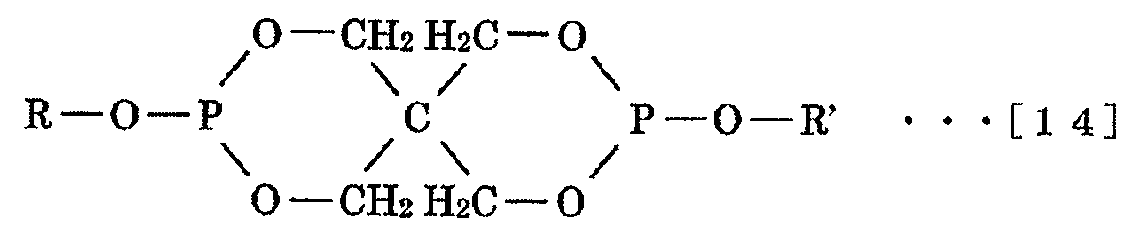
(식 [14] 중, R 및 R' 는 탄소수 6 ∼ 30 의 알킬기 또는 탄소수 6 ∼ 30 의 아릴기를 나타내고, 서로 동일해도 되고 상이해도 된다.)(In formula [14], R and R'represent a C6-C30 alkyl group or a C6-C30 aryl group, and may mutually be same or different.)
상기와 같이, 포스포나이트 화합물로는 테트라키스(2,4-디-tert-부틸페닐)-비페닐렌디포스포나이트가 바람직하고, 그 포스포나이트를 주성분으로 하는 안정제는, Sandostab P-EPQ (상표, Clariant 사 제조) 및 Irgafos P-EPQ (상표, CIBA SPECIALTY CHEMICALS 사 제조) 로서 시판되어 있고 모두 이용할 수 있다.As described above, tetrakis(2,4-di-tert-butylphenyl)-biphenylenediphosphonite is preferred as the phosphonite compound, and stabilizers based on the phosphonite are Sandostab P-EPQ. (Trademark, manufactured by Clariant) and Irgafos P-EPQ (trademark, manufactured by CIBA SPECIALTY CHEMICALS) and can be used both.
또 상기 식 [14] 중에서도 보다 바람직한 포스파이트 화합물은, 디스테아릴펜타에리트리톨디포스파이트, 비스(2,4-디-tert-부틸페닐)펜타에리트리톨디포스파이트, 비스(2,6-디-tert-부틸-4-메틸페닐)펜타에리트리톨디포스파이트, 및 비스{2,4-비스(1-메틸-1-페닐에틸)페닐}펜타에리트리톨디포스파이트이다.Moreover, among the above formula [14], more preferable phosphite compounds are distearyl pentaerythritol diphosphite, bis(2,4-di-tert-butylphenyl)pentaerythritol diphosphite, bis(2,6-di- tert-butyl-4-methylphenyl)pentaerythritol diphosphite, and bis{2,4-bis(1-methyl-1-phenylethyl)phenyl}pentaerythritol diphosphite.
디스테아릴펜타에리트리톨디포스파이트는, 아데카스타브 PEP-8 (상표, 아사히 전화 공업 (주) 제조), JPP681S (상표, 죠호쿠 화학 공업 (주) 제조) 로서 시판되어 있고 모두 이용할 수 있다. 비스(2,4-디-tert-부틸페닐)펜타에리트리톨디포스파이트는, 아데카스타브 PEP-24G (상표, 아사히 전화 공업 (주) 제조), Alkanox P-24 (상표, Great Lakes 사 제조), Ultranox P626 (상표, GE Specialty Chemicals 사 제조), Doverphos S-9432 (상표, Dover Chemical 사 제조), 그리고 Irgaofos126 및 126FF (상표, CIBA SPECIALTY CHEMICALS 사 제조) 등으로서 시판되어 있고 모두 이용할 수 있다. 비스(2,6-디-tert-부틸-4-메틸페닐)펜타에리트리톨디포스파이트는 아데카스타브 PEP-36 (상표, 아사히 전화 공업 (주) 제조) 으로서 시판되어 있고 용이하게 이용할 수 있다. 또 비스{2,4-비스(1-메틸-1-페닐에틸)페닐}펜타에리트리톨디포스파이트는, 아데카스타브 PEP-45 (상표, 아사히 전화 공업 (주) 제조), 및 Doverphos S-9228 (상표, Dover Chemical 사 제조) 로서 시판되어 있고 모두 이용할 수 있다.Distearyl pentaerythritol diphosphite is commercially available as Adekastab PEP-8 (trademark, manufactured by Asahi Telephone Industry Co., Ltd.) and JPP681S (trademark, manufactured by Johoku Chemical Industry Co., Ltd.) and can be used. Bis(2,4-di-tert-butylphenyl)pentaerythritol diphosphite is Adekastab PEP-24G (trademark, manufactured by Asahi Telephone Industry Co., Ltd.), Alkanox P-24 (trademark, manufactured by Great Lakes) , Ultranox P626 (trademark, manufactured by GE Specialty Chemicals), Doverphos S-9432 (trademark, manufactured by Dover Chemical), and Irgaofos126 and 126FF (trademark, manufactured by CIBA SPECIALTY CHEMICALS) and the like, and are all available. Bis(2,6-di-tert-butyl-4-methylphenyl)pentaerythritol diphosphite is commercially available as Adekastab PEP-36 (trademark, manufactured by Asahi Telephone Industry Co., Ltd.) and can be easily used. In addition, bis{2,4-bis(1-methyl-1-phenylethyl)phenyl}pentaerythritol diphosphite is Adekastab PEP-45 (trademark, manufactured by Asahi Telephone Industry Co., Ltd.), and Doverphos S-9228 (Trademark, manufactured by Dover Chemical) and can be used both.
(e2) 힌더드페놀계 산화 방지제(e2) Hindered phenolic antioxidant
힌더드페놀 화합물로는, 통상 수지에 배합되는 각종 화합물을 사용할 수 있다. 이러한 힌더드페놀 화합물로는, 예를 들어, α-토코페롤, 부틸하이드록시톨루엔, 시나필알코올, 비타민 E, 옥타데실-3-(3,5-디-tert-부틸-4-하이드록시페닐)프로피오네이트, 2-tert-부틸-6-(3'-tert-부틸-5'-메틸-2'-하이드록시벤질)-4-메틸페닐아크릴레이트, 2,6-디-tert-부틸-4-(N,N-디메틸아미노메틸)페놀, 3,5-디-tert-부틸-4-하이드록시벤질포스포네이트디에틸에스테르, 2,2'-메틸렌비스(4-메틸-6-tert-부틸페놀), 2,2'-메틸렌비스(4-에틸-6-tert-부틸페놀), 4,4'-메틸렌비스(2,6-디-tert-부틸페놀), 2,2'-메틸렌비스(4-메틸-6-시클로헥실페놀), 2,2'-디메틸렌-비스(6-α-메틸-벤질-p-크레졸), 2,2'-에틸리덴-비스(4,6-디-tert-부틸페놀), 2,2'-부틸리덴-비스(4-메틸-6-tert-부틸페놀), 4,4'-부틸리덴비스(3-메틸-6-tert-부틸페놀), 트리에틸렌글리콜-N-비스-3-(3-tert-부틸-4-하이드록시-5-메틸페닐)프로피오네이트, 1,6-헥산디올비스[3-(3,5-디-tert-부틸-4-하이드록시페닐)프로피오네이트], 비스[2-tert-부틸-4-메틸6-(3-tert-부틸-5-메틸-2-하이드록시벤질)페닐]테레프탈레이트, 3,9-비스{2-[3-(3-tert-부틸-4-하이드록시-5-메틸페닐)프로피오닐옥시]-1,1,-디메틸에틸}-2,4,8,10-테트라옥사스피로[5,5]운데칸, 4,4'-티오비스(6-tert-부틸-m-크레졸), 4,4'-티오비스(3-메틸-6-tert-부틸페놀), 2,2'-티오비스(4-메틸-6-tert-부틸페놀), 비스(3,5-디-tert-부틸-4-하이드록시벤질)술파이드, 4,4'-디-티오비스(2,6-디-tert-부틸페놀), 4,4'-트리-티오비스(2,6-디-tert-부틸페놀), 2,2-티오디에틸렌비스-[3-(3,5-디-tert-부틸-4-하이드록시페닐)프로피오네이트], 2,4-비스(n-옥틸티오)-6-(4-하이드록시-3,5-디-tert-부틸아닐리노)-1,3,5-트리아진, N,N'-헥사메틸렌비스-(3,5-디-tert-부틸-4-하이드록시하이드로신나마이드), N,N'-비스[3-(3,5-디-tert-부틸-4-하이드록시페닐)프로피오닐]하이드라진, 1,1,3-트리스(2-메틸-4-하이드록시-5-tert-부틸페닐)부탄, 1,3,5-트리메틸-2,4,6-트리스(3,5-디-tert-부틸-4-하이드록시벤질)벤젠, 트리스(3,5-디-tert-부틸-4-하이드록시페닐)이소시아누레이트, 트리스(3,5-디-tert-부틸-4-하이드록시벤질)이소시아누레이트, 1,3,5-트리스(4-tert-부틸-3-하이드록시-2,6-디메틸벤질)이소시아누레이트, 1,3,5-트리스2[3(3,5-디-tert-부틸-4-하이드록시페닐)프로피오닐옥시]에틸이소시아누레이트, 테트라키스[메틸렌-3-(3,5-디-tert-부틸-4-하이드록시페닐)프로피오네이트]메탄, 트리에틸렌글리콜-N-비스-3-(3-tert-부틸-4-하이드록시-5-메틸페닐)프로피오네이트, 트리에틸렌글리콜-N-비스-3-(3-tert-부틸-4-하이드록시-5-메틸페닐)아세테이트, 3,9-비스[2-{3-(3-tert-부틸-4-하이드록시-5-메틸페닐)아세틸옥시}-1,1-디메틸에틸]-2,4,8,10-테트라옥사스피로[5,5]운데칸, 테트라키스[메틸렌-3-(3-tert-부틸-4-하이드록시-5-메틸페닐)프로피오네이트]메탄, 1,3,5-트리메틸-2,4,6-트리스(3-tert-부틸-4-하이드록시-5-메틸벤질)벤젠, 및 트리스(3-tert-부틸-4-하이드록시-5-메틸벤질)이소시아누레이트 등이 예시된다.As the hindered phenol compound, various compounds usually blended in resin can be used. Examples of the hindered phenol compound include α-tocopherol, butylhydroxytoluene, cinafil alcohol, vitamin E, and octadecyl-3-(3,5-di-tert-butyl-4-hydroxyphenyl). Propionate, 2-tert-butyl-6-(3'-tert-butyl-5'-methyl-2'-hydroxybenzyl)-4-methylphenylacrylate, 2,6-di-tert-butyl-4 -(N,N-dimethylaminomethyl)phenol, 3,5-di-tert-butyl-4-hydroxybenzylphosphonate diethyl ester, 2,2'-methylenebis(4-methyl-6-tert- Butylphenol), 2,2'-methylenebis(4-ethyl-6-tert-butylphenol), 4,4'-methylenebis(2,6-di-tert-butylphenol), 2,2'-methylene Bis(4-methyl-6-cyclohexylphenol), 2,2'-dimethylene-bis(6-α-methyl-benzyl-p-cresol), 2,2'-ethylidene-bis(4,6- Di-tert-butylphenol), 2,2'-butylidene-bis(4-methyl-6-tert-butylphenol), 4,4'-butylidenebis(3-methyl-6-tert-butyl Phenol), triethylene glycol-N-bis-3-(3-tert-butyl-4-hydroxy-5-methylphenyl)propionate, 1,6-hexanediolbis[3-(3,5-di- tert-butyl-4-hydroxyphenyl)propionate], bis[2-tert-butyl-4-methyl6-(3-tert-butyl-5-methyl-2-hydroxybenzyl)phenyl]terephthalate, 3,9-bis{2-[3-(3-tert-butyl-4-hydroxy-5-methylphenyl)propionyloxy]-1,1,-dimethylethyl}-2,4,8,10-tetra Oxaspiro[5,5]undecane, 4,4'-thiobis(6-tert-butyl-m-cresol), 4,4'-thiobis(3-methyl-6-tert-butylphenol), 2 ,2'-thiobis(4-methyl-6-tert-butylphenol), bis(3,5-di-tert-butyl-4-hydroxybenzyl)sulfide, 4,4'-di-thiobis( 2,6-di-tert-butylphenol), 4,4'-tri-thiobis(2,6-di-tert-butylphenol), 2,2-thiodiethylenebis-[3-(3,5 -Di-tert-butyl-4-hydroxyphenyl)propionate], 2,4-bis(n-octylthio)-6-(4-hydroxy-3,5-di-tert-butylanilino) -1,3,5-triazine, N,N'-hexamethylenebis-(3,5-di-tert-butyl-4-hydroxyhydrocinnamide), N,N'-bis[3-(3,5-di-tert-butyl-4 -Hydroxyphenyl)propionyl]hydrazine, 1,1,3-tris(2-methyl-4-hydroxy-5-tert-butylphenyl)butane, 1,3,5-trimethyl-2,4,6- Tris(3,5-di-tert-butyl-4-hydroxybenzyl)benzene, tris(3,5-di-tert-butyl-4-hydroxyphenyl)isocyanurate, tris(3,5-di -tert-butyl-4-hydroxybenzyl)isocyanurate, 1,3,5-tris(4-tert-butyl-3-hydroxy-2,6-dimethylbenzyl)isocyanurate, 1,3 ,5-tris2[3(3,5-di-tert-butyl-4-hydroxyphenyl)propionyloxy]ethyl isocyanurate, tetrakis[methylene-3-(3,5-di-tert- Butyl-4-hydroxyphenyl)propionate]methane, triethylene glycol-N-bis-3-(3-tert-butyl-4-hydroxy-5-methylphenyl)propionate, triethylene glycol-N- Bis-3-(3-tert-butyl-4-hydroxy-5-methylphenyl)acetate, 3,9-bis[2-{3-(3-tert-butyl-4-hydroxy-5-methylphenyl)acetyl Oxy}-1,1-dimethylethyl]-2,4,8,10-tetraoxaspiro[5,5]undecane, tetrakis[methylene-3-(3-tert-butyl-4-hydroxy-5 -Methylphenyl)propionate]methane, 1,3,5-trimethyl-2,4,6-tris(3-tert-butyl-4-hydroxy-5-methylbenzyl)benzene, and tris(3-tert- Butyl-4-hydroxy-5-methylbenzyl)isocyanurate and the like.
상기 화합물 중에서도, 본 발명에 있어서는 테트라키스[메틸렌-3-(3-tert-부틸-4-하이드록시-5-메틸페닐)프로피오네이트]메탄, 옥타데실-3-(3,5-디-tert-부틸-4-하이드록시페닐)프로피오네이트, 및 3,9-비스[2-{3-(3-t-부틸-4-하이드록시-5-메틸페닐)프로피오닐옥시}-1,1-디메틸에틸]-2,4,8,10-테트라옥사스피로[5,5]운데칸이 바람직하게 이용된다. 특히 3,9-비스[2-{3-(3-t-부틸-4-하이드록시-5-메틸페닐)프로피오닐옥시}-1,1-디메틸에틸]-2,4,8,10-테트라옥사스피로[5,5]운데칸이 바람직하다. 상기 힌더드페놀계 산화 방지제는, 단독으로 또는 2 종 이상을 조합하여 사용할 수 있다.Among the above compounds, in the present invention, tetrakis[methylene-3-(3-tert-butyl-4-hydroxy-5-methylphenyl)propionate]methane, octadecyl-3-(3,5-di-tert -Butyl-4-hydroxyphenyl)propionate, and 3,9-bis[2-{3-(3-t-butyl-4-hydroxy-5-methylphenyl)propionyloxy}-1,1- Dimethylethyl]-2,4,8,10-tetraoxaspiro[5,5]undecane is preferably used. In particular 3,9-bis[2-{3-(3-t-butyl-4-hydroxy-5-methylphenyl)propionyloxy}-1,1-dimethylethyl]-2,4,8,10-tetra Oxaspiro[5,5]undecane is preferred. The hindered phenol-based antioxidants can be used alone or in combination of two or more.
인계 안정제 및 힌더드페놀계 산화 방지제는 어느 것이 배합되는 것이 바람직하고, 이들의 병용은 더욱 바람직하다. 인계 안정제 및 힌더드페놀계 산화 방지제의 함유량은 A 성분 100 중량부에 대하여, 바람직하게는 0.001 ∼ 3 중량부, 보다 바람직하게는 0.005 ∼ 2 중량부, 더욱 바람직하게는 0.01 ∼ 1 중량부이다. 병용의 경우에는 A 성분 100 중량부에 대하여, 0.01 ∼ 0.3 중량부의 인계 안정제 및 0.01 ∼ 0.3 중량부의 힌더드페놀계 산화 방지제가 배합되는 것이 보다 바람직하다.It is preferable that a phosphorus stabilizer and a hindered phenolic antioxidant are blended, and their combination is more preferable. The content of the phosphorus stabilizer and the hindered phenolic antioxidant is preferably 0.001 to 3 parts by weight, more preferably 0.005 to 2 parts by weight, and even more preferably 0.01 to 1 part by weight with respect to 100 parts by weight of component A. In the case of combination, it is more preferable to mix 0.01 to 0.3 parts by weight of a phosphorus-based stabilizer and 0.01 to 0.3 parts by weight of a hindered phenol-based antioxidant with respect to 100 parts by weight of component A.
(e3) 이형제(e3) mold release agent
본 발명의 수지 조성물에는, 그 성형시의 생산성 향상이나 성형품의 변형의 저감을 목적으로 하여, 추가로 이형제를 배합하는 것이 바람직하다. 이러한 이형제로는 공지된 것을 사용할 수 있다. 예를 들어, 포화 지방산 에스테르, 불포화 지방산 에스테르, 폴리올레핀계 왁스 (폴리에틸렌 왁스, 1-알켄 중합체 등. 산 변성 등의 관능기 함유 화합물로 변성되어 있는 것도 사용할 수 있다), 실리콘 화합물, 불소 화합물 (폴리플루오로알킬에테르로 대표되는 불소 오일 등), 파라핀 왁스, 밀랍 등을 들 수 있다. 그 중에서도 바람직한 이형제로서 지방산 에스테르를 들 수 있다. 이러한 지방산 에스테르는, 지방족 알코올과 지방족 카르복실산의 에스테르이다. 이러한 지방족 알코올은 1 가 알코올이어도 되고 2 가 이상의 다가 알코올이어도 된다. 또 그 알코올의 탄소수로는, 3 ∼ 32 의 범위, 보다 바람직하게는 5 ∼ 30 의 범위이다. 이러한 1 가 알코올로는, 예를 들어 도데칸올, 테트라데칸올, 헥사데칸올, 옥타데칸올, 에이코사놀, 테트라코사놀, 세릴알코올, 및 트리아콘탄올 등이 예시된다. 이러한 다가 알코올로는, 펜타에리트리톨, 디펜타에리트리톨, 트리펜타에리트리톨, 폴리글리세롤 (트리글리세롤 ∼ 헥사글리세롤), 디트리메틸올프로판, 자일리톨, 소르비톨, 및 만니톨 등을 들 수 있다. 본 발명의 지방산 에스테르에 있어서는 다가 알코올이 보다 바람직하다.It is preferable to further mix a mold release agent in the resin composition of the present invention for the purpose of improving productivity at the time of molding and reducing deformation of the molded article. As such a release agent, a known one can be used. For example, saturated fatty acid esters, unsaturated fatty acid esters, polyolefin-based waxes (polyethylene wax, 1-alkene polymers, etc., those modified with functional group-containing compounds such as acid modification can also be used), silicone compounds, fluorine compounds (polyfluoro Fluorine oil represented by roalkyl ether, etc.), paraffin wax, beeswax, and the like. Among them, fatty acid esters are exemplified as preferred mold release agents. These fatty acid esters are esters of aliphatic alcohols and aliphatic carboxylic acids. The aliphatic alcohol may be a monohydric alcohol or a dihydric or higher polyhydric alcohol. Moreover, as carbon number of the alcohol, it is 3 to 32, More preferably, it is 5 to 30. Examples of such monohydric alcohols include dodecanol, tetradecanol, hexadecanol, octadecanol, eicosanol, tetracosanol, seryl alcohol, and triacontanol. Examples of such polyhydric alcohols include pentaerythritol, dipentaerythritol, tripentaerythritol, polyglycerol (triglycerol to hexaglycerol), ditrimethylolpropane, xylitol, sorbitol, and mannitol. In the fatty acid ester of the present invention, polyhydric alcohol is more preferable.
한편, 지방족 카르복실산은 탄소수 3 ∼ 32 인 것이 바람직하고, 특히 탄소수 10 ∼ 22 의 지방족 카르복실산이 바람직하다. 그 지방족 카르복실산으로는, 예를 들어 데칸산, 운데칸산, 도데칸산, 트리데칸산, 테트라데칸산, 펜타데칸산, 헥사데칸산 (팔미트산), 헵타데칸산, 옥타데칸산 (스테아르산), 노나데칸산, 베헨산, 이코산산, 및 도코산산 등의 포화 지방족 카르복실산, 그리고 팔미톨레산, 올레산, 리놀산, 리놀렌산, 에이코센산, 에이코사펜타엔산, 및 세톨레산 등의 불포화 지방족 카르복실산을 들 수 있다. 상기 중에서도 지방족 카르복실산은, 탄소 원자수 14 ∼ 20 인 것이 바람직하다. 그 중에서도 포화 지방족 카르복실산이 바람직하다. 특히 스테아르산 및 팔미트산이 바람직하다.On the other hand, the aliphatic carboxylic acid preferably has 3 to 32 carbon atoms, particularly preferably an aliphatic carboxylic acid having 10 to 22 carbon atoms. As the aliphatic carboxylic acid, for example, decanoic acid, undecanoic acid, dodecanoic acid, tridecanoic acid, tetradecanoic acid, pentadecanoic acid, hexadecanoic acid (palmitic acid), heptadecanoic acid, octadecanoic acid (stearic acid) Acids), saturated aliphatic carboxylic acids such as nonadecanoic acid, behenic acid, docoic acid, and docoic acid, and unsaturated acids such as palmitoleic acid, oleic acid, linoleic acid, linolenic acid, eicogenic acid, eicosapentaenoic acid, and cetoleic acid. And aliphatic carboxylic acids. Among the above, it is preferable that the aliphatic carboxylic acid has 14 to 20 carbon atoms. Especially, saturated aliphatic carboxylic acid is preferable. In particular, stearic acid and palmitic acid are preferred.
스테아르산이나 팔미트산 등 상기의 지방족 카르복실산은 통상, 우지나 돈지 등으로 대표되는 동물성 유지 및 팜유나 선플라워유로 대표되는 식물성 유지 등의 천연 유지류로 제조되기 때문에, 이들의 지방족 카르복실산은, 통상 탄소 원자수가 상이한 다른 카르복실산 성분을 포함하는 혼합물이다. 따라서 본 발명의 지방산 에스테르의 제조에 있어서도 이러한 천연 유지류로 제조되고, 다른 카르복실산 성분을 포함하는 혼합물의 형태로 이루어지는 지방족 카르복실산, 특히 스테아르산이나 팔미트산이 바람직하게 사용된다.Since the above aliphatic carboxylic acids such as stearic acid and palmitic acid are usually made of natural fats and oils such as animal fats and oils represented by Uji or pork and vegetable oils represented by palm oil and sunflower oil, these aliphatic carboxylic acids are It is usually a mixture containing other carboxylic acid components having different carbon atoms. Therefore, in the production of the fatty acid ester of the present invention, aliphatic carboxylic acids made of such natural fats and oils in the form of a mixture containing other carboxylic acid components, particularly stearic acid or palmitic acid, are preferably used.
본 발명의 지방산 에스테르는, 부분 에스테르 및 전체 에스테르 (풀 에스테르) 중 어느 것이어도 된다. 그러나 부분 에스테르에서는 통상 수산기가가 높아져 고온시의 수지의 분해 등을 유발하기 쉬우므로, 보다 바람직하게는 풀 에스테르이다. 본 발명의 지방산 에스테르에 있어서의 산가는, 열안정성의 점에서 바람직하게는 20 이하, 보다 바람직하게는 4 ∼ 20 의 범위, 더욱 바람직하게는 4 ∼ 12 의 범위이다. 또한, 산가는 실질적으로 0 을 취할 수 있다. 또 지방산 에스테르의 수산기가는 0.1 ∼ 30 의 범위가 보다 바람직하다. 또한 요오드가는, 10 이하가 바람직하다. 또한, 요오드가는 실질적으로 0 을 취할 수 있다. 이들의 특성은 JIS K 0070 에 규정된 방법에 의해 구할 수 있다.The fatty acid ester of the present invention may be either a partial ester or a total ester (full ester). However, in the partial ester, the hydroxyl value is usually high, and it is easy to cause decomposition or the like of the resin at high temperature, and therefore, it is more preferably a full ester. The acid value in the fatty acid ester of the present invention is preferably 20 or less, more preferably 4 to 20, and more preferably 4 to 12 in view of thermal stability. In addition, the acid value can be substantially zero. Moreover, as for the hydroxyl value of a fatty acid ester, the range of 0.1-30 is more preferable. In addition, the iodine number is preferably 10 or less. Also, the iodine number can be substantially zero. These properties can be obtained by the method specified in JIS K 0070.
이형제의 함유량은, A 성분 100 중량부에 대하여, 바람직하게는 0.005 ∼ 2 중량부, 보다 바람직하게는 0.01 ∼ 1 중량부, 더욱 바람직하게는 0.05 ∼ 0.5 중량부이다. 이러한 범위에 있어서는, 수지 조성물은 양호한 이형성 및 이롤성을 갖는다. 특히 이러한 양의 지방산 에스테르는 양호한 색상을 저해하는 일 없이 양호한 이형성 및 이롤성을 갖는 난연성 수지 조성물을 제공한다.The content of the release agent is preferably 0.005 to 2 parts by weight, more preferably 0.01 to 1 part by weight, and even more preferably 0.05 to 0.5 part by weight with respect to 100 parts by weight of the component A. Within this range, the resin composition has good mold release properties and roll properties. In particular, this amount of fatty acid ester provides a flame retardant resin composition having good releasability and rollability without inhibiting good color.
(e4) 그 밖의 열안정제(e4) Other heat stabilizers
본 발명의 난연성 수지 조성물에는, 상기의 인계 안정제 및 힌더드페놀계 산화 방지제 이외의 다른 열안정제를 배합할 수도 있다. 이러한 그 밖의 열안정제는, 이들의 안정제 및 산화 방지제 중 어느 것과도 병용되는 것이 바람직하고, 특히 양자와 병용되는 것이 바람직하다. 이러한 다른 열안정제로는, 예를 들어 3-하이드록시-5,7-디-tert-부틸-푸란-2-온과 o-자일렌의 반응 생성물로 대표되는 락톤계 안정제 (이러한 안정제의 자세한 것은 일본 공개특허공보 평7-233160호에 기재되어 있다) 가 바람직하게 예시된다. 이러한 화합물은 Irganox HP-136 (상표, CIBA SPECIALTY CHEMICALS 사 제조) 으로서 시판되고, 그 화합물을 이용할 수 있다. 또한 그 화합물과 각종 포스파이트 화합물 및 힌더드페놀 화합물을 혼합한 안정제가 시판되고 있다. 예를 들어 상기 사 제조의 Irganox HP-2921 이 바람직하게 예시된다. 본 발명에 있어서도 이러한 미리 혼합된 안정제를 이용할 수도 있다. 락톤계 안정제의 배합량은, A 성분 100 중량부에 대하여, 바람직하게는 0.0005 ∼ 0.05 중량부, 보다 바람직하게는 0.001 ∼ 0.03 중량부이다.In the flame-retardant resin composition of the present invention, other heat stabilizers other than the phosphorus-based stabilizer and hindered phenol-based antioxidant can also be blended. It is preferable to use together these other heat stabilizers with any of these stabilizers and antioxidants, and it is especially preferable to use together with both. Examples of such other heat stabilizers include, for example, lactone-based stabilizers represented by reaction products of 3-hydroxy-5,7-di-tert-butyl-furan-2-one and o-xylene (details of these stabilizers are described in detail). Japanese Patent Application Laid-open No. Hei 7-233160) is preferably exemplified. Such a compound is commercially available as Irganox HP-136 (trademark, manufactured by CIBA SPECIALTY CHEMICALS), and the compound can be used. In addition, stabilizers obtained by mixing the compound with various phosphite compounds and hindered phenol compounds are commercially available. For example, Irganox HP-2921 manufactured by the company is preferably exemplified. In the present invention, it is also possible to use such pre-mixed stabilizers. The blending amount of the lactone-based stabilizer is preferably 0.0005 to 0.05 parts by weight, and more preferably 0.001 to 0.03 parts by weight based on 100 parts by weight of the A component.
또 그 밖의 안정제로는, 펜타에리트리톨테트라키스(3-메르캅토프로피오네이트), 펜타에리트리톨테트라키스(3-라우릴티오프로피오네이트), 및 글리세롤-3-스테아릴티오프로피오네이트 등의 황 함유 안정제가 예시된다. 이러한 안정제는, 수지 조성물이 회전 성형에 적용되는 경우에 특히 유효하다. 이러한 황 함유 안정제의 배합량은, A 성분 100 중량부에 대하여, 바람직하게는 0.001 ∼ 0.1 중량부, 보다 바람직하게는 0.01 ∼ 0.08 중량부이다.Further stabilizers include pentaerythritol tetrakis (3-mercaptopropionate), pentaerythritol tetrakis (3-laurylthiopropionate), and glycerol-3-stearylthiopropionate. And sulfur-containing stabilizers. Such stabilizers are particularly effective when the resin composition is applied to rotational molding. The amount of the sulfur-containing stabilizer to be blended is preferably 0.001 to 0.1 parts by weight, and more preferably 0.01 to 0.08 parts by weight based on 100 parts by weight of the component A.
(e5) 염 안료(e5) Salt pigment
본 발명의 수지 조성물은 추가로 각종 염 안료를 함유하고 다양한 의장성을 발현하는 성형품을 제공할 수 있다. 본 발명에서 사용하는 염 안료로는, 페릴렌계 염료, 쿠마린계 염료, 티오인디고계 염료, 안트라퀴논계 염료, 티오크산톤계 염료, 감청 등의 페로시안화물, 페리논계 염료, 퀴놀린계 염료, 퀴나크리돈계 염료, 디옥사진계 염료, 이소인돌리논계 염료, 및 프탈로시아닌계 염료 등을 들 수 있다. 또한 본 발명의 수지 조성물은 메탈릭 안료를 배합하여 보다 양호한 메탈릭 색채를 얻을 수도 있다. 메탈릭 안료로는, 알루미늄 분말이 바람직하다. 또, 형광 증백제나 그 이외의 발광을 하는 형광 염료를 배합함으로써, 발광색을 살린 더욱 양호한 의장 효과를 부여할 수 있다.The resin composition of the present invention may further provide a molded article containing various salt pigments and expressing various design properties. Examples of the salt pigment used in the present invention include perylene-based dyes, coumarin-based dyes, thioindigo-based dyes, anthraquinone-based dyes, thioxanthone-based dyes, perrocyanides such as wiretap, perinone-based dyes, quinoline-based dyes, and quina And credon-based dyes, dioxazine-based dyes, isoindolinone-based dyes, and phthalocyanine-based dyes. In addition, the resin composition of the present invention may be obtained by blending a metallic pigment to obtain a better metallic color. As the metallic pigment, aluminum powder is preferred. Further, by mixing a fluorescent whitening agent or other fluorescent dye that emits light, a better design effect utilizing the luminous color can be provided.
(e6) 형광 증백제(e6) Fluorescent whitening agent
본 발명의 수지 조성물에 있어서 형광 증백제는, 수지 등의 색조를 백색 혹은 청백색으로 개선하기 위해서 사용되는 것이면 특별히 제한은 없고, 예를 들어 스틸벤계, 벤즈이미다졸계, 벤즈옥사졸계, 나프탈이미드계, 로다민계, 쿠마린계, 옥사진계 화합물 등을 들 수 있다. 구체적으로는 예를 들어 CI Fluorescent Brightener 219 : 1 이나, 이스트만 케미컬사 제조 EASTOBRITE OB-1 이나 쇼와 화학 (주) 제조 「학콜 PSR」 등을 들 수 있다. 여기서 형광 증백제는, 광선의 자외부의 에너지를 흡수하고, 이 에너지를 가시부에 방사하는 작용을 갖는 것이다. 형광 증백제의 함유량은 수지 성분 100 중량부에 대하여, 0.001 ∼ 0.1 중량부가 바람직하고, 보다 바람직하게는 0.001 ∼ 0.05 중량부이다. 0.1 중량부를 초과해도 그 조성물의 색조의 개량 효과는 작다.In the resin composition of the present invention, the fluorescent brightener is not particularly limited as long as it is used to improve the color tone of the resin to white or blue-white, for example, stilbene, benzimidazole, benzoxazole, and naphthalic And a mid-based, rhodamine-based, coumarin-based, and oxazine-based compound. Specifically, for example, CI Fluorescent Brightener 219: 1, EASTOBRITE OB-1 manufactured by Eastman Chemical, Showa Chemical Co., Ltd. "Hakkol PSR", etc. may be mentioned. Here, the fluorescent whitening agent has an action of absorbing the energy of the ultraviolet region of the light beam and radiating this energy to the visible region. The content of the fluorescent whitening agent is preferably 0.001 to 0.1 parts by weight, more preferably 0.001 to 0.05 parts by weight with respect to 100 parts by weight of the resin component. Even if it exceeds 0.1 part by weight, the effect of improving the color tone of the composition is small.
(e7) 열선 흡수능을 갖는 화합물(e7) Compounds having the ability to absorb heat rays
본 발명의 수지 조성물은 열선 흡수능을 갖는 화합물을 함유할 수 있다. 이러한 화합물로는 프탈로시아닌계 근적외선 흡수제, ATO, ITO, 산화이리듐 및 산화루테늄, 산화이모늄, 산화티탄 등의 금속 산화물계 근적외선 흡수제, 붕소화란탄, 붕소화세륨 및 붕소화텅스텐 등의 금속 붕소화물계나 산화텅스텐계 근적외선 흡수제 등의 근적외 흡수능이 우수한 각종 금속 화합물, 그리고 탄소 필러가 바람직하게 예시된다. 이러한 프탈로시아닌계 근적외선 흡수제로는 예를 들어 미츠이 화학 (주) 제조 MIR-362 가 시판되고 용이하게 입수 가능하다. 탄소 필러로는 카본 블랙, 그라파이트 (천연, 및 인공 모두 포함한다) 및 풀러렌 등이 예시되고, 바람직하게는 카본 블랙 및 그라파이트이다. 이들은 단체 또는 2 종 이상을 병용하여 사용할 수 있다. 프탈로시아닌계 근적외선 흡수제의 함유량은, 수지 성분 100 중량부를 기준으로 하여 0.0005 ∼ 0.2 중량부가 바람직하고, 0.0008 ∼ 0.1 중량부가 보다 바람직하고, 0.001 ∼ 0.07 중량부가 더욱 바람직하다. 금속 산화물계 근적외선 흡수제, 금속 붕소화물계 근적외선 흡수제 및 탄소 필러의 함유량은, 본 발명의 수지 조성물 중, 0.1 ∼ 200 ppm (중량 비율) 의 범위가 바람직하고, 0.5 ∼ 100 ppm 의 범위가 보다 바람직하다.The resin composition of the present invention may contain a compound having the ability to absorb heat rays. These compounds include phthalocyanine-based near infrared absorbers, metal oxide-based near infrared absorbers such as ATO, ITO, iridium oxide and ruthenium oxide, immonium oxide, and titanium oxide, metal boride systems such as lanthanum borohydride, cerium borohydride, and tungsten boride. Various metal compounds having excellent near-infrared absorption ability, such as tungsten oxide-based near infrared absorbers, and carbon fillers are exemplified. As such a phthalocyanine-based near infrared absorber, MIR-362 manufactured by Mitsui Chemical Co., Ltd. is commercially available and readily available. Carbon fillers include carbon black, graphite (including both natural and artificial), fullerenes, and the like, and preferably carbon black and graphite. These can be used alone or in combination of two or more. The content of the phthalocyanine-based near infrared absorber is preferably 0.0005 to 0.2 parts by weight, more preferably 0.0008 to 0.1 parts by weight, and even more preferably 0.001 to 0.07 parts by weight based on 100 parts by weight of the resin component. The content of the metal oxide-based near-infrared absorber, metal boride-based near-infrared absorber, and carbon filler is preferably in the range of 0.1 to 200 ppm (weight ratio) in the resin composition of the present invention, and more preferably in the range of 0.5 to 100 ppm. .
(e8) 광 확산제(e8) light diffusing agent
본 발명의 수지 조성물에는, 광 확산제를 배합하여 광 확산 효과를 부여할 수 있다. 이러한 광 확산제로는 고분자 미립자, 탄산칼슘과 같은 저굴절률의 무기 미립자, 및 이들의 복합물 등이 예시된다. 이러한 고분자 미립자는, 이미 폴리카보네이트 수지의 광 확산제로서 공지된 미립자이다. 보다 바람직하게는 입경 수 ㎛ 의 아크릴 가교 입자 및 폴리오르가노실세스퀴옥산으로 대표되는 실리콘 가교 입자 등이 예시된다. 광 확산제의 형상은 구형, 원반형, 주형 (柱形), 및 부정형 등이 예시된다. 이러한 구형은, 완전 구일 필요는 없고 변형되어 있는 것을 포함하고, 이러한 주형은 입방체를 포함한다. 바람직한 광 확산제는 구형이고, 그 입경은 균일할수록 바람직하다. 광 확산제의 함유량은, 수지 성분 100 중량부를 기준으로 하여 바람직하게는 0.005 ∼ 20 중량부, 보다 바람직하게는 0.01 ∼ 10 중량부, 더욱 바람직하게는 0.01 ∼ 3 중량부이다. 또한, 광 확산제는 2 종 이상을 병용할 수 있다.A light diffusing agent can be added to the resin composition of the present invention to impart a light diffusing effect. Examples of the light-diffusing agent include polymer fine particles, low-refractive-index inorganic fine particles such as calcium carbonate, and composites thereof. Such polymer fine particles are fine particles already known as light diffusion agents for polycarbonate resins. More preferably, acrylic crosslinked particles having a particle diameter of several µm, silicone crosslinked particles represented by polyorganosilsesquioxane, and the like are exemplified. Examples of the shape of the light diffusion agent include a spherical shape, a disc shape, a mold shape, and an irregular shape. Such a spherical shape does not have to be a complete spherical shape, but includes a modified one, and this template includes a cube. The preferred light diffusing agent is spherical, and the more uniform the particle diameter, the more preferable. The content of the light diffusing agent is preferably 0.005 to 20 parts by weight, more preferably 0.01 to 10 parts by weight, further preferably 0.01 to 3 parts by weight based on 100 parts by weight of the resin component. Moreover, 2 or more types of light diffusers can be used together.
(e9) 광 고반사용 백색 안료(e9) White pigment for high reflection use
본 발명의 수지 조성물에는, 광 고반사용 백색 안료를 배합하여 광 반사 효과를 부여할 수 있다. 이러한 백색 안료로는 이산화티탄 (특히 실리콘 등 유기 표면 처리제에 의해 처리된 이산화티탄) 안료가 특히 바람직하다. 이러한 광 고반사용 백색 안료의 함유량은, 수지 성분 100 중량부를 기준으로 하여 3 ∼ 30 중량부가 바람직하고, 8 ∼ 25 중량부가 보다 바람직하다. 또한, 광 고반사용 백색 안료는 2 종 이상을 병용할 수 있다.In the resin composition of the present invention, a light-reflecting white pigment can be blended to impart a light reflection effect. As such a white pigment, a titanium dioxide (especially titanium dioxide treated with an organic surface treatment agent such as silicon) pigment is particularly preferable. The content of the white pigment for use in advertising is preferably 3 to 30 parts by weight, more preferably 8 to 25 parts by weight based on 100 parts by weight of the resin component. In addition, two or more types of white pigments for adverts can be used in combination.
(e10) 대전 방지제(e10) Antistatic agent
본 발명의 수지 조성물에는, 대전 방지 성능이 요구되는 경우가 있고, 이러한 경우 대전 방지제를 포함하는 것이 바람직하다. 이러한 대전 방지제로는, 예를 들어 (1) 도데실벤젠술폰산포스포늄염으로 대표되는 아릴술폰산포스포늄염, 및 알킬술폰산포스포늄염 등의 유기 술폰산포스포늄염, 그리고 테트라플루오로붕산포스포늄염과 같은 붕산포스포늄염을 들 수 있다. 그 포스포늄염의 함유량은, 수지 성분 100 중량부에 대하여, 5 중량부 이하가 적절하고, 바람직하게는 0.05 ∼ 5 중량부, 보다 바람직하게는 1 ∼ 3.5 중량부, 더욱 바람직하게는 1.5 ∼ 3 중량부의 범위이다. 대전 방지제로는 예를 들어, (2) 유기 술폰산리튬, 유기 술폰산나트륨, 유기 술폰산칼륨, 유기 술폰산세슘, 유기 술폰산루비듐, 유기 술폰산칼슘, 유기 술폰산마그네슘, 및 유기 술폰산바륨 등의 유기 술폰산알칼리 (토류) 금속염을 들 수 있다. 이러한 금속염은 전술한 바와 같이, 난연제로서도 사용된다. 이러한 금속염은, 보다 구체적으로는 예를 들어 도데실벤젠술폰산의 금속염이나 퍼플루오로알칸술폰산의 금속염 등이 예시된다. 유기 술폰산알칼리 (토류) 금속염의 함유량은 수지 성분 100 중량부를 기준으로 하여, 0.5 중량부 이하가 적절하고, 바람직하게는 0.001 ∼ 0.3 중량부, 보다 바람직하게는 0.005 ∼ 0.2 중량부이다. 특히 칼륨, 세슘, 및 루비듐 등의 알칼리 금속염이 바람직하다.The resin composition of the present invention may require antistatic performance, and in such cases, it is preferable to include an antistatic agent. Examples of such antistatic agents include (1) phosphonium salts of phosphonium salts of arylsulfonic acids, such as phosphonium salts of dodecylbenzenesulfonic acid salts, and phosphonium salts of organic sulfonates such as phosphonium salts of alkylsulfonic acids and phosphonium salts of tetrafluoroborate. And phosphonium borate salts. The content of the phosphonium salt is preferably 5 parts by weight or less with respect to 100 parts by weight of the resin component, preferably 0.05 to 5 parts by weight, more preferably 1 to 3.5 parts by weight, still more preferably 1.5 to 3 parts by weight It is a range of wealth. As an antistatic agent, for example, (2) organic sulfonates such as organic lithium sulfonate, organic sodium sulfonate, organic potassium sulfonate, organic cesium sulfonate, rubidium organic sulfonate, organic calcium sulfonate, organic magnesium sulfonate, and organic barium sulfonate (earths) ) Metal salts. As described above, such a metal salt is also used as a flame retardant. More specifically, metal salts of dodecylbenzenesulfonic acid, metal salts of perfluoroalkanesulfonic acid, and the like are exemplified. The content of the organic sulfonate alkali (earth) metal salt is preferably 0.5 parts by weight or less based on 100 parts by weight of the resin component, preferably 0.001 to 0.3 parts by weight, more preferably 0.005 to 0.2 parts by weight. In particular, alkali metal salts such as potassium, cesium, and rubidium are preferred.
대전 방지제로는, 예를 들어 (3) 알킬술폰산암모늄염, 및 아릴술폰산암모늄염 등의 유기 술폰산암모늄염을 들 수 있다. 그 암모늄염은 수지 성분 100 중량부를 기준으로 하여 0.05 중량부 이하가 적절하다. 대전 방지제로는, 예를 들어 (4) 폴리에테르에스테르아미드와 같은 폴리(옥시알킬렌)글리콜 성분을 그 구성 성분으로서 함유하는 폴리머를 들 수 있다. 그 폴리머는 수지 성분 100 중량부를 기준으로 하여 5 중량부 이하가 적절하다.Examples of the antistatic agent include (3) organic sulfonate ammonium salts such as ammonium alkylsulfonate salts and ammonium arylsulfonate salts. The ammonium salt is suitably 0.05 parts by weight or less based on 100 parts by weight of the resin component. As an antistatic agent, the polymer which contains poly(oxyalkylene) glycol component, such as (4) polyetheresteramide, as a structural component, for example is mentioned. The polymer is suitably 5 parts by weight or less based on 100 parts by weight of the resin component.
(e11) 충전재(e11) filler
본 발명의 수지 조성물에는, 강화 필러로서 공지된 각종 충전재를 배합할 수 있다. 이러한 충전재로는, 각종 섬유상 충전재, 판상 충전재, 및 입상 충전재를 이용할 수 있다. 여기서, 섬유상 충전재는 그 형상이 섬유상 (봉상, 침상, 또는 그 축이 복수의 방향으로 연장된 형상을 모두 포함한다) 이고, 판상 충전재는 그 형상이 판상 (표면에 요철을 갖는 것이나, 판이 만곡을 갖는 것을 포함한다) 인 충전재이다. 입상 충전재는, 부정 형상을 포함하는 이들 이외의 형상의 충전재이다. 상기 섬유상이나 판상의 형상은 충전재의 형상 관찰로부터 분명한 경우가 많지만, 예를 들어 이른바 부정형과의 차이로는, 그 애스펙트비가 3 이상인 것은 섬유상이나 판상이라고 할 수 있다.Various fillers known as reinforcing fillers can be blended into the resin composition of the present invention. As such a filler, various fibrous fillers, plate-shaped fillers, and granular fillers can be used. Here, the fibrous filler has a fibrous shape (including a rod, needle, or a shape in which its axis extends in a plurality of directions), and the plate-like filler has a plate shape (having irregularities on the surface, but the plate is curved). It contains phosphorus). Granular fillers are fillers of shapes other than these, including irregular shapes. The shape of the fibrous or plate-like shape is often clear from observation of the shape of the filler, but for example, the difference from the so-called irregular shape is that the aspect ratio is 3 or more can be said to be fibrous or plate-like.
판상 충전재로는, 유리 플레이크, 탤크, 마이카, 카올린, 메탈 플레이크, 카본 플레이크, 및 그라파이트, 그리고 이들 충전제에 대해 예를 들어 금속이나 금속 산화물 등의 이종 재료를 표면 피복한 판상 충전재 등이 바람직하게 예시된다. 그 입경은 0.1 ∼ 300 ㎛ 의 범위가 바람직하다. 이러한 입경은, 10 ㎛ 정도까지의 영역은 액상 침강법의 하나인 X 선 투과법으로 측정된 입자경 분포의 메디안 직경 (D50) 에 의한 값을 말하고, 10 ∼ 50 ㎛ 의 영역에서는 레이저 회절·산란법으로 측정된 입자경 분포의 메디안 직경 (D50) 에 의한 값을 말하고, 50 ∼ 300 ㎛ 의 영역에서는 진동식 체 분류법에 의한 값이다. 이러한 입경은 수지 조성물 중에서의 입경이다. 판상 충전재는, 각종 실란계, 티타네이트계, 알루미네이트계, 및 지르코네이트계 등의 커플링제로 표면 처리되어도 되고, 또 올레핀계 수지, 스티렌계 수지, 아크릴계 수지, 폴리에스테르계 수지, 에폭시계 수지, 및 우레탄계 수지 등의 각종 수지나 고급 지방산 에스테르 등에 의해 집속 처리되거나, 또는 압축 처리된 조립물이어도 된다.Examples of the plate-like filler include glass flakes, talc, mica, kaolin, metal flakes, carbon flakes, and graphite, and plate-like fillers surface-coated with dissimilar materials such as metals or metal oxides for these fillers. do. The particle size is preferably in the range of 0.1 to 300 µm. Such a particle size refers to a value by the median diameter (D50) of the particle size distribution measured by the X-ray transmission method, which is one of the liquid sedimentation methods in the region up to about 10 μm, and laser diffraction/scattering in the region of 10 to 50 μm. It refers to the value of the particle size distribution measured by the median diameter (D50), and in the region of 50 to 300 µm, it is the value by vibrating sieve classification. Such a particle size is a particle size in a resin composition. The plate-like filler may be surface treated with various silane-based, titanate-based, aluminate-based, or zirconate-based coupling agents, and olefin-based resins, styrene-based resins, acrylic-based resins, polyester-based resins, and epoxy-based resins. It may be a resin, and various resins such as urethane-based resins, high-density fatty acid esters, or the like, or may be compressed granulated products.
섬유상 충전재는, 그 섬유경이 0.1 ∼ 20 ㎛ 의 범위가 바람직하다. 섬유경의 상한은 13 ㎛ 가 보다 바람직하고, 10 ㎛ 가 더욱 바람직하다. 한편 섬유경의 하한은 1 ㎛ 가 바람직하다. 여기서 말하는 섬유경이란 수평균 섬유경을 가리킨다. 또한, 이러한 수평균 섬유경은, 성형품을 용제에 용해시키거나 혹은 수지를 염기성 화합물로 분해한 후에 채취되는 잔류물, 및 도가니에서 회화 (灰化) 를 실시한 후에 채취되는 회화 잔류물을 주사 전자 현미경 관찰한 화상으로부터 산출되는 값이다. 이러한 섬유상 충전재로는, 예를 들어, 유리 파이버, 편평 단면 유리 섬유, 유리 밀드 파이버, 카본 파이버, 카본 밀드 파이버, 메탈 파이버, 아스베스토, 록 울, 세라믹 파이버, 슬래그 파이버, 티탄산칼륨 위스커, 보론 위스커, 붕산알루미늄 위스커, 탄산칼슘 위스커, 산화티탄 위스커, 월라스토나이트, 제노틀라이트, 팔리고르스카이트 (아타풀자이트), 및 세피올라이트 등의 섬유상 무기 충전재, 아라미드 섬유, 폴리이미드 섬유 및 폴리벤즈티아졸 섬유 등의 내열 유기 섬유로 대표되는 섬유상 내열 유기 충전재, 그리고 이들의 충전제에 대해 예를 들어 금속이나 금속 산화물 등의 이종 재료를 표면 피복한 섬유상 충전재 등이 예시된다. 이종 재료를 표면 피복한 충전재로는, 예를 들어 금속 코트 유리 파이버, 금속 코트 유리 플레이크, 산화티탄 코트 유리 플레이크, 및 금속 코트 카본 파이버 등이 예시된다. 이종 재료의 표면 피복의 방법으로는 특별히 한정되는 것은 아니며, 예를 들어 공지된 각종 도금법 (예를 들어, 전해 도금, 무전해 도금, 용융 도금 등), 진공 증착법, 이온 플레이팅법, CVD 법 (예를 들어 열 CVD, MOCVD, 플라즈마 CVD 등), PVD 법, 및 스퍼터링법 등을 들 수 있다. 여기서 섬유상 충전재란, 애스펙트비가 3 이상, 바람직하게는 5 이상, 보다 바람직하게는 10 이상인 섬유상의 충전재를 말한다. 애스펙트비의 상한은 10,000 정도이고, 바람직하게는 200 이다. 이러한 충전재의 애스펙트비는 수지 조성물 중에서의 값이다. 또 편평 단면 유리 섬유란, 섬유 단면의 장경의 평균값이 10 ∼ 50 ㎛, 바람직하게는 15 ∼ 40 ㎛, 보다 바람직하게는 20 ∼ 35 ㎛ 이고 장경과 단경의 비 (장경/단경) 의 평균값이 1.5 ∼ 8, 바람직하게는 2 ∼ 6, 더욱 바람직하게는 2.5 ∼ 5 인 유리 섬유이다. 섬유상 충전재도 상기 판상 충전재와 동일하게 각종 커플링제로 표면 처리되어도 되고, 각종 수지 등에 의해 집속 처리되고, 또 압축 처리에 의해 조립되어도 된다. 이러한 충전재의 함유량은, 수지 성분 100 중량부를 기준으로 하여 200 중량부 이하가 바람직하고, 보다 바람직하게는 100 중량부 이하, 더욱 바람직하게는 50 중량부 이하, 특히 바람직하게는 30 중량부 이하이다.The fibrous filler preferably has a fiber diameter in the range of 0.1 to 20 μm. The upper limit of the fiber diameter is more preferably 13 μm, and even more preferably 10 μm. Meanwhile, the lower limit of the fiber diameter is preferably 1 µm. The fiber diameter referred to herein refers to the number average fiber diameter. In addition, the number average fiber diameter is obtained by dissolving a molded article in a solvent or dissolving a resin into a basic compound, and a residue obtained after painting in a crucible is observed by scanning electron microscopy. It is a value calculated from one image. Such fibrous fillers include, for example, glass fibers, flat cross-section glass fibers, glass milled fibers, carbon fibers, carbon milled fibers, metal fibers, asbestos, rock wool, ceramic fibers, slag fibers, potassium titanate whiskers, boron whiskers , Fibrous inorganic fillers such as aluminum borate whisker, calcium carbonate whisker, titanium oxide whisker, wollastonite, zeolite, paligorsky (atapulzite), and sepiolite, aramid fiber, polyimide fiber and polybenz Fibrous heat-resistant organic fillers typified by heat-resistant organic fibers such as thiazole fibers, and fibrous fillers which surface-coated with dissimilar materials such as metals or metal oxides for these fillers are exemplified. As a filler which surface-covered different materials, metal coat glass fiber, metal coat glass flake, titanium oxide coat glass flake, metal coat carbon fiber, etc. are illustrated, for example. The method of surface coating the dissimilar materials is not particularly limited, for example, various known plating methods (for example, electrolytic plating, electroless plating, hot-dip plating, etc.), vacuum vapor deposition, ion plating, and CVD (eg For example, thermal CVD, MOCVD, plasma CVD, etc.), PVD method, and sputtering method. Here, the fibrous filler means a fibrous filler having an aspect ratio of 3 or more, preferably 5 or more, and more preferably 10 or more. The upper limit of the aspect ratio is about 10,000, and preferably 200. The aspect ratio of these fillers is a value in the resin composition. In addition, with flat-section glass fiber, the average value of the long diameter of the fiber cross section is 10 to 50 µm, preferably 15 to 40 µm, more preferably 20 to 35 µm, and the average value of the ratio of the long diameter to the short diameter (long diameter/short diameter) is 1.5. It is glass fiber which is 8-8, Preferably it is 2-6, More preferably, it is 2.5-5. The fibrous filler may be surface treated with various coupling agents in the same manner as the plate-shaped filler, or may be subjected to focusing treatment with various resins or the like, and also assembled by compression treatment. The content of the filler is preferably 200 parts by weight or less based on 100 parts by weight of the resin component, more preferably 100 parts by weight or less, still more preferably 50 parts by weight or less, particularly preferably 30 parts by weight or less.
(e12) 다른 수지나 엘라스토머(e12) Other resins or elastomers
본 발명의 수지 조성물에는, A 성분의 수지 성분의 일부 대신에, 다른 수지나 엘라스토머를 본 발명의 효과를 발휘하는 범위에 있어서, 적은 비율 사용할 수도 있다. 다른 수지나 엘라스토머의 배합량은 A 성분과의 합계 100 중량% 중, 바람직하게는 20 중량% 이하, 보다 바람직하게는 10 중량% 이하, 더욱 바람직하게는 5 중량% 이하이다. 이러한 다른 수지로는, 예를 들어 폴리에틸렌테레프탈레이트, 폴리부틸렌테레프탈레이트 등의 폴리에스테르 수지, 폴리아미드 수지, 폴리이미드 수지, 폴리에테르이미드 수지, 폴리우레탄 수지, 실리콘 수지, 폴리페닐렌에테르 수지, 폴리페닐렌술파이드 수지, 폴리술폰 수지, 폴리메타크릴레이트 수지, 페놀 수지, 에폭시 수지 등의 수지를 들 수 있다. 또, 엘라스토머로는, 예를 들어 이소부틸렌/이소프렌 고무, 스티렌/부타디엔 고무, 에틸렌/프로필렌 고무, 아크릴계 엘라스토머, 폴리에스테르계 엘라스토머, 폴리아미드계 엘라스토머, 코어 쉘형의 엘라스토머인 MBS (메타크릴산메틸/스티렌/부타디엔) 고무, MB (메타크릴산메틸/부타디엔) 고무, MAS (메타크릴산메틸/아크릴로니트릴/스티렌) 고무 등을 들 수 있다.In the range of exerting the effect of the present invention, a small proportion may be used for the resin composition of the present invention instead of a part of the resin component of the A component. The blending amount of other resins and elastomers is preferably 20% by weight or less, more preferably 10% by weight or less, and even more preferably 5% by weight or less, out of 100% by weight in total with the component A. Examples of such other resins include polyester resins such as polyethylene terephthalate and polybutylene terephthalate, polyamide resins, polyimide resins, polyetherimide resins, polyurethane resins, silicone resins, and polyphenylene ether resins. And resins such as polyphenylene sulfide resins, polysulfone resins, polymethacrylate resins, phenol resins, and epoxy resins. Further, examples of the elastomer include isobutylene/isoprene rubber, styrene/butadiene rubber, ethylene/propylene rubber, acrylic elastomer, polyester elastomer, polyamide elastomer, and core shell elastomer MBS (methyl methacrylate). /Styrene/butadiene) rubber, MB (methyl methacrylate/butadiene) rubber, MAS (methyl methacrylate/acrylonitrile/styrene) rubber, and the like.
(e13) 그 밖의 첨가제(e13) Other additives
본 발명의 수지 조성물에는, 그 밖의 유동 개질제, 항균제, 유동 파라핀과 같은 분산제, 광 촉매계 방오제 및 포토크로믹제 등을 배합할 수 있다.In the resin composition of the present invention, other flow modifiers, antibacterial agents, and dispersing agents such as liquid paraffin, photocatalytic antifouling agents, and photochromic agents can be blended.
<수지 조성물의 제조에 대해><Production of resin composition>
본 발명의 수지 조성물을 제조하기 위해서는, 임의의 방법이 채용된다. 예를 들어 A 성분, B 성분 및 임의로 다른 성분을 각각 V 형 블렌더, 헨셀 믹서, 메카노케미컬 장치, 압출 혼합기 등의 예비 혼합 수단을 사용하여 충분히 혼합한 후, 필요에 따라 압출 조립기나 브리켓팅 머신 등에 의해 조립을 실시하고, 그 후 벤트식 2 축 루더로 대표되는 용융 혼련기로 용융 혼련, 및 펠릿타이저 등의 기기에 의해 펠릿화하는 방법을 들 수 있다.In order to manufacture the resin composition of the present invention, any method is employed. For example, components A, B and optionally other components are thoroughly mixed using pre-mixing means such as a V-type blender, a Henschel mixer, a mechanochemical device, an extrusion mixer, etc., and then, if necessary, an extrusion granulator or a briquetting machine. A method of granulating by, for example, followed by melt kneading with a melt kneader typified by a vented twin-screw looper, and pelletizing with a device such as a pelletizer is exemplified.
본 발명에 있어서의 PC-POS 공중합체는, 단축 압출기, 2 축 압출기와 같은 압출기를 사용하여, 용융 혼련함으로써 펠릿화할 수 있다. 이러한 펠릿을 제조함에 있어서, 상기 각종 난연제, 강화 충전제, 첨가제를 배합할 수도 있다.The PC-POS copolymer in the present invention can be pelletized by melt-kneading using an extruder such as a single screw extruder and a twin screw extruder. In producing such pellets, various flame retardants, reinforcing fillers, and additives may be blended.
<성형품의 제조><Production of molded products>
본 발명의 수지 조성물은 통상 이러한 펠릿을 사출 성형하여 성형품을 얻을 수 있다. 이러한 사출 성형에 있어서는, 통상적인 콜드 러너 방식의 성형법뿐만 아니라, 러너리스를 가능하게 하는 핫 러너에 의해 제조할 수도 있다. 또 사출 성형에 있어서도, 통상적인 성형 방법뿐만 아니라 가스 어시스트 사출 성형, 사출 압축 성형, 초고속 사출 성형, 사출 프레스 성형, 2 색 성형, 샌드위치 성형, 인몰드 코팅 성형, 인서트 성형, 발포 성형 (초임계 유체를 이용하는 것을 포함한다), 급속 가열 냉각 금형 성형, 단열 금형 성형 및 금형 내 재용융 성형, 그리고 이들의 조합으로 이루어지는 성형법 등을 사용할 수 있다. 또한 수지 조성물로 형성된 성형품에는, 각종 표면 처리를 실시하는 것이 가능하다. 표면 처리로는, 가식 도장, 하드 코트, 발수·발유 코트, 친수 코트, 자외선 흡수 코트, 적외선 흡수 코트, 전자파 흡수 코트, 발열 코트, 대전 방지 코트, 제전 코트, 도전 코트, 그리고 메탈라이징 (도금, 화학 증착 (CVD), 물리 증착 (PVD), 용사 등) 등의 각종 표면 처리를 실시할 수 있다.In the resin composition of the present invention, a molded article can be obtained by injection molding such pellets. In such injection molding, it can be produced by a hot runner that enables runnerless as well as a conventional cold runner molding method. Also in injection molding, gas assisted injection molding, injection compression molding, ultra-fast injection molding, injection press molding, two-color molding, sandwich molding, in-mold coating molding, insert molding, foam molding (supercritical fluid) as well as conventional molding methods It may include using), rapid heating and cooling mold molding, adiabatic mold molding and remelting molding in a mold, and a molding method comprising a combination thereof. In addition, various surface treatments can be applied to the molded article formed of the resin composition. Surface treatment includes decorative coating, hard coat, water/oil repellent coat, hydrophilic coat, UV absorbing coat, infrared absorbing coat, electromagnetic wave absorbing coat, heating coat, antistatic coat, antistatic coat, conductive coat, and metallizing (plating, Various surface treatments such as chemical vapor deposition (CVD), physical vapor deposition (PVD), thermal spraying, and the like can be performed.
본 발명에 있어서의 PC-POS 공중합체는, 통상 상기와 같이 제조된 펠릿을 사출 성형하여 각종 제품을 제조할 수 있다. 또한 펠릿을 경유하는 일 없이, 압출기로 용융 혼련된 수지를 직접 시트, 필름, 이형 압출 성형품, 다이렉트 블로우 성형품, 및 사출 성형품으로 하는 것도 가능하다.In the PC-POS copolymer in the present invention, various products can be manufactured by injection-molding pellets prepared as described above. It is also possible to directly melt-knead the resin into a sheet, a film, a molded extrusion molded article, a direct blow molded article, and an injection molded article without passing through pellets.
이러한 사출 성형에 있어서는, 통상적인 성형 방법뿐만 아니라, 적절히 목적에 따라, 사출 압축 성형, 사출 프레스 성형, 가스 어시스트 사출 성형, 발포 성형 (초임계 유체의 주입에 의한 것을 포함한다), 인서트 성형, 인몰드 코팅 성형, 단열 금형 성형, 급속 가열 냉각 금형 성형, 2 색 성형, 샌드위치 성형, 및 초고속 사출 성형 등의 사출 성형법을 사용하여 성형품을 얻을 수 있다. 이들 각종 성형법의 이점은 이미 널리 알려진 바이다. 또 성형은 콜드 러너 방식 및 핫 러너 방식 모두 선택할 수 있다.In such injection molding, as well as conventional molding methods, as appropriate, depending on the purpose, injection compression molding, injection press molding, gas assist injection molding, foam molding (including those by injection of a supercritical fluid), insert molding, and in-mold Molded products can be obtained using injection molding methods such as de-coating molding, adiabatic mold molding, rapid heating and cooling mold molding, two-color molding, sandwich molding, and ultra-fast injection molding. The advantages of these various molding methods are well known. In addition, both the cold runner method and the hot runner method can be selected for molding.
또 본 발명에 있어서의 PC-POS 공중합체는, 압출 성형에 의해 각종 이형 압출 성형품, 시트, 및 필름 등의 형태로 이용할 수도 있다. 또 시트, 필름의 성형에는 인플레이션법이나, 캘린더법, 캐스팅법 등도 사용 가능하다. 또한 특정한 연신 조작을 가함으로써 열수축 튜브로서 성형할 수도 있다. 또 본 발명의 PC-POS 공중합체를 회전 성형이나 블로우 성형 등에 의해 성형품으로 할 수도 있다.Moreover, the PC-POS copolymer in this invention can also be used in the form of various molded extrusion molded articles, sheets, and films by extrusion molding. In addition, an inflation method, a calendar method, a casting method, or the like can also be used for forming the sheet and film. It can also be molded as a heat-shrinkable tube by applying a specific stretching operation. Further, the PC-POS copolymer of the present invention can also be formed into a molded article by rotational molding or blow molding.
또한 본 발명에 있어서, PC-POS 공중합체로 이루어지는 성형품에는, 각종 표면 처리를 실시하는 것이 가능하다. 여기서 말하는 표면 처리란, 증착 (물리 증착, 화학 증착 등), 도금 (전기 도금, 무전해 도금, 용융 도금 등), 도장, 코팅, 인쇄 등의 수지 성형품의 표층 상에 새로운 층을 형성시키는 것이고, 통상적인 폴리카보네이트 수지에 사용되는 방법을 적용할 수 있다. 표면 처리로는, 구체적으로는, 하드 코트, 발수·발유 코트, 자외선 흡수 코트, 적외선 흡수 코트, 그리고 메탈라이징 (증착 등) 등의 각종 표면 처리가 예시된다.In addition, in the present invention, various surface treatments can be applied to a molded article made of a PC-POS copolymer. The surface treatment here refers to forming a new layer on the surface layer of a resin molded article such as vapor deposition (physical vapor deposition, chemical vapor deposition, etc.), plating (electroplating, electroless plating, hot-dip plating, etc.), painting, coating, printing, etc. The method used for a conventional polycarbonate resin can be applied. As the surface treatment, specifically, various surface treatments such as a hard coat, a water/oil repellent coat, an ultraviolet absorbent coat, an infrared absorbent coat, and metallization (deposition, etc.) are exemplified.
《PC-POS 공중합체 또는 그 수지 조성물의 특성값》<< characteristic values of PC-POS copolymer or its resin composition >>
<극저온 충격 강도><Cryogenic impact strength>
본 발명의 공중합체 및 그 조성물은, ISO179 에 준거하여 -30 ℃ 로 냉각시킨 시험편의 노치 형성 샤르피 충격 강도를 측정한 값이, 바람직하게는 30 kJ/㎡ 이상, 40 kJ/㎡ 이상, 50 kJ/㎡ 이상이고, 또는 60 kJ/㎡ 이상이다.The copolymer of the present invention and the composition thereof have a value obtained by measuring notched charpy impact strength of a test piece cooled to -30°C according to ISO179, preferably 30 kJ/
또, -50 ℃ 로 냉각시킨 시험편의 노치 형성 샤르피 충격 강도를 측정한 값이, 바람직하게는 40 kJ/㎡ 이상이고, 보다 바람직하게는 50 kJ/㎡ 이상이다.Moreover, the value which measured the notched charpy impact strength of the test piece cooled to -50 degreeC is preferably 40 kJ/
또, -60 ℃ 로 냉각시킨 시험편의 노치 형성 샤르피 충격 강도를 측정한 값이, 바람직하게는 30 kJ/㎡ 이상이고, 보다 바람직하게는, 35 kJ/㎡ 이상이다. 또, -75 ℃ 로 냉각시킨 시험편의 노치 형성 샤르피 충격 강도를 측정한 값이, 바람직하게는 22 kJ/㎡ 이상이고, 보다 바람직하게는, 30 kJ/㎡ 이상이다.Moreover, the value which measured the notched formation Charpy impact strength of the test piece cooled to -60 degreeC is preferably 30 kJ/
노치 형성 샤르피 충격 강도를 측정한 값이, 각각의 적당한 범위 미만이면, 극한 냉지용의 옥외 구조 부재나 각종 케이싱 부재, 자동차 관련 부품에 있어서는, 적용이 어렵다.If the measured value of notched charpy impact strength is less than each suitable range, it is difficult to apply it to outdoor structural members for extreme cold weather, various casing members, and automobile-related parts.
<도장 내약충격 강도><Painting resistance impact strength>
본 발명의 공중합체 및 그 수지 조성물은, 소정의 도장 후 ISO179 에 준거하여 -30 ℃ 로 냉각시킨 시험편의 노치 형성 샤르피 충격 강도를 측정한 값이, 바람직하게는 40 kJ/㎡ 이상이고, 보다 바람직하게는 45 kJ/㎡ 이상이다. 또, 소정의 도장 후 ISO179 에 준거하여 -50 ℃ 로 냉각시킨 시험편의 노치 형성 샤르피 충격 강도를 측정한 값이, 바람직하게는 10 kJ/㎡ 이상이고, 보다 바람직하게는 20 kJ/㎡ 이상, 더욱 바람직하게는, 30 kJ/㎡ 이상이다.The copolymer and the resin composition of the present invention have a value measured by measuring the notched charpy impact strength of a test piece cooled to -30°C according to ISO179 after a predetermined coating, preferably 40 kJ/
상기의 범위 미만이면, 극한 냉지용의 옥외 구조 부재나 각종 케이싱 부재, 자동차 관련 부품에 있어서는, 적용이 어렵다.If it is less than the above range, it is difficult to apply it to outdoor structural members for extreme cold weather, various casing members, and automobile-related parts.
<투명성 및 외관><Transparency and appearance>
본 발명의 공중합체 및 그 수지 조성물은, 3 단형 플레이트의 두께 2.0 ㎜ 부에 있어서의 전광선 투과율과 헤이즈를 닛폰 전장 공업 (주) 제조 Haze Meter NDH 2000 을 사용하여, ASTM D1003 에 준거하여 측정한 전광선 투과율의 값이, 바람직하게는 80 % 이하이고, 보다 바람직하게는 55 % 이하이다. 또, 얻어진 3 단형 플레이트의 외관은, 줄무늬상의 외관 불량, 마블풍 외관 불량, 황변·흑변 외관 불량, 표면 박리, 색 불균일·투과 불균일 등의 불량이 현저하지 않은 것을 특징으로 하고, 바람직하게는 상기 외관 불량이 보이지만, 경미 또는 불량 발생률이 50 % 미만이고, 보다 바람직하게는, 특별히 눈에 띈 외관 불량이 보이지 않는다. 특히, 투명성 및 외관이 상기의 범위 이상인 경우에는, 외관 불량률이 높아 생산성의 저하나 외장재로서의 적용에 견딜 수 없다.The copolymer of the present invention and the resin composition thereof have a total light transmittance and haze at a thickness of 2.0 mm of a three-stage plate using Haze Meter NDH 2000 manufactured by Nippon Electric Industries Co., Ltd., and measured according to ASTM D1003. The value of the transmittance is preferably 80% or less, and more preferably 55% or less. In addition, the appearance of the obtained three-stage plate is characterized in that defects such as poor appearance in stripes, poor appearance in marble style, poor appearance in yellowing and blackness, surface peeling, color unevenness, and non-transmission unevenness are not remarkable. The appearance defect is visible, but the incidence of minor or defect is less than 50%, and more preferably, a particularly noticeable appearance defect is not seen. In particular, when the transparency and the appearance are more than the above range, the defective rate of appearance is high, and the productivity cannot be lowered or the application as an exterior material is unbearable.
<내약품성><Chemical resistance>
본 발명의 공중합체 및 그 조성물은, 하기 내약 시험에 있어서, 바람직하게는 시험편에 1 ∼ 3 ㎜ 정도의 미세한 크랙만이 생기는 정도이고, 보다 바람직하게는, 육안 외관상의 변화가 없다. 본 발명의 폴리카보네이트-폴리디오르가노실록산 공중합을 포함하는 수지 조성물을 사용하여, 사출 성형에서 얻어진 폭 10 ㎜, 길이 80 ㎜, 전체 길이 150, 두께 4 ㎜ 의 ISO 덤벨형 인장 시험편을 120 ℃ 에서 90 분간 열처리한 후, 도 1 에 기재된 3 점 굽힘 지그에 고정시키고, 성형편 중심부에 0.4 % 의 변형을 인가하였다. 인가부에 표백 소편을 씌우고, 알칼리성 세제 무인 포워드 (주식회사 시 바이 에스) 원액 0.5 ㎖ 를 도포한 후, 40 ℃ 로 보온한 항온조 내에서 24 시간 유지하였다. 취출한 성형편의 약액 노출부의 외관을 평가하였다.The copolymer of the present invention and the composition thereof, in the following chemical resistance test, preferably have only a small crack of about 1 to 3 mm in the test piece, more preferably, there is no change in visual appearance. Using the resin composition comprising the polycarbonate-polydioorganosiloxane copolymer of the present invention, an ISO dumbbell-type tensile test piece having a width of 10 mm, a length of 80 mm, a total length of 150, and a thickness of 4 mm obtained by injection molding was 90 at 120°C. After the heat treatment for a minute, it was fixed to the three-point bending jig shown in Fig. 1, and 0.4% strain was applied to the center of the molded piece. After the bleaching piece was put on the approved part, and 0.5 ml of an alkaline detergent unattended forward (B S Co., Ltd.) stock solution was applied, it was kept in a constant temperature bath kept at 40° C. for 24 hours. The appearance of the exposed portion of the chemical liquid of the taken out molded piece was evaluated.
특히, 내약품성이 상기의 범위를 만족시키지 않는 경우에는, 알칼리나 세제 노출이나 세정이 상정되는 용도에 대한 적용이 어렵다.Particularly, when the chemical resistance does not satisfy the above range, it is difficult to apply it to applications where alkali or detergent exposure or cleaning is assumed.
<전단 점도><shear viscosity>
본 발명의 공중합체 및 그 조성물은, ISO11443 (JIS K 7199) 에 준거하여, 캐필러리형 레오미터 (토요 정기 제작소 (주) 제조 캐피로그래프 1D) 를 사용하고, 캐필러리로서 토요 정기 제작소 (주) 제조 캐필러리 형식 EF (직경 : 1.0 ㎜, 길이 : 10.01 ㎜, L/D : 10) 를 사용하여, 노체 온도 300 ℃ 에서, 전단 속도 1.22 × 10³ sec-1 에 있어서의 전단 점도의 값이, 50 ∼ 400 Pa·s 이고, 보다 바람직하게는 150 ∼ 350 Pa·s, 특히 바람직하게는 200 ∼ 300 Pa·s 이다. 이러한 바람직한 범위의 하한 이상이면, 많은 분야에 있어서 실용상의 기계적 강도가 얻어지고, 이러한 상한 이하이면 사출 성형에 있어서 충분한 수지 유동성을 확보할 수 있기 때문에, 폭넓은 제품 설계 사양에 대응하는 것이 가능해진다.The copolymer of the present invention and its composition use a capillary-type rheometer (Capiloggraph 1D manufactured by Toyo Seisakusho Co., Ltd.) in accordance with ISO11443 (JIS K 7199), and the Toyo Seisakusho as a capillary ( Note) Using the manufactured capillary type EF (diameter: 1.0 mm, length: 10.01 mm, L/D: 10), at a furnace body temperature of 300°C, the shear viscosity at a shear rate of 1.22 x 10 3 sec -1 The value is 50 to 400 Pa·s, more preferably 150 to 350 Pa·s, and particularly preferably 200 to 300 Pa·s. If it is more than the lower limit of this preferred range, practical mechanical strength is obtained in many fields, and if it is less than this upper limit, sufficient resin fluidity can be secured in injection molding, and thus it is possible to cope with a wide range of product design specifications.
<용도><Use>
본 발명의 공중합체 및 그 수지 조성물은, 양호한 저온 내충격성 및 박육 난연성을 가지므로, 극한 냉지용 옥외 구조 부재나 각종 케이싱 부재, 자동차 관련 부품의 재료에 바람직하게 이용된다. 또, 각종 전자·전기 기기 부품, 카메라 부품, OA 기기 부품, 정밀 기계 부품, 기계 부품, 차량 부품, 그 밖의 농업 자재, 반송 용기, 유희구 (遊戱具) 및 잡화 등의 각종 용도에 유용하고, 그 발휘하는 산업상의 효과는 각별하다.Since the copolymer of the present invention and its resin composition have good low-temperature impact resistance and thin flame retardancy, they are preferably used for materials for outdoor structural members for cold weather, various casing members, and automobile-related parts. In addition, it is useful for various applications such as various electronic and electrical equipment parts, camera parts, OA device parts, precision mechanical parts, mechanical parts, vehicle parts, other agricultural materials, transportation containers, yuhuigu, and miscellaneous goods. The industrial effect it exerts is exceptional.
실시예Example
이하에 본 발명을 실시예에 의해 더욱 상세하게 설명하지만, 이들은 본 발명을 한정하는 것은 아니다. 특별히 기재하지 않는 한, 실시예 중의 부는 중량부이고, % 는 중량% 이다. 또한, 평가는 하기 방법에 따랐다.Hereinafter, the present invention will be described in more detail by examples, but these are not intended to limit the present invention. Unless otherwise specified, parts in the examples are parts by weight, and% is weight%. In addition, evaluation was based on the following method.
《평가 방법》"Assessment Methods"
(1) 점도 평균 분자량 (Mv)(1) Viscosity average molecular weight (Mv)
다음 식으로 산출되는 비점도 (ηSP) 를 20 ℃ 에서 염화메틸렌 100 ㎖ 에 폴리카보네이트 수지 펠릿 0.7 g 을 용해시킨 용액으로부터 오스트발트 점도계를 사용하여 구하고,The specific viscosity (ηSP) calculated by the following formula was obtained from a solution in which 0.7 g of a polycarbonate resin pellet was dissolved in 100 ml of methylene chloride at 20°C using an Ostwald viscometer,
비점도 (ηSP) = (t - t0)/t0 Specific viscosity (ηSP) = (t-t 0 )/t 0
[t0 은 염화메틸렌의 낙하 초수, t 는 시료 용액의 낙하 초수][t 0 is the number of falling seconds of methylene chloride, t is the number of falling seconds of sample solution]
구해진 비점도 (ηSP) 로부터 다음의 수식에 의해 점도 평균 분자량 Mv 를 산출하였다.From the obtained specific viscosity (ηSP), the viscosity average molecular weight Mv was calculated by the following formula.
ηSP/c = [η] + 0.45 × [η]2c (단 [η] 은 극한 점도)ηSP/c = [η] + 0.45 × [η] 2 c (where [η] is the ultimate viscosity)
[η] = 1.23 × 10⁻⁴Mv0.83 [η] = 1.23 × 10 -4 Mv 0.83
c = 0.7c = 0.7
(2) 폴리디오르가노실록산 성분 함유량 및 폴리디오르가노실록산 평균 반복수 (p + q)(2) Polydioorganosiloxane component content and polydioorganosiloxane average repeat count (p + q)
닛폰 전자 주식회사 제조 NMR JNM-AL400 을 사용하여, PC-POS 공중합체의 1H-NMR 스펙트럼을 측정하고, 2 가 페놀 (I) 유래의 피크의 적분비와 하이드록시아릴 말단 폴리디오르가노실록산 (II) 유래의 피크의 적분비를 비교함으로써 산출하였다. 동일하게, 하이드록시아릴 말단 유래의 피크의 적분비와 폴리디오르가노실록산 유래의 피크의 적분비를 비교함으로써 평균 사슬 길이 p + q 를 산출하였다.The 1H-NMR spectrum of the PC-POS copolymer was measured using NMR JNM-AL400 manufactured by Nippon Electronics Co., Ltd., and the integral ratio of the peak derived from the divalent phenol (I) and the hydroxyaryl terminal polydioorganosiloxane (II) It calculated by comparing the integral ratio of the derived peak. Similarly, the average chain length p+q was computed by comparing the integral ratio of the peak derived from a hydroxyaryl terminal and the peak derived from polydioorganosiloxane.
(3) 전광선 투과율 및 헤이즈(3) Total light transmittance and haze
펠릿을 120 ℃ 에서 5 시간 열풍 건조시킨 후, 사출 성형기 (닛폰 제강소 (주) 제조, JSW J-75EIII) 를 사용하여, 성형 온도 290 ℃, 금형 온도 80 ℃, 성형 사이클 50 초로, 폭 50 ㎜, 길이 90 ㎜, 두께가 게이트측으로부터 3.0 ㎜ (길이 20 ㎜), 2.0 ㎜ (길이 45 ㎜), 1.0 ㎜ (길이 25 ㎜) 이고, 산술 평균 조도 (Ra) 가 0.03 ㎛ 인 3 단형 플레이트를 성형하였다.After the pellets were dried by hot air at 120° C. for 5 hours, using an injection molding machine (manufactured by Nippon Steel Mill, JSW J-75EIII), the molding temperature was 290° C., the mold temperature was 80° C., the molding cycle was 50 seconds, and the width was 50 mm. A three-stage plate having a length of 90 mm and a thickness of 3.0 mm (length 20 mm), 2.0 mm (length 45 mm), 1.0 mm (length 25 mm) from the gate side, and an arithmetic average roughness (Ra) of 0.03 µm was formed. .
이러한 3 단형 플레이트의 두께 2.0 ㎜ 부에 있어서의 전광선 투과율과 헤이즈를 닛폰 전장 공업 (주) 제조 Haze Meter NDH 2000 을 사용하여, ASTM D1003 에 준거하여 측정하였다.The total light transmittance and haze at a thickness of 2.0 mm of the three-stage plate were measured in accordance with ASTM D1003 using a Haze Meter NDH 2000 manufactured by Nippon Electric Industries Co., Ltd.
(4) 성형편 육안 외관(4) Visual appearance of molded pieces
상기 (3) 에서 얻어진 3 단 플레이트에 있어서, 육안으로의 외관 평가를 실시한다. 외관 이상으로는, 줄무늬상의 외관 불량, 마블풍 외관 불량, 황변·흑변 외관 불량, 표면 박리, 색 불균일·투과 불균일 등을 들 수 있고, 각각의 유무·정도를 기초로 평가하였다.In the three-stage plate obtained in the above (3), visual appearance evaluation is performed. Examples of the appearance abnormality include poor appearance in stripes, poor appearance in marble style, poor appearance in yellowing and blackness, surface peeling, color unevenness, and unevenness in transmission, etc., and were evaluated based on the presence or absence of each.
◎ : 특별히 눈에 띄는 외관 불량이 보이지 않는다.◎: No particularly noticeable poor appearance was observed.
○ : 상기 외관 불량이 보이지만, 경미 또는 불량 발생률이 50 % 미만이다.(Circle): Although the said appearance defect is seen, the incidence of minor or defect is less than 50%.
× : 상기 외관 불량이 현저하게 나타나 있고, 사용이 곤란한 레벨이다.X: The above appearance defect is remarkable, and it is a level that is difficult to use.
(5) 저온 충격성 평가 (노치 형성 샤르피 충격 강도)(5) Low temperature impact evaluation (notched charpy impact strength)
펠릿을 120 ℃ 에서 5 시간 열풍 건조시킨 후, 사출 성형 후 (닛폰 제강소 (주) 제조, JSW J-75EIII) 를 사용하여, 성형 온도 290 ℃, 금형 온도 80 ℃, 성형 사이클 40 초로 폭 10 ㎜, 길이 80 ㎜, 두께가 4.0 ㎜ 인 성형편을 제조하였다. ISO179 에 준거하여 시험편 두께 4 ㎜ 이고 -30 ℃, -50 ℃, -60 ℃, -75 ℃ 로 냉각시킨 시험편의 노치 형성 샤르피 충격 강도를 측정하였다.After the pellets were dried by hot air at 120° C. for 5 hours, after injection molding (using Nippon Steel Mill Co., Ltd., JSW J-75EIII), the molding temperature was 290° C., the mold temperature was 80° C., the molding cycle was 40 seconds, and the width was 10 mm. A molded piece having a length of 80 mm and a thickness of 4.0 mm was prepared. Notched charpy impact strength of the test piece, which was 4 mm thick and cooled to -30°C, -50°C, -60°C, and -75°C, was measured according to ISO179.
(6) 도장 내약충격성 평가 (노치 형성 샤르피 충격 강도) ISO179 에 준거하여, 상기 (5) 에서 얻어진 성형편에 노치를 제조하고, 이러한 노치면에 아스펜 래커 스프레이 (클리어) ((주) 아사히펜 제조) 를 분사하여 도장을 실시하였다. 균등하게 도장이 이루어지도록, 성형편과 스프레이 분사구를 20 ㎝ 떼어놓은 상태에서 1 초간 분사하고, 1 분간 대기하고, 이것을 합계 3 회 반복하여 덧칠하였다. 도장 후의 성형편은 실온에서 24 시간 건조시켰다. 이러한 시험편을 -30 ℃, -50 ℃ 로 냉각시키고, ISO179 에 준거하여 노치 형성 샤르피 충격 강도를 측정하였다.(6) Evaluation of coating chemical resistance (notched charpy impact strength) In accordance with ISO179, notches were produced on the molded pieces obtained in the above (5), and aspen lacquer spray (clear) manufactured by Asahipen Co., Ltd. ) Was sprayed for coating. In order to achieve uniform coating, the molded piece and the spray nozzle were sprayed for 1 second in a state of being separated by 20 cm, waited for 1 minute, and repeated 3 times in total. The molded piece after coating was dried at room temperature for 24 hours. The test piece was cooled to -30°C and -50°C, and notched charpy impact strength was measured according to ISO179.
(7) 전단 점도(7) Shear viscosity
ISO11443 (JIS K 7199) 에 준거하여, 캐필러리형 레오미터 (토요 정기 제작소 (주) 제조 캐피로그래프 1D) 를 사용하고, 캐필러리로서 토요 정기 제작소 (주) 제조 캐필러리 형식 EF (직경 : 1.0 ㎜, 길이 : 10.01 ㎜, L/D : 10) 를 사용하고, 노체 온도 300 ℃ 에서, 전단 속도 1.22 × 10³ sec-1 에 있어서의 전단 점도를 구하였다. 얻어진 펠릿을 120 ℃ 에서 5 시간 열풍 건조시킨 것을 샘플로서 사용하였다.In accordance with ISO11443 (JIS K 7199), a capillary-type rheometer (Capillary Log 1D manufactured by Toyo Seisakusho Co., Ltd.) is used, and a capillary type EF manufactured by Toyo Seisakusho Co., Ltd. (diameter) : 1.0 mm, length: 10.01 mm, L/D: 10) was used, and the shear viscosity at a shear rate of 1.22 x 10 3 sec -1 was determined at a furnace temperature of 300°C. The obtained pellet was dried by hot air at 120° C. for 5 hours as a sample.
(8) 폴리디오르가노실록산 도메인의 평균 사이즈 및 입경 분포(8) Average size and particle size distribution of polydiorganosiloxane domains
상기 (5) 에서 얻어진 성형편의 게이트로부터 15 ㎜, 측단부로부터 5 ㎜ 의 교점의 깊이 2 ㎜ 의 부분을 미크로톰 (Leica Microsystems 사 제조 EM UC6) 을 사용하여 수지의 유동 방향에 대해 수직으로 절삭함으로써 초박절편을 제조하고, 그리드 (닛폰 전자 주식회사 제조 EM FINE GRID No.2632 F-200-CU 100PC/CA) 에 부착시키고, 닛폰 전자 주식회사 제조 TEM JEM-2100 을 사용하여 가속 전압 200 ㎸ 로 관찰하였다. 관찰 배율은 20,000 배로 하였다.Ultrathin by cutting a portion of 15 mm from the gate of the molded piece obtained in the above (5) and a depth of 2 mm at the intersection of 5 mm from the side end using a microtome (EM UC6 manufactured by Leica Microsystems) perpendicular to the flow direction of the resin. Sections were prepared, attached to a grid (EM FINE GRID No.2632 F-200-CU 100PC/CA manufactured by Nippon Electronics Co., Ltd.), and observed at an acceleration voltage of 200 kV using TEM JEM-2100 manufactured by Nippon Electronics Co., Ltd. The observation magnification was 20,000 times.
얻어진 현미경 사진을 화상 해석 소프트 Win ROOF Ver.6.6 (미타니 상사 (주)) 을 사용하여 입자 해석을 실시하고, 시료 박편 중의 폴리디오르가노실록산 도메인의 평균 사이즈 및 입경 분포 (빈도 분포) 를 얻었다. 여기서 각 도메인의 사이즈로서 최대 장경 (입자의 외측 윤곽선 상의 임의의 2 점을, 그 사이의 길이가 최대가 되도록 선택했을 때의 길이) 을 이용하였다. 5 장의 시료 절편으로 동일한 해석을 실시하고, 그 평균값을 각 시료의 값으로 하였다.The obtained micrographs were subjected to particle analysis using image analysis software Win ROOF Ver.6.6 (Mitani Corporation) to obtain the average size and particle size distribution (frequency distribution) of the polydiorganosiloxane domains in the sample flakes. Here, as the size of each domain, the maximum long diameter (the length when any two points on the outer contour of the particle is selected so that the length between them is maximum) was used. The same analysis was performed with five sample sections, and the average value was taken as the value of each sample.
(9) 내약품성 평가 (3 점 굽힘 시험)(9) Chemical resistance evaluation (3 point bending test)
얻어진 펠릿을 120 ℃ 에서 5 시간 열풍 건조시킨 후, 사출 성형기 (닛폰 제강소 (주) 제조, JSW J-75EIII) 를 사용하여, 성형 온도 290 ℃, 금형 온도 80 ℃, 성형 사이클 50 초로 중앙부의 폭 10 ㎜, 길이 80 ㎜, 전체 길이 150, 두께 4 ㎜ 의 ISO 덤벨형 인장 시험편 (타입 A) 을 성형하였다. 얻어진 성형편을 120 ℃ 에서 90 분간 열처리한 후, 도 3 에 기재된 3 점 굽힘 지그에 고정시키고, 성형편 중심부에 0.4 % 의 변형을 인가하였다. 인가부에 표백 소편을 씌우고, 알칼리성 세제 무인 포워드 ((주) 시 바이 에스) 원액 0.5 ㎖ 를 도포한 후, 40 ℃ 로 보온한 항온조 내에서 24 시간 유지하였다. 취출한 성형편의 약액 노출부의 외관을 평가하였다.After the obtained pellet was dried by hot air at 120° C. for 5 hours, using an injection molding machine (manufactured by Nippon Steel Mill Co., Ltd., JSW J-75EIII), the molding temperature was 290° C., the mold temperature was 80° C., and the molding cycle was 50 sec. An ISO dumbbell-type tensile test piece (type A) having a length of 80 mm, a length of 80 mm, a total length of 150 mm, and a thickness of 4 mm was molded. After the obtained molded piece was heat-treated at 120°C for 90 minutes, it was fixed to the three-point bending jig shown in Fig. 3, and a strain of 0.4% was applied to the center of the molded piece. After the bleaching piece was put on the application part, and 0.5 ml of an alkaline detergent unattended forward (C BYS) stock solution was applied, it was kept for 24 hours in a thermostat kept at 40°C. The appearance of the exposed portion of the chemical liquid of the taken out molded piece was evaluated.
◎ : 육안 외관상의 변화는 없다◎: No change in the visual appearance
○ : 미세한 크랙 (길이 1 이상 3 ㎜ 미만) 뿐이다.○: Only fine cracks (
△ : 크랙 (길이 3 이상 7 ㎜ 미만) 이 있다.(Triangle|delta): There is a crack (
× : 큰 크랙 (길이 7 ㎜ 이상) 이 복수 있거나, 또는 파단에 이르고 있다.X: There are a plurality of large cracks (7 mm or more in length), or they are breaking.
(10) 난연성(10) Flame retardant
펠릿 120 ℃ 에서 5 시간 열풍 건조시킨 후, 사출 성형기를 사용하여, 성형 온도 300 ℃, 금형 온도 80 ℃, 성형 사이클 40 초로, UL 시험편 (폭 13 ㎜ × 길이 125 ㎜ × 두께 1.0 또는 1.5 ㎜) 을 제조하였다. 얻어진 UL 시험편을 사용하여, UL94 에 따라, V 시험을 실시하였다.After drying the pellets at 120° C. for 5 hours with hot air, using an injection molding machine, the UL test piece (width 13 mm × length 125 mm × thickness 1.0 or 1.5 mm) was formed at a molding temperature of 300°C, a mold temperature of 80°C, and a molding cycle of 40 seconds. It was prepared. V test was performed according to UL94 using the obtained UL test piece.
《원료》"Raw material"
[양 말단 페놀 변성 폴리디오르가노실록산][Both terminal phenol-modified polydiorganosiloxane]
실시예 및 비교예에서는, 폴리디오르가노실록산 구조를 갖는 2 가 페놀 (II) 로서 하기 구조의 폴리디오르가노실록산 화합물을 사용하였다.In Examples and Comparative Examples, a polydiorganosiloxane compound having the following structure was used as a divalent phenol (II) having a polydiorganosiloxane structure.
(II)-1 : p + q = 35 (신에츠 화학 공업 (주) 제조 KF-2201) ;(II)-1: p+q=35 (KF-2201 manufactured by Shin-Etsu Chemical Industry Co., Ltd.);
(II)-2 : p + q = 65 (신에츠 화학 공업 (주) 제조 X-22-1822) ;(II)-2: p+q=65 (X-22-1822 manufactured by Shin-Etsu Chemical Industry Co., Ltd.);
(II)-3 : p + q = 87 (신에츠 화학 공업 (주) 제조 KF-2102) ;(II)-3: p + q = 87 (KF-2102 manufactured by Shin-Etsu Chemical Industry Co., Ltd.);
(II)-4 : 일본 특허 2662310호에 기재된 2-알릴페놀 말단 변성 폴리디오르가노실록산의 제조법에 준거하여 합성한, p + q = 200 의 2-알릴페놀 말단 변성 폴리디메틸실록산 ;(II)-4: 2-allylphenol terminal-modified polydimethylsiloxane having p + q = 200 synthesized according to the production method of 2-allylphenol terminal-modified polydiorganosiloxane described in Japanese Patent No. 2662310;
(II)-5 : 일본 특허 2662310호 기재된 2-알릴페놀 말단 변성 폴리디오르가노실록산의 제조법에 준거하여 합성한, p + q = 800 의 2-알릴페놀 말단 변성 폴리디메틸실록산.(II)-5: 2-allylphenol terminal-modified polydimethylsiloxane having p + q = 800 synthesized in accordance with the production method of 2-allylphenol terminal-modified polydiorganosiloxane described in Japanese Patent No. 2662310.
상기 디메틸실록산 단위의 평균 반복수 p + q 의 값은 1H-NMR 측정으로 평가하였다.The average number of repeats p + q of the dimethylsiloxane unit was evaluated by 1H-NMR measurement.
실험 A : PC-POS 공중합체의 평가Experiment A: Evaluation of PC-POS copolymer
《제조예》<< manufacturing example >>
[PC-POS 공중합체의 제조][Production of PC-POS copolymer]
(PC-POS-1 의 제조법)(Production method of PC-POS-1)
온도계, 교반기, 환류 냉각기 부착 반응기에 이온 교환수 17590 부, 25 % 수산화나트륨 수용액 6883 부를 넣고, 일반식 [4] 로 나타내는 2 가 페놀 (I) 로서 2,2-비스(4-하이드록시페닐)프로판 (비스페놀 A) 3748 부 (16.41 몰), 및 하이드로술파이트 7.5 부를 용해시킨 후, 염화메틸렌 11246 부 (2 가 페놀 총량에 대하여 8 몰당량) 를 첨가하고, 교반하 16 ∼ 24 ℃ 에서 포스겐 1900 부를 70 분 소요하여 불어넣었다. 25 % 수산화나트륨 수용액 1324 부, p-tert-부틸페놀 149 부를 염화메틸렌 1342 부 (2 가 페놀 총량에 대하여 0.96 몰당량) 에 용해시킨 용액을 첨가하고, 교반하면서 일반식 [5] 로 나타내는 2 가 페놀 (II) 로서 상기 KF-2201 198 부 (0.064 몰) 를 염화메틸렌 100 부 (2 가 페놀 총량에 대하여 0.07 몰당량) 에 용해시킨 용액을 첨가하고, 이어서, KF-2102 463 부 (0.064 몰) 을 염화메틸렌 230 부 (2 가 페놀 총량에 대하여 0.16 몰당량) 에 용해시킨 용액을 첨가하여 유화 상태로 한 후, 다시 격렬하게 교반하였다. 이러한 교반하, 반응액이 26 ℃ 인 상태에서 트리에틸아민 4.2 부를 첨가하고, 그 15 분 후에 염화메틸렌 2795 부 (2 가 페놀 총량에 대하여 2 몰당량) 를 첨가하고, 온도 26 ∼ 31 ℃ 에 있어서 트리에틸아민을 첨가 후부터 1 시간 교반을 계속하여 반응을 종료하였다. 반응 종료 후 유기상을 분리하고, 염화메틸렌으로 희석시켜 수세한 후 염산 산성으로 하여 수세하고, 수상의 도전율이 이온 교환수와 거의 동일해진 시점에서 온수를 채운 니더에 투입하고, 교반하면서 염화메틸렌을 증발시켜, PC-POS 공중합체의 파우더를 얻었다. 탈수 후, 열풍 순환식 건조기에 의해 120 ℃ 에서 12 시간 건조시켰다. 얻어진 PC-POS 공중합체의 점도 평균 분자량은 16,100, 폴리디오르가노실록산 성분 함유량 (POS 함유량) 은 12.5 wt% 이었다.17590 parts of ion-exchanged water and 6883 parts of 25% sodium hydroxide aqueous solution were added to a reactor with a thermometer, stirrer, and reflux cooler, and 2,2-bis(4-hydroxyphenyl) as divalent phenol (I) represented by the general formula [4]. After dissolving 3748 parts (16.41 moles) of propane (bisphenol A) and 7.5 parts of hydrosulfite, 11246 parts of methylene chloride (8 molar equivalents based on the total amount of divalent phenol) were added, and phosgene 1900 at 16 to 24° C. under stirring. Blow was poured in 70 minutes. A solution obtained by dissolving 1324 parts of 25% aqueous sodium hydroxide solution and 149 parts of p-tert-butylphenol in 1342 parts of methylene chloride (0.96 molar equivalents relative to the total amount of divalent phenol) was added, and the divalent represented by the general formula [5] was stirred. As a phenol (II), a solution in which 198 parts (0.064 moles) of KF-2201 was dissolved in 100 parts of methylene chloride (0.07 molar equivalents relative to the total amount of divalent phenol) was added, followed by 463 parts (0.064 moles) of KF-2102. Was dissolved in 230 parts of methylene chloride (0.16 molar equivalents relative to the total amount of divalent phenol), emulsified, and stirred vigorously again. Under such stirring, 4.2 parts of triethylamine was added while the reaction solution was at 26°C, and after 15 minutes, 2795 parts of methylene chloride (2 molar equivalents based on the total amount of divalent phenol) were added, and the temperature was 26 to 31°C. After adding triethylamine, stirring was continued for 1 hour to complete the reaction. After completion of the reaction, the organic phase is separated, diluted with methylene chloride, washed with water, acidified with hydrochloric acid, washed with water, charged into a kneader filled with hot water at a time when the conductivity of the aqueous phase is almost the same as ion-exchanged water, and methylene chloride is evaporated while stirring. To obtain a powder of PC-POS copolymer. After dehydration, it was dried at 120° C. for 12 hours with a hot air circulation type dryer. The obtained PC-POS copolymer had a viscosity average molecular weight of 16,100 and a polydiorganosiloxane component content (POS content) of 12.5 wt%.
(PC-POS-2 의 제조법)(Production method of PC-POS-2)
염화메틸렌 13354 부 (2 가 페놀 총량에 대하여 9.5 몰당량) 을 첨가한 것, 트리에틸아민 4.2 부를 첨가하고 나서 15 분 후의 염화메틸렌을 첨가하지 않은 것 이외에는, PC-POS-1 의 제조법과 동일하게 하였다. 얻어진 PC-POS 공중합체의 점도 평균 분자량은 15,900, 폴리디오르가노실록산 성분 함유량은 12.5 wt% 이었다.The same procedure as for the preparation of PC-POS-1 was performed except that 13354 parts of methylene chloride (9.5 molar equivalents based on the total amount of divalent phenol) were added, and methylene chloride was not added 15 minutes after adding 4.2 parts of triethylamine. Did. The obtained PC-POS copolymer had a viscosity average molecular weight of 15,900 and a polydiorganosiloxane component content of 12.5 wt%.
(PC-POS-3 의 제조법)(Production method of PC-POS-3)
일반식 [5] 로 나타내는 2 가 페놀 (II) 로서 상기 X-22-1822 661 부 (0.128 몰) 를 염화메틸렌 356 부 (2 가 페놀 총량에 대하여 0.25 몰당량) 에 용해시킨 용액을 첨가한 것 이외에는, PC-POS-1 의 제조법과 동일하게 하였다. 얻어진 PC-POS 공중합체의 점도 평균 분자량은 16,000, 폴리디오르가노실록산 성분 함유량은 12.5 wt% 이었다.As a divalent phenol (II) represented by the general formula [5], a solution obtained by dissolving 661 parts (0.128 moles) of X-22-1822 in methylene chloride 356 parts (0.25 molar equivalents based on the total amount of divalent phenols) is added. Except for this, it was made similar to the manufacturing method of PC-POS-1. The obtained PC-POS copolymer had a viscosity average molecular weight of 16,000 and a polydiorganosiloxane component content of 12.5 wt%.
(PC-POS-4 의 제조법)(Production method of PC-POS-4)
일반식 [5] 로 나타내는 2 가 페놀 (II) 로서 상기 KF-2201 66 부 (0.021 몰) 를 염화메틸렌 33 부 (2 가 페놀 총량에 대하여 0.02 몰당량) 에 용해시킨 용액을 첨가하고, 이어서, KF-2102 154 부 (0.021 몰) 를 염화메틸렌 77 부 (2 가 페놀 총량에 대하여 0.06 몰당량) 에 용해시킨 용액을 첨가한 것, p-tert-부틸페놀 99 부를 염화메틸렌 891 부 (2 가 페놀 총량에 대하여 0.64 몰당량) 에 용해시킨 용액을 첨가한 것 이외에는, PC-POS-1 의 제조법과 동일하게 하였다. 얻어진 PC-POS 공중합체의 점도 평균 분자량은 20,000, 폴리디오르가노실록산 성분 함유량은 4.4 wt% 이었다.As a divalent phenol (II) represented by the general formula [5], a solution in which 66 parts (0.021 moles) of KF-2201 was dissolved in 33 parts of methylene chloride (0.02 mole equivalents relative to the total amount of divalent phenols) was added, followed by A solution of 154 parts (0.021 moles) of KF-2102 dissolved in 77 parts of methylene chloride (0.06 molar equivalents relative to the total amount of divalent phenol) is added, and 99 parts of p-tert-butylphenol is added to 891 parts of methylene chloride (divalent phenol) It was made similar to the manufacturing method of PC-POS-1, except that the solution dissolved in 0.64 molar equivalents with respect to the total amount) was added. The obtained PC-POS copolymer had a viscosity average molecular weight of 20,000 and a polydiorganosiloxane component content of 4.4 wt%.
(PC-POS-5 의 제조법)(Production method of PC-POS-5)
일반식 [5] 로 나타내는 2 가 페놀 (II) 로서 상기 KF-2102 661 부 (0.091 몰) 를 염화메틸렌 356 부 (2 가 페놀 총량에 대하여 0.25 몰당량) 에 용해시킨 용액을 첨가한 것 이외에는, PC-POS-1 의 제조법과 동일하게 하였다. 얻어진 PC-POS 공중합체의 점도 평균 분자량은 16,000, 폴리디오르가노실록산 성분 함유량은 12.6 wt% 이었다. As a divalent phenol (II) represented by the general formula [5], except for adding a solution obtained by dissolving 661 parts (0.091 moles) of KF-2102 in 356 parts of methylene chloride (0.25 mole equivalents based on the total amount of divalent phenols), It was made similar to the manufacturing method of PC-POS-1. The obtained PC-POS copolymer had a viscosity average molecular weight of 16,000 and a polydioorganosiloxane component content of 12.6 wt%.
(PC-POS-6 의 제조법)(Production method of PC-POS-6)
일반식 [5] 로 나타내는 2 가 페놀 (II) 로서 상기 KF-2102 220 부 (0.030 몰) 를 염화메틸렌 119 부 (2 가 페놀 총량에 대하여 0.09 몰당량) 에 용해시킨 용액을 첨가한 것 이외에는, PC-POS-4 의 제조법과 동일하게 하였다. 얻어진 PC-POS 공중합체의 점도 평균 분자량은 19,500, 폴리디오르가노실록산 성분 함유량은 4.5 wt% 이었다.As a divalent phenol (II) represented by the general formula [5], except that a solution in which 220 parts (0.030 moles) of KF-2102 was dissolved in 119 parts of methylene chloride (0.09 mole equivalents relative to the total amount of divalent phenols) was added, It was made similar to the manufacturing method of PC-POS-4. The obtained PC-POS copolymer had a viscosity average molecular weight of 19,500 and a polydiorganosiloxane component content of 4.5 wt%.
(PC-POS-7 의 제조법)(Production method of PC-POS-7)
일반식 [5] 로 나타내는 2 가 페놀 (II) 로서 상기 KF-2201 397 부 (0.128 몰) 를 염화메틸렌 214 부 (2 가 페놀 총량에 대하여 0.15 몰당량) 에 용해시킨 용액을 첨가하고, 이어서, KF-2102 264 부 (0.037 몰) 를 염화메틸렌 142 부 (2 가 페놀 총량에 대하여 0.10 몰당량) 에 용해시킨 용액을 첨가한 것 이외에는, PC-POS-2 의 제조법과 동일하게 하였다. 얻어진 PC-POS 공중합체의 점도 평균 분자량은 16,000, 폴리디오르가노실록산 성분 함유량은 12.5 wt% 이었다.As a divalent phenol (II) represented by the general formula [5], a solution in which 397 parts (0.128 moles) of KF-2201 (0.128 moles) was dissolved in 214 parts of methylene chloride (0.15 mole equivalents based on the total amount of divalent phenols) was added, followed by It was made similar to the manufacturing method of PC-POS-2 except that the solution which melt|dissolved 264 parts (0.037 mol) of KF-2102 in 142 parts of methylene chloride (0.10 molar equivalent with respect to the total amount of divalent phenol) was added. The obtained PC-POS copolymer had a viscosity average molecular weight of 16,000 and a polydiorganosiloxane component content of 12.5 wt%.
(PC-POS-8 의 제조법)(Production method of PC-POS-8)
일반식 [5] 로 나타내는 2 가 페놀 (II) 로서 상기 KF-2201 529 부 (0.171 몰) 를 염화메틸렌 285 부 (2 가 페놀 총량에 대하여 0.20 몰당량) 에 용해시킨 용액을 첨가하고, 이어서, KF-2102 132 부 (0.018 몰) 를 염화메틸렌 71 부 (2 가 페놀 총량에 대하여 0.05 몰당량) 에 용해시킨 용액을 첨가한 것 이외에는, PC-POS-2 의 제조법과 동일하게 하였다. 얻어진 PC-POS 공중합체의 점도 평균 분자량은 16,000, 폴리디오르가노실록산 성분 함유량은 12.4 wt% 이었다.As a divalent phenol (II) represented by the general formula [5], a solution in which 529 parts (0.171 moles) of KF-2201 (0.171 moles) was dissolved in 285 parts of methylene chloride (0.20 mole equivalents based on the total amount of divalent phenols) was added, and then, It was made similar to the manufacturing method of PC-POS-2 except that the solution which melt|dissolved 132 parts (0.018 mol) of KF-2102 in 71 parts of methylene chloride (0.05 mol equivalent with respect to the total amount of divalent phenol) was added. The obtained PC-POS copolymer had a viscosity average molecular weight of 16,000 and a polydiorganosiloxane component content of 12.4 wt%.
(PC-POS-9 의 제조법)(Production method of PC-POS-9)
일반식 [5] 로 나타내는 2 가 페놀 (II) 로서 상기 KF-2201 661 부 (0.213 몰) 를 염화메틸렌 356 부 (2 가 페놀 총량에 대하여 0.25 몰당량) 에 용해시킨 용액을 첨가한 것 이외에는, PC-POS-2 의 제조법과 동일하게 하였다. 얻어진 PC-POS 공중합체의 점도 평균 분자량은 16,000, 폴리디오르가노실록산 성분 함유량은 12.5 wt% 이었다.As a divalent phenol (II) represented by the general formula [5], except that a solution in which 661 parts (0.213 moles) of KF-2201 (0.213 moles) was dissolved in 356 parts of methylene chloride (0.25 mole equivalents based on the total amount of divalent phenols) was added, It was made similar to the manufacturing method of PC-POS-2. The obtained PC-POS copolymer had a viscosity average molecular weight of 16,000 and a polydiorganosiloxane component content of 12.5 wt%.
(PC-POS-10 의 제조법)(Production method of PC-POS-10)
염화메틸렌 19680 부 (2 가 페놀 총량에 대하여 14 몰당량) 를 첨가한 것, 트리에틸아민 4.2 부를 첨가하고 나서 15 분 후의 염화메틸렌을 첨가하지 않은 것 이외에는, PC-POS-1 의 제조법과 동일하게 하였다. 얻어진 PC-POS 공중합체의 점도 평균 분자량은 15,800, 폴리디오르가노실록산 성분 함유량은 12.5 wt% 이었다.Similar to the manufacturing method of PC-POS-1 except that 19680 parts of methylene chloride (14 molar equivalents based on the total amount of divalent phenol) was added, and methylene chloride was not added 15 minutes after adding 4.2 parts of triethylamine. Did. The obtained PC-POS copolymer had a viscosity average molecular weight of 15,800 and a polydiorganosiloxane component content of 12.5 wt%.
(PC-POS-11 의 제조법)(Production method of PC-POS-11)
일반식 [5] 로 나타내는 2 가 페놀 (II) 로서 상기 KF-2201 440 부 (0.142 몰) 를 염화메틸렌 237 부 (2 가 페놀 총량에 대하여 0.17 몰당량) 에 용해시킨 용액을 첨가한 것 이외에는, PC-POS-9 의 제조법과 동일하게 하였다. 얻어진 PC-POS 공중합체의 점도 평균 분자량은 16,000, 폴리디오르가노실록산 성분 함유량은 8.4 wt% 이었다.As a divalent phenol (II) represented by the general formula [5], except that a solution in which 440 parts (0.142 moles) of KF-2201 was dissolved in 237 parts of methylene chloride (0.17 molar equivalents based on the total amount of divalent phenols) was added, It was made similar to the manufacturing method of PC-POS-9. The obtained PC-POS copolymer had a viscosity average molecular weight of 16,000 and a polydiorganosiloxane component content of 8.4 wt%.
(PC-POS-12 의 제조법)(Production method of PC-POS-12)
일반식 [5] 로 나타내는 2 가 페놀 (II) 로서 상기 실록산 반복수 p + q 가 200 인 것 220 부 (0.015 몰) 를 사용한 것, 염화메틸렌 19546 부 (2 가 페놀 총량에 대하여 14 몰당량) 를 첨가한 것, 트리에틸아민 4.2 부를 첨가하고 나서 15 분 후의 염화메틸렌을 첨가하지 않은 것 이외에는, PC-POS-6 의 제조법과 동일하게 하였다. 얻어진 PC-POS 공중합체의 점도 평균 분자량은 20,100, 폴리디오르가노실록산 성분 함유량은 4.6 wt% 이었다.As the divalent phenol (II) represented by the general formula [5], 220 parts (0.015 moles) of the above siloxane repetition number p + q is 200 parts, methylene chloride 19546 parts (14 molar equivalents based on the total amount of divalent phenols) Was added, and 4.2 parts of triethylamine was added, followed by the same method as in the production method of PC-POS-6, except that methylene chloride was not added 15 minutes later. The obtained PC-POS copolymer had a viscosity average molecular weight of 20,100 and a polydiorganosiloxane component content of 4.6 wt%.
(PC-POS-13 의 제조법)(Production method of PC-POS-13)
일반식 [5] 로 나타내는 2 가 페놀 (II) 로서 상기 실록산 반복수 p + q 가 800 인 것 661 부 (0.011 몰) 를 염화메틸렌 356 부 (2 가 페놀 총량에 대하여 0.26 몰당량) 에 용해시킨 용액을 첨가한 것 이외에는, PC-POS-1 의 제조법과 동일하게 하였다. 얻어진 PC-POS 공중합체의 점도 평균 분자량은 15,700, 폴리디오르가노실록산 성분 함유량은 12.8 wt% 이었다.As a divalent phenol (II) represented by the general formula [5], 661 parts (0.011 moles) of the above siloxane repetition number p + q is 800 dissolved in 356 parts of methylene chloride (0.26 molar equivalents relative to the total amount of divalent phenols). It was made similar to the manufacturing method of PC-POS-1 except adding the solution. The obtained PC-POS copolymer had a viscosity average molecular weight of 15,700 and a polydiorganosiloxane component content of 12.8 wt%.
(PC-POS-14 의 제조법)(Production method of PC-POS-14)
WO2011/013846호에 기재된 실시예 7 의 제조 조건을 기초로 제조한 PC-POS 공중합체. 온도계, 교반기, 환류 냉각기 부착 반응기에 이온 교환수 21592 부, 48.5 % 수산화나트륨 수용액 3675 부를 넣고, 일반식 [4] 로 나타내는 2 가 페놀 (I) 로서 2,2-비스(4-하이드록시페닐)프로판 (비스페놀 A) 3880 부 (17.00 몰), 및 하이드로술파이트 7.6 부를 용해시킨 후, 염화메틸렌 14565 부 (2 가 페놀 총량에 대하여 10 몰당량) 를 첨가하고, 교반하 22 ∼ 30 ℃ 에서 포스겐 1900 부를 60 분 소요하여 불어넣었다. 염화메틸렌 7283 부 (2 가 페놀 총량에 대하여 5 몰당량) 를 첨가하고 48.5 % 수산화나트륨 수용액 1131 부, p-tert-부틸페놀 108 부를 염화메틸렌 800 부 (2 가 페놀 총량에 대하여 0.55 몰당량) 에 용해시킨 용액을 첨가하고, 교반하면서 일반식 [5] 로 나타내는 2 가 페놀 (II) 로서 상기 KF-2201 205 부 (0.067 몰) 를 염화메틸렌 800 부 (2 가 페놀 총량에 대하여 0.55 몰당량) 에 용해시킨 용액을 2 가 페놀 (II) 가 2 가 페놀 (I) 에 대해 0.0004 몰당량/분이 되는 속도로 첨가하여 유화 상태로 한 후, 다시 격렬하게 교반하였다. 이러한 교반하, 반응액이 26 ℃ 인 상태에서 트리에틸아민 4.3 부를 첨가하고 온도 26 ∼ 31 ℃ 에 있어서 1 시간 교반을 계속하여 반응을 종료하였다. 반응 종료 후 유기상을 분리하고, 염화메틸렌으로 희석시켜 수세한 후 염산 산성으로 하여 수세하고, 수상의 도전율이 이온 교환수와 거의 동일해진 시점에서 온수를 채운 니더에 투입하고, 교반하면서 염화메틸렌을 증발시켜, PC-POS 공중합체의 파우더를 얻었다. 탈수 후, 열풍 순환식 건조기에 의해 120 ℃ 에서 12 시간 건조시켰다. 얻어진 PC-POS 공중합체의 점도 평균 분자량은 19,400, 폴리디오르가노실록산 성분 함유량은 4.2 wt% 이었다.A PC-POS copolymer prepared based on the production conditions of Example 7 described in WO2011/013846. 21592 parts of ion-exchanged water and 3675 parts of 48.5% sodium hydroxide aqueous solution were added to a reactor with a thermometer, stirrer, and reflux cooler, and 2,2-bis(4-hydroxyphenyl) was used as divalent phenol (I) represented by the general formula [4]. After dissolving 3880 parts (17.00 moles) of propane (bisphenol A) and 7.6 parts of hydrosulfite, 14565 parts of methylene chloride (10 molar equivalents based on the total amount of divalent phenol) are added, and phosgene 1900 at 22 to 30°C under stirring Blowing was done in 60 minutes. 7283 parts of methylene chloride (5 molar equivalents based on the total amount of divalent phenol) was added, 1131 parts of 48.5% aqueous sodium hydroxide solution, and 108 parts of p-tert-butylphenol were added to 800 parts of methylene chloride (0.55 molar equivalents based on the total amount of divalent phenol). The dissolved solution was added, and while stirring, 205 parts (0.067 mol) of KF-2201 as divalent phenol (II) represented by the general formula [5] was added to 800 parts of methylene chloride (0.55 mol equivalent based on the total amount of divalent phenol). The dissolved solution was added at a rate at which the divalent phenol (II) was divalent phenol (I) to 0.0004 molar equivalent/min, emulsified, and then stirred vigorously again. Under such stirring, 4.3 parts of triethylamine was added while the reaction solution was at 26°C, and stirring was continued at a temperature of 26 to 31°C for 1 hour to complete the reaction. After completion of the reaction, the organic phase is separated, diluted with methylene chloride, washed with water, acidified with hydrochloric acid, washed with water, charged into a kneader filled with hot water at a time when the conductivity of the aqueous phase is almost the same as ion-exchanged water, and methylene chloride is evaporated while stirring. To obtain a powder of PC-POS copolymer. After dehydration, it was dried at 120° C. for 12 hours with a hot air circulation type dryer. The obtained PC-POS copolymer had a viscosity-average molecular weight of 19,400 and a polydiorganosiloxane component content of 4.2 wt%.
(PC-POS-15)(PC-POS-15)
상용화된 실록산-함유 폴리카보네이트 (Sabic 사 제조의 렉산 EXL1414, 실록산 함량 : 3.5 중량%) 의 물성을 측정하고, 하기 표 1, 2 에 기재하였다.The properties of the commercialized siloxane-containing polycarbonate (Lexan EXL1414 manufactured by Sabic, siloxane content: 3.5% by weight) were measured, and are shown in Tables 1 and 2 below.
(PC-POS-16)(PC-POS-16)
상용화된 실록산-함유 폴리카보네이트 (이데미츠사 제조의 타플론 네오 AG1950, 실록산 함량 : 5.0 중량%) 의 물성을 측정하고, 하기 표 1, 2 에 기재하였다.The physical properties of the commercialized siloxane-containing polycarbonate (Taflon Neo AG1950 manufactured by Idemitsu, siloxane content: 5.0% by weight) were measured, and are shown in Tables 1 and 2 below.
[표 1][Table 1]

(PC-1)(PC-1)
2,2-비스(4-하이드록시페닐)프로판을 반복 골격으로 하는 용액 점도 분자량 23,900 의 직사슬형 방향족 폴리카보네이트 수지 파우더 (테이진 (주) 제조 팬라이트 L-1250WP).A straight-chain aromatic polycarbonate resin powder having a molecular weight of 23,900 with a solution skeleton having 2,2-bis(4-hydroxyphenyl)propane as the backbone (Panlite L-1250WP manufactured by Teijin Corporation).
[PC-POS 공중합체를 포함하는 수지 조성물의 제조][Production of Resin Composition Containing PC-POS Copolymer]
[실시예 1][Example 1]
제조예에서 얻어진 PC-POS-1 33 중량% 와 PC-1 67 중량% 의 폴리카보네이트 수지 100 중량부에 대하여, 트리스(2,4-디-tert-부틸페닐)포스파이트 (BASF (주) 제조 : 이르가포스 168) 를 300 ppm 이 되도록 혼합한 후, 벤트식 2 축 압출기 (테크노벨 (주) 제조, KZW15-25MG) 를 사용하여, 토출량 2.5 ㎏/h, 스크루 회전수 200 rpm 이고, 압출 온도는 제 1 공급구로부터 다이스 부분까지 270 ℃ 에서 용융 혼련하여 펠릿화하였다. 그리고, 얻어진 펠릿을 120 ℃ 에서 5 시간 열풍 건조시킨 후, 사출 성형기 (닛폰 제강소 (주) 제조, JSW J-75EIII) 를 사용하여, 성형 온도 290 ℃, 금형 온도 80 ℃, 성형 사이클 40 초로 폭 10 ㎜, 길이 80 ㎜, 두께가 4.0 ㎜ 인 성형편을 성형하였다. 제조한 사출 성형편을 얻었다. 그 시험편의 실록산 함유량은 4.2 중량%, 평균 실록산 반복수 (p + q) 는 65, 점도 평균 분자량 Mv 는 21,200 이었다. 또한 얻어진 시험편을 사용하여, 폴리디오르가노실록산 도메인 사이즈 및 입경 분포, -30 ℃, -50 ℃, -60 ℃, -75 ℃ 의 노치 형성 샤르피 충격값 및 도장 후의 내충격성, 육안 외관, 투과율·헤이즈, 3 점 굽힘 시험에 의한 내약품성을 평가하였다. 평가 결과를 표 2 에 나타낸다.Tris(2,4-di-tert-butylphenyl)phosphite (manufactured by BASF Co., Ltd.) with respect to 100 parts by weight of polycarbonate resin of 33% by weight of PC-POS-1 and 67% by weight of PC-1 obtained in Production Example : Irgafos 168) was mixed so as to be 300 ppm, and then, using a vented twin-screw extruder (Technobel Co., Ltd., KZW15-25MG), the discharge amount was 2.5 kg/h, the screw rotation speed was 200 rpm, and extrusion was performed. The temperature was pelletized by melt-kneading at 270°C from the first feed port to the die portion. Then, the obtained pellets were dried by hot air at 120°C for 5 hours, and then, using an injection molding machine (manufactured by Nippon Steel Mill Co., Ltd., JSW J-75EIII), a molding temperature of 290°C, a mold temperature of 80°C, and a molding cycle width of 40 seconds were 10. A molded piece having a mm, a length of 80 mm, and a thickness of 4.0 mm was molded. The produced injection molded piece was obtained. The siloxane content of the test piece was 4.2% by weight, the average siloxane repetition number (p + q) was 65, and the viscosity average molecular weight Mv was 21,200. Using the obtained test piece, polydiorganosiloxane domain size and particle size distribution, notched charpy impact values of -30 °C, -50 °C, -60 °C, -75 °C and impact resistance after painting, visual appearance, transmittance, haze , The chemical resistance by the 3-point bending test was evaluated. Table 2 shows the evaluation results.
[실시예 2 ∼ 10 그리고 비교예 1 ∼ 8 및 11][Examples 2 to 10 and Comparative Examples 1 to 8 and 11]
사용하는 PC-POS 공중합체의 종류 및/또는 블렌드의 중량비를 변경한 것 이외에는, 실시예 1 과 동일하게 실시예 2 ∼ 10 및 비교예 1 ∼ 8 의 수지 조성물을 제조하고, 그리고 실시예 1 과 동일한 평가를 실시하였다. 그 결과를 표 2 에 기재하였다.The resin compositions of Examples 2 to 10 and Comparative Examples 1 to 8 were prepared in the same manner as in Example 1, except that the weight ratio of the type and/or blend of the PC-POS copolymer used was changed, and Example 1 and The same evaluation was performed. Table 2 shows the results.
[비교예 9][Comparative Example 9]
PC-POS-15 를 120 ℃ 에서 5 시간 열풍 건조시킨 후, 사출 성형기 (닛폰 제강소 (주) 제조, JSW J-75EIII) 를 사용하여, 성형 온도 290 ℃, 금형 온도 80 ℃, 성형 사이클 40 초로 폭 10 ㎜, 길이 80 ㎜, 두께가 4.0 ㎜ 인 성형편을 성형하였다. 제조한 사출 성형편을 얻었다. 얻어진 시험편을 사용하여, 폴리디오르가노실록산 도메인 사이즈 및 입경 분포, -30 ℃, -50 ℃, -60 ℃, -75 ℃ 의 노치 형성 샤르피 충격값 및 도장 후의 내충격성, 육안 외관, 투과율·헤이즈, 3 점 굽힘 시험에 의한 내약품성을 평가하였다. 평가 결과를 표 2 에 나타낸다.After PC-POS-15 was dried by hot air at 120°C for 5 hours, using an injection molding machine (Nippon Steel Co., Ltd., JSW J-75EIII), the molding temperature was 290°C, the mold temperature was 80°C, and the molding cycle width was 40 seconds. A molded piece having a size of 10 mm, length of 80 mm, and thickness of 4.0 mm was molded. The produced injection molded piece was obtained. Using the obtained test piece, polydiorganosiloxane domain size and particle size distribution, notched charpy impact values of -30°C, -50°C, -60°C, -75°C and impact resistance after painting, visual appearance, transmittance, haze, The chemical resistance by the three-point bending test was evaluated. Table 2 shows the evaluation results.
[비교예 10][Comparative Example 10]
PC-POS-15 를 PC-POS-16 으로 변경한 것 이외에는, 비교예 9 와 동일한 조작을 실시하고, 동일한 평가를 실시하였다. 그 결과를 표 2 에 기재하였다.The same operation as in Comparative Example 9 was performed and the same evaluation was performed except that PC-POS-15 was changed to PC-POS-16. Table 2 shows the results.
[표 2A]Table 2A
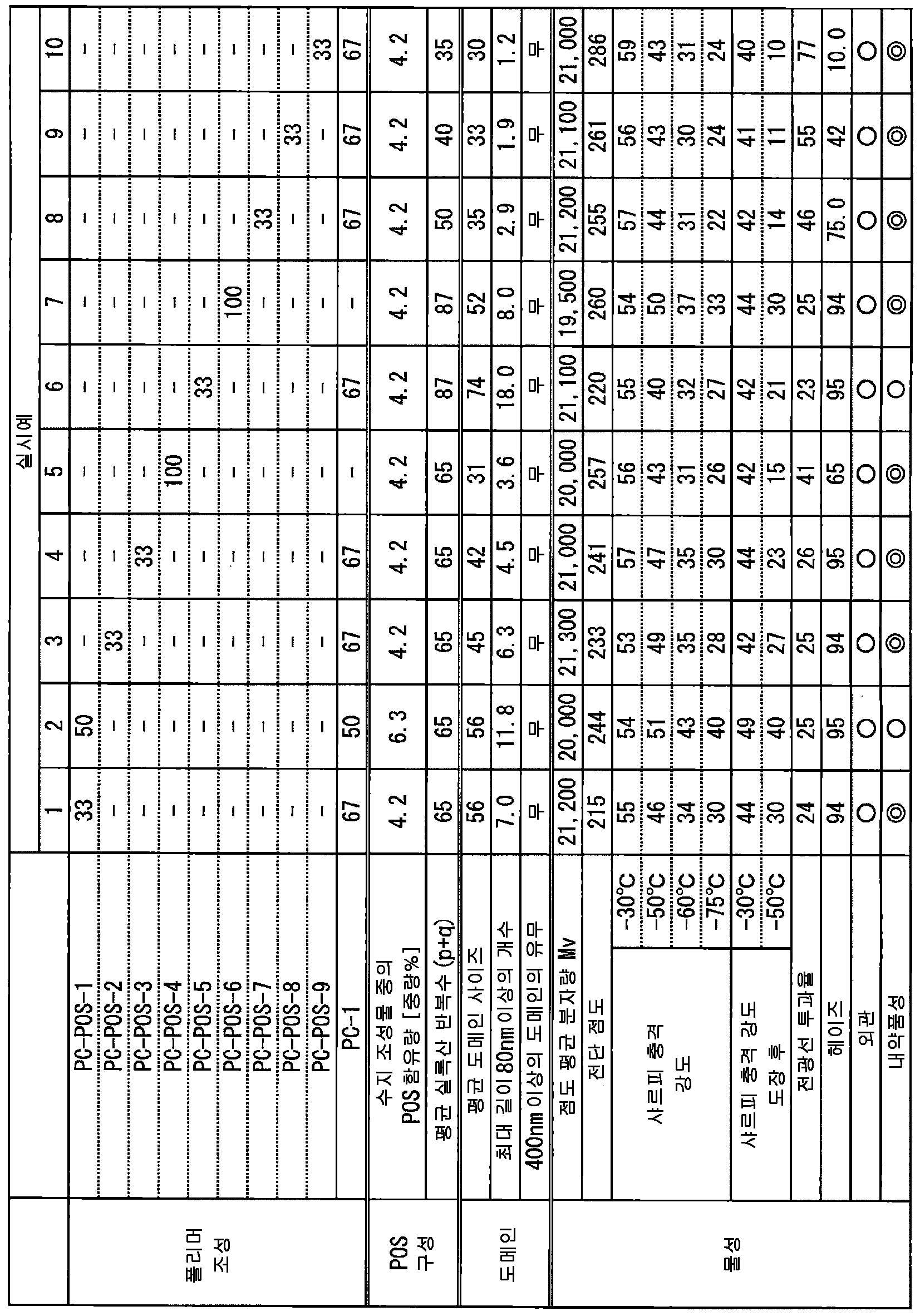
[표 2B]Table 2B

실험 B : 난연제를 포함하는 수지 조성물의 평가Experiment B: Evaluation of resin composition containing flame retardant
(A 성분 : PC-POS 공중합체)(Component A: PC-POS copolymer)
PC-POS 공중합체로서, 실험 A 에서 사용한 각종 PC-POS 공중합체를 사용하였다.As the PC-POS copolymer, various PC-POS copolymers used in Experiment A were used.
(B 성분 : 난연제)(Component B: Flame retardant)
B-1 : 퍼플루오로부탄술폰산칼륨염 (다이닛폰 잉크 화학 공업 (주) 제조 메가팍 F-114P (상품명))B-1: Perfluorobutanesulfonic acid potassium salt (Megapac F-114P (trade name) manufactured by Dainippon Ink Chemical Industry Co., Ltd.)
B-2 : 비스페놀 A 비스(디페닐포스페이트) 를 주성분으로 하는 인산에스테르 (다이하치 화학 공업 (주) 제조 CR-741 (상품명))B-2: Bisphenol A Bis(diphenyl phosphate)-based phosphoric acid ester (CR-741 (trade name) manufactured by Daihachi Chemical Industry Co., Ltd.)
B-3 : 고리형 페녹시포스파젠 (오오츠카 화학 (주) 제조 SPB-100 (상품명))B-3: cyclic phenoxyphosphazene (SPB-100 (trade name) manufactured by Otsuka Chemical Co., Ltd.)
(C 성분 : 적하 방지제)(Component C: Anti-dropping agent)
C-1 : 그 폴리테트라플루오로에틸렌계 혼합체는, 유화 중합법으로 제조된 폴리테트라플루오로에틸렌아크릴계 공중합체로 이루어지는 혼합물 (폴리테트라플루오로에틸렌 함유량 50 중량%) (미츠비시 레이욘 (주) 제조 : 메타브렌 A3750 (상품명))C-1: The polytetrafluoroethylene-based mixture is a mixture (polytetrafluoroethylene content 50% by weight) of a polytetrafluoroethylene acrylic copolymer produced by an emulsion polymerization method (manufactured by Mitsubishi Rayon Co., Ltd.) : Metabren A3750 (brand name))
(D 성분 : 자외선 흡수제)(Component D: UV absorber)
D-1 : 자외선 흡수제 (BASF 제조 : TINUVIN 234 (상품명))D-1: UV absorber (BASF manufactured by TINUVIN 234 (brand name))
(그 밖의 성분)(Other ingredients)
SL900 : 지방산 에스테르계 이형제 (리켄 비타민 (주) 제조 ; 리케말 SL900 (상품명))SL900: Fatty acid ester-based mold release agent (manufactured by Riken Vitamin Co., Ltd.; Riquemal SL900 (brand name))
irg1076 : 페놀계 열안정제 (Ciba Specialty Chemicals K. K. 제조 ; IRGANOX1076 (상품명))irg1076: Phenolic thermal stabilizer (manufactured by Ciba Specialty Chemicals K. K.; IRGANOX1076 (brand name))
irg168 : 인계 열안정제 (Ciba Specialty Chemicals K. K. 제조 ; IRGANOX1076 (상품명))irg168: Phosphorus-based heat stabilizer (manufactured by Ciba Specialty Chemicals K. K.; IRGANOX1076 (brand name))
[수지 조성물의 제조][Preparation of resin composition]
[실시예 11 ∼ 20, 참고예 1, 및 비교예 12 ∼ 18][Examples 11 to 20, Reference Examples 1 and Comparative Examples 12 to 18]
표 3 및 표 4 에 나타내는 조성으로 A ∼ D 성분 및 각종 첨가제를 계량하고, 블렌더를 사용하여 균일하게 혼합하며, 벤트식 2 축 압출기를 사용하여 용융 혼련하여 펠릿을 얻었다. 사용하는 각종 첨가제는, 각각 배합량의 10 ∼ 100 배의 농도를 기준으로 미리 폴리카보네이트 수지와의 예비 혼합물을 제조한 후, 블렌더에 의한 전체의 혼합을 실시하였다. 벤트식 2 축 압출기는 (주) 코베 제강소 KTX-30 (직경 30 ㎜φ) 을 사용하였다. 실린더 온도 및 다이스 온도가 280 ℃, 스크루 회전수 150 rpm, 토출량 20 ㎏/h, 벤트 흡인도가 3 ㎪ 인 조건으로 스트랜드를 압출하고, 수욕에 있어서 냉각시킨 후 펠릿타이저로 스트랜드 컷을 실시하여, 펠릿화하였다. 각종 평가 결과를 표 3 및 표 4 에 나타낸다.Components A to D and various additives were weighed in the compositions shown in Tables 3 and 4, uniformly mixed using a blender, and melt-kneaded using a vented twin-screw extruder to obtain pellets. Various additives to be used were preliminarily prepared with a polycarbonate resin based on a concentration of 10 to 100 times the compounding amount, and then mixed with a blender. A vented twin-screw extruder was used by Kobe Steel Mill KTX-30 (30 mmφ in diameter). After extruding the strand under the conditions of cylinder temperature and dice temperature of 280°C, screw rotation speed of 150 rpm, discharge rate of 20 kg/h, and vent suction of 3 ㎪, cooled in a water bath and then strand stranded with a pelletizer. , Pelletized. Table 3 and Table 4 show various evaluation results.
[표 3][Table 3]

[표 4][Table 4]
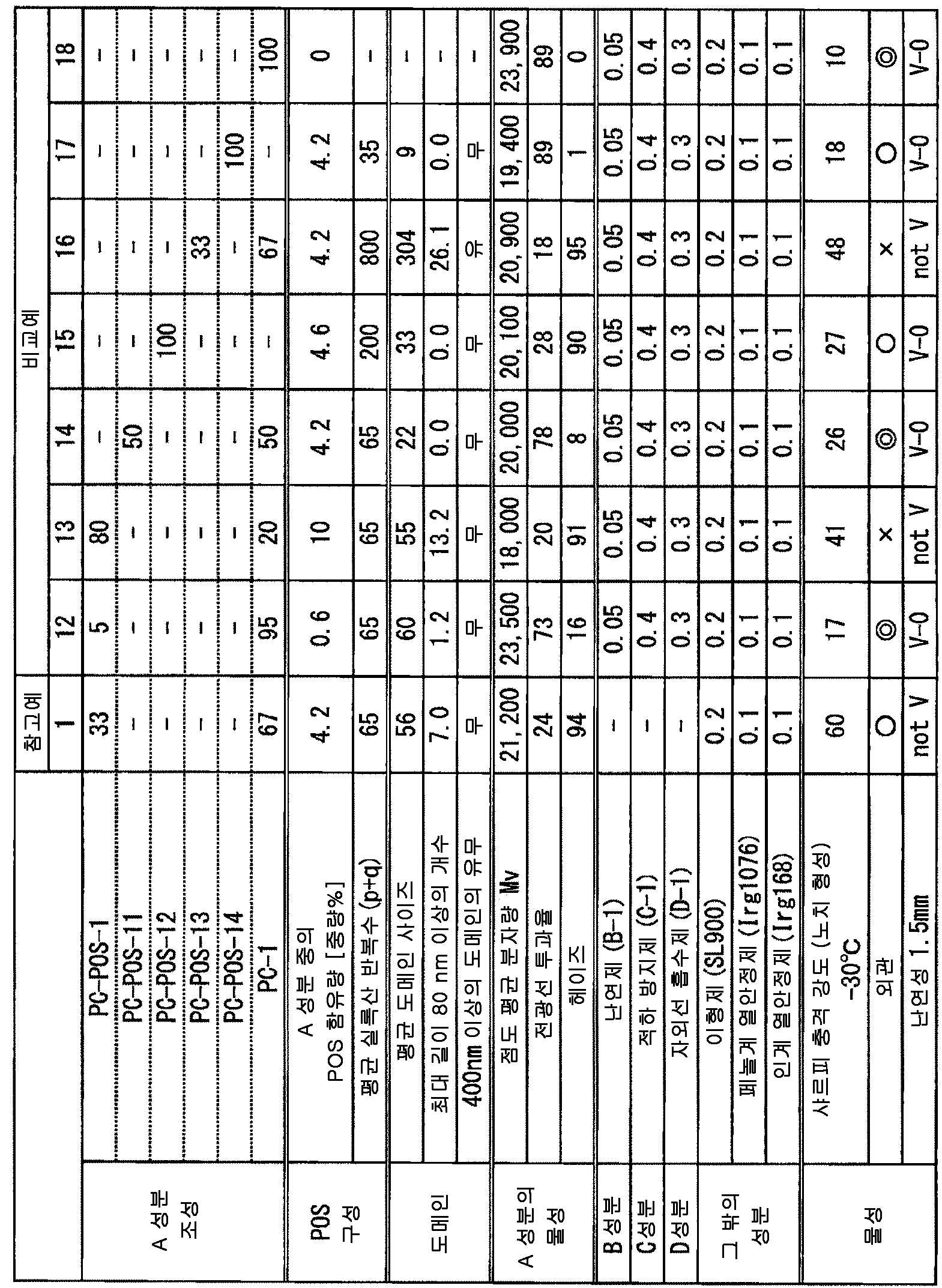
상기 표로부터 분명한 바와 같이 실시예 11 ∼ 20 의 조성물은 40 kJ/㎡ 를 초과하는 양호한 저온 내충격성 및 1.5 ㎜V-2 또는 V-0 의 박육 난연성을 갖는 것을 알 수 있다. 이에 대해, B 성분을 포함하지 않는 참고예 1 은 난연성이 불충분하다. A 성분 중의 폴리오르가노실록산 블록의 함유량이 2.5 중량% 보다 적은 비교예 12 는 저온 내충격성이 떨어진다. A 성분 중의 폴리오르가노실록산 블록의 함유량이 8.0 중량% 보다 많은 비교예 13 이나 최대 길이 80 ㎚ 이상의 도메인 개수가 20 개 이상인 비교예 6 은 외관 불량이 발생하고, 난연성이 떨어진다. 최대 길이 80 ㎚ 이상의 도메인을 포함하지 않는 비교예 14, 15, 17 은 저온 내충격성이 떨어진다. 폴리카보네이트-폴리디오르가노실록산 공중합체를 포함하지 않는 비교예 18 은 저온 내충격성이 떨어진다.As can be seen from the above table, it can be seen that the compositions of Examples 11 to 20 have good low-temperature impact resistance exceeding 40 kJ/
[실시예 21 ∼ 22, 비교예 19 ∼ 23][Examples 21 to 22, Comparative Examples 19 to 23]
표 5 에 나타내는 조성으로 B 성분의 B-2 를 제외한 A ∼ D 성분 및 각종 첨가제를 계량하고, 블렌더를 사용하여 균일하게 혼합하며, 혼합물을 벤트식 2 축 압출기의 제 1 공급구로부터 공급하고, 용융 혼련하여 펠릿을 얻었다. 사용하는 각종 첨가제는, 각각 배합량의 10 ∼ 100 배의 농도를 기준으로 미리 폴리카보네이트 수지와의 예비 혼합물을 제조한 후, 블렌더에 의한 전체의 혼합을 실시하였다. B 성분의 B-2 는, 80 ℃ 로 가열한 상태에서 액주 장치 (후지 테크노 공업 (주) 제조 HYM-JS-08) 를 사용하여 실린더 도중의 제 3 공급구 (제 1 공급구와 벤트 배기구 사이에 위치) 로부터, 각각 소정의 비율이 되도록 압출기에 공급하였다. 벤트식 2 축 압출기는 (주) 닛폰 제강소 TEX30α-38.5BW-3V (직경 30 ㎜φ) 를 사용하였다. 실린더 온도 및 다이스 온도가 280 ℃, 스크루 회전수 150 rpm, 토출량 20 ㎏/h, 벤트의 진공도 3 ㎪ 의 조건으로 스트랜드를 압출하고, 수욕에 있어서 냉각시킨 후 펠릿타이저로 스트랜드 컷을 실시하여, 펠릿화하였다. 각종 평가 결과를 표 5 에 나타낸다.With the composition shown in Table 5, components A to D and various additives except B-2 of component B are metered, mixed uniformly using a blender, and the mixture is supplied from the first feed port of a vented twin-screw extruder, It was melt-kneaded to obtain a pellet. Various additives to be used were preliminarily prepared with a polycarbonate resin based on a concentration of 10 to 100 times the compounding amount, and then mixed with a blender. B-2 of the B component was heated between 80°C and a liquid feeder (HYM-JS-08 manufactured by Fuji Techno Industries Co., Ltd.) using a third feed port (between the first feed port and the vent exhaust port). Position), respectively, to a predetermined ratio. The vented twin-screw extruder was used by Nippon Steel Mill TEX30α-38.5BW-3V (diameter 30 mmφ). After extruding the strands under the conditions of cylinder temperature and dice temperature of 280°C, screw rotation speed of 150 rpm, discharge rate of 20 kg/h, and the vacuum degree of the
[표 5][Table 5]
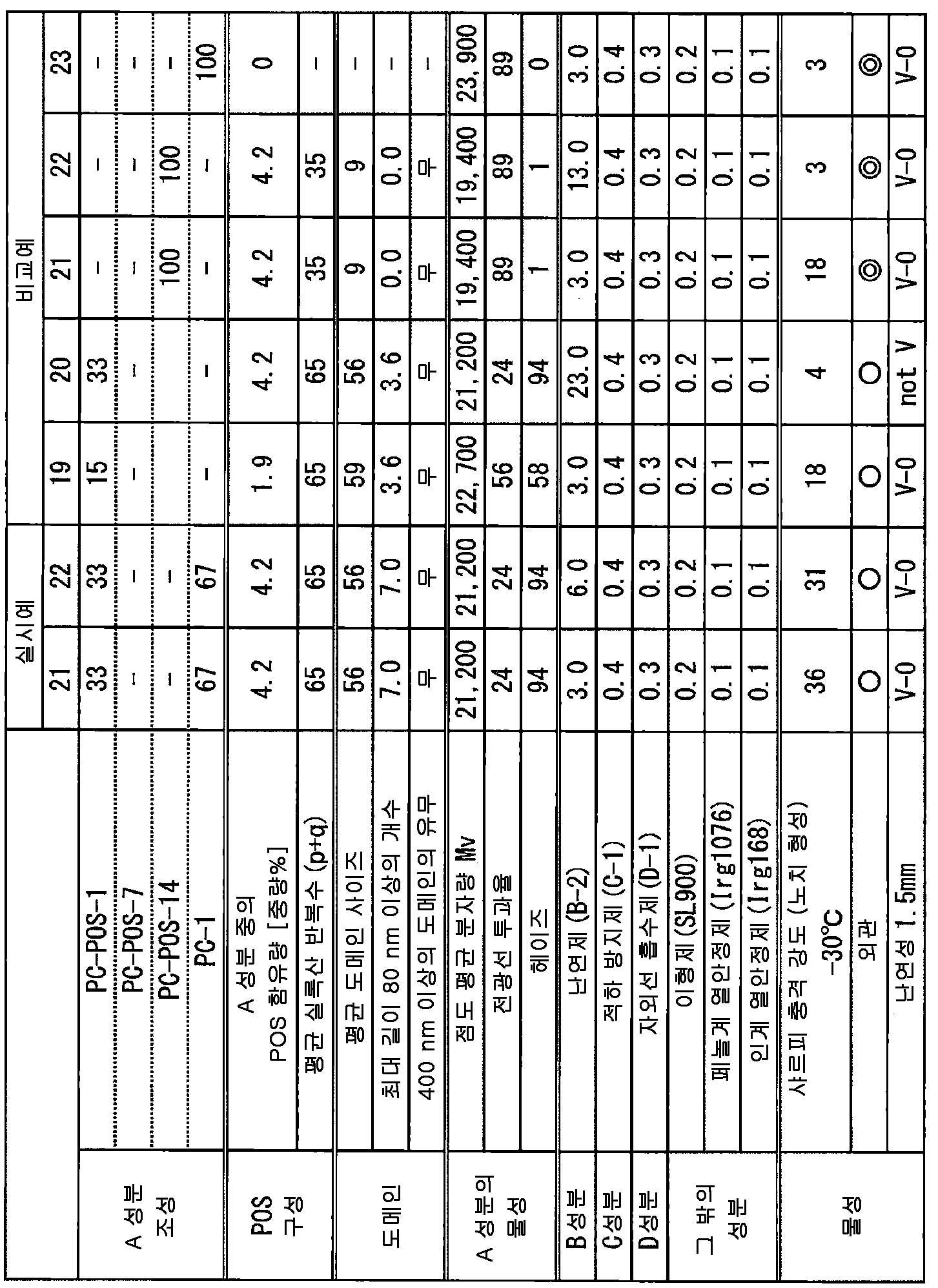
상기 표로부터 분명한 바와 같이 실시예 21 및 22 의 조성물은 양호한 저온 내충격성 및 1.0 ㎜V-0 의 박육 난연성을 갖는 것을 알 수 있다. A 성분 중의 폴리오르가노실록산 블록 함유량이 2.5 중량% 보다 적은 비교예 19, 평균 도메인 사이즈가 30 ㎚ 보다 작은 비교예 21, 22 는 저온 내충격성이 떨어진다. B 성분이 과잉인 비교예 20 은 저온 내충격성 및 난연성이 떨어진다. 폴리카보네이트-폴리디오르가노실록산 공중합체를 포함하지 않는 비교예 23 은 저온 내충격성이 떨어진다.As can be seen from the above table, it can be seen that the compositions of Examples 21 and 22 have good low-temperature impact resistance and thin-walled flame retardancy of 1.0 mmV-0. Comparative Example 19 in which the polyorganosiloxane block content in component A is less than 2.5% by weight and Comparative Examples 21 and 22 in which the average domain size is smaller than 30 nm are inferior to low-temperature impact resistance. Comparative Example 20 in which the B component is excessive is poor in low-temperature impact resistance and flame retardancy. Comparative Example 23, which does not contain a polycarbonate-polydioorganosiloxane copolymer, has low impact resistance at low temperatures.
[실시예 23 ∼ 25, 비교예 24 ∼ 26][Examples 23 to 25, Comparative Examples 24 to 26]
표 6 에 나타내는 조성으로 A ∼ D 성분 및 각종 첨가제를 계량하고, 블렌더를 사용하여 균일하게 혼합하며, 벤트식 2 축 압출기를 사용하여 용융 혼련하여 펠릿을 얻었다. 사용하는 각종 첨가제는, 각각 배합량의 10 ∼ 100 배의 농도를 기준으로 미리 폴리카보네이트 수지와의 예비 혼합물을 제조한 후, 블렌더에 의한 전체의 혼합을 실시하였다. 벤트식 2 축 압출기는 (주) 코베 제강소 KTX-30 (직경 30 ㎜φ) 을 사용하였다. 실린더 온도 및 다이스 온도가 280 ℃, 스크루 회전수 150 rpm, 토출량 20 ㎏/h, 벤트 흡인도가 3 ㎪ 인 조건으로 스트랜드를 압출하고, 수욕에 있어서 냉각시킨 후 펠릿타이저로 스트랜드 컷을 실시하여, 펠릿화하였다. 각종 평가 결과를 표 6 에 나타낸다.Components A to D and various additives were weighed with the composition shown in Table 6, uniformly mixed using a blender, and melt-kneaded using a vented twin-screw extruder to obtain pellets. Various additives to be used were preliminarily prepared with a polycarbonate resin based on a concentration of 10 to 100 times the compounding amount, and then mixed with a blender. A vented twin-screw extruder was used by Kobe Steel Mill KTX-30 (30 mmφ in diameter). After extruding the strand under the conditions of cylinder temperature and dice temperature of 280°C, screw rotation speed of 150 rpm, discharge rate of 20 kg/h, and vent suction of 3 ㎪, cooled in a water bath and then strand stranded with a pelletizer. , Pelletized. Table 6 shows the results of the various evaluations.
[표 6][Table 6]

상기 표로부터 분명한 바와 같이 실시예 23 ∼ 25 의 조성물은 양호한 저온 내충격성 및 1.0 ㎜V-0 의 박육 난연성을 갖는 것을 알 수 있다. A 성분 중의 폴리오르가노실록산 블록 함유량이 2.5 중량% 보다 적은 비교예 24, 평균 도메인 사이즈가 30 ㎚ 보다 작은 비교예 25, 폴리카보네이트-폴리디오르가노실록산 공중합체를 포함하지 않는 비교예 26 은 저온 내충격성이 떨어진다.As can be seen from the above table, it can be seen that the compositions of Examples 23 to 25 have good low-temperature impact resistance and a thin flame retardancy of 1.0 mmV-0. Comparative Example 24 in which the content of the polyorganosiloxane block in the component A is less than 2.5% by weight, Comparative Example 25 in which the average domain size is smaller than 30 nm, and Comparative Example 26 without the polycarbonate-polydioorganosiloxane copolymer is at a low temperature. The impact is poor.
본 발명의 공중합체 또는 그 수지 조성물을 사용함으로써, 극저온에서도 높은 충격 성능을 가지면서, 도장 후의 충격 내구성이나 내약품성도 양립하고 있는 것이 확인된다.It is confirmed that, by using the copolymer of the present invention or the resin composition thereof, while having high impact performance even at extremely low temperatures, both impact durability and chemical resistance after coating are compatible.
산업상 이용가능성Industrial availability
본 발명에 있어서 얻어지는 공중합체 또는 그 수지 조성물은, 우수한 극저온 충격성 및 내약품성을 구비하고, 또한, 높은 도장 내구성도 구비하기 때문에, 광학 부품, 전기·전자 기기 분야, 자동차·항공기 등의 수송·모빌리티 분야에 있어서 폭넓게 사용할 수 있다. 그 중에서도, 고위도권이나 산악부, 상공 등의 극한랭 환경이나 고온 열처리, 약품 처리 등 엄격한 환경에 노출되는 것이 상정되는 각종 하우징 성형품에서 실용성이 높다.Since the copolymer or resin composition obtained in the present invention has excellent cryogenic impact resistance and chemical resistance, and also has high paint durability, transport and mobility of optical parts, electric and electronic devices, automobiles and aircrafts, etc. It can be widely used in the field. Among them, practicality is high in various housing molded products that are expected to be exposed to extreme environments such as high-temperature areas, mountainous areas, and extreme cold environments such as the airspace, high-temperature heat treatment, and chemical treatment.
1
y : 휨량 (㎜)
2
h : 시험편 두께 (4 ㎜)
3
L : 측정폭 (150 ㎜)1 y: Bending amount (㎜)
2 h: Test piece thickness (4 mm)
3 L: Measurement width (150 ㎜)
Claims (15)
상기 공중합체가, (A-1) 폴리카보네이트 블록, 및 (A-2) 폴리디오르가노실록산 블록을 포함하고,
상기 (A-2) 폴리디오르가노실록산 블록이, 상기 공중합체 또는 그 수지 조성물 중에, 2.5 ∼ 8.0 중량% 로 함유되어 있고, 또한
이하의 (i) 및 (ii) 를 만족시키는, 상기 공중합체 또는 그 수지 조성물 :
(i) 상기 공중합체 또는 그 수지 조성물의 전자선 현미경을 사용한 단면 관찰 이미지에 있어서, 850 ㎚ 사방 (722,500 ㎚2) 의 영역에 최대 장경이 80 ㎚ 이상인 도메인이 1 ∼ 20 개 존재하는 것 ; 및
(ii) 평균 도메인 사이즈가 30 ∼ 100 ㎚ 인 것.A polycarbonate-polydiorganosiloxane copolymer and the above-mentioned copolymer or a resin composition comprising a veterinary polycarbonate resin,
The copolymer comprises (A-1) a polycarbonate block, and (A-2) a polydiorganosiloxane block,
The (A-2) polydiorganosiloxane block is contained in the copolymer or its resin composition at 2.5 to 8.0% by weight, and
The copolymer or its resin composition satisfying the following (i) and (ii):
(i) In the cross-sectional observation image using an electron beam microscope of the copolymer or its resin composition, 1 to 20 domains having a maximum long diameter of 80 nm or more are present in a region of 850 nm square (722,500 nm 2 ); And
(ii) The average domain size is 30 to 100 nm.
상기 (A-1) 폴리카보네이트 블록이, 하기 일반식 [1] 로 나타내는, 공중합체 또는 그 수지 조성물 :

[(상기 일반식 [1] 에 있어서, R1 및 R2 는 각각 독립적으로 수소 원자, 할로겐 원자, 탄소 원자수 1 ∼ 18 의 알킬기, 탄소 원자수 1 ∼ 18 의 알콕시기, 탄소 원자수 6 ∼ 20 의 시클로알킬기, 탄소 원자수 6 ∼ 20 의 시클로알콕시기, 탄소 원자수 2 ∼ 10 의 알케닐기, 탄소 원자수 3 ∼ 14 의 아릴기, 탄소 원자수 3 ∼ 14 의 아릴옥시기, 탄소 원자수 7 ∼ 20 의 아르알킬기, 탄소 원자수 7 ∼ 20 의 아르알킬옥시기, 니트로기, 알데히드기, 시아노기 및 카르복실기로 이루어지는 군에서 선택되는 기를 나타내고, 각각 복수 있는 경우에는 그것들은 동일해도 되고 상이해도 되고, e 및 f 는 각각 1 ∼ 4 의 정수이고, W 는 단결합 혹은 하기 일반식 [2] 로 나타내는 기로 이루어지는 군에서 선택되는 적어도 하나의 기이다.)
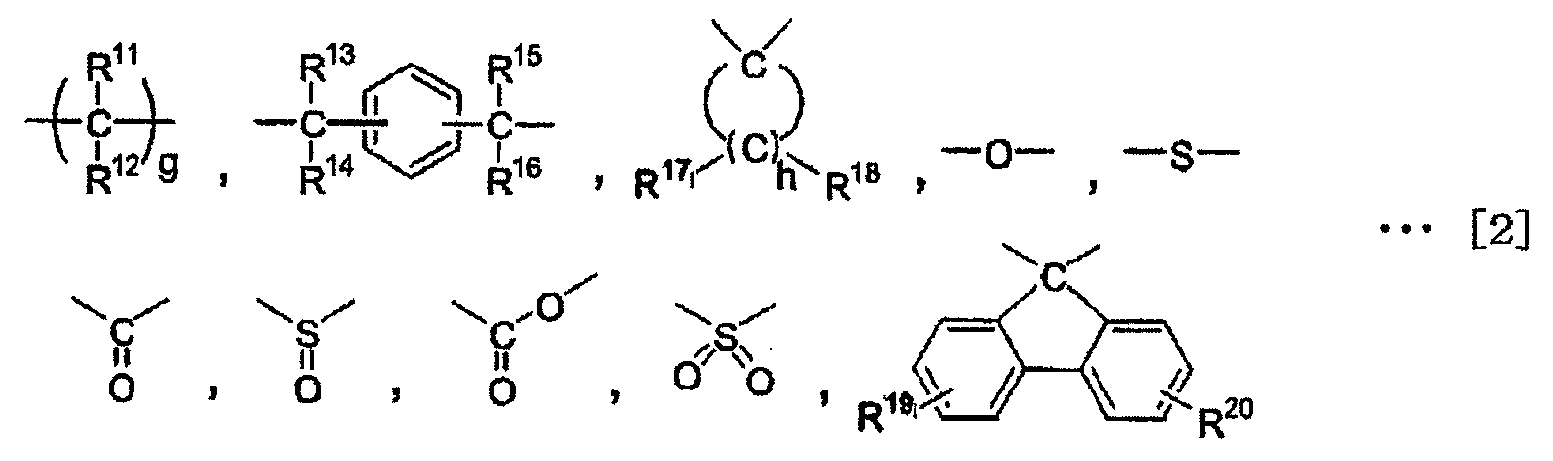
(상기 일반식 [2] 에 있어서 R11, R12, R13, R14, R15, R16, R17 및 R18 은 각각 독립적으로 수소 원자, 탄소 원자수 1 ∼ 18 의 알킬기, 탄소 원자수 3 ∼ 14 의 아릴기 및 탄소 원자수 7 ∼ 20 의 아르알킬기로 이루어지는 군에서 선택되는 기를 나타내고, R19 및 R20 은 각각 독립적으로 수소 원자, 할로겐 원자, 탄소 원자수 1 ∼ 18 의 알킬기, 탄소 원자수 1 ∼ 10 의 알콕시기, 탄소 원자수 6 ∼ 20 의 시클로알킬기, 탄소 원자수 6 ∼ 20 의 시클로알콕시기, 탄소 원자수 2 ∼ 10 의 알케닐기, 탄소 원자수 3 ∼ 14 의 아릴기, 탄소 원자수 6 ∼ 10 의 아릴옥시기, 탄소 원자수 7 ∼ 20 의 아르알킬기, 탄소 원자수 7 ∼ 20 의 아르알킬옥시기, 니트로기, 알데히드기, 시아노기 및 카르복실기로 이루어지는 군에서 선택되는 기를 나타내고, 복수 있는 경우에는 그것들은 동일해도 되고 상이해도 되고, g 는 1 ∼ 10 의 정수, h 는 4 ∼ 7 의 정수이다.)].According to claim 1,
A copolymer or a resin composition in which the polycarbonate block (A-1) is represented by the following general formula [1]:
[(In the above general formula [1], R 1 and R 2 are each independently a hydrogen atom, a halogen atom, an alkyl group having 1 to 18 carbon atoms, an alkoxy group having 1 to 18 carbon atoms, or 6 to 6 carbon atoms. A cycloalkyl group of 20, a cycloalkoxy group of 6 to 20 carbon atoms, an alkenyl group of 2 to 10 carbon atoms, an aryl group of 3 to 14 carbon atoms, an aryloxy group of 3 to 14 carbon atoms, and a number of carbon atoms A group selected from the group consisting of an aralkyl group having 7 to 20, an aralkyloxy group having 7 to 20 carbon atoms, a nitro group, an aldehyde group, a cyano group, and a carboxyl group, and when they are plural, they may be the same or different. , e and f are each an integer of 1 to 4, and W is at least one group selected from the group consisting of a single bond or a group represented by the following general formula [2].)
(In the general formula [2], R 11 , R 12 , R 13 , R 14 , R 15 , R 16 , R 17 and R 18 are each independently a hydrogen atom, an alkyl group having 1 to 18 carbon atoms, a carbon atom Represents a group selected from the group consisting of an aryl group having 3 to 14 and an aralkyl group having 7 to 20 carbon atoms, and R 19 and R 20 are each independently a hydrogen atom, a halogen atom, or an alkyl group having 1 to 18 carbon atoms, Alkyl group having 1 to 10 carbon atoms, cycloalkyl group having 6 to 20 carbon atoms, cycloalkoxy group having 6 to 20 carbon atoms, alkenyl group having 2 to 10 carbon atoms, aryl group having 3 to 14 carbon atoms , A group selected from the group consisting of an aryloxy group having 6 to 10 carbon atoms, an aralkyl group having 7 to 20 carbon atoms, an aralkyloxy group having 7 to 20 carbon atoms, a nitro group, an aldehyde group, a cyano group, and a carboxyl group , And when there are plural, they may be the same or different, g is an integer from 1 to 10, and h is an integer from 4 to 7.)].
상기 (A-2) 폴리디오르가노실록산 블록이, 하기 일반식 [3] 으로 나타내는, 공중합체 또는 그 수지 조성물 :

(상기 일반식 [3] 에 있어서, R3, R4, R5, R6, R7 및 R8 은, 각각 독립적으로 수소 원자, 탄소수 1 ∼ 12 의 알킬기 또는 탄소수 6 ∼ 12 의 치환 혹은 무치환의 아릴기이고, R9 및 R10 은 각각 독립적으로 수소 원자, 할로겐 원자, 탄소 원자수 1 ∼ 10 의 알킬기, 탄소 원자수 1 ∼ 10 의 알콕시기이고, p 는 자연수이고, q 는 0 또는 자연수이고, 평균 사슬 길이 p + q 는 30 ∼ 100 의 자연수이다. X 는 C2 ∼ C8 의 2 가 지방족기이다.).According to claim 2,
A copolymer or a resin composition in which the polydiorganosiloxane block (A-2) is represented by the following general formula [3]:
(In the above general formula [3], R 3 , R 4 , R 5 , R 6 , R 7 and R 8 are each independently a hydrogen atom, an alkyl group having 1 to 12 carbon atoms, or a substituted or unsubstituted carbon atom having 6 to 12 carbon atoms. Is a substituted aryl group, R 9 and R 10 are each independently a hydrogen atom, a halogen atom, an alkyl group having 1 to 10 carbon atoms, an alkoxy group having 1 to 10 carbon atoms, p is a natural number, and q is 0 or It is a natural number, and the average chain length p + q is a natural number of 30 to 100. X is a divalent aliphatic group of C2 to C8.).
추가로 이하의 (iii) 을 만족시키는, 공중합체 또는 그 수지 조성물 :
(iii) 상기 공중합체 또는 그 수지 조성물의 전자선 현미경을 사용한 단면 관찰 이미지에 있어서, 5 장의 시료 절편의 어느 것에도, 850 ㎚ 사방 (722,500 ㎚2) 의 영역에 최대 장경이 400 ㎚ 이상인 도메인이 존재하지 않는 것.The method according to any one of claims 1 to 3,
The copolymer or its resin composition which further satisfies the following (iii):
(iii) In a cross-sectional observation image using an electron beam microscope of the copolymer or its resin composition, in any of the five sample sections, a domain having a maximum long diameter of 400 nm or more is present in an area of 850 nm square (722,500 nm 2 ). Do not.
점도 평균 분자량이 11,000 ∼ 30,000 인, 공중합체 또는 그 수지 조성물.The method according to any one of claims 1 to 4,
A copolymer or a resin composition having a viscosity average molecular weight of 11,000 to 30,000.
상기 (A-1) 폴리카보네이트 블록이, 2,2-비스(4-하이드록시페닐)프로판으로부터 유도되어 있고, 또한
상기 (A-2) 폴리디오르가노실록산 블록이, (2-알릴페놀) 말단 폴리디오르가노실록산, 또는 (2-메톡시-4-알릴페놀) 말단 폴리디오르가노실록산으로부터 유도되어 있는, 공중합체 또는 그 수지 조성물.The method according to any one of claims 1 to 5,
The (A-1) polycarbonate block is derived from 2,2-bis(4-hydroxyphenyl)propane, and
The copolymer in which the (A-2) polydiorganosiloxane block is derived from a (2-allylphenol) terminal polydiorganosiloxane, or a (2-methoxy-4-allylphenol) terminal polydiorganosiloxane, or The resin composition.
100 ∼ 1 중량% 의 상기 공중합체와, 0 ∼ 99 중량% 의 상기 폴리카보네이트 수지를 포함하는, 공중합체 또는 그 수지 조성물.The method according to any one of claims 1 to 6,
A copolymer or a resin composition comprising 100 to 1% by weight of the copolymer and 0 to 99% by weight of the polycarbonate resin.
상기 폴리카보네이트 수지가, 하기 일반식 [1] 로 나타내는, 수지 조성물 :

[(상기 일반식 [1] 에 있어서, R1 및 R2 는 각각 독립적으로 수소 원자, 할로겐 원자, 탄소 원자수 1 ∼ 18 의 알킬기, 탄소 원자수 1 ∼ 18 의 알콕시기, 탄소 원자수 6 ∼ 20 의 시클로알킬기, 탄소 원자수 6 ∼ 20 의 시클로알콕시기, 탄소 원자수 2 ∼ 10 의 알케닐기, 탄소 원자수 3 ∼ 14 의 아릴기, 탄소 원자수 3 ∼ 14 의 아릴옥시기, 탄소 원자수 7 ∼ 20 의 아르알킬기, 탄소 원자수 7 ∼ 20 의 아르알킬옥시기, 니트로기, 알데히드기, 시아노기 및 카르복실기로 이루어지는 군에서 선택되는 기를 나타내고, 각각 복수 있는 경우에는 그것들은 동일해도 되고 상이해도 되고, e 및 f 는 각각 1 ∼ 4 의 정수이고, W 는 단결합 혹은 하기 일반식 [2] 로 나타내는 기로 이루어지는 군에서 선택되는 적어도 하나의 기이다.)

(상기 일반식 [2] 에 있어서 R11, R12, R13, R14, R15, R16, R17 및 R18 은 각각 독립적으로 수소 원자, 탄소 원자수 1 ∼ 18 의 알킬기, 탄소 원자수 3 ∼ 14 의 아릴기 및 탄소 원자수 7 ∼ 20 의 아르알킬기로 이루어지는 군에서 선택되는 기를 나타내고, R19 및 R20 은 각각 독립적으로 수소 원자, 할로겐 원자, 탄소 원자수 1 ∼ 18 의 알킬기, 탄소 원자수 1 ∼ 10 의 알콕시기, 탄소 원자수 6 ∼ 20 의 시클로알킬기, 탄소 원자수 6 ∼ 20 의 시클로알콕시기, 탄소 원자수 2 ∼ 10 의 알케닐기, 탄소 원자수 3 ∼ 14 의 아릴기, 탄소 원자수 6 ∼ 10 의 아릴옥시기, 탄소 원자수 7 ∼ 20 의 아르알킬기, 탄소 원자수 7 ∼ 20 의 아르알킬옥시기, 니트로기, 알데히드기, 시아노기 및 카르복실기로 이루어지는 군에서 선택되는 기를 나타내고, 복수 있는 경우에는 그것들은 동일해도 되고 상이해도 되고, g 는 1 ∼ 10 의 정수, h 는 4 ∼ 7 의 정수이다.)].The method of claim 7,
The resin composition, wherein the polycarbonate resin is represented by the following general formula [1]:
[(In the above general formula [1], R 1 and R 2 are each independently a hydrogen atom, a halogen atom, an alkyl group having 1 to 18 carbon atoms, an alkoxy group having 1 to 18 carbon atoms, or 6 to 6 carbon atoms. A cycloalkyl group of 20, a cycloalkoxy group of 6 to 20 carbon atoms, an alkenyl group of 2 to 10 carbon atoms, an aryl group of 3 to 14 carbon atoms, an aryloxy group of 3 to 14 carbon atoms, and a number of carbon atoms A group selected from the group consisting of an aralkyl group having 7 to 20, an aralkyloxy group having 7 to 20 carbon atoms, a nitro group, an aldehyde group, a cyano group, and a carboxyl group, and when they are plural, they may be the same or different. , e and f are each an integer of 1 to 4, and W is at least one group selected from the group consisting of a single bond or a group represented by the following general formula [2].)
(In the general formula [2], R 11 , R 12 , R 13 , R 14 , R 15 , R 16 , R 17 and R 18 are each independently a hydrogen atom, an alkyl group having 1 to 18 carbon atoms, a carbon atom Represents a group selected from the group consisting of an aryl group having 3 to 14 and an aralkyl group having 7 to 20 carbon atoms, and R 19 and R 20 are each independently a hydrogen atom, a halogen atom, or an alkyl group having 1 to 18 carbon atoms, Alkyl group having 1 to 10 carbon atoms, cycloalkyl group having 6 to 20 carbon atoms, cycloalkoxy group having 6 to 20 carbon atoms, alkenyl group having 2 to 10 carbon atoms, aryl group having 3 to 14 carbon atoms , A group selected from the group consisting of an aryloxy group having 6 to 10 carbon atoms, an aralkyl group having 7 to 20 carbon atoms, an aralkyloxy group having 7 to 20 carbon atoms, a nitro group, an aldehyde group, a cyano group, and a carboxyl group , And when there are plural, they may be the same or different, g is an integer from 1 to 10, and h is an integer from 4 to 7.)].
상기 (B) 난연제가, 금속염계 난연제 및/또는 유기 인계 난연제인, 수지 조성물.The method of claim 9,
The resin composition in which the flame retardant (B) is a metal salt flame retardant and/or an organophosphorus flame retardant.
(C) 함불소 적하 방지제 및/또는 (D) 자외선 흡수제를 추가로 포함하는, 수지 조성물.The method of claim 9 or 10,
A resin composition further comprising (C) a fluorine-containing dripping inhibitor and/or (D) an ultraviolet absorber.
ASTM D1003 (ISO13468) 에 기초하여 측정된 두께 2 ㎜ 의 성형품의 전광선 투과율이 80 % 이하인, 성형품.The method of claim 12,
A molded article having a total light transmittance of 80% or less of a molded article having a thickness of 2 mm measured based on ASTM D1003 (ISO13468).
(a) 물에 불용성의 유기 용매와 알칼리 수용액의 혼합액 중에 있어서, 하기 식 [4] 로 나타내는 2 가 페놀 (I) 과 포스겐을 반응시켜, 말단 클로로포르메이트기를 갖는 카보네이트 올리고머를 함유하는 용액을 조제하는 것

(식 중, R1, R2, e, f 및 W 는 상기와 동일하다.) ; 및
(b) 이어서, 그 용액을 교반하면서, 하기 식 [5] 로 나타내는 하이드록시아릴 말단 폴리디오르가노실록산 (II) 를 첨가하고, 하이드록시아릴 말단 폴리디오르가노실록산 (II) 와 카보네이트 올리고머를 계면 중합시키는 것

(식 중, R3, R4, R5, R6, R7, R8, R9, R10, p, q 및 X 는 상기와 동일하다.),
여기서, 식 [4] 및 식 [5] 로 나타내는 2 가 페놀 총량 1 몰당, 물에 불용성의 유기 용매를, 8 몰 이상 11 몰 미만으로 사용하는 것.A method for producing the copolymer or resin composition according to claim 3, comprising the following steps (a) and (b):
(a) In a mixed solution of an insoluble organic solvent and an aqueous alkali solution in water, a divalent phenol (I) represented by the following formula [4] is reacted with phosgene to prepare a solution containing a carbonate oligomer having a terminal chloroformate group. Doing
(In the formula, R 1 , R 2 , e, f and W are the same as above.); And
(b) Subsequently, while stirring the solution, hydroxyaryl-terminated polydiorganosiloxane (II) represented by the following formula [5] was added, and interfacial polymerization of hydroxyaryl-terminated polydiorganosiloxane (II) and carbonate oligomer was carried out. Order
(In the formula, R 3 , R 4 , R 5 , R 6 , R 7 , R 8 , R 9 , R 10 , p, q and X are the same as above.),
Here, using 8 mol or more and less than 11 mol of the organic solvent insoluble in water per 1 mol of divalent phenol represented by Formula [4] and Formula [5].
식 [4] 및 식 [5] 로 나타내는 2 가 페놀의 총량 1 몰당, 물에 불용성의 유기 용매를 8 몰 이상 9.5 몰 미만으로 하여 계면 중축합 반응을 개시한 후, 추가로 물에 불용성의 유기 용매를 식 [4] 및 식 [5] 로 나타내는 2 가 페놀의 총량 1 몰당 2 몰 이상 첨가하는, 공중합체 또는 수지 조성물의 제조 방법.The method of claim 14,
After initiating the interfacial polycondensation reaction with 8 mol or more and less than 9.5 mol of an insoluble organic solvent in water per 1 mol of the total amount of divalent phenols represented by the formulas [4] and [5], the organics are insoluble in water. A method for producing a copolymer or resin composition in which a solvent is added in an amount of 2 mol or more per 1 mol of the total amount of divalent phenol represented by formulas [4] and [5].
Applications Claiming Priority (5)
| Application Number | Priority Date | Filing Date | Title |
|---|---|---|---|
| JP2017245048 | 2017-12-21 | ||
| JPJP-P-2017-245048 | 2017-12-21 | ||
| JP2018058148 | 2018-03-26 | ||
| JPJP-P-2018-058148 | 2018-03-26 | ||
| PCT/JP2018/047367 WO2019124556A1 (en) | 2017-12-21 | 2018-12-21 | Polycarbonate-polydiorganosiloxane copolymer, resin composition of polycarbonate-polydiorganosiloxane copolymer, and production method for resin composition of polycarbonate-polydiorganosiloxane copolymer |
Publications (2)
| Publication Number | Publication Date |
|---|---|
| KR20200068737A true KR20200068737A (en) | 2020-06-15 |
| KR102321244B1 KR102321244B1 (en) | 2021-11-02 |
Family
ID=66994748
Family Applications (1)
| Application Number | Title | Priority Date | Filing Date |
|---|---|---|---|
| KR1020207015107A Expired - Fee Related KR102321244B1 (en) | 2017-12-21 | 2018-12-21 | Polycarbonate-polydiorganosiloxane copolymer, its resin composition, and its manufacturing method |
Country Status (7)
| Country | Link |
|---|---|
| US (1) | US11414523B2 (en) |
| EP (1) | EP3730534B1 (en) |
| JP (2) | JP7055152B2 (en) |
| KR (1) | KR102321244B1 (en) |
| CN (1) | CN111386298B (en) |
| TW (1) | TWI788490B (en) |
| WO (1) | WO2019124556A1 (en) |
Families Citing this family (14)
| Publication number | Priority date | Publication date | Assignee | Title |
|---|---|---|---|---|
| JP2019052323A (en) * | 2018-12-27 | 2019-04-04 | 日東紡績株式会社 | Glass fiber reinforced resin molded product |
| EP3719077B1 (en) * | 2019-04-02 | 2022-09-21 | Covestro Deutschland AG | Siloxane-containing block copolycarbonates with small domain sizes |
| KR20220113691A (en) * | 2019-12-06 | 2022-08-16 | 이데미쓰 고산 가부시키가이샤 | Polycarbonate-polyorganosiloxane copolymer and resin composition comprising the copolymer |
| TWI792048B (en) * | 2020-08-26 | 2023-02-11 | 大陸商漢達精密電子(昆山)有限公司 | High-fluidity and flame-retardant polycarbonate material and the products thereof |
| WO2022168454A1 (en) * | 2021-02-02 | 2022-08-11 | 帝人株式会社 | Polycarbonate resin composition and molded article |
| JP7619814B2 (en) * | 2021-02-02 | 2025-01-22 | 帝人株式会社 | Polycarbonate resin composition and molded article |
| JP7656436B2 (en) * | 2021-02-09 | 2025-04-03 | 帝人株式会社 | Transparent antibacterial polycarbonate resin composition and molded article thereof |
| JP7622506B2 (en) * | 2021-03-26 | 2025-01-28 | 三菱ケミカル株式会社 | Copolymeric polycarbonate resin composition, molded article, and method for producing copolymeric polycarbonate resin |
| JP7670531B2 (en) * | 2021-04-06 | 2025-04-30 | 帝人株式会社 | Polycarbonate resin composition and molded article |
| US20240287251A1 (en) * | 2021-06-09 | 2024-08-29 | Idemitsu Kosan Co.,Ltd. | Polycarbonate resin composition and molded article |
| KR20240017829A (en) * | 2021-06-09 | 2024-02-08 | 이데미쓰 고산 가부시키가이샤 | Polycarbonate-based resin composition and molded body |
| KR102700995B1 (en) * | 2021-10-29 | 2024-09-02 | 주식회사 삼양사 | Thermoplastic resin composition of Terrazzo texture with enhanced impact resistance and molded article comprising the same |
| CN114196001B (en) * | 2022-01-11 | 2023-09-19 | 万华化学集团股份有限公司 | A polycarbonate-polyorganosiloxane copolymer, manufacturing method and resin composition containing the copolymer |
| JP7761500B2 (en) * | 2022-01-28 | 2025-10-28 | 帝人株式会社 | Polycarbonate resin composition and molded article |
Citations (13)
| Publication number | Priority date | Publication date | Assignee | Title |
|---|---|---|---|---|
| WO1991000885A1 (en) | 1989-07-07 | 1991-01-24 | Idemitsu Petrochemical Co., Ltd. | Polycarbonate-polydimethylsiloxane copolymer and method of production thereof |
| JPH05186675A (en) | 1991-07-01 | 1993-07-27 | General Electric Co <Ge> | Polymer blend comprising polycarbonate/ polysiloxane block copolymer, polycarbonate and polyester-carbonate copolymer |
| JPH05189975A (en) | 1992-01-16 | 1993-07-30 | Mitsubishi Electric Corp | Random access memory |
| JPH05247195A (en) | 1991-07-01 | 1993-09-24 | General Electric Co <Ge> | Polycarbonate-polysiloxane block copolymer |
| JP2662310B2 (en) | 1989-07-07 | 1997-10-08 | 出光石油化学株式会社 | Polycarbonate-polydimethylsiloxane copolymer and method for producing the same |
| JP2004027113A (en) | 2002-06-27 | 2004-01-29 | Idemitsu Petrochem Co Ltd | Polycarbonate resin composition and molded article |
| JP2005263908A (en) | 2004-03-17 | 2005-09-29 | Sumitomo Dow Ltd | Flame-retardant polycarbonate resin composition |
| JP2006523243A (en) | 2003-02-21 | 2006-10-12 | ゼネラル・エレクトリック・カンパニイ | Translucent thermoplastic resin composition, method for producing the same, and molded product |
| JP2011046913A (en) * | 2009-07-29 | 2011-03-10 | Teijin Chem Ltd | Polycarbonate-polydiorganosiloxane copolymer |
| JP2011173989A (en) * | 2010-02-24 | 2011-09-08 | Teijin Chem Ltd | Method for producing polycarbonate/polydiorganosiloxane copolymer |
| JP2012246430A (en) | 2011-05-30 | 2012-12-13 | Idemitsu Kosan Co Ltd | Polycarbonate resin composition for battery pack, and battery pack |
| JP2015163722A (en) | 2013-12-10 | 2015-09-10 | 出光興産株式会社 | Polycarbonate-polyorganosiloxane copolymer and method for producing the same |
| KR20170089884A (en) * | 2014-12-02 | 2017-08-04 | 데이진 가부시키가이샤 | Polycarbonate resin composition and molded article comprising same |
Family Cites Families (23)
| Publication number | Priority date | Publication date | Assignee | Title |
|---|---|---|---|---|
| US4379910A (en) | 1980-12-31 | 1983-04-12 | General Electric Co. | Flame retardant aromatic polycarbonate compositions made from fluorinated diphenols |
| DE3420002A1 (en) | 1984-05-29 | 1985-12-05 | Bayer Ag, 5090 Leverkusen | POLYMER POWDER COMPOSITIONS CONTAINING TETRAFLUORETHYLENE POLYMER |
| US4753994A (en) | 1986-12-02 | 1988-06-28 | Mobay Corporation | Flame retardant polycarbonate compositions |
| EP0483510A3 (en) | 1990-10-31 | 1992-09-02 | General Electric Company | Polycarbonate compositions with improved appearance and flammability characteristics |
| CA2108411A1 (en) | 1992-11-17 | 1994-05-18 | Wie-Hin Pan | Method of dispersing solid additives in polymeric resins |
| CH686306A5 (en) | 1993-09-17 | 1996-02-29 | Ciba Geigy Ag | 3-aryl-benzofuranones as stabilizers. |
| JPH08188653A (en) | 1995-01-10 | 1996-07-23 | General Electric Co <Ge> | Method for dispersing solid additives in polymers and products obtained thereby |
| FR2733504A1 (en) | 1995-04-28 | 1996-10-31 | Gen Elec Plastics Abs Euro Bv | NEW POLYMERIC ALLOYS BASED ON POLYMERISATE INCLUDING PATTERNS OF TETRAFLUOROETHYLENE DERIVATIVES, MANUFACTURING PROCESS, ARTICLES OBTAINED FROM SUCH ALLOYS AND USE OF THESE ALLOYS IN POLYMERIC COMPOSITIONS |
| JP3272985B2 (en) | 1996-07-31 | 2002-04-08 | 三菱レイヨン株式会社 | Method for producing mixed powder containing polytetrafluoroethylene |
| US6969745B1 (en) * | 2004-06-30 | 2005-11-29 | General Electric Company | Thermoplastic compositions |
| JP4988293B2 (en) | 2006-10-19 | 2012-08-01 | 帝人化成株式会社 | Aromatic polycarbonate resin composition |
| JP5301811B2 (en) * | 2007-11-14 | 2013-09-25 | 帝人株式会社 | Polycarbonate resin composition |
| WO2011013846A1 (en) | 2009-07-29 | 2011-02-03 | 帝人化成株式会社 | Polycarbonate/polydiorganosiloxane copolymer |
| JP5684470B2 (en) * | 2009-11-11 | 2015-03-11 | 帝人株式会社 | Thermoplastic resin composition |
| JP2011159340A (en) * | 2010-01-29 | 2011-08-18 | Teijin Chem Ltd | Resin stamper |
| CN103958610A (en) | 2011-11-17 | 2014-07-30 | 帝人株式会社 | Resin composition with light guiding performance, light guiding molded article and surface light source body composed of it |
| JPWO2013081161A1 (en) * | 2011-12-02 | 2015-04-27 | 帝人株式会社 | Flame retardant resin composition containing polycarbonate-polydiorganosiloxane copolymer resin and molded article thereof |
| KR102023227B1 (en) * | 2012-03-21 | 2019-11-25 | 데이진 가부시키가이샤 | Light-diffusible resin composition |
| JP5809358B2 (en) * | 2012-06-07 | 2015-11-10 | 帝人株式会社 | RESIN COMPOSITION HAVING LIGHT GUIDE PERFORMANCE, LIGHT GUIDE PLATE AND SURFACE LIGHT SOURCE BODY COMPRISING THE SAME |
| JP5823944B2 (en) | 2012-10-16 | 2015-11-25 | 帝人株式会社 | Polycarbonate-polydiorganosiloxane copolymer and method for producing the same |
| JP6196072B2 (en) | 2013-05-29 | 2017-09-13 | 帝人株式会社 | Resin composition for decorative molding |
| CN106414560B (en) * | 2014-01-30 | 2019-09-27 | 科思创德国股份有限公司 | Polysiloxane-polycarbonate block cocondensates with improved rheological properties |
| JP6495669B2 (en) * | 2015-01-28 | 2019-04-03 | 帝人株式会社 | Flame retardant polycarbonate resin composition |
-
2018
- 2018-12-21 JP JP2019560601A patent/JP7055152B2/en active Active
- 2018-12-21 CN CN201880076044.9A patent/CN111386298B/en active Active
- 2018-12-21 TW TW107146507A patent/TWI788490B/en active
- 2018-12-21 KR KR1020207015107A patent/KR102321244B1/en not_active Expired - Fee Related
- 2018-12-21 EP EP18890638.2A patent/EP3730534B1/en active Active
- 2018-12-21 US US16/956,041 patent/US11414523B2/en active Active
- 2018-12-21 WO PCT/JP2018/047367 patent/WO2019124556A1/en not_active Ceased
-
2021
- 2021-08-03 JP JP2021127783A patent/JP7254126B2/en active Active
Patent Citations (13)
| Publication number | Priority date | Publication date | Assignee | Title |
|---|---|---|---|---|
| JP2662310B2 (en) | 1989-07-07 | 1997-10-08 | 出光石油化学株式会社 | Polycarbonate-polydimethylsiloxane copolymer and method for producing the same |
| WO1991000885A1 (en) | 1989-07-07 | 1991-01-24 | Idemitsu Petrochemical Co., Ltd. | Polycarbonate-polydimethylsiloxane copolymer and method of production thereof |
| JPH05186675A (en) | 1991-07-01 | 1993-07-27 | General Electric Co <Ge> | Polymer blend comprising polycarbonate/ polysiloxane block copolymer, polycarbonate and polyester-carbonate copolymer |
| JPH05247195A (en) | 1991-07-01 | 1993-09-24 | General Electric Co <Ge> | Polycarbonate-polysiloxane block copolymer |
| JPH05189975A (en) | 1992-01-16 | 1993-07-30 | Mitsubishi Electric Corp | Random access memory |
| JP2004027113A (en) | 2002-06-27 | 2004-01-29 | Idemitsu Petrochem Co Ltd | Polycarbonate resin composition and molded article |
| JP2006523243A (en) | 2003-02-21 | 2006-10-12 | ゼネラル・エレクトリック・カンパニイ | Translucent thermoplastic resin composition, method for producing the same, and molded product |
| JP2005263908A (en) | 2004-03-17 | 2005-09-29 | Sumitomo Dow Ltd | Flame-retardant polycarbonate resin composition |
| JP2011046913A (en) * | 2009-07-29 | 2011-03-10 | Teijin Chem Ltd | Polycarbonate-polydiorganosiloxane copolymer |
| JP2011173989A (en) * | 2010-02-24 | 2011-09-08 | Teijin Chem Ltd | Method for producing polycarbonate/polydiorganosiloxane copolymer |
| JP2012246430A (en) | 2011-05-30 | 2012-12-13 | Idemitsu Kosan Co Ltd | Polycarbonate resin composition for battery pack, and battery pack |
| JP2015163722A (en) | 2013-12-10 | 2015-09-10 | 出光興産株式会社 | Polycarbonate-polyorganosiloxane copolymer and method for producing the same |
| KR20170089884A (en) * | 2014-12-02 | 2017-08-04 | 데이진 가부시키가이샤 | Polycarbonate resin composition and molded article comprising same |
Also Published As
| Publication number | Publication date |
|---|---|
| JPWO2019124556A1 (en) | 2020-10-22 |
| JP7055152B2 (en) | 2022-04-15 |
| US11414523B2 (en) | 2022-08-16 |
| US20210108033A1 (en) | 2021-04-15 |
| TW201930408A (en) | 2019-08-01 |
| EP3730534A1 (en) | 2020-10-28 |
| KR102321244B1 (en) | 2021-11-02 |
| CN111386298B (en) | 2023-01-13 |
| CN111386298A (en) | 2020-07-07 |
| TWI788490B (en) | 2023-01-01 |
| JP2021169630A (en) | 2021-10-28 |
| WO2019124556A1 (en) | 2019-06-27 |
| EP3730534A4 (en) | 2021-02-24 |
| EP3730534B1 (en) | 2021-11-10 |
| JP7254126B2 (en) | 2023-04-07 |
Similar Documents
| Publication | Publication Date | Title |
|---|---|---|
| JP7254126B2 (en) | Polycarbonate-polydiorganosiloxane copolymer, its resin composition, and its production method | |
| CN101434743B (en) | Flame retardant polycarbonate resin composition with excellent antistatic property | |
| JP5684548B2 (en) | Glass fiber reinforced resin composition | |
| JP6343680B2 (en) | Polycarbonate resin composition and molded article comprising the same | |
| CN101824213B (en) | Flame retardant polycarbonate resin composition | |
| JP2014177571A (en) | Thermoplastic resin composition and molded part therefrom | |
| JP2014189573A (en) | Thermoplastic resin composition and its molded article | |
| JP7670532B2 (en) | Polycarbonate resin composition and molded article thereof | |
| EP3647369B1 (en) | Reinforced polycarbonate resin composition | |
| JP6895778B2 (en) | Polycarbonate resin composition and molded article made of it | |
| JP7670531B2 (en) | Polycarbonate resin composition and molded article | |
| JP7619814B2 (en) | Polycarbonate resin composition and molded article | |
| JP7761500B2 (en) | Polycarbonate resin composition and molded article | |
| JP6991003B2 (en) | Reinforced polycarbonate resin composition | |
| JP7440306B2 (en) | Polycarbonate resin composition and molded product thereof | |
| JP7656436B2 (en) | Transparent antibacterial polycarbonate resin composition and molded article thereof | |
| JP2024113873A (en) | Polycarbonate resin composition and molded article | |
| JP6843703B2 (en) | Thermal caulking conjugate | |
| JP2024100057A (en) | Polycarbonate resin composition and molded article made thereof | |
| JP6956538B2 (en) | Reinforced polycarbonate resin composition | |
| JP2024034738A (en) | Polycarbonate resin composition and molded products made from it | |
| WO2021085384A1 (en) | Polycarbonate resin composition and molded object thereof |
Legal Events
| Date | Code | Title | Description |
|---|---|---|---|
| PA0105 | International application |
St.27 status event code: A-0-1-A10-A15-nap-PA0105 |
|
| PA0201 | Request for examination |
St.27 status event code: A-1-2-D10-D11-exm-PA0201 |
|
| PG1501 | Laying open of application |
St.27 status event code: A-1-1-Q10-Q12-nap-PG1501 |
|
| E902 | Notification of reason for refusal | ||
| PE0902 | Notice of grounds for rejection |
St.27 status event code: A-1-2-D10-D21-exm-PE0902 |
|
| P11-X000 | Amendment of application requested |
St.27 status event code: A-2-2-P10-P11-nap-X000 |
|
| P13-X000 | Application amended |
St.27 status event code: A-2-2-P10-P13-nap-X000 |
|
| E701 | Decision to grant or registration of patent right | ||
| PE0701 | Decision of registration |
St.27 status event code: A-1-2-D10-D22-exm-PE0701 |
|
| GRNT | Written decision to grant | ||
| PR0701 | Registration of establishment |
St.27 status event code: A-2-4-F10-F11-exm-PR0701 |
|
| PR1002 | Payment of registration fee |
St.27 status event code: A-2-2-U10-U12-oth-PR1002 Fee payment year number: 1 |
|
| PG1601 | Publication of registration |
St.27 status event code: A-4-4-Q10-Q13-nap-PG1601 |
|
| PC1903 | Unpaid annual fee |
St.27 status event code: A-4-4-U10-U13-oth-PC1903 Not in force date: 20241029 Payment event data comment text: Termination Category : DEFAULT_OF_REGISTRATION_FEE |
|
| H13 | Ip right lapsed |
Free format text: ST27 STATUS EVENT CODE: N-4-6-H10-H13-OTH-PC1903 (AS PROVIDED BY THE NATIONAL OFFICE); TERMINATION CATEGORY : DEFAULT_OF_REGISTRATION_FEE Effective date: 20241029 |
|
| PC1903 | Unpaid annual fee |
St.27 status event code: N-4-6-H10-H13-oth-PC1903 Ip right cessation event data comment text: Termination Category : DEFAULT_OF_REGISTRATION_FEE Not in force date: 20241029 |