KR20200069222A - 물질의 판별 및 분석 방법 - Google Patents
물질의 판별 및 분석 방법 Download PDFInfo
- Publication number
- KR20200069222A KR20200069222A KR1020190150069A KR20190150069A KR20200069222A KR 20200069222 A KR20200069222 A KR 20200069222A KR 1020190150069 A KR1020190150069 A KR 1020190150069A KR 20190150069 A KR20190150069 A KR 20190150069A KR 20200069222 A KR20200069222 A KR 20200069222A
- Authority
- KR
- South Korea
- Prior art keywords
- data
- analysis
- compounds
- image
- xrd
- Prior art date
- Legal status (The legal status is an assumption and is not a legal conclusion. Google has not performed a legal analysis and makes no representation as to the accuracy of the status listed.)
- Granted
Links
Images



Classifications
-
- G—PHYSICS
- G01—MEASURING; TESTING
- G01N—INVESTIGATING OR ANALYSING MATERIALS BY DETERMINING THEIR CHEMICAL OR PHYSICAL PROPERTIES
- G01N23/00—Investigating or analysing materials by the use of wave or particle radiation, e.g. X-rays or neutrons, not covered by groups G01N3/00 – G01N17/00, G01N21/00 or G01N22/00
- G01N23/20—Investigating or analysing materials by the use of wave or particle radiation, e.g. X-rays or neutrons, not covered by groups G01N3/00 – G01N17/00, G01N21/00 or G01N22/00 by using diffraction of the radiation by the materials, e.g. for investigating crystal structure; by using scattering of the radiation by the materials, e.g. for investigating non-crystalline materials; by using reflection of the radiation by the materials
- G01N23/2055—Analysing diffraction patterns
-
- G—PHYSICS
- G01—MEASURING; TESTING
- G01N—INVESTIGATING OR ANALYSING MATERIALS BY DETERMINING THEIR CHEMICAL OR PHYSICAL PROPERTIES
- G01N21/00—Investigating or analysing materials by the use of optical means, i.e. using sub-millimetre waves, infrared, visible or ultraviolet light
- G01N21/17—Systems in which incident light is modified in accordance with the properties of the material investigated
-
- G—PHYSICS
- G01—MEASURING; TESTING
- G01N—INVESTIGATING OR ANALYSING MATERIALS BY DETERMINING THEIR CHEMICAL OR PHYSICAL PROPERTIES
- G01N21/00—Investigating or analysing materials by the use of optical means, i.e. using sub-millimetre waves, infrared, visible or ultraviolet light
- G01N21/17—Systems in which incident light is modified in accordance with the properties of the material investigated
- G01N21/25—Colour; Spectral properties, i.e. comparison of effect of material on the light at two or more different wavelengths or wavelength bands
- G01N21/31—Investigating relative effect of material at wavelengths characteristic of specific elements or molecules, e.g. atomic absorption spectrometry
- G01N21/35—Investigating relative effect of material at wavelengths characteristic of specific elements or molecules, e.g. atomic absorption spectrometry using infrared light
-
- G—PHYSICS
- G01—MEASURING; TESTING
- G01N—INVESTIGATING OR ANALYSING MATERIALS BY DETERMINING THEIR CHEMICAL OR PHYSICAL PROPERTIES
- G01N21/00—Investigating or analysing materials by the use of optical means, i.e. using sub-millimetre waves, infrared, visible or ultraviolet light
- G01N21/84—Systems specially adapted for particular applications
-
- G—PHYSICS
- G01—MEASURING; TESTING
- G01N—INVESTIGATING OR ANALYSING MATERIALS BY DETERMINING THEIR CHEMICAL OR PHYSICAL PROPERTIES
- G01N23/00—Investigating or analysing materials by the use of wave or particle radiation, e.g. X-rays or neutrons, not covered by groups G01N3/00 – G01N17/00, G01N21/00 or G01N22/00
- G01N23/22—Investigating or analysing materials by the use of wave or particle radiation, e.g. X-rays or neutrons, not covered by groups G01N3/00 – G01N17/00, G01N21/00 or G01N22/00 by measuring secondary emission from the material
- G01N23/225—Investigating or analysing materials by the use of wave or particle radiation, e.g. X-rays or neutrons, not covered by groups G01N3/00 – G01N17/00, G01N21/00 or G01N22/00 by measuring secondary emission from the material using electron or ion
- G01N23/2251—Investigating or analysing materials by the use of wave or particle radiation, e.g. X-rays or neutrons, not covered by groups G01N3/00 – G01N17/00, G01N21/00 or G01N22/00 by measuring secondary emission from the material using electron or ion using incident electron beams, e.g. scanning electron microscopy [SEM]
-
- G—PHYSICS
- G01—MEASURING; TESTING
- G01N—INVESTIGATING OR ANALYSING MATERIALS BY DETERMINING THEIR CHEMICAL OR PHYSICAL PROPERTIES
- G01N23/00—Investigating or analysing materials by the use of wave or particle radiation, e.g. X-rays or neutrons, not covered by groups G01N3/00 – G01N17/00, G01N21/00 or G01N22/00
- G01N23/22—Investigating or analysing materials by the use of wave or particle radiation, e.g. X-rays or neutrons, not covered by groups G01N3/00 – G01N17/00, G01N21/00 or G01N22/00 by measuring secondary emission from the material
- G01N23/227—Measuring photoelectric effect, e.g. photoelectron emission microscopy [PEEM]
- G01N23/2273—Measuring photoelectron spectrum, e.g. electron spectroscopy for chemical analysis [ESCA] or X-ray photoelectron spectroscopy [XPS]
-
- G—PHYSICS
- G06—COMPUTING OR CALCULATING; COUNTING
- G06N—COMPUTING ARRANGEMENTS BASED ON SPECIFIC COMPUTATIONAL MODELS
- G06N20/00—Machine learning
-
- G—PHYSICS
- G06—COMPUTING OR CALCULATING; COUNTING
- G06N—COMPUTING ARRANGEMENTS BASED ON SPECIFIC COMPUTATIONAL MODELS
- G06N3/00—Computing arrangements based on biological models
- G06N3/02—Neural networks
- G06N3/04—Architecture, e.g. interconnection topology
- G06N3/0464—Convolutional networks [CNN, ConvNet]
-
- G—PHYSICS
- G06—COMPUTING OR CALCULATING; COUNTING
- G06N—COMPUTING ARRANGEMENTS BASED ON SPECIFIC COMPUTATIONAL MODELS
- G06N3/00—Computing arrangements based on biological models
- G06N3/02—Neural networks
- G06N3/08—Learning methods
-
- G—PHYSICS
- G01—MEASURING; TESTING
- G01N—INVESTIGATING OR ANALYSING MATERIALS BY DETERMINING THEIR CHEMICAL OR PHYSICAL PROPERTIES
- G01N21/00—Investigating or analysing materials by the use of optical means, i.e. using sub-millimetre waves, infrared, visible or ultraviolet light
- G01N21/17—Systems in which incident light is modified in accordance with the properties of the material investigated
- G01N2021/1765—Method using an image detector and processing of image signal
-
- G—PHYSICS
- G01—MEASURING; TESTING
- G01N—INVESTIGATING OR ANALYSING MATERIALS BY DETERMINING THEIR CHEMICAL OR PHYSICAL PROPERTIES
- G01N21/00—Investigating or analysing materials by the use of optical means, i.e. using sub-millimetre waves, infrared, visible or ultraviolet light
- G01N21/84—Systems specially adapted for particular applications
- G01N2021/8405—Application to two-phase or mixed materials, e.g. gas dissolved in liquids
-
- G—PHYSICS
- G01—MEASURING; TESTING
- G01N—INVESTIGATING OR ANALYSING MATERIALS BY DETERMINING THEIR CHEMICAL OR PHYSICAL PROPERTIES
- G01N2223/00—Investigating materials by wave or particle radiation
- G01N2223/05—Investigating materials by wave or particle radiation by diffraction, scatter or reflection
- G01N2223/056—Investigating materials by wave or particle radiation by diffraction, scatter or reflection diffraction
- G01N2223/0568—Investigating materials by wave or particle radiation by diffraction, scatter or reflection diffraction spectro-diffractometry
-
- G—PHYSICS
- G01—MEASURING; TESTING
- G01N—INVESTIGATING OR ANALYSING MATERIALS BY DETERMINING THEIR CHEMICAL OR PHYSICAL PROPERTIES
- G01N2223/00—Investigating materials by wave or particle radiation
- G01N2223/07—Investigating materials by wave or particle radiation secondary emission
- G01N2223/085—Investigating materials by wave or particle radiation secondary emission photo-electron spectrum [ESCA, XPS]
-
- G—PHYSICS
- G01—MEASURING; TESTING
- G01N—INVESTIGATING OR ANALYSING MATERIALS BY DETERMINING THEIR CHEMICAL OR PHYSICAL PROPERTIES
- G01N2223/00—Investigating materials by wave or particle radiation
- G01N2223/40—Imaging
- G01N2223/401—Imaging image processing
Landscapes
- Physics & Mathematics (AREA)
- Engineering & Computer Science (AREA)
- General Physics & Mathematics (AREA)
- Life Sciences & Earth Sciences (AREA)
- Health & Medical Sciences (AREA)
- General Health & Medical Sciences (AREA)
- Chemical & Material Sciences (AREA)
- Pathology (AREA)
- Analytical Chemistry (AREA)
- Immunology (AREA)
- Biochemistry (AREA)
- Theoretical Computer Science (AREA)
- Software Systems (AREA)
- Computing Systems (AREA)
- Artificial Intelligence (AREA)
- Mathematical Physics (AREA)
- Evolutionary Computation (AREA)
- General Engineering & Computer Science (AREA)
- Spectroscopy & Molecular Physics (AREA)
- Data Mining & Analysis (AREA)
- Biophysics (AREA)
- Molecular Biology (AREA)
- Computational Linguistics (AREA)
- Biomedical Technology (AREA)
- Computer Vision & Pattern Recognition (AREA)
- Medical Informatics (AREA)
- Crystallography & Structural Chemistry (AREA)
- Analysing Materials By The Use Of Radiation (AREA)
Abstract
본 발명에 따른 방법은, (a) 2 이상의 원소를 선택하는 단계; (b) 상기 2 이상의 원소로 생성 가능한 것으로 분석된 복수의 화합물의 데이터를 수집하는 단계; (c) 상기 수집된 복수의 화합물 각각에 관한 이미지 또는 스펙트럼 형태의 분석 데이터를 준비하는 단계; (d) 상기 복수의 화합물 중에서, 2종 이상의 화합물을 선택하여 소정의 혼합 비율로 혼합하고, 상기 각각 이미지 또는 스펙트럼 데이터를 상기 소정의 혼합 비율에 맞추어 혼합 가공한 것을 포함하여 훈련 데이터를 만드는 단계; (e) 상기 훈련 데이터를 사용하여 기계 학습을 수행하는 단계; 및 (f) 실제 물질로부터 얻은 이미지 또는 스펙트럼 형태의 분석 데이터를 상기 기계 학습을 통해 수득한 모델을 사용하여 판별 및/또는 분석하는 단계를 포함한다.
Description
도 2는 본 발명의 실시예에서 사용된 화합물을 나타낸 것이다.
도 3은 본 발명의 일 실시형태에 따라, ICSD 결정구조 데이터로부터 XRD 구성 파라미터를 이용하여 특정 화합물의 XRD 데이터를 계산하여 도출하는 단계를 설명하는 도면이다.
도 4는 분석하고자 하는 성분을 포함하는 무기 화합물인 Al2O3, Li2O, SrO 및 SrAl2O4의 실제로 분석한 XRD 패턴과, 상기 방법을 통해 시뮬레이션된 XRD 패턴을 비교한 것이다.
도 5는 각 화합물의 혼합 데이터를 도출하는 과정을 나타낸 것이다.
도 6은 도 5에서 도출된 혼합 비율에 맞추어 XRD 데이터를 가공하는 과정을 나타낸 것이다.
도 7은 혼합 XRD 데이터를 도출하는 구체적인 조건을 나타낸 것이다.
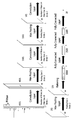
도 8은 본 발명의 실시예에서 딥러닝에 사용한 제1 CNN 아키텍쳐를 나타낸 것이다(a는 CNN2, b는 CNN3).
도 9는 본 발명의 실시예에서 딥러닝에 사용한 제2 CNN 아키텍쳐를 나타낸 것이다.
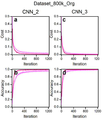
도 10은 'Dataset_800k_org'를 사용한 경우 학습 코스트 및 정확도를 나타낸 것이다.
도 11은 'Dataset_800k_rand' 및 'Dataset_180k_rand'를 사용한 경우 학습 코스트 및 정확도를 나타낸 것이다.
| CNN 아키텍처 | Dataset_80K_org | ||
| CNN2 | CNN3 | ||
| 상 판별 (2 Epochs) |
시뮬레이션 XRD 테스트 데이터세트 |
||
| 100,000 패턴 | 99.60% | 100% | |
| 실제 XRD 테스트 데이터세트 |
|||
| Li2O_SrO_Al2O3 (50 패턴) |
100% | 100% | |
| SrAl2O4_SrO_Al2O3 (50 패턴) |
97.33% | 98.67% | |
| CNN 아키텍처 | Dataset_80K_rand | Dataset_18K_rand | |
| CNN3 | CNN3 | ||
| 상 판별 (2 Epochs) |
시뮬레이션 XRD 테스트 데이터세트 | ||
| 100,000 패턴 | 100% | (23,000 패턴) 99.76% |
|
| 실제 XRD 테스트 데이터세트 |
|||
| Li2O_SrO_Al2O3 (50 패턴) |
100% | 98.67% | |
| SrAl2O4_SrO_Al2O3 (50 패턴) |
98% | 97.33% | |
Claims (5)
- (a) 2 이상의 원소를 선택하는 단계;
(b) 상기 2 이상의 원소로 생성 가능한 것으로 분석된 복수의 화합물의 데이터를 수집하는 단계;
(c) 상기 수집된 복수의 화합물 각각에 관한 이미지 또는 스펙트럼 형태의 분석 데이터를 준비하는 단계;
(d) 상기 복수의 화합물 중에서, 2종 이상의 화합물을 선택하여 소정의 혼합 비율로 혼합하고, 상기 각각 이미지 또는 스펙트럼 데이터를 상기 소정의 혼합 비율에 맞추어 혼합 가공한 것을 포함하여 훈련 데이터를 만드는 단계;
(e) 상기 훈련 데이터를 사용하여 기계 학습을 수행하는 단계; 및
(f) 실제 물질로부터 얻은 이미지 또는 스펙트럼 형태의 분석 데이터를 상기 기계 학습을 통해 수득한 모델을 사용하여 판별 및/또는 분석하는 단계를 포함하는, 물질의 판별 및 분석방법. - 제1항에 있어서,
상기 복수의 화합물의 분석 데이터는, 기존에 분석되어 있는 화학분석, 물질분석 데이터를 이용하는, 물질의 판별 및 분석방법. - 제1항에 있어서,
상기 복수의 화합물에 관하여 각각의 이미지 또는 스펙트럼 형태의 분석 데이터를 준비하는 단계는, 실제 분석된 결과를 사용하거나, 각각의 화합물에 관한 물질 정보를 이용하여 프로그램을 사용하여 해당 분석 이미지 또는 스펙트럼을 시뮬레이션하여 획득하는, 물질의 판별 및 분석방법. - 제1항에 있어서,
상기 이미지 또는 스펙트럼 형태의 분석 데이터는, XRD 데이터, XPS 데이터, IR 데이터 또는 투과전자현미경 회절 패턴인, 물질의 판별 및 분석방법. - 제1항에 있어서,
상기 기계 학습은 CNN(Convolutional Neural Network)을 통해 수행되는, 물질의 판별 및 분석방법.
Priority Applications (3)
| Application Number | Priority Date | Filing Date | Title |
|---|---|---|---|
| JP2019221081A JP6925655B2 (ja) | 2018-12-06 | 2019-12-06 | 物質の分析装置 |
| US16/705,890 US11449708B2 (en) | 2018-12-06 | 2019-12-06 | Method of identification and analysis for materials |
| EP19217932.3A EP3671553A1 (en) | 2018-12-19 | 2019-12-19 | Method of identification and analysis for materials |
Applications Claiming Priority (2)
| Application Number | Priority Date | Filing Date | Title |
|---|---|---|---|
| KR20180156028 | 2018-12-06 | ||
| KR1020180156028 | 2018-12-06 |
Publications (2)
| Publication Number | Publication Date |
|---|---|
| KR20200069222A true KR20200069222A (ko) | 2020-06-16 |
| KR102235934B1 KR102235934B1 (ko) | 2021-04-05 |
Family
ID=71141794
Family Applications (1)
| Application Number | Title | Priority Date | Filing Date |
|---|---|---|---|
| KR1020190150069A Active KR102235934B1 (ko) | 2018-12-06 | 2019-11-21 | 물질의 판별 및 분석 방법 |
Country Status (1)
| Country | Link |
|---|---|
| KR (1) | KR102235934B1 (ko) |
Cited By (1)
| Publication number | Priority date | Publication date | Assignee | Title |
|---|---|---|---|---|
| KR102697843B1 (ko) * | 2023-12-06 | 2024-08-22 | 이강록 | 방향화합물 혼합물의 성분 분석 방법 |
Families Citing this family (1)
| Publication number | Priority date | Publication date | Assignee | Title |
|---|---|---|---|---|
| KR102680207B1 (ko) * | 2023-10-24 | 2024-07-02 | 한국지질자원연구원 | 감마선을 이용한 심해퇴적물의 희토류 자원량 예측 시스템 및 방법 |
Citations (4)
| Publication number | Priority date | Publication date | Assignee | Title |
|---|---|---|---|---|
| JP2000516342A (ja) * | 1996-08-22 | 2000-12-05 | イーストマン ケミカル カンパニー | ラマン分光法による化学組成物のオンライン定量分析 |
| JP2004502934A (ja) * | 2000-07-04 | 2004-01-29 | パターン レコグニション システムズ ホールディング エーエス | 選択された多成分サンプルの分析方法 |
| JP2017522563A (ja) * | 2014-07-22 | 2017-08-10 | オリンパス株式会社 | 混合物の光学的な組成解析 |
| KR20180073819A (ko) | 2016-12-23 | 2018-07-03 | (주)지플러스 | 웹 기반 실험 대상 물질의 정량적 구조 활성 관계 분석 시뮬레이션 시스템 및 그 제공 방법 |
-
2019
- 2019-11-21 KR KR1020190150069A patent/KR102235934B1/ko active Active
Patent Citations (4)
| Publication number | Priority date | Publication date | Assignee | Title |
|---|---|---|---|---|
| JP2000516342A (ja) * | 1996-08-22 | 2000-12-05 | イーストマン ケミカル カンパニー | ラマン分光法による化学組成物のオンライン定量分析 |
| JP2004502934A (ja) * | 2000-07-04 | 2004-01-29 | パターン レコグニション システムズ ホールディング エーエス | 選択された多成分サンプルの分析方法 |
| JP2017522563A (ja) * | 2014-07-22 | 2017-08-10 | オリンパス株式会社 | 混合物の光学的な組成解析 |
| KR20180073819A (ko) | 2016-12-23 | 2018-07-03 | (주)지플러스 | 웹 기반 실험 대상 물질의 정량적 구조 활성 관계 분석 시뮬레이션 시스템 및 그 제공 방법 |
Non-Patent Citations (1)
| Title |
|---|
| Felipe Oviedo 등, Fast classification of small X-ray diffraction datasets using physics-based data augmentation and deep neural networks, NIPS 2018, pp1-11, 2018.11.20.* * |
Cited By (1)
| Publication number | Priority date | Publication date | Assignee | Title |
|---|---|---|---|---|
| KR102697843B1 (ko) * | 2023-12-06 | 2024-08-22 | 이강록 | 방향화합물 혼합물의 성분 분석 방법 |
Also Published As
| Publication number | Publication date |
|---|---|
| KR102235934B1 (ko) | 2021-04-05 |
Similar Documents
| Publication | Publication Date | Title |
|---|---|---|
| JP6925655B2 (ja) | 物質の分析装置 | |
| Pancino et al. | The Gaia-ESO Survey-Mg-Al anti-correlation in iDR4 globular clusters | |
| DE60026452T2 (de) | Verfahren zur Identifizierung von Peptidensequenzen und Proteinensequenzen mittels Massenspektromterie | |
| Bergo et al. | NIRS identification of Swietenia macrophylla is robust across specimens from 27 countries | |
| CN104160253B (zh) | 最佳色调识别器/选择器 | |
| EP3671553A1 (en) | Method of identification and analysis for materials | |
| DE112012004324T5 (de) | Multikomponentenregression/Multikomponentenanalyse von Zeit- und/oder Raumreihendateien | |
| Dorsch et al. | Heavy-metal enrichment of intermediate He-sdOB stars: the pulsators Feige 46 and LS IV–14° 116 revisited | |
| Tello et al. | Application of 2D and 3D image technologies to characterise morphological attributes of grapevine clusters | |
| KR102235934B1 (ko) | 물질의 판별 및 분석 방법 | |
| CN107727676A (zh) | 一种基于向前间隔偏最小二乘算法的土壤重金属含量建模方法 | |
| Fernández-Ramírez et al. | Understanding the nature of Λ (1405) through Regge physics | |
| Moretti et al. | Galaxy luminosity functions in WINGS clusters | |
| DE112017007576T5 (de) | Zonenanalyse zur rezeptoptimierung und messung | |
| Nepomuceno et al. | First results on bilepton production based on LHC collision data and predictions for run II | |
| Ahmed et al. | GW quasiparticle calculations with spin-orbit coupling for the light actinides | |
| CN115579075B (zh) | 基于稳定学习的激光诱导击穿光谱氯元素分析方法及系统 | |
| CN115311628B (zh) | 森林冠层叶绿素含量反演及动态监测方法 | |
| CN109002715A (zh) | 一种基于卷积神经网络的恶意软件识别方法及系统 | |
| CN114689627A (zh) | 混合物的衍射图案分析方法、装置以及信息存储介质 | |
| de Souza Sampaio et al. | EFFECT OF PRESSURE AND TEMPERATURE ON THE RETENTION TIME OF CRUDE OIL INSIDE THE THREE-PHASE SEPARATOR USING THE RESPONSE SURFACE METHODOLOGY | |
| KR20200084376A (ko) | 물질의 판별 및 분석 방법 | |
| CN113838538B (zh) | 基于随机森林快速分类用于有机-无机杂化钙钛矿后处理胺的预测方法及其系统 | |
| Stakia | Advanced multivariate analysis methods for use by the experiments at the Large Hadron Collider | |
| JP2024157277A (ja) | 演算プログラム、演算方法、および情報処理装置 |
Legal Events
| Date | Code | Title | Description |
|---|---|---|---|
| PA0109 | Patent application |
Patent event code: PA01091R01D Comment text: Patent Application Patent event date: 20191121 |
|
| PA0201 | Request for examination | ||
| PG1501 | Laying open of application | ||
| E902 | Notification of reason for refusal | ||
| PE0902 | Notice of grounds for rejection |
Comment text: Notification of reason for refusal Patent event date: 20200922 Patent event code: PE09021S01D |
|
| E701 | Decision to grant or registration of patent right | ||
| PE0701 | Decision of registration |
Patent event code: PE07011S01D Comment text: Decision to Grant Registration Patent event date: 20210325 |
|
| GRNT | Written decision to grant | ||
| PR0701 | Registration of establishment |
Comment text: Registration of Establishment Patent event date: 20210330 Patent event code: PR07011E01D |
|
| PR1002 | Payment of registration fee |
Payment date: 20210330 End annual number: 3 Start annual number: 1 |
|
| PG1601 | Publication of registration | ||
| PR1001 | Payment of annual fee |
Payment date: 20240220 Start annual number: 4 End annual number: 4 |
|
| PR1001 | Payment of annual fee |
Payment date: 20250225 Start annual number: 5 End annual number: 5 |