KR20200076796A - Zinc plated steel sheet having excellent spot weldability and manufacturing method thereof - Google Patents
Zinc plated steel sheet having excellent spot weldability and manufacturing method thereof Download PDFInfo
- Publication number
- KR20200076796A KR20200076796A KR1020180165177A KR20180165177A KR20200076796A KR 20200076796 A KR20200076796 A KR 20200076796A KR 1020180165177 A KR1020180165177 A KR 1020180165177A KR 20180165177 A KR20180165177 A KR 20180165177A KR 20200076796 A KR20200076796 A KR 20200076796A
- Authority
- KR
- South Korea
- Prior art keywords
- steel sheet
- less
- hot
- width direction
- thickness
- Prior art date
- Legal status (The legal status is an assumption and is not a legal conclusion. Google has not performed a legal analysis and makes no representation as to the accuracy of the status listed.)
- Granted
Links
Images
Classifications
-
- C—CHEMISTRY; METALLURGY
- C21—METALLURGY OF IRON
- C21D—MODIFYING THE PHYSICAL STRUCTURE OF FERROUS METALS; GENERAL DEVICES FOR HEAT TREATMENT OF FERROUS OR NON-FERROUS METALS OR ALLOYS; MAKING METAL MALLEABLE, e.g. BY DECARBURISATION OR TEMPERING
- C21D1/00—General methods or devices for heat treatment, e.g. annealing, hardening, quenching or tempering
- C21D1/26—Methods of annealing
-
- C—CHEMISTRY; METALLURGY
- C22—METALLURGY; FERROUS OR NON-FERROUS ALLOYS; TREATMENT OF ALLOYS OR NON-FERROUS METALS
- C22C—ALLOYS
- C22C38/00—Ferrous alloys, e.g. steel alloys
- C22C38/18—Ferrous alloys, e.g. steel alloys containing chromium
- C22C38/38—Ferrous alloys, e.g. steel alloys containing chromium with more than 1.5% by weight of manganese
-
- C—CHEMISTRY; METALLURGY
- C23—COATING METALLIC MATERIAL; COATING MATERIAL WITH METALLIC MATERIAL; CHEMICAL SURFACE TREATMENT; DIFFUSION TREATMENT OF METALLIC MATERIAL; COATING BY VACUUM EVAPORATION, BY SPUTTERING, BY ION IMPLANTATION OR BY CHEMICAL VAPOUR DEPOSITION, IN GENERAL; INHIBITING CORROSION OF METALLIC MATERIAL OR INCRUSTATION IN GENERAL
- C23C—COATING METALLIC MATERIAL; COATING MATERIAL WITH METALLIC MATERIAL; SURFACE TREATMENT OF METALLIC MATERIAL BY DIFFUSION INTO THE SURFACE, BY CHEMICAL CONVERSION OR SUBSTITUTION; COATING BY VACUUM EVAPORATION, BY SPUTTERING, BY ION IMPLANTATION OR BY CHEMICAL VAPOUR DEPOSITION, IN GENERAL
- C23C2/00—Hot-dipping or immersion processes for applying the coating material in the molten state without affecting the shape; Apparatus therefor
- C23C2/04—Hot-dipping or immersion processes for applying the coating material in the molten state without affecting the shape; Apparatus therefor characterised by the coating material
- C23C2/06—Zinc or cadmium or alloys based thereon
-
- C—CHEMISTRY; METALLURGY
- C21—METALLURGY OF IRON
- C21D—MODIFYING THE PHYSICAL STRUCTURE OF FERROUS METALS; GENERAL DEVICES FOR HEAT TREATMENT OF FERROUS OR NON-FERROUS METALS OR ALLOYS; MAKING METAL MALLEABLE, e.g. BY DECARBURISATION OR TEMPERING
- C21D8/00—Modifying the physical properties of ferrous metals or ferrous alloys by deformation combined with, or followed by, heat treatment
- C21D8/02—Modifying the physical properties of ferrous metals or ferrous alloys by deformation combined with, or followed by, heat treatment during manufacturing of plates or strips
-
- C—CHEMISTRY; METALLURGY
- C21—METALLURGY OF IRON
- C21D—MODIFYING THE PHYSICAL STRUCTURE OF FERROUS METALS; GENERAL DEVICES FOR HEAT TREATMENT OF FERROUS OR NON-FERROUS METALS OR ALLOYS; MAKING METAL MALLEABLE, e.g. BY DECARBURISATION OR TEMPERING
- C21D8/00—Modifying the physical properties of ferrous metals or ferrous alloys by deformation combined with, or followed by, heat treatment
- C21D8/02—Modifying the physical properties of ferrous metals or ferrous alloys by deformation combined with, or followed by, heat treatment during manufacturing of plates or strips
- C21D8/0221—Modifying the physical properties of ferrous metals or ferrous alloys by deformation combined with, or followed by, heat treatment during manufacturing of plates or strips characterised by the working steps
- C21D8/0226—Hot rolling
-
- C—CHEMISTRY; METALLURGY
- C21—METALLURGY OF IRON
- C21D—MODIFYING THE PHYSICAL STRUCTURE OF FERROUS METALS; GENERAL DEVICES FOR HEAT TREATMENT OF FERROUS OR NON-FERROUS METALS OR ALLOYS; MAKING METAL MALLEABLE, e.g. BY DECARBURISATION OR TEMPERING
- C21D8/00—Modifying the physical properties of ferrous metals or ferrous alloys by deformation combined with, or followed by, heat treatment
- C21D8/02—Modifying the physical properties of ferrous metals or ferrous alloys by deformation combined with, or followed by, heat treatment during manufacturing of plates or strips
- C21D8/0221—Modifying the physical properties of ferrous metals or ferrous alloys by deformation combined with, or followed by, heat treatment during manufacturing of plates or strips characterised by the working steps
- C21D8/0236—Cold rolling
-
- C—CHEMISTRY; METALLURGY
- C21—METALLURGY OF IRON
- C21D—MODIFYING THE PHYSICAL STRUCTURE OF FERROUS METALS; GENERAL DEVICES FOR HEAT TREATMENT OF FERROUS OR NON-FERROUS METALS OR ALLOYS; MAKING METAL MALLEABLE, e.g. BY DECARBURISATION OR TEMPERING
- C21D8/00—Modifying the physical properties of ferrous metals or ferrous alloys by deformation combined with, or followed by, heat treatment
- C21D8/02—Modifying the physical properties of ferrous metals or ferrous alloys by deformation combined with, or followed by, heat treatment during manufacturing of plates or strips
- C21D8/0247—Modifying the physical properties of ferrous metals or ferrous alloys by deformation combined with, or followed by, heat treatment during manufacturing of plates or strips characterised by the heat treatment
-
- C—CHEMISTRY; METALLURGY
- C21—METALLURGY OF IRON
- C21D—MODIFYING THE PHYSICAL STRUCTURE OF FERROUS METALS; GENERAL DEVICES FOR HEAT TREATMENT OF FERROUS OR NON-FERROUS METALS OR ALLOYS; MAKING METAL MALLEABLE, e.g. BY DECARBURISATION OR TEMPERING
- C21D9/00—Heat treatment, e.g. annealing, hardening, quenching or tempering, adapted for particular articles; Furnaces therefor
- C21D9/0081—Heat treatment, e.g. annealing, hardening, quenching or tempering, adapted for particular articles; Furnaces therefor for slabs; for billets
-
- C—CHEMISTRY; METALLURGY
- C21—METALLURGY OF IRON
- C21D—MODIFYING THE PHYSICAL STRUCTURE OF FERROUS METALS; GENERAL DEVICES FOR HEAT TREATMENT OF FERROUS OR NON-FERROUS METALS OR ALLOYS; MAKING METAL MALLEABLE, e.g. BY DECARBURISATION OR TEMPERING
- C21D9/00—Heat treatment, e.g. annealing, hardening, quenching or tempering, adapted for particular articles; Furnaces therefor
- C21D9/46—Heat treatment, e.g. annealing, hardening, quenching or tempering, adapted for particular articles; Furnaces therefor for sheet metals
-
- C—CHEMISTRY; METALLURGY
- C22—METALLURGY; FERROUS OR NON-FERROUS ALLOYS; TREATMENT OF ALLOYS OR NON-FERROUS METALS
- C22C—ALLOYS
- C22C38/00—Ferrous alloys, e.g. steel alloys
- C22C38/001—Ferrous alloys, e.g. steel alloys containing N
-
- C—CHEMISTRY; METALLURGY
- C22—METALLURGY; FERROUS OR NON-FERROUS ALLOYS; TREATMENT OF ALLOYS OR NON-FERROUS METALS
- C22C—ALLOYS
- C22C38/00—Ferrous alloys, e.g. steel alloys
- C22C38/002—Ferrous alloys, e.g. steel alloys containing In, Mg, or other elements not provided for in one single group C22C38/001 - C22C38/60
-
- C—CHEMISTRY; METALLURGY
- C22—METALLURGY; FERROUS OR NON-FERROUS ALLOYS; TREATMENT OF ALLOYS OR NON-FERROUS METALS
- C22C—ALLOYS
- C22C38/00—Ferrous alloys, e.g. steel alloys
- C22C38/008—Ferrous alloys, e.g. steel alloys containing tin
-
- C—CHEMISTRY; METALLURGY
- C22—METALLURGY; FERROUS OR NON-FERROUS ALLOYS; TREATMENT OF ALLOYS OR NON-FERROUS METALS
- C22C—ALLOYS
- C22C38/00—Ferrous alloys, e.g. steel alloys
- C22C38/02—Ferrous alloys, e.g. steel alloys containing silicon
-
- C—CHEMISTRY; METALLURGY
- C22—METALLURGY; FERROUS OR NON-FERROUS ALLOYS; TREATMENT OF ALLOYS OR NON-FERROUS METALS
- C22C—ALLOYS
- C22C38/00—Ferrous alloys, e.g. steel alloys
- C22C38/06—Ferrous alloys, e.g. steel alloys containing aluminium
-
- C—CHEMISTRY; METALLURGY
- C22—METALLURGY; FERROUS OR NON-FERROUS ALLOYS; TREATMENT OF ALLOYS OR NON-FERROUS METALS
- C22C—ALLOYS
- C22C38/00—Ferrous alloys, e.g. steel alloys
- C22C38/18—Ferrous alloys, e.g. steel alloys containing chromium
- C22C38/22—Ferrous alloys, e.g. steel alloys containing chromium with molybdenum or tungsten
-
- C—CHEMISTRY; METALLURGY
- C22—METALLURGY; FERROUS OR NON-FERROUS ALLOYS; TREATMENT OF ALLOYS OR NON-FERROUS METALS
- C22C—ALLOYS
- C22C38/00—Ferrous alloys, e.g. steel alloys
- C22C38/18—Ferrous alloys, e.g. steel alloys containing chromium
- C22C38/24—Ferrous alloys, e.g. steel alloys containing chromium with vanadium
-
- C—CHEMISTRY; METALLURGY
- C22—METALLURGY; FERROUS OR NON-FERROUS ALLOYS; TREATMENT OF ALLOYS OR NON-FERROUS METALS
- C22C—ALLOYS
- C22C38/00—Ferrous alloys, e.g. steel alloys
- C22C38/18—Ferrous alloys, e.g. steel alloys containing chromium
- C22C38/26—Ferrous alloys, e.g. steel alloys containing chromium with niobium or tantalum
-
- C—CHEMISTRY; METALLURGY
- C22—METALLURGY; FERROUS OR NON-FERROUS ALLOYS; TREATMENT OF ALLOYS OR NON-FERROUS METALS
- C22C—ALLOYS
- C22C38/00—Ferrous alloys, e.g. steel alloys
- C22C38/18—Ferrous alloys, e.g. steel alloys containing chromium
- C22C38/28—Ferrous alloys, e.g. steel alloys containing chromium with titanium or zirconium
-
- C—CHEMISTRY; METALLURGY
- C22—METALLURGY; FERROUS OR NON-FERROUS ALLOYS; TREATMENT OF ALLOYS OR NON-FERROUS METALS
- C22C—ALLOYS
- C22C38/00—Ferrous alloys, e.g. steel alloys
- C22C38/18—Ferrous alloys, e.g. steel alloys containing chromium
- C22C38/32—Ferrous alloys, e.g. steel alloys containing chromium with boron
-
- C—CHEMISTRY; METALLURGY
- C22—METALLURGY; FERROUS OR NON-FERROUS ALLOYS; TREATMENT OF ALLOYS OR NON-FERROUS METALS
- C22C—ALLOYS
- C22C38/00—Ferrous alloys, e.g. steel alloys
- C22C38/18—Ferrous alloys, e.g. steel alloys containing chromium
- C22C38/34—Ferrous alloys, e.g. steel alloys containing chromium with more than 1.5% by weight of silicon
-
- C—CHEMISTRY; METALLURGY
- C22—METALLURGY; FERROUS OR NON-FERROUS ALLOYS; TREATMENT OF ALLOYS OR NON-FERROUS METALS
- C22C—ALLOYS
- C22C38/00—Ferrous alloys, e.g. steel alloys
- C22C38/60—Ferrous alloys, e.g. steel alloys containing lead, selenium, tellurium, or antimony, or more than 0.04% by weight of sulfur
-
- C—CHEMISTRY; METALLURGY
- C23—COATING METALLIC MATERIAL; COATING MATERIAL WITH METALLIC MATERIAL; CHEMICAL SURFACE TREATMENT; DIFFUSION TREATMENT OF METALLIC MATERIAL; COATING BY VACUUM EVAPORATION, BY SPUTTERING, BY ION IMPLANTATION OR BY CHEMICAL VAPOUR DEPOSITION, IN GENERAL; INHIBITING CORROSION OF METALLIC MATERIAL OR INCRUSTATION IN GENERAL
- C23C—COATING METALLIC MATERIAL; COATING MATERIAL WITH METALLIC MATERIAL; SURFACE TREATMENT OF METALLIC MATERIAL BY DIFFUSION INTO THE SURFACE, BY CHEMICAL CONVERSION OR SUBSTITUTION; COATING BY VACUUM EVAPORATION, BY SPUTTERING, BY ION IMPLANTATION OR BY CHEMICAL VAPOUR DEPOSITION, IN GENERAL
- C23C2/00—Hot-dipping or immersion processes for applying the coating material in the molten state without affecting the shape; Apparatus therefor
- C23C2/02—Pretreatment of the material to be coated, e.g. for coating on selected surface areas
-
- C—CHEMISTRY; METALLURGY
- C23—COATING METALLIC MATERIAL; COATING MATERIAL WITH METALLIC MATERIAL; CHEMICAL SURFACE TREATMENT; DIFFUSION TREATMENT OF METALLIC MATERIAL; COATING BY VACUUM EVAPORATION, BY SPUTTERING, BY ION IMPLANTATION OR BY CHEMICAL VAPOUR DEPOSITION, IN GENERAL; INHIBITING CORROSION OF METALLIC MATERIAL OR INCRUSTATION IN GENERAL
- C23C—COATING METALLIC MATERIAL; COATING MATERIAL WITH METALLIC MATERIAL; SURFACE TREATMENT OF METALLIC MATERIAL BY DIFFUSION INTO THE SURFACE, BY CHEMICAL CONVERSION OR SUBSTITUTION; COATING BY VACUUM EVAPORATION, BY SPUTTERING, BY ION IMPLANTATION OR BY CHEMICAL VAPOUR DEPOSITION, IN GENERAL
- C23C2/00—Hot-dipping or immersion processes for applying the coating material in the molten state without affecting the shape; Apparatus therefor
- C23C2/02—Pretreatment of the material to be coated, e.g. for coating on selected surface areas
- C23C2/022—Pretreatment of the material to be coated, e.g. for coating on selected surface areas by heating
-
- C—CHEMISTRY; METALLURGY
- C23—COATING METALLIC MATERIAL; COATING MATERIAL WITH METALLIC MATERIAL; CHEMICAL SURFACE TREATMENT; DIFFUSION TREATMENT OF METALLIC MATERIAL; COATING BY VACUUM EVAPORATION, BY SPUTTERING, BY ION IMPLANTATION OR BY CHEMICAL VAPOUR DEPOSITION, IN GENERAL; INHIBITING CORROSION OF METALLIC MATERIAL OR INCRUSTATION IN GENERAL
- C23C—COATING METALLIC MATERIAL; COATING MATERIAL WITH METALLIC MATERIAL; SURFACE TREATMENT OF METALLIC MATERIAL BY DIFFUSION INTO THE SURFACE, BY CHEMICAL CONVERSION OR SUBSTITUTION; COATING BY VACUUM EVAPORATION, BY SPUTTERING, BY ION IMPLANTATION OR BY CHEMICAL VAPOUR DEPOSITION, IN GENERAL
- C23C2/00—Hot-dipping or immersion processes for applying the coating material in the molten state without affecting the shape; Apparatus therefor
- C23C2/02—Pretreatment of the material to be coated, e.g. for coating on selected surface areas
- C23C2/022—Pretreatment of the material to be coated, e.g. for coating on selected surface areas by heating
- C23C2/0222—Pretreatment of the material to be coated, e.g. for coating on selected surface areas by heating in a reactive atmosphere, e.g. oxidising or reducing atmosphere
-
- C—CHEMISTRY; METALLURGY
- C23—COATING METALLIC MATERIAL; COATING MATERIAL WITH METALLIC MATERIAL; CHEMICAL SURFACE TREATMENT; DIFFUSION TREATMENT OF METALLIC MATERIAL; COATING BY VACUUM EVAPORATION, BY SPUTTERING, BY ION IMPLANTATION OR BY CHEMICAL VAPOUR DEPOSITION, IN GENERAL; INHIBITING CORROSION OF METALLIC MATERIAL OR INCRUSTATION IN GENERAL
- C23C—COATING METALLIC MATERIAL; COATING MATERIAL WITH METALLIC MATERIAL; SURFACE TREATMENT OF METALLIC MATERIAL BY DIFFUSION INTO THE SURFACE, BY CHEMICAL CONVERSION OR SUBSTITUTION; COATING BY VACUUM EVAPORATION, BY SPUTTERING, BY ION IMPLANTATION OR BY CHEMICAL VAPOUR DEPOSITION, IN GENERAL
- C23C2/00—Hot-dipping or immersion processes for applying the coating material in the molten state without affecting the shape; Apparatus therefor
- C23C2/02—Pretreatment of the material to be coated, e.g. for coating on selected surface areas
- C23C2/022—Pretreatment of the material to be coated, e.g. for coating on selected surface areas by heating
- C23C2/0224—Two or more thermal pretreatments
-
- C—CHEMISTRY; METALLURGY
- C23—COATING METALLIC MATERIAL; COATING MATERIAL WITH METALLIC MATERIAL; CHEMICAL SURFACE TREATMENT; DIFFUSION TREATMENT OF METALLIC MATERIAL; COATING BY VACUUM EVAPORATION, BY SPUTTERING, BY ION IMPLANTATION OR BY CHEMICAL VAPOUR DEPOSITION, IN GENERAL; INHIBITING CORROSION OF METALLIC MATERIAL OR INCRUSTATION IN GENERAL
- C23C—COATING METALLIC MATERIAL; COATING MATERIAL WITH METALLIC MATERIAL; SURFACE TREATMENT OF METALLIC MATERIAL BY DIFFUSION INTO THE SURFACE, BY CHEMICAL CONVERSION OR SUBSTITUTION; COATING BY VACUUM EVAPORATION, BY SPUTTERING, BY ION IMPLANTATION OR BY CHEMICAL VAPOUR DEPOSITION, IN GENERAL
- C23C2/00—Hot-dipping or immersion processes for applying the coating material in the molten state without affecting the shape; Apparatus therefor
- C23C2/02—Pretreatment of the material to be coated, e.g. for coating on selected surface areas
- C23C2/024—Pretreatment of the material to be coated, e.g. for coating on selected surface areas by cleaning or etching
-
- C—CHEMISTRY; METALLURGY
- C23—COATING METALLIC MATERIAL; COATING MATERIAL WITH METALLIC MATERIAL; CHEMICAL SURFACE TREATMENT; DIFFUSION TREATMENT OF METALLIC MATERIAL; COATING BY VACUUM EVAPORATION, BY SPUTTERING, BY ION IMPLANTATION OR BY CHEMICAL VAPOUR DEPOSITION, IN GENERAL; INHIBITING CORROSION OF METALLIC MATERIAL OR INCRUSTATION IN GENERAL
- C23C—COATING METALLIC MATERIAL; COATING MATERIAL WITH METALLIC MATERIAL; SURFACE TREATMENT OF METALLIC MATERIAL BY DIFFUSION INTO THE SURFACE, BY CHEMICAL CONVERSION OR SUBSTITUTION; COATING BY VACUUM EVAPORATION, BY SPUTTERING, BY ION IMPLANTATION OR BY CHEMICAL VAPOUR DEPOSITION, IN GENERAL
- C23C2/00—Hot-dipping or immersion processes for applying the coating material in the molten state without affecting the shape; Apparatus therefor
- C23C2/26—After-treatment
- C23C2/28—Thermal after-treatment, e.g. treatment in oil bath
-
- C—CHEMISTRY; METALLURGY
- C23—COATING METALLIC MATERIAL; COATING MATERIAL WITH METALLIC MATERIAL; CHEMICAL SURFACE TREATMENT; DIFFUSION TREATMENT OF METALLIC MATERIAL; COATING BY VACUUM EVAPORATION, BY SPUTTERING, BY ION IMPLANTATION OR BY CHEMICAL VAPOUR DEPOSITION, IN GENERAL; INHIBITING CORROSION OF METALLIC MATERIAL OR INCRUSTATION IN GENERAL
- C23C—COATING METALLIC MATERIAL; COATING MATERIAL WITH METALLIC MATERIAL; SURFACE TREATMENT OF METALLIC MATERIAL BY DIFFUSION INTO THE SURFACE, BY CHEMICAL CONVERSION OR SUBSTITUTION; COATING BY VACUUM EVAPORATION, BY SPUTTERING, BY ION IMPLANTATION OR BY CHEMICAL VAPOUR DEPOSITION, IN GENERAL
- C23C2/00—Hot-dipping or immersion processes for applying the coating material in the molten state without affecting the shape; Apparatus therefor
- C23C2/26—After-treatment
- C23C2/28—Thermal after-treatment, e.g. treatment in oil bath
- C23C2/29—Cooling or quenching
-
- C—CHEMISTRY; METALLURGY
- C23—COATING METALLIC MATERIAL; COATING MATERIAL WITH METALLIC MATERIAL; CHEMICAL SURFACE TREATMENT; DIFFUSION TREATMENT OF METALLIC MATERIAL; COATING BY VACUUM EVAPORATION, BY SPUTTERING, BY ION IMPLANTATION OR BY CHEMICAL VAPOUR DEPOSITION, IN GENERAL; INHIBITING CORROSION OF METALLIC MATERIAL OR INCRUSTATION IN GENERAL
- C23C—COATING METALLIC MATERIAL; COATING MATERIAL WITH METALLIC MATERIAL; SURFACE TREATMENT OF METALLIC MATERIAL BY DIFFUSION INTO THE SURFACE, BY CHEMICAL CONVERSION OR SUBSTITUTION; COATING BY VACUUM EVAPORATION, BY SPUTTERING, BY ION IMPLANTATION OR BY CHEMICAL VAPOUR DEPOSITION, IN GENERAL
- C23C2/00—Hot-dipping or immersion processes for applying the coating material in the molten state without affecting the shape; Apparatus therefor
- C23C2/34—Hot-dipping or immersion processes for applying the coating material in the molten state without affecting the shape; Apparatus therefor characterised by the shape of the material to be treated
- C23C2/36—Elongated material
- C23C2/40—Plates; Strips
-
- C—CHEMISTRY; METALLURGY
- C23—COATING METALLIC MATERIAL; COATING MATERIAL WITH METALLIC MATERIAL; CHEMICAL SURFACE TREATMENT; DIFFUSION TREATMENT OF METALLIC MATERIAL; COATING BY VACUUM EVAPORATION, BY SPUTTERING, BY ION IMPLANTATION OR BY CHEMICAL VAPOUR DEPOSITION, IN GENERAL; INHIBITING CORROSION OF METALLIC MATERIAL OR INCRUSTATION IN GENERAL
- C23G—CLEANING OR DE-GREASING OF METALLIC MATERIAL BY CHEMICAL METHODS OTHER THAN ELECTROLYSIS
- C23G1/00—Cleaning or pickling metallic material with solutions or molten salts
- C23G1/02—Cleaning or pickling metallic material with solutions or molten salts with acid solutions
- C23G1/08—Iron or steel
Landscapes
- Chemical & Material Sciences (AREA)
- Engineering & Computer Science (AREA)
- Materials Engineering (AREA)
- Mechanical Engineering (AREA)
- Metallurgy (AREA)
- Organic Chemistry (AREA)
- Chemical Kinetics & Catalysis (AREA)
- Thermal Sciences (AREA)
- Physics & Mathematics (AREA)
- Crystallography & Structural Chemistry (AREA)
- Oil, Petroleum & Natural Gas (AREA)
- General Chemical & Material Sciences (AREA)
- Heat Treatment Of Sheet Steel (AREA)
- Coating With Molten Metal (AREA)
- Electroplating Methods And Accessories (AREA)
Abstract
본 발명은 점 용접성이 우수한 아연도금강판 및 그 제조방법에 관한 것이다.
본 발명의 한가지 측면에 따른 아연도금강판은 강판; 및 상기 강판 표면에 형성된 아연계 도금층을 포함하고, 상기 강판의 내부 산화 층의 두께의 폭 방향 평균치(a)와 상기 내부 산화 층의 두께의 폭 방향 표준편차(b)의 비율(a/b)이 1.5 이상일 수 있다.The present invention relates to a galvanized steel sheet excellent in spot weldability and a method for manufacturing the same.
A galvanized steel sheet according to one aspect of the present invention is a steel sheet; And a zinc-based plated layer formed on the surface of the steel sheet, the ratio (a/b) of the average width direction (a) of the thickness of the internal oxidation layer of the steel sheet and the standard deviation (b) of the thickness of the internal oxidation layer in the width direction. This may be 1.5 or higher.
Description
본 발명은 점 용접성이 우수한 아연도금강판 및 그 제조방법에 관한 것이다.The present invention relates to a galvanized steel sheet excellent in spot weldability and a method for manufacturing the same.
환경 오염 등의 문제로 자동차 배출가스와 연비에 대한 규제는 날로 강화되어 가고 있다. 그로 인하여 자동차 강판의 경량화를 통한 연료 소모량의 감소에 대한 요구가 강해지고 있으며, 따라서 단위 두께 당 강도가 높은 여러 종류의 고강도 강판이 개발되어 출시되고 있다.Due to environmental pollution, regulations on automobile emissions and fuel economy are being strengthened day by day. As a result, there is a strong demand for reduction of fuel consumption through weight reduction of automobile steel sheets, and thus, various types of high-strength steel sheets having high strength per unit thickness have been developed and released.
고강도 강이라 함은 통상 490MPa 이상의 강도를 가지는 강을 의미하는데, 반드시 이로 한정하는 것은 아니나, 변태유기소성(Transformation Inducced Plasticity; TRIP) 강, 쌍정유기소성(Twin Induced Plasticity; TWIP) 강, 이상조직(Dual Phase; DP) 강, 복합조직(Complex Phase; CP) 강 등이 이에 해당할 수 있다. High-strength steel usually means a steel having a strength of 490 MPa or more, but is not limited thereto, transformation induced plasticity (TRIP) steel, twin induced plasticity (TWIP) steel, and abnormal structure ( This may include dual phase (DP) steel, complex phase (CP) steel, and the like.
한편, 자동차 강재는 내식성을 확보하기 위하여 표면에 도금을 실시한 도금강판의 형태로 공급되는데 그 중에서도 아연도금강판(GI강판) 또는 합금화 아연도금강판(GA)는 아연의 희생방식 특성을 이용하여 높은 내식성을 가지기 때문에 자동차용 소재로 많이 사용된다.On the other hand, automotive steel is supplied in the form of a plated steel plate that has been plated on the surface to ensure corrosion resistance. Among them, galvanized steel plate (GI steel plate) or alloyed zinc plated steel plate (GA) uses zinc sacrificial corrosion resistance to provide high corrosion resistance. Because it has, it is often used as a material for automobiles.
그런데, 고강도 강판의 표면을 아연으로 도금할 경우, 점 용접성이 취약해 진다는 문제가 있다. 즉, 고강도 강의 경우에는 인장강도와 더불어 항복강도가 높기 때문에 용접 중 발생하는 인장응력을 소성 변형을 통해 해소하기 어려워서 표면에 미소 크랙이 발생할 가능성이 높다. 고강도 아연도금강판에 대하여 용접을 실시하면 융점이 낮은 아연이 강판의 미소크랙으로 침투하게 되고 그 결과 액상금속취화(Liquid Metal Embrittlement; LME)라고 하는 현상이 발생하여 강판이 파괴에 이르게 되는 문제가 발생할 수 있으며, 이는 강판의 고강도화에 큰 걸림돌로 작용하고 있다.However, when the surface of the high-strength steel sheet is plated with zinc, there is a problem that spot weldability becomes weak. That is, in the case of high-strength steel, since the tensile strength and the yield strength are high, it is difficult to solve the tensile stress generated during welding through plastic deformation, and thus there is a high possibility of micro-cracking on the surface. When welding a high-strength galvanized steel sheet, zinc with a low melting point penetrates into the micro-cracks of the steel sheet, and as a result, a phenomenon called liquid metal embrittlement (LME) occurs, leading to a problem that the steel sheet leads to destruction. It can act as a major stumbling block to high strength of the steel sheet.
본 발명의 한가지 측면에 따르면 점 용접성이 우수한 아연도금강판 및 그 제조방법이 제공된다. According to one aspect of the present invention, a galvanized steel sheet excellent in spot weldability and a method of manufacturing the same are provided.
본 발명의 과제는 상술한 내용에 한정되지 아니한다. 본 발명이 속하는 기술분야에서 통상의 지식을 가지는 자라면 본 발명 명세서의 전반적인 내용으로부터 본 발명의 추가적인 과제를 이해하는데 아무런 어려움이 없을 것이다.The subject of the present invention is not limited to the above. Those of ordinary skill in the art to which the present invention pertains will have no difficulty in understanding additional problems of the present invention from the general contents of the present specification.
본 발명의 한가지 측면에 따른 아연도금강판은 강판; 및 상기 강판 표면에 형성된 아연계 도금층을 포함하고, 상기 강판의 내부 산화 층의 두께의 폭 방향 평균치(a)와 상기 내부 산화 층의 두께의 폭 방향 표준편차(b)의 비율(a/b)이 1.5 이상일 수 있다.A galvanized steel sheet according to one aspect of the present invention is a steel sheet; And a zinc-based plating layer formed on the surface of the steel sheet, wherein the ratio (a/b) of the average width direction (a) of the thickness of the internal oxidation layer of the steel sheet and the standard deviation (b) in the width direction of the thickness of the internal oxidation layer This may be 1.5 or more.
본 발명의 다른 한가지 측면에 따른 아연도금강판의 제조방법은, 강 슬라브를 열간압연하여 열연강판을 얻는 단계; 상기 열연강판을 590~750℃의 온도에서 권취하여 열연강판을 얻는 단계; 상기 권취된 열연강판의 에지부를 600~800℃에서 5~24시간 가열하는 단계; 상기 열연강판을 180~250mpm의 통판속도로 5~25%의 염산 용액으로 산세하는 단계; 상기 열연강판을 냉간압연하여 냉연강판을 얻는 단계; 650~900℃에서의 이슬점이 -10~30℃ 범위로 되도록 제어하면서 상기 냉연강판을 소둔하는 단계; 및 상기 소둔된 냉연강판을 용융아연도금하는 단계를 포함할 수 있다.A method of manufacturing a galvanized steel sheet according to another aspect of the present invention includes: hot rolling a steel slab to obtain a hot rolled steel sheet; Winding the hot rolled steel sheet at a temperature of 590 to 750° C. to obtain a hot rolled steel sheet; Heating the edge portion of the wound hot-rolled steel sheet at 600 to 800°C for 5 to 24 hours; Pickling the hot-rolled steel sheet with a 5-25% hydrochloric acid solution at a plate speed of 180-250 mpm; Cold rolling the hot rolled steel sheet to obtain a cold rolled steel sheet; Annealing the cold rolled steel sheet while controlling so that the dew point at 650 to 900°C is in the range of -10 to 30°C; And hot-dip galvanizing the annealed cold rolled steel sheet.
상술한 바와 같이, 본 발명은 균일하면서도 충분한 두께를 가지는 내부 산화 층을 가지는 소지강판에 아연계 도금을 실시하였으므로, 용접시 소지강판의 표면에서 미소 크랙이 발생할 가능성을 크게 줄여 액상금속취화(LME)에 의한 용접불량의 문제를 방지할 수 있으며 도금표면품질이 우수한 용융아연도금강판을 제조할 수 있다.As described above, since the present invention is a zinc-based plating on a steel sheet having an internal oxidation layer having a uniform and sufficient thickness, the possibility of micro-cracking on the surface of the steel sheet during welding is greatly reduced, and liquid metal embrittlement (LME) It is possible to prevent the problem of welding defects by and can produce hot-dip galvanized steel sheet with excellent plating surface quality.
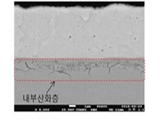
도 1은 발명예 1에 의해 제조된 도금 강판의 단면을 관찰한 사진, 그리고
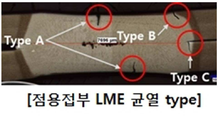
도 2는 각 크랙 발생 위치를 크랙의 타입별로 도시한 사진이다.1 is a photograph observing a cross section of a plated steel sheet prepared by Inventive Example 1, and
2 is a photograph showing the location of each crack by type of crack.
이하, 본 발명을 상세히 설명한다.Hereinafter, the present invention will be described in detail.
본 발명에서 아연도금강판이라고 함은 아연도금강판(GI 강판) 뿐만 아니라 합금화 아연도금강판(GA)는 물론이고 아연이 주로 포함된 도금강판 모두를 포함하는 개념임에 유의할 필요가 있다. 아연이 주로 포함된다는 것은 도금층에 포함된 원소 중 아연의 비율이 가장 높은 것을 의미한다. 다만, 합금화 아연도금강판에서는 아연 보다 철의 비율이 높을 수 있으며, 철을 제외한 나머지 성분 중 아연의 비율이 가장 높은 것을 포함할 수 있다.It should be noted that the term “galvanized steel sheet” in the present invention is a concept including not only galvanized steel sheet (GI steel sheet) but also alloyed galvanized steel sheet (GA) as well as galvanized steel sheet mainly containing zinc. Mainly containing zinc means that the proportion of zinc among the elements included in the plating layer is the highest. However, in the alloyed galvanized steel sheet, the proportion of iron may be higher than that of zinc, and among the remaining components except iron, the proportion of zinc may be the highest.
본 발명의 발명자들은 용접시 발생되는 액상금속취화가 강판의 표면에서부터 발생하는 미소 크랙에 그 원인이 있다는 것에 착안하여, 표면의 미소크랙을 억제하는 수단에 관하여 연구하고, 이를 위해서는 강판 표면의 조직을 연질화 하는 것이 필요할 뿐만 아니라, 연질조직의 비율을 균일하게 제어하는 것이 필요하다는 것을 발견하고 본 발명에 이르게 되었다.The inventors of the present invention have studied the means for suppressing micro-cracks on the surface, focusing on the fact that the liquid metal embrittlement generated during welding is caused by micro-cracks originating from the surface of the steel sheet, and for this, the structure of the steel sheet surface is studied. It has been found that not only is it necessary to soften, but also that it is necessary to uniformly control the proportion of soft tissue, it has led to the present invention.
즉, 본 발명의 한가지 구현례에서는 강판 표면에 평균 두께가 일정 수준 이상인 내부 산화 층을 형성하되, 상기 내부 산화 층의 두께의 폭 방향 표준 편차를 일정 수준 이하로 제어한다. 본 발명의 한가지 구현례에 따르면 상기 내부 산화 층에는 내부 산화물이 존재할 수 있다. 상기 내부산화물은 Si, Mn, Al 및 Fe 중 적어도 1종 이상을 포함할 수 있고, 그 밖에 소지강판의 조성으로부터 유래된 추가의 원소를 더 포함할 수도 있다.That is, in one embodiment of the present invention, an inner oxide layer having an average thickness of a certain level or more is formed on the surface of the steel sheet, and the standard deviation in the width direction of the thickness of the inner oxide layer is controlled to a certain level or less. According to one embodiment of the present invention, an internal oxide may be present in the internal oxidation layer. The internal oxide may include at least one or more of Si, Mn, Al, and Fe, and may further include additional elements derived from the composition of the steel sheet.
표면에 내부 산화 층을 형성할 경우에는 표면에 Mn, Si 등과 같은 경화능 원소들이 산화되어 더이상 고용상태로 존재하지 않으므로 표면 경도가 크게 감소할 수 있다. 경도를 감소시킬 경우에는 취성과 잔류 응력이 줄어들어 미소 크랙의 발생을 감소시킬 수 있으며, 따라서 LME를 크게 억제할 수 있다.In the case of forming an internal oxidation layer on the surface, the surface hardness can be greatly reduced because hardenable elements such as Mn and Si are oxidized on the surface and no longer exist in solid state. In the case of reducing the hardness, brittleness and residual stress can be reduced to reduce the occurrence of micro-cracks, and thus, LME can be greatly suppressed.
따라서, 강판의 내부 산화 층의 두께는 클수록 LME 발생방지에 유리하다. 그러나, 열간 압연 후 권취된 코일의 폭방향 냉각 속도의 불균일 분포로 인하여 내부산화 층의 깊이가 폭방향 위치별로 달라질 수 있다. 이러한 현상은 내부산화가 산소 포텐셜 뿐만 아니라 온도에도 민감하게 영향 받기 때문이다.Therefore, the larger the thickness of the inner oxide layer of the steel sheet is, the more advantageous it is to prevent LME generation. However, due to the non-uniform distribution of the cooling speed in the width direction of the coil wound after hot rolling, the depth of the internal oxidation layer may be varied for each position in the width direction. This is because internal oxidation is sensitively affected not only by oxygen potential but also by temperature.
그런데, 이와 같이 내부 산화 층의 두께가 폭방향 위치 별로 달라질 경우에는 위치별로 LME 발생 정도가 달라지며 결국 취약한 용접부에서 파괴가 일어나게 되는 문제가 발생한다.However, when the thickness of the inner oxide layer is different for each position in the width direction, the degree of occurrence of LME varies depending on the position, and eventually, a problem occurs in that a fracture occurs in a weak weld.
따라서, 본 발명에서는 강판의 내부 산화 층의 두께의 폭 방향 평균치(a)와 상기 내부 산화 층의 두께의 폭 방향 표준편차(b)의 비율(a/b)이 1.5 이상이 되도록 제어한다. 통상 내부 산화층의 두께의 평균치(a)가 커질수록 그에 대응하여 표준편차(b)도 증가하기 때문에 a/b 값이 큰 값을 가지기 어렵다. 그러나, 점 용접성을 향상시키기 위해서는 a/b 값을 1.5 이상으로 하여 LME 저항성의 편차를 최소화할 필요가 있다. 본 발명의 한가지 구현례에서는 상기 a/b 값을 1.7 이상으로 정할 수 있다.Accordingly, in the present invention, the ratio (a/b) of the average value (a) in the width direction of the thickness of the inner oxide layer of the steel sheet and the standard deviation (b) in the width direction of the thickness of the inner oxide layer is controlled to be 1.5 or more. Usually, as the average value (a) of the thickness of the inner oxide layer increases, the standard deviation (b) also increases correspondingly, so it is difficult to have a large value of a/b. However, in order to improve spot weldability, it is necessary to minimize the variation in LME resistance by setting the a/b value to 1.5 or more. In one embodiment of the present invention, the a/b value may be set to 1.7 or more.
상술한 견지에서, 상기 비율(a/b)는 높을 수록 유리하기 때문에, 그 상한을 특별히 제한할 필요는 없다. 다만, 현실적으로 내부 산화 층의 두께가 두꺼울 경우 표준편차가 증가하는 것을 완전히 억제하는 것은 어렵기 때문에, 그 비율(a/b)의 상한을 3.5로 정할 수 있으며 한가지 구현례에서는 상기 비율(a/b)의 상한을 3.0으로 정할 수 있다.From the above point of view, the higher the ratio (a/b) is, the more advantageous it is, and there is no need to specifically limit the upper limit. However, in reality, since it is difficult to completely suppress the increase in the standard deviation when the thickness of the inner oxide layer is thick, the upper limit of the ratio (a/b) can be set to 3.5, and in one embodiment, the ratio (a/b) ) Can be set to an upper limit of 3.0.
본 발명의 한가지 구현례에서 상기 내부 산화 층의 두께의 폭 방향 평균치(a)는 3.0㎛ 이상일 수 있다. 내부 산화 층의 두께의 폭 방향 평균치를 일정 수준 이상으로 하는 이유는 강판의 전체적인 LME 저항성을 높이기 위한 것이다. 본 발명의 한가지 구현례에서는 상기 내부 산화 층의 폭 방향 평균치는 4.0㎛ 이상일 수 있다. LME 저항성 확보의 측면에서는 내부 산화 층의 두께의 폭 방향 평균치의 상한을 특별히 정할 필요가 없으나, 내부 산화 층의 두께가 너무 두꺼울 경우에는 강판의 강도에 영향을 미칠 수 있으므로 내부 산화 층의 두께의 폭 방향 평균치의의 상한을 10.0㎛로 정할 수 있으며, 본 발명의 한가지 구현례는 내부 산화 층의 두께의 폭 방향 평균치의 상한을 6.0㎛로 정할 수도 있다. In one embodiment of the present invention, the average value (a) in the width direction of the thickness of the inner oxide layer may be 3.0 μm or more. The reason that the average value in the width direction of the thickness of the inner oxide layer is higher than a certain level is to increase the overall LME resistance of the steel sheet. In one embodiment of the present invention, the average value in the width direction of the inner oxide layer may be 4.0 μm or more. In terms of securing LME resistance, it is not necessary to specifically set an upper limit of the average width direction of the thickness of the inner oxide layer, but if the thickness of the inner oxide layer is too thick, it may affect the strength of the steel sheet, so the width of the inner oxide layer thickness The upper limit of the direction average value may be set to 10.0 μm, and in one embodiment of the present invention, the upper limit of the width direction average value of the thickness of the inner oxide layer may be set to 6.0 μm.
또한, 본 발명의 한가지 구현례에서 상기 내부 산화 층의 두께의 폭 방향 표준편차(b)는 2.0㎛ 이하일 수 있다. 즉, 폭 방향 표준편차는 작을 수록 위치별 LME 저항성을 높일 수 있으므로, 상기 내부 산화 층의 두께의 폭 방향 표준편차(b)는 2.0㎛ 이하로 정하며, 본 발명의 다른 한가지 구현례에서는 상기 내부 산화 층의 두께의 폭방향 표준편차(b)를 1.5㎛ 이하로 정할 수 있다. 폭 방향 표준편차(b)는 작으면 작을수록 좋은 것이므로 그 하한을 특별히 정할 필요가 없으나, 현실적인 한계를 고려하여 0.5㎛ 이상 또는 1.0㎛ 이상으로 정할 수 있다.In addition, in one embodiment of the present invention, the standard deviation (b) in the width direction of the thickness of the inner oxide layer may be 2.0 μm or less. That is, the smaller the standard deviation in the width direction, the higher the LME resistance for each location, so the standard deviation (b) in the width direction of the thickness of the internal oxidation layer is set to 2.0 µm or less, and in another embodiment of the present invention, the internal oxidation The standard deviation (b) in the width direction of the thickness of the layer can be set to 1.5 µm or less. The smaller the widthwise standard deviation (b), the better is smaller, so there is no need to specifically define the lower limit, but it can be set to 0.5 µm or more or 1.0 µm or more in consideration of realistic limitations.
본 발명에서 내부 산화 층의 두께의 폭 방향 평균치(a)와 표준편차(b)는 강판의 전체 폭을 동일한 간격으로 분할 한 후, 최외곽을 포함하는 분할된 각 지점에서 내부 산화 층의 두께를 측정한 후 이들 값의 평균치와 표준 편차를 구하는 방법으로 구할 수 있다. 단, 에지부의 가장 외곽쪽 표면의 건전성이 문제가 될 경우에는 에지부로부터 약 1mm 지점은 제거하고 나서 균등분할한 지점의 데이터로부터 각 값을 구할 수 있다. 상기 강판을 분할하는 간격은 25cm 이하일 수 있으며, 본 발명의 한가지 실시예에서는 상기 폭을 20cm으로 하여 두께를 구하고 이를 평균치와 표준 편차를 구하는데 이용하였다.In the present invention, the average value (a) and the standard deviation (b) in the width direction of the thickness of the inner oxide layer divide the entire width of the steel sheet at equal intervals, and then the thickness of the inner oxide layer at each divided point including the outermost portion. After measurement, it can be determined by obtaining the average value and the standard deviation of these values. However, when the integrity of the outermost surface of the edge portion is a problem, about 1 mm from the edge portion is removed, and then each value can be obtained from the data of the evenly divided point. The interval for dividing the steel sheet may be 25 cm or less, and in one embodiment of the present invention, the thickness is obtained by setting the width to 20 cm and it is used to obtain an average value and a standard deviation.
본 발명에서 대상으로 하는 강판은 강도 490MPa 이상의 고강도 강판이라면 그 종류를 제한하지 아니한다. 다만, 반드시 이로 제한하는 것은 아니지만, 본 발명에서 대상으로 하는 강판은 중량 비율로, C: 0.05~1.5%, Si: 2.0% 이하, Mn: 1.0~30%, S-Al(산 가용성 알루미늄): 3% 이하, Cr: 2.5% 이하, Mo: 1% 이하, B: 0.005% 이하, Nb: 0.2% 이하, Ti: 0.2% 이하, V: 0.2% 이하, Sb+Sn+Bi: 0.1% 이하, N: 0.01% 이하를 포함하는 조성을 가질 수 있다. 나머지 성분은 철 및 기타 불순물이며, 그 밖에도 위에 열거되지 않되 강 중에 포함될 수 있는 원소들을 합계 1.0% 이하의 범위로 더 포함하는 것까지는 배제하지 아니한다. 본 발명에서 각 성분 원소의 함량은 특별히 달리 표현하지 아니하는 한 중량을 기준으로 표시한다.The steel sheet to be targeted in the present invention is not limited as long as it is a high-strength steel sheet having a strength of 490 MPa or more. However, although not necessarily limited to this, the steel sheet targeted in the present invention is in a weight ratio, C: 0.05 to 1.5%, Si: 2.0% or less, Mn: 1.0 to 30%, S-Al (acid soluble aluminum): 3% or less, Cr: 2.5% or less, Mo: 1% or less, B: 0.005% or less, Nb: 0.2% or less, Ti: 0.2% or less, V: 0.2% or less, Sb+Sn+Bi: 0.1% or less, N: It may have a composition containing 0.01% or less. The rest of the components are iron and other impurities, and other elements not listed above, but are not excluded until they further contain elements that can be included in the steel in a total range of 1.0% or less. In the present invention, the content of each component element is indicated by weight unless otherwise specified.
본 발명의 몇몇 구현례에서는 상기 고강도 강판으로 TRIP강 등을 대상으로 할 수 있다. 이들 강은 세부적으로 구분할 때, 다음과 같은 조성을 가질 수 있다.In some embodiments of the present invention, the high-strength steel sheet may be targeted to TRIP steel or the like. When these steels are classified in detail, they may have the following composition.
강 조성 1: C: 0.05~0.30%(바람직하게는 0.10~0.25%), Si: 0.5~2.5%(바람직하게는 1.0~1.8%), Mn: 1.5~4.0%(바람직하게는 2.0~3.0%), S-Al: 1.0% 이하(바람직하게는 0.05% 이하), Cr: 2.0% 이하(바람직하게는 1.0% 이하), Mo: 0.2% 이하(바람직하게는 0.1% 이하), B: 0.005% 이하(바람직하게는 0.004% 이하), Nb: 0.1% 이하(바람직하게는 0.05% 이하), Ti: 0.1% 이하(바람직하게는 0.001~0.05%), Sb+Sn+Bi: 0.05% 이하, N: 0.01% 이하, 잔부 Fe 및 불가피한 불순물을 포함함. 경우에 따라 위에 열거되지 않되 강 중에 포함될 수 있는 원소들을 합계 1.0% 이하의 범위까지 더 포함할 수 있음.Steel composition 1: C: 0.05 to 0.30% (preferably 0.10 to 0.25%), Si: 0.5 to 2.5% (preferably 1.0 to 1.8%), Mn: 1.5 to 4.0% (preferably 2.0 to 3.0%) ), S-Al: 1.0% or less (preferably 0.05% or less), Cr: 2.0% or less (preferably 1.0% or less), Mo: 0.2% or less (preferably 0.1% or less), B: 0.005% Or less (preferably 0.004% or less), Nb: 0.1% or less (preferably 0.05% or less), Ti: 0.1% or less (preferably 0.001 to 0.05%), Sb+Sn+Bi: 0.05% or less, N : 0.01% or less, including residual Fe and unavoidable impurities. In some cases, the elements not listed above, but may be included in the steel, may further include a total of 1.0% or less.
강 조성 2: C: 0.05~0.30%(바람직하게는 0.10~0.2%), Si: 0.5% 이하(바람직하게는 0.3% 이하), Mn: 4.0~10.0%(바람직하게는 5.0~9.0%), S-Al: 0.05% 이하(바람직하게는 0.001~0.04%), Cr: 2.0% 이하(바람직하게는 1.0% 이하), Mo: 0.5% 이하(바람직하게는 0.1~0.35%), B: 0.005% 이하(바람직하게는 0.004% 이하), Nb: 0.1% 이하(바람직하게는 0.05% 이하), Ti: 0.15% 이하(바람직하게는 0.001~0.1%), Sb+Sn+Bi: 0.05% 이하, N: 0.01% 이하, 잔부 Fe 및 불가피한 불순물을 포함함. 경우에 따라 위에 열거되지 않되 강 중에 포함될 수 있는 원소들을 합계 1.0% 이하의 범위까지 더 포함할 수 있음. Steel composition 2: C: 0.05 to 0.30% (preferably 0.10 to 0.2%), Si: 0.5% or less (preferably 0.3% or less), Mn: 4.0 to 10.0% (preferably 5.0 to 9.0%), S-Al: 0.05% or less (preferably 0.001 to 0.04%), Cr: 2.0% or less (preferably 1.0% or less), Mo: 0.5% or less (preferably 0.1 to 0.35%), B: 0.005% Or less (preferably 0.004% or less), Nb: 0.1% or less (preferably 0.05% or less), Ti: 0.15% or less (preferably 0.001 to 0.1%), Sb+Sn+Bi: 0.05% or less, N : 0.01% or less, including residual Fe and unavoidable impurities. In some cases, the elements not listed above, but may be included in the steel, may further include a total of 1.0% or less.
또한, 상술한 각 성분 원소들 중 그 함량의 하한을 한정하지 않은 경우는 이들을 임의 원소로 보아도 무방하며 그 함량이 0%가 되어도 된다는 것을 의미한다.In addition, when the lower limit of the content of each of the above-mentioned component elements is not limited, it means that they may be regarded as arbitrary elements and the content may be 0%.
본 발명의 한가지 구현례에 따르면, 상기 강판의 표면에는 한 층 이상의 도금층이 포함될 수 있으며, 상기 도금층은 GI(Galvanized) 또는 GA(Galva-annealed) 등을 포함하는 아연계 도금층일 수 있다. 본 발명에서는 상술한 바와 같이 내부산화층의 폭 방향 평균치와 폭 방향 표준편차를 적절히 제어하였으므로, 아연계 도금층이 강판의 표면에 형성되더라도 점 용접시 발생하는 액상금속취화의 문제를 억제할 수 있다.According to one embodiment of the present invention, the surface of the steel sheet may include one or more plating layers, and the plating layer may be a zinc-based plating layer including GI (Galvanized) or GA (Galva-annealed). In the present invention, as described above, since the average value in the width direction and the standard deviation in the width direction of the internal oxidation layer are appropriately controlled, the problem of liquid metal embrittlement occurring during spot welding can be suppressed even when the zinc-based plating layer is formed on the surface of the steel sheet.
상기 아연계 도금층이 GA 층일 경우에는 합금화도(도금층 내 Fe의 함량을 의미함)를 8~13중량%, 바람직하게는 10~12중량%로 제어할 수 있다. 합금화도가 충분하지 못할 경우에는 아연계 도금층 중의 아연이 미소크랙으로 침투하여 액상금속취화의 문제를 일으킬 가능성이 잔류할 수 있으며, 반대로 합금화도가 너무 높을 경우에는 파우더링 등의 문제가 발생할 수 있다.When the zinc-based plating layer is a GA layer, the degree of alloying (meaning the content of Fe in the plating layer) may be controlled to 8 to 13% by weight, preferably 10 to 12% by weight. If the degree of alloying is not sufficient, there is a possibility that the zinc in the zinc-based plating layer penetrates into the micro-cracks and causes a problem of embrittlement of the liquid metal. On the contrary, when the degree of alloying is too high, problems such as powdering may occur. .
또한, 상기 아연계 도금층의 도금 부착량은 30~70g/m2 일 수 있다. 도금 부착량이 너무 작을 경우에는 충분한 내식성을 얻기 어려우며, 반면 도금 부착량이 너무 클 경우에는 제조원가상승 및 액상금속취화의 문제가 발생할 수 있으므로 상술한 범위 내로 제어한다. 보다 바람직한 도금 부착량의 범위는 40~60g/m2 일 수 있다. 본 도금 부착량은 최종 제품에 부착된 도금층의 양을 의미하는 것으로서 도금층이 GA층일 경우에는 합금화에 의해 도금 부착량이 증가하기 때문에 합금화 전은 조금 그 중량이 조금 감소할 수 있으며, 합금화도에 따라 달라지기 때문에 반드시 이로 제한하는 것은 아니나 합금화 전의 부착량(즉, 도금욕으로부터 부착되는 도금의 양)은 그보다 약 10% 정도 감소된 값일 수 있다.In addition, the plating amount of the zinc-based plating layer may be 30 to 70 g/m 2 . If the plating adhesion amount is too small, it is difficult to obtain sufficient corrosion resistance. On the other hand, when the plating adhesion amount is too large, problems in manufacturing cost increase and liquid metal embrittlement may occur, so that the plating is controlled within the above range. A more preferable range of the plating adhesion amount may be 40 to 60 g/m 2 . This plating adhesion amount refers to the amount of the plating layer attached to the final product. When the plating layer is a GA layer, the weight of plating adhesion increases due to alloying, so its weight may decrease slightly before alloying, depending on the degree of alloying. Therefore, although not necessarily limited to this, the amount of adhesion before alloying (that is, the amount of plating attached from the plating bath) may be reduced by about 10%.
이하, 본 발명의 강판을 제조하는 구현례에 대하여 설명한다. 다만, 본 발명의 강판은 반드시 하기하는 구현례에 의하여 제조될 필요는 없으며, 하기하는 구현례는 본 발명의 강판을 제조하는 한가지 바람직한 방편이라는 것에 유의할 필요가 있다.Hereinafter, an embodiment for manufacturing the steel sheet of the present invention will be described. However, it is necessary to note that the steel sheet of the present invention is not necessarily manufactured by the following embodiment, and the following embodiment is one preferred method for manufacturing the steel sheet of the present invention.
상술한 조성의 강 슬라브를 열간압연 한 후 권취하는 과정에 의해 열연강판을 제조할 수 있다. 슬라브의 가열(직송압연의 경우에는 온도 관리) 또는 열간압연 등의 조건에 대해서는 특별히 제한하지 아니하나, 본 발명의 한가지 구현례에서는 권취 온도를 다음과 같이 제한할 수 있다.The hot rolled steel sheet can be manufactured by hot rolling a steel slab having the above-described composition and then winding it up. Conditions for heating the slab (temperature control in the case of direct rolling) or hot rolling are not particularly limited, but in one embodiment of the present invention, the winding temperature may be limited as follows.
권취온도: 590~750℃Winding temperature: 590~750℃
권취된 강판은 서냉 과정을 거치게 된다. 이와 같은 과정에 의하여 내부 산화층이 코일 내부에 형성되게 되는데, 슬라브의 권취 온도가 너무 낮을 경우에는 내부 산화에 필요한 온도 보다 낮은 온도에서 코일이 서냉되므로 충분한 내부 산화의 효과를 거두기 어렵다. 반대로 권취온도가 너무 높을 경우에는 폭방향 중심부와 에지부 사이의 온도 편차가 커지고 그에 따라 재질편차가 증가하게 된다. 이러할 경우 냉간 압연성이 열위해지고, 더불어 최종 제품의 강도가 저하될 뿐만 아니라 성형성도 나빠질 우려가 있다. 또한, 표면산화 관점에서도 권취 온도가 너무 높을 경우에는 스케일의 재산화가 발생하여 Fe2O3가 생성될 수 있는데, 이러할 경우 표면품질이 열위해 질 수 있다. 따라서, 본 발명의 한가지 구현례에서는 상기 권취 온도의 상한을 750℃로 정할 수 있다.The wound steel sheet is subjected to a slow cooling process. The internal oxidation layer is formed inside the coil by the above process. When the coiling temperature of the slab is too low, the coil is annealed at a temperature lower than the temperature required for internal oxidation, so it is difficult to obtain a sufficient internal oxidation effect. Conversely, if the coiling temperature is too high, the temperature deviation between the center portion and the edge portion in the width direction becomes large and the material deviation increases accordingly. In this case, the cold rolling property is inferior, and the strength of the final product is not only lowered, but also the moldability may be deteriorated. In addition, from the viewpoint of surface oxidation, if the coiling temperature is too high, re-oxidation of the scale may occur and Fe 2 O 3 may be generated, in which case surface quality may be deteriorated. Therefore, in one embodiment of the present invention, the upper limit of the coiling temperature may be set to 750°C.
이후, 권취된 강판(열연 코일)은 에지부에 대하여 추가적인 내부 산화를 실시하기 위하여 에지부 가열 과정을 겪게 된다. 에지부 가열의 구체적인 조건은 하기 하는 바와 같다.Thereafter, the wound steel sheet (hot rolled coil) undergoes an edge heating process in order to perform additional internal oxidation on the edge. The specific conditions of the edge heating are as follows.
열연 코일 에지부 가열: 600~800℃에서 5~24시간 실시Heated edge of hot-rolled coil: 5 to 24 hours at 600 to 800℃
본 발명에서는 내부 산화 층의 두께의 폭 방향 표준편차(b)를 더욱 줄이기 위하여 열연 코일의 에지부를 가열한다. 열연 코일 에지부 가열이라 함은 귄취된 코일의 폭방향 양쪽 단부, 즉 에지부를 가열하는 것을 의미하는 것으로서 에지부 가열에 의하여 에지부가 내부 산화에 적합한 온도로 우선 가열된다. 즉, 권취된 코일은 내부는 고온으로 유지되나 에지부는 상대적으로 신속하게 냉각되는데, 이로 인하여 내부 산화에 적합한 온도에서 유지되는 시간이 에지부에서 보다 짧게 된다. 따라서, 폭방향 중심부에서의 내부 산화 층의 두께에 비하여 에지부에서의 내부 산화 층의 두께가 얇게 형성된다. 에지부 가열은 이러한 폭방향 두께의 불균일을 해소하는 한가지 방안으로 사용될 수 있다.In the present invention, to further reduce the standard deviation (b) in the width direction of the thickness of the inner oxide layer, the edge portion of the hot rolled coil is heated. The heating of the hot-rolled coil edge means heating both ends of the wound coil in the width direction, that is, the edge, and the edge is first heated to a temperature suitable for internal oxidation by heating the edge. That is, the coiled coil is maintained at a high temperature inside, but the edge portion is cooled relatively quickly, thereby shortening the time to be maintained at a temperature suitable for internal oxidation at the edge portion. Therefore, the thickness of the inner oxide layer at the edge portion is thin compared to the thickness of the inner oxide layer at the center in the width direction. Edge heating can be used as one way to resolve this non-uniformity in the width direction.
즉, 에지부 가열을 실시할 경우 권취 후 냉각의 경우와는 반대로 에지부가 우선 가열되고 따라서 폭방향 에지부의 온도가 내부 산화에 적합하게 유지되는데 그 결과 에지부의 내부 산화 층 두께가 증가하게 된다. 이를 위해서는 상기 에지부 가열 온도는 600℃ 이상(강판 에지부의 온도를 기준으로 함)일 필요가 있다. 다만 온도가 너무 높을 경우에는 가열 중에 에지부에 스케일이 과도하게 형성되거나 다공질의 고산화 스케일(hematite)가 형성되어 산세 후 표면상태가 나빠질 수 있으므로 상기 에지부 온도는 800℃ 이하일 수 있다. 보다 바람직한 에지부 가열 온도는 600~750℃이다.That is, in the case of heating the edge portion, as opposed to the case of cooling after winding, the edge portion is first heated, and accordingly, the temperature of the edge portion in the width direction is appropriately maintained for internal oxidation. As a result, the thickness of the inner oxide layer of the edge portion increases. To this end, the heating temperature of the edge portion needs to be 600°C or higher (based on the temperature of the edge portion of the steel sheet). However, if the temperature is too high, the surface may be deteriorated after pickling due to excessive scale formation on the edge portion during heating or formation of porous high oxidation scale (hematite), so the edge portion temperature may be 800°C or less. A more preferable edge heating temperature is 600 to 750°C.
또한, 권취시에 발생한 내부 산화 층 두께의 불균일을 해소하기 위해서는 상기 에지부 가열 시간은 5시간 이상일 필요가 있다. 다만, 에지부 가열 시간이 너무 길 경우에는 스케일이 과도하게 형성되거나 오히려 에지부의 내부 산화 층 두께가 너무 두꺼워져서 불균일이 발생할 수 있다. 따라서, 에지부 가열 시간은 24시간 이하일 수 있다. In addition, the edge portion heating time needs to be 5 hours or more in order to eliminate the unevenness in the thickness of the internal oxide layer generated during winding. However, if the heating time of the edge portion is too long, the scale may be excessively formed, or rather, the thickness of the inner oxide layer of the edge portion may become too thick, resulting in unevenness. Therefore, the edge portion heating time may be 24 hours or less.
본 발명의 한가지 구현례에 따르면 상기 에지부 가열은 공연비 조절을 통한 연소 가열 방식에 의해서 이루어질 수 있다. 즉, 공연비 조절에 의하여 분위기 중의 산소 분율이 달라질 수 있는데, 산소 분율이 높을 수록 강판의 표층과 접하는 산소 농도가 능가하여 탈탄이나 내부 산화가 증가할 수 있다. 반드시 이로 한정하는 것은 아니나, 본 발명이 한가지 구현례에서는 공연비 조절을 통하여 산소를 0.5~2체적% 포함하는 질소 분위기로 제어할 수 있다. 본 발명이 속하는 기술분야에서 통상의 지식을 가지는 자라면 특별한 어려움 없이 공연비 조절을 통하여 산소 분율을 제어할 수 있으므로 이에 대해서는 별도로 설명하지 아니한다.According to one embodiment of the present invention, the edge heating may be performed by a combustion heating method through air-fuel ratio control. That is, the oxygen fraction in the atmosphere may be changed by controlling the air-fuel ratio. The higher the oxygen fraction, the higher the oxygen concentration in contact with the surface layer of the steel sheet may increase decarburization and internal oxidation. Although not necessarily limited to this, the present invention can be controlled to a nitrogen atmosphere containing 0.5 to 2% by volume of oxygen by adjusting the air-fuel ratio in one embodiment. Those skilled in the art to which the present invention pertains may control the oxygen fraction by adjusting the air-fuel ratio without particular difficulty, so this will not be described separately.
이후, 에지부 가열 처리된 열연 강판의 표면의 스케일을 제거하기 위하여 산세를 실시한다. 구체적인 산세 조건은 하기하는 바와 같다.Thereafter, pickling is performed in order to remove the scale of the surface of the hot-rolled steel sheet heated by the edge. Specific pickling conditions are as follows.
산세: 180~250mpm의 속도로 5~25%의 염산 용액으로 실시Pickling: 5~25% hydrochloric acid solution at 180~250mpm
강판 표면에 형성된 스케일을 제거하기 위하여 180~250mpm의 속도로 5~25%(부피기준)의 염산 용액 산세를 실시할 수 있다. 산세 속도가 너무 느리거나 염산의 농도가 너무 높은 경우에는 열연강판의 표면 스케일이 제거될 뿐만 아니라 소지철이 노출되어 내부산화 입계가 부식될 수 있다. 이러한 경우 플레이킹(flaking)성 덴트 등의 문제를 발생시킬 수 있으며, 내부 산화층의 용해로 인하여 LME에 대한 저항성이 저하될 우려가 있다. 반면, 산세 속도가 너무 빠르거나 염산의 농도가 낮을 경우에는 스케일 제거가 충분하지 않을 수 있으므로, 본 발명의 한가지 구현례에서는 산세 속도와 염산 농도를 상술한 범위로 제어할 수 있다. 또한, 강판이 적절한 시간동안 산세될 수 있도록 하기 위하여, 본 발명의 한가지 구현례에서는 상기 산세라인의 길이를 50 내지 150m로 정할 수 있다.In order to remove the scale formed on the surface of the steel sheet, 5 to 25% (volume standard) hydrochloric acid solution pickling may be performed at a rate of 180 to 250 mpm. When the pickling rate is too slow or the concentration of hydrochloric acid is too high, the surface scale of the hot-rolled steel sheet is not only removed, but the iron oxide is exposed and the internal oxidation grain boundaries may be corroded. In this case, problems such as flaking dents may occur, and resistance to LME may be deteriorated due to dissolution of the internal oxide layer. On the other hand, if the pickling rate is too fast or the concentration of hydrochloric acid is low, the scale removal may not be sufficient, so in one embodiment of the present invention, the pickling rate and hydrochloric acid concentration may be controlled in the above-described range. In addition, in order to allow the steel sheet to be pickled for a suitable period of time, in one embodiment of the present invention, the length of the pickling line may be set to 50 to 150 m.
이후, 산세된 열연강판에 대하여 냉간압연 과정 및 소둔 과정을 수행할 수 있다. 이때, 본 발명의 한가지 구현례에 따르면 의도하는 내부 산화층을 얻기 위해서는 소둔시 소둔온도와 소둔로내 이슬점을 다음과 같은 방식으로 제어하는 것이 유리하다.Thereafter, a cold rolling process and an annealing process may be performed on the pickled hot rolled steel sheet. At this time, according to one embodiment of the present invention, in order to obtain an intended internal oxidation layer, it is advantageous to control the annealing temperature and the dew point in the annealing furnace in the following manner during annealing.
소둔 조건: 650~900℃에서 -10~30℃ 의 이슬점의 분위기로 실시 Annealing conditions: 650~900℃, -10~30℃ dew point atmosphere
본 발명에서 소둔을 실시하는 온도는 충분한 내부 산화 효과가 나타나는 온도인 650℃ 이상일 수 있다. 다만, 온도가 너무 높을 경우에는 Si 등의 표면 산화물이 형성되어 산소가 내부로 확산하는 것을 방해할 뿐만 아니라, 균열대 가열 중 오스테나이트가 과도하게 발생하여 탄소 확산속도가 저하되고 그로 인하여 탈탄 정도가 감소될 수 있으며, 또한 소둔로의 부하를 발생시켜 설비 수명을 단축시키고 공정비용을 증가시키는 문제점을 야기할 수 있기 때문에 상기 이슬점을 제어하는 온도는 900℃ 이하일 수 있다. 본 발명에서 소둔을 실시하는 온도라 함은 균열대의 온도를 의미한다.In the present invention, the temperature at which annealing is performed may be 650° C. or higher, which is a temperature at which a sufficient internal oxidation effect is exhibited. However, when the temperature is too high, surface oxides such as Si are formed to prevent oxygen from diffusing inside, and austenite is excessively generated during heating of the crack zone, resulting in a decrease in the carbon diffusion rate and thereby decarburization degree. The temperature controlling the dew point may be 900° C. or less because it may be reduced and may also cause a problem of shortening equipment life and increasing process cost by generating an annealing furnace load. In the present invention, the annealing temperature means the temperature of the crack zone.
이때, 충분하고 균일한 내부 산화층을 형성시키기 위하여 소둔로내 분위기의 이슬점을 제어하는 것이 유리하다. 이슬점이 너무 낮을 경우에는 내부 산화가 아니라 표면 산화가 발생하여 표면에 Si나 Mn 등의 산화물이 생성될 우려가 있다. 따라서, 이슬점은 -10℃ 이상으로 제어할 필요가 있다. 반대로 이슬점이 너무 높을 경우에는 Fe의 산화가 발생할 우려가 있으므로, 이슬점은 30℃ 이하로 제어될 필요가 있다. At this time, it is advantageous to control the dew point of the atmosphere in the annealing furnace in order to form a sufficient and uniform internal oxide layer. When the dew point is too low, there is a possibility that oxide such as Si or Mn is generated on the surface due to surface oxidation rather than internal oxidation. Therefore, it is necessary to control the dew point to -10°C or higher. Conversely, when the dew point is too high, there is a possibility that oxidation of Fe occurs, so the dew point needs to be controlled to 30°C or less.
이때, 이슬점은 수소를 1~10부피% 포함하는 습질소(N2+H2O)를 소둔로 내에 투입함으로써 조절할 수 있다.At this time, the dew point can be adjusted by adding wet nitrogen (N 2 +H 2 O) containing 1 to 10% by volume of hydrogen into an annealing furnace.
이와 같은 과정에 의하여 소둔된 강판은 도금욕 온도 이상(460~500℃)으로 재가열 한 후 도금욕에 침지하여 용융 아연 도금을 실시한다. 본 발명의 한가지 구현례에 따르면 도금욕에 침지되는 소둔된 강판의 두께는 1.0~2.0mm로 조절될 수 있다. 본 발명의 한가지 구현례에 따르면 상기 도금욕은 아연계 도금욕으로서 Zn 을 50중량% 이상 포함할 수 있다.The steel sheet annealed by this process is reheated to a plating bath temperature or higher (460 to 500°C) and then immersed in a plating bath to perform hot dip galvanization. According to one embodiment of the present invention, the thickness of the annealed steel sheet immersed in the plating bath may be adjusted to 1.0 to 2.0 mm. According to one embodiment of the present invention, the plating bath may include 50% by weight or more of Zn as a zinc-based plating bath.
상술한 과정에 의하여 도금된 용융아연도금강판은 이후 필요에 따라 합금화 열처리 과정을 거칠 수 있다. 합금화 열처리의 바람직한 조건은 하기하는 바와 같다.The hot-dip galvanized steel sheet plated by the above-described process may then be subjected to an alloying heat treatment process as necessary. Preferred conditions for the alloying heat treatment are as follows.
합금화(GA) 온도: 480~560℃Alloying (GA) temperature: 480~560℃
480℃ 미만에서는 Fe확산량이 적어 합금화도가 충분하지 못해 도금물성이 좋지 않을 수 있으며, 560℃를 초과하게 되는 경우 과도한 합금화로 인한 파우더링(powdering) 문제가 발생할 수 있고, 잔류 오스테나이트의 페라이트 변태로 재질이 열화될 수 있으므로 합금화 온도를 상술한 범위로 정한다.Below 480℃, the amount of Fe diffusion is small, so the degree of alloying is insufficient, so the plating properties may not be good. If it exceeds 560℃, powdering problems due to excessive alloying may occur, and ferrite transformation of residual austenite Since the furnace material may deteriorate, the alloying temperature is set in the above-described range.
본 발명의 한가지 구현례에서 상기 충분한 합금화도를 확보하기 위해서는 상기 합금화 열처리 시간은 1초 이상일 수 있다. 다만, 합금화 열처리 시간이 너무 길 경우에는 합금화도가 본 발명에서 규정하는 범위를 초과할 수 있으므로, 상기 합금화 열처리 시간의 상한은 5초로 정할 수 있다.In one embodiment of the present invention, in order to secure the sufficient degree of alloying, the alloying heat treatment time may be 1 second or more. However, when the alloying heat treatment time is too long, the alloying degree may exceed the range specified in the present invention, so the upper limit of the alloying heat treatment time may be set to 5 seconds.
이하, 실시예를 통하여 본 발명을 보다 구체적으로 설명한다. 다만, 하기하는 실시예는 본 발명을 예시하여 구체화하기 위한 것일 뿐 본 발명의 권리범위를 제한하기 위한 것이 아니라는 점에 유의할 필요가 있다. 본 발명의 권리범위는 특허청구범위에 기재된 사항과 이로부터 합리적으로 유추되는 사항에 의하여 정해지는 것이기 때문이다.Hereinafter, the present invention will be described in more detail through examples. However, it is necessary to note that the following examples are only intended to illustrate the present invention and not to limit the scope of the present invention. This is because the scope of the present invention is determined by the items described in the claims and the items reasonably inferred therefrom.
(실시예)(Example)
하기 표 1에 기재된 조성을 가지는 강 슬라브(표에서 기재되지 않은 나머지 성분은 Fe 및 불가피하게 포함되는 불순물임. 또한 표에서 B와 N은 ppm 단위로 표시하였으며, 나머지 성분들은 중량% 단위로 표시함)를 열간압연 한 후, 열연 코일에 대하여 산소를 포함하는 질소 분위기에서 에지부 가열을 실시하였으며, 그 후 길이 100mm의 산세라인에서 210mpm의 통판속도로 진행하는 강판을 19.2부피%의 염산 용액으로 산세 한 후, 냉간압연하고, 얻어진 냉연강판을 소둔로에서 소둔한 후 강판을 480℃로 재가열 한 후, Al을 0.13중량% 포함하는 아연계 도금욕에 침지하여 용융아연도금을 실시한 후 에어나이핑을 통해 부착량을 조절하였다. 얻어진 용융아연도금강판에 필요에 따라 4초간 합금화(GA) 열처리를 실시하여 최종적으로 합금화 용융아연도금강판을 얻었다. Steel slab having the composition shown in Table 1 below (the remaining components not listed in the table are Fe and impurities that are inevitably included. In the table, B and N are expressed in ppm units, and the remaining components are expressed in weight %) After hot rolling, the edge coil was heated in a nitrogen atmosphere containing oxygen to the hot rolled coil, and then pickled with a 19.2% by volume hydrochloric acid solution of a steel plate that was processed at a mailing speed of 210mpm in a pickling line of 100mm in length. Thereafter, after cold rolling, annealing the obtained cold rolled steel sheet in an annealing furnace, reheating the steel sheet to 480° C., and then immersed in a zinc-based plating bath containing 0.13% by weight of Al to perform hot dip galvanizing, followed by air kneading. The adhesion amount was adjusted. The obtained hot-dip galvanized steel sheet was subjected to an alloying (GA) heat treatment for 4 seconds as necessary to finally obtain an alloyed hot-dip galvanized steel sheet.
합금화를 실시하지 않고 단지 용용아연도금강판을 얻을 경우에는 상술한 조건으로 냉연강판을 소둔하고 재가열 한 후, Al을 0.24중량% 포함하는 아연계 도금욕에 침지하여 도금을 실시하였으며, 이후 에어나이핑 후에 강판을 냉각하여 최종적으로 용융아연도금(GI)강판을 얻었다.When the hot-dip galvanized steel sheet is obtained without performing alloying, the cold-rolled steel sheet is annealed and reheated under the above-described conditions, and then immersed in a zinc-based plating bath containing 0.24% by weight of Al, followed by plating. After the steel plate was cooled, a hot dip galvanized (GI) steel plate was finally obtained.
모든 실시예에서 두께 1.6mm의 강판을 얻기 위하여 압하율을 47%로 냉간압연 하였으며, 소둔시 균열대 온도를 830℃로, 통판속도를 90mpm으로, 그리고 소둔로내 습질소에 포함된 수소의 비율을 5체적%로 정하였다.그 밖의 각 실시예별 조건은 표 2에 기재한 바와 같다.In all examples, in order to obtain a steel plate having a thickness of 1.6 mm, the rolling reduction was cold rolled to 47%, the crack zone temperature during annealing was 830°C, the mailing speed was 90 mpm, and the proportion of hydrogen contained in wet nitrogen in the annealing furnace. 5% by volume. Other conditions for each Example are as shown in Table 2.
(℃)Winding temperature
(℃)
(℃)Heating temperature
(℃)
(시간)Heating time
(time)
(%)Oxygen fraction
(%)
이슬점(℃)Crack
Dew point (℃)
(℃)Temperature
(℃)
상술한 과정에 의하여 제조된 합금화 용융아연도금(GA) 강판의 특성을 측정하고, 점 용접시 액상금속취화(LME가 발생하였는지 여부를 관찰한 결과를 표 3에 나타내었다. 내부 산화 층의 두께의 폭 방향 평균치(a)와 내부 산화 층의 두께의 폭 방향 표준편차(b)는 강판의 에지부로부터 1mm 지점은 제거하고 나서 20cm 간격으로 균등분할한 각 지점의 데이터로부터 구하였다. 강판을 폭방향으로 절단하여 에지부에서 중심부까지의 순서대로 에지(Edge), 미들(Mid), 센터(Cen) 부위로 하였으며, 절단된 시편의 중앙부에 점 용접을 실시하였다. 점 용접은 교류(AC)형 점 용접기를 사용하여 23 사이클(cycle; 전류 주기를 의미한다, 본 실시예서는 60Hz 교류 전류를 사용하였다) 통전 후 6 사이클 휴지 후 다시 10 사이클 통전하고, 유지(holding)를 1 사이클 가하는 조건으로 실시하였다. 또한, 상술한 점 용접시 각 평가소재를 2겹으로 놓고 하부에 구께가 1.4mm인 강도 980MPa급 합금화 용융아연도금(GA) DP 강판을 겹쳐놓는 2종 3겹 용접을 실시하였으며, 지름 8mm의 돔형태를 가지는 전극을 사용하였으며, 전극과 시편 간의 각도를 5도 기울이는 조건으로 하였다. 이때, 각 시편별로 날림(expulsion)이 발생하는 상한전류를 측정하고, Exp-0.2kA(상한전류보다 0.2kA 낮은 전류) 및 Exp-0.5kA(상한전류보다 0.5kA 낮은 전류)에서 각 전류별 9회씩 점 용접을 실시하였다. LME 발생여부를 판정하기 위하여 점 용접부의 중앙부를 절단하여 모든 단면을 광학현미경 100배로 관찰하는 조건에서 도 2의 B-타입과 C-타입 크랙의 최대 길이를 측정하였다. B-타입 크랙의 경우 100㎛를 초과하는 길이를 가지는 크랙이 존재할 경우 불량으로 판정하였으며, 그렇지 않으면 양호로 판정하였다. C-타입 크랙 관찰되면(길이에 제한이 없음) 불량으로 판정하였으며, 그렇지 않으면 양호로 판정하였다. 각 시편에서 불량인 경우가 하나라도 발생할 경우 용접시 LME 에 대한 저항성(점 용접성)은 양호하지 않은 것으로 판정할 수 있다. 표 4에 각 발명예 및 비교예의 LME 측정 결과를 나타내었다.Table 3 shows the results of measuring the properties of the alloyed hot-dip galvanized (GA) steel sheet produced by the above-described process and observing whether or not liquid metal embrittlement (LME occurred) during spot welding. The average value in the width direction (a) and the standard deviation in the width direction of the thickness of the inner oxide layer (b) were obtained from the data of each point evenly divided at 20 cm intervals after removing the 1 mm point from the edge portion of the steel plate. It was cut in the order of edge, middle, and center (Cen) in order from the edge to the center, and spot welding was performed on the center of the cut specimen. 23 cycles using a welding machine (meaning a current cycle, 60 Hz AC current was used in this example) After energizing, 6 cycles of rest were applied, and 10 cycles were applied again, and holding was performed under the condition of adding 1 cycle. In addition, when the above-mentioned spot welding, each evaluation material was placed in two layers, and two types of three-ply welding were performed to overlap the strength 980MPa grade alloyed hot-dip galvanized (GA) DP steel sheet with a thickness of 1.4mm at the bottom. An electrode having a dome shape was used, and the angle between the electrode and the specimen was inclined by 5 degrees, where the upper limit current at which an explosion occurred for each specimen was measured, and Exp-0.2 kA (0.2 kA than the upper limit current) Low current) and Exp-0.5kA (0.5kA lower than the upper limit current) were spot welded 9 times for each current.To determine whether LME occurred, cut the center of the spot weld and cut all sections to 100 times with an optical microscope. The maximum lengths of the B-type and C-type cracks in Fig. 2 were measured under the observed conditions. In the case of B-type cracks, if a crack having a length exceeding 100 µm was present, it was determined as poor, otherwise it was judged as good. If a C-type crack was observed (there is no limitation on the length), it was judged to be defective, otherwise it was judged to be good. In the case of welding, it can be determined that the resistance to LME (spot weldability) is not good. Table 4 shows the LME measurement results of each of the inventive examples and comparative examples.
※내부 산화 층의 폭 방향 평균치(a)와 표준편차(b)는 ㎛ 단위임.※The average value (a) and the standard deviation (b) in the width direction of the inner oxide layer are in µm.
발명예 1, 2, 3, 4, 5, 및 6은 강조성을 본 발명에서 제시하는 범위를 만족하였으며, 제조방법 또한 본 발명의 범위를 만족하여 인장강도, 도금표면품질, 도금부착량 및 점용접 LME 크랙 길이도 양호하였다. 도 1은 본 발명의 발명예 1에 의해 제조된 강판의 절단면을 관찰한 사진으로서, 도면을 통하여 내부에 균일한 내부 산화 층이 충분한 두께로 형성되어 있는 것을 확인할 수 있다.Inventive Examples 1, 2, 3, 4, 5, and 6 satisfied the range suggested by the present invention with emphasis, and the manufacturing method also satisfied the range of the present invention, thereby obtaining tensile strength, plating surface quality, plating adhesion, and spot welding. The LME crack length was also good. 1 is a photograph observing the cut surface of the steel sheet prepared by Inventive Example 1 of the present invention, it can be seen through the drawing that a uniform internal oxide layer is formed to a sufficient thickness inside.
비교예 1에서는 에지부 열처리로 가열 온도 및 시간이 본 발명이 제시하는 범위를 만족하지만 산소분율이 범위를 초과하였다. 열처리 과정 중 에지부에 과산화가 발생하여 표면 스케일이 붉은 색의 헤마타이트를 형성하고, 스케일의 두께가 과도하게 두꺼워졌다. 열연 후 산세 과정에서 에지부가 과도하게 산세되면서 표면조도가 높아져 도금 이후 표면 형상이 불균일하고 표면색상이 중앙부와 상이한 색상 불균일 결함이 발생하였다. In Comparative Example 1, the heating temperature and time of the edge portion heat treatment satisfied the range suggested by the present invention, but the oxygen fraction exceeded the range. During the heat treatment process, peroxidation occurred at the edge portion, and the surface scale formed red hematite, and the thickness of the scale became excessively thick. After hot rolling, the edge portion was excessively pickled during the pickling process, resulting in high surface roughness, resulting in uneven surface shape after plating, and color nonuniformity defects in which the surface color was different from the central portion.
비교예 2는 에지부 열처리시 가열온도는 본 발명의 범위를 만족하지만, 가열 시간이 본 발명이 제시하는 범위보다 짧았던 경우이다. 에지부에 충분한 내부산화가 형성되지 않아 내부산화 깊이 폭방향 편차가 2㎛를 초과하였고, 점용접 LME 크랙 평가시 에지부 또는 미들부가 기준을 만족하지 못하여 불량하였다. Comparative Example 2 is a case where the heating temperature during the edge heat treatment satisfies the scope of the present invention, but the heating time is shorter than the range suggested by the present invention. Since sufficient internal oxidation was not formed at the edge portion, the internal oxidation depth width direction deviation exceeded 2 µm, and the edge portion or middle portion did not satisfy the criteria when evaluating cracks in spot welding LME.
비교예 3은 GA합금화 과정에서 합금화 온도가 본 발명이 제시하는 범위를 초과한 경우이다. Fe 합금화도가 높아 색상이 어둡게 나타나 표면품질이 불량하였다. GA파우더링 평가시 파우더링이 과도하게 발생하였다. Comparative Example 3 is a case in which the alloying temperature in the GA alloying process exceeds the range suggested by the present invention. The Fe alloying degree was high, so the color was dark and the surface quality was poor. Powdering occurred excessively when evaluating GA powdering.
비교예 4, 6, 및 16은 열연 공정 중 권취 온도가 본 발명에서 제시하는 범위 보다 낮았던 경우이다. 따라서 열연 과정 중에 발생하는 폭방향 중앙부 및 에지부의 탈탄이 충분히 발생하지 않아 소둔 중 이슬점을 높게 작업하여도 폭방향 중앙부 내부산화 깊이가 3㎛ 미만으로 형성되고, 폭방향 내부산화 표준편차 또한 2㎛를 초과하였다. 따라서 GA합금화도 및 도금표면품질이 우수하여도 점용접 LME 평가시 센터부 및 미들부가 불량하였다.Comparative Examples 4, 6, and 16 are cases in which the coiling temperature during the hot rolling process was lower than the range suggested by the present invention. Therefore, since the decarburization of the center portion and the edge portion in the width direction generated during the hot rolling process is not sufficiently generated, the internal oxidation depth in the center portion in the width direction is less than 3 μm even when the dew point is high during annealing, and the standard deviation in the width direction internal oxidation is also 2 μm. Exceeded. Therefore, even when the GA alloying degree and the plating surface quality were excellent, the center portion and middle portion were poor during the spot welding LME evaluation.
비교예 5 및 17에서는 에지부 열처리 가열 온도가 본 발명에서 제시하는 범위를 초과하였으며, 열처리 과정 중 에지부에 과산화가 발생하여 표면 스케일이 붉은 색의 헤마타이트(hematite)를 형성하고, 스케일의 두께가 과도하게 두꺼워졌다. 열연 후 산세 과정에서 에지부가 과도하게 산세되면서 표면조도가 높아져 도금 이후 표면 형상이 불균일하고 표면색상이 중앙부와 상이한 색상 불균일 결함이 발생하였다. In Comparative Examples 5 and 17, the heat treatment temperature of the edge portion exceeded the range suggested by the present invention, and peroxidation occurred at the edge portion during the heat treatment process to form a red colored hematite, and the thickness of the scale. Has become excessively thick. After hot rolling, the edge portion was excessively pickled during the pickling process, resulting in high surface roughness, resulting in uneven surface shape after plating, and color nonuniformity defects in which the surface color was different from the central portion.
비교예 7에서는 열처리로 가열온도는 본 발명의 범위를 만족하지만, 가열 시간을 초과하여 열처리 과정 중 에지부에 과산화가 발생하여 표면 스케일이 붉은 색의 헤마타이트를 형성하고, 스케일의 두께가 과도하게 커졌다. 열연 후 산세 과정에서 에지부가 과도하게 산세되면서 표면조도가 높아져 도금 이후 표면 형상이 불균일하고 표면색상이 중앙부와 상이한 색상 불균일 결함이 발생하였다. In Comparative Example 7, although the heating temperature of the heat treatment furnace satisfies the scope of the present invention, peroxidation occurs in the edge portion during the heat treatment process beyond the heating time, forming a red hematite surface surface, and the scale thickness is excessive. It grew. After hot rolling, the edge portion was excessively pickled during the pickling process, resulting in high surface roughness, resulting in uneven surface shape after plating, and color nonuniformity defects in which the surface color was different from the central portion.
비교예 8, 14, 15 및 18은 소둔 중 로내 이슬점이 본 발명이 제시하는 범위보다 낮았던 경우이다. 열연 및 열처리로 가열 공정 중 전폭에 충분한 내부산화를 통한 탈탄을 발생시켜도, 냉간압연 후 소둔 과정 중 이슬점이 충분히 높지 않아 탄소의 균질화가 일어나 충분한 탈탄 수준을 형성하지 못하여 점용접 LME 크랙 길이가 전폭 불량하였다.Comparative Examples 8, 14, 15 and 18 are cases in which the dew point in the furnace during annealing was lower than the range suggested by the present invention. Even if decarburization through internal oxidation sufficient for the entire width during the heating process by hot rolling and heat treatment occurs, the dew point is not high enough during the annealing process after cold rolling, so that the homogenization of carbon does not occur and sufficient decarburization level is not formed, so that the length of the spot welding LME crack is poor. Did.
비교예 9, 12 및 13은 열처리로 가열온도가 본 발명의 범위보다 낮았던 경우이다. 에지부에 충분한 내부산화가 형성되지 않아 내부산화 깊이 폭방향 편차가 2㎛를 초과하였고, 점용접 LME 크랙 평가시 에지부 또는 미들부가 기준을 만족하지 못하여 불량하였다.In Comparative Examples 9, 12 and 13, the heat treatment furnace heating temperature was lower than the range of the present invention. Since sufficient internal oxidation was not formed at the edge portion, the internal oxidation depth width direction deviation exceeded 2 µm, and the edge portion or middle portion did not satisfy the criteria when evaluating cracks in spot welding LME.
비교예 10은 열처리로 가열 온도 및 시간이 본 발명이 제시하는 범위를 만족하지만 산소분율이 범위보다 낮았던 경우이다. 에지부에 충분한 내부산화가 형성되지 않아 내부산화 깊이 폭방향 편차가 2㎛를 초과하였고, 점용접 LME 크랙 평가시 에지부 또는 미들부가 기준을 만족하지 못하여 불량하였다. Comparative Example 10 is a case where the heat treatment furnace heating temperature and time satisfy the range suggested by the present invention, but the oxygen fraction is lower than the range. Since sufficient internal oxidation was not formed at the edge portion, the internal oxidation depth width direction deviation exceeded 2 µm, and the edge portion or middle portion did not satisfy the criteria when evaluating cracks in spot welding LME.
비교계 11에서는 GA합금화 과정에서 합금화 온도가 본 발명이 제시하는 범위보다 낮았다. Fe합금화도가 기준보다 낮게 형성되어 표면이 지나치게 밝아서 표면품질이 불량하였다.In comparative system 11, the alloying temperature in the GA alloying process was lower than the range suggested by the present invention. The surface quality was poor because the surface of the Fe alloy was lower than the standard and the surface was too bright.
따라서, 본 발명의 유리한 효과를 확인할 수 있었다.Therefore, it was possible to confirm the advantageous effect of the present invention.
Claims (10)
상기 강판 표면에 형성된 아연계 도금층을 포함하고,
상기 강판의 내부 산화 층의 두께의 폭 방향 평균치(a)와 상기 내부 산화 층의 두께의 폭 방향 표준편차(b)의 비율(a/b)이 1.5 이상인 점 용접성이 우수한 아연도금강판.
Grater; And
It includes a zinc-based plating layer formed on the surface of the steel sheet,
The ratio (a/b) of the average value (a) in the width direction of the thickness of the inner oxide layer of the steel sheet and the standard deviation (b) in the width direction of the thickness of the inner oxide layer is 1.5 or more.
The galvanized steel sheet according to claim 1, wherein an average value (a) in the width direction of the thickness of the inner oxide layer is 3.0 µm or more.
The galvanized steel sheet according to claim 1, wherein a standard deviation (b) in the width direction of the thickness of the inner oxide layer is 2.0 µm or less.
The zinc-plated steel sheet according to claim 1, wherein the zinc-based plating layer has a plating adhesion of 30 to 70 g/m 2 .
The zinc-plated steel sheet according to claim 1, wherein the zinc-based plating layer is an alloyed hot dip galvanized (GA) layer having an alloying degree of 8 to 13% by weight.
The steel sheet according to any one of claims 1 to 5, wherein the steel sheet is C: 0.05 to 1.5%, Si: 2.0% or less, Mn: 1.0 to 30%, S-Al (acid soluble aluminum): 3% or less, Cr: 2.5% or less, Mo: 1% or less, B: 0.005% or less, Nb: 0.2% or less, Ti: 0.2% or less, V: 0.2% or less, Sb+Sn+Bi: 0.1% or less, N: 0.01% A galvanized steel sheet excellent in spot weldability having a composition including the following.
상기 열연강판을 590~750℃의 온도에서 권취하여 열연강판을 얻는 단계;
상기 권취된 열연강판의 에지부를 600~800℃에서 5~24시간 가열하는 단계;
상기 열연강판을 180~250mpm의 통판속도로 5~25%의 염산 용액으로 산세하는 단계;
상기 열연강판을 냉간압연하여 냉연강판을 얻는 단계;
650~900℃에서 -10~30℃ 의 이슬점의 분위기로 상기 냉연강판을 소둔하는 단계; 및
상기 소둔된 냉연강판을 용융아연도금하는 단계
를 포함하는 점 용접성이 우수한 아연도금강판의 제조방법.
Hot rolling a steel slab to obtain a hot rolled steel sheet;
Winding the hot rolled steel sheet at a temperature of 590 to 750° C. to obtain a hot rolled steel sheet;
Heating the edge portion of the wound hot-rolled steel sheet at 600 to 800°C for 5 to 24 hours;
Pickling the hot-rolled steel sheet with a 5-25% hydrochloric acid solution at a plate speed of 180-250 mpm;
Cold rolling the hot rolled steel sheet to obtain a cold rolled steel sheet;
Annealing the cold rolled steel sheet in an atmosphere of a dew point of -10 to 30°C at 650 to 900°C; And
Hot-dip galvanizing the annealed cold rolled steel sheet
Method for producing a galvanized steel sheet excellent in spot weldability comprising a.
The method of claim 7, further comprising the step of alloying heat treatment of the hot-dip galvanized cold rolled steel sheet.
10. The method of claim 8, wherein the alloying heat treatment is performed at a temperature of 480 to 560°C, and the method of manufacturing a galvanized steel sheet having excellent weldability.
Priority Applications (6)
| Application Number | Priority Date | Filing Date | Title |
|---|---|---|---|
| KR1020180165177A KR102200175B1 (en) | 2018-12-19 | 2018-12-19 | Zinc plated steel sheet having excellent spot weldability and manufacturing method thereof |
| JP2021535767A JP7244720B2 (en) | 2018-12-19 | 2019-12-18 | Galvanized steel sheet with excellent spot weldability and its manufacturing method |
| CN201980084822.3A CN113195776B (en) | 2018-12-19 | 2019-12-18 | Galvanized steel sheet with excellent spot weldability and manufacturing method thereof |
| US17/415,543 US12344923B2 (en) | 2018-12-19 | 2019-12-18 | Zinc plated steel sheet having excellent spot weldability and manufacturing method thereof |
| EP19899673.8A EP3901319A2 (en) | 2018-12-19 | 2019-12-18 | Zinc plated steel sheet having excellent spot weldability and manufacturing method thereof |
| PCT/KR2019/017929 WO2020130602A2 (en) | 2018-12-19 | 2019-12-18 | Zinc plated steel sheet having excellent spot weldability and manufacturing method thereof |
Applications Claiming Priority (1)
| Application Number | Priority Date | Filing Date | Title |
|---|---|---|---|
| KR1020180165177A KR102200175B1 (en) | 2018-12-19 | 2018-12-19 | Zinc plated steel sheet having excellent spot weldability and manufacturing method thereof |
Publications (2)
| Publication Number | Publication Date |
|---|---|
| KR20200076796A true KR20200076796A (en) | 2020-06-30 |
| KR102200175B1 KR102200175B1 (en) | 2021-01-08 |
Family
ID=71102172
Family Applications (1)
| Application Number | Title | Priority Date | Filing Date |
|---|---|---|---|
| KR1020180165177A Active KR102200175B1 (en) | 2018-12-19 | 2018-12-19 | Zinc plated steel sheet having excellent spot weldability and manufacturing method thereof |
Country Status (6)
| Country | Link |
|---|---|
| US (1) | US12344923B2 (en) |
| EP (1) | EP3901319A2 (en) |
| JP (1) | JP7244720B2 (en) |
| KR (1) | KR102200175B1 (en) |
| CN (1) | CN113195776B (en) |
| WO (1) | WO2020130602A2 (en) |
Cited By (6)
| Publication number | Priority date | Publication date | Assignee | Title |
|---|---|---|---|---|
| WO2022131863A1 (en) * | 2020-12-18 | 2022-06-23 | 주식회사 포스코 | High-strength hot-dip galvanized steel sheet having excellent surface quality and electric resistance spot weldability, and manufacturing method therefor |
| KR20220089494A (en) * | 2020-12-21 | 2022-06-28 | 주식회사 포스코 | Advanced high strength zinc plated steel sheet having uniform excellent spot weldability along the width direction and manufacturing method thereof |
| KR20220089514A (en) * | 2020-12-21 | 2022-06-28 | 주식회사 포스코 | Advanced high strength zinc plated steel sheet having excellent surface quality and spot weldability and manufacturing method thereof |
| KR20220089549A (en) * | 2020-12-21 | 2022-06-28 | 주식회사 포스코 | Advanced high strength zinc plated steel sheet having excellent surface quality and spot weldability and manufacturing method thereof |
| KR20220089726A (en) * | 2020-12-21 | 2022-06-29 | 주식회사 포스코 | Advanced high strength zinc plated steel sheet having excellent surface quality and electrical resistance spot weldability and manufacturing method thereof |
| JP2024500710A (en) * | 2020-12-18 | 2024-01-10 | ポスコ カンパニー リミテッド | High strength aluminum plated steel sheet with excellent corrosion resistance and weldability and manufacturing method |
Families Citing this family (12)
| Publication number | Priority date | Publication date | Assignee | Title |
|---|---|---|---|---|
| KR102330604B1 (en) | 2019-12-03 | 2021-11-24 | 주식회사 포스코 | Zinc plated steel sheet having excellent fatigue strength of electrical resistance spot welds and manufacturing method thereof |
| KR20210069757A (en) * | 2019-12-03 | 2021-06-14 | 주식회사 포스코 | Zinc plated steel sheet having excellent surface quality and spot weldability and manufacturing method thereof |
| US20230087092A1 (en) * | 2020-02-18 | 2023-03-23 | Posco | Steel sheet with excellent surface quality, and manufacturing method therefor |
| EP4299771A4 (en) * | 2021-03-08 | 2024-08-07 | Kabushiki Kaisha Kobe Seiko Sho (Kobe Steel, Ltd.) | STEEL SHEET FOR HOT-DIP GALVANIZING, HOT-DIP GALVANIZED STEEL SHEET AND ALLOYED HOT-DIP GALVANIZED STEEL SHEET |
| MX2023009752A (en) * | 2021-04-27 | 2023-08-30 | Nippon Steel Corp | Steel sheet and plated steel sheet. |
| US20240117475A1 (en) * | 2021-04-27 | 2024-04-11 | Nippon Steel Corporation | Steel sheet and plated steel sheet |
| EP4332250B1 (en) * | 2021-04-27 | 2025-02-26 | Nippon Steel Corporation | Steel sheet and plated steel sheet |
| JP7506350B2 (en) * | 2021-04-27 | 2024-06-26 | 日本製鉄株式会社 | Steel welded parts |
| CN116917522B (en) * | 2021-04-27 | 2025-12-16 | 日本制铁株式会社 | Steel sheet and plated steel sheet |
| KR20230043353A (en) * | 2021-09-24 | 2023-03-31 | 주식회사 포스코 | High strength cold rolled steel sheet having excellent surface quality and low mechanical property deviation and manufacturing method of the same |
| KR20230044048A (en) * | 2021-09-24 | 2023-04-03 | 주식회사 포스코 | High strength cold rolled steel sheet having excellent surface quality and low mechanical property deviation and manufacturing method of the same |
| CN117488227B (en) * | 2023-10-27 | 2025-12-19 | 首钢集团有限公司 | Zinc-based coated steel plate |
Citations (3)
| Publication number | Priority date | Publication date | Assignee | Title |
|---|---|---|---|---|
| JP2001262302A (en) * | 2000-03-15 | 2001-09-26 | Kawasaki Steel Corp | Method for producing hot-dip galvanized steel sheet and alloyed hot-dip galvanized steel sheet with excellent hot-dipability |
| JP2001342541A (en) * | 2000-05-31 | 2001-12-14 | Kawasaki Steel Corp | High-strength hot-dip galvanized steel sheet and manufacturing method thereof |
| KR20160132940A (en) * | 2014-03-28 | 2016-11-21 | 가부시키가이샤 고베 세이코쇼 | High-strength alloyed hot-dipped galvanized steel sheet having excellent workability and delayed fracture resistance, and method for producing same |
Family Cites Families (19)
| Publication number | Priority date | Publication date | Assignee | Title |
|---|---|---|---|---|
| JP4781836B2 (en) | 2006-02-08 | 2011-09-28 | 新日本製鐵株式会社 | Ultra-high strength steel sheet excellent in hydrogen embrittlement resistance, its manufacturing method, manufacturing method of ultra-high strength hot-dip galvanized steel sheet, and manufacturing method of ultra-high-strength galvannealed steel sheet |
| KR100868457B1 (en) | 2007-05-31 | 2008-11-11 | 주식회사 포스코 | Alloyed hot-dip galvanized steel sheet with excellent plating adhesion and manufacturing method |
| JP5636727B2 (en) | 2010-04-27 | 2014-12-10 | 新日鐵住金株式会社 | Hot-dip galvanized steel sheet and manufacturing method thereof |
| CA2811489C (en) | 2010-09-30 | 2016-11-22 | Jfe Steel Corporation | High strength steel sheet and method for manufacturing the same |
| KR101829854B1 (en) | 2011-04-01 | 2018-02-20 | 신닛테츠스미킨 카부시키카이샤 | Hot stamp-molded high-strength component having excellent corrosion resistance after coating, and method for manufacturing same |
| KR101428151B1 (en) * | 2011-12-27 | 2014-08-08 | 주식회사 포스코 | Zn-coated hot rolled steel sheet having high mn and method for manufacturing the same |
| JP5907055B2 (en) * | 2012-12-14 | 2016-04-20 | Jfeスチール株式会社 | Hot-dip galvanized steel sheet |
| JP2015034334A (en) * | 2013-07-12 | 2015-02-19 | 株式会社神戸製鋼所 | High-strength plated steel sheet excellent in platability, processability and delayed fracture resistance characteristics and production method thereof |
| JP5799997B2 (en) * | 2013-09-12 | 2015-10-28 | Jfeスチール株式会社 | Hot-dip galvanized steel sheet, alloyed hot-dip galvanized steel sheet excellent in appearance and plating adhesion, and methods for producing them |
| KR101896528B1 (en) | 2014-10-17 | 2018-09-07 | 제이에프이 스틸 가부시키가이샤 | High-strength galvanized steel sheet |
| KR101674771B1 (en) * | 2014-12-24 | 2016-11-10 | 주식회사 포스코 | Galvannealed steel sheet and method for manufacturing the same having excellent workability |
| JP6093412B2 (en) * | 2015-01-09 | 2017-03-08 | 株式会社神戸製鋼所 | High strength plated steel sheet excellent in plating property, workability and delayed fracture resistance, and method for producing the same |
| JP6085348B2 (en) | 2015-01-09 | 2017-02-22 | 株式会社神戸製鋼所 | High-strength plated steel sheet and its manufacturing method |
| JP2017066508A (en) | 2015-10-02 | 2017-04-06 | 株式会社神戸製鋼所 | Galvanized steel sheet for hot pressing and manufacturing method of hot press-formed product |
| KR101917442B1 (en) | 2016-12-15 | 2018-11-09 | 주식회사 포스코 | High manganese galvannealed steel sheet having excellent weldability and method for manufacturing same |
| KR102266855B1 (en) * | 2017-12-18 | 2021-06-18 | 주식회사 포스코 | High strength cold rolled steel sheet, plated steel sheet having ecellent weldability and method of manufacturing the same |
| KR20210069757A (en) * | 2019-12-03 | 2021-06-14 | 주식회사 포스코 | Zinc plated steel sheet having excellent surface quality and spot weldability and manufacturing method thereof |
| KR102330604B1 (en) * | 2019-12-03 | 2021-11-24 | 주식회사 포스코 | Zinc plated steel sheet having excellent fatigue strength of electrical resistance spot welds and manufacturing method thereof |
| KR102838553B1 (en) * | 2019-12-20 | 2025-07-28 | 주식회사 포스코 | Advanced high strength zinc plated steel sheet having excellent surface quality and electrical resistance spot weldability and manufacturing method thereof |
-
2018
- 2018-12-19 KR KR1020180165177A patent/KR102200175B1/en active Active
-
2019
- 2019-12-18 JP JP2021535767A patent/JP7244720B2/en active Active
- 2019-12-18 WO PCT/KR2019/017929 patent/WO2020130602A2/en not_active Ceased
- 2019-12-18 US US17/415,543 patent/US12344923B2/en active Active
- 2019-12-18 CN CN201980084822.3A patent/CN113195776B/en active Active
- 2019-12-18 EP EP19899673.8A patent/EP3901319A2/en active Pending
Patent Citations (3)
| Publication number | Priority date | Publication date | Assignee | Title |
|---|---|---|---|---|
| JP2001262302A (en) * | 2000-03-15 | 2001-09-26 | Kawasaki Steel Corp | Method for producing hot-dip galvanized steel sheet and alloyed hot-dip galvanized steel sheet with excellent hot-dipability |
| JP2001342541A (en) * | 2000-05-31 | 2001-12-14 | Kawasaki Steel Corp | High-strength hot-dip galvanized steel sheet and manufacturing method thereof |
| KR20160132940A (en) * | 2014-03-28 | 2016-11-21 | 가부시키가이샤 고베 세이코쇼 | High-strength alloyed hot-dipped galvanized steel sheet having excellent workability and delayed fracture resistance, and method for producing same |
Cited By (20)
| Publication number | Priority date | Publication date | Assignee | Title |
|---|---|---|---|---|
| KR20230033663A (en) * | 2020-12-18 | 2023-03-08 | 주식회사 포스코 | Advanced high strength zinc plated steel sheet having excellent surface quality and electrical resistance spot weldability and manufacturing method thereof |
| US12371770B2 (en) | 2020-12-18 | 2025-07-29 | Posco Co., Ltd | High-strength hot-dip galvanized steel sheet having excellent surface quality and electric resistance spot weldability, and manufacturing method therefor |
| US12221700B2 (en) | 2020-12-18 | 2025-02-11 | Posco Co., Ltd | High-strength aluminum coated steel sheet having excellent anti-corrosion properties and weldability, and manufacturing method thereof |
| JP2024500710A (en) * | 2020-12-18 | 2024-01-10 | ポスコ カンパニー リミテッド | High strength aluminum plated steel sheet with excellent corrosion resistance and weldability and manufacturing method |
| KR20220088610A (en) * | 2020-12-18 | 2022-06-28 | 주식회사 포스코 | Advanced high strength zinc plated steel sheet having excellent surface quality and electrical resistance spot weldability and manufacturing method thereof |
| WO2022131863A1 (en) * | 2020-12-18 | 2022-06-23 | 주식회사 포스코 | High-strength hot-dip galvanized steel sheet having excellent surface quality and electric resistance spot weldability, and manufacturing method therefor |
| JP2024500703A (en) * | 2020-12-18 | 2024-01-10 | ポスコ カンパニー リミテッド | High-strength hot-dip galvanized steel sheet with excellent surface quality and electrical resistance spot weldability, and its manufacturing method |
| KR20220089726A (en) * | 2020-12-21 | 2022-06-29 | 주식회사 포스코 | Advanced high strength zinc plated steel sheet having excellent surface quality and electrical resistance spot weldability and manufacturing method thereof |
| WO2022139390A1 (en) * | 2020-12-21 | 2022-06-30 | 주식회사 포스코 | Galvanized steel sheet with excellent surface quality and electrical resistance spot weldability and method for manufacturing same |
| WO2022139252A1 (en) * | 2020-12-21 | 2022-06-30 | 주식회사 포스코 | High-strength hot-dipped galvanized steel sheet having excellent surface quality and spot weldability, and manufacturing method therefor |
| KR20230091083A (en) * | 2020-12-21 | 2023-06-22 | 주식회사 포스코 | Advanced high strength zinc plated steel sheet having excellent surface quality and electrical resistance spot weldability and manufacturing method thereof |
| CN116783321A (en) * | 2020-12-21 | 2023-09-19 | 浦项股份有限公司 | Galvanized steel plate with excellent surface quality and resistance spot weldability and manufacturing method thereof |
| JP2023554116A (en) * | 2020-12-21 | 2023-12-26 | ポスコ カンパニー リミテッド | High-strength hot-dip galvanized steel sheet that achieves excellent spot weldability uniformly along the width direction and its manufacturing method |
| WO2022139251A1 (en) * | 2020-12-21 | 2022-06-30 | 주식회사 포스코 | High strength zinc-plated steel sheet having excellent uniform spot weldability along width direction and manufacturing method thereof |
| JP2024500813A (en) * | 2020-12-21 | 2024-01-10 | ポスコ カンパニー リミテッド | Galvanized steel sheet with excellent surface quality and electrical resistance spot weldability and its manufacturing method |
| KR20220089549A (en) * | 2020-12-21 | 2022-06-28 | 주식회사 포스코 | Advanced high strength zinc plated steel sheet having excellent surface quality and spot weldability and manufacturing method thereof |
| KR20220089514A (en) * | 2020-12-21 | 2022-06-28 | 주식회사 포스코 | Advanced high strength zinc plated steel sheet having excellent surface quality and spot weldability and manufacturing method thereof |
| US12331405B2 (en) | 2020-12-21 | 2025-06-17 | Posco Co., Ltd | High-strength hot-dipped galvanized steel sheet having excellent surface quality and spot weldability, and manufacturing method therefor |
| KR20220089494A (en) * | 2020-12-21 | 2022-06-28 | 주식회사 포스코 | Advanced high strength zinc plated steel sheet having uniform excellent spot weldability along the width direction and manufacturing method thereof |
| US12559814B2 (en) | 2020-12-21 | 2026-02-24 | Posco Co., Ltd | High-strength hot-dip galvanized steel sheet having excellent surface quality and spot weldability, and manufacturing method therefor |
Also Published As
| Publication number | Publication date |
|---|---|
| EP3901319A4 (en) | 2021-10-27 |
| US12344923B2 (en) | 2025-07-01 |
| CN113195776A (en) | 2021-07-30 |
| WO2020130602A3 (en) | 2020-10-22 |
| JP7244720B2 (en) | 2023-03-23 |
| WO2020130602A2 (en) | 2020-06-25 |
| JP2022515159A (en) | 2022-02-17 |
| US20220056564A1 (en) | 2022-02-24 |
| KR102200175B1 (en) | 2021-01-08 |
| EP3901319A2 (en) | 2021-10-27 |
| CN113195776B (en) | 2023-02-24 |
Similar Documents
| Publication | Publication Date | Title |
|---|---|---|
| KR102200175B1 (en) | Zinc plated steel sheet having excellent spot weldability and manufacturing method thereof | |
| KR102648242B1 (en) | Advanced high strength zinc plated steel sheet having excellent electrical resistance spot weldability and manufacturing method thereof | |
| KR102562717B1 (en) | Zinc plated steel sheet having excellent surface quality and spot weldability and manufacturing method thereof | |
| KR102604165B1 (en) | Zinc plated steel sheet having excellent fatigue strength of electrical resistance spot welds and manufacturing method thereof | |
| JP7571140B2 (en) | High-strength hot-dip galvanized steel sheet with excellent surface quality and electric resistance spot weldability, and its manufacturing method | |
| KR102200174B1 (en) | Zinc plated steel sheet having excellent surface property and spot weldability and manufacturing method thereof | |
| KR102457021B1 (en) | Advanced high strength zinc plated steel sheet having excellent surface quality and spot weldability and manufacturing method thereof | |
| KR102457023B1 (en) | Advanced high strength zinc plated steel sheet having excellent surface quality and spot weldability and manufacturing method thereof | |
| KR102457022B1 (en) | Advanced high strength zinc plated steel sheet having uniform excellent spot weldability along the width direction and manufacturing method thereof | |
| KR102457020B1 (en) | Advanced high strength zinc plated steel sheet having excellent surface quality and spot weldability and manufacturing method thereof |
Legal Events
| Date | Code | Title | Description |
|---|---|---|---|
| PA0109 | Patent application |
St.27 status event code: A-0-1-A10-A12-nap-PA0109 |
|
| PA0201 | Request for examination |
St.27 status event code: A-1-2-D10-D11-exm-PA0201 |
|
| R18-X000 | Changes to party contact information recorded |
St.27 status event code: A-3-3-R10-R18-oth-X000 |
|
| R18-X000 | Changes to party contact information recorded |
St.27 status event code: A-3-3-R10-R18-oth-X000 |
|
| D13-X000 | Search requested |
St.27 status event code: A-1-2-D10-D13-srh-X000 |
|
| D14-X000 | Search report completed |
St.27 status event code: A-1-2-D10-D14-srh-X000 |
|
| PG1501 | Laying open of application |
St.27 status event code: A-1-1-Q10-Q12-nap-PG1501 |
|
| E902 | Notification of reason for refusal | ||
| PE0902 | Notice of grounds for rejection |
St.27 status event code: A-1-2-D10-D21-exm-PE0902 |
|
| P11-X000 | Amendment of application requested |
St.27 status event code: A-2-2-P10-P11-nap-X000 |
|
| P13-X000 | Application amended |
St.27 status event code: A-2-2-P10-P13-nap-X000 |
|
| E701 | Decision to grant or registration of patent right | ||
| PE0701 | Decision of registration |
St.27 status event code: A-1-2-D10-D22-exm-PE0701 |
|
| GRNT | Written decision to grant | ||
| PR0701 | Registration of establishment |
St.27 status event code: A-2-4-F10-F11-exm-PR0701 |
|
| PR1002 | Payment of registration fee |
St.27 status event code: A-2-2-U10-U11-oth-PR1002 Fee payment year number: 1 |
|
| PG1601 | Publication of registration |
St.27 status event code: A-4-4-Q10-Q13-nap-PG1601 |
|
| R18-X000 | Changes to party contact information recorded |
St.27 status event code: A-5-5-R10-R18-oth-X000 |
|
| PN2301 | Change of applicant |
St.27 status event code: A-5-5-R10-R11-asn-PN2301 |
|
| PN2301 | Change of applicant |
St.27 status event code: A-5-5-R10-R11-asn-PN2301 |
|
| PN2301 | Change of applicant |
St.27 status event code: A-5-5-R10-R14-asn-PN2301 |
|
| R18-X000 | Changes to party contact information recorded |
St.27 status event code: A-5-5-R10-R18-oth-X000 |
|
| P22-X000 | Classification modified |
St.27 status event code: A-4-4-P10-P22-nap-X000 |
|
| R18-X000 | Changes to party contact information recorded |
St.27 status event code: A-5-5-R10-R18-oth-X000 |
|
| PR1001 | Payment of annual fee |
St.27 status event code: A-4-4-U10-U11-oth-PR1001 Fee payment year number: 4 |
|
| PR1001 | Payment of annual fee |
St.27 status event code: A-4-4-U10-U11-oth-PR1001 Fee payment year number: 5 |
|
| R18 | Changes to party contact information recorded |
Free format text: ST27 STATUS EVENT CODE: A-5-5-R10-R18-OTH-X000 (AS PROVIDED BY THE NATIONAL OFFICE) |
|
| R18-X000 | Changes to party contact information recorded |
St.27 status event code: A-5-5-R10-R18-oth-X000 |
|
| PR1001 | Payment of annual fee |
St.27 status event code: A-4-4-U10-U11-oth-PR1001 Fee payment year number: 6 |
|
| U11 | Full renewal or maintenance fee paid |
Free format text: ST27 STATUS EVENT CODE: A-4-4-U10-U11-OTH-PR1001 (AS PROVIDED BY THE NATIONAL OFFICE) Year of fee payment: 6 |