KR20200082017A - Adsorbent based chitin and Method for preparing the same - Google Patents
Adsorbent based chitin and Method for preparing the same Download PDFInfo
- Publication number
- KR20200082017A KR20200082017A KR1020180172131A KR20180172131A KR20200082017A KR 20200082017 A KR20200082017 A KR 20200082017A KR 1020180172131 A KR1020180172131 A KR 1020180172131A KR 20180172131 A KR20180172131 A KR 20180172131A KR 20200082017 A KR20200082017 A KR 20200082017A
- Authority
- KR
- South Korea
- Prior art keywords
- chitin
- linker
- adsorbent
- adsorption
- powder
- Prior art date
- Legal status (The legal status is an assumption and is not a legal conclusion. Google has not performed a legal analysis and makes no representation as to the accuracy of the status listed.)
- Granted
Links
Images



Classifications
-
- B—PERFORMING OPERATIONS; TRANSPORTING
- B01—PHYSICAL OR CHEMICAL PROCESSES OR APPARATUS IN GENERAL
- B01J—CHEMICAL OR PHYSICAL PROCESSES, e.g. CATALYSIS OR COLLOID CHEMISTRY; THEIR RELEVANT APPARATUS
- B01J20/00—Solid sorbent compositions or filter aid compositions; Sorbents for chromatography; Processes for preparing, regenerating or reactivating thereof
- B01J20/22—Solid sorbent compositions or filter aid compositions; Sorbents for chromatography; Processes for preparing, regenerating or reactivating thereof comprising organic material
- B01J20/26—Synthetic macromolecular compounds
-
- B—PERFORMING OPERATIONS; TRANSPORTING
- B01—PHYSICAL OR CHEMICAL PROCESSES OR APPARATUS IN GENERAL
- B01J—CHEMICAL OR PHYSICAL PROCESSES, e.g. CATALYSIS OR COLLOID CHEMISTRY; THEIR RELEVANT APPARATUS
- B01J20/00—Solid sorbent compositions or filter aid compositions; Sorbents for chromatography; Processes for preparing, regenerating or reactivating thereof
- B01J20/30—Processes for preparing, regenerating, or reactivating
- B01J20/34—Regenerating or reactivating
- B01J20/3425—Regenerating or reactivating of sorbents or filter aids comprising organic materials
-
- B—PERFORMING OPERATIONS; TRANSPORTING
- B01—PHYSICAL OR CHEMICAL PROCESSES OR APPARATUS IN GENERAL
- B01J—CHEMICAL OR PHYSICAL PROCESSES, e.g. CATALYSIS OR COLLOID CHEMISTRY; THEIR RELEVANT APPARATUS
- B01J20/00—Solid sorbent compositions or filter aid compositions; Sorbents for chromatography; Processes for preparing, regenerating or reactivating thereof
- B01J20/30—Processes for preparing, regenerating, or reactivating
- B01J20/34—Regenerating or reactivating
- B01J20/345—Regenerating or reactivating using a particular desorbing compound or mixture
- B01J20/3475—Regenerating or reactivating using a particular desorbing compound or mixture in the liquid phase
Landscapes
- Chemical & Material Sciences (AREA)
- Analytical Chemistry (AREA)
- Organic Chemistry (AREA)
- Chemical Kinetics & Catalysis (AREA)
- Polysaccharides And Polysaccharide Derivatives (AREA)
- Solid-Sorbent Or Filter-Aiding Compositions (AREA)
Abstract
본 발명은 키틴에 링커와 양이온성 고분자를 코팅시켜 음이온성의 염료나 금속을 효과적으로 흡착할 수 있는 키틴 기반 흡착제 및 이의 제조방법에 관한 것이다.
본 발명의 키틴 기반 흡착제는 키틴의 수산기와 아민기에 링커가 결합된 후 여기에 양이온성 고분자가 코팅되어 형성된다.
본 발명의 키틴 기반 흡착제는 음이온성의 염료에 대한 흡착율과 탈착율을 높여 재생 가능한 생체흡착제로서 사용될 수 있다.
본 발명은 작은 표면적, 다공성과 높은 결정성으로 인해 대부분 폐기되고 있는 키틴을 생체 흡착제로 재활용할 수 있어 환경보호 및 폐기물 관리에 기여할 수 있다.The present invention relates to a chitin-based adsorbent capable of effectively adsorbing anionic dyes or metals by coating a chitin with a linker and a cationic polymer, and a method for manufacturing the same.
The chitin-based adsorbent of the present invention is formed by coating a cationic polymer thereon after a linker is bonded to a hydroxyl group and an amine group of chitin.
The chitin-based adsorbent of the present invention can be used as a renewable biosorbent by increasing the adsorption rate and desorption rate for anionic dyes.
The present invention can contribute to environmental protection and waste management by recycling chitin, which is mostly discarded due to its small surface area, porosity, and high crystallinity, as a biosorbent.
Description
본 발명은 키틴 기반 흡착제 및 이의 제조방법에 관한 것으로서, 보다 상세하게는 키틴에 링커와 양이온성 고분자를 코팅시켜 음이온성의 염료나 금속을 효과적으로 흡착할 수 있는 키틴 기반 흡착제 및 이의 제조방법에 관한 것이다. The present invention relates to a chitin-based adsorbent and a method for manufacturing the same, and more particularly, to a chitin-based adsorbent capable of effectively adsorbing an anionic dye or metal by coating a linker and a cationic polymer on the chitin and a method for manufacturing the same.
지난 수십 년 동안 염료는 섬유, 종이, 의약품, 플라스틱, 가죽, 화장품, 고무, 식품 등과 같은 다양한 산업에서 사용되어 왔다. 100,000가지 이상의 다양한 상업용 염료와 안료가 사용되며 매년 세계적으로 약 7105톤 이상이 생산된다. 섬유 염색 과정에서 많은 양의 폐수가 발생하고 염료의 약 10 ~ 15%가 폐수에 포함되어 배출된다. 일반적으로 1,000mg/L의 염료가 염색 용액으로 사용되고, 사용 후 염색 용액에는 100mg/L가 남아있다. 따라서 이런 색이 짙은 폐수의 배출은 수면을 통한 햇빛의 침투를 억제하여 수생 생물의 광합성 작용을 감소시킨다. 게다가, 일부 염료는 가수 분해, 산화 등에 의해 독성, 발암성 및 돌연변이화 중간체를 생성하여 자연 및 인간에게 큰 위해성을 끼친다고 보고되었다. 하지만 대부분의 염료는 화학적으로 복잡한 방향족 분자구조로 이루어진 난분해성 합성물질로 일반적인 폐수처리공정으로는 분해 또는 제거가 쉽게 되지 않다. 염색 폐수는 응집/응고, 화학적 산화, 흡착, 막 분리, 생물학적 처리, 오존처리, 광촉매, 여과, 전기 화학, 막처리 등과 같은 방법으로 처리할 수 있다. 이 중 흡착공정은 흡착제의 재생, 회수 및 재활용 가능성뿐만 아니라 염료를 제거하기 위한 대규모의 효율, 용량 및 적용 가능성을 가진 효과적인 기술로 알려져 있다. 따라서 자연환경으로 방류하기 전 흡착기술을 이용한 폐수내 염료를 친환경적으로 제거하는 것은 매우 중요하다.Over the past decades, dyes have been used in a variety of industries such as textiles, paper, pharmaceuticals, plastics, leather, cosmetics, rubber and food. More than 100,000 different commercial dyes and pigments are used and more than 7105 tonnes are produced worldwide each year. During the textile dyeing process, a large amount of wastewater is generated, and about 10 to 15% of the dye is contained in the wastewater and discharged. Generally, a dye of 1,000 mg/L is used as a dyeing solution, and 100 mg/L remains in the dyeing solution after use. Therefore, the discharge of this dark wastewater suppresses the penetration of sunlight through the water surface, thereby reducing the photosynthetic action of aquatic organisms. In addition, some dyes have been reported to produce toxic, carcinogenic, and mutated intermediates by hydrolysis, oxidation, etc., causing great risk to nature and humans. However, most dyes are difficult-to-decompose synthetic materials composed of chemically complex aromatic molecular structures, and are not easily decomposed or removed by a general wastewater treatment process. Dyeing wastewater can be treated by methods such as coagulation/coagulation, chemical oxidation, adsorption, membrane separation, biological treatment, ozone treatment, photocatalyst, filtration, electrochemistry, membrane treatment, and the like. Among them, the adsorption process is known to be an effective technique with large-scale efficiency, capacity, and applicability for removing dyes as well as the possibility of regeneration, recovery, and recycling of adsorbents. Therefore, it is very important to remove the dye in the wastewater using an adsorption technique in an environmentally friendly manner before discharge into the natural environment.
키틴은 세계에서 두 번째로 가장 풍부한 다당류 물질로 수산기와 N-아세틸기를 포함한 조밀한 구조로 되어있는 저비용, 생분해성 및 재생 가능한 생체고분자이다. 이런 천연고분자는 균류, 곤충의 외골격 및 가재, 새우, 게 등 갑각류의 껍질로부터 추출할 수 있고, 해면과 같은 무척추동물에서도 발견된다. 또한 키틴은 해산물 산업폐기물로부터 얻을 수 있으며 이런 고형 폐기물의 재활용은 환경보호 및 폐기물 관리에 기여할 수 있다. Chitin is the second most abundant polysaccharide in the world, and is a low-cost, biodegradable and renewable biopolymer with a dense structure including hydroxyl and N-acetyl groups. These natural polymers can be extracted from shells of crustaceans such as fungi, insect exoskeleton and crayfish, shrimp, crab, and are also found in invertebrates such as sponges. Chitin can also be obtained from seafood wastes, and recycling of these solid wastes can contribute to environmental protection and waste management.
한국 공개 특허 10-2001-0094573호에는 중금속 이온을 제거하는 게껍질 생체 흡착제가 개시되어 있다. 상기 공개특허에는 게껍질을 키틴으로 가공하지 않고 단지 분쇄하여 흡착제로서 사용하고 있어 흡착성능에 한계가 있다.Korean Patent Publication No. 10-2001-0094573 discloses a crab skin biosorbent that removes heavy metal ions. The disclosed patent has limitations in adsorption performance because crab shells are not crushed into chitin and are simply crushed to be used as an adsorbent.
본 발명은 음이온성 염료에 대한 흡착 성능을 향상시킨 키틴 기반의 흡착제를 제공하는 것이다.The present invention provides a chitin-based adsorbent having improved adsorption performance for anionic dyes.
본 발명은 흡착제로서 거의 사용되지 않는 키틴을 흡착제로서 활용하는 방법을 제공하는 것이다. The present invention provides a method of utilizing chitin, which is rarely used as an adsorbent, as an adsorbent.
본 발명은 키틴을 이용한 친환경 흡착소재를 제공하는 것이다.The present invention is to provide an eco-friendly adsorbent material using chitin.
본 발명의 하나의 양상은 One aspect of the invention
링커 용액에 키틴 분말을 넣어 반응시켜 링커가 결합된 키틴 분말을 제조하는 단계 ; 및 Preparing chitin powder to which the linker is bound by reacting by adding chitin powder to the linker solution; And
링커가 결합된 상기 키틴 분말을 아민기 함유 고분자 용액에 넣어 반응시키는 단계를 포함하는 키틴 기반 흡착제 제조방법에 관련된다.It relates to a chitin-based adsorbent manufacturing method comprising the step of reacting the chitin powder to which the linker is bound is put into an amine group-containing polymer solution and reacted.
다른 양상에서, 본 발명은 In another aspect, the present invention
키틴 분말(10) ;Chitin powder (10);
상기 키틴에 결합된 링커(20) ; 및 Linker (20) bound to the chitin; And
상기 링커와 가교되어 상기 키틴 표면에 코팅된 아민기 함유 고분자층(30)을 포함하는 키틴 기반 양이온성 흡착제에 관련된다. It is related to a chitin-based cationic adsorbent comprising an amine group-containing
본 발명의 키틴 기반 흡착제는 키틴의 수산기와 아민기에 링커가 결합된 후 여기에 양이온성 고분자가 코팅되어 형성된다. The chitin-based adsorbent of the present invention is formed by coating a cationic polymer thereon after a linker is bonded to a hydroxyl group and an amine group of chitin.
본 발명의 키틴 기반 흡착제는 음이온성의 염료에 대한 흡착율과 탈착율을 높여 재생 가능한 생체흡착제로서 사용될 수 있다.The chitin-based adsorbent of the present invention can be used as a renewable biosorbent by increasing the adsorption rate and desorption rate for anionic dyes.
본 발명은 작은 표면적, 다공성과 높은 결정성으로 인해 대부분 폐기되고 있는 키틴을 생체 흡착제로 재활용할 수 있어 환경보호 및 폐기물 관리에 기여할 수 있다.The present invention can contribute to environmental protection and waste management by recycling chitin, which is mostly discarded due to its small surface area, porosity, and high crystallinity, as a biosorbent.
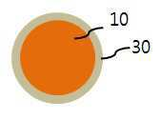
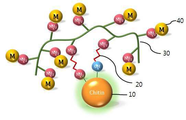
도 1과 도 2는 본 발명의 키틴 기반 흡착제의 개념도이다.
도 3은 키틴 기반 흡착제 제조의 반응과정을 나타낸 것이다.
도 4는 raw chitin, GA-chitin, PEI-chitin을 대상으로 FE-SEM 측정한 것이다.
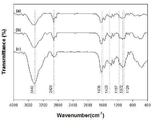
도 5는 raw chitin, GA-chitin, PEI-chitin을 대상으로 FTIR 분석한 그래프이다.
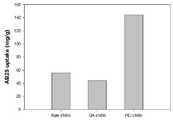
도 6은 100 mg/L의 AB25를 대상으로 각 단계별 샘플의 흡착량을 비교한 결과이다.
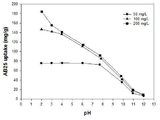
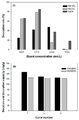
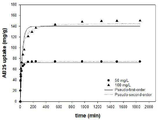
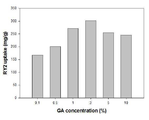
도 7은 pH 농도에 따른 염료 흡착량을 염료 농도에 따라 실험하여 측정한 그래프이고, 도 8의 a는 용리액 농도에 따른 탈착효율을, 도 8의 b는 3회 반복하여 흡착과 탈착을 반복한 후 흡착량과 탈착량을 측정한 그래프이고, 도 9는 온도에 따른(298, 308, 318, 328 K) PEI-chitin의 등온흡착곡선을 나타내고, 도 10은 시간에 따른 PEI-chitin의 염료(AB25) 흡착 실험 결과이고, 도 11은 GA 농도에 따른 염료 흡착량을 나타내고, 도 12는 PEI 농도에 따른 염료(RY2)의 흡착량을 나타내고, 도 13은 키틴 크기별로 염료(RY2)의 흡착량을 보여준다. 1 and 2 are conceptual diagrams of the chitin-based adsorbent of the present invention.
Figure 3 shows the reaction process of chitin-based adsorbent production.
4 is a FE-SEM measurement of raw chitin, GA-chitin, PEI-chitin.
5 is a graph of FTIR analysis on raw chitin, GA-chitin, and PEI-chitin.
6 is a result of comparing the adsorption amount of each step sample for 100 mg/L AB25.
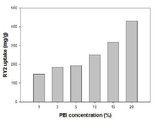
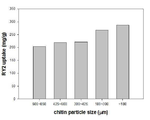
FIG. 7 is a graph obtained by measuring the amount of dye adsorption according to the pH concentration according to the dye concentration, a of FIG. 8 is desorption efficiency according to the eluent concentration, and b of FIG. 8 is repeated three times to repeat adsorption and desorption. After the adsorption amount and desorption amount is a graph of measurement, Figure 9 shows the isothermal adsorption curve of PEI-chitin according to the temperature (298, 308, 318, 328 K), Figure 10 is a dye of PEI-chitin over time ( AB25) As a result of adsorption experiment, FIG. 11 shows the amount of dye adsorption according to the GA concentration, FIG. 12 shows the amount of dye (RY2) adsorption according to the PEI concentration, and FIG. 13 shows the amount of dye (RY2) adsorption by chitin size Shows
이하에서 본 발명을 더욱 상세하게 설명한다.Hereinafter, the present invention will be described in more detail.
도 1과 도 2는 본 발명의 키틴 기반 흡착제의 개념도이고, 도 3은 키틴 기반 흡착제 제조의 반응과정을 나타낸 것이다. 1 and 2 are conceptual diagrams of the chitin-based adsorbent of the present invention, and FIG. 3 shows a reaction process of chitin-based adsorbent preparation.
도 1 내지 도 3을 참고하면, 본 발명의 키틴 기반 흡착제 제조방법은 링커가 결합된 키틴 분말 제조단계(이하, 링커-키틴 분말 제조단계) 및 양이온성 고분자-키틴 제조단계를 포함한다. 1 to 3, the method for preparing a chitin-based adsorbent of the present invention includes a chitin powder preparation step (hereinafter, a linker-chitin powder preparation step) and a cationic polymer-chitin preparation step in which a linker is coupled.
링커-키틴 분말 제조단계는 링커(20) 용액에 키틴 분말을 넣어 반응시키는 단계이다. The linker-chitin powder manufacturing step is a step of reacting the linker 20 solution with chitin powder.
상기 키틴(10)은 공지된 키틴 분말일 수 있다.
The
키틴은 N-acetyl-D-glucosamine(GlcNAc)의 β-1,4 결합으로 이루어져있고, 구조적으로 셀룰로오스(cellulose)와 아주 유사하지만 셀룰로오스의 2번 탄소 위치에 있는 OH가 아세트아미드기로 치환된 구조를 가지고 있다. 또한 키틴은 자연계에 단독으로 존재하지 않고 키토산과 copolymer의 형태를 이루어 한 종류의 단량체가 모여 이루는 단일중합체인 셀룰로오스와는 차이를 보인다. Chitin consists of β-1,4 bonds of N-acetyl-D-glucosamine (GlcNAc), and is structurally very similar to cellulose, but has a structure in which OH at the
최근 키토산을 이용하여 제조된 생체흡착제는 다양한 작용기를 가지고 높은 화학적 반응성, 유연한 고분자 구조로 인해 흡착효율이 좋으나, 산성 용액에 쉽게 용해되고 낮은 물리적 강도로 인해 다양한 흡착 공정에 적용하기 어려웠다. Recently, biosorbents prepared using chitosan have various functional groups and have high adsorption efficiency due to high chemical reactivity and flexible polymer structure, but they are easily dissolved in an acidic solution and difficult to apply to various adsorption processes due to low physical strength.
본 발명은 이러한 키토산을 대체하거나 보완하고자 키토산과 달리 산성, 염기성 및 유기용매와 같은 다양한 용매에서도 우수한 화학적 안정성을 가지는 키틴을 생체 흡착제의 지지체로 사용한다.In order to replace or complement such chitosan, the present invention uses chitin having excellent chemical stability even in various solvents such as acidic, basic and organic solvents as a support for a biosorbent.
본 발명에 사용가능한 키틴의 분말 크기는 100~850㎛, 바람직하게는 100~500㎛, 가장 바람직하게는 180~300㎛일 수 있다. 키틴 입자 크기가 180 ~ 300㎛ 범위일 때 흡착제 제조 공정이 유리하고, 또한, 흡착제로 사용되는 경우에 균일한 흡착량을 제공할 수 있다.The powder size of chitin usable in the present invention may be 100 to 850 µm, preferably 100 to 500 µm, and most preferably 180 to 300 µm. The adsorbent manufacturing process is advantageous when the chitin particle size is in the range of 180 to 300 μm, and it can provide a uniform amount of adsorption when used as an adsorbent.
상기 링커(20)는 키틴뿐만 아니라 아민기 함유 고분자와도 결합할 수 있도록 복수의 반응성 부분(알데히드기, 비닐기, 카르복실기, 옥실란기 등)을 포함할 수 있다. 상기 링커는 2 개 이상의 반응성 부분을 가지는 화합물일 수 있다. 상기 링커는 분자량이 50 ~ 500 g/mol 일 수 있다. The linker 20 may include a plurality of reactive moieties (aldehyde group, vinyl group, carboxyl group, oxysilane group, etc.) so as to bind not only chitin but also an amine group-containing polymer. The linker may be a compound having two or more reactive moieties. The linker may have a molecular weight of 50 to 500 g/mol.
상기 링커(20)는 글루타르알데하이드(glutaraldehyde), 비스디아조벤지딘, 트리아졸디알데하이드(triazole dialdehyde), 글리시딜 메타크릴레이트 (glycidyl methacrylate), 벤질트리아졸 카르브알데하이트 (benzyltiazole carbaldehyde), 벤조시아졸 카르K실알데하이드 (benzothiazole carboxaldehyde), 에피클로로하이드린, 디알데하이드 (dialdehyde), 메틸렌비스아크릴아미드 (methylene-bis-acrylamide),글리옥살 (glyoxal), 아크릴산 (acrylix acid), 말레산 (maleic acid), 테트라에록시실란 (tetraetoxysilane) 및 트리폴리포스페이트 (tripolyphosphate) 중 어느 하나일 수 있다.The
상기 링커로서 글루타르알데하이드(GA)를 사용할 경우 GA가 키틴의 히드록시기와 아민기 모두에 결합되어 많은 양의 양이온성 고분자를 효과적으로 가교결합 시킬 수 있다When glutaraldehyde (GA) is used as the linker, GA is bonded to both hydroxy and amine groups of chitin to effectively crosslink large amounts of cationic polymers.
상기 링커-키틴 분말 제조단계에서 링커 용액 농도는 0.1~10%(w/v), 바람직하게는 1~3%(w/v), 가장 바람직하게는 3%(w/v) 내외일 수 있다. In the step of preparing the linker-chitin powder, the concentration of the linker solution may be in the range of 0.1 to 10% (w/v), preferably 1 to 3% (w/v), and most preferably 3% (w/v). .
키틴 분말을 상기 링커 용액 대비 0.01~0.05g/mL, 바람직하게는 0.03~0.05g/mL, 가장 바람직하게는 0.05g/mL 첨가할 수 있다.Chitin powder may be added to the linker solution in an amount of 0.01 to 0.05 g/mL, preferably 0.03 to 0.05 g/mL, and most preferably 0.05 g/mL.
상기 링커 농도가 3%(w/v)를 초과하는 경우 흡착 성능이 감소할 수 있다.When the linker concentration exceeds 3% (w/v), adsorption performance may be reduced.
예를 들면, 상기 링커-키틴 분말 제조단계는 다단진탕배양기(multi-shaking incubator)를 이용하여 상온에서 소정 시간동안 교반할 수 있다.For example, the linker-chitin powder manufacturing step may be stirred for a predetermined time at room temperature using a multi-shaking incubator.
도 3을 참고하면, 상기 링커는 키틴의 히드록시기나 아민기에 결합될 수 있다.Referring to FIG. 3, the linker may be bound to a hydroxy group or an amine group of chitin.
상기 양이온성 고분자-키틴 제조단계는 링커-키틴을 아민기 함유 고분자 용액에 넣어 반응시키는 단계이다. 상기 양이온성 고분자-키틴 제조단계는 상기 양이온성 고분자가 상기 링커와 가교되어 상기 키틴 표면에 코팅될 수 있다. The cationic polymer-chitin preparation step is a step of reacting the linker-chitin in an amine group-containing polymer solution. In the cationic polymer-chitin preparation step, the cationic polymer may be cross-linked with the linker and coated on the chitin surface.
본 발명에서 사용 가능한 상기 아민기-함유 고분자는 폴리에틸렌이민, 아민-터미네이티드 폴리에틸렌옥사이드, 아민-터미네이티드 폴리에틸렌/프로필렌 옥사이드, 디메틸 아미노 에틸 메타크릴레이트의 폴리머 및 디메틸 아미노에틸 메타크릴레이트와 비닐피롤리돈의 코폴리머, 에피클로로히드린과 디메틸아민의 선형 폴리머, 폴리디알릴디메틸암모니움 클로라이드, 폴리에탄올아민/메틸클로라이드 및 개질된 폴리에틸렌이민으로 구성되는 군에서 선택될 수 있다. 상기 아민기-함유 고분자는 폴리에틸렌이민 또는 개질된 폴리에틸렌이민일 수 있다. The amine group-containing polymer usable in the present invention includes polyethyleneimine, amine-terminated polyethylene oxide, amine-terminated polyethylene/propylene oxide, polymers of dimethyl amino ethyl methacrylate, and dimethyl aminoethyl methacrylate and vinyl. It can be selected from the group consisting of a copolymer of pyrrolidone, a linear polymer of epichlorohydrin and dimethylamine, polydiallyldimethylammonium chloride, polyethanolamine/methylchloride and modified polyethyleneimine. The amine group-containing polymer may be polyethyleneimine or modified polyethyleneimine.
상기 아민기-함유 고분자는 70몰% 이상의 양 전하(cationic charge)를 갖고, 중량평균 분자량은 1000내지 200,000의 범위 내인 것이 좋다. The amine group-containing polymer has a cationic charge of 70 mol% or more, and the weight average molecular weight is preferably in the range of 1000 to 200,000.
상기 양이온성 고분자-키틴 제조단계는 링커가 결합된 상기 키틴 분말 0.01~0.05g, 바람직하게는 0.03~0.05g을 상기 아민기 함유 고분자 용액 1~20%(w/v), 바람직하게는 5~10%(w/v)에 가할 수 있다. 상기 아민기 함유 고분자 용액에서 고분자 농도는 1~20%(w/v), 바람직하게는 10%(w/v) 내외일 수 있다.
The cationic polymer-chitin preparation step is a linker-linked chitin powder 0.01 to 0.05 g, preferably 0.03 to 0.05 g, the amine group-containing
상기 고분자 농도가 15%(w/v) 이상으로 과량이면, 고분자가 키틴 표면에 화학적으로 결합하지 못하고 잔류하여, 흡착 과정에 염료와 반응하여 침전할 수 있다. If the polymer concentration is over 15% (w/v) or more, the polymer remains chemically unable to bind to the chitin surface, and can be precipitated by reacting with a dye in the adsorption process.
상기 양이온성 고분자-키틴 제조단계는 교반기를 이용하여 상온에서 소정 시간동안 교반할 수 있다. The cationic polymer-chitin production step can be stirred for a predetermined time at room temperature using a stirrer.
도 1 내지 도 3을 참고하면, 본 발명의 키틴 기반 양이온성 흡착제는 키틴 분말(10), 상기 키틴에 결합된 링커(20) 및 상기 링커와 가교되어 상기 키틴 표면에 코팅된 아민기 함유 고분자층(30)을 포함한다.
1 to 3, the chitin-based cationic adsorbent of the present invention is a chitin powder (10), a linker (20) bound to the chitin, and an amine group-containing polymer layer cross-linked with the linker and coated on the surface of the
상기 키틴 분말 입자 크기는 100~850㎛, 바람직하게는 100~500㎛, 가장 바람직하게는 180~300㎛일 수 있다. The chitin powder particle size may be 100 to 850 µm, preferably 100 to 500 µm, and most preferably 180 to 300 µm.
상기 키틴, 링커 및 아민기 함유 고분자에 대해서는 앞에서 상술한 내용을 참고할 수 있다. For the polymer containing chitin, linker, and amine group, the above-mentioned contents can be referred to.
본 발명의 키틴 기반 양이온성 흡착제는 링커는 글루타르알데하이드, 상기 아민기 함유 고분자층(30)은 폴리에틸렌이민층일 수 있다.
The chitin-based cationic adsorbent of the present invention may be a glutaraldehyde linker, and the
도 1 내지 도 3을 참고하면, 키틴 분말의 표면에는 히드록시기와 소량의 아민기만 존재하여 뛰어난 흡착성능을 기대하기는 어려웠다. 하지만, 본 발명의 키틴 기반 흡착제는 표면에 다량의 아민기를 가진 양이온성 고분자로 코팅되어 키틴의 표면에 다량의 아민기를 제공함으로써 흡착성능을 대폭 향상시킬 수 있다. 1 to 3, it was difficult to expect excellent adsorption performance because only a hydroxy group and a small amount of an amine group existed on the surface of the chitin powder. However, the chitin-based adsorbent of the present invention can be coated with a cationic polymer having a large amount of amine groups on the surface to provide a large amount of amine groups on the surface of chitin, thereby significantly improving the adsorption performance.
실시예 1Example 1
3% GA 용액 100mL에 가공되지 않은 키틴(raw chitin) 5g을 넣고 다단진탕배양기(multi-shaking incubator)를 GA 처리된 키틴(GA-chitin)은 400mL의 증류수로 세척하여 미반응된 GA를 키틴 표면으로부터 제거하였고, GA-chitin은 곧바로 100 mL의 10% PEI 용액으로 옮겨 담아 25℃, 160rpm 조건에서 30분간 반응시켰다. 고액분리를 통해 분리된 PEI-chitin은 증류수로 3회 세척하였고 -100℃에서 24시간 동결 건조하여 실험에 사용하였다.5 g of raw chitin was added to 100 mL of 3% GA solution, and GA-chitin was treated with multi-shaking incubator and GA-chitin was washed with 400 mL of distilled water to surface unreacted GA. It was removed from the, and GA-chitin was immediately transferred to 100 mL of a 10% PEI solution and reacted for 30 minutes at 25°C and 160 rpm. The PEI-chitin separated through solid-liquid separation was washed 3 times with distilled water and freeze-dried at -100°C for 24 hours, and used in the experiment.
흡착 성능 실험Adsorption performance experiment
흡착공정에 영향을 미치는 pH, 염료의 농도, 시간 및 온도와 같은 다양한 변수들은 회분식 흡착 실험을 통해 평가하였다. 실험은 50mL의 polypropylene conical tube에 염료(Acid Blue 25, AB25, 씨그마알드리치코리아) 30mL와 PEI-chitin 0.02g을 넣고 다단진탕배양기 안에서 160 rpm, 25 ℃의 조건으로 수행하였다. Various parameters such as pH, dye concentration, time and temperature, which affect the adsorption process, were evaluated through batch adsorption experiments. The experiment was performed under conditions of 160 rpm and 25° C. in a multi-stage shake incubator with 30 mL of dye (Acid Blue 25, AB25, Sigma Aldrich Korea) and 0.02 g of PEI-chitin in a 50 mL polypropylene conical tube.
pH egde 실험은 PEI-chitin의 염료흡착에 있어 최종 pH와 염료 흡착량 간의 관계를 알아보기 위하여 수행하였다. 각 튜브는 0.1, 1, 5 M의 HCl과 NaOH를 사용하여 pH를 2 ~ 12까지 다르게 조절하였고, 24시간동안 각 tube의 pH가 유지될 수 있도록 조절하였다. 흡착평형에 도달한 후 최종 pH를 측정하였다. The pH egde experiment was conducted to investigate the relationship between the final pH and the amount of dye adsorption in dye adsorption of PEI-chitin. Each tube was adjusted with pH of 2 to 12 differently using 0.1, 1, and 5 M HCl and NaOH, and adjusted to maintain the pH of each tube for 24 hours. After reaching the adsorption equilibrium, the final pH was measured.
흡착속도론 실험은 pH 2에서 흡착평형에 도달하는데 소요되는 시간을 확인하기 위하여 초기 염료농도 50 mg/L와 100 mg/L에서 실시하였다. 실험이 진행되는 동안에 모든 샘플들은 미리 결정한 시간 간격에 따라 일정하게 채취하였고, 수득한 샘플의 각 농도는 분광광도계(X-MA3000PC, Human Co., Ltd., Korea)를 이용하여 분석하였다. The adsorption kinetics experiment was performed at initial dye concentrations of 50 mg/L and 100 mg/L to confirm the time required to reach adsorption equilibrium at
등온흡착실험은 AB25에 대한 PEI-chitin의 최대흡착량을 평가하기 위하여 4개의 다른 온도에서 평가하였다. 실험은 pH 2에서 염료의 초기농도를 0 ~ 300 mg/L까지 달리하여 24시간 동안 실시하였다. 그리고 각 샘플에 남아있는 염료의 농도를 측정하기 위하여 분석 샘플을 준비하였다.The isothermal adsorption experiment was evaluated at four different temperatures to evaluate the maximum adsorption amount of PEI-chitin on AB25. The experiment was carried out for 24 hours by varying the initial concentration of the dye from 0 to 300 mg/L at
분석샘플들은 9,000 rpm에서 5분간 원심분리 시킨 후 상등액만 취하여 증류수로 적당히 희석을 시켜 준비하였다. 흡광도 분석은 AB25의 최대 파장인 600nm에서 분광광도계로 측정하였고, 수학식(1)을 사용하여 흡착량 q(mg/g)을 계산하였다. Analytical samples were prepared by centrifuging at 9,000 rpm for 5 minutes and then taking only the supernatant and diluting it properly with distilled water. Absorbance analysis was measured with a spectrophotometer at the maximum wavelength of AB25, 600 nm, and the adsorption amount q (mg/g) was calculated using Equation (1).
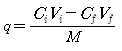
여기서 Ci와 Cf (mg/L)는 염료의 초기농도와 최종농도를 의미하고, Vi와 Vf (L)는 용액의 초기부피와 최종부피를 의미한다. M(g)은 실험에서 사용된 흡착제의 양을 의미한다.Here, C i and C f (mg/L) mean the initial concentration and final concentration of the dye, and V i and V f (L) mean the initial volume and the final volume of the solution. M(g) means the amount of adsorbent used in the experiment.
탈착 및 재사용성 평가Desorption and reusability evaluation
AB25를 흡착한 PEI-chitin은 30 mL의 염료 수용액(100 mg/L)에 PEI-chitin 0.02 g을 넣고 pH 2에서 24시간 동안 교반하여 준비하였다. 흡착된 AB25의 효과적인 탈착 조건을 파악하기 위하여 용리액으로는 수산화나트륨(NaOH), 탄산수소나트륨(NaHCO3),탄산나트륨(Na2CO3)을 선정하였고, 용리액의 농도는 0.001 ~ 1 M로 달리하여 탈착 실험을 실시하였다. 탈착효율은 다음의 식(2)에 의하여 계산하였다.PEI-chitin adsorbed on AB25 was prepared by adding 0.02 g of PEI-chitin in a 30 mL aqueous dye solution (100 mg/L) and stirring at

흡착제의 재사용 가능성평가는 앞서 수행한 흡착실험과 탈착실험을 동일하게 3회 반복적으로 수행하여 평가하였다. 흡착실험은 pH 2에서 수행되었으며, 탈착실험은 염료별 최적의 탈착용리액 및 농도 조건에서 수행하였다.
The reusability evaluation of the adsorbent was evaluated by repeatedly performing the same adsorption experiment and desorption experiment three times. The adsorption experiment was carried out at
도 4는 raw chitin, GA-chitin, PEI-chitin을 대상으로 FE-SEM 측정한 것이다. 도 4를 참고하면, PEI-chitin의 경우, PEI가 키틴 표면에 전체적으로 잘 분포되어 있음을 보여주었다. 5,000배로 찍은 이미지 4c'에서는 위의 결과를 보다 명확하게 보여주고 있으며, 키틴 표면에 보다 크고 많은 공극들이 존재함을 관찰하였다.4 is a FE-SEM measurement of raw chitin, GA-chitin, PEI-chitin. Referring to FIG. 4, in the case of PEI-chitin, it was shown that PEI is well distributed throughout the chitin surface. Image 4c', taken at a magnification of 5,000, shows the above result more clearly and observes that there are larger and more voids on the chitin surface.
도 5는 raw chitin, GA-chitin, PEI-chitin을 대상으로 FTIR 분석한 그래프이다. 도 5를 참고하면, 아민피크를 나타내는 3440, 1423, 1129 cm-1을 살펴보면, 표면개질의 단계가 진행될수록 모든 피크들의 intensity가 증가하는 것을 볼 수 있고, 또한 키틴 및 PEI의 아민기와 GA간의 가교결합을 의미하는 C-N 피크는 1635 cm-1에서 나타났고, 표면개질의 단계가 진행될수록 해당 피크의 intensity가 증가하였다. PEI의 주요 특성 피크인 1423 cm-1(-NH bending 및 deformation vibration), 1650cm-1(-NH2또는 -NH), 3440cm-1(N-H stretching)에서는 raw chitin과 GA-chitin의 유사한 피크변화를 보였으나 PEI-chitin은 피크강도가 크게 증가하였다. 이와 같은 피크변화를 통해 PEI가 성공적으로 도입이 되었다는 것을 확인할 수 있다.5 is a graph of FTIR analysis on raw chitin, GA-chitin, and PEI-chitin. Referring to Figure 5, looking at 3440, 1423, 1129 cm -1 representing the amine peak, it can be seen that the intensity of all peaks increases as the step of surface modification progresses, and also cross-linking between amine groups of GA and GA of chitin and PEI The CN peak indicating binding was found at 1635 cm -1 , and the intensity of the peak increased as the surface modification step progressed. The main characteristic peaks of PEI, 1423 cm -1 (-NH bending and deformation vibration), 1650 cm -1 (-NH 2 or -NH), and 3440 cm -1 (NH stretching) show similar peak changes between raw chitin and GA-chitin. However, the peak intensity of PEI-chitin increased significantly. Through this peak change, it can be confirmed that PEI was successfully introduced.
도 6은 100 mg/L의 AB25를 대상으로 각 단계별 샘플의 흡착량을 비교한 결과이다. Raw chitin, GA-chitin, PEI-chitin의 흡착량은 각각 55.93, 44.35, 144.28 mg/g으로서, 본 발명의 흡착제인 PEI-chitin은 키틴 분말(raw chitin)에 비해 약 2.6배 흡착성능이 증가하였다.6 is a result of comparing the adsorption amount of each step sample for 100 mg/L AB25. Adsorption amounts of raw chitin, GA-chitin, and PEI-chitin were 55.93, 44.35, and 144.28 mg/g, respectively, and the adsorbent of the present invention, PEI-chitin, had an increase in adsorption capacity of about 2.6 times compared to chitin powder .
도 7은 pH 농도에 따른 염료 흡착량을 염료 농도에 따라 실험하여 측정한 그래프이다. 도 7을 참고하면, pH에 따른 전체적인 흡착량 변화는 pH 2에서 가장 높고 알칼리 영역으로 갈수록 흡착량이 급격히 감소하는 경향을 나타내었다. 염료가 저농도일 경우에는 pH2~8의 넓은 범위에서 고효율의 흡착 능력을 보여주었다.7 is a graph measured by experimenting the amount of dye adsorption according to the pH concentration according to the dye concentration. Referring to FIG. 7, the overall adsorption amount change according to pH was highest at
도 8의 a는 용리액 농도에 따른 탈착효율을, 도 8의 b는 3회 반복하여 흡착과 탈착을 반복한 후 흡착량과 탈착량을 측정한 그래프이다. 도 8의 a를 참고하면, NaOH은 0.01 M에서 85.2%, NaHCO3은 0.01 M에서 78.7%, 그리고 Na2CO3은 0.1 M에서 47.6%로 0.01 M NaOH가 가장 높은 탈착율을 보였다. 도 8의 b를 참고하면, 본 발명의 흡착제는 2회와 3회의 흡착 및 탈착량이 1회에 비해 다소 낮아졌으나, 2회와 3회의 흡착량이 비슷하므로, 수회 반복사용이 가능함을 확인할 수 있다.8A is a graph showing the desorption efficiency according to the eluent concentration, and FIG. 8B is a graph measuring adsorption amount and desorption amount after repeated adsorption and
도 9는 염료(AB25_의 초기농도 0 ~ 300 mg/L 범위에서 온도에 따른(298, 308, 318, 328 K) PEI-chitin의 등온흡착곡선을 나타내었다. 하기 표 1은 참고 문헌에 보고된 다양한 흡착제들과 본 발명의 흡착제(PEI-chitin)의 최대 흡착량을 정리하여 나타낸 것이다. 최대흡착량 측면에서 PEI-chitin은 100mg/g미만의 hazelnut shell(참고문헌 1), base treated Shoreadasyphyllasawdust(참고문헌 2), NaOH-treated Ficusracemose(참고문헌 3), water lettuce(참고문헌 5), Azollapinnate(참고문헌 6)와 113.4 mg/g을 보인 biofilm(참고문헌 7)보다는 높은 최대흡착량을 가진 것으로 파악되었다. Waste tea activated carbon(참고문헌 4)의 최대흡착량은 203.34 mg/g으로 PEI-chitin보다 높았으나 친화도 값은 0.422 L/mg으로 상대적으로 낮음을 알 수 있었다. 따라서 본 발명의 양이온성 고분자(PEI)-키틴 생체흡착제는 염료(AB25)의 흡착에 있어 우수한 흡착제임을 확인할 수 있다.Figure 9 shows the isothermal adsorption curves of PEI-chitin according to the temperature (298, 308, 318, 328 K) of the dye (AB25_ in the initial concentration of 0 to 300 mg/L). Various adsorbents and the maximum adsorption amount of the adsorbent (PEI-chitin) of the present invention are summarized.In terms of maximum adsorption amount, PEI-chitin is less than 100 mg/g hazelnut shell (Ref. 1), base treated Shoreadasyphyllasawdust( Reference 2), NaOH-treated Ficusracemose (Ref. 3), water lettuce (Ref. 5), Azollapinnate (Ref. 6) and having a maximum adsorption higher than biofilm (Ref. 7) showing 113.4 mg/g The maximum adsorption amount of Waste tea activated carbon (Ref. 4) was 203.34 mg/g, which was higher than that of PEI-chitin, but the affinity value was found to be relatively low at 0.422 L/mg. It can be confirmed that the sex polymer (PEI)-chitin biosorbent is an excellent adsorbent for the adsorption of the dye (AB25).
[참고문헌] 1. Ferrero, F., “Dye removal by low cost adsorbents: Hazelnut shells in comparison with wood sawdust,” J.Hazard.Mater.142,144-152(2007).[Reference] 1. Ferrero, F., “Dye removal by low cost adsorbents: Hazelnut shells in comparison with wood sawdust,” J.Hazard.Mater.142,144-152 (2007).
2. Hanafiah, M. A. K. M., Ngah, W. S. W., Zolkafly, S. H., Teong, L. C. and Majid, Z. A. A.,” Acid Blue 25 adsorption on base treated Shorea dasyphylla sawdust: Kinetic, isotherm, thermodynamic and spectroscopic analysis,” J.Environ.Sci.24,261-268(2012).2. Hanafiah, MAKM, Ngah, WSW, Zolkafly, SH, Teong, LC and Majid, ZAA,” Acid Blue 25 adsorption on base treated Shorea dasyphylla sawdust: Kinetic, isotherm, thermodynamic and spectroscopic analysis,” J.Environ.Sci. 24,261-268 (2012).
3. Jain, S. N. and Gogate, P. R., “NaOH-treated dead leaves of Ficus racemosa as an efficient biosorbent for Acid Blue 25 removal,” Int.J.Environ.Sci.Technol.14,531-542(2017).3. Jain, S. N. and Gogate, P. R., “NaOH-treated dead leaves of Ficus racemosa as an efficient biosorbent for Acid Blue 25 removal,” Int.J.Environ.Sci.Technol. 14,531-542 (2017).
4. Auta, M. and Hameed, B. H., “Preparation of waste tea activated carbon using potassium acetate as an activating agent for adsorption of Acid Blue 25 dye,” Chem.Eng.J.171,502-509(2011).4. Auta, M. and Hameed, B. H., “Preparation of waste tea activated carbon using potassium acetate as an activating agent for adsorption of Acid Blue 25 dye,” Chem.Eng.J.171,502-509 (2011).
5. Kooh, M. R. R., Dahri, M. K., Lim, L. B. L., Lim, L. H. and Chan, C. M., “Separation of acid blue 25 from aqueous solution using water lettuce and agro-wastes by batch adsorption studies,” Appl.WaterSci.8,61(2018).5. Kooh, MRR, Dahri, MK, Lim, LBL, Lim, LH and Chan, CM, “Separation of acid blue 25 from aqueous solution using water lettuce and agro-wastes by batch adsorption studies,” Appl.WaterSci.8, 61 (2018).
6. Kooh, M. R. R., Dahri, M. K., Lim, L. B. L. and Lim, L. H., “Batch Adsorption Studies on the Removal of Acid Blue 25 from Aqueous Solution Using Azolla pinnata and Soya Bean Waste,” Arab.J.Sci.Eng.41,2453-2464(2016).6. Kooh, MRR, Dahri, MK, Lim, LBL and Lim, LH, “Batch Adsorption Studies on the Removal of Acid Blue 25 from Aqueous Solution Using Azolla pinnata and Soya Bean Waste,” Arab.J.Sci.Eng.41 ,2453-2464 (2016).
7. Mawad, A. M. M., Yousef, N. M. H. and Shoreit, A. A. M., “Bioremediation of Acid Blue 25 Dye by Anthracene Degrading Pseudomonas Pseudoalcaligenes ASU-016,” CatrinaInt.J.Environ.Sci.10,53-60(2015).7.Mawad, A. M. M., Yousef, N. M. H. and Shoreit, A. A. M., “Bioremediation of Acid Blue 25 Dye by Anthracene Degrading Pseudomonas Pseudoalcaligenes ASU-016,” CatrinaInt.J.Environ.Sci.10,53-60(2015).
도 10은 시간에 따른 PEI-chitin의 염료(AB25) 흡착 실험 결과이다. 실험은 50 mg/L과 100 mg/L의 AB25를 이용하여 25℃에서 약 31시간 동안 수행하였다. 도 10을 참고하면, 흡착은 초기에 대단히 빨랐으며 일정 시간 이후부터는 서서히 진행되다가 약 120분(50 mg/L)과 500분(100 mg/L) 후에 흡착평형에 도달하였다. 흡착량은 100 mg/L에서 150.38 mg/g으로 50 mg/L보다 약 2 배 높았으나 흡착평형에 도달하는 시간은 약 4.2배 증가하였다. 10 is a result of the adsorption experiment of dye (AB25) of PEI-chitin over time. The experiment was carried out for about 31 hours at 25°C using 50 mg/L and 100 mg/L AB25. Referring to FIG. 10, adsorption was very fast in the initial stage, and after a certain period of time, the adsorption equilibrium was reached after about 120 minutes (50 mg/L) and 500 minutes (100 mg/L). The adsorption amount was about 2 times higher than 50 mg/L from 100 mg/L to 150.38 mg/g, but the time to reach adsorption equilibrium was increased by about 4.2 times.
실시예 2Example 2
농도가 0.1 ~ 10%인 링커(GA)를 사용한 것을 제외하고 실시예 1과 동일하게 PEI-chitin을 각각 제조하였다. 각각의 PEI-chitin을 pH 2의 조건에서 염료(RY2, Reactive Yellow2)를 흡착한 후 흡착량을 측정하고, 도 11에 GA 농도에 따른 염료 흡착량을 나타내었다.
PEI-chitin was prepared in the same manner as in Example 1, except that a linker (GA) having a concentration of 0.1 to 10% was used. After adsorbing the dye (RY2, Reactive Yellow2) under the condition of
도 11을 참고하면, GA 농도 3%에서 최대 304.0 mg/g이고, GA 농도를 5%, 10%로 농도가 더욱 증가하였을 때, 흡착량은 다시 감소하는 경향을 보였다. Referring to FIG. 11, when the GA concentration was 3% to a maximum of 304.0 mg/g, and the GA concentration was further increased to 5% and 10%, the adsorption amount tended to decrease again.
실시예 3Example 3
1 ~ 20%의 PEI를 각각 사용한 것을 제외하고 실시예 1과 동일하게 PEI-chitin을 제조하였다. 각각의 PEI-chitin을 pH 2의 조건에서 염료(RY2, Reactive Yellow2)를 흡착한 후 흡착량을 측정한 후, 도 12에 PEI 농도에 따른 염료(RY2)의 흡착량을 나타내었다.PEI-chitin was prepared in the same manner as in Example 1, except that each PEI of 1 to 20% was used. After adsorbing the dye (RY2, Reactive Yellow2) under the condition of
도 12를 참고하면, 1%의 PEI를 사용하였을 때 147.1 mg/g에서 20%의 PEI를 사용하였을 때 최대 430.7 mg/g으로 흡착량이 큰 폭으로 증가하였다. 하지만 흡착공정 후 원심분리 과정에서 15% 이상의 PEI를 사용한 샘플에서는 염료의 응집 침전물이 생기는 것을 확인하였다. 이는 키틴의 표면에 화학적으로 완전히 결합되지 않고 물리적으로 결합되어있던 PEI가 흡착공정에서 떨어져 나와 RY2와 결합하여 나타난 현상으로 보인다. 이는 PEI-chitin의 흡착성능과는 무관한 현상이며, 개발 소재의 흡착성능을 평가하는데 방해되는 요소로 판단되어 본 연구에서는 침전물이 생기지 않는 최대농도인 10%의 PEI가 가장 적합한 농도인 것으로 판단하였다. Referring to FIG. 12, when the PEI of 1% was used, the adsorption amount significantly increased from 147.1 mg/g to a maximum of 430.7 mg/g when 20% of PEI was used. However, in the sample using PEI of 15% or more in the centrifugation process after the adsorption process, it was confirmed that a cohesive precipitate of dye was formed. This appears to be a phenomenon in which PEI, which is not chemically completely bound to the surface of chitin, is physically bound and is detached from the adsorption process and combined with RY2. This is a phenomenon irrelevant to the adsorption performance of PEI-chitin, and is considered to be a factor that prevents the evaluation of adsorption performance of the developed material. .
실시예 4Example 4
키틴 분말의 크기를 5개 크기별 샘플로 사용한 것을 제외하고 실시예 1과 동일하게 PEI-chitin을 제조하였다. 각각의 PEI-chitin을 pH 2의 조건에서 염료(RY2, Reactive Yellow2)를 흡착한 후 흡착량을 측정한 후, 도 13에 키틴 크기별로 염료(RY2)의 흡착량을 나타내었다.PEI-chitin was prepared in the same manner as in Example 1, except that the size of the chitin powder was used as a sample for each of five sizes. After adsorbing the dye (RY2, Reactive Yellow2) under the condition of
도 13을 참고하면, 키틴의 입자 크기가 감소함에 따라 흡착량은 증가하였으며, 흡착량은 180㎛미만일 경우 307.8 mg/g으로 가장 높았다. 그러나 180㎛미만 크기에서는 흡착제 제조 공정이 까다로울 뿐만 아니라 제조된 소재의 흡착량이 균일하지 못해 본 발명에서는 180 ~ 300 ㎛ 크기의 키틴이 바람직한 크기로 판단하였다.Referring to FIG. 13, as the particle size of chitin decreased, the adsorption amount increased, and the adsorption amount was the highest at 307.8 mg/g when less than 180 μm. However, in the size of less than 180 μm, the adsorbent manufacturing process is not only difficult, but the adsorbed amount of the produced material is not uniform, and thus, in the present invention, chitin having a size of 180 to 300 μm was determined as a preferred size.
이상에서 본 발명의 바람직한 구현예를 예로 들어 상세하게 설명하였으나, 이러한 설명은 단순히 본 발명의 예시적인 실시예를 설명 및 개시하는 것이다. 당업자는 본 발명의 범위 및 정신으로부터 벗어남이 없이 상기 설명 및 첨부 도면으로부터 다양한 변경, 수정 및 변형예가 가능함을 용이하게 인식할 것이다. In the above, a preferred embodiment of the present invention has been described in detail as an example, but this description is merely to describe and disclose an exemplary embodiment of the present invention. Those skilled in the art will readily recognize that various changes, modifications and variations are possible from the above description and accompanying drawings without departing from the scope and spirit of the invention.
10 : 키틴 20 : 링커
30 : 아민기 함유 고분자층10: chitin 20: linker
30: amine group-containing polymer layer
Claims (13)
링커가 결합된 상기 키틴 분말을 아민기 함유 고분자 용액에 넣어 반응시키는 단계를 포함하는 키틴 기반 흡착제 제조방법.Preparing chitin powder to which the linker is bound by reacting by adding chitin powder to the linker solution; And
Chitin-based adsorbent manufacturing method comprising the step of reacting the linker is the chitin powder is bonded to the amine group-containing polymer solution.
상기 키틴에 결합된 링커(20) ; 및
상기 링커와 가교되어 상기 키틴 표면에 코팅된 아민기 함유 고분자층(30)을 포함하는 키틴 기반 양이온성 흡착제.Chitin powder (10);
Linker (20) bound to the chitin; And
Chitin-based cationic adsorbent comprising an amine group-containing polymer layer 30 cross-linked with the linker and coated on the surface of the chitin.
상기 흡착제를 회수하는 단계를 포함하는 키틴 기반 흡착제를 이용한 흡착 방법.Contacting the anionic dye or anionic metal ion solution with the adsorbent according to claim 7; And
Adsorption method using a chitin-based adsorbent comprising the step of recovering the adsorbent.
12. The method of claim 11, wherein the method further comprises the step of desorbing the dye or metal by putting the recovered adsorbent in an alkaline eluent.
Priority Applications (1)
| Application Number | Priority Date | Filing Date | Title |
|---|---|---|---|
| KR1020180172131A KR102210013B1 (en) | 2018-12-28 | 2018-12-28 | Adsorbent based chitin and Method for preparing the same |
Applications Claiming Priority (1)
| Application Number | Priority Date | Filing Date | Title |
|---|---|---|---|
| KR1020180172131A KR102210013B1 (en) | 2018-12-28 | 2018-12-28 | Adsorbent based chitin and Method for preparing the same |
Publications (2)
| Publication Number | Publication Date |
|---|---|
| KR20200082017A true KR20200082017A (en) | 2020-07-08 |
| KR102210013B1 KR102210013B1 (en) | 2021-02-01 |
Family
ID=71601187
Family Applications (1)
| Application Number | Title | Priority Date | Filing Date |
|---|---|---|---|
| KR1020180172131A Active KR102210013B1 (en) | 2018-12-28 | 2018-12-28 | Adsorbent based chitin and Method for preparing the same |
Country Status (1)
| Country | Link |
|---|---|
| KR (1) | KR102210013B1 (en) |
Cited By (5)
| Publication number | Priority date | Publication date | Assignee | Title |
|---|---|---|---|---|
| CN112691623A (en) * | 2020-12-09 | 2021-04-23 | 石河子大学 | Preparation and application of hyperbranched aminated porous microspheres |
| KR20220138077A (en) * | 2021-04-05 | 2022-10-12 | 경상국립대학교산학협력단 | Method of preparing for polyethylenimine-chitin adsorbent and polyethylenimine-chitin adsorbent thereof |
| CN117380160A (en) * | 2023-09-21 | 2024-01-12 | 广东前进牛仔布有限公司 | Reactive dye adsorbent and preparation method thereof, environmentally friendly dyeing method of denim fabrics |
| CN117482909A (en) * | 2023-12-13 | 2024-02-02 | 湖南工学院 | Adsorbent based on ethylenediamine modified shaddock ped powder and preparation method and application thereof |
| CN118045580A (en) * | 2024-03-14 | 2024-05-17 | 河南科技大学 | A broad-spectrum chitosan-based adsorbent and its preparation method and application |
Citations (3)
| Publication number | Priority date | Publication date | Assignee | Title |
|---|---|---|---|---|
| JP2009268836A (en) * | 2008-05-09 | 2009-11-19 | Kinki Univ | Inverse opal structure, processes for producing and using the same |
| KR20120003708A (en) * | 2010-07-05 | 2012-01-11 | 전북대학교산학협력단 | Chitosan-biomass complex and preparation method thereof |
| KR20140042210A (en) * | 2012-09-28 | 2014-04-07 | 전북대학교산학협력단 | Adsorbent comprising fiber-biomass composite and preparation method thereof |
-
2018
- 2018-12-28 KR KR1020180172131A patent/KR102210013B1/en active Active
Patent Citations (3)
| Publication number | Priority date | Publication date | Assignee | Title |
|---|---|---|---|---|
| JP2009268836A (en) * | 2008-05-09 | 2009-11-19 | Kinki Univ | Inverse opal structure, processes for producing and using the same |
| KR20120003708A (en) * | 2010-07-05 | 2012-01-11 | 전북대학교산학협력단 | Chitosan-biomass complex and preparation method thereof |
| KR20140042210A (en) * | 2012-09-28 | 2014-04-07 | 전북대학교산학협력단 | Adsorbent comprising fiber-biomass composite and preparation method thereof |
Cited By (6)
| Publication number | Priority date | Publication date | Assignee | Title |
|---|---|---|---|---|
| CN112691623A (en) * | 2020-12-09 | 2021-04-23 | 石河子大学 | Preparation and application of hyperbranched aminated porous microspheres |
| KR20220138077A (en) * | 2021-04-05 | 2022-10-12 | 경상국립대학교산학협력단 | Method of preparing for polyethylenimine-chitin adsorbent and polyethylenimine-chitin adsorbent thereof |
| CN117380160A (en) * | 2023-09-21 | 2024-01-12 | 广东前进牛仔布有限公司 | Reactive dye adsorbent and preparation method thereof, environmentally friendly dyeing method of denim fabrics |
| CN117482909A (en) * | 2023-12-13 | 2024-02-02 | 湖南工学院 | Adsorbent based on ethylenediamine modified shaddock ped powder and preparation method and application thereof |
| CN118045580A (en) * | 2024-03-14 | 2024-05-17 | 河南科技大学 | A broad-spectrum chitosan-based adsorbent and its preparation method and application |
| CN118045580B (en) * | 2024-03-14 | 2026-03-27 | 河南科技大学 | A broad-spectrum chitosan-based adsorbent, its preparation method and application |
Also Published As
| Publication number | Publication date |
|---|---|
| KR102210013B1 (en) | 2021-02-01 |
Similar Documents
| Publication | Publication Date | Title |
|---|---|---|
| KR102210013B1 (en) | Adsorbent based chitin and Method for preparing the same | |
| Abdel-Halim et al. | Hydrogel from crosslinked polyacrylamide/guar gum graft copolymer for sorption of hexavalent chromium ion | |
| Ahmad et al. | Adsorption of heavy metal ions: role of chitosan and cellulose for water treatment | |
| Abdel-Raouf et al. | Removal of heavy metals from industrial waste water by biomass-based materials: A review. j pollut eff cont 5: 180. doi: 10.4172/2375-4397.1000180 page 2 of 13 volume 5• issue 1• 1000180 j pollut eff cont, an open access journal issn: 2375-4397 the top six toxic threats: Estimated population at risk at identified sites*(million people) estimated global impact**(million people) 1. lead 10 18-22 2 | |
| Wang et al. | Removal of anionic dyes from aqueous solutions by cellulose-based adsorbents: equilibrium, kinetics, and thermodynamics | |
| Luk et al. | A comprehensive study on adsorption behaviour of direct, reactive and acid dyes on crosslinked and non-crosslinked chitosan beads | |
| Raval et al. | Comparative study of chitin and chitosan beads for the adsorption of hazardous anionic azo dye Congo Red from wastewater | |
| Sutirman et al. | Chitosan-based adsorbents for the removal of metal ions from aqueous solutions | |
| Hanh et al. | Pre-irradiation grafting of acrylonitrile onto chitin for adsorption of arsenic in water | |
| Hu et al. | Functionalization of Microcrystalline Cellulose with N, N-dimethyldodecylamine for the Removal of Congo Red Dye from an Aqueous Solution. | |
| Ramya et al. | Adsorption of Cu (II) and Ni (II) ions from metal solution using crosslinked chitosan-g-acrylonitrile copolymer | |
| Yue et al. | Preparation of adsorbent based on cotton fiber for removal of dyes | |
| De Souza et al. | Removal of Pb (II) from aqueous solution with orange sub-products chemically modified as biosorbent | |
| Singh et al. | Chitosan–poly (vinyl alcohol)–ionic liquid-grafted hydrogel for treating wastewater | |
| Bal et al. | Study on adsorption, regeneration, and reuse of crosslinked chitosan graft copolymers for Cu (II) ion removal from aqueous solutions | |
| Farias et al. | Natural and cross-linked chitosan spheres as adsorbents for diesel oil removal | |
| Guin et al. | Radiation crosslinked swellable ionic gels: equilibrium and kinetic studies of basic dye adsorption | |
| Abu Taleb et al. | Hybrid bioadsorbents for heavy metal decontamination from wastewater: A review | |
| Mustapha et al. | Preparation and characterization of Bio-Adsorbent from coconut husk for remazol red dye removal | |
| Chauhan et al. | Post functionalization of carboxymethylated starch and acrylonitrile based networks through amidoximation for use as ion sorbents | |
| Mishra et al. | Unlocking green solutions: cellulose as a lucrative heavy metal adsorbent in wastewater treatment-a comprehensive review | |
| KR20120003708A (en) | Chitosan-biomass complex and preparation method thereof | |
| CN114904493A (en) | Ionic crosslinking beta-cyclodextrin polymer and preparation method and application thereof | |
| Vakili et al. | Treatment of reactive dyes from water and wastewater through chitosan and its derivatives | |
| Siregar et al. | Mg/Al-CH, Ni/Al-CH and Zn/Al-CH, as adsorbents for Congo Red removal in aqueous solution |
Legal Events
| Date | Code | Title | Description |
|---|---|---|---|
| PA0109 | Patent application |
St.27 status event code: A-0-1-A10-A12-nap-PA0109 |
|
| PA0201 | Request for examination |
St.27 status event code: A-1-2-D10-D11-exm-PA0201 |
|
| R18-X000 | Changes to party contact information recorded |
St.27 status event code: A-3-3-R10-R18-oth-X000 |
|
| R18-X000 | Changes to party contact information recorded |
St.27 status event code: A-3-3-R10-R18-oth-X000 |
|
| R18-X000 | Changes to party contact information recorded |
St.27 status event code: A-3-3-R10-R18-oth-X000 |
|
| D13-X000 | Search requested |
St.27 status event code: A-1-2-D10-D13-srh-X000 |
|
| R18-X000 | Changes to party contact information recorded |
St.27 status event code: A-3-3-R10-R18-oth-X000 |
|
| D14-X000 | Search report completed |
St.27 status event code: A-1-2-D10-D14-srh-X000 |
|
| E902 | Notification of reason for refusal | ||
| PE0902 | Notice of grounds for rejection |
St.27 status event code: A-1-2-D10-D21-exm-PE0902 |
|
| PG1501 | Laying open of application |
St.27 status event code: A-1-1-Q10-Q12-nap-PG1501 |
|
| T11-X000 | Administrative time limit extension requested |
St.27 status event code: U-3-3-T10-T11-oth-X000 |
|
| T11-X000 | Administrative time limit extension requested |
St.27 status event code: U-3-3-T10-T11-oth-X000 |
|
| E13-X000 | Pre-grant limitation requested |
St.27 status event code: A-2-3-E10-E13-lim-X000 |
|
| P11-X000 | Amendment of application requested |
St.27 status event code: A-2-2-P10-P11-nap-X000 |
|
| P13-X000 | Application amended |
St.27 status event code: A-2-2-P10-P13-nap-X000 |
|
| E701 | Decision to grant or registration of patent right | ||
| PE0701 | Decision of registration |
St.27 status event code: A-1-2-D10-D22-exm-PE0701 |
|
| GRNT | Written decision to grant | ||
| PR0701 | Registration of establishment |
St.27 status event code: A-2-4-F10-F11-exm-PR0701 |
|
| PR1002 | Payment of registration fee |
St.27 status event code: A-2-2-U10-U11-oth-PR1002 Fee payment year number: 1 |
|
| PG1601 | Publication of registration |
St.27 status event code: A-4-4-Q10-Q13-nap-PG1601 |
|
| PN2301 | Change of applicant |
St.27 status event code: A-5-5-R10-R13-asn-PN2301 St.27 status event code: A-5-5-R10-R11-asn-PN2301 |
|
| R18-X000 | Changes to party contact information recorded |
St.27 status event code: A-5-5-R10-R18-oth-X000 |
|
| PR1001 | Payment of annual fee |
St.27 status event code: A-4-4-U10-U11-oth-PR1001 Fee payment year number: 4 |
|
| PR1001 | Payment of annual fee |
St.27 status event code: A-4-4-U10-U11-oth-PR1001 Fee payment year number: 5 |
|
| R18 | Changes to party contact information recorded |
Free format text: ST27 STATUS EVENT CODE: A-5-5-R10-R18-OTH-X000 (AS PROVIDED BY THE NATIONAL OFFICE) |
|
| R18-X000 | Changes to party contact information recorded |
St.27 status event code: A-5-5-R10-R18-oth-X000 |
|
| R18 | Changes to party contact information recorded |
Free format text: ST27 STATUS EVENT CODE: A-5-5-R10-R18-OTH-X000 (AS PROVIDED BY THE NATIONAL OFFICE) |
|
| R18-X000 | Changes to party contact information recorded |
St.27 status event code: A-5-5-R10-R18-oth-X000 |
|
| PR1001 | Payment of annual fee |
St.27 status event code: A-4-4-U10-U11-oth-PR1001 Fee payment year number: 6 |
|
| U11 | Full renewal or maintenance fee paid |
Free format text: ST27 STATUS EVENT CODE: A-4-4-U10-U11-OTH-PR1001 (AS PROVIDED BY THE NATIONAL OFFICE) Year of fee payment: 6 |
|
| P14 | Amendment of ip right document requested |
Free format text: ST27 STATUS EVENT CODE: A-5-5-P10-P14-NAP-X000 (AS PROVIDED BY THE NATIONAL OFFICE) |
|
| P14-X000 | Amendment of ip right document requested |
St.27 status event code: A-5-5-P10-P14-nap-X000 |
|
| PN2301 | Change of applicant |
St.27 status event code: A-5-5-R10-R11-asn-PN2301 |
|
| R11 | Change to the name of applicant or owner or transfer of ownership requested |
Free format text: ST27 STATUS EVENT CODE: A-5-5-R10-R11-ASN-PN2301 (AS PROVIDED BY THE NATIONAL OFFICE) |
|
| P16 | Ip right document amended |
Free format text: ST27 STATUS EVENT CODE: A-5-5-P10-P16-NAP-X000 (AS PROVIDED BY THE NATIONAL OFFICE) |
|
| P16-X000 | Ip right document amended |
St.27 status event code: A-5-5-P10-P16-nap-X000 |
|
| PN2301 | Change of applicant |
St.27 status event code: A-5-5-R10-R14-asn-PN2301 |
|
| R14 | Transfer of ownership recorded |
Free format text: ST27 STATUS EVENT CODE: A-5-5-R10-R14-ASN-PN2301 (AS PROVIDED BY THE NATIONAL OFFICE) |