KR20220119050A - Continuous recycling process - Google Patents
Continuous recycling process Download PDFInfo
- Publication number
- KR20220119050A KR20220119050A KR1020227022649A KR20227022649A KR20220119050A KR 20220119050 A KR20220119050 A KR 20220119050A KR 1020227022649 A KR1020227022649 A KR 1020227022649A KR 20227022649 A KR20227022649 A KR 20227022649A KR 20220119050 A KR20220119050 A KR 20220119050A
- Authority
- KR
- South Korea
- Prior art keywords
- aramid
- fibers
- polymer
- continuous
- fibrous material
- Prior art date
- Legal status (The legal status is an assumption and is not a legal conclusion. Google has not performed a legal analysis and makes no representation as to the accuracy of the status listed.)
- Pending
Links
Images
Classifications
-
- D—TEXTILES; PAPER
- D01—NATURAL OR MAN-MADE THREADS OR FIBRES; SPINNING
- D01F—CHEMICAL FEATURES IN THE MANUFACTURE OF ARTIFICIAL FILAMENTS, THREADS, FIBRES, BRISTLES OR RIBBONS; APPARATUS SPECIALLY ADAPTED FOR THE MANUFACTURE OF CARBON FILAMENTS
- D01F6/00—Monocomponent artificial filaments or the like of synthetic polymers; Manufacture thereof
- D01F6/88—Monocomponent artificial filaments or the like of synthetic polymers; Manufacture thereof from mixtures of polycondensation products as major constituent with other polymers or low-molecular-weight compounds
- D01F6/90—Monocomponent artificial filaments or the like of synthetic polymers; Manufacture thereof from mixtures of polycondensation products as major constituent with other polymers or low-molecular-weight compounds of polyamides
- D01F6/905—Monocomponent artificial filaments or the like of synthetic polymers; Manufacture thereof from mixtures of polycondensation products as major constituent with other polymers or low-molecular-weight compounds of polyamides of aromatic polyamides
-
- D—TEXTILES; PAPER
- D01—NATURAL OR MAN-MADE THREADS OR FIBRES; SPINNING
- D01F—CHEMICAL FEATURES IN THE MANUFACTURE OF ARTIFICIAL FILAMENTS, THREADS, FIBRES, BRISTLES OR RIBBONS; APPARATUS SPECIALLY ADAPTED FOR THE MANUFACTURE OF CARBON FILAMENTS
- D01F13/00—Recovery of starting material, waste material or solvents during the manufacture of artificial filaments or the like
- D01F13/04—Recovery of starting material, waste material or solvents during the manufacture of artificial filaments or the like of synthetic polymers
-
- C—CHEMISTRY; METALLURGY
- C08—ORGANIC MACROMOLECULAR COMPOUNDS; THEIR PREPARATION OR CHEMICAL WORKING-UP; COMPOSITIONS BASED THEREON
- C08J—WORKING-UP; GENERAL PROCESSES OF COMPOUNDING; AFTER-TREATMENT NOT COVERED BY SUBCLASSES C08B, C08C, C08F, C08G or C08H
- C08J11/00—Recovery or working-up of waste materials
- C08J11/04—Recovery or working-up of waste materials of polymers
- C08J11/06—Recovery or working-up of waste materials of polymers without chemical reactions
- C08J11/08—Recovery or working-up of waste materials of polymers without chemical reactions using selective solvents for polymer components
-
- C—CHEMISTRY; METALLURGY
- C08—ORGANIC MACROMOLECULAR COMPOUNDS; THEIR PREPARATION OR CHEMICAL WORKING-UP; COMPOSITIONS BASED THEREON
- C08L—COMPOSITIONS OF MACROMOLECULAR COMPOUNDS
- C08L33/00—Compositions of homopolymers or copolymers of compounds having one or more unsaturated aliphatic radicals, each having only one carbon-to-carbon double bond, and only one being terminated by only one carboxyl radical, or of salts, anhydrides, esters, amides, imides or nitriles thereof; Compositions of derivatives of such polymers
-
- C—CHEMISTRY; METALLURGY
- C08—ORGANIC MACROMOLECULAR COMPOUNDS; THEIR PREPARATION OR CHEMICAL WORKING-UP; COMPOSITIONS BASED THEREON
- C08L—COMPOSITIONS OF MACROMOLECULAR COMPOUNDS
- C08L67/00—Compositions of polyesters obtained by reactions forming a carboxylic ester link in the main chain; Compositions of derivatives of such polymers
-
- C—CHEMISTRY; METALLURGY
- C08—ORGANIC MACROMOLECULAR COMPOUNDS; THEIR PREPARATION OR CHEMICAL WORKING-UP; COMPOSITIONS BASED THEREON
- C08L—COMPOSITIONS OF MACROMOLECULAR COMPOUNDS
- C08L77/00—Compositions of polyamides obtained by reactions forming a carboxylic amide link in the main chain; Compositions of derivatives of such polymers
-
- C—CHEMISTRY; METALLURGY
- C08—ORGANIC MACROMOLECULAR COMPOUNDS; THEIR PREPARATION OR CHEMICAL WORKING-UP; COMPOSITIONS BASED THEREON
- C08L—COMPOSITIONS OF MACROMOLECULAR COMPOUNDS
- C08L77/00—Compositions of polyamides obtained by reactions forming a carboxylic amide link in the main chain; Compositions of derivatives of such polymers
- C08L77/10—Polyamides derived from aromatically bound amino and carboxyl groups of amino-carboxylic acids or of polyamines and polycarboxylic acids
-
- D—TEXTILES; PAPER
- D01—NATURAL OR MAN-MADE THREADS OR FIBRES; SPINNING
- D01D—MECHANICAL METHODS OR APPARATUS IN THE MANUFACTURE OF ARTIFICIAL FILAMENTS, THREADS, FIBRES, BRISTLES OR RIBBONS
- D01D1/00—Treatment of filament-forming or like material
- D01D1/02—Preparation of spinning solutions
-
- D—TEXTILES; PAPER
- D01—NATURAL OR MAN-MADE THREADS OR FIBRES; SPINNING
- D01F—CHEMICAL FEATURES IN THE MANUFACTURE OF ARTIFICIAL FILAMENTS, THREADS, FIBRES, BRISTLES OR RIBBONS; APPARATUS SPECIALLY ADAPTED FOR THE MANUFACTURE OF CARBON FILAMENTS
- D01F6/00—Monocomponent artificial filaments or the like of synthetic polymers; Manufacture thereof
- D01F6/58—Monocomponent artificial filaments or the like of synthetic polymers; Manufacture thereof from homopolycondensation products
- D01F6/60—Monocomponent artificial filaments or the like of synthetic polymers; Manufacture thereof from homopolycondensation products from polyamides
- D01F6/605—Monocomponent artificial filaments or the like of synthetic polymers; Manufacture thereof from homopolycondensation products from polyamides from aromatic polyamides
-
- D—TEXTILES; PAPER
- D01—NATURAL OR MAN-MADE THREADS OR FIBRES; SPINNING
- D01F—CHEMICAL FEATURES IN THE MANUFACTURE OF ARTIFICIAL FILAMENTS, THREADS, FIBRES, BRISTLES OR RIBBONS; APPARATUS SPECIALLY ADAPTED FOR THE MANUFACTURE OF CARBON FILAMENTS
- D01F6/00—Monocomponent artificial filaments or the like of synthetic polymers; Manufacture thereof
- D01F6/78—Monocomponent artificial filaments or the like of synthetic polymers; Manufacture thereof from copolycondensation products
- D01F6/80—Monocomponent artificial filaments or the like of synthetic polymers; Manufacture thereof from copolycondensation products from copolyamides
- D01F6/805—Monocomponent artificial filaments or the like of synthetic polymers; Manufacture thereof from copolycondensation products from copolyamides from aromatic copolyamides
-
- D—TEXTILES; PAPER
- D01—NATURAL OR MAN-MADE THREADS OR FIBRES; SPINNING
- D01F—CHEMICAL FEATURES IN THE MANUFACTURE OF ARTIFICIAL FILAMENTS, THREADS, FIBRES, BRISTLES OR RIBBONS; APPARATUS SPECIALLY ADAPTED FOR THE MANUFACTURE OF CARBON FILAMENTS
- D01F6/00—Monocomponent artificial filaments or the like of synthetic polymers; Manufacture thereof
- D01F6/88—Monocomponent artificial filaments or the like of synthetic polymers; Manufacture thereof from mixtures of polycondensation products as major constituent with other polymers or low-molecular-weight compounds
- D01F6/92—Monocomponent artificial filaments or the like of synthetic polymers; Manufacture thereof from mixtures of polycondensation products as major constituent with other polymers or low-molecular-weight compounds of polyesters
-
- B—PERFORMING OPERATIONS; TRANSPORTING
- B29—WORKING OF PLASTICS; WORKING OF SUBSTANCES IN A PLASTIC STATE IN GENERAL
- B29K—INDEXING SCHEME ASSOCIATED WITH SUBCLASSES B29B, B29C OR B29D, RELATING TO MOULDING MATERIALS OR TO MATERIALS FOR MOULDS, REINFORCEMENTS, FILLERS OR PREFORMED PARTS, e.g. INSERTS
- B29K2105/00—Condition, form or state of moulded material or of the material to be shaped
- B29K2105/26—Scrap or recycled material
-
- C—CHEMISTRY; METALLURGY
- C08—ORGANIC MACROMOLECULAR COMPOUNDS; THEIR PREPARATION OR CHEMICAL WORKING-UP; COMPOSITIONS BASED THEREON
- C08J—WORKING-UP; GENERAL PROCESSES OF COMPOUNDING; AFTER-TREATMENT NOT COVERED BY SUBCLASSES C08B, C08C, C08F, C08G or C08H
- C08J2377/00—Characterised by the use of polyamides obtained by reactions forming a carboxylic amide link in the main chain; Derivatives of such polymers
- C08J2377/10—Polyamides derived from aromatically bound amino and carboxyl groups of amino carboxylic acids or of polyamines and polycarboxylic acids
-
- C—CHEMISTRY; METALLURGY
- C08—ORGANIC MACROMOLECULAR COMPOUNDS; THEIR PREPARATION OR CHEMICAL WORKING-UP; COMPOSITIONS BASED THEREON
- C08L—COMPOSITIONS OF MACROMOLECULAR COMPOUNDS
- C08L2205/00—Polymer mixtures characterised by other features
- C08L2205/02—Polymer mixtures characterised by other features containing two or more polymers of the same C08L -group
- C08L2205/025—Polymer mixtures characterised by other features containing two or more polymers of the same C08L -group containing two or more polymers of the same hierarchy C08L, and differing only in parameters such as density, comonomer content, molecular weight, structure
-
- D—TEXTILES; PAPER
- D10—INDEXING SCHEME ASSOCIATED WITH SUBLASSES OF SECTION D, RELATING TO TEXTILES
- D10B—INDEXING SCHEME ASSOCIATED WITH SUBLASSES OF SECTION D, RELATING TO TEXTILES
- D10B2331/00—Fibres made from polymers obtained otherwise than by reactions only involving carbon-to-carbon unsaturated bonds, e.g. polycondensation products
- D10B2331/02—Fibres made from polymers obtained otherwise than by reactions only involving carbon-to-carbon unsaturated bonds, e.g. polycondensation products polyamides
- D10B2331/021—Fibres made from polymers obtained otherwise than by reactions only involving carbon-to-carbon unsaturated bonds, e.g. polycondensation products polyamides aromatic polyamides, e.g. aramides
-
- D—TEXTILES; PAPER
- D10—INDEXING SCHEME ASSOCIATED WITH SUBLASSES OF SECTION D, RELATING TO TEXTILES
- D10B—INDEXING SCHEME ASSOCIATED WITH SUBLASSES OF SECTION D, RELATING TO TEXTILES
- D10B2401/00—Physical properties
- D10B2401/06—Load-responsive characteristics
- D10B2401/063—Load-responsive characteristics high strength
-
- D—TEXTILES; PAPER
- D10—INDEXING SCHEME ASSOCIATED WITH SUBLASSES OF SECTION D, RELATING TO TEXTILES
- D10B—INDEXING SCHEME ASSOCIATED WITH SUBLASSES OF SECTION D, RELATING TO TEXTILES
- D10B2501/00—Wearing apparel
- D10B2501/04—Outerwear; Protective garments
-
- Y—GENERAL TAGGING OF NEW TECHNOLOGICAL DEVELOPMENTS; GENERAL TAGGING OF CROSS-SECTIONAL TECHNOLOGIES SPANNING OVER SEVERAL SECTIONS OF THE IPC; TECHNICAL SUBJECTS COVERED BY FORMER USPC CROSS-REFERENCE ART COLLECTIONS [XRACs] AND DIGESTS
- Y02—TECHNOLOGIES OR APPLICATIONS FOR MITIGATION OR ADAPTATION AGAINST CLIMATE CHANGE
- Y02P—CLIMATE CHANGE MITIGATION TECHNOLOGIES IN THE PRODUCTION OR PROCESSING OF GOODS
- Y02P70/00—Climate change mitigation technologies in the production process for final industrial or consumer products
- Y02P70/50—Manufacturing or production processes characterised by the final manufactured product
- Y02P70/62—Manufacturing or production processes characterised by the final manufactured product related technologies for production or treatment of textile or flexible materials or products thereof, including footwear
-
- Y—GENERAL TAGGING OF NEW TECHNOLOGICAL DEVELOPMENTS; GENERAL TAGGING OF CROSS-SECTIONAL TECHNOLOGIES SPANNING OVER SEVERAL SECTIONS OF THE IPC; TECHNICAL SUBJECTS COVERED BY FORMER USPC CROSS-REFERENCE ART COLLECTIONS [XRACs] AND DIGESTS
- Y02—TECHNOLOGIES OR APPLICATIONS FOR MITIGATION OR ADAPTATION AGAINST CLIMATE CHANGE
- Y02W—CLIMATE CHANGE MITIGATION TECHNOLOGIES RELATED TO WASTEWATER TREATMENT OR WASTE MANAGEMENT
- Y02W30/00—Technologies for solid waste management
- Y02W30/50—Reuse, recycling or recovery technologies
- Y02W30/62—Plastics recycling; Rubber recycling
Landscapes
- Chemical & Material Sciences (AREA)
- Chemical Kinetics & Catalysis (AREA)
- Engineering & Computer Science (AREA)
- Textile Engineering (AREA)
- General Chemical & Material Sciences (AREA)
- Polymers & Plastics (AREA)
- Health & Medical Sciences (AREA)
- Medicinal Chemistry (AREA)
- Organic Chemistry (AREA)
- Sustainable Development (AREA)
- Life Sciences & Earth Sciences (AREA)
- Mechanical Engineering (AREA)
- Artificial Filaments (AREA)
- Separation, Recovery Or Treatment Of Waste Materials Containing Plastics (AREA)
- Compositions Of Macromolecular Compounds (AREA)
Abstract
본 출원은 아라미드 섬유의 연속 재활용 공정으로서,
- 비연속 아라미드 섬유를 포함하는 아라미드 섬유질 재료를 황산과 배합하여, 아라미드를 포함하는 방사 도프를 얻는 단계 및
- 상기 아라미드를 포함하는 방사 도프를 연속 아라미드 섬유로 가공하는 단계를 포함하는 공정에 관한 것이다. 본 발명은 또한, 바람직하게는 상기 공정에 의해 얻을 수 있는 연속 아라미드 섬유, 및 상기 연속 아라미드 섬유를 포함하는 멀티필라멘트 얀에 관한 것이다.The present application is a continuous recycling process of aramid fibers,
- blending an aramid fibrous material comprising discontinuous aramid fibers with sulfuric acid to obtain a spinning dope comprising aramid; and
- processing the spinning dope comprising aramid into continuous aramid fibers. The present invention also relates to continuous aramid fibers, preferably obtainable by said process, and to a multifilament yarn comprising said continuous aramid fibers.
Description
본 출원은, 아라미드 섬유질 재료를 재활용(recycling)하기 위한 연속 공정에 관한 것이고, 상기 공정에 의해 얻을 수 있는 연속 아라미드 섬유에 관한 것이며, 중합체들의 블렌드를 포함하는 연속 아라미드 섬유에 관한 것이고, 상기 섬유들 중 어느 것을 포함하는 멀티필라멘트 얀에 관한 것이며, 텍스타일 시트 및 보호복에 관한 것이다.The present application relates to a continuous process for recycling aramid fibrous material, to a continuous aramid fiber obtainable by said process, to a continuous aramid fiber comprising a blend of polymers, said fibers to a multifilament yarn comprising any of, and to textile sheets and protective clothing.
아라미드 섬유는 텍스타일, 부직포, 로프, 섬유-강화 복합재, 케이블, 내침투성 재료(예를 들면, 방탄 조끼), 타이어 및 컨베이어 벨트를 포함하는 다양한 응용 분야에 사용된다.Aramid fibers are used in a variety of applications including textiles, nonwovens, ropes, fiber-reinforced composites, cables, penetration resistant materials (eg, bulletproof vests), tires and conveyor belts.
생태학적 인식이 높아짐에 따라, 수명 말기(end-of-life) 제품의 폐기물 처리를 줄이고 또한 아라미드 섬유 재활용을 통해 버진 아라미드 섬유(즉, 100% 새로 생산된 중합체로부터 생산된 아라미드 섬유)의 양을 줄여 탄소 발자국을 줄이는 것이 바람직하다.As ecological awareness increases, we reduce waste disposal of end-of-life products and also reduce the amount of virgin aramid fibers (i.e. aramid fibers produced from 100% freshly produced polymers) through aramid fiber recycling. It is desirable to reduce the carbon footprint.
아라미드 섬유를 재활용하는 널리 공지된 공정은, 펄프를, 즉 아라미드 숏컷으로부터 피브릴화된 단섬유를 생산하는 것에 의한다. 그러나, 펄프는 몇몇 용도에만 적합하다. 또한, 펄프는 일반적으로 복합 재료에서 소량으로 사용되어, 사용 후 펄프를 재활용하기 어렵다. 이는 아라미드가 펄프 공정을 통해 재활용될 수 있는 횟수를 제한한다.A well-known process for recycling aramid fibers is by producing the pulp, i.e., fibrillated short fibers from aramid shortcuts. However, the pulp is suitable for only a few applications. In addition, the pulp is generally used in small amounts in composite materials, making it difficult to recycle the pulp after use. This limits the number of times aramid can be recycled through the pulping process.
CN106564134A는 고체 중합체 클럼프(clump) 형태의 파라-아라미드 방사 폐기물을 처리하는 공정으로서, 상기 방사 폐기물은 수평 원심 분쇄기에 의해 분쇄되고, 파손된 스크랩은 소화 탱크로 이송되고, 상기 파손된 스크랩은 50 내지 200시간 동안 교반 하에 100 내지 300℃ 범위의 온도에서 산성 처리에 가해지고, 처리된 파손된 스크랩은 중화용 수산화물 용액이 첨가된 중화 탱크에 도입되고, 중화 후 현탁액이 여과되는 공정을 개시한다. 상기 공정은 비효율적이고, 경제적이지 않으며, 추가의 화학 처리 단계를 필요로 한다.CN106564134A is a process for treating para-aramid spinning waste in the form of solid polymer clumps, wherein the spinning waste is pulverized by a horizontal centrifugal grinder, the broken scrap is transferred to a digestion tank, and the broken scrap is It is subjected to acid treatment at a temperature in the range of 100 to 300° C. under stirring for 200 hours, and the treated broken scrap is introduced into a neutralization tank to which a hydroxide solution for neutralization has been added, and a process in which the suspension is filtered after neutralization is initiated. The process is inefficient, not economical and requires additional chemical treatment steps.
CN102560748은 생산으로부터의 연속 파라-아라미드 얀 또는 방사 도프 폐기물을 재활용하는 불연속 공정을 개시한다. 상기 공정은 연속 아라미드 얀의 해사, 건조, 포화 NaHCO3 용액에 몇 시간의 침지 및 세척을 포함하여 연속 아라미드 얀의 정교한 전처리 과정 후, 황산을 연속 얀에 첨가하여 상기 얀을 용해시킴을 필요로 한다. 상기 공정을 통해 스테이플 섬유 생산에 적합한 얀이 생성된다.CN102560748 discloses a discontinuous process for recycling continuous para-aramid yarn or spun dope waste from production. The process requires elaborate pretreatment of continuous aramid yarns, including spinning of continuous aramid yarns, drying, soaking and washing for several hours in saturated NaHCO 3 solution, followed by addition of sulfuric acid to the continuous yarns to dissolve the yarns . The process results in a yarn suitable for staple fiber production.
JP2006241271은 아라미드 공중합체 얀의 재활용 공정을 개시한다. 얀은 바람직하게는 열 연신되지 않은 얀, 즉 생산 폐기물이다. 섬유는 무기염, 바람직하게는 LiCl 또는 CaCl2와 조합된 NMP를 함유하는 유기 아미드 용매와 접촉되고, 증가된 온도에서 혼합된다.JP2006241271 discloses a recycling process for aramid copolymer yarns. The yarn is preferably a yarn that has not been hot drawn, ie a production waste. The fibers are contacted with an organic amide solvent containing NMP in combination with an inorganic salt, preferably LiCl or CaCl 2 , and mixed at an elevated temperature.
다양한 형태의 광범위한 아라미드 재료를 투입물로서 사용할 수 있고, 광범위한 응용 분야에서 사용될 수 있고 버진 아라미드 섬유에 필적하는 기계적 성질을 가질 수 있는 고품질 연속 아라미드 섬유를 생성할 수 있는 연속적이고 효율적인 재활용 공정에 대한 요구가 존재한다.There is a need for a continuous and efficient recycling process that can use a wide range of aramid materials in various forms as inputs, can be used in a wide range of applications, and produce high quality continuous aramid fibers that can have mechanical properties comparable to virgin aramid fibers. exist.
이를 위해, 본 출원은 아라미드 섬유의 연속 재활용 공정으로서,To this end, the present application is a continuous recycling process of aramid fibers,
- 비연속 아라미드 섬유를 포함하는 아라미드 섬유질 재료를 황산과 배합하여, 아라미드를 포함하는 방사 도프를 얻는 단계 및- blending an aramid fibrous material comprising discontinuous aramid fibers with sulfuric acid to obtain a spinning dope comprising aramid; and
- 상기 아라미드를 포함하는 방사 도프를 연속 아라미드 섬유로 가공하는 단계를 포함하는 공정을 제공한다.- It provides a process comprising the step of processing the spinning dope comprising the aramid into continuous aramid fibers.
본 발명의 공정의 출발 물질로서 사용되는 아라미드 섬유질 재료는 비연속 아라미드 섬유를 포함한다.The aramid fibrous material used as the starting material of the process of the present invention comprises discontinuous aramid fibers.
비연속 아라미드 섬유는 길이(또는 최대 치수)가 최대 100cm, 바람직하게는 최대 50cm, 보다 바람직하게는 최대 20cm, 보다 더 바람직하게는 최대 10cm 또는 최대 5cm이다.The discontinuous aramid fibers have a length (or maximum dimension) of at most 100 cm, preferably at most 50 cm, more preferably at most 20 cm, even more preferably at most 10 cm or at most 5 cm.
섬유는 길이 대 폭(단면적을 가로질러 길이에 대해 수직임)의 비가 높은 비교적 가요성의 물질 단위로 이해해야 한다.A fiber is to be understood as a relatively flexible unit of material with a high ratio of length to width (perpendicular to length across its cross-sectional area).
본 발명의 공정은 연속 아라미드 섬유, 즉 길이가 100cm 초과인 아라미드 섬유를 생성한다. 일반적으로, 연속 섬유 또는 필라멘트는 연속 방사 공정으로 얻을 수 있는 길이가 거의 무제한이다. 바람직하게는, 본 발명의 공정에서 생성된 연속 아라미드 섬유는 멀티필라멘트 얀이다.The process of the present invention produces continuous aramid fibers, ie aramid fibers greater than 100 cm in length. In general, continuous fibers or filaments are of almost unlimited length that can be obtained in a continuous spinning process. Preferably, the continuous aramid fibers produced in the process of the present invention are multifilament yarns.
본 출원의 문맥에서, 용어 "길이"는 짧은 섬유의 경우 길이 가중 길이(LL)를, 긴 섬유의 경우 평균 길이를 나타낸다. 길이가 <250㎛인 입자를 포함하여 길이가 6mm 이하인 단섬유(및 펄프, 피브릴 및 피브리드)의 경우, Pulp Expert™ FS(예를 들면, Metso)를 사용하여 길이 가중 길이를 측정할 수 있다.In the context of the present application, the term "length" refers to length weighted length (LL) for short fibers and average length for long fibers. For short fibers (and pulp, fibrils, and fibrids) up to 6 mm in length, including particles <250 μm in length, the length-weighted length can be determined using the Pulp Expert™ FS (e.g. Metso). have.
긴 섬유(>6mm)의 경우, 길이는 다음과 같이 계산할 수 있는 숫자에 의한 평균 섬유 길이(평균 길이, ML)를 나타낸다.For long fibers (>6 mm), length represents the average fiber length (average length, ML) by a number, which can be calculated as:

상기 식에서, n은 특정 길이 Ln의 섬유 수이고, N은 총 섬유 수이다. 평균 길이는 섬유 길이 분포 시험기, 예를 들면, Classifiber(예를 들면, Kaisokki)로 측정할 수 있다.where n is the number of fibers of a particular length Ln, and N is the total number of fibers. The average length can be measured with a fiber length distribution tester, such as a Classifiber (eg Kaisokki).
용어 "아라미드 방사 도프" 및 "아라미드를 포함하는 방사 도프"는 본원에서 상호 교환적으로 사용될 수 있다.The terms “aramid spun dope” and “spun dope comprising aramid” may be used interchangeably herein.
본 발명의 공정의 출발 물질 중 하나인 아라미드 섬유질 재료는 일반적으로 재생되는 아라미드 섬유로부터 얻어지나 이를 포함한다. 아라미드 섬유질 재료는 소비자-사후(post-customer) 아라미드 폐기물, 즉 로프, 내침투성 물품(article)(예를 들면, 방탄 조끼), 패브릭(직물 또는 편물), 부직포, 종이, 아라미드 섬유를 포함하는 복합재, 케이블, 타이어의 보강층, 광섬유 케이블, (엄빌리컬) 호스, 단방향 차폐 등을 포함하지만 이로 제한되지 않는 제품에 사용되었고 수명 말기(end-of-life)에 도달한 재료에서 유래될 수 있다. 이러한 폐기물은 아라미드 이외의 다른 재료를 포함할 수 있고/있거나 아라미드 섬유 이외의 섬유, 예를 들면, 아라미드 섬유 및 폴리아미드 섬유 또는 폴리에틸렌 테레프탈레이트 섬유를 포함하는 하이브리드 섬유 또는 하이브리드 패브릭 재료도 포함할 수 있다.The aramid fibrous material, which is one of the starting materials for the process of the present invention, is generally obtained from, but includes, regenerated aramid fibers. Aramid fibrous materials include post-customer aramid waste, i.e., ropes, penetration resistant articles (e.g., bulletproof vests), fabrics (woven or knitted), nonwovens, paper, composites including aramid fibers. , cables, reinforcing layers of tires, fiber optic cables, (umbilical) hoses, unidirectional shields, and the like. Such waste may contain materials other than aramid and/or may also contain fibers other than aramid fibers, such as hybrid fibers or hybrid fabric materials comprising aramid fibers and polyamide fibers or polyethylene terephthalate fibers. .
아라미드 섬유질 재료는 소비자-사전(pre-customer) 아라미드 폐기물, 즉 생산 공정 동안 생성된 폐기물, 예를 들면, 생산 또는 전환 공정 동안 생성된 아라미드 섬유 폐기물 또는 품질이 낮은 아라미드 얀으로부터 유래될 수 있다.The aramid fibrous material may be derived from pre-customer aramid waste, i.e., waste produced during a production process, such as aramid fiber waste produced during a production or conversion process or low quality aramid yarn.
폐기물은, 재활용되는 폐기물의 형태에 따라, 예를 들면, 절단, 촙핑(chopping), 파쇄, 밀링, 세절(shredding), 해머링(hammering) 또는 상기 방법들의 조합에 의한 크기 감소 단계를 거쳐 아라미드 섬유질 재료를 얻을 수 있다. 또한, 공정을 시작하기 전에 재활용되는 폐기물 또는 아라미드 섬유질 재료로부터 유해 성분(예를 들면, 마감재)을 제거할 수 있다. 바람직하게는, 전처리 및 상기 방법은 황산과 접촉되기 전에 재활용되는 재료 또는 아라미드 섬유질 재료의 알칼리 처리를 포함하지 않는다.The waste is subjected to a size reduction step by, for example, cutting, chopping, crushing, milling, shredding, hammering, or a combination of the above methods, depending on the type of waste being recycled to the aramid fibrous material. can get It is also possible to remove hazardous components (eg finishes) from recycled waste or aramid fibrous materials prior to starting the process. Preferably, the pretreatment and the method do not include alkali treatment of the recycled material or aramid fibrous material prior to contact with sulfuric acid.
아라미드 섬유질 재료는 비연속 아라미드 섬유를 포함하며, 이는 예를 들면 숏컷, 펄프, 직물 패브릭 또는 편물 패브릭의 조각, 부직포 조각 또는 종이 조각 또는 이들의 임의의 혼합물 형태일 수 있다. 비연속 아라미드 섬유 이외에, 아라미드 섬유질 재료는 다른 비-아라미드 섬유 및 비섬유 물질을 포함할 수 있으며, 비섬유 물질은 버진 아라미드 중합체 및/또는 재활용되는 물질로부터 유래된 비섬유 물질을 포함한다. 비연속 아라미드 섬유 및 기타 임의로 존재하는 섬유는 함께 아라미드 섬유질 재료의 섬유 성분을 형성한다.Aramid fibrous materials include discontinuous aramid fibers, which may be in the form of, for example, short cuts, pulp, pieces of woven or knitted fabrics, nonwoven pieces or pieces of paper, or any mixtures thereof. In addition to discontinuous aramid fibers, aramid fibrous materials may include other non-aramid fibers and non-fibrous materials, including non-fibrous materials derived from virgin aramid polymers and/or recycled materials. The discontinuous aramid fibers and other optionally present fibers together form the fiber component of the aramid fibrous material.
본 발명의 아라미드 섬유질 재료는 (상기 아라미드 섬유질 재료의 중량을 기준으로 하여) 적어도 50wt%의 비연속 아라미드 섬유, 바람직하게는 적어도 70wt%의 비연속 아라미드 섬유, 바람직하게는 적어도 80wt% 또는 심지어 적어도 90wt%의 비연속 아라미드 섬유를 포함할 수 있다.The aramid fibrous material of the present invention comprises (based on the weight of said aramid fibrous material) at least 50 wt % of discontinuous aramid fibers, preferably at least 70 wt % of discontinuous aramid fibers, preferably at least 80 wt % or even at least 90 wt % % of discontinuous aramid fibers.
본 발명의 아라미드 섬유질 재료는 (상기 아라미드 섬유질 재료의 섬유 성분의 중량을 기준으로 하여) 적어도 50wt%의 비연속 아라미드 섬유, 바람직하게는 적어도 70wt%의 비연속 아라미드 섬유, 바람직하게는 적어도 80wt% 또는 심지어 적어도 90wt%의 비연속 아라미드 섬유를 포함할 수 있다.The aramid fibrous material of the present invention comprises (based on the weight of the fiber component of said aramid fibrous material) at least 50 wt % of discontinuous aramid fibers, preferably at least 70 wt % of discontinuous aramid fibers, preferably at least 80 wt % or It may even include at least 90 wt % of non-continuous aramid fibers.
본 발명의 아라미드 섬유질 재료는 아라미드 섬유 이외에 적어도 하나의 유형의 섬유(비-아라미드 섬유로 나타냄)를, 예를 들면 (상기 아라미드 섬유질 재료의 중량을 기준으로 하여) 최대 50wt%의 비-아라미드 섬유, 바람직하게는 최대 30wt%의 비-아라미드 섬유, 보다 바람직하게는 최대 20wt%, 보다 바람직하게는 최대 10wt%, 가장 바람직하게는 최대 5wt%의 비-아라미드 섬유를 포함할 수 있다.The aramid fibrous material of the present invention contains at least one type of fiber (referred to as non-aramid fiber) in addition to aramid fiber, for example up to 50 wt % (based on the weight of the aramid fibrous material) non-aramid fiber, Preferably at most 30 wt % non-aramid fibers, more preferably at most 20 wt %, more preferably at most 10 wt %, most preferably at most 5 wt % non-aramid fibers.
본 발명의 아라미드 섬유질 재료는 아라미드 섬유 이외에 적어도 하나의 유형의 섬유(비-아라미드 섬유로 나타냄)를, 예를 들면 (상기 아라미드 섬유질 재료의 섬유 성분의 중량을 기준으로 하여) 최대 50wt%의 비-아라미드 섬유, 바람직하게는 최대 30wt%의 비-아라미드 섬유, 보다 바람직하게는 최대 20wt%, 보다 바람직하게는 최대 10wt%, 가장 바람직하게는 최대 5wt%의 비-아라미드 섬유를 포함할 수 있다.The aramid fibrous material of the present invention contains at least one type of fiber (referred to as non-aramid fiber) other than aramid fiber, for example, up to 50 wt % (based on the weight of the fiber component of said aramid fibrous material) non- aramid fibers, preferably at most 30 wt% non-aramid fibers, more preferably at most 20 wt%, more preferably at most 10 wt%, most preferably at most 5 wt% non-aramid fibers.
본 발명의 아라미드 섬유질 재료는 다음 비-아라미드 섬유 중 적어도 하나를 포함할 수 있다: 열가소성 섬유, 천연 섬유, 재생 섬유 또는 아라미드 이외의 강성 로드 중합체(rigid rod polymer)로 제조된 섬유.The aramid fibrous material of the present invention may comprise at least one of the following non-aramid fibers: thermoplastic fibers, natural fibers, regenerated fibers or fibers made from rigid rod polymers other than aramid.
열가소성 섬유는 널리 공지되어 있으며, 예를 들면, 아크릴 섬유(예를 들면, 모드아크릴 섬유), 폴리아미드 섬유(예를 들면, 나일론 섬유) 및 폴리에스테르 섬유를 포함한다. 천연 섬유 및 재생 섬유는 예를 들면, 면 섬유, 셀룰로오스 섬유, 비스코스 섬유(예를 들면, 레이온 또는 라이오셀 섬유)를 포함한다. 아라미드 섬유 이외의 강성 로드 중합체 섬유는 예를 들면, 폴리벤즈이미다졸(PBI) 섬유 및 폴리벤조비스옥사졸(PBO) 섬유이다. 예를 들면, 본 발명의 아라미드 섬유질 재료는 아라미드 섬유, 바람직하게는 메타-아라미드 섬유 및 비-아라미드 섬유를 포함할 수 있다. 바람직하게는, 비-아라미드 섬유는 천연 섬유, 재생 섬유, 열가소성 섬유 및 아라미드 이외의 강성 로드 중합체로 제조된 섬유 중 적어도 하나로부터 선택된다.Thermoplastic fibers are well known and include, for example, acrylic fibers (eg modacrylic fibers), polyamide fibers (eg nylon fibers), and polyester fibers. Natural fibers and regenerated fibers include, for example, cotton fibers, cellulosic fibers, and viscose fibers (eg, rayon or lyocell fibers). Rigid rod polymer fibers other than aramid fibers are, for example, polybenzimidazole (PBI) fibers and polybenzobisoxazole (PBO) fibers. For example, the aramid fibrous material of the present invention may comprise aramid fibers, preferably meta-aramid fibers and non-aramid fibers. Preferably, the non-aramid fibers are selected from at least one of natural fibers, regenerated fibers, thermoplastic fibers and fibers made from rigid rod polymers other than aramid.
본 발명의 아라미드 섬유질 재료 및 본 발명의 아라미드 섬유질 재료의 섬유 성분이 아라미드 섬유를 대다수로 포함하는 것이 바람직하지만, 본 발명의 공정은 일 양태에서, (상기 기준으로 아라미드 섬유질 재료의 중량을 기준으로 하거나, 상기 아라미드 섬유질 재료의 섬유 성분의 중량을 기준으로 하여) 1 내지 99wt%의 아라미드 섬유, 바람직하게는 메타-아라미드 섬유 및 99 내지 1wt%의 비-아라미드 섬유를, 바람직하게는 20 내지 80wt% 아라미드 섬유, 보다 바람직하게는 메타-아라미드 섬유 및 80 내지 20wt%의 비-아라미드 섬유를 포함하는 아라미드 섬유질 재료에도 적용될 수 있다.Although it is preferred that the aramid fibrous material of the present invention and the fiber component of the aramid fibrous material of the present invention comprise a majority of aramid fibers, the process of the present invention may in one aspect, (based on the weight of the aramid fibrous material , based on the weight of the fiber component of the aramid fibrous material) 1 to 99 wt % aramid fibers, preferably meta-aramid fibers and 99 to 1 wt % non-aramid fibers, preferably 20 to 80 wt % aramid It can also be applied to aramid fibrous materials comprising fibers, more preferably meta-aramid fibers and 80 to 20 wt % non-aramid fibers.
본 발명의 아라미드 섬유질 재료는 메타-아라미드 섬유, 파라-아라미드 섬유 및 비-아라미드 섬유의 조합을 포함할 수 있고, 비-아라미드 섬유는 바람직하게는 천연 섬유, 재생 섬유 및/또는 열가소성 섬유로부터 선택된다. 바람직하게는, 본 발명의 아라미드 섬유질 재료는 20wt% 미만의 열가소성 섬유를 포함한다.The aramid fibrous material of the present invention may comprise a combination of meta-aramid fibers, para-aramid fibers and non-aramid fibers, wherein the non-aramid fibers are preferably selected from natural fibers, regenerated fibers and/or thermoplastic fibers. . Preferably, the aramid fibrous material of the present invention comprises less than 20 wt % thermoplastic fibers.
일 양태에서, 본 발명의 아라미드 섬유질 재료는 메타-아라미드 섬유, 파라-아라미드 섬유 및 비-아라미드 섬유, 바람직하게는 대전 방지 비-아라미드 섬유를 포함한다.In one aspect, the aramid fibrous material of the present invention comprises meta-aramid fibers, para-aramid fibers and non-aramid fibers, preferably antistatic non-aramid fibers.
본 발명의 아라미드 섬유질 재료가 (상기 아라미드 섬유질 재료의 중량을 기준으로 하거나, 상기 아라미드 섬유질 재료의 섬유 성분의 중량을 기준으로 하여) 50 내지 98wt%의 메타-아라미드 섬유, 1 내지 49wt%의 파라-아라미드 섬유 및 1 내지 49wt%의 비-아라미드 섬유를, 바람직하게는 55 내지 95wt%의 메타-아라미드 섬유, 3 내지 10wt%의 파라-아라미드 및 2 내지 35wt%의 비-아라미드 섬유를 포함하는 양태가 바람직하다.The aramid fibrous material of the present invention contains 50 to 98 wt % meta-aramid fibers, 1 to 49 wt % para- (based on the weight of the aramid fibrous material or based on the weight of the fiber component of the aramid fibrous material) Embodiments comprising aramid fibers and 1 to 49 wt % non-aramid fibers, preferably 55 to 95 wt % meta-aramid fibers, 3 to 10 wt % para-aramid and 2 to 35 wt % non-aramid fibers desirable.
일 양태에서, 본 발명의 아라미드 섬유질 재료 또는 본 발명의 아라미드 섬유질 재료의 섬유 성분은 65 내지 95wt%의 메타-아라미드 섬유, 1 내지 34wt%의 파라-아라미드 섬유 및 1 내지 4wt%의 대전 방지 섬유(예를 들면, 폴리에스테르계, 폴리아미드계 또는 아크릴계 대전 방지 섬유)를, 특히 93wt%의 메타-아라미드 섬유, 5wt%의 파라-아라미드 섬유 및 2wt%의 대전 방지 섬유를 포함한다. 대전 방지 섬유는 전기 전도성 아크릴 섬유, 예를 들면, 전기 전도성 탄소를 아크릴 섬유로 혼련하여 얻어지는 섬유, 전기 전도성 미립자를 함유하는 코어부 및 전기 전도성 미립자를 함유하지 않는 시스(sheath)부를 포함하는 시스-코어 접합 섬유 등을 포함할 수 있다. 특히, 대전 방지 섬유는 시스-코어 접합 섬유(또는 편심 시스-코어 접합 섬유)일 수 있으며, 여기서 시스부는 전기 전도성 미립자를 함유하지 않는 아크릴로 이루어지고, 코어부는 전기 전도성 탄소-함유 중합체로 이루어지는 등이다.In one aspect, the aramid fibrous material of the present invention or the fiber component of the aramid fibrous material of the present invention comprises 65 to 95 wt % meta-aramid fibers, 1 to 34 wt % para-aramid fibers and 1 to 4 wt % antistatic fibers ( polyester, polyamide or acrylic antistatic fibers), in particular 93 wt % meta-aramid fibers, 5 wt % para-aramid fibers and 2 wt % antistatic fibers. The antistatic fiber is an electrically conductive acrylic fiber, for example, a fiber obtained by kneading electrically conductive carbon into an acrylic fiber, a sheath including a core portion containing electrically conductive particulates and a sheath portion not containing electrically conductive particulates. core bonding fibers and the like. In particular, the antistatic fiber may be a sheath-core bonding fiber (or eccentric sheath-core bonding fiber), wherein the sheath portion is made of an acrylic containing no electrically conductive particulates, the core portion is made of an electrically conductive carbon-containing polymer, etc. to be.
또 다른 양태에서, 본 발명의 아라미드 섬유질 재료는 파라-아라미드 섬유 및 아라미드 이외의 강성 로드 중합체(예를 들면, PBI, PBO)를, 예를 들면 (상기 아라미드 섬유질 재료의 중량을 기준으로 하거나, 상기 아라미드 섬유질 재료의 섬유 성분의 중량을 기준으로 하여) 5 내지 95wt%의 파라-아라미드 섬유 및 95 내지 5wt%의 아라미드 이외의 강성 로드 중합체로 제조된 섬유를, 바람직하게는 10 내지 90wt% 파라-아라미드 섬유 및 90 내지 10wt%의 아라미드 이외의 강성 로드 중합체로 제조된 섬유를 포함한다.In another embodiment, the aramid fibrous material of the present invention comprises para-aramid fibers and rigid rod polymers other than aramid (eg, PBI, PBO), for example (based on the weight of the aramid fibrous material, or Based on the weight of the fiber component of the aramid fibrous material) 5 to 95 wt % of para-aramid fibers and 95 to 5 wt % of fibers made of a rigid rod polymer other than aramid, preferably 10 to 90 wt % para-aramid fibers and fibers made from 90 to 10 wt % of a rigid rod polymer other than aramid.
본 발명의 아라미드 섬유질 재료는 섬유 이외의 재료 및 아라미드 중합체 이외의 재료, 예를 들면, 소량의 열가소성 또는 열경화성 수지, 유기 또는 무기 충전제, 안료, 염료 및 염을 포함할 수 있다. 일반적으로, 아라미드 섬유질 재료의 섬유는 마감재를 포함한다. 바람직하게는, 섬유 이외의 그리고 아라미드 중합체 이외의 이러한 재료는 (상기 아라미드 섬유질 재료의 중량을 기준으로 하여) 최대 20wt%, 보다 바람직하게는 최대 10wt%, 가장 바람직하게는 최대 5wt%의 양으로 존재한다. 유해한 비섬유질 재료는 추가의 처리 전에 제거될 수 있다. 예를 들면, 불소-함유 마감재가 제거될 수 있다.The aramid fibrous material of the present invention may comprise materials other than fibers and materials other than aramid polymers, such as small amounts of thermoplastic or thermosetting resins, organic or inorganic fillers, pigments, dyes and salts. In general, the fibers of the aramid fibrous material include a finish. Preferably, these materials other than fibers and other than aramid polymers are present in an amount (based on the weight of said aramid fibrous material) of at most 20 wt %, more preferably at most 10 wt %, most preferably at most 5 wt % do. Harmful non-fibrous material can be removed prior to further processing. For example, the fluorine-containing finish may be removed.
일 양태에서, 본 발명의 아라미드 섬유질 재료에 포함된 비연속 아라미드 섬유는 아라미드 숏컷(아라미드 숏컷 섬유로도 나타냄), 아라미드 펄프, 아라미드 테이프, 아라미드 피브릴 및 아라미드 피브리드 중 적어도 하나로부터 선택된다. 숏컷은 짧은 필라멘트를 포함하며, 예를 들면 연속 얀, 패브릭 또는 직조 재료를 절단하여 얻을 수 있다.In one aspect, the discontinuous aramid fibers comprised in the aramid fibrous material of the present invention are selected from at least one of aramid short cuts (also referred to as aramid short cut fibers), aramid pulp, aramid tape, aramid fibrils and aramid fibrids. Shortcuts contain short filaments and can be obtained, for example, by cutting a continuous yarn, fabric or woven material.
펄프는 피브릴의 형성으로 이어지는 전단력이 가해진 짧은 섬유로 구성되며, 이는 원래 섬유의 "줄기"에 대부분 연결되는 동시에 보다 더 얇은 피브릴은 보다 더 두꺼운 피브릴로부터 박리된다. 이러한 피브릴은 곱슬거리고 종종 리본형이며, 다양한 길이 및 두께를 나타낸다.The pulp consists of short fibers subjected to shear forces leading to the formation of fibrils, which are mostly connected to the "stem" of the original fibers while thinner fibrils are exfoliated from the thicker fibrils. These fibrils are curly and often ribbon-like, and come in a variety of lengths and thicknesses.
피브리드는 이들의 치수들 중 하나가 ㎛ 오더인 작은 비과립형 비강성 필름형 입자이다. 보다 정확한 정의는 US 2,999,788에 제공되어 있으며, 여기서 피브리드 입자는 워터리프(waterleaf) 형성능을 가져야 하는 것으로 추가로 정의된다. 또한, 상당한 중량의 스테이플 섬유의 결합능이 있어야 한다.Fibrids are small, non-granular, non-rigid film-like particles with one of their dimensions on the order of μm. A more precise definition is provided in US 2,999,788, where fibrid particles are further defined as must have the ability to form waterleaf. In addition, there must be a binding capacity of a significant weight of staple fibers.
일 양태에서, 아라미드 숏컷의 길이는 0.1 내지 20mm, 바람직하게는 1 내지 15mm, 보다 바람직하게는 2 내지 10mm, 보다 더 바람직하게는 3 내지 8mm의 범위이다.In one aspect, the length of the aramid shortcut ranges from 0.1 to 20 mm, preferably from 1 to 15 mm, more preferably from 2 to 10 mm, even more preferably from 3 to 8 mm.
바람직하게는, 아라미드 숏컷은 좁은 길이 분포를 갖는다.Preferably, the aramid shortcut has a narrow length distribution.
일 양태에서, 아라미드 숏컷의 길이 분포는 필라멘트들 중 적어도 50wt%가 길이 분포 곡선의 피크 최대값의 길이의 30% 이내인 길이를 갖도록 한다. 바람직하게는, 필라멘트들 중 적어도 70wt%는 길이 분포 곡선의 피크 최대값의 길이의 30% 이내인 길이를 갖는다.In one aspect, the length distribution of the aramid shortcut is such that at least 50 wt% of the filaments have a length that is within 30% of the length of the peak maximum of the length distribution curve. Preferably, at least 70 wt % of the filaments have a length that is within 30% of the length of the peak maximum of the length distribution curve.
일 양태에서, 길이 분포가 다중 모드가 되도록 상이한 길이들의 아라미드 숏컷들이 조합된다. 이러한 양태에서, 필라멘트들 중 적어도 90wt%, 바람직하게는 적어도 95wt%의 길이는 최대 20mm, 바람직하게는 최대 10mm, 보다 바람직하게는 최대 8mm이다.In one aspect, aramid shortcuts of different lengths are combined such that the length distribution is multimodal. In this aspect, the length of at least 90 wt %, preferably at least 95 wt % of the filaments is at most 20 mm, preferably at most 10 mm, more preferably at most 8 mm.
일 양태에서, 비연속 아라미드 섬유는 아라미드 숏컷 섬유로 이루어진다.In one aspect, the discontinuous aramid fibers consist of aramid short cut fibers.
아라미드를 포함하는 방사 도프를 형성하기 위해 아라미드 섬유질 재료를 용해시키는 데 사용되는 용매는 황산이다.The solvent used to dissolve the aramid fibrous material to form a spin dope comprising aramid is sulfuric acid.
바람직하게는, 황산의 농도는 적어도 95%, 보다 바람직하게는 적어도 98%, 보다 더 바람직하게는 적어도 99%이다.Preferably, the concentration of sulfuric acid is at least 95%, more preferably at least 98%, even more preferably at least 99%.
일 양태에서, 황산의 농도는 적어도 100%, 또는 심지어 적어도 102%이다. 농도가 100% 초과인 황산은 황산과 발연황산(oleum)을 조합하여 얻을 수 있다.In one aspect, the concentration of sulfuric acid is at least 100%, or even at least 102%. Sulfuric acid in concentrations greater than 100% can be obtained by combining sulfuric acid and oleum.
농도가 적어도 100%인 황산은 수분 함량이 1 또는 2wt% 초과인 아라미드 섬유질 재료와 조합하는 데 특히 적합하다.Sulfuric acid in a concentration of at least 100% is particularly suitable for combination with aramid fibrous materials having a water content of greater than 1 or 2 wt%.
바람직하게는, 본 발명의 아라미드 섬유질 재료의 수분 함량은 최대 10wt%, 바람직하게는 최대 5wt%, 보다 바람직하게는 최대 1wt%이다.Preferably, the moisture content of the aramid fibrous material of the present invention is at most 10 wt%, preferably at most 5 wt%, more preferably at most 1 wt%.
본 발명의 아라미드 섬유질 재료의 수분 함량은 3 내지 5g의 아라미드 섬유질 재료를 칭량하고, 마이크로웨이브에서 600W로 3분 동안 가열하여 상기 아라미드 섬유질 재료를 건조시키고, 후속적으로 상기 재료를 다시 칭량하여 중량 손실을 측정함으로써 측정된다. 다르게는, 140℃에서 적외선 조사를 사용하는 수분 분석기를 사용하여 수분 함량을 계측할 수 있다.The moisture content of the aramid fibrous material of the present invention is determined by weighing 3 to 5 g of the aramid fibrous material, heating the aramid fibrous material in a microwave for 3 minutes at 600 W to dry the aramid fibrous material, and subsequently re-weighing the material to lose weight It is measured by measuring Alternatively, moisture content can be determined using a moisture analyzer using infrared irradiation at 140°C.
황산 농도는 아라미드 섬유질 재료와 함께 도입된 물을 흡수하도록 선택될 수 있다. 상기 물은 용매의 일부로 간주된다. 초기 황산 농도는 용매(아라미드 섬유질 재료로부터의 물을 포함함) 중 황산 농도가 바람직하게는 적어도 98%, 적어도 99%, 적어도 99.5% 또는 심지어 적어도 99.8%가 되도록 선택된다.The sulfuric acid concentration may be selected to absorb the water introduced with the aramid fibrous material. The water is considered part of the solvent. The initial sulfuric acid concentration is selected such that the sulfuric acid concentration in the solvent (including water from the aramid fibrous material) is preferably at least 98%, at least 99%, at least 99.5% or even at least 99.8%.
황산은 액체 또는 고체 형태일 수 있다. 고체 황산은 황산을 응고 온도 미만에서 동결시켜 얻어진다.Sulfuric acid may be in liquid or solid form. Solid sulfuric acid is obtained by freezing sulfuric acid below its solidification temperature.
본 발명의 공정은 연속 공정이다. 이는 아라미드 섬유질 재료와 황산을 혼합하는 단계가 연속적이고/이거나 방사 도프의 처리가 연속적임을 의미한다.The process of the present invention is a continuous process. This means that the step of mixing the aramid fibrous material with the sulfuric acid is continuous and/or the treatment of the spinning dope is continuous.
바람직하게는, 본 발명의 공정에서, 아라미드 섬유질 재료 및 황산이 혼합 장치에서 연속 유동으로 혼합되어 아라미드를 포함하는 방사 도프가 생성된다. 바람직하게는, 혼합 장치는 연속적인 출류(out-flow)를 가지며, 혼합 장치로의 입류(in-flow)는 연속적일 수 있거나 배취식일 수 있다. 바람직하게는, 방사 도프의 모든 성분이 배합된 후에 연속 유동이 존재한다.Preferably, in the process of the present invention, the aramid fibrous material and sulfuric acid are mixed in a continuous flow in a mixing device to produce a spinning dope comprising aramid. Preferably, the mixing device has a continuous out-flow, and the in-flow to the mixing device can be continuous or batchwise. Preferably, there is a continuous flow after all components of the spin dope have been combined.
혼합 장치는 예를 들면 혼련기 또는 압출기, 바람직하게는 단일 샤프트 혼련기, 이중 샤프트 혼련기, 단일 스크류 압출기 또는 트윈 스크류 압출기일 수 있다.The mixing device may be, for example, a kneader or an extruder, preferably a single shaft kneader, a double shaft kneader, a single screw extruder or a twin screw extruder.
바람직하게는, 혼합 장치의 연속 출류는 연속 아라미드 섬유로 직접적으로 연속적으로 가공된다.Preferably, the continuous outlet of the mixing device is processed directly and continuously into continuous aramid fibers.
고체 황산이 사용되는 양태에서, 혼합은 -5 내지 10℃ 범위의 초기 온도, 보다 바람직하게는 0 내지 8℃ 범위의 온도에서 실시된다. 후속적으로, 아라미드 방사 도프의 온도는 50 내지 100℃, 바람직하게는 70 내지 90℃ 범위의 온도로 상승된다.In the embodiment in which solid sulfuric acid is used, the mixing is effected at an initial temperature in the range of -5 to 10 °C, more preferably at a temperature in the range of 0 to 8 °C. Subsequently, the temperature of the aramid spinning dope is raised to a temperature in the range from 50 to 100°C, preferably from 70 to 90°C.
액체 황산이 사용되는 양태에서, 혼합 및 혼합된 아라미드 방사 도프의 방사는 20 내지 120℃ 범위의 온도, 보다 바람직하게는 50 내지 90℃ 범위의 온도에서 실시된다. 이러한 양태에서, 혼합 장치는, 바람직하게는 아라미드 섬유질 재료와 황산의 효율적인 혼합 및 후속적인 아라미드 섬유질 재료의 용해를 위해, 높은 전단 속도를 생성하는 설정으로 사용된다.In the embodiment in which liquid sulfuric acid is used, the mixing and spinning of the mixed aramid spinning dope is carried out at a temperature in the range of 20 to 120°C, more preferably at a temperature in the range of 50 to 90°C. In this embodiment, the mixing device is preferably used in a setting that produces a high shear rate, for efficient mixing of the aramid fibrous material with the sulfuric acid and subsequent dissolution of the aramid fibrous material.
본 발명의 공정의 일 양태에서, 하나의 방사 도프는 액체 황산을 기반으로 제조되고, 하나의 방사 도프는 고체 황산을 기반으로 제조된다. 두 방사 도프 모두 후속적으로 배합되어 배합된 방사 도프를 형성하고, 이는 연속 섬유로 가공된다.In one aspect of the process of the present invention, one spin dope is prepared based on liquid sulfuric acid and one spin dope is made based on solid sulfuric acid. Both spin dopes are subsequently blended to form a blended spin dope, which is processed into continuous fibers.
아라미드 섬유질 재료 및 임의로 존재하는 아라미드 중합체는, 아라미드를 포함하는 방사 도프의 충분한 균질성을 보장하기에 충분한 체류 시간 동안 혼합 장치에서 혼합되는 동안 황산 중에 잔류해야 한다. 바람직하게는, 혼합 장치에서의 체류 시간은 혼합 장치 및 고체 또는 액체 황산의 사용에 따라, 5분 내지 30시간의 범위이다. 고체 황산이 사용되는 경우, 혼합 장치에서의 체류 시간은 바람직하게는 4 내지 30시간의 범위, 바람직하게는 5 내지 10시간의 범위이고, 액체 황산이 사용되는 경우, 체류 시간은 바람직하게는 5분 내지 4시간의 범위이다. 트윈 스크류 압출기를 사용하는 경우, 체류 시간은 5 내지 30분의 범위일 수 있다.The aramid fibrous material and optionally present aramid polymer should remain in the sulfuric acid during mixing in the mixing apparatus for a residence time sufficient to ensure sufficient homogeneity of the spin dope comprising aramid. Preferably, the residence time in the mixing device ranges from 5 minutes to 30 hours, depending on the mixing device and the use of solid or liquid sulfuric acid. When solid sulfuric acid is used, the residence time in the mixing device is preferably in the range of 4 to 30 hours, preferably in the range of 5 to 10 hours, and when liquid sulfuric acid is used, the residence time is preferably 5 minutes. to 4 hours. When using a twin screw extruder, residence times can range from 5 to 30 minutes.
바람직하게는, 아라미드 방사 도프의 아라미드 농도는 12 내지 22wt%이다. 바람직하게는, 방사 도프는 아라미드 방사 도프의 중량을 기준으로 하여, 15 내지 21wt%의 파라-아라미드 농도, 보다 더 바람직하게는 18 내지 20wt%의 파라-아라미드 농도를 갖는다. 또 다른 양태에서, 방사 도프는 방사 도프의 중량을 기준으로 하여, 12 내지 20wt%, 바람직하게는 15 내지 18wt%의 메타-아라미드 농도를 갖는다.Preferably, the aramid concentration of the aramid spinning dope is 12 to 22 wt%. Preferably, the spun dope has a para-aramid concentration of from 15 to 21 wt %, even more preferably from 18 to 20 wt %, based on the weight of the aramid spun dope. In another embodiment, the spin dope has a meta-aramid concentration of 12 to 20 wt %, preferably 15 to 18 wt %, based on the weight of the spin dope.
방사 도프 중 중합체의 농도는 아라미드 섬유질 재료가 비-아라미드 섬유를 포함하는 양태에서 아라미드의 농도보다 높을 수 있다. 방사 도프 중 중합체의 총 농도는 12 내지 30wt%, 바람직하게는 14 내지 25wt%의 범위일 수 있다.The concentration of polymer in the spin dope may be higher than the concentration of aramid in embodiments where the aramid fibrous material comprises non-aramid fibers. The total concentration of polymer in the spin dope may range from 12 to 30 wt %, preferably from 14 to 25 wt %.
방사 도프는 추가의 가공 전에 예를 들면 용해되지 않은 물질이 제거되도록 필터링될 수 있다.The spin dope may be filtered to remove, for example, undissolved material prior to further processing.
아라미드 방사 도프는 널리 공지된 건식 제트 습식 방사 방법에 의해 연속 아라미드 섬유로 가공된다. 이러한 방법은 예를 들면 US3414645 및 US4016236에 보다 더 자세히 설명되어 있다. 건식 제트 습식 방사 방법은 액체 방사 도프를 비응고 기체 분위기, 예를 들면, 공기로 압출하고, 그 직후에 응고욕(coagulation bath)으로 압출함을 포함한다. 방사 매쓰(mass)가 통과하는 공기 영역(에어 갭으로도 나타냄)에서 아라미드가 인발된다.The aramid spinning dope is processed into continuous aramid fibers by the well known dry jet wet spinning method. Such methods are described in more detail in, for example, US3414645 and US4016236. Dry jet wet spinning methods involve extruding a liquid spinning dope into a non-coagulating gas atmosphere, such as air, followed immediately by extruding into a coagulation bath. The aramid is drawn in the air region (also referred to as the air gap) through which the spinning mass passes.
응고 후, 형성된 필라멘트는 응고욕에서 제거되고, 세척되고, 건조되고, 보빈에 권취된다. 일 양태에서, 제1 세척 단계 후, 필라멘트는 중화되고, 건조되기 전에 다시 세척된다. 필라멘트는 보빈에 권취되기 전 또는 후에 습식 또는 고온 인발 단계를 거칠 수 있다.After coagulation, the formed filaments are removed from the coagulation bath, washed, dried and wound on bobbins. In one aspect, after the first washing step, the filaments are neutralized and washed again before drying. The filament may be subjected to a wet or hot drawing step before or after being wound on a bobbin.
에어 갭의 길이는 2 내지 100mm일 수 있고, 바람직하게는 4 내지 20mm, 보다 바람직하게는 6 내지 15mm일 수 있다.The length of the air gap may be 2 to 100 mm, preferably 4 to 20 mm, more preferably 6 to 15 mm.
응고욕의 조성은 다를 수 있다. 이는 전체적으로 또는 부분적으로 물 또는 기타 물질, 예를 들면, 염기, 산, 염 및 유기 용매로 구성될 수 있다. 응고욕은 바람직하게는 농도가 0 내지 40wt%, 바람직하게는 5 내지 20wt%인 묽은 수성 황산으로 이루어진다. 일 양태에 따르면, 응고욕은 희석된 부식성 수용액, 예를 들면, 농도가 0 내지 10wt%, 바람직하게는 0.05 내지 5wt%, 특히 0.1 내지 1wt%인 NaOH 수용액으로 이루어질 수 있다. 다른 양태에 따르면, 응고욕의 pH는 4 내지 11, 바람직하게는 5 내지 10, 특히 6 내지 8이다. 응고욕은 물, 특히 연수 또는 탈염수로 이루어질 수 있다.The composition of the coagulation bath may be different. It may consist, in whole or in part, of water or other substances such as bases, acids, salts and organic solvents. The coagulation bath preferably consists of dilute aqueous sulfuric acid having a concentration of 0 to 40 wt %, preferably 5 to 20 wt %. According to one embodiment, the coagulation bath may consist of a diluted caustic aqueous solution, for example an aqueous NaOH solution having a concentration of 0 to 10 wt %, preferably 0.05 to 5 wt %, in particular 0.1 to 1 wt %. According to another embodiment, the pH of the coagulation bath is between 4 and 11, preferably between 5 and 10, in particular between 6 and 8. The coagulation bath may consist of water, in particular soft or demineralized water.
응고욕의 온도는 원하는 임의의 값을 가질 수 있다. 다른 방사 조건에 따라, 응고욕의 온도는 일반적으로 -10 내지 50℃, 바람직하게는 0 내지 25℃의 범위이다.The temperature of the coagulation bath may have any desired value. Depending on the different spinning conditions, the temperature of the coagulation bath is generally in the range of -10 to 50°C, preferably 0 to 25°C.
아라미드를 포함하는 방사 도프는 비연속 아라미드 섬유로부터 유래된 아라미드 이외의 아라미드, 바람직하게는 버진 아라미드 중합체를 포함할 수 있다.The spun dope comprising aramid may comprise an aramid other than aramid derived from discontinuous aramid fibers, preferably a virgin aramid polymer.
본 발명의 공정의 이러한 양태에서, 재생되는 아라미드 섬유질 재료 및 버진 아라미드 중합체 둘 다 방사 도프의 아라미드에 대한 공급원으로서 조합되어 사용된다. 따라서, 아라미드 섬유질 재료, 황산 및 버진 아라미드 중합체는 황산과 배합되어 방사 도프가 얻어진다.In this aspect of the process of the present invention, both the regenerated aramid fibrous material and the virgin aramid polymer are used in combination as a source for the aramid of the spun dope. Thus, the aramid fibrous material, sulfuric acid and virgin aramid polymer are combined with sulfuric acid to obtain a spinning dope.
일 양태에서, 본 발명의 아라미드 섬유질 재료는 버진 아라미드 중합체를 추가로 포함할 수 있다.In one aspect, the aramid fibrous material of the present invention may further comprise a virgin aramid polymer.
본 발명의 적용의 맥락에서, 버진 아라미드 중합체는 본 발명의 공정 이전에 용매 기반 방사 방법에 의해 성형품 또는 배향된 물품으로 가공되지 않은 아라미드 중합체를 나타낸다. 이러한 버진 아라미드 중합체는 중합에 의해 얻을 수 있다. 버진 아라미드 중합체는 중합 후 세척 및 건조되었을 수 있다. 버진 아라미드 중합체는 크럼(crumb) 또는 분말 형태일 수 있다.In the context of the application of the present invention, virgin aramid polymer refers to an aramid polymer that has not been processed into a molded or oriented article by means of a solvent-based spinning method prior to the process of the present invention. Such virgin aramid polymers can be obtained by polymerization. The virgin aramid polymer may have been washed and dried after polymerization. The virgin aramid polymer may be in crumb or powder form.
버진 파라-아라미드 중합체가 사용되는 경우, 이는 본 발명의 공정 이전에 황산과 접촉되지 않았다. 이러한 버진 파라-아라미드 중합체의 설폰산 그룹 함량은 최대 0.5meq/kg 중합체, 바람직하게는 최대 0.1meq/kg이다.If virgin para-aramid polymer is used, it has not been contacted with sulfuric acid prior to the process of the present invention. The sulfonic acid group content of this virgin para-aramid polymer is at most 0.5 meq/kg polymer, preferably at most 0.1 meq/kg.
버진 아라미드 중합체와 대조적으로, 본 발명의 아라미드 섬유질 재료에 포함된 비연속 아라미드 섬유는 방사 또는 가공 용매와, 특히 아라미드 섬유질 재료가 황산으로부터 방사된 경우에는 예를 들면 황산과 이전에 접촉되어 있다. 이는 일반적으로 폴리(파라-페닐렌 테레프탈아미드)(PPTA) 비연속 섬유를 포함하는 아라미드 섬유질 재료의 경우이다. 이러한 재활용되는 물질은 원래 생성될 때 황산과 접촉했었다. 따라서, 이러한 비연속 파라-아라미드 섬유의 설폰산 그룹 함량은 적어도 1meq/kg 섬유, 일반적으로 적어도 5meq/kg 섬유일 수 있다.In contrast to virgin aramid polymers, the discontinuous aramid fibers comprised in the aramid fibrous material of the present invention have been previously contacted with a spinning or processing solvent, for example sulfuric acid, especially when the aramid fibrous material is spun from sulfuric acid. This is generally the case for aramid fibrous materials comprising poly(para-phenylene terephthalamide) (PPTA) discontinuous fibers. This recycled material was originally in contact with sulfuric acid when it was created. Thus, the sulfonic acid group content of such discontinuous para-aramid fibers may be at least 1 meq/kg fibers, typically at least 5 meq/kg fibers.
버진 아라미드 중합체의 설폰산 그룹 함량은 중합체의 분해 후에 측정된다. 이는 아라미드를 약 2%의 물과 함께 메탄 설폰산에 용해시키고, 적어도 100시간 동안 85℃로 가열함으로써 수행된다. 후속적으로, 고성능 액체 크로마토그래피(HPLC, 컬럼: Phenomenex Gemini C18; 150x4.6mm; dp = 5㎛, 온도: 40℃, 유량: 1.0ml/min, 용리액 A: 암모늄 아세테이트 완충액 0.01M pH 8.3, 용리액 B: 메탄올)를 수득된 단량체에 대해 수행하여 설폰산 그룹의 수를 측정한다. HPLC는 다음과 같이 용리액 A로부터 용리액 B로의 구배 프로그램을 사용하여 수행된다. 시작 시 유동은 100% 용리액 a를 함유하고, 이를 5분 동안 유지한다. 후속적으로, 용리액을 1분의 기간 동안 20%의 A 및 80%로 전환하고, 이 조성에서 5분 동안 더 유지한다. 다음으로, 용리액을 1분의 기간 동안 100%의 A로 다시 전환한 후, 실험이 종료되기 전에 5분 동안 더 유지한다.The sulfonic acid group content of the virgin aramid polymer is determined after degradation of the polymer. This is done by dissolving the aramid in methane sulfonic acid with about 2% water and heating to 85° C. for at least 100 hours. Subsequently, high performance liquid chromatography (HPLC, column: Phenomenex Gemini C18; 150x4.6 mm; dp = 5 μm, temperature: 40° C., flow rate: 1.0 ml/min, eluent A: ammonium acetate buffer 0.01M pH 8.3, eluent B: methanol) was carried out on the obtained monomer to determine the number of sulfonic acid groups. HPLC is performed using a gradient program from eluent A to eluent B as follows. At the start the flow contains 100% eluent a and is held for 5 minutes. Subsequently, the eluent is switched to 20% A and 80% over a period of 1 minute and held at this composition for an additional 5 minutes. Next, the eluent is switched back to 100% A for a period of 1 min and then held for an additional 5 min before the end of the experiment.
연속 아라미드 섬유((메타-)아라미드 블렌드 섬유를 포함함), 아라미드 섬유질 재료 및 비-아라미드 섬유의 설폰산 그룹 함량은 버진 아라미드 중합체와 동일한 방법으로 측정된다.The sulfonic acid group content of continuous aramid fibers (including (meta-)aramid blend fibers), aramid fibrous materials and non-aramid fibers is measured in the same manner as for virgin aramid polymers.
본 명세서의 문맥에서, 아라미드는 아미드 단편을 통해 서로 직접 연결된 방향족 단편들을 포함하거나 이들로 구성된 방향족 폴리아미드를 나타낸다. 아라미드의 합성 방법은 당업자에게 공지되어 있으며, 일반적으로 방향족 디아민과 방향족 이산(diacid) 할라이드의 중축합을 포함한다. 아라미드는 메타 형태 및 파라 형태로 존재할 수 있으며, 이들 둘 다 사용할 수 있다.In the context of the present specification, aramid denotes an aromatic polyamide comprising or consisting of aromatic fragments directly linked to each other via amide fragments. Methods for the synthesis of aramids are known to those skilled in the art and generally include polycondensation of aromatic diamines with aromatic diacid halides. Aramids can exist in meta and para forms, both of which can be used.
본 출원의 목적을 위해, 용어 파라-아라미드는 방향족 모이어티들 사이의 파라-배향 결합이 적어도 60%, 바람직하게는 적어도 80%, 보다 바람직하게는 적어도 90%인 완전 방향족 폴리아미드 중합체 및 공중합체 부류를 나타낸다. 일 양태에서, 결합들 중 적어도 95% 또는 전부(즉, 100%)가 파라-배향 결합이다.For the purposes of this application, the term para-aramid refers to wholly aromatic polyamide polymers and copolymers having at least 60%, preferably at least 80%, more preferably at least 90% para-oriented bonds between aromatic moieties. indicates the class. In one aspect, at least 95% or all (ie, 100%) of the bonds are para-oriented bonds.
일반적인 파라-아라미드는 폴리(파라-페닐렌 테레프탈아미드)(PPTA), 폴리(4,4'-벤즈아닐리드 테레프탈아미드), 폴리(파라-페닐렌-4,4'-비페닐렌 디카복스아미드) 및 폴리(파라-페닐렌-2,6-나프탈렌 디카복스아미드), 5,4'-디아미노-2-페닐벤즈이미다졸 또는 폴리(파라-페닐렌-co-3,4'-옥시디페닐렌 테레프탈아미드) 또는 이들의 공중합체이다.Common para-aramids are poly(para-phenylene terephthalamide) (PPTA), poly(4,4'-benzanilide terephthalamide), poly(para-phenylene-4,4'-biphenylene dicarboxamide) and poly(para-phenylene-2,6-naphthalene dicarboxamide), 5,4'-diamino-2-phenylbenzimidazole or poly(para-phenylene-co-3,4'-oxydiphenyl lene terephthalamide) or a copolymer thereof.
본 출원의 목적을 위해, 용어 메타-아라미드는 방향족 모이어티들 사이의 메타-배향 결합이 적어도 60%, 바람직하게는 적어도 80%, 보다 바람직하게는 적어도 90%인 완전 방향족 폴리아미드 중합체 및 공중합체 부류를 나타낸다. 일 양태에서, 결합들 중 적어도 95% 또는 전부(즉, 100%)가 메타-배향 결합이다. 따라서, 방향족 모이어티들 사이의 아미드 결합은 방향족 환의 메타-배향 또는 거의 메타-배향 위치에 실질적으로 위치한다(예를 들면, 1,3-페닐렌 그룹 또는 1,3-나프탈렌 그룹에서와 같이). 일 양태에서, 메타-아라미드는 m-페닐렌 이외의 방향족 모이어티를 최대 5mol% 포함하는 co-폴리(m-페닐렌 이소프탈아미드)이다. 다른 양태에서, 메타-아라미드는 폴리(m-페닐렌 이소프탈아미드)이다.For the purposes of this application, the term meta-aramid refers to wholly aromatic polyamide polymers and copolymers having at least 60%, preferably at least 80%, more preferably at least 90% meta-oriented bonds between aromatic moieties. indicates the class. In one aspect, at least 95% or all (ie, 100%) of the bonds are meta-oriented bonds. Thus, the amide bond between the aromatic moieties is substantially located at the meta-orientation or near-meta-orientation position of the aromatic ring (eg, as in a 1,3-phenylene group or a 1,3-naphthalene group). . In one aspect, the meta-aramid is a co-poly(m-phenylene isophthalamide) comprising up to 5 mol % of aromatic moieties other than m-phenylene. In another embodiment, the meta-aramid is poly(m-phenylene isophthalamide).
본 출원의 목적을 위해, 용어 아라미드는 일반적으로 메타-아라미드로 분류되는 폴리아미드-이미드를 포함한다. 이러한 폴리아미드-이미드는 디이소시아네이트(예를 들면, 페닐렌 디이소시아네이트)와 산 무수물(예를 들면, 트리멜리트산 무수물)의 중축합에 의해 생성된다. 이러한 방향족 폴리아미드-이미드에서 유래된 섬유는 브랜드 Kermel® 하에 판매된다.For the purposes of this application, the term aramid includes polyamide-imides, which are generally classified as meta-aramids. These polyamide-imides are produced by polycondensation of a diisocyanate (eg, phenylene diisocyanate) with an acid anhydride (eg, trimellitic anhydride). Fibers derived from these aromatic polyamide-imides are sold under the brand Kermel®.
바람직하게는, 비연속 아라미드 섬유는 폴리(파라-페닐렌 테레프탈아미드)(PPTA) 및/또는 폴리(m-페닐렌 이소프탈아미드)를 포함하거나 이로 이루어진다.Preferably, the discontinuous aramid fibers comprise or consist of poly(para-phenylene terephthalamide) (PPTA) and/or poly(m-phenylene isophthalamide).
일 양태에서, 본 발명의 아라미드 섬유질 재료 또는 이의 적어도 일부에 무브먼트(movement)가 가해져 상기 아라미드 섬유질 재료가 응집된 후, 응집된 아라미드 섬유질 재료가 황산과 배합된다. 이 단계에서, 아라미드 섬유질 재료는 투입을 용이하게 하는 미립자 형상으로 형성된다. 응집된 아라미드 섬유질 재료의 미립자 형상은 응집 전의 아라미드 섬유질 재료의 형상과 상이하다. 응집에 의해 비연속 아라미드 섬유들이 서로 연결되어 조밀화된다.In one aspect, after movement is applied to the aramid fibrous material of the present invention or at least a portion thereof to agglomerate the aramid fibrous material, the agglomerated aramid fibrous material is combined with sulfuric acid. At this stage, the aramid fibrous material is formed into a particulate form that facilitates dosing. The particulate shape of the agglomerated aramid fibrous material is different from that of the aramid fibrous material before agglomeration. By agglomeration, the discontinuous aramid fibers are interconnected and densified.
따라서, 입자 형태의 응집된 아라미드 섬유질 재료는 상기 아라미드 섬유질 재료와 동일한 중량의 양에 비해 밀도가 더 높고 표면적이 더 낮다. 바람직하게는, 입자는 자유 유동성, 즉 이들이 서로 얽히거나(entwine), 달라붙거나, 접착되지 않는 별도의 입자이다.Thus, the agglomerated aramid fibrous material in particle form has a higher density and lower surface area for the same amount by weight as the aramid fibrous material. Preferably, the particles are separate particles that are free flowing, ie they do not entwine, stick or adhere to each other.
투입의 우수한 제어는 효율적이고 잘 제어할 수 있는 연속 공정을 사용 가능하게 한다. 용어 "입자" 및 "미립자"는 상호 교환적으로 사용될 수 있으며, 별개의 3차원 형상의 물체를 나타낸다. 입자는 예를 들면 일반적으로 구 형상, 연신된 형상, 콩 형상 또는 달걀 형상을 포함하는 다양한 형상들 중 어느 것을 가질 수 있다. 특정 양태에서, 입자의 종횡비는 1:1(완전한 구) 내지 1:100 이하, 1:50 이하, 1:20 이하, 또는 일부 경우에는 1:10 이하 또는 1:5 이하이다. 본원에서 사용되는 입자의 "종횡비"는 입자의 가장 긴 치수의 길이에 대한 입자의 가장 짧은 치수의 길이의 비이다.Good control of the dosing makes it possible to use an efficient and well-controllable continuous process. The terms “particle” and “particulate” may be used interchangeably and refer to an object of distinct three-dimensional shape. The particles may have any of a variety of shapes including, for example, generally spherical, elongated, bean-shaped or egg-shaped. In certain embodiments, the aspect ratio of the particles is from 1:1 (perfect sphere) to 1:100 or less, 1:50 or less, 1:20 or less, or in some cases 1:10 or less or 1:5 or less. As used herein, the "aspect ratio" of a particle is the ratio of the length of the longest dimension of the particle to the length of the particle's longest dimension.
바람직하게는, 응집된 아라미드 섬유질 재료의 평균 입자 크기는 1 내지 30mm, 바람직하게는 5 내지 20mm의 범위이고, 여기서 입자 크기는 입자의 가장 긴 치수의 길이를 나타낸다.Preferably, the average particle size of the agglomerated aramid fibrous material ranges from 1 to 30 mm, preferably from 5 to 20 mm, wherein the particle size represents the length of the longest dimension of the particle.
일 양태에서, 아라미드 섬유질 재료에 가해지는 무브먼트는 교반, 시프팅(shifting), 텀블링, 진탕, 진동, 낙하, 회전, 사이클론 혼합, 와류 혼합 및 이들의 임의의 조합으로부터 선택된다.In one aspect, the movement applied to the aramid fibrous material is selected from agitation, shifting, tumbling, shaking, vibrating, dropping, rotating, cyclonic mixing, vortex mixing, and any combination thereof.
아라미드 섬유질 재료가 비연속 아라미드 섬유 및 버진 아라미드 중합체를 포함하는 양태에서, 비연속 아라미드 섬유 및 버진 아라미드 중합체는 고체 예비 혼합물을 생성하도록 미리 혼합된 후 황산과 배합될 수 있다.In embodiments where the aramid fibrous material comprises discontinuous aramid fibers and virgin aramid polymer, the discontinuous aramid fibers and virgin aramid polymer may be premixed and then blended with sulfuric acid to produce a solid premix.
바람직한 양태에서, 고체 예비 혼합물은 비연속 아라미드 섬유 및 버진 아라미드 중합체를 포함하는 아라미드 섬유질 재료로 이루어진다. 상기 설명된 바와 같이, 아라미드 섬유질 재료는 버진 아라미드 중합체 이외의 다른 비-아라미드 섬유 및 비섬유 재료를 추가로 포함할 수 있다.In a preferred embodiment, the solid premix consists of an aramid fibrous material comprising discontinuous aramid fibers and a virgin aramid polymer. As described above, the aramid fibrous material may further include other non-aramid fibers and non-fibrous materials other than virgin aramid polymers.
일 양태에서, 고체 예비 혼합물은 비연속 아라미드 섬유 및 버진 아라미드 중합체로 이루어진다. 비연속 아라미드 섬유 및 버진 아라미드 중합체를 포함하는 아라미드 섬유질 재료는 상기한 바와 같이 아라미드 섬유질 재료를 응집시키기 위해 무브먼트될 수 있다.In one aspect, the solid premix consists of discontinuous aramid fibers and virgin aramid polymer. An aramid fibrous material comprising non-continuous aramid fibers and virgin aramid polymer may be moved to agglomerate the aramid fibrous material as described above.
다르게는, 비연속 아라미드 섬유 및 버진 아라미드 중합체는 동시에, 교대로 또는 연속적으로 황산에 별도로 첨가될 수 있다.Alternatively, the discontinuous aramid fibers and virgin aramid polymer may be separately added to the sulfuric acid simultaneously, alternately or sequentially.
일 양태에서, 본 발명의 공정은 다음 단계를 포함한다:In one aspect, the process of the present invention comprises the steps of:
- 비연속 아라미드 섬유를 포함하는 아라미드 섬유질 재료를 황산과 배합하여, 아라미드를 포함하는 제1 방사 도프를 얻는 단계,- blending an aramid fibrous material comprising discontinuous aramid fibers with sulfuric acid to obtain a first spinning dope comprising aramid;
- 버진 아라미드 중합체와 황산을 배합하여, 아라미드를 포함하는 제2 방사 도프를 얻는 단계,- mixing the virgin aramid polymer and sulfuric acid to obtain a second spinning dope comprising aramid;
- 상기 제1 방사 도프와 상기 제2 방사 도프를 배합하는 단계 및- combining said first and said second dope and
- 상기 제1 방사 도프와 상기 제2 방사 도프의 배합을 연속 아라미드 섬유로 가공하는 단계.- Processing the blend of the first spinning dope and the second spinning dope into continuous aramid fibers.
상기 공정의 일 양태에서, 제1 방사 도프는 액체 황산으로 제조되고, 제2 방사 도프는 고체 황산으로 제조된다. 두 방사 도프 모두 예를 들면, 고체 황산으로 제조된 방사 도프를 액체 황산으로 제조된 방사 도프를 포함하는 혼련기 또는 압출기에 투입함으로써(또는 그 반대로), 혼련기 또는 압출기에서 배합될 수 있다.In one aspect of the process, the first spin dope is made of liquid sulfuric acid and the second spin dope is made of solid sulfuric acid. Both spin dopes can be blended in a kneader or extruder, for example, by feeding the spin dope made of solid sulfuric acid into a kneader or extruder comprising the spin dope made of liquid sulfuric acid (or vice versa).
아라미드 섬유질 재료, 방사 도프, 또는 제1 방사 도프와 제2 방사 도프의 배합이 비연속 아라미드 섬유 및 버진 아라미드 중합체를 포함하는 양태에서, 아라미드의 공급원 둘 다 결국 황산에 용해된다.In embodiments where the aramid fibrous material, the spin dope, or the combination of the first and second spin dope comprises discontinuous aramid fibers and virgin aramid polymer, both sources of aramid are eventually dissolved in sulfuric acid.
일 양태에서, 비연속 아라미드 섬유는 (방사 도프 중 아라미드의 중량을 기준으로 하여) 1 내지 99wt%, 바람직하게는 2 내지 80wt% 또는 5 내지 60wt%의, 아라미드 방사 도프 중 아라미드의 총량을 제공한다.In one aspect, the discontinuous aramid fibers provide a total amount of aramid in the aramid spun dope of 1 to 99 wt %, preferably 2 to 80 wt % or 5 to 60 wt % (based on the weight of aramid in the spun dope) .
일 양태에서, 버진 아라미드 중합체는 (방사 도프 중 아라미드의 중량을 기준으로 하여) 99 내지 1wt%, 바람직하게는 98 내지 20wt% 또는 95 내지 40wt%, 보다 바람직하게는 90 내지 70wt%의, 아라미드 방사 도프 중 아라미드의 총량을 제공한다.In one aspect, the virgin aramid polymer comprises from 99 to 1 wt % (based on the weight of aramid in the spin dope), preferably from 98 to 20 wt % or from 95 to 40 wt %, more preferably from 90 to 70 wt % of aramid yarn. Provides the total amount of aramid in the dope.
일 양태에서, 비연속 아라미드 섬유 및 버진 아라미드 중합체는 각각 아라미드 방사 도프 중 아라미드 총량의 50wt%를 제공한다. 상기 아라미드 방사 도프 중 아라미드의 총량의 [비연속 아라미드 섬유]와 [버진 아라미드 중합체] 사이의 비는 1:99 내지 99:1, 바람직하게는 2:80 내지 80:2, 보다 바람직하게는 10:90 내지 90:10 또는 30:70 내지 70:30일 수 있다. 40:60 내지 60:40의 비가 바람직하다.In one aspect, the discontinuous aramid fibers and virgin aramid polymer each provide 50 wt % of the total amount of aramid in the aramid spin dope. The ratio between [discontinuous aramid fiber] and [virgin aramid polymer] of the total amount of aramid in the aramid spinning dope is 1:99 to 99:1, preferably 2:80 to 80:2, more preferably 10: 90 to 90:10 or 30:70 to 70:30. A ratio of 40:60 to 60:40 is preferred.
바람직한 양태에서, 아라미드 섬유를 재활용하기 위한 연속 공정은 다음 단계를 포함한다:In a preferred embodiment, the continuous process for recycling aramid fibers comprises the following steps:
- 비연속 아라미드 섬유를 포함하는 아라미드 섬유질 재료를 황산과 배합하여 아라미드 방사 도프를 얻는 단계 및- blending an aramid fibrous material comprising discontinuous aramid fibers with sulfuric acid to obtain an aramid spinning dope; and
- 상기 아라미드 방사 도프를 연속 아라미드 섬유로 가공하는 단계로서, 상기 아라미드 섬유질 재료는 버진 아라미드 중합체를 추가로 포함하고, 상기 아라미드 섬유질 재료는 입자로 응집된 후 응집된 아라미드 섬유질 재료가 황산과 배합되는 단계.- processing the aramid spun dope into continuous aramid fibers, wherein the aramid fibrous material further comprises a virgin aramid polymer, the aramid fibrous material is agglomerated into particles, and then the agglomerated aramid fibrous material is blended with sulfuric acid .
상기 양태의 보다 바람직한 버전에서, 비연속 아라미드 섬유는, 바람직하게는 길이가 0.1 내지 20mm의 범위, 보다 바람직하게는 1 내지 10mm의 범위인 아라미드 숏컷이다.In a more preferred version of this aspect, the discontinuous aramid fibers are aramid short cuts, preferably having a length in the range of 0.1 to 20 mm, more preferably in the range of 1 to 10 mm.
다른 양태에서, 아라미드 섬유를 재활용하기 위한 연속 공정은 다음 단계를 포함한다:In another aspect, a continuous process for recycling aramid fibers comprises the following steps:
- 비연속 아라미드 섬유를 포함하는 아라미드 섬유질 재료를 응집하는 단계,- agglomeration of an aramid fibrous material comprising discontinuous aramid fibers,
- 응집된 아라미드 섬유질 재료를 황산과 배합하여 아라미드 방사 도프를 얻는 단계 및- blending the agglomerated aramid fibrous material with sulfuric acid to obtain an aramid spinning dope and
- 상기 아라미드 방사 도프를 연속 아라미드 섬유로 가공하는 단계.- processing the aramid spinning dope into continuous aramid fibers.
상기 양태에서, 비연속 아라미드 섬유는, 길이가 바람직하게는 0.1 내지 20mm의 범위, 보다 바람직하게는 1 내지 10mm의 범위인 아라미드 숏컷인 것이 바람직하다.In the above aspect, it is preferred that the discontinuous aramid fibers are aramid short cuts with a length preferably in the range of 0.1 to 20 mm, more preferably in the range of 1 to 10 mm.
본 출원은 또한 이의 양태들 중 어느 것에 기재된 공정에 의해 얻을 수 있는 연속 아라미드 섬유에 관한 것이다.The present application also relates to a continuous aramid fiber obtainable by the process described in any of its aspects.
본 출원은 또한, 바람직하게는 본 발명의 공정에 의해 얻을 수 있는, 아라미드 및 비-아라미드 중합체를 포함하는 중합체 블렌드를 포함하는 연속 아라미드 섬유에 관한 것이다. 비-아라미드 중합체는 아라미드 이외의 중합체이다. 바람직하게는, 중합체 블렌드는 (섬유의 중량을 기준으로 하여) 1wt% 이상 99wt% 이하의 아라미드, 바람직하게는 메타-아라미드, 바람직하게는 적어도 20wt%의 아라미드 및 최대 80wt%의 아라미드, 바람직하게는 메타-아라미드를 포함한다.The present application also relates to continuous aramid fibers comprising a polymer blend comprising aramid and non-aramid polymers, preferably obtainable by the process of the invention. Non-aramid polymers are polymers other than aramid. Preferably, the polymer blend comprises (based on the weight of the fibers) at least 1 wt% and up to 99 wt% aramid, preferably meta-aramid, preferably at least 20 wt% aramid and at most 80 wt% aramid, preferably meta-aramid.
바람직하게는, 중합체 블렌드는 (섬유의 중량을 기준으로 하여) 50wt% 이상 99wt% 이하의 메타-아라미드를 포함한다. 중합체 블렌드는 1wt% 이상 49wt% 이하의 비-아라미드 중합체를 포함한다. (메타-)아라미드를 포함하는 중합체 블렌드를 포함하는 연속 아라미드 섬유는 "(메타-)아라미드 블렌드 섬유"로 나타낼 수 있다.Preferably, the polymer blend comprises at least 50 wt % and no more than 99 wt % meta-aramid (based on the weight of the fibers). The polymer blend comprises at least 1 wt % and up to 49 wt % non-aramid polymer. Continuous aramid fibers comprising a polymer blend comprising (meta-)aramid may be referred to as "(meta-)aramid blend fibers."
본 출원의 문맥에서, 중합체 블렌드는 적어도 두 가지의 거대분자 물질, 중합체 또는 공중합체의 혼합물을 나타낸다. 중합체 블렌드를 포함하는 연속 아라미드 섬유는 황산, (메타-)아라미드 중합체 및 비-아라미드 중합체를 포함하는 방사 도프로부터 생성된다. (메타-)아라미드 중합체 및 비-아라미드 중합체는 혼화성 또는 비혼화성일 수 있다. 중합체 블렌드를 포함하는 섬유는 상이한 중합체들로 제조된 필라멘트의 조합과 상이하다.In the context of the present application, a polymer blend denotes a mixture of at least two macromolecular substances, polymers or copolymers. Continuous aramid fibers comprising the polymer blend are produced from a spun dope comprising sulfuric acid, a (meta-)aramid polymer and a non-aramid polymer. (Meta-)aramid polymers and non-aramid polymers may be miscible or immiscible. Fibers comprising polymer blends are different combinations of filaments made from different polymers.
바람직하게는, 연속 아라미드 섬유, 특히 (메타-)아라미드 블렌드 섬유의 설폰산 그룹 함량은 적어도 0.001wt%(질량/질량 섬유)이다.Preferably, the sulfonic acid group content of continuous aramid fibers, in particular (meta-)aramid blend fibers, is at least 0.001 wt % (mass/mass fibers).
일반적으로, 설폰산 그룹 함량은 1wt% 이하, 바람직하게는 0.5wt% 이하, 보다 바람직하게는 0.3wt% 이하이다. 다르게는, 이는 또한 백만부당부로 표현될 수 있어, 설폰산 그룹 함량은 >1ppm, 바람직하게는 5 내지 300ppm, 보다 바람직하게는 10 내지 100ppm이다.In general, the sulfonic acid group content is 1 wt% or less, preferably 0.5 wt% or less, more preferably 0.3 wt% or less. Alternatively, it can also be expressed in parts per million, such that the sulfonic acid group content is >1 ppm, preferably 5 to 300 ppm, more preferably 10 to 100 ppm.
중합체 블렌드를 포함하는 연속 아라미드 섬유는 또한 아라미드 중합체, 바람직하게는 메타-아라미드 중합체 및 비-아라미드 중합체를 적합한 용매(예를 들면, 황산 또는 아미드 용매)에 용해시켜 방사 도프를 얻고, 연속 섬유를 얻기 위해 공지된 방법에 의해 방사 도프로 가공함으로써 제조될 수 있다.Continuous aramid fibers comprising the polymer blend can also be prepared by dissolving aramid polymers, preferably meta-aramid polymers and non-aramid polymers, in a suitable solvent (e.g. sulfuric acid or amide solvent) to obtain a spinning dope, obtaining continuous fibers It can be prepared by processing into a spinning dope by a known method.
비-아라미드 중합체는 바람직하게는 천연 중합체, 재생 중합체, 열가소성 중합체 및 아라미드 이외의 강성 로드 중합체 중 적어도 하나로부터 선택된다. 열가소성 중합체는 널리 공지되어 있으며, 예를 들면 아크릴 중합체(예를 들면, 모다크릴), 폴리아미드(예를 들면, 나일론) 및 폴리에스테르를 포함한다. 천연 및 재생 중합체에는 예를 들면 면, 셀룰로오스 및 비스코스(예를 들면, Rayon 또는 Lyocell)이 포함된다. 아라미드 이외의 강성 로드 중합체는 예를 들면 폴리벤즈이미다졸(PBI) 및 폴리벤조비스옥사졸(PBO)이다.The non-aramid polymer is preferably selected from at least one of natural polymers, recycled polymers, thermoplastic polymers and rigid rod polymers other than aramid. Thermoplastic polymers are well known and include, for example, acrylic polymers (eg, modacrylic), polyamides (eg, nylon), and polyesters. Natural and regenerated polymers include, for example, cotton, cellulose and viscose (eg, Rayon or Lyocell). Rigid rod polymers other than aramid are, for example, polybenzimidazole (PBI) and polybenzobisoxazole (PBO).
중합체 블렌드는 메타-아라미드, 파라-아라미드 및 비-아라미드 중합체 중 적어도 하나를 포함할 수 있다.The polymer blend may include at least one of meta-aramid, para-aramid and non-aramid polymers.
일 양태에서, 중합체 블렌드는 메타-아라미드, 파라-아라미드 및 비-아라미드 중합체를 포함하고, 비-아라미드 중합체는 바람직하게는 대전 방지 섬유를 생성하는 중합체이다.In one aspect, the polymer blend comprises meta-aramid, para-aramid and non-aramid polymers, wherein the non-aramid polymer is preferably a polymer that produces antistatic fibers.
중합체 블렌드가 (섬유의 중량을 기준으로 하여) 50 내지 98wt%의 메타-아라미드, 1 내지 49wt%의 파라-아라미드 및 1 내지 49wt% 비-아라미드 중합체를, 바람직하게는 55 내지 95wt%의 메타-아라미드, 3 내지 10wt%의 파라-아라미드 및 2 내지 35wt%의 비-아라미드 중합체를 포함하는 양태가 바람직하다.The polymer blend comprises 50 to 98 wt % meta-aramid, 1 to 49 wt % para-aramid and 1 to 49 wt % non-aramid polymer (based on the weight of the fiber), preferably 55 to 95 wt % meta-aramid Embodiments comprising aramid, 3 to 10 wt % para-aramid and 2 to 35 wt % non-aramid polymer are preferred.
일 양태에서, 중합체 블렌드는 65 내지 95wt%의 메타-아라미드, 1 내지 34wt%의 파라-아라미드 및 1 내지 4wt%의 비-아라미드 중합체를, 특히 93wt%의 메타-아라미드, 5wt%의 파라-아라미드 및 2wt%의 비-아라미드 중합체를 포함한다. 상기 양태에서, 비-아라미드 중합체는 바람직하게는 섬유에 대전 방지성을 제공할 수 있는 중합체이다. 아크릴 중합체(예를 들면, 폴리아크릴로니트릴), 폴리아미드 및 폴리에스터는 대전 방지성을 제공할 수 있다. 아크릴 중합체는 전기 전도성 탄소 또는 다른 전도성 미세 입자를 포함할 수 있다.In one aspect, the polymer blend comprises 65 to 95 wt % meta-aramid, 1 to 34 wt % para-aramid and 1 to 4 wt % non-aramid polymer, in particular 93 wt % meta-aramid, 5 wt % para-aramid and 2 wt % of a non-aramid polymer. In this aspect, the non-aramid polymer is preferably a polymer capable of providing antistatic properties to the fiber. Acrylic polymers (eg, polyacrylonitrile), polyamides and polyesters can provide antistatic properties. The acrylic polymer may include electrically conductive carbon or other conductive fine particles.
다른 양태에서, 중합체 블렌드는 파라-아라미드 및 아라미드 이외의 강성 로드 중합체(예를 들면, PBI, PBO)를, 예를 들면 (섬유의 중량을 기준으로 하여) 5 내지 95wt%의 파라-아라미드 및 95 내지 5wt%의, 아라미드 이외의 강성 로드 중합체를, 바람직하게는 10 내지 90wt%의 파라-아라미드 및 90 내지 10wt%의, 아라미드 이외의 강성 로드 중합체를 포함한다.In another embodiment, the polymer blend comprises para-aramid and rigid rod polymers other than aramid (e.g., PBI, PBO), e.g., from 5 to 95 wt % para-aramid and 95 (based on the weight of the fiber) to 5 wt % of a rigid rod polymer other than aramid, preferably 10 to 90 wt % of para-aramid and 90 to 10 wt % of a rigid rod polymer other than aramid.
본 발명의 공정은 메타-아라미드 섬유, 파라-아라미드 섬유 및 시장에서 정기적으로 발생하는 기타 섬유(예를 들면, 대전 방지 섬유)를 포함하는 하이브리드 패브릭의 재활용에 유리하다. 재활용 공정의 상기 양태의 결과로서, 매력적인 성질을 갖는 메타-아라미드 블렌드 섬유가 얻어질 수 있다. 하이브리드 패브릭은 각각 상이한 중합체로 만들어진 세 가지 유형의 섬유로 구성되지만, 메타-아라미드 블렌드 섬유는 이러한 중합체의 조합에서 얻은 중합체 블렌드로 만들어진다.The process of the present invention is advantageous for the recycling of hybrid fabrics comprising meta-aramid fibers, para-aramid fibers and other fibers regularly occurring on the market (eg antistatic fibers). As a result of this aspect of the recycling process, meta-aramid blend fibers with attractive properties can be obtained. Hybrid fabrics are made up of three types of fibers, each made from a different polymer, whereas meta-aramid blend fibers are made from a polymer blend obtained from a combination of these polymers.
일 양태에서, 연속 아라미드 섬유, 특히 메타-아라미드 블렌드 섬유는 특히 양이온성 염료가 사용될 때 개선된 염색 거동을 나타낸다.In one aspect, continuous aramid fibers, particularly meta-aramid blend fibers, exhibit improved dyeing behavior, particularly when cationic dyes are used.
따라서, 본 출원은 또한 연속 아라미드 섬유, 특히 양이온성 염료를 포함하는 메타-아라미드 블렌드 섬유(상기 정의된 바와 같음)에 관한 것이다.Accordingly, the present application also relates to continuous aramid fibers, in particular meta-aramid blend fibers (as defined above) comprising a cationic dye.
염색시, 연속 아라미드 섬유, 특히 메타 아라미드 블렌드 섬유는 필라멘트의 전체 단면에 걸쳐 염색된다. 또한, 메타-아라미드 블렌드 섬유는 하나의 염료로 염색된 후 다른 염료로 쉽게 재염색될 수 있다.Upon dyeing, continuous aramid fibers, especially meta aramid blend fibers, are dyed over the entire cross-section of the filament. Furthermore, meta-aramid blend fibers can be dyed with one dye and then easily redyed with another dye.
일 양태에서, 연속 아라미드 섬유, 특히 메타-아라미드 이외, 바람직하게는 아라미드 이외의 중합체 상을 포함하는 (메타-)아라미드 블렌드 섬유는 유기 용매에서 불용성이며, 이는 섬유의 최대 0.1wt%가 유기 용매에 용해됨을 의미한다.In one aspect, continuous aramid fibers, particularly (meta-)aramid blend fibers comprising a polymer phase other than meta-aramid, preferably other than aramid, are insoluble in organic solvents, which means that up to 0.1 wt % of the fibers are in the organic solvent. means dissolved.
일 양태에서, 연속 아라미드 섬유, 특히 (메타-)아라미드 블렌드 섬유의 유기 용매 함량은 250ppm 미만, 바람직하게는 100ppm 미만, 보다 바람직하게는 50ppm 미만을 가지며, 이는 (얀의 중량을 기준으로 하여) 0.025wt% 미만, 바람직하게는 0.01wt% 미만, 보다 바람직하게는 0.005wt% 미만의 유기 용매 함량에 상응한다. 이는 유기 용매, 특히 NMP(N-메틸 피롤리돈), THF(테트라하이드로푸란) 및 DMAc(디메틸 아세트아미드)의 합한 함량이 250ppm 미만, 바람직하게는 100ppm 미만, 보다 바람직하게는 50ppm 미만임을 의미한다.In one aspect, the organic solvent content of the continuous aramid fibers, in particular the (meta-)aramid blend fibers, is less than 250 ppm, preferably less than 100 ppm, more preferably less than 50 ppm, which is 0.025 (based on the weight of the yarn). It corresponds to an organic solvent content of less than wt %, preferably less than 0.01 wt %, more preferably less than 0.005 wt %. This means that the combined content of organic solvents, in particular NMP (N-methyl pyrrolidone), THF (tetrahydrofuran) and DMAc (dimethyl acetamide) is less than 250 ppm, preferably less than 100 ppm, more preferably less than 50 ppm. .
유기 용매 함량이 100ppm 미만인 연속 아라미드 섬유는 "실질적으로 유기 용매가 없는" 것으로 나타낼 수 있다. 잔류 유기 용매 함량이 매우 낮은 것은 중합체 블렌드에 함유된 중합체의 중합 동안 사용되는 용매의 결과일 수 있다.Continuous aramid fibers having an organic solvent content of less than 100 ppm may be described as "substantially free of organic solvents." The very low residual organic solvent content may be a result of the solvent used during polymerization of the polymer contained in the polymer blend.
유기 용매 함량은 구체적인 유기 용매에 따라 상이한 방법으로 측정될 수 있다. 일반적으로 가스 크로마토그래피(GC), NMR(핵 자기 공명) 및 MS(질량 분석)가 유기 용매 함량, 예를 들면, 연속 아라미드 섬유의 NMP 또는 DMAc 함량을 측정하는 데 적합하다. 본 발명의 맥락에서, 유기 용매 함량은 기체 크로마토그래피에 의해 측정된다. 약 1.0mg의 섬유를 수집하고 전기로에서 500℃ 초과에서 가열한다. 가스 크로마토그래피(Shimadzu Corporation, Ltd., Model: GC-2010)를 사용하여 섬유로부터 기화되는 아미드 용매의 양을 계측한다. 후속적으로, 아미드계 용매를 표준 샘플로 사용하여 작성한 검량선을 사용하여 섬유의 잔류 용매 농도를 계산한다.The organic solvent content can be measured in different ways depending on the specific organic solvent. In general, gas chromatography (GC), NMR (nuclear magnetic resonance) and MS (mass spectrometry) are suitable for determining the organic solvent content, for example the NMP or DMAc content of continuous aramid fibers. In the context of the present invention, the organic solvent content is determined by means of gas chromatography. About 1.0 mg of fiber is collected and heated above 500° C. in an electric furnace. Gas chromatography (Shimadzu Corporation, Ltd., Model: GC-2010) was used to measure the amount of amide solvent vaporized from the fibers. Subsequently, the residual solvent concentration of the fiber is calculated using a calibration curve prepared using an amide-based solvent as a standard sample.
또한, 본 발명의 공정에 의해 얻을 수 있는 연속 아라미드 섬유 또는 상기 기재된 임의의 양태에서의 연속 아라미드 섬유를 포함하는 멀티필라멘트 얀이 청구된다.Also claimed are continuous aramid fibers obtainable by the process of the present invention or multifilament yarns comprising continuous aramid fibers in any of the embodiments described above.
바람직하게는, 멀티필라멘트 얀, 특히 본 발명의 공정에 의해 얻어지는 파라-아라미드 섬유를 포함하는 멀티필라멘트 얀의 모듈러스는 적어도 50GPa, 파단 강도(파단시 강도)는 적어도 1,800mN/tex, 파단 연신율은 4% 미만이고, 보다 바람직하게는 모듈러스가 적어도 90GPa, 파단 강도가 적어도 2,200mN/tex 및 파단 연신율이 3.4% 미만이다.Preferably, the multifilament yarn, in particular the multifilament yarn comprising para-aramid fibers obtained by the process of the present invention, has a modulus of at least 50 GPa, a breaking strength (strength at break) of at least 1,800 mN/tex, and an elongation at break of 4 %, more preferably a modulus of at least 90 GPa, a breaking strength of at least 2,200 mN/tex, and an elongation at break of less than 3.4%.
바람직하게는, 멀티필라멘트 얀, 특히 본 발명의 공정에 의해 얻어지는 메타-아라미드 블렌드 섬유를 포함하는 멀티필라멘트 얀은 파단 강도가 적어도 200 mN/tex, 파단 연신율이 적어도 10%이고, 보다 바람직하게는 파단 강도가 적어도 250mN/tex, 파단 연신율이 적어도 15%이고, 보다 더 바람직하게는 파단 강도가 적어도 300mN/tex, 파단 연신율이 적어도 20%이다.Preferably, the multifilament yarn, in particular the multifilament yarn comprising meta-aramid blend fibers obtained by the process of the present invention, has a breaking strength of at least 200 mN/tex, an elongation at break of at least 10%, more preferably a breaking strength. The strength is at least 250 mN/tex and the elongation at break is at least 15%, even more preferably the strength at break is at least 300 mN/tex and the elongation at break is at least 20%.
파단 강도 및 모듈러스는 ASTM D1776에 따라 20℃, 65% 상대 습도에서 14시간 동안 컨디셔닝한 후 ASTM D7269에 따라 측정된다.Break strength and modulus are measured according to ASTM D7269 after conditioning for 14 hours at 20° C., 65% relative humidity according to ASTM D1776.
따라서, 멀티필라멘트 얀은 100% 버진 아라미드 중합체로부터 방사된 멀티필라멘트 얀과 유사한 성질을 가질 수 있다.Thus, multifilament yarns can have properties similar to multifilament yarns spun from 100% virgin aramid polymer.
그러나, 본 발명의 공정은, 공정에 필요한 버진 아라미드 중합체가 더 적거나 전혀 없기 때문에, 기계적 성질들이 더 낮지만 보다 더 낮은 비용으로 생산되는 연속 아라미드 섬유, 특히 멀티필라멘트 얀을 제조하는 데에도 사용될 수 있다. 본 발명의 공정 및 이에 의해 얻어지는 섬유를 사용함으로써, 보다 지속 가능하고 순환되는 아라미드 생산 공정이 사용 가능하여, 연속 아라미드 섬유의 탄소 발자국을 줄일 수 있다.However, the process of the present invention can also be used to produce continuous aramid fibers, particularly multifilament yarns, which are produced at a lower cost but with lower mechanical properties, because less or no virgin aramid polymer is required for the process. have. By using the process of the present invention and the fibers obtained thereby, a more sustainable and recyclable aramid production process can be used, thereby reducing the carbon footprint of continuous aramid fibers.
본 출원은 또한 상기한 바와 같은 멀티필라멘트 얀 또는 연속 아라미드 섬유를 포함하는 텍스타일 시트, 바람직하게는 패브릭에 관한 것이다.The present application also relates to a textile sheet, preferably a fabric, comprising multifilament yarns or continuous aramid fibers as described above.
본 발명의 섬유, 특히 메타-아라미드 블렌드 섬유는 텍스타일 적용, 예를 들면, 편물 및 직물 패브릭을 포함하는 텍스타일 시트, 호스의 보강재로서 사용되는 코드, 보호복, 특히 내화성 적용에서 사용될 수 있다.The fibers of the present invention, particularly meta-aramid blend fibers, can be used in textile applications, for example, textile sheets including knitted and woven fabrics, cords used as reinforcement in hoses, protective clothing, particularly fire resistant applications.
따라서, 본 출원은 또한 텍스타일 시트를 포함하는 보호복에 관한 것이다.Accordingly, the present application also relates to a protective garment comprising a textile sheet.
본 발명은 하기의 비제한적인 실시예에 의해 추가로 예시된다.The invention is further illustrated by the following non-limiting examples.
실시예 1: 건조 펄프의 용해 및 재방사Example 1: Dissolution and respinning of dry pulp
아라미드 펄프(Twaron® 펄프 유형 1092)를 <1.5%의 수분 함량으로 건조하였다. 상기 건조된 펄프를 99.8%의 고체 황산과 혼합하여 아라미드 농도가 대략 19.8wt%인 방사 도프의 제조에 사용하였다. 혼합은 Nauta 믹서(Hosokawa, 1,000L)에서 20시간 동안 수행하였다. 8℃의 온도에서 혼합을 시작하고, 혼합 동안 온도를 20℃의 최종 온도로 증가시켰다(방사 도프 1).Aramid pulp (Twaron® pulp type 1092) was dried to a moisture content of <1.5%. The dried pulp was mixed with 99.8% solid sulfuric acid and used to prepare a spinning dope having an aramid concentration of approximately 19.8 wt%. Mixing was carried out in a Nauta mixer (Hosokawa, 1,000 L) for 20 hours. Mixing was started at a temperature of 8° C. and during mixing the temperature was increased to a final temperature of 20° C. (Spinning Dope 1).
동일한 방법으로 버진 아라미드 중합체(p-페닐렌 테레프탈아미드)와 황산을 배합하여 아라미드 방사 도프를 제조하였다(방사 도프 2).In the same manner, virgin aramid polymer (p-phenylene terephthalamide) and sulfuric acid were mixed to prepare an aramid spinning dope (spun dope 2).
방사 도프 둘 다로부터 그리고 두 방사 도프의 50:50 혼합물로부터 건식 제트 습식 방사 방법을 사용하여 멀티필라멘트 아라미드 얀을 방사했다. 이는 액체 방사 도프를 얻기 위해 85℃로 가열되는 혼련기에 고체 방사 도프를 투입하여 수행되었다. 혼련기에서, 도프는 유출구로 이송되어 일련의 펌프에 공급된다. 여과 후, 액체 방사 도프는 59㎛의 구멍을 1,000개 포함하는 방사구를 통해 인발되는 공기 중으로 압출한 후, 즉시 응고욕으로 이송하였다. 응고 후, 형성된 필라멘트를 응고욕에서 제거하고, 세척하고, 중화하고, 다시 세척하고, 건조시키고, 보빈에 권취하였다. 얀은 대략 930dtex의 선밀도로 방사되었다.Multifilament aramid yarns were spun using a dry jet wet spinning method from both spin dopes and from a 50:50 mixture of both spin dopes. This was done by introducing a solid spinning dope into a kneader heated to 85° C. to obtain a liquid spinning dope. In the kneader, the dope is fed to an outlet and fed to a series of pumps. After filtration, the liquid spinning dope was extruded into the air drawn through a spinnerette containing 1,000 holes of 59 μm, and then immediately transferred to a coagulation bath. After coagulation, the formed filaments were removed from the coagulation bath, washed, neutralized, washed again, dried and wound on bobbins. The yarn was spun at a linear density of approximately 930 dtex.
세 가지 멀티필라멘트 얀에 대한 기계적 성질들을 ASTM D1776에 따라 20℃, 65% 상대 습도에서 14시간 동안 컨디셔닝한 후 ASTM D7269에 따라 측정하였다. 결과를 표 1에 나타낸다.The mechanical properties of the three multifilament yarns were measured according to ASTM D7269 after conditioning for 14 hours at 20° C. and 65% relative humidity according to ASTM D1776. A result is shown in Table 1.

표 1에 제시된 결과는 아라미드 펄프로 제조되거나, 아라미드 펄프와 버진 아라미드 중합체의 혼합물을 기반으로 하는 방사 도프로부터 제조된 얀이, 버진 아라미드 중합체를 기반으로 하는 방사 도프로부터 제조된 얀과 유사한 성질들을 가짐을 보여준다. 이는 본 발명의 재활용 접근법의 효율성을 보여준다.The results presented in Table 1 show that yarns made from aramid pulp or from a spin dope based on a mixture of aramid pulp and virgin aramid polymer have properties similar to those made from a spin dope based on virgin aramid polymer. shows This demonstrates the effectiveness of the recycling approach of the present invention.
실시예 2Example 2
아라미드 방사 도프를 1:1 비의 6mm 숏컷 아라미드 섬유(Twaron®, T1080)와 버진 아라미드 중합체(p-페닐렌 테레프탈아미드)의 고체 사전 혼합물을 기반으로 제조하였다. 동일한 양의 6mm 숏컷 아라미드 섬유 및 버진 아라미드 중합체를 배럴에 칭량하여 롤러뱅크에 64시간 동안 배치했다. 그 후, 혼합물을 99.8%의 고체 황산과 혼합하여 아라미드 농도가 대략 19.8wt%인 방사 도프의 제조에 사용하였다. 혼합은 Nauta 믹서(Hosokawa, 1,000L)에서 20시간 동안 수행하였다. 8℃의 온도에서 혼합을 시작하고, 혼합 동안 온도를 20℃의 최종 온도로 증가시켰다(방사 도프 3).Aramid spun dope was prepared based on a solid pre-mixture of 6 mm short cut aramid fibers (Twaron®, T1080) and virgin aramid polymer (p-phenylene terephthalamide) in a 1:1 ratio. Equal amounts of 6 mm short cut aramid fibers and virgin aramid polymer were weighed into barrels and placed in rollerbanks for 64 hours. Thereafter, the mixture was mixed with 99.8% solid sulfuric acid and used to prepare a spinning dope having an aramid concentration of approximately 19.8 wt%. Mixing was carried out in a Nauta mixer (Hosokawa, 1,000 L) for 20 hours. Mixing was started at a temperature of 8° C. and during mixing the temperature was increased to a final temperature of 20° C. (Spinning Dope 3).
또한, 6mm 숏컷 아라미드 섬유와 버진 아라미드 중합체의 1:1 혼합물 대신 100% 6mm 숏컷 아라미드 섬유와 황산을 배합하여 유사한 방식으로 아라미드 방사 도프를 제조하였다(방사 도프 4).In addition, instead of a 1:1 mixture of 6mm short cut aramid fibers and virgin aramid polymer, 100% 6mm short cut aramid fibers and sulfuric acid were mixed to prepare an aramid spun dope in a similar manner (spun dope 4).
방사 도프 2(100% 버진 아라미드 중합체), 방사 도프 3 및 방사 도프 4로부터, 멀티필라멘트 얀을 실시예 1과 동일한 방식으로 방사하였다. 다시, 얀의 기계적 성질들을 측정하였다. 기계적 성질들을 표 2에 나타낸다.From spin dope 2 (100% virgin aramid polymer), spin dope 3 and spin dope 4, multifilament yarns were spun in the same manner as in Example 1. Again, the mechanical properties of the yarn were measured. The mechanical properties are shown in Table 2.
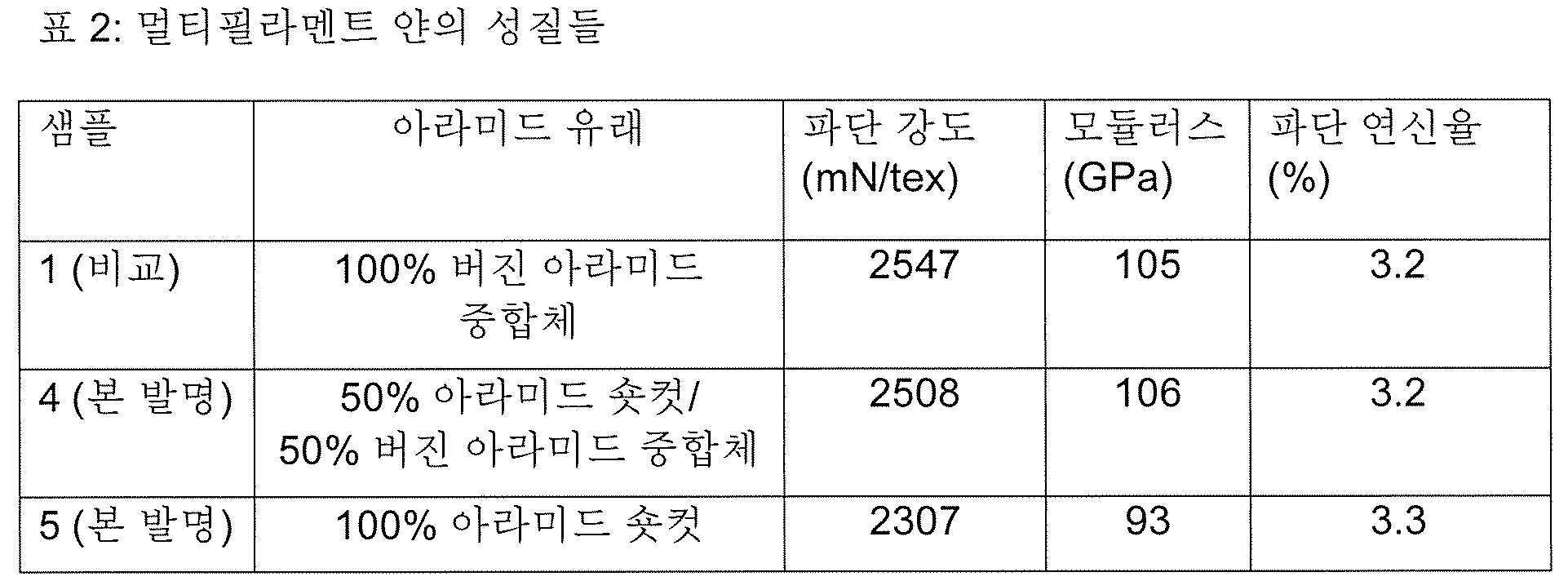
표 2의 결과는 재활용된 아라미드 섬유를 포함하는 방사 도프가 100% 버진 아라미드 중합체로 제조된 멀티필라멘트 얀에 필적하는 기계적 성질들을 갖는 멀티필라멘트 얀을 생성할 수 있음을 다시 보여준다.The results in Table 2 again show that a spun dope comprising recycled aramid fibers can produce multifilament yarns with mechanical properties comparable to multifilament yarns made with 100% virgin aramid polymer.
실시예 3Example 3
본 실시예는, 본 특정 예에서는 93wt%의 메타-아라미드 섬유, 5wt%의 파라-아라미드 섬유 및 2wt%의 아크릴계 대전 방지 섬유로 만들어진 섬유들의 혼합물로 만든 패브릭의 재활용을 보여준다. 패브릭을 최대 치수가 20mm인 작은 조각으로 파쇄했다. 후속적으로, 액체 황산을 섬유에 첨가하고, SpeedMixer(DAC 800)를 사용하여 섬유를 용해시켜 16wt% 섬유를 기반으로 하는 방사 도프 배취를 제조하였다. 60℃의 최대 온도를 유지하기 위해 1,400rpm으로 90초간 혼합하였다.This example shows the recycling of a fabric made from a mixture of fibers made, in this particular example, of 93 wt % meta-aramid fiber, 5 wt % para-aramid fiber and 2 wt % acrylic antistatic fiber. The fabric was shredded into small pieces with a maximum dimension of 20 mm. Subsequently, liquid sulfuric acid was added to the fibers and a SpeedMixer (DAC 800) was used to dissolve the fibers to prepare a spinning dope batch based on 16 wt % fibers. The mixture was mixed for 90 seconds at 1,400 rpm to maintain a maximum temperature of 60 °C.
여러 배취의 방사 도프를 용기에서 조합했다(방사 도프 5). 방사 도프를 35℃로 가열된 트윈 스크류 압출기에 연속적으로 공급하였다. 압출기 후, 액체 방사 도프를 여과하고, 65㎛의 구멍을 106개 포함하는 방사구를 통해 인발되는 공기 중으로 압출한 후, 즉시 응고욕으로 이송하였다. 응고 후, 형성된 필라멘트를 응고욕에서 제거하고, 세척하고, 중화하고, 다시 세척하고, 건조시키고, ~280℃에서 열처리하고, 보빈에 권취하였다. 응고 후, 세척 동안, 그리고 열처리 동안 인발을 적용하였다.Several batches of spin dope were combined in a vessel (spin dope 5). The spin dope was continuously fed to a twin screw extruder heated to 35°C. After the extruder, the liquid spinning dope was filtered, extruded into the air drawn through a spinneret containing 106 65 μm holes, and immediately transferred to a coagulation bath. After coagulation, the formed filaments were removed from the coagulation bath, washed, neutralized, washed again, dried, heat treated at ˜280° C., and wound on bobbins. After coagulation, drawing was applied during washing and during heat treatment.
이렇게 제조된 멀티필라멘트 얀의 기계적 성질들을 표 3에 나타낸다.Table 3 shows the mechanical properties of the multifilament yarn thus prepared.

표 3의 결과는 아라미드를 포함하는 섬유들 중 상이한 중합체로 이루어진 섬유들의 혼합물로 이루어진 패브릭이 다양한 용도에 적합한 성질들을 갖는 필라멘트 얀으로 방사될 수 있음을 보여준다.The results in Table 3 show that fabrics consisting of a mixture of fibers of different polymers among the fibers comprising aramid can be spun into filament yarns with properties suitable for a variety of applications.
염색시, 본 발명의 공정으로 얻은 섬유는 일반 메타-아라미드 섬유(Teijinconex® Neo)와 비교하여 도 1과 같이 필라멘트 단면 전체에 걸쳐 염료의 향상된 침투를 보여준다. 도 1은 염색 전(좌측 이미지, 샘플 6) 및 청색 염료로 염색한 후(중앙 이미지)의 재활용된 얀의 단면 이미지를 보여준다. 우측 이미지는 버진 메타-아라미드 중합체(재활용 없음)로부터 얻고 샘플 6과 동일한 염료로 염색한 일반 메타-아라미드 섬유(Teijinconex® Neo)를 보여준다. 도 1로부터, 재활용된 섬유의 염색시, 염료는 필라멘트의 코어까지 모든 완전히 침투함을 관찰할 수 있다. 대조적으로, 일반 메타-아라미드 섬유의 염색시, 필라멘트의 코어는 염색되지 않은 채로 남아 있다.Upon dyeing, the fibers obtained by the process of the present invention show improved penetration of the dye throughout the filament cross-section as shown in FIG. 1 compared to normal meta-aramid fibers (Teijinconex® Neo). 1 shows cross-sectional images of recycled yarn before dyeing (left image, sample 6) and after dyeing with blue dye (center image). The image on the right shows a plain meta-aramid fiber (Teijinconex® Neo) obtained from a virgin meta-aramid polymer (no recycling) and dyed with the same dye as sample 6. From Fig. 1, it can be observed that, upon dyeing the recycled fiber, the dye completely penetrates all the way to the core of the filament. In contrast, upon dyeing of normal meta-aramid fibers, the core of the filament remains undyed.
Claims (25)
- 비연속 아라미드 섬유를 포함하는 아라미드 섬유질 재료를 황산과 배합하여, 아라미드를 포함하는 방사 도프를 얻는 단계 및
- 상기 아라미드를 포함하는 방사 도프를 연속 아라미드 섬유로 가공하는 단계를 포함하는, 공정.As a continuous recycling process of aramid fibers,
- blending an aramid fibrous material comprising discontinuous aramid fibers with sulfuric acid to obtain a spinning dope comprising aramid; and
- processing the spun dope comprising aramid into continuous aramid fibers.
- 비연속 아라미드 섬유를 포함하는 아라미드 섬유질 재료를 황산과 배합하여, 아라미드를 포함하는 제1 방사 도프를 얻는 단계,
- 버진 아라미드 중합체와 황산을 배합하여, 아라미드를 포함하는 제2 방사 도프를 얻는 단계,
- 상기 제1 방사 도프와 상기 제2 방사 도프를 배합하는 단계 및
- 상기 제1 방사 도프와 상기 제2 방사 도프의 배합물을 연속 아라미드 섬유로 가공하는 단계를 포함하는, 공정.11. The method according to any one of claims 2 to 10,
- blending an aramid fibrous material comprising discontinuous aramid fibers with sulfuric acid to obtain a first spinning dope comprising aramid;
- mixing the virgin aramid polymer and sulfuric acid to obtain a second spinning dope comprising aramid;
- combining said first and said second dope and
- processing the blend of said first spin dope and said second spin dope into continuous aramid fibers.
Applications Claiming Priority (3)
| Application Number | Priority Date | Filing Date | Title |
|---|---|---|---|
| EP19218737 | 2019-12-20 | ||
| EP19218737.5 | 2019-12-20 | ||
| PCT/EP2020/087083 WO2021123210A1 (en) | 2019-12-20 | 2020-12-18 | Continuous process for recycling |
Publications (1)
| Publication Number | Publication Date |
|---|---|
| KR20220119050A true KR20220119050A (en) | 2022-08-26 |
Family
ID=69005260
Family Applications (1)
| Application Number | Title | Priority Date | Filing Date |
|---|---|---|---|
| KR1020227022649A Pending KR20220119050A (en) | 2019-12-20 | 2020-12-18 | Continuous recycling process |
Country Status (6)
| Country | Link |
|---|---|
| US (1) | US12467162B2 (en) |
| EP (1) | EP4077506B1 (en) |
| JP (1) | JP2023507132A (en) |
| KR (1) | KR20220119050A (en) |
| CN (1) | CN114846063A (en) |
| WO (1) | WO2021123210A1 (en) |
Families Citing this family (2)
| Publication number | Priority date | Publication date | Assignee | Title |
|---|---|---|---|---|
| WO2026082573A2 (en) | 2024-10-14 | 2026-04-23 | Teijin Aramid B.V. | Process for the recycling of para-aramid waste |
| CN119162686B (en) * | 2024-11-19 | 2025-02-14 | 烟台泰和新材高分子新材料研究院有限公司 | Liquid crystal spinning method for heterocyclic aramid fiber |
Family Cites Families (41)
| Publication number | Priority date | Publication date | Assignee | Title |
|---|---|---|---|---|
| NL246230A (en) | 1958-12-09 | |||
| US3414645A (en) * | 1964-06-19 | 1968-12-03 | Monsanto Co | Process for spinning wholly aromatic polyamide fibers |
| US4016236A (en) | 1974-05-15 | 1977-04-05 | Asahi Kasei Kogyo Kabushiki Kaisha | Process for manufacturing aromatic polymer fibers |
| JPS5845466B2 (en) | 1975-02-17 | 1983-10-11 | 帝人株式会社 | Japanese taiyoweki |
| US4162346A (en) * | 1976-09-23 | 1979-07-24 | Celanese Corporation | High performance wholly aromatic polyamide fibers |
| US5366781A (en) * | 1989-04-13 | 1994-11-22 | E. I. Du Pont De Nemours And Company | Oriented, shape articles of lyotropic/thermally-consolidatable polymer blends |
| JP2934767B2 (en) | 1989-07-15 | 1999-08-16 | セーレン株式会社 | Dyeing method of aromatic polyamide fiber |
| US5660779A (en) * | 1993-04-19 | 1997-08-26 | E. I. Du Pont De Nemours And Company | Process of making textile fibers of sulfonated poly(p-phenylene terephthalamide) |
| JPH07286061A (en) * | 1993-07-15 | 1995-10-31 | Teijin Ltd | Method for producing aramid dope and method for producing fibrid using the same |
| US5723570A (en) * | 1995-03-30 | 1998-03-03 | Industrial Technology Research Institute | Wholly aromatic polyamide fiber with improved dyeability |
| NL1000276C2 (en) * | 1995-05-02 | 1996-11-05 | Akzo Nobel Nv | Process for the production of fibers from poly (p-phenylene terephthalamide). |
| NL1002882C2 (en) * | 1996-04-17 | 1997-10-21 | Akzo Nobel Nv | Sulfur-containing p-aramid yarn. |
| BR9911583B1 (en) * | 1998-10-22 | 2008-11-18 | tintable polyparaphenylene terephthalamide fiber, bent type thereof, flake type thereof, production method, cheese dyeing method thereof. | |
| JP2002302837A (en) * | 2001-04-05 | 2002-10-18 | Teijin Ltd | Wholly aromatic polyamide fiber structure with improved dyeability |
| RU2210649C2 (en) | 2001-05-10 | 2003-08-20 | Государственное предприятие Всероссийский научно-исследовательский институт полимерных волокон с опытным заводом | Aramide fiber dyeing method |
| CH694890A5 (en) | 2001-12-05 | 2005-08-31 | Cortex Humbelin Ag | Safety-rope. |
| DE10201869B4 (en) * | 2002-01-15 | 2005-08-11 | Bayer, René | Feeding device for chips and short cut fibers |
| US6952915B2 (en) | 2003-10-29 | 2005-10-11 | E. I. Du Pont De Nemours And Company | Ply-twisted yarns and fabric having both cut-resistance and elastic recovery and processes for making same |
| MY145156A (en) * | 2003-12-09 | 2011-12-30 | Teijin Aramid Bv | Para-aramid fibrid film |
| US20060113700A1 (en) * | 2004-12-01 | 2006-06-01 | Hartzler Jon D | Continuous processes for making composite fibers |
| JP2006241271A (en) | 2005-03-02 | 2006-09-14 | Teijin Techno Products Ltd | Method for producing aramid dope |
| JP2007262589A (en) * | 2006-03-27 | 2007-10-11 | Teijin Techno Products Ltd | Easily-dyeable meta aromatic amide fiber and method for producing the same |
| JP5193439B2 (en) * | 2006-06-01 | 2013-05-08 | 帝人株式会社 | Method for producing aramid dope and aramid slurry used therefor |
| EP2118176B1 (en) | 2007-02-03 | 2012-11-14 | Teijin Aramid B.V. | Method for dissolving aramid polymer in sulfuric acid using a double shaft kneader |
| KR100762852B1 (en) | 2007-04-24 | 2007-10-04 | 주식회사 삼광염직 | Method for dyeing para-aramid fibers using cationic dyes |
| EP2053147A1 (en) * | 2007-10-23 | 2009-04-29 | Teijin Aramid B.V. | Method for spinning and washing aramid fiber and recovering sulfuric acid |
| CN100593594C (en) * | 2008-04-01 | 2010-03-10 | 上海依极科技有限公司 | Method for producing aramid fiber pulp by aramid fiber waste material |
| KR101923749B1 (en) * | 2011-01-13 | 2018-11-29 | 이 아이 듀폰 디 네모아 앤드 캄파니 | Copolymer fibers and yarns and processes for making same |
| BR112013025123A2 (en) * | 2011-03-30 | 2017-02-14 | Tokai Senko K K | method for dyeing aramid fibers and dyed aramid fibers |
| CN102560748B (en) | 2011-06-08 | 2013-06-05 | 王锡璐 | Recovery process of waste materials generated in industrial manufacture process of poly-p-phenylene terephthamide aramid fiber II |
| CN102534841B (en) * | 2011-06-08 | 2014-06-18 | 王锡璐 | Poly (p-phenylene terephthalamide) aramid fiber II staple fiber and preparation method thereof |
| BR112014016741A8 (en) * | 2012-01-11 | 2017-07-04 | Du Pont | process to produce a yarn |
| JP5993177B2 (en) | 2012-03-30 | 2016-09-14 | 帝人株式会社 | High quality, high fastness aromatic polyamide fiber dyeing fabric and dyeing method |
| CN103772895A (en) | 2012-10-25 | 2014-05-07 | 黑龙江鑫达企业集团有限公司 | Continuous aramid fiber-reinforced polyformaldehyde material and preparation method thereof |
| KR101942582B1 (en) * | 2012-12-11 | 2019-01-25 | 도레이케미칼 주식회사 | Method of meta-aramide composition and meta-aramide composition produced by thereof |
| WO2015066160A1 (en) * | 2013-10-30 | 2015-05-07 | E. I. Du Pont De Nemours And Company | Sheets and fibrids comprising a mixture of poly(m-phenylene isophthalamide) and copolymer made from (6)-amino-2-(p-aminophenyl)benzimidazole |
| CN104846473B (en) * | 2014-02-14 | 2016-05-25 | 上海特安纶纤维有限公司 | A kind of blended fiber based on aromatic polyamide and polyarylsulfone (PAS), yarn, fabric, goods and preparation method thereof |
| KR102332019B1 (en) * | 2014-04-16 | 2021-11-29 | 프로이오닉 게엠베하 | Method for fusing aramid/aramid fibres |
| WO2018084040A1 (en) * | 2016-11-01 | 2018-05-11 | 帝人株式会社 | Fabric, method for manufacturing same, and fiber product |
| CN106564134B (en) | 2016-11-01 | 2019-07-09 | 烟台泰和新材料股份有限公司 | A method of resolution p-aramid fiber spinning waste material |
| CN110331471A (en) * | 2019-07-04 | 2019-10-15 | 宁夏泰和芳纶纤维有限责任公司 | A kind of useless stoste recycling and reusing device and method of p-aramid fiber spinning |
-
2020
- 2020-12-18 KR KR1020227022649A patent/KR20220119050A/en active Pending
- 2020-12-18 CN CN202080087581.0A patent/CN114846063A/en active Pending
- 2020-12-18 US US17/786,225 patent/US12467162B2/en active Active
- 2020-12-18 WO PCT/EP2020/087083 patent/WO2021123210A1/en not_active Ceased
- 2020-12-18 EP EP20838014.7A patent/EP4077506B1/en active Active
- 2020-12-18 JP JP2022536798A patent/JP2023507132A/en active Pending
Also Published As
| Publication number | Publication date |
|---|---|
| WO2021123210A1 (en) | 2021-06-24 |
| CN114846063A (en) | 2022-08-02 |
| US20230037211A1 (en) | 2023-02-02 |
| JP2023507132A (en) | 2023-02-21 |
| US12467162B2 (en) | 2025-11-11 |
| EP4077506B1 (en) | 2026-03-04 |
| EP4077506A1 (en) | 2022-10-26 |
Similar Documents
| Publication | Publication Date | Title |
|---|---|---|
| CN111868316B (en) | Method for recovering cotton and polyester fibers from waste textiles | |
| CN111868314B (en) | Reusable Lyocell Cellulose for Lyocell Process | |
| JP7760813B2 (en) | Method for recycling blended textiles containing cellulose and synthetic plastics | |
| EP4077506B1 (en) | Continuous process for recycling | |
| KR101385275B1 (en) | Dope for spinning lyocell, method for preparing lyocell staple fiber, and lyocell staple fiber prepared therefrom | |
| JP2025501877A (en) | Cellulosic Textile Fibers | |
| JP7028682B2 (en) | Original meta-type all-aromatic polyamide fiber and its manufacturing method, and flame-retardant spun yarn and flame-retardant cut-off spun yarn made of the fiber. | |
| KR20160012225A (en) | Organic resin non-crimped staple fiber | |
| KR101256706B1 (en) | Aramid pulp and method for manufacturing the same | |
| RU2835831C1 (en) | Continuous process for processing | |
| RU2389604C2 (en) | Method to improve cohesive capacity of chopped aramide fiber | |
| CN105705688A (en) | Fiber comprising a mixture of poly(m-phenylene isophthalamide) and copolymer made from (6)-amino-2-(p-aminophenyl)benzimidazole | |
| KR20070086810A (en) | Continuous manufacturing method of composite fiber | |
| Li et al. | Study on the structure and properties of viscose/wool powder blended fibre | |
| KR20240132063A (en) | Cellulose carbamate polymer | |
| JP7267821B2 (en) | Method for producing recycled meta-type wholly aromatic polyamide fiber | |
| JP2015526601A (en) | Flame retardant spun short fiber yarns made from blends of fibers obtained from sulfonated naphthalene polyoxadiazole polymers | |
| WO2026082573A2 (en) | Process for the recycling of para-aramid waste | |
| Duobinis | Structure and properties of aromatic polyamide and polyimide fibers commercially available in the former USSR | |
| JPH01139833A (en) | Fiber materials excellent in flexibility | |
| JPS63190087A (en) | Production of pulp particle | |
| KR910005543B1 (en) | Antistatic cospun polyester-polyamide yarns | |
| KR101071862B1 (en) | Aramid pulp and method for manufacturing the same | |
| CN115698397B (en) | Carbon powder-containing fiber and fiber structure | |
| WO2026027891A1 (en) | Method for producing an aramid solution |
Legal Events
| Date | Code | Title | Description |
|---|---|---|---|
| PA0105 | International application |
St.27 status event code: A-0-1-A10-A15-nap-PA0105 |
|
| PG1501 | Laying open of application |
St.27 status event code: A-1-1-Q10-Q12-nap-PG1501 |
|
| PA0201 | Request for examination |
St.27 status event code: A-1-2-D10-D11-exm-PA0201 |
|
| R18-X000 | Changes to party contact information recorded |
St.27 status event code: A-3-3-R10-R18-oth-X000 |
|
| D21 | Rejection of application intended |
Free format text: ST27 STATUS EVENT CODE: A-1-2-D10-D21-EXM-PE0902 (AS PROVIDED BY THE NATIONAL OFFICE) |
|
| PE0902 | Notice of grounds for rejection |
St.27 status event code: A-1-2-D10-D21-exm-PE0902 |