KR20220131663A - Method for manufacturing composite electrode for all-solid-state battery, and composite electrode for all-solid-state battery manufactured thereby - Google Patents
Method for manufacturing composite electrode for all-solid-state battery, and composite electrode for all-solid-state battery manufactured thereby Download PDFInfo
- Publication number
- KR20220131663A KR20220131663A KR1020210036595A KR20210036595A KR20220131663A KR 20220131663 A KR20220131663 A KR 20220131663A KR 1020210036595 A KR1020210036595 A KR 1020210036595A KR 20210036595 A KR20210036595 A KR 20210036595A KR 20220131663 A KR20220131663 A KR 20220131663A
- Authority
- KR
- South Korea
- Prior art keywords
- solid
- state battery
- solid electrolyte
- composite electrode
- active material
- Prior art date
- Legal status (The legal status is an assumption and is not a legal conclusion. Google has not performed a legal analysis and makes no representation as to the accuracy of the status listed.)
- Pending
Links
Images


Classifications
-
- H—ELECTRICITY
- H01—ELECTRIC ELEMENTS
- H01M—PROCESSES OR MEANS, e.g. BATTERIES, FOR THE DIRECT CONVERSION OF CHEMICAL ENERGY INTO ELECTRICAL ENERGY
- H01M4/00—Electrodes
- H01M4/02—Electrodes composed of, or comprising, active material
- H01M4/13—Electrodes for accumulators with non-aqueous electrolyte, e.g. for lithium-accumulators; Processes of manufacture thereof
- H01M4/139—Processes of manufacture
-
- H—ELECTRICITY
- H01—ELECTRIC ELEMENTS
- H01M—PROCESSES OR MEANS, e.g. BATTERIES, FOR THE DIRECT CONVERSION OF CHEMICAL ENERGY INTO ELECTRICAL ENERGY
- H01M4/00—Electrodes
- H01M4/02—Electrodes composed of, or comprising, active material
- H01M4/04—Processes of manufacture in general
-
- H—ELECTRICITY
- H01—ELECTRIC ELEMENTS
- H01M—PROCESSES OR MEANS, e.g. BATTERIES, FOR THE DIRECT CONVERSION OF CHEMICAL ENERGY INTO ELECTRICAL ENERGY
- H01M10/00—Secondary cells; Manufacture thereof
- H01M10/05—Accumulators with non-aqueous electrolyte
- H01M10/056—Accumulators with non-aqueous electrolyte characterised by the materials used as electrolytes, e.g. mixed inorganic/organic electrolytes
- H01M10/0561—Accumulators with non-aqueous electrolyte characterised by the materials used as electrolytes, e.g. mixed inorganic/organic electrolytes the electrolyte being constituted of inorganic materials only
- H01M10/0562—Solid materials
-
- H—ELECTRICITY
- H01—ELECTRIC ELEMENTS
- H01M—PROCESSES OR MEANS, e.g. BATTERIES, FOR THE DIRECT CONVERSION OF CHEMICAL ENERGY INTO ELECTRICAL ENERGY
- H01M4/00—Electrodes
- H01M4/02—Electrodes composed of, or comprising, active material
- H01M4/04—Processes of manufacture in general
- H01M4/0471—Processes of manufacture in general involving thermal treatment, e.g. firing, sintering, backing particulate active material, thermal decomposition, pyrolysis
-
- H—ELECTRICITY
- H01—ELECTRIC ELEMENTS
- H01M—PROCESSES OR MEANS, e.g. BATTERIES, FOR THE DIRECT CONVERSION OF CHEMICAL ENERGY INTO ELECTRICAL ENERGY
- H01M4/00—Electrodes
- H01M4/02—Electrodes composed of, or comprising, active material
- H01M4/13—Electrodes for accumulators with non-aqueous electrolyte, e.g. for lithium-accumulators; Processes of manufacture thereof
-
- H—ELECTRICITY
- H01—ELECTRIC ELEMENTS
- H01M—PROCESSES OR MEANS, e.g. BATTERIES, FOR THE DIRECT CONVERSION OF CHEMICAL ENERGY INTO ELECTRICAL ENERGY
- H01M4/00—Electrodes
- H01M4/02—Electrodes composed of, or comprising, active material
- H01M4/13—Electrodes for accumulators with non-aqueous electrolyte, e.g. for lithium-accumulators; Processes of manufacture thereof
- H01M4/136—Electrodes based on inorganic compounds other than oxides or hydroxides, e.g. sulfides, selenides, tellurides, halogenides or LiCoFy
-
- H—ELECTRICITY
- H01—ELECTRIC ELEMENTS
- H01M—PROCESSES OR MEANS, e.g. BATTERIES, FOR THE DIRECT CONVERSION OF CHEMICAL ENERGY INTO ELECTRICAL ENERGY
- H01M4/00—Electrodes
- H01M4/02—Electrodes composed of, or comprising, active material
- H01M4/13—Electrodes for accumulators with non-aqueous electrolyte, e.g. for lithium-accumulators; Processes of manufacture thereof
- H01M4/139—Processes of manufacture
- H01M4/1391—Processes of manufacture of electrodes based on mixed oxides or hydroxides, or on mixtures of oxides or hydroxides, e.g. LiCoOx
-
- H—ELECTRICITY
- H01—ELECTRIC ELEMENTS
- H01M—PROCESSES OR MEANS, e.g. BATTERIES, FOR THE DIRECT CONVERSION OF CHEMICAL ENERGY INTO ELECTRICAL ENERGY
- H01M4/00—Electrodes
- H01M4/02—Electrodes composed of, or comprising, active material
- H01M4/13—Electrodes for accumulators with non-aqueous electrolyte, e.g. for lithium-accumulators; Processes of manufacture thereof
- H01M4/139—Processes of manufacture
- H01M4/1397—Processes of manufacture of electrodes based on inorganic compounds other than oxides or hydroxides, e.g. sulfides, selenides, tellurides, halogenides or LiCoFy
-
- H—ELECTRICITY
- H01—ELECTRIC ELEMENTS
- H01M—PROCESSES OR MEANS, e.g. BATTERIES, FOR THE DIRECT CONVERSION OF CHEMICAL ENERGY INTO ELECTRICAL ENERGY
- H01M4/00—Electrodes
- H01M4/02—Electrodes composed of, or comprising, active material
- H01M4/36—Selection of substances as active materials, active masses, active liquids
- H01M4/362—Composites
- H01M4/366—Composites as layered products
-
- H—ELECTRICITY
- H01—ELECTRIC ELEMENTS
- H01M—PROCESSES OR MEANS, e.g. BATTERIES, FOR THE DIRECT CONVERSION OF CHEMICAL ENERGY INTO ELECTRICAL ENERGY
- H01M4/00—Electrodes
- H01M4/02—Electrodes composed of, or comprising, active material
- H01M4/62—Selection of inactive substances as ingredients for active masses, e.g. binders, fillers
-
- H—ELECTRICITY
- H01—ELECTRIC ELEMENTS
- H01M—PROCESSES OR MEANS, e.g. BATTERIES, FOR THE DIRECT CONVERSION OF CHEMICAL ENERGY INTO ELECTRICAL ENERGY
- H01M10/00—Secondary cells; Manufacture thereof
- H01M10/05—Accumulators with non-aqueous electrolyte
- H01M10/052—Li-accumulators
-
- H—ELECTRICITY
- H01—ELECTRIC ELEMENTS
- H01M—PROCESSES OR MEANS, e.g. BATTERIES, FOR THE DIRECT CONVERSION OF CHEMICAL ENERGY INTO ELECTRICAL ENERGY
- H01M4/00—Electrodes
- H01M4/02—Electrodes composed of, or comprising, active material
- H01M2004/021—Physical characteristics, e.g. porosity, surface area
-
- H—ELECTRICITY
- H01—ELECTRIC ELEMENTS
- H01M—PROCESSES OR MEANS, e.g. BATTERIES, FOR THE DIRECT CONVERSION OF CHEMICAL ENERGY INTO ELECTRICAL ENERGY
- H01M2300/00—Electrolytes
- H01M2300/0017—Non-aqueous electrolytes
- H01M2300/0065—Solid electrolytes
- H01M2300/0068—Solid electrolytes inorganic
-
- H—ELECTRICITY
- H01—ELECTRIC ELEMENTS
- H01M—PROCESSES OR MEANS, e.g. BATTERIES, FOR THE DIRECT CONVERSION OF CHEMICAL ENERGY INTO ELECTRICAL ENERGY
- H01M2300/00—Electrolytes
- H01M2300/0017—Non-aqueous electrolytes
- H01M2300/0065—Solid electrolytes
- H01M2300/0068—Solid electrolytes inorganic
- H01M2300/008—Halides
-
- Y—GENERAL TAGGING OF NEW TECHNOLOGICAL DEVELOPMENTS; GENERAL TAGGING OF CROSS-SECTIONAL TECHNOLOGIES SPANNING OVER SEVERAL SECTIONS OF THE IPC; TECHNICAL SUBJECTS COVERED BY FORMER USPC CROSS-REFERENCE ART COLLECTIONS [XRACs] AND DIGESTS
- Y02—TECHNOLOGIES OR APPLICATIONS FOR MITIGATION OR ADAPTATION AGAINST CLIMATE CHANGE
- Y02E—REDUCTION OF GREENHOUSE GAS [GHG] EMISSIONS, RELATED TO ENERGY GENERATION, TRANSMISSION OR DISTRIBUTION
- Y02E60/00—Enabling technologies; Technologies with a potential or indirect contribution to GHG emissions mitigation
- Y02E60/10—Energy storage using batteries
Landscapes
- Chemical & Material Sciences (AREA)
- Chemical Kinetics & Catalysis (AREA)
- Electrochemistry (AREA)
- General Chemical & Material Sciences (AREA)
- Engineering & Computer Science (AREA)
- Manufacturing & Machinery (AREA)
- Composite Materials (AREA)
- Materials Engineering (AREA)
- Inorganic Chemistry (AREA)
- Physics & Mathematics (AREA)
- Condensed Matter Physics & Semiconductors (AREA)
- General Physics & Mathematics (AREA)
- Battery Electrode And Active Subsutance (AREA)
- Secondary Cells (AREA)
Abstract
Description
본 발명은 전고체전지용 복합전극 제조방법, 및 이에 따라 제조된 전고체전지용 복합전극에 관한 것이다.The present invention relates to a method for manufacturing a composite electrode for an all-solid-state battery, and to a composite electrode for an all-solid-state battery manufactured thereby.
전기자동차 및 대용량 전력 저장장치의 요구가 높아지면서 이를 충족시키기 위한 다양한 전지의 개발이 이루어져 왔다.As the demand for electric vehicles and large-capacity power storage devices increases, various batteries have been developed to satisfy them.
그 중, 리튬 이차전지는 다양한 이차전지 중에서 에너지밀도 및 출력 특성이 가장 우수하여 널리 상용화되었다. 리튬 이차전지로는 유기용매를 포함하는 액체 타입의 전해질을 포함하는 리튬 이차전지(이하 '액체 타입 이차전지'라 함)가 주로 사용되고 있었다.Among them, lithium secondary batteries have been widely commercialized because of their excellent energy density and output characteristics among various secondary batteries. As a lithium secondary battery, a lithium secondary battery (hereinafter referred to as a 'liquid type secondary battery') including a liquid type electrolyte containing an organic solvent has been mainly used.
하지만, 액체 타입 이차전지는 액체전해질이 전극 반응에 의해 분해되어 전지의 팽창을 야기하고 액체전해질의 누출에 의한 발화의 위험성이 지적되고 있었다. 이러한 액체 타입 이차전지의 문제점을 해소하기 위해서, 안정성이 우수한 고체전해질을 적용한 리튬 이차전지(이하 '전고체전지'라 함)가 주목받고 있다.However, in the liquid type secondary battery, the liquid electrolyte is decomposed by the electrode reaction, causing the battery to expand, and the risk of ignition due to leakage of the liquid electrolyte has been pointed out. In order to solve the problems of the liquid type secondary battery, a lithium secondary battery (hereinafter referred to as an 'all-solid-state battery') to which a solid electrolyte having excellent stability is applied is attracting attention.
한편, 고체전해질은 산화물계와 황화물계로 나눌 수 있다. 황화물계 고체 전해질이 산화물계 고체전해질과 비교하여 높은 리튬이온 전도도를 가지고, 넓은 전압 범위에서 안정하기 때문에, 고체전해질로 황화물계 고체전해질을 주로 사용하고 있는 실정이다.On the other hand, solid electrolytes can be divided into oxide-based and sulfide-based electrolytes. Since the sulfide-based solid electrolyte has higher lithium ion conductivity compared to the oxide-based solid electrolyte and is stable over a wide voltage range, the sulfide-based solid electrolyte is mainly used as the solid electrolyte.
한편, 상기 황화물계 고체전해질을 활물질 상에 코팅시켜 합성하기 위한 복합전극 제조방법으로, 종래에는 고체전해질을 열처리하여 최종적으로 제조하는 단계와 이를 용매에 투입시켜 용해시킨 후, 활물질상에 코팅시키는 단계를 포함하는 2단계를 거쳐 복합전극을 제조하였다.On the other hand, as a composite electrode manufacturing method for synthesizing the sulfide-based solid electrolyte by coating it on an active material, in the prior art, the solid electrolyte is finally prepared by heat treatment, and the solid electrolyte is dissolved in a solvent and then coated on the active material. A composite electrode was manufactured through two steps including
다만, 상기 제조방법은 두 번의 공정을 거쳐야 하는 번거로움이 있고 공정시간이 길며, 완전 용해가 가능한 용매만을 선택하여 제조해야 하므로 제한된 용도로만 사용되어야 하는 문제점이 있었다.However, the manufacturing method has a problem in that it is cumbersome to go through two processes, a long process time, and only a solvent capable of completely dissolving must be selected and manufactured, so that it must be used only for limited purposes.
본 발명은 위와 같은 문제점을 해결하기 위한 것으로서, 그 구체적인 목적은 다음과 같다.The present invention is intended to solve the above problems, and the specific objects thereof are as follows.
고체전해질 전구체와 극성용매를 혼합한 전구체 용액을 준비하고 이를 교반한 다음 활물질을 투입하여 전극 슬러리를 제조한 뒤 이를 열처리하는 단계를 포함하여, 활물질 표면에 고체전해질 합성과 동시에 이를 포함하는 코팅층을 형성하는 것을 특징으로 하는 전고체전지용 복합전극 제조방법, 및 이에 따라 제조된 전고체전지용 복합전극을 제공하는 것을 목적으로 한다.Preparing a precursor solution in which a solid electrolyte precursor and a polar solvent are mixed, stirring it, preparing an electrode slurry by adding an active material, and then heat-treating it. An object of the present invention is to provide a method for manufacturing a composite electrode for an all-solid-state battery, characterized in that, and a composite electrode for an all-solid-state battery prepared accordingly.
본 발명의 목적은 이상에서 언급한 목적으로 제한되지 않는다. 본 발명의 목적은 이하의 설명으로 보다 분명해 질 것이며, 특허청구범위에 기재된 수단 및 그 조합으로 실현될 것이다.The object of the present invention is not limited to the object mentioned above. The objects of the present invention will become more apparent from the following description, and will be realized by means and combinations thereof described in the claims.
본 발명에 따른 전고체전지용 복합전극 제조방법은 적어도 1종 이상의 고체전해질 전구체와, 적어도 1종 이상의 극성용매를 혼합한 전구체 용액을 준비하는 단계; 상기 전구체 용액을 교반하는 단계; 상기 교반된 전구체 용액에 활물질을 투입하여 전극 슬러리를 제조하는 단계; 및 상기 전극 슬러리를 열처리하여 전고체전지용 복합전극을 얻는 단계;를 포함하고, 상기 전고체전지용 복합전극은 활물질; 및 상기 활물질 상에 위치하고, 고체전해질을 포함하는 코팅층;을 포함하는 것을 특징으로 한다.The method for manufacturing a composite electrode for an all-solid-state battery according to the present invention comprises the steps of: preparing a precursor solution in which at least one kind of solid electrolyte precursor and at least one kind of polar solvent are mixed; stirring the precursor solution; preparing an electrode slurry by adding an active material to the stirred precursor solution; and heat-treating the electrode slurry to obtain a composite electrode for an all-solid-state battery, wherein the composite electrode for an all-solid-state battery includes: an active material; and a coating layer positioned on the active material and including a solid electrolyte.
상기 전구체 용액에 포함된 고체전해질 전구체 : 극성용매의 질량비는 8~10 : 1일 수 있다.The mass ratio of the solid electrolyte precursor: the polar solvent included in the precursor solution may be 8 to 10: 1.
상기 고체전해질 전구체는 Li2S, P2S5, LiCl, LiBr, 및 LiI 로 이루어진 군으로부터 선택된 1종을 포함할 수 있다.The solid electrolyte precursor may include one selected from the group consisting of Li 2 S, P 2 S 5 , LiCl, LiBr, and LiI.
상기 극성용매는 고리형 에터(Cyclic ether), 아세토나이트릴(Acetonitrile; ACN), 에탄올(Ethanol; EtOH), 로 이루어진 군으로부터 선택된 1종을 포함할 수 있다.The polar solvent may include one selected from the group consisting of cyclic ether (Cyclic ether), acetonitrile (ACN), ethanol (Ethanol; EtOH), and the like.
상기 전구체 용액을 교반하는 단계에서, 상기 교반 속도는 250~280rpm일 수 있다.In the step of stirring the precursor solution, the stirring speed may be 250 ~ 280rpm.
상기 전극 슬러리를 제조하는 단계에서, 상기 전극슬러리에 포함되는 고체전해질 전구체 : 활물질의 질량비는 1 : 8~10일 수 있다.In the step of preparing the electrode slurry, the mass ratio of the solid electrolyte precursor included in the electrode slurry to the active material may be 1:8-10.
상기 전고체전지용 복합전극 제조방법은 상기 고체전해질 전구체와 다른 추가 고체전해질 전구체를 포함하는 추가 전구체 용액을 준비하는 단계를 더 포함할 수 있다.The method for manufacturing a composite electrode for an all-solid-state battery may further include preparing an additional precursor solution including the solid electrolyte precursor and another additional solid electrolyte precursor.
상기 전극 슬러리를 제조하는 단계는, 상기 교반된 전구체 용액에 활물질을 투입하여 혼합물을 제조하는 단계; 및 상기 혼합물에 추가 전구체 용액을 투입하는 단계를 포함할 수 있다.The preparing of the electrode slurry may include preparing a mixture by adding an active material to the stirred precursor solution; and adding an additional precursor solution to the mixture.
상기 전극 슬러리에 포함되는, 고체전해질 전구체와 추가 고체전해질 전구체 : 활물질의 질량비는 1 : 8~10일 수 있다.The mass ratio of the solid electrolyte precursor and the additional solid electrolyte precursor: the active material included in the electrode slurry may be 1:8-10.
상기 전극 슬러리를 제조하는 단계에서, 전극 슬러리 전체 100중량% 기준, 도전재를 0.1~0.5중량%의 함량으로 더 투입할 수 있다.In the step of preparing the electrode slurry, the conductive material may be further added in an amount of 0.1 to 0.5% by weight based on 100% by weight of the total electrode slurry.
상기 열처리는 140~160℃의 온도에서 1~3시간 동안 수행될 수 있다.The heat treatment may be performed at a temperature of 140 to 160° C. for 1 to 3 hours.
본 발명에 따른 전고체전지용 복합전극은 활물질; 및 상기 활물질 상에 위치하고, 고체전해질을 포함하는 코팅층;을 포함하고, 상기 코팅층은 비정질 고체전해질을 포함할 수 있다.A composite electrode for an all-solid-state battery according to the present invention includes an active material; and a coating layer positioned on the active material and including a solid electrolyte, wherein the coating layer may include an amorphous solid electrolyte.
상기 고체전해질은 PS4 3- 을 포함할 수 있다.The solid electrolyte may include PS 4 3- .
상기 고체전해질은 Li3PS4, Li6PS5Cl, Li6PS5ClBr, 및 Li6PS5Br로 이루어진 군으로부터 선택된 1종 이상을 포함할 수 있다.The solid electrolyte may include at least one selected from the group consisting of Li 3 PS 4 , Li 6 PS 5 Cl, Li 6 PS 5 ClBr, and Li 6 PS 5 Br.
상기 비정질 고체전해질의 함량은, 상기 코팅층 전체 100중량% 기준, 비정질 고체전해질 20~80중량%로 포함할 수 있다.The content of the amorphous solid electrolyte may include 20 to 80% by weight of the amorphous solid electrolyte based on 100% by weight of the total coating layer.
상기 코팅층의 두께는 200nm 이하일 수 있다.The thickness of the coating layer may be 200 nm or less.
상기 코팅층의 영스 모듈러스(Young's modulus)는 18~30 GPa일 수 있다.A Young's modulus of the coating layer may be 18 to 30 GPa.
본 발명에 따른 전고체전지용 복합전극 제조방법은 고체전해질 전구체 용액을 변경하여 코팅층에 포함되는 고체전해질의 조성을 자유롭게 변경할 수 있을 뿐만 아니라, 활물질 표면에 고체전해질 합성과 동시에 이를 포함하는 코팅층을 형성하는 바, 공정의 효율성을 향상시키므로 경제성이 우수한 장점이 있다.In the method for manufacturing a composite electrode for an all-solid-state battery according to the present invention, the composition of the solid electrolyte included in the coating layer can be freely changed by changing the solid electrolyte precursor solution, and a coating layer containing the solid electrolyte is synthesized on the surface of the active material at the same time as forming a coating layer. , because it improves the efficiency of the process, there is an advantage of excellent economic feasibility.
또한, 상기 제조방법으로 제조된 전고체전지용 복합전극은 이에 포함된 코팅층 내 비정질 고체전해질을 적정함랑으로포함하는 바, 상기 코팅층의 영스 모듈러스(Young's modulus)가 낮아짐에 따라 활물질과 코팅층의 접촉 면적이 향상되므로, 이를 포함하여 제조한 전고체전지는 초기방전용량 및 초기수명 등의 전지성능이 우수한 장점이 있다.In addition, the composite electrode for an all-solid-state battery manufactured by the above manufacturing method contains an amorphous solid electrolyte in the coating layer contained therein in an appropriate amount, and as the Young's modulus of the coating layer is lowered, the contact area between the active material and the coating layer is decreased. Therefore, the all-solid-state battery manufactured including the same has the advantage of excellent battery performance such as initial discharge capacity and initial lifespan.
본 발명의 효과는 이상에서 언급한 효과로 한정되지 않는다. 본 발명의 효과는 이하의 설명에서 추론 가능한 모든 효과를 포함하는 것으로 이해되어야 할 것이다.The effects of the present invention are not limited to the above-mentioned effects. It should be understood that the effects of the present invention include all effects that can be inferred from the following description.
도 1은 본 발명의 일 실시예에 따른 전고체전지용 복합전극 제조방법을 간략하게 나타낸 흐름도이다.
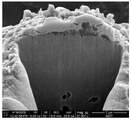
도 2a는 실시예 2에 따라 제조한 전고체전지용 복합전극의 SEM 이미지이고, 도 2b는 실시예 2에 따라 제조한 전고체전지용 복합전극의 코팅층을 확대한 SEM이미지이다.
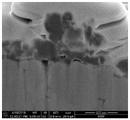
도 3a는 비교예에 따라 제조한 전고체전지용 복합전극의 SEM 이미지이고, 도 3b는 비교예에 따라 제조한 전고체전지용 복합전극의 코팅층을 확대한 SEM이미지이다.
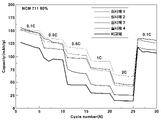
도 4는 실시예 1 내지 4, 및 비교예에 따른 전고체전지용 복합전극로 제조한 전고체 전지의 사이클 횟수 대비 방전용량을 나타낸 그래프이다.1 is a flowchart schematically illustrating a method for manufacturing a composite electrode for an all-solid-state battery according to an embodiment of the present invention.
2A is an SEM image of the composite electrode for an all-solid-state battery prepared according to Example 2, and FIG. 2B is an enlarged SEM image of the coating layer of the composite electrode for an all-solid-state battery prepared according to Example 2. Referring to FIG.
3A is an SEM image of the composite electrode for an all-solid-state battery prepared according to the comparative example, and FIG. 3B is an enlarged SEM image of the coating layer of the composite electrode for an all-solid-state battery prepared according to the comparative example.
4 is a graph showing the discharge capacity versus the number of cycles of the all-solid-state battery prepared with the composite electrode for the all-solid-state battery according to Examples 1 to 4 and Comparative Examples.
이상의 본 발명의 목적들, 다른 목적들, 특징들 및 이점들은 첨부된 도면과 관련된 이하의 바람직한 실시예들을 통해서 쉽게 이해될 것이다. 그러나 본 발명은 여기서 설명되는 실시예들에 한정되지 않고 다른 형태로 구체화될 수도 있다. 오히려, 여기서 소개되는 실시예들은 개시된 내용이 철저하고 완전해질 수 있도록 그리고 통상의 기술자에게 본 발명의 사상이 충분히 전달될 수 있도록 하기 위해 제공되는 것이다.The above objects, other objects, features and advantages of the present invention will be easily understood through the following preferred embodiments in conjunction with the accompanying drawings. However, the present invention is not limited to the embodiments described herein and may be embodied in other forms. Rather, the embodiments introduced herein are provided so that the disclosed subject matter may be thorough and complete, and that the spirit of the present invention may be sufficiently conveyed to those skilled in the art.
본 명세서에서, "포함하다" 또는 "가지다" 등의 용어는 명세서 상에 기재된 특징, 숫자, 단계, 동작, 구성요소, 부품 또는 이들을 조합한 것이 존재함을 지정하려는 것이지, 하나 또는 그 이상의 다른 특징들이나 숫자, 단계, 동작, 구성요소, 부분품 또는 이들을 조합한 것들의 존재 또는 부가 가능성을 미리 배제하지 않는 것으로 이해되어야 한다. 또한, 층, 막, 영역, 판 등의 부분이 다른 부분 "상에" 있다고 할 경우, 이는 다른 부분 "바로 위에" 있는 경우뿐만 아니라 그 중간에 또 다른 부분이 있는 경우도 포함한다. 반대로 층, 막, 영역, 판 등의 부분이 다른 부분 "하부에" 있다고 할 경우, 이는 다른 부분 "바로 아래에" 있는 경우뿐만 아니라 그 중간에 또 다른 부분이 있는 경우도 포함한다.In the present specification, terms such as “comprise” or “have” are intended to designate that a feature, number, step, operation, component, part, or combination thereof described in the specification exists, but one or more other features It is to be understood that it does not preclude the possibility of the presence or addition of numbers, steps, operations, components, parts, or combinations thereof. Also, when a part of a layer, film, region, plate, etc. is said to be “on” another part, this includes not only cases where it is “directly on” another part, but also cases where another part is in between. Conversely, when a part, such as a layer, film, region, plate, etc., is "under" another part, this includes not only cases where it is "directly under" another part, but also cases where there is another part in between.
달리 명시되지 않는 한, 본 명세서에서 사용된 성분, 반응 조건, 폴리머 조성물 및 배합물의 양을 표현하는 모든 숫자, 값 및/또는 표현은, 이러한 숫자들이 본질적으로 다른 것들 중에서 이러한 값을 얻는 데 발생하는 측정의 다양한 불확실성이 반영된 근사치들이므로, 모든 경우 "약"이라는 용어에 의해 수식되는 것으로 이해되어야 한다. 또한, 본 기재에서 수치범위가 개시되는 경우, 이러한 범위는 연속적이며, 달리 지적되지 않는 한 이러한 범 위의 최소값으로부터 최대값이 포함된 상기 최대값까지의 모든 값을 포함한다. 더 나아가, 이러한 범위가 정수를 지칭하는 경우, 달리 지적되지 않는 한 최소값으로부터 최대값이 포함된 상기 최대값까지를 포함하는 모든 정수가 포함된다.Unless otherwise specified, all numbers, values, and/or expressions expressing quantities of ingredients, reaction conditions, polymer compositions and formulations used herein include, among other things, the numbers, values and/or expressions such that these numbers essentially occur in obtaining such values, among others. Since they are approximations reflecting various uncertainties in the measurement, it should be understood as being modified by the term "about" in all cases. Also, where the disclosure discloses numerical ranges, such ranges are continuous and inclusive of all values from the minimum to the maximum inclusive of the range, unless otherwise indicated. Furthermore, when such ranges refer to integers, all integers inclusive from the minimum to the maximum inclusive are included, unless otherwise indicated.
본 명세서에 있어서, 범위가 변수에 대해 기재되는 경우, 상기 변수는 상기 범위의 기재된 종료점들을 포함하는 기재된 범위 내의 모든 값들을 포함하는 것으로 이해될 것이다. 예를 들면, "5 내지 10"의 범위는 5, 6, 7, 8, 9, 및 10의 값들뿐만 아니라 6 내지 10, 7 내지 10, 6 내지 9, 7 내지 9 등의 임의의 하위 범위를 포함하고, 5.5, 6.5, 7.5, 5.5 내지 8.5 및 6.5 내지 9 등과 같은 기재된 범위의 범주에 타당한 정수들 사이의 임의의 값도 포함하는 것으로 이해될 것이다. 또한 예를 들면, "10% 내지 30%"의 범위는 10%, 11%, 12%, 13% 등의 값들과 30%까지를 포함하는 모든 정수들뿐만 아니라 10% 내지 15%, 12% 내지 18%, 20% 내지 30% 등의 임의의 하위 범위를 포함하고, 10.5%, 15.5%, 25.5% 등과 같이 기재된 범위의 범주 내의 타당한 정수들 사이의 임의의 값도 포함하는 것으로 이해될 것이다.In this specification, when a range is described for a variable, the variable will be understood to include all values within the stated range including the stated endpoints of the range. For example, a range of “5 to 10” includes the values of 5, 6, 7, 8, 9, and 10, as well as any subranges such as 6 to 10, 7 to 10, 6 to 9, 7 to 9, etc. It will be understood to include any value between integers that are appropriate for the scope of the recited range, such as 5.5, 6.5, 7.5, 5.5 to 8.5 and 6.5 to 9, and the like. Also for example, a range of “10% to 30%” includes values such as 10%, 11%, 12%, 13%, and all integers up to and including 30%, as well as 10% to 15%, 12% to It will be understood to include any subrange, such as 18%, 20% to 30%, etc., as well as any value between reasonable integers within the scope of the recited range, such as 10.5%, 15.5%, 25.5%, and the like.
종래 전고체전지용 전극 제조 시, 열처리하여 고체전해질을 최종적으로 제조하는 단계와 이를 용매에 투입시켜 용해시킨 후, 활물질상에 코팅시키는 단계를 포함하는 두 번의 공정을 거쳐야 하는 번거로움이 있고 공정시간이 길며, 완전 용해가 가능한 용매만을 선택하여 제조해야 하므로 제한된 용도로만 사용되어야 하는 문제점이 있었다.When manufacturing an electrode for a conventional all-solid-state battery, it is cumbersome to go through two processes, including a step of finally producing a solid electrolyte by heat treatment, and a step of dissolving it in a solvent and coating it on an active material, and the process time is shortened. There was a problem in that it had to be used only for a limited purpose because it had to be prepared by selecting only a long and completely soluble solvent.
이에 본 발명자들은 상기 문제점을 해결하기 위해 예의 연구한 결과, 고체전해질 전구체와 극성용매를 혼합한 전구체 용액을 준비하고, 이를 교반한 다음 활물질을 투입하여 전극 슬러리를 제조한 뒤 이를 열처리하여 전고체전지용 복합전극을 얻는 경우, 활물질 표면에 고체전해질 합성과 동시에 이를 포함하는 코팅층을 형성하여 공정의 효율을 향상시키면서도, 이를 포함하는 전고체전지용 복합전극으로 제조한 전고체 전지의 전지성능을 향상시키는 것을 발견하고 본 발명을 완성하였다.Accordingly, as a result of intensive research to solve the above problems, the present inventors prepared a precursor solution in which a solid electrolyte precursor and a polar solvent were mixed, stirred it, and then added an active material to prepare an electrode slurry, and then heat-treated it for an all-solid-state battery In the case of obtaining a composite electrode, it was found that, while synthesizing the solid electrolyte on the surface of the active material and forming a coating layer containing the same, the efficiency of the process was improved, while improving the battery performance of the all-solid-state battery prepared with the composite electrode for the all-solid-state battery including the same and completed the present invention.
도 1은 본 발명의 일 실시예에 따른 전고체전지용 복합전극 제조방법을 간략하게 나타낸 흐름도이다. 이를 참조하면, 적어도 1종 이상의 고체전해질 전구체와, 적어도 1종 이상의 극성용매를 혼합한 전구체 용액을 준비하는 단계(S10); 상기 전구체 용액을 교반하는 단계(S20); 상기 교반된 전구체 용액에 활물질을 투입하여 전극 슬러리를 제조하는 단계(S30); 및 상기 전극 슬러리를 열처리하여 전고체전지용 복합전극을 얻는 단계(S40);를 포함한다. 이에 따라 얻어진 전고체전지용 복합전극은 활물질; 및 상기 활물질 상에 위치하고, 고체전해질을 포함하는 코팅층;을 포함하는 것을 특징으로 한다.1 is a flowchart schematically illustrating a method for manufacturing a composite electrode for an all-solid-state battery according to an embodiment of the present invention. Referring to this, preparing a precursor solution in which at least one kind of solid electrolyte precursor and at least one kind of polar solvent are mixed (S10); stirring the precursor solution (S20); preparing an electrode slurry by adding an active material to the stirred precursor solution (S30); and heat-treating the electrode slurry to obtain a composite electrode for an all-solid-state battery (S40). The composite electrode for an all-solid-state battery thus obtained includes an active material; and a coating layer positioned on the active material and including a solid electrolyte.
상기 전구체 용액을 준비하는 단계(S10)는 합성하고자 하는 고체전해질의 고체전해질 전구체를 적어도 1종 이상, 그리고 상기 고체전해질 전구체를 용해시킬 수 있는 극성용매를 적어도 1종 이상을 섞어 혼합한 전구체 용액을 준비하는 단계이다.The step of preparing the precursor solution (S10) is a precursor solution in which at least one solid electrolyte precursor of the solid electrolyte to be synthesized and at least one polar solvent capable of dissolving the solid electrolyte precursor are mixed and mixed. This is the preparation stage.
상기 고체전해질 전구체는 최종산물인 코팅층 내 원하고자 하는 고체전해질로 합성할 수 있는 전구체를 사용할 수 있는 물질, 예를 들어, Li2S, P2S5, LiCl, LiBr, 및 LiI로 이루어진 군으로부터 선택된 1종일 수 있고, 특정 물질만을 포함하지 않는다.The solid electrolyte precursor is a material capable of using a precursor that can be synthesized into a desired solid electrolyte in the coating layer as a final product, for example, Li 2 S, P 2 S 5 , LiCl, LiBr, and LiI from the group consisting of It may be one selected type, and does not include only a specific substance.
다만, 후술할 추가 전구체 용액 준비 여부에 따라 상기 전구체 용액에 포함되는 고체전해질 전구체의 종류가 달라질 수 있다.However, the type of the solid electrolyte precursor included in the precursor solution may vary depending on whether an additional precursor solution to be described later is prepared.
구체적으로, 추가 전구체 용액을 준비하지 않을 경우, 상기 전구체 용액에 포함될 수 있는 고체전해질 전구체는 적어도 1종 이상, 바람직하게는, 2종 이상이 전구체 용액에 포함될 수 있고, 더 바람직하게는, 상기 2종 이상의 고체전해질 전구체는 Li2S, 및 P2S5을 포함할 수 있으며, 원하고자 하는 최종 고체전해질의 종류에 따라 추가적으로 다른 고체전해질 전구체가 더 추가될 수 있다.Specifically, when an additional precursor solution is not prepared, at least one or more, preferably, two or more kinds of solid electrolyte precursors that may be included in the precursor solution may be included in the precursor solution, and more preferably, the above 2 The solid electrolyte precursor of more than one species may include Li 2 S and P 2 S 5 , and other solid electrolyte precursors may be further added according to the desired final solid electrolyte type.
한편, 추가 전구체 용액을 준비할 경우, 상기 전구체 용액에 포함될 수 있는 고체전해질 전구체는 적어도 1종 이상, 바람직하게는, 1종의 고체전해질 전구체가 전구체 용액에 포함될 수 있고, 더 바람직하게는, 상기 1종의 고체전해질 전구체는 P2S5을 포함할 수 있으며, 추가적으로 합성할 다른 고체전해질 전구체는 추가 전구체 용액에 포함될 수 있다.On the other hand, when preparing an additional precursor solution, at least one kind of solid electrolyte precursor that may be included in the precursor solution, preferably, one kind of solid electrolyte precursor may be included in the precursor solution, and more preferably, the One kind of solid electrolyte precursor may include P 2 S 5 , and another solid electrolyte precursor to be additionally synthesized may be included in the additional precursor solution.
상기 전구체 용액에 포함되는 극성용매는 적어도 1종 이상을 포함하여, 상기 고체전해질 전구체를 용해시켜 전구체 용액을 제조할 수 있으면 특별하게 제한되지 않는다.The polar solvent included in the precursor solution is not particularly limited as long as the precursor solution can be prepared by dissolving the solid electrolyte precursor, including at least one or more.
이에, 상기 극성용매는 고리형 에터(Cyclic ether), 아세토나이트릴(Acetonitrile; ACN), 및 에탄올(Ethanol; EtOH)로 이루어진 군으로부터 선택된 1종을 포함할 수 있고, 특히, 고리형 에터(Cyclic ether)는 테트라하이드로퓨란(Tetrahydrofuran)을 포함할 수 있고, 특정 종류를 포함하는 것으로 한정되지 않는다.Thus, the polar solvent may include one selected from the group consisting of cyclic ether (Cyclic ether), acetonitrile (ACN), and ethanol (Ethanol; EtOH), in particular, cyclic ether (Cyclic ether) may include tetrahydrofuran (Tetrahydrofuran), and is not limited to including a specific type.
바람직하게는, 상기 극성용매는 1종 또는 2종을 포함할 수 있고, 1종 이상을 포함할 경우, 완전 용해에 가깝도록 출발원료를 용해시키므로 고리형 에터(Cyclic ether)를 포함할 수 있다. 또한, 2종을 포함할 경우, 공용매 시스템에서 완전 용해에 가깝도록 출발원료를 용해시키므로 아세토나이트릴(Acetonitrile; ACN)과 에탄올(Ethanol; EtOH)을 포함할 수 있고, 더 바람직하게는, 극성용매가 2종을 포함할 경우, 상기 아세토나이트릴(ACN)과 에탄올(EtOH)을 질량비 ACN : EtOH = 4~5 : 1로 포함할 수 있다. 상기 범위를 벗어나, ACN의 함량이 너무 낮으면 EtOH의 작용기인 -OH와 출발원료, 특히 P2S5와 극심한 반응을 유도하는 단점이 있고, ACN의 함량이 너무 높으면 불완전 용해에 가깝게 용해가 되는 단점이 있다.Preferably, the polar solvent may include one or two types, and when more than one type is included, it dissolves the starting material to be close to complete dissolution, and thus may include a cyclic ether. In addition, in the case of including two types, since the starting material is dissolved to be close to complete dissolution in a co-solvent system, acetonitrile (ACN) and ethanol (Ethanol; EtOH) may be included, and more preferably, polar When the solvent includes two types, the acetonitrile (ACN) and ethanol (EtOH) may be included in a mass ratio of ACN:EtOH=4-5:1. Out of the above range, if the content of ACN is too low, there is a disadvantage of inducing an extreme reaction with -OH, which is a functional group of EtOH, and a starting material, especially P 2 S 5 , and if the content of ACN is too high, it is dissolved close to incomplete dissolution There are disadvantages.
이때, 상기 전구체 용액에 포함된 고체전해질 전구체 : 극성용매의 질량비는 8~10 : 1일 수 있다. 상기 범위를 벗어나, 고체전해질 전구체의 함량이 너무 적으면 고체전해질 코팅층이 생기지 않는 단점이 있고, 고체전해질 전구체 함량이 너무 많으면 고체전해질 코팅층이 너무 두꺼워지는 단점이 있다.In this case, the mass ratio of the solid electrolyte precursor: the polar solvent included in the precursor solution may be 8 to 10: 1. Out of the above range, if the content of the solid electrolyte precursor is too small, the solid electrolyte coating layer is not formed, and if the content of the solid electrolyte precursor is too large, the solid electrolyte coating layer is too thick.
즉, 본 발명에 따른 전고체전지용 복합전극 제조방법은 고체전해질 전구체 용액내 고체전해질 전구체를 자유롭게 변경하여, 코팅층에 포함되는 고체전해질의 조성을 자유롭게 변경하여, 활물질 표면에 고체전해질 합성과 동시에 이를 포함하는 코팅층을 형성시킬 수 있으므로, 고체전해질 조성의 다양성 및 공정의 효율성을 확보할 수 있는 장점이 있다.That is, the method for manufacturing a composite electrode for an all-solid-state battery according to the present invention freely changes the solid electrolyte precursor in the solid electrolyte precursor solution, freely changing the composition of the solid electrolyte included in the coating layer, and simultaneously synthesizing the solid electrolyte on the surface of the active material and including it Since the coating layer can be formed, there is an advantage in that it is possible to secure the diversity of the solid electrolyte composition and the efficiency of the process.
상기 전구체 용액을 교반하는 단계(S20)는 상기 고체전해질 전구체와 극성용매를 혼합하여 제조(S10)한 전구체 용액을 교반하여 고르게 분산시켜 고체전해질 합성을 준비하는 단계이다.The step of stirring the precursor solution (S20) is a step of preparing the solid electrolyte synthesis by stirring and evenly dispersing the precursor solution prepared by mixing the solid electrolyte precursor and the polar solvent (S10).
상기 교반은 본 발명에서 사용할 수 있는 통상의 방법, 예를 들어, 물리적인 교반방법으로 이루어진 군으로부터 선택된 것으로 교반할 수 있고, 특정한 것으로 제한되지 않는다.The stirring may be performed by a conventional method that can be used in the present invention, for example, a method selected from the group consisting of a physical stirring method, and is not limited to a specific one.
상기 전구체 용액을 교반하는 교반 속도는 고체전해질 전구체 입자가 극성 용매 내에서 균일하게 입도분포를 보일 수 있는 속도로써, 바람직하게는, 250~280rpm일 수 있다. 상기 범위를 벗어나, 교반 속도가 너무 느리면 용해 및 합성이 원활하게 이루어지지 않는 단점이 있고, 너무 빠르면 균일한 혼합 및 합성이 이루어지지 않는 단점이 있다.The stirring speed of stirring the precursor solution is a speed at which the solid electrolyte precursor particles can show a uniform particle size distribution in the polar solvent, and preferably, may be 250 to 280 rpm. Out of the above range, if the stirring speed is too slow, there is a disadvantage that dissolution and synthesis are not smoothly made, and if it is too fast, there is a disadvantage that uniform mixing and synthesis are not made.
전극 슬러리를 제조하는 단계(S30)는 상기 교반된 전구체 용액에 활물질을 투입하여 활물질 표면에 고체전해질 합성시키는 단계이다.The step of preparing the electrode slurry (S30) is a step of synthesizing a solid electrolyte on the surface of the active material by adding the active material to the stirred precursor solution.
상기 활물질은 본 발명에서 사용할 수 있는 통상의 활물질로써, 극성에 따라 활물질이 달라질 수 있다. 예를 들어, 음극 활물질일 경우, 천연흑연, 인조흑연, 흑연탄소섬유, 수지소성탄소 등의 탄소재료나, 고체 전해질과 합재화되는 합금계 재료가 사용될 수 있다. 상기 합금계 재료로서는 리튬합금(LiAl, LiZn, Li3Bi, Li3Cd, Li3Sb, Li4Si, Li4.4Pb, Li4.4Sn, Li0.17C, LiC6 등)이나, 티탄산리튬(Li4Ti5O12), Zn 등의 금속산화물 등을 들 수 있다. 또한, 양극 활물질일 경우, 산화물 활물질 또는 황화물 활물질일 수 있다. 예를 들어, 상기 산화물 활물질은 LiCoO2, LiMnO2, LiNiO2, LiVO2, Li1+xNi1/3Co1/3Mn1/3O2, LiNi1-x-yMnxCoyO2 (NMC) 등의 암염층형 활물질, LiMn2O4, Li(Ni0.5Mn1.5)O4 등의 스피넬형 활물질, LiNiVO4, LiCoVO4 등의 역스피넬형 활물질, LiFePO4, LiMnPO4, LiCoPO4, LiNiPO4 등의 올리빈형 활물질, Li2FeSiO4, Li2MnSiO4 등의 규소 함유 활물질, LiNi0.8Co(0.2-x)AlxO2(0<x<0.2)과 같이 천이 금속의 일부를 이종 금속으로 치환한 암염층형형 활물질, Li1+xMn2-x-yMyO4(M은 Al, Mg, Co, Fe, Ni, Zn 중 적어도 일종이며 0<x+y<2)와 같이 천이 금속의 일부를 이종 금속으로 치환한 스피넬형 활물질, Li4Ti5O12 등의 티탄산 리튬일 수 있다. 또한, 상기 황화물 활물질은 구리 쉐브렐, 황화철, 황화 코발트, 황화 니켈 등일 수 있다.The active material is a conventional active material that can be used in the present invention, and the active material may vary according to polarity. For example, in the case of the anode active material, a carbon material such as natural graphite, artificial graphite, graphite carbon fiber, or resinous carbon, or an alloy-based material compounded with a solid electrolyte may be used. Examples of the alloy-based material include lithium alloys (LiAl, LiZn, Li 3 Bi, Li 3 Cd, Li 3 Sb, Li 4 Si, Li 4.4 Pb, Li 4.4 Sn, Li 0.17 C, LiC 6 , etc.) or lithium titanate (Li 4 Ti 5 O 12 ) and metal oxides such as Zn. In addition, in the case of a positive active material, it may be an oxide active material or a sulfide active material. For example, the oxide active material is LiCoO 2 , LiMnO 2 , LiNiO 2 , LiVO 2 , Li 1+x Ni 1/3 Co 1/3 Mn 1/3 O 2 , LiNi 1-xy Mn x Co y O 2 (NMC ) rock salt layer type active material, LiMn 2 O 4 , Li(Ni 0.5 Mn 1.5 )O 4 etc. spinel type active material, LiNiVO 4 , LiCoVO 4 reverse spinel type active material such as LiFePO 4 , LiMnPO 4 , LiCoPO 4 , LiNiPO 4 Olivine-type active material such as Li 2 FeSiO 4 , Li 2 MnSiO 4 Silicon-containing active material such as LiNi 0.8 Co (0.2-x) Al x O 2 (0 < x < 0.2) Part of the transition metal as a dissimilar metal Substituted rock salt layer-type active material, Li 1+x Mn 2-xy M y O 4 (M is at least one of Al, Mg, Co, Fe, Ni, Zn, and a part of transition metal such as 0<x+y<2) may be a spinel-type active material substituted with a dissimilar metal, lithium titanate such as Li 4 Ti 5 O 12 . In addition, the sulfide active material may be copper chevrel, iron sulfide, cobalt sulfide, nickel sulfide, or the like.
다만, 추가 전구체 용액 준비 여부에 따라 상기 전극 슬러리를 제조하는 단계가 달라질 수 있다.However, the step of preparing the electrode slurry may vary depending on whether an additional precursor solution is prepared.
구체적으로, 추가 전구체 용액을 준비하지 않는 경우, 전술한 바와 같이, 2종 이상의 고체전해질 전구체가 전구체 용액에 포함되어 있으므로, 추가 전구체 용액을 따로 준비할 필요 없이 활물질을 투입하여 전극 슬러리를 제조할 수 있다.Specifically, when an additional precursor solution is not prepared, as described above, since two or more kinds of solid electrolyte precursors are included in the precursor solution, an electrode slurry can be prepared by adding an active material without separately preparing an additional precursor solution. have.
이때, 상기 활물질 표면에서 고체전해질 전구체끼리 반응을 통해, 고체전해질 합성이 시작될 수 있다. 구체적으로, 활물질 표면에 표면에너지가 있어 리튬이온과 결합이 가능한 바, 시드(Seed)를 형성하면서 고체전해질 합성이 시작될 수 있다. 특히, 고체전해질 전구체인 P2S5 는 하기 반응식 1의 과정을 거치면서, 최종 산물인 고체전해질 내 음이온으로 포함될 수 있다.In this case, the solid electrolyte may be synthesized through a reaction between the solid electrolyte precursors on the surface of the active material. Specifically, since there is surface energy on the surface of the active material, it is possible to bind to lithium ions, so that the solid electrolyte synthesis can be started while forming a seed. In particular, the solid electrolyte precursor P 2 S 5 may be included as an anion in the final product, the solid electrolyte, while undergoing the process of Scheme 1 below.
[반응식 1][Scheme 1]

한편, 추가 전구체 용액을 준비할 경우, 상기 교반된 전구체 용액에 활물질을 투입하여 혼합물을 제조하는 단계, 및 상기 혼합물에 추가 전구체 용액을 투입하는 단계를 포함할 수 있다. 상기 혼합물을 제조하는 단계는 상기 1종의 고체전해질 전구체 포함된 전구체 용액에 활물질을 투입하여 혼합물을 제조하는 단계이다.Meanwhile, when preparing an additional precursor solution, the method may include preparing a mixture by adding an active material to the stirred precursor solution, and adding an additional precursor solution to the mixture. The step of preparing the mixture is a step of preparing a mixture by adding an active material to the precursor solution containing the one kind of solid electrolyte precursor.
상기 추가 전구체 용액을 준비하는 단계는 상기 먼저 준비했던 전구체 용액에 포함되어 있는 고체전해질 전구체와는 다른 고체전해질 전구체와 극성용매를 혼합하여 추가 전구체 용액을 준비하는 단계이다. 먼저 준비했던 전구체 용액 내 고체전해질 전구체와 반응할 수 있는 다른 고체전해질 전구체를 포함하는 추가 전구체 용액를 준비하여, 이를 혼합물에 투입하여 고체전해질 합성을 위한 반응을 시킬 수 있다. 상기 고체전해질 전구체의 종류를 제외하고 추가 전구체 용액을 제조하는 방법은 상기 전구체 용액을 제조하는 방법과 동일할 수 있다.The step of preparing the additional precursor solution is a step of preparing an additional precursor solution by mixing a solid electrolyte precursor different from the solid electrolyte precursor contained in the previously prepared precursor solution and a polar solvent. An additional precursor solution including another solid electrolyte precursor capable of reacting with the solid electrolyte precursor in the previously prepared precursor solution may be prepared, and this may be added to the mixture to perform a reaction for solid electrolyte synthesis. Except for the type of the solid electrolyte precursor, the method for preparing the additional precursor solution may be the same as the method for preparing the precursor solution.
상기 추가 전구체 용액은 하나의 추가 전구체 용액 내 2종 이상의 고체전해질 전구체가 포함될 수 있거나, 2개 이상의 추가 전구체 용액 내 각각 1종의 고체전해질 전구체가 포함될 수 있거나, 또는, 2개 이상의 추가 전구체 용액 내 각각 2종 이상의 고체전해질 전구체가 포함될 수 있고, 특정 조합만으로 한정되지 않는다.The additional precursor solution may include two or more solid electrolyte precursors in one additional precursor solution, or may include one solid electrolyte precursor each in two or more additional precursor solutions, or may include two or more additional precursor solutions in two or more additional precursor solutions. Each of two or more solid electrolyte precursors may be included, and it is not limited to a specific combination.
상기 준비한 추가 전구체 용액은 상기 준비한 혼합물에 투입함으로써 전극 슬러리를 제조할 수 있다. 상기 추가 전구체 용액을 투입함에 따라, 전구체 용액에 포함된 고체전해질 전구체와 추가 전구체 용액에 포함된 고체전해질 전구체가 반응하여 고체전해질을 활물질 표면에서 합성할 수 있다. 상기 합성 내용은 상기 전술한 내용과 동일할 수 있다.The additional precursor solution prepared above may be added to the prepared mixture to prepare an electrode slurry. As the additional precursor solution is added, the solid electrolyte precursor included in the precursor solution and the solid electrolyte precursor included in the additional precursor solution react to synthesize a solid electrolyte on the surface of the active material. The composition content may be the same as the content described above.
이와 같이, 추가 전구체 용액을 따로 준비하여 합성하는 이유는 전해질의 용해도를 향상시켜 보다 균일한 코팅이 가능하게 하는 장점이 있기 때문이다.As such, the reason for synthesizing by separately preparing an additional precursor solution is because there is an advantage of improving the solubility of the electrolyte to enable a more uniform coating.
이에 따라, 제조된 전극 슬러리 내, 추가 전구체 용액을 따로 준비하지 않는 경우는 고체전해질 전구체 : 활물질의 질량비, 또는, 추가 전구체 용액을 따로 준비한 경우는 고체전해질 전구체와 추가 고체전해질 전구체 : 활물질의 질량비가 각각 독립적으로 1 : 8~10일 수 있다. 상기 범위를 벗어나, 활물질의 함량이 너무 낮으면 전해질 코팅층이 두꺼워지는 단점이 있고, 너무 많으면 전해질 코팅층이 너무 얇게 형성되어 접촉면적이 극대화되기 어려운 단점이 있다.Accordingly, in the prepared electrode slurry, when the additional precursor solution is not separately prepared, the mass ratio of the solid electrolyte precursor: the active material, or when the additional precursor solution is prepared separately, the solid electrolyte precursor and the additional solid electrolyte precursor: the mass ratio of the active material Each independently may be 1:8-10. Out of the above range, if the content of the active material is too low, the electrolyte coating layer becomes thick, and if the content is too large, the electrolyte coating layer is formed too thinly, so that it is difficult to maximize the contact area.
또한, 상기 전극 슬러리를 제조하는 단계에서 도전재를 더 투입시켜 전극 슬러리를 제조할 수 있다.In addition, in the step of preparing the electrode slurry, an electrode slurry may be prepared by further adding a conductive material.
상기 도전재는 카본블랙(Carbon black), 전도성 흑연(Conducting graphite), 에틸렌 블랙(Ethylene black), 그래핀(Graphene) 등일 수 있고, 특정 성분을 포함하는 것으로 제한되지 않는다.The conductive material may be carbon black, conductive graphite, ethylene black, graphene, or the like, and is not limited to including a specific component.
바람직하게는, 상기 도전재는 전극 슬러리 전체 100중량% 기준, 0.1~0.5중량%의 함량으로 더 투입될 수 있다. 상기 범위를 벗어나, 도전재의 함량이 너무 낮으면 전자전도 패스가 형성이 되지 않는 단점이 있고, 너무 많으면 도전재의 응집으로 인한 불균일한 전자전도 패스 형성이 되는 단점이 있다.Preferably, the conductive material may be further added in an amount of 0.1 to 0.5% by weight based on 100% by weight of the total electrode slurry. Out of the above range, if the content of the conductive material is too low, there is a disadvantage in that the electron conduction path is not formed, and if the content of the conductive material is too low, there is a disadvantage in that the electron conduction path is formed non-uniformly due to aggregation of the conductive material.
즉, 본 발명에 따른 전고체전지용 복합전극 제조방법은 고체전해질 전구체 용액을 변경하여 코팅층에 포함되는 고체전해질의 조성을 자유롭게 변경할 수 있을 뿐만 아니라, 활물질 표면에 고체전해질 합성하여 코팅층을 형성시킬 수 있어, 공정의 효율성이 우수한 바 경제성이 우수한 장점이 있다.That is, the method for manufacturing a composite electrode for an all-solid-state battery according to the present invention can freely change the composition of the solid electrolyte included in the coating layer by changing the solid electrolyte precursor solution, as well as synthesizing the solid electrolyte on the surface of the active material to form a coating layer, Since the process efficiency is excellent, there is an advantage of excellent economic efficiency.
상기 전고체전지용 복합전극을 얻는 단계(S40)는 상기 전극 슬러리를 건조 및 열처리하여, 합성된 고체전해질의 입자를 성장시켜 코팅층을 형성시킴에 따라, 최종적으로, 활물질 상에 코팅층을 일정 두께로 포함하고 있는 전고체전지용 복합전극을 얻는 단계이다.In the step (S40) of obtaining the composite electrode for an all-solid-state battery, the electrode slurry is dried and heat-treated to grow the synthesized solid electrolyte particles to form a coating layer, and finally, a coating layer is included on the active material to a certain thickness. This is a step to obtain a composite electrode for an all-solid-state battery.
상기 제조한 전극 슬러리를 열처리하기 전에 건조 단계를 더 포함할 수 있다. 상기 건조 단계는 상기 전극 슬러리를 상온에 진공 건조시킬 수 있다.A drying step may be further included before heat-treating the prepared electrode slurry. In the drying step, the electrode slurry may be vacuum dried at room temperature.
상기 전극 슬러리를 열처리하는 방법은 합성된 고체전해질 입자를 성장시킬 수 있는 방법이라면, 특별히 제한되지 않고, 바람직하게는, 상기 열처리는 140~160℃의 온도에서 1~2시간 동안 수행될 수 있다. 상기 범위를 벗어나, 열처리 온도가 너무 낮으면 용매의 휘발이 불충분한 단점이 있고, 너무 높으면 이온전도도가 낮은 안정상이 형성되는 단점이 있다. 또한, 열처리 시간이 너무 짧으면 용매의 휘발이 불충분한 단점이 있고, 너무 길면 활물질과 전해질 사이의 부반응을 유도하는 단점이 있다.The method of heat treatment of the electrode slurry is not particularly limited as long as it is a method capable of growing the synthesized solid electrolyte particles, and preferably, the heat treatment may be performed at a temperature of 140 to 160° C. for 1 to 2 hours. Out of the above range, if the heat treatment temperature is too low, there is a disadvantage in that the solvent volatilization is insufficient, and if it is too high, there is a disadvantage in that a stable phase with low ionic conductivity is formed. In addition, if the heat treatment time is too short, there is a disadvantage of insufficient volatilization of the solvent, and if it is too long, there is a disadvantage of inducing a side reaction between the active material and the electrolyte.
즉, 상기 열처리 과정을 통해 고체전해질 입자가 입자성장하면서 결정질 고체전해질보다는 비정질 고체전해질을 다수 함량으로 포함하는 코팅층이 형성되는 바, 코팅층의 코팅층의 영스 모듈러스(Young's modulus)가 낮아짐에 따라 활물질과 코팅층의 접촉 면적이 향상시키므로, 추후 상기 복합전극으로 제조한 전고체전지의 초기방전용량 및 초기수명 등의 전지성능이 우수한 장점이 있다.That is, as the solid electrolyte particles grow through the heat treatment process, a coating layer containing a large amount of an amorphous solid electrolyte rather than a crystalline solid electrolyte is formed. As the Young's modulus of the coating layer of the coating layer decreases, the active material and the coating layer Since the contact area of the electrode is improved, there is an advantage in that the battery performance such as the initial discharge capacity and the initial lifespan of the all-solid-state battery manufactured with the composite electrode is excellent.
본 발명의 일 실시예에 따른 전고체전지용 복합전극은 상기 특징을 갖는 전고체전지용 복합전극 제조방법에 따라 제조되어, 활물질; 및 상기 활물질 상에 위치하고, 고체전해질을 포함하는 코팅층;을 포함한다.A composite electrode for an all-solid-state battery according to an embodiment of the present invention is manufactured according to the method for manufacturing a composite electrode for an all-solid-state battery having the above characteristics, and includes an active material; and a coating layer positioned on the active material and including a solid electrolyte.
상기 코팅층은 일정한 두께로 형성될 수 있으며, 바람직하게는, 코팅층의 두께 200nm 이하일 수 있고, 바람직하게는, 170~195nm일 수 있다. 상기 범위를 벗어나, 코팅층의 두께가 너무 두꺼우면 활물질과 전해질 사이의 전자전도패스가 원활하게 형성되지 않는단점이 있다.The coating layer may be formed to have a constant thickness, and preferably, the thickness of the coating layer may be 200 nm or less, and preferably, 170 to 195 nm. Out of the above range, if the thickness of the coating layer is too thick, there is a disadvantage in that the electron conduction path between the active material and the electrolyte is not smoothly formed.
상기 코팅층은 결정질 고체전해질, 및 비정질 고체전해질을 적절한 비율로 포함할 수 있고, 바람직하게는, 비정질 고체전해질을 다수 함량으로 포함할 수 있으며, 더 바람직하게는, 상기 코팅층 전체 100중량% 기준, 비정질 고체전해질 20~80중량%로 포함할 수 있다. 상기 범위를 벗어나, 비정질 고체전해질의 함량이 너무 낮으면 코팅층의 영스 모듈러스(Young's modulus)가 높아져 활물질과 코팅층의 접촉 면적이 저하될 수 있는 단점이 있다.The coating layer may include a crystalline solid electrolyte and an amorphous solid electrolyte in an appropriate ratio, preferably, may include an amorphous solid electrolyte in a large amount, more preferably, based on 100% by weight of the total of the coating layer, amorphous The solid electrolyte may be included in an amount of 20 to 80% by weight. Out of the above range, if the content of the amorphous solid electrolyte is too low, the Young's modulus of the coating layer increases, so that the contact area between the active material and the coating layer may decrease.
상기 코팅층은 PS4 3- 을 포함하는 고체전해질을 포함할 수 있고, 바람직하게는, 상기 고체전해질은 Li3PS4, 및 Li6PS5Cl로 이루어진 군으로부터 선택된 1종 이상을 포함할 수 있다.The coating layer may include a solid electrolyte including PS 4 3- , and preferably, the solid electrolyte may include at least one selected from the group consisting of Li 3 PS 4 , and Li 6 PS 5 Cl. .
즉, 상기 제조방법으로 제조된 전고체전지용 복합전극은 이에 포함된 코팅층 내 비정질 고체전해질의 함량 비율이 높아지는 바, 상기 코팅층의 영스 모듈러스(Young's modulus)가 18~30GPa 정도로 낮아짐에 따라 활물질과 코팅층의 접촉 면적이 향상되므로, 이를 포함하여 제조한 전고체전지는 초기방전용량 및 초기수명 등의 전지성능이 우수한 장점이 있다.That is, in the composite electrode for an all-solid-state battery manufactured by the above manufacturing method, the content ratio of the amorphous solid electrolyte in the coating layer contained therein increases, and as the Young's modulus of the coating layer is lowered to about 18 to 30 GPa, the active material and the coating layer Since the contact area is improved, the all-solid-state battery manufactured including the same has excellent battery performance such as initial discharge capacity and initial lifespan.
이하 실시예를 통해 본 발명을 보다 구체적으로 설명한다. 하기 실시예는 본 발명의 이해를 돕기 위한 예시에 불과하며, 본 발명의 범위가 이에 한정되는 것은 아니다.The present invention will be described in more detail with reference to the following examples. The following examples are only examples to help the understanding of the present invention, and the scope of the present invention is not limited thereto.
실시예 1 : 추가 전구체 용액을 준비하지 않고 전고체전지용 복합전극 제조Example 1: Preparation of a composite electrode for an all-solid-state battery without preparing an additional precursor solution
(S10) 극성용매로 고리형 에터(Cyclic ether)인 테트로하이드로퓨란(Tetrhydrofuran)을 준비하고, 고체전해질 전구체로 Li2S와 P2S5를 준비하고, 이를 혼합용해하여 전구체 용액을 준비하였다. 이때, 전구체 용액에 포함되어 있는 고체전해질 전구체 : 극성용매의 질량비는 9:1였다.(S10) As a polar solvent, tetrahydrofuran, a cyclic ether, was prepared, Li 2 S and P 2 S 5 were prepared as a solid electrolyte precursor, and a precursor solution was prepared by mixing and dissolving them. . At this time, the mass ratio of the solid electrolyte precursor: the polar solvent contained in the precursor solution was 9:1.
(S20) 상기 전구체 용액을 승온속도 1 oC/min로 승온시킨 다음, 50 oC에서 1~5분 동안 교반기를을 사용하여 교반속도 250 ~ 280 rpm로 교반하였다.(S20) The precursor solution was heated at a heating rate of 1 o C/min, and then stirred at 50 o C for 1 to 5 minutes at a stirring rate of 250 to 280 rpm using a stirrer.
(S30) 상기 전구체 용액과 활물질을 투입하고, 5~24시간 동안 교반하여 전극 슬러리를 제조하였다. 이때, 고체전해질 전구체 : 활물질의 질량비가 1:9 가 되도록 투입하였고, 전극 슬러리 전체 100중량% 기준, 도전재를 0.1~0.5중량%의 함량으로 더 투입하였다.(S30) The precursor solution and the active material were added and stirred for 5 to 24 hours to prepare an electrode slurry. At this time, the solid electrolyte precursor: the mass ratio of the active material was added to be 1:9, and the conductive material was further added in an amount of 0.1 to 0.5 wt% based on 100 wt% of the total electrode slurry.
(S40) 상기 전극 슬러리를 상온에서 진공 건조시킨 후, 150℃의 온도로 1 ~ 2시간 동안 열처리하여, 최종적으로, 활물질 표면에 고체전해질을 포함하는 코팅층을 포함하는 복합전극을 얻었다.(S40) After vacuum drying the electrode slurry at room temperature, heat treatment was performed at a temperature of 150° C. for 1 to 2 hours, and finally, a composite electrode including a coating layer containing a solid electrolyte on the surface of the active material was obtained.
실시예 2 : 1개의 추가 전구체 용액을 준비하여 전고체전지용 복합전극 제조Example 2: Preparation of a composite electrode for an all-solid-state battery by preparing one additional precursor solution
실시예 1과 비교했을 때, 고체전해질 전구체를 P2S5만을 포함시켜 전구체 용액을 제조하는 것과, 추가 고체전해질 전구체를 Li2S로 포함시켜 추가 전구체 용액을 제조하여 전극 슬러리 제조 시 추가로 투입하는 것을 제외하고, 실시예 1과 동일하게 전고체전지용 복합전극을 제조하였다.Compared with Example 1, a precursor solution was prepared by including only P 2 S 5 as a solid electrolyte precursor, and an additional precursor solution was prepared by including an additional solid electrolyte precursor as Li 2 S, which was added when preparing an electrode slurry. Except that, a composite electrode for an all-solid-state battery was prepared in the same manner as in Example 1.
실시예 3 : 2개의 추가 전구체 용액을 준비하여 전고체전지용 복합전극 제조Example 3: Preparation of a composite electrode for an all-solid-state battery by preparing two additional precursor solutions
실시예 2과 비교했을 때, 추가 고체전해질 전구체를 LiCl로 포함시켜 추가 전구체용액을 하나 더 제조하여 전극 슬러리 제조 시 추가로 투입하는 것을 제외하고, 실시예 2과 동일하게 전고체전지용 복합전극을 제조하였다.Compared with Example 2, a composite electrode for an all-solid-state battery was prepared in the same manner as in Example 2, except that an additional precursor solution was prepared by including an additional solid electrolyte precursor as LiCl and additionally added when preparing the electrode slurry. did.
실시예 4 : 추가 전구체 용액을 준비하지 않고 전고체전지용 복합전극 제조Example 4: Preparation of a composite electrode for an all-solid-state battery without preparing an additional precursor solution
실시예 1과 비교했을 때, 전구체 용액 제조 시, 극성용매로 테트로하이드로퓨란(Tetrhydrofuran) 대신 아세토나이트릴(Acetonitrile; ACN)과 에탄올(Ethanol; EtOH)을 4~5 : 1의 질량비로 사용한 것을 제외하고, 실시예 1과 동일하게 전고체전지용 복합전극을 제조하였다.Compared with Example 1, when preparing the precursor solution, acetonitrile (ACN) and ethanol (Ethanol; EtOH) were used in a mass ratio of 4 to 5: 1 instead of tetrahydrofuran as a polar solvent. Except that, a composite electrode for an all-solid-state battery was prepared in the same manner as in Example 1.
비교예 : 합성된 고체전해질을 이용한 복합전극 제조Comparative Example: Preparation of a composite electrode using the synthesized solid electrolyte
실시예 1과 비교했을 때, 전구체 용액 대신 합성 후, 열처리까지 끝난 Argyrodite 전해질(Li6PS5Cl, Li6PS5BrxClx, Li6PS5Br)을 에탄올(Ethanol; EtOH)과 혼합한 고체전해질 용액을 준비한 것을 제외하고, 실시예 1과 동일하게 전고체전지용 복합전극을 제조하였다.Compared to Example 1, a solid electrolyte in which an Argyrodite electrolyte (Li 6 PS 5 Cl, Li 6 PS 5 BrxClx, Li 6 PS 5 Br) after synthesis and heat treatment was completed instead of a precursor solution was mixed with ethanol (Ethanol; EtOH) A composite electrode for an all-solid-state battery was prepared in the same manner as in Example 1, except that the solution was prepared.
실험예 1 : 전고체전지용 복합전극의 코팅층 분석Experimental Example 1: Analysis of coating layer of composite electrode for all-solid-state battery
실시예 1 내지 4, 및 비교예에 따라 복합전극을 제조하고, 주사전자현미경(Scanning Electron Microscope; SEM)을 통해 상기 복합전극 내 코팅층을 SEM 이미지로 분석하였다.A composite electrode was prepared according to Examples 1 to 4 and Comparative Example, and the coating layer in the composite electrode was analyzed as an SEM image through a scanning electron microscope (SEM).
구체적으로, 도 2a는 실시예 2에 따라 제조한 전고체전지용 복합전극의 SEM 이미지이고, 도 2b는 실시예 2에 따라 제조한 전고체전지용 복합전극의 코팅층을 확대한 SEM이미지이다. 또한, 도 3a는 비교예에 따라 제조한 전고체전지용 복합전극의 SEM 이미지이고, 도 3b는 비교예에 따라 제조한 전고체전지용 복합전극의 코팅층을 확대한 SEM이미지이다.Specifically, FIG. 2a is an SEM image of the composite electrode for an all-solid-state battery prepared according to Example 2, and FIG. 2b is an enlarged SEM image of the coating layer of the composite electrode for an all-solid-state battery prepared according to Example 2. In addition, FIG. 3a is an SEM image of the composite electrode for an all-solid-state battery prepared according to the comparative example, and FIG. 3b is an enlarged SEM image of the coating layer of the composite electrode for an all-solid-state battery prepared according to the comparative example.
상기 도 2a 및 도 2b를 참고하면, 본 발명에 따른 제조방법으로 제조된 실시예 2에 따른 복합전극의 코팅층은 얇고 균일한 두께로 형성되어 있다는 것을 확인할 수 있었다. 반면, 도 3a 및 도 3b를 참고하면, 비교예에 따른 복합전극의 코팅층은 두껍고 불규칙한 두께로 형성되어 있다는 것을 확인할 수 있었다.2A and 2B, it was confirmed that the coating layer of the composite electrode according to Example 2 manufactured by the manufacturing method according to the present invention was formed to have a thin and uniform thickness. On the other hand, referring to FIGS. 3A and 3B , it was confirmed that the coating layer of the composite electrode according to the comparative example was formed to have a thick and irregular thickness.
또한, 상기 SEM 이미지를 바탕으로, 코팅층의 두께 및 코팅층의 영스 모듈러스(Young's modulus)를 분석하고 그 결과를 하기 표 1에 나타내었다.In addition, based on the SEM image, the thickness of the coating layer and Young's modulus of the coating layer were analyzed, and the results are shown in Table 1 below.
(GPaYoung's modulus of the coating layer
(GPa
상기 표 1을 분석하면, 본 발명에 따라 제조된 실시예 1 내지 4에 따른 복합전극의 두께는 200nm 이하로 얇고, 영스 모듈러스(Young's modulus)도 22~25 GPa로 낮은 것을 확인할 수 있었다.즉, 활물질 표면에 고체전해질 합성과 동시에 이를 포함하는 코팅층을 형성하여 공정의 효율성을 향상시키는, 본 발명에 따라 제조된 전고체전지용 복합전극은 이에 포함된 코팅층은 고르고 얇은 두께를 가질 뿐만 아니라, 적정 비율로 비정질 고체전해질을 포함하고 있어, 영스 모듈러스(Young's modulus)가 낮다는 장점이 있어, 활물질과 코팅층의 접촉 면적이 향상되는 특징이 있다.By analyzing Table 1, it was confirmed that the thickness of the composite electrodes according to Examples 1 to 4 manufactured according to the present invention was as thin as 200 nm or less, and the Young's modulus was also as low as 22 to 25 GPa. That is, The composite electrode for an all-solid-state battery manufactured according to the present invention, which improves the efficiency of the process by simultaneously synthesizing the solid electrolyte on the surface of the active material and forming a coating layer containing it Since it contains an amorphous solid electrolyte, there is an advantage that Young's modulus is low, and the contact area between the active material and the coating layer is improved.
실험예 1 : 전고체전지용 복합전극에 따른 전고체전지의 충방전 특성 평가Experimental Example 1: Evaluation of charge/discharge characteristics of all-solid-state batteries according to composite electrodes for all-solid-state batteries
실시예 1 내지 4, 및 비교예에 따라 복합전극을 제조한 뒤, 상기 복합전극으로부터 전고체 반전지 를 제조하고, 충방전 특성 평가를 위해 초기방전용량과 수명을 분석한 뒤 그 결과를 하기 표 2, 및 도 4에 나타내었다.After preparing a composite electrode according to Examples 1 to 4 and Comparative Example, an all-solid-state half-cell was prepared from the composite electrode, and the initial discharge capacity and lifespan were analyzed to evaluate the charge/discharge characteristics, and the results are shown in the table below. 2, and shown in FIG. 4 .
(mAh/g)Initial (1st) discharge capacity
(mAh/g)
도 4는 실시예 1 내지 4, 및 비교예에 따라 복합전극로 제조한 전고체 전지의 사이클 횟수 대비 방전용량을 나타낸 그래프이다.상기 표 2 및 도 4를 참고하면, 본 발명의 일 실시예에 따른 실시예 1 내지 4에 따른 복합전극으로 제조한 전고체전지의 초기방전용량은, 종래 제조방법에 따른 복합전극으로 제조한 전고체전지의 초기방전용량보다 높은 것을 확인할 수 있었다. 또한, 본 발명의 일 실시예에 따른 실시예 1 내지 4에 따른 복합전극으로 제조한 전고체전지의 수명도, 종래 제조방법에 따른 복합전극으로 제조한 전고체전지의 수명보다 높은 것을 확인할 수 있었다.4 is a graph showing the discharge capacity versus the number of cycles of the all-solid-state battery prepared with the composite electrode according to Examples 1 to 4 and Comparative Examples. Referring to Tables 2 and 4, in one embodiment of the present invention, It was confirmed that the initial discharge capacity of the all-solid-state battery manufactured with the composite electrode according to Examples 1 to 4 was higher than the initial discharge capacity of the all-solid-state battery prepared with the composite electrode according to the conventional manufacturing method. In addition, it was confirmed that the lifetime of the all-solid-state battery manufactured with the composite electrode according to Examples 1 to 4 according to an embodiment of the present invention was higher than that of the all-solid-state battery manufactured with the composite electrode according to the conventional manufacturing method. .
즉, 즉, 활물질 표면에 고체전해질 합성과 동시에 이를 포함하는 코팅층을 형성하여 공정의 효율성을 향상시키는, 본 발명에 따라 제조된 전고체전지용 복합전극은 이에 포함된 코팅층은 고르고 얇은 두께를 가질 뿐만 아니라, 높은 비율로 비정질 고체전해질을 포함하고 있어, 영스 모듈러스(Young's modulus)가 낮다는 장점이 있어, 활물질과 코팅층의 접촉 면적이 향상되므로, 이를 포함하여 제조한 전고체전지는 초기방전용량 및 초기수명 등의 전지성능이 우수한 장점이 있다.That is, in the composite electrode for an all-solid-state battery manufactured according to the present invention, which improves the efficiency of the process by simultaneously synthesizing the solid electrolyte on the surface of the active material and forming a coating layer including the same, the coating layer included therein not only has an even and thin thickness , because it contains amorphous solid electrolyte in a high proportion, it has the advantage of low Young's modulus, and thus the contact area between the active material and the coating layer is improved. It has the advantage of excellent battery performance.
Claims (17)
상기 전구체 용액을 교반하는 단계;
상기 교반된 전구체 용액에 활물질을 투입하여 전극 슬러리를 제조하는 단계; 및
상기 전극 슬러리를 열처리하여 전고체전지용 복합전극을 얻는 단계;를 포함하고,
상기 전고체전지용 복합전극은 활물질; 및 상기 활물질 상에 위치하고, 고체전해질을 포함하는 코팅층;을 포함하는 것을 특징으로 하는, 전고체전지용 복합전극 제조방법.preparing a precursor solution in which at least one solid electrolyte precursor and at least one polar solvent are mixed;
stirring the precursor solution;
preparing an electrode slurry by adding an active material to the stirred precursor solution; and
Including; heat-treating the electrode slurry to obtain a composite electrode for an all-solid-state battery;
The composite electrode for an all-solid-state battery includes an active material; and a coating layer disposed on the active material and including a solid electrolyte.
상기 전구체 용액에 포함된 고체전해질 전구체 : 극성용매의 질량비는 8~10 : 1인 것인 전고체전지용 복합전극 제조방법.According to claim 1,
The mass ratio of the solid electrolyte precursor contained in the precursor solution: the polar solvent is 8 to 10: a method for manufacturing a composite electrode for an all-solid-state battery.
상기 고체전해질 전구체는 Li2S, P2S5, LiCl, LiBr, 및 LiI 로 이루어진 군으로부터 선택된 1종을 포함하는 것인 전고체전지용 복합전극 제조방법.According to claim 1,
The solid electrolyte precursor is Li 2 S, P 2 S 5 , LiCl, LiBr, and a method for manufacturing a composite electrode for an all-solid-state battery comprising one selected from the group consisting of LiI.
상기 극성용매는 고리형 에터(Cyclic ether), 아세토나이트릴(Acetonitrile; ACN), 에탄올(Ethanol; EtOH), 로 이루어진 군으로부터 선택된 1종을 포함하는 것인 전고체전지용 복합전극 제조방법.According to claim 1,
The polar solvent is cyclic ether (Cyclic ether), acetonitrile (Acetonitrile; ACN), ethanol (Ethanol; EtOH), all-solid-state battery composite electrode manufacturing method comprising one selected from the group consisting of.
상기 전구체 용액을 교반하는 단계에서,
상기 교반 속도는 250~280rpm인 것인 전고체전지용 복합전극 제조방법.According to claim 1,
In the step of stirring the precursor solution,
The stirring speed is a method of manufacturing a composite electrode for an all-solid-state battery that is 250 ~ 280rpm.
상기 전극 슬러리를 제조하는 단계에서,
상기 전극슬러리에 포함되는 고체전해질 전구체 : 활물질의 질량비는 1 : 8~10인 것인 전고체전지용 복합전극 제조방법.According to claim 1,
In the step of preparing the electrode slurry,
A method for manufacturing a composite electrode for an all-solid-state battery, wherein the mass ratio of the solid electrolyte precursor contained in the electrode slurry to the active material is 1:8-10.
상기 고체전해질 전구체와 다른 추가 고체전해질 전구체를 포함하는 추가 전구체 용액을 준비하는 단계를 더 포함하는 것인 전고체전지용 복합전극 제조방법.According to claim 1,
The method for manufacturing a composite electrode for an all-solid-state battery further comprising the step of preparing an additional precursor solution containing the solid electrolyte precursor and another additional solid electrolyte precursor.
상기 전극 슬러리를 제조하는 단계는,
상기 교반된 전구체 용액에 활물질을 투입하여 혼합물을 제조하는 단계; 및
상기 혼합물에 추가 전구체 용액을 투입하는 단계를 포함하는 것인 전고체전지용 복합전극 제조방법.8. The method of claim 7,
The step of preparing the electrode slurry,
preparing a mixture by adding an active material to the stirred precursor solution; and
A method for manufacturing a composite electrode for an all-solid-state battery comprising the step of adding an additional precursor solution to the mixture.
상기 전극 슬러리에 포함되는, 고체전해질 전구체와 추가 고체전해질 전구체 : 활물질의 질량비는 1 : 8~10인 것인 전고체전지용 복합전극 제조방법.9. The method of claim 8,
A method for manufacturing a composite electrode for an all-solid-state battery, wherein the mass ratio of the solid electrolyte precursor and the additional solid electrolyte precursor: the active material contained in the electrode slurry is 1:8-10.
상기 전극 슬러리를 제조하는 단계에서,
전극 슬러리 전체 100중량% 기준, 도전재를 0.1~0.5중량%의 함량으로 더 투입하는 것인 전고체전지용 복합전극 제조방법.According to claim 1,
In the step of preparing the electrode slurry,
A method for manufacturing a composite electrode for an all-solid-state battery in which the conductive material is further added in an amount of 0.1 to 0.5% by weight based on 100% by weight of the total electrode slurry.
상기 열처리는 140~160℃의 온도에서 1~3시간 동안 수행되는 것인 전고체전지용 복합전극 제조방법.According to claim 1,
The heat treatment is a method of manufacturing a composite electrode for an all-solid-state battery that is performed for 1 to 3 hours at a temperature of 140 ~ 160 ℃.
상기 코팅층은 비정질 고체전해질을 포함하는 것을 특징으로 하는전고체전지용 복합전극.active material; and a coating layer located on the active material and comprising a solid electrolyte;
The coating layer is a composite electrode for an all-solid-state battery, characterized in that it comprises an amorphous solid electrolyte.
상기 고체전해질은 PS4 3- 을 포함하는 것인 전고체전지용 복합전극.13. The method of claim 12,
The solid electrolyte is a composite electrode for an all-solid-state battery comprising PS 4 3- .
상기 고체전해질은 Li3PS4, Li6PS5Cl, Li6PS5ClBr, 및 Li6PS5Br로 이루어진 군으로부터 선택된 1종 이상을 포함하는 것인 전고체전지용 복합전극.
13. The method of claim 12,
The solid electrolyte is a composite electrode for an all-solid-state battery comprising at least one selected from the group consisting of Li 3 PS 4 , Li 6 PS 5 Cl, Li 6 PS 5 ClBr, and Li 6 PS 5 Br.
상기 비정질 고체전해질의 함량은, 상기 코팅층 전체 100중량% 기준, 비정질 고체전해질 20~80중량%로 포함하는 것인 전고체전지용 복합전극.13. The method of claim 12,
The content of the amorphous solid electrolyte is, based on 100% by weight of the total amount of the coating layer, a composite electrode for an all-solid-state battery comprising 20 to 80% by weight of the amorphous solid electrolyte.
상기 코팅층의 두께는 200nm 이하인 것인 전고체전지용 복합전극.13. The method of claim 12,
The thickness of the coating layer is a composite electrode for an all-solid-state battery that is 200 nm or less.
상기 코팅층의 영스 모듈러스(Young's modulus)는 18~30 GPa인 것인 전고체전지용 복합전극.13. The method of claim 12,
A composite electrode for an all-solid-state battery of which the Young's modulus of the coating layer is 18 to 30 GPa.
Priority Applications (4)
| Application Number | Priority Date | Filing Date | Title |
|---|---|---|---|
| KR1020210036595A KR20220131663A (en) | 2021-03-22 | 2021-03-22 | Method for manufacturing composite electrode for all-solid-state battery, and composite electrode for all-solid-state battery manufactured thereby |
| US17/407,844 US11876219B2 (en) | 2021-03-22 | 2021-08-20 | Method of manufacturing composite electrode for all-solid-state battery, and composite electrode for all-solid-state battery manufactured thereby |
| CN202111060617.9A CN115117290A (en) | 2021-03-22 | 2021-09-10 | Method for producing composite electrode for all-solid-state battery, and composite electrode |
| US18/523,329 US12401023B2 (en) | 2021-03-22 | 2023-11-29 | Method of manufacturing composite electrode for all-solid-state battery, and composite electrode for all-solid-state battery manufactured thereby |
Applications Claiming Priority (1)
| Application Number | Priority Date | Filing Date | Title |
|---|---|---|---|
| KR1020210036595A KR20220131663A (en) | 2021-03-22 | 2021-03-22 | Method for manufacturing composite electrode for all-solid-state battery, and composite electrode for all-solid-state battery manufactured thereby |
Publications (1)
| Publication Number | Publication Date |
|---|---|
| KR20220131663A true KR20220131663A (en) | 2022-09-29 |
Family
ID=83285201
Family Applications (1)
| Application Number | Title | Priority Date | Filing Date |
|---|---|---|---|
| KR1020210036595A Pending KR20220131663A (en) | 2021-03-22 | 2021-03-22 | Method for manufacturing composite electrode for all-solid-state battery, and composite electrode for all-solid-state battery manufactured thereby |
Country Status (3)
| Country | Link |
|---|---|
| US (2) | US11876219B2 (en) |
| KR (1) | KR20220131663A (en) |
| CN (1) | CN115117290A (en) |
Families Citing this family (2)
| Publication number | Priority date | Publication date | Assignee | Title |
|---|---|---|---|---|
| CN121366853A (en) * | 2024-07-19 | 2026-01-20 | 通用汽车环球科技运作有限责任公司 | Continuous all-liquid-phase sulfide-based solid-state battery electrode slurry coating method |
| CN119944091A (en) * | 2024-12-16 | 2025-05-06 | 山东高登赛固态电池有限公司 | Preparation method of polymer all-solid-state battery |
Citations (1)
| Publication number | Priority date | Publication date | Assignee | Title |
|---|---|---|---|---|
| KR102090285B1 (en) | 2016-12-22 | 2020-03-17 | 울산과학기술원 | Electrode for all-solid-state-battery, manufacturing method of the same, and all-solid-state-battery including the same |
Family Cites Families (8)
| Publication number | Priority date | Publication date | Assignee | Title |
|---|---|---|---|---|
| JP6243103B2 (en) * | 2012-06-29 | 2017-12-06 | 出光興産株式会社 | Positive electrode composite |
| US20150093652A1 (en) | 2013-10-02 | 2015-04-02 | Samsung Electronics Co., Ltd. | Sulfide solid electrolyte, method of preparing the same, and solid state battery including the same |
| CN106611871B (en) * | 2015-10-23 | 2020-11-06 | 比亚迪股份有限公司 | Solid electrolyte material and preparation method thereof, solid electrolyte and battery |
| KR102552153B1 (en) * | 2018-04-18 | 2023-07-05 | 현대자동차주식회사 | A manufacturing method of a sulfide-based solid electrolyte for all solid cell |
| KR102743515B1 (en) * | 2018-11-22 | 2024-12-16 | 이데미쓰 고산 가부시키가이샤 | Method for producing solid electrolyte and electrolyte precursor |
| KR102869186B1 (en) | 2019-06-21 | 2025-10-10 | 현대자동차주식회사 | Method for manufacturing cathode compositefor all solid cell and method for manufacturing all solid cell comprising the same |
| CN110444806B (en) * | 2019-08-06 | 2022-11-18 | 深圳大学 | Sulfide solid electrolyte precursor solution and preparation method and application thereof |
| KR102957363B1 (en) * | 2019-08-09 | 2026-04-24 | 이데미쓰 고산 가부시키가이샤 | Electrode composite material and method of manufacturing the same |
-
2021
- 2021-03-22 KR KR1020210036595A patent/KR20220131663A/en active Pending
- 2021-08-20 US US17/407,844 patent/US11876219B2/en active Active
- 2021-09-10 CN CN202111060617.9A patent/CN115117290A/en active Pending
-
2023
- 2023-11-29 US US18/523,329 patent/US12401023B2/en active Active
Patent Citations (1)
| Publication number | Priority date | Publication date | Assignee | Title |
|---|---|---|---|---|
| KR102090285B1 (en) | 2016-12-22 | 2020-03-17 | 울산과학기술원 | Electrode for all-solid-state-battery, manufacturing method of the same, and all-solid-state-battery including the same |
Also Published As
| Publication number | Publication date |
|---|---|
| US20240097119A1 (en) | 2024-03-21 |
| US12401023B2 (en) | 2025-08-26 |
| US20220302441A1 (en) | 2022-09-22 |
| US11876219B2 (en) | 2024-01-16 |
| CN115117290A (en) | 2022-09-27 |
Similar Documents
| Publication | Publication Date | Title |
|---|---|---|
| CN103548189B (en) | Positive active material for rechargeable lithium battery | |
| CN106415900A (en) | Positive electrode active material for nonaqueous electrolyte secondary battery, method for producing same, and nonaqueous electrolyte secondary battery using same | |
| CN101371384A (en) | Method for preparing carbon-coated lithium metal polyanion powder | |
| JP7654979B2 (en) | Active material for secondary battery electrodes and secondary battery using same | |
| JP6477690B2 (en) | Binder composition for lithium ion secondary battery electrode, slurry composition for lithium ion secondary battery electrode, electrode for lithium ion secondary battery, and lithium ion secondary battery | |
| KR102935084B1 (en) | Binder solution for all solid state battery comprising a binder in form of particle and preparing method thereof | |
| US12401023B2 (en) | Method of manufacturing composite electrode for all-solid-state battery, and composite electrode for all-solid-state battery manufactured thereby | |
| CN107431194A (en) | Binder composition for lithium ion secondary battery electrode, slurry composition for lithium ion secondary battery electrode, electrode for lithium ion secondary battery, and lithium ion secondary battery | |
| US20150243975A1 (en) | Manufacturing method for electrode material, electrode material, and electric storage device provided with the electrode material | |
| CN102005572B (en) | Active material, electrode, lithium secondary battery, and method for producing active material | |
| WO2019194150A1 (en) | Positive electrode active substance for lithium ion secondary battery and method for producing same | |
| US20130101901A1 (en) | LITHIUM-TRANSITION METAL COMPLEX COMPOUNDS HAVING Nth ORDER HIERARCHICAL STRUCTURE, METHOD OF PREPARING THE SAME AND LITHIUM BATTERY COMPRISING AN ELECTRODE COMPRISING THE SAME | |
| KR102396159B1 (en) | Sulfide based solid electrolyte for all solid battery, manufacturing method thereof and all solid battery comprising the solid electrolyte | |
| JPWO2019065909A1 (en) | Binder composition for secondary battery, slurry composition for secondary battery, functional layer for secondary battery, electrode layer for secondary battery and secondary battery | |
| US6972134B2 (en) | Method of preparing positive active material for rechargeable lithium batteries | |
| KR102882116B1 (en) | Binary substituted vanadium phosphate electrode material | |
| CN107240697B (en) | Electrode for lithium ion secondary battery material and its manufacturing method | |
| KR101963251B1 (en) | Cathode active material, preparation method thereof, and secondary battery comprising the same | |
| KR20230083408A (en) | Manufacturing method of electrode for all solid state battery by semi-dry process | |
| JP4120860B2 (en) | Method for producing positive electrode material for secondary battery, and secondary battery | |
| KR102897026B1 (en) | Ternary substituted vanadium phosphate electrode material | |
| KR20220134935A (en) | Positive electrode slurry for lithium secondary battery containing carbonite based additives, preparing method thereof, positive electrode for lithium secondary battery and lithium secondary battery | |
| JP5000041B2 (en) | Lithium manganese composite oxide powder, method for producing the same, positive electrode active material for lithium secondary battery, and lithium secondary battery | |
| CN117625085A (en) | Negative electrode binder composition, slurry composition, negative electrode, and secondary battery | |
| CN118782732A (en) | Dry cathode for all-solid-state battery with high energy density and method for manufacturing the same |
Legal Events
| Date | Code | Title | Description |
|---|---|---|---|
| PA0109 | Patent application |
St.27 status event code: A-0-1-A10-A12-nap-PA0109 |
|
| PN2301 | Change of applicant |
St.27 status event code: A-3-3-R10-R13-asn-PN2301 St.27 status event code: A-3-3-R10-R11-asn-PN2301 |
|
| PG1501 | Laying open of application |
St.27 status event code: A-1-1-Q10-Q12-nap-PG1501 |
|
| P22-X000 | Classification modified |
St.27 status event code: A-2-2-P10-P22-nap-X000 |
|
| A201 | Request for examination | ||
| PA0201 | Request for examination |
St.27 status event code: A-1-2-D10-D11-exm-PA0201 |
|
| D21 | Rejection of application intended |
Free format text: ST27 STATUS EVENT CODE: A-1-2-D10-D21-EXM-PE0902 (AS PROVIDED BY THE NATIONAL OFFICE) |
|
| PE0902 | Notice of grounds for rejection |
St.27 status event code: A-1-2-D10-D21-exm-PE0902 |
|
| E13 | Pre-grant limitation requested |
Free format text: ST27 STATUS EVENT CODE: A-2-3-E10-E13-LIM-X000 (AS PROVIDED BY THE NATIONAL OFFICE) |
|
| E13-X000 | Pre-grant limitation requested |
St.27 status event code: A-2-3-E10-E13-lim-X000 |
|
| P11 | Amendment of application requested |
Free format text: ST27 STATUS EVENT CODE: A-2-2-P10-P11-NAP-X000 (AS PROVIDED BY THE NATIONAL OFFICE) |
|
| P11-X000 | Amendment of application requested |
St.27 status event code: A-2-2-P10-P11-nap-X000 |