KR20230077648A - Method and apparatus for a ue ta reporting in a wireless communication system - Google Patents
Method and apparatus for a ue ta reporting in a wireless communication system Download PDFInfo
- Publication number
- KR20230077648A KR20230077648A KR1020220146141A KR20220146141A KR20230077648A KR 20230077648 A KR20230077648 A KR 20230077648A KR 1020220146141 A KR1020220146141 A KR 1020220146141A KR 20220146141 A KR20220146141 A KR 20220146141A KR 20230077648 A KR20230077648 A KR 20230077648A
- Authority
- KR
- South Korea
- Prior art keywords
- report
- reporting
- configuration
- information
- connected mode
- Prior art date
- Legal status (The legal status is an assumption and is not a legal conclusion. Google has not performed a legal analysis and makes no representation as to the accuracy of the status listed.)
- Granted
Links
- 238000000034 method Methods 0.000 title claims abstract description 273
- 238000004891 communication Methods 0.000 title abstract description 38
- 230000011664 signaling Effects 0.000 claims abstract description 96
- 230000001960 triggered effect Effects 0.000 claims description 116
- 230000005540 biological transmission Effects 0.000 claims description 33
- 239000000203 mixture Substances 0.000 abstract 4
- 230000004044 response Effects 0.000 description 83
- 230000008859 change Effects 0.000 description 42
- 238000010586 diagram Methods 0.000 description 18
- 101150069124 RAN1 gene Proteins 0.000 description 15
- 101100355633 Salmo salar ran gene Proteins 0.000 description 15
- 230000009471 action Effects 0.000 description 10
- 230000001360 synchronised effect Effects 0.000 description 10
- 230000008569 process Effects 0.000 description 9
- 101150014328 RAN2 gene Proteins 0.000 description 8
- 230000000694 effects Effects 0.000 description 7
- 238000012790 confirmation Methods 0.000 description 6
- 238000005516 engineering process Methods 0.000 description 5
- 238000012545 processing Methods 0.000 description 5
- 230000006870 function Effects 0.000 description 4
- 238000011084 recovery Methods 0.000 description 4
- 230000001143 conditioned effect Effects 0.000 description 3
- 238000013461 design Methods 0.000 description 3
- 239000011159 matrix material Substances 0.000 description 3
- 230000006978 adaptation Effects 0.000 description 2
- 238000004590 computer program Methods 0.000 description 2
- 230000000977 initiatory effect Effects 0.000 description 2
- 230000007774 longterm Effects 0.000 description 2
- 230000007246 mechanism Effects 0.000 description 2
- 238000010295 mobile communication Methods 0.000 description 2
- 238000012986 modification Methods 0.000 description 2
- 230000004048 modification Effects 0.000 description 2
- 230000003287 optical effect Effects 0.000 description 2
- 239000002245 particle Substances 0.000 description 2
- 101150074586 RAN3 gene Proteins 0.000 description 1
- 101100346525 Saccharomyces cerevisiae (strain ATCC 204508 / S288c) MSG5 gene Proteins 0.000 description 1
- 230000002776 aggregation Effects 0.000 description 1
- 238000004220 aggregation Methods 0.000 description 1
- 238000013459 approach Methods 0.000 description 1
- 230000008901 benefit Effects 0.000 description 1
- 230000001413 cellular effect Effects 0.000 description 1
- 230000000295 complement effect Effects 0.000 description 1
- 238000010276 construction Methods 0.000 description 1
- 230000001934 delay Effects 0.000 description 1
- 230000002708 enhancing effect Effects 0.000 description 1
- 238000001914 filtration Methods 0.000 description 1
- 238000005259 measurement Methods 0.000 description 1
- 230000000116 mitigating effect Effects 0.000 description 1
- 239000005022 packaging material Substances 0.000 description 1
- 230000001105 regulatory effect Effects 0.000 description 1
- 238000011160 research Methods 0.000 description 1
- 238000001228 spectrum Methods 0.000 description 1
- 238000012360 testing method Methods 0.000 description 1
Images






Classifications
-
- H—ELECTRICITY
- H04—ELECTRIC COMMUNICATION TECHNIQUE
- H04W—WIRELESS COMMUNICATION NETWORKS
- H04W56/00—Synchronisation arrangements
- H04W56/004—Synchronisation arrangements compensating for timing error of reception due to propagation delay
- H04W56/0045—Synchronisation arrangements compensating for timing error of reception due to propagation delay compensating for timing error by altering transmission time
-
- H—ELECTRICITY
- H04—ELECTRIC COMMUNICATION TECHNIQUE
- H04W—WIRELESS COMMUNICATION NETWORKS
- H04W24/00—Supervisory, monitoring or testing arrangements
- H04W24/10—Scheduling measurement reports ; Arrangements for measurement reports
-
- H—ELECTRICITY
- H04—ELECTRIC COMMUNICATION TECHNIQUE
- H04W—WIRELESS COMMUNICATION NETWORKS
- H04W36/00—Hand-off or reselection arrangements
- H04W36/0005—Control or signalling for completing the hand-off
- H04W36/0055—Transmission or use of information for re-establishing the radio link
- H04W36/0072—Transmission or use of information for re-establishing the radio link of resource information of target access point
-
- H—ELECTRICITY
- H04—ELECTRIC COMMUNICATION TECHNIQUE
- H04W—WIRELESS COMMUNICATION NETWORKS
- H04W56/00—Synchronisation arrangements
- H04W56/001—Synchronization between nodes
-
- H—ELECTRICITY
- H04—ELECTRIC COMMUNICATION TECHNIQUE
- H04W—WIRELESS COMMUNICATION NETWORKS
- H04W56/00—Synchronisation arrangements
- H04W56/0055—Synchronisation arrangements determining timing error of reception due to propagation delay
- H04W56/006—Synchronisation arrangements determining timing error of reception due to propagation delay using known positions of transmitter and receiver
-
- H—ELECTRICITY
- H04—ELECTRIC COMMUNICATION TECHNIQUE
- H04W—WIRELESS COMMUNICATION NETWORKS
- H04W72/00—Local resource management
- H04W72/20—Control channels or signalling for resource management
- H04W72/23—Control channels or signalling for resource management in the downlink direction of a wireless link, i.e. towards a terminal
-
- H—ELECTRICITY
- H04—ELECTRIC COMMUNICATION TECHNIQUE
- H04W—WIRELESS COMMUNICATION NETWORKS
- H04W72/00—Local resource management
- H04W72/20—Control channels or signalling for resource management
- H04W72/23—Control channels or signalling for resource management in the downlink direction of a wireless link, i.e. towards a terminal
- H04W72/231—Control channels or signalling for resource management in the downlink direction of a wireless link, i.e. towards a terminal the control data signalling from the layers above the physical layer, e.g. RRC or MAC-CE signalling
-
- H—ELECTRICITY
- H04—ELECTRIC COMMUNICATION TECHNIQUE
- H04W—WIRELESS COMMUNICATION NETWORKS
- H04W74/00—Wireless channel access
- H04W74/08—Non-scheduled access, e.g. ALOHA
- H04W74/0833—Random access procedures, e.g. with 4-step access
-
- H—ELECTRICITY
- H04—ELECTRIC COMMUNICATION TECHNIQUE
- H04W—WIRELESS COMMUNICATION NETWORKS
- H04W76/00—Connection management
- H04W76/10—Connection setup
- H04W76/19—Connection re-establishment
-
- H—ELECTRICITY
- H04—ELECTRIC COMMUNICATION TECHNIQUE
- H04W—WIRELESS COMMUNICATION NETWORKS
- H04W76/00—Connection management
- H04W76/20—Manipulation of established connections
- H04W76/27—Transitions between radio resource control [RRC] states
-
- H—ELECTRICITY
- H04—ELECTRIC COMMUNICATION TECHNIQUE
- H04W—WIRELESS COMMUNICATION NETWORKS
- H04W84/00—Network topologies
- H04W84/02—Hierarchically pre-organised networks, e.g. paging networks, cellular networks, WLAN [Wireless Local Area Network] or WLL [Wireless Local Loop]
- H04W84/04—Large scale networks; Deep hierarchical networks
- H04W84/06—Airborne or Satellite Networks
-
- H—ELECTRICITY
- H04—ELECTRIC COMMUNICATION TECHNIQUE
- H04B—TRANSMISSION
- H04B7/00—Radio transmission systems, i.e. using radiation field
- H04B7/14—Relay systems
- H04B7/15—Active relay systems
- H04B7/185—Space-based or airborne stations; Stations for satellite systems
- H04B7/1853—Satellite systems for providing telephony service to a mobile station, i.e. mobile satellite service
- H04B7/18563—Arrangements for interconnecting multiple systems
Landscapes
- Engineering & Computer Science (AREA)
- Computer Networks & Wireless Communication (AREA)
- Signal Processing (AREA)
- Physics & Mathematics (AREA)
- Astronomy & Astrophysics (AREA)
- General Physics & Mathematics (AREA)
- Mobile Radio Communication Systems (AREA)
Abstract
Description
관련 출원들에 대한 상호 참조CROSS REFERENCES TO RELATED APPLICATIONS
본 출원은 2021년 11월 25일자로 출원된 미국 가특허 출원 일련번호 제63/283,250호에 대한 이익 및 우선권을 주장하며, 이러한 출원은 본원에 참조로서 완전히 포함된다.This application claims the benefit of and priority to United States Provisional Patent Application Serial No. 63/283,250, filed on November 25, 2021, which application is fully incorporated herein by reference.
기술분야technology field
본 개시는 전반적으로 무선 통신 네트워크들에 관한 것으로서, 보다 더 구체적으로, 무선 통신 시스템에서 사용자 단말(User Equipment; UE) 타이밍 어드밴스(Timing Advance; TA) 보고를 위한 방법 및 장치에 관한 것이다.The present disclosure generally relates to wireless communication networks, and more particularly, to a method and apparatus for User Equipment (UE) Timing Advance (TA) reporting in a wireless communication system.
모바일 통신 디바이스들로의 그리고 이로부터의 대용량 데이터 통신에 대한 수요가 급증함에 따라, 전통적인 모바일 음성 통신 네트워크들은 인터넷 프로토콜(Internet Protocol; IP) 데이터 패킷으로 통신하는 네트워크들로 진화하고 있다. 이러한 IP 데이터 패킷 통신은 모바일 통신 디바이스들의 사용자들에게 인터넷 전화(voice over IP), 멀티미디어, 멀티캐스트 및 주문형 통신 서비스들을 제공할 수 있다.BACKGROUND OF THE INVENTION As the demand for high-volume data communication to and from mobile communication devices has soared, traditional mobile voice communication networks are evolving into networks that communicate in Internet Protocol (IP) data packets. Such IP data packet communication can provide Internet telephony (voice over IP), multimedia, multicast and on-demand communication services to users of mobile communication devices.
예시적인 네트워크 구조는 진화된 범용 지상 무선 액세스 네트워크(Evolved Universal Terrestrial Radio Access Network; E-UTRAN)이다. E-UTRAN 시스템은 이상에서 언급된 인터넷 전화 및 멀티미디어 서비스들을 실현하기 위하여 높은 데이터 스루풋을 제공할 수 있다. 차세대(예를 들어, 5G)를 위한 새로운 무선 기술이 현재 3GPP 표준 기구에 의해 논의되고 있다. 따라서, 3GPP 표준을 발전시키고 완결하기 위하여 3GPP 표준의 현재 바디(body)에 대한 변경들이 현재 제시되고 검토되고 있다.An exemplary network architecture is the Evolved Universal Terrestrial Radio Access Network (E-UTRAN). The E-UTRAN system can provide high data throughput to realize the above-mentioned Internet telephony and multimedia services. A new radio technology for the next generation (eg, 5G) is currently being discussed by the 3GPP standards body. Accordingly, changes to the current body of the 3GPP standard are currently being proposed and reviewed to develop and finalize the 3GPP standard.
무선 통신 시스템에서 사용자 단말(User Equipment; UE) 타이밍 어드밴스(Timing Advance; TA) 보고를 위한 방법들, 시스템들, 및 장치들이 제공된다. UE는, (예를 들어, 랜덤 액세스(Random Access; RA) 절차에 대한, RA 동안의 TA 보고에 대한, 등에 대한) 시스템 정보 및 (예를 들어, 무선 자원 제어(Radio Resource Control; RRC) 연결 모드에 대한, 이벤트-트리거형 TA 보고에 대한, 등에 대한) 전용 시그널링에 의해 상이한 구성들로 TA 보고를 적절하게 트리거할 수 있다.Methods, systems, and apparatus for User Equipment (UE) Timing Advance (TA) reporting in a wireless communication system are provided. The UE provides system information (e.g., for Random Access (RA) procedure, for TA reporting during RA, etc.) and (e.g., Radio Resource Control (RRC) connection) TA reporting can be properly triggered in different configurations by dedicated signaling (for mode, for event-triggered TA reporting, etc.).
다양한 실시예들에서, 본 발명의 이러한 그리고 다른 개념들, 시스템들, 및 방법들을 가지고, 무선 통신 시스템에서 UE에 대한 방법은, TA 보고의 제1 구성을 수신하는 단계, TA 보고의 제2 구성을 수신하는 단계, 및 제1 TA 보고가 서빙 셀로 송신되었는지 여부에 기초하여 제2 구성의 수신 시에 제2 TA 보고를 트리거할지 여부를 결정하는 단계를 포함한다.In various embodiments, with these and other concepts, systems, and methods of the present invention, a method for a UE in a wireless communication system includes: receiving a first component of a TA report, a second component of a TA report and determining whether to trigger a second TA report upon reception of the second configuration based on whether the first TA report is transmitted to the serving cell.
도 1은 본 발명의 실시예들에 따른 무선 통신 시스템의 도면을 도시한다.
도 2는 본 발명의 실시예들에 따른 (액세스 네트워크로도 알려진) 송신기 시스템 및 (사용자 단말 또는 UE로도 알려진) 수신기 시스템의 블록도이다.
도 3은 본 발명의 실시예들에 따른 통신 시스템의 기능 블록도이다.
도 4는 예시적인 본 발명의 실시예들에 따른 도 3의 프로그램 코드의 기능 블록도이다.
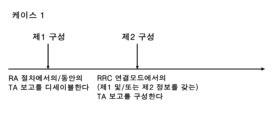
도 5는 본 발명의 실시예들에 따른 예시적인 케이스/시나리오 도면이며, 여기서 RA 절차에서의/동안의 TA 보고가 디세이블되고, RRC 연결 모드에서의 (제1 정보 및/또는 제2 정보를 갖는) TA 보고가 구성된다.
도 5는 본 발명의 실시예들에 따른 예시적인 케이스/시나리오 도면이며, 여기서 RA 절차에서의/동안의 TA 보고가 인에이블되고, RRC 연결 모드에서의 (제1 정보 또는 제2 정보를 갖는) TA 보고가 구성된다.
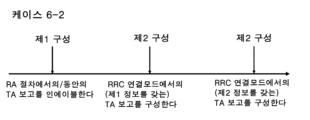
도 7은 본 발명의 실시예들에 따른 예시적인 케이스/시나리오 도면이며, 여기서 RA 절차에서의/동안의 TA 보고가 디세이블되고, RRC 연결 모드에서의 TA 보고가 구성되지 않으며(또는 구성-해제(dis-configure)되며), 그런 다음 RRC 연결 모드에서의 (제1 정보 및/또는 제2 정보를 갖는) TA 보고가 구성/재구성된다.
도 8은 본 발명의 실시예들에 따른 예시적인 케이스/시나리오 도면이며, 여기서 RA 절차에서의/동안의 TA 보고가 디세이블되고, RRC 연결 모드에서의 (제2 정보를 갖는) TA 보고가 구성되며, 그런 다음 RRC 연결 모드에서의 (제1 정보를 갖는) TA 보고가 구성/재구성된다.
도 9는 본 발명의 실시예들에 따른 예시적인 케이스/시나리오 도면이며, 여기서 RA 절차에서의/동안의 TA 보고가 디세이블되고, RRC 연결 모드에서의 (제1 정보를 갖는) TA 보고가 구성되며, 그런 다음 RRC 연결 모드에서의 (제2 정보를 갖는) TA 보고가 구성/재구성된다.
도 10은 본 발명의 실시예들에 따른 예시적인 케이스/시나리오 도면이며, 여기서 RA 절차에서의/동안의 TA 보고가 인에이블되고, RRC 연결 모드에서의 TA 보고가 구성되지 않으며(또는 구성-해제되며), 그런 다음 RRC 연결 모드에서의 (제1 정보 및/또는 제2 정보를 갖는) TA 보고가 구성/재구성된다.
도 11은 본 발명의 실시예들에 따른 예시적인 케이스/시나리오 도면이며, 여기서 RA 절차에서의/동안의 TA 보고가 인에이블되고, RRC 연결 모드에서의 (제2 정보를 갖는) TA 보고가 구성되며, 그런 다음 RRC 연결 모드에서의 (제1 정보를 갖는) TA 보고가 구성/재구성된다.
도 12는 본 발명의 실시예들에 따른 예시적인 케이스/시나리오 도면이며, 여기서 RA 절차에서의/동안의 TA 보고가 인에이블되고, RRC 연결 모드에서의 (제1 정보를 갖는) TA 보고가 구성되며, 그런 다음 RRC 연결 모드에서의 (제2 정보를 갖는) TA 보고가 구성/재구성된다.
도 13은 본 발명의 실시예들에 따른 예시적인 케이스/시나리오 도면이며, 여기서 HO 명령(command)에서, RA 절차에서의/동안의 TA 보고가 디세이블되고, RRC 연결 모드에서의 (제1 정보 및/또는 제2 정보를 갖는) TA 보고가 구성된다.
도 14는 본 발명의 실시예들에 따른 예시적인 케이스/시나리오 도면이며, 여기서 HO 명령에서, RA 절차에서의/동안의 TA 보고가 디세이블되고, RRC 연결 모드에서의 TA 보고가 구성되지 않는다(또는 구성-해제된다).
도 15는 본 개시의 실시예들에 따른 UE가 RRC 연결 모드에서의 TA 보고를 구성하기 위한 제2 구성을 수신하는 순서도이다.
도 16은 본 개시의 실시예들에 따른 UE가 RRC 연결 모드에서의 TA 보고를 구성하기 위한 제2 구성을 수신하는 순서도이다.
도 17은 본 개시의 실시예들에 따른 UE가 TA 보고의 제2 구성을 수신하는 순서도이다.
도 18은 본 개시의 실시예들에 따른 UE가 TA 보고의 제2 구성을 수신하는 예시적인 케이스/시나리오 도면이다.1 shows a diagram of a wireless communication system according to embodiments of the present invention.
2 is a block diagram of a transmitter system (also known as an access network) and a receiver system (also known as a user terminal or UE) according to embodiments of the present invention.
3 is a functional block diagram of a communication system according to embodiments of the present invention.
Figure 4 is a functional block diagram of the program code of Figure 3 in accordance with exemplary embodiments of the present invention.
5 is an exemplary case/scenario diagram according to embodiments of the present invention, where TA reporting in/during an RA procedure is disabled, and in an RRC connected mode (first information and/or second information with) TA reporting is configured.
5 is an exemplary case/scenario diagram according to embodiments of the present invention, where TA reporting in/during RA procedure is enabled, and in RRC connected mode (with first information or second information) TA reporting is configured.
7 is an exemplary case/scenario diagram according to embodiments of the present invention, where TA reporting in/during RA procedure is disabled, TA reporting in RRC connected mode is not configured (or unconfigured (dis-configure), and then TA reporting (with first information and / or second information) in RRC connected mode is configured / reconfigured.
8 is an exemplary case/scenario diagram according to embodiments of the present invention, where TA reporting in/during an RA procedure is disabled, and TA reporting (with second information) in RRC connected mode is configured and then TA reporting (with first information) in RRC connected mode is configured/reconfigured.
9 is an exemplary case/scenario diagram according to embodiments of the present invention, where TA reporting in/during RA procedure is disabled, and TA reporting (with first information) in RRC connected mode is configured and then TA reporting (with the second information) in the RRC connected mode is configured/reconfigured.
10 is an exemplary case/scenario diagram according to embodiments of the present invention, where TA reporting in/during RA procedure is enabled, and TA reporting in RRC connected mode is not configured (or unconfigured) ), and then TA reporting (with first information and / or second information) in RRC connected mode is configured / reconfigured.
11 is an exemplary case/scenario diagram according to embodiments of the present invention, where TA reporting in/during RA procedure is enabled, and TA reporting (with second information) in RRC connected mode is configured and then TA reporting (with first information) in RRC connected mode is configured/reconfigured.
12 is an exemplary case/scenario diagram according to embodiments of the present invention, where TA reporting in/during RA procedure is enabled, and TA reporting (with first information) in RRC connected mode is configured and then TA reporting (with the second information) in the RRC connected mode is configured/reconfigured.
13 is an exemplary case/scenario diagram according to embodiments of the present invention, where in an HO command, TA reporting in/during an RA procedure is disabled, and in an RRC connected mode (first information and/or with the second information) TA reporting is configured.
14 is an exemplary case/scenario diagram according to embodiments of the present invention, where in the HO command, TA reporting in/during RA procedure is disabled, and TA reporting in RRC connected mode is not configured ( or unconfigured).
15 is a flowchart of receiving a second configuration for configuring TA reporting in an RRC connected mode by a UE according to embodiments of the present disclosure.
16 is a flowchart of receiving a second configuration for configuring TA reporting in RRC connected mode by a UE according to embodiments of the present disclosure.
17 is a flowchart of a UE receiving a second configuration of a TA report according to embodiments of the present disclosure.
18 is an exemplary case/scenario diagram in which a UE receives a second configuration of a TA report according to embodiments of the present disclosure.
본원에서 설명되는 본 발명은 이하에서 설명되는 예시적인 무선 통신 시스템들 및 디바이스들에 적용되거나 또는 구현될 수 있다. 이에 더하여, 본 발명은 주로 3GPP 아키텍처 기준 모델의 맥락에서 설명된다. 그러나, 개시된 정보를 가지고, 당업자는 3GPP2 네트워크 아키텍처뿐만 아니라 다른 네트워크 아키텍처들에서 본 발명의 측면들을 사용하고 구현하기 위해 용이하게 적응시킬 수 있다는 것이 이해될 것이다.The invention described herein may be applied or implemented in the exemplary wireless communication systems and devices described below. In addition to this, the present invention is primarily described in the context of the 3GPP Architectural Reference Model. However, it will be appreciated that, given the information disclosed, one skilled in the art can readily adapt to use and implement aspects of the present invention in a 3GPP2 network architecture as well as other network architectures.
이하에서 논의되는 예시적인 무선 통신 시스템들 및 디바이스들은 브로드캐스트 서비스를 지원하는 무선 통신 시스템을 이용한다. 무선 통신 시스템들은 음성, 데이터, 등과 같은 다양한 유형들의 통신을 제공하기 위해 널리 배포된다. 이러한 시스템들은 코드 분할 다중 액세스(code division multiple access; CDMA), 시간 분할 다중 액세스(time division multiple access; TDMA), 직교 주파수 분할 다중 액세스(orthogonal frequency division multiple access; OFDMA), 3GPP LTE(Long Term Evolution) 무선 액세스, 3GPP LTE-A(Long Term Evolution Advanced) 무선 액세스, 3GPP2 UMB(Ultra Mobile Broadband), WiMax, 3GPP NR(New Radio), 또는 어떤 다른 변조 기술들에 기초할 수 있다.The example wireless communication systems and devices discussed below utilize a wireless communication system that supports broadcast services. Wireless communication systems are widely deployed to provide various types of communication such as voice, data, and the like. These systems include code division multiple access (CDMA), time division multiple access (TDMA), orthogonal frequency division multiple access (OFDMA), and 3GPP Long Term Evolution (LTE). ) radio access, 3GPP Long Term Evolution Advanced (LTE-A) radio access, 3GPP2 Ultra Mobile Broadband (UMB), WiMax, 3GPP New Radio (NR), or some other modulation technologies.
특히, 이하에서 설명되는 예시적인 무선 통신 시스템들 및 디바이스들은 [1] RP-201256, "Solutions for NR to support non-terrestrial networks (NTN)"; [2] 3GPP TR 38.821 V16.0.0, "Solutions for NR to support non-terrestrial networks (NTN)"; [3] R2-2111615, "Stage-3 running CR for TS 38.321 for Rel-17 NTN"; and [4] R2-2111221, "LS on UE TA reporting"을 포함하여, 본원에서 3GPP로 지칭되는 "3세대 파트너십 프로젝트"라는 명칭의 컨소시엄에 의해 제공되는 표준과 같은 하나 이상의 표준들을 지원하도록 설계될 수 있다. 이로써 이상에서 열거된 표준들 및 문서들은 명백하고 완전하게 그 전체가 참조로서 통합된다. In particular, exemplary wireless communication systems and devices described below are [1] RP-201256, "Solutions for NR to support non-terrestrial networks (NTN)"; [2] 3GPP TR 38.821 V16.0.0, "Solutions for NR to support non-terrestrial networks (NTN)"; [3] R2-2111615, "Stage-3 running CR for TS 38.321 for Rel-17 NTN"; and [4] R2-2111221, a standard provided by a consortium named "3rd Generation Partnership Project", referred to herein as 3GPP, including "LS on UE TA reporting". can The standards and documents listed above are hereby expressly and completely incorporated by reference in their entirety.
도 1은 본 발명의 일 실시예에 따른 다중 액세스 무선 통신 시스템을 도시한다. 액세스 네트워크(access network; AN)(100)는, 하나는 104 및 106을 포함하며, 다른 것은 108 및 110을 포함하고, 추가적인 것은 112 및 114를 포함하는 다수의 안테나 그룹들을 포함한다. 도 1에서, 각각의 안테나 그룹에 대하여 단지 2개의 안테나들만이 도시되지만, 그러나 더 많거나 또는 더 적은 안테나들이 각각의 안테나 그룹에 대하여 사용될 수 있다. 액세스 단말(access terminal; AT)(116)이 안테나들(112 및 114)과 통신하며, 여기에서 안테나들(112 및 114)은 포워드 링크(120)를 통해 액세스 단말(116)로 정보를 송신하고 리버스 링크(118)를 통해 AT(116)로부터 정보를 수신한다. AT(122)는 안테나들(106 및 108)과 통신하며, 여기에서 안테나들(106 및 108)은 포워드 링크(126)를 통해 AT(122)로 정보를 송신하고 리버스 링크(124)를 통해 AT(122)로부터 정보를 수신한다. FDD 시스템에서, 통신 링크들(118, 120, 124 및 126)은 통신을 위하여 상이한 주파수를 사용할 수 있다. 예를 들어, 포워드 링크(120)는 리버스 링크(118)에 의해 사용되는 것과는 상이한 주파수를 사용할 수 있다.1 illustrates a multiple access wireless communication system according to one embodiment of the present invention. An access network (AN) 100 includes multiple antenna groups, one including 104 and 106 , another including 108 and 110 , and an additional one including 112 and 114 . In Figure 1, only two antennas are shown for each antenna group, but more or fewer antennas may be used for each antenna group. An access terminal (AT) 116 communicates with
안테나들의 각각의 그룹 및/또는 이들이 통신하도록 설계된 영역이 흔히 액세스 네트워크의 섹터로 지칭된다. 실시예에 있어서, 안테나 그룹들은 각기 액세스 네트워크(100)에 의해 커버되는 영역의 섹터 내에서 액세스 단말들과 통신하도록 설계된다.Each group of antennas and/or the area over which they are designed to communicate is often referred to as a sector of an access network. In an embodiment, antenna groups are each designed to communicate with access terminals within a sector of the area covered by
포워드 링크들(120 및 126)을 통한 통신에서, 액세스 네트워크(100)의 송신 안테나들은 상이한 액세스 단말들(116 및 122)에 대하여 포워드 링크들의 신호-대-잡음 비를 개선하기 위하여 빔포밍(beamforming)을 사용할 수 있다. 또한, 액세스 단말들로 송신하기 위해 그것의 커버리지를 통해 랜덤하게 산란되는 빔포밍을 사용하는 액세스 네트워크는 일반적으로 그것의 모든 액세스 단말들로 단일 안테나를 통해 송신하는 액세스 네트워크보다 이웃 셀들 내의 액세스 단말들에 대하여 더 적은 간섭을 초래한다.In communication over
AN은 단말들과 통신하기 위해 사용되는 고정국 또는 기지국일 수 있으며, 또한 액세스 포인트, 노드 B, 기지국, 강화된 기지국, e노드B, 또는 어떤 다른 용어로 지칭될 수 있다. AT는 또한 사용자 단말(UE), 무선 통신 디바이스, 단말, 액세스 단말 또는 어떤 다른 용어로 지칭될 수 있다.An AN may be a fixed station or base station used to communicate with terminals, and may also be referred to as an access point, Node B, base station, enhanced base station, eNodeB, or some other terminology. An AT may also be referred to as a user equipment (UE), a wireless communication device, terminal, access terminal, or some other terminology.
도 2는 MIMO 시스템(200) 내의 (액세스 네트워크로도 알려진) 송신기 시스템(210) 및 (액세스 단말(AT) 또는 사용자 단말(UE)로도 알려진) 수신기 시스템(250)의 간략화된 블록도이다. 송신기 시스템(210)에서, 다수의 데이터 스트림들에 대한 트래픽 데이터가 데이터 소스(212)로부터 송신(TX) 데이터 프로세서(214)에 제공된다.2 is a simplified block diagram of a transmitter system 210 (also known as an access network) and a receiver system 250 (also known as an access terminal (AT) or user terminal (UE)) in a
일 실시예에 있어서, 각각의 데이터 스트림은 개별적인 송신 안테나를 통해 송신된다. TX 데이터 프로세서(214)는 코딩된 데이터를 제공하기 위하여 그 데이터 스트림에 대하여 선택된 특정 코딩 기법에 기초하여 각각의 데이터에 대한 트래픽 데이터를 포맷하고, 코딩하며, 인터리빙(interleave)한다.In one embodiment, each data stream is transmitted via a separate transmit antenna. TX
각각의 데이터 스트림에 대한 코딩된 데이터는 OFDM 기술들을 사용하여 파일럿 데이터와 멀티플렉싱될 수 있다. 파일럿 데이터는 전형적으로 알려진 방식으로 프로세싱된 알려진 데이터 패턴이며, 채널 응답을 추정하기 위해 수신기 시스템에서 사용될 수 있다. 그런 다음, 각각의 데이터 스트림에 대한 멀티플렉싱된 파일럿 및 코딩된 데이터는 변조 심볼들을 제공하기 위하여 그 데이터 스트림에 대하여 선택된 특정 변조 기법(예를 들어, BPSK, QPSK, M-PSK, 또는 M-QAM)에 기초하여 변조된다(예를 들어, 심볼 매핑된다). 각각의 데이터 스트림에 대한 데이터 레이트, 코딩, 및 변조는 프로세서(230)에 의해 수행되는 명령어들에 의해 결정될 수 있다. 메모리(232)는 프로세서(230)에 결합된다. Coded data for each data stream may be multiplexed with pilot data using OFDM techniques. Pilot data is typically a known pattern of data that has been processed in a known manner and can be used at the receiver system to estimate the channel response. The multiplexed pilot and coded data for each data stream is then combined with a particular modulation scheme (e.g., BPSK, QPSK, M-PSK, or M-QAM) selected for that data stream to provide modulation symbols. It is modulated (eg, symbol mapped) based on . The data rate, coding, and modulation for each data stream may be determined by instructions performed by
그런 다음, 모든 데이터 스트림들에 대한 변조 심볼들이 TX MIMO 프로세서(220)에 제공되며, 이것은 (예를 들어, OFDM에 대하여) 변조 심볼들을 추가로 프로세싱할 수 있다. 그런 다음, TX MIMO 프로세서(220)는 NT 변조 심볼 스트림들을 NT 송신기들(TMTR)(222a 내지 222t)로 제공한다. 특정 실시예들에 있어서, TX MIMO 프로세서(220)는 데이터 스트림들의 심볼들 및 심볼이 송신되는 안테나에 빔포밍 가중치들을 적용한다.The modulation symbols for all data streams are then provided to
각각의 송신기(222)는 하나 이상의 아날로그 신호들을 제공하기 위해 개별적인 심볼 스트림을 수신하고 프로세싱하며, MIMO 채널을 통한 송신에 적절한 변조된 신호를 제공하기 위해 아날로그 신호들을 추가로 조절(예를 들어, 증폭, 필터링, 및 업컨버팅(upconvert))한다. 그런 다음, 송신기들(222a 내지 222t)로부터의 NT 변조된 신호들이 각기 NT 안테나들(224a 내지 224t)을 통해 송신된다.Each transmitter 222 receives and processes an individual symbol stream to provide one or more analog signals, and further conditions (e.g., amplifies) the analog signals to provide a modulated signal suitable for transmission over a MIMO channel. , filtering, and upconverting). N T modulated signals from
수신기 시스템(250)에서, 송신된 변조된 신호들이 NR 안테나들(252a 내지 252r)을 통해 수신되며, 각각의 안테나(252)로부터의 수신된 신호들이 개별적인 수신기(RCVR)(254a 내지 254r)로 제공된다. 각각의 수신기(254)는 개별적인 수신된 신호들을 조절(예를 들어, 필터링, 증폭, 및 다운컨버팅(downconvert))하며, 샘플들을 제공하기 위해 조절된 신호를 디지털화하고, 대응하는 "수신된" 심볼 스트림을 제공하기 위해 샘플들을 추가로 프로세싱한다.At
그런 다음, RX 데이터 프로세서(260)는 NT "검출된" 심볼 스트림들을 제공하기 위해 특정 수신기 프로세싱 기술에 기초하여 NR 수신기들(254)로부터 NR 수신된 심볼 스트림들을 수신하고 프로세싱한다. 그런 다음, RX 데이터 프로세서(260)는 데이터 스트림에 대한 트래픽 데이터를 복원하기 위해 각각의 검출된 심볼 스트림을 복조하고, 디인터리빙(deinterleave)하며, 디코딩한다. RX 데이터 프로세서(260)에 의한 프로세싱은 송신기 시스템(210)에서 TX MIMO 프로세서(220) 및 TX 데이터 프로세서(214)에 의해 수행된 프로세싱에 대하여 상보적이다.
프로세서(270)는 주기적으로 어떠한 사전-코딩 매트릭스가 사용될지를 결정한다(이하에서 논의됨). 프로세서(270)는 매트릭스 인덱스 부분 및 랭크 값 부분을 포함하는 리버스 링크 메시지를 공식화(formulate)한다.
리버스 링크 메시지는 통신 링크 및/또는 수신된 데이터 스트림에 관한 다양한 유형들의 정보를 포함할 수 있다. 그런 다음, 리버스 링크 메시지는, 변조기(280)에 의해 변조되고, 송신기들(254a 내지 254r)에 의해 조절되며, 다시 송신기 시스템(210)으로 송신되는, 데이터 소스(236)로부터 다수의 데이터 스트림들에 대한 트래픽 데이터를 또한 수신하는 TX 데이터 프로세서(238)에 의해 프로세싱된다.A reverse link message may contain various types of information about the communication link and/or the received data stream. The reverse link message is then modulated by
송신기 시스템(210)에서, 수신기 시스템(250)으로부터의 변조된 신호들은 안테나들(224)에 의해 수신되고, 수신기들(222)에 의해 조절되며, 복조기(240)에 의해 복조되고, RX 데이터 프로세서(242)에 의해 프로세싱되어 수신기 시스템(250)에 의해 송신된 리버스 링크 메시지를 추출한다. 그런 다음, 프로세서(230)는 빔포밍 가중치들을 결정하기 위해 사용할 사전-코딩 매트릭스를 결정하고, 그런 다음 추출된 메시지를 프로세싱한다.At
메모리(232)는 일시적으로 프로세서(230)를 통해 240 또는 242로부터 일부 버퍼링된/계산 데이터를 저장하거나, 212로부터 일부 버퍼링된 데이터를 저장하거나, 또는 일부 특정 프로그램 코드들을 저장하기 위해 사용될 수 있다. 그리고, 메모리(272)는 일시적으로 프로세서(270)를 통해 260으로부터 일부 버퍼링된/계산 데이터를 저장하거나, 236으로부터 일부 버퍼링된 데이터를 저장하거나, 또는 일부 특정 프로그램 코드들을 저장하기 위해 사용될 수 있다.
이제 도 3을 참조하면, 이러한 도면은 본 발명의 일 실시예에 따른 통신 디바이스의 대안적인 간략화된 기능 블록도를 도시한다. 도 3에 도시된 바와 같이, 무선 통신 시스템에서 통신 디바이스(300)는 도 1의 UE들(또는 AT들)(116 및 122)을 실현하기 위해 사용될 수 있으며, 무선 통신 시스템은 바람직하게는 NR 시스템이다. 통신 디바이스(300)는 입력 디바이스(302), 출력 디바이스(304), 제어 회로(306), 중앙 프로세싱 유닛(CPU)(308), 메모리(310), 프로그램 코드(312), 및 트랜시버(314)를 포함할 수 있다. 제어 회로(306)는 CPU(308)를 통해 메모리(310) 내의 프로그램 코드(312)를 실행하여 통신 디바이스(300)의 동작을 제어한다. 통신 디바이스(300)는 키보드 또는 키패드와 같은 입력 디바이스(302)를 통해 사용자에 의해 입력되는 신호들을 수신할 수 있으며, 모니터 또는 스피커들과 같은 출력 디바이스(304)를 통해 이미지들 및 사운드들을 출력할 수 있다. 트랜시버(314)는 무선 신호들을 수신하고 송신하기 위해 사용되어, 수신된 신호를 제어 회로(306)로 전달하고 제어 회로(306)에 의해 생성되는 신호들을 무선으로 출력한다.Referring now to FIG. 3, this figure illustrates an alternative simplified functional block diagram of a communications device in accordance with one embodiment of the present invention. As shown in FIG. 3, a
도 4는 본 발명의 일 실시예에 따른 도 3에 도시된 프로그램 코드(312)의 간략화된 블록도이다. 이러한 실시예에 있어서, 프로그램 코드(312)는 애플리케이션 계층(400), 계층 3 부분(402), 및 계층 2 부분(404)을 포함하며, 계층 1 부분(406)에 결합된다. 계층 3 부분(402)은 일반적으로 무선 자원 제어를 수행한다. 계층 2 부분(404)은 일반적으로 링크 제어를 수행한다. 계층 1 부분(406)은 일반적으로 물리적 연결들을 수행한다. Figure 4 is a simplified block diagram of the program code 312 shown in Figure 3 according to one embodiment of the present invention. In this embodiment, program code 312 includes an application layer 400 , a layer 3 portion 402 , and a layer 2 portion 404 , and is coupled to a
LTE, LTE-A, 또는 NR 시스템들에 대하여, 계층 2 부분(404)은 무선 링크 제어(Radio Link Control; RLC) 계층 및 매체 액세스 제어(Medium Access Control; MAC) 계층을 포함할 수 있다. 계층 3 부분(402)은 무선 자원 제어(Radio Resource Control; RRC) 계층을 포함할 수 있다.For LTE, LTE-A, or NR systems, the Layer 2 portion 404 may include a Radio Link Control (RLC) layer and a Medium Access Control (MAC) layer. Layer 3 portion 402 may include a Radio Resource Control (RRC) layer.
각각의 발명 단락 또는 섹션에서 설명되는 다음의 단락들, (하위-)글머리 기호들, 포인트들, 액션들, 또는 청구항들 중 임의의 2개 이상이 특정 방법을 형성하기 위해 논리적으로, 합리적으로, 그리고 적절하게 조합될 수 있다.Any two or more of the following paragraphs, (sub-)bullet points, points, actions, or claims set forth in each inventive paragraph or section are logically, reasonably articulated to form a particular method. , and can be appropriately combined.
다음의 발명 단락들 또는 섹션들의 각각에서 설명되는 임의의 문장, 단락, (하위-)불릿, 포인트, 액션 또는 청구항은 특정 방법 또는 장치를 형성하기 위해 독립적으로 그리고 개별적으로 구현될 수 있다. 다음의 발명 개시내용에서 의존성, 예를 들어, "기초하는", "보다 더 구체적으로", "예" 등은 특정 방법 또는 장치를 제한하지 않을 단지 하나의 가능한 실시예이다.Any sentence, paragraph, (sub-)bullet, point, action or claim set forth in each of the following inventive paragraphs or sections may be independently and individually embodied to form a particular method or apparatus. A dependence in the following disclosure, eg, "based on", "more specifically", "example", etc., is only one possible embodiment that will not limit a particular method or apparatus.
NR에서 비-지상 네트워크(non-terrestrial network; NTN)들의 작업 아이템의 설명은 [1] RP-201256, "Solutions for NR to support non-terrestrial networks (NTN)"에 지정된다:A description of the working item of non-terrestrial networks (NTN) in NR is specified in [1] RP-201256, "Solutions for NR to support non-terrestrial networks (NTN)":
************************* 인용 시작 [1] ********************************************** Start Citation [1] ******************** *
3 근거3 grounds
비-지상 네트워크들은 송신을 위해 항공(airborne) 또는 우주(spaceborne) 비행체(vehicle)를 사용하는 네트워크들, 또는 네트워크들의 세그먼트들을 나타낸다.Non-terrestrial networks refer to networks, or segments of networks, that use an airborne or spaceborne vehicle for transmission.
● 우주 비행체들: 위성들(저궤도(Low Earth Orbiting; LEO) 위성들, 중궤도(Medium Earth Orbiting; MEO) 위성들, 정지 궤도(Geostationary Earth Orbiting; GEO) 위성들뿐만 아니라 고타원 궤도(Highly Elliptical Orbiting; HEO) 위성들을 포함함)● Space Vehicles: Satellites (Low Earth Orbiting (LEO) satellites, Medium Earth Orbiting (MEO) satellites, Geostationary Earth Orbiting (GEO) satellites as well as Highly Elliptical Orbiting (MEO) satellites). Orbiting (including HEO) satellites)
● 항공 비행체들: 모두 전형적으로 8 내지 50 km 사이의 고도에서 준-고정식으로 작동하는, LTA(Lighter than Air UAS), HTA(Heaver than Air UAS)를 포함하는 무인 항공 시스템(Unmanned Aircraft System; UAS)을 포괄하는 고고도 플랫폼(High Altitude Platform; HAP)들.Air Vehicles: Unmanned Aircraft Systems (UAS), including Lighter than Air UAS (LTA), Heaver than Air UAS (HTA), all typically operating semi-stationary at altitudes between 8 and 50 km. ), High Altitude Platforms (HAPs).
SA#82에서 승인된 3GPP TS 22.261에서, 5G 위성 통합 및 대응하는 서비스 요건들에 대한 사용 케이스들은 작업 아이템 "5GSAT"의 결과로서 식별되었다. 이는, 공공 안전 요구들, 해상(3GPP TS 22.119 "Maritime communication services over 3GPP system"), 위성 액세스에 적용될 수 있는 항공기 연결성 및 철도 통신 서비스 요건들뿐만 아니라 서비스되지 않는/서비스가 부족한 영역들에서의 모바일 광대역 요구들을 처리할 것이다.In 3GPP TS 22.261 approved in SA#82, use cases for 5G satellite aggregation and corresponding service requirements were identified as a result of work item “5GSAT”. This includes public safety requirements, maritime (3GPP TS 22.119 “Maritime communication services over 3GPP system”), aircraft connectivity and rail communication service requirements applicable to satellite access as well as mobile in unserved/underserved areas. It will handle your broadband needs.
RAN#76 이후, 비-지상 네트워크들을 지원하기 위해 NR에 대한 2개의 활동들이 연속적으로 수행되었다Since RAN#76, two actions have been performed consecutively for NR to support non-terrestrial networks.
● 첫 번째 활동인 FS_NR_nonterr_nw(RP-171450 참조)는 배치 시나리오들, 파라미터들을 정의하고 NR에 대한 주요한 잠재적인 영향들을 식별하기 위해 비-지상 네트워크들에 대한 채널 모델을 연구하였다. RAN에 의해 주도된 작업은 RAN#76에서 시작하였고 RAN#80에서 완료되었다. 결과들은 TR 38.811에 반영되었다.• The first activity, FS_NR_nonterr_nw (see RP-171450), studied the channel model for non-terrestrial networks to define deployment scenarios, parameters and identify key potential impacts on NR. Work led by RAN started in RAN#76 and was completed in RAN#80. The results are reflected in TR 38.811.
● 두 번째 활동인 FS_NR_NTN_solutions(RP-190710 참조)는 첫 번째 활동으로부터 식별된 주요 영향들에 대한 해법들을 정의하고 평가한다. RAN3에 의해 주도된 작업은 RAN#80에서 시작하였고 RAN#86에서 완료될 예정이다. 결과들은 TR 38.821(RP-193062)에 반영되었다.● The second activity, FS_NR_NTN_solutions (see RP-190710), defines and evaluates solutions for the key impacts identified from the first activity. Work led by RAN3 started in RAN#80 and is due to be completed in RAN#86. The results are reflected in TR 38.821 (RP-193062).
또한, 비-지상 네트워크에 대한 REl-17 WI의 범위에 대해 RAN#85와 #86 사이에서 이메일 논의가 이루어졌다. 이러한 이메일 논의의 보고서는 RP-192500에서 이용가능하다. Rel-17 NR-NTN NWI가 다음의 2개의 활동들을 포함해야 한다고 결론이 내려졌다:Email discussions also took place between RAN#85 and #86 regarding the scope of the REl-17 WI for non-terrestrial networks. A report of this email discussion is available at RP-192500. It was concluded that the Rel-17 NR-NTN NWI should include the following two activities:
● 다음의 시나리오들을 지원하기 위한 사양들을 개발하기 위한 NR-NTN에 대한 표준 정립(normative) 활동:● Normative activity for NR-NTN to develop specifications to support the following scenarios:
○ GNSS 성능을 갖는 및 갖지 않는 적어도 3GPP 클래스 3 UE 그리고 지구 고정 및/또는 이동 셀 시나리오(SI 결과에 따름) 둘 모두를 처리하는 투명 페이로드 기반 LEO 시나리오.o At least 3GPP Class 3 UEs with and without GNSS capabilities and transparent payload-based LEO scenarios that address both global fixed and/or mobile cell scenarios (according to SI results).
■ 노트 1: LEO를 처리하는 것은 투명 페이로드 기반 HAPS 기반 시나리오들을 또한 지원하기 위한 유연성을 제공할 것이다.■ Note 1: Handling LEO will provide flexibility to support transparent payload based HAPS based scenarios as well.
○ GNSS 성능을 갖는 UE를 처리하는 투명 페이로드 기반 GEO 시나리오.○ Transparent payload-based GEO scenarios dealing with UEs with GNSS capabilities.
■ 노트 2: LEO 및 GEO 시나리오들을 처리하는 것은, NR이 600 km 이상의 고도에서 원형 궤도를 갖는 모든 NGSO 시나리오들을 지원하는 것을 가능하게 할 것이다.■ Note 2: Processing LEO and GEO scenarios will enable NR to support all NGSO scenarios with circular orbits at altitudes above 600 km.
● NTN 시나리오 처리에 대한 연구 활동● Research activities on handling NTN scenarios
○ 투명 페이로드 기반 HAPS 시나리오들: 셀룰러와의 스펙트럼 공존을 위한 인에이블러(enabler)들의 연구(추가적인 코어세트들, PCI 혼동 완화, ...)○ HAPS scenarios based on transparent payload: study of enablers for spectrum coexistence with cellular (additional coresets, PCI confusion mitigation, ...)
○ IoT-NTN 기반 시나리오들○ IoT-NTN based scenarios
○ (규제 서비스들에 대한) UE의 NTN-네트워크 기반 위치: 가능한 해법들을 식별한다 o NTN-network based location of UE (for regulated services): identifies possible solutions
이상의 사항들에 기초하여, FS_NR_NTN_solutions 연구 아이템의 결론을 수행하고 NR이 비-지상 네트워크들을 지원하는 것을 가능하게 하는 해법들을 지정하기 위해 새로운 작업 아이템이 제안된다.Based on the above, a new work item is proposed to carry out the conclusions of the FS_NR_NTN_solutions study item and to specify solutions enabling NR to support non-terrestrial networks.
LEO 및 GEO 시나리오들을 처리하는 것은 600 km 이상의 고도에서 원형 궤도를 갖는 모든 NGSO 시나리오들을 지원하는 것을 가능하게 할 것이다.Handling LEO and GEO scenarios will make it possible to support all NGSO scenarios with circular orbits at altitudes above 600 km.
4 목적4 purpose
4.1 SI 또는 코어 파트 WI 또는 테스팅 파트 WI의 목적4.1 Purpose of SI or Core Part WI or Testing Part WI
작업 아이템은 다음의 원리들에 따라 고고도 플랫폼 스테이션(high altitude platform station; HAPS) 및 공중 대 지상(air to ground; ATG) 시나리오들을 지원하기 위한 암시적인 호환성을 갖는 NR 비-지상 네트워크(non-terrestrial networks; NTN) 특히 LEO 및 GEO에 대해 식별된 향상들을 지정하는 것을 목표로 한다:A work item is an NR non-terrestrial network with implicit compatibility for supporting high altitude platform station (HAPS) and air to ground (ATG) scenarios according to the following principles: terrestrial networks (NTN) aims to specify the identified enhancements for LEO and GEO in particular:
● NR-NTN에 대한 코어 사양 작업에 대해 FDD가 가정된다.● FDD is assumed for core specification work on NR-NTN.
○ 노트: 이는, TDD가 관련 시나리오들, 예를 들어, HAPS, ATG에 대해 사용될 수 없음을 의미하지 않는다.o Note: This does not mean that TDD cannot be used for relevant scenarios, eg HAPS, ATG.
● 지구 고정 추적 영역은 지구 고정 및 이동 셀들을 가지고 가정된다● An earth-fixed tracking area is assumed with earth-fixed and moving cells.
● GNSS 성능을 갖는 UE들이 가정된다.- UEs with GNSS capabilities are assumed.
● 투명 페이로드가 가정된다● A transparent payload is assumed.
세부 목적들은 다음과 같이 Rel-15 & Rel-16의 NR 무선 인터페이스 & NG-RAN에 대한 특징들을 향상시키는 것을 지정하는 것이다:The specific objectives are to specify enhancing features for NR air interface & NG-RAN of Rel-15 & Rel-16 as follows:
4.1.1 RAN14.1.1 RAN1
긴 전파 기연들, 큰 도플러 효과들, 및 NTN 내의 이동 셀들로 인한 식별된 이슈들을 처리하기 위해 특징들을 향상하기 위해, 다음이 지정되어야 한다(TR 38.821 참조):In order to enhance the features to address the identified issues due to long propagation delays, large Doppler effects, and moving cells within the NTN, the following should be specified (see TR 38.821):
● 타이밍 관계 향상들 [RAN1,RAN2]- Timing relationship enhancements [RAN1, RAN2]
● UL 시간 및 주파수 동기화에 대한 향상들 [RAN1,RAN2]- Enhancements to UL time and frequency synchronization [RAN1, RAN2]
************************* 인용 종료 ************************************************** End citation *********************** **
NR NTN에 대한 UE-특정 TA 보고는 실행 MAC CR([3] R2-2111615, "Stage-3 running CR for TS 38.321 for Rel-17 NTN")에서 캡처된다:The UE-specific TA report for NR NTN is captured in the running MAC CR ([3] R2-2111615, "Stage-3 running CR for TS 38.321 for Rel-17 NTN"):
************************* 인용 시작 [3] ********************************************** Start Citation [3] ******************** *
5.1 랜덤 액세스 절차5.1 Random Access Procedure
5.1.1 랜덤 액세스 절차 초기화5.1.1 Random access procedure initialization
이러한 절에서 설명되는 랜덤 액세스 절차는, TS 38.300 [2]에 따른 이벤트들에 대하여 PDCCH 명령(order)에 의해, MAC 엔티티 자체에 의해, 또는 RRC에 의해 개시된다. MAC 엔티티 내에 임의의 시점에서 진행 중인 단 하나의 랜덤 액세스 절차만이 존재한다. […]The random access procedure described in this clause is initiated by the PDCCH order, by the MAC entity itself, or by RRC for events according to TS 38.300 [2]. There is only one random access procedure in progress at any point in the MAC entity. […] ]
RRC는 랜덤 액세스 절차에 대하여 다음의 파라미터들을 구성한다:RRC configures the following parameters for the random access procedure:
[…][…] ]
- enableTA-Report: 랜덤 액세스 절차 동안 UE-특정 TA 보고가 인에이블되는지 여부를 나타낸다. […]- enableTA-Report: Indicates whether UE-specific TA reporting is enabled during a random access procedure. […] ]
5.1.3a MSGA 송신5.1.3a MSGA Transmission
MAC 엔티티는 각각의 MSGA에 대해 다음과 같이 해야 한다:The MAC entity MUST do the following for each MSGA:
[…][…] ]
1> 이것이 이러한 랜덤 액세스 절차 내의 첫 번째 MSGA 송신인 경우:1> If this is the first MSGA transmission in this random access procedure:
2> CCCH 논리 채널에 대해 송신이 이루어지지 않는 경우:2> If no transmission is made on the CCCH logical channel:
3> 후속 업링크 송신에 C-RNTI MAC CE를 포함시킬 것을 멀티플렉싱 및 어셈블리 엔티티에 표시한다.3> Indicate to the multiplexing and assembly entity to include the C-RNTI MAC CE in subsequent uplink transmissions.
2> SpCell 빔 실패 복구에 대해 랜덤 액세스 절차가 개시되었고 값 true를 갖는 spCell-BFR-CBRA가 구성된 경우:2> If random access procedure is initiated for SpCell beam failure recovery and spCell-BFR-CBRA with value true is configured:
3> 후속 업링크 송신에 BFR MAC CE 또는 절단형(Truncated) BFR MAC CE를 포함시킬 것을 멀티플렉싱 및 어셈블리 엔티티에 표시한다.3> Indicate to the multiplexing and assembly entity to include the BFR MAC CE or Truncated BFR MAC CE in subsequent uplink transmissions.
2> 랜덤 액세스 절차가 SI 요청으로 인해 개시되었고 값 enabled를 갖는 enableTA-Report가 구성된 경우:2> If the random access procedure is initiated due to an SI request and enableTA-Report with the value enabled is configured:
3> 후속 업링크 송신 내에 UE-특정 TA 보고 MAC CE를 포함시킬 것을 멀티플렉싱 및 어셈블리 엔티티에 표시한다.3> Indicate to the multiplexing and assembly entity to include the UE-specific TA reporting MAC CE in subsequent uplink transmissions.
2> MSGA 페이로드에 대해 결정된 HARQ 정보에 따라 멀티플렉싱 및 어셈블리 엔티티로부터 송신할 MAC PDU를 획득하고(5.1.2a절 참조), 이것을 MSGA 버퍼에 저장한다.2> Acquires a MAC PDU to be transmitted from the multiplexing and assembly entity according to the HARQ information determined for the MSGA payload (see Section 5.1.2a), and stores it in the MSGA buffer.
[…][…] ]
5.1.4 랜덤 액세스 응답 수신5.1.4 Receiving Random Access Response
일단 랜덤 액세스 프리앰블이 송신되면, 그리고 측정 갭의 가능한 발생과 무관하게, MAC 엔티티는 다음과 같이 해야 한다:Once the random access preamble is transmitted, and regardless of the possible occurrence of measurement gaps, the MAC entity should:
[…][…] ]
1> 그렇지 않고 유효(TS 38.213 [6]에 지정된 바와 같음) 다운 링크 할당이 RA-RNTI에 대해 PDCCH에서 수신되었고, 수신된 TB가 성공적으로 디코딩된 경우:1> otherwise valid (as specified in TS 38.213 [6]) downlink assignment was received on PDCCH for RA-RNTI and the received TB was successfully decoded:
[…][…] ]
4> 랜덤 액세스 프리앰블이 송신된 서빙 셀에 대하여 다음의 액션들을 적용한다: 4> Apply the following actions to the serving cell from which the random access preamble was transmitted:
5> 수신된 타이밍 어드밴스 명령(Timing Advance Command)을 프로세싱한다(5.2절 참조);5> Process the received Timing Advance Command (see Section 5.2);
5> preambleReceivedTargetPower 및 최신 랜덤 액세스 프리앰블 송신에 적용된 전력 램핑의 양을 하위 계층들에 표시한다(즉, (PREAMBLE_POWER_RAMPING_COUNTER - 1) x PREAMBLE_POWER_RAMPING_STEP);5> indicate to lower layers the preambleReceivedTargetPower and the amount of power ramping applied to the latest random access preamble transmission (ie (PREAMBLE_POWER_RAMPING_COUNTER - 1) x PREAMBLE_POWER_RAMPING_STEP);
5> SCell에 대한 랜덤 액세스 절차가 pusch-Config가 구성되지 않은 업링크 반송파에서 수행된 경우:5> If the random access procedure for the SCell is performed on an uplink carrier for which push-Config is not configured:
6> 수신된 UL 승인을 무시한다.6> Ignore the received UL acknowledgment.
5> 그렇지 않으면:5> Otherwise:
6> 수신된 UL 승인 값을 프로세싱하고, 이를 하위 계층들에 표시한다.6> Process the received UL grant value and indicate it to lower layers.
4> 랜덤 액세스 프리앰블이 경합-기반 랜덤 액세스 프리앰블(들) 중에서 MAC 엔티티에 의해 선택되지 않은 경우:4> If the random access preamble is not selected by the MAC entity from among the contention-based random access preamble(s):
5> 랜덤 액세스 절차가 성공적으로 완료된 것으로 간주한다.5> It is considered that the random access procedure has been successfully completed.
4> 그렇지 않으면:4> Otherwise:
5> TEMPORARY_C-RNTI를 랜덤 액세스 응답에서 수신된 값으로 설정한다;5> set TEMPORARY_C-RNTI to the value received in the random access response;
5> 이것이 이러한 랜덤 액세스 절차 내에서 첫 번째로 성공적으로 수신된 랜덤 액세스 응답인 경우:5> If this is the first successfully received random access response within this random access procedure:
6> CCCH 논리 채널에 대해 송신이 이루어지지 않는 경우:6> If no transmission is made on the CCCH logical channel:
7> 후속 업링크 송신에 C-RNTI MAC CE를 포함시킬 것을 멀티플렉싱 및 어셈블리 엔티티에 표시한다.7> Indicate to the multiplexing and assembly entity to include the C-RNTI MAC CE in subsequent uplink transmissions.
6> SpCell 빔 실패 복구에 대해 랜덤 액세스 절차가 개시되었고 값 true를 갖는 spCell-BFR-CBRA가 구성된 경우:6> If random access procedure is initiated for SpCell beam failure recovery and spCell-BFR-CBRA with value true is configured:
7> 후속 업링크 송신에 BFR MAC CE 또는 절단형 BFR MAC CE를 포함시킬 것을 멀티플렉싱 및 어셈블리 엔티티에 표시한다.7> Indicate to the multiplexing and assembly entity to include the BFR MAC CE or truncated BFR MAC CE in subsequent uplink transmissions.
6> 랜덤 액세스 절차가 SI 요청으로 인해 개시되었고 값 enabled를 갖는 enableTA-Report가 구성된 경우:6> If the random access procedure is initiated due to an SI request and enableTA-Report with the value enabled is configured:
7> 후속 업링크 송신 내에 UE-특정 TA 보고 MAC CE를 포함시킬 것을 멀티플렉싱 및 어셈블리 엔티티에 표시한다.7> Indicate to the multiplexing and assembly entity to include the UE-specific TA reporting MAC CE in subsequent uplink transmissions.
6> 멀티플렉싱 및 어셈블리 엔티티로부터 송신할 MAC PDU를 획득하고, 이것을 Msg3 버퍼에 저장한다.6> Acquire the MAC PDU to be transmitted from the multiplexing and assembly entity, and store it in the Msg3 buffer.
[…][…] ]
5.XX UE-특정 TA 보고5.XX UE-specific TA reporting
UE는, SI 요청에 기인하지 않은 랜덤 액세스 절차 동안 및/또는 RRC_CONNECTED에 있을 때 UE 특정 타이밍 어드밴스에 대한 정보를 보고하도록 구성될 수 있다.The UE may be configured to report information about UE specific timing advance during random access procedures not due to SI requests and/or when in RRC_CONNECTED.
SI 요청에 기인하지 않은 랜덤 액세스 절차 동안, UE는 UE-특정 TA 보고 MAC CE를 사용하여 UE 특정 TA 값을 보고하도록 구성될 수 있다. UE-특정 TA의 보고는 시스템 정보에 포함된 enableTA-Report에 의해 제어된다.During a random access procedure not due to an SI request, the UE may be configured to report a UE-specific TA value using a UE-specific TA reporting MAC CE. Reporting of UE-specific TA is controlled by enableTA-Report included in system information.
편집자 노트: 연결 모드에서 UE 특정 TA에 대한 정보를 보고하기 위한 이벤트-트리거들이 지원되며, TA 값들에 기초한다. TA 오프셋 임계치가 이벤트-트리거형 보고에 대해 사용될 수 있으며, 적어도 오프셋 임계치는 UE 특정 TA에 대한 현재 정보와 UE 특정 TA에 대한 마지막으로 성공적으로 보고된 정보 사이에 있을 수 있다.Editor's Note: Event-triggers for reporting information about a UE specific TA in connected mode are supported, based on TA values. A TA offset threshold may be used for event-triggered reporting, and at least the offset threshold may be between the current information for the UE-specific TA and the last successfully reported information for the UE-specific TA.
편집자 노트: 이상의 내용은 RAN1 확인을 필요로 하며, RAN1 결론들이 나올 때까지 재검토될 수 있다.Editor's Note: The above is subject to RAN1 confirmation and may be reviewed until RAN1 conclusions are reached.
편집자 노트: UE 특정 TA에 대한 보고되는 정보의 콘텐츠가 연결 모드에서의 UE 위치 정보인 경우, 보고하기 위해 RRC 시그널링이 사용된다.Editor's Note: When the content of the reported information for a UE-specific TA is UE location information in connected mode, RRC signaling is used to report.
편집자 노트: 합의: "UE 위치 정보가 연결 모드에서 보고될 수 없다"는 작업 가정 하에서, 연결 모드에서 보고되는 UE 특정 TA의 콘텐츠는 UE 특정 TA 사전-보상이다(TA 값의 세부사항들에 대해, RAN1로부터의 확인이 필요함).Editor's Note: Consensus: Under the working assumption "UE location information cannot be reported in connected mode", the content of UE-specific TA reported in connected mode is UE-specific TA pre-compensation (see details of TA value , requires confirmation from RAN1).
편집자 노트: 합의: "UE 위치 정보는 연결 모드에서 보고될 수 있다"는 작업 가정 하에서, 연결 모드에서 TA 보고 목적들을 위해, 네트워크는 UE 특정 TA 사전-보상(TA 값의 세부사항들에 대해, RAN1로부터의 확인이 필요함) 또는 UE 위치 정보를 전송하도록 UE를 구성할 수 있다Editor's Note: Consensus: Under the working assumption that "UE location information can be reported in connected mode", for TA reporting purposes in connected mode, the network should use UE specific TA pre-compensation (for details of TA value, requires confirmation from RAN1) or the UE can be configured to send UE location information
편집자 노트: 합의: UE 특정 TA에 대한 보고되는 정보의 콘텐츠가 연결 모드에서의 TA 사전-보상 값인 경우, 보고하기 위해 MAC CE가 사용된다.Editor's Note: Consensus: If the content of the reported information for a UE-specific TA is a TA pre-compensation value in connected mode, the MAC CE is used to report.
편집자 노트: 합의: UE 위치 정보가 네트워크로 보고될 수 있는 경우에, 전용 시그널링은 연결 모드에서 TA 보고의 목적을 위해 UE 위치 및/또는 UE 특정 TA 정보를 보고하도록 UE를 구성하기 위해 사용된다. 메커니즘들 둘 모두가 병렬로 필요한지 여부는 미래연구이다Editor's Note: Consensus: In cases where UE location information can be reported to the network, dedicated signaling is used to configure the UE to report UE location and/or UE specific TA information for the purpose of TA reporting in connected mode. Whether both mechanisms are needed in parallel is a future study.
[…][…] ]
6.1.3.XX UE-특정 TA 보고 MAC CE6.1.3.XX UE-specific TA reporting MAC CE
UE-특정 TA 보고 MAC CE는 표 6.2.1-2에 지정된 바와 같이 LCID를 갖는 MAC 서브헤더에 의해 식별된다.The UE-specific TA reporting MAC CE is identified by the MAC subheader with the LCID as specified in Table 6.2.1-2.
이것은 고정된 크기를 가지며, 다음과 같이 정의된 단일 필드로 구성된다:It has a fixed size and consists of a single field defined as:
- UE-특정 TA: 이러한 필드는 UE-특정 TA의 UE 추정치를 포함한다. 이러한 필드의 길이는 XX 비트이다- UE-specific TA: This field contains the UE estimate of the UE-specific TA. The length of this field is XX bits
편집자 노트: UE-특정 TA 보고 MAC CE의 세부사항들 및 콘텐츠는 RAN1로부터의 확인을 필요로 하며, RAN1 결론들이 나올 때까지 재검토될 것이다.Editor's Note: The details and contents of the UE-specific TA report MAC CE require confirmation from RAN1 and will be reviewed until RAN1 conclusions are reached.
************************* 인용 종료 ************************************************** End citation *********************** **
지난 RAN2 회의들에서, 다음의 합의들이 이루어졌다:At the last RAN2 meetings, the following agreements were reached:
(RAN2 #113bis-e)(RAN2 #113bis-e)
- 적어도 업링크 스케줄링 적응들에 대해, UE는 UE 특정 TA 사전-보상에 대한 정보를 보고할 수 있다. 보고들의 정확한 정보 및 빈도는 RAN1 결과에 의존한다. 보고할 시기/방법은 미래연구이다.- At least for uplink scheduling adaptations, the UE may report information about UE specific TA pre-compensation. The exact information and frequency of reports depends on the RAN1 result. When/how to report is a future study.
- UE는 MAC CE(이것이 구성되어야 하는지 여부는 미래연구임)를 사용하여 RACH 절차 동안 UE 특정 TA 사전-보상을 보고한다. 실제 콘텐츠는 미래연구이며, 또한 추가적인 RAN1 입력에 의존한다.- UE reports UE specific TA pre-compensation during RACH procedure using MAC CE (whether this should be configured is a future study). The actual content is a future study and also depends on additional RAN1 inputs.
(RAN2 #114-e)(RAN2 #114-e)
- 네트워크에 의해 인에이블되는 경우, UE는 MAC CE를 사용하여 랜덤 액세스 절차(MSGA/MSG3 또는 MSG5)에서 UE 특정 TA 사전-보상에 대한 정보를 보고한다.- If enabled by the network, the UE reports information about UE-specific TA pre-compensation in the random access procedure (MSGA/MSG3 or MSG5) using the MAC CE.
(RAN2 #115-e)(RAN2 #115-e)
- RACH 절차 동안 UE 특정 TA 보고는 시스템 정보(System Information; SI)에 의해 인에이블/디세이블된다(연결 모드에서의 RACH에 대해서는 미래 연구임).- UE specific TA reporting during RACH procedure is enabled/disabled by System Information (SI) (future study for RACH in connected mode).
- MAC CE를 사용하여 RA 절차에서 보고되는 UE 특정 TA 사전-보상의 콘텐츠는 UE 특정 TA이다(이는 RAN1 응답을 수신한 후에 재검토될 수 있다).- The content of the UE specific TA pre-compensation reported in the RA procedure using the MAC CE is the UE specific TA (which can be reviewed after receiving the RAN1 response).
- 연결 모드에서 UE 특정 TA에 대한 정보의 보고가 지원되며, RRC 시그널링 또는 MAC CE를 통해서는 미래 연구이다- Reporting of information on UE-specific TA in connected mode is supported, and future work is done through RRC signaling or MAC CE
- 연결 모드에서 UE 특정 TA에 대한 정보를 보고하기 위한 이벤트-트리거들이 지원된다. 세부사항들은 미래 연구이다. RAN1에 의한 확인이 또한 필요하다- Event-triggers for reporting information on UE-specific TA in connected mode are supported. Details are future work. Confirmation by RAN1 is also required
- 구성된 경우, UE는 랜덤 액세스 동안 목표 셀로 UE 특정 TA 사전-보상의 정보를 보고해야 한다. (TA 보고가 목표 셀에서 인에이블/디세이블되는지 여부에 대한 HO 명령에서 운반되는 시스템 정보 블록(System Information Block; SIB) 표시 이외에) 동기화된 RRC 재구성에서 새로운 표시가 필요한지 여부는 미래 연구이다.- If configured, the UE shall report information of UE-specific TA pre-compensation to the target cell during random access. Whether a new indication is needed in synchronized RRC reconfiguration (other than the System Information Block (SIB) indication carried in the HO command whether TA reporting is enabled/disabled in the target cell) is a future study.
- UE 특정 TA 사전-보상에 대한 정보는 "다른 SI에 대한 요청"에 기인하여 트리거된 RA 절차들에서 보고되지 않는다- Information on UE specific TA pre-compensation is not reported in RA procedures triggered due to "request for other SI"
- UE 특정 TA에 대한 정보를 보고하기 위한 이벤트-트리거들은 TA 값들에 기초한다(RAN1로부터의 확인이 필요함)- Event-triggers for reporting information on UE-specific TA are based on TA values (requires confirmation from RAN1)
- TA 오프셋 임계치가 이벤트-트리거형 보고에 대해 사용될 수 있으며, 적어도 오프셋 임계치는 UE 특정 TA에 대한 현재 정보와 UE 특정 TA에 대한 마지막으로 성공적으로 보고된 정보 사이에 있을 수 있다.- A TA offset threshold may be used for event-triggered reporting, at least the offset threshold may be between the current information for the UE specific TA and the last successfully reported information for the UE specific TA.
- 시간 임계치에 기초하는 UE 특정 TA에 대한 정보를 보고하기 위한 이벤트-트리거들은 NTN에서 지원되지 않는다.- Event-triggers for reporting information about a UE specific TA based on a time threshold are not supported in NTN.
- (TA 보고가 목표 셀에서 인에이블/디세이블되는지 여부에 대한 HO 명령에서 운반되는 SIB 표시 이외에) 핸드오버 절차에서 UE 특정 TA에 대한 정보를 보고하도록 UE를 구성하기 위해 동기화된 RRC 재구성에서 새로운 표시가 필요하지 않다.- New in synchronized RRC reconfiguration to configure the UE to report information about the UE specific TA in the handover procedure (in addition to the SIB indication carried in the HO command whether TA reporting is enabled/disabled in the target cell) no sign needed
- UE 특정 TA에 대한 보고되는 정보의 콘텐츠가 연결 모드에서의 UE 위치 정보인 경우, 보고하기 위해 RRC 시그널링이 사용된다.- If the content of the reported information for a UE-specific TA is UE location information in connected mode, RRC signaling is used for reporting.
- 작업 가정 "UE 위치 정보는 연결 모드에서 보고될 수 있다" 하에서, 연결 모드에서 TA 보고 목적들을 위해, 네트워크는 UE 특정 TA 사전-보상(TA 값의 세부사항들에 대해, RAN1로부터의 확인이 필요함) 또는 UE 위치 정보를 전송하도록 UE를 구성할 수 있다- Under the working assumption "UE location information can be reported in connected mode", for TA reporting purposes in connected mode, the network shall use UE specific TA pre-compensation (for details of the TA value, acknowledgment from RAN1 required) or configure the UE to transmit UE location information.
- (작업 가정) 특정 TA에 대한 보고되는 정보의 콘텐츠가 연결 모드에서의 TA 사전-보상 값인 경우, 보고하기 위해 MAC CE가 사용된다.- (Working assumption) MAC CE is used to report when the content of the reported information for a specific TA is a TA pre-compensation value in connected mode.
(RAN2 #116-e)(RAN2 #116-e)
- TA 보고 MAC CE를 포함하도록 Msg3/MsgA 또는 Msg5에 명령하지 않으며, 이것이 포함될 수 있는지 여부는 Msg3/MsgA 또는 Msg5의 TB 크기에 의존한다. 이에 대해 사양 변경이 필요하지 않다- Do not command Msg3/MsgA or Msg5 to include the TA report MAC CE, and whether it can be included depends on the TB size of Msg3/MsgA or Msg5. No specification changes are required for this.
- UE 특정 TA에 대한 보고되는 정보의 콘텐츠가 연결 모드에서의 TA 사전-보상 값인 경우, 보고하기 위해 MAC CE가 사용된다- If the content of the reported information for the UE specific TA is the TA pre-compensation value in the connected mode, the MAC CE is used to report
- UE 위치 정보가 네트워크로 보고될 수 있는 경우에, 전용 시그널링은 연결 모드에서 TA 보고의 목적을 위해 UE 위치 및/또는 UE 특정 TA 정보를 보고하도록 UE를 구성하기 위해 사용된다. 메커니즘들 둘 모두가 병렬로 필요한지 여부는 미래연구이다- In case UE location information can be reported to the network, dedicated signaling is used to configure the UE to report UE location and/or UE specific TA information for the purpose of TA reporting in connected mode. Whether both mechanisms are needed in parallel is a future study.
비-지상 네트워크(non-terrestrial network; NTN)들은, 모바일 서비스들을 제공하기 위한 플랫폼으로서 항공/우주 비행체를 사용하기 위해 뉴 라디오(New Radio; NR)에 도입될 것이다(예를 들어, [1] RP-201256, "Solutions for NR to support non-terrestrial networks (NTN)"). UE는, 송신을 위해 항공/우주를 포함하는 NTN 네트워크에 링크되거나, 캠핑하거나 및/또는 연결될 수 있다. NTN은, 저궤도(low earth orbit; LEO) 위성, 중궤도(medium earth orbit; MEO) 위성, 고타원 궤도(highly elliptical orbit; HEO) 위성, 정지 궤도(geostationary earth orbit; GEO) 위성, 정지 동기 궤도(geostationary synchronous Orbit; GSO) 위성, 비-정지 동기 궤도(non-geostationary synchronous orbit; NGSO) 위성, 및/또는 고고도 플랫폼 스테이션(high altitude platform station; HAPS)을 포함하여 다양한 플랫폼들을 포함할 수 있다. LEO 위성은 지구-고정 빔(예를 들어, 빔은 시간의 기간 동안 하나의 위치에 일시적으로 고정됨) 또는 지구-이동 빔(예를 들어, 빔이 위성을 따라 계속해서 이동함)을 가질 수 있다. NTN은, 지상 네트워크(TN)들이 실행 불가능할 때의 시나리오(예를 들어, 사막, 극지방, 및/또는 비행기)에서 광역 커버리지를 제공하고 NW 액세스를 제공할 수 있다. 상이한 NTN 플랫폼들에 관한 더 많은 세부사항들은 TR 38.821([2] 3GPP TR 38.821 V16.0.0)에서 발견될 수 있다.Non-terrestrial networks (NTNs) will be introduced in New Radio (NR) to use the air/space vehicle as a platform for providing mobile services (e.g., [1] RP-201256, "Solutions for NR to support non-terrestrial networks (NTN)"). A UE may be linked, camped, and/or connected to an NTN network, including air/space, for transmission. NTN includes low earth orbit (LEO) satellites, medium earth orbit (MEO) satellites, highly elliptical orbit (HEO) satellites, geostationary earth orbit (GEO) satellites, and geosynchronous orbits. It may include a variety of platforms, including geostationary synchronous orbit (GSO) satellites, non-geostationary synchronous orbit (NGSO) satellites, and/or high altitude platform stations (HAPS). . LEO satellites may have earth-fixed beams (eg, the beam is temporarily fixed at one location for a period of time) or earth-moving beams (eg, the beam continuously moves along the satellite). . NTN can provide wide area coverage and provide NW access in scenarios when terrestrial networks (TNs) are not viable (eg, desert, arctic, and/or airplane). More details regarding the different NTN platforms can be found in TR 38.821 ([2] 3GPP TR 38.821 V16.0.0).
NTN에서 UL 동기화를 달성하기 위해, UE는 UE 위치, 공통 TA 및 위성 궤도력을 고려함으로써 타이밍 어드밴스(Timing Advance; TA)를 사전-보상할 것이다. UE TA에 대한 정보는 NTN에서 UE에 의해 네트워크(Network; NW)로 보고될 수 있다. UE TA에 대한 정보는 초기 액세스에서 및/또는 무선 자원 제어(Radio Resource Control; RRC) 연결 모드에서 보고될 수 있다. UE는, 예를 들어, 초기 액세스에 대해, 제1 이벤트에 대해, 시스템 정보에 의해 인에이블되는 경우, 랜덤 액세스(Random Access; RA) 절차 동안 TA를 보고할 것이다. UE는 전용 시그널링에 의해 구성된 트리거링 이벤트에 기초하여 TA를 보고할 것이다. To achieve UL synchronization in NTN, the UE will pre-compensate the Timing Advance (TA) by taking into account the UE location, common TA and satellite ephemeris. Information on the UE TA may be reported to a Network (NW) by the UE in the NTN. Information about UE TA may be reported in initial access and/or in Radio Resource Control (RRC) connected mode. The UE will report the TA during a Random Access (RA) procedure, eg, for initial access, for a first event, if enabled by system information. The UE will report the TA based on the triggering event configured by dedicated signaling.
NW에 의해 인에이블된 경우, UE TA에 대한 정보는 매체 액세스 제어(Medium Access Control; MAC) 제어 엘리먼트(Control Element; CE)를 사용하여 RA 절차 동안/에서(예를 들어, MSGA/Msg3 또는 Msg5에서) 보고될 수 있다. RA 절차 동안의/에서의 TA 보고는 시스템 정보에 의해 인에이블/디세이블될 것이다. RA 절차 동안의/에서의 TA 보고는 시스템 정보에 포함된 파라미터(예를 들어, enableTA-Report)에 의해 제어될 수 있다. 그리고 RRC 연결 모드에서의 TA 보고는 이벤트-트리거된다(예를 들어, NW에 의해 구성됨). 보고 이벤트는 UE TA에 대한 현재 정보와 UE TA에 대한 마지막으로 성공적으로 보고된 정보 사이의 TA 오프셋(임계치)에 기초할 것이다. 예를 들어, RRC 연결 모드에서 UE의 TA 값이 TA 오프셋 임계치를 초과하여 변경되는 경우(예를 들어, 현재 TA와 마지막으로 성공적으로 보고된 TA 사이의 차이가 오프셋을 초과하는 경우), UE는 TA 보고를 트리거할 것이다. 전용 시그널링(예를 들어, RRC 구성)이 RRC 연결 모드에서 TA 보고의 목적을 위해 TA 관련 정보 및/또는 UE 위치 정보를 보고하도록 UE를 구성하기 위해 사용된다.When enabled by the NW, information about the UE TA is transmitted during/in the RA procedure using the Medium Access Control (MAC) Control Element (CE) (e.g., MSGA/Msg3 or Msg5 in) can be reported. TA reporting during/in the RA procedure will be enabled/disabled by system information. TA reporting during/in the RA procedure may be controlled by a parameter included in system information (eg, enableTA-Report). And TA reporting in RRC connected mode is event-triggered (eg configured by NW). The reporting event will be based on the TA offset (threshold) between the current information about the UE TA and the last successfully reported information about the UE TA. For example, if the TA value of the UE in RRC connected mode changes beyond the TA offset threshold (eg, the difference between the current TA and the last successfully reported TA exceeds the offset), the UE It will trigger a TA report. Dedicated signaling (eg, RRC configuration) is used to configure the UE to report TA related information and/or UE location information for the purpose of TA reporting in RRC connected mode.
예를 들어, UE는, 보고가 시스템 정보에 의해 인에이블된 경우(예를 들어, 시스템 정보의 enableTA-Report가 enabled로 설정되고, enableTA-Report가 시스템 정보에 존재하는 경우), MAC CE를 사용하여 RA 절차 동안/에서(예를 들어, 초기 액세스에서) UE 특정 TA와 관련된 정보를 보고할 수 있다. UE는, 보고가 시스템 정보에 의해 디세이블된 경우(또는 인에이블되지 않은 경우)(예를 들어, 시스템 정보의 enableTA-Report가 enabled로 설정되지 않고, enableTA-Report가 시스템 정보에 존재하지 않는 경우), RA 절차 동안/에서(예를 들어, 초기 액세스에서) UE-특정 TA와 관련된 정보를 보고하지 않을 수 있다.For example, the UE uses MAC CE when reporting is enabled by system information (eg, when enableTA-Report of system information is set to enabled and enableTA-Report is present in system information). to report information related to a UE-specific TA during/in an RA procedure (eg, in initial access). UE, when reporting is disabled (or not enabled) by system information (eg, enableTA-Report in system information is not set to enabled, and enableTA-Report does not exist in system information) ), information related to the UE-specific TA may not be reported during/in the RA procedure (eg, in initial access).
UE는, 전용 시그널링에 의해 구성되고 (적어도) 보고 이벤트가 충족/트리거되는 경우 RRC 연결 모드에서 UE 특정 TA와 관련된 정보를 보고할 수 있다. UE는 RRC 연결 모드에서 TA 관련 정보 및/또는 UE 위치 정보로서 콘텐츠를 갖는 UE 특정 TA와 관련된 정보를 보고하도록 구성될 수 있다. UE는 RRC 연결 모드에서 MAC CE를 사용하여 TA 관련 정보로서 콘텐츠를 갖는 UE 특정 TA와 관련된 정보를 보고하도록 구성될 수 있다. UE는 RRC 연결 모드에서 RRC 시그널링을 사용하여 UE 위치 정보로서 콘텐츠를 갖는 UE 특정 TA와 관련된 정보를 보고하도록 구성될 수 있다. RRC 연결 모드에서의 TA 보고는 시스템 정보에 의해 인에이블/디세이블될 수 있다. RRC 연결 모드에서의 TA 보고는 시스템 정보에 의해 인에이블/디세이블되지 않을 수 있다. UE는, 보고가 시스템 정보(예를 들어, 핸드오버 명령 메시지에 포함됨)에 의해 인에이블된 경우, MAC CE를 사용하여 RRC 연결 모드에서 (예를 들어, 동기화 및/또는 핸드오버(handover; HO)를 이용한 RRC 재구성에 대한) RA 절차 동안/에서 UE 특정 TA와 관련된 정보를 보고할 수 있다. UE는, 보고가 시스템 정보(예를 들어, HO 명령 메시지에 포함됨)에 의해 디세이블된 경우, RRC 연결 모드에서 (예를 들어, 동기화 및/또는 핸드오버를 이용하는 RRC 재구성에 대한) RA 절차 동안 UE 특정 TA와 관련된 정보를 보고하지 않을 수 있다.A UE may report information related to a UE-specific TA in RRC connected mode if configured by dedicated signaling and (at least) a reporting event is met/triggered. The UE may be configured to report information related to a UE specific TA with content as TA related information and/or UE location information in RRC connected mode. A UE may be configured to report information related to a UE specific TA having content as TA related information using a MAC CE in RRC connected mode. A UE may be configured to report information related to a UE specific TA with content as UE location information using RRC signaling in RRC connected mode. TA reporting in RRC connected mode can be enabled/disabled by system information. TA reporting in RRC connected mode may not be enabled/disabled by system information. The UE, if reporting is enabled by system information (e.g. included in the handover command message), in RRC connected mode using MAC CE (e.g. synchronization and/or handover; HO ) may report information related to a UE-specific TA during/in an RA procedure for RRC reconfiguration using ). The UE, if reporting is disabled by system information (eg included in the HO Command message), during the RA procedure (eg for RRC reconfiguration using synchronization and/or handover) in RRC connected mode Information related to a UE-specific TA may not be reported.
현재 합의들에 기초하여, RA 절차 동안의/에서의 TA 보고 및 RRC 연결 모드에서의 TA 보고는 개별적으로 구성될 것이다. RA 절차 동안의/에서의 TA 보고는 시스템 정보에 의해 구성될 것이며, RRC 연결 모드에서의 TA 보고는 전용 시그널링(예를 들어, RRC 메시지)에 의해 구성될 것이다. 또한, RA 절차 동안의/에서의 TA 보고는 일단 구성/인에이블되면 보고될 것이며, RRC 연결 모드에서의 TA 보고는 일단 구성되면 보고 이벤트에 의해 트리거되어야 할 것이다. RRC 연결 모드에서의 TA 보고(예를 들어, 이벤트-트리거형 TA 보고)를 트리거하기 위한 보고 이벤트는 현재 TA와 마지막 TA 보고에 포함된 TA 사이의 TA 오프셋에 기초할 것이다. 예를 들어, TA 보고는, TA 오프셋이 구성된 임계치보다 더 큰 경우에 트리거된다.Based on the current agreements, TA reporting during/in the RA procedure and TA reporting in the RRC connected mode will be configured separately. TA reporting during/in the RA procedure will be configured by system information, and TA reporting in RRC connected mode will be configured by dedicated signaling (eg, RRC message). Also, TA reporting during/in the RA procedure will be reported once configured/enabled, and TA reporting in RRC connected mode will have to be triggered by a reporting event once configured. The reporting event for triggering TA reporting (eg, event-triggered TA reporting) in RRC connected mode will be based on the TA offset between the current TA and the TA included in the last TA reporting. For example, a TA report is triggered when the TA offset is greater than a configured threshold.
그러나, UE가 RRC 연결 모드에서의 TA 보고를 가지고 구성될 때, 이전 TA 보고가 존재하지 않을 수 있다. 예를 들어, UE는 RA 절차 동안의/에서의 TA 보고가 인에이블되지(예를 들어, 시스템 정보에 의해 표시되지) 않은 셀에 있으며, UE는 RRC 연결 모드에서의 TA 보고를 구성하기 위한 전용 시그널링을 수신한다. 이러한 경우에, TA 보고는 트리거될 수 없으며, 이는 UE가 현재 TA와 마지막 TA 보고에 포함된 TA 사이의 TA 오프셋을 계산할 수 없기 때문이다. 이러한 이슈를 해결하기 위해, TA 보고는, RRC 연결 모드에서의 TA 보고의 구성에 응답하여 UE에 의해 트리거되어야 한다. UE는 이벤트-트리거형 TA 보고를 가지고 구성될 수 있다. 보고 이벤트 및/또는 이벤트-트리거형 TA 보고는, 현재 TA와 마지막으로 보고된 TA 사이의 TA 오프셋이 임계치를 초과할 때 트리거된다. 비교할 이전 TA 보고가 존재하지 않는 것을 방지하기 위해, TA 보고는 이벤트-트리거형 TA 보고의 구성 시에 트리거될 수 있다.However, when the UE is configured with TA reporting in RRC connected mode, there may be no previous TA reporting. For example, the UE is in a cell in which TA reporting during/in the RA procedure is not enabled (e.g. indicated by the system information), and the UE has a dedicated for configuring TA reporting in RRC connected mode. receive signaling. In this case, the TA report cannot be triggered because the UE cannot calculate the TA offset between the current TA and the TA included in the last TA report. To solve this issue, TA reporting should be triggered by the UE in response to configuration of TA reporting in RRC connected mode. A UE may be configured with event-triggered TA reporting. Reporting event and/or event-triggered TA reporting is triggered when the TA offset between the current TA and the last reported TA exceeds a threshold. To avoid that there is no previous TA report to compare with, the TA report can be triggered upon construction of an event-triggered TA report.
한편, UE가 RRC 연결 모드에서의 TA 보고를 가지고 구성될 때, TA 보고가 UE에 의해 보고되었을 수도 있다. NW가 또한 RA 동안 TA 보고를 구성하는 것이 가능하다. 예를 들어, UE는 RA 절차 동안의/에서의 TA 보고가 인에이블된(예를 들어, 시스템 정보에 의해 표시된) 셀에 있으며, UE는 RRC 연결 모드에서의 TA 보고를 구성하기 위한 전용 시그널링을 수신한다. 이러한 경우에, RRC 연결 모드에서의 TA 보고(예를 들어, 이벤트-트리거형 TA 보고)의 구성에 응답하여(또는 구성 시에) TA 보고를 항상 트리거하는 것은 시그널링 오버헤드의 측면에서 좋지 않을 수 있다.On the other hand, when the UE is configured with TA reporting in RRC connected mode, the TA reporting may have been reported by the UE. It is possible for the NW to also configure TA reporting during RA. For example, the UE is in a cell where TA reporting during/in the RA procedure is enabled (e.g. indicated by system information), and the UE receives dedicated signaling to configure TA reporting in RRC connected mode. receive In this case, always triggering a TA report in response to (or upon configuration of) a TA report (eg, event-triggered TA report) in RRC connected mode may not be good in terms of signaling overhead. there is.
UE가 TA 보고를 트리거하기 위한 상이한 구성들이 존재할 수 있고 TA 보고에 대한 상이한 콘텐츠들 및/또는 트리거들이 존재할 수 있다는 것을 고려하면, UE가 TA 보고를 트리거하거나 및/또는 TA 보고에 정보를 포함시킬지 여부 및 방법을 결정하기 위한 방법(들)이 고려되어야 한다.Considering that there may be different configurations for a UE to trigger a TA report and there may be different contents and/or triggers for a TA report, whether the UE triggers a TA report and/or includes information in a TA report. The method(s) for determining whether and how should be considered.
이러한 이슈를 해결하기 위해, UE는, 적어도 하나 이상의 조건들이 충족되는 것에 기초하여, RRC 연결 모드에서의 TA 보고(예를 들어, 제1 정보 및/또는 제2 정보의 콘텐츠를 가짐)를 구성하기 위한 구성을 수신하는 것에 응답하여(또는 수신 시에) TA 보고를 트리거할지 여부를 결정할 수 있다. 제1 정보는 TA 관련 정보일 수 있다. 제2 정보는 UE 위치 정보일 수 있다. To solve this issue, the UE configures a TA report (eg, with content of first information and / or second information) in RRC connected mode based on at least one or more conditions being met. In response to (or upon receipt of) receiving a configuration for, it may be determined whether to trigger a TA report. The first information may be TA related information. The second information may be UE location information.
조건은 다음 중 하나 이상일 수 있다(하나 이상을 포함할 수 있다):A condition may be one or more of the following (and may include one or more):
- RA 절차에서의/동안의 TA 보고가 인에이블되는 경우(또는 여부);- if (or whether) TA reporting in/during the RA procedure is enabled;
- 마지막으로 보고된 TA의 콘텐츠가 제2 정보(예를 들어, UE 위치 정보) 또는 제1 정보(예를 들어, TA 관련 정보)인 경우(또는 여부);- if (or whether) the content of the last reported TA is the second information (eg UE location information) or the first information (eg TA related information);
- RRC 연결 모드에서의 TA 보고를 구성하기 위한 구성이 HO 명령(예를 들어, reconfigurationWithSync를 포함하는 RRCReconfiguration)에서 수신되는 경우(또는 여부);- if (or not) a configuration for configuring TA reporting in RRC connected mode is received in a HO command (eg, RRCReconfiguration including reconfigurationWithSync);
- 이전 TA 보고가 (예를 들어, 동일한 셀에서) 존재하는 경우(또는 여부);- if (or not) a previous TA report exists (eg in the same cell);
- TA 관련 정보로서 콘텐츠를 갖는 이전 TA 보고가 (예를 들어, 동일한 셀에서) 존재하는 경우(또는 여부);- if (or not) a previous TA report with content as TA-related information exists (eg, in the same cell);
- UE 위치 정보로서 콘텐츠를 갖는 이전 TA 보고가 (예를 들어, 동일한 셀에서) 존재하는 경우(또는 여부);- if (or not) a previous TA report with content as UE location information exists (eg in the same cell);
- RRC 연결 모드에서의 구성된 TA 보고와 동일한 정보로서 콘텐츠를 갖는 이전 TA 보고가 (예를 들어, 동일한 셀에서) 존재하는 경우(또는 여부);- if (or whether) a previous TA report with content as the same information as the configured TA report in RRC connected mode exists (eg in the same cell);
- RRC 연결 모드에서의 TA 보고를 구성하기 위한 구성 내의 구성된 TA 보고 콘텐츠가 (예를 들어, 동일한 셀에서) 이전 TA 보고의 콘텐츠와 동일한 경우(또는 여부); 및/또는- if (or whether) the configured TA report content in the configuration for configuring the TA report in RRC connected mode is the same as the content of the previous TA report (eg in the same cell); and/or
- (현재) RRC 연결 모드에서의 이전 TA 보고가 존재하는 경우(또는 여부).- If (or not) there is a previous TA report in (current) RRC connected mode.
UE는, 동일한/현재 서빙 셀에서, 예를 들어, (현재) RRC 연결 모드에서 이전 TA 보고가 존재하는지 여부에 기초하여, TA 보고를 구성하기 위한 구성(예를 들어, RRC 연결 모드에서, 이벤트-트리거형 TA 보고의 구성)을 수신하는 것에 응답하여(또는 수신 시에) TA 보고를 트리거할지 여부를 결정할 수 있다. 예를 들어, UE는, 제1 TA 보고가 동일한/현재 서빙 셀에서, 예를 들어, (현재) RRC 연결 모드에서, 트리거되거나, 생성되거나, 송신되거나 및/또는 보고되는지(또는 트리거되었거나, 생성되었거나, 송신되었거나 및/또는 보고되었는지) 여부에 기초하여, TA 보고를 구성하기 위한 구성(예를 들어, RRC 연결 모드에서, 이벤트-트리거형 TA 보고의 구성)을 수신하는 것에 응답하여(또는 수신 시에) 제2 TA 보고를 트리거할지 여부를 결정할 수 있다. UE는, 제1 TA 보고가, 예를 들어, 서빙 셀로 보고되거나, 트리거되거나, 생성되거나, 및/또는 송신되는지(또는 보고되었거나, 트리거되었거나, 생성되었거나, 및/또는 송신되었는지) 여부에 기초하여 이벤트-트리거형 TA 보고에 대한 구성을 수신하는 것에 응답하여 TA 보고를 트리거할 것을 결정할 수 있다. 일 예에서, 제1 TA 보고가 (예를 들어, 초기 액세스에 대한, 제1 이벤트에 대한) RA 동안 트리거된 경우, UE는 이벤트-트리거형 TA 보고의 구성의 수신 시에 제2 TA 보고를 트리거하지 않는다. 제1 TA 보고가 (예를 들어, 초기 액세스에 대한, 제1 이벤트에 대한) RA 동안 트리거되지 않은 경우, UE는 이벤트-트리거형 TA 보고의 구성의 수신 시에 제2 TA 보고를 트리거한다. 제1 TA 보고 및 제2 TA 보고는 동일한 셀(예를 들어, (현재) 서빙 셀)로 송신될 수 있다.The UE has configuration for configuring TA reporting (e.g., in RRC connected mode, event -Configuration of a triggered TA report) may determine whether to trigger a TA report in response to (or upon receipt of) receiving. For example, the UE determines whether the first TA report is triggered, generated, transmitted and/or reported (or triggered or generated in the same/current serving cell, eg, in the (current) RRC connected mode). in response to receiving (or receiving) a configuration for configuring a TA report (e.g., in RRC connected mode, configuration of an event-triggered TA report) based on whether it has been sent, transmitted, and/or reported ) may determine whether to trigger the second TA report. The UE determines based on whether the first TA report is reported, triggered, generated, and/or transmitted (or reported, triggered, generated, and/or transmitted) to the serving cell, for example. In response to receiving configuration for event-triggered TA reporting, it may be determined to trigger a TA report. In one example, if the first TA report is triggered during RA (eg, for initial access, for a first event), the UE, upon receiving the configuration of the event-triggered TA report, sends a second TA report do not trigger If the first TA report is not triggered during the RA (eg, for initial access, for the first event), the UE triggers the second TA report upon receiving the configuration of the event-triggered TA report. The first TA report and the second TA report may be transmitted to the same cell (eg, (current) serving cell).
일부 예들에서, UE는, RA 절차에서의/동안의 TA 보고가 인에이블되는지 여부에 기초하여, RRC 연결 모드에서의 TA 보고를 구성하기 위한 구성을 수신하는 것에 응답하여(또는 수신 시에) TA 보고를 트리거할지 여부를 결정할 수 있다.In some examples, the UE, based on whether TA reporting in/during the RA procedure is enabled, in response to (or upon receiving) receiving configuration for configuring TA reporting in RRC connected mode, TA You can decide whether to trigger a report or not.
케이스 1 : RA 절차에서의/동안의 TA 보고가 디세이블되며, RRC 연결 모드에서의 TA 보고(제1 정보 및/또는 제2 정보를 가짐)가 구성된다. Case 1 : TA reporting in/during the RA procedure is disabled, and TA reporting (with first information and/or second information) in RRC connected mode is configured.
UE는, RA 절차에서의/동안의 TA 보고가 인에이블되지 않은(또는 디세이블된) 경우, RRC 연결 모드에서의 TA 보고를 구성하기 위한 구성을 수신하는 것에 응답하여(또는 수신 시에) TA 보고를 트리거할 수 있다(트리거할 것을 결정할 수 있다). 예를 들어, 도 5에 도시된 바와 같이, UE는, RA 절차에서의/동안의 TA 보고가 인에이블되지 않는다는 것(디세이블된다는 것)을 나타내는 제1 구성을 (예를 들어, 시스템 정보에서) 수신한다. UE는, RRC 연결 모드에서의 제1 정보 및/또는 제2 정보를 갖는 TA 보고를 나타내는/구성하는 제2 구성을 (예를 들어, 전용 시그널링에서) 수신한다. (예를 들어, 전용 시그널링에서) 제2 구성(예를 들어, RRC 연결 모드에서의 TA 보고의 구성을 가짐)을 수신하는 것에 응답하여(또는 수신 시에), UE는 TA 보고를 트리거한다. UE는, 보고 이벤트가 RRC 연결 모드에서 충족/트리거될 때/시에 TA 보고를 트리거할 수 있다. UE는 현재 TA 값과 무관하게(예를 들어, 보고 이벤트가 충족되는지 여부를 고려하지 않고) TA 보고를 트리거할 수 있다. 보고 이벤트는, UE TA에 대한 현재 정보와 UE TA에 대한 마지막으로 보고된 정보 사이의 UE TA의 변경(또는 차이, 또는 오프셋)이 구성된 임계치보다 더 클 때(또는 더 작지 않을 때) 충족(또는 트리거)될 수 있다. UE는, UE TA에 대한 현재 정보와 UE TA에 대한 마지막으로 보고된 정보 사이의 UE TA의 변경(또는 차이, 또는 오프셋)이 구성된 임계치보다 더 클 때(또는 더 작지 않을 때) TA 보고를 트리거할 수 있다.The UE, in response to receiving a configuration for configuring TA reporting in RRC connected mode, when TA reporting in/during the RA procedure is not enabled (or disabled) (or upon receipt) TA You can trigger a report (you can decide what to trigger). For example, as shown in FIG. 5 , the UE configures a first configuration indicating that TA reporting in/during the RA procedure is not enabled (disabled) (eg, in system information ) receive. The UE receives (eg, in dedicated signaling) a second configuration indicating/constituting a TA report with first information and/or second information in RRC connected mode. In response to (or upon receipt of) the second configuration (eg, with the configuration of TA reporting in RRC connected mode) (eg, in dedicated signaling), the UE triggers a TA report. The UE may trigger a TA report when/when a reporting event is met/triggered in RRC connected mode. The UE may trigger a TA report regardless of the current TA value (eg, regardless of whether a reporting event is satisfied). A reporting event is met (or when the change (or difference, or offset) of the UE TA between the current information about the UE TA and the last reported information about the UE TA is greater than (or not less than) the configured threshold). can be triggered). The UE triggers a TA report when the change (or difference, or offset) of the UE TA between the current information about the UE TA and the last reported information about the UE TA is greater than (or not less than) the configured threshold. can do.
케이스 2 : RA 절차에서의/동안의 TA 보고가 인에이블되며, RRC 연결 모드에서의 TA 보고(제1 정보 또는 제2 정보를 가짐)가 구성된다. Case 2 : TA reporting in/during the RA procedure is enabled, and TA reporting (with first information or second information) in RRC connected mode is configured.
UE는, RA 절차에서의/동안의 TA 보고가 인에이블되는(또는 디세이블되지 않는) 경우, RRC 연결 모드에서의 TA 보고를 구성하기 위한 구성을 수신하는 것에 응답하여(또는 수신 시에) TA 보고를 트리거하지 않을 것을 결정할 수 있다. 예를 들어, 도 6에 도시된 바와 같이, UE는, RA 절차에서의/동안의 TA 보고가 인에이블된다는 것을 나타내는 제1 구성을 (예를 들어, 시스템 정보에서) 수신한다. UE는, RRC 연결 모드에서의 제1 정보 및/또는 제2 정보를 갖는 TA 보고를 나타내는/구성하는 제2 구성을 (예를 들어, 전용 시그널링에서) 수신한다. (예를 들어, 전용 시그널링에서) 제2 구성(예를 들어, RRC 연결 모드에서의 TA 보고의 구성을 가짐)을 수신하는 것에 응답하여(또는 수신 시에), UE는 TA 보고를 트리거하지 않는다. 추가적으로 및/또는 대안적으로, UE는, 보고 이벤트가 RRC 연결 모드에서 충족/트리거될 때/시에 TA 보고를 트리거할 수 있다. 보고 이벤트는, UE TA에 대한 현재 정보와 UE TA에 대한 마지막으로 보고된 정보 사이의 UE TA의 변경(또는 차이, 또는 오프셋)이 구성된 임계치보다 더 클 때(또는 더 작지 않을 때) 충족(또는 트리거)될 수 있다. UE는, UE TA에 대한 현재 정보와 UE TA에 대한 마지막으로 보고된 정보 사이의 UE TA의 변경(또는 차이, 또는 오프셋)이 구성된 임계치보다 더 클 때(또는 더 작지 않을 때) TA 보고를 트리거할 수 있다.The UE, in response to receiving a configuration for configuring TA reporting in RRC connected mode (or upon receipt), if TA reporting in/during the RA procedure is enabled (or not disabled), TA You can decide not to trigger a report. For example, as shown in FIG. 6 , the UE receives a first configuration (eg, in system information) indicating that TA reporting in/during the RA procedure is enabled. The UE receives (eg, in dedicated signaling) a second configuration indicating/constituting a TA report with first information and/or second information in RRC connected mode. In response to (or upon receiving) receiving the second configuration (eg, with the configuration of TA reporting in RRC connected mode) (eg, in dedicated signaling), the UE does not trigger a TA report . Additionally and/or alternatively, the UE may trigger a TA report when/when a reporting event is met/triggered in RRC connected mode. A reporting event is met (or when the change (or difference, or offset) of the UE TA between the current information about the UE TA and the last reported information about the UE TA is greater than (or not less than) the configured threshold). can be triggered). The UE triggers a TA report when the change (or difference, or offset) of the UE TA between the current information about the UE TA and the last reported information about the UE TA is greater than (or not less than) the configured threshold. can do.
UE는, 보고 이벤트가 충족되는지 여부에 기초하여, RA 절차에서의/동안의 TA 보고가 인에이블되는(또는 디세이블되지 않는) 경우, RRC 연결 모드에서의 TA 보고를 구성하기 위한 구성을 수신하는 것에 응답하여(또는 수신 시에) TA 보고를 트리거할지 여부를 결정할 수 있다. 예를 들어, UE는, RA 절차에서의/동안의 TA 보고가 인에이블된다는 것을 나타내는 제1 구성을 (예를 들어, 시스템 정보에서) 수신한다. UE는, RRC 연결 모드에서의 제1 정보 및/또는 제2 정보를 갖는 TA 보고를 나타내는/구성하는 제2 구성을 (예를 들어, 전용 시그널링에서) 수신한다. (예를 들어, 전용 시그널링에서) 제2 구성(예를 들어, RRC 연결 모드에서의 TA 보고의 구성을 가짐)을 수신하는 것에 응답하여(또는 수신 시에), UE는, 보고 이벤트가 RRC 연결 모드에서 충족되는 경우 TA 보고를 트리거할 수 있다. UE는, 보고 이벤트가 RRC 연결 모드에서 충족되지 않는 경우 TA 보고를 트리거하지 않을 수 있다. 보고 이벤트는, UE TA에 대한 현재 정보와 UE TA에 대한 마지막으로 보고된 정보 사이의 UE TA의 변경(또는 차이, 또는 오프셋)이 구성된 임계치보다 더 클 때(또는 더 작지 않을 때) 충족(또는 트리거)될 수 있다. UE는, UE TA에 대한 현재 정보와 UE TA에 대한 마지막으로 보고된 정보 사이의 UE TA의 변경(또는 차이, 또는 오프셋)이 구성된 임계치보다 더 클 때(또는 더 작지 않을 때) TA 보고를 트리거할 수 있다.The UE receives configuration for configuring TA reporting in RRC connected mode when TA reporting in/during the RA procedure is enabled (or not disabled) based on whether the reporting event is met In response to (or upon reception) it may be determined whether to trigger a TA report. For example, the UE receives a first configuration (eg, in system information) indicating that TA reporting in/during the RA procedure is enabled. The UE receives (eg, in dedicated signaling) a second configuration indicating/constituting a TA report with first information and/or second information in RRC connected mode. In response to (or upon receipt of) receiving the second configuration (eg, having a configuration of TA reporting in RRC connected mode) (eg, in dedicated signaling), the UE determines that the reporting event is an RRC connection A TA report can be triggered if met in the mode. The UE may not trigger TA reporting if the reporting event is not met in RRC connected mode. A reporting event is met (or when the change (or difference, or offset) of the UE TA between the current information about the UE TA and the last reported information about the UE TA is greater than (or not less than) the configured threshold). can be triggered). The UE triggers a TA report when the change (or difference, or offset) of the UE TA between the current information about the UE TA and the last reported information about the UE TA is greater than (or not less than) the configured threshold. can do.
UE는 TA 보고의 제1 구성을 수신할 수 있다. UE는 제1 구성에 기초하여 제1 TA 보고를 트리거할 것을(트리거할지 여부를) 결정할 수 있다. UE는 TA 보고의 제2 구성을 수신할 수 있다. UE는, 제1 구성 및/또는 제1 TA 보고에 기초하여 제2 구성을 수신하는 것에 응답하여(또는 수신 시에) 제2 TA 보고를 트리거할 것을(트리거할지 여부를) 결정할 수 있다.The UE may receive the first configuration of the TA report. The UE may determine to trigger (whether to trigger) the 1st TA report based on the 1st configuration. The UE may receive the second configuration of the TA report. The UE may determine to trigger (whether to trigger) a second TA report in response to (or upon receipt of) receiving the second configuration based on the first configuration and/or the first TA report.
일 예에서, UE는, RA 절차에서의/동안의 TA 보고가 인에이블된다는 것을 나타내는 제1 구성을 (예를 들어, 시스템 정보에서) 수신할 수 있다. UE는 인에이블된 것으로 구성된 제1 구성을 포함하는 시스템 정보를 수신할 수 있다. UE는 초기 액세스에 대한 및/또는 제1 이벤트에 대한 RA 절차 동안 또는 이에 기인하여 제1 TA 보고를 트리거할 수 있다. UE는 RA 절차 동안 또는 RA 절차 이후에(예를 들어, RA 절차의 후속 송신에서) 제1 TA 보고를 송신할 수 있다. UE는 Msg3/MSGA의 업링크(Uplink; UL) 승인을 사용하여 제1 TA 보고를 송신할 수 있다. UE는 Msg3/MSGA를 송신한 이후에 수신된 UL 승인을 사용하여 제1 TA 보고를 송신할 수 있다. UE는, RRC 연결 모드에서의 TA 보고(예를 들어, 이벤트-트리거형 TA 보고)를 나타내는/구성하는/인에이블하는 제2 구성을 (예를 들어, 전용 시그널링에서) 수신할 수 있다. (예를 들어, 전용 시그널링에서) 제2 구성을 수신하는 것에 응답하여(또는 수신 시에), UE는 제1 TA 보고가 송신되었다는 것(및/또는 트리거되었다는 것)에 기초하여 제2 TA 보고를 트리거하지 않을 수 있다. UE는, 예를 들어, 제2 구성에 기초하여, UE TA에 대한 현재 정보와 UE TA에 대한 마지막으로 보고된 정보(예를 들어, 제1 TA 보고에서 보고된 TA) 사이의 UE TA의 변경(또는 차이, 또는 오프셋)이 구성된 임계치보다 더 클 때(또는 더 작지 않을 때) 제3 TA 보고를 트리거할 수 있다. UE는 이용가능한 UL 승인을 사용하여 제3 TA 보고를 송신할 수 있다.In one example, the UE may receive a first configuration (eg, in system information) indicating that TA reporting in/during the RA procedure is enabled. The UE may receive system information including a first configuration configured to be enabled. The UE may trigger the first TA report during or due to the RA procedure for initial access and/or for the first event. The UE may transmit the first TA report during the RA procedure or after the RA procedure (eg, in a subsequent transmission of the RA procedure). The UE may transmit the first TA report using an Uplink (UL) grant of Msg3/MSGA. The UE may transmit the 1 st TA report using the UL grant received after sending Msg3/MSGA. The UE may receive (eg, in dedicated signaling) a second configuration that indicates/configures/enables TA reporting (eg, event-triggered TA reporting) in RRC connected mode. In response to (or upon receipt of) the second configuration (e.g., in dedicated signaling), the UE reports the second TA report based on that the first TA report was transmitted (and/or triggered). may not trigger. The UE changes the UE TA between the current information about the UE TA and the last reported information about the UE TA (eg, the TA reported in the first TA report), eg, based on the second configuration. (or difference, or offset) may trigger a third TA report when it is greater than (or not less than) the configured threshold. The UE may transmit a 3rd TA report using an available UL grant.
추가적으로 및/또는 대안적으로, UE는, RA 절차에서의/동안의 TA 보고가 인에이블되지 않는다는 것을 나타내는 제1 구성을 (예를 들어, 시스템 정보에서) 수신할 수 있다. UE는, RA 절차에서의/동안의 TA 보고가 인에이블된다는 것을 나타내는 제1 구성을 (예를 들어, 시스템 정보에서) 수신하지 않을 수 있다. 제1 구성은 시스템 정보에서 생략되거나 또는 존재하지 않을 수 있다. UE는 제1 구성을 포함하지 않는 시스템 정보를 수신할 수 있다. UE는 초기 액세스에 대한 및/또는 제1 이벤트에 대한 RA 절차 동안 또는 이에 기인하여 제1 TA 보고를 트리거하지 않을 수 있다. UE는 RA 절차 동안 또는 RA 절차 이후에(예를 들어, RA 절차의 후속 송신에서) 제1 TA 보고를 송신하지 않을 수 있다. UE는, RRC 연결 모드에서의 TA 보고(예를 들어, 이벤트-트리거형 TA 보고)를 나타내는/구성하는/인에이블하는 제2 구성을 (예를 들어, 전용 시그널링에서) 수신할 수 있다. (예를 들어, 전용 시그널링에서) 제2 구성을 수신하는 것에 응답하여(또는 수신 시에), UE는 제1 TA 보고가 송신되지 않았다는 것(및/또는 트리거되지 않았다는 것)에 기초하여 제2 TA 보고를 트리거할 수 있다. UE는 이용가능한 UL 승인을 사용하여 제2 TA 보고를 송신할 수 있다. UE는, 예를 들어, 제2 구성에 기초하여, UE TA에 대한 현재 정보와 UE TA에 대한 마지막으로 보고된 정보(예를 들어, 제1 TA 보고에서 보고된 TA) 사이의 UE TA의 변경(또는 차이, 또는 오프셋)이 구성된 임계치보다 더 클 때(또는 더 작지 않을 때) 제3 TA 보고를 트리거할 수 있다. UE는 이용가능한 UL 승인을 사용하여 제3 TA 보고를 송신할 수 있다.Additionally and/or alternatively, the UE may receive a first configuration (eg, in system information) indicating that TA reporting in/during the RA procedure is not enabled. The UE may not receive the first configuration (eg, in the system information) indicating that TA reporting in/during the RA procedure is enabled. The first configuration may be omitted or not present in the system information. The UE may receive system information not including the first configuration. The UE may not trigger the first TA report during or due to the RA procedure for initial access and/or for the first event. The UE may not transmit the first TA report during or after the RA procedure (eg, in a subsequent transmission of the RA procedure). The UE may receive (eg, in dedicated signaling) a second configuration that indicates/configures/enables TA reporting (eg, event-triggered TA reporting) in RRC connected mode. In response to (or upon receipt of) the second configuration (e.g., in dedicated signaling), the UE, based on that the first TA report was not sent (and/or was not triggered), the second TA reports can be triggered. The UE may transmit the 2nd TA report using an available UL grant. The UE changes the UE TA between the current information about the UE TA and the last reported information about the UE TA (eg, the TA reported in the first TA report), eg, based on the second configuration. (or difference, or offset) may trigger a third TA report when it is greater than (or not less than) the configured threshold. The UE may transmit a 3rd TA report using an available UL grant.
일부 예들에서, UE는, RA 절차에서의/동안의 TA 보고가 인에이블되는지 여부 및 (예를 들어, UE의 서빙 셀에서, UE의 1차 서빙 셀(Primary serving Cell; PCell)에서) 마지막으로 보고된 TA의 콘텐츠(예를 들어, UE TA에 대한 마지막으로 보고된 정보)가 UE 위치 정보 또는 TA 관련 정보인지 여부에 기초하여, RRC 연결 모드에서의 TA 보고를 구성하기 위한 구성을 수신하는 것에 응답하여(또는 수신 시에) TA 보고를 트리거할지 여부를 결정할 수 있다.In some examples, the UE determines whether TA reporting in/during the RA procedure is enabled (eg, in the UE's serving cell, in the UE's Primary serving Cell (PCell)) and finally Based on whether the content of the reported TA (eg, the last reported information for the UE TA) is UE location information or TA-related information, receiving a configuration for configuring TA reporting in RRC connected mode In response (or upon reception) it may be determined whether to trigger a TA report.
케이스 3 : RA 절차에서의/동안의 TA 보고가 디세이블되고, RRC 연결 모드에서의 TA 보고가 구성되지 않으며(또는 구성-해제(dis-configure)되며), 그런 다음 RRC 연결 모드에서의 (제1 정보 및/또는 제2 정보를 갖는) TA 보고가 구성/재구성된다. Case 3 : TA reporting in/during the RA procedure is disabled, TA reporting in RRC connected mode is not configured (or dis-configured), and then in RRC connected mode (unconfigured) A TA report (with first information and/or second information) is configured/reconstructed.
UE는, (예를 들어, 동일한 셀에서) 이전 TA 보고가 존재하지 않는 경우, RRC 연결 모드에서의 TA 보고를 구성하기 위한 구성을 수신하는 것에 응답하여(또는 수신 시에) TA 보고를 트리거할 수 있다(트리거할 것을 결정할 수 있다). 예를 들어, 도 7에 도시된 바와 같이, UE는, RA 절차에서의/동안의 TA 보고가 인에이블되지 않는다는 것(디세이블된다는 것)을 나타내는 제1 구성을 (예를 들어, 시스템 정보에서) 수신한다. UE는, TA 보고가 RRC 연결 모드에서 구성되지 않는다는 것을 나타내는/구성하는 제2 구성을 (예를 들어, 제1 전용 시그널링에서) 수신한다. 그런 다음, UE는, RRC 연결 모드에서의 제1 정보 및/또는 제2 정보를 갖는 TA 보고를 나타내는/구성하는 다른 제2 구성(예를 들어, 제3 구성)을 (예를 들어, 제2 전용 시그널링에서) 수신한다. RRC 연결 모드에서의 TA 보고를 구성하는 (나중의(latter)) 제2 구성(예를 들어, 제3 구성)을 (예를 들어, 제2 전용 시그널링에서) 수신하는 것에 응답하여(또는 수신 시에), UE는 TA 보고를 트리거한다. UE는, 보고 이벤트가 RRC 연결 모드에서 충족/트리거될 때/시에 TA 보고를 트리거할 수 있다. UE는 현재 TA 값과 무관하게(예를 들어, 보고 이벤트가 충족되는지 여부를 고려하지 않고) TA 보고를 트리거할 수 있다. 보고 이벤트는, UE TA에 대한 현재 정보와 UE TA에 대한 마지막으로 보고된 정보 사이의 UE TA의 변경/차이/오프셋이 구성된 임계치보다 더 클 때/더 작지 않을 때 충족/트리거될 수 있다. UE는, UE TA에 대한 현재 정보와 UE TA에 대한 마지막으로 보고된 정보 사이의 UE TA의 변경/차이/오프셋이 구성된 임계치보다 더 클 때/더 작지 않을 때 TA 보고를 트리거할 수 있다.The UE may trigger a TA report in response to (or upon receiving) receiving configuration for configuring a TA report in RRC connected mode, if no previous TA report exists (eg, in the same cell). can (you can decide what to trigger). For example, as shown in FIG. 7 , the UE configures a first configuration indicating that TA reporting in/during the RA procedure is not enabled (disabled) (eg, in system information ) receive. The UE receives a second configuration (eg, in first dedicated signaling) indicating/configuring that the TA reporting is not configured in RRC connected mode. Then, the UE configures another second configuration (eg, a third configuration) indicating/constituting a TA report with the first information and/or the second information in the RRC connected mode (eg, the second configuration). in dedicated signaling). In response to (or when receiving) a (latter) second configuration (eg, third configuration) constituting TA reporting in RRC connected mode (eg, in second dedicated signaling) E), the UE triggers a TA report. The UE may trigger a TA report when/when a reporting event is met/triggered in RRC connected mode. The UE may trigger a TA report regardless of the current TA value (eg, regardless of whether a reporting event is satisfied). A reporting event may be met/triggered when the change/difference/offset of the UE TA between the current information about the UE TA and the last reported information about the UE TA is greater/not less than a configured threshold. The UE may trigger a TA report when the change/difference/offset of the UE TA between the current information about the UE TA and the last reported information about the UE TA is greater than/not less than a configured threshold.
케이스 4-1 : RA 절차에서의/동안의 TA 보고가 디세이블되고, RRC 연결 모드에서의 (제2 정보를 갖는) TA 보고가 구성되며, 그런 다음 RRC 연결 모드에서의 (제1 정보를 갖는) TA 보고가 구성/재구성된다. Case 4-1 : TA reporting in/during the RA procedure is disabled, TA reporting (with second information) in RRC connected mode is configured, and then in RRC connected mode (with first information) ) TA reporting is configured/reconfigured.
UE는, (예를 들어, 동일한 셀에서) 구성에 의해 표시된/구성된 것과 동일한 정보의 콘텐츠를 갖는 이전 TA 보고가 존재하지 않는 경우, RRC 연결 모드에서의 TA 보고를 구성하기 위한 구성을 수신하는 것에 응답하여(또는 수신 시에) TA 보고를 트리거할 수 있다(트리거할 것을 결정할 수 있다). 예를 들어, 도 8에 도시된 바와 같이, UE는, RA 절차에서의/동안의 TA 보고가 인에이블되지 않는다는 것(디세이블된다는 것)을 나타내는 제1 구성을 (예를 들어, 시스템 정보에서) 수신한다. UE는, RRC 연결 모드에서의 제2 정보를 갖는 TA 보고를 나타내는/구성하는 제2 구성을 (예를 들어, 제1 전용 시그널링에서) 수신한다. 그런 다음, UE는, RRC 연결 모드에서의 제1 정보를 갖는 TA 보고를 나타내는/구성하는 다른 제2 구성(예를 들어, 제3 구성)을 (예를 들어, 제2 전용 시그널링에서) 수신한다. RRC 연결 모드에서의 제1 정보를 갖는 TA 보고를 구성하는 (나중의) 제2 구성(예를 들어, 제3 구성)을 (예를 들어, 제2 전용 시그널링에서) 수신하는 것에 응답하여(또는 수신 시에), UE는 TA 보고를 트리거할 수 있다. RRC 연결 모드에서의 제1 정보를 갖는 TA 보고를 구성하는 (나중의) 제2 구성(예를 들어, 제3 구성)을 (예를 들어, 제2 전용 시그널링에서) 수신하는 것에 응답하여(또는 수신 시에), UE는 TA 보고를 트리거하지 않을 수 있다. UE는, 보고 이벤트가 RRC 연결 모드에서 충족/트리거될 때/시에 TA 보고를 트리거할 수 있다. UE는 현재 TA 값과 무관하게(예를 들어, 보고 이벤트가 충족되는지 여부를 고려하지 않고) TA 보고를 트리거할 수 있다. 보고 이벤트는, UE TA에 대한 현재 정보(예를 들어, 제1 정보)와 UE TA에 대한 마지막으로 보고된 정보(예를 들어, 제1 및/또는 제2 정보) 사이의 UE TA의 변경/차이/오프셋이 구성된 임계치보다 더 클 때/더 작지 않을 때 충족/트리거될 수 있다. UE는, UE TA에 대한 현재 정보(예를 들어, 제1 정보)와 UE TA에 대한 마지막으로 보고된 정보(예를 들어, 제1 및/또는 제2 정보) 사이의 UE TA의 변경/차이/오프셋이 구성된 임계치보다 더 클 때/더 작지 않을 때 TA 보고를 트리거할 수 있다.The UE is interested in receiving a configuration for configuring a TA report in RRC connected mode, if there is no previous TA report with content of the same information as indicated/configured by the configuration (eg, in the same cell). In response (or upon reception) may trigger (decide what to trigger) a TA report. For example, as shown in FIG. 8 , the UE configures a first configuration indicating that TA reporting in/during the RA procedure is not enabled (disabled) (eg, in system information ) receive. The UE receives (eg, in first dedicated signaling) a second configuration indicating/constituting a TA report with second information in RRC connected mode. Then, the UE receives (eg, in second dedicated signaling) another second configuration (eg, third configuration) indicating/constituting a TA report with first information in RRC connected mode. . In response to receiving (eg, in second dedicated signaling) a (later) second configuration (eg, third configuration) constituting a TA report with first information in RRC connected mode (or upon reception), the UE may trigger a TA report. In response to receiving (eg, in second dedicated signaling) a (later) second configuration (eg, third configuration) constituting a TA report with first information in RRC connected mode (or upon reception), the UE may not trigger a TA report. The UE may trigger a TA report when/when a reporting event is met/triggered in RRC connected mode. The UE may trigger a TA report regardless of the current TA value (eg, regardless of whether a reporting event is satisfied). The reporting event is a UE TA change between current information about the UE TA (eg, first information) and last reported information about the UE TA (eg, first and/or second information)/ May be met/triggered when the difference/offset is greater than/not less than the configured threshold. The UE determines the UE TA change/difference between the current information (eg, first information) about the UE TA and the last reported information (eg, first and/or second information) about the UE TA. /Can trigger a TA report when the offset is greater than/not smaller than the configured threshold.
케이스 4-2 : RA 절차에서의/동안의 TA 보고가 디세이블되고, RRC 연결 모드에서의 (제1 정보를 갖는) TA 보고가 구성되며, 그런 다음 RRC 연결 모드에서의 (제2 정보를 갖는) TA 보고가 구성/재구성된다. Case 4-2 : TA reporting in/during the RA procedure is disabled, TA reporting (with first information) in RRC connected mode is configured, and then in RRC connected mode (with second information) ) TA reporting is configured/reconfigured.
UE는, (예를 들어, 동일한 셀에서) 구성에 의해 표시된/구성된 것과 동일한 정보의 콘텐츠를 갖는 이전 TA 보고가 존재하지 않는 경우, RRC 연결 모드에서의 TA 보고를 구성하기 위한 구성을 수신하는 것에 응답하여(또는 수신 시에) TA 보고를 트리거할 수 있다(트리거할 것을 결정할 수 있다). 예를 들어, 도 9에 도시된 바와 같이, UE는, RA 절차에서의/동안의 TA 보고가 인에이블되지 않는다는 것(디세이블된다는 것)을 나타내는 제1 구성을 (예를 들어, 시스템 정보에서) 수신한다. UE는, RRC 연결 모드에서의 제1 정보를 갖는 TA 보고를 나타내는/구성하는 제2 구성을 (예를 들어, 제1 전용 시그널링에서) 수신한다. 그런 다음, UE는, RRC 연결 모드에서의 제2 정보를 갖는 TA 보고를 나타내는/구성하는 다른 제2 구성(예를 들어, 제3 구성)을 (예를 들어, 제2 전용 시그널링에서) 수신한다. RRC 연결 모드에서의 제2 정보를 갖는 TA 보고를 구성하는 (나중의) 제2 구성(예를 들어, 제3 구성)을 (예를 들어, 제2 전용 시그널링에서) 수신하는 것에 응답하여(또는 수신 시에), UE는 TA 보고를 트리거할 수 있다. RRC 연결 모드에서의 제2 정보를 갖는 TA 보고를 구성하는 (나중의) 제2 구성(예를 들어, 제3 구성)을 (예를 들어, 제2 전용 시그널링에서) 수신하는 것에 응답하여(또는 수신 시에), UE는 TA 보고를 트리거하지 않을 수 있다. UE는, 보고 이벤트가 RRC 연결 모드에서 충족/트리거될 때/시에 TA 보고를 트리거할 수 있다. UE는 현재 TA 값과 무관하게(예를 들어, 보고 이벤트가 충족되는지 여부를 고려하지 않고) TA 보고를 트리거할 수 있다. 보고 이벤트는, UE TA에 대한 현재 정보(예를 들어, 제2 정보)와 UE TA에 대한 마지막으로 보고된 정보(예를 들어, 제1 및/또는 제2 정보) 사이의 UE TA의 변경/차이/오프셋이 구성된 임계치보다 더 클 때/더 작지 않을 때 충족/트리거될 수 있다. UE는, UE TA에 대한 현재 정보(예를 들어, 제2 정보)와 UE TA에 대한 마지막으로 보고된 정보(예를 들어, 제1 및/또는 제2 정보) 사이의 UE TA의 변경/차이/오프셋이 구성된 임계치보다 더 클 때/더 작지 않을 때 TA 보고를 트리거할 수 있다.The UE is interested in receiving a configuration for configuring a TA report in RRC connected mode, if there is no previous TA report with content of the same information as indicated/configured by the configuration (eg, in the same cell). In response (or upon reception) may trigger (decide what to trigger) a TA report. For example, as shown in FIG. 9 , the UE configures a first configuration indicating that TA reporting in/during the RA procedure is not enabled (disabled) (eg, in system information ) receive. The UE receives (eg, in first dedicated signaling) a second configuration indicating/constituting a TA report with first information in RRC connected mode. Then, the UE receives (eg, in second dedicated signaling) another second configuration (eg, third configuration) indicating/constituting a TA report with second information in RRC connected mode. . In response to receiving (eg, in second dedicated signaling) a (later) second configuration (eg, third configuration) constituting a TA report with second information in RRC connected mode (or upon reception), the UE may trigger a TA report. In response to receiving (eg, in second dedicated signaling) a (later) second configuration (eg, third configuration) constituting a TA report with second information in RRC connected mode (or upon reception), the UE may not trigger a TA report. The UE may trigger a TA report when/when a reporting event is met/triggered in RRC connected mode. The UE may trigger a TA report regardless of the current TA value (eg, regardless of whether a reporting event is satisfied). The reporting event is a UE TA change between current information (eg, second information) about the UE TA and last reported information (eg, first and/or second information) about the UE TA/ May be met/triggered when the difference/offset is greater than/not less than the configured threshold. The UE determines the UE TA change/difference between the current information (eg, second information) about the UE TA and the last reported information (eg, first and/or second information) about the UE TA. /Can trigger a TA report when the offset is greater than/not smaller than the configured threshold.
케이스 5 : RA 절차에서의/동안의 TA 보고가 인에이블되고, RRC 연결 모드에서의 TA 보고가 구성되지 않으며(또는 구성-해제되며), 그런 다음 RRC 연결 모드에서의 (제1 정보 및/또는 제2 정보를 갖는) TA 보고가 구성/재구성된다. Case 5 : TA reporting in/during the RA procedure is enabled, TA reporting in RRC connected mode is not configured (or unconfigured), and then in RRC connected mode (first information and/or A TA report (with the second information) is configured/reconfigured.
UE는, (예를 들어, 동일한 셀에서) 구성에 의해 표시된/구성된 것과 동일한 정보의 콘텐츠를 갖는 이전 TA 보고가 존재하지 않는 경우 및/또는 (현재) RRC 연결 모드에서 이전 TA 보고가 존재하지 않는 경우, RRC 연결 모드에서의 TA 보고를 구성하기 위한 구성을 수신하는 것에 응답하여(또는 수신 시에) TA 보고를 트리거할 수 있다(트리거할 것을 결정할 수 있다). 예를 들어, 도 10에 도시된 바와 같이, UE는, RA 절차에서의/동안의 TA 보고가 인에이블된다는 것을 나타내는 제1 구성을 (예를 들어, 시스템 정보에서) 수신한다. UE는, TA 보고가 RRC 연결 모드에서 구성되지 않는다는 것을 나타내는/구성하는 제2 구성을 (예를 들어, 제1 전용 시그널링에서) 수신한다. 그런 다음, UE는, RRC 연결 모드에서의 제1 정보 및/또는 제2 정보를 갖는 TA 보고를 나타내는/구성하는 다른 제2 구성(예를 들어, 제3 구성)을 (예를 들어, 제2 전용 시그널링에서) 수신한다. RRC 연결 모드에서의 TA 보고를 구성하는 (나중의) 제2 구성(예를 들어, 제3 구성)을 (예를 들어, 제2 전용 시그널링에서) 수신하는 것에 응답하여(또는 수신 시에), UE는 TA 보고를 트리거할 수 있다. RRC 연결 모드에서의 TA 보고를 구성하는 (나중의) 제2 구성(예를 들어, 제3 구성)을 (예를 들어, 제2 전용 시그널링에서) 수신하는 것에 응답하여(또는 수신 시에), UE는 TA 보고를 트리거하지 않을 수 있다. UE는, 보고 이벤트가 RRC 연결 모드에서 충족/트리거될 때/시에 TA 보고를 트리거할 수 있다. UE는 현재 TA 값과 무관하게(예를 들어, 보고 이벤트가 충족되는지 여부를 고려하지 않고) TA 보고를 트리거할 수 있다. 보고 이벤트는, UE TA에 대한 현재 정보와 UE TA에 대한 마지막으로 보고된 정보 사이의 UE TA의 변경/차이/오프셋이 구성된 임계치보다 더 클 때/더 작지 않을 때 충족/트리거될 수 있다. UE는, UE TA에 대한 현재 정보와 UE TA에 대한 마지막으로 보고된 정보 사이의 UE TA의 변경/차이/오프셋이 구성된 임계치보다 더 클 때/더 작지 않을 때 TA 보고를 트리거할 수 있다. UE TA에 대한 마지막으로 보고된 정보는 RRC 연결 모드에서 보고된 제1 정보 및/또는 제2 정보일 수 있다. UE TA에 대한 마지막으로 보고된 정보는 RA 절차에서/동안에 TA 보고에서 보고된 정보일 수 있다.The UE determines if there is no previous TA report with content of the same information as indicated/configured by the configuration (eg, in the same cell) and/or if no previous TA report exists in the (current) RRC connected mode. In this case, the TA report may be triggered (determined to be triggered) in response to receiving (or upon receipt of) the configuration for configuring the TA reporting in the RRC connected mode. For example, as shown in FIG. 10 , the UE receives a first configuration (eg, in system information) indicating that TA reporting in/during the RA procedure is enabled. The UE receives a second configuration (eg, in first dedicated signaling) indicating/configuring that the TA reporting is not configured in RRC connected mode. Then, the UE configures another second configuration (eg, a third configuration) indicating/constituting a TA report with the first information and/or the second information in the RRC connected mode (eg, the second configuration). in dedicated signaling). In response to receiving (eg, in second dedicated signaling) a (later) second configuration (eg, third configuration) constituting TA reporting in RRC connected mode (or upon receipt), The UE may trigger a TA report. In response to receiving (eg, in second dedicated signaling) a (later) second configuration (eg, third configuration) constituting TA reporting in RRC connected mode (or upon receipt), The UE may not trigger a TA report. The UE may trigger a TA report when/when a reporting event is met/triggered in RRC connected mode. The UE may trigger a TA report regardless of the current TA value (eg, regardless of whether a reporting event is satisfied). A reporting event may be met/triggered when the change/difference/offset of the UE TA between the current information about the UE TA and the last reported information about the UE TA is greater/not less than a configured threshold. The UE may trigger a TA report when the change/difference/offset of the UE TA between the current information about the UE TA and the last reported information about the UE TA is greater than/not less than a configured threshold. The last reported information for UE TA may be first information and/or second information reported in RRC connected mode. The last reported information for the UE TA may be the information reported in the TA report in/during the RA procedure.
케이스 6-1 : RA 절차에서의/동안의 TA 보고가 인에이블되고, RRC 연결 모드에서의 (제2 정보를 갖는) TA 보고가 구성되며, 그런 다음 RRC 연결 모드에서의 (제1 정보를 갖는) TA 보고가 구성/재구성된다. Case 6-1 : TA reporting in/during the RA procedure is enabled, TA reporting (with second information) in RRC connected mode is configured, then in RRC connected mode (with first information) ) TA reporting is configured/reconfigured.
UE는, (예를 들어, 동일한 셀에서) 구성에 의해 표시된/구성된 것과 동일한 정보의 콘텐츠를 갖는 이전 TA 보고가 존재하지 않는 경우, RRC 연결 모드에서의 TA 보고를 구성하기 위한 구성을 수신하는 것에 응답하여(또는 수신 시에) TA 보고를 트리거할 수 있다(트리거할 것을 결정할 수 있다). 예를 들어, 도 11에 도시된 바와 같이, UE는, RA 절차에서의/동안의 TA 보고가 인에이블된다는 것을 나타내는 제1 구성을 (예를 들어, 시스템 정보에서) 수신한다. UE는, RRC 연결 모드에서의 제2 정보를 갖는 TA 보고를 나타내는/구성하는 제2 구성을 (예를 들어, 제1 전용 시그널링에서) 수신한다. 그런 다음, UE는, RRC 연결 모드에서의 제1 정보를 갖는 TA 보고를 나타내는/구성하는 다른 제2 구성(예를 들어, 제3 구성)을 (예를 들어, 제2 전용 시그널링에서) 수신한다. RRC 연결 모드에서의 제1 정보를 갖는 TA 보고를 구성하는 (나중의) 제2 구성(예를 들어, 제3 구성)을 (예를 들어, 제2 전용 시그널링에서) 수신하는 것에 응답하여(또는 수신 시에), UE는 TA 보고를 트리거할 수 있다. RRC 연결 모드에서의 제1 정보를 갖는 TA 보고를 구성하는 (나중의) 제2 구성(예를 들어, 제3 구성)을 (예를 들어, 제2 전용 시그널링에서) 수신하는 것에 응답하여(또는 수신 시에), UE는 TA 보고를 트리거하지 않을 수 있다. UE는, 보고 이벤트가 RRC 연결 모드에서 충족/트리거될 때/시에 TA 보고를 트리거할 수 있다. UE는 현재 TA 값과 무관하게(예를 들어, 보고 이벤트가 충족되는지 여부를 고려하지 않고) TA 보고를 트리거할 수 있다. 보고 이벤트는, UE TA에 대한 현재 정보(예를 들어, 제1 정보)와 UE TA에 대한 마지막으로 보고된 정보(예를 들어, 제1 및/또는 제2 정보) 사이의 UE TA의 변경/차이/오프셋이 구성된 임계치보다 더 클 때/더 작지 않을 때 충족/트리거될 수 있다. UE는, UE TA에 대한 현재 정보(예를 들어, 제1 정보)와 UE TA에 대한 마지막으로 보고된 정보(예를 들어, 제1 및/또는 제2 정보) 사이의 UE TA의 변경/차이/오프셋이 구성된 임계치보다 더 클 때/더 작지 않을 때 TA 보고를 트리거할 수 있다. UE TA에 대한 마지막으로 보고된 정보는 RRC 연결 모드에서 보고된 정보일 수 있다. UE TA에 대한 마지막으로 보고된 정보는 RA 절차에서/동안에 TA 보고에서 보고된 정보일 수 있다.The UE is interested in receiving a configuration for configuring a TA report in RRC connected mode, if there is no previous TA report with content of the same information as indicated/configured by the configuration (eg, in the same cell). In response (or upon reception) may trigger (decide what to trigger) a TA report. For example, as shown in FIG. 11 , the UE receives a first configuration (eg, in system information) indicating that TA reporting in/during the RA procedure is enabled. The UE receives (eg, in first dedicated signaling) a second configuration indicating/constituting a TA report with second information in RRC connected mode. Then, the UE receives (eg, in second dedicated signaling) another second configuration (eg, third configuration) indicating/constituting a TA report with first information in RRC connected mode. . In response to receiving (eg, in second dedicated signaling) a (later) second configuration (eg, third configuration) constituting a TA report with first information in RRC connected mode (or upon reception), the UE may trigger a TA report. In response to receiving (eg, in second dedicated signaling) a (later) second configuration (eg, third configuration) constituting a TA report with first information in RRC connected mode (or upon reception), the UE may not trigger a TA report. The UE may trigger a TA report when/when a reporting event is met/triggered in RRC connected mode. The UE may trigger a TA report regardless of the current TA value (eg, regardless of whether a reporting event is satisfied). The reporting event is a UE TA change between current information about the UE TA (eg, first information) and last reported information about the UE TA (eg, first and/or second information)/ May be met/triggered when the difference/offset is greater than/not less than the configured threshold. The UE determines the UE TA change/difference between the current information (eg, first information) about the UE TA and the last reported information (eg, first and/or second information) about the UE TA. /Can trigger a TA report when the offset is greater than/not smaller than the configured threshold. The last reported information for UE TA may be information reported in RRC connected mode. The last reported information for the UE TA may be the information reported in the TA report in/during the RA procedure.
케이스 6-2 : RA 절차에서의/동안의 TA 보고가 인에이블되고, RRC 연결 모드에서의 (제1 정보를 갖는) TA 보고가 구성되며, 그런 다음 RRC 연결 모드에서의 (제2 정보를 갖는) TA 보고가 구성/재구성된다. Case 6-2 : TA reporting in/during the RA procedure is enabled, TA reporting (with first information) in RRC connected mode is configured, and then in RRC connected mode (with second information) ) TA reporting is configured/reconfigured.
UE는, (예를 들어, 동일한 셀에서) 구성에 의해 표시된/구성된 것과 동일한 정보의 콘텐츠를 갖는 이전 TA 보고가 존재하지 않는 경우, RRC 연결 모드에서의 TA 보고를 구성하기 위한 구성을 수신하는 것에 응답하여(또는 수신 시에) TA 보고를 트리거할 수 있다(트리거할 것을 결정할 수 있다). 예를 들어, 도 12에 도시된 바와 같이, UE는, RA 절차에서의/동안의 TA 보고가 인에이블되지 않는다는 것(디세이블된다는 것)을 나타내는 제1 구성을 (예를 들어, 시스템 정보에서) 수신한다. UE는, RRC 연결 모드에서의 제1 정보를 갖는 TA 보고를 나타내는/구성하는 제2 구성을 (예를 들어, 제1 전용 시그널링에서) 수신한다. 그런 다음, UE는, RRC 연결 모드에서의 제2 정보를 갖는 TA 보고를 나타내는/구성하는 다른 제2 구성(예를 들어, 제3 구성)을 (예를 들어, 제2 전용 시그널링에서) 수신한다. RRC 연결 모드에서의 제2 정보를 갖는 TA 보고를 구성하는 (나중의) 제2 구성(예를 들어, 제3 구성)을 (예를 들어, 제2 전용 시그널링에서) 수신하는 것에 응답하여(또는 수신 시에), UE는 TA 보고를 트리거할 수 있다. RRC 연결 모드에서의 제2 정보를 갖는 TA 보고를 구성하는 (나중의) 제2 구성(예를 들어, 제3 구성)을 (예를 들어, 제2 전용 시그널링에서) 수신하는 것에 응답하여(또는 수신 시에), UE는 TA 보고를 트리거하지 않을 수 있다. UE는, 보고 이벤트가 RRC 연결 모드에서 충족/트리거될 때/시에 TA 보고를 트리거할 수 있다. UE는 현재 TA 값과 무관하게(예를 들어, 보고 이벤트가 충족되는지 여부를 고려하지 않고) TA 보고를 트리거할 수 있다. 보고 이벤트는, UE TA에 대한 현재 정보(예를 들어, 제2 정보)와 UE TA에 대한 마지막으로 보고된 정보(예를 들어, 제1 및/또는 제2 정보) 사이의 UE TA의 변경/차이/오프셋이 구성된 임계치보다 더 클 때/더 작지 않을 때 충족/트리거될 수 있다. UE는, UE TA에 대한 현재 정보(예를 들어, 제2 정보)와 UE TA에 대한 마지막으로 보고된 정보(예를 들어, 제1 및/또는 제2 정보) 사이의 UE TA의 변경/차이/오프셋이 구성된 임계치보다 더 클 때/더 작지 않을 때 TA 보고를 트리거할 수 있다. The UE is interested in receiving a configuration for configuring a TA report in RRC connected mode, if there is no previous TA report with content of the same information as indicated/configured by the configuration (eg, in the same cell). In response (or upon reception) may trigger (decide what to trigger) a TA report. For example, as shown in FIG. 12 , the UE configures a first configuration indicating that TA reporting in/during the RA procedure is not enabled (disabled) (eg, in system information ) receive. The UE receives (eg, in first dedicated signaling) a second configuration indicating/constituting a TA report with first information in RRC connected mode. Then, the UE receives (eg, in second dedicated signaling) another second configuration (eg, third configuration) indicating/constituting a TA report with second information in RRC connected mode. . In response to receiving (eg, in second dedicated signaling) a (later) second configuration (eg, third configuration) constituting a TA report with second information in RRC connected mode (or upon reception), the UE may trigger a TA report. In response to receiving (eg, in second dedicated signaling) a (later) second configuration (eg, third configuration) constituting a TA report with second information in RRC connected mode (or upon reception), the UE may not trigger a TA report. The UE may trigger a TA report when/when a reporting event is met/triggered in RRC connected mode. The UE may trigger a TA report regardless of the current TA value (eg, regardless of whether a reporting event is satisfied). The reporting event is a UE TA change between current information (eg, second information) about the UE TA and last reported information (eg, first and/or second information) about the UE TA/ May be met/triggered when the difference/offset is greater than/not less than the configured threshold. The UE determines the UE TA change/difference between the current information (eg, second information) about the UE TA and the last reported information (eg, first and/or second information) about the UE TA. /Can trigger a TA report when the offset is greater than/not smaller than the configured threshold.
일부 예들에서, UE는, 구성이 HO 명령에서 수신되는지 여부에 기초하여, RRC 연결 모드에서의 TA 보고를 구성하기 위한 구성을 수신하는 것에 응답하여(또는 수신 시에) TA 보고를 트리거할지 여부를 결정할 수 있다. HO 명령은 동기화 및/또는 핸드오버를 이용한 재구성을 나타내는 RRC 메시지(예를 들어, reconfigurationWithSync를 포함하는 RRCReconfiguration)이다. (예를 들어, RA 절차에서의/동안의 TA 보고를 위한) 제1 구성 및 (RRC 연결 모드에서의 TA 보고를 위한) 제2 구성이 HO 명령에 포함된다. HO 명령은 제1 구성 및 제2 구성을 포함한다. UE는 HO 명령에서 제1 구성 및/또는 제2 구성을 수신하는 것에 응답하여(또는 수신 시에) TA 보고를 트리거할 수 있다. UE는, 제1 구성 또는 제2 구성이 TA 보고를 인에이블하는 경우, HO 명령을 수신하는 것에 응답하여(또는 수신 시에) TA 보고를 트리거할 수 있다. UE는, 제1 구성이 RA 절차에서의/동안의 TA 보고를 인에이블하는 경우 및/또는 제2 구성이 RRC 연결 모드에서의 TA 보고를 나타내거나/구성하거나/인에이블하는 경우 HO 명령을 수신하는 것에 응답하여(또는 수신 시에) TA 보고를 트리거할 수 있다.In some examples, the UE determines whether to trigger a TA report in response to (or upon receipt of) receiving the configuration for configuring TA reporting in RRC connected mode, based on whether the configuration is received in the HO command. can decide The HO command is an RRC message indicating reconfiguration using synchronization and/or handover (eg, RRCReconfiguration including reconfigurationWithSync). The first configuration (eg, for TA reporting in/during the RA procedure) and the second configuration (for TA reporting in RRC connected mode) are included in the HO command. The HO command includes a first configuration and a second configuration. The UE may trigger a TA report in response to (or upon receiving) receiving the first configuration and/or the second configuration in the HO command. The UE may trigger TA reporting in response to (or upon receiving) receiving the HO command, if either the first configuration or the second configuration enables TA reporting. The UE receives a HO command if the first configuration enables TA reporting in/during the RA procedure and/or if the second configuration indicates/configures/enables TA reporting in RRC connected mode In response to doing (or upon reception), a TA report may be triggered.
케이스 7 : HO 명령에서, RA 절차에서의/동안의 TA 보고가 디세이블되며, RRC 연결 모드에서의 TA 보고(제1 정보 및/또는 제2 정보를 가짐)가 구성된다. Case 7 : In the HO command, TA reporting in/during the RA procedure is disabled, and TA reporting (with first information and/or second information) in RRC connected mode is configured.
UE는, (예를 들어, RA 절차에서의/동안의 TA 보고가 디세이블되는 경우에도) RRC 연결 모드에서의 TA 보고를 구성하기 위한 구성을 갖는 HO 명령(예를 들어, reconfigurationWithSync를 갖는 RRCReconfiguration)을 수신하는 것에 응답하여(또는 수신 시에) TA 보고를 트리거할 수 있다(트리거할 것을 결정할 수 있다). 예를 들어, 도 13에 도시된 바와 같이, UE는 (예를 들어, 시스템 정보 내의) 제1 구성 및 (예를 들어, 전용 시그널링 내의) 제2 구성을 포함하는 HO 명령을 수신한다. 제1 구성은, RA 절차에서의/동안의 TA 보고가 인에이블되지 않는다는 것(또는 디세이블된다는 것)을 나타낼 수 있다. 제2 구성은 RRC 연결 모드에서의 제1 정보 및/또는 제2 정보를 갖는 TA 보고를 나타내거나/구성할 수 있다. (예를 들어, RRC 연결 모드에서의 TA 보고의 구성을 갖는) HO 명령을 수신하는 것에 응답하여(또는 수신 시에), UE는 TA 보고를 트리거한다. UE는 HO 명령을 수신하는 것에 응답하여 HO에 대한 RA 절차를 개시하고 RA 절차 동안/에서 TA 보고를 송신할 수 있다. UE는 현재 TA 값과 무관하게(예를 들어, 보고 이벤트가 충족되는지 여부를 고려하지 않고) TA 보고를 트리거할 수 있다. UE는, (예를 들어, HO에 대한 RA 절차 이후에) 보고 이벤트가 RRC 연결 모드에서 충족/트리거될 때/시에 TA 보고를 트리거할 수 있다. 보고 이벤트는, UE TA에 대한 현재 정보와 UE TA에 대한 마지막으로 보고된 정보 사이의 UE TA의 변경/차이/오프셋이 구성된 임계치보다 더 클 때/더 작지 않을 때 충족/트리거될 수 있다. UE는, UE TA에 대한 현재 정보와 UE TA에 대한 마지막으로 보고된 정보 사이의 UE TA의 변경/차이/오프셋이 구성된 임계치보다 더 클 때/더 작지 않을 때 TA 보고를 트리거할 수 있다.The UE has a HO command with configuration (eg, RRCReconfiguration with reconfigurationWithSync) to configure TA reporting in RRC connected mode (eg, even if TA reporting in/during RA procedure is disabled) In response to (or upon receiving) TA reporting may be triggered (decided to trigger). For example, as shown in FIG. 13 , the UE receives a HO command including a first configuration (eg, in system information) and a second configuration (eg, in dedicated signaling). The first configuration may indicate that TA reporting in/during the RA procedure is not enabled (or disabled). The second configuration may indicate/configure TA reporting with first information and/or second information in RRC connected mode. In response to (or upon receiving) receiving the HO command (eg, with the configuration of a TA report in RRC connected mode), the UE triggers a TA report. The UE may initiate a RA procedure for HO in response to receiving the HO command and transmit a TA report during/in the RA procedure. The UE may trigger a TA report regardless of the current TA value (eg, regardless of whether a reporting event is satisfied). The UE may trigger a TA report when/when a reporting event is met/triggered in the RRC connected mode (eg, after the RA procedure for HO). A reporting event may be met/triggered when the change/difference/offset of the UE TA between the current information about the UE TA and the last reported information about the UE TA is greater/not less than a configured threshold. The UE may trigger a TA report when the change/difference/offset of the UE TA between the current information about the UE TA and the last reported information about the UE TA is greater than/not less than a configured threshold.
케이스 8 : HO 명령에서, RA 절차에서의/동안의 TA 보고가 디세이블되고, RRC 연결 모드에서의 TA 보고가 구성되지 않는다(또는 구성-해제된다). Case 8 : In the HO command, TA reporting in/during the RA procedure is disabled, and TA reporting in RRC connected mode is not configured (or unconfigured).
UE는, RRC 연결 모드에서의 TA 보고를 구성하기 위한 구성이 없는 또는 RRC 연결 모드에서의 TA 보고를 구성-해제하기 위한(또는 디세이블하기 위한) 구성을 갖는 HO 명령(예를 들어, reconfigurationWithSync를 갖는 RRCReconfiguration)을 수신하는 것에 응답하여(또는 수신 시에) TA 보고를 트리거하지 않을 것을 결정할 수 있다. 예를 들어, 도 14에 도시된 바와 같이, UE는 (예를 들어, 시스템 정보 내의) 제1 구성 및 (예를 들어, 전용 시그널링 내의) 제2 구성을 포함하는 HO 명령을 수신한다. 제1 구성은, RA 절차에서의/동안의 TA 보고가 인에이블되지 않는다는 것(또는 디세이블된다는 것)을 나타낼 수 있다. 제2 구성은 RRC 연결 모드에서의 제1 정보 및/또는 제2 정보를 갖는 TA 보고를 구성-해제(또는 디세이블)할 수 있다. HO 명령을 수신하는 것에 응답하여(또는 수신 시에), UE는 TA 보고를 트리거하지 않는다. UE는 HO 명령을 수신하는 것에 응답하여 HO에 대한 RA 절차를 개시하고 RA 절차 동안/에서 TA 보고를 송신하지 않을 수 있다. The UE receives a HO command (e.g., reconfigurationWithSync) without configuration to configure TA reporting in RRC connected mode or with configuration to unconfigure (or disable) TA reporting in RRC connected mode. In response to (or upon receipt of) receiving an RRCReconfiguration with, it may be determined not to trigger a TA report. For example, as shown in FIG. 14 , the UE receives a HO command including a first configuration (eg, in system information) and a second configuration (eg, in dedicated signaling). The first configuration may indicate that TA reporting in/during the RA procedure is not enabled (or disabled). The second configuration may configure-disable (or disable) TA reporting with the first information and/or the second information in the RRC connected mode. In response to receiving (or upon receiving) the HO command, the UE does not trigger a TA report. The UE may initiate a RA procedure for HO in response to receiving the HO command and may not transmit a TA report during/in the RA procedure.
일부 예들에서, UE는, 적어도 UE가 (예를 들어, UE의 서빙 셀에서, UE의 PCell에서, 마지막 RRC 연결 절차 이후에, 및/또는 마지막 핸드오버 이후에) TA 보고를 송신했거나 및/또는 트리거했는지 여부에 기초하여 RRC 연결 모드에서의 TA 보고(예를 들어, 제1 정보 및/또는 제2 정보의 콘텐츠를 가짐)를 구성하기 위한 구성을 수신하는 것에 응답하여(또는 수신 시에) TA 보고를 트리거할지 여부를 결정할 수 있다. RRC 연결 절차는 초기 액세스, RRC 연결 재개, RRC 연결 재-설정 및/또는 동기적 재구성(예를 들어, 핸드오버)에 의해 트리거될 수 있다.In some examples, the UE transmits a TA report (e.g., in the UE's serving cell, in the UE's PCell, after the last RRC connection procedure, and/or after the last handover), and/or In response to (or upon receipt of) a configuration for configuring a TA report (e.g., with the content of the first information and/or second information) in the RRC connected mode based on whether it triggered the TA You can decide whether to trigger a report or not. The RRC connection procedure may be triggered by initial access, RRC connection resumption, RRC connection re-establishment, and/or synchronous reconfiguration (eg, handover).
예를 들어, (RRC 연결 모드에서의) (이벤트-트리거형) TA 보고의 구성에 응답하여(또는 구성 시에), UE가 (예를 들어, 동일한 RRC 연결에서, 동일한 셀에서) 이전에 TA 보고를 송신(또는 생성, 또는 트리거)하지 않았던 경우 TA 보고가 트리거(또는 생성)된다. (RRC 연결 모드에서의) (이벤트-트리거형) TA 보고의 구성에 응답하여(또는 구성 시에), UE가 (예를 들어, 동일한 RRC 연결에서, 동일한 셀에서) 이전에 TA 보고를 송신(또는 생성, 또는 트리거)했던 경우 TA 보고가 트리거(또는 생성)되지 않는다.For example, in response to (or when configuring) configuration of (event-triggered) TA reporting (in RRC connected mode), the UE (e.g., in the same RRC connection, in the same cell) has a previous TA A TA report is triggered (or generated) if the report has not been transmitted (or generated, or triggered). In response to (or when configuring) the (event-triggered) TA report (in RRC connection mode), the UE transmits (eg, in the same RRC connection, in the same cell) a TA report before ( or created, or triggered), the TA report is not triggered (or created).
예를 들어, (RRC 연결 모드에서의) (이벤트-트리거형) TA 보고의 구성에 응답하여(또는 구성 시에), TA 보고가 트리거(또는 생성)될지 여부는, UE가 (예를 들어, 동일한 RRC 연결에서, 동일한 셀에서) 이전에 TA 보고를 송신(또는 생성, 또는 트리거)했던 경우, 보고 이벤트가 충족되는지 여부에 의존한다.For example, in response to (or when configuring) the (event-triggered) TA reporting (in RRC connected mode), whether the TA reporting will be triggered (or generated) is determined by the UE (eg, If a TA report has been transmitted (or generated, or triggered) before (in the same RRC connection, in the same cell), it depends on whether the reporting event is satisfied.
본원에서 개시되는 하나 이상의 예들/시나리오들/케이스들은, 전체적으로 또는 부분적으로, 다른 예를 형성하기 위해 조합될 수 있다.One or more examples/scenarios/cases disclosed herein may be combined, in whole or in part, to form another example.
UE는, 예를 들어, 시스템 정보를 통해, RA 절차에서의/동안의 TA 보고가 인에이블(또는 디세이블)되는지 여부를 나타내기 위한 구성(예를 들어, 제1 구성)을 수신할 수 있다. UE는, 구성(예를 들어, 제1 구성)이 RA 절차에서의/동안의 TA 보고가 인에이블된다는 것을 나타내는 경우 RA 절차에서의/동안의 TA 보고를 가지고 구성될 수 있다. UE가 RA 절차에서의/동안의 TA 보고를 가지고 구성되는 경우(또는 UE가 RA 절차에서의/동안의 TA 보고를 인에이블하기 위한 구성, 예를 들어, 제1 구성을 수신하는 경우), UE는 RA 절차(및/또는 RA 절차 이후의 후속 송신, RA 절차를 트리거하기 위한 절차, RA 절차와 관련된 제1 이벤트의 절차)에서(또는 동안) TA 보고를 생성하거나, 트리거하거나, 및/또는 송신한다. TA 보고는 RA 절차의 Msg3, Msg5, 또는 MSGA에 포함될 수 있다. UE가 RA 절차에서의/동안의 TA 보고를 가지고 구성되지 않는 경우(또는 UE가 RA 절차에서의 TA 보고를 디세이블하기 위한 구성을 수신하는 경우), UE는 RA 절차에서(또는 동안) TA 보고를 트리거하거나, 생성하거나 및/또는 송신하지 않는다. RA 절차(및/또는 RA 절차 이후의 후속 송신)의 Msg3, Msg5, 또는 MSGA에 포함된 TA 보고가 존재하지 않을 수 있다.The UE may receive a configuration (eg, a first configuration) to indicate whether TA reporting in/during the RA procedure is enabled (or disabled), eg, via system information. . The UE may be configured with TA reporting in/during the RA procedure if the configuration (eg, the first configuration) indicates that TA reporting in/during the RA procedure is enabled. If the UE is configured with TA reporting in/during the RA procedure (or if the UE receives a configuration to enable TA reporting in/during the RA procedure, eg, the first configuration), the UE generates, triggers, and/or transmits a TA report in (or during) a RA procedure (and/or a subsequent transmission after the RA procedure, a procedure for triggering the RA procedure, a procedure of the first event related to the RA procedure) do. The TA report may be included in Msg3, Msg5, or MSGA of the RA procedure. If the UE is not configured with TA reporting in/during the RA procedure (or if the UE receives a configuration to disable TA reporting in the RA procedure), the UE reports TA in (or during) the RA procedure does not trigger, generate and/or transmit There may not be a TA report included in Msg3, Msg5, or MSGA of the RA procedure (and/or subsequent transmission after the RA procedure).
UE는, 예를 들어, 전용 시그널링을 통해 RRC 연결 모드에서의 TA 보고의 구성(예를 들어, 제2 구성)을 수신할 수 있다. 구성(예를 들어, 제2 구성)은 RRC 연결 모드에서의 이벤트-트리거형 TA 보고가 인에이블되는지 여부를 나타낼 수 있다. 구성(예를 들어, 제2 구성)은, UE가 TA 관련 정보 또는 UE 위치 정보를 보고해야 하는지 여부를 나타낼 수 있다. 구성은 RRC 연결 모드에서의 TA 보고에 대한 보고 이벤트(들)를 나타낼 수 있다. UE가 RRC 연결 모드에서의 이벤트-트리거형 TA 보고를 가지고 구성되는 경우(또는 UE가 RRC 연결 모드에서의 이벤트-트리거형 TA 보고를 인에이블하기 위한 구성, 예를 들어, 제2 구성을 수신하는 경우), UE는 현재 TA와 마지막 TA 보고에 포함된 TA 사이의 TA 오프셋이 구성된 TA 오프셋 임계치보다 더 큰지(또는 더 작지 않은 지) 여부를 평가한다. TA 오프셋 임계치는 제2 구성에 의해 구성되거나, 표시되거나 및/또는 인에이블된다. UE는, 보고 이벤트가 충족되는 경우 TA 보고를 트리거(또는 생성)할 수 있다. UE는, TA 오프셋이 구성된 TA 오프셋 임계치보다 더 큰 경우(또는 더 작지 않은 경우) TA 보고를 트리거(또는 생성)할 수 있다. UE는, TA 오프셋이 구성된 TA 오프셋 임계치보다 더 크지 않은 경우(또는 더 작은 경우) TA 보고를 트리거(또는 생성)하지 않을 수 있다. UE는 이전에 (예를 들어, 동일한 셀에서, 마지막 RRC 연결 절차의 완료 이후에, 및/또는 마지막 핸드오버 이후에) TA 보고를 송신했을 수 있다. 마지막 TA 보고는 RA 절차에서(또는 동안) (예를 들어, Msg3, Msg5, 또는 MSGA에서) 보고될 수 있다. 마지막 TA 보고는 RRC 연결 모드에서 보고될 수 있다. 마지막 TA 보고는 TA 관련 정보 및/또는 UE 위치 정보의 콘텐츠를 가질 수 있다.The UE may receive the configuration (eg, the second configuration) of the TA report in the RRC connected mode through, for example, dedicated signaling. The configuration (eg, the second configuration) may indicate whether event-triggered TA reporting in RRC connected mode is enabled. The configuration (eg, the second configuration) may indicate whether the UE should report TA-related information or UE location information. The configuration may indicate reporting event(s) for TA reporting in RRC connected mode. If the UE is configured with event-triggered TA reporting in RRC connected mode (or if the UE receives a configuration to enable event-triggered TA reporting in RRC connected mode, e.g., the second configuration) case), the UE evaluates whether the TA offset between the current TA and the TA included in the last TA report is greater than (or not less than) the configured TA offset threshold. The TA offset threshold is configured, indicated and/or enabled by the second configuration. The UE may trigger (or generate) a TA report when the reporting event is satisfied. The UE may trigger (or generate) a TA report if the TA offset is greater than (or not less than) the configured TA offset threshold. The UE may not trigger (or generate) a TA report if the TA offset is not greater than (or less than) the configured TA offset threshold. The UE may have transmitted a TA report before (eg, in the same cell, after completion of the last RRC connection procedure, and/or after the last handover). The last TA report may be reported in (or during) the RA procedure (eg, in Msg3, Msg5, or MSGA). The last TA report may be reported in RRC connected mode. The last TA report may have content of TA related information and/or UE location information.
UE가 RRC 연결 모드에서의 이벤트-트리거형 TA 보고를 가지고 구성되지 않는 경우(또는 UE가 RRC 연결 모드에서의 이벤트-트리거형 TA 보고를 디세이블/구성-해제하기 위한 구성을 수신하는 경우), UE는 현재 TA와 마지막 TA 보고에 포함된 TA 사이의 TA 오프셋을 평가하지 않는다. UE는 RRC 연결 모드에서의 TA 보고를 구성-해제하기 위한 구성을 수신하는 것에 응답하여 (예를 들어, RRC 연결 모드에서) TA 보고를 트리거(또는 생성)하지 않는다.If the UE is not configured with event-triggered TA reporting in RRC connected mode (or if the UE receives configuration to disable/configure-unconfigure event-triggered TA reporting in RRC connected mode), The UE does not evaluate the TA offset between the current TA and the TA included in the last TA report. The UE does not trigger (or generate) a TA report (eg, in RRC connected mode) in response to receiving a configuration to unconfigure TA reporting in RRC connected mode.
이러한 이슈를 해결하기 위해, UE는, 적어도 하나 이상의 조건들이 충족되는 것에 기초하여, 예를 들어, RRC 연결 모드에서의 TA 보고를 구성하기 위한 구성을 수신하는 것에 응답하여(또는 수신 시에) 보고 이벤트에 대한 마지막으로 보고된 TA로서 제1 TA를 사용할지 여부를 결정할 수 있다. UE는, 적어도 하나 이상의 조건들이 충족되는 것에 기초하여, 예를 들어, RRC 연결 모드에서의 TA 보고를 구성하기 위한 구성을 수신하는 것에 응답하여(또는 수신 시에), 보고 이벤트에 대해 현재 TA와 제1 TA 사이의 TA 오프셋을 평가할지(또는 현재 TA와 마지막으로 보고된 TA(예를 들어, 마지막 TA 보고에 포함된 TA) 사이의 TA 오프셋을 평가할지) 여부를 결정할 수 있다.To address this issue, the UE reports, eg, in response to (or upon receipt of) a configuration for configuring TA reporting in RRC connected mode, based on at least one or more conditions being met. It may be determined whether to use the first TA as the last reported TA for the event. The UE may, based on at least one or more conditions being met, e.g., in response to (or upon receipt of) receiving a configuration for configuring TA reporting in RRC connected mode, the UE identifies the current TA and the current TA for the reporting event. It may be determined whether to evaluate the TA offset between the first TAs (or to evaluate the TA offset between the current TA and the last reported TA (eg, the TA included in the last TA report)).
UE는, 심지어 (적어도) 하나 이상의 조건들이 충족되는 경우에도 보고 이벤트에 대해 마지막으로 보고된 TA로서 제1 TA를 사용할 수 있다(사용할 것을 결정할 수 있다). UE는, 심지어 (적어도) 하나 이상의 조건들이 충족되지 않는 경우에도 보고 이벤트에 대해 마지막으로 보고된 TA로서 제1 TA를 사용하지 않을 것을 결정할 수 있다. UE는, (적어도) 하나 이상의 조건들이 충족되는 경우 (RRC 연결 모드에서의) 제1 TA와 현재 TA 사이의 TA 오프셋을 평가할 수 있다. UE는, (적어도) 하나 이상의 조건들이 충족되지 않는 경우 (RRC 연결 모드에서의) 마지막 TA 보고에 포함된 TA와 현재 TA 사이의 TA 오프셋을 평가할 수 있다. TA 오프셋이 RRC 연결 모드에서의 TA 보고에 대한 구성된 TA 오프셋 임계치보다 더 큰 경우(또는 더 작지 않은 경우), UE는 TA 보고를 트리거한다.The UE may use (or decide to use) the first TA as the last reported TA for a reporting event even if (at least) one or more conditions are met. The UE may decide not to use the first TA as the last reported TA for a reporting event even if (at least) one or more conditions are not met. The UE may evaluate the TA offset between the first TA and the current TA (in RRC connected mode) if (at least) one or more conditions are met. The UE may evaluate the TA offset between the current TA and the TA included in the last TA report (in RRC connected mode) if (at least) one or more conditions are not met. If the TA offset is greater than (or not less than) the configured TA offset threshold for TA reporting in RRC connected mode, the UE triggers TA reporting.
조건은 다음 중 하나 이상일 수 있다(하나 이상을 포함할 수 있다):A condition may be one or more of the following (and may include one or more):
- RA 절차에서의/동안의 TA 보고가 인에이블되는 경우(또는 여부); - if (or whether) TA reporting in/during the RA procedure is enabled;
- 마지막으로 보고된 TA의 콘텐츠가 제2 정보(예를 들어, UE 위치 정보) 또는 제1 정보(예를 들어, TA 관련 정보)인 경우(또는 여부); - if (or whether) the content of the last reported TA is the second information (eg UE location information) or the first information (eg TA related information);
- RRC 연결 모드에서의 TA 보고를 구성하기 위한 구성이 HO 명령(예를 들어, reconfigurationWithSync를 포함하는 RRCReconfiguration)에서 수신되는 경우(또는 여부);- if (or not) a configuration for configuring TA reporting in RRC connected mode is received in a HO command (eg, RRCReconfiguration including reconfigurationWithSync);
- 이전 TA 보고가 (예를 들어, 동일한 셀에서) 존재하는 경우(또는 여부);- if (or not) a previous TA report exists (eg in the same cell);
- TA 관련 정보로서 콘텐츠를 갖는 이전 TA 보고가 (예를 들어, 동일한 셀에서) 존재하는 경우(또는 여부);- if (or not) a previous TA report with content as TA-related information exists (eg, in the same cell);
- UE 위치 정보로서 콘텐츠를 갖는 이전 TA 보고가 (예를 들어, 동일한 셀에서) 존재하는 경우(또는 여부);- if (or not) a previous TA report with content as UE location information exists (eg in the same cell);
- RRC 연결 모드에서의 구성된 TA 보고와 동일한 정보로서 콘텐츠를 갖는 이전 TA 보고가 (예를 들어, 동일한 셀에서) 존재하는 경우(또는 여부);- if (or whether) a previous TA report with content as the same information as the configured TA report in RRC connected mode exists (eg in the same cell);
- RRC 연결 모드에서의 TA 보고를 구성하기 위한 구성 내의 구성된 TA 보고 콘텐츠가 (예를 들어, 동일한 셀에서) 이전 TA 보고의 콘텐츠와 동일한 경우(또는 여부); 및/또는- if (or whether) the configured TA report content in the configuration for configuring the TA report in RRC connected mode is the same as the content of the previous TA report (eg in the same cell); and/or
- (현재) RRC 연결 모드에서의 이전 TA 보고가 존재하는 경우(또는 여부).- If (or not) there is a previous TA report in (current) RRC connected mode.
일부 예들에서, UE는, RA 절차에서의/동안의 TA 보고가 인에이블되는지 여부에 기초하여, (RRC 연결 모드에서의 TA 보고에 대한) 보고 이벤트에 대해 제1 TA(또는 마지막으로 보고된 TA)를 사용할지 여부를 결정할 수 있다.In some examples, the UE determines the first TA (or last reported TA) for reporting event (for TA reporting in RRC connected mode) based on whether TA reporting in/during the RA procedure is enabled. ) can be used or not.
케이스 1 : RA 절차에서의/동안의 TA 보고가 디세이블되며, RRC 연결 모드에서의 TA 보고(제1 정보 및/또는 제2 정보를 가짐)가 구성된다. Case 1 : TA reporting in/during the RA procedure is disabled, and TA reporting (with first information and/or second information) in RRC connected mode is configured.
UE는, RA 절차에서의/동안의 TA 보고가 인에이블되지 않은(또는 디세이블된) 경우, (RRC 연결 모드에서의 TA 보고에 대한) 보고 이벤트에서 TA 오프셋을 계산하기 위해 제1 TA를 사용할 수 있다. 예를 들어, 도 5에 도시된 바와 같이, UE는, RA 절차에서의/동안의 TA 보고가 인에이블되지 않는다는 것(디세이블된다는 것)을 나타내는 제1 구성을 (예를 들어, 시스템 정보에서) 수신한다. UE는, RRC 연결 모드에서의 제1 정보 및/또는 제2 정보를 갖는 TA 보고를 나타내는/구성하는 제2 구성을 (예를 들어, 전용 시그널링에서) 수신한다. (예를 들어, 전용 시그널링에서) 제2 구성(예를 들어, RRC 연결 모드에서의 TA 보고의 구성을 가짐)을 수신하는 것에 응답하여(또는 수신한 이후에), UE는 보고 이벤트에 대해 제1 TA와 현재 TA 사이의 차이를 평가할 수 있다. UE는, 보고 이벤트가 충족될 때/시에(예를 들어, 현재 TA와 제1 TA 사이의 차이가 구성된 임계치를 초과할 때/시에) TA 보고를 트리거할 수 있다. 보고 이벤트는, UE TA에 대한 현재 정보와 UE TA에 대한 마지막으로 보고된 정보 사이의(또는 제1 TA와 UE TA에 대한 현재 정보 사이의) UE TA의 변경/차이/오프셋이 구성된 임계치보다 더 클 때/더 작지 않을 때 충족/트리거될 수 있다. UE는, UE TA에 대한 현재 정보와 UE TA에 대한 마지막으로 보고된 정보 사이의(또는 제1 TA와 UE TA에 대한 현재 정보 사이의) UE TA의 변경/차이/오프셋이 구성된 임계치보다 더 클 때/더 작지 않을 때 TA 보고를 트리거할 수 있다.The UE may use the first TA to calculate a TA offset in a reporting event (for TA reporting in RRC connected mode) if TA reporting in/during the RA procedure is not enabled (or disabled). can For example, as shown in FIG. 5 , the UE configures a first configuration indicating that TA reporting in/during the RA procedure is not enabled (disabled) (eg, in system information ) receive. The UE receives (eg, in dedicated signaling) a second configuration indicating/constituting a TA report with first information and/or second information in RRC connected mode. In response to (or after receiving) receiving the second configuration (eg, with the configuration of TA reporting in RRC connected mode) (eg, in dedicated signaling), the UE may issue a report event The difference between the 1 TA and the current TA can be evaluated. The UE may trigger a TA reporting when/when the reporting event is met (eg, when/when the difference between the current TA and the first TA exceeds a configured threshold). The reporting event is determined by the change/difference/offset of the UE TA between the current information about the UE TA and the last reported information about the UE TA (or between the first TA and the current information about the UE TA) greater than the configured threshold. Can be met/triggered when greater/not smaller. The UE determines that the change/difference/offset of the UE TA between the current information about the UE TA and the last reported information about the UE TA (or between the first TA and the current information about the UE TA) is greater than the configured threshold. TA reporting can be triggered when/not less.
케이스 2 : RA 절차에서의/동안의 TA 보고가 인에이블되며, RRC 연결 모드에서의 TA 보고(제1 정보 또는 제2 정보를 가짐)가 구성된다. Case 2 : TA reporting in/during the RA procedure is enabled, and TA reporting (with first information or second information) in RRC connected mode is configured.
UE는, RA 절차에서의/동안의 TA 보고가 인에이블된(또는 디세이블된) 경우, (RRC 연결 모드에서의 TA 보고에 대한) 보고 이벤트에서 TA 오프셋을 계산하기 위해 마지막으로 보고된 TA를 사용할 수 있다. 예를 들어, 도 6에 도시된 바와 같이, UE는, RA 절차에서의/동안의 TA 보고가 인에이블된다는 것을 나타내는 제1 구성을 (예를 들어, 시스템 정보에서) 수신한다. UE는, RRC 연결 모드에서의 제1 정보 및/또는 제2 정보를 갖는 TA 보고를 나타내는/구성하는 제2 구성을 (예를 들어, 전용 시그널링에서) 수신한다. (예를 들어, 전용 시그널링에서) 제2 구성(예를 들어, RRC 연결 모드에서의 TA 보고의 구성을 가짐)을 수신하는 것에 응답하여(또는 수신한 이후에), UE는 보고 이벤트에 대해 RA 절차에서의/동안의 TA 보고에서 보고된 TA와 현재 TA 사이의 차이를 평가할 수 있다. UE는, 보고 이벤트가 충족될 때/시에(예를 들어, 현재 TA와 마지막으로 보고된 TA 사이의 차이가 구성된 임계치를 초과할 때/시에) TA 보고를 트리거할 수 있다. 보고 이벤트는, UE TA에 대한 현재 정보와 UE TA에 대한 마지막으로 보고된 정보 사이의(또는 제1 TA와 UE TA에 대한 현재 정보 사이의) UE TA의 변경/차이/오프셋이 구성된 임계치보다 더 클 때/더 작지 않을 때 충족/트리거될 수 있다. UE는, UE TA에 대한 현재 정보와 UE TA에 대한 마지막으로 보고된 정보 사이의(또는 제1 TA와 UE TA에 대한 현재 정보 사이의) UE TA의 변경/차이/오프셋이 구성된 임계치보다 더 클 때/더 작지 않을 때 TA 보고를 트리거할 수 있다.The UE, if TA reporting in/during the RA procedure is enabled (or disabled), the last reported TA to calculate the TA offset in the reporting event (for TA reporting in RRC connected mode) can be used For example, as shown in FIG. 6 , the UE receives a first configuration (eg, in system information) indicating that TA reporting in/during the RA procedure is enabled. The UE receives (eg, in dedicated signaling) a second configuration indicating/constituting a TA report with first information and/or second information in RRC connected mode. In response to (or after receiving) the second configuration (eg, having a configuration of TA reporting in RRC connected mode) (eg, in dedicated signaling), the UE reports the RA for the event The difference between the reported TA and the current TA can be assessed in the TA report in/during the procedure. The UE may trigger a TA report when/when the reporting event is met (eg, when/when the difference between the current TA and the last reported TA exceeds a configured threshold). The reporting event is determined by the change/difference/offset of the UE TA between the current information about the UE TA and the last reported information about the UE TA (or between the first TA and the current information about the UE TA) greater than the configured threshold. Can be met/triggered when greater/not smaller. The UE determines that the change/difference/offset of the UE TA between the current information about the UE TA and the last reported information about the UE TA (or between the first TA and the current information about the UE TA) is greater than the configured threshold. TA reporting can be triggered when/not less.
일부 예들에서, UE는, RA 절차에서의/동안의 TA 보고가 인에이블되는지 여부 및 (예를 들어, UE의 서빙 셀에서, UE의 PCell에서) 마지막으로 보고된 TA의 콘텐츠(예를 들어, UE TA에 대해 마지막으로 보고된 정보)가 UE 위치 정보 또는 TA 관련 정보인지 여부에 기초하여, (RRC 연결 모드에서의 TA 보고에 대한) 보고 이벤트에 대해 제1 TA(또는 마지막으로 보고된 TA)를 사용할지 여부를 결정할 수 있다.In some examples, the UE determines whether TA reporting in/during the RA procedure is enabled and the content of the last reported TA (eg, in the UE's serving cell, in the UE's PCell) (eg, in the UE's serving cell). The first TA (or the last reported TA) for a reporting event (for TA reporting in RRC connected mode) based on whether the last reported information for the UE TA) is UE location information or TA related information. You can decide whether to use .
케이스 3 : RA 절차에서의/동안의 TA 보고가 디세이블되고, RRC 연결 모드에서의 TA 보고가 구성되지 않으며(또는 구성-해제되며), 그런 다음 RRC 연결 모드에서의 (제1 정보 및/또는 제2 정보를 갖는) TA 보고가 구성/재구성된다. Case 3 : TA reporting in/during the RA procedure is disabled, TA reporting in RRC connected mode is not configured (or unconfigured), and then in RRC connected mode (first information and/or A TA report (with the second information) is configured/reconfigured.
UE는, (예를 들어, 동일한 셀에서) 이전 TA 보고가 존재하지 않는 경우, (RRC 연결 모드에서의 TA 보고에 대한) 보고 이벤트에서 TA 오프셋을 계산하기 위해 제1 TA를 사용할 수 있다(또는 사용할 것을 결정할 수 있다). 예를 들어, 도 7에 도시된 바와 같이, UE는, RA 절차에서의/동안의 TA 보고가 인에이블되지 않는다는 것(디세이블된다는 것)을 나타내는 제1 구성을 (예를 들어, 시스템 정보에서) 수신한다. UE는, TA 보고가 RRC 연결 모드에서 구성되지 않는다는 것을 나타내는/구성하는 제2 구성을 (예를 들어, 제1 전용 시그널링에서) 수신한다. 그런 다음, UE는, RRC 연결 모드에서의 제1 정보 및/또는 제2 정보를 갖는 TA 보고를 나타내는/구성하는 다른 제2 구성(예를 들어, 제3 구성)을 (예를 들어, 제2 전용 시그널링에서) 수신한다. RRC 연결 모드에서의 TA 보고를 구성하는 (나중의) 제2 구성(예를 들어, 제3 구성)을 (예를 들어, 제2 전용 시그널링에서) 수신하는 것에 응답하여(또는 수신한 이후에), UE는 보고 이벤트에 대해 제1 TA와 현재 TA 사이의 차이를 평가할 수 있다. UE는, 보고 이벤트가 RRC 연결 모드에서 충족/트리거될 때/시에 TA 보고를 트리거할 수 있다. 보고 이벤트는, UE TA에 대한 현재 정보와 제1 TA 사이의 UE TA의 변경/차이/오프셋이 구성된 임계치보다 더 클 때/더 작지 않을 때 충족/트리거될 수 있다. UE는, UE TA에 대한 현재 정보와 제1 TA 사이의 UE TA의 변경/차이/오프셋이 구성된 임계치보다 더 클 때/더 작지 않을 때 TA 보고를 트리거할 수 있다.The UE may use the first TA to calculate the TA offset in the reporting event (for TA reporting in RRC connected mode) if there is no previous TA reporting (eg, in the same cell) (or can decide which one to use). For example, as shown in FIG. 7 , the UE configures a first configuration indicating that TA reporting in/during the RA procedure is not enabled (disabled) (eg, in system information ) receive. The UE receives a second configuration (eg, in first dedicated signaling) indicating/configuring that the TA reporting is not configured in RRC connected mode. Then, the UE configures another second configuration (eg, a third configuration) indicating/constituting a TA report with the first information and/or the second information in the RRC connected mode (eg, the second configuration). in dedicated signaling). In response to (or after receiving) a (later) second configuration (eg, third configuration) constituting TA reporting in RRC connected mode (eg, in second dedicated signaling) , the UE may evaluate the difference between the first TA and the current TA for the reporting event. The UE may trigger a TA report when/when a reporting event is met/triggered in RRC connected mode. The reporting event may be met/triggered when the change/difference/offset of the UE TA between the current information about the UE TA and the first TA is greater than/not less than the configured threshold. The UE may trigger a TA report when the change/difference/offset of the UE TA between the current information about the UE TA and the first TA is greater than/not less than the configured threshold.
케이스 4-1 : RA 절차에서의/동안의 TA 보고가 디세이블되고, RRC 연결 모드에서의 (제2 정보를 갖는) TA 보고가 구성되며, 그런 다음 RRC 연결 모드에서의 (제1 정보를 갖는) TA 보고가 구성/재구성된다. Case 4-1 : TA reporting in/during the RA procedure is disabled, TA reporting (with second information) in RRC connected mode is configured, and then in RRC connected mode (with first information) ) TA reporting is configured/reconfigured.
UE는, (예를 들어, 동일한 셀에서) 구성에 의해 표시된/구성된 것과 동일한 정보의 콘텐츠를 갖는 이전 TA 보고가 존재하지 않는 경우, (RRC 연결 모드에서의 TA 보고에 대한) 보고 이벤트에서 TA 오프셋을 계산하기 위해 제1 TA를 사용할 수 있다(사용할 것을 결정할 수 있다). 예를 들어, 도 8에 도시된 바와 같이, UE는, RA 절차에서의/동안의 TA 보고가 인에이블되지 않는다는 것(디세이블된다는 것)을 나타내는 제1 구성을 (예를 들어, 시스템 정보에서) 수신한다. UE는, RRC 연결 모드에서의 제2 정보를 갖는 TA 보고를 나타내는/구성하는 제2 구성을 (예를 들어, 제1 전용 시그널링에서) 수신한다. 그런 다음, UE는, RRC 연결 모드에서의 제1 정보를 갖는 TA 보고를 나타내는/구성하는 다른 제2 구성(예를 들어, 제3 구성)을 (예를 들어, 제2 전용 시그널링에서) 수신한다. RRC 연결 모드에서의 제1 정보를 갖는 TA 보고를 구성하는 (나중의) 제2 구성(예를 들어, 제3 구성)을 (예를 들어, 제2 전용 시그널링에서) 수신하는 것에 응답하여(또는 수신한 이후에), UE는 보고 이벤트에 대해 제1 TA와 현재 TA 사이의 차이를 평가할 수 있다. RRC 연결 모드에서의 제1 정보를 갖는 TA 보고를 구성하는 (나중의) 제2 구성(예를 들어, 제3 구성)을 (예를 들어, 제2 전용 시그널링에서) 수신하는 것에 응답하여(또는 수신한 이후에), UE는 보고 이벤트에 대해 UE에 대해 마지막으로 보고된 정보와 현재 TA 사이의 차이를 평가할 수 있다. UE는, 보고 이벤트가 RRC 연결 모드에서 충족/트리거될 때/시에 TA 보고를 트리거할 수 있다. 보고 이벤트는, UE TA에 대한 현재 정보(예를 들어, 제1 정보)와 UE TA에 대한 마지막으로 보고된 정보(예를 들어, 제1 및/또는 제2 정보) 사이의 UE TA의 변경/차이/오프셋이 구성된 임계치보다 더 클 때/더 작지 않을 때 충족/트리거될 수 있다. UE는, UE TA에 대한 현재 정보(예를 들어, 제1 정보)와 UE TA에 대한 마지막으로 보고된 정보(예를 들어, 제1 및/또는 제2 정보) 사이의 UE TA의 변경/차이/오프셋이 구성된 임계치보다 더 클 때/더 작지 않을 때 TA 보고를 트리거할 수 있다.The UE determines the TA offset in the reporting event (for TA reporting in RRC connected mode) if there is no previous TA report with the same information content as indicated/configured by the configuration (eg, in the same cell). You can use the first TA to compute t (you can decide which one to use). For example, as shown in FIG. 8 , the UE configures a first configuration indicating that TA reporting in/during the RA procedure is not enabled (disabled) (eg, in system information ) receive. The UE receives (eg, in first dedicated signaling) a second configuration indicating/constituting a TA report with second information in RRC connected mode. Then, the UE receives (eg, in second dedicated signaling) another second configuration (eg, third configuration) indicating/constituting a TA report with first information in RRC connected mode. . In response to receiving (eg, in second dedicated signaling) a (later) second configuration (eg, third configuration) constituting a TA report with first information in RRC connected mode (or After receiving), the UE may evaluate the difference between the first TA and the current TA for the reporting event. In response to receiving (eg, in second dedicated signaling) a (later) second configuration (eg, third configuration) constituting a TA report with first information in RRC connected mode (or After receiving), the UE may evaluate the difference between the last reported information for the UE and the current TA for the reporting event. The UE may trigger a TA report when/when a reporting event is met/triggered in RRC connected mode. The reporting event is a UE TA change between current information about the UE TA (eg, first information) and last reported information about the UE TA (eg, first and/or second information)/ May be met/triggered when the difference/offset is greater than/not less than the configured threshold. The UE determines the UE TA change/difference between the current information (eg, first information) about the UE TA and the last reported information (eg, first and/or second information) about the UE TA. /Can trigger a TA report when the offset is greater than/not smaller than the configured threshold.
케이스 4-2 : RA 절차에서의/동안의 TA 보고가 디세이블되고, RRC 연결 모드에서의 (제1 정보를 갖는) TA 보고가 구성되며, 그런 다음 RRC 연결 모드에서의 (제2 정보를 갖는) TA 보고가 구성/재구성된다. Case 4-2 : TA reporting in/during the RA procedure is disabled, TA reporting (with first information) in RRC connected mode is configured, and then in RRC connected mode (with second information) ) TA reporting is configured/reconfigured.
UE는, (예를 들어, 동일한 셀에서) 구성에 의해 표시된/구성된 것과 동일한 정보의 콘텐츠를 갖는 이전 TA 보고가 존재하지 않는 경우, (RRC 연결 모드에서의 TA 보고에 대한) 보고 이벤트에서 TA 오프셋을 계산하기 위해 제1 TA를 사용할 수 있다(사용할 것을 결정할 수 있다). 예를 들어, 도 9에 도시된 바와 같이, UE는, RA 절차에서의/동안의 TA 보고가 인에이블되지 않는다는 것(디세이블된다는 것)을 나타내는 제1 구성을 (예를 들어, 시스템 정보에서) 수신한다. UE는, RRC 연결 모드에서의 제1 정보를 갖는 TA 보고를 나타내는/구성하는 제2 구성을 (예를 들어, 제1 전용 시그널링에서) 수신한다. 그런 다음, UE는, RRC 연결 모드에서의 제2 정보를 갖는 TA 보고를 나타내는/구성하는 다른 제2 구성(예를 들어, 제3 구성)을 (예를 들어, 제2 전용 시그널링에서) 수신한다. RRC 연결 모드에서의 제2 정보를 갖는 TA 보고를 구성하는 (나중의) 제2 구성(예를 들어, 제3 구성)을 (예를 들어, 제2 전용 시그널링에서) 수신하는 것에 응답하여(또는 수신한 이후에), UE는 보고 이벤트에 대해 제1 TA와 현재 TA 사이의 차이를 평가할 수 있다. RRC 연결 모드에서의 제2 정보를 갖는 TA 보고를 구성하는 (나중의) 제2 구성(예를 들어, 제3 구성)을 (예를 들어, 제2 전용 시그널링에서) 수신하는 것에 응답하여(또는 수신한 이후에), UE는 보고 이벤트에 대해 UE TA에 대해 마지막으로 보고된 정보와 현재 TA 사이의 차이를 평가할 수 있다. UE는, 보고 이벤트가 RRC 연결 모드에서 충족/트리거될 때/시에 TA 보고를 트리거할 수 있다. 보고 이벤트는, UE TA에 대한 현재 정보(예를 들어, 제2 정보)와 UE TA에 대한 마지막으로 보고된 정보(예를 들어, 제1 및/또는 제2 정보) 사이의 UE TA의 변경/차이/오프셋이 구성된 임계치보다 더 클 때/더 작지 않을 때 충족/트리거될 수 있다. UE는, UE TA에 대한 현재 정보(예를 들어, 제2 정보)와 UE TA에 대한 마지막으로 보고된 정보(예를 들어, 제1 및/또는 제2 정보) 사이의 UE TA의 변경/차이/오프셋이 구성된 임계치보다 더 클 때/더 작지 않을 때 TA 보고를 트리거할 수 있다.The UE determines the TA offset in the reporting event (for TA reporting in RRC connected mode) if there is no previous TA report with the same information content as indicated/configured by the configuration (eg, in the same cell). You can use the first TA to compute t (you can decide which one to use). For example, as shown in FIG. 9 , the UE configures a first configuration indicating that TA reporting in/during the RA procedure is not enabled (disabled) (eg, in system information ) receive. The UE receives (eg, in first dedicated signaling) a second configuration indicating/constituting a TA report with first information in RRC connected mode. Then, the UE receives (eg, in second dedicated signaling) another second configuration (eg, third configuration) indicating/constituting a TA report with second information in RRC connected mode. . In response to receiving (eg, in second dedicated signaling) a (later) second configuration (eg, third configuration) constituting a TA report with second information in RRC connected mode (or After receiving), the UE may evaluate the difference between the first TA and the current TA for the reporting event. In response to receiving (eg, in second dedicated signaling) a (later) second configuration (eg, third configuration) constituting a TA report with second information in RRC connected mode (or After receiving), the UE may evaluate the difference between the current TA and the last reported information for the UE TA for the reporting event. The UE may trigger a TA report when/when a reporting event is met/triggered in RRC connected mode. The reporting event is a UE TA change between current information (eg, second information) about the UE TA and last reported information (eg, first and/or second information) about the UE TA/ May be met/triggered when the difference/offset is greater than/not less than the configured threshold. The UE determines the UE TA change/difference between the current information (eg, second information) about the UE TA and the last reported information (eg, first and/or second information) about the UE TA. /Can trigger a TA report when the offset is greater than/not smaller than the configured threshold.
케이스 5 : RA 절차에서의/동안의 TA 보고가 인에이블되고, RRC 연결 모드에서의 TA 보고가 구성되지 않으며(또는 구성-해제되며), 그런 다음 RRC 연결 모드에서의 (제1 정보 및/또는 제2 정보를 갖는) TA 보고가 구성/재구성된다. Case 5 : TA reporting in/during the RA procedure is enabled, TA reporting in RRC connected mode is not configured (or unconfigured), and then in RRC connected mode (first information and/or A TA report (with the second information) is configured/reconfigured.
UE는, (예를 들어, 동일한 셀에서) 구성에 의해 표시된/구성된 것과 동일한 정보의 콘텐츠를 갖는 이전 TA 보고가 존재하지 않는 경우 및/또는 (현재) RRC 연결 모드에서의 이전 TA 보고가 존재하지 않는 경우, (RRC 연결 모드에서의 TA 보고에 대한) 보고 이벤트에서 TA 오프셋을 계산하기 위해 제1 TA를 사용할 수 있다(사용할 것을 결정할 수 있다). 예를 들어, 도 10에 도시된 바와 같이, UE는, RA 절차에서의/동안의 TA 보고가 인에이블된다는 것을 나타내는 제1 구성을 (예를 들어, 시스템 정보에서) 수신한다. UE는, TA 보고가 RRC 연결 모드에서 구성되지 않는다는 것을 나타내는/구성하는 제2 구성을 (예를 들어, 제1 전용 시그널링에서) 수신한다. 그런 다음, UE는, RRC 연결 모드에서의 제1 정보 및/또는 제2 정보를 갖는 TA 보고를 나타내는/구성하는 다른 제2 구성(예를 들어, 제3 구성)을 (예를 들어, 제2 전용 시그널링에서) 수신한다. RRC 연결 모드에서의 TA 보고를 구성하는 (나중의) 제2 구성(예를 들어, 제3 구성)을 (예를 들어, 제2 전용 시그널링에서) 수신하는 것에 응답하여(또는 수신한 이후에), UE는 보고 이벤트에 대해 제1 TA와 현재 TA 사이의 차이를 평가할 수 있다. RRC 연결 모드에서의 TA 보고를 구성하는 (나중의) 제2 구성(예를 들어, 제3 구성)을 (예를 들어, 제2 전용 시그널링에서) 수신하는 것에 응답하여(또는 수신한 이후에), UE는 보고 이벤트에 대해 RA 절차에서/동안 UE TA에 대해 보고된 정보와 현재 TA 사이의 차이를 평가할 수 있다. UE는, 보고 이벤트가 RRC 연결 모드에서 충족/트리거될 때/이후에 TA 보고를 트리거할 수 있다. 보고 이벤트는, UE TA에 대한 현재 정보와 UE TA에 대한 마지막으로 보고된 정보 사이의 UE TA의 변경/차이/오프셋이 구성된 임계치보다 더 클 때/더 작지 않을 때 충족/트리거될 수 있다. UE는, UE TA에 대한 현재 정보와 UE TA에 대한 마지막으로 보고된 정보(및/또는 마지막 TA) 사이의 UE TA의 변경/차이/오프셋이 구성된 임계치보다 더 클 때/더 작지 않을 때 TA 보고를 트리거할 수 있다. UE TA에 대한 마지막으로 보고된 정보는 RRC 연결 모드에서 보고된 제1 정보 및/또는 제2 정보일 수 있다. UE TA에 대한 마지막으로 보고된 정보는 RA 절차에서/동안에 TA 보고에서 보고된 정보일 수 있다.The UE determines if there is no previous TA report with the same informational content as indicated/configured by the configuration (eg, in the same cell) and/or if there is no previous TA report in the (current) RRC connected mode. If not, the first TA may be used (determined to be used) to calculate the TA offset in the reporting event (for TA reporting in RRC connected mode). For example, as shown in FIG. 10 , the UE receives a first configuration (eg, in system information) indicating that TA reporting in/during the RA procedure is enabled. The UE receives a second configuration (eg, in first dedicated signaling) indicating/configuring that the TA reporting is not configured in RRC connected mode. Then, the UE configures another second configuration (eg, a third configuration) indicating/constituting a TA report with the first information and/or the second information in the RRC connected mode (eg, the second configuration). in dedicated signaling). In response to (or after receiving) a (later) second configuration (eg, third configuration) constituting TA reporting in RRC connected mode (eg, in second dedicated signaling) , the UE may evaluate the difference between the first TA and the current TA for the reporting event. In response to (or after receiving) a (later) second configuration (eg, third configuration) constituting TA reporting in RRC connected mode (eg, in second dedicated signaling) , the UE may evaluate the difference between the reported information for the UE TA and the current TA in/during the RA procedure for the reporting event. The UE may trigger TA reporting when/after the reporting event is met/triggered in RRC connected mode. A reporting event may be met/triggered when the change/difference/offset of the UE TA between the current information about the UE TA and the last reported information about the UE TA is greater/not less than a configured threshold. The UE reports TA when the change/difference/offset of the UE TA between the current information about the UE TA and the last reported information about the UE TA (and/or the last TA) is greater than/not less than the configured threshold. can trigger The last reported information for UE TA may be first information and/or second information reported in RRC connected mode. The last reported information for the UE TA may be the information reported in the TA report in/during the RA procedure.
케이스 6-1 : RA 절차에서의/동안의 TA 보고가 인에이블되고, RRC 연결 모드에서의 (제2 정보를 갖는) TA 보고가 구성되며, 그런 다음 RRC 연결 모드에서의 (제1 정보를 갖는) TA 보고가 구성/재구성된다. Case 6-1 : TA reporting in/during the RA procedure is enabled, TA reporting (with second information) in RRC connected mode is configured, then in RRC connected mode (with first information) ) TA reporting is configured/reconfigured.
UE는, (예를 들어, 동일한 셀에서) 구성에 의해 표시된/구성된 것과 동일한 정보의 콘텐츠를 갖는 이전 TA 보고가 존재하지 않는 경우, (RRC 연결 모드에서의 TA 보고에 대한) 보고 이벤트에서 TA 오프셋을 계산하기 위해 제1 TA를 사용할 수 있다(사용할 것을 결정할 수 있다). 예를 들어, 도 11에 도시된 바와 같이, UE는, RA 절차에서의/동안의 TA 보고가 인에이블된다는 것을 나타내는 제1 구성을 (예를 들어, 시스템 정보에서) 수신한다. UE는, RRC 연결 모드에서의 제2 정보를 갖는 TA 보고를 나타내는/구성하는 제2 구성을 (예를 들어, 제1 전용 시그널링에서) 수신한다. 그런 다음, UE는, RRC 연결 모드에서의 제1 정보를 갖는 TA 보고를 나타내는/구성하는 다른 제2 구성(예를 들어, 제3 구성)을 (예를 들어, 제2 전용 시그널링에서) 수신한다. RRC 연결 모드에서의 제1 정보를 갖는 TA 보고를 구성하는 (나중의) 제2 구성(예를 들어, 제3 구성)을 (예를 들어, 제2 전용 시그널링에서) 수신하는 것에 응답하여(또는 수신한 이후에), UE는 보고 이벤트에 대해 제1 TA와 현재 TA 사이의 차이를 평가할 수 있다. RRC 연결 모드에서의 제1 정보를 갖는 TA 보고를 구성하는 (나중의) 제2 구성(예를 들어, 제3 구성)을 (예를 들어, 제2 전용 시그널링에서) 수신하는 것에 응답하여(또는 수신한 이후에), UE는 보고 이벤트에 대해 UE TA에 대해 마지막으로 보고된 정보와 현재 TA 사이의 차이를 평가할 수 있다. UE는, 보고 이벤트가 RRC 연결 모드에서 충족/트리거될 때/이후에 TA 보고를 트리거할 수 있다. 보고 이벤트는, UE TA에 대한 현재 정보(예를 들어, 제1 정보)와 UE TA에 대한 마지막으로 보고된 정보(예를 들어, 제1 및/또는 제2 정보) 사이의 UE TA의 변경/차이/오프셋이 구성된 임계치보다 더 클 때/더 작지 않을 때 충족/트리거될 수 있다. UE는, UE TA에 대한 현재 정보(예를 들어, 제1 정보)와 UE TA에 대한 마지막으로 보고된 정보(예를 들어, 제1 및/또는 제2 정보) 사이의 UE TA의 변경/차이/오프셋이 구성된 임계치보다 더 클 때/더 작지 않을 때 TA 보고를 트리거할 수 있다. UE TA에 대한 마지막으로 보고된 정보는 RRC 연결 모드에서 보고된 정보일 수 있다. UE TA에 대한 마지막으로 보고된 정보는 RA 절차에서/동안에 TA 보고에서 보고된 정보일 수 있다.The UE determines the TA offset in the reporting event (for TA reporting in RRC connected mode) if there is no previous TA report with the same information content as indicated/configured by the configuration (eg, in the same cell). You can use the first TA to compute t (you can decide which one to use). For example, as shown in FIG. 11 , the UE receives a first configuration (eg, in system information) indicating that TA reporting in/during the RA procedure is enabled. The UE receives (eg, in first dedicated signaling) a second configuration indicating/constituting a TA report with second information in RRC connected mode. Then, the UE receives (eg, in second dedicated signaling) another second configuration (eg, third configuration) indicating/constituting a TA report with first information in RRC connected mode. . In response to receiving (eg, in second dedicated signaling) a (later) second configuration (eg, third configuration) constituting a TA report with first information in RRC connected mode (or After receiving), the UE may evaluate the difference between the first TA and the current TA for the reporting event. In response to receiving (eg, in second dedicated signaling) a (later) second configuration (eg, third configuration) constituting a TA report with first information in RRC connected mode (or After receiving), the UE may evaluate the difference between the current TA and the last reported information for the UE TA for the reporting event. The UE may trigger TA reporting when/after the reporting event is met/triggered in RRC connected mode. The reporting event is a UE TA change between current information about the UE TA (eg, first information) and last reported information about the UE TA (eg, first and/or second information)/ May be met/triggered when the difference/offset is greater than/not less than the configured threshold. The UE determines the UE TA change/difference between the current information (eg, first information) about the UE TA and the last reported information (eg, first and/or second information) about the UE TA. /Can trigger a TA report when the offset is greater than/not smaller than the configured threshold. The last reported information for UE TA may be information reported in RRC connected mode. The last reported information for the UE TA may be the information reported in the TA report in/during the RA procedure.
케이스 6-2 : RA 절차에서의/동안의 TA 보고가 인에이블되고, RRC 연결 모드에서의 (제1 정보를 갖는) TA 보고가 구성되며, 그런 다음 RRC 연결 모드에서의 (제2 정보를 갖는) TA 보고가 구성/재구성된다. Case 6-2 : TA reporting in/during the RA procedure is enabled, TA reporting (with first information) in RRC connected mode is configured, and then in RRC connected mode (with second information) ) TA reporting is configured/reconfigured.
UE는, (예를 들어, 동일한 셀에서) 구성에 의해 표시된/구성된 것과 동일한 정보의 콘텐츠를 갖는 이전 TA 보고가 존재하지 않는 경우, (RRC 연결 모드에서의 TA 보고에 대한) 보고 이벤트에서 TA 오프셋을 계산하기 위해 제1 TA를 사용할 수 있다(사용할 것을 결정할 수 있다). 예를 들어, 도 12에 도시된 바와 같이, UE는, RA 절차에서의/동안의 TA 보고가 인에이블되지 않는다는 것(디세이블된다는 것)을 나타내는 제1 구성을 (예를 들어, 시스템 정보에서) 수신한다. UE는, RRC 연결 모드에서의 제1 정보를 갖는 TA 보고를 나타내는/구성하는 제2 구성을 (예를 들어, 제1 전용 시그널링에서) 수신한다. 그런 다음, UE는, RRC 연결 모드에서의 제2 정보를 갖는 TA 보고를 나타내는/구성하는 다른 제2 구성(예를 들어, 제3 구성)을 (예를 들어, 제2 전용 시그널링에서) 수신한다. RRC 연결 모드에서의 제2 정보를 갖는 TA 보고를 구성하는 (나중의) 제2 구성(예를 들어, 제3 구성)을 (예를 들어, 제2 전용 시그널링에서) 수신하는 것에 응답하여(또는 수신한 이후에), UE는 보고 이벤트에 대해 제1 TA와 현재 TA 사이의 차이를 평가할 수 있다. RRC 연결 모드에서의 제2 정보를 갖는 TA 보고를 구성하는 (나중의) 제2 구성(예를 들어, 제3 구성)을 (예를 들어, 제2 전용 시그널링에서) 수신하는 것에 응답하여(또는 수신한 이후에), UE는 보고 이벤트에 대해 UE TA에 대해 마지막으로 보고된 정보와 현재 TA 사이의 차이를 평가할 수 있다. UE는, 보고 이벤트가 RRC 연결 모드에서 충족/트리거될 때/이후에 TA 보고를 트리거할 수 있다. UE는 현재 TA 값과 무관하게(예를 들어, 보고 이벤트가 충족되는지 여부를 고려하지 않고) TA 보고를 트리거할 수 있다. 보고 이벤트는, UE TA에 대한 현재 정보(예를 들어, 제2 정보)와 UE TA에 대한 마지막으로 보고된 정보(예를 들어, 제1 및/또는 제2 정보) 사이의 UE TA의 변경/차이/오프셋이 구성된 임계치보다 더 클 때/더 작지 않을 때 충족/트리거될 수 있다. UE는, UE TA에 대한 현재 정보(예를 들어, 제2 정보)와 UE TA에 대한 마지막으로 보고된 정보(예를 들어, 제1 및/또는 제2 정보) 사이의 UE TA의 변경/차이/오프셋이 구성된 임계치보다 더 클 때/더 작지 않을 때 TA 보고를 트리거할 수 있다.The UE determines the TA offset in the reporting event (for TA reporting in RRC connected mode) if there is no previous TA report with the same information content as indicated/configured by the configuration (eg, in the same cell). You can use the first TA to compute t (you can decide which one to use). For example, as shown in FIG. 12 , the UE configures a first configuration indicating that TA reporting in/during the RA procedure is not enabled (disabled) (eg, in system information ) receive. The UE receives (eg, in first dedicated signaling) a second configuration indicating/constituting a TA report with first information in RRC connected mode. Then, the UE receives (eg, in second dedicated signaling) another second configuration (eg, third configuration) indicating/constituting a TA report with second information in RRC connected mode. . In response to receiving (eg, in second dedicated signaling) a (later) second configuration (eg, third configuration) constituting a TA report with second information in RRC connected mode (or After receiving), the UE may evaluate the difference between the first TA and the current TA for the reporting event. In response to receiving (eg, in second dedicated signaling) a (later) second configuration (eg, third configuration) constituting a TA report with second information in RRC connected mode (or After receiving), the UE may evaluate the difference between the current TA and the last reported information for the UE TA for the reporting event. The UE may trigger TA reporting when/after the reporting event is met/triggered in RRC connected mode. The UE may trigger a TA report regardless of the current TA value (eg, regardless of whether a reporting event is satisfied). The reporting event is a UE TA change between current information (eg, second information) about the UE TA and last reported information (eg, first and/or second information) about the UE TA/ May be met/triggered when the difference/offset is greater than/not less than the configured threshold. The UE determines the UE TA change/difference between the current information (eg, second information) about the UE TA and the last reported information (eg, first and/or second information) about the UE TA. /Can trigger a TA report when the offset is greater than/not smaller than the configured threshold.
일부 예들에서, (RRC 연결 모드에서의 TA 보고에 대한) 보고 이벤트에 대해 제1 TA(또는 마지막으로 보고된 TA)를 사용할지 여부는 구성이 HO 명령에서 수신되는지 여부에 기초한다. HO 명령은 동기화 및/또는 핸드오버를 이용한 재구성을 나타내는 RRC 메시지(예를 들어, reconfigurationWithSync를 포함하는 RRCReconfiguration)이다. (예를 들어, RA 절차에서의/동안의 TA 보고를 위한) 제1 구성 및 (RRC 연결 모드에서의 TA 보고를 위한) 제2 구성이 HO 명령에 포함된다. HO 명령은 제1 구성 및 제2 구성을 포함한다.In some examples, whether to use the first TA (or last reported TA) for reporting event (for TA reporting in RRC connected mode) is based on whether the configuration is received in the HO command. The HO command is an RRC message indicating reconfiguration using synchronization and/or handover (eg, RRCReconfiguration including reconfigurationWithSync). The first configuration (eg, for TA reporting in/during the RA procedure) and the second configuration (for TA reporting in RRC connected mode) are included in the HO command. The HO command includes a first configuration and a second configuration.
케이스 7 : RRC 연결 모드에서의 TA 보고(제1 정보 및/또는 제2 정보를 가짐)가 HO 명령에서 구성된다. Case 7 : TA reporting (with first information and/or second information) in RRC connected mode is configured in the HO command.
UE는, RRC 연결 모드에서의 TA 보고가 HO 명령(예를 들어, reconfigurationWithSync를 갖는 RRCReconfiguration)에서 구성되는 경우, (RRC 연결 모드에서의 TA 보고에 대한) 보고 이벤트에서 TA 오프셋을 계산하기 위해 제1 TA를 사용할 수 있다. 예를 들어, 도 13에 도시된 바와 같이, UE는 (예를 들어, 시스템 정보 내의) 제1 구성 및 (예를 들어, 전용 시그널링 내의) 제2 구성을 포함하는 HO 명령을 수신한다. 제1 구성은, RA 절차에서의/동안의 TA 보고가 인에이블되지 않는다는 것(또는 디세이블된다는 것)을 나타낼 수 있다. 제2 구성은 RRC 연결 모드에서의 제1 정보 및/또는 제2 정보를 갖는 TA 보고를 나타내거나/구성할 수 있다. HO 명령(예를 들어, RRC 연결 모드에서의 TA 보고의 구성을 가짐)을 수신하는 것에 응답하여(또는 수신한 이후에), UE는 보고 이벤트에 대해 제1 TA와 현재 TA 사이의 차이를 평가할 수 있다. UE는 HO 명령을 수신하는 것에 응답하여 HO에 대한 RA 절차를 개시할 수 있다. UE는 RA 절차 이후에 보고 이벤트에 대해 제1 TA와 현재 TA 사이의 차이를 평가할 수 있다. UE는, 보고 이벤트가 충족/트리거될 때/시에(예를 들어, 현재 TA와 제1 TA 사이의 차이가 구성된 임계치를 초과할 때/시에) TA 보고를 트리거할 수 있다. 보고 이벤트는, UE TA에 대한 현재 정보와 UE TA에 대한 마지막으로 보고된 정보 사이의(또는 제1 TA와 UE TA에 대한 현재 정보 사이의) UE TA의 변경/차이/오프셋이 구성된 임계치보다 더 클 때/더 작지 않을 때 충족/트리거될 수 있다. UE는, UE TA에 대한 현재 정보와 UE TA에 대한 마지막으로 보고된 정보 사이의(또는 제1 TA와 UE TA에 대한 현재 정보 사이의) UE TA의 변경/차이/오프셋이 구성된 임계치보다 더 클 때/더 작지 않을 때 TA 보고를 트리거할 수 있다.The UE, if TA reporting in RRC connected mode is configured in the HO command (eg, RRCReconfiguration with reconfigurationWithSync), to calculate the TA offset in the reporting event (for TA reporting in RRC connected mode), first TA can be used. For example, as shown in FIG. 13 , the UE receives a HO command including a first configuration (eg, in system information) and a second configuration (eg, in dedicated signaling). The first configuration may indicate that TA reporting in/during the RA procedure is not enabled (or disabled). The second configuration may indicate/configure TA reporting with first information and/or second information in RRC connected mode. In response to (or after receiving) receiving the HO command (eg, with the configuration of TA reporting in RRC connected mode), the UE will evaluate the difference between the first TA and the current TA for the reporting event. can The UE may initiate a RA procedure for HO in response to receiving the HO command. The UE may evaluate the difference between the first TA and the current TA for the reporting event after the RA procedure. The UE may trigger a TA reporting when/when the reporting event is met/triggered (eg, when/when the difference between the current TA and the first TA exceeds a configured threshold). The reporting event is determined by the change/difference/offset of the UE TA between the current information about the UE TA and the last reported information about the UE TA (or between the first TA and the current information about the UE TA) greater than the configured threshold. Can be met/triggered when greater/not smaller. The UE determines that the change/difference/offset of the UE TA between the current information about the UE TA and the last reported information about the UE TA (or between the first TA and the current information about the UE TA) is greater than the configured threshold. TA reporting can be triggered when/not less.
대안적으로 및/또는 추가적으로, UE는, 적어도 UE가 (예를 들어, UE의 서빙 셀에서, UE의 PCell에서, 마지막 RRC 연결 절차 이후에, 및/또는 마지막 핸드오버 이후에) TA 보고를 송신했는지 여부에 기초하여 RRC 연결 모드에서의 보고 이벤트에 대해 마지막으로 보고된 TA로서 제1 TA를 사용할 수 있다. RRC 연결 절차는 초기 액세스, RRC 연결 재개, RRC 연결 재-설정 및/또는 동기적 재구성에 의해 트리거될 수 있다. Alternatively and/or additionally, the UE transmits a TA report at least when the UE (e.g., in the UE's serving cell, in the UE's PCell, after the last RRC connection procedure, and/or after the last handover). The first TA may be used as the last reported TA for the reporting event in the RRC connected mode based on whether or not The RRC connection procedure may be triggered by initial access, RRC connection resumption, RRC connection re-establishment and/or synchronous reconfiguration.
예를 들어, UE는, UE가 (예를 들어, 동일한 RRC 연결에서, 동일한 셀에서) 이전에 TA 보고를 송신(또는 생성)하지 않았던 경우 제1 TA와 현재 TA 사이의 TA 오프셋을 평가한다. UE는, UE가 (예를 들어, 동일한 RRC 연결에서, 동일한 셀에서) 이전에 TA 보고를 송신(또는 생성)했던 경우 마지막 TA 보고에 포함된 TA와 현재 TA 사이의 TA 오프셋을 평가한다.For example, the UE evaluates the TA offset between the first TA and the current TA if the UE has not transmitted (or generated) a TA report before (eg, in the same RRC connection, in the same cell). The UE evaluates the TA offset between the current TA and the TA included in the last TA report if the UE has previously transmitted (or generated) a TA report (eg, in the same RRC connection, in the same cell).
제1 TA는 특정(또는 기준) 타이밍에서 UE에 의해 도출/계산될 수 있다. 특정(또는 기준) 타이밍은, UE가 RRC 연결 모드에서의 TA 보고를 구성하기 위한 구성(예를 들어, 제2 구성)을 수신한 시간일 수 있다(또는 이를 포함할 수 있다). 특정(또는 기준) 타이밍은, UE가 TA 명령(예를 들어, 타이밍 어드밴스 명령 MAC CE, 절대 타이밍 어드밴스 명령 MAC CE)을 수신한 마지막 시간일 수 있다(또는 이를 포함할 수 있다). 특정(또는 기준) 타이밍은, UE가 RA 절차에서 RAR 및/또는 MSGB를 수신한 시간일 수 있다(또는 이를 포함할 수 있다). 제1 TA는, RRC 연결 모드에서의 TA 보고를 구성하기 위한 구성(예를 들어, 전용 시그널링)을 수신했을 때 UE 도출/계산된 TA일 수 있다. 제1 TA는 TA 명령(예를 들어, 타이밍 어드밴스 명령 MAC CE, 절대 타이밍 어드밴스 명령 MAC CE)에서 수신된 TA일 수 있다.The first TA may be derived/calculated by the UE at a specific (or reference) timing. The specific (or reference) timing may be (or may include) a time at which the UE receives a configuration (eg, second configuration) for configuring TA reporting in RRC connected mode. The specific (or reference) timing may be (or may include) the last time the UE received a TA command (eg, timing advance command MAC CE, absolute timing advance command MAC CE). The specific (or reference) timing may be (or may include) the time when the UE receives the RAR and/or MSGB in the RA procedure. The first TA may be a UE derived/calculated TA when receiving a configuration (eg, dedicated signaling) for configuring TA reporting in RRC connected mode. The first TA may be a TA received in a TA command (eg, timing advance command MAC CE, absolute timing advance command MAC CE).
제1 TA는 NW로부터 수신된 공통 TA일 수 있다. 공통 TA는 NW로부터 NTN 특정 SIB에서 수신될 수 있다. 공통 TA는 동일한 NTN 셀 내의 UE들에 의해 수신되거나 및/또는 적용될 수 있다. 제1 TA는 NW로부터 수신된 전용 TA일 수 있다. 제1 TA는 (예를 들어, UE에 의해 사용되는) 풀(full) TA일 수 있다. 제1 TA는 [4] R2-2111221, "LS on UE TA reporting"에 지정된 바와 같은 UE의 TA 공식(즉, 
본 개시의 전체에 걸쳐, "TA"의 하나, 일부, 및/또는 모든 인스턴스들은 "UE TA", "UE 특정 TA", "UE 특정 TA 사전-보상", 및/또는 "UE TA에 대한 정보"에 대응할 수 있거나, 이로 보충될 수 있거나 및/또는 이로 대체될 수 있다. "UE TA에 대한 정보"는 "UE의 TA" 또는 "UE TA"일 수 있거나 또는 이로 대체될 수 있다. TA는 UE의 TA 및/또는 UE에 의해 계산/추정/사용되는 TA일 수 있다. 본 개시 전체에 걸쳐, "TA 보고"의 하나, 일부, 및/또는 모든 인스턴스들은 "UE TA 보고", "UE 특정 TA 보고" 및/또는 "보고"에 대응할 수 있거나, 이로 보충될 수 있거나, 및/또는 이로 대체될 수 있다. TA 보고는 UE에 의해 추정/계산되거나 및/또는 보고되는 TA 보고일 수 있다. TA 보고는 NW에 의한 타이밍 어드밴스 정렬, 스케줄링 적응 및/또는 타이밍 관련 구성(예를 들어, K 오프셋)을 위해 사용될 수 있다.Throughout this disclosure, one, some, and/or all instances of "TA" may be referred to as "UE TA", "UE specific TA", "UE specific TA pre-compensation", and/or "information about UE TA". " may correspond to, be supplemented with, and/or may be replaced by. “Information on UE TA” may be “UE TA” or “UE TA”, or may be replaced therewith. The TA may be a TA of the UE and/or a TA calculated/estimated/used by the UE. Throughout this disclosure, one, some, and/or all instances of a “TA report” may correspond to, be supplemented with, a “UE TA report,” a “UE specific TA report,” and/or a “report”; and/or may be substituted therefor. A TA report may be a TA report estimated/calculated and/or reported by the UE. TA reporting may be used for timing advance alignment by the NW, scheduling adaptation and/or timing related configuration (eg, K offset).
TA 보고의 콘텐츠(예를 들어, UE 특정 TA 보고에 대한 정보, UE TA에 대한 정보, UE 특정 TA 사전-보상, UE TA)는 TA 관련 정보(예를 들어, 제1 정보) 및/또는 UE 위치 정보(예를 들어, 제2 정보)일 것이다. TA 보고의 콘텐츠는 UE 위치 및 서빙 위성 궤도력을 사용하여 계산될 수 있다. TA 관련 정보는 (예를 들어, UE에 의해 사용되는) 풀 TA, UE-특정 TA, UE의 서비스 링크 TA, 및/또는 풀 TA와 셀-특정 K 오프셋 사이의 차이일 수 있다. TA 관련 정보는 [4] R2-2111221, "LS on UE TA reporting"에 지정된 바와 같은 UE의 TA 공식(즉, 
앞서 언급된 바와 같은 UE TA에 대한 정보, UE 특정 TA, UE TA 및/또는 TA는 UE의 TA 값일 수 있다. 앞서 언급된 바와 같은 UE TA에 대한 정보, UE 특정 TA, UE TA 및/또는 TA는 UE의 풀 TA, 예를 들어, TTA일 수 있다. 본 개시의 전체에 걸쳐, TA 보고는 TA 보고 MAC CE일 수 있다.Information about UE TA, UE specific TA, UE TA and/or TA as mentioned above may be the TA value of the UE. As mentioned above, information about UE TA, UE specific TA, UE TA and/or TA may be the UE's full TA, eg, T TA . Throughout this disclosure, a TA report may be a TA report MAC CE.
본 개시의 전체에 걸쳐, 보고 이벤트는 트리거링 이벤트에 대응할 수 있거나, 이로 보충될 수 있거나 및/또는 이로 대체될 수 있다. 보고 이벤트 및/또는 트리거링 이벤트는 (RRC 연결 모드에서의) TA 보고를 트리거하기 위한 이벤트일 수 있다. 보고 이벤트 및/또는 트리거링 이벤트는, 예를 들어, 전용 시그널링을 통해, 제2 구성에 의해 구성되거나 및/또는 인에이블될 수 있다. 제2 구성은, 예를 들어, 이벤트-트리거형 TA 보고에 대한 TA 오프셋 임계치일 수 있거나 또는 이를 구성할 수 있다.Throughout this disclosure, a reporting event may correspond to, be supplemented with, and/or substituted for a triggering event. The reporting event and/or triggering event may be an event for triggering TA reporting (in RRC connected mode). Reporting events and/or triggering events may be configured and/or enabled by the second configuration, eg, via dedicated signaling. The second configuration may be or configure a TA offset threshold for event-triggered TA reporting, for example.
본 개시의 전체에 걸쳐, RA(절차)에서의/동안의 TA 보고는 RA 절차로 인해(또는 이에 의해) 트리거되는 TA 보고일 수 있다. RA(절차)에서의/동안의 TA 보고는, 예를 들어, 시스템 정보를 통해, 제1 구성에 의해 구성되거나 및/또는 인에이블될 수 있다. RA(절차)에서의/동안의 TA 보고는 제1 이벤트와 관련된 RA 절차 동안 인에이블되거나 및/또는 트리거되는 TA 보고일 수 있다. RA(절차)에서의/동안의 TA 보고는, RA 절차 및/또는 RA 절차를 트리거하는 절차(예를 들어, 제1 이벤트의 절차, 초기 액세스의 절차, RRC 설정 절차) 동안 트리거될 수 있다. RA(절차)에서의/동안의 TA 보고는, RA 절차 및/또는 RA 절차 이후의 후속 송신 동안, 예를 들어, Msg3/MSGA 또는 Msg5에서 송신될 수 있다.Throughout this disclosure, a TA report in/during an RA (procedure) may be a TA report triggered due to (or by) an RA procedure. TA reporting in/during RA (procedure) may be configured and/or enabled by the first configuration, eg, via system information. The TA report in/during the RA (procedure) may be a TA report that is enabled and/or triggered during the RA procedure related to the first event. TA reporting in/during RA (procedure) may be triggered during the RA procedure and/or the procedure triggering the RA procedure (eg, the procedure of the first event, the procedure of initial access, the RRC setup procedure). The TA report in/during the RA (procedure) may be transmitted during the RA procedure and/or subsequent transmission after the RA procedure, for example in Msg3/MSGA or Msg5.
UE 위치 정보는 대략적인(coarse) 및/또는 세밀한(finer) 위치 정보일 수 있다. UE 위치 정보는 GNSS 좌표(들) 및/또는 GNSS 좌표(들)의 부분일 수 있다. UE 위치 정보는 사용자 동의에 기초하여 보고될 수 있다.The UE location information may be coarse and/or fine location information. UE location information may be GNSS coordinate(s) and/or part of GNSS coordinate(s). UE location information may be reported based on user consent.
UE는, RRC 연결 모드에서 TA 보고의 목적을 위해 TA 관련 정보 및/또는 UE 위치 정보를 보고하도록 전용 시그널링에 의해 구성될 수 있다. 전용 시그널링은 RRC 구성일 수 있다. 전용 시그널링은 RRC 메시지(예를 들어, RRCReestablishment, RRCReconfiguration, RRCConnectionReconfiguration, RRCResume, RRCSetup), MAC CE 및/또는 계층 1 표시일 수 있다. UE 위치 정보가 (예를 들어, 연결 모드에서) TA 보고에서 보고되는 경우, 보고하기 위해 RRC 시그널링이 사용된다. TA 관련 정보가 (예를 들어, RA 절차 동안/에서 및/또는 연결 모드에서) TA 보고에서 보고되는 경우, 보고하기 위해 MAC CE가 사용된다. The UE may be configured by dedicated signaling to report TA related information and/or UE location information for the purpose of TA reporting in RRC connected mode. Dedicated signaling may be an RRC configuration. Dedicated signaling may be an RRC message (eg, RRCReestablishment, RRCReconfiguration, RRCConnectionReconfiguration, RRCResume, RRCSetup), MAC CE and/or
TA 보고(예를 들어, UE 위치 정보의 콘텐츠를 가짐)에 대해 사용되는 RRC 시그널링은 RRC 메시지(예를 들어, MeasurementReport, RRCReconfigurationComplete)일 수 있다. TA 보고(예를 들어, TA 관련 정보의 콘텐츠를 가짐)에 대해 사용되는 MAC CE는, RAN2 #116 회의 후의 실행 MAC CR(예를 들어, [2] 3GPP TR 38.821 V16.0.0)에 지정된 바와 같은 UE-특정 TA 보고 MAC CE일 수 있다. UE-특정 TA 보고 MAC CE는 고정된 크기를 가질 수 있으며, UE-특정 TA의 UE 추정(예를 들어, TA 관련 정보)을 포함하는 단일 필드로 구성될 수 있다. UE-특정 TA 보고 MAC CE는, SI 요청을 위해 개시된 것이 아닌 RA 절차(및/또는 RA 절차의 후속 송신) 동안/에서 송신될 수 있다.RRC signaling used for TA reporting (eg, with content of UE location information) may be an RRC message (eg, MeasurementReport, RRCReconfigurationComplete). The MAC CE used for TA reporting (e.g., with content of TA-related information) is as specified in the running MAC CR after
RA 동안의/에서의 TA 보고는, RA 절차 내에서 처음으로 성공적으로 수신된 RAR(랜덤 액세스 응답; random access response)의 수신 또는 RA 절차의 개시에 의해(또는 이에 응답하여/이에 기인하여) 트리거되는 TA 보고로 지칭(또는 이에 의해 대체)될 수 있다. TA reporting during/in RA is triggered by (or in response to/due to) receipt of the first successfully received RAR (random access response) within the RA procedure or initiation of the RA procedure may be referred to as (or replaced by) a TA report that is
RA 절차 동안의/에서의 TA 보고는 시스템 정보 내의 구성에 의해(예를 들어, 시스템 정보 내의 enableTA-report에 의해) 구성될 수 있다. 구성은 RRC 연결 모드에서의 TA 보고에 적용될 수 있다. 구성은 RRC 연결 모드에서의 TA 보고에 적용되지 않을 수 있다. RA 절차 동안의/에서의 TA 보고의 콘텐츠는 RRC 연결 모드에서의 TA 보고의 콘텐츠와는 상이할 수 있다.TA reporting during/in the RA procedure may be configured by configuration in system information (eg, by enableTA-report in system information). The configuration may be applied to TA reporting in RRC connected mode. The configuration may not apply to TA reporting in RRC connected mode. The content of the TA report during/in the RA procedure may be different from the content of the TA report in the RRC connected mode.
RA 절차 동안의/에서의 TA 보고는 RA 절차 및/또는 RA 절차 이후의 후속 송신(들)에서 송신될 수 있다. RA 절차 동안의/에서의 TA 보고는 Msg3/MsgA 또는 Msg5에서 송신될 수 있다. TA 보고에 대한 MAC CE(예를 들어, UE-특정 TA 보고 MAC CE)는 Msg3, MsgA 및/또는 Msg5의 TB 크기에 따라 Msg3/MsgA 또는 Msg5에서 송신될 것이다. Msg5는 RA 절차가 완료된 이후의 후속 UL 송신일 수 있다. Msg5는 RRC 메시지(예를 들어, RRCSetupComplete, RRCResumeComplete)의/이를 갖는 UL 송신일 수 있다.The TA report during/in the RA procedure may be transmitted in the RA procedure and/or subsequent transmission(s) after the RA procedure. The TA report during/in the RA procedure may be transmitted in Msg3/MsgA or Msg5. MAC CE for TA reporting (eg, UE-specific TA reporting MAC CE) will be transmitted in Msg3/MsgA or Msg5 according to the TB size of Msg3, MsgA and/or Msg5. Msg5 may be a subsequent UL transmission after the RA procedure is completed. Msg5 may be a UL transmission of/with RRC messages (eg, RRCSetupComplete, RRCResumeComplete).
예를 들어, 2-단계 RA 절차에서, RA를 개시하는 것에 응답하여, UE는, TA 보고가 시스템 정보에 의해 인에이블되는 경우 후속 UL 송신에 UE-특정 TA 보고 MAC CE를 포함시키도록 멀티플렉싱 및 어셈블리 엔티티에 표시한다. UE는 MSGA 또는 MSGA 송신 이후의 UL 송신(예를 들어, NW에 의한 스케줄링)에서 UE-특정 TA 보고 MAC CE를 송신할 수 있다. For example, in a two-step RA procedure, in response to initiating the RA, the UE multiplexes to include the UE-specific TA report MAC CE in subsequent UL transmissions if TA reporting is enabled by system information, and Display on assembly entities. The UE may transmit UE-specific TA report MAC CE in MSGA or UL transmission after MSGA transmission (eg, scheduling by NW).
예를 들어, 4-단계 RA 절차에서, RAR을 수신하는 것에 응답하여(예를 들어, 다운링크(Downlink; DL) 할당이 RA-RNTI에 대한 PDCCH에서 수신되었고 수신된 TB가 성공적으로 디코딩되는 것에 응답하여), UE는, TA 보고가 시스템 정보에 의해 인에이블된 경우 후속 UE 송신에 UE-특정 TA 보고 MAC CE를 포함시키도록 멀티플렉싱 및 어셈블리 엔티티에 표시한다. UE는 Msg3 또는 Msg3 송신 이후의 UL 송신(예를 들어, NW에 의한 스케줄링)에서 UE-특정 TA 보고 MAC CE를 송신할 수 있다.For example, in a 4-step RA procedure, in response to receiving a RAR (e.g., a Downlink (DL) assignment was received on the PDCCH for the RA-RNTI and the received TB was successfully decoded). In response), the UE indicates to the multiplexing and assembly entity to include the UE-specific TA reporting MAC CE in subsequent UE transmissions if TA reporting is enabled by system information. The UE may transmit a UE-specific TA report MAC CE in Msg3 or UL transmission after Msg3 transmission (eg, scheduling by NW).
본 개시의 전체에 걸쳐, 하나의, 일부, 및/또는 모든 "RA 절차"는 초기 액세스를 위해 및/또는 RRC 연결 모드에서 트리거/개시될 수 있다. 본 개시의 전체에 걸쳐, 하나의, 일부, 및/또는 모든 "RA" 및/또는 "RA 절차"는 제1 이벤트 및/또는 제2 이벤트에 의해 트리거/개시될 수 있다. RA 절차는 제1 이벤트에 의해 트리거/개시될 수 있지만 제2 이벤트에 의해 트리거/개시되지 않을 수 있다. 본 개시의 전체에 걸쳐, 하나의, 일부, 및/또는 모든 "RA 절차"는 제1 이벤트 및/또는 제2 이벤트의 목적을 위해 트리거/개시될 수 있다. RA 절차는 제1 이벤트의 목적을 위해 트리거/개시될 수 있지만 제2 이벤트의 목적을 위해 트리거/개시되지 않을 수 있다.Throughout this disclosure, one, some, and/or all “RA procedures” may be triggered/initiated for initial access and/or in RRC connected mode. Throughout this disclosure, one, some, and/or all “RAs” and/or “RA procedures” may be triggered/initiated by a first event and/or a second event. The RA procedure may be triggered/initiated by a first event but not triggered/initiated by a second event. Throughout this disclosure, one, some, and/or all “RA procedures” may be triggered/initiated for purposes of the first event and/or the second event. The RA procedure may be triggered/initiated for the purpose of the first event but not triggered/initiated for the purpose of the second event.
제1 이벤트는 다음 중 하나 이상일 수 있다:The first event may be one or more of the following:
- 초기 액세스 및/또는 RRC (연결) 설정(예를 들어, RRC 아이들 모드로부터 RRC 연결 모드로의);- initial access and/or RRC (connection) setup (eg from RRC idle mode to RRC connected mode);
- RRC (연결) 재개(예를 들어, RRC 비활성 모드로부터 RRC 연결 모드로의);- RRC (connected) resume (eg from RRC inactive mode to RRC connected mode);
- RRC (연결) 재-설정(예를 들어, RRC 연결 모드에서); 및/또는- RRC (connection) re-establishment (eg in RRC connection mode); and/or
- 동기적 재구성, 동기화 및/또는 핸드오버를 이용하는 재구성(예를 들어, RRC 연결 모드에서).- synchronous reconfiguration, reconfiguration using synchronization and/or handover (eg in RRC connected mode).
제2 이벤트는 다음 중 하나 이상일 수 있다:The second event may be one or more of the following:
- DL 및/또는 UL 데이터 도착(예를 들어, UL이 RRC 연결 모드에서 비-동기화될 때);- DL and/or UL data arrival (eg when UL is non-synchronized in RRC connected mode);
- UL 데이터 도착(예를 들어, RRC 연결 모드에서 이용가능한 SR에 대한 물리 업링크 제어 채널(Physical Uplink Control Channel; PUCCH) 자원들이 존재하지 않을 때);- UL data arrival (eg, when there are no Physical Uplink Control Channel (PUCCH) resources for the SR available in RRC connected mode);
- 스케줄링 요청(Scheduling Request; SR) 실패(예를 들어, RRC 연결 모드에서);- Scheduling Request (SR) failure (eg in RRC connected mode);
- 2차 TAG에 대한 시간 정렬 설정(예를 들어, RRC 연결 모드에서);- set time alignment for secondary TAG (eg in RRC connected mode);
- 빔 실패 복구(예를 들어, RRC 연결 모드에서); 및/또는- beam failure recovery (eg in RRC connected mode); and/or
- 특수 셀(Special Cell; SpCell)에서의 리슨-비포-토크(Listen-Before-Talk; LBT) 실패(예를 들어, RRC 연결 모드에서).- Listen-Before-Talk (LBT) failure in a Special Cell (SpCell) (eg, in RRC connected mode).
시스템 정보는 마스터 정보 블록(Master Information Block; MIB) 및/또는 SIB일 수 있다. 시스템 정보는 NTN에 특정한 SIB(예를 들어, SIB19)일 수 있다. 시스템 정보는, RA 구성(예를 들어, RACH-ConfigCommon)에 포함된 파라미터(예를 들어, enableTA-Report)에 의해 TA 보고를 인에이블하거나 및/또는 디세이블한다. 파라미터(예를 들어, enableTA-Report)는 존재하거나 또는 존재하지 않을 수 있다. 파라미터(예를 들어, enableTA-Report)는 인에이블되거나 또는 디세이블될 수 있다.The system information may be a Master Information Block (MIB) and/or SIB. The system information may be an NTN specific SIB (eg, SIB19). The system information enables and/or disables TA reporting by a parameter (eg, enableTA-Report) included in the RA configuration (eg, RACH-ConfigCommon). The parameter (eg, enableTA-Report) may or may not exist. The parameter (eg enableTA-Report) may be enabled or disabled.
RRC 연결 모드에서의 TA 보고는, UE가 RRC 연결 모드에 있을 때 (예를 들어, TA 값에 기초하여, 마지막 TA 보고로부터의 TA 변경에 기초하여, 구성된 임계치와 비교한 TA 변경에 기초하여) 보고 이벤트에 의해 트리거되는 TA 보고로 지칭(또는 이에 의해 대체)될 수 있다. RRC 연결 모드에서의 TA 보고는 RRC 연결 모드에서의 이벤트-트리거형 TA 보고로 지칭(또는 이에 의해 대체)될 수 있다.TA reporting in RRC connected mode is when the UE is in RRC connected mode (e.g. based on TA value, based on TA change from last TA report, based on TA change compared to configured threshold) It may be referred to as (or replaced by) TA reporting triggered by a reporting event. TA reporting in RRC connected mode may be referred to as (or replaced by) event-triggered TA reporting in RRC connected mode.
RRC 연결 모드에서의 TA 보고는 전용 시그널링에 의해 구성될 수 있다. 전용 시그널링은 RA 절차 동안의/에서의 TA 보고에 적용될 수 있다. 전용 시그널링은 RA 절차 동안의/에서의 TA 보고에 적용되지 않을 수 있다. RRC 연결 모드에서의 TA 보고의 콘텐츠는 RA 절차 동안의/에서의 TA 보고의 콘텐츠와는 상이할 수 있다.TA reporting in RRC connected mode can be configured by dedicated signaling. Dedicated signaling may be applied to TA reporting during/in the RA procedure. Dedicated signaling may not apply to TA reporting during/in the RA procedure. The content of the TA report in RRC connected mode may be different from the content of the TA report during/in the RA procedure.
RRC 연결 모드에서의 TA 보고는 Msg3/MsgA, Msg5, 및/또는 RRC 메시지(예를 들어, MeasurementReport)에서 송신될 수 있다. RRC 연결 모드에서의 TA 보고는, 다음의 이벤트들/목적들 중 하나 이상에 의해 트리거/개시되는 RA 절차(및/또는 RA 절차에 대한/이후의 후속 송신(들))에서 송신될 수 있다:TA reporting in RRC connected mode may be transmitted in Msg3/MsgA, Msg5, and/or RRC messages (eg, MeasurementReport). A TA report in RRC connected mode may be transmitted in a RA procedure (and/or subsequent transmission(s) to/after the RA procedure) triggered/initiated by one or more of the following events/purposes:
- RRC 연결 재-설정;- RRC connection re-establishment;
- 동기적 재구성 및/또는 핸드오버;- synchronous reconfiguration and/or handover;
- DL 데이터 도착(예를 들어, UL이 비-동기화될 때);- DL data arrival (eg when UL is out of sync);
- UL 데이터 도착(예를 들어, UL이 비-동기화될 때, 이용가능한 SR에 대한 PUCCH 자원들이 존재하지 않을 때);- UL data arrival (eg when the UL is non-synchronized, when there are no PUCCH resources for the SR available);
- SR 실패;- SR failure;
- 2차 TAG에 대한 시간 정렬 설정;- set time alignment for secondary TAG;
- 빔 실패 복구; 및/또는- beam failure recovery; and/or
- SpCell에서의 LBT 실패.- LBT failure in SpCell.
(이벤트-트리거형 TA 보고의) RRC 연결 모드에서의 TA 보고의 구성(예를 들어, 전용 시그널링에서, 제2 구성)을 수신한 이후에, UE는 보고 이벤트가 충족/트리거될 때/시에(또는 이에 응답하여) TA 보고를 트리거할 것이다. 제1 정보의 콘텐츠를 갖는 TA 보고에 대한 보고 이벤트 및 제2 정보의 콘텐츠를 갖는 TA 보고에 대한 보고 이벤트는 동일할 수 있다. 제1 정보의 콘텐츠를 갖는 TA 보고에 대한 보고 이벤트 및 제2 정보의 콘텐츠를 갖는 TA 보고에 대한 보고 이벤트는 상이할 수 있다. 보고 이벤트는 TA(예를 들어, TA 차이, TA 오프셋)에 기초할 수 있다. 보고 이벤트(의 조건)는 UE TA에 대한 현재 정보와 UE TA에 대한 마지막으로 성공적으로 보고된 정보 사이의 TA 오프셋 임계치일 수 있다. 보고 이벤트는, UE TA에 대한 현재 정보와 UE TA에 대한 마지막으로 보고된 정보 사이의 오프셋(또는 변동)이 TA 오프셋 임계치보다 더 크거나 또는 동일한 경우/때 트리거되거나 또는 충족될 수 있다. TA 오프셋은 2개의 TA들 사이의 차이일 수 있다. UE TA에 대한 정보는 제1 정보 및/또는 제2 정보일 수 있다. UE TA에 대한 정보는 NW로 보고된 콘텐츠일 수 있다. UE TA에 대한 정보는 UE의 TA의 표현일 수 있다. RRC 연결 모드에서의 TA 보고의 보고 이벤트 및 구성은 동일한 전용 시그널링에서 구성될 수 있다. RRC 연결 모드에서의 TA 보고의 보고 이벤트 및 구성은 상이한 전용 시그널링에서 구성될 수 있다. 보고 이벤트는, UE TA에 대한 현재 정보와 UE TA에 대한 마지막으로 보고된 정보 사이의(또는 UE TA에 대한 현재 정보와 제1 TA 사이의) UE TA의 변경(또는 차이, 또는 오프셋)이 구성된 임계치보다 더 클 때(또는 더 작지 않을 때) 충족(또는 트리거)될 수 있다. UE는, UE TA에 대한 현재 정보와 UE TA에 대한 마지막으로 보고된 정보 사이의(또는 UE TA에 대한 현재 정보와 제1 TA 사이의) UE TA의 변경(또는 차이, 또는 오프셋)이 구성된 임계치보다 더 클 때(또는 더 작지 않을 때) TA 보고를 트리거할 수 있다.After receiving the configuration (e.g., in dedicated signaling, the second configuration) of the TA reporting in RRC connected mode (of event-triggered TA reporting), the UE, when/when the reporting event is met/triggered, (or in response) will trigger a TA report. A report event for a TA report with content of the first information and a report event for a TA report with content of the second information may be the same. A reporting event for a TA report with content of the first information and a reporting event for a TA report with content of the second information may be different. A reporting event may be based on TA (eg, TA difference, TA offset). The (condition of) the reporting event may be a TA offset threshold between the current information about the UE TA and the last successfully reported information about the UE TA. The reporting event may be triggered or met when/when the offset (or fluctuation) between the current information for the UE TA and the last reported information for the UE TA is greater than or equal to the TA offset threshold. A TA offset can be the difference between two TAs. Information on the UE TA may be first information and/or second information. Information on UE TA may be content reported to NW. Information on UE TA may be a representation of the UE's TA. Reporting events and configuration of TA reporting in RRC connected mode can be configured in the same dedicated signaling. Reporting events and configuration of TA reporting in RRC connected mode can be configured in different dedicated signaling. The reporting event consists of a change (or difference, or offset) of the UE TA between the current information about the UE TA and the last reported information about the UE TA (or between the current information about the UE TA and the first TA). may be met (or triggered) when greater than (or not less than) the threshold. The UE determines the threshold for which the change (or difference, or offset) of the UE TA between the current information about the UE TA and the last reported information about the UE TA (or between the current information about the UE TA and the first TA) is configured. When greater than (or not less than) may trigger a TA report.
UE는 UE TA 보고에 관련된 구성들을 수신할 수 있다. UE는 (예를 들어, RA 절차에서의/동안의 TA 보고에 대해, 시스템 정보에서) 하나 이상의 제1 정보 및/또는 (예를 들어, RRC 연결 모드에서의 TA 보고에 대해, 전용 시그널링에서) 제2(및/또는 제3) 구성을 수신할 수 있다. UE는 RA 절차에서의/동안의 TA 보고를 인에이블하거나 또는 디세이블하기 위한 구성을 수신할 수 있다. UE는 RRC 연결 모드에서의 TA 보고를 인에이블하거나 또는 디세이블하기 위한 구성을 수신할 수 있다. UE는 RRC 연결 모드에서의 TA 보고의 콘텐츠(제1 정보 및/또는 제2 정보)를 나타내기 위한 구성을 수신할 수 있다. UE는 RRC 연결 모드에서의 TA 보고에 대한 보고 이벤트의 구성을 수신할 수 있다.The UE may receive configurations related to UE TA reporting. The UE may provide one or more first information (eg, for TA reporting in/during RA procedure, in system information) and/or (eg, for TA reporting in RRC connected mode, in dedicated signaling) A second (and/or third) configuration may be received. The UE may receive configuration to enable or disable TA reporting in/during the RA procedure. The UE may receive configuration to enable or disable TA reporting in RRC connected mode. The UE may receive a configuration for indicating content (first information and/or second information) of a TA report in RRC connected mode. The UE may receive configuration of a reporting event for TA reporting in RRC connected mode.
UE는 NTN의 셀에 있을 수 있다. UE는 NTN의 셀에 연결될 수 있다. UE는 LEO, GEO, MEO, HEO, 및/또는 HAPS에 연결될 수 있다. 본 개시 전체에 걸쳐, 셀은 NTN 셀일 수 있거나, 이를 나타낼 수 있다.The UE may be in a cell of NTN. A UE may be connected to a cell of NTN. A UE may be connected to LEO, GEO, MEO, HEO, and/or HAPS. Throughout this disclosure, a cell may be, or may represent an NTN cell.
UE는 UE 또는 UE의 MAC 엔티티를 나타낼 수 있다.A UE may represent a UE or a MAC entity of a UE.
UE는 NR 디바이스일 수 있다. UE는 NR-라이트 디바이스일 수 있다. UE는 감소된 성능의 디바이스일 수 있다. UE는 휴대폰일 수 있다. UE는 착용형 디바이스일 수 있다. UE는 센서일 수 있다. UE는 고정식 디바이스일 수 있다. UE는 LTE 디바이스일 수 있다. UE는 NB-IoT 디바이스일 수 있다. UE는 향상된 기계-타입 통신(enhanced machine-type communication; eMTC) 디바이스일 수 있다.A UE may be a NR device. A UE may be a NR-lite device. A UE may be a reduced capability device. A UE may be a mobile phone. A UE may be a wearable device. A UE may be a sensor. A UE may be a stationary device. A UE may be an LTE device. A UE may be a NB-IoT device. A UE may be an enhanced machine-type communication (eMTC) device.
네트워크는 네트워크 노드일 수 있다. 네트워크는 기지국일 수 있다. 네트워크는 액세스 포인트일 수 있다. 네트워크는 eNB일 수 있다. 네트워크는 gNB일 수 있다. 네트워크는 게이트웨이일 수 있다.A network can be a network node. A network may be a base station. A network can be an access point. The network may be an eNB. The network may be a gNB. A network can be a gateway.
본 발명의 이러한 그리고 다른 개념들, 시스템들, 및 방법들과 함께 도 15를 참조하면, 무선 통신 시스템에서 UE에 대한 방법(1000)은, RRC 연결 모드에서의 TA 보고를 구성하기 위한 제2 구성을 수신하는 단계(단계(1002)), 및 (적어도) 하나 이상의 조건들이 충족되는 것에 기초하여 제2 구성을 수신하는 것에 응답하여(또는 수신 시에) TA 보고를 트리거할 것을 결정하는 단계(단계(1004))를 포함한다. Referring to FIG. 15 in conjunction with these and other concepts, systems, and methods of the present invention, a
다양한 실시예들에서, 조건은 RA 절차에서의/동안의 TA 보고가 인에이블되는지 여부일 수 있다.In various embodiments, the condition may be whether TA reporting in/during the RA procedure is enabled.
다양한 실시예들에서, 조건은 이전 TA 보고가 (예를 들어, 동일한 셀에서) 존재하는지 여부일 수 있다.In various embodiments, the condition may be whether a previous TA report exists (eg, in the same cell).
다시 도 3 및 도 4를 참조하면, UE의 관점으로부터의 하나 이상의 실시예들에서, 디바이스(300)는 송신기의 메모리(310) 내에 저장된 프로그램 코드(312)를 포함한다. CPU(308)는: (i) RRC 연결 모드에서의 TA 보고를 구성하기 위한 제2 구성을 수신하고, 및 (ii) (적어도) 하나 이상의 조건들이 충족되는 것에 기초하여 제2 구성을 수신하는 것에 응답하여(또는 수신 시에) TA 보고를 트리거할 것을 결정하기 위해 프로그램 코드(312)를 실행할 수 있다. 또한, CPU(308)는, 이상에서, 이하에서, 또는 달리 본원에서 설명된 액션들, 단계들, 및 방법들 전부를 수행하기 위해 프로그램 코드(312)를 실행할 수 있다. Referring again to FIGS. 3 and 4 , in one or more embodiments from the perspective of a UE,
다시 도 3 및 도 4를 참조하면, NW의 관점으로부터의 하나 이상의 실시예들에서, 디바이스(300)는 송신기의 메모리(310) 내에 저장된 프로그램 코드(312)를 포함한다. CPU(308)는: (i) RRC 연결 모드에서의 TA 보고를 구성하기 위한 제2 구성을 송신하고, 및 (ii) UE에서, (적어도) 하나 이상의 조건들이 충족되는 것에 기초하여 제2 구성을 수신하는 것에 응답하여(또는 수신 시에) TA 보고를 트리거할 것을 결정하기 위해 프로그램 코드(312)를 실행할 수 있다. 또한, CPU(308)는, 이상에서, 이하에서, 또는 달리 본원에서 설명된 액션들, 단계들, 및 방법들 전부를 수행하기 위해 프로그램 코드(312)를 실행할 수 있다. Referring again to FIGS. 3 and 4 , in one or more embodiments from the NW's perspective,
본 발명의 이러한 그리고 다른 개념들, 시스템들, 및 방법들과 함께 도 16을 참조하면, 무선 통신 시스템에서 UE에 대한 방법(1010)은, RRC 연결 모드에서의 TA 보고를 구성하기 위한 제2 구성을 수신하는 단계(단계(1012)), RRC 연결 모드에서의 TA 보고에 대한 TA 오프셋을 평가하는 단계(단계(1014)) 및 TA 오프셋이 구성된 임계치를 초과하는 것에 응답하여(또는 초과할 때) TA 보고를 트리거하는 단계(단계(1016))를 포함한다. Referring to FIG. 16 in conjunction with these and other concepts, systems, and methods of the present invention, a
다양한 실시예들에서, TA 오프셋은 (적어도) 하나 이상의 조건들이 충족되는 것에 기초하여 현재 TA와 제1 TA 사이에 있다.In various embodiments, the TA offset is between the current TA and the first TA based on (at least) one or more conditions being met.
다양한 실시예들에서, TA 오프셋은 (적어도) 하나 이상의 조건들이 충족되지 않는 것에 기초하여 현재 TA와 마지막으로 보고된 TA 사이에 있다.In various embodiments, the TA offset is between the current TA and the last reported TA based on (at least) one or more conditions not being met.
다양한 실시예들에서, 조건은 RA 절차에서의/동안의 TA 보고가 인에이블되는지 여부일 수 있다.In various embodiments, the condition may be whether TA reporting in/during the RA procedure is enabled.
다양한 실시예들에서, 조건은 이전 TA 보고가 (예를 들어, 동일한 셀에서) 존재하는지 여부일 수 있다.In various embodiments, the condition may be whether a previous TA report exists (eg, in the same cell).
다시 도 3 및 도 4를 참조하면, UE의 관점으로부터의 하나 이상의 실시예들에서, 디바이스(300)는 송신기의 메모리(310) 내에 저장된 프로그램 코드(312)를 포함한다. CPU(308)는: (i) RRC 연결 모드에서의 TA 보고를 구성하기 위한 제2 구성을 수신하고, (ii) RRC 연결 모드에서의 TA 보고에 대한 TA 오프셋을 평가하며, 및 (iii) TA 오프셋이 구성된 임계치를 초과하는 것에 응답하여(또는 초과할 때) TA 보고를 트리거하기 위해 프로그램 코드(312)를 실행할 수 있다. 또한, CPU(308)는, 이상에서, 이하에서, 또는 달리 본원에서 설명된 액션들, 단계들, 및 방법들 전부를 수행하기 위해 프로그램 코드(312)를 실행할 수 있다. Referring again to FIGS. 3 and 4 , in one or more embodiments from the perspective of a UE,
다시 도 3 및 도 4를 참조하면, NW의 관점으로부터의 하나 이상의 실시예들에서, 디바이스(300)는 송신기의 메모리(310) 내에 저장된 프로그램 코드(312)를 포함한다. CPU(308)는: (i) RRC 연결 모드에서의 TA 보고를 구성하기 위한 제2 구성을 송신하고, (ii) UE에서, RRC 연결 모드에서의 TA 보고에 대한 TA 오프셋을 평가하며, 및 (iii) UE에서, TA 오프셋이 구성된 임계치를 초과하는 것에 응답하여(또는 초과할 때) TA 보고를 트리거하기 위해 프로그램 코드(312)를 실행할 수 있다. 또한, CPU(308)는, 이상에서, 이하에서, 또는 달리 본원에서 설명된 액션들, 단계들, 및 방법들 전부를 수행하기 위해 프로그램 코드(312)를 실행할 수 있다. Referring again to FIGS. 3 and 4 , in one or more embodiments from the NW's perspective,
도 17을 참조하면, 본 발명의 이러한 그리고 다른 개념들, 시스템들, 및 방법들을 가지고, 무선 통신 시스템에서 UE에 대한 방법(1020)은, TA 보고의 제1 구성을 수신하는 단계(단계(1022)), TA 보고의 제2 구성을 수신하는 단계(단계(1024)), 및 제1 TA 보고가 서빙 셀로 송신되었는지 여부에 기초하여 제2 구성의 수신 시에 제2 TA 보고를 트리거할지 여부를 결정하는 단계(단계(1026))를 포함한다. 일 예가 도 18에 도시된다.Referring to FIG. 17 , with these and other concepts, systems, and methods of the present invention, a
다양한 실시예들에서, 방법은, 제1 구성이 인에이블되는 것에 기초하여 제1 TA 보고를 트리거하는 단계, 및 제1 TA 보고가 서빙 셀로 송신되었다는 것에 기초하여 제2 구성의 수신 시에 제2 TA 보고를 트리거하지 않는 단계를 더 포함한다. 일 예가 도 18의 상부 부분에 도시된다.In various embodiments, the method includes triggering a first TA report based on the first configuration being enabled, and upon receiving a second configuration based on that the first TA report was transmitted to a serving cell, a second TA report. Further comprising not triggering a TA report. An example is shown in the upper part of FIG. 18 .
다양한 실시예들에서, 방법은, 제1 구성이 인에이블되지 않는 것에 기초하여 제1 TA 보고를 트리거하지 않는 단계, 및 제1 TA 보고가 서빙 셀로 송신되지 않았다는 것에 기초하여 제2 구성의 수신 시에 제2 TA 보고를 트리거하는 단계를 더 포함한다. 일 예가 도 18의 하부 부분에 도시된다.In various embodiments, the method includes not triggering a first TA report based on the first configuration not being enabled, and upon receiving a second configuration based on the first TA report not being transmitted to a serving cell. The method further includes triggering a second TA report. An example is shown in the lower part of FIG. 18 .
다양한 실시예들에서, 제1 구성은 초기 액세스, RRC 연결 재개, RRC 연결 재설정, 및/또는 핸드오버에 대한 RA 동안 TA 보고를 인에이블하기 위한 구성이다.In various embodiments, the first configuration is a configuration to enable TA reporting during RA for initial access, RRC connection resumption, RRC connection re-establishment, and/or handover.
다양한 실시예들에서, 제2 구성은 이벤트-트리거형 TA 보고를 인에이블하기 위한 구성이다.In various embodiments, the second configuration is a configuration to enable event-triggered TA reporting.
다양한 실시예들에서, 제1 TA 보고는 RA 절차 또는 RA 절차 이후의 후속 송신 동안 서빙 셀로 송신된다.In various embodiments, the first TA report is transmitted to the serving cell during the RA procedure or subsequent transmission after the RA procedure.
다양한 실시예들에서, RA 절차는 초기 액세스, RRC 연결 재개, RRC 연결 재설정 또는 핸드오버의 절차와 관련되거나, 및/또는 제2 구성은 RA 절차 이후에 수신된다.In various embodiments, the RA procedure relates to a procedure of initial access, RRC connection resumption, RRC connection re-establishment or handover, and/or the second configuration is received after the RA procedure.
다양한 실시예들에서, 방법은, 현재 TA 정보와 제1 TA에 포함된 TA 정보 사이의 TA 오프셋이 TA 오프셋 임계치보다 더 크거나 또는 동일한 경우 제2 구성에 기초하여 제3 TA 보고를 트리거하는 단계를 더 포함한다.In various embodiments, the method includes triggering a third TA report based on the second configuration when a TA offset between the current TA information and the TA information included in the first TA is greater than or equal to a TA offset threshold. more includes
다양한 실시예들에서, TA 보고는 타이밍 어드밴스 보고(Timing Advance Report; TAR) MAC CE이다.In various embodiments, the TA report is a Timing Advance Report (TAR) MAC CE.
다양한 실시예들에서, 제1 구성은 시스템 정보(예를 들어, SIB)에서 수신되거나 및/또는 여기서 제2 구성은 전용 시그널링(예를 들어, RRCReconfiguration 메시지 또는 RRCConnectionReconfiguration 메시지)에서 수신된다.In various embodiments, the first configuration is received in system information (eg, SIB) and/or where the second configuration is received in dedicated signaling (eg, RRCReconfiguration message or RRCConnectionReconfiguration message).
다시 도 3 및 도 4를 참조하면, UE의 관점으로부터의 하나 이상의 실시예들에서, 디바이스(300)는 송신기의 메모리(310) 내에 저장된 프로그램 코드(312)를 포함한다. CPU(308)는: (i) TA 보고의 제1 구성을 수신하고, (ii) TA 보고의 제2 구성을 수신하며, 및 (iii) 제1 TA 보고가 서빙 셀로 송신되었는지 여부에 기초하여 제2 구성의 수신 시에 제2 TA 보고를 트리거할지 여부를 결정하기 위해 프로그램 코드(312)를 실행할 수 있다. 또한, CPU(308)는, 이상에서, 이하에서, 또는 달리 본원에서 설명된 액션들, 단계들, 및 방법들 전부를 수행하기 위해 프로그램 코드(312)를 실행할 수 있다. Referring again to FIGS. 3 and 4 , in one or more embodiments from the perspective of a UE,
다시 도 3 및 도 4를 참조하면, NW의 관점으로부터의 하나 이상의 실시예들에서, 디바이스(300)는 송신기의 메모리(310) 내에 저장된 프로그램 코드(312)를 포함한다. CPU(308)는: (i) TA 보고의 제1 구성을 송신하고, (ii) TA 보고의 제2 구성을 송신하며, 및 (iii) UE에서, 제1 TA 보고가 서빙 셀로 송신되었는지 여부에 기초하여 제2 구성의 수신 시에 제2 TA 보고를 트리거할지 여부를 결정하기 위해 프로그램 코드(312)를 실행할 수 있다. 또한, CPU(308)는, 이상에서, 이하에서, 또는 달리 본원에서 설명된 액션들, 단계들, 및 방법들 전부를 수행하기 위해 프로그램 코드(312)를 실행할 수 있다. Referring again to FIGS. 3 and 4 , in one or more embodiments from the NW's perspective,
이상의 개념들 또는 교시들의 임의의 조합은 새로운 실시예들로 공동으로 조합되거나 또는 형성될 수 있다. 개시된 세부사항들 및 실시예들은 적어도 (비제한적으로) 이상에서 그리고 본 명세서에서 언급된 이슈들을 해결하기 위해 사용될 수 있다. Any combination of the above concepts or teachings may be jointly combined or formed into new embodiments. The details and embodiments disclosed can be used at least (but not exclusively) to address the issues noted above and herein.
본 명세서에서 제안된 방법들, 대안예들, 단계들, 예들, 및 실시예들 중 임의의 것은 독립적으로, 개별적으로, 및/또는 함께 결합된 다수의 방법들, 대안예들, 단계들, 예들, 및 실시예들과 함께 적용될 수 있다는 것을 유의해야 한다.Any of the methods, alternatives, steps, examples, and embodiments proposed herein may be independently, individually, and/or multiple methods, alternatives, steps, examples, and/or combined together. , and it should be noted that it can be applied with the examples.
본 개시의 다양한 측면들이 이상에서 설명되었다. 본원에서의 교시들이 광범위한 형태들로 구현될 수 있으며, 본원에서 개시되는 임의의 특정 구조, 기능, 또는 이 둘 모두가 단지 대표적일 뿐이라는 것이 명백할 것이다. 본원의 교시들에 기초하여 당업자는, 본원에 개시된 측면들이 임의의 다른 측면들과 독립적으로 구현될 수 있다는 것, 및 이러한 측면들 중 2 이상이 다양한 방식들로 결합될 수 있다는 것을 이해해야만 한다. 예를 들어, 본원에서 기술된 측면들 중 임의의 수의 측면들을 사용하여 장치가 구현될 수 있거나 또는 방법이 실시될 수 있다. 이에 더하여, 본원에서 기술된 측면들 중 하나 이상에 더하여 또는 그 외의 다른 구조, 기능, 또는 구조 및 기능을 사용하여 이러한 장치가 구현될 수 있거나 또는 이러한 방법이 실시될 수 있다. 이상의 개념들 중 일부의 일 예로서, 일부 측면들에 있어서 동시 채널들이 펄스 반복 주파수들에 기초하여 설정될 수 있다. 일부 측면들에 있어서, 동시 채널들은 펄스 위치 또는 오프셋들에 기초하여 설정될 수 있다. 일부 측면들에 있어서, 동시 채널들은 시간 호핑(hopping) 시퀀스들에 기초하여 설정될 수 있다. 일부 측면들에 있어서, 동시 채널들은 펄스 반복 주파수들, 펄스 위치들 또는 오프셋들, 및 시간 호핑 시퀀스들에 기초하여 설정될 수 있다.Various aspects of the present disclosure have been described above. It will be apparent that the teachings herein can be embodied in a wide variety of forms, and that any specific structure, function, or both disclosed herein is representative only. Based on the teachings herein, one skilled in the art should understand that aspects disclosed herein can be implemented independently of any other aspects, and that two or more of these aspects can be combined in various ways. For example, an apparatus may be implemented or a method may be practiced using any number of the aspects set forth herein. In addition, such an apparatus may be implemented or such a method may be practiced using other structures, functions, or structures and functions in addition to or using one or more of the aspects set forth herein. As an example of some of the above concepts, in some aspects concurrent channels may be established based on pulse repetition frequencies. In some aspects concurrent channels may be established based on pulse position or offsets. In some aspects concurrent channels may be established based on time hopping sequences. In some aspects concurrent channels may be established based on pulse repetition frequencies, pulse positions or offsets, and time hopping sequences.
당업자들은, 정보 및 신호들이 다양하고 상이한 기술들 및 기법들 중 임의의 것을 사용하여 표현될 수 있다는 것을 이해할 것이다. 예를 들어, 이상의 설명 전체에 걸쳐 언급되는 데이터, 명령어들, 명령들, 정보, 신호들, 비트들, 심볼들, 및 칩들은 전압들, 전류들, 전자기파들, 자기장들 또는 입자들, 광학적 필드들 또는 입자들, 또는 이들의 임의의 조합에 의해 표현될 수 있다.Those of skill in the art will understand that information and signals may be represented using any of a variety of different technologies and techniques. For example, data, instructions, instructions, information, signals, bits, symbols, and chips referred to throughout the above description may be voltages, currents, electromagnetic waves, magnetic fields or particles, optical fields s or particles, or any combination thereof.
당업자들은 추가로, 본원에서 개시된 측면들과 관련하여 설명된 다양한 예시적인 논리 블록들, 모듈들, 프로세서들, 수단들, 회로들, 및 알고리즘 단계들이 전자 하드웨어(예를 들어, 소스 코딩 또는 어떤 다른 기술을 사용하여 설계될 수 있는, 디지털 구현예, 아날로그 구현예, 또는 이들 둘의 조합), 명령어들을 통합하는 다양한 형태들의 프로그램 또는 설계 코드(편의성을 위하여, 본원에서 "소프트웨어" 또는 "소프트웨어 모듈"로서 지칭될 수 있음), 또는 둘 모두의 조합으로서 구현될 수 있다는 것을 이해할 것이다. 하드웨어 및 소프트웨어의 이러한 호환성을 명확하게 예시하기 위하여, 다양한 예시적인 구성 요소들, 블록들, 모듈들, 회로들 및 단계들이 이상에서 그들의 기능성과 관련하여 일반적으로 설명되었다. 이러한 기능성이 하드웨어로서 또는 소프트웨어로서 구현되는지 여부는 전체 시스템에 부과되는 설계 제약들 및 특정 애플리케이션에 의존한다. 당업자들은 각각의 특정 애플리케이션에 대하여 다양한 방식들로 설명된 기능성을 구현할 수 있지만, 이러한 구현 결정들이 본 개시의 범위로부터의 이탈을 야기하는 것으로서 해석되지 않아야 한다.Those skilled in the art will further understand that the various illustrative logical blocks, modules, processors, means, circuits, and algorithm steps described in connection with the aspects disclosed herein may be implemented in electronic hardware (e.g., source coding or some other technology, which may be designed using digital implementations, analog implementations, or a combination of the two), various forms of programs or design code incorporating instructions (for convenience, referred to herein as "software" or "software modules"). ), or a combination of both. To clearly illustrate this interchangeability of hardware and software, various illustrative components, blocks, modules, circuits, and steps have been described above generally in terms of their functionality. Whether such functionality is implemented as hardware or as software depends on the particular application and the design constraints imposed on the overall system. Skilled artisans may implement the described functionality in varying ways for each particular application, but such implementation decisions should not be interpreted as causing a departure from the scope of the present disclosure.
이에 더하여, 본원에서 개시된 측면들과 관련하여 설명된 다양한 예시적인 논리 블록들, 모듈들, 및 회로들은 집적 회로("IC"), 액세스 단말, 또는 액세스 포인트 내에 구현되거나 또는 이에 의해 수행될 수 있다. IC는, 본원에서 설명된 기능들을 수행하도록 설계된, 범용 프로세서, 디지털 신호 프로세서(digital signal processor; DSP), 애플리케이션 특정 집적 회로(application specific integrated circuit; ASIC), 필드 프로그램가능 게이트 어레이(field programmable gate array; FPGA) 또는 다른 프로그램가능 로직 디바이스, 이산 게이트 또는 트랜지스터 로직, 이산 하드웨어 구성 요소들, 전기적 구성 요소들, 광학적 구성 요소들, 기계적 구성 요소들, 또는 이들의 임의의 조합을 포함할 수 있으며, IC 내에, IC 외부에, 또는 둘 모두에 상주하는 코드들 또는 명령어들을 실행할 수 있다. 범용 프로세서는 마이크로프로세서일 수 있지만, 대안예에 있어서, 프로세서는 임의의 통상적인 프로세서, 제어기, 마이크로제어기, 또는 상태 머신일 수 있다. 프로세서는 또한 컴퓨팅 디바이스들의 조합으로서, 예를 들어, DSP 및 마이크로프로세서, 복수의 마이크로프로세서들, DSP 코어와 함께 하나 이상의 마이크로프로세서들의 조합으로서, 또는 임의의 다른 이러한 구성으로서 구현될 수 있다.In addition, the various illustrative logical blocks, modules, and circuits described in connection with aspects disclosed herein may be implemented in or performed by an integrated circuit ("IC"), an access terminal, or an access point. . An IC is a general purpose processor, digital signal processor (DSP), application specific integrated circuit (ASIC), field programmable gate array, or field programmable gate array designed to perform the functions described herein. FPGA) or other programmable logic device, discrete gate or transistor logic, discrete hardware components, electrical components, optical components, mechanical components, or any combination thereof, It can execute codes or instructions that reside inside, outside the IC, or both. A general purpose processor may be a microprocessor, but in the alternative, the processor may be any conventional processor, controller, microcontroller, or state machine. A processor may also be implemented as a combination of computing devices, eg, as a combination of a DSP and a microprocessor, a plurality of microprocessors, one or more microprocessors in conjunction with a DSP core, or as any other such configuration.
임의의 개시된 프로세스에서 단계들의 임의의 특정 순서 또는 계층은 샘플 접근 방식의 일 예임이 이해되어야 한다. 설계 선호사항들에 기초하여, 프로세스들 내의 단계들의 특정 순서 또는 계층은 본 개시의 범위 내에 남아 있으면서 재배열될 수 있다는 것이 이해되어야 한다. 첨부된 방법 청구항들은 샘플 순서로 다양한 단계들의 요소들을 나타내며, 제공되는 특정 순서 또는 계층으로 한정되도록 의도되지 않는다.It should be understood that any specific order or hierarchy of steps in any disclosed process is an example of a sample approach. Based on design preferences, it should be understood that the specific order or hierarchy of steps in the processes may be rearranged while remaining within the scope of the present disclosure. The accompanying method claims present elements of the various steps in a sample order, and are not meant to be limited to the specific order or hierarchy presented.
본원에 개시된 구현예들과 관련하여 설명된 방법 또는 알고리즘의 단계들은 하드웨어로 직접적으로, 프로세서에 의해 실행되는 소프트웨어 모듈로, 또는 이들 둘의 임의의 조합으로 실현될 수 있다. 소프트웨어 모듈(예를 들어, 실행가능 명령어들 및 관련 데이터를 포함함) 및 다른 데이터는, RAM 메모리, 플래시 메모리, ROM 메모리, EPROM 메모리, EEPROM 메모리, 레지스터들, 하드 디스크, 착탈가능 디스크, CD-ROM, 또는 당업계에서 공지된 임의의 다른 형태의 컴퓨터-판독가능 저장 매체 내에 존재할 수 있다. 샘플 저장 매체는, 예를 들어, 컴퓨터/프로세서(편의성을 위하여 본원에서 "프로세서"로 지칭될 수 있음)와 같은 기계에 결합될 수 있으며, 이러한 프로세서는 저장 매체로부터 정보(예를 들어, 코드)를 판독하고 이에 정보를 기입할 수 있다. 샘플 저장 매체는 프로세서에 통합될 수 있다. 프로세서 및 저장 매체는 ASIC 내에 존재할 수 있다. ASIC은 사용자 단말 내에 존재할 수 있다. 대안적으로, 프로세서 및 저장 매체는 사용자 단말 내의 별개의 구성 요소들로서 존재할 수 있다. 또한, 일부 측면들에 있어서, 임의의 적절한 컴퓨터-프로그램 제품은 본 개시의 측면들 중 하나 이상과 관련된 코드들을 포함하는 컴퓨터-판독가능 매체를 포함할 수 있다. 일부 측면들에 있어서, 컴퓨터 프로그램 제품은 패키징 재료들을 포함할 수 있다.The steps of a method or algorithm described in connection with the implementations disclosed herein may be realized directly in hardware, in a software module executed by a processor, or in any combination of the two. A software module (including, for example, executable instructions and related data) and other data may be stored in RAM memory, flash memory, ROM memory, EPROM memory, EEPROM memory, registers, hard disk, a removable disk, a CD-ROM ROM, or any other form of computer-readable storage medium known in the art. A sample storage medium may be coupled to a machine, such as, for example, a computer/processor (which may be referred to herein as a “processor” for convenience), which processor may process information (eg, code) from the storage medium. can read and write information to it. A sample storage medium may be incorporated into the processor. A processor and storage medium may reside within an ASIC. The ASIC may exist within a user terminal. Alternatively, the processor and storage medium may exist as separate components within a user terminal. Also, in some aspects, any suitable computer-program product may include a computer-readable medium containing codes related to one or more of the aspects of the present disclosure. In some aspects, a computer program product may include packaging materials.
본 발명이 다양한 측면들 및 예들과 관련하여 설명되었지만, 본 발명이 추가적인 수정들이 가능하다는 것이 이해될 것이다. 본 출원은, 일반적으로 본 발명의 원리들을 따르며, 본 발명이 관련되는 기술분야 내에서 공지되고 관습적인 실시의 범위 내에 있는 바와 같은 본 개시로부터의 이탈들을 포함하는, 본 발명의 임의의 변형예들, 사용들 또는 개조들을 포괄하도록 의도된다.Although the present invention has been described with respect to various aspects and examples, it will be understood that the present invention is capable of further modifications. This application generally follows the principles of this invention and any variations of this invention, including departures from this disclosure as come within known and customary practice within the art to which this invention pertains. , uses or modifications.
Claims (20)
타이밍 어드밴스(Timing Advance; TA) 보고의 제1 구성을 수신하는 단계;
TA 보고의 제2 구성을 수신하는 단계; 및
제1 TA 보고가 서빙 셀로 송신되었는지 여부에 기초하여 상기 제2 구성의 수신 시에 제2 TA 보고를 트리거할지 여부를 결정하는 단계를 포함하는, 방법.
As a method for a user equipment (UE),
Receiving a first component of a Timing Advance (TA) report;
receiving a second component of a TA report; and
determining whether to trigger a second TA report upon reception of the second configuration based on whether the first TA report was transmitted to a serving cell.
상기 방법은,
상기 제1 구성이 인에이블된 것에 기초하여 상기 제1 TA 보고를 트리거하는 단계; 및
상기 제1 TA 보고가 상기 서빙 셀로 송신되었다는 것에 기초하여 상기 제2 구성의 수신 시에 상기 제2 TA 보고를 트리거하지 않는 단계를 더 포함하는, 방법.
The method of claim 1,
The method,
triggering the first TA report based on the first configuration being enabled; and
and not triggering the second TA report upon reception of the second configuration based on that the first TA report was transmitted to the serving cell.
상기 방법은,
상기 제1 구성이 인에이블되지 않은 것에 기초하여 상기 제1 TA 보고를 트리거하지 않는 단계; 및
상기 제1 TA 보고가 상기 서빙 셀로 송신되지 않았다는 것에 기초하여 상기 제2 구성의 수신 시에 상기 제2 TA 보고를 트리거하는 단계를 더 포함하는, 방법.
The method of claim 1,
The method,
not triggering the first TA report based on the first configuration not being enabled; and
triggering the second TA report upon receipt of the second configuration based on that the first TA report was not transmitted to the serving cell.
상기 제1 구성은 초기 액세스, 무선 자원 제어(Radio Resource Control; RRC) 연결 재개, RRC 연결 재설정, 및/또는 핸드오버에 대한 랜덤 액세스(Random Access; RA) 동안 TA 보고를 인에이블하기 위한 구성인, 방법.
The method of claim 1,
The first configuration is a configuration for enabling TA reporting during initial access, Radio Resource Control (RRC) connection resumption, RRC connection re-establishment, and/or Random Access (RA) for handover , method.
상기 제2 구성은 이벤트-트리거형 TA 보고를 인에이블하기 위한 구성인, 방법.
The method of claim 1,
Wherein the second configuration is configuration for enabling event-triggered TA reporting.
상기 제1 TA 보고는 RA 절차 또는 상기 RA 절차 이후의 후속 송신 동안 상기 서빙 셀로 송신되는, 방법.
The method of claim 1,
The first TA report is transmitted to the serving cell during a RA procedure or a subsequent transmission after the RA procedure.
상기 RA 절차는 초기 액세스, RRC 연결 재개, RRC 연결 재설정 또는 핸드오버의 절차와 관련되거나, 및/또는 상기 제2 구성은 상기 RA 절차 이후에 수신되는, 방법.
The method of claim 6,
Wherein the RA procedure relates to a procedure of initial access, RRC connection resumption, RRC connection re-establishment or handover, and/or the second configuration is received after the RA procedure.
상기 방법은,
현재 TA 정보와 상기 제1 TA에 포함된 TA 정보 사이의 TA 오프셋이 TA 오프셋 임계치보다 더 크거나 또는 동일한 경우 상기 제2 구성에 기초하여 제3 TA 보고를 트리거하는 단계를 더 포함하는, 방법.
The method of claim 1,
The method,
triggering a third TA report based on the second configuration when a TA offset between current TA information and TA information included in the first TA is greater than or equal to a TA offset threshold.
상기 TA 보고는 타이밍 어드밴스 보고(Timing Advance Report; TAR) 매체 액세스 제어(Medium Access Control; MAC) 제어 엘리먼트(Control Element; CE)인, 방법.
The method of claim 1,
wherein the TA report is a Timing Advance Report (TAR) Medium Access Control (MAC) Control Element (CE).
상기 제1 구성은 시스템 정보에서 수신되거나, 및/또는 상기 제2 구성은 전용 시그널링(예를 들어, RRCReconfiguration 메시지 또는 RRCConnectionReconfiguration 메시지)에서 수신되는, 방법.
The method of claim 1,
Wherein the first configuration is received in system information, and/or the second configuration is received in dedicated signaling (eg, RRCReconfiguration message or RRCConnectionReconfiguration message).
메모리; 및
상기 메모리에 동작가능하게 결합되는 프로세서를 포함하며, 상기 프로세서는 프로그램 코드를 실행하도록 구성되어:
타이밍 어드밴스(Timing Advance; TA) 보고의 제1 구성을 수신하고;
TA 보고의 제2 구성을 수신하며; 그리고
제1 TA 보고가 서빙 셀로 송신되었는지 여부에 기초하여 상기 제2 구성의 수신 시에 제2 TA 보고를 트리거할지 여부를 결정하는, UE.
As a User Equipment (UE),
Memory; and
a processor operatively coupled to the memory, the processor configured to execute program code:
receive a first component of a Timing Advance (TA) report;
receive a second component of a TA report; and
The UE that determines whether to trigger a second TA report upon reception of the second configuration based on whether the first TA report has been transmitted to a serving cell.
상기 프로세서는 프로그램 코드를 실행하도록 더 구성되어:
상기 제1 구성이 인에이블된 것에 기초하여 상기 제1 TA 보고를 트리거하고; 그리고
상기 제1 TA 보고가 상기 서빙 셀로 송신되었다는 것에 기초하여 상기 제2 구성의 수신 시에 상기 제2 TA 보고를 트리거하지 않는, UE.
The method of claim 11,
The processor is further configured to execute program code:
trigger the first TA report based on the first configuration being enabled; and
UE that does not trigger the second TA report upon reception of the second configuration based on that the first TA report was sent to the serving cell.
상기 프로세서는 프로그램 코드를 실행하도록 더 구성되어:
상기 제1 구성이 인에이블되지 않은 것에 기초하여 상기 제1 TA 보고를 트리거하지 않고; 그리고
상기 제1 TA 보고가 상기 서빙 셀로 송신되지 않았다는 것에 기초하여 상기 제2 구성의 수신 시에 상기 제2 TA 보고를 트리거하는, UE.
The method of claim 11,
The processor is further configured to execute program code:
not triggering the first TA report based on the first configuration not being enabled; and
Triggering the second TA report upon reception of the second configuration based on that the first TA report was not transmitted to the serving cell.
상기 제1 구성은 초기 액세스, 무선 자원 제어(Radio Resource Control; RRC) 연결 재개, RRC 연결 재설정, 및/또는 핸드오버에 대한 랜덤 액세스(Random Access; RA) 동안 TA 보고를 인에이블하기 위한 구성인, UE.
The method of claim 11,
The first configuration is a configuration for enabling TA reporting during initial access, Radio Resource Control (RRC) connection resumption, RRC connection re-establishment, and/or Random Access (RA) for handover , UE.
상기 제2 구성은 이벤트-트리거형 TA 보고를 인에이블하기 위한 구성인, UE.
The method of claim 11,
The second configuration is a configuration for enabling event-triggered TA reporting.
상기 제1 TA 보고는 RA 절차 또는 상기 RA 절차 이후의 후속 송신 동안 상기 서빙 셀로 송신되는, UE.
The method of claim 11,
The first TA report is transmitted to the serving cell during a RA procedure or a subsequent transmission after the RA procedure.
상기 RA 절차는 초기 액세스, RRC 연결 재개, RRC 연결 재설정 또는 핸드오버의 절차와 관련되거나, 및/또는 상기 제2 구성은 상기 RA 절차 이후에 수신되는, UE.
The method of claim 16
The RA procedure is related to a procedure of initial access, RRC connection resumption, RRC connection re-establishment or handover, and/or the second configuration is received after the RA procedure.
상기 프로세서는 프로그램 코드를 실행하도록 더 구성되어:
현재 TA 정보와 상기 제1 TA에 포함된 TA 정보 사이의 TA 오프셋이 TA 오프셋 임계치보다 더 크거나 또는 동일한 경우 상기 제2 구성에 기초하여 제3 TA 보고를 트리거하는, UE.
The method of claim 11,
The processor is further configured to execute program code:
A UE that triggers a third TA reporting based on the second configuration when a TA offset between current TA information and TA information included in the first TA is greater than or equal to a TA offset threshold.
상기 TA 보고는 타이밍 어드밴스 보고(Timing Advance Report; TAR) 매체 액세스 제어(Medium Access Control; MAC) 제어 엘리먼트(Control Element; CE)인, UE.
The method of claim 11,
The TA report is a Timing Advance Report (TAR) Medium Access Control (MAC) Control Element (CE).
상기 제1 구성은 시스템 정보에서 수신되거나, 및/또는 상기 제2 구성은 전용 시그널링(예를 들어, RRCReconfiguration 메시지 또는 RRCConnectionReconfiguration 메시지)에서 수신되는, UE.The method of claim 11,
The first configuration is received in system information, and/or the second configuration is received in dedicated signaling (eg, RRCReconfiguration message or RRCConnectionReconfiguration message).
Applications Claiming Priority (2)
| Application Number | Priority Date | Filing Date | Title |
|---|---|---|---|
| US202163283250P | 2021-11-25 | 2021-11-25 | |
| US63/283,250 | 2021-11-25 |
Publications (2)
| Publication Number | Publication Date |
|---|---|
| KR20230077648A true KR20230077648A (en) | 2023-06-01 |
| KR102600900B1 KR102600900B1 (en) | 2023-11-10 |
Family
ID=84245911
Family Applications (1)
| Application Number | Title | Priority Date | Filing Date |
|---|---|---|---|
| KR1020220146141A Active KR102600900B1 (en) | 2021-11-25 | 2022-11-04 | Method and apparatus for a ue ta reporting in a wireless communication system |
Country Status (5)
| Country | Link |
|---|---|
| US (1) | US11737042B2 (en) |
| EP (1) | EP4187991B1 (en) |
| KR (1) | KR102600900B1 (en) |
| CN (1) | CN116170839B (en) |
| ES (1) | ES3029873T3 (en) |
Families Citing this family (7)
| Publication number | Priority date | Publication date | Assignee | Title |
|---|---|---|---|---|
| EP4108021A4 (en) * | 2020-02-19 | 2023-03-29 | ZTE Corporation | DOWNLINK-UPLINK SYNCHRONIZATION RELATIONSHIP SYSTEM AND METHOD |
| WO2022193248A1 (en) * | 2021-03-18 | 2022-09-22 | 北京小米移动软件有限公司 | Method for reporting uplink timing advance, and apparatus therefor |
| CN115442893B (en) * | 2021-06-03 | 2025-06-20 | 大唐移动通信设备有限公司 | Information transmission method, device, terminal and network equipment |
| US12255730B2 (en) * | 2021-12-23 | 2025-03-18 | Rohde & Schwarz Gmbh & Co. Kg | Method of testing user equipment for non-terrestrial networks and test system |
| CN119485460A (en) * | 2023-08-11 | 2025-02-18 | 华为技术有限公司 | Timing advance reporting method and communication device |
| GB202406618D0 (en) * | 2024-05-10 | 2024-06-26 | Samsung Electronics Co Ltd | Timing advance management |
| WO2025255837A1 (en) * | 2024-06-14 | 2025-12-18 | 上海移远通信技术股份有限公司 | Method and apparatus for wireless communication |
Citations (2)
| Publication number | Priority date | Publication date | Assignee | Title |
|---|---|---|---|---|
| WO2021029707A1 (en) * | 2019-08-14 | 2021-02-18 | 엘지전자 주식회사 | Method of determining downlink transmission timing by iab node |
| WO2021230815A1 (en) * | 2020-05-11 | 2021-11-18 | Mediatek Singapore Pte. Ltd. | Methods for reporting timing advance in non-terrestrial network communications and communication apparatus utilizing the same |
Family Cites Families (11)
| Publication number | Priority date | Publication date | Assignee | Title |
|---|---|---|---|---|
| TWI679869B (en) * | 2016-11-01 | 2019-12-11 | 華碩電腦股份有限公司 | Method and apparatus for identifying uplink timing advacne in a wireless communication system |
| KR20250069973A (en) * | 2018-04-03 | 2025-05-20 | 인터디지탈 패튼 홀딩스, 인크 | Timing advance for non-terrestrial network communication |
| EP4109984B1 (en) * | 2020-02-18 | 2026-02-11 | Guangdong Oppo Mobile Telecommunications Corp., Ltd. | Communication method and device, and apparatus |
| US11528676B2 (en) * | 2020-03-10 | 2022-12-13 | Mediatek Singapore Pte. Ltd. | User equipment timing advance reporting in non-terrestrial network communications |
| US20220070811A1 (en) * | 2020-08-31 | 2022-03-03 | Samsung Electronics Co., Ltd. | Management of ephemeris, time, delays, and ta for an ntn |
| KR20220037732A (en) * | 2020-09-18 | 2022-03-25 | 삼성전자주식회사 | Method and apparatus to adjust uplink timingin communication system |
| US11388690B1 (en) * | 2021-01-04 | 2022-07-12 | Qualcomm Incorporated | Dynamic timing advance adjustment schemes |
| WO2022152181A1 (en) * | 2021-01-15 | 2022-07-21 | FG Innovation Company Limited | Method of channel scheduling for narrowband internet of things in non-terrestrial network and user equipment using the same |
| US12439356B2 (en) * | 2021-05-11 | 2025-10-07 | Sharp Kabushiki Kaisha | User equipment and method for timing alignment |
| KR20240093526A (en) * | 2021-09-30 | 2024-06-24 | 콤캐스트 케이블 커뮤니케이션스 엘엘씨 | Timing advance reporting in non-terrestrial networks |
| US12289719B2 (en) * | 2021-10-08 | 2025-04-29 | Qualcomm Incorporated | Timing advance-based sidelink group scheduling |
-
2022
- 2022-11-04 KR KR1020220146141A patent/KR102600900B1/en active Active
- 2022-11-04 EP EP22205442.1A patent/EP4187991B1/en active Active
- 2022-11-04 US US17/981,227 patent/US11737042B2/en active Active
- 2022-11-04 CN CN202211379018.8A patent/CN116170839B/en active Active
- 2022-11-04 ES ES22205442T patent/ES3029873T3/en active Active
Patent Citations (2)
| Publication number | Priority date | Publication date | Assignee | Title |
|---|---|---|---|---|
| WO2021029707A1 (en) * | 2019-08-14 | 2021-02-18 | 엘지전자 주식회사 | Method of determining downlink transmission timing by iab node |
| WO2021230815A1 (en) * | 2020-05-11 | 2021-11-18 | Mediatek Singapore Pte. Ltd. | Methods for reporting timing advance in non-terrestrial network communications and communication apparatus utilizing the same |
Non-Patent Citations (3)
| Title |
|---|
| 3GPP R1-2005495 * |
| 3GPP R1-2107068 * |
| 3GPP R2-2108114 * |
Also Published As
| Publication number | Publication date |
|---|---|
| EP4187991A1 (en) | 2023-05-31 |
| CN116170839B (en) | 2024-12-06 |
| US11737042B2 (en) | 2023-08-22 |
| ES3029873T3 (en) | 2025-06-25 |
| US20230164720A1 (en) | 2023-05-25 |
| CN116170839A (en) | 2023-05-26 |
| EP4187991B1 (en) | 2025-02-26 |
| KR102600900B1 (en) | 2023-11-10 |
Similar Documents
| Publication | Publication Date | Title |
|---|---|---|
| KR102600900B1 (en) | Method and apparatus for a ue ta reporting in a wireless communication system | |
| KR102648637B1 (en) | Method and apparatus for handling contention resolution in a wireless communication system | |
| US11856631B1 (en) | Method and apparatus for handling validity timer for handover in a wireless communication system | |
| US12048018B2 (en) | Control mechanism for random access procedure | |
| KR20230167744A (en) | Method and apparatus for handover of non-terrestrial network cell in a wireless communication system | |
| CN112601277A (en) | Method and apparatus for large propagation delay in wireless communication system | |
| KR102889628B1 (en) | Method and apparatus for ul synchronization handling for satellite switch in a wireless communication system | |
| WO2019192545A1 (en) | Method and device for communication | |
| US12309841B2 (en) | Method for random access and communication device | |
| US20220201765A1 (en) | Method and apparatus for determining whether to use buffer status report enhancement in a wireless communication system | |
| US20240195489A1 (en) | Multi rtt positioning procedure with timing advance for ntn system | |
| US20240155692A1 (en) | Communication method, terminal device and network device | |
| KR20220148731A (en) | Method and apparatus for handling measurement configuration in a wireless communication system | |
| KR20240068038A (en) | Method and apparatus for triggering of flight path reporting in a wireless communication system | |
| KR20250116567A (en) | Method and apparatus for handling satellite switching in a wireless communication system | |
| WO2025080771A1 (en) | Uplink and downlink transmissions in satellite switch | |
| KR20250008469A (en) | Method and apparatus for handling random access in ntn in a wireless communication system | |
| CN118020376A (en) | Segmented pre-compensation management technology | |
| HK40093835A (en) | Method and apparatus for user equipment timing advance reporting in wireless communication system | |
| HK40093835B (en) | Method and apparatus for user equipment timing advance reporting in wireless communication system | |
| WO2025199048A1 (en) | Mobility procedures in non-terrestrial networks |
Legal Events
| Date | Code | Title | Description |
|---|---|---|---|
| PA0109 | Patent application |
Patent event code: PA01091R01D Comment text: Patent Application Patent event date: 20221104 |
|
| PA0201 | Request for examination |
Patent event code: PA02012R01D Patent event date: 20230117 Comment text: Request for Examination of Application Patent event code: PA02011R01I Patent event date: 20221104 Comment text: Patent Application |
|
| A302 | Request for accelerated examination | ||
| PA0302 | Request for accelerated examination |
Patent event date: 20230522 Patent event code: PA03022R01D Comment text: Request for Accelerated Examination Patent event date: 20221104 Patent event code: PA03021R01I Comment text: Patent Application |
|
| PG1501 | Laying open of application | ||
| E902 | Notification of reason for refusal | ||
| PE0902 | Notice of grounds for rejection |
Comment text: Notification of reason for refusal Patent event date: 20230621 Patent event code: PE09021S01D |
|
| E701 | Decision to grant or registration of patent right | ||
| PE0701 | Decision of registration |
Patent event code: PE07011S01D Comment text: Decision to Grant Registration Patent event date: 20231012 |
|
| GRNT | Written decision to grant | ||
| PR0701 | Registration of establishment |
Comment text: Registration of Establishment Patent event date: 20231107 Patent event code: PR07011E01D |
|
| PR1002 | Payment of registration fee |
Payment date: 20231108 End annual number: 3 Start annual number: 1 |
|
| PG1601 | Publication of registration |