KR20240052425A - Apparatus and method for generating texture map of 3-dimensional mesh - Google Patents
Apparatus and method for generating texture map of 3-dimensional mesh Download PDFInfo
- Publication number
- KR20240052425A KR20240052425A KR1020220132439A KR20220132439A KR20240052425A KR 20240052425 A KR20240052425 A KR 20240052425A KR 1020220132439 A KR1020220132439 A KR 1020220132439A KR 20220132439 A KR20220132439 A KR 20220132439A KR 20240052425 A KR20240052425 A KR 20240052425A
- Authority
- KR
- South Korea
- Prior art keywords
- texture map
- mesh
- loss function
- rendering
- generating
- Prior art date
- Legal status (The legal status is an assumption and is not a legal conclusion. Google has not performed a legal analysis and makes no representation as to the accuracy of the status listed.)
- Pending
Links
Images




Classifications
-
- G—PHYSICS
- G06—COMPUTING OR CALCULATING; COUNTING
- G06T—IMAGE DATA PROCESSING OR GENERATION, IN GENERAL
- G06T15/00—Three-dimensional [3D] image rendering
- G06T15/04—Texture mapping
-
- G—PHYSICS
- G06—COMPUTING OR CALCULATING; COUNTING
- G06T—IMAGE DATA PROCESSING OR GENERATION, IN GENERAL
- G06T17/00—Three-dimensional [3D] modelling for computer graphics
- G06T17/20—Finite element generation, e.g. wire-frame surface description, tesselation
-
- G—PHYSICS
- G06—COMPUTING OR CALCULATING; COUNTING
- G06T—IMAGE DATA PROCESSING OR GENERATION, IN GENERAL
- G06T17/00—Three-dimensional [3D] modelling for computer graphics
- G06T17/20—Finite element generation, e.g. wire-frame surface description, tesselation
- G06T17/205—Re-meshing
-
- G—PHYSICS
- G06—COMPUTING OR CALCULATING; COUNTING
- G06T—IMAGE DATA PROCESSING OR GENERATION, IN GENERAL
- G06T9/00—Image coding
Landscapes
- Engineering & Computer Science (AREA)
- Physics & Mathematics (AREA)
- General Physics & Mathematics (AREA)
- Theoretical Computer Science (AREA)
- Computer Graphics (AREA)
- Multimedia (AREA)
- Geometry (AREA)
- Software Systems (AREA)
- Image Generation (AREA)
Abstract
Description
본 발명은 다시점 영상에서 복원된 3차원 메쉬의 텍스처맵 압축 성능을 높이기 위한 기술에 관한 것이다.The present invention relates to a technology for improving the texture map compression performance of a 3D mesh restored from a multi-viewpoint image.
구체적으로, 본 발명은 압축 성능과 렌더링 성능을 반영하여 텍스처 맵을 업데이트하는 기술에 관한 것이다.Specifically, the present invention relates to a technology for updating a texture map by reflecting compression performance and rendering performance.
다시점 영상에서 3차원 메쉬 복원을 수행하면 일반적으로 깊이값 예측 알고리즘 또는 깊이 센서의 오차와 잡음으로 인해 기하학적, 위상적 잡음이 많은 고해상도 메쉬가 생성된다. 이러한 메쉬의 2차원 매핑(UV-매개변수화)을 수행하면 메쉬 표면이 매우 많은 영역들로 분할(파편화)되어 2차원 평면(UV맵)에 매핑 되며, UV맵에 텍스처를 저장하면 압축하기 어려운 형태인 텍스처의 불연속성이 심한 텍스처맵 영상이 생성되게 된다. 본 발명은 파편화된 텍스처 영역 사이의 공간을 압축률-왜곡 관점에서 최적화하여 텍스처맵의 압축 성능을 높이기 위한 기술이다.When 3D mesh restoration is performed on a multi-view image, a high-resolution mesh with a lot of geometric and topological noise is generally generated due to errors and noise in the depth value prediction algorithm or depth sensor. When two-dimensional mapping (UV-parameterization) of such a mesh is performed, the mesh surface is divided (fragmented) into many regions and mapped onto a two-dimensional plane (UV map). When the texture is stored in the UV map, it is in a form that is difficult to compress. A texture map image with severe in-texture discontinuity is generated. The present invention is a technology for improving the compression performance of texture maps by optimizing the space between fragmented texture areas in terms of compression rate and distortion.
본 발명의 목적은 다시점 영상에서 복원된 3차원 메쉬의 텍스처맵 압축 성능을 높이는 것이다.The purpose of the present invention is to improve the texture map compression performance of a 3D mesh restored from a multi-view image.
또한, 본 발명의 목적은 압축 성능과 렌더링 성능을 반영하여 텍스처 맵을 업데이트하는 기술을 제공하는 것이다.Additionally, the purpose of the present invention is to provide a technology for updating a texture map by reflecting compression performance and rendering performance.
상기한 목적을 달성하기 위한 본 발명의 일 실시예에 따른 3차원 메쉬의 텍스처맵 생성 방법은 3차원 메쉬의 텍스처 맵을 부호화하는 단계, 상기 부호화된 텍스처 맵을 양자화하는 단계, 상기 양자화된 텍스처 맵을 복호화하는 단계, 상기 복호화된 텍스처 맵을 이용하여 렌더링을 수행하는 단계 및 손실 함수의 값에 기반하여 상기 3차원 메쉬의 텍스처 맵을 업데이트 하는 단계를 포함한다. A method for generating a texture map of a 3D mesh according to an embodiment of the present invention to achieve the above object includes the steps of encoding a texture map of a 3D mesh, quantizing the encoded texture map, and the quantized texture map. It includes the steps of decoding, performing rendering using the decrypted texture map, and updating the texture map of the 3D mesh based on the value of the loss function.
이때, 상기 손실 함수는 텍스처 맵의 압축 성능에 상응하는 제1 손실 함수 및 텍스처 맵의 렌더링 성능에 상응하는 제2 손실 함수를 포함할 수 있다. At this time, the loss function may include a first loss function corresponding to the compression performance of the texture map and a second loss function corresponding to the rendering performance of the texture map.
이때, 상기 텍스처 맵을 부호화하는 단계는 미분 가능한 부호화기를 이용하여 수행되고, 상기 렌더링을 수행하는 단계는 미분 가능한 렌더링기를 이용하여 수행될 수 있다. In this case, the step of encoding the texture map may be performed using a differentiable encoder, and the step of performing the rendering may be performed using a differentiable renderer.
이때, 상기 제1 손실 함수는 상기 3차원 메쉬 텍스처 맵의 양자화된 압축 표현 벡터에 기반하여 산출될 수 있다. At this time, the first loss function may be calculated based on the quantized compressed expression vector of the 3D mesh texture map.
이때, 상기 제2 손실 함수는 상기 렌더링된 이미지 및 원본 이미지를 이용하여 산출될 수 있다. At this time, the second loss function may be calculated using the rendered image and the original image.
이때, 상기 제2 손실 함수는 렌더링 되지 않은 픽셀을 반영하기 위한 바이너리 마스크를 이용하여 산출될 수 있다. At this time, the second loss function can be calculated using a binary mask to reflect pixels that have not been rendered.
이때, 상기 렌더링을 수행하는 단계는 부호화되지 않은 상기 3차원 메쉬의 텍스처 맵을 이용하여 렌더링을 수행할 수 있다. At this time, the rendering step may be performed using an unencoded texture map of the 3D mesh.
또한, 상기한 목적을 달성하기 위한 본 발명의 일 실시예에 따른 3차원 메쉬의 텍스처맵 생성 장치는 3차원 메쉬의 텍스처 맵을 부호화하는 부호화부, 상기 부호화된 텍스처 맵을 양자화하는 양자화부, 상기 양자화된 텍스처 맵을 복호화하는 복호화부, 상기 복호화된 텍스처 맵을 이용하여 렌더링을 수행하는 렌더링부 및 손실 함수의 값에 기반하여 상기 3차원 메쉬의 텍스처 맵을 업데이트 하는 학습부를 포함한다. In addition, an apparatus for generating a texture map of a 3D mesh according to an embodiment of the present invention for achieving the above object includes an encoder for encoding a texture map of a 3D mesh, a quantization unit for quantizing the encoded texture map, and It includes a decoding unit that decodes the quantized texture map, a rendering unit that performs rendering using the decoded texture map, and a learning unit that updates the texture map of the 3D mesh based on the value of the loss function.
이때, 상기 손실 함수는 텍스처 맵의 압축 성능에 상응하는 제1 손실 함수 및 텍스처 맵의 렌더링 성능에 상응하는 제2 손실 함수를 포함할 수 있다. At this time, the loss function may include a first loss function corresponding to the compression performance of the texture map and a second loss function corresponding to the rendering performance of the texture map.
이때, 상기 부호화부는 미분 가능한 부호화기를 이용하여 부호화를 수행하고, 상기 렌더링부는 미분 가능한 렌더링기를 이용하여 렌더링을 수행할 수 있다. At this time, the encoder may perform encoding using a differentiable encoder, and the rendering unit may perform rendering using a differentiable renderer.
이때, 상기 제1 손실 함수는 상기 3차원 메쉬 텍스처 맵의 양자화된 압축 표현 벡터에 기반하여 산출될 수 있다. At this time, the first loss function may be calculated based on the quantized compressed expression vector of the 3D mesh texture map.
이때, 상기 제2 손실 함수는 상기 렌더링된 이미지 및 원본 이미지를 이용하여 산출될 수 있다. At this time, the second loss function may be calculated using the rendered image and the original image.
이때, 상기 제2 손실 함수는 렌더링 되지 않은 픽셀을 반영하기 위한 바이너리 마스크를 이용하여 산출될 수 있다. At this time, the second loss function can be calculated using a binary mask to reflect pixels that have not been rendered.
이때, 상기 렌더링부는 부호화되지 않은 상기 3차원 메쉬의 텍스처 맵을 이용하여 렌더링을 수행할 수 있다.At this time, the rendering unit may perform rendering using the unencoded texture map of the 3D mesh.
본 발명에 따르면, 다시점 영상에서 복원된 3차원 메쉬의 텍스처맵 압축 성능을 높일 수 있다.According to the present invention, the texture map compression performance of a 3D mesh restored from a multi-view image can be improved.
또한, 본 발명은 압축 성능과 렌더링 성능을 반영하여 텍스처 맵을 업데이트하는 기술을 제공할 수 있다. Additionally, the present invention can provide a technology for updating a texture map by reflecting compression performance and rendering performance.
도 1은 본 발명의 일 실시예에 따른 3차원 메쉬의 텍스처맵 생성 방법을 나타낸 흐름도이다.
도 2는 컴퓨터 그래픽 3차원 메쉬의 UV-매개변수화 결과를 나타낸다.
도 3은 실사 다시점 영상 기반 3차원 메쉬의 UV-매개변수화 결과를 나타낸다.
도 4는 실사 다시점 영상 기반 3차원 메쉬의 UV 텍스처맵을 나타낸다.
도 5는 SPP 알고리즘을 적용한 UV 텍스처맵을 나타낸다.
도 6은 다시점 영상, UV 텍스처맵, 렌더링 영상 간의 좌표 변환 예시이다.
도 7은 본 발명의 일 실시예에 따른 텍스처맵 생성 과정을 나타낸 도면이다.
도 8은 본 발명의 다른 실시예에 따른 텍스처맵 생성 과정을 나타낸 도면이다.
도 9는 제1 영상의 패딩 전 텍스처맵을 나타낸다.
도 10은 제1 영상의 텍스처맵에 대하여 SPP 알고리즘을 이용하여 패딩을 수행한 것이다.
도 11은 제1 영상의 텍스처맵에 대하여 본 발명의 실시예에 따른 방법을 이용하여 패딩을 수행한 것이다.
도 12는 제2 영상의 패딩 전 텍스처맵을 나타낸다.
도 13은 제2 영상의 텍스처맵에 대하여 SPP 알고리즘을 이용하여 패딩을 수행한 것이다.
도 14은 제2 영상의 텍스처맵에 대하여 본 발명의 실시예에 따른 방법을 이용하여 패딩을 수행한 것이다.
도 15 내지 도 18은 기존 방법과 본 발명의 실시예에 따른 방법의 성능을 비교한 그래프이다.
도 19는 본 발명의 일 실시예에 따른 3차원 메쉬의 텍스처맵 생성 방법을 나타낸 흐름도이다.
도 20은 실시예에 따른 컴퓨터 시스템의 구성을 나타낸 도면이다.1 is a flowchart showing a method for generating a texture map of a 3D mesh according to an embodiment of the present invention.
Figure 2 shows the UV-parameterization results of a computer graphics 3D mesh.
Figure 3 shows the UV-parameterization results of a 3D mesh based on real-life multi-view images.
Figure 4 shows a UV texture map of a 3D mesh based on an actual multi-view image.
Figure 5 shows a UV texture map to which the SPP algorithm is applied.
Figure 6 is an example of coordinate conversion between a multi-view image, UV texture map, and rendered image.
Figure 7 is a diagram showing a texture map generation process according to an embodiment of the present invention.
Figure 8 is a diagram showing a texture map generation process according to another embodiment of the present invention.
Figure 9 shows the texture map before padding of the first image.
Figure 10 shows padding performed on the texture map of the first image using the SPP algorithm.
Figure 11 shows padding performed on the texture map of the first image using a method according to an embodiment of the present invention.
Figure 12 shows the texture map before padding of the second image.
Figure 13 shows padding performed on the texture map of the second image using the SPP algorithm.
Figure 14 shows padding performed on the texture map of the second image using a method according to an embodiment of the present invention.
Figures 15 to 18 are graphs comparing the performance of the existing method and the method according to an embodiment of the present invention.
Figure 19 is a flowchart showing a method for generating a texture map of a 3D mesh according to an embodiment of the present invention.
Figure 20 is a diagram showing the configuration of a computer system according to an embodiment.
본 발명의 이점 및 특징, 그리고 그것들을 달성하는 방법은 첨부되는 도면과 함께 상세하게 후술되어 있는 실시예들을 참조하면 명확해질 것이다. 그러나 본 발명은 이하에서 개시되는 실시예들에 한정되는 것이 아니라 서로 다른 다양한 형태로 구현될 것이며, 단지 본 실시예들은 본 발명의 개시가 완전하도록 하며, 본 발명이 속하는 기술분야에서 통상의 지식을 가진 자에게 발명의 범주를 완전하게 알려주기 위해 제공되는 것이며, 본 발명은 청구항의 범주에 의해 정의될 뿐이다. 명세서 전체에 걸쳐 동일 참조 부호는 동일 구성 요소를 지칭한다.The advantages and features of the present invention and methods for achieving them will become clear by referring to the embodiments described in detail below along with the accompanying drawings. However, the present invention is not limited to the embodiments disclosed below and will be implemented in various different forms. The present embodiments only serve to ensure that the disclosure of the present invention is complete and that common knowledge in the technical field to which the present invention pertains is not limited. It is provided to fully inform those who have the scope of the invention, and the present invention is only defined by the scope of the claims. Like reference numerals refer to like elements throughout the specification.
비록 "제1" 또는 "제2" 등이 다양한 구성요소를 서술하기 위해서 사용되나, 이러한 구성요소는 상기와 같은 용어에 의해 제한되지 않는다. 상기와 같은 용어는 단지 하나의 구성요소를 다른 구성요소와 구별하기 위하여 사용될 수 있다. 따라서, 이하에서 언급되는 제1 구성요소는 본 발명의 기술적 사상 내에서 제2 구성요소일 수도 있다.Although terms such as “first” or “second” are used to describe various components, these components are not limited by the above terms. The above terms may be used only to distinguish one component from another component. Accordingly, the first component mentioned below may also be the second component within the technical spirit of the present invention.
본 명세서에서 사용된 용어는 실시예를 설명하기 위한 것이며 본 발명을 제한하고자 하는 것은 아니다. 본 명세서에서, 단수형은 문구에서 특별히 언급하지 않는 한 복수형도 포함한다. 명세서에서 사용되는 "포함한다(comprises)" 또는 "포함하는(comprising)"은 언급된 구성요소 또는 단계가 하나 이상의 다른 구성요소 또는 단계의 존재 또는 추가를 배제하지 않는다는 의미를 내포한다.The terms used in this specification are for describing embodiments and are not intended to limit the invention. As used herein, singular forms also include plural forms, unless specifically stated otherwise in the context. As used in the specification, “comprises” or “comprising” implies that the mentioned element or step does not exclude the presence or addition of one or more other elements or steps.
본 명세서에서, "A 또는 B", "A 및 B 중 적어도 하나", "A 또는 B 중 적어도 하나", "A, B 또는 C", "A, B 및 C 중 적어도 하나", 및 "A, B, 또는 C 중 적어도 하나"와 같은 문구들 각각은 그 문구들 중 해당하는 문구에 함께 나열된 항목들 중 어느 하나, 또는 그들의 모든 가능한 조합을 포함할 수 있다.As used herein, “A or B”, “at least one of A and B”, “at least one of A or B”, “A, B or C”, “at least one of A, B and C”, and “A Each of phrases such as “at least one of , B, or C” may include any one of the items listed together in the corresponding phrase, or any possible combination thereof.
다른 정의가 없다면, 본 명세서에서 사용되는 모든 용어는 본 발명이 속하는 기술분야에서 통상의 지식을 가진 자에게 공통적으로 이해될 수 있는 의미로 해석될 수 있다. 또한, 일반적으로 사용되는 사전에 정의되어 있는 용어들은 명백하게 특별히 정의되어 있지 않는 한 이상적으로 또는 과도하게 해석되지 않는다.Unless otherwise defined, all terms used in this specification can be interpreted as meanings commonly understood by those skilled in the art to which the present invention pertains. Additionally, terms defined in commonly used dictionaries are not to be interpreted ideally or excessively unless clearly specifically defined.
이하, 첨부된 도면을 참조하여 본 발명의 실시예들을 상세히 설명하기로 하며, 도면을 참조하여 설명할 때 동일하거나 대응하는 구성 요소는 동일한 도면 부호를 부여하고 이에 대한 중복되는 설명은 생략하기로 한다.Hereinafter, embodiments of the present invention will be described in detail with reference to the attached drawings. When describing with reference to the drawings, identical or corresponding components will be assigned the same reference numerals and redundant description thereof will be omitted. .
도 1은 본 발명의 일 실시예에 따른 3차원 메쉬의 텍스처맵 생성 방법을 나타낸 흐름도이다.1 is a flowchart showing a method for generating a texture map of a 3D mesh according to an embodiment of the present invention.
실시예에 따른 3차원 메쉬의 텍스처맵 생성 방법은 컴퓨팅 디바이스와 같은 텍스처맵 생성 장치에서 수행될 수 있다. The method for generating a texture map of a 3D mesh according to an embodiment may be performed in a texture map generating device such as a computing device.
도 1을 참조하면, 본 발명의 일 실시예에 따른 3차원 메쉬의 텍스처맵 생성 방법은 3차원 메쉬의 텍스처 맵을 부호화하는 단계(S110), 상기 부호화된 텍스처 맵을 양자화하는 단계(S120), 상기 양자화된 텍스처 맵을 복호화하는 단계(S130), 상기 복호화된 텍스처 맵을 이용하여 렌더링을 수행하는 단계(S140) 및 손실 함수의 값에 기반하여 상기 3차원 메쉬의 텍스처 맵을 업데이트 하는 단계(S140)를 포함한다. Referring to FIG. 1, the method for generating a texture map of a 3D mesh according to an embodiment of the present invention includes encoding a texture map of a 3D mesh (S110), quantizing the encoded texture map (S120), Decoding the quantized texture map (S130), performing rendering using the decoded texture map (S140), and updating the texture map of the 3D mesh based on the value of the loss function (S140) ) includes.
이때, 상기 손실 함수는 텍스처 맵의 압축 성능에 상응하는 제1 손실 함수 및 텍스처 맵의 렌더링 성능에 상응하는 제2 손실 함수를 포함할 수 있다. At this time, the loss function may include a first loss function corresponding to the compression performance of the texture map and a second loss function corresponding to the rendering performance of the texture map.
이때, 상기 텍스처 맵을 부호화하는 단계(S110)는 미분 가능한 부호화기를 이용하여 수행되고, 상기 렌더링을 수행하는 단계는 미분 가능한 렌더링기를 이용하여 수행될 수 있다. At this time, the step of encoding the texture map (S110) may be performed using a differentiable encoder, and the performing of the rendering may be performed using a differentiable renderer.
이때, 상기 제1 손실 함수는 상기 3차원 메쉬 텍스처 맵의 양자화된 압축 표현 벡터에 기반하여 산출될 수 있다. At this time, the first loss function may be calculated based on the quantized compressed expression vector of the 3D mesh texture map.
이때, 상기 제2 손실 함수는 상기 렌더링된 이미지 및 원본 이미지를 이용하여 산출될 수 있다. At this time, the second loss function may be calculated using the rendered image and the original image.
이때, 상기 제2 손실 함수는 렌더링 되지 않은 픽셀을 반영하기 위한 바이너리 마스크를 이용하여 산출될 수 있다. At this time, the second loss function can be calculated using a binary mask to reflect pixels that have not been rendered.
이때, 상기 렌더링을 수행하는 단계는 부호화되지 않은 상기 3차원 메쉬의 텍스처 맵을 이용하여 렌더링을 수행할 수 있다. At this time, the rendering step may be performed using an unencoded texture map of the 3D mesh.
이하, 도 2 내지 도 18을 참조하여 본 발명의 일 실시예에 따른 텍스처 맵 생성 방법을 상세하게 설명한다. Hereinafter, a texture map generation method according to an embodiment of the present invention will be described in detail with reference to FIGS. 2 to 18.
도 2는 컴퓨터 그래픽 3차원 메쉬의 UV-매개변수화 결과를 나타낸다.Figure 2 shows the UV-parameterization results of a computer graphics 3D mesh.
도 3은 실사 다시점 영상 기반 3차원 메쉬의 UV-매개변수화 결과를 나타낸다.Figure 3 shows the UV-parameterization results of a 3D mesh based on real-life multi-view images.
도 2 및 3을 참조하면, 컴퓨터 그래픽 3차원 메쉬와 비교하여 실사 다시점 영상 기반 3차원 메쉬의 UV-매개변수화 결과가 더 파편화 되어있는 것을 확인할 수 있다.Referring to Figures 2 and 3, it can be seen that the UV-parameterization results of the real-life multi-view image-based 3D mesh are more fragmented compared to the computer graphics 3D mesh.
이와 같이 실사 기반 3차원 메쉬의 UV맵이 파편화된 이유는 카메라 캘리브레이션의 오차, 3D 복원 알고리즘의 오차, 이미징 센서의 오차 등에 의해 복원된 3D 메쉬에 기하적, 위상적 잡음이 많아지기 때문이다. The reason why the UV map of the photo-based 3D mesh is fragmented like this is because geometric and topological noise increases in the restored 3D mesh due to errors in camera calibration, errors in the 3D restoration algorithm, and errors in the imaging sensor.
파편화되어 있는 UV-매개변수화 결과를 사용하여 메쉬 텍스처맵을 생성하면 텍스처의 불연속성(discontinuity)이 심해지고, 영상의 압축 효율을 떨어뜨리는 장애물이 되어 압축 비트레이트를 증가시킨다. When a mesh texture map is created using fragmented UV-parameterization results, texture discontinuity becomes severe and becomes an obstacle that reduces image compression efficiency, increasing the compression bitrate.
위와 같은 문제점을 해결하기 위한 한가지 방안으로, SPP(Smoothed PushPull) 알고리즘을 사용하여 텍스처맵의 빈 영역을 패딩하는 방법이 있다. One way to solve the above problem is to pad the empty area of the texture map using the SPP (Smoothed PushPull) algorithm.
도 4는 실사 다시점 영상 기반 3차원 메쉬의 UV 텍스처맵을 나타낸다. Figure 4 shows a UV texture map of a 3D mesh based on an actual multi-view image.
도 5는 SPP 알고리즘을 적용한 UV 텍스처맵을 나타낸다.Figure 5 shows a UV texture map to which the SPP algorithm is applied.
도 4 및 도 5를 참조하면, 도 4에서 존재하는 빈 영역들이 도 5에서는 주변색상을 참고하여 채워진 모습을 확인할 수 있다. 이와 같이 빈 영역을 패딩함으로써 텍스처맵의 불연속성을 줄이고 압축 효율을 높일 수 있다.Referring to Figures 4 and 5, it can be seen that the empty areas that exist in Figure 4 are filled with reference to the surrounding colors in Figure 5. By padding empty areas in this way, discontinuity in the texture map can be reduced and compression efficiency can be increased.
또한, 다시점 영상에서 메쉬 텍스처링을 위한 단일 텍스처맵을 생성하는 과정도 많은 연산이 필요한 과정이다.Additionally, the process of generating a single texture map for mesh texturing from a multi-viewpoint image is also a process that requires many calculations.
단일 텍스처맵을 생성하기 위해서는 3D 모델의 표면 한 점에 연관된 텍스처 값들을 다시점 영상에서 추출하고 최적의 렌더링 결과를 표현할 수 있는 하나의 텍스처 값으로 변환하여 텍스처맵에 저장해야 한다.In order to create a single texture map, texture values related to one point on the surface of a 3D model must be extracted from a multi-view image, converted into a single texture value that can express optimal rendering results, and stored in the texture map.
도 6은 다시점 영상, UV 텍스처맵, 렌더링 영상 간의 좌표 변환 예시이다.Figure 6 is an example of coordinate conversion between a multi-view image, UV texture map, and rendered image.
본 발명의 일 실시예에 따른 방법은 미분 가능한 영상 압축기 (differentiable image codec)를 사용하여 압축률-왜곡(rate-distortion) 관점에서 텍스처맵의 최적화를 수행한다.The method according to an embodiment of the present invention uses a differentiable image compressor (differentiable image codec) to optimize the texture map from a rate-distortion perspective.
이때, 압축 부호율은 텍스처맵을 사용하여 측정하지만 압축 왜곡은 복호화된 텍스처맵을 렌더링하여 측정한다. 텍스처맵의 왜곡이 적어도 렌더링 영상의 왜곡이 큰 경우가 존재하기 때문이다.At this time, the compressed code rate is measured using a texture map, but the compression distortion is measured by rendering the decoded texture map. This is because there are cases where the distortion of the texture map is small but the distortion of the rendered image is large.
따라서, 텍스처맵이 목적하는 출력 상태인 렌더링 영상을 사용하여 압축 왜곡을 측정하고 텍스처맵을 최적화한다. Therefore, the compression distortion is measured and the texture map is optimized using the rendered image, which is the output state for which the texture map is intended.
또한, 미분 가능한 렌더러(differentiable renderer)를 사용하여 전체 프로세스가 반복 최적화(iterative optimization) 가능하도록 설계한다.In addition, the entire process is designed to enable iterative optimization using a differentiable renderer.
도 7은 본 발명의 일 실시예에 따른 텍스처맵 생성 과정을 나타낸 도면이다.Figure 7 is a diagram showing a texture map generation process according to an embodiment of the present invention.
이때, 도 7의 압축기(Differentiable Image Encoder)는 기존의 미분 가능한 방법에 기반한 압축기에 상응할 수 있다. At this time, the compressor (Differentiable Image Encoder) of FIG. 7 may correspond to a compressor based on an existing differentiable method.
이때, 입력 텍스처맵의 부호화기 압축 표현 벡터는 하기의 [수학식 1]과 같이 나타낼 수 있다.At this time, the encoder compressed expression vector of the input texture map can be expressed as [Equation 1] below.
[수학식 1][Equation 1]
또한, 압축 표현 벡터의 복호화기 출력은 하기의 [수학식 2]와 같이 나타낼 수 있다.Additionally, the decoder output of the compressed expression vector can be expressed as [Equation 2] below.
[수학식 2][Equation 2]
이때, 텍스처맵 압축률은 하기의 [수학식 3]과 같이 나타낼 수 있다.At this time, the texture map compression rate can be expressed as [Equation 3] below.
[수학식 3][Equation 3]
도 7의 렌더러(Differentiable Mesh Renderer)는 렌더링 시점(viewing direction)의 영상에 대응되는 텍스처 좌표(UV 좌표)를 각 픽셀마다 계산한다. 또한, 픽셀에 저장된 좌표를 텍스처맵에서 bi-linear, nearest와 같은 보간 함수를 사용해 샘플링하여 렌더링한다.The renderer (Differentiable Mesh Renderer) in FIG. 7 calculates texture coordinates (UV coordinates) corresponding to the image at the rendering point (viewing direction) for each pixel. Additionally, the coordinates stored in the pixel are sampled and rendered using an interpolation function such as bi-linear or nearest from the texture map.
이때, 상기 렌더러는 보간 기반 렌더링(interpolation-based differentiable renderer)을 통해 미분 가능한 렌더러에 상응할 수 있다. At this time, the renderer may correspond to a renderer that is differentiable through interpolation-based differentiable renderer.
이때, 복호화된 텍스처맵을 텍스처 좌표맵 Cv로 샘플링하여 렌더링된 시점 v의 영상은 하기 [수학식 4]와 같이 나타낼 수 있다.At this time, the image at viewpoint v rendered by sampling the decoded texture map as a texture coordinate map C v can be expressed as shown in [Equation 4] below.
[수학식 4][Equation 4]
이때, 상기 [수학식 4]에서 Iv는 v시점의 원본 영상을 나타낸다. At this time, in [Equation 4], I v represents the original image at point v.
이때, 실시예에 따른 압축 왜곡은 하기 [수학식 5]를 이용하여 산출될 수 있다.At this time, compression distortion according to the embodiment can be calculated using the following [Equation 5].
[수학식 5][Equation 5]
이때, V는 다시점 영상의 시점 개수를 의미하며 V개 시점을 모두 렌더링 하여 압축 왜곡을 계산할 수 있다.At this time, V refers to the number of viewpoints in the multi-viewpoint image, and compression distortion can be calculated by rendering all V viewpoints.
이때, 실사 다시점 영상에서 복원된 3D 메쉬는 영상에 존재하는 모든 표면이 복원되지 못할 경우가 있다. 이런 경우 3D 메쉬를 렌더링하면 렌더링 되지 않는 픽셀 영역(hole)이 발생하게 된다.At this time, the 3D mesh restored from the live-action multi-viewpoint image may not be able to restore all surfaces present in the image. In this case, when rendering a 3D mesh, unrendered pixel areas (holes) occur.
이때, 렌더링 되지 않는 픽셀 영역(hole)에 의한 최적화 실패를 방지하기 위해 압축 왜곡을 측정할 때 hole 픽셀 영역을 표현할 수 있는 바이너리 마스크를 사용할 수도 있다.At this time, in order to prevent optimization failure due to pixel areas (holes) that are not rendered, a binary mask that can represent the hole pixel area may be used when measuring compression distortion.
하기 [수학식 6]은 바이너리 마스크를 사용하여 압축 왜곡을 산출하는 것을 나타낸다. [Equation 6] below shows calculating compression distortion using a binary mask.
[수학식 6][Equation 6]
상기 [수학식 6]에서 Mv는 v의 렌더링 유효 영역은 1, 빈 영역은 0으로 표현한 영상 크기의 바이너리 마스크에 상응할 수 있다. 따라서, [수학식 6]과 같이 바이너리 마스크를 활용하여 hole 영억이 아닌 실제 픽셀만의 왜곡을 측정할 수 있다. In [Equation 6] above, M v may correspond to a binary mask of the image size in which the rendering effective area of v is expressed as 1 and the empty area is expressed as 0. Therefore, the distortion of only the actual pixels, not the hole memory, can be measured using a binary mask as shown in [Equation 6].
최종적으로 하기 [수학식 7]의 손실 함수 L(X)를 사용하여 텍스처맵 X를 최적화시킨다.Finally, the texture map X is optimized using the loss function L(X) of [Equation 7] below.
[수학식 7][Equation 7]
이때, 상수 λ를 이용하여 텍스처맵 최적화에서 압축 성능 향상과 왜곡 감소의 가중치를 비율을 조정할 수 있다.At this time, the weight ratio of improving compression performance and reducing distortion can be adjusted in texture map optimization using the constant λ.
실시예에 따른 텍스처맵 생성 방법은 점진적으로 손실 함수를 최소화하는 방향으로 텍스처맵을 업데이트하여 최적화한다.The texture map generation method according to the embodiment optimizes the texture map by gradually updating it in the direction of minimizing the loss function.
상기 [수학식 7]에서 R(X)는 텍스처맵의 압축 성능을 높이는 역할을 수행하며, 는 텍스처맵의 렌더링 성능을 높이는 역할을 수행한다.In [Equation 7] above, R(X) plays a role in increasing the compression performance of the texture map, Plays a role in increasing the rendering performance of the texture map.
도 8은 본 발명의 다른 실시예에 따른 텍스처맵 생성 과정을 나타낸 도면이다.Figure 8 is a diagram showing a texture map generation process according to another embodiment of the present invention.
도 8의 구조를 참조하면, 도 7의 구조와 달리 압축되지 않은 텍스처맵을 이용하여 렌더링 왜곡을 측정하는 것을 알 수 있다. 또한, 압축기의 인코더만을 사용하여 텍스처맵 압축 비트레이트를 계산한다.Referring to the structure of FIG. 8, it can be seen that, unlike the structure of FIG. 7, rendering distortion is measured using an uncompressed texture map. Additionally, the texture map compression bitrate is calculated using only the encoder of the compressor.
이때, 도 8의 구조에서도 손실함수는 상기 [수학식 7]과 동일하게 설정되어 텍스처맵을 업데이트할 수 있다.At this time, even in the structure of FIG. 8, the loss function is set the same as [Equation 7] above, so that the texture map can be updated.
도 9는 제1 영상의 패딩 전 텍스처맵을 나타낸다. Figure 9 shows the texture map before padding of the first image.
도 10은 제1 영상의 텍스처맵에 대하여 SPP 알고리즘을 이용하여 패딩을 수행한 것이다.Figure 10 shows padding performed on the texture map of the first image using the SPP algorithm.
도 11은 제1 영상의 텍스처맵에 대하여 본 발명의 실시예에 따른 방법을 이용하여 패딩을 수행한 것이다.Figure 11 shows padding performed on the texture map of the first image using a method according to an embodiment of the present invention.
도 9 내지 도 11을 참조하면, SPP 알고리즘을 이용한 방법은 텍스처맵의 색상 분연속성만을 감소시키는 반면, 본 발명의 일 실시예에 따른 방법은 텍스처맵의 색상뿐만 아니라 형태의 불연속 역시 감소시키는 것을 확인할 수 있다.9 to 11, it can be seen that the method using the SPP algorithm reduces only the color discontinuity of the texture map, while the method according to an embodiment of the present invention reduces not only the color but also the shape discontinuity of the texture map. You can.
도 12는 제2 영상의 패딩 전 텍스처맵을 나타낸다. Figure 12 shows the texture map before padding of the second image.
도 13은 제2 영상의 텍스처맵에 대하여 SPP 알고리즘을 이용하여 패딩을 수행한 것이다.Figure 13 shows padding performed on the texture map of the second image using the SPP algorithm.
도 14은 제2 영상의 텍스처맵에 대하여 본 발명의 실시예에 따른 방법을 이용하여 패딩을 수행한 것이다.Figure 14 shows padding performed on the texture map of the second image using a method according to an embodiment of the present invention.
도 12 내지 도 14을 참조하면, SPP 알고리즘을 이용한 방법은 텍스처맵의 색상 분연속성만을 감소시키는 반면, 본 발명의 일 실시예에 따른 방법은 텍스처맵의 색상뿐만 아니라 형태의 불연속 역시 감소시키는 것을 확인할 수 있다.12 to 14, it can be seen that the method using the SPP algorithm reduces only the color discontinuity of the texture map, while the method according to an embodiment of the present invention reduces not only the color but also the shape discontinuity of the texture map. You can.
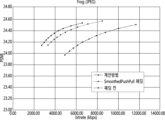
도 15 내지 도 18은 기존 방법과 본 발명의 실시예에 따른 방법의 성능을 비교한 그래프이다.Figures 15 to 18 are graphs comparing the performance of the existing method and the method according to an embodiment of the present invention.
도 15 내지 도 18을 참조하면, JPEG, HEVC를 사용하여 텍스처맵을 압축하고 복호화된 텍스처맵을 이용해 다시점 영상을 렌더링하여 왜곡(PSNR)을 측정하였으며, 본 발명의 실시예에 따른 방법이 기존 방법(SPP) 대비 압축 효율적으로 텍스처맵을 생성한 것을 확인할 수 있다. 15 to 18, the distortion (PSNR) was measured by compressing the texture map using JPEG and HEVC and rendering the multi-view image using the decoded texture map, and the method according to the embodiment of the present invention is similar to the existing It can be seen that the texture map was created with more efficient compression compared to the method (SPP).
도 19는 본 발명의 일 실시예에 따른 3차원 메쉬의 텍스처맵 생성 방법을 나타낸 흐름도이다.Figure 19 is a flowchart showing a method for generating a texture map of a 3D mesh according to an embodiment of the present invention.
도 19를 참조하면, 본 발명의 일 실시예에 따른 3차원 메쉬의 텍스처맵 생성 장치는 3차원 메쉬의 텍스처 맵을 부호화하는 부호화부(210), 상기 부호화된 텍스처 맵을 양자화하는 양자화부(220), 상기 양자화된 텍스처 맵을 복호화하는 복호화부(230), 상기 복호화된 텍스처 맵을 이용하여 렌더링을 수행하는 렌더링부(240) 및 손실 함수의 값에 기반하여 상기 3차원 메쉬의 텍스처 맵을 업데이트 하는 학습부(250)를 포함한다. Referring to FIG. 19, the apparatus for generating a texture map of a 3D mesh according to an embodiment of the present invention includes an
이때, 상기 손실 함수는 텍스처 맵의 압축 성능에 상응하는 제1 손실 함수 및 텍스처 맵의 렌더링 성능에 상응하는 제2 손실 함수를 포함할 수 있다. At this time, the loss function may include a first loss function corresponding to the compression performance of the texture map and a second loss function corresponding to the rendering performance of the texture map.
이때, 상기 부호화부(210)는 미분 가능한 부호화기를 이용하여 부호화를 수행하고, 상기 렌더링부(240)는 미분 가능한 렌더링기를 이용하여 렌더링을 수행할 수 있다. At this time, the
이때, 상기 제1 손실 함수는 상기 3차원 메쉬 텍스처 맵의 양자화된 압축 표현 벡터에 기반하여 산출될 수 있다. At this time, the first loss function may be calculated based on the quantized compressed expression vector of the 3D mesh texture map.
이때, 상기 제2 손실 함수는 상기 렌더링된 이미지 및 원본 이미지를 이용하여 산출될 수 있다. At this time, the second loss function may be calculated using the rendered image and the original image.
이때, 상기 제2 손실 함수는 렌더링 되지 않은 픽셀을 반영하기 위한 바이너리 마스크를 이용하여 산출될 수 있다. At this time, the second loss function can be calculated using a binary mask to reflect pixels that have not been rendered.
이때, 상기 렌더링부(240)는 부호화되지 않은 상기 3차원 메쉬의 텍스처 맵을 이용하여 렌더링을 수행할 수 있다.At this time, the
도 20은 실시예에 따른 컴퓨터 시스템의 구성을 나타낸 도면이다.Figure 20 is a diagram showing the configuration of a computer system according to an embodiment.
실시예에 따른 3차원 메쉬의 텍스처맵 생성 장치는 컴퓨터로 읽을 수 있는 기록매체와 같은 컴퓨터 시스템(1000)에서 구현될 수 있다.The apparatus for generating a texture map of a 3D mesh according to an embodiment may be implemented in a
컴퓨터 시스템(1000)은 버스(1020)를 통하여 서로 통신하는 하나 이상의 프로세서(1010), 메모리(1030), 사용자 인터페이스 입력 장치(1040), 사용자 인터페이스 출력 장치(1050) 및 스토리지(1060)를 포함할 수 있다. 또한, 컴퓨터 시스템(1000)은 네트워크(1080)에 연결되는 네트워크 인터페이스(1070)를 더 포함할 수 있다. 프로세서(1010)는 중앙 처리 장치 또는 메모리(1030)나 스토리지(1060)에 저장된 프로그램 또는 프로세싱 인스트럭션들을 실행하는 반도체 장치일 수 있다. 메모리(1030) 및 스토리지(1060)는 휘발성 매체, 비휘발성 매체, 분리형 매체, 비분리형 매체, 통신 매체, 또는 정보 전달 매체 중에서 적어도 하나 이상을 포함하는 저장 매체일 수 있다. 예를 들어, 메모리(1030)는 ROM(1031)이나 RAM(1032)을 포함할 수 있다.
본 발명에서 설명하는 특정 실행들은 실시예들로서, 어떠한 방법으로도 본 발명의 범위를 한정하는 것은 아니다. 명세서의 간결함을 위하여, 종래 전자적인 구성들, 제어시스템들, 소프트웨어, 상기 시스템들의 다른 기능적인 측면들의 기재는 생략될 수 있다. 또한, 도면에 도시된 구성 요소들 간의 선들의 연결 또는 연결 부재들은 기능적인 연결 및/또는 물리적 또는 회로적 연결들을 예시적으로 나타낸 것으로서, 실제 장치에서는 대체 가능하거나 추가의 다양한 기능적인 연결, 물리적인 연결, 또는 회로 연결들로서 나타내어질 수 있다. 또한, “필수적인”, “중요하게” 등과 같이 구체적인 언급이 없다면 본 발명의 적용을 위하여 반드시 필요한 구성 요소가 아닐 수 있다.The specific implementations described in the present invention are examples and are not intended to limit the scope of the present invention in any way. For the sake of brevity of the specification, descriptions of conventional electronic components, control systems, software, and other functional aspects of the systems may be omitted. In addition, the connections or connection members of lines between components shown in the drawings exemplify functional connections and/or physical or circuit connections, and in actual devices, various functional connections or physical connections may be replaced or added. Can be represented as connections, or circuit connections. Additionally, if there is no specific mention such as “essential,” “important,” etc., it may not be a necessary component for the application of the present invention.
따라서, 본 발명의 사상은 상기 설명된 실시예에 국한되어 정해져서는 아니되며, 후술하는 특허청구범위뿐만 아니라 이 특허청구범위와 균등한 또는 이로부터 등가적으로 변경된 모든 범위는 본 발명의 사상의 범주에 속한다고 할 것이다.Therefore, the spirit of the present invention should not be limited to the above-described embodiments, and the scope of the patent claims described below as well as all scopes equivalent to or equivalently changed from the scope of the claims are within the scope of the spirit of the present invention. It will be said to belong to
210: 부호화부
220: 양자화부
230: 복호화부
240: 렌더링부
250: 학습부
1000: 컴퓨터 시스템
1010: 프로세서
1020: 버스
1030: 메모리
1031: 롬
1032: 램
1040: 사용자 인터페이스 입력 장치
1050: 사용자 인터페이스 출력 장치
1060: 스토리지
1070: 네트워크 인터페이스
1080: 네트워크210: encoding unit
220: Quantization unit
230: Decryption unit
240: Rendering unit
250: Learning Department
1000: computer system 1010: processor
1020: Bus 1030: Memory
1031: Rom 1032: RAM
1040: User interface input device
1050: User interface output device
1060: Storage 1070: Network Interface
1080: Network
Claims (14)
상기 부호화된 텍스처 맵을 양자화하는 단계;
상기 양자화된 텍스처 맵을 복호화하는 단계;
상기 복호화된 텍스처 맵을 이용하여 렌더링을 수행하는 단계; 및
손실 함수의 값에 기반하여 상기 3차원 메쉬의 텍스처 맵을 업데이트 하는 단계;
를 포함하는 것을 특징으로 하는 3차원 메쉬의 텍스처맵 생성 방법.Encoding a texture map of a 3D mesh;
Quantizing the encoded texture map;
Decoding the quantized texture map;
performing rendering using the decrypted texture map; and
updating the texture map of the 3D mesh based on the value of the loss function;
A method for generating a texture map of a 3D mesh, comprising:
상기 손실 함수는
텍스처 맵의 압축 성능에 상응하는 제1 손실 함수 및 텍스처 맵의 렌더링 성능에 상응하는 제2 손실 함수를 포함하는 것을 특징으로 하는 3차원 메쉬의 텍스처맵 생성 방법.In claim 1,
The loss function is
A method for generating a texture map of a three-dimensional mesh, comprising a first loss function corresponding to the compression performance of the texture map and a second loss function corresponding to the rendering performance of the texture map.
상기 텍스처 맵을 부호화하는 단계는
미분 가능한 부호화기를 이용하여 수행되고,
상기 렌더링을 수행하는 단계는
미분 가능한 렌더링기를 이용하여 수행되는 것을 특징으로 하는 3차원 메쉬의 텍스처맵 생성 방법.In claim 2,
The step of encoding the texture map is
It is performed using a differentiable encoder,
The steps for performing the rendering are
A method of generating a texture map for a 3D mesh, characterized in that it is performed using a differentiable renderer.
상기 제1 손실 함수는
상기 3차원 메쉬 텍스처 맵의 양자화된 압축 표현 벡터에 기반하여 산출되는 것을 특징으로 하는 3차원 메쉬의 텍스처맵 생성 방법.In claim 3,
The first loss function is
A method of generating a texture map of a 3D mesh, characterized in that it is calculated based on a quantized compressed expression vector of the 3D mesh texture map.
상기 제2 손실 함수는
상기 렌더링된 이미지 및 원본 이미지를 이용하여 산출되는 것을 특징으로 하는 3차원 메쉬의 텍스처맵 생성 방법.In claim 4,
The second loss function is
A method for generating a texture map of a 3D mesh, characterized in that it is calculated using the rendered image and the original image.
상기 제2 손실 함수는
렌더링 되지 않은 픽셀을 반영하기 위한 바이너리 마스크를 이용하여 산출되는 것을 특징으로 하는 3차원 메쉬의 텍스처맵 생성 방법.In claim 5,
The second loss function is
A method of generating a texture map for a 3D mesh, characterized in that it is calculated using a binary mask to reflect unrendered pixels.
상기 렌더링을 수행하는 단계는
부호화되지 않은 상기 3차원 메쉬의 텍스처 맵을 이용하여 렌더링을 수행하는 것을 특징으로 하는 3차원 메쉬의 텍스처맵 생성 방법.In claim 4,
The steps for performing the rendering are
A method of generating a texture map of a 3D mesh, characterized in that rendering is performed using an unencoded texture map of the 3D mesh.
상기 부호화된 텍스처 맵을 양자화하는 양자화부;
상기 양자화된 텍스처 맵을 복호화하는 복호화부;
상기 복호화된 텍스처 맵을 이용하여 렌더링을 수행하는 렌더링부; 및
손실 함수의 값에 기반하여 상기 3차원 메쉬의 텍스처 맵을 업데이트 하는 학습부;
를 포함하는 것을 특징으로 하는 3차원 메쉬의 텍스처맵 생성 장치.An encoding unit that encodes a texture map of a 3D mesh;
a quantization unit that quantizes the encoded texture map;
a decoder that decodes the quantized texture map;
a rendering unit that performs rendering using the decrypted texture map; and
a learning unit that updates the texture map of the 3D mesh based on the value of the loss function;
A three-dimensional mesh texture map generating device comprising:
상기 손실 함수는
텍스처 맵의 압축 성능에 상응하는 제1 손실 함수 및 텍스처 맵의 렌더링 성능에 상응하는 제2 손실 함수를 포함하는 것을 특징으로 하는 3차원 메쉬의 텍스처맵 생성 장치.In claim 8,
The loss function is
A texture map generating device for a three-dimensional mesh, comprising a first loss function corresponding to the compression performance of the texture map and a second loss function corresponding to the rendering performance of the texture map.
상기 부호화부는
미분 가능한 부호화기를 이용하여 부호화를 수행하고,
상기 렌더링부는
미분 가능한 렌더링기를 이용하여 렌더링을 수행하는 것을 특징으로 하는 3차원 메쉬의 텍스처맵 생성 장치.In claim 9,
The encoding unit
Encoding is performed using a differentiable encoder,
The rendering unit
A three-dimensional mesh texture map generation device characterized in that rendering is performed using a differentiable renderer.
상기 제1 손실 함수는
상기 3차원 메쉬 텍스처 맵의 양자화된 압축 표현 벡터에 기반하여 산출되는 것을 특징으로 하는 3차원 메쉬의 텍스처맵 생성 장치.In claim 10,
The first loss function is
An apparatus for generating a texture map of a 3D mesh, characterized in that it is calculated based on a quantized compressed expression vector of the 3D mesh texture map.
상기 제2 손실 함수는
상기 렌더링된 이미지 및 원본 이미지를 이용하여 산출되는 것을 특징으로 하는 3차원 메쉬의 텍스처맵 생성 장치.In claim 11,
The second loss function is
A three-dimensional mesh texture map generating device, characterized in that it is calculated using the rendered image and the original image.
상기 제2 손실 함수는
렌더링 되지 않은 픽셀을 반영하기 위한 바이너리 마스크를 이용하여 산출되는 것을 특징으로 하는 3차원 메쉬의 텍스처맵 생성 장치.In claim 12,
The second loss function is
A three-dimensional mesh texture map generation device, characterized in that it is calculated using a binary mask to reflect unrendered pixels.
상기 렌더링부는
부호화되지 않은 상기 3차원 메쉬의 텍스처 맵을 이용하여 렌더링을 수행하는 것을 특징으로 하는 3차원 메쉬의 텍스처맵 생성 장치.
In claim 11,
The rendering unit
A three-dimensional mesh texture map generating device, characterized in that rendering is performed using an unencoded texture map of the three-dimensional mesh.
Priority Applications (2)
| Application Number | Priority Date | Filing Date | Title |
|---|---|---|---|
| KR1020220132439A KR20240052425A (en) | 2022-10-14 | 2022-10-14 | Apparatus and method for generating texture map of 3-dimensional mesh |
| US18/114,118 US12374020B2 (en) | 2022-10-14 | 2023-02-24 | Apparatus and method for generating texture map of 3-dimensional mesh |
Applications Claiming Priority (1)
| Application Number | Priority Date | Filing Date | Title |
|---|---|---|---|
| KR1020220132439A KR20240052425A (en) | 2022-10-14 | 2022-10-14 | Apparatus and method for generating texture map of 3-dimensional mesh |
Publications (1)
| Publication Number | Publication Date |
|---|---|
| KR20240052425A true KR20240052425A (en) | 2024-04-23 |
Family
ID=90834080
Family Applications (1)
| Application Number | Title | Priority Date | Filing Date |
|---|---|---|---|
| KR1020220132439A Pending KR20240052425A (en) | 2022-10-14 | 2022-10-14 | Apparatus and method for generating texture map of 3-dimensional mesh |
Country Status (2)
| Country | Link |
|---|---|
| US (1) | US12374020B2 (en) |
| KR (1) | KR20240052425A (en) |
Family Cites Families (7)
| Publication number | Priority date | Publication date | Assignee | Title |
|---|---|---|---|---|
| US8462149B2 (en) | 2008-04-18 | 2013-06-11 | Electronics And Telecommunications Research Institute | Method and apparatus for real time 3D mesh compression, based on quanitzation |
| US10397543B2 (en) | 2014-09-03 | 2019-08-27 | Nextvr Inc. | Methods and apparatus for capturing, streaming and/or playing back content |
| GB2581536B (en) * | 2019-02-25 | 2024-01-17 | Huawei Tech Co Ltd | Joint shape and texture decoders for three-dimensional rendering |
| KR102612539B1 (en) | 2019-12-17 | 2023-12-11 | 한국전자통신연구원 | Multiview video encoding and decoding method |
| CN112102477B (en) * | 2020-09-15 | 2024-09-27 | 腾讯科技(深圳)有限公司 | Three-dimensional model reconstruction method, device, computer equipment and storage medium |
| US12444125B2 (en) * | 2021-09-25 | 2025-10-14 | Intel Corporation | Apparatus and method for ray tracing with shader call graph analysis |
| US12555272B2 (en) * | 2022-04-20 | 2026-02-17 | Apple Inc. | Mesh compression using coding units with different encoding parameters |
-
2022
- 2022-10-14 KR KR1020220132439A patent/KR20240052425A/en active Pending
-
2023
- 2023-02-24 US US18/114,118 patent/US12374020B2/en active Active
Also Published As
| Publication number | Publication date |
|---|---|
| US12374020B2 (en) | 2025-07-29 |
| US20240144578A1 (en) | 2024-05-02 |
Similar Documents
| Publication | Publication Date | Title |
|---|---|---|
| JP7250952B2 (en) | Method, Apparatus, and Computer Program for Point Cloud Coding | |
| US12530809B2 (en) | Methods and apparatuses for dynamic mesh compression | |
| US12131508B2 (en) | Dynamic mesh compression based on point cloud compression | |
| JP7497443B2 (en) | Method, apparatus and computer program for point cloud coding | |
| AU2016388215A1 (en) | Method for compressing point cloud | |
| CN112399165B (en) | Decoding method and device, computer equipment and storage medium | |
| CN116686011B (en) | Grid coding method, device and storage medium | |
| US11113866B2 (en) | Method and apparatus for point cloud compression | |
| KR102810355B1 (en) | Predictive coding of boundary geometry information for mesh compression | |
| JP7476432B2 (en) | METHOD, APPARATUS AND COMPUTER PROGRAM FOR MESH RECONSTRUCTION | |
| US12505618B2 (en) | Manhattan layout estimation using geometric and semantic information | |
| US20250008157A1 (en) | Dual-degree based coding algorithm for polygon mesh compression | |
| KR20240052425A (en) | Apparatus and method for generating texture map of 3-dimensional mesh | |
| JP7529923B2 (en) | Method, apparatus and computer program for boundary loop detection in non-manifold meshes - Patents.com | |
| CN118679497A (en) | Displacement vector coding for 3D meshes | |
| HK40093987A (en) | Methods and apparatuses for dynamic mesh compression |
Legal Events
| Date | Code | Title | Description |
|---|---|---|---|
| PA0109 | Patent application |
St.27 status event code: A-0-1-A10-A12-nap-PA0109 |
|
| PA0201 | Request for examination |
St.27 status event code: A-1-2-D10-D11-exm-PA0201 |
|
| PG1501 | Laying open of application |
St.27 status event code: A-1-1-Q10-Q12-nap-PG1501 |
|
| D13 | Search requested |
Free format text: ST27 STATUS EVENT CODE: A-1-2-D10-D13-SRH-X000 (AS PROVIDED BY THE NATIONAL OFFICE) |
|
| D13-X000 | Search requested |
St.27 status event code: A-1-2-D10-D13-srh-X000 |
|
| D14 | Search report completed |
Free format text: ST27 STATUS EVENT CODE: A-1-2-D10-D14-SRH-X000 (AS PROVIDED BY THE NATIONAL OFFICE) |
|
| D14-X000 | Search report completed |
St.27 status event code: A-1-2-D10-D14-srh-X000 |
|
| D21 | Rejection of application intended |
Free format text: ST27 STATUS EVENT CODE: A-1-2-D10-D21-EXM-PE0902 (AS PROVIDED BY THE NATIONAL OFFICE) |
|
| PE0902 | Notice of grounds for rejection |
St.27 status event code: A-1-2-D10-D21-exm-PE0902 |
|
| E13 | Pre-grant limitation requested |
Free format text: ST27 STATUS EVENT CODE: A-2-3-E10-E13-LIM-X000 (AS PROVIDED BY THE NATIONAL OFFICE) |
|
| E13-X000 | Pre-grant limitation requested |
St.27 status event code: A-2-3-E10-E13-lim-X000 |
|
| P11 | Amendment of application requested |
Free format text: ST27 STATUS EVENT CODE: A-2-2-P10-P11-NAP-X000 (AS PROVIDED BY THE NATIONAL OFFICE) |
|
| P11-X000 | Amendment of application requested |
St.27 status event code: A-2-2-P10-P11-nap-X000 |