KR20250043473A - Nucleic acid compounds - Google Patents
Nucleic acid compounds Download PDFInfo
- Publication number
- KR20250043473A KR20250043473A KR1020257006008A KR20257006008A KR20250043473A KR 20250043473 A KR20250043473 A KR 20250043473A KR 1020257006008 A KR1020257006008 A KR 1020257006008A KR 20257006008 A KR20257006008 A KR 20257006008A KR 20250043473 A KR20250043473 A KR 20250043473A
- Authority
- KR
- South Korea
- Prior art keywords
- strand
- nucleic acid
- nucleoside
- nucleosides
- modification
- Prior art date
- Legal status (The legal status is an assumption and is not a legal conclusion. Google has not performed a legal analysis and makes no representation as to the accuracy of the status listed.)
- Pending
Links
Images











Classifications
-
- C—CHEMISTRY; METALLURGY
- C12—BIOCHEMISTRY; BEER; SPIRITS; WINE; VINEGAR; MICROBIOLOGY; ENZYMOLOGY; MUTATION OR GENETIC ENGINEERING
- C12N—MICROORGANISMS OR ENZYMES; COMPOSITIONS THEREOF; PROPAGATING, PRESERVING, OR MAINTAINING MICROORGANISMS; MUTATION OR GENETIC ENGINEERING; CULTURE MEDIA
- C12N15/00—Mutation or genetic engineering; DNA or RNA concerning genetic engineering, vectors, e.g. plasmids, or their isolation, preparation or purification; Use of hosts therefor
- C12N15/09—Recombinant DNA-technology
- C12N15/11—DNA or RNA fragments; Modified forms thereof; Non-coding nucleic acids having a biological activity
- C12N15/113—Non-coding nucleic acids modulating the expression of genes, e.g. antisense oligonucleotides; Antisense DNA or RNA; Triplex- forming oligonucleotides; Catalytic nucleic acids, e.g. ribozymes; Nucleic acids used in co-suppression or gene silencing
-
- A—HUMAN NECESSITIES
- A61—MEDICAL OR VETERINARY SCIENCE; HYGIENE
- A61K—PREPARATIONS FOR MEDICAL, DENTAL OR TOILETRY PURPOSES
- A61K31/00—Medicinal preparations containing organic active ingredients
- A61K31/70—Carbohydrates; Sugars; Derivatives thereof
- A61K31/7088—Compounds having three or more nucleosides or nucleotides
- A61K31/713—Double-stranded nucleic acids or oligonucleotides
-
- A—HUMAN NECESSITIES
- A61—MEDICAL OR VETERINARY SCIENCE; HYGIENE
- A61P—SPECIFIC THERAPEUTIC ACTIVITY OF CHEMICAL COMPOUNDS OR MEDICINAL PREPARATIONS
- A61P3/00—Drugs for disorders of the metabolism
- A61P3/08—Drugs for disorders of the metabolism for glucose homeostasis
- A61P3/10—Drugs for disorders of the metabolism for glucose homeostasis for hyperglycaemia, e.g. antidiabetics
-
- A—HUMAN NECESSITIES
- A61—MEDICAL OR VETERINARY SCIENCE; HYGIENE
- A61P—SPECIFIC THERAPEUTIC ACTIVITY OF CHEMICAL COMPOUNDS OR MEDICINAL PREPARATIONS
- A61P7/00—Drugs for disorders of the blood or the extracellular fluid
- A61P7/04—Antihaemorrhagics; Procoagulants; Haemostatic agents; Antifibrinolytic agents
-
- A—HUMAN NECESSITIES
- A61—MEDICAL OR VETERINARY SCIENCE; HYGIENE
- A61P—SPECIFIC THERAPEUTIC ACTIVITY OF CHEMICAL COMPOUNDS OR MEDICINAL PREPARATIONS
- A61P9/00—Drugs for disorders of the cardiovascular system
-
- C—CHEMISTRY; METALLURGY
- C12—BIOCHEMISTRY; BEER; SPIRITS; WINE; VINEGAR; MICROBIOLOGY; ENZYMOLOGY; MUTATION OR GENETIC ENGINEERING
- C12N—MICROORGANISMS OR ENZYMES; COMPOSITIONS THEREOF; PROPAGATING, PRESERVING, OR MAINTAINING MICROORGANISMS; MUTATION OR GENETIC ENGINEERING; CULTURE MEDIA
- C12N2310/00—Structure or type of the nucleic acid
- C12N2310/10—Type of nucleic acid
- C12N2310/14—Type of nucleic acid interfering nucleic acids [NA]
-
- C—CHEMISTRY; METALLURGY
- C12—BIOCHEMISTRY; BEER; SPIRITS; WINE; VINEGAR; MICROBIOLOGY; ENZYMOLOGY; MUTATION OR GENETIC ENGINEERING
- C12N—MICROORGANISMS OR ENZYMES; COMPOSITIONS THEREOF; PROPAGATING, PRESERVING, OR MAINTAINING MICROORGANISMS; MUTATION OR GENETIC ENGINEERING; CULTURE MEDIA
- C12N2310/00—Structure or type of the nucleic acid
- C12N2310/30—Chemical structure
- C12N2310/31—Chemical structure of the backbone
- C12N2310/315—Phosphorothioates
-
- C—CHEMISTRY; METALLURGY
- C12—BIOCHEMISTRY; BEER; SPIRITS; WINE; VINEGAR; MICROBIOLOGY; ENZYMOLOGY; MUTATION OR GENETIC ENGINEERING
- C12N—MICROORGANISMS OR ENZYMES; COMPOSITIONS THEREOF; PROPAGATING, PRESERVING, OR MAINTAINING MICROORGANISMS; MUTATION OR GENETIC ENGINEERING; CULTURE MEDIA
- C12N2310/00—Structure or type of the nucleic acid
- C12N2310/30—Chemical structure
- C12N2310/32—Chemical structure of the sugar
- C12N2310/321—2'-O-R Modification
-
- C—CHEMISTRY; METALLURGY
- C12—BIOCHEMISTRY; BEER; SPIRITS; WINE; VINEGAR; MICROBIOLOGY; ENZYMOLOGY; MUTATION OR GENETIC ENGINEERING
- C12N—MICROORGANISMS OR ENZYMES; COMPOSITIONS THEREOF; PROPAGATING, PRESERVING, OR MAINTAINING MICROORGANISMS; MUTATION OR GENETIC ENGINEERING; CULTURE MEDIA
- C12N2310/00—Structure or type of the nucleic acid
- C12N2310/30—Chemical structure
- C12N2310/32—Chemical structure of the sugar
- C12N2310/322—2'-R Modification
-
- C—CHEMISTRY; METALLURGY
- C12—BIOCHEMISTRY; BEER; SPIRITS; WINE; VINEGAR; MICROBIOLOGY; ENZYMOLOGY; MUTATION OR GENETIC ENGINEERING
- C12N—MICROORGANISMS OR ENZYMES; COMPOSITIONS THEREOF; PROPAGATING, PRESERVING, OR MAINTAINING MICROORGANISMS; MUTATION OR GENETIC ENGINEERING; CULTURE MEDIA
- C12N2310/00—Structure or type of the nucleic acid
- C12N2310/30—Chemical structure
- C12N2310/32—Chemical structure of the sugar
- C12N2310/323—Chemical structure of the sugar modified ring structure
-
- C—CHEMISTRY; METALLURGY
- C12—BIOCHEMISTRY; BEER; SPIRITS; WINE; VINEGAR; MICROBIOLOGY; ENZYMOLOGY; MUTATION OR GENETIC ENGINEERING
- C12N—MICROORGANISMS OR ENZYMES; COMPOSITIONS THEREOF; PROPAGATING, PRESERVING, OR MAINTAINING MICROORGANISMS; MUTATION OR GENETIC ENGINEERING; CULTURE MEDIA
- C12N2310/00—Structure or type of the nucleic acid
- C12N2310/30—Chemical structure
- C12N2310/34—Spatial arrangement of the modifications
- C12N2310/343—Spatial arrangement of the modifications having patterns, e.g. ==--==--==--
-
- C—CHEMISTRY; METALLURGY
- C12—BIOCHEMISTRY; BEER; SPIRITS; WINE; VINEGAR; MICROBIOLOGY; ENZYMOLOGY; MUTATION OR GENETIC ENGINEERING
- C12N—MICROORGANISMS OR ENZYMES; COMPOSITIONS THEREOF; PROPAGATING, PRESERVING, OR MAINTAINING MICROORGANISMS; MUTATION OR GENETIC ENGINEERING; CULTURE MEDIA
- C12N2310/00—Structure or type of the nucleic acid
- C12N2310/30—Chemical structure
- C12N2310/35—Nature of the modification
- C12N2310/351—Conjugate
-
- C—CHEMISTRY; METALLURGY
- C12—BIOCHEMISTRY; BEER; SPIRITS; WINE; VINEGAR; MICROBIOLOGY; ENZYMOLOGY; MUTATION OR GENETIC ENGINEERING
- C12N—MICROORGANISMS OR ENZYMES; COMPOSITIONS THEREOF; PROPAGATING, PRESERVING, OR MAINTAINING MICROORGANISMS; MUTATION OR GENETIC ENGINEERING; CULTURE MEDIA
- C12N2310/00—Structure or type of the nucleic acid
- C12N2310/30—Chemical structure
- C12N2310/35—Nature of the modification
- C12N2310/352—Nature of the modification linked to the nucleic acid via a carbon atom
- C12N2310/3521—Methyl
-
- C—CHEMISTRY; METALLURGY
- C12—BIOCHEMISTRY; BEER; SPIRITS; WINE; VINEGAR; MICROBIOLOGY; ENZYMOLOGY; MUTATION OR GENETIC ENGINEERING
- C12N—MICROORGANISMS OR ENZYMES; COMPOSITIONS THEREOF; PROPAGATING, PRESERVING, OR MAINTAINING MICROORGANISMS; MUTATION OR GENETIC ENGINEERING; CULTURE MEDIA
- C12N2310/00—Structure or type of the nucleic acid
- C12N2310/30—Chemical structure
- C12N2310/35—Nature of the modification
- C12N2310/353—Nature of the modification linked to the nucleic acid via an atom other than carbon
- C12N2310/3533—Halogen
-
- C—CHEMISTRY; METALLURGY
- C12—BIOCHEMISTRY; BEER; SPIRITS; WINE; VINEGAR; MICROBIOLOGY; ENZYMOLOGY; MUTATION OR GENETIC ENGINEERING
- C12N—MICROORGANISMS OR ENZYMES; COMPOSITIONS THEREOF; PROPAGATING, PRESERVING, OR MAINTAINING MICROORGANISMS; MUTATION OR GENETIC ENGINEERING; CULTURE MEDIA
- C12N2320/00—Applications; Uses
- C12N2320/50—Methods for regulating/modulating their activity
- C12N2320/51—Methods for regulating/modulating their activity modulating the chemical stability, e.g. nuclease-resistance
Landscapes
- Health & Medical Sciences (AREA)
- Life Sciences & Earth Sciences (AREA)
- Engineering & Computer Science (AREA)
- Genetics & Genomics (AREA)
- Chemical & Material Sciences (AREA)
- Organic Chemistry (AREA)
- Bioinformatics & Cheminformatics (AREA)
- Biomedical Technology (AREA)
- General Health & Medical Sciences (AREA)
- Molecular Biology (AREA)
- General Engineering & Computer Science (AREA)
- Wood Science & Technology (AREA)
- Zoology (AREA)
- Biotechnology (AREA)
- Medicinal Chemistry (AREA)
- Public Health (AREA)
- Veterinary Medicine (AREA)
- Pharmacology & Pharmacy (AREA)
- Animal Behavior & Ethology (AREA)
- Diabetes (AREA)
- Biochemistry (AREA)
- General Chemical & Material Sciences (AREA)
- Chemical Kinetics & Catalysis (AREA)
- Nuclear Medicine, Radiotherapy & Molecular Imaging (AREA)
- Physics & Mathematics (AREA)
- Plant Pathology (AREA)
- Microbiology (AREA)
- Biophysics (AREA)
- Hematology (AREA)
- Endocrinology (AREA)
- Emergency Medicine (AREA)
- Heart & Thoracic Surgery (AREA)
- Epidemiology (AREA)
- Obesity (AREA)
- Cardiology (AREA)
- Pharmaceuticals Containing Other Organic And Inorganic Compounds (AREA)
- Saccharide Compounds (AREA)
- Medicines That Contain Protein Lipid Enzymes And Other Medicines (AREA)
Abstract
본 발명은 치료 용도에 적합한 신규 핵산 화합물을 제공한다. 추가적으로, 본 발명은 이들 화합물을 제조하는 방법, 뿐만 아니라 다양한 질환 및 상태의 치료를 위해 이러한 화합물을 사용하는 방법을 제공한다.The present invention provides novel nucleic acid compounds suitable for therapeutic applications. Additionally, the present invention provides methods of making these compounds, as well as methods of using these compounds for the treatment of various diseases and conditions.

Description
본 발명은 치료 용도에 적합한 신규 핵산 화합물을 제공한다. 추가적으로, 본 발명은 이들 화합물을 제조하는 방법, 뿐만 아니라 다양한 질환 및 상태의 치료를 위해 이러한 화합물을 사용하는 방법을 제공한다.The present invention provides novel nucleic acid compounds suitable for therapeutic applications. Additionally, the present invention provides methods of making these compounds, as well as methods of using these compounds for the treatment of various diseases and conditions.
핵산 화합물은 의약에서 중요한 치료 용도를 갖는다. 핵산은 특정한 질환을 담당하는 유전자를 침묵시키는 데 사용될 수 있다. 유전자-침묵은 번역을 억제함으로써 단백질의 형성을 방지한다. 중요하게는, 유전자-침묵제는 질환과 연관된 단백질의 기능을 억제하는 전통적인 작은 유기 화합물에 대한 유망한 대안이다. siRNA, 안티센스 RNA, 및 마이크로-RNA는 유전자-침묵에 의한 단백질의 형성을 방지하는 올리고뉴클레오티드/올리고뉴클레오시드이다.Nucleic acid compounds have important therapeutic applications in medicine. Nucleic acids can be used to silence genes responsible for specific diseases. Gene-silencing prevents the formation of proteins by inhibiting translation. Importantly, gene-silencing agents are promising alternatives to traditional small organic compounds that inhibit the function of proteins associated with diseases. siRNA, antisense RNA, and micro-RNA are oligonucleotides/oligonucleosides that prevent the formation of proteins by gene-silencing.
중추-신경계 질환, 염증성 질환, 대사 장애, 종양학, 감염성 질환 및 안구 질환을 비롯한 다양한 질환의 치료를 위한 siRNA /RNAi 치료제를 비롯한 다수의 변형된 siRNA 화합물이 특히 진단 및 치료 목적을 위해 지난 20년간 개발되었다.A number of modified siRNA compounds, including siRNA/RNAi therapeutics, have been developed over the past two decades, particularly for diagnostic and therapeutic purposes, for the treatment of a variety of diseases, including central nervous system diseases, inflammatory diseases, metabolic disorders, oncology, infectious diseases, and ocular diseases.
본 발명은 질환의 치료 및/또는 예방에 사용하기 위한 핵산 화합물에 관한 것이다.The present invention relates to nucleic acid compounds for use in the treatment and/or prevention of diseases.
표적 유전자로부터 전사된 RNA의 부분에 적어도 부분적으로 상보적인 제1 가닥, 및 제1 가닥에 적어도 부분적으로 상보적인 제2 가닥을 포함하는 듀플렉스 영역을 포함하는, 표적 유전자의 발현을 억제하기 위한 핵산으로서, 여기서 상기 제2 가닥의 뉴클레오시드는 하기와 같은 2' 당 변형 패턴 (5'-3')을 포함하는 것인, 표적 유전자의 발현을 억제하기 위한 핵산:A nucleic acid for inhibiting expression of a target gene, comprising a duplex region comprising a first strand at least partially complementary to a portion of RNA transcribed from a target gene, and a second strand at least partially complementary to the first strand, wherein the nucleosides of the second strand comprise a 2' sugar modification pattern (5'-3') as follows:
Me - Me - Me - Me - Me - Me - F - F - F - F - F - Me - Me - Me - Me - Me - Me - Me - F - Me - Me, 또는Me - Me - Me - Me - Me - Me - F - F - F - F - F - Me - Me - Me - Me - Me - Me - Me - F - Me - Me, or
Me - Me - Me - Me - Me - F - F - Me - F - F - F - F - Me - Me - Me - Me - Me - Me - Me - Me - Me, 또는Me - Me - Me - Me - Me - F - F - Me - F - F - F - F - Me - Me - Me - Me - Me - Me - Me - Me - Me, or
Me - Me - Me - Me - Me - Me -F- Me - F - F - F - F - Me - Me - Me - Me - Me - Me - Me - Me - Me.Me - Me - Me - Me - Me - Me -F- Me - F - F - F - F - Me - Me - Me - Me - Me - Me - Me - Me - Me.
표적 유전자로부터 전사된 RNA의 부분에 적어도 부분적으로 상보적인 제1 가닥, 및 제1 가닥에 적어도 부분적으로 상보적인 제2 가닥을 포함하는 듀플렉스 영역을 포함하는, 표적 유전자의 발현을 억제하기 위한 핵산으로서, 여기서 상기 제2 가닥의 뉴클레오시드는 하기와 같은 2' 당 및 결합 변형 패턴 (5'-3')을 포함하는 것인 핵산:A nucleic acid for inhibiting expression of a target gene, comprising a duplex region comprising a first strand at least partially complementary to a portion of RNA transcribed from a target gene, and a second strand at least partially complementary to the first strand, wherein the nucleosides of the second strand comprise the following 2' sugar and linkage modification pattern (5'-3'):
Me(s)Me(s)Me - Me - Me - Me - F - F - F - F - F - Me - Me - Me - Me - Me - Me - Me - F - Me - Me, 또는Me(s)Me(s)Me - Me - Me - Me - F - F - F - F - F - Me - Me - Me - Me - Me - Me - Me - F - Me - Me, or
Me(s)Me(s)Me - Me - Me - F - F - Me - F - F - F - F - Me - Me - Me - Me - Me - Me - Me - Me - Me, 또는Me(s)Me(s)Me - Me - Me - F - F - Me - F - F - F - F - Me - Me - Me - Me - Me - Me - Me - Me - Me, or
Me(s)Me(s)Me - Me - Me - Me -F- Me - F - F - F - F - Me - Me - Me - Me - Me - Me - Me - Me - Me, 또는Me(s)Me(s)Me - Me - Me - Me -F- Me - F - F - F - F - Me - Me - Me - Me - Me - Me - Me - Me - Me, or
Me(s)Me(s)Me - Me - Me - Me - Me - Me - F - F - F - Me - Me - Me - Me - Me - Me - Me - Me - Me - Me, 또는Me(s)Me(s)Me - Me - Me - Me - Me - Me - F - F - F - Me - Me - Me - Me - Me - Me - Me - Me - Me - Me, or
Me - Me - Me - Me - Me - Me - F - F - F - F - F - Me - Me - Me - Me - Me - Me - Me - F(s)Me(s)Me, 또는Me - Me - Me - Me - Me - Me - F - F - F - F - F - Me - Me - Me - Me - Me - Me - Me - F(s)Me(s)Me, or
Me - Me - Me - Me - Me - F - F - Me - F - F - F - F - Me - Me - Me - Me - Me - Me - Me(s)Me(s)Me, 또는Me - Me - Me - Me - Me - F - F - Me - F - F - F - F - Me - Me - Me - Me - Me - Me - Me(s)Me(s)Me, or
Me - Me - Me - Me - Me - Me -F- Me - F - F - F - F - Me - Me - Me - Me - Me - Me - Me(s)Me(s)Me, 또는Me - Me - Me - Me - Me - Me -F- Me - F - F - F - F - Me - Me - Me - Me - Me - Me - Me(s)Me(s)Me, or
Me - Me - Me - Me - Me - Me - Me - Me - F - F - F - Me - Me - Me - Me - Me - Me - Me - Me(s)Me(s)MeMe - Me - Me - Me - Me - Me - Me - Me - F - F - F - Me - Me - Me - Me - Me - Me - Me - Me(s)Me(s)Me
(여기서 (s)는 포스포로티오에이트 뉴클레오시드간 연결임).(where (s) is a phosphorothioate internucleoside linkage).
표적 유전자로부터 전사된 RNA의 부분에 적어도 부분적으로 상보적인 제1 가닥, 및 제1 가닥에 적어도 부분적으로 상보적인 제2 가닥을 포함하는 듀플렉스 영역을 포함하는, 표적 유전자의 발현을 억제하기 위한 핵산으로서, 여기서 상기 제2 가닥의 뉴클레오시드는 하기와 같은 2' 당 및 무염기성 변형 패턴 (5'-3')을 포함하는 것인 핵산:A nucleic acid for inhibiting expression of a target gene, comprising a duplex region comprising a first strand at least partially complementary to a portion of RNA transcribed from a target gene, and a second strand at least partially complementary to the first strand, wherein the nucleosides of the second strand comprise a 2' sugar and an abasic modification pattern (5'-3') as follows:
ia - ia - Me - Me - Me - Me - Me - Me - F - F - F - F - F - Me - Me - Me - Me - Me - Me - Me - F - Me - Me, 또는ia - ia - Me - Me - Me - Me - Me - Me - F - F - F - F - F - Me - Me - Me - Me - Me - Me - Me - F - Me - Me, or
ia - ia - Me - Me - Me - Me - Me - F - F - Me - F - F - F - F - Me - Me - Me - Me - Me - Me - Me - Me - Me, 또는ia - ia - Me - Me - Me - Me - Me - F - F - Me - F - F - F - F - Me - Me - Me - Me - Me - Me - Me - Me - Me, or
ia - ia - Me - Me - Me - Me - Me - Me -F- Me - F - F - F - F - Me - Me - Me - Me - Me - Me - Me - Me - Me, 또는ia - ia - Me - Me - Me - Me - Me - Me -F- Me - F - F - F - F - Me - Me - Me - Me - Me - Me - Me - Me - Me, or
ia - ia - Me - Me - Me - Me - Me - Me - Me - Me - F - F - F - Me - Me - Me - Me - Me - Me - Me - Me - Me - Me, 또는ia - ia - Me - Me - Me - Me - Me - Me - Me - Me - F - F - F - Me - Me - Me - Me - Me - Me - Me - Me - Me - Me, or
Me - Me - Me - Me - Me - Me - F - F - F - F - F - Me - Me - Me - Me - Me - Me - Me - F - Me - Me - ia - ia, 또는Me - Me - Me - Me - Me - Me - F - F - F - F - F - Me - Me - Me - Me - Me - Me - Me - F - Me - Me - ia - ia, or
Me - Me - Me - Me - Me - F - F - Me - F - F - F - F - Me - Me - Me - Me - Me - Me - Me - Me - Me - ia - ia, 또는Me - Me - Me - Me - Me - F - F - Me - F - F - F - F - Me - Me - Me - Me - Me - Me - Me - Me - Me - ia - ia, or
Me - Me - Me - Me - Me - Me -F- Me - F - F - F - F - Me - Me - Me - Me - Me - Me - Me - Me - Me - ia - ia, 또는Me - Me - Me - Me - Me - Me -F- Me - F - F - F - F - Me - Me - Me - Me - Me - Me - Me - Me - Me - ia - ia, or
Me - Me - Me - Me - Me - Me - Me - Me - F - F - F - Me - Me - Me - Me - Me - Me - Me - Me - Me - Me - ia - iaMe - Me - Me - Me - Me - Me - Me - Me - F - F - F - Me - Me - Me - Me - Me - Me - Me - Me - Me - Me - ia - ia
(여기서 ia는 역전된 무염기성 뉴클레오시드를 나타내고, ia - ia에 의해 나타내어진 바와 같은 역전된 무염기성 뉴클레오시드가 제2 가닥의 3' 말단에 존재하는 경우, 상기 역전된 무염기성 뉴클레오시드는 전형적으로 2 뉴클레오시드 오버행에 존재함).(wherein ia represents an inverted abasic nucleoside, and when an inverted abasic nucleoside as represented by ia - ia is present at the 3' end of the second strand, the inverted abasic nucleoside is typically present in a 2 nucleoside overhang).
표적 유전자로부터 전사된 RNA의 부분에 적어도 부분적으로 상보적인 제1 가닥, 및 제1 가닥에 적어도 부분적으로 상보적인 제2 가닥을 포함하는 듀플렉스 영역을 포함하는, 표적 유전자의 발현을 억제하기 위한 핵산으로서, 여기서 상기 제2 가닥의 뉴클레오시드는 하기와 같은 2' 당, 무염기성 및 결합 변형 패턴 (5'-3')을 포함하는 것인 핵산:A nucleic acid for inhibiting expression of a target gene, comprising a duplex region comprising a first strand at least partially complementary to a portion of RNA transcribed from a target gene, and a second strand at least partially complementary to the first strand, wherein the nucleosides of the second strand comprise a 2' sugar, an abasic and a linkage modification pattern (5'-3') as follows:
ia - ia - Me(s)Me(s)Me - Me - Me - Me - F - F - F - F - F - Me - Me - Me - Me - Me - Me - Me - F - Me - Me, 또는ia - ia - Me(s)Me(s)Me - Me - Me - Me - F - F - F - F - F - Me - Me - Me - Me - Me - Me - Me - F - Me - Me, or
ia - ia - Me(s)Me(s)Me - Me - Me - F - F - Me - F - F - F - F - Me - Me - Me - Me - Me - Me - Me - Me - Me, 또는ia - ia - Me(s)Me(s)Me - Me - Me - F - F - Me - F - F - F - F - Me - Me - Me - Me - Me - Me - Me - Me - Me, or
ia - ia - Me(s)Me(s)Me - Me - Me - Me -F- Me - F - F - F - F - Me - Me - Me - Me - Me - Me - Me - Me - Me, 또는ia - ia - Me(s)Me(s)Me - Me - Me - Me -F- Me - F - F - F - F - Me - Me - Me - Me - Me - Me - Me - Me - Me, or
ia - ia - Me(s)Me(s)Me - Me - Me - Me - Me - Me - F - F - F - Me - Me - Me - Me - Me - Me - Me - Me - Me - Meia - ia - Me(s)Me(s)Me - Me - Me - Me - Me - Me - F - F - F - Me - Me - Me - Me - Me - Me - Me - Me - Me - Me
Me - Me - Me - Me - Me - Me - F - F - F - F - F - Me - Me - Me - Me - Me - Me - Me - F(s)Me(s)Me - ia - ia, 또는Me - Me - Me - Me - Me - Me - F - F - F - F - F - Me - Me - Me - Me - Me - Me - Me - F(s)Me(s)Me - ia - ia, or
Me - Me - Me - Me - Me - F - F - Me - F - F - F - F - Me - Me - Me - Me - Me - Me - Me(s)Me(s)Me - ia - ia, 또는Me - Me - Me - Me - Me - F - F - Me - F - F - F - F - Me - Me - Me - Me - Me - Me - Me(s)Me(s)Me - ia - ia, or
Me - Me - Me - Me - Me - Me -F- Me - F - F - F - F - Me - Me - Me - Me - Me - Me - Me(s)Me(s)Me - ia - ia, 또는Me - Me - Me - Me - Me - Me -F- Me - F - F - F - F - Me - Me - Me - Me - Me - Me - Me(s)Me(s)Me - ia - ia, or
Me - Me - Me - Me - Me - Me - Me - Me - F - F - F - Me - Me - Me - Me - Me - Me - Me - Me(s)Me(s)Me - ia - iaMe - Me - Me - Me - Me - Me - Me - Me - Me - F - F - F - Me - Me - Me - Me - Me - Me - Me - Me(s)Me(s)Me - ia - ia
(여기서: (s)는 포스포로티오에이트 뉴클레오시드간 연결이고, ia는 역전된 무염기성 뉴클레오시드를 나타내고, ia - ia에 의해 나타내어진 바와 같은 역전된 무염기성 뉴클레오시드가 제2 가닥의 3' 말단에 존재하는 경우, 상기 역전된 무염기성 뉴클레오시드는 전형적으로 2 뉴클레오시드 오버행에 존재함).(wherein: (s) is a phosphorothioate nucleoside linkage, ia represents an inverted abasic nucleoside, and when the inverted abasic nucleoside as represented by ia - ia is present at the 3' terminus of the second strand, the inverted abasic nucleoside is typically present in a 2 nucleoside overhang).
본원에 기재된 바와 같은 핵산은 전형적으로 하기 또는 그의 임의의 조합으로부터 선택된 변형 패턴을 포함하는 제1 가닥을 포함하며, 여기서 위치 1은 제1 가닥의 5' 말단 뉴클레오시드이고, 카운팅 방향은 5' - 3'이고:A nucleic acid as described herein typically comprises a first strand comprising a modification pattern selected from the following or any combination thereof, wherein
적어도 위치 2, 14 및 16에서의 2'-F 당 변형, 및/또는2'-F sugar modifications at least at
위치 17 내지 23에서의 2'-Me 당 변형, 또는 상기 제1 가닥은 적어도 8개의 2'-F 당 변형, 예컨대 적어도 위치 2, 4, 6, 12, 14, 16, 18 및 20에서의 2'-F 당 변형을 포함함, 및/또는a 2'-Me sugar modification at positions 17 to 23, or wherein said first strand comprises at least eight 2'-F sugar modifications, such as 2'-F sugar modifications at at least
위치 1, 3 내지 5, 10 내지 13에서의 2'-Me 당 변형, 또는 상기 제1 가닥은 적어도 8개의 2'-F 당 변형, 예컨대 적어도 위치 2, 4, 6, 12, 14, 16, 18 및 20에서의 2'-F 당 변형을 포함함, 및/또는2'-Me sugar modifications at
위치 7에서의 2'-Me 당 변형 또는 위치 7에서의 열 탈안정화 변형, 예컨대 전형적으로 변형된 비잠금 핵산 또는 글리콜 핵산, 및/또는A 2'-Me sugar modification at
위치 6에서의 2'-F 당 변형 또는 열 탈안정화 변형, 예컨대 전형적으로 변형된 비잠금 핵산 또는 글리콜 핵산, 및/또는2'-F sugar modification or thermal destabilization modification at
위치 8 및 9는 2'-Me 당 변형 및 2'-F 당 변형으로부터 선택된 변형일 수 있고, 전형적으로 동일한 2' 당 변형일 수 있음,
그에 의해 전형적으로 제1 가닥은 하기 변형 패턴 (5'-3')을 포함할 수 있거나:Typically, the first strand may contain the following modification pattern (5'-3'):
Me - F - Me - Me - Me - (M)4 - Me - Me - Me - Me - F - Me - F - Me - Me - Me - Me - Me - Me - MeMe - F - Me - Me - Me - (M) 4 - Me - Me - Me - Me - F - Me - F - Me - Me - Me - Me - Me - Me - Me
(여기서 M은 전형적으로 위치 6에 존재할 수 있는 2'-Me 당 변형, 2'-F 당 변형 및 열 탈안정화 변형, 예컨대 전형적으로 변형된 비잠금 핵산 또는 글리콜 핵산으로부터 선택된 변형을 나타내고, 이는 전형적으로 2'-Me 당 변형이 위치 7에 존재하는 것일 수 있음),(wherein M represents a modification selected from a 2'-Me sugar modification, a 2'-F sugar modification and a heat destabilizing modification, which may typically be present at
또는 그에 의해 전형적으로 제1 가닥은 하기 변형 패턴 (5'-3')을 포함하거나:or, typically, the first strand comprises the following modification pattern (5'-3'):
Me - F - Me - Me - Me - (M1) - (M2)3 - Me - Me - Me - Me - F - Me - F - Me - Me - Me - Me - Me - Me - MeMe - F - Me - Me - Me - (M1) - (M2) 3 - Me - Me - Me - Me - F - Me - F - Me - Me - Me - Me - Me - Me - Me
(여기서 M1은 열 탈안정화 변형, 예컨대 전형적으로 변형된 비잠금 핵산 또는 글리콜 핵산을 나타내고, M2는 2'-Me 당 변형 및 2'-F 당 변형으로부터 선택된 변형을 나타냄),(wherein M1 represents a heat destabilizing modification, such as a typically modified non-locked nucleic acid or glycol nucleic acid, and M2 represents a modification selected from a 2'-Me sugar modification and a 2'-F sugar modification),
또는 그에 의해 전형적으로 제1 가닥은 하기 변형 패턴 (5'-3')을 포함하거나:or, typically, the first strand comprises the following modification pattern (5'-3'):
Me - F - Me - Me - Me - (M1) - Me - (M2)2 - Me - Me - Me - Me - F - Me - F - Me - Me - Me - Me - Me - Me - MeMe - F - Me - Me - Me - (M1) - Me - (M2) 2 - Me - Me - Me - Me - F - Me - F - Me - Me - Me - Me - Me - Me - Me
(여기서 M1은 2'-Me 당 변형, 2'-F 당 변형 및 열 탈안정화 변형, 예컨대 전형적으로 변형된 비잠금 핵산 또는 글리콜 핵산으로부터 선택된 변형을 나타내고, M2는 2'-Me 당 변형 및 2'-F 당 변형으로부터 선택된 변형을 나타냄),(wherein M1 represents a modification selected from a 2'-Me sugar modification, a 2'-F sugar modification and a heat destabilizing modification, such as a typically modified non-locked nucleic acid or a glycol nucleic acid, and M2 represents a modification selected from a 2'-Me sugar modification and a 2'-F sugar modification),
또는 그에 의해 전형적으로 제1 가닥은 하기 변형 패턴 (5'-3')을 포함하는 것인 핵산:or a nucleic acid wherein the first strand typically comprises the following modification pattern (5'-3'):
Me - F - Me - Me - Me - (M1) - Me - (M2)2 - Me - Me - Me - Me - F - Me - F - Me - Me - Me - Me - Me - Me - MeMe - F - Me - Me - Me - (M1) - Me - (M2) 2 - Me - Me - Me - Me - F - Me - F - Me - Me - Me - Me - Me - Me - Me
(여기서 M1은 열 탈안정화 변형, 예컨대 전형적으로 변형된 비잠금 핵산 또는 글리콜 핵산을 나타내고, M2는 2'-Me 당 변형 및 2'-F 당 변형으로부터 선택된 변형을 나타내고, 전형적으로 M2는 동일한 2' 당 변형일 수 있음).(wherein M1 represents a heat destabilizing modification, such as a typically modified unlocked nucleic acid or glycol nucleic acid, and M2 represents a modification selected from a 2'-Me sugar modification and a 2'-F sugar modification, and typically M2 can be the same 2' sugar modification).
전형적으로, 상기 제시된 바와 같은 (M)4는 하기 2' 당 변형 패턴 (5' - 3') 중 어느 하나를 나타낸다:Typically, (M) 4 as presented above exhibits one of the following 2' sugar modification patterns (5' - 3'):
F - Me - Me - FF - Me - Me - F
Me - F - Me - FMe - F - Me - F
F - Me - F - MeF - Me - F - Me
F - F - F - FF - F - F - F
Me - F - F - MeMe - F - F - Me
Me - Me - F - FMe - Me - F - F
F - F - Me - MeF - F - Me - Me
Me - Me - Me - MeMe - Me - Me - Me
전형적으로, 2개의 포스포로티오에이트 뉴클레오시드간 연결은 각각 본원에 기재된 바와 같이 제1 가닥의 5' 및 3' 말단 영역 둘 다에서 3개의 연속 위치들 사이에 존재하고, 그에 의해 상기 제1 가닥의 5' 및 3' 말단 영역 각각에서의 말단 뉴클레오시드는 각각 포스포로티오에이트 뉴클레오시드간 연결에 의해 각각의 5' 및 3' 인접한 끝에서 두 번째 뉴클레오시드에 각각 부착되고, 각각의 5' 및 3' 끝에서 두 번째 뉴클레오시드는 포스포로티오에이트 뉴클레오시드간 연결에 의해 각각의 5' 및 3' 인접한 끝에서 세 번째 뉴클레오시드에 부착되고, 적절한 경우에 제2 가닥의 3' 말단 영역에서 3개의 연속 위치들 사이에 2개의 포스포로티오에이트 뉴클레오시드간 연결이 추가로 존재할 수 있으며, 그에 의해 3' 말단 뉴클레오시드는 포스포로티오에이트 뉴클레오시드간 연결에 의해 인접한 끝에서 두 번째 뉴클레오시드에 부착되고, 상기 끝에서 두 번째 뉴클레오시드는 포스포로티오에이트 뉴클레오시드간 연결에 의해 인접한 끝에서 세 번째 뉴클레오시드에 부착되고/거나, 적절한 경우에 제2 가닥의 5' 말단 영역에서 3개의 연속 위치들 사이에 2개의 포스포로티오에이트 뉴클레오시드간 연결이 추가로 존재할 수 있으며, 그에 의해 5' 말단 뉴클레오시드는 포스포로티오에이트 뉴클레오시드간 연결에 의해 인접한 끝에서 두 번째 뉴클레오시드에 부착되고, 상기 끝에서 두 번째 뉴클레오시드는 포스포로티오에이트 뉴클레오시드간 연결에 의해 인접한 끝에서 세 번째 뉴클레오시드에 부착된다.Typically, two phosphorothioate internucleoside linkages are present between three consecutive positions in both the 5' and 3' terminal regions of the first strand, as described herein, whereby the terminal nucleoside in each of the 5' and 3' terminal regions of said first strand is respectively attached to the second nucleoside from its 5' and 3' adjacent ends by a phosphorothioate internucleoside linkage, and the second nucleoside from its 5' and 3' adjacent ends is respectively attached to the third nucleoside from its 5' and 3' adjacent ends by a phosphorothioate internucleoside linkage, and where appropriate, two additional phosphorothioate internucleoside linkages may be present between three consecutive positions in the 3' terminal region of the second strand, whereby the 3' terminal nucleoside is attached to the second nucleoside from its adjacent end by a phosphorothioate internucleoside linkage, and The penultimate nucleoside is attached to the third nucleoside from the adjacent end by a phosphorothioate internucleoside linkage, and/or, where appropriate, there may be additionally two phosphorothioate internucleoside linkages between three consecutive positions in the 5'-terminal region of the second strand, whereby the 5'-terminal nucleoside is attached to the penultimate nucleoside by a phosphorothioate internucleoside linkage, and said penultimate nucleoside is attached to the third nucleoside from the adjacent end by a phosphorothioate internucleoside linkage.
표적 유전자로부터 전사된 RNA의 부분에 적어도 부분적으로 상보적인 제1 가닥, 및 제1 가닥에 적어도 부분적으로 상보적인 제2 가닥을 포함하는 듀플렉스 영역을 포함하는, 표적 유전자의 발현을 억제하기 위한 핵산으로서, 여기서 상기 제2 가닥의 뉴클레오시드는 하기와 같은 2' 당 및 무염기성 변형 패턴을 포함하거나:A nucleic acid for inhibiting expression of a target gene, comprising a duplex region comprising a first strand at least partially complementary to a portion of RNA transcribed from a target gene, and a second strand at least partially complementary to the first strand, wherein the nucleosides of the second strand comprise a 2' sugar and abasic modification pattern as follows:
제2 가닥 (5'-3'): ia - ia - Me - Me - Me - Me - Me - Me - Me - Me - F - F - F - Me - Me - Me - Me - Me - Me - Me - Me - Me - MeSecond strand (5'-3'): ia - ia - Me - Me - Me - Me - Me - Me - Me - Me - Me - F - F - F - Me - Me - Me - Me - Me - Me - Me - Me - Me - Me
또는 제2 가닥 상의 위치 7이 2'-Me 변형인 당 변형을 포함하는 것을 포함하고, 여기서 위치 1은 제2 가닥의 5' 말단 뉴클레오시드이고, 카운팅 방향은 5' - 3'이고, 전형적으로 제2 가닥의 5' 말단 영역에서 2개의 역전된 무염기성 뉴클레오시드가 존재하고,or comprises a sugar modification wherein
여기서 이러한 제2 가닥은 전형적으로 본원에 정의된 바와 같은 제1 가닥과 함께 사용되는 것인 핵산.A nucleic acid wherein the second strand is typically used together with the first strand as defined herein.
표적 유전자로부터 전사된 RNA의 부분에 적어도 부분적으로 상보적인 제1 가닥, 및 제1 가닥에 적어도 부분적으로 상보적인 제2 가닥을 포함하는 듀플렉스 영역을 포함하는, 표적 유전자의 발현을 억제하기 위한 핵산으로서, 여기서 상기 제2 및 제1 가닥의 뉴클레오시드는 하기와 같은 2' 당 변형 패턴 (5'-3')을 포함하는 것인 핵산:A nucleic acid for inhibiting expression of a target gene, comprising a duplex region comprising a first strand at least partially complementary to a portion of RNA transcribed from a target gene, and a second strand at least partially complementary to the first strand, wherein the nucleosides of the second and first strands comprise a 2' sugar modification pattern (5'-3') as follows:
변형 패턴 1:Variant Pattern 1:
제2 가닥 (5'-3'): Me - Me - Me - Me - Me - Me - F - F - F - F - F - Me - Me - Me - Me - Me - Me - Me - F - Me - Me,Second strand (5'-3'): Me - Me - Me - Me - Me - Me - Me - F - F - F - F - F - Me - Me - Me - Me - Me - Me - Me - F - Me - Me,
제1 가닥 (5'-3'): Me - F - Me - F - Me - F - Me - F - F - Me - Me - Me - Me - F - Me - F - Me - Me - Me - Me - Me - Me - MeFirst strand (5'-3'): Me - F - Me - F - Me - F - Me - F - F - Me - Me - Me - Me - F - Me - F - Me - Me - Me - Me - Me - Me - Me
또는 변형 패턴 2:Or variant pattern 2:
제2 가닥 (5'-3'): Me - Me - Me - Me - Me - F - F - Me - F - F - F - F - Me - Me - Me - Me - Me - Me - Me - Me - Me,Second strand (5'-3'): Me - Me - Me - Me - Me - F - F - Me - F - F - F - F - Me - Me - Me - Me - Me - Me - Me - Me - Me,
제1 가닥 (5'-3'): Me - F - Me - F - Me - F - Me - F - F - Me - Me - Me - Me - F - Me - F - Me - Me - Me - Me - Me - Me - MeFirst strand (5'-3'): Me - F - Me - F - Me - F - Me - F - F - Me - Me - Me - Me - F - Me - F - Me - Me - Me - Me - Me - Me - Me
또는 변형 패턴 3:Or variant pattern 3:
제2 가닥 (5'-3'): Me - Me - Me - Me - Me - Me -F- Me - F - F - F - F - Me - Me - Me - Me - Me - Me - Me - Me - Me,Second strand (5'-3'): Me - Me - Me - Me - Me - Me -F- Me - F - F - F - F - Me - Me - Me - Me - Me - Me - Me - Me - Me,
제1 가닥 (5'-3'): Me - F - Me - F - Me - F - Me - F - F - Me - Me - Me - Me - F - Me - F - Me - Me - Me - Me - Me - Me - MeFirst strand (5'-3'): Me - F - Me - F - Me - F - Me - F - F - Me - Me - Me - Me - F - Me - F - Me - Me - Me - Me - Me - Me - Me
또는 변형 패턴 4:Or variant pattern 4:
제2 가닥 (5'-3'): Me - Me - Me - Me - Me - Me - F - Me - F - F - F - F - Me - Me - Me - Me - Me - Me - Me - Me - Me,Second strand (5'-3'): Me - Me - Me - Me - Me - Me - F - Me - F - F - F - F - Me - Me - Me - Me - Me - Me - Me - Me - Me,
제1 가닥 (5'-3'): Me - F - Me - F - Me - F - Me - Me - Me - Me - Me - Me - Me - F - Me - F - Me - Me - Me - Me - Me - Me - MeFirst strand (5'-3'): Me - F - Me - F - Me - F - Me - Me - Me - Me - Me - Me - Me - F - Me - F - Me - Me - Me - Me - Me - Me - Me
또는 변형 패턴 5:Or variant pattern 5:
제2 가닥 (5'-3'): Me - Me - Me - Me - Me - Me - Me - Me - F - F - F - Me - Me - Me - Me - Me - Me - Me - Me - Me - Me,Second strand (5'-3'): Me - Me - Me - Me - Me - Me - Me - Me - F - F - F - Me - Me - Me - Me - Me - Me - Me - Me - Me - Me,
제1 가닥 (5'-3'): Me - F - Me - Me - Me - F - Me - Me - F - Me - Me - Me - Me - F - Me - F - Me - Me - Me - Me - Me - Me - MeFirst strand (5'-3'): Me - F - Me - Me - Me - F - Me - Me - F - Me - Me - Me - Me - F - Me - F - Me - Me - Me - Me - Me - Me - Me
표적 유전자로부터 전사된 RNA의 부분에 적어도 부분적으로 상보적인 제1 가닥, 및 제1 가닥에 적어도 부분적으로 상보적인 제2 가닥을 포함하는 듀플렉스 영역을 포함하는, 표적 유전자의 발현을 억제하기 위한 핵산으로서, 여기서 상기 제2 및 제1 가닥의 뉴클레오시드는 하기와 같은 2' 당 변형 패턴 (5'-3')을 포함하는 것인 핵산:A nucleic acid for inhibiting expression of a target gene, comprising a duplex region comprising a first strand at least partially complementary to a portion of RNA transcribed from a target gene, and a second strand at least partially complementary to the first strand, wherein the nucleosides of the second and first strands comprise a 2' sugar modification pattern (5'-3') as follows:
제2 가닥 (5'-3'): Me - Me - Me - Me - Me - Me - F - Me - F - F - F - F - Me - Me - Me - Me - Me - Me - Me - Me - Me,Second strand (5'-3'): Me - Me - Me - Me - Me - Me - F - Me - F - F - F - F - Me - Me - Me - Me - Me - Me - Me - Me - Me,
제1 가닥 (5'-3'): Me - F - Me - F - Me - F - Me - Me - Me - Me - Me - Me - Me - F - Me - F - Me - Me - Me - Me - Me - Me - MeFirst strand (5'-3'): Me - F - Me - F - Me - F - Me - Me - Me - Me - Me - Me - Me - F - Me - F - Me - Me - Me - Me - Me - Me - Me
또는or
제2 가닥 (5'-3'): Me - Me - Me - Me - Me - Me - Me - Me - F - F - F - Me - Me - Me - Me - Me - Me - Me - Me - Me - Me,Second strand (5'-3'): Me - Me - Me - Me - Me - Me - Me - Me - F - F - F - Me - Me - Me - Me - Me - Me - Me - Me - Me - Me,
제1 가닥 (5'-3'): Me - F - Me - Me - Me - F - Me - Me - F - Me - Me - Me - Me - F - Me - F - Me - Me - Me - Me - Me - Me - MeFirst strand (5'-3'): Me - F - Me - Me - Me - F - Me - Me - F - Me - Me - Me - Me - F - Me - F - Me - Me - Me - Me - Me - Me - Me
표적 유전자로부터 전사된 RNA의 부분에 적어도 부분적으로 상보적인 제1 가닥, 및 제1 가닥에 적어도 부분적으로 상보적인 제2 가닥을 포함하는 듀플렉스 영역을 포함하는, 표적 유전자의 발현을 억제하기 위한 핵산으로서, 여기서 상기 제2 및 제1 가닥의 뉴클레오시드는 하기와 같은 2' 당 및 결합 변형 패턴을 포함하는 것인 핵산:A nucleic acid for inhibiting expression of a target gene, comprising a duplex region comprising a first strand at least partially complementary to a portion of RNA transcribed from a target gene, and a second strand at least partially complementary to the first strand, wherein the nucleosides of the second and first strands comprise the following 2' sugar and linkage modification patterns:
(5'-3'): 변형 패턴 1:(5'-3'): Variant pattern 1:
제2 가닥 (5'-3'): Me(s)Me(s)Me - Me - Me - Me - F - F - F - F - F - Me - Me - Me - Me - Me - Me - Me - F - Me - Me,Second strand (5'-3'): Me(s)Me(s)Me - Me - Me - Me - F - F - F - F - F - Me - Me - Me - Me - Me - Me - Me - F - Me - Me,
제1 가닥 (5'-3'): Me(s)F(s)Me - F - Me - F - Me - F - F - Me - Me - Me - Me - F - Me - F - Me - Me - Me - Me - Me(s)Me(s)MeFirst strand (5'-3'): Me(s)F(s)Me - F - Me - F - Me - F - F - Me - Me - Me - Me - F - Me - F - Me - Me - Me - Me - Me(s)Me(s)Me
또는 변형 패턴 2:Or variant pattern 2:
제2 가닥 (5'-3'): Me(s)Me(s)Me - Me - Me - F - F - Me - F - F - F - F - Me - Me - Me - Me - Me - Me - Me - Me - Me,Second strand (5'-3'): Me(s)Me(s)Me - Me - Me - F - F - Me - F - F - F - F - Me - Me - Me - Me - Me - Me - Me - Me - Me,
제1 가닥 (5'-3'): Me(s)F(s)Me - F - Me - F - Me - F - F - Me - Me - Me - Me - F - Me - F - Me - Me - Me - Me - Me(s)Me(s)MeFirst strand (5'-3'): Me(s)F(s)Me - F - Me - F - Me - F - F - Me - Me - Me - Me - F - Me - F - Me - Me - Me - Me - Me(s)Me(s)Me
또는 변형 패턴 3:Or variant pattern 3:
제2 가닥 (5'-3'): Me(s)Me(s)Me - Me - Me - Me -F- Me - F - F - F - F - Me - Me - Me - Me - Me - Me - Me - Me - Me,Second strand (5'-3'): Me(s)Me(s)Me - Me - Me - Me -F- Me - F - F - F - F - Me - Me - Me - Me - Me - Me - Me - Me - Me,
제1 가닥 (5'-3'): Me(s)F(s)Me - F - Me - F - Me - F - F - Me - Me - Me - Me - F - Me - F - Me - Me - Me - Me - Me(s)Me(s)MeFirst strand (5'-3'): Me(s)F(s)Me - F - Me - F - Me - F - F - Me - Me - Me - Me - F - Me - F - Me - Me - Me - Me - Me(s)Me(s)Me
또는 변형 패턴 4:Or variant pattern 4:
제2 가닥 (5'-3'): Me(s)Me(s)Me - Me - Me - Me - F - Me - F - F - F - F - Me - Me - Me - Me - Me - Me - Me - Me - Me,Second strand (5'-3'): Me(s)Me(s)Me - Me - Me - Me - F - Me - F - F - F - F - Me - Me - Me - Me - Me - Me - Me - Me - Me,
제1 가닥 (5'-3'): Me(s)F(s)Me - F - Me - F - Me - Me - Me - Me - Me - Me - Me - F - Me - F - Me - Me - Me - Me - Me(s)Me(s)MeFirst strand (5'-3'): Me(s)F(s)Me - F - Me - F - Me - Me - Me - Me - Me - Me - Me - F - Me - F - Me - Me - Me - Me - Me(s)Me(s)Me
또는 변형 패턴 5:Or variant pattern 5:
제2 가닥 (5'-3'): Me(s)Me(s)Me - Me - Me - Me - Me - Me - F - F - F - Me - Me - Me - Me - Me - Me - Me - Me - Me - Me,Second strand (5'-3'): Me(s)Me(s)Me - Me - Me - Me - Me - Me - F - F - F - Me - Me - Me - Me - Me - Me - Me - Me - Me - Me,
제1 가닥 (5'-3'): Me(s)F(s)Me - Me - Me - F - Me - Me - F - Me - Me - Me - Me - F - Me - F - Me - Me - Me - Me - Me(s)Me(s)MeFirst strand (5'-3'): Me(s)F(s)Me - Me - Me - F - Me - Me - F - Me - Me - Me - Me - F - Me - F - Me - Me - Me - Me - Me(s)Me(s)Me
또는 변형 패턴 6:Or variant pattern 6:
제2 가닥 (5'-3'): Me(s)Me(s)Me - Me - Me - Me - F - Me - F - F - F - Me - Me - Me - Me - Me - Me - Me - Me - Me - Me,Second strand (5'-3'): Me(s)Me(s)Me - Me - Me - Me - F - Me - F - F - F - Me - Me - Me - Me - Me - Me - Me - Me - Me - Me,
제1 가닥 (5'-3'): Me(s)F(s)Me - Me - Me - F - Me - Me - F - Me - Me - Me - Me - F - Me - F - Me - Me - Me - Me - Me(s)Me(s)MeFirst strand (5'-3'): Me(s)F(s)Me - Me - Me - F - Me - Me - F - Me - Me - Me - Me - F - Me - F - Me - Me - Me - Me - Me(s)Me(s)Me
(여기서 (s)는 포스포로티오에이트 뉴클레오시드간 연결임).(where (s) is a phosphorothioate internucleoside linkage).
표적 유전자로부터 전사된 RNA의 부분에 적어도 부분적으로 상보적인 제1 가닥, 및 제1 가닥에 적어도 부분적으로 상보적인 제2 가닥을 포함하는 듀플렉스 영역을 포함하는, 표적 유전자의 발현을 억제하기 위한 핵산으로서, 여기서 상기 제2 및 제1 가닥의 뉴클레오시드는 하기와 같은 2' 당 및 결합 변형 패턴 (5'-3')을 포함하는 것인 핵산:A nucleic acid for inhibiting expression of a target gene, comprising a duplex region comprising a first strand at least partially complementary to a portion of RNA transcribed from a target gene, and a second strand at least partially complementary to the first strand, wherein the nucleosides of the second and first strands comprise the following 2' sugar and linkage modification pattern (5'-3'):
제2 가닥 (5'-3'): Me(s)Me(s)Me - Me - Me - Me - F - Me - F - F - F - F - Me - Me - Me - Me - Me - Me - Me - Me - Me,Second strand (5'-3'): Me(s)Me(s)Me - Me - Me - Me - F - Me - F - F - F - F - Me - Me - Me - Me - Me - Me - Me - Me - Me,
제1 가닥 (5'-3'): Me(s)F(s)Me - F - Me - F - Me - Me - Me - Me - Me - Me - Me - F - Me - F - Me - Me - Me - Me - Me(s)Me(s)MeFirst strand (5'-3'): Me(s)F(s)Me - F - Me - F - Me - Me - Me - Me - Me - Me - Me - F - Me - F - Me - Me - Me - Me - Me(s)Me(s)Me
또는or
제2 가닥 (5'-3'): Me(s)Me(s)Me - Me - Me - Me - Me - Me - F - F - F - Me - Me - Me - Me - Me - Me - Me - Me - Me - Me,Second strand (5'-3'): Me(s)Me(s)Me - Me - Me - Me - Me - Me - F - F - F - Me - Me - Me - Me - Me - Me - Me - Me - Me - Me,
제1 가닥 (5'-3'): Me(s)F(s)Me - Me - Me - F - Me - Me - F - Me - Me - Me - Me - F - Me - F - Me - Me - Me - Me - Me(s)Me(s)MeFirst strand (5'-3'): Me(s)F(s)Me - Me - Me - F - Me - Me - F - Me - Me - Me - Me - F - Me - F - Me - Me - Me - Me - Me(s)Me(s)Me
(여기서 (s)는 포스포로티오에이트 뉴클레오시드간 연결임).(where (s) is a phosphorothioate internucleoside linkage).
표적 유전자로부터 전사된 RNA의 부분에 적어도 부분적으로 상보적인 제1 가닥, 및 제1 가닥에 적어도 부분적으로 상보적인 제2 가닥을 포함하는 듀플렉스 영역을 포함하는, 표적 유전자의 발현을 억제하기 위한 핵산으로서, 여기서 상기 제2 및 제1 가닥의 뉴클레오시드는 하기와 같은 2' 당 및 결합 변형 패턴을 포함하는 것인 핵산:A nucleic acid for inhibiting expression of a target gene, comprising a duplex region comprising a first strand at least partially complementary to a portion of RNA transcribed from a target gene, and a second strand at least partially complementary to the first strand, wherein the nucleosides of the second and first strands comprise the following 2' sugar and linkage modification patterns:
(5'-3'): 변형 패턴 1:(5'-3'): Variant pattern 1:
제2 가닥 (5'-3'): Me - Me - Me - Me - Me - Me - F - F - F - F - F - Me - Me - Me - Me - Me - Me - Me - F(s)Me(s)Me,Second strand (5'-3'): Me - Me - Me - Me - Me - Me - F - F - F - F - F - Me - Me - Me - Me - Me - Me - Me - F(s)Me(s)Me,
제1 가닥 (5'-3'): Me(s)F(s)Me - F - Me - F - Me - F - F - Me - Me - Me - Me - F - Me - F - Me - Me - Me - Me - Me(s)Me(s)MeFirst strand (5'-3'): Me(s)F(s)Me - F - Me - F - Me - F - F - Me - Me - Me - Me - F - Me - F - Me - Me - Me - Me - Me(s)Me(s)Me
또는 변형 패턴 2:Or variant pattern 2:
제2 가닥 (5'-3'): Me - Me - Me - Me - Me - F - F - Me - F - F - F - F - Me - Me - Me - Me - Me - Me - Me(s)Me(s)Me,Second strand (5'-3'): Me - Me - Me - Me - Me - F - F - Me - F - F - F - F - Me - Me - Me - Me - Me - Me - Me(s)Me(s)Me,
제1 가닥 (5'-3'): Me(s)F(s)Me - F - Me - F - Me - F - F - Me - Me - Me - Me - F - Me - F - Me - Me - Me - Me - Me(s)Me(s)MeFirst strand (5'-3'): Me(s)F(s)Me - F - Me - F - Me - F - F - Me - Me - Me - Me - F - Me - F - Me - Me - Me - Me - Me(s)Me(s)Me
또는 변형 패턴 3:Or variant pattern 3:
제2 가닥 (5'-3'): Me - Me - Me - Me - Me - Me -F- Me - F - F - F - F - Me - Me - Me - Me - Me - Me - Me(s)Me(s)Me,Second strand (5'-3'): Me - Me - Me - Me - Me - Me -F- Me - F - F - F - F - Me - Me - Me - Me - Me - Me - Me(s)Me(s)Me,
제1 가닥 (5'-3'): Me(s)F(s)Me - F - Me - F - Me - F - F - Me - Me - Me - Me - F - Me - F - Me - Me - Me - Me - Me(s)Me(s)MeFirst strand (5'-3'): Me(s)F(s)Me - F - Me - F - Me - F - F - Me - Me - Me - Me - F - Me - F - Me - Me - Me - Me - Me(s)Me(s)Me
또는 변형 패턴 4:Or variant pattern 4:
제2 가닥 (5'-3'): Me - Me - Me - Me - Me - Me - F - Me - F - F - F - F - Me - Me - Me - Me - Me - Me - Me(s)Me(s)Me,Second strand (5'-3'): Me - Me - Me - Me - Me - Me - F - Me - F - F - F - F - Me - Me - Me - Me - Me - Me - Me(s)Me(s)Me,
제1 가닥 (5'-3'): Me(s)F(s)Me - F - Me - F - Me - Me - Me - Me - Me - Me - Me - F - Me - F - Me - Me - Me - Me - Me(s)Me(s)MeFirst strand (5'-3'): Me(s)F(s)Me - F - Me - F - Me - Me - Me - Me - Me - Me - Me - F - Me - F - Me - Me - Me - Me - Me(s)Me(s)Me
또는 변형 패턴 5:Or variant pattern 5:
제2 가닥 (5'-3'): Me - Me - Me - Me - Me - Me - Me - Me - F - F - F - Me - Me - Me - Me - Me - Me - Me - Me(s)Me(s)Me,Second strand (5'-3'): Me - Me - Me - Me - Me - Me - Me - Me - F - F - F - Me - Me - Me - Me - Me - Me - Me - Me(s)Me(s)Me,
제1 가닥 (5'-3'): Me(s)F(s)Me - Me - Me - F - Me - Me - F - Me - Me - Me - Me - F - Me - F - Me - Me - Me - Me - Me(s)Me(s)MeFirst strand (5'-3'): Me(s)F(s)Me - Me - Me - F - Me - Me - F - Me - Me - Me - Me - F - Me - F - Me - Me - Me - Me - Me(s)Me(s)Me
또는 변형 패턴 6:Or variant pattern 6:
제2 가닥 (5'-3'): Me - Me - Me - Me - Me - Me - F - Me - F - F - F - Me - Me - Me - Me - Me - Me - Me - Me(s)Me(s)Me,Second strand (5'-3'): Me - Me - Me - Me - Me - Me - F - Me - F - F - F - Me - Me - Me - Me - Me - Me - Me - Me(s)Me(s)Me,
제1 가닥 (5'-3'): Me(s)F(s)Me - Me - Me - F - Me - Me - F - Me - Me - Me - Me - F - Me - F - Me - Me - Me - Me - Me(s)Me(s)MeFirst strand (5'-3'): Me(s)F(s)Me - Me - Me - F - Me - Me - F - Me - Me - Me - Me - F - Me - F - Me - Me - Me - Me - Me(s)Me(s)Me
(여기서 (s)는 포스포로티오에이트 뉴클레오시드간 연결임).(where (s) is a phosphorothioate internucleoside linkage).
표적 유전자로부터 전사된 RNA의 부분에 적어도 부분적으로 상보적인 제1 가닥, 및 제1 가닥에 적어도 부분적으로 상보적인 제2 가닥을 포함하는 듀플렉스 영역을 포함하는, 표적 유전자의 발현을 억제하기 위한 핵산으로서, 여기서 상기 제2 및 제1 가닥의 뉴클레오시드는 하기와 같은 2' 당 및 무염기성 변형 패턴 (5'-3')을 포함하는 것인 핵산:A nucleic acid for inhibiting expression of a target gene, comprising a duplex region comprising a first strand at least partially complementary to a portion of RNA transcribed from a target gene, and a second strand at least partially complementary to the first strand, wherein the nucleosides of the second and first strands comprise the following 2' sugar and abasic modification pattern (5'-3'):
변형 패턴 1:Variant Pattern 1:
제2 가닥 (5'-3'): ia - ia - Me - Me - Me - Me - Me - Me - F - F - F - F - F - Me - Me - Me - Me - Me - Me - Me - F - Me - Me,Second strand (5'-3'): ia - ia - Me - Me - Me - Me - Me - Me - F - F - F - F - F - Me - Me - Me - Me - Me - Me - Me - F - Me - Me,
제1 가닥 (5'-3'): Me - F - Me - F - Me - F - Me - F - F - Me - Me - Me - Me - F - Me - F - Me - Me - Me - Me - Me - Me - MeFirst strand (5'-3'): Me - F - Me - F - Me - F - Me - F - F - Me - Me - Me - Me - F - Me - F - Me - Me - Me - Me - Me - Me - Me
또는 변형 패턴 2:Or variant pattern 2:
제2 가닥 (5'-3'): ia - ia - Me - Me - Me - Me - Me - F - F - Me - F - F - F - F - Me - Me - Me - Me - Me - Me - Me - Me - Me,Second strand (5'-3'): ia - ia - Me - Me - Me - Me - Me - F - F - Me - F - F - F - F - Me - Me - Me - Me - Me - Me - Me - Me - Me,
제1 가닥 (5'-3'): Me - F - Me - F - Me - F - Me - F - F - Me - Me - Me - Me - F - Me - F - Me - Me - Me - Me - Me - Me - MeFirst strand (5'-3'): Me - F - Me - F - Me - F - Me - F - F - Me - Me - Me - Me - F - Me - F - Me - Me - Me - Me - Me - Me - Me
또는 변형 패턴 3:Or variant pattern 3:
제2 가닥 (5'-3'): ia - ia - Me - Me - Me - Me - Me - Me -F- Me - F - F - F - F - Me - Me - Me - Me - Me - Me - Me - Me - Me,Second strand (5'-3'): ia - ia - Me - Me - Me - Me - Me - Me -F- Me - F - F - F - F - Me - Me - Me - Me - Me - Me - Me - Me - Me,
제1 가닥 (5'-3'): Me - F - Me - F - Me - F - Me - F - F - Me - Me - Me - Me - F - Me - F - Me - Me - Me - Me - Me - Me - MeFirst strand (5'-3'): Me - F - Me - F - Me - F - Me - F - F - Me - Me - Me - Me - F - Me - F - Me - Me - Me - Me - Me - Me - Me
또는 변형 패턴 4:Or variant pattern 4:
제2 가닥 (5'-3'): ia - ia - Me - Me - Me - Me - Me - Me - F - Me - F - F - F - F - Me - Me - Me - Me - Me - Me - Me - Me - Me,Second strand (5'-3'): ia - ia - Me - Me - Me - Me - Me - Me - F - Me - F - F - F - F - Me - Me - Me - Me - Me - Me - Me - Me - Me,
제1 가닥 (5'-3'): Me - F - Me - F - Me - F - Me - Me - Me - Me - Me - Me - Me - F - Me - F - Me - Me - Me - Me - Me - Me - MeFirst strand (5'-3'): Me - F - Me - F - Me - F - Me - Me - Me - Me - Me - Me - Me - F - Me - F - Me - Me - Me - Me - Me - Me - Me
또는 변형 패턴 5:Or variant pattern 5:
제2 가닥 (5'-3'): ia - ia - Me - Me - Me - Me - Me - Me - Me - Me - F - F - F - Me - Me - Me - Me - Me - Me - Me - Me - Me - Me,Second strand (5'-3'): ia - ia - Me - Me - Me - Me - Me - Me - Me - Me - Me - F - F - F - Me - Me - Me - Me - Me - Me - Me - Me - Me - Me,
제1 가닥 (5'-3'): Me - F - Me - Me - Me - F - Me - Me - F - Me - Me - Me - Me - F - Me - F - Me - Me - Me - Me - Me - Me - MeFirst strand (5'-3'): Me - F - Me - Me - Me - F - Me - Me - F - Me - Me - Me - Me - F - Me - F - Me - Me - Me - Me - Me - Me - Me
또는 변형 패턴 6:Or variant pattern 6:
제2 가닥 (5'-3'): ia - ia - Me - Me - Me - Me - Me - Me - F - Me - F - F - F - Me - Me - Me - Me - Me - Me - Me - Me - Me - MeSecond strand (5'-3'): ia - ia - Me - Me - Me - Me - Me - Me - F - Me - F - F - F - Me - Me - Me - Me - Me - Me - Me - Me - Me - Me
제1 가닥 (5'-3'): Me - F - Me - Me - Me - F - Me - Me - F - Me - Me - Me - Me - F - Me - F - Me - Me - Me - Me - Me - Me - MeFirst strand (5'-3'): Me - F - Me - Me - Me - F - Me - Me - F - Me - Me - Me - Me - F - Me - F - Me - Me - Me - Me - Me - Me - Me
(여기서 ia는 역전된 무염기성 뉴클레오시드를 나타냄).(where ia represents an inverted abasic nucleoside).
표적 유전자로부터 전사된 RNA의 부분에 적어도 부분적으로 상보적인 제1 가닥, 및 제1 가닥에 적어도 부분적으로 상보적인 제2 가닥을 포함하는 듀플렉스 영역을 포함하는, 표적 유전자의 발현을 억제하기 위한 핵산으로서, 여기서 상기 제2 및 제1 가닥의 뉴클레오시드는 하기와 같은 2' 당 및 무염기성 변형 패턴 (5'-3')을 포함하는 것인 핵산:A nucleic acid for inhibiting expression of a target gene, comprising a duplex region comprising a first strand at least partially complementary to a portion of RNA transcribed from a target gene, and a second strand at least partially complementary to the first strand, wherein the nucleosides of the second and first strands comprise the following 2' sugar and abasic modification pattern (5'-3'):
제2 가닥 (5'-3'): ia - ia - Me - Me - Me - Me - Me - Me - F - Me - F - F - F - F - Me - Me - Me - Me - Me - Me - Me - Me - Me,Second strand (5'-3'): ia - ia - Me - Me - Me - Me - Me - Me - F - Me - F - F - F - F - Me - Me - Me - Me - Me - Me - Me - Me - Me,
제1 가닥 (5'-3'): Me - F - Me - F - Me - F - Me - Me - Me - Me - Me - Me - Me - F - Me - F - Me - Me - Me - Me - Me - Me - MeFirst strand (5'-3'): Me - F - Me - F - Me - F - Me - Me - Me - Me - Me - Me - Me - F - Me - F - Me - Me - Me - Me - Me - Me - Me
또는or
제2 가닥 (5'-3'): ia - ia - Me - Me - Me - Me - Me - Me - Me - Me - F - F - F - Me - Me - Me - Me - Me - Me - Me - Me - Me - Me,Second strand (5'-3'): ia - ia - Me - Me - Me - Me - Me - Me - Me - Me - Me - F - F - F - Me - Me - Me - Me - Me - Me - Me - Me - Me - Me,
제1 가닥 (5'-3'): Me - F - Me - Me - Me - F - Me - Me - F - Me - Me - Me - Me - F - Me - F - Me - Me - Me - Me - Me - Me - MeFirst strand (5'-3'): Me - F - Me - Me - Me - F - Me - Me - F - Me - Me - Me - Me - F - Me - F - Me - Me - Me - Me - Me - Me - Me
(여기서 ia는 역전된 무염기성 뉴클레오시드를 나타냄).(where ia represents an inverted abasic nucleoside).
표적 유전자로부터 전사된 RNA의 부분에 적어도 부분적으로 상보적인 제1 가닥, 및 제1 가닥에 적어도 부분적으로 상보적인 제2 가닥을 포함하는 듀플렉스 영역을 포함하는, 표적 유전자의 발현을 억제하기 위한 핵산으로서, 여기서 상기 제2 및 제1 가닥의 뉴클레오시드는 하기와 같은 2' 당 및 무염기성 변형 패턴 (5'-3')을 포함하는 것인 핵산:A nucleic acid for inhibiting expression of a target gene, comprising a duplex region comprising a first strand at least partially complementary to a portion of RNA transcribed from a target gene, and a second strand at least partially complementary to the first strand, wherein the nucleosides of the second and first strands comprise the following 2' sugar and abasic modification pattern (5'-3'):
변형 패턴 1:Variant Pattern 1:
제2 가닥 (5'-3'): Me - Me - Me - Me - Me - Me - F - F - F - F - F - Me - Me - Me - Me - Me - Me - Me - F - Me - Me - ia - ia,Second strand (5'-3'): Me - Me - Me - Me - Me - Me - Me - F - F - F - F - F - Me - Me - Me - Me - Me - Me - Me - F - Me - Me - ia - ia,
제1 가닥 (5'-3'): Me - F - Me - F - Me - F - Me - F - F - Me - Me - Me - Me - F - Me - F - Me - Me - Me - Me - Me - Me - MeFirst strand (5'-3'): Me - F - Me - F - Me - F - Me - F - F - Me - Me - Me - Me - F - Me - F - Me - Me - Me - Me - Me - Me - Me
또는 변형 패턴 2:Or variant pattern 2:
제2 가닥 (5'-3'): Me - Me - Me - Me - Me - F - F - Me - F - F - F - F - Me - Me - Me - Me - Me - Me - Me - Me - Me - ia - ia,Second strand (5'-3'): Me - Me - Me - Me - Me - F - F - Me - F - F - F - F - Me - Me - Me - Me - Me - Me - Me - Me - Me - ia - ia,
제1 가닥 (5'-3'): Me - F - Me - F - Me - F - Me - F - F - Me - Me - Me - Me - F - Me - F - Me - Me - Me - Me - Me - Me - MeFirst strand (5'-3'): Me - F - Me - F - Me - F - Me - F - F - Me - Me - Me - Me - F - Me - F - Me - Me - Me - Me - Me - Me - Me
또는 변형 패턴 3:Or variant pattern 3:
제2 가닥 (5'-3'): Me - Me - Me - Me - Me - Me -F- Me - F - F - F - F - Me - Me - Me - Me - Me - Me - Me - Me - Me - ia - ia,Second strand (5'-3'): Me - Me - Me - Me - Me - Me -F- Me - F - F - F - F - Me - Me - Me - Me - Me - Me - Me - Me - Me - ia - ia,
제1 가닥 (5'-3'): Me - F - Me - F - Me - F - Me - F - F - Me - Me - Me - Me - F - Me - F - Me - Me - Me - Me - Me - Me - MeFirst strand (5'-3'): Me - F - Me - F - Me - F - Me - F - F - Me - Me - Me - Me - F - Me - F - Me - Me - Me - Me - Me - Me - Me
또는 변형 패턴 4:Or variant pattern 4:
제2 가닥 (5'-3'): Me - Me - Me - Me - Me - Me - F - Me - F - F - F - F - Me - Me - Me - Me - Me - Me - Me - Me - Me - ia - ia,Second strand (5'-3'): Me - Me - Me - Me - Me - Me - F - Me - F - F - F - F - Me - Me - Me - Me - Me - Me - Me - Me - Me - ia - ia,
제1 가닥 (5'-3'): Me - F - Me - F - Me - F - Me - Me - Me - Me - Me - Me - Me - F - Me - F - Me - Me - Me - Me - Me - Me - MeFirst strand (5'-3'): Me - F - Me - F - Me - F - Me - Me - Me - Me - Me - Me - Me - F - Me - F - Me - Me - Me - Me - Me - Me - Me
또는 변형 패턴 5:Or variant pattern 5:
제2 가닥 (5'-3'): Me - Me - Me - Me - Me - Me - Me - Me - F - F - F - Me - Me - Me - Me - Me - Me - Me - Me - Me - Me - ia - ia,Second strand (5'-3'): Me - Me - Me - Me - Me - Me - Me - Me - F - F - F - Me - Me - Me - Me - Me - Me - Me - Me - Me - Me - ia - ia,
제1 가닥 (5'-3'): Me - F - Me - Me - Me - F - Me - Me - F - Me - Me - Me - Me - F - Me - F - Me - Me - Me - Me - Me - Me - MeFirst strand (5'-3'): Me - F - Me - Me - Me - F - Me - Me - F - Me - Me - Me - Me - F - Me - F - Me - Me - Me - Me - Me - Me - Me
또는 변형 패턴 6:Or variant pattern 6:
제2 가닥 (5'-3'): Me - Me - Me - Me - Me - Me - F - Me - F - F - F - Me - Me - Me - Me - Me - Me - Me - Me - Me - Me - ia - iaSecond strand (5'-3'): Me - Me - Me - Me - Me - Me - F - Me - F - F - F - Me - Me - Me - Me - Me - Me - Me - Me - Me - Me - ia - ia
제1 가닥 (5'-3'): Me - F - Me - Me - Me - F - Me - Me - F - Me - Me - Me - Me - F - Me - F - Me - Me - Me - Me - Me - Me - Me,First strand (5'-3'): Me - F - Me - Me - Me - F - Me - Me - F - Me - Me - Me - Me - F - Me - F - Me - Me - Me - Me - Me - Me - Me,
(여기서 ia는 역전된 무염기성 뉴클레오시드를 나타내고, ia - ia에 의해 나타내어진 바와 같은 역전된 무염기성 뉴클레오시드가 제2 가닥의 3' 말단에 존재하는 경우, 상기 역전된 무염기성 뉴클레오시드는 전형적으로 2 뉴클레오시드 오버행에 존재함).(wherein ia represents an inverted abasic nucleoside, and when an inverted abasic nucleoside as represented by ia - ia is present at the 3' end of the second strand, the inverted abasic nucleoside is typically present in a 2 nucleoside overhang).
표적 유전자로부터 전사된 RNA의 부분에 적어도 부분적으로 상보적인 제1 가닥, 및 제1 가닥에 적어도 부분적으로 상보적인 제2 가닥을 포함하는 듀플렉스 영역을 포함하는, 표적 유전자의 발현을 억제하기 위한 핵산으로서, 여기서 상기 제2 및 제1 가닥의 뉴클레오시드는 하기와 같은 2' 당, 무염기성 및 결합 변형 패턴 (5'-3')을 포함하는 것인 핵산:A nucleic acid for inhibiting expression of a target gene, comprising a duplex region comprising a first strand at least partially complementary to a portion of RNA transcribed from a target gene, and a second strand at least partially complementary to the first strand, wherein the nucleosides of the second and first strands comprise the following 2' sugar, abasic and linkage modification pattern (5'-3'):
변형 패턴 1:Variant Pattern 1:
제2 가닥 (5'-3'): ia - ia - Me(s)Me(s)Me - Me - Me - Me - F - F - F - F - F - Me - Me - Me - Me - Me - Me - Me - F - Me - Me,Second strand (5'-3'): ia - ia - Me(s)Me(s)Me - Me - Me - Me - F - F - F - F - F - Me - Me - Me - Me - Me - Me - Me - F - Me - Me,
제1 가닥 (5'-3'): Me(s)F(s)Me - F - Me - F - Me - F - F - Me - Me - Me - Me - F - Me - F - Me - Me - Me - Me - Me(s)Me(s)MeFirst strand (5'-3'): Me(s)F(s)Me - F - Me - F - Me - F - F - Me - Me - Me - Me - F - Me - F - Me - Me - Me - Me - Me(s)Me(s)Me
또는 변형 패턴 2:Or variant pattern 2:
제2 가닥 (5'-3'): ia - ia - Me(s)Me(s)Me - Me - Me - F - F - Me - F - F - F - F - Me - Me - Me - Me - Me - Me - Me - Me - Me,Second strand (5'-3'): ia - ia - Me(s)Me(s)Me - Me - Me - F - F - Me - F - F - F - F - Me - Me - Me - Me - Me - Me - Me - Me - Me,
제1 가닥 (5'-3'): Me(s)F(s)Me - F - Me - F - Me - F - F - Me - Me - Me - Me - F - Me - F - Me - Me - Me - Me - Me(s)Me(s)MeFirst strand (5'-3'): Me(s)F(s)Me - F - Me - F - Me - F - F - Me - Me - Me - Me - F - Me - F - Me - Me - Me - Me - Me(s)Me(s)Me
또는 변형 패턴 3:Or variant pattern 3:
제2 가닥 (5'-3'): ia - ia - Me(s)Me(s)Me - Me - Me - Me -F- Me - F - F - F - F - Me - Me - Me - Me - Me - Me - Me - Me - Me,Second strand (5'-3'): ia - ia - Me(s)Me(s)Me - Me - Me - Me -F- Me - F - F - F - F - Me - Me - Me - Me - Me - Me - Me - Me - Me,
제1 가닥 (5'-3'): Me(s)F(s)Me - F - Me - F - Me - F - F - Me - Me - Me - Me - F - Me - F - Me - Me - Me - Me - Me(s)Me(s)MeFirst strand (5'-3'): Me(s)F(s)Me - F - Me - F - Me - F - F - Me - Me - Me - Me - F - Me - F - Me - Me - Me - Me - Me(s)Me(s)Me
또는 변형 패턴 4:Or variant pattern 4:
제2 가닥 (5'-3'): ia - ia - Me(s)Me(s)Me - Me - Me - Me - F - Me - F - F - F - F - Me - Me - Me - Me - Me - Me - Me - Me - Me,Second strand (5'-3'): ia - ia - Me(s)Me(s)Me - Me - Me - Me - F - Me - F - F - F - F - Me - Me - Me - Me - Me - Me - Me - Me - Me,
제1 가닥 (5'-3'): Me(s)F(s)Me - F - Me - F - Me - Me - Me - Me - Me - Me - Me - F - Me - F - Me - Me - Me - Me - Me(s)Me(s)MeFirst strand (5'-3'): Me(s)F(s)Me - F - Me - F - Me - Me - Me - Me - Me - Me - Me - F - Me - F - Me - Me - Me - Me - Me(s)Me(s)Me
또는 변형 패턴 5:Or variant pattern 5:
제2 가닥 (5'-3'): ia - ia - Me(s)Me(s)Me - Me - Me - Me - Me - Me - F - F - F - Me - Me - Me - Me - Me - Me - Me - Me - Me - Me,Second strand (5'-3'): ia - ia - Me(s)Me(s)Me - Me - Me - Me - Me - Me - F - F - F - Me - Me - Me - Me - Me - Me - Me - Me - Me - Me,
제1 가닥 (5'-3'): Me(s)F(s)Me - Me - Me - F - Me - Me - F - Me - Me - Me - Me - F - Me - F - Me - Me - Me - Me - Me(s)Me(s)MeFirst strand (5'-3'): Me(s)F(s)Me - Me - Me - F - Me - Me - F - Me - Me - Me - Me - F - Me - F - Me - Me - Me - Me - Me(s)Me(s)Me
또는 변형 패턴 6:Or variant pattern 6:
제2 가닥 (5'-3'): ia - ia - Me(s)Me(s)Me - Me - Me - Me - F - Me - F - F - F - Me - Me - Me - Me - Me - Me - Me - Me - Me - Me,Second strand (5'-3'): ia - ia - Me(s)Me(s)Me - Me - Me - Me - F - Me - F - F - F - Me - Me - Me - Me - Me - Me - Me - Me - Me - Me,
제1 가닥 (5'-3'): Me(s)F(s)Me - Me - Me - F - Me - Me - F - Me - Me - Me - Me - F - Me - F - Me - Me - Me - Me - Me(s)Me(s)MeFirst strand (5'-3'): Me(s)F(s)Me - Me - Me - F - Me - Me - F - Me - Me - Me - Me - F - Me - F - Me - Me - Me - Me - Me(s)Me(s)Me
(여기서 (s)는 포스포로티오에이트 뉴클레오시드간 연결이고, ia는 역전된 무염기성 뉴클레오시드를 나타냄).(wherein (s) represents a phosphorothioate internucleoside linkage and ia represents an inverted abasic nucleoside).
표적 유전자로부터 전사된 RNA의 부분에 적어도 부분적으로 상보적인 제1 가닥, 및 제1 가닥에 적어도 부분적으로 상보적인 제2 가닥을 포함하는 듀플렉스 영역을 포함하는, 표적 유전자의 발현을 억제하기 위한 핵산으로서, 여기서 상기 제2 및 제1 가닥의 뉴클레오시드는 하기와 같은 2' 당, 무염기성 및 결합 변형 패턴 (5'-3')을 포함하는 것인 핵산:A nucleic acid for inhibiting expression of a target gene, comprising a duplex region comprising a first strand at least partially complementary to a portion of RNA transcribed from a target gene, and a second strand at least partially complementary to the first strand, wherein the nucleosides of the second and first strands comprise the following 2' sugar, abasic and linkage modification pattern (5'-3'):
제2 가닥 (5'-3'): ia - ia - Me(s)Me(s)Me - Me - Me - Me - F - Me - F - F - F - F - Me - Me - Me - Me - Me - Me - Me - Me - Me,Second strand (5'-3'): ia - ia - Me(s)Me(s)Me - Me - Me - Me - F - Me - F - F - F - F - Me - Me - Me - Me - Me - Me - Me - Me - Me,
제1 가닥 (5'-3'): Me(s)F(s)Me - F - Me - F - Me - Me - Me - Me - Me - Me - Me - F - Me - F - Me - Me - Me - Me - Me(s)Me(s)MeFirst strand (5'-3'): Me(s)F(s)Me - F - Me - F - Me - Me - Me - Me - Me - Me - Me - F - Me - F - Me - Me - Me - Me - Me(s)Me(s)Me
또는or
제2 가닥 (5'-3'): ia - ia - Me(s)Me(s)Me - Me - Me - Me - Me - Me - F - F - F - Me - Me - Me - Me - Me - Me - Me - Me - Me - Me,Second strand (5'-3'): ia - ia - Me(s)Me(s)Me - Me - Me - Me - Me - Me - F - F - F - Me - Me - Me - Me - Me - Me - Me - Me - Me - Me,
제1 가닥 (5'-3'): Me(s)F(s)Me - Me - Me - F - Me - Me - F - Me - Me - Me - Me - F - Me - F - Me - Me - Me - Me - Me(s)Me(s)MeFirst strand (5'-3'): Me(s)F(s)Me - Me - Me - F - Me - Me - F - Me - Me - Me - Me - F - Me - F - Me - Me - Me - Me - Me(s)Me(s)Me
(여기서 (s)는 포스포로티오에이트 뉴클레오시드간 연결이고, ia는 역전된 무염기성 뉴클레오시드를 나타냄).(wherein (s) represents a phosphorothioate internucleoside linkage and ia represents an inverted abasic nucleoside).
ZPI 또는 HCII로부터 전사된 RNA의 부분에 적어도 부분적으로 상보적인 제1 가닥, 및 제1 가닥에 적어도 부분적으로 상보적인 제2 가닥을 포함하는 듀플렉스 영역을 포함하는, ZPI 또는 HCII의 발현을 억제하기 위한 핵산으로서, 여기서 상기 제2 및 제1 가닥의 뉴클레오시드는 하기와 같은 2' 당, 무염기성 및 결합 변형 패턴 (5'-3')을 포함하는 것인 핵산:A nucleic acid for inhibiting expression of ZPI or HCII, comprising a duplex region comprising a first strand at least partially complementary to a portion of RNA transcribed from ZPI or HCII, and a second strand at least partially complementary to the first strand, wherein the nucleosides of the second and first strands comprise the following 2' sugar, abasic and linkage modification pattern (5'-3'):
제2 가닥 (5'-3'): ia - ia - Me(s)Me(s)Me - Me - Me - Me - F - Me - F - F - F - F - Me - Me - Me - Me - Me - Me - Me - Me - Me,Second strand (5'-3'): ia - ia - Me(s)Me(s)Me - Me - Me - Me - F - Me - F - F - F - F - Me - Me - Me - Me - Me - Me - Me - Me - Me,
제1 가닥 (5'-3'): Me(s)F(s)Me - F - Me - F - Me - Me - Me - Me - Me - Me - Me - F - Me - F - Me - Me - Me - Me - Me(s)Me(s)MeFirst strand (5'-3'): Me(s)F(s)Me - F - Me - F - Me - Me - Me - Me - Me - Me - Me - F - Me - F - Me - Me - Me - Me - Me(s)Me(s)Me
(여기서 (s)는 포스포로티오에이트 뉴클레오시드간 연결이고, ia는 역전된 무염기성 뉴클레오시드를 나타냄).(wherein (s) represents a phosphorothioate internucleoside linkage and ia represents an inverted abasic nucleoside).
B4GALT1로부터 전사된 RNA의 부분에 적어도 부분적으로 상보적인 제1 가닥, 및 제1 가닥에 적어도 부분적으로 상보적인 제2 가닥을 포함하는 듀플렉스 영역을 포함하는, B4GALT1의 발현을 억제하기 위한 핵산으로서, 여기서 상기 제2 및 제1 가닥의 뉴클레오시드는 하기와 같은 2' 당, 무염기성 및 결합 변형 패턴 (5'-3')을 포함하는 것인 핵산:A nucleic acid for inhibiting expression of B4GALT1, comprising a duplex region comprising a first strand at least partially complementary to a portion of RNA transcribed from B4GALT1, and a second strand at least partially complementary to the first strand, wherein the nucleosides of the second and first strands comprise the following 2' sugar, abasic and linkage modification pattern (5'-3'):
제2 가닥 (5'-3'): ia - ia - Me(s)Me(s)Me - Me - Me - Me - Me - Me - F - F - F - Me - Me - Me - Me - Me - Me - Me - Me - Me - Me,Second strand (5'-3'): ia - ia - Me(s)Me(s)Me - Me - Me - Me - Me - Me - F - F - F - Me - Me - Me - Me - Me - Me - Me - Me - Me - Me,
제1 가닥 (5'-3'): Me(s)F(s)Me - Me - Me - F - Me - Me - F - Me - Me - Me - Me - F - Me - F - Me - Me - Me - Me - Me(s)Me(s)MeFirst strand (5'-3'): Me(s)F(s)Me - Me - Me - F - Me - Me - F - Me - Me - Me - Me - F - Me - F - Me - Me - Me - Me - Me(s)Me(s)Me
(여기서 (s)는 포스포로티오에이트 뉴클레오시드간 연결이고, ia는 역전된 무염기성 뉴클레오시드를 나타냄).(wherein (s) represents a phosphorothioate internucleoside linkage and ia represents an inverted abasic nucleoside).
표적 유전자로부터 전사된 RNA의 부분에 적어도 부분적으로 상보적인 제1 가닥, 및 제1 가닥에 적어도 부분적으로 상보적인 제2 가닥을 포함하는 듀플렉스 영역을 포함하는, 표적 유전자의 발현을 억제하기 위한 핵산으로서, 여기서 상기 제2 및 제1 가닥의 뉴클레오시드는 하기와 같은 2' 당, 무염기성 및 결합 변형 패턴 (5'-3')을 포함하는 것인 핵산:A nucleic acid for inhibiting expression of a target gene, comprising a duplex region comprising a first strand at least partially complementary to a portion of RNA transcribed from a target gene, and a second strand at least partially complementary to the first strand, wherein the nucleosides of the second and first strands comprise the following 2' sugar, abasic and linkage modification pattern (5'-3'):
변형 패턴 1:Variant Pattern 1:
제2 가닥 (5'-3'): Me - Me - Me - Me - Me - Me - F - F - F - F - F - Me - Me - Me - Me - Me - Me - Me - F(s)Me(s)Me - ia - ia,Second strand (5'-3'): Me - Me - Me - Me - Me - Me - Me - F - F - F - F - F - Me - Me - Me - Me - Me - Me - Me - F(s)Me(s)Me - ia - ia,
제1 가닥 (5'-3'): Me(s)F(s)Me - F - Me - F - Me - F - F - Me - Me - Me - Me - F - Me - F - Me - Me - Me - Me - Me(s)Me(s)MeFirst strand (5'-3'): Me(s)F(s)Me - F - Me - F - Me - F - F - Me - Me - Me - Me - F - Me - F - Me - Me - Me - Me - Me(s)Me(s)Me
또는 변형 패턴 2:Or variant pattern 2:
제2 가닥 (5'-3'): Me - Me - Me - Me - Me - F - F - Me - F - F - F - F - Me - Me - Me - Me - Me - Me - Me(s)Me(s)Me - ia - ia,Second strand (5'-3'): Me - Me - Me - Me - Me - F - F - Me - F - F - F - F - Me - Me - Me - Me - Me - Me - Me(s)Me(s)Me - ia - ia,
제1 가닥 (5'-3'): Me(s)F(s)Me - F - Me - F - Me - F - F - Me - Me - Me - Me - F - Me - F - Me - Me - Me - Me - Me(s)Me(s)MeFirst strand (5'-3'): Me(s)F(s)Me - F - Me - F - Me - F - F - Me - Me - Me - Me - F - Me - F - Me - Me - Me - Me - Me(s)Me(s)Me
또는 변형 패턴 3:Or variant pattern 3:
제2 가닥 (5'-3'): Me - Me - Me - Me - Me - Me -F- Me - F - F - F - F - Me - Me - Me - Me - Me - Me - Me(s)Me(s)Me - ia - ia,Second strand (5'-3'): Me - Me - Me - Me - Me - Me -F- Me - F - F - F - F - Me - Me - Me - Me - Me - Me - Me(s)Me(s)Me - ia - ia,
제1 가닥 (5'-3'): Me(s)F(s)Me - F - Me - F - Me - F - F - Me - Me - Me - Me - F - Me - F - Me - Me - Me - Me - Me(s)Me(s)MeFirst strand (5'-3'): Me(s)F(s)Me - F - Me - F - Me - F - F - Me - Me - Me - Me - F - Me - F - Me - Me - Me - Me - Me(s)Me(s)Me
또는 변형 패턴 4:Or variant pattern 4:
제2 가닥 (5'-3'): Me - Me - Me - Me - Me - Me - F - Me - F - F - F - F - Me - Me - Me - Me - Me - Me - Me(s)Me(s)Me - ia - ia,Second strand (5'-3'): Me - Me - Me - Me - Me - Me - F - Me - F - F - F - F - Me - Me - Me - Me - Me - Me - Me(s)Me(s)Me - ia - ia,
제1 가닥 (5'-3'): Me(s)F(s)Me - F - Me - F - Me - Me - Me - Me - Me - Me - Me - F - Me - F - Me - Me - Me - Me - Me(s)Me(s)MeFirst strand (5'-3'): Me(s)F(s)Me - F - Me - F - Me - Me - Me - Me - Me - Me - Me - F - Me - F - Me - Me - Me - Me - Me(s)Me(s)Me
또는 변형 패턴 5:Or variant pattern 5:
제2 가닥 (5'-3'): Me - Me - Me - Me - Me - Me - Me - Me - F - F - F - Me - Me - Me - Me - Me - Me - Me - Me(s)Me(s)Me - ia - ia,Second strand (5'-3'): Me - Me - Me - Me - Me - Me - Me - Me - F - F - F - Me - Me - Me - Me - Me - Me - Me - Me(s)Me(s)Me - ia - ia,
제1 가닥 (5'-3'): Me(s)F(s)Me - Me - Me - F - Me - Me - F - Me - Me - Me - Me - F - Me - F - Me - Me - Me - Me - Me(s)Me(s)MeFirst strand (5'-3'): Me(s)F(s)Me - Me - Me - F - Me - Me - F - Me - Me - Me - Me - F - Me - F - Me - Me - Me - Me - Me(s)Me(s)Me
또는 변형 패턴 6:Or variant pattern 6:
제2 가닥 (5'-3'): Me - Me - Me - Me - Me - Me - F - Me - F - F - F - Me - Me - Me - Me - Me - Me - Me - Me(s)Me(s)Me - ia - ia,Second strand (5'-3'): Me - Me - Me - Me - Me - Me - Me - F - Me - F - F - F - Me - Me - Me - Me - Me - Me - Me - Me(s)Me(s)Me - ia - ia,
제1 가닥 (5'-3'): Me(s)F(s)Me - Me - Me - F - Me - Me - F - Me - Me - Me - Me - F - Me - F - Me - Me - Me - Me - Me(s)Me(s)MeFirst strand (5'-3'): Me(s)F(s)Me - Me - Me - F - Me - Me - F - Me - Me - Me - Me - F - Me - F - Me - Me - Me - Me - Me(s)Me(s)Me
(여기서: (s)는 포스포로티오에이트 뉴클레오시드간 연결이고, ia는 역전된 무염기성 뉴클레오시드를 나타내고, ia - ia에 의해 나타내어진 바와 같은 역전된 무염기성 뉴클레오시드가 제2 가닥의 3' 말단에 존재하는 경우, 상기 역전된 무염기성 뉴클레오시드는 전형적으로 2 뉴클레오시드 오버행에 존재함).(wherein: (s) is a phosphorothioate nucleoside linkage, ia represents an inverted abasic nucleoside, and when the inverted abasic nucleoside as represented by ia - ia is present at the 3' terminus of the second strand, the inverted abasic nucleoside is typically present in a 2 nucleoside overhang).
표적 유전자로부터 전사된 RNA의 부분에 적어도 부분적으로 상보적인 제1 가닥, 및 제1 가닥에 적어도 부분적으로 상보적인 제2 가닥을 포함하는 듀플렉스 영역을 포함하는, 본 발명에 따른 표적 유전자의 발현을 억제하는 데 특히 적합한 핵산으로서, 여기서A nucleic acid particularly suitable for inhibiting the expression of a target gene according to the present invention, comprising a duplex region comprising a first strand at least partially complementary to a portion of RNA transcribed from a target gene, and a second strand at least partially complementary to the first strand, wherein
제2 가닥은, 무염기성 뉴클레오시드를 포함하지 않는 가장 5'인 뉴클레오시드인 제2 가닥의 5' 말단 위치 1로부터 카운팅하여 제2 가닥 상의 위치 7이 2'-Me 변형인 당 변형을 포함하는 것을 포함하거나, 또는The second strand comprises a sugar modification wherein
제2 가닥은 하기 변형 패턴을 포함하는 것인 핵산:A nucleic acid wherein the second strand comprises the following modification pattern:
제2 가닥 (5'-3'): Me - Me - Me - Me - Me - Me - Me - Me - F - F - F - Me - Me - Me - Me - Me - Me - Me - Me - Me - MeSecond strand (5'-3'): Me - Me - Me - Me - Me - Me - Me - Me - F - F - F - Me - Me - Me - Me - Me - Me - Me - Me - Me - Me
본 발명에 따른 특히 적합한 핵산은 하기와 같다:Particularly suitable nucleic acids according to the present invention are as follows:
제2 가닥 (5'-3'): ia - ia - Me - Me - Me - Me - Me - Me - Me - Me - F - F - F - Me - Me - Me - Me - Me - Me - Me - Me - Me - MeSecond strand (5'-3'): ia - ia - Me - Me - Me - Me - Me - Me - Me - Me - Me - F - F - F - Me - Me - Me - Me - Me - Me - Me - Me - Me - Me
이는 하기 (5'-3')로부터 선택된 변형 패턴을 포함하는 제1 가닥과 함께함 (여기서 위치 1은 제1 가닥의 5' 말단 뉴클레오시드이고, 카운팅 방향은 5' - 3'임):This comprises a first strand comprising a modification pattern selected from the following (5'-3'), wherein
(5'- 3') Me - F - Me - Me - Me - (M)4 - Me - Me - Me - Me - F - Me - F - Me - Me - Me - Me - Me - Me - Me(5'- 3') Me - F - Me - Me - Me - (M) 4 - Me - Me - Me - Me - F - Me - F - Me - Me - Me - Me - Me - Me - Me
(여기서 M은 전형적으로 위치 6에 존재할 수 있는 2'-Me 당 변형, 2'-F 당 변형 및 열 탈안정화 변형, 예컨대 전형적으로 변형된 비잠금 핵산 또는 글리콜 핵산으로부터 선택된 변형을 나타내고, 이는 전형적으로 2'-Me 당 변형이 위치 7에 존재하는 것일 수 있음),(wherein M represents a modification selected from a 2'-Me sugar modification, a 2'-F sugar modification and a heat destabilizing modification, which may typically be present at
또는 그에 의해 전형적으로 제1 가닥은 하기 변형 패턴 (5'-3')을 포함하거나:or, typically, the first strand comprises the following modification pattern (5'-3'):
(5'- 3') Me - F - Me - Me - Me - (M1) - (M2)3 - Me - Me - Me - Me - F - Me - F - Me - Me - Me - Me - Me - Me - Me(5'- 3') Me - F - Me - Me - Me - (M1) - (M2) 3 - Me - Me - Me - Me - F - Me - F - Me - Me - Me - Me - Me - Me - Me
(여기서 M1은 열 탈안정화 변형, 예컨대 전형적으로 변형된 비잠금 핵산 또는 글리콜 핵산을 나타내고, M2는 2'-Me 당 변형 및 2'-F 당 변형으로부터 선택된 변형을 나타냄),(wherein M1 represents a heat destabilizing modification, such as a typically modified non-locked nucleic acid or glycol nucleic acid, and M2 represents a modification selected from a 2'-Me sugar modification and a 2'-F sugar modification),
또는 그에 의해 전형적으로 제1 가닥은 하기 변형 패턴 (5'-3')을 포함하거나:or, typically, the first strand comprises the following modification pattern (5'-3'):
(5'- 3') Me - F - Me - Me - Me - (M1) - Me - (M2)2 - Me - Me - Me - Me - F - Me - F - Me - Me - Me - Me - Me - Me - Me(5'- 3') Me - F - Me - Me - Me - (M1) - Me - (M2) 2 - Me - Me - Me - Me - F - Me - F - Me - Me - Me - Me - Me - Me - Me
(여기서 M1은 2'-Me 당 변형, 2'-F 당 변형 및 열 탈안정화 변형, 예컨대 전형적으로 변형된 비잠금 핵산 또는 글리콜 핵산으로부터 선택된 변형을 나타내고, M2는 2'-Me 당 변형 및 2'-F 당 변형으로부터 선택된 변형을 나타냄),(wherein M1 represents a modification selected from a 2'-Me sugar modification, a 2'-F sugar modification and a heat destabilizing modification, such as a typically modified non-locked nucleic acid or a glycol nucleic acid, and M2 represents a modification selected from a 2'-Me sugar modification and a 2'-F sugar modification),
또는 그에 의해 전형적으로 제1 가닥은 하기 변형 패턴 (5'-3')을 포함하는 것인 핵산:or a nucleic acid wherein the first strand typically comprises the following modification pattern (5'-3'):
(5'- 3') Me - F - Me - Me - Me - (M1) - Me - (M2)2 - Me - Me - Me - Me - F - Me - F - Me - Me - Me - Me - Me - Me - Me(5'- 3') Me - F - Me - Me - Me - (M1) - Me - (M2) 2 - Me - Me - Me - Me - F - Me - F - Me - Me - Me - Me - Me - Me - Me
(여기서 M1은 열 탈안정화 변형, 예컨대 전형적으로 변형된 비잠금 핵산 또는 글리콜 핵산을 나타내고, M2는 2'-Me 당 변형 및 2'-F 당 변형으로부터 선택된 변형을 나타내고, 전형적으로 M2는 동일한 2' 당 변형일 수 있음).(wherein M1 represents a heat destabilizing modification, such as a typically modified unlocked nucleic acid or glycol nucleic acid, and M2 represents a modification selected from a 2'-Me sugar modification and a 2'-F sugar modification, and typically M2 can be the same 2' sugar modification).
표적 유전자로부터 전사된 RNA의 부분에 적어도 부분적으로 상보적인 제1 가닥, 및 제1 가닥에 적어도 부분적으로 상보적인 제2 가닥을 포함하는 듀플렉스 영역을 포함하는, 표적 유전자의 발현을 억제하기 위한 핵산으로서, 여기서 제2 가닥은 제2 가닥의 5' 또는 3' 말단 영역에서 2개의 연속 무염기성 뉴클레오시드, 및 무염기성 뉴클레오시드를 포함하지 않는 가장 5'인 뉴클레오시드인 제2 가닥의 5' 말단 위치 1로부터 카운팅하여 제2 가닥 상의 위치 7이 2'-Me 변형인 당 변형을 포함하는 것을 포함하는 것인 핵산.A nucleic acid for inhibiting expression of a target gene, comprising a duplex region comprising a first strand at least partially complementary to a portion of RNA transcribed from a target gene, and a second strand at least partially complementary to the first strand, wherein the second strand comprises a sugar modification wherein at a 5' or 3' terminal region of the second strand, two consecutive abasic nucleosides and
표적 유전자로부터 전사된 RNA의 부분에 적어도 부분적으로 상보적인 제1 가닥, 및 제1 가닥에 적어도 부분적으로 상보적인 제2 가닥을 포함하는 듀플렉스 영역을 포함하는, 표적 유전자의 발현을 억제하기 위한 핵산이 본 발명에 따라 특히 적합하고, 여기서 상기 제2 및 제1 가닥은 하기 변형 패턴을 포함한다:Particularly suitable according to the present invention is a nucleic acid for inhibiting the expression of a target gene, comprising a duplex region comprising a first strand at least partially complementary to a portion of RNA transcribed from a target gene, and a second strand at least partially complementary to the first strand, wherein said second and first strands comprise the following modification patterns:
제2 가닥 (5'-3'): ia - ia - Me - Me - Me - Me - Me - Me - Me - Me - F - F - F - Me - Me - Me - Me - Me - Me - Me - Me - Me - MeSecond strand (5'-3'): ia - ia - Me - Me - Me - Me - Me - Me - Me - Me - Me - F - F - F - Me - Me - Me - Me - Me - Me - Me - Me - Me - Me
제1 가닥 (5'- 3') Me - F - Me - Me - Me - (M1) - Me - (M2)2 - Me - Me - Me - Me - F - Me - F - Me - Me - Me - Me - Me - Me - MeFirst strand (5'-3') Me - F - Me - Me - Me - (M1) - Me - (M2) 2 - Me - Me - Me - Me - F - Me - F - Me - Me - Me - Me - Me - Me - Me
(여기서 M1은 열 탈안정화 변형, 예컨대 전형적으로 변형된 비잠금 핵산 또는 글리콜 핵산을 나타내고, M2는 2'-Me 당 변형 및 2'-F 당 변형으로부터 선택된 변형을 나타내고, 전형적으로 M2는 동일한 2' 당 변형일 수 있음).(wherein M1 represents a heat destabilizing modification, such as a typically modified unlocked nucleic acid or glycol nucleic acid, and M2 represents a modification selected from a 2'-Me sugar modification and a 2'-F sugar modification, and typically M2 can be the same 2' sugar modification).
표적 유전자로부터 전사된 RNA의 부분에 적어도 부분적으로 상보적인 제1 가닥, 및 제1 가닥에 적어도 부분적으로 상보적인 제2 가닥을 포함하는 듀플렉스 영역을 포함하는, 표적 유전자의 발현을 억제하기 위한 핵산으로서, 여기서 제2 가닥은: 무염기성 뉴클레오시드를 포함하지 않는 가장 5'인 뉴클레오시드인 제2 가닥의 5' 말단 위치 1로부터 카운팅하여 제2 가닥의 위치 1과 2 사이, 및 2와 3 사이에 각각 존재하는 2개의 포스포로티오에이트 뉴클레오시드간 연결, 또는 무염기성 뉴클레오시드를 포함하지 않는 가장 3'인 뉴클레오시드인 제2 가닥의 3' 말단 위치 1로부터 카운팅하여 제2 가닥의 위치 1과 2 사이, 및 2와 3 사이에 각각 존재하는 2개의 포스포로티오에이트 뉴클레오시드간 연결, 및 무염기성 뉴클레오시드를 포함하지 않는 가장 5'인 뉴클레오시드인 제2 가닥의 5' 말단 위치 1로부터 카운팅하여 제2 가닥 상의 위치 7이 2'-Me 변형인 당 변형을 포함하는 것을 포함하는 것인 핵산.A nucleic acid for inhibiting expression of a target gene, comprising a duplex region comprising a first strand at least partially complementary to a portion of RNA transcribed from a target gene, and a second strand at least partially complementary to the first strand, wherein the second strand comprises: two phosphorothioate internucleoside linkages each present between
표적 유전자로부터 전사된 RNA의 부분에 적어도 부분적으로 상보적인 제1 가닥, 및 제1 가닥에 적어도 부분적으로 상보적인 제2 가닥을 포함하는 듀플렉스 영역을 포함하는, 표적 유전자의 발현을 억제하기 위한 핵산으로서, 여기서 제2 가닥은 무염기성 뉴클레오시드를 포함하지 않는 가장 5'인 뉴클레오시드인 제2 가닥의 5' 말단 위치 1을 카운팅하여 제2 가닥 상의 위치 7이 2'-Me 변형인 당 변형을 포함하는 것을 포함하고, 제2 가닥의 3' 말단에서 핵산은 1개 이상의 리간드 모이어티에 직접적으로 또는 간접적으로 접합되고, 여기서 리간드 모이어티는 바람직하게는 링커를 통해 핵산에 접합된 1개 이상의 N-아세틸 갈락토사민 (GalNAc) 리간드, 및/또는 1개 이상의 N-아세틸 갈락토사민 (GalNAc) 리간드 유도체, 및/또는 1개 이상의 N-아세틸 갈락토사민 (GalNAc) 리간드 및/또는 그의 유도체를 포함하는 것인 핵산.A nucleic acid for inhibiting expression of a target gene, comprising a duplex region comprising a first strand at least partially complementary to a portion of RNA transcribed from a target gene, and a second strand at least partially complementary to the first strand, wherein the second strand comprises a sugar modification wherein
각각의 상기 제2 가닥 서열 및 구축물은 본원에 기재된 바와 같은 임의의 제1 가닥과 함께 사용될 수 있다.Each of the above second strand sequences and constructs can be used with any of the first strands described herein.
표적 유전자로부터 전사된 RNA의 부분에 적어도 부분적으로 상보적인 제1 가닥, 및 제1 가닥에 적어도 부분적으로 상보적인 제2 가닥을 포함하는 듀플렉스 영역을 포함하는, 표적 유전자의 발현을 억제하기 위한 핵산으로서, 여기서 상기 제2 가닥은 하기 변형 패턴을 갖는 것인 핵산:A nucleic acid for inhibiting expression of a target gene, comprising a duplex region comprising a first strand at least partially complementary to a portion of RNA transcribed from a target gene, and a second strand at least partially complementary to the first strand, wherein the second strand has the following modification pattern:
변형 패턴 1:Variant Pattern 1:
제2 가닥 (5'-3'): ia - ia -F - Me - F - Me - F - Me - F - Me - F - Me - F - Me - F - Me - F - Me - F - Me - F - Me - F, 하기와 임의로 조합됨Strand 2 (5'-3'): ia - ia -F - Me - F - Me - F - Me - F - Me - F - Me - F - Me - F - Me - F - Me - F - Me - F, and any combination of the following
제1 가닥 (5'-3'): Me - F - Me - F - Me - F - Me - F - Me - F - Me - F - Me - F - Me - F - Me - F - Me - F - Me - F - Me,First strand (5'-3'): Me - F - Me - F - Me - F - Me - F - Me - F - Me - F - Me - F - Me - F - Me - F - Me - F - Me - F - Me,
또는 변형 패턴 2:Or variant pattern 2:
제2 가닥 (5'-3'): F - Me - F - Me - F - Me - F - Me - F - Me - F - Me - F - Me - F - Me - F - Me - F - Me - F - ia - ia, 하기와 임의로 조합됨Strand 2 (5'-3'): F - Me - F - Me - F - Me - F - Me - F - Me - F - Me - F - Me - F - Me - F - ia - ia, and any combination thereof
제1 가닥 (5'-3'): Me - F - Me - F - Me - F - Me - F - Me - F - Me - F - Me - F - Me - F - Me - F - Me - F - Me - F - MeFirst strand (5'-3'): Me - F - Me - F - Me - F - Me - F - Me - F - Me - F - Me - F - Me - F - Me - F - Me - F - Me - F - Me
(여기서 ia는 역전된 무염기성 뉴클레오시드를 나타내고, ia - ia에 의해 나타내어진 바와 같은 역전된 무염기성 뉴클레오시드가 제2 가닥의 3' 말단에 존재하는 경우, 상기 역전된 무염기성 뉴클레오시드는 전형적으로 2 뉴클레오시드 오버행에 존재함).(wherein ia represents an inverted abasic nucleoside, and when an inverted abasic nucleoside as represented by ia - ia is present at the 3' end of the second strand, the inverted abasic nucleoside is typically present in a 2 nucleoside overhang).
표적 유전자로부터 전사된 RNA의 부분에 적어도 부분적으로 상보적인 제1 가닥, 및 제1 가닥에 적어도 부분적으로 상보적인 제2 가닥을 포함하는 듀플렉스 영역을 포함하는, 표적 유전자의 발현을 억제하기 위한 핵산으로서, 여기서 상기 제2 가닥은 하기 변형 패턴을 갖는 것인 핵산:A nucleic acid for inhibiting expression of a target gene, comprising a duplex region comprising a first strand at least partially complementary to a portion of RNA transcribed from a target gene, and a second strand at least partially complementary to the first strand, wherein the second strand has the following modification pattern:
변형 패턴 1:Variant Pattern 1:
제2 가닥 (5'-3'): ia - ia -F(s)Me(s) F - Me - F - Me - F - Me - F - Me - F - Me - F - Me - F - Me - F - Me - F - Me - F, 하기와 임의로 조합됨Strand 2 (5'-3'): ia - ia -F(s)Me(s) F - Me - F - Me - F - Me - F - Me - F - Me - F - Me - F - Me - F - Me - F, and any combination of the following
제1 가닥 (5'-3'): Me(s)F(s)Me - F - Me - F - Me - F - Me - F - Me - F - Me - F - Me - F - Me - F - Me - F - Me(s)F(s)Me,First strand (5'-3'): Me(s)F(s)Me - F - Me - F - Me - F - Me - F - Me - F - Me - F - Me - F - Me - F - Me - F - Me(s)F(s)Me,
또는 변형 패턴 2:Or variant pattern 2:
제2 가닥 (5'-3'): F - Me - F - Me - F - Me - F - Me - F - Me - F - Me - F - Me - F - Me - F - Me - F(s)Me(s)F - ia - ia, 하기와 임의로 조합됨Strand 2 (5'-3'): F - Me - F - Me - F - Me - F - Me - F - Me - F - Me - F - Me - F - Me - F(s)Me(s)F - ia - ia, and any combination thereof
제1 가닥 (5'-3'): Me(s)F(s)Me - F - Me - F - Me - F - Me - F - Me - F - Me - F - Me - F - Me - F - Me - F - Me(s)F(s)MeFirst strand (5'-3'): Me(s)F(s)Me - F - Me - F - Me - F - Me - F - Me - F - Me - F - Me - F - Me - F - Me - F - Me(s)F(s)Me
(여기서: (s)는 포스포로티오에이트 뉴클레오시드간 연결이고, ia는 역전된 무염기성 뉴클레오시드를 나타내고, ia - ia에 의해 나타내어진 바와 같은 역전된 무염기성 뉴클레오시드가 제2 가닥의 3' 말단에 존재하는 경우, 상기 역전된 무염기성 뉴클레오시드는 전형적으로 2 뉴클레오시드 오버행에 존재함).(wherein: (s) is a phosphorothioate nucleoside linkage, ia represents an inverted abasic nucleoside, and when the inverted abasic nucleoside as represented by ia - ia is present at the 3' terminus of the second strand, the inverted abasic nucleoside is typically present in a 2 nucleoside overhang).
본 발명에 따른 추가의 핵산은 하기를 포함하는 듀플렉스 영역을 포함하는, 표적 유전자의 발현을 억제하기 위한 핵산을 포함한다:Additional nucleic acids according to the present invention include nucleic acids for inhibiting the expression of a target gene, comprising a duplex region comprising:
표적 유전자로부터 전사된 RNA의 부분에 적어도 부분적으로 상보적인 제1 가닥, 및 제1 가닥에 적어도 부분적으로 상보적인 제2 가닥을 포함하고, 여기서 상기 제2 및 제1 가닥의 뉴클레오시드는 하기와 같은 2' 당 및 결합 변형 패턴 (5'-3')을 포함하거나:A first strand at least partially complementary to a portion of RNA transcribed from a target gene, and a second strand at least partially complementary to the first strand, wherein the nucleosides of the second and first strands comprise a 2' sugar and linkage modification pattern (5'-3') as follows:
제2 가닥 (5'-3'): Me - Me - Me - Me - Me - Me - F - Me - F - F - F - Me - Me - Me - Me - Me - Me - Me - Me - Me - Me, 또는Second strand (5'-3'): Me - Me - Me - Me - Me - Me - F - Me - F - F - F - Me - Me - Me - Me - Me - Me - Me - Me - Me - Me, or
여기서 상기 제1 가닥의 2'-Me 또는 2'-F 변형된 뉴클레오시드는 하기 변형 패턴 (5'-3') 중 어느 하나를 포함하는 것인 핵산:A nucleic acid wherein the 2'-Me or 2'-F modified nucleoside of the first strand comprises one of the following modification patterns (5'-3'):
제1 가닥 (5'-3'): Me - F - Me - Me - Me - Me - F - Me - F- Me - Me - Me - Me - F - Me - F - Me - Me - Me - Me - Me - Me - Me, 또는First strand (5'-3'): Me - F - Me - Me - Me - Me - Me - F - Me - F- Me - Me - Me - Me - F - Me - F - Me - Me - Me - Me - Me - Me - Me, or
제1 가닥 (5'-3'): Me - F - Me - Me - Me - F - Me - F - Me - Me - Me - Me - Me - F - Me - F - Me - Me - Me - Me - Me - Me - Me, 또는First strand (5'-3'): Me - F - Me - Me - Me - F - Me - F - Me - Me - Me - Me - Me - Me - F - Me - F - Me - Me - Me - Me - Me - Me - Me, or
제1 가닥 (5'-3'): Me - F - Me - Me - Me - F - F - F - F - Me - Me - Me - Me - F - Me - F - Me - Me - Me - Me - Me - Me - Me, 또는First strand (5'-3'): Me - F - Me - Me - Me - F - F - F - F - Me - Me - Me - Me - F - Me - F - Me - Me - Me - Me - Me - Me - Me, or
제1 가닥 (5'-3'): Me - F - Me - Me - Me - Me - F - F - Me - Me - Me - Me - Me - F - Me - F - Me - Me - Me - Me - Me - Me - Me, 또는First strand (5'-3'): Me - F - Me - Me - Me - Me - F - F - Me - Me - Me - Me - Me - F - Me - F - Me - Me - Me - Me - Me - Me - Me, or
제1 가닥 (5'-3'): Me - F - Me - Me - Me - Me - Me - F - F - Me - Me - Me - Me - F - Me - F - Me - Me - Me - Me - Me - Me - Me, 또는First strand (5'-3'): Me - F - Me - Me - Me - Me - Me - F - F - Me - Me - Me - Me - F - Me - F - Me - Me - Me - Me - Me - Me - Me, or
제1 가닥 (5'-3'): Me - F - Me - Me - Me - F - F - Me - Me - Me - Me - Me - Me - F - Me - F - Me - Me - Me - Me - Me - Me - Me, 또는First strand (5'-3'): Me - F - Me - Me - Me - F - F - Me - Me - Me - Me - Me - Me - Me - F - Me - F - Me - Me - Me - Me - Me - Me - Me, or
제1 가닥 (5'-3'): Me - F - Me - Me - Me - Me - Me - Me - Me - Me - Me - Me - Me - F - Me - F - Me - Me - Me - Me - Me - Me - Me,First strand (5'-3'): Me - F - Me - Me - Me - Me - Me - Me - Me - Me - Me - Me - Me - F - Me - F - Me - Me - Me - Me - Me - Me - Me,
제1 가닥 (5'-3'): Me(s) F(s) Me - Me - Me - Me - F - Me - F- Me - Me - Me - Me - F - Me - F - Me - Me - Me - Me - Me(s)Me(s) Me, 또는First strand (5'-3'): Me(s) F(s) Me - Me - Me - Me - F - Me - F- Me - Me - Me - Me - F - Me - F - Me - Me - Me - Me - Me(s)Me(s) Me, or
제1 가닥 (5'-3'): Me(s) F(s) Me - Me - Me - F - Me - F - Me - Me - Me - Me - Me - F - Me - F - Me - Me - Me - Me - Me(s)Me(s) Me, 또는First strand (5'-3'): Me(s) F(s) Me - Me - Me - F - Me - F - Me - Me - Me - Me - Me - F - Me - F - Me - Me - Me - Me - Me(s)Me(s) Me, or
제1 가닥 (5'-3'): Me(s) F(s) Me - Me - Me - F - F - F - F - Me - Me - Me - Me - F - Me - F - Me - Me - Me - Me - Me(s)Me(s) Me, 또는First strand (5'-3'): Me(s) F(s) Me - Me - Me - F - F - F - F - Me - Me - Me - Me - F - Me - F - Me - Me - Me - Me - Me(s)Me(s) Me, or
제1 가닥 (5'-3'): Me(s) F(s) Me - Me - Me - Me - F - F - Me - Me - Me - Me - Me - F - Me - F - Me - Me - Me - Me - Me(s)Me(s) Me, 또는First strand (5'-3'): Me(s) F(s) Me - Me - Me - Me - F - F - Me - Me - Me - Me - Me - F - Me - F - Me - Me - Me - Me - Me(s)Me(s) Me, or
제1 가닥 (5'-3'): Me(s) F(s) Me - Me - Me - Me - Me - F - F - Me - Me - Me - Me - F - Me - F - Me - Me - Me - Me - Me(s)Me(s) Me, 또는First strand (5'-3'): Me(s) F(s) Me - Me - Me - Me - Me - F - F - Me - Me - Me - Me - F - Me - F - Me - Me - Me - Me - Me(s)Me(s) Me, or
제1 가닥 (5'-3'): Me(s) F(s) Me - Me - Me - F - F - Me - Me - Me - Me - Me - Me - F - Me - F - Me - Me - Me - Me - Me(s)Me(s) Me, 또는First strand (5'-3'): Me(s) F(s) Me - Me - Me - F - F - Me - Me - Me - Me - Me - Me - F - Me - F - Me - Me - Me - Me - Me(s)Me(s) Me, or
제1 가닥 (5'-3'): Me(s) F(s) Me - Me - Me - Me - Me - Me - Me - Me - Me - Me - Me - F - Me - F - Me - Me - Me - Me - Me(s)Me(s) MeFirst strand (5'-3'): Me(s) F(s) Me - Me - Me - Me - Me - Me - Me - Me - Me - Me - Me - F - Me - F - Me - Me - Me - Me - Me(s)Me(s) Me
(여기서 (s)는 포스포로티오에이트 뉴클레오시드간 연결임).(where (s) is a phosphorothioate internucleoside linkage).
본 발명에 따른 추가의 핵산은 표적 유전자로부터 전사된 RNA의 부분에 적어도 부분적으로 상보적인 제1 가닥, 및 제1 가닥에 적어도 부분적으로 상보적인 제2 가닥을 포함하는 듀플렉스 영역을 포함하는, 표적 유전자의 발현을 억제하기 위한 핵산을 포함하고, 여기서 상기 제2 및 제1 가닥의 뉴클레오시드는 하기와 같은 2' 당, 무염기성 및 결합 변형 패턴 (5'-3')을 포함하고:A further nucleic acid according to the present invention comprises a nucleic acid for inhibiting expression of a target gene, comprising a duplex region comprising a first strand at least partially complementary to a portion of RNA transcribed from a target gene, and a second strand at least partially complementary to the first strand, wherein the nucleosides of the second and first strands comprise the following 2' sugar, abasic and linkage modification pattern (5'-3'):
제2 가닥 (5'-3'): Me(s)Me(s)Me - Me - Me - Me - F - Me - F - F - F - Me - Me - Me - Me - Me - Me - Me - Me - Me - Me, 또는Second strand (5'-3'): Me(s)Me(s)Me - Me - Me - Me - F - Me - F - F - F - Me - Me - Me - Me - Me - Me - Me - Me - Me - Me, or
제2 가닥 (5'-3'): Me - Me - Me - Me - Me - Me - F - Me - F - F - F - Me - Me - Me - Me - Me - Me - Me - Me(s)Me(s)Me, 또는Second strand (5'-3'): Me - Me - Me - Me - Me - Me - F - Me - F - F - F - Me - Me - Me - Me - Me - Me - Me - Me(s)Me(s)Me, or
제2 가닥 (5'-3'): ia - ia - Me - Me - Me - Me - Me - Me - F - Me - F - F - F - Me - Me - Me - Me - Me - Me - Me - Me - Me - Me, 또는Second strand (5'-3'): ia - ia - Me - Me - Me - Me - Me - Me - F - Me - F - F - F - Me - Me - Me - Me - Me - Me - Me - Me - Me - Me, or
제2 가닥 (5'-3'): Me - Me - Me - Me - Me - Me - F - Me - F - F - F - Me - Me - Me - Me - Me - Me - Me - Me - Me - Me - ia - ia, 또는Second strand (5'-3'): Me - Me - Me - Me - Me - Me - Me - F - Me - F - F - F - Me - Me - Me - Me - Me - Me - Me - Me - Me - Me - ia - ia, or
제2 가닥 (5'-3'): ia - ia - Me(s)Me(s)Me - Me - Me - Me - F - Me - F - F - F - Me - Me - Me - Me - Me - Me - Me - Me - Me - Me, 또는Second strand (5'-3'): ia - ia - Me(s)Me(s)Me - Me - Me - Me - F - Me - F - F - F - Me - Me - Me - Me - Me - Me - Me - Me - Me - Me, or
제2 가닥 (5'-3'): Me - Me - Me - Me - Me - Me - F - Me - F - F - F - Me - Me - Me - Me - Me - Me - Me - Me(s)Me(s)Me - ia - ia,Second strand (5'-3'): Me - Me - Me - Me - Me - Me - Me - F - Me - F - F - F - Me - Me - Me - Me - Me - Me - Me - Me(s)Me(s)Me - ia - ia,
여기서 상기 제1 가닥의 2'-Me 또는 2'-F 변형된 뉴클레오시드는 하기 변형 패턴 (5'-3') 중 어느 하나를 포함하는 것인 핵산:A nucleic acid wherein the 2'-Me or 2'-F modified nucleoside of the first strand comprises one of the following modification patterns (5'-3'):
제1 가닥 (5'-3'): Me - F - Me - Me - Me - F - Me - Me - F - Me - Me - Me - Me - F - Me - F - Me - Me - Me - Me - Me - Me - Me, 또는First strand (5'-3'): Me - F - Me - Me - Me - F - Me - Me - F - Me - Me - Me - Me - Me - F - Me - F - Me - Me - Me - Me - Me - Me - Me, or
제1 가닥 (5'-3'): Me - F - Me - Me - Me - Me - F - Me - F- Me - Me - Me - Me - F - Me - F - Me - Me - Me - Me - Me - Me - Me, 또는First strand (5'-3'): Me - F - Me - Me - Me - Me - Me - F - Me - F- Me - Me - Me - Me - F - Me - F - Me - Me - Me - Me - Me - Me - Me, or
제1 가닥 (5'-3'): Me - F - Me - Me - Me - F - Me - F - Me - Me - Me - Me - Me - F - Me - F - Me - Me - Me - Me - Me - Me - Me, 또는First strand (5'-3'): Me - F - Me - Me - Me - F - Me - F - Me - Me - Me - Me - Me - Me - F - Me - F - Me - Me - Me - Me - Me - Me - Me, or
제1 가닥 (5'-3'): Me - F - Me - Me - Me - F - F - F - F - Me - Me - Me - Me - F - Me - F - Me - Me - Me - Me - Me - Me - Me, 또는First strand (5'-3'): Me - F - Me - Me - Me - F - F - F - F - Me - Me - Me - Me - F - Me - F - Me - Me - Me - Me - Me - Me - Me, or
제1 가닥 (5'-3'): Me - F - Me - Me - Me - Me - F - F - Me - Me - Me - Me - Me - F - Me - F - Me - Me - Me - Me - Me - Me - Me, 또는First strand (5'-3'): Me - F - Me - Me - Me - Me - F - F - Me - Me - Me - Me - Me - F - Me - F - Me - Me - Me - Me - Me - Me - Me, or
제1 가닥 (5'-3'): Me - F - Me - Me - Me - Me - Me - F - F - Me - Me - Me - Me - F - Me - F - Me - Me - Me - Me - Me - Me - Me, 또는First strand (5'-3'): Me - F - Me - Me - Me - Me - Me - F - F - Me - Me - Me - Me - F - Me - F - Me - Me - Me - Me - Me - Me - Me, or
제1 가닥 (5'-3'): Me - F - Me - Me - Me - F - F - Me - Me - Me - Me - Me - Me - F - Me - F - Me - Me - Me - Me - Me - Me - Me, 또는First strand (5'-3'): Me - F - Me - Me - Me - F - F - Me - Me - Me - Me - Me - Me - Me - F - Me - F - Me - Me - Me - Me - Me - Me - Me, or
제1 가닥 (5'-3'): Me - F - Me - Me - Me - Me - Me - Me - Me - Me - Me - Me - Me - F - Me - F - Me - Me - Me - Me - Me - Me - Me,First strand (5'-3'): Me - F - Me - Me - Me - Me - Me - Me - Me - Me - Me - Me - Me - F - Me - F - Me - Me - Me - Me - Me - Me - Me,
제1 가닥 (5'-3'): Me(s) F(s) Me - Me - Me - F - Me - Me - F - Me - Me - Me - Me - F - Me - F - Me - Me - Me - Me - Me(s)Me(s) Me, 또는First strand (5'-3'): Me(s) F(s) Me - Me - Me - F - Me - Me - F - Me - Me - Me - Me - F - Me - F - Me - Me - Me - Me - Me(s)Me(s) Me, or
제1 가닥 (5'-3'): Me(s) F(s) Me - Me - Me - Me - F - Me - F- Me - Me - Me - Me - F - Me - F - Me - Me - Me - Me - Me(s)Me(s) Me, 또는First strand (5'-3'): Me(s) F(s) Me - Me - Me - Me - F - Me - F- Me - Me - Me - Me - F - Me - F - Me - Me - Me - Me - Me(s)Me(s) Me, or
제1 가닥 (5'-3'): Me(s) F(s) Me - Me - Me - F - Me - F - Me - Me - Me - Me - Me - F - Me - F - Me - Me - Me - Me - Me(s)Me(s) Me, 또는First strand (5'-3'): Me(s) F(s) Me - Me - Me - F - Me - F - Me - Me - Me - Me - Me - F - Me - F - Me - Me - Me - Me - Me(s)Me(s) Me, or
제1 가닥 (5'-3'): Me(s) F(s) Me - Me - Me - F - F - F - F - Me - Me - Me - Me - F - Me - F - Me - Me - Me - Me - Me(s)Me(s) Me, 또는First strand (5'-3'): Me(s) F(s) Me - Me - Me - F - F - F - F - Me - Me - Me - Me - F - Me - F - Me - Me - Me - Me - Me(s)Me(s) Me, or
제1 가닥 (5'-3'): Me(s) F(s) Me - Me - Me - Me - F - F - Me - Me - Me - Me - Me - F - Me - F - Me - Me - Me - Me - Me(s)Me(s) Me, 또는First strand (5'-3'): Me(s) F(s) Me - Me - Me - Me - F - F - Me - Me - Me - Me - Me - F - Me - F - Me - Me - Me - Me - Me(s)Me(s) Me, or
제1 가닥 (5'-3'): Me(s) F(s) Me - Me - Me - Me - Me - F - F - Me - Me - Me - Me - F - Me - F - Me - Me - Me - Me - Me(s)Me(s) Me, 또는First strand (5'-3'): Me(s) F(s) Me - Me - Me - Me - Me - F - F - Me - Me - Me - Me - F - Me - F - Me - Me - Me - Me - Me(s)Me(s) Me, or
제1 가닥 (5'-3'): Me(s) F(s) Me - Me - Me - F - F - Me - Me - Me - Me - Me - Me - F - Me - F - Me - Me - Me - Me - Me(s)Me(s) Me, 또는First strand (5'-3'): Me(s) F(s) Me - Me - Me - F - F - Me - Me - Me - Me - Me - Me - F - Me - F - Me - Me - Me - Me - Me(s)Me(s) Me, or
제1 가닥 (5'-3'): Me(s) F(s) Me - Me - Me - Me - Me - Me - Me - Me - Me - Me - Me - F - Me - F - Me - Me - Me - Me - Me(s)Me(s) MeFirst strand (5'-3'): Me(s) F(s) Me - Me - Me - Me - Me - Me - Me - Me - Me - Me - Me - F - Me - F - Me - Me - Me - Me - Me(s)Me(s) Me
(여기서:(Here:
(s)는 포스포로티오에이트 뉴클레오시드간 연결이고,(s) is a phosphorothioate internucleoside linkage,
ia는 역전된 무염기성 뉴클레오시드를 나타내고, ia - ia에 의해 나타내어진 바와 같은 역전된 무염기성 뉴클레오시드가 제2 가닥의 3' 말단에 존재하는 경우, 상기 역전된 무염기성 뉴클레오시드는 전형적으로 2 뉴클레오시드 오버행에 존재함).ia represents an inverted abasic nucleoside, and when an inverted abasic nucleoside as represented by ia - ia is present at the 3' end of the second strand, the inverted abasic nucleoside is typically present in a 2 nucleoside overhang.
본 발명에 따른 핵산은 표 2에 열거된 바와 같은 제1 가닥 서열 중 어느 하나와 0 또는 1개의 뉴클레오시드가 상이한 적어도 17개의 인접 뉴클레오시드를 포함하는 제1 가닥을 추가로 포함할 수 있다.The nucleic acid according to the present invention may further comprise a first strand comprising at least 17 contiguous nucleosides that differ by 0 or 1 nucleoside from any one of the first strand sequences listed in Table 2.
본 발명에 따른 핵산은 표 3에 열거된 바와 같은 제1 가닥 서열 중 어느 하나와 0 또는 1개의 뉴클레오시드가 상이한 적어도 17개의 인접 뉴클레오시드를 포함하는 제1 가닥을 추가로 포함할 수 있다.The nucleic acid according to the present invention may further comprise a first strand comprising at least 17 contiguous nucleosides that differ by 0 or 1 nucleoside from any one of the first strand sequences listed in Table 3.
전형적으로, 상기 기재된 바와 같은 제1 가닥은 표 2 또는 3에 정의된 서열 중 어느 하나의 뉴클레오시드 2-18을 포함한다.Typically, the first strand as described above comprises nucleosides 2-18 of any one of the sequences defined in Table 2 or 3.
본 발명에 따른 핵산은 표 2에 열거된 바와 같은 제2 가닥 서열 중 어느 하나와 0 또는 1개의 뉴클레오시드가 상이한 적어도 17개의 인접 뉴클레오시드의 뉴클레오시드 서열을 포함하는 제2 가닥을 추가로 포함할 수 있으며, 여기서 제2 가닥은 17개의 인접 뉴클레오시드에 걸쳐 제1 가닥에 대해 적어도 85% 상보성의 영역을 갖는다.The nucleic acid according to the present invention may further comprise a second strand comprising a nucleoside sequence of at least 17 contiguous nucleosides that differs by 0 or 1 nucleoside from any one of the second strand sequences listed in Table 2, wherein the second strand has a region of at least 85% complementarity to the first strand over the 17 contiguous nucleosides.
본 발명에 따른 핵산은 표 2에 열거된 바와 같은 제2 가닥 서열 중 어느 하나와 0 또는 1개의 뉴클레오시드가 상이한 적어도 17개의 인접 뉴클레오시드의 뉴클레오시드 서열을 포함하는 제2 가닥을 추가로 포함할 수 있으며, 여기서 듀플렉스 영역은 적어도 14, 15, 16 또는 17개의 상보적 염기 쌍을 포함한다.The nucleic acid according to the present invention may further comprise a second strand comprising a nucleoside sequence of at least 17 contiguous nucleosides which differs by 0 or 1 nucleoside from any one of the second strand sequences listed in Table 2, wherein the duplex region comprises at least 14, 15, 16 or 17 complementary base pairs.
본 발명에 따른 핵산은 표 4에 열거된 바와 같은 제2 가닥 서열 중 어느 하나와 0 또는 1개의 뉴클레오시드가 상이한 적어도 17개의 인접 뉴클레오시드의 뉴클레오시드 서열을 포함하는 제2 가닥을 추가로 포함할 수 있으며, 여기서 제2 가닥은 17개의 인접 뉴클레오시드에 걸쳐 제1 가닥에 대해 적어도 85% 상보성의 영역을 갖는다.The nucleic acid according to the present invention may further comprise a second strand comprising a nucleoside sequence of at least 17 contiguous nucleosides that differs by 0 or 1 nucleoside from any one of the second strand sequences listed in Table 4, wherein the second strand has a region of at least 85% complementarity to the first strand over the 17 contiguous nucleosides.
본 발명에 따른 핵산은 표 4에 열거된 바와 같은 제2 가닥 서열 중 어느 하나와 0 또는 1개의 뉴클레오시드가 상이한 적어도 17개의 인접 뉴클레오시드의 뉴클레오시드 서열을 포함하는 제2 가닥을 추가로 포함할 수 있으며, 여기서 듀플렉스 영역은 적어도 14, 15, 16 또는 17개의 상보적 염기 쌍을 포함한다.The nucleic acid according to the present invention may further comprise a second strand comprising a nucleoside sequence of at least 17 adjacent nucleosides which differs by 0 or 1 nucleoside from any one of the second strand sequences listed in Table 4, wherein the duplex region comprises at least 14, 15, 16 or 17 complementary base pairs.
본 발명에 따른 핵산으로서, 여기서 제1 가닥이 표 2에 열거된 바와 같은 제1 가닥 서열 중 어느 하나를 포함하는 것인 핵산.A nucleic acid according to the present invention, wherein the first strand comprises any one of the first strand sequences listed in Table 2.
본 발명에 따른 핵산으로서, 여기서 제1 가닥이 표 3에 열거된 바와 같은 제1 가닥 서열 중 어느 하나를 포함하는 것인 핵산.A nucleic acid according to the present invention, wherein the first strand comprises any one of the first strand sequences listed in Table 3.
본 발명에 따른 핵산으로서, 여기서 제2 가닥이 표 2에 열거된 바와 같은 제2 가닥 서열 중 어느 하나를 포함하는 것인 핵산.A nucleic acid according to the present invention, wherein the second strand comprises any one of the second strand sequences listed in Table 2.
본 발명에 따른 핵산으로서, 여기서 제2 가닥이 표 4에 열거된 바와 같은 제2 가닥 서열 중 어느 하나를 포함하는 것인 핵산.A nucleic acid according to the present invention, wherein the second strand comprises any one of the second strand sequences listed in Table 4.
본 발명에 따른 핵산으로서, 여기서 제1 가닥 및 제2 가닥이 표 5에 열거된 바와 같은 듀플렉스 중 어느 하나를 형성하는 것인 핵산.A nucleic acid according to the present invention, wherein the first strand and the second strand form any one of the duplexes listed in Table 5.
본 발명에 따른 핵산으로서, 여기서 핵산이 siRNA 올리고뉴클레오시드인 핵산.A nucleic acid according to the present invention, wherein the nucleic acid is a siRNA oligonucleoside.
본 발명에 따른 핵산으로서, 여기서 핵산은 1개 이상의 리간드 모이어티에 직접적으로 또는 간접적으로 접합되고, 임의로 여기서 상기 리간드 모이어티는 제2 가닥의 말단 영역, 전형적으로 그의 3' 말단 영역에 존재하고, 전형적으로 링커를 통해 핵산에 접합된 1개 이상의 N-아세틸 갈락토사민 (GalNAc) 리간드, 및/또는 1개 이상의 N-아세틸 갈락토사민 (GalNAc) 리간드 유도체, 및/또는 1개 이상의 N-아세틸 갈락토사민 (GalNAc) 리간드 및/또는 그의 유도체를 포함할 수 있는 것인 핵산. 전형적으로 1개 이상의 GalNAc 리간드 및/또는 GalNAc 리간드 유도체는 핵산의 제2 가닥의 5' 또는 3' 말단 영역에, 전형적으로 그의 3' 말단 영역에 직접적으로 또는 간접적으로 접합된다.A nucleic acid according to the present invention, wherein the nucleic acid is directly or indirectly conjugated to one or more ligand moieties, optionally wherein said ligand moieties are present at a terminal region of the second strand, typically at its 3' terminal region, and may comprise one or more N-acetyl galactosamine (GalNAc) ligands, and/or one or more N-acetyl galactosamine (GalNAc) ligand derivatives, and/or one or more N-acetyl galactosamine (GalNAc) ligands and/or derivatives thereof, typically conjugated to the nucleic acid via a linker. Typically, the one or more GalNAc ligands and/or GalNAc ligand derivatives are directly or indirectly conjugated to a 5' or a 3' terminal region of the second strand of the nucleic acid, typically at its 3' terminal region.
하기 구조를 포함하는 리간드 모이어티를 포함하는 본 발명에 따른 핵산:A nucleic acid according to the present invention comprising a ligand moiety comprising the following structure:

하기 구조를 포함하는 리간드 모이어티를 포함하는 본 발명에 따른 핵산:A nucleic acid according to the present invention comprising a ligand moiety comprising the following structure:

여기서:Here:
R1은 각 경우에 독립적으로 수소, 메틸 및 에틸로 이루어진 군으로부터 선택되고;R 1 is independently selected at each occurrence from the group consisting of hydrogen, methyl and ethyl;
R2는 수소, 히드록시, -OC1-3알킬, -C(=O)OC1-3알킬, 할로 및 니트로로 이루어진 군으로부터 선택되고;R 2 is selected from the group consisting of hydrogen, hydroxy, -OC 1-3 alkyl, -C(=O)OC 1-3 alkyl, halo, and nitro;
X1 및 X2는 각 경우에 독립적으로 메틸렌, 산소 및 황으로 이루어진 군으로부터 선택되고;X 1 and X 2 are each independently selected from the group consisting of methylene, oxygen and sulfur;
m은 1 내지 6의 정수이고;m is an integer from 1 to 6;
n은 1 내지 10의 정수이고;n is an integer from 1 to 10;
q, r, s, t, v는 독립적으로 0 내지 4의 정수이고, 단 q 및 r은 둘 다 동시에 0일 수는 없고; s, t 및 v는 모두 동시에 0일 수는 없고;q, r, s, t, v are independently integers from 0 to 4, except that q and r cannot both be 0; s, t, and v cannot all be 0 at the same time;
Z는 올리고뉴클레오시드이다.Z is an oligonucleoside.
하기 구조를 포함하는 본 발명에 따른 핵산:A nucleic acid according to the present invention comprising the following structure:

여기서 [올리고뉴클레오티드]는 제2 가닥의 인접 뉴클레오시드를 나타낸다.Here, [oligonucleotide] represents the adjacent nucleoside of the second strand.
대안적으로, 하기 구조를 포함하는 리간드 모이어티를 포함하는 본 발명에 따른 핵산:Alternatively, a nucleic acid according to the present invention comprising a ligand moiety comprising the following structure:
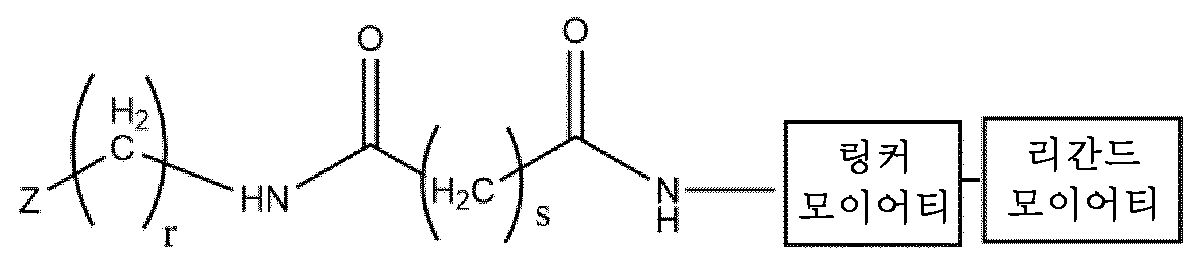
여기서:Here:
r 및 s는 독립적으로 1 내지 16으로부터 선택된 정수이고;r and s are independently integers selected from 1 to 16;
Z는 올리고뉴클레오시드이다.Z is an oligonucleoside.
하기 구조를 포함하는 본 발명에 따른 핵산:A nucleic acid according to the present invention comprising the following structure:
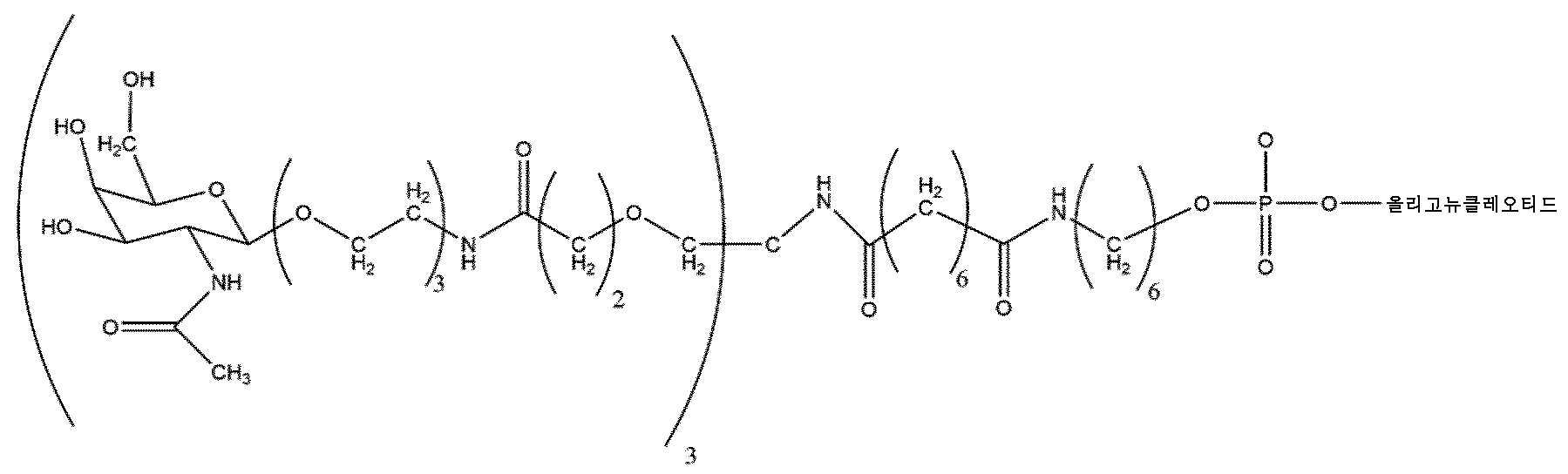
여기서 [올리고뉴클레오티드]는 제2 가닥의 인접 뉴클레오시드를 나타낸다.Here, [oligonucleotide] represents the adjacent nucleoside of the second strand.
본 발명은 본원에 기재된 바와 같은 핵산을 제약상 허용되는 부형제 또는 담체와 조합하여 포함하는 제약 조성물을 추가로 제공한다.The present invention further provides a pharmaceutical composition comprising a nucleic acid as described herein in combination with a pharmaceutically acceptable excipient or carrier.
본 발명은 요법에 사용하기 위한 본원에 기재된 바와 같은 핵산 또는 제약 조성물을 추가로 제공한다.The present invention further provides a nucleic acid or pharmaceutical composition as described herein for use in therapy.
본 발명은 지혈 장애와 관련된 질환, 예컨대 지혈 장애와 관련된 질환, 예컨대 혈우병의 예방 또는 치료에 사용하기 위한 본원에 기재된 바와 같은 핵산 또는 제약 조성물을 추가로 제공한다.The present invention further provides a nucleic acid or pharmaceutical composition as described herein for use in the prevention or treatment of a disease associated with a hemostatic disorder, such as a disease associated with a hemostatic disorder, such as hemophilia.
본 발명은 추가로 심혈관 질환의 예방 또는 치료에 사용하기 위한 본원에 기재된 바와 같은 핵산 또는 제약 조성물을 제공한다.The present invention further provides a nucleic acid or pharmaceutical composition as described herein for use in the prevention or treatment of cardiovascular disease.
본 발명은 당뇨병의 예방 또는 치료에 사용하기 위한 본원에 기재된 바와 같은 핵산 또는 제약 조성물을 추가로 제공한다.The present invention further provides a nucleic acid or pharmaceutical composition as described herein for use in the prevention or treatment of diabetes.
도 1: 테더 1a를 포함한 본 발명에 따라 사용하기에 적합한 구축물의 링커 및 리간드 부분. 도 1은 올리고뉴클레오티드에 접합될 링커를 도시하지만, 본 발명은 또한 본원에 개시된 바와 같은 올리고뉴클레오시드와 동일한 링커의 접합체를 포함하는 것으로 이해되어야 한다.
또한, 도 1이 또한 본원에 도시된 바와 같은 올리고뉴클레오시드 모이어티에 부착된 도 1에 구체적으로 도시된 바와 같은 링커 및 리간드 부분을 기반으로 하는 생성물 분자로서 도시하지만, 이 생성물은 대안적으로 링커 및 리간드 부분이 올리고뉴클레오시드 모이어티에 부착된 도 1에 본질적으로 도시된 바와 같지만 도 1에 도시된 바와 같은 시클로-옥틸 고리 상의 F 치환기가 가수분해성 치환의 결과로서 발생하는 치환기, 예컨대 OH 치환기에 의해 대체된 분자를 추가로 포함하거나 또는 그로 본질적으로 이루어질 수 있는 것으로 이해되어야 한다. 이러한 방식으로, (a) 테더 1a 구축물은 시클로-옥틸 고리 상에 F 치환기를 갖는, 구체적으로 도 1에 도시된 바와 같은 링커 및 리간드 부분을 갖는 분자로 본질적으로 이루어질 수 있거나; 또는 (b) 테더 1a 구축물은 본질적으로 도 1에 도시된 바와 같은 링커 및 리간드 부분을 갖지만 도 1에 도시된 바와 같은 시클로-옥틸 고리 상의 F 치환기가 가수분해성 치환의 결과로서 발생하는 치환기, 예컨대 OH 치환기에 의해 대체된 분자로 본질적으로 이루어질 수 있거나, 또는 (c) 테더 1a 구축물은 (a) 및/또는 (b)에 정의된 바와 같은 분자의 혼합물을 포함할 수 있다.
도 2: 테더 1b를 포함한 본 발명에 따라 사용하기에 적합한 구축물의 링커 및 리간드 부분. 도 2는 올리고뉴클레오티드에 접합될 링커를 도시하지만, 본 발명은 또한 본원에 개시된 바와 같은 올리고뉴클레오시드와 동일한 링커의 접합체를 포함하는 것으로 이해되어야 한다.
도 1과 관련하여 기재된 언급 및 가수분해성 치환의 결과로서 발생하는 치환기, 예컨대 OH 치환기에 의해 대체된 도 1에 도시된 바와 같은 시클로-옥틸 고리 상의 F 치환기의 가능한 대체는 테더 1b 구축물에 동등하게 적용된다. 이러한 방식으로, (a) 테더 1b 구축물은 시클로-옥틸 고리 상에 F 치환기를 갖는, 구체적으로 도 2에 도시된 바와 같은 링커 및 리간드 부분을 갖는 분자로 본질적으로 이루어질 수 있거나; 또는 (b) 테더 1b 구축물은 본질적으로 도 2에 도시된 바와 같은 링커 및 리간드 부분을 갖지만 도 2에 도시된 바와 같은 시클로-옥틸 고리 상의 F 치환기가 가수분해성 치환의 결과로서 발생하는 치환기, 예컨대 OH 치환기에 의해 대체된 분자로 본질적으로 이루어질 수 있거나, 또는 (c) 테더 1b 구축물은 (a) 및/또는 (b)에 정의된 바와 같은 분자의 혼합물을 포함할 수 있다.
도 3: 테더 2a를 포함한 본 발명에 따라 사용하기에 적합한 구축물의 링커 및 리간드 부분. 도 3은 올리고뉴클레오티드에 접합될 링커를 도시하지만, 본 발명은 또한 본원에 개시된 바와 같은 올리고뉴클레오시드와 동일한 링커의 접합체를 포함하는 것으로 이해되어야 한다.
도 4: 테더 2b를 포함한 본 발명에 따라 사용하기에 적합한 구축물의 링커 및 리간드 부분. 도 4는 올리고뉴클레오티드에 접합될 링커를 도시하지만, 본 발명은 또한 본원에 개시된 바와 같은 올리고뉴클레오시드와 동일한 링커의 접합체를 포함하는 것으로 이해되어야 한다.
도 5: 본원에 개시된 문장 1-101에 기재된 화학식.
도 6: 본원에 개시된 조항 1-56에 기재된 화학식.
도 7a 및 7b: 본원에 기재된 바와 같은 본 발명에 따른 핵산 서열과 함께 사용될 수 있는 역전된 무염기성 구축물. 도 7a의 경우, galnac 링커는 사용 시 센스 가닥의 5' 단부 영역에 부착된다 (도 7a에 도시되지 않음). 도 7b의 경우, galnac 링커는 사용 시 센스 가닥의 3' 단부 영역에 부착된다 (도 7b에 도시되지 않음).
도 7a에서 센스 가닥의 3' 단부 영역에 도시된 바와 같은 iaia는 (i) 센스 가닥의 3' 단부 영역에서 끝에서 두 번째 및 말단 뉴클레오시드로서 제공되는 2개의 무염기성 뉴클레오시드를 나타내고, (ii) 여기서 3'-3' 역 연결은 끝에서 세 번째 뉴클레오시드 (즉, 센스 가닥의 위치 21에서, 여기서 위치 1은 센스 가닥의 말단 5' 뉴클레오시드임)와 인접한 센스 가닥의 끝에서 두 번째 무염기성 잔기 사이에 제공되고, (iii) 말단과 끝에서 두 번째 무염기성 뉴클레오시드 사이의 연결은 말단 및 끝에서 두 번째 무염기성 뉴클레오시드를 포함하는 3' 단부 영역을 향해 판독할 때 5'-3'이다.
도 7b에서 센스 가닥의 5' 단부 영역에 도시된 바와 같은 iaia는 (i) 센스 가닥의 5' 단부 영역에서 끝에서 두 번째 및 말단 뉴클레오시드로서 제공되는 2개의 무염기성 뉴클레오시드를 나타내고, (ii) 여기서 5'-5' 역 연결은 끝에서 세 번째 뉴클레오시드 (즉, 센스 가닥 상의 뉴클레오시드 위치 넘버링에서 센스 가닥의 5' 단부 영역의 iaia 모티프를 포함하지 않는, 센스 가닥의 위치 1에서)와 인접한 센스 가닥의 끝에서 두 번째 무염기성 잔기 사이에 제공되고, (iii) 말단과 끝에서 두 번째 무염기성 뉴클레오시드 사이의 연결은 말단 및 끝에서 두 번째 무염기성 뉴클레오시드를 포함하는 5' 단부 영역을 향해 판독할 때 3'-5'이다.
도 8 (8a 및 8b): 표 5에 따른 듀플렉스 구축물.
도 9 (9a 및 9b): 인간 Huh7 세포에서의 HCII 또는 ZPI mRNA 발현의 억제에 대한 용량-반응 실험의 결과. 점은 x-축 상에 나타낸 농도의 siRNA 구축물로 처리한 후 비처리 웰과 비교한 HCII 또는 ZPI mRNA의 평균 상대 발현을 나타낸다. 오차 막대는 평균의 표준 편차를 나타낸다. 점선 곡선은 95% 신뢰 구간을 나타낸다. 점선 및 음영 영역은 동일한 플레이트 상의 비처리 웰로부터의 평균 상대 발현 +/- 표준 편차를 나타낸다.
도 10: ETXM1184 (ETXS1036 & ETXS1035) 및 ETXM1199 (ETXS2398 & ETXS2397)에 의한 ZPI 발현의 억제.
도 11: ETXM1200 (ETXS2400 & ETXS2399) 및 ETXM1201 (ETXS2402 & ETXS2401)에 의한 B4GALT1 발현의 억제.
도 12: ETXM1203 (ETXS2406 & ETXS2405) 및 ETXM1204 (ETXS2408 & ETXS2407)에 의한 B4GALT1 발현의 억제.
도 13: 관절 보호: 여러 종점 문서 용량-반응성 효과. ETXM1184의 예방적 투여는 손상 후 10일에 주요 조직 판독에서 용량-의존성 보호를 나타낸다. ETXM1184는 임상 비교인자와 동일한 범위의 효능을 나타낸다: 응급 치료를 위한 황금-표준으로서 FVIII 대체 요법 (애드베이트(Advate)) 및 후기 임상 개발에서 우수한 출혈 보호를 입증한 예방을 위한 siRNA-기반 재균형화제 (피투시란(fitusiran)). * 척도: 0 = 정상; 1 = 최소; 2 = 중등도; 3 = 현저함; 4 = 중증. [1] Glasson et al., Osteoarthritis Cartilage. 2010 Oct;18 Suppl 3:S17-23. doi: 10.1016/j.joca.2010.05.025. PMID: 20864019.
도 14: 복합 혈관절증 조직병리학 점수 정량: 건염, 건 변성, 건활막염, 골막염, 골용해, 파골세포 골 흡수, 출혈, 혈종, 헤모시데린 침착, 연골세포 괴사, 연골 OARSI 등급, 연골하골 경화증 및 골수 증식증. ETX-148은 유의한 용량-반응성 효과를 나타낸다 (복합 점수에 피팅된 베이지안 선형 모델). 대조군과 비교한 복합 점수의 중앙값 감소: ETXM1184 10 mg/kg 군에 대해 -1.25 (유의성 수준은 p<0.01과 동등함); ETXM1184 3 mg/kg 군에 대해 -0.91 (유의성 수준은 p<0.05와 동등함). 비교인자 피투시란은 3 mg/kg 군에 대해 -1.04의 중앙값 감소를 나타낸다 (유의성 수준은 p<0.05와 동등함).
도 15: ETXM1184의 예방적 투여는 A형 혈우병 마우스에서 관절 병리상태를 개선시킨다. 3 mg/kg ETXM1184의 투여는 개선된 혈관절증 무릎 관절 병리상태, 감소된 염증을 유발하였으며, 보다 작은 출혈 면적을 유발하였다.
도 16: ETXM1184의 예방적 투여는 A형 혈우병 마우스에서 손상후 출혈을 감소시킨다 (생존 중 시각적 출혈 점수 (VBS)). siRNA 투여 8일 후에 A형 혈우병 마우스의 무릎 관절에 출혈 사건을 도입하였다. 손상 후 10일 동안 출혈을 모니터링하고, 최종 조직학적 분석을 수행하였다. 단일 10 mg/kg 용량의 ETXM1184의 예방적 투여는 손상 후 10일까지 인자 VIII 대체물 (애드베이트)과 대등하게 시각적 출혈 점수 (VBS)를 효과적으로 감소시켰다.
도 17: ETXM1184의 예방적 투여는 A형 혈우병 마우스의 무릎 관절로의 손상 후 출혈을 감소시킨다 (손상되지 않은 무릎 직경과 비교하여 손상된 무릎 직경의 생존 중 측정). siRNA 투여 8일 후에 A형 혈우병 마우스의 무릎 관절에 출혈 사건을 도입하였다. 손상 후 10일 동안 출혈을 모니터링하고, 최종 조직학적 분석을 수행하였다. 단일 10 mg/kg 용량으로서 투여된 예방적 ETXM1184는 손상 후 10일까지 인자 VIII 대체물 (애드베이트)과 대등하게 무릎 관절에서 혈액 축적을 효과적으로 감소시켰다.
도 18: ETXM1184의 예방적 투여는 A형 혈우병 마우스 모델에서 혈관절증을 감소시킨다 (siRNA 투여 후 18일 및 손상 후 10일에 취한 최종 측정). 단일 10 mg/kg 용량으로서 투여된 예방적 ETXM1184는 손상 후 10일까지 인자 VIII 대체물 (애드베이트)과 대등하게 관절 출혈 및 혈우병성 관절병증의 특징을 효과적으로 감소시켰다.Figure 1: Linker and ligand portions of a construct suitable for use according to the present invention including Tether 1a. While Figure 1 depicts a linker to be conjugated to an oligonucleotide, it should be understood that the present invention also encompasses conjugates of the same linker to an oligonucleoside as disclosed herein.
Furthermore, while FIG. 1 depicts a product molecule based on a linker and ligand moiety as specifically depicted in FIG. 1 attached to an oligonucleoside moiety as also depicted herein, it should be understood that the product may alternatively further comprise or consist essentially of a molecule essentially as depicted in FIG. 1 wherein the linker and ligand moiety are attached to an oligonucleoside moiety, but wherein the F substituent on the cyclo-octyl ring as depicted in FIG. 1 is replaced by a substituent resulting from hydrolytic substitution, such as an OH substituent. In this manner, (a) the tether 1a construct may consist essentially of a molecule having a linker and ligand moiety as specifically depicted in FIG. 1 having a F substituent on the cyclo-octyl ring; Or (b) the tether 1a construct may consist essentially of a molecule having the linker and ligand moieties as depicted in Figure 1, but wherein the F substituent on the cyclo-octyl ring as depicted in Figure 1 is replaced by a substituent resulting from hydrolytic substitution, such as an OH substituent, or (c) the tether 1a construct may comprise a mixture of molecules as defined in (a) and/or (b).
Figure 2: Linker and ligand portions of a construct suitable for use according to the present invention including Tether 1b. While Figure 2 depicts a linker to be conjugated to an oligonucleotide, it should be understood that the present invention also encompasses conjugates of the same linker to an oligonucleoside as disclosed herein.
The possible replacement of the F substituent on the cyclo-octyl ring as depicted in FIG. 1 by a substituent which occurs as a result of hydrolyzable substitution, such as an OH substituent, as described in connection with FIG. 1 , equally applies to the tether 1b construct. In this manner, (a) the tether 1b construct may consist essentially of a molecule having a F substituent on the cyclo-octyl ring, specifically a linker and a ligand moiety as depicted in FIG. 2 ; or (b) the tether 1b construct may consist essentially of a molecule having a linker and a ligand moiety as depicted in FIG. 2 but wherein the F substituent on the cyclo-octyl ring as depicted in FIG. 2 is replaced by a substituent which occurs as a result of hydrolyzable substitution, such as an OH substituent, or (c) the tether 1b construct may comprise a mixture of molecules as defined in (a) and/or (b).
Figure 3: Linker and ligand portions of a construct suitable for use according to the present invention including Tether 2a. While Figure 3 depicts a linker to be conjugated to an oligonucleotide, it should be understood that the present invention also encompasses conjugates of the same linker to an oligonucleoside as disclosed herein.
Figure 4: Linker and ligand portions of a construct suitable for use according to the present invention including Tether 2b. While Figure 4 depicts a linker to be conjugated to an oligonucleotide, it should be understood that the present invention also encompasses conjugates of the same linker to an oligonucleoside as disclosed herein.
Figure 5: Chemical formula described in sentence 1-101 disclosed herein.
FIG. 6: Chemical formula described in clause 1-56 disclosed herein.
Figures 7a and 7b: Inverted abasic constructs that can be used with the nucleic acid sequences according to the present invention as described herein. For Figure 7a, the galnac linker is attached to the 5' end region of the sense strand when used (not shown in Figure 7a). For Figure 7b, the galnac linker is attached to the 3' end region of the sense strand when used (not shown in Figure 7b).
As depicted in the 3' end region of the sense strand in FIG. 7a, iaia represents (i) two abasic nucleosides provided as the penultimate and terminal nucleosides in the 3' end region of the sense strand, (ii) wherein a 3'-3' reverse linkage is provided between the third nucleoside from the end (i.e., at position 21 of the sense strand, wherein
As depicted in the 5' end region of the sense strand in FIG. 7b, iaia represents (i) two abasic nucleosides provided as the penultimate and terminal nucleosides in the 5' end region of the sense strand, (ii) wherein a 5'-5' reverse linkage is provided between the third nucleoside from the end (i.e., at
FIG. 8 (8a and 8b): Duplex construction according to Table 5.
Figure 9 (9a and 9b): Results of dose-response experiments for inhibition of HCII or ZPI mRNA expression in human Huh7 cells. Dots represent the mean relative expression of HCII or ZPI mRNA compared to untreated wells after treatment with siRNA constructs at the concentrations indicated on the x-axis. Error bars represent the standard deviation of the mean. Dashed curves represent 95% confidence intervals. Dashed lines and shaded areas represent the mean relative expression +/- the standard deviation from untreated wells on the same plate.
Figure 10: Inhibition of ZPI expression by ETXM1184 (ETXS1036 & ETXS1035) and ETXM1199 (ETXS2398 & ETXS2397).
Figure 11: Inhibition of B4GALT1 expression by ETXM1200 (ETXS2400 & ETXS2399) and ETXM1201 (ETXS2402 & ETXS2401).
Figure 12: Inhibition of B4GALT1 expression by ETXM1203 (ETXS2406 & ETXS2405) and ETXM1204 (ETXS2408 & ETXS2407).
Figure 13: Joint protection: multi-endpoint documented dose-responsive effects. Prophylactic administration of ETXM1184 demonstrated dose-dependent protection in key tissue endpoints at 10 days post-injury. ETXM1184 demonstrated efficacy in the same range as clinical comparators: FVIII replacement therapy (Advate) as the gold standard for emergency treatment and siRNA-based rebalancing agents for prophylaxis (fitusiran) that have demonstrated superior bleeding protection in late-stage clinical development. *Scale: 0 = normal; 1 = minimal; 2 = moderate; 3 = marked; 4 = severe. [1] Glasson et al., Osteoarthritis Cartilage. 2010 Oct;18 Suppl 3:S17-23. doi: 10.1016/j.joca.2010.05.025. PMID: 20864019.
Figure 14: Quantitative composite hemangioma histopathology score: tendinitis, tendon degeneration, tenosynovitis, periostitis, osteolysis, osteoclastic bone resorption, hemorrhage, hematoma, hemosiderin deposition, chondrocyte necrosis, cartilage OARSI grade, subchondral bone sclerosis, and myeloproliferation. ETX-148 exhibits a significant dose-response effect (Bayesian linear model fitted to the composite score). Median reduction in composite score compared to control: -1.25 for ETXM1184 10 mg/kg group (significance level equivalent to p<0.01); -0.91 for
Figure 15: Prophylactic administration of ETXM1184 improves joint pathology in hemophilia A mice. Administration of 3 mg/kg ETXM1184 resulted in improved hemarthrosis knee joint pathology, reduced inflammation, and smaller hemorrhage areas.
Figure 16: Prophylactic administration of ETXM1184 reduces post-injury bleeding (visual bleeding score (VBS) during survival) in hemophilia A mice. Bleeding events were introduced into the knee joints of
Figure 17: Prophylactic administration of ETXM1184 reduces bleeding after injury to the knee joint of hemophilia A mice (measured during survival as injured knee diameter compared to uninjured knee diameter). Bleeding events were introduced into the knee joints of
Figure 18: Prophylactic administration of ETXM1184 reduces hemarthrosis in a mouse model of hemophilia A (final measurements taken 18 days post-siRNA administration and 10 days post-injury). Prophylactic ETXM1184 administered as a single 10 mg/kg dose effectively reduced joint bleeding and other hallmarks of hemophilic arthropathy comparable to factor VIII replacement (Advate) up to 10 days post-injury.
정의definition
본원에서 안티센스 가닥 또는 가이드 가닥으로도 불리고 본원에서 상호교환가능하게 사용될 수 있는 "제1 가닥"은 표적 서열, 예를 들어 mRNA에 실질적으로 상보적인 영역을 포함하는 핵산 가닥, 예를 들어 siRNA, 예를 들어 dsiRNA의 가닥을 지칭한다. 본원에 사용된 용어 "상보성 영역"은 서열, 예를 들어 표적 서열에 실질적으로 상보적인 안티센스 가닥 상의 영역을 지칭한다. 상보성 영역이 표적 서열에 완전히 상보적이지 않은 경우, 미스매치가 전형적으로 분자의 내부 또는 말단 영역에 존재할 수 있다. 일부 실시양태에서, 본 발명의 이중 가닥 핵산, 예를 들어 siRNA 작용제는 안티센스 가닥 내에 뉴클레오시드 미스매치를 포함한다.The "first strand," also referred to herein as the antisense strand or the guide strand and used interchangeably herein, refers to a nucleic acid strand, e.g., a strand of an siRNA, e.g., a dsiRNA, that comprises a region that is substantially complementary to a target sequence, e.g., an mRNA. The term "region of complementarity," as used herein, refers to a region on the antisense strand that is substantially complementary to a sequence, e.g., a target sequence. If the region of complementarity is not completely complementary to the target sequence, the mismatch can typically be present in an internal or terminal region of the molecule. In some embodiments, a double-stranded nucleic acid, e.g., an siRNA agent, of the invention comprises a nucleoside mismatch within the antisense strand.
"제2 가닥" (본원에서 센스 가닥 또는 패신저 가닥으로도 불리고, 본원에서 상호교환가능하게 사용될 수 있음)은 안티센스 가닥 (이 용어는 본원에서 정의된 바와 같음)의 영역에 실질적으로 상보적인 영역을 포함하는 핵산, 예를 들어 siRNA의 가닥을 지칭한다.The “second strand” (also referred to herein as the sense strand or passenger strand, which may be used interchangeably herein) refers to a strand of a nucleic acid, e.g., a siRNA, that includes a region that is substantially complementary to a region of the antisense strand (as that term is defined herein).
리간드 모이어티, 임의로 또한 링커 모이어티가 제공된 핵산을 포함하는 분자의 맥락에서, 본 발명의 핵산은 올리고뉴클레오시드 또는 올리고뉴클레오시드 모이어티로 지칭될 수 있다.In the context of a molecule comprising a nucleic acid provided with a ligand moiety, optionally also a linker moiety, the nucleic acid of the invention may be referred to as an oligonucleoside or oligonucleoside moiety.
올리고뉴클레오티드는 짧은 핵산 중합체이다. 올리고뉴클레오티드는 그의 뉴클레오시드 성분 (염기 + 당) 사이에 포스포디에스테르 결합을 함유하지만, 본 발명은 항상 인접한 뉴클레오시드 사이의 이러한 포스포디에스테르 결합에 의해 연결된 올리고뉴클레오티드로 제한되지 않고, 포스포디에스테르 결합 이외의 결합인 결합에 의해 연결된 뉴클레오시드의 다른 올리고머가 고려된다. 예를 들어, 뉴클레오시드 사이의 결합은 포스포로티오에이트 결합일 수 있다. 따라서, 본원에 사용된 용어 "올리고뉴클레오시드"는 올리고뉴클레오티드 및 뉴클레오시드의 다른 올리고머 둘 다를 포괄한다. 올리고뉴클레오티드의 적어도 한 부분을 갖는 핵산인 올리고뉴클레오시드가 본 발명에 따라 바람직하다. 뉴클레오시드들 사이에 1개 이상 또는 대다수의 포스포디에스테르 백본 결합을 갖는 올리고뉴클레오시드가 또한 본 발명에 따라 바람직하다. 뉴클레오시드들 사이에 1개 이상 또는 대다수의 포스포디에스테르 백본 결합을 갖고, 또한 뉴클레오시드들 사이에 (전형적으로 제1 및/또는 제2 가닥의 말단 영역에서) 1개 이상의 포스포로티오에이트 백본 결합을 갖는 올리고뉴클레오시드가 또한 본 발명에 따라 바람직하다.Oligonucleotides are short nucleic acid polymers. Oligonucleotides contain phosphodiester bonds between their nucleoside components (base + sugar), but the present invention is not always limited to oligonucleotides linked by such phosphodiester bonds between adjacent nucleosides, but other oligomers of nucleosides linked by bonds other than phosphodiester bonds are contemplated. For example, the bond between the nucleosides may be a phosphorothioate bond. Therefore, the term "oligonucleoside" as used herein encompasses both oligonucleotides and other oligomers of nucleosides. Oligonucleosides which are nucleic acids having at least one portion of an oligonucleotide are preferred according to the present invention. Oligonucleosides having one or more or a majority of phosphodiester backbone bonds between the nucleosides are also preferred according to the present invention. Also preferred according to the present invention are oligonucleosides having one or more or a majority of phosphodiester backbone linkages between the nucleosides and also having one or more phosphorothioate backbone linkages between the nucleosides (typically in the terminal regions of the first and/or second strand).
본 발명에 따른 핵산이 뉴클레오시드 사이에 1개 이상의 포스포로티오에이트 백본 결합을 포함하는 이중 가닥 올리고뉴클레오시드인 것이 본원에서 바람직하다. 따라서, 본 출원이 올리고뉴클레오티드를 지칭하는 모든 경우, 특히 본원에 개시된 화학 구조에서, 올리고뉴클레오티드는 동등하게 본원에 정의된 바와 같은 올리고뉴클레오시드일 수 있다.It is preferred herein that the nucleic acid according to the present invention is a double-stranded oligonucleoside comprising at least one phosphorothioate backbone linkage between the nucleosides. Accordingly, in all instances where the present application refers to an oligonucleotide, particularly in the chemical structures disclosed herein, the oligonucleotide may equivalently be an oligonucleoside as defined herein.
일부 실시양태에서, 본 발명의 이중 가닥 핵산, 예를 들어 siRNA 작용제는 센스 가닥 내에 뉴클레오시드 미스매치를 포함한다. 일부 실시양태에서, 뉴클레오시드 미스매치는 예를 들어 핵산, 예를 들어 siRNA의 3'-단부로부터 5, 4, 3, 2 또는 1개의 뉴클레오시드 내에 있다.In some embodiments, the double-stranded nucleic acid of the invention, e.g., siRNA agent, comprises a nucleoside mismatch within the sense strand. In some embodiments, the nucleoside mismatch is within 5, 4, 3, 2, or 1 nucleoside from the 3'-end of the nucleic acid, e.g., siRNA.
또 다른 실시양태에서, 뉴클레오시드 미스매치는, 예를 들어 핵산, 예를 들어 siRNA의 3'-말단 뉴클레오시드에 존재한다.In another embodiment, the nucleoside mismatch is present, for example, at the 3'-terminal nucleoside of the nucleic acid, for example, the siRNA.
"표적 서열" (표적 RNA 또는 표적 mRNA로도 불릴 수 있음)은 1차 전사 생성물의 RNA 프로세싱의 생성물인 mRNA를 비롯한, 유전자의 전사 동안 형성된 mRNA 분자의 뉴클레오시드 서열의 인접 부분을 지칭한다.A "target sequence" (which may also be called target RNA or target mRNA) refers to a contiguous portion of the nucleoside sequence of an mRNA molecule formed during transcription of a gene, including mRNA, which is a product of RNA processing of the primary transcript.
표적 서열은 약 10-35개 뉴클레오시드 길이, 예를 들어 약 15-30개 뉴클레오시드 길이일 수 있다. 예를 들어, 표적 서열은 약 15-30개 뉴클레오시드, 15-29, 15-28, 15-27, 15-26, 15-25, 15-24, 15-23, 15-22, 15-21, 15-20, 15-19, 15-18, 15-17, 18-30, 18-29, 18-28, 18-27, 18-26, 18-25, 18-24, 18-23, 18-22, 18-21, 18-20, 19-30, 19-29, 19-28, 19-27, 19-26, 19-25, 19-24, 19-23, 19-22, 19-21, 19-20, 20-30, 20-29, 20-28, 20-27, 20-26, 20-25, 20-24, 20-23, 20-22, 20-21, 21-30, 21-29, 21-28, 21-27, 21-26, 21-25, 21-24, 21-23, 또는 21-22개 뉴클레오시드 길이일 수 있다. 상기 언급된 범위 및 길이의 중간인 범위 및 길이가 또한 본 발명의 일부인 것으로 고려된다.The target sequence can be about 10-35 nucleosides long, for example about 15-30 nucleosides long. For example, the target sequence may be about 15-30 nucleosides, 15-29, 15-28, 15-27, 15-26, 15-25, 15-24, 15-23, 15-22, 15-21, 15-20, 15-19, 15-18, 15-17, 18-30, 18-29, 18-28, 18-27, 18-26, 18-25, 18-24, 18-23, 18-22, 18-21, 18-20, 19-30, 19-29, 19-28, 19-27, 19-26, 19-25, 19-24, 19-23, 19-22, 19-21, 19-20, 20-30, 20-29, 20-28, 20-27, 20-26, 20-25, 20-24, 20-23, 20-22, 20-21, 21-30, 21-29, 21-28, 21-27, 21-26, 21-25, 21-24, 21-23, or 21-22 nucleosides in length. Ranges and lengths intermediate the above recited ranges and lengths are also contemplated to be part of the present invention.
용어 "리보뉴클레오시드" 또는 "뉴클레오시드"는 또한 하기에 추가로 상술된 바와 같은 변형된 뉴클레오시드를 지칭할 수 있다.The term "ribonucleoside" or "nucleoside" may also refer to a modified nucleoside as further described below.
핵산은 DNA 또는 RNA일 수 있고, 변형된 뉴클레오시드를 포함할 수 있다. RNA가 바람직한 핵산이다.The nucleic acid may be DNA or RNA, and may include modified nucleosides. RNA is the preferred nucleic acid.
본원에서 상호교환가능하게 사용되는 용어 "iRNA", "siRNA", "RNAi 작용제" 및 "iRNA 작용제", "RNA 간섭 작용제"는 RNA를 함유하고, RNA-유도된 침묵 복합체 (RISC) 경로를 통해 RNA 전사체의 표적화된 절단을 매개하는 작용제를 지칭한다. siRNA는 RNA 간섭 (RNAi)을 통해 mRNA의 서열-특이적 분해를 지시한다.The terms "iRNA", "siRNA", "RNAi agent" and "iRNA agent", "RNA interference agent", as used interchangeably herein, refer to agents that contain RNA and mediate targeted cleavage of RNA transcripts via the RNA-induced silencing complex (RISC) pathway. siRNA directs sequence-specific degradation of mRNA via RNA interference (RNAi).
이중 가닥 RNA는 본원에서 "이중 가닥 siRNA (dsiRNA) 작용제", "이중 가닥 siRNA (dsiRNA) 분자", "이중 가닥 RNA (dsRNA) 작용제", "이중 가닥 RNA (dsRNA) 분자", "dsiRNA 작용제", "dsiRNA 분자" 또는 "dsiRNA"로 지칭되며, 이는 표적 RNA에 대해 "센스" 및 "안티센스" 배향을 갖는 것으로 지칭되는, 2개의 역평행 및 실질적으로 상보적인 핵산 가닥을 포함하는 듀플렉스 구조를 갖는 리보핵산 분자의 복합체를 지칭한다.Double-stranded RNA, referred to herein as a "double-stranded siRNA (dsiRNA) agent", "double-stranded siRNA (dsiRNA) molecule", "double-stranded RNA (dsRNA) agent", "double-stranded RNA (dsRNA) molecule", "dsiRNA agent", "dsiRNA molecule" or "dsiRNA", refers to a complex of ribonucleic acid molecules having a duplex structure comprising two antiparallel and substantially complementary nucleic acid strands, said to have "sense" and "antisense" orientations with respect to a target RNA.
핵산, 예를 들어 dsiRNA 분자의 각각의 가닥의 대다수의 뉴클레오시드는 바람직하게는 리보뉴클레오시드이지만, 이러한 경우에 각각의 가닥 또는 가닥 둘 다는 또한 1개 이상의 비-리보뉴클레오시드, 예를 들어 데옥시리보뉴클레오시드 또는 변형된 뉴클레오시드를 포함할 수 있다. 또한, 본 명세서에 사용된 "siRNA"는 화학적 변형을 갖는 리보뉴클레오시드를 포함할 수 있다.The majority of the nucleosides of each strand of a nucleic acid, e.g., a dsiRNA molecule, are preferably ribonucleosides, although in such cases each strand or both strands may also include one or more non-ribonucleosides, e.g., deoxyribonucleosides or modified nucleosides. Furthermore, "siRNA" as used herein may include ribonucleosides having chemical modifications.
용어 "변형된 뉴클레오시드"는 독립적으로 변형된 당 모이어티, 변형된 뉴클레오시드간 연결, 또는 변형된 핵염기, 또는 그의 임의의 조합을 갖는 뉴클레오시드를 지칭한다. 따라서, 용어 변형된 뉴클레오시드는 뉴클레오시드간 연결, 당 모이어티 또는 핵염기에 대한, 예를 들어 관능기 또는 원자의 치환, 부가 또는 제거를 포괄한다. siRNA 유형 분자에서 사용된 바와 같은 임의의 이같은 변형은 본 명세서 및 특허청구범위의 목적을 위해 "iRNA" 또는 "RNAi 작용제" 또는 "siRNA" 또는 "siRNA 작용제"에 포함된다.The term "modified nucleoside" refers to a nucleoside having, independently, a modified sugar moiety, a modified internucleoside linkage, or a modified nucleobase, or any combination thereof. Thus, the term modified nucleoside encompasses substitution, addition, or removal of, for example, a functional group or atom, to the internucleoside linkage, the sugar moiety, or the nucleobase. Any such modifications, as used in siRNA type molecules, are encompassed by the term "iRNA" or "RNAi agent" or "siRNA" or "siRNA agent" for the purposes of this specification and claims.
듀플렉스 구조를 형성하는 2개의 가닥은 1개의 보다 큰 분자의 상이한 부분일 수 있거나, 또는 이들은 별개의 분자, 예를 들어 RNA 분자일 수 있다.The two strands forming the duplex structure may be different parts of one larger molecule, or they may be separate molecules, for example, RNA molecules.
용어 "뉴클레오시드 오버행"은 본 발명에 따른 핵산의 듀플렉스 구조로부터 연장된 적어도 1개의 쌍형성되지 않은 뉴클레오시드를 지칭한다. 본 발명에 따른 핵산은 적어도 1개의 뉴클레오시드의 오버행을 포함할 수 있고; 대안적으로 오버행은 적어도 2개의 뉴클레오시드, 적어도 3개의 뉴클레오시드, 적어도 4개의 뉴클레오시드, 적어도 5개의 뉴클레오시드 또는 그 초과를 포함할 수 있다. 뉴클레오시드 오버행은 데옥시뉴클레오시드를 포함한 뉴클레오시드/뉴클레오시드 유사체를 포함하거나 또는 그로 이루어질 수 있다. 오버행(들)은 센스 가닥, 안티센스 가닥, 또는 그의 임의의 조합일 수 있다. 게다가, 오버행의 뉴클레오시드(들)는 안티센스 또는 센스 가닥의 5'-단부, 3'-단부, 또는 양쪽 단부 상에 존재할 수 있다.The term "nucleoside overhang" refers to at least one unpaired nucleoside extending from the duplex structure of a nucleic acid according to the present invention. A nucleic acid according to the present invention may comprise an overhang of at least one nucleoside; alternatively, the overhang may comprise at least two nucleosides, at least three nucleosides, at least four nucleosides, at least five nucleosides or more. The nucleoside overhang may comprise or consist of a nucleoside/nucleoside analogue, including a deoxynucleoside. The overhang(s) may be on the sense strand, the antisense strand, or any combination thereof. Furthermore, the nucleoside(s) of the overhang may be on the 5'-end, the 3'-end, or both ends of the antisense or sense strand.
특정 실시양태에서, 안티센스 가닥은 3'-단부 또는 5'-단부에 1-10개의 뉴클레오시드, 예를 들어 0-3, 1-3, 2-4, 2-5, 4-10, 5-10, 1, 2, 3, 4, 5, 6, 7, 8, 9, 또는 10개의 뉴클레오시드 오버행을 갖는다.In certain embodiments, the antisense strand has an overhang of 1 to 10 nucleosides at the 3'-end or the 5'-end, for example, 0-3, 1-3, 2-4, 2-5, 4-10, 5-10, 1, 2, 3, 4, 5, 6, 7, 8, 9, or 10 nucleoside.
"평활" 또는 "평활 말단"은 이중 가닥 핵산의 그 단부에 쌍형성되지 않은 뉴클레오시드가 없는 것, 즉 뉴클레오시드 오버행이 없는 것을 의미한다. 본 발명의 핵산은 하나의 단부에 뉴클레오시드 오버행이 없거나 또는 두 단부 중 어느 것에도 뉴클레오시드 오버행이 없는 것을 포함한다."Blunt" or "blunt end" means that at that end of a double-stranded nucleic acid there are no unpaired nucleosides, i.e., no nucleoside overhangs. The nucleic acids of the present invention include those that have no nucleoside overhangs at one end or at neither end.
달리 나타내지 않는 한, 용어 "상보적"은, 제2 뉴클레오시드 서열과 관련하여 제1 뉴클레오시드 서열을 기재하는 데 사용되는 경우, 관련 기술분야의 통상의 기술자에 의해 이해되는 바와 같이, 제1 뉴클레오시드 서열을 포함하는 올리고뉴클레오시드가 특정 조건 하에 제2 뉴클레오시드 서열을 포함하는 올리고뉴클레오시드와 혼성화하여 듀플렉스 구조를 형성하는 능력을 지칭한다. 이러한 조건은, 예를 들어 엄격한 조건일 수 있으며, 여기서 엄격한 조건은 400 mM NaCl, 40 mM PIPES pH 6.4, 1 mM EDTA, 12-16시간 동안 50℃ 또는 70℃, 이어서 세척을 포함할 수 있다 (예를 들어, 문헌 ["Molecular Cloning: A Laboratory Manual, Sambrook, et al. (1989) Cold Spring Harbor Laboratory Press] 참조).Unless otherwise indicated, the term "complementary," when used to describe a first nucleoside sequence in relation to a second nucleoside sequence, refers to the ability of an oligonucleoside comprising the first nucleoside sequence to hybridize to form a duplex structure with an oligonucleoside comprising the second nucleoside sequence under certain conditions, as would be understood by one of ordinary skill in the art. Such conditions can be, for example, stringent conditions, wherein stringent conditions can include 400 mM NaCl, 40 mM PIPES pH 6.4, 1 mM EDTA, 50° C. or 70° C. for 12-16 hours, followed by washing (see, e.g., "Molecular Cloning: A Laboratory Manual, Sambrook, et al. (1989) Cold Spring Harbor Laboratory Press).
본원에 기재된 바와 같은 핵산, 예를 들어 dsiRNA 내의 상보적 서열은 하나 또는 둘 다의 뉴클레오시드 서열의 전체 길이에 걸쳐 제1 뉴클레오시드 서열을 포함하는 올리고뉴클레오시드와 제2 뉴클레오시드 서열을 포함하는 올리고뉴클레오시드의 염기-쌍형성을 포함한다. 이러한 서열은 본원에서 서로에 대해 "완전히 상보적인" 것으로 지칭될 수 있다. 그러나, 제1 서열이 본원에서 제2 서열에 대해 "실질적으로 상보적인" 또는 "부분적으로 상보적인" 것으로 지칭되는 경우, 2개의 서열은 완전히 상보적일 수 있거나, 또는 이들은 1개 이상의 미스매치된 염기 쌍, 예컨대 2, 4, 또는 5개의 미스매치된 염기 쌍, 그러나 바람직하게는 5개 이하의 미스매치된 염기 쌍을 형성하면서, 그의 궁극적인 적용과 가장 관련된 조건 하에 혼성화하는 능력, 예를 들어 RISC 경로를 통한 유전자 발현의 억제를 보유할 수 있다. 오버행은 상보성의 결정과 관련하여 미스매치로 간주되지 않아야 한다. 예를 들어, 핵산, 예를 들어 17개 뉴클레오시드 길이의 하나의 올리고뉴클레오시드 및 19개 뉴클레오시드 길이의 또 다른 올리고뉴클레오시드를 포함하는 dsiRNA (여기서, 보다 긴 올리고뉴클레오시드는 보다 짧은 올리고뉴클레오시드에 완전히 상보적인 17개 뉴클레오시드의 서열을 포함함)는 아직 "완전히 상보적인" 것으로 지칭될 수 있다.Complementary sequences within a nucleic acid, e.g., a dsiRNA, as described herein, comprise base-pairing of an oligonucleoside comprising a first nucleoside sequence and an oligonucleoside comprising a second nucleoside sequence over the entire length of one or both nucleoside sequences. Such sequences may be referred to herein as being "fully complementary" to each other. However, when a first sequence is referred to herein as being "substantially complementary" or "partially complementary" to a second sequence, the two sequences may be fully complementary, or they may retain the ability to hybridize under conditions most relevant to their ultimate application, e.g., inhibition of gene expression via the RISC pathway, while forming one or more mismatched base pairs, such as 2, 4, or 5 mismatched base pairs, but preferably no more than 5 mismatched base pairs. Overhangs should not be considered mismatches in the context of determining complementarity. For example, a dsiRNA comprising nucleic acids, for example one oligonucleoside that is 17 nucleosides long and another oligonucleoside that is 19 nucleosides long, wherein the longer oligonucleoside comprises a sequence of 17 nucleosides that is fully complementary to the shorter oligonucleoside, may still be referred to as "fully complementary."
본원에 사용된 "상보적" 서열은 또한, 혼성화하는 그의 능력과 관련하여 상기 요건이 충족되는 한, 비-왓슨-크릭 염기 쌍 또는 비-천연 및 변형된 뉴클레오시드로부터 형성된 염기 쌍을 포함하거나 또는 전적으로 그로부터 형성될 수 있다. 이러한 비-왓슨-크릭 염기 쌍은 G:U 워블 또는 후그스타인 염기 쌍형성을 포함하나 이에 제한되지는 않는다.As used herein, the "complementary" sequences may also include or be formed entirely from non-Watson-Crick base pairs or base pairs formed from non-natural and modified nucleosides, so long as the above requirements with respect to their ability to hybridize are met. Such non-Watson-Crick base pairs include, but are not limited to, G:U wobble or Hoogstein base pairing.
본원에서 용어 "상보적인", "완전히 상보적인" 및 "실질적으로/부분적으로 상보적인"은 핵산, 예를 들어 dsiRNA의 센스 가닥과 안티센스 가닥 사이, 또는 이중 가닥 핵산, 예를 들어 siRNA 작용제의 안티센스 가닥과 표적 서열 사이의 염기 매칭과 관련하여 사용될 수 있다.The terms “complementary,” “fully complementary,” and “substantially/partially complementary” may be used herein with reference to the base matching between the sense strand and the antisense strand of a nucleic acid, e.g., a dsiRNA, or between the antisense strand of a double-stranded nucleic acid, e.g., an siRNA agent, and the target sequence.
본 발명 내에서, 본 발명에 따른 핵산의 제2 가닥은 상기 핵산의 제1 가닥에 적어도 부분적으로 상보적이다. 특정 실시양태에서, 본 발명에 따른 핵산의 제1 및 제2 가닥은 이들이 적어도 17개 염기 쌍의 길이를 갖고 1, 2, 3, 4 또는 5개 이하의 미스매칭된 염기 쌍을 포함하는 듀플렉스 영역을 형성하는 경우에 부분적으로 상보적이다.Within the present invention, the second strand of a nucleic acid according to the present invention is at least partially complementary to the first strand of said nucleic acid. In certain embodiments, the first and second strands of a nucleic acid according to the present invention are partially complementary if they form a duplex region having a length of at least 17 base pairs and comprising no more than 1, 2, 3, 4 or 5 mismatched base pairs.
특정 실시양태에서, 본 발명에 따른 핵산의 제1 및 제2 가닥은 이들이 19개 염기 쌍의 길이를 갖고 1, 2, 3, 4 또는 5개 이하의 미스매칭된 염기 쌍을 포함하는 듀플렉스 영역을 형성하는 경우에 부분적으로 상보적이다. 특정 실시양태에서, 본 발명에 따른 핵산의 제1 및 제2 가닥은 이들이 21개 염기 쌍의 길이를 갖고 1, 2, 3, 4 또는 5개 이하의 미스매칭된 염기 쌍을 포함하는 듀플렉스 영역을 형성하는 경우에 부분적으로 상보적이다.In certain embodiments, the first and second strands of a nucleic acid according to the invention are partially complementary if they form a duplex region that has a length of 19 base pairs and comprises no more than 1, 2, 3, 4 or 5 mismatched base pairs. In certain embodiments, the first and second strands of a nucleic acid according to the invention are partially complementary if they form a duplex region that has a length of 21 base pairs and comprises no more than 1, 2, 3, 4 or 5 mismatched base pairs.
대안적으로, 본 발명에 따른 핵산의 제1 및 제2 가닥은 이들이 적어도 17개 염기 쌍의 길이를 갖는 듀플렉스 영역을 형성하는 경우에 부분적으로 상보적이고, 여기서 상기 염기 쌍의 적어도 14, 15, 16 또는 17개는 상보적 염기 쌍, 특히 왓슨-크릭 염기 쌍이다.Alternatively, the first and second strands of the nucleic acid according to the present invention are partially complementary if they form a duplex region having a length of at least 17 base pairs, wherein at least 14, 15, 16 or 17 of said base pairs are complementary base pairs, in particular Watson-Crick base pairs.
특정 실시양태에서, 본 발명에 따른 핵산의 제1 및 제2 가닥은 이들이 19개 염기 쌍의 길이를 갖는 듀플렉스 영역을 형성하는 경우에 부분적으로 상보적이고, 여기서 적어도 14, 15, 16, 17, 18개 또는 모든 19개 염기 쌍은 상보적 염기 쌍, 특히 왓슨-크릭 염기 쌍이다. 특정 실시양태에서, 본 발명에 따른 핵산의 제1 및 제2 가닥은 이들이 21개 염기 쌍의 길이를 갖는 듀플렉스 영역을 형성하는 경우에 부분적으로 상보적이고, 여기서 적어도 16, 17, 18, 19, 20개 또는 모든 21개 염기 쌍은 상보적 염기 쌍, 특히 왓슨-크릭 염기 쌍이다.In a particular embodiment, the first and second strands of a nucleic acid according to the invention are partially complementary if they form a duplex region having a length of 19 base pairs, wherein at least 14, 15, 16, 17, 18 or all of the 19 base pairs are complementary base pairs, in particular Watson-Crick base pairs. In a particular embodiment, the first and second strands of a nucleic acid according to the invention are partially complementary if they form a duplex region having a length of 21 base pairs, wherein at least 16, 17, 18, 19, 20 or all of the 21 base pairs are complementary base pairs, in particular Watson-Crick base pairs.
본원에 사용된, 메신저 RNA (mRNA)의 적어도 일부에 "실질적으로 상보적인" 또는 "부분적으로 상보적인" 핵산은 관심 mRNA (예를 들어, 유전자를 코딩하는 mRNA)의 인접 부분에 실질적으로 또는 부분적으로 상보적인 핵산을 지칭한다. 특정 실시양태에서, mRNA의 인접 부분은 표 1에 열거된 바와 같은 서열, 즉 서열식별번호: 3-42 및 443-448 중 어느 하나이다. 예를 들어, 핵산은 서열이 해당 유전자를 코딩하는 mRNA의 비-중단된 부분에 실질적으로 또는 부분적으로 상보적인 경우에 해당 유전자의 mRNA의 적어도 일부에 상보적이다.As used herein, a nucleic acid that is “substantially complementary” or “partially complementary” to at least a portion of a messenger RNA (mRNA) refers to a nucleic acid that is substantially or partially complementary to an adjacent portion of an mRNA of interest (e.g., an mRNA encoding a gene). In certain embodiments, the adjacent portion of the mRNA is a sequence as listed in Table 1, namely, any one of SEQ ID NOs: 3-42 and 443-448. For example, a nucleic acid is complementary to at least a portion of an mRNA of a gene if the sequence is substantially or partially complementary to an uninterrupted portion of the mRNA encoding that gene.
따라서, 일부 바람직한 실시양태에서, 본원에 개시된 바와 같은 안티센스 올리고뉴클레오시드는 표적 유전자 서열에 완전히 상보적이다.Thus, in some preferred embodiments, the antisense oligonucleosides disclosed herein are fully complementary to the target gene sequence.
다른 실시양태에서, 본원에 개시된 안티센스 올리고뉴클레오시드는 표적 RNA 서열에 실질적으로 또는 부분적으로 상보적이고, 그의 전체 길이에 걸쳐 표적 RNA 서열의 동등한 영역에 적어도 약 80% 상보적인, 예컨대 적어도 약 85%, 86%, 87%, 88%, 89%, 약 90%, 91%, 92%, 93%, 94%, 95%, 96%, 97%, 98%, 또는 99% 상보적인 또는 100% 상보적인 인접 뉴클레오시드 서열을 포함한다.In other embodiments, the antisense oligonucleoside disclosed herein comprises a contiguous nucleoside sequence that is substantially or partially complementary to a target RNA sequence and is at least about 80% complementary to an equivalent region of the target RNA sequence over its entire length, such as at least about 85%, 86%, 87%, 88%, 89%, about 90%, 91%, 92%, 93%, 94%, 95%, 96%, 97%, 98%, or 99% complementary or 100% complementary.
특정 실시양태에서, 본 발명에 따른 핵산의 제1 (안티센스) 가닥은 HCII 유전자로부터 전사된 RNA의 인접 부분에 부분적으로 또는 완전히 상보적이다. 특정 실시양태에서, 본 발명에 따른 핵산의 제1 가닥은 HCII mRNA의 적어도 17개의 뉴클레오시드의 인접 부분에 부분적으로 또는 완전히 상보적이다. 특정 실시양태에서, 본 발명에 따른 핵산의 제1 가닥은 HCII mRNA의 17, 18, 19, 20, 21, 22 또는 23개의 뉴클레오시드의 인접 부분에 부분적으로 또는 완전히 상보적이다. 특정 실시양태에서, 본 발명에 따른 핵산의 제1 가닥은 표 1에 열거된 서열 중 어느 하나, 즉 서열식별번호: 3-22 및 445-446 중 어느 하나의 17, 18, 19, 20, 21, 22 또는 23개의 뉴클레오시드의 인접 부분에 부분적으로 또는 완전히 상보적이다.In certain embodiments, the first (antisense) strand of a nucleic acid according to the invention is partially or fully complementary to an adjacent portion of RNA transcribed from the HCII gene. In certain embodiments, the first strand of a nucleic acid according to the invention is partially or fully complementary to an adjacent portion of at least 17 nucleosides of an HCII mRNA. In certain embodiments, the first strand of a nucleic acid according to the invention is partially or fully complementary to an adjacent portion of 17, 18, 19, 20, 21, 22 or 23 nucleosides of an HCII mRNA. In certain embodiments, the first strand of a nucleic acid according to the invention is partially or fully complementary to an adjacent portion of 17, 18, 19, 20, 21, 22 or 23 nucleosides of any one of the sequences listed in Table 1, i.e. SEQ ID NOs: 3-22 and 445-446.
특정 실시양태에서, 본 발명에 따른 핵산의 제1 (안티센스) 가닥은 적어도 17개의 뉴클레오시드의 인접 뉴클레오시드 서열을 포함하는 경우에 HCII mRNA의 인접 부분에 부분적으로 상보적이고, 여기서 상기 인접 뉴클레오시드 서열의 적어도 14, 15, 16 또는 17개의 뉴클레오시드는 HCII mRNA의 인접 부분에 상보적이다. 특정 실시양태에서, 본 발명에 따른 핵산의 제1 가닥은 적어도 17개의 뉴클레오시드의 인접 뉴클레오시드 서열을 포함하고, 여기서 상기 인접 뉴클레오시드 서열의 적어도 14, 15, 16 또는 17개의 뉴클레오시드는 표 1에 열거된 서열 중 어느 하나, 즉 서열식별번호: 3-22 및 445-446 중 어느 하나의 인접 부분에 상보적이다. 특정 실시양태에서, 본 발명에 따른 핵산의 제1 가닥은 19개의 뉴클레오시드의 인접 뉴클레오시드 서열을 포함하고, 여기서 상기 인접 뉴클레오시드 서열의 적어도 14, 15, 16, 17, 18개 또는 모든 19개의 뉴클레오시드는 표 1에 열거된 서열 중 어느 하나, 즉 서열식별번호: 3-22 및 445-446 중 어느 하나의 인접 부분에 상보적이다. 특정 실시양태에서, 본 발명에 따른 핵산의 제1 가닥은 23개의 뉴클레오시드의 인접 뉴클레오시드 서열을 포함하고, 여기서 상기 인접 뉴클레오시드 서열의 적어도 18, 19, 20, 21, 22개 또는 모든 23개의 뉴클레오시드는 표 1에 열거된 서열 중 어느 하나, 즉 서열식별번호: 3-22 및 445-446 중 어느 하나의 인접 부분에 상보적이다.In a particular embodiment, the first (antisense) strand of a nucleic acid according to the invention is partially complementary to a contiguous portion of HCII mRNA, wherein the nucleic acid comprises a contiguous nucleoside sequence of at least 17 nucleosides, wherein at least 14, 15, 16 or 17 nucleosides of said contiguous nucleoside sequence are complementary to a contiguous portion of HCII mRNA. In a particular embodiment, the first strand of a nucleic acid according to the invention comprises a contiguous nucleoside sequence of at least 17 nucleosides, wherein at least 14, 15, 16 or 17 nucleosides of said contiguous nucleoside sequence are complementary to a contiguous portion of any one of the sequences listed in Table 1, i.e. any one of SEQ ID NOs: 3-22 and 445-446. In certain embodiments, the first strand of a nucleic acid according to the invention comprises a contiguous nucleoside sequence of 19 nucleosides, wherein at least 14, 15, 16, 17, 18 or all 19 nucleosides of said contiguous nucleoside sequence are complementary to a contiguous portion of any one of the sequences listed in Table 1, i.e. any one of SEQ ID NOs: 3-22 and 445-446. In certain embodiments, the first strand of a nucleic acid according to the invention comprises a contiguous nucleoside sequence of 23 nucleosides, wherein at least 18, 19, 20, 21, 22 or all 23 nucleosides of said contiguous nucleoside sequence are complementary to a contiguous portion of any one of the sequences listed in Table 1, i.e. any one of SEQ ID NOs: 3-22 and 445-446.
특정 실시양태에서, 본 발명에 따른 핵산의 제1 (안티센스) 가닥은 ZPI 유전자로부터 전사된 RNA의 인접 부분에 부분적으로 또는 완전히 상보적이다. 특정 실시양태에서, 본 발명에 따른 핵산의 제1 가닥은 ZPI mRNA의 적어도 17개의 뉴클레오시드의 인접 부분에 부분적으로 또는 완전히 상보적이다. 특정 실시양태에서, 본 발명에 따른 핵산의 제1 가닥은 ZPI mRNA의 17, 18, 19, 20, 21, 22 또는 23개의 뉴클레오시드의 인접 부분에 부분적으로 또는 완전히 상보적이다. 특정 실시양태에서, 본 발명에 따른 핵산의 제1 가닥은 표 1에 열거된 서열 중 어느 하나, 즉 서열식별번호: 23-42 및 443-444 중 어느 하나의 17, 18, 19, 20, 21, 22 또는 23개의 뉴클레오시드의 인접 부분에 부분적으로 또는 완전히 상보적이다.In certain embodiments, the first (antisense) strand of a nucleic acid according to the invention is partially or fully complementary to an adjacent portion of RNA transcribed from a ZPI gene. In certain embodiments, the first strand of a nucleic acid according to the invention is partially or fully complementary to an adjacent portion of at least 17 nucleosides of a ZPI mRNA. In certain embodiments, the first strand of a nucleic acid according to the invention is partially or fully complementary to an adjacent portion of 17, 18, 19, 20, 21, 22 or 23 nucleosides of a ZPI mRNA. In certain embodiments, the first strand of a nucleic acid according to the invention is partially or fully complementary to an adjacent portion of 17, 18, 19, 20, 21, 22 or 23 nucleosides of any one of the sequences listed in Table 1, i.e. SEQ ID NOs: 23-42 and 443-444.
특정 실시양태에서, 본 발명에 따른 핵산의 제1 (안티센스) 가닥은 적어도 17개의 뉴클레오시드의 인접 뉴클레오시드 서열을 포함하는 경우에 ZPI mRNA의 인접 부분에 부분적으로 상보적이고, 여기서 상기 인접 뉴클레오시드 서열의 적어도 14, 15, 16 또는 17개의 뉴클레오시드는 ZPI mRNA의 인접 부분에 상보적이다. 특정 실시양태에서, 본 발명에 따른 핵산의 제1 가닥은 17개 이상의 뉴클레오시드의 인접 뉴클레오시드 서열을 포함하고, 여기서 상기 인접 뉴클레오시드 서열의 적어도 14, 15, 16 또는 17개의 뉴클레오시드는 표 1에 열거된 서열 중 어느 하나, 즉 서열식별번호: 23-42 및 443-444 중 어느 하나의 인접 부분에 상보적이다. 특정 실시양태에서, 본 발명에 따른 핵산의 제1 가닥은 19개의 뉴클레오시드의 인접 뉴클레오시드 서열을 포함하고, 여기서 상기 인접 뉴클레오시드 서열의 적어도 14, 15, 16, 17, 18개 또는 모든 19개의 뉴클레오시드는 표 1에 열거된 서열 중 어느 하나, 즉 서열식별번호: 23-42 및 443-444 중 어느 하나의 인접 부분에 상보적이다. 특정 실시양태에서, 본 발명에 따른 핵산의 제1 가닥은 23개의 뉴클레오시드의 인접 뉴클레오시드 서열을 포함하고, 여기서 상기 인접 뉴클레오시드 서열의 적어도 18, 19, 20, 21, 22개 또는 모든 23개의 뉴클레오시드는 표 1에 열거된 서열 중 어느 하나, 즉 서열식별번호: 23-42 및 443-444 중 어느 하나의 인접 부분에 상보적이다.In a particular embodiment, the first (antisense) strand of a nucleic acid according to the invention is partially complementary to a contiguous portion of ZPI mRNA, wherein the nucleic acid comprises a contiguous nucleoside sequence of at least 17 nucleosides, wherein at least 14, 15, 16 or 17 nucleosides of said contiguous nucleoside sequence are complementary to the contiguous portion of ZPI mRNA. In a particular embodiment, the first strand of a nucleic acid according to the invention comprises a contiguous nucleoside sequence of at least 17 nucleosides, wherein at least 14, 15, 16 or 17 nucleosides of said contiguous nucleoside sequence are complementary to a contiguous portion of any one of the sequences listed in Table 1, i.e. any one of SEQ ID NOs: 23-42 and 443-444. In certain embodiments, the first strand of a nucleic acid according to the invention comprises a contiguous nucleoside sequence of 19 nucleosides, wherein at least 14, 15, 16, 17, 18 or all 19 nucleosides of said contiguous nucleoside sequence are complementary to a contiguous portion of any one of the sequences listed in Table 1, i.e. any one of SEQ ID NOs: 23-42 and 443-444. In certain embodiments, the first strand of a nucleic acid according to the invention comprises a contiguous nucleoside sequence of 23 nucleosides, wherein at least 18, 19, 20, 21, 22 or all 23 nucleosides of said contiguous nucleoside sequence are complementary to a contiguous portion of any one of the sequences listed in Table 1, i.e. any one of SEQ ID NOs: 23-42 and 443-444.
특정 실시양태에서, 본 발명에 따른 핵산의 제1 (안티센스) 가닥은 B4GALT1 유전자로부터 전사된 RNA의 인접 부분에 부분적으로 또는 완전히 상보적이다. 특정 실시양태에서, 본 발명에 따른 핵산의 제1 가닥은 B4GALT1 mRNA의 적어도 17개의 뉴클레오시드의 인접 부분에 부분적으로 또는 완전히 상보적이다. 특정 실시양태에서, 본 발명에 따른 핵산의 제1 가닥은 B4GALT1 mRNA의 17, 18, 19, 20, 21, 22 또는 23개의 뉴클레오시드의 인접 부분에 부분적으로 또는 완전히 상보적이다. 특정 실시양태에서, 본 발명에 따른 핵산의 제1 가닥은 표 1에 열거된 서열 중 어느 하나, 즉 서열식별번호: 447-448 중 어느 하나의 17, 18, 19, 20, 21, 22 또는 23개의 뉴클레오시드의 인접 부분에 부분적으로 또는 완전히 상보적이다.In a particular embodiment, the first (antisense) strand of a nucleic acid according to the invention is partially or fully complementary to an adjacent portion of RNA transcribed from the B4GALT1 gene. In a particular embodiment, the first strand of a nucleic acid according to the invention is partially or fully complementary to an adjacent portion of at least 17 nucleosides of B4GALT1 mRNA. In a particular embodiment, the first strand of a nucleic acid according to the invention is partially or fully complementary to an adjacent portion of 17, 18, 19, 20, 21, 22 or 23 nucleosides of B4GALT1 mRNA. In a particular embodiment, the first strand of a nucleic acid according to the invention is partially or fully complementary to an adjacent portion of 17, 18, 19, 20, 21, 22 or 23 nucleosides of any one of the sequences listed in Table 1, i.e. any one of SEQ ID NOs: 447-448.
특정 실시양태에서, 본 발명에 따른 핵산의 제1 (안티센스) 가닥은 적어도 17개의 뉴클레오시드의 인접 뉴클레오시드 서열을 포함하는 경우에 B4GALT1 mRNA의 인접 부분에 부분적으로 상보적이고, 여기서 상기 인접 뉴클레오시드 서열의 적어도 14, 15, 16 또는 17개의 뉴클레오시드는 B4GALT1 mRNA의 인접 부분에 상보적이다. 특정 실시양태에서, 본 발명에 따른 핵산의 제1 가닥은 적어도 17개의 뉴클레오시드의 인접 뉴클레오시드 서열을 포함하고, 여기서 상기 인접 뉴클레오시드 서열의 적어도 14, 15, 16 또는 17개의 뉴클레오시드는 표 1에 열거된 서열 중 어느 하나, 즉 서열식별번호: 447-448 중 어느 하나의 인접 부분에 상보적이다. 특정 실시양태에서, 본 발명에 따른 핵산의 제1 가닥은 19개의 뉴클레오시드의 인접 뉴클레오시드 서열을 포함하고, 여기서 상기 인접 뉴클레오시드 서열의 적어도 14, 15, 16, 17, 18개 또는 모든 19개의 뉴클레오시드는 표 1에 열거된 서열 중 어느 하나, 즉 서열식별번호: 447-448 중 어느 하나의 인접 부분에 상보적이다. 특정 실시양태에서, 본 발명에 따른 핵산의 제1 가닥은 23개의 뉴클레오시드의 인접 뉴클레오시드 서열을 포함하고, 여기서 상기 인접 뉴클레오시드 서열의 적어도 18, 19, 20, 21, 22개 또는 모든 23개의 뉴클레오시드는 표 1에 열거된 서열 중 어느 하나, 즉 서열식별번호: 447-448 중 어느 하나의 인접 부분에 상보적이다.In a particular embodiment, the first (antisense) strand of a nucleic acid according to the invention is partially complementary to a contiguous portion of B4GALT1 mRNA, wherein the nucleic acid comprises a contiguous nucleoside sequence of at least 17 nucleosides, wherein at least 14, 15, 16 or 17 nucleosides of said contiguous nucleoside sequence are complementary to a contiguous portion of B4GALT1 mRNA. In a particular embodiment, the first strand of a nucleic acid according to the invention comprises a contiguous nucleoside sequence of at least 17 nucleosides, wherein at least 14, 15, 16 or 17 nucleosides of said contiguous nucleoside sequence are complementary to a contiguous portion of any one of the sequences listed in Table 1, i.e. any one of SEQ ID NOs: 447-448. In certain embodiments, the first strand of a nucleic acid according to the invention comprises a contiguous nucleoside sequence of 19 nucleosides, wherein at least 14, 15, 16, 17, 18 or all 19 nucleosides of said contiguous nucleoside sequence are complementary to a contiguous portion of any one of the sequences listed in Table 1, i.e. any one of SEQ ID NOs: 447-448. In certain embodiments, the first strand of a nucleic acid according to the invention comprises a contiguous nucleoside sequence of 23 nucleosides, wherein at least 18, 19, 20, 21, 22 or all 23 nucleosides of said contiguous nucleoside sequence are complementary to a contiguous portion of any one of the sequences listed in Table 1, i.e. any one of SEQ ID NOs: 447-448.
일부 실시양태에서, 본 발명의 핵산, 예를 들어 siRNA는 안티센스 올리고뉴클레오시드에 실질적으로 또는 부분적으로 상보적인 센스 가닥을 포함하며, 이는 다시 표적 유전자 서열에 상보적이고 인접 뉴클레오시드 서열을 포함한다. 센스 가닥의 뉴클레오시드 서열은 전형적으로 그의 전체 길이에 걸쳐 안티센스 가닥의 뉴클레오시드 서열의 동등한 영역에 적어도 약 80% 상보적인, 예컨대 약 85%, 86%, 87%, 88%, 89%, 90%, 91%, 92%, 93%, 94%, 95%, 96%, 97%, 98% 또는 99% 상보적인, 또는 100% 상보적이다.In some embodiments, a nucleic acid of the invention, e.g., an siRNA, comprises a sense strand substantially or partially complementary to an antisense oligonucleoside, which in turn comprises a nucleoside sequence that is complementary to a target gene sequence and adjacent to the nucleoside sequence. The nucleoside sequence of the sense strand is typically at least about 80% complementary over its entire length to an equivalent region of the nucleoside sequence of the antisense strand, such as about 85%, 86%, 87%, 88%, 89%, 90%, 91%, 92%, 93%, 94%, 95%, 96%, 97%, 98% or 99% complementary, or 100% complementary.
일부 실시양태에서, 본 발명의 핵산, 예를 들어 siRNA는 표적 서열에 실질적으로 또는 부분적으로 상보적이고, 그의 전체 길이에 걸쳐 표적 서열에 적어도 80% 상보적인, 예컨대 약 85%, 86%, 87%, 88%, 89%, 90%, 91%, 92%, 93%, 94%, 95%, 96%, 97%, 98%, 또는 99% 상보적인, 또는 100% 상보적인 인접 뉴클레오시드 서열을 포함하는 안티센스 가닥을 포함한다.In some embodiments, the nucleic acid of the invention, e.g., siRNA, comprises an antisense strand comprising a contiguous nucleoside sequence that is substantially or partially complementary to a target sequence, and is at least 80% complementary to the target sequence over its entire length, such as about 85%, 86%, 87%, 88%, 89%, 90%, 91%, 92%, 93%, 94%, 95%, 96%, 97%, 98%, or 99% complementary, or 100% complementary.
본원에 사용된 "대상체"는 표적 유전자 서열이 표적 녹다운을 촉진하기에 충분한 핵산, 예를 들어 siRNA 작용제에 대한 상보성을 갖는 경우에 내인성으로 또는 이종으로 표적 유전자를 발현하는 동물, 예컨대 포유동물, 예컨대 영장류 (예컨대, 인간, 비-인간 영장류, 예를 들어 원숭이, 및 침팬지), 또는 비-영장류 또는 조류이다. 특정의 바람직한 실시양태에서, 대상체는 인간이다.As used herein, a "subject" is an animal, such as a mammal, such as a primate (e.g., human, non-human primate, e.g., monkey, and chimpanzee), or non-primate or bird, that endogenously or heterologously expresses a target gene, where the target gene sequence has sufficient complementarity to a nucleic acid, e.g., siRNA agent, to promote target knockdown. In certain preferred embodiments, the subject is a human.
용어 "치료하는" 또는 "치료"는 유전자 발현과 연관된 1종 이상의 증상의 완화 또는 호전을 포함하나 이에 제한되지는 않는 유익한 또는 목적하는 결과를 지칭한다. "치료"는 또한 치료의 부재 하의 예상된 생존과 비교하여 생존을 연장시키는 것을 의미할 수 있다. 치료는 간 감염을 갖는 대상체에서 동반이환의 발생, 예를 들어 감소된 간 손상의 예방을 포함할 수 있다.The term "treating" or "treatment" refers to a beneficial or desired result, including but not limited to, alleviating or improving one or more symptoms associated with gene expression. "Treatment" can also mean prolonging survival compared to expected survival in the absence of treatment. Treatment can include preventing the development of comorbidities in a subject with a liver infection, for example, reducing liver damage.
본원에 사용된 "치료 유효량"은 질환을 갖는 대상체를 치료하기 위해 환자에게 투여되는 경우, (예를 들어, 기존 질환 또는 질환의 1종 이상의 증상 또는 그의 관련 동반이환율을 감소, 개선 또는 유지함으로써) 질환의 치료를 실시하기에 충분한 핵산, 예를 들어 siRNA의 양을 포함하는 것으로 의도된다.As used herein, a “therapeutically effective amount” is intended to include an amount of a nucleic acid, e.g., siRNA, that, when administered to a patient for treating a disease, is sufficient to effect treatment of the disease (e.g., by reducing, ameliorating, or maintaining the pre-existing disease or one or more symptoms of the disease or its associated comorbidities).
어구 "제약상 허용되는"은 합리적인 이익/위험 비에 상응하는, 과도한 독성, 자극, 알레르기 반응, 또는 다른 문제 또는 합병증 없이 인간 대상체 및 동물 대상체의 조직과 접촉하여 사용하기에 적합한 화합물, 물질, 조성물 또는 투여 형태를 지칭하기 위해 본원에 사용된다.The phrase "pharmaceutically acceptable" is used herein to refer to a compound, material, composition or dosage form suitable for use in contact with the tissues of human subjects and animal subjects without excessive toxicity, irritation, allergic response, or other problem or complication, commensurate with a reasonable benefit/risk ratio.
본원에 사용된 어구 "제약상 허용되는 담체"는 대상 화합물을 신체의 한 기관 또는 부분으로부터 신체의 또 다른 기관 또는 부분으로 운반 또는 수송하는 데 수반되는 제약상 허용되는 물질, 조성물 또는 비히클, 예컨대 액체 또는 고체 충전제, 희석제, 부형제, 제조 보조제 또는 용매 캡슐화 물질을 의미한다. 각각의 담체는 제제의 다른 성분과 상용성이고 치료되는 대상체에게 유해하지 않다는 의미에서 "허용되는" 것이어야 한다.The phrase "pharmaceutically acceptable carrier" as used herein means a pharmaceutically acceptable material, composition or vehicle, such as a liquid or solid filler, diluent, excipient, manufacturing aid or solvent encapsulating material, which carries or transports the subject compound from one organ or portion of the body to another organ or portion of the body. Each carrier must be "acceptable" in the sense of being compatible with the other ingredients of the formulation and not deleterious to the subject being treated.
파라미터의 값 또는 값의 범위가 언급되는 경우, 언급된 값의 중간 값 및 범위 또한 본 발명의 일부인 것으로 의도된다.When a value or range of values of a parameter is mentioned, intermediate values and ranges of values mentioned are also intended to be part of the invention.
단수형 관사 "a" 및 "an"은 관사의 문법적 대상의 하나 또는 하나 초과 (즉, 적어도 하나)를 지칭하기 위해 본원에 사용된다.The singular articles "a" and "an" are used herein to refer to one or to more than one (i.e., to at least one) of the grammatical object of the article.
용어 "포함하는"은 어구 "포함하나 이에 제한되지는 않는"을 의미하기 위해 본원에 사용되고, 그와 상호교환가능하게 사용된다.The term "including" is used herein to mean, and is used interchangeably with, the phrase "including but not limited to."
용어 "또는"은, 문맥이 달리 명백하게 나타내지 않는 한, 용어 "및/또는"을 의미하기 위해 본원에 사용되고, 그와 상호교환가능하게 사용된다. 예를 들어, "센스 가닥 또는 안티센스 가닥"은 "센스 가닥 또는 안티센스 가닥 또는 센스 가닥 및 안티센스 가닥"으로 이해된다.The term "or" is used herein to mean, and is used interchangeably with, the term "and/or" unless the context clearly indicates otherwise. For example, "the sense strand or the antisense strand" is understood to be "the sense strand or the antisense strand or the sense strand and the antisense strand."
용어 "약"은 관련 기술분야에서 공차의 전형적인 범위 내를 의미하기 위해 본원에 사용된다. 예를 들어, "약"은 평균으로부터의 약 2 표준 편차로서 이해될 수 있다. 특정 실시양태에서, 약은 +10%를 의미한다. 특정 실시양태에서, 약은 +5%를 의미한다. 일련의 숫자 또는 범위 앞에 약이 존재하는 경우, "약"은 일련의 숫자 또는 범위 내의 각각의 숫자를 수식할 수 있는 것으로 이해된다.The term "about" is used herein to mean within a typical range of tolerance in the relevant art. For example, "about" can be understood as about 2 standard deviations from the mean. In certain embodiments, about means +10%. In certain embodiments, about means +5%. When about is present before a series of numbers or ranges, it is understood that "about" can modify each number in the series or range.
수 또는 일련의 수 앞의 용어 "적어도"는 문맥으로부터 명백한 경우 용어 "적어도"에 인접한 수, 및 논리적으로 포함될 수 있는 모든 후속 수 또는 정수를 포함하는 것으로 이해된다. 예를 들어, 핵산 분자 내의 뉴클레오시드의 수는 정수이어야 한다. 예를 들어, "21개의 뉴클레오시드 핵산 분자 중 적어도 18개의 뉴클레오시드"는 18, 19, 20, 또는 21개의 뉴클레오시드가 표시된 특성을 갖는다는 것을 의미한다. 일련의 숫자 또는 범위 앞에 적어도가 존재하는 경우, "적어도"는 일련의 숫자 또는 범위 내의 각각의 숫자를 수식할 수 있는 것으로 이해된다.The term "at least" preceding a number or a series of numbers is understood to include the number adjacent to the term "at least", and every subsequent number or integer that could logically be included, where it is clear from the context. For example, the number of nucleosides in a nucleic acid molecule must be an integer. For example, "at least 18 nucleosides in a 21 nucleoside nucleic acid molecule" means that 18, 19, 20, or 21 nucleosides have the indicated characteristic. When the word at least appears preceding a series of numbers or a range, "at least" is understood to modify each number in the series or range.
본원에 사용된 "이하" 또는 "미만"은 문구에 인접한 값 및 문맥상 논리적으로 0까지 논리적으로 더 낮은 값 또는 정수로 이해된다. 예를 들어, "2개 이하의 뉴클레오시드"의 오버행을 갖는 듀플렉스는 2, 1, 또는 0개의 뉴클레오시드 오버행을 갖는다. 일련의 숫자 또는 범위 앞에 "이하"가 존재하는 경우, "이하"는 일련의 숫자 또는 범위 내의 각각의 숫자를 수식할 수 있는 것으로 이해된다.As used herein, "less than or equal to" or "less than" is understood to mean a value adjacent to the phrase and a logically lower value or integer up to zero in the context. For example, a duplex having an overhang of "no more than 2 nucleosides" has overhangs of 2, 1, or 0 nucleoside. When "less than or equal to" is preceded by a series of numbers or a range, it is understood that "less than or equal to" can modify each number within the series or range.
가닥의 말단 영역은 5' 또는 3' 단부로부터의 마지막 5개의 뉴클레오시드이다.The terminal region of a strand is the last five nucleosides from the 5' or 3' end.
본 발명의 다양한 실시양태는 관련 기술분야의 통상의 기술자에 의해 적절하게 결정된 바와 같이 조합할 수 있다.The various embodiments of the present invention may be combined as appropriately determined by a person skilled in the art.
무염기성 뉴클레오시드abasic nucleoside
특정 실시양태에서, 1개, 예를 들어 2개, 예를 들어 3개, 예를 들어 4개 또는 그 초과의 무염기성 뉴클레오시드가 본 발명에 따른 핵산에 존재한다. 무염기성 뉴클레오시드는 당 모이어티의 위치 1에서 정상적으로 보이는 염기가 결여되기 때문에 변형된 뉴클레오시드이다. 전형적으로, 본 발명에 따른 핵산에 존재하는 무염기성 뉴클레오시드의 당 모이어티의 위치 1에 수소가 존재할 것이다.In certain embodiments, one, for example two, for example three, for example four or more abasic nucleosides are present in a nucleic acid according to the invention. An abasic nucleoside is a modified nucleoside because it lacks the base that normally appears at
무염기성 뉴클레오시드는 제2 가닥의 말단 영역에 있고, 바람직하게는 가닥의 단부의 말단 5개의 뉴클레오시드 내에 위치한다. 말단 영역은 무염기성 뉴클레오시드를 포함하는 말단 5개 뉴클레오시드일 수 있다.The abasic nucleoside is located in the terminal region of the second strand, preferably within the terminal five nucleosides of the end of the strand. The terminal region may be the terminal five nucleosides comprising the abasic nucleoside.
제2 가닥은 바람직한 특색 (상호 배타적이지 않는 한, 모두 구체적으로 조합하여 고려됨)으로서 하기를 포함할 수 있다:The second strand may include the following as desirable features (all specifically considered in combination, unless mutually exclusive):
제2 가닥의 말단 영역의 2개 또는 2개 초과의 무염기성 뉴클레오시드; 및/또는Two or more than two abasic nucleosides of the terminal region of the second strand; and/or
제2 가닥의 5' 또는 3' 말단 영역의 2개 또는 2개 초과의 무염기성 뉴클레오시드; 및/또는Two or more than two abasic nucleosides at the 5' or 3' terminal region of the second strand; and/or
제2 가닥의 5' 또는 3' 말단 영역의 2개 또는 2개 초과의 무염기성 뉴클레오시드, 여기서 무염기성 뉴클레오시드는 본원에 기재된 바와 같은 오버행에 존재함; 및/또는Two or more than two abasic nucleosides at the 5' or 3' terminal region of the second strand, wherein the abasic nucleosides are present in an overhang as described herein; and/or
제2 가닥의 말단 영역의 2개 또는 2개 초과의 연속 무염기성 뉴클레오시드, 여기서 바람직하게는 1개의 이러한 무염기성 뉴클레오시드는 말단 뉴클레오시드임; 및/또는Two or more consecutive abasic nucleosides of the terminal region of the second strand, wherein preferably one such abasic nucleoside is a terminal nucleoside; and/or
제2 가닥의 5' 또는 3' 말단 영역의 2개 또는 2개 초과의 연속 무염기성 뉴클레오시드, 여기서 바람직하게는 1개의 이러한 무염기성 뉴클레오시드는 제2 가닥의 5' 또는 3' 말단 영역의 말단 뉴클레오시드임; 및/또는Two or more consecutive abasic nucleosides of the 5' or 3' terminal region of the second strand, wherein preferably one such abasic nucleoside is a terminal nucleoside of the 5' or 3' terminal region of the second strand; and/or
역 뉴클레오시드간 연결은 적어도 1개의 무염기성 뉴클레오시드를 제2 가닥의 말단 영역의 인접한 염기성 뉴클레오시드에 연결함; 및/또는;A reverse nucleoside linkage links at least one abasic nucleoside to an adjacent basic nucleoside of the terminal region of the second strand; and/or;
역 뉴클레오시드간 연결은 제2 가닥의 5' 또는 3' 말단 영역에서 적어도 1개의 무염기성 뉴클레오시드를 인접한 염기성 뉴클레오시드에 연결함; 및/또는A reverse nucleoside linkage links at least one abasic nucleoside to an adjacent basic nucleoside at the 5' or 3' terminal region of the second strand; and/or
말단 뉴클레오시드가 아닌 뉴클레오시드에 역 연결을 통해 연결된 끝에서 두 번째 뉴클레오시드로서의 무염기성 뉴클레오시드 (본원에서 끝에서 세 번째 뉴클레오시드로 불림); 및/또는an abasic nucleoside as the penultimate nucleoside linked to a nucleoside other than the terminal nucleoside via a reverse linkage (referred to herein as the third-to-third nucleoside); and/or
가닥을 말단 뉴클레오시드를 포함하는 말단을 향한 방향으로 판독할 때 5'-3' 연결을 통해 연결된 2개의 말단 뉴클레오시드로서의 무염기성 뉴클레오시드;An abasic nucleoside as two terminal nucleosides joined via a 5'-3' linkage when reading the strand in the direction toward the terminus containing the terminal nucleoside;
가닥을 말단 뉴클레오시드를 포함하는 말단을 향한 방향으로 판독할 때 3'-5' 연결을 통해 연결된 2개의 말단 뉴클레오시드로서의 무염기성 뉴클레오시드;An abasic nucleoside as two terminal nucleosides linked through a 3'-5' linkage when reading the strand in the direction toward the terminus containing the terminal nucleoside;
말단 2 위치로서의 무염기성 뉴클레오시드, 여기서 끝에서 두 번째 뉴클레오시드는 끝에서 세 번째 뉴클레오시드에 역 연결을 통해 연결되고, 여기서 역 연결은 5-5' 역 연결 또는 3'-3' 역 연결임;An abasic nucleoside as the
말단 2 위치로서의 무염기성 뉴클레오시드, 여기서 끝에서 두 번째 뉴클레오시드는 역 연결을 통해 끝에서 세 번째 뉴클레오시드에 연결되고, 여기서An abasic nucleoside as the
(1) 역 연결은 5-5' 역 연결이고, 말단과 끝에서 두 번째 무염기성 뉴클레오시드 사이의 연결은 말단 및 끝에서 두 번째 무염기성 뉴클레오시드를 포함하는 말단을 향해 판독할 때 3'5'이거나; 또는(1) the reverse linkage is a 5-5' reverse linkage, and the linkage between the terminal and the penultimate abasic nucleoside is 3'5' when read toward the terminus containing the terminal and penultimate abasic nucleoside; or
(2) 역 연결은 3-3' 역 연결이고, 말단과 끝에서 두 번째 무염기성 뉴클레오시드 사이의 연결은 말단 및 끝에서 두 번째 무염기성 뉴클레오시드를 포함하는 말단을 향해 판독할 때 5'3'임.(2) The reverse linkage is a 3-3' reverse linkage, and the linkage between the terminal and the penultimate abasic nucleoside is 5'3' when reading toward the terminus containing the terminal and penultimate abasic nucleoside.
바람직하게는, 제2 가닥의 말단에 무염기성 뉴클레오시드가 있다.Preferably, there is an abasic nucleoside at the end of the second strand.
바람직하게는, 제2 가닥의 말단 영역에, 바람직하게는 말단 및 끝에서 두 번째 위치에 2개 또는 2개 이상의 무염기성 뉴클레오시드가 있다.Preferably, there are two or more abasic nucleosides in the terminal region of the second strand, preferably at the terminal and penultimate positions.
바람직하게는, 2개 이상의 무염기성 뉴클레오시드가 연속적이고, 예를 들어 모든 무염기성 뉴클레오시드가 연속적일 수 있다. 예를 들어, 말단 1 또는 말단 2 또는 말단 3 또는 말단 4 뉴클레오시드는 무염기성 뉴클레오시드일 수 있다.Preferably, two or more abasic nucleosides are consecutive, for example, all the abasic nucleosides can be consecutive. For example, the
무염기성 뉴클레오시드는 또한 말단에 1개의 무염기성 뉴클레오시드만 존재하는 경우가 아닌 한 5'-3' 포스포디에스테르 연결 또는 역 연결을 통해 인접한 뉴클레오시드에 연결될 수 있으며, 이 경우에 이는 인접한 뉴클레오시드에 대한 역 연결을 가질 것이다.An abasic nucleoside may also be linked to an adjacent nucleoside via a 5'-3' phosphodiester linkage or a reverse linkage, unless there is only one abasic nucleoside present at the terminal, in which case it will have a reverse linkage to the adjacent nucleoside.
역 연결 (역전된 연결로도 지칭될 수 있고, 관련 기술분야에서 또한 확인됨)은 뉴클레오시드의 인접한 당 모이어티 사이에 5'-5', 3'3', 3'-2' 또는 2'-3' 포스포디에스테르 연결을 포함한다.Backlinks (also referred to as inverted linkages and also identified in the art) include 5'-5', 3'3', 3'-2' or 2'-3' phosphodiester linkages between adjacent sugar moieties of nucleosides.
말단이 아닌 무염기성 뉴클레오시드는 각각 인접한 뉴클레오시드마다 하나씩 2개의 포스포디에스테르 결합을 가질 것이며, 이들은 역 연결일 수 있거나 또는 5'-3 포스포디에스테르 결합일 수 있거나 또는 각각 하나씩일 수 있다.The non-terminal abasic nucleosides will each have two phosphodiester linkages, one to each adjacent nucleoside, which may be reverse linkages or may be 5'-3 phosphodiester linkages or may be one of each.
바람직한 실시양태는 제2 가닥의 말단 및 끝에서 두 번째 위치에 2개의 무염기성 뉴클레오시드를 포함하고, 여기서 역 뉴클레오시드간 연결은 끝에서 두 번째 (무염기성) 뉴클레오시드와 끝에서 세 번째 뉴클레오시드 사이에 위치한다.A preferred embodiment comprises two abasic nucleosides at the penultimate and penultimate positions of the second strand, wherein the reverse internucleoside linkage is positioned between the penultimate (abasic) nucleoside and the third-to-last nucleoside.
바람직하게는, 제2 가닥의 말단 및 끝에서 두 번째 위치에 2개의 무염기성 뉴클레오시드가 존재하고, 끝에서 두 번째 뉴클레오시드는 역 뉴클레오시드간 연결을 통해 끝에서 세 번째 뉴클레오시드에 연결되고, 5'-3' 또는 3'-5' 포스포디에스테르 연결 (분자의 말단 방향으로 판독됨)을 통해 말단 뉴클레오시드에 연결된다.Preferably, there are two abasic nucleosides at the terminal and penultimate positions of the second strand, the penultimate nucleoside being linked to the third-to-last nucleoside via a reverse internucleoside linkage and to the terminal nucleoside via a 5'-3' or 3'-5' phosphodiester linkage (reading toward the end of the molecule).
바람직하게는, 본 발명에 따른 핵산은 1개 이상의 무염기성 뉴클레오시드를 포함하고, 임의로 여기서 1개 이상의 무염기성 뉴클레오시드는 제2 가닥의 말단 영역에 있고/거나, 여기서 적어도 1개의 무염기성 뉴클레오시드는 역 뉴클레오시드간 연결을 통해 인접한 염기성 뉴클레오시드에 연결된다.Preferably, the nucleic acid according to the present invention comprises at least one abasic nucleoside, optionally wherein at least one abasic nucleoside is in the terminal region of the second strand, and/or wherein at least one abasic nucleoside is linked to an adjacent basic nucleoside via a reverse internucleoside linkage.
전형적으로, 제2 가닥은 제2 가닥의 5' 말단 영역에서 2개의 연속 무염기성 뉴클레오시드를 포함하고, 여기서 하나의 이러한 무염기성 뉴클레오시드는 제2 가닥의 5' 말단 영역에서 말단 뉴클레오시드이고, 다른 무염기성 뉴클레오시드는 제2 가닥의 5' 말단 영역에서 끝에서 두 번째 뉴클레오시드이고, 여기서 (a) 상기 끝에서 두 번째 무염기성 뉴클레오시드는 역 뉴클레오시드간 연결을 통해 인접한 5' 근처 말단 영역에서 인접한 제1 염기성 뉴클레오시드에 연결되고; (b) 역 연결은 5-5' 역 연결이고; (c) 말단과 끝에서 두 번째 무염기성 뉴클레오시드 사이의 연결은 말단 및 끝에서 두 번째 무염기성 뉴클레오시드를 포함하는 말단을 향해 판독할 때 3'5'이다. 보다 전형적으로, (i) 제1 가닥 및 제2 가닥 각각은 23개 뉴클레오시드의 길이를 갖고; (ii) 2개의 포스포로티오에이트 뉴클레오시드간 연결은 각각 상기 제2 가닥의 5' 근처 말단 영역에서 3개의 연속 위치들 사이에 존재하고, 여기서 제1 포스포로티오에이트 뉴클레오시드간 연결은 상기 (a)의 인접한 제1 염기성 뉴클레오시드와 상기 제2 가닥의 5' 근처 말단 영역에서 인접한 제2 염기성 뉴클레오시드 사이에 존재하고, 제2 포스포로티오에이트 뉴클레오시드간 연결은 상기 인접한 제2 염기성 뉴클레오시드와 상기 제2 가닥의 5' 근처 말단 영역에서 인접한 제3 염기성 뉴클레오시드 사이에 존재하고; (iii) 2개의 포스포로티오에이트 뉴클레오시드간 연결은 각각 제1 가닥의 5' 및 3' 말단 영역 둘 다에서 3개의 연속 위치들 사이에 존재하고, 그에 의해 상기 제1 가닥의 5' 및 3' 말단 영역 각각에서의 각각의 말단 뉴클레오시드는 각각 포스포로티오에이트 뉴클레오시드간 연결에 의해 각각의 5' 및 3' 인접한 끝에서 두 번째 뉴클레오시드에 각각 부착되고, 각각의 제1 5' 및 3' 끝에서 두 번째 뉴클레오시드는 포스포로티오에이트 뉴클레오시드간 연결에 의해 각각의 5' 및 3' 인접한 끝에서 세 번째 뉴클레오시드에 부착되고; (iv) 핵산의 제2 가닥은 제2 가닥의 3' 말단 영역에서 1개 이상의 리간드 모이어티에 직접적으로 또는 간접적으로 접합된다.Typically, the second strand comprises two consecutive abasic nucleosides at the 5' terminal region of the second strand, wherein one such abasic nucleoside is a terminal nucleoside at the 5' terminal region of the second strand and the other abasic nucleoside is a penultimate nucleoside at the 5' terminal region of the second strand, wherein (a) the penultimate abasic nucleoside is linked to an adjacent first basic nucleoside at the adjacent 5' proximal terminal region via a reverse internucleoside linkage; (b) the reverse linkage is a 5-5' reverse linkage; and (c) the linkage between the terminal and the penultimate abasic nucleoside is 3'5' when read toward the terminus comprising the terminal and penultimate abasic nucleosides. More typically, (i) each of the first strand and the second strand has a length of 23 nucleosides; (ii) two phosphorothioate internucleoside linkages are each present between three consecutive positions in the 5'-proximal terminal region of said second strand, wherein a first phosphorothioate internucleoside linkage is present between an adjacent first basic nucleoside of said (a) and an adjacent second basic nucleoside in the 5'-proximal terminal region of said second strand, and a second phosphorothioate internucleoside linkage is present between the adjacent second basic nucleoside and an adjacent third basic nucleoside in the 5'-proximal terminal region of said second strand; (iii) two phosphorothioate internucleoside linkages are present between three consecutive positions in both the 5' and 3' terminal regions of the first strand, whereby each terminal nucleoside in each of the 5' and 3' terminal regions of the first strand is attached to the second nucleoside from each of its 5' and 3' adjacent ends by a phosphorothioate internucleoside linkage, and each second nucleoside from each of its first 5' and 3' ends is attached to the third nucleoside from each of its 5' and 3' adjacent ends by a phosphorothioate internucleoside linkage; (iv) the second strand of the nucleic acid is directly or indirectly conjugated to one or more ligand moieties at the 3' terminal region of the second strand.
대안적으로, 제2 가닥은 바람직하게는 제2 가닥의 3' 말단 영역의 오버행에 2개의 연속 무염기성 뉴클레오시드를 포함하고, 여기서 하나의 이러한 무염기성 뉴클레오시드는 제2 가닥의 3' 말단 영역에서 말단 뉴클레오시드이고, 다른 무염기성 뉴클레오시드는 제2 가닥의 3' 말단 영역에서 끝에서 두 번째 뉴클레오시드이고, 여기서 (a) 상기 끝에서 두 번째 무염기성 뉴클레오시드는 역 뉴클레오시드간 연결을 통해 인접한 3' 근처 말단 영역에서 인접한 제1 염기성 뉴클레오시드에 연결되고; (b) 역 연결은 3-3' 역 연결이고; (c) 말단과 끝에서 두 번째 무염기성 뉴클레오시드 사이의 연결은 말단 및 끝에서 두 번째 무염기성 뉴클레오시드를 포함하는 말단을 향해 판독할 때 5'-3'이다. 보다 전형적으로, (i) 제1 가닥 및 제2 가닥 각각은 23개 뉴클레오시드의 길이를 갖고; (ii) 2개의 포스포로티오에이트 뉴클레오시드간 연결은 각각 상기 제2 가닥의 3' 근처 말단 영역에서 3개의 연속 위치들 사이에 존재하고, 여기서 제1 포스포로티오에이트 뉴클레오시드간 연결은 상기 (a)의 인접한 제1 염기성 뉴클레오시드와 상기 제2 가닥의 3' 근처 말단 영역에서 인접한 제2 염기성 뉴클레오시드 사이에 존재하고, 제2 포스포로티오에이트 뉴클레오시드간 연결은 상기 인접한 제2 염기성 뉴클레오시드와 상기 제2 가닥의 3' 근처 말단 영역에서 인접한 제3 염기성 뉴클레오시드 사이에 존재하고; (iii) 2개의 포스포로티오에이트 뉴클레오시드간 연결은 각각 제1 가닥의 5' 및 3' 말단 영역 둘 다에서 3개의 연속 위치들 사이에 존재하고, 그에 의해 상기 제1 가닥의 5' 및 3' 말단 영역 각각에서의 각각의 말단 뉴클레오시드는 각각 포스포로티오에이트 뉴클레오시드간 연결에 의해 각각의 5' 및 3' 인접한 끝에서 두 번째 뉴클레오시드에 각각 부착되고, 각각의 제1 5' 및 3' 끝에서 두 번째 뉴클레오시드는 포스포로티오에이트 뉴클레오시드간 연결에 의해 각각의 5' 및 3' 인접한 끝에서 세 번째 뉴클레오시드에 부착되고; (iv) 핵산의 제2 가닥은 제2 가닥의 5' 말단 영역에서 1개 이상의 리간드 모이어티에 직접적으로 또는 간접적으로 접합된다.Alternatively, the second strand preferably comprises two consecutive abasic nucleosides in an overhang of the 3' terminal region of the second strand, wherein one such abasic nucleoside is a terminal nucleoside in the 3' terminal region of the second strand and the other abasic nucleoside is a penultimate nucleoside in the 3' terminal region of the second strand, wherein (a) the penultimate abasic nucleoside is linked to an adjacent first basic nucleoside at its adjacent 3' proximal terminal region via a reverse internucleoside linkage; (b) the reverse linkage is a 3-3' reverse linkage; and (c) the linkage between the terminal and the penultimate abasic nucleoside is 5'-3' when read toward the terminus comprising the terminal and penultimate abasic nucleosides. More typically, (i) each of the first strand and the second strand has a length of 23 nucleosides; (ii) two phosphorothioate internucleoside linkages are each present between three consecutive positions in the 3'-proximal terminal region of said second strand, wherein a first phosphorothioate internucleoside linkage is present between an adjacent first basic nucleoside of said (a) and an adjacent second basic nucleoside in the 3'-proximal terminal region of said second strand, and a second phosphorothioate internucleoside linkage is present between the adjacent second basic nucleoside and an adjacent third basic nucleoside in the 3'-proximal terminal region of said second strand; (iii) two phosphorothioate internucleoside linkages are present between three consecutive positions in both the 5' and 3' terminal regions of the first strand, whereby each terminal nucleoside in each of the 5' and 3' terminal regions of the first strand is attached to the second nucleoside from its respective 5' and 3' adjacent ends by a phosphorothioate internucleoside linkage, and each second nucleoside from its respective first 5' and 3' ends is attached to the third nucleoside from its respective 5' and 3' adjacent ends by a phosphorothioate internucleoside linkage; (iv) the second strand of the nucleic acid is directly or indirectly conjugated to one or more ligand moieties at the 5' terminal region of the second strand.
구조의 예는 다음과 같다 (제시된 특정 RNA 뉴클레오시드는 제한되지 않고, 임의의 RNA 뉴클레오시드일 수 있다):Examples of structures are as follows (the specific RNA nucleosides presented are not limited and can be any RNA nucleoside):
A 3'-3' 역 결합 (및 또한 분자의 말단을 향해 판독되는 2개의 무염기성 분자 사이의 마지막 포스포디에스테르 결합의 5'-3 방향을 나타냄)A 3'-3' reverse bond (and also indicates the 5'-3 orientation of the last phosphodiester bond between two abasic molecules, which reads toward the end of the molecule)

B 5'-5' 역 결합을 예시함 (및 또한 분자의 말단을 향해 판독되는 2개의 무염기성 분자 사이의 마지막 포스포디에스테르 결합의 3'-5' 방향을 나타냄).B Illustrates a 5'-5' reverse bond (and also indicates the 3'-5' orientation of the last phosphodiester bond between two abasic molecules, which reads toward the ends of the molecules).

핵산에 존재하는 무염기성 뉴클레오시드 또는 무염기성 뉴클레오시드들은 역 뉴클레오시드간 연결 또는 연결들, 즉 5'-5' 또는 3'-3' 역 뉴클레오시드간 연결의 존재 하에 제공된다. 역 연결은 인접한 뉴클레오시드 당의 배향의 변화의 결과로서 발생하며, 따라서 당은 통상적인 5' - 3' 배향 (뉴클레오시드 당 상의 고리 원자의 넘버링과 관련하여)과는 대조적으로 3' - 5' 배향을 가질 것이다. 본 발명의 핵산에 존재하는 무염기성 뉴클레오시드 또는 뉴클레오시드들은 바람직하게는 이러한 역전된 뉴클레오시드 당을 포함한다.The abasic nucleoside or nucleosides present in the nucleic acid are provided in the presence of a reversed internucleoside linkage or linkages, i.e. a 5'-5' or a 3'-3' reversed internucleoside linkage. The reverse linkage occurs as a result of a change in the orientation of the adjacent nucleoside sugars, so that the sugars will have a 3'-5' orientation as opposed to the usual 5'-3' orientation (with respect to the numbering of the ring atoms on the nucleoside sugar). The abasic nucleoside or nucleosides present in the nucleic acid of the present invention preferably comprise such an inverted nucleoside sugar.
역전된 배향을 갖는 말단 뉴클레오시드의 경우, 이는 전체 핵산에 대해 "역전된" 말단 배위를 생성할 것이다. 본원에 도시되고 언급된 특정 구조는 (뉴클레오시드 당 상의 고리 원자의 넘버링과 관련하여) 통상적인 5' - 3' 방향을 사용하여 나타내어지지만, 배향의 변화 및 근위 3'-3' 역 연결을 갖는 말단 뉴클레오시드의 존재는 전체 5'- 5' 단부 구조를 갖는 핵산을 생성할 것임 (즉, 통상적인 3' 단부 뉴클레오시드는 5' 단부 뉴클레오시드가 됨)이 인지될 것이다. 대안적으로, 배향의 변화 및 근위 5'-5' 역 연결을 갖는 말단 뉴클레오시드의 존재는 전체 3'- 3' 단부 구조를 갖는 핵산을 생성할 것임이 인지될 것이다.For a terminal nucleoside having an inverted orientation, this will produce an "inverted" terminal configuration for the entire nucleic acid. While certain structures depicted and referred to herein are represented using the conventional 5'-3' orientation (with respect to the numbering of the ring atoms on the nucleoside sugar), it will be appreciated that a change in orientation and the presence of a terminal nucleoside having a proximal 3'-3' inverted linkage will produce a nucleic acid having an overall 5'-5' end configuration (i.e., a conventional 3' end nucleoside becomes a 5' end nucleoside). Alternatively, it will be appreciated that a change in orientation and the presence of a terminal nucleoside having a proximal 5'-5' inverted linkage will produce a nucleic acid having an overall 3'-3' end configuration.
본원에 기재된 바와 같은 근위 3'-3' 또는 5'-5' 역 연결은 역전된 배향을 갖는 말단 뉴클레오시드, 예컨대 역전된 배향을 갖는 단일 말단 뉴클레오시드에 직접 인접/부착된 역 연결을 포함할 수 있다. 대안적으로, 본원에 기재된 바와 같은 근위 3'-3' 또는 5'-5' 역 연결은 역전된 배향을 갖는 인접한 2개 또는 2개 초과의 뉴클레오시드, 예컨대 역전된 배향을 갖는 2개 또는 2개 초과의 말단 영역 뉴클레오시드, 예컨대 말단 및 끝에서 두 번째 뉴클레오시드인 역 연결을 포함할 수 있다. 이러한 방식으로, 역 연결은 역전된 배향을 갖는 끝에서 두 번째 뉴클레오시드에 부착될 수 있다. 관련 기술분야의 통상의 기술자는 상기 기재된 바와 같은 역전된 배향이 본원에 기재된 바와 같은 전체 3' - 3' 또는 5'- 5' 단부 구조를 갖는 핵산 분자를 생성할 수 있다는 것을 인지할 것이지만, 또한 1개 이상의 추가의 역 연결 및/또는 역전된 배향을 갖는 뉴클레오시드의 존재 하에, 전체 핵산은 통상적으로 위치하는 5' / 3' 단부에 상응하는 3' - 5' 단부 구조를 가질 수 있는 것으로 인지될 것이다.A proximal 3'-3' or 5'-5' reverse linkage as described herein can comprise a reverse linkage directly adjacent/attached to a terminal nucleoside having an inverted orientation, such as a single terminal nucleoside having an inverted orientation. Alternatively, a proximal 3'-3' or 5'-5' reverse linkage as described herein can comprise a reverse linkage that is adjacent to two or more than two nucleosides having an inverted orientation, such as two or more than two terminal region nucleosides having an inverted orientation, such as the terminal and penultimate nucleoside. In this manner, the reverse linkage can be attached to the penultimate nucleoside having an inverted orientation. One of ordinary skill in the art will recognize that the inverted orientations as described above can produce nucleic acid molecules having an overall 3'-3' or 5'-5' end structure as described herein, but will also recognize that in the presence of one or more additional inverted linkages and/or nucleosides having an inverted orientation, the overall nucleic acid can have a 3'-5' end structure corresponding to the normally positioned 5'/3' end.
한 측면에서, 핵산은 3'-3' 역 연결을 가질 수 있고, 말단 당 모이어티는 그 말단 당의 5' 위치에서 5' 포스페이트 기가 아닌 5' OH를 포함할 수 있다.In one aspect, the nucleic acid can have a 3'-3' reverse linkage, and the terminal sugar moiety can include a 5' OH rather than a 5' phosphate group at the 5' position of the terminal sugar.
따라서, 관련 기술분야의 통상의 기술자는 본원에 도시된 (단부 뉴클레오시드 당 상의 고리 원자의 넘버링과 관련하여) 보다 통상적인 5'-3' 구조의 5'-5', 3'-3' 및 3'-5' (그 말단 방향으로 판독함) 단부 변이체가 역 연결 또는 연결들이 존재하는 본 개시내용의 범주에 포함된다는 것을 명백하게 이해할 것이다.Accordingly, one of ordinary skill in the art will readily appreciate that 5'-5', 3'-3' and 3'-5' (reading terminally) variants of the more conventional 5'-3' configuration (with respect to the numbering of ring atoms on the terminal nucleoside sugars) depicted herein are within the scope of the present disclosure, provided that reverse linkages or linkages are present.
예를 들어 역 뉴클레오시드간 연결 및/또는 역전된 단부를 생성하는 역전된 배향을 갖는 1개 이상의 뉴클레오시드의 상황에서, 및 연결 (예를 들어, 링커에 대한)의 상대 위치 또는 내부 특색 (예컨대, 변형된 뉴클레오시드)의 위치가 핵산의 5' 또는 3' 단부에 대해 상대적으로 정의되는 경우, 5' 또는 3' 단부는 역 연결이 존재하지 않았을 통상적인 5' 또는 3' 단부이고, 여기서 통상적인 5' 또는 3' 단부는 대부분의 내부 뉴클레오시드 연결의 방향성 및/또는 핵산 내의 뉴클레오시드 배향을 고려하여 결정된다. 이들 내부 결합 및/또는 뉴클레오시드 배향으로부터 핵산의 어느 단부가 역 연결의 부재 하에 분자의 (단부 뉴클레오시드 당 상의 고리 원자의 넘버링과 관련하여) 통상적인 5' 및 3' 단부를 구성할 것인지를 말하는 것이 가능하다.For example, in the context of one or more nucleosides having an inverted orientation which forms a reversed internucleoside linkage and/or an inverted end, and where the relative position of the linkage (e.g. with respect to a linker) or the position of an internal feature (e.g. a modified nucleoside) is defined relative to a 5' or 3' end of the nucleic acid, the 5' or 3' end is the normal 5' or 3' end if the reversed linkage did not exist, wherein the normal 5' or 3' end is determined by taking into account the directionality of most of the internal nucleoside linkages and/or the orientation of the nucleosides within the nucleic acid. From these internal linkages and/or nucleoside orientations, it is possible to tell which ends of the nucleic acid would constitute the normal 5' and 3' ends (with respect to the numbering of the ring atoms on the end nucleoside sugars) of the molecule in the absence of the reversed linkage.
예를 들어, 하기 제시된 구조에서 5' 단부에 위치한 처음 2개의 위치에 무염기성 잔기가 존재한다. 말단 뉴클레오시드가 역전된 배향을 갖는 경우, 통상적인 5' 단부인 하기 도표에 나타낸 5' 단부는 실제로 말단 위치에서 역전된 뉴클레오시드에 비추어 3' OH를 포함할 수 있다. 그럼에도 불구하고, 대부분의 분자는 (뉴클레오시드 당 상의 고리 원자의 넘버링과 관련하여) 핵산 분자의 표준 5' [PO4]에서 3' [OH] 방향으로 판독할 때 당의 3' OH에서 다음 당의 5' 포스페이트로 이어지는 통상적인 뉴클레오시드간 연결을 포함할 것이며, 이는 역전된 단부 배위의 부재 하에 발견될 통상적인 5' 및 3' 단부를 결정하는 데 사용될 수 있다.For example, in the structures shown below, there are abasic residues at the first two positions at the 5' end. If the terminal nucleoside has an inverted orientation, the 5' end shown in the diagram below, which is a conventional 5' end, may actually include a 3' OH relative to the inverted nucleoside at the terminal position. Nevertheless, most molecules will include a conventional internucleoside linkage from the 3' OH of one sugar to the 5' phosphate of the next sugar when read in the standard 5' [PO4] to 3' [OH] direction of a nucleic acid molecule (with respect to the numbering of ring atoms on the nucleoside sugars), which can be used to determine the conventional 5' and 3' ends that would be found in the absence of an inverted end configuration.
5' A-A-Me-Me-Me-Me-Me-Me-F-Me-F-F-F-Me-Me-Me-Me-Me-Me-Me-Me-Me-Me 3'5' A-A-Me-Me-Me-Me-Me-Me-F-Me-F-F-F-Me-Me-Me-Me-Me-Me-Me-Me-Me-Me 3'
역 결합은 바람직하게는 분자의 리간드 모이어티, 예컨대 GalNAc 함유 부분에 대해 원위인 핵산, 예를 들어 RNA의 단부에 위치한다.The reverse linkage is preferably located at the end of the nucleic acid, e.g., RNA, distal to the ligand moiety of the molecule, e.g., a GalNAc-containing moiety.
센스 가닥 상에 5'-GalNAc를 갖는 GalNAc-siRNA 구축물은 센스 가닥의 반대쪽 단부 상에 역 연결을 가질 수 있다.GalNAc-siRNA constructs having 5'-GalNAc on the sense strand can have a reverse linkage on the opposite end of the sense strand.
센스 가닥 상에 3'-GalNAc를 갖는 GalNAc-siRNA 구축물은 센스 가닥의 반대쪽 단부 상에 역 연결을 가질 수 있다.GalNAc-siRNA constructs having 3'-GalNAc on the sense strand can have a reverse linkage on the opposite end of the sense strand.
특정 실시양태에서, 본 발명은 하기를 포함하는 듀플렉스 영역을 포함하는, 표적 유전자의 발현을 억제하기 위한 핵산에 관한 것이다:In certain embodiments, the invention relates to a nucleic acid for inhibiting expression of a target gene, comprising a duplex region comprising:
표적 유전자로부터 전사된 RNA의 부분에 적어도 부분적으로 상보적인 제1 가닥, 및 제1 가닥에 적어도 부분적으로 상보적인 제2 가닥,a first strand at least partially complementary to a portion of RNA transcribed from a target gene, and a second strand at least partially complementary to the first strand;
여기서 제2 가닥은 제2 가닥의 5' 말단 영역에서 2개의 연속 무염기성 뉴클레오시드를 포함하고, 여기서 하나의 이러한 무염기성 뉴클레오시드는 제2 가닥의 5' 말단 영역에서 말단 뉴클레오시드이고, 다른 무염기성 뉴클레오시드는 제2 가닥의 5' 말단 영역에서 끝에서 두 번째 뉴클레오시드이고, 여기서wherein the second strand comprises two consecutive abasic nucleosides at the 5' terminal region of the second strand, wherein one such abasic nucleoside is a terminal nucleoside at the 5' terminal region of the second strand, and the other abasic nucleoside is a penultimate nucleoside at the 5' terminal region of the second strand, and wherein
(a) 상기 끝에서 두 번째 무염기성 뉴클레오시드는 역 뉴클레오시드간 연결을 통해 인접한 5' 근처 말단 영역에서 인접한 제1 염기성 뉴클레오시드에 연결되고;(a) the penultimate abasic nucleoside from the end is linked to the adjacent first basic nucleoside at the 5' proximal terminal region via a reverse internucleoside linkage;
(b) 역 연결은 5-5' 역 연결이고;(b) the reverse connection is a 5-5' reverse connection;
(c) 말단과 끝에서 두 번째 무염기성 뉴클레오시드 사이의 연결은 말단 및 끝에서 두 번째 무염기성 뉴클레오시드를 포함하는 말단을 향해 판독할 때 3'-5'이다.(c) The linkage between the terminal and penultimate abasic nucleosides is 3'-5' when reading toward the terminus containing the terminal and penultimate abasic nucleosides.
특정 실시양태에서, 본 발명은 하기를 포함하는 듀플렉스 영역을 포함하는, 표적 유전자의 발현을 억제하기 위한 핵산에 관한 것이다:In certain embodiments, the invention relates to a nucleic acid for inhibiting expression of a target gene, comprising a duplex region comprising:
표적 유전자로부터 전사된 RNA의 부분에 적어도 부분적으로 상보적인 제1 가닥, 및 제1 가닥에 적어도 부분적으로 상보적인 제2 가닥,a first strand at least partially complementary to a portion of RNA transcribed from a target gene, and a second strand at least partially complementary to the first strand;
여기서:Here:
(i) 바람직하게는 제1 가닥 및 제2 가닥 각각은 23개 뉴클레오시드의 길이를 갖고 (제2 가닥에 대한 이러한 길이는 2개의 무염기성 뉴클레오시드를 포함함);(i) preferably each of the first strand and the second strand has a length of 23 nucleosides (such length for the second strand comprising two abasic nucleosides);
(ii) 제2 가닥은 제2 가닥의 5' 말단 영역에서 2개의 연속 무염기성 뉴클레오시드를 포함하고, 여기서 하나의 이러한 무염기성 뉴클레오시드는 제2 가닥의 5' 말단 영역에서 말단 뉴클레오시드이고, 다른 무염기성 뉴클레오시드는 제2 가닥의 5' 말단 영역에서 끝에서 두 번째 뉴클레오시드이고, 여기서:(ii) the second strand comprises two consecutive abasic nucleosides at the 5' terminal region of the second strand, wherein one such abasic nucleoside is the terminal nucleoside at the 5' terminal region of the second strand and the other abasic nucleoside is the penultimate nucleoside at the 5' terminal region of the second strand, wherein:
(a) 상기 끝에서 두 번째 무염기성 뉴클레오시드는 역 뉴클레오시드간 연결을 통해 인접한 5' 근처 말단 영역에서 인접한 제1 염기성 뉴클레오시드에 연결되고;(a) the penultimate abasic nucleoside from the end is linked to the adjacent first basic nucleoside at the 5' proximal terminal region via a reverse internucleoside linkage;
(b) 역 연결은 5-5' 역 연결이고;(b) the reverse connection is a 5-5' reverse connection;
(c) 말단과 끝에서 두 번째 무염기성 뉴클레오시드 사이의 연결은 말단 및 끝에서 두 번째 무염기성 뉴클레오시드를 포함하는 말단을 향해 판독할 때 3-'5'이고;(c) the linkage between the terminal and penultimate abasic nucleosides is 3-'5' when read toward the terminus comprising the terminal and penultimate abasic nucleosides; and
(iii) 2개의 포스포로티오에이트 뉴클레오시드간 연결은 각각 상기 제2 가닥의 5' 근처 말단 영역에서 3개의 연속 위치들 사이에 존재하고, 여기서 제1 포스포로티오에이트 뉴클레오시드간 연결은 상기 (a)의 제1 염기성 뉴클레오시드와 상기 제2 가닥의 5' 근처 말단 영역에서 인접한 제2 염기성 뉴클레오시드 사이에 존재하고, 제2 포스포로티오에이트 뉴클레오시드간 연결은 상기 제2 염기성 뉴클레오시드와 상기 제2 가닥의 5' 근처 말단 영역에서 인접한 제3 염기성 뉴클레오시드 사이에 존재하고;(iii) two phosphorothioate internucleoside linkages are each present between three consecutive positions in the 5'-proximal terminal region of said second strand, wherein a first phosphorothioate internucleoside linkage is present between the first basic nucleoside of (a) and an adjacent second basic nucleoside in the 5'-proximal terminal region of said second strand, and a second phosphorothioate internucleoside linkage is present between the second basic nucleoside and an adjacent third basic nucleoside in the 5'-proximal terminal region of said second strand;
(iv) 2개의 포스포로티오에이트 뉴클레오시드간 연결은 각각 제1 가닥의 5' 및 3' 말단 영역 둘 다에서 3개의 연속 위치들 사이에 존재하고, 그에 의해 상기 제1 가닥의 5' 및 3' 말단 영역 각각에서의 말단 뉴클레오시드는 각각 포스포로티오에이트 뉴클레오시드간 연결에 의해 각각의 5' 및 3' 인접한 끝에서 두 번째 뉴클레오시드에 각각 부착되고, 각각의 5' 및 3' 끝에서 두 번째 뉴클레오시드는 포스포로티오에이트 뉴클레오시드간 연결에 의해 각각의 5' 및 3' 인접한 끝에서 세 번째 뉴클레오시드에 부착되고;(iv) two phosphorothioate internucleoside linkages are present between three consecutive positions in both the 5' and 3' terminal regions of the first strand, whereby the terminal nucleoside in each of the 5' and 3' terminal regions of the first strand is each attached to the second nucleoside from its respective 5' and 3' adjacent ends by a phosphorothioate internucleoside linkage, and the second nucleoside from its respective 5' and 3' adjacent ends is each attached to the third nucleoside from its respective 5' and 3' adjacent ends by a phosphorothioate internucleoside linkage;
(v) 핵산의 제2 가닥은 제2 가닥의 3' 말단 영역에서 1개 이상의 리간드 모이어티에 직접적으로 또는 간접적으로 접합된다.(v) the second strand of the nucleic acid is directly or indirectly conjugated to one or more ligand moieties at the 3' terminal region of the second strand.
특정 실시양태에서, 본 발명은 하기를 포함하는 듀플렉스 영역을 포함하는, 표적 유전자의 발현을 억제하기 위한 핵산에 관한 것이다:In certain embodiments, the invention relates to a nucleic acid for inhibiting expression of a target gene, comprising a duplex region comprising:
표적 유전자로부터 전사된 RNA의 부분에 적어도 부분적으로 상보적인 제1 가닥, 및 제1 가닥에 적어도 부분적으로 상보적인 제2 가닥,a first strand at least partially complementary to a portion of RNA transcribed from a target gene, and a second strand at least partially complementary to the first strand;
여기서 제2 가닥은 하기 5' 말단 모티프Here the second strand has the following 5' terminal motif
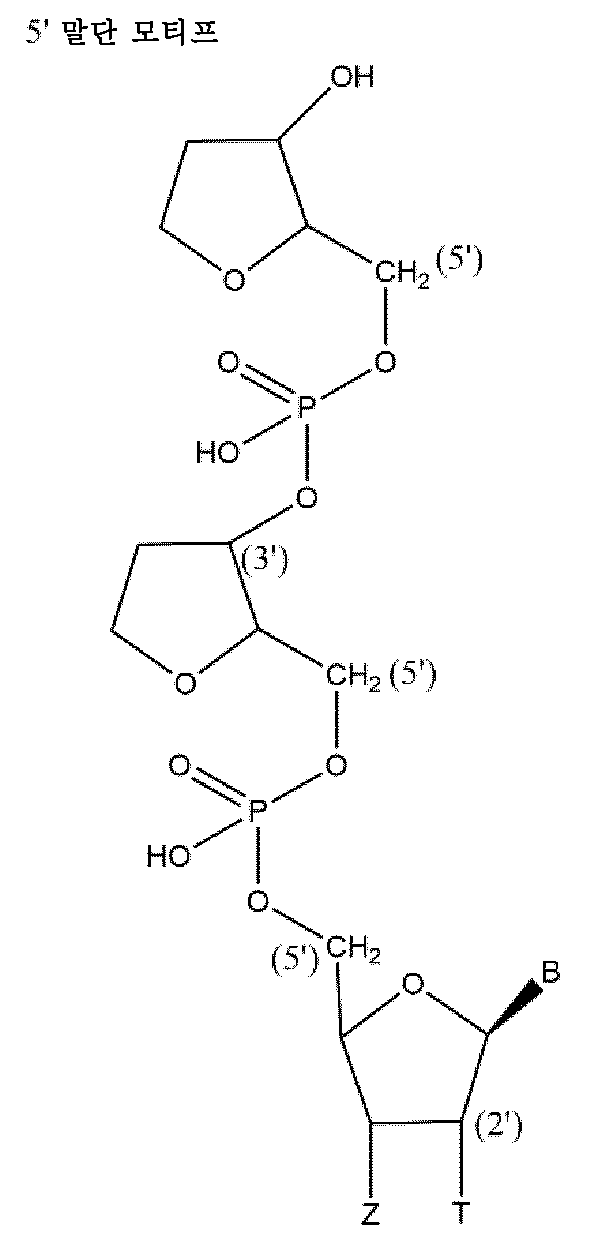
(여기서:(Here:
B는 뉴클레오시드 염기를 나타내고,B represents a nucleoside base,
T는 H, OH 또는 2' 리보스 변형을 나타내고,T represents H, OH or 2' ribose modification,
Z는 상기 제2 가닥의 나머지 뉴클레오시드를 나타냄)Z represents the remaining nucleoside of the second strand)
로서 존재하는 제2 가닥의 5' 말단 영역에서 2개의 연속 무염기성 뉴클레오시드를 포함한다.It contains two consecutive abasic nucleosides at the 5' terminal region of the second strand present as a .
특정 실시양태에서, 본 발명은 하기를 포함하는 듀플렉스 영역을 포함하는, 표적 유전자의 발현을 억제하기 위한 핵산에 관한 것이다:In certain embodiments, the invention relates to a nucleic acid for inhibiting expression of a target gene, comprising a duplex region comprising:
표적 유전자로부터 전사된 RNA의 부분에 적어도 부분적으로 상보적인 제1 가닥, 및 제1 가닥에 적어도 부분적으로 상보적인 제2 가닥,a first strand at least partially complementary to a portion of RNA transcribed from a target gene, and a second strand at least partially complementary to the first strand;
여기서 제2 가닥은 하기 5' 말단 모티프Here the second strand has the following 5' terminal motif
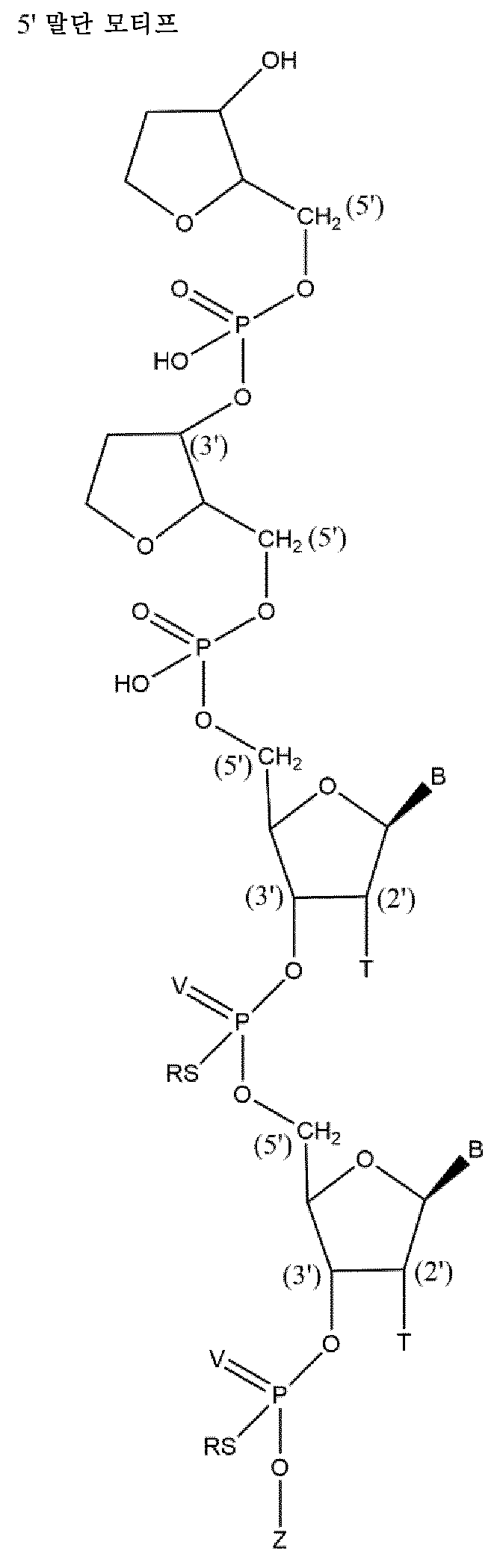
(여기서:(Here:
B는 뉴클레오시드 염기를 나타내고,B represents a nucleoside base,
T는 H, OH 또는 2' 리보스 변형을 나타내고,T represents H, OH or 2' ribose modification,
V는 O 또는 S (바람직하게는 O)를 나타내고,V represents O or S (preferably O),
R은 H 또는 C1-4 알킬(바람직하게는 H)을 나타내고,R represents H or C 1-4 alkyl (preferably H),
Z는 상기 제2 가닥의 나머지 뉴클레오시드를 나타냄),Z represents the remaining nucleoside of the second strand),
보다 바람직하게는 하기 5' 말단 모티프More preferably, the following 5' terminal motif
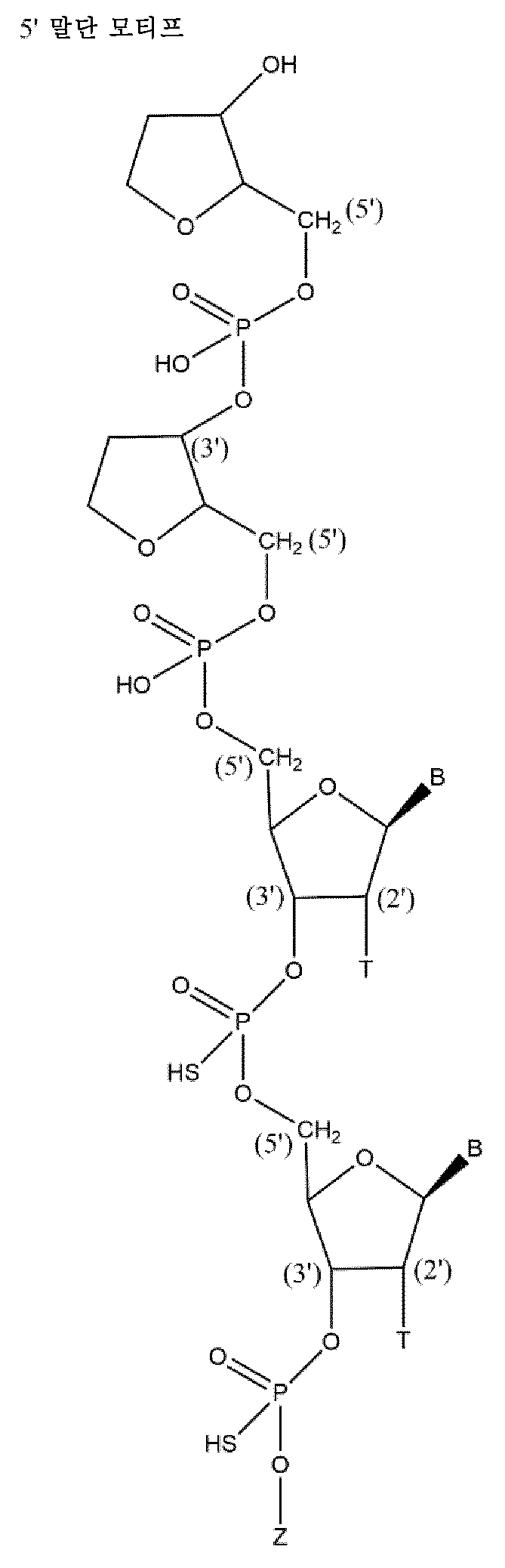
(여기서:(Here:
B는 뉴클레오시드 염기를 나타내고,B represents a nucleoside base,
T는 H, OH 또는 2' 리보스 변형을 나타내고,T represents H, OH or 2' ribose modification,
Z는 상기 제2 가닥의 나머지 뉴클레오시드를 나타냄)Z represents the remaining nucleoside of the second strand)
로서 존재하는 제2 가닥의 5' 말단 영역에서 2개의 연속 무염기성 뉴클레오시드를 포함한다.It contains two consecutive abasic nucleosides at the 5' terminal region of the second strand present as a .
특정 실시양태에서, 본 발명은 하기를 포함하는 듀플렉스 영역을 포함하는, 표적 유전자의 발현을 억제하기 위한 핵산에 관한 것이다:In certain embodiments, the invention relates to a nucleic acid for inhibiting expression of a target gene, comprising a duplex region comprising:
표적 유전자로부터 전사된 RNA의 부분에 적어도 부분적으로 상보적인 제1 가닥, 및 제1 가닥에 적어도 부분적으로 상보적인 제2 가닥,a first strand at least partially complementary to a portion of RNA transcribed from a target gene, and a second strand at least partially complementary to the first strand;
여기서 제2 가닥은 하기 5' 말단 모티프Here the second strand has the following 5' terminal motif

(여기서:(Here:
B는 뉴클레오시드 염기를 나타내고,B represents a nucleoside base,
T는 H, OH 또는 2' 리보스 변형을 나타내고,T represents H, OH or 2' ribose modification,
V는 O 또는 S (바람직하게는 O)를 나타내고,V represents O or S (preferably O),
R은 H 또는 C1-4 알킬(바람직하게는 H)을 나타내고,R represents H or C 1-4 alkyl (preferably H),
Z는 11 내지 26개의 인접 뉴클레오시드, 바람직하게는 15 내지 21개의 인접 뉴클레오시드, 보다 바람직하게는 19개의 인접 뉴클레오시드를 포함함),Z comprises 11 to 26 adjacent nucleosides, preferably 15 to 21 adjacent nucleosides, more preferably 19 adjacent nucleosides),
보다 바람직하게는 하기 5' 말단 모티프More preferably, the following 5' terminal motif

(여기서:(Here:
B는 뉴클레오시드 염기를 나타내고,B represents a nucleoside base,
T는 H, OH 또는 2' 리보스 변형을 나타내고,T represents H, OH or 2' ribose modification,
Z는 11 내지 26개의 인접 뉴클레오시드, 바람직하게는 15 내지 21개의 인접 뉴클레오시드, 보다 바람직하게는 19개의 인접 뉴클레오시드를 포함함)Z comprises 11 to 26 adjacent nucleosides, preferably 15 to 21 adjacent nucleosides, more preferably 19 adjacent nucleosides)
로서 존재하는 제2 가닥의 5' 말단 영역에서 2개의 연속 무염기성 뉴클레오시드를 포함한다.It contains two consecutive abasic nucleosides at the 5' terminal region of the second strand present as a .
일부 실시양태에서, 본 발명에 따른 핵산의 제2 (센스) 가닥의 변형 패턴은 하기를 포함하거나 또는 그로 이루어진다:In some embodiments, the modification pattern of the second (sense) strand of a nucleic acid according to the present invention comprises or consists of:
ia - ia - Me - Me - Me - Me - Me - Me - F - Me - F - F - F - F - Me - Me - Me - Me - Me - Me - Me - Me - Me, 여기서 ia는 역전된 무염기성 뉴클레오시드를 나타냄.ia - ia - Me - Me - Me - Me - Me - Me - F - Me - F - F - F - Me - Me - Me - Me - Me - Me - Me - Me, where ia represents an inverted abasic nucleoside.
이러한 실시양태에서, 제2 가닥은 바람직하게는 하기 5' 말단 모티프를 포함한다:In such embodiments, the second strand preferably comprises the following 5'-terminal motif:

여기서:Here:
B는 제2 가닥의 5' 말단 영역에서의 제1 염기성 뉴클레오시드의 뉴클레오시드 염기를 나타내고,B represents the nucleoside base of the first basic nucleoside in the 5' terminal region of the second strand,
T는 2'Me 리보스 변형을 나타내고,T represents the 2'Me ribose modification,
Z는 제2 가닥의 나머지 인접한 염기성 뉴클레오시드를 나타낸다.Z represents the remaining adjacent basic nucleoside of the second strand.
이러한 실시양태에서, 핵산의 제1 가닥의 변형 패턴은 바람직하게는 하기를 포함하거나 또는 그로 이루어진다:In such embodiments, the modification pattern of the first strand of the nucleic acid preferably comprises or consists of:
Me - F - Me - F - Me - F - Me - Me - Me - Me - Me - Me - Me - F - Me - F - Me - Me - Me - Me - Me - Me - Me.Me - F - Me - F - Me - F - Me - Me - Me - Me - Me - Me - Me - F - Me - F - Me - Me - Me - Me - Me - Me - Me.
일부 실시양태에서, 본 발명에 따른 핵산의 제2 (센스) 가닥의 변형 패턴은 하기를 포함하거나 또는 그로 이루어진다:In some embodiments, the modification pattern of the second (sense) strand of a nucleic acid according to the present invention comprises or consists of:
ia - ia - Me - Me - Me - Me - Me - Me - Me - Me - F - F - F - Me - Me - Me - Me - Me - Me - Me - Me - Me - Me, 여기서 ia는 역전된 무염기성 뉴클레오시드를 나타냄.ia - ia - Me - Me - Me - Me - Me - Me - Me - Me - F - F - F - Me - Me - Me - Me - Me - Me - Me - Me - Me, where ia represents an inverted abasic nucleoside.
이러한 실시양태에서, 제2 가닥은 바람직하게는 하기 5' 말단 모티프를 포함한다:In such embodiments, the second strand preferably comprises the following 5'-terminal motif:

여기서:Here:
B는 제2 가닥의 5' 말단 영역에서의 제1 염기성 뉴클레오시드의 뉴클레오시드 염기를 나타내고,B represents the nucleoside base of the first basic nucleoside in the 5' terminal region of the second strand,
T는 2'Me 리보스 변형을 나타내고,T represents the 2'Me ribose modification,
Z는 제2 가닥의 나머지 인접한 염기성 뉴클레오시드를 나타낸다.Z represents the remaining adjacent basic nucleoside of the second strand.
이러한 실시양태에서, 핵산의 제1 가닥의 변형 패턴은 바람직하게는 하기를 포함하거나 또는 그로 이루어진다:In such embodiments, the modification pattern of the first strand of the nucleic acid preferably comprises or consists of:
Me - F - Me - Me - Me - F - Me - Me - F - Me - Me - Me - Me - F - Me - F - Me - Me - Me - Me - Me - Me - Me.Me - F - Me - Me - Me - F - Me - Me - F - Me - Me - Me - Me - F - Me - F - Me - Me - Me - Me - Me - Me - Me.
일부 실시양태에서, 본 발명에 따른 핵산의 제2 (센스) 가닥의 변형 패턴은 하기를 포함하거나 또는 그로 이루어진다:In some embodiments, the modification pattern of the second (sense) strand of a nucleic acid according to the present invention comprises or consists of:
ia - ia - Me(s) - Me(s) - Me - Me - Me - Me - F - Me - F - F - F - F - Me - Me - Me - Me - Me - Me - Me - Me - Me, 여기서 (s)는 포스포로티오에이트 뉴클레오시드간 연결이고, ia는 역전된 무염기성 뉴클레오시드를 나타냄.ia - ia - Me(s) - Me(s) - Me - Me - Me - Me - F - Me - F - F - F - F - Me - Me - Me - Me - Me - Me - Me - Me - Me, where (s) represents a phosphorothioate internucleoside linkage, and ia represents an inverted abasic nucleoside.
이러한 실시양태에서, 제2 가닥은 바람직하게는 하기 5' 말단 모티프In these embodiments, the second strand preferably comprises the following 5'-terminal motif:

(여기서:(Here:
B는 제2 가닥의 5' 말단 영역에서 처음 2개의 염기성 뉴클레오시드의 뉴클레오시드 염기를 나타내고,B represents the nucleoside bases of the first two basic nucleosides in the 5' terminal region of the second strand,
T는 2'Me 리보스 변형을 나타내고,T represents the 2'Me ribose modification,
V는 O 또는 S (바람직하게는 O)를 나타내고,V represents O or S (preferably O),
R은 H 또는 C1-4 알킬(바람직하게는 H)을 나타내고,R represents H or C 1-4 alkyl (preferably H),
Z는 11 내지 26개의 인접 염기성 뉴클레오시드, 바람직하게는 15 내지 21개의 인접 염기성 뉴클레오시드, 보다 바람직하게는 19개의 인접 염기성 뉴클레오시드를 포함함),Z comprises 11 to 26 adjacent basic nucleosides, preferably 15 to 21 adjacent basic nucleosides, more preferably 19 adjacent basic nucleosides),
보다 바람직하게는 하기 5' 말단 모티프More preferably, the following 5' terminal motif

(여기서:(Here:
B는 제2 가닥의 5' 말단 영역에서 처음 2개의 염기성 뉴클레오시드의 뉴클레오시드 염기를 나타내고,B represents the nucleoside bases of the first two basic nucleosides in the 5' terminal region of the second strand,
T는 2'Me 리보스 변형을 나타내고,T represents the 2'Me ribose modification,
Z는 제2 가닥의 나머지 19개의 인접한 염기성 뉴클레오시드를 나타냄)Z represents the remaining 19 adjacent basic nucleosides of the second strand)
를 포함한다.Includes.
이러한 실시양태에서, 핵산의 제1 가닥의 변형 패턴은 바람직하게는 하기를 포함하거나 또는 그로 이루어진다:In such embodiments, the modification pattern of the first strand of the nucleic acid preferably comprises or consists of:
Me(s)F(s)Me - F - Me - F - Me - Me - Me - Me - Me - Me - Me - F - Me - F - Me - Me - Me - Me - Me(s)Me(s)Me, 여기서 (s)는 포스포로티오에이트 뉴클레오시드간 연결임.Me(s)F(s)Me - F - Me - F - Me - Me - Me - Me - Me - Me - Me - F - Me - F - Me - Me - Me - Me(s)Me(s)Me, where (s) is a phosphorothioate internucleoside linkage.
일부 실시양태에서, 본 발명에 따른 핵산의 제2 (센스) 가닥의 변형 패턴은 하기를 포함하거나 또는 그로 이루어진다:In some embodiments, the modification pattern of the second (sense) strand of a nucleic acid according to the present invention comprises or consists of:
ia - ia - Me(s) - Me(s) - Me - Me - Me - Me - Me - Me - F - F - F - Me - Me - Me - Me - Me - Me - Me - Me - Me - Me, 여기서 (s)는 포스포로티오에이트 뉴클레오시드간 연결이고, ia는 역전된 무염기성 뉴클레오시드를 나타냄.ia - ia - Me(s) - Me(s) - Me - Me - Me - Me - Me - Me - F - F - F - Me - Me - Me - Me - Me - Me - Me - Me - Me - Me, where (s) represents a phosphorothioate internucleoside linkage, and ia represents an inverted abasic nucleoside.
이러한 실시양태에서, 제2 가닥은 바람직하게는 하기 5' 말단 모티프In these embodiments, the second strand preferably comprises the following 5'-terminal motif:
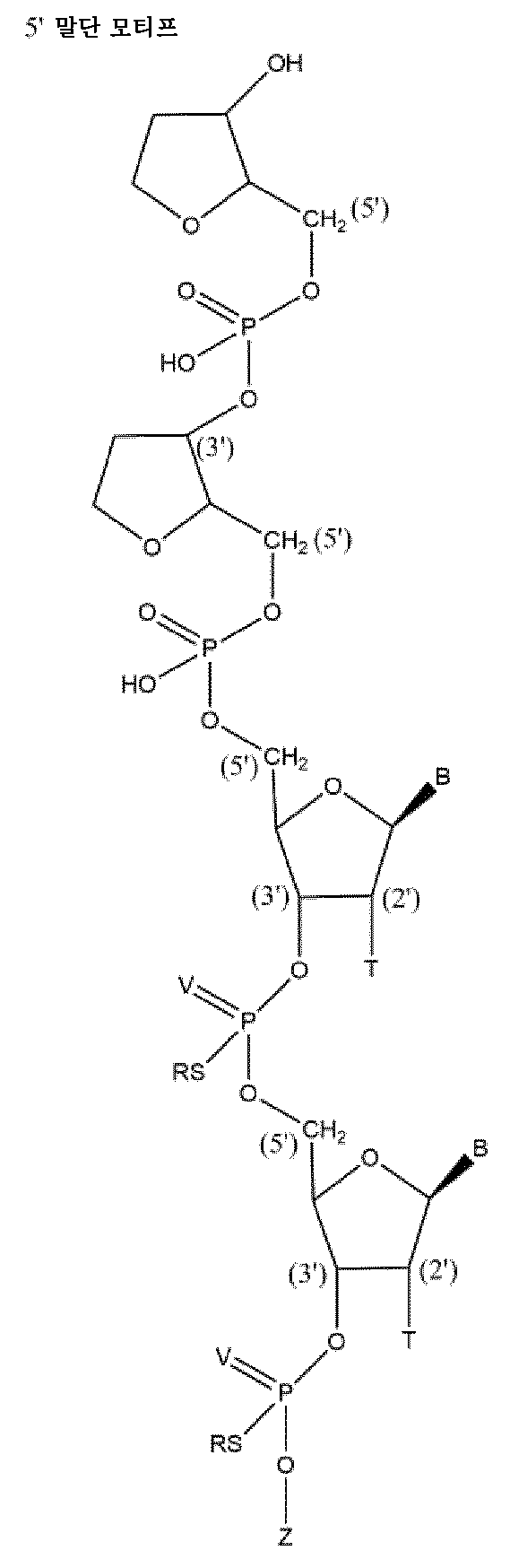
(여기서:(Here:
B는 제2 가닥의 5' 말단 영역에서 처음 2개의 염기성 뉴클레오시드의 뉴클레오시드 염기를 나타내고,B represents the nucleoside bases of the first two basic nucleosides in the 5' terminal region of the second strand,
T는 2'Me 리보스 변형을 나타내고,T represents the 2'Me ribose modification,
V는 O 또는 S (바람직하게는 O)를 나타내고,V represents O or S (preferably O),
R은 H 또는 C1-4 알킬(바람직하게는 H)을 나타내고,R represents H or C 1-4 alkyl (preferably H),
Z는 11 내지 26개의 인접 염기성 뉴클레오시드, 바람직하게는 15 내지 21개의 인접 염기성 뉴클레오시드, 보다 바람직하게는 19개의 인접 염기성 뉴클레오시드를 포함함),Z comprises 11 to 26 adjacent basic nucleosides, preferably 15 to 21 adjacent basic nucleosides, more preferably 19 adjacent basic nucleosides),
보다 바람직하게는 하기 5' 말단 모티프More preferably, the following 5' terminal motif

(여기서:(Here:
B는 제2 가닥의 5' 말단 영역에서 처음 2개의 염기성 뉴클레오시드의 뉴클레오시드 염기를 나타내고,B represents the nucleoside bases of the first two basic nucleosides in the 5' terminal region of the second strand,
T는 2'Me 리보스 변형을 나타내고,T represents the 2'Me ribose modification,
Z는 제2 가닥의 나머지 19개의 인접한 염기성 뉴클레오시드를 나타냄)Z represents the remaining 19 adjacent basic nucleosides of the second strand)
를 포함한다.Includes.
이러한 실시양태에서, 핵산의 제1 가닥의 변형 패턴은 바람직하게는 하기를 포함하거나 또는 그로 이루어진다:In such embodiments, the modification pattern of the first strand of the nucleic acid preferably comprises or consists of:
Me(s)F(s)Me - Me - Me - F - Me - Me - F - Me - Me - Me - Me - F - Me - F - Me - Me - Me - Me - Me(s)Me(s)Me, 여기서 (s)는 포스포로티오에이트 뉴클레오시드간 연결임.Me(s)F(s)Me - Me - Me - F - Me - Me - F - Me - Me - Me - Me - F - Me - Me - Me - Me(s)Me(s)Me, where (s) is a phosphorothioate internucleoside linkage.
역 결합은 바람직하게는 분자의 리간드 모이어티, 예컨대 GalNAc 함유 부분에 대해 원위인 핵산, 예를 들어 RNA의 단부에 위치한다.The reverse linkage is preferably located at the end of the nucleic acid, e.g., RNA, distal to the ligand moiety of the molecule, e.g., a GalNAc-containing moiety.
센스 가닥 상에 5'-GalNAc를 갖는 GalNAc-siRNA 구축물은 센스 가닥의 반대쪽 단부 상에 역 연결을 가질 수 있다.GalNAc-siRNA constructs having 5'-GalNAc on the sense strand can have a reverse linkage on the opposite end of the sense strand.
센스 가닥 상에 3'-GalNAc를 갖는 GalNAc-siRNA 구축물은 센스 가닥의 반대쪽 단부 상에 역 연결을 가질 수 있다.GalNAc-siRNA constructs having 3'-GalNAc on the sense strand can have a reverse linkage on the opposite end of the sense strand.
바람직한 실시양태에서, 본 발명에 따른 핵산의 제2 (센스) 가닥의 변형 패턴은 하기를 포함하거나 또는 그로 이루어진다:In a preferred embodiment, the modification pattern of the second (sense) strand of the nucleic acid according to the present invention comprises or consists of:
ia - ia - Me(s) - Me(s) - Me - Me - Me - Me - F - Me - F - F - F - F - Me - Me - Me - Me - Me - Me - Me - Me - Me,ia - ia - Me(s) - Me(s) - Me - Me - Me - Me - F - Me - F - F - F - F - Me - Me - Me - Me - Me - Me - Me - Me - Me,
또는or
ia - ia - Me(s) - Me(s) - Me - Me - Me - Me - Me - Me - F - F - F - Me - Me - Me - Me - Me - Me - Me - Me - Me - Me, 여기서 (s)는 포스포로티오에이트 뉴클레오시드간 연결이고, ia는 역전된 무염기성 뉴클레오시드를 나타냄.ia - ia - Me(s) - Me(s) - Me - Me - Me - Me - Me - Me - F - F - F - Me - Me - Me - Me - Me - Me - Me - Me - Me - Me, where (s) represents a phosphorothioate internucleoside linkage, and ia represents an inverted abasic nucleoside.
이러한 실시양태에서, 제2 가닥은 바람직하게는 하기 5' 말단 모티프In these embodiments, the second strand preferably comprises the following 5'-terminal motif:

(여기서:(Here:
B는 제2 가닥의 5' 말단 영역에서 처음 2개의 염기성 뉴클레오시드의 뉴클레오시드 염기를 나타내고,B represents the nucleoside bases of the first two basic nucleosides in the 5' terminal region of the second strand,
T는 2'Me 리보스 변형을 나타내고,T represents the 2'Me ribose modification,
V는 O 또는 S (바람직하게는 O)를 나타내고,V represents O or S (preferably O),
R은 H 또는 C1-4 알킬(바람직하게는 H)을 나타내고,R represents H or C 1-4 alkyl (preferably H),
Z는 11 내지 26개의 인접 염기성 뉴클레오시드, 바람직하게는 15 내지 21개의 인접 염기성 뉴클레오시드, 보다 바람직하게는 19개의 인접 염기성 뉴클레오시드를 포함함),Z comprises 11 to 26 adjacent basic nucleosides, preferably 15 to 21 adjacent basic nucleosides, more preferably 19 adjacent basic nucleosides),
보다 바람직하게는 하기 5' 말단 모티프More preferably, the following 5' terminal motif
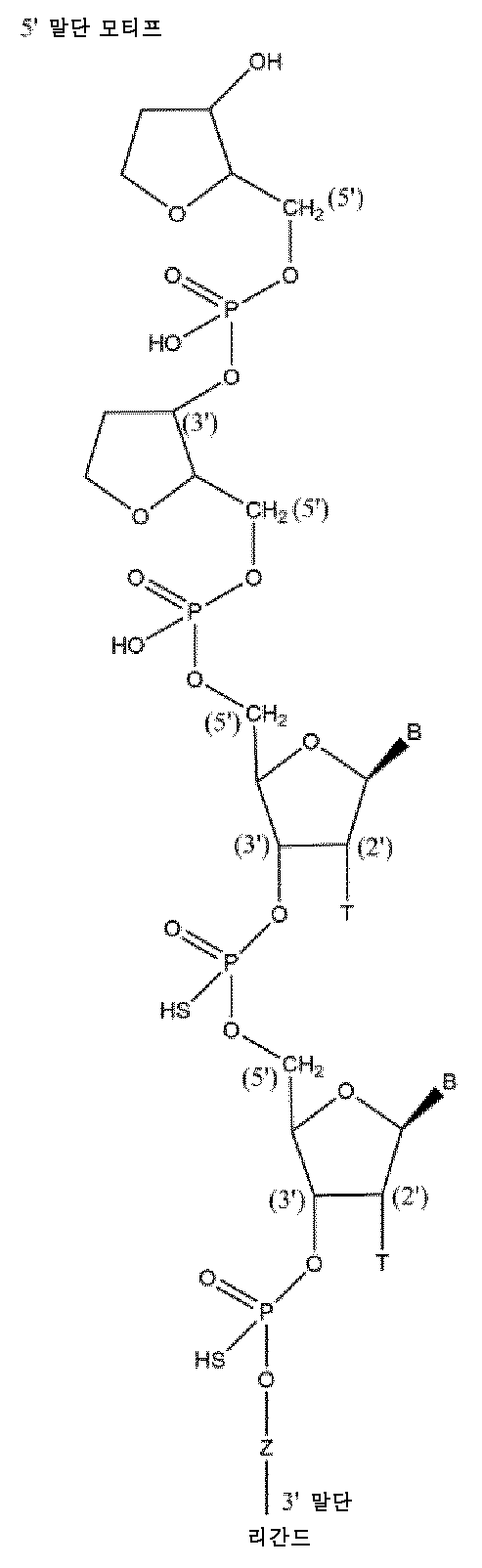
(여기서:(Here:
B는 제2 가닥의 5' 말단 영역에서 처음 2개의 염기성 뉴클레오시드의 뉴클레오시드 염기를 나타내고,B represents the nucleoside bases of the first two basic nucleosides in the 5' terminal region of the second strand,
T는 2'Me 리보스 변형을 나타내고,T represents the 2'Me ribose modification,
Z는 제2 가닥의 나머지 19개의 인접한 염기성 뉴클레오시드를 나타냄)Z represents the remaining 19 adjacent basic nucleosides of the second strand)
를 포함한다.Includes.
이러한 실시양태에서, 핵산의 제1 가닥의 변형 패턴은 바람직하게는 하기를 포함하거나 또는 그로 이루어진다:In such embodiments, the modification pattern of the first strand of the nucleic acid preferably comprises or consists of:
Me(s)F(s)Me - F - Me - F - Me - Me - Me - Me - Me - Me - Me - F - Me - F - Me - Me - Me - Me - Me(s)Me(s)Me, 여기서 (s)는 포스포로티오에이트 뉴클레오시드간 연결임,Me(s)F(s)Me - F - Me - F - Me - Me - Me - Me - Me - Me - Me - F - Me - F - Me - Me - Me - Me(s)Me(s)Me, where (s) is a phosphorothioate internucleoside linkage,
또는or
Me(s)F(s)Me - Me - Me - F - Me - Me - F - Me - Me - Me - Me - F - Me - F - Me - Me - Me - Me - Me(s)Me(s)Me, 여기서 (s)는 포스포로티오에이트 뉴클레오시드간 연결임.Me(s)F(s)Me - Me - Me - F - Me - Me - F - Me - Me - Me - Me - F - Me - Me - Me - Me(s)Me(s)Me, where (s) is a phosphorothioate internucleoside linkage.
핵산 길이Nucleic acid length
한 측면에서, i) 핵산의 제1 가닥은 17 내지 30개의 뉴클레오시드, 바람직하게는 19 내지 25개의 뉴클레오시드, 보다 바람직하게는 19 또는 23개의 뉴클레오시드 범위의 길이를 갖고/거나; ii) 핵산의 제2 가닥은 17 내지 30개의 뉴클레오시드, 바람직하게는 19 내지 25개의 뉴클레오시드, 보다 바람직하게는 19 또는 21개의 뉴클레오시드 범위의 길이를 갖는다.In one aspect, i) the first strand of the nucleic acid has a length in the range of 17 to 30 nucleosides, preferably 19 to 25 nucleosides, more preferably 19 or 23 nucleosides; and/or ii) the second strand of the nucleic acid has a length in the range of 17 to 30 nucleosides, preferably 19 to 25 nucleosides, more preferably 19 or 21 nucleosides.
전형적으로, 핵산의 듀플렉스 영역은 17 내지 30개 뉴클레오시드 길이이고, 보다 바람직하게는 19 또는 21개 뉴클레오시드 길이이다. 유사하게, 제1 가닥과 표적 유전자로부터 전사된 RNA의 부분 사이의 상보성 영역은 17 내지 30개 뉴클레오시드 길이이다.Typically, the duplex region of the nucleic acid is 17 to 30 nucleosides in length, more preferably 19 or 21 nucleosides in length. Similarly, the region of complementarity between the first strand and the portion of RNA transcribed from the target gene is 17 to 30 nucleosides in length.
핵산 변형Nucleic acid modification
특정 실시양태에서, 핵산, 예를 들어 본 발명의 RNA, 예를 들어 dsiRNA는 추가의 변형, 예를 들어 관련 기술분야에 공지되고 본원에 기재된 화학적 변형 또는 접합을 포함하지 않는다.In certain embodiments, the nucleic acid, e.g., the RNA of the invention, e.g., the dsiRNA, does not comprise additional modifications, e.g., chemical modifications or conjugations known in the art and described herein.
다른 바람직한 실시양태에서, 본 발명의 핵산, 예를 들어 RNA, 예를 들어 dsiRNA는 안정성 또는 다른 유익한 특징을 증진시키기 위해 추가로 화학적으로 변형된다.In another preferred embodiment, the nucleic acids of the invention, e.g., RNA, e.g., dsiRNA, are further chemically modified to enhance stability or other beneficial properties.
본 발명의 특정 실시양태에서, 실질적으로 모든 뉴클레오시드가 변형된다.In certain embodiments of the invention, substantially all of the nucleosides are modified.
본 발명에서 특색화된 핵산은 관련 기술분야에 널리 확립된 방법, 예컨대 본원에 참조로 포함된 문헌 ["Current protocols in nucleic acid chemistry," Beaucage, S.L. et al. (Edrs.), John Wiley & Sons, Inc., New York, NY, USA]에 기재된 것에 의해 합성 또는 변형될 수 있다.The nucleic acids featured in the present invention can be synthesized or modified by methods well established in the art, such as those described in the reference ["Current protocols in nucleic acid chemistry," Beaucage, S.L. et al. (Edrs.), John Wiley & Sons, Inc., New York, NY, USA], which is incorporated herein by reference.
변형은, 예를 들어 단부 변형, 예를 들어 5'-단부 변형 (인산화, 접합, 역전된 연결) 또는 3'-단부 변형 (접합, RNA 내의 DNA 뉴클레오시드, 또는 DNA 내의 RNA 뉴클레오시드, 역전된 연결 등); 염기 변형, 예를 들어 안정화 염기, 탈안정화 염기, 또는 파트너의 확장된 레퍼토리와 염기 쌍을 형성하는 염기, 접합된 염기로의 대체; 당 변형 (예를 들어, 2'-위치 또는 4'-위치에서) 또는 당의 대체; 또는 포스포디에스테르 연결의 변형 또는 대체를 포함한 백본 변형을 포함한다.Modifications include, for example, end modifications, such as 5'-end modifications (phosphorylation, splicing, inverted linkage) or 3'-end modifications (splicing, DNA nucleosides within RNA, or RNA nucleosides within DNA, inverted linkage, etc.); base modifications, such as replacement with a stabilizing base, a destabilizing base, or a base that forms base pairs with an expanded repertoire of partners, a spliced base; sugar modifications (e.g., at the 2'-position or the 4'-position) or replacement of a sugar; or backbone modifications, including modification or replacement of a phosphodiester linkage.
본원에 기재된 실시양태에 유용한 핵산, 예컨대 siRNA 화합물의 구체적 예는 변형된 백본을 함유하거나 또는 천연 뉴클레오시드간 연결을 함유하지 않는 RNA를 포함하나 이에 제한되지는 않는다. 핵산, 예컨대 변형된 백본을 갖는 RNA는 특히 백본에 인 원자를 갖지 않는 것을 포함한다. 본 명세서의 목적을 위해 및 관련 기술분야에서 때때로 언급되는 바와 같이, 변형된 핵산, 예를 들어 그의 뉴클레오시드간 백본에 인 원자를 갖지 않는 RNA는 또한 올리고뉴클레오시드인 것으로 간주될 수 있다. 일부 실시양태에서, 변형된 핵산, 예를 들어 siRNA는 그의 뉴클레오시드간 백본에 인 원자를 가질 것이다.Specific examples of nucleic acids, e.g., siRNA compounds, useful in the embodiments described herein include, but are not limited to, RNAs that contain a modified backbone or that do not contain a natural internucleoside linkage. Nucleic acids, e.g., RNAs having a modified backbone, particularly include those that do not have a phosphorus atom in the backbone. For purposes of this specification and as sometimes referred to in the art, a modified nucleic acid, e.g., RNA that does not have a phosphorus atom in its internucleoside backbone, may also be considered an oligonucleoside. In some embodiments, a modified nucleic acid, e.g., siRNA, will have a phosphorus atom in its internucleoside backbone.
변형된 핵산, 예를 들어 RNA 백본은, 예를 들어 포스포로티오에이트, 키랄 포스포로티오에이트, 포스포로디티오에이트, 포스포트리에스테르, 아미노알킬포스포트리에스테르, 메틸 및 다른 알킬 포스포네이트, 예컨대 3'-알킬렌 포스포네이트 및 키랄 포스포네이트, 포스피네이트, 포스포르아미데이트, 예컨대 3'-아미노 포스포르아미데이트 및 아미노알킬포스포르아미데이트, 티오노포스포르아미데이트, 티오노알킬포스포네이트, 티오노알킬포스포트리에스테르, 및 정상 3'-5' 연결을 갖는 보라노포스페이트, 이들의 2'-5'-연결된 유사체, 및 뉴클레오시드 단위의 인접한 쌍이 5'-3' 또는 5'-2' 연결된 역극성을 갖는 것을 포함한다. 다양한 염, 혼합 염 및 유리 산 형태가 또한 포함된다.Modified nucleic acids, e.g., RNA backbones, include, for example, phosphorothioates, chiral phosphorothioates, phosphorodithioates, phosphotriesters, aminoalkylphosphotriesters, methyl and other alkyl phosphonates such as 3'-alkylene phosphonates and chiral phosphonates, phosphinates, phosphoramidates such as 3'-amino phosphoramidate and aminoalkylphosphoramidates, thionophosphoramidates, thionoalkylphosphonates, thionoalkylphosphotriesters, and boranophosphates having normal 3'-5' linkages, their 2'-5'-linked analogs, and those having reverse polarity such that adjacent pairs of nucleoside units are linked 5'-3' or 5'-2'. Various salts, mixed salts and free acid forms are also included.
변형된 핵산, 예를 들어 RNA는 또한 1개 이상의 치환된 당 모이어티를 함유할 수 있다. 본원에서 특색화된 핵산, 예를 들어 siRNA, 예를 들어 dsiRNA는 2'-위치에 OH; F; O-, S- 또는 N-알킬; O-, S- 또는 N-알케닐; O-, S- 또는 N-알키닐; 또는 O-알킬-O-알킬 중 하나를 포함할 수 있으며, 여기서 알킬, 알케닐 및 알키닐은 치환 또는 비치환될 수 있다. 2' O-메틸 및 2'-F가 바람직한 변형이다.The modified nucleic acids, e.g., RNA, can also contain one or more substituted sugar moieties. The nucleic acids featured herein, e.g., siRNA, e.g., dsiRNA, can comprise at the 2'-position one of: OH; F; O-, S-, or N-alkyl; O-, S-, or N-alkenyl; O-, S-, or N-alkynyl; or O-alkyl-O-alkyl, wherein the alkyl, alkenyl and alkynyl can be substituted or unsubstituted. Preferred modifications are 2' O-methyl and 2'-F.
특정의 바람직한 실시양태에서, 핵산은 적어도 1개의 변형된 뉴클레오시드를 포함한다.In certain preferred embodiments, the nucleic acid comprises at least one modified nucleoside.
본 발명의 핵산은 제1 가닥 및/또는 제2 가닥 상에 1개 이상의 변형된 뉴클레오시드를 포함할 수 있다.The nucleic acid of the present invention may comprise one or more modified nucleosides on the first strand and/or the second strand.
일부 실시양태에서, 센스 가닥의 실질적으로 모든 뉴클레오시드 및 안티센스 가닥의 모든 뉴클레오시드는 변형을 포함한다.In some embodiments, substantially all of the nucleosides of the sense strand and all of the nucleosides of the antisense strand comprise a modification.
일부 실시양태에서, 센스 가닥의 모든 뉴클레오시드 및 안티센스 가닥의 실질적으로 모든 뉴클레오시드는 변형을 포함한다.In some embodiments, substantially all of the nucleosides of the sense strand and substantially all of the nucleosides of the antisense strand comprise a modification.
일부 실시양태에서, 센스 가닥의 모든 뉴클레오시드 및 안티센스 가닥의 모든 뉴클레오시드는 변형을 포함한다.In some embodiments, all nucleosides of the sense strand and all nucleosides of the antisense strand comprise a modification.
한 실시양태에서, 변형된 뉴클레오시드 중 적어도 하나는 데옥시-뉴클레오시드, 3'-말단 데옥시-티민 (dT) 뉴클레오시드, 2'-O-메틸 변형된 뉴클레오시드 (본원에서 2'-Me로도 불림, 여기서 Me는 메톡시임), 2'-플루오로 변형된 뉴클레오시드, 2'-데옥시-변형된 뉴클레오시드, 잠금 뉴클레오시드, 비잠금 뉴클레오시드, 입체형태적으로 제한된 뉴클레오시드, 구속성 에틸 뉴클레오시드, 무염기성 뉴클레오시드, 2'-아미노-변형된 뉴클레오시드, 2'-O-알릴-변형된 뉴클레오시드, 2'-C-알킬-변형된 뉴클레오시드, 2'-히드록실-변형된 뉴클레오시드, 2'-메톡시에틸 변형된 뉴클레오시드, 2'-O-알킬-변형된 뉴클레오시드, 모르폴리노 뉴클레오시드, 포스포르아미데이트, 비-천연 염기 포함 뉴클레오시드, 테트라히드로피란 변형된 뉴클레오시드, 1,5-안히드로헥시톨 변형된 뉴클레오시드, 시클로헥세닐 변형된 뉴클레오시드, 포스포로티오에이트 기를 포함하는 뉴클레오시드, 메틸포스포네이트 기를 포함하는 뉴클레오시드, 5'-포스페이트를 포함하는 뉴클레오시드, 및 5'-포스페이트 모방체를 포함하는 뉴클레오시드로 이루어진 군으로부터 선택된다. 또 다른 실시양태에서, 변형된 뉴클레오시드는 3'-말단 데옥시-티민 뉴클레오시드 (dT)의 짧은 서열을 포함한다.In one embodiment, at least one of the modified nucleosides is selected from the group consisting of a deoxy-nucleoside, a 3'-terminal deoxy-thymine (dT) nucleoside, a 2'-O-methyl modified nucleoside (also referred to herein as 2'-Me, where Me is methoxy), a 2'-fluoro modified nucleoside, a 2'-deoxy-modified nucleoside, a locked nucleoside, an unlocked nucleoside, a conformationally restricted nucleoside, a constrained ethyl nucleoside, an abasic nucleoside, a 2'-amino-modified nucleoside, a 2'-O-allyl-modified nucleoside, a 2'-C-alkyl-modified nucleoside, a 2'-hydroxyl-modified nucleoside, a 2'-methoxyethyl modified nucleoside, a 2'-O-alkyl-modified nucleoside, a morpholino nucleoside, a phosphoramidate, a non-natural base A nucleoside is selected from the group consisting of a nucleoside, a tetrahydropyran modified nucleoside, a 1,5-anhydrohexitol modified nucleoside, a cyclohexenyl modified nucleoside, a nucleoside comprising a phosphorothioate group, a nucleoside comprising a methylphosphonate group, a nucleoside comprising a 5'-phosphate, and a nucleoside comprising a 5'-phosphate mimetic. In another embodiment, the modified nucleoside comprises a short sequence of a 3'-terminal deoxy-thymine nucleoside (dT).
뉴클레오시드 상의 변형은 바람직하게는 LNA, HNA, CeNA, 2'-메톡시에틸, 2'-O-알킬, 2'-O-알릴, 2'-C-알릴, 2'-플루오로, 2'-데옥시, 2'-히드록실 및 그의 조합을 포함하나 이에 제한되지는 않는 군으로부터 선택될 수 있다. 또 다른 실시양태에서, 뉴클레오시드 상의 변형은 2'-O-메틸 ("2'-Me") 또는 2'-플루오로 변형이다.Modifications on the nucleoside can preferably be selected from the group including but not limited to LNA, HNA, CeNA, 2'-methoxyethyl, 2'-O-alkyl, 2'-O-allyl, 2'-C-allyl, 2'-fluoro, 2'-deoxy, 2'-hydroxyl and combinations thereof. In another embodiment, the modifications on the nucleoside are 2'-O-methyl ("2'-Me") or 2'-fluoro modifications.
한 바람직한 변형은 2'-Me 또는 2'-F 변형으로부터 임의로 선택된, 리보스 당의 2'-OH 기에서의 변형이다.A preferred modification is a modification at the 2'-OH group of the ribose sugar, randomly selected from 2'-Me or 2'-F modifications.
바람직한 핵산은 하기와 같이 변형된 뉴클레오시드를 형성하도록 변형된 제1 가닥 및/또는 제2 가닥 상의 1개 이상의 뉴클레오시드를 포함한다:Preferred nucleic acids comprise one or more nucleosides on the first strand and/or the second strand modified to form a modified nucleoside as follows:
변형이, 임의로 2'-Me 또는 2'-F 변형으로부터 선택된, 리보스 당의 2'-OH 기에서의 변형인 핵산.A nucleic acid wherein the modification is at the 2'-OH group of the ribose sugar, optionally selected from a 2'-Me or a 2'-F modification.
제1 가닥이 상기 제1 가닥의 위치 1로부터 카운팅하여 위치 2, 위치 6, 위치 14 또는 그의 임의의 조합 중 임의의 위치에서 2'-F 변형을 포함하는 것인 핵산.A nucleic acid wherein the first strand comprises a 2'-F modification at any position counting from
제2 가닥이 상기 제2 가닥의 위치 1로부터 카운팅하여 위치 7, 위치 9, 위치 11 또는 그의 임의의 조합 중 임의의 위치에서 2'-F 변형을 포함하는 것인 핵산.A nucleic acid wherein the second strand comprises a 2'-F modification at any position selected from
제1 및 제2 가닥이 각각 2'-Me 및 2'-F 변형을 포함하는 것인 핵산.A nucleic acid wherein the first and second strands each contain 2'-Me and 2'-F modifications.
적합하게는 제1 가닥의 위치 1로부터 카운팅하여 제1 가닥의 위치 1 내지 9 중 하나 이상에서 및/또는 제1 가닥의 위치 1 내지 9와 정렬된 제2 가닥 상의 위치 중 하나 이상에서 적어도 1개의 열 탈안정화 변형을 포함하는 핵산이며, 여기서 탈안정화 변형은 변형된 비잠금 핵산 (UNA) 및 글리콜 핵산 (GNA), 바람직하게는 글리콜 핵산, 보다 바람직하게는 (S)-글리콜 핵산으로부터 선택되는 것인 핵산.A nucleic acid comprising at least one thermally destabilizing modification at one or more of
제1 가닥의 위치 1로부터 카운팅하여 제1 가닥의 위치 7에서 적어도 1개의 열 탈안정화 변형을 포함하는 핵산.A nucleic acid comprising at least one thermally destabilizing modification at
siRNA 올리고뉴클레오시드인 핵산이고, 여기서 siRNA 올리고뉴클레오시드는 상기 제2 가닥의 위치 1로부터 카운팅하여 제2 가닥의 위치 6 내지 12에서 3개 이상의 2'-F 변형, 예컨대 제2 가닥의 위치 6 내지 12에서 4, 5, 6 또는 7개의 2'-F 변형을 포함하는 것인 핵산.A nucleic acid which is an siRNA oligonucleoside, wherein the siRNA oligonucleoside comprises at least three 2'-F modifications at
siRNA 올리고뉴클레오시드인 핵산이고, 여기서 상기 제2 가닥은 상기 제2 가닥의 위치 1로부터 카운팅하여 제2 가닥의 위치 1 내지 6에서 적어도 3개, 예컨대 4, 5 또는 6개의 2'-Me 변형을 포함하는 것인 핵산.A nucleic acid which is an siRNA oligonucleoside, wherein said second strand comprises at least 3, for example, 4, 5 or 6 2'-Me modifications at
siRNA 올리고뉴클레오시드인 핵산이고, 여기서 상기 제1 가닥은 바람직하게는 3' 말단 영역에서 말단 뉴클레오시드 또는 3' 말단 영역에서 말단 뉴클레오시드로부터 적어도 1 또는 2개의 뉴클레오시드 이내를 포함하여 3' 말단 영역에서 적어도 5개의 2'-Me 연속 변형을 포함하는 것인 핵산.A nucleic acid which is an siRNA oligonucleoside, wherein said first strand preferably comprises at least five 2'-Me consecutive modifications in the 3'-terminal region, including at least one or two nucleosides from the terminal nucleoside in the 3'-terminal region or including at least one or two nucleosides from the terminal nucleoside in the 3'-terminal region.
siRNA 올리고뉴클레오시드인 핵산이고, 여기서 상기 제1 가닥은 바람직하게는 3' 말단 영역에서 말단 뉴클레오시드를 포함하여 3' 말단 영역에서 7개의 2'-Me 연속 변형을 포함하는 것인 핵산.A nucleic acid which is a siRNA oligonucleoside, wherein said first strand preferably comprises seven 2'-Me consecutive modifications in the 3'-terminal region, including a terminal nucleoside in the 3'-terminal region.
siRNA 올리고뉴클레오시드인 핵산이고, 여기서 각각의 제1 및 제2 가닥은 각각의 제1 및 제2 가닥의 전체 길이를 따라 교대하는 변형 패턴, 바람직하게는 완전히 교대하는 변형 패턴을 포함하고, 여기서 제1 가닥의 뉴클레오시드는 (i) 제1 가닥의 위치 1로부터 카운팅하여 홀수 번호 뉴클레오시드 상의 2'Me 변형, 및 (ii) 제1 가닥의 위치 1로부터 카운팅하여 짝수 번호 뉴클레오시드 상의 2'F 변형에 의해 변형되고, 제2 가닥의 뉴클레오시드는 (i) 제2 가닥의 위치 1로부터 카운팅하여 홀수 번호 뉴클레오시드 상의 2'F 변형, 및 (ii) 제2 가닥의 위치 1로부터 카운팅하여 짝수 번호 뉴클레오시드 상의 2'Me 변형에 의해 변형된 것인 핵산. 전형적으로, 이러한 완전히 교대하는 변형 패턴은 평활 말단 올리고뉴클레오시드에 존재하고, 여기서 각각의 제1 및 제2 가닥은 19개 뉴클레오시드 길이이다.A nucleic acid which is a siRNA oligonucleoside, wherein each of the first and second strands comprises an alternating modification pattern, preferably a fully alternating modification pattern, along the entire length of each of the first and second strands, wherein the nucleosides of the first strand are modified by (i) a 2'Me modification on odd-numbered nucleosides counting from
제1 또는 제2 가닥의 위치 1은 핵산의 단부에 가장 가깝고 (임의의 무염기성 뉴클레오시드는 무시함), 백본의 당 모이어티 사이의 결합과 관련하여 분자의 단부로부터 멀어지는 방향으로 판독하여 3'에서 5' 내부 결합을 통해 (위치 2에서) 인접한 뉴클레오시드에 연결된 뉴클레오시드이다.
따라서, "센스 가닥의 위치 1"은 센스 가닥의 통상적인 5' 단부에서 가장 5'인 뉴클레오시드 (무염기성 뉴클레오시드를 포함하지 않음)임을 알 수 있다. 전형적으로, 센스 가닥의 이러한 위치 1의 뉴클레오시드는 선택된 표적 핵산 서열의 5' 뉴클레오시드와 동등할 것이고, 보다 일반적으로 센스 가닥은 센스 가닥의 이러한 위치 1로부터 출발하는 표적 핵산 서열의 것과 동등한 뉴클레오시드를 가질 것이면서, 또한 서열 사이의 허용되는 미스매치를 허용할 것이다.Thus, "
본원에 사용된 "안티센스 가닥의 위치 1"은 안티센스 가닥의 통상적인 5' 단부에서 가장 5'인 뉴클레오시드 (무염기성 뉴클레오시드를 포함하지 않음)이다. 상기 기재된 바와 같이, 센스 및 안티센스 가닥 사이에 상보성 영역이 존재할 것이고, 이러한 방식으로 안티센스 가닥은 또한 상기 언급된 바와 같은 표적 핵산 서열에 대한 상보성 영역을 가질 것이다.As used herein, "
특정 실시양태에서, 핵산, 예를 들어 siRNA 작용제는 적어도 1개의 포스포로티오에이트 또는 메틸포스포네이트 뉴클레오시드간 연결을 추가로 포함한다. 예를 들어, 포스포로티오에이트 또는 메틸포스포네이트 뉴클레오시드간 연결은 한 가닥, 즉 센스 가닥 또는 안티센스 가닥의 3'-말단 또는 말단 영역에; 또는 두 가닥, 즉 센스 가닥 및 안티센스 가닥의 단부에 존재할 수 있다.In certain embodiments, the nucleic acid, e.g., the siRNA agent, further comprises at least one phosphorothioate or methylphosphonate internucleoside linkage. For example, the phosphorothioate or methylphosphonate internucleoside linkage can be present at the 3'-terminal or terminal region of one strand, i.e., the sense strand or the antisense strand; or at the ends of both strands, i.e., the sense strand and the antisense strand.
특정 실시양태에서, 포스포로티오에이트 또는 메틸포스포네이트 뉴클레오시드간 연결은 한 가닥, 즉 센스 가닥 또는 안티센스 가닥의 5' 말단에 또는 말단 영역에; 또는 두 가닥, 즉 센스 가닥 및 안티센스 가닥의 단부에 존재한다.In certain embodiments, the phosphorothioate or methylphosphonate nucleoside linkage is present at the 5' end or terminal region of one strand, i.e., the sense strand or the antisense strand; or at the ends of both strands, i.e., the sense strand and the antisense strand.
특정 실시양태에서, 포스포로티오에이트 또는 메틸포스포네이트 뉴클레오시드간 연결은 한 가닥, 즉 센스 가닥 또는 안티센스 가닥의 5'- 및 3'-말단 둘 다에 또는 말단 영역에; 또는 두 가닥, 즉 센스 가닥 및 안티센스 가닥의 단부에 존재한다.In certain embodiments, the phosphorothioate or methylphosphonate nucleoside linkages are present at both the 5'- and 3'-terminal ends or terminal regions of one strand, i.e., the sense strand or the antisense strand; or at the ends of both strands, i.e., the sense strand and the antisense strand.
임의의 핵산은 핵산 내에 1개 이상의 포스포로티오에이트 (PS) 변형, 예컨대 가닥의 단부에 적어도 2개의 PS 뉴클레오시드간 결합을 포함할 수 있다.Any nucleic acid can comprise one or more phosphorothioate (PS) modifications within the nucleic acid, such as at least two PS internucleoside linkages at the ends of the strand.
올리고리보뉴클레오시드 가닥 중 적어도 1개는 바람직하게는 올리고뉴클레오시드의 마지막 3개의 뉴클레오시드에 적어도 2개의 연속 포스포로티오에이트 변형을 포함한다.At least one of the oligoribonucleoside strands preferably comprises at least two consecutive phosphorothioate modifications on the last three nucleosides of the oligonucleoside.
따라서, 본 발명은 또한 예컨대 제2 가닥의 5' 및/또는 3' 말단 영역 및/또는 근처 말단 영역에서 적어도 2 또는 3개의 연속 위치들 사이에 각각 포스포로티오에이트 뉴클레오시드간 연결을 포함하고, 그에 의해 상기 근처 말단 영역은 바람직하게는 상기 말단 영역에 인접하고, 여기서 상기 제2 가닥의 상기 1개 이상의 무염기성 뉴클레오시드가 위치하는 것인 본원에 개시된 핵산에 관한 것이다.Accordingly, the present invention also relates to a nucleic acid as disclosed herein, which comprises phosphorothioate internucleoside linkages between at least two or three consecutive positions in the 5' and/or 3' terminal region and/or the proximal terminal region of the second strand, whereby said proximal terminal region is preferably adjacent to said terminal region, wherein said one or more abasic nucleosides of said second strand are located.
제1 가닥의 5' 및/또는 3' 말단 영역의 적어도 2 또는 3개의 연속 위치들 사이에 각각 포스포로티오에이트 뉴클레오시드간 연결을 포함하고, 그에 의해 바람직하게는 상기 제1 가닥의 5' 및/또는 3' 말단 영역의 말단 위치가 포스포로티오에이트 뉴클레오시드간 연결에 의해 그의 인접 위치에 부착된 것인 핵산이 본원에 개시된다.Disclosed herein is a nucleic acid comprising a phosphorothioate internucleoside linkage between at least two or three consecutive positions of the 5' and/or 3' terminal region of the first strand, whereby preferably the terminal positions of the 5' and/or 3' terminal region of said first strand are attached to their adjacent positions by phosphorothioate internucleoside linkages.
핵산 가닥은 2개의 말단에 위치한 무염기성 뉴클레오시드와 인접한 3개의 뉴클레오시드들 사이에 포스포로티오에이트 뉴클레오시드간 연결을 포함하는 RNA일 수 있다.The nucleic acid strand may be RNA comprising an abasic nucleoside located at the two terminal ends and a phosphorothioate internucleoside linkage between three adjacent nucleosides.
바람직한 핵산은 제2 가닥의 5' 말단에 2개의 인접한 무염기성 뉴클레오시드 및 제2 가닥의 반대쪽 3' 단부에 1개 이상의 GalNAc 리간드 모이어티를 포함하는 리간드 모이어티를 포함하는 이중 가닥 RNA이다. 추가로 바람직하게는, 동일한 핵산은 또한 제2 가닥의 위치 1로부터 판독하여 제2 가닥의 위치 3-4 및 4-5의 뉴클레오티드 사이에 포스포로티오에이트 결합을 포함할 수 있다. 추가로 바람직하게는, 동일한 핵산은 또한 제2 가닥의 위치 7, 9 및 11에서 2' F 변형을 포함할 수 있다.A preferred nucleic acid is a double stranded RNA comprising a ligand moiety comprising two adjacent abasic nucleosides at the 5' end of the second strand and one or more GalNAc ligand moieties at the opposite 3' end of the second strand. Further preferably, the same nucleic acid may also comprise a phosphorothioate linkage between nucleotides at positions 3-4 and 4-5 of the second strand, reading from
바람직한 변형은 하기와 같다.A desirable transformation is as follows:
상기 제2 가닥의 변형된 뉴클레오시드가 하기 중 어느 하나에 따른 변형 패턴 (5'-3')을 갖는 것인 핵산:A nucleic acid wherein the modified nucleoside of the second strand has a modification pattern (5'-3') according to any one of the following:
Me - Me - Me - Me - Me - Me - F - F - F - F - F - Me - Me - Me - Me - Me - Me - Me - F - Me - Me, 또는Me - Me - Me - Me - Me - Me - F - F - F - F - F - Me - Me - Me - Me - Me - Me - Me - F - Me - Me, or
Me - Me - Me - Me - Me - F - F - Me - F - F - F - F - Me - Me - Me - Me - Me - Me - Me - Me - Me, 또는Me - Me - Me - Me - Me - F - F - Me - F - F - F - F - Me - Me - Me - Me - Me - Me - Me - Me - Me, or
Me - Me - Me - Me - Me - Me -F- Me - F - F - F - F - Me - Me - Me - Me - Me - Me - Me - Me - Me, 또는Me - Me - Me - Me - Me - Me -F- Me - F - F - F - F - Me - Me - Me - Me - Me - Me - Me - Me - Me, or
Me - Me - Me - Me - Me - Me - Me - Me - F - F - F - Me - Me - Me - Me - Me - Me - Me - Me - Me - Me, 또는Me - Me - Me - Me - Me - Me - Me - Me - Me - F - F - F - Me - Me - Me - Me - Me - Me - Me - Me - Me - Me, or
Me - Me - Me - Me - Me - Me - F - Me - F - F - F - Me - Me - Me - Me - Me - Me - Me - Me - Me - Me.Me - Me - Me - Me - Me - Me - Me - F - Me - F - F - F - Me - Me - Me - Me - Me - Me - Me - Me - Me - Me - Me.
상기 제2 가닥의 변형된 뉴클레오시드가 하기 중 어느 하나에 따른 변형 패턴 (5'-3')을 갖는 것인 핵산:A nucleic acid wherein the modified nucleoside of the second strand has a modification pattern (5'-3') according to any one of the following:
Me(s)Me(s)Me - Me - Me - Me - F - F - F - F - F - Me - Me - Me - Me - Me - Me - Me - F - Me - Me, 또는Me(s)Me(s)Me - Me - Me - Me - F - F - F - F - F - Me - Me - Me - Me - Me - Me - Me - F - Me - Me, or
Me(s)Me(s)Me - Me - Me - F - F - Me - F - F - F - F - Me - Me - Me - Me - Me - Me - Me - Me - Me, 또는Me(s)Me(s)Me - Me - Me - F - F - Me - F - F - F - F - Me - Me - Me - Me - Me - Me - Me - Me - Me, or
Me(s)Me(s)Me - Me - Me - Me -F- Me - F - F - F - F - Me - Me - Me - Me - Me - Me - Me - Me - Me, 또는Me(s)Me(s)Me - Me - Me - Me -F- Me - F - F - F - F - Me - Me - Me - Me - Me - Me - Me - Me - Me, or
Me(s)Me(s)Me - Me - Me - Me - Me - Me - F - F - F - Me - Me - Me - Me - Me - Me - Me - Me - Me - Me, 또는Me(s)Me(s)Me - Me - Me - Me - Me - Me - F - F - F - Me - Me - Me - Me - Me - Me - Me - Me - Me - Me, or
Me(s)Me(s)Me - Me - Me - Me - F - Me - F - F - F - Me - Me - Me - Me - Me - Me - Me - Me - Me - Me, 또는Me(s)Me(s)Me - Me - Me - Me - F - Me - F - F - F - Me - Me - Me - Me - Me - Me - Me - Me - Me - Me, or
Me - Me - Me - Me - Me - Me - F - F - F - F - F - Me - Me - Me - Me - Me - Me - Me - F - Me(s)Me(s), 또는Me - Me - Me - Me - Me - Me - F - F - F - F - F - Me - Me - Me - Me - Me - Me - Me - F - Me(s)Me(s), or
Me - Me - Me - Me - Me - F - F - Me - F - F - F - F - Me - Me - Me - Me - Me - Me - Me - Me(s)Me(s), 또는Me - Me - Me - Me - Me - F - F - Me - F - F - F - F - Me - Me - Me - Me - Me - Me - Me - Me(s)Me(s), or
Me - Me - Me - Me - Me - Me -F- Me - F - F - F - F - Me - Me - Me - Me - Me - Me - Me - Me(s)Me(s), 또는Me - Me - Me - Me - Me - Me -F- Me - F - F - F - F - Me - Me - Me - Me - Me - Me - Me - Me(s)Me(s), or
Me - Me - Me - Me - Me - Me - Me - Me - F - F - F - Me - Me - Me - Me - Me - Me - Me - Me - Me(s)Me(s), 또는Me - Me - Me - Me - Me - Me - Me - Me - Me - F - F - F - Me - Me - Me - Me - Me - Me - Me - Me - Me(s)Me(s), or
Me - Me - Me - Me - Me - Me - F - Me - F - F - F - Me - Me - Me - Me - Me - Me - Me - Me - Me(s)Me(s)Me - Me - Me - Me - Me - Me - F - Me - F - F - F - Me - Me - Me - Me - Me - Me - Me - Me - Me(s)Me(s)
(여기서 (s)는 포스포로티오에이트 뉴클레오시드간 연결임).(where (s) is a phosphorothioate internucleoside linkage).
상기 제2 가닥의 변형된 뉴클레오시드가 하기 중 어느 하나에 따른 변형 패턴 (5'-3')을 갖는 것인 핵산:A nucleic acid wherein the modified nucleoside of the second strand has a modification pattern (5'-3') according to any one of the following:
ia - ia - Me - Me - Me - Me - Me - Me - F - F - F - F - F - Me - Me - Me - Me - Me - Me - Me - F - Me - Me, 또는ia - ia - Me - Me - Me - Me - Me - Me - F - F - F - F - F - Me - Me - Me - Me - Me - Me - Me - F - Me - Me, or
ia - ia - Me - Me - Me - Me - Me - F - F - Me - F - F - F - F - Me - Me - Me - Me - Me - Me - Me - Me - Me, 또는ia - ia - Me - Me - Me - Me - Me - F - F - Me - F - F - F - F - Me - Me - Me - Me - Me - Me - Me - Me - Me, or
ia - ia - Me - Me - Me - Me - Me - Me -F- Me - F - F - F - F - Me - Me - Me - Me - Me - Me - Me - Me - Me, 또는ia - ia - Me - Me - Me - Me - Me - Me -F- Me - F - F - F - F - Me - Me - Me - Me - Me - Me - Me - Me - Me, or
ia - ia - Me - Me - Me - Me - Me - Me - Me - Me - F - F - F - Me - Me - Me - Me - Me - Me - Me - Me - Me - Me, 또는ia - ia - Me - Me - Me - Me - Me - Me - Me - Me - F - F - F - Me - Me - Me - Me - Me - Me - Me - Me - Me - Me, or
ia - ia - Me - Me - Me - Me - Me - Me - F - Me - F - F - F - Me - Me - Me - Me - Me - Me - Me - Me - Me - Me, 또는ia - ia - Me - Me - Me - Me - Me - Me - F - Me - F - F - F - Me - Me - Me - Me - Me - Me - Me - Me - Me - Me - Me, or
Me - Me - Me - Me - Me - Me - F - F - F - F - F - Me - Me - Me - Me - Me - Me - Me - F - Me - Me - ia - ia, 또는Me - Me - Me - Me - Me - Me - F - F - F - F - F - Me - Me - Me - Me - Me - Me - Me - F - Me - Me - ia - ia, or
Me - Me - Me - Me - Me - F - F - Me - F - F - F - F - Me - Me - Me - Me - Me - Me - Me - Me - Me - ia - ia, 또는Me - Me - Me - Me - Me - F - F - Me - F - F - F - F - Me - Me - Me - Me - Me - Me - Me - Me - Me - ia - ia, or
Me - Me - Me - Me - Me - Me -F- Me - F - F - F - F - Me - Me - Me - Me - Me - Me - Me - Me - Me - ia - ia, 또는Me - Me - Me - Me - Me - Me -F- Me - F - F - F - F - Me - Me - Me - Me - Me - Me - Me - Me - Me - ia - ia, or
Me - Me - Me - Me - Me - Me - Me - Me - F - F - F - Me - Me - Me - Me - Me - Me - Me - Me - Me - Me - ia - ia, 또는Me - Me - Me - Me - Me - Me - Me - Me - Me - F - F - F - Me - Me - Me - Me - Me - Me - Me - Me - Me - Me - ia - ia, or
Me - Me - Me - Me - Me - Me - F - Me - F - F - F - Me - Me - Me - Me - Me - Me - Me - Me - Me - Me- ia - iaMe - Me - Me - Me - Me - Me - F - Me - F - F - F - Me - Me - Me - Me - Me - Me - Me - Me - Me - Me- ia - ia
(여기서 ia는 역전된 무염기성 뉴클레오시드를 나타내고, ia - ia에 의해 나타내어진 바와 같은 역전된 무염기성 뉴클레오시드가 제2 가닥의 3' 말단에 존재하는 경우, 상기 역전된 무염기성 뉴클레오시드는 2개의 뉴클레오시드 오버행에 존재함).(wherein ia represents an inverted abasic nucleoside, and when an inverted abasic nucleoside as represented by ia - ia is present at the 3' end of the second strand, said inverted abasic nucleoside is present in a two nucleoside overhang).
상기 제2 가닥의 변형된 뉴클레오시드가 하기 중 어느 하나에 따른 변형 패턴 (5'-3')을 갖는 것인 핵산:A nucleic acid wherein the modified nucleoside of the second strand has a modification pattern (5'-3') according to any one of the following:
ia - ia - Me(s)Me(s)Me - Me - Me - Me - F - F - F - F - F - Me - Me - Me - Me - Me - Me - Me - F - Me - Me, 또는ia - ia - Me(s)Me(s)Me - Me - Me - Me - F - F - F - F - F - Me - Me - Me - Me - Me - Me - Me - F - Me - Me, or
ia - ia - Me(s)Me(s)Me - Me - Me - F - F - Me - F - F - F - F - Me - Me - Me - Me - Me - Me - Me - Me - Me, 또는ia - ia - Me(s)Me(s)Me - Me - Me - F - F - Me - F - F - F - F - Me - Me - Me - Me - Me - Me - Me - Me - Me, or
ia - ia - Me(s)Me(s)Me - Me - Me - Me -F- Me - F - F - F - F - Me - Me - Me - Me - Me - Me - Me - Me - Me, 또는ia - ia - Me(s)Me(s)Me - Me - Me - Me -F- Me - F - F - F - F - Me - Me - Me - Me - Me - Me - Me - Me - Me, or
ia - ia - Me(s)Me(s)Me - Me - Me - Me - Me - Me - F - F - F - Me - Me - Me - Me - Me - Me - Me - Me - Me - Me, 또는ia - ia - Me(s)Me(s)Me - Me - Me - Me - Me - Me - F - F - F - Me - Me - Me - Me - Me - Me - Me - Me - Me - Me, or
ia - ia - Me(s)Me(s)Me - Me - Me - Me - F - Me - F - F - F - Me - Me - Me - Me - Me - Me - Me - Me - Me - Me, 또는ia - ia - Me(s)Me(s)Me - Me - Me - Me - F - Me - F - F - F - Me - Me - Me - Me - Me - Me - Me - Me - Me - Me, or
Me - Me - Me - Me - Me - Me - F - F - F - F - F - Me - Me - Me - Me - Me - Me - Me - F - Me(s)Me(s)ia - ia, 또는Me - Me - Me - Me - Me - Me - F - F - F - F - F - Me - Me - Me - Me - Me - Me - Me - F - Me(s)Me(s)ia - ia, or
Me - Me - Me - Me - Me - F - F - Me - F - F - F - F - Me - Me - Me - Me - Me - Me - Me - Me(s)Me(s)ia - ia, 또는Me - Me - Me - Me - Me - F - F - Me - F - F - F - F - Me - Me - Me - Me - Me - Me - Me - Me - Me(s)Me(s)ia - ia, or
Me - Me - Me - Me - Me - Me -F- Me - F - F - F - F - Me - Me - Me - Me - Me - Me - Me - Me(s)Me(s)ia - ia, 또는Me - Me - Me - Me - Me - Me -F- Me - F - F - F - F - Me - Me - Me - Me - Me - Me - Me - Me(s)Me(s)ia - ia, or
Me - Me - Me - Me - Me - Me - Me - Me - F - F - F - Me - Me - Me - Me - Me - Me - Me - Me - Me(s)Me(s)ia - ia, 또는Me - Me - Me - Me - Me - Me - Me - Me - Me - F - F - F - Me - Me - Me - Me - Me - Me - Me - Me - Me - Me(s)Me(s)ia - ia, or
Me - Me - Me - Me - Me - Me - F - Me - F - F - F - Me - Me - Me - Me - Me - Me - Me - Me - Me(s)Me(s)ia - ia,Me - Me - Me - Me - Me - Me - F - Me - F - F - F - Me - Me - Me - Me - Me - Me - Me - Me - Me - Me(s)Me(s)ia - ia,
(여기서:(Here:
(s)는 포스포로티오에이트 뉴클레오시드간 연결이고, ia는 역전된 무염기성 뉴클레오시드를 나타내고, ia - ia에 의해 나타내어지는 역전된 무염기성 뉴클레오시드가 제2 가닥의 3' 말단에 존재하는 경우, 상기 역전된 무염기성 뉴클레오시드는 2개의 뉴클레오시드 오버행에 존재함).(s) is a phosphorothioate internucleoside linkage, ia represents an inverted abasic nucleoside, and when the inverted abasic nucleoside represented by ia - ia is present at the 3'-terminus of the second strand, the inverted abasic nucleoside is present in a two-nucleoside overhang.
변형된 뉴클레오시드가 하기 변형 패턴을 갖는 핵산:A nucleic acid having the following modification pattern wherein the modified nucleoside is:
변형 패턴 1: 제2 가닥 (5'-3'): Me - Me - Me - Me - Me - Me - F - F - F - F - F - Me - Me - Me - Me - Me - Me - Me - F - Me - Me, 제1 가닥 (5'-3'): Me - F - Me - F - Me - F - Me - F - F - Me - Me - Me - Me - F - Me - F - Me - Me - Me - Me - Me - Me - MeModification Pattern 1: Second strand (5'-3'): Me - Me - Me - Me - Me - Me - F - F - F - F - F - Me - Me - Me - Me - Me - Me - Me - F - Me - Me, First strand (5'-3'): Me - F - Me - F - Me - F - Me - F - F - Me - Me - Me - Me - F - Me - F - Me - Me - Me - Me - Me - Me - Me
또는 변형 패턴 2: 제2 가닥 (5'-3'): Me - Me - Me - Me - Me - F - F - Me - F - F - F - F - Me - Me - Me - Me - Me - Me - Me - Me - Me, 제1 가닥 (5'-3'): Me - F - Me - F - Me - F - Me - F - F - Me - Me - Me - Me - F - Me - F - Me - Me - Me - Me - Me - Me - MeOr Modification Pattern 2: Second strand (5'-3'): Me - Me - Me - Me - Me - F - F - Me - F - F - F - F - Me - Me - Me - Me - Me - Me - Me - Me - Me, First strand (5'-3'): Me - F - Me - F - Me - F - Me - F - F - Me - Me - Me - Me - F - Me - F - Me - Me - Me - Me - Me - Me - Me
또는 변형 패턴 3: 제2 가닥 (5'-3'): Me - Me - Me - Me - Me - Me -F- Me - F - F - F - F - Me - Me - Me - Me - Me - Me - Me - Me - Me, 제1 가닥 (5'-3'): Me - F - Me - F - Me - F - Me - F - F - Me - Me - Me - Me - F - Me - F - Me - Me - Me - Me - Me - Me - MeOr Modification Pattern 3: Second strand (5'-3'): Me - Me - Me - Me - Me - Me - Me - Me - Me - Me - Me - Me - Me - Me, First strand (5'-3'): Me - F - Me - F - Me - F - Me - F - F - Me - Me - Me - Me - F - Me - F - Me - Me - Me - Me - Me - Me - Me
또는 변형 패턴 4: 제2 가닥 (5'-3'): Me - Me - Me - Me - Me - Me - F - Me - F - F - F - F - Me - Me - Me - Me - Me - Me - Me - Me - Me, 제1 가닥 (5'-3'): Me - F - Me - F - Me - F - Me - Me - Me - Me - Me - Me - Me - F - Me - F - Me - Me - Me - Me - Me - Me - MeOr Modification Pattern 4: Second strand (5'-3'): Me - Me - Me - Me - Me - Me - F - Me - F - F - F - F - Me - Me - Me - Me - Me - Me - Me - Me - Me, First strand (5'-3'): Me - F - Me - F - Me - F - Me - Me - Me - Me - Me - Me - Me - F - Me - F - Me - Me - Me - Me - Me - Me - Me
또는 변형 패턴 5: 제2 가닥 (5'-3'): Me - Me - Me - Me - Me - Me - Me - Me - F - F - F - Me - Me - Me - Me - Me - Me - Me - Me - Me - Me, 제1 가닥 (5'-3'): Me - F - Me - Me - Me - F - Me - Me - F - Me - Me - Me - Me - F - Me - F - Me - Me - Me - Me - Me - Me - MeOr Modification Pattern 5: Second strand (5'-3'): Me - Me - Me - Me - Me - Me - Me - Me - Me - F - F - F - Me - Me - Me - Me - Me - Me - Me - Me - Me - Me, First strand (5'-3'): Me - F - Me - Me - Me - F - Me - Me - F - Me - Me - Me - Me - F - Me - F - Me - Me - Me - Me - Me - Me - Me
또는 변형 패턴 6: 제2 가닥 (5'-3'): Me - Me - Me - Me - Me - Me - F - Me - F - F - F - Me - Me - Me - Me - Me - Me - Me - Me - Me - Me, 제1 가닥 (5'-3'): Me - F - Me - Me - Me - F - Me - Me - F - Me - Me - Me - Me - F - Me - F - Me - Me - Me - Me - Me - Me - Me.Or variant pattern 6: second strand (5'-3'): Me - Me - Me - Me - Me - Me - F - Me - F - F - F - Me - Me - Me - Me - Me - Me - Me - Me - Me - Me, first strand (5'-3'): Me - F - Me - Me - Me - F - Me - Me - F - Me - Me - Me - Me - F - Me - F - Me - Me - Me - Me - Me - Me - Me.
변형된 뉴클레오시드가 하기 변형 패턴을 갖는 핵산:A nucleic acid having the following modification pattern wherein the modified nucleoside is:
제2 가닥 (5'-3'): Me - Me - Me - Me - Me - Me - F - Me - F - F - F - F - Me - Me - Me - Me - Me - Me - Me - Me - Me, 제1 가닥 (5'-3'): Me - F - Me - F - Me - F - Me - Me - Me - Me - Me - Me - Me - F - Me - F - Me - Me - Me - Me - Me - Me - MeSecond strand (5'-3'): Me - Me - Me - Me - Me - Me - Me - F - Me - F - F - F - F - Me - Me - Me - Me - Me - Me - Me - Me - Me, First strand (5'-3'): Me - F - Me - F - Me - F - Me - Me - Me - Me - Me - Me - Me - F - Me - F - Me - Me - Me - Me - Me - Me - Me
또는or
제2 가닥 (5'-3'): Me - Me - Me - Me - Me - Me - Me - Me - F - F - F - Me - Me - Me - Me - Me - Me - Me - Me - Me - Me, 제1 가닥 (5'-3'): Me - F - Me - Me - Me - F - Me - Me - F - Me - Me - Me - Me - F - Me - F - Me - Me - Me - Me - Me - Me - MeSecond strand (5'-3'): Me - Me - Me - Me - Me - Me - Me - Me - F - F - F - Me - Me - Me - Me - Me - Me - Me - Me - Me - Me, First strand (5'-3'): Me - F - Me - Me - Me - F - Me - Me - F - Me - Me - Me - Me - F - Me - F - Me - Me - Me - Me - Me - Me - Me
변형된 뉴클레오시드가 하기 변형 패턴을 갖는 핵산:A nucleic acid having the following modification pattern wherein the modified nucleoside is:
변형 패턴 1: 제2 가닥 (5'-3'): Me(s)Me(s)Me - Me - Me - Me - F - F - F - F - F - Me - Me - Me - Me - Me - Me - Me - F - Me - Me, 제1 가닥 (5'-3'): Me(s)F(s)Me - F - Me - F - Me - F - F - Me - Me - Me - Me - F - Me - F - Me - Me - Me - Me - Me(s)Me(s)MeModification Pattern 1: Second strand (5'-3'): Me(s)Me(s)Me - Me - Me - Me - F - F - F - F - F - Me - Me - Me - Me - Me - Me - Me - F - Me - Me, First strand (5'-3'): Me(s)F(s)Me - F - Me - F - Me - F - F - Me - Me - Me - Me - F - Me - F - Me - Me - Me - Me - Me(s)Me(s)Me
또는 변형 패턴 2: 제2 가닥 (5'-3'): Me(s)Me(s)Me - Me - Me - F - F - Me - F - F - F - F - Me - Me - Me - Me - Me - Me - Me - Me - Me, 제1 가닥 (5'-3'): Me(s)F(s)Me - F - Me - F - Me - F - F - Me - Me - Me - Me - F - Me - F - Me - Me - Me - Me - Me(s)Me(s)MeOr variant pattern 2: second strand (5'-3'): Me(s)Me(s)Me - Me - Me - F - F - Me - F - F - F - F - Me - Me - Me - Me - Me - Me - Me - Me - Me, first strand (5'-3'): Me(s)F(s)Me - F - Me - F - Me - F - F - Me - Me - Me - Me - F - Me - F - Me - Me - Me - Me - Me(s)Me(s)Me
또는 변형 패턴 3: 제2 가닥 (5'-3'): Me(s)Me(s)Me - Me - Me - Me -F- Me - F - F - F - F - Me - Me - Me - Me - Me - Me - Me - Me - Me, 제1 가닥 (5'-3'): Me(s)F(s)Me - F - Me - F - Me - F - F - Me - Me - Me - Me - F - Me - F - Me - Me - Me - Me - Me(s)Me(s)MeOr variant pattern 3: second strand (5'-3'): Me(s)Me(s)Me - Me - Me - Me -F- Me - F - F - F - F - Me - Me - Me - Me - Me - Me - Me - Me - Me, first strand (5'-3'): Me(s)F(s)Me - F - Me - F - Me - F - F - Me - Me - Me - Me - F - Me - F - Me - Me - Me - Me - Me(s)Me(s)Me
또는 변형 패턴 4: 제2 가닥 (5'-3'): Me(s)Me(s)Me - Me - Me - Me - F - Me - F - F - F - F - Me - Me - Me - Me - Me - Me - Me - Me - Me, 제1 가닥 (5'-3'): Me(s)F(s)Me - F - Me - F - Me - Me - Me - Me - Me - Me - Me - F - Me - F - Me - Me - Me - Me - Me(s)Me(s)MeOr variant pattern 4: second strand (5'-3'): Me(s)Me(s)Me - Me - Me - Me - F - Me - F - F - F - F - Me - Me - Me - Me - Me - Me - Me - Me - Me, first strand (5'-3'): Me(s)F(s)Me - F - Me - F - Me - Me - Me - Me - Me - Me - Me - F - Me - F - Me - Me - Me - Me - Me(s)Me(s)Me
또는 변형 패턴 5: 제2 가닥 (5'-3'): Me(s)Me(s)Me - Me - Me - Me - Me - Me - F - F - F - Me - Me - Me - Me - Me - Me - Me - Me - Me - Me, 제1 가닥 (5'-3'): Me(s)F(s)Me - Me - Me - F - Me - Me - F - Me - Me - Me - Me - F - Me - F - Me - Me - Me - Me - Me(s)Me(s)MeOr variant pattern 5: second strand (5'-3'): Me(s)Me(s)Me - Me - Me - Me - Me - Me - Me - F - F - F - Me - Me - Me - Me - Me - Me - Me - Me - Me - Me, first strand (5'-3'): Me(s)F(s)Me - Me - Me - F - Me - Me - F - Me - Me - Me - Me - F - Me - F - Me - Me - Me - Me - Me(s)Me(s)Me
또는 변형 패턴 6: 제2 가닥 (5'-3'): Me(s)Me(s)Me - Me - Me - Me - F - Me - F - F - F - Me - Me - Me - Me - Me - Me - Me - Me - Me - Me, 제1 가닥 (5'-3'): Me(s)F(s)Me - Me - Me - F - Me - Me - F - Me - Me - Me - Me - F - Me - F - Me - Me - Me - Me - Me(s)Me(s)MeOr variant pattern 6: second strand (5'-3'): Me(s)Me(s)Me - Me - Me - Me - F - Me - F - F - F - Me - Me - Me - Me - Me - Me - Me - Me - Me - Me, first strand (5'-3'): Me(s)F(s)Me - Me - Me - F - Me - Me - F - Me - Me - Me - Me - F - Me - F - Me - Me - Me - Me - Me(s)Me(s)Me
(여기서 (s)는 포스포로티오에이트 뉴클레오시드간 연결임).(where (s) is a phosphorothioate internucleoside linkage).
변형된 뉴클레오시드가 하기 변형 패턴을 갖는 핵산:A nucleic acid having the following modification pattern wherein the modified nucleoside is:
제2 가닥 (5'-3'): Me(s)Me(s)Me - Me - Me - Me - F - Me - F - F - F - F - Me - Me - Me - Me - Me - Me - Me - Me - Me, 제1 가닥 (5'-3'): Me(s)F(s)Me - F - Me - F - Me - Me - Me - Me - Me - Me - Me - F - Me - F - Me - Me - Me - Me - Me(s)Me(s)MeSecond strand (5'-3'): Me(s)Me(s)Me - Me - Me - Me - F - Me - F - F - F - F - Me - Me - Me - Me - Me - Me - Me - Me - Me, First strand (5'-3'): Me(s)F(s)Me - F - Me - F - Me - Me - Me - Me - Me - Me - Me - Me - F - Me - F - Me - Me - Me - Me - Me(s)Me(s)Me
또는or
제2 가닥 (5'-3'): Me(s)Me(s)Me - Me - Me - Me - Me - Me - F - F - F - Me - Me - Me - Me - Me - Me - Me - Me - Me - Me, 제1 가닥 (5'-3'): Me(s)F(s)Me - Me - Me - F - Me - Me - F - Me - Me - Me - Me - F - Me - F - Me - Me - Me - Me - Me(s)Me(s)MeSecond strand (5'-3'): Me(s)Me(s)Me - Me - Me - Me - Me - Me - F - F - F - Me - Me - Me - Me - Me - Me - Me - Me - Me - Me, First strand (5'-3'): Me(s)F(s)Me - Me - Me - F - Me - Me - F - Me - Me - Me - Me - F - Me - F - Me - Me - Me - Me - Me(s)Me(s)Me
(여기서 (s)는 포스포로티오에이트 뉴클레오시드간 연결임).(where (s) is a phosphorothioate internucleoside linkage).
변형된 뉴클레오시드가 하기 변형 패턴을 갖는 핵산:A nucleic acid having the following modification pattern wherein the modified nucleoside is:
변형 패턴 1: 제2 가닥 (5'-3'): Me - Me - Me - Me - Me - Me - F - F - F - F - F - Me - Me - Me - Me - Me - Me - Me - F - Me(s)Me(s), 제1 가닥 (5'-3'): Me(s)F(s)Me - F - Me - F - Me - F - F - Me - Me - Me - Me - F - Me - F - Me - Me - Me - Me - Me(s)Me(s)MeModification Pattern 1: Second strand (5'-3'): Me - Me - Me - Me - Me - Me - F - F - F - F - F - Me - Me - Me - Me - Me - Me - Me - F - Me(s)Me(s), First strand (5'-3'): Me(s)F(s)Me - F - Me - F - Me - F - F - Me - Me - Me - Me - F - Me - F - Me - Me - Me - Me - Me(s)Me(s)Me
또는 변형 패턴 2: 제2 가닥 (5'-3'): Me - Me - Me - Me - Me - F - F - Me - F - F - F - F - Me - Me - Me - Me - Me - Me - Me - Me(s)Me(s), 제1 가닥 (5'-3'): Me(s)F(s)Me - F - Me - F - Me - F - F - Me - Me - Me - Me - F - Me - F - Me - Me - Me - Me - Me(s)Me(s)MeOr variant pattern 2: second strand (5'-3'): Me - Me - Me - Me - Me - F - F - Me - F - F - F - F - Me - Me - Me - Me - Me - Me - Me - Me(s)Me(s), first strand (5'-3'): Me(s)F(s)Me - F - Me - F - Me - F - F - Me - Me - Me - Me - F - Me - F - Me - Me - Me - Me - Me(s)Me(s)Me
또는 변형 패턴 3: 제2 가닥 (5'-3'): Me - Me - Me - Me - Me - Me -F- Me - F - F - F - F - Me - Me - Me - Me - Me - Me - Me - Me(s)Me(s), 제1 가닥 (5'-3'): Me(s)F(s)Me - F - Me - F - Me - F - F - Me - Me - Me - Me - F - Me - F - Me - Me - Me - Me - Me(s)Me(s)MeOr variant pattern 3: second strand (5'-3'): Me - Me - Me - Me - Me - Me -F- Me - F - F - F - F - Me - Me - Me - Me - Me - Me - Me - Me(s)Me(s), first strand (5'-3'): Me(s)F(s)Me - F - Me - F - Me - F - F - Me - Me - Me - Me - F - Me - F - Me - Me - Me - Me - Me(s)Me(s)Me
또는 변형 패턴 4: 제2 가닥 (5'-3'): Me - Me - Me - Me - Me - Me - F - Me - F - F - F - F - Me - Me - Me - Me - Me - Me - Me - Me(s)Me(s), 제1 가닥 (5'-3'): Me(s)F(s)Me - F - Me - F - Me - Me - Me - Me - Me - Me - Me - F - Me - F - Me - Me - Me - Me - Me(s)Me(s)MeOr variant pattern 4: second strand (5'-3'): Me - Me - Me - Me - Me - Me - F - Me - F - F - F - F - Me - Me - Me - Me - Me - Me - Me - Me(s)Me(s), first strand (5'-3'): Me(s)F(s)Me - F - Me - F - Me - Me - Me - Me - Me - Me - Me - F - Me - F - Me - Me - Me - Me - Me(s)Me(s)Me
또는 변형 패턴 5: 제2 가닥 (5'-3'): Me - Me - Me - Me - Me - Me - Me - Me - F - F - F - Me - Me - Me - Me - Me - Me - Me - Me - Me(s)Me(s), 제1 가닥 (5'-3'): Me(s)F(s)Me - Me - Me - F - Me - Me - F - Me - Me - Me - Me - F - Me - F - Me - Me - Me - Me - Me(s)Me(s)MeOr variant pattern 5: second strand (5'-3'): Me - Me - Me - Me - Me - Me - Me - Me - F - F - F - Me - Me - Me - Me - Me - Me - Me - Me - Me(s)Me(s), first strand (5'-3'): Me(s)F(s)Me - Me - Me - F - Me - Me - F - Me - Me - Me - Me - F - Me - F - Me - Me - Me - Me - Me(s)Me(s)Me
또는 변형 패턴 6: 제2 가닥 (5'-3'): Me - Me - Me - Me - Me - Me - F - Me - F - F - F - Me - Me - Me - Me - Me - Me - Me - Me - Me(s)Me(s), 제1 가닥 (5'-3'): Me(s)F(s)Me - Me - Me - F - Me - Me - F - Me - Me - Me - Me - F - Me - F - Me - Me - Me - Me - Me(s)Me(s)MeOr variant pattern 6: second strand (5'-3'): Me - Me - Me - Me - Me - Me - F - Me - F - F - F - Me - Me - Me - Me - Me - Me - Me - Me - Me(s)Me(s), first strand (5'-3'): Me(s)F(s)Me - Me - Me - F - Me - Me - F - Me - Me - Me - Me - F - Me - F - Me - Me - Me - Me - Me(s)Me(s)Me
(여기서 (s)는 포스포로티오에이트 뉴클레오시드간 연결임).(where (s) is a phosphorothioate internucleoside linkage).
변형된 뉴클레오시드가 하기 변형 패턴을 갖는 핵산:A nucleic acid having the following modification pattern wherein the modified nucleoside is:
변형 패턴 1: 제2 가닥 (5'-3'): ia - ia - Me - Me - Me - Me - Me - Me - F - F - F - F - F - Me - Me - Me - Me - Me - Me - Me - F - Me - Me, 제1 가닥 (5'-3'): Me - F - Me - F - Me - F - Me - F - F - Me - Me - Me - Me - F - Me - F - Me - Me - Me - Me - Me - Me - MeModification Pattern 1: Second strand (5'-3'): ia - ia - Me - Me - Me - Me - Me - Me - F - F - F - F - F - Me - Me - Me - Me - Me - Me - Me - F - Me - Me, First strand (5'-3'): Me - F - Me - F - Me - F - Me - F - F - Me - Me - Me - Me - F - Me - F - Me - Me - Me - Me - Me - Me-Me
또는 변형 패턴 2: 제2 가닥 (5'-3'): ia - ia - Me - Me - Me - Me - Me - F - F - Me - F - F - F - F - Me - Me - Me - Me - Me - Me - Me - Me - Me, 제1 가닥 (5'-3'): Me - F - Me - F - Me - F - Me - F - F - Me - Me - Me - Me - F - Me - F - Me - Me - Me - Me - Me - Me - MeOr variant pattern 2: second strand (5'-3'): ia - ia - Me - Me - Me - Me - Me - F - F - Me - F - F - F - F - Me - Me - Me - Me - Me - Me - Me - Me - Me, first strand (5'-3'): Me - F - Me - F - Me - F - Me - F - F - Me - Me - Me - Me - F - Me - F - Me - Me - Me - Me - Me - Me - Me
또는 변형 패턴 3: 제2 가닥 (5'-3'): ia - ia - Me - Me - Me - Me - Me - Me -F- Me - F - F - F - F - Me - Me - Me - Me - Me - Me - Me - Me - Me, 제1 가닥 (5'-3'): Me - F - Me - F - Me - F - Me - F - F - Me - Me - Me - Me - F - Me - F - Me - Me - Me - Me - Me - Me - MeOr variant pattern 3: second strand (5'-3'): ia - ia - Me - Me - Me - Me - Me - Me - Me -F- Me - F - F - F - F - Me - Me - Me - Me - Me - Me - Me - Me - Me, first strand (5'-3'): Me - F - Me - F - Me - F - Me - F - F - Me - Me - Me - Me - F - Me - F - Me - Me - Me - Me - Me - Me - Me
또는 변형 패턴 4: 제2 가닥 (5'-3'): ia - ia - Me - Me - Me - Me - Me - Me - F - Me - F - F - F - F - Me - Me - Me - Me - Me - Me - Me - Me - Me, 제1 가닥 (5'-3'): Me - F - Me - F - Me - F - Me - Me - Me - Me - Me - Me - Me - F - Me - F - Me - Me - Me - Me - Me - Me - MeOr variant pattern 4: second strand (5'-3'): ia - ia - Me - Me - Me - Me - Me - Me - Me - F - Me - F - F - F - F - Me - Me - Me - Me - Me - Me - Me - Me - Me, first strand (5'-3'): Me - F - Me - F - Me - F - Me - Me - Me - Me - Me - Me - Me - F - Me - F - Me - Me - Me - Me - Me - Me - Me
또는 변형 패턴 5: 제2 가닥 (5'-3'): ia - ia - Me - Me - Me - Me - Me - Me - Me - Me - F - F - F - Me - Me - Me - Me - Me - Me - Me - Me - Me - Me, 제1 가닥 (5'-3'): Me - F - Me - Me - Me - F - Me - Me - F - Me - Me - Me - Me - F - Me - F - Me - Me - Me - Me - Me - Me - MeOr variant pattern 5: second strand (5'-3'): ia - ia - Me - Me - Me - Me - Me - Me - Me - Me - Me - F - F - F - Me - Me - Me - Me - Me - Me - Me - Me - Me, first strand (5'-3'): Me - F - Me - Me - Me - F - Me - Me - F - Me - Me - Me - Me - F - Me - F - Me - Me - Me - Me - Me - Me - Me
또는 변형 패턴 6: 제2 가닥 (5'-3'): ia - ia - Me - Me - Me - Me - Me - Me - F - Me - F - F - F - Me - Me - Me - Me - Me - Me - Me - Me - Me - Me, 제1 가닥 (5'-3'): Me - F - Me - Me - Me - F - Me - Me - F - Me - Me - Me - Me - F - Me - F - Me - Me - Me - Me - Me - Me - MeOr Modification Pattern 6: Second strand (5'-3'): ia - ia - Me - Me - Me - Me - Me - Me - Me - F - Me - F - F - F - Me - Me - Me - Me - Me - Me - Me - Me - Me - Me, First strand (5'-3'): Me - F - Me - Me - Me - F - Me - Me - F - Me - Me - Me - Me - F - Me - F - Me - Me - Me - Me - Me - Me - Me
(여기서 ia는 역전된 무염기성 뉴클레오시드를 나타냄).(where ia represents an inverted abasic nucleoside).
변형된 뉴클레오시드가 하기 변형 패턴을 갖는 핵산:A nucleic acid having the following modification pattern wherein the modified nucleoside is:
제2 가닥 (5'-3'): ia - ia - Me - Me - Me - Me - Me - Me - F - Me - F - F - F - F - Me - Me - Me - Me - Me - Me - Me - Me - Me, 제1 가닥 (5'-3'): Me - F - Me - F - Me - F - Me - Me - Me - Me - Me - Me - Me - F - Me - F - Me - Me - Me - Me - Me - Me - MeSecond strand (5'-3'): ia - ia - Me - Me - Me - Me - Me - Me - F - Me - F - F - F - F - Me - Me - Me - Me - Me - Me - Me - Me - Me, First strand (5'-3'): Me - F - Me - F - Me - F - Me - Me - Me - Me - Me - Me - Me - F - Me - F - Me - Me - Me - Me - Me - Me - Me
또는or
제2 가닥 (5'-3'): ia - ia - Me - Me - Me - Me - Me - Me - Me - Me - F - F - F - Me - Me - Me - Me - Me - Me - Me - Me - Me - Me, 제1 가닥 (5'-3'): Me - F - Me - Me - Me - F - Me - Me - F - Me - Me - Me - Me - F - Me - F - Me - Me - Me - Me - Me - Me - MeSecond strand (5'-3'): ia - ia - Me - Me - Me - Me - Me - Me - Me - Me - Me - F - F - F - Me - Me - Me - Me - Me - Me - Me - Me - Me - Me, First strand (5'-3'): Me - F - Me - Me - Me - F - Me - Me - F - Me - Me - Me - Me - F - Me - F - Me - Me - Me - Me - Me - Me - Me
(여기서 ia는 역전된 무염기성 뉴클레오시드를 나타냄).(where ia represents an inverted abasic nucleoside).
변형된 뉴클레오시드가 하기 변형 패턴을 갖는 핵산:A nucleic acid having the following modification pattern wherein the modified nucleoside is:
변형 패턴 1: 제2 가닥 (5'-3'): Me - Me - Me - Me - Me - Me - F - F - F - F - F - Me - Me - Me - Me - Me - Me - Me - F - Me - Me - ia - ia, 제1 가닥 (5'-3'): Me - F - Me - F - Me - F - Me - F - F - Me - Me - Me - Me - F - Me - F - Me - Me - Me - Me - Me - Me - MeModification Pattern 1: Second strand (5'-3'): Me - Me - Me - Me - Me - Me - F - F - F - F - F - Me - Me - Me - Me - Me - Me - Me - F - Me - Me - ia - ia, First strand (5'-3'): Me - F - Me - F - Me - F - Me - F - F - Me - Me - Me - Me - F - Me - F - Me - Me - Me - Me - Me - Me-Me
또는 변형 패턴 2: 제2 가닥 (5'-3'): Me - Me - Me - Me - Me - F - F - Me - F - F - F - F - Me - Me - Me - Me - Me - Me - Me - Me - Me - ia - ia, 제1 가닥 (5'-3'): Me - F - Me - F - Me - F - Me - F - F - Me - Me - Me - Me - F - Me - F - Me - Me - Me - Me - Me - Me - MeOr variant pattern 2: second strand (5'-3'): Me - Me - Me - Me - Me - F - F - Me - F - F - F - F - Me - Me - Me - Me - Me - Me - Me - Me - Me - ia - ia, first strand (5'-3'): Me - F - Me - F - Me - F - Me - F - F - Me - Me - Me - Me - F - Me - F - Me - Me - Me - Me - Me - Me - Me
또는 변형 패턴 3: 제2 가닥 (5'-3'): Me - Me - Me - Me - Me - Me -F- Me - F - F - F - F - Me - Me - Me - Me - Me - Me - Me - Me - Me - ia - ia, 제1 가닥 (5'-3'): Me - F - Me - F - Me - F - Me - F - F - Me - Me - Me - Me - F - Me - F - Me - Me - Me - Me - Me - Me - MeOr variant pattern 3: second strand (5'-3'): Me - Me - Me - Me - Me - Me - Me - F - Me - F - F - F - F - Me - Me - Me - Me - Me - Me - Me - Me - Me - ia - ia, first strand (5'-3'): Me - F - Me - F - Me - F - Me - F - F - Me - Me - Me - Me - F - Me - F - Me - Me - Me - Me - Me - Me - Me
또는 변형 패턴 4: 제2 가닥 (5'-3'): Me - Me - Me - Me - Me - Me - F - Me - F - F - F - F - Me - Me - Me - Me - Me - Me - Me - Me - Me - ia - ia, 제1 가닥 (5'-3'): Me - F - Me - F - Me - F - Me - Me - Me - Me - Me - Me - Me - F - Me - F - Me - Me - Me - Me - Me - Me - MeOr variant pattern 4: second strand (5'-3'): Me - Me - Me - Me - Me - Me - F - Me - F - F - F - F - Me - Me - Me - Me - Me - Me - Me - Me - Me - ia - ia, first strand (5'-3'): Me - F - Me - F - Me - F - Me - Me - Me - Me - Me - Me - Me - F - Me - F - Me - Me - Me - Me - Me - Me - Me
또는 변형 패턴 5: 제2 가닥 (5'-3'): Me - Me - Me - Me - Me - Me - Me - Me - F - F - F - Me - Me - Me - Me - Me - Me - Me - Me - Me - Me - ia - ia, 제1 가닥 (5'-3'): Me - F - Me - Me - Me - F - Me - Me - F - Me - Me - Me - Me - F - Me - F - Me - Me - Me - Me - Me - Me - MeOr variant pattern 5: second strand (5'-3'): Me - Me - Me - Me - Me - Me - Me - Me - Me - F - F - F - Me - Me - Me - Me - Me - Me - Me - Me - Me - Me - ia - ia, first strand (5'-3'): Me - F - Me - Me - Me - F - Me - Me - F - Me - Me - Me - Me - F - Me - F - Me - Me - Me - Me - Me - Me - Me
또는 변형 패턴 6: 제2 가닥 (5'-3'): Me - Me - Me - Me - Me - Me - F - Me - F - F - F - Me - Me - Me - Me - Me - Me - Me - Me - Me - Me - ia - ia, 제1 가닥 (5'-3'): Me - F - Me - Me - Me - F - Me - Me - F - Me - Me - Me - Me - F - Me - F - Me - Me - Me - Me - Me - Me - Me,Or Modification Pattern 6: Second strand (5'-3'): Me - Me - Me - Me - Me - Me - F - Me - F - F - F - Me - Me - Me - Me - Me - Me - Me - Me - Me - Me - ia - ia, First strand (5'-3'): Me - F - Me - Me - Me - F - Me - Me - F - Me - Me - Me - Me - F - Me - F - Me - Me - Me - Me - Me -Me-Me,
(여기서 ia는 역전된 무염기성 뉴클레오시드를 나타내고, ia - ia에 의해 나타내어진 바와 같은 역전된 무염기성 뉴클레오시드가 제2 가닥의 3' 말단에 존재하는 경우, 상기 역전된 무염기성 뉴클레오시드는 2개의 뉴클레오시드 오버행에 존재함).(wherein ia represents an inverted abasic nucleoside, and when an inverted abasic nucleoside as represented by ia - ia is present at the 3' end of the second strand, said inverted abasic nucleoside is present in a two nucleoside overhang).
변형된 뉴클레오시드가 하기 변형 패턴을 갖는 핵산:A nucleic acid having the following modification pattern wherein the modified nucleoside is:
변형 패턴 1: 제2 가닥 (5'-3'): ia - ia - Me(s)Me(s)Me - Me - Me - Me - F - F - F - F - F - Me - Me - Me - Me - Me - Me - Me - F - Me - Me, 제1 가닥 (5'-3'): Me(s)F(s)Me - F - Me - F - Me - F - F - Me - Me - Me - Me - F - Me - F - Me - Me - Me - Me - Me(s)Me(s)MeModification Pattern 1: Second strand (5'-3'): ia - ia - Me(s)Me(s)Me - Me - Me - Me - F - F - F - F - F - Me - Me - Me - Me - Me - Me - Me - F - Me - Me, First strand (5'-3'): Me(s)F(s)Me - F - Me - F - Me - F - F - Me - Me - Me - Me - F - Me - F - Me - Me - Me - Me - Me(s)Me(s)Me
또는 변형 패턴 2: 제2 가닥 (5'-3'): ia - ia - Me(s)Me(s)Me - Me - Me - F - F - Me - F - F - F - F - Me - Me - Me - Me - Me - Me - Me - Me - Me, 제1 가닥 (5'-3'): Me(s)F(s)Me - F - Me - F - Me - F - F - Me - Me - Me - Me - F - Me - F - Me - Me - Me - Me - Me(s)Me(s)MeOr variant pattern 2: second strand (5'-3'): ia - ia - Me(s)Me(s)Me - Me - Me - F - F - Me - F - F - F - F - Me - Me - Me - Me - Me - Me - Me - Me - Me, first strand (5'-3'): Me(s)F(s)Me - F - Me - F - Me - F - F - Me - Me - Me - Me - F - Me - F - Me - Me - Me - Me - Me(s)Me(s)Me
또는 변형 패턴 3: 제2 가닥 (5'-3'): ia - ia - Me(s)Me(s)Me - Me - Me - Me -F- Me - F - F - F - F - Me - Me - Me - Me - Me - Me - Me - Me - Me, 제1 가닥 (5'-3'): Me(s)F(s)Me - F - Me - F - Me - F - F - Me - Me - Me - Me - F - Me - F - Me - Me - Me - Me - Me(s)Me(s)MeOr variant pattern 3: second strand (5'-3'): ia - ia - Me(s)Me(s)Me - Me - Me - Me -F- Me - F - F - F - Me - Me - Me - Me - Me - Me - Me - Me - Me, first strand (5'-3'): Me(s)F(s)Me - F - Me - F - Me - F - F - Me - Me - Me - Me - F - Me - F - Me - Me - Me - Me - Me(s)Me(s)Me
또는 변형 패턴 4: 제2 가닥 (5'-3'): ia - ia - Me(s)Me(s)Me - Me - Me - Me - F - Me - F - F - F - F - Me - Me - Me - Me - Me - Me - Me - Me - Me, 제1 가닥 (5'-3'): Me(s)F(s)Me - F - Me - F - Me - Me - Me - Me - Me - Me - Me - F - Me - F - Me - Me - Me - Me - Me(s)Me(s)MeOr variant pattern 4: second strand (5'-3'): ia - ia - Me(s)Me(s)Me - Me - Me - Me - F - Me - F - F - F - F - Me - Me - Me - Me - Me - Me - Me - Me - Me, first strand (5'-3'): Me(s)F(s)Me - F - Me - F - Me - Me - Me - Me - Me - Me - Me - F - Me - F - Me - Me - Me - Me - Me(s)Me(s)Me
또는 변형 패턴 5: 제2 가닥 (5'-3'): ia - ia - Me(s)Me(s)Me - Me - Me - Me - Me - Me - F - F - F - Me - Me - Me - Me - Me - Me - Me - Me - Me - Me, 제1 가닥 (5'-3'): Me(s)F(s)Me - Me - Me - F - Me - Me - F - Me - Me - Me - Me - F - Me - F - Me - Me - Me - Me - Me(s)Me(s)MeOr variant pattern 5: second strand (5'-3'): ia - ia - Me(s)Me(s)Me - Me - Me - Me - Me - Me - F - F - F - Me - Me - Me - Me - Me - Me - Me - Me - Me - Me, first strand (5'-3'): Me(s)F(s)Me - Me - Me - F - Me - Me - F - Me - Me - Me - Me - F - Me - F - Me - Me - Me - Me - Me(s)Me(s)Me
또는 변형 패턴 6: 제2 가닥 (5'-3'): ia - ia - Me(s)Me(s)Me - Me - Me - Me - F - Me - F - F - F - Me - Me - Me - Me - Me - Me - Me - Me - Me - Me, 제1 가닥 (5'-3'): Me(s)F(s)Me - Me - Me - F - Me - Me - F - Me - Me - Me - Me - F - Me - F - Me - Me - Me - Me - Me(s)Me(s)MeOr Modification Pattern 6: Second strand (5'-3'): ia - ia - Me(s)Me(s)Me - Me - Me - Me - F - Me - F - F - F - Me - Me - Me - Me - Me - Me - Me - Me - Me - Me, First strand (5'-3'): Me(s)F(s)Me - Me - Me - F - Me - Me - F - Me - Me - Me - Me - F - Me - F - Me - Me - Me - Me - Me(s)Me(s)Me
(여기서:(Here:
(s)는 포스포로티오에이트 뉴클레오시드간 연결이고, ia는 역전된 무염기성 뉴클레오시드를 나타냄).(s) represents a phosphorothioate internucleoside linkage and ia represents an inverted abasic nucleoside.
변형된 뉴클레오시드가 하기 변형 패턴을 갖는 핵산:A nucleic acid having the following modification pattern wherein the modified nucleoside is:
제2 가닥 (5'-3'): ia - ia - Me(s)Me(s)Me - Me - Me - Me - F - Me - F - F - F - F - Me - Me - Me - Me - Me - Me - Me - Me - Me, 제1 가닥 (5'-3'): Me(s)F(s)Me - F - Me - F - Me - Me - Me - Me - Me - Me - Me - F - Me - F - Me - Me - Me - Me - Me(s)Me(s)MeSecond strand (5'-3'): ia - ia - Me(s)Me(s)Me - Me - Me - Me - F - Me - F - F - F - F - Me - Me - Me - Me - Me - Me - Me - Me - Me, First strand (5'-3'): Me(s)F(s)Me - F - Me - F - Me - Me - Me - Me - Me - Me - Me - F - Me - F - Me - Me - Me - Me - Me(s)Me(s)Me
또는or
제2 가닥 (5'-3'): ia - ia - Me(s)Me(s)Me - Me - Me - Me - Me - Me - F - F - F - Me - Me - Me - Me - Me - Me - Me - Me - Me - Me, 제1 가닥 (5'-3'): Me(s)F(s)Me - Me - Me - F - Me - Me - F - Me - Me - Me - Me - F - Me - F - Me - Me - Me - Me - Me(s)Me(s)MeSecond strand (5'-3'): ia - ia - Me(s)Me(s)Me - Me - Me - Me - Me - Me - Me - F - F - F - Me - Me - Me - Me - Me - Me - Me - Me - Me - Me, First strand (5'-3'): Me(s)F(s)Me - Me - Me - F - Me - Me - F - Me - Me - Me - Me - F - Me - F - Me - Me - Me - Me - Me(s)Me(s)Me
(여기서 (s)는 포스포로티오에이트 뉴클레오시드간 연결이고, ia는 역전된 무염기성 뉴클레오시드를 나타냄).(wherein (s) represents a phosphorothioate internucleoside linkage and ia represents an inverted abasic nucleoside).
변형된 뉴클레오시드가 하기 변형 패턴을 갖는 핵산:A nucleic acid having the following modification pattern wherein the modified nucleoside is:
변형 패턴 1: 제2 가닥 (5'-3'): Me - Me - Me - Me - Me - Me - F - F - F - F - F - Me - Me - Me - Me - Me - Me - Me - F - Me(s)Me(s)ia - ia, 제1 가닥 (5'-3'): Me(s)F(s)Me - F - Me - F - Me - F - F - Me - Me - Me - Me - F - Me - F - Me - Me - Me - Me - Me(s)Me(s)MeModification Pattern 1: Second strand (5'-3'): Me - Me - Me - Me - Me - Me - F - F - F - F - F - Me - Me - Me - Me - Me - Me - Me - F - Me(s)Me(s)ia - ia, First strand (5'-3'): Me(s)F(s)Me - F - Me - F - Me - F - F - Me - Me - Me - Me - F - Me - F - Me - Me - Me - Me - Me(s)Me(s)Me
또는 변형 패턴 2: 제2 가닥 (5'-3'): Me - Me - Me - Me - Me - F - F - Me - F - F - F - F - Me - Me - Me - Me - Me - Me - Me - Me(s)Me(s)ia - ia, 제1 가닥 (5'-3'): Me(s)F(s)Me - F - Me - F - Me - F - F - Me - Me - Me - Me - F - Me - F - Me - Me - Me - Me - Me(s)Me(s)MeOr variant pattern 2: second strand (5'-3'): Me - Me - Me - Me - Me - F - F - Me - F - F - F - F - Me - Me - Me - Me - Me - Me - Me - Me(s)Me(s)ia - ia, first strand (5'-3'): Me(s)F(s)Me - F - Me - F - Me - F - F - Me - Me - Me - Me - F - Me - F - Me - Me - Me - Me - Me(s)Me(s)Me
또는 변형 패턴 3: 제2 가닥 (5'-3'): Me - Me - Me - Me - Me - Me -F- Me - F - F - F - F - Me - Me - Me - Me - Me - Me - Me - Me(s)Me(s)ia - ia, 제1 가닥 (5'-3'): Me(s)F(s)Me - F - Me - F - Me - F - F - Me - Me - Me - Me - F - Me - F - Me - Me - Me - Me - Me(s)Me(s)MeOr variant pattern 3: second strand (5'-3'): Me - Me - Me - Me - Me - Me -F- Me - F - F - F - F - Me - Me - Me - Me - Me - Me - Me - Me(s)Me(s)ia - ia, first strand (5'-3'): Me(s)F(s)Me - F - Me - F - Me - F - F - Me - Me - Me - Me - F - Me - F - Me - Me - Me - Me - Me(s)Me(s)Me
또는 변형 패턴 4: 제2 가닥 (5'-3'): Me - Me - Me - Me - Me - Me - F - Me - F - F - F - F - Me - Me - Me - Me - Me - Me - Me - Me(s)Me(s)ia - ia, 제1 가닥 (5'-3'): Me(s)F(s)Me - F - Me - F - Me - Me - Me - Me - Me - Me - Me - F - Me - F - Me - Me - Me - Me - Me(s)Me(s)MeOr variant pattern 4: second strand (5'-3'): Me - Me - Me - Me - Me - Me - F - Me - F - F - F - F - Me - Me - Me - Me - Me - Me - Me - Me(s)Me(s)ia - ia, first strand (5'-3'): Me(s)F(s)Me - F - Me - F - Me - Me - Me - Me - Me - Me - Me - F - Me - F - Me - Me - Me - Me - Me(s)Me(s)Me
또는 변형 패턴 5: 제2 가닥 (5'-3'): Me - Me - Me - Me - Me - Me - Me - Me - F - F - F - Me - Me - Me - Me - Me - Me - Me - Me - Me(s)Me(s)ia - ia, 제1 가닥 (5'-3'): Me(s)F(s)Me - Me - Me - F - Me - Me - F - Me - Me - Me - Me - F - Me - F - Me - Me - Me - Me - Me(s)Me(s)MeOr variant pattern 5: second strand (5'-3'): Me - Me - Me - Me - Me - Me - Me - Me - Me - F - F - F - Me - Me - Me - Me - Me - Me - Me - Me - Me(s)Me(s)ia - ia, first strand (5'-3'): Me(s)F(s)Me - Me - Me - F - Me - Me - F - Me - Me - Me - Me - F - Me - F - Me - Me - Me - Me - Me(s)Me(s)Me
또는 변형 패턴 6: 제2 가닥 (5'-3'): Me - Me - Me - Me - Me - Me - F - Me - F - F - F - Me - Me - Me - Me - Me - Me - Me - Me - Me(s)Me(s)ia - ia, 제1 가닥 (5'-3'): Me(s)F(s)Me - Me - Me - F - Me - Me - F - Me - Me - Me - Me - F - Me - F - Me - Me - Me - Me - Me(s)Me(s)MeOr variant pattern 6: second strand (5'-3'): Me - Me - Me - Me - Me - Me - F - Me - F - F - F - Me - Me - Me - Me - Me - Me - Me - Me - Me(s)Me(s)ia - ia, first strand (5'-3'): Me(s)F(s)Me - Me - Me - F - Me - Me - F - Me - Me - Me - Me - F - Me - F - Me - Me - Me - Me - Me(s)Me(s)Me
(여기서, (s)는 포스포로티오에이트 뉴클레오시드간 연결이고, ia는 역전된 무염기성 뉴클레오시드를 나타내고, ia - ia에 의해 나타내어지는 역전된 무염기성 뉴클레오시드가 제2 가닥의 3' 말단에 존재하는 경우, 상기 역전된 무염기성 뉴클레오시드는 2개의 뉴클레오시드 오버행에 존재함).(wherein, (s) is a phosphorothioate nucleoside linkage, ia represents an inverted abasic nucleoside, and when the inverted abasic nucleoside represented by ia - ia is present at the 3' end of the second strand, the inverted abasic nucleoside is present in a two nucleoside overhang).
변형된 뉴클레오시드가 하기 변형 패턴을 갖는 핵산이 특히 바람직하다:Particularly preferred are nucleic acids in which the modified nucleoside has the following modification pattern:
제2 가닥 (5'-3'): ia - ia - Me(s)Me(s)Me - Me - Me - Me - F - Me - F - F - F - F - Me - Me - Me - Me - Me - Me - Me - Me - Me, 제1 가닥 (5'-3'): Me(s)F(s)Me - F - Me - F - Me - Me - Me - Me - Me - Me - Me - F - Me - F - Me - Me - Me - Me - Me(s)Me(s)MeSecond strand (5'-3'): ia - ia - Me(s)Me(s)Me - Me - Me - Me - F - Me - F - F - F - F - Me - Me - Me - Me - Me - Me - Me - Me - Me, First strand (5'-3'): Me(s)F(s)Me - F - Me - F - Me - Me - Me - Me - Me - Me - Me - F - Me - F - Me - Me - Me - Me - Me(s)Me(s)Me
또는or
제2 가닥 (5'-3'): ia - ia - Me(s)Me(s)Me - Me - Me - Me - Me - Me - F - F - F - Me - Me - Me - Me - Me - Me - Me - Me - Me - Me, 제1 가닥 (5'-3'): Me(s)F(s)Me - Me - Me - F - Me - Me - F - Me - Me - Me - Me - F - Me - F - Me - Me - Me - Me - Me(s)Me(s)MeSecond strand (5'-3'): ia - ia - Me(s)Me(s)Me - Me - Me - Me - Me - Me - Me - F - F - F - Me - Me - Me - Me - Me - Me - Me - Me - Me - Me, First strand (5'-3'): Me(s)F(s)Me - Me - Me - F - Me - Me - F - Me - Me - Me - Me - F - Me - F - Me - Me - Me - Me - Me(s)Me(s)Me
(여기서:(Here:
(s)는 포스포로티오에이트 뉴클레오시드간 연결이고, ia는 역전된 무염기성 뉴클레오시드를 나타냄).(s) represents a phosphorothioate internucleoside linkage and ia represents an inverted abasic nucleoside.
접합junction
본 발명의 핵산, 예를 들어 RNA, 예를 들어 siRNA의 또 다른 변형은 핵산, 예를 들어 siRNA를 1개 이상의 리간드 모이어티에 연결시켜, 예를 들어 세포 내로의 핵산, 예를 들어 siRNA의 활성, 세포 분포 또는 세포 흡수를 증진시키는 것을 수반한다.Another modification of the nucleic acid, e.g., RNA, e.g., siRNA, of the present invention involves linking the nucleic acid, e.g., siRNA, to one or more ligand moieties, e.g., to enhance the activity, cellular distribution or cellular uptake of the nucleic acid, e.g., siRNA, into a cell.
일부 실시양태에서, 기재된 리간드 모이어티는 절단가능하거나 또는 비-절단가능할 수 있는 링커를 통해 핵산, 예를 들어 siRNA 올리고뉴클레오시드에 부착될 수 있다. 용어 "링커" 또는 "연결기"는 화합물의 두 부분을 연결하는, 예를 들어 화합물의 두 부분을 공유 부착시키는 유기 모이어티를 의미한다.In some embodiments, the described ligand moiety can be attached to a nucleic acid, e.g., a siRNA oligonucleoside, via a linker, which can be cleavable or non-cleavable. The term "linker" or "linking group" means an organic moiety that connects two parts of a compound, e.g., covalently attaches two parts of a compound.
리간드는 센스 가닥의 3' 또는 5' 단부에 부착될 수 있다.The ligand can be attached to the 3' or 5' end of the sense strand.
리간드는 바람직하게는 핵산, 예를 들어 siRNA 작용제의 센스 가닥의 3' 단부에 접합된다.The ligand is preferably conjugated to the 3' end of the sense strand of a nucleic acid, e.g., an siRNA agent.
따라서, 본 발명은 추가 측면에서 세포 내 표적 유전자의 발현을 억제하기 위한 접합체에 관한 것이고, 상기 접합체는 핵산 부분 및 1개 이상의 리간드 모이어티를 포함하고, 상기 핵산 부분은 본원에 개시된 바와 같은 핵산을 포함한다.Accordingly, the present invention relates in a further aspect to a conjugate for inhibiting expression of a target gene in a cell, said conjugate comprising a nucleic acid portion and one or more ligand moieties, said nucleic acid portion comprising a nucleic acid as disclosed herein.
한 측면에서, 핵산의 제2 가닥은 직접적으로 또는 간접적으로 (예를 들어, 링커를 통해) 1개 이상의 리간드 모이어티(들)에 접합되고, 여기서 상기 리간드 모이어티는 전형적으로 제2 가닥의 말단 영역, 바람직하게는 그의 3' 말단 영역에 존재한다.In one aspect, the second strand of the nucleic acid is conjugated directly or indirectly (e.g., via a linker) to one or more ligand moieties, wherein the ligand moieties are typically present at a terminal region of the second strand, preferably at its 3' terminal region.
특정 실시양태에서, 리간드 모이어티는 링커를 통해 핵산, 예를 들어 dsiRNA에 부착된 GalNAc 또는 GalNAc 유도체를 포함한다.In certain embodiments, the ligand moiety comprises GalNAc or a GalNAc derivative attached to a nucleic acid, e.g., dsiRNA, via a linker.
따라서, 본 발명은 리간드 모이어티가 하기를 포함하는 접합체에 관한 것이다:Accordingly, the present invention relates to a conjugate wherein the ligand moiety comprises:
i) 1개 이상의 GalNAc 리간드; 및/또는i) one or more GalNAc ligands; and/or
ii) 1개 이상의 GalNAc 리간드 유도체; 및/또는ii) one or more GalNAc ligand derivatives; and/or
iii) 링커를 통해 상기 핵산에 접합된 1개 이상의 GalNAc 리간드.iii) one or more GalNAc ligands conjugated to said nucleic acid via a linker.
상기 GalNAc 리간드는 핵산의 제2 가닥의 5' 또는 3' 말단 영역에, 바람직하게는 그의 3' 말단 영역에서 직접적으로 또는 간접적으로 접합될 수 있다.The above GalNAc ligand can be conjugated directly or indirectly to the 5' or 3' terminal region of the second strand of the nucleic acid, preferably to its 3' terminal region.
GalNAc 리간드는 관련 기술분야에 널리 공지되어 있고, 특히 EP3775207A1에 기재되어 있다.GalNAc ligands are well known in the art and are described in particular in EP3775207A1.
일부 실시양태에서, GalNAc 리간드는 도 1 내지 4 또는 도 5 (화학식 (XI))에 도시된 링커 중 어느 하나에 포함되고, 여기서 "올리고뉴클레오티드"는 본원에 개시된 임의의 핵산일 수 있다. 따라서, "올리고뉴클레오티드"는 포스포디에스테르 결합 이외의 다른 결합, 예컨대 1개 이상의 포스포로티오에이트 결합을 포함할 수 있다. 바람직하게는, 본 발명에 따른 핵산은 본원에 정의된 바와 같은 이중 가닥 올리고뉴클레오시드이고, 링커는 포스포디에스테르 결합을 통해 제2 가닥, 보다 바람직하게는 제2 가닥의 3' 말단 영역에 접합된다.In some embodiments, the GalNAc ligand is comprised in any one of the linkers depicted in Figures 1 to 4 or Figure 5 (Formula (XI)), wherein the "oligonucleotide" can be any nucleic acid disclosed herein. Thus, the "oligonucleotide" can comprise other linkages than a phosphodiester bond, such as one or more phosphorothioate linkages. Preferably, the nucleic acid according to the invention is a double-stranded oligonucleoside as defined herein, and the linker is conjugated to the second strand, more preferably to the 3' terminal region of the second strand, via a phosphodiester bond.
일부 실시양태에서, GalNAc 리간드는 도 3에 도시된 링커에 포함되고, 여기서 "올리고뉴클레오티드"는 본원에 개시된 임의의 핵산일 수 있다. 따라서, "올리고뉴클레오티드"는 포스포디에스테르 결합 이외의 다른 결합, 예컨대 1개 이상의 포스포로티오에이트 결합을 포함할 수 있다. 바람직하게는, 본 발명에 따른 핵산은 본원에 정의된 바와 같은 이중 가닥 올리고뉴클레오시드이고, 링커는 포스포디에스테르 결합을 통해 제2 가닥, 보다 바람직하게는 제2 가닥의 3' 말단 영역에 접합된다.In some embodiments, the GalNAc ligand is comprised in a linker as depicted in FIG. 3, wherein the "oligonucleotide" can be any nucleic acid disclosed herein. Thus, the "oligonucleotide" can comprise other linkages than a phosphodiester bond, such as one or more phosphorothioate linkages. Preferably, the nucleic acid according to the invention is a double-stranded oligonucleoside as defined herein, and the linker is joined to the second strand, more preferably to the 3' terminal region of the second strand, via a phosphodiester bond.
일부 실시양태에서, GalNAc 리간드는 도 5 (화학식 (XI))에 도시된 링커에 포함되고, 여기서 "올리고뉴클레오티드"는 본원에 개시된 임의의 핵산일 수 있다. 따라서, "올리고뉴클레오티드"는 포스포디에스테르 결합 이외의 다른 결합, 예컨대 1개 이상의 포스포로티오에이트 결합을 포함할 수 있다. 바람직하게는, 본 발명에 따른 핵산은 본원에 정의된 바와 같은 이중 가닥 올리고뉴클레오시드이고, 링커는 포스포디에스테르 결합을 통해 제2 가닥, 보다 바람직하게는 제2 가닥의 3' 말단 영역에 접합된다.In some embodiments, the GalNAc ligand is comprised in a linker as depicted in Figure 5 (Formula (XI)), wherein the "oligonucleotide" can be any nucleic acid disclosed herein. Thus, the "oligonucleotide" can comprise other linkages than a phosphodiester bond, such as one or more phosphorothioate linkages. Preferably, the nucleic acid according to the invention is a double-stranded oligonucleoside as defined herein, and the linker is joined to the second strand, more preferably to the 3' terminal region of the second strand, via a phosphodiester bond.
일부 실시양태에서, GalNAc 리간드는 도 1 내지 4 또는 도 5 (화학식 (XI))에 도시된 링커 중 어느 하나에 포함되고, 여기서 "올리고뉴클레오티드"는 본 발명에 따른 핵산을 나타내고, 본 발명에 따른 핵산은 하기 변형 패턴 (5'-3')을 갖는 변형된 제2 가닥을 포함하고:In some embodiments, the GalNAc ligand is comprised in any one of the linkers depicted in FIGS. 1 to 4 or 5 (Formula (XI)), wherein "oligonucleotide" refers to a nucleic acid according to the invention, and wherein the nucleic acid according to the invention comprises a modified second strand having the following modification pattern (5'-3'):
ia - ia - Me(s)Me(s)Me - Me - Me - Me - F - Me - F - F - F - F - Me - Me - Me - Me - Me - Me - Me - Me - Meia - ia - Me(s)Me(s)Me - Me - Me - Me - F - Me - F - F - F - F - Me - Me - Me - Me - Me - Me - Me - Me - Me
또는or
ia - ia - Me(s)Me(s)Me - Me - Me - Me - Me - Me - F - F - F - Me - Me - Me - Me - Me - Me - Me - Me - Me - Meia - ia - Me(s)Me(s)Me - Me - Me - Me - Me - Me - F - F - F - Me - Me - Me - Me - Me - Me - Me - Me - Me - Me
(여기서 (s)는 포스포로티오에이트 뉴클레오시드간 연결이고, ia는 역전된 무염기성 뉴클레오시드를 나타냄),(wherein (s) represents a phosphorothioate internucleoside linkage and ia represents an inverted abasic nucleoside),
바람직하게는 여기서 링커는 포스포디에스테르 결합을 통해 제2 가닥의 3' 말단 영역에 접합된다.Preferably, the linker here is conjugated to the 3' terminal region of the second strand via a phosphodiester bond.
일부 실시양태에서, GalNAc 리간드는 도 3에 도시된 링커에 포함되고, 여기서 "올리고뉴클레오티드"는 본 발명에 따른 핵산을 나타내고, 여기서 본 발명에 따른 핵산은 하기 변형 패턴 (5'-3')을 갖는 변형된 제2 가닥을 포함하고:In some embodiments, the GalNAc ligand is included in the linker depicted in FIG. 3, wherein "oligonucleotide" refers to a nucleic acid according to the invention, wherein the nucleic acid according to the invention comprises a modified second strand having the following modification pattern (5'-3'):
ia - ia - Me(s)Me(s)Me - Me - Me - Me - F - Me - F - F - F - F - Me - Me - Me - Me - Me - Me - Me - Me - Meia - ia - Me(s)Me(s)Me - Me - Me - Me - F - Me - F - F - F - F - Me - Me - Me - Me - Me - Me - Me - Me - Me
또는or
ia - ia - Me(s)Me(s)Me - Me - Me - Me - Me - Me - F - F - F - Me - Me - Me - Me - Me - Me - Me - Me - Me - Meia - ia - Me(s)Me(s)Me - Me - Me - Me - Me - Me - F - F - F - Me - Me - Me - Me - Me - Me - Me - Me - Me - Me
(여기서 (s)는 포스포로티오에이트 뉴클레오시드간 연결이고, ia는 역전된 무염기성 뉴클레오시드를 나타냄),(wherein (s) represents a phosphorothioate internucleoside linkage and ia represents an inverted abasic nucleoside),
바람직하게는 여기서 링커는 포스포디에스테르 결합을 통해 제2 가닥의 3' 말단 영역에 접합된다.Preferably, the linker here is conjugated to the 3' terminal region of the second strand via a phosphodiester bond.
일부 실시양태에서, GalNAc 리간드는 도 5 (화학식 (XI))에 도시된 링커에 포함되고, 여기서 "올리고뉴클레오티드"는 본 발명에 따른 핵산을 나타내고, 본 발명에 따른 핵산은 하기 변형 패턴 (5'-3')을 갖는 변형된 제2 가닥을 포함하고:In some embodiments, the GalNAc ligand is comprised in a linker as depicted in FIG. 5 (Formula (XI)), wherein "oligonucleotide" refers to a nucleic acid according to the invention, and wherein the nucleic acid according to the invention comprises a modified second strand having the following modification pattern (5'-3'):
ia - ia - Me(s)Me(s)Me - Me - Me - Me - F - Me - F - F - F - F - Me - Me - Me - Me - Me - Me - Me - Me - Meia - ia - Me(s)Me(s)Me - Me - Me - Me - F - Me - F - F - F - F - Me - Me - Me - Me - Me - Me - Me - Me - Me
또는or
ia - ia - Me(s)Me(s)Me - Me - Me - Me - Me - Me - F - F - F - Me - Me - Me - Me - Me - Me - Me - Me - Me - Meia - ia - Me(s)Me(s)Me - Me - Me - Me - Me - Me - F - F - F - Me - Me - Me - Me - Me - Me - Me - Me - Me - Me
(여기서 (s)는 포스포로티오에이트 뉴클레오시드간 연결이고, ia는 역전된 무염기성 뉴클레오시드를 나타냄),(wherein (s) represents a phosphorothioate internucleoside linkage and ia represents an inverted abasic nucleoside),
바람직하게는 여기서 링커는 포스포디에스테르 결합을 통해 제2 가닥의 3' 말단 영역에 접합된다.Preferably, the linker here is conjugated to the 3' terminal region of the second strand via a phosphodiester bond.
일부 실시양태에서, GalNAc 리간드는 도 1 내지 4 또는 도 5 (화학식 (XI))에 도시된 링커 중 어느 하나에 포함되고, 여기서 "올리고뉴클레오티드"는 본 발명에 따른 핵산을 나타내고, 본 발명에 따른 핵산은 하기 변형 패턴 (5'-3')을 갖는 변형된 제2 가닥을 포함하고:In some embodiments, the GalNAc ligand is comprised in any one of the linkers depicted in FIGS. 1 to 4 or 5 (Formula (XI)), wherein "oligonucleotide" refers to a nucleic acid according to the invention, and wherein the nucleic acid according to the invention comprises a modified second strand having the following modification pattern (5'-3'):
ia - ia - Me(s)Me(s)Me - Me - Me - Me - F - Me - F - F - F - F - Me - Me - Me - Me - Me - Me - Me - Me - Meia - ia - Me(s)Me(s)Me - Me - Me - Me - F - Me - F - F - F - F - Me - Me - Me - Me - Me - Me - Me - Me - Me
또는or
ia - ia - Me(s)Me(s)Me - Me - Me - Me - Me - Me - F - F - F - Me - Me - Me - Me - Me - Me - Me - Me - Me - Meia - ia - Me(s)Me(s)Me - Me - Me - Me - Me - Me - F - F - F - Me - Me - Me - Me - Me - Me - Me - Me - Me - Me
(여기서 (s)는 포스포로티오에이트 뉴클레오시드간 연결이고, ia는 역전된 무염기성 뉴클레오시드를 나타냄),(wherein (s) represents a phosphorothioate internucleoside linkage and ia represents an inverted abasic nucleoside),
여기서 제2 가닥은 하기 구조를 갖는다:Here, the second strand has the following structure:

(여기서:(Here:
T는 2'Me 리보스 변형을 나타내고,T represents the 2'Me ribose modification,
B는 제2 가닥의 5' 말단 영역에서 처음 2개의 염기성 뉴클레오시드의 뉴클레오시드 염기를 나타내고,B represents the nucleoside bases of the first two basic nucleosides in the 5' terminal region of the second strand,
Z는 제2 가닥의 나머지 19개의 인접한 염기성 뉴클레오시드를 나타냄).Z represents the remaining 19 adjacent basic nucleosides of the second strand).
일부 실시양태에서, GalNAc 리간드는 도 3에 도시된 링커에 포함되고, 여기서 "올리고뉴클레오티드"는 본 발명에 따른 핵산을 나타내고, 여기서 본 발명에 따른 핵산은 하기 변형 패턴 (5'-3')을 갖는 변형된 제2 가닥을 포함하고:In some embodiments, the GalNAc ligand is included in the linker depicted in FIG. 3, wherein "oligonucleotide" refers to a nucleic acid according to the invention, wherein the nucleic acid according to the invention comprises a modified second strand having the following modification pattern (5'-3'):
ia - ia - Me(s)Me(s)Me - Me - Me - Me - F - Me - F - F - F - F - Me - Me - Me - Me - Me - Me - Me - Me - Meia - ia - Me(s)Me(s)Me - Me - Me - Me - F - Me - F - F - F - F - Me - Me - Me - Me - Me - Me - Me - Me - Me
또는or
ia - ia - Me(s)Me(s)Me - Me - Me - Me - Me - Me - F - F - F - Me - Me - Me - Me - Me - Me - Me - Me - Me - Meia - ia - Me(s)Me(s)Me - Me - Me - Me - Me - Me - F - F - F - Me - Me - Me - Me - Me - Me - Me - Me - Me - Me
(여기서 (s)는 포스포로티오에이트 뉴클레오시드간 연결이고, ia는 역전된 무염기성 뉴클레오시드를 나타냄),(wherein (s) represents a phosphorothioate internucleoside linkage and ia represents an inverted abasic nucleoside),
여기서 제2 가닥은 하기 구조를 갖는다:Here, the second strand has the following structure:
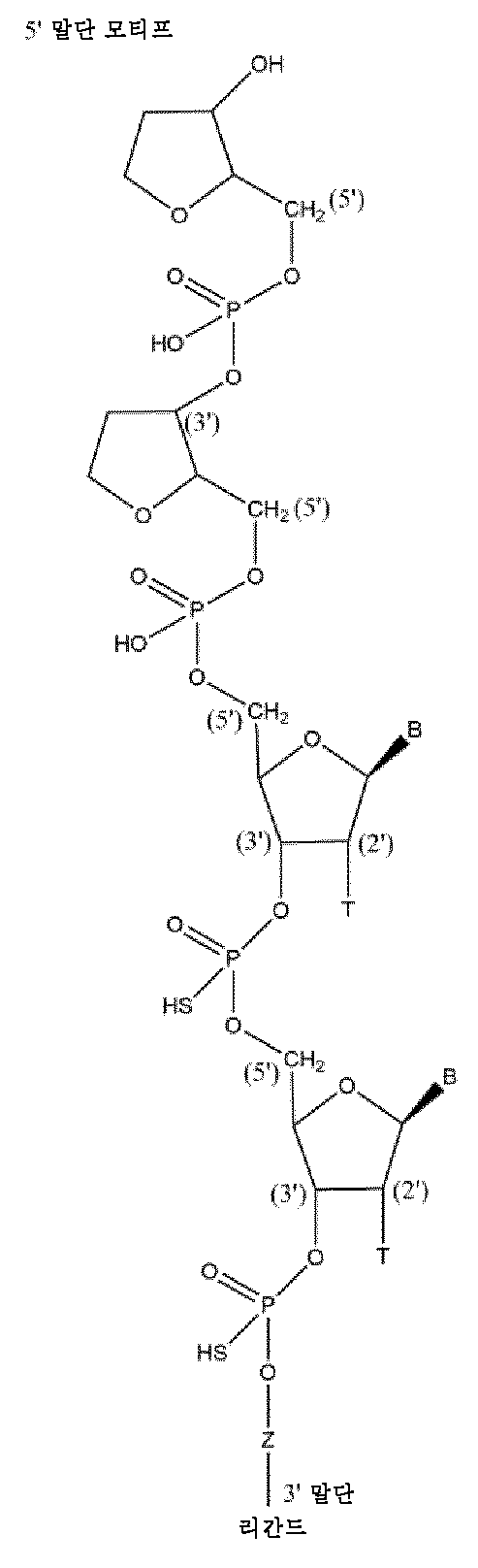
(여기서:(Here:
T는 2'Me 리보스 변형을 나타내고,T represents the 2'Me ribose modification,
B는 제2 가닥의 5' 말단 영역에서 처음 2개의 염기성 뉴클레오시드의 뉴클레오시드 염기를 나타내고,B represents the nucleoside bases of the first two basic nucleosides in the 5' terminal region of the second strand,
Z는 제2 가닥의 나머지 19개의 인접한 염기성 뉴클레오시드를 나타냄).Z represents the remaining 19 adjacent basic nucleosides of the second strand).
일부 실시양태에서, GalNAc 리간드는 도 5 (화학식 (XI))에 도시된 링커에 포함되고, 여기서 "올리고뉴클레오티드"는 본 발명에 따른 핵산을 나타내고, 본 발명에 따른 핵산은 하기 변형 패턴 (5'-3')을 갖는 변형된 제2 가닥을 포함하고:In some embodiments, the GalNAc ligand is comprised in a linker as depicted in FIG. 5 (Formula (XI)), wherein "oligonucleotide" refers to a nucleic acid according to the invention, and wherein the nucleic acid according to the invention comprises a modified second strand having the following modification pattern (5'-3'):
ia - ia - Me(s)Me(s)Me - Me - Me - Me - F - Me - F - F - F - F - Me - Me - Me - Me - Me - Me - Me - Me - Meia - ia - Me(s)Me(s)Me - Me - Me - Me - F - Me - F - F - F - F - Me - Me - Me - Me - Me - Me - Me - Me - Me
또는or
ia - ia - Me(s)Me(s)Me - Me - Me - Me - Me - Me - F - F - F - Me - Me - Me - Me - Me - Me - Me - Me - Me - Meia - ia - Me(s)Me(s)Me - Me - Me - Me - Me - Me - F - F - F - Me - Me - Me - Me - Me - Me - Me - Me - Me - Me
(여기서 (s)는 포스포로티오에이트 뉴클레오시드간 연결이고, ia는 역전된 무염기성 뉴클레오시드를 나타냄),(wherein (s) represents a phosphorothioate internucleoside linkage and ia represents an inverted abasic nucleoside),
여기서 제2 가닥은 하기 구조를 갖는다:Here, the second strand has the following structure:

(여기서:(Here:
T는 2'Me 리보스 변형을 나타내고,T represents the 2'Me ribose modification,
B는 제2 가닥의 5' 말단 영역에서 처음 2개의 염기성 뉴클레오시드의 뉴클레오시드 염기를 나타내고,B represents the nucleoside bases of the first two basic nucleosides in the 5' terminal region of the second strand,
Z는 제2 가닥의 나머지 19개의 인접한 염기성 뉴클레오시드를 나타냄).Z represents the remaining 19 adjacent basic nucleosides of the second strand).
벡터 및 세포Vectors and Cells
한 측면에서, 본 발명은 본원에 기재된 바와 같은 핵산, 예컨대 억제 RNA [RNAi]를 함유하는 세포를 제공한다.In one aspect, the invention provides a cell containing a nucleic acid, such as an inhibitory RNA [RNAi], as described herein.
한 측면에서, 본 발명은 본원에 기재된 바와 같은 벡터를 포함하는 세포를 제공한다.In one aspect, the invention provides a cell comprising a vector as described herein.
제약상 허용되는 조성물Pharmaceutically acceptable composition
한 측면에서, 본 발명은 본원에 개시된 바와 같은 핵산을 포함하는, 표적 유전자의 발현을 억제하기 위한 제약 조성물을 제공한다.In one aspect, the present invention provides a pharmaceutical composition for inhibiting expression of a target gene, comprising a nucleic acid as disclosed herein.
제약상 허용되는 조성물은 부형제 및 또는 담체를 포함할 수 있다.A pharmaceutically acceptable composition may include excipients and/or carriers.
제약상 허용되는 담체로서의 역할을 할 수 있는 물질의 일부 예는 다음을 포함한다: (1) 당, 예컨대 락토스, 글루코스 및 수크로스; (2) 전분, 예컨대 옥수수 전분 및 감자 전분; (3) 셀룰로스 및 그의 유도체, 예컨대 소듐 카르복시메틸 셀룰로스, 에틸 셀룰로스 및 셀룰로스 아세테이트; (4) 분말화 트라가칸트; (5) 맥아; (6) 젤라틴; (7) 윤활제, 예컨대 스테아르산마그네슘, 소듐 라우릴 술페이트 및 활석; (8) 부형제, 예컨대 코코아 버터 및 좌제 왁스; (9) 오일, 예컨대 땅콩 오일, 목화씨 오일, 홍화 오일, 참깨 오일, 올리브 오일, 옥수수 오일 및 대두 오일; (10) 글리콜, 예컨대 프로필렌 글리콜; (11) 폴리올, 예컨대 글리세린, 소르비톨, 만니톨 및 폴리에틸렌 글리콜; (12)에스테르, 예컨대 에틸 올레에이트 및 에틸 라우레이트; (13) 한천; (14) 완충제, 예컨대 수산화마그네슘 및 수산화알루미늄; (15) 알긴산; (16) 발열원-무함유 물; (17) 등장성 염수; (18) 링거액; (19) 에틸 알콜; (20) pH 완충 용액; (21) 폴리에스테르, 폴리카르보네이트 및/또는 폴리 무수물; (22) 벌킹제, 예컨대 폴리펩티드 및 아미노산 (23) 혈청 성분, 예컨대 혈청 알부민, HDL 및 LDL; 및 (22) 제약 제제에 사용되는 다른 비-독성 상용성 물질.Some examples of materials which can serve as pharmaceutically acceptable carriers include: (1) sugars, such as lactose, glucose, and sucrose; (2) starches, such as corn starch and potato starch; (3) cellulose and its derivatives, such as sodium carboxymethyl cellulose, ethyl cellulose, and cellulose acetate; (4) powdered tragacanth; (5) malt; (6) gelatin; (7) lubricants, such as magnesium stearate, sodium lauryl sulfate, and talc; (8) excipients, such as cocoa butter and suppository waxes; (9) oils, such as peanut oil, cottonseed oil, safflower oil, sesame oil, olive oil, corn oil, and soybean oil; (10) glycols, such as propylene glycol; (11) polyols, such as glycerin, sorbitol, mannitol, and polyethylene glycol; (12) esters, such as ethyl oleate and ethyl laurate; (13) agar; (14) buffers, such as magnesium hydroxide and aluminum hydroxide; (15) alginic acid; (16) pyrogen-free water; (17) isotonic saline; (18) Ringer's solution; (19) ethyl alcohol; (20) pH buffered solutions; (21) polyesters, polycarbonates and/or polyanhydrides; (22) bulking agents, such as polypeptides and amino acids (23) serum components, such as serum albumin, HDL and LDL; and (22) other non-toxic compatible substances used in pharmaceutical formulations.
전형적인 제약 담체는 결합제 (예를 들어, 예비젤라틴화 옥수수 전분, 폴리비닐피롤리돈 또는 히드록시프로필 메틸셀룰로스 등); 충전제 (예를 들어, 락토스 및 다른 당, 미세결정질 셀룰로스, 펙틴, 젤라틴, 황산칼슘, 에틸 셀룰로스, 폴리아크릴레이트 또는 인산수소칼슘 등); 윤활제 (예를 들어, 스테아르산마그네슘, 활석, 실리카, 콜로이드성 이산화규소, 스테아르산, 금속성 스테아레이트, 수소화 식물성 오일, 옥수수 전분, 폴리에틸렌 글리콜, 벤조산나트륨, 아세트산나트륨 등); 붕해제 (예를 들어, 전분, 소듐 스타치 글리콜레이트 등); 및 습윤제 (예를 들어, 소듐 라우릴 술페이트 등)를 포함하나 이에 제한되지는 않는다.Typical pharmaceutical carriers include, but are not limited to, binders (e.g., pregelatinized corn starch, polyvinylpyrrolidone, or hydroxypropyl methylcellulose); fillers (e.g., lactose and other sugars, microcrystalline cellulose, pectin, gelatin, calcium sulfate, ethyl cellulose, polyacrylates, or calcium hydrogen phosphate); lubricants (e.g., magnesium stearate, talc, silica, colloidal silicon dioxide, stearic acid, metallic stearates, hydrogenated vegetable oils, corn starch, polyethylene glycol, sodium benzoate, sodium acetate, and the like); disintegrants (e.g., starch, sodium starch glycolate, and the like); and humectants (e.g., sodium lauryl sulfate, and the like).
핵산과 유해하게 반응하지 않는 비경구가 아닌 투여에 적합한 제약상 허용되는 유기 또는 무기 부형제가 또한 본 발명의 조성물을 제제화하는 데 사용될 수 있다. 적합한 제약상 허용되는 부형제는 물, 염 용액, 알콜, 폴리에틸렌 글리콜, 젤라틴, 락토스, 아밀로스, 스테아르산마그네슘, 활석, 규산, 점성 파라핀, 히드록시메틸셀룰로스, 폴리비닐피롤리돈 등을 포함하나 이에 제한되지는 않는다.Pharmaceutically acceptable organic or inorganic excipients suitable for non-parenteral administration that do not deleteriously react with nucleic acids may also be used to formulate the compositions of the present invention. Suitable pharmaceutically acceptable excipients include, but are not limited to, water, salt solutions, alcohols, polyethylene glycols, gelatin, lactose, amylose, magnesium stearate, talc, silicic acid, viscous paraffin, hydroxymethylcellulose, polyvinylpyrrolidone, and the like.
핵산의 국소 투여를 위한 제제는 멸균 및 비-멸균 수용액, 통상의 용매, 예컨대 알콜 중 비-수용액, 또는 액체 또는 고체 오일 베이스 중 핵산의 용액을 포함할 수 있다. 용액은 또한 완충제, 희석제 및 다른 적합한 첨가제를 함유할 수 있다. 핵산과 유해하게 반응하지 않는 비경구가 아닌 투여에 적합한 제약상 허용되는 유기 또는 무기 부형제가 사용될 수 있다.Formulations for topical administration of nucleic acids may include sterile and non-sterile aqueous solutions, non-aqueous solutions in conventional solvents such as alcohol, or solutions of the nucleic acids in liquid or solid oil bases. The solutions may also contain buffers, diluents and other suitable additives. Pharmaceutically acceptable organic or inorganic excipients suitable for non-parenteral administration that do not deleteriously react with nucleic acids may be used.
한 실시양태에서, 핵산 또는 조성물은 비완충 용액으로 투여된다. 특정 실시양태에서, 비완충 용액은 염수 또는 물이다. 다른 실시양태에서, 핵산, 예를 들어 siRNA 작용제는 완충 용액으로 투여된다. 이러한 실시양태에서, 완충제 용액은 아세테이트, 시트레이트, 프롤라민, 카르보네이트 또는 포스페이트, 또는 그의 임의의 조합을 포함할 수 있다. 예를 들어, 완충제 용액은 포스페이트 완충 염수 (PBS)일 수 있다.In one embodiment, the nucleic acid or composition is administered in a non-buffered solution. In certain embodiments, the non-buffered solution is saline or water. In other embodiments, the nucleic acid, e.g., siRNA agent, is administered in a buffered solution. In such embodiments, the buffered solution can comprise acetate, citrate, prolamin, carbonate, or phosphate, or any combination thereof. For example, the buffered solution can be phosphate buffered saline (PBS).
투여량Dosage
본 발명의 제약 조성물은 유전자의 발현을 억제하기에 충분한 투여량으로 투여될 수 있다. 일반적으로, 본 발명의 핵산, 예를 들어 siRNA의 적합한 용량은 1일에 수용자의 체중 1 kg당 약 0.001 내지 약 200.0 mg의 범위, 일반적으로 1일에 체중 1 kg당 약 1 내지 50 mg의 범위일 것이다. 전형적으로, 본 발명의 핵산, 예를 들어 siRNA의 적합한 용량은 약 0.1 mg/kg 내지 약 5.0 mg/kg, 예를 들어 약 0.3 mg/kg 내지 약 3.0 mg/kg의 범위일 것이다.The pharmaceutical composition of the present invention can be administered in a dosage sufficient to inhibit expression of a gene. Generally, a suitable dosage of a nucleic acid of the present invention, e.g., siRNA, will range from about 0.001 to about 200.0 mg per kg of body weight of the recipient per day, and generally from about 1 to 50 mg per kg of body weight per day. Typically, a suitable dosage of a nucleic acid of the present invention, e.g., siRNA, will range from about 0.1 mg/kg to about 5.0 mg/kg, for example, from about 0.3 mg/kg to about 3.0 mg/kg.
반복-투여 요법은 정기적으로, 예컨대 격일로 또는 1년에 1회 치료량의 핵산, 예를 들어 siRNA의 투여를 포함할 수 있다. 특정 실시양태에서, 핵산, 예를 들어 siRNA는 대략 1개월에 1회 내지 대략 분기마다 1회 (즉, 대략 3개월마다 1회) 투여된다.Repeat-dose regimens can involve administration of therapeutic amounts of a nucleic acid, e.g., siRNA, on a regular basis, such as every other day or once a year. In certain embodiments, the nucleic acid, e.g., siRNA, is administered from about once a month to about once a quarter (i.e., about once every three months).
다양한 실시양태에서, 핵산, 예를 들어 siRNA 작용제는 약 0.01 mg/kg 내지 약 10 mg/kg 또는 약 0.5 mg/kg 내지 약 50 mg/kg의 용량으로 투여된다. 일부 실시양태에서, 핵산, 예를 들어 siRNA 작용제는 약 10 mg/kg 내지 약 30 mg/kg의 용량으로 투여된다. 특정 실시양태에서, 핵산, 예를 들어 siRNA 작용제는 약 0.5 mg/kg, 1 mg/kg, 1.5 mg/kg, 3 mg/kg, 5 mg/kg, 10 mg/kg 및 30 mg/kg으로부터 선택된 용량으로 투여된다. 특정 실시양태에서, 핵산 예를 들어 작용제는 약 0.1 mg/kg 내지 약 5.0 mg/kg의 용량으로 대략 1주에 1회, 1개월에 1회, 2개월마다 1회, 또는 분기마다 1회 (즉, 3개월마다 1회) 투여된다. 특정 실시양태에서, 핵산, 예를 들어 siRNA 작용제는 대상체에게 1주 1회 투여된다. 특정 실시양태에서, 핵산, 예를 들어 siRNA 작용제는 대상체에게 1개월 1회 투여된다. 특정 실시양태에서, 핵산, 예를 들어 siRNA 작용제는 분기마다 1회 (즉, 3개월마다) 투여된다.In various embodiments, the nucleic acid, e.g., siRNA agent, is administered at a dose of about 0.01 mg/kg to about 10 mg/kg or about 0.5 mg/kg to about 50 mg/kg. In some embodiments, the nucleic acid, e.g., siRNA agent, is administered at a dose of about 10 mg/kg to about 30 mg/kg. In certain embodiments, the nucleic acid, e.g., siRNA agent, is administered at a dose selected from about 0.5 mg/kg, 1 mg/kg, 1.5 mg/kg, 3 mg/kg, 5 mg/kg, 10 mg/kg, and 30 mg/kg. In certain embodiments, the nucleic acid, e.g., agent, is administered at a dose of about 0.1 mg/kg to about 5.0 mg/kg approximately once a week, once a month, once every two months, or once a quarter (i.e., once every three months). In certain embodiments, the nucleic acid, e.g., siRNA agent, is administered to the subject once a week. In certain embodiments, the nucleic acid, e.g., siRNA agent, is administered to the subject once a month. In certain embodiments, the nucleic acid, e.g., siRNA agent, is administered once a quarter (i.e., every three months).
초기 치료 요법 후에, 치료는 덜 빈번하게 투여될 수 있다. 예를 들어, 3개월 동안 매주 또는 격주로 투여한 후, 투여는 6개월 또는 1년; 또는 그 초과 동안 1개월에 1회 반복될 수 있다.After the initial treatment regimen, treatments may be administered less frequently. For example, after weekly or biweekly administration for 3 months, administration may be repeated once a month for 6 months or 1 year; or longer.
제약 조성물은 1일 1회 투여되거나, 또는 하루에 걸쳐 적절한 간격으로 2, 3회 또는 그 초과의 하위-용량으로서 또는 심지어 제어 방출 제제를 통한 연속 주입 또는 전달을 사용하여 투여될 수 있다. 이러한 경우, 각각의 하위-용량에 함유된 핵산, 예를 들어 siRNA는 총 1일 투여량을 달성하기 위해 상응하게 더 작아야 한다. 투여 단위는 또한 수일에 걸친 전달을 위해, 예를 들어 수일의 기간에 걸쳐 핵산, 예를 들어 siRNA의 지속 방출을 제공하는 통상적인 지속 방출 제제를 사용하여 배합될 수 있다. 지속 방출 제제는 관련 기술분야에 널리 공지되어 있고, 특정한 부위에서의 작용제의 전달에 특히 유용하며, 예컨대 본 발명의 작용제와 함께 사용될 수 있다. 이러한 실시양태에서, 투여 단위는 상응하는 다중 1일 용량을 함유한다.The pharmaceutical composition may be administered once daily, or as two, three or more sub-doses at appropriate intervals throughout the day, or even by continuous infusion or delivery via a controlled release formulation. In such cases, the nucleic acid, e.g., siRNA, contained in each sub-dose should be correspondingly smaller to achieve the total daily dosage. The dosage unit may also be formulated for delivery over multiple days, for example, using conventional sustained release formulations that provide sustained release of the nucleic acid, e.g., siRNA, over a period of several days. Sustained release formulations are well known in the art and are particularly useful for delivering agents at specific sites, such as may be used with the agents of the present invention. In such embodiments, the dosage unit contains corresponding multiple daily doses.
다른 실시양태에서, 제약 조성물의 단일 용량은 장기간 지속될 수 있어, 후속 용량이 3, 4, 또는 5일 이하의 간격으로, 또는 1, 2, 3, 또는 4주 이하의 간격으로 투여된다. 본 발명의 일부 실시양태에서, 본 발명의 제약 조성물의 단일 용량은 1주에 1회 투여된다. 본 발명의 다른 실시양태에서, 본 발명의 제약 조성물의 단일 용량은 격월로 투여된다. 특정 실시양태에서, siRNA는 대략 1개월에 1회 내지 분기마다 약 1회 (즉, 대략 3개월마다 1회), 또는 심지어 6개월 또는 12개월마다 투여된다.In other embodiments, a single dose of the pharmaceutical composition can be administered over an extended period of time, with subsequent doses administered at intervals of no more than 3, 4, or 5 days, or at intervals of no more than 1, 2, 3, or 4 weeks. In some embodiments of the invention, a single dose of the pharmaceutical composition of the invention is administered once a week. In other embodiments of the invention, a single dose of the pharmaceutical composition of the invention is administered every other month. In certain embodiments, the siRNA is administered from about once a month to about once every quarter (i.e., about once every three months), or even every six or twelve months.
본 발명에 포함되는 개별 핵산, 예를 들어 siRNA에 대한 유효 투여량 및 생체내 반감기의 추정은 관련 기술분야에 공지된 바와 같이 통상의 방법론을 사용하여 또는 적절한 동물 모델을 사용한 생체내 시험에 기초하여 이루어질 수 있다.Estimates of effective dosages and in vivo half-lives for individual nucleic acids, e.g., siRNA, included in the present invention can be made using conventional methodologies known in the art or based on in vivo tests using appropriate animal models.
본 발명의 제약 조성물은 국소 또는 전신 치료가 바람직한지 여부 및 치료될 영역에 따라 다수의 방식으로 투여될 수 있다. 투여는 국소 (예를 들어, 경피 패치에 의해), 폐, 예를 들어 네뷸라이저에 의한 것을 포함한 분말 또는 에어로졸의 흡입 또는 취입에 의해; 기관내, 비강내, 표피 및 경피, 경구 또는 비경구일 수 있다. 비경구 투여는 정맥내, 동맥내, 피하, 복강내 또는 근육내 주사 또는 주입; 예를 들어 이식된 장치를 통한 피하; 또는 예를 들어 실질내, 척수강내 또는 뇌실내 투여에 의한 두개내 투여를 포함한다. 특정의 바람직한 실시양태에서, 조성물은 정맥내 주입 또는 주사에 의해 투여된다. 특정 실시양태에서, 조성물은 피하 주사에 의해 투여된다.The pharmaceutical compositions of the present invention may be administered in a number of ways, depending on whether local or systemic treatment is desired and the area to be treated. Administration may be topical (e.g., by a transdermal patch); pulmonary, e.g., by inhalation or insufflation of a powder or aerosol, including by a nebulizer; intratracheal, intranasal, epidermal and transdermal, oral or parenteral. Parenteral administration includes intravenous, intraarterial, subcutaneous, intraperitoneal or intramuscular injection or infusion; subcutaneously, e.g., via an implanted device; or intracranial administration, e.g., by intraparenchymal, intrathecal or intracerebroventricular administration. In certain preferred embodiments, the compositions are administered by intravenous infusion or injection. In certain embodiments, the compositions are administered by subcutaneous injection.
한 실시양태에서, 핵산, 예를 들어 작용제는 대상체에게 피하로 투여된다.In one embodiment, the nucleic acid, e.g., the agent, is administered subcutaneously to the subject.
핵산, 예를 들어 siRNA는 특정한 조직 (예를 들어, 특히 간 세포)을 표적화하는 방식으로 전달될 수 있다.Nucleic acids, such as siRNA, can be delivered in a manner that targets specific tissues (e.g., liver cells in particular).
표적 유전자 발현을 억제하는 방법Method for inhibiting target gene expression
본 발명은 또한 세포에서 표적 유전자의 발현을 억제하는 방법을 제공한다. 상기 방법은 세포를 본 발명의 핵산, 예를 들어 siRNA 작용제, 예컨대 이중 가닥 siRNA 작용제와 세포에서 표적 유전자의 발현을 억제하는 데 효과적인 양으로 접촉시키고, 그에 의해 세포에서 표적 유전자의 발현을 억제하는 것을 포함한다.The present invention also provides a method of inhibiting expression of a target gene in a cell. The method comprises contacting a cell with a nucleic acid of the present invention, e.g., an siRNA agent, e.g., a double-stranded siRNA agent, in an amount effective to inhibit expression of a target gene in the cell, thereby inhibiting expression of the target gene in the cell.
세포를 핵산, 예를 들어 siRNA, 예컨대 이중 가닥 siRNA 작용제와 접촉시키는 것은 시험관내 또는 생체내에서 수행될 수 있다. 세포를 생체내에서 핵산과 접촉시키는 것은, 예를 들어 대상체, 예를 들어 인간 대상체 내의 세포 또는 세포 군을 핵산, 예를 들어 siRNA와 접촉시키는 것을 포함한다. 세포를 접촉시키는 시험관내 및 생체내 방법의 조합이 또한 가능하다. 세포를 접촉시키는 것은 상기 논의된 바와 같이 직접적 또는 간접적일 수 있다. 게다가, 세포를 접촉시키는 것은 본원에 기재되거나 관련 기술분야에 공지된 임의의 리간드 모이어티를 포함한 표적화 리간드 모이어티를 통해 달성될 수 있다. 바람직한 실시양태에서, 표적화 리간드 모이어티는 탄수화물 모이어티, 예를 들어 GalNAc3 리간드, 또는 siRNA 작용제를 관심 부위로 지시하는 임의의 다른 리간드 모이어티이다.Contacting a cell with a nucleic acid, e.g., siRNA, such as a double-stranded siRNA agent, can be performed in vitro or in vivo. Contacting a cell with a nucleic acid in vivo includes, for example, contacting a cell or group of cells within a subject, e.g., a human subject, with the nucleic acid, e.g., siRNA. Combinations of in vitro and in vivo methods of contacting a cell are also possible. Contacting a cell can be direct or indirect, as discussed above. In addition, contacting a cell can be accomplished via a targeting ligand moiety, including any ligand moiety described herein or known in the art. In a preferred embodiment, the targeting ligand moiety is a carbohydrate moiety, e.g., a GalNAc3 ligand, or any other ligand moiety that directs the siRNA agent to a site of interest.
본원에 사용된 용어 "억제하는"은 "감소시키는", "침묵시키는", "하향조절하는", "저해하는" 및 다른 유사한 용어와 상호교환가능하게 사용되고, 임의의 수준의 억제를 포함한다.The term "inhibiting," as used herein, is used interchangeably with "reducing," "silencing," "downregulating," "inhibiting," and other similar terms, and includes any level of inhibition.
본 발명의 방법의 일부 실시양태에서, 표적 유전자의 발현은, 바람직하게는 본원에 기재된 바와 같은 qPCR에 의해 결정될 때 및/또는 siRNA가 형질감염에 의해 표적 세포 내로 도입될 때 적어도 30%, 35%, 40%, 45%, 50%, 55%, 60%, 65%, 70%, 75%, 80%, 85%, 90% 또는 95%만큼, 또는 검정의 검출 수준 미만으로 억제된다. 특정 실시양태에서, 방법은 예를 들어 유전자의 발현을 감소시키는 작용제로 대상체를 치료한 후에 임상적으로 관련된 결과에 의해 입증된 바와 같이 표적 유전자의 발현의 임상적으로 관련된 억제를 포함한다.In some embodiments of the methods of the present invention, expression of the target gene is inhibited by at least 30%, 35%, 40%, 45%, 50%, 55%, 60%, 65%, 70%, 75%, 80%, 85%, 90% or 95%, or below the level of detection of the assay, preferably as determined by qPCR as described herein and/or when the siRNA is introduced into the target cell by transfection. In certain embodiments, the methods comprise clinically relevant inhibition of expression of the target gene, as evidenced by clinically relevant results, for example, after treating the subject with an agent that reduces expression of the gene.
일부 실시양태에서, 세포 내로 형질감염될 때, 본 발명의 핵산은 바람직하게는 본원에 기재된 바와 같은 qPCR에 의해, 보다 바람직하게는 리버스 트랜스크립타제 (RT)-qPCR에 의해 결정될 때 2000 pM, 1900 pM, 1800 pM, 1700 pM, 1600 pM, 1500 pM, 1400 pM, 1300 pM, 1200 pM, 1100 pM, 1000 pM, 900 pM, 800 pM, 700 pM, 600 pM, 500 pM, 400 pM, 300 pM, 200 pM 또는 100 pM 미만의 IC50 값으로 표적 유전자의 발현을 억제한다.In some embodiments, when transfected into a cell, the nucleic acids of the invention inhibit expression of a target gene with an IC50 value of less than 2000 pM, 1900 pM, 1800 pM, 1700 pM, 1600 pM, 1500 pM, 1400 pM, 1300 pM, 1200 pM, 1100 pM, 1000 pM, 900 pM, 800 pM, 700 pM, 600 pM, 500 pM, 400 pM, 300 pM, 200 pM or 100 pM, preferably as determined by qPCR as described herein, more preferably by reverse transcriptase (RT)-qPCR.
바람직한 실시양태에서, 세포 내로 형질감염될 때, 본 발명의 핵산은 2000 pM 미만의 IC50 값으로 표적 유전자의 발현을 억제한다. 보다 바람직한 실시양태에서, 세포 내로 형질감염될 때, 본 발명의 핵산은 1000 pM 미만의 IC50 값으로 표적 유전자의 발현을 억제한다. 보다 더 바람직한 실시양태에서, 세포 내로 형질감염될 때, 본 발명의 핵산은 500 pM 미만의 IC50 값으로 표적 유전자의 발현을 억제한다. 가장 바람직한 실시양태에서, 세포 내로 형질감염될 때, 본 발명의 핵산은 100 pM 미만의 IC50 값으로 표적 유전자의 발현을 억제한다.In a preferred embodiment, when transfected into a cell, the nucleic acids of the invention inhibit expression of a target gene with an IC50 value of less than 2000 pM. In a more preferred embodiment, when transfected into a cell, the nucleic acids of the invention inhibit expression of a target gene with an IC50 value of less than 1000 pM. In a still more preferred embodiment, when transfected into a cell, the nucleic acids of the invention inhibit expression of a target gene with an IC50 value of less than 500 pM. In a most preferred embodiment, when transfected into a cell, the nucleic acids of the invention inhibit expression of a target gene with an IC50 value of less than 100 pM.
표적 유전자의 억제는 하기 방법에 의해 정량화될 수 있다:Inhibition of a target gene can be quantified by the following methods:
Huh7 세포 (인간 간세포-유래 세포주, JCRB 세포 은행으로부터 입수함)를 10% FBS로 보충된 둘베코 변형 이글 배지 (DMEM) 중에서 37℃에서 5% CO2의 분위기 하에 유지할 수 있다. 이어서, 세포를 20 nM 내지 1 pM의 최종 듀플렉스 농도 범위에 걸쳐 10x3배 연속 희석을 사용하여 표적 유전자로부터 전사된 mRNA를 표적화하는 siRNA 듀플렉스 또는 음성 대조군 siRNA (siRNA-대조군; 센스 가닥 5'-UUCUCCGAACGUGUCACGUTT-3' (서열식별번호: 487), 안티센스 가닥 5'-ACGUGACACGUUCGGAGAATT-3' (서열식별번호: 486))로 형질감염시킬 수 있다. 9.7 μL 옵티-MEM (써모피셔) + 0.3 μL 리포펙타민 RNAiMAX (써모피셔)를 10 μL의 각각의 siRNA 듀플렉스에 첨가함으로써 형질감염을 수행할 수 있다. 혼합물을 실온에서 15분 동안 인큐베이션한 후, 20,000개의 Huh7 세포를 함유하는 완전 성장 배지 100 μL에 첨가할 수 있다. RNeasy 96 키트 (퀴아젠)를 사용하여 총 RNA 정제 전에 세포를 37℃/5% CO2에서 24시간 동안 인큐베이션할 수 있다. 각각의 듀플렉스를 단일 실험에서 이중 웰에서의 형질감염에 의해 시험할 수 있다.Huh7 cells (a human hepatocyte-derived cell line, obtained from JCRB Cell Bank) can be maintained at 37°C in an atmosphere of 5% CO2 in Dulbecco's modified Eagle's medium (DMEM) supplemented with 10% FBS. Cells can then be transfected with siRNA duplexes targeting mRNA transcribed from the target gene or negative control siRNA (siRNA-control; sense strand 5'-UUCUCCGAACGUGUCACGUTT-3' (SEQ ID NO: 487), antisense strand 5'-ACGUGACACGUUCGGAGAATT-3' (SEQ ID NO: 486)) using 10x3-fold serial dilutions over a final duplex concentration range of 20 nM to 1 pM. Transfections can be performed by adding 9.7 μL Opti-MEM (ThermoFisher) + 0.3 μL Lipofectamine RNAiMAX (ThermoFisher) to 10 μL of each siRNA duplex. The mixture can be incubated at room temperature for 15 minutes and then added to 100 μL of complete growth media containing 20,000 Huh7 cells. Cells can be incubated for 24 hours at 37°C/5% CO 2 prior to total RNA purification using the RNeasy 96 kit (Qiagen). Each duplex can be tested by transfection in duplicate wells in a single experiment.
cDNA 합성은 패스트퀀트(FastQuant) RT (gDNase 포함) 키트 (티안젠)를 사용하여 수행될 수 있다. 실시간 정량적 PCR (qPCR)은 패스트스타트 유니버셜 프로브 마스터 키트 (로슈)를 사용하여 표적 유전자 및 인간 GAPDH (Hs02786624_g1)에 특이적인 프라이머로 ABI 프리즘 7900HT 또는 ABI 퀀트스튜디오 7 상에서 수행할 수 있다.cDNA synthesis can be performed using the FastQuant RT (with gDNase) kit (Tianjen). Real-time quantitative PCR (qPCR) can be performed on ABI Prism 7900HT or
qPCR은 각각의 웰로부터 유래된 cDNA에 대해 이중으로 수행될 수 있고, 평균 사이클 역치 (Ct)가 계산된다. 상대적 표적 유전자 발현은 GAPDH에 대해 정규화되고 비처리 세포에 대해 상대적인 비교 Ct (ΔΔCt) 방법을 사용하여 평균 Ct 값으로부터 계산될 수 있다. 표적 유전자 발현의 최대 퍼센트 억제 및 IC50 값은 그래프패드 프리즘 9를 사용하여 4 파라미터 (가변 기울기) 모델을 사용하여 계산될 수 있다.qPCR can be performed in duplicate on cDNA from each well, and the average cycle threshold (Ct) is calculated. Relative target gene expression can be calculated from the average Ct values using the comparative Ct (ΔΔCt) method, normalized to GAPDH and relative to untreated cells. Maximum percent inhibition of target gene expression and IC50 values can be calculated using a four-parameter (variable slope) model using
대안적으로 또는 추가로, 표적 유전자의 발현의 억제는 표적 유전자의 평균 상대 발현의 감소를 특징으로 할 수 있다.Alternatively or additionally, inhibition of expression of a target gene may be characterized by a decrease in the average relative expression of the target gene.
일부 실시양태에서, 세포가 0.1 nM의 본 발명의 핵산으로 형질감염될 때, 표적 유전자의 평균 상대 발현은 바람직하게는 본원에 기재된 바와 같이 qPCR에 의해, 보다 바람직하게는 리버스 트랜스크립타제 (RT)-qPCR에 의해 결정될 때 1, 0.9, 0.8, 0.7, 0.6, 0.5, 또는 0.4 미만이다.In some embodiments, when cells are transfected with 0.1 nM of a nucleic acid of the invention, the average relative expression of the target gene is less than 1, 0.9, 0.8, 0.7, 0.6, 0.5, or 0.4, preferably as determined by qPCR as described herein, more preferably by reverse transcriptase (RT)-qPCR.
일부 실시양태에서, 세포가 5 nM의 본 발명의 핵산으로 형질감염될 때, 표적 유전자의 평균 상대 발현은 바람직하게는 본원에 기재된 바와 같이 qPCR에 의해, 보다 바람직하게는 리버스 트랜스크립타제 (RT)-qPCR에 의해 결정될 때 1, 0.9, 0.8, 0.7, 0.6, 0.5, 0.4 또는 0.3 미만이다.In some embodiments, when cells are transfected with 5 nM of a nucleic acid of the invention, the average relative expression of the target gene is less than 1, 0.9, 0.8, 0.7, 0.6, 0.5, 0.4 or 0.3, preferably as determined by qPCR as described herein, more preferably by reverse transcriptase (RT)-qPCR.
표적 유전자의 평균 상대 발현은 하기 방법에 의해 정량화될 수 있다:The average relative expression of a target gene can be quantified by the following method:
Huh7 세포 (인간 간세포-유래 세포주, JCRB 세포 은행으로부터 입수함)를 10% FBS로 보충된 둘베코 변형 이글 배지 (DMEM) 중에서 37℃에서 5% CO2의 분위기 하에 유지할 수 있다. 세포를 5 nM 및 0.1 nM의 최종 듀플렉스 농도에서 mRNA 또는 음성 대조군 siRNA (siRNA-대조군; 센스 가닥 5'-UUCUCCGAACGUGUCACGUTT-3' (서열식별번호: 487), 안티센스 가닥 5'-ACGUGACACGUUCGGAGAATT-3' (서열식별번호: 486))를 표적화하는 siRNA 듀플렉스로 형질감염시킬 수 있다. 9.7 μL 옵티-MEM (써모피셔) + 0.3 μL 리포펙타민 RNAiMAX (써모피셔)를 10 μL의 각각의 siRNA 듀플렉스에 첨가함으로써 형질감염을 수행할 수 있다. 혼합물을 실온에서 15분 동안 인큐베이션한 후, 20,000개의 Huh7 세포를 함유하는 완전 성장 배지 100 μL에 첨가할 수 있다. RNeasy 96 키트 (퀴아젠)를 사용하여 총 RNA 정제 전에 세포를 37℃/5% CO2에서 24시간 동안 인큐베이션할 수 있다. 각각의 듀플렉스를 2개의 독립적 실험에서 이중 웰에서의 형질감염에 의해 시험할 수 있다.Huh7 cells (a human hepatocyte-derived cell line, obtained from JCRB Cell Bank) can be maintained in Dulbecco's modified Eagle's medium (DMEM) supplemented with 10% FBS at 37°C in an atmosphere of 5% CO 2. Cells can be transfected with siRNA duplexes targeting mRNA or negative control siRNA (siRNA-control; sense strand 5'-UUCUCCGAACGUGUCACGUTT-3' (SEQ ID NO: 487), antisense strand 5'-ACGUGACACGUUCGGAGAATT-3' (SEQ ID NO: 486)) at final duplex concentrations of 5 nM and 0.1 nM. Transfections can be performed by adding 9.7 μL Opti-MEM (ThermoFisher) + 0.3 μL Lipofectamine RNAiMAX (ThermoFisher) to 10 μL of each siRNA duplex. After incubating the mixture at room temperature for 15 minutes, it can be added to 100 μL of complete growth medium containing 20,000 Huh7 cells. Cells can be incubated for 24 hours at 37°C/5% CO 2 prior to total RNA purification using the RNeasy 96 kit (Qiagen). Each duplex can be tested by transfection in duplicate wells in two independent experiments.
cDNA 합성은 패스트퀀트(FastQuant) RT (gDNase 포함) 키트 (티안젠)를 사용하여 수행될 수 있다. 실시간 정량적 PCR (qPCR)은 패스트스타트 유니버셜 프로브 마스터 키트 (로슈)를 사용하여 표적 유전자 및 인간 GAPDH (Hs02786624_g1)에 특이적인 프라이머로 ABI 프리즘 7900HT 또는 ABI 퀀트스튜디오 7 상에서 수행할 수 있다.cDNA synthesis can be performed using the FastQuant RT (with gDNase) kit (Tianjen). Real-time quantitative PCR (qPCR) can be performed on ABI Prism 7900HT or
qPCR은 각각의 웰로부터 유래된 cDNA에 대해 이중으로 수행될 수 있고, 평균 Ct가 계산된다. 상대적 표적 유전자 발현은 GAPDH에 대해 정규화되고 비처리 세포에 대해 상대적인 비교 Ct (ΔΔCt) 방법을 사용하여 평균 Ct 값으로부터 계산될 수 있다.qPCR can be performed in duplicate on cDNA from each well and the average Ct calculated. Relative target gene expression can be normalized to GAPDH and calculated from the average Ct values using the comparative Ct (ΔΔCt) method relative to untreated cells.
표적 유전자의 발현의 억제는 적합한 대조군과 비교하여 표적 유전자의 mRNA의 양의 감소에 의해 나타날 수 있다.Inhibition of the expression of a target gene may be indicated by a decrease in the amount of mRNA of the target gene compared to a suitable control.
다른 실시양태에서, 표적 유전자의 발현의 억제는 유전자 발현, 예를 들어 단백질 발현 또는 신호전달 경로에 기능적으로 연결된 파라미터의 감소의 관점에서 평가될 수 있다. 본원에 예시된 바와 같은 예시적인 표적 유전자는 HCII, ZPI 및 B4GALT1이다.In other embodiments, inhibition of expression of a target gene can be assessed in terms of a decrease in gene expression, e.g., a parameter functionally linked to protein expression or a signaling pathway. Exemplary target genes as exemplified herein are HCII, ZPI and B4GALT1.
표적 유전자 발현과 연관된 질환의 치료 또는 예방 방법Methods for treating or preventing diseases associated with target gene expression
본 발명은 또한 세포에서 표적 유전자 발현을 감소시키거나 억제하기 위해 핵산, 예를 들어 본 발명의 siRNA 또는 핵산, 예를 들어 본 발명의 siRNA를 함유하는 조성물을 사용하는 방법을 제공한다. 상기 방법은 세포를 본 발명의 핵산, 예를 들어 dsiRNA와 접촉시키고, 세포를 표적의 mRNA 전사체의 분해를 얻기에 충분한 시간 동안 유지시키고, 그에 의해 세포에서 표적 유전자의 발현을 억제하는 것을 포함한다. 유전자 발현의 감소는 관련 기술분야에 공지된 임의의 방법에 의해 평가될 수 있다.The invention also provides a method of using a nucleic acid, e.g., an siRNA of the invention, or a composition containing a nucleic acid, e.g., an siRNA of the invention, to reduce or inhibit target gene expression in a cell. The method comprises contacting a cell with a nucleic acid of the invention, e.g., a dsiRNA, and maintaining the cell for a time sufficient to effect degradation of a target mRNA transcript, thereby inhibiting expression of the target gene in the cell. The reduction in gene expression can be assessed by any method known in the art.
본 발명의 방법에서, 세포는 시험관내 또는 생체내 접촉될 수 있으며, 즉, 세포는 대상체 내에 있을 수 있다.In the method of the present invention, the cells can be contacted in vitro or in vivo, i.e., the cells can be within the subject.
본 발명의 방법을 사용하는 치료에 적합한 세포는 지혈 장애와 관련된 질환, 예컨대 지혈 장애와 관련된 질환, 예컨대 혈우병과 연관된 관심 유전자를 발현하는 임의의 세포일 수 있다. 대안적으로, 본 발명의 방법을 사용하는 치료에 적합한 세포는 당뇨병 또는 심혈관 질환과 연관된 관심 유전자를 발현하는 임의의 세포일 수 있다.A cell suitable for treatment using the methods of the present invention may be any cell expressing a gene of interest associated with a disease associated with a hemostatic disorder, such as a disease associated with a hemostatic disorder, such as hemophilia. Alternatively, a cell suitable for treatment using the methods of the present invention may be any cell expressing a gene of interest associated with diabetes or cardiovascular disease.
본 발명의 생체내 방법은 본 발명의 핵산, 예를 들어 siRNA를 함유하는 조성물을 대상체에게 투여하는 것을 포함할 수 있으며, 여기서 핵산, 예를 들어 siRNA는 치료할 포유동물의 표적 유전자의 RNA 전사체의 적어도 일부에 상보적인 뉴클레오시드 서열을 포함한다.In vivo methods of the present invention can comprise administering to a subject a composition containing a nucleic acid of the present invention, e.g., siRNA, wherein the nucleic acid, e.g., siRNA, comprises a nucleoside sequence that is complementary to at least a portion of an RNA transcript of a target gene of the mammal to be treated.
본 발명은 치료를 필요로 하는 대상체의 치료 방법을 추가로 제공한다. 본 발명의 치료 방법은 본 발명의 핵산, 예컨대 siRNA를 대상체, 예를 들어 표적 유전자의 발현의 감소 또는 억제로부터 이익을 얻을 대상체에게 치료 유효량의, 예를 들어 표적 유전자에 대한 핵산, 예컨대 siRNA, 또는 유전자를 표적화하는 핵산을 포함하는 제약 조성물로 투여하는 것을 포함한다.The present invention further provides a method of treating a subject in need of treatment. The method of treatment comprises administering to a subject, e.g., a subject that would benefit from reducing or inhibiting the expression of a target gene, a therapeutically effective amount of a nucleic acid of the present invention, e.g., siRNA, in a pharmaceutical composition comprising a nucleic acid for a target gene, e.g., siRNA, or a nucleic acid that targets a gene.
치료될 질환은, 특히 표적 유전자가 본원에 개시된 바와 같은 HCII 또는 ZPI인 경우, 지혈 장애, 예컨대 지혈 장애와 관련된 질환, 예컨대 혈우병과 관련될 수 있다.The disease to be treated may be associated with a hemostatic disorder, such as a disease associated with a hemostatic disorder, such as hemophilia, particularly when the target gene is HCII or ZPI as disclosed herein.
혈우병(haemophilia, hemophilia)은 출혈을 정지시키는 데 필요한 과정인 혈병을 만드는 신체의 능력을 손상시키는 대부분 유전성 유전 장애이다. 이는 손상 후 더 긴 시간 동안 대상체 출혈, 용이한 타박상, 및 관절 또는 뇌 내부 출혈의 증가된 위험을 초래한다. 경도의 질환 사례를 갖는 대상체는 사고 후 또는 수술 동안에만 증상을 가질 수 있다. 관절로의 출혈 (또한, 혈관절증으로도 지칭됨)은 영구적 손상을 유발할 수 있는 반면에, 뇌에서의 출혈은 장기간 두통, 발작, 또는 감소된 수준의 의식을 유발할 수 있다.Hemophilia is a mostly inherited genetic disorder that impairs the body's ability to form blood clots, a process necessary to stop bleeding. This results in subjects bleeding for a longer period of time after an injury, easy bruising, and an increased risk of bleeding inside joints or the brain. Subjects with mild cases of the disease may only have symptoms after an accident or during surgery. Bleeding into joints (also called hemarthrosis) can cause permanent damage, while bleeding in the brain can cause long-term headaches, seizures, or a reduced level of consciousness.
혈우병의 2가지 주요 유형이 존재한다: 낮은 양의 응고 인자 VIII로 인해 발생하는 A형 혈우병, 및 낮은 수준의 응고 인자 IX로 인해 발생하는 B형 혈우병. 이들은 전형적으로 비기능성 유전자를 보유하는 X 염색체를 통해 부모로부터 유전된다. 드물게 새로운 돌연변이가 조기 발병 중에 발생할 수 있거나, 또는 응고 인자에 대해 형성되는 항체로 인해 나이가 들면서 혈우병이 발생할 수 있다. 다른 유형은 낮은 수준의 인자 XI로 인해 발생하는 C형 혈우병, 폰 빌레브란트 인자로 불리는 낮은 수준의 물질로 인해 발생하는 폰 빌레브란트병, 및 낮은 수준의 인자 V로 인해 발생하는 파라혈우병을 포함한다. A형, B형 및 C형 혈우병은 내인성 경로가 적절하게 기능하는 것을 막는데; 이 응고 경로는 혈관의 내피에 대한 손상이 있을 때 필요하다. 후천성 혈우병은 암, 자가면역 장애 및 임신과 연관된다. 혈액을 그의 응고 능력 및 그의 응고 인자 수준에 대해 시험함으로써 진단한다.There are two main types of hemophilia: hemophilia A, which is caused by low levels of clotting factor VIII, and hemophilia B, which is caused by low levels of clotting factor IX. These are typically inherited from a parent via the X chromosome, which carries the nonfunctional gene. Rarely, a new mutation can occur during early childhood, or hemophilia can develop later in life due to antibodies that form against the clotting factor. Other types include hemophilia C, which is caused by low levels of factor XI, von Willebrand disease, which is caused by low levels of a substance called von Willebrand factor, and parahemophilia, which is caused by low levels of factor V. Hemophilia A, B, and C prevent the intrinsic pathway from functioning properly; this clotting pathway is needed when there is damage to the lining of blood vessels. Acquired hemophilia is associated with cancer, autoimmune disorders, and pregnancy. It is diagnosed by testing the blood for its ability to clot and its levels of clotting factors.
특정 실시양태에서, 본 발명의 핵산, 특히 ZPI 또는 HCII의 발현을 억제하는 핵산은 치료 또는 A형, B형 및/또는 C형 혈우병의 치료에 적합하다. 특정 실시양태에서, 본 발명의 핵산, 특히 ZPI 또는 HCII의 발현을 억제하는 핵산은 치료 또는 A형 및/또는 B형 혈우병의 치료에 적합하다. 특정 실시양태에서, 본 발명의 핵산, 특히 ZPI 또는 HCII의 발현을 억제하는 핵산은 치료 또는 후천성 혈우병의 치료에 적합하다. 특정 실시양태에서, 본 발명의 핵산, 특히 ZPI 또는 HCII의 발현을 억제하는 핵산은 치료 또는 빌레브란트병의 치료에 적합하다. 특정 실시양태에서, 본 발명의 핵산, 특히 ZPI 또는 HCII의 발현을 억제하는 핵산은 치료 또는 혈우병의 치료에 적합하다.In certain embodiments, the nucleic acids of the invention, particularly nucleic acids which inhibit the expression of ZPI or HCII, are suitable for the treatment or treatment of hemophilia A, B and/or C. In certain embodiments, the nucleic acids of the invention, particularly nucleic acids which inhibit the expression of ZPI or HCII, are suitable for the treatment or treatment of hemophilia A and/or B. In certain embodiments, the nucleic acids of the invention, particularly nucleic acids which inhibit the expression of ZPI or HCII, are suitable for the treatment or treatment of acquired hemophilia. In certain embodiments, the nucleic acids of the invention, particularly nucleic acids which inhibit the expression of ZPI or HCII, are suitable for the treatment or treatment of Willebrand disease. In certain embodiments, the nucleic acids of the invention, particularly nucleic acids which inhibit the expression of ZPI or HCII, are suitable for the treatment or treatment of hemophilia.
이론에 얽매이는 것을 원하지는 않지만, 본 발명의 핵산을 사용한 치료는 출혈이 감소 또는 방지될 수 있도록 응고 인자 수준의 부스팅을 발생시킬 수 있다. 따라서, 바람직한 실시양태에서, 본 발명의 핵산, 특히 ZPI 또는 HCII의 발현을 억제하는 핵산을 사용한 치료는 혈우병을 앓고 있는 대상체에서 출혈 에피소드를 감소시키거나 예방할 수 있다. 또 다른 바람직한 실시양태에서, 본 발명의 핵산, 특히 ZPI 또는 HCII의 발현을 억제하는 핵산을 사용한 치료는 혈우병을 앓고 있는 대상체의 관절로의 출혈을 감소시키거나 예방할 수 있다. 특정 실시양태에서, 본 발명의 핵산, 특히 ZPI 또는 HCII의 발현을 억제하는 핵산을 사용한 치료는 혈우병을 앓고 있는 대상체의 근육 또는 뇌로의 출혈을 감소시키거나 예방할 수 있다.Without wishing to be bound by theory, treatment with the nucleic acids of the present invention can result in a boost in clotting factor levels such that bleeding can be reduced or prevented. Thus, in a preferred embodiment, treatment with the nucleic acids of the present invention, particularly nucleic acids that inhibit expression of ZPI or HCII, can reduce or prevent bleeding episodes in a subject suffering from hemophilia. In another preferred embodiment, treatment with the nucleic acids of the present invention, particularly nucleic acids that inhibit expression of ZPI or HCII, can reduce or prevent bleeding into joints in a subject suffering from hemophilia. In certain embodiments, treatment with the nucleic acids of the present invention, particularly nucleic acids that inhibit expression of ZPI or HCII, can reduce or prevent bleeding into muscles or the brain in a subject suffering from hemophilia.
치료될 질환은, 특히 표적 유전자가 본원에 개시된 바와 같은 B4GALT1인 경우에 당뇨병일 수 있다.The disease to be treated may be diabetes, particularly when the target gene is B4GALT1 as disclosed herein.
본 발명에 따르면, 본원에 사용된 용어 "당뇨병"은 신체가 충분한 인슐린을 생산하지 않기 때문에 또는 세포가 생산되는 인슐린에 반응하지 않기 때문에 대상체가 높은 혈당을 갖는 대사 질환의 군을 지칭한다. 당뇨병의 3가지 주요 유형이 존재한다: (1) 제1형 당뇨병 (T1D): 신체의 인슐린 생산 실패로 인한 것이고, 현재 사람에게 인슐린 주사가 요구된다. (인슐린-의존성 당뇨병, 약칭으로 IDDM, 및 소아 당뇨병으로도 지칭됨) (2) 제2형 당뇨병 (T2D): 세포가 인슐린을 적절하게 사용하는 데 실패한 상태인 인슐린 저항성으로 인해 발생하고, 때때로 절대적인 인슐린 결핍과 조합한다. (이전에 비-인슐린-의존성 당뇨병, 약칭으로 NIDDM, 및 성인-발병 당뇨병으로 지칭됨) (3) 임신성 당뇨병 (GD): 이전에 당뇨병을 가졌던 적이 없는 임신한 여성이 임신 동안 높은 혈액 글루코스 수준을 갖는 경우이다. 이는 T2D의 개발에 선행할 수 있다.According to the present invention, the term "diabetes" as used herein refers to a group of metabolic diseases in which a subject has high blood sugar levels, either because the body does not produce enough insulin or because the cells do not respond to the insulin that is produced. There are three main types of diabetes: (1)
특정 실시양태에서, 본 발명에 따른 핵산, 특히 B4GALT1의 발현을 억제하는 핵산, 또는 상기 핵산을 포함하는 제약 조성물은 당뇨병, 바람직하게는 제2형 당뇨병 (T2D)의 치료에 사용된다.In certain embodiments, a nucleic acid according to the invention, particularly a nucleic acid inhibiting the expression of B4GALT1, or a pharmaceutical composition comprising said nucleic acid, is used for the treatment of diabetes, preferably
치료할 질환은, 특히 표적 유전자가 본원에 개시된 바와 같은 B4GALT1인 경우에 심혈관 질환일 수 있다.The disease to be treated may be a cardiovascular disease, particularly when the target gene is B4GALT1 as disclosed herein.
본원에 사용된 용어 "심혈관 질환"은, 그의 정상 기능을 손상시키는, 심장, 또는 심장에 공급되는 혈관의 구조적 또는 기능적 이상과 연관되거나, 그로부터 유발되거나, 또는 그를 유발하는 임의의 상태, 장애 또는 질환 상태를 지칭한다. 심혈관 질환은 관상 동맥 질환, 아테롬성동맥경화증, 심근경색, 동맥경화증, 고혈압, 협심증, 심부 정맥 혈전증, 뇌졸중, 울혈성 심부전 또는 부정맥을 포함할 수 있다. 바람직한 실시양태에서, 심혈관 질환은 관상 동맥 질환이다.The term "cardiovascular disease" as used herein refers to any condition, disorder or disease state associated with, resulting from or causing a structural or functional abnormality of the heart, or the blood vessels supplying the heart, which impairs its normal function. Cardiovascular disease can include coronary artery disease, atherosclerosis, myocardial infarction, arteriosclerosis, hypertension, angina pectoris, deep vein thrombosis, stroke, congestive heart failure or arrhythmia. In a preferred embodiment, the cardiovascular disease is coronary artery disease.
특정 실시양태에서, 본 발명에 따른 핵산, 특히 B4GALT1의 발현을 억제하는 핵산, 또는 상기 핵산을 포함하는 제약 조성물은 심혈관 질환, 바람직하게는 관상 동맥 질환의 치료에 사용된다.In certain embodiments, a nucleic acid according to the invention, particularly a nucleic acid inhibiting the expression of B4GALT1, or a pharmaceutical composition comprising said nucleic acid, is used for the treatment of cardiovascular diseases, preferably coronary artery diseases.
본 발명의 핵산, 예를 들어 siRNA는 제약 조성물의 부재 하에 "유리" 핵산 또는 "유리 siRNA로서 투여될 수 있다. 네이키드 핵산은 적합한 완충제 용액 중에 존재할 수 있다. 완충제 용액은 아세테이트, 시트레이트, 프롤라민, 카르보네이트 또는 포스페이트, 또는 그의 임의의 조합을 포함할 수 있다. 한 실시양태에서, 완충제 용액은 포스페이트 완충 염수 (PBS)이다. 완충제 용액의 pH 및 오스몰농도는 대상체에게 투여하기에 적합하도록 조정될 수 있다.The nucleic acids of the present invention, e.g., siRNA, can be administered as "free" nucleic acids or "free siRNA" in the absence of a pharmaceutical composition. The naked nucleic acids can be present in a suitable buffer solution. The buffer solution can comprise acetate, citrate, prolamin, carbonate, or phosphate, or any combination thereof. In one embodiment, the buffer solution is phosphate buffered saline (PBS). The pH and osmolarity of the buffer solution can be adjusted to be suitable for administration to a subject.
대안적으로, 본 발명의 핵산, 예를 들어 siRNA는 제약 조성물, 예컨대 dsiRNA 리포솜 제제로서 투여될 수 있다.Alternatively, the nucleic acids of the present invention, e.g., siRNA, can be administered as a pharmaceutical composition, e.g., a dsiRNA liposome formulation.
한 실시양태에서, 방법은 표적 유전자의 발현이, 예컨대 약 1, 2, 3, 4, 5, 6, 7, 8, 12, 16, 18, 24시간, 28, 32 또는 약 36시간 동안 감소되도록 본원에서 특색화된 조성물을 투여하는 것을 포함한다. 한 실시양태에서, 표적 유전자의 발현은 연장된 기간, 예를 들어 적어도 약 2, 3, 4일 또는 그 초과, 예를 들어 약 1주, 2주, 3주 또는 4주 또는 그 초과, 예를 들어 약 1개월, 2개월 또는 3개월 동안 감소된다.In one embodiment, the method comprises administering a composition as featured herein such that expression of a target gene is reduced for, for example, about 1, 2, 3, 4, 5, 6, 7, 8, 12, 16, 18, 24 hours, 28, 32 or about 36 hours. In one embodiment, expression of the target gene is reduced for an extended period of time, for example, at least about 2, 3, 4 days or more, for example, about 1 week, 2 weeks, 3 weeks or 4 weeks or more, for example, about 1 month, 2 months or 3 months.
대상체는 지혈 장애와 관련된 질환, 예컨대 지혈 장애와 관련된 질환, 예컨대 혈우병을 치료하거나 또는 당뇨병을 치료하거나 또는 심혈관 질환을 치료하기 위해 치료량의 핵산, 예를 들어 siRNA, 예컨대 약 0.01 mg/kg 내지 약 200 mg/kg을 투여받을 수 있다.A subject can be administered a therapeutic amount of a nucleic acid, e.g., siRNA, e.g., about 0.01 mg/kg to about 200 mg/kg, to treat a disease associated with a hemostatic disorder, e.g., a disease associated with a hemostatic disorder, e.g., hemophilia, or to treat diabetes, or to treat a cardiovascular disease.
핵산, 예를 들어 siRNA는 정기적으로 일정 기간에 걸쳐 정맥내 주입에 의해 투여될 수 있다. 특정 실시양태에서, 초기 치료 요법 후에, 치료는 덜 빈번하게 투여될 수 있다. siRNA의 투여는, 예를 들어 환자의 세포 또는 조직에서 표적 유전자의 유전자 산물 수준을 적어도 약 20%, 25%, 30%, 35%, 40%, 45%, 50%, 55%, 60%, 65%, 70%, 75%, 80%, 85%, 90% 또는 95%, 또는 사용된 검정 방법의 검출 수준 미만으로 감소시킬 수 있다. 특정 실시양태에서, 투여는 표적 유전자-연관 장애의 적어도 1종의 징후 또는 증상의 임상적 안정화 또는 바람직하게는 임상적으로 관련된 감소를 유발한다.Nucleic acids, such as siRNA, can be administered by intravenous infusion over a period of time on a regular basis. In certain embodiments, after an initial treatment regimen, treatments can be administered less frequently. Administration of siRNA can, for example, reduce the level of gene product of a target gene in a cell or tissue of the patient by at least about 20%, 25%, 30%, 35%, 40%, 45%, 50%, 55%, 60%, 65%, 70%, 75%, 80%, 85%, 90%, or 95%, or below the level of detection of the assay method used. In certain embodiments, administration results in clinical stabilization, or preferably a clinically relevant decrease, of at least one sign or symptom of the target gene-linked disorder.
대안적으로, 핵산, 예를 들어 siRNA는 피하로, 즉 피하 주사에 의해 투여될 수 있다. 1회 이상의 주사를 사용하여 목적하는 1일 용량의 핵산, 예를 들어 siRNA를 대상체에게 전달할 수 있다. 주사는 일정 기간에 걸쳐 반복될 수 있다. 투여는 정기적으로 반복될 수 있다. 특정 실시양태에서, 초기 치료 요법 후에, 치료는 덜 빈번하게 투여될 수 있다. 반복-용량 요법은 정기적으로, 예컨대 격일로 또는 1년에 1회 치료량의 핵산의 투여를 포함할 수 있다. 특정 실시양태에서, 핵산은 대략 1개월에 1회 내지 분기마다 약 1회 (즉, 대략 3개월마다 1회) 투여된다.Alternatively, the nucleic acid, e.g., siRNA, can be administered subcutaneously, i.e., by subcutaneous injection. One or more injections can be used to deliver the desired daily dose of nucleic acid, e.g., siRNA, to the subject. The injections can be repeated over a period of time. The administrations can be repeated periodically. In certain embodiments, after an initial treatment regimen, the treatments can be administered less frequently. A repeat-dose regimen can involve administration of a therapeutic amount of the nucleic acid at regular intervals, such as every other day or once a year. In certain embodiments, the nucleic acid is administered about once a month to about once every quarter (i.e., about once every three months).
한 측면에서, 본원에 개시된 핵산은 하기 문장 1 내지 45에 정의된 바와 같은 핵산일 수 있다:In one aspect, the nucleic acids disclosed herein can be nucleic acids as defined in
1. 표적 유전자로부터 전사된 RNA의 부분에 적어도 부분적으로 상보적인 제1 가닥, 및 제1 가닥에 적어도 부분적으로 상보적인 제2 가닥을 포함하는 듀플렉스 영역을 포함하는, 표적 유전자의 발현을 억제하기 위한 핵산으로서,1. A nucleic acid for inhibiting the expression of a target gene, comprising a duplex region comprising a first strand at least partially complementary to a portion of RNA transcribed from a target gene, and a second strand at least partially complementary to the first strand,
여기서 상기 제2 가닥의 뉴클레오시드는 하기와 같은 2' 당 변형 패턴 (5'-3')을 포함하는 것인 핵산:A nucleic acid wherein the nucleoside of the second strand comprises the following 2' sugar modification pattern (5'-3'):
Me - Me - Me - Me - Me - Me - F - F - F - F - F - Me - Me - Me - Me - Me - Me - Me - F - Me - Me, 또는Me - Me - Me - Me - Me - Me - F - F - F - F - F - Me - Me - Me - Me - Me - Me - Me - F - Me - Me, or
Me - Me - Me - Me - Me - F - F - Me - F - F - F - F - Me - Me - Me - Me - Me - Me - Me - Me - Me, 또는Me - Me - Me - Me - Me - F - F - Me - F - F - F - F - Me - Me - Me - Me - Me - Me - Me - Me - Me, or
Me - Me - Me - Me - Me - Me -F- Me - F - F - F - F - Me - Me - Me - Me - Me - Me - Me - Me - Me.Me - Me - Me - Me - Me - Me -F- Me - F - F - F - F - Me - Me - Me - Me - Me - Me - Me - Me - Me.
2. 표적 유전자로부터 전사된 RNA의 부분에 적어도 부분적으로 상보적인 제1 가닥, 및 제1 가닥에 적어도 부분적으로 상보적인 제2 가닥을 포함하는 듀플렉스 영역을 포함하는, 표적 유전자의 발현을 억제하기 위한 핵산으로서,2. A nucleic acid for inhibiting the expression of a target gene, comprising a duplex region comprising a first strand at least partially complementary to a portion of RNA transcribed from a target gene, and a second strand at least partially complementary to the first strand,
여기서 상기 제2 가닥의 뉴클레오시드는 하기와 같은 2' 당 및 결합 변형 패턴 (5'-3')을 포함하는 것인 핵산:A nucleic acid wherein the nucleoside of the second strand comprises the following 2' sugar and linkage modification pattern (5'-3'):
Me(s)Me(s)Me - Me - Me - Me - F - F - F - F - F - Me - Me - Me - Me - Me - Me - Me - F - Me - Me, 또는Me(s)Me(s)Me - Me - Me - Me - F - F - F - F - F - Me - Me - Me - Me - Me - Me - Me - F - Me - Me, or
Me(s)Me(s)Me - Me - Me - F - F - Me - F - F - F - F - Me - Me - Me - Me - Me - Me - Me - Me - Me, 또는Me(s)Me(s)Me - Me - Me - F - F - Me - F - F - F - F - Me - Me - Me - Me - Me - Me - Me - Me - Me, or
Me(s)Me(s)Me - Me - Me - Me -F- Me - F - F - F - F - Me - Me - Me - Me - Me - Me - Me - Me - Me, 또는Me(s)Me(s)Me - Me - Me - Me -F- Me - F - F - F - F - Me - Me - Me - Me - Me - Me - Me - Me - Me, or
Me(s)Me(s)Me - Me - Me - Me - Me - Me - F - F - F - Me - Me - Me - Me - Me - Me - Me - Me - Me - Me, 또는Me(s)Me(s)Me - Me - Me - Me - Me - Me - F - F - F - Me - Me - Me - Me - Me - Me - Me - Me - Me - Me, or
Me - Me - Me - Me - Me - Me - F - F - F - F - F - Me - Me - Me - Me - Me - Me - Me - F(s)Me(s)Me, 또는Me - Me - Me - Me - Me - Me - F - F - F - F - F - Me - Me - Me - Me - Me - Me - Me - F(s)Me(s)Me, or
Me - Me - Me - Me - Me - F - F - Me - F - F - F - F - Me - Me - Me - Me - Me - Me - Me(s)Me(s)Me, 또는Me - Me - Me - Me - Me - F - F - Me - F - F - F - F - Me - Me - Me - Me - Me - Me - Me(s)Me(s)Me, or
Me - Me - Me - Me - Me - Me -F- Me - F - F - F - F - Me - Me - Me - Me - Me - Me - Me(s)Me(s)Me, 또는Me - Me - Me - Me - Me - Me -F- Me - F - F - F - F - Me - Me - Me - Me - Me - Me - Me(s)Me(s)Me, or
Me - Me - Me - Me - Me - Me - Me - Me - F - F - F - Me - Me - Me - Me - Me - Me - Me - Me(s)Me(s)MeMe - Me - Me - Me - Me - Me - Me - Me - F - F - F - Me - Me - Me - Me - Me - Me - Me - Me(s)Me(s)Me
(여기서 (s)는 포스포로티오에이트 뉴클레오시드간 연결임).(where (s) is a phosphorothioate internucleoside linkage).
3. 표적 유전자로부터 전사된 RNA의 부분에 적어도 부분적으로 상보적인 제1 가닥, 및 제1 가닥에 적어도 부분적으로 상보적인 제2 가닥을 포함하는 듀플렉스 영역을 포함하는, 표적 유전자의 발현을 억제하기 위한 핵산으로서,3. A nucleic acid for inhibiting the expression of a target gene, comprising a duplex region comprising a first strand at least partially complementary to a portion of RNA transcribed from a target gene, and a second strand at least partially complementary to the first strand,
여기서 상기 제2 가닥의 뉴클레오시드는 하기와 같은 2' 당 및 무염기성 변형 패턴 (5'-3')을 포함하는 것인 핵산:A nucleic acid wherein the nucleoside of the second strand comprises the following 2' sugar and abasic modification pattern (5'-3'):
ia - ia - Me - Me - Me - Me - Me - Me - F - F - F - F - F - Me - Me - Me - Me - Me - Me - Me - F - Me - Me, 또는ia - ia - Me - Me - Me - Me - Me - Me - F - F - F - F - F - Me - Me - Me - Me - Me - Me - Me - F - Me - Me, or
ia - ia - Me - Me - Me - Me - Me - F - F - Me - F - F - F - F - Me - Me - Me - Me - Me - Me - Me - Me - Me, 또는ia - ia - Me - Me - Me - Me - Me - F - F - Me - F - F - F - F - Me - Me - Me - Me - Me - Me - Me - Me - Me, or
ia - ia - Me - Me - Me - Me - Me - Me -F- Me - F - F - F - F - Me - Me - Me - Me - Me - Me - Me - Me - Me, 또는ia - ia - Me - Me - Me - Me - Me - Me -F- Me - F - F - F - F - Me - Me - Me - Me - Me - Me - Me - Me - Me, or
ia - ia - Me - Me - Me - Me - Me - Me - Me - Me - F - F - F - Me - Me - Me - Me - Me - Me - Me - Me - Me - Me, 또는ia - ia - Me - Me - Me - Me - Me - Me - Me - Me - F - F - F - Me - Me - Me - Me - Me - Me - Me - Me - Me - Me, or
Me - Me - Me - Me - Me - Me - F - F - F - F - F - Me - Me - Me - Me - Me - Me - Me - F - Me - Me - ia - ia, 또는Me - Me - Me - Me - Me - Me - F - F - F - F - F - Me - Me - Me - Me - Me - Me - Me - F - Me - Me - ia - ia, or
Me - Me - Me - Me - Me - F - F - Me - F - F - F - F - Me - Me - Me - Me - Me - Me - Me - Me - Me - ia - ia, 또는Me - Me - Me - Me - Me - F - F - Me - F - F - F - F - Me - Me - Me - Me - Me - Me - Me - Me - Me - ia - ia, or
Me - Me - Me - Me - Me - Me -F- Me - F - F - F - F - Me - Me - Me - Me - Me - Me - Me - Me - Me - ia - ia, 또는Me - Me - Me - Me - Me - Me -F- Me - F - F - F - F - Me - Me - Me - Me - Me - Me - Me - Me - Me - ia - ia, or
Me - Me - Me - Me - Me - Me - Me - Me - F - F - F - Me - Me - Me - Me - Me - Me - Me - Me - Me - Me - ia - iaMe - Me - Me - Me - Me - Me - Me - Me - F - F - F - Me - Me - Me - Me - Me - Me - Me - Me - Me - Me - ia - ia
(여기서 ia는 역전된 무염기성 뉴클레오시드를 나타내고, ia - ia에 의해 나타내어진 바와 같은 역전된 무염기성 뉴클레오시드가 제2 가닥의 3' 말단에 존재하는 경우, 상기 역전된 무염기성 뉴클레오시드는 전형적으로 2 뉴클레오시드 오버행에 존재함).(wherein ia represents an inverted abasic nucleoside, and when an inverted abasic nucleoside as represented by ia - ia is present at the 3' end of the second strand, the inverted abasic nucleoside is typically present in a 2 nucleoside overhang).
4. 표적 유전자로부터 전사된 RNA의 부분에 적어도 부분적으로 상보적인 제1 가닥, 및 제1 가닥에 적어도 부분적으로 상보적인 제2 가닥을 포함하는 듀플렉스 영역을 포함하는, 표적 유전자의 발현을 억제하기 위한 핵산으로서,4. A nucleic acid for inhibiting the expression of a target gene, comprising a duplex region comprising a first strand at least partially complementary to a portion of RNA transcribed from a target gene, and a second strand at least partially complementary to the first strand,
여기서 상기 제2 가닥의 뉴클레오시드는 하기와 같은 2' 당, 무염기성 및 결합 변형 패턴 (5'-3')을 포함하는 것인 핵산:wherein the nucleoside of the second strand comprises a 2' sugar, an abasic and a linkage modification pattern (5'-3') as follows:
ia - ia - Me(s)Me(s)Me - Me - Me - Me - F - F - F - F - F - Me - Me - Me - Me - Me - Me - Me - F - Me - Me, 또는ia - ia - Me(s)Me(s)Me - Me - Me - Me - F - F - F - F - F - Me - Me - Me - Me - Me - Me - Me - F - Me - Me, or
ia - ia - Me(s)Me(s)Me - Me - Me - F - F - Me - F - F - F - F - Me - Me - Me - Me - Me - Me - Me - Me - Me, 또는ia - ia - Me(s)Me(s)Me - Me - Me - F - F - Me - F - F - F - F - Me - Me - Me - Me - Me - Me - Me - Me - Me, or
ia - ia - Me(s)Me(s)Me - Me - Me - Me -F- Me - F - F - F - F - Me - Me - Me - Me - Me - Me - Me - Me - Me, 또는ia - ia - Me(s)Me(s)Me - Me - Me - Me -F- Me - F - F - F - F - Me - Me - Me - Me - Me - Me - Me - Me - Me, or
ia - ia - Me(s)Me(s)Me - Me - Me - Me - Me - Me - F - F - F - Me - Me - Me - Me - Me - Me - Me - Me - Me - Meia - ia - Me(s)Me(s)Me - Me - Me - Me - Me - Me - F - F - F - Me - Me - Me - Me - Me - Me - Me - Me - Me - Me
Me - Me - Me - Me - Me - Me - F - F - F - F - F - Me - Me - Me - Me - Me - Me - Me - F(s)Me(s)Me - ia - ia, 또는Me - Me - Me - Me - Me - Me - F - F - F - F - F - Me - Me - Me - Me - Me - Me - Me - F(s)Me(s)Me - ia - ia, or
Me - Me - Me - Me - Me - F - F - Me - F - F - F - F - Me - Me - Me - Me - Me - Me - Me(s)Me(s)Me - ia - ia, 또는Me - Me - Me - Me - Me - F - F - Me - F - F - F - F - Me - Me - Me - Me - Me - Me - Me(s)Me(s)Me - ia - ia, or
Me - Me - Me - Me - Me - Me -F- Me - F - F - F - F - Me - Me - Me - Me - Me - Me - Me(s)Me(s)Me - ia - ia, 또는Me - Me - Me - Me - Me - Me -F- Me - F - F - F - F - Me - Me - Me - Me - Me - Me - Me(s)Me(s)Me - ia - ia, or
Me - Me - Me - Me - Me - Me - Me - Me - F - F - F - Me - Me - Me - Me - Me - Me - Me - Me(s)Me(s)Me - ia - iaMe - Me - Me - Me - Me - Me - Me - Me - Me - F - F - F - Me - Me - Me - Me - Me - Me - Me - Me(s)Me(s)Me - ia - ia
(여기서:(Here:
(s)는 포스포로티오에이트 뉴클레오시드간 연결이고,(s) is a phosphorothioate internucleoside linkage,
ia는 역전된 무염기성 뉴클레오시드를 나타내고, ia - ia에 의해 나타내어진 바와 같은 역전된 무염기성 뉴클레오시드가 제2 가닥의 3' 말단에 존재하는 경우, 상기 역전된 무염기성 뉴클레오시드는 전형적으로 2 뉴클레오시드 오버행에 존재함).ia represents an inverted abasic nucleoside, and when an inverted abasic nucleoside as represented by ia - ia is present at the 3' end of the second strand, the inverted abasic nucleoside is typically present in a 2 nucleoside overhang.
5. 임의의 상기 문장에 있어서, 제1 가닥이 하기 또는 그의 임의의 조합으로부터 선택된 변형 패턴을 포함하고, 여기서 위치 1은 제1 가닥의 5' 말단 뉴클레오시드이고, 카운팅 방향은 5' - 3'인 핵산이고:5. In any of the above sentences, the first strand comprises a modification pattern selected from the following or any combination thereof, wherein
적어도 위치 2, 14 및 16에서의 2'-F 당 변형, 및/또는2'-F sugar modifications at least at
위치 17 내지 23에서의 2'-Me 당 변형, 또는 상기 제1 가닥은 적어도 8개의 2'-F 당 변형, 예컨대 적어도 위치 2, 4, 6, 12, 14, 16, 18 및 20에서의 2'-F 당 변형을 포함함, 및/또는a 2'-Me sugar modification at positions 17 to 23, or wherein said first strand comprises at least eight 2'-F sugar modifications, such as 2'-F sugar modifications at at
위치 1, 3 내지 5, 10 내지 13에서의 2'-Me 당 변형, 또는 상기 제1 가닥은 적어도 8개의 2'-F 당 변형, 예컨대 적어도 위치 2, 4, 6, 12, 14, 16, 18 및 20에서의 2'-F 당 변형을 포함함, 및/또는2'-Me sugar modifications at
위치 7에서의 2'-Me 당 변형 또는 위치 7에서의 열 탈안정화 변형, 예컨대 전형적으로 변형된 비잠금 핵산 또는 글리콜 핵산, 및/또는A 2'-Me sugar modification at
위치 6에서의 2'-F 당 변형 또는 열 탈안정화 변형, 예컨대 전형적으로 변형된 비잠금 핵산 또는 글리콜 핵산, 및/또는2'-F sugar modification or thermal destabilization modification at
위치 8 및 9는 2'-Me 당 변형 및 2'-F 당 변형으로부터 선택된 변형일 수 있고, 전형적으로 동일한 2' 당 변형일 수 있음,
그에 의해 전형적으로 제1 가닥은 하기 변형 패턴 (5'-3')을 포함할 수 있거나:Typically, the first strand may contain the following modification pattern (5'-3'):
Me - F - Me - Me - Me - (M)4 - Me - Me - Me - Me - F - Me - F - Me - Me - Me - Me - Me - Me - MeMe - F - Me - Me - Me - (M) 4 - Me - Me - Me - Me - F - Me - F - Me - Me - Me - Me - Me - Me - Me
(여기서 M은 전형적으로 위치 6에 존재할 수 있는 2'-Me 당 변형, 2'-F 당 변형 및 열 탈안정화 변형, 예컨대 전형적으로 변형된 비잠금 핵산 또는 글리콜 핵산으로부터 선택된 변형을 나타내고, 이는 전형적으로 2'-Me 당 변형이 위치 7에 존재하는 것일 수 있음),(wherein M represents a modification selected from a 2'-Me sugar modification, a 2'-F sugar modification and a heat destabilizing modification, which may typically be present at
또는 그에 의해 전형적으로 제1 가닥은 하기 변형 패턴 (5'-3')을 포함하거나:or, typically, the first strand comprises the following modification pattern (5'-3'):
Me - F - Me - Me - Me - (M1) - (M2)3 - Me - Me - Me - Me - F - Me - F - Me - Me - Me - Me - Me - Me - MeMe - F - Me - Me - Me - (M1) - (M2) 3 - Me - Me - Me - Me - F - Me - F - Me - Me - Me - Me - Me - Me - Me
(여기서 M1은 열 탈안정화 변형, 예컨대 전형적으로 변형된 비잠금 핵산 또는 글리콜 핵산을 나타내고, M2는 2'-Me 당 변형 및 2'-F 당 변형으로부터 선택된 변형을 나타냄),(wherein M1 represents a heat destabilizing modification, such as a typically modified non-locked nucleic acid or glycol nucleic acid, and M2 represents a modification selected from a 2'-Me sugar modification and a 2'-F sugar modification),
또는 그에 의해 전형적으로 제1 가닥은 하기 변형 패턴 (5'-3')을 포함하거나:or, typically, the first strand comprises the following modification pattern (5'-3'):
Me - F - Me - Me - Me - (M1) - Me - (M2)2 - Me - Me - Me - Me - F - Me - F - Me - Me - Me - Me - Me - Me - MeMe - F - Me - Me - Me - (M1) - Me - (M2) 2 - Me - Me - Me - Me - F - Me - F - Me - Me - Me - Me - Me - Me - Me
(여기서 M1은 2'-Me 당 변형, 2'-F 당 변형 및 열 탈안정화 변형, 예컨대 전형적으로 변형된 비잠금 핵산 또는 글리콜 핵산으로부터 선택된 변형을 나타내고, M2는 2'-Me 당 변형 및 2'-F 당 변형으로부터 선택된 변형을 나타냄),(wherein M1 represents a modification selected from a 2'-Me sugar modification, a 2'-F sugar modification and a heat destabilizing modification, such as a typically modified non-locked nucleic acid or a glycol nucleic acid, and M2 represents a modification selected from a 2'-Me sugar modification and a 2'-F sugar modification),
또는 그에 의해 전형적으로 제1 가닥은 하기 변형 패턴 (5'-3')을 포함하는 것인 핵산:or a nucleic acid wherein the first strand typically comprises the following modification pattern (5'-3'):
Me - F - Me - Me - Me - (M1) - Me - (M2)2 - Me - Me - Me - Me - F - Me - F - Me - Me - Me - Me - Me - Me - MeMe - F - Me - Me - Me - (M1) - Me - (M2) 2 - Me - Me - Me - Me - F - Me - F - Me - Me - Me - Me - Me - Me - Me
(여기서 M1은 열 탈안정화 변형, 예컨대 전형적으로 변형된 비잠금 핵산 또는 글리콜 핵산을 나타내고, M2는 2'-Me 당 변형 및 2'-F 당 변형으로부터 선택된 변형을 나타내고, 전형적으로 M2는 동일한 2' 당 변형일 수 있음).(wherein M1 represents a heat destabilizing modification, such as a typically modified unlocked nucleic acid or glycol nucleic acid, and M2 represents a modification selected from a 2'-Me sugar modification and a 2'-F sugar modification, and typically M2 can be the same 2' sugar modification).
6. 표적 유전자로부터 전사된 RNA의 부분에 적어도 부분적으로 상보적인 제1 가닥, 및 제1 가닥에 적어도 부분적으로 상보적인 제2 가닥을 포함하는 듀플렉스 영역을 포함하는, 표적 유전자의 발현을 억제하기 위한 핵산으로서,6. A nucleic acid for inhibiting the expression of a target gene, comprising a duplex region comprising a first strand at least partially complementary to a portion of RNA transcribed from a target gene, and a second strand at least partially complementary to the first strand,
여기서 상기 제2 가닥의 뉴클레오시드는 하기와 같은 2' 당 및 무염기성 변형 패턴을 포함하거나:wherein the nucleoside of the second strand comprises a 2' sugar and an abasic modification pattern as follows:
제2 가닥 (5'-3'): ia - ia - Me - Me - Me - Me - Me - Me - Me - Me - F - F - F - Me - Me - Me - Me - Me - Me - Me - Me - Me - MeSecond strand (5'-3'): ia - ia - Me - Me - Me - Me - Me - Me - Me - Me - Me - F - F - F - Me - Me - Me - Me - Me - Me - Me - Me - Me - Me
또는or
제2 가닥 상의 위치 7이 2'-Me 변형인 당 변형을 포함하는 것을 포함하고, 여기서 위치 1은 제2 가닥의 5' 말단 뉴클레오시드이고, 카운팅 방향은 5' - 3'이고, 전형적으로 제2 가닥의 5' 말단 영역에서 2개의 역전된 무염기성 뉴클레오시드가 존재하고,A compound comprising a sugar modification at
제1 가닥 변형 패턴은 하기 또는 그의 임의의 조합으로부터 선택된 변형 패턴을 포함하고, 여기서 위치 1은 제1 가닥의 5' 말단 뉴클레오시드이고, 카운팅 방향은 5' - 3'이고:The first strand modification pattern comprises a modification pattern selected from the following or any combination thereof, wherein
적어도 위치 2, 14 및 16에서의 2'-F 당 변형, 및/또는2'-F sugar modifications at least at
위치 17 내지 23에서의 2'-Me 당 변형, 및/또는2'-Me sugar modifications at positions 17 to 23, and/or
위치 1, 3 내지 5, 10 내지 13에서의 2'-Me 당 변형, 및/또는2'-Me sugar modifications at
위치 7에서의 2'-Me 당 변형 또는 위치 7에서의 열 탈안정화 변형, 예컨대 전형적으로 변형된 비잠금 핵산 또는 글리콜 핵산, 및/또는A 2'-Me sugar modification at
위치 6에서의 2'-F 당 변형 또는 열 탈안정화 변형, 예컨대 전형적으로 변형된 비잠금 핵산 또는 글리콜 핵산, 및/또는2'-F sugar modification or thermal destabilization modification at
위치 8 및 9는 2'-Me 당 변형 및 2'-F 당 변형으로부터 선택된 변형일 수 있고, 전형적으로 동일한 2' 당 변형일 수 있음,
그에 의해 전형적으로 제1 가닥은 하기 변형 패턴 (5'-3')을 포함할 수 있거나:Typically, the first strand may contain the following modification pattern (5'-3'):
Me - F - Me - Me - Me - (M)4 - Me - Me - Me - Me - F - Me - F - Me - Me - Me - Me - Me - Me - MeMe - F - Me - Me - Me - (M) 4 - Me - Me - Me - Me - F - Me - F - Me - Me - Me - Me - Me - Me - Me
(여기서 M은 전형적으로 위치 6에 존재할 수 있는 2'-Me 당 변형, 2'-F 당 변형 및 열 탈안정화 변형, 예컨대 전형적으로 변형된 비잠금 핵산 또는 글리콜 핵산으로부터 선택된 변형을 나타내고, 이는 전형적으로 2'-Me 당 변형이 위치 7에 존재하는 것일 수 있음),(wherein M represents a modification selected from a 2'-Me sugar modification, a 2'-F sugar modification and a heat destabilizing modification, which may typically be present at
또는 그에 의해 전형적으로 제1 가닥은 하기 변형 패턴 (5'-3')을 포함하거나:or, typically, the first strand comprises the following modification pattern (5'-3'):
Me - F - Me - Me - Me - (M1) - (M2)3 - Me - Me - Me - Me - F - Me - F - Me - Me - Me - Me - Me - Me - MeMe - F - Me - Me - Me - (M1) - (M2) 3 - Me - Me - Me - Me - F - Me - F - Me - Me - Me - Me - Me - Me - Me
(여기서 M1은 열 탈안정화 변형, 예컨대 전형적으로 변형된 비잠금 핵산 또는 글리콜 핵산을 나타내고, M2는 2'-Me 당 변형 및 2'-F 당 변형으로부터 선택된 변형을 나타냄),(wherein M1 represents a heat destabilizing modification, such as a typically modified non-locked nucleic acid or glycol nucleic acid, and M2 represents a modification selected from a 2'-Me sugar modification and a 2'-F sugar modification),
또는 그에 의해 전형적으로 제1 가닥은 하기 변형 패턴 (5'-3')을 포함하거나:or, typically, the first strand comprises the following modification pattern (5'-3'):
Me - F - Me - Me - Me - (M1) - Me - (M2)2 - Me - Me - Me - Me - F - Me - F - Me - Me - Me - Me - Me - Me - MeMe - F - Me - Me - Me - (M1) - Me - (M2) 2 - Me - Me - Me - Me - F - Me - F - Me - Me - Me - Me - Me - Me - Me
(여기서 M1은 2'-Me 당 변형, 2'-F 당 변형 및 열 탈안정화 변형, 예컨대 전형적으로 변형된 비잠금 핵산 또는 글리콜 핵산으로부터 선택된 변형을 나타내고, M2는 2'-Me 당 변형 및 2'-F 당 변형으로부터 선택된 변형을 나타냄),(wherein M1 represents a modification selected from a 2'-Me sugar modification, a 2'-F sugar modification and a heat destabilizing modification, such as a typically modified non-locked nucleic acid or a glycol nucleic acid, and M2 represents a modification selected from a 2'-Me sugar modification and a 2'-F sugar modification),
또는 그에 의해 전형적으로 제1 가닥은 하기 변형 패턴 (5'-3')을 포함하는 것인 핵산:or a nucleic acid wherein the first strand typically comprises the following modification pattern (5'-3'):
Me - F - Me - Me - Me - (M1) - Me - (M2)2 - Me - Me - Me - Me - F - Me - F - Me - Me - Me - Me - Me - Me - MeMe - F - Me - Me - Me - (M1) - Me - (M2) 2 - Me - Me - Me - Me - F - Me - F - Me - Me - Me - Me - Me - Me - Me
(여기서 M1은 열 탈안정화 변형, 예컨대 전형적으로 변형된 비잠금 핵산 또는 글리콜 핵산을 나타내고, M2는 2'-Me 당 변형 및 2'-F 당 변형으로부터 선택된 변형을 나타내고, 전형적으로 M2는 동일한 2' 당 변형일 수 있음).(wherein M1 represents a heat destabilizing modification, such as a typically modified unlocked nucleic acid or glycol nucleic acid, and M2 represents a modification selected from a 2'-Me sugar modification and a 2'-F sugar modification, and typically M2 can be the same 2' sugar modification).
7. 문장 5 또는 6에 있어서, (M)4가 하기 2' 당 변형 패턴 (5' - 3') 중 어느 하나를 나타내는 것인 핵산:7. A nucleic acid in which (M) 4 represents one of the following 2' sugar modification patterns (5' - 3') in
F - Me - Me - FF - Me - Me - F
Me - F - Me - FMe - F - Me - F
F - Me - F - MeF - Me - F - Me
F - F - F - FF - F - F - F
Me - F - F - MeMe - F - F - Me
Me - Me - F - FMe - Me - F - F
F - F - Me - MeF - F - Me - Me
Me - Me - Me - MeMe - Me - Me - Me
8. 문장 5 내지 7 중 어느 하나에 있어서, 2개의 포스포로티오에이트 뉴클레오시드간 연결이 각각 제1 가닥의 5' 및 3' 말단 영역 둘 다에서 3개의 연속 위치들 사이에 존재하고, 그에 의해 상기 제1 가닥의 5' 및 3' 말단 영역 각각에서의 말단 뉴클레오시드가 포스포로티오에이트 뉴클레오시드간 연결에 의해 각각의 5' 및 3' 인접한 끝에서 두 번째 뉴클레오시드에 각각 부착되고, 각각의 5' 및 3' 끝에서 두 번째 뉴클레오시드가 포스포로티오에이트 뉴클레오시드간 연결에 의해 각각의 5' 및 3' 인접한 끝에서 세 번째 뉴클레오시드에 부착되고,8. In any one of
적절한 경우에 제2 가닥의 3' 말단 영역에서 3개의 연속 위치들 사이에 2개의 포스포로티오에이트 뉴클레오시드간 연결이 추가로 존재할 수 있고, 그에 의해 3' 말단 뉴클레오시드는 포스포로티오에이트 뉴클레오시드간 연결에 의해 인접한 끝에서 두 번째 뉴클레오시드에 부착되고, 상기 끝에서 두 번째 뉴클레오시드는 포스포로티오에이트 뉴클레오시드간 연결에 의해 인접한 끝에서 세 번째 뉴클레오시드에 부착되고/거나,In suitable cases, two phosphorothioate internucleoside linkages may additionally be present between three consecutive positions in the 3'-terminal region of the second strand, whereby the 3'-terminal nucleoside is attached to the penultimate nucleoside from the adjacent end by a phosphorothioate internucleoside linkage, and the penultimate nucleoside is attached to the third nucleoside from the adjacent end by a phosphorothioate internucleoside linkage, and/or
적절한 경우에 제2 가닥의 5' 말단 영역에서 3개의 연속 위치들 사이에 2개의 포스포로티오에이트 뉴클레오시드간 연결이 추가로 존재할 수 있고, 그에 의해 5' 말단 뉴클레오시드는 포스포로티오에이트 뉴클레오시드간 연결에 의해 인접한 끝에서 두 번째 뉴클레오시드에 부착되고, 상기 끝에서 두 번째 뉴클레오시드는 포스포로티오에이트 뉴클레오시드간 연결에 의해 인접한 끝에서 세 번째 뉴클레오시드에 부착된 것인 핵산.A nucleic acid wherein, where appropriate, there may additionally be two phosphorothioate internucleoside linkages between three consecutive positions in the 5'-terminal region of the second strand, whereby the 5'-terminal nucleoside is attached to the penultimate nucleoside from the adjacent end by a phosphorothioate internucleoside linkage, and wherein the penultimate nucleoside is attached to the third nucleoside from the adjacent end by a phosphorothioate internucleoside linkage.
9. 표적 유전자로부터 전사된 RNA의 부분에 적어도 부분적으로 상보적인 제1 가닥, 및 제1 가닥에 적어도 부분적으로 상보적인 제2 가닥을 포함하는 듀플렉스 영역을 포함하는, 표적 유전자의 발현을 억제하기 위한 핵산으로서,9. A nucleic acid for inhibiting the expression of a target gene, comprising a duplex region comprising a first strand at least partially complementary to a portion of RNA transcribed from a target gene, and a second strand at least partially complementary to the first strand,
여기서 상기 제2 및 제1 가닥의 뉴클레오시드는 하기와 같은 2' 당 변형 패턴 (5'-3')을 포함하는 것인 핵산:A nucleic acid wherein the nucleosides of the second and first strands comprise the following 2' sugar modification pattern (5'-3'):
변형 패턴 1:Variant Pattern 1:
제2 가닥 (5'-3'): Me - Me - Me - Me - Me - Me - F - F - F - F - F - Me - Me - Me - Me - Me - Me - Me - F - Me - Me,Second strand (5'-3'): Me - Me - Me - Me - Me - Me - Me - F - F - F - F - F - Me - Me - Me - Me - Me - Me - Me - F - Me - Me,
제1 가닥 (5'-3'): Me - F - Me - F - Me - F - Me - F - F - Me - Me - Me - Me - F - Me - F - Me - Me - Me - Me - Me - Me - MeFirst strand (5'-3'): Me - F - Me - F - Me - F - Me - F - F - Me - Me - Me - Me - F - Me - F - Me - Me - Me - Me - Me - Me - Me
또는 변형 패턴 2:Or variant pattern 2:
제2 가닥 (5'-3'): Me - Me - Me - Me - Me - F - F - Me - F - F - F - F - Me - Me - Me - Me - Me - Me - Me - Me - Me,Second strand (5'-3'): Me - Me - Me - Me - Me - F - F - Me - F - F - F - F - Me - Me - Me - Me - Me - Me - Me - Me - Me,
제1 가닥 (5'-3'): Me - F - Me - F - Me - F - Me - F - F - Me - Me - Me - Me - F - Me - F - Me - Me - Me - Me - Me - Me - MeFirst strand (5'-3'): Me - F - Me - F - Me - F - Me - F - F - Me - Me - Me - Me - F - Me - F - Me - Me - Me - Me - Me - Me - Me
또는 변형 패턴 3:Or variant pattern 3:
제2 가닥 (5'-3'): Me - Me - Me - Me - Me - Me -F- Me - F - F - F - F - Me - Me - Me - Me - Me - Me - Me - Me - Me,Second strand (5'-3'): Me - Me - Me - Me - Me - Me -F- Me - F - F - F - F - Me - Me - Me - Me - Me - Me - Me - Me - Me,
제1 가닥 (5'-3'): Me - F - Me - F - Me - F - Me - F - F - Me - Me - Me - Me - F - Me - F - Me - Me - Me - Me - Me - Me - MeFirst strand (5'-3'): Me - F - Me - F - Me - F - Me - F - F - Me - Me - Me - Me - F - Me - F - Me - Me - Me - Me - Me - Me - Me
또는 변형 패턴 4:Or variant pattern 4:
제2 가닥 (5'-3'): Me - Me - Me - Me - Me - Me - F - Me - F - F - F - F - Me - Me - Me - Me - Me - Me - Me - Me - Me,Second strand (5'-3'): Me - Me - Me - Me - Me - Me - F - Me - F - F - F - F - Me - Me - Me - Me - Me - Me - Me - Me - Me,
제1 가닥 (5'-3'): Me - F - Me - F - Me - F - Me - Me - Me - Me - Me - Me - Me - F - Me - F - Me - Me - Me - Me - Me - Me - MeFirst strand (5'-3'): Me - F - Me - F - Me - F - Me - Me - Me - Me - Me - Me - Me - F - Me - F - Me - Me - Me - Me - Me - Me - Me
또는 변형 패턴 5:Or variant pattern 5:
제2 가닥 (5'-3'): Me - Me - Me - Me - Me - Me - Me - Me - F - F - F - Me - Me - Me - Me - Me - Me - Me - Me - Me - Me,Second strand (5'-3'): Me - Me - Me - Me - Me - Me - Me - Me - F - F - F - Me - Me - Me - Me - Me - Me - Me - Me - Me - Me,
제1 가닥 (5'-3'): Me - F - Me - Me - Me - F - Me - Me - F - Me - Me - Me - Me - F - Me - F - Me - Me - Me - Me - Me - Me - MeFirst strand (5'-3'): Me - F - Me - Me - Me - F - Me - Me - F - Me - Me - Me - Me - F - Me - F - Me - Me - Me - Me - Me - Me - Me
10. 표적 유전자로부터 전사된 RNA의 부분에 적어도 부분적으로 상보적인 제1 가닥, 및 제1 가닥에 적어도 부분적으로 상보적인 제2 가닥을 포함하는 듀플렉스 영역을 포함하는, 표적 유전자의 발현을 억제하기 위한 핵산으로서,10. A nucleic acid for inhibiting the expression of a target gene, comprising a duplex region comprising a first strand at least partially complementary to a portion of RNA transcribed from a target gene, and a second strand at least partially complementary to the first strand,
여기서 상기 제2 및 제1 가닥의 뉴클레오시드는 하기와 같은 2' 당 및 결합 변형 패턴 (5'-3')을 포함하는 것인 핵산:A nucleic acid wherein the nucleosides of the second and first strands comprise the following 2' sugar and linkage modification patterns (5'-3'):
변형 패턴 1:Variant Pattern 1:
제2 가닥 (5'-3'): Me(s)Me(s)Me - Me - Me - Me - F - F - F - F - F - Me - Me - Me - Me - Me - Me - Me - F - Me - Me,Second strand (5'-3'): Me(s)Me(s)Me - Me - Me - Me - F - F - F - F - F - Me - Me - Me - Me - Me - Me - Me - F - Me - Me,
제1 가닥 (5'-3'): Me(s)F(s)Me - F - Me - F - Me - F - F - Me - Me - Me - Me - F - Me - F - Me - Me - Me - Me - Me(s)Me(s)MeFirst strand (5'-3'): Me(s)F(s)Me - F - Me - F - Me - F - F - Me - Me - Me - Me - F - Me - F - Me - Me - Me - Me - Me(s)Me(s)Me
또는 변형 패턴 2:Or variant pattern 2:
제2 가닥 (5'-3'): Me(s)Me(s)Me - Me - Me - F - F - Me - F - F - F - F - Me - Me - Me - Me - Me - Me - Me - Me - Me,Second strand (5'-3'): Me(s)Me(s)Me - Me - Me - F - F - Me - F - F - F - F - Me - Me - Me - Me - Me - Me - Me - Me - Me,
제1 가닥 (5'-3'): Me(s)F(s)Me - F - Me - F - Me - F - F - Me - Me - Me - Me - F - Me - F - Me - Me - Me - Me - Me(s)Me(s)MeFirst strand (5'-3'): Me(s)F(s)Me - F - Me - F - Me - F - F - Me - Me - Me - Me - F - Me - F - Me - Me - Me - Me - Me(s)Me(s)Me
또는 변형 패턴 3:Or variant pattern 3:
제2 가닥 (5'-3'): Me(s)Me(s)Me - Me - Me - Me -F- Me - F - F - F - F - Me - Me - Me - Me - Me - Me - Me - Me - Me,Second strand (5'-3'): Me(s)Me(s)Me - Me - Me - Me -F- Me - F - F - F - F - Me - Me - Me - Me - Me - Me - Me - Me - Me,
제1 가닥 (5'-3'): Me(s)F(s)Me - F - Me - F - Me - F - F - Me - Me - Me - Me - F - Me - F - Me - Me - Me - Me - Me(s)Me(s)MeFirst strand (5'-3'): Me(s)F(s)Me - F - Me - F - Me - F - F - Me - Me - Me - Me - F - Me - F - Me - Me - Me - Me - Me(s)Me(s)Me
또는 변형 패턴 4:Or variant pattern 4:
제2 가닥 (5'-3'): Me(s)Me(s)Me - Me - Me - Me - F - Me - F - F - F - F - Me - Me - Me - Me - Me - Me - Me - Me - Me,Second strand (5'-3'): Me(s)Me(s)Me - Me - Me - Me - F - Me - F - F - F - F - Me - Me - Me - Me - Me - Me - Me - Me - Me,
제1 가닥 (5'-3'): Me(s)F(s)Me - F - Me - F - Me - Me - Me - Me - Me - Me - Me - F - Me - F - Me - Me - Me - Me - Me(s)Me(s)MeFirst strand (5'-3'): Me(s)F(s)Me - F - Me - F - Me - Me - Me - Me - Me - Me - Me - F - Me - F - Me - Me - Me - Me - Me(s)Me(s)Me
또는 변형 패턴 5:Or variant pattern 5:
제2 가닥 (5'-3'): Me(s)Me(s)Me - Me - Me - Me - Me - Me - F - F - F - Me - Me - Me - Me - Me - Me - Me - Me - Me - Me,Second strand (5'-3'): Me(s)Me(s)Me - Me - Me - Me - Me - Me - F - F - F - Me - Me - Me - Me - Me - Me - Me - Me - Me - Me,
제1 가닥 (5'-3'): Me(s)F(s)Me - Me - Me - F - Me - Me - F - Me - Me - Me - Me - F - Me - F - Me - Me - Me - Me - Me(s)Me(s)MeFirst strand (5'-3'): Me(s)F(s)Me - Me - Me - F - Me - Me - F - Me - Me - Me - Me - F - Me - F - Me - Me - Me - Me - Me(s)Me(s)Me
또는 변형 패턴 6:Or variant pattern 6:
제2 가닥 (5'-3'): Me(s)Me(s)Me - Me - Me - Me - F - Me - F - F - F - Me - Me - Me - Me - Me - Me - Me - Me - Me - Me,Second strand (5'-3'): Me(s)Me(s)Me - Me - Me - Me - F - Me - F - F - F - Me - Me - Me - Me - Me - Me - Me - Me - Me - Me,
제1 가닥 (5'-3'): Me(s)F(s)Me - Me - Me - F - Me - Me - F - Me - Me - Me - Me - F - Me - F - Me - Me - Me - Me - Me(s)Me(s)MeFirst strand (5'-3'): Me(s)F(s)Me - Me - Me - F - Me - Me - F - Me - Me - Me - Me - F - Me - F - Me - Me - Me - Me - Me(s)Me(s)Me
(여기서 (s)는 포스포로티오에이트 뉴클레오시드간 연결임).(where (s) is a phosphorothioate internucleoside linkage).
11. 표적 유전자로부터 전사된 RNA의 부분에 적어도 부분적으로 상보적인 제1 가닥, 및 제1 가닥에 적어도 부분적으로 상보적인 제2 가닥을 포함하는 듀플렉스 영역을 포함하는, 표적 유전자의 발현을 억제하기 위한 핵산으로서,11. A nucleic acid for inhibiting the expression of a target gene, comprising a duplex region comprising a first strand at least partially complementary to a portion of RNA transcribed from a target gene, and a second strand at least partially complementary to the first strand,
여기서 상기 제2 및 제1 가닥의 뉴클레오시드는 하기와 같은 2' 당 및 결합 변형 패턴 (5'-3')을 포함하는 것인 핵산:A nucleic acid wherein the nucleosides of the second and first strands comprise the following 2' sugar and linkage modification patterns (5'-3'):
변형 패턴 1:Variant Pattern 1:
제2 가닥 (5'-3'): Me - Me - Me - Me - Me - Me - F - F - F - F - F - Me - Me - Me - Me - Me - Me - Me - F(s)Me(s)Me,Second strand (5'-3'): Me - Me - Me - Me - Me - Me - F - F - F - F - F - Me - Me - Me - Me - Me - Me - Me - F(s)Me(s)Me,
제1 가닥 (5'-3'): Me(s)F(s)Me - F - Me - F - Me - F - F - Me - Me - Me - Me - F - Me - F - Me - Me - Me - Me - Me(s)Me(s)MeFirst strand (5'-3'): Me(s)F(s)Me - F - Me - F - Me - F - F - Me - Me - Me - Me - F - Me - F - Me - Me - Me - Me - Me(s)Me(s)Me
또는 변형 패턴 2:Or variant pattern 2:
제2 가닥 (5'-3'): Me - Me - Me - Me - Me - F - F - Me - F - F - F - F - Me - Me - Me - Me - Me - Me - Me(s)Me(s)Me,Second strand (5'-3'): Me - Me - Me - Me - Me - F - F - Me - F - F - F - F - Me - Me - Me - Me - Me - Me - Me(s)Me(s)Me,
제1 가닥 (5'-3'): Me(s)F(s)Me - F - Me - F - Me - F - F - Me - Me - Me - Me - F - Me - F - Me - Me - Me - Me - Me(s)Me(s)MeFirst strand (5'-3'): Me(s)F(s)Me - F - Me - F - Me - F - F - Me - Me - Me - Me - F - Me - F - Me - Me - Me - Me - Me(s)Me(s)Me
또는 변형 패턴 3:Or variant pattern 3:
제2 가닥 (5'-3'): Me - Me - Me - Me - Me - Me -F- Me - F - F - F - F - Me - Me - Me - Me - Me - Me - Me(s)Me(s)Me,Second strand (5'-3'): Me - Me - Me - Me - Me - Me -F- Me - F - F - F - F - Me - Me - Me - Me - Me - Me - Me(s)Me(s)Me,
제1 가닥 (5'-3'): Me(s)F(s)Me - F - Me - F - Me - F - F - Me - Me - Me - Me - F - Me - F - Me - Me - Me - Me - Me(s)Me(s)MeFirst strand (5'-3'): Me(s)F(s)Me - F - Me - F - Me - F - F - Me - Me - Me - Me - F - Me - F - Me - Me - Me - Me - Me(s)Me(s)Me
또는 변형 패턴 4:Or variant pattern 4:
제2 가닥 (5'-3'): Me - Me - Me - Me - Me - Me - F - Me - F - F - F - F - Me - Me - Me - Me - Me - Me - Me(s)Me(s)Me,Second strand (5'-3'): Me - Me - Me - Me - Me - Me - F - Me - F - F - F - F - Me - Me - Me - Me - Me - Me - Me(s)Me(s)Me,
제1 가닥 (5'-3'): Me(s)F(s)Me - F - Me - F - Me - Me - Me - Me - Me - Me - Me - F - Me - F - Me - Me - Me - Me - Me(s)Me(s)MeFirst strand (5'-3'): Me(s)F(s)Me - F - Me - F - Me - Me - Me - Me - Me - Me - Me - F - Me - F - Me - Me - Me - Me - Me(s)Me(s)Me
또는 변형 패턴 5:Or variant pattern 5:
제2 가닥 (5'-3'): Me - Me - Me - Me - Me - Me - Me - Me - F - F - F - Me - Me - Me - Me - Me - Me - Me - Me(s)Me(s)Me,Second strand (5'-3'): Me - Me - Me - Me - Me - Me - Me - Me - F - F - F - Me - Me - Me - Me - Me - Me - Me - Me(s)Me(s)Me,
제1 가닥 (5'-3'): Me(s)F(s)Me - Me - Me - F - Me - Me - F - Me - Me - Me - Me - F - Me - F - Me - Me - Me - Me - Me(s)Me(s)MeFirst strand (5'-3'): Me(s)F(s)Me - Me - Me - F - Me - Me - F - Me - Me - Me - Me - F - Me - F - Me - Me - Me - Me - Me(s)Me(s)Me
또는 변형 패턴 6:Or variant pattern 6:
제2 가닥 (5'-3'): Me - Me - Me - Me - Me - Me - F - Me - F - F - F - Me - Me - Me - Me - Me - Me - Me - Me(s)Me(s)Me,Second strand (5'-3'): Me - Me - Me - Me - Me - Me - F - Me - F - F - F - Me - Me - Me - Me - Me - Me - Me - Me(s)Me(s)Me,
제1 가닥 (5'-3'): Me(s)F(s)Me - Me - Me - F - Me - Me - F - Me - Me - Me - Me - F - Me - F - Me - Me - Me - Me - Me(s)Me(s)MeFirst strand (5'-3'): Me(s)F(s)Me - Me - Me - F - Me - Me - F - Me - Me - Me - Me - F - Me - F - Me - Me - Me - Me - Me(s)Me(s)Me
(여기서 (s)는 포스포로티오에이트 뉴클레오시드간 연결임).(where (s) is a phosphorothioate internucleoside linkage).
12. 표적 유전자로부터 전사된 RNA의 부분에 적어도 부분적으로 상보적인 제1 가닥, 및 제1 가닥에 적어도 부분적으로 상보적인 제2 가닥을 포함하는 듀플렉스 영역을 포함하는, 표적 유전자의 발현을 억제하기 위한 핵산으로서,12. A nucleic acid for inhibiting the expression of a target gene, comprising a duplex region comprising a first strand at least partially complementary to a portion of RNA transcribed from a target gene, and a second strand at least partially complementary to the first strand,
여기서 상기 제2 및 제1 가닥의 뉴클레오시드는 하기와 같은 2' 당 및 무염기성 변형 패턴 (5'-3')을 포함하는 것인 핵산:A nucleic acid wherein the nucleosides of the second and first strands comprise the following 2' sugar and abasic modification pattern (5'-3'):
변형 패턴 1:Variant Pattern 1:
제2 가닥 (5'-3'): ia - ia - Me - Me - Me - Me - Me - Me - F - F - F - F - F - Me - Me - Me - Me - Me - Me - Me - F - Me - Me,Second strand (5'-3'): ia - ia - Me - Me - Me - Me - Me - Me - F - F - F - F - F - Me - Me - Me - Me - Me - Me - Me - F - Me - Me,
제1 가닥 (5'-3'): Me - F - Me - F - Me - F - Me - F - F - Me - Me - Me - Me - F - Me - F - Me - Me - Me - Me - Me - Me - MeFirst strand (5'-3'): Me - F - Me - F - Me - F - Me - F - F - Me - Me - Me - Me - F - Me - F - Me - Me - Me - Me - Me - Me - Me
또는 변형 패턴 2:Or variant pattern 2:
제2 가닥 (5'-3'): ia - ia - Me - Me - Me - Me - Me - F - F - Me - F - F - F - F - Me - Me - Me - Me - Me - Me - Me - Me - Me,Second strand (5'-3'): ia - ia - Me - Me - Me - Me - Me - F - F - Me - F - F - F - F - Me - Me - Me - Me - Me - Me - Me - Me - Me,
제1 가닥 (5'-3'): Me - F - Me - F - Me - F - Me - F - F - Me - Me - Me - Me - F - Me - F - Me - Me - Me - Me - Me - Me - MeFirst strand (5'-3'): Me - F - Me - F - Me - F - Me - F - F - Me - Me - Me - Me - F - Me - F - Me - Me - Me - Me - Me - Me - Me
또는 변형 패턴 3:Or variant pattern 3:
제2 가닥 (5'-3'): ia - ia - Me - Me - Me - Me - Me - Me -F- Me - F - F - F - F - Me - Me - Me - Me - Me - Me - Me - Me - Me,Second strand (5'-3'): ia - ia - Me - Me - Me - Me - Me - Me -F- Me - F - F - F - F - Me - Me - Me - Me - Me - Me - Me - Me - Me,
제1 가닥 (5'-3'): Me - F - Me - F - Me - F - Me - F - F - Me - Me - Me - Me - F - Me - F - Me - Me - Me - Me - Me - Me - MeFirst strand (5'-3'): Me - F - Me - F - Me - F - Me - F - F - Me - Me - Me - Me - F - Me - F - Me - Me - Me - Me - Me - Me - Me
또는 변형 패턴 4:Or variant pattern 4:
제2 가닥 (5'-3'): ia - ia - Me - Me - Me - Me - Me - Me - F - Me - F - F - F - F - Me - Me - Me - Me - Me - Me - Me - Me - Me,Second strand (5'-3'): ia - ia - Me - Me - Me - Me - Me - Me - F - Me - F - F - F - F - Me - Me - Me - Me - Me - Me - Me - Me - Me,
제1 가닥 (5'-3'): Me - F - Me - F - Me - F - Me - Me - Me - Me - Me - Me - Me - F - Me - F - Me - Me - Me - Me - Me - Me - MeFirst strand (5'-3'): Me - F - Me - F - Me - F - Me - Me - Me - Me - Me - Me - Me - F - Me - F - Me - Me - Me - Me - Me - Me - Me
또는 변형 패턴 5:Or variant pattern 5:
제2 가닥 (5'-3'): ia - ia - Me - Me - Me - Me - Me - Me - Me - Me - F - F - F - Me - Me - Me - Me - Me - Me - Me - Me - Me - Me,Second strand (5'-3'): ia - ia - Me - Me - Me - Me - Me - Me - Me - Me - Me - F - F - F - Me - Me - Me - Me - Me - Me - Me - Me - Me - Me,
제1 가닥 (5'-3'): Me - F - Me - Me - Me - F - Me - Me - F - Me - Me - Me - Me - F - Me - F - Me - Me - Me - Me - Me - Me - MeFirst strand (5'-3'): Me - F - Me - Me - Me - F - Me - Me - F - Me - Me - Me - Me - F - Me - F - Me - Me - Me - Me - Me - Me - Me
또는 변형 패턴 6:Or variant pattern 6:
제2 가닥 (5'-3'): ia - ia - Me - Me - Me - Me - Me - Me - F - Me - F - F - F - Me - Me - Me - Me - Me - Me - Me - Me - Me - MeSecond strand (5'-3'): ia - ia - Me - Me - Me - Me - Me - Me - F - Me - F - F - F - Me - Me - Me - Me - Me - Me - Me - Me - Me - Me
제1 가닥 (5'-3'): Me - F - Me - Me - Me - F - Me - Me - F - Me - Me - Me - Me - F - Me - F - Me - Me - Me - Me - Me - Me - MeFirst strand (5'-3'): Me - F - Me - Me - Me - F - Me - Me - F - Me - Me - Me - Me - F - Me - F - Me - Me - Me - Me - Me - Me - Me
(여기서 ia는 역전된 무염기성 뉴클레오시드를 나타냄).(where ia represents an inverted abasic nucleoside).
13. 표적 유전자로부터 전사된 RNA의 부분에 적어도 부분적으로 상보적인 제1 가닥, 및 제1 가닥에 적어도 부분적으로 상보적인 제2 가닥을 포함하는 듀플렉스 영역을 포함하는, 표적 유전자의 발현을 억제하기 위한 핵산으로서,13. A nucleic acid for inhibiting the expression of a target gene, comprising a duplex region comprising a first strand at least partially complementary to a portion of RNA transcribed from a target gene, and a second strand at least partially complementary to the first strand,
여기서 상기 제2 및 제1 가닥의 뉴클레오시드는 하기와 같은 2' 당 및 무염기성 변형 패턴을 포함하는 것인 핵산:A nucleic acid wherein the nucleosides of the second and first strands comprise the following 2' sugar and abasic modification patterns:
변형 패턴 1:Variant Pattern 1:
제2 가닥 (5'-3'): Me - Me - Me - Me - Me - Me - F - F - F - F - F - Me - Me - Me - Me - Me - Me - Me - F - Me - Me - ia - ia,Second strand (5'-3'): Me - Me - Me - Me - Me - Me - Me - F - F - F - F - F - Me - Me - Me - Me - Me - Me - Me - F - Me - Me - ia - ia,
제1 가닥 (5'-3'): Me - F - Me - F - Me - F - Me - F - F - Me - Me - Me - Me - F - Me - F - Me - Me - Me - Me - Me - Me - MeFirst strand (5'-3'): Me - F - Me - F - Me - F - Me - F - F - Me - Me - Me - Me - F - Me - F - Me - Me - Me - Me - Me - Me - Me
또는 변형 패턴 2:Or variant pattern 2:
제2 가닥 (5'-3'): Me - Me - Me - Me - Me - F - F - Me - F - F - F - F - Me - Me - Me - Me - Me - Me - Me - Me - Me - ia - ia,Second strand (5'-3'): Me - Me - Me - Me - Me - F - F - Me - F - F - F - F - Me - Me - Me - Me - Me - Me - Me - Me - Me - ia - ia,
제1 가닥 (5'-3'): Me - F - Me - F - Me - F - Me - F - F - Me - Me - Me - Me - F - Me - F - Me - Me - Me - Me - Me - Me - MeFirst strand (5'-3'): Me - F - Me - F - Me - F - Me - F - F - Me - Me - Me - Me - F - Me - F - Me - Me - Me - Me - Me - Me - Me
또는 변형 패턴 3:Or variant pattern 3:
제2 가닥 (5'-3'): Me - Me - Me - Me - Me - Me -F- Me - F - F - F - F - Me - Me - Me - Me - Me - Me - Me - Me - Me - ia - ia,Second strand (5'-3'): Me - Me - Me - Me - Me - Me -F- Me - F - F - F - F - Me - Me - Me - Me - Me - Me - Me - Me - Me - ia - ia,
제1 가닥 (5'-3'): Me - F - Me - F - Me - F - Me - F - F - Me - Me - Me - Me - F - Me - F - Me - Me - Me - Me - Me - Me - MeFirst strand (5'-3'): Me - F - Me - F - Me - F - Me - F - F - Me - Me - Me - Me - F - Me - F - Me - Me - Me - Me - Me - Me - Me
또는 변형 패턴 4:Or variant pattern 4:
제2 가닥 (5'-3'): Me - Me - Me - Me - Me - Me - F - Me - F - F - F - F - Me - Me - Me - Me - Me - Me - Me - Me - Me - ia - ia,Second strand (5'-3'): Me - Me - Me - Me - Me - Me - F - Me - F - F - F - F - Me - Me - Me - Me - Me - Me - Me - Me - Me - ia - ia,
제1 가닥 (5'-3'): Me - F - Me - F - Me - F - Me - Me - Me - Me - Me - Me - Me - F - Me - F - Me - Me - Me - Me - Me - Me - MeFirst strand (5'-3'): Me - F - Me - F - Me - F - Me - Me - Me - Me - Me - Me - Me - F - Me - F - Me - Me - Me - Me - Me - Me - Me
또는 변형 패턴 5:Or variant pattern 5:
제2 가닥 (5'-3'): Me - Me - Me - Me - Me - Me - Me - Me - F - F - F - Me - Me - Me - Me - Me - Me - Me - Me - Me - Me - ia - ia,Second strand (5'-3'): Me - Me - Me - Me - Me - Me - Me - Me - F - F - F - Me - Me - Me - Me - Me - Me - Me - Me - Me - Me - ia - ia,
제1 가닥 (5'-3'): Me - F - Me - Me - Me - F - Me - Me - F - Me - Me - Me - Me - F - Me - F - Me - Me - Me - Me - Me - Me - MeFirst strand (5'-3'): Me - F - Me - Me - Me - F - Me - Me - F - Me - Me - Me - Me - F - Me - F - Me - Me - Me - Me - Me - Me - Me
또는 변형 패턴 6:Or variant pattern 6:
제2 가닥 (5'-3'): Me - Me - Me - Me - Me - Me - F - Me - F - F - F - Me - Me - Me - Me - Me - Me - Me - Me - Me - Me - ia - iaSecond strand (5'-3'): Me - Me - Me - Me - Me - Me - F - Me - F - F - F - Me - Me - Me - Me - Me - Me - Me - Me - Me - Me - ia - ia
제1 가닥 (5'-3'): Me - F - Me - Me - Me - F - Me - Me - F - Me - Me - Me - Me - F - Me - F - Me - Me - Me - Me - Me - Me - Me,First strand (5'-3'): Me - F - Me - Me - Me - F - Me - Me - F - Me - Me - Me - Me - F - Me - F - Me - Me - Me - Me - Me - Me - Me,
(여기서 ia는 역전된 무염기성 뉴클레오시드를 나타내고, ia - ia에 의해 나타내어진 바와 같은 역전된 무염기성 뉴클레오시드가 제2 가닥의 3' 말단에 존재하는 경우, 상기 역전된 무염기성 뉴클레오시드는 전형적으로 2 뉴클레오시드 오버행에 존재함).(wherein ia represents an inverted abasic nucleoside, and when an inverted abasic nucleoside as represented by ia - ia is present at the 3' end of the second strand, the inverted abasic nucleoside is typically present in a 2 nucleoside overhang).
14. 표적 유전자로부터 전사된 RNA의 부분에 적어도 부분적으로 상보적인 제1 가닥, 및 제1 가닥에 적어도 부분적으로 상보적인 제2 가닥을 포함하는 듀플렉스 영역을 포함하는, 표적 유전자의 발현을 억제하기 위한 핵산으로서,14. A nucleic acid for inhibiting the expression of a target gene, comprising a duplex region comprising a first strand at least partially complementary to a portion of RNA transcribed from a target gene, and a second strand at least partially complementary to the first strand,
여기서 상기 제2 및 제1 가닥의 뉴클레오시드는 하기와 같은 2' 당, 무염기성 및 결합 변형 패턴 (5'-3')을 포함하는 것인 핵산:A nucleic acid wherein the nucleosides of the second and first strands comprise the following 2' sugar, abasic and linkage modification patterns (5'-3'):
변형 패턴 1:Variant Pattern 1:
제2 가닥 (5'-3'): ia - ia - Me(s)Me(s)Me - Me - Me - Me - F - F - F - F - F - Me - Me - Me - Me - Me - Me - Me - F - Me - Me,Second strand (5'-3'): ia - ia - Me(s)Me(s)Me - Me - Me - Me - F - F - F - F - F - Me - Me - Me - Me - Me - Me - Me - F - Me - Me,
제1 가닥 (5'-3'): Me(s)F(s)Me - F - Me - F - Me - F - F - Me - Me - Me - Me - F - Me - F - Me - Me - Me - Me - Me(s)Me(s)MeFirst strand (5'-3'): Me(s)F(s)Me - F - Me - F - Me - F - F - Me - Me - Me - Me - F - Me - F - Me - Me - Me - Me - Me(s)Me(s)Me
또는 변형 패턴 2:Or variant pattern 2:
제2 가닥 (5'-3'): ia - ia - Me(s)Me(s)Me - Me - Me - F - F - Me - F - F - F - F - Me - Me - Me - Me - Me - Me - Me - Me - Me,Second strand (5'-3'): ia - ia - Me(s)Me(s)Me - Me - Me - F - F - Me - F - F - F - F - Me - Me - Me - Me - Me - Me - Me - Me - Me,
제1 가닥 (5'-3'): Me(s)F(s)Me - F - Me - F - Me - F - F - Me - Me - Me - Me - F - Me - F - Me - Me - Me - Me - Me(s)Me(s)MeFirst strand (5'-3'): Me(s)F(s)Me - F - Me - F - Me - F - F - Me - Me - Me - Me - F - Me - F - Me - Me - Me - Me - Me(s)Me(s)Me
또는 변형 패턴 3:Or variant pattern 3:
제2 가닥 (5'-3'): ia - ia - Me(s)Me(s)Me - Me - Me - Me -F- Me - F - F - F - F - Me - Me - Me - Me - Me - Me - Me - Me - Me,Second strand (5'-3'): ia - ia - Me(s)Me(s)Me - Me - Me - Me -F- Me - F - F - F - F - Me - Me - Me - Me - Me - Me - Me - Me - Me,
제1 가닥 (5'-3'): Me(s)F(s)Me - F - Me - F - Me - F - F - Me - Me - Me - Me - F - Me - F - Me - Me - Me - Me - Me(s)Me(s)MeFirst strand (5'-3'): Me(s)F(s)Me - F - Me - F - Me - F - F - Me - Me - Me - Me - F - Me - F - Me - Me - Me - Me - Me(s)Me(s)Me
또는 변형 패턴 4:Or variant pattern 4:
제2 가닥 (5'-3'): ia - ia - Me(s)Me(s)Me - Me - Me - Me - F - Me - F - F - F - F - Me - Me - Me - Me - Me - Me - Me - Me - Me,Second strand (5'-3'): ia - ia - Me(s)Me(s)Me - Me - Me - Me - F - Me - F - F - F - F - Me - Me - Me - Me - Me - Me - Me - Me - Me,
제1 가닥 (5'-3'): Me(s)F(s)Me - F - Me - F - Me - Me - Me - Me - Me - Me - Me - F - Me - F - Me - Me - Me - Me - Me(s)Me(s)MeFirst strand (5'-3'): Me(s)F(s)Me - F - Me - F - Me - Me - Me - Me - Me - Me - Me - F - Me - F - Me - Me - Me - Me - Me(s)Me(s)Me
또는 변형 패턴 5:Or variant pattern 5:
제2 가닥 (5'-3'): ia - ia - Me(s)Me(s)Me - Me - Me - Me - Me - Me - F - F - F - Me - Me - Me - Me - Me - Me - Me - Me - Me - Me,Second strand (5'-3'): ia - ia - Me(s)Me(s)Me - Me - Me - Me - Me - Me - F - F - F - Me - Me - Me - Me - Me - Me - Me - Me - Me - Me,
제1 가닥 (5'-3'): Me(s)F(s)Me - Me - Me - F - Me - Me - F - Me - Me - Me - Me - F - Me - F - Me - Me - Me - Me - Me(s)Me(s)MeFirst strand (5'-3'): Me(s)F(s)Me - Me - Me - F - Me - Me - F - Me - Me - Me - Me - F - Me - F - Me - Me - Me - Me - Me(s)Me(s)Me
또는 변형 패턴 6:Or variant pattern 6:
제2 가닥 (5'-3'): ia - ia - Me(s)Me(s)Me - Me - Me - Me - F - Me - F - F - F - Me - Me - Me - Me - Me - Me - Me - Me - Me - Me,Second strand (5'-3'): ia - ia - Me(s)Me(s)Me - Me - Me - Me - F - Me - F - F - F - Me - Me - Me - Me - Me - Me - Me - Me - Me - Me,
제1 가닥 (5'-3'): Me(s)F(s)Me - Me - Me - F - Me - Me - F - Me - Me - Me - Me - F - Me - F - Me - Me - Me - Me - Me(s)Me(s)MeFirst strand (5'-3'): Me(s)F(s)Me - Me - Me - F - Me - Me - F - Me - Me - Me - Me - F - Me - F - Me - Me - Me - Me - Me(s)Me(s)Me
(여기서:(Here:
(s)는 포스포로티오에이트 뉴클레오시드간 연결이고,(s) is a phosphorothioate internucleoside linkage,
ia는 역전된 무염기성 뉴클레오시드를 나타냄).ia represents an inverted abasic nucleoside).
15. 표적 유전자로부터 전사된 RNA의 부분에 적어도 부분적으로 상보적인 제1 가닥, 및 제1 가닥에 적어도 부분적으로 상보적인 제2 가닥을 포함하는 듀플렉스 영역을 포함하는, 표적 유전자의 발현을 억제하기 위한 핵산으로서,15. A nucleic acid for inhibiting the expression of a target gene, comprising a duplex region comprising a first strand at least partially complementary to a portion of RNA transcribed from a target gene, and a second strand at least partially complementary to the first strand,
여기서 상기 제2 및 제1 가닥의 뉴클레오시드는 하기와 같은 2' 당, 무염기성 및 결합 변형 패턴 (5'-3')을 포함하는 것인 핵산:A nucleic acid wherein the nucleosides of the second and first strands comprise the following 2' sugar, abasic and linkage modification patterns (5'-3'):
변형 패턴 1:Variant Pattern 1:
제2 가닥 (5'-3'): Me - Me - Me - Me - Me - Me - F - F - F - F - F - Me - Me - Me - Me - Me - Me - Me - F(s)Me(s)Me - ia - ia,Second strand (5'-3'): Me - Me - Me - Me - Me - Me - Me - F - F - F - F - F - Me - Me - Me - Me - Me - Me - Me - F(s)Me(s)Me - ia - ia,
제1 가닥 (5'-3'): Me(s)F(s)Me - F - Me - F - Me - F - F - Me - Me - Me - Me - F - Me - F - Me - Me - Me - Me - Me(s)Me(s)MeFirst strand (5'-3'): Me(s)F(s)Me - F - Me - F - Me - F - F - Me - Me - Me - Me - F - Me - F - Me - Me - Me - Me - Me(s)Me(s)Me
또는 변형 패턴 2:Or variant pattern 2:
제2 가닥 (5'-3'): Me - Me - Me - Me - Me - F - F - Me - F - F - F - F - Me - Me - Me - Me - Me - Me - Me(s)Me(s)Me - ia - ia,Second strand (5'-3'): Me - Me - Me - Me - Me - F - F - Me - F - F - F - F - Me - Me - Me - Me - Me - Me - Me(s)Me(s)Me - ia - ia,
제1 가닥 (5'-3'): Me(s)F(s)Me - F - Me - F - Me - F - F - Me - Me - Me - Me - F - Me - F - Me - Me - Me - Me - Me(s)Me(s)MeFirst strand (5'-3'): Me(s)F(s)Me - F - Me - F - Me - F - F - Me - Me - Me - Me - F - Me - F - Me - Me - Me - Me - Me(s)Me(s)Me
또는 변형 패턴 3:Or variant pattern 3:
제2 가닥 (5'-3'): Me - Me - Me - Me - Me - Me -F- Me - F - F - F - F - Me - Me - Me - Me - Me - Me - Me(s)Me(s)Me - ia - ia,Second strand (5'-3'): Me - Me - Me - Me - Me - Me -F- Me - F - F - F - F - Me - Me - Me - Me - Me - Me - Me(s)Me(s)Me - ia - ia,
제1 가닥 (5'-3'): Me(s)F(s)Me - F - Me - F - Me - F - F - Me - Me - Me - Me - F - Me - F - Me - Me - Me - Me - Me(s)Me(s)MeFirst strand (5'-3'): Me(s)F(s)Me - F - Me - F - Me - F - F - Me - Me - Me - Me - F - Me - F - Me - Me - Me - Me - Me(s)Me(s)Me
또는 변형 패턴 4:Or variant pattern 4:
제2 가닥 (5'-3'): Me - Me - Me - Me - Me - Me - F - Me - F - F - F - F - Me - Me - Me - Me - Me - Me - Me(s)Me(s)Me - ia - ia,Second strand (5'-3'): Me - Me - Me - Me - Me - Me - F - Me - F - F - F - F - Me - Me - Me - Me - Me - Me - Me(s)Me(s)Me - ia - ia,
제1 가닥 (5'-3'): Me(s)F(s)Me - F - Me - F - Me - Me - Me - Me - Me - Me - Me - F - Me - F - Me - Me - Me - Me - Me(s)Me(s)MeFirst strand (5'-3'): Me(s)F(s)Me - F - Me - F - Me - Me - Me - Me - Me - Me - Me - F - Me - F - Me - Me - Me - Me - Me(s)Me(s)Me
또는 변형 패턴 5:Or variant pattern 5:
제2 가닥 (5'-3'): Me - Me - Me - Me - Me - Me - Me - Me - F - F - F - Me - Me - Me - Me - Me - Me - Me - Me(s)Me(s)Me - ia - ia,Second strand (5'-3'): Me - Me - Me - Me - Me - Me - Me - Me - F - F - F - Me - Me - Me - Me - Me - Me - Me - Me(s)Me(s)Me - ia - ia,
제1 가닥 (5'-3'): Me(s)F(s)Me - Me - Me - F - Me - Me - F - Me - Me - Me - Me - F - Me - F - Me - Me - Me - Me - Me(s)Me(s)MeFirst strand (5'-3'): Me(s)F(s)Me - Me - Me - F - Me - Me - F - Me - Me - Me - Me - F - Me - F - Me - Me - Me - Me - Me(s)Me(s)Me
또는 변형 패턴 6:Or variant pattern 6:
제2 가닥 (5'-3'): Me - Me - Me - Me - Me - Me - F - Me - F - F - F - Me - Me - Me - Me - Me - Me - Me - Me(s)Me(s)Me - ia - ia,Second strand (5'-3'): Me - Me - Me - Me - Me - Me - Me - F - Me - F - F - F - Me - Me - Me - Me - Me - Me - Me - Me(s)Me(s)Me - ia - ia,
제1 가닥 (5'-3'): Me(s)F(s)Me - Me - Me - F - Me - Me - F - Me - Me - Me - Me - F - Me - F - Me - Me - Me - Me - Me(s)Me(s)MeFirst strand (5'-3'): Me(s)F(s)Me - Me - Me - F - Me - Me - F - Me - Me - Me - Me - F - Me - F - Me - Me - Me - Me - Me(s)Me(s)Me
(여기서:(Here:
(s)는 포스포로티오에이트 뉴클레오시드간 연결이고,(s) is a phosphorothioate internucleoside linkage,
ia는 역전된 무염기성 뉴클레오시드를 나타내고, ia - ia에 의해 나타내어진 바와 같은 역전된 무염기성 뉴클레오시드가 제2 가닥의 3' 말단에 존재하는 경우, 상기 역전된 무염기성 뉴클레오시드는 전형적으로 2 뉴클레오시드 오버행에 존재함).ia represents an inverted abasic nucleoside, and when an inverted abasic nucleoside as represented by ia - ia is present at the 3' end of the second strand, the inverted abasic nucleoside is typically present in a 2 nucleoside overhang.
16. 표적 유전자로부터 전사된 RNA의 부분에 적어도 부분적으로 상보적인 제1 가닥, 및 제1 가닥에 적어도 부분적으로 상보적인 제2 가닥을 포함하는 듀플렉스 영역을 포함하는, 표적 유전자의 발현을 억제하기 위한 핵산으로서, 여기서 제2 가닥은:16. A nucleic acid for inhibiting expression of a target gene, comprising a duplex region comprising a first strand at least partially complementary to a portion of RNA transcribed from a target gene, and a second strand at least partially complementary to the first strand, wherein the second strand comprises:
무염기성 뉴클레오시드를 포함하지 않는 가장 5'인 뉴클레오시드인 제2 가닥의 5' 말단 위치 1로부터 카운팅하여 제2 가닥 상의 위치 7이 2'-Me 변형인 당 변형을 포함하는 것을 포함하거나, 또는or wherein
상기 제2 가닥은 하기 변형 패턴을 포함하고:The second strand comprises the following modification pattern:
제2 가닥 (5'-3'): Me - Me - Me - Me - Me - Me - Me - Me - F - F - F - Me - Me - Me - Me - Me - Me - Me - Me - Me - MeSecond strand (5'-3'): Me - Me - Me - Me - Me - Me - Me - Me - F - F - F - Me - Me - Me - Me - Me - Me - Me - Me - Me - Me
여기서 제1 가닥은 하기 또는 그의 임의의 조합으로부터 선택된 변형 패턴을 포함하고, 여기서 위치 1은 제1 가닥의 5' 말단 뉴클레오시드이고, 카운팅 방향은 5' - 3'이고:wherein the first strand comprises a modification pattern selected from the following or any combination thereof, wherein
적어도 위치 2, 14 및 16에서의 2'-F 당 변형, 및/또는2'-F sugar modifications at least at
위치 17 내지 23에서의 2'-Me 당 변형, 및/또는2'-Me sugar modifications at positions 17 to 23, and/or
위치 1, 3 내지 5, 10 내지 13에서의 2'-Me 당 변형, 및/또는2'-Me sugar modifications at
위치 7에서의 2'-Me 당 변형 또는 위치 7에서의 열 탈안정화 변형, 예컨대 전형적으로 변형된 비잠금 핵산 또는 글리콜 핵산, 및/또는A 2'-Me sugar modification at
위치 6에서의 2'-F 당 변형 또는 열 탈안정화 변형, 예컨대 전형적으로 변형된 비잠금 핵산 또는 글리콜 핵산, 및/또는2'-F sugar modification or thermal destabilization modification at
위치 8 및 9는 2'-Me 당 변형 및 2'-F 당 변형으로부터 선택된 변형일 수 있고, 전형적으로 동일한 2' 당 변형일 수 있음,
그에 의해 전형적으로 제1 가닥은 하기 변형 패턴 (5'-3')을 포함할 수 있거나:Typically, the first strand may contain the following modification pattern (5'-3'):
Me - F - Me - Me - Me - (M)4 - Me - Me - Me - Me - F - Me - F - Me - Me - Me - Me - Me - Me - MeMe - F - Me - Me - Me - (M) 4 - Me - Me - Me - Me - F - Me - F - Me - Me - Me - Me - Me - Me - Me
(여기서 M은 전형적으로 위치 6에 존재할 수 있는 2'-Me 당 변형, 2'-F 당 변형 및 열 탈안정화 변형, 예컨대 전형적으로 변형된 비잠금 핵산 또는 글리콜 핵산으로부터 선택된 변형을 나타내고, 이는 전형적으로 2'-Me 당 변형이 위치 7에 존재하는 것일 수 있음),(wherein M represents a modification selected from a 2'-Me sugar modification, a 2'-F sugar modification and a heat destabilizing modification, which may typically be present at
또는 그에 의해 전형적으로 제1 가닥은 하기 변형 패턴 (5'-3')을 포함하거나:or, typically, the first strand comprises the following modification pattern (5'-3'):
Me - F - Me - Me - Me - (M1) - (M2)3 - Me - Me - Me - Me - F - Me - F - Me - Me - Me - Me - Me - Me - MeMe - F - Me - Me - Me - (M1) - (M2) 3 - Me - Me - Me - Me - F - Me - F - Me - Me - Me - Me - Me - Me - Me
(여기서 M1은 열 탈안정화 변형, 예컨대 전형적으로 변형된 비잠금 핵산 또는 글리콜 핵산을 나타내고, M2는 2'-Me 당 변형 및 2'-F 당 변형으로부터 선택된 변형을 나타냄),(wherein M1 represents a heat destabilizing modification, such as a typically modified non-locked nucleic acid or glycol nucleic acid, and M2 represents a modification selected from a 2'-Me sugar modification and a 2'-F sugar modification),
또는 그에 의해 전형적으로 제1 가닥은 하기 변형 패턴 (5'-3')을 포함하거나:or, typically, the first strand comprises the following modification pattern (5'-3'):
Me - F - Me - Me - Me - (M1) - Me - (M2)2 - Me - Me - Me - Me - F - Me - F - Me - Me - Me - Me - Me - Me - MeMe - F - Me - Me - Me - (M1) - Me - (M2) 2 - Me - Me - Me - Me - F - Me - F - Me - Me - Me - Me - Me - Me - Me
(여기서 M1은 2'-Me 당 변형, 2'-F 당 변형 및 열 탈안정화 변형, 예컨대 전형적으로 변형된 비잠금 핵산 또는 글리콜 핵산으로부터 선택된 변형을 나타내고, M2는 2'-Me 당 변형 및 2'-F 당 변형으로부터 선택된 변형을 나타냄),(wherein M1 represents a modification selected from a 2'-Me sugar modification, a 2'-F sugar modification and a heat destabilizing modification, such as a typically modified non-locked nucleic acid or a glycol nucleic acid, and M2 represents a modification selected from a 2'-Me sugar modification and a 2'-F sugar modification),
또는 그에 의해 전형적으로 제1 가닥은 하기 변형 패턴 (5'-3')을 포함하는 것인 핵산:or a nucleic acid wherein the first strand typically comprises the following modification pattern (5'-3'):
Me - F - Me - Me - Me - (M1) - Me - (M2)2 - Me - Me - Me - Me - F - Me - F - Me - Me - Me - Me - Me - Me - MeMe - F - Me - Me - Me - (M1) - Me - (M2) 2 - Me - Me - Me - Me - F - Me - F - Me - Me - Me - Me - Me - Me - Me
(여기서 M1은 열 탈안정화 변형, 예컨대 전형적으로 변형된 비잠금 핵산 또는 글리콜 핵산을 나타내고, M2는 2'-Me 당 변형 및 2'-F 당 변형으로부터 선택된 변형을 나타내고, 전형적으로 M2는 동일한 2' 당 변형일 수 있음).(wherein M1 represents a heat destabilizing modification, such as a typically modified unlocked nucleic acid or glycol nucleic acid, and M2 represents a modification selected from a 2'-Me sugar modification and a 2'-F sugar modification, and typically M2 can be the same 2' sugar modification).
17. 표적 유전자로부터 전사된 RNA의 부분에 적어도 부분적으로 상보적인 제1 가닥, 및 제1 가닥에 적어도 부분적으로 상보적인 제2 가닥을 포함하는 듀플렉스 영역을 포함하는, 표적 유전자의 발현을 억제하기 위한 핵산으로서, 여기서 제2 가닥은:17. A nucleic acid for inhibiting expression of a target gene, comprising a duplex region comprising a first strand at least partially complementary to a portion of RNA transcribed from a target gene, and a second strand at least partially complementary to the first strand, wherein the second strand comprises:
제2 가닥의 5' 또는 3' 말단 영역의 2개의 연속 무염기성 뉴클레오시드, 및two consecutive abasic nucleosides at the 5' or 3' terminal region of the second strand, and
무염기성 뉴클레오시드를 포함하지 않는 가장 5'인 뉴클레오시드인 제2 가닥의 5' 말단 위치 1로부터 카운팅하여 제2 가닥 상의 위치 7이 2'-Me 변형인 당 변형을 포함함Counting from the 5'
을 포함하고,Including,
임의로 여기서 제1 가닥은 하기 또는 그의 임의의 조합으로부터 선택된 변형 패턴을 포함하고, 여기서 위치 1은 제1 가닥의 5' 말단 뉴클레오시드이고, 카운팅 방향은 5' - 3'이고:Optionally wherein the first strand comprises a modification pattern selected from the following or any combination thereof, wherein
적어도 위치 2, 14 및 16에서의 2'-F 당 변형, 및/또는2'-F sugar modifications at least at
위치 17 내지 23에서의 2'-Me 당 변형, 및/또는2'-Me sugar modifications at positions 17 to 23, and/or
위치 1, 3 내지 5, 10 내지 13에서의 2'-Me 당 변형, 및/또는2'-Me sugar modifications at
위치 7에서의 2'-Me 당 변형 또는 위치 7에서의 열 탈안정화 변형, 예컨대 전형적으로 변형된 비잠금 핵산 또는 글리콜 핵산, 및/또는A 2'-Me sugar modification at
위치 6에서의 2'-F 당 변형 또는 열 탈안정화 변형, 예컨대 전형적으로 변형된 비잠금 핵산 또는 글리콜 핵산, 및/또는2'-F sugar modification or thermal destabilization modification at
위치 8 및 9는 2'-Me 당 변형 및 2'-F 당 변형으로부터 선택된 변형일 수 있고, 전형적으로 동일한 2' 당 변형일 수 있음,
그에 의해 전형적으로 제1 가닥은 하기 변형 패턴 (5'-3')을 포함할 수 있거나:Typically, the first strand may contain the following modification pattern (5'-3'):
Me - F - Me - Me - Me - (M)4 - Me - Me - Me - Me - F - Me - F - Me - Me - Me - Me - Me - Me - MeMe - F - Me - Me - Me - (M) 4 - Me - Me - Me - Me - F - Me - F - Me - Me - Me - Me - Me - Me - Me
(여기서 M은 전형적으로 위치 6에 존재할 수 있는 2'-Me 당 변형, 2'-F 당 변형 및 열 탈안정화 변형, 예컨대 전형적으로 변형된 비잠금 핵산 또는 글리콜 핵산으로부터 선택된 변형을 나타내고, 이는 전형적으로 2'-Me 당 변형이 위치 7에 존재하는 것일 수 있음),(wherein M represents a modification selected from a 2'-Me sugar modification, a 2'-F sugar modification and a heat destabilizing modification, which may typically be present at
또는 그에 의해 전형적으로 제1 가닥은 하기 변형 패턴 (5'-3')을 포함하거나:or, typically, the first strand comprises the following modification pattern (5'-3'):
Me - F - Me - Me - Me - (M1) - (M2)3 - Me - Me - Me - Me - F - Me - F - Me - Me - Me - Me - Me - Me - MeMe - F - Me - Me - Me - (M1) - (M2) 3 - Me - Me - Me - Me - F - Me - F - Me - Me - Me - Me - Me - Me - Me
(여기서 M1은 열 탈안정화 변형, 예컨대 전형적으로 변형된 비잠금 핵산 또는 글리콜 핵산을 나타내고, M2는 2'-Me 당 변형 및 2'-F 당 변형으로부터 선택된 변형을 나타냄),(wherein M1 represents a heat destabilizing modification, such as a typically modified non-locked nucleic acid or glycol nucleic acid, and M2 represents a modification selected from a 2'-Me sugar modification and a 2'-F sugar modification),
또는 그에 의해 전형적으로 제1 가닥은 하기 변형 패턴 (5'-3')을 포함하거나:or, typically, the first strand comprises the following modification pattern (5'-3'):
Me - F - Me - Me - Me - (M1) - Me - (M2)2 - Me - Me - Me - Me - F - Me - F - Me - Me - Me - Me - Me - Me - MeMe - F - Me - Me - Me - (M1) - Me - (M2) 2 - Me - Me - Me - Me - F - Me - F - Me - Me - Me - Me - Me - Me - Me
(여기서 M1은 2'-Me 당 변형, 2'-F 당 변형 및 열 탈안정화 변형, 예컨대 전형적으로 변형된 비잠금 핵산 또는 글리콜 핵산으로부터 선택된 변형을 나타내고, M2는 2'-Me 당 변형 및 2'-F 당 변형으로부터 선택된 변형을 나타냄),(wherein M1 represents a modification selected from a 2'-Me sugar modification, a 2'-F sugar modification and a heat destabilizing modification, such as a typically modified non-locked nucleic acid or a glycol nucleic acid, and M2 represents a modification selected from a 2'-Me sugar modification and a 2'-F sugar modification),
또는 그에 의해 전형적으로 제1 가닥은 하기 변형 패턴 (5'-3')을 포함하는 것인 핵산:or a nucleic acid wherein the first strand typically comprises the following modification pattern (5'-3'):
Me - F - Me - Me - Me - (M1) - Me - (M2)2 - Me - Me - Me - Me - F - Me - F - Me - Me - Me - Me - Me - Me - MeMe - F - Me - Me - Me - (M1) - Me - (M2) 2 - Me - Me - Me - Me - F - Me - F - Me - Me - Me - Me - Me - Me - Me
(여기서 M1은 열 탈안정화 변형, 예컨대 전형적으로 변형된 비잠금 핵산 또는 글리콜 핵산을 나타내고, M2는 2'-Me 당 변형 및 2'-F 당 변형으로부터 선택된 변형을 나타내고, 전형적으로 M2는 동일한 2' 당 변형일 수 있음).(wherein M1 represents a heat destabilizing modification, such as a typically modified unlocked nucleic acid or glycol nucleic acid, and M2 represents a modification selected from a 2'-Me sugar modification and a 2'-F sugar modification, and typically M2 can be the same 2' sugar modification).
18. 표적 유전자로부터 전사된 RNA의 부분에 적어도 부분적으로 상보적인 제1 가닥, 및 제1 가닥에 적어도 부분적으로 상보적인 제2 가닥을 포함하는 듀플렉스 영역을 포함하는, 표적 유전자의 발현을 억제하기 위한 핵산으로서, 여기서 제2 가닥은 하기를 포함하고:18. A nucleic acid for inhibiting expression of a target gene, comprising a duplex region comprising a first strand at least partially complementary to a portion of RNA transcribed from a target gene, and a second strand at least partially complementary to the first strand, wherein the second strand comprises:
여기서 2개의 포스포로티오에이트 뉴클레오시드간 연결이 각각 제2 가닥의 5' 또는 3' 말단 영역에서 3개의 연속 위치들 사이에 존재하고, 그에 의해 상기 제2 가닥의 5' 또는 3' 말단 영역에서의 말단 뉴클레오시드가 각각 포스포로티오에이트 뉴클레오시드간 연결에 의해 각각의 5' 또는 3' 인접한 끝에서 두 번째 뉴클레오시드에 각각 부착되고, 각각의 5' 또는 3' 끝에서 두 번째 뉴클레오시드가 포스포로티오에이트 뉴클레오시드간 연결에 의해 각각의 5' 또는 3' 인접한 끝에서 세 번째 뉴클레오시드에 부착됨, 및wherein two phosphorothioate internucleoside linkages are present between three consecutive positions at the 5' or 3' terminal region of the second strand, respectively, whereby the terminal nucleoside at the 5' or 3' terminal region of the second strand is respectively attached to the second nucleoside from its 5' or 3' adjacent end by a phosphorothioate internucleoside linkage, and the second nucleoside from its 5' or 3' adjacent end is respectively attached to the third nucleoside from its 5' or 3' adjacent end by a phosphorothioate internucleoside linkage, and
무염기성 뉴클레오시드를 포함하지 않는 가장 5'인 뉴클레오시드인 제2 가닥의 5' 말단 위치 1로부터 카운팅하여 제2 가닥 상의 위치 7이 2'-Me 변형인 당 변형을 포함함,wherein
임의로 여기서 제1 가닥은 하기 또는 그의 임의의 조합으로부터 선택된 변형 패턴을 포함하고, 여기서 위치 1은 제1 가닥의 5' 말단 뉴클레오시드이고, 카운팅 방향은 5' - 3'이고:Optionally wherein the first strand comprises a modification pattern selected from the following or any combination thereof, wherein
적어도 위치 2, 14 및 16에서의 2'-F 당 변형, 및/또는2'-F sugar modifications at least at
위치 17 내지 23에서의 2'-Me 당 변형, 및/또는2'-Me sugar modifications at positions 17 to 23, and/or
위치 1, 3 내지 5, 10 내지 13에서의 2'-Me 당 변형, 및/또는2'-Me sugar modifications at
위치 7에서의 2'-Me 당 변형 또는 위치 7에서의 열 탈안정화 변형, 예컨대 전형적으로 변형된 비잠금 핵산 또는 글리콜 핵산, 및/또는A 2'-Me sugar modification at
위치 6에서의 2'-F 당 변형 또는 열 탈안정화 변형, 예컨대 전형적으로 변형된 비잠금 핵산 또는 글리콜 핵산, 및/또는2'-F sugar modification or thermal destabilization modification at
위치 8 및 9는 2'-Me 당 변형 및 2'-F 당 변형으로부터 선택된 변형일 수 있고, 전형적으로 동일한 2' 당 변형일 수 있음,
그에 의해 전형적으로 제1 가닥은 하기 변형 패턴 (5'-3')을 포함할 수 있거나:Typically, the first strand may contain the following modification pattern (5'-3'):
Me - F - Me - Me - Me - (M)4 - Me - Me - Me - Me - F - Me - F - Me - Me - Me - Me - Me - Me - MeMe - F - Me - Me - Me - (M) 4 - Me - Me - Me - Me - F - Me - F - Me - Me - Me - Me - Me - Me - Me
(여기서 M은 전형적으로 위치 6에 존재할 수 있는 2'-Me 당 변형, 2'-F 당 변형 및 열 탈안정화 변형, 예컨대 전형적으로 변형된 비잠금 핵산 또는 글리콜 핵산으로부터 선택된 변형을 나타내고, 이는 전형적으로 2'-Me 당 변형이 위치 7에 존재하는 것일 수 있음),(wherein M represents a modification selected from a 2'-Me sugar modification, a 2'-F sugar modification and a heat destabilizing modification, which may typically be present at
또는 그에 의해 전형적으로 제1 가닥은 하기 변형 패턴 (5'-3')을 포함하거나:or, typically, the first strand comprises the following modification pattern (5'-3'):
Me - F - Me - Me - Me - (M1) - (M2)3 - Me - Me - Me - Me - F - Me - F - Me - Me - Me - Me - Me - Me - MeMe - F - Me - Me - Me - (M1) - (M2) 3 - Me - Me - Me - Me - F - Me - F - Me - Me - Me - Me - Me - Me - Me
(여기서 M1은 열 탈안정화 변형, 예컨대 전형적으로 변형된 비잠금 핵산 또는 글리콜 핵산을 나타내고, M2는 2'-Me 당 변형 및 2'-F 당 변형으로부터 선택된 변형을 나타냄),(wherein M1 represents a heat destabilizing modification, such as a typically modified non-locked nucleic acid or glycol nucleic acid, and M2 represents a modification selected from a 2'-Me sugar modification and a 2'-F sugar modification),
또는 그에 의해 전형적으로 제1 가닥은 하기 변형 패턴 (5'-3')을 포함하거나:or, typically, the first strand comprises the following modification pattern (5'-3'):
Me - F - Me - Me - Me - (M1) - Me - (M2)2 - Me - Me - Me - Me - F - Me - F - Me - Me - Me - Me - Me - Me - MeMe - F - Me - Me - Me - (M1) - Me - (M2) 2 - Me - Me - Me - Me - F - Me - F - Me - Me - Me - Me - Me - Me - Me
(여기서 M1은 2'-Me 당 변형, 2'-F 당 변형 및 열 탈안정화 변형, 예컨대 전형적으로 변형된 비잠금 핵산 또는 글리콜 핵산으로부터 선택된 변형을 나타내고, M2는 2'-Me 당 변형 및 2'-F 당 변형으로부터 선택된 변형을 나타냄),(wherein M1 represents a modification selected from a 2'-Me sugar modification, a 2'-F sugar modification and a heat destabilizing modification, such as a typically modified non-locked nucleic acid or a glycol nucleic acid, and M2 represents a modification selected from a 2'-Me sugar modification and a 2'-F sugar modification),
또는 그에 의해 전형적으로 제1 가닥은 하기 변형 패턴 (5'-3')을 포함하는 것인 핵산:or a nucleic acid wherein the first strand typically comprises the following modification pattern (5'-3'):
Me - F - Me - Me - Me - (M1) - Me - (M2)2 - Me - Me - Me - Me - F - Me - F - Me - Me - Me - Me - Me - Me - MeMe - F - Me - Me - Me - (M1) - Me - (M2) 2 - Me - Me - Me - Me - F - Me - F - Me - Me - Me - Me - Me - Me - Me
(여기서 M1은 열 탈안정화 변형, 예컨대 전형적으로 변형된 비잠금 핵산 또는 글리콜 핵산을 나타내고, M2는 2'-Me 당 변형 및 2'-F 당 변형으로부터 선택된 변형을 나타내고, 전형적으로 M2는 동일한 2' 당 변형일 수 있음).(wherein M1 represents a heat destabilizing modification, such as a typically modified unlocked nucleic acid or glycol nucleic acid, and M2 represents a modification selected from a 2'-Me sugar modification and a 2'-F sugar modification, and typically M2 can be the same 2' sugar modification).
19. 표적 유전자로부터 전사된 RNA의 부분에 적어도 부분적으로 상보적인 제1 가닥, 및 제1 가닥에 적어도 부분적으로 상보적인 제2 가닥을 포함하는 듀플렉스 영역을 포함하는, 표적 유전자의 발현을 억제하기 위한 핵산으로서, 여기서 제2 가닥은:19. A nucleic acid for inhibiting expression of a target gene, comprising a duplex region comprising a first strand at least partially complementary to a portion of RNA transcribed from a target gene, and a second strand at least partially complementary to the first strand, wherein the second strand comprises:
무염기성 뉴클레오시드를 포함하지 않는 가장 5'인 뉴클레오시드인 제2 가닥의 5' 말단 위치 1로부터 카운팅하여 제2 가닥 상의 위치 7이 2'-Me 변형인 당 변형을 포함함, 및wherein
제2 가닥의 3' 말단에서 핵산이 1개 이상의 리간드 모이어티에 직접적으로 또는 간접적으로 접합되고, 여기서 리간드 모이어티는 전형적으로 링커를 통해 핵산에 접합된At the 3' end of the second strand, the nucleic acid is directly or indirectly conjugated to one or more ligand moieties, wherein the ligand moieties are typically conjugated to the nucleic acid via a linker.
(i) 1개 이상의 N-아세틸 갈락토사민 (GalNAc) 리간드, 및/또는(i) one or more N-acetyl galactosamine (GalNAc) ligands, and/or
(ii) 1개 이상의 N-아세틸 갈락토사민 (GalNAc) 리간드 유도체, 및/또는(ii) one or more N-acetyl galactosamine (GalNAc) ligand derivatives, and/or
(iii) 1개 이상의 N-아세틸 갈락토사민 (GalNAc) 리간드 및/또는 그의 유도체(iii) one or more N-acetyl galactosamine (GalNAc) ligands and/or derivatives thereof;
를 포함함Including
을 포함하고,Including,
임의로 여기서 제1 가닥은 하기 또는 그의 임의의 조합으로부터 선택된 변형 패턴을 포함하고, 여기서 위치 1은 제1 가닥의 5' 말단 뉴클레오시드이고, 카운팅 방향은 5' - 3'이고:Optionally wherein the first strand comprises a modification pattern selected from the following or any combination thereof, wherein
적어도 위치 2, 14 및 16에서의 2'-F 당 변형, 및/또는2'-F sugar modifications at least at
위치 17 내지 23에서의 2'-Me 당 변형, 및/또는2'-Me sugar modifications at positions 17 to 23, and/or
위치 1, 3 내지 5, 10 내지 13에서의 2'-Me 당 변형, 및/또는2'-Me sugar modifications at
위치 7에서의 2'-Me 당 변형 또는 위치 7에서의 열 탈안정화 변형, 예컨대 전형적으로 변형된 비잠금 핵산 또는 글리콜 핵산, 및/또는A 2'-Me sugar modification at
위치 6에서의 2'-F 당 변형 또는 열 탈안정화 변형, 예컨대 전형적으로 변형된 비잠금 핵산 또는 글리콜 핵산, 및/또는2'-F sugar modification or thermal destabilization modification at
위치 8 및 9는 2'-Me 당 변형 및 2'-F 당 변형으로부터 선택된 변형일 수 있고, 전형적으로 동일한 2' 당 변형일 수 있음,
그에 의해 전형적으로 제1 가닥은 하기 변형 패턴 (5'-3')을 포함할 수 있거나:Typically, the first strand may contain the following modification pattern (5'-3'):
Me - F - Me - Me - Me - (M)4 - Me - Me - Me - Me - F - Me - F - Me - Me - Me - Me - Me - Me - MeMe - F - Me - Me - Me - (M) 4 - Me - Me - Me - Me - F - Me - F - Me - Me - Me - Me - Me - Me - Me
(여기서 M은 전형적으로 위치 6에 존재할 수 있는 2'-Me 당 변형, 2'-F 당 변형 및 열 탈안정화 변형, 예컨대 전형적으로 변형된 비잠금 핵산 또는 글리콜 핵산으로부터 선택된 변형을 나타내고, 이는 전형적으로 2'-Me 당 변형이 위치 7에 존재하는 것일 수 있음),(wherein M represents a modification selected from a 2'-Me sugar modification, a 2'-F sugar modification and a heat destabilizing modification, which may typically be present at
또는 그에 의해 전형적으로 제1 가닥은 하기 변형 패턴 (5'-3')을 포함하거나:or, typically, the first strand comprises the following modification pattern (5'-3'):
Me - F - Me - Me - Me - (M1) - (M2)3 - Me - Me - Me - Me - F - Me - F - Me - Me - Me - Me - Me - Me - MeMe - F - Me - Me - Me - (M1) - (M2) 3 - Me - Me - Me - Me - F - Me - F - Me - Me - Me - Me - Me - Me - Me
(여기서 M1은 열 탈안정화 변형, 예컨대 전형적으로 변형된 비잠금 핵산 또는 글리콜 핵산을 나타내고, M2는 2'-Me 당 변형 및 2'-F 당 변형으로부터 선택된 변형을 나타냄),(wherein M1 represents a heat destabilizing modification, such as a typically modified non-locked nucleic acid or glycol nucleic acid, and M2 represents a modification selected from a 2'-Me sugar modification and a 2'-F sugar modification),
또는 그에 의해 전형적으로 제1 가닥은 하기 변형 패턴 (5'-3')을 포함하거나:or, typically, the first strand comprises the following modification pattern (5'-3'):
Me - F - Me - Me - Me - (M1) - Me - (M2)2 - Me - Me - Me - Me - F - Me - F - Me - Me - Me - Me - Me - Me - MeMe - F - Me - Me - Me - (M1) - Me - (M2) 2 - Me - Me - Me - Me - F - Me - F - Me - Me - Me - Me - Me - Me - Me
(여기서 M1은 2'-Me 당 변형, 2'-F 당 변형 및 열 탈안정화 변형, 예컨대 전형적으로 변형된 비잠금 핵산 또는 글리콜 핵산으로부터 선택된 변형을 나타내고, M2는 2'-Me 당 변형 및 2'-F 당 변형으로부터 선택된 변형을 나타냄),(wherein M1 represents a modification selected from a 2'-Me sugar modification, a 2'-F sugar modification and a heat destabilizing modification, such as a typically modified non-locked nucleic acid or a glycol nucleic acid, and M2 represents a modification selected from a 2'-Me sugar modification and a 2'-F sugar modification),
또는 그에 의해 전형적으로 제1 가닥은 하기 변형 패턴 (5'-3')을 포함하는 것인 핵산:or a nucleic acid wherein the first strand typically comprises the following modification pattern (5'-3'):
Me - F - Me - Me - Me - (M1) - Me - (M2)2 - Me - Me - Me - Me - F - Me - F - Me - Me - Me - Me - Me - Me - MeMe - F - Me - Me - Me - (M1) - Me - (M2) 2 - Me - Me - Me - Me - F - Me - F - Me - Me - Me - Me - Me - Me - Me
(여기서 M1은 열 탈안정화 변형, 예컨대 전형적으로 변형된 비잠금 핵산 또는 글리콜 핵산을 나타내고, M2는 2'-Me 당 변형 및 2'-F 당 변형으로부터 선택된 변형을 나타내고, 전형적으로 M2는 동일한 2' 당 변형일 수 있음).(wherein M1 represents a heat destabilizing modification, such as a typically modified unlocked nucleic acid or glycol nucleic acid, and M2 represents a modification selected from a 2'-Me sugar modification and a 2'-F sugar modification, and typically M2 can be the same 2' sugar modification).
20. 표적 유전자로부터 전사된 RNA의 부분에 적어도 부분적으로 상보적인 제1 가닥, 및 제1 가닥에 적어도 부분적으로 상보적인 제2 가닥을 포함하는 듀플렉스 영역을 포함하는, 표적 유전자의 발현을 억제하기 위한 핵산으로서, 여기서 상기 제2 가닥은 하기 2' 당 및 무염기성 변형 패턴을 포함하고:20. A nucleic acid for inhibiting expression of a target gene, comprising a duplex region comprising a first strand at least partially complementary to a portion of RNA transcribed from a target gene, and a second strand at least partially complementary to the first strand, wherein the second strand comprises the following 2' sugar and abasic modification pattern:
제2 가닥 (5'-3'): ia - ia - Me - Me - Me - Me - Me - Me - Me - Me - F - F - F - Me - Me - Me - Me - Me - Me - Me - Me - Me - MeSecond strand (5'-3'): ia - ia - Me - Me - Me - Me - Me - Me - Me - Me - Me - F - F - F - Me - Me - Me - Me - Me - Me - Me - Me - Me - Me
제1 가닥은 하기로부터 선택된 변형 패턴 (5'-3')을 포함하고, 여기서 위치 1은 제1 가닥의 5' 말단 뉴클레오시드이고, 카운팅 방향은 5' - 3'이거나:The first strand comprises a modification pattern (5'-3') selected from the following, wherein
(5'- 3') Me - F - Me - Me - Me - (M)4 - Me - Me - Me - Me - F - Me - F - Me - Me - Me - Me - Me - Me - Me(5'- 3') Me - F - Me - Me - Me - (M) 4 - Me - Me - Me - Me - F - Me - F - Me - Me - Me - Me - Me - Me - Me
(여기서 M은 전형적으로 위치 6에 존재할 수 있는 2'-Me 당 변형, 2'-F 당 변형 및 열 탈안정화 변형, 예컨대 전형적으로 변형된 비잠금 핵산 또는 글리콜 핵산으로부터 선택된 변형을 나타내고, 이는 전형적으로 2'-Me 당 변형이 위치 7에 존재하는 것일 수 있음),(wherein M represents a modification selected from a 2'-Me sugar modification, a 2'-F sugar modification and a heat destabilizing modification, which may typically be present at
또는 그에 의해 전형적으로 제1 가닥은 하기 변형 패턴 (5'-3')을 포함하거나:or, typically, the first strand comprises the following modification pattern (5'-3'):
(5'- 3') Me - F - Me - Me - Me - (M1) - (M2)3 - Me - Me - Me - Me - F - Me - F - Me - Me - Me - Me - Me - Me - Me(5'- 3') Me - F - Me - Me - Me - (M1) - (M2) 3 - Me - Me - Me - Me - F - Me - F - Me - Me - Me - Me - Me - Me - Me
(여기서 M1은 열 탈안정화 변형, 예컨대 전형적으로 변형된 비잠금 핵산 또는 글리콜 핵산을 나타내고, M2는 2'-Me 당 변형 및 2'-F 당 변형으로부터 선택된 변형을 나타냄),(wherein M1 represents a heat destabilizing modification, such as a typically modified non-locked nucleic acid or glycol nucleic acid, and M2 represents a modification selected from a 2'-Me sugar modification and a 2'-F sugar modification),
또는 그에 의해 전형적으로 제1 가닥은 하기 변형 패턴 (5'-3')을 포함하거나:or, typically, the first strand comprises the following modification pattern (5'-3'):
(5'- 3') Me - F - Me - Me - Me - (M1) - Me - (M2)2 - Me - Me - Me - Me - F - Me - F - Me - Me - Me - Me - Me - Me - Me(5'- 3') Me - F - Me - Me - Me - (M1) - Me - (M2) 2 - Me - Me - Me - Me - F - Me - F - Me - Me - Me - Me - Me - Me - Me
(여기서 M1은 2'-Me 당 변형, 2'-F 당 변형 및 열 탈안정화 변형, 예컨대 전형적으로 변형된 비잠금 핵산 또는 글리콜 핵산으로부터 선택된 변형을 나타내고, M2는 2'-Me 당 변형 및 2'-F 당 변형으로부터 선택된 변형을 나타냄),(wherein M1 represents a modification selected from a 2'-Me sugar modification, a 2'-F sugar modification and a heat destabilizing modification, such as a typically modified non-locked nucleic acid or a glycol nucleic acid, and M2 represents a modification selected from a 2'-Me sugar modification and a 2'-F sugar modification),
또는 그에 의해 전형적으로 제1 가닥은 하기 변형 패턴 (5'-3')을 포함하는 것인 핵산:or a nucleic acid wherein the first strand typically comprises the following modification pattern (5'-3'):
(5'- 3') Me - F - Me - Me - Me - (M1) - Me - (M2)2 - Me - Me - Me - Me - F - Me - F - Me - Me - Me - Me - Me - Me - Me(5'- 3') Me - F - Me - Me - Me - (M1) - Me - (M2) 2 - Me - Me - Me - Me - F - Me - F - Me - Me - Me - Me - Me - Me - Me
(여기서 M1은 열 탈안정화 변형, 예컨대 전형적으로 변형된 비잠금 핵산 또는 글리콜 핵산을 나타내고, M2는 2'-Me 당 변형 및 2'-F 당 변형으로부터 선택된 변형을 나타내고, 전형적으로 M2는 동일한 2' 당 변형일 수 있음).(wherein M1 represents a heat destabilizing modification, such as a typically modified unlocked nucleic acid or glycol nucleic acid, and M2 represents a modification selected from a 2'-Me sugar modification and a 2'-F sugar modification, and typically M2 can be the same 2' sugar modification).
21. 표적 유전자로부터 전사된 RNA의 부분에 적어도 부분적으로 상보적인 제1 가닥, 및 제1 가닥에 적어도 부분적으로 상보적인 제2 가닥을 포함하는 듀플렉스 영역을 포함하는, 표적 유전자의 발현을 억제하기 위한 핵산으로서, 여기서 상기 제2 및 제1 가닥은 하기 변형 패턴을 포함하는 것인 핵산:21. A nucleic acid for inhibiting expression of a target gene, comprising a duplex region comprising a first strand at least partially complementary to a portion of RNA transcribed from a target gene, and a second strand at least partially complementary to the first strand, wherein the second and first strands comprise the following modification patterns:
제2 가닥 (5'-3'): ia - ia - Me - Me - Me - Me - Me - Me - Me - Me - F - F - F - Me - Me - Me - Me - Me - Me - Me - Me - Me - MeSecond strand (5'-3'): ia - ia - Me - Me - Me - Me - Me - Me - Me - Me - Me - F - F - F - Me - Me - Me - Me - Me - Me - Me - Me - Me - Me
제1 가닥 (5'- 3') Me - F - Me - Me - Me - (M1) - Me - (M2)2 - Me - Me - Me - Me - F - Me - F - Me - Me - Me - Me - Me - Me - MeFirst strand (5'-3') Me - F - Me - Me - Me - (M1) - Me - (M2) 2 - Me - Me - Me - Me - F - Me - F - Me - Me - Me - Me - Me - Me - Me
(여기서 M1은 열 탈안정화 변형, 예컨대 전형적으로 변형된 비잠금 핵산 또는 글리콜 핵산을 나타내고, M2는 2'-Me 당 변형 및 2'-F 당 변형으로부터 선택된 변형을 나타내고, 전형적으로 M2는 동일한 2' 당 변형일 수 있음).(wherein M1 represents a heat destabilizing modification, such as a typically modified unlocked nucleic acid or glycol nucleic acid, and M2 represents a modification selected from a 2'-Me sugar modification and a 2'-F sugar modification, and typically M2 can be the same 2' sugar modification).
22. 표적 유전자로부터 전사된 RNA의 부분에 적어도 부분적으로 상보적인 제1 가닥, 및 제1 가닥에 적어도 부분적으로 상보적인 제2 가닥을 포함하는 듀플렉스 영역을 포함하는, 표적 유전자의 발현을 억제하기 위한 핵산으로서, 여기서 상기 제2 가닥은 하기 2' 당 및 무염기성 변형 패턴을 포함하는 것인 핵산:22. A nucleic acid for inhibiting expression of a target gene, comprising a duplex region comprising a first strand at least partially complementary to a portion of RNA transcribed from a target gene, and a second strand at least partially complementary to the first strand, wherein the second strand comprises the following 2' sugar and abasic modification pattern:
변형 패턴 1:Variant Pattern 1:
제2 가닥 (5'-3'): ia - ia -F - Me - F - Me - F - Me - F - Me - F - Me - F - Me - F - Me - F - Me - F - Me - F - Me - F, 하기와 임의로 조합됨Strand 2 (5'-3'): ia - ia -F - Me - F - Me - F - Me - F - Me - F - Me - F - Me - F - Me - F - Me - F - Me - F, and any combination of the following
제1 가닥 (5'-3'): Me - F - Me - F - Me - F - Me - F - Me - F - Me - F - Me - F - Me - F - Me - F - Me - F - Me - F - Me,First strand (5'-3'): Me - F - Me - F - Me - F - Me - F - Me - F - Me - F - Me - F - Me - F - Me - F - Me - F - Me - F - Me,
또는 변형 패턴 2:Or variant pattern 2:
제2 가닥 (5'-3'): F - Me - F - Me - F - Me - F - Me - F - Me - F - Me - F - Me - F - Me - F - Me - F - Me - F - ia - ia, 하기와 임의로 조합됨Strand 2 (5'-3'): F - Me - F - Me - F - Me - F - Me - F - Me - F - Me - F - Me - F - Me - F - ia - ia, and any combination thereof
제1 가닥 (5'-3'): Me - F - Me - F - Me - F - Me - F - Me - F - Me - F - Me - F - Me - F - Me - F - Me - F - Me - F - MeFirst strand (5'-3'): Me - F - Me - F - Me - F - Me - F - Me - F - Me - F - Me - F - Me - F - Me - F - Me - F - Me - F - Me
(여기서:(Here:
ia는 역전된 무염기성 뉴클레오시드를 나타내고, ia - ia에 의해 나타내어진 바와 같은 역전된 무염기성 뉴클레오시드가 제2 가닥의 3' 말단에 존재하는 경우, 상기 역전된 무염기성 뉴클레오시드는 전형적으로 2 뉴클레오시드 오버행에 존재함).ia represents an inverted abasic nucleoside, and when an inverted abasic nucleoside as represented by ia - ia is present at the 3' end of the second strand, the inverted abasic nucleoside is typically present in a 2 nucleoside overhang.
23. 표적 유전자로부터 전사된 RNA의 부분에 적어도 부분적으로 상보적인 제1 가닥, 및 제1 가닥에 적어도 부분적으로 상보적인 제2 가닥을 포함하는 듀플렉스 영역을 포함하는, 표적 유전자의 발현을 억제하기 위한 핵산으로서, 여기서 상기 제2 가닥은 하기 2' 당, 무염기성 및 결합 변형 패턴을 포함하는 것인 핵산:23. A nucleic acid for inhibiting expression of a target gene, comprising a duplex region comprising a first strand at least partially complementary to a portion of RNA transcribed from a target gene, and a second strand at least partially complementary to the first strand, wherein the second strand comprises the following 2' sugar, abasic and linkage modification patterns:
변형 패턴 1:Variant Pattern 1:
제2 가닥 (5'-3'): ia - ia -F(s)Me(s) F - Me - F - Me - F - Me - F - Me - F - Me - F - Me - F - Me - F - Me - F - Me - F, 하기와 임의로 조합됨Strand 2 (5'-3'): ia - ia -F(s)Me(s) F - Me - F - Me - F - Me - F - Me - F - Me - F - Me - F - Me - F - Me - F, and any combination of the following
제1 가닥 (5'-3'): Me(s)F(s)Me - F - Me - F - Me - F - Me - F - Me - F - Me - F - Me - F - Me - F - Me - F - Me(s)F(s)Me,First strand (5'-3'): Me(s)F(s)Me - F - Me - F - Me - F - Me - F - Me - F - Me - F - Me - F - Me - F - Me - F - Me(s)F(s)Me,
또는 변형 패턴 2:Or variant pattern 2:
제2 가닥 (5'-3'): F - Me - F - Me - F - Me - F - Me - F - Me - F - Me - F - Me - F - Me - F - Me - F(s)Me(s)F - ia - ia, 하기와 임의로 조합됨Strand 2 (5'-3'): F - Me - F - Me - F - Me - F - Me - F - Me - F - Me - F - Me - F - Me - F(s)Me(s)F - ia - ia, and any combination thereof
제1 가닥 (5'-3'): Me(s)F(s)Me - F - Me - F - Me - F - Me - F - Me - F - Me - F - Me - F - Me - F - Me - F - Me(s)F(s)MeFirst strand (5'-3'): Me(s)F(s)Me - F - Me - F - Me - F - Me - F - Me - F - Me - F - Me - F - Me - F - Me - F - Me(s)F(s)Me
(여기서:(Here:
(s)는 포스포로티오에이트 뉴클레오시드간 연결이고,(s) is a phosphorothioate internucleoside linkage,
ia는 역전된 무염기성 뉴클레오시드를 나타내고, ia - ia에 의해 나타내어진 바와 같은 역전된 무염기성 뉴클레오시드가 제2 가닥의 3' 말단에 존재하는 경우, 상기 역전된 무염기성 뉴클레오시드는 전형적으로 2 뉴클레오시드 오버행에 존재함).ia represents an inverted abasic nucleoside, and when an inverted abasic nucleoside as represented by ia - ia is present at the 3' end of the second strand, the inverted abasic nucleoside is typically present in a 2 nucleoside overhang.
24. 표적 유전자로부터 전사된 RNA의 부분에 적어도 부분적으로 상보적인 제1 가닥, 및 제1 가닥에 적어도 부분적으로 상보적인 제2 가닥을 포함하는 듀플렉스 영역을 포함하는, 표적 유전자의 발현을 억제하기 위한 핵산으로서,24. A nucleic acid for inhibiting the expression of a target gene, comprising a duplex region comprising a first strand at least partially complementary to a portion of RNA transcribed from a target gene, and a second strand at least partially complementary to the first strand,
여기서 상기 제2 및 제1 가닥의 뉴클레오시드는 하기와 같은 2' 당 및 결합 변형 패턴 (5'-3')을 포함하거나:wherein the nucleosides of the second and first strands comprise the following 2' sugar and linkage modification patterns (5'-3'):
제2 가닥 (5'-3'): Me - Me - Me - Me - Me - Me - F - Me - F - F - F - Me - Me - Me - Me - Me - Me - Me - Me - Me - Me, 또는Second strand (5'-3'): Me - Me - Me - Me - Me - Me - F - Me - F - F - F - Me - Me - Me - Me - Me - Me - Me - Me - Me - Me, or
여기서 상기 제1 가닥의 2'-Me 또는 2'-F 변형된 뉴클레오시드는 하기 변형 패턴 (5'-3') 중 어느 하나를 포함하는 것인 핵산:A nucleic acid wherein the 2'-Me or 2'-F modified nucleoside of the first strand comprises one of the following modification patterns (5'-3'):
제1 가닥 (5'-3'): Me - F - Me - Me - Me - Me - F - Me - F- Me - Me - Me - Me - F - Me - F - Me - Me - Me - Me - Me - Me - Me, 또는First strand (5'-3'): Me - F - Me - Me - Me - Me - Me - F - Me - F- Me - Me - Me - Me - F - Me - F - Me - Me - Me - Me - Me - Me - Me, or
제1 가닥 (5'-3'): Me - F - Me - Me - Me - F - Me - F - Me - Me - Me - Me - Me - F - Me - F - Me - Me - Me - Me - Me - Me - Me, 또는First strand (5'-3'): Me - F - Me - Me - Me - F - Me - F - Me - Me - Me - Me - Me - Me - F - Me - F - Me - Me - Me - Me - Me - Me - Me, or
제1 가닥 (5'-3'): Me - F - Me - Me - Me - F - F - F - F - Me - Me - Me - Me - F - Me - F - Me - Me - Me - Me - Me - Me - Me, 또는First strand (5'-3'): Me - F - Me - Me - Me - F - F - F - F - Me - Me - Me - Me - F - Me - F - Me - Me - Me - Me - Me - Me - Me, or
제1 가닥 (5'-3'): Me - F - Me - Me - Me - Me - F - F - Me - Me - Me - Me - Me - F - Me - F - Me - Me - Me - Me - Me - Me - Me, 또는First strand (5'-3'): Me - F - Me - Me - Me - Me - F - F - Me - Me - Me - Me - Me - F - Me - F - Me - Me - Me - Me - Me - Me - Me, or
제1 가닥 (5'-3'): Me - F - Me - Me - Me - Me - Me - F - F - Me - Me - Me - Me - F - Me - F - Me - Me - Me - Me - Me - Me - Me, 또는First strand (5'-3'): Me - F - Me - Me - Me - Me - Me - F - F - Me - Me - Me - Me - F - Me - F - Me - Me - Me - Me - Me - Me - Me, or
제1 가닥 (5'-3'): Me - F - Me - Me - Me - F - F - Me - Me - Me - Me - Me - Me - F - Me - F - Me - Me - Me - Me - Me - Me - Me, 또는First strand (5'-3'): Me - F - Me - Me - Me - F - F - Me - Me - Me - Me - Me - Me - Me - F - Me - F - Me - Me - Me - Me - Me - Me - Me, or
제1 가닥 (5'-3'): Me - F - Me - Me - Me - Me - Me - Me - Me - Me - Me - Me - Me - F - Me - F - Me - Me - Me - Me - Me - Me - Me,First strand (5'-3'): Me - F - Me - Me - Me - Me - Me - Me - Me - Me - Me - Me - Me - F - Me - F - Me - Me - Me - Me - Me - Me - Me,
제1 가닥 (5'-3'): Me(s) F(s) Me - Me - Me - Me - F - Me - F- Me - Me - Me - Me - F - Me - F - Me - Me - Me - Me - Me(s)Me(s) Me, 또는First strand (5'-3'): Me(s) F(s) Me - Me - Me - Me - F - Me - F- Me - Me - Me - Me - F - Me - F - Me - Me - Me - Me - Me(s)Me(s) Me, or
제1 가닥 (5'-3'): Me(s) F(s) Me - Me - Me - F - Me - F - Me - Me - Me - Me - Me - F - Me - F - Me - Me - Me - Me - Me(s)Me(s) Me, 또는First strand (5'-3'): Me(s) F(s) Me - Me - Me - F - Me - F - Me - Me - Me - Me - Me - F - Me - F - Me - Me - Me - Me - Me(s)Me(s) Me, or
제1 가닥 (5'-3'): Me(s) F(s) Me - Me - Me - F - F - F - F - Me - Me - Me - Me - F - Me - F - Me - Me - Me - Me - Me(s)Me(s) Me, 또는First strand (5'-3'): Me(s) F(s) Me - Me - Me - F - F - F - F - Me - Me - Me - Me - F - Me - F - Me - Me - Me - Me - Me(s)Me(s) Me, or
제1 가닥 (5'-3'): Me(s) F(s) Me - Me - Me - Me - F - F - Me - Me - Me - Me - Me - F - Me - F - Me - Me - Me - Me - Me(s)Me(s) Me, 또는First strand (5'-3'): Me(s) F(s) Me - Me - Me - Me - F - F - Me - Me - Me - Me - Me - F - Me - F - Me - Me - Me - Me - Me(s)Me(s) Me, or
제1 가닥 (5'-3'): Me(s) F(s) Me - Me - Me - Me - Me - F - F - Me - Me - Me - Me - F - Me - F - Me - Me - Me - Me - Me(s)Me(s) Me, 또는First strand (5'-3'): Me(s) F(s) Me - Me - Me - Me - Me - F - F - Me - Me - Me - Me - F - Me - F - Me - Me - Me - Me - Me(s)Me(s) Me, or
제1 가닥 (5'-3'): Me(s) F(s) Me - Me - Me - F - F - Me - Me - Me - Me - Me - Me - F - Me - F - Me - Me - Me - Me - Me(s)Me(s) Me, 또는First strand (5'-3'): Me(s) F(s) Me - Me - Me - F - F - Me - Me - Me - Me - Me - Me - F - Me - F - Me - Me - Me - Me - Me(s)Me(s) Me, or
제1 가닥 (5'-3'): Me(s) F(s) Me - Me - Me - Me - Me - Me - Me - Me - Me - Me - Me - F - Me - F - Me - Me - Me - Me - Me(s)Me(s) Me,First strand (5'-3'): Me(s) F(s) Me - Me - Me - Me - Me - Me - Me - Me - Me - Me - Me - F - Me - F - Me - Me - Me - Me - Me(s)Me(s) Me,
(여기서 (s)는 포스포로티오에이트 뉴클레오시드간 연결임).(where (s) is a phosphorothioate internucleoside linkage).
25. 표적 유전자로부터 전사된 RNA의 부분에 적어도 부분적으로 상보적인 제1 가닥, 및 제1 가닥에 적어도 부분적으로 상보적인 제2 가닥을 포함하는 듀플렉스 영역을 포함하는, 표적 유전자의 발현을 억제하기 위한 핵산으로서,25. A nucleic acid for inhibiting the expression of a target gene, comprising a duplex region comprising a first strand at least partially complementary to a portion of RNA transcribed from a target gene, and a second strand at least partially complementary to the first strand,
여기서 상기 제2 및 제1 가닥의 뉴클레오시드는 하기와 같은 2' 당, 무염기성 및 결합 변형 패턴 (5'-3')을 포함하고:wherein the nucleosides of the second and first strands comprise the following 2' sugar, abasic and linkage modification patterns (5'-3'):
제2 가닥 (5'-3'): Me(s)Me(s)Me - Me - Me - Me - F - Me - F - F - F - Me - Me - Me - Me - Me - Me - Me - Me - Me - Me, 또는Second strand (5'-3'): Me(s)Me(s)Me - Me - Me - Me - F - Me - F - F - F - Me - Me - Me - Me - Me - Me - Me - Me - Me - Me, or
제2 가닥 (5'-3'): Me - Me - Me - Me - Me - Me - F - Me - F - F - F - Me - Me - Me - Me - Me - Me - Me - Me(s)Me(s)Me, 또는Second strand (5'-3'): Me - Me - Me - Me - Me - Me - F - Me - F - F - F - Me - Me - Me - Me - Me - Me - Me - Me(s)Me(s)Me, or
제2 가닥 (5'-3'): ia - ia - Me - Me - Me - Me - Me - Me - F - Me - F - F - F - Me - Me - Me - Me - Me - Me - Me - Me - Me - Me, 또는Second strand (5'-3'): ia - ia - Me - Me - Me - Me - Me - Me - F - Me - F - F - F - Me - Me - Me - Me - Me - Me - Me - Me - Me - Me, or
제2 가닥 (5'-3'): Me - Me - Me - Me - Me - Me - F - Me - F - F - F - Me - Me - Me - Me - Me - Me - Me - Me - Me - Me - ia - ia, 또는Second strand (5'-3'): Me - Me - Me - Me - Me - Me - Me - F - Me - F - F - F - Me - Me - Me - Me - Me - Me - Me - Me - Me - Me - ia - ia, or
제2 가닥 (5'-3'): ia - ia - Me(s)Me(s)Me - Me - Me - Me - F - Me - F - F - F - Me - Me - Me - Me - Me - Me - Me - Me - Me - Me, 또는Second strand (5'-3'): ia - ia - Me(s)Me(s)Me - Me - Me - Me - F - Me - F - F - F - Me - Me - Me - Me - Me - Me - Me - Me - Me - Me, or
제2 가닥 (5'-3'): Me - Me - Me - Me - Me - Me - F - Me - F - F - F - Me - Me - Me - Me - Me - Me - Me - Me(s)Me(s)Me - ia - iaSecond strand (5'-3'): Me - Me - Me - Me - Me - Me - F - Me - F - F - F - Me - Me - Me - Me - Me - Me - Me - Me(s)Me(s)Me - ia - ia
여기서 상기 제1 가닥의 2'-Me 또는 2'-F 변형된 뉴클레오시드는 하기 변형 패턴 (5'-3') 중 어느 하나를 포함하는 것인 핵산:A nucleic acid wherein the 2'-Me or 2'-F modified nucleoside of the first strand comprises one of the following modification patterns (5'-3'):
제1 가닥 (5'-3'): Me - F - Me - Me - Me - F - Me - Me - F - Me - Me - Me - Me - F - Me - F - Me - Me - Me - Me - Me - Me - Me, 또는First strand (5'-3'): Me - F - Me - Me - Me - F - Me - Me - F - Me - Me - Me - Me - Me - F - Me - F - Me - Me - Me - Me - Me - Me - Me, or
제1 가닥 (5'-3'): Me - F - Me - Me - Me - Me - F - Me - F- Me - Me - Me - Me - F - Me - F - Me - Me - Me - Me - Me - Me - Me, 또는First strand (5'-3'): Me - F - Me - Me - Me - Me - Me - F - Me - F- Me - Me - Me - Me - F - Me - F - Me - Me - Me - Me - Me - Me - Me, or
제1 가닥 (5'-3'): Me - F - Me - Me - Me - F - Me - F - Me - Me - Me - Me - Me - F - Me - F - Me - Me - Me - Me - Me - Me - Me, 또는First strand (5'-3'): Me - F - Me - Me - Me - F - Me - F - Me - Me - Me - Me - Me - Me - F - Me - F - Me - Me - Me - Me - Me - Me - Me, or
제1 가닥 (5'-3'): Me - F - Me - Me - Me - F - F - F - F - Me - Me - Me - Me - F - Me - F - Me - Me - Me - Me - Me - Me - Me, 또는First strand (5'-3'): Me - F - Me - Me - Me - F - F - F - F - Me - Me - Me - Me - F - Me - F - Me - Me - Me - Me - Me - Me - Me, or
제1 가닥 (5'-3'): Me - F - Me - Me - Me - Me - F - F - Me - Me - Me - Me - Me - F - Me - F - Me - Me - Me - Me - Me - Me - Me, 또는First strand (5'-3'): Me - F - Me - Me - Me - Me - F - F - Me - Me - Me - Me - Me - F - Me - F - Me - Me - Me - Me - Me - Me - Me, or
제1 가닥 (5'-3'): Me - F - Me - Me - Me - Me - Me - F - F - Me - Me - Me - Me - F - Me - F - Me - Me - Me - Me - Me - Me - Me, 또는First strand (5'-3'): Me - F - Me - Me - Me - Me - Me - F - F - Me - Me - Me - Me - F - Me - F - Me - Me - Me - Me - Me - Me - Me, or
제1 가닥 (5'-3'): Me - F - Me - Me - Me - F - F - Me - Me - Me - Me - Me - Me - F - Me - F - Me - Me - Me - Me - Me - Me - Me, 또는First strand (5'-3'): Me - F - Me - Me - Me - F - F - Me - Me - Me - Me - Me - Me - Me - F - Me - F - Me - Me - Me - Me - Me - Me - Me, or
제1 가닥 (5'-3'): Me - F - Me - Me - Me - Me - Me - Me - Me - Me - Me - Me - Me - F - Me - F - Me - Me - Me - Me - Me - Me - Me,First strand (5'-3'): Me - F - Me - Me - Me - Me - Me - Me - Me - Me - Me - Me - Me - F - Me - F - Me - Me - Me - Me - Me - Me - Me,
제1 가닥 (5'-3'): Me(s) F(s) Me - Me - Me - F - Me - Me - F - Me - Me - Me - Me - F - Me - F - Me - Me - Me - Me - Me(s)Me(s) Me, 또는First strand (5'-3'): Me(s) F(s) Me - Me - Me - F - Me - Me - F - Me - Me - Me - Me - F - Me - F - Me - Me - Me - Me - Me(s)Me(s) Me, or
제1 가닥 (5'-3'): Me(s) F(s) Me - Me - Me - Me - F - Me - F- Me - Me - Me - Me - F - Me - F - Me - Me - Me - Me - Me(s)Me(s) Me, 또는First strand (5'-3'): Me(s) F(s) Me - Me - Me - Me - F - Me - F- Me - Me - Me - Me - F - Me - F - Me - Me - Me - Me - Me(s)Me(s) Me, or
제1 가닥 (5'-3'): Me(s) F(s) Me - Me - Me - F - Me - F - Me - Me - Me - Me - Me - F - Me - F - Me - Me - Me - Me - Me(s)Me(s) Me, 또는First strand (5'-3'): Me(s) F(s) Me - Me - Me - F - Me - F - Me - Me - Me - Me - Me - F - Me - F - Me - Me - Me - Me - Me(s)Me(s) Me, or
제1 가닥 (5'-3'): Me(s) F(s) Me - Me - Me - F - F - F - F - Me - Me - Me - Me - F - Me - F - Me - Me - Me - Me - Me(s)Me(s) Me, 또는First strand (5'-3'): Me(s) F(s) Me - Me - Me - F - F - F - F - Me - Me - Me - Me - F - Me - F - Me - Me - Me - Me - Me(s)Me(s) Me, or
제1 가닥 (5'-3'): Me(s) F(s) Me - Me - Me - Me - F - F - Me - Me - Me - Me - Me - F - Me - F - Me - Me - Me - Me - Me(s)Me(s) Me, 또는First strand (5'-3'): Me(s) F(s) Me - Me - Me - Me - F - F - Me - Me - Me - Me - Me - F - Me - F - Me - Me - Me - Me - Me(s)Me(s) Me, or
제1 가닥 (5'-3'): Me(s) F(s) Me - Me - Me - Me - Me - F - F - Me - Me - Me - Me - F - Me - F - Me - Me - Me - Me - Me(s)Me(s) Me, 또는First strand (5'-3'): Me(s) F(s) Me - Me - Me - Me - Me - F - F - Me - Me - Me - Me - F - Me - F - Me - Me - Me - Me - Me(s)Me(s) Me, or
제1 가닥 (5'-3'): Me(s) F(s) Me - Me - Me - F - F - Me - Me - Me - Me - Me - Me - F - Me - F - Me - Me - Me - Me - Me(s)Me(s) Me, 또는First strand (5'-3'): Me(s) F(s) Me - Me - Me - F - F - Me - Me - Me - Me - Me - Me - F - Me - F - Me - Me - Me - Me - Me(s)Me(s) Me, or
제1 가닥 (5'-3'): Me(s) F(s) Me - Me - Me - Me - Me - Me - Me - Me - Me - Me - Me - F - Me - F - Me - Me - Me - Me - Me(s)Me(s) Me,First strand (5'-3'): Me(s) F(s) Me - Me - Me - Me - Me - Me - Me - Me - Me - Me - Me - F - Me - F - Me - Me - Me - Me - Me(s)Me(s) Me,
(여기서:(Here:
(s)는 포스포로티오에이트 뉴클레오시드간 연결이고,(s) is a phosphorothioate internucleoside linkage,
ia는 역전된 무염기성 뉴클레오시드를 나타내고, ia - ia에 의해 나타내어진 바와 같은 역전된 무염기성 뉴클레오시드가 제2 가닥의 3' 말단에 존재하는 경우, 상기 역전된 무염기성 뉴클레오시드는 전형적으로 2 뉴클레오시드 오버행에 존재함).ia represents an inverted abasic nucleoside, and when an inverted abasic nucleoside as represented by ia - ia is present at the 3' end of the second strand, the inverted abasic nucleoside is typically present in a 2 nucleoside overhang.
26. 임의의 상기 문장에 있어서, 상기 제1 가닥이 표 2에 열거된 바와 같은 제1 가닥 서열 중 어느 하나와 0 또는 1개의 뉴클레오시드가 상이한 적어도 17개의 인접 뉴클레오시드를 포함하는 것인 핵산.26. A nucleic acid, wherein in any of the above sentences, the first strand comprises at least 17 adjacent nucleosides that differ by 0 or 1 nucleoside from any one of the first strand sequences listed in Table 2.
27. 임의의 상기 문장에 있어서, 상기 제1 가닥이 표 3에 열거된 바와 같은 제1 가닥 서열 중 어느 하나와 0 또는 1개의 뉴클레오시드가 상이한 적어도 17개의 인접 뉴클레오시드를 포함하는 것인 핵산.27. A nucleic acid, wherein in any of the above sentences, the first strand comprises at least 17 adjacent nucleosides that differ by 0 or 1 nucleoside from any one of the first strand sequences listed in Table 3.
28. 문장 26 또는 27에 있어서, 제1 가닥이 문장 26 또는 27에 정의된 서열 중 어느 하나의 뉴클레오시드 2-18을 포함하는 것인 핵산.28. A nucleic acid according to any one of claims 26 to 27, wherein the first strand comprises nucleosides 2-18 of any one of the sequences defined in claim 26 or 27.
29. 임의의 상기 문장에 있어서, 제2 가닥이 표 2에 열거된 바와 같은 제2 가닥 서열 중 어느 하나와 0 또는 1개의 뉴클레오시드가 상이한 적어도 17개의 인접 뉴클레오시드의 뉴클레오시드 서열을 포함하고, 제2 가닥이 17개의 인접 뉴클레오시드에 걸쳐 제1 가닥에 대해 적어도 85% 상보성인 영역을 갖는 것인 핵산.29. A nucleic acid, wherein in any of the above sentences, the second strand comprises a nucleoside sequence of at least 17 contiguous nucleosides that differs by 0 or 1 nucleoside from any one of the second strand sequences listed in Table 2, and wherein the second strand has a region that is at least 85% complementary to the first strand over the 17 contiguous nucleosides.
30. 임의의 상기 문장에 있어서, 제2 가닥이 표 4에 열거된 바와 같은 제2 가닥 서열 중 어느 하나와 0 또는 1개의 뉴클레오시드가 상이한 적어도 17개의 인접 뉴클레오시드의 뉴클레오시드 서열을 포함하고, 제2 가닥이 17개의 인접 뉴클레오시드에 걸쳐 제1 가닥에 대해 적어도 85% 상보성인 영역을 갖는 것인 핵산.30. A nucleic acid, wherein in any of the above sentences, the second strand comprises a nucleoside sequence of at least 17 contiguous nucleosides that differs by 0 or 1 nucleoside from any one of the second strand sequences listed in Table 4, and wherein the second strand has a region that is at least 85% complementary to the first strand over the 17 contiguous nucleosides.
31. 임의의 상기 문장에 있어서, 제1 가닥이 표 2에 열거된 바와 같은 제1 가닥 서열 중 어느 하나를 포함하는 것인 핵산.31. A nucleic acid, wherein in any of the above sentences, the first strand comprises any one of the first strand sequences listed in Table 2.
32. 임의의 상기 문장에 있어서, 제1 가닥이 표 3에 열거된 바와 같은 제1 가닥 서열 중 어느 하나를 포함하는 것인 핵산.32. A nucleic acid, wherein in any of the above sentences, the first strand comprises any one of the first strand sequences listed in Table 3.
33. 임의의 상기 문장에 있어서, 제2 가닥이 표 2에 열거된 바와 같은 제2 가닥 서열 중 어느 하나를 포함하는 것인 핵산.33. A nucleic acid, wherein in any of the above sentences, the second strand comprises any one of the second strand sequences listed in Table 2.
34. 임의의 상기 문장에 있어서, 제2 가닥이 표 4에 열거된 바와 같은 제2 가닥 서열 중 어느 하나를 포함하는 것인 핵산.34. A nucleic acid, wherein in any of the above sentences, the second strand comprises any one of the second strand sequences listed in Table 4.
35. 임의의 상기 문장에 있어서, siRNA 올리고뉴클레오시드인 핵산.35. In any of the above sentences, a nucleic acid which is an siRNA oligonucleoside.
36. 임의의 상기 문장에 있어서, 핵산이 1개 이상의 리간드 모이어티에 직접적으로 또는 간접적으로 접합되고, 임의로 여기서 상기 리간드 모이어티가 제2 가닥의 말단 영역, 전형적으로 그의 3' 말단 영역에 존재하는 것인 핵산.36. A nucleic acid according to any of the preceding sentences, wherein the nucleic acid is directly or indirectly conjugated to one or more ligand moieties, optionally wherein said ligand moiety is present at a terminal region of the second strand, typically at its 3' terminal region.
37. 문장 36에 있어서, 리간드 모이어티가37. In sentence 36, the ligand moiety
링커를 통해 핵산에 접합된attached to a nucleic acid via a linker
(i) 1개 이상의 N-아세틸 갈락토사민 (GalNAc) 리간드, 및/또는(i) one or more N-acetyl galactosamine (GalNAc) ligands, and/or
(ii) 1개 이상의 N-아세틸 갈락토사민 (GalNAc) 리간드 유도체, 및/또는(ii) one or more N-acetyl galactosamine (GalNAc) ligand derivatives, and/or
(iii) 1개 이상의 N-아세틸 갈락토사민 (GalNAc) 리간드 및/또는 그의 유도체(iii) one or more N-acetyl galactosamine (GalNAc) ligands and/or derivatives thereof;
를 포함하는 것인 핵산.A nucleic acid comprising:
38. 문장 37에 있어서, 상기 1개 이상의 GalNAc 리간드 및/또는 GalNAc 리간드 유도체가 핵산의 제2 가닥의 5' 또는 3' 말단 영역에, 전형적으로 그의 3' 말단 영역에서 직접적으로 또는 간접적으로 접합된 것인 핵산.38. A nucleic acid according to sentence 37, wherein said one or more GalNAc ligands and/or GalNAc ligand derivatives are directly or indirectly conjugated to the 5' or 3' terminal region of the second strand of the nucleic acid, typically to the 3' terminal region thereof.
39. 문장 36 내지 38 중 어느 하나에 있어서, 리간드 모이어티가 하기 구조를 포함하는 것인 핵산.39. A nucleic acid according to any one of sentences 36 to 38, wherein the ligand moiety comprises the structure:
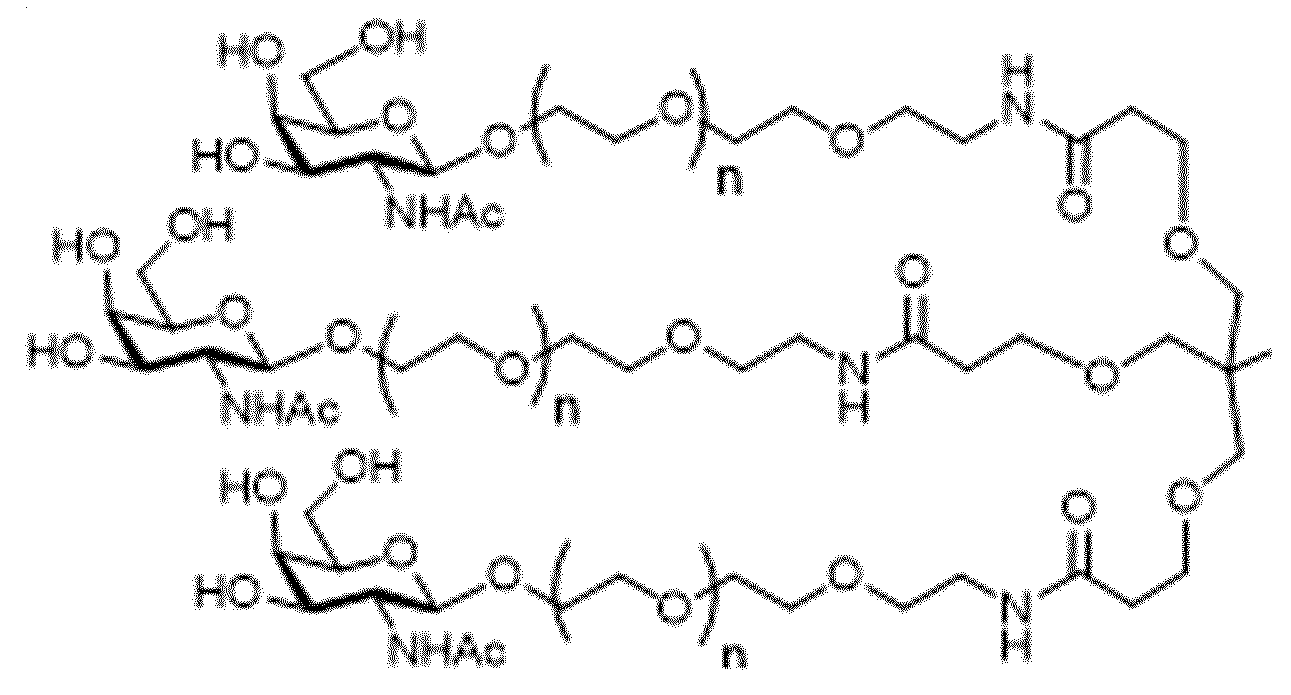
40. 문장 36 내지 39 중 어느 하나에 있어서, 하기 구조를 갖는 핵산:40. In any one of sentences 36 to 39, a nucleic acid having the following structure:

여기서:Here:
R1은 각 경우에 독립적으로 수소, 메틸 및 에틸로 이루어진 군으로부터 선택되고;R 1 is independently selected at each occurrence from the group consisting of hydrogen, methyl and ethyl;
R2는 수소, 히드록시, -OC1-3알킬, -C(=O)OC1-3알킬, 할로 및 니트로로 이루어진 군으로부터 선택되고;R 2 is selected from the group consisting of hydrogen, hydroxy, -OC 1-3 alkyl, -C(=O)OC 1-3 alkyl, halo, and nitro;
X1 및 X2는 각 경우에 독립적으로 메틸렌, 산소 및 황으로 이루어진 군으로부터 선택되고;X 1 and X 2 are each independently selected from the group consisting of methylene, oxygen and sulfur;
m은 1 내지 6의 정수이고;m is an integer from 1 to 6;
n은 1 내지 10의 정수이고;n is an integer from 1 to 10;
q, r, s, t, v는 독립적으로 0 내지 4의 정수이고, 단,q, r, s, t, v are independently integers from 0 to 4, and
(i) q 및 r은 둘 다 동시에 0일 수는 없고;(i) q and r cannot both be 0 at the same time;
(ii) s, t 및 v는 모두 동시에 0일 수는 없고;(ii) s, t and v cannot all be 0 at the same time;
Z는 올리고뉴클레오시드이다.Z is an oligonucleoside.
41. 문장 36 내지 39 중 어느 하나에 있어서, 하기 구조를 갖는 핵산:41. In any one of sentences 36 to 39, a nucleic acid having the structure:
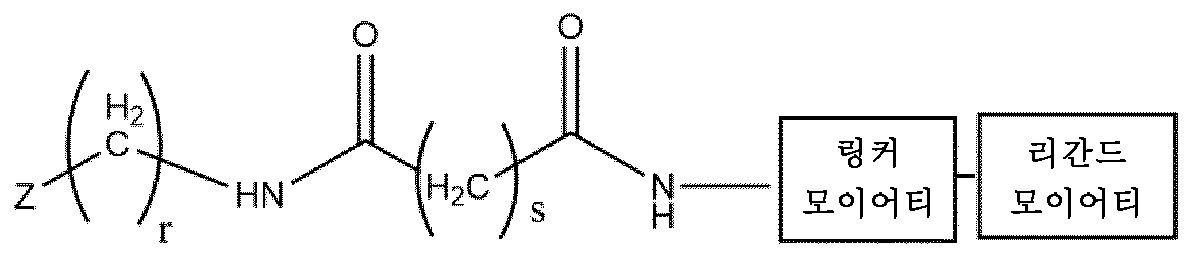
여기서:Here:
r 및 s는 독립적으로 1 내지 16으로부터 선택된 정수이고;r and s are independently integers selected from 1 to 16;
Z는 올리고뉴클레오시드이다.Z is an oligonucleoside.
42. 임의의 상기 문장에 따른 핵산을 제약상 허용되는 부형제 또는 담체와 조합하여 포함하는 제약 조성물.42. A pharmaceutical composition comprising a nucleic acid according to any of the above sentences in combination with a pharmaceutically acceptable excipient or carrier.
43. 임의의 상기 문장에 있어서, 요법에 사용하기 위한 핵산 또는 제약 조성물.43. In any of the above sentences, a nucleic acid or pharmaceutical composition for use in therapy.
44. 임의의 상기 문장에 있어서, 지혈 장애와 관련된 질환, 예컨대 지혈 장애와 관련된 질환, 예컨대 혈우병의 예방 또는 치료에 사용하기 위한 핵산 또는 제약 조성물.44. In any of the above sentences, a nucleic acid or pharmaceutical composition for use in the prevention or treatment of a disease related to a hemostatic disorder, such as a disease related to a hemostatic disorder, such as hemophilia.
45. 임의의 상기 문장에 있어서, 당뇨병의 예방 또는 치료에 사용하기 위한 핵산 또는 제약 조성물.45. In any of the above sentences, a nucleic acid or pharmaceutical composition for use in the prevention or treatment of diabetes.
46. 임의의 상기 문장에 있어서, 심혈관 질환의 예방 또는 치료에 사용하기 위한 핵산 또는 제약 조성물.46. In any of the above sentences, a nucleic acid or pharmaceutical composition for use in the prevention or treatment of cardiovascular disease.
한 측면에서, 본 발명은 하기 문장 1-101의 화합물, 공정, 조성물 또는 용도에 적용될 수 있으며, 여기서 문장 1-101에서의 임의의 화학식에 대한 언급은 문장 1-101 내에서 정의된 화학식만을 지칭한다. 이들 화학식을 도 5에 재현한다. 구체적으로, 임의의 하기 문장에서 Z에 의해 나타내어지는 올리고뉴클레오시드 모이어티는 하기 정의된 바와 같은 ZPI 또는 HCII의 발현을 억제하기 위한 핵산을 포함할 수 있다.In one aspect, the present invention can be applied to the compounds, processes, compositions or uses of any of the sentences 1-101 below, wherein reference to any chemical formula in sentences 1-101 refers only to the chemical formula as defined within sentences 1-101. These chemical formulas are reproduced in FIG. 5. Specifically, the oligonucleoside moiety represented by Z in any of the sentences below can comprise a nucleic acid for inhibiting the expression of ZPI or HCII as defined below.
1. 하기 구조를 포함하는 화합물:1. A compound comprising the following structure:

여기서:Here:
R1은 각 경우에 독립적으로 수소, 메틸 및 에틸로 이루어진 군으로부터 선택되고;R 1 is independently selected at each occurrence from the group consisting of hydrogen, methyl and ethyl;
R2는 수소, 히드록시, -OC1-3알킬, -C(=O)OC1-3알킬, 할로 및 니트로로 이루어진 군으로부터 선택되고;R 2 is selected from the group consisting of hydrogen, hydroxy, -OC 1-3 alkyl, -C(=O)OC 1-3 alkyl, halo, and nitro;
X1 및 X2는 각 경우에 독립적으로 메틸렌, 산소 및 황으로 이루어진 군으로부터 선택되고;X 1 and X 2 are each independently selected from the group consisting of methylene, oxygen and sulfur;
m은 1 내지 6의 정수이고;m is an integer from 1 to 6;
n은 1 내지 10의 정수이고;n is an integer from 1 to 10;
q, r, s, t, v는 독립적으로 0 내지 4의 정수이고, 단,q, r, s, t, v are independently integers from 0 to 4, and
(i) q 및 r은 둘 다 동시에 0일 수는 없고;(i) q and r cannot both be 0 at the same time;
(ii) s, t 및 v는 모두 동시에 0일 수는 없고;(ii) s, t and v cannot all be 0 at the same time;
Z는 올리고뉴클레오시드 모이어티이다.Z is an oligonucleoside moiety.
2. 문장 1에 있어서, R1이 각 경우에 수소인 화합물.2. A compound in which R 1 is hydrogen in each case in
3. 문장 1에 있어서, R1이 메틸인 화합물.3. A compound in
4. 문장 1에 있어서, R1이 에틸인 화합물.4. A compound in
5. 문장 1 내지 4 중 어느 하나에 있어서, R2가 히드록시인 화합물.5. A compound according to any one of
6. 문장 1 내지 4 중 어느 하나에 있어서, R2가 할로인 화합물.6. A compound according to any one of
7. 문장 6에 있어서, R2가 플루오로인 화합물.7. A compound in
8. 문장 6에 있어서, R2가 클로로인 화합물.8. A compound in
9. 문장 6에 있어서, R2가 브로모인 화합물.9. A compound in
10. 문장 6에 있어서, R2가 아이오도인 화합물.10. A compound in
11. 문장 6에 있어서, R2가 니트로인 화합물.11. A compound in
12. 문장 1 내지 11 중 어느 하나에 있어서, X1이 메틸렌인 화합물.12. A compound according to any one of
13. 문장 1 내지 11 중 어느 하나에 있어서, X1이 산소인 화합물.13. A compound according to any one of
14. 문장 1 내지 11 중 어느 하나에 있어서, X1이 황인 화합물.14. A compound in any one of
15. 문장 1 내지 14 중 어느 하나에 있어서, X2가 메틸렌인 화합물.15. A compound according to any one of
16. 문장 1 내지 15 중 어느 하나에 있어서, X2가 산소인 화합물.16. A compound according to any one of
17. 문장 1 내지 16 중 어느 하나에 있어서, X2가 황인 화합물.17. A compound according to any one of
18. 문장 1 내지 17 중 어느 하나에 있어서, m = 3인 화합물.18. A compound in any one of
19. 문장 1 내지 18 중 어느 하나에 있어서, n = 6인 화합물.19. A compound in any one of
20. 문장 13 및 15에 있어서, X1이 산소이고, X2가 메틸렌이고, 바람직하게는 하기인 화합물:20. In
q = 1,q = 1,
r = 2,r = 2,
s = 1,s = 1,
t = 1,t = 1,
v = 1.v = 1.
21. 문장 12 및 15에 있어서, X1 및 X2 둘 다가 메틸렌이고, 바람직하게는 하기인 화합물:21. In
q = 1,q = 1,
r = 3,r = 3,
s = 1,s = 1,
t = 1,t = 1,
v = 1.v = 1.
22. 문장 1 내지 21 중 어느 하나에 있어서, Z가 하기인 화합물:22. A compound according to any one of
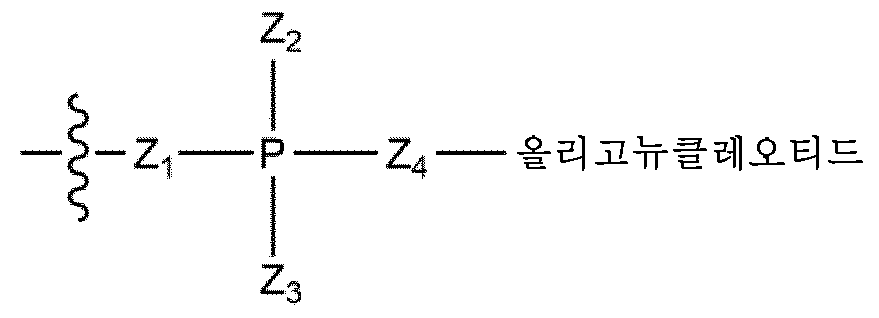
여기서:Here:
Z1, Z2, Z3, Z4는 각 경우에 독립적으로 산소 또는 황이고;Z 1 , Z 2 , Z 3 , Z 4 are independently oxygen or sulfur in each case;
P 및 Z2, 및 P 및 Z3 사이의 하나의 결합은 단일 결합이고, 다른 결합은 이중 결합이다.One bond between P and Z 2 , and one bond between P and Z 3 is a single bond, and the other bond is a double bond.
23. 문장 22에 있어서, 상기 올리고뉴클레오시드가 표적 유전자의 발현을 조정, 바람직하게는 억제할 수 있는 RNA 화합물인 화합물.23. A compound according to sentence 22, wherein the oligonucleoside is an RNA compound capable of modulating, preferably inhibiting, the expression of a target gene.
24. 문장 23에 있어서, 상기 RNA 화합물이 제1 및 제2 가닥을 포함하는 RNA 듀플렉스를 포함하고, 여기서 제1 가닥은 표적 유전자의 RNA 서열에 적어도 부분적으로 상보적이고, 제2 가닥은 상기 제1 가닥에 적어도 부분적으로 상보적이고, 여기서 각각의 제1 및 제2 가닥은 5' 및 3' 단부를 갖는 것인 화합물.24. A compound according to sentence 23, wherein the RNA compound comprises an RNA duplex comprising first and second strands, wherein the first strand is at least partially complementary to an RNA sequence of a target gene, and the second strand is at least partially complementary to the first strand, wherein each of the first and second strands has 5' and 3' ends.
25. 문장 24에 있어서, RNA 화합물이 그의 제2 가닥의 5' 단부에서 인접한 포스페이트에 부착된 것인 화합물.25. A compound according to sentence 24, wherein the RNA compound is attached to an adjacent phosphate at the 5' end of its second strand.
26. 문장 24에 있어서, RNA 화합물이 그의 제2 가닥의 3' 단부에서 인접한 포스페이트에 부착된 것인 화합물.26. A compound according to sentence 24, wherein the RNA compound is attached to an adjacent phosphate at the 3' end of its second strand.
27. 하기 화학식 (II)의 화합물.27. A compound of the following chemical formula (II).

28. 하기 화학식 (III)의 화합물.28. A compound of the following chemical formula (III).
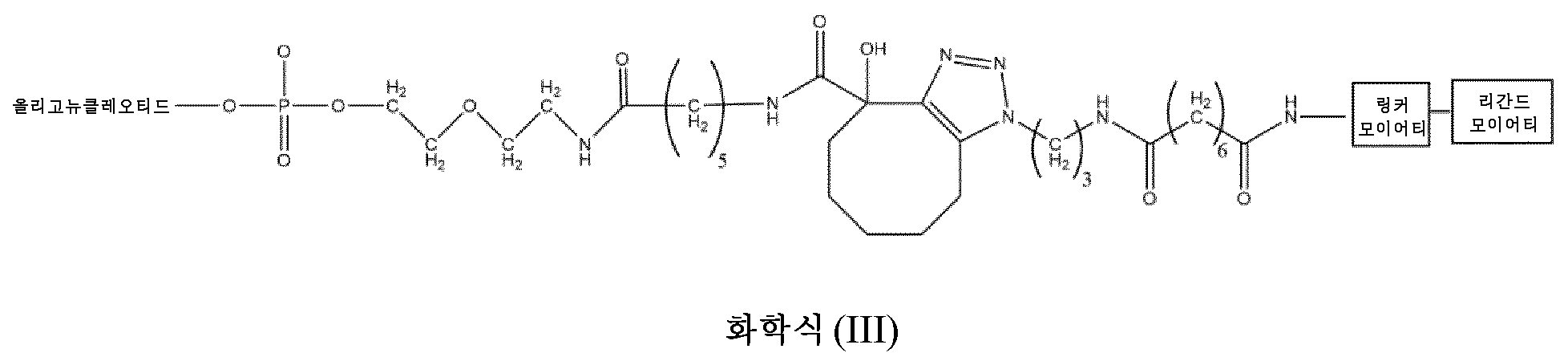
29. 문장 27 또는 28에 있어서, 올리고뉴클레오시드가 제1 및 제2 가닥을 포함하는 RNA 듀플렉스를 포함하고, 여기서 제1 가닥은 표적 유전자의 RNA 서열에 적어도 부분적으로 상보적이고, 제2 가닥은 상기 제1 가닥에 적어도 부분적으로 상보적이고, 여기서 각각의 제1 및 제2 가닥은 5' 및 3' 단부를 갖고, 여기서 상기 RNA 듀플렉스는 그의 제2 가닥의 5' 단부에서 인접한 포스페이트에 부착된 것인 화합물.29. A compound according to sentence 27 or 28, wherein the oligonucleoside comprises an RNA duplex comprising first and second strands, wherein the first strand is at least partially complementary to an RNA sequence of a target gene, and wherein the second strand is at least partially complementary to said first strand, wherein each of the first and second strands have 5' and 3' ends, and wherein said RNA duplex is attached to an adjacent phosphate at the 5' end of its second strand.
30. 문장 27에 정의된 바와 같은 화학식 (II)의 화합물 및 문장 28에 정의된 바와 같은 화학식 (III)의 화합물을 임의로 문장 29에 따라 포함하는 조성물.30. A composition comprising a compound of formula (II) as defined in sentence 27 and a compound of formula (III) as defined in sentence 28, optionally according to sentence 29.
31. 문장 30에 있어서, 상기 문장 28에 정의된 바와 같은 화학식 (III)의 화합물이 상기 조성물의 10 내지 15 중량% 범위의 양으로 존재하는 것인 조성물.31. A composition according to sentence 30, wherein the compound of formula (III) as defined in sentence 28 is present in an amount ranging from 10 to 15 wt% of the composition.
32. 하기 화학식 (IV)의 화합물.32. A compound of the following chemical formula (IV).
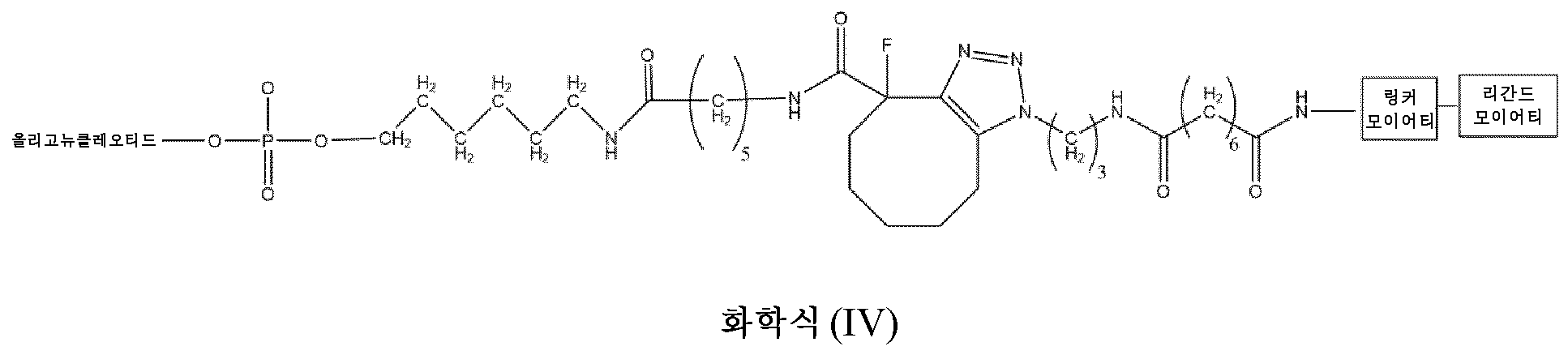
33. 하기 화학식 (V)의 화합물.33. A compound of the following chemical formula (V).

34. 문장 32 또는 33에 있어서, 올리고뉴클레오시드가 제1 및 제2 가닥을 포함하는 RNA 듀플렉스를 포함하고, 여기서 제1 가닥은 표적 유전자의 RNA 서열에 적어도 부분적으로 상보적이고, 제2 가닥은 상기 제1 가닥에 적어도 부분적으로 상보적이고, 여기서 각각의 제1 및 제2 가닥은 5' 및 3' 단부를 갖고, 여기서 상기 RNA 듀플렉스는 그의 제2 가닥의 3' 단부에서 인접한 포스페이트에 부착된 것인 화합물.34. A compound according to sentence 32 or 33, wherein the oligonucleoside comprises an RNA duplex comprising first and second strands, wherein the first strand is at least partially complementary to an RNA sequence of a target gene, and wherein the second strand is at least partially complementary to said first strand, wherein each of the first and second strands has 5' and 3' ends, and wherein said RNA duplex is attached to an adjacent phosphate at the 3' end of its second strand.
35. 문장 32에 정의된 바와 같은 화학식 (IV)의 화합물 및 문장 33에 정의된 바와 같은 화학식 (V)의 화합물을 임의로 문장 34에 따라 포함하는 조성물.35. A composition comprising a compound of formula (IV) as defined in sentence 32 and a compound of formula (V) as defined in sentence 33, optionally according to sentence 34.
36. 문장 35에 있어서, 상기 문장 33에 정의된 바와 같은 화학식 (V)의 화합물이 상기 조성물의 10 내지 15 중량% 범위의 양으로 존재하는 것인 조성물.36. A composition according to sentence 35, wherein the compound of formula (V) as defined in sentence 33 is present in an amount ranging from 10 to 15 wt% of the composition.
37. 문장 1 내지 29, 또는 32 내지 34 중 어느 하나에 있어서, 올리고뉴클레오시드가 2' 위치에서 변형된 1개 이상의 리보스, 바람직하게는 2' 위치에서 변형된 복수의 리보스를 추가로 포함하는 RNA 듀플렉스를 포함하는 것인 화합물.37. A compound according to any one of
38. 문장 37에 있어서, 변형이 2'-O-메틸, 2'-데옥시-플루오로 및 2'-데옥시로부터 선택되는 것인 화합물.38. A compound according to sentence 37, wherein the modification is selected from 2'-O-methyl, 2'-deoxy-fluoro and 2'-deoxy.
39. 문장 1 내지 29, 또는 32 내지 34, 또는 37 내지 38 중 어느 하나에 있어서, 올리고뉴클레오시드가 1개 이상의 단부에서 1개 이상의 분해 보호 모이어티를 추가로 포함하는 것인 화합물.39. A compound according to any one of
40. 문장 39에 있어서, 상기 1개 이상의 분해 보호 모이어티가 리간드 모이어티를 보유하는 올리고뉴클레오시드 가닥의 단부에 존재하지 않고/거나, 상기 1개 이상의 분해 보호 모이어티가 포스포로티오에이트 뉴클레오시드간 연결, 포스포로디티오에이트 뉴클레오시드간 연결 및 역전된 무염기성 뉴클레오시드로부터 선택되고, 여기서 상기 역전된 무염기성 뉴클레오시드가 리간드 모이어티를 보유하는 가닥의 원위 단부에 존재하는 것인 화합물.40. A compound according to sentence 39, wherein said one or more degradation protecting moieties are not present at the end of the oligonucleoside strand carrying the ligand moiety, and/or said one or more degradation protecting moieties are selected from a phosphorothioate internucleoside linkage, a phosphorodithioate internucleoside linkage and an inverted abasic nucleoside, wherein said inverted abasic nucleoside is present at the distal end of the strand carrying the ligand moiety.
41. 문장 1 내지 29, 또는 32 내지 34, 또는 37 내지 40 중 어느 하나에 있어서, 상기 문장 1에서 화학식 (I)에 도시된 바와 같은 리간드 모이어티가 1개 이상의 리간드를 포함하는 것인 화합물.41. A compound according to any one of
42. 문장 41에 있어서, 상기 문장 1에서 화학식 (I)에 도시된 바와 같은 리간드 모이어티가 1개 이상의 탄수화물 리간드를 포함하는 것인 화합물.42. A compound according to sentence 41, wherein the ligand moiety as depicted in chemical formula (I) in
43. 문장 42에 있어서, 상기 1개 이상의 탄수화물이 모노사카라이드, 디사카라이드, 트리사카라이드, 테트라사카라이드, 올리고사카라이드 또는 폴리사카라이드일 수 있는 것인 화합물.43. A compound according to sentence 42, wherein said one or more carbohydrates may be a monosaccharide, a disaccharide, a trisaccharide, a tetrasaccharide, an oligosaccharide or a polysaccharide.
44. 문장 43에 있어서, 상기 1개 이상의 탄수화물이 1개 이상의 갈락토스 모이어티, 1개 이상의 락토스 모이어티, 1개 이상의 N-아세틸갈락토사민 모이어티, 및/또는 1개 이상의 만노스 모이어티를 포함하는 것인 화합물.44. A compound according to sentence 43, wherein said one or more carbohydrates comprise one or more galactose moieties, one or more lactose moieties, one or more N-acetylgalactosamine moieties, and/or one or more mannose moieties.
45. 문장 44에 있어서, 상기 1개 이상의 탄수화물이 1개 이상의 N-아세틸-갈락토사민 모이어티를 포함하는 것인 화합물.45. A compound according to
46. 문장 45에 있어서, 2 또는 3개의 N-아세틸갈락토사민 모이어티를 포함하는 화합물.46. A compound comprising two or three N-acetylgalactosamine moieties in sentence 45.
47. 문장 41 내지 제46 중 어느 하나에 있어서, 상기 1개 이상의 리간드가 선형 배위 또는 분지형 배위로 부착된 것인 화합물.47. A compound according to any one of sentences 41 to 46, wherein at least one ligand is attached in a linear or branched configuration.
48. 문장 47에 있어서, 상기 1개 이상의 리간드가 이중안테나 또는 삼중안테나 분지형 배위로서 부착된 것인 화합물.48. A compound according to sentence 47, wherein one or more of the ligands are attached as a biantennary or triantennary branched configuration.
49. 문장 46 내지 48 중 어느 하나에 있어서, 상기 문장 1에서 화학식 (I)에 도시된 바와 같은 모이어티:49. In any one of sentences 46 to 48, a moiety as depicted in formula (I) in sentence 1:
이 하기 화학식 (VIa), (VIb) 또는 (VIc) 중 임의의 것, 바람직하게는 하기 화학식 (VIa)인 화합물:A compound of any of the following formulae (VIa), (VIb) or (VIc), preferably of the following formula (VIa):

(여기서:(Here:
AI은 수소, 또는 적합한 히드록시 보호기이고;A I is hydrogen, or a suitable hydroxy protecting group;
a는 2 또는 3의 정수이고;a is an integer of 2 or 3;
b는 2 내지 5의 정수임); 또는b is an integer from 2 to 5); or

(여기서:(Here:
AI은 수소, 또는 적합한 히드록시 보호기이고;A I is hydrogen, or a suitable hydroxy protecting group;
a는 2 또는 3의 정수이고;a is an integer of 2 or 3;
c 및 d는 독립적으로 1 내지 6의 정수임); 또는c and d are independently integers from 1 to 6); or

(여기서:(Here:
AI은 수소, 또는 적합한 히드록시 보호기이고;A I is hydrogen, or a suitable hydroxy protecting group;
a는 2 또는 3의 정수이고;a is an integer of 2 or 3;
e는 2 내지 10의 정수임).e is an integer between 2 and 10).
50. 문장 46 내지 48 중 어느 하나에 있어서, 상기 문장 1에서 화학식 (I)에 도시된 바와 같은 모이어티:50. In any one of sentences 46 to 48, a moiety as depicted in formula (I) in sentence 1:
이 하기 화학식 (VII)인 화합물:A compound having the following chemical formula (VII):
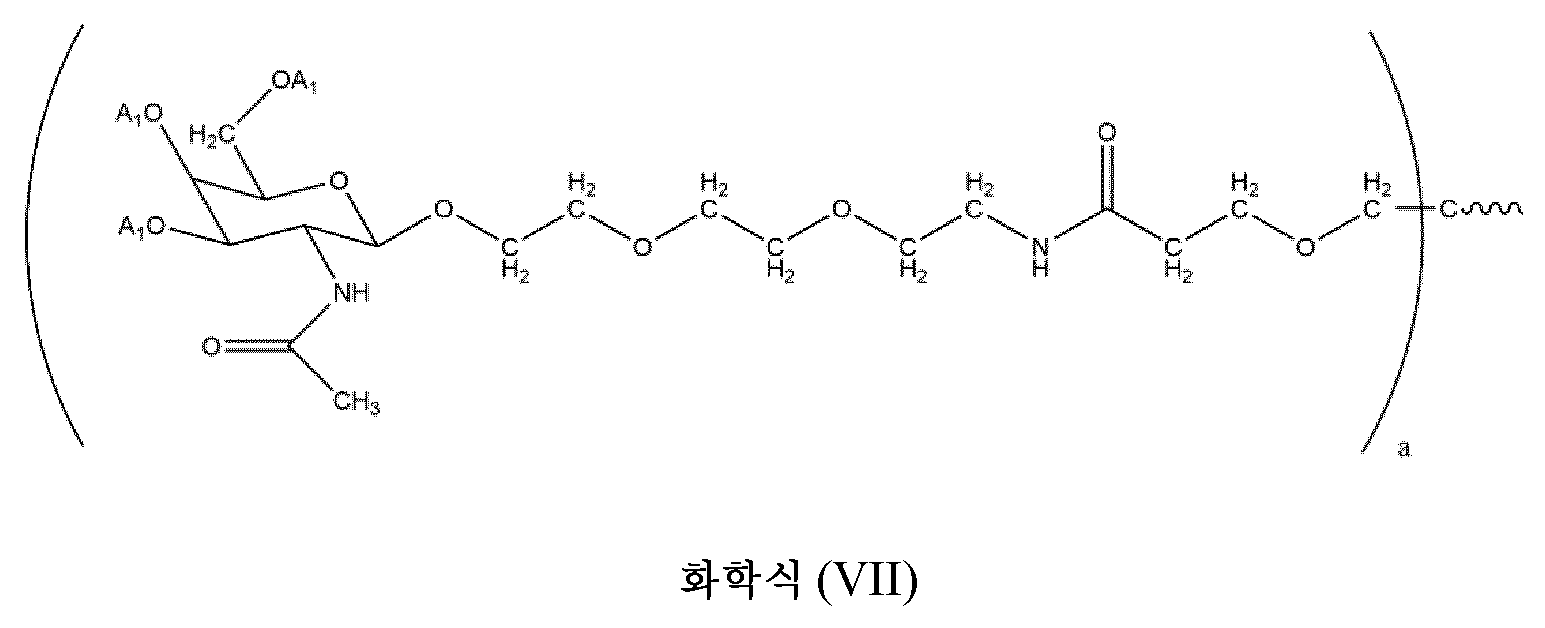
(여기서:(Here:
AI은 수소이고;A I is hydrogen;
a는 2 또는 3의 정수임).a is an integer of 2 or 3).
51. 문장 49 또는 50에 있어서, a = 2인 화합물.51. In sentences 49 or 50, a compound in which a = 2.
52. 문장 49 또는 50에 있어서, a = 3인 화합물.52. In sentences 49 or 50, a compound in which a = 3.
53. 문장 49에 있어서, b = 3인 화합물.53. In sentence 49, the compound where b = 3.
54. 하기 화학식 (VIII)의 화합물.54. A compound of the following chemical formula (VIII).

55. 하기 화학식 (IX)의 화합물.55. A compound of the following chemical formula (IX).

56. 문장 54 또는 55에 있어서, 올리고뉴클레오시드가 제1 및 제2 가닥을 포함하는 RNA 듀플렉스를 포함하고, 여기서 제1 가닥은 표적 유전자의 RNA 서열에 적어도 부분적으로 상보적이고, 제2 가닥은 상기 제1 가닥에 적어도 부분적으로 상보적이고, 여기서 각각의 제1 및 제2 가닥은 5' 및 3' 단부를 갖고, 여기서 상기 RNA 듀플렉스는 그의 제2 가닥의 5' 단부에서 인접한 포스페이트에 부착된 것인 화합물.56. A compound according to
57. 문장 54에 정의된 바와 같은 화학식 (VIII)의 화합물 및 문장 55에 정의된 바와 같은 화학식 (IX)의 화합물을 임의로 문장 56에 따라 포함하는 조성물.57. A composition comprising a compound of formula (VIII) as defined in sentence 54 and a compound of formula (IX) as defined in
58. 문장 57에 있어서, 상기 문장 55에 정의된 바와 같은 화학식 (IX)의 화합물이 상기 조성물의 10 내지 15 중량% 범위의 양으로 존재하는 것인 조성물.58. A composition according to sentence 57, wherein the compound of formula (IX) as defined in
59. 하기 화학식 (X)의 화합물.59. A compound of the following chemical formula (X).

60. 하기 화학식 (XI)의 화합물.60. A compound of the following chemical formula (XI).

61. 문장 59 또는 60에 있어서, 올리고뉴클레오시드가 제1 및 제2 가닥을 포함하는 RNA 듀플렉스를 포함하고, 여기서 제1 가닥은 표적 유전자의 RNA 서열에 적어도 부분적으로 상보적이고, 제2 가닥은 상기 제1 가닥에 적어도 부분적으로 상보적이고, 여기서 각각의 제1 및 제2 가닥은 5' 및 3' 단부를 갖고, 여기서 상기 RNA 듀플렉스는 그의 제2 가닥의 3' 단부에서 인접한 포스페이트에 부착된 것인 화합물.61. A compound according to sentence 59 or 60, wherein the oligonucleoside comprises an RNA duplex comprising first and second strands, wherein the first strand is at least partially complementary to an RNA sequence of a target gene, and wherein the second strand is at least partially complementary to said first strand, wherein each of the first and second strands has 5' and 3' ends, and wherein said RNA duplex is attached to an adjacent phosphate at the 3' end of its second strand.
62. 문장 59에 정의된 바와 같은 화학식 (X)의 화합물 및 문장 60에 정의된 바와 같은 화학식 (XI)의 화합물을 임의로 문장 61에 따라 포함하는 조성물.62. A composition comprising a compound of formula (X) as defined in sentence 59 and a compound of formula (XI) as defined in sentence 60, optionally according to sentence 61.
63. 문장 62에 있어서, 상기 문장 60에 정의된 바와 같은 화학식 (XI)의 화합물이 상기 조성물의 10 내지 15 중량% 범위의 양으로 존재하는 것인 조성물.63. A composition according to sentence 62, wherein the compound of formula (XI) as defined in sentence 60 is present in an amount ranging from 10 to 15 wt% of the composition.
64. 문장 54 내지 63 중 어느 하나에 있어서, 올리고뉴클레오시드가 2' 위치에서 변형된 1개 이상의 리보스, 바람직하게는 2' 위치에서 변형된 복수의 리보스를 추가로 포함하는 RNA 듀플렉스를 포함하는 것인 화합물.64. A compound according to any one of sentences 54 to 63, wherein the oligonucleoside comprises an RNA duplex further comprising at least one ribose modified at the 2' position, preferably multiple riboses modified at the 2' position.
65. 문장 64에 있어서, 변형이 2'-O-메틸, 2'-데옥시-플루오로 및 2'-데옥시로부터 선택되는 것인 화합물.65. A compound according to sentence 64, wherein the modification is selected from 2'-O-methyl, 2'-deoxy-fluoro and 2'-deoxy.
66. 문장 54 내지 65 중 어느 하나에 있어서, 올리고뉴클레오시드가 1개 이상의 단부에서 1개 이상의 분해 보호 모이어티를 추가로 포함하는 것인 화합물.66. A compound according to any one of sentences 54 to 65, wherein the oligonucleoside further comprises at least one degradation protecting moiety at at least one terminus.
67. 문장 66에 있어서, 상기 1개 이상의 분해 보호 모이어티가 리간드 모이어티를 보유하는 올리고뉴클레오시드 가닥의 단부에 존재하지 않고/거나, 상기 1개 이상의 분해 보호 모이어티가 포스포로티오에이트 뉴클레오시드간 연결, 포스포로디티오에이트 뉴클레오시드간 연결 및 역전된 무염기성 뉴클레오시드로부터 선택되고, 여기서 상기 역전된 무염기성 뉴클레오시드가 문장 54, 55, 59 또는 60 중 임의의 것에서의 화학식 (VIII), (IX), (X) 또는 (XI) 중 임의의 것에 제시된 바와 같은 리간드 모이어티를 보유하는 가닥의 원위 단부에 존재하는 것인 화합물.67. A compound of sentence 66, wherein said one or more degradation protecting moieties are not present at the end of the oligonucleoside strand bearing the ligand moiety, and/or said one or more degradation protecting moieties are selected from a phosphorothioate internucleoside linkage, a phosphorodithioate internucleoside linkage and an inverted abasic nucleoside, wherein said inverted abasic nucleoside is present at the distal end of the strand bearing the ligand moiety as set forth in any of formulae (VIII), (IX), (X) or (XI) in
68. 문장 1 내지 29, 32 내지 34, 37 내지 56, 59 내지 61, 및 64 내지 67 중 어느 하나에 따른 화합물 및/또는 문장 30, 31, 35, 36, 57, 58, 62, 63 중 어느 하나에 따른 조성물의 제조 방법으로서, 하기 화학식 (XII) 및 (XIII)의 화합물을 반응시키고:68. A method for preparing a compound according to any one of

(본원에서:(From our headquarters:
R1은 각 경우에 독립적으로 수소, 메틸 및 에틸로 이루어진 군으로부터 선택되고;R 1 is independently selected in each case from the group consisting of hydrogen, methyl and ethyl;
R2는 수소, 히드록시, -OC1-3알킬, -C(=O)OC1-3알킬, 할로 및 니트로로 이루어진 군으로부터 선택되고;R 2 is selected from the group consisting of hydrogen, hydroxy, -OC 1-3 alkyl, -C(=O)OC 1-3 alkyl, halo, and nitro;
X1 및 X2는 각 경우에 독립적으로 메틸렌, 산소 및 황으로 이루어진 군으로부터 선택되고;X 1 and X 2 are each independently selected from the group consisting of methylene, oxygen and sulfur;
m은 1 내지 6의 정수이고;m is an integer from 1 to 6;
n은 1 내지 10의 정수이고;n is an integer from 1 to 10;
q, r, s, t, v는 독립적으로 0 내지 4의 정수이고, 단,q, r, s, t, v are independently integers from 0 to 4, and
(i) q 및 r은 둘 다 동시에 0일 수는 없고;(i) q and r cannot both be 0 at the same time;
(ii) s, t 및 v는 모두 동시에 0일 수는 없고;(ii) s, t and v cannot all be 0 at the same time;
Z는 올리고뉴클레오시드 모이어티임);Z is an oligonucleoside moiety);
적절한 경우에 리간드의 탈보호 및/또는 올리고뉴클레오시드 모이어티에 대한 제2 가닥의 어닐링을 수행하는 것을 포함하는 방법.A method comprising, where appropriate, performing deprotection of the ligand and/or annealing of the second strand to the oligonucleoside moiety.
69. 문장 68에 있어서, 화학식 (XII)의 화합물이 하기 화학식 (XIV) 및 (XV)의 화합물을 반응시켜 제조되는 것인 방법:69. A method according to sentence 68, wherein the compound of formula (XII) is prepared by reacting the compounds of formulae (XIV) and (XV):
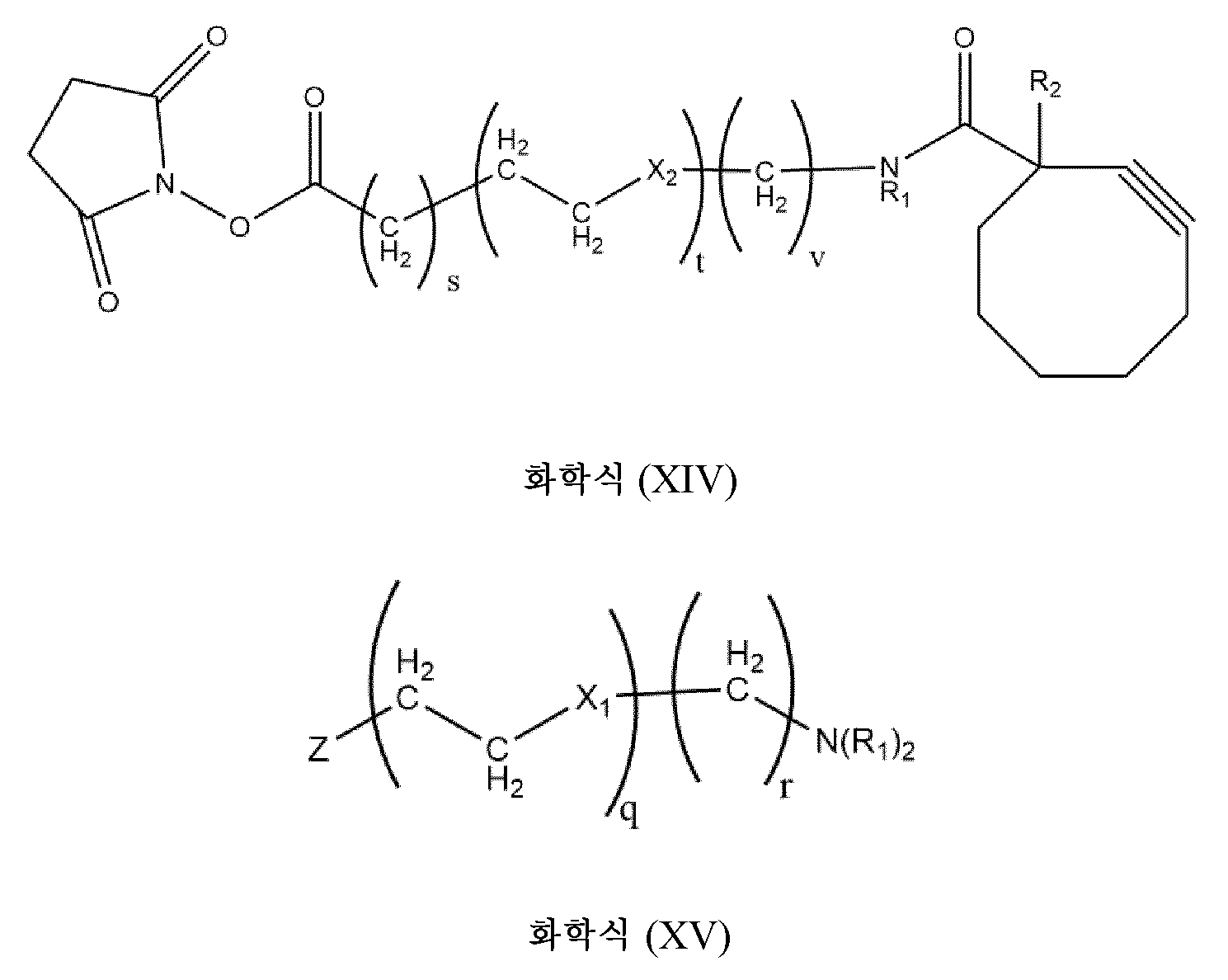
R1은 각 경우에 독립적으로 수소, 메틸 및 에틸로 이루어진 군으로부터 선택되고;R 1 is independently selected at each occurrence from the group consisting of hydrogen, methyl and ethyl;
R2는 수소, 히드록시, -OC1-3알킬, -C(=O)OC1-3알킬, 할로 및 니트로로 이루어진 군으로부터 선택되고;R 2 is selected from the group consisting of hydrogen, hydroxy, -OC 1-3 alkyl, -C(=O)OC 1-3 alkyl, halo, and nitro;
X1 및 X2는 각 경우에 독립적으로 메틸렌, 산소 및 황으로 이루어진 군으로부터 선택되고;X 1 and X 2 are each independently selected from the group consisting of methylene, oxygen and sulfur;
q, r, s, t, v는 독립적으로 0 내지 4의 정수이고, 단,q, r, s, t, v are independently integers from 0 to 4, and
(i) q 및 r은 둘 다 동시에 0일 수는 없고;(i) q and r cannot both be 0 at the same time;
(ii) s, t 및 v는 모두 동시에 0일 수는 없고;(ii) s, t and v cannot all be 0 at the same time;
Z는 올리고뉴클레오시드 모이어티이다.Z is an oligonucleoside moiety.
70. 문장 68에 있어서, 문장 20, 25, 27, 29, 54, 56 중 어느 하나에 따른 화합물 및/또는 문장 30, 31, 57, 58 중 어느 하나에 따른 조성물의 제조 방법으로서, 여기서:70. A method for preparing a compound according to any one of sentences 20, 25, 27, 29, 54, 56 and/or a composition according to any one of sentences 30, 31, 57, 58, in sentence 68, wherein:
화학식 (XII)의 화합물이 하기 화학식 (XIIa)이고:The compound of formula (XII) has the following formula (XIIa):
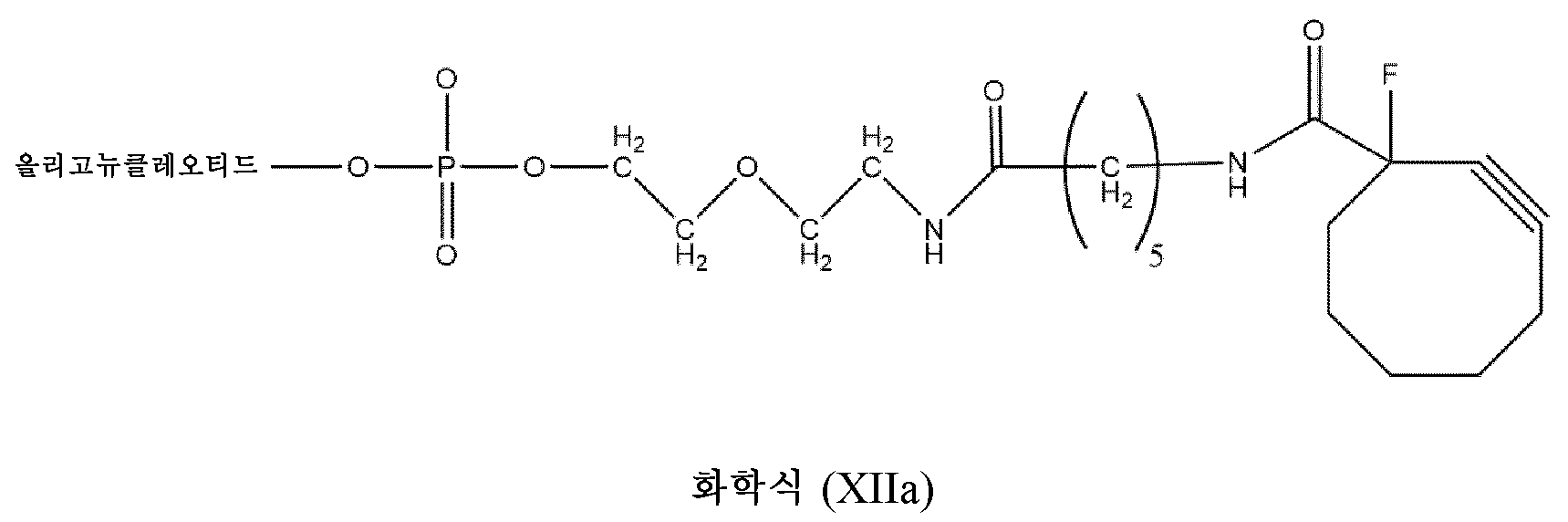
화학식 (XIII)의 화합물이 하기 화학식 (XIIIa)이고:The compound of formula (XIII) has the following formula (XIIIa):
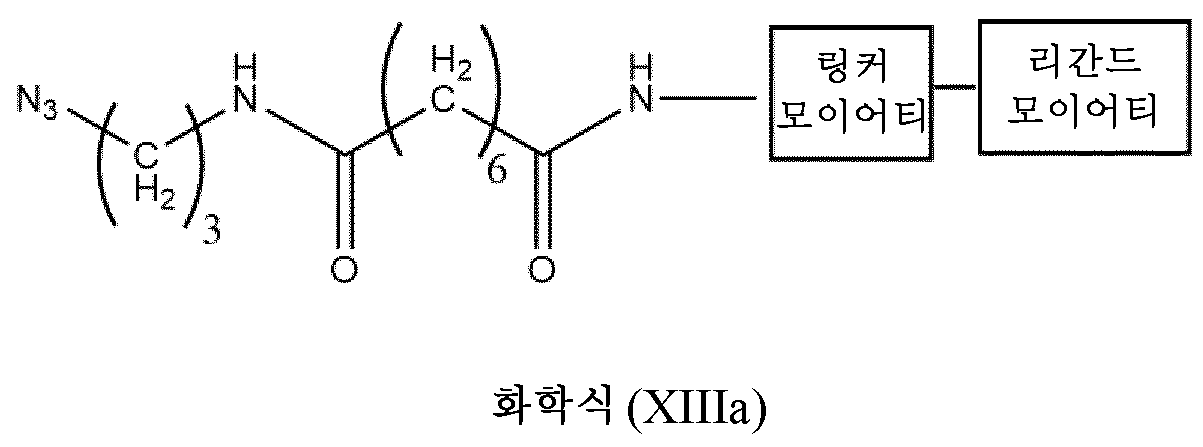
여기서 올리고뉴클레오시드는 제1 및 제2 가닥을 포함하는 RNA 듀플렉스를 포함하고, 제1 가닥은 표적 유전자의 RNA 서열에 적어도 부분적으로 상보적이고, 제2 가닥은 상기 제1 가닥에 적어도 부분적으로 상보적이고, 여기서 각각의 제1 및 제2 가닥은 5' 및 3' 단부를 갖고, 여기서 상기 RNA 듀플렉스는 그의 제2 가닥의 5' 단부에서 인접한 포스페이트에 부착된 것인 방법.A method wherein the oligonucleoside comprises an RNA duplex comprising first and second strands, the first strand being at least partially complementary to an RNA sequence of a target gene, the second strand being at least partially complementary to said first strand, wherein each of the first and second strands have 5' and 3' ends, and wherein the RNA duplex is attached to an adjacent phosphate at the 5' end of its second strand.
71. 문장 68에 있어서, 문장 20, 25, 28, 29, 55, 56, 중 어느 하나에 따른 화합물 및/또는 문장 30, 31, 57, 58 중 어느 하나에 따른 조성물의 제조 방법으로서, 여기서:71. A method for preparing a compound according to any one of
화학식 (XII)의 화합물이 하기 화학식 (XIIb)이고:The compound of formula (XII) has the following formula (XIIb):
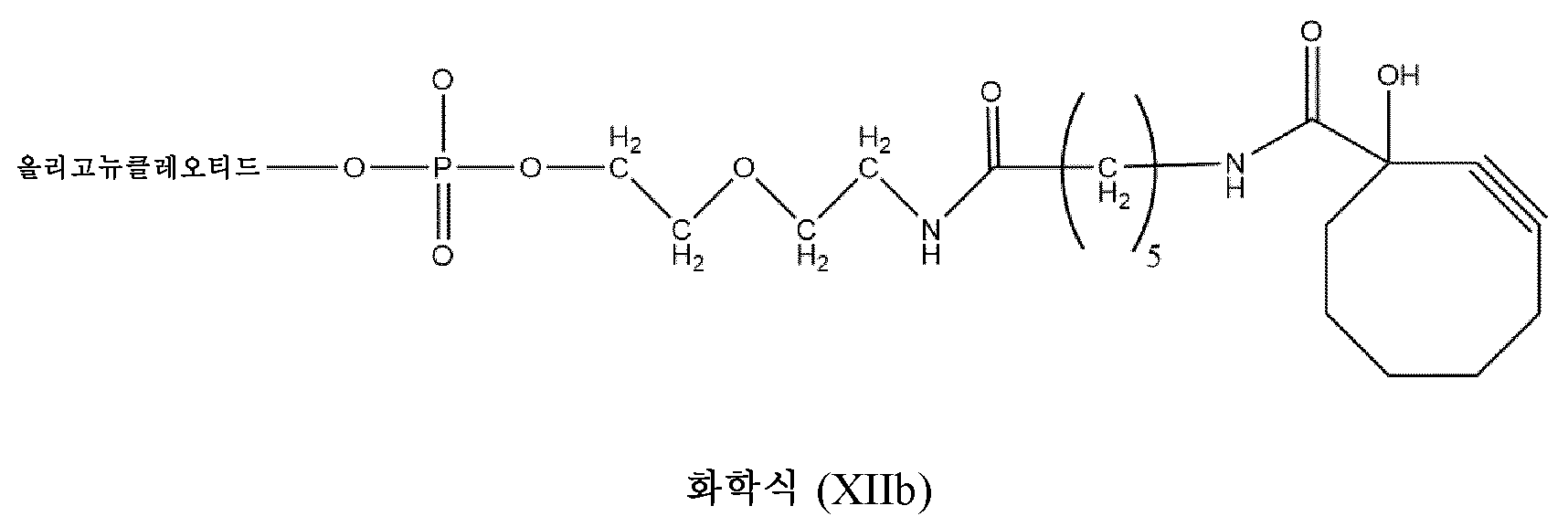
화학식 (XIII)의 화합물이 하기 화학식 (XIIIa)이고:The compound of formula (XIII) has the following formula (XIIIa):
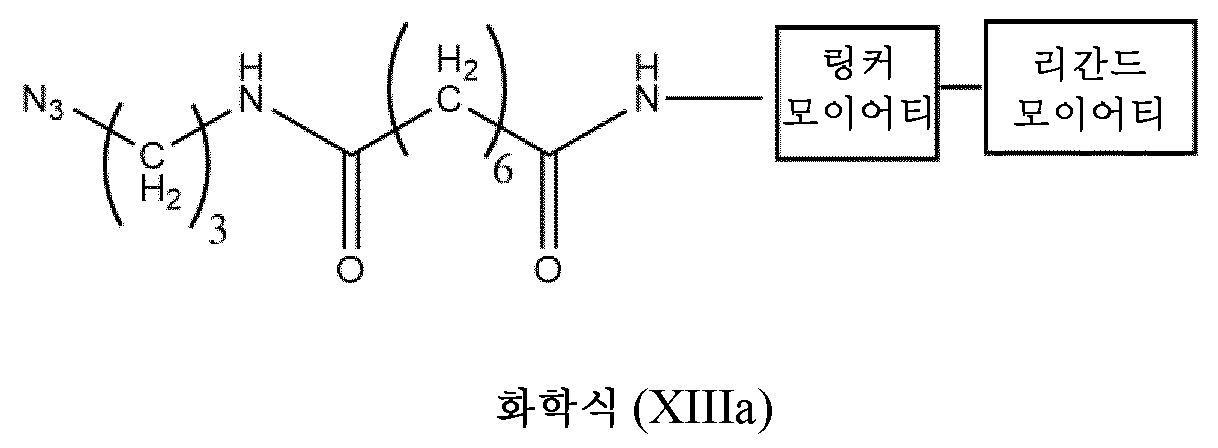
여기서 올리고뉴클레오시드는 제1 및 제2 가닥을 포함하는 RNA 듀플렉스를 포함하고, 제1 가닥은 표적 유전자의 RNA 서열에 적어도 부분적으로 상보적이고, 제2 가닥은 상기 제1 가닥에 적어도 부분적으로 상보적이고, 여기서 각각의 제1 및 제2 가닥은 5' 및 3' 단부를 갖고, 여기서 상기 RNA 듀플렉스는 그의 제2 가닥의 5' 단부에서 인접한 포스페이트에 부착된 것인 방법.A method wherein the oligonucleoside comprises an RNA duplex comprising first and second strands, the first strand being at least partially complementary to an RNA sequence of a target gene, the second strand being at least partially complementary to said first strand, wherein each of the first and second strands have 5' and 3' ends, and wherein the RNA duplex is attached to an adjacent phosphate at the 5' end of its second strand.
72. 문장 68에 있어서, 문장 21, 26, 32, 34, 59, 61 중 어느 하나에 따른 화합물 및/또는 문장 35, 36, 62, 63 중 어느 하나에 따른 조성물의 제조 방법으로서, 여기서:72. A method for preparing a compound according to any one of sentences 21, 26, 32, 34, 59, 61 and/or a composition according to any one of sentences 35, 36, 62, 63, in sentence 68, wherein:
화학식 (XII)의 화합물이 하기 화학식 (XIIc)이고:The compound of formula (XII) has the following formula (XIIc):
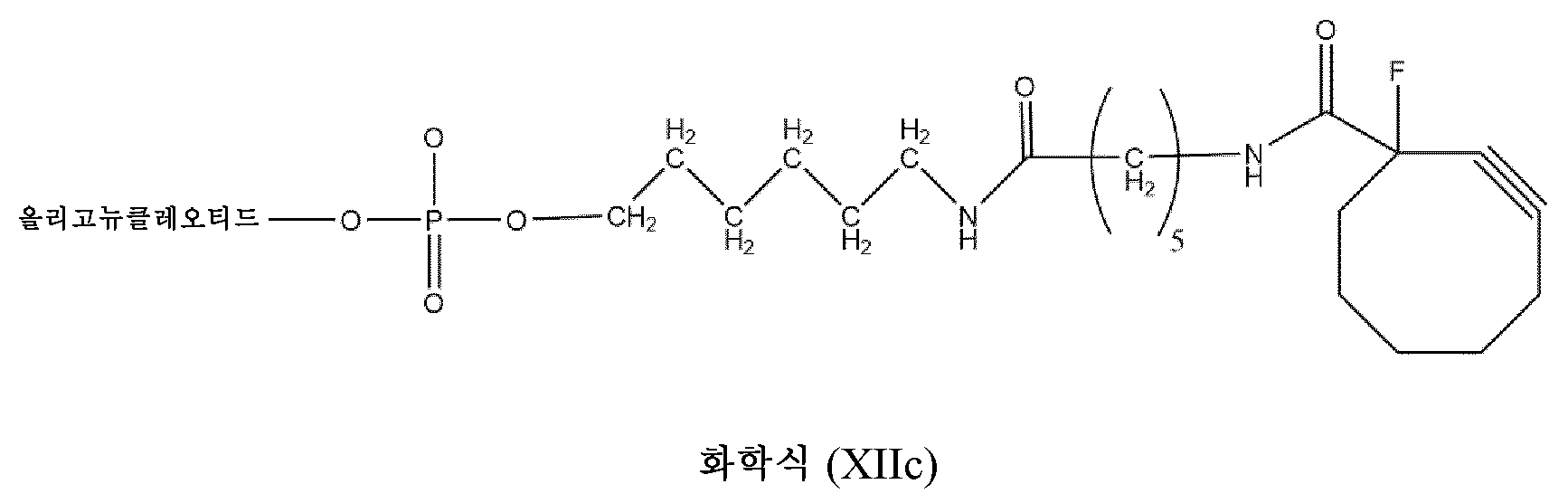
화학식 (XIII)의 화합물이 하기 화학식 (XIIIa)이고:The compound of formula (XIII) has the following formula (XIIIa):
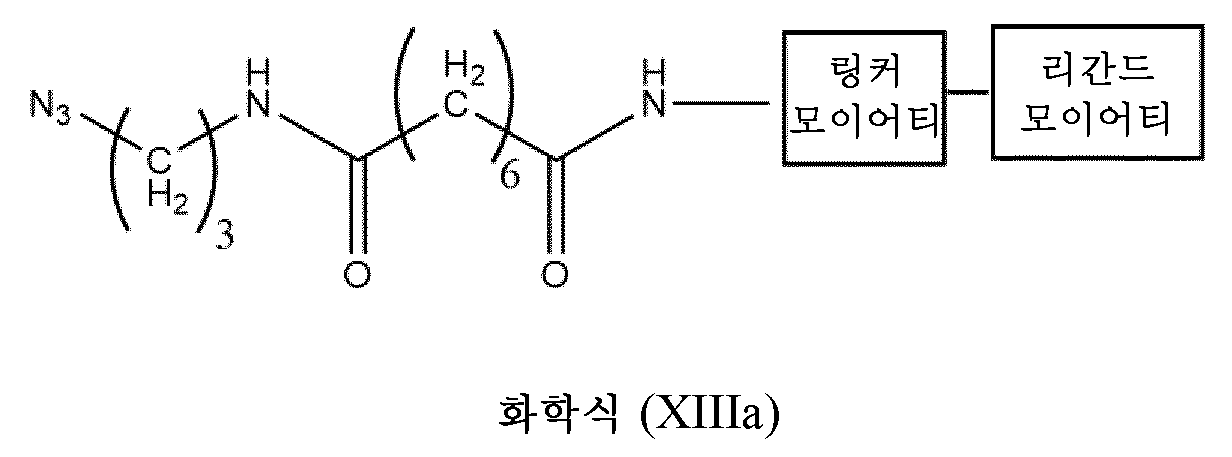
여기서 올리고뉴클레오시드는 제1 및 제2 가닥을 포함하는 RNA 듀플렉스를 포함하고, 제1 가닥은 표적 유전자의 RNA 서열에 적어도 부분적으로 상보적이고, 제2 가닥은 상기 제1 가닥에 적어도 부분적으로 상보적이고, 여기서 각각의 제1 및 제2 가닥은 5' 및 3' 단부를 갖고, 여기서 상기 RNA 듀플렉스는 그의 제2 가닥의 3' 단부에서 인접한 포스페이트에 부착된 것인 방법.A method wherein the oligonucleoside comprises an RNA duplex comprising first and second strands, the first strand being at least partially complementary to an RNA sequence of a target gene, and the second strand being at least partially complementary to said first strand, wherein each of the first and second strands have 5' and 3' ends, and wherein the RNA duplex is attached to an adjacent phosphate at the 3' end of its second strand.
73. 문장 68에 있어서, 문장 21, 26, 33, 34, 60, 61 중 어느 하나에 따른 화합물 및/또는 문장 35, 36, 62, 63 중 어느 하나에 따른 조성물의 제조 방법으로서, 여기서:73. A method for preparing a compound according to any one of sentences 21, 26, 33, 34, 60, 61 and/or a composition according to any one of sentences 35, 36, 62, 63, in sentence 68, wherein:
화학식 (XII)의 화합물이 하기 화학식 (XIId)이고:The compound of formula (XII) has the following formula (XIId):
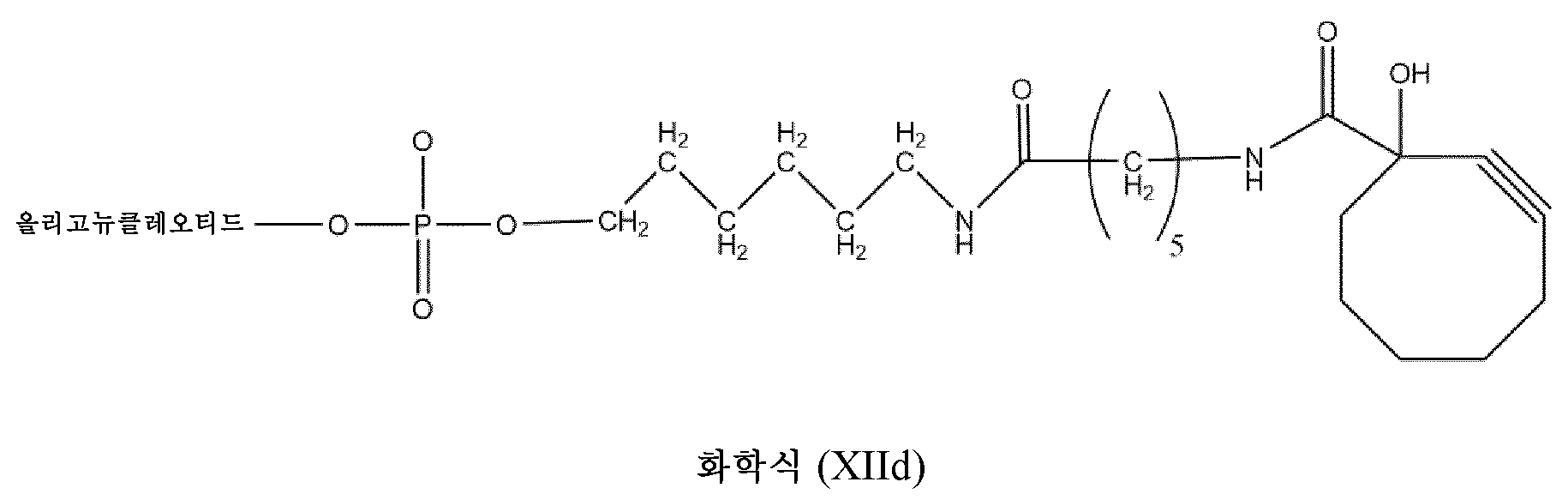
화학식 (XIII)의 화합물이 하기 화학식 (XIIIa)이고:The compound of formula (XIII) has the following formula (XIIIa):
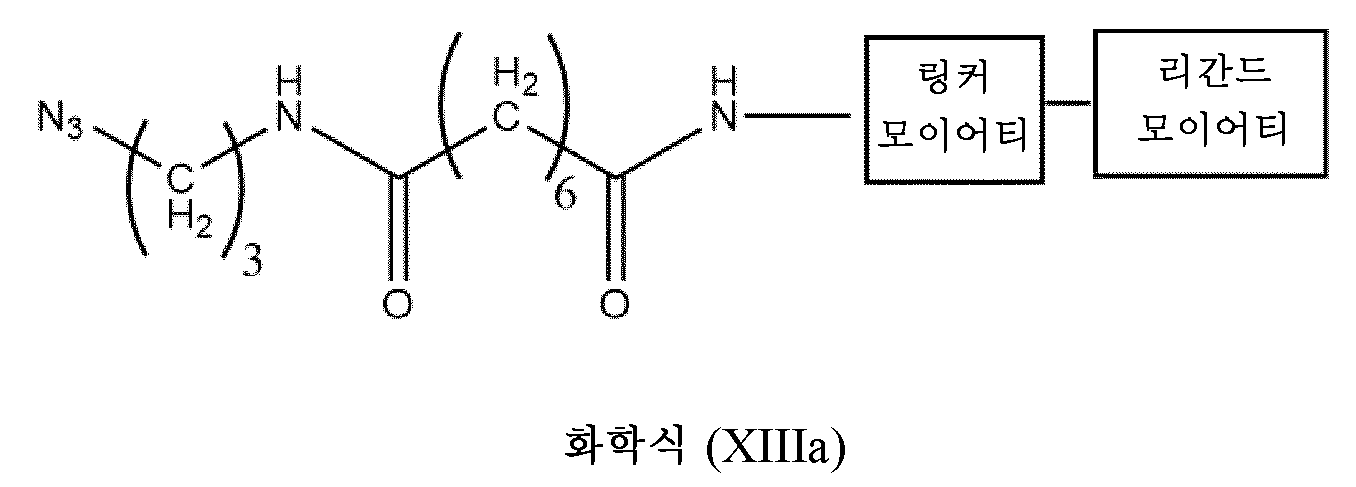
여기서 올리고뉴클레오시드는 제1 및 제2 가닥을 포함하는 RNA 듀플렉스를 포함하고, 제1 가닥은 표적 유전자의 RNA 서열에 적어도 부분적으로 상보적이고, 제2 가닥은 상기 제1 가닥에 적어도 부분적으로 상보적이고, 여기서 각각의 제1 및 제2 가닥은 5' 및 3' 단부를 갖고, 여기서 상기 RNA 듀플렉스는 그의 제2 가닥의 3' 단부에서 인접한 포스페이트에 부착된 것인 방법.A method wherein the oligonucleoside comprises an RNA duplex comprising first and second strands, the first strand being at least partially complementary to an RNA sequence of a target gene, and the second strand being at least partially complementary to said first strand, wherein each of the first and second strands have 5' and 3' ends, and wherein the RNA duplex is attached to an adjacent phosphate at the 3' end of its second strand.
74. 문장 70 내지 73 중 어느 하나에 있어서,74. In any one of sentences 70 to 73,
화학식 (XIIIa)의 화합물이 하기 화학식 (XIIIb)인 방법.A method wherein the compound of chemical formula (XIIIa) is of the following chemical formula (XIIIb).
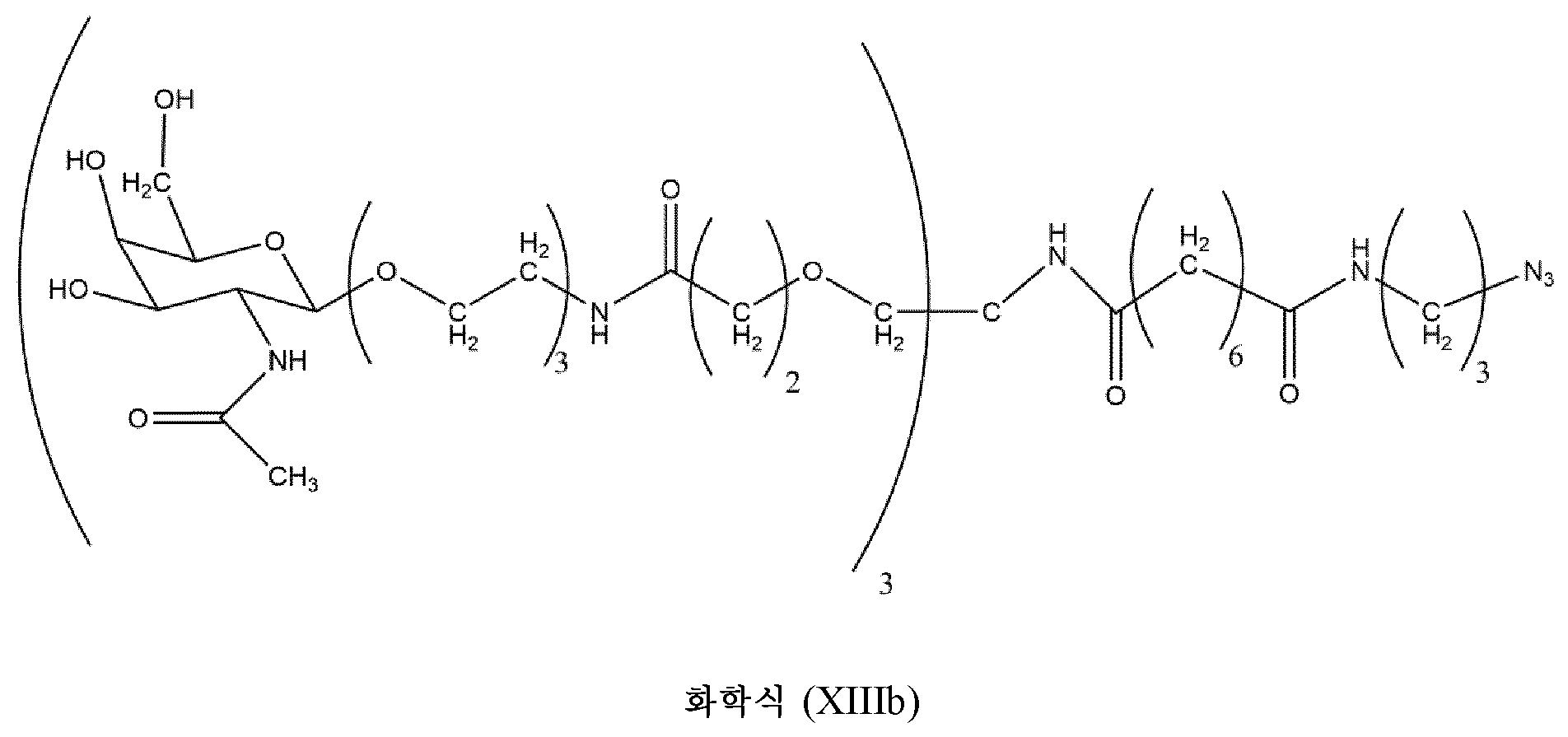
75. 문장 69에 있어서, 문장 70 내지 73에 따라,75. In sentence 69, according to sentences 70 to 73,
화학식 (XIV)의 화합물이 하기 화학식 (XIVa) 또는 화학식 (XIVb)이고:The compound of formula (XIV) is of formula (XIVa) or formula (XIVb):
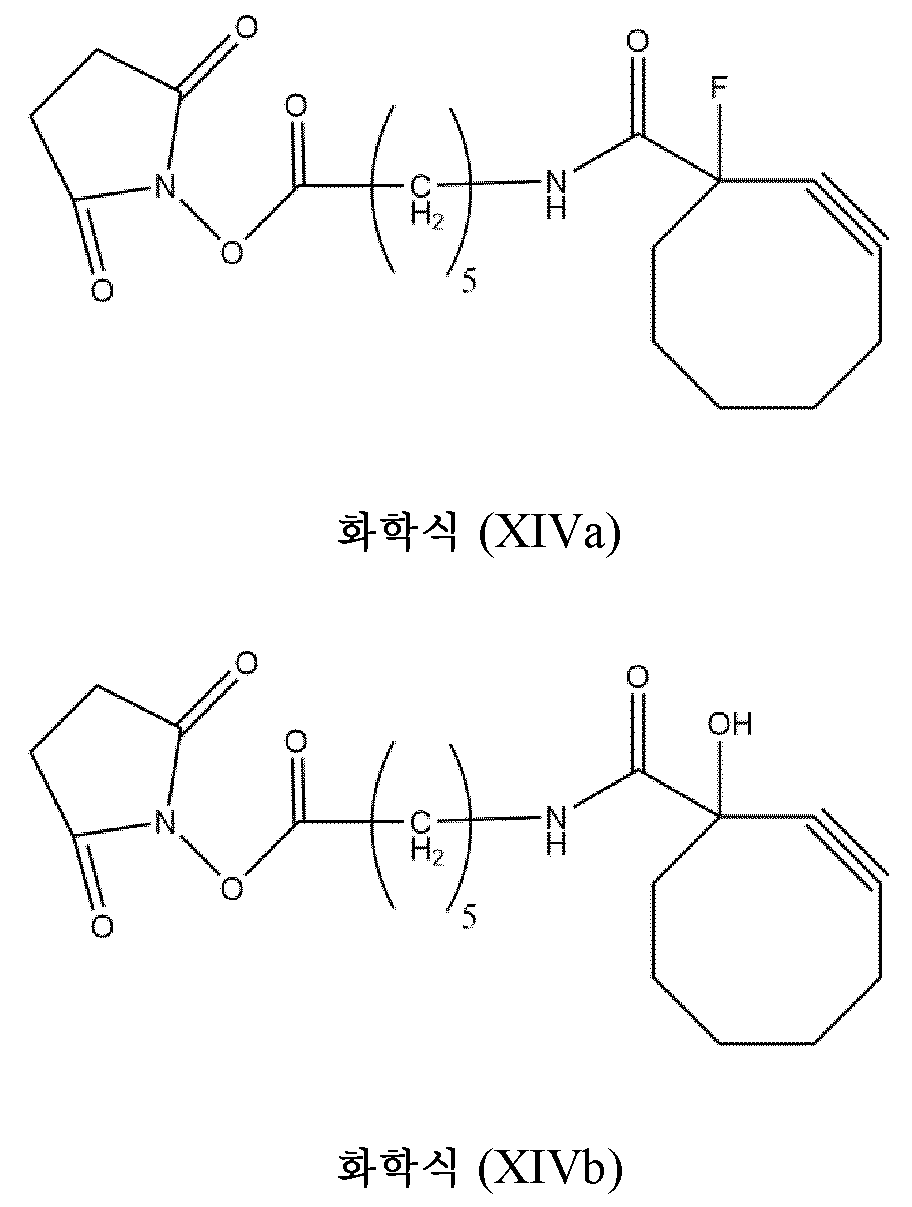
화학식 (XV)의 화합물이 하기 화학식 (XVa) 또는 화학식 (XIVb)이고:The compound of formula (XV) is of formula (XVa) or formula (XIVb):
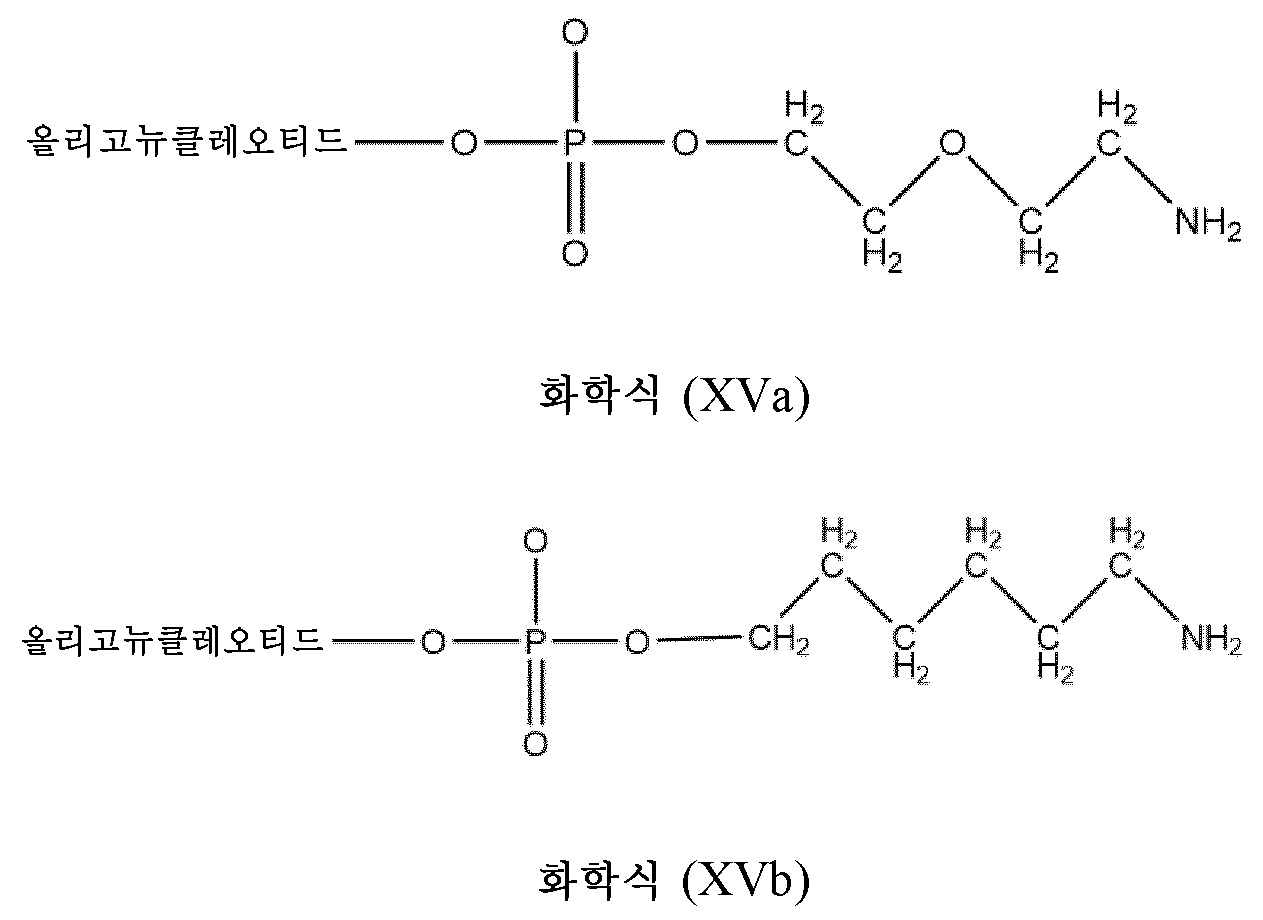
여기서 올리고뉴클레오시드는 제1 및 제2 가닥을 포함하는 RNA 듀플렉스를 포함하고, 제1 가닥은 표적 유전자의 RNA 서열에 적어도 부분적으로 상보적이고, 제2 가닥은 상기 제1 가닥에 적어도 부분적으로 상보적이고, 여기서 각각의 제1 및 제2 가닥은 5' 및 3' 단부를 갖고, 여기서 (i) 상기 RNA 듀플렉스는 그의 제2 가닥의 5' 단부에서 화학식 (XVa)의 인접한 포스페이트에 부착되거나, 또는 (ii) 상기 RNA 듀플렉스는 그의 제2 가닥의 3' 단부에서 화학식 (XVb)의 인접한 포스페이트에 부착된 것인 방법.A method wherein the oligonucleoside comprises an RNA duplex comprising first and second strands, the first strand being at least partially complementary to an RNA sequence of a target gene, and the second strand being at least partially complementary to said first strand, wherein each of the first and second strands have 5' and 3' ends, and wherein (i) the RNA duplex is attached to an adjacent phosphate of formula (XVa) at the 5' end of its second strand, or (ii) the RNA duplex is attached to an adjacent phosphate of formula (XVb) at the 3' end of its second strand.
76. 하기 화학식 (XII)의 화합물:76. A compound of the following chemical formula (XII):
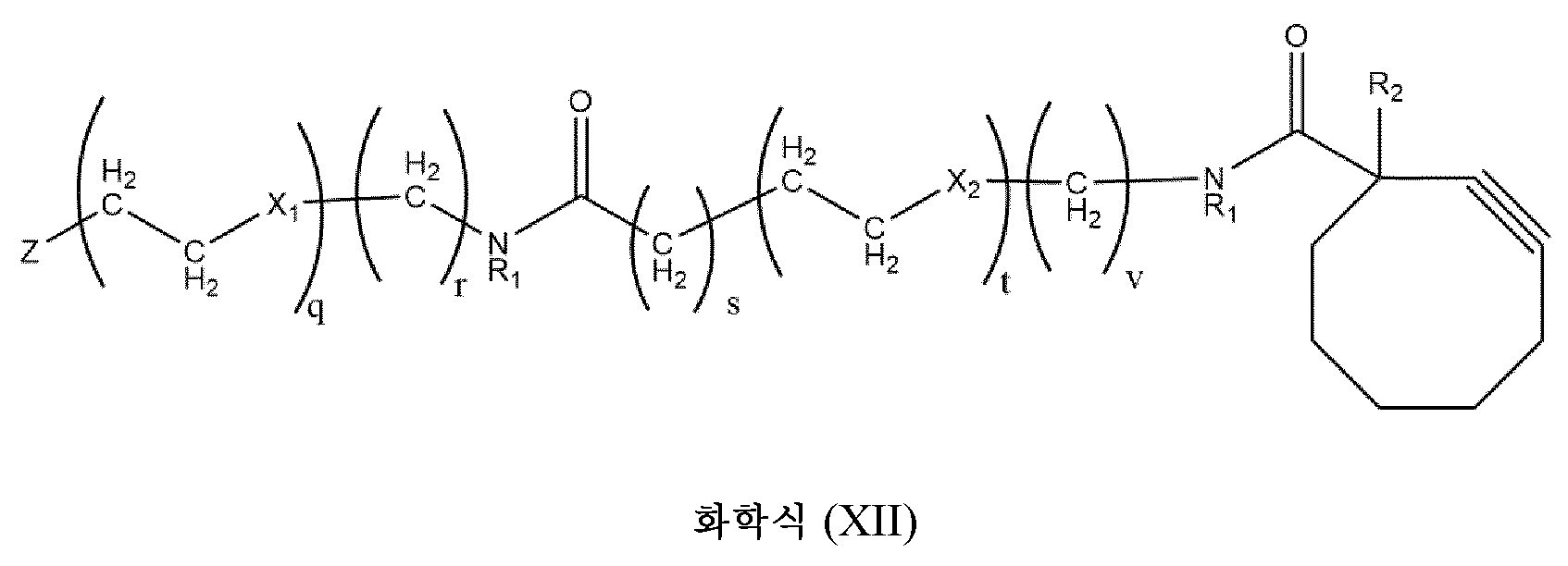
여기서:Here:
R1은 각 경우에 독립적으로 수소, 메틸 및 에틸로 이루어진 군으로부터 선택되고;R 1 is independently selected at each occurrence from the group consisting of hydrogen, methyl and ethyl;
R2는 수소, 히드록시, -OC1-3알킬, -C(=O)OC1-3알킬, 할로 및 니트로로 이루어진 군으로부터 선택되고;R 2 is selected from the group consisting of hydrogen, hydroxy, -OC 1-3 alkyl, -C(=O)OC 1-3 alkyl, halo, and nitro;
X1 및 X2는 각 경우에 독립적으로 메틸렌, 산소 및 황으로 이루어진 군으로부터 선택되고;X 1 and X 2 are each independently selected from the group consisting of methylene, oxygen and sulfur;
q, r, s, t, v는 독립적으로 0 내지 4의 정수이고, 단,q, r, s, t, v are independently integers from 0 to 4, and
(i) q 및 r은 둘 다 동시에 0일 수는 없고;(i) q and r cannot both be 0 at the same time;
(ii) s, t 및 v는 모두 동시에 0일 수는 없고;(ii) s, t and v cannot all be 0 at the same time;
Z는 올리고뉴클레오시드 모이어티이다.Z is an oligonucleoside moiety.
77. 하기 화학식 (XIIa)의 화합물.77. A compound of the following chemical formula (XIIa).
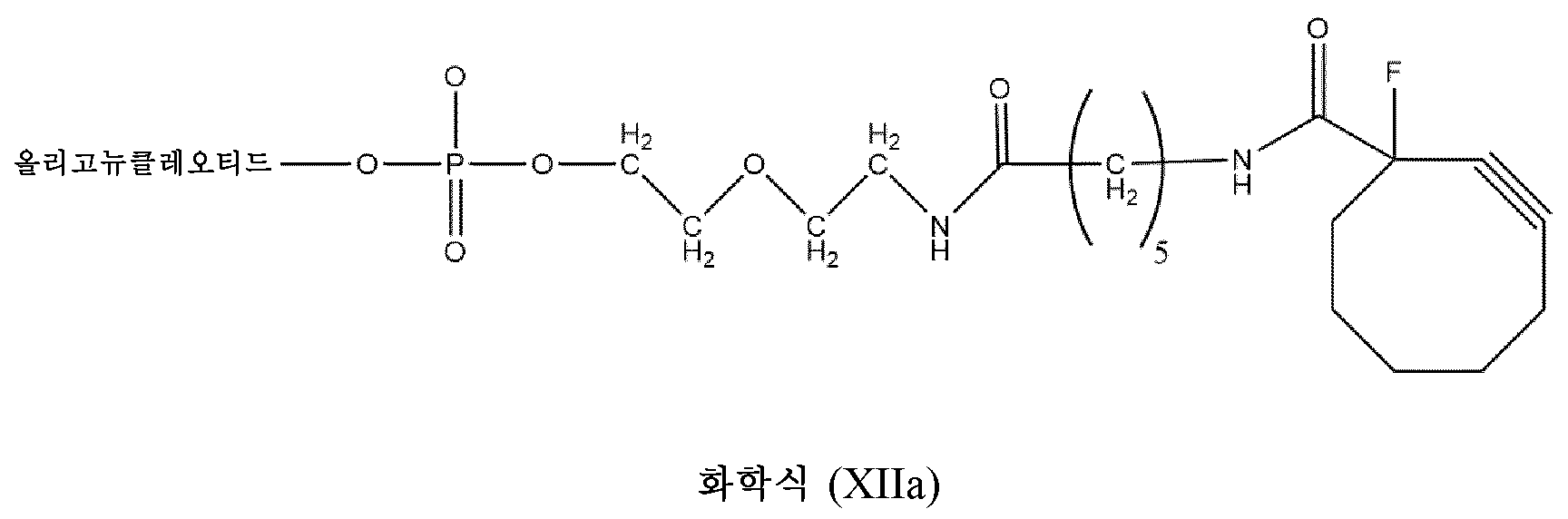
78. 하기 화학식 (XIIb)의 화합물.78. A compound of the following chemical formula (XIIb).

79. 화학식 (XIIc)의 화합물.79. A compound of formula (XIIc).

80. 화학식 (XIId)의 화합물.80. A compound of formula (XIId).

81. 하기 화학식 (XIII)의 화합물:81. A compound of the following chemical formula (XIII):
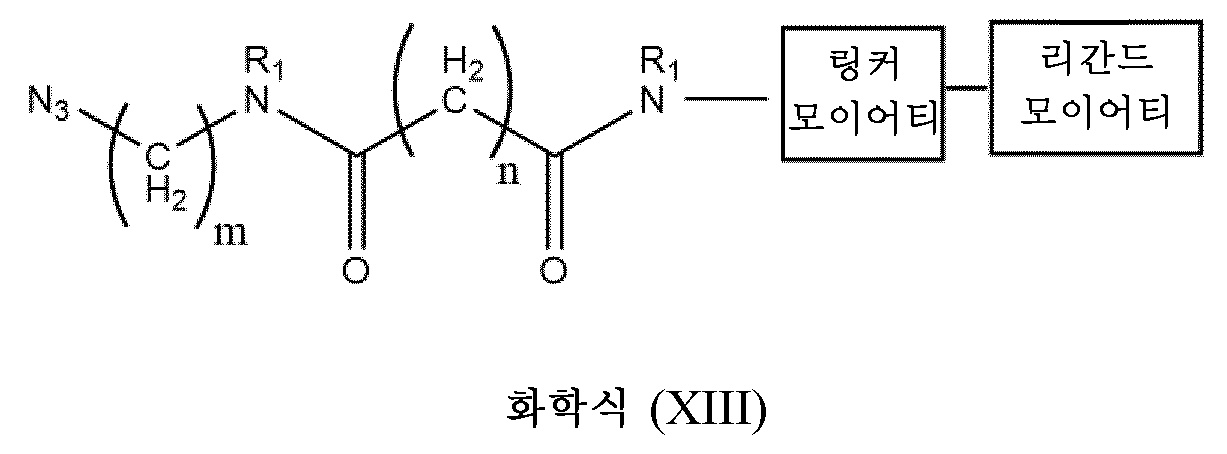
여기서:Here:
R1은 각 경우에 독립적으로 수소, 메틸 및 에틸로 이루어진 군으로부터 선택되고;R 1 is independently selected at each occurrence from the group consisting of hydrogen, methyl and ethyl;
m은 1 내지 6의 정수이고;m is an integer from 1 to 6;
n은 1 내지 10의 정수이다.n is an integer from 1 to 10.
82. 하기 화학식 (XIIIa)의 화합물.82. A compound of the following chemical formula (XIIIa).
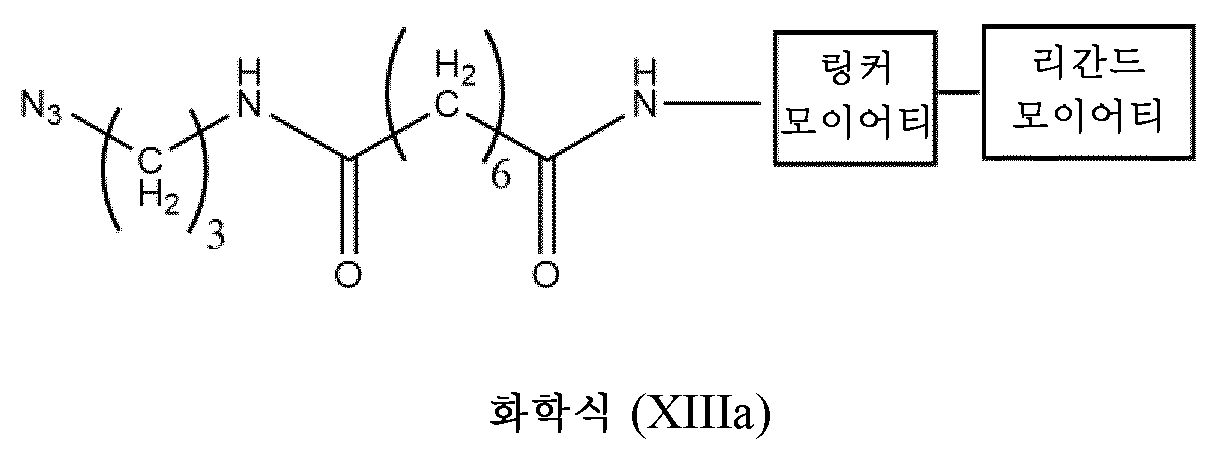
83. 하기 화학식 (XIIIb)의 화합물.83. A compound of the following chemical formula (XIIIb).

84. 하기 화학식 (XIV)의 화합물:84. A compound of the following chemical formula (XIV):
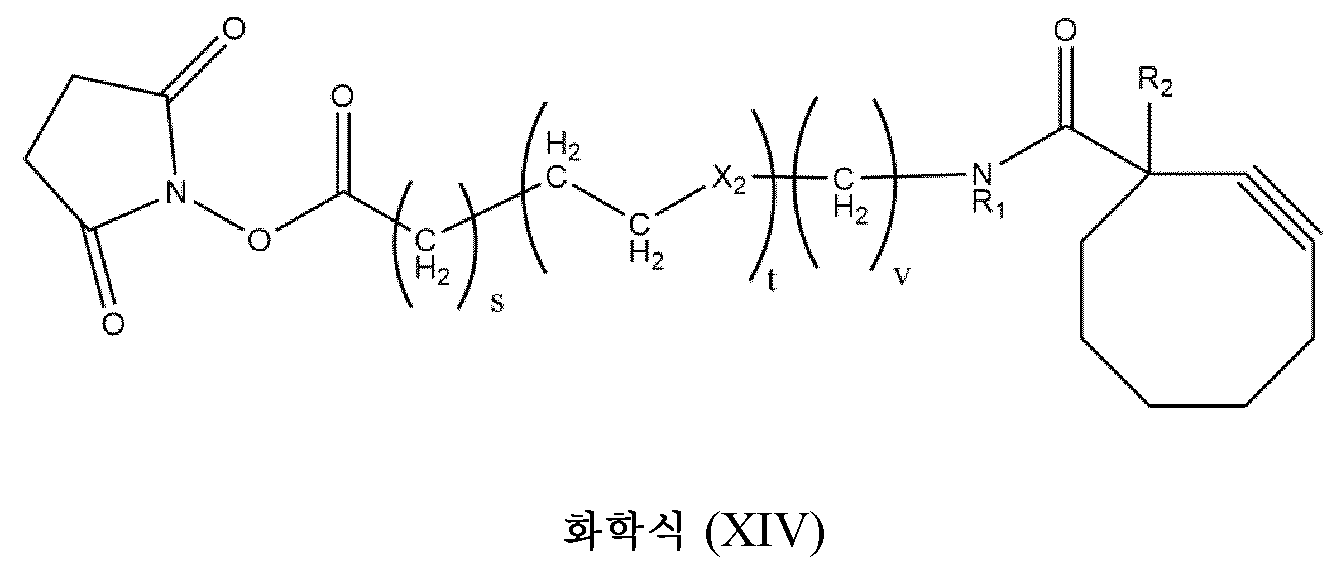
여기서:Here:
R1은 수소, 메틸 및 에틸로 이루어진 군으로부터 선택되고;R 1 is selected from the group consisting of hydrogen, methyl and ethyl;
R2는 수소, 히드록시, -OC1-3알킬, -C(=O)OC1-3알킬, 할로 및 니트로로 이루어진 군으로부터 선택되고;R 2 is selected from the group consisting of hydrogen, hydroxy, -OC 1-3 alkyl, -C(=O)OC 1-3 alkyl, halo, and nitro;
X2는 메틸렌, 산소 및 황으로 이루어진 군으로부터 선택되고;X 2 is selected from the group consisting of methylene, oxygen and sulfur;
s, t, v는 독립적으로 0 내지 4의 정수이고, 단 s, t 및 v는 모두 동시에 0일 수는 없다.s, t, and v are independently integers from 0 to 4, except that s, t, and v cannot all be 0 at the same time.
85. 하기 화학식 (XIVa)의 화합물.85. A compound of the following chemical formula (XIVa).

86. 하기 화학식 (XIVb)의 화합물.86. A compound of the following chemical formula (XIVb).

87. 하기 화학식 (XV)의 화합물:87. A compound of the following formula (XV):
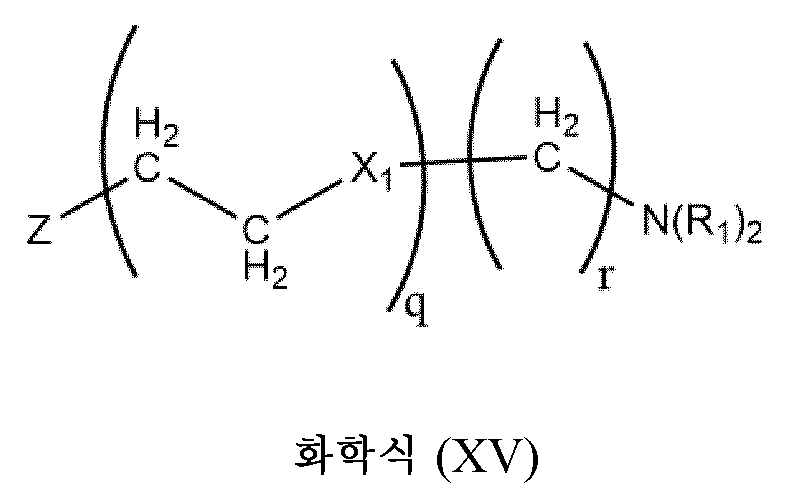
여기서:Here:
R1은 각 경우에 독립적으로 수소, 메틸 및 에틸로 이루어진 군으로부터 선택되고;R 1 is independently selected at each occurrence from the group consisting of hydrogen, methyl and ethyl;
X1은 메틸렌, 산소 및 황으로 이루어진 군으로부터 선택되고;X 1 is selected from the group consisting of methylene, oxygen and sulfur;
q 및 r은 독립적으로 0 내지 4의 정수이고, 단 q 및 r은 둘 다 동시에 0일 수는 없고;q and r are independently integers from 0 to 4, provided that q and r cannot both be 0 at the same time;
Z는 올리고뉴클레오시드 모이어티이다.Z is an oligonucleoside moiety.
88. 하기 화학식 (XVa)의 화합물.88. A compound of the following chemical formula (XVa).

89. 하기 화학식 (XVb)의 화합물.89. A compound of the following chemical formula (XVb).

90. 문장 1 내지 29, 32 내지 34, 37 내지 56, 59 내지 61, 및 64 내지 67 중 어느 하나에 따른 화합물 및/또는 문장 30, 31, 35, 36, 57, 58, 62 및 63 중 어느 하나에 따른 조성물의 제조에 사용하기 위한, 문장 76, 81 내지 84, 87 중 어느 하나에 따른 화합물의 용도.90. Use of a compound according to any one of
91. 문장 1 내지 29, 32 내지 34, 37 내지 56, 59 내지 61, 및 64 내지 67 중 어느 하나에 따른 화합물 및/또는 문장 30, 31, 35, 36, 57, 58, 62 및 63 중 어느 하나에 따른 조성물의 제조에 사용하기 위한, 문장 85에 따른 화합물의 용도로서, 여기서 R2 = F인 용도.91. Use of a compound according to sentence 85 for the preparation of a compound according to any one of
92. 문장 1 내지 29, 32 내지 34, 37 내지 56, 59 내지 61, 및 64 내지 67 중 어느 하나에 따른 화합물 및/또는 문장 30, 31, 35, 36, 57, 58, 62 및 63 중 어느 하나에 따른 조성물의 제조에 사용하기 위한, 문장 86에 따른 화합물의 용도로서, 여기서 R2 = OH인 용도.92. Use of a compound according to sentence 86 for the preparation of a compound according to any one of
93. 문장 20, 25, 27, 29, 54, 56 중 어느 하나에 따른 화합물 및/또는 문장 30, 31, 57, 58 중 어느 하나에 따른 조성물의 제조를 위한, 문장 77에 따른 화합물의 용도.93. Use of a compound according to sentence 77 for the preparation of a compound according to any one of sentences 20, 25, 27, 29, 54, 56 and/or a composition according to any one of sentences 30, 31, 57, 58.
94. 문장 20, 25, 28, 29, 55, 56 중 어느 하나에 따른 화합물 및/또는 문장 30, 31, 57, 58 중 어느 하나에 따른 조성물의 제조를 위한, 문장 78에 따른 화합물의 용도.94. Use of a compound according to sentence 78 for the preparation of a compound according to any one of
95. 문장 21, 26, 32, 34, 59, 61 중 어느 하나에 따른 화합물 및/또는 문장 35, 36, 62, 63 중 어느 하나에 따른 조성물의 제조를 위한, 문장 79에 따른 화합물의 용도.95. Use of a compound according to sentence 79 for the preparation of a compound according to any one of sentences 21, 26, 32, 34, 59, 61 and/or a composition according to any one of sentences 35, 36, 62, 63.
96. 문장 21, 26, 33, 34, 60, 61 중 어느 하나에 따른 화합물 및/또는 문장 35, 36, 62, 63 중 어느 하나에 따른 조성물의 제조를 위한, 문장 80에 따른 화합물의 용도.96. Use of a compound according to sentence 80 for the preparation of a compound according to any one of sentences 21, 26, 33, 34, 60, 61 and/or a composition according to any one of sentences 35, 36, 62, 63.
97. 문장 20, 25, 27 내지 29, 54 내지 56 중 어느 하나에 따른 화합물 및/또는 문장 30, 31, 57, 58 중 어느 하나에 따른 조성물의 제조를 위한, 문장 88에 따른 화합물의 용도.97. Use of a compound according to sentence 88 for the preparation of a compound according to any one of sentences 20, 25, 27 to 29, 54 to 56 and/or a composition according to any one of sentences 30, 31, 57, 58.
98. 문장 21, 26, 32 내지 34, 59 내지 61 중 어느 하나에 따른 화합물 및/또는 문장 35, 36, 62, 63 중 어느 하나에 따른 조성물의 제조를 위한, 문장 89에 따른 화합물의 용도.98. Use of a compound according to sentence 89 for the preparation of a compound according to any one of sentences 21, 26, 32 to 34, 59 to 61 and/or a composition according to any one of sentences 35, 36, 62, 63.
99. 문장 68 내지 75 중 어느 하나에 따른 방법에 의해 수득되거나 또는 수득가능한 화합물 또는 조성물.99. A compound or composition obtained or obtainable by a method according to any one of sentences 68 to 75.
100. 문장 1 내지 29, 32 내지 34, 37 내지 56, 59 내지 61, 및 64 내지 67 중 어느 하나에 따른 화합물 및/또는 문장 30, 31, 35, 36, 57, 58, 62 및 63 중 어느 하나에 따른 조성물을 제약상 허용되는 담체, 희석제 또는 부형제와 함께 포함하는 제약 조성물.100. A pharmaceutical composition comprising a compound according to any one of
101. 요법에 사용하기 위한, 문장 1 내지 29, 32 내지 34, 37 내지 56, 59 내지 61, 및 64 내지 67 중 어느 하나에 따른 화합물 및/또는 문장 30, 31, 35, 36, 57, 58, 62 및 63 중 어느 하나에 따른 조성물.101. A compound according to any one of
또 다른 측면에서, 본 발명은 하기 1-56으로 넘버링된 조항의 화합물, 공정, 조성물 또는 용도에 적용될 수 있으며, 여기서 조항에서의 임의의 화학식에 대한 언급은 조항 1-56 내에서 정의된 화학식만을 지칭한다. 이들 화학식을 도 6에 재현한다. 구체적으로, 임의의 하기 조항에서 Z에 의해 나타내어지는 올리고뉴클레오시드 모이어티는 임의의 하기 청구항에 정의된 바와 같은 ZPI 또는 HCII의 발현을 억제하기 위한 핵산을 포함할 수 있다.In another aspect, the present invention can be applied to the compounds, processes, compositions or uses of the clauses numbered 1-56 below, wherein reference to any chemical formula in the clauses refers only to the chemical formulas defined within clauses 1-56. These chemical formulas are reproduced in FIG. 6. Specifically, the oligonucleoside moiety represented by Z in any of the clauses below can comprise a nucleic acid for inhibiting the expression of ZPI or HCII as defined in any of the claims below.
1. 하기 구조를 포함하는 화합물:1. A compound comprising the following structure:

여기서:Here:
r 및 s는 독립적으로 1 내지 16으로부터 선택된 정수이고;r and s are independently integers selected from 1 to 16;
Z는 올리고뉴클레오시드 모이어티이다.Z is an oligonucleoside moiety.
2. 조항 1에 있어서, s가 4 내지 12로부터 선택된 정수인 화합물.2. A compound according to
3. 조항 2에 있어서, s가 6인 화합물.3. A compound in
4. 조항 1 내지 3 중 어느 하나에 있어서, r이 4 내지 14로부터 선택된 정수인 화합물.4. A compound according to any one of
5. 조항 4에 있어서, r이 6인 화합물.5. A compound in
6. 조항 4에 있어서, r이 12인 화합물.6. A compound in
7. 조항 5에 있어서, 조항 3에 따른 화합물.7. In
8. 조항6에 있어서, 조항 3에 따른 화합물.8. In
9. 조항 1 내지 8 중 어느 하나에 있어서, Z가 하기인 화합물:9. A compound according to any one of

여기서:Here:
Z1, Z2, Z3, Z4는 각 경우에 독립적으로 산소 또는 황이고;Z 1 , Z 2 , Z 3 , Z 4 are independently oxygen or sulfur in each case;
P 및 Z2, 및 P 및 Z3 사이의 하나의 결합은 단일 결합이고, 다른 결합은 이중 결합이다.One bond between P and Z 2 , and one bond between P and Z 3 is a single bond, and the other bond is a double bond.
10. 조항 1 내지 9 중 어느 하나에 있어서, 상기 올리고뉴클레오시드가 표적 유전자의 발현을 조정, 바람직하게는 억제할 수 있는 RNA 화합물인 화합물.10. A compound according to any one of
11. 조항 10에 있어서, 상기 RNA 화합물이 제1 및 제2 가닥을 포함하는 RNA 듀플렉스를 포함하고, 여기서 제1 가닥은 표적 유전자의 RNA 서열에 적어도 부분적으로 상보적이고, 제2 가닥은 상기 제1 가닥에 적어도 부분적으로 상보적이고, 여기서 각각의 제1 및 제2 가닥은 5' 및 3' 단부를 갖는 것인 화합물.11. A compound according to
12. 조항 11에 있어서, 바람직하게는 또한 조항 3 및 6에 따라, RNA 화합물이 그의 제2 가닥의 5' 단부에서 인접한 포스페이트에 부착된 것인 화합물.12. In
13. 조항 11에 있어서, 바람직하게는 또한 조항 3 및 5에 따라, RNA 화합물이 그의 제2 가닥의 3' 단부에서 인접한 포스페이트에 부착된 것인 화합물.13. In
14. 바람직하게는 조항 12에 따른 화학식 (II)의 화합물.14. Preferably a compound of formula (II) according to
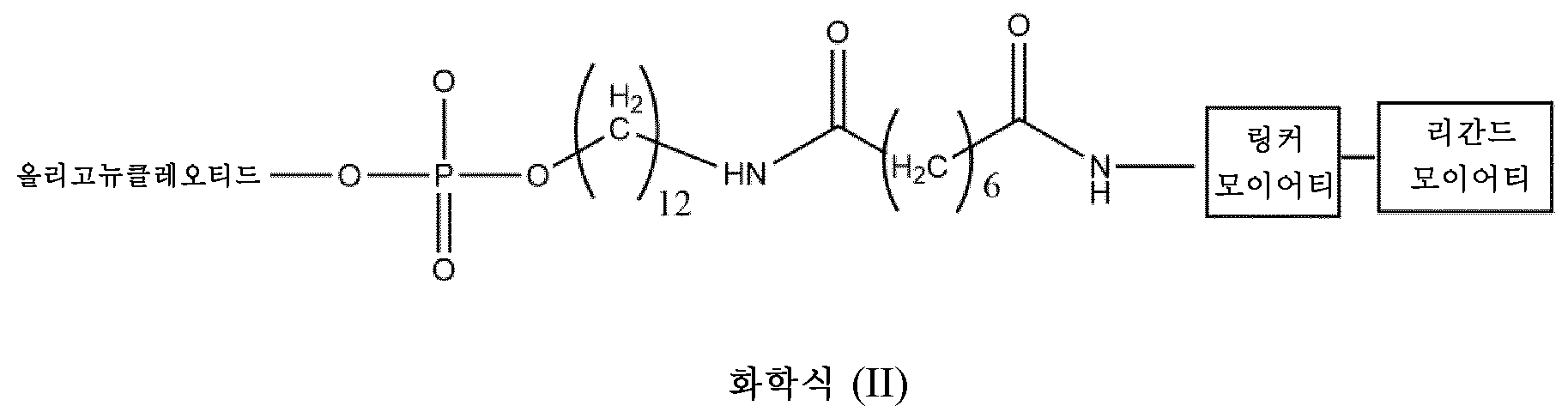
15. 바람직하게는 조항 13에 따른 화학식 (III)의 화합물.15. Preferably a compound of formula (III) according to
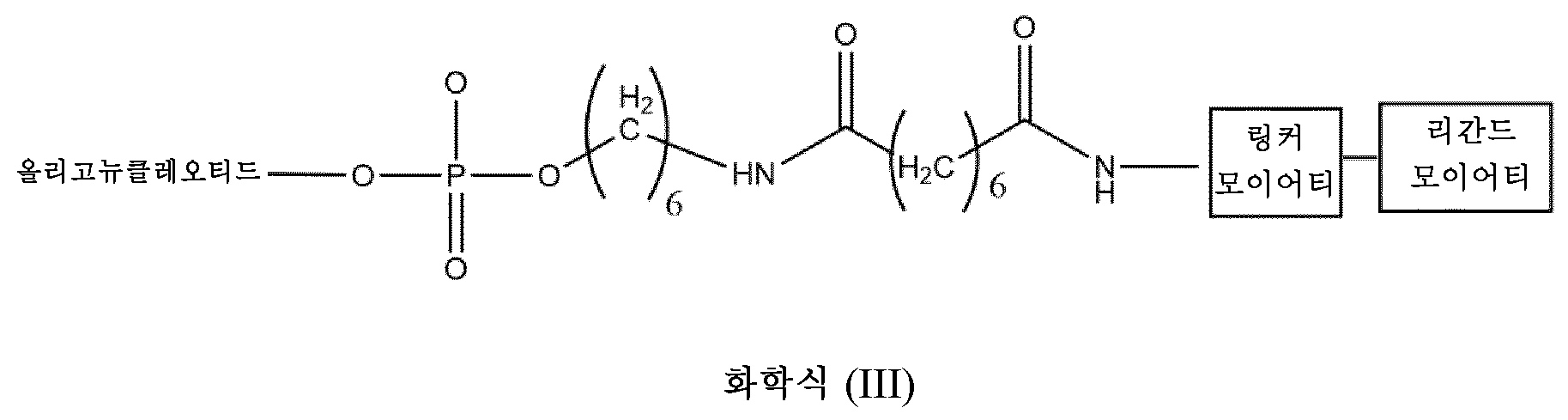
16. 조항 1 내지 15 중 어느 하나에 있어서, 올리고뉴클레오시드가 2' 위치에서 변형된 1개 이상의 리보스, 바람직하게는 2' 위치에서 변형된 복수의 리보스를 추가로 포함하는 RNA 듀플렉스를 포함하는 것인 화합물.16. A compound according to any one of
17. 조항 16에 있어서, 변형이 2'-O-메틸, 2'-데옥시-플루오로 및 2'-데옥시로부터 선택되는 것인 화합물.17. A compound according to clause 16, wherein the modification is selected from 2'-O-methyl, 2'-deoxy-fluoro and 2'-deoxy.
18. 조항 1 내지 17 중 어느 하나에 있어서, 올리고뉴클레오시드가 1개 이상의 단부에서 1개 이상의 분해 보호 모이어티를 추가로 포함하는 것인 화합물.18. A compound according to any one of
19. 조항 18에 있어서, 상기 1개 이상의 분해 보호 모이어티가 링커/리간드 모이어티를 보유하는 올리고뉴클레오시드 가닥의 단부에 존재하지 않고/거나, 상기 1개 이상의 분해 보호 모이어티가 포스포로티오에이트 뉴클레오시드간 연결, 포스포로디티오에이트 뉴클레오시드간 연결 및 역전된 무염기성 뉴클레오시드로부터 선택되고, 여기서 상기 역전된 무염기성 뉴클레오시드가 링커/리간드 모이어티를 보유하는 단부에 대해 동일한 가닥의 원위 단부에 존재하는 것인 화합물.19. A compound according to clause 18, wherein said one or more degradation protecting moieties are not present at an end of the oligonucleoside strand carrying the linker/ligand moiety, and/or said one or more degradation protecting moieties are selected from a phosphorothioate internucleoside linkage, a phosphorodithioate internucleoside linkage and an inverted abasic nucleoside, wherein said inverted abasic nucleoside is present at a distal end of the same strand with respect to the end carrying the linker/ligand moiety.
20. 조항 1 내지 19 중 어느 하나에 있어서, 상기 조항 1에서 화학식 (I)에 도시된 바와 같은 리간드 모이어티가 1개 이상의 리간드를 포함하는 것인 화합물.20. A compound according to any one of
21. 조항 20에 있어서, 상기 조항 1에서 화학식 (I)로 도시된 바와 같은 리간드 모이어티가 1개 이상의 탄수화물 리간드를 포함하는 것인 화합물.21. A compound according to clause 20, wherein the ligand moiety as depicted in formula (I) in
22. 조항 21에 있어서, 상기 1개 이상의 탄수화물이 모노사카라이드, 디사카라이드, 트리사카라이드, 테트라사카라이드, 올리고사카라이드 또는 폴리사카라이드일 수 있는 것인 화합물.22. A compound according to clause 21, wherein said one or more carbohydrates may be a monosaccharide, a disaccharide, a trisaccharide, a tetrasaccharide, an oligosaccharide or a polysaccharide.
23. 조항 22에 있어서, 상기 1개 이상의 탄수화물이 1개 이상의 갈락토스 모이어티, 1개 이상의 락토스 모이어티, 1개 이상의 N-아세틸갈락토사민 모이어티, 및/또는 1개 이상의 만노스 모이어티를 포함하는 것인 화합물.23. A compound according to clause 22, wherein said at least one carbohydrate comprises at least one galactose moiety, at least one lactose moiety, at least one N-acetylgalactosamine moiety, and/or at least one mannose moiety.
24. 조항 23항에 있어서, 상기 1개 이상의 탄수화물이 1개 이상의 N-아세틸-갈락토사민 모이어티를 포함하는 것인 화합물.24. A compound according to clause 23, wherein said at least one carbohydrate comprises at least one N-acetyl-galactosamine moiety.
25. 조항 24에 있어서, 2 또는 3개의 N-아세틸갈락토사민 모이어티를 포함하는 화합물.25. A compound comprising two or three N-acetylgalactosamine moieties according to clause 24.
26. 이전 조항 중 어느 하나에 있어서, 상기 1개 이상의 리간드가 선형 배위 또는 분지형 배위로 부착된 것인 화합물.26. A compound according to any of the preceding provisions, wherein one or more of said ligands are attached in a linear or branched configuration.
27. 조항 26에 있어서, 상기 1개 이상의 리간드가 이중안테나 또는 삼중안테나 분지형 배위로서 부착된 것인 화합물.27. A compound according to clause 26, wherein one or more of the ligands are attached as a biantennary or triantennary branched coordination.
28. 조항 20 내지 27에 있어서, 상기 조항 1에서 화학식 (I)에 도시된 바와 같은 모이어티:28. In clauses 20 to 27, a moiety as depicted in chemical formula (I) in clause 1:
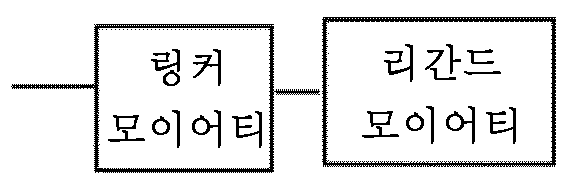
이 하기 화학식 (IV), (V) 또는 (VI) 중 임의의 것, 바람직하게는 하기 화학식 (IV)인 화합물:A compound of any of the following formulae (IV), (V) or (VI), preferably of the following formula (IV):
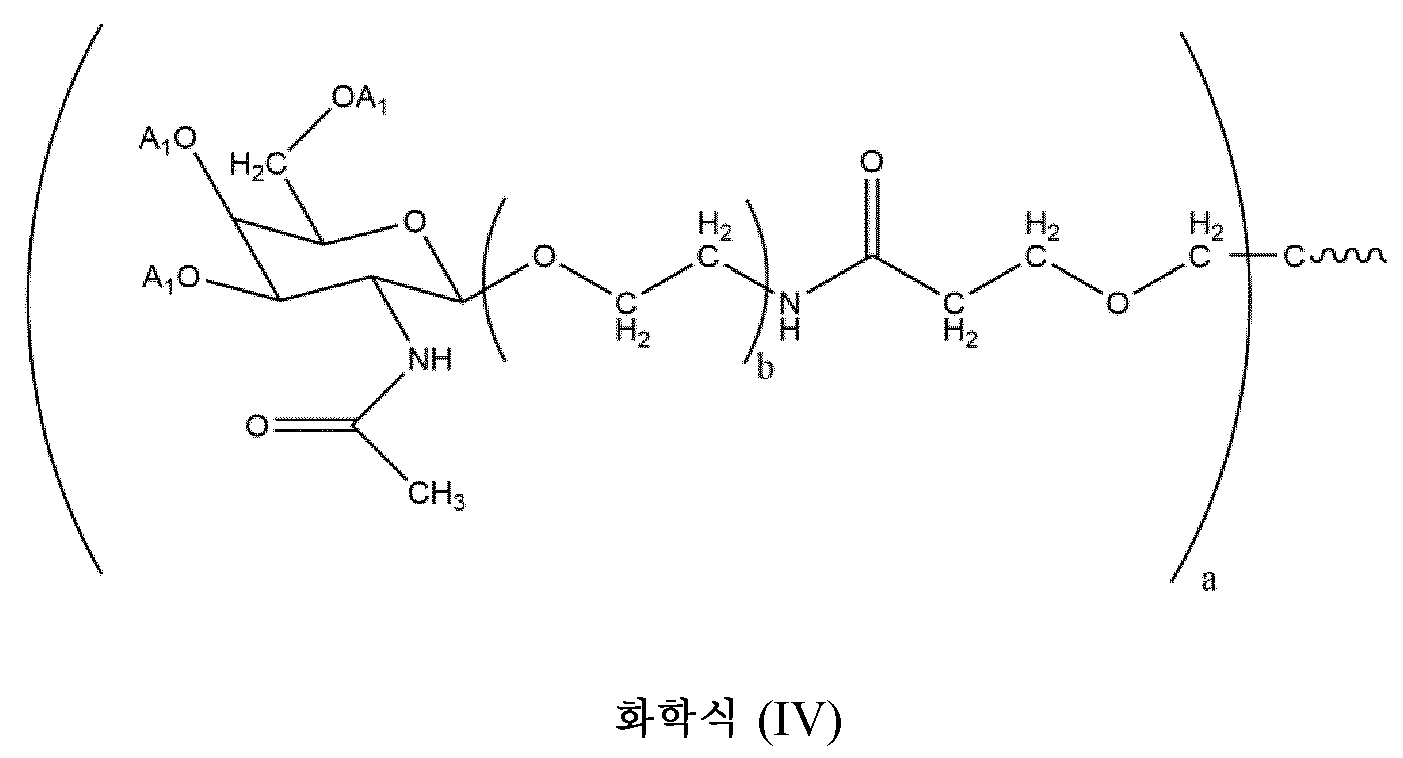
(여기서:(Here:
AI은 수소, 또는 적합한 히드록시 보호기이고;A I is hydrogen, or a suitable hydroxy protecting group;
a는 2 또는 3의 정수이고;a is an integer of 2 or 3;
b는 2 내지 5의 정수임); 또는b is an integer from 2 to 5); or

(여기서:(Here:
AI은 수소, 또는 적합한 히드록시 보호기이고;A I is hydrogen, or a suitable hydroxy protecting group;
a는 2 또는 3의 정수이고;a is an integer of 2 or 3;
c 및 d는 독립적으로 1 내지 6의 정수임); 또는c and d are independently integers from 1 to 6); or

(여기서:(Here:
AI은 수소, 또는 적합한 히드록시 보호기이고;A I is hydrogen, or a suitable hydroxy protecting group;
a는 2 또는 3의 정수이고;a is an integer of 2 or 3;
e는 2 내지 10의 정수임).e is an integer between 2 and 10).
29. 조항 1 내지 28 중 어느 하나에 있어서, 상기 조항 1에서 화학식 (I)에 도시된 바와 같은 모이어티:29. In any one of
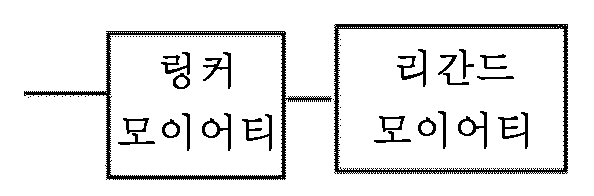
이 하기 화학식 (VII)인 화합물:A compound having the following chemical formula (VII):
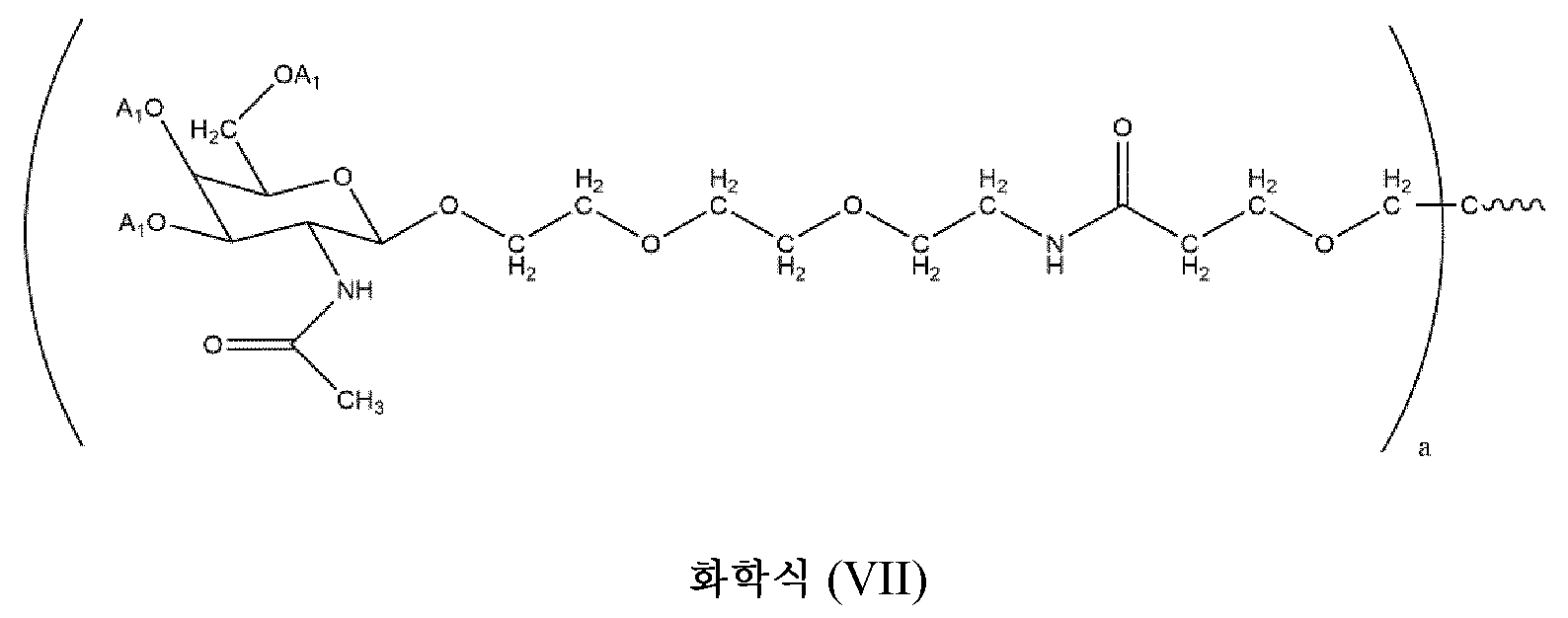
(여기서:(Here:
AI은 수소이고;A I is hydrogen;
a는 2 또는 3의 정수임).a is an integer of 2 or 3).
30. 조항 28 또는 29에 있어서, a = 2인 화합물.30. A compound according to clause 28 or 29, wherein a = 2.
31. 조항 28 또는 29항에 있어서, a = 3인 화합물.31. A compound according to clause 28 or 29, wherein a = 3.
32. 조항 28항에 있어서, b = 3인 화합물.32. A compound according to clause 28, wherein b = 3.
33. 하기 화학식 (VIII)의 화합물.33. A compound of the following chemical formula (VIII).
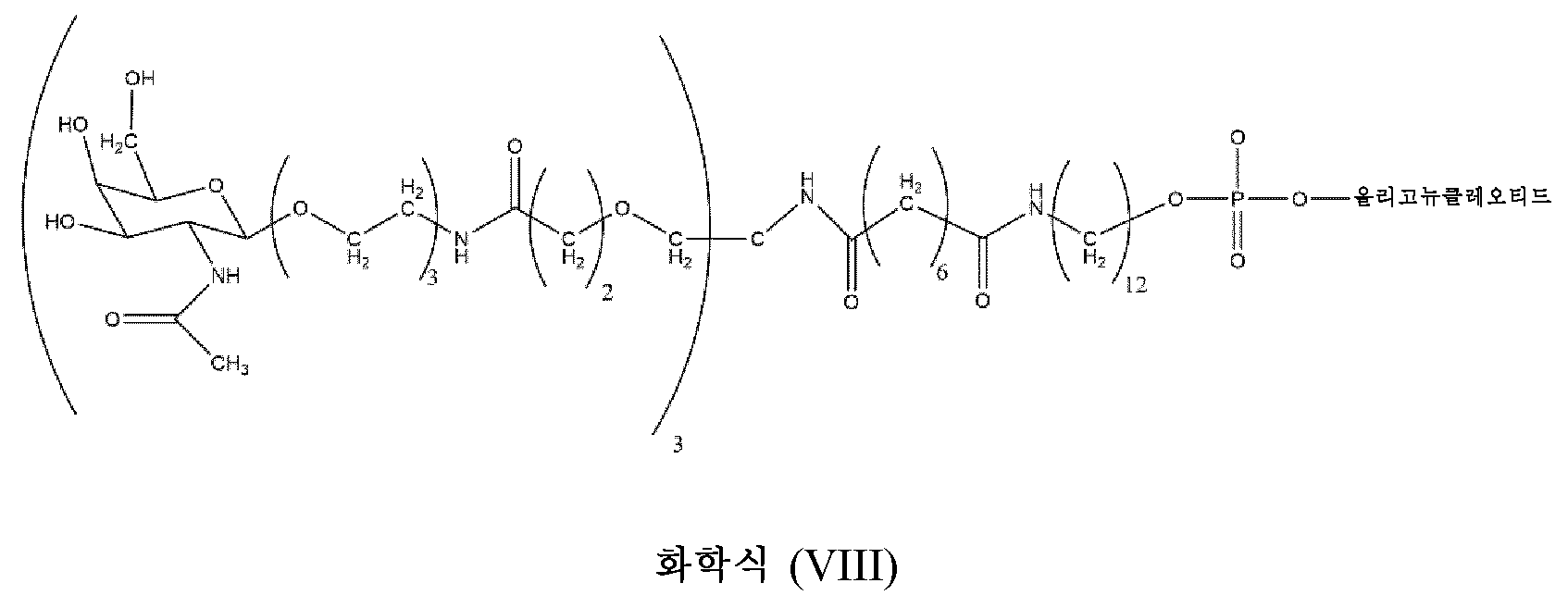
34. 하기 화학식 (IX)의 화합물.34. A compound of the following chemical formula (IX).

35. 조항 33 또는 34에 있어서, 올리고뉴클레오시드가 2' 위치에서 변형된 1개 이상의 리보스, 바람직하게는 2' 위치에서 변형된 복수의 리보스를 추가로 포함하는 RNA 듀플렉스를 포함하는 것인 화합물.35. A compound according to clause 33 or 34, wherein the oligonucleoside comprises an RNA duplex further comprising at least one ribose modified at the 2' position, preferably multiple riboses modified at the 2' position.
36. 조항 35에 있어서, 변형이 2'-O-메틸, 2'-데옥시-플루오로 및 2'-데옥시로부터 선택되는 것인 화합물.36. A compound according to clause 35, wherein the modification is selected from 2'-O-methyl, 2'-deoxy-fluoro and 2'-deoxy.
37. 조항 33 내지 36 중 어느 하나에 있어서, 올리고뉴클레오시드가 1개 이상의 단부에서 1개 이상의 분해 보호 모이어티를 추가로 포함하는 것인 화합물.37. A compound according to any one of clauses 33 to 36, wherein the oligonucleoside further comprises at least one degradation protecting moiety at at least one terminus.
38. 조항 37에 있어서, 상기 1개 이상의 분해 보호 모이어티가 링커/리간드 모이어티를 보유하는 올리고뉴클레오시드 가닥의 단부에 존재하지 않고/거나, 상기 1개 이상의 분해 보호 모이어티가 포스포로티오에이트 뉴클레오시드간 연결, 포스포로디티오에이트 뉴클레오시드간 연결 및 역전된 무염기성 뉴클레오시드로부터 선택되고, 여기서 상기 역전된 무염기성 뉴클레오시드가 링커/리간드 모이어티를 보유하는 단부에 대해 동일한 가닥의 원위 단부에 존재하는 것인 화합물.38. A compound according to clause 37, wherein said one or more degradation protecting moieties are not present at an end of the oligonucleoside strand carrying the linker/ligand moiety, and/or said one or more degradation protecting moieties are selected from a phosphorothioate internucleoside linkage, a phosphorodithioate internucleoside linkage and an inverted abasic nucleoside, wherein said inverted abasic nucleoside is present at a distal end of the same strand with respect to the end carrying the linker/ligand moiety.
39. 조항 33에 있어서, 올리고뉴클레오시드가 제1 및 제2 가닥을 포함하는 RNA 듀플렉스를 포함하고, 여기서 제1 가닥은 표적 유전자의 RNA 서열에 적어도 부분적으로 상보적이고, 제2 가닥은 상기 제1 가닥에 적어도 부분적으로 상보적이고, 여기서 각각의 제1 및 제2 가닥은 5' 및 3' 단부를 갖고, 여기서 상기 RNA 듀플렉스는 그의 제2 가닥의 5' 단부에서 인접한 포스페이트에 부착된 것인 화합물.39. A compound according to clause 33, wherein the oligonucleoside comprises an RNA duplex comprising first and second strands, wherein the first strand is at least partially complementary to an RNA sequence of a target gene, and wherein the second strand is at least partially complementary to said first strand, wherein each of the first and second strands has 5' and 3' ends, and wherein said RNA duplex is attached to an adjacent phosphate at the 5' end of its second strand.
40. 조항 34에 있어서, 올리고뉴클레오시드가 제1 및 제2 가닥을 포함하는 RNA 듀플렉스를 포함하고, 여기서 제1 가닥은 표적 유전자의 RNA 서열에 적어도 부분적으로 상보적이고, 제2 가닥은 상기 제1 가닥에 적어도 부분적으로 상보적이고, 여기서 각각의 제1 및 제2 가닥은 5' 및 3' 단부를 갖고, 여기서 상기 RNA 듀플렉스는 그의 제2 가닥의 3' 단부에서 인접한 포스페이트에 부착된 것인 화합물.40. A compound according to clause 34, wherein the oligonucleoside comprises an RNA duplex comprising first and second strands, wherein the first strand is at least partially complementary to an RNA sequence of a target gene, and wherein the second strand is at least partially complementary to said first strand, wherein each of the first and second strands has 5' and 3' ends, and wherein said RNA duplex is attached to an adjacent phosphate at the 3' end of its second strand.
41. 조항 1 내지 40 중 어느 하나에 따른 화합물의 제조 방법으로서, 하기 화학식 (X) 및 (XI)의 화합물을 반응시키고:41. A method for producing a compound according to any one of

(여기서:(Here:
r 및 s는 독립적으로 1 내지 16으로부터 선택된 정수이고;r and s are independently integers selected from 1 to 16;
Z는 올리고뉴클레오시드 모이어티임);Z is an oligonucleoside moiety);
적절한 경우에 리간드의 탈보호 및/또는 올리고뉴클레오시드에 대한 제2 가닥의 어닐링을 수행하는 것을 포함하는 방법.A method comprising performing deprotection of the ligand and/or annealing of the second strand to the oligonucleoside, as appropriate.
42. 조항 41에 있어서, 조항 6, 8 내지 14, 16 내지 33, 및 35 내지 40 중 어느 하나에 따른 화합물의 제조 방법으로서, 여기서:42. A method for preparing a compound according to any one of
화학식 (X)의 화합물이 하기 화학식 (Xa)이고:The compound of formula (X) has the following formula (Xa):

화학식 (XI)의 화합물이 하기 화학식 (XIa)이고:The compound of formula (XI) has the following formula (XIa):

여기서 올리고뉴클레오시드는 제1 및 제2 가닥을 포함하는 RNA 듀플렉스를 포함하고, 제1 가닥은 표적 유전자의 RNA 서열에 적어도 부분적으로 상보적이고, 제2 가닥은 상기 제1 가닥에 적어도 부분적으로 상보적이고, 여기서 각각의 제1 및 제2 가닥은 5' 및 3' 단부를 갖고, 여기서 상기 RNA 듀플렉스는 그의 제2 가닥의 5' 단부에서 인접한 포스페이트에 부착된 것인 방법.A method wherein the oligonucleoside comprises an RNA duplex comprising first and second strands, the first strand being at least partially complementary to an RNA sequence of a target gene, the second strand being at least partially complementary to said first strand, wherein each of the first and second strands have 5' and 3' ends, and wherein the RNA duplex is attached to an adjacent phosphate at the 5' end of its second strand.
43. 조항 41에 있어서, 조항 5, 7, 9 내지 13, 15 내지 32, 및 34 내지 40 중 어느 하나에 따른 화합물을 제조하는 방법으로서, 여기서:43. A method for preparing a compound according to any one of
화학식 (X)의 화합물이 하기 화학식 (Xb)이고:The compound of chemical formula (X) has the following chemical formula (Xb):
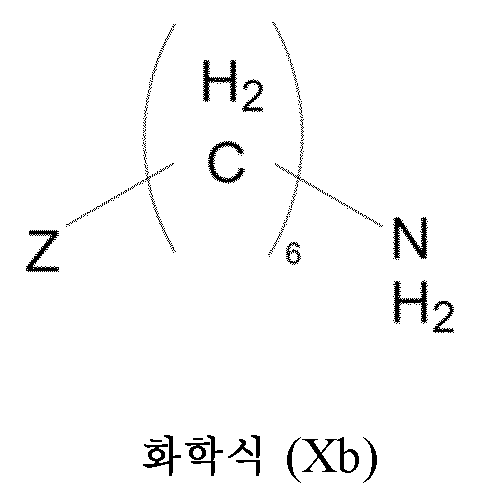
화학식 (XI)의 화합물이 하기 화학식 (XIa)이고:The compound of formula (XI) has the following formula (XIa):

여기서 올리고뉴클레오시드는 제1 및 제2 가닥을 포함하는 RNA 듀플렉스를 포함하고, 제1 가닥은 표적 유전자의 RNA 서열에 적어도 부분적으로 상보적이고, 제2 가닥은 상기 제1 가닥에 적어도 부분적으로 상보적이고, 여기서 각각의 제1 및 제2 가닥은 5' 및 3' 단부를 갖고, 여기서 상기 RNA 듀플렉스는 그의 제2 가닥의 3' 단부에서 인접한 포스페이트에 부착된 것인 방법.A method wherein the oligonucleoside comprises an RNA duplex comprising first and second strands, the first strand being at least partially complementary to an RNA sequence of a target gene, and the second strand being at least partially complementary to said first strand, wherein each of the first and second strands have 5' and 3' ends, and wherein the RNA duplex is attached to an adjacent phosphate at the 3' end of its second strand.
44. 조항 42 또는 43에 있어서,44. In clause 42 or 43,
화학식 (XIa)의 화합물이 하기 화학식 (XIb)인 방법.A method wherein the compound of chemical formula (XIa) has the following chemical formula (XIb).
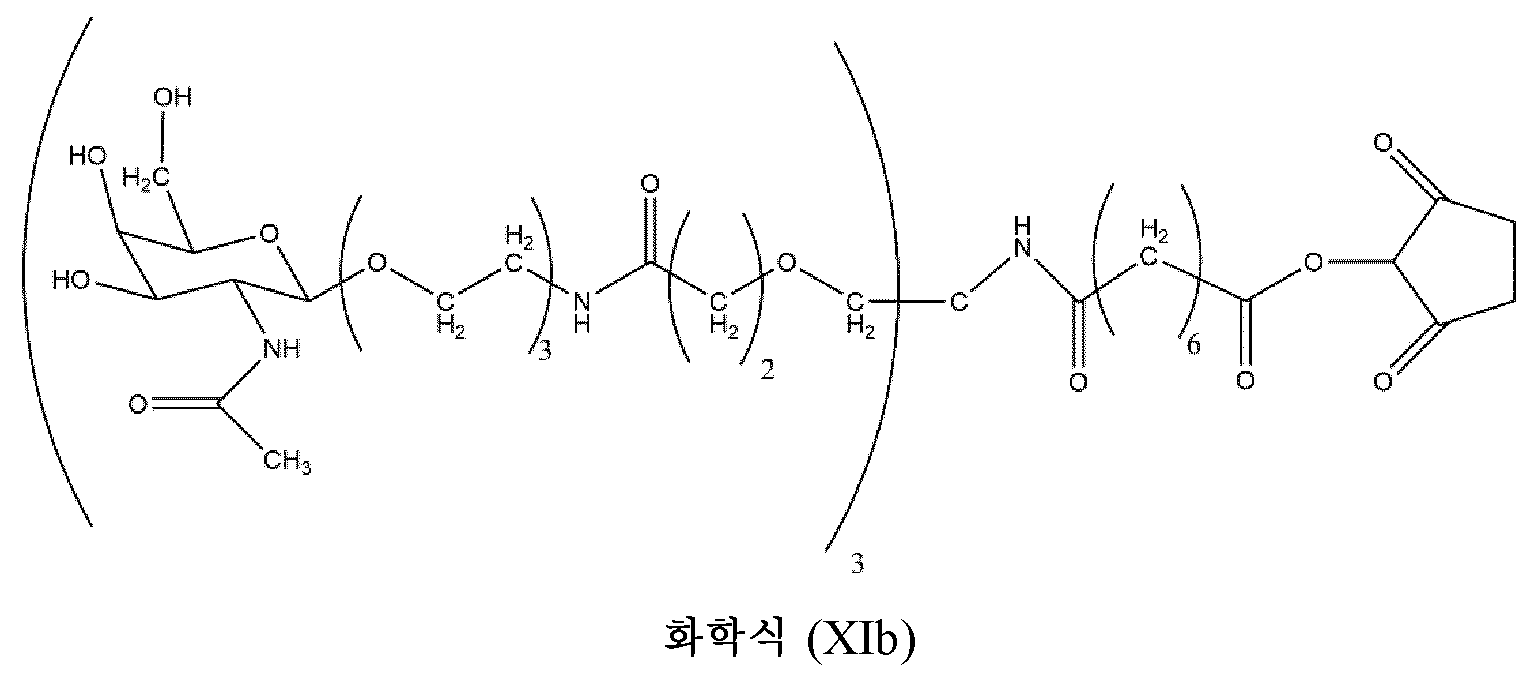
45. 하기 화학식 (X)의 화합물.45. A compound of the following chemical formula (X).

여기서:Here:
r은 독립적으로 1 내지 16으로부터 선택된 정수이고;r is an integer independently selected from 1 to 16;
Z는 올리고뉴클레오시드 모이어티이다.Z is an oligonucleoside moiety.
46. 하기 화학식 (Xa)의 화합물.46. A compound of the following chemical formula (Xa).
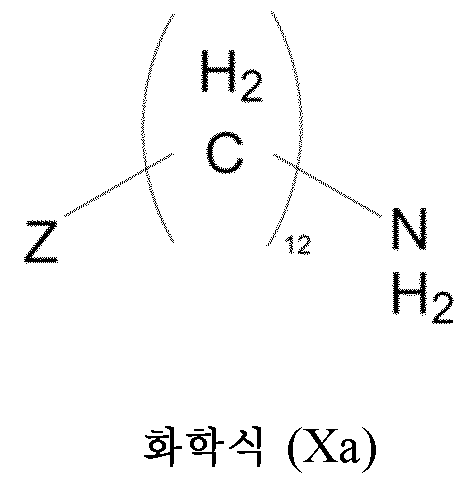
47. 하기 화학식 (Xb)의 화합물.47. A compound of the following chemical formula (Xb).

48. 하기 화학식 (XI)의 화합물:48. A compound of the following chemical formula (XI):
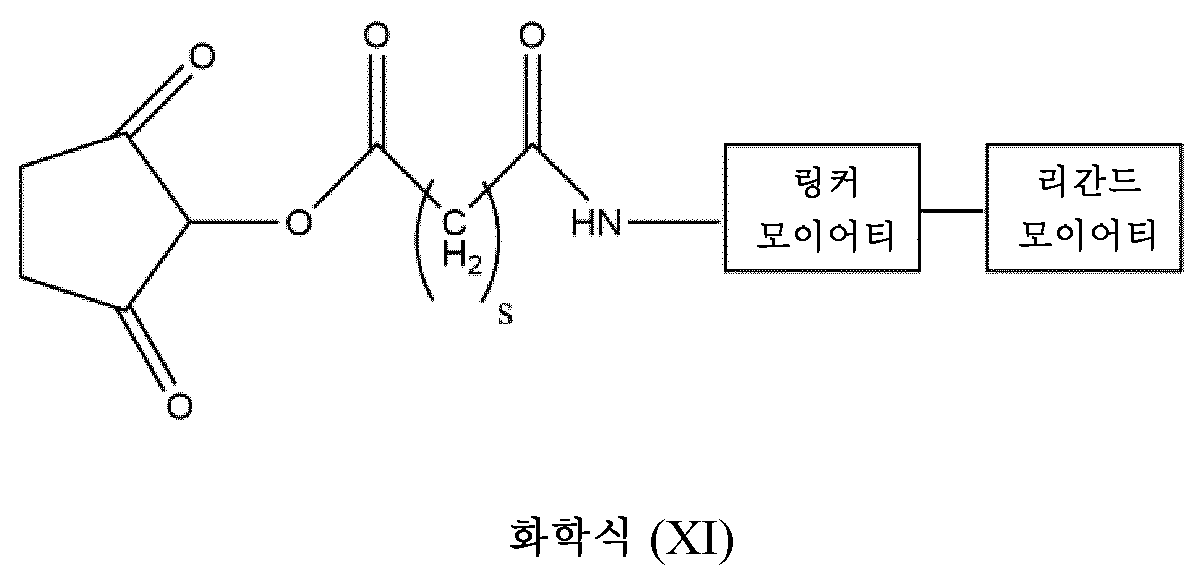
여기서:Here:
s는 독립적으로 1 내지 16으로부터 선택된 정수이고;s is an integer independently selected from 1 to 16;
Z는 올리고뉴클레오시드 모이어티이다.Z is an oligonucleoside moiety.
49. 하기 화학식 (XIa)의 화합물.49. A compound of the following chemical formula (XIa).

50. 화학식 (XIb)의 화합물.50. A compound of formula (XIb).
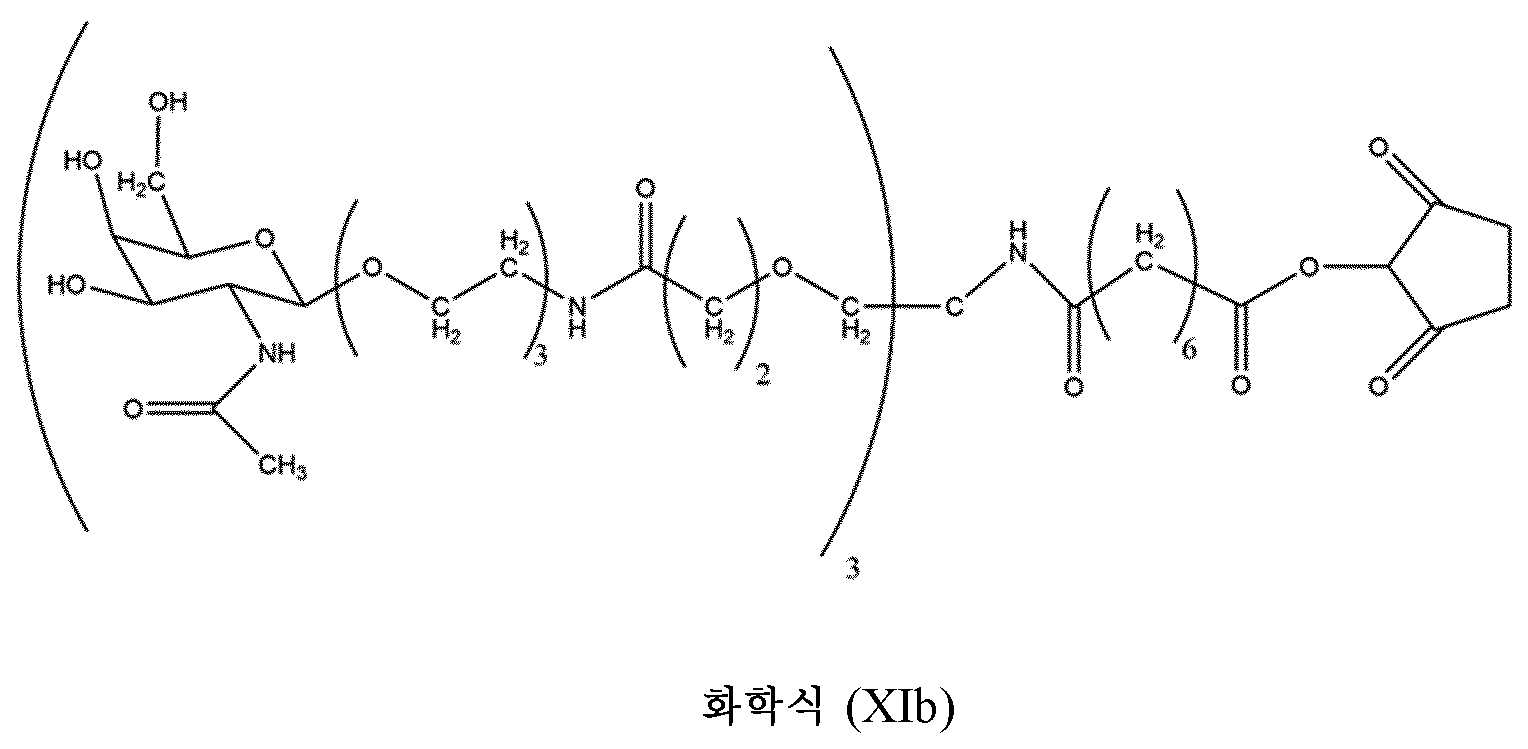
51. 조항 1 내지 40 중 어느 하나에 따른 화합물의 제조를 위한, 조항 45 및 48 내지 50에 따른 화합물의 용도.51. Use of a compound according to clauses 45 and 48 to 50 for the manufacture of a compound according to any one of
52. 조항 6, 8 내지 14, 16 내지 33, 및 35 내지 40 중 어느 하나에 따른 화합물의 제조를 위한, 조항 46에 따른 화합물의 용도.52. Use of a compound according to clause 46 for the manufacture of a compound according to any one of
53. 조항 5, 7, 9 내지 13, 15 내지 32, 및 34 내지 40 중 어느 하나에 따른 화합물의 제조를 위한, 조항 47에 따른 화합물의 용도.53. Use of a compound according to clause 47 for the manufacture of a compound according to any one of
54. 조항 41 내지 44 중 어느 하나에 따른 방법에 의해 수득되거나 또는 수득가능한 화합물 또는 조성물.54. A compound or composition obtained or obtainable by a method according to any one of clauses 41 to 44.
55. 조항 1 내지 40에 따른 화합물을 제약상 허용되는 담체, 희석제 또는 부형제와 함께 포함하는 제약 조성물.55. A pharmaceutical composition comprising a compound according to
56. 요법에 사용하기 위한 조항 1 내지 40에 따른 화합물.56. Compounds according to
실시예Example
본 발명은 하기 실시예를 참조하여 보다 완전히 이해될 것이다. 그러나, 이들이 본 발명의 범위를 제한하는 것으로 해석되어서는 안된다. 본원에 기재된 실시예 및 실시양태는 단지 예시적 목적을 위한 것이고, 그에 비추어 다양한 변형 또는 변경이 관련 기술분야의 통상의 기술자에게 제안될 것이며, 본 출원의 취지 및 범위 및 첨부된 조항의 범주 내에 포함되어야 하는 것으로 이해된다.The present invention will be more fully understood by reference to the following examples. However, they should not be construed as limiting the scope of the present invention. It is to be understood that the examples and embodiments described herein are for illustrative purposes only, and that various modifications or changes will be suggested to those skilled in the art in light of the foregoing, and are to be included within the spirit and scope of the present application and the scope of the appended claims.
실시예 1: 테더 1의 합성Example 1: Synthesis of
일반적 실험 조건:General experimental conditions:
박층 크로마토그래피 (TLC)는 마슈레-나겔로부터의 형광 지시자 254 nm를 갖는 실리카-코팅된 알루미늄 플레이트 상에서 수행하였다. 화합물을 UV 광 (254 nm) 하에, 또는 스탈 (시그마-알드리치로부터)에 따라 메탄올 (MeOH) 또는 닌히드린 시약 중 5% H2SO4로 분무한 후 가열함으로써 가시화하였다. 플래쉬 크로마토그래피는 바이오타지 스패어 실리카 10, 25, 50 또는 100 g 칼럼 (스웨덴 웁살라)을 사용하여 이중 가변 UV 파장 검출기 (200-400 nm)가 장착된 바이오타지 이솔레라 원 플래쉬 크로마토그래피 기기로 수행하였다.Thin layer chromatography (TLC) was performed on silica-coated aluminum plates with a fluorescent indicator 254 nm from Machele-Nagel. Compounds were visualized under UV light (254 nm) or by spraying with 5% H 2 SO 4 in methanol (MeOH) or ninhydrin reagent according to Stahl (Sigma-Aldrich) followed by heating. Flash chromatography was performed on a Biotage Isolera One flash chromatography instrument equipped with a dual variable UV wavelength detector (200-400 nm) using
모든 수분-민감성 반응은 건조 유리제품, 무수 용매 및 아르곤 분위기를 사용하여 무수 조건 하에 수행하였다. 모든 상업적으로 입수가능한 시약은 시그마-알드리치로부터 구입하였고, 용매는 칼 로트 게엠베하 + 코. 카게로부터 구입하였다. D-갈락토사민 펜타아세테이트를 AK 사이언티픽으로부터 구입하였다.All moisture-sensitive reactions were performed under anhydrous conditions using dry glassware, anhydrous solvents, and an argon atmosphere. All commercially available reagents were purchased from Sigma-Aldrich, and solvents were purchased from Karl Roth GmbH + Co. KG. D-Galactosamine pentaacetate was purchased from AK Scientific.
HPLC/ESI-MS는 디오넥스 얼티메이트 3000 RS UHPLC 시스템 및 써모 사이언티픽 MSQ 플러스 질량 분광계 상에서 워터스로부터의 액퀴티 UPLC 단백질 BEH C4 칼럼 (300Å, 1.7 μm, 2.1 x 100 mm)을 사용하여 60℃에서 수행하였다. 용매계는 0.1% 포름산을 함유하는 H2O를 갖는 용매 A 및 0.1% 포름산을 함유하는 아세토니트릴 (ACN)을 갖는 용매 B로 이루어졌다. 15분에 걸쳐 0.4 mL/분의 유량으로 5-100%의 B의 구배를 사용하였다. 검출기 및 조건: 코로나 초-하전 에어로졸 검출 (esa로부터). 네뷸라이저 온도: 25℃. N2 압력: 35.1 psi. 필터: 코로나.HPLC/ESI-MS was performed at 60°C using an Acquity UPLC Protein BEH C4 column (300Å, 1.7 μm, 2.1 × 100 mm) from Waters on a Dionex Ultimate 3000 RS UHPLC system and a Thermo Scientific MSQ Plus mass spectrometer. The solvent system consisted of solvent A with H 2 O containing 0.1% formic acid and solvent B with acetonitrile (ACN) containing 0.1% formic acid. A gradient of 5-100% B was used at a flow rate of 0.4 mL/min over 15 min. Detector and conditions: Corona super-charged aerosol detection (from esa). Nebulizer temperature: 25°C. N 2 pressure: 35.1 psi. Filter: Corona.
1H 및 13C NMR 스펙트럼을 실온에서 배리안 분광계 상에서 500 MHz (1H NMR) 및 125 MHz (13C NMR)에서 기록하였다. 화학적 이동은 용매 잔류 피크 (CDCl3 - 1H NMR: 7.26 ppm에서의 δ 및 77.2 ppm에서의 13C NMR δ; DMSO-d6 - 1H NMR: 2.50 ppm에서의 δ 및 39.5 ppm에서의 13C NMR δ)를 기준으로 ppm으로 주어진다. 커플링 상수는 헤르츠로 주어진다. 신호 분할 패턴은 단일선 (s), 이중선 (d), 삼중선 (t) 또는 다중선 (m)으로 기재된다. 1 H and 13 C NMR spectra were recorded at room temperature on a Varian spectrometer at 500 MHz ( 1 H NMR) and 125 MHz ( 13 C NMR). Chemical shifts are given in ppm relative to the solvent residue peak (CDCl 3 - 1 H NMR: δ at 7.26 ppm and 13 C NMR δ at 77.2 ppm; DMSO-d 6 - 1 H NMR: δ at 2.50 ppm and 13 C NMR δ at 39.5 ppm). Coupling constants are given in hertz. Signal splitting patterns are described as singlets (s), doublets (d), triplets (t), or multiplets (m).
접합체 빌딩 블록 트리GalNAc_테더1에 대한 합성 경로:Synthetic route for the conjugate building block treeGalNAc_tether1:
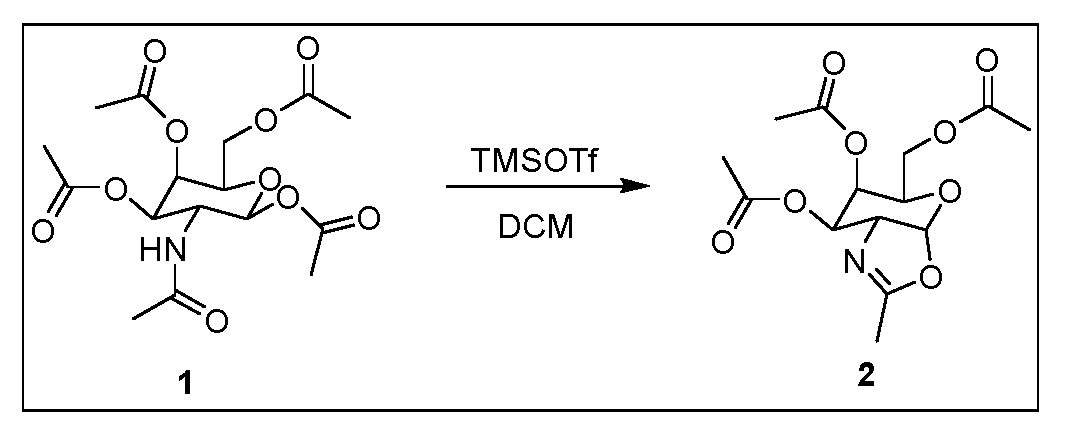
화합물 2의 제조: D-갈락토사민 펜타아세테이트 (3.00 g, 7.71 mmol, 1.0 당량)를 아르곤 하에 무수 디클로로메탄 (DCM) (30 mL) 중에 용해시키고, 트리메틸실릴 트리플루오로메탄술포네이트 (TMSOTf, 4.28 g, 19.27 mmol, 2.5 당량)를 첨가하였다. 반응물을 실온에서 3시간 동안 교반하였다. 반응 혼합물을 DCM (50 mL)으로 희석하고, 차가운 포화 수성 NaHCO3 (100 mL) 및 물 (100 mL)로 세척하였다. 유기 층을 분리하고, Na2SO4 상에서 건조시키고, 농축시켜 표제 화합물을 황색 오일로서 수득하고, 이를 플래쉬 크로마토그래피 (구배 용리: 10 CV에서 DCM 중 0-10% MeOH)에 의해 정제하였다. 생성물을 무색 오일 (2.5 g, 98%, rf = 0.45 (DCM 중 2% MeOH))로서 수득하였다.Preparation of compound 2: D-Galactosamine pentaacetate (3.00 g, 7.71 mmol, 1.0 equiv) was dissolved in anhydrous dichloromethane (DCM) (30 mL) under argon, and trimethylsilyl trifluoromethanesulfonate (TMSOTf, 4.28 g, 19.27 mmol, 2.5 equiv) was added. The reaction was stirred at room temperature for 3 h. The reaction mixture was diluted with DCM (50 mL) and washed with cold saturated aqueous NaHCO3 (100 mL) and water (100 mL). The organic layer was separated, dried over Na 2 SO 4 and concentrated to give the title compound as a yellow oil, which was purified by flash chromatography (gradient elution: 0-10% MeOH in DCM in 10 CV). The product was obtained as a colorless oil (2.5 g, 98%, rf = 0.45 (2% MeOH in DCM)).

화합물 4의 제조: 화합물 2 (2.30 g, 6.98 mmol, 1.0 당량) 및 아지도-PEG3-OH (1.83 g, 10.5 mmol, 1.5 당량)를 아르곤 하에 무수 DCM (40 mL) 중에 용해시키고, 분자체 3 Å (5 g)을 용액에 첨가하였다. 혼합물을 실온에서 1시간 동안 교반하였다. 이어서, TMSOTf (0.77 g, 3.49 mmol, 0.5 당량)를 혼합물에 첨가하고, 반응물을 밤새 교반하였다. 분자체를 여과하고, 여과물을 DCM (100 mL)으로 희석하고, 차가운 포화 수성 NaHCO3 (100 mL) 및 물 (100 mL)로 세척하였다. 유기 층을 분리하고, Na2SO4 상에서 건조시키고, 용매를 감압 하에 제거하였다. 조 물질을 플래쉬 크로마토그래피 (구배 용리: 10 CV에서 DCM 중 0-3% MeOH)에 의해 정제하여 표제 생성물을 담황색 오일 (3.10 g, 88%, rf = 0.25 (DCM 중 2% MeOH))로서 수득하였다. MS: 계산치 C20H32N4O11, 504.21. 실측치 505.4. 1H NMR (500 MHz, CDCl3) δ 6.21-6.14 (m, 1H), 5.30 (dd, J = 3.4, 1.1 Hz, 1H), 5.04 (dd, J = 11.2, 3.4 Hz,1H), 4.76 (d, J = 8.6 Hz, 1H), 4.23-4.08 (m, 3H), 3.91-3.80 (m, 3H), 3.74-3.59 (m, 9H), 3.49-3.41 (m, 2H), 2.14 (s, 3H), 2.02 (s, 3H), 1.97 (d, J = 4.2 Hz, 6H). 13C NMR (125 MHz, CDCl3) δ 170.6 (C), 170.5 (C), 170.4 (C), 170.3 (C), 102.1 (CH), 71.6 (CH), 70.8 (CH), 70.6 (CH), 70.5 (CH), 70.3 (CH2), 69.7 (CH2), 68.5 (CH2), 66.6 (CH2), 61.5 (CH2), 23.1 (CH3), 20.7 (3xCH3).Preparation of compound 4: Compound 2 (2.30 g, 6.98 mmol, 1.0 equiv) and azido-PEG3-OH (1.83 g, 10.5 mmol, 1.5 equiv) were dissolved in anhydrous DCM (40 mL) under argon and

화합물 5의 제조: 화합물 4 (1.00 g, 1.98 mmol, 1.0 당량)를 에틸 아세테이트 (EtOAc) 및 MeOH (30 mL 1:1 v/v)의 혼합물 중에 용해시키고, Pd/C (100 mg)를 첨가하였다. 반응 혼합물을 진공/아르곤 사이클 (3x)을 사용하여 탈기하고, 풍선 압력 하에 밤새 수소화시켰다. 반응 혼합물을 셀라이트를 통해 여과하고, EtOAc (30 mL)로 세척하였다. 용매를 감압 하에 제거하여 표제 화합물을 무색 오일 (0.95 g, 정량적 수율, rf = 0.25 (DCM 중 10% MeOH))로서 수득하였다. 화합물을 추가 정제 없이 사용하였다. MS: 계산치 C20H34N2O11, 478.2. 실측치 479.4.Preparation of compound 5: Compound 4 (1.00 g, 1.98 mmol, 1.0 equiv) was dissolved in a mixture of ethyl acetate (EtOAc) and MeOH (30 mL 1:1 v/v), and Pd/C (100 mg) was added. The reaction mixture was degassed using vacuum/argon cycles (3x) and hydrogenated under balloon pressure overnight. The reaction mixture was filtered through celite and washed with EtOAc (30 mL). The solvent was removed under reduced pressure to give the title compound as a colorless oil (0.95 g, quantitative yield, rf = 0.25 (10% MeOH in DCM)). The compound was used without further purification. MS: calcd for C 20 H 34 N 2 O 11 , 478.2. Found 479.4.
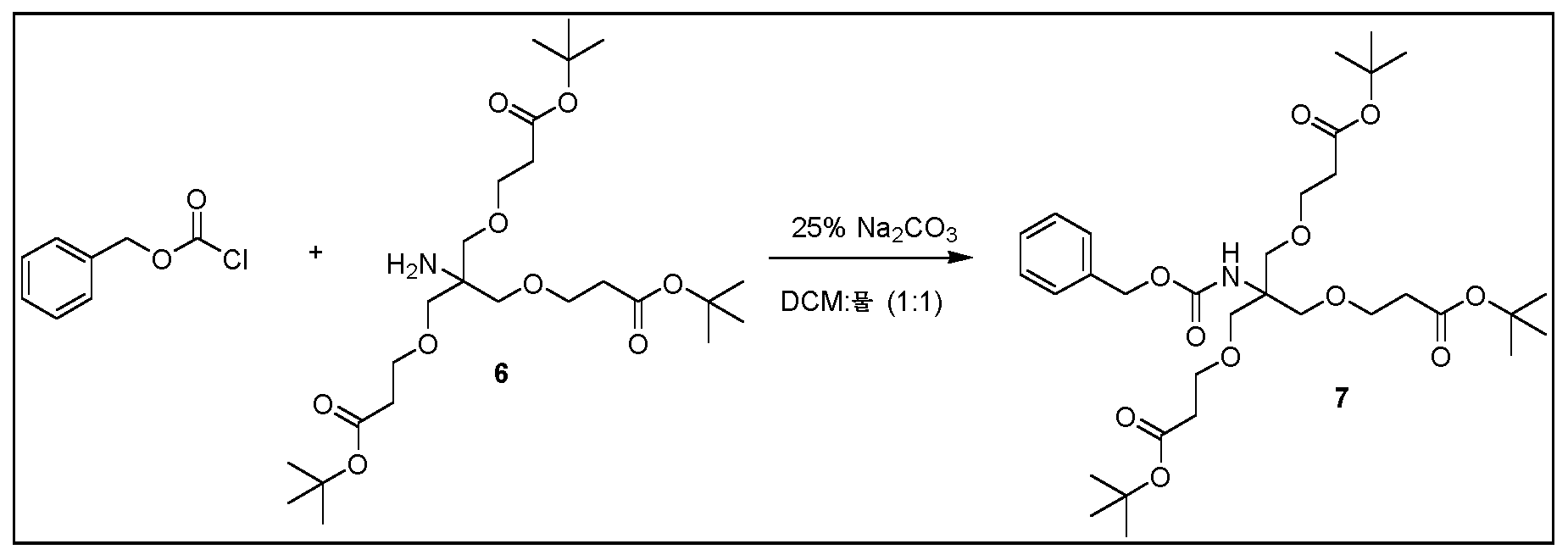
화합물 7의 제조: 트리스{[2-(tert-부톡시카르보닐)에톡시]메틸}-메틸아민 6 (3.37 g, 6.67 mmol, 1.0 당량)을 DCM/물의 혼합물 (40 mL 1:1 v/v) 중에 용해시키고, Na2CO3 (0.18 g, 1.7 mmol, 0.25 당량)을 격렬히 교반하면서 첨가하였다. 벤질 클로로포르메이트 (2.94 mL, 20.7 mmol, 3.10 당량)를 이전 혼합물에 적가하고, 반응물을 실온에서 24시간 동안 교반하였다. 반응 혼합물을 CH2Cl2 (100 mL)로 희석하고, 물 (100 mL)로 세척하였다. 유기 층을 분리하고, Na2SO4 상에서 건조시켰다. 용매를 감압 하에 제거하고, 생성된 조 물질을 플래쉬 크로마토그래피 (구배 용리: 12 CV에서 시클로헥산 중 0-10% EtOAc)에 의해 정제하여 표제 화합물을 연황색빛 오일 (3.9 g, 91%, rf = 0.56 (시클로헥산 중 10% EtOAc))로서 수득하였다. MS: 계산치 C33H53NO11, 639.3. 실측치 640.9. 1H NMR (500 MHz, DMSO-d6) δ 7.38-7.26 (m, 5H), 4.97 (s, 2H), 3.54 (t, 6H), 3.50 (s, 6H), 2.38 (t, 6H), 1.39 (s, 27H). 13C NMR (125 MHz, DMSO-d6) δ 170.3 (3xC), 154.5 (C), 137.1 (C), 128.2 (2xCH), 127.7 (CH), 127.6 (2xCH), 79.7 (3xC), 68.4 (3xCH2), 66.8 (3xCH2), 64.9 (C), 58.7 (CH2), 35.8 (3xCH2), 27.7 (9xCH3).Preparation of compound 7: Tris{[2-(tert-butoxycarbonyl)ethoxy]methyl}-methylamine 6 (3.37 g, 6.67 mmol, 1.0 equiv) was dissolved in a mixture of DCM/water (40 mL 1:1 v/v), and Na 2 CO 3 (0.18 g, 1.7 mmol, 0.25 equiv) was added with vigorous stirring. Benzyl chloroformate (2.94 mL, 20.7 mmol, 3.10 equiv) was added dropwise to the previous mixture, and the reaction was stirred at room temperature for 24 h. The reaction mixture was diluted with CH 2 Cl 2 (100 mL) and washed with water (100 mL). The organic layer was separated and dried over Na 2 SO 4 . The solvent was removed under reduced pressure and the resulting crude material was purified by flash chromatography (gradient elution: 0-10% EtOAc in cyclohexane over 12 CV) to give the title compound as a pale yellow oil (3.9 g, 91%, rf = 0.56 (10% EtOAc in cyclohexane)). MS: calcd for C 33 H 53 NO 11 , 639.3. Found 640.9. 1 H NMR (500 MHz, DMSO-d 6 ) δ 7.38-7.26 (m, 5H), 4.97 (s, 2H), 3.54 (t, 6H), 3.50 (s, 6H), 2.38 (t, 6H), 1.39 (s, 27H). 13 C NMR (125 MHz, DMSO-d 6 ) δ 170.3 (3xC), 154.5 (C), 137.1 (C), 128.2 (2xCH), 127.7 (CH), 127.6 (2xCH), 79.7 (3xC), 68.4 (3xCH 2 ), 66.8 (3xCH 2 ), 64.9 (C), 58.7 (CH 2 ), 35.8 (3xCH 2 ), 27.7 (9xCH 3 ).

화합물 8의 제조: Cbz-NH-트리스-Boc-에스테르 7 (0.20 g, 0.39 mmol, 1.0 당량)을 CH2Cl2 (1 mL) 중에 아르곤 하에 용해시키고, 트리플루오로아세트산 (TFA, 1 mL)을 첨가하고, 반응물을 실온에서 1시간 동안 교반하였다. 용매를 감압 하에 제거하고, 잔류물을 톨루엔 (5 mL)으로 3회 공증발시키고, 고진공 하에 건조시켜 화합물을 그의 TFA 염 (0.183 g, 98%)으로서 수득하였다. 화합물을 추가 정제 없이 사용하였다. MS: 계산치 C21H29NO11, 471.6. 실측치 472.4.Preparation of compound 8: Cbz-NH-tris-Boc-ester 7 (0.20 g, 0.39 mmol, 1.0 equiv) was dissolved in CH 2 Cl 2 (1 mL) under argon, trifluoroacetic acid (TFA, 1 mL) was added and the reaction was stirred at room temperature for 1 h. The solvent was removed under reduced pressure and the residue was co-evaporated three times with toluene (5 mL) and dried under high vacuum to give the compound as its TFA salt (0.183 g, 98%). The compound was used without further purification. MS: calcd for C 21 H 29 NO 11 , 471.6. Found 472.4.
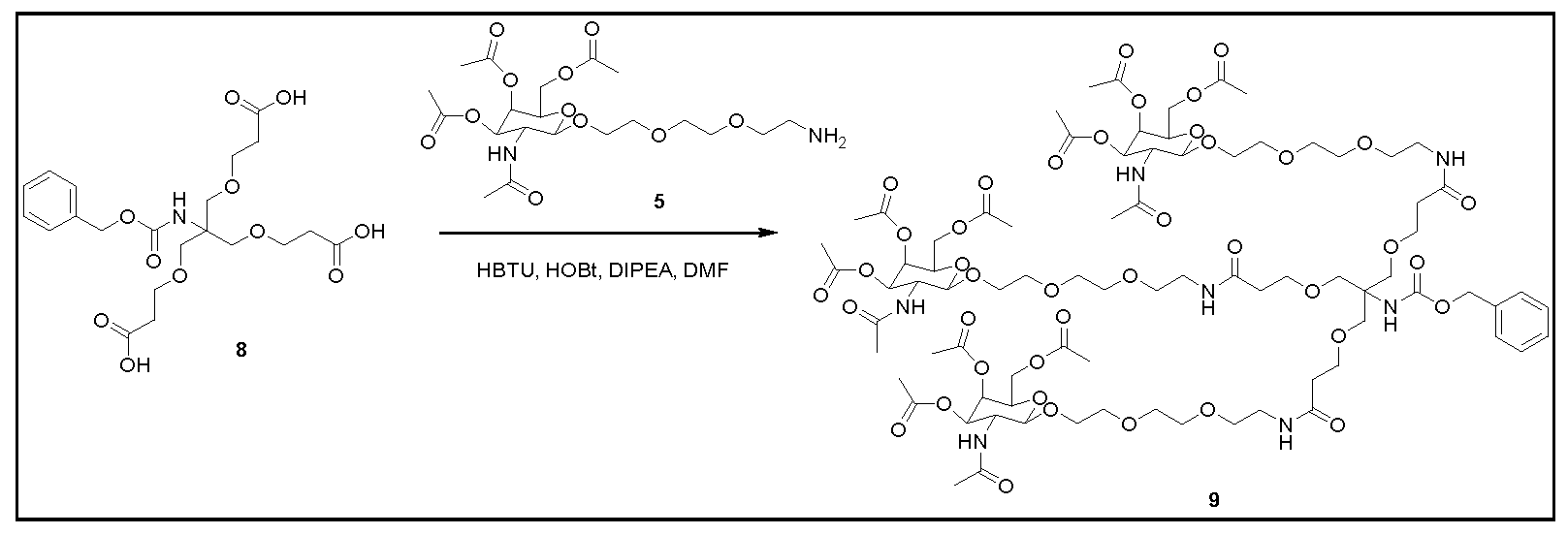
화합물 9의 제조: CbzNH-트리스-COOH 8 (0.72 g, 1.49 mmol, 1.0 당량) 및 GalNAc-PEG3-NH2 5 (3.56 g, 7.44 mmol, 5.0 당량)를 N,N-디메틸포름아미드 (DMF) (25 mL) 중에 용해시켰다. 이어서, N,N,N',N'-테트라메틸-O-(1H-벤조트리아졸-1-일)우로늄 헥사플루오로포스페이트 (HBTU) (2.78 g, 7.44 mmol, 5.0 당량), 1-히드록시벤조트리아졸 수화물 (HOBt) (1.05 g, 7.44 mmol, 5.0 당량) 및 N,N-디이소프로필에틸아민 (DIPEA) (2.07 mL, 11.9 mmol, 8.0 당량)을 용액에 첨가하고, 반응물을 72시간 동안 교반하였다. 용매를 감압 하에 제거하고, 잔류물을 DCM (100 mL) 중에 용해시키고, 포화 수성 NaHCO3 (100 mL)으로 세척하였다. 유기 층을 Na2SO4 상에서 건조시키고, 용매를 증발시키고, 조 물질을 플래쉬 크로마토그래피 (구배 용리: 14 CV에서 DCM 중 0-5% MeOH)에 의해 정제하였다. 생성물을 연황색빛 오일 (1.2 g, 43%, rf = 0.20 (DCM 중 5% MeOH))로서 수득하였다. MS: 계산치 C81H125N7O41, 1852.9. 실측치 1854.7. 1H NMR (500 MHz, DMSO-d6) δ 7.90-7.80 (m, 10H), 7.65-7.62 (m, 4H), 7.47-7.43 (m, 3H), 7.38-7.32 (m, 8H), 5.24-5.22 (m, 3H), 5.02-4.97 (m, 4H), 4.60-4.57 (m, 3 H), 4.07-3.90 (m 10H), 3.67-3.36 (m, 70H), 3.23-3.07 (m, 25H), 2.18 (s, 10H), 2.00 (s, 13H), 1.89 (s, 11H), 1.80-1.78 (m, 17H). 13C NMR (125 MHz, DMSO-d6) δ 170.1 (C), 169.8 (C), 169.7 (C), 169.4 (C), 169.2 (C), 169.1 (C), 142.7 (C), 126.3 (CH), 123.9 (CH), 118.7 (CH), 109.7 (CH), 100.8 (CH), 70.5 (CH), 69.8 (CH), 69.6 (CH), 69.5 (CH), 69.3 (CH2), 69.0 (CH2), 68.2 (CH2), 67.2 (CH2), 66.7 (CH2), 61.4 (CH2), 22.6 (CH2), 22.4 (3xCH3), 20.7 (9xCH3).Preparation of compound 9: CbzNH-tris-COOH 8 (0.72 g, 1.49 mmol, 1.0 equiv) and GalNAc-PEG3-NH 2 5 (3.56 g, 7.44 mmol, 5.0 equiv) were dissolved in N,N-dimethylformamide (DMF) (25 mL). Next, N,N,N',N'-tetramethyl-O-(1H-benzotriazol-1-yl)uronium hexafluorophosphate (HBTU) (2.78 g, 7.44 mmol, 5.0 equiv), 1-hydroxybenzotriazole hydrate (HOBt) (1.05 g, 7.44 mmol, 5.0 equiv) and N,N-diisopropylethylamine (DIPEA) (2.07 mL, 11.9 mmol, 8.0 equiv) were added to the solution, and the reaction was stirred for 72 h. The solvent was removed under reduced pressure, and the residue was dissolved in DCM (100 mL) and washed with saturated aqueous NaHCO 3 (100 mL). The organic layer was dried over Na 2 SO 4 , the solvent was evaporated and the crude material was purified by flash chromatography (gradient elution: 0-5% MeOH in DCM over 14 CV). The product was obtained as a pale yellow oil (1.2 g, 43%, rf = 0.20 (5% MeOH in DCM)). MS: calcd for C 81 H 125 N 7 O 41 , 1852.9. Found 1854.7. 1 H NMR (500 MHz, DMSO-d 6 ) δ 7.90-7.80 (m, 10H), 7.65-7.62 (m, 4H), 7.47-7.43 (m, 3H), 7.38-7.32 (m, 8H), 5.24-5.22 (m, 3H), 5.02-4.97 (m, 4H), 4.60-4.57 (m, 3 H), 4.07-3.90 (m 10H), 3.67-3.36 (m, 70H), 3.23-3.07 (m, 25H), 2.18 (s, 10H), 2.00 (s, 13H), 1.89 (s, 11H), 1.80-1.78 (m, 17H). 13 C NMR (125 MHz, DMSO-d 6 ) δ 170.1 (C), 169.8 (C), 169.7 (C), 169.4 (C), 169.2 (C), 169.1 (C), 142.7 (C), 126.3 (CH), 123.9 (CH), 118.7 (CH), 109.7 (CH), 100.8 (CH), 70.5 (CH), 69.8 (CH), 69.6 (CH), 69.5 (CH), 69.3 (CH 2 ), 69.0 (CH 2 ), 68.2 (CH 2 ), 67.2 (CH 2 ), 66.7 (CH) 2 ), 61.4 (CH 2 ), 22.6 (CH 2 ), 22.4 (3xCH 3 ), 20.7 (9xCH 3 ).
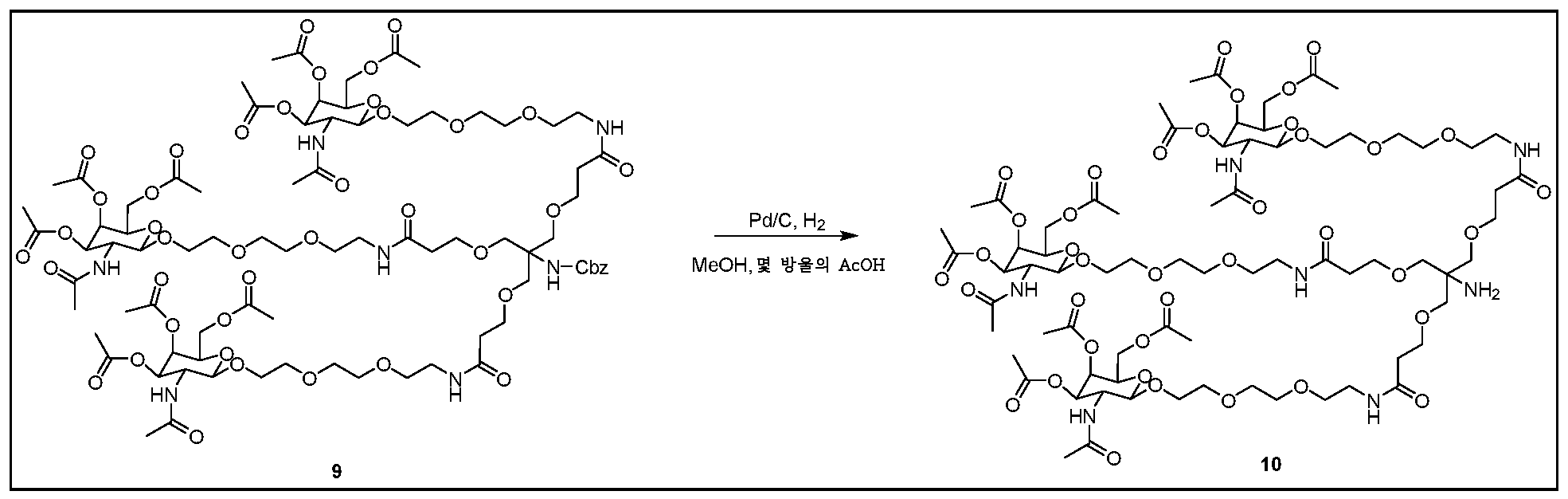
화합물 10의 제조: 삼중안테나 GalNAc 화합물 9 (0.27 g, 0.14 mmol, 1.0 당량)를 MeOH (15 mL) 중에 용해시키고, 3 방울의 아세트산 (AcOH) 및 Pd/C (30 mg)를 첨가하였다. 반응 혼합물을 진공/아르곤 사이클 (3x)을 사용하여 탈기하고, 풍선 압력 하에 밤새 수소화시켰다. 반응의 완결에 이어서 질량 분광측정법을 수행하고, 생성된 혼합물을 얇은 셀라이트 패드를 통해 여과하였다. 용매를 증발시키고, 수득된 잔류물을 고진공 하에 건조시키고, 추가 정제 없이 후속 단계에서 사용하였다. 생성물을 연황색빛 오일 (0.24 g, 정량적 수율)로서 수득하였다. MS: 계산치 C73H119N7O39, 1718.8. 실측치 1719.3.Preparation of compound 10: The triantennary GalNAc compound 9 (0.27 g, 0.14 mmol, 1.0 equiv) was dissolved in MeOH (15 mL), and 3 drops of acetic acid (AcOH) and Pd/C (30 mg) were added. The reaction mixture was degassed using vacuum/argon cycles (3x) and hydrogenated under balloon pressure overnight. After completion of the reaction, mass spectrometry was performed, and the resulting mixture was filtered through a thin pad of celite. The solvent was evaporated, and the resulting residue was dried under high vacuum and used in the next step without further purification. The product was obtained as a pale yellow oil (0.24 g, quantitative yield). MS: Calcd for C 73 H 119 N 7 O 39 , 1718.8. Found 1719.3.

화합물 11의 제조: 상업적으로 입수가능한 수베르산 비스(N-히드록시숙신이미드 에스테르) (3.67 g, 9.9 mmol, 1.0 당량)를 DMF (5 mL) 중에 용해시키고, 트리에틸아민 (1.2 mL)을 첨가하였다. 이 용액에 DMF (5 mL) 중 3-아지도-1-프로필아민 (1.0 g, 9.9 mmol, 1.0 당량)의 용액을 적가하였다. 반응물을 실온에서 3시간 동안 교반하였다. 반응 혼합물을 EtOAc (100 mL)로 희석하고, 물 (50 mL)로 세척하였다. 유기 층을 분리하고, Na2SO4 상에서 건조시키고, 용매를 감압 하에 제거하였다. 조 물질을 플래쉬 크로마토그래피 (구배 용리: 16 CV에서 DCM 중 0-5% MeOH)에 의해 정제하였다. 생성물을 백색 고체 (1.54 g, 43%, rf = 0.71 (DCM 중 5% MeOH))로서 수득하였다. MS: 계산치 C15H23N5O5, 353.4. 실측치 354.3.Preparation of compound 11: Commercially available suberic acid bis(N-hydroxysuccinimide ester) (3.67 g, 9.9 mmol, 1.0 equiv) was dissolved in DMF (5 mL) and triethylamine (1.2 mL) was added. To this solution was added dropwise a solution of 3-azido-1-propylamine (1.0 g, 9.9 mmol, 1.0 equiv) in DMF (5 mL). The reaction was stirred at room temperature for 3 h. The reaction mixture was diluted with EtOAc (100 mL) and washed with water (50 mL). The organic layer was separated, dried over Na 2 SO 4 , and the solvent was removed under reduced pressure. The crude material was purified by flash chromatography (gradient elution: 0-5% MeOH in DCM in 16 CV). The product was obtained as a white solid (1.54 g, 43%, rf = 0.71 (5% MeOH in DCM)). MS: calcd for C 15 H 23 N 5 O 5 , 353.4. Found 354.3.
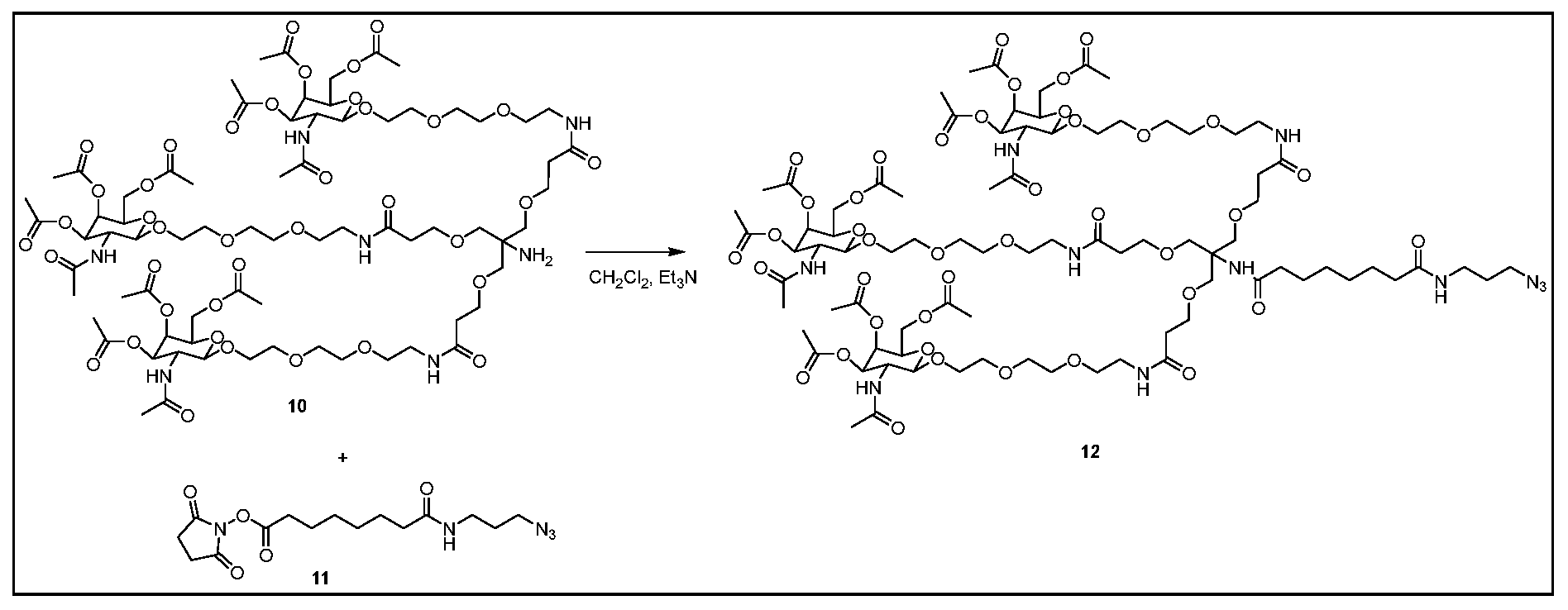
트리GalNAc (12)의 제조: 삼중안테나 GalNAc 화합물 10 (0.35 g, 0.24 mmol, 1.0 당량) 및 화합물 11 (0.11 g, 0.31 mmol, 1.5 당량)을 DCM (5 mL) 중에 아르곤 하에 용해시키고, 트리에틸아민 (0.1 mL, 0.61 mmol, 3.0 당량)을 첨가하였다. 반응물을 실온에서 밤새 교반하였다. 용매를 감압 하에 제거하고, 잔류물을 EtOAc (100 mL) 중에 용해시키고, 물 (100 mL)로 세척하였다. 유기 층을 분리하고, Na2SO4 상에서 건조시켰다. 용매를 증발시키고, 생성된 조 물질을 플래쉬 크로마토그래피 (용리 구배: 20 CV에서 DCM 중 0-10% MeOH)에 의해 정제하여 표제 화합물을 백색 솜털모양 고체 (0.27 g, 67%, rf = 0.5 (DCM 중 10% MeOH))로서 수득하였다. MS: 계산치 C84H137N11O41, 1957.1. 실측치 1959.6.Preparation of triGalNAc (12): Triantennary GalNAc compound 10 (0.35 g, 0.24 mmol, 1.0 equiv) and compound 11 (0.11 g, 0.31 mmol, 1.5 equiv) were dissolved in DCM (5 mL) under argon, and triethylamine (0.1 mL, 0.61 mmol, 3.0 equiv) was added. The reaction was stirred at room temperature overnight. The solvent was removed under reduced pressure and the residue was dissolved in EtOAc (100 mL) and washed with water (100 mL). The organic layer was separated and dried over Na 2 SO 4 . The solvent was evaporated and the resulting crude material was purified by flash chromatography (elution gradient: 0-10% MeOH in DCM over 20 CV) to give the title compound as a white fluffy solid (0.27 g, 67%, rf = 0.5 (10% MeOH in DCM)). MS: calcd for C 84 H 137 N 11 O 41 , 1957.1. Found 1959.6.
siRNA 가닥에 대한 테더 1의 접합: 5'- 또는 3'-단부에서의 모노플루오로 시클로옥틴 (MFCO) 접합Conjugation of
5'-단부 MFCO 접합5'-end MFCO junction

3'-단부 MFCO 접합3'-end MFCO junction

MFCO 접합을 위한 일반적 조건: 아민-변형된 단일 가닥을 50 mM 카르보네이트/비카르보네이트 완충제 pH 9.6/디메틸 술폭시드 (DMSO) 4:6 (v/v) 중에 700 OD/mL로 용해시키고, 이 용액에 DMF 중 MFCO-C6-NHS 에스테르 (베리&어소시에이츠(Berry&Associates), Cat. # LK 4300)의 35 mM 용액 1 몰 당량을 첨가하였다. 반응을 실온에서 수행하고, 1시간 후에 추가 몰 당량의 MFCO 용액을 첨가하였다. 반응을 추가로 1시간 동안 진행되도록 하고, LC/MS에 의해 모니터링하였다. 출발 물질의 정량적 소모를 달성하기 위해 아미노 변형된 올리고뉴클레오티드에 비해 적어도 2 몰 당량 과량의 MFCO NHS 에스테르 시약이 필요하였다. 반응 혼합물을 물로 15배 희석하고, 사르토리우스(Sartorius)로부터의 1.2 μm 필터를 통해 여과한 다음, 악타 퓨어(Aekta Pure) 기기 (지이 헬스케어) 상에서 예비 상 (RP HPLC)에 의해 정제하였다.General conditions for MFCO conjugation: The amine-modified single strand was dissolved in 50 mM carbonate/bicarbonate buffer pH 9.6/dimethyl sulfoxide (DMSO) 4:6 (v/v) to 700 OD/mL and 1 molar equivalent of a 35 mM solution of MFCO-C6-NHS ester (Berry & Associates, Cat. # LK 4300) in DMF was added. The reaction was carried out at room temperature and an additional molar equivalent of MFCO solution was added after 1 h. The reaction was allowed to proceed for an additional h and monitored by LC/MS. At least 2 molar equivalents of excess MFCO NHS ester reagent relative to the amino modified oligonucleotide was required to achieve quantitative consumption of starting material. The reaction mixture was diluted 15-fold with water, filtered through a 1.2 μm filter from Sartorius and purified by preparative phase (RP HPLC) on an Aekta Pure instrument (GE Healthcare).
정제를 워터스로부터의 엑스브리지 C18 정제용 19 x 50 mm 칼럼을 사용하여 수행하였다. 완충제 A는 100 mM TEAAc pH 7이었고, 완충제 B는 완충제 A 중 95% 아세토니트릴을 함유하였다. 10 mL/분의 유량 및 60℃의 온도를 사용하였다. 280 nm에서의 UV 트레이스를 기록하였다. 60 칼럼 부피 내에서 0-100% B의 구배를 사용하였다.Purification was performed using a 19 x 50 mm XBridge C18 Prep column from Waters. Buffer A was 100
전장 접합된 올리고뉴클레오티드를 함유하는 분획을 풀링하고, 동결기에서 3 M NaOAc, pH 5.2 및 85% 에탄올로 침전시키고, 수집된 펠릿을 물 중에 용해시켰다. 샘플을 크기 배제 크로마토그래피에 의해 탈염시키고, 스피드-백 농축기를 사용하여 농축시켜 접합된 올리고뉴클레오티드를 40-80%의 단리된 수율로 수득하였다.Fractions containing the full-length conjugated oligonucleotides were pooled, precipitated in a cryostat with 3 M NaOAc, pH 5.2, and 85% ethanol, and the collected pellet was dissolved in water. The sample was desalted by size exclusion chromatography and concentrated using a Speed-Vac concentrator to give the conjugated oligonucleotides in isolated yields of 40-80%.
5'-GalNAc-T1 접합체5'-GalNAc-T1 conjugate

3'-GalNAc-T1 접합체3'-GalNAc-T1 conjugate
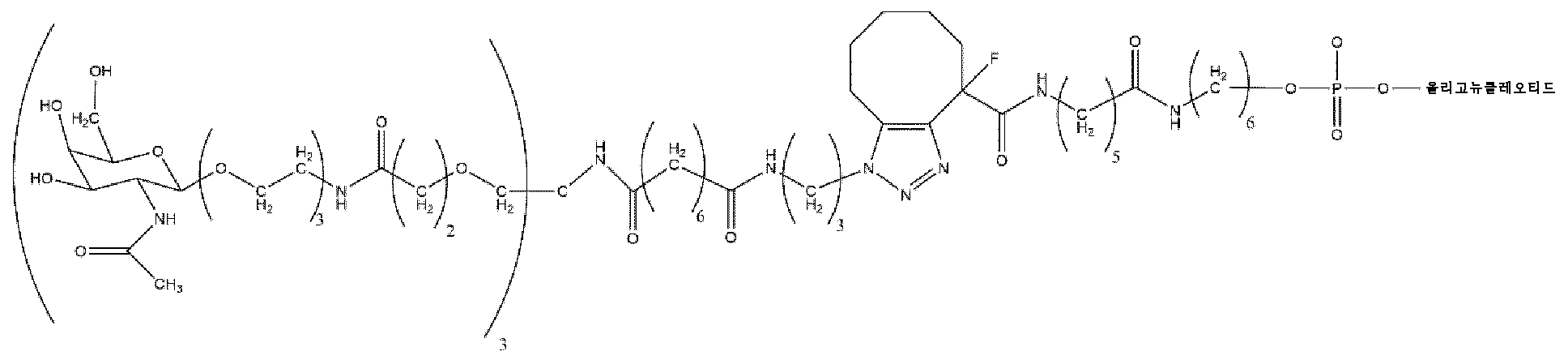
트리GalNAc 접합을 위한 일반적 절차: MFCO-변형된 단일 가닥을 물 중에 2000 OD/mL로 용해시키고, 이 용액에 DMF 중 화합물 12 (10 mM)의 1 당량 용액을 첨가하였다. 반응을 실온에서 수행하고, 3시간 후 0.7 몰 당량의 화합물 12 용액을 첨가하였다. 반응을 밤새 진행되도록 하고, 완결을 LCMS에 의해 모니터링하였다. 접합체를 물 중에 15배 희석하고, 사르토리우스로부터의 1.2 μm 필터를 통해 여과한 다음, 악타 퓨어 기기 (지이 헬스케어) 상에서 RP HPLC에 의해 정제하였다.General procedure for triGalNAc conjugation: MFCO-modified single strands were dissolved in water to 2000 OD/mL, and 1 equivalent solution of compound 12 (10 mM) in DMF was added to this solution. The reaction was carried out at room temperature, and after 3 h, 0.7 molar equivalents of
RP HPLC 정제를 워터스로부터의 엑스브리지 C18 정제용 19 x 50 mm 칼럼을 사용하여 수행하였다. 완충제 A는 100 mM 트리에틸암모늄 아세테이트 pH 7이었고, 완충제 B는 완충제 A 중 95% 아세토니트릴을 함유하였다. 10 mL/분의 유량 및 60℃의 온도를 사용하였다. 280 nm에서의 UV 트레이스를 기록하였다. 60 칼럼 부피 내에서 0-100% B의 구배를 사용하였다.RP HPLC purification was performed using a 19 x 50 mm column from Waters XBridge C18 Prep. Buffer A was 100 mM
전장 접합된 올리고뉴클레오티드를 함유하는 분획을 풀링하고, 동결기에서 3 M NaOAc, pH 5.2 및 85% 에탄올로 침전시키고, 수집된 펠릿을 물 중에 용해시켜 약 1000 OD/mL의 올리고뉴클레오티드 용액을 수득하였다. 20% 수성 암모니아를 첨가하여 O-아세테이트를 제거하였다. 이들 보호기의 정량적 제거를 LC-MS에 의해 확인하였다.Fractions containing the full-length conjugated oligonucleotides were pooled, precipitated in a cryostat with 3 M NaOAc, pH 5.2, and 85% ethanol, and the collected pellet was dissolved in water to give an oligonucleotide solution of about 1000 OD/mL. The O-acetate was removed by adding 20% aqueous ammonia. Quantitative removal of these protecting groups was confirmed by LC-MS.
접합체를 악타 퓨어 (지이 헬스케어) 기기 상에서 세파덱스(Sephadex) G25 파인(Fine) 수지 (지이 헬스케어)를 사용하여 크기 배제 크로마토그래피에 의해 탈염시켜 50-70%의 단리된 수율로 접합된 올리고뉴클레오티드를 수득하였다.The conjugate was desalted by size exclusion chromatography using Sephadex G25 Fine resin (GE Healthcare) on an Acta Pure (GE Healthcare) instrument to yield the conjugated oligonucleotides in isolated yields of 50-70%.
하기 반응식은 합성 경로를 추가로 제시한다:The following reaction scheme further suggests the synthetic route:
반응식 1:Reaction Scheme 1:
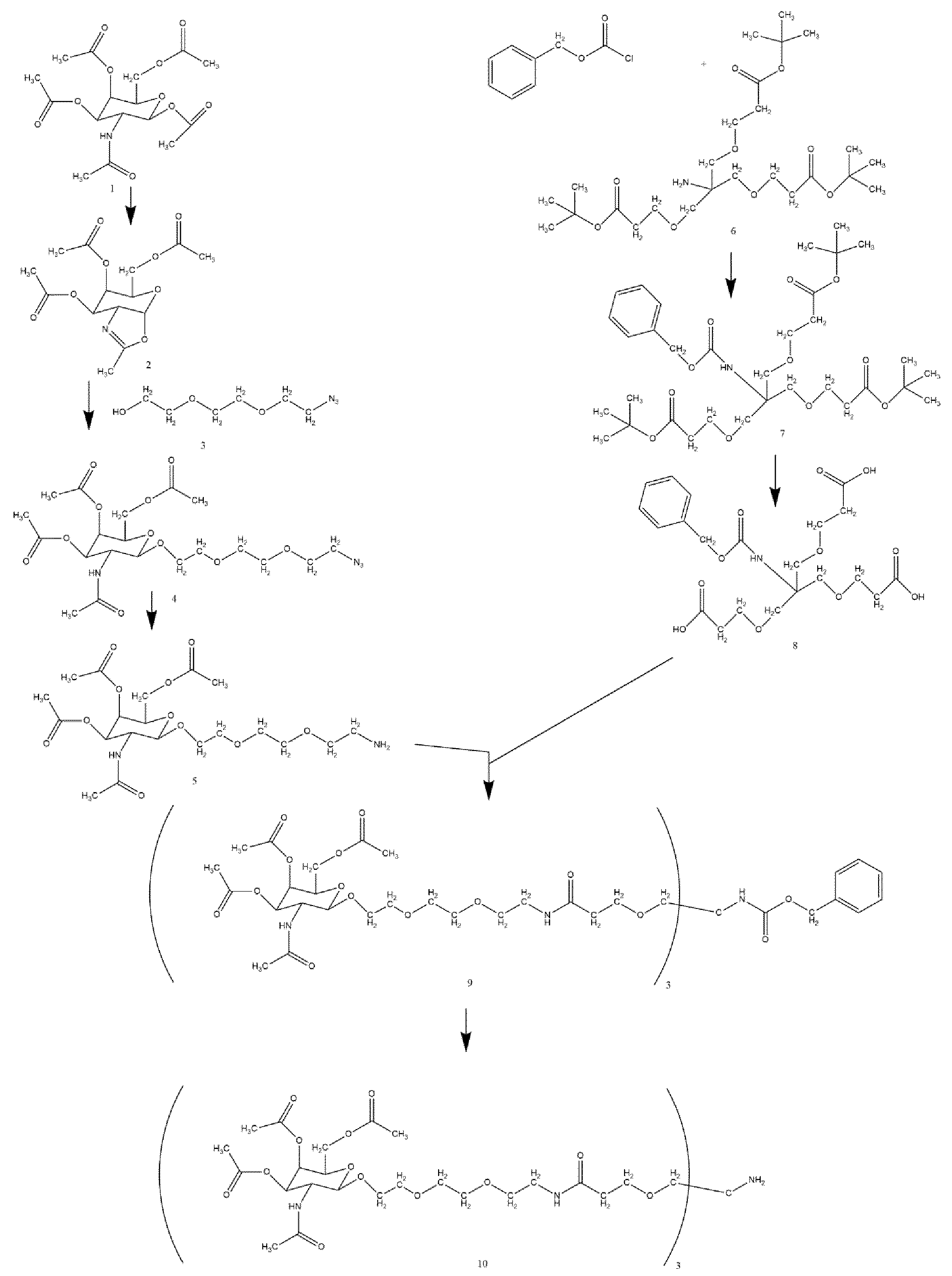
반응식 2:Reaction formula 2:

반응식 3:Reaction Scheme 3:

반응식 4:Reaction Scheme 4:
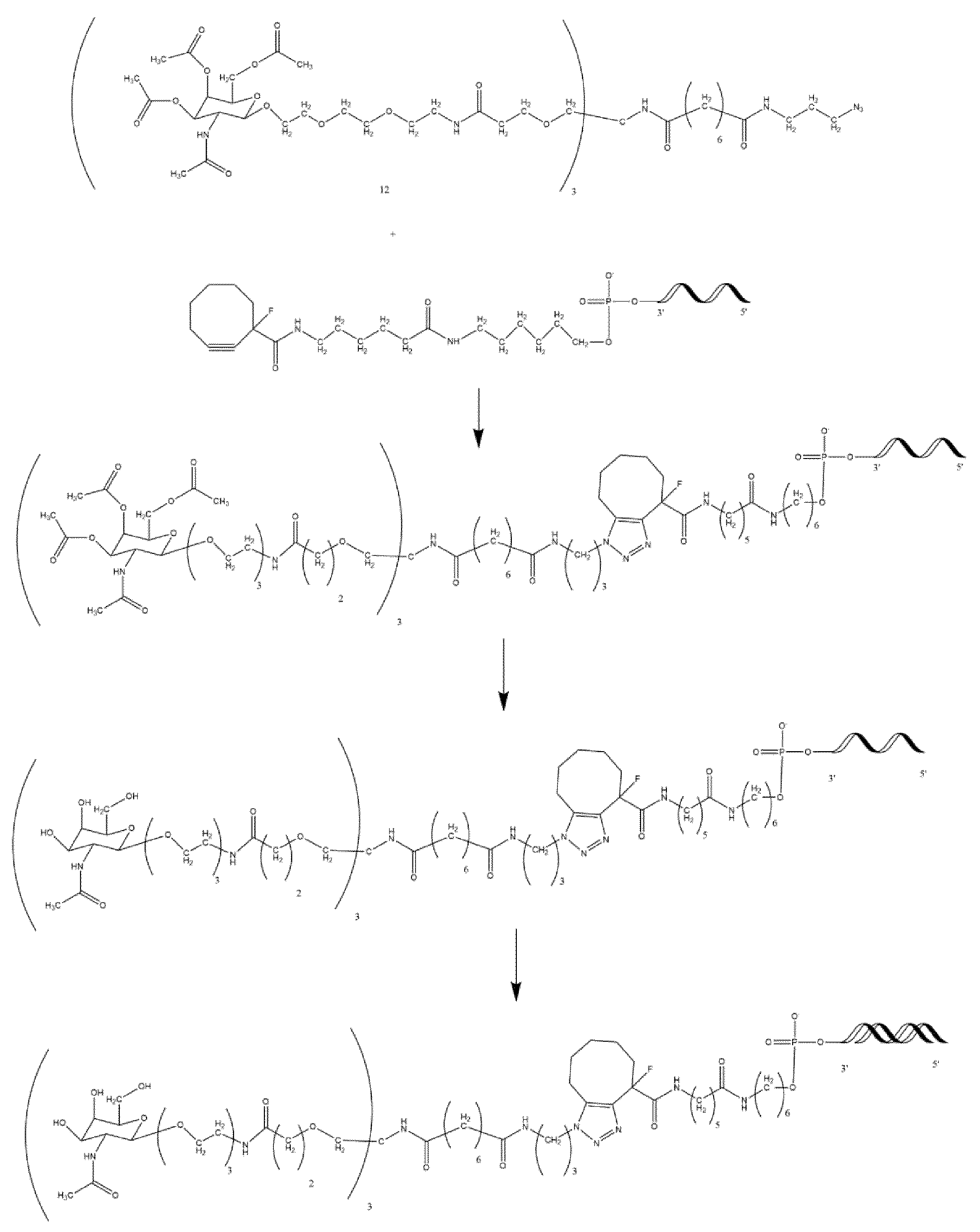
반응식 5:Reaction Scheme 5:

실시예 2: 듀플렉스 어닐링Example 2: Duplex Annealing
목적하는 siRNA 듀플렉스를 생성하기 위해, 두 가닥의 등몰 수용액을 조합함으로써 2개의 상보적 가닥을 어닐링하였다. 혼합물을 70℃의 수조에 5분 동안 두고, 후속적으로 2시간 내에 주위 온도로 냉각되도록 하였다. 듀플렉스를 2일 동안 동결건조시키고, -20℃에서 저장하였다.To generate the desired siRNA duplex, two complementary strands were annealed by combining equimolar aqueous solutions of the two strands. The mixture was placed in a 70°C water bath for 5 minutes and subsequently cooled to ambient temperature within 2 hours. The duplex was lyophilized for 2 days and stored at -20°C.
듀플렉스를 디오넥스 얼티메이트 3000 (써모 피셔 사이언티픽) HPLC 시스템 상에서 슈퍼덱스™ 75 인크리즈 5/150 GL 칼럼 5 x 153-158 mm (시티바) 상에서 분석용 SEC HPLC에 의해 분석하였다. 이동상은 10% 아세토니트릴을 함유하는 1x PBS로 이루어졌다. 등용매 구배를 실온에서 1.5 mL/분의 유량으로 10분 내에 실행하였다. 260 및 280 nm에서의 UV 트레이스를 기록하였다. 물 (LC-MS 등급)은 시그마-알드리치로부터 구입하였고, 포스페이트-완충 염수 (PBS; 10x, pH 7.4)는 깁코 (써모 피셔 사이언티픽)로부터 구입하였다.Duplexes were analyzed by analytical SEC HPLC on a Dionex Ultimate 3000 (Thermo Fisher Scientific) HPLC system with a Superdex™ 75
실시예 3: 테더 2의 합성Example 3: Synthesis of
일반적 실험 조건:General experimental conditions:
박층 크로마토그래피 (TLC)는 마슈레-나겔로부터의 형광 지시자 254 nm를 갖는 실리카-코팅된 알루미늄 플레이트 상에서 수행하였다. 화합물을 UV 광 (254 nm) 하에, 또는 스탈 (시그마-알드리치로부터)에 따라 메탄올 (MeOH) 또는 닌히드린 시약 중 5% H2SO4로 분무한 후 가열함으로써 가시화하였다. 플래쉬 크로마토그래피는 바이오타지 스패어 실리카 10, 25, 50 또는 100 g 칼럼 (스웨덴 웁살라)을 사용하여 이중 가변 UV 파장 검출기 (200-400 nm)가 장착된 바이오타지 이솔레라 원 플래쉬 크로마토그래피 기기로 수행하였다.Thin layer chromatography (TLC) was performed on silica-coated aluminum plates with a fluorescent indicator 254 nm from Machele-Nagel. Compounds were visualized under UV light (254 nm) or by spraying with 5% H 2 SO 4 in methanol (MeOH) or ninhydrin reagent according to Stahl (Sigma-Aldrich) followed by heating. Flash chromatography was performed on a Biotage Isolera One flash chromatography instrument equipped with a dual variable UV wavelength detector (200-400 nm) using
모든 수분-민감성 반응은 건조 유리제품, 무수 용매 및 아르곤 분위기를 사용하여 무수 조건 하에 수행하였다. 모든 상업적으로 입수가능한 시약은 시그마-알드리치로부터 구입하였고, 용매는 칼 로트 게엠베하 + 코. 카게로부터 구입하였다. D-갈락토사민 펜타아세테이트를 AK 사이언티픽으로부터 구입하였다.All moisture-sensitive reactions were performed under anhydrous conditions using dry glassware, anhydrous solvents, and an argon atmosphere. All commercially available reagents were purchased from Sigma-Aldrich, and solvents were purchased from Karl Roth GmbH + Co. KG. D-Galactosamine pentaacetate was purchased from AK Scientific.
HPLC/ESI-MS는 디오넥스 얼티메이트 3000 RS UHPLC 시스템 및 써모 사이언티픽 MSQ 플러스 질량 분광계 상에서 워터스로부터의 액퀴티 UPLC 단백질 BEH C4 칼럼 (300Å, 1.7 μm, 2.1 x 100 mm)을 사용하여 60℃에서 수행하였다. 용매계는 0.1% 포름산을 함유하는 H2O를 갖는 용매 A 및 0.1% 포름산을 함유하는 아세토니트릴 (ACN)을 갖는 용매 B로 이루어졌다. 15분에 걸쳐 0.4 mL/분의 유량으로 5-100%의 B의 구배를 사용하였다. 검출기 및 조건: 코로나 초-하전 에어로졸 검출 (esa로부터). 네뷸라이저 온도: 25℃. N2 압력: 35.1 psi. 필터: 코로나.HPLC/ESI-MS was performed at 60°C using an Acquity UPLC Protein BEH C4 column (300Å, 1.7 μm, 2.1 × 100 mm) from Waters on a Dionex Ultimate 3000 RS UHPLC system and a Thermo Scientific MSQ Plus mass spectrometer. The solvent system consisted of solvent A with H 2 O containing 0.1% formic acid and solvent B with acetonitrile (ACN) containing 0.1% formic acid. A gradient of 5-100% B was used at a flow rate of 0.4 mL/min over 15 min. Detector and conditions: Corona super-charged aerosol detection (from esa). Nebulizer temperature: 25°C. N 2 pressure: 35.1 psi. Filter: Corona.
1H 및 13C NMR 스펙트럼을 실온에서 배리안 분광계 상에서 500 MHz (1H NMR) 및 125 MHz (13C NMR)에서 기록하였다. 화학적 이동은 용매 잔류 피크 (CDCl3 - 1H NMR: 7.26 ppm에서의 δ 및 77.2 ppm에서의 13C NMR δ; DMSO-d6 - 1H NMR: 2.50 ppm에서의 δ 및 39.5 ppm에서의 13C NMR δ)를 기준으로 ppm으로 주어진다. 커플링 상수는 헤르츠로 주어진다. 신호 분할 패턴은 단일선 (s), 이중선 (d), 삼중선 (t) 또는 다중선 (m)으로 기재된다. 1 H and 13 C NMR spectra were recorded at room temperature on a Varian spectrometer at 500 MHz ( 1 H NMR) and 125 MHz ( 13 C NMR). Chemical shifts are given in ppm relative to the solvent residue peak (CDCl 3 - 1 H NMR: δ at 7.26 ppm and 13 C NMR δ at 77.2 ppm; DMSO-d 6 - 1 H NMR: δ at 2.50 ppm and 13 C NMR δ at 39.5 ppm). Coupling constants are given in hertz. Signal splitting patterns are described as singlets (s), doublets (d), triplets (t), or multiplets (m).
접합체 빌딩 블록 트리GalNAc_테더2에 대한 합성 경로:Synthetic route for the conjugate building block treeGalNAc_tether2:
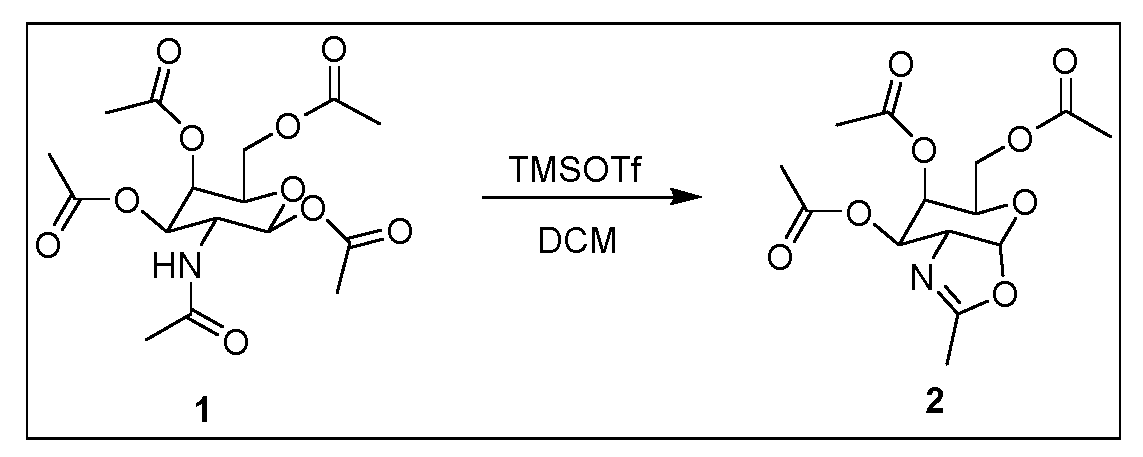
화합물 2의 제조: D-갈락토사민 펜타아세테이트 (3.00 g, 7.71 mmol, 1.0 당량)를 아르곤 하에 무수 디클로로메탄 (DCM) (30 mL) 중에 용해시키고, 트리메틸실릴 트리플루오로메탄술포네이트 (TMSOTf, 4.28 g, 19.27 mmol, 2.5 당량)를 첨가하였다. 반응물을 실온에서 3시간 동안 교반하였다. 반응 혼합물을 DCM (50 mL)으로 희석하고, 차가운 포화 수성 NaHCO3 (100 mL) 및 물 (100 mL)로 세척하였다. 유기 층을 분리하고, Na2SO4 상에서 건조시키고, 농축시켜 표제 화합물을 황색 오일로서 수득하고, 이를 플래쉬 크로마토그래피 (구배 용리: 10 CV에서 DCM 중 0-10% MeOH)에 의해 정제하였다. 생성물을 무색 오일 (2.5 g, 98%, rf = 0.45 (DCM 중 2% MeOH))로서 수득하였다.Preparation of compound 2: D-Galactosamine pentaacetate (3.00 g, 7.71 mmol, 1.0 equiv) was dissolved in anhydrous dichloromethane (DCM) (30 mL) under argon, and trimethylsilyl trifluoromethanesulfonate (TMSOTf, 4.28 g, 19.27 mmol, 2.5 equiv) was added. The reaction was stirred at room temperature for 3 h. The reaction mixture was diluted with DCM (50 mL) and washed with cold saturated aqueous NaHCO 3 (100 mL) and water (100 mL). The organic layer was separated, dried over Na 2 SO 4 and concentrated to give the title compound as a yellow oil, which was purified by flash chromatography (gradient elution: 0-10% MeOH in DCM in 10 CV). The product was obtained as a colorless oil (2.5 g, 98%, rf = 0.45 (2% MeOH in DCM)).

화합물 4의 제조: 화합물 2 (2.30 g, 6.98 mmol, 1.0 당량) 및 아지도-PEG3-OH (1.83 g, 10.5 mmol, 1.5 당량)를 아르곤 하에 무수 DCM (40 mL) 중에 용해시키고, 분자체 3 Å (5 g)을 용액에 첨가하였다. 혼합물을 실온에서 1시간 동안 교반하였다. 이어서, TMSOTf (0.77 g, 3.49 mmol, 0.5 당량)를 혼합물에 첨가하고, 반응물을 밤새 교반하였다. 분자체를 여과하고, 여과물을 DCM (100 mL)으로 희석하고, 차가운 포화 수성 NaHCO3 (100 mL) 및 물 (100 mL)로 세척하였다. 유기 층을 분리하고,Na2SO4 상에서 건조시키고, 용매를 감압 하에 제거하였다. 조 물질을 플래쉬 크로마토그래피 (구배 용리: 10 CV에서 DCM 중 0-3% MeOH)에 의해 정제하여 표제 생성물을 담황색 오일 (3.10 g, 88%, rf = 0.25 (DCM 중 2% MeOH))로서 수득하였다. MS: 계산치 C20H32N4O11, 504.21. 실측치 505.4. 1H NMR (500 MHz, CDCl3) δ 6.21-6.14 (m, 1H), 5.30 (dd, J = 3.4, 1.1 Hz, 1H), 5.04 (dd, J = 11.2, 3.4 Hz,1H), 4.76 (d, J = 8.6 Hz, 1H), 4.23-4.08 (m, 3H), 3.91-3.80 (m, 3H), 3.74-3.59 (m, 9H), 3.49-3.41 (m, 2H), 2.14 (s, 3H), 2.02 (s, 3H), 1.97 (d, J = 4.2 Hz, 6H). 13C NMR (125 MHz, CDCl3)δ 170.6 (C), 170.5 (C), 170.4 (C), 170.3 (C), 102.1(CH), 71.6(CH), 70.8(CH), 70.6(CH), 70.5(CH), 70.3(CH2), 69.7(CH2), 68.5(CH2), 66.6(CH2), 61.5(CH2), 23.1(CH3), 20.7 (3xCH3).Preparation of compound 4: Compound 2 (2.30 g, 6.98 mmol, 1.0 equiv) and azido-PEG3-OH (1.83 g, 10.5 mmol, 1.5 equiv) were dissolved in anhydrous DCM (40 mL) under argon and
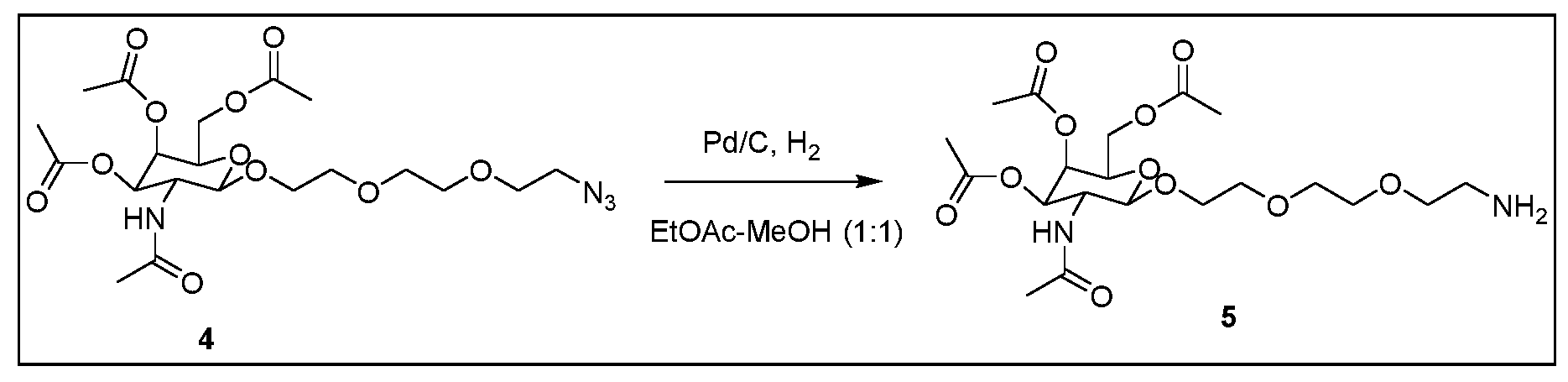
화합물 5의 제조: 화합물 4 (1.00 g, 1.98 mmol, 1.0 당량)를 에틸 아세테이트 (EtOAc) 및 MeOH (30 mL 1:1 v/v)의 혼합물 중에 용해시키고, Pd/C (100 mg)를 첨가하였다. 반응 혼합물을 진공/아르곤 사이클 (3x)을 사용하여 탈기하고, 풍선 압력 하에 밤새 수소화시켰다. 반응 혼합물을 셀라이트를 통해 여과하고, EtOAc (30 mL)로 세척하였다. 용매를 감압 하에 제거하여 표제 화합물을 무색 오일 (0.95 g, 정량적 수율, rf = 0.25 (DCM 중 10% MeOH))로서 수득하였다. 화합물을 추가 정제 없이 사용하였다. MS: 계산치 C20H34N2O11, 478.2. 실측치 479.4.Preparation of compound 5: Compound 4 (1.00 g, 1.98 mmol, 1.0 equiv) was dissolved in a mixture of ethyl acetate (EtOAc) and MeOH (30 mL 1:1 v/v), and Pd/C (100 mg) was added. The reaction mixture was degassed using vacuum/argon cycles (3x) and hydrogenated under balloon pressure overnight. The reaction mixture was filtered through celite and washed with EtOAc (30 mL). The solvent was removed under reduced pressure to give the title compound as a colorless oil (0.95 g, quantitative yield, rf = 0.25 (10% MeOH in DCM)). The compound was used without further purification. MS: calcd for C 20 H 34 N 2 O 11 , 478.2. Found 479.4.

화합물 7의 제조: 트리스{[2-(tert-부톡시카르보닐)에톡시]메틸}-메틸아민 6 (3.37 g, 6.67 mmol, 1.0 당량)을 DCM/물의 혼합물 (40 mL 1:1 v/v) 중에 용해시키고, Na2CO3 (0.18 g, 1.7 mmol, 0.25 당량)을 격렬히 교반하면서 첨가하였다. 벤질 클로로포르메이트 (2.94 mL, 20.7 mmol, 3.10 당량)를 이전 혼합물에 적가하고, 반응물을 실온에서 24시간 동안 교반하였다. 반응 혼합물을 CH2Cl2 (100 mL)로 희석하고, 물 (100 mL)로 세척하였다. 유기 층을 분리하고, Na2SO4 상에서 건조시켰다. 용매를 감압 하에 제거하고, 생성된 조 물질을 플래쉬 크로마토그래피 (구배 용리: 12 CV에서 시클로헥산 중 0-10% EtOAc)에 의해 정제하여 표제 화합물을 연황색빛 오일 (3.9 g, 91%, rf = 0.56 (시클로헥산 중 10% EtOAc))로서 수득하였다. MS: 계산치 C33H53NO11, 639.3. 실측치 640.9. 1H NMR (500 MHz, DMSO-d6) δ 7.38-7.26 (m, 5H), 4.97 (s, 2H), 3.54 (t, 6H), 3.50 (s, 6H), 2.38 (t, 6H), 1.39 (s, 27H). 13C NMR (125 MHz, DMSO-d6) δ 170.3 (3xC), 154.5 (C), 137.1 (C), 128.2 (2xCH), 127.7 (CH), 127.6 (2xCH), 79.7 (3xC), 68.4 (3xCH2), 66.8 (3xCH2), 64.9 (C), 58.7 (CH2), 35.8 (3xCH2), 27.7 (9xCH3).Preparation of compound 7: Tris{[2-(tert-butoxycarbonyl)ethoxy]methyl}-methylamine 6 (3.37 g, 6.67 mmol, 1.0 equiv) was dissolved in a mixture of DCM/water (40 mL 1:1 v/v), and Na 2 CO 3 (0.18 g, 1.7 mmol, 0.25 equiv) was added with vigorous stirring. Benzyl chloroformate (2.94 mL, 20.7 mmol, 3.10 equiv) was added dropwise to the previous mixture, and the reaction was stirred at room temperature for 24 h. The reaction mixture was diluted with CH 2 Cl 2 (100 mL) and washed with water (100 mL). The organic layer was separated and dried over Na 2 SO 4 . The solvent was removed under reduced pressure and the resulting crude material was purified by flash chromatography (gradient elution: 0-10% EtOAc in cyclohexane over 12 CV) to give the title compound as a pale yellow oil (3.9 g, 91%, rf = 0.56 (10% EtOAc in cyclohexane)). MS: calcd for C 33 H 53 NO 11 , 639.3. Found 640.9. 1 H NMR (500 MHz, DMSO-d 6 ) δ 7.38-7.26 (m, 5H), 4.97 (s, 2H), 3.54 (t, 6H), 3.50 (s, 6H), 2.38 (t, 6H), 1.39 (s, 27H). 13 C NMR (125 MHz, DMSO-d 6 ) δ 170.3 (3xC), 154.5 (C), 137.1 (C), 128.2 (2xCH), 127.7 (CH), 127.6 (2xCH), 79.7 (3xC), 68.4 (3xCH 2 ), 66.8 (3xCH 2 ), 64.9 (C), 58.7 (CH 2 ), 35.8 (3xCH 2 ), 27.7 (9xCH 3 ).
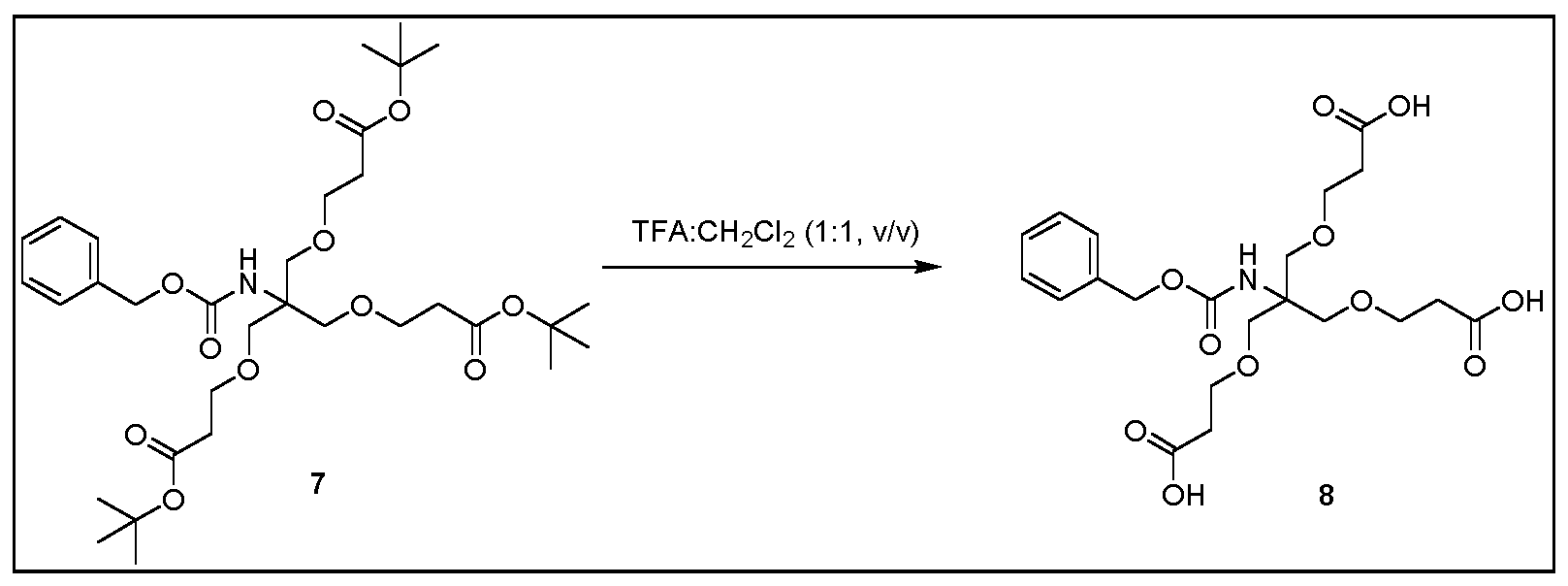
화합물 8의 제조: Cbz-NH-트리스-Boc-에스테르 7 (0.20 g, 0.39 mmol, 1.0 당량)을 CH2Cl2 (1 mL) 중에 아르곤 하에 용해시키고, 트리플루오로아세트산 (TFA, 1 mL)을 첨가하고, 반응물을 실온에서 1시간 동안 교반하였다. 용매를 감압 하에 제거하고, 잔류물을 톨루엔 (5 mL)으로 3회 공증발시키고, 고진공 하에 건조시켜 화합물을 그의 TFA 염 (0.183 g, 98%)으로서 수득하였다. 화합물을 추가 정제 없이 사용하였다. MS: 계산치 C21H29NO11, 471.6. 실측치 472.4.Preparation of compound 8: Cbz-NH-tris-Boc-ester 7 (0.20 g, 0.39 mmol, 1.0 equiv) was dissolved in CH 2 Cl 2 (1 mL) under argon, trifluoroacetic acid (TFA, 1 mL) was added and the reaction was stirred at room temperature for 1 h. The solvent was removed under reduced pressure and the residue was co-evaporated three times with toluene (5 mL) and dried under high vacuum to give the compound as its TFA salt (0.183 g, 98%). The compound was used without further purification. MS: calcd for C 21 H 29 NO 11 , 471.6. Found 472.4.

화합물 9의 제조: CbzNH-트리스-COOH 8 (0.72 g, 1.49 mmol, 1.0 당량) 및 GalNAc-PEG3-NH2 5 (3.56 g, 7.44 mmol, 5.0 당량)를 N,N-디메틸포름아미드 (DMF) (25 mL) 중에 용해시켰다. 이어서, N,N,N',N'-테트라메틸-O-(1H-벤조트리아졸-1-일)우로늄 헥사플루오로포스페이트 (HBTU) (2.78 g, 7.44 mmol, 5.0 당량), 1-히드록시벤조트리아졸 수화물 (HOBt) (1.05 g, 7.44 mmol, 5.0 당량) 및 N,N-디이소프로필에틸아민 (DIPEA) (2.07 mL, 11.9 mmol, 8.0 당량)을 용액에 첨가하고, 반응물을 72시간 동안 교반하였다. 용매를 감압 하에 제거하고, 잔류물을 DCM (100 mL) 중에 용해시키고, 포화 수성 NaHCO3 (100 mL)으로 세척하였다. 유기 층을 Na2SO4 상에서 건조시키고, 용매를 증발시키고, 조 물질을 플래쉬 크로마토그래피 (구배 용리: 14 CV에서 DCM 중 0-5% MeOH)에 의해 정제하였다. 생성물을 연황색빛 오일 (1.2 g, 43%, rf = 0.20 (DCM 중 5% MeOH))로서 수득하였다. MS: 계산치 C81H125N7O41, 1852.9. 실측치 1854.7. 1H NMR (500 MHz, DMSO-d6) δ 7.90-7.80 (m, 10H), 7.65-7.62 (m, 4H), 7.47-7.43 (m, 3H), 7.38-7.32 (m, 8H), 5.24-5.22 (m, 3H), 5.02-4.97 (m, 4H), 4.60-4.57 (m, 3 H), 4.07-3.90 (m 10H), 3.67-3.36 (m, 70H), 3.23-3.07 (m, 25H), 2.18 (s, 10H), 2.00 (s, 13H), 1.89 (s, 11H), 1.80-1.78 (m, 17H). 13C NMR (125 MHz, DMSO-d6) δ 170.1 (C), 169.8 (C), 169.7 (C), 169.4 (C), 169.2 (C), 169.1 (C), 142.7 (C), 126.3 (CH), 123.9 (CH), 118.7 (CH), 109.7 (CH), 100.8 (CH), 70.5 (CH), 69.8 (CH), 69.6 (CH), 69.5 (CH), 69.3 (CH2), 69.0 (CH2), 68.2 (CH2), 67.2 (CH2), 66.7 (CH2), 61.4 (CH2), 22.6 (CH2), 22.4 (3xCH3), 20.7 (9xCH3).Preparation of compound 9: CbzNH-tris-COOH 8 (0.72 g, 1.49 mmol, 1.0 equiv) and GalNAc-PEG3-NH 2 5 (3.56 g, 7.44 mmol, 5.0 equiv) were dissolved in N,N-dimethylformamide (DMF) (25 mL). Next, N,N,N',N'-tetramethyl-O-(1H-benzotriazol-1-yl)uronium hexafluorophosphate (HBTU) (2.78 g, 7.44 mmol, 5.0 equiv), 1-hydroxybenzotriazole hydrate (HOBt) (1.05 g, 7.44 mmol, 5.0 equiv) and N,N-diisopropylethylamine (DIPEA) (2.07 mL, 11.9 mmol, 8.0 equiv) were added to the solution, and the reaction was stirred for 72 h. The solvent was removed under reduced pressure, and the residue was dissolved in DCM (100 mL) and washed with saturated aqueous NaHCO 3 (100 mL). The organic layer was dried over Na 2 SO 4 , the solvent was evaporated and the crude material was purified by flash chromatography (gradient elution: 0-5% MeOH in DCM over 14 CV). The product was obtained as a pale yellow oil (1.2 g, 43%, rf = 0.20 (5% MeOH in DCM)). MS: calcd for C 81 H 125 N 7 O 41 , 1852.9. Found 1854.7. 1 H NMR (500 MHz, DMSO-d 6 ) δ 7.90-7.80 (m, 10H), 7.65-7.62 (m, 4H), 7.47-7.43 (m, 3H), 7.38-7.32 (m, 8H), 5.24-5.22 (m, 3H), 5.02-4.97 (m, 4H), 4.60-4.57 (m, 3 H), 4.07-3.90 (m 10H), 3.67-3.36 (m, 70H), 3.23-3.07 (m, 25H), 2.18 (s, 10H), 2.00 (s, 13H), 1.89 (s, 11H), 1.80-1.78 (m, 17H). 13 C NMR (125 MHz, DMSO-d 6 ) δ 170.1 (C), 169.8 (C), 169.7 (C), 169.4 (C), 169.2 (C), 169.1 (C), 142.7 (C), 126.3 (CH), 123.9 (CH), 118.7 (CH), 109.7 (CH), 100.8 (CH), 70.5 (CH), 69.8 (CH), 69.6 (CH), 69.5 (CH), 69.3 (CH 2 ), 69.0 (CH 2 ), 68.2 (CH 2 ), 67.2 (CH 2 ), 66.7 (CH) 2 ), 61.4 (CH 2 ), 22.6 (CH 2 ), 22.4 (3xCH 3 ), 20.7 (9xCH 3 ).
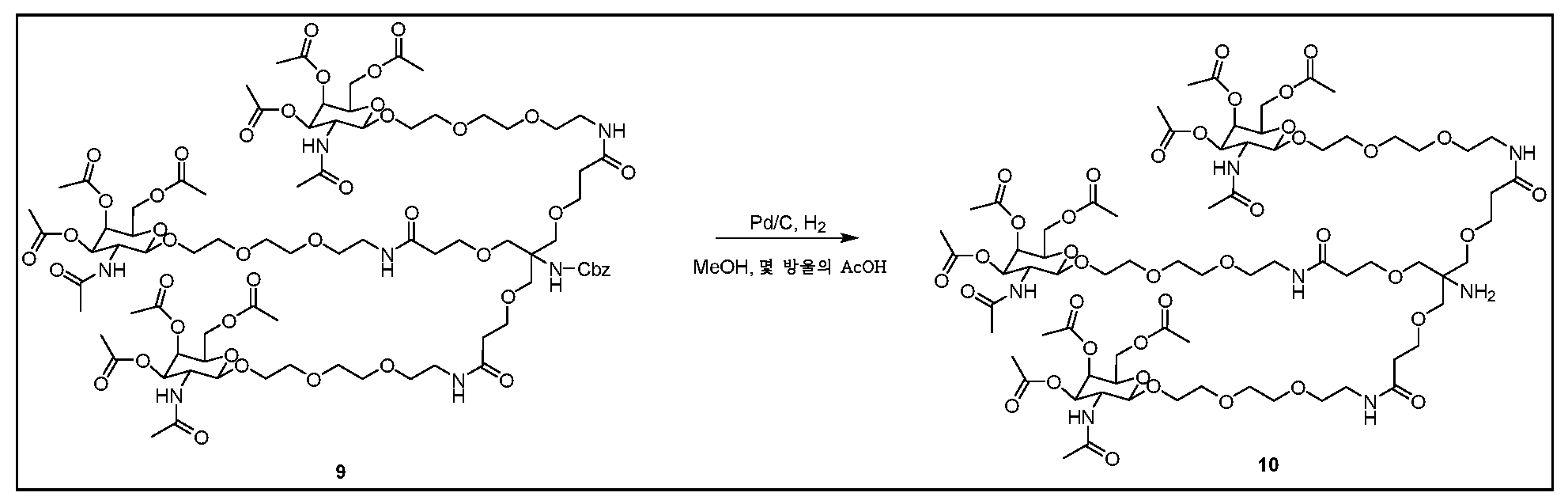
화합물 10의 제조: 삼중안테나 GalNAc 화합물 9 (0.27 g, 0.14 mmol, 1.0 당량)를 MeOH (15 mL) 중에 용해시키고, 3 방울의 아세트산 (AcOH) 및 Pd/C (30 mg)를 첨가하였다. 반응 혼합물을 진공/아르곤 사이클 (3x)을 사용하여 탈기하고, 풍선 압력 하에 밤새 수소화시켰다. 반응의 완결에 이어서 질량 분광측정법을 수행하고, 생성된 혼합물을 얇은 셀라이트 패드를 통해 여과하였다. 용매를 증발시키고, 수득된 잔류물을 고진공 하에 건조시키고, 추가 정제 없이 후속 단계에서 사용하였다. 생성물을 연황색빛 오일 (0.24 g, 정량적 수율)로서 수득하였다. MS: 계산치 C73H119N7O39, 1718.8. 실측치 1719.3.Preparation of compound 10: The triantennary GalNAc compound 9 (0.27 g, 0.14 mmol, 1.0 equiv) was dissolved in MeOH (15 mL), and 3 drops of acetic acid (AcOH) and Pd/C (30 mg) were added. The reaction mixture was degassed using vacuum/argon cycles (3x) and hydrogenated under balloon pressure overnight. After completion of the reaction, mass spectrometry was performed, and the resulting mixture was filtered through a thin pad of celite. The solvent was evaporated, and the resulting residue was dried under high vacuum and used in the next step without further purification. The product was obtained as a pale yellow oil (0.24 g, quantitative yield). MS: Calcd for C 73 H 119 N 7 O 39 , 1718.8. Found 1719.3.
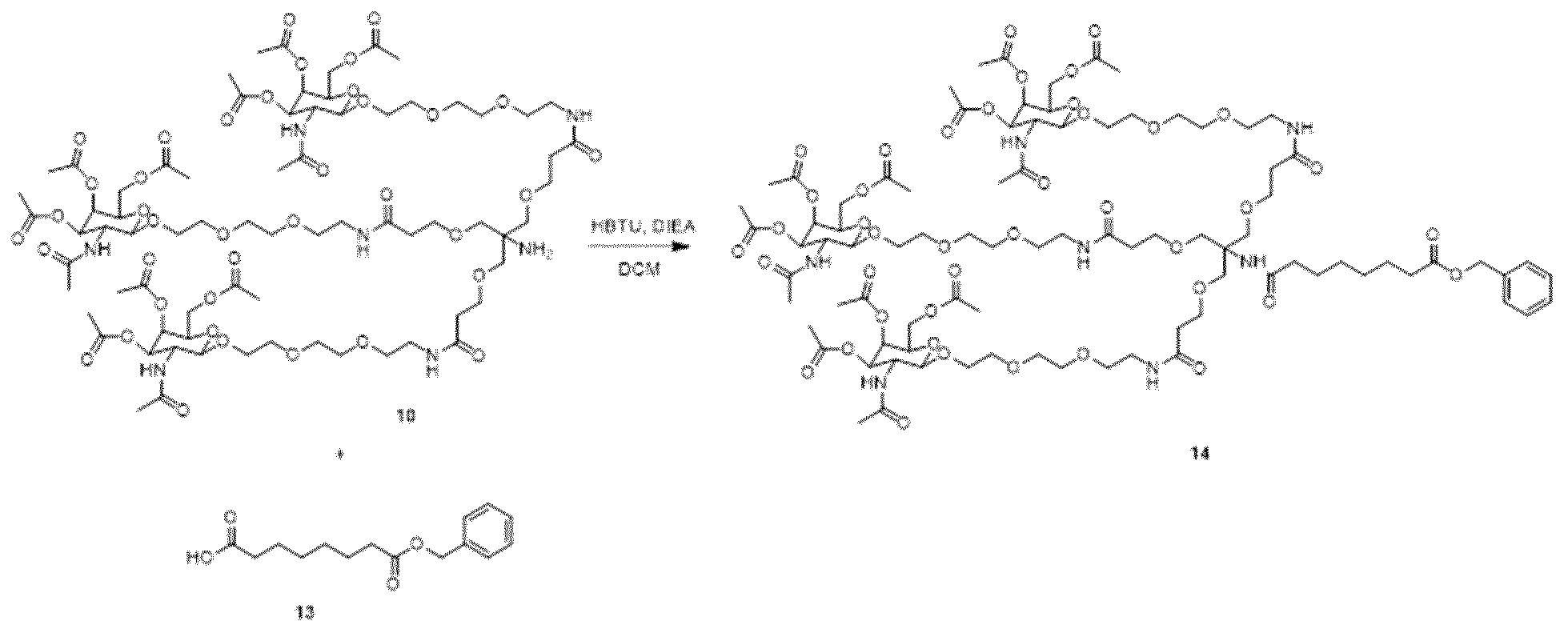
화합물 14의 제조: 삼중안테나 GalNAc 화합물 10 (0.45 g, 0.26 mmol, 1.0 당량), HBTU (0.19 g, 0.53 mmol, 2.0 당량) 및 DIPEA (0.23 mL, 1.3 mmol, 5.0 당량)를 아르곤 하에 DCM (10 mL) 중에 용해시켰다. 이 혼합물에, DCM (5 mL) 중 화합물 13 (0.14 g, 0.53 mmol, 2.0 당량)의 용액을 적가하였다. 반응물을 실온에서 밤새 교반하였다. 용매를 제거하고, 잔류물을 EtOAc (50 mL)에 용해시키고, 물 (50 mL)로 세척하고, Na2SO4 상에서 건조시켰다. 용매를 증발시키고, 조 물질을 플래쉬 크로마토그래피 (구배 용리: 20 CV에서 DCM 중 0-5% MeOH)에 의해 정제하였다. 생성물을 백색 솜털모양 고체 (0.25 g, 48%, rf = 0.4 (DCM 중 10% MeOH))로서 수득하였다. MS: 계산치 C88H137N7O42, 1965.1. 실측치 1965.6.Preparation of compound 14: Triantennary GalNAc compound 10 (0.45 g, 0.26 mmol, 1.0 equiv), HBTU (0.19 g, 0.53 mmol, 2.0 equiv) and DIPEA (0.23 mL, 1.3 mmol, 5.0 equiv) were dissolved in DCM (10 mL) under argon. To this mixture, a solution of compound 13 (0.14 g, 0.53 mmol, 2.0 equiv) in DCM (5 mL) was added dropwise. The reaction was stirred at room temperature overnight. The solvent was removed and the residue was dissolved in EtOAc (50 mL), washed with water (50 mL) and dried over Na 2 SO 4 . The solvent was evaporated and the crude material was purified by flash chromatography (gradient elution: 0-5% MeOH in DCM over 20 CV). The product was obtained as a white fluffy solid (0.25 g, 48%, rf = 0.4 (10% MeOH in DCM)). MS: calcd for C88H137N7O42, 1965.1. Found 1965.6.

트리GalNAc (15)의 제조: 삼중안테나 GalNAc 화합물 14 (0.31 g, 0.15 mmol, 1.0 당량)를 EtOAc (15 mL) 중에 용해시키고, Pd/C (40 mg)를 첨가하였다. 반응 혼합물을 진공/아르곤 사이클 (3x)을 사용하여 탈기하고, 풍선 압력 하에 밤새 수소화시켰다. 반응의 완결을 질량 분광측정법에 의해 모니터링하고, 생성된 혼합물을 셀라이트의 얇은 패드를 통해 여과하였다. 용매를 감압 하에 제거하고, 생성된 잔류물을 고진공 하에 밤새 건조시켰다. 잔류물을 추가 정제 없이 올리고뉴클레오시드에 접합시키는 데 사용하였다 (0.28 g, 정량적 수율). MS: 계산치 C81H131N7O42, 1874.9. 실측치 1875.3.Preparation of triGalNAc (15): The triantennary GalNAc compound 14 (0.31 g, 0.15 mmol, 1.0 equiv) was dissolved in EtOAc (15 mL) and Pd/C (40 mg) was added. The reaction mixture was degassed using vacuum/argon cycles (3x) and hydrogenated under balloon pressure overnight. The completion of the reaction was monitored by mass spectrometry, and the resulting mixture was filtered through a thin pad of Celite. The solvent was removed under reduced pressure and the resulting residue was dried under high vacuum overnight. The residue was used without further purification for conjugation to oligonucleosides (0.28 g, quantitative yield). MS: Calcd for C 81 H 131 N 7 O 42 , 1874.9. Found 1875.3.
siRNA 가닥에 대한 테더 2의 접합: 5'-단부 또는 3'-단부에서의 트리GalNAc 테더 2 (GalNAc-T2) 접합
5'-GalNAc-T2 접합체5'-GalNAc-T2 conjugate
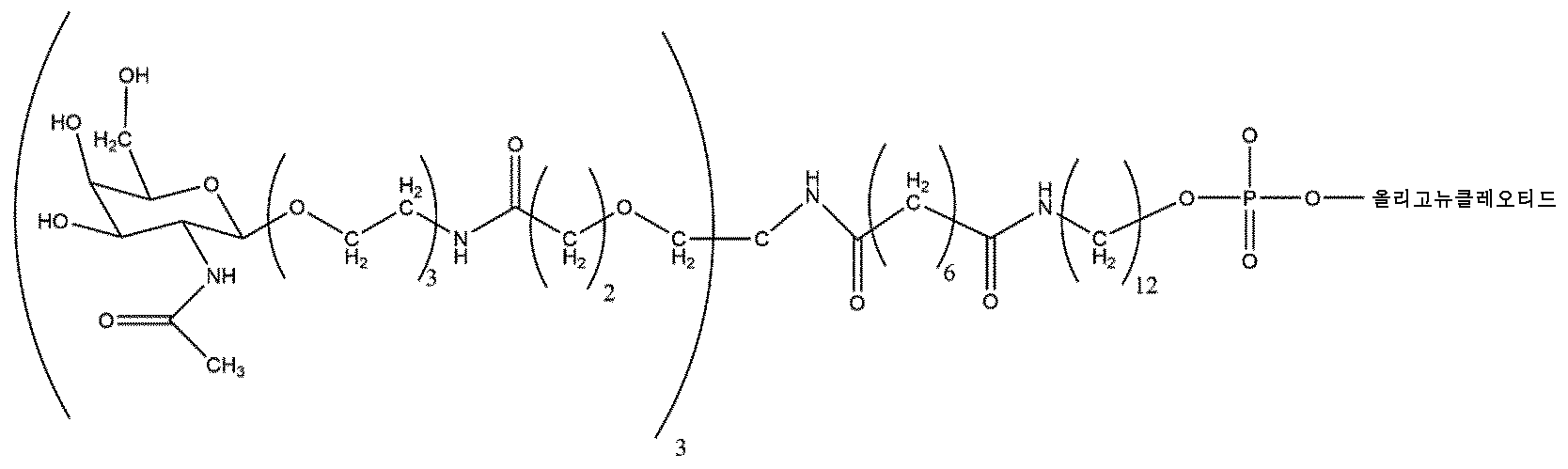
3'-GalNAc-T2 접합체3'-GalNAc-T2 conjugate

TriGalNAc 테더 2 NHS 에스테르의 제조: DMF (2.1 mL) 중 카르복실산 테더 2 (화합물 15, 227 mg, 121 μmol)의 용액에 N-히드록시숙신이미드 (NHS) (15.3 mg, 133 μmol) 및 N,N'-디이소프로필카르보디이미드 (DIC) (19.7 μL, 127 μmol)를 첨가하였다. 용액을 실온에서 18시간 동안 교반하고, 후속 접합 반응에 정제 없이 사용하였다.Preparation of
트리GalNAc 테더 2 접합을 위한 일반적 절차: 아민-변형된 단일 가닥을 50 mM 카르보네이트/비카르보네이트 완충제 pH 9.6/DMSO 4:6 (v/v) 중에 700 OD/mL로 용해시키고, 이 용액에 DMF 중 1 몰 당량의 테더 2 NHS 에스테르 (57 mM) 용액을 첨가하였다. 반응을 실온에서 수행하고, 1시간 후에 추가 몰 당량의 NHS 에스테르 용액을 첨가하였다. 반응을 1시간 더 진행되도록 하고, 반응 진행을 LCMS에 의해 모니터링하였다. 출발 물질의 정량적 소모를 달성하기 위해 아미노 변형된 올리고뉴클레오시드에 비해 적어도 2 몰 당량 과량의 NHS 에스테르 시약이 필요하였다. 반응 혼합물을 물로 15배 희석하고, 사르토리우스로부터의 1.2 μm 필터를 통해 1회 여과한 다음, 악타 퓨어 (지이 헬스케어) 기기 상에서 예비 상 (RP HPLC)에 의해 정제하였다.General procedure for
정제를 워터스로부터의 엑스브리지 C18 정제용 19 x 50 mm 칼럼을 사용하여 수행하였다. 완충제 A는 100 mM TEAA pH 7이었고, 완충제 B는 완충제 A 중 95% 아세토니트릴을 함유하였다. 10 mL/분의 유량 및 60℃의 온도를 사용하였다. 280 nm에서의 UV 트레이스를 기록하였다. 60 칼럼 부피 내에서 0-100% B의 구배를 사용하였다.Purification was performed using a 19 x 50 mm XBridge C18 Prep column from Waters. Buffer A was 100
전장 접합된 올리고뉴클레오시드를 함유하는 분획을 함께 풀링하고, 동결기에서 3 M NaOAc, pH 5.2 및 85% 에탄올로 침전시킨 다음, 물 중에 1000 OD/mL로 용해시켰다. O-아세테이트를 완결될 때까지 물 중 20% 수산화암모늄으로 제거하였다 (LC-MS에 의해 모니터링함).Fractions containing the conjugated oligonucleosides were pooled together, precipitated in 3 M NaOAc, pH 5.2, and 85% ethanol in a cryostat, and dissolved in water to 1000 OD/mL. The O-acetate was removed with 20% ammonium hydroxide in water until complete (monitored by LC-MS).
접합체를 악타 퓨어 (지이 헬스케어) 기기 상에서 세파덱스 G25 파인 수지 (지이 헬스케어)를 사용하여 크기 배제 크로마토그래피에 의해 탈염시켜 접합된 올리고뉴클레오티드를 60-80%의 단리된 수율로 수득하였다.The conjugate was desalted by size exclusion chromatography using Sephadex G25 Fine resin (GE Healthcare) on an Acta Pure (GE Healthcare) instrument to afford the conjugated oligonucleotides in isolated yields of 60-80%.
접합체를 컴팩트 ESI-Qq-TOF 질량 분광계 (브루커 달토닉스(Bruker Daltonics))가 장착된 디오넥스 얼티메이트(Dionex Ultimate) 3000 (써모 피셔 사이언티픽) HPLC 시스템 상에서 2.1 x 50 mm 엑스브리지 C18 칼럼 (워터스)으로 HPLC-MS 분석에 의해 특징화하였다. 완충제 A는 H2O 중 1% MeOH 중 16.3 mM 트리에틸아민, 100 mM HFIP였고, 완충제 B는 완충제 A 중 95% MeOH를 함유하였다. 250 μL/분의 유량 및 60℃의 온도를 사용하였다. 260 및 280 nm에서의 UV 트레이스를 기록하였다. 31분 내에 1-100% B의 구배를 사용하였다.The conjugates were characterized by HPLC-MS analysis with a 2.1 x 50 mm XBridge C18 column (Waters) on a Dionex Ultimate 3000 (Thermo Fisher Scientific) HPLC system equipped with a compact ESI-Qq-TOF mass spectrometer (Bruker Daltonics). Buffer A was 16.3 mM triethylamine, 100 mM HFIP in 1% MeOH in H2O and buffer B contained 95% MeOH in buffer A. A flow rate of 250 μL/min and a temperature of 60°C were used. UV traces at 260 and 280 nm were recorded. A gradient of 1-100% B in 31 min was used.
하기 반응식은 합성 경로를 추가로 제시한다:The following reaction scheme further suggests the synthetic route:
반응식 6:Reaction Scheme 6:
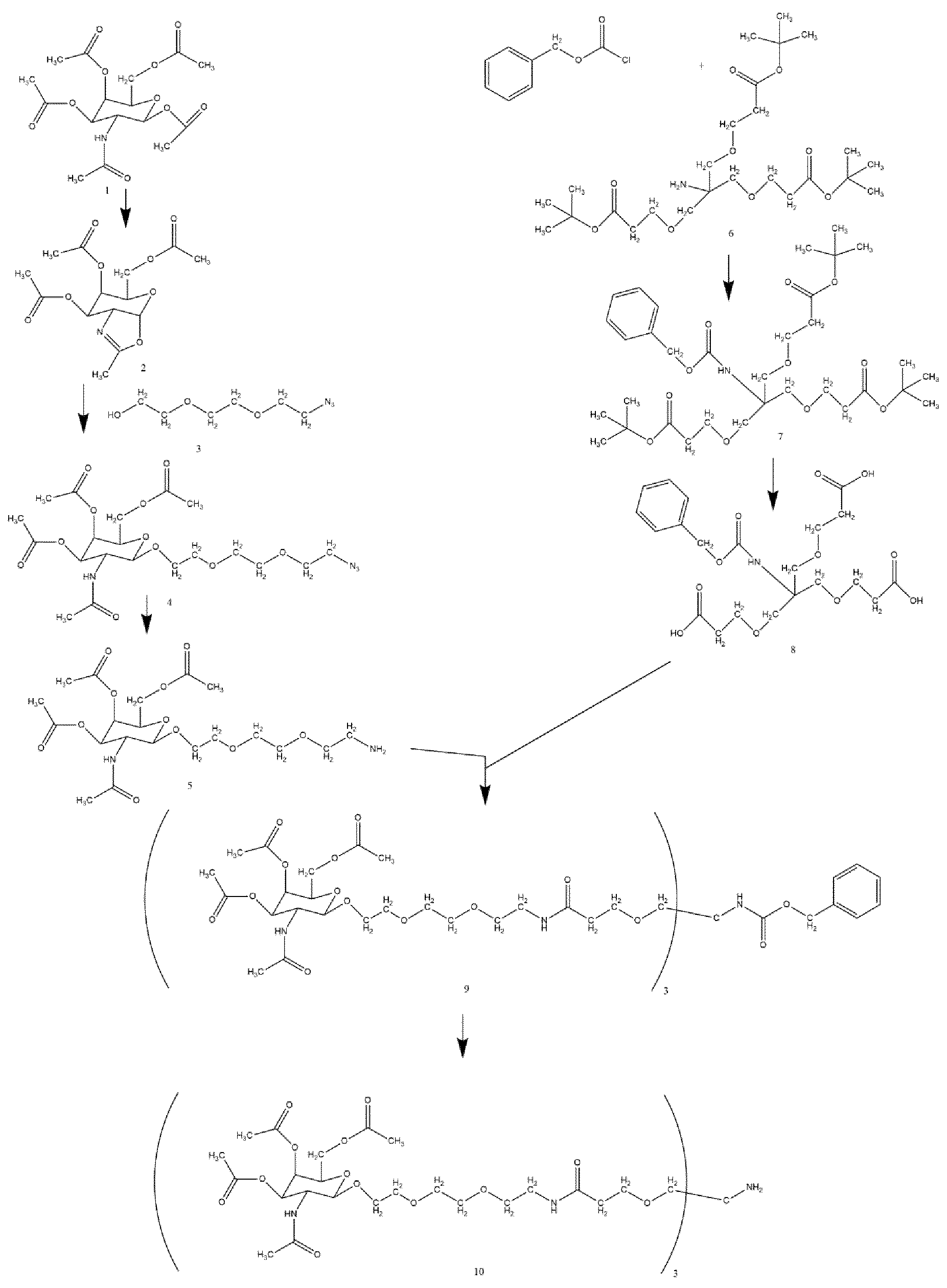
반응식 7:Reaction formula 7:

반응식 8:Reaction Scheme 8:
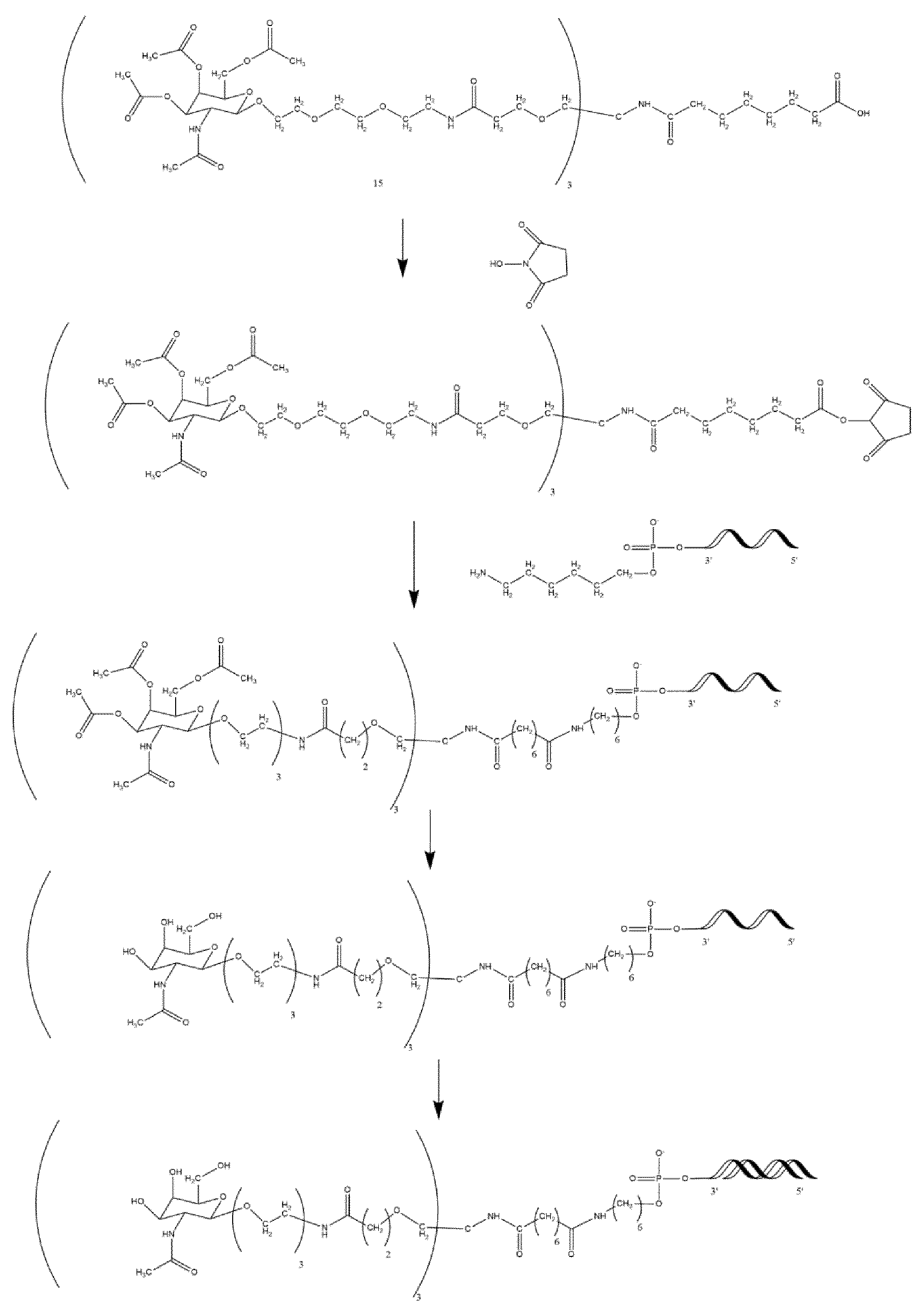
반응식 9:Reaction Scheme 9:

실시예 4: 듀플렉스 어닐링Example 4: Duplex Annealing
목적하는 siRNA 듀플렉스를 생성하기 위해, 두 가닥의 등몰 수용액을 조합함으로써 2개의 상보적 가닥을 어닐링하였다. 혼합물을 70℃의 수조에 5분 동안 두고, 후속적으로 2시간 내에 주위 온도로 냉각되도록 하였다. 듀플렉스를 2일 동안 동결건조시키고, -20℃에서 저장하였다.To generate the desired siRNA duplex, two complementary strands were annealed by combining equimolar aqueous solutions of the two strands. The mixture was placed in a 70°C water bath for 5 minutes and subsequently cooled to ambient temperature within 2 hours. The duplex was lyophilized for 2 days and stored at -20°C.
듀플렉스를 디오넥스 얼티메이트 3000 (써모 피셔 사이언티픽) HPLC 시스템 상에서 슈퍼덱스™ 75 인크리즈 5/150 GL 칼럼 5 x 153-158 mm (시티바) 상에서 분석용 SEC HPLC에 의해 분석하였다. 이동상은 10% 아세토니트릴을 함유하는 1x PBS로 이루어졌다. 등용매 구배를 실온에서 1.5 mL/분의 유량으로 10분 내에 실행하였다. 260 및 280 nm에서의 UV 트레이스를 기록하였다. 물 (LC-MS 등급)은 시그마-알드리치로부터 구입하였고, 포스페이트-완충 염수 (PBS; 10x, pH 7.4)는 깁코 (써모 피셔 사이언티픽)로부터 구입하였다.Duplexes were analyzed by analytical SEC HPLC on a Dionex Ultimate 3000 (Thermo Fisher Scientific) HPLC system with a Superdex™ 75
실시예 5: 접합체 빌딩 블록 TriGalNAc_테더2에 대한 대안적 합성 경로:Example 5: Alternative synthetic route for the conjugate building block TriGalNAc_tether2:
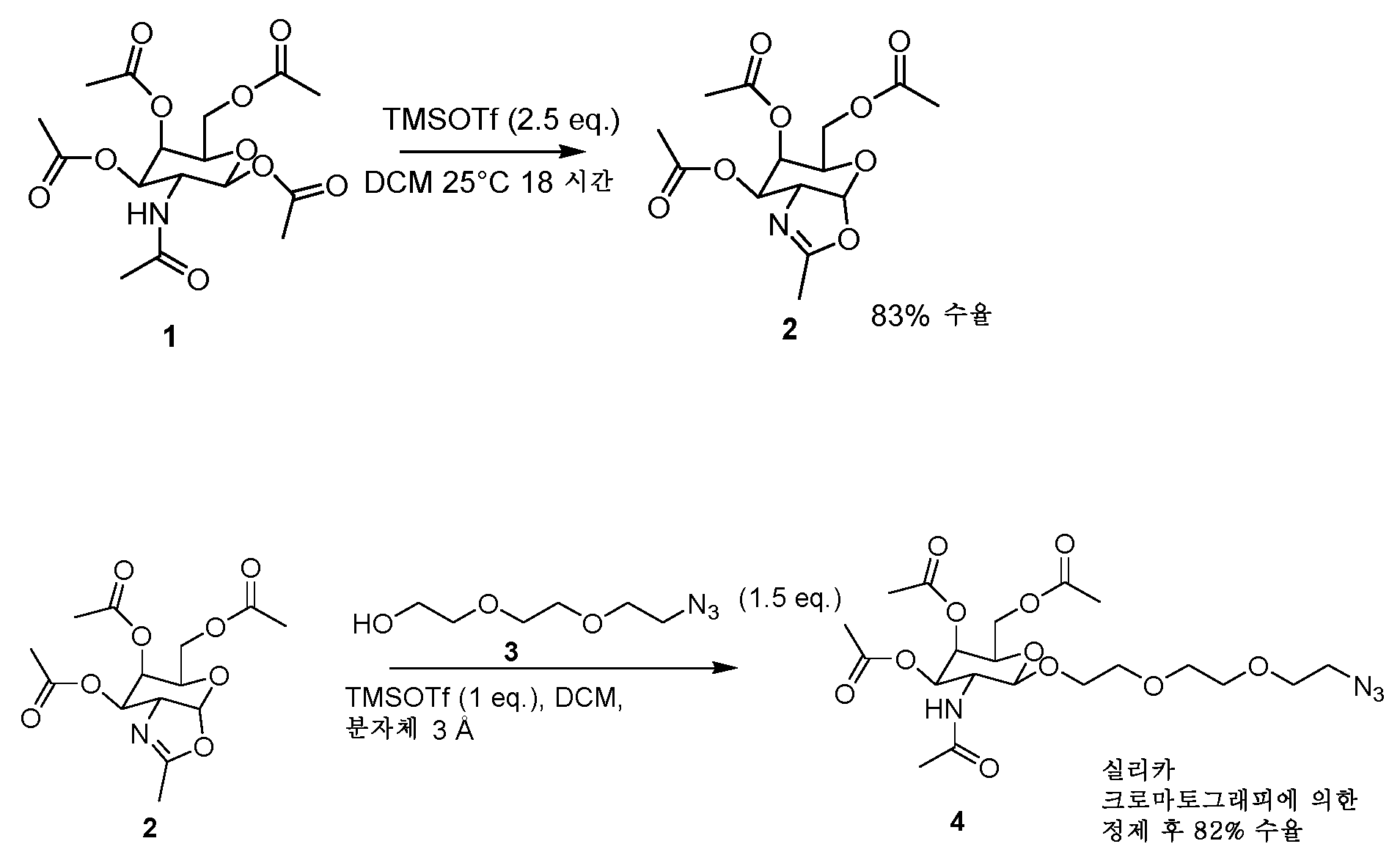

siRNA 가닥에 대한 테더 2의 접합: 5'-단부 또는 3'-단부에서의 트리GalNAc 테더 2 (GalNAc-T2) 접합
접합 조건Bonding conditions

예비-활성화: DMF (160 μL) 중 화합물 15 (16 umol, 4 당량)의 용액에 25℃에서 TFA-O-PFP (15 μl, 21 당량), 및 이어서 DIPEA (23 μl, 32 당량)를 첨가하였다. 튜브를 25℃에서 2시간 동안 진탕시켰다. 반응물을 H2O (10 μL)로 켄칭하였다.Pre-activation: To a solution of compound 15 (16 μmol, 4 equiv) in DMF (160 μL) at 25 °C was added TFA-O-PFP (15 μl, 21 equiv), followed by DIPEA (23 μl, 32 equiv). The tube was shaken at 25 °C for 2 h. The reaction was quenched with H 2 O (10 μL).
커플링: 생성된 혼합물을 DMF (400 μl)로 희석하고, 이어서 올리고-아민 용액 (10 x PBS, pH 7.4 중 4.0 μmol, 500 μL; 유기 용액 및 수용액 중 최종 올리고 농도: 4 μmol/ml = 4 mM)을 첨가하였다. 튜브를 25℃에서 16시간 동안 진탕시키고, 반응물을 LCMS에 의해 분석하였다. 생성된 혼합물을 28% NH4OH로 처리하고 (4.5 ml), 25℃에서 2시간 동안 진탕시켰다. 혼합물을 LCMS에 의해 분석하고, 농축시키고, IP-RP HPLC에 의해 정제하여 테더 2 GalNAc에 접합된 올리고뉴클레오티드를 생산하였다.Coupling: The resulting mixture was diluted with DMF (400 μl) followed by addition of oligo-amine solution (4.0 μmol in 10 x PBS, pH 7.4, 500 μL; final oligo concentration in organic and aqueous solution: 4 μmol/ml = 4 mM). The tube was shaken at 25 °C for 16 h and the reaction was analyzed by LCMS. The resulting mixture was treated with 28% NH 4 OH (4.5 ml) and shaken at 25 °C for 2 h. The mixture was analyzed by LCMS, concentrated, and purified by IP-RP HPLC to yield the oligonucleotide conjugated to
5'-GalNAc-T2 접합체5'-GalNAc-T2 conjugate

3'-GalNAc-T2 접합체3'-GalNAc-T2 conjugate
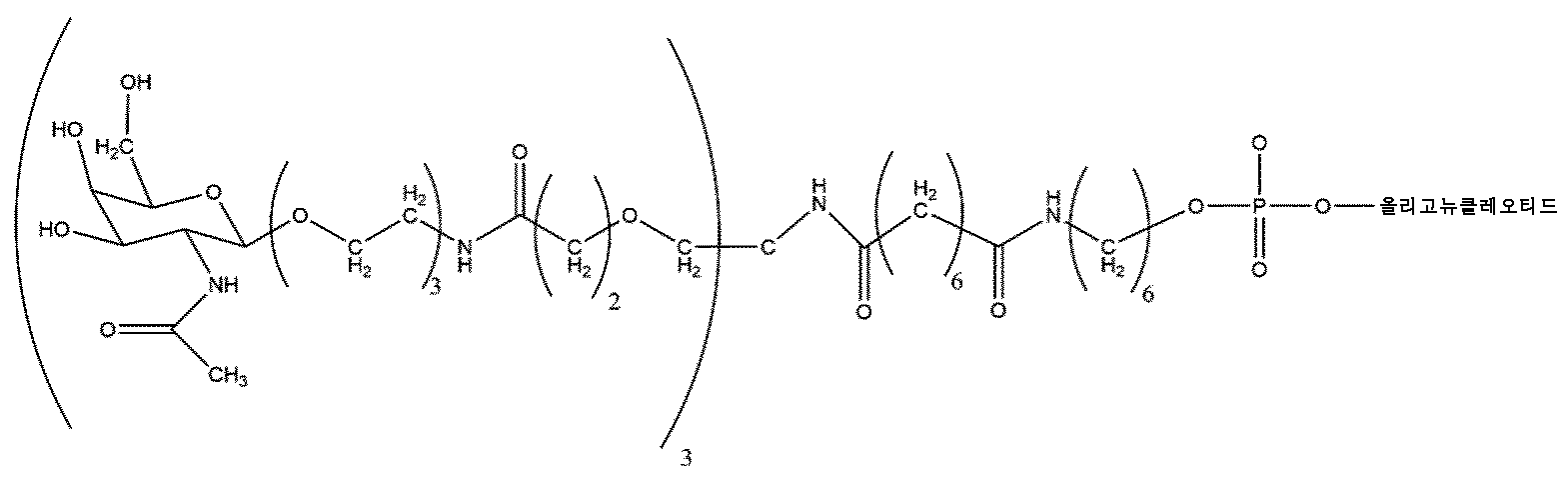
실시예 6: 고체 상 합성 방법: 규모 ≤ 1 μmolExample 6: Solid phase synthesis method: Scale ≤ 1 μmol
siRNA 센스 및 안티센스 가닥의 합성을 유니버셜 링커 (유니버셜 CPG, 40 μmol/g의 로딩; LGC 바이오서치 또는 글렌 리서치)를 갖는 제어된 세공 유리로 제조된 상업적으로 입수가능한 고체 지지체를 사용하여 머메이드192X 합성기 상에서 수행하였다.Synthesis of siRNA sense and antisense strands was performed on a Mermaid192X synthesizer using commercially available solid supports made of controlled pore glass with universal linkers (Universal CPG, loading of 40 μmol/g; LGC Biosearch or Glenn Research).
RNA 포스포르아미다이트는 켐진스(ChemGenes) 또는 홍진(Hongene)으로부터 구입하였다.RNA phosphoramidites were purchased from ChemGenes or Hongene.
사용된 2'-O-메틸 포스포르아미다이트는 다음과 같았다: 5'-(4,4'-디메톡시트리틸)-N-벤조일-아데노신 2'-O-메틸-3'-[(2-시아노에틸)-(N,N-디이소프로필)]-포스포르아미다이트, 5'-(4,4'-디메톡시트리틸)-N-아세틸-시티딘 2'-O-메틸-3'-[(2-시아노에틸)-(N,N-디이소프로필)]-포스포르아미다이트, 5'-(4,4'-디메톡시트리틸)-N-이소부티릴-구아노신 2'-O-메틸-3'-[(2-시아노에틸)-(N,N-디이소프로필)]-포스포르아미다이트, 5'-(4,4'-디메톡시트리틸)-우리딘 2'-O-메틸-3'-[(2-시아노에틸)-(N,N-디이소프로필)]-포스포르아미다이트.The 2'-O-methyl phosphoramidites used were as follows: 5'-(4,4'-dimethoxytrityl)-N-benzoyl-adenosine 2'-O-methyl-3'-[(2-cyanoethyl)-(N,N-diisopropyl)]-phosphoramidite, 5'-(4,4'-dimethoxytrityl)-N-acetyl-cytidine 2'-O-methyl-3'-[(2-cyanoethyl)-(N,N-diisopropyl)]-phosphoramidite, 5'-(4,4'-dimethoxytrityl)-N-isobutyryl-guanosine 2'-O-methyl-3'-[(2-cyanoethyl)-(N,N-diisopropyl)]-phosphoramidite, 5'-(4,4'-dimethoxytrityl)-uridine 2'-O-Methyl-3'-[(2-cyanoethyl)-(N,N-diisopropyl)]-phosphoramidite.
사용된 2'-F 포스포르아미다이트는 다음과 같았다: 5'-디메톡시트리틸-N-벤조일-데옥시아데노신 2'-플루오로-3'-[(2-시아노에틸)-(N,N-디이소프로필)]-포스포르아미다이트, 5'-디메톡시트리틸-N-아세틸-데옥시시티딘 2'-플루오로-3'-[(2-시아노에틸)-(N,N-디이소프로필)]-포스포르아미다이트, 5'-디메톡시트리틸-N-이소부티릴-데옥시구아노신 2'-플루오로-3'-[(2-시아노에틸)-(N,N-디이소프로필)]-포스포르아미다이트 및 5'-디메톡시트리틸-데옥시우리딘 2'-플루오로-3'-[(2-시아노에틸)-(N,N-디이소프로필)]-포스포르아미다이트.The 2'-F phosphoramidites used were as follows: 5'-dimethoxytrityl-N-benzoyl-deoxyadenosine 2'-fluoro-3'-[(2-cyanoethyl)-(N,N-diisopropyl)]-phosphoramidite, 5'-dimethoxytrityl-N-acetyl-deoxycytidine 2'-fluoro-3'-[(2-cyanoethyl)-(N,N-diisopropyl)]-phosphoramidite, 5'-dimethoxytrityl-N-isobutyryl-deoxyguanosine 2'-fluoro-3'-[(2-cyanoethyl)-(N,N-diisopropyl)]-phosphoramidite and 5'-dimethoxytrityl-deoxyuridine. 2'-Fluoro-3'-[(2-cyanoethyl)-(N,N-diisopropyl)]-phosphoramidite.
DMF/MeCN (1:4, v/v) 중에 용해된 2'-O-메틸-우리딘 포스포르아미다이트를 제외하고, 모든 포스포르아미다이트를 무수 아세토니트릴 (허니웰 리서치 케미칼스) 중에 0.05 M의 농도로 용해시켰다. 아세토니트릴/피리딘/H2O (DNA켐) 중 0.02 M의 아이오딘을 산화 시약으로서 사용하였다. 포스포로티오에이트 연결을 위한 티올화를 아세토니트릴/피리딘 1:1 v/v 중 0.2 M PADS (TCI)로 수행하였다. 5-에틸 티오테트라졸 (ETT), 아세토니트릴 중 0.25 M mM을 활성화제 용액으로서 사용하였다.All phosphoramidites were dissolved in anhydrous acetonitrile (Honeywell Research Chemicals) at a concentration of 0.05 M, except 2'-O-methyl-uridine phosphoramidite which was dissolved in DMF/MeCN (1:4, v/v). Iodine (0.02 M) in acetonitrile/pyridine/H2O (DNAchem) was used as the oxidizing reagent. Thiolation for phosphorothioate linkages was performed with 0.2 M PADS (TCI) in acetonitrile/pyridine 1:1 v/v. 5-Ethyl thiotetrazole (ETT), 0.25 M mM in acetonitrile, was used as the activator solution.
역전된 무염기성 포스포르아미다이트, 3-O-디메톡시트리틸-2-데옥시리보스-5-[(2-시아노에틸)-(N,N-디이소프로필)]-포스포르아미다이트는 켐진스 (ANP-1422) 또는 홍진 (OP-040)으로부터 구입하였다.The reversed anbasic phosphoramidite, 3-O-dimethoxytrityl-2-deoxyribose-5-[(2-cyanoethyl)-(N,N-diisopropyl)]-phosphoramidite, was purchased from Chemgenes (ANP-1422) or Hongjin (OP-040).
각각의 사이클에서, DMT를 탈차단 용액, DCM 중 3% TCA (DNA켐)에 의해 제거하였다.In each cycle, DMT was removed by deblocking solution, 3% TCA in DCM (DNAchem).
커플링 시간은 180초였다. 산화제 접촉 시간은 80초로 설정하였고, 티올화 시간은 2*100초였다.The coupling time was 180 s. The oxidizer contact time was set to 80 s, and the thiolation time was 2*100 s.
합성 종료 시, 45 ℃ (TCI)에서 20시간 동안 NH4OH:EtOH 용액 4:1 (v/v)을 사용하여 고체 지지체로부터 올리고뉴클레오티드를 절단하였다. 이어서, 고체 지지체를 여과하고, 필터를 H2O로 완전히 세척하고, 합한 용액의 부피를 감압 하에 증발에 의해 감소시켰다.At the end of the synthesis, the oligonucleotide was cleaved from the solid support using a 4:1 (v/v) NH 4 OH:EtOH solution at 45 °C (TCI) for 20 h. The solid support was then filtered, the filter was thoroughly washed with H 2 O, and the volume of the combined solution was reduced by evaporation under reduced pressure.
아미콘 울트라-2 원심분리 필터 유닛(Amicon Ultra-2 Centrifugal Filter Unit); PBS 완충제 (10x, 테크노바(Teknova), pH 7.4, 멸균)를 사용한 초원심분리에 의해 또는 1 M 아세트산나트륨으로부터의 EtOH 침전에 의해 올리고뉴클레오티드를 처리하여 나트륨 염을 형성하였다.Oligonucleotides were treated by ultracentrifugation using an Amicon Ultra-2 Centrifugal Filter Unit; PBS buffer (10x, Teknova, pH 7.4, sterile) or by EtOH precipitation from 1 M sodium acetate to form sodium salts.
단일 가닥 동일성을 MS ESI-에 의해 평가한 후, 물에서 어닐링하여 최종 듀플렉스 siRNA를 형성하고, 듀플렉스 순도를 크기 배제 크로마토그래피에 의해 평가하였다.After single-strand identity was assessed by MS-ESI, final duplex siRNAs were formed by annealing in water, and duplex purity was assessed by size exclusion chromatography.
실시예 7: 고체상 합성 방법: 규모 ≥ 5 μmolExample 7: Solid-phase synthesis method: Scale ≥ 5 μmol
siRNA 센스 및 안티센스 가닥의 합성을 5 μmol 규모의 유니버셜 링커 (유니버셜 CPG, 40 μmol/g의 로딩; LGC 바이오서치 또는 글렌 리서치)를 갖는 제어된 세공 유리로 제조된 상업적으로 입수가능한 고체 지지체를 사용하여 머메이드12 합성기 상에서 수행하였다. 3' 접합으로 예정된 센스 가닥을 86 μmol/g (LGC)의 로딩으로 3'-PT-아미노-변형제 C6 CPG 500 Å 고체 지지체 상에서 12 μmol로 합성하였다.Synthesis of siRNA sense and antisense strands was performed on a
RNA 포스포르아미다이트는 켐진스 또는 홍진으로부터 구입하였다.RNA phosphoramidite was purchased from Chemgenes or Hongjin.
사용된 2'-O-메틸 포스포르아미다이트는 다음과 같았다: 5'-(4,4'-디메톡시트리틸)-N-벤조일-아데노신 2'-O-메틸-3'-[(2-시아노에틸)-(N,N-디이소프로필)]-포스포르아미다이트, 5'-(4,4'-디메톡시트리틸)-N-아세틸-시티딘 2'-O-메틸-3'-[(2-시아노에틸)-(N,N-디이소프로필)]-포스포르아미다이트, 5'-(4,4'-디메톡시트리틸)-N-이소부티릴-구아노신 2'-O-메틸-3'-[(2-시아노에틸)-(N,N-디이소프로필)]-포스포르아미다이트, 5'-(4,4'-디메톡시트리틸)-우리딘 2'-O-메틸-3'-[(2-시아노에틸)-(N,N-디이소프로필)]-포스포르아미다이트.The 2'-O-methyl phosphoramidites used were as follows: 5'-(4,4'-dimethoxytrityl)-N-benzoyl-adenosine 2'-O-methyl-3'-[(2-cyanoethyl)-(N,N-diisopropyl)]-phosphoramidite, 5'-(4,4'-dimethoxytrityl)-N-acetyl-cytidine 2'-O-methyl-3'-[(2-cyanoethyl)-(N,N-diisopropyl)]-phosphoramidite, 5'-(4,4'-dimethoxytrityl)-N-isobutyryl-guanosine 2'-O-methyl-3'-[(2-cyanoethyl)-(N,N-diisopropyl)]-phosphoramidite, 5'-(4,4'-dimethoxytrityl)-uridine 2'-O-Methyl-3'-[(2-cyanoethyl)-(N,N-diisopropyl)]-phosphoramidite.
사용된 2'-F 포스포르아미다이트는 다음과 같았다: 5'-디메톡시트리틸-N-벤조일-데옥시아데노신 2'-플루오로-3'-[(2-시아노에틸)-(N,N-디이소프로필)]-포스포르아미다이트, 5'-디메톡시트리틸-N-아세틸-데옥시시티딘 2'-플루오로-3'-[(2-시아노에틸)-(N,N-디이소프로필)]-포스포르아미다이트, 5'-디메톡시트리틸-N-이소부티릴-데옥시구아노신 2'-플루오로-3'-[(2-시아노에틸)-(N,N-디이소프로필)]-포스포르아미다이트 및 5'-디메톡시트리틸-데옥시우리딘 2'-플루오로-3'-[(2-시아노에틸)-(N,N-디이소프로필)]-포스포르아미다이트.The 2'-F phosphoramidites used were as follows: 5'-dimethoxytrityl-N-benzoyl-deoxyadenosine 2'-fluoro-3'-[(2-cyanoethyl)-(N,N-diisopropyl)]-phosphoramidite, 5'-dimethoxytrityl-N-acetyl-deoxycytidine 2'-fluoro-3'-[(2-cyanoethyl)-(N,N-diisopropyl)]-phosphoramidite, 5'-dimethoxytrityl-N-isobutyryl-deoxyguanosine 2'-fluoro-3'-[(2-cyanoethyl)-(N,N-diisopropyl)]-phosphoramidite and 5'-dimethoxytrityl-deoxyuridine. 2'-Fluoro-3'-[(2-cyanoethyl)-(N,N-diisopropyl)]-phosphoramidite.
역전된 무염기성 포스포르아미다이트, 3-O-디메톡시트리틸-2-데옥시리보스-5-[(2-시아노에틸)-(N,N-디이소프로필)]-포스포르아미다이트는 켐진스 (ANP-1422) 또는 홍진 (OP-040)으로부터 구입하였다.The reversed anbasic phosphoramidite, 3-O-dimethoxytrityl-2-deoxyribose-5-[(2-cyanoethyl)-(N,N-diisopropyl)]-phosphoramidite, was purchased from Chemgenes (ANP-1422) or Hongjin (OP-040).
DMF/MeCN (1:4, v/v) 중에 용해된 2'-O-메틸-우리딘 포스포르아미다이트를 제외하고, 모든 포스포르아미다이트를 무수 아세토니트릴 (허니웰 리서치 케미칼스) 중에 0.05 M의 농도로 용해시켰다. 아세토니트릴/피리딘/H2O 중 0.02 M의 아이오딘 (DNA켐)을 산화 시약으로서 사용하였다. 포스포로티오에이트 연결을 위한 티올화를 아세토니트릴/피리딘 1:1 v/v 중 0.2 M PADS (TCI)로 수행하였다. 5-에틸 티오테트라졸 (ETT), 아세토니트릴 중 0.25 M mM을 활성화제 용액으로서 사용하였다.All phosphoramidites were dissolved in anhydrous acetonitrile (Honeywell Research Chemicals) at a concentration of 0.05 M, except 2'-O-methyl-uridine phosphoramidite which was dissolved in DMF/MeCN (1:4, v/v). Iodine (DNAchem) at 0.02 M in acetonitrile/pyridine/H 2 O was used as the oxidizing reagent. Thiolation for phosphorothioate linkages was performed with 0.2 M PADS (TCI) in acetonitrile/pyridine 1:1 v/v. 5-Ethyl thiotetrazole (ETT), 0.25 M mM in acetonitrile, was used as the activator solution.
각각의 사이클에서, DMT를 탈차단 용액, DCM 중 3% TCA (DNA켐)에 의해 제거하였다.In each cycle, DMT was removed by deblocking solution, 3% TCA in DCM (DNAchem).
유니버셜 CPG 상에서 합성된 가닥에 대해, 커플링을 8 당량의 아미다이트를 사용하여 130초 동안 수행하였다. 산화 시간은 47초였고, 티올화 시간은 210초였다.For the strands synthesized on the Universal CPG, coupling was performed for 130 s using 8 equivalents of amidite. The oxidation time was 47 s and the thiolation time was 210 s.
3'-PT-아미노-변형제 C6 CPG 상에서 합성된 가닥에 대해, 커플링을 8 당량의 아미다이트를 사용하여 2*150초 동안 수행하였다. 산화 시간은 47초였고, 티올화 시간은 250초였다.For the strand synthesized on 3'-PT-amino-modified C6 CPG, coupling was performed for 2*150 s using 8 equivalents of amidite. Oxidation time was 47 s and thiolation time was 250 s.
합성 종료 시, 45 ℃ (TCI)에서 20시간 동안 NH4OH:EtOH 용액 4:1 (v/v)을 사용하여 고체 지지체로부터 올리고뉴클레오티드를 절단하였다. 이어서, 고체 지지체를 여과하고, 필터를 H2O로 완전히 세척하고, 합한 용액의 부피를 감압 하에 증발에 의해 감소시켰다.At the end of the synthesis, the oligonucleotide was cleaved from the solid support using a 4:1 (v/v) NH 4 OH:EtOH solution at 45 °C (TCI) for 20 h. The solid support was then filtered, the filter was thoroughly washed with H 2 O, and the volume of the combined solution was reduced by evaporation under reduced pressure.
1 M 아세트산나트륨으로부터의 EtOH 침전에 의해 올리고뉴클레오티드를 처리하여 나트륨 염을 형성하였다.Oligonucleotides were treated by EtOH precipitation from 1 M sodium acetate to form the sodium salt.
단일 가닥 올리고뉴클레오티드를 A 중 B의 증가하는 구배로 엑스브리지 BEH C18 5 μm, 130 Å, 19x150 mm (워터스) 칼럼 상에서 IP-RP HPLC에 의해 정제하였다. 이동상 A: 물 중 240 mM HFIP, 7 mM TEA 및 5% 메탄올; 이동상 B: 메탄올 중 240 mM HFIP, 7 mM TEA.Single-stranded oligonucleotides were purified by IP-RP HPLC on an
단일 가닥 순도 및 정체를 A 중 B의 증가하는 구배로 엑스브리지 BEH C18 2.5 μm, 3x50 mm (워터스) 칼럼 상에서 UPLC/MS ESI-에 의해 평가하였다. 이동상 A: 100 mM HFIP, 물 중 5 mM TEA; 이동상 B: 20%이동상 A: 80% 아세토니트릴 (v/v).Single strand purity and identity were assessed by UPLC/MS ESI- on an Xbridge BEH C18 2.5 μm, 3x50 mm (Waters) column with an increasing gradient of A to B. Mobile phase A: 100 mM HFIP, 5 mM TEA in water; Mobile phase B: 20%Mobile phase A: 80% acetonitrile (v/v).
센스 가닥을 실시예 1, 3 또는 5 중 임의의 것에 제공된 프로토콜에 따라 접합시켰다.The sense strand was conjugated according to the protocol provided in any of Examples 1, 3 or 5.
이어서, 센스 및 안티센스 가닥을 물에서 어닐링시켜 최종 듀플렉스 siRNA를 형성하고, 듀플렉스 순도를 크기 배제 크로마토그래피에 의해 평가하였다.The sense and antisense strands were then annealed in water to form the final duplex siRNA, and duplex purity was assessed by size exclusion chromatography.
실시예 8: 핵산 서열:Example 8: Nucleic acid sequence:
본 발명에 따라 사용하기에 적합한 siRNA 올리고뉴클레오시드는 HCII 및 ZPI를 표적화할 수 있다. HCII 및 ZPI 표적의 전체 DNA 서열은 각각 하기와 같다 (서열식별번호: 1 및 2):siRNA oligonucleosides suitable for use according to the present invention can target HCII and ZPI. The full DNA sequences of HCII and ZPI targets are as follows (SEQ ID NOs: 1 and 2), respectively:
서열식별번호: 1 (HCII)Sequence ID No: 1 (HCII)



서열식별번호: 2 (ZPI)Sequence ID Number: 2 (ZPI)


서열식별번호: 485 (B4GALT1)SEQ ID NO: 485 (B4GALT1)



하기 표 1은 HCII, ZPI 및 B4GALT1의 올리고뉴클레오시드 mRNA 표적 서열을 각각 전사체 NM_000185.4, NM_016186.3 및 NM_001497.4에서의 상응하는 위치와 함께 제공한다.Table 1 below provides the oligonucleoside mRNA target sequences of HCII, ZPI, and B4GALT1 along with their corresponding positions in transcripts NM_000185.4, NM_016186.3, and NM_001497.4, respectively.
표 1Table 1
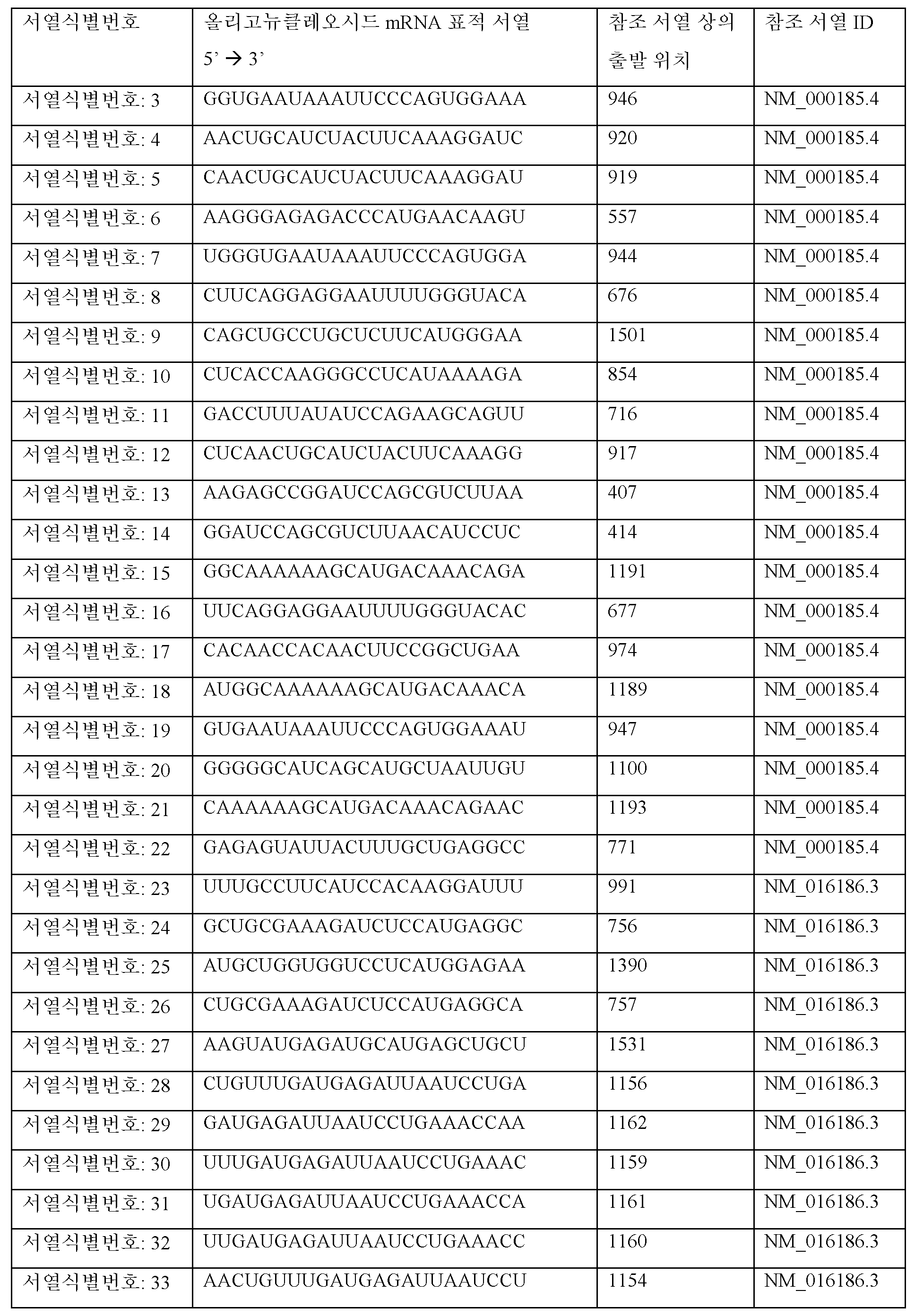

표 2는 하기와 같이 본 발명에 따른 siRNA 올리고뉴클레오시드 (HCII, ZPI 및 B4GALT1을 표적화함)에 대한 비변형된 제1 (안티센스) 및 상응하는 비변형된 제2 (센스) 가닥 서열을 서열식별번호: 1, 2 및 485의 전체 유전자 서열에서의 상응하는 위치와 함께 제공한다.Table 2 provides the unmodified first (antisense) and the corresponding unmodified second (sense) strand sequences for siRNA oligonucleosides according to the present invention (targeting HCII, ZPI and B4GALT1) along with the corresponding positions in the full gene sequence of SEQ ID NOs: 1, 2 and 485.
표 2Table 2
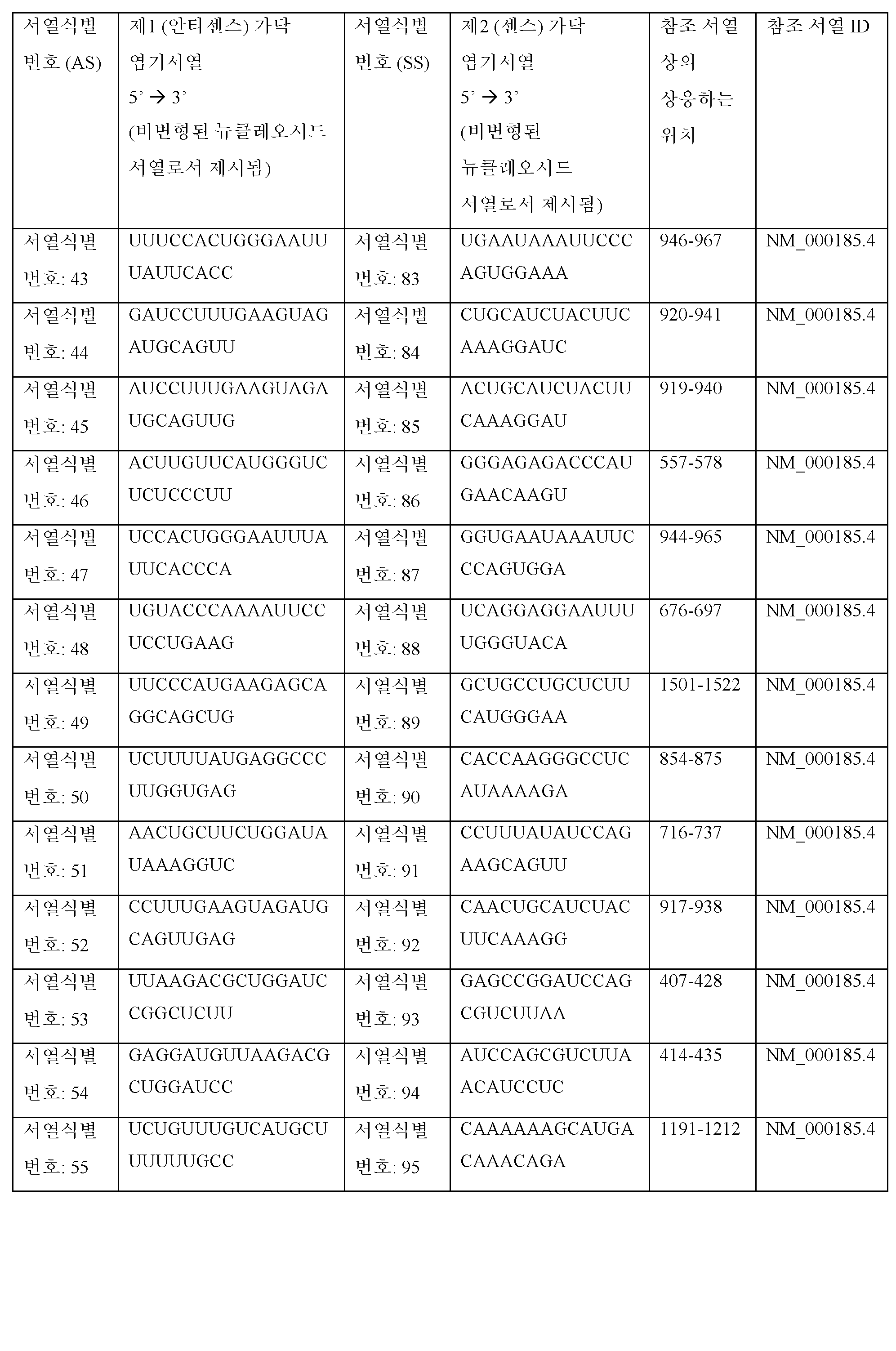

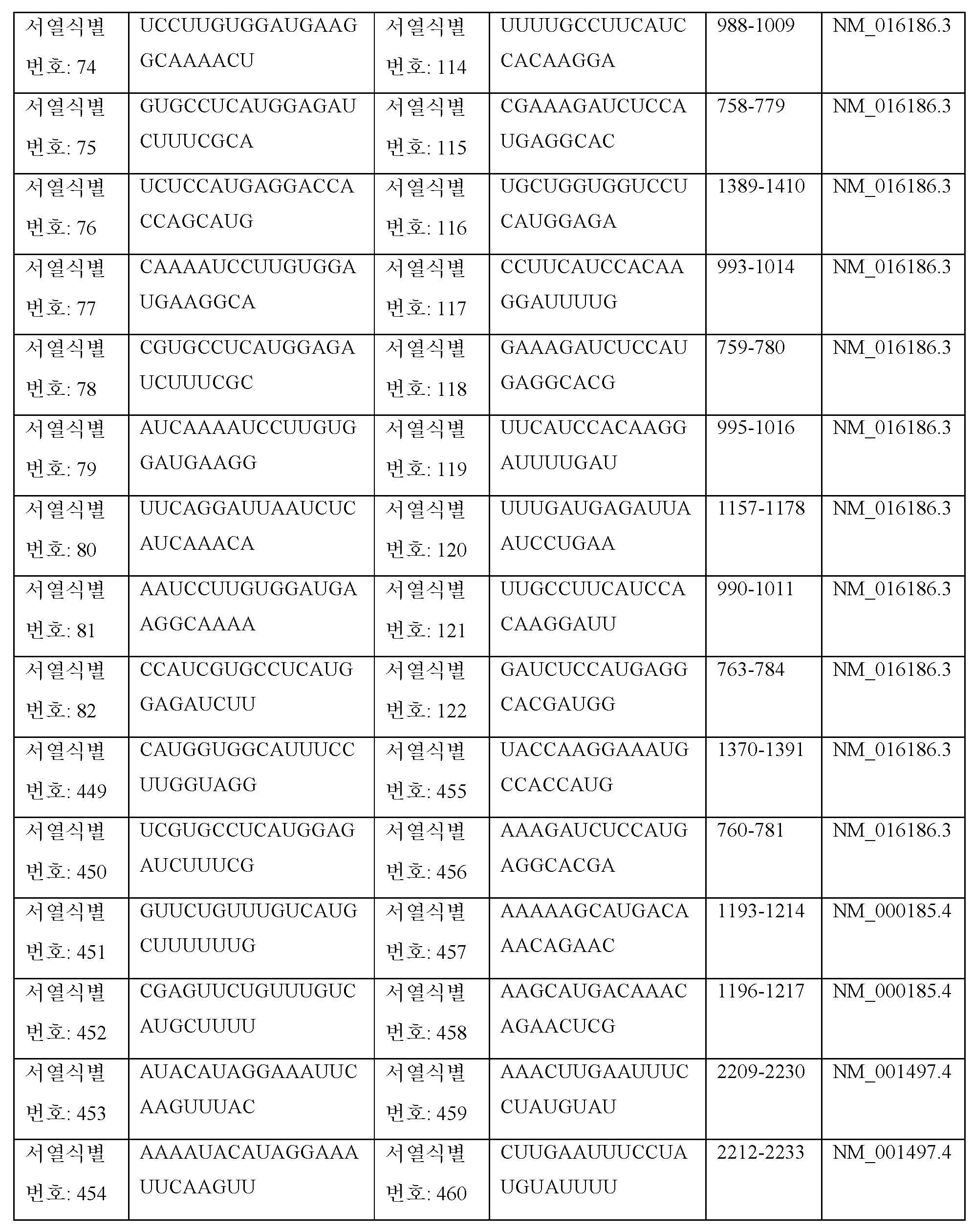
표 3은 하기와 같이 본 발명에 따른 siRNA 올리고뉴클레오시드 (HCII, ZPI 및 B4GALT1을 표적화함)에 대한 상응하는 비변형된 제1 (안티센스) 서열과 함께 변형된 제1 (안티센스) 서열을 제공한다.Table 3 provides the modified first (antisense) sequences along with the corresponding unmodified first (antisense) sequences for siRNA oligonucleosides (targeting HCII, ZPI and B4GALT1) according to the present invention.
표 3Table 3

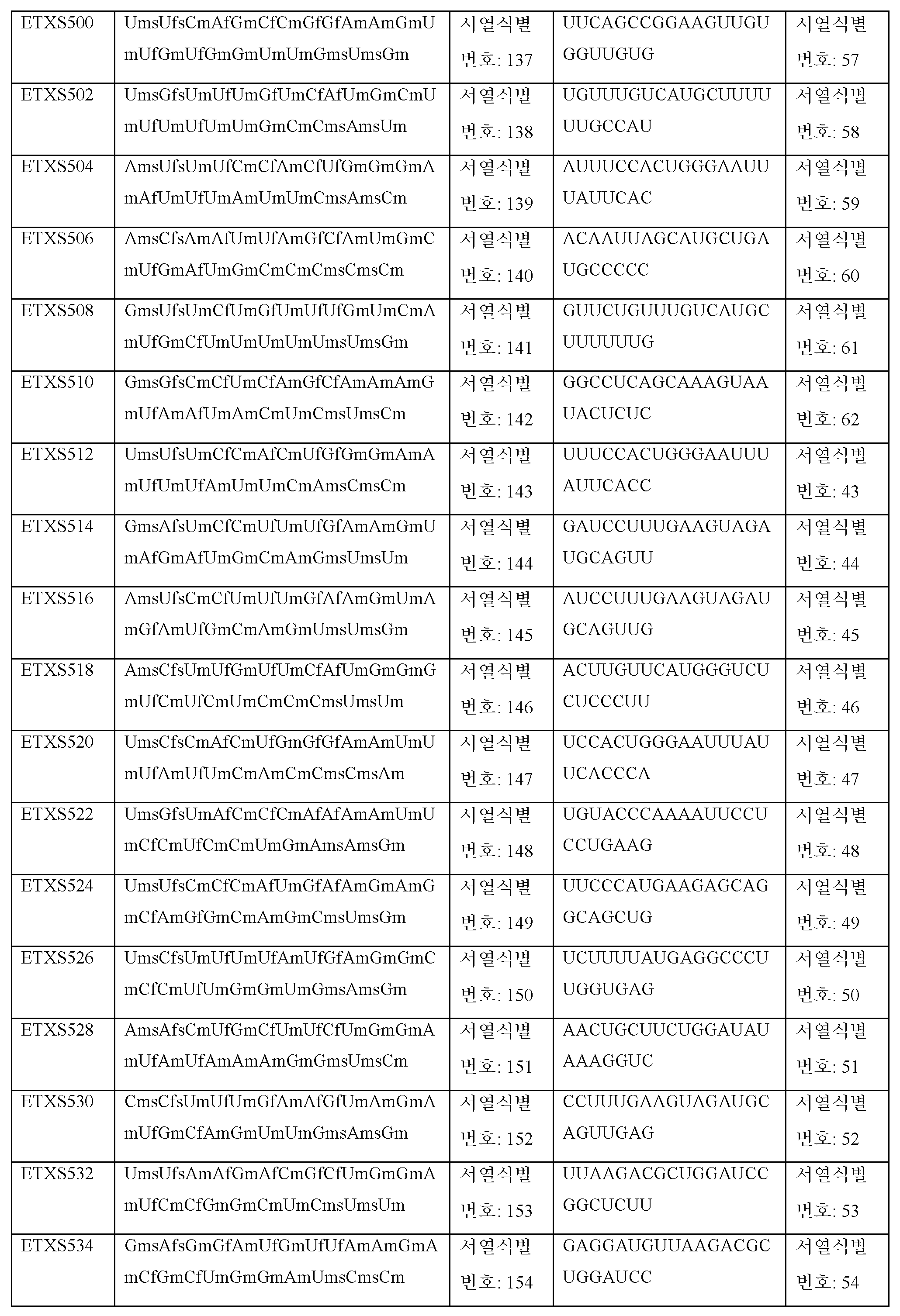
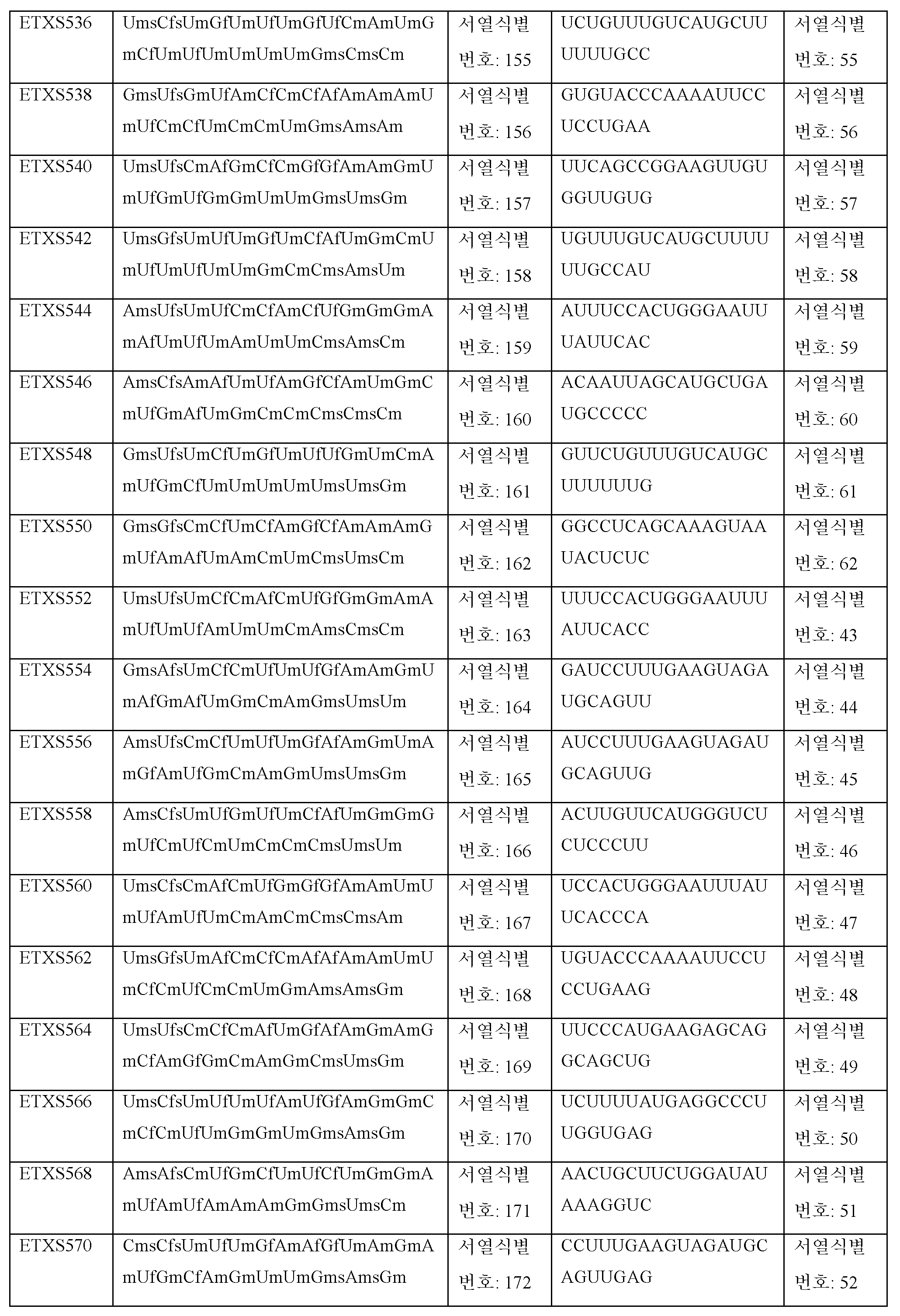
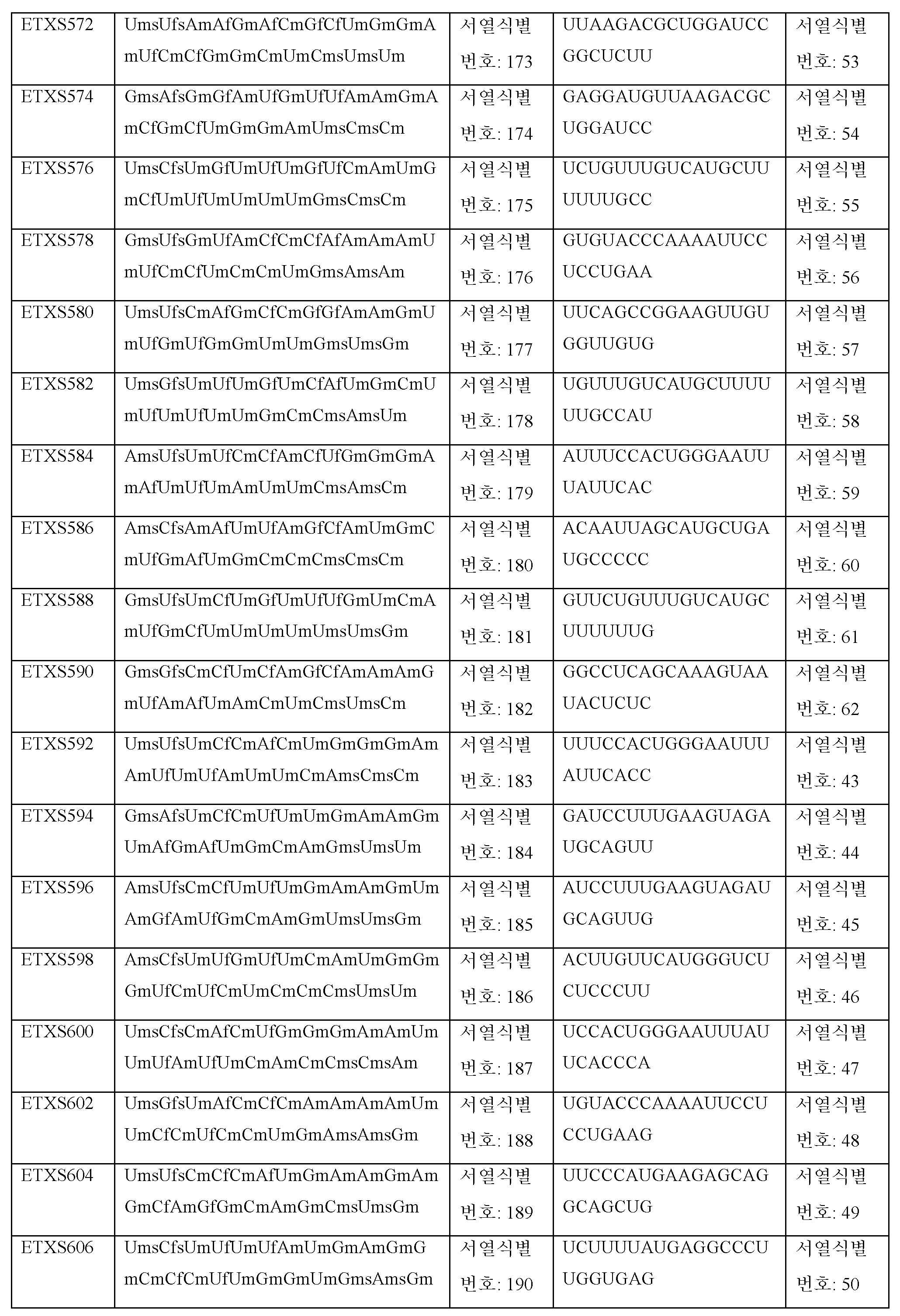

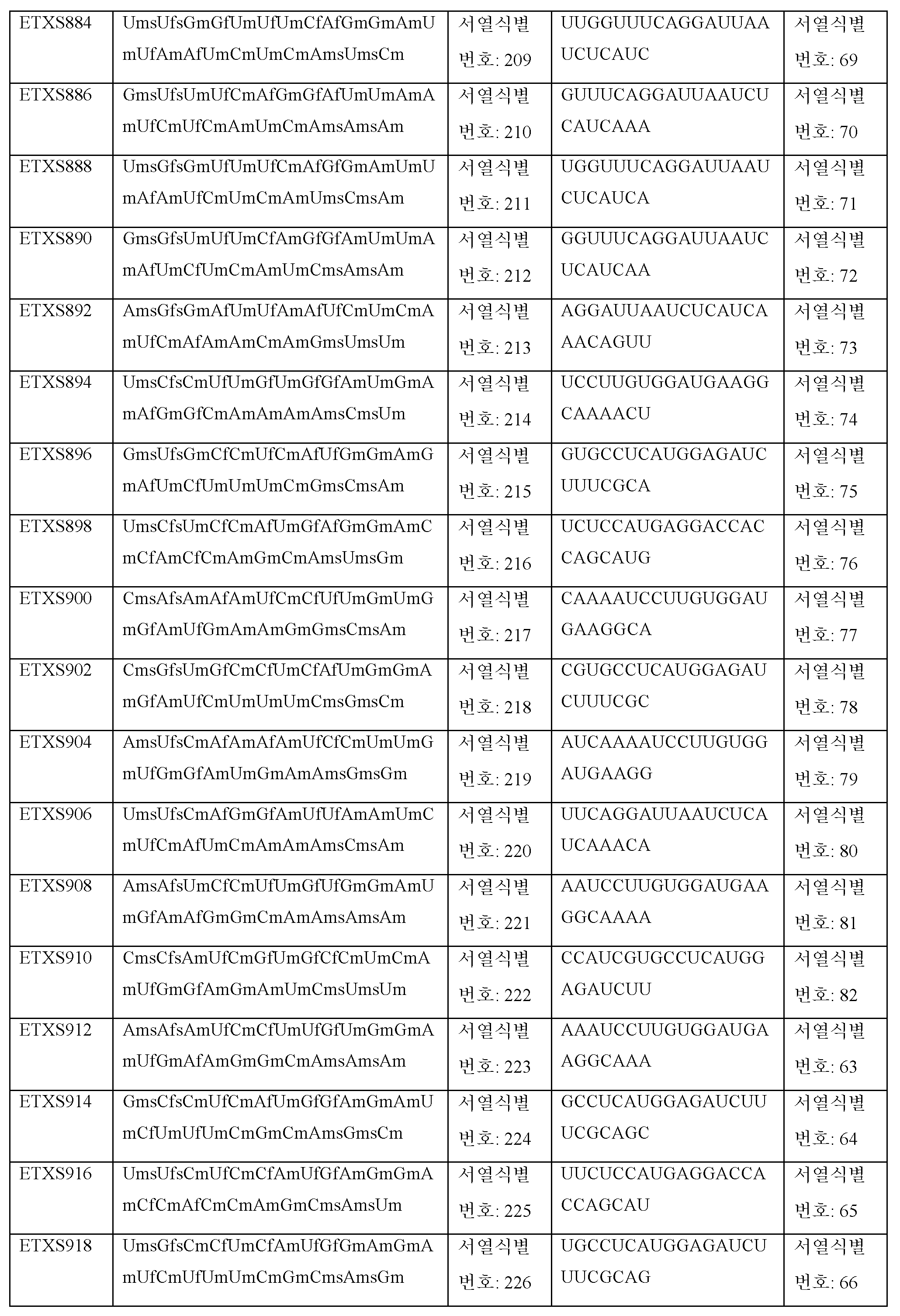

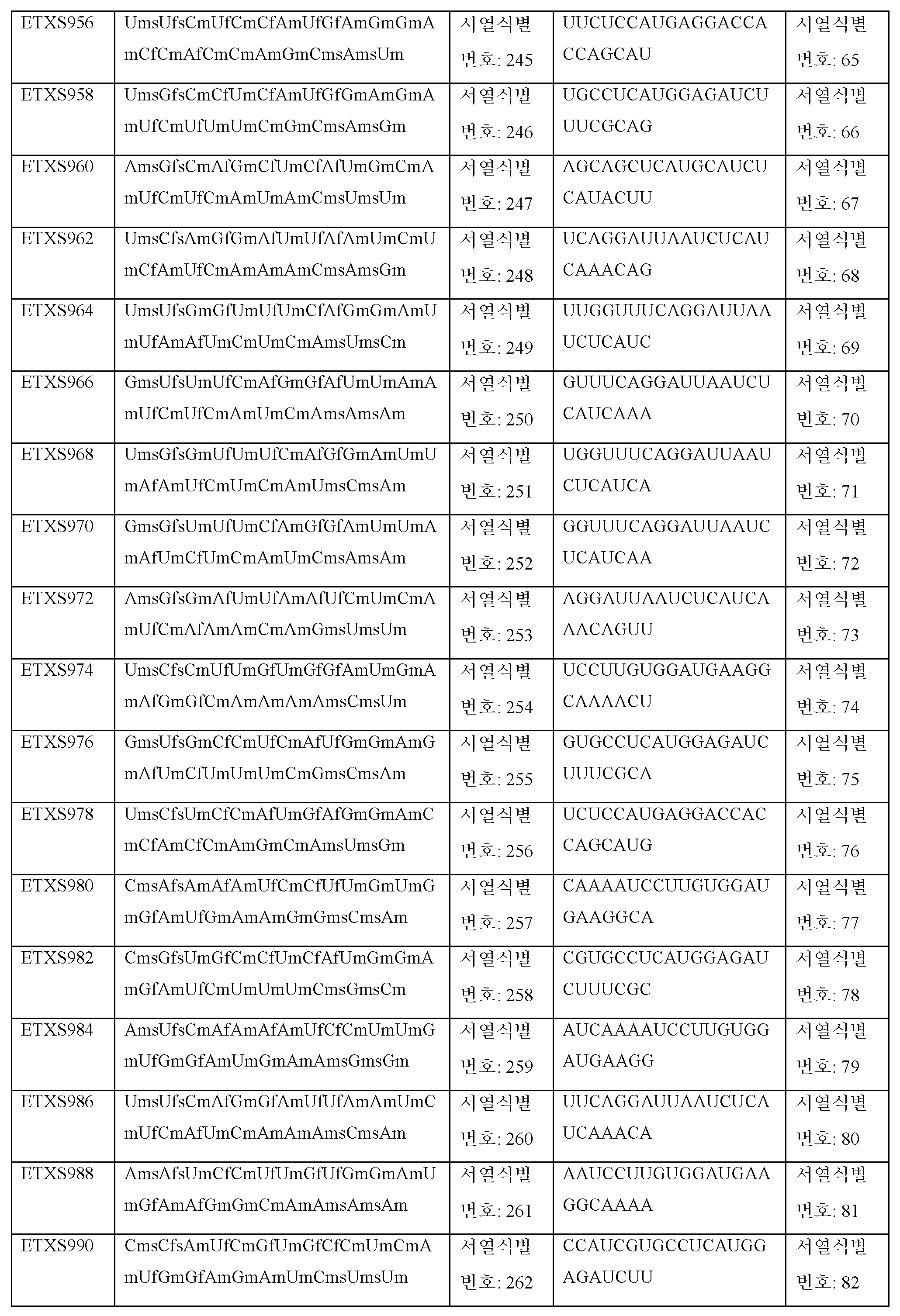

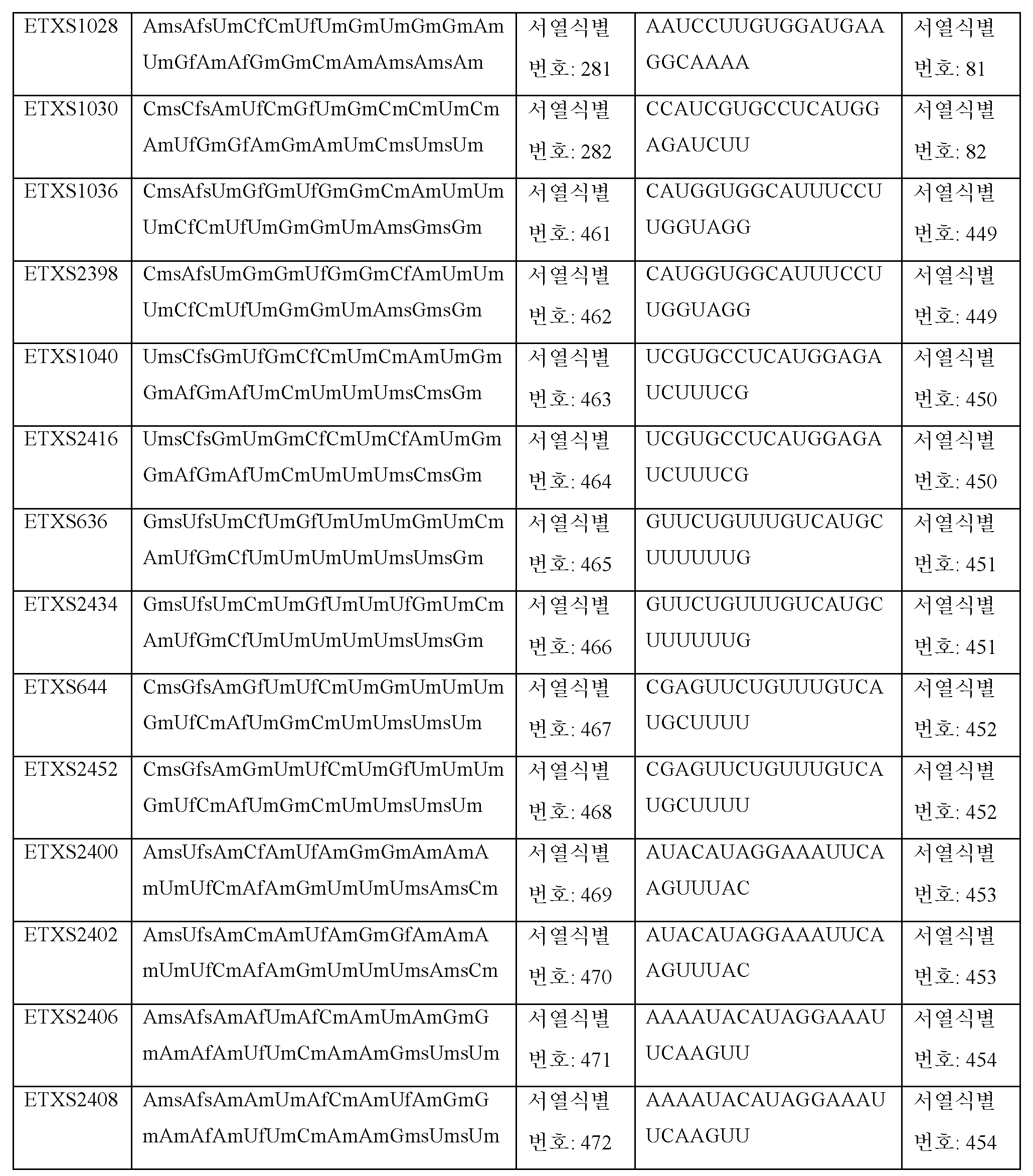
표 4는 하기와 같이 본 발명에 따른 siRNA 올리고뉴클레오시드 (HCII, ZPI 및 B4GALT1을 표적화함)에 대한 상응하는 비변형된 제2 (센스) 서열과 함께 변형된 제2 (센스) 서열을 제공한다.Table 4 provides modified second (sense) sequences along with corresponding unmodified second (sense) sequences for siRNA oligonucleosides (targeting HCII, ZPI and B4GALT1) according to the present invention.
표 4Table 4

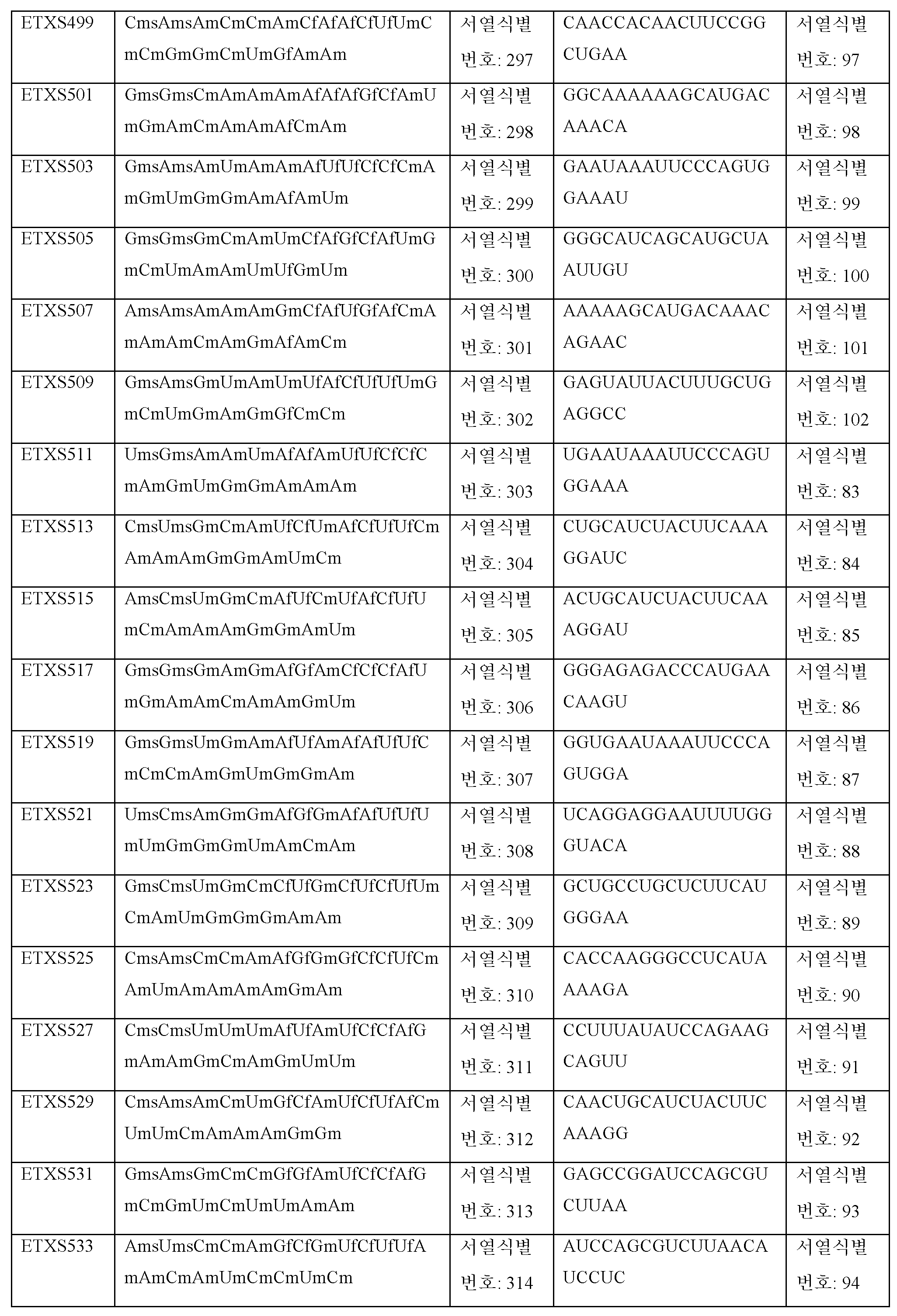

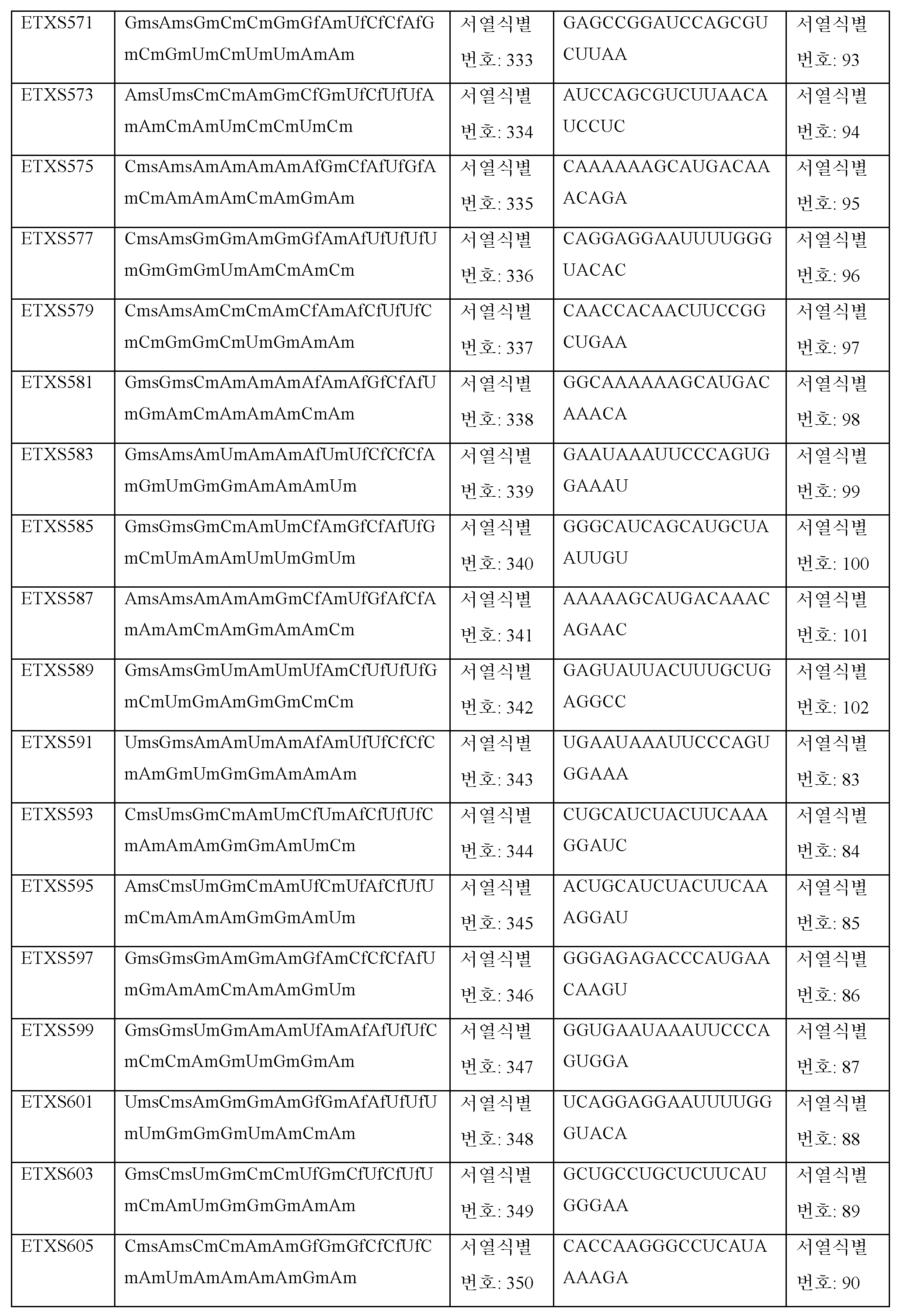
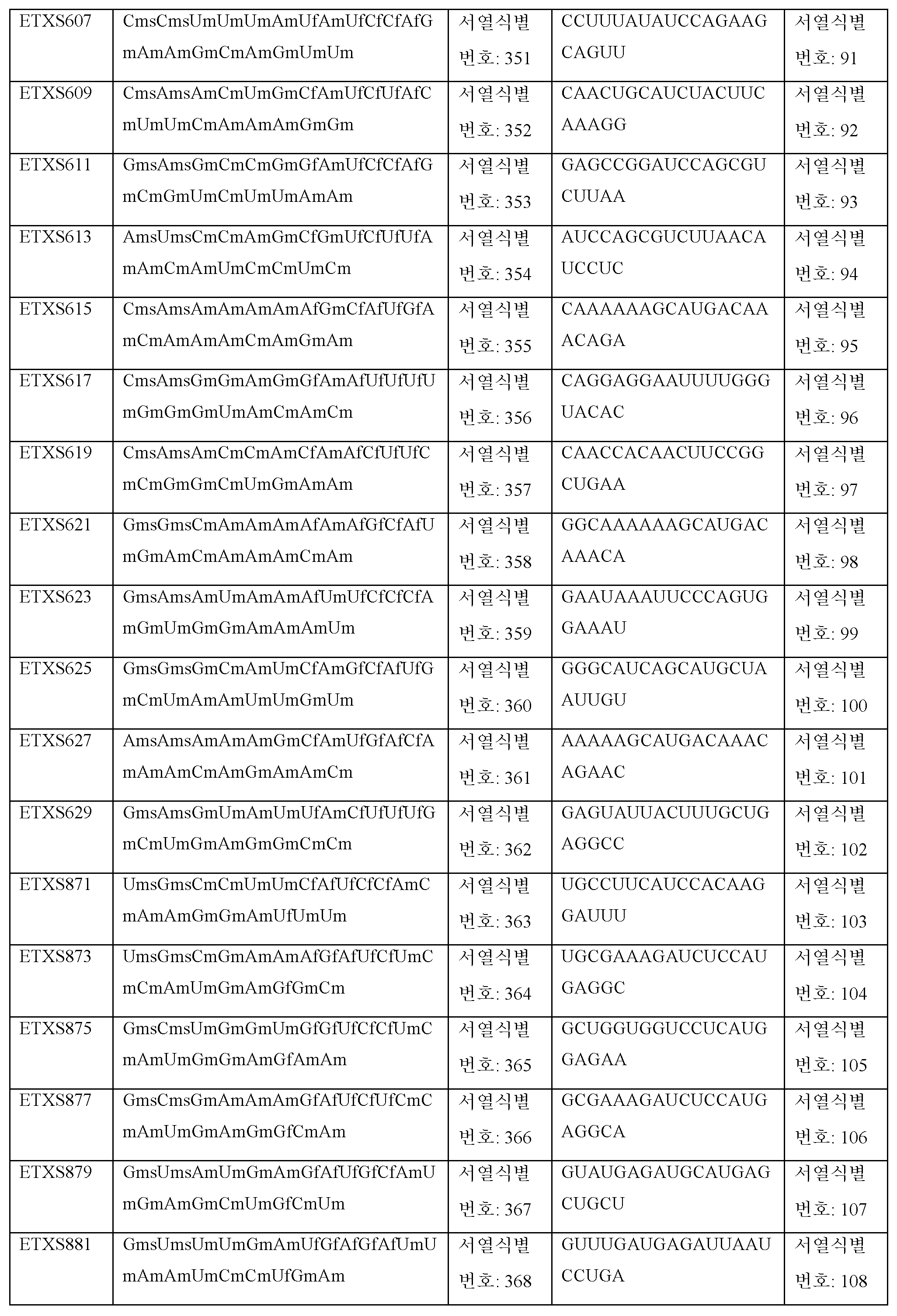

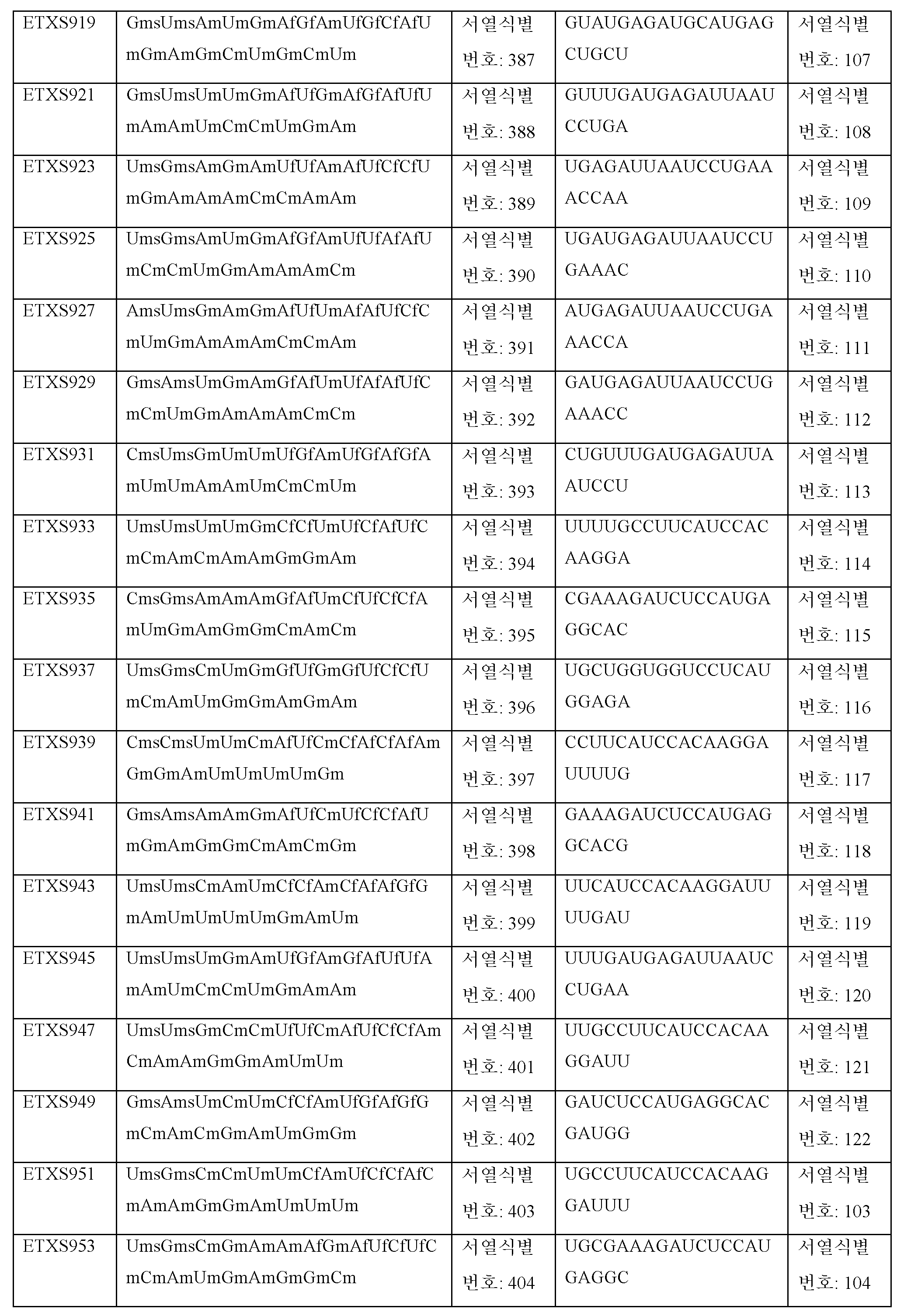
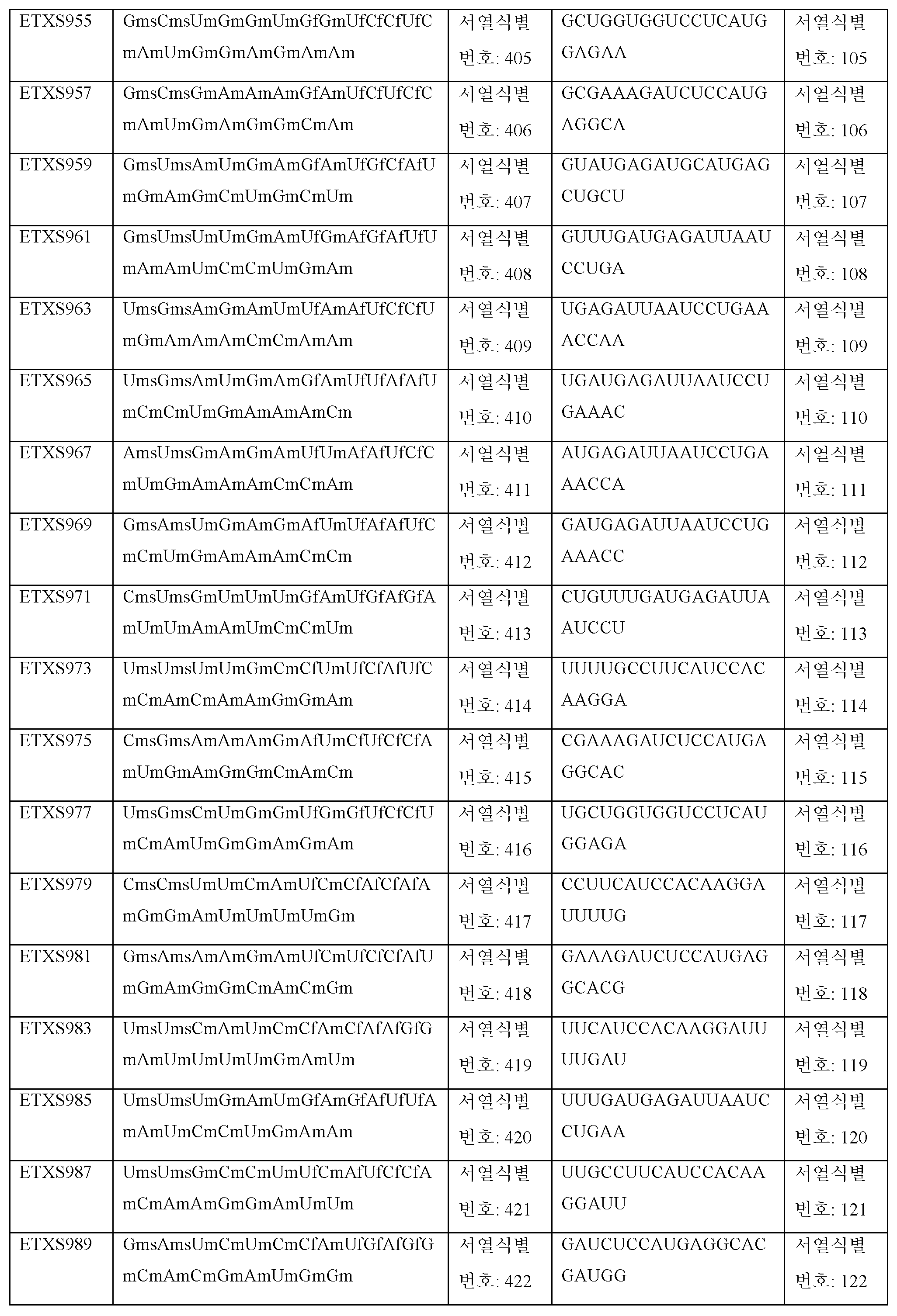
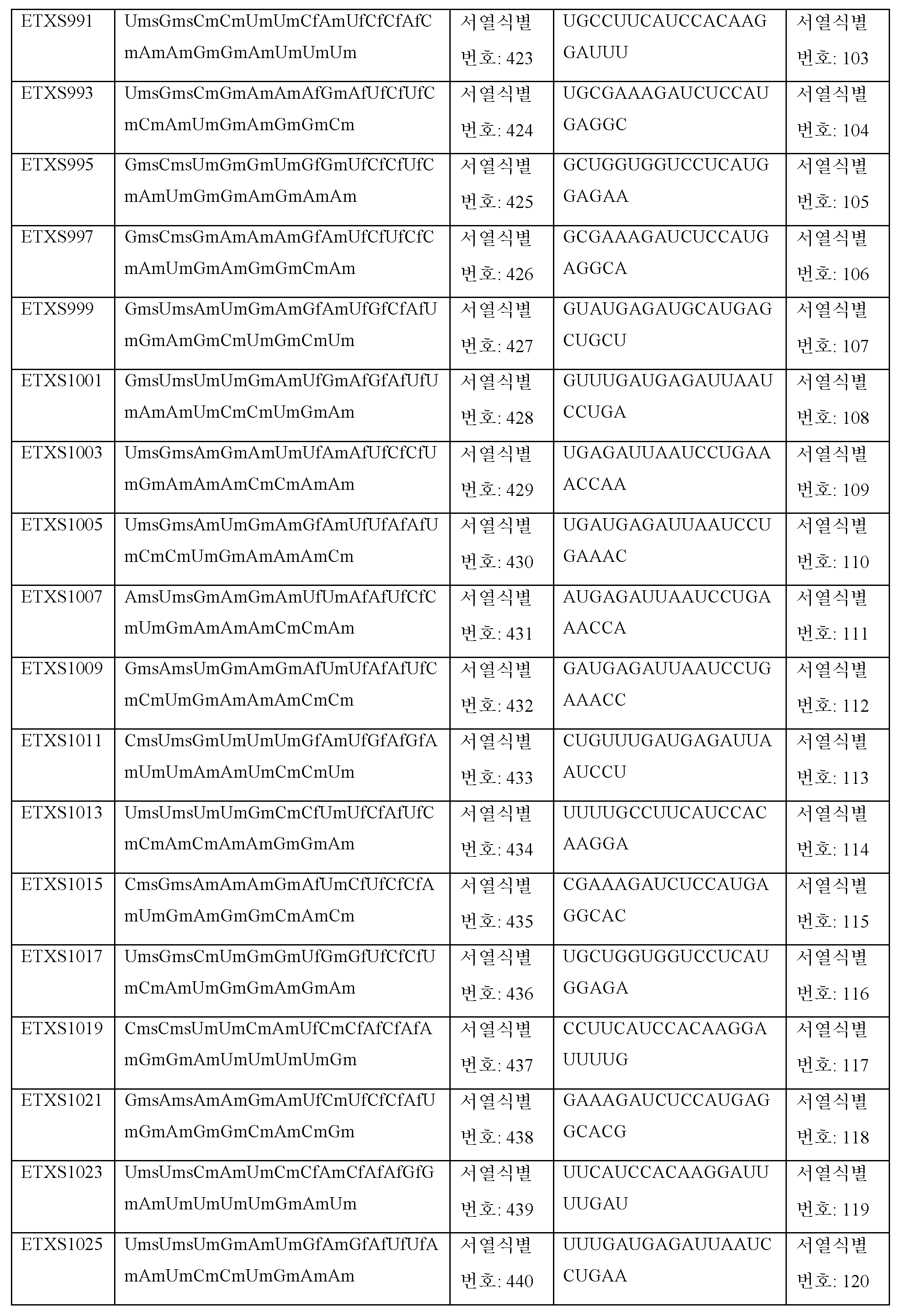

상기 표 4에 예시된 바와 같은 변형된 제2 가닥 서열 중 일부는 바람직한 5' iaia 모티프를 포함한다. 그러나, 또한, 이들 변형된 제2 가닥 서열의 범위는 5'iaia 모티프의 부재 하에 Me / F 변형된 제2 가닥을 추가적으로 포함하는 것으로 이해되어야 한다.Some of the modified second strand sequences, as exemplified in Table 4 above, include the preferred 5' iaia motif. However, it should also be understood that the scope of these modified second strand sequences additionally includes Me/F modified second strands in the absence of the 5' iaia motif.
표 5는 이전 표 3 및 4로부터의 변형된 안티센스 및 센스 ID를 참조하면서 듀플렉스 ID를 사용하여 듀플렉스를 확인한다.Table 5 identifies the duplex using the duplex ID while referencing the modified antisense and sense IDs from Tables 3 and 4 above.
표 5Table 5


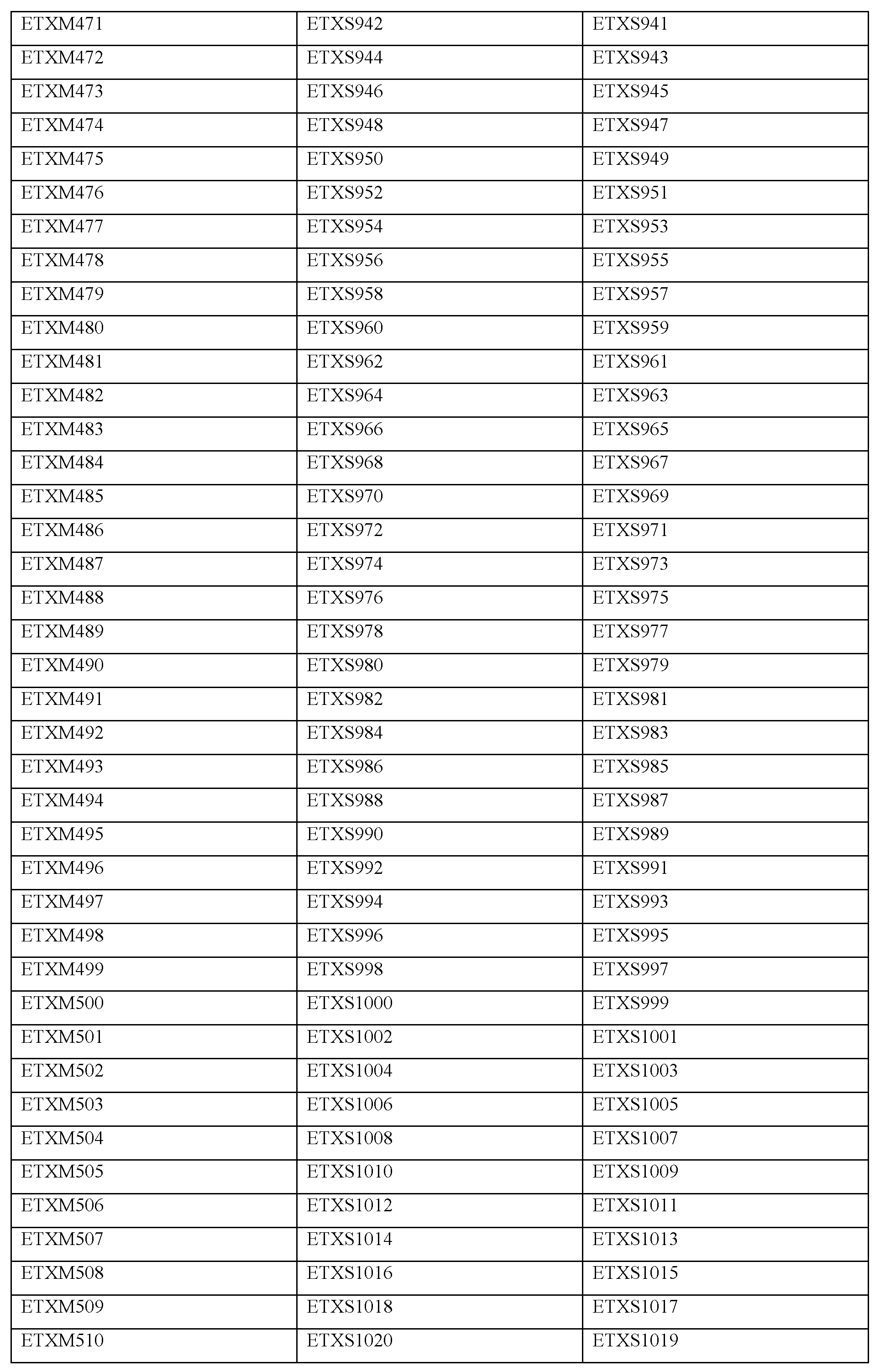

표 5의 듀플렉스에 대해, 이들은 안티센스의 3' 단부에 2개의 뉴클레오시드 오버행을 갖는 도 8a에 따른 듀플렉스 구조; 또는 도 8b에 따른 듀플렉스 구조, 즉 19량체 평활 말단 구축물을 가질 수 있다.For the duplexes in Table 5, they can have a duplex structure according to Figure 8a with two nucleoside overhangs at the 3' end of the antisense; or a duplex structure according to Figure 8b, i.e. a 19-mer blunt-ended construct.
상기 표에 제공된 바와 같은 정의:Definitions as provided in the table above:
A - 아데노신A - Adenosine
C - 시티딘C - Citidine
G - 구아노신G - Guanosine
T - 티미딘T - Thymidine
m - 2'-O-메틸m - 2'-O-methyl
f - 2'플루오로f - 2'fluoro
s - 포스포로티오에이트 결합s - phosphorothioate bond
ia - 역전된 무염기성 뉴클레오시드ia - inverted abasic nucleoside
실시예 9: 인간 Huh7 세포에서의 HCII 및 ZPI 발현에 대한 억제 스크린Example 9: Inhibitory screen for HCII and ZPI expression in human Huh7 cells
HCII: Huh7 세포 (인간 간세포-유래 세포주, JCRB 세포 은행으로부터 입수함)를 10% FBS로 보충된 둘베코 변형 이글 배지 (DMEM) 중에서 37℃에서 5% CO2의 분위기 하에 유지하였다. 세포를 5 nM 및 0.1 nM의 최종 듀플렉스 농도에서 HCII mRNA를 표적화하는 siRNA 듀플렉스 또는 음성 대조군 siRNA (siRNA-대조군; 센스 가닥 5'-UUCUCCGAACGUGUCACGUTT-3' (서열식별번호: 487), 안티센스 가닥 5'-ACGUGACACGUUCGGAGAATT-3' (서열식별번호: 486))으로 형질감염시켰다. 9.7 μL 옵티-MEM (써모피셔) + 0.3 μL 리포펙타민 RNAiMAX (써모피셔)를 10 μL의 각각의 siRNA 듀플렉스에 첨가함으로써 형질감염을 수행하였다. 혼합물을 실온에서 15분 동안 인큐베이션한 후, 20,000개의 Huh7 세포를 함유하는 완전 성장 배지 100 μL에 첨가하였다. 세포를 37℃/5% CO2에서 24시간 동안 인큐베이션한 후, RNeasy 96 키트 (퀴아젠)를 사용하여 총 RNA 정제하였다. 각각의 듀플렉스를 2개의 독립적 실험에서 이중 웰에서의 형질감염에 의해 시험하였다.HCII: Huh7 cells (a human hepatocyte-derived cell line, obtained from JCRB Cell Bank) were maintained in Dulbecco's modified Eagle's medium (DMEM) supplemented with 10% FBS at 37°C in an atmosphere of 5% CO2. Cells were transfected with siRNA duplexes targeting HCII mRNA or negative control siRNA (siRNA-control; sense strand 5'-UUCUCCGAACGUGUCACGUTT-3' (SEQ ID NO: 487), antisense strand 5'-ACGUGACACGUUCGGAGAATT-3' (SEQ ID NO: 486)) at final duplex concentrations of 5 nM and 0.1 nM. Transfections were performed by adding 9.7 μL Opti-MEM (ThermoFisher) + 0.3 μL Lipofectamine RNAiMAX (ThermoFisher) to 10 μL of each siRNA duplex. The mixture was incubated at room temperature for 15 min and then added to 100 μL complete growth medium containing 20,000 Huh7 cells. Cells were incubated for 24 h at 37°C/5% CO2 and total RNA was purified using the RNeasy 96 kit (Qiagen). Each duplex was tested by transfection in duplicate wells in two independent experiments.
cDNA 합성을 패스트퀀트 RT (gDNase 포함) 키트 (티안젠)를 사용하여 수행하였다. 실시간 정량적 PCR (qPCR)을 패스트스타트 유니버셜 프로브 마스터 키트 (로슈)를 사용하여 인간 HCII (Hs00164821_m1) 및 인간 GAPDH (Hs02786624_g1)에 특이적인 프라이머로 ABI 프리즘 7900HT 또는 ABI 퀀트스튜디오 7 상에서 수행하였다.cDNA synthesis was performed using the FastQuant RT (with gDNase) kit (Tianjen). Real-time quantitative PCR (qPCR) was performed on ABI Prism 7900HT or ABI QuantStudio 7 with primers specific for human HCII (Hs00164821_m1) and human GAPDH (Hs02786624_g1) using the FastStart Universal Probe Master Kit (Roche).
qPCR을 각각의 웰로부터 유래된 cDNA에 대해 이중으로 수행하고, 평균 Ct를 계산하였다. 상대적 HCII 발현은 GAPDH에 대해 정규화되고 비처리 세포에 대해 상대적인 비교 Ct (ΔΔCt) 방법을 사용하여 평균 Ct 값으로부터 계산하였다. 1차 스크리닝의 결과에 기초하여, 우수한 활성을 나타내는 siRNA 듀플렉스를 용량-반응 추적을 위해 선택하였다. 결과를 도 9에 나타낸다. RNAi 분자의 서열이 본원에 도시된다.qPCR was performed in duplicate on cDNA from each well, and the average Ct was calculated. Relative HCII expression was normalized to GAPDH and calculated from the average Ct values using the comparative Ct (ΔΔCt) method relative to untreated cells. Based on the results of the primary screening, siRNA duplexes showing good activity were selected for dose-response tracking. The results are shown in Figure 9. The sequences of the RNAi molecules are depicted herein.
ZPI: Huh7 세포 (인간 간세포-유래 세포주, JCRB 세포 은행으로부터 입수함)를 10% FBS로 보충된 둘베코 변형 이글 배지 (DMEM) 중에서 37℃에서 5% CO2의 분위기 하에 유지하였다. 세포를 10 nM 및 0.1 nM의 최종 듀플렉스 농도에서 ZPI mRNA를 표적화하는 siRNA 듀플렉스 또는 음성 대조군 siRNA (siRNA-대조군; 센스 가닥 5'-UUCUCCGAACGUGUCACGUTT-3' (서열식별번호: 487), 안티센스 가닥 5'-ACGUGACACGUUCGGAGAATT-3' (서열식별번호: 486))으로 형질감염시켰다. 9.7 μL 옵티-MEM (써모피셔) + 0.3 μL 리포펙타민 RNAiMAX (써모피셔)를 10 μL의 각각의 siRNA 듀플렉스에 첨가함으로써 형질감염을 수행하였다. 혼합물을 실온에서 15분 동안 인큐베이션한 후, 20,000개의 Huh7 세포를 함유하는 완전 성장 배지 100 μL에 첨가하였다. 세포를 37℃/5% CO2에서 24시간 동안 인큐베이션한 후, RNeasy 96 키트 (퀴아젠)를 사용하여 총 RNA 정제하였다. 각각의 듀플렉스를 2개의 독립적 실험에서 이중 웰에서의 형질감염에 의해 시험하였다.ZPI: Huh7 cells (a human hepatocyte-derived cell line, obtained from JCRB Cell Bank) were maintained in Dulbecco's modified Eagle's medium (DMEM) supplemented with 10% FBS at 37°C in an atmosphere of 5% CO2. Cells were transfected with siRNA duplexes targeting ZPI mRNA or negative control siRNA (siRNA-control; sense strand 5'-UUCUCCGAACGUGUCACGUTT-3' (SEQ ID NO: 487), antisense strand 5'-ACGUGACACGUUCGGAGAATT-3' (SEQ ID NO: 486)) at final duplex concentrations of 10 nM and 0.1 nM. Transfections were performed by adding 9.7 μL Opti-MEM (ThermoFisher) + 0.3 μL Lipofectamine RNAiMAX (ThermoFisher) to 10 μL of each siRNA duplex. The mixture was incubated at room temperature for 15 min and then added to 100 μL of complete growth medium containing 20,000 Huh7 cells. The cells were incubated at 37°C/5% CO2 for 24 h and total RNA was purified using the RNeasy 96 kit (Qiagen). Each duplex was tested by transfection in duplicate wells in two independent experiments.
cDNA 합성을 패스트퀀트 RT (gDNase 포함) 키트 (티안젠)를 사용하여 수행하였다. 실시간 정량적 PCR (qPCR)을 패스트스타트 유니버셜 프로브 마스터 키트 (로슈)를 사용하여 인간 ZPI (Hs01547819_m1) 및 인간 GAPDH (Hs02786624_g1)에 특이적인 프라이머로 ABI 프리즘 7900HT 또는 ABI 퀀트스튜디오 7 상에서 수행하였다.cDNA synthesis was performed using the FastQuant RT (with gDNase) kit (Tianjen). Real-time quantitative PCR (qPCR) was performed on ABI Prism 7900HT or ABI QuantStudio 7 with primers specific for human ZPI (Hs01547819_m1) and human GAPDH (Hs02786624_g1) using the FastStart Universal Probe Master Kit (Roche).
qPCR을 각각의 웰로부터 유래된 cDNA에 대해 이중으로 수행하고, 평균 Ct를 계산하였다. 상대적 ZPI 발현은 GAPDH에 대해 정규화되고 비처리된 세포에 대해 상대적인 비교 Ct (ΔΔCt) 방법을 사용하여 평균 Ct 값으로부터 계산하였다. 1차 스크리닝의 결과에 기초하여, 우수한 활성을 나타내는 siRNA 듀플렉스를 용량-반응 추적을 위해 선택하였다. 결과를 도 9에 나타낸다. RNAi 분자의 서열이 본원에 도시된다.qPCR was performed in duplicate on cDNA from each well, and the average Ct was calculated. Relative ZPI expression was normalized to GAPDH and calculated from the average Ct values using the comparative Ct (ΔΔCt) method relative to untreated cells. Based on the results of the primary screening, siRNA duplexes showing superior activity were selected for dose-response tracking. The results are shown in Figure 9. The sequences of the RNAi molecules are depicted herein.
실시예 10: 인간 Huh7 세포에서의 HCII 발현의 억제에 대한 용량-반응Example 10: Dose-response for inhibition of HCII expression in human Huh7 cells
Huh7 세포 (인간 간세포-유래 세포주, JCRB 세포 은행으로부터 입수함)를 10% FBS로 보충된 둘베코 변형 이글 배지 (DMEM) 중에서 37℃에서 5% CO2의 분위기 하에 유지하였다. 세포를 20 nM 내지 1 pM의 최종 듀플렉스 농도 범위에 걸쳐 10x3-배 연속 희석을 사용하여 HCII mRNA를 표적화하는 siRNA 듀플렉스 또는 음성 대조군 siRNA (siRNA-대조군; 센스 가닥 5'-UUCUCCGAACGUGUCACGUTT-3' (서열식별번호: 487), 안티센스 가닥 5'-ACGUGACACGUUCGGAGAATT-3' (서열식별번호: 486))으로 형질감염시켰다. 9.7 μL 옵티-MEM (써모피셔) + 0.3 μL 리포펙타민 RNAiMAX (써모피셔)를 10 μL의 각각의 siRNA 듀플렉스에 첨가함으로써 형질감염을 수행하였다. 혼합물을 실온에서 15분 동안 인큐베이션한 후, 20,000개의 Huh7 세포를 함유하는 완전 성장 배지 100 μL에 첨가하였다. 세포를 37℃/5% CO2에서 24시간 동안 인큐베이션한 후, RNeasy 96 키트 (퀴아젠)를 사용하여 총 RNA 정제하였다. 각각의 듀플렉스를 단일 실험에서 이중 웰에서의 형질감염에 의해 시험하였다.Huh7 cells (a human hepatocyte-derived cell line, obtained from JCRB Cell Bank) were maintained in Dulbecco's modified Eagle's medium (DMEM) supplemented with 10% FBS at 37°C in an atmosphere of 5% CO2. Cells were transfected with siRNA duplexes targeting HCII mRNA or negative control siRNA (siRNA-control; sense strand 5'-UUCUCCGAACGUGUCACGUTT-3' (SEQ ID NO: 487), antisense strand 5'-ACGUGACACGUUCGGAGAATT-3' (SEQ ID NO: 486)) using 10x3-fold serial dilutions over a final duplex concentration range of 20 nM to 1 pM. Transfections were performed by adding 9.7 μL Opti-MEM (ThermoFisher) + 0.3 μL Lipofectamine RNAiMAX (ThermoFisher) to 10 μL of each siRNA duplex. The mixture was incubated at room temperature for 15 min and then added to 100 μL complete growth medium containing 20,000 Huh7 cells. Cells were incubated for 24 h at 37°C/5% CO2 and total RNA was purified using the RNeasy 96 kit (Qiagen). Each duplex was tested by transfection in duplicate wells in a single experiment.
cDNA 합성을 패스트퀀트 RT (gDNase 포함) 키트 (티안젠)를 사용하여 수행하였다. 실시간 정량적 PCR (qPCR)을 패스트스타트 유니버셜 프로브 마스터 키트 (로슈)를 사용하여 인간 HCII (Hs00164821_m1) 및 인간 GAPDH (Hs02786624_g1)에 특이적인 프라이머로 ABI 프리즘 7900HT 또는 ABI 퀀트스튜디오 7 상에서 수행하였다.cDNA synthesis was performed using the FastQuant RT (with gDNase) kit (Tianjen). Real-time quantitative PCR (qPCR) was performed on ABI Prism 7900HT or ABI QuantStudio 7 with primers specific for human HCII (Hs00164821_m1) and human GAPDH (Hs02786624_g1) using the FastStart Universal Probe Master Kit (Roche).
qPCR을 각각의 웰로부터 유래된 cDNA에 대해 이중으로 수행하고, 평균 Ct를 계산하였다. 상대적 HCII 발현은 GAPDH에 대해 정규화되고 비처리 세포에 대해 상대적인 비교 Ct (ΔΔCt) 방법을 사용하여 평균 Ct 값으로부터 계산하였다. HCII 발현의 최대 퍼센트 억제 및 IC50 값을 그래프패드 프리즘 9를 사용하여 4 파라미터 (가변 기울기) 모델을 사용하여 계산하였다. 결과를 도 9에 나타낸다. RNAi 분자의 서열은 본원의 관련 표에 나타나 있다.qPCR was performed in duplicate on cDNA from each well, and the average Ct was calculated. Relative HCII expression was normalized to GAPDH and calculated from the average Ct values using the comparative Ct (ΔΔCt) method relative to untreated cells. Maximal percent inhibition of HCII expression and IC50 values were calculated using a four-parameter (variable slope) model using GraphPad Prism 9. The results are shown in Figure 9. The sequences of the RNAi molecules are shown in the associated tables herein.
실시예 11: 인간 Huh7 세포에서의 ZPI 발현의 억제에 대한 용량-반응Example 11: Dose-response for inhibition of ZPI expression in human Huh7 cells
Huh7 세포 (인간 간세포-유래 세포주, JCRB 세포 은행으로부터 입수함)를 10% FBS로 보충된 둘베코 변형 이글 배지 (DMEM) 중에서 37℃에서 5% CO2의 분위기 하에 유지하였다. 세포를 20 nM 내지 1 pM의 최종 듀플렉스 농도 범위에 걸쳐 10x3-배 연속 희석을 사용하여 ZPI mRNA를 표적화하는 siRNA 듀플렉스 또는 음성 대조군 siRNA (siRNA-대조군; 센스 가닥 5'-UUCUCCGAACGUGUCACGUTT-3' (서열식별번호: 487), 안티센스 가닥 5'-ACGUGACACGUUCGGAGAATT-3' (서열식별번호: 486))으로 형질감염시켰다. 9.7 μL 옵티-MEM (써모피셔) + 0.3 μL 리포펙타민 RNAiMAX (써모피셔)를 10 μL의 각각의 siRNA 듀플렉스에 첨가함으로써 형질감염을 수행하였다. 혼합물을 실온에서 15분 동안 인큐베이션한 후, 20,000개의 Huh7 세포를 함유하는 완전 성장 배지 100 μL에 첨가하였다. 세포를 37℃/5% CO2에서 24시간 동안 인큐베이션한 후, RNeasy 96 키트 (퀴아젠)를 사용하여 총 RNA 정제하였다. 각각의 듀플렉스를 단일 실험에서 이중 웰에서의 형질감염에 의해 시험하였다.Huh7 cells (a human hepatocyte-derived cell line, obtained from JCRB Cell Bank) were maintained in Dulbecco's modified Eagle's medium (DMEM) supplemented with 10% FBS at 37°C in an atmosphere of 5% CO2. Cells were transfected with siRNA duplexes targeting ZPI mRNA or negative control siRNA (siRNA-control; sense strand 5'-UUCUCCGAACGUGUCACGUTT-3' (SEQ ID NO: 487), antisense strand 5'-ACGUGACACGUUCGGAGAATT-3' (SEQ ID NO: 486)) using 10x3-fold serial dilutions over a final duplex concentration range of 20 nM to 1 pM. Transfections were performed by adding 9.7 μL Opti-MEM (ThermoFisher) + 0.3 μL Lipofectamine RNAiMAX (ThermoFisher) to 10 μL of each siRNA duplex. The mixture was incubated at room temperature for 15 min and then added to 100 μL complete growth medium containing 20,000 Huh7 cells. Cells were incubated for 24 h at 37°C/5% CO2 and total RNA was purified using the RNeasy 96 kit (Qiagen). Each duplex was tested by transfection in duplicate wells in a single experiment.
cDNA 합성을 패스트퀀트 RT (gDNase 포함) 키트 (티안젠)를 사용하여 수행하였다. 실시간 정량적 PCR (qPCR)을 패스트스타트 유니버셜 프로브 마스터 키트 (로슈)를 사용하여 인간 ZPI (Hs01547819_m1) 및 인간 GAPDH (Hs02786624_g1)에 특이적인 프라이머로 ABI 프리즘 7900HT 또는 ABI 퀀트스튜디오 7 상에서 수행하였다.cDNA synthesis was performed using the FastQuant RT (with gDNase) kit (Tianjen). Real-time quantitative PCR (qPCR) was performed on ABI Prism 7900HT or ABI QuantStudio 7 with primers specific for human ZPI (Hs01547819_m1) and human GAPDH (Hs02786624_g1) using the FastStart Universal Probe Master Kit (Roche).
qPCR을 각각의 웰로부터 유래된 cDNA에 대해 이중으로 수행하고, 평균 Ct를 계산하였다. 상대적 ZPI 발현은 GAPDH에 대해 정규화되고 비처리된 세포에 대해 상대적인 비교 Ct (ΔΔCt) 방법을 사용하여 평균 Ct 값으로부터 계산하였다. ZPI 발현의 최대 퍼센트 억제 및 IC50 값을 그래프패드 프리즘 9를 사용하여 4 파라미터 (가변 기울기) 모델을 사용하여 계산하였다. 결과를 도 9에 나타낸다. RNAi 분자의 서열은 본원의 관련 표에 나타나 있다.qPCR was performed in duplicate on cDNA from each well and the average Ct was calculated. Relative ZPI expression was normalized to GAPDH and calculated from the average Ct values using the comparative Ct (ΔΔCt) method relative to untreated cells. Maximal percent inhibition of ZPI expression and IC50 values were calculated using a four-parameter (variable slope) model using
표 6 - 상대적 mRNA 발현Table 6 - Relative mRNA expression
HCII:HCII:

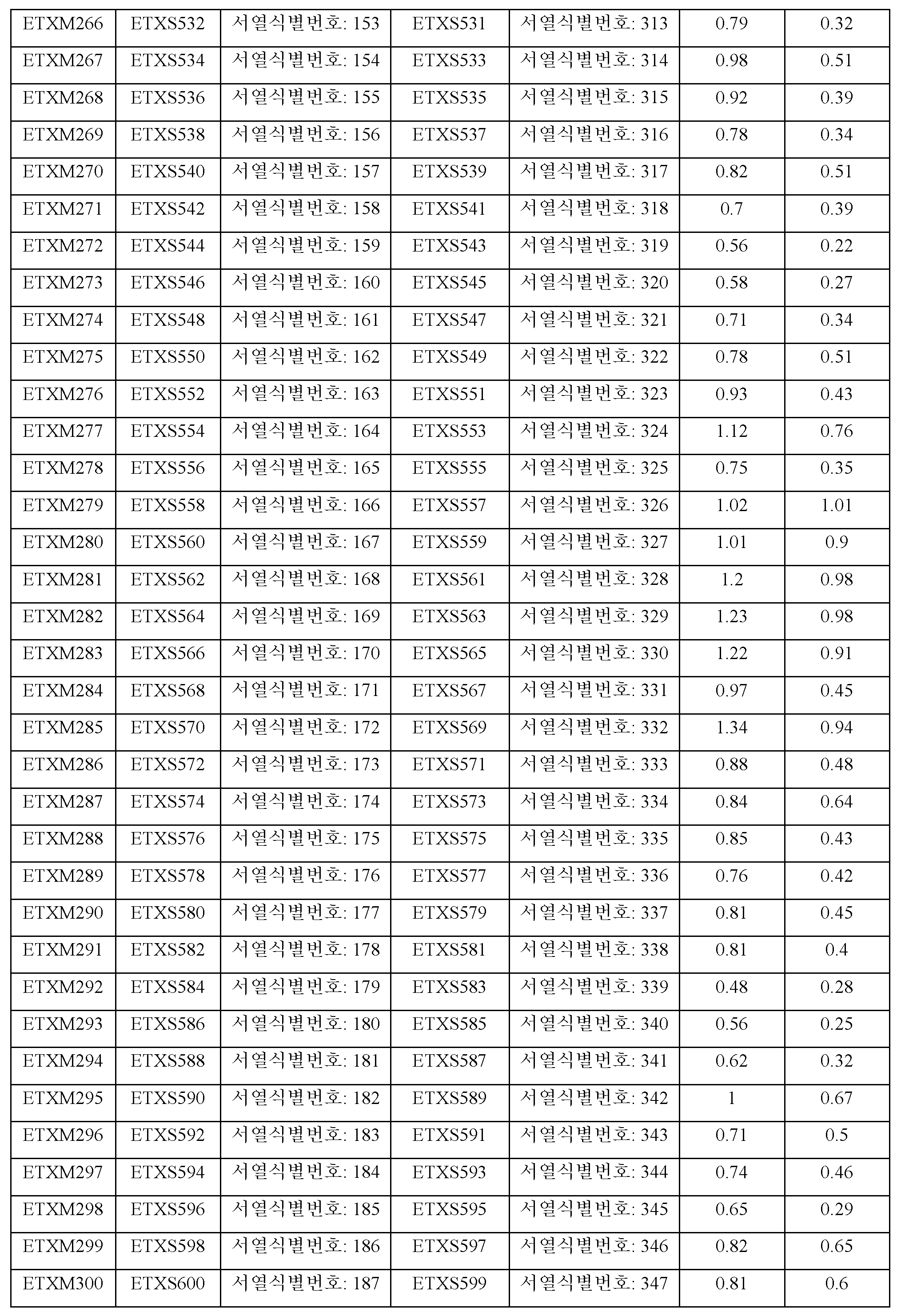
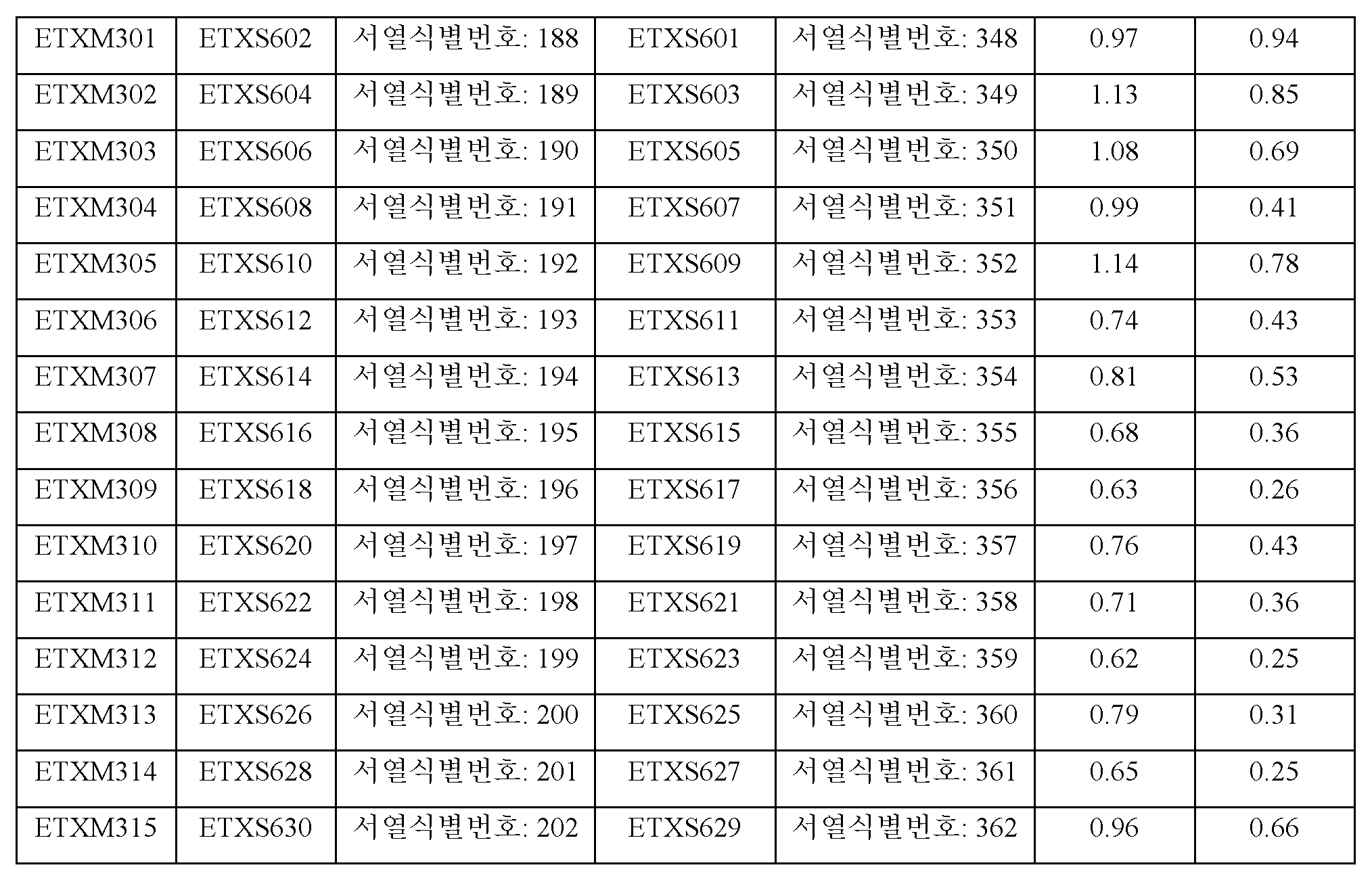
ZPI:ZPI:


표 7 - 용량-반응 데이터 표Table 7 - Dose-response data table
HCII:HCII:
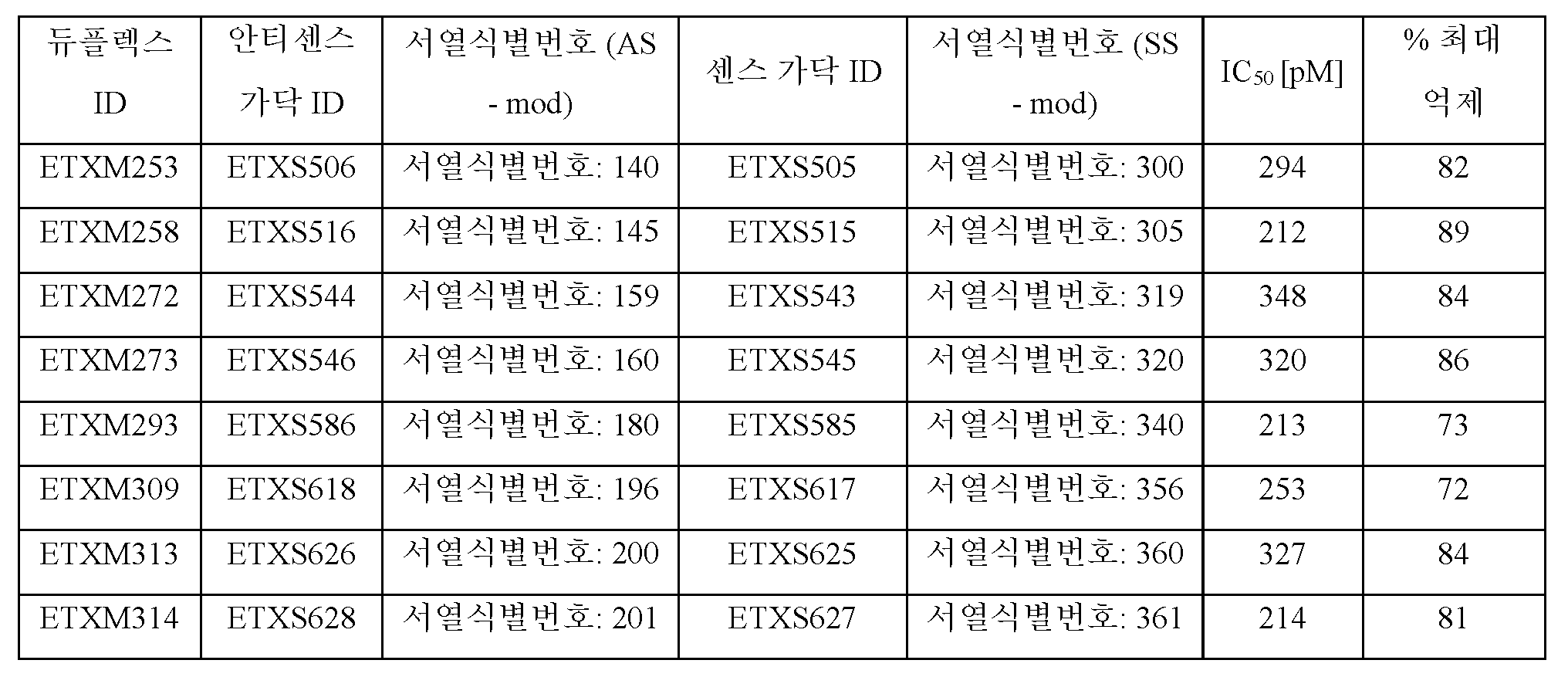
ZPI:ZPI:

실시예 11: 인간 Huh7 세포에서의 ZPI 및 B4GALT1 발현의 억제에 대한 용량-반응Example 11: Dose-response for inhibition of ZPI and B4GALT1 expression in human Huh7 cells
Huh7 세포 (인간 간세포-유래 세포주, JCRB 세포 은행으로부터 입수함)를 10% FBS로 보충된 둘베코 변형 이글 배지 (DMEM) 중에서 37℃에서 5% CO2의 분위기 하에 유지하였다. 0.1 nM 및 1 nM의 표적에 대해 설계된 siRNA 듀플렉스 또는 음성 대조군 siRNA로 세포를 형질감염시켰다. 9.7 μl 옵티-MEM (써모피셔) + 0.3 μl 리포펙타민 RNAiMAX (써모피셔)를 10 μl의 각각의 siRNA 듀플렉스에 첨가함으로써 형질감염을 수행하였다. 혼합물을 실온에서 15분 동안 인큐베이션한 후, 20,000개의 Huh7 세포를 함유하는 완전 성장 배지 100 μL에 첨가하였다. 세포를 37℃/5% CO2에서 24시간 동안 인큐베이션한 후, RNeasy 96 키트 (퀴아젠)를 사용하여 총 RNA 정제하였다. 각각의 듀플렉스를 이중 웰에서의 형질감염에 의해 시험하고, 실험을 3회 반복하였다.Huh7 cells (a human hepatocyte-derived cell line, obtained from JCRB Cell Bank) were maintained in Dulbecco's modified Eagle's medium (DMEM) supplemented with 10% FBS at 37°C in an atmosphere of 5% CO 2 . Cells were transfected with siRNA duplexes designed against the target at 0.1 nM and 1 nM or negative control siRNA. Transfections were performed by adding 9.7 μl Opti-MEM (ThermoFisher) + 0.3 μl Lipofectamine RNAiMAX (ThermoFisher) to 10 μl of each siRNA duplex. The mixture was incubated at room temperature for 15 minutes and then added to 100 μL of complete growth medium containing 20,000 Huh7 cells. After incubation of cells at 37°C/5% CO2 for 24 h, total RNA was purified using the RNeasy 96 kit (Qiagen). Each duplex was tested by transfection in duplicate wells, and the experiment was repeated three times.
cDNA 합성을 패스트킹 RT 키트 (gDNase 포함) 키트 (티안젠)를 사용하여 수행하였다. 실시간 정량적 PCR (qPCR)을 택맨 유전자 발현 검정 키트 (써모피셔 사이언티픽)를 사용하여 인간 B4GALT1 (Hs00155245_m1), 인간 ZPI (Hs01547819_m1) 및 인간 GAPDH (Hs02786624_g1)에 특이적인 프라이머로 ABI 프리즘 7900HT 또는 ABI 퀀트스튜디오 7 상에서 수행하였다.cDNA synthesis was performed using the FastKing RT Kit with gDNase (Tianjen). Real-time quantitative PCR (qPCR) was performed on ABI Prism 7900HT or
qPCR을 각각의 웰로부터 유래된 cDNA에 대해 이중으로 수행하고, 평균 Ct를 계산하였다. 상대적 표적 발현은 GAPDH에 대해 정규화되고 비처리된 세포에 대해 상대적인 비교 Ct (ΔΔCt) 방법을 사용하여 평균 Ct 값으로부터 계산하였다.qPCR was performed in duplicate on cDNA from each well and the mean Ct was calculated. Relative target expression was normalized to GAPDH and calculated from the mean Ct values using the comparative Ct (ΔΔCt) method relative to untreated cells.
ZPI의 억제에 대해, siRNA 듀플렉스 ETXM1184 및 ETXM1199를 시험하였다 (도 10). B4GALT1의 억제에 대해, siRNA 듀플렉스 ETXM1200, ETXM1201, ETXM 1203 및 ETXM1204를 시험하였다 (도 11 및 12).For inhibition of ZPI, siRNA duplexes ETXM1184 and ETXM1199 were tested (Fig. 10). For inhibition of B4GALT1, siRNA duplexes ETXM1200, ETXM1201, ETXM 1203, and ETXM1204 were tested (Figs. 11 and 12).
실시예 12: 혈우병 마우스 모델에서의 생체내 효능 데이터Example 12: In vivo efficacy data in a hemophilia mouse model
혈관절증은 관절 공간으로의 출혈로서 정의되며, 이는 혈우병의 공통 특색이다. 반복된 혈관절증의 장기 결과는 혈우병성 관절병증으로 공지된 영구적 관절 질환의 발생이다. 혈우병 환자의 약 50%에서 중증 관절병증이 발생하여, 이는 만성 관절통, 감소된 운동 및 기능 범위, 및 감소된 삶의 질을 초래한다. 혈우병성 관절병증은 활막 증식증, 만성 염증, 섬유증 및 혈철증을 특징으로 한다.Hemarthrosis is defined as bleeding into a joint space and is a common feature of hemophilia. The long-term consequence of repeated hemarthrosis is the development of permanent joint disease known as hemophilic arthropathy. Approximately 50% of people with hemophilia develop severe arthropathy, resulting in chronic joint pain, decreased range of motion and function, and decreased quality of life. Hemophilic arthropathy is characterized by synovial hyperplasia, chronic inflammation, fibrosis, and hemosiderosis.
사용된 혈관절증의 모델은 Haem A 마우스에서의 무릎 출혈의 유도 및 적절한 배경 야생형 (WT) 계통이었으며, 관절 내로의 출혈의 진행을 손상 후 10일까지 모니터링하였다. 동일한 연구를 2회 수행하여 분석을 위한 동물의 수를 증가시켰다.The model of hemangioma used was the induction of knee hemorrhage in Haem A mice and an appropriate background wild-type (WT) strain, and the progression of hemorrhage into the joint was monitored for up to 10 days post-injury. Identical studies were performed in duplicate to increase the number of animals for analysis.
이들 반복 연구의 목적은 ETXM1184의 예방적 투여가 관절 출혈 손상 후 A형 혈우병 마우스에서 혈관절증을 감소시킬 수 있음을 입증하는 것이었다. 피투시란 (항트롬빈 (AT)을 표적화하는 siRNA)을 참조로서 사용하였다. 애드베이트 (재조합 FVIII)를 양성 대조군으로서 사용하였다.The objective of these replicate studies was to demonstrate that prophylactic administration of ETXM1184 can reduce hemarthrosis in hemophilia A mice following joint haemorrhage injury. Fitusiran (siRNA targeting antithrombin (AT)) was used as a reference. Advate (recombinant FVIII) was used as a positive control.
이를 위해, 총 20마리의 Haem A 마우스 (Bi, L., Lawler, A., Antonarakis, S. et al. Targeted disruption of the mouse factor VIII gene produces a model of haemophilia A. Nat Genet 10, 119-121 (1995). https://doi.org/10.1038/ng0595-119) 및 10마리의 WT 마우스를 본 연구에 사용하였다:For this purpose, a total of 20 Haem A mice (Bi, L., Lawler, A., Antonarakis, S. et al. Targeted disruption of the mouse factor VIII gene produces a model of haemophilia
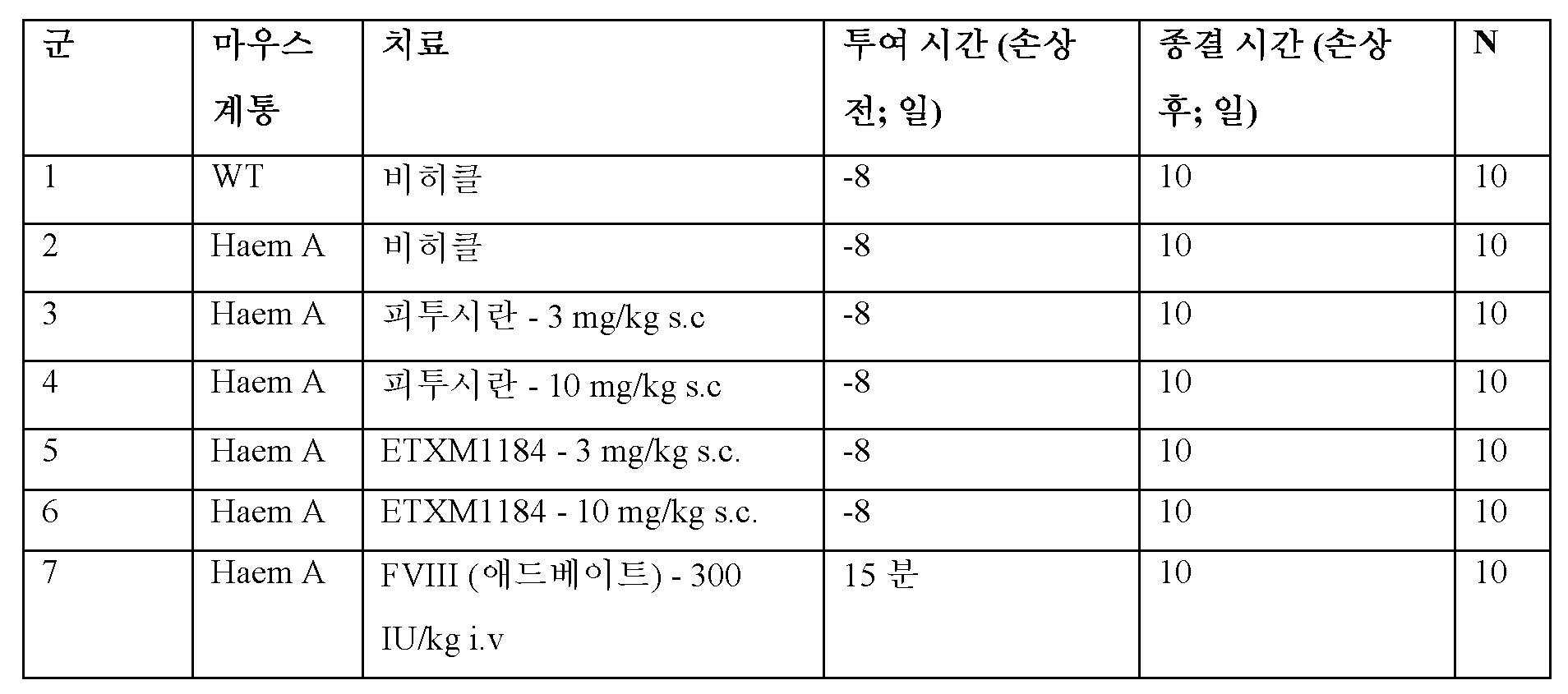
무릎 출혈 유도 8일 전에, 마우스에 GalNAc-siRNA 구축물 ETXM1184, 피투시란 또는 비히클 (0.9% 염수)을 5 ml/kg의 용량 부피로 피하 (s.c.) 주사하였다. 애드베이트를 관절 출혈 유도 15분 전에 정맥내로 주사하였다.Eight days before knee hemorrhage induction, mice were injected subcutaneously (s.c.) with GalNAc-siRNA construct ETXM1184, pitusiran, or vehicle (0.9% saline) at a dose volume of 5 ml/kg. Advate was injected intravenously 15 min before joint hemorrhage induction.
무릎 출혈을 유도하기 위해, 마우스를 칭량하고, 이소플루란 흡입 마취제를 사용하여 마취시켰다. 양쪽 다리를 면도하여 무릎 관절을 노출시켰다. 마우스에게 무통각을 위해 10 ml/kg의 부프레노르핀을 피하 주사하고, 양 무릎의 직경을 전자 캘리퍼로 측정하였다. 후속적으로, 양 무릎을 70% 에탄올로 닦았다.To induce knee bleeding, mice were weighed and anesthetized using isoflurane inhalation anesthesia. Both legs were shaved to expose the knee joints. Mice were injected subcutaneously with 10 ml/kg buprenorphine for analgesia, and the diameters of both knees were measured using an electronic caliper. Subsequently, both knees were wiped with 70% ethanol.
30 G 멸균 피하 바늘을 한 무릎의 슬개하 인대에 삽입하였다. 주사된 무릎을 좌측과 우측 사이에서 무작위화하고, 주사된 측면을 기록하였다. 마우스를 마취제로부터 제거하고, 가온된 케이지에서 회복시킨 후, 홈 케이지로 돌려보냈다.A 30 G sterile hypodermic needle was inserted into the infrapatellar ligament of one knee. The injected knee was randomized between the left and right, and the side injected was recorded. Mice were removed from the anesthetic, allowed to recover in a warmed cage, and then returned to their home cages.
마우스를 처음 6시간 동안 정기적으로 모니터링하고, 부프레노르핀을 손상 6시간 후에 진통에 대해 10 ml/kg으로 피하 주사하였다. 손상된 무릎의 시각적 출혈 점수 (VBS)를 손상 후 72시간 및 10일에 평가하였다.Mice were monitored regularly for the first 6 h, and buprenorphine was injected subcutaneously at 10 ml/kg for analgesia 6 h after injury. The visual bleeding score (VBS) of the injured knee was assessed at 72 h and 10 days after injury.
모든 마우스를 과도한 혈액 손실의 임상 징후에 대해 매일 주의깊게 검사하였다. 과도한 혈액 손실, 입모, 케이지 메이트로부터 물러남 또는 찡그림의 임상 징후를 나타내는 마우스는 복지상의 이유로 사망시켰다.All mice were carefully examined daily for clinical signs of excessive blood loss. Mice showing clinical signs of excessive blood loss, piloerection, withdrawal from cage mates, or grimacing were killed for welfare reasons.
마우스를 손상 후 10일에 연구로부터 중단시켰다.Mice were discontinued from the
시트레이트 처리된 혈액 샘플을 이소플루란 마취 하에 심장 천자에 의해 채취하고, 혈장을 제조하고, 분취물을 드라이 아이스 상에서 동결시킨 후, -80℃에서 저장하였다. 이를 위해, 혈액을 3.8% 시트르산나트륨 내로 1 대 9의 비로 수집한 후, 7000 x g에서 10분 동안 4℃에서 원심분리하였다. 상세하게, 하기 단계를 수행하였다:Citrated blood samples were collected by cardiac puncture under isoflurane anesthesia, plasma was prepared, aliquots were frozen on dry ice and stored at -80°C. For this purpose, blood was collected in a ratio of 1 to 9 in 3.8% sodium citrate and centrifuged at 7000 × g for 10 min at 4°C. In detail, the following steps were performed:
1. 심장 천자에 의해 혈액을 수집한다.1. Collect blood by cardiac puncture.
2. 시린지 및 바늘을 시트르산나트륨 용액 (3.8%)으로 플러싱하여, 용액을 시린지의 허브에 남긴다 (~30 μl).2. Flush the syringe and needle with sodium citrate solution (3.8%), leaving the solution in the hub of the syringe (~30 μl).
3. 혈액 수집 후, 샘플을 1.5 ml 마이크로원심분리 튜브 내로 배출하고, 충분한 시트르산나트륨 용액 (3.8%)을 첨가하여 1:9 비의 시트르산나트륨:혈액을 달성하도록 한다. 시트르산나트륨 용액을 샘플에 직접 첨가하지 않고 튜브의 측면에 첨가한다. 4-6회 반전시켜 혼합한다. 샘플을 즉시 원심분리하지 않는 경우, 이용가능한 경우 냉장고에 또는 대안적으로 랩핑된 얼음 블록 상에 두고, 수집 튜브를 규칙적으로 계속 뒤집는다.3. After blood collection, drain the sample into a 1.5 ml microcentrifuge tube and add enough sodium citrate solution (3.8%) to achieve a 1:9 ratio of sodium citrate:blood. Do not add the sodium citrate solution directly to the sample, but add it to the side of the tube. Invert 4-6 times to mix. If the sample is not centrifuged immediately, place it in the refrigerator if available, or alternatively on a wrapped ice block, and continue to invert the collection tube regularly.
4. 샘플을 가능한 한 빨리 7000 x g의 스핀 속도로 10분 동안 4℃에서 원심분리하였다.4. The sample was centrifuged at 4°C for 10 minutes at a spin speed of 7000 x g as quickly as possible.
5. 샘플로부터 모든 혈장을 제거하고, 신선한 마이크로원심분리 튜브에 넣는다.5. Remove all plasma from the sample and place it into a fresh microcentrifuge tube.
6. 혈장을 하기와 같이 사전-표지된 튜브 (써모 사이언티픽; 10775974) 내로 분취한다:6. Aliquot the plasma into pre-labeled tubes (Thermo Scientific; 10775974) as follows:
o 잠재적 TGA 검정의 경우 30 μlo For potential TGA assay, 30 μl
o 잠재적 APTT 검정의 경우 100 μlo For potential APTT assay, 100 μl
o 잠재적 표적 단백질 풍부도 분석의 경우 남아있는 모든 것.o All that remains for potential target protein abundance analysis.
7. 모든 분취물을 즉시 습윤 얼음/드라이 아이스 상에 둔다.7. Immediately place all fractions on wet ice/dry ice.
8. 샘플을 습윤 얼음/드라이 아이스 상에 수송한다.8. Transport the sample on wet ice/dry ice.
9. 샘플을 -20℃/-80℃ 동결기로 옮겨 사용 시까지 저장한다.9. Transfer the sample to a -20℃/-80℃ freezer and store until use.
간을 제거하고, 각각의 엽의 최대 3개의 부분을 RNA 레이터 중에 두고, 4℃에서 24 내지 72시간 동안 유지한다. 이어서, 조직을 건조 블롯팅하고, 칭량하고, -80℃에서 저장한다. 상세하게, 하기 단계를 수행하였다:The livers were removed and up to three portions of each lobe were placed in an RNA later and kept at 4°C for 24 to 72 hours. The tissues were then dry blotted, weighed, and stored at -80°C. In detail, the following steps were performed:
1. 심장 천자 직후에, 경추 탈구에 의해 마우스를 사멸시킨다.1. Immediately after cardiac puncture, mice were killed by cervical dislocation.
2. 복벽을 절개하고, 가능한 한 신속하게 간을 제거한다.2. Make an incision in the abdominal wall and remove the liver as quickly as possible.
3. 간을 습윤 얼음 상의 페트리 디쉬 상에 두어 샘플 분해를 최소화한다.3. Place the liver in a petri dish on wet ice to minimize sample degradation.
4. 하기 엽 각각으로부터 간의 3 x ~50 mg 조각을 절단한다: 좌측 외측 엽, 내측 엽, 우측 외측 엽 및 꼬리엽. 이들 간 조각을 500 μl RNA레이터를 함유하는 사전-표지된 튜브 (1.5 ml 마이크로원심분리 튜브)에 즉시 넣고, 수집 튜브를 습윤 얼음 상에 둔다.4. Cut 3 x ~50 mg pieces of liver from each of the following lobes: left lateral lobe, medial lobe, right lateral lobe, and caudate lobe. Immediately place these liver pieces into pre-labeled tubes (1.5 ml microcentrifuge tubes) containing 500 μl RNAlater and place the collection tubes on wet ice.
a. 습윤 얼음 상에서 수송하고, 4℃에서 저장으로 옮긴다.a. Transport on wet ice and store at 4°C.
b. 24-72시간의 기간 후에, 간 샘플을 블롯팅하고 칭량한다. 중량을 말단 시트에 기록한다.b. After a period of 24-72 hours, blot and weigh the liver sample. Record the weight on the end sheet.
c. 장기간 저장을 위해 -80℃로 옮긴다.c. Transfer to -80℃ for long-term storage.
5. 임의의 예비 간을 수집하고, 별개의 사전-표지된 수집 튜브 (2 ml 마이크로원심분리 튜브)에 넣는다.5. Collect random reserve liver samples and place them in separate pre-labeled collection tubes (2 ml microcentrifuge tubes).
a. 잠재적 미래 분석을 위해 드라이 아이스 상에서 동결시킨다.a. Freeze on dry ice for potential future analysis.
b. 샘플을 드라이 아이스 상에 수송한다.b. Transport the sample on dry ice.
c. 장기간 저장을 위해 -80℃로 옮긴다.c. Transfer to -80℃ for long-term storage.
6. 동물들 간 모든 절개 도구를 세정하여 임의의 교차 오염을 방지한다.6. Clean all cutting tools between animals to prevent any cross contamination.
피부를 다리로부터 제거하고, 무릎 관절을 측정한다. 후속적으로, 다리를 10% 포르말린에 넣은 후, 탈석회화 및 슬라이드를 제조한다. 상세하게, 하기 단계를 수행하였다:The skin was removed from the leg, and the knee joint was measured. Subsequently, the leg was placed in 10% formalin, decalcified, and slides were prepared. In detail, the following steps were performed:
1. 간을 제거한 후, 손상된 무릎과 손상되지 않은 무릎 둘 다의 직경을 측정하고 기록한다.1. After removing the liver, measure and record the diameters of both the injured and uninjured knees.
2. 양 무릎으로부터 피부를 제거한다. 시각적 출혈 점수를 수행하고, 무릎 관절을 측정한다.2. Remove skin from both knees. Perform visual bleeding scoring and measure the knee joint.
3. 대퇴골의 상부로부터 발목 관절까지 다리를 절개하고, 무릎 및 관련 구조에 어떠한 손상도 유발하지 않도록 주의하면서 일부 과잉 근육을 제거한다. 무릎을 조직학적 분석을 위해 처리될 10% 중성 완충 포르말린을 함유하는 사전-표지된 튜브 (7 ml 바이조 튜브)에 넣는다.3. Cut the leg from the upper part of the femur to the ankle joint, and remove some excess muscle, taking care not to cause any damage to the knee and related structures. Place the knee in a pre-labeled tube (7 ml Vijo tube) containing 10% neutral buffered formalin to be processed for histological analysis.
무릎 출혈 유도 후 제3일 및 제10일 둘 다에서, GalNAc-siRNA 구축물 ETXM1184를 투여받은 Haem A 마우스는 비히클 (0.9% 염수)을 투여받은 Haem A 마우스와 비교하여 감소된 시각적 출혈 점수를 나타냈다 (도 16a&b 참조). 게다가, GalNAc-siRNA 구축물 ETXM1184를 투여받은 마우스의 무릎 직경은 비히클을 투여받은 마우스에 비해 무릎 출혈의 유도 후 더 빠르게 회복되었다 (도 18 (상단 우측)). 이 관찰은 손상된 및 비-손상된 피부 무릎 직경의 직경 사이의 차이를 비교함으로써 확인되었다 (도 18 (하단 좌측)).At both
ETXM1184와 피투시란 사이의 비교 데이터가 도 13-18에 제공되어 있다.Comparative data between ETXM1184 and Fitusiran are provided in Figures 13-18.
본 발명은 범위에 있어서, 예를 들어 본 발명의 다양한 측면을 예시하기 위해 제공되는 특정한 개시된 실시양태로 제한되는 것으로 의도되지 않는다. 기재된 조성물 및 방법에 대한 다양한 변형은 본원의 설명 및 교시로부터 명백해질 것이다. 이러한 변형은 본 개시내용의 진정한 범주 및 취지로부터 벗어나지 않으면서 실시될 수 있고, 본 개시내용의 범주 내에 속하는 것으로 의도된다.The present invention is not intended to be limited in scope to the specific disclosed embodiments, which are provided to illustrate various aspects of the invention, for example. Various modifications to the described compositions and methods will become apparent from the description and teachings herein. Such modifications may be made without departing from the true scope and spirit of the present disclosure, and are intended to fall within the scope of the present disclosure.
본 명세서의 서열과 첨부된 서열 목록의 서열 사이의 모호성의 경우, 본원에 제공된 서열이 정확한 서열인 것으로 간주된다.In case of ambiguity between a sequence in this specification and a sequence in the attached sequence listing, the sequence provided herein will be deemed to be the correct sequence.
서열목록 전자파일 첨부Attach electronic file of sequence list
Claims (20)
여기서 상기 제2 및 제1 가닥의 뉴클레오시드는 하기와 같은 2' 당 변형 패턴 (5'-3')을 포함하는 것인 핵산:
제2 가닥 (5'-3'): Me - Me - Me - Me - Me - Me - F - Me - F - F - F - F - Me - Me - Me - Me - Me - Me - Me - Me - Me,
제1 가닥 (5'-3'): Me - F - Me - F - Me - F - Me - Me - Me - Me - Me - Me - Me - F - Me - F - Me - Me - Me - Me - Me - Me - Me
또는
제2 가닥 (5'-3'): Me - Me - Me - Me - Me - Me - Me - Me - F - F - F - Me - Me - Me - Me - Me - Me - Me - Me - Me - Me,
제1 가닥 (5'-3'): Me - F - Me - Me - Me - F - Me - Me - F - Me - Me - Me - Me - F - Me - F - Me - Me - Me - Me - Me - Me - Me.A nucleic acid for inhibiting expression of a target gene, comprising a duplex region comprising a first strand at least partially complementary to a portion of RNA transcribed from a target gene, and a second strand at least partially complementary to the first strand,
A nucleic acid wherein the nucleosides of the second and first strands comprise the following 2' sugar modification pattern (5'-3'):
Second strand (5'-3'): Me - Me - Me - Me - Me - Me - F - Me - F - F - F - F - Me - Me - Me - Me - Me - Me - Me - Me - Me,
First strand (5'-3'): Me - F - Me - F - Me - F - Me - Me - Me - Me - Me - Me - Me - F - Me - F - Me - Me - Me - Me - Me - Me - Me
or
Second strand (5'-3'): Me - Me - Me - Me - Me - Me - Me - Me - F - F - F - Me - Me - Me - Me - Me - Me - Me - Me - Me - Me,
First strand (5'-3'): Me - F - Me - Me - Me - F - Me - Me - F - Me - Me - Me - Me - F - Me - F - Me - Me - Me - Me - Me - Me - Me.
제2 가닥 (5'-3'): Me(s)Me(s)Me - Me - Me - Me - F - Me - F - F - F - F - Me - Me - Me - Me - Me - Me - Me - Me - Me,
제1 가닥 (5'-3'): Me(s)F(s)Me - F - Me - F - Me - Me - Me - Me - Me - Me - Me - F - Me - F - Me - Me - Me - Me - Me(s)Me(s)Me
또는
제2 가닥 (5'-3'): Me(s)Me(s)Me - Me - Me - Me - Me - Me - F - F - F - Me - Me - Me - Me - Me - Me - Me - Me - Me - Me,
제1 가닥 (5'-3'): Me(s)F(s)Me - Me - Me - F - Me - Me - F - Me - Me - Me - Me - F - Me - F - Me - Me - Me - Me - Me(s)Me(s)Me
여기서 (s)는 포스포로티오에이트 뉴클레오시드간 연결이다.In the first paragraph, a nucleic acid wherein the nucleosides of the second and first strands comprise the following 2' sugar and linkage modification pattern (5'-3'):
Second strand (5'-3'): Me(s)Me(s)Me - Me - Me - Me - F - Me - F - F - F - F - Me - Me - Me - Me - Me - Me - Me - Me - Me,
First strand (5'-3'): Me(s)F(s)Me - F - Me - F - Me - Me - Me - Me - Me - Me - Me - F - Me - F - Me - Me - Me - Me - Me(s)Me(s)Me
or
Second strand (5'-3'): Me(s)Me(s)Me - Me - Me - Me - Me - Me - F - F - F - Me - Me - Me - Me - Me - Me - Me - Me - Me - Me,
First strand (5'-3'): Me(s)F(s)Me - Me - Me - F - Me - Me - F - Me - Me - Me - Me - F - Me - F - Me - Me - Me - Me - Me(s)Me(s)Me
Here, (s) is a phosphorothioate internucleoside linkage.
제2 가닥 (5'-3'): ia - ia - Me - Me - Me - Me - Me - Me - F - Me - F - F - F - F - Me - Me - Me - Me - Me - Me - Me - Me - Me,
제1 가닥 (5'-3'): Me - F - Me - F - Me - F - Me - Me - Me - Me - Me - Me - Me - F - Me - F - Me - Me - Me - Me - Me - Me - Me
또는
제2 가닥 (5'-3'): ia - ia - Me - Me - Me - Me - Me - Me - Me - Me - F - F - F - Me - Me - Me - Me - Me - Me - Me - Me - Me - Me,
제1 가닥 (5'-3'): Me - F - Me - Me - Me - F - Me - Me - F - Me - Me - Me - Me - F - Me - F - Me - Me - Me - Me - Me - Me - Me
여기서 ia는 역전된 무염기성 뉴클레오시드를 나타낸다.In the first paragraph, a nucleic acid wherein the nucleosides of the second and first strands comprise the following 2' sugar and abasic modification pattern (5'-3'):
Second strand (5'-3'): ia - ia - Me - Me - Me - Me - Me - Me - F - Me - F - F - F - F - Me - Me - Me - Me - Me - Me - Me - Me - Me,
First strand (5'-3'): Me - F - Me - F - Me - F - Me - Me - Me - Me - Me - Me - Me - F - Me - F - Me - Me - Me - Me - Me - Me - Me
or
Second strand (5'-3'): ia - ia - Me - Me - Me - Me - Me - Me - Me - Me - Me - F - F - F - Me - Me - Me - Me - Me - Me - Me - Me - Me - Me,
First strand (5'-3'): Me - F - Me - Me - Me - F - Me - Me - F - Me - Me - Me - Me - F - Me - F - Me - Me - Me - Me - Me - Me - Me
Here, ia represents an inverted abasic nucleoside.
제2 가닥 (5'-3'): ia - ia - Me(s)Me(s)Me - Me - Me - Me - F - Me - F - F - F - F - Me - Me - Me - Me - Me - Me - Me - Me - Me,
제1 가닥 (5'-3'): Me(s)F(s)Me - F - Me - F - Me - Me - Me - Me - Me - Me - Me - F - Me - F - Me - Me - Me - Me - Me(s)Me(s)Me
또는
제2 가닥 (5'-3'): ia - ia - Me(s)Me(s)Me - Me - Me - Me - Me - Me - F - F - F - Me - Me - Me - Me - Me - Me - Me - Me - Me - Me,
제1 가닥 (5'-3'): Me(s)F(s)Me - Me - Me - F - Me - Me - F - Me - Me - Me - Me - F - Me - F - Me - Me - Me - Me - Me(s)Me(s)Me
여기서:
(s)는 포스포로티오에이트 뉴클레오시드간 연결이고,
ia는 역전된 무염기성 뉴클레오시드를 나타낸다.In the first paragraph, a nucleic acid wherein the nucleosides of the second and first strands comprise the following 2' sugar, abasic and linkage modification patterns (5'-3'):
Second strand (5'-3'): ia - ia - Me(s)Me(s)Me - Me - Me - Me - F - Me - F - F - F - F - Me - Me - Me - Me - Me - Me - Me - Me - Me,
First strand (5'-3'): Me(s)F(s)Me - F - Me - F - Me - Me - Me - Me - Me - Me - Me - F - Me - F - Me - Me - Me - Me - Me(s)Me(s)Me
or
Second strand (5'-3'): ia - ia - Me(s)Me(s)Me - Me - Me - Me - Me - Me - F - F - F - Me - Me - Me - Me - Me - Me - Me - Me - Me - Me,
First strand (5'-3'): Me(s)F(s)Me - Me - Me - F - Me - Me - F - Me - Me - Me - Me - F - Me - F - Me - Me - Me - Me - Me(s)Me(s)Me
Here:
(s) is a phosphorothioate internucleoside linkage,
ia represents an inverted abasic nucleoside.
링커를 통해 핵산에 접합된
(iv) 1개 이상의 N-아세틸 갈락토사민 (GalNAc) 리간드, 및/또는
(v) 1개 이상의 N-아세틸 갈락토사민 (GalNAc) 리간드 유도체, 및/또는
(vi) 1개 이상의 N-아세틸 갈락토사민 (GalNAc) 리간드 및/또는 그의 유도체
를 포함하는 것인 핵산.In claim 11, the ligand moiety
attached to a nucleic acid via a linker
(iv) one or more N-acetyl galactosamine (GalNAc) ligands, and/or
(v) one or more N-acetyl galactosamine (GalNAc) ligand derivatives, and/or
(vi) one or more N-acetyl galactosamine (GalNAc) ligands and/or derivatives thereof;
A nucleic acid comprising:

여기서:
R1은 각 경우에 독립적으로 수소, 메틸 및 에틸로 이루어진 군으로부터 선택되고;
R2는 수소, 히드록시, -OC1-3알킬, -C(=O)OC1-3알킬, 할로 및 니트로로 이루어진 군으로부터 선택되고;
X1 및 X2는 각 경우에 독립적으로 메틸렌, 산소 및 황으로 이루어진 군으로부터 선택되고;
m은 1 내지 6의 정수이고;
n은 1 내지 10의 정수이고;
q, r, s, t, v는 독립적으로 0 내지 4의 정수이고, 단,
(i) q 및 r은 둘 다 동시에 0일 수는 없고;
(ii) s, t 및 v는 모두 동시에 0일 수는 없고;
Z는 올리고뉴클레오시드이다.A nucleic acid having the following structure according to any one of claims 11 to 13:
Here:
R 1 is independently selected at each occurrence from the group consisting of hydrogen, methyl and ethyl;
R 2 is selected from the group consisting of hydrogen, hydroxy, -OC 1-3 alkyl, -C(=O)OC 1-3 alkyl, halo, and nitro;
X 1 and X 2 are each independently selected from the group consisting of methylene, oxygen and sulfur;
m is an integer from 1 to 6;
n is an integer from 1 to 10;
q, r, s, t, v are independently integers from 0 to 4, and
(i) q and r cannot both be 0 at the same time;
(ii) s, t and v cannot all be 0 at the same time;
Z is an oligonucleoside.
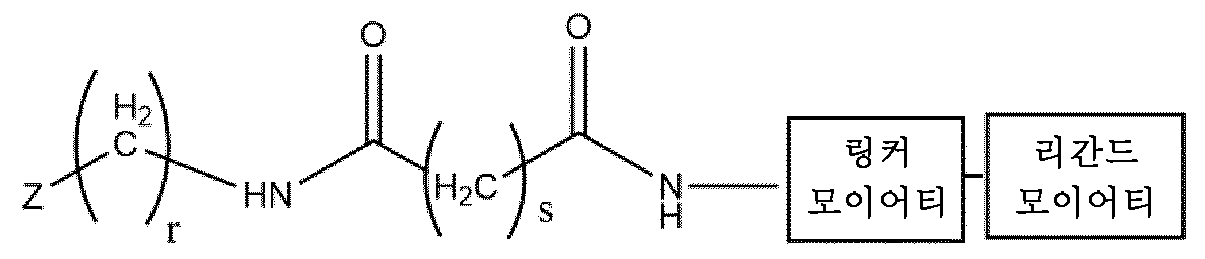
여기서:
r 및 s는 독립적으로 1 내지 16으로부터 선택된 정수이고;
Z는 올리고뉴클레오시드이다.A nucleic acid having the following structure according to any one of claims 11 to 13:
Here:
r and s are integers independently selected from 1 to 16;
Z is an oligonucleoside.
Applications Claiming Priority (7)
| Application Number | Priority Date | Filing Date | Title |
|---|---|---|---|
| US202263369629P | 2022-07-27 | 2022-07-27 | |
| US63/369,629 | 2022-07-27 | ||
| US202263370462P | 2022-08-04 | 2022-08-04 | |
| US63/370,462 | 2022-08-04 | ||
| EP23155089.8 | 2023-02-06 | ||
| EP23155089 | 2023-02-06 | ||
| PCT/EP2023/070919 WO2024023262A2 (en) | 2022-07-27 | 2023-07-27 | Nucleic acid compounds |
Publications (1)
| Publication Number | Publication Date |
|---|---|
| KR20250043473A true KR20250043473A (en) | 2025-03-28 |
Family
ID=87554809
Family Applications (1)
| Application Number | Title | Priority Date | Filing Date |
|---|---|---|---|
| KR1020257006008A Pending KR20250043473A (en) | 2022-07-27 | 2023-07-27 | Nucleic acid compounds |
Country Status (9)
| Country | Link |
|---|---|
| US (1) | US20250376680A1 (en) |
| EP (1) | EP4562150A2 (en) |
| JP (1) | JP2025524136A (en) |
| KR (1) | KR20250043473A (en) |
| CN (1) | CN120322552A (en) |
| AU (1) | AU2023313321A1 (en) |
| CA (1) | CA3259162A1 (en) |
| IL (1) | IL318225A (en) |
| WO (1) | WO2024023262A2 (en) |
Families Citing this family (3)
| Publication number | Priority date | Publication date | Assignee | Title |
|---|---|---|---|---|
| WO2025021989A1 (en) * | 2023-07-27 | 2025-01-30 | E-Therapeutics Plc | Inhibitors of expression and/or function |
| EP4652283A1 (en) * | 2024-01-31 | 2025-11-26 | E-Therapeutics plc | Nucleic acid compounds for zpi inhibition |
| EP4707391A1 (en) * | 2024-09-10 | 2026-03-11 | e-therapeutics PLC | Nucleic acid compounds for zpi inhibition |
Family Cites Families (12)
| Publication number | Priority date | Publication date | Assignee | Title |
|---|---|---|---|---|
| WO2011084193A1 (en) * | 2010-01-07 | 2011-07-14 | Quark Pharmaceuticals, Inc. | Oligonucleotide compounds comprising non-nucleotide overhangs |
| TWI865997B (en) * | 2016-12-16 | 2024-12-11 | 美商阿尼拉製藥公司 | METHODS FOR TREATING OR PREVENTING TTR-ASSOCIATED DISEASES USING TRANSTHYRETIN (TTR) iRNA COMPOSITIONS |
| SG11201912178VA (en) * | 2017-09-11 | 2020-01-30 | Arrowhead Pharmaceuticals Inc | Rnai agents and compositions for inhibiting expression of apolipoprotein c-iii (apoc3) |
| JP7360716B2 (en) * | 2017-12-01 | 2023-10-13 | スーチョウ リボ ライフ サイエンス カンパニー、リミテッド | Nucleic acids, compositions and complexes containing the nucleic acids, and methods of preparation and use |
| US11560563B2 (en) | 2018-04-05 | 2023-01-24 | Silence Therapeutics Gmbh | SiRNAs with vinylphosphonate at the 5′ end of the antisense strand |
| JP7376952B2 (en) * | 2018-09-30 | 2023-11-09 | スーチョウ リボ ライフ サイエンス カンパニー、リミテッド | siRNA complex and its preparation method and use |
| SG11202113112WA (en) * | 2019-05-30 | 2021-12-30 | Amgen Inc | Rnai constructs for inhibiting scap expression and methods of use thereof |
| TW202130809A (en) * | 2019-10-29 | 2021-08-16 | 美商愛羅海德製藥公司 | Rnai agents for inhibiting expression of beta-enac, compositions thereof, and methods of use |
| JP7827623B2 (en) * | 2019-12-09 | 2026-03-10 | アムジエン・インコーポレーテツド | RNAi constructs and methods for inhibiting LPA expression |
| EP4196584A2 (en) * | 2020-08-13 | 2023-06-21 | Amgen Inc. | Rnai constructs and methods for inhibiting marc1 expression |
| CN117355534B (en) * | 2021-01-30 | 2026-05-01 | 唐格拉姆治疗公司 | Conjugated oligonucleotide compounds, methods of preparation and uses thereof |
| CA3232053A1 (en) * | 2021-10-08 | 2023-04-13 | E-Therapeutics Plc | Nucleic acids containing abasic nucleosides |
-
2023
- 2023-07-27 KR KR1020257006008A patent/KR20250043473A/en active Pending
- 2023-07-27 US US18/876,959 patent/US20250376680A1/en active Pending
- 2023-07-27 CN CN202380053812.XA patent/CN120322552A/en active Pending
- 2023-07-27 EP EP23750600.1A patent/EP4562150A2/en active Pending
- 2023-07-27 AU AU2023313321A patent/AU2023313321A1/en active Pending
- 2023-07-27 WO PCT/EP2023/070919 patent/WO2024023262A2/en not_active Ceased
- 2023-07-27 JP JP2025504424A patent/JP2025524136A/en active Pending
- 2023-07-27 IL IL318225A patent/IL318225A/en unknown
- 2023-07-27 CA CA3259162A patent/CA3259162A1/en active Pending
Also Published As
| Publication number | Publication date |
|---|---|
| JP2025524136A (en) | 2025-07-25 |
| US20250376680A1 (en) | 2025-12-11 |
| EP4562150A2 (en) | 2025-06-04 |
| AU2023313321A1 (en) | 2025-01-09 |
| WO2024023262A2 (en) | 2024-02-01 |
| IL318225A (en) | 2025-03-01 |
| CA3259162A1 (en) | 2024-02-01 |
| WO2024023262A3 (en) | 2024-05-02 |
| CN120322552A (en) | 2025-07-15 |
Similar Documents
| Publication | Publication Date | Title |
|---|---|---|
| US20250376680A1 (en) | Nucleic acid compounds | |
| KR20250043471A (en) | Nucleic acid compounds | |
| EP4388100B1 (en) | Double stranded nucleic acid compounds inhibiting zpi | |
| KR20250043472A (en) | Nucleic acid compounds | |
| KR20250021336A (en) | Inhibitors of expression and/or function | |
| WO2024023267A2 (en) | Nucleic acid compounds | |
| KR20260029506A (en) | Inhibitors of expression and/or function | |
| EP4707391A1 (en) | Nucleic acid compounds for zpi inhibition | |
| WO2024023252A2 (en) | Nucleic acid compounds | |
| JP2025524130A (en) | Nucleic acid compounds | |
| EP4652283A1 (en) | Nucleic acid compounds for zpi inhibition | |
| EP4562159A1 (en) | Inhibitors of expression and/or function |
Legal Events
| Date | Code | Title | Description |
|---|---|---|---|
| PA0105 | International application |
St.27 status event code: A-0-1-A10-A15-nap-PA0105 |
|
| PG1501 | Laying open of application |
St.27 status event code: A-1-1-Q10-Q12-nap-PG1501 |
|
| R18 | Changes to party contact information recorded |
Free format text: ST27 STATUS EVENT CODE: A-3-3-R10-R18-OTH-X000 (AS PROVIDED BY THE NATIONAL OFFICE) |
|
| R18-X000 | Changes to party contact information recorded |
St.27 status event code: A-3-3-R10-R18-oth-X000 |
|
| E13 | Pre-grant limitation requested |
Free format text: ST27 STATUS EVENT CODE: A-2-3-E10-E13-LIM-X000 (AS PROVIDED BY THE NATIONAL OFFICE) |
|
| E13-X000 | Pre-grant limitation requested |
St.27 status event code: A-2-3-E10-E13-lim-X000 |
|
| P11 | Amendment of application requested |
Free format text: ST27 STATUS EVENT CODE: A-2-2-P10-P11-NAP-X000 (AS PROVIDED BY THE NATIONAL OFFICE) |
|
| P11-X000 | Amendment of application requested |
St.27 status event code: A-2-2-P10-P11-nap-X000 |