LU88404A1 - Tris- (cyanato) -s-triazine, thus obtainable anisotropic thermosetting networks and a process for the production thereof - Google Patents
Tris- (cyanato) -s-triazine, thus obtainable anisotropic thermosetting networks and a process for the production thereof Download PDFInfo
- Publication number
- LU88404A1 LU88404A1 LU88404A LU88404A LU88404A1 LU 88404 A1 LU88404 A1 LU 88404A1 LU 88404 A LU88404 A LU 88404A LU 88404 A LU88404 A LU 88404A LU 88404 A1 LU88404 A1 LU 88404A1
- Authority
- LU
- Luxembourg
- Prior art keywords
- cyanato
- tris
- comonomers
- weight
- parts
- Prior art date
Links
- 238000000034 method Methods 0.000 title claims abstract description 26
- AOKFOGVKRNWDQS-UHFFFAOYSA-N (4,6-dicyanato-1,3,5-triazin-2-yl) cyanate Chemical compound N#COC1=NC(OC#N)=NC(OC#N)=N1 AOKFOGVKRNWDQS-UHFFFAOYSA-N 0.000 title claims description 22
- 229920001187 thermosetting polymer Polymers 0.000 title claims description 15
- 238000004519 manufacturing process Methods 0.000 title description 4
- 239000001257 hydrogen Substances 0.000 claims abstract description 11
- 229910052739 hydrogen Inorganic materials 0.000 claims abstract description 11
- UFHFLCQGNIYNRP-UHFFFAOYSA-N Hydrogen Chemical compound [H][H] UFHFLCQGNIYNRP-UHFFFAOYSA-N 0.000 claims abstract description 8
- 229910052736 halogen Inorganic materials 0.000 claims abstract description 7
- 150000002367 halogens Chemical class 0.000 claims abstract description 7
- 125000002496 methyl group Chemical group [H]C([H])([H])* 0.000 claims abstract description 7
- WKBOTKDWSSQWDR-UHFFFAOYSA-N Bromine atom Chemical compound [Br] WKBOTKDWSSQWDR-UHFFFAOYSA-N 0.000 claims abstract description 5
- ZAMOUSCENKQFHK-UHFFFAOYSA-N Chlorine atom Chemical compound [Cl] ZAMOUSCENKQFHK-UHFFFAOYSA-N 0.000 claims abstract description 5
- PXGOKWXKJXAPGV-UHFFFAOYSA-N Fluorine Chemical compound FF PXGOKWXKJXAPGV-UHFFFAOYSA-N 0.000 claims abstract description 5
- GDTBXPJZTBHREO-UHFFFAOYSA-N bromine Substances BrBr GDTBXPJZTBHREO-UHFFFAOYSA-N 0.000 claims abstract description 5
- 229910052794 bromium Inorganic materials 0.000 claims abstract description 5
- 239000000460 chlorine Substances 0.000 claims abstract description 5
- 229910052801 chlorine Inorganic materials 0.000 claims abstract description 5
- 229910052731 fluorine Inorganic materials 0.000 claims abstract description 5
- 239000011737 fluorine Substances 0.000 claims abstract description 5
- AHZMUXQJTGRNHT-UHFFFAOYSA-N [4-[2-(4-cyanatophenyl)propan-2-yl]phenyl] cyanate Chemical compound C=1C=C(OC#N)C=CC=1C(C)(C)C1=CC=C(OC#N)C=C1 AHZMUXQJTGRNHT-UHFFFAOYSA-N 0.000 claims description 13
- 239000003054 catalyst Substances 0.000 claims description 11
- -1 acyloxy radical Chemical class 0.000 claims description 9
- 239000000203 mixture Substances 0.000 claims description 9
- 229920001577 copolymer Polymers 0.000 claims description 8
- 125000001651 cyanato group Chemical group [*]OC#N 0.000 claims description 8
- QUPDWYMUPZLYJZ-UHFFFAOYSA-N ethyl Chemical compound C[CH2] QUPDWYMUPZLYJZ-UHFFFAOYSA-N 0.000 claims description 5
- 239000000155 melt Substances 0.000 claims description 5
- 238000002360 preparation method Methods 0.000 claims description 5
- HEJGXMCFSSDPOA-UHFFFAOYSA-N [4-(4-cyanatophenyl)phenyl] cyanate Chemical group C1=CC(OC#N)=CC=C1C1=CC=C(OC#N)C=C1 HEJGXMCFSSDPOA-UHFFFAOYSA-N 0.000 claims description 3
- 150000002431 hydrogen Chemical class 0.000 claims description 3
- 229910052751 metal Inorganic materials 0.000 claims description 3
- 239000002184 metal Substances 0.000 claims description 3
- 239000005749 Copper compound Substances 0.000 claims description 2
- SXIPXANPZDYCDW-UHFFFAOYSA-N [4-(2-cyanatobenzoyl)oxyphenyl] 2-cyanatobenzoate Chemical compound C=1C=CC=C(OC#N)C=1C(=O)OC(C=C1)=CC=C1OC(=O)C1=CC=CC=C1OC#N SXIPXANPZDYCDW-UHFFFAOYSA-N 0.000 claims description 2
- 125000005595 acetylacetonate group Chemical group 0.000 claims description 2
- 239000000654 additive Substances 0.000 claims description 2
- 125000003545 alkoxy group Chemical group 0.000 claims description 2
- 125000004453 alkoxycarbonyl group Chemical group 0.000 claims description 2
- 125000000217 alkyl group Chemical group 0.000 claims description 2
- WPYMKLBDIGXBTP-UHFFFAOYSA-N benzoic acid Chemical compound OC(=O)C1=CC=CC=C1 WPYMKLBDIGXBTP-UHFFFAOYSA-N 0.000 claims description 2
- 125000004432 carbon atom Chemical group C* 0.000 claims description 2
- 150000001880 copper compounds Chemical class 0.000 claims description 2
- 230000005672 electromagnetic field Effects 0.000 claims description 2
- 125000005609 naphthenate group Chemical group 0.000 claims description 2
- 125000005474 octanoate group Chemical group 0.000 claims description 2
- 238000011417 postcuring Methods 0.000 claims description 2
- ODEOSSUJKODGTF-UHFFFAOYSA-N [4-(4-cyanatobenzoyl)oxy-3-methylphenyl] 4-cyanatobenzoate Chemical compound C=1C=C(OC(=O)C=2C=CC(OC#N)=CC=2)C(C)=CC=1OC(=O)C1=CC=C(OC#N)C=C1 ODEOSSUJKODGTF-UHFFFAOYSA-N 0.000 claims 1
- 229910052799 carbon Inorganic materials 0.000 claims 1
- 238000005829 trimerization reaction Methods 0.000 claims 1
- 239000000178 monomer Substances 0.000 abstract description 5
- 150000001875 compounds Chemical class 0.000 abstract description 4
- 125000001495 ethyl group Chemical group [H]C([H])([H])C([H])([H])* 0.000 abstract description 2
- 239000000047 product Substances 0.000 description 14
- ATUOYWHBWRKTHZ-UHFFFAOYSA-N Propane Chemical compound CCC ATUOYWHBWRKTHZ-UHFFFAOYSA-N 0.000 description 8
- JWGBGPCMAUOUEG-UHFFFAOYSA-N [4-[2-[[4,6-bis[[2-(4-cyanatophenoxy)-4-(oxomethylidene)cyclohexa-1,5-dien-1-yl]oxy]-1,3,5-triazin-2-yl]oxy]-5-(oxomethylidene)cyclohexa-1,3-dien-1-yl]oxyphenyl] cyanate Chemical compound O(C#N)C1=CC=C(C=C1)OC1=C(OC2=NC(=NC(=N2)OC2=C(CC(C=C2)=C=O)OC2=CC=C(C=C2)OC#N)OC2=C(CC(C=C2)=C=O)OC2=CC=C(C=C2)OC#N)C=CC(C1)=C=O JWGBGPCMAUOUEG-UHFFFAOYSA-N 0.000 description 8
- 238000010438 heat treatment Methods 0.000 description 8
- 239000007983 Tris buffer Substances 0.000 description 7
- 230000015572 biosynthetic process Effects 0.000 description 7
- ZMANZCXQSJIPKH-UHFFFAOYSA-N Triethylamine Chemical compound CCN(CC)CC ZMANZCXQSJIPKH-UHFFFAOYSA-N 0.000 description 6
- 238000012512 characterization method Methods 0.000 description 5
- 238000001816 cooling Methods 0.000 description 5
- 238000002844 melting Methods 0.000 description 5
- 230000008018 melting Effects 0.000 description 5
- 239000001294 propane Substances 0.000 description 4
- 238000003860 storage Methods 0.000 description 4
- FYSNRJHAOHDILO-UHFFFAOYSA-N thionyl chloride Chemical compound ClS(Cl)=O FYSNRJHAOHDILO-UHFFFAOYSA-N 0.000 description 4
- 238000004566 IR spectroscopy Methods 0.000 description 3
- HEMHJVSKTPXQMS-UHFFFAOYSA-M Sodium hydroxide Chemical compound [OH-].[Na+] HEMHJVSKTPXQMS-UHFFFAOYSA-M 0.000 description 3
- 230000000052 comparative effect Effects 0.000 description 3
- 229920000642 polymer Polymers 0.000 description 3
- 230000000717 retained effect Effects 0.000 description 3
- 239000007858 starting material Substances 0.000 description 3
- XLYOFNOQVPJJNP-UHFFFAOYSA-N water Substances O XLYOFNOQVPJJNP-UHFFFAOYSA-N 0.000 description 3
- UWYZHKAOTLEWKK-UHFFFAOYSA-N 1,2,3,4-tetrahydroisoquinoline Chemical compound C1=CC=C2CNCCC2=C1 UWYZHKAOTLEWKK-UHFFFAOYSA-N 0.000 description 2
- IXJJELULBDAIMY-UHFFFAOYSA-N 1,2,5,6-tetrahydrotriazine Chemical compound C1CC=NNN1 IXJJELULBDAIMY-UHFFFAOYSA-N 0.000 description 2
- IJGRMHOSHXDMSA-UHFFFAOYSA-N Atomic nitrogen Chemical compound N#N IJGRMHOSHXDMSA-UHFFFAOYSA-N 0.000 description 2
- 0 CC(N=C=O)=CC=C(*)*(C(CC1)=CC=C1Oc1nc(OC(*C2)=CC=C2*(C(C[*-]2)=CC=C2N=C=O)=O)nc(Oc(cc2)ccc2*(c(cc2)ccc2N=C=O)=O)n1)=O Chemical compound CC(N=C=O)=CC=C(*)*(C(CC1)=CC=C1Oc1nc(OC(*C2)=CC=C2*(C(C[*-]2)=CC=C2N=C=O)=O)nc(Oc(cc2)ccc2*(c(cc2)ccc2N=C=O)=O)n1)=O 0.000 description 2
- RYGMFSIKBFXOCR-UHFFFAOYSA-N Copper Chemical compound [Cu] RYGMFSIKBFXOCR-UHFFFAOYSA-N 0.000 description 2
- VEXZGXHMUGYJMC-UHFFFAOYSA-N Hydrochloric acid Chemical compound Cl VEXZGXHMUGYJMC-UHFFFAOYSA-N 0.000 description 2
- XEEYBQQBJWHFJM-UHFFFAOYSA-N Iron Chemical compound [Fe] XEEYBQQBJWHFJM-UHFFFAOYSA-N 0.000 description 2
- SMWDFEZZVXVKRB-UHFFFAOYSA-N Quinoline Chemical compound N1=CC=CC2=CC=CC=C21 SMWDFEZZVXVKRB-UHFFFAOYSA-N 0.000 description 2
- WQDUMFSSJAZKTM-UHFFFAOYSA-N Sodium methoxide Chemical compound [Na+].[O-]C WQDUMFSSJAZKTM-UHFFFAOYSA-N 0.000 description 2
- HCHKCACWOHOZIP-UHFFFAOYSA-N Zinc Chemical compound [Zn] HCHKCACWOHOZIP-UHFFFAOYSA-N 0.000 description 2
- YCIMNLLNPGFGHC-UHFFFAOYSA-N catechol Chemical compound OC1=CC=CC=C1O YCIMNLLNPGFGHC-UHFFFAOYSA-N 0.000 description 2
- 238000006243 chemical reaction Methods 0.000 description 2
- IJOOHPMOJXWVHK-UHFFFAOYSA-N chlorotrimethylsilane Chemical compound C[Si](C)(C)Cl IJOOHPMOJXWVHK-UHFFFAOYSA-N 0.000 description 2
- 238000000576 coating method Methods 0.000 description 2
- 239000000470 constituent Substances 0.000 description 2
- 229910052802 copper Inorganic materials 0.000 description 2
- 239000010949 copper Substances 0.000 description 2
- 238000004132 cross linking Methods 0.000 description 2
- 239000012043 crude product Substances 0.000 description 2
- ZMXDDKWLCZADIW-UHFFFAOYSA-N dimethylformamide Substances CN(C)C=O ZMXDDKWLCZADIW-UHFFFAOYSA-N 0.000 description 2
- 239000011521 glass Substances 0.000 description 2
- AWJUIBRHMBBTKR-UHFFFAOYSA-N isoquinoline Chemical compound C1=NC=CC2=CC=CC=C21 AWJUIBRHMBBTKR-UHFFFAOYSA-N 0.000 description 2
- 239000007788 liquid Substances 0.000 description 2
- UHOVQNZJYSORNB-UHFFFAOYSA-N monobenzene Natural products C1=CC=CC=C1 UHOVQNZJYSORNB-UHFFFAOYSA-N 0.000 description 2
- DVLYYIZODAWMML-UHFFFAOYSA-N trimethyl-(4-trimethylsilyloxyphenoxy)silane Chemical compound C[Si](C)(C)OC1=CC=C(O[Si](C)(C)C)C=C1 DVLYYIZODAWMML-UHFFFAOYSA-N 0.000 description 2
- GETQZCLCWQTVFV-UHFFFAOYSA-N trimethylamine Chemical compound CN(C)C GETQZCLCWQTVFV-UHFFFAOYSA-N 0.000 description 2
- 229910052725 zinc Inorganic materials 0.000 description 2
- 239000011701 zinc Substances 0.000 description 2
- QVCUKHQDEZNNOC-UHFFFAOYSA-N 1,2-diazabicyclo[2.2.2]octane Chemical compound C1CC2CCN1NC2 QVCUKHQDEZNNOC-UHFFFAOYSA-N 0.000 description 1
- WPWHSFAFEBZWBB-UHFFFAOYSA-N 1-butyl radical Chemical compound [CH2]CCC WPWHSFAFEBZWBB-UHFFFAOYSA-N 0.000 description 1
- PVNSFMMAPGZJAU-UHFFFAOYSA-N 4-[[4,6-bis(4-carboxyphenoxy)-1,3,5-triazin-2-yl]oxy]benzoic acid Chemical compound C1=CC(C(=O)O)=CC=C1OC1=NC(OC=2C=CC(=CC=2)C(O)=O)=NC(OC=2C=CC(=CC=2)C(O)=O)=N1 PVNSFMMAPGZJAU-UHFFFAOYSA-N 0.000 description 1
- BTJIUGUIPKRLHP-UHFFFAOYSA-N 4-nitrophenol Chemical compound OC1=CC=C([N+]([O-])=O)C=C1 BTJIUGUIPKRLHP-UHFFFAOYSA-N 0.000 description 1
- 229910015900 BF3 Inorganic materials 0.000 description 1
- 239000007848 Bronsted acid Substances 0.000 description 1
- 229910021578 Iron(III) chloride Inorganic materials 0.000 description 1
- 239000002841 Lewis acid Substances 0.000 description 1
- FYYHWMGAXLPEAU-UHFFFAOYSA-N Magnesium Chemical compound [Mg] FYYHWMGAXLPEAU-UHFFFAOYSA-N 0.000 description 1
- ISWSIDIOOBJBQZ-UHFFFAOYSA-N Phenol Chemical compound OC1=CC=CC=C1 ISWSIDIOOBJBQZ-UHFFFAOYSA-N 0.000 description 1
- NBIIXXVUZAFLBC-UHFFFAOYSA-N Phosphoric acid Chemical compound OP(O)(O)=O NBIIXXVUZAFLBC-UHFFFAOYSA-N 0.000 description 1
- 229910003074 TiCl4 Inorganic materials 0.000 description 1
- ATJFFYVFTNAWJD-UHFFFAOYSA-N Tin Chemical compound [Sn] ATJFFYVFTNAWJD-UHFFFAOYSA-N 0.000 description 1
- 229910021626 Tin(II) chloride Inorganic materials 0.000 description 1
- RTAQQCXQSZGOHL-UHFFFAOYSA-N Titanium Chemical compound [Ti] RTAQQCXQSZGOHL-UHFFFAOYSA-N 0.000 description 1
- QCWXUUIWCKQGHC-UHFFFAOYSA-N Zirconium Chemical compound [Zr] QCWXUUIWCKQGHC-UHFFFAOYSA-N 0.000 description 1
- OUHGIGKXWNFHCF-UHFFFAOYSA-N [4-(2-cyanatobenzoyl)oxy-3-methylphenyl] 2-cyanatobenzoate Chemical compound C=1C=C(OC(=O)C=2C(=CC=CC=2)OC#N)C(C)=CC=1OC(=O)C1=CC=CC=C1OC#N OUHGIGKXWNFHCF-UHFFFAOYSA-N 0.000 description 1
- TZVZPZGSAKIVIY-UHFFFAOYSA-N [4-[[4,6-bis[[2-(4-hydroxyphenoxy)-4-(oxomethylidene)cyclohexa-1,5-dien-1-yl]oxy]-1,3,5-triazin-2-yl]oxy]-5-(4-hydroxyphenoxy)cyclohexa-2,4-dien-1-ylidene]methanone Chemical compound OC1=CC=C(C=C1)OC1=C(OC2=NC(=NC(=N2)OC2=C(CC(C=C2)=C=O)OC2=CC=C(C=C2)O)OC2=C(CC(C=C2)=C=O)OC2=CC=C(C=C2)O)C=CC(C1)=C=O TZVZPZGSAKIVIY-UHFFFAOYSA-N 0.000 description 1
- 239000002253 acid Substances 0.000 description 1
- 150000007513 acids Chemical class 0.000 description 1
- 229910052782 aluminium Inorganic materials 0.000 description 1
- XAGFODPZIPBFFR-UHFFFAOYSA-N aluminium Chemical compound [Al] XAGFODPZIPBFFR-UHFFFAOYSA-N 0.000 description 1
- 230000001588 bifunctional effect Effects 0.000 description 1
- WTEOIRVLGSZEPR-UHFFFAOYSA-N boron trifluoride Chemical compound FB(F)F WTEOIRVLGSZEPR-UHFFFAOYSA-N 0.000 description 1
- 150000001868 cobalt Chemical class 0.000 description 1
- 229910017052 cobalt Inorganic materials 0.000 description 1
- 239000010941 cobalt Substances 0.000 description 1
- GUTLYIVDDKVIGB-UHFFFAOYSA-N cobalt atom Chemical compound [Co] GUTLYIVDDKVIGB-UHFFFAOYSA-N 0.000 description 1
- 239000002131 composite material Substances 0.000 description 1
- 239000004035 construction material Substances 0.000 description 1
- ZKXWKVVCCTZOLD-FDGPNNRMSA-N copper;(z)-4-hydroxypent-3-en-2-one Chemical compound [Cu].C\C(O)=C\C(C)=O.C\C(O)=C\C(C)=O ZKXWKVVCCTZOLD-FDGPNNRMSA-N 0.000 description 1
- XLJMAIOERFSOGZ-UHFFFAOYSA-M cyanate Chemical compound [O-]C#N XLJMAIOERFSOGZ-UHFFFAOYSA-M 0.000 description 1
- XLJMAIOERFSOGZ-UHFFFAOYSA-N cyanic acid Chemical class OC#N XLJMAIOERFSOGZ-UHFFFAOYSA-N 0.000 description 1
- ATDGTVJJHBUTRL-UHFFFAOYSA-N cyanogen bromide Chemical compound BrC#N ATDGTVJJHBUTRL-UHFFFAOYSA-N 0.000 description 1
- 238000006074 cyclodimerization reaction Methods 0.000 description 1
- 238000005828 desilylation reaction Methods 0.000 description 1
- 230000006866 deterioration Effects 0.000 description 1
- 238000004821 distillation Methods 0.000 description 1
- 230000000694 effects Effects 0.000 description 1
- 230000005684 electric field Effects 0.000 description 1
- 238000002474 experimental method Methods 0.000 description 1
- 239000007789 gas Substances 0.000 description 1
- 230000009477 glass transition Effects 0.000 description 1
- 239000005457 ice water Substances 0.000 description 1
- 239000011810 insulating material Substances 0.000 description 1
- 229910052742 iron Inorganic materials 0.000 description 1
- RBTARNINKXHZNM-UHFFFAOYSA-K iron trichloride Chemical compound Cl[Fe](Cl)Cl RBTARNINKXHZNM-UHFFFAOYSA-K 0.000 description 1
- 150000007517 lewis acids Chemical class 0.000 description 1
- 239000003446 ligand Substances 0.000 description 1
- 229920002521 macromolecule Polymers 0.000 description 1
- 239000011777 magnesium Substances 0.000 description 1
- 229910052749 magnesium Inorganic materials 0.000 description 1
- WPBNNNQJVZRUHP-UHFFFAOYSA-L manganese(2+);methyl n-[[2-(methoxycarbonylcarbamothioylamino)phenyl]carbamothioyl]carbamate;n-[2-(sulfidocarbothioylamino)ethyl]carbamodithioate Chemical compound [Mn+2].[S-]C(=S)NCCNC([S-])=S.COC(=O)NC(=S)NC1=CC=CC=C1NC(=S)NC(=O)OC WPBNNNQJVZRUHP-UHFFFAOYSA-L 0.000 description 1
- 239000000463 material Substances 0.000 description 1
- NXPPAOGUKPJVDI-UHFFFAOYSA-N naphthalene-1,2-diol Chemical compound C1=CC=CC2=C(O)C(O)=CC=C21 NXPPAOGUKPJVDI-UHFFFAOYSA-N 0.000 description 1
- 229910052757 nitrogen Inorganic materials 0.000 description 1
- 235000011007 phosphoric acid Nutrition 0.000 description 1
- 150000003018 phosphorus compounds Chemical class 0.000 description 1
- 239000002244 precipitate Substances 0.000 description 1
- 239000002243 precursor Substances 0.000 description 1
- 238000003672 processing method Methods 0.000 description 1
- 125000001436 propyl group Chemical group [H]C([*])([H])C([H])([H])C([H])([H])[H] 0.000 description 1
- 230000001681 protective effect Effects 0.000 description 1
- ILVXOBCQQYKLDS-UHFFFAOYSA-N pyridine N-oxide Chemical compound [O-][N+]1=CC=CC=C1 ILVXOBCQQYKLDS-UHFFFAOYSA-N 0.000 description 1
- 239000011541 reaction mixture Substances 0.000 description 1
- 150000003839 salts Chemical class 0.000 description 1
- NESLWCLHZZISNB-UHFFFAOYSA-M sodium phenolate Chemical compound [Na+].[O-]C1=CC=CC=C1 NESLWCLHZZISNB-UHFFFAOYSA-M 0.000 description 1
- 239000007787 solid Substances 0.000 description 1
- 239000000243 solution Substances 0.000 description 1
- 235000011150 stannous chloride Nutrition 0.000 description 1
- 238000003756 stirring Methods 0.000 description 1
- 238000003786 synthesis reaction Methods 0.000 description 1
- YMBCJWGVCUEGHA-UHFFFAOYSA-M tetraethylammonium chloride Chemical compound [Cl-].CC[N+](CC)(CC)CC YMBCJWGVCUEGHA-UHFFFAOYSA-M 0.000 description 1
- 239000011135 tin Substances 0.000 description 1
- 229910052718 tin Inorganic materials 0.000 description 1
- AXZWODMDQAVCJE-UHFFFAOYSA-L tin(II) chloride (anhydrous) Chemical compound [Cl-].[Cl-].[Sn+2] AXZWODMDQAVCJE-UHFFFAOYSA-L 0.000 description 1
- 239000010936 titanium Substances 0.000 description 1
- 229910052719 titanium Inorganic materials 0.000 description 1
- XJDNKRIXUMDJCW-UHFFFAOYSA-J titanium tetrachloride Chemical compound Cl[Ti](Cl)(Cl)Cl XJDNKRIXUMDJCW-UHFFFAOYSA-J 0.000 description 1
- 229910052723 transition metal Inorganic materials 0.000 description 1
- 150000003624 transition metals Chemical class 0.000 description 1
- IMFACGCPASFAPR-UHFFFAOYSA-N tributylamine Chemical compound CCCCN(CCCC)CCCC IMFACGCPASFAPR-UHFFFAOYSA-N 0.000 description 1
- TUQOTMZNTHZOKS-UHFFFAOYSA-N tributylphosphine Chemical compound CCCCP(CCCC)CCCC TUQOTMZNTHZOKS-UHFFFAOYSA-N 0.000 description 1
- 229910052720 vanadium Inorganic materials 0.000 description 1
- GPPXJZIENCGNKB-UHFFFAOYSA-N vanadium Chemical compound [V]#[V] GPPXJZIENCGNKB-UHFFFAOYSA-N 0.000 description 1
- 239000011592 zinc chloride Substances 0.000 description 1
- 235000005074 zinc chloride Nutrition 0.000 description 1
- JIAARYAFYJHUJI-UHFFFAOYSA-L zinc dichloride Chemical compound [Cl-].[Cl-].[Zn+2] JIAARYAFYJHUJI-UHFFFAOYSA-L 0.000 description 1
- 229910052726 zirconium Inorganic materials 0.000 description 1
Classifications
-
- C—CHEMISTRY; METALLURGY
- C09—DYES; PAINTS; POLISHES; NATURAL RESINS; ADHESIVES; COMPOSITIONS NOT OTHERWISE PROVIDED FOR; APPLICATIONS OF MATERIALS NOT OTHERWISE PROVIDED FOR
- C09K—MATERIALS FOR MISCELLANEOUS APPLICATIONS, NOT PROVIDED FOR ELSEWHERE
- C09K19/00—Liquid crystal materials
- C09K19/04—Liquid crystal materials characterised by the chemical structure of the liquid crystal components, e.g. by a specific unit
- C09K19/06—Non-steroidal liquid crystal compounds
- C09K19/34—Non-steroidal liquid crystal compounds containing at least one heterocyclic ring
- C09K19/3441—Non-steroidal liquid crystal compounds containing at least one heterocyclic ring having nitrogen as hetero atom
- C09K19/3475—Non-steroidal liquid crystal compounds containing at least one heterocyclic ring having nitrogen as hetero atom the heterocyclic ring being a six-membered aromatic ring containing at least three nitrogen atoms
-
- C—CHEMISTRY; METALLURGY
- C07—ORGANIC CHEMISTRY
- C07D—HETEROCYCLIC COMPOUNDS
- C07D251/00—Heterocyclic compounds containing 1,3,5-triazine rings
- C07D251/02—Heterocyclic compounds containing 1,3,5-triazine rings not condensed with other rings
- C07D251/12—Heterocyclic compounds containing 1,3,5-triazine rings not condensed with other rings having three double bonds between ring members or between ring members and non-ring members
- C07D251/26—Heterocyclic compounds containing 1,3,5-triazine rings not condensed with other rings having three double bonds between ring members or between ring members and non-ring members with only hetero atoms directly attached to ring carbon atoms
- C07D251/30—Only oxygen atoms
- C07D251/34—Cyanuric or isocyanuric esters
-
- C—CHEMISTRY; METALLURGY
- C08—ORGANIC MACROMOLECULAR COMPOUNDS; THEIR PREPARATION OR CHEMICAL WORKING-UP; COMPOSITIONS BASED THEREON
- C08G—MACROMOLECULAR COMPOUNDS OBTAINED OTHERWISE THAN BY REACTIONS ONLY INVOLVING UNSATURATED CARBON-TO-CARBON BONDS
- C08G73/00—Macromolecular compounds obtained by reactions forming a linkage containing nitrogen with or without oxygen or carbon in the main chain of the macromolecule, not provided for in groups C08G12/00 - C08G71/00
- C08G73/06—Polycondensates having nitrogen-containing heterocyclic rings in the main chain of the macromolecule
- C08G73/0622—Polycondensates containing six-membered rings, not condensed with other rings, with nitrogen atoms as the only ring hetero atoms
- C08G73/0638—Polycondensates containing six-membered rings, not condensed with other rings, with nitrogen atoms as the only ring hetero atoms with at least three nitrogen atoms in the ring
- C08G73/0644—Poly(1,3,5)triazines
-
- C—CHEMISTRY; METALLURGY
- C09—DYES; PAINTS; POLISHES; NATURAL RESINS; ADHESIVES; COMPOSITIONS NOT OTHERWISE PROVIDED FOR; APPLICATIONS OF MATERIALS NOT OTHERWISE PROVIDED FOR
- C09K—MATERIALS FOR MISCELLANEOUS APPLICATIONS, NOT PROVIDED FOR ELSEWHERE
- C09K19/00—Liquid crystal materials
- C09K19/04—Liquid crystal materials characterised by the chemical structure of the liquid crystal components, e.g. by a specific unit
- C09K19/38—Polymers
Landscapes
- Chemical & Material Sciences (AREA)
- Organic Chemistry (AREA)
- Crystallography & Structural Chemistry (AREA)
- Engineering & Computer Science (AREA)
- Materials Engineering (AREA)
- Chemical Kinetics & Catalysis (AREA)
- Health & Medical Sciences (AREA)
- Medicinal Chemistry (AREA)
- Polymers & Plastics (AREA)
- Macromolecular Compounds Obtained By Forming Nitrogen-Containing Linkages In General (AREA)
- Polymers With Sulfur, Phosphorus Or Metals In The Main Chain (AREA)
- Compositions Of Macromolecular Compounds (AREA)
- Plural Heterocyclic Compounds (AREA)
- Polyurethanes Or Polyureas (AREA)
Abstract
Description
Tris-(cvanato)-s-triazine. damit erhältliche anisotrope duroplastische Netzwerke sowie ein Verfahren zur Herstellung derselbenTris- (cvanato) -s-triazine. anisotropic thermosetting networks obtainable therewith and a method for producing the same
Die Erfindimg betrifft ein Verfahren zur Herstellung anisotroper duroplastischer Netzwerke durch' Polycyclotrimerisation von Polycyanaten in der Schmelze, gegebenenfalls in der Gegenwart von Katalysatoren, Comonomeren und anderen üblichen Additiven, sowie die danach erhaltenen Verfahrenserzeugnisse.The invention relates to a process for the preparation of anisotropic thermosetting networks by polycyclotrimerization of polycyanates in the melt, if appropriate in the presence of catalysts, comonomers and other customary additives, and the process products obtained thereafter.
Der relevante Stand der Technik ergibt sich beispielsweise aus der EP-A-0 409 069 (Hefner et al.). Darin werden mesogene bifunktionelle Cyansäureester beschrieben. Die Mehrzahl der darin beschriebenen Verfahrenserzeugnisse ist isotrop. Ein einziges Beispiel befaßt sich mit der Herstellung eines anisotropen Netzwerks (a.a.O., S. 66, Z. 41ff). Das danach eingesetzte Monomer in Form eines Dicyanats von 4,4'-DihydroxybenzaniIid schmilzt bei einer vergleichsweise hohen Temperatur von 184°C.The relevant prior art results, for example, from EP-A-0 409 069 (Hefner et al.). It describes mesogenic bifunctional cyanic acid esters. The majority of the process products described therein are isotropic. A single example deals with the production of an anisotropic network (op. Cit., P. 66, lines 41ff). The monomer subsequently used in the form of a dicyanate of 4,4'-dihydroxybenzanide melts at a comparatively high temperature of 184 ° C.
Der Erfindung liegt die Aufgabe zugrunde, Monomere bzw. zusätzliche Comonomere vorzuschlagen, mit denen stets ein anisotropes Netzwerk erhalten werden kann. Der Schmelzpunkt der Ausgangsmonomeren bzw. ihre Mischung mit den Comonomeren soil möglichst niedrig liegen, damit bei tieferen Temperaturen die Umsetzung zu den gewünchten Produkten möglich wird. Es soil auch der zusätzliche Einsatz nicht-mesogener monomerer Ausgangs-materialien möglich sein.The object of the invention is to propose monomers or additional comonomers with which an anisotropic network can always be obtained. The melting point of the starting monomers or their mixture with the comonomers should be as low as possible so that the reaction to the desired products is possible at lower temperatures. The additional use of non-mesogenic monomeric starting materials should also be possible.
Erfindungsgemäß wird diese Aufgabe durch Tris(cyanato)-s-triazine der nachfol-genden Formel (I) gelost:According to the invention, this object is achieved by tris (cyanato) -s-triazines of the following formula (I):

(I) worm Ri und R2, jeweils unabhängig voneinander, Halogen, insbesondere Chlor, Brom und Fluor, Wasserstoff Oder einen Methyl- oder Ethyl-Rest bedeuten.(I) worm Ri and R2, each independently of the other, halogen, in particular chlorine, bromine and fluorine, hydrogen or a methyl or ethyl radical.
Überraschend ist es für den Fachmann, daß dieses Produkt flüssigkristalline Eigenschaften aufweist, da in der Literatur ähnliche Produkte als nicht-flüssigkristallin beschrieben wurden (Barclay, G.G., Ober, C.K, Papathomas, K.I., Wang, D.W., Macromolecules 1992,25,2974-2954).It is surprising for the person skilled in the art that this product has liquid-crystalline properties, since similar products have been described in the literature as non-liquid-crystalline (Barclay, GG, Ober, CK, Papathomas, KI, Wang, DW, Macromolecules 1992, 25, 2974- 2954).
Ferner stellt eine Lösung der obigen Aufgabe ein Verfahren der eingangs beschriebenen Art dar, das dadurch gekennzeichnet ist, daß Polycyanate in Form von flüssigkristallinen Tris(cyanato)-s-triazinen der obigen Formel (I) polycyclo-trimerisiert werden.Furthermore, a solution to the above object is a process of the type described at the outset, which is characterized in that polycyanates in the form of liquid-crystalline tris (cyanato) -s-triazines of the above formula (I) are polycyclo-trimerized.
Bei der Durchführung des erfindungsgemäßen Verfahrens erfolgt die Polycyclotrimerisation in der Schmelze. Bei den Verbindungen der obigen Formel (I) wird die Polycyclotrimerisation vorzugsweise zwischen etwa 90 bis 300°C, insbesondere zwischen etwa 120 und 220°C durchgeführt. Zweckmäßigerweise wird die Temperatur von etwa 90°C nicht unterschritten, da dann das Vorliegen kristalliner Anteile, die einer weiteren Reaktion schwer zugänglich sind, nicht ausgeschlossen werden kann. Dies würde zu einer Verschlechterung der mechanischen Eigenschaften des Verfahrensproduktes führen. Ein Überschreiten der Höchsttemperatur von etwa 300 °C führt dazu, daß der Klärpunkt der Mischung überschritten wird. Demzufolge bietet die Einhaltung des Bereiches von etwa 90 bis 300°C und insbesondere des Bereichs von etwa 120 bis 220°C Vorteile.When the process according to the invention is carried out, the polycyclotrimerization takes place in the melt. In the compounds of the above formula (I), the polycyclotrimerization is preferably carried out between approximately 90 to 300 ° C., in particular between approximately 120 and 220 ° C. Appropriately, the temperature does not fall below about 90 ° C., since then the presence of crystalline fractions which are difficult to access for a further reaction cannot be ruled out. This would lead to a deterioration in the mechanical properties of the process product. Exceeding the maximum temperature of about 300 ° C causes the clearing point of the mixture to be exceeded. Accordingly, maintaining the range of about 90 to 300 ° C and especially the range of about 120 to 220 ° C offers advantages.
Das erfindungsgemäße Verfahren läßt sich ohne weiteres allein thermisch durchführen und benötigt nicht zwingend den Einsatz von Katalysatoren. Deren Einsatz beschleunigt die Polycyclotrimerisation in wünschenswerter Weise und ist daher bevorzugt. Geignete Katalysatoren stellen zum Beispiel Säuren, Basen, Salze, Stickstoff- und Phosphorverbindungen dar, Lewissäuren, wie AICI3, BF3, FeCl3, TiCl4, ZnCl2 und SnCl2, Brönstedsäuren, wie HCl und H3PO4, aromatische Hydroxyverbindungen, wie Phenol, p-Nitrophenol, Brenzcatechin und Dihydroxynaphthalin, Natriumhydroxid, Natriummethanolat, Natriumphenolat, Trimethylamin, Triethylamin, Tributylamin, Diazabicyclo-[2,2,2]-octan, Chinolin, Isochinolin, Tetrahydroisochinolin, Tetraethylammoniumchlorid, Pyridin-N-oxid, Tributylphosphin, Metalloctanoate, -naphthenate und -acetyl-acetonate, insbesondere in Form der entsprechenden Zink-, Zinn-, Kupfer- -und Kobaltsalze. Ebenfalls als Katalysatoren sind auch Metallchelate geeignet, wie die Chelate von Übergangsmetallen und zwei- oder dreizähnigen Liganden, bevorzugt Chelate von Eisen, Kobalt, Zink, Kupfer, Mangan, Zirkon, Titan, Vanadium, Aluminium und Magnesium. Diese und andere Katalysatoren werden in den US- Patenten 3 694 410 und 4 094 852 beschrieben. Die Metallnaphthenate, -octoate und/oder -acetylacetonate werden bevorzugt, insbesondere in Form der entsprechenden Kupferverbindungen. Vorzugsweise entfallen auf 100 Gew.-Teile der reaktionsfähigen Bestandteile der monomeren Ausgangsmischung etwa 0,01 bis 3, insbesondere etwa 0,05 bis 1 Gew.-Teile Katalysator.The process according to the invention can easily be carried out thermally on its own and does not necessarily require the use of catalysts. Their use accelerates the polycyclotrimerization in a desirable manner and is therefore preferred. Suitable catalysts are, for example, acids, bases, salts, nitrogen and phosphorus compounds, Lewis acids such as AICI3, BF3, FeCl3, TiCl4, ZnCl2 and SnCl2, Bronsted acids such as HCl and H3PO4, aromatic hydroxy compounds such as phenol, p-nitrophenol, pyrocatechol and dihydroxynaphthalene, sodium hydroxide, sodium methoxide, sodium phenolate, trimethylamine, triethylamine, tributylamine, diazabicyclo [2.2.2] octane, quinoline, isoquinoline, tetrahydroisoquinoline, tetraethylammonium chloride, pyridine-N-oxide, tributylphosphine, metalloacetanoate, and metalloctylate Acetonates, especially in the form of the corresponding zinc, tin, copper and cobalt salts. Metal chelates are also suitable as catalysts, such as the chelates of transition metals and bidentate or tridentate ligands, preferably chelates of iron, cobalt, zinc, copper, manganese, zirconium, titanium, vanadium, aluminum and magnesium. These and other catalysts are described in U.S. Patents 3,694,410 and 4,094,852. The metal naphthenates, octoates and / or acetylacetonates are preferred, especially in the form of the corresponding copper compounds. 100 parts by weight of the reactive constituents of the monomeric starting mixture are preferably about 0.01 to 3, in particular about 0.05 to 1 parts by weight of catalyst.
Zu den reaktionsfähigen Bestandteilen der Ausgangsmischung zählen neben den Tris-(cyanato)-s-triazinen der Formel (I) auch noch die nachfolgend näher erläuterten fakultativen Comonomeren. So hat es sich überraschenderweise gezeigt, daß Tris(cyanato)-s-triazine gemäß der Erfindung mit den nachfolgend näher berzeichneten nichtflüssigkristallinen Dicyanato-Comonomeren (II) polycyclotrimerisiert werden können und dennoch ein anisotropes duroplastisches Netzwerk entsteht. Dabei kann auf die Tris-(cyanato)-s-triazine gemäß der Erfindung ein relativ hoher Anted an nicht-flüssigkristallinem Cyanato-Comonomer (II) entfallen. Vorzugsweise entfallen auf 100 Gew.-Teile des Tris(cyanato)-s-triazine gemäß der Erfindung etwa 30 bis 300 Gew.-Teile, insbesondere etwa 50 bis 100 der nicht-flüssigkristallinen Dicyanato-Comonomeren (II). Als Dicyanato-Comonomere (II) kommen insbesondere solche der folgenden Formel (II) in Frage:In addition to the tris- (cyanato) -s-triazines of the formula (I), the reactive constituents of the starting mixture also include the optional comonomers which are explained in more detail below. It has surprisingly been found that tris (cyanato) -s-triazines according to the invention can be polycyclotrimerized with the non-liquid-crystalline dicyanato comonomers (II) described below, and yet an anisotropic thermosetting network is formed. The tris (cyanato) -s-triazines according to the invention can have a relatively high content of non-liquid-crystalline cyanato comonomer (II). 100 parts by weight of the tris (cyanato) -s-triazine according to the invention are preferably about 30 to 300 parts by weight, in particular about 50 to 100, of the non-liquid-crystalline dicyanato comonomers (II). Particularly suitable dicyanato comonomers (II) are those of the following formula (II):
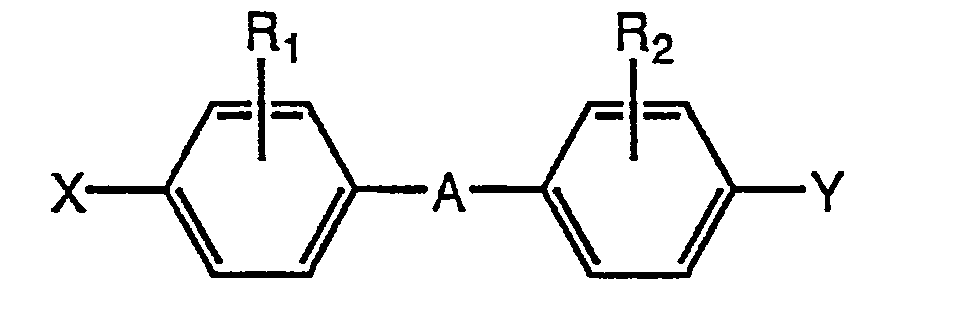
(Π) worin bedeuten: X und Y, unabhängig voneinander, OCN Oder(Π) where: X and Y, independently of one another, OCN or

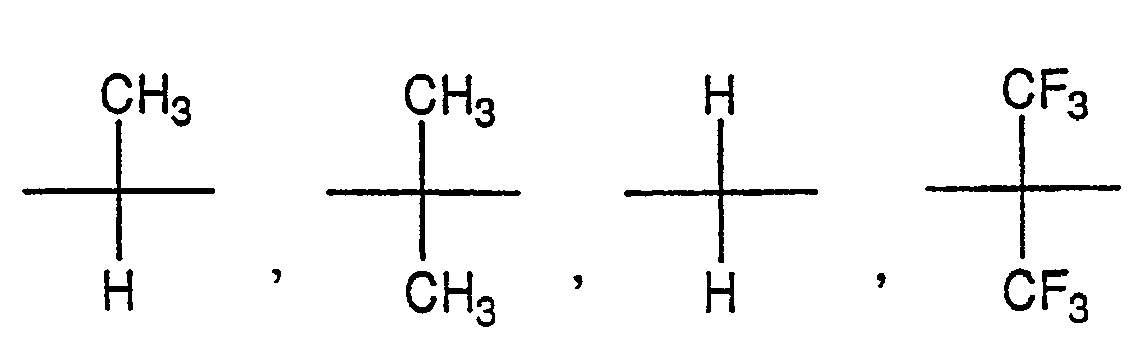
Y zusätzlich einen Alkyl-, Alkyloxy-, Alkyloxycarbonyl- oder Acyloxyrest einer Kettenlänge von 1 bis 20 Kohlenstoffatomen, gegebenenfalls. verzweigt, A die StrukturelementeY additionally an alkyl, alkyloxy, alkyloxycarbonyl or acyloxy radical with a chain length of 1 to 20 carbon atoms, if appropriate. branches, A the structural elements


Rl und R2, unabhängig voneinander Wasserstoff, Halogen, insbesondere Chlor, Brom oder Fluor, oder einen Methyl- oder Ethylrest. Bevorzugt werden 4,4'-Dicyanatophenylbenzoat, 4,4'-Dicyanatobiphenyl und 2,2-Bis(4-cyanatophenyl)-propan.Rl and R2, independently of one another, hydrogen, halogen, in particular chlorine, bromine or fluorine, or a methyl or ethyl radical. 4,4'-Dicyanatophenylbenzoate, 4,4'-dicyanatobiphenyl and 2,2-bis (4-cyanatophenyl) propane are preferred.
Die Zumischung der nicht-fliissigkristallinen Dicyanato-Comonomeren (Π) bei der Polycyclotrimerisation bietet den Vorteil, daß anisotrope Netzwerke auch unter Verwendung betrachtlicher Mengen an billigen Monomeren, die allein nur isotrope Netzwerke ergeben, erhalten werden. Ein weiterer Vorteil der Verwendung von zusätzlichen Comonomeren (Π) besteht in der Môglichkeit, die Eigenschaften des Verfahrensproduktes gezielt anzupassen, so die Vernetzungsdichte und die Erweichungstemperatur. Vorzugsweise wird zur Erzielung dieser Vorteile das Mengenverhältnis des Tris-(cyanato)-s-triazins der Formel (I) und des Dicyanato-Comonomers (II) so gewählt wird, daß der anisotrope Charakter des angestrebten duroplastischen Verfahrenserzeugnisses gewährleistet ist.The admixture of the non-liquid-crystalline dicyanato comonomers (Π) in the polycyclotrimerization offers the advantage that anisotropic networks are obtained even with the use of considerable amounts of cheap monomers, which only give isotropic networks. Another advantage of using additional comonomers (Π) is the possibility of specifically adapting the properties of the process product, such as the crosslinking density and the softening temperature. To achieve these advantages, the quantitative ratio of the tris- (cyanato) -s-triazine of the formula (I) and the dicyanato comonomer (II) is preferably selected so that the anisotropic character of the desired thermoset process product is ensured.
Bei einer weiteren vorteilhaften Ausgestaltung der Erfindung werden zusätzlich andere flüssigkristalline Cyanato-Comonomere (III) mit den Tris-(cyanato)-s-triazinen gemäß der Erfindung allein oder zusammen mit den bereits erörterten nicht-flüssigkristallinen Dicyanato-Comonomeren (II) umgesetzt. Als flüssigkristalline Cyanato-Comonomere (III) kommen dabei insbesondere die der nachfolgenden Formel (III) in Frage:In a further advantageous embodiment of the invention, other liquid-crystalline cyanato comonomers (III) are additionally reacted with the tris- (cyanato) -s-triazines according to the invention, alone or together with the non-liquid-crystalline dicyanato comonomers (II) already discussed. Suitable liquid-crystalline cyanato comonomers (III) are, in particular, those of the following formula (III):

m worin bedeuten: X die Strukturelementem in which: X denotes the structural elements

oderor

//
Rl bis R5, unabhängig voneinander, Wasserstoff, Halogen, insbesondere Chlor, Fluor oder Brom, einen Methyl-, Ethyl-, Propyl- oder Butylrest oder R2, R3, R4 oder R5 einen Benzolrest, R2 bis R5 Wasserstoff, wenn Ri kein Wasserstoff ist,Rl to R5, independently of one another, hydrogen, halogen, in particular chlorine, fluorine or bromine, a methyl, ethyl, propyl or butyl radical or R2, R3, R4 or R5 a benzene radical, R2 to R5 hydrogen if Ri is not hydrogen ,
Rl Wasserstoff, wenn R2 bis R5 ungleich Wasserstoff sind.R1 hydrogen if R2 to R5 are not hydrogen.
Bevorzugt werden als Comonomere (III) l,4-Bis(cyanatobenzoyloxy)benzol und l,4-Bis(cyanatobenzoyloxy)-methylbenzol. Der erfindungsgemäße Einsatz der Verbindung der Formel (I) erniedrigt in vorteilhafter Weise den Schmelzpunkt der flüssigkristallinen Comonomere (III), die als solche nur bei Temperaturen oberhalb ihrer Schmelzpunkte, die im allgemeinen über 200 °C liegen, verarbeitet werden können.Vorzugsweise entfallen auf 100 Gew.-Teile der Tris-(cyanato)-s-triazine gemäß der Erfindung bis zu etwa 1000 Gew.-Teile, insbesondere etwa 100 bis 500 Gew.-Teile der Comonomere der Formel (III).Preferred comonomers (III) are 1,4-bis (cyanatobenzoyloxy) benzene and 1,4-bis (cyanatobenzoyloxy) methylbenzene. The use according to the invention of the compound of the formula (I) advantageously lowers the melting point of the liquid-crystalline comonomers (III), which as such can only be processed at temperatures above their melting points, which are generally above 200 ° C. 100 are preferred Parts by weight of the tris- (cyanato) -s-triazines according to the invention up to about 1000 parts by weight, in particular about 100 to 500 parts by weight of the comonomers of the formula (III).
Im Rahmen der Erfindung dauert die Polycyclotrimerisation, wenn ein Katalysator eingesetzt wird, vorzugsweise etwa 0,5 bis 2 h.In the context of the invention, the polycyclotrimerization, if a catalyst is used, preferably takes about 0.5 to 2 hours.
Um die Eigenschaften des angestrebten duroplastischen Erzeugnisses zu verbessern, karai es in Einzelfällen vorteilhaft sein, bei erhöhter Temperatur eine Nachhärtung durchzuführen, wie es auch für isotrope Netzwerke zum Stand der Technik gehort. Beispielsweise wird 2 h bei 150 °C, 2 h bei 200 °C und weitere 2 h bei 240 °C ausgehärtetIn order to improve the properties of the desired thermosetting product, it may be advantageous in individual cases to carry out post-curing at an elevated temperature, as is also the state of the art for isotropic networks. For example, curing is carried out at 150 ° C. for 2 hours, at 200 ° C. for 2 hours and at 240 ° C. for a further 2 hours
Um die Eigenschaften zu verbessern, kann auch während der Polycyclotrimerisation ein elektromagnetisches Feld angelegt werden (siehe z. B.in : Finkelmann et al, Macromol. Chem. 180,803-806 (1979): Lc-Seitenketten enthaltende Methacrylat-Copolymere orientiert im elektrischen Feld. Moore et al, ACS Polymeric Material Science and Engineering, 52, 84r86 (1985): Orientierung von Seitenketten-lc-Polymeren im magnetischen Feld; S.K. Garg, S. Kenig in: High Modulus Polymers, S. 71-103 (1988) Marcel Dekker, inc.: Allgemeine Diskussion der Orientierung von lc-Polymeren durch Scherkräfte). Auf diese Weise werden insbesondere die thermische Ausdehnung und Zugfestigkeit in Orientierungs-richtung verbessert bzw. gesteuert.To improve the properties, an electromagnetic field can also be applied during polycyclotrimerization (see, for example, in: Finkelmann et al, Macromol. Chem. 180, 803-806 (1979): methacrylate copolymers containing Lc side chains oriented in the electric field Moore et al, ACS Polymeric Material Science and Engineering, 52, 84r86 (1985): Orientation of side-chain lc polymers in the magnetic field; SK Garg, S. Kenig in: High Modulus Polymers, pp. 71-103 (1988) Marcel Dekker, inc .: general discussion of the orientation of lc polymers by shear forces). In this way, in particular the thermal expansion and tensile strength in the orientation direction are improved or controlled.
Anhand der erfindungsgemäßen Verfahrenslehre bzw. mit den erfindungs-gemäßen Tris-(cyanato)-s-triazinen läßt sich also ein vorteilhaftes anisotropes duroplastisches Netzwerk in Form eines Homo- oder Copolymerisats herstellen.An advantageous anisotropic thermosetting network in the form of a homo- or copolymer can thus be produced using the inventive method or with the tris (cyanato) -s-triazines according to the invention.
Gegenstand der Erfindung sind somit auch anisotrope duroplastische Netzwerke in Form eines Homo- oder Copolymerisats des Tris(cyanato)-s-triazins der vorstehend bezeichneten Formel (I), insbesondere in Form eines Copolymerisats der Tris(cyanate)-s-triazine der Formel (I) sowie der nicht-flüssigkristallinen Dicyanatorcomonomeren (II) und/oder der flüssigkristallinen Cyanato-Comonomeren (ΙΠ) gemäß den vorstehenden Definitionen. Ein vorteilhaftes Copolymerisat dieser Art zeichnet sich dadurch aus, daß darin auf 100 Gew.-Teile der Tris-(cyanato)-s-triazins der Formel (I) etwa 30 bis 300 Gew.-Teile, insbesondere etwa 50 bis 100 Gew.-Teile des Dicyanato-Comonomers (II) und/oder bis zu etwa 1000 Gew.-Teile, insbesondere etwa 100 bis 500 Gew.-Teile der flüssigkristallinen Cyanato-Comonomeren (ΙΠ) entfallen.The invention thus also relates to anisotropic thermosetting networks in the form of a homo- or copolymer of tris (cyanato) -s-triazine of the formula (I) described above, in particular in the form of a copolymer of tris (cyanate) -s-triazine of the formula ( I) and the non-liquid-crystalline dicyanator comonomers (II) and / or the liquid-crystalline cyanato comonomers (ΙΠ) according to the above definitions. An advantageous copolymer of this type is characterized in that about 30 to 300 parts by weight, in particular about 50 to 100 parts by weight, per 100 parts by weight of the tris- (cyanato) -s-triazines of the formula (I). Parts of the dicyanato comonomer (II) and / or up to about 1000 parts by weight, in particular about 100 to 500 parts by weight of the liquid-crystalline cyanato comonomers (ΙΠ) are omitted.
Die Vorteile, die mit der vorliegenden Erfindung erzielbar sind, lassen sich wie folgt bezeichnen: Die Erfindung ermöglicht es, gesichert anisotrope Netzwerke herzustellen. Dabei ist sie nicht auf flüssigkristalline Ausgangsmaterialien beschränkt, sondern es können auch zusätzlich nicht-flüssigkristalline bzw. mesogene Ausgangsmaterialien eingesetzt werden. Hierdurch lassen sich die Produkteigenschaften gezielt steuern, so beispielsweise die Vemetzungsdichte mit der Folge, daß Härte, Sprödigkeit und Temperaturbeständigkeit und die Glastemperatur wünschenswert eingeregelt werden können. Damit ist auch der Vorteil verbunden, daß die angesprochenen Comonomeren mit verhältnismäßig hohem Schmelzpunkt mit den erfindungsgemäßen Tris-(cyanato)-s-triazinen aufgrund der gesenkten Schmelzpunkte der Reaktionsmischung bei wesentlich niedrigeren Temperaturen umgesetzt werden können. Darüber hinaus hat es sich gezeigt, daß die erfindungsgemäß erhaltenen anisotropen duroplastischen Netzwerke einen um den Faktor 10 gegenüber den Vergleichsprodukten des Standee der Technik verbesserten E-Modul (Maß für die Festigkeit) aufweisen.The advantages that can be achieved with the present invention can be described as follows: The invention makes it possible to reliably produce anisotropic networks. It is not limited to liquid-crystalline starting materials, but non-liquid-crystalline or mesogenic starting materials can also be used. This allows the product properties to be controlled in a targeted manner, for example the crosslinking density, with the result that hardness, brittleness and temperature resistance and the glass transition temperature can be adjusted in a desirable manner. This also has the advantage that the comonomers mentioned with a relatively high melting point can be reacted with the tris (cyanato) -s-triazines according to the invention due to the lower melting points of the reaction mixture at substantially lower temperatures. In addition, it has been shown that the anisotropic thermosetting networks obtained according to the invention have a modulus of elasticity (measure of strength) which is improved by a factor of 10 compared to the comparative products of the prior art.
Die erfindungsgemäßen anisotropen duroplastischen Netzwerke können nach den üblichen Verarbeitungsmethoden als Konstruktionswerkstoffe bei der Herstellung von Isolierstoffen, Laminaten, Composites, Überzügen und Beschichtungen eingesetzt werden.The anisotropic thermosetting networks according to the invention can be used according to the usual processing methods as construction materials in the production of insulating materials, laminates, composites, coatings and coatings.
Die Erfindung soil anhand nachfolgender Beispiele näher erläutert werden:The following examples are intended to illustrate the invention:
Beispiel 1:Example 1:
Herstellung der Vorstufe in Form des l,3.5-Tris(4-hydroxyphenyloxy-4-carbonylphenoxy)-2.4,6-triazins: In einen trockenen 250 ml Einhalskolben mit Schutzgasanschluß und Magnetrührstab werden 6.1 g (12.5 mmol) 1,3,5-Tris(4-carboxyphenoxy)-2,4,6-triazin gegeben. Dazu gibt man 4.9 g (41.1 mmol) , Thionylchlorid, eine kleine Spatelspitze 4-N,N-Dimethylaminopyridin und erhitzt die Mischung 5 Stunden auf 120 °C. Das überschüssige Thionylchlorid wird im Vakuum abgezogen. Dann gibt man 11.0 g (43.2 mmol) 1,4-Bis(trimethylsiloxy)-benzol zu. Es wird eine Destillationsapparatur aufgesetzt und 12 Stunden bei 150 °C gehalten. Nach Abdestillation der berechneten Menge Chlortrimethylsilan wird das überschüssige l,4-Bis(trimethylsiloxy)-benzol im Ölpumpenvakuum abgezogen. Das Rohprodukt wird IR-spektroskopisch identifiziert. Zur Desilylierung wird das Rohprodukt in 200 ml Ν,Ν-Dimethylformamid sowie 30 ml verdünnter Salzsäure gelost und mehrere Stunden bei Raumtemperatur gerührt Anschließend wird in 400 ml Wasser ausgefällt, abfiltriert, zweimal mit jeweils 100 ml Wasser gewaschen und im Vakuum bei 80 °C getrocknet. Die Identifizierung erfolgt IR-spektroskopisch.Preparation of the precursor in the form of 1,3,5-tris (4-hydroxyphenyloxy-4-carbonylphenoxy) -2,4,6-triazine: 6.1 g (12.5 mmol) 1,3,5- are placed in a dry 250 ml single-necked flask with a protective gas connection and a magnetic stir bar. Tris (4-carboxyphenoxy) -2,4,6-triazine added. 4.9 g (41.1 mmol), thionyl chloride, a small spatula tip 4-N, N-dimethylaminopyridine are added and the mixture is heated at 120 ° C. for 5 hours. The excess thionyl chloride is removed in vacuo. Then 11.0 g (43.2 mmol) of 1,4-bis (trimethylsiloxy) benzene are added. A distillation apparatus is set up and kept at 150 ° C. for 12 hours. After distilling off the calculated amount of chlorotrimethylsilane, the excess 1,4-bis (trimethylsiloxy) benzene is drawn off in an oil pump vacuum. The crude product is identified by IR spectroscopy. For desilylation, the crude product is dissolved in 200 ml of Ν, Ν-dimethylformamide and 30 ml of dilute hydrochloric acid and stirred for several hours at room temperature. It is then precipitated in 400 ml of water, filtered off, washed twice with 100 ml of water each time and dried in vacuo at 80 ° C . The identification is carried out by IR spectroscopy.
Synthese von l,3.5-Tris(4-cyanatophenyloxy-4-carbonylphenoxy)-2,4,6-triazin: In einem 250 ml Einhalskolben mit Magnetrührstab und Eiswasserkühlung werden 2.54 g (3.32 mmol) l,3,5-Tris(4-hydroxyphenyloxy-4-carbonylphenoxy)-2,4,6-triazin, 1.37 g (12.94 mmol) Bromcyan in 40 ml Ν,Ν-Dimethylformamid bei einer Innentemperatur von 0 - 5 °C vorgelegt. Dazu werden innerhalb 5 Minuten 1.01 g (9.96 mmol) Triethylamin zugetropft und 15 Minuten nachgerührt. Das 1,3,5-Tris(4-cyanatophenyloxy-4-carbonylphenoxy)-2,4,6-triazin wird in 400 ml Eiswasser als weißer Niederschlag ausgefällt Es wird zweimal mit jeweils 50 ml Wasser nachgewaschen, im Ölpumpenvakuum bei Raumtemperatur getrocknet und IR-spektroskopisch identifiziert. Die glasig-amorphe Verbindung erweicht bei ca. 90 °C unter Ausbildung nematischer Texturen.Synthesis of 1,3,5-tris (4-cyanatophenyloxy-4-carbonylphenoxy) -2,4,6-triazine: 2.54 g (3.32 mmol) 1,3,5-tris (4th -hydroxyphenyloxy-4-carbonylphenoxy) -2,4,6-triazine, 1.37 g (12.94 mmol) cyanogen bromide in 40 ml Ν, Ν-dimethylformamide at an internal temperature of 0-5 ° C. For this purpose, 1.01 g (9.96 mmol) of triethylamine are added dropwise within 5 minutes and the mixture is stirred for a further 15 minutes. The 1,3,5-tris (4-cyanatophenyloxy-4-carbonylphenoxy) -2,4,6-triazine is precipitated in 400 ml of ice water as a white precipitate. It is washed twice with 50 ml of water each time, dried in an oil pump vacuum at room temperature and Identified by IR spectroscopy. The glassy-amorphous compound softens at approx. 90 ° C with the formation of nematic textures.
Beispiel 2:Example 2:
Bildung und Charakterisierung eines anisotropen Netzwerkes aus 1,3,5-Tris(4-cyanatophenyloxy-4-carbonylphenoxy)-2.4.6-triazin: Das durch Beispiel 1 gewonnene amorphe Produkt wird in einem Heiztisch von 30 °C bis 300 °C mit einer Heizrate von 20 °C aufgeheizt und in polarisiertem Licht mikroskopisch untersucht. Die bei Raumtemperatur feste Substanz wird bei 90 °C flüssig, die Schmelze zeigt die typischen Texturen einer nematisch-flüssigkristallinen Phase. Bei 200 °C nimmt die Viskosität der Mischung zu, es findet Cyclodimérisation statt. Die Mischung wird bei ca. 250 °C fest. Die oberhalb der Erweichung erscheinenden Texturen bleiben über den ganzen Zeitraum der Härtung und auch nach Abkühlen auf Raumtemperatur erhalten. Mehrmaliges Aufheizen der Probe bis 300 °C wirkt sich nicht auf die eingefrorenen Texturen des Netzwerkes aus.Formation and characterization of an anisotropic network of 1,3,5-tris (4-cyanatophenyloxy-4-carbonylphenoxy) -2.4.6-triazine: The amorphous product obtained by Example 1 is mixed in a heating table from 30 ° C to 300 ° C heated to a heating rate of 20 ° C and examined microscopically in polarized light. The solid at room temperature becomes liquid at 90 ° C, the melt shows the typical textures of a nematic liquid crystalline phase. At 200 ° C the viscosity of the mixture increases, cyclodimerization takes place. The mixture solidifies at approx. 250 ° C. The textures appearing above the softening are retained over the entire period of hardening and also after cooling to room temperature. Repeated heating of the sample up to 300 ° C has no effect on the frozen textures of the network.
Vergleichsbeispiel 1:Comparative Example 1:
Herstellung eines Prüfstabes aus l,3,5-Tris(4-cyanatophenyloxv-4-carbonvl-phenoxy)-2,4.6-triazin: Eine Probe von l,3,5-Tris(4-cyanatophenyloxy-4- carbonylphenoxy)-2,4,6-triazin wird 10 h bei 150 °C, dann 2 h bei 310 °C getempert. Der erhaltene, nicht transparente Prüfstab (23x13x2 mm) wird in Torsion untersucht (30 °C bis 400 °C, 2 °C/min, 1 Hz). Der Speichermodul G' beträgt 15,8 GPa bei 100 °C, die Glastemperatur wird bei 370 °C beobachtet.Preparation of a test stick from 1,3,5-tris (4-cyanatophenyloxv-4-carbonvl-phenoxy) -2,4,6-triazine: A sample of 1,3,5-tris (4-cyanatophenyloxy-4-carbonylphenoxy) -2 , 4,6-triazine is annealed at 150 ° C for 10 h, then at 310 ° C for 2 h. The non-transparent test rod (23x13x2 mm) obtained is examined in torsion (30 ° C to 400 ° C, 2 ° C / min, 1 Hz). The storage module G 'is 15.8 GPa at 100 ° C, the glass temperature is observed at 370 ° C.
Herstellung eines Prüfstabes aus 2,2-Bis(4-cvanatophenyl)-propan: Eine Probe von 2,2-Bis(4-cyanatophenyl)-propan wird 10 h bei 150 °C, dann 2 h bei 310 °C getempert. Der erhaltene, nicht transparente Prüfstab (23x13x2 mm) wird in Torsion untersucht (30 °C bis 400 °C, 2 °C/min, 1 Hz). Der Speichermodul G' beträgt 1.6 GPa bei 100 °C, die Glastemperatur wird bei 320 °C beobachtet.Preparation of a test rod from 2,2-bis (4-cvanatophenyl) propane: A sample of 2,2-bis (4-cyanatophenyl) propane is annealed at 150 ° C. for 10 h, then at 310 ° C. for 2 h. The non-transparent test rod (23x13x2 mm) obtained is examined in torsion (30 ° C to 400 ° C, 2 ° C / min, 1 Hz). The storage module G 'is 1.6 GPa at 100 ° C, the glass temperature is observed at 320 ° C.
In der Figur 1 ist das Speichermodul als Funktion der Temperatur für die Prüfstäbe aus Netzwerken von l,3,5-Tris(4-cyanatophenyloxy-4-carbonylphenoxy)-2,4,6-triazin (I) und 2,2-Bis(4-cyanatophenyl)-propan (II) graphisch dargestellt (DMTA-Experiment: Heizrate 2 K/ min, Frequenz 1 Hz). Das mit dem erfindungsgemäßen Erzeugnis erhaltene Speichermodul liegt deutlich höher als das des Vergleichsproduktes.1 shows the storage module as a function of the temperature for the test rods from networks of 1,3,5-tris (4-cyanatophenyloxy-4-carbonylphenoxy) -2,4,6-triazine (I) and 2,2-bis (4-cyanatophenyl) propane (II) shown graphically (DMTA experiment: heating rate 2 K / min, frequency 1 Hz). The storage module obtained with the product according to the invention is significantly higher than that of the comparative product.
Beispiel 3:Example 3:
Bildung und Charakterisierung eines Netzwerkes aus 1,3.5-Tris(4-cyanatophenyloxy-4-carbonylphenoxy)-2,4,6-triazin mit 4,4X-Dicyanatobiphenyl: 2,0 g l,3,5-Tris(4-cyanatophenyloxy-4-carbonylphenoxy)-2,4,6-triazin und 2,0 g 4,4'-Dicyanatobiphenyl werden homogenisiert und eine Stunde bei 180 °C sowie eine Stunde bei 250 °C gehärtet. Die nematisch-flüssigkristallinen Texturen bleiben über den gesamten Zeitraum der Härtung erhalten, auch ein Abkühlen der Probe oder ein mehrmaliges Aufheizen bis 300 °C bringt keine Änderung der anisotropen Eigenschaften.Formation and characterization of a network of 1,3.5-tris (4-cyanatophenyloxy-4-carbonylphenoxy) -2,4,6-triazine with 4,4X-dicyanatobiphenyl: 2.0 gl, 3,5-tris (4-cyanatophenyloxy- 4-carbonylphenoxy) -2,4,6-triazine and 2.0 g of 4,4'-dicyanatobiphenyl are homogenized and cured for one hour at 180 ° C. and for one hour at 250 ° C. The nematic-liquid-crystalline textures are retained over the entire period of hardening, even cooling the sample or repeated heating up to 300 ° C does not change the anisotropic properties.
Beispiel 4:Example 4:
Bildung und Charakterisierung eines Netzwerkes aus 1,3,5-Tris(4-cyanatophenvloxy-4-carbonylphenoxy)-2,4.6-triazin mit 4.4"-Dicyanatophenyl-benzoat: 1,0 g l,3,5-Tris(4-cyanatophenyloxy-4-carbonylphenoxy)-2,4,6-triazin, 2,0 g 4,4'-Dicyanatophenylbenzoat sowie 0,15 Gew% Kupfer (Il)-acetylacetonat werden homogenisiert und 15 Minuten bei 150 °C sowie eine Stunde bei 250 °C gehärtet. Die nematisch-flüssigkristallinen Texturen bleiben über den gesamtenFormation and characterization of a network of 1,3,5-tris (4-cyanatophenvloxy-4-carbonylphenoxy) -2,4.6-triazine with 4.4 "-dicyanatophenyl-benzoate: 1.0 gl, 3,5-tris (4-cyanatophenyloxy -4-carbonylphenoxy) -2,4,6-triazine, 2.0 g 4,4'-dicyanatophenyl benzoate and 0.15% by weight copper (II) acetylacetonate are homogenized and 15 minutes at 150 ° C and one hour at 250 ° C. The nematic-liquid-crystalline textures remain throughout
Zeitraum der Härtung erhalten. Auch ein Abkühlen der Probe oder ein mehrmaliges Aufheizen bis 300 °C bringt keine Änderung der anisotropen Eigenschaften.Preserved period of curing. Even cooling the sample or repeated heating up to 300 ° C does not change the anisotropic properties.
Beispiel 5:Example 5:
Bildung und Charakterisierung eines Netzwerkes aus 1,3,5-Tris(4-cyanatophenyloxy-4-carbonylphenoxvV2.4-(i-tria7.in mit 2.2-Bis(4-cvanatophenyl)-propan: 2,0 g l/3^-Tris(4-cyanatophenyloxy-4-carbonylphenoxy)-2,4,6-triazin und 0,7 g 2,2-Bis(4-cyanatophenyl)-propan werden homogenisiert und eine Stunde bei 180 °C sowie eine Stunde bei 250 °C gehärtet. Die nematisch-flüssigkristallinen Texturen bleiben über den gesamten Zeitraum der Härtung erhalten, auch ein Abkühlen der Probe oder ein mehrmaliges Aufheizen bis 300 °C bringt keine Änderung der anisotropen Eigenschaften.Formation and characterization of a network of 1,3,5-tris (4-cyanatophenyloxy-4-carbonylphenoxvV2.4- (i-tria7.in with 2,2-bis (4-cvanatophenyl) propane: 2.0 gl / 3 ^ - Tris (4-cyanatophenyloxy-4-carbonylphenoxy) -2,4,6-triazine and 0.7 g of 2,2-bis (4-cyanatophenyl) propane are homogenized and one hour at 180 ° C and one hour at 250 ° C. The nematic-liquid-crystalline textures remain intact for the entire period of hardening, even cooling the sample or repeated heating up to 300 ° C does not change the anisotropic properties.
Beispiel 6:Example 6:
Bildung und Charakterisierung eines Netzwerkes aus 1,3,5-Tris(4-cyanatophenyloxy-4-carbonylphenoxy)-2,4,6-triazinmit 2,2-Bis(4-epoxypropoxy)-propan: 2,0 g l,3,5-Tris(4-cyanatophenyloxy-4-carbonylphenoxy)-2,4,6-triazm, 0,4 g 2,2-Bis(4-epoxypropoxy)-propan werden homogenisiert und drei Stunden bei 130 °C, eine Stunden bei 180 °C sowie eine Stunde bei 250 °C gehärtet. Die nematisch-flüssigkristallinen Texturen bleiben über den gesamten Zeitraum der Härtung erhalten, auch ein Abkühlen der Probe oder ein mehrmaliges Aufheizen bis 300 °C bringt keine Änderung der anisotropen Eigenschaften.Formation and characterization of a network of 1,3,5-tris (4-cyanatophenyloxy-4-carbonylphenoxy) -2,4,6-triazine with 2,2-bis (4-epoxypropoxy) propane: 2.0 gl, 3, 5-Tris (4-cyanatophenyloxy-4-carbonylphenoxy) -2,4,6-triazm, 0.4 g of 2,2-bis (4-epoxypropoxy) propane are homogenized and three hours at 130 ° C, one hour at 180 ° C and hardened at 250 ° C for one hour. The nematic-liquid-crystalline textures are retained over the entire period of hardening, even cooling the sample or repeated heating up to 300 ° C does not change the anisotropic properties.
Claims (17)




Priority Applications (7)
| Application Number | Priority Date | Filing Date | Title |
|---|---|---|---|
| LU88404A LU88404A1 (en) | 1993-09-08 | 1993-09-08 | Tris- (cyanato) -s-triazine, thus obtainable anisotropic thermosetting networks and a process for the production thereof |
| PCT/EP1994/002980 WO1995007268A1 (en) | 1993-09-08 | 1994-09-07 | Tris-(cyanato)-s-triazines and anisotropic duroplastic networks obtained with them |
| EP94926244A EP0717735B1 (en) | 1993-09-08 | 1994-09-07 | Tris-(cyanato)-s-triazines and anisotropic duroplastic networks obtained with them |
| CA002169855A CA2169855A1 (en) | 1993-09-08 | 1994-09-07 | Tris-(cyanato)-s-triazines and anisotropic duroplastic networks obtained with them |
| US08/612,913 US5723067A (en) | 1993-09-08 | 1994-09-07 | Tris-(cyanoto)-s-triazines and anisotropic duroplastic networks obtained with them |
| DE59406232T DE59406232D1 (en) | 1993-09-08 | 1994-09-07 | TRIS- (CYANATO) -S-TRIAZINE, THEREFORE AVAILABLE ANISOTROPE DUROPLASTIC NETWORKS |
| AT94926244T ATE167184T1 (en) | 1993-09-08 | 1994-09-07 | TRIS-(CYANATO)-S-TRIAZINE, THEREFORE ANISOTROPIC THERMOSET NETWORK |
Applications Claiming Priority (2)
| Application Number | Priority Date | Filing Date | Title |
|---|---|---|---|
| LU88404A LU88404A1 (en) | 1993-09-08 | 1993-09-08 | Tris- (cyanato) -s-triazine, thus obtainable anisotropic thermosetting networks and a process for the production thereof |
| LU88404 | 1993-09-08 |
Publications (1)
| Publication Number | Publication Date |
|---|---|
| LU88404A1 true LU88404A1 (en) | 1995-04-05 |
Family
ID=19731439
Family Applications (1)
| Application Number | Title | Priority Date | Filing Date |
|---|---|---|---|
| LU88404A LU88404A1 (en) | 1993-09-08 | 1993-09-08 | Tris- (cyanato) -s-triazine, thus obtainable anisotropic thermosetting networks and a process for the production thereof |
Country Status (7)
| Country | Link |
|---|---|
| US (1) | US5723067A (en) |
| EP (1) | EP0717735B1 (en) |
| AT (1) | ATE167184T1 (en) |
| CA (1) | CA2169855A1 (en) |
| DE (1) | DE59406232D1 (en) |
| LU (1) | LU88404A1 (en) |
| WO (1) | WO1995007268A1 (en) |
Families Citing this family (9)
| Publication number | Priority date | Publication date | Assignee | Title |
|---|---|---|---|---|
| GB9702354D0 (en) * | 1997-02-05 | 1997-03-26 | Zeneca Ltd | Compounds and their use |
| DE10016524A1 (en) * | 2000-04-03 | 2001-10-04 | Basf Ag | Polymerizable liquid crystals |
| JP4363800B2 (en) * | 2001-06-11 | 2009-11-11 | ソニー株式会社 | Electronic commerce support apparatus, electronic commerce support method, and computer program |
| US20060283864A1 (en) * | 2005-02-10 | 2006-12-21 | Angstrom Power | Shipping container and method of use |
| EA201891338A1 (en) | 2015-12-04 | 2018-12-28 | Новартис Аг | COMPOSITIONS AND METHODS FOR IMMUNICOLOGY |
| WO2018175636A2 (en) | 2017-03-22 | 2018-09-27 | Novartis Ag | Compositions and methods for immunooncology |
| JP7305108B2 (en) * | 2018-04-12 | 2023-07-10 | 三菱瓦斯化学株式会社 | Cyanate ester compounds, resin compositions, cured products, single-layer resin sheets, laminated resin sheets, prepregs, metal foil-clad laminates, printed wiring boards, sealing materials, fiber-reinforced composite materials, and adhesives |
| US12540122B2 (en) | 2018-09-26 | 2026-02-03 | Adeka Corporation | Nucleating agent, synthetic-resin composition containing same, and molded object thereof |
| CN110724165B (en) * | 2019-10-25 | 2022-08-05 | 万华化学集团股份有限公司 | Hexahydrotriazine compound with thermal oxidation resistance and preparation method and application thereof |
Family Cites Families (2)
| Publication number | Priority date | Publication date | Assignee | Title |
|---|---|---|---|---|
| EP0409069B1 (en) * | 1989-07-17 | 1999-06-02 | The Dow Chemical Company | Mesogenic polycyanates and polycyanamides and thermosets thereof |
| US5136011A (en) * | 1990-09-19 | 1992-08-04 | Cornell Research Foundation | Triazine networks with homogeneous and oriented structures and method for making same |
-
1993
- 1993-09-08 LU LU88404A patent/LU88404A1/en unknown
-
1994
- 1994-09-07 WO PCT/EP1994/002980 patent/WO1995007268A1/en not_active Ceased
- 1994-09-07 US US08/612,913 patent/US5723067A/en not_active Expired - Fee Related
- 1994-09-07 EP EP94926244A patent/EP0717735B1/en not_active Expired - Lifetime
- 1994-09-07 DE DE59406232T patent/DE59406232D1/en not_active Expired - Fee Related
- 1994-09-07 CA CA002169855A patent/CA2169855A1/en not_active Abandoned
- 1994-09-07 AT AT94926244T patent/ATE167184T1/en not_active IP Right Cessation
Also Published As
| Publication number | Publication date |
|---|---|
| EP0717735A1 (en) | 1996-06-26 |
| DE59406232D1 (en) | 1998-07-16 |
| US5723067A (en) | 1998-03-03 |
| WO1995007268A1 (en) | 1995-03-16 |
| CA2169855A1 (en) | 1995-03-16 |
| EP0717735B1 (en) | 1998-06-10 |
| ATE167184T1 (en) | 1998-06-15 |
Similar Documents
| Publication | Publication Date | Title |
|---|---|---|
| DE19520704A1 (en) | Polymerizable chiral compounds and their use | |
| EP0847432A2 (en) | Polymerizable liquid-crystalline compounds | |
| EP0717735B1 (en) | Tris-(cyanato)-s-triazines and anisotropic duroplastic networks obtained with them | |
| WO1995022586A1 (en) | New polymerisable liquid crystal compounds | |
| WO1995024455A1 (en) | Novel polymerizable liquid-crystalline compounds | |
| DE3334056A1 (en) | LIQUID CRYSTALLINE PHASES FORMING POLYMERS | |
| DE69109167T2 (en) | Dicyanate ester of dihydroxyphenols, curable at low temperature. | |
| DE2548360C2 (en) | Liquid crystalline materials with reduced viscosity | |
| DE2710632A1 (en) | ALKYLENE OR CYCLOALKYLENE DIAMMONIUM BIS-TETRAHALOPHTHALATE AND METHOD FOR THE PRODUCTION THEREOF | |
| DE3014912A1 (en) | NEMATIC LIQUID CRYSTALLINE 5-CYAN 2-ANGLE CLAMP ON 4-ACYLOXYPHENYL ANGLE CLAMP FOR -PYRIMIDINE AND MIXTURES THESE CONTAINING | |
| DE2708469A1 (en) | WHITE N, N'-ALKYLENE BIS-TETRABROMOPHTHALIMIDE AND METHOD FOR PREPARING THE SAME | |
| DE19714119A1 (en) | Compounds, processes for their preparation and processes for the production of liquid-crystalline polymers using these compounds | |
| WO1998004544A1 (en) | New liquid crystal compounds and their precursors | |
| DE1770146B2 (en) | Process for the production of poly- (arylene-triketoimidazolidines) | |
| DD274040A5 (en) | LIQUID CRYSTALLINE MIXTURE WHICH IS INTENDED FOR USE IN THE DEVICE FOR INFORMATION PICTURE | |
| EP0951520B2 (en) | Flat element with a cholesteric liquid crystal structure | |
| DE69911564T2 (en) | Bismaleimides containing mesogenic groups and oligomeric liquid-crystalline bismaleimides | |
| DE2726801A1 (en) | PROCESS FOR COATING THE SURFACE OF GLASS OBJECTS WITH A TRANSITION METAL OXIDE LAYER | |
| DE3016758C2 (en) | Substituted phenyl benzoates, processes for their preparation, and liquid crystal compositions containing them | |
| DE2211327A1 (en) | BISANHYDRIDES, THEIR DERIVATIVES AND THE METHOD FOR THEIR PRODUCTION | |
| DE69701257T2 (en) | Self-crosslinking polyester at high temperature | |
| DE4411361C1 (en) | New rigid chain polyesters and process for making the same | |
| DE3817088A1 (en) | SIDE CHAIN POLYMERS | |
| DE2616691A1 (en) | POLYIMIDE OLIGOMER WITH TERMINAL ACETYLENE GROUPS | |
| DE3015386A1 (en) | THERMOTROPE, FULLY FLAVORED POLYTHIOLESTERS, THEIR PRODUCTION AND USE |